Artin Co 708005 RC Car User Manual

Artin Industrial Co Ltd RC Car

User Manual

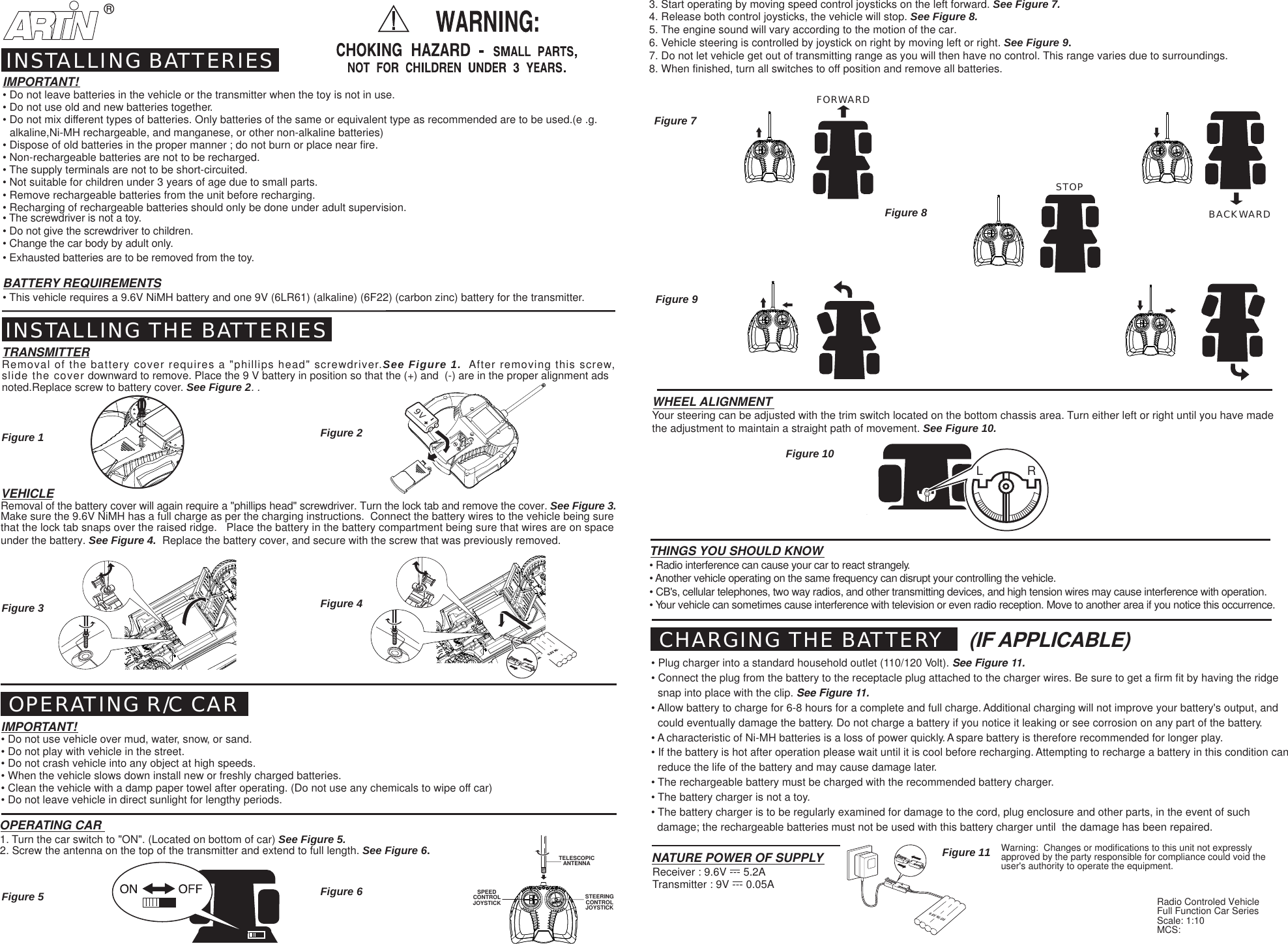
BACKWARDFORWARDSTOP9.6V Ni Cd9.6V Ni Cd®L             RSPEEDCONTROLJOYSTICK STEERINGCONTROLJOYSTICKTELESCOPICANTENNAFigure 1 Figure 2Figure 7Figure 8Figure 10Figure 11Figure 9IMPORTANT!• Do not leave batteries in the vehicle or the transmitter when the toy is not in use.• Do not use old and new batteries together.• Do not mix different types of batteries. Only batteries of the same or equivalent type as recommended are to be used.(e .g.  alkaline,Ni-MH rechargeable, and manganese, or other non-alkaline batteries)• Dispose of old batteries in the proper manner ; do not burn or place near fire.• Non-rechargeable batteries are not to be recharged.• The supply terminals are not to be short-circuited.• Not suitable for children under 3 years of age due to small parts.• Remove rechargeable batteries from the unit before recharging.• Recharging of rechargeable batteries should only be done under adult supervision.• The screwdriver is not a toy.• Do not give the screwdriver to children.• Change the car body by adult only.• Exhausted batteries are to be removed from the toy.BATTERY REQUIREMENTS• This vehicle requires a 9.6V NiMH battery and one 9V (6LR61) (alkaline) (6F22) (carbon zinc) battery for the transmitter.INSTALLING BATTERIESINSTALLING THE BATTERIESTRANSMITTERRemoval of the battery cover requires a "phillips head" screwdriver.See Figure 1.  After removing this screw,slide the cover downward to remove. Place the 9 V battery in position so that the (+) and  (-) are in the proper alignment adsnoted.Replace screw to battery cover. See Figure 2. .VEHICLERemoval of the battery cover will again require a "phillips head" screwdriver. Turn the lock tab and remove the cover. See Figure 3.Make sure the 9.6V NiMH has a full charge as per the charging instructions.  Connect the battery wires to the vehicle being surethat the lock tab snaps over the raised ridge.   Place the battery in the battery compartment being sure that wires are on spaceunder the battery. See Figure 4.  Replace the battery cover, and secure with the screw that was previously removed. OPERATING R/C CARIMPORTANT!• Do not use vehicle over mud, water, snow, or sand.• Do not play with vehicle in the street.• Do not crash vehicle into any object at high speeds.• When the vehicle slows down install new or freshly charged batteries.• Clean the vehicle with a damp paper towel after operating. (Do not use any chemicals to wipe off car)• Do not leave vehicle in direct sunlight for lengthy periods.OPERATING CAR1. Turn the car switch to "ON". (Located on bottom of car) See Figure 5.2. Screw the antenna on the top of the transmitter and extend to full length. See Figure 6.THINGS YOU SHOULD KNOW• Radio interference can cause your car to react strangely.• Another vehicle operating on the same frequency can disrupt your controlling the vehicle.• CB's, cellular telephones, two way radios, and other transmitting devices, and high tension wires may cause interference with operation.• Your vehicle can sometimes cause interference with television or even radio reception. Move to another area if you notice this occurrence.WHEEL ALIGNMENTYour steering can be adjusted with the trim switch located on the bottom chassis area. Turn either left or right until you have madethe adjustment to maintain a straight path of movement. See Figure 10.Transmitter : 9V --- 0.05ANATURE POWER OF SUPPLYReceiver : 9.6V --- 5.2ACHARGING THE BATTERY• Plug charger into a standard household outlet (110/120 Volt). See Figure 11.• Connect the plug from the battery to the receptacle plug attached to the charger wires. Be sure to get a firm fit by having the ridgesnap into place with the clip. See Figure 11.• Allow battery to charge for 6-8 hours for a complete and full charge. Additional charging will not improve your battery's output, andcould eventually damage the battery. Do not charge a battery if you notice it leaking or see corrosion on any part of the battery.• A characteristic of Ni-MH batteries is a loss of power quickly. A spare battery is therefore recommended for longer play.• If the battery is hot after operation please wait until it is cool before recharging. Attempting to recharge a battery in this condition canreduce the life of the battery and may cause damage later.• The rechargeable battery must be charged with the recommended battery charger.• The battery charger is not a toy.• The battery charger is to be regularly examined for damage to the cord, plug enclosure and other parts, in the event of such  damage; the rechargeable batteries must not be used with this battery charger until  the damage has been repaired.3. Start operating by moving speed control joysticks on the left forward. See Figure 7.4. Release both control joysticks, the vehicle will stop. See Figure 8.5. The engine sound will vary according to the motion of the car.6. Vehicle steering is controlled by joystick on right by moving left or right. See Figure 9.7. Do not let vehicle get out of transmitting range as you will then have no control. This range varies due to surroundings.8. When finished, turn all switches to off position and remove all batteries.Figure 3 Figure 4Figure 5 Figure 6(IF APPLICABLE)Radio Controled VehicleFull Function Car SeriesScale: 1:10MCS:Warning:  Changes or modifications to this unit not expresslyapproved by the party responsible for compliance could void theuser's authority to operate the equipment.9V

Navigation menu