Asus Computer Hardware Z87 C Users Manual
Asus-Z87C-Owner-S-Manual asus-z87c-owner-s-manual
Asus Computer Hardware Z87-C E7869_Z87-C
Z87-C to the manual 5f8d726a-70eb-4761-8d0c-c0f63a0ab009
2015-01-21
: Asus Asus-Asus-Computer-Hardware-Z87-C-Users-Manual-236599 asus-asus-computer-hardware-z87-c-users-manual-236599 asus pdf
Open the PDF directly: View PDF  .
.
Page Count: 96

Motherboard
Z87-C

ii
E7869
First Edition
April 2013
Copyright© 2013 ASUSTeK COMPUTER INC. All Rights Reserved.
No part of this manual, including the products and software described in it, may be reproduced,
transmitted, transcribed, stored in a retrieval system, or translated into any language in any form or by any
means, except documentation kept by the purchaser for backup purposes, without the express written
permission of ASUSTeK COMPUTER INC. (“ASUS”).
Product warranty or service will not be extended if: (1) the product is repaired, modied or altered, unless
such repair, modication of alteration is authorized in writing by ASUS; or (2) the serial number of the
product is defaced or missing.
ASUS PROVIDES THIS MANUAL “AS IS” WITHOUT WARRANTY OF ANY KIND, EITHER EXPRESS
OR IMPLIED, INCLUDING BUT NOT LIMITED TO THE IMPLIED WARRANTIES OR CONDITIONS OF
MERCHANTABILITY OR FITNESS FOR A PARTICULAR PURPOSE. IN NO EVENT SHALL ASUS, ITS
DIRECTORS, OFFICERS, EMPLOYEES OR AGENTS BE LIABLE FOR ANY INDIRECT, SPECIAL,
INCIDENTAL, OR CONSEQUENTIAL DAMAGES (INCLUDING DAMAGES FOR LOSS OF PROFITS,
LOSS OF BUSINESS, LOSS OF USE OR DATA, INTERRUPTION OF BUSINESS AND THE LIKE),
EVEN IF ASUS HAS BEEN ADVISED OF THE POSSIBILITY OF SUCH DAMAGES ARISING FROM ANY
DEFECT OR ERROR IN THIS MANUAL OR PRODUCT.
SPECIFICATIONS AND INFORMATION CONTAINED IN THIS MANUAL ARE FURNISHED FOR
INFORMATIONAL USE ONLY, AND ARE SUBJECT TO CHANGE AT ANY TIME WITHOUT NOTICE,
AND SHOULD NOT BE CONSTRUED AS A COMMITMENT BY ASUS. ASUS ASSUMES NO
RESPONSIBILITY OR LIABILITY FOR ANY ERRORS OR INACCURACIES THAT MAY APPEAR IN THIS
MANUAL, INCLUDING THE PRODUCTS AND SOFTWARE DESCRIBED IN IT.
Products and corporate names appearing in this manual may or may not be registered trademarks or
copyrights of their respective companies, and are used only for identication or explanation and to the
owners’ benet, without intent to infringe.
Offer to Provide Source Code of Certain Software
This product contains copyrighted software that is licensed under the General Public License (“GPL”),
under the Lesser General Public License Version (“LGPL”) and/or other Free Open Source Software
Licenses. Such software in this product is distributed without any warranty to the extent permitted by the
applicable law. Copies of these licenses are included in this product.
Where the applicable license entitles you to the source code of such software and/or other additional data,
you may obtain it for a period of three years after our last shipment of the product, either
(1) for free by downloading it from http://support.asus.com/download
or
(2) for the cost of reproduction and shipment, which is dependent on the preferred carrier and the location
where you want to have it shipped to, by sending a request to:
ASUSTeK Computer Inc.
Legal Compliance Dept.
15 Li Te Rd.,
Beitou, Taipei 112
Taiwan
In your request please provide the name, model number and version, as stated in the About Box of the
product for which you wish to obtain the corresponding source code and your contact details so that we
can coordinate the terms and cost of shipment with you.
The source code will be distributed WITHOUT ANY WARRANTY and licensed under the same license as
the corresponding binary/object code.
This offer is valid to anyone in receipt of this information.
ASUSTeK is eager to duly provide complete source code as required under various Free Open Source
Software licenses. If however you encounter any problems in obtaining the full corresponding source
code we would be much obliged if you give us a notication to the email address gpl@asus.com, stating
the product and describing the problem (please DO NOT send large attachments such as source code
archives, etc. to this email address).

iii
Contents
Safety information ...................................................................................................... iv
About this guide ......................................................................................................... iv
Z87-C specications summary ................................................................................. vi
Chapter 1: Product introduction
1.1 Before you proceed ................................................................................... 1-1
1.2 Motherboard overview ............................................................................... 1-2
1.3 Central Processing Unit (CPU) ................................................................. 1-4
1.4 System memory ......................................................................................... 1-8
1.5 Expansion slots........................................................................................ 1-23
1.6 Onboard buttons ...................................................................................... 1-25
1.7 Onboard LEDs .......................................................................................... 1-26
1.8 Jumpers ....................................................................................................1-27
1.9 Connectors ...............................................................................................1-28
1.10 Software support...................................................................................... 1-37
Chapter 2: BIOS information
2.1 Managing and updating your BIOS ..........................................................2-1
2.2 BIOS setup program ..................................................................................2-6
2.3 My Favorites .............................................................................................2-10
2.4 Main menu ................................................................................................ 2-11
2.5 Ai Tweaker menu ......................................................................................2-13
2.6 Advanced menu ....................................................................................... 2-25
2.7 Monitor menu ........................................................................................... 2-35
2.8 Boot menu ................................................................................................ 2-38
2.9 Tools menu ............................................................................................... 2-44
2.10 Exit menu .................................................................................................. 2-46
Appendices
Notices .................................................................................................................... A-1

iv
Safety information
Electrical safety
To prevent electrical shock hazard, disconnect the power cable from the electrical outlet
before relocating the system.
When adding or removing devices to or from the system, ensure that the power cables
for the devices are unplugged before the signal cables are connected. If possible,
disconnect all power cables from the existing system before you add a device.
Before connecting or removing signal cables from the motherboard, ensure that all
power cables are unplugged.
Seek professional assistance before using an adapter or extension cord. These devices
could interrupt the grounding circuit.
Ensure that your power supply is set to the correct voltage in your area. If you are not
sure about the voltage of the electrical outlet you are using, contact your local power
company.
If the power supply is broken, do not try to x it by yourself. Contact a qualied service
technician or your retailer.
Operation safety
Before installing the motherboard and adding devices on it, carefully read all the manuals
that came with the package.
Before using the product, ensure all cables are correctly connected and the power
cables are not damaged. If you detect any damage, contact your dealer immediately.
To avoid short circuits, keep paper clips, screws, and staples away from connectors,
slots, sockets and circuitry.
Avoid dust, humidity, and temperature extremes. Do not place the product in any area
where it may become wet.
Place the product on a stable surface.
If you encounter technical problems with the product, contact a qualied service
technician or your retailer.
About this guide
This user guide contains the information you need when installing and conguring the
motherboard.
How this guide is organized
This guide contains the following parts:
• Chapter 1: Product introduction
This chapter describes the features of the motherboard and the new technology it
supports.
• Chapter 2: BIOS information
This chapter tells how to change system settings through the BIOS Setup menus.
Detailed descriptions of the BIOS parameters are also provided.
•
•
•
•
•
•
•
•
•
•
•
•
v
Where to nd more information
Refer to the following sources for additional information and for product and software
updates.
1. ASUS websites
The ASUS website provides updated information on ASUS hardware and software
products. Refer to the ASUS contact information.
2. Optional documentation
Your product package may include optional documentation, such as warranty yers,
that may have been added by your dealer. These documents are not part of the
standard package.
Conventions used in this guide
To ensure that you perform certain tasks properly, take note of the following symbols used
throughout this manual.
DANGER/WARNING: Information to prevent injury to yourself when trying to
complete a task.
CAUTION: Information to prevent damage to the components when trying to
complete a task
IMPORTANT: Instructions that you MUST follow to complete a task. .
NOTE: Tips and additional information to help you complete a task.
Typography
Bold text Indicates a menu or an item to select.
Italics
Used to emphasize a word or a phrase.
<Key> Keys enclosed in the less-than and greater-than sign
means that you must press the enclosed key.
Example: <Enter> means that you must press the Enter or
Return key.
<Key1> + <Key2> + <Key3> If you must press two or more keys simultaneously, the key
names are linked with a plus sign (+).

vi
Z87-C specications summary
CPU LGA1150 socket for the 4th Generation Intel® Core™ i7/Intel® Core™i5/
Intel® Core™ i3, Pentium® and Celeron® processors
Supports 22nm CPU
Supports Intel® Turbo Boost Technology 2.0*
* The Intel® Turbo Boost Technology 2.0 support depends on the CPU types.
Chipset Intel® Z87 Express Chipset
Memory 4 x DIMM, max. 32GB, DDR3 2800 (O.C.)* / 2666 (O.C.)* / 2600 (O.C.)*
/ 2500 (O.C.)* / 2400 (O.C.)* / 2200 (O.C.)* / 2133 (O.C.)* / 2000 (O.C.)*
/ 1866 (O.C.)* / 1800 (O.C.)* / 1600 / 1333 MHz, non-ECC, un-buffered
memory
Dual channel memory architecture
Supports Intel® Extreme Memory Prole (XMP)
* Hyper DIMM support is subject to the physical characteristics of individual
CPUs. Please refer to Memory QVL (Qualied Vendors List) for details.
Expansion slots 1 x PCI Express 3.0 x16 slot
1 x PCI Express 2.0 x16 slot* (max. at x4 mode, compatible with PCIe x1
and x4 devices)
2 x PCI Express 2.0 x1 slots
3 x PCI slots
* The PCIe 2.0 x16 slot shares bandwidth with PCIe 2.0 x1_1 slot and PCIe 2.0
x1_2 slot. The PCIe 2.0 x16 slot default setting is in x2 mode.
VGA Integrated Graphics Processor - Intel® HD Graphics support
Multi-VGA output support: D-Sub port/DVI port/HDMI port
Supports HDMI with max. resolution of 4096 x 2304 @24Hz and 2560 x
1600 @60Hz
Supports Intel® InTru™ 3D, Intel® Quick Sync Video, Intel® Clear Video HD
Technology and Intel® Insider™
Supports up to three displays simultaneously
Maximum shared memory 1024MB
Multi-GPU support Supports AMD® Quad-GPU CrossFireX™ Technology
Storage Intel® Z87 Express Chipset with RAID 0, 1, 5, 10 and Intel®
Rapid Storage Technology 12.0 support
- 6 x SATA 6.0 Gb/s ports (yellow)
- Supports Intel® Smart Response Technology, Intel® Rapid Start
Technology, Intel® Smart Connect Technology*
* These functions will work depending on the CPU installed.
LAN Realtek® 8111GR Gigabit LAN controller
Audio Realtek® ALC892 8-channel high denition audio CODEC
- Supports jack-detection, multi-streaming and front panel jack-retasking
- Absolute pitch 192khz/24bit true BD lossless sound
- BD audio layer content protection
(continued on the next page)

vii
Z87-C specications summary
USB Intel® Z87 Express Chipset - supports ASUS USB 3.0 Boost
Turbo Mode
- 2 x USB 3.0/2.0 ports at mid-board for front panel support
- 4 x USB 3.0/2.0 ports at rear panel (blue)
- 8 x USB 2.0/1.1 ports (6 ports at mid-board, 2 ports at rear panel)
ASUS Unique
features
ASUS Dual Intelligent Processors 2 with DIGI+ VRM
ASUS DIGI+ VRM
- Industry-leading digital 4-phase power design
- ASUS DIGI+VRM utility
ASUS EPU
- EPU
ASUS TPU
- Auto Tuning, TurboV, GPU Boost
ASUS Exclusive Features:
- Network iControl
- USB 3.0 Boost featuring speedy USB 3.0 transmission
- Disk Unlocker
- AI Suite 3
- Anti Surge
ASUS Quiet Thermal Solution:
- ASUS Fan Xpert 2
- ASUS Fanless Design: Heat-sink solution
ASUS EZ DIY
- ASUS UEFI BIOS EZ Mode
- ASUS O.C. Tuner
- ASUS CrashFree BIOS 3
- ASUS EZ Flash 2
ASUS Q-Design
- ASUS Q-LED (CPU, DRAM, VGA, Boot Device LED)
- ASUS Q-Slot
ASUS Exclusive
Overclocking
Features
Precision Tweaker 2
- vCore: Adjustable CPU Core voltage at 0.001V increment
- iGPU: Adjustable CPU Graphics voltage at 0.001V increment
- vCCIO: Adjustable Analog and Digital I/O voltage at 0.001V increment
- vCCIN: Adjustable CPU Input voltage at 0.01V increment
- vCCSA: Adjustable CPU System Agent voltage at 0.001V increment
- vDRAM Bus: Memory voltage control at 0.01V increment
- vPCH: Chipset voltage control at 0.0125V increment
SFS (Stepless Frequency Selection)
- BCLK/PCIE frequency tuning from 80MHz up to 300MHz at 0.1MHz
increment
Overclocking Protection
- ASUS C.P.R. (CPU Parameter Recall)
(continued on the next page)

viii
Z87-C specications summary
Rear Panel I/O Ports 1 x HDMI port
1 x D-Sub port
1 x DVI-D port
1 x LAN (RJ45) port
4 x USB 3.0/2.0 ports (blue)
2 x USB 2.0/1.1 ports
8-channel Audio I/O ports
Internal I/O
connectors
1 x 19-pin USB 3.0/2.0 connector supports additional 2 USB ports
3 x USB 2.0/1.1 connectors support additional 6 USB ports
6 x SATA 6.0 Gb/s connectors (yellow)
1 x 4-pin CPU Fan connector supports both 3-pin (DC mode) and 4-pin
(PWM mode) CPU coolers control
1 x 4-pin CPU Optional Fan connector (CPU_OPT)
3 x 4-pin Chassis Fan connectors
1 x Front panel audio connector (AAFP)
1 x S/PDIF out header
1 x TPM connector
1 x 24-pin EATX Power connector
1 x 8-pin EATX 12V Power connector
System Panel
1 x Clear CMOS jumper
1 x DirectKey button
1 x DirectKey (DRCT) connector
1 x COM port connector
BIOS features 64 Mb Flash ROM, UEFI AMI BIOS, PnP, DMI 2.7, WfM 2.0, SM BIOS 2.7,
ACPI 5.0, Multi-language BIOS, ASUS EZ Flash 2, ASUS CrashFree BIOS
3, My Favorites, Quick Note, Last Modied Log, F12 PrintScreen function,
F3 Shortcut functions, and ASUS DRAM SPD (Serial Presence Detect)
memory information
Manageability WfM 2.0, DMI 2.7, WOL by PME, PXE
Accessories 2 x Serial ATA 6.0Gb/s cables
ASUS I/O shield
User’s manual
Support DVD
contents
Drivers
ASUS Utilities
EZ Update
Anti-virus software (OEM version)
Form factor ATX form factor: 12 in. x 8.4 in. (30.5 cm x 21.4 cm)
Specications are subject to change without notice.

1-1
Chapter 1: Product introduction
Chapter 1
Product introduction
If any of the items is damaged or missing, contact your retailer.
Thank you for buying an ASUS® Z87-C motherboard!
Before you start installing the motherboard, and hardware devices on it, check the items
in your motherboard package. Refer to the specication list on page viii for the list of
accessories.
1.1 Before you proceed
Take note of the following precautions before you install motherboard components or change
any motherboard settings.
• Unplug the power cord from the wall socket before touching any component.
• Before handling components, use a grounded wrist strap or touch a safely grounded
object or a metal object, such as the power supply case, to avoid damaging them due
to static electricity.
• Hold components by the edges to avoid touching the ICs on them.
• Whenever you uninstall any component, place it on a grounded antistatic pad or in the
bag that came with the component.
• Before you install or remove any component, ensure that the ATX power supply is
switched off or the power cord is detached from the power supply. Failure to do so
may cause severe damage to the motherboard, peripherals, or components.
Chapter 1: Product introduction
ASUS Z87-C
1-2
1.2 Motherboard overview
Before you install the motherboard, study the conguration of your chassis to ensure that the
motherboard ts into it.
Ensure that you unplug the power cord before installing or removing the motherboard.
Failure to do so can cause you physical injury and damage motherboard components.
1.2.1 Placement direction
When installing the motherboard, ensure that you place it into the chassis in the correct
orientation. The edge with external ports goes to the rear part of the chassis as indicated in
the image below.
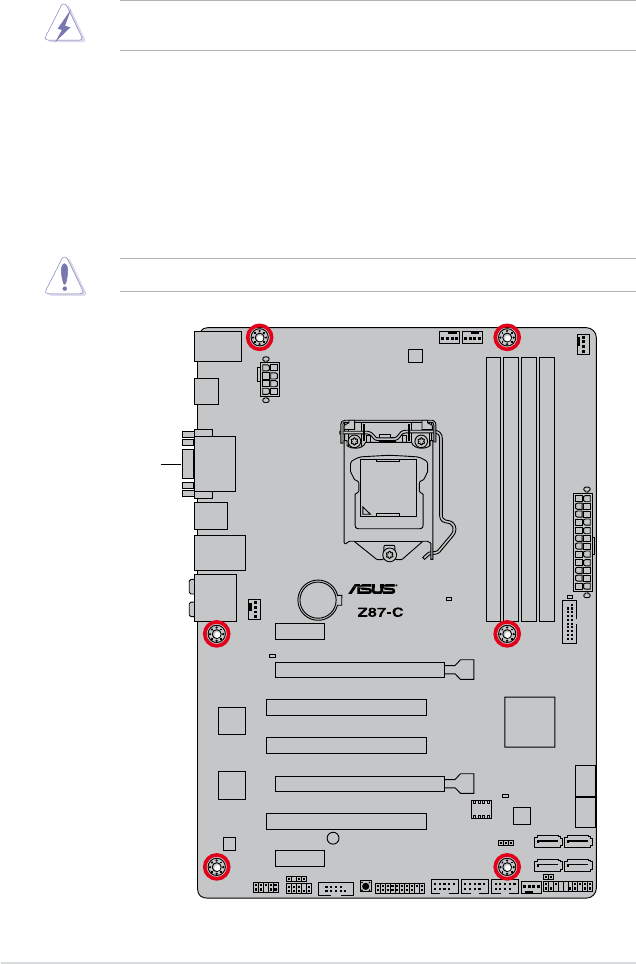
1.2.2 Screw holes
Place eight screws into the holes indicated by circles to secure the motherboard to the
chassis.
Do not overtighten the screws! Doing so can damage the motherboard.
Place this side towards the
rear of the chassis
1-3
Chapter 1: Product introduction
1.2.3 Motherboard layout
ASUS Z87-C
1-4
1.3 Central Processing Unit (CPU)
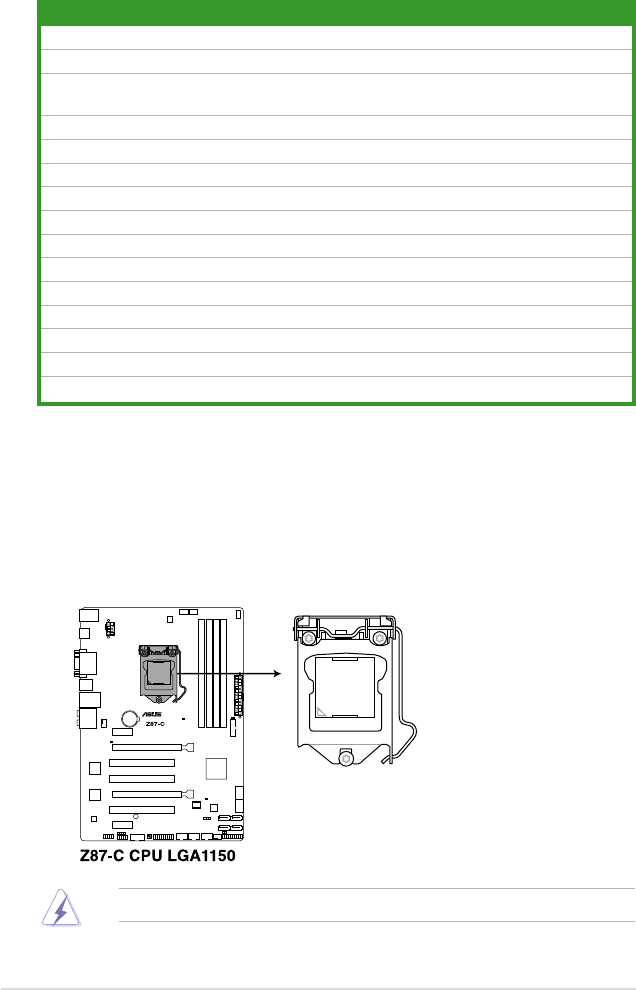
The motherboard comes with a surface mount LGA1150 socket designed for the 4th
generation Intel® Core™ i7 / Intel® Core™ i5 / Intel® Core™ i3, Pentium® and Celeron®
processors.
Ensure that all power cables are unplugged before installing the CPU.
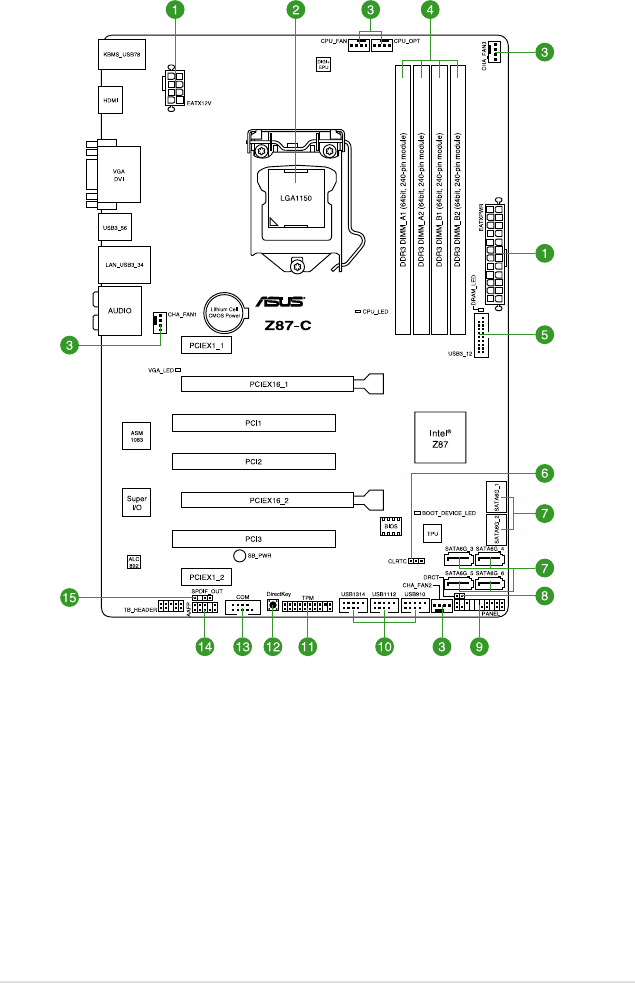
Connectors/Jumpers/Slots Page
1. ATX power connectors (24-pin EATXPWR, 8-pin EATX12V) 1-30
2. LGA1150 CPU socket 1-4
3. CPU, CPU optional, and chassis fan connectors (4-pin CPU_FAN,
4-pin CPU_OPT, 4-pin CHA_FAN1-3)
1-32
4. DDR3 DIMM slots 1-8
5. USB 3.0 connector (20-1 pin USB3_12) 1-33
6. Clear RTC RAM jumper 1-27
7. Intel® Z87 Serial ATA 6.0 Gb/s connectors (7-pin SATA6G_1-6 [yellow]) 1-31
8. DRCT (DirectKey) connector (2-pin DRCT) 1-35
9. System panel connector (20-8 pin PANEL) 1-36
10. USB 2.0 connectors (10-1 pin USB910, USB1112, USB1314) 1-34
11. TPM connector (20-1 pin TPM) 1-31
12. DirectKey button 1-25
13. Serial port connector (10-1 pin COM) 1-33
14. Front panel audio connector (10-1 pin AAFP) 1-35
15. Digital audio connector (4-1 pin SPDIF_OUT) 1-29
1.2.4 Layout contents
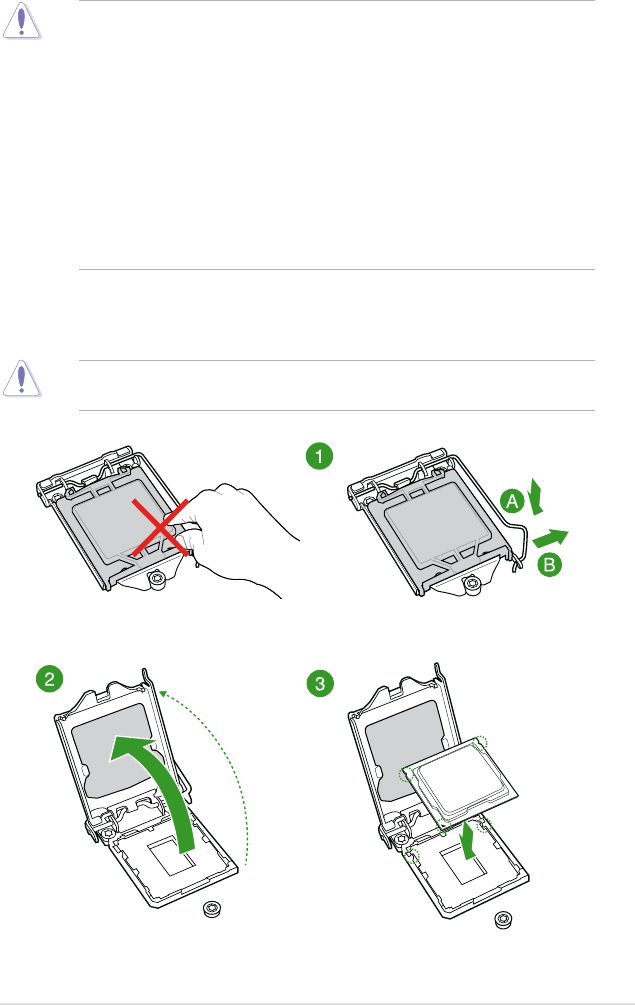
1-5
Chapter 1: Product introduction
1.3.1 Installing the CPU
• Ensure that you install the correct CPU designed for LGA1150 only. DO NOT install a
CPU designed for LGA1155 and LGA1156 sockets on the LGA1150 socket.
• Upon purchase of the motherboard, ensure that the PnP cap is on the socket and
the socket contacts are not bent. Contact your retailer immediately if the PnP cap
is missing, or if you see any damage to the PnP cap/socket contacts/motherboard
components. ASUS will shoulder the cost of repair only if the damage is shipment/
transit-related.
• Keep the cap after installing the motherboard. ASUS will process Return Merchandise
Authorization (RMA) requests only if the motherboard comes with the cap on the
LGA1150 socket.
• The product warranty does not cover damage to the socket contacts resulting from
incorrect CPU installation/removal, or misplacement/loss/incorrect removal of the PnP
cap.
Ensure that you install the correct CPU designed for LGA1150 socket only. DO NOT install
a CPU designed for LGA1555 and LGA1156 sockets on the LGA1150 socket.
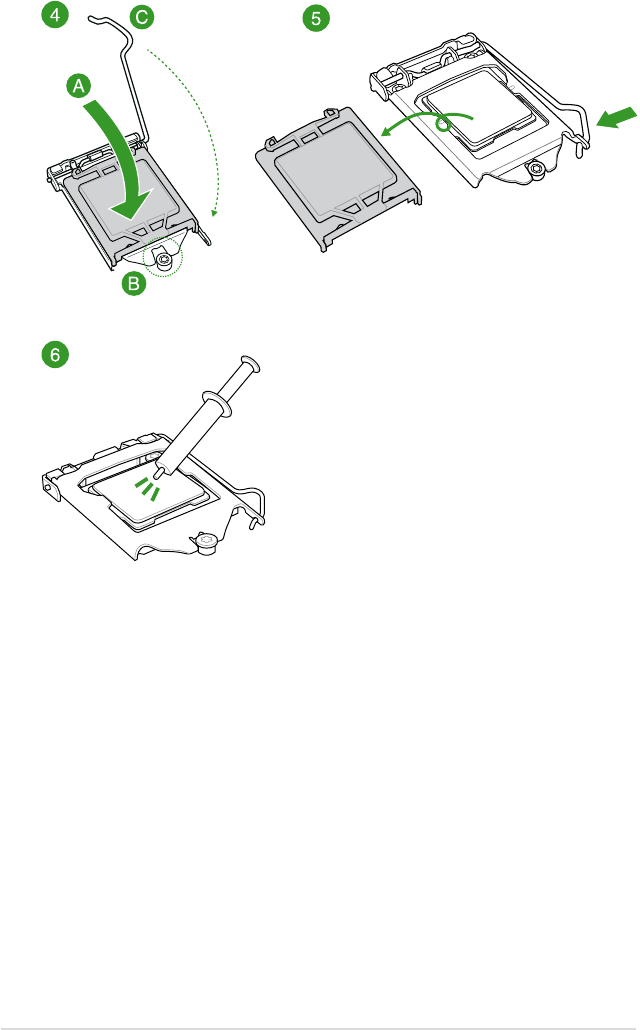
ASUS Z87-C
1-6
1-7
Chapter 1: Product introduction
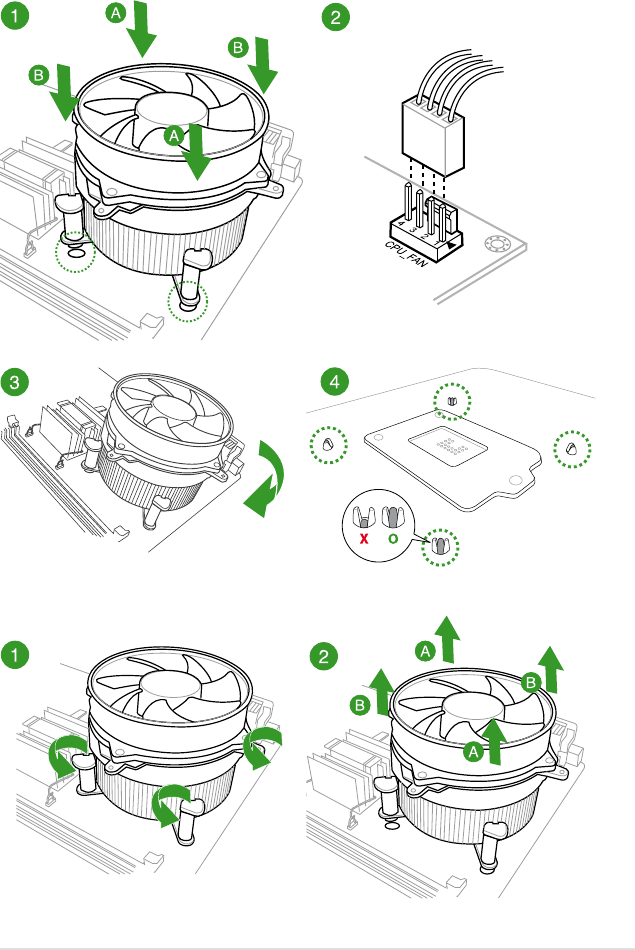
1.3.2 Installing the CPU heatsink and fan
To install the CPU heatsink and fan assembly
To uninstall the CPU heatsink and fan assembly
ASUS Z87-C
1-8
1.4 System memory
1.4.1 Overview
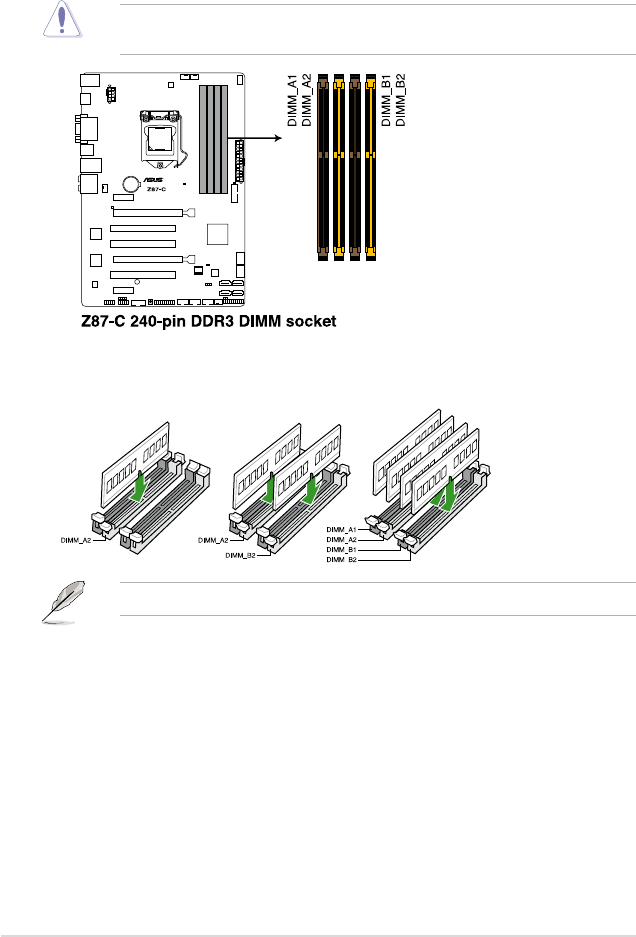
The motherboard comes with four Double Data Rate 3 (DDR3) Dual In-line Memory Modules
(DIMM) slots.
A DDR3 module is notched differently from a DDR or DDR2 module. DO NOT install a DDR
or DDR2 memory module to the DDR3 slot.
Install one memory module in slot A2 rst as a single-channel operation.
Recommended memory congurations

1-9
Chapter 1: Product introduction
1.4.2 Memory congurations
You may install 2GB, 4GB and 8GB unbuffered and non-ECC DDR3 DIMMs into the DIMM
sockets.
• The default memory operation frequency is dependent on its Serial Presence Detect
(SPD), which is the standard way of accessing information from a memory module.
Under the default state, some memory modules for overclocking may operate at a
lower frequency than the vendor-marked value. To operate at the vendor-marked
or at a higher frequency, refer to section 2.5 Ai Tweaker menu for manual memory
frequency adjustment.
• For system stability, use a more efcient memory cooling system to support a full
memory load (4 DIMMs) or overclocking condition.
• You may install varying memory sizes in Channel A and Channel B. The system maps
the total size of the lower-sized channel for the dual-channel conguration. Any excess
memory from the higher-sized channel is then mapped for single-channel operation.
• According to Intel® CPU spec, DIMM voltage below 1.65V is recommended to protect
the CPU.
• Always install DIMMs with the same CAS latency. For optimum compatibility, we
recommend that you obtain memory modules from the same vendor.
• Due to the memory address limitation on 32-bit Windows® OS, when you install 4GB
or more memory on the motherboard, the actual usable memory for the OS can be
about 3GB or less. For effective use of memory, we recommend that you do any of the
following:
a) Use a maximum of 3GB system memory if you are using a 32-bit Windows® OS.
b) Install a 64-bit Windows® OS when you want to install 4GB or more on the
motherboard.
c) For more details, refer to the Microsoft® support site at http://support.microsoft.
com/kb/929605/en-us.
• This motherboard does not support DIMMs made up of 512Mb (64MB) chips or less
(Memory chip capacity counts in Megabit, 8 Megabit/Mb = 1 Megabyte/MB).

ASUS Z87-C
1-10
DDR3 2666(O.C.) MHz capability
Z87-C Motherboard Qualied Vendors Lists (QVL)
DDR3 2800(O.C.) MHz capability
Vendors Part No. Size SS/
DS
Chip
Brand
Chip
NO.
Timing Voltage DIMM socket
support
(Optional)
1 2 4
ADATA AX3U2600GW8G11-DG2 16GB (2x4GB) DS - - 11-13-13-35 1.65V • • •
DDR3 2600(O.C.) MHz capability
Vendors Part No. Size SS/
DS
Chip
Brand
Chip
NO.
Timing Voltage DIMM socket
support
(Optional)
1 2 4
G.SKILL F3-20000CL10Q-16GBZHD(XMP) 16GB (4x4GB) DS - - 10-11-11-31 1.65 • • •
DDR3 2500(O.C.) MHz capability
Vendors Part No. Size SS/
DS
Chip
Brand
Chip
NO.
Timing Voltage DIMM socket
support (Optional)
1 2 4
G.SKILL F3-2800C11Q-16GTXD(XMP) 16GB (4x4GB) DS - - 11-13-13-35 1.65 • • •
G.SKILL F3-2800C12Q-32GTXD(XMP) 32GB (4x8GB) DS - - 12-13-13-35 1.65 • • •
G.SKILL F3-2800C12Q-32GTXDG(XMP) 32GB (4x8GB) DS - - 12-14-14-35 1.65 • • •
APACER 78.BAGH5.AFD0C 8GB (2x4GB) DS - - 12-14-14-35 1.65 • •
APACER 78.CAGH6.AFD0C 16GB (2x8GB) DS - - 12-14-14-35 1.65 • •
CORSAIR CMD16GX3M4A2800C11 16GB (4x4GB) DS - - 11-14-14-35 1.65 • • •
CORSAIR CMD16GX3M4A2800C12 16GB (4x4GB) DS - - 12-14-14-36 1.65 • • •
Vendors Part No. Size SS/
DS
Chip
Brand
Chip
NO.
Timing Voltage DIMM socket
support (Optional)
1 2 4
APACER 78.BAGFF.AFC0C 16GB (4x4GB) SS - - 12-13-13-35 1.65 • • •
APACER 78.CAGFF.AFD0C 32GB (4x8GB) DS - - 12-13-13-35 1.65 • • •
CORSAIR CMD16GX3M4A2666C11 16GB (4x4GB) DS - - 11-13-13-35 1.65 • • •
G.SKILL F3-2666C11Q-16GTXD(XMP) 16GB (4x4GB) DS - - 11-13-13-35 1.65 • • •
G.SKILL F3-2666C10Q-16GTXD(XMP) 16GB (4x4GB) DS - - 10-12-12-31 1.65 • • •
GEIL GOC332GB2666C11QC(XMP) 32GB (4x8GB) DS - - 11-13-13-35 1.65 • • •
TEAM TXD34G2666HC11CBK 8GB (2x4GB) SS - - 11-13-13-35 1.65 • • •
TEAM TXD38G2666HC11CBK 16GB (2x8GB) DS - - 11-13-13-35 1.65 • •
G.SKILL F3-2666CL10Q-16GBZHD(XMP) 16GB (4x4GB) DS - - 9-11-9-27 1.65 • •

1-11
Chapter 1: Product introduction
DDR3 2400(O.C.) MHz capability
DDR3 2200(O.C.) MHz capability
Vendors Part No. Size SS/
DS
Chip
Brand
Chip
NO.
Timing Voltage DIMM socket
support
(Optional)
1 2 4
G.SKILL F3-17600CL7D-4GBFLS(XMP) 4GB (2x2GB) DS - - 7-10-10-28 1.65 • •
GEIL GET34GB2200C9DC(XMP) 4GB (2x2GB) DS - - 9-10-9-28 1.65 • • •
GEIL GET38GB2200C9ADC(XMP) 8GB (2x4GB) DS - - 9-11-9-28 1.65 • • •
Vendors Part No. Size SS/
DS
Chip
Brand
Chip
NO.
Timing Voltage DIMM socket
support (Optional)
1 2 4
A-DATA AX3U2400GC4G10(XMP) 4GB DS - - 10-12-12-31 1.65 • • •
Apacer 78.BAGFL.AFD0C(XMP) 8GB (2x4GB) DS - - 11-12-12-30 - • • •
Apacer 783BAGF3.AFD0C(XMP) 8GB (2x4GB) DS - - 11-11-11-30 - • • •
CORSAIR CMGTX8(XMP) 8GB (4x2GB) SS - - 10-12-10-30 1.65 • • •
CORSAIR CMZ16GX3M2A2400C10
(Ver4.21)
16GB (2x8GB) DS - - 10-12-12-31 1.65 • • •
CORSAIR CMZ16GX3M4A2400C9R
(Ver4.13)(XMP)
16GB (4x4GB) DS - - 2400 9-11-11-31 1.65 • • •
G.SKILL F3-19200CL10Q-
32GBZHD(XMP)
32GB (4x8GB) DS - - 10-12-12-31 1.65 • • •
G.SKILL F3-19200CL11Q-
16GBZHD(XMP)
16GB (4x4GB) DS - - 11-11-11-31 1.65 • • •
G.SKILL F3-19200CL11Q-
16GBZHD(XMP)
16GB (4x4GB) DS - - 11-11-11-31 1.65 • • •
G.SKILL F3-19200CL9D-
4GBPIS(XMP)
4G (2x2GB) DS - - 9-11-9-28 1.65 • •
G.SKILL F3-19200CL9Q-
16GBZMD(XMP)
16GB (4x4GB) DS - - 9-11-11-31 1.65 • • •
GEIL GOC316GB2400
C10QC(XMP)
16GB (4x4GB) DS - - 10-11-11-30 1.65 • • •
GEIL GOC316GB2400
C11QC(XMP)
16GB (4x4GB) DS - - 11-11-11-30 1.65 • • •
Kingston KHX2400C11D3
K4/8GX(XMP)
8GB (4x2GB) SS - - 11-13-11-30 1.65 • • •
KINGSTON KHX24C11K4/16X(XMP) 16GB (4x4GB) DS - - 11-13-13-30 1.65 • • •
KINGSTON KHX24C11T2K2/8X(XMP) 8GB (2x4GB) DS - - - 1.65 • • •
KINGSTON KHX24C11T3K4/32X(XMP) 32GB (4x8GB) DS - - 9-9-9-24 1.65 • • •
Patriot PVV34G2400C 9K(XMP) 4GB (2x2GB) DS - - 9-11-9-27 1.66 • •
Patriot PXD38G2400C 11K(XMP) 8GB (2x4GB) DS - - 11-11-11-30 1.65 • • •
Patriot PXD38G2400C 11K(XMP) 8GB (2x4GB) DS - - 2400 11-11-11-30 1.65 • • •
Team TXD38G2400HC
10QBK(XMP)
8GB DS - - 10-12-12-31 1.65 • • •

ASUS Z87-C
1-12
DDR3 2133(O.C.) MHz capability
Vendors Part No. Size SS/
DS
Chip
Brand
Chip
NO.
Timing Voltage DIMM socket
support
(Optional)
1 2 4
A-DATA AX3U2133XC4G10(XMP) 4GB DS - - 10-11-11-30 1.65 • • •
A-DATA AX3U2133XW8G10(XMP) 8GB DS - - 10-11-11-30 1.65 • • •
Apacer 78.BAGE4.AFD0C(XMP) 8GB (2x4GB) DS - - 9-9-9-24 - • • •
Apacer AHU04GFB33CAQ3R(XMP) 4GB DS - - 11-13-13-31 - • • •
CORSAIR CMD8GX3M2A2133C9
(Ver1.5)(XMP)
8GB (2x4GB) DS - - 9-11-10-27 1.5 • • •
CORSAIR CMT4GX3M2B2133C9(Ver
7.1)(XMP)
4GB (2x2GB) DS - - 9-10-9-27 1.5 • • •
CORSAIR CMT4GX3M2B2133C9(XMP) 4GB (2x2GB) DS - - 9-10-9-27 1.5 • • •
G.SKILL F3-17000CL11Q2-
64GBZLD(XMP)
64GB (8x8GB) DS - - 11-11-11-30 1.5 • • •
G.SKILL F3-17000CL9Q-
16GBXLD(XMP)
16GB (4x4GB) DS - - 9-11-9-28 1.65 • • •
G.SKILL F3-17000CL9Q-
16GBZH(XMP)
16GB (4x4GB) DS - - 9-11-10-28 1.65 • • •
G.SKILL F3-17066CL9D-
8GBPID(XMP)
8GB (2x4GB) DS - - 9-9-9-24 1.65 • • •
G.SKILL F3-17066CL9Q-
16GBTDD(XMP)
16GB (4x4GB) DS - - 9-9-9-24 1.65 • •
G.SKILL F3-2133C11Q-32GZL(XMP) 32GB (4x8GB) DS - - 11-11-11-31 1.5 • • •
KINGSTON KHX2133C11D3K4/
16GX(XMP)
16GB (4x4GB) DS - - 11-12-11-30 1.65 • • •
KINGSTON KHX2133C11D3T1K2/
16GX(XMP)
16GB (2x8GB) DS - - 9-9-9-24 1.6 • • •
KINGSTON KHX21C11T3FK8/64X(XMP) 64GB (8x8GB) DS - - 9-9-9-24 1.5 • • •
OCZ OCZ3XTEP2133C 9LV4GK 2GB DS - - 7-7-7-20 1.65 • •
Patriot PV316G213C1K (XMP) 16GB (2x8GB) DS - - 11-11-11-30 1.5 • • •
Patriot PVV34G2133C9 K(XMP) 4GB (2x2GB) DS - - 9-11-9-27 1.66 • • •
Patriot PXD38G2133C1 1K(XMP) 8GB (2x4GB) DS - - 9-9-9-24 1.65 • • •
Patriot PXD38G2133C11 K(XMP) 8GB (2x4GB) DS - - 2133 11-11-11-27 1.5 • • •
Team TLD38G2133HC11A BK(XMP) 8GB DS - - 11-11-11-31 1.65 • • •
Team TXD34096M2133HC11A-
V(XMP)
4GB DS - - 11-11-11-31 1.65 • • •

1-13
Chapter 1: Product introduction
DDR3 2000(O.C.) MHz capability
DDR3 1866(O.C.) MHz capability
(continued on the next page)
Vendors Part No. Size SS/
DS
Chip
Brand
Chip NO. Timing Voltage DIMM socket
support
(Optional)
1 2 4
AEXEA AXA3ES2G2000LG28V(XMP) 2GB DS - - - 1.65 • • •
AEXEA AXA3ES4GK2000LG28V(XMP) 4GB (2x2GB) DS - - - 1.65 • • •
Apacer 78.AAGD5.9KD(XMP) 6GB (3x2GB) DS - - 9-9-9-27 - • • •
Asint SLA302G08-ML2HB(XMP) 4GB DS Hynix H5TQ2G83BF
RH9C
9-9-9-27 - • • •
G.SKILL F3-16000CL9D-4GBRH(XMP) 4GB (2x2GB) DS - - 9-9-9-24 1.65 • •
G.SKILL F3-16000CL9D-4GBTD(XMP) 4GB (2x2GB) DS - - 9-9-9-24 1.65 • •
GEIL GUP34GB2000C9DC(XMP) 4GB (2x2GB) DS - - 9-9-9-28 1.65 • • •
Patriot PV736G2000ELK(XMP) 6GB (3x2GB) DS - - 7-7-7-20 1.65 • • •
Patriot PX7312G2000ELK(XMP) 12GB (3x4GB) DS - - 9-11-9-27 1.65 • • •
Silicon
Power
SP002GBLYU200S02(XMP) 2GB DS - - - - • •
Team TXD32048M2000C9(XMP) 2GB DS Team T3D1288RT-20 9-9-9-24 1.5 • •
Team TXD32048M2000C9-L(XMP) 2GB DS Team T3D1288LT-20 9-9-9-24 1.5 • • •
Team TXD32048M2000C9-L(XMP) 2GB DS Team T3D1288RT-20 9-9-9-24 1.6 • •
Vendors Part No. Size SS/
DS
Chip
Brand
Chip
NO.
Timing Voltage DIMM socket
support
(Optional)
1 2 4
CORSAIR CMD16GX3M2A1866C9
(Ver5.29)(XMP)
16GB (2x8GB) DS - - 1866 9-9-9-27 1.5 • •
CORSAIR CMD16GX3M4A1866C9
(Ver4.13)(XMP)
16GB (4x4GB) DS - - 9-10-9-27 1.5 • • •
CORSAIR CMD16GX3M4A1866C9
(Ver8.16)(XMP)
16GB (4x4GB) DS - - 9-10-9-27 1.5 • • •
CORSAIR CMD8GX3M2A1866C9
(Ver4.13)(XMP)
8GB (2x4GB) DS - - - 1.5 • • •
CORSAIR CMD8GX3M2A1866C9
(Ver5.12)(XMP)
8GB (2x4GB) DS - - 9-10-9-27 1.5 • •
CORSAIR CMD8GX3M2A1866C9
(Ver8.16)(XMP)
8GB (2x4GB) DS - - 9-10-9-27 1.5 • •
CORSAIR CMT32GX3M4X1866C9(Ver3
.23)(XMP)
32GB (4x8GB) DS - - 9-10-9-27 1.5 • • •
CORSAIR CMZ16GX3M4X1866C9R
(Ver8.16)(XMP)
16GB (4x4GB) DS - - 9-10-9-27 1.5 • • •
CORSAIR CMZ16GX3M4X1866C9R(Ver
8.16)(XMP)
16GB (4x4GB) DS - - 9-10-9-27 1.5 • • •
CORSAIR CMZ32GX3M4X1866C10
(Ver3.23)(XMP)
32GB (4x8GB) DS - - 10-11-10-27 1.5 • • •
CORSAIR CMZ32GX3M4X1866C10(Ver
3.23)(XMP)
32GB (4x8GB) DS - - 10-11-10-27 1.5 • • •
CORSAIR CMZ8GX3M2A1866C9
(Ver8.16)(XMP)
8GB (2x4GB) DS - - 9-10-9-27 1.5 • • •

ASUS Z87-C
1-14
DDR3 1866(O.C.) MHz capability
DDR3 1800(O.C.) MHz capability
Vendors Part No. Size SS/
DS
Chip
Brand
Chip
NO.
Timing Voltage DIMM socket
support
(Optional)
1 2 4
G. SKILL F3-14400CL9D-4GBRL(XMP) 4GB (2x2GB) DS - - 9-9-9-24 1.6 • • •
Vendors Part No. Size SS/
DS
Chip
Brand
Chip
NO.
Timing Voltage DIMM socket
support
(Optional)
1 2 4
CORSAIR CMZ8GX3M2A1866C9(XMP) 8GB (2x4GB) DS - - 9-10-9-27 1.5 • •
CORSAIR CMZ8GX3M2A1866C9G
(Ver5.12)(XMP)
8GB (2x4GB) DS - - 1866 9-10-9-27 1.5 • • •
Crucial BLE4G3D1869DE1XT0.16F
MD(XMP)
4GB DS - - 9-9-9-27 1.5 • • •
G.SKILL F3-14900CL10Q2-
64GBZLD(XMP)
64GB (8x8GB) DS - - 10-11-10-30 1.5 • • •
G.SKILL F3-14900CL9D-8GBSR(XMP) 8GB (2x4GB) DS - - 9-10-9-28 1.5 • • •
G.SKILL F3-14900CL9Q-16GBXL(XMP) 16GB (4x4GB) DS - - 9-10-9-28 1.5 • • •
G.SKILL F3-14900CL9Q-16GBZL(XMP) 16GB (4x4GB) DS - - 9-10-9-28 1.5 • • •
G.SKILL F3-14900CL9Q-8GBFLD(XMP) 8GB (2x4GB) DS - - 9-9-9-24 1.6 • • •
G.SKILL F3-1866C9Q-32GXM(XMP) 32GB (4x8GB) DS - - 9-10-9-28 1.5 • • •
KINGSTON KHX1866C9D3K2/8GX(XMP) 8GB (2x4GB) DS - - - 1.65 • • •
Patriot PXD34G1866ELK(XMP) 4GB (2x2GB) SS - - 9-9-9-24 1.65 • • •
Patriot PXD38G1866ELK(XMP) 8GB (2x4GB) DS - - 9-11-9-27 1.65 • • •
Patriot PXD38G1866ELK(XMP) 8GB (2x4GB) DS - - 9-11-9-27 1.65 • • •
Patriot PXD38G1866ELK(XMP) 8GB (2x4GB) DS - - 1866 9-10-9-27 1.5 • • •
Team TLD34G1866HC9KBK(XMP) 4GB DS - - 9-11-9-27 1.5 • • •
Team TLD38G1866HC10SBK(XMP) 8GB DS - - 10-11-10-30 1.5 • • •
DDR3 1600 MHz capability
Vendors Part No. Size SS/
DS
Chip
Brand
Chip NO. Timing Voltage DIMM socket
support (Optional)
1 2 4
A-DATA AD3U1600C2G11 2GB SS MICRON D9PFJ 11-11-11-28 - • • •
A-DATA AD3U1600C4G11 4GB DS MICRON D9PFJ 11-11-11-28 - • • •
A-DATA AD3U1600W4G11 4GB SS A-DATA 3WCD-1211A 11-11-11-28 - • • •
A-DATA AD3U1600W8G11 8GB DS A-DATA 3WCD-1211A 11-11-11-28 - • • •
AMD AE32G1609U1-U 2GB SS AMD 23EY4587MB6H - 1.5 • • •
AMD AE34G1609U2-U 4GB DS AMD 23EY4587MB6H - 1.5 • • •
AMD AP38G1608U
2K(XMP)
8GB (2x4GB) DS - - 9-9-9-28 1.65 • • •
Apacer 78.B1GE3.9L10C 4GB DS Apacer AM5D5908DEQSCK - 1.65 • • •
Apacer 78.B1GET.9K00C 4GB SS Apacer AM5D6008BQQSCK 11-11-11-28 - • • •
(continued on the next page)

1-15
Chapter 1: Product introduction
(continued on the next page)
DDR3 1600 MHz capability
Vendors Part No. Size SS/
DS
Chip
Brand
Chip NO. Timing Voltage DIMM socket
support
(Optional)
1 2 4
Apacer 78.C1GET.9K10C 8GB DS Apacer AM5D6008
BQQSCK
11-11-
11-31
- • • •
Apacer AHU04GFA60C9Q1D(XMP) 4GB DS - - 9-9-9-27 1.65 • • •
Apacer AHU04GFA60C9Q3R(XMP) 4GB DS - - 11-11-
11-28
- • • •
Apacer AHU08GFA60CBT3R(XMP) 8GB DS - - 9-9-9-24 - • • •
Asint SLA302G08-EGG1C(XMP) 4GB DS Asint 302G08-
GG1C
9-9-9-27 - • • •
Asint SLA302G08-EGJ1C(XMP) 4GB DS Asint 302G08-
GJ1C
9-9-9-27 - • • •
Asint SLA302G08-EGN1C 4GB DS ASint 302G08-
GN1C
- - • • •
Asint SLB304G08-EGN1B 8GB DS ASint 304G08-
GN1B
- - • • •
Asint SLZ302G08-EGN1C 2GB SS ASint 302G08-
GN1C
- - • • •
Asint SLZ3128M8-EGJ1D(XMP) 2GB DS Asint 3128M8-
GJ1D
- - • •
ATP AQ12M64B8BKK0S 4GB DS SAMSUNG K4B2G
08460
- NO • • •
CORSAIR CMD16GX3M2A1600C9
(Ver8.21)(XMP)
16GB
(2x8GB)
DS - - 9-9-9-24 1.5 • •
CORSAIR CMD8GX3M2A1600C8
(Ver5.12)(XMP)
8GB
(2x4GB)
DS - - 1600
8-8-8-24
1.5 • • •
CORSAIR CMD8GX3M2A1600C9
(Ver2.12)(XMP)
8GB
(2x4GB)
DS - - 9-9-9-24 1.5 • • •
CORSAIR CMG4GX3M2A1600C6 4GB
(2x2GB)
DS - - 6-6-6-18 1.65 • • •
CORSAIR CML16GX3M4X1600C8(Ver
2.12)(XMP)
16GB
(4x4GB)
DS - - Heat-Sink
Package
1.5 • • •
CORSAIR CMP6GX3M3A1600C8(XMP) 6GB
(3x2GB)
DS - - 8-8-8-24 1.65 • • •
CORSAIR CMP6GX3M3A1600C8(XMP) 6GB
(3x2GB)
DS - - 8-8-8-24 1.65 • • •
CORSAIR CMX6GX3M3C1600C7(XMP) 6GB
(3x2GB)
DS - - 7-8-7-20 1.65 • • •
CORSAIR CMX8GX3M2A1600C9
(Ver3.19)(XMP)
8GB
(2x4GB)
SS - - 9-9-9-24 1.65 • • •
CORSAIR CMZ16GX3M2A1600C10
(Ver.3.24)(XMP)
16GB
(2x8GB)
DS - - 10-10-
10-27
1.5 • • •
CORSAIR CMZ16GX3M4A1600C9(XMP) 16GB
(4x4GB)
DS - - 9-9-9-24 1.5 • • •
CORSAIR CMZ32GX3M4X1600C10
(Ver2.2)(XMP)
32GB
(4x8GB)
DS - - 10-10-
10-27
1.5 • • •
CORSAIR CMZ8GX3M2A1600C8(XMP) 8GB
(2x4GB)
DS - - 8-8-8-24 1.5 • • •
CORSAIR CMZ8GX3M2A1600C9(XMP) 8GB
(2x4GB)
DS - - 9-9-9-24 1.5 • • •
CORSAIR CMZ8GX3M4X1600C9(Ver
2.12)(XMP)
8GB
(4x2GB)
SS - - 9-9-9-24 1.5 • • •
CORSAIR HX3X12G1600C9(XMP) 12GB
(6x2GB)
DS - - 9-9-9-24 1.6 • • •
Crucial BL12864BN1608 .8FF(XMP) 2GB
(2x1GB)
SS - - 8-8-8-24 1.65 • • •
Crucial BLT4G3D1608DT1TX0.16F
M(XMP)
4GB DS - - 8-8-8-24 1.5 • • •

ASUS Z87-C
1-16
DDR3 1600 MHz capability
(continued on the next page)
Vendors Part No. Size SS/
DS
Chip
Brand
Chip NO. Timing Voltage DIMM socket
support (Optional)
1 2 4
EK Memory EKM324L28BP8-
I16(XMP)
4GB (2x2GB) DS - - 9 - • • •
EK Memory EKM324L28BP8-
I16(XMP)
4GB (2x2GB) DS - - 9 - • • •
Elixir M2X2G64CB88 G7N-
DG(XMP)
2GB SS Elixir N2CB2G80GN-
DG
9-9-9-28 - • • •
Elixir M2X4G64CB8HG
5N-DG(XMP)
4GB DS Elixir N2CB2G80GN-
DG
9-9-9-28 - • • •
Elixir M2X8G64CB8HB
5N-DG(XMP)
8GB DS Elixir N2CB4G80BN-
DG
9-9-9-28 1.5 • •
G.SKILL F3-12800CL7D-
8GBRH(XMP)
8GB (2x4GB) DS - - 7-8-7-24 1.6 • • •
G.SKILL F3-12800CL7Q-
16GBXH(XMP)
16GB (4x4GB) DS - - 7-8-7-24 1.6 • • •
G.SKILL F3-12800CL8D-
8GBECO(XMP)
8GB (2x4GB) DS - - 8-8-8-24 1.35 • •
G.SKILL F3-12800CL9D-
8GBRL(XMP)
8GB (2x4GB) DS - - 9-9-9-24 1.5 • • •
G.SKILL F3-12800CL9D-
8GBSR2(XMP)
8GB (2x4GB) DS - - 9-9-9-24 1.25 • • •
G.SKILL F3-12800CL9Q-
16GBXL(XMP)
16GB (4x4GB) DS - - 9-9-9-24 1.5 • • •
G.Skill F3-12800CL9Q-
16GBZL(XMP)
16GB (4x4GB) DS - - 9-9-9-24 1.5 • • •
G.SKILL F3-1600C9Q-
32GXM(XMP)
32GB (4x8GB) DS - - - 1.5 • • •
GEIL GET316GB160
0C9QC(XMP)
16GB (4x4GB) DS - - 9-9-9-28 1.6 • • •
GEIL GUP34GB160
0C7DC(XMP)
4GB (2x2GB) DS - - 7-7-7-24 1.6 • • •
GoodRam GR1600D364L9/2G 2GB DS GoodRam GF1008KC-JN - - • • •
KINGMAX FLGE85F-
C8KL9A(XMP)
2GB SS KINGMAX N/A 9-9-9-28 - • • •
KINGMAX FLGF65F-
C8KL9A(XMP)
4GB DS KINGMAX N/A 9-9-9-28 - • • •
KINGSTON KHX1600C9D3K3/
12GX(XMP)
12GB (3x4GB) DS - - - 1.65 • • •
KINGSTON KHX1600C9D3K3/
12GX(XMP)
12GB (3x4GB) DS - - 9 1.65 • • •
KINGSTON KHX1600C9D3K3/
6GX(XMP)
6GB (3x2GB) DS - - 9 1.65 • • •
KINGSTON KHX1600C9D3K3/
6GX(XMP)
6GB (3x2GB) DS - - 9 1.65 • • •
KINGSTON KHX1600C9D3K4/
16GX(XMP)
16GB (4x4GB) DS - - 9-9-9-24 1.65 • • •
KINGSTON KHX1600C9D3K6/
24GX(XMP)
24GB (6x4GB) DS - - 9 1.65 • • •
KINGSTON KHX1600C9D3K8/
32GX(XMP)
32GB (8x4GB) DS - - 9-9-9-27 1.65 • • •
KINGSTON KHX1600C9D3LK2/
8GX(XMP)
8GB (2x4GB) DS - - 9-9-9-24 1.35 • • •
KINGSTON KHX1600C9D3P1K2/
8G
8GB (2x4GB) DS - - 9 1.5 • • •
KINGSTON KHX1600C9D3T
1BK3/12GX(XMP)
12GB (3x4GB) DS - - 9 1.65 • •
KINGSTON KHX1600C9D3T1K3/
6GX(XMP)
6GB (3x2GB) DS - - 9 1.65 • • •

1-17
Chapter 1: Product introduction
DDR3 1600 MHz capability
Vendors Part No. Size SS/
DS
Chip
Brand
Chip NO. Timing Voltage DIMM socket
support (Optional)
1 2 4
KINGSTON KHX16C10B1K2/
16X(XMP)
16GB
(2x8GB)
DS - - - 1.5 • • •
KINGSTON KHX16C9K2/16 16GB
(2x8GB)
DS - - 1333-9-
9-9-24
1.5 • •
KINGSTON KHX16C9P1K2/16 16GB
(2x8GB)
DS - - - 1.5 • • •
KINGSTON KVR16N11/4 4G DS Hynix H5TQ2G83CFRPBC - 1.5 • • •
KINGTIGER KTG2G1600PG3(XMP) 2GB DS - - - - • • •
MICRON MT16JTF1G64AZ-
1G6D1
8GB DS MICRON D9PBC - 1.5 • • •
MICRON MT16KTF51264AZ-
1G6M1
4GB DS MICRON D9PFJ - - • •
MICRON MT8KTF25664AZ-
1G6M1
2GB SS MICRON D9PFJ - - • • •
Mushkin 996805(XMP) 4GB
(2x2GB)
DS - - 6-8-6-
24
1.65 • •
Mushkin 998805(XMP) 6GB
(3x2GB)
DS - - 6-8-6-
24
1.65 • • •
OCZ OCZ3BE1600C8LV4GK 4GB
(2x2GB)
DS - - 8-8-8 1.65 • •
Patriot PGD316G1600E
LK(XMP)
16GB
(2x8GB)
DS - - - 1.65 • • •
Patriot PGD316G1600E
LK(XMP)
16GB
(2x8GB)
DS - - 9-9-
9-24
1.5 • • •
Patriot PGD38G1600EL
K(XMP)
8GB
(2x4GB)
DS - - 9-9-9-
24
1.65 • • •
Patriot PGD38G1600E
LK(XMP)
8GB
(2x4GB)
DS - - 9-9-9-
24
1.5 • •
Patriot PGS34G1600LLKA 4GB
(2x2GB)
DS - - 7-7-7-
20
1.7 • • •
Patriot PGS34G1600LL KA2 4GB
(2x2GB)
DS - - 8-8-8-
24
1.7 • • •
Patriot PV316G160C9Q
KRD(XMP)
16GB
(4x4GB)
DS - - 9-9-9-
24
1.5 • • •
Patriot PV38G160C9KR
D(XMP)
8GB
(2x4GB)
DS - - 9-9-9-
24
1.5 • • •
Patriot PVV38G1600L
LK(XMP)
8GB
(2x4GB)
DS - - 8-9-8-
24
1.65 • • •
Patriot PX7312G1600L
LK(XMP)
12GB
(3x4GB)
DS - - 8-9-8-
24
1.65 • • •
Patriot PXD38G1600LL
K(XMP)
8GB
(2x4GB)
DS - - 1600 8-
9-8-24
1.65 • • •
PSC AL9F8L93B-GN2E 4GB SS PSC A3P4GF3BLF - - • • •
PSC ALAF8L93B-GN2E 8GB DS PSC A3P4GF3BLF - - • • •
SanMax SMD-4G68HP-16KZ 4GB DS Hynix H5TQ2G83BFRPBC - 1.5 • • •
SanMax SMD-4G68NG-16KK 4GB DS ELPIDA J2108BDBG-GN-F - - • • •
Silicon
Power
SP002GBLTU16
0V02(XMP)
2GB SS S-POWER 20YT5NG 9-11-
11-28
1.5 • • •
Silicon
Power
SP004GBLTU16
0V02(XMP)
4GB DS S-POWER 20YT5NG 9-9-9-
24
1.5 • • •
Team TXD34096M1600HC9-
D(XMP)
4GB DS Hynix H5TC2G83BFRH9A 9-9-9-
24
1.5 • • •
Transcend JM1600KLH-
8G(626633)
8GB DS Transcend TK963EBF3 - - • • •
Transcend TS1GLK64V
6H(620945)
8GB DS SAMSUNG K4B4G0846B - - • • •

ASUS Z87-C
1-18
DDR3 1333 MHz capability
(continued on the next page)
Vendors Part No. Size SS/
DS
Chip Brand Chip NO. Timing Voltage DIMM socket
support (Optional)
1 2 4
ACTICA ACT1GHU64B
8F1333S
1GB SS SAMSUNG K4B1G0846F - - • • •
ACTICA ACT1GHU72C
8G1333S
1GB SS SAMSUNG K4B1G0846F(ECC) - - • • •
ACTICA ACT2GHU64B
8G1333M
2GB DS Micron D9KPT - - • • •
ACTICA ACT2GHU64B
8G1333S
2GB DS SAMSUNG K4B1G0846F - - • • •
ACTICA ACT2GHU72D
8G1333M
2GB DS Micron D9KPT(ECC) - - • • •
ACTICA ACT2GHU72D8
G1333S
2GB DS SAMSUNG K4B1G0846F(ECC) - - • • •
ACTICA ACT4GHU64B8
H1333H
4GB DS Hynix H5TQ2G83AFR - - • • •
ACTICA ACT4GHU72D8
H1333H
4GB DS Hynix H5TQ2G83AFR(ECC) - - • • •
AMD AE32G1339U1-
U
2GB SS AMD 23EY4587MB3H - 1.5 • • •
AMD AE34G1339U2-
U
4GB DS AMD 23EY4587MB3H - 1.5 • • •
Apacer 78.A1GC6.9L1 2GB DS Apacer AM5D5808FEQSBG 9 - • • •
Apacer 78.B1GDE.9L
10C
4GB DS Apacer AM5D5908CEHSBG 9 - • • •
Asint SLA302G08-
EDJ1C
2GB SS ASint 302G08-DJ1C - - • • •
Asint SLZ302G08-
EDJ1C
4GB DS ASint 302G08-DJ1C - - • • •
ATP AQ12M72E8B
KH9S
4GB DS SAMSUNG K4B2G0846C(ECC) - - • • •
BUFFALO D3U1333-1G 1GB SS Elpida J1108BFBG-DJ-F - - • • •
BUFFALO D3U1333-2G 2GB DS Elpida J1108BFBG-DJ-F - • • •
BUFFALO D3U1333-4G 4GB DS NANYA NT5CB256M8BN-CG - • • •
CORSAIR CMV4GX3M2A
1333C9
4GB (2x2GB) SS - N/A 9-9-9-24 - • • •
CORSAIR CMV8GX3M2A
1333C9
8GB (2x4GB) DS - N/A 9-9-9-24 - • • •
CORSAIR CMX8GX3M1A
1333C9
(Ver2.2)
8GB DS - - 9-9-9-24 1.5 • •
CORSAIR CMX8GX3M1A
1333C9
(Ver3.23)
8GB DS - - 9-9-9-24 1.5 • •
CORSAIR CMX8GX3M2
A1333C9(XMP)
8GB (2x4GB) DS - - 9-9-9-24 1.5 • • •
CORSAIR TW3X4G133
3C9A
4GB (2x2GB) DS - - 9-9-9-24 1.5 • •
EK Memory EKM324L28B
P8-I13
4GB (2x2GB) DS - - 9 - • • •
G.SKILL F3-
10600CL9D-
4GBNT
4GB (2x2GB) DS G.SKILL D3 128M8CE9 2GB 9-9-9-24 1.5 • • •
G.SKILL F3-
10666CL9D-
8GBRL
8GB (2x4GB) DS - - 9-9-9-24 1.5 • • •

1-19
Chapter 1: Product introduction
(continued on the next page)
DDR3 1333 MHz capability
Vendors Part No. Size SS/
DS
Chip Brand Chip NO. Timing Voltage DIMM socket
support (Optional)
1 2 4
G.SKILL F3-10666CL9D-
8GBRL
8GB (2x4GB) DS - - 9-9-9-24 1.5 • • •
G.SKILL F3-10666CL9D-
8GBXL
8GB (2x4GB) DS - - 9-9-9-24 1.5 • • •
GEIL GB34GB1333C7DC 4GB (2x2GB) DS GEIL GL1L128M8
8BA15FW
7-7-7-24 1.5 • • •
GEIL GET316GB1333
C9QC
16GB (4x4GB) DS - - 9-9-9-24 1.5 • • •
GEIL GG34GB1333C
9DC
4GB (2x2GB) DS GEIL GL1L128M8
8BA115FW
9-9-9-24 1.3 • • •
GEIL GG34GB1333C
9DC
4GB (2x2GB) DS GEIL GL1L128M
88BA15B
9-9-9-24 1.3 • • •
GEIL GVP34GB1333
C9DC
4GB (2x2GB) DS - - 9-9-9-24 1.5 • • •
GEIL GVP38GB1333
C9DC
8GB (2x4GB) DS - - 9-9-9-24 1.5 • • •
GoodRam GR1333D364L9/
2G
2GB DS Qimonda IDSH1G-03A
1F1C-13H
- - • • •
Hynix HMT125U6TFR8A-
H9
2GB DS Hynix H5TC1G83T
FR
- - • • •
INNODISK M3UN-2GHJB C09 2GB SS Hynix H5TQ2G83C
FRH9C
9-9-9-24 - • • •
INNODISK M3UN-4GHJA C09 4GB DS Hynix H5TQ2G83C
FRH9C
9-9-9-24 - • • •
KINGMAX FLFE85F-B8KL9 2GB DS KINGMAX KFB8FNLXL-
BNF-15A
- - • • •
KINGMAX FLFE85F-C8KL9 2GB SS KINGMAX KFC8FNLBF-
GXX-12A
- - • • •
KINGMAX FLFE85F-C8KL9 2GB SS KINGMAX KFC8FNLXF-
DXX-15A
- - • • •
KINGMAX FLFE85F-C8KM9 2GB SS Kingmax KFC8FNMXF-
BXX-15A
- - • • •
KINGMAX FLFF65F-C8KL9 4GB DS KINGMAX KFC8FNLBF-
GXX-12A
- - • • •
KINGMAX FLFF65F-C8KL9 4GB DS KINGMAX KFC8FNLXF-
DXX-15A
- - • • •
KINGMAX FLFF65F-C8KM9 4GB DS Kingmax KFC8FNMXF-
BXX-15A
- - • • •
KINGSTON KVR1333D3
E9S/4G
4GB DS Elpida J2108ECSE-
DJ-F
9 1.5 • • •
KINGSTON KVR1333D3
N9H/4G
4GB DS ELPIDA J2108BDBG-
GN-F
- 1.5 • • •
KINGSTON KVR1333D3N
9H/8G
8GB DS ELPIDA J4208EASE-
DJ-F
9-9-9-24 1.5 • • •
KINGSTON KVR13N9S8H/4 4GB SS ELPIDA J4208BBBG-
GN-F
- 1.5 • • •
KINGTIGER F10DA2T1680 2GB DS KINGTIGER KTG1333P
S1208NST-
C9
- - • • •
KINGTIGER KTG2G1333 PG3 2GB DS - - - - • • •
Mach Xtreme MXD3U1333 16GQ 16GB (4x4GB) DS - - - - • • •
Mach Xtreme MXD3V1333 2GS 2GB SS Mach
Xtreme
C2S46D30-
D313
- - • • •
MICRON MT8JTF25664AZ-
1G4M1
2GB SS MICRON D9PFJ - - • • •

ASUS Z87-C
1-20
DDR3 1333 MHz capability
Vendors Part No. Size SS/
DS
Chip
Brand
Chip NO. Timing Voltage DIMM socket
support (Optional)
1 2 4
OCZ OCZ3G1333L
V4GK
4GB (2x2GB) DS - - 9-9-9 1.65 • •
OCZ OCZ3G1333L
V8GK
8GB (2x4GB) DS - - 9-9-9 1.65 • •
OCZ OCZ3G1333L
V8GK
8GB (2x4GB) DS - - 9-9-9 1.65 • •
OCZ OCZ3RPR1333
C9LV8GK
8GB (2x4GB) DS - - 9-9-9 1.65 • •
Patriot PG38G1333EL
(XMP)
8GB DS - - - 1.5 • • •
Patriot PGD316G1333
ELK(XMP)
16GB (2x8GB) DS - - 9-9-9-24 1.5 • • •
Patriot PGS34G1333L
LKA
4GB (2x2GB) DS - - 7-7-7-20 1.7 • • •
Patriot PSD32G13332 2GB DS Prtriot PM128M8D3BU-15 9 - • • •
RiDATA C304627CB1A
G22Fe
2GB DS RiDATA C304627CB1AG22Fe 9 - • • •
RiDATA E304459CB1A
G32Cf
4GB DS RiDATA E304459CB1AG32Cf 9 - • • •
SAMSUNG M378B5273CH
0-CH9
4GB DS SAMSUNG K4B2G0846C - - • • •
Silicon
Power
SP001GBLTE
133S01
1GB SS NANYA NT5CB128M8AN-CG - - • • •
Silicon
Power
SP001GBLTU1
33S02
1GB SS S-POWER 10YT3E5 9 - • • •
Silicon
Power
SP002GBLTE1
33S01
2GB DS NANYA NT5CB128M8AN-CG - - • • •
Silicon
Power
SP002GBLTU1
33V02
2GB SS S-POWER 20YT3NG 9-9-9-24 - • • •
Silicon
Power
SP004GBLTU1
33V02
4GB DS S-POWER 20YT3NG 9-9-9-24 - • • •
Team TED34096M1
333HC9
4GB DS Team T3D2568LT-13 - - • • •
Transcend JM1333KLH-8
G(623654)
8GB DS Transcend TK963EBF3 - - • • •
Transcend TS1GLK64V3
H(620053)
8GB DS MICRON D9QBJ - - • • •
1-21
Chapter 1: Product introduction
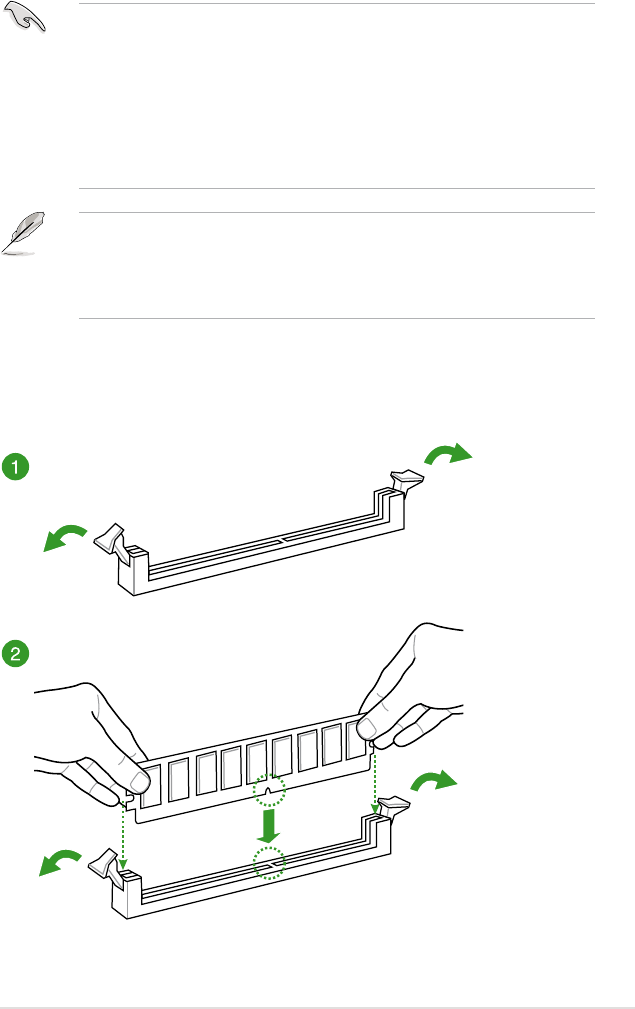
2.3.4 DIMM installation
Side(s): SS - Single-sided DS - Double-sided DIMM support:
(1) Supports one (1) module inserted into any slot as Single-channel memory
conguration. We suggest that you install the module into A2 slot.
(2) Supports two (2) modules inserted into either the yellow slots or the dark brown slots
as one pair of Dual-channel memory conguration. We suggest that you install the
modules into slots A2 and B2 for better compatibility.
(4) Supports four (4) modules inserted into both the yellow slots and dark brown slots as
two pairs of Dual-channel memory conguration.
• ASUS exclusively provides hyper DIMM support function.
• Hyper DIMM support is subject to the physical characteristics of individual CPUs. Load
the X.M.P. settings in the BIOS for the hyper DIMM support.
• Visit the ASUS website for the latest QVL.
ASUS Z87-C
1-22
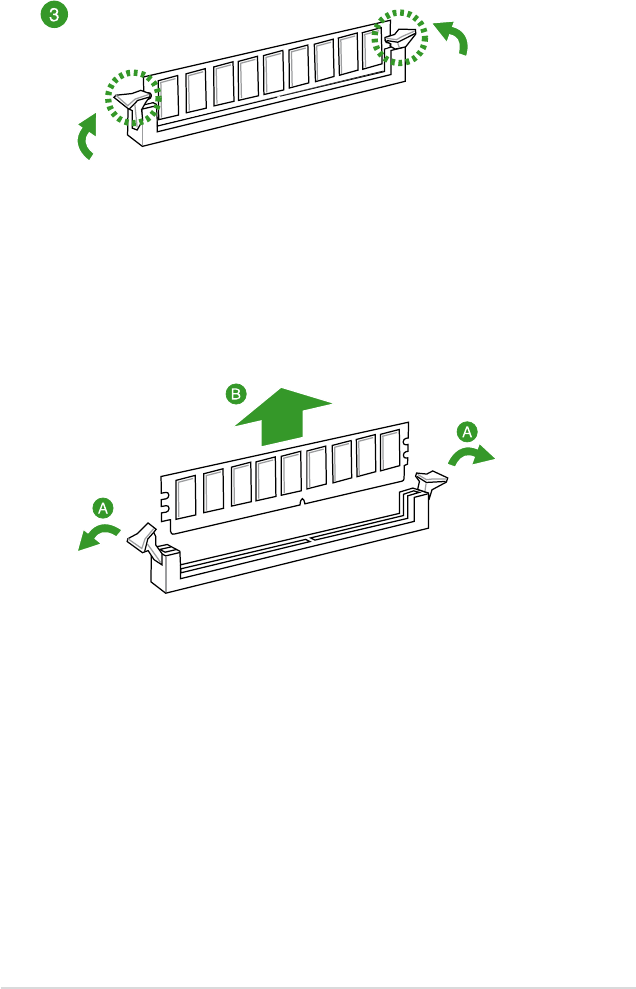
To remove a DIMM
1-23
Chapter 1: Product introduction
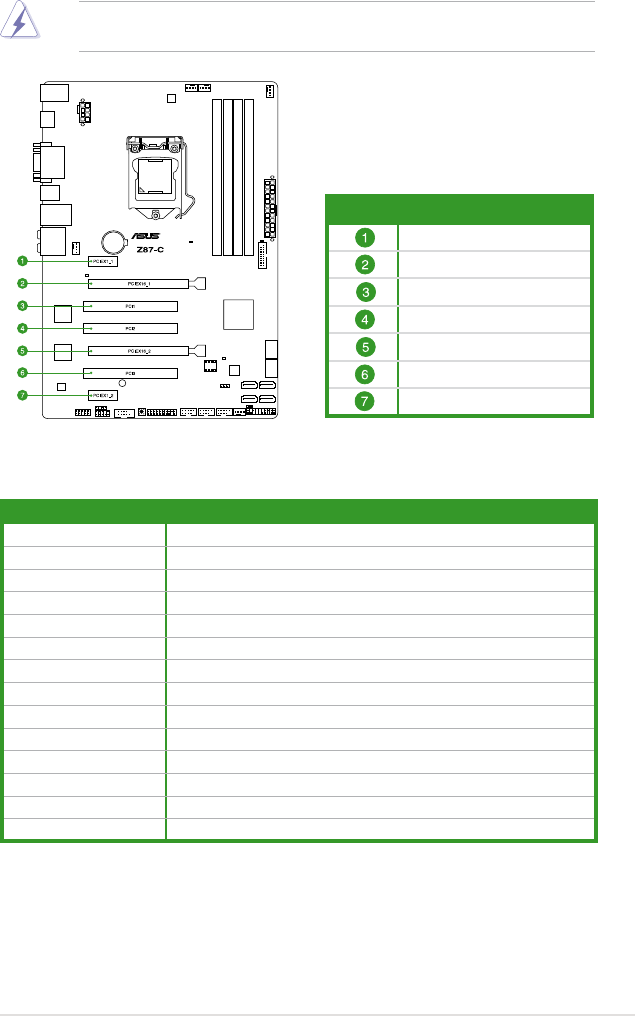
1.5 Expansion slots
Unplug the power cord before adding or removing expansion cards. Failure to do so may
cause you physical injury and damage motherboard components.
Slot No. Expansion Slots
PCIe 2.0 x1_1 slot
PCIe 3.0 x16_1 slot
PCI_1 slot
PCI_2 slot
PCIe 2.0 x16_2 slot
PCI_3 slot
PCIe 2.0 x1_2 slot
IRQ assignments for this motherboard
A B C D E F G H
SATA controller 0 – – – shared – – – –
SATA controller 1 – – – shared – – – –
SMBUS Controller – – shared – – – – –
Thermal Controller – – shared – – – – –
USB 2.0 Controller 0 – – – – – – – shared
USB 2.0 Controller 1 – – – – shared – – –
PCIE x16_1 shared – – – – – – –
PCIE x16_2 shared – – – – – – –
PCIE x1_1 – – shared – – – – –
PCIE x1_2 – – – shared – – – –
PCI_1 – – – shared – – – –
PCI_2 shared – – – – – – –
PCI_3 – shared – – – – – –
Realtek LAN – – shared – – – – –

ASUS Z87-C
1-24
1.5.1 Installing an expansion card
To install an expansion card:
1. Before installing the expansion card, read the documentation that came with it and
make the necessary hardware settings for the card.
2. Remove the system unit cover (if your motherboard is already installed in a chassis).
3. Remove the bracket opposite the slot that you intend to use. Keep the screw for later
use.
4. Align the card connector with the slot and press rmly until the card is completely
seated on the slot.
5. Secure the card to the chassis with the screw you removed earlier.
6. Replace the system cover.
1.5.2 Conguring an expansion card
After installing the expansion card, congure it by adjusting the software settings.
1. Turn on the system and change the necessary BIOS settings, if any. See Chapter 2 for
information on BIOS setup.
2. Install the software drivers for the expansion card.
1-25
Chapter 1: Product introduction
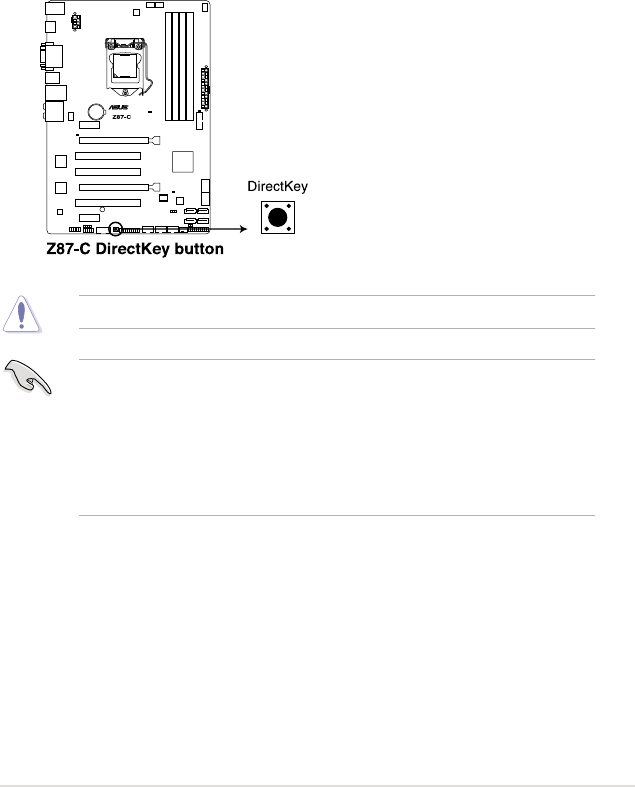
Ensure to save your data before using the DirectKey button.
DirectKey button
This feature allows your system to go to the BIOS Setup program with the press of a button.
With DirectKey, you can enter the BIOS anytime without having to press the <Delete> key
during POST. It also allows you to turn on or turn off your system and conveniently enter the
BIOS during boot-up.
• When the system is on and you press the DirectKey button, your system will shut
down. Press the DirectKey button again or the Power-on button to reboot and enter
the BIOS directly.
• Turn off your system using the power-on button to allow your system to go through
POST (without entering the BIOS) when you reboot your system.
• Refer to section 2.8 Boot Menu for details about setting the DirectKey default
function.
1.6 Onboard buttons
Onboard switches allow you to ne-tune performance when working on a bare or open-
case system. This is ideal for overclockers and gamers who continually change settings to
enhance system performance.
ASUS Z87-C
1-26
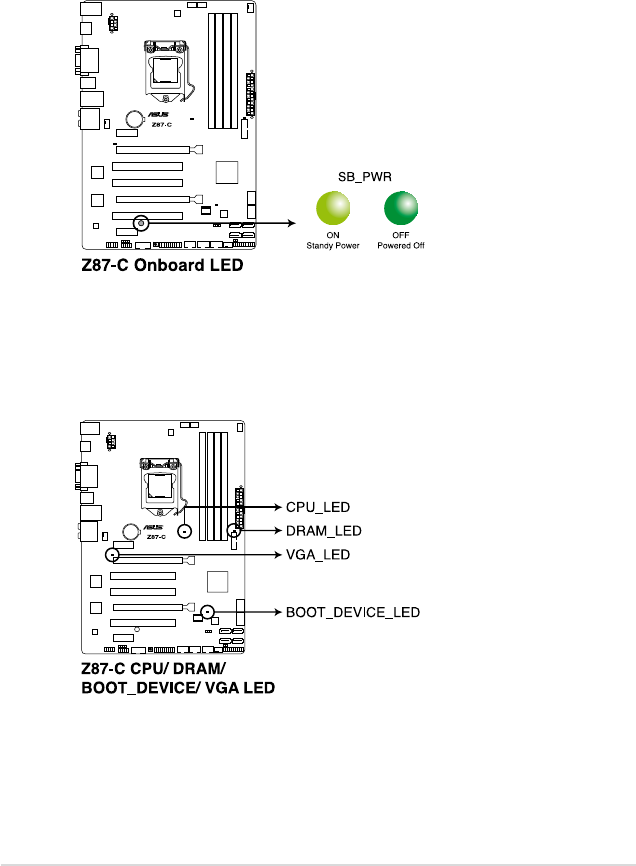
1. Standby power LED (SB_PWR)
The motherboard comes with a standby power LED that lights up to indicate that the
system is ON, in sleep mode, or in soft-off mode. This is a reminder that you should
shut down the system and unplug the power cable before removing or plugging in any
motherboard component. The illustration below shows the location of the onboard LED.
1.7 Onboard LEDs
2. POST State LEDs
The POST State LEDs provide the status of these key components during POST
(Power-On-Self Test): CPU, memory modules, VGA card, and hard disk drives. If an
error is found, the critical component’s LED stays lit up until the problem is solved.
1-27
Chapter 1: Product introduction
1.8 Jumpers
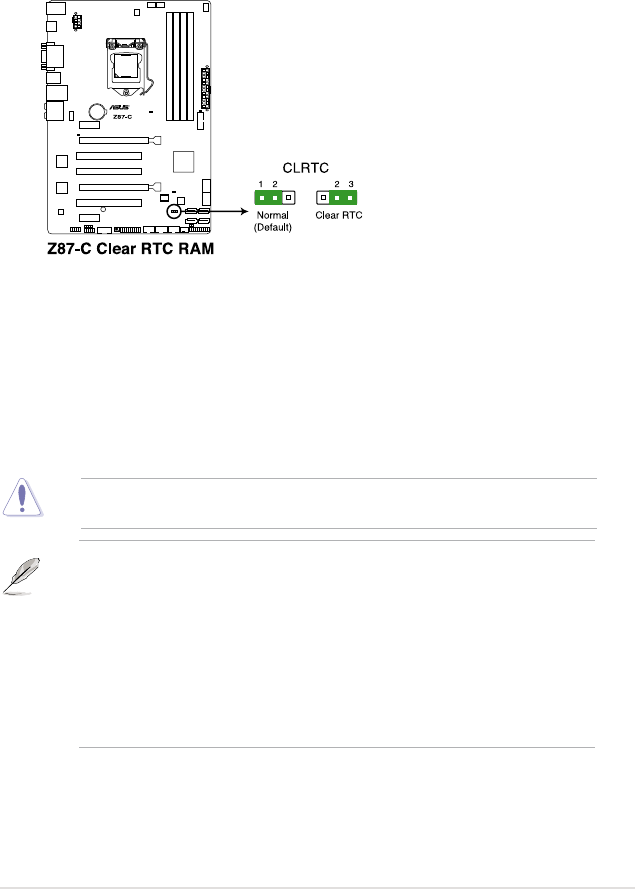
Clear RTC RAM jumper (3-pin CLRTC)
This jumper allows you to clear the Real Time Clock (RTC) RAM in CMOS. You can clear the
CMOS memory of date, time, and system setup parameters by erasing the CMOS RTC RAM
data. The onboard button cell battery powers the RAM data in CMOS, which include system
setup information such as system passwords.
Except when clearing the RTC RAM, never remove the cap on CLRTC jumper default
position. Removing the cap will cause system boot failure!
To erase the RTC RAM:
1. Turn OFF the computer and unplug the power cord.
2. Move the jumper cap from pins 1-2 (default) to pins 2-3. Keep the cap on pins 2-3 for
about 5-10 seconds, then move the cap back to pins 1-2.
3. Plug the power cord and turn ON the computer.
4. Hold down the <Delete> key during the boot process and enter BIOS setup to re-enter
data.
• If the steps above do not help, remove the onboard battery and move the jumper
again to clear the CMOS RTC RAM data. After the CMOS clearance, reinstall the
battery.
• You do not need to clear the RTC when the system hangs due to overclocking. For
system failure due to overclocking, use the C.P.R. (CPU Parameter Recall) feature.
Shut down and reboot the system so the BIOS can automatically reset parameter
settings to default values.
• Due to the chipset behavior, AC power off is required to enable C.P.R. function. You
must turn off and on the power supply or unplug and plug the power cord before
rebooting the system.
ASUS Z87-C
1-28
1.9 Connectors
1.9.1 Rear panel connectors
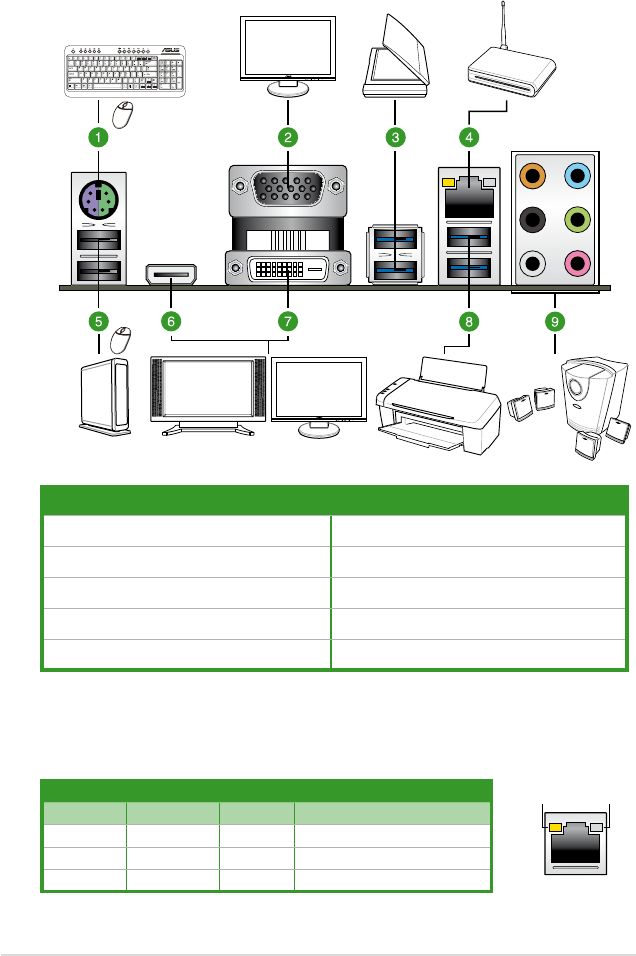
Rear panel connectors
1. PS/2 keyboard/mouse combo port 6. HDMI port
2. VGA port 7. DVI-D port
3. USB 3.0 ports 5 and 6 8. USB 3.0 ports 3 and 4
4. Intel® LAN (RJ-45) port* 9. Audio I/O ports**
5. USB 2.0 ports 7 and 8
* and **: Refer to the tables for LAN port LEDs and audio port denitions.
Activity/Link LED Speed LED
Status Description Status Description
OFF No link OFF 10Mbps connection
ORANGE Linked ORANGE 100Mbps connection
BLINKING Data activity GREEN 1Gbps connection
* LAN port LED indications
ACT/LINK
LED
SPEED
LED
LAN port
1-29
Chapter 1: Product introduction
1.9.2 Internal connectors
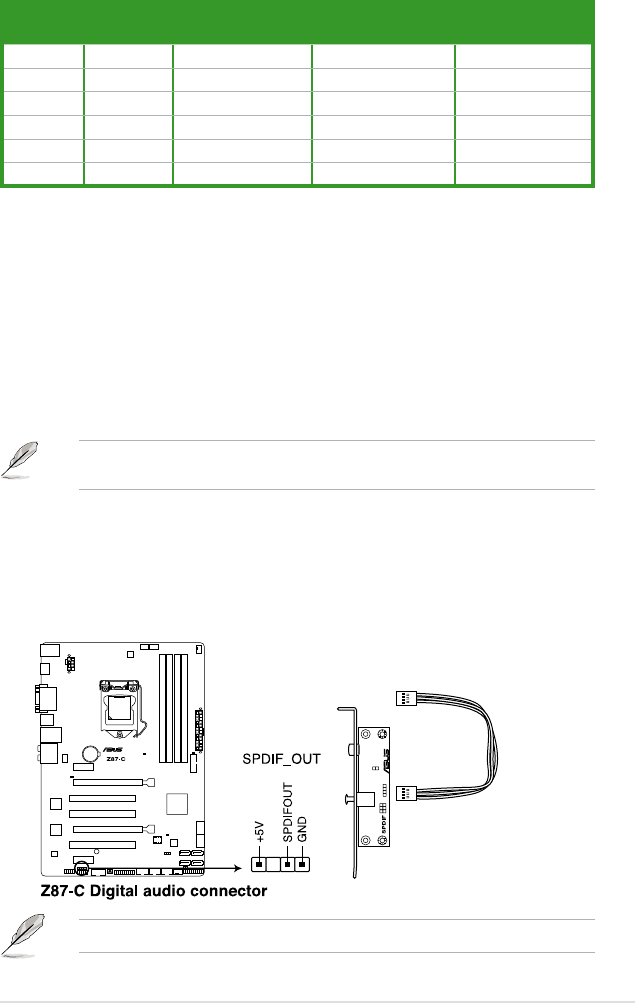
1. Digital audio connector (4-1 pin SPDIF_OUT)
This connector is for an additional Sony/Philips Digital Interface (S/PDIF) port. Connect
the S/PDIF Out module cable to this connector, then install the module to a slot
opening at the back of the system chassis.
1. Line In port (light blue). This port connects to the tape, CD, DVD player, or other
audio sources.
2. Line Out port (lime). This port connects to a headphone or a speaker. In the 4, 6, and
8-channel congurations, the function of this port becomes Front Speaker Out.
3. Microphone port (pink). This port connects to a microphone.
4. Center/Subwoofer port (orange). This port connects to a center/subwoofer speakers.
5. Rear speaker out port (black). This port connects to a tape recorder, CD and DVD
player, or other audio sources.
6. Side speaker out port (gray). This port connects to a side speaker in an 8-channel
audio conguration.
To congure an 8-channel audio output, use a chassis with HD audio module in the front
panel to support 8-channel audio output.
** Audio 2, 4, 6, or 8-channel conguration
Port Headset
2-channel
4-channel 6-channel 8-channel
Light Blue Line In Line In Line In Line In
Lime Line Out Front Speaker Out Front Speaker Out Front Speaker Out
Pink Mic In Mic In Mic In Mic In
Orange – – Center/Subwoofer Center/Subwoofer
Black – Rear Speaker Out Rear Speaker Out Rear Speaker Out
Gray – – – Side Speaker Out
The S/PDIF module is purchased separately.
ASUS Z87-C
1-30
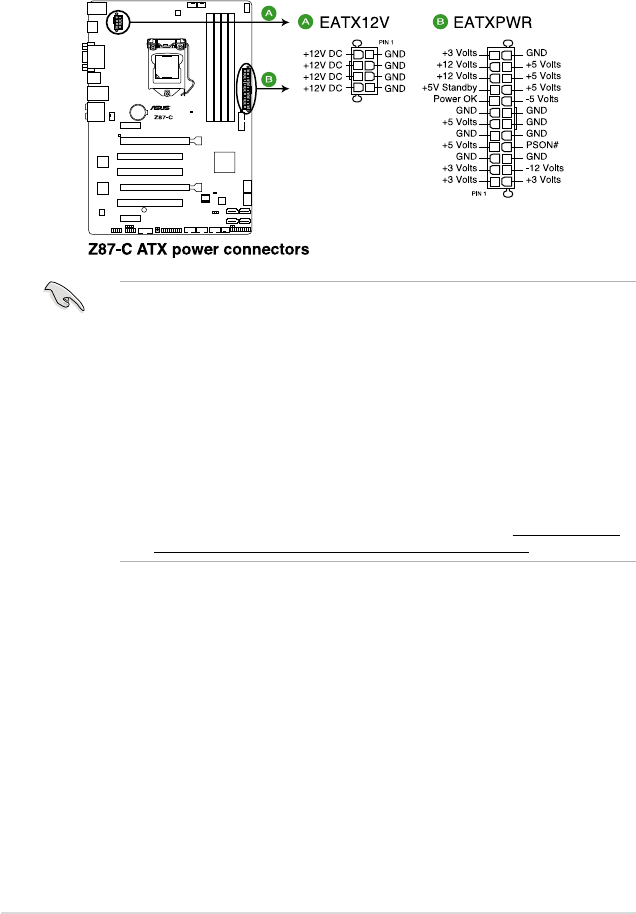
2. ATX power connectors (24-pin EATXPWR; 8-pin EATX12V)
These connectors are for ATX power supply plugs. The power supply plugs are
designed to t these connectors in only one orientation. Find the proper orientation and
push down rmly until the connectors completely t.
• For a fully congured system, we recommend that you use a power supply unit
(PSU) that complies with ATX 12 V Specication 2.0 (or later version) and provides a
minimum power of 350 W.
• DO NOT forget to connect the 4-pin/8-pin EATX12 V power plug. Otherwise, the
system will not boot.
• We recommend that you use a PSU with a higher power output when conguring a
system with more power-consuming devices. The system may become unstable or
may not boot up if the power is inadequate.
• If you want to use two or more high-end PCI Express x16 cards, use a PSU with
1000W power or above to ensure the system stability.
• If you are uncertain about the minimum power supply requirement for your system,
refer to the Recommended Power Supply Wattage Calculator at http://support.asus.
com/PowerSupplyCalculator/PSCalculator.aspx?SLanguage=en-us for details.
1-31
Chapter 1: Product introduction
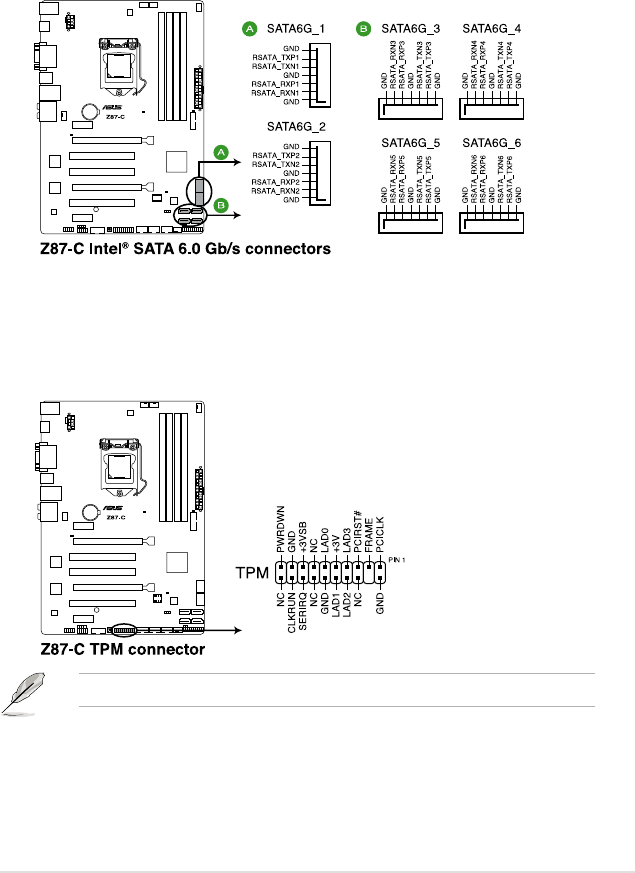
3. Intel® Z87 Serial ATA 6.0 Gb/s connectors (7-pin SATA6G_1-6 [yellow])
These connectors connect to Serial ATA 6.0 Gb/s hard disk drives via Serial ATA 6.0
Gb/s signal cables.
If you installed Serial ATA hard disk drives, you can create a RAID 0, 1, 5, and 10
conguration with the Intel® Rapid Storage Technology through the onboard Intel® Z87
chipset.
4. TPM connector (20-1 pin TPM)
This connector supports a Trusted Platform Module (TPM) system, which can securely
store keys, digital certicates, passwords, and data. A TPM system also helps enhance
network security, protects digital identities, and ensures platform integrity.
TPM module is purchased separately.
ASUS Z87-C
1-32
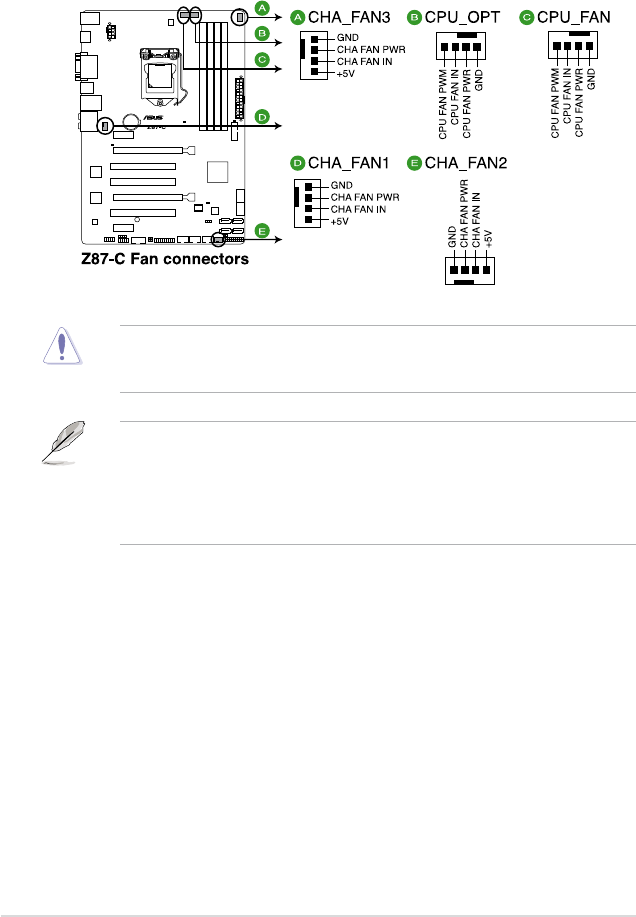
• The CPU_FAN connector supports the CPU fan of maximum 1A (12 W) fan power.
• The CPU_FAN connector and CHA_FAN 1-3 connectors support the ASUS FAN Xpert
2 feature.
• If you install two VGA cards, we recommend that you plug the rear chassis fan cable
to the motherboard connector labeled CHA_FAN1-3 for better thermal environment.
Do not forget to connect the fan cables to the fan connectors. Insufcient air ow inside the
system may damage the motherboard components. These are not jumpers! Do not place
jumper caps on the fan connectors!
5. CPU, CPU optional, and chassis fan connectors
(4-pin CPU_FAN; 4-pin CPU_OPT; 4-pin CHA_FAN1-3)
Connect the fan cables to the fan connectors on the motherboard, ensuring that the
black wire of each cable matches the ground pin of the connector.
1-33
Chapter 1: Product introduction
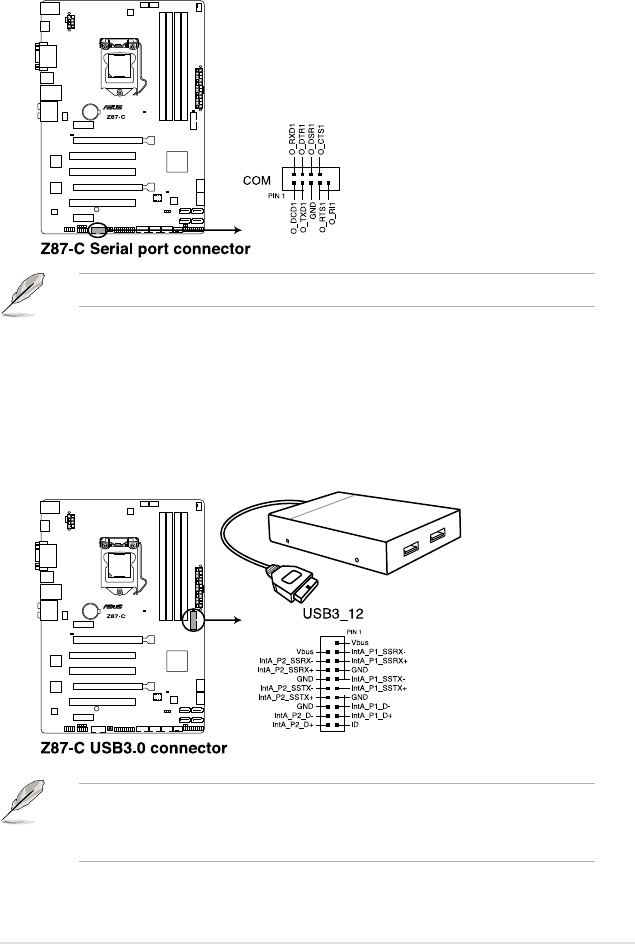
6. Serial port connector (10-1 pin COM)
The connector is for a serial (COM) port. Connect the serial port module cable to the
connector, then install the module to a slot opening at the back of the system chassis.
The serial port bracket (COM) is purchased separately.
7. USB 3.0 connector (20-1 pin USB3_12)
This connector allows you to connect a USB 3.0 module for additional USB 3.0 front
or rear panel ports. With an installed USB 3.0 module, you can enjoy all the benets of
USB 3.0 including faster data transfer speeds of up to 5Gbps, faster charging time for
USB-chargeable devices, optimized power efciency, and backward compatibility with
USB 2.0.
• The USB 3.0 module is purchased separately.
• These connectors are based on xHCI specication. We recommend you to install the
related driver to fully use the USB 3.0 ports under Windows® 7.
ASUS Z87-C
1-34
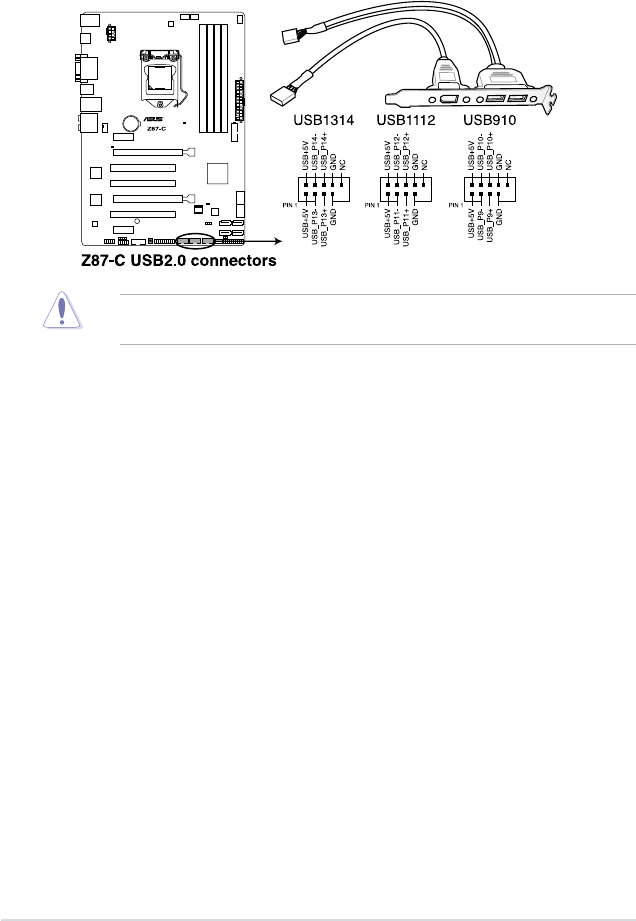
8. USB 2.0 connectors (10-1 pin USB910; USB1112; USB1314)
These connectors are for USB 2.0 ports. Connect the USB module cable to any of
these connectors, then install the module to a slot opening at the back of the system
chassis. These USB connectors comply with USB 2.0 specication that supports up to
480 Mbps connection speed.
Never connect a 1394 cable to the USB connectors. Doing so will damage the
motherboard!
1-35
Chapter 1: Product introduction
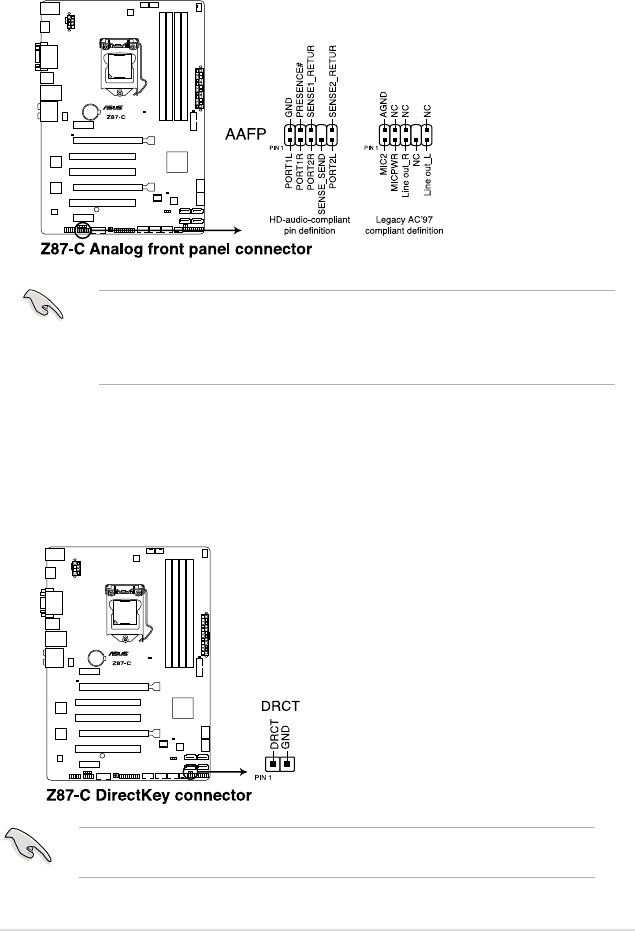
9. Front panel audio connector (10-1 pin AAFP)
This connector is for a chassis-mounted front panel audio I/O module that supports
either HD Audio or legacy AC`97 audio standard. Connect one end of the front panel
audio I/O module cable to this connector.
• We recommend that you connect a high-denition front panel audio module to this
connector to avail of the motherboard’s high-denition audio capability.
• If you want to connect a high-denition or an AC’97 front panel audio module to this
connector, set the Front Panel Type item in the BIOS setup to [HD] or [AC97].
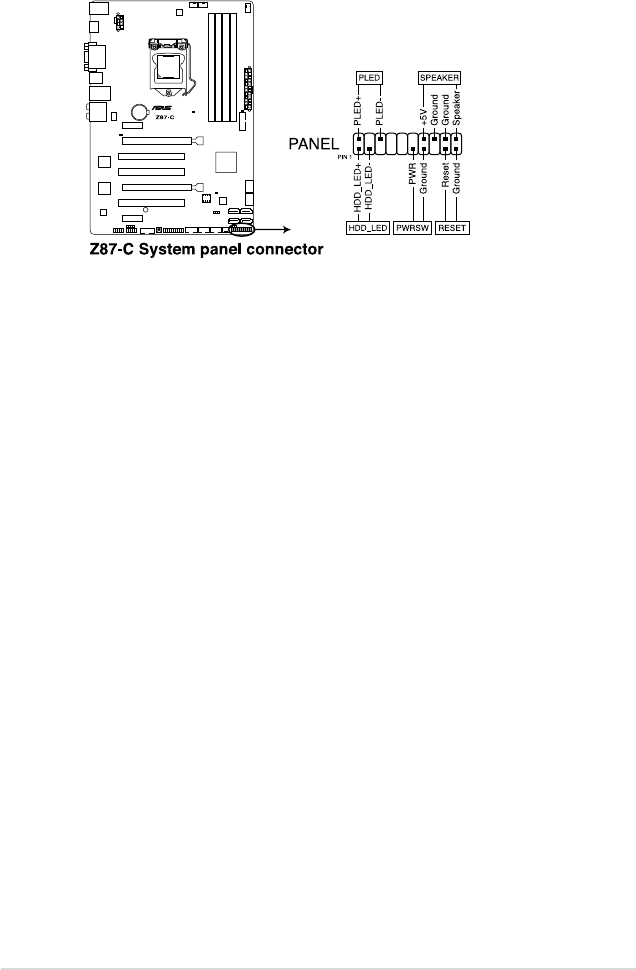
10. DirectKey connector (2-pin DRCT)
This connector is for the chassis-mounted button that supports the DirectKey function.
Connect the button cable that supports DirectKey, from the chassis to this connector on
the motherboard.
Ensure that your chassis comes with the extra button cable that supports the DirectKey
feature. Refer to the technical documentation that came with the chassis for details.
ASUS Z87-C
1-36
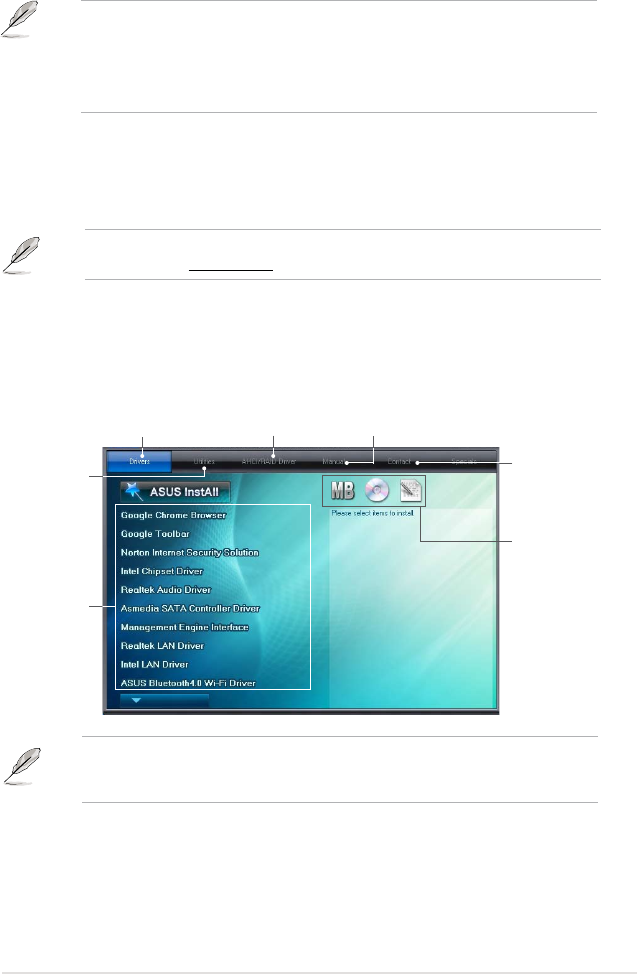
11. System panel connector (20-8 pin PANEL)
This connector supports several chassis-mounted functions.
• System power LED (2-pin PLED)
This 2-pin connector is for the system power LED. Connect the chassis power LED
cable to this connector. The system power LED lights up when you turn on the system
power, and blinks when the system is in sleep mode.
• Hard disk drive activity LED (2-pin IDE_LED)
This 2-pin connector is for the HDD Activity LED. Connect the HDD Activity LED cable
to this connector. The IDE LED lights up or ashes when data is read from or written to
the HDD.
• System warning speaker (4-pin SPEAKER)
This 4-pin connector is for the chassis-mounted system warning speaker. The speaker
allows you to hear system beeps and warnings.
• ATX power button/soft-off button (2-pin PWRSW)
This connector is for the system power button. Pressing the power button turns
the system on or puts the system in sleep or soft-off mode depending on the BIOS
settings. Pressing the power switch for more than four seconds while the system is ON
turns the system OFF.
• Reset button (2-pin RESET)
This 2-pin connector is for the chassis-mounted reset button for system reboot without
turning off the system power.
1-37
Chapter 1: Product introduction
1.10 Software support
1.10.1 Installing an operating system
• This motherboard supports Windows® 8 32/64-bit and Windows® 7 32/64-bit operating
systems (OS).
• Motherboard settings and hardware options vary. Use the setup procedures presented
in this chapter for reference only. Refer to your OS documentation for detailed
information.
1.10.2 Support DVD information
The support DVD that comes with the motherboard package contains the drivers, software
applications, and utilities that you can install to avail all motherboard features.
Running Support DVD
Place the support DVD into the optical drive. The DVD automatically displays the Drivers menu if
Autorun is enabled in your computer. Click each menu tab and select the items you want to install.
The contents of the support DVD are subject to change at any time without notice. Visit the
ASUS website at www.asus.com for updates.
The Drivers menu shows the available
device drivers if the system detects
installed devices. Install the necessary
drivers to use the devices.
The Utilities
menu shows the
applications and
other software that
the motherboard
supports.
The AHCI/RAID driver
contains the RAID/
AHCI driver disk.
The Manual menu contains
the list of supplementary user
manuals. Click an item to open
the folder of the user manual.
Click the Contact
tab to display the
ASUS contact
information.
Click an icon
to display DVD/
motherboard
information
Click an item
to install
If Autorun is NOT enabled in your computer, browse the contents of the support DVD to
locate the le ASSETUP.EXE from the BIN folder. Double-click the ASSETUP.EXE to run
the DVD.

ASUS Z87-C
1-38
Chapter 2: BIOS information 2-1
The ASUS website publishes the latest BIOS versions to provide enhancements on system
stability, compatibility, or performance. However, BIOS updating is potentially risky. If there
is no problem using the current version of BIOS, DO NOT manually update the BIOS.
Inappropriate BIOS updating may result in the system’s failure to boot. Carefully follow the
instructions of this chapter to update your BIOS if necessary.
Visit the ASUS website at www.asus.com to download the latest BIOS le for this
motherboard.
The following utilities allow you to manage and update the motherboard BIOS setup program.
1. EZ Update: Updates the BIOS in Windows® environment.
2. ASUS EZ Flash 2: Updates the BIOS using a USB ash drive.
3. ASUS CrashFree BIOS 3: Restores the BIOS using the motherboard support DVD or
a USB ash drive when the BIOS le fails or gets corrupted.
4. ASUS BIOS Updater: Updates the BIOS in DOS environment using the motherboard
support DVD and a USB ash disk drive.
Refer to the corresponding sections for details on these utilities.
2.1.1 EZ Update
The EZ Update is a utility that allows you to update the motherboard BIOS in Windows®
environment.
• EZ Update requires an Internet connection either through a network or an Internet
Service Provider (ISP).
• This utility is available in the support DVD that comes with the motherboard package.
Chapter 2
BIOS information
2.1 Managing and updating your BIOS
Chapter 2: BIOS information

2-2 ASUS Z87-C
2.1.2 ASUS EZ Flash 2
The ASUS EZ Flash 2 feature allows you to update the BIOS without using an OS-based
utility or a bootable oppy disk.
Before you start using this utility, download the latest BIOS le from the ASUS website at
www.asus.com.
1. Insert the USB ash disk that contains the latest BIOS le to the USB port.
2. Enter the Advanced Mode of the BIOS setup program. Go to the Tool menu to select
ASUS EZ Flash 2 Utility and press <Enter> to enable it.
3. Press <Tab> to switch to the Drive eld.
4. Press the Up/Down arrow keys to nd the USB ash disk that contains the latest BIOS,
and then press <Enter>.
5. Press <Tab> to switch to the Folder Info eld.
6. Press the Up/Down arrow keys to nd the BIOS le, and then press <Enter> to perform
the BIOS update process. Reboot the system when the update process is done.
• This function supports USB ash disks with FAT 32/16 format and single partition only.
• DO NOT shut down or reset the system while updating the BIOS to prevent system
boot failure!
Chapter 2: BIOS information 2-3
2.1.3 ASUS CrashFree BIOS 3 utility
The ASUS CrashFree BIOS 3 is an auto recovery tool that allows you to restore the BIOS le
when it fails or gets corrupted during the updating process. You can restore a corrupted BIOS
le using the motherboard support DVD or a USB ash drive that contains the updated BIOS
le.
• Before using this utility, rename the BIOS le in the removable device into Z87C.CAP.
• The BIOS le in the motherboard support DVD may be older than the BIOS le
published on the ASUS ofcial website. If you want to use the newer BIOS le,
download the le at support.asus.com and save it to an USB ash drive.
Recovering the BIOS
1. Turn on the system.
2. Insert the support DVD to the optical drive or the USB ash drive that contains the
BIOS le to the USB port.
3. The utility automatically checks the devices for the BIOS le. When found, the utility
reads the BIOS le and enters ASUS EZ Flash 2 utility automatically.
4. The system requires you to enter BIOS Setup to recover BIOS setting. To ensure
system compatibility and stability, we recommend that you press <F5> to load default
BIOS values.
DO NOT shut down or reset the system while updating the BIOS! Doing so can cause
system boot failure!
2-4 ASUS Z87-C
2.1.4 ASUS BIOS Updater
The ASUS BIOS Updater allows you to update BIOS in DOS environment. This utility also
allows you to copy the current BIOS le that you can use as a backup when the BIOS fails or
gets corrupted during the updating process.
The succeeding utility screens are for reference only. The actual utility screen displays may
not be same as shown.
Before updating BIOS
1. Prepare the motherboard support DVD and a USB ash drive in FAT32/16 format and
single partition.
2. Download the latest BIOS le and BIOS Updater from the ASUS website at
http://support.asus.com and save them on the USB ash drive.
• NTFS is not supported under DOS environment. Do not save the BIOS le and BIOS
Updater to a hard disk drive or USB ash drive in NTFS format.
• Do not save the BIOS le to a oppy disk due to low disk capacity.
3. Turn off the computer and disconnect all SATA hard disk drives (optional).
Booting the system in DOS environment
1. Insert the USB ash drive with the latest BIOS le and BIOS Updater to the USB port.
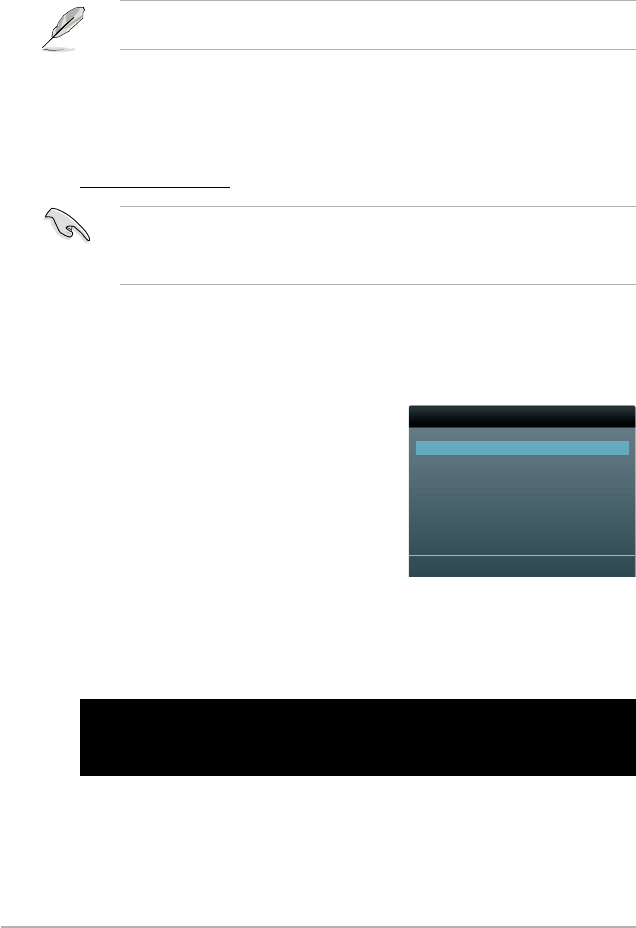
2. Boot your computer. When the ASUS Logo
appears, press <F8> to show the BIOS Boot
Device Select Menu. Insert the support DVD into
the optical drive and select the optical drive as the
boot device.
Welcome to FreeDOS (http://www.freedos.org)!
C:\>d:
D:\>
3. When the Make Disk menu appears, select the FreeDOS command prompt item by
pressing the item number.
4. At the FreeDOS prompt, type d: and press <Enter> to switch the disk from Drive C
(optical drive) to Drive D (USB ash drive).
Please select boot device:
SATA: XXXXXXXXXXXXXXXX
USB XXXXXXXXXXXXXXXXX
UEFI: XXXXXXXXXXXXXXXX
Enter Setup
↑and ↓ to move selection
ENTER to select boot device
ESC to boot using defaults
Chapter 2: BIOS information 2-5
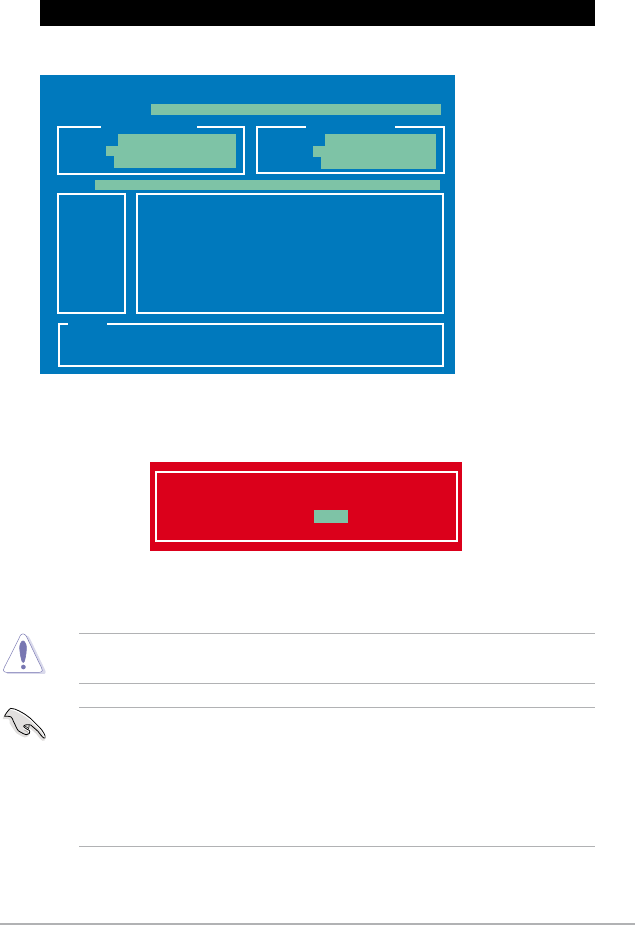
2. The BIOS Updater screen appears as below.
Updating the BIOS le
To update the BIOS le using BIOS Updater
1. At the FreeDOS prompt, type bupdater /pc /g and press <Enter>.
D:\>bupdater /pc /g
4. Select Yes and press <Enter>. When BIOS update is done, press <ESC> to exit BIOS
Updater. Restart your computer.
DO NOT shut down or reset the system while updating the BIOS to prevent system boot
failure!
• For BIOS Updater version 1.30 or later, the utility automatically exits to the DOS
prompt after updating BIOS.
• Ensure to load the BIOS default settings to ensure system compatibility and stability.
Select the Load Optimized Defaults item under the Exit BIOS menu.
• Ensure to connect all SATA hard disk drives after updating the BIOS le if you have
disconnected them.
3. Press <Tab> to switch between screen elds and use the <Up/Down/Home/End> keys
to select the BIOS le and press <Enter>. BIOS Updater checks the selected BIOS le
and prompts you to conrm BIOS update.
Are you sure to update BIOS?
Yes No
ASUSTek BIOS Updater for DOS V1.30 [2013/02/22]
Current ROM Update ROM
A:
Note
[Enter] Select or Load [Tab] Switch [V] Drive Info
[Up/Down/Home/End] Move [B] Backup [Esc] Exit
Z87C.CAP 2097152 2013-02-22 17:30:48
PATH:
BOARD:
VER:
DATE:
FLASH TYPE: MX1C 25L1065A
BOARD:
VER:
DATE:
A:\
Z87-C
0204
01/01/2013
UNKNOWN
UNKNOWN
UNKNOWN

2-6 ASUS Z87-C
2.2 BIOS setup program
Use the BIOS Setup to update the BIOS or congure its parameters. The BIOS screen
include navigation keys and brief onscreen help to guide you in using the BIOS Setup
program.
Entering BIOS at startup
To enter BIOS Setup at startup:
• Press <Delete> during the Power-On Self Test (POST). If you do not press <Delete>,
POST continues with its routines.
Entering BIOS Setup after POST
To enter BIOS Setup after POST:
• Press <Ctrl>+<Alt>+<Delete> simultaneously.
• Press the reset button on the system chassis.
• Press the power button to turn the system off then back on. Do this option only if you
failed to enter BIOS Setup using the rst two options.
• The BIOS setup screens shown in this section are for reference purposes only, and
may not exactly match what you see on your screen.
• Ensure that a USB mouse is connected to your motherboard if you want to use the
mouse to control the BIOS setup program.
• If the system becomes unstable after changing any BIOS setting, load the default
settings to ensure system compatibility and stability. Select the Load Optimized
Defaults item under the Exit menu or press hotkey <F5>. See section 2.10 Exit Menu
for details.
• If the system fails to boot after changing any BIOS setting, try to clear the CMOS and
reset the motherboard to the default value. See section 1.8 Jumpers for information
on how to erase the RTC RAM via the Clear RTC RAM jumper.
• The BIOS setup program does not support the bluetooth devices.
BIOS menu screen
The BIOS Setup program can be used under two modes: EZ Mode and Advanced Mode.
You can change modes from the Exit menu or from the Exit/Advanced Mode screen.
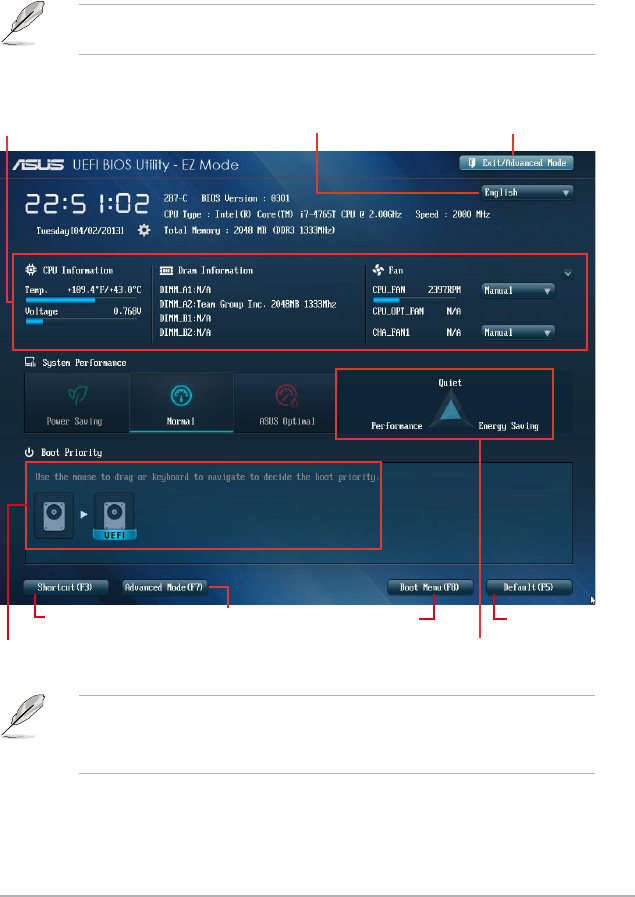
Chapter 2: BIOS information 2-7
By default, the EZ Mode screen appears when you enter the BIOS setup program. The EZ
Mode provides you an overview of the basic system information, and allows you to select
the display language, system performance mode and boot device priority. To access the
Advanced Mode, click Exit/Advanced Mode, then select Advanced Mode or press F7 hot
key for the advanced BIOS settings.
The default screen for entering the BIOS setup program can be changed. Refer to the
Setup Mode item in section 2.8 Boot menu for details.
2.2.1 EZ Mode
Displays the selected
shortcut menus
Exits the BIOS setup program
without saving the changes, saves
the changes and resets the system,
or enters the Advanced Mode
Selects the display language
of the BIOS setup program
Displays the CPU/motherboard
temperature, CPU/5V/3.3V/12V voltage
output, CPU/chassis/power fan speed
Displays the system properties of the
selected mode on the right hand side
Displays the Advanced
mode menus
Selects the boot
device priority
Selects the boot
device priority
Loads optimized
default settings
• The boot device options vary depending on the devices you installed to the system.
• The Boot Menu (F8) button is available only when the boot device is installed to the
system.
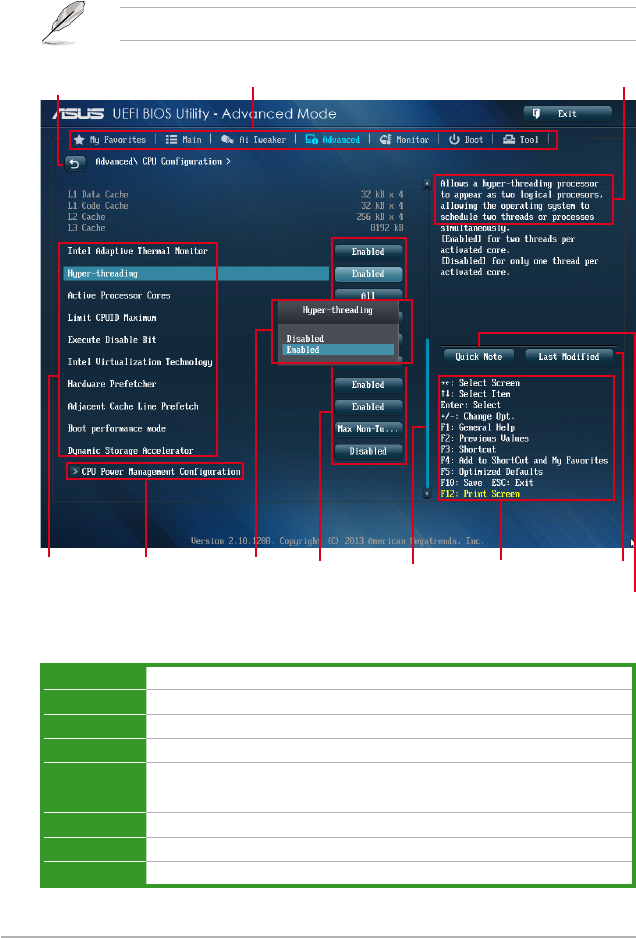
2-8 ASUS Z87-C
2.2.2 Advanced Mode
The Advanced Mode provides advanced options for experienced end-users to congure
the BIOS settings. The gure below shows an example of the Advanced Mode. Refer to the
following sections for the detailed congurations.
To access the Advanced Mode, click Exit, then select Advanced Mode or press F7 hotkey.
Navigation keys
Conguration elds
Back button
General help
Submenu item
Menu items Pop-up window Scroll bar Last modied
settings
Quick note
Menu bar
The menu bar on top of the screen has the following main items:
My Favorites For saving the frequently-used system settings and conguration.
Main For changing the basic system conguration
Ai Tweaker For changing the overclocking settings
Advanced For changing the advanced system settings
Monitor For displaying the system temperature, power status, and changing the
fan settings.
Boot For changing the system boot conguration
Tool For conguring options for special functions
Exit For selecting the exit options and loading default settings
Menu bar

Chapter 2: BIOS information 2-9
Menu items
The highlighted item on the menu bar displays the specic items for that menu. For example,
selecting Main shows the Main menu items.
The other items (Ai Tweaker, Advanced, Monitor, Boot, Tool, and Exit) on the menu bar have
their respective menu items.
Back button
This button appears when entering a submenu. Press <Esc> or use the USB mouse to click
this button to return to the previous menu screen.
Submenu items
A greater than sign (>) before each item on any menu screen means that the item has a
submenu. To display the submenu, select the item and press <Enter>.
Pop-up window
Select a menu item and press <Enter> to display a pop-up window with the conguration
options for that item.
Scroll bar
A scroll bar appears on the right side of a menu screen when there are items that do not t on
the screen. Press the Up/Down arrow keys or <Page Up> / <Page Down> keys to display the
other items on the screen.
Navigation keys
At the bottom right corner of the menu screen are the navigation keys for the BIOS setup
program. Use the navigation keys to select items in the menu and change the settings.
If you delete the shortcut items from the F3: Shortcut list, the default shortcuts will reappear
after your next startup.
General help
At the top right corner of the menu screen is a brief description of the selected item. Use
<F12> key to capture the BIOS screen and save it to the removable storage device.
Conguration elds
These elds show the values for the menu items. If an item is user-congurable, you can
change the value of the eld opposite the item. You cannot select an item that is not
user-congurable.
A congurable eld is highlighted when selected. To change the value of a eld, select it and
press <Enter> to display a list of options.
Quick Note button
This button allows you to enter notes of the activities that you have done in BIOS.
• The Quick Note function does not support the following keyboard functions: delete,
cut, copy and paste.
• You can only use the alphanumeric characters to enter your notes.
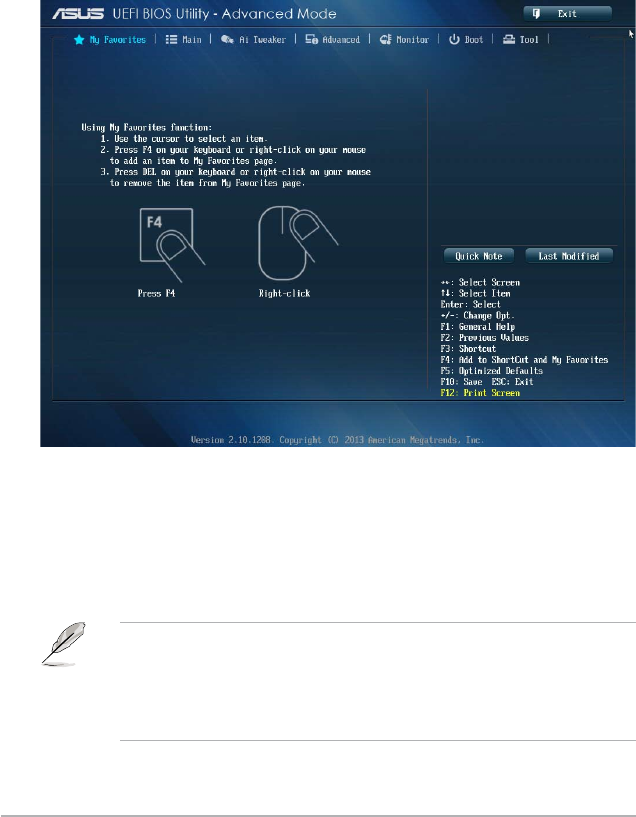
2-10 ASUS Z87-C
2.3 My Favorites
MyFavorites is your personal space where you can easily save and access your favorite
BIOS items.
Adding items to My Favorites
To add frequently-used BIOS items to My Favorites:
1. Use the arrow keys to select an item that you want to add. When using a mouse, hover
the pointer to the item.
2. Press <F4> on your keyboard or right-click on your mouse to add the item to My
Favorites page.
You cannot add the following items to My Favorites:
• Items with submenu options
• User-congurable items such as language and boot device order
• Conguration items such as Memory SPD Information, system time and date.
Last Modied button
This button shows the items that you last modied and saved in BIOS Setup.
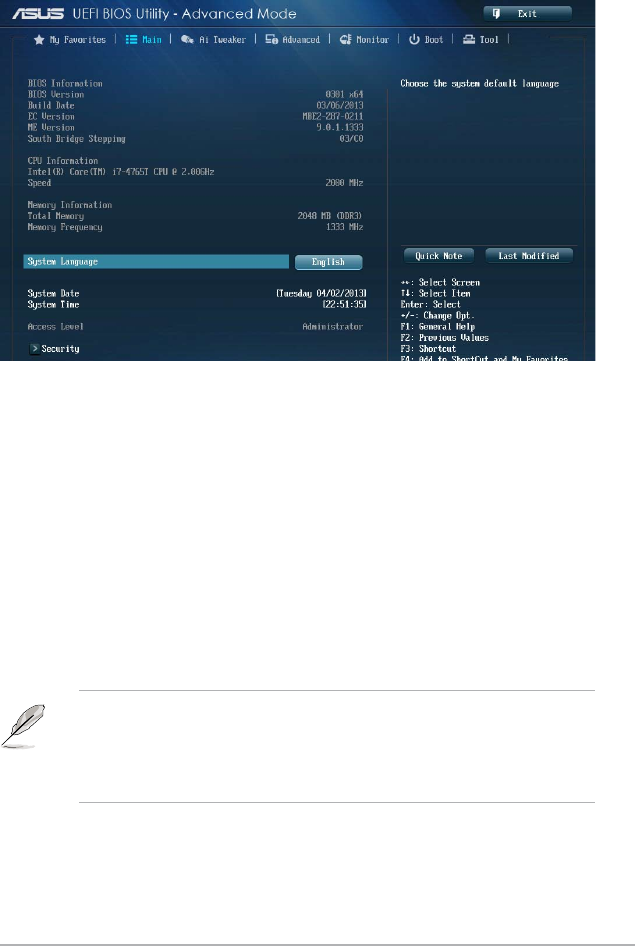
Chapter 2: BIOS information 2-11
2.4 Main menu
The Main menu screen appears when you enter the Advanced Mode of the BIOS Setup
program. The Main menu provides you an overview of the basic system information, and
allows you to set the system date, time, language, and security settings.
2.4.1 System Language [English]
Allows you to choose the BIOS language version from the options.
Conguration options: [English] [Français] [Español] [Deutsch] [
Pyccкий
] [
日本語
] [
繁體中
文
][
簡體中文
]
2.4.2 System Date
Allows you to set the system date.
2.4.3 System Time
Allows you to set the system time.
2.4.4 Security
The Security menu items allow you to change the system security settings.
• If you have forgotten your BIOS password, erase the CMOS Real Time Clock (RTC)
RAM to clear the BIOS password. See section 1.8 Jumpers for information on how to
erase the RTC RAM.
• The Administrator or User Password items on top of the screen show the default
Not Installed. After you set a password, these items show Installed.

2-12 ASUS Z87-C
Administrator Password
If you have set an administrator password, we recommend that you enter the administrator
password for accessing the system. Otherwise, you might be able to see or change only
selected elds in the BIOS setup program.
To set an administrator password:
1. Select the Administrator Password item and press <Enter>.
2. From the Create New Password box, key in a password, then press <Enter>.
3. Conrm the password when prompted.
To change an administrator password:
1. Select the Administrator Password item and press <Enter>.
2. From the Enter Current Password box, key in the current password, then press
<Enter>.
3. From the Create New Password box, key in a new password, then press <Enter>.
4. Conrm the password when prompted.
To clear the administrator password, follow the same steps as in changing an administrator
password, but press <Enter> when prompted to create/conrm the password. After you clear
the password, the Administrator Password item on top of the screen shows Not Installed.
User Password
If you have set a user password, you must enter the user password for accessing the system.
The User Password item on top of the screen shows the default Not Installed. After you set
a password, this item shows Installed.
To set a user password:
1. Select the User Password item and press <Enter>.
2. From the Create New Password box, key in a password, then press <Enter>.
3. Conrm the password when prompted.
To change a user password:
1. Select the User Password item and press <Enter>.
2. From the Enter Current Password box, key in the current password, then press
<Enter>.
3. From the Create New Password box, key in a new password, then press <Enter>.
4. Conrm the password when prompted.
To clear the user password, follow the same steps as in changing a user password, but press
<Enter> when prompted to create/conrm the password. After you clear the password, the
User Password item on top of the screen shows Not Installed.
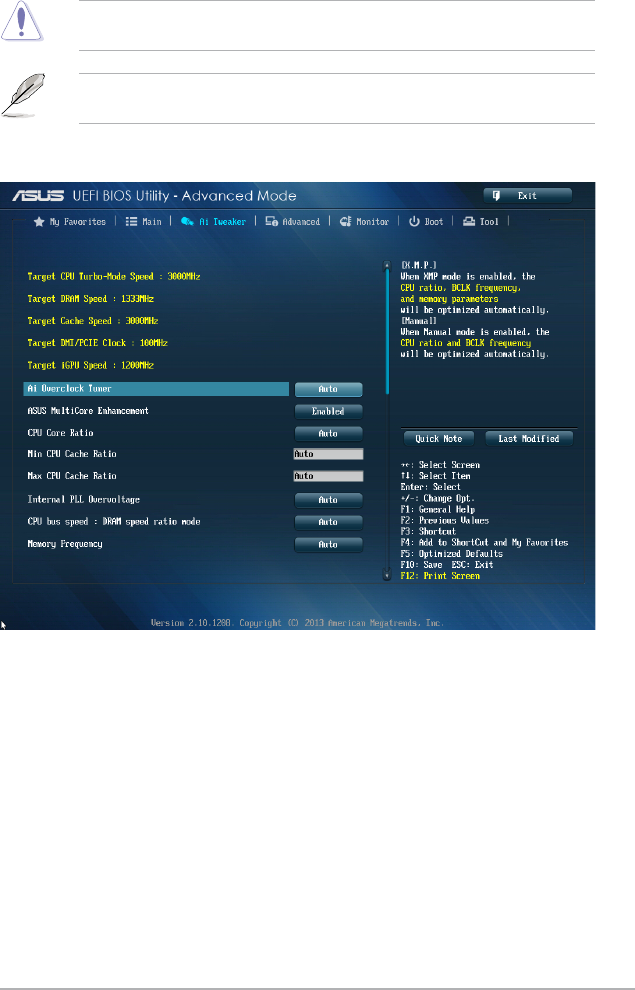
Chapter 2: BIOS information 2-13
2.5 Ai Tweaker menu
The Ai Tweaker menu items allow you to congure overclocking-related items.
Be cautious when changing the settings of the Ai Tweaker menu items. Incorrect eld
values can cause the system to malfunction.
The conguration options for this section vary depending on the CPU and DIMM model you
installed on the motherboard.
Scroll down to display other BIOS items.

2-14 ASUS Z87-C
2.5.1 Ai Overclock Tuner [Auto]
Allows you to select the CPU overclocking options to achieve the desired CPU internal
frequency. Select any of these preset overclocking conguration options:
[Auto] Loads the optimal settings for the system.
[Manual] Allows you to individually set overclocking parameters.
[X.M.P.] If you install memory modules supporting the eXtreme Memory Prole
(X.M.P.) Technology, choose this item to set the proles supported by your
memory modules for optimizing the system performance.
The following item appears only when you set the Ai Overclocking Tuner to [Manual].
CPU Strap [Auto]
Allows you to select a strap close to your target BCLK (base clock) or leave it at [Auto] for the
BIOS to decide.
Conguration options: [Auto] [100MHz] [125MHz] [166MHz] [250MHz]
This item will appear only if the CPU supports BCLK increasing function.
PLL Selection [Auto]
Set this item to [SB PLL] when you want to overclock the system beyond 100 MHz DMI
frequency. Set to [LC PLL] for less jittery system performance.
Conguration options: [Auto] [SB PLL] [LC PLL]
This item will appear only if the CPU supports phase locked-loop function.
Filter PLL [Auto]
Allows you to select a BCLK (base clock) mode when running in a high or low BCLK.
Conguration options: [Auto] [Low BCLK Mode] [High BCLK Mode]
BCLK/PEG Frequency [100.0]
Allows you to set the BCLK/PEG frequency to enhance the system performance. Use the
<+> or <-> to adjust the value. The values range from 80.0MHz to 300.0MHz
The following item appears only when you set the Ai Overclocking Tuner to [X.M.P.].
eXtreme Memory Profile
Allows you to select the X.M.P. mode supported by your memory module.
Conguration options: [Prole #1] [Prole #2]
2.5.2 ASUS MultiCore Enhancement [Enabled]
[Enabled] Default set to [Enabled] for maximum performance under XMP/Manual/
User-dened memory frequency mode.
[Disabled] Allows you to set to default core ratio settings.
Chapter 2: BIOS information 2-15
2.5.3 CPU Core Ratio [Sync All Cores]
Allows you to set the CPU ratio and synchronize automatically either per core or all cores.
Conguration options: [Auto] [Sync All Cores] [Per Core]
When the CPU Core Ratio is set to [Per Core], the following item appears:
1-Core Ratio Limit [Auto]
Select [Auto] to apply the CPU default Turbo Ratio setting or manually assign a 1-Core Limit
value that must be higher than or equal to the 2-Core Ratio Limit.
2-Core Ratio Limit [Auto]
Select [Auto] to apply the CPU default Turbo Ratio setting or manually assign a 2-Core Limit
value that must be higher than or equal to the 3-Core Ratio Limit.
If you assign a value for 2-Core Ratio Limit, do not set the 1-Core Ratio Limit to [Auto].
3-Core Ratio Limit [Auto]
Select [Auto] to apply the CPU default Turbo Ratio setting or manually assign a 3-Core Limit
value that must be higher than or equal to the 4-Core Ratio Limit.
If you assign a value for 3-Core Ratio Limit, do not set the 1-Core Ratio Limit and 2-Core
Ratio Limit to [Auto].
4-Core Ratio Limit [Auto]
Select [Auto] to apply the CPU default Turbo Ratio setting or manually assign a 4-Core Limit
value that must be higher than or equal to the 3-Core Ratio Limit.
If you assign a value for 4-Core Ratio Limit, do not set the 1-Core Ratio Limit, 2-Core Ratio
Limit, and 3-Core Ratio to [Auto].
2.5.4 Min CPU Cache Ratio [Auto]
Allows you to set the minimum possible ratio on the Uncore part of the processor. Use the
<+> or <-> keys to adjust the value. The values depend on the CPU installed.
2.5.5 Max CPU Cache Ratio [Auto]
Allows you to set the maximum possible ratio on the Uncore part of the processor. Use the
<+> or <-> keys to adjust the value. The values depend on the CPU installed.
2.5.6 Internal PLL Overvoltage [Auto]
Allows you to enable the internal PLL Overvoltage for K-SKU CPUs to get the extreme
overclocking capability.
Conguration options: [Auto] [Enabled] [Disabled]

2-16 ASUS Z87-C
2.5.7 CPU bus speed : DRAM speed ratio mode [Auto]
Allows you to set the CPU bus speed to DRAM speed ratio mode.
[Auto] DRAM speed is set to the optimized settings.
[100:133] The CPU bus speed to DRAM speed ratio is set to 100:133.
[100:100] The CPU bus speed to DRAM speed ratio is set to 100:100.
2.5.8 Memory Frequency [Auto]
Allows you to set the memory operating frequency. The conguration options vary with the
BCLK/PCIE Frequency item settings.
2.5.9 CPU Graphics Max. Ratio [Auto]
[Auto] Allows you to automatically optimize the CPU Graphics Ratio depending on
the system loading.
[Manual] Allows you to set a value for an optimal CPU Grapics Ratio. Use the <+> or
<-> keys to adjust the CPU graphics ratio. The minimum value depends on
the installed CPU.
2.5.10 OC Tuner [As Is]
OC Tuner automatically overclocks the frequency and voltage of CPU and DRAM for
enhancing the system performance and accelerates the iGPU performance to the extreme
according to the integrated graphics loading.
Conguration options: [As Is] [Ratio Only] [BCLK First]
2.5.11 EPU Power Saving Mode [Disabled]
Allows you to enable or disable the EPU power saving function.
Conguration options: [Disabled] [Enabled]
2.5.12 DRAM Timing Control
The subitems in this menu allow you to set the DRAM timing control features. Use the <+> or
<-> keys to adjust the value. To restore the default setting, type [auto] using the keyboard and
press the <Enter> key.
Changing the values in this menu may cause the system to become unstable! If this
happens, revert to the default settings.
2.5.13 DIGI+ VRM
CPU Load-line Calibration [Auto]
Load-line is dened by Intel® VRM specication and affects CPU power voltage. The CPU
working voltage will decrease proportionally to CPU loading. Higher load-line calibration could
get higher voltage and good overclocking performance, but increases the CPU and VRM
thermal conditions.
Select from Level 1 to Level 8 to adjust CPU power voltage from 0% to 100%.
The actual performance boost may vary depending on your CPU specication.
Chapter 2: BIOS information 2-17
DO NOT remove the thermal module. The thermal conditions should be monitored.
CPU Voltage Frequency [Auto]
Frequency switching affects the VRM transient response and the thermal component
conditions. Higher frequency gets quicker transient response.
Conguration options: [Auto] [Manual]
DO NOT remove the thermal module when setting this item to [Manual Mode]. The thermal
conditions should be monitored.
The following item appears only when you set the CPU Voltage Frequency to [Manual].
CPU Fixed Frequency [250]
This item allows you to set a xed CPU Voltage frequency. Use the <+> or <-> keys to
adjust the value. The values range from 300kHz to 500kHz with a 50kHz interval.
The following items appear only when you set the CPU Voltage Frequency to [Auto].
VRM Spread Spectrum [Disabled]
Enable the VRM Spread Spectrum to enhance system stability.
Conguration options: [Disabled] [Enabled]
CPU Power Phase Control [Standard]
Allows you to set the power phase control of the CPU.
Conguration options: [Standard] [Optimized] [Extreme]
DO NOT remove the thermal module when setting this item to [Extreme]. The thermal
conditions should be monitored.
CPU Power Duty Control [T.Probe]
DIGI + VRM Duty Control adjusts the current of every VRM phase and the thermal conditions
of every phase component.
[T. Probe] Select to maintain the VRM thermal balance.
[Extreme] Select to maintain the current VRM balance.
DO NOT remove the thermal module. The thermal conditions should be monitored.
CPU Current Capability [Auto]
DIGI+ VRM CPU Current Capability provides wider total power range for overclocking.
A higher value setting gets higher VRM power consumption delivery and extends the
overclocking frequency range simultaneously.
Conguration options: [Auto] [100%] [110%] [120%] [130%] [140%]

2-18 ASUS Z87-C
Choose a higher value when overclocking, or under a high CPU loading for extra power
support.
CPU Power Thermal Control [124]
A higher temperature brings a wider CPU power thermal range and extends the overclocking
tolerance to enlarge the O.C. potential. Use the <+> or <-> keys to adjust the value. The
values depend on the CPU installed.
DO NOT remove the thermal module. The thermal conditions should be monitored.
2.5.14 CPU Power Management
The subitems in this menu allow you to set the CPU ratio and their features.
Enhanced Intel SpeedStep Technology [Enabled]
Allows the operating system to dynamically adjust the processor voltage and cores
frequency, resulting to a decreased average power consumption and decreased average
heat production.
Conguration options: [Disabled] [Enabled]
Turbo Mode [Enabled]
Allows you to enable your core processor’s speed to run faster than the base operating
frequency when it is below operating power, current and temperature specication limit.
Conguration options: [Disabled] [Enabled]
The following items appear only when you set the Turbo Mode to [Enabled].
Turbo Mode Parameters
Long Duration Package Power Limit [Auto]
Allows you to limit the Turbo Ratio’s time duration that exceeds the TDP (Thermal
Design Power) for maximum performance. Use the <+> or <-> keys to adjust the value.
The values range from 1W t0 4096W.
Package Power Time Window [Auto]
Also known as Power Limit 1, and allows you to maintain the time window for Turbo
Ratio over TDP (Thermal Design Power). Use the <+> or <-> keys to adjust the value.
The values range from 1 to 127 in seconds.
Short Duration Package Power Limit [Auto]
Also known as Power Limit 2, and allows you to provide rapid protection when the
package power exceeds the Power Limit 1. Use the <+> or <-> keys to adjust the
value. The values range from 1W t0 4096W.
CPU Integrated VR Current Limit [Auto]
Allows you to set a higher current limit to prevent frequency and power throttling when
overclocking. Use the <+> or <-> keys to adjust the value. The values range from 0.125
to 1023.875 with a 0.125 interval.

Chapter 2: BIOS information 2-19
CPU Internal Power Switching Frequency
Frequency Tuning Mode [Auto]
Allows you to increase or decrease the switching frequency of the internal regulator.
Decrease to help consume less power or increase to help votlage stability. When this
item is set to [+] or [-], the Frequency Tuning Offset appears and allows you to set its
value from 0% to 6%.
CPU Internal Power Fault Control
Thermal Feedback [Auto]
Allows your system to take precautionary actions to be taken by the CPU when the
thermal conditions of the external regulator exceeds the threshold.
Conguration options: [Auto] [Disabled] [Enabled]
CPU Integrated VR Fault Management [Auto]
Disable this item to prevent tripping the Fully Integrated Voltage Regulator when doing
over-voltage. We recommend you to disable this item when overclocking.
Conguration options: [Auto] [High Performance] [Balanced]
CPU Internal Power Configuration
CPU Integrated VR Efficiency Management [Auto]
Allows you to improve power saving when the processor is in low power state. Disable
to make the Fully Integrated Voltage Regulator work in high performance at all times.
Conguration options: [Auto] [High Performance] [Balanced]
Power Decay Mode [Auto]
Allows your system to improve the power saving mode on the Fully Integrated Voltage
Regulator as the processor goes into low current state.
Conguration options: [Auto] [Disabled] [Enabled]
Idle Power-in Response [Auto]
Allows you to set the slew rate for the Fully Integrated Voltage Regulator as it enters
manual override mode.
Conguration options: [Auto] [Regular] [Fast]
Idle Power-out Response [Auto]
Allows you to set the slew rate for the Fully Integrated Voltage Regulator as it exits
manual override mode.
Conguration options: [Auto] [Regular] [Fast]
Power Current Slope [Auto]
Allows you to set the gradient of the high-speed active phase current balance during
load transients to eliminate current imbalance that can result from a load current
oscillating near the switching frequency.
Conguration options: [Auto] [LEVEL -4] - [LEVEL 4]

2-20 ASUS Z87-C
Power Current Offset [Auto]
Allows you to increase or decrease the output current sensed by the CPU. It nds the
balance between optimal regulating while staying below the current threshold.
Conguration options: [Auto] [100%] [87.5%] [75.0%] [62.5%] [50.0%] [37.5%] [25.0%]
[12.5%] [0%] [-12.5%] [-25.0%] [-37.5%] [-50.0%] [-62.5%] [-75.0%] [-87.5%] [-100%]
Power Fast Ramp Response [Auto]
Allows you to increase to enhance the response of the voltage regulator during the
load transient.
Conguration options: [Auto] [0.00] - [1.50]
CPU Internal Power Saving Control
Power Saving Level 1 Threshold [Auto]
Lower value provides sufcient overclocking tolerance to enlarge the overclocking
potential. Higher value provides better power-saving condition.Use <+> or <-> key to
adjust the value. The values range from 0A to 80A at 1Amp increment.
Power Saving Level 2 Threshold [Auto]
Lower value provides sufcient overclocking tolerance to enlarge the overclocking
potential. Higher value provides better power-saving condition.Use <+> or <-> key to
adjust the value. The values range from 0A to 50A at 1Amp increment.
Power Saving Level 3 Threshold [Auto]
Lower value provides sufcient overclocking tolerance to enlarge the overclocking
potential. Higher value provides better power-saving condition.Use <+> or <-> key to
adjust the value. The values range from 0A to 30A at 1Amp increment.
2.5.15 Extreme OV [Disabled]
Disable this item to help protect the CPU from being burned by Over Voltage. When you
enable this item, you can choose a high level voltage to overclock, but will not guarantee the
CPU life.
Conguration options: [Enabled] [Disabled]
2.5.16 CPU Core Voltage [Auto]
Allows you to congure the voltage amount for the processor’s cores. Increase the voltage
when setting a high Core Frequency value.
Conguration options: [Auto] [Manual Mode] [Offset Mode]
The following item appears only when you set the CPU Core Voltage to [Manual].
CPU Core Voltage Override [Auto]
Allows you to set the CPU Core Voltage override. Use the <+> or <-> keys to adjust the
value, The values range from 0.001V to 1.920V with a 0.001V interval.
The following items appear only when you set the CPU Core Voltage to [Offset Mode].

Chapter 2: BIOS information 2-21
Offset Mode Sign [+]
[+] To offset the voltage by a positive value.
[–] To offset the voltage by a negative value.
CPU Core Voltage Offset
Use the <+> or <-> keys to adjust the value. The values range from 0.001V to
0.999V with a 0.001V interval.
2.5.17 CPU Cache Voltage [Auto]
Allows you to congure the amount of voltage fed to the uncore of the processor
including its cache. Increase the voltage when increasing Ring frequency.
Conguration options: [Auto] [Manual Mode] [Offset Mode]
The following item appears only when you set the CPU Cache Voltage to [Manual
Mode].
CPU Cache Voltage Override [Auto]
Allows you to set the CPU Cache Voltage override. By default, this item takes the
standard value of the installed CPU. You can use the <+> or <-> keys to adjust the value.
The values range from 0.001V to 1.920V with a 0.001V interval.
The following items appear only when you set the CPU Core Voltage to [Offset
Mode].
Offset Mode Sign [+]
[+] To offset the voltage by a positive value.
[–] To offset the voltage by a negative value.
CPU Cache Voltage Offset
Allows you to set the CPU cache voltage offset. By default, this item takes the standard
value of the installed CPU. You can use the <+> or <-> keys to adjust the value. The
values range from 0.001V to 0.999V with a 0.001V interval.
2.5.18 CPU Graphics Voltage [Auto]
Allows you to congure the voltage amount for the integrated graphics processing unit
(iGPU). Increase the voltage when setting a high iGPU frequency value.
Conguration options: [Auto] [Manual Mode] [Offset Mode] [Adaptive Mode]
The following item appears only when you set the CPU Core Voltage to [Manual].

2-22 ASUS Z87-C
CPU Graphics Voltage Override [Auto]
Allows you to set the CPU Graphics Voltage override. By default, this item takes the standard
value of the installed CPU. You can use the <+> or <-> keys to adjust the value. The values
range from 0.001V to 1.920V with a 0.001V interval.
The following items appear only when you set the CPU Core Voltage to [Offset Mode].
Offset Mode Sign [+]
[+] To offset the voltage by a positive value.
[–] To offset the voltage by a negative value.
CPU Graphics Voltage Offset
By default, this item takes the standard value of the installed CPU. You can use the
<+> or <-> keys to adjust the value. The values range from 0.001V to 0.999V with a
0.001V interval.
The following item appears only when you set the CPU Core Voltage to [Adaptive Mode].
Additional Turbo Mode CPU Graphics Voltage [Auto]
This item allows you to increase the voltage for Turbo Mode CPU Graphics. By default,
this item takes the standard value of the installed CPU. You can use the <+> or <->
keys to adjust the value. The values range from 0.001V to 1.920V with a 0.001V
interval.
Total Adaptive Mode CPU Graphics Voltage [Auto]
This item sums up the voltages of the CPU Graphics Voltage offset and Additional
Turbo Mode CPU Graphics Voltage options.
2.5.19 CPU System Agent Voltage Offset Mode Sign [+]
[+] To offset the voltage by a positive value.
[–] To offset the voltage by a negative value.
CPU System Agent Voltage Offset [Auto]
Allows you to congure the amount of voltage fed to the system agent of the processor
including its PCIe controller and power control unit. Increase the voltage when increasing
DRAM frequency.
You can use the <+> or <-> keys to adjust the value. The values range from 0.001V to
0.999V with a 0.001V interval.
2.5.20 CPU Analog I/O Voltage Offset Mode Sign [+]
[+] To offset the voltage by a positive value.
[–] To offset the voltage by a negative value.
Chapter 2: BIOS information 2-23
CPU Analog I/O Voltage Offset [Auto]
Allows you to congure the amount of voltage fed to the analog portion of the I/O on the
processor. By default, this item takes the standard value of the installed CPU. Increase the
amount of voltage when increasing DRAM frequency.
You can use the <+> or <-> keys to adjust the value. The values range from 0.001V to
0.999V with a 0.001V interval.
2.5.21 CPU Digital I/O Voltage Offset Mode Sign [+]
[+] To offset the voltage by a positive value.
[–] To offset the voltage by a negative value.
CPU Digital I/O Voltage Offset [Auto]
Allows you to congure the amount of voltage fed to the digital portion of the I/O on the
processor. By default, this item takes the standard value of the installed CPU. Increase the
amount of voltage when increasing DRAM frequency.
You can use the <+> or <-> keys to adjust the value. The values range from 0.001V to
0.999V with a 0.001V interval.
2.5.22 SVID Support [Auto]
When overclocking, set this item to [Enabled]. Disabling this item would stop the processor
from communicating with the external voltage regulator.
Conguration options: [Auto] [Disabled] [Enabled]
The following item appears only when you set SVID Support to [Enabled].
SVID Voltage Override [Auto]
Allows you to set the SVID Voltage override. By default, this item takes the standard value
of the installed CPU. You can use the <+> or <-> keys to adjust the value. The values range
from 0.001V to 2.440V with a 0.001V interval.
2.5.23 DRAM Voltage [Auto]
Allows you to set the DRAM voltage. You can use the <+> or <-> keys to adjust the value.
The values range from 1.20V to 1.92V with a 0.005V interval.
According to Intel® CPU specications, DIMMs with voltage requirement over 1.65V may
damage the CPU permanently. We recommend that you install the DIMMs with the voltage
requirement below 1.65V.

2-24 ASUS Z87-C
2.5.24 PCH VLX Voltage [Auto]
Allows you to set the I/O voltage on the PCH (Platform Controller Hub). You can use the <+>
or <-> keys to adjust the value. The values range from 1.2000V to 2.0000V with a 0.0125V
interval.
2.5.25 PCH Voltage [Auto]
Allows you to set the Core voltage for the PCH (Platform Controller Hub). You can use the
<+> or <-> keys to adjust the value. The values range from 0.80V to 1.70V with a 0.01V
interval.
• The values of the CPU PLL Voltage, CPU Manual Voltage, CPU Offset Voltage,
iGPU Manual Voltage, iGPU Offset Voltage, DRAM Voltage, VCCSA Voltage, VCCIO
Voltage, and PCH Voltage items are labeled in different color, indicating the risk levels
of high voltage settings.
• The system may need better cooling system for a more stable performance under high
voltage settings.
2.5.26 DRAM CTRL REF Voltage [Auto]
This item is the DRAM reference voltage for the control lines from the memory bus. You can
use the <+> or <-> keys to adjust the value. The values range from 0.3950x to 0.6300x with a
0.0050x interval.
2.5.27 DRAM DATA REF Voltage on CHA/CHB [Auto]
This item is the DRAM reference voltage for the data lines on Channels A and B. You can
use the <+> or <-> keys to adjust the value. The values range from 0.395x to 0.630x with a
0.005x interval.
2.5.28 CPU Spread Spectrum [Auto]
[Auto] Automatic conguration.
[Disabled] Enhances the BCLK overclocking ability.
[Enabled] Sets to [Enabled] for EMI control.
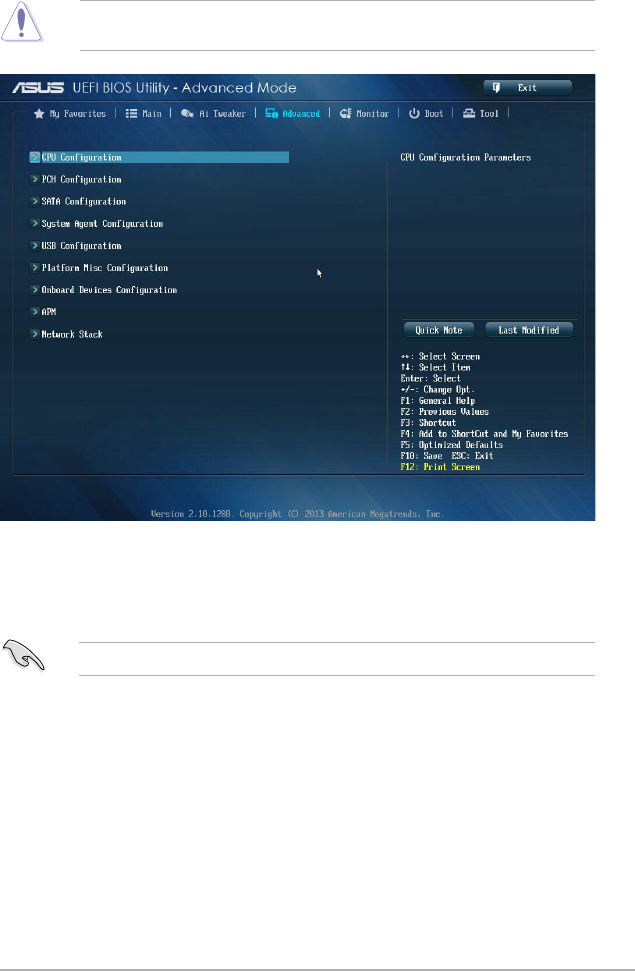
Chapter 2: BIOS information 2-25
2.6 Advanced menu
The Advanced menu items allow you to change the settings for the CPU and other system
devices.
Be cautious when changing the settings of the Advanced menu items. Incorrect eld values
can cause the system to malfunction.
2.6.1 CPU Conguration
The items in this menu show the CPU-related information that the BIOS automatically
detects.
The items shown in submenu may be different due to the CPU you installed.
Intel Adaptive Thermal Monitor [Enabled]
[Enabled] Enables the overheated CPU to throttle its clock speed to cool down.
[Disabled] Disables the CPU thermal monitor function
Hyper-threading [Enabled]
The Intel Hyper-Threading Technology allows a hyper-threading processor to appear as two
logical processors to the operating system, allowing the operating system to schedule two
threads or processes simultaneously.
[Enabled] Two threads per activated core are enabled.
[Disabled] Only one thread per activated core is enabled.

2-26 ASUS Z87-C
Active Processor Cores [All]
Allows you to choose the number of CPU cores to activate in each processor package.
Conguration options: [All] [1] [2] [3]
Limit CPUID Maximum [Disabled]
When set to [Enabled], this item allows the legacy OS to boot even without support for CPUs
with extended CPUID functions.
Conguration options: [Enabled] [Disabled]
Execute Disable Bit [Enabled]
Execute Disable prevents certain classes of malicious buffer overow attacks when combined
with a supporting OS (SuSE Linux 9.2, RedHat Enterprise 3 Update 3).
Conguration options: [Disabled] [Enabled]
Intel Virtualization Technology [Disabled]
When set to [Enabled], a VMM can utilize the additional hardware capabilities provided by
Vanderpool Technology.
Conguration options: [Disabled] [Enabled]
Hardware Prefetcher [Enabled]
Allows you to enable or disable the Mid Level Cache (L2) streamer prefetcher.
Conguration options: [Disabled] [Enabled]
Adjacent Cache Line Prefetch [Enabled]
Allows you to enable or disable the Mid Level Cache (L2) prefetching of adjacent cache lines.
Conguration options: [Disabled] [Enabled]
Boot performance mode [Max Non-Tu...]
Allows you to select the performance state that the BIOS will set before OS handoff.
Conguration options: [Max Non-Turbo Performance] [Max Battery] [Turbo Performance]
Dynamic Storage Accelerator [Disabled]
Allows you to enable or disable Dynamic Storage Accelerator for C state conguration.
Conguration options: [Enabled] [Disabled]
CPU Power Management Conguration
This item allows you to manage and congure the CPU’s power.
Enhanced Intel SpeedStep Technology [Enabled]
Allows your system to adjust the processor’s voltage and cores frequency, resulting in
decreased power consumption and heat production.
[Disabled] The CPU runs at its default speed.
[Enabled] The system controls the CPU speed.

Chapter 2: BIOS information 2-27
Turbo Mode [Enabled]
Allows you to automatically set the processor cores to run faster than the base
frequency when operating below power, current and temperature specication limit.
Conguration options: [Enabled] [Disabled]
CPU C States
Allows you to enable or disable the CPU C states.
Conguration options: [Auto] [Enabled] [Disabled]
The following items appear only when you set the CPU C States to [Enabled].
Enhanced C1 state [Enabled]
Allows your processor to reduce power when the system is in idle mode.
Conguration options: [Enabled] [Disabled]
CPU C3 Report [Enabled]
Allows you to disable or enable the CPU C3 report to the operating system.
Conguration options: [Enabled] [Disabled]
CPU C6 Report [Enabled]
Allows you to disable or enable the CPU C6 report to the operating system.
Conguration options: [Enabled] [Disabled]
C6 Latency [Short]
Allows you to set the duration of C6 latency for C6 state.
Conguration options: [Short] [Long]
CPU C7 Report [CPU C7s]
Allows you to disable or enable the CPU C7 report to the operating system.
Conguration options: [Disabled] [CPU C7] [CPU C7s]
C7 Latency [Long]
Allows you to set the duration of C7 latency for C7 state.
Conguration options: [Short] [Long]
Package C State Support [Auto]
Allows you to set the a C-state according to the following conguration
options: [Auto] [Enabled] [C0/C1] [C2] [C3] [C6] [CPU C7] [CPU C7s]
2.6.2 PCH Conguration
PCI Express Conguration
Allows you to congure the PCI Express slots.
DMI Link ASPM Control [Auto]
Allows you to control the ASPM (Active State Power Management) on both Northbridge
side and Southbridge side of the DMI Link.
Conguration options: [] [Disabled] [Enabled]
ASPM Support [Disabled]
Allows you to set the ASPM level.
Conguration options: [Disabled] [Auto] [L0s] [L1] [L0sL1]

2-28 ASUS Z87-C
PCIe Speed [Auto]
Allows you to select the PCI Express port speed.
Conguration options: [Auto] [Gen1] [Gen2]
Intel(R) Rapid Start Technology [Disabled]
Allows your computer to quickly resume from slow-power hibernate state in seconds. Saving
your system memory to the designated SSD, it provides your computer a faster wake-up
response time, while still keeping the energy use low.
Conguration options: [Enabled] [Disabled]
The following items appear only when you set the Intel® Rapid Start Technology to
[Enabled].
Entry on S3 RTC Wake [Enabled]
The system automatically wakes up and set to Rapid Start Technology S3 mode.
Conguration options: [Enabled] [Disabled
Entry After [0]
Allows you to set the RTC wake-up timer at S3 entry. The time ranges from
0 minute (immediately) to 120 minutes.
Active Page Threshold Support [Enabled]
The system automatically goes into sleep mode when the partition size is not enough
for the Intel® Rapid Start Technology to work.
Conguration options: [Enabled] [Disabled]
Active Memory Threshold [0]
This item supports Intel Rapid Storage Technology when the partition size
is greater than the Active Page Threshold size. When set to zero (0), it will
go to Auto mode and checks if the partition size is enough at S3 entry.
Ensure that the caching partition size is larger than the total memory size.
Hybrid Hard Disk Support [Disabled]
Allows you to enable or disable the hybrid hard disk support.
Conguration options: [Enabled] [Disabled]
Intel(R) Smart Connect Technology
ISCT Support [Disabled]
Allow you to enable or disable the Intel® Smart Connect Technology.
Conguration options: [Enabled] [Disabled]
2.6.3 SATA Conguration
While entering Setup, the BIOS automatically detects the presence of SATA devices. The
SATA Port items show Not Present if no SATA device is installed to the corresponding SATA
port.

Chapter 2: BIOS information 2-29
SATA Mode Selection [AHCI]
Allows you to set the SATA conguration.
[Disabled] Disables the SATA function.
[IDE] Set to [IDE Mode] when you want to use the Serial ATA hard disk drives as
Parallel ATA physical storage devices.
[AHCI] Set to [AHCI Mode] when you want the SATA hard disk drives to use the
AHCI (Advanced Host Controller Interface). The AHCI allows the onboard
storage driver to enable advanced Serial ATA features that increases
storage performance on random workloads by allowing the drive to
internally optimize the order of commands.
[RAID] Set to [RAID Mode] when you want to create a RAID conguration from the
SATA hard disk drives.
Aggressive LPM Support [Auto]
Allows you to enable the PCH to aggressively enter link power state.
Conguration options: [Disabled] [Enabled]
S.M.A.R.T. Status Check [Enabled]
S.M.A.R.T. (Self-Monitoring, Analysis and Reporting Technology) is a monitor system. When
read/write of your hard disk errors occur, this feature allows the hard disk to report warning
messages during the POST.
Conguration options: [Enabled] [Disabled]
Hot Plug [Disabled] (SATA6G_1 - SATA6G_6 [Yellow])
These items appear only when you set the SATA Mode Selection item to [AHCI] or [RAID],
and allow you to enable/disable SATA Hot Plug Support.
Conguration options: [Disabled] [Enabled]
2.6.4 System Agent Conguration
VT-d [Enabled]
Allows you to enable virtualization technology function on memory control hub.
[Enabled] Enables the function.
[Disabled] Disables this function.
CPU Audio Device [Enabled]
Allows you to enable or disable CPU SA Audio devices.
Conguration options: [Enabled] [Disabled]

2-30 ASUS Z87-C
DVI Port Audio
Allows you to enable or disable the DVI audio port.
Conguration options: [Disable] [Enable]
Graphics Conguration
Allows you to select a primary display from iGPU, and PCIe graphical devices.
Primary Display [Auto]
Allows you to select the primary display from iGPU, PCIE and PCI Graphics devices.
Conguration options: [Auto] [iGPU] [PCIE] [PCI]
iGPU Memory [Auto]
Allows you to select the amount of system memory allocated to DVMT 5.0
by the iGPU.
Conguration options: [Auto] [32M] [64M] [96M] [128M] [160M] [192M]
[224M] [256M] [288M] [320M] [352M] [384M] [416M] [448M] [480M] [512M]
[1024M]
Render Standby [Auto]
Allows you to enable the Intel® Graphics Render Standby support to reduce
iGPU power use when the system is idle.
Conguration options: [Auto] [Disabled] [Enabled]
iGPU Multi-Monitor [Disabled]
Allows you to enable the iGPU Multi-Monitor. The iGPU shared system memory size
will be xed at 64MB.
Conguration options: [Disabled] [Enabled]
DMI Conguration
Allows you to control various DMI (Desktop Management Interface) functions.
DMI Gen 2 [Auto]
Allows you to enable or disable DMI Gen 2.
Conguration options: [Auto] [Enabled] [Disabled]
NB PCIe Conguration
Allows you to congure the NB PCI Express settings.
PCIEx16_1/ Link Speed [Auto]
Allows you to congure the PCIEx16 slot’s speed.
Conguration options: [Auto] [Gen1] [Gen2] [Gen3]
DMI Link ASPM Control [Auto]
Allows you to enable or disable the control of Active State Power Management on SA
side of the DMI Link.
Conguration options: [Auto] [Disabled] [L0s] [L1] [L0sL1]
PEG - ASPM [Disabled]
Allows you to control ASPM support for the PEG device.
Conguration options: [Disabled] [Auto] [ASPM L0s] [ASPM L1] [ASPM L0sL1]

Chapter 2: BIOS information 2-31
Memory Conguration
Allows you to congure the memory conguration parameters.
Memory Scrambler [Enabled]
Allows you to enable or disable the Memory Scrambler support.
Conguration options: [Enabled] [Disabled]
Memory Remap [Enabled]
Allows you to enable remapping the memory above 4GB.
Conguration options: [Enabled] [Disabled]
2.6.5 USB Conguration
The items in this menu allow you to change the USB-related features.
The USB Devices item shows the auto-detected values. If no USB device is detected, the
item shows None.
Legacy USB Support [Enabled]
[Enabled] Enables the support for USB devices on legacy operating systems (OS).
[Disabled] The USB devices can be used only for the BIOS setup program. It cannot
be recognized in boot devices list.
[Auto] Allows the system to detect the presence of USB devices at startup. If
detected, the USB controller legacy mode is enabled. If no USB device is
detected, the legacy USB support is disabled.
Intel xHCI Mode [Smart Auto]
[Auto] Keeps the last operation of xHCI controller in OS during bootup.
[Smart Auto] Enables the operation of xHCI controller.
[Enabled] Enables the xHCI controller.
[Disabled] Disables the xHCI controller.
EHCI Hand-off [Disabled]
[Enabled] Enables the support for operating systems without an EHCI hand-off
feature.
[Disabled] Disables the EHCI Hand-off support.
Mass Storage Devices [Auto]
Allows the system to detect the devices according to their media formats.
Conguration options: [Auto] [Floppy] [Forced FDD] [Hard Disk] [CD-ROM]
USB Single Port Control
Allows you to enable or disable the individual USB port.
Refer to section 1.2.3 Motherboard layout for the location of the USB ports.

2-32 ASUS Z87-C
2.6.6 Platform Misc Conguration
The items in this menu allow you to congure the platform-related features.
PCI Express Native Power Management [Disabled]
Allows you to enhance the power saving feature of PCI Express and perform ASPM
operations in the operating system.
Conguration options: [Disabled] [Enabled]
The following item appears only when you set the PCI Express Native Power Management
to [Enabled].
Native ASPM [Disabled]
[Enabled] Vista controls the ASPM support for the device.
[Disabled] BIOS controls the ASPM support for the device.
2.6.7 Onboard Devices Conguration
Scroll down to view the other BIOS items.
HD Audio Controller [Enabled]
[Enabled] Enables the High Denition Audio Controller.
[Disabled] Disables the controller.
The following items appear only when you set the HD Audio Controller to [Enabled].
Front Panel Type [HD]
Allows you to set the front panel audio connector (AAFP) mode to legacy AC’97 or
high-denition audio depending on the audio standard that the front panel audio
module supports.
[HD] Sets the front panel audio connector (AAFP) mode to high denition
audio.
[AC97] Sets the front panel audio connector (AAFP) mode to legacy AC’97
SPDIF Out Type [SPDIF]
[SPDIF] Sets to an SPDIF audio output.
[HDMI] Sets to an HDMI audio output.
PCI Express X16_2 slot (black) bandwidth [Auto]
[Auto] This slot runs at its default mode.
[x2 mode] This slot runs at x2 mode with all the PCIe x1 slots enabled.
[x4 mode] This slot runs at its highest performance with all PCIe x1 slots
disabled.

Chapter 2: BIOS information 2-33
Realtek LAN Controller [Enabled]
[Enabled] Enables the Realtek® LAN controller.
[Disabled] Disables the Realtek® LAN controller.
The following item appears only when you set the Realtek LAN Controller to [Enabled].
Realtek PXE OPROM [Disabled]
Allows you to enable or disable the PXE OptionRom of the Realtek LAN controller.
Conguration options: [Enabled] [Disabled]
Serial Port Conguration
Allows you to set the parameters of the serial ports.
This item only functions only if there is a serial port (COM1) connector connected to the
motherboard.
Serial Port [Enabled]
Allows you to enable or disable the serial port.
Conguration options: [Disabled] [Enabled]
The following item appears only if you set the Serial Port to [Enabled].
Change Settings
Allows you to select an optimal setting for Super I/O device.
2.6.8 APM
ErP Ready [Disabled]
Allows you to switch off some power at S4+S5 or S5 to get the system ready for ErP
requirement. When set to [Enabled], all other PME options will be switched off.
Conguration options: [Disabled] [Enabled (S4+S5] [Enabled (S5)]
Restore AC Power Loss [Power Off]
[Power On] The system goes into ON state after an AC power loss.
[Power Off] The system goes into OFF state after an AC power loss.
[Last State] The system goes into either OFF or ON state, whatever the system state
was before the AC power loss.
Power On By PS/2 Keyboard [Disabled]
Allows you to turn on your computer by using the PS/2 keyboard.
Conguration options: [Disabled] [Enabled]

2-34 ASUS Z87-C
Power On By PCIE/PCI [Disabled]
[Disabled] Disables the PCIE/PCI devices to generate a wake-on-LAN feature of the
Intel®/Realtek LAN device or other installed PCIE LAN devices.
[Enabled] Enables the PCIE/PCI devices to generate a wake-on-LAN feature of the
Intel®/Realtek LAN device or other installed PCIE LAN devices.
Power On By Ring [Disabled]
Allows you to enable or disable the Wake-on-Modem function
Conguration options: [Disabled] [Enabled]
Power On By RTC [Disabled]
[Disabled] Disables RTC to generate a wake event.
[Enabled] When set to [Enabled], the items RTC Alarm Date (Days) and Hour/
Minute/Second will become user-congurable with set values.
2.6.9 Network Stack
Network stack [Disable]
This item allows user to disable or enable the UEFI network stack.
Conguration options: [Disable] [Enable]
The following item appears only when you set the Network Stack to [Enabled].
Ipv4/Ipv6 PXE Support [Enabled]
Allows you to enable or disable the Ipv4/Ipv6 PXE boot option.
Conguration options: [Disabled] [Enabled]
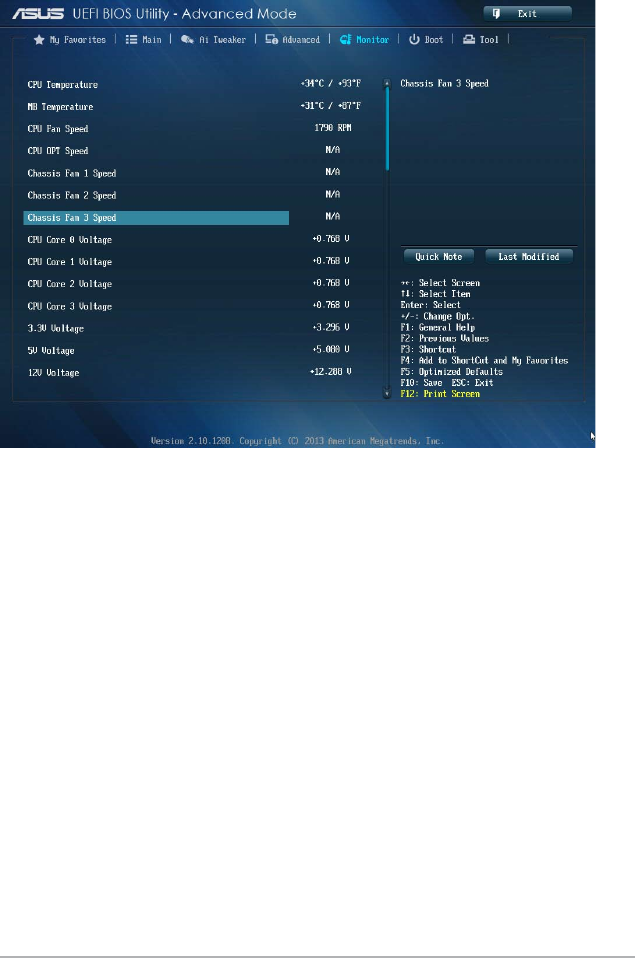
Chapter 2: BIOS information 2-35
2.7 Monitor menu
The Monitor menu displays the system temperature/power status, and allows you to change
the fan settings.
2.7.1 CPU Temperature / MB Temperature [xxxºC/xxxºF]
The onboard hardware monitor automatically detects and displays the CPU and motherboard
temperatures. Select [Ignore] if you do not wish to display the detected temperatures.
2.7.2 CPU Fan Speed [xxxx RPM] or [Ignore] / [N/A], CPU
OPT Speed [xxxx RPM] or [Ignore] / [N/A], Chassis
Fan 1/3 Speed [xxxx RPM] or [Ignore] / [N/A]
The onboard hardware monitor automatically detects and displays the CPU, chassis,
and power fan speed in rotations per minute (RPM). If the fan is not connected to the
motherboard, the eld shows N/A. Select [Ignore] if you do not wish to display the detected
speed.
2.7.3 CPU core 0-3 Voltage, 3.3V Voltage, 5V Voltage, 12V
Voltage
The onboard hardware monitor automatically detects the voltage output through the onboard
voltage regulators. Select [Ignore] if you do not want to detect this item.

2-36 ASUS Z87-C
2.7.4 CPU Q-Fan Control [Enabled]
Allows you to set the CPU Q-Fan operating mode.
Conguration options: [Disabled] [Enabled]
The following items appear only when you set the CPU Q-Fan Control to [Enabled].
CPU Fan Speed Low Limit [600 RPM]
Allows you to set the low limit warning for CPU Fan speed.
Conguration options: [Ignore] [200 RPM] [300 RPM] [400 RPM] [500 RPM] [600 RPM]
CPU Fan Prole [Standard]
Allows you to set the appropriate performance level of the CPU fan.
[Standard] Set to make the CPU fan adjust automatically depending on the CPU
temperature.
[Silent] Set to minimize the fan speed for quiet CPU fan operation.
[Turbo] Set to achieve maximum CPU fan speed.
[Manual] Set to assign the detailed fan speed control parameters.
The following items appear only when you set the CPU Fan Prole to [Manual].
CPU Upper Temperature [70]
Use the <+> or <-> keys to adjust the upper limit of the CPU temperature. The values
range from 20ºC to 75ºC.
CPU Fan Max. Duty Cycle(%) [100]
Use the <+> or <-> keys to adjust the maximum CPU fan duty cycle. The values range
from 20% to 100%. When the CPU temperature reaches the upper limit, the CPU fan
will operate at the maximum duty cycle.
CPU Lower Temperature [20]
Displays the lower limit of the CPU temperature.
CPU Fan Min. Duty Cycle(%) [20]
Use the <+> or <-> keys to adjust the minimum CPU fan duty cycle. The values range
from 0% to 100%. When the CPU temperature is under 40ºC, the CPU fan will operate
at the minimum duty cycle.
2.7.5 Chassis Q-Fan Control 1/3 [Enabled]
[Disabled] Disables the Chassis Q-Fan control feature.
[Enabled] Enables the Chassis Q-Fan control feature.

Chapter 2: BIOS information 2-37
Chassis Fan Speed Low Limit 1/3 [600 RPM]
This item appears only when you enable the Chassis Q-Fan Control feature and allows you
to disable or set the chassis fan warning speed.
Conguration options: [Ignore] [200 RPM] [300 RPM] [400 RPM] [500 RPM] [600 RPM]
Chassis Fan 1/3 Profile [Standard]
This item appears only when you enable the Chassis Q-Fan Control feature. It allows
you to set the appropriate performance level of the chassis fan.
[Standard] Set to make the chassis fan adjust automatically depending on the
chassis temperature.
[Silent] Set to minimize the fan speed for quiet chassis fan operation.
[Turbo] Set to achieve maximum chassis fan speed.
[Manual] Set to assign detailed fan speed control parameters.
The following items appear only when you set the Chassis Fan Prole to [Manual].
Chassis Upper Temperature 1/3 [70]
Use the <+> or <-> keys to adjust the upper limit of the CPU temperature.
The values range from 40ºC to 90ºC.
Chassis Fan Max. Duty Cycle(%) 1/3 [100]
Use the <+> or <-> keys to adjust the maximum chassis fan duty cycle. The
values range from 20% to 100%. When the chassis temperature reaches
the upper limit, the chassis fan will operate at the maximum duty cycle.
Chassis Lower Temperature 1/3 [40]
Displays the lower limit of the chassis temperature.
CPU Fan Min. Duty Cycle(%) 1/3 [60]
Use the <+> or <-> keys to adjust the minimum chassis fan duty cycle. The
values range from 0% to 100%. When the chassis temperature is under
40ºC, the chassis fan will operate at the minimum duty cycle.
2.7.6 Anti Surge Support [Enabled]
This item allows you to enable or disable the Anti Surge function.
Conguration options: [Disabled] [Enabled]
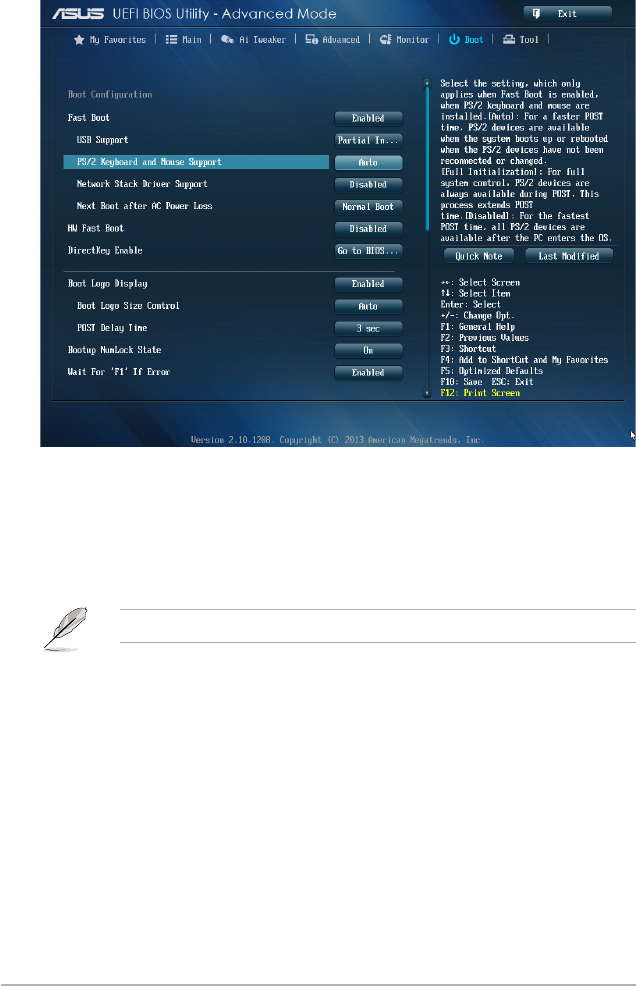
2-38 ASUS Z87-C
2.8 Boot menu
The Boot menu items allow you to change the system boot options.
Boot Conguration
2.8.1 Fast Boot [Disabled]
[Disabled] Allows your system to go back to its normal boot speed.
[Enabled] Allows your system to accelerate the boot speed.
The following items appear only when you set the Fast Boot to [Enabled].
USB Support [Partial In...]
[Disabled] All USB devices will not be available until OS boot up for a fastest
POST time.
[Full Initialization] All USB devices will be available during POST. This process will
extend the POST time.
[Partial
Initialization]
For a faster POST time, only USB ports with keyboard and mouse
connections will be detected.

Chapter 2: BIOS information 2-39
PS/2 Keyboard and Mouse Support [Auto]
Select any of these settings when PS/2 keyboard and mouse are installed. These settings
only apply when Fast Boot is enabled.
[Auto] For a faster POST time, PS/2 devices will only be available when the
system boots up or rebooted when the PS/2 devices have not been
reconnected or changed. If you disconnect or change PS/2 devices
before restarting the system, PS/2 devices will not be available and
BIOS setup program will not be accessible via PS/2 devices.
[Full Initialization] For full system control, PS/2 devices will be available during POST at
any circumstances. This process will extend POST time.
[Disabled] For the fastest POST time, all PS/2 devices will not be available until
your computer enters the operating system.
Network Stack Driver Support [Disabled]
[Disabled] Select to skip the network stack driver from loading during POST.
[Enabled] Select to load the network stack driver during POST.
Next Boot after AC Power Loss [Normal Boot]
[Normal Boot] Returns to normal boot on the next boot after AC power loss.
[Fast Boot] Accelerates the boot speed on the next boot after AC power loss.
2.8.2 HW Fast Boot [Disabled]
Allows the system to enable or disable the HW Fast Boot.
Conguration options: [Disabled] [Enabled]
2.8.3 DirectKey Enable [Go to BIOS...]
[Disabled] Disables the DirectKey button. The system will only power on or off
when you press the DirectKey button.
[Go to BIOS
Setup]
Allows the system to power on and go to the BIOS Setup directly when
you press the DirectKey button.
2.8.4 Boot Logo Display [Enabled]
[Enabled] Enables the full screen boot logo display during POST.
[Disabled] Disables the full screen boot logo display during POST.
The following items appear only when you set the Boot Logo Display to [Enabled].
Boot Logo Size Control [Auto]
[Auto] Automatically adjusts for Windows® requirements.
[Full Screen] Maximizes the boot logo size.

2-40 ASUS Z87-C
Post Delay Time [3 sec]
This item allows you to select a desired additional POST waiting time to easily enter the BIOS
Setup. You can only execute the POST delay time during normal boot. The values range from
0 to 10 seconds.
This feature will only work when set under normal boot.
The following items appear only when you set the Boot Logo Display to [Disabled].
Post Report [5 sec]
This item allows you to select a desired POST report waiting time
Conguration options: [1 sec] - [2 sec] [Until Press ESC]
2.8.5 Bootup NumLock State [On]
[On] Set the power-on state of the NumLock to [On].
[Off] Set the power-on state of the NumLock to [Off].
2.8.6 Wait For ‘F1’ If Error [Enabled]
[Disabled] Disables the function.
[Enabled] The system waits for the <F1> key to be pressed when error occurs.
2.8.7 Option ROM Messages [Force BIOS]
[Force BIOS] The third-party ROM messages will be displayed during the boot sequence.
[Keep Current] The third-party ROM messages will be displayed only if the third-party
manufacturer had set the add-on device to do so.
2.8.8 Interrupt 19 Capture [Disabled]
Allows you to trap Interrupt 19 by the option ROMs.
Conguration options: [Disabled] [Enabled]
2.8.9 Setup Mode [EZ Mode]
[Advanced Mode] Allows you to go to Advanced Mode of the BIOS after POST.
[EZ Mode] Allows you to go to EZ Mode of the BIOS after POST.
2.8.10 CSM (Compatibility Support Module)
Allows you to congure the CSM (Compatibility Support Module) items to fully support the
various VGA, bootable devices and add-on devices for better compatibility.

Chapter 2: BIOS information 2-41
Launch CSM [Auto]
[Auto] The system automatically detects the bootable devices and the add-on
devices.
[Enabled] For better compatibility, enable the CSM to fully support the non-UEFI
driver add-on devices or the Windows® UEFI mode.
[Disabled] Disable the CSM to fully support the non-UEFI driver add-on devices or the
Windows® UEFI mode.
The following items appear only when you set the Launch CSM to [Enabled].
Boot Devices Control [UEFI and Legacy OpROM]
Allows you to select the type of devices that you want to boot.
Conguration options: [UEFI and Legacy OpROM] [Legacy OpROM only] [UEFI only]
Boot from Network Devices [Legacy OpROM first]
Allows you to select the type of network devices that you want to launch.
Conguration options: [Legacy OpROM rst] [UEFI driver rst] [Ignore]
Boot from Storage Devices [Legacy OpROM first]
Allows you to select the type of storage devices that you want to launch.
Conguration options: [Both, Legacy OpROM rst] [Both, UEFI rst] [Legacy OpROM
rst] [UEFI driver rst] [Ignore]
Boot from PCIe/PCI Expansion Devices [Legacy OpROM first]
Allows you to select the type of PCIe/PCI expansion devices that you want to launch.
Conguration options: [Legacy OpROM rst] [UEFI driver rst]
2.8.11 Secure Boot
Allows you to congure the Windows® Secure Boot settings and manage its keys to protect
the system from unauthorized access and malwares during POST.
OS Type [Windows UEFI mode]
[Windows UEFI
Mode]
Allows you to select your installed operating system. Execute the
Microsoft® Secure Boot check. Only select this option when booting on
Windows® UEFI mode or other Microsoft® Secure Boot compliant OS.
[Other OS] Get the optimized function when booting on Windows® non-UEFI
mode, Windows® Vista/ Windows® XP, or other Microsoft® Secure Boot
non compliant OS. Microsoft® Secure Boot only supports Windows®
UEFI mode.
2-42 ASUS Z87-C
The following item appears only when you set the OS Type to [Windows UEFI mode].
Key Management
This item appears only when you set OS Type to [Windows UEFI Mode]. It allows you
to manage the Secure Boot keys.
Install Default Secure Boot keys
Allows you to immediately load the default Security Boot keys, Platform key
(PK), Key-exchange Key (KEK), Signature database (db), and Revoked
Signatures (dbx). When the default Secure boot keys are loaded, the PK
state will change from Unloaded mode to loaded mode.
Clear Secure Boot keys
This item appears only when you load the default Secure Boot keys. This
item allows you to clear all default Secure Boot keys.
Save Secure Boot Keys
Allows you to save the PK (Platform Keys) to a USB storage device.
PK Management
The Platform Key (PK) locks and secures the rmware from any permissible changes.
The system veries the PK before your system enters the OS.
Delete PK
Allows you to delete the PK from your system. Once the PK is deleted, all
the system’s Secure Boot keys will not be active.
Conguration options: [Yes] [No]
Load PK from File
Allows you to load the downloaded PK from a USB storage device.
The PK le must be formatted as a UEFI variable structure with time-based authenticated
variable.
KEK Management
The KEK (Key-exchange Key or Key Enrollment Key) manages the Signature database
(db) and Revoked Signature database (dbx).
Key-exchange Key (KEK) refers to Microsoft® Secure Boot Key-Enrollment Key (KEK).
Delete the KEK
Allows you to delete the KEK from your system.
Conguration options: [Yes] [No]
Load KEK from File
Allows you to load the downloaded KEK from a USB storage device.
Append KEK from File
Allows you to load the additional KEK from a storage device for an
additional db and dbx loaded management.
The KEK le must be formatted as a UEFI variable structure with time-based authenticated
variable.
Chapter 2: BIOS information 2-43
DB Management
The db (Authorized Signature database) lists the signers or images of UEFI
applications, operating system loaders, and UEFI drivers that you can load on the
single computer.
Delete the db
Allows you to delete the db le from your system.
Conguration options: [Yes] [No]
Load db from File
Allows you to load the downloaded db from a USB storage device.
Append db from File
Allows you to load the additional db from a storage device so that more
images can be loaded securely.
The db le must be formatted as a UEFI variable structure with time-based authenticated
variable.
DBX Management
The dbx (Revoked Signature database) lists the forbidden images of db items that are
no longer trusted and cannot be loaded.
Delete the dbx
Allows you to delete the dbx le from your system.
Load dbx from File
Allows you to load the downloaded dbx from a USB storage device.
Conguration options: [Yes] [No]
Append dbx from File
Allows you to load the additional dbx from a storage device so that more
db’s images cannot be loaded.
The dbx le must be formatted as a UEFI variable structure with time-based authenticated
variable.
2.8.12 Boot Option Priorities
These items specify the boot device priority sequence from the available devices. The
number of device items that appears on the screen depends on the number of devices
installed in the system.
• To access Windows® OS in Safe Mode, do any of the following:
• Press <F5> when ASUS Logo appears.
• Press <F8> after POST.
• To select the boot device during system startup, press <F8> when ASUS Logo
appears.
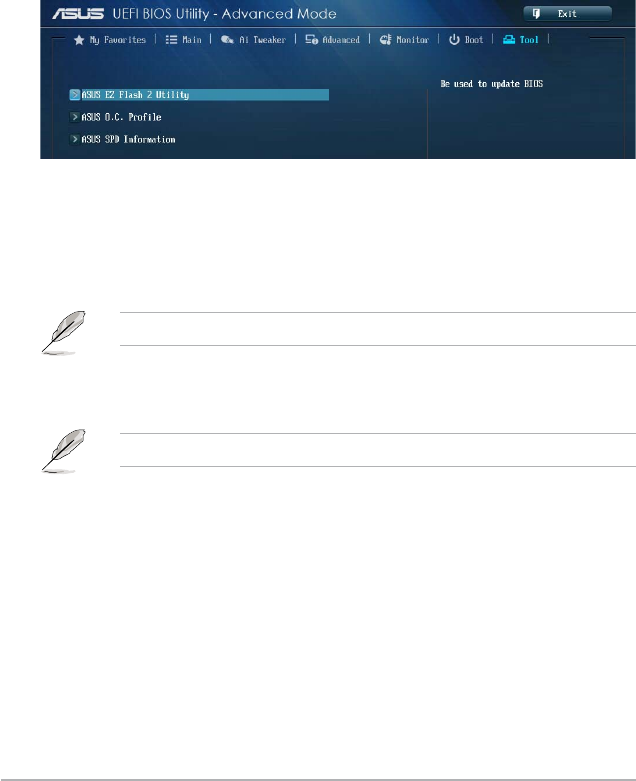
2-44 ASUS Z87-C
2.8.13 Boot Override
These items displays the available devices. The number of device items that appears on
the screen depends on the number of devices installed in the system. Click an item to start
booting from the selected device.
2.9 Tools menu
The Tools menu items allow you to congure options for special functions. Select an item
then press <Enter> to display the submenu.
2.9.1 ASUS EZ Flash 2 Utility
Allows you to run ASUS EZ Flash 2. When you press <Enter>, a conrmation message
appears. Use the left/right arrow key to select between [Yes] or [No], then press <Enter> to
conrm your choice.
For more details, see section 2.1.2 ASUS EZ Flash 2.
2.9.2 ASUS O.C. Prole
This item allows you to store or load multiple BIOS settings.
The Setup Prole Status items show Not Installed if no prole is created.
Label
Allows you to key in a label of the setup prole.
Save to Prole
Allows you to save the current BIOS settings to the BIOS Flash, and create a prole. Key in a
prole number from one to eight, press <Enter>, and then select Yes.

Chapter 2: BIOS information 2-45
Load from Prole
Allows you to load the previous BIOS settings saved in the BIOS Flash. Key in the prole
number that saved your BIOS settings, press <Enter>, and then select Yes.
• DO NOT shut down or reset the system while updating the BIOS to prevent the
system boot failure!
• We recommend that you update the BIOS le only coming from the same memory/
CPU conguration and BIOS version.
2.9.3 ASUS SPD Information
Allows you to view the DRAM SPD information.
DIMM Slot # [Slot 2]
Displays the Serial Presence Detect (SPD) information of the DIMM module installed on the
selected slot.
Conguration options: [Slot 1] [Slot 2] [Slot 3] [Slot 4]
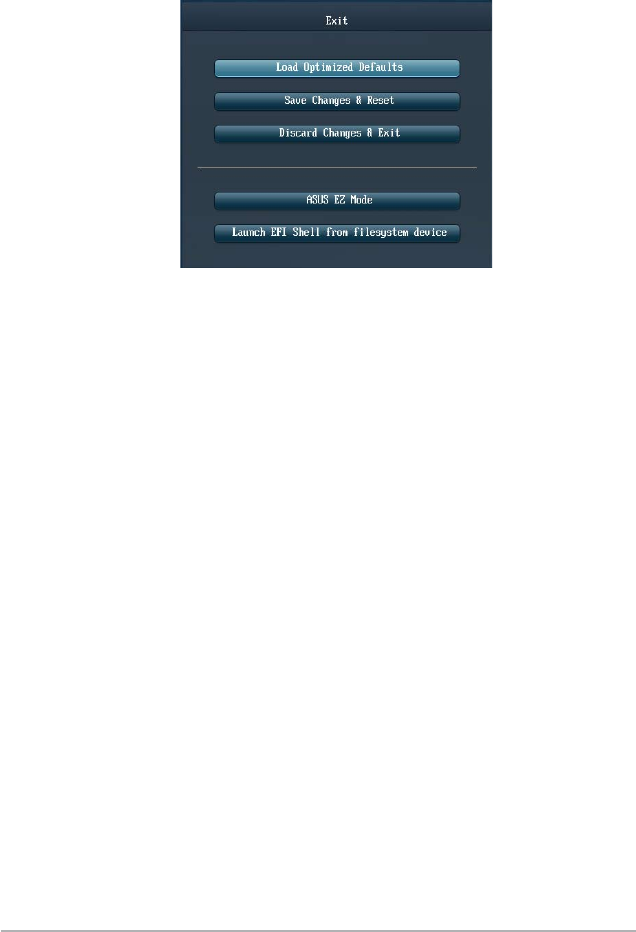
2-46 ASUS Z87-C
2.10 Exit menu
The Exit menu items allow you to load the optimal default values for the BIOS items, and
save or discard your changes to the BIOS items. You can access the EZ Mode from the Exit
menu.
2.10.1 Load Optimized Defaults
This option allows you to load the default values for each of the parameters on the Setup
menus. When you select this option or if you press <F5>, a conrmation window appears.
Select Yes to load the default values.
2.10.2 Save Changes & Reset
Once you are nished making your selections, choose this option from the Exit menu to
ensure the values you selected are saved. When you select this option or if you press <F10>,
a conrmation window appears. Select Yes to save changes and exit.
2.10.3 Discard Changes & Exit
This option allows you to exit the Setup program without saving your changes. When you
select this option or if you press <Esc>, a conrmation window appears. Select Yes to
discard changes and exit.
2.10.4 ASUS EZ Mode
This option allows you to enter the EZ Mode screen.
2.10.5 Launch EFI Shell from lesystem device
This option allows you to attempt to launch the EFI Shell application (shellx64.e) from one of
the available devices that have a lesystem.

Appendices A-1
Appendices
Appendices
Federal Communications Commission Statement
This device complies with Part 15 of the FCC Rules. Operation is subject to the following two
conditions:
This device may not cause harmful interference.
This device must accept any interference received including interference that may cause
undesired operation.
This equipment has been tested and found to comply with the limits for a Class B digital
device, pursuant to Part 15 of the FCC Rules. These limits are designed to provide
reasonable protection against harmful interference in a residential installation. This
equipment generates, uses and can radiate radio frequency energy and, if not installed
and used in accordance with manufacturer’s instructions, may cause harmful interference
to radio communications. However, there is no guarantee that interference will not occur
in a particular installation. If this equipment does cause harmful interference to radio or
television reception, which can be determined by turning the equipment off and on, the user
is encouraged to try to correct the interference by one or more of the following measures:
Reorient or relocate the receiving antenna.
Increase the separation between the equipment and receiver.
Connect the equipment to an outlet on a circuit different from that to which the receiver is
connected.
Consult the dealer or an experienced radio/TV technician for help.
•
•
•
•
•
•
The use of shielded cables for connection of the monitor to the graphics card is required
to assure compliance with FCC regulations. Changes or modications to this unit not
expressly approved by the party responsible for compliance could void the user’s authority
to operate this equipment.
IC: Canadian Compliance Statement
Complies with the Canadian ICES-003 Class B specications. This device complies with RSS
210 of Industry Canada. This Class B device meets all the requirements of the Canadian
interference-causing equipment regulations.
This device complies with Industry Canada license exempt RSS standard(s). Operation is
subject to the following two conditions: (1) this device may not cause interference, and (2)
this device must accept any interference, including interference that may cause undesired
operation of the device.
Cut appareil numérique de la Classe B est conforme à la norme NMB-003 du Canada.
Cet appareil numérique de la Classe B respecte toutes les exigences du Règlement sur le
matériel brouilleur du Canada.
Cet appareil est conforme aux normes CNR exemptes de licence d’Industrie Canada. Le
fonctionnement est soumis aux deux conditions suivantes :
(1) cet appareil ne doit pas provoquer d’interférences et
(2) cet appareil doit accepter toute interférence, y compris celles susceptibles de provoquer
un fonctionnement non souhaité de l’appareil.
Notices
Appendices
A-2 Z87-C
Appendices
VCCI: Japan Compliance Statement
VCCI Class B Statement
KC: Korea Warning Statement
Canadian Department of Communications Statement
This digital apparatus does not exceed the Class B limits for radio noise emissions from
digital apparatus set out in the Radio Interference Regulations of the Canadian Department
of Communications.
This class B digital apparatus complies with Canadian ICES-003.
DO NOT throw the motherboard in municipal waste. This product has been designed to
enable proper reuse of parts and recycling. This symbol of the crossed out wheeled bin
indicates that the product (electrical and electronic equipment) should not be placed in
municipal waste. Check local regulations for disposal of electronic products.
DO NOT throw the mercury-containing button cell battery in municipal waste. This symbol
of the crossed out wheeled bin indicates that the battery should not be placed in municipal
waste.
REACH
Complying with the REACH (Registration, Evaluation, Authorisation, and Restriction of
Chemicals) regulatory framework, we published the chemical substances in our products at
ASUS REACH website at http://csr.asus.com/english/REACH.htm.
ASUS Recycling/Takeback Services
ASUS recycling and takeback programs come from our commitment to the highest standards
for protecting our environment. We believe in providing solutions for you to be able to
responsibly recycle our products, batteries, other components as well as the packaging
materials. Please go to http://csr.asus.com/english/Takeback.htm for detailed recycling

Appendices A-3
Appendices
ASUS contact information
ASUSTeK COMPUTER INC.
Address 15 Li-Te Road, Peitou, Taipei, Taiwan 11259
Telephone +886-2-2894-3447
Fax +886-2-2890-7798
E-mail info@asus.com.tw
Web site www.asus.com.tw
Technical Support
Telephone +86-21-38429911
Online support support.asus.com
ASUS COMPUTER INTERNATIONAL (America)
Address 800 Corporate Way, Fremont, CA 94539, USA
Telephone +1-812-282-3777
Fax +1-510-608-4555
Web site usa.asus.com
Technical Support
Telephone +1-812-282-2787
Support fax +1-812-284-0883
Online support support.asus.com
ASUS COMPUTER GmbH (Germany and Austria)
Address Harkort Str. 21-23, D-40880 Ratingen, Germany
Fax +49-2102-959911
Web site www.asus.de
Online contact www.asus.de/sales
Technical Support
Telephone +49-1805-010923*
Support Fax +49-2102-9599-11
Online support support.asus.com
* EUR 0.14/minute from a German xed landline; EUR 0.42/minute from a mobile phone.
A-4 Z87-C
Appendices
DECLARATION OF CONFORMITY
Per FCC Part 2 Section 2. 1077(a)
Responsible Party Name: Asus Computer International
Address: 800 Corporate Way, Fremont, CA 94539.
Phone/Fax No: (510)739-3777/(510)608-4555
hereby declares that the product
Product Name : Motherboard
Model Number : Z87-C
Conforms to the following specifications:
FCC Part 15, Subpart B, Unintentional Radiators
Supplementary Information:
This device complies with part 15 of the FCC Rules. Operation is subject to
the following two conditions: (1) This device may not cause harmful
interference, and (2) this device must accept any interference received,
including interference that may cause undesired operation.
Representative Person’s Name : Steve Chang / President
Signature :
Date : Apr. 01, 2013
Ver. 120601
EC Declaration of Conformity
We, the undersigned,
Manufacturer: ASUSTeK COMPUTER INC.
Address, City: 4F, No. 150, LI-TE Rd., PEITOU, TAIPEI 112, TAIWAN
Country: TAIWAN
Authorized representative in Europe: ASUS COMPUTER GmbH
Address, City: HARKORT STR. 21-23, 40880 RATINGEN
Country: GERMANY
declare the following apparatus:
Product name : Motherboard
Model name : Z87-C
conform with the essential requirements of the following directives:
2004/108/EC-EMC Directive
EN 55022:2010
EN 61000-3-2:2006+A2:2009
EN 55013:2001+A1:2003+A2:2006
EN 55024:2010
EN 61000-3-3:2008
EN 55020:2007+A11:2011
1999/5/EC-R &TTE Directive
EN 300 328 V1.7.1(2006-10)
EN 300 440-1 V1.6.1(2010-08)
EN 300 440-2 V1.4.1(2010-08)
EN 301 511 V9.0.2(2003-03)
EN 301 908-1 V5.2.1(2011-05)
EN 301 908-2 V5.2.1(2011-07)
EN 301 893 V1.6.1(2011-11)
EN 302 544-2 V1.1.1(2009-01)
EN 302 623 V1.1.1(2009-01)
EN 50360:2001
EN 62479:2010
EN 50385:2002
EN 62311:2008
EN 301 489-1 V1.9.2(2011-09)
EN 301 489-3 V1.4.1(2002-08)
EN 301 489-4 V1.4.1(2009-05)
EN 301 489-7 V1.3.1(2005-11)
EN 301 489-9 V1.4.1(2007-11)
EN 301 489-17 V2.1.1(2009-05)
EN 301 489-24 V1.5.1(2010-09)
EN 302 326-2 V1.2.2(2007-06)
EN 302 326-3 V1.3.1(2007-09)
EN 301 357-2 V1.4.1(2008-11)
EN 302 291-1 V1.1.1(2005-07)
EN 302 291-2 V1.1.1(2005-07)
2006/95/EC-LVD Directive
EN 60950-1 / A12:2011 EN 60065:2002 / A12:2011
2009/125/EC-ErP Directive
Regulation (EC) No. 1275/2008
Regulation (EC) No. 642/2009
Regulation (EC) No. 278/2009
2011/65/EU-RoHS Directive Ver. 130208
CE marking
Declaration Date: 01/04/2013
Year to begin affixing CE marking:2013
Position : CEO
Name : Jerry Shen
Signature : __________
(EC conformity marking)
