Asus Z97 E E9771 Users Manual
2015-03-09
: Asus Asus-Z97-E-E9771-Users-Manual-582707 asus-z97-e-e9771-users-manual-582707 asus pdf
Open the PDF directly: View PDF  .
.
Page Count: 150 [warning: Documents this large are best viewed by clicking the View PDF Link!]
- Safety information
- Chapter 1: Product Introduction
- Chapter 2: Basic installation
- Chapter 3: BIOS setup
- Chapter 4: Software support
- Chapter 5: RAID support
- Appendices

Motherboard
Z97-E

ii
E9771
First Edition v1
Sept. 2014
Copyright© 2014 ASUSTeK COMPUTER INC. All Rights Reserved.
No part of this manual, including the products and software described in it, may be reproduced,
transmitted, transcribed, stored in a retrieval system, or translated into any language in any form or by any
means, except documentation kept by the purchaser for backup purposes, without the express written
permission of ASUSTeK COMPUTER INC. (“ASUS”).
Product warranty or service will not be extended if: (1) the product is repaired, modied or altered, unless
such repair, modication of alteration is authorized in writing by ASUS; or (2) the serial number of the
product is defaced or missing.
ASUS PROVIDES THIS MANUAL “AS IS” WITHOUT WARRANTY OF ANY KIND, EITHER EXPRESS
OR IMPLIED, INCLUDING BUT NOT LIMITED TO THE IMPLIED WARRANTIES OR CONDITIONS OF
MERCHANTABILITY OR FITNESS FOR A PARTICULAR PURPOSE. IN NO EVENT SHALL ASUS, ITS
DIRECTORS, OFFICERS, EMPLOYEES OR AGENTS BE LIABLE FOR ANY INDIRECT, SPECIAL,
INCIDENTAL, OR CONSEQUENTIAL DAMAGES (INCLUDING DAMAGES FOR LOSS OF PROFITS,
LOSS OF BUSINESS, LOSS OF USE OR DATA, INTERRUPTION OF BUSINESS AND THE LIKE),
EVEN IF ASUS HAS BEEN ADVISED OF THE POSSIBILITY OF SUCH DAMAGES ARISING FROM ANY
DEFECT OR ERROR IN THIS MANUAL OR PRODUCT.
SPECIFICATIONS AND INFORMATION CONTAINED IN THIS MANUAL ARE FURNISHED FOR
INFORMATIONAL USE ONLY, AND ARE SUBJECT TO CHANGE AT ANY TIME WITHOUT NOTICE,
AND SHOULD NOT BE CONSTRUED AS A COMMITMENT BY ASUS. ASUS ASSUMES NO
RESPONSIBILITY OR LIABILITY FOR ANY ERRORS OR INACCURACIES THAT MAY APPEAR IN THIS
MANUAL, INCLUDING THE PRODUCTS AND SOFTWARE DESCRIBED IN IT.
Products and corporate names appearing in this manual may or may not be registered trademarks or
copyrights of their respective companies, and are used only for identication or explanation and to the
owners’ benet, without intent to infringe.
Offer to Provide Source Code of Certain Software
This product contains copyrighted software that is licensed under the General Public License (“GPL”),
under the Lesser General Public License Version (“LGPL”) and/or other Free Open Source Software
Licenses. Such software in this product is distributed without any warranty to the extent permitted by the
applicable law. Copies of these licenses are included in this product.
Where the applicable license entitles you to the source code of such software and/or other additional data,
you may obtain it for a period of three years after our last shipment of the product, either
(1) for free by downloading it from http://support.asus.com/download
or
(2) for the cost of reproduction and shipment, which is dependent on the preferred carrier and the location
where you want to have it shipped to, by sending a request to:
ASUSTeK Computer Inc.
Legal Compliance Dept.
15 Li Te Rd.,
Beitou, Taipei 112
Taiwan
In your request please provide the name, model number and version, as stated in the About Box of the
product for which you wish to obtain the corresponding source code and your contact details so that we
can coordinate the terms and cost of shipment with you.
The source code will be distributed WITHOUT ANY WARRANTY and licensed under the same license as
the corresponding binary/object code.
This offer is valid to anyone in receipt of this information.
ASUSTeK is eager to duly provide complete source code as required under various Free Open Source
Software licenses. If however you encounter any problems in obtaining the full corresponding source
code we would be much obliged if you give us a notication to the email address gpl@asus.com, stating
the product and describing the problem (please DO NOT send large attachments such as source code
archives, etc. to this email address).

iii
Contents
Safety information ...................................................................................................... vi
About this guide ........................................................................................................ vii
Z97-E specications summary ................................................................................. ix
Package contents ..................................................................................................... xiii
Installation tools and components ......................................................................... xiv
Chapter 1: Product Introduction
1.1 Special features..........................................................................................1-1
1.1.1 Product highlights........................................................................1-1
1.1.2 5X Protection...............................................................................1-2
1.1.3 ASUS Exclusive Features ........................................................... 1-2
1.2 Motherboard overview ............................................................................... 1-3
1.2.1 Before you proceed ..................................................................... 1-3
1.2.2 Motherboard layout ..................................................................... 1-4
1.2.3 Central Processing Unit (CPU) ................................................... 1-6
1.2.4 System memory .......................................................................... 1-7
1.2.5 Expansion slots ........................................................................... 1-9
1.2.6 Jumpers .................................................................................... 1-11
1.2.7 Onboard LEDs .......................................................................... 1-12
1.2.8 Internal connectors....................................................................1-12
Chapter 2: Basic installation
2.1 Building your PC system...........................................................................2-1
2.1.1 Motherboard installation .............................................................. 2-1
2.1.2 CPU installation...........................................................................2-3
2.1.3 CPU heatsink and fan assembly installation ............................... 2-4
2.1.4 DIMM installation......................................................................... 2-6
2.1.5 ATX Power connection................................................................ 2-7
2.1.6 SATA device connection ............................................................. 2-8
2.1.7 Front I/O Connector .................................................................... 2-9
2.1.8 Expansion Card installation....................................................... 2-10
2.2 Motherboard rear and audio connections ............................................. 2-11
2.2.1 Rear I/O connection .................................................................. 2-11
2.2.2 Audio I/O connections ............................................................... 2-13
2.3 Starting up for the rst time .................................................................... 2-15
2.4 Turning off the computer ........................................................................ 2-15

iv
Chapter 3: BIOS setup
3.1 Knowing BIOS ............................................................................................ 3-1
3.2 BIOS setup program .................................................................................. 3-2
3.2.1 EZ Mode......................................................................................3-3
3.2.2 Advanced Mode .......................................................................... 3-4
3.2.3 QFan Control...............................................................................3-7
3.2.4 EZ Tuning Wizard ....................................................................... 3-9
3.3 My Favorites ............................................................................................. 3-11
3.4 Main menu ................................................................................................ 3-13
3.5 Ai Tweaker menu......................................................................................3-15
3.6 Advanced menu ....................................................................................... 3-30
3.6.1 CPU Conguration .................................................................... 3-31
3.6.2 PCH Conguration .................................................................... 3-33
3.6.3 PCH Storage Conguration....................................................... 3-35
3.6.4 System Agent Conguration ..................................................... 3-37
3.6.5 USB Conguration .................................................................... 3-38
3.6.6 Platform Misc Conguration ...................................................... 3-39
3.6.7 Onboard Devices Conguration ................................................ 3-41
3.6.8 APM Conguration .................................................................... 3-42
3.6.9 Network Stack Conguration..................................................... 3-44
3.7 Monitor menu ........................................................................................... 3-44
3.8 Boot menu ................................................................................................ 3-48
3.9 Tool menu ................................................................................................. 3-54
3.9.1 ASUS EZ Flash 2 Utility ............................................................ 3-54
3.9.2 ASUS Overclocking Prole ....................................................... 3-55
3.9.3 ASUS SPD Information ............................................................. 3-56
3.10 Exit menu .................................................................................................. 3-57
3.11 Updating BIOS .......................................................................................... 3-58
3.11.1 EZ Update ................................................................................. 3-58
3.11.2 ASUS EZ Flash 2 ...................................................................... 3-59
3.11.3 ASUS CrashFree BIOS 3 .......................................................... 3-60
Chapter 4: Software support
4.1 Installing an operating system ................................................................. 4-1
4.2 Support DVD information .......................................................................... 4-1
4.2.1 Running the support DVD ........................................................... 4-1
4.2.2 Obtaining the software manuals.................................................. 4-3
Contents

v
4.3 Software information ................................................................................. 4-4
4.4 AI Suite 3 ..................................................................................................... 4-4
4.4.1 DIGI+ VRM .................................................................................. 4-7
4.4.2 EPU ............................................................................................. 4-8
4.4.3 TurboV EVO ................................................................................ 4-9
4.4.4 USB 3.0 Boost...........................................................................4-11
4.4.5 EZ Update ................................................................................. 4-12
4.4.6 Fan Xpert 3 ............................................................................... 4-13
4.4.7 Push Notice ............................................................................... 4-15
4.4.8 System Information ................................................................... 4-18
4.4.9 Version ...................................................................................... 4-19
4.5 Audio congurations ............................................................................... 4-20
Chapter 5: RAID support
5.1 RAID congurations .................................................................................. 5-1
5.1.1 RAID denitions .......................................................................... 5-1
5.1.2 Installing Serial ATA hard disks .................................................. 5-2
5.1.3 Setting the RAID item in BIOS .................................................... 5-2
5.1.4 Intel® Rapid Storage Technology Option ROM utility .................. 5-3
5.2 Creating a RAID driver disk.......................................................................5-7
5.2.1 Creating a RAID driver disk without entering the OS .................. 5-7
5.2.2 Creating a RAID driver disk in Windows® ................................................................. 5-8
5.2.3 Installing the RAID driver during Windows® OS installation ........ 5-8
Appendices
Notices .................................................................................................................... A-1
ASUS contact information ...................................................................................... A-4
Contents

vi
Safety information
Electrical safety
• To prevent electrical shock hazard, disconnect the power cable from the electrical outlet
before relocating the system.
• When adding or removing devices to or from the system, ensure that the power cables
for the devices are unplugged before the signal cables are connected. If possible,
disconnect all power cables from the existing system before you add a device.
• Before connecting or removing signal cables from the motherboard, ensure that all
power cables are unplugged.
• Seek professional assistance before using an adapter or extension cord. These devices
could interrupt the grounding circuit.
• Ensure that your power supply is set to the correct voltage in your area. If you are not
sure about the voltage of the electrical outlet you are using, contact your local power
company.
• If the power supply is broken, do not try to x it by yourself. Contact a qualied service
technician or your retailer.
Operation safety
• Before installing the motherboard and adding devices on it, carefully read all the manuals
that came with the package.
• Before using the product, ensure all cables are correctly connected and the power
cables are not damaged. If you detect any damage, contact your dealer immediately.
• To avoid short circuits, keep paper clips, screws, and staples away from connectors,
slots, sockets and circuitry.
• Avoid dust, humidity, and temperature extremes. Do not place the product in any area
where it may become wet.
• Place the product on a stable surface.
• If you encounter technical problems with the product, contact a qualied service
technician or your retailer.

vii
About this guide
This user guide contains the information you need when installing and conguring the
motherboard.
How this guide is organized
This guide contains the following parts:
1. Chapter 1: Product introduction
This chapter describes the features of the motherboard and the new technology it
supports. It includes description of the switches, jumpers, and connectors on the
motherboard.
2. Chapter 2: Basic installation
This chapter lists the hardware setup procedures that you have to perform when
installing system components.
3. Chapter 3: BIOS setup
This chapter tells how to change system settings through the BIOS Setup menus.
Detailed descriptions of the BIOS parameters are also provided.
4. Chapter 4: Software support
This chapter describes the contents of the support DVD that comes with the
motherboard package and the software.
5. Chapter 5: RAID support
This chapter describes the RAID congurations.
Where to nd more information
Refer to the following sources for additional information and for product and software
updates.
1. ASUS website
The ASUS website (www.asus.com) provides updated information on ASUS hardware
and software products.
2. Optional documentation
Your product package may include optional documentation, such as warranty yers,
that may have been added by your dealer. These documents are not part of the
standard package.

viii
Conventions used in this guide
To ensure that you perform certain tasks properly, take note of the following symbols used
throughout this manual.
DANGER/WARNING: Information to prevent injury to yourself when trying to
complete a task.
CAUTION: Information to prevent damage to the components when trying to
complete a task
IMPORTANT: Instructions that you MUST follow to complete a task.
NOTE: Tips and additional information to help you complete a task.
Typography
Bold text Indicates a menu or an item to select.
Italics
Used to emphasize a word or a phrase.
<Key> Keys enclosed in the less-than and greater-than sign
means that you must press the enclosed key.
Example: <Enter> means that you must press the Enter or
Return key.
<Key1> + <Key2> + <Key3> If you must press two or more keys simultaneously, the key
names are linked with a plus sign (+).

ix
Z97-E specications summary
CPU
LGA1150 socket for the 4th, New 4th & 5th Generation Intel® Core™ i7 / i5
/ i3, Pentium® and Celeron® processors
Supports 22nm CPU
Supports Intel® Turbo Boost Technology 2.0*
* The Intel® Turbo Boost Technology 2.0 support depends on the CPU types.
Chipset Intel® Z97 Express Chipset
Memory
4 x DIMM, max. 32 GB, DDR3 3200(O.C.)*/3100(O.C.)*/3000(O.C.)*/2933(
O.C.)*/2800(O.C.)*/2666(O.C.)*/2600(O.C.)*/2400(O.C.)*/2250(O.C.)*/220
0(O.C.)*/2133(O.C.)*/2000(O.C.)*/1866(O.C.)*/1600/1333 MHz, non-ECC,
un-buffered memory
Dual channel memory architecture
Supports Intel® Extreme Memory Prole (XMP)
* Hyper DIMM support is subject to the physical characteristics of individual
CPUs. Please refer to Memory QVL (Qualied Vendors List) for details.
** Refer to www.asus.com for the Memory QVL (Qualied Vendors List).
Expansion slots
2 x PCI Express 3.0/2.0 x16 slots (single at x16 mode or dual at x8/x8
mode)
3 x PCI Express 2.0 x1 slots
2 x PCI slots
VGA
Integrated Graphics Processor - Intel® HD Graphics support
Multi-VGA output support: HDMI, DVI, RGB port
- Supports HDMI with max. resolution 4096x2160@24Hz /
2560x1600@60Hz
- Supports DVI with max. resolution 1920 x 1200@60Hz
- Supports RGB with max. resolution 1920 x 1200@60Hz
Supports Intel® InTru™ 3D/Quick Sync Video/Clear Video HD Technology/
Insider™
Supports up to three displays simultaneously
Maximum shared memory 512 MB
Multi-GPU support
Supports NVIDIA® Quad-GPU SLI™ Technology (with 2 PCIe x16 graphics
card)
Supports AMD® Quad-GPU CrossFireX™ Technology (with 2 PCIe x16
graphics card)
Storage
Intel® Z97 Express Chipset with RAID 0, 1, 5, 10 and Intel® Rapid
Storage Technology 13 support
- 1 x SATA Express port (gray, compatible with 2 x SATA 6.0 Gb/s ports)
- 1 x M.2 Socket 3*
- 4 x SATA 6.0 Gb/s ports (gray)
- Supports Intel® Smart Response Technology, Intel® Rapid Start
Technology, Intel® Smart Connect Technology**
* M.2 Socket 3 shares bandwidth with SATA Express, and supports M Key and
type 2242/2260/2280 storage devices.
** These functions will work depending on the CPU installed.
LAN
Gigabit Intel® LAN controller
- 802.3az Energy Efcient Ethernet (EEE) appliance
Intel® I218-V Gigabit LAN
- Dual interconnect between the integrated media Access Controller
(MAC) and physical layer (PHY)
(continued on the next page)

x
(continued on the next page)
Z97-E specications summary
USB
Intel® Z97 Express Chipset - supports ASUS USB 3.0 Boost
- 6 x USB 3.0/2.0 ports (2 ports at mid-board, 4 ports at back panel
[blue])
- 8 x USB 2.0/1.1 ports (6 ports at mid-board, 2 ports at back panel)
Audio
Realtek® ALC892 7.1-channel high denition audio CODEC:
- LED-lit audio shielding: Ensures precision analog/digital separation and
greatly reduced multi-lateral interference, with a gorgeous illuminated
trace path
- Dedicated audio PCB layers: Separate layers for left and right channels
to guard the quality of the sensitive audio signals
- Audio amplier: Provides the highest-quality sound for headphone and
speakers
- Premium Japanese-made audio capacitors: Provide warm, natural and
immersive sound with exceptional clarity and delity
- Unique de-pop circuit: Reduces start-up popping noise to all audio
outputs
- Supports jack-detection, multi-streaming, and front panel jack-retasking
ASUS Exclusive
Features
High Performance
ASUS 5X PROTECTION
- ASUS DIGI+ VRM - 6 Phase digital power design
- ASUS Enhanced DRAM Overcurrent Protection - Short circuit damage
prevention
- ASUS ESD Guards - Enhanced ESD protection
- ASUS High-Quality 5K-Hour Solid Capacitors - 2.5x long lifespan with
excellent durability
- ASUS Stainless Steel Back I/O - 3x more durable corrosion-resistant
coating
UEFI BIOS
- Most advanced options with fast response time
M.2 & SATA Express onboard
- The latest transfer technologies with up to 10Gb/s data-transfer speeds
ASUS Fan Xpert3
- Featuring Fan Auto Tuning function and multiple thermistors selection
for optimized system cooling control
ASUS EPU
- EPU
Interactive HomeCloud
Media Streamer
- Pipe music or movies from your PC to a smart TV
- Media Streamer app for portable smartphone/tablet, supporting iOS 7
and Android 4.0 system
Gaming Scenario
Crystal Sound 2
- Feel the sound power with different usage scenarios
Steam Support
- Compatible with the most fun gaming platform under Windows® system

xi
ASUS Exclusive
Features
ASUS Exclusive Features
- ASUS USB 3.0 Boost featuring speedy USB 3.0 transmission
- ASUS AI Charger
- ASUS GPU Boost
- ASUS AI Suite 3
- Anti Surge
EZ DIY
Push Notice
- Monitor your PC status with smart devices in real time
UEFI BIOS EZ Mode
- Friendly graphics user interface
- ASUS O.C. Tuner
- ASUS CrashFree BIOS 3
- ASUS EZ Flash 2
Q-Design
- ASUS Q-Slot
ASUS Quiet Thermal
Solution
Quiet Thermal Design
- ASUS Fan Xpert 3
- ASUS Stylish Fanless Design: PCH Heat-sink & MOS Heatsink
solution
ASUS Exclusive
Overclocking Features
Precision Tweaker 2
- vCore: Adjustable CPU Core voltage at 0.001V increment
- iGPU: Adjustable CPU Graphics voltage at 0.001V increment
- vCCIO: Adjustable Analog and Digital I/O voltage at 0.001V
increment
- vCCIN: Adjustable CPU Input voltage at 0.01V increment
- vCCSA: Adjustable CPU System Agent voltage at 0.001V
increment
- vDRAM Bus: 124-step Memory voltage control
- vPCH: 154-step Chipset voltage control
SFS (Stepless Frequency Selection)
- BCLK/PCIE frequency tuning from 80MHz up to 300MHz
at 0.1MHz increment
Overclocking Protection
- ASUS C.P.R.(CPU Parameter Recall)
Back Panel I/O Ports
1 x PS/2 keyboard/mouse port
1 x HDMI port
1 x DVI port
1 x VGA port
1 x Intel LAN (RJ45) port
4 x USB 3.0/2.0 ports (blue)
2 x USB 2.0/1.1 ports
7.1-channel Audio I/O ports(6-jacks)
(continued on the next page)
Z97-E specications summary

xii
Internal I/O Connectors
1 x USB 3.0/2.0 connectors support additional 2 USB ports (19-pin)
3 x USB 2.0/1/1 connectors support additional 6 USB ports
1 x SATA Express port (gray, compatible with 2 x SATA 6.0 Gb/s
ports)
1 x M.2 Socket 3 (for M Key, type 2242/2260/2280 devices)
4 x SATA 6.0Gb/s connectors (gray)
1 x CPU Fan connector (4-pin) for both 3-pin(DC mode) and
4-pin(PWM mode) CPU coolers control*
3 x Chassis Fan connectors (4-pin) for both 3-pin(DC mode) and
4-pin(PWM mode) coolers control
1 x Front panel audio connector (AAFP)
1 x S/PDIF out header
1 x TPM connector
1 x COM connector
1 x 24-pin EATX Power connector
1 x 8-pin EATX 12V Power connector
1 x System Panel connector
1 x Clear CMOS header
* The CPU Q-Fan control setting is set as default in Auto mode for
detecting the type of CPU fan installed and switches to the control mode
automatically.
BIOS
64 Mb Flash ROM, UEFI AMI BIOS, PnP, DMI2.7, WfM2.0, SM BIOS
2.8, ACPI 5.0, Multi-language BIOS, ASUS EZ Flash 2, CrashFree
BIOS 3, F6 Qfan Control, F11 EZ Tuning Wizard, F3 My Favorites
& Shortcut, Quick Note, Last Modied log, F12 PrintScreen, and
ASUS DRAM SPD (Serial Presence Detect) memory information
Manageability WfM 2.0, DMI 2.7, WOL by PME, PXE
Support DVD
Drivers
ASUS Utilities
EZ Update
Anti-virus software (OEM version)
Operating system
support
Windows® 8.1 / Windows® 8
Windows® 7
Form factor ATX form factor: 12 in. x 8.6 in. (30.5 cm x 21.8cm)
Z97-E specications summary
Specications are subject to change without notice.
xiii
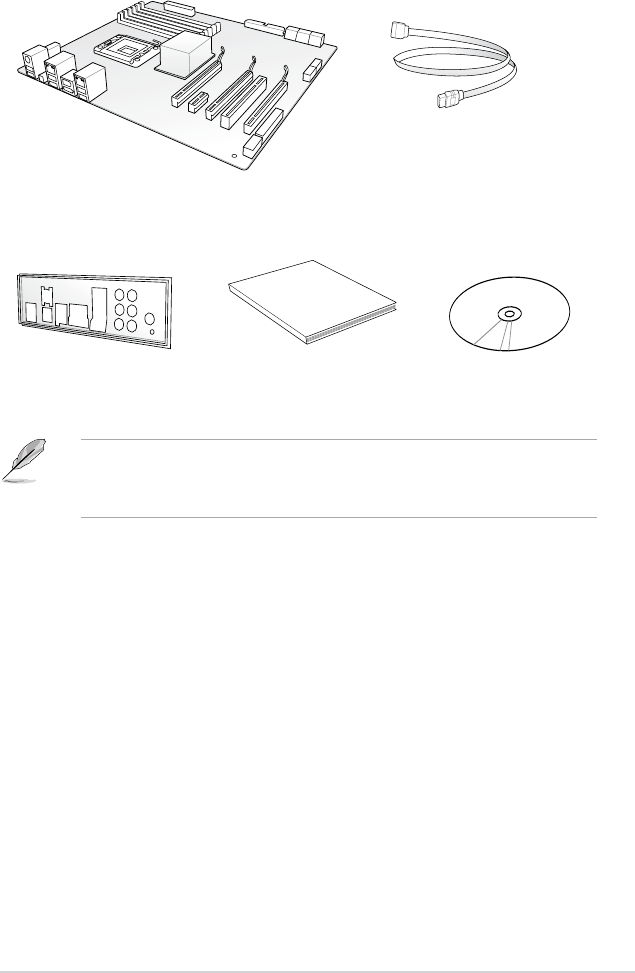
• If any of the above items is damaged or missing, contact your retailer.
• The illustrated items above are for reference only. Actual product specications may
vary with different models.
Package contents
Check your motherboard package for the following items
ASUS Z97-E motherboard
User manual Support DVD
2 x Serial ATA 6 Gb/s cables
1 x ASUS I/O Shield
User Manual
xiv
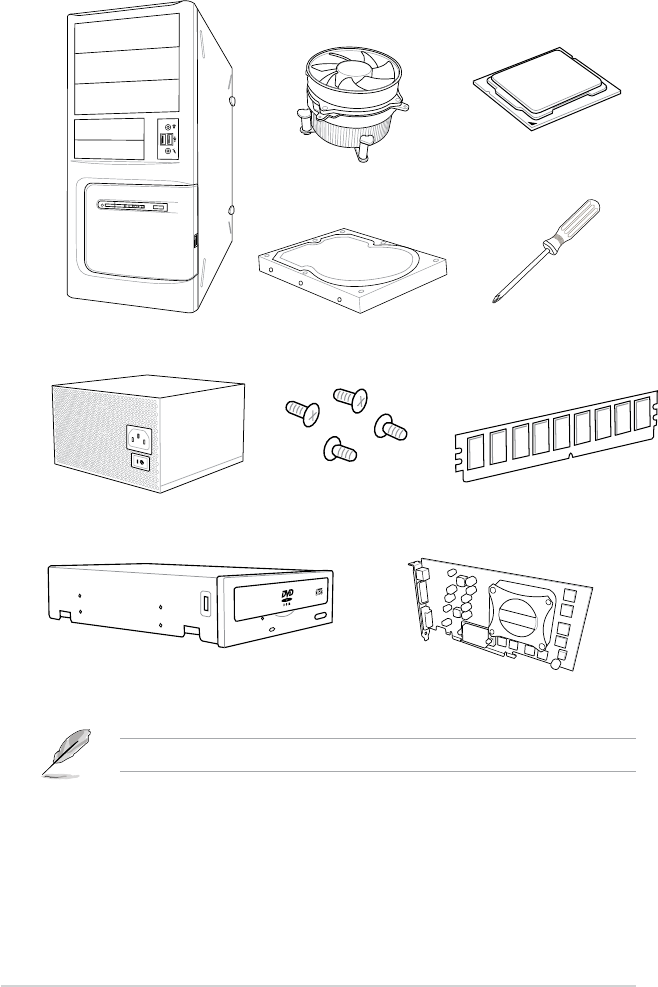
Installation tools and components
The tools and components in the table above are not included in the motherboard package.
PC chassis
Power supply unit
Intel® LGA1150 compatible CPU Fan
Intel® LGA1150 CPU
DIMM
SATA hard disk drive
Graphics card
Philips (cross) screwdriver
SATA optical disc drive (optional)
1 bag of screws

ASUS Z97-E 1-1
Chapter 1
Product introduction
1
1.1 Special features
1.1.1 Product highlights
LGA1150 socket for the 4th, New 4th & 5th Generation Intel® Core™ i7/Intel®
Core™ i5/Intel® Core™ i3, Pentium® and Celeron® processors
This motherboard supports the 4th, New 4th & 5th Generation Intel® Core™ i7/Intel® Core™
i5/Intel® Core™ i3, Pentium®, and Celeron® processors in the LGA1150 package. It provides
great graphics and system performance with its GPU, dual-channel DDR3 memory slots and
PCI Express 2.0/3.0 expansion slots.
Intel® Z97 Express Chipset
Intel® Z97 Express Chipset is a single chipset that supports the LGA1150 socket for the 4th,
New 4th & 5th Generation Intel® Core™ i7/Intel® Core™ i5/Intel® Core™ i3, Pentium®, and
Celeron® processors. It utilizes the serial point-to-point links, which increases bandwidth and
enhances the system’s performance. It natively supports up to six USB 3.0 ports, six SATA
6 Gb/s ports, and M.2 support for faster data retrieval. It also enables the iGPU function for
Intel® integrated graphics performance.
PCI Express® 3.0
PCI Express® 3.0 (PCIe 3.0) is the PCI Express bus standard that provides twice the
performance and speed of PCIe 2.0. It provides an optimal graphics performance,
unprecedented data speed and seamless transition with its complete backward compatibility
to PCIe 1.0/2.0 devices.
Intel® Desktop Responsiveness Technologies
Intel Desktop Responsiveness Technologies comprise of three technologies: Intel Rapid
Start Technology, Intel Smart Response Technology, and Intel Smart Response Technology.
These technologies provide faster and better performance for your computer, allow your
system to receive the freshest updates from the Internet, and quickly resume your system
from a deep sleep or hibernate mode.
Quad-GPU SLI™ and Quad-GPU CrossFireX™ Support
Flexible Multi-GPU Solutions, Your Weapon of Choice!
Z97-E brings you the multi-GPU choice of either SLI™ or CrossFireX™. The motherboard
features the most powerful Intel® Z97 platform that optimizes PCIe allocation in multi-GPU
congurations. Expert a brand-new gaming style you’re never experienced before.
SATA Express support
SATA Express provides faster data transfer speeds of up to 6 Gb/s, allowing your system to
catch up with the speed of the SSDs. It also features backward compatibility with up to two
SATA drives of the same speed.
Chapter 1: Product Introduction

1-2 Chapter 1: Product introduction
Chapter 1
Dual-Channel DDR3 3200(O.C.)*/3100(O.C.)*/3000(O.C.)*/2933(O.C.)*/2800(O.
C.)*/2666(O.C.)*/2600(O.C.)*/2400(O.C.)*/2250(O.C.)*/2200(O.C.)*/2133(O.C.)*/2
000(O.C.)*/1866(O.C.)*/ 1600 / 1333 MHz Support
The motherboard supports the dual-channel DDR3 memory that features data transfer rates
of DDR3 3200(O.C.)*/3100(O.C.)*/3000(O.C.)*/2933(O.C.)*/2800(O.C.)*/2666(O.C.)*/2600(O
.C.)*/2400(O.C.)*/2250(O.C.)*/2200(O.C.)*/2133(O.C.)*/2000(O.C.)*/1866(O.C.)*/ 1600 / 1333
MHz to boost the system’s performance, and to meet the higher bandwidth requirements of
3D graphics, multimedia and Internet applications.
M.2 Support
This motherboard features the M.2 slot, which shares bandwidth with SATA Express to speed
up data transfer up to 10 Gb/s. This helps enhance the performance of your SSD (Solid State
Drive) that is dedicated only to the operating system. The M.2 slot also includes Intel Rapid
Storage Technology support for faster access to data and applications, and quicker wake up
time for your system.
Complete USB 3.0 integration
This motherboard offers you the strategic USB 3.0 accessibility for both the front and rear
panels, allowing you to experience the convenience of the latest plug and play connectivity
solution at speed up to ten times faster than USB 2.0.
1.1.2 5X Protection
5X PROTECTION
ASUS motherboards guard your PC with 5X PROTECTION. We use quality components like
ESD units tested to strict standards that eliminate electrostatic interference, polyswitches
(resettable fuses) around DRAM slots to prevent overcurrent and short-circuit damage, and
a corrosion-resistant back I/O shield. All examples of ASUS providing the best possible
reliability and durability.
1.1.3 ASUS Exclusive Features
Crystal Sound 2
Crystal Sound 2 makes short work of optimizing audio settings for the way you want to listen,
be it gaming, chatting, watching movies or relaxing to your favorite music. Onboard physical
shielding, professional engineered design and premium components, including Japanese-
made audio capacitors and operational ampliers (op-amps), result in sound output that has
exceptional clarity and delity. Discover a whole new dimension of superior audio and get
ready to rule!
ASUS HomeCloud
ASUS HomeCloud creates a world without boundaries. It lets you access your PC remotely,
stream multimedia content to wherever you want, and manage all your stuff from anywhere-
no matter where it’s stored. Use the built-in Wake on WAN feature to remotely wake and
control your PC with a single smart device, anywhere and anytime. It even turns your hard
drive into a private cloud, removing worries about storage limits. With HomeCloud, your PC
becomes the gateway to your world.

ASUS Z97-E 1-3
Chapter 1
• Unplug the power cord from the wall socket before touching any component.
• Before handling components, use a grounded wrist strap or touch a safely grounded
object or a metal object, such as the power supply case, to avoid damaging them due
to static electricity.
• Hold components by the edges to avoid touching the ICs on them.
• Whenever you uninstall any component, place it on a grounded antistatic pad or in the
bag that came with the component.
• Before you install or remove any component, ensure that the ATX power supply is
switched off or the power cord is detached from the power supply. Failure to do so
may cause severe damage to the motherboard, peripherals, or components.
1.2 Motherboard overview
1.2.1 Before you proceed
Take note of the following precautions before you install motherboard components or change
any motherboard settings.
1-4 Chapter 1: Product introduction
Chapter 1
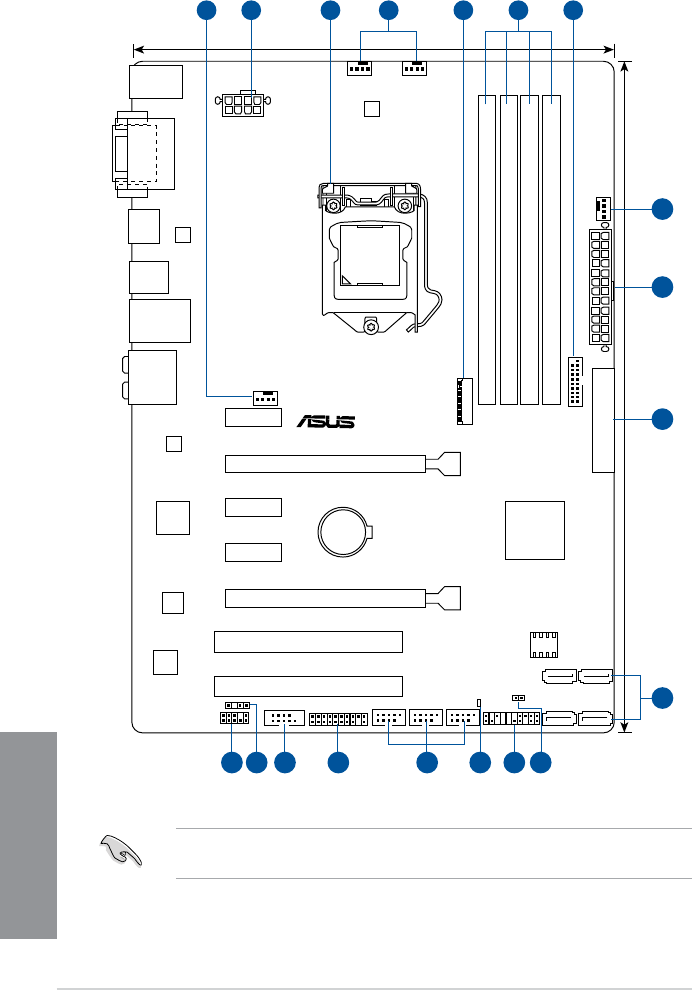
Refer to 1.2.8 Internal connectors and 2.2.1 Rear I/O connection for more information
about rear panel connectors and internal connectors.
1.2.2 Motherboard layout
Z97-E
PCIEX16_1
PCIEX16_2
PCIEX1_2
PCIEX1_1
PCIEX1_3
ASM
1083
PCI1
PCI2
USB910
TPM USB1112 USB1314
AAFP
EATXPWR
CPU_FAN CHA_FAN2
CHA_FAN3
BATTERY
Super
I/O
ALC
892
KBMS_USB78
DVI
VGA
SB_PWR CLRTC
21.8cm(8.6in)
Intel®
Z97
Intel®
I218-V
DDR3 DIMM_A1 (64bit, 240-pin module)
DDR3 DIMM_A2 (64bit, 240-pin module)
DDR3 DIMM_B1 (64bit, 240-pin module)
DDR3 DIMM_B2 (64bit, 240-pin module)
SATA6G_4SATA6G_2
PANEL
SATA6G_3SATA6G_1
AUDIO
LAN_USB3_34
USB3_56
HDMI
CHA_FAN1
SPDIF_OUT
30.5cm(12.0in)
LGA1150
DIGI
+VRM
ASM
1442K
COM
EATX12V
USB3_12
64Mb
BIOS
M.2(SOCKET3)
SATAEXPRESS SATA6G_5
SATA6G_6
2 31 51 4 6
1016 11 91214 1315
2
7
2
1
8

ASUS Z97-E 1-5
Chapter 1
Layout contents
Connectors/SATA Express/Jumpers/Slots Page
1. CPU and chassis fan connectors (4-pin CPU_FAN, 4-pin CHA_FAN1/2/3) 1-19
2. ATX power connectors (24-pin EATXPWR, 8-pin EATX12V) 1-13
3. LGA1150 CPU socket 1-6
4. M.2 socket 3 1-21
5. DDR3 DIMM slots 1-7
6. USB 3.0 connectors (20-1 pin USB3_12) 1-18
7. Intel® Z97 Serial ATA 6.0 Gb/s connectors (SATA6G_56, SATAEXPRESS) 1-15
8. Intel® Z97 Serial ATA 6.0 Gb/s connectors (SATA6G_1/2/3/4) 1-14
9. Clear CMOS header (CLR_CMOS) 1-11
10. System panel connector (20-8 pin PANEL) 1-20
11. Standby power LED (SB_PWR) 1-12
12. USB 2.0 connectors (10-1 pin USB910; USB1112; USB1314) 1-17
13. TPM connector (20-1 pin TPM) 1-12
14. Serial port connector (10-1 pin COM) 1-17
15. Digital audio connector (4-1 pin SPDIF_OUT) 1-16
16. Front panel audio connector (10-1 pin AAFP) 1-16
1-6 Chapter 1: Product introduction
Chapter 1
1.2.3 Central Processing Unit (CPU)
The motherboard comes with a surface mount LGA1150 socket designed for the 4th, New
4th & 5th Generation Intel® Core™ i7 / Intel® Core™ i5 / Intel® Core™ i3, Pentium®, and
Celeron® processors.
• Ensure that all power cables are unplugged before installing the CPU.
• Upon purchase of the motherboard, ensure that the PnP cap is on the socket and
the socket contacts are not bent. Contact your retailer immediately if the PnP cap
is missing, or if you see any damage to the PnP cap/socket contacts/motherboard
components.
• Keep the cap after installing the motherboard. ASUS will process Return Merchandise
Authorization (RMA) requests only if the motherboard comes with the cap on the
LGA1150 socket.
• The product warranty does not cover damage to the socket contacts resulting from
incorrect CPU installation/removal, or misplacement/loss/incorrect removal of the PnP
cap.
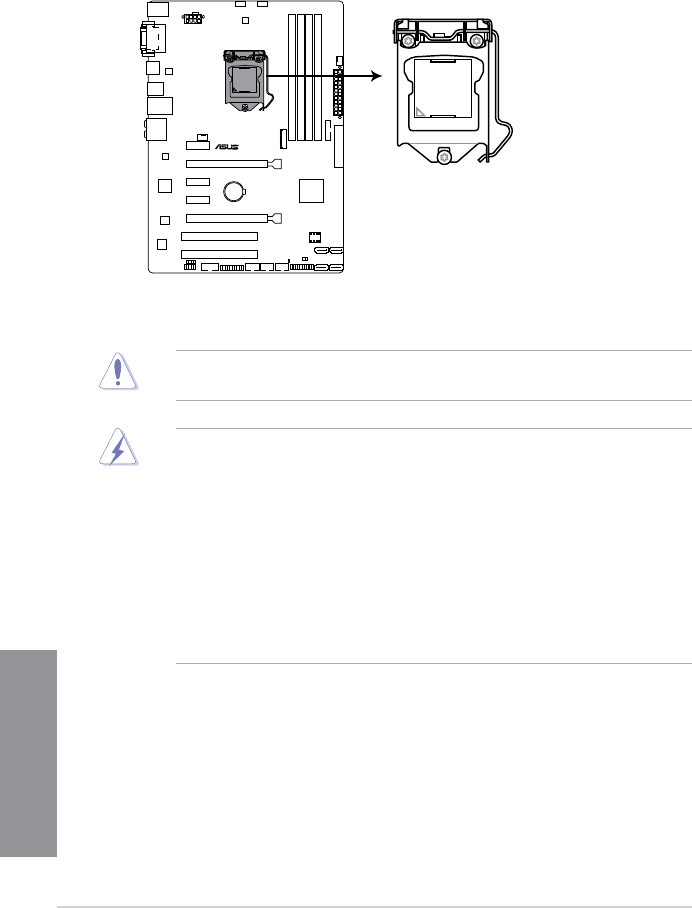
Z97-E
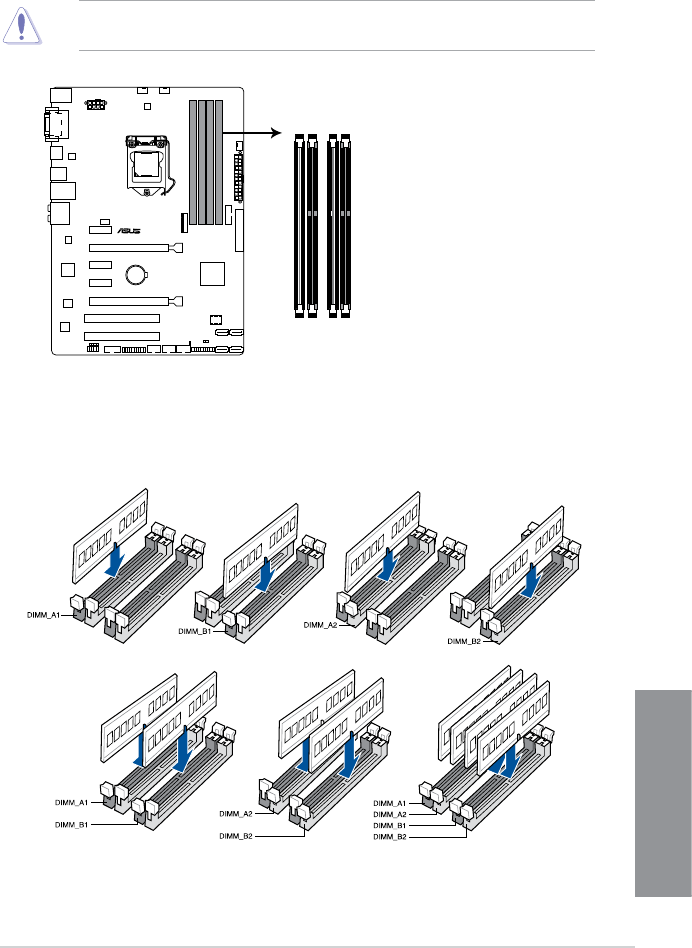
Z97-E CPU socket LGA1150
Ensure that you install the correct CPU designed for LGA1150 socket only. DO NOT install
a CPU designed for LGA155 and LGA1156 sockets on the LGA1150 socket.
ASUS Z97-E 1-7
Chapter 1
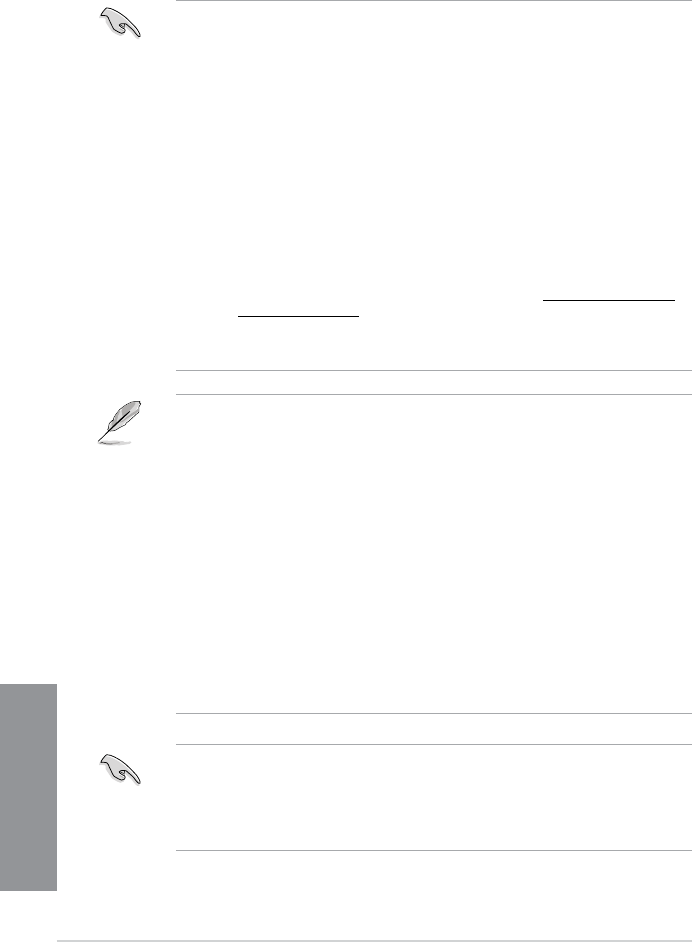
Recommended memory congurations
1.2.4 System memory
The motherboard comes with four DDR 3 (Double Data Rate 3) Dual Inline Memory Modules
(DIMM) slots.
A DDR3 module is notched differently from a DDR or DDR2 module. DO NOT install a DDR
or DDR2 memory module to the DDR3 slot.
Z97-E
Z97-E 240-pin DDR3 DIMM sockets
DIMM_A1
DIMM_A2
DIMM_B1
DIMM_B2
1-8 Chapter 1: Product introduction
Chapter 1
• You may install varying memory sizes in Channel A and Channel B. The system
maps the total size of the lower-sized channel for the dual-channel conguration. Any
excess memory from the higher-sized channel is then mapped for single-channel
operation.
• According to Intel® CPU spec, DIMM voltage below 1.65 V is recommended to protect
the CPU.
• Due to the memory address limitation on 32-bit Windows® OS, when you install 4GB
or more memory on the motherboard, the actual usable memory for the OS can be
about 3GB or less. For effective use of memory, we recommend that you do any of the
following:
a) Use a maximum of 3GB system memory if you are using a 32-bit Windows® OS.
b) Install a 64-bit Windows® OS when you want to install 4 GB or more on the
motherboard.
c) For more details, refer to the Microsoft® support site at http://support.microsoft.
com/kb/929605/en-us.
• This motherboard does not support DIMMs made up of 512 Mb (64 MB) chips or less
(Memory chip capacity counts in Megabit, 8 Megabit/Mb = 1 Megabyte/MB).
• The default memory operation frequency is dependent on its Serial Presence Detect
(SPD), which is the standard way of accessing information from a memory module.
Under the default state, some memory modules for overclocking may operate at a
lower frequency than the vendor-marked value. To operate at the vendor-marked
or at a higher frequency, refer to section 3.5 Ai Tweaker menu for manual memory
frequency adjustment.
• For system stability, use a more efcient memory cooling system to support a full
memory load (4 DIMMs) or overclocking condition.
• Memory modules with memory frequency higher than 2133MHz and their
corresponding timing or the loaded XMP prole is not the JEDEC memory standard.
The stability and compatibility of the memory modules depend on the CPU’s
capabilities and other installed devices.
• Always install the DIMMS with the same CAS Latency. For an optimum compatibility,
we recommend that you install memory modules of the same version or data code
(D/C) from the same vendor. Check with the vendor to get the correct memory
modules.
Memory congurations
You may install 2 GB, 4 GB and 8 GB unbuffered and non-ECC DDR3 DIMMs into the DIMM
sockets.
• ASUS exclusively provides hyper DIMM support function.
• Hyper DIMM support is subject to the physical characteristics of individual CPUs. Load
the X.M.P. or D.O.C.P. settings in the BIOS for the hyper DIMM support.
• Visit the ASUS website for the latest QVL.
ASUS Z97-E 1-9
Chapter 1
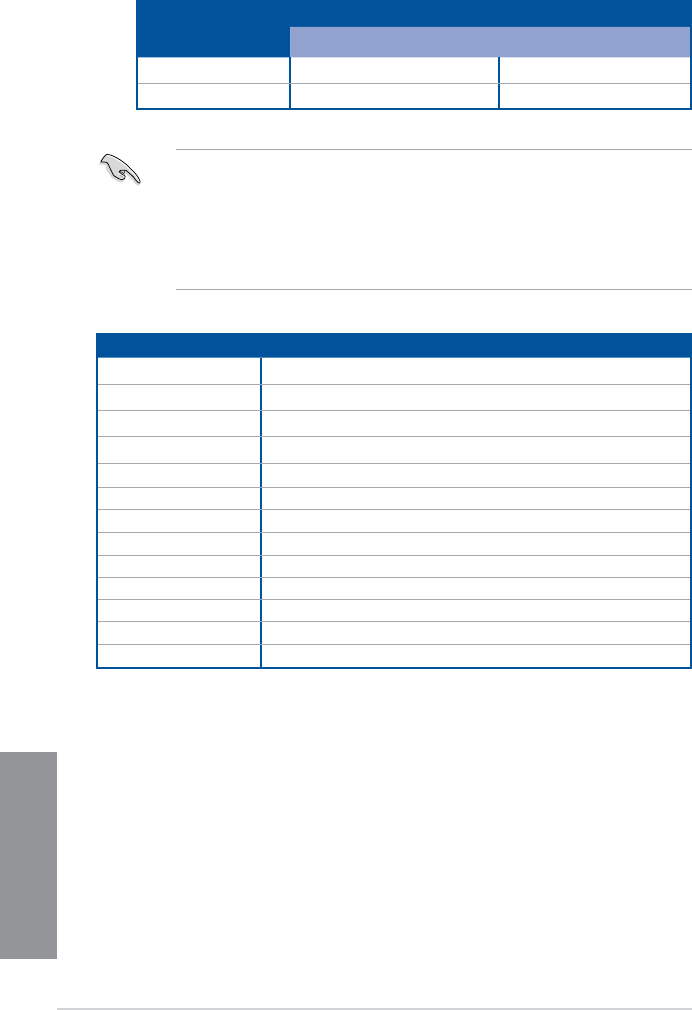
1.2.5 Expansion slots
Unplug the power cord before adding or removing expansion cards. Failure to do so may
cause you physical injury and damage motherboard components.
Slot No. Slot Description
1 PCIe 2.0 x1_1 slot
2 PCIe 3.0/2.0 x16_1 slot
3 PCIe 2.0 x1_2 slot
4 PCIe 2.0 x1_3 slot
5 PCIe 3.0/2.0 x16_2 slot
6 PCI_1 slot
7 PCI_2 slot
Z97-E
PCIEX16_1
PCIEX16_2
PCIEX1_2
PCIEX1_1
PCIEX1_3
PCI1
PCI2
1-10 Chapter 1: Product introduction
Chapter 1
• In single VGA card mode, use the PCIe 3.0/2.0 x16_1 slot (gray) for a PCI Express
x16 graphics card to get better performance.
• We recommend that you provide sufcient power when running SLI™ and
CrossFireX™.
• Connect a chassis fan to the motherboard connector labeled CHA_FAN1/2/3 when
using multiple graphics cards for better thermal environment.
IRQ assignments for this motherboard
A B C D E F G H
PCIEX1_1 shared – – – – – – –
PCIEX1_2 – shared – – – – – –
PCIEX1_3 – – – shared – – – –
PCIe x16_1 shared – – – – – – –
PCIe x16_2 shared – ––––––
PCI1 – – –shared ––––
PCI2 shared –––––––
Intel® SATA Controller ––– shared ––––
Intel® LAN ––––shared –––
Intel® xHCI – – – – – shared – –
Intel® EHCI 1 – – – – – – – shared
Intel® EHCI 2 shared –––––––
HD Audio – – – – – – shared –
VGA conguration
PCI Express 3.0 operating mode
PCIe 3.0/2.0 x16_1 PCIe 3.0/2.0 x16_2
Single VGA/PCIe card x16 (single VGA recommended) x8 (single VGA recommended)
Dual VGA/PCIe card x8 x8
ASUS Z97-E 1-11
Chapter 1
1.2.6 Jumpers
1. Clear RTC RAM (2-pin CLRTC)
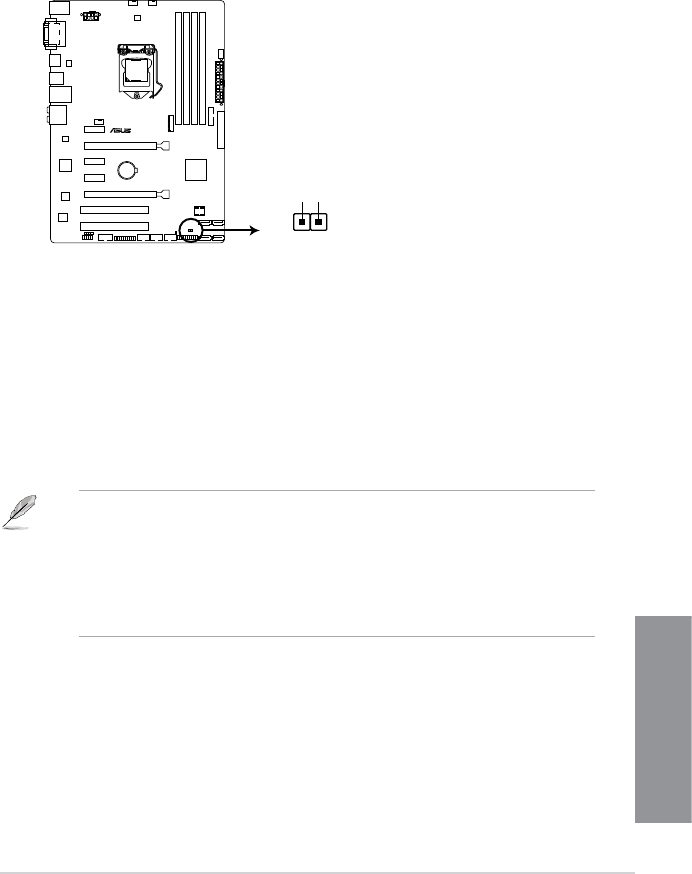
This jumper allows you to clear the Real Time Clock (RTC) RAM in CMOS. You can
clear the CMOS memory of date, time, and system setup parameters by erasing the
CMOS RTC RAM data. The onboard button cell battery powers the RAM data in
CMOS, which include system setup information such as system passwords.
Z97-E
Z97-E Clear RTC RAM
CLRTC
+3V_BAT
GND
PIN 1
To erase the RTC RAM:
1. Turn OFF the computer and unplug the power cord.
2. Use a metal object such as a screwdriver to short the two pins.
3. Plug the power cord and turn ON the computer.
4. Hold down the <Del> key during the boot process and enter BIOS setup to re-
enter data.
• If the steps above do not help, remove the onboard battery and short the two pins
again to clear the CMOS RTC RAM data. After clearing the CMOS, reinstall the
battery.
• You do not need to clear the RTC when the system hangs due to overclocking. For
system failure due to overclocking, use the CPU Parameter Recall (C.P.R.) feature.
Shut down and reboot the system, then the BIOS automatically resets parameter
settings to default values.
1-12 Chapter 1: Product introduction
Chapter 1
1.2.7 Onboard LEDs
1. Standby Power LED
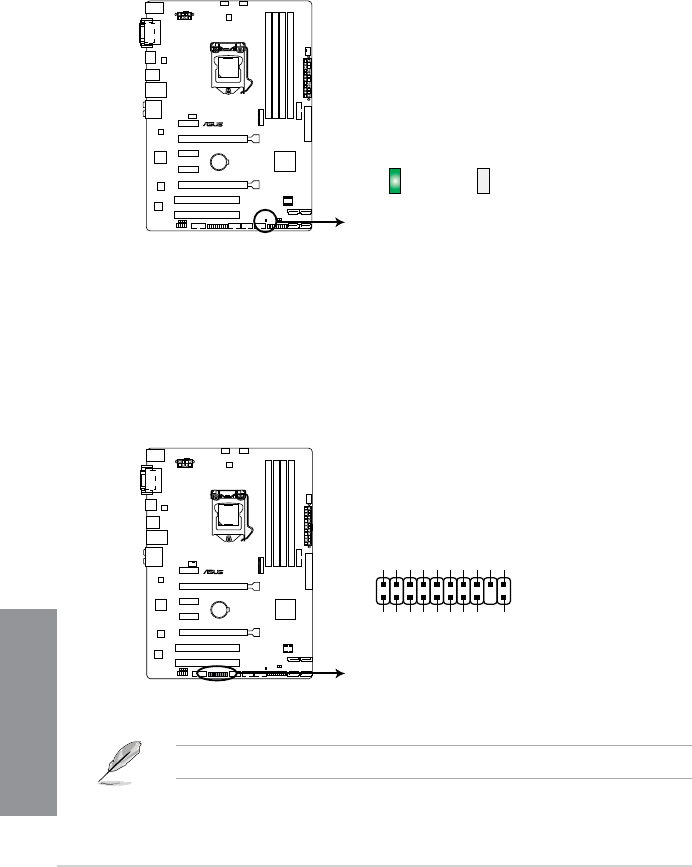
The motherboard comes with a standby power LED that lights up to indicate that the
system is ON, in sleep mode, or in soft-off mode. This is a reminder that you should
shut down the system and unplug the power cable before removing or plugging in any
motherboard component. The illustration below shows the location of the onboard LED.
SB_PWR
ON
Standby Power Powered Off
OFF
Z97-E
Z97-E Standby power LED
1.2.8 Internal connectors
1. TPM connector (20-1 pin TPM)
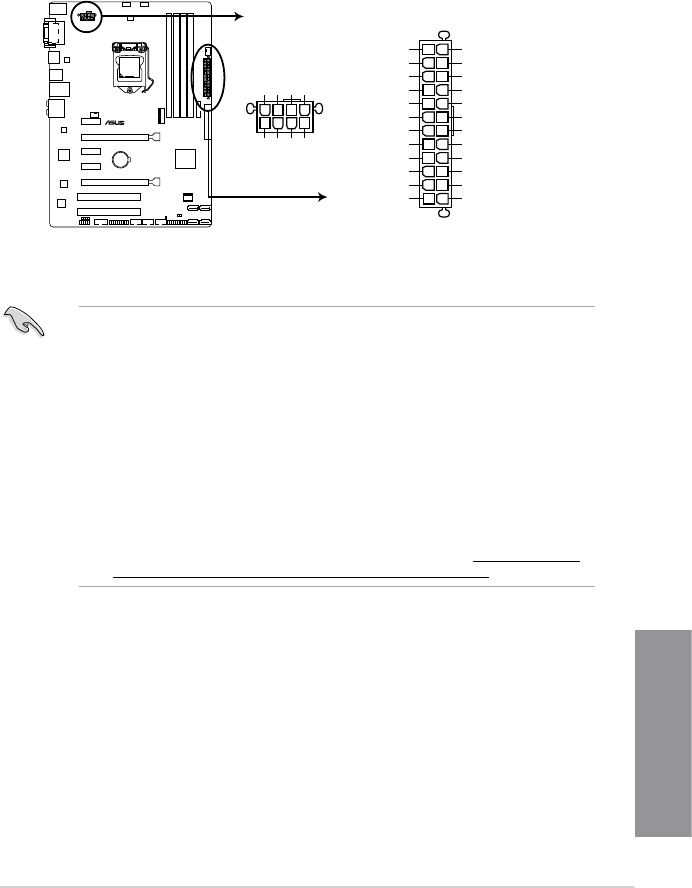
This connector supports a Trusted Platform Module (TPM) system, which securely
store keys, digital certicates, passwords and data. A TPM system also helps enhance
network security, protect digital identities, and ensures platform integrity.
Z97-E
Z97-E
TPM connector
PIN 1
TPM
LPCPD#
GND
+3VSB
NC
LAD0
+3V
LAD3
PCIRST#
LFRAME#
LCLK
NC
CLKRUN#
SERIRQ
NC
GND
LAD1
LAD2
NC
GND
The TPM module is purchased separately.
ASUS Z97-E 1-13
Chapter 1
• For a fully congured system, we recommend that you use a power supply unit
(PSU) that complies with ATX 12 V Specication 2.0 (or later version) and provides a
minimum power of 350 W.
• DO NOT forget to connect the 4-pin/8-pin EATX12 V power plug. Otherwise, the
system will not boot.
• We recommend that you use a PSU with a higher power output when conguring a
system with more power-consuming devices. The system may become unstable or
may not boot up if the power is inadequate.
• If you want to use two or more high-end PCI Express x16 cards, use a PSU with
1000W power or above to ensure the system stability.
• If you are uncertain about the minimum power supply requirement for your system,
refer to the Recommended Power Supply Wattage Calculator at http://support.asus.
com/PowerSupplyCalculator/PSCalculator.aspx?SLanguage=en-us for details.
2. ATX power connectors (24-pin EATXPWR; 8-pin EATX12V)
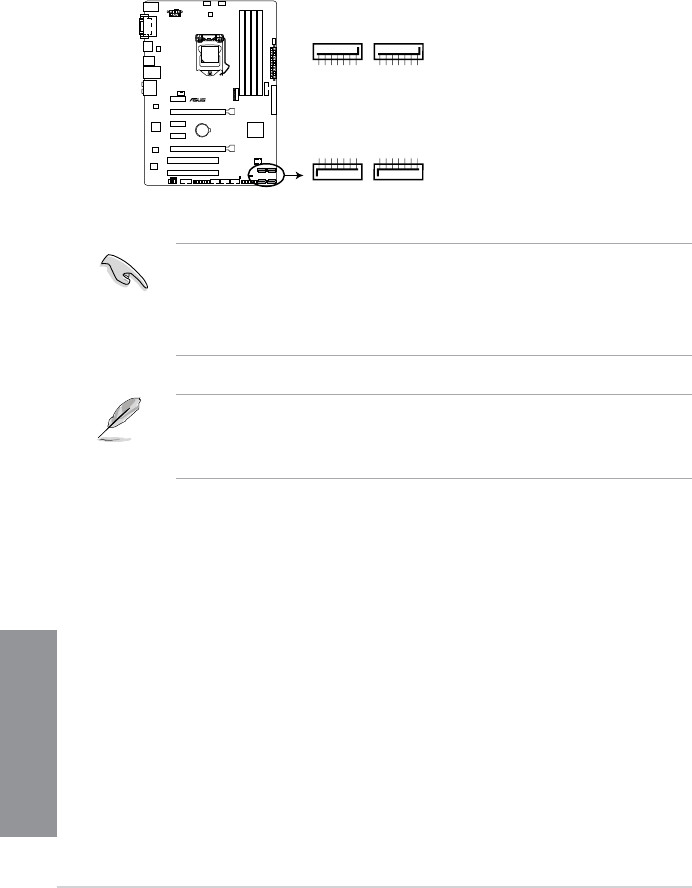
These connectors are for ATX power supply plugs. The power supply plugs are
designed to t these connectors in only one orientation. Find the proper orientation and
push down rmly until the connectors completely t.
Z97-E
Z97-E ATX power connectors
EATXPWR
EATX12V
PIN 1
+12V DC
+12V DC
+12V DC
+12V DC
GND
GND
GND
GND
PIN 1
GND
+5 Volts
+5 Volts
+5 Volts
-5 Volts
GND
GND
GND
PSON#
GND
-12 Volts
+3 Volts
+3 Volts
+12 Volts
+12 Volts
+5V Standby
Power OK
GND
+5 Volts
GND
+5 Volts
GND
+3 Volts
+3 Volts
1-14 Chapter 1: Product introduction
Chapter 1
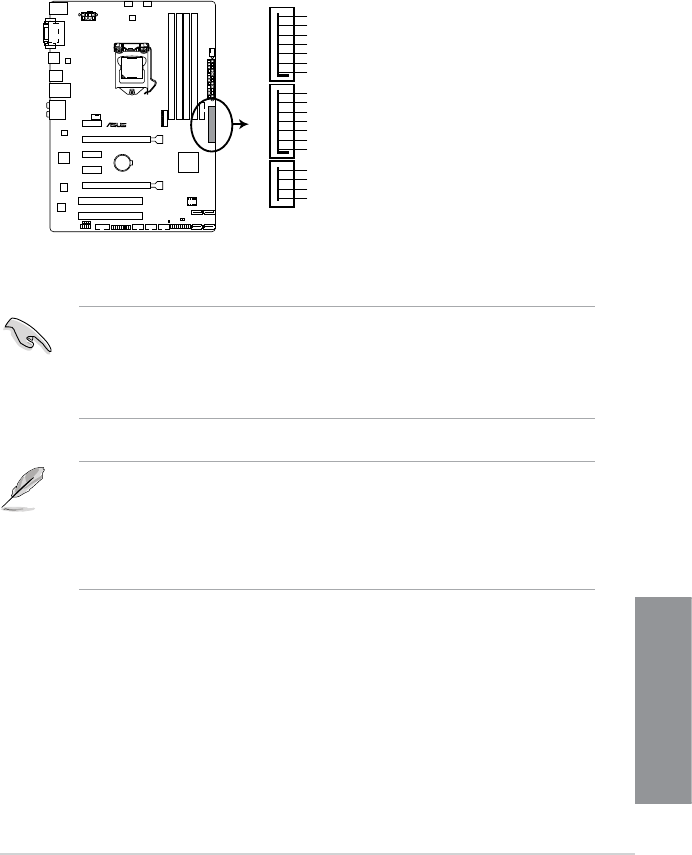
3. Intel® Z97 Serial ATA 6 Gb/s connectors (7-pin SATA6G_1~4 )
These connectors connect to Serial ATA 6 Gb/s hard disk drives via Serial ATA 6 Gb/s
signal cables.
If you installed Serial ATA hard disk drives, you can create a RAID 0, 1, 5, and 10
conguration with the Intel® Rapid Storage Technology through the onboard Intel® Z97
chipset.
• These connectors are set to [AHCI Mode] by default. If you intend to create a Serial
ATA RAID set using these connectors, set the SATA Mode item in the BIOS to [RAID
Mode]. Refer to section 3.6.3 PCH Storage Conguration for details.
• Before creating a RAID set, refer to section 5.1 RAID congurations or the manual
bundled in the motherboard support DVD.
SATA6G_2
GND
RSATA_RXP2
RSATA_RXN2
GND
RSATA_TXN2
RSATA_TXP2
GND
SATA6G_4
GND
RSATA_RXP4
RSATA_RXN4
GND
RSATA_TXN4
RSATA_TXP4
GND
SATA6G_1
GND
RSATA_TXP1
RSATA_TXN1
GND
RSATA_RXN1
RSATA_RXP1
GND
SATA6G_3
GND
RSATA_TXP3
RSATA_TXN3
GND
RSATA_RXN3
RSATA_RXP3
GND
Z97-E
Z97-E Intel® SATA 6 Gb/s connectors
The M.2 Socket 3 and SATAEXPRESS connectors share the same PCIe bandwidth. When
you use both connectors, the system automatically detects the devices connected to these
connectors and set a higher priority to M.2 Socket 3 than SATAEXPRESS interface. Refer
to section 3.6.3 PCH Storage Conguration of this user guide for more details.
ASUS Z97-E 1-15
Chapter 1
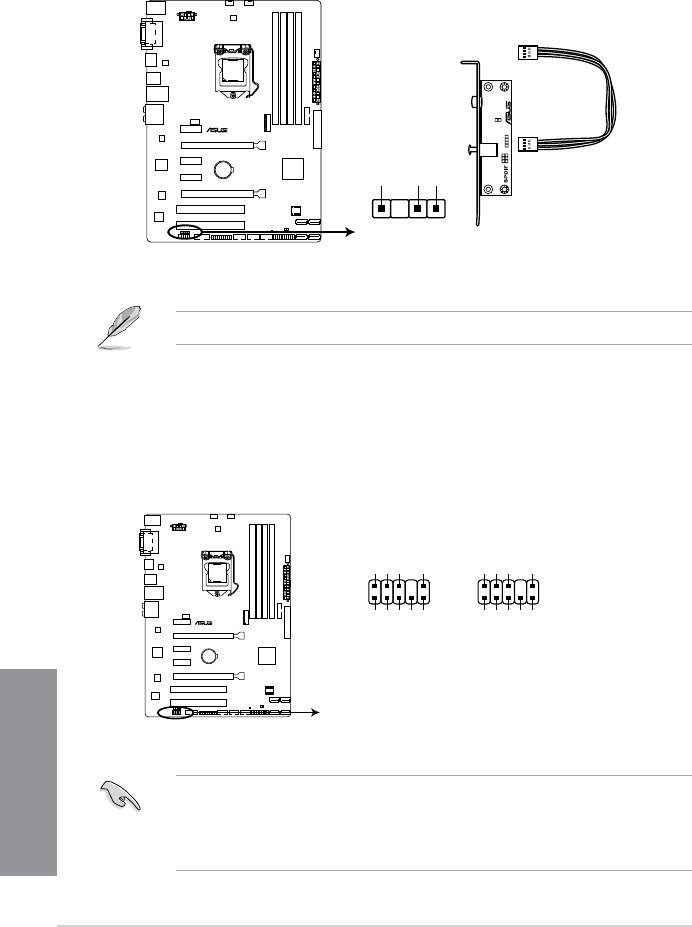
4. Intel® Z97 Serial ATA 6 Gb/s connectors (7-pin SATA6G_56, SATAEXPRESS )
These connectors connect to Serial ATA 6 Gb/s hard disk drives via Serial ATA 6 Gb/s
signal cables.
If you installed Serial ATA hard disk drives, you can create a RAID 0, 1, 5, and 10
conguration with the Intel® Rapid Storage Technology through the onboard Intel® Z97
chipset.
• These connectors are set to [AHCI Mode] by default. If you intend to create a Serial
ATA RAID set using these connectors, set the SATA Mode item in the BIOS to [RAID
Mode]. Refer to section 3.6.3 PCH Storage Conguration for details.
• Before creating a RAID set, refer to section 5.1 RAID congurations or the manual
bundled in the motherboard support DVD.
Z97-E
Z97-E Intel® SATA 6 Gb/s connectors
SATA6G_5
SATAEXPRESS
GND
RSATA_TXP5
RSATA_TXN5
GND
RSATA_RXP5
RSATA_RXN5
GND
GND
RSATA_TXP6
RSATA_TXN6
GND
RSATA_RXP6
RSATA_RXN6
GND
Floating
Device_Reset
GND
Detection
SATA6G_6
• The M.2 Socket 3 and SATA Express slot share the same PCIe bandwidth. When you
use both connectors, the system automatically detects the devices connected to these
connectors and set a higher priority to M.2 Socket 3 than SATA Express slot. Refer to
section 3.6.3 PCH Storage Conguration of this user guide for more details.
• The SATAEXPRESS connector can support one SATA Express device or two SATA
devices.
1-16 Chapter 1: Product introduction
Chapter 1
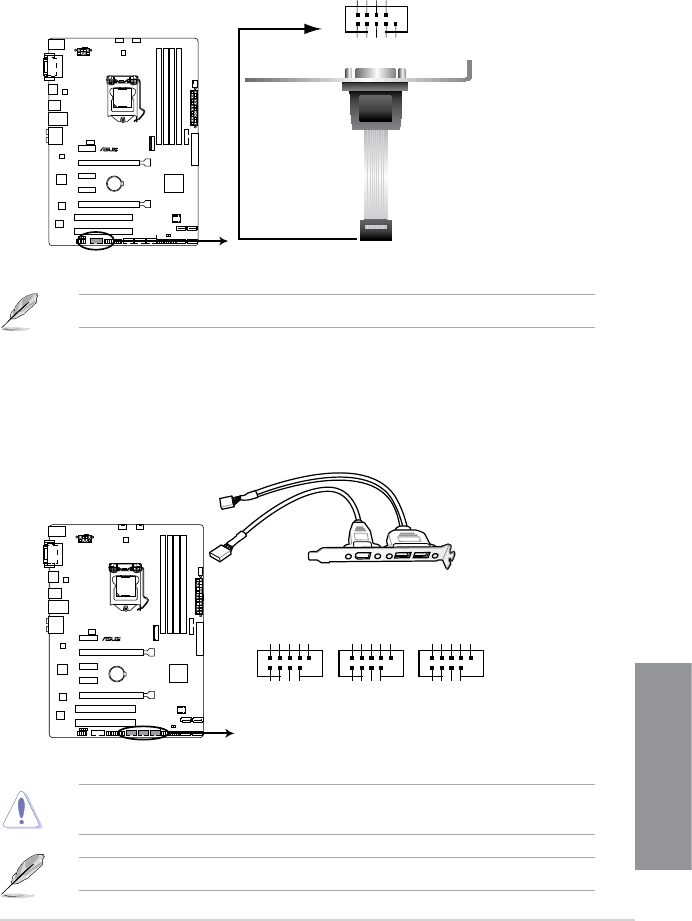
5. Digital audio connector (4-1 pin SPDIF_OUT)
This connector is for an additional Sony/Philips Digital Interface (S/PDIF) port. Connect
the S/PDIF Out module cable to this connector, then install the module to a slot
opening at the back of the system chassis.
The S/PDIF module is purchased separately.
Z97-E
Z97-E
Digital audio connector
SPDIF_OUT
+5V
SPDIFOUT
GND
PIN 1
6. Front panel audio connector (10-1 pin AAFP)
This connector is for a chassis-mounted front panel audio I/O module that supports
either HD Audio or legacy AC`97 audio standard. Connect one end of the front panel
audio I/O module cable to this connector.
• We recommend that you connect a high-denition front panel audio module to this
connector to avail of the motherboard’s high-denition audio capability.
• If you want to connect a high-denition or an AC’97 front panel audio module to this
connector, set the Front Panel Type item in the BIOS setup to [HD] or [AC97].
Z97-E
Z97-E
Front panel audio connector
AAFP
PIN 1
AGND
NC
SENSE1_RETUR
SENSE2_RETUR
PORT1 L
PORT1 R
PORT2 R
SENSE_SEND
PORT2 L
HD-audio-compliant
pin definition
PIN 1
AGND
NC
NC
NC
MIC2
MICPWR
Line out_R
NC
Line out_L
Legacy AC’97
compliant definition
ASUS Z97-E 1-17
Chapter 1
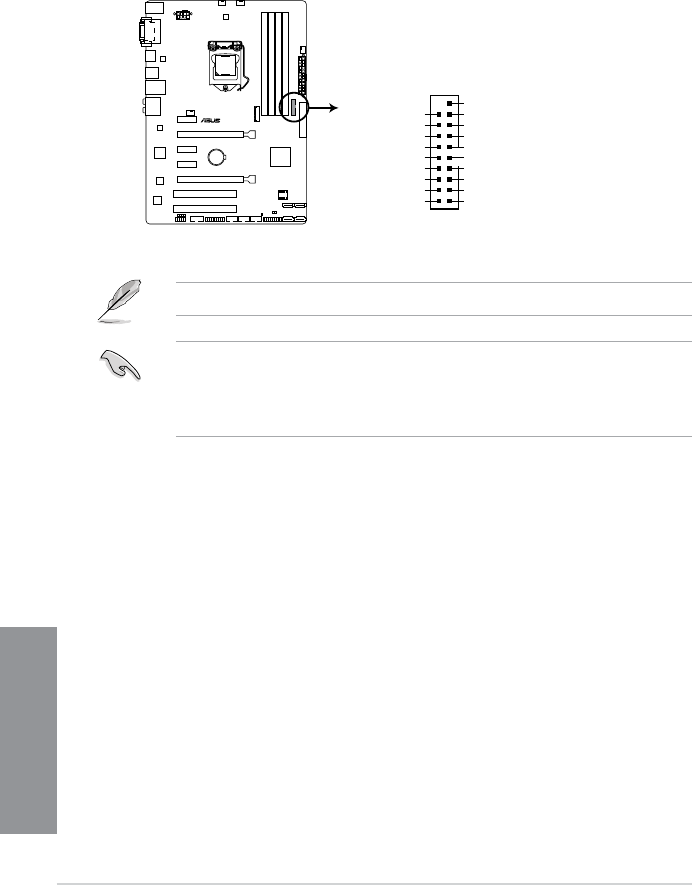
7. Serial port connector (10-1 pin COM)
This connector is for a serial (COM) port. Connect the serial port module cable to this
connector, then install the module to a slot opening at the back of the system chassis.
The COM module is purchased separately.
Z97-E
Z97-E Serial port (COM) connector
PIN 1
COM
DCD
TXD
GND
RTS
RI
RXD
DTR
DSR
CTS
DO NOT connect a 1394 cable to the USB connectors. Doing so will damage the
motherboard!
The USB 2.0 module is purchased separately.
8. USB 2.0 connectors (10-1 pin USB910, USB1112, USB1314)
These connectors are for USB 2.0 ports. Connect the USB module cable to any of
these connectors, then install the module to a slot opening at the back of the system
chassis. These USB connectors comply with USB 2.0 specication that supports up to
48 Mb/s connection speed.
Z97-E
Z97-E USB2.0 connectors
USB+5V
USB_P11-
USB_P11+
GND
NC
USB+5V
USB_P12-
USB_P12+
GND
USB1112
PIN 1
USB+5V
USB_P9-
USB_P9+
GND
NC
USB+5V
USB_P10-
USB_P10+
GND
USB910
PIN 1
USB+5V
USB_P13-
USB_P13+
GND
NC
USB+5V
USB_P14-
USB_P14+
GND
USB1314
PIN 1
1-18 Chapter 1: Product introduction
Chapter 1
9. USB 3.0 connectors (20-1 pin USB3_12)
These connectors allow you to connect a USB 3.0 module for additional USB 3.0 front
or rear panel ports. With an installed USB 3.0 module, you can enjoy all the benets of
USB 3.0 including faster data transfer speeds of up to 5 Gb/s, faster charging time for
USB-chargeable devices, optimized power efciency, and backward compatibility with
USB 2.0.
The USB 3.0 module is purchased separately.
Z97-E
Z97-E USB3.0 Front panel connector
USB3_12
USB3+5V
IntA_P1_SSRX-
IntA_P1_SSRX+
IntA_P1_SSTX-
GND
IntA_P1_SSTX+
GND
IntA_P1_D-
IntA_P1_D+
GND
PIN 1
USB3+5V
IntA_P2_SSRX-
IntA_P2_SSRX+
GND
IntA_P2_SSTX-
IntA_P2_SSTX+
GND
IntA_P2_D-
IntA_P2_D+
• These connectors are based on xHCI specication. We recommend you to install the
related driver to fully use the USB 3.0 ports under Windows® 7.
• The plugged USB 3.0 device may run on xHCI or EHCI mode depending on the
operating system’s setting.
ASUS Z97-E 1-19
Chapter 1
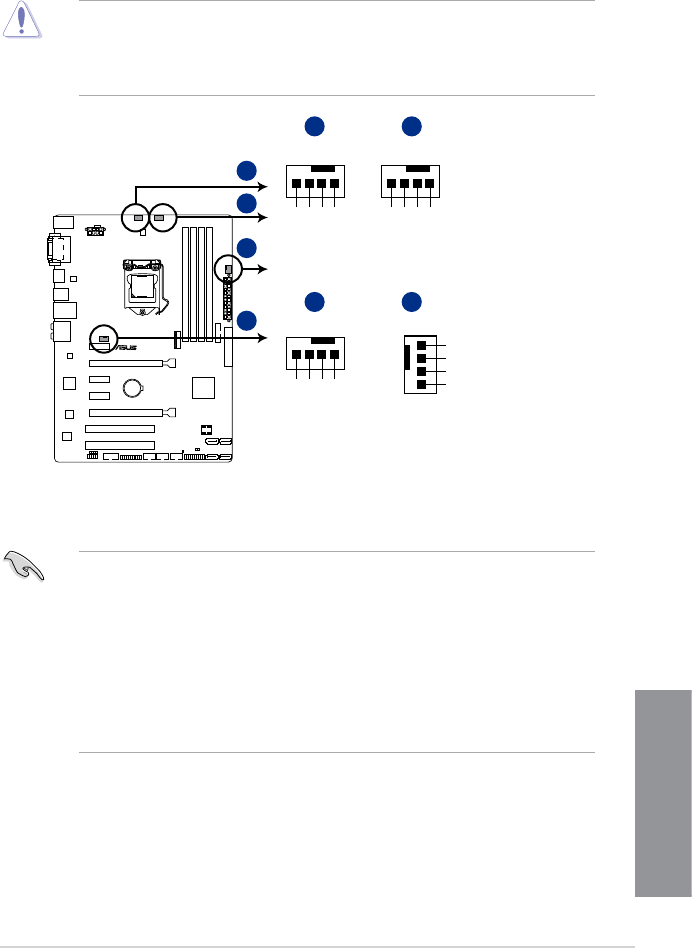
10. CPU and chassis fan connectors (4-pin CPU_FAN; 4-pin CHA_FAN1/2/3)
Connect the fan cables to the fan connectors on the motherboard, ensuring that the
black wire of each cable matches the ground pin of the connector.
• The CPU_FAN connector supports the CPU fan of maximum 1A (12W) fan power.
• The CPU_FAN connector and CHA_FAN connectors support the ASUS FAN Xpert 3
feature.
• The CPU fan connector detects the type of CPU fan installed and automatically
switches the control modes. To congure the CPU fan’s control mode, go to
Advanced Mode > Monitor > CPU Q-Fan Control item in BIOS.
• The chassis fan connectors support DC and PWM modes. To set these fans to DC or
PWM, go to Advanced Mode > Monitor > Chassis Fan 1/2/3 Q-Fan Control items in
BIOS.
• DO NOT forget to connect the fan cables to the fan connectors. Insufcient air ow
inside the system may damage the motherboard components. These are not jumpers!
Do not place jumper caps on the fan connectors!
• Ensure that the CPU fan cable is securely installed to the CPU fan connector.
CHA_FAN2
CHA FAN PWM
CHA FAN IN
CHA FAN PWR
GND
CPU_FAN
CPU FAN PWM
CPU FAN IN
CPU FAN PWR
GND
CHA_FAN1
CHA FAN PWM
CHA FAN IN
CHA FAN PWR
GND
CHA_FAN3
GND
CHA FAN PWR
CHA FAN IN
CHA FAN PWM
Z97-E
Z97-E Fan connectors
A
A B
D C
B
C
D
1-20 Chapter 1: Product introduction
Chapter 1
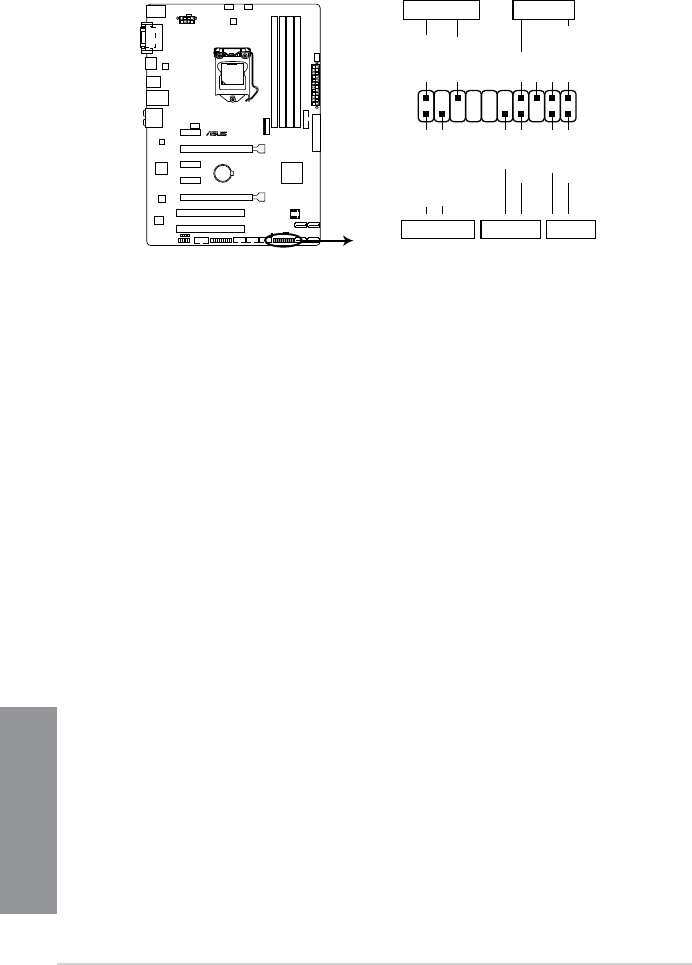
• System power LED (2-pin +PWR_LED-)
This 2-pin connector is for the system power LED. Connect the chassis power LED
cable to this connector. The system power LED lights up when you turn on the system
power, and blinks when the system is in sleep mode.
• Hard disk drive activity LED (2-pin +HDD_LED-)
This 2-pin connector is for the HDD Activity LED. Connect the HDD Activity LED cable
to this connector. The HDD LED lights up or ashes when data is read from or written
to the HDD.
• System warning speaker (4-pin SPEAKER)
This 4-pin connector is for the chassis-mounted system warning speaker. The speaker
allows you to hear system beeps and warnings.
• ATX power button/soft-off button (2-pin PWR_SW)
This connector is for the system power button. Pressing the power button turns the
system on or puts the system in sleep or soft-off mode depending on the operating
system settings. Pressing the power switch for more than four seconds while the
system is ON turns the system OFF.
• Reset button (2-pin RESET)
This 2-pin connector is for the chassis-mounted reset button for system reboot without
turning off the system power.
11. System panel connector (20-8 pin PANEL)
This connector supports several chassis-mounted functions.
Z97-E
Z97-E System panel connector
PIN 1
+PWR_LED- SPEAKER
PLED+
PLED-
+5V
Ground
Ground
Speaker
HDD_LED+
HDD_LED-
PWR
Ground
Reset
Ground
PANEL
+HDD_LED- PWR_SW RESET
ASUS Z97-E 1-21
Chapter 1
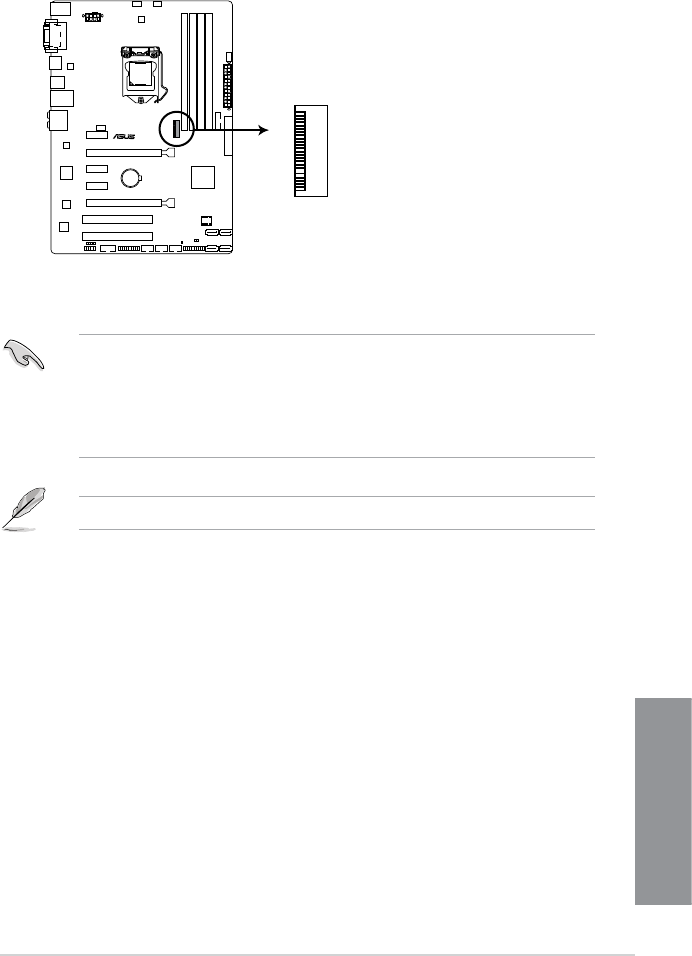
12. M.2 Socket 3
This socket allows you to install an M.2 (NGFF) SSD module.
• This socket supports M Key and type 2242/2260/2280 storage devices.
• The M.2 Socket 3 shares bandwidth with SATA Express slot. Refer to section 3.6.3
PCH Storage Conguration of this user guide for more details.
• When using Intel® Desktop Responsiveness technologies with PCIe M.2 device,
ensure to set up the Windows® UEFI operating system under RAID mode.
Z97-E
SCOKET3
Z97-E M.2 socket
The M.2 (NGFF) SSD module is purchased separately.

1-22 Chapter 1: Product introduction
Chapter 1
ASUS Z97-E 2-1
Chapter 2
Basic installation
2
2.1 Building your PC system
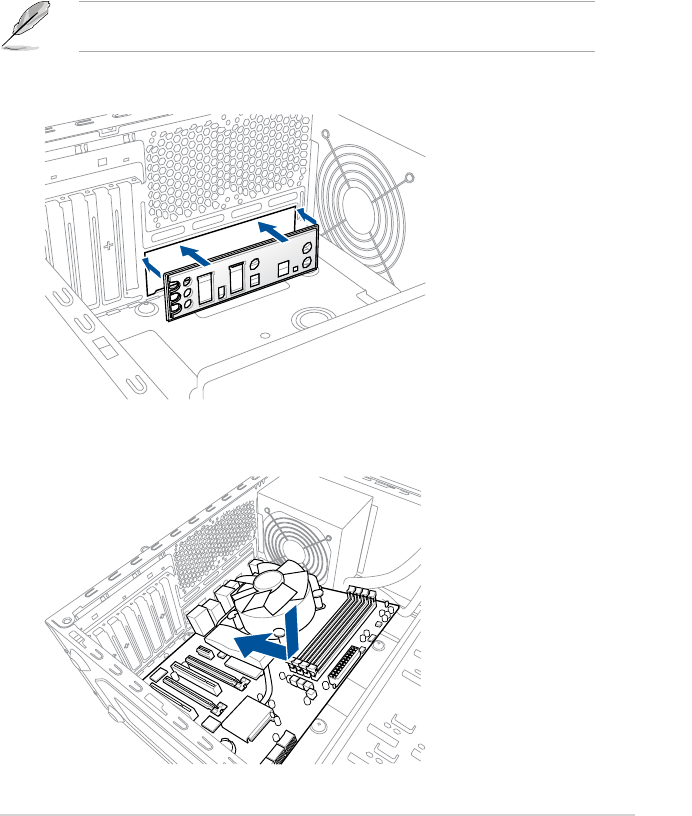
2.1.1 Motherboard installation
The diagrams in this section are for reference only. The motherboard layout may vary with
models, but the installation steps are the same for all models.
1. Install the ASUS I/O-Shield to the chassis rear I/O panel.
Chapter 2: Basic installation
2. Place the motherboard into the chassis, ensuring that its rear I/O ports are aligned to
the chassis’ rear I/O panel.
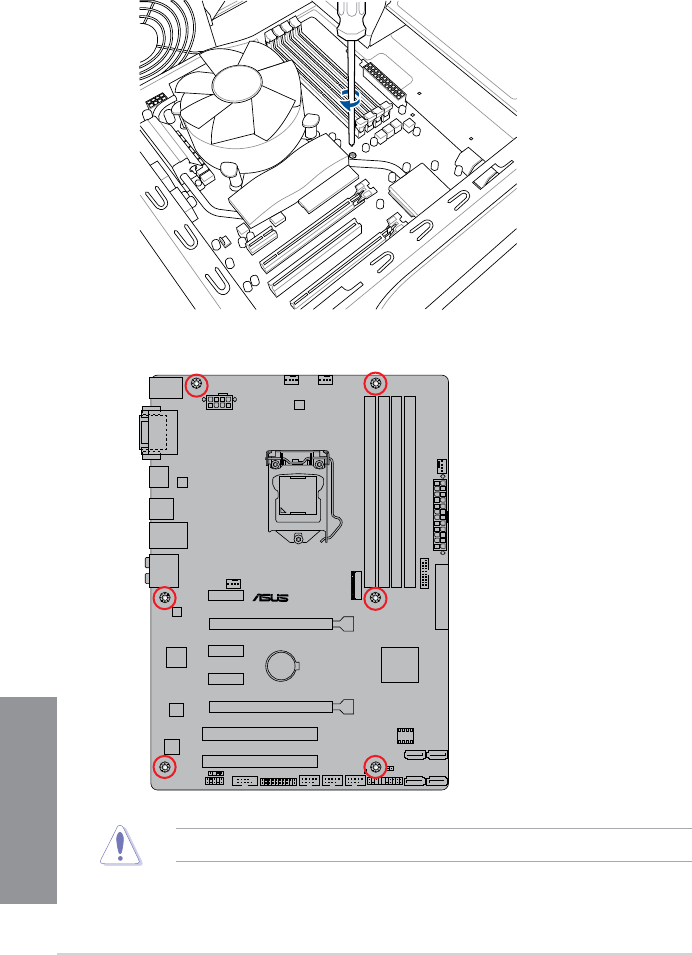
2-2 Chapter 2: Basic installation
Chapter 2
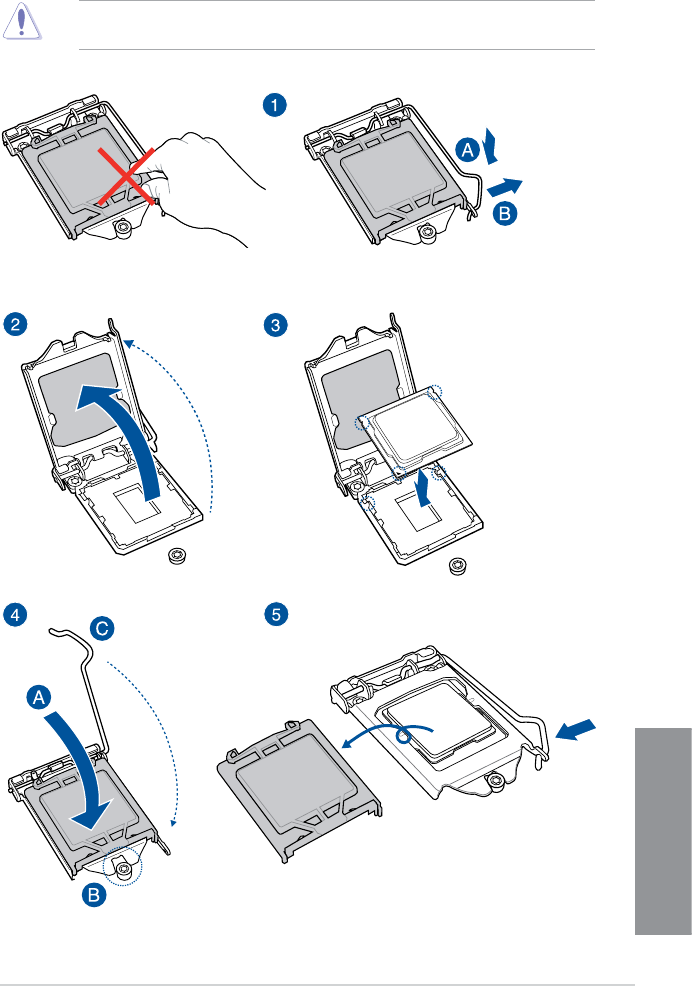
3. Place six screws into the holes indicated by circles to secure the motherboard to the
chassis.
DO NOT overtighten the screws! Doing so can damage the motherboard.
Z97-E
ASUS Z97-E 2-3
Chapter 2
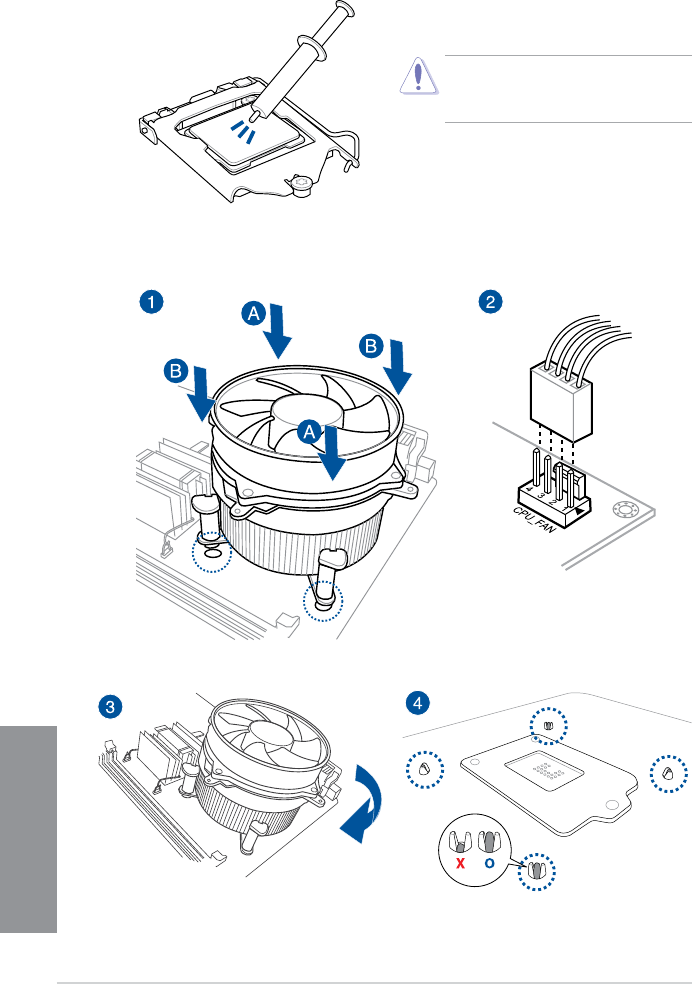
2.1.2 CPU installation
Ensure that you install the correct CPU designed for LGA1150 socket only. DO NOT install
a CPU designed for LGA1155 and LGA1156 sockets on the LGA1150 socket.
2-4 Chapter 2: Basic installation
Chapter 2
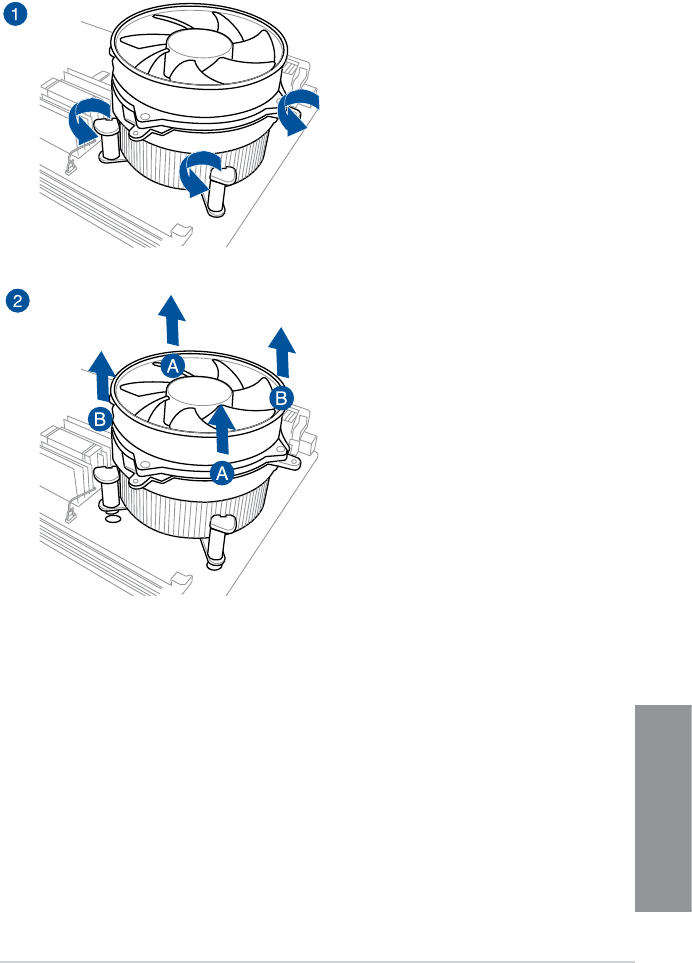
2.1.3 CPU heatsink and fan assembly installation
Apply the Thermal Interface Material to the
CPU heatsink and CPU before you install
the heatsink and fan, if necessary.
To install the CPU heatsink and fan assembly
ASUS Z97-E 2-5
Chapter 2
To uninstall the CPU heatsink and fan assembly
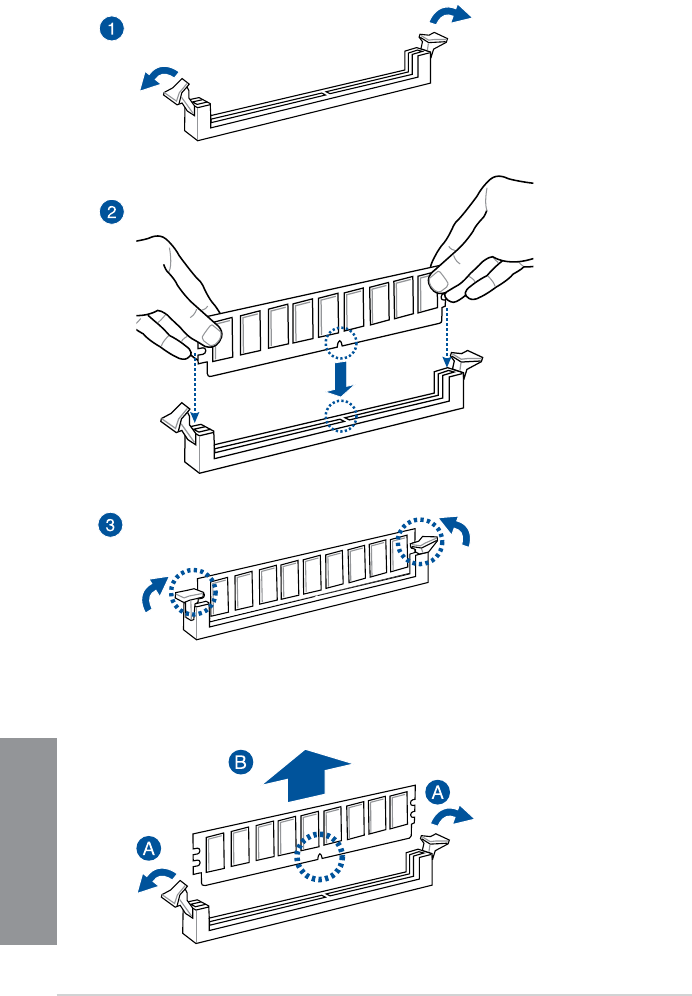
2-6 Chapter 2: Basic installation
Chapter 2
To remove a DIMM
2.1.4 DIMM installation
ASUS Z97-E 2-7
Chapter 2
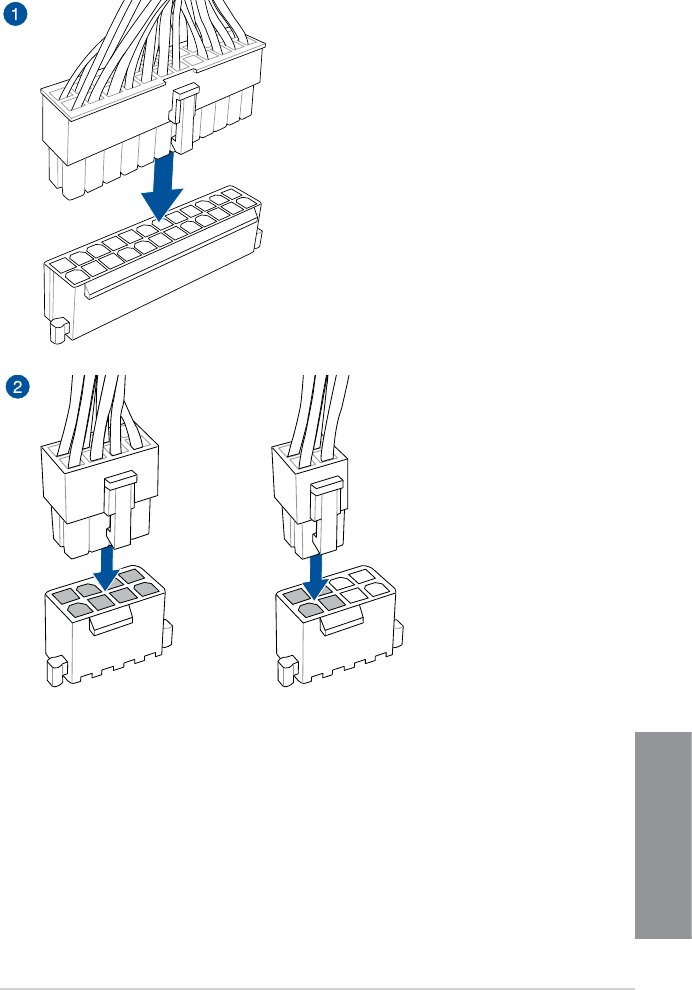
2.1.5 ATX Power connection
OR
2-8 Chapter 2: Basic installation
Chapter 2
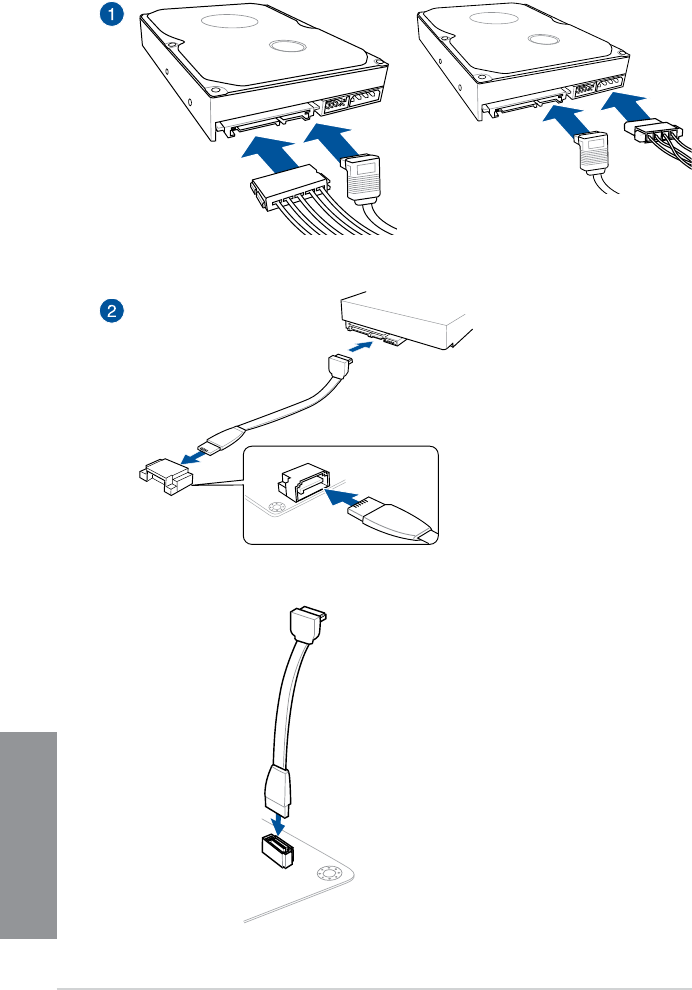
2.1.6 SATA device connection
OR
OR
ASUS Z97-E 2-9
Chapter 2
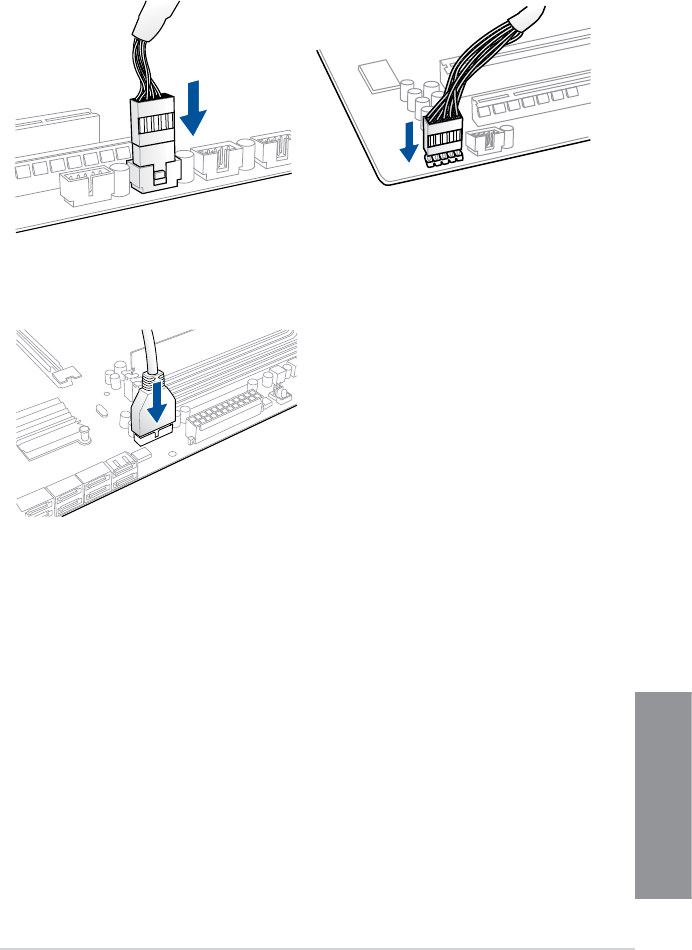
2.1.7 Front I/O Connector
USB 2.0 AAFP
To install USB 2.0 connector To install front panel audio connector
USB 3.0
To install USB 3.0 connector
2-10 Chapter 2: Basic installation
Chapter 2
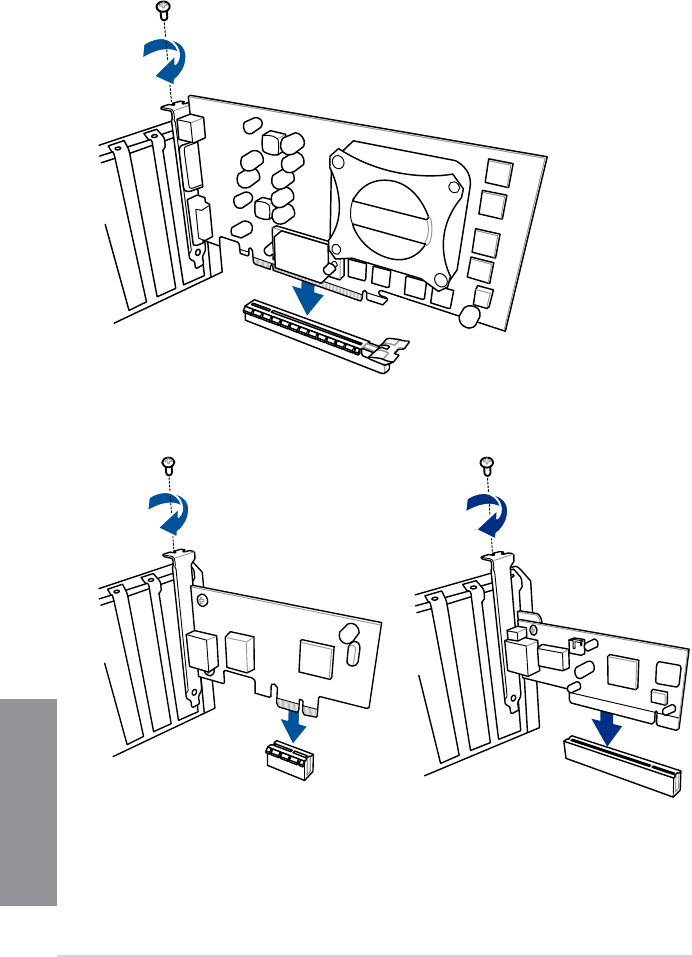
2.1.8 Expansion Card installation
To install PCIe x16 cards
To install PCIe x1 cards To install PCI cards
ASUS Z97-E 2-11
Chapter 2
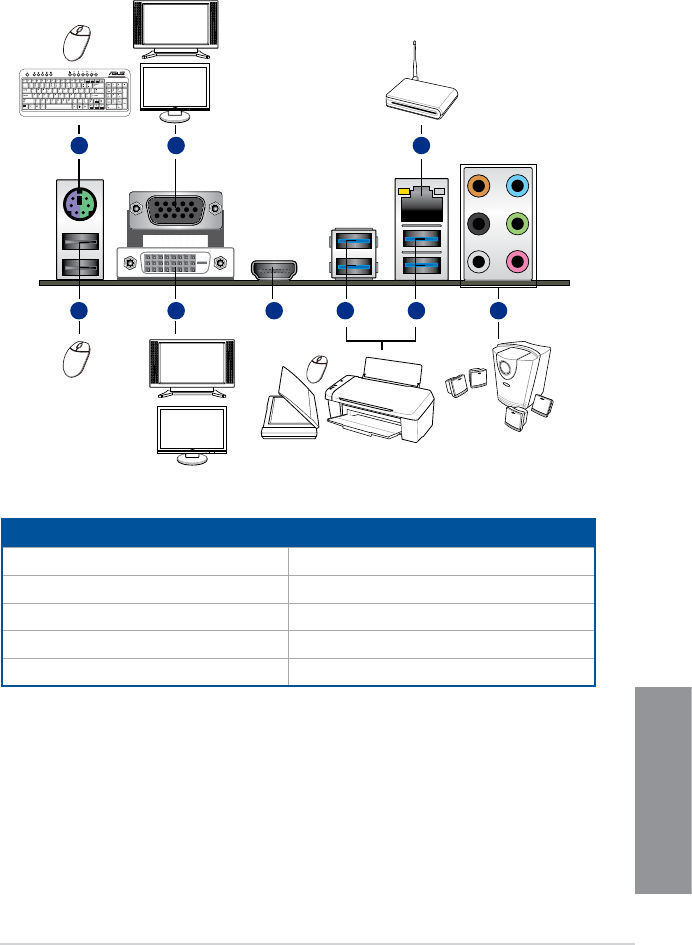
2.2 Motherboard rear and audio connections
2.2.1 Rear I/O connection
* and **: Refer to the tables on the next page for LAN port LEDs, and audio port denitions.
Rear panel connectors
1. PS/2 Keyboard/Mouse Combo port 6. USB 3.0 ports 56
2. Video Graphics Adapter (VGA) port 7. HDMI port
3. Intel® LAN port (LAN)* 8. DVI-D port
4. Audio I/O ports** 9. USB 2.0 ports 78
5. USB 3.0 ports 34
1 2 3
456789
2-12 Chapter 2: Basic installation
Chapter 2
• ThepluggedUSB3.0devicemayrunonxHCImodeorEHCImode,dependingonthe
operating system’s setting.
• USB3.0devicescanonlybeusedasdatastorageonly.
• WestronglyrecommendthatyouconnectUSB3.0devicestoUSB3.0portsforfaster
and better performance for your USB 3.0 devices.
• DuetothedesignoftheIntel® 9 series chipset, all USB devices connected to the
USB 2.0 and USB 3.0 ports are controlled by the xHCI controller. Some legacy USB
devicesmustupdatetheirrmwareforbettercompatibility.
• Multi-VGAoutputsupportsuptothreedisplaysunderWindows® OS environment, two
displays under BIOS, and one display under DOS.
• Inteldisplayarchitecturedesignsupportsthefollowingmaximumsupportedpixel
clocks (Pixel Clock = H total x V Total x Frame Rate (Fresh screen rate)):
- DVI port supports: 165 MHz
- VGA port supports: 180 MHz
- HDMI port: 300 MHz
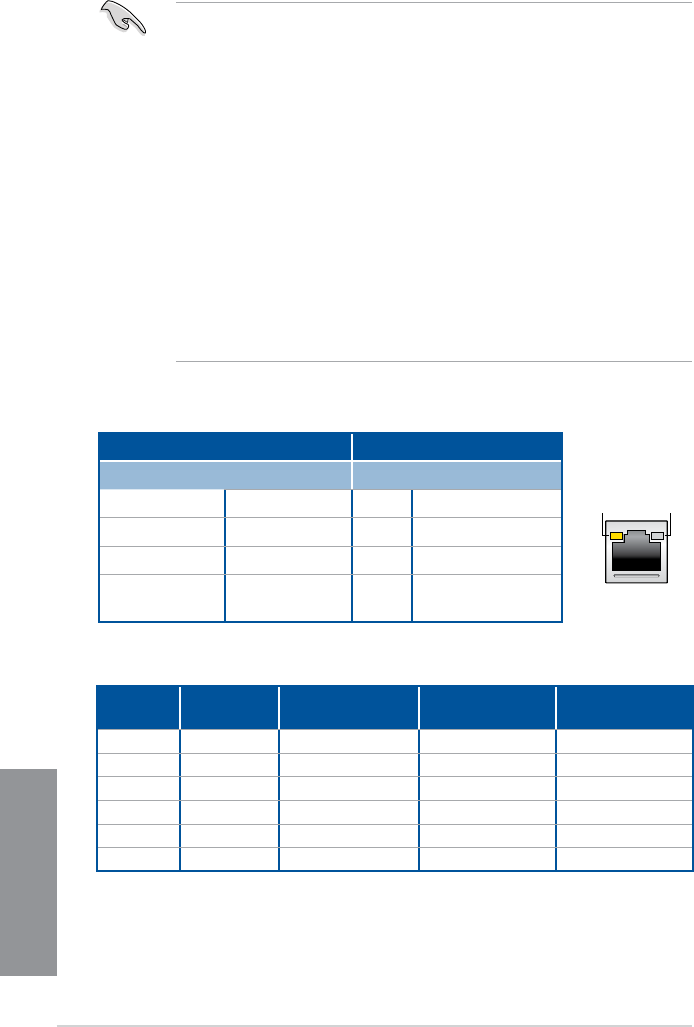
* LAN port LED indications
ACT/LINK
LED
SPEED
LED
LAN port
Activity Link LED Speed LED
Status Description Status Description
Off No link Off 10 Mbps connection
Orange Linked Orange 100 Mbps connection
Orange (Blinking) Data activity Green 1 Gbps connection
Orange (Blinking
then steady)
Ready to wake up
from S5 mode
** Audio 2.1, 4.1, 5.1, or 7.1-channel conguration
Port Headset
2.1-channel
4.1-channel 5.1-channel 7.1-channel
Light Blue Line In Line In Line In Line In
Lime Line Out Front Speaker Out Front Speaker Out Front Speaker Out
Pink Mic In Mic In Mic In Mic In
Orange ––Center/Subwoofer Center/Subwoofer
Black –Rear Speaker Out Rear Speaker Out Rear Speaker Out
Gray ––- Side Speaker Out
ASUS Z97-E 2-13
Chapter 2
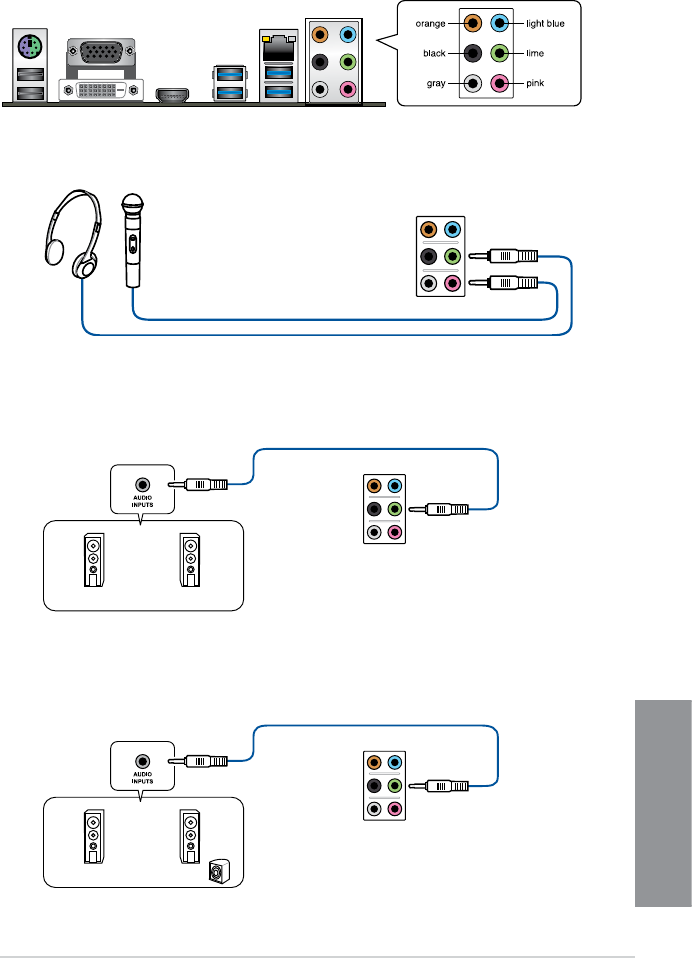
Connect to Headphone and Mic
Connect to Stereo Speakers
2.2.2 Audio I/O connections
Audio I/O ports
Connect to 2.1 channel Speakers
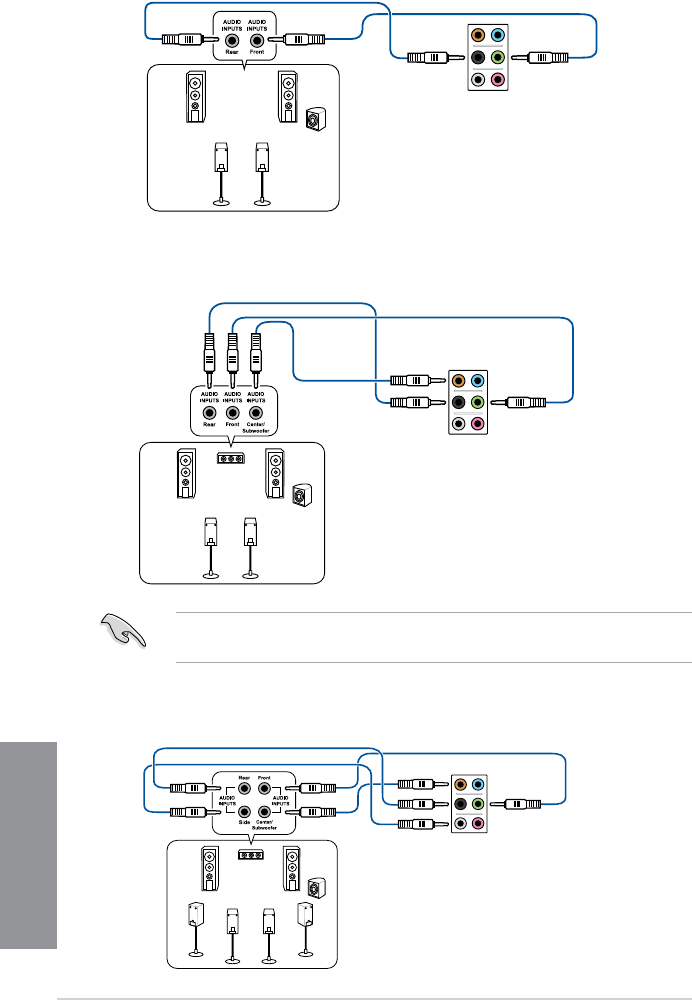
2-14 Chapter 2: Basic installation
Chapter 2
Connect to 4.1 channel Speakers
Connect to 5.1 channel Speakers
IfyouareusingWindows8.1platform,useonlythegrayaudioportforSideSpeakerOutin
a6-channelconguration.
Connect to 7.1 channel Speakers

ASUS Z97-E 2-15
Chapter 2
2.3 Starting up for the rst time
1. After making all the connections, replace the system case cover.
2. Ensure that all switches are off.
3. Connect the power cord to the power connector at the back of the system chassis.
4. Connect the power cord to a power outlet that is equipped with a surge protector.
5. Turn on the devices in the following order:
a. Monitor
b. External SCSI devices (starting with the last device on the chain)
c. System power
6. After applying power, the system power LED on the system front panel case lights up.
For systems with ATX power supplies, the system LED lights up when you press the
ATX power button. If your monitor complies with the “green” standards or if it has a
“power standby” feature, the monitor LED may light up or change from orange to green
after the system LED turns on.
Thesystemthenrunsthepower-onselftests(POST).Whilethetestsarerunning,the
BIOS beeps (refer to the BIOS beep codes table) or additional messages appear on
the screen. If you do not see anything within 30 seconds from the time you turned on
the power, the system may have failed a power-on test. Check the jumper settings and
connections or call your retailer for assistance.
BIOS Beep Description
One short beep VGA detected
Quick boot set to disabled
No keyboard detected
One continuous beep followed by two
short beeps then a pause (repeated)
No memory detected
One continuous beep followed by three
short beeps
No VGA detected
One continuous beep followed by four
short beeps
Hardware component failure
7. At power on, hold down the <Delete> key to enter the BIOS Setup. Follow the
instructions in Chapter 3.
2.4 Turning off the computer
WhilethesystemisON,pressthepowerbuttonforlessthanfoursecondstoputthesystem
on sleep mode or soft-off mode, depending on the BIOS setting. Press the power switch
for more than four seconds to let the system enter the soft-off mode regardless of the BIOS
setting.

2-16 Chapter 2: Basic installation
Chapter 2
ASUS Z97-E 3-1
Chapter 3
The new ASUS UEFI BIOS is a Unied Extensible Interface that complies with UEFI
architecture, offering a user-friendly interface that goes beyond the traditional keyboard-
only BIOS controls to enable a more exible and convenient mouse input. You can easily
navigate the new UEFI BIOS with the same smoothness as your operating system. The
term “BIOS” in this user manual refers to “UEFI BIOS” unless otherwise specied.
BIOS (Basic Input and Output System) stores system hardware settings such as storage
device conguration, overclocking settings, advanced power management, and boot
device conguration that are needed for system startup in the motherboard CMOS. In
normal circumstances, the default BIOS settings apply to most conditions to ensure
optimal performance. DO NOT change the default BIOS settings except in the following
circumstances:
• An error message appears on the screen during the system bootup and requests you
to run the BIOS Setup.
• You have installed a new system component that requires further BIOS settings or
update.
Inappropriate BIOS settings may result to instability or boot failure. We strongly
recommend that you change the BIOS settings only with the help of a trained service
personnel.
When downloading or updating the BIOS le, rename it as Z97E.CAP for this motherboard.
BIOS setup
3
3.1 Knowing BIOS
Chapter 3: BIOS setup

3-2 Chapter 3: BIOS setup
Chapter 3
• The BIOS setup screens shown in this section are for reference purposes only, and
may not exactly match what you see on your screen.
• Ensure that a USB mouse is connected to your motherboard if you want to use the
mouse to control the BIOS setup program.
• If the system becomes unstable after changing any BIOS setting, load the default
settings to ensure system compatibility and stability. Select the Load Optimized
Defaults item under the Exit menu or press hotkey <F5>. See section 3.10 Exit Menu
for details.
• If the system fails to boot after changing any BIOS setting, try to clear the CMOS and
reset the motherboard to the default value. See section 1.2.6 Jumpers for information
on how to erase the RTC RAM via the Clear CMOS jumper.
• The BIOS setup program does not support the Bluetooth devices.
BIOS menu screen
The BIOS Setup program can be used under two modes: EZ Mode and Advanced Mode.
Press <F7> to change between the two modes.
3.2 BIOS setup program
Use the BIOS Setup to update the BIOS or congure its parameters. The BIOS screen
include navigation keys and brief onscreen help to guide you in using the BIOS Setup
program.
Entering BIOS at startup
To enter BIOS Setup at startup, press <Delete> or <F2> during the Power-On Self Test
(POST). If you do not press <Delete> or <F2>, POST continues with its routines.
Entering BIOS Setup after POST
To enter BIOS Setup after POST:
• Press <Ctrl>+<Alt>+<Delete> simultaneously.
• Press the reset button on the system chassis.
• Press the power button to turn the system off then back on. Do this option only if you
failed to enter BIOS Setup using the rst two options.
After doing either of the three options, press <Delete> key to enter BIOS.
ASUS Z97-E 3-3
Chapter 3
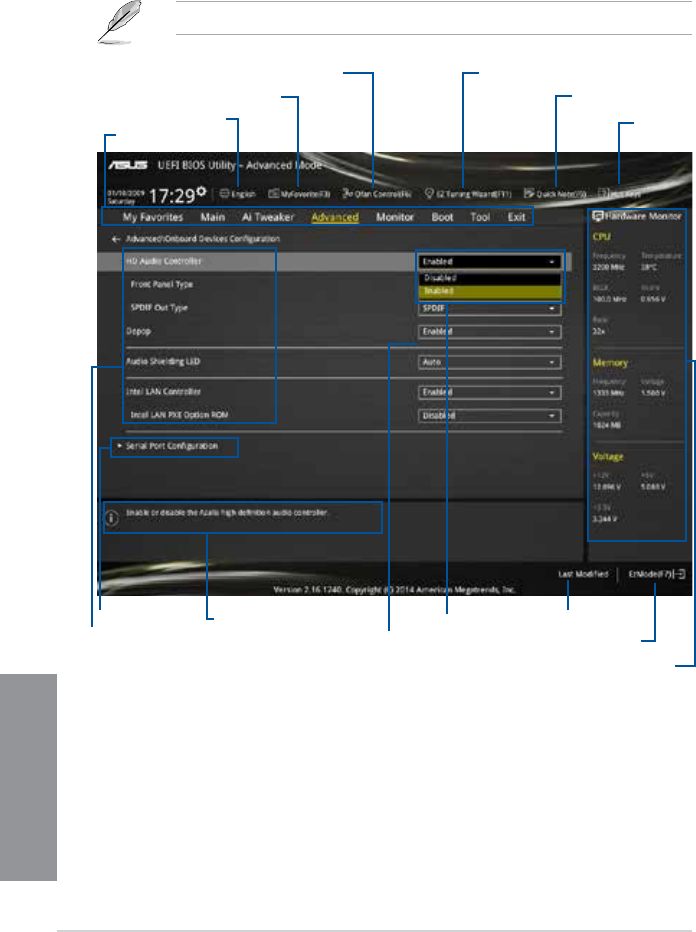
3.2.1 EZ Mode
By default, the EZ Mode screen appears when you enter the BIOS setup program. The EZ
Mode provides you an overview of the basic system information, and allows you to select
the display language, system performance mode and boot device priority. To access the
Advanced Mode, click Advanced Mode or press <F7> hot key for the advanced BIOS
settings.
The default screen for entering the BIOS setup program can be changed between EZ Mode
or Advanced Mode. Refer to the Setup Mode item in section 3.8 Boot menu for details.
The boot device options vary depending on the devices you installed to the system.
Saves the changes and
resets the system
Selects the display language
of the BIOS setup program
Displays the CPU/motherboard temperature,
CPU voltage output, CPU/chassis/power fan
speed, and SATA information
Displays the system properties of the selected mode.
Click < or > to switch EZ System Tuning modes
Displays the
Advanced mode
menus
Selects the boot
device priority
Loads optimized
default settings
Creates storage RAID and
congures system overclocking
Shows the
bootable devices
Displays the CPU Fan’s speed. Click
the button to manually tune the fans
Enables or disables the SATA RAID mode
for Intel Rapid Storage Technology
3-4 Chapter 3: BIOS setup
Chapter 3
3.2.2 Advanced Mode
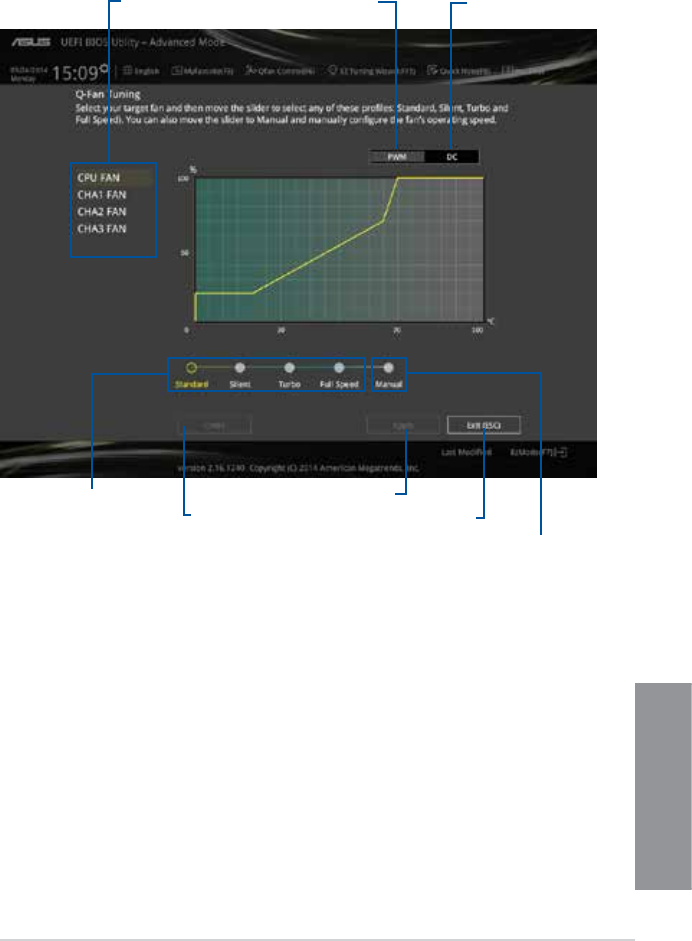
The Advanced Mode provides advanced options for experienced end-users to congure
the BIOS settings. The gure below shows an example of the Advanced Mode. Refer to the
following sections for the detailed congurations.
To switch from EZ Mode to Advanced Mode, click Advanced Mode F7 or press F7 hotkey.
Conguration elds
Menu bar
Item descriptionSub-menu item
Menu items
Drop-down list Last modied settings
Language
EZ Tuning Wizard
MyFavorite Quick Note
Hot Keys
Goes back to EZ Mode
Displays the CPU/motherboard temperature,
CPU and memory voltage output
Q-Fan control
ASUS Z97-E 3-5
Chapter 3
Menu bar
The menu bar on top of the screen has the following main items:
My Favorites For saving the frequently-used system settings and conguration.
Main For changing the basic system conguration
Ai Tweaker For changing the overclocking settings
Advanced For changing the advanced system settings
Monitor For displaying the system temperature, power status, and changing the
fan settings.
Boot For changing the system boot conguration
Tool For conguring options for special functions
Exit For selecting the exit options and loading default settings
Menu items
The highlighted item on the menu bar displays the specic items for that menu. For example,
selecting Main shows the Main menu items.
The other items (My Favorites, Ai Tweaker, Advanced, Monitor, Boot, Tool, and Exit) on the
menu bar have their respective menu items.
Submenu items
A greater than sign (>) before each item on any menu screen means that the item has a
submenu. To display the submenu, select the item and press <Enter>.
Language
This button above the menu bar contains the languages that you can select for your BIOS.
Click this button to select the the language that you want to display in your BIOS screen.
MyFavorites (F3)
This button above the menu bar shows all BIOS items in a Tree Map setup. Select frequently-
used BIOS settings and save it to MyFavorites menu.
Refer to section 3.3 My Favorites for more information.
Q-Fan Control (F6)
This button above the menu bar displays the current settings of your fans. Use this button to
manually tweak the fans to your desired settings.
Refer to section 3.2.3 QFan Control for more information.
EZ Tuning Wizard (F11)
This button above the menu bar allows you to view and tweak the overclocking settings of
your system. It also allows you to change the motherboard’s SATA mode from AHCI to RAID
mode.
Refer to section 3.2.4 EZ Tuning Wizard for more information.

3-6 Chapter 3: BIOS setup
Chapter 3
Quick Note (F9)
This button above the menu bar allows you to key in notes of the activities that you have
done in BIOS.
• The Quick Note function does not support the following keyboard functions: delete,
cut, copy and paste.
• You can only use the alphanumeric characters to enter your notes.
Hot keys
This button above the menu bar contains the navigation keys for the BIOS setup program.
Use the navigation keys to select items in the menu and change the settings.
Drop-down list
Select a menu item and press <Enter> to display a drop-down list with the conguration
options for that item.
Scroll bar
A scroll bar appears on the right side of a menu screen when there are items that do not t
on the screen. Press the Up/Down arrow keys or <Page Up> / <Page Down> keys to display
the other items on the screen.
General help
At the top right corner of the menu screen is a brief description of the selected item. Use
<F12> key to capture the BIOS screen and save it to the removable storage device.
Conguration elds
These elds show the values for the menu items. If an item is user-congurable, you can
change the value of the eld opposite the item. You cannot select an item that is not
user-congurable.
A congurable eld is highlighted when selected. To change the value of a eld, select it and
press <Enter> to display a list of options.
Last Modied button
This button shows the items that you last modied and saved in BIOS Setup.
ASUS Z97-E 3-7
Chapter 3
3.2.3 QFan Control
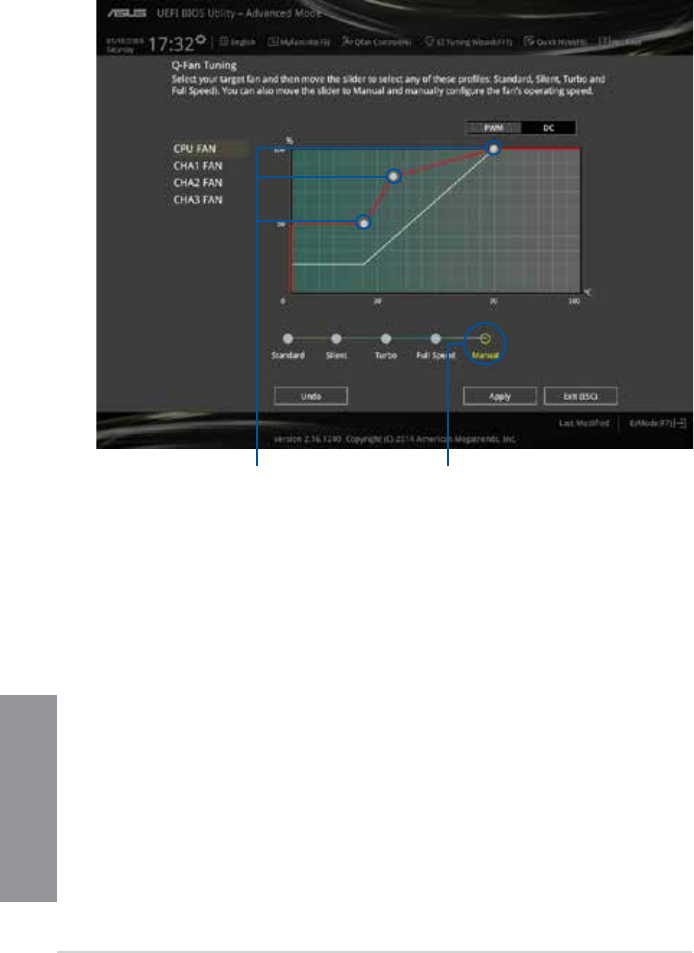
The QFan Control allows you to set a fan prole or manually congure the operating speed of
your CPU and chassis fans.
Click to select a fan to be
congured Click to activate
PWM Mode
Click to undo the
changes
Click to apply the fan setting
Click to go back to main menu
Select a prole to apply to
your fans
Click to activate DC Mode
Select to manually congure
your fans
3-8 Chapter 3: BIOS setup
Chapter 3
Conguring fans manually
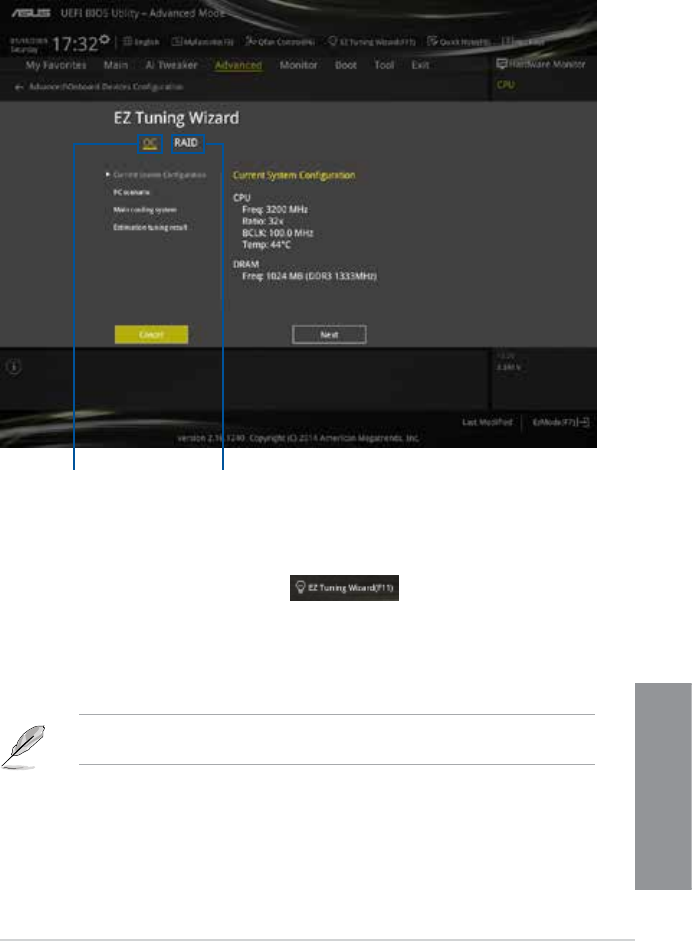
Select Manual from the list of proles to manually congure your fans’ operating speed.
To congure your fans:
1. Select the fan that you want to congure and to view its current status.
2. Click and drag the speed points to adjust the fans’ operating speed.
3. Click Apply to save the changes then click Exit (ESC).
Speed points Click or tap to manually
congure your fans
ASUS Z97-E 3-9
Chapter 3
3.2.4 EZ Tuning Wizard
EZ Tuning Wizard allows you to overclock your CPU and DRAM, computer usage, and CPU
fan to their best settings. You can also easily set RAID in your system using this feature.
Tuning your system settings
To tune your settings:
1. Press <F11> on your keyboard or click from the BIOS screen to open
EZ Tuning Wizard screen, then click Next.
2. Select a PC scenario Daily Computing or Gaming/Media Editing, then click Next.
3. Select the CPU fan type (Box cooler, Tower cooler, or Water cooler) that you
installed then click Next.
If you are not sure of the CPU fan type, click I’m not sure. The system automatically
detects the CPU fan type.
4. Click Next then click Yes to conrm auto-tuning.
System OC setup RAID setup
3-10 Chapter 3: BIOS setup
Chapter 3
Creating RAID
To create RAID:
1. Press <F11> on your keyboard or click from the BIOS screen to open
EZ Tuning Wizard screen.
2. Click RAID
then click Next.
• Ensure that your HDDs have no existing RAID volumes.
• Ensure to connect your HDDs to Intel® SATA connectors.
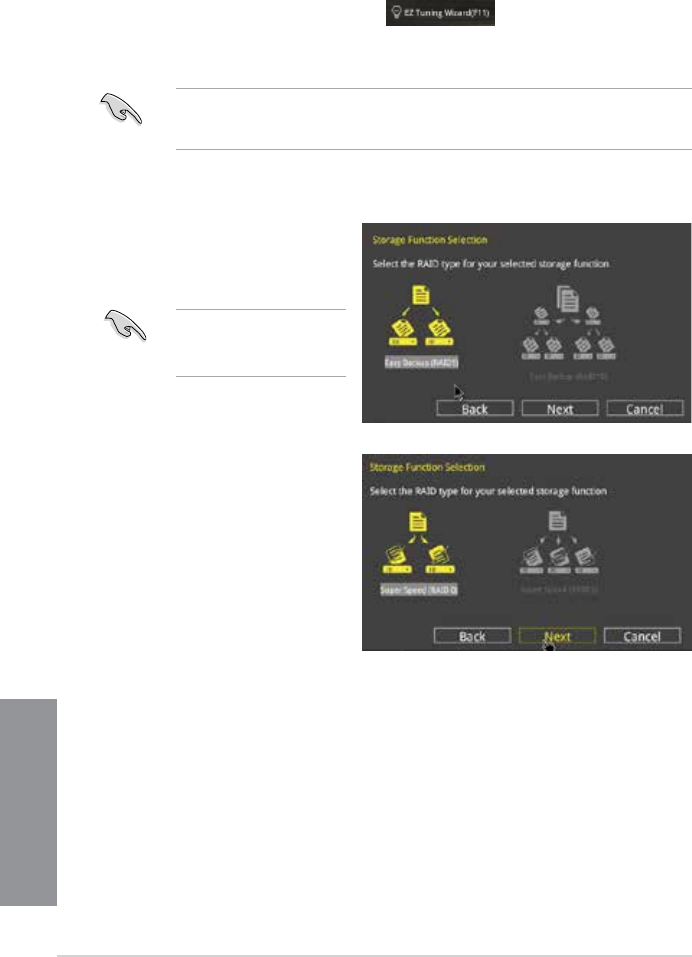
3. Select the type of storage for your RAID Easy Backup or Super Speed, then click
Next.
a. For Easy Backup, click
Next then select from Easy
Backup (RAID1) or Easy
Backup (RAID10).
4. After selecting the type of RAID, click Next then click Yes to continue the RAID setup.
5. After the RAID setup is done, click Yes to exit the setup then click OK to reset your
system.
You can only select Easy
Backup (RAID 10) if you
connect four (4) HDDs.
b. For Easy Backup, click Next
then select from Super
Speed (RAID0) or Super
Speed (RAID5).
ASUS Z97-E 3-11
Chapter 3
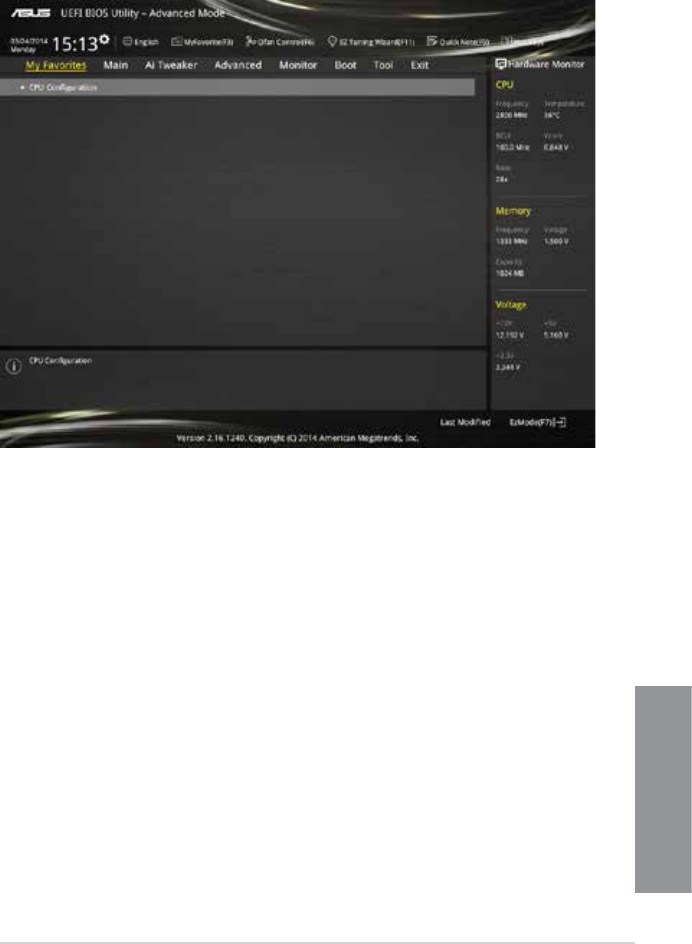
3.3 My Favorites
MyFavorites is your personal space where you can easily save and access your favorite
BIOS items.
3-12 Chapter 3: BIOS setup
Chapter 3
Adding items to My Favorites
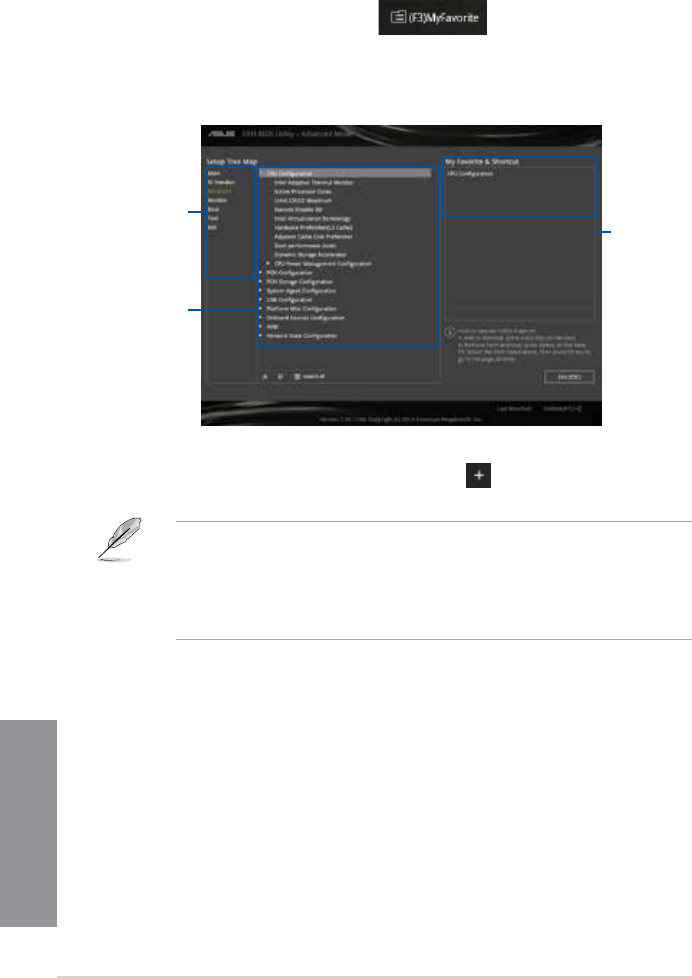
To add BIOS items:
1. Press <F3> on your keyboard or click from the BIOS screen to open
Setup Tree Map screen.
2. On the Setup Tree Map screen, select the BIOS items that you want to save in
MyFavorites screen.
3. Select an item from main menu panel, then click the submenu that you want to save
as favorite from the submenu panel and tap or click or press <Enter> on your
keyboard.
You cannot add the following items to My Favorite items:
• Items with submenu options
• User-managed items such as language and boot order
• Conguration items such as Memory SPD Information, system time and date.
4. Click Exit (ESC) or press <esc> key to close Setup Tree Map screen.
5. Go to My Favorites menu to view the saved BIOS items.
Main menu panel
Submenu panel
Selected shortcut
items
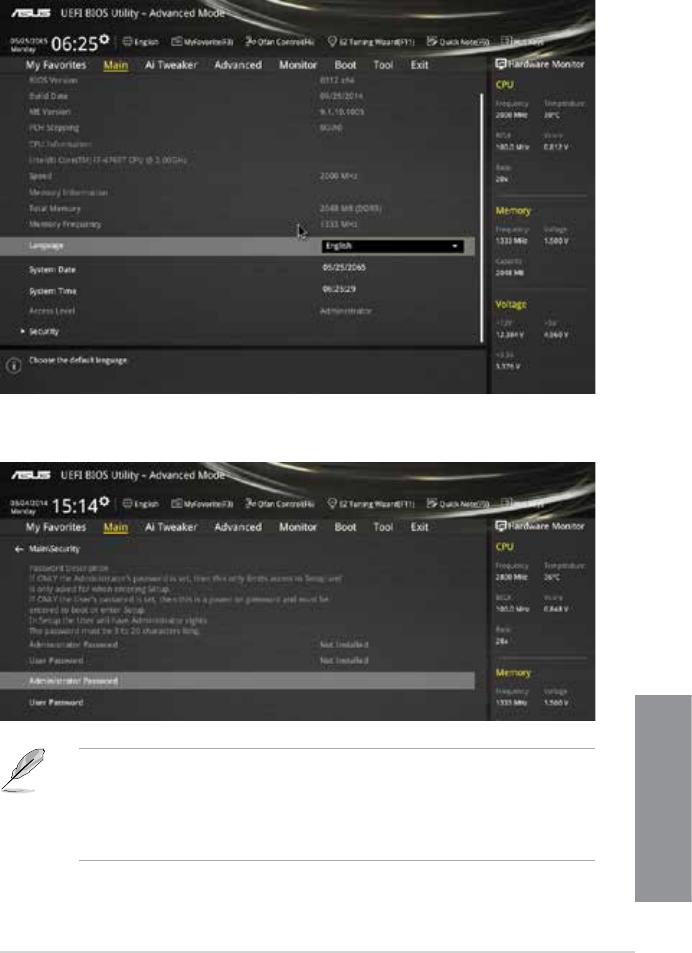
ASUS Z97-E 3-13
Chapter 3
3.4 Main menu
The Main menu screen appears when you enter the Advanced Mode of the BIOS Setup
program. The Main menu provides you an overview of the basic system information, and
allows you to set the system date, time, language, and security settings.
Security
The Security menu items allow you to change the system security settings.
• If you have forgotten your BIOS password, erase the CMOS Real Time Clock (RTC)
RAM to clear the BIOS password. See section 1.2.6 Jumpers for information on how
to erase the RTC RAM via the Clear CMOS jumper.
• The Administrator or User Password items on top of the screen show the default [Not
Installed]. After you set a password, these items show [Installed].

3-14 Chapter 3: BIOS setup
Chapter 3
Administrator Password
If you have set an administrator password, we recommend that you enter the administrator
password for accessing the system. Otherwise, you might be able to see or change only
selected elds in the BIOS setup program.
To set an administrator password:
1. Select the Administrator Password item and press <Enter>.
2. From the Create New Password box, key in a password, then press <Enter>.
3. Conrm the password when prompted.
To change an administrator password:
1. Select the Administrator Password item and press <Enter>.
2. From the Enter Current Password box, key in the current password, then press
<Enter>.
3. From the Create New Password box, key in a new password, then press <Enter>.
4. Conrm the password when prompted.
To clear the administrator password, follow the same steps as in changing an administrator
password, but press <Enter> when prompted to create/conrm the password. After you clear
the password, the Administrator Password item on top of the screen shows Not Installed.
User Password
If you have set a user password, you must enter the user password for accessing the system.
The User Password item on top of the screen shows the default Not Installed. After you set a
password, this item shows Installed.
To set a user password:
1. Select the User Password item and press <Enter>.
2. From the Create New Password box, key in a password, then press <Enter>.
3. Conrm the password when prompted.
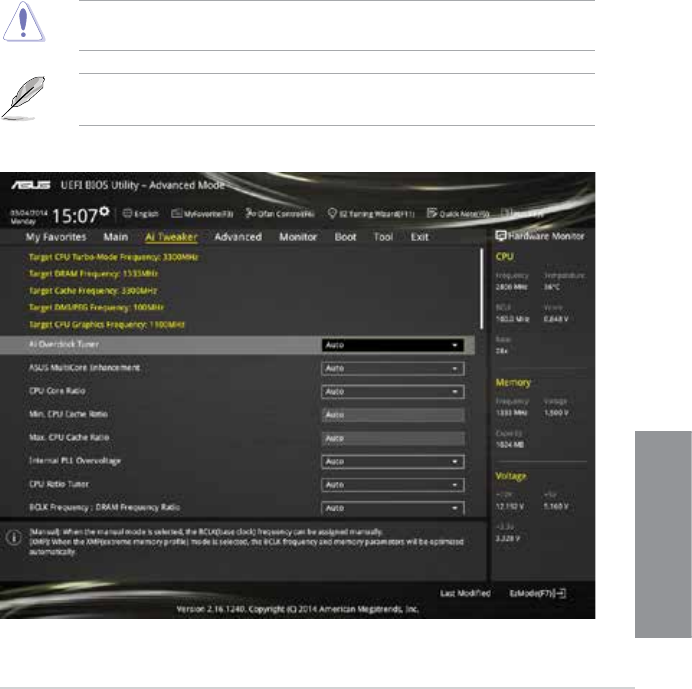
ASUS Z97-E 3-15
Chapter 3
To change a user password:
1. Select the User Password item and press <Enter>.
2. From the Enter Current Password box, key in the current password, then press
<Enter>.
3. From the Create New Password box, key in a new password, then press <Enter>.
4. Conrm the password when prompted.
To clear the user password, follow the same steps as in changing a user password, but press
<Enter> when prompted to create/conrm the password. After you clear the password, the
User Password item on top of the screen shows Not Installed.
3.5 Ai Tweaker menu
The Ai Tweaker menu items allow you to congure overclocking-related items.
Be cautious when changing the settings of the Ai Tweaker menu items. Incorrect eld
values can cause the system to malfunction.
The conguration options for this section vary depending on the CPU and DIMM model you
installed on the motherboard.
Scroll down to display other BIOS items.
3-16 Chapter 3: BIOS setup
Chapter 3
Ai Overclock Tuner [Auto]
This item allows you to select the CPU overclocking options to achieve the desired CPU
internal frequency. Select any of these preset overclocking conguration options:
[Auto] Loads the optimal settings for the system.
[Manual] Automatically optimizes the CPU ratio and BCLK frequency.
The following item appears only when you set the Ai Overclock Tuner to [Manual].
Filter PLL [Auto]
Set this item to high BCLK (base clock) mode when using a very high BCLK to improve
overclocking capability.
Conguration options: [Auto] [Low BCLK mode] [High BCLK mode]
BCLK Frequency [100]
This item allows you to set the BCLK (base clock) frequency to enhance the system
performance. Use the <+> or <-> to adjust the value. The values range from 80.0 MHz
to 300.0 MHz.
We recommend you to set the value based on the CPU specication, as high BCLK
frequencies may damage the CPU permanently.
Initial BCLK Frequency [Auto]
This item allows you to start overclocking the system from the initial BCLK (base clock)
frequency to the assigned BCLK frequency. Use the <+> or <-> to adjust the value.
The value ranges depend on the value you set on BCLK Frequency.
ASUS MultiCore Enhancement [Auto]
[Auto] This item allows you to maximize the oveclocking performance optimized
by ASUS core ratio settings.
[Disabled] This item allows you to set to default core ratio settings.
CPU Core Ratio [Auto]
This item allows you to set the CPU core ratio limit per core or synchronize automatically to
all cores. Conguration options: [Auto] [Sync All Cores] [Per Core]
The following items appear only when the CPU Core Ratio is set to [Per Core].
1-Core Ratio Limit [Auto]
Select [Auto] to apply the CPU default Turbo Ratio setting or manually assign a
1-Core Limit value that must be higher than or equal to the 2-Core Ratio Limit.
2-Core Ratio Limit [Auto]
Select [Auto] to apply the CPU default Turbo Ratio setting or manually assign a
2-Core Limit value that must be higher than or equal to the 3-Core Ratio Limit.
If you assign a value for 2-Core Ratio Limit, do not set the 1-Core Ratio Limit to [Auto].

ASUS Z97-E 3-17
Chapter 3
3-Core Ratio Limit [Auto]
Select [Auto] to apply the CPU default Turbo Ratio setting or manually assign a
3-Core Limit value that must be higher than or equal to the 4-Core Ratio Limit.
If you assign a value for 3-Core Ratio Limit, do not set the 1-Core Ratio Limit and 2-Core
Ratio Limit to [Auto].
4-Core Ratio Limit [Auto]
Select [Auto] to apply the CPU default Turbo Ratio setting or manually assign a
4-Core Limit value that must be higher than or equal to the 3-Core Ratio Limit.
If you assign a value for 4-Core Ratio Limit, do not set the 1-Core Ratio Limit, 2-Core Ratio
Limit, and 3-Core Ratio to [Auto].
Min. CPU Cache Ratio [Auto]
This item allows you to set the minimum possible ratio on the Uncore part of the processor.
Use the <+> or <-> keys to adjust the value. The values depend on the CPU installed.
Max. CPU Cache Ratio [Auto]
This item allows you to set the maximum possible ratio on the Uncore part of the processor.
Use the <+> or <-> keys to adjust the value. The values depend on the CPU installed.
Internal PLL Overvoltage [Auto]
This item allows you to enable the internal PLL Overvoltage for K-SKU CPUs to get the
extreme overclocking capability.
Conguration options: [Auto] [Enabled] [Disabled]
CPU Ratio Tuner [Auto]
This item allows you to enable or disable the CPU ratio tuner. Enabling this item may
enhance the overclocking capability of non-K series CPUs. Conguration options: [Auto]
[Enabled] [Disable]
BCLK Frequency : DRAM Frequency ratio [Auto]
Allows you to set the BCLK Frequency to DRAM Frequency ratio.
[Auto] The ratio is set to the optimized settings.
[100:133] The BCLK Frequency to DRAM Frequency ratio is set to 100:133.
[100:100] The BCLK Frequency to DRAM Frequency is set to 100:100.
DRAM Frequency [Auto]
This item allows you to set the memory operating frequency. The congurable options vary
with the BCLK (base clock) frequency setting. Select the auto mode to apply the optimized
setting. Conguration options: [Auto] [DDR3-800MHz] [DDR3-1066MHz] [DDR3-1333MHz]
[DDR3-1400MHz] [DDR3-1600MHz] [DDR3-1800MHz] [DDR3-1866MHz] [DDR3-2000MHz]
[DDR3-2133MHz] [DDR3-2200MHz] [DDR3-2400MHz] [DDR3-2600MHz] [DDR3-2666MHz]
[DDR3-2800MHz] [DDR3-2933MHz] [DDR3-3000MHz] [DDR3-3200MHz] [DDR3-3400MHz]
3-18 Chapter 3: BIOS setup
Chapter 3
Max. CPU Graphics Ratio [Auto]
Allows you to set the CPU Graphics maximum ratio. The maximum ratio is 60x. Use <+>/<->
to adjust the value.
OC Tuner [Keep Current Settings]
This item allows you to automatically overclock the CPU and DRAM frequencies and voltage
for an enhanced system performance. It also accelerates the CPU graphics performance to
the extreme depending on the CPU graphics loading.
Conguration options: [Keep Current Settings] [Ratio First] [BCLK First]
Ensure that you installed an efcient CPU fan for CPU and graphics loading before
selecting either [BCLK First] or [Ratio First]. To keep the current overclocking tuner
status, select [Keep Current Settings].
EPU Power Saving Mode [Disabled]
The ASUS EPU (Energy Processing Unit) sets the CPU in its minimum power consumption
settings. Enable this item to set lower CPU VCCIN and Vcore voltages and achieve the best
energy saving condition.
Conguration options: [Disabled] [Enabled]
DRAM Timing Control
The subitems in this menu allow you to set the DRAM timing control features. Use the <+>
or <-> keys to adjust the value. To restore the default setting, type [auto] using the keyboard
and press the <Enter> key.
Changing the values in this menu may cause the system to become unstable! If this
happens, revert to the default settings.
Primary Timings
DRAM CAS# Latency [Auto]
Conguration options: [Auto] [1] – [31]
DRAM RAS# to CAS# Delay [Auto]
Conguration options: [Auto] [1] – [31]
DRAM RAS# PRE Time [Auto]
Conguration options: [Auto] [1] – [31]
DRAM RAS# ACT Time [Auto]
Conguration options: [Auto] [1] – [63]
DRAM Command Rate [Auto]
Conguration options: [Auto] [1] – [2]

ASUS Z97-E 3-19
Chapter 3
Secondary Timings
DRAM RAS# to RAS# Delay [Auto]
Conguration options: [Auto] [1] – [15]
DRAM REF Cycle Time [Auto]
Conguration options: [Auto] [1] – [511]
DRAM Refresh Interval [Auto]
Conguration options: [Auto] [1] – [65535]
DRAM WRITE Recovery Time [Auto]
Conguration options: [Auto] [1] – [16]
DRAM READ to PRE Time [Auto]
Conguration options: [Auto] [1] – [15]
DRAM FOUR ACT WIN Time [Auto]
Conguration options: [Auto] [1] – [255]
DRAM WRITE to READ Delay [Auto]
Conguration options: [Auto] [1] – [15]
DRAM CKE Minimum Pulse Width [Auto]
Conguration options: [Auto] [1] – [15]
DRAM CAS# Write Latency [Auto]
Conguration options: [Auto] [1] – [31]
RTL IOL control
DRAM RTL Initial Value [Auto]
Conguration options: [Auto] [1] - [63]
DRAM RTL (CHA_R0D0) [Auto]
Conguration options: [Auto] [1] - [63]
DRAM RTL (CHA_R0D1) [Auto]
Conguration options: [Auto] [1] - [63]
DRAM RTL (CHA_R1D0) [Auto]
Conguration options: [Auto] [1] - [63]
DRAM RTL (CHA_R1D1) [Auto]
Conguration options: [Auto] [1] - [63]
DRAM RTL (CHB_R0D0) [Auto]
Conguration options: [Auto] [1] - [63]
DRAM RTL (CHB_R0D1) [Auto]
Conguration options: [Auto] [1] - [63]
DRAM RTL (CHB_R1D0) [Auto]
Conguration options: [Auto] [1] - [63]
DRAM RTL (CHB_R1D1) [Auto]
Conguration options: [Auto] [1] - [63]
DRAM IO-L (CHA_R0D0) [Auto]
Conguration options: [Auto] [1] - [15]

3-20 Chapter 3: BIOS setup
Chapter 3
DRAM IO-L (CHA_R0D1) [Auto]
Conguration options: [Auto] [1] - [15]
DRAM IO-L (CHA_R1D0) [Auto]
Conguration options: [Auto] [1] - [15]
DRAM IO-L (CHA_R1D1) [Auto]
Conguration options: [Auto] [1] - [15]
DRAM IO-L (CHB_R0D0) [Auto]
Conguration options: [Auto] [1] - [15]
DRAM IO-L (CHB_R0D1) [Auto]
Conguration options: [Auto] [1] - [15]
DRAM IO-L (CHB_R1D0) [Auto]
Conguration options: [Auto] [1] - [15]
DRAM IO-L (CHB_R1D1) [Auto]
Conguration options: [Auto] [1] - [15]
Third Timings
tRDRD [Auto]
Conguration options: [Auto] [1] - [7]
tRDRD_dr [Auto]
Conguration options: [Auto] [1] - [15]
tRDRD_dd [Auto]
Conguration options: [Auto] [1] - [15]
tWRRD [Auto]
Conguration options: [Auto] [1] - [63]
tWRRD_dr [Auto]
Conguration options: [Auto] [1] - [15]
tWRRD_dd [Auto]
Conguration options: [Auto] [1] - [15]
tWRWR [Auto]
Conguration options: [Auto] [1] - [7]
tWRWR_dr [Auto]
Conguration options: [Auto] [1] - [15]
tWRWR_dd [Auto]
Conguration options: [Auto] [1] - [15]
Dec_WRD [Auto]
Conguration options: [Auto] [0] [1]
tRDWR [Auto]
Conguration options: [Auto] [1] - [31]
tRDWR_dr [Auto]
Conguration options: [Auto] [1] - [31]
tRDWR_dd [Auto]
Conguration options: [Auto] [1] - [31]

ASUS Z97-E 3-21
Chapter 3
MISC
MRC Fast Boot [Auto]
This item allows you to enable, disable or automatically set the MRC fast boot.
Conguration options: [Auto] [Enabled] [Disabled]
DRAM CLK Period [Auto]
This item allows you to set a DRAM clock period.
Conguration options: [Auto] [1] – [14]
Channel A/B DIMM Control [Enable Both DIMMs]
This item allows you to enable or disable the DIMMs on channels A and B.
Conguration options: [Enable Both DIMMS] [Disable DIMM0] [Disable DIMM1]
[Disable Both DIMMS]
Scrambler Setting [Optimized (ASUS)]
This item allows you to set the optimized mode to enhance system stability.
Conguration options: [Optimized (ASUS)] [Default (MRC)]
MCH Full Check [Auto]
Enable this item to enhance the stability of your system. Disable this item to enhance
the DRAM overclocking capability.
Conguration options: [Auto] [Enabled] [Disabled]
Skew Control
Changing subitems in this menu may enhance the DRAM overclocking capability and
stability.
Transmitter Rising Slope [Auto]
Conguration options: [Auto] [0] – [31]
Transmitter Falling Slope [Auto]
Conguration options: [Auto] [0] – [31]
Transmitter Control Time [Auto]
Conguration options: [Auto] [0] – [31]
Receiver Rising Slope [Auto]
Conguration options: [Auto] [0] – [31]
Receiver Falling Slope [Auto]
Conguration options: [Auto] [0] – [31]
Receiver Control Time [Auto]
Conguration options: [Auto] [0] – [31]
3-22 Chapter 3: BIOS setup
Chapter 3
DIGI+ VRM
CPU Load-line Calibration [Auto]
Load-line is dened by Intel VRM spec and affects CPU voltage. The CPU working
voltage will decrease proportionally to CPU loading. Higher value gets a higher voltage
and better overclocking performance, but increases the CPU and VRM thermal.
Conguration options: [Auto] [Regular] [Medium] [High] [Ultra High] [Extreme]
The actual performance boost may vary depending on your CPU specication.
DO NOT remove the thermal module. The thermal conditions should be monitored.
CPU VRM Switching Frequency [Auto]
This item affects the VRM transient response speed and the component thermal
production. Select [Manual] to congure a higher frequency for a quicker transient
response speed.
Conguration options: [Auto] [Manual]
DO NOT remove the thermal module. The thermal conditions should be monitored.
The following item appears only when you set the CPU VRM Switching Frequency to
[Manual].
Fixed CPU VRM Switching Frequency (KHz) [250]
This item allows you to set a higher frequency for a quicker transient
response speed. Use the <+> or <-> to adjust the value. The values range
from 200 KHz to 350 KHz with an interval of 50 KHz.
CPU Power Phase Control [Auto]
This item allows you to set the power phase control of the CPU.
Conguration options: [Auto] [Standard] [Optimized] [Extreme] [Power Phase
Response]
DO NOT remove the thermal module when setting this item to [Power Phase Response].
The thermal conditions should be monitored.
The following item appears only when you set the CPU Power Phase Control to [Power
Phase Response].
Power Phase Response [Fast]
This item allows you to set a faster phase response for the CPU to increase
system performance or to slower phase response to decrease DRAM
power efciency.
Conguration options: [Ultra Fast] [Fast] [Medium] [Regular]
ASUS Z97-E 3-23
Chapter 3
CPU Power Duty Control [T.Probe]
DIGI + VRM Duty Control adjusts the current of every VRM phase and the thermal
conditions of every phase component.
[T. Probe] Select to maintain the VRM thermal balance.
[Extreme] Select to maintain the current VRM balance.
DO NOT remove the thermal module. The thermal conditions should be monitored.
CPU Current Capability [Auto]
This item provides a total power range for CPU overclocking. A higher value setting
provides higher power consumption delivery and extends the overclocking frequency
range simultaneously.
Conguration options: [Auto] [100%] [110%] [120%] [130%] [140%]
Internal CPU Power Management
The subitems in this menu allow you to set the CPU ratio and their features.
Enhanced Intel SpeedStep Technology [Enabled]
This item allows the operating system to dynamically adjust the processor voltage and
cores frequency, resulting to a decreased average power consumption and decreased
average heat production. Conguration options: [Disabled] [Enabled]
Turbo Mode [Enabled]
This item allows you to enable your core processor’s speed to run faster than the
base operating frequency when it is below operating power, current and temperature
specication limit. Conguration options: [Disabled] [Enabled]
The following items appear only when you set the Turbo Mode to [Enabled].
Turbo Mode Parameters
Long Duration Package Power Limit [Auto]
Allows you to limit the Turbo Ratio’s time duration that exceeds the TDP
(Thermal Design Power) for maximum performance. Use the <+> or <->
keys to adjust the value. The values range from 1 W t0 4096 W.
Package Power Time Window [Auto]
Also known as Power Limit 1, this item allows you to maintain the time
window for Turbo Ratio over TDP (Thermal Design Power). Use the <+> or
<-> keys to adjust the value. The values range from 1 to 127 in seconds.
Short Duration Package Power Limit [Auto]
Also known as Power Limit 2, this item allows you to provide rapid
protection when the package power exceeds the Power Limit 1. Use the
<+> or <-> keys to adjust the value. The values range from 1 W to 4096 W.
CPU Integrated VR Current Limit [Auto]
Allows you to set a higher current limit to prevent frequency and power
throttling when overclocking. Use the <+> or <-> keys to adjust the value.
The values range from 0.125 to 1023.875 with a 0.125 interval.

3-24 Chapter 3: BIOS setup
Chapter 3
CPU Internal Power Switching Frequency
Frequency Tuning Mode [Auto]
This item allows you to increase or decrease the switching frequency of the internal
regulator. Decrease the switching frequency to reduce the power consumption or
increase the switching frequency to enhance voltage stability. When this item is set to
[+] or [-], the Frequency Tuning Offset appears that allows you to set its value from 0%
to 6%.
CPU Internal Power Fault Control
Thermal Feedback [Auto]
Allows your system to take precautionary actions to protect the CPU when the thermal
condition of the external regulator exceeds the threshold.
Conguration options: [Auto] [Disabled] [Enabled]
CPU Integrated VR Fault Management [Auto]
Disable this item to prevent tripping the Fully Integrated Voltage Regulator when doing
over-voltage. We recommend you to disable this item when overclocking.
Conguration options: [Auto] [Disabled] [Enabled]
CPU Internal Power Configuration
CPU Integrated VR Efficiency Management [Auto]
This item allows you to improve the power rating when the CPU is in low power state,
or make the FIVR (fully integrated voltage regulator work in high performance at all
times.
Conguration options: [Auto] [High Performance] [Balanced]
Power Decay Mode [Auto]
This item allows your system to improve the power saving mode on the Fully Integrated
Voltage Regulator as the processor goes into low current state.
Conguration options: [Auto] [Disabled] [Enabled]
Idle Power-in Response [Auto]
This item allows you to set the slew rate for the Fully Integrated Voltage Regulator
when it enters manual override mode.
Conguration options: [Auto] [Regular] [Fast]
Idle Power-out Response [Auto]
This item allows you to set the slew rate for the Fully Integrated Voltage Regulator
when it exits manual override mode. Conguration options: [Auto] [Regular] [Fast]
Power Current Slope [Auto]
This item allows you to enhance the power saving condition or the system overclocking
capability. Select a higher power current slope levels for power saving enhancement or
lower power current slope levels for system overclocking enhancement.
Conguration options: [Auto] [LEVEL -4] - [LEVEL 4]
Power Current Offset [Auto]
This item allows you to increase or decrease the output current sensed by the CPU. It
nds the balance between optimal regulating while staying below the current threshold.
Conguration options: [Auto] [100%] [87.5%] [75.0%] [62.5%] [50.0%] [37.5%] [25.0%]
[12.5%] [0%] [-12.5%] [-25.0%] [-37.5%] [-50.0%] [-62.5%] [-75.0%] [-87.5%] [-100%]

ASUS Z97-E 3-25
Chapter 3
Power Fast Ramp Response [Auto]
This item allows you to enhance the response of the CPU voltage regulator during the
load transients. Use the <+> or <-> to adjust the value. The values range from 0.00 to
1.50. Conguration options: [Auto] [0.00] - [1.50]
CPU Internal Power Saving Control
Power Saving Level 1 Threshold [Auto]
Lower value provides sufcient overclocking tolerance to enlarge the overclocking
potential. Higher value provides better power-saving condition. Use <+> or <-> key to
adjust the value. The values range from 0 A to 80 A at 1 A increment.
Power Saving Level 2 Threshold [Auto]
Lower value provides sufcient overclocking tolerance to enlarge the overclocking
potential. Higher value provides better power-saving condition. Use <+> or <-> key to
adjust the value. The values range from 0 A to 50 A at 1 A increment.
Power Saving Level 3 Threshold [Auto]
Lower value provides sufcient overclocking tolerance to enlarge the overclocking
potential. Higher value provides better power-saving condition. Use <+> or <-> key to
adjust the value. The values range from 0 A to 30 A at 1A increment.
Extreme Over-voltage [Disabled]
This item allows you to set higher voltages for overclocking. When you enable this item,
you can choose a high level voltage to overclock, but does not guarantee the CPU life.
Conguration options: [Enabled] [Disabled]
CPU Core Voltage [Auto]
This item allows you to congure the amount of voltage fed to the CPU cores. Increase the
voltage when setting a high Core Frequency value.
Conguration options: [Auto] [Manual Mode] [Offset Mode] [Adaptive Mode]
• The following item appears only when you set the CPU Core Voltage to [Manual].
• [Adaptive Mode] is available for some specic CPU types.
CPU Core Voltage Override [Auto]
This item allows you to set the CPU Core Voltage override. Use the <+> or <-> keys to
adjust the value, The values range from 0.001V to 1.920 V with a 0.001 V interval.
The following items appear only when you set the CPU Core Voltage to [Offset Mode] or
[Adaptive Mode].
Offset Mode Sign [+]
[+] To offset the voltage by a positive value.
[–] To offset the voltage by a negative value.
CPU Core Voltage Offset
Use the <+> or <-> keys to adjust the value. The values range from 0.001
V to 0.999 V with a 0.001 V interval.
3-26 Chapter 3: BIOS setup
Chapter 3
• The following item appears only when you set the CPU Core Voltage to [Adaptive
Mode].
• [Adaptive Mode] is available for some specic CPU types.
Additional Turbo Mode CPU Core Voltage [Auto]
This item allows you to set the amount of voltage fed to the CPU cores when running
in turbo mode. Increase the voltage when conguring a high CPU core frequency. The
voltage you set is affected by the offset value. Use the <+> or <-> keys to adjust the
value. The values range from 0.001V to 1.920 V with a 0.001 V interval.
Total Adaptive Mode CPU Core Voltage [Auto]
This item sums up the voltages of the CPU Core Voltage offset and Additional Turbo
Mode CPU Core Voltage options.
CPU Cache Voltage [Auto]
This item allows you to set the amount of voltage fed to the CPU uncores including its cache.
Increase the voltage when setting a high CPU cache frequency.
Conguration options: [Auto] [Manual Mode] [Offset Mode] [Adaptive Mode]
The following item appears only when you set the CPU Cache Voltage to [Manual Mode].
CPU Cache Voltage Override [Auto]
This item allows you to set the CPU Cache Voltage override. By default, this item takes
the standard value of the installed CPU. You can use the <+> or <-> keys to adjust the
value. The values range from 0.001V to 1.920 V with a 0.001 V interval.
The following items appear only when you set the CPU Cache Voltage to [Offset Mode] or
[Adaptive Mode].
Offset Mode Sign [+]
[+] To offset the voltage by a positive value.
[–] To offset the voltage by a negative value.
CPU Cache Voltage Offset
Allows you to set the CPU cache voltage offset. By default, this item takes
the standard value of the installed CPU. You can use the <+> or <-> keys
to adjust the value. The values range from 0.001V to 0.999 V with a 0.001
V interval.
The following item appears only when you set the CPU Cache Voltage to [Adaptive
Mode].
Additional Turbo Mode CPU Cache Voltage [Auto]
This item allows you to set the amount of voltage fed to the CPU uncores including its
cache when running in turbo mode. Increase the voltage when conguring a high CPU
cache frequency. The voltage you set is affected by the offset value. Use the <+> or
<-> keys to adjust the value. The values range from 0.001V to 1.920 V with a 0.001 V
interval.

ASUS Z97-E 3-27
Chapter 3
Total Adaptive Mode CPU Cache Voltage [Auto]
This item sums up the voltages of the CPU Cache Voltage offset and Additional Turbo
Mode CPU Cache Voltage options.
CPU Graphics Voltage [Auto]
This item allows you to set the amount of voltage fed to the CPU graphics. Increase the
voltage when setting a high CPU graphics frequency.
Conguration options: [Auto] [Manual Mode] [Offset Mode] [Adaptive Mode]
• The following item appears only when you set the CPU Graphics Voltage to [Manual
Mode].
• [Adaptive Mode] is available for some specic CPU types.
CPU Graphics Voltage Override [Auto]
This item allows you to set the CPU Graphics Voltage override. By default, this item
takes the standard value of the installed CPU. You can use the <+> or <-> keys to
adjust the value. The values range from 0.001V to 1.920 V with a 0.001 V interval.
The following items appear only when you set the CPU Graphics Voltage to [Offset Mode]
or [Adaptive Mode].
Offset Mode Sign [+]
[+] To offset the voltage by a positive value.
[–] To offset the voltage by a negative value.
CPU Graphics Voltage Offset
Allows you to set the CPU graphics voltage offset. By default, this item
takes the standard value of the installed CPU. You can use the <+> or <->
keys to adjust the value. The values range from 0.001V to 0.999 V with a
0.001 V interval.
The following item appears only when you set the CPU Graphics Voltage to [Adaptive
Mode].
Additional Turbo Mode CPU Graphics Voltage [Auto]
This item allows you to set the amount of voltage fed to the CPU graphics when
running in turbo mode. Increase the voltage when conguring a high CPU graphics
frequency. The voltage you set is affected by the offset value. Use the <+> or <-> keys
to adjust the value. The values range from 0.001V to 1.920 V with a 0.001 V interval.
Total Adaptive Mode CPU Graphics Voltage [Auto]
This item sums up the voltages of the CPU Graphics Voltage offset and Additional
Turbo Mode CPU Graphics Voltage options.

3-28 Chapter 3: BIOS setup
Chapter 3
CPU System Agent Voltage Offset Mode Sign [+]
[+] To offset the voltage by a positive value.
[–] To offset the voltage by a negative value.
CPU System Agent Voltage Offset [Auto]
This item allows you to set the amount of voltage fed to the system agent of the CPU
including its PCIE controller and the PCU (power control unit). Increase the voltage to
enhance the overclocking capability.
You can use the <+> or <-> keys to adjust the value. The values range from 0.001 V to
0.999 V with a 0.001 V interval.
CPU Analog I/O Voltage Offset Mode Sign [+]
[+] To offset the voltage by a positive value.
[–] To offset the voltage by a negative value.
CPU Analog I/O Voltage Offset [Auto]
This item allows you to set the amount of voltage fed to the analog portion of the I/O on
the CPU. By default, this item takes the standard value of the installed CPU. Increase
the amount of voltage to enhance the overclocking capability.
You can use the <+> or <-> keys to adjust the value. The values range from 0.001 V to
0.999 V with a 0.001 V interval.
CPU Digital I/O Voltage Offset Mode Sign [+]
[+] To offset the voltage by a positive value.
[–] To offset the voltage by a negative value.
CPU Digital I/O Voltage Offset [Auto]
This item allows you to set the amount of voltage fed to the digital portion of the I/O
on the processor. By default, this item takes the standard value of the installed CPU.
Increase the amount of voltage to enhance the overclocking capability.
You can use the <+> or <-> keys to adjust the value. The values range from 0.001 V to
0.999 V with a 0.001 V interval.
SVID Support [Auto]
Set this item to [Enabled] when overclocking your system. Disabling this item stops the CPU
from communicating with the external voltage regulator.
Conguration options: [Auto] [Disabled] [Enabled]
The following item appears only when you set SVID Support to [Enabled].
SVID Voltage Override [Auto]
This item allows you to set the SVID Voltage override. By default, this item takes the
standard value of the installed CPU. You can use the <+> or <-> keys to adjust the
value. The values range from 0.001V to 2.440 V with a 0.001 V interval.
CPU Input Voltage (VCCIN) [Auto]
This item allows you to set an input voltage for the CPU by the external voltage regulator. By
default, this item takes the standard value of the installed CPU. You can use the <+> or <->
keys to adjust the value. The values range from 0.800 V to 2.700 V with a 0.010 V interval.
ASUS Z97-E 3-29
Chapter 3
DRAM Voltage [Auto]
This item allows you to set the DRAM voltage. You can use the <+> or <-> keys to adjust the
value. The values range from 1.1850 V to 1.8000 V with a 0.00500 V interval.
According to Intel® CPU specications, DIMMs with voltage requirement over 1.65 V may
damage the CPU permanently. We recommend that you install the DIMMs with the voltage
requirement below 1.65 V.
PCH VLX Voltage [Auto]
This item allows you to set the I/O voltage on the PCH (Platform Controller Hub). You can
use the <+> or <-> keys to adjust the value. The values range from 1.1850 V to 2.1350 V with
a 0.0050 V interval.
PCH Core Voltage [Auto]
This item allows you to set the Core voltage for the PCH (Platform Controller Hub). You can
use the <+> or <-> keys to adjust the value. The values range from 0.73500 V to 1.50000 V
with a 0.00500 V interval.
The system may need better cooling system for a more stable performance under high
voltage settings.
DRAM CTRL REF Voltage [Auto]
This item allows you to set the DRAM reference voltage on the control lines from the memory
bus. You can use the <+> or <-> keys to adjust the value. The values range from 0.39500x to
0.63000x with a 0.00500x interval.
To set a value for the DRAM reference voltage, we recommend you to set a value close to
the standard value which is 0.500000x.
DRAM DATA REF Voltage on CHA/CHB [Auto]
This item allows you to set the DRAM reference voltage on the data lines on Channels A and
B. You can use the <+> or <-> keys to adjust the value. The values range from 0.39500x to
0.63000x with a 0.00500x interval.
To set a value for the DRAM reference voltage, we recommend you to set a value close to
the standard value which is 0.500000x.
CPU Spread Spectrum [Auto]
This item allows you to enhance the BCLK overclocking capability or reduce the EMI
(electromagnetic disturbance) generated by the BCLK. Set this item to [Enabled] for EMI
reduction, or set this item to [Disabled] to enhance BCLK overclocking.
Conguration options: [Auto] [Disabled] [Enabled]
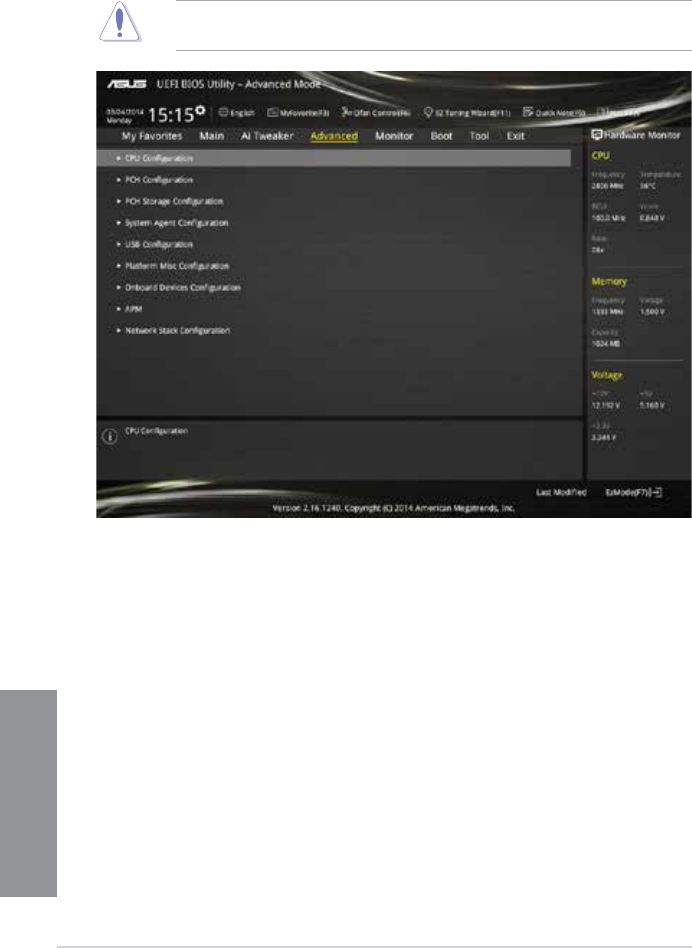
3-30 Chapter 3: BIOS setup
Chapter 3
3.6 Advanced menu
The Advanced menu items allow you to change the settings for the CPU and other system
devices.
Be cautious when changing the settings of the Advanced menu items. Incorrect eld values
can cause the system to malfunction.
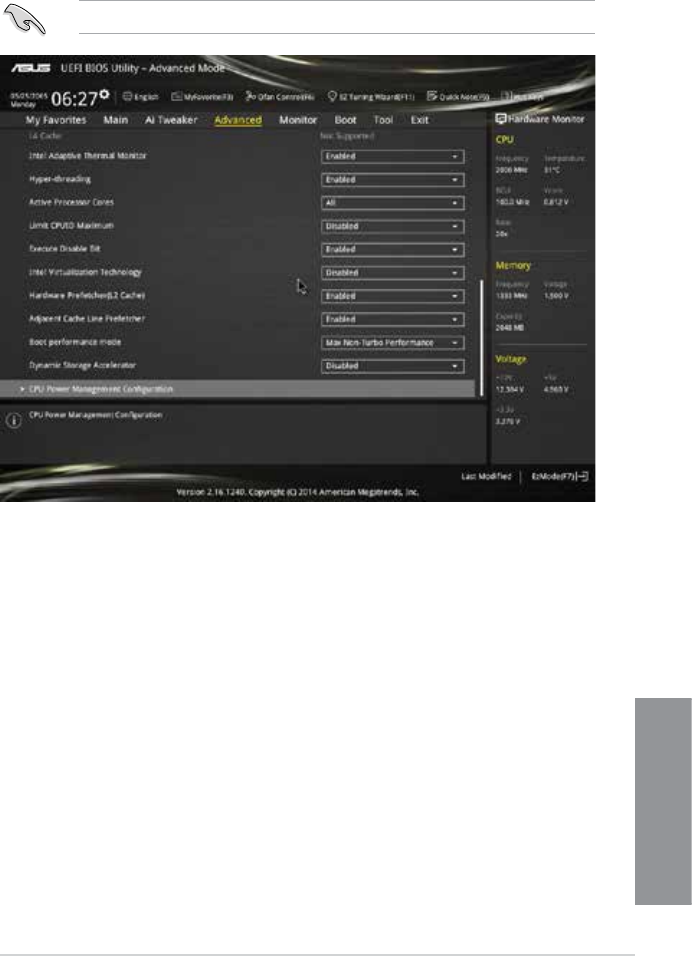
ASUS Z97-E 3-31
Chapter 3
3.6.1 CPU Conguration
The items in this menu show the CPU-related information that the BIOS automatically
detects.
The items in this menu may vary based on the CPU installed.
Intel Adaptive Thermal Monitor [Enabled]
This item allows you to protect the CPU by decreasing its frequency as it reaches the thermal
throttle point. The thermal monitor includes TM1 (Thermal monitor 1), TM2 (Thermal monitor
2), and EMTTM (Enhanced Multi-threaded Thermal Monitoring).
Conguration options: [Disabled] [Enabled]
Active Processor Cores [All]
This item allows you to select the number of CPU cores to activate in each processor
package. Conguration options: [All] [1] [2] [3]
Limit CPUID Maximum [Disabled]
When set to [Enabled], this item allows the legacy OS to boot even without support for CPUs
with extended CPUID functions. Conguration options: [Disabled] [Enabled]
Execute Disable Bit [Enabled]
Execute Disable prevents certain classes of malicious buffer overow attacks when
combined with a supporting OS (SuSE Linux 9.2, RedHat Enterprise 3 Update 3).
Conguration options: [Disabled] [Enabled]
3-32 Chapter 3: BIOS setup
Chapter 3
Intel Virtualization Technology [Disabled]
When set to [Enabled], a VMM can utilize the additional hardware capabilities provided by
Vanderpool Technology. Conguration options: [Disabled] [Enabled]
Hardware Prefetcher(L2 Cache) [Enabled]
This item allows the CPU to prefetch commands and data in the L2 cache, reduces the
DRAM loading time and improves the system performance.
Conguration options: [Disabled] [Enabled]
Adjacent Cache Line Prefetcher [Enabled]
This item allows the mid level cache (L2) to prefetch adjacent cache lines, reducing the
DRAM loading time and improves the system performance.
Conguration options: [Disabled] [Enabled]
Boot Performance Mode [Max on-Turbo Performance]
This item allows you to select the CPU performance state during system boot before the
operating system takes control. The CPU runs at a selected performance ratio based on CPU
conguration.
Conguration options: [Max Non-Turbo Performance] [Max Battery] [Turbo Performance]
Dynamic Storage Accelerator [Disabled]
This item allows you to accelerate the performance of the SSDs (Solid-State Drives) by
dynamically adjusting the power management during heavy multitasking.
Conguration options: [Enabled] [Disabled]
CPU Power Management Conguration
This item allows you to manage and congure the CPU’s power.
Enhanced Intel SpeedStep Technology [Enabled]
This item allows your system to adjust the CPU’s voltage and cores frequency,
resulting in decreased power consumption and heat production.
[Disabled] The CPU runs at its default speed.
[Enabled] The system controls the CPU speed.
Turbo Mode [Enabled]
This item allows you to automatically set the CPU cores to run faster than the base
operating frequency when it is below the operating power, current and temperature
specication limit. Conguration options: [Enabled] [Disabled]
CPU C-states [Auto]
This item allows you to set the power saving of the CPU states.
Conguration options: [Auto] [Disabled] [Enabled]
The following items appear only when you set the CPU states to [Enabled].
Enhanced C1 state [Enabled]
This item allows your CPU to reduce power consumption when the system
is in idle mode. Conguration options: [Enabled] [Disabled]
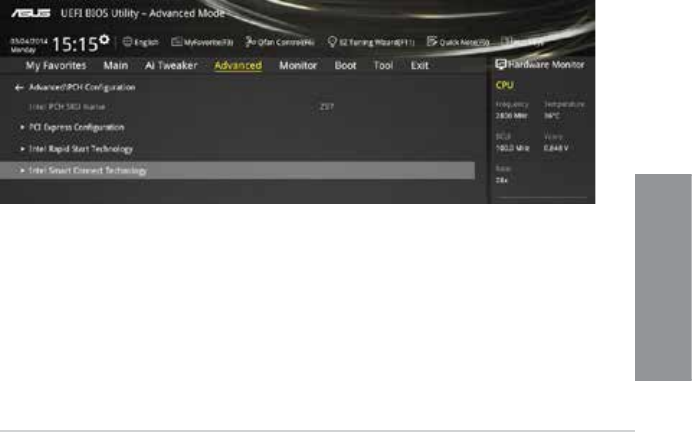
ASUS Z97-E 3-33
Chapter 3
CPU C3 Report [Enabled]
This item allows you to disable or enable the CPU C3 report to the
operating system.
Conguration options: [Enabled] [Disabled]
CPU C6 Report [Enabled]
This item allows you to disable or enable the CPU C6 report to the
operating system.
Conguration options: [Enabled] [Disabled]
C6 Latency [Short]
This item allows you to set the duration of C6 latency for C6 state.
Conguration options: [Short] [Long]
CPU C7 Report [CPU C7s]
This item allows you to disable or enable the CPU C7 report to the
operating system.
Conguration options: [Disabled] [CPU C7] [CPU C7s]
C7 Latency [Long]
This item allows you to set the duration of C7 latency for C7 state.
Conguration options: [Short] [Long]
CFG lock [Disabled]
This item allows you to congure MSR 0xE2[15], CFG lock bit.
Conguration options: [Disabled] [Enabled]
Package C State Support [Auto]
This item allows you to set the a C-state support for the CPU package.
Conguration options: [Auto] [Enabled] [C0/C1] [C2] [C3] [C6] [CPU C7]
[CPU C7s]
3.6.2 PCH Conguration
PCI Express Conguration
This item allows you to congure the PCI Express slots.
PCIe Speed [Auto]
This item allows your system to automatically select the PCI Express port speed. When
set to [Gen1], the PCI-E port runs at PCI-E 1.0 speed. When set to [Gen2], the PCI-E
port runs at PCI-E 2.0 speed.
Conguration options: [Auto] [Gen1] [Gen2]

3-34 Chapter 3: BIOS setup
Chapter 3
Intel Rapid Start Technology [Disabled]
This item allows you to enable or disable Intel® Rapid Start Technology.
Conguration options: [Enabled] [Disabled]
The following items appear only when you set the Intel® Rapid Start Technology to
[Enabled].
Entry on S3 RTC Wake [Enabled]
The system automatically wakes up and set to Rapid Start Technology S3 mode.
Conguration options: [Enabled] [Disabled
Entry After [0]
This item allows you to set the RTC wake-up timer at S3 entry. The time
ranges from 0 minute (immediately) to 120 minutes.
Active Page Threshold Support [Enabled]
The system automatically goes into sleep mode when the partition size is not enough
for the Intel® Rapid Start Technology to work.
Conguration options: [Enabled] [Disabled]
Active Memory Threshold [0]
This item supports Intel Rapid Storage Technology when the partition size
is greater than the Active Page Threshold size. When set to zero (0), it will
go to Auto mode and checks if the partition size is enough at S3 entry.
Ensure that the caching partition size is larger than the total memory size.
Hybrid Hard Disk Support [Disabled]
This item allows you to enable or disable the hybrid hard disk support for a faster
resume time.
Conguration options: [Enabled] [Disabled]
Intel Smart Connect Technology
This item allows the system to support Intel Smart Connect Technology, that periodically
refreshes selected applications when the system is in sleep mode.
Conguration options: [Enabled] [Disabled]
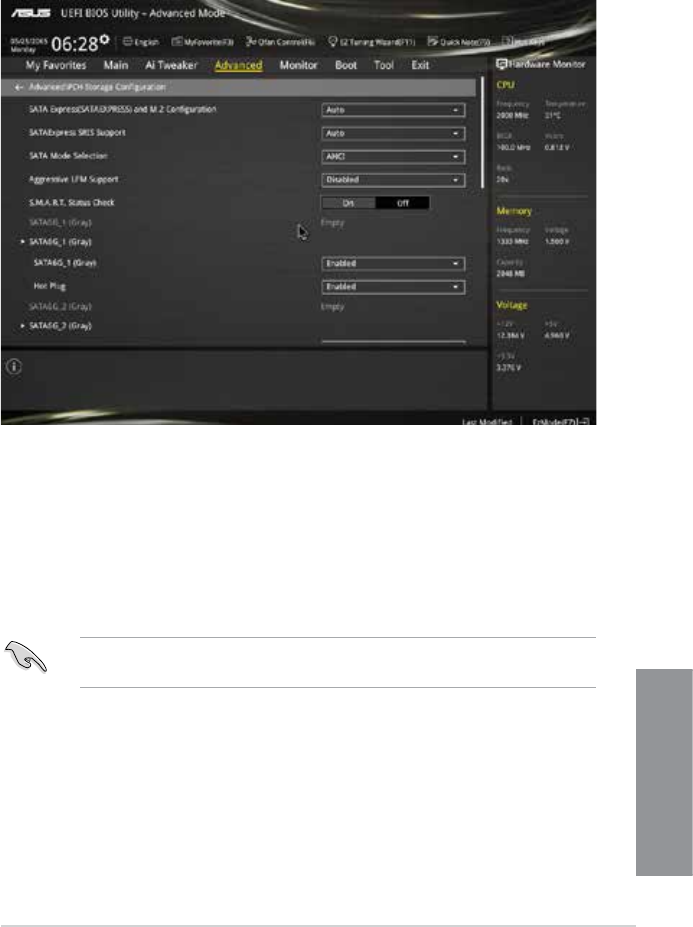
ASUS Z97-E 3-35
Chapter 3
3.6.3 PCH Storage Conguration
While entering Setup, the BIOS automatically detects the presence of SATA devices. The
SATA Port items show Empty if no SATA device is installed to the corresponding SATA port.
Scroll down to display the other BIOS items.
SATA Express (SATAEXPRESS) and M.2 Conguration [Auto]
This item allows you to set an automatic detection between the SATA Express devices and
M.2 devices.
[Auto] The system automatically detects the connected SATA Express or M.2
devices and set a higher priority to M.2 over SATA Express interface.
[SATA Express] The system assigns the priority bandwidth to SATA Express
(SATAEXPRESS_1) interface.
[M.2] The system assigns the priority bandwidth to M.2 Socket 3.
By default, the system detects the rst priority device. The device detection priority is as
follows: PCIe M.2 > SATA Mode M.2 > PCIe SATA Express > SATA Mode SATA Express.
SATAExpress SRIS Support [AHCI]
This item allows you to set the SATAExpress SRIS support.
[Auto] The system automatically adjust the SRIS (Separate Reference Clock
Independent Spread Spectrum Clocking Architecture) support for
connected SATA Express devices.
[Disabled] Select this option for ASUS RUNWAY SATA Express bridge card.

3-36 Chapter 3: BIOS setup
Chapter 3
SATA Mode Selection [AHCI Mode]
This item allows you to set the SATA conguration.
[Disabled] Disables the SATA function.
[IDE Mode] Set to [IDE Mode] when you want to use the Serial ATA hard disk drives as
Parallel ATA physical storage devices.
[AHCI Mode] Set to [AHCI Mode] when you want the SATA hard disk drives to use the
AHCI (Advanced Host Controller Interface). The AHCI allows the onboard
storage driver to enable advanced Serial ATA features that increases
storage performance on random workloads by allowing the drive to
internally optimize the order of commands.
[RAID Mode] Set to [RAID Mode] when you want to create a RAID conguration from the
SATA hard disk drives.
The following item appears only when you set the SATA Mode Selection to [RAID].
Pcie Nand Configuration [Auto]
This item allows you to enable or disable PCIe NAND.
Conguration options: [Disabled] [Enabled]
Aggressive LPM Support [Disabled]
This item is designed for LPM (link power management) support with a better energy saving
conditions. When disabled, the hot plug function of SATA ports are disabled.
Conguration options: [Disabled] [Enabled]
S.M.A.R.T. Status Check [On]
S.M.A.R.T. (Self-Monitoring, Analysis and Reporting Technology) is a monitoring system that
shows a warning message during POST (Power-on Self Test) when an error occurs in the
hard disks. Conguration options: [On] [Off]
Hot Plug [Enabled] (SATA6G_1 - SATA6G_6)
These items allow you to enable/disable SATA Hot Plug Support.
Conguration options: [Disabled] [Enabled]
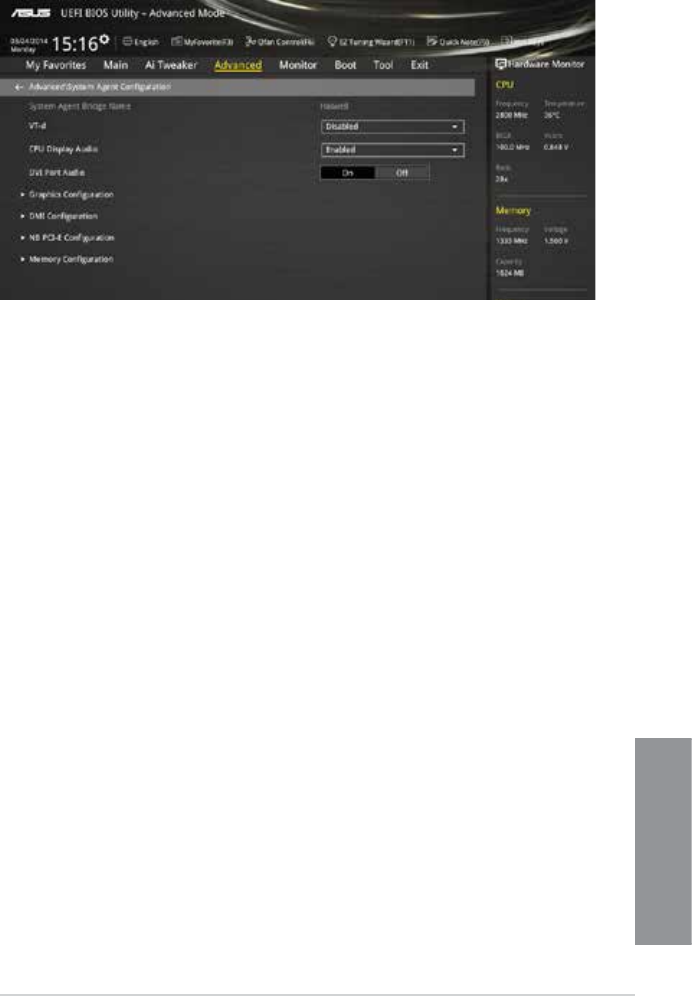
ASUS Z97-E 3-37
Chapter 3
VT-d [Disabled]
Allows you to enable or disable VT-d function on MCH. Conguration options: [Enabled]
[Disabled]
CPU Display Audio [Enabled]
Allows you to enable or disable CPU display audio support. Conguration options: [Enabled]
[Disabled]
DVI Port Audio [Off]
Allows you to enable or disable DVI port audio support. Conguration options: [On] [Off]
Graphics Conguration
This item allows you to select a primary display from CPU and PCIe graphical devices.
Primary Display [Auto]
This item allows you to select the primary display from CPU and PCIe devices.
Conguration options: [Auto] [CPU Graphics] [PCIE] [PCI]
CPU Graphics Memory [Auto]
Allows you to set the system memory size allocated to DVMT 5.0 used by the CPU
graphics. Conguration options: [Auto] [32M] [64M] [96M] [128M] ~ [448M] [480M]
[512M]
Render Standby [Auto]
Allows you to enable or disable Intel® Graphics Render Standby support to reduce
iGPU power use when the system is idle. Conguration options: [Auto] [Disabled]
[Enabled]
CPU Graphics Multi-Monitor [Disabled]
This item allows you to empower both integrated and discrete graphics devices for the
multi-monitor output. The CPU graphics shared system memory size is xed at 64 MB.
Conguration options: [Disabled] [Enabled]
3.6.4 System Agent Conguration
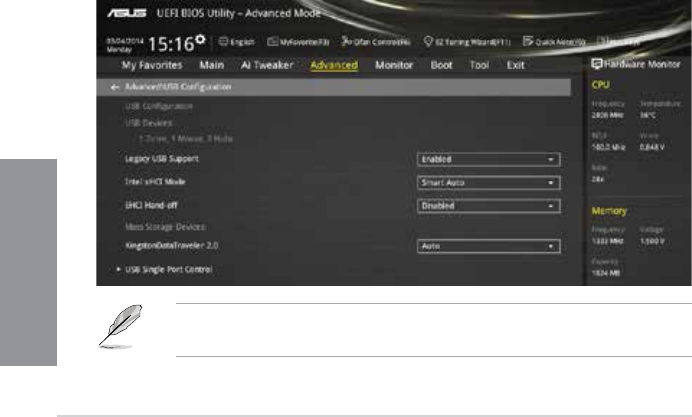
3-38 Chapter 3: BIOS setup
Chapter 3
DMI Conguration
This item allows you to control various DMI (direct media interface) to run at PCI-E 2.0 speed.
DMI Gen 2 [Enabled]
Set this item to [Enabled] to run DMI at PCI-E 2.0 speed.
Conguration options: [Enabled] [Disabled]
NB PCI-E Conguration
This item allows you to congure the NB PCI Express settings.
PCI-EX16_1/2Link Speed [Auto]
This item allows you to congure the PCIEx16_1/2 speed.
Conguration options: [Auto] [Gen1] [Gen2] [Gen3]
Memory Conguration
This item allows you to congure the memory conguration parameters.
Memory Scrambler [Enabled]
Set this item to [Enabled] to support high frequency DRAMs for a better stability.
Conguration options: [Enabled] [Disabled]
Memory Remap [Enabled]
Set this item to [Enabled] to support DRAM address remapping for 64-bit operating
systems.
Conguration options: [Enabled] [Disabled]
3.6.5 USB Conguration
The items in this menu allow you to change the USB-related features.
The Mass Storage Devices item shows the auto-detected values. If no USB device is
detected, the item shows None.
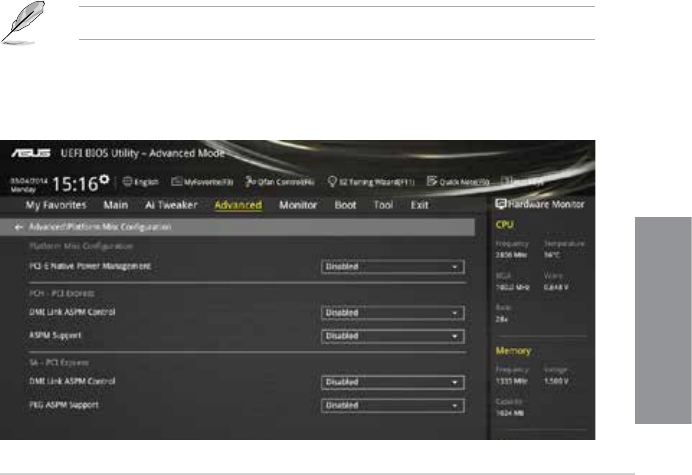
ASUS Z97-E 3-39
Chapter 3
Legacy USB Support [Enabled]
[Disabled] Your USB devices can be used for BIOS setup only and cannot be
recognized in the boot devices list.
[Enabled] Your system supports the USB devices in legacy operating systems.
[Auto] Your system automatically detects the presence of USB devices at startup.
If any USB devices are detected, the legacy USB support is enabled.
Intel xHCI Mode [Smart Auto]
[Auto] The xHCI is automatically enabled and runs at USB 3.0 mode when the
xHCI driver is installed in the operating system.
[Smart Auto] Upon detection, the xHCI driver supports the USB 3.0 mode during both
POST and operating system.
[Enabled] Enables the xHCI controller.
[Disabled] Disables the xHCI controller.
EHCI Hand-off [Disabled]
[Enabled] Enables the support for operating systems without an EHCI hand-off
feature.
[Disabled] Disables the EHCI Hand-off support.
Mass Storage Devices [Auto]
This item allows your system to detect the devices according to their media formats.
Conguration options: [Auto] [Floppy] [Forced FDD] [Hard Disk] [CD-ROM]
USB Single Port Control
This item allows you to enable or disable the individual USB ports.
Refer to section 1.2.2 Motherboard layout for the location of the USB ports.
3.6.6 Platform Misc Conguration
The items in this menu allow you to congure the platform-related features.

3-40 Chapter 3: BIOS setup
Chapter 3
PCI-E Native Power Management [Disabled]
This item allows you to enhance the power saving feature of PCI Express and perform ASPM
operations in the operating system.
Conguration options: [Disabled] [Enabled]
The following item appears only when you set the PCI Express Native Power Management
to [Enabled].
Native ASPM [Disabled]
[Enabled] Windows® Vista OS controls the ASPM (active state power
management) support for devices.
[Disabled] BIOS controls the ASPM support for the device.
PCH - PCI Express options
DMI Link ASPM Control [Disabled]
This item allows you to control the Active State Power Management on both NB
(NorthBridge) side and SB (SouthBridge) side of the DMI Link.
Conguration options: [Disabled] [Enabled]
ASPM Support [Disabled]
This item allows you to select the ASPM state for energy-saving conditions.
Conguration options: [Disabled] [L0s] [L1] [L0sL1] [Auto]
SA - PCI Express options
DMI Link ASPM Control [Disabled]
This item allows you to control the Active State Power Management on both CPU and PCH
(platform controller hub) Both DMI link ASPM control items of the CPU and PCH sides must
be enabled for the ASPM to take effect.
Conguration options: [Disabled] [L0s] [L1] [L0sL1]
PEG ASPM Support [Disabled]
This item allows you to select the ASPM state for energy-saving conditions, or use the ASUS
optimized energy saving prole.
Conguration options: [Disabled] [ASPM] [L0s] [L1] [L0sL1] [Auto]
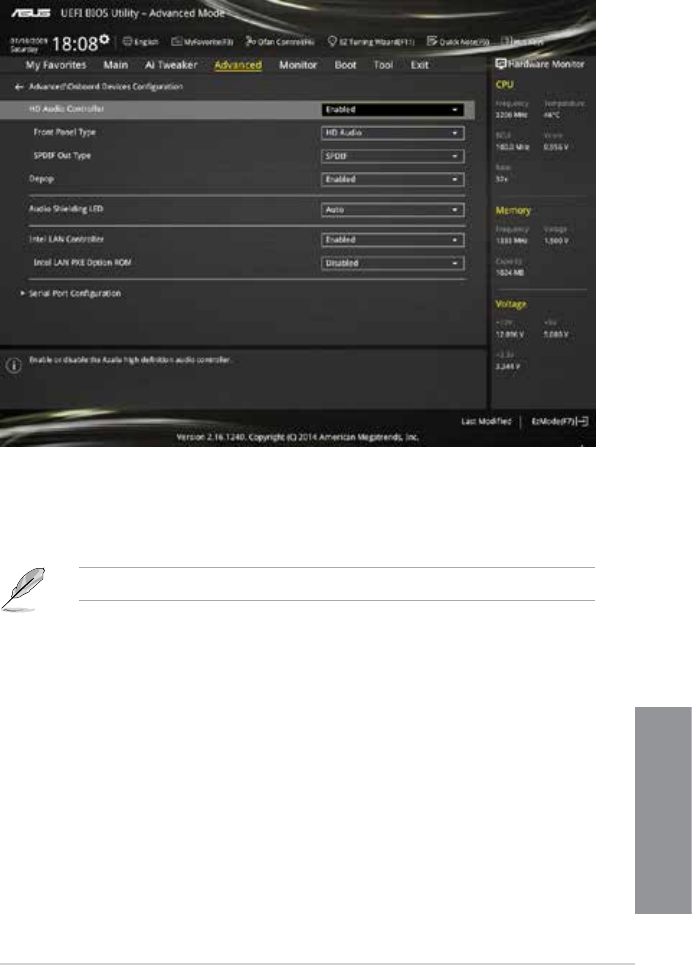
ASUS Z97-E 3-41
Chapter 3
3.6.7 Onboard Devices Conguration
Scroll down to view the other BIOS items.
HD Audio Controller [Enabled]
This item allows you to use the Azalia High Denition Audio Controller
Conguration options: [Disabled] [Enabled]
The following items appear only when you set the HD Audio Controller to [Enabled].
Front Panel Type [HD]
This item allows you to set the front panel audio connector (AAFP) mode to legacy
AC’97 or high-denition audio depending on the audio standard that the front panel
audio module supports.
[HD] Sets the front panel audio connector (AAFP) mode to high denition
audio.
[AC97] Sets the front panel audio connector (AAFP) mode to legacy AC’97
SPDIF Out Type [SPDIF]
[SPDIF] Sets to an SPDIF audio output.
[HDMI] Sets to an HDMI audio output.
Depop [Enabled]
[Enabled] Allows you to enable the Depop.
[Disabled] Enables the Depop.
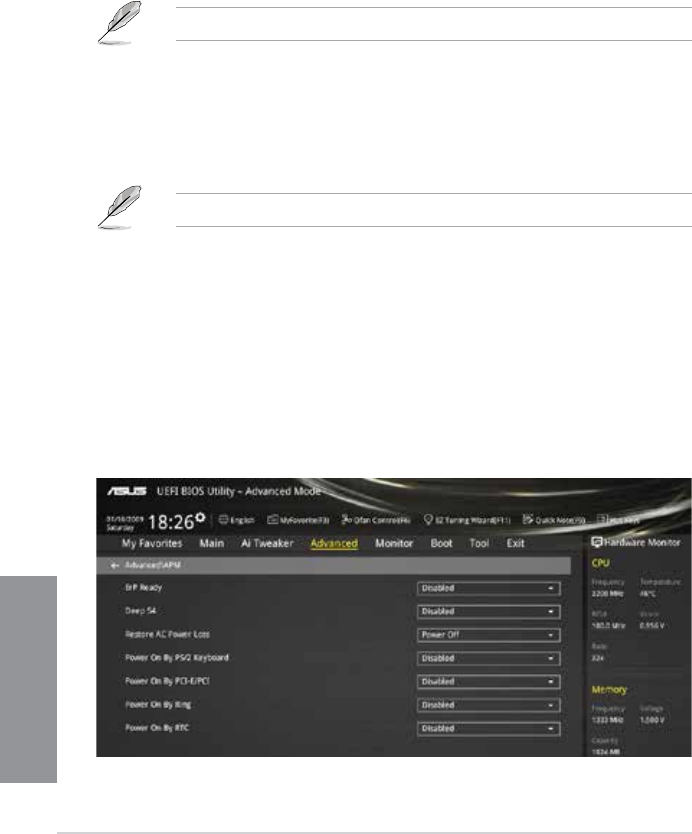
3-42 Chapter 3: BIOS setup
Chapter 3
Audio Shielding LED [Auto]
[Auto] The LED control depends on the conguration of the ErP Ready item. Set
this item to [Auto] and the ErP Ready item to [Disabled] to keep the LED
on.
[Disabled] Turn off the LED.
Intel LAN Controller [Enabled]
This item allows you to enable or disable the Intel LAN controllers.
Conguration options: [Disabled] [Enabled]
The following item appears only when you set the Intel LAN Controller to [Enabled].
Intel LAN PXE Option ROM [Disabled]
This item allows you to enable or disable the PXE OptionRom of the Intel® LAN
controller. Conguration options: [Enabled] [Disabled]
Serial Port Conguration
The sub-items in this menu allow you to set the serial port conguration.
This item functions only if there is a serial port (COM) connector on the motherboard.
Serial Port [Enabled]
Allows you to enable or disable the serial port (COM).Conguration options: [Enabled]
[Disabled]
Change Settings [IO=3F8h; IRQ=4]
This item appears only when you set the Serial Port to [Enabled] and allows you
to select the Serial Port base address. Conguration options: [IO=3F8h; IRQ=4]
[IO=2F8h; IRQ=3] [IO=3E8h; IRQ=4] [IO=2E8h; IRQ=3]
3.6.8 APM Conguration

ASUS Z97-E 3-43
Chapter 3
ErP Ready [Disabled]
Allows BIOS to switch off some power at S5 to get the system ready for ErP requirement.
When set to [Enabled], all other PME options will be switched off. Conguration options:
[Enabled] [Disabled]
Deep S4 [Disabled]
When enabled, the system in S4 state will further reduce power usage and will power off the
USB and PS/2 devices. The system in deep S4 state can be woken up via power button,
devices in LAN, or other ways except the USB and PS/2 devices. Conguration options:
[Enabled] [Disabled]
Restore AC Power Loss [Power Off]
This item allows your system to go to ON state, OFF state, or both states after an AC power
loss. When setting your system to [Last State], it goes to the previous state before the AC
power loss. Conguration options: [Power Off] [Power On] [Last State]
Power On By PS/2 Keyboard [Disabled]
[Disabled] Disables the Power On by a PS/2 keyboard.
[Space Bar] Sets the Space Bar on the PS/2 keyboard to turn on the system.
[Ctrl-Esc] Sets the Ctrl+Esc key on the PS/2 keyboard to turn on the system.
[Power Key] Sets Power key on the PS/2 keyboard to turn on the system. This feature
requires an ATX power supply that provides at least 1A on the +5VSB lead.
Power On By PCI-E/PCI [Disabled]
This item allows you to enable or disable the Wake-on-LAN function of the onboard LAN
controller or other installed PCI-E/PCI LAN cards. Conguration options: [Disabled] [Enabled]
Power On By Ring [Disabled]
[Disabled] Disables Ring to generate a wake event.
[Enabled] Enables Ring to generate a wake event.
Power On By RTC [Disabled]
This item allows you to enable or disable the RTC (Real-Time Clock) to generate a wake
event and congure the RTC alarm date. When enabled, you can set the days, hours,
minutes, or seconds to schedule an RTC alarm date.
Conguration options: [Disabled] [Enabled]
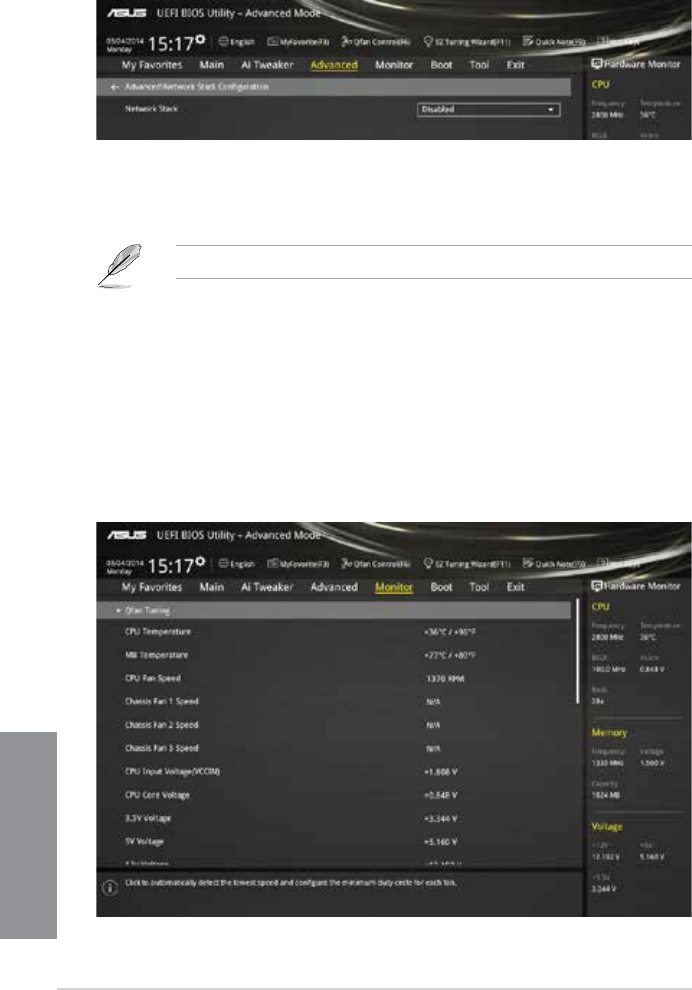
3-44 Chapter 3: BIOS setup
Chapter 3
3.6.9 Network Stack Conguration
Network stack [Disable]
This item allows you to disable or enable the UEFI network stack.
Conguration options: [Disable] [Enable]
The following item appears only when you set the Network Stack to [Enabled].
Ipv4/Ipv6 PXE Support [Enabled]
This item allows you to enable or disable the Ipv4/Ipv6 PXE wake event.
Conguration options: [Disabled] [Enabled]
3.7 Monitor menu
The Monitor menu displays the system temperature/power status, and allows you to change
the fan settings.
Scroll down to display the other BIOS items.

ASUS Z97-E 3-45
Chapter 3
Qfan Tuning
Click this item to automatically detect the lowest speed and congure the minimum duty cycle
for each fan.
CPU Temperature / MB Temperature [xxx°C/xxx°F]
The onboard hardware monitor automatically detects and displays the CPU and motherboard
temperatures. Select [Ignore] if you do not wish to display the detected temperatures.
CPU Fan Speed [xxxx RPM] or [Ignore] / [N/A], Chassis Fan 1/2/3 Speed [xxxx
RPM] or [Ignore] / [N/A]
The onboard hardware monitor automatically detects and displays the CPU and chassis fan
speed in rotations per minute (RPM). If the fan is not connected to the motherboard, the eld
shows N/A. Select [Ignore] if you do not wish to display the detected speed.
CPU Input Voltage(VCCIN), CPU Core Voltage, 3.3V Voltage, 5V Voltage, 12V
Voltage
The onboard hardware monitor automatically detects the voltage output through the onboard
voltage regulators. Select [Ignore] if you do not want to detect this item.
CPU Q-Fan Control [Auto]
This item allows you to set the CPU Q-Fan operating mode.
[Auto] Detects the type of CPU fan installed and automatically switches the mode
control.
[PWM Mode] Enable the CPU Q-Fan control in PWM mode for 4-pin CPU fan.
[DC Mode] Enable the CPU Q-Fan control in DC mode for 3-pin CPU fan.
[Disabled] Disables the Q-Fan control.
• The following items appear only when you set the CPU Q-Fan Control to [Auto],
[PWM Mode] or [DC Mode].
• The default CPU Q-Fan settings may differ when you set the CPU Q-Fan Control item
to [Auto].
CPU Fan Speed Low Limit [200 RPM]
This item allows you to set the low limit warning for CPU Fan speed.
Conguration options: [Ignore] [100 RPM] [200 RPM] [300 RPM] [400 RPM] [500 RPM]
CPU Fan Profile [Standard]
This item allows you to set the appropriate performance level of the CPU fan.
[Standard] Set to make the CPU fan adjust automatically depending on the CPU
temperature.
[Silent] Set to minimize the fan speed for quiet CPU fan operation.
[Turbo] Set to achieve maximum CPU fan speed.
[Manual] Set to assign the detailed fan speed control parameters.
The following items appear only when you set the CPU Fan Prole to [Manual].

3-46 Chapter 3: BIOS setup
Chapter 3
CPU Upper Temperature [70]
Use the <+> or <-> keys to adjust the upper limit of the CPU temperature.
The values range from 25°C to 75°C.
CPU Fan Max. Duty Cycle(%) [100]
Use the <+> or <-> keys to adjust the maximum CPU fan duty cycle. The
values range from 20% to 100%. When the CPU temperature reaches the
upper limit, the CPU fan operates at the maximum duty cycle.
CPU Middle Temperature [25]
Use the <+> or <-> keys to set the value for CPU Middle Temperature. The
range of the values depends on the CPU installed.
CPU Fan Middle Duty Cycle(%) [20]
Use the <+> or <-> keys to adjust the CPU fan middle duty cycle. The
values range from 20% to 100%. When the CPU temperature reaches the
middle value, the CPU fan operates at the middle duty cycle.
CPU Lower Temperature [20]
Use the <+> or <-> keys to adjust the CPU fan’s lower temperature. The
values range from 20% to 75%.
CPU Fan Min. Duty Cycle(%) [20]
Use the <+> or <-> keys to adjust the minimum CPU fan duty cycle. The
values range from 20% to 100%. When the CPU temperature is under
20°C, the CPU fan operates at the minimum duty cycle.
Chassis Fan 1/2/3 Q-Fan Control [DC Mode]
These items allow you to set the chassis fans’ Q-Fan control feature into DC Mode, PWM
Mode, or disable these Q-Fan controls from your motherboard.
Conguration options: [Disabled] [PWM Mode] [DC Mode]
The following items appear only when you set the Chassis Fan 1/2/3 Q-Fan Control to
[PWM Mode] or [DC Mode].
Chassis Fan 1/2/3 Q-Fan Source [CPU]
This item controls the assigned fan according to the selected temperature source.
Conguration options: [CPU] [MB]
Chassis Fan 1/2/3 Speed Low Limit [600 RPM]
This item allows you to disable or set the chassis fan warning speed.
Conguration options: [Ignore] [200 RPM] [300 RPM] [400 RPM] [500 RPM] [600 RPM]
Chassis Fan 1/2/3 Profile [Standard]
This item allows you to set the appropriate performance level of the chassis fan.
[Standard] Set to make the chassis fan adjust automatically depending on the
chassis temperature.
[Silent] Set to minimize the fan speed for quiet chassis fan operation.
[Turbo] Set to achieve maximum chassis fan speed.
[Manual] Set to assign detailed fan speed control parameters.
The following items appear only when you set the Chassis Fan 1/2/3 Prole to [Manual].

ASUS Z97-E 3-47
Chapter 3
Chassis Fan 1/2/3 Upper Temperature [70]
Use the <+> or <-> keys to adjust the upper limit of the chassis
temperature. The values range from 40°C to 90°C.
Chassis Fan 1/2/3 Max. Duty Cycle(%) [100]
Use the <+> or <-> keys to adjust the maximum chassis fan duty cycle. The
values range from 20% to 100%. When the chassis temperature reaches
the upper limit, the chassis fan will operate at the maximum duty cycle.
Chassis Fan 1/2/3 Middle Temperature [45]
Use the <+> or <-> keys to set the value for Chassis Fan Middle
Temperature.
Chassis Fan 1/2/3 Middle Duty Cycle(%) [60]
Use the <+> or <-> keys to adjust the chassis fan middle duty cycle. The
values range from 20% to 100%.
Chassis Fan 1/2/3 Lower Temperature [40]
Use the <+> or <-> keys to adjust the chassis fans’ lower temperature. The
values range from 20% to 75%.
Chassis Fan 1/2/3 Min. Duty Cycle(%) [60]
Use the <+> or <-> keys to adjust the minimum chassis fan duty cycle. The
values range from 20% to 100%. When the chassis temperature is under
40°C, the chassis fan operates at the minimum duty cycle.
Allow Fan Stop [Disabled]
This item appears only when you set Chassis Fan 1/2/3 Prole to [Manual] and allows
your fans to run at 0% duty cycle when the temperature of the source drops below the lower
temperature. Conguration options: [Disabled] [Enabled]
Anti-Surge Support [Enabled]
This item allows you to enable or disable the OVP (Over Voltage Protection) and UVP (Under
Voltage Protection) functions. This causes the system to automatically shut down when the
voltage exceeds the safe range that protects the motherboard’s components.
Conguration options: [Disabled] [Enabled]
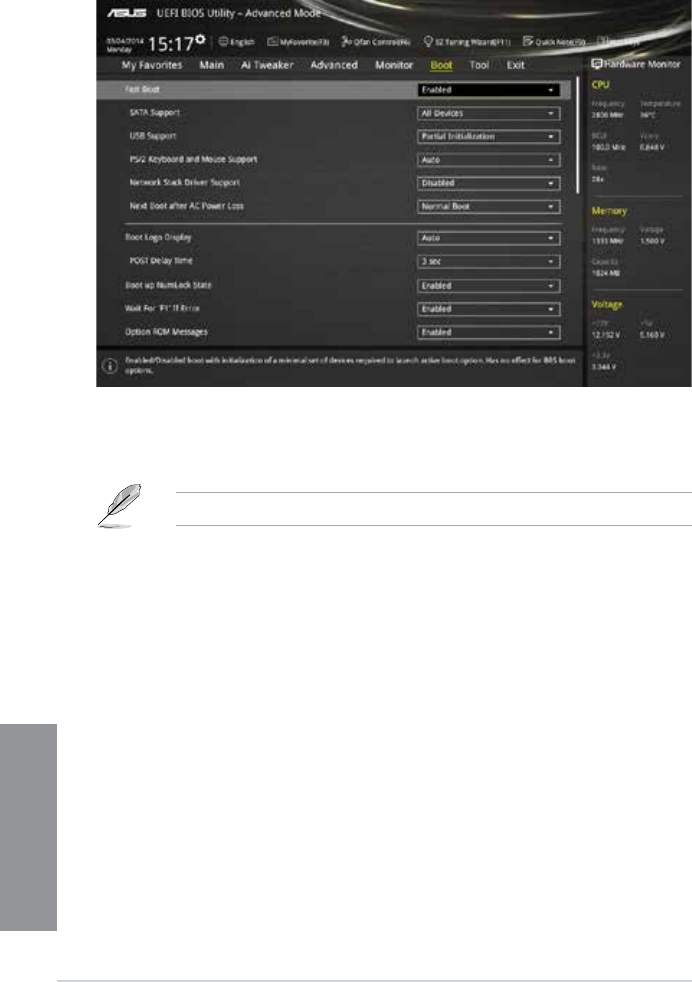
3-48 Chapter 3: BIOS setup
Chapter 3
3.8 Boot menu
The Boot menu items allow you to change the system boot options.
Fast Boot [Enabled]
[Disabled] This item allows your system to go back to its normal boot speed.
[Enabled] This item allows your system to accelerate the boot speed.
The following items appear only when you set the Fast Boot to [Enabled].
SATA Support [All Devices]
[All Devices] All devices connected to SATA ports are available during POST.
This process extends the POST time.
[Hard Drive Only] Only hard drives connected to SATA ports are detected during
POST.
[Boot Drive Only] Only boot drives connected to a SATA ports are detected during
POST.
USB Support [Partial Initialization]
[Disabled] All USB devices will not be available until OS boot up for a fastest
POST time.
[Full Initialization] All USB devices will be available during POST. This process will
extend the POST time.
[Partial Initialization] For a faster POST time, only the USB ports with keyboard and
mouse connections will be detected.

ASUS Z97-E 3-49
Chapter 3
PS/2 Keyboard and Mouse Support [Auto]
Select any of these settings when PS/2 keyboard and mouse are installed. These
settings only apply when Fast Boot is enabled.
[Auto] For a faster POST time, PS/2 devices will only be available when the
system boots up or rebooted when the PS/2 devices have not been
reconnected or changed. If you disconnect or change PS/2 devices
before restarting the system, PS/2 devices will not be available and
BIOS setup program will not be accessible via PS/2 devices.
[Full Initialization] For full system control, PS/2 devices will be available during POST
at any circumstances. This process will extend POST time.
[Disabled] For the fastest POST time, all PS/2 devices will not be available
until your computer enters the operating system.
Network Stack Driver Support [Disabled]
[Disabled] Select to skip the network stack driver from loading during POST.
[Enabled] Select to load the network stack driver during POST.
Next Boot after AC Power Loss [Normal Boot]
[Normal Boot] Returns to normal boot on the next boot after an AC power loss.
[Fast Boot] Accelerates the boot speed on the next boot after an AC power loss.
Boot Logo Display [Auto]
[Auto] Sets the boot logo to display during POST.
[Full Screen] Sets the boot logo display in full screen during POST.
[Disabled] Disables the boot logo display during POST.
The following item appears only when you set the Boot Logo Display to [Auto] and [Full
Screen].
Post Delay Time [3 sec]
This item allows you to select a desired additional POST waiting time to easily enter
the BIOS Setup. You can only execute the POST delay time during normal boot. The
values range from 0 to 10 seconds.
This feature only works when set under normal boot.
The following items appear only when you set the Boot Logo Display to [Disabled].
Post Report [5 sec]
This item allows you to select a desired POST report waiting time.
Conguration options: [1 sec] - [10 sec] [Until Press ESC]
Bootup NumLock State [Enabled]
This item allows you to enable or disable power-on state of the NumLock.
Conguration options: [Disabled] [Enabled]

3-50 Chapter 3: BIOS setup
Chapter 3
Wait For ‘F1’ If Error [Enabled]
This item allows your system to wait for the <F1> key to be pressed when error occurs.
Conguration options: [Disabled] [Enabled]
Option ROM Messages [Enabled]
[Enabled] The third-party ROM messages will be displayed during POST.
[Disabled] Disables the ROM messages and displays only the ASUS logo during
POST.
Interrupt 19 Capture [Disabled]
This item allows you to trap Interrupt 19 by the option ROMs.
Conguration options: [Disabled] [Enabled]
Above 4G Decoding [Disabled]
This item allows you to decode the 64-bit capable devices above 4G address space. Ensure
that your system supports 64-bit PCI decoding.
Conguration options: [Disabled] [Enabled]
Setup Mode [EZ Mode]
[Advanced Mode] This item allows you to go to Advanced Mode of the BIOS after POST.
[EZ Mode] This item allows you to go to EZ Mode of the BIOS after POST.
CSM (Compatibility Support Module)
This item allows you to congure the CSM (Compatibility Support Module) items to fully
support the various VGA, bootable devices and add-on devices for better compatibility.
Launch CSM [Enabled]
[Auto] The system automatically detects the bootable devices and the add-
on devices.
[Enabled] For better compatibility, enable the CSM to fully support the non-UEFI
driver add-on devices or the Windows® UEFI mode.
[Disabled] Disables the CSM to fully support the non-UEFI driver add-on devices
or the Windows® UEFI mode.
The following items appear only when you set the Launch CSM to [Enabled].
Boot Device Control [UEFI and Legacy OPROM]
This item allows you to select the type of devices that you want to boot.
Conguration options: [UEFI and Legacy OPROM] [Legacy OPROM only]
[UEFI only]
Boot from Network Devices [Legacy OPROM rst]
This item allows you to select the type of network devices that you want to
launch.
Conguration options: [Legacy OPROM rst] [UEFI driver rst] [Ignore]

ASUS Z97-E 3-51
Chapter 3
Boot from Storage Devices [Legacy OPROM rst]
This item allows you to select the type of storage devices that you want
to launch. Conguration options: [Both, Legacy OPROM rst] [Both, UEFI
rst] [Legacy OPROM rst] [UEFI driver rst] [Ignore]
Boot from PCI-E/PCI Expansion Devices [Legacy OPROM rst]
This item allows you to select the type of PCIe/PCI expansion devices that
you want to launch.
Conguration options: [Legacy OPROM rst] [UEFI driver rst]
Secure Boot
This item allows you to congure the Windows® Secure Boot settings and manage its keys to
protect the system from unauthorized access and malwares during POST.
OS Type [Windows UEFI Mode]
[Windows UEFI
Mode]
This item allows you to select your installed operating system.
Execute the Microsoft® Secure Boot check. Only select
this option when booting on Windows® UEFI mode or other
Microsoft® Secure Boot compliant OS.
[Other OS] Get the optimized function when booting on Windows® non-
UEFI mode. Microsoft® Secure Boot only supports Windows®
UEFI mode.
The following item appears only when you set the OS Type to [Windows UEFI mode].
Key Management
This allows you to manage the Secure Boot keys.
Install Default Secure Boot keys
This item allows you to immediately load the default Security Boot keys,
Platform key (PK), Key-exchange Key (KEK), Signature database (db), and
Revoked Signatures (dbx). When the default Secure boot keys are loaded,
the PK state will change from Unloaded mode to loaded mode.
Clear Secure Boot keys
This item appears only when you load the default Secure Boot keys. This
item allows you to clear all default Secure Boot keys.
Save Secure Boot Keys
This item allows you to save the PK (Platform Keys) to a USB storage
device.
PK Management
The Platform Key (PK) locks and secures the rmware from any permissible changes.
The system veries the PK before your system enters the OS.
Delete PK
This item allows you to delete the PK from your system. Once the PK is
deleted, all the system’s Secure Boot keys will not be active.
Conguration options: [Yes] [No]
3-52 Chapter 3: BIOS setup
Chapter 3
Load Default PK
Select Yes to load the system default PK or select No to load a
downloaded PK from a USB storage device.
The PK le must be formatted as a UEFI variable structure with time-based authenticated
variable.
KEK Management
The KEK (Key-exchange Key or Key Enrollment Key) manages the Signature database
(db) and Revoked Signature database (dbx).
Key-exchange Key (KEK) refers to Microsoft® Secure Boot Key-Enrollment Key (KEK).
Delete KEK
This item allows you to delete the KEK from your system.
Conguration options: [Yes] [No]
Load Default KEK
Select Yes to load the system default KEK or select No to load a
downloaded KEK from a USB storage device.
Append Default KEK
Select Yes to append the system default KEK or select No to append a
downloaded KEK from a USB storage device.
The KEK le must be formatted as a UEFI variable structure with time-based authenticated
variable.
DB Management
The db (Authorized Signature database) lists the signers or images of UEFI
applications, operating system loaders, and UEFI drivers that you can load on the
single computer.
Delete the db
This item allows you to delete the db le from your system.
Conguration options: [Yes] [No]
Load Default db
Select Yes to load the system default db or select No to load a
downloaded db from a USB storage device..
Append Default db
Select Yes to append the system default db or select No to append a
downloaded db from a USB storage device.
The db le must be formatted as a UEFI variable structure with time-based authenticated
variable.
ASUS Z97-E 3-53
Chapter 3
DBX Management
The dbx (Revoked Signature database) lists the forbidden images of db items that are
no longer trusted and cannot be loaded.
Delete the dbx
This item allows you to delete the dbx le from your system.
Load Default dbx
Select Yes to load the system default dbx or select No to load a
downloaded dbx from a USB storage device.
Conguration options: [Yes] [No]
Append Default dbx
Select Yes to append the system default dbx or select No to append a
downloaded dbx from a USB storage device.
The dbx le must be formatted as a UEFI variable structure with time-based authenticated
variable.
Boot Option Priorities
These items specify the boot device priority sequence from the available devices. The
number of device items that appears on the screen depends on the number of devices
installed in the system.
• To access Windows® OS in Safe Mode, press <F8 > after POST (Windows® 8 not
supported).
• To select the boot device during system startup, press <F8> when ASUS Logo
appears.
Boot Override
These item displays the available devices. The number of device items that appear on the
screen depends on the number of devices installed in the system. Click an item to start
booting from the selected device.
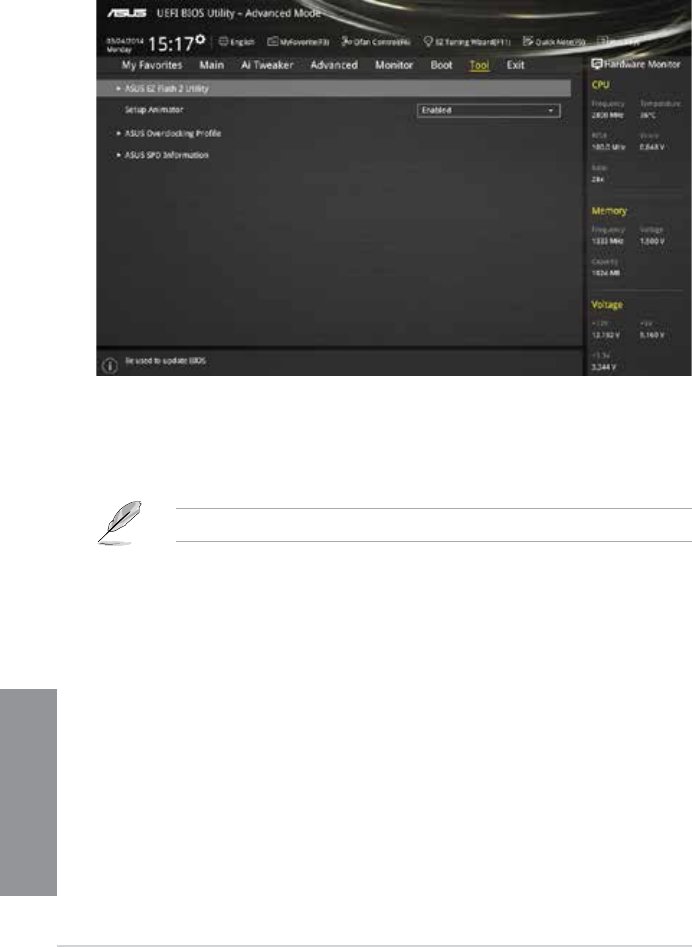
3-54 Chapter 3: BIOS setup
Chapter 3
3.9 Tool menu
The Tool menu items allow you to congure options for special functions. Select an item then
press <Enter> to display the submenu.
3.9.1 ASUS EZ Flash 2 Utility
This item allows you to run ASUS EZ Flash 2. When you press <Enter>, a conrmation
message appears. Use the left/right arrow key to select between [Yes] or [No], then press
<Enter> to conrm your choice.
For more details, refer to section 3.11.2 ASUS EZ Flash 2.
Setup Animator [Enabled]
This item allows you to enable or disable the Setup animator.
Conguration options: [Disabled] [Enabled]
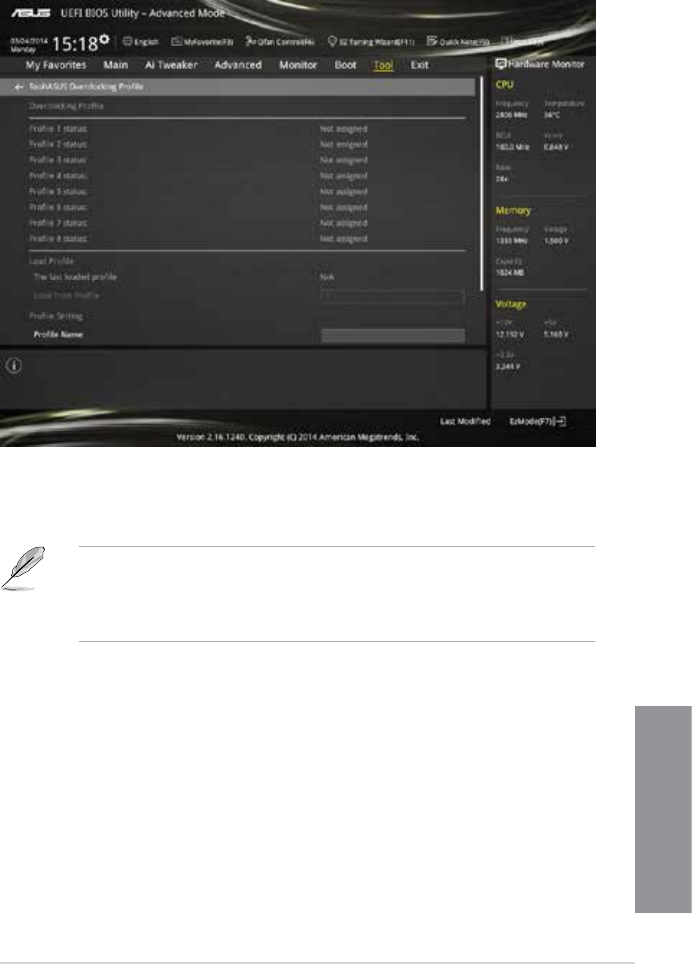
ASUS Z97-E 3-55
Chapter 3
Load from Prole
This item allows you to load the previous BIOS settings saved in the BIOS Flash. Key in the
prole number that saved your BIOS settings, press <Enter>, and then select Yes.
• DO NOT shut down or reset the system while updating the BIOS to prevent the
system boot failure!
• We recommend that you update the BIOS le only coming from the same memory/
CPU conguration and BIOS version.
Prole Name
This item allows you to key in a prole name.
Save to Prole
This item allows you to save the current BIOS settings to the BIOS Flash, and create a
prole. Key in a prole number from one to eight, press <Enter>, and then select Yes.
Load/Save Prole from/to USB Drive
This item allows you to load or save prole from your USB drive, load and save prole to your
USB drive.
3.9.2 ASUS Overclocking Prole
This item allows you to store or load multiple BIOS settings.
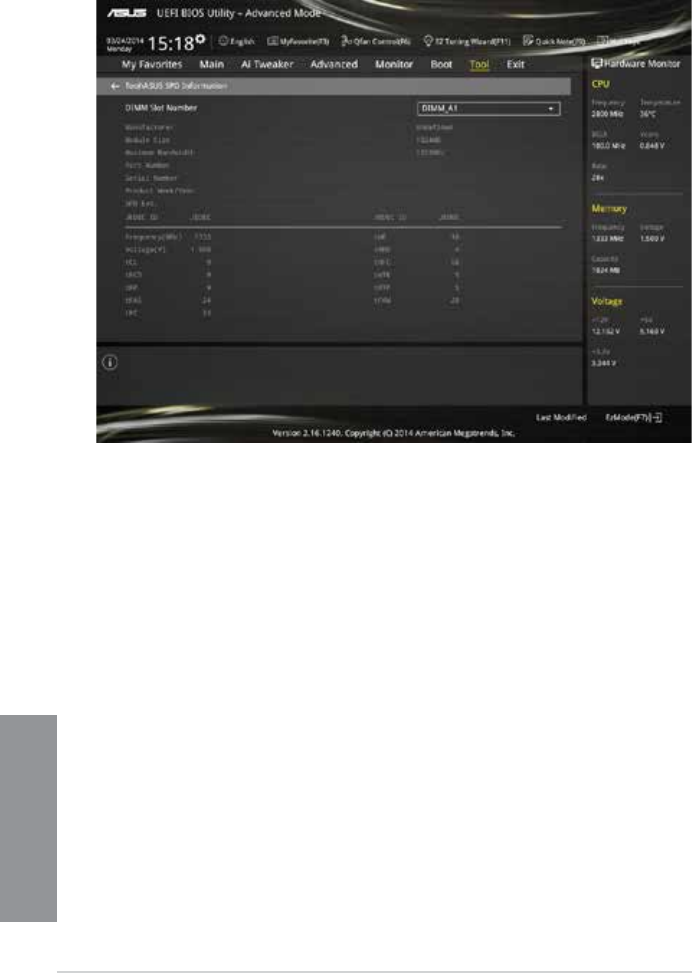
3-56 Chapter 3: BIOS setup
Chapter 3
3.9.3 ASUS SPD Information
This item allows you to view the DRAM SPD information.
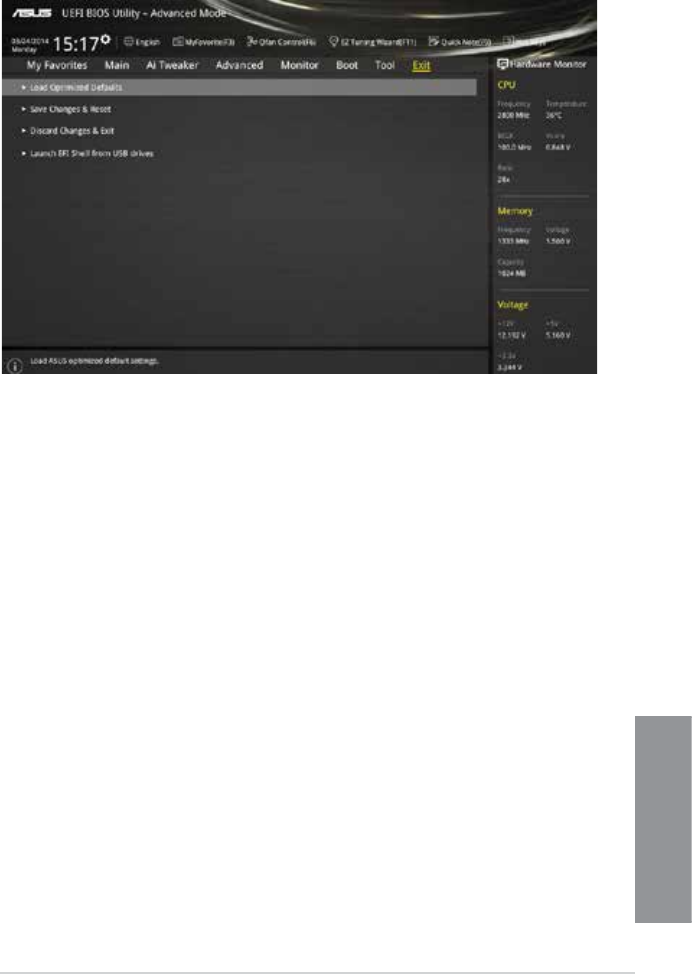
ASUS Z97-E 3-57
Chapter 3
3.10 Exit menu
The Exit menu items allow you to load the optimal default values for the BIOS items, and
save or discard your changes to the BIOS items.
Load Optimized Defaults
This option allows you to load the default values for each of the parameters on the Setup
menus. When you select this option or if you press <F5>, a conrmation window appears.
Select OK to load the default values.
Save Changes & Reset
Once you are nished making your selections, choose this option from the Exit menu to
ensure the values you selected are saved. When you select this option or if you press <F10>,
a conrmation window appears. Select OK to save changes and exit.
Discard Changes & Exit
This option allows you to exit the Setup program without saving your changes. When you
select this option or if you press <Esc>, a conrmation window appears. Select Yes to
discard changes and exit.
Launch EFI Shell from USB device
This option allows you to attempt to launch the EFI Shell application (shellx64.e) from one of
the available USB devices.
3-58 Chapter 3: BIOS setup
Chapter 3
3.11 Updating BIOS
The ASUS website publishes the latest BIOS versions to provide enhancements on system
stability, compatibility,and performance. However, BIOS updating is potentially risky. If
there is no problem using the current version of BIOS, DO NOT manually update the BIOS.
Inappropriate BIOS updating may result to system’s failure to boot. Carefully follow the
instructions in this chapter to update your BIOS when necessary.
Visit http://www.asus.com to download the latest BIOS le for this motherboard.
The following utilities allow you to manage and update the motherboard BIOS setup program.
1. EZ Update: Updates the BIOS in Windows® environment.
2. ASUS EZ Flash 2: Updates the BIOS using a USB ash drive.
3. ASUS CrashFree BIOS 3: Restores the BIOS using the motherboard support DVD or a
USB ash drive when the BIOS le fails or gets corrupted.
4. ASUS BIOS Updater: Updates the BIOS in DOS environment using the motherboard
support DVD and a USB ash disk drive.
3.11.1 EZ Update
The EZ Update is a utility that allows you to update the motherboard BIOS in Windows®
environment.
• EZ Update requires an Internet connection either through a network or an ISP
(Internet Service Provider).
• This utility is available in the support DVD that comes with the motherboard package.
• Refer to section 4.4.2 EZ Update of this user guide for more information.
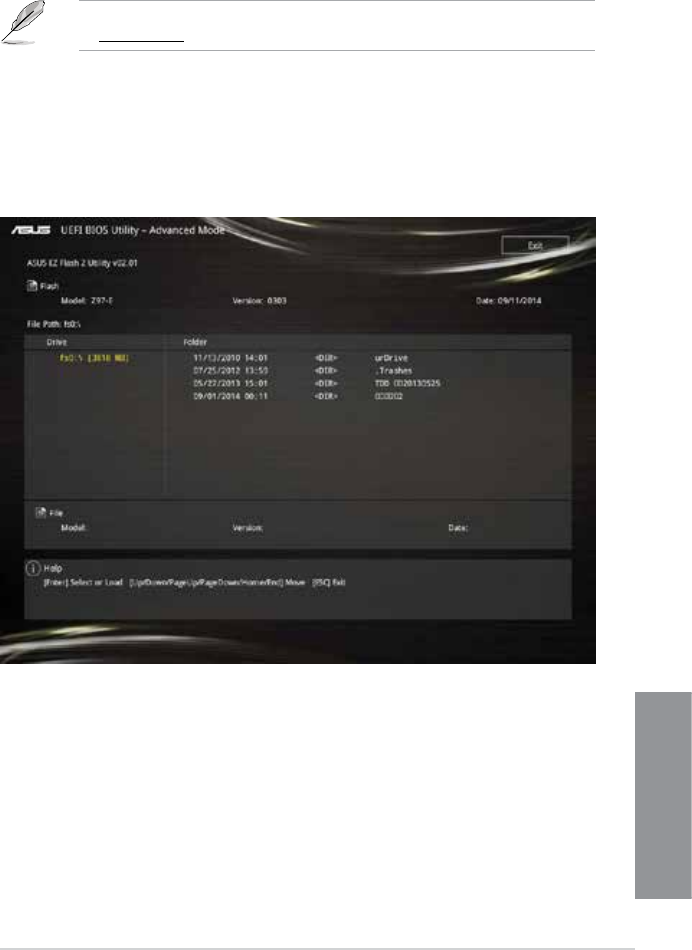
ASUS Z97-E 3-59
Chapter 3
3.11.2 ASUS EZ Flash 2
ASUS EZ Flash 2 allows you to update the BIOS without having to use a bootable oppy disk
or an OS-based utility.
Before you start using this utility, download the latest BIOS from the ASUS website
at www.asus.com.
To update the BIOS using EZ Flash 2:
1. Insert the USB ash disk that contains the latest BIOS le to the USB port.
2. Enter the Advanced Mode of the BIOS setup program. Go to the Tool menu to select
ASUS EZ Flash Utility and press <Enter> to enable it.
3. Press the Left/Right arrow keys to switch to the Drive eld.
4. Press the Up/Down arrow keys to nd the USB ash disk that contains the latest BIOS,
and then press <Enter>.
5. Press <Tab> to switch to the Folder Info eld.
6. Press the Up/Down arrow keys to nd the BIOS le, and then press <Enter> to perform
the BIOS update process. Reboot the system when the update process is done.
3-60 Chapter 3: BIOS setup
Chapter 3
• This function can support devices such as a USB ash disk with FAT 32/16 format and
single partition only.
• DO NOT shut down or reset the system while updating the BIOS to prevent system
boot failure!
Ensure to load the BIOS default settings to ensure system compatibility and stability. Select
the Load Optimized Defaults item under the Exit menu. See section 3.10 Exit Menu for
details.
3.11.3 ASUS CrashFree BIOS 3
The ASUS CrashFree BIOS 3 utility is an auto recovery tool that allows you to restore the
BIOS le when it fails or gets corrupted during the updating process. You can restore a
corrupted BIOS le using the motherboard support DVD or a USB ash drive that contains
the BIOS le.
The BIOS le in the motherboard support DVD may be older than the BIOS le published
on the ASUS ofcial website. If you want to use the newer BIOS le, download the le at
http://support.asus.com and save it to a USB ash drive.
Recovering the BIOS
To recover the BIOS:
1. Turn on the system.
2. Insert the motherboard support DVD to the optical drive, or the USB ash drive
containing the BIOS le to the USB port.
3. The utility automatically checks the devices for the BIOS le. When found, the utility
reads the BIOS le and enters ASUS EZ Flash 2 automatically.
4. The system requires you to enter BIOS Setup to recover the BIOS setting. To ensure
system compatibility and stability, we recommend that you press <F5> to load default
BIOS values.
DO NOT shut down or reset the system while updating the BIOS! Doing so can cause
system boot failure!

ASUS Z97-E 3-61
Chapter 3
3.11.4 ASUS BIOS Updater
ASUS BIOS Updater allows you to update the BIOS in DOS environment.
The screen captures used in this section are for reference only and may not be exactly the
same as actually shown on your computer screen.
Before updating BIOS
• Prepare the motherboard support DVD and a USB ash drive.
• Download the latest BIOS le and BIOS Updater from http://support.asus.com and
save them in your USB ash drive.
NTFS is not supported under DOS environment. Ensure that your USB ash drive is in
single partition and in FAT32/16 format.
• Turn off the computer.
• Ensure that your computer has a DVD optical drive.
Booting the system in DOS environment
To boot the system in DOS:
1. Insert the USB ash drive with the latest BIOS le and BIOS Updater to the USB port.
2. Boot your computer then press <F8> to launch the select boot device screen.
3. When the select boot device screen appears, insert the Support DVD into the optical
drive then select the optical drive as the boot device.
Please select boot device:
and to move selection
ENTER to select boot device
ESC to boot using defaults
P2: ST3808110AS (76319MB)
aigo miniking (250MB)
UEFI: (FAT) ASUS DRW-2014L1T(4458MB)
P1: ASUS DRW-2014L1T(4458MB)
UEFI: (FAT) aigo miniking (250MB)
Enter Setup
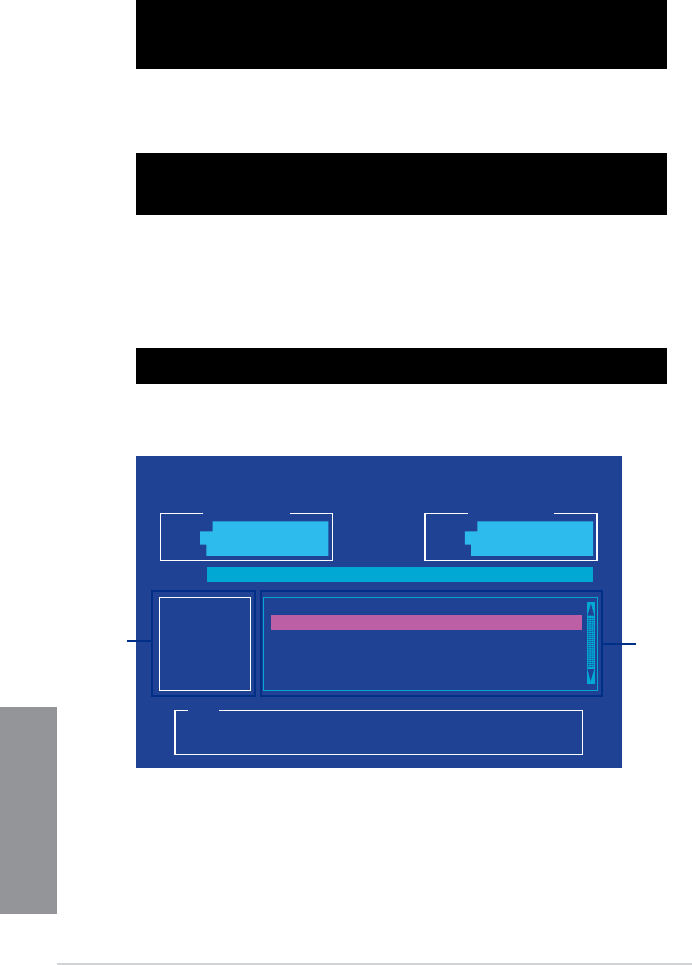
3-62 Chapter 3: BIOS setup
Chapter 3
4. When the booting message appears, press <Enter> within ve (5) seconds to enter
FreeDOS prompt.
Updating the BIOS le
To update the BIOS le:
1. On the FreeDOS prompt, type bupdater /pc /g and press <Enter>.
2. On the BIOS Updater screen, press <Tab> to switch from Files panel to Drives panel
then select D:.
ASUSTeK BIOS Updater for DOS V1.30 [2014/01/01]
Current ROM
BOARD: Z97-E
VER: 0410 (H :00 B :00)
DATE: 04/10/2014
Update ROM
BOARD: Unknown
VER: Unknown
DATE: Unknown
PATH: C:\
C:
D:
FORMAN~1 <DIR>
Z97-E.CAP 8390626 2014-02-10 21:14:34
Note
[Enter] Select or Load [Tab] Switch [V] Drive Info
[Up/Down/Home/End] Move [Esc] Exit
Welcome to FreeDOS (http://www.freedos.org)!
C:/> d:
D:/>
D:/> bupdater /pc /g
Files panel
Drives panel
3. Press <Tab> to switch from Drives panel to Files panel then press <Up/Down or Home/
End> keys to select the BIOS le and press <Enter>.
5. On the FreeDOS prompt, type d: then press <Enter> to switch the disk from Drive C
(optical drive) to Drive D (USB ash drive).
ISOLINUX 3.20 2006-08-26 Copyright (C) 1994-2005 H. Peter Anvin
A Bootable DVD/CD is detected. Press ENTER to boot from the DVD/CD.
If no key is pressed within 5 seconds, the system will boot next priority
device automatically. boot:
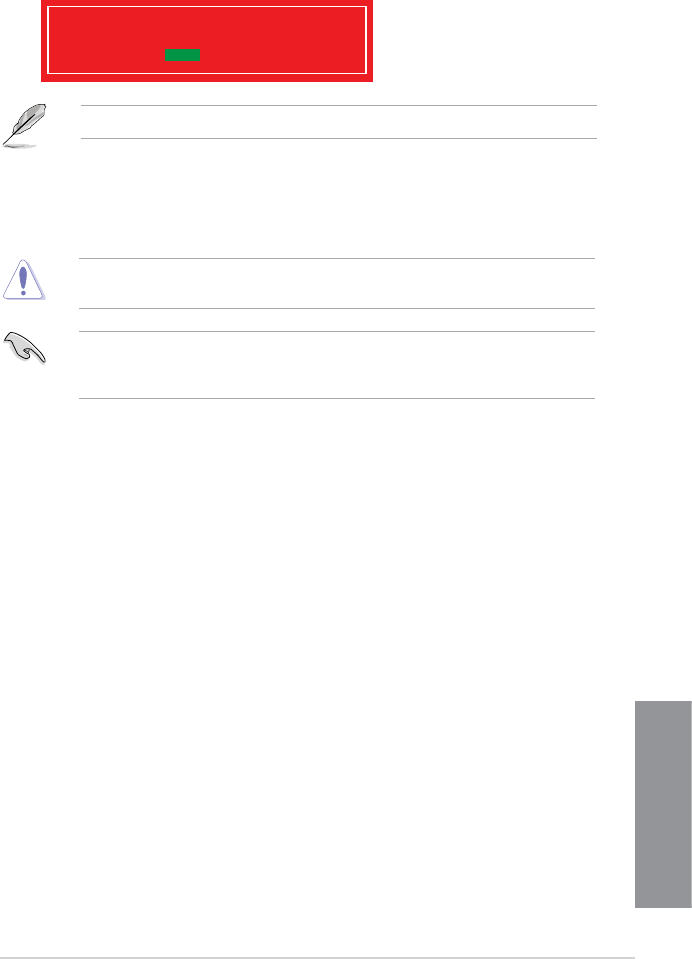
ASUS Z97-E 3-63
Chapter 3
5. Select Yes then press <Enter>. When BIOS update is done, press <ESC> to exit BIOS
Updater.
6. Restart your computer.
DO NOT shut down or reset the system while updating the BIOS to prevent system boot
failure.
Ensure to load the BIOS default settings to ensure system compatibility and stability. Select
Load Optimized Defaults item under the Exit BIOS menu. See section 3.10 Exit menu
for details.
4. After the BIOS Updater checks the selected BIOS le, select Yes to conrm the BIOS
update.
Are you sure you want to update the BIOS?
Yes No
The BIOS Backup feature is not supported due to security regulations.

3-64 Chapter 3: BIOS setup
Chapter 3
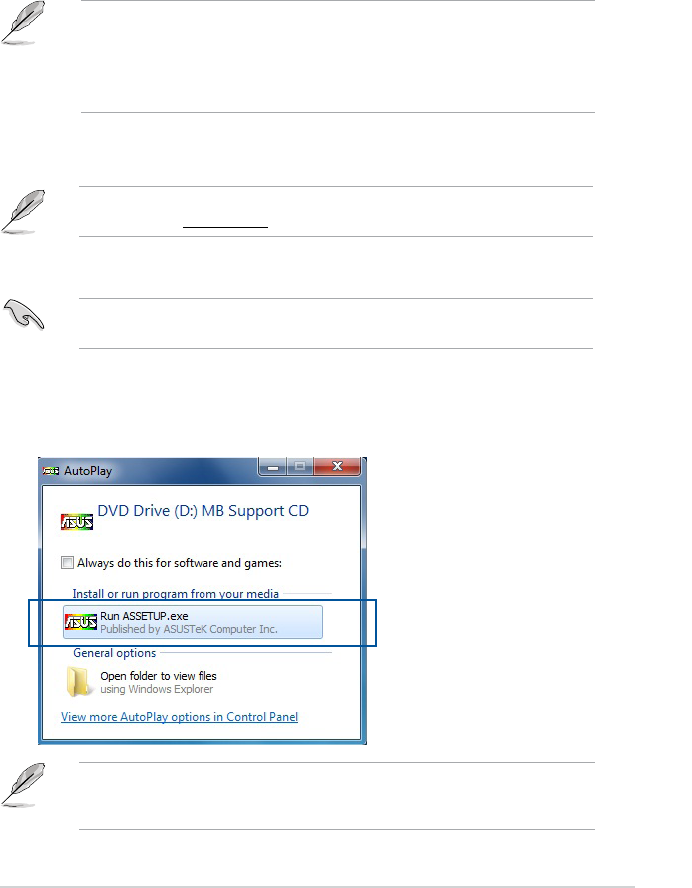
ASUS Z97-E 4-1
Chapter 4
Software support
4
4.1 Installing an operating system
• Thismotherboardsupports32-bit/64-bitWindows®7,32-bit/64-bitWindows®8,and
32-bit/64-bitWindows®8.1operatingsystems(OS).
• Motherboardsettingsandhardwareoptionsvary.Thesetupprocedurespresented
inthischapterareforreferenceonly.RefertoWindows®operatingsystem
documentationfordetailedinformation.
Chapter 4: Software support
4.2 Support DVD information
ThecontentsofthesupportDVDaresubjecttochangeatanytimewithoutnotice.Visitthe
ASUSwebsiteatwww.asus.comforupdates.
4.2.1 Running the support DVD
EnsurethatyouhaveanAdministratoraccountbeforerunningthesupportDVDin
Windows®7,Windows®8,orWindows®8.1operatingsystems.
TorunthesupportDVD:
1. PlacetheSupportDVDintotheopticaldrive.
2. IntheAutoPlaydialogbox,clickortapRun ASSETUP.EXE.
IftheAutoPlaydialogboxdoesnotappear,browsethecontentsofthesupportDVDand
double-clickortap\\bin\ASSETUP.EXEtolaunchtheASUS motherboard support DVD
mainmenu.
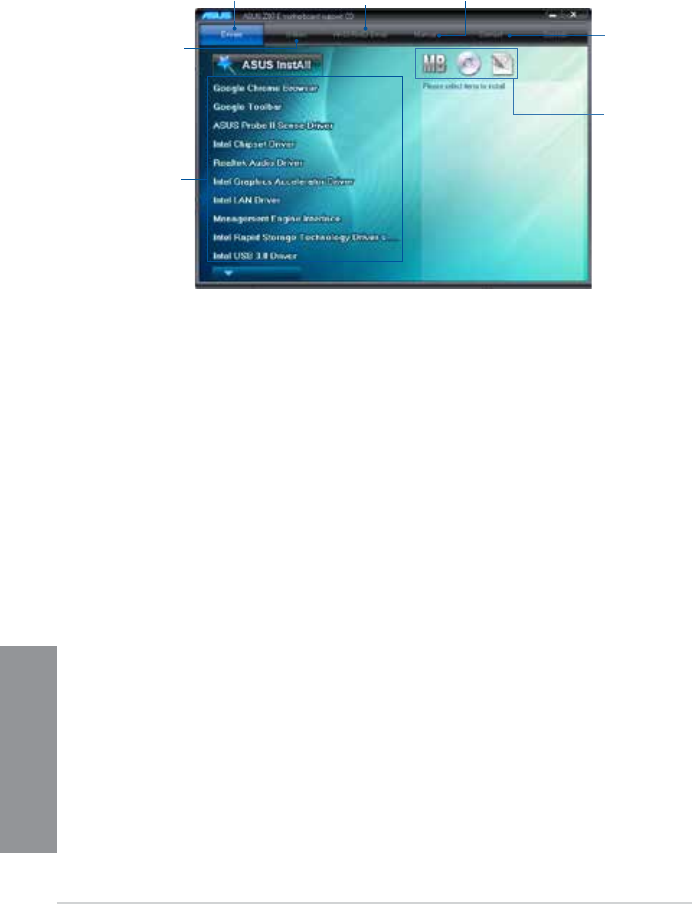
4-2 Chapter 4: Software support
Chapter 4
The Drivers menu shows the available
device drivers if the system detects
installed devices. Install the necessary
drivers to use the devices.
The Utilities menu
shows the applications
and other software
that the motherboard
supports.
The AHCI/RAID Driver
menu contains the
RAID/AHCI driver disk.
The Manual menu contains the list of
supplementary user guides. Click or tap
an item to open the folder of the user
guide.
Click or tap
to display the
ASUS contact
information.
Click or tap an
icon to display
DVD/motherboard
information
Click or tap an
item to install
Support DVD main menu
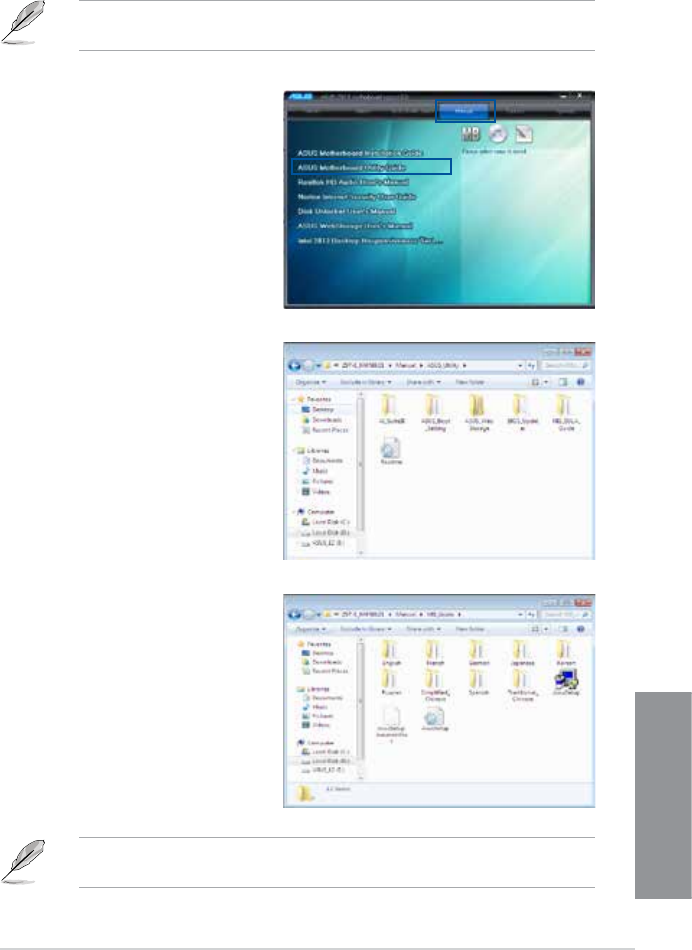
ASUS Z97-E 4-3
Chapter 4
4.2.2 Obtaining the software manuals
ThesoftwaremanualsareincludedinthesupportDVD.Followtheinstructionsbelowtoget
thenecessarysoftwaremanuals.
ThesoftwaremanuallesareinPortableDocumentFormat(PDF).InstalltheAdobe®
ReaderXfromtheUtilitiestabbeforeopeningtheles.
Toreadaboutyourmotherboard’sutilityguide:
1. ClickortapManualtab> ASUS
Motherboard Utility Guide.
Thescreenshotsinthissectionareforreferenceonly.Theactualsoftwaremanuals
containinginthesupportDVDvarybymodels.
2. FromtheManualfolder,openthe
folderofthesoftwaremanualthat
youwishtoread.
3. Somesoftwaremanualsare
providedindifferentlanguages.
Openthelanguage’sfoldertoview
thesoftwaremanual.
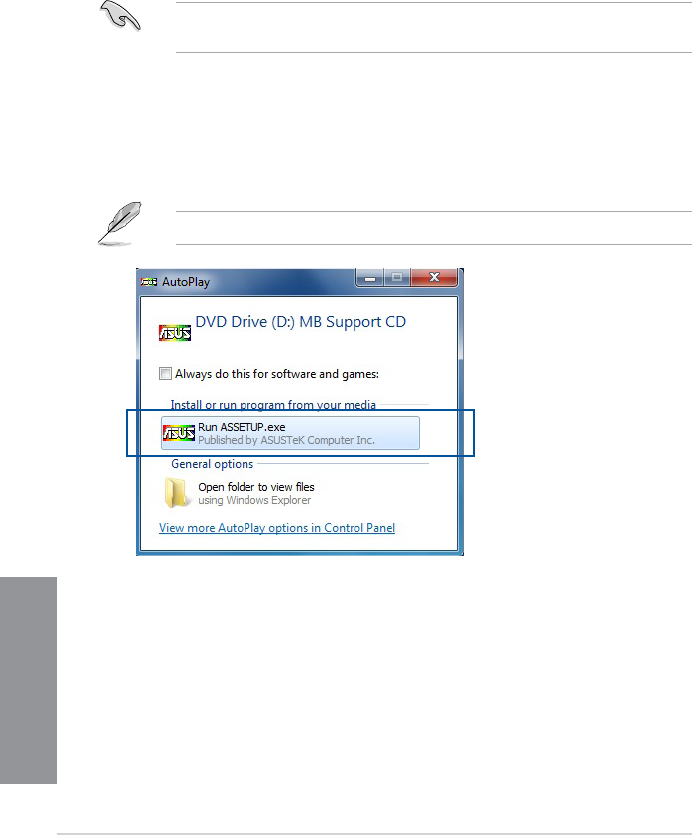
4-4 Chapter 4: Software support
Chapter 4
4.3 Software information
MostoftheapplicationsinthesupportDVDhavewizardsthatwillconvenientlyguideyou
throughtheinstallation.Viewtheonlinehelporreadmelethatcamewiththesoftware
applicationformoreinformation.
4.4 AI Suite 3
AISuite3isanall-in-oneinterfacethatintegratesseveralASUSutilitiesandallowsyouto
launchandoperatetheseutilitiessimultaneously.
Installing AI Suite 3
EnsurethatyouhaveanAdministratoraccountbeforeinstallingAISuite3inWindows®7,
Windows®8,orWindows®8.1operatingsystems.
ToinstallAISuite3onyourcomputer:
Windows® 7 OS
1. PlacetheSupportDVDintotheopticaldrive.
2. IntheAutoPlaydialogbox,clickortapRun ASSETUP.exethenselecttheUtilities
tab.
ThemainscreenoftheAISuite3isforreferenceonlyandvarywithmodels.
3. FromtheUtilitiestab,clickortapAI Suite 3thenfollowthesucceedingonscreen
instructions.
ASUS Z97-E 4-5
Chapter 4
Launching AI Suite 3
Windows® 7 OS
FromtheDesktop,clickortapStart > All Programs > ASUS > AI Suite 3 > AI Suite 3.
YoucanalsolaunchAISuiteinWindows®7byclickingortapping ontheNotication
area.
Windows® 8 and Windows® 8.1 OS
TolaunchAISuite3inWindows®8orWindows®8.1,taptheAISuite3
appontheStartScreen(orifyou’reusingamouse,clickortaptheAI
Suite3appontheStartScreen).
Windows® 8 and Windows® 8.1 OS
1. PlacetheSupportDVDintotheopticaldrivethenfollowonscreeninstructions.
2. FromtheASUS motherboard support DVDmainmenu,selecttheUtilitiestaband
clickortapAI Suite 3.
3. Followthesucceedingonscreeninstructions.
IftheASUS motherboard support DVDmainmenudidnotappear,trythefollowing:
a. Gotothe Start ScreenthenclickortaptheDesktopapp.
b. OnthelowerleftcorneroftheDesktop,clickortapFile Explorerthen
selectyourDVDdriveandtapordouble-clickortaptheSetupapplication.
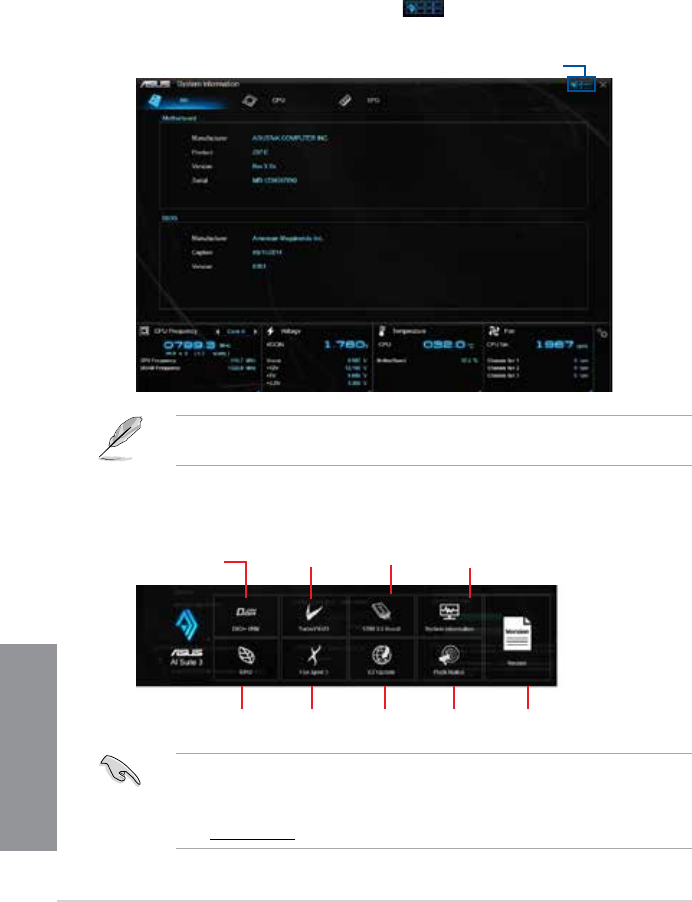
4-6 Chapter 4: Software support
Chapter 4
AI Suite 3 main menu bar
AI Suite 3 Main menu
TheAISuite3mainmenugivesyoueasy-accesscontrolsandinsighttowhat’sgoingon
withyourcomputer-allowingyoutooptimizeperformancesettingswhileatthesametime
ensuringsystemstability.
TheAISuitemainmenuincludesisaquick-accessmenubarthatallowsyoutoswiftlylaunch
anyoftheintegratedASUSutilities.Clickortap onthetop-rightcornerofthemenuto
launchthemenubar.
TheAiSuite3screenshotsinthissectionareforreferenceonlyandcanvarydependingon
motherboardmodel.
• ThescreenshotsofAISuite3inthisusermanualareforreferenceonly.Theactual
screenshotsvarywithmodels.
• RefertothesoftwaremanualinthesupportDVDorvisittheASUSwebsiteat
www.asus.comfordetailedsoftwareconguration.
Click or tap to launch AI Suite 3 menu bar
TurboV EVO
DIGI+VRM USB 3.0 Boost System Information
EPU Fan Xpert 3 EZ Update Push Notice Version
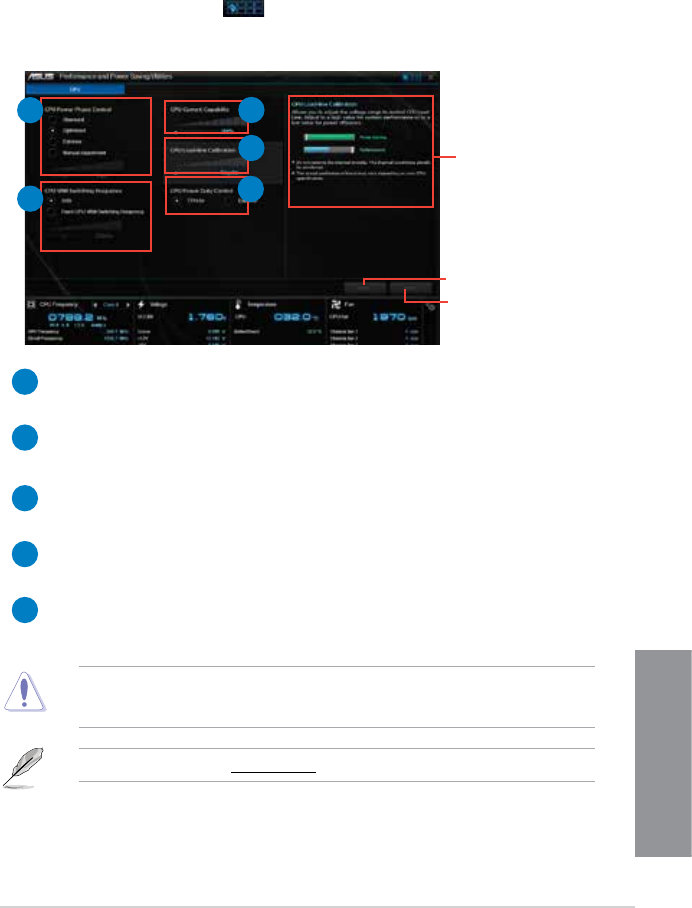
ASUS Z97-E 4-7
Chapter 4
4.4.1 DIGI+ VRM
ASUSDIGI+VRMallowsyoutoadjustVRMvoltageandfrequencymodulationtoenhance
reliabilityandstability.Italsoprovidesthehighestpowerefciency,generatinglessheatto
longercomponentlifespanandminimizepowerloss.
Launching DIGI+ VRM
TolaunchDIGI+VRM,clickortap onthetop-rightcorneroftheAISuite3mainmenu,
thenselectDIGI+ VRM.
4
3
1
25
Help
Click to undo all the changes
Click to apply all the changes
1CPU Power Phase Control
Increasephasenumberunderheavysystemloadingtogetmoretransientandbetterthermal
performance.ReducephasenumberunderlightsystemloadingtoincreaseVRMefciency.
2CPU VRM Switching Frequency
Changingfrequencyaffectsthetransientresponseandcomponentthermalconditions.Higher
frequencygetsquickertransientresponse.
3CPU Current Capability
CPUCurrentCapabilityprovideswidertotalpowerrangeforoverclocking.Ahighervaluebrings
awidertotalpowerrangeandextendstheoverclockingfrequencyrangesimultaneously.
4CPU Load-line Calibration
ItallowsyoutoadjustthevoltagerangetocontroltheCPULoad-line.Adjusttoahighvaluefor
systemperformanceortoalowvalueforpowerefciency.
5CPU Power Duty Control
CPUPowerDutyControladjuststhecurrentofeveryVRMphaseandthethermalofevery
phasecomponent.
• TheactualperformanceboostmayvarydependingonyourCPUspecication.
• Donotremovethethermalmodule.Thethermalconditionsshouldbemonitored.
VisittheASUSwebsiteatwww.asus.comfordetailedsoftwareconguration.
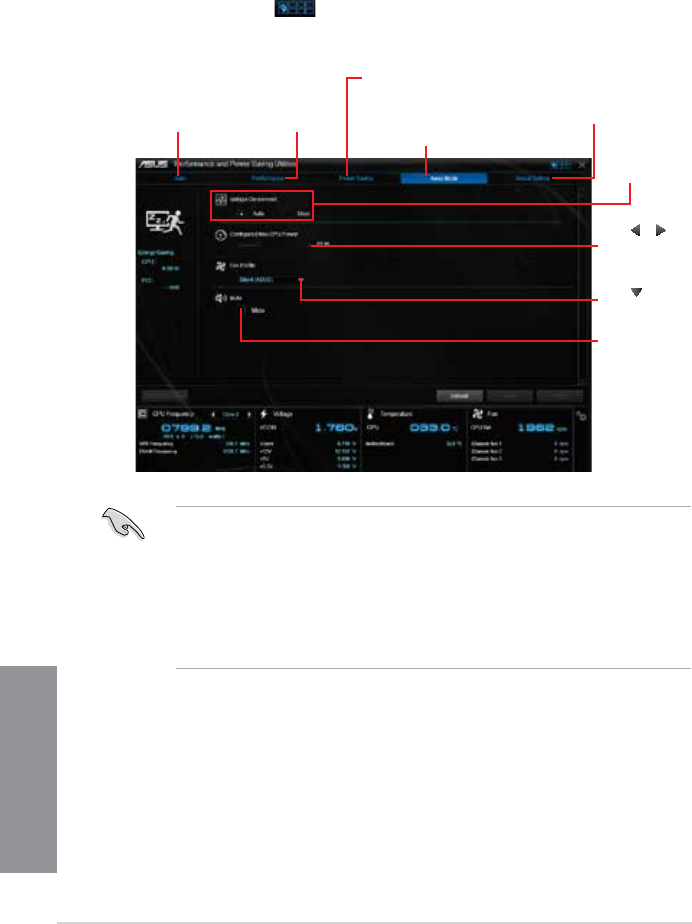
4-8 Chapter 4: Software support
Chapter 4
4.4.2 EPU
EPUisanenery-savingutilitythatallowsyoutoadjusttheCPU,GPU,andFanControl
settingstotheirpower-savingconditions.
Launching EPU
TolaunchEPU,clickortap onthetop-rightcorneroftheAISuite3mainmenu,then
selectEPU.
Click to select a
fan prole
Click or
to adjust the
Congured Max
CPU Power
Click to congure the
settings in Auto mode
Click to congure
the settings in
Performance mode
Click to congure
the settings in Power
Saving mode
Tick to select a
setting for Voltage
Decrement
Enables or disables
Congured Max CPU
Power
Click to congure
the settings in
Away mode
Tick to put the
system sound on
mute mode
• WhenyouenableConguredMaxCPUPowerforadvancedenergysavingcondition,
theCPUfrequencymaydisplay800MHzintheWindows®OSinformationofyour
computer.However,thetrueCPUfrequencyvariesdependingonthewattagethat
youmanuallyset.YoucanadjusttheCPUwattagefromthelowestbasetoyour
preferreddefaultvalue.
• ConguredMaxCPUPowermaydecreasethetotalpowerdeliverytotheCPUand
affectstheCPUperformanceundersystemheavyload.Torestoreyoursystemtoits
defaultsettings,rebootyourcomputer.
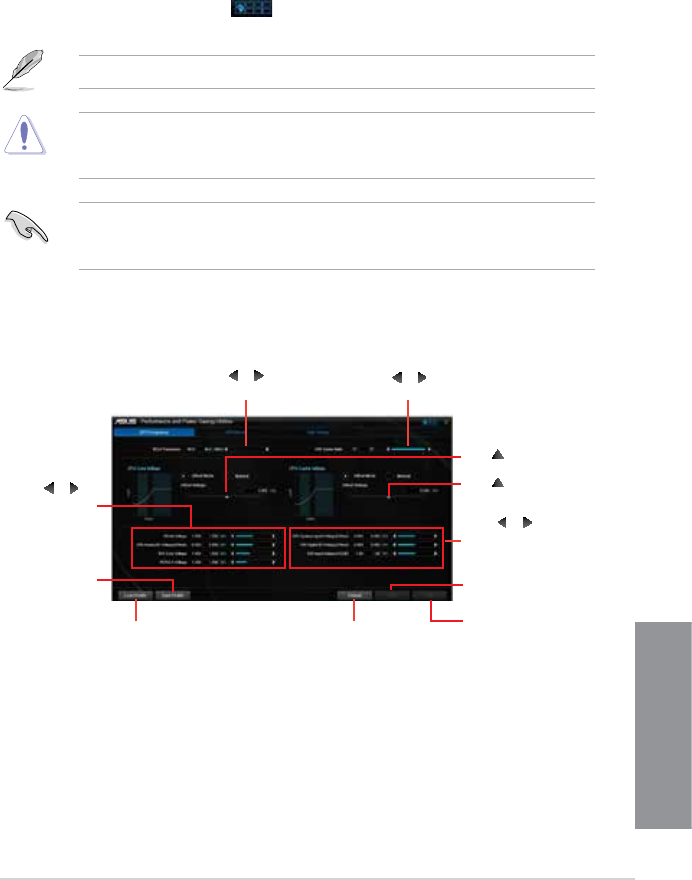
ASUS Z97-E 4-9
Chapter 4
4.4.3 TurboV EVO
ASUSTurboVEVOallowsyoutomanuallyadjusttheCPUfrequency,CPUCacheandCore
frequencies,andrelatedvoltagesforanenhancedsystemstabilityandboostperformance.
ItalsoprovidestheAutoTuningfunctionthatoffersautomaticandeasyoverclockingand
systemlevelup.
Launching TurboV EVO
TolaunchTurboVEVO,clickortap onthetop-rightcorneroftheAISuite3main
menu,thenselectTurboV EVO.
VisittheASUSwebsiteatwww.asus.comfordetailedsoftwareconguration.
RefertotheCPUdocumentationbeforeadjustingCPUvoltagesettings.Settingahigh
voltagemaydamagetheCPUpermanently,andsettingalowvoltagemaymakethe
systemunstable.
Forsystemstability,allchangesmadeinTurboVEVOwillnotbesavedtoBIOSsettings
andwillnotbekeptonthenextsystemboot.UsetheSaveProlefunctiontosaveyour
customizedoverclockingsettingsandmanuallyloadtheproleafterWindowsstarts.
Click or to adjust
CPU System Agent, CPU
Digital I/O, and CPU
Input (VCCIN) voltages
Click or to adjust
the CPU Cache Ratio
Click or to adjust
the BCLK Frequency
Click to undo all the
changes
Click to apply all the
changes
Click to load the
saved prole
Click to save the
changes into a
prole
Click to reset to
default settings
Using TurboV EVO
CPU Frequency
Drag to adjust CPU
Core Voltage offset
Drag to adjust CPU
Cache Voltage offset
Click or to
adjust DRAM,
CPU Analog I/O,
PCH Core, and
PCHVLX voltages
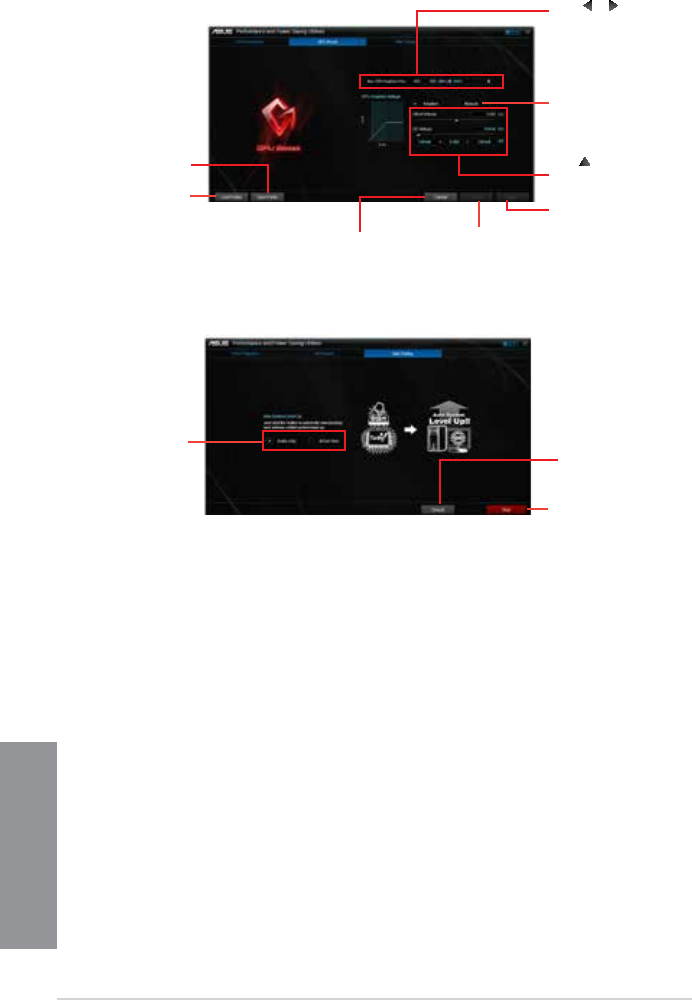
4-10 Chapter 4: Software support
Chapter 4
GPU Boost
Click to undo all the
changes
Click to apply all the
changes
Click to load
the saved
prole
Click to save the
changes into a
prole
Click or to adjust
the iGPU Max Ratio
Tick Adaptive or Manual
to select the CPU
Graphics Voltage mode
Drag to adjust CPU
Graphics Voltage
settings
Click to reset to
default settings
Auto Tuning
Click to automatically
overclock and achieve a
total system level up.
Select the
function to
auto-tune
Click to reset to
default settings
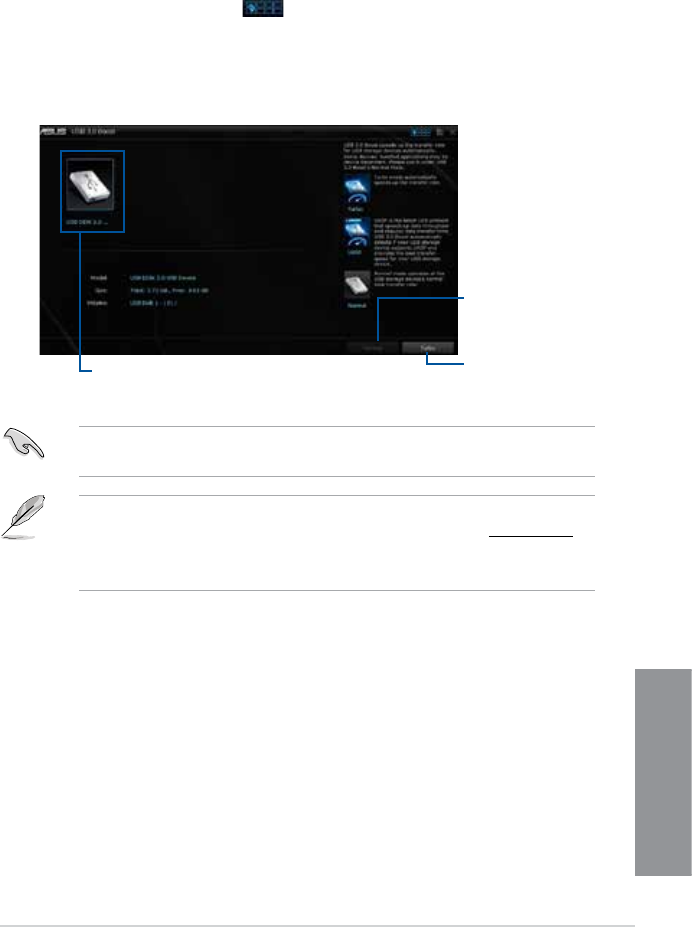
ASUS Z97-E 4-11
Chapter 4
4.4.4 USB 3.0 Boost
USB3.0BoosttechnologysupportsUASP(USBAttachedSCSIProtocol)thatautomatically
speedsupthetransferratesofyourUSBstoragedevices.
Launching USB 3.0 Boost
TolaunchUSB3.0Boost,clickortap onthetop-rightcorneroftheAISuite3main
menu,thenselectUSB 3.0 Boost.
Using the USB 3.0 Boost
• USB3.0BoostautomaticallydetectstheUSB3.0devicesthatsupportUASP.Fora
listofUASP-supportedUSB3.0devices,visittheASUSwebsiteatwww.asus.com.
• ThedatatransferspeedvarieswithUSBdevices.Forahigherdatatransfer
performance,useaUSB3.0device.
Click or tap to select a USB device
Click or tap to enable the USB
device’s normal data transfer rate
Click or tap to enable UASP or
Turbo Mode for a faster data
transfer rate
EnsuretoconnectyourUSB3.0devicetotheUSB3.0portsthatsupportUSB3.0Boost.
Refertosection2.2.1 Rear I/O connectionofyouruserguideformoredetails.
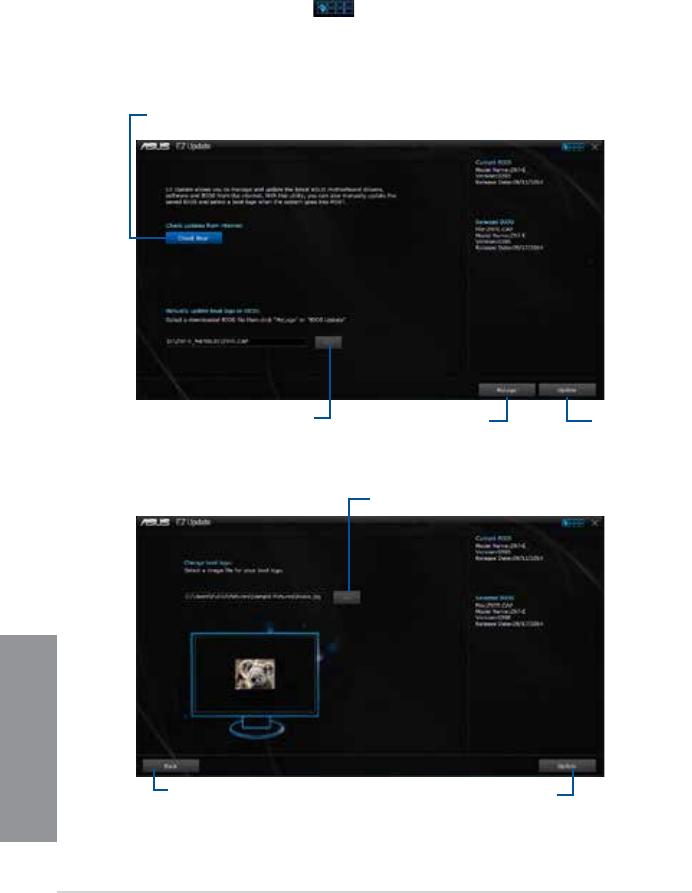
4-12 Chapter 4: Software support
Chapter 4
4.4.5 EZ Update
EZUpdateisautilitythatallowsyoutoautomaticallyupdateyourmotherboard’ssoftware,
driversandBIOSeasily.
Withthisutlity,youcanalsomanuallyupdatetheBIOSandselectthebootlogothatdisplays
duringPOST.
Launching EZ Update
TolaunchEZUpdate,clickortap onthetop-rightcorneroftheAISuite3mainmenu,
thenselectEZ Update.
Using EZ Update
Click or tap to automatically update your
motherboard driver, software and rmware
Click or tap to search and
select the BIOS le Click or tap to select a
boot logo
Click or tap to
update the BIOS
Manually update the BIOS and selecting a boot logo
Click or tap to search an image le for your boot logo
Click or tap to go back to
EZ Update main screen Click or tap to proceed the updating
BIOS and boot logo
AfteryouclickortapBIOS Updatebutton,clickortapFlashtoupdatetheBIOSandupload
thebootlogoinyoursystem.
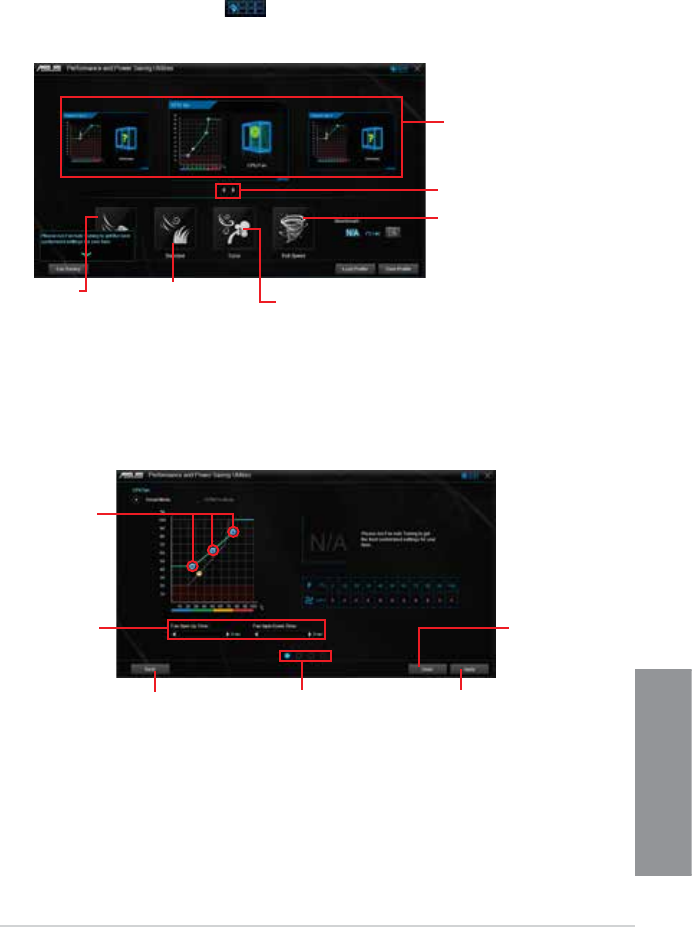
ASUS Z97-E 4-13
Chapter 4
4.4.6 Fan Xpert 3
FanXpert3automaticallydetectsandtweaksthefanspeeds,andprovidesyouwith
optimizedfansettingsbasedonthefans’specicationsandpositions.
Launching Fan Xpert 3
TolaunchFanXpert3,clickortap onthetop-rightcorneroftheAISuite3main
menu,thenselectFan Xpert 3.
Click a screen to select the
type of fan that you want to
customize
Click to set the
fan’s speed to
silent mode
Click to set the balanced
conguration between the
fan’s noise level and speed
Click to increase the fan’s
speed for a high cooling
capability
Click to maximize the
fan speed
Click to switch between CPU
and chassis fan screens
Customizing the fan settings
Smart Mode
SmartModeallowsyoutocustomizethefans’rotationspeedsandresponsivenessbasedon
yoursystem’stemperature.
Click to switch between
the CPU and chassis
fan screens
Click to apply the
changes
Click to undo
the changes
Click to go back to
the previous screen
Click and drag
to set the fan’s
rotation speed
Click and drag
the sliders to
adjust the fan’s
responsiveness
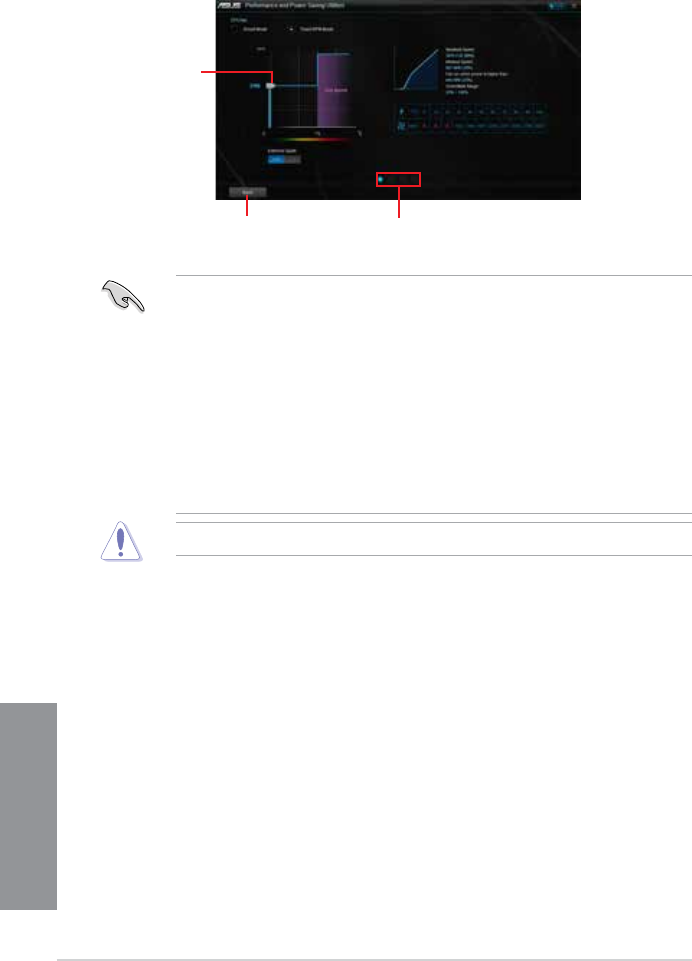
4-14 Chapter 4: Software support
Chapter 4
RPM Fixed Mode
RPMModeallowsyoutosetthefanspeedwhentheCPUtemperatureisbelow75oC.
• WhentheCPUtemperaturereaches75oC,thefanwillautomaticallyrunatfullspeed
toprotecttheCPU.
• FormotherboardmodelswithouttheCPUfandetectionlatch,only4-pinCPUfansare
controllableinFanXpert3.
• TheFanXpert3maynotbeabletodetectthefanspeedifyourfanisinstalledwithan
externalcontrolkitforrotationspeed.
• FanXpert3doesnotsupport2-pinfans.Ifyouinstalla2-pinfan,itcanonlyrunatits
fullspeed.
• IftheCPUorchassisfanshavebeenchanged,theFanAutoTuningprocessshould
berepeated.
DONOTremoveyourfanduringtheFanAutoTuningprocess.
Click and
drag to adjust
the fan’s
speed
Click to switch between the
CPU and chassis fan screens
Click to go back
to the previous
screen
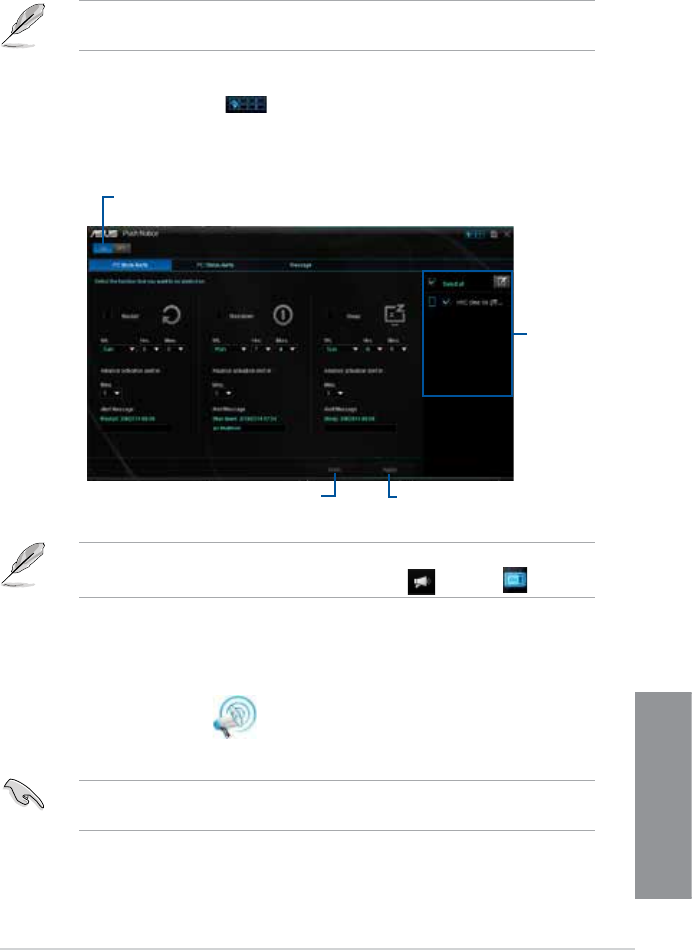
ASUS Z97-E 4-15
Chapter 4
4.4.7 Push Notice
Thisutilityallowsyougetthedetailedstatusofyoursystemtoyoursmartdevice.Youcan
alsosendmessagestoyoursmartdeviceusingthisutility.
Beforeusingthisutility,ensurethatyoupairyourcomputerwithyoursmartdevice.For
pairinginformation,refertosectionPairing your computer and smart device.
Launching Push Notice on your computer
TolaunchPushNotice,clickortap onthetop-rightcorneroftheAISuite3main
menu,thenselectPush Notice.
Push Notice screen
Click or tap to enable Push Notice
Click or tap to
apply the settings
Click or tap to
discard the settings
Tick to select the
smart device
YoucanalsoenablethePushNoticeviathePushNoticeshortcutonthelower-rightcorner
ofyourscreen.Todothis,clickortap<< thenclickortap thenselect .
Pairing your computer and smart device
Topairyourcomputerandsmartdevice:
1. Onyoursmartdevice,tap
Push Notice
tolaunchPushNotice.
2. TapPush Scan thentapthenameofyourcomputerthatyouwanttopairwith.
Topairyourcomputerandsmartdevice,ensurethatbothareconnectedtothesame
wirelessnetwork.
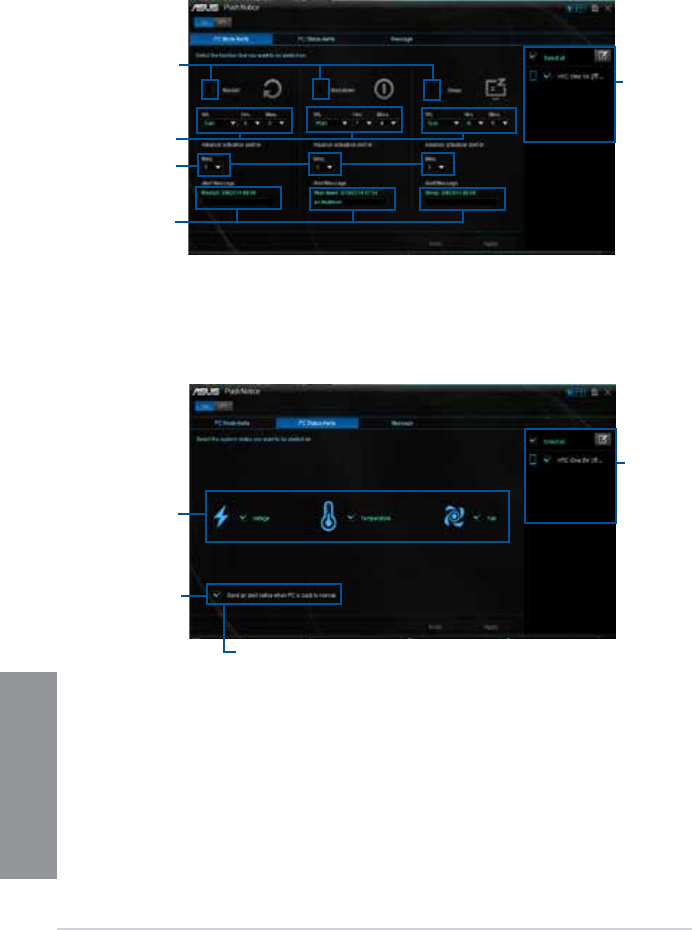
4-16 Chapter 4: Software support
Chapter 4
Setting up PC Mode alerts of your computer
Thisfeatureallowsyoutorestart,shutdown,orputyourcomputertosleepmodeandsends
analerttoyoursmartdevice.
Tick these to
enable mode alerts
Set the day and time to
enable the PC modes
Set the minutes to send
the alert before the PC
mode/s activatation
Key in your messages for
more information
Tick to select the
smart device
Setting up PC Status alerts
Thisfeatureallowsyoutosendalertsoftheunusualactivitiesofthevoltage,temperature,
andfansettingsofyourcomputertoyoursmartdevice.
Tick to select and send
alerts to your smart
device
Tick to send alert when the components
selected are back to its normal status
Tick to select the
smart device
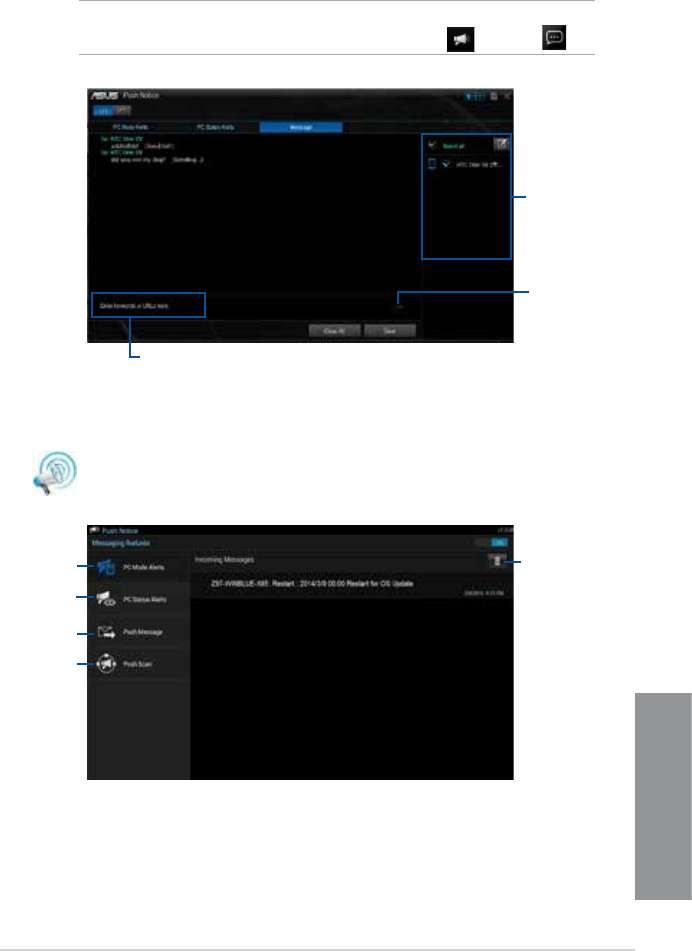
ASUS Z97-E 4-17
Chapter 4
Viewing your computer status on your smart device
Tap
Push Notice
onyoursmartdevicetolaunchPushNotice.
Sending messages to your smart device
Thisfeatureallowsyoutosendmessagestoyoursmartdevice.
YoucanalsosendmessagesviathePushNoticemessagingshortcutonthelower-right
cornerofyourscreen.Todothis,clickortap<< thenclickortap thenselect .
Click or tap to key
in your message
Tick to select the
smart device
Click or tap to send
your message
Tap to view PC
mode alerts
Tap to view PC
status alerts
Tap to view PC
sent messages
Tap to scan more
host computers
Tap to delete PC
alerts
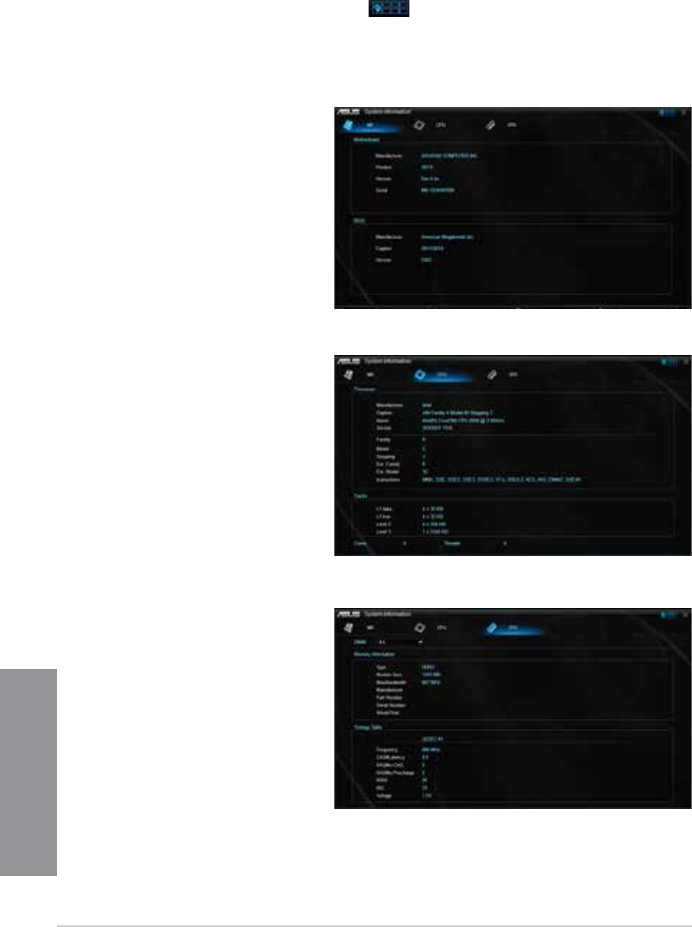
4-18 Chapter 4: Software support
Chapter 4
4.4.8 System Information
Thisutilityallowsyougetthedetailedinformationofthemotherboard,CPU,andmemory
settings.
Launching the System Information
TolaunchSystemInformation,clickortap onthetop-rightcorneroftheAISuite3
mainmenu,thenselectSystem Information.
Viewing the motherboard information
ClickortaptheMBtabtoviewthe
motherboard’sinformation.
Viewing the CPU information
ClickortaptheCPUtabtoviewthe
processor’sinformation.
Viewing the SPD information
ClickortaptheSPDtabtoviewthe
memory’sinformation.
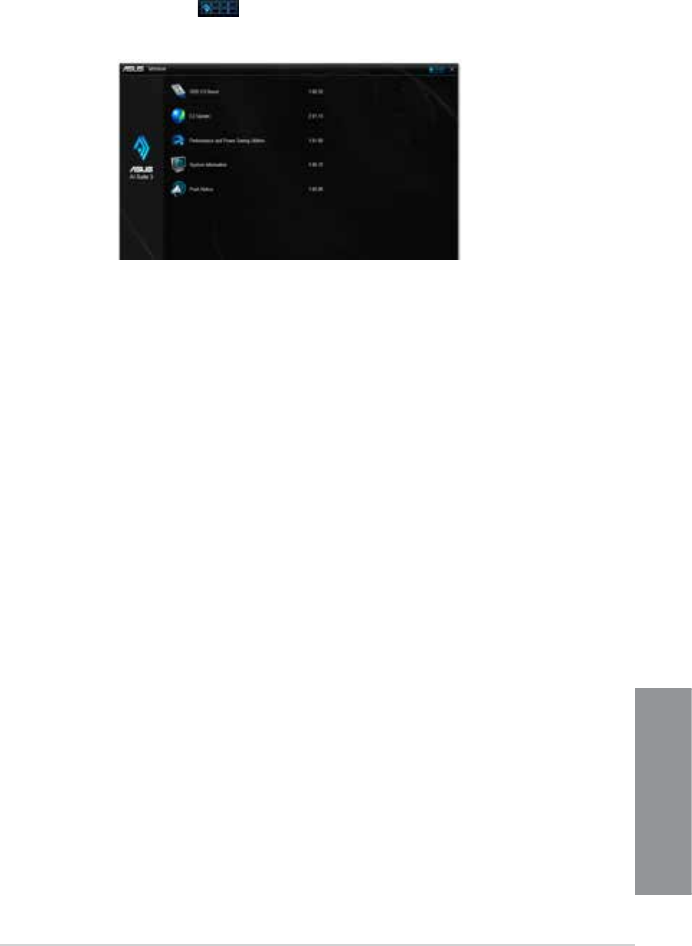
ASUS Z97-E 4-19
Chapter 4
4.4.9 Version
ThisutilitydisplaystheversioninformationoftheutilitiesintegratedinAISuite3.
Launching Version
TolaunchVersion,clickortap onthetop-rightcorneroftheAISuite3mainmenu,
thenselectVersion.
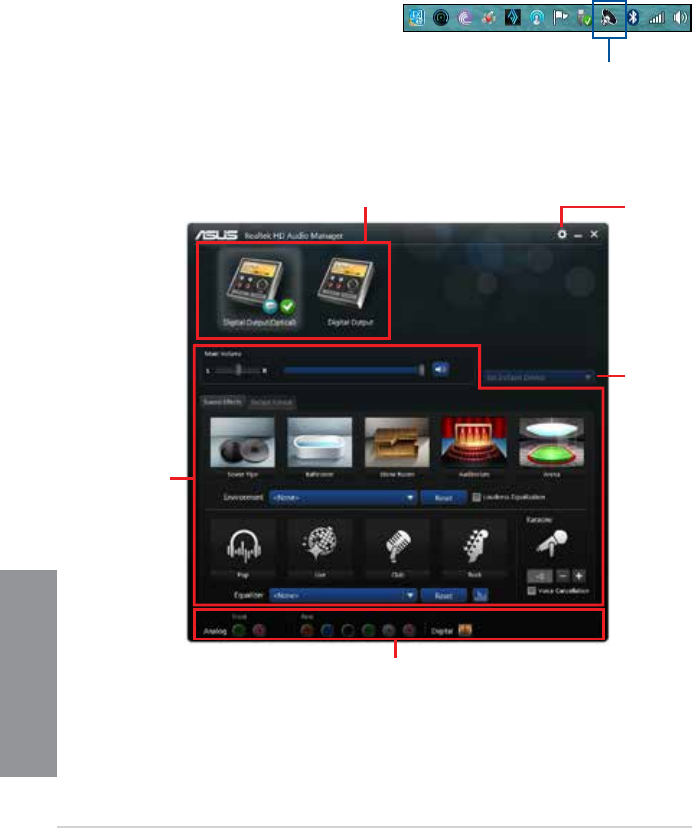
4-20 Chapter 4: Software support
Chapter 4
4.5 Audio congurations
TheRealtek®audioCODECprovides7.1-channelaudiocapabilitytodelivertheultimate
audioexperienceonyourcomputer.ThesoftwareprovidesJack-Sensingfunction,S/PDIF
Outsupport,andinterruptcapability.TheCODECalsoincludestheRealtek®proprietary
UAJ®(UniversalAudioJack)technologyforallaudioports,eliminatingcableconnection
errors,andgivingusersplugandplayconvenience.
FollowtheinstallationwizardtoinstalltheRealtek®AudioDriverfromthesupportDVDthat
camewiththemotherboardpackage.
IftheRealtek®audiosoftwareiscorrectlyinstalled,youwillndtheRealtek®HDAudio
Managericononthetaskbar.Double-click
ortapontheicontodisplaytheRealtek®HD
AudioManager.
Realtek® HD Audio Manager
A. Realtek® HD Audio Manager for Windows® 8.1 /
Windows® 8 / Windows® 7
Conguration option tabs (vary with the audio devices connected) Advanced
settings
Set default
device button
Control
settings panel
Analog and digital connector status

ASUS Z97-E 5-1
Chapter 5
RAID support
5
5.1 RAIDcongurations
The motherboard supports Intel® Rapid Storage Technology with RAID 0, RAID 1, RAID 10,
and RAID 5 solution.
If you want to install a Windows® operating system to a hard disk drive included in a RAID
set, you have to create a RAID driver disk and load the RAID driver during OS installation.
Refer to section 5.2CreatingaRAIDdriverdiskfor details.
5.1.1 RAIDdenitions
RAID0(Datastriping) optimizes two identical hard disk drives to read and write data in
parallel, interleaved stacks. Two hard disks perform the same work as a single drive but at a
sustained data transfer rate, double that of a single disk alone, thus improving data access
and storage. Use of two new identical hard disk drives is required for this setup.
RAID1(Datamirroring) copies and maintains an identical image of data from one drive to
a second drive. If one drive fails, the disk array management software directs all applications
to the surviving drive as it contains a complete copy of the data in the other drive. This RAID
conguration provides data protection and increases fault tolerance to the entire system. Use
two new drives or use an existing drive and a new drive for this setup. The new drive must be
of the same size or larger than the existing drive.
RAID 5 stripes both data and parity information across three or more hard disk drives. Among
the advantages of RAID 5 conguration include better HDD performance, fault tolerance, and
higher storage capacity. The RAID 5 conguration is best suited for transaction processing,
relational database applications, enterprise resource planning, and other business systems.
Use a minimum of three identical hard disk drives for this setup.
RAID 10 is data striping and data mirroring combined without parity (redundancy data) having
to be calculated and written. With the RAID 10 conguration you get all the benets of both
RAID 0 and RAID 1 congurations. Use four new hard disk drives or use an existing drive
and three new drives for this setup.
Chapter 5: RAID support

5-2 Chapter 5: RAID congurations
Chapter 5
5.1.2 InstallingSerialATAharddisks
The motherboard supports Serial ATA hard disk drives. For optimal performance, install
identical drives of the same model and capacity when creating a disk array.
To install the SATA hard disks for a RAID conguration:
1. Install the SATA hard disks into the drive bays.
2. Connect the SATA signal cables.
3. Connect a SATA power cable to the power connector on each drive.
5.1.3 SettingtheRAIDiteminBIOS
You must enable the RAID function in the BIOS Setup before creating RAID sets using SATA
HDDs.
To set the RAID item in BIOS:
1. Enter the BIOS Setup during POST.
2. Go to the Advanced menu > PCHStorageConguration, then press <Enter>.
3. Set the SATA Mode item to [RAIDMode].
4. Save your changes, and then exit the BIOS Setup.
Refer to Chapter 3 for details on entering and navigating through the BIOS Setup
Due to chipset limitation, when SATA ports are set to RAID mode, all SATA ports run at
RAID mode together.
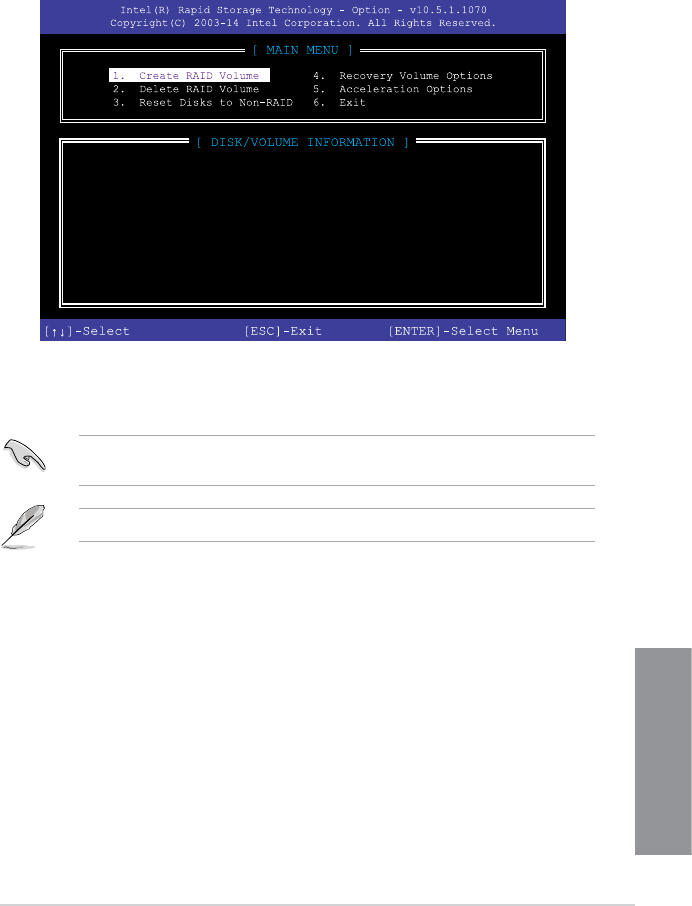
ASUS Z97-E 5-3
Chapter 5
5.1.4 Intel®RapidStorageTechnologyOptionROMutility
To enter the Intel® Rapid Storage Technology Option ROM utility:
1. Turn on the system.
2. During POST, press <Ctrl> + <I> to display the utility main menu.
The navigation keys at the bottom of the screen allow you to move through the menus
and select the menu options.
The RAID BIOS setup screens shown in this section are for reference only and may not
exactly match the items on your screen.
The utility supports maximum four hard disk drives for RAID conguration.
RAID Volumes:
None defined.
Physical Devices:
Port Device Model Serial # Size Type/Status(Vol ID)
0 ST3160812AS 9LS0HJA4 149.0GB Non-RAID Disk
1 ST3160812AS 9LS0F4HL 149.0GB Non-RAID Disk
2 ST3160812AS 3LS0JYL8 149.0GB Non-RAID Disk
3 ST3160812AS 9LS0BJ5H 149.0GB Non-RAID Disk
5-4 Chapter 5: RAID congurations
Chapter 5
CreatingaRAIDset
To create a RAID set:
1. From the utility main menu, select 1.CreateRAIDVolume and press <Enter>. The
following screen appears:
2. Enter a name for the RAID set and press <Enter>.
3. When the RAID Level item is selected, press the up/down arrow key to select a RAID
level to create, and then press <Enter>.
4. When the Disks item is selected, press <Enter> to select the hard disk drives you want
to include in the RAID set. The SELECT DISKS screen appears:
Enter a unique volume name that has no special characters
and is 16 characters or less.
[HELP]
Name: Volume 0
RAID Level: aaaaaaaaaaaaaaa
Disks: dssdsdsds
Strip Size:aaaaaaaaaaaaaaaa
Capacity:aaaaaaaaaaaaaa
Sync:aaaaaaaaaa
Create volume
[SELECT DISKS]
Port Device Model Serial # Size Status
0 ST3160812AS 9LS0HJA4 149.0GB Non-RAID Disk
1 ST3160812AS 9LS0F4HL 149.0GB Non-RAID Disk
2 ST3160812AS 3LS0JYL8 149.0GB Non-RAID Disk
3 ST3160812AS 9LS0BJ5H 149.0GB Non-RAID Disk
Select 2 to 6 to use in creating the volume.
[↑↓]-Prev/Next [SPACE]-SelectDisk [ENTER]-Done

ASUS Z97-E 5-5
Chapter 5
5. Use the up/down arrow key to select a drive, and then press <Space> to select. A
small triangle marks the selected drive. Press <Enter> after completing your selection.
6. Use the up/down arrow key to select the stripe size for the RAID array (for RAID 0, 10
and 5 only),then press <Enter>. The available stripe size values range from 4 KB to
128 KB. The following are typical values:
- RAID 0: 128 KB
- RAID 10: 64 KB
- RAID 5: 64 KB
We recommend a lower stripe size for server systems, and a higher stripe size for
multimedia computer systems used mainly for audio and video editing.
7. When the Capacity item is selected, enter the RAID volume capacity that you want
and press <Enter>. The default value indicates the maximum allowed capacity.
8. When the CreateVolume item is selected, press <Enter>. The following warning
message appears:
9. Press <Y> to create the RAID volume and return to the main menu, or <N> to go back
to the CREATEVOLUME menu.
WARNING: ALL DATA ON SELECTED DISKS WILL BE LOST.
Are you sure you want to create this volume? (Y/N)

5-6 Chapter 5: RAID congurations
Chapter 5
DeletingaRAIDset
Be cautious when deleting a RAID set. You will lose all data on the hard disk drives when
you delete a RAID set.
To delete a RAID set:
1. From the utility main menu, select 2.DeleteRAIDVolume and press <Enter>. The
following screen appears:
2. Use the up/down arrow key to select the RAID set you want to delete, and then press
<Delete>. The following warning message appears:
3. Press <Y> to delete the RAID set and return to the utility main menu, or press <N> to
return to the DELETE VOLUME menu.
Deleting a volume will reset the disks to non-RAID.
WARNING: ALL DISK DATA WILL BE DELETED.
(This does not apply to Recovery volumes)
[HELP]
[DELETE VOLUME MENU]
Name Level Drives Capacity Status Bootable
Volume0 RAID0 (Stripe) 2 298.0GB Normal Yes
[↑↓]-Select [ESC]-Previous Menu [DEL]-Delete Volume
ALL DATA IN THE VOLUME WILL BE LOST!
(This does not apply to Recovery volumes)
Are you sure you want to delete “Volume0”? (Y/N):
[DELETE VOLUME VERIFICATION]
ASUS Z97-E 5-7
Chapter 5
ExitingtheIntel®RapidStorageTechnologyOptionROMutility
To exit the utility:
1. From the utility main menu, select 5.Exit, then press <Enter>. The following warning
message appears:
2. Press <Y> to exit or press <N> to return to the utility main menu.
5.2 CreatingaRAIDdriverdisk
A oppy disk with the RAID driver is required when installing a Windows® operating system
on a hard disk drive that is included in a RAID set.
The motherboard does not provide a oppy drive connector. You have to use a USB oppy
disk drive when creating a SATA RAID driver disk.
5.2.1 CreatingaRAIDdriverdiskwithoutenteringtheOS
To create a RAID driver disk without entering the OS:
1. Boot your computer.
2. Press <Delete> during POST to enter the BIOS setup utility.
3. Set the optical drive as the primary boot device.
4. Insert the support DVD into the optical drive.
5. Save changes and exit BIOS.
6. When the Make Disk menu appears, press <1> to create a RAID driver disk.
7. Insert a formatted oppy disk into the USB oppy disk drive, then press <Enter>.
8. Follow the succeeding screen instructions to complete the process.
Are you sure you want to exit? (Y/N):
[CONFIRM EXIT]

5-8 Chapter 5: RAID congurations
Chapter 5
5.2.2 CreatingaRAIDdriverdiskinWindows®
To create a RAID driver disk in Windows®:
1. Start Windows®.
2. Plug the USB oppy disk drive and insert a oppy disk.
3. Place the motherboard support DVD into the optical drive.
4. Go to the IntelAHCI/RAIDDriver menu then clickIntelAHCI/RAIDDriverpath to
open the RAID driver folder.
5. Select 32bit or 64bit folder depending on your operating system. Copy the les of the
selected folder to the root path of your USB oppy disk drive.
Write-protect the oppy disk to avoid a computer virus infection.
5.2.3 InstallingtheRAIDdriverduringWindows®OS
installation
To install the RAID driver for Windows® 7:
1. During the OS installation, click LoadDriver to allow you to select the installation
media containing the RAID driver.
2. Insert the USB ash drive with RAID driver into the USB port or the support DVD into
the optical drive, and then click Browse.
3. Click the name of the device you’ve inserted, go to Drivers>RAID, and then select
the RAID driver for the corresponding OS version. Click OK.
4. Follow the succeeding screen instructions to complete the installation.
Before loading the RAID driver from a USB ash drive, you have to use another computer
to copy the RAID driver from the support DVD to the USB ash drive.
To set up a Windows® UEFI operating system under RAID mode, ensure to load the UEFI
driver for your optical drive.

ASUS Z97-E A-1
Appendices
Appendices
Notices
Federal Communications Commission Statement
This device complies with Part 15 of the FCC Rules. Operation is subject to the following two
conditions:
• This device may not cause harmful interference.
• This device must accept any interference received including interference that may cause
undesired operation.
This equipment has been tested and found to comply with the limits for a Class B digital
device, pursuant to Part 15 of the FCC Rules. These limits are designed to provide
reasonable protection against harmful interference in a residential installation. This
equipment generates, uses and can radiate radio frequency energy and, if not installed
and used in accordance with manufacturer’s instructions, may cause harmful interference
to radio communications. However, there is no guarantee that interference will not occur
in a particular installation. If this equipment does cause harmful interference to radio or
television reception, which can be determined by turning the equipment off and on, the user
is encouraged to try to correct the interference by one or more of the following measures:
• Reorient or relocate the receiving antenna.
• Increase the separation between the equipment and receiver.
• Connect the equipment to an outlet on a circuit different from that to which the receiver is
connected.
• Consult the dealer or an experienced radio/TV technician for help.
The use of shielded cables for connection of the monitor to the graphics card is required
toassurecompliancewithFCCregulations.Changesormodicationstothisunitnot
expressly approved by the party responsible for compliance could void the user’s authority
to operate this equipment.
Appendices
A-2 Appendices
Appendices
IC: Canadian Compliance Statement
ComplieswiththeCanadianICES-003ClassBspecications.ThisdevicecomplieswithRSS
210 of Industry Canada. This Class B device meets all the requirements of the Canadian
interference-causing equipment regulations.
This device complies with Industry Canada license exempt RSS standard(s). Operation is
subject to the following two conditions: (1) this device may not cause interference, and (2)
this device must accept any interference, including interference that may cause undesired
operation of the device.
Cut appareil numérique de la Classe B est conforme à la norme NMB-003 du Canada.
Cet appareil numérique de la Classe B respecte toutes les exigences du Règlement sur le
matériel brouilleur du Canada.
Cet appareil est conforme aux normes CNR exemptes de licence d’Industrie Canada. Le
fonctionnement est soumis aux deux conditions suivantes :
(1) cet appareil ne doit pas provoquer d’interférences et
(2) cet appareil doit accepter toute interférence, y compris celles susceptibles de provoquer
un fonctionnement non souhaité de l’appareil.
Canadian Department of Communications Statement
This digital apparatus does not exceed the Class B limits for radio noise emissions from
digital apparatus set out in the Radio Interference Regulations of the Canadian Department
of Communications.
This class B digital apparatus complies with Canadian ICES-003.
VCCI: Japan Compliance Statement
VCCI Class B Statement
This is a Class B product based on the standard of the VCCI Council. If this is used near a
radio or television receiver in a domestic environment, it may cause radio interference. Install
and use the equipment according to the instruction manual.
KC: Korea Warning Statement
ASUS Z97-E A-3
Appendices
REACH
Complying with the REACH (Registration, Evaluation, Authorisation, and Restriction of
Chemicals) regulatory framework, we published the chemical substances in our products at
ASUS REACH website at http://csr.asus.com/english/REACH.htm.
DO NOT throw the motherboard in municipal waste. This product has been designed to
enable proper reuse of parts and recycling. This symbol of the crossed out wheeled bin
indicates that the product (electrical and electronic equipment) should not be placed in
municipal waste. Check local regulations for disposal of electronic products.
DO NOT throw the mercury-containing button cell battery in municipal waste. This symbol
of the crossed out wheeled bin indicates that the battery should not be placed in municipal
waste.
ASUS Recycling/Takeback Services
ASUS recycling and takeback programs come from our commitment to the highest standards
for protecting our environment. We believe in providing solutions for you to be able to
responsibly recycle our products, batteries, other components as well as the packaging
materials. Please go to http://csr.asus.com/english/Takeback.htm for detailed recycling
information in different regions.

A-4 Appendices
Appendices
ASUS contact information
ASUSTeK COMPUTER INC.
Address 15 Li-Te Road, Peitou, Taipei, Taiwan 11259
Telephone +886-2-2894-3447
Fax +886-2-2890-7798
E-mail info@asus.com.tw
Web site www.asus.com.com/
Technical Support
Telephone +86-21-38429911
Fax +86-21-5866-8722, ext. 9101#
Online support http://www.asus.com/tw/support/
ASUS COMPUTER INTERNATIONAL (America)
Address 800 Corporate Way, Fremont, CA 94539, USA
Telephone +1-510-739-3777
Fax +1-510-608-4555
Web site http://www.asus.com/us/
Technical Support
Support fax +1-812-284-0883
Telephone +1-812-282-2787
Online support http://www.service.asus.com/
ASUS COMPUTER GmbH (Germany and Austria)
Address Harkort Str. 21-23, D-40880 Ratingen, Germany
Fax +49-2102-959911
Web site http://www.asus.com/de
Online contact http://eu-rma.asus.com/sales
Technical Support
Telephone +49-1805-010923*
Support Fax +49-2102-9599-11
Online support http://www.asus.com/de/support/
ASUS Z97-E A-5
Appendices
EC Declaration of Conformity
We, the undersigned,
Manufacturer: ASUSTeK COMPUTER INC.
Address: 4F, No. 150, LI-TE Rd., PEITOU, TAIPEI 112, TAIWAN
Authorized representative in Europe: ASUS COMPUTER GmbH
Address, City: HARKORT STR. 21-23, 40880 RATINGEN
Country: GERMANY
declare the following apparatus:
Product name : Motherboard
Model name : Z97-E
conform with the essential requirements of the following directives:
2004/108/EC-EMC Directive
EN 55022:2010+AC:2011
EN 61000-3-2:2006+A2:2009
EN 55013:2001+A1:2003+A2:2006
EN 55024:2010
EN 61000-3-3:2008
EN 55020:2007+A11:2011
1999/5/EC-R&TTE Directive
EN 300 328 V1.7.1(2006-10)
EN 300 440-1 V1.6.1(2010-08)
EN 300 440-2 V1.4.1(2010-08)
EN 301 511 V9.0.2(2003-03)
EN 301 908-1 V5.2.1(2011-05)
EN 301 908-2 V5.2.1(2011-07)
EN 301 893 V1.6.1(2011-11)
EN 302 544-2 V1.1.1(2009-01)
EN 302 623 V1.1.1(2009-01)
EN 50360:2001
EN 62479:2010
EN 50385:2002
EN 62311:2008
EN 301 489-1 V1.9.2(2011-09)
EN 301 489-3 V1.4.1(2002-08)
EN 301 489-4 V1.4.1(2009-05)
EN 301 489-7 V1.3.1(2005-11)
EN 301 489-9 V1.4.1(2007-11)
EN 301 489-17 V2.2.1(2012-09)
EN 301 489-24 V1.5.1(2010-09)
EN 302 326-2 V1.2.2(2007-06)
EN 302 326-3 V1.3.1(2007-09)
EN 301 357-2 V1.4.1(2008-11)
EN 302 291-1 V1.1.1(2005-07)
EN 302 291-2 V1.1.1(2005-07)
2006/95/EC-LVD Directive
EN 60950-1 / A12:2011 EN 60065:2002 / A12:2011
2009/125/EC-ErP Directive
Regulation (EC) No. 1275/2008
Regulation (EC) No. 642/2009
Regulation (EC) No. 278/2009
Regulation (EC) No. 617/2013
2011/65/EU-RoHS Directive
Ver. 140331
CE marking
Declaration Date: 13/10/2014
Year to begin affixing CE marking: 2014
Position : CEO
Name :
Jerry Shen
Signature :
__________
(EC conformity marking)
DECLARATION OF CONFORMITY
Per FCC Part 2 Section 2. 1077(a)
Responsible Party Name:
Asus Computer International
Address: 800 Corporate Way, Fremont
, CA 94539.
Phone/Fax No: (510)739-3777/(510)608-4555
hereby declares that the product
Product Name : Motherboard
Model Number : Z97-E
Conforms to the following specifications:
FCC Part 15, Subpart B, Unintentional Radiators
Supplementary Information:
This device complies with part 15 of the FCC Rules. Operation is subject to the
following two conditions: (1) This device may not cause harmful interference,
and (2) this device must accept any interference received, including interference
that may cause undesired operation.
Representative Person’s Name : Steve Chang / President
Signature :
Date : Oct. 13, 2014
Ver. 140331

A-6 Appendices
Appendices
