BenQ Mobile and OHG A75 GSM 900/1800/1900 Mobile Phone User Manual Libra

BenQ Mobile GmbH & Co. OHG GSM 900/1800/1900 Mobile Phone Libra

User Manual

right page (1) of A75_Libra, fcc, us-en  (30.05.2005, 10:36)© Siemens AG 2004, C:\Siemens\DTP-Satz\Produkte\A75_Libra_2\output\SUG\A75_Libra_FCC_us-en_050530_te_correction\Li-Contents 1VAR Language: am; VAR issue date: 050324Legal notices  .............................. 2Safety precautions  ..................... 4Overview of the phone  .............. 9Getting started ......................... 10Switch on/off, PIN entry  ........... 11Security .................................... 11Making a phone call ................. 12Phonebook ............................... 13Messages (SMS) .......................  14Setup ........................................ 15Alarm clock  .............................. 17Ring tones  ................................ 17Surf & fun ................................. 18Fast access key ......................... 18Customer Care  ......................... 19Product data ............................. 20Care and maintenance ............. 21SAR (A75)  ................................. 22U.S. FDA  ................................... 24FCC/Industry Canada Notice .......................... 28Ten Driving Safety Tips  ............ 29Intellectual property  ................ 31End user license agreement  ................... 32Contents
© Siemens AG 2004, C:\Siemens\DTP-Satz\Produkte\A75_Libra_2\output\SUG\A75_Libra_FCC_us-left page (2) of A75_Libra, fcc, us-en,  (30.05.2005, 10:36)Legal notices2VAR Language: am; VAR issue date: 050324Legal noticesThe mobile phone described in this guide is approved for use on the GSM and GPRS net-works operating on the GSM 900, 1800 (DCS/PCN) and 1900 (PCS) bands. It is approved for use in the country where it was originally sold and may be approved for use in other countries.© 2005 Siemens Information and Communication Mobile, LLC. All rights reserved.Siemens and the A75 model phone are trademarks or registered trademarks of Siemens AG and/or its affiliates in the United States and/or other countries.T9® is a registered trademark of America Online, Inc. in the United States. Java and all Java-based trademarks and logos are trademarks or registered trademarks of Sun Microsystems, Inc. in the U.S and other countries. The names of actual companies and products mentioned herein may be the trademarks of their respective owners. DisclaimerThe information contained in the User Guide is written for the A75 phone. Siemens reserves the right to make changes and improvements to the products and any of the features of the products described in this document without prior notice. The contents of the user guide are provided "AS IS". Except as required by applicable law, no warranties of any kind, either express or im-plied, including, but not limited to, the im-plied warranties of merchantability and fit-ness for a particular purpose, are made in relation to the accuracy, reliability or con-tents of this document. Siemens reserves the right to revise the user guide or with-draw it at any time without prior notice. Un-der no circumstances shall Siemens be re-sponsible for any loss of data or income or any special, incidental, consequential or in-direct damages howsoever caused.Export InformationThe mobile phone may be subject to export regulation of the United States and other countries. Diversion contrary to law is pro-hibited. You must comply with all applica-ble export laws, restrictions and regulations of the United States foreign agencies or au-thorities, and may not export, or transfer for the purpose of re-export, the mobile phone or any part of the phone in violation of any applicable restrictions, laws or regu-lations, or without all necessary approvals.Network ServicesA number of features included in this guide are called Network Services. They are special services provided by wireless service providers. In order to use any of these Network Services, you must sub-scribe to these service(s) from your ser-vice provider and obtain instructions for their use. Some of these Network Servic-es may not be available when roaming on a network other than your home network.Standby andTalk Time InformationThe mobile phone incorporates features that are new to the mobile phone world. These may include color displays and lighting, graphic games, music reproduc-tion and browsing the Internet. The way you use the display and the features will affect the performance of the battery and how long it lasts between charge cycles. The quoted standby times and talk times show the minimum and maximum per-formance that can be expected from the
right page (3) of A75_Libra, fcc, us-en,  (30.05.2005, 10:36)© Siemens AG 2004, C:\Siemens\DTP-Satz\Produkte\A75_Libra_2\output\SUG\A75_Libra_FCC_us-3Legal noticesVAR Language: am; VAR issue date: 050324battery under normal network conditions and with the default settings as set by the factory. However, playing games (particu-larly with the backlight continuously switched on) and listening to music will shorten the time available for standby and to make and receive telephone calls. Operation times also vary depending on network conditions, SIM settings, charg-ing and battery condition, how you use your phone and other factors. MemoryThe mobile phone contains an internal memory device that stores the software required to operate the mobile phone, communicate with the GSM/GPRS net-work and provide the user interface. Some features in the internal memory run additional devices and some addition-al games and utilities. The amount of memory available in the mobile phone is finite and may be insufficient to store large numbers of applications and files. Warning!Remember to back up your data and to do so fre-quently. Always back up all data and programs before sending the mobile phone in for repair.
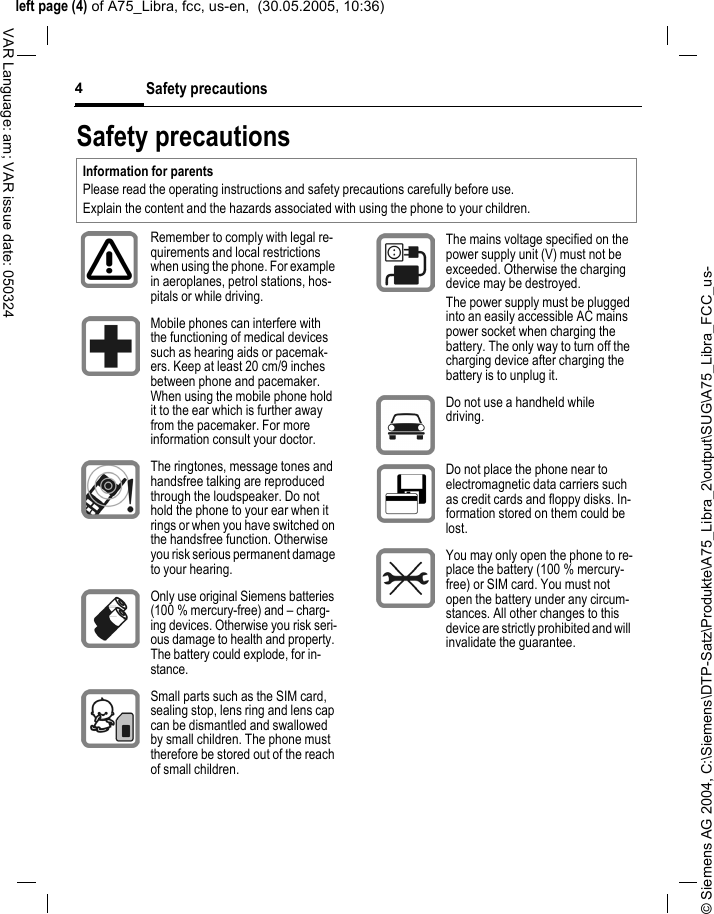
© Siemens AG 2004, C:\Siemens\DTP-Satz\Produkte\A75_Libra_2\output\SUG\A75_Libra_FCC_us-left page (4) of A75_Libra, fcc, us-en,  (30.05.2005, 10:36)Safety precautions4VAR Language: am; VAR issue date: 050324Safety precautionsInformation for parentsPlease read the operating instructions and safety precautions carefully before use.Explain the content and the hazards associated with using the phone to your children.Remember to comply with legal re-quirements and local restrictions when using the phone. For example in aeroplanes, petrol stations, hos-pitals or while driving.Mobile phones can interfere with the functioning of medical devices such as hearing aids or pacemak-ers. Keep at least 20 cm/9 inches between phone and pacemaker. When using the mobile phone hold it to the ear which is further away from the pacemaker. For more information consult your doctor.The ringtones, message tones and handsfree talking are reproduced through the loudspeaker. Do not hold the phone to your ear when it rings or when you have switched on the handsfree function. Otherwise you risk serious permanent damage to your hearing.Only use original Siemens batteries (100 % mercury-free) and – charg-ing devices. Otherwise you risk seri-ous damage to health and property. The battery could explode, for in-stance.Small parts such as the SIM card, sealing stop, lens ring and lens cap can be dismantled and swallowed by small children. The phone must therefore be stored out of the reach of small children.The mains voltage specified on the power supply unit (V) must not be exceeded. Otherwise the charging device may be destroyed.The power supply must be plugged into an easily accessible AC mains power socket when charging the battery. The only way to turn off the charging device after charging the battery is to unplug it. Do not use a handheld while driving.Do not place the phone near to electromagnetic data carriers such as credit cards and floppy disks. In-formation stored on them could be lost.You may only open the phone to re-place the battery (100 % mercury-free) or SIM card. You must not open the battery under any circum-stances. All other changes to this device are strictly prohibited and will invalidate the guarantee.
right page (5) of A75_Libra, fcc, us-en,  (30.05.2005, 10:36)© Siemens AG 2004, C:\Siemens\DTP-Satz\Produkte\A75_Libra_2\output\SUG\A75_Libra_FCC_us-5Safety precautionsVAR Language: am; VAR issue date: 050324Antenna careUse only the supplied or an approved re-placement antenna. Unauthorized anten-nas, modifications, or attachments could damage the phone and may violate FCC regulations.Phone operationNormal positionHold the phone as you would any other telephone with the antenna pointed up and over your shoulder.Tips on efficient operationFor your phone to operate most efficiently:• Extend your antenna fully (if applicable).• Do not touch the antenna unnecessari-ly when the phone is in use. Contact with the antenna affects call quality and may cause the phone to operate at a higher power level than otherwise needed.DrivingLaws pertaining to the use of mobile phones while driving vary significantly from state to state and sometimes even from lo-cality to locality within states. For example, some areas may allow persons to use their mobile phones only if they employ a hands-free device, and some areas may prohibit the use of cell phones entirely. Accordingly, Siemens recommends that persons check the laws for the areas in which they drive or will be driving. For areas where the use of mobile phones while driving is permitted, Siemens encourages persons to use their Important:Please dispose of unwanted batter-ies and phones as permitted by the laws in your country.The phone may cause interference in the vicinity of TV sets, radios and PCs.Use only Siemens original accesso-ries. This will avoid potential risks to health or property and ensure com-pliance with all relevant regulations.Improper use will invalidate the guarantee! These safety instructions also apply to Siemens original accessories.Product attributes are subject to changes in tech-nology, design and availability. Siemens reserves the right to modify products without prior notice.ImportantRead this information before using your wireless handheld phone.As this mobile phone is equipped with a fixed (non-retractable) antenna, some paragraphs in the text below may not be applicable.
© Siemens AG 2004, C:\Siemens\DTP-Satz\Produkte\A75_Libra_2\output\SUG\A75_Libra_FCC_us-left page (6) of A75_Libra, fcc, us-en,  (30.05.2005, 10:36)Safety precautions6VAR Language: am; VAR issue date: 050324phones responsibly and to employ hands-free devices. Also, if using your phone while driving, please:• Give full attention to driving – driving safely is your first responsibility;• Use hands-free operation, if available;• Pull off the road and park before mak-ing or answering a call, if driving condi-tions so require.For vehicles equipped with air bagsAn air bag inflates with great force. DO NOT place objects, including either installed or portable wireless equipment, in the area over the air bag or in the air bag deploy-ment area. If in-vehicle wireless equipment is improperly installed and the air bag in-flates, serious injury could result.Electronic devicesMost modern electronic equipment is shielded from radio frequency (RF) sig-nals. However, certain electronic equip-ment may not be shielded against the RF signals from your wireless phone.PacemakersThe Health Industry Manufacturers' Associ-ation recommends that a minimum separa-tion of six inches (6") be maintained be-tween a handheld wireless phone and a pacemaker to avoid potential interference with the pacemaker. These recommenda-tions are consistent with the independent research by and recommendations of Wire-less Technology Research.Persons with pacemakers• should ALWAYS keep the phone more than six inches from their pacemaker when the phone is turned ON;• should not carry the phone in a breast pocket;• should use the ear opposite the pace-maker to minimize the potential for in-terference;• should turn the phone OFF immediate-ly if there is any reason to suspect that interference is taking place.Hearing aids Some digital wireless phones may interfere with some hearing aids. In the event of such interference, you may want to consult your service provider or your hearing aid manufacturer to discuss alter-natives.Other medical devicesIf you use any other personal medical de-vices, consult the manufacturers of your devices to determine if they are ade-quately shielded from external RF energy. Your physician may be able to assist you in obtaining this information.Turn your phone OFF in health care facili-ties when any regulations posted in these areas instruct you to do so. Hospitals or health care facilities may be using equip-ment that could be sensitive to external RF energy.VehiclesRF signals may affect improperly installed or inadequately shielded electronic sys-tems in motor vehicles. Check with the manufacturer or its representative regard-ing your vehicle. You should also consult the manufacturer of any equipment that has been added to your vehicle.Posted facilitiesTurn your phone OFF in any facility where posted notices so require.AirplanesFCC and Airline Regulations prohibit using your phone while in the air. Turn your phone OFF when requested by the airline.Check and comply with the policy of your airline regarding the use of your phone while the airplane is on the ground.
right page (7) of A75_Libra, fcc, us-en,  (30.05.2005, 10:36)© Siemens AG 2004, C:\Siemens\DTP-Satz\Produkte\A75_Libra_2\output\SUG\A75_Libra_FCC_us-7Safety precautionsVAR Language: am; VAR issue date: 050324Blasting areasTo avoid interfering with blasting opera-tions, turn your phone OFF when in a “blasting area” or in areas posted: “Turn off two-way radio.” Obey all signs and in-structions.Potentially explosive atmospheresTurn your phone OFF when in any area with a potentially explosive atmosphere and obey all signs and instructions. Sparks in such areas could cause an explosion or fire resulting in bodily injury or even death.Areas with a potentially explosive atmo-sphere are often but not always clearly marked. They include: fueling areas such as gasoline stations; below deck on boats; fuel or chemical transfer or storage facili-ties; vehicles using liquefied petroleum gas (such as propane or butane); areas where the air contains chemicals or parti-cles, such as grain, dust or metal pow-ders; and any other area where you would normally be advised to turn off your vehicle engine.Emergency calls (SOS)Your wireless phone can be used to make emergency calls. You can make an emer-gency call from the main display screen. Enter the local emergency number such as 911 and then press the A key.This phone, like any wireless phone, oper-ates using radio signals, wireless and landline networks, and user-pro-grammed functions. Because of this, con-nections in all conditions cannot be guar-anteed. Therefore, you should never rely solely on any wireless phone for essential communications (for example, medical emergencies). Remember – to make or receive any calls, the phone must be switched on and be used in a service area that has adequate signal strength. Emer-gency calls might not be possible on all wireless phone networks or when certain network services or phone features are in use. Check with local service providers re-garding their network features. Always make certain that your phone is properly charged before attempting any emergency calls. If you allow your battery to discharge, you will be unable to receive or make calls, including emergency calls. You must then wait a few minutes after the charging begins to place any emergency calls.When making an emergency call, remember to give all of the necessary in-formation as accurately as possible. Re-member that your wireless phone might be the only means of communication at the scene of an accident, therefore you should not terminate the call until given permission to do so.Batteries and ChargersOnly use original Siemens batteries (100% mercury-free) and charging devices. Use of non-Siemens batteries and/or charging devices may cause explo-sion resulting in serious injury and/or property damage. Use original Siemens accessories in order to avoid possible injury and property damage and to ensure compliance with applicable laws and regulations. Improper use invalidates the warranty.Battery safety precautionsTo reduce the risk of fire, injury or electric shock, and to properly dispose of batter-ies, please read and understand the fol-lowing instructions. CONTAINS LITHIUM-ION OR NICKEL-METAL HYDRIDE BATTERY. BATTERY MUST BE RECYCLED OR DIS-POSED OF PROPERLY. DO NOT DISPOSE IN MUNICIPAL WASTE.1. Only use the batteries specified for use with this mobile phone.2. Do not use batteries of different sizes or from different manufacturers in this mobile phone.
© Siemens AG 2004, C:\Siemens\DTP-Satz\Produkte\A75_Libra_2\output\SUG\A75_Libra_FCC_us-left page (8) of A75_Libra, fcc, us-en,  (30.05.2005, 10:36)Safety precautions8VAR Language: am; VAR issue date: 0503243. Do not dispose of the battery in a fire; it may explode. Dispose of used batteries and phones in accordance with applica-ble laws and safety regulations. Do not expose battery to water. Check with local codes for special disposal instructions. 4. Do not open or mutilate the battery. Doing so may cause damage to the eyes or skin.5. Exercise care in handling the battery in order not to short the battery with con-ducting materials such as rings, brace-lets, and keys. The battery or conduct-ing material may overheat and cause burns or fire.6. Charge the battery provided with, or identified for use with, this product only in accordance with the instruc-tions and limitations specified in the User's Guide. Do not attempt to charge the battery by any means other than those specified in the User's Guide.
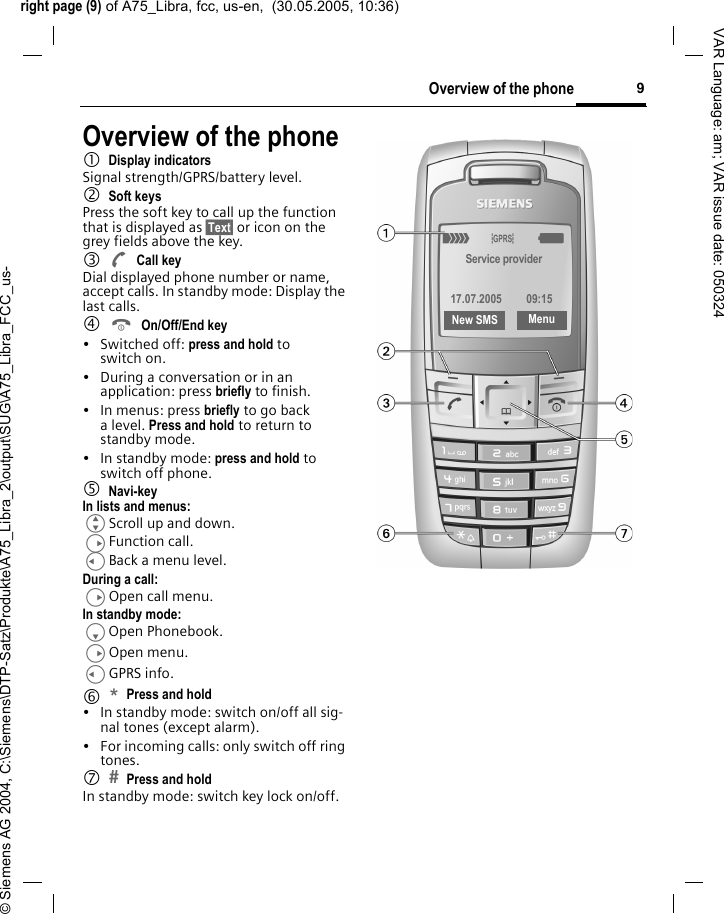
right page (9) of A75_Libra, fcc, us-en,  (30.05.2005, 10:36)© Siemens AG 2004, C:\Siemens\DTP-Satz\Produkte\A75_Libra_2\output\SUG\A75_Libra_FCC_us-9Overview of the phoneVAR Language: am; VAR issue date: 050324Overview of the phone1Display indicatorsSignal strength/GPRS/battery level.2Soft keysPress the soft key to call up the function that is displayed as §Text§ or icon on the grey fields above the key. 3ACall keyDial displayed phone number or name, accept calls. In standby mode: Display the last calls.4BOn/Off/End key• Switched off: press and hold to switch on.• During a conversation or in an application: press briefly to finish. • In menus: press briefly to go back a level. Press and hold to return to standby mode.• In standby mode: press and hold to switch off phone.5Navi-keyIn lists and menus:GScroll up and down.DFunction call.CBack a menu level.During a call:DOpen call menu.In standby mode:FOpen Phonebook.DOpen menu.CGPRS info.6*Press and hold • In standby mode: switch on/off all sig-nal tones (except alarm). • For incoming calls: only switch off ring tones.7Press and holdIn standby mode: switch key lock on/off._ ª       gService provider   17.07.2005      09:15New SMS          Menu
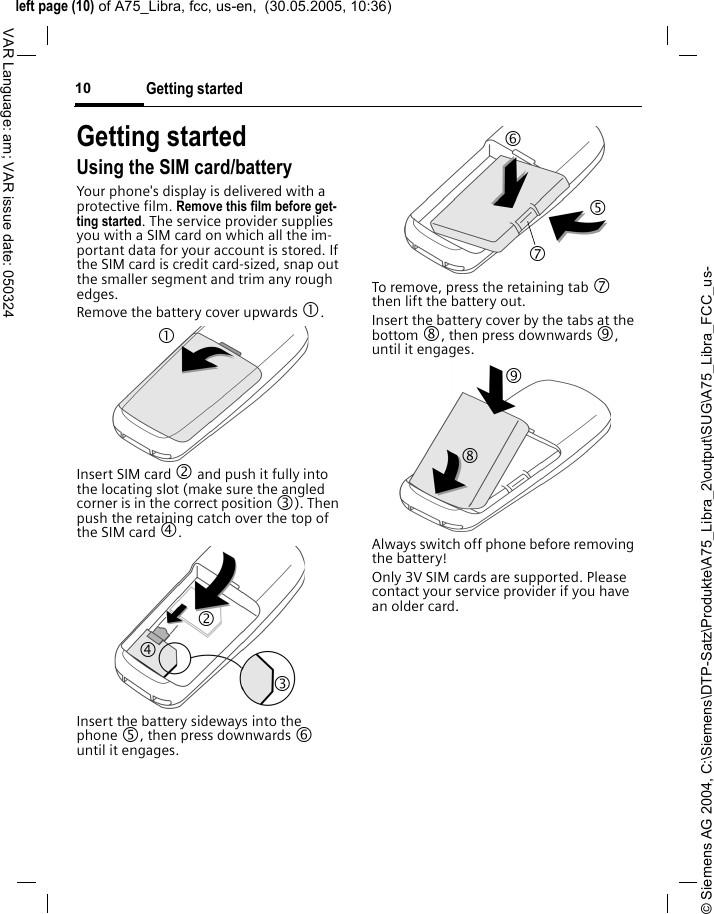
© Siemens AG 2004, C:\Siemens\DTP-Satz\Produkte\A75_Libra_2\output\SUG\A75_Libra_FCC_us-left page (10) of A75_Libra, fcc, us-en,  (30.05.2005, 10:36)Getting started10VAR Language: am; VAR issue date: 050324Getting startedUsing the SIM card/batteryYour phone's display is delivered with a protective film. Remove this film before get-ting started. The service provider supplies you with a SIM card on which all the im-portant data for your account is stored. If the SIM card is credit card-sized, snap out the smaller segment and trim any rough edges.Remove the battery cover upwards 1.Insert SIM card 2 and push it fully into the locating slot (make sure the angled corner is in the correct position 3). Then push the retaining catch over the top of the SIM card 4. Insert the battery sideways into the phone 5, then press downwards 6 until it engages. To remove, press the retaining tab 7 then lift the battery out.Insert the battery cover by the tabs at the bottom 8, then press downwards 9, until it engages.Always switch off phone before removing the battery!Only 3V SIM cards are supported. Please contact your service provider if you have an older card.1 24 3 6 7 5 8 9
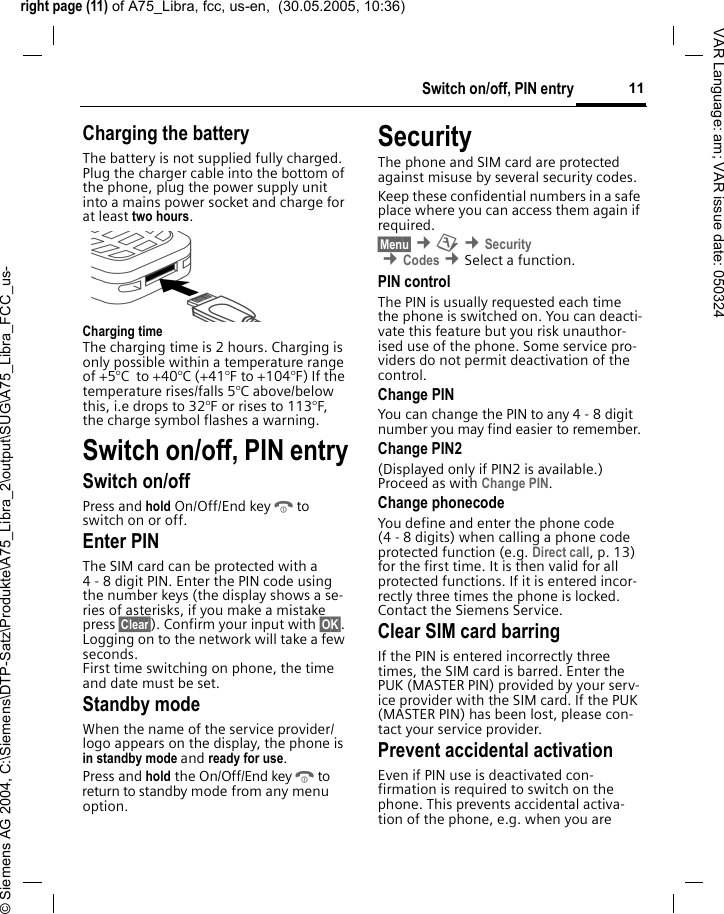
right page (11) of A75_Libra, fcc, us-en,  (30.05.2005, 10:36)© Siemens AG 2004, C:\Siemens\DTP-Satz\Produkte\A75_Libra_2\output\SUG\A75_Libra_FCC_us-11Switch on/off, PIN entryVAR Language: am; VAR issue date: 050324Charging the batteryThe battery is not supplied fully charged. Plug the charger cable into the bottom of the phone, plug the power supply unit into a mains power socket and charge for at least two hours. Charging timeThe charging time is 2 hours. Charging is only possible within a temperature range of +5°C  to +40°C (+41°F to +104°F) If the temperature rises/falls 5°C above/below this, i.e drops to 32°F or rises to 113°F, the charge symbol flashes a warning. Switch on/off, PIN entrySwitch on/offPress and hold On/Off/End keyBto switch on or off.Enter PINThe SIM card can be protected with a 4 - 8 digit PIN. Enter the PIN code using the number keys (the display shows a se-ries of asterisks, if you make a mistake press §Clear§). Confirm your input with §OK§. Logging on to the network will take a few seconds.First time switching on phone, the time and date must be set.Standby modeWhen the name of the service provider/ logo appears on the display, the phone is in standby mode and ready for use.Press and hold the On/Off/End keyBto return to standby mode from any menu option.SecurityThe phone and SIM card are protected against misuse by several security codes. Keep these confidential numbers in a safe place where you can access them again if required.§Menu§ ¢m ¢Security ¢Codes ¢Select a function. PIN controlThe PIN is usually requested each time the phone is switched on. You can deacti-vate this feature but you risk unauthor-ised use of the phone. Some service pro-viders do not permit deactivation of the control.Change PINYou can change the PIN to any 4 - 8 digit number you may find easier to remember.Change PIN2(Displayed only if PIN2 is available.) Proceed as with Change PIN.Change phonecodeYou define and enter the phone code (4 - 8 digits) when calling a phone code protected function (e.g. Direct call, p. 13) for the first time. It is then valid for all protected functions. If it is entered incor-rectly three times the phone is locked. Contact the Siemens Service. Clear SIM card barringIf the PIN is entered incorrectly three times, the SIM card is barred. Enter the PUK (MASTER PIN) provided by your serv-ice provider with the SIM card. If the PUK (MASTER PIN) has been lost, please con-tact your service provider.Prevent accidental activationEven if PIN use is deactivated con-firmation is required to switch on the phone. This prevents accidental activa-tion of the phone, e.g. when you are
© Siemens AG 2004, C:\Siemens\DTP-Satz\Produkte\A75_Libra_2\output\SUG\A75_Libra_FCC_us-left page (12) of A75_Libra, fcc, us-en,  (30.05.2005, 10:36)Making a phone call12VAR Language: am; VAR issue date: 050324carrying it in a bag or when you are trav-elling in an aircraft.After pressing and holding the On/Off/End keyBselect §OK§ to switch on the phone or abort the operation with any key except §OK§ .Making a phone callDialling with number keysThe phone must be switched on (standby mode). Enter the number (always with prefix, if necessary with the international dialling code). Press §Clear§ to clear the last digit, press and hold to clear the entire phone number. To dial press theAkey.End callPress the End keyBbriefly. Press this key even if the person on the other end of the line has hung up first.Set volumeUse the scroll keyEto start adjusting the volume during conversation. Set volume withG.Redial previous numbersTo redial the phone number last called, press the Call keyAtwice. To redial other numbers that were dialled previously, pick out the required phone number from the list withG, then pressAto dial.When a number is busyFor automatically dialling the phone number for up to 15 minutes at increas-ing intervals, press §Auto dial§. For phone ringing when the busy number is free, press §Call back§ (L ). Press §Prompt§ and a beep will remind you to redial the dis-payed phone number after 15 minutes.Accept callThe phone must be switched on (standby mode). An incoming call will interrupt any other use of the phone. Press §Answer§ orA.If the phone number has been transmitted by the network, it is displayed. If the number and the name are stored in the Phonebook, the corresponding name is displayed in-stead. If set, an animation can be dis-played instead of the bell icon.Reject call§Reject§ or B press briefly.Swapping between 2 calls  bMake a new connection during a call with y menu§ ¢Hold ¢J (dial new phone number, also from Phonebook:F). With §Swap§ you can swap back and forth be-tween both calls.Additional costs will be incurred for the 2nd phone connection.Multi Party bMake a new connection during a call with y menu§ ¢Hold ¢J (dial a new phone number). With y menu§ ¢Multi Party you can join the held call. Repeat this procedure until all participants are linked together (up to 5participants).All calls in the conference are ended si-multaneously when the End keyBis pressed.Additional costs will be incurred for every additional phone connection.SpeakerphoneYou can put the phone down during a call. You can then hear the caller via the loudspeaker. Press §Speaker.§ and §Yes§ to activate handsfree function. Press §Speaker.§ to switch off. Warning! Please make sure you have accepted the call be-fore holding the phone to your ear. This will prevent a loud ring tone from damag-ing your hearing!
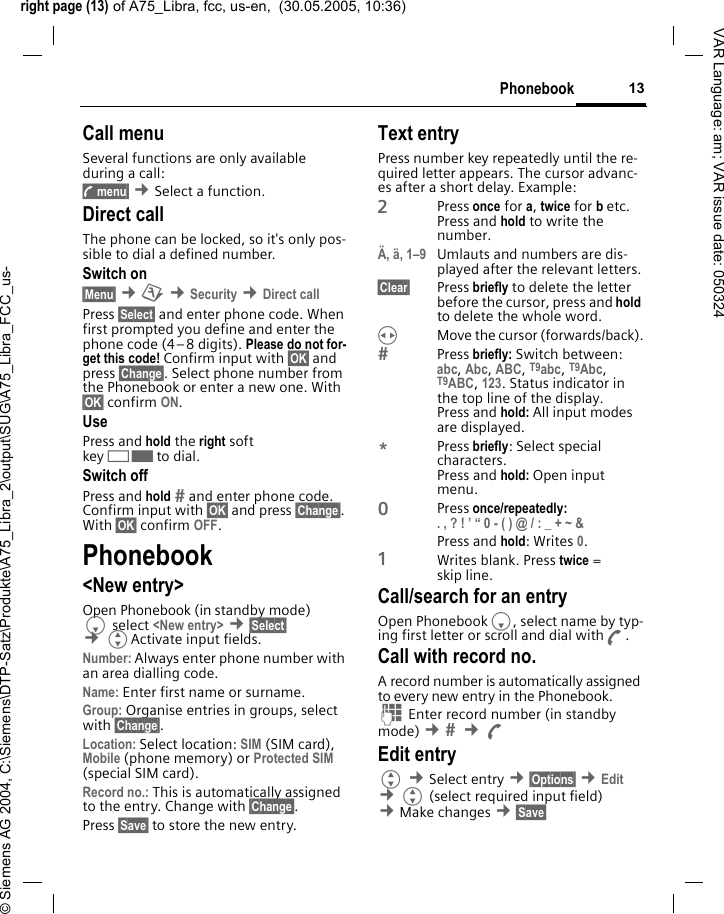
right page (13) of A75_Libra, fcc, us-en,  (30.05.2005, 10:36)© Siemens AG 2004, C:\Siemens\DTP-Satz\Produkte\A75_Libra_2\output\SUG\A75_Libra_FCC_us-13PhonebookVAR Language: am; VAR issue date: 050324Call menuSeveral functions are only available during a call:y menu§ ¢Select a function. Direct callThe phone can be locked, so it's only pos-sible to dial a defined number.Switch on§Menu§ ¢m ¢Security ¢Direct call Press §Select§ and enter phone code. When first prompted you define and enter the phone code (4–8 digits). Please do not for-get this code! Confirm input with §OK§ and press §Change§. Select phone number from the Phonebook or enter a new one. With §OK§ confirm ON.UsePress and hold the right soft key>to dial.Switch offPress and hold  and enter phone code. Confirm input with §OK§ and press §Change§. With §OK§ confirm OFF.Phonebook<New entry>Open Phonebook (in standby mode) Fselect <New entry> ¢§Select§ ¢GActivate input fields.Number: Always enter phone number with an area dialling code.Name: Enter first name or surname.Group: Organise entries in groups, select with §Change§.Location: Select location: SIM (SIM card), Mobile (phone memory) or Protected SIM (special SIM card).Record no.: This is automatically assigned to the entry. Change with §Change§.Press §Save§ to store the new entry.Text entryPress number key repeatedly until the re-quired letter appears. The cursor advanc-es after a short delay. Example:2Press once for a, twice for b etc. Press and hold to write the number.Ä, ä, 1–9 Umlauts and numbers are dis-played after the relevant letters.§Clear§ Press briefly to delete the letter before the cursor, press and hold to delete the whole word.HMove the cursor (forwards/back).Press briefly: Switch between: abc, Abc, ABC, T9abc, T9Abc, T9ABC, 123. Status indicator in the top line of the display.Press and hold: All input modes are displayed.*Press briefly: Select special characters.Press and hold: Open input menu.0Press once/repeatedly:. , ? ! ’ “ 0 - ( ) @ / : _ + ~ & Press and hold: Writes 0.1Writes blank. Press twice = skip line.Call/search for an entryOpen PhonebookF, select name by typ-ing first letter or scroll and dial withA.Call with record no. A record number is automatically assigned to every new entry in the Phonebook.J Enter record number (in standby mode) ¢  ¢A Edit entryG ¢Select entry ¢§Options§ ¢Edit ¢G (select required input field) ¢Make changes ¢§Save§
© Siemens AG 2004, C:\Siemens\DTP-Satz\Produkte\A75_Libra_2\output\SUG\A75_Libra_FCC_us-left page (14) of A75_Libra, fcc, us-en,  (30.05.2005, 10:36)Messages (SMS)14VAR Language: am; VAR issue date: 050324Assign pictureIf a picture is assigned to an entry, this picture is displayed for the appropriate call.G ¢select entry ¢§Options§ ¢Picture ¢Iselect picture ¢§Open§ ¢§Select§ GroupsIf there are many Phonebook entries it is best to assign them to a group, e.g.: Family, Friends, VIP, Others, No groupA special ring tone can sound and/or a sym-bol can be displayed if the phone number of a call is registered in a group.Select a groupFOpen Phonebook in standby mode ¢<Groups> ¢Gselect a group ¢§Select§ All entries of the selected group are displayed.Change group assignmentYou can assign a Phonebook entry to a group when you enter it. FOpen Phonebook ¢GSelect entry ¢§Edit§ ¢G(scroll to group) ¢§Change§  ¢Select a new goup ¢§Save§ Group call tonesYou can assign different ringtones to groups. §Menu§ ¢ç ¢Group calls ¢GSelect a group ¢§Select§ ¢GSelect ring tone ¢§Select§ Messages (SMS)Read messagesA new message is indicated on the display with …. Press the left soft key to read the message. Scroll through the message line by line withG.§Reply§ Functions for a direct reply.Inbox/Draft/Send/Unsent/SMS archive §Menu§ ¢] ¢Select a function. The list of saved messages is shown.Compose a message§Menu§ ¢] ¢New SMS ¢Write text ¢A ¢J/ Q (enter phone number or select from Phonebook) ¢§OK§ The SMS is sent to the service centre for transmission. SMS to groupWrite text ¢§Options§ ¢Send ¢§Group§ select group members and send SMS.Picture&SoundInsert pictures/sounds in the message text.Write text ¢§Options§ ¢Picture&Sound ¢GSelect picture/sound. The picture/sound is inserted in the SMS. Text menu §Options§ Open the text menu.Write text fragments§Menu§ ¢] ¢Predef. texts ¢§Options§ ¢<New entry> ¢J(write textfragment) ¢§Save§ Use text fragmentsJ (write message text) ¢§Options§ ¢Predef. texts ¢G (select text fragment from the list) ¢§Select§
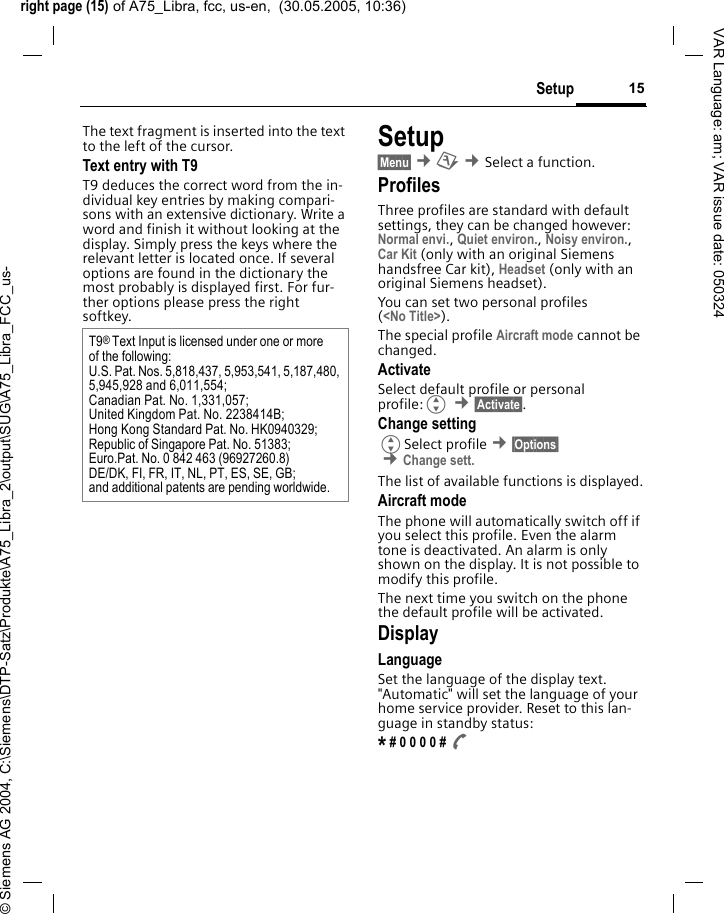
right page (15) of A75_Libra, fcc, us-en,  (30.05.2005, 10:36)© Siemens AG 2004, C:\Siemens\DTP-Satz\Produkte\A75_Libra_2\output\SUG\A75_Libra_FCC_us-15SetupVAR Language: am; VAR issue date: 050324The text fragment is inserted into the text to the left of the cursor.Text entry with T9T9 deduces the correct word from the in-dividual key entries by making compari-sons with an extensive dictionary. Write a word and finish it without looking at the display. Simply press the keys where the relevant letter is located once. If several options are found in the dictionary the most probably is displayed first. For fur-ther options please press the right softkey.Setup§Menu§ ¢m ¢Select a function. ProfilesThree profiles are standard with default settings, they can be changed however: Normal envi., Quiet environ., Noisy environ., Car Kit (only with an original Siemens handsfree Car kit), Headset (only with an original Siemens headset).You can set two personal profiles (<No Title>).The special profile Aircraft mode cannot be changed.ActivateSelect default profile or personal profile:G ¢§Activate§.Change settingGSelect profile ¢§Options§ ¢Change sett. The list of available functions is displayed.Aircraft modeThe phone will automatically switch off if you select this profile. Even the alarm tone is deactivated. An alarm is only shown on the display. It is not possible to modify this profile.The next time you switch on the phone the default profile will be activated.DisplayLanguageSet the language of the display text. "Automatic" will set the language of your home service provider. Reset to this lan-guage in standby status:* # 0 0 0 0 # AT9® Text Input is licensed under one or more of the following:U.S. Pat. Nos. 5,818,437, 5,953,541, 5,187,480, 5,945,928 and 6,011,554;Canadian Pat. No. 1,331,057; United Kingdom Pat. No. 2238414B; Hong Kong Standard Pat. No. HK0940329; Republic of Singapore Pat. No. 51383; Euro.Pat. No. 0 842 463 (96927260.8) DE/DK, FI, FR, IT, NL, PT, ES, SE, GB; and additional patents are pending worldwide.
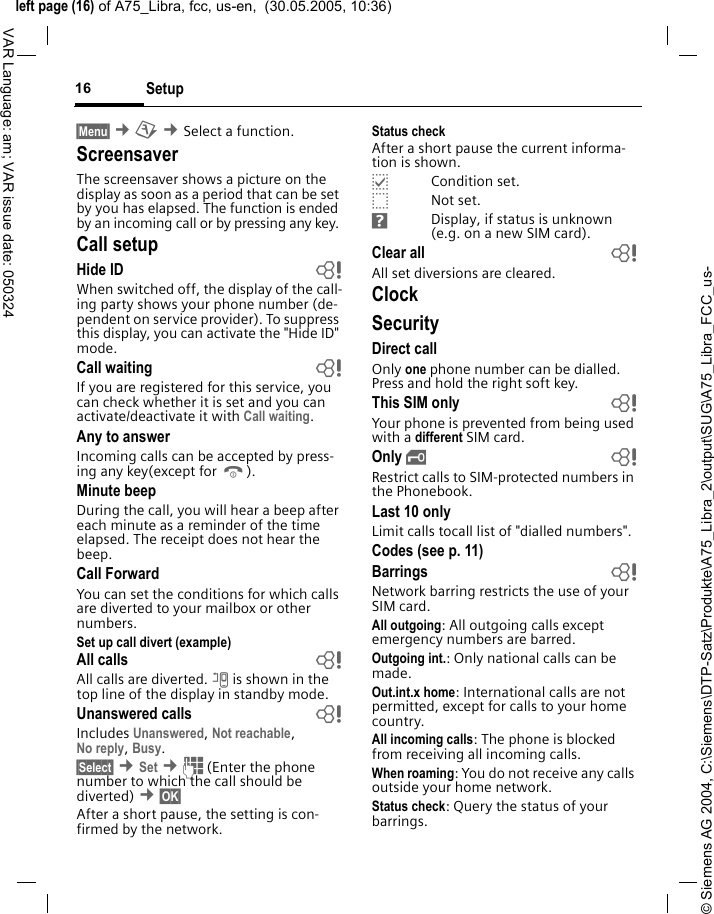
© Siemens AG 2004, C:\Siemens\DTP-Satz\Produkte\A75_Libra_2\output\SUG\A75_Libra_FCC_us-left page (16) of A75_Libra, fcc, us-en,  (30.05.2005, 10:36)Setup16VAR Language: am; VAR issue date: 050324§Menu§ ¢m ¢Select a function. Screensaver The screensaver shows a picture on the display as soon as a period that can be set by you has elapsed. The function is ended by an incoming call or by pressing any key. Call setupHide ID  bWhen switched off, the display of the call-ing party shows your phone number (de-pendent on service provider). To suppress this display, you can activate the "Hide ID" mode.Call waiting  bIf you are registered for this service, you can check whether it is set and you can activate/deactivate it with Call waiting.Any to answerIncoming calls can be accepted by press-ing any key(except for B).Minute beepDuring the call, you will hear a beep after each minute as a reminder of the time elapsed. The receipt does not hear the beep.Call ForwardYou can set the conditions for which calls are diverted to your mailbox or other numbers.Set up call divert (example)All calls  bAll calls are diverted. n is shown in the top line of the display in standby mode.Unanswered calls  bIncludes Unanswered, Not reachable,No reply, Busy.§Select§ ¢Set ¢J (Enter the phone number to which the call should be diverted) ¢§OK§ After a short pause, the setting is con-firmed by the network.Status checkAfter a short pause the current informa-tion is shown.pCondition set.oNot set.sDisplay, if status is unknown (e.g. on a new SIM card). Clear all  bAll set diversions are cleared.ClockSecurityDirect callOnly one phone number can be dialled. Press and hold the right soft key.This SIM only bYour phone is prevented from being used with a different SIM card.Only ‚ bRestrict calls to SIM-protected numbers in the Phonebook.Last 10 onlyLimit calls tocall list of "dialled numbers".Codes (see p. 11)Barrings bNetwork barring restricts the use of your SIM card.All outgoing: All outgoing calls except emergency numbers are barred.Outgoing int.: Only national calls can be made.Out.int.x home: International calls are not permitted, except for calls to your home country.All incoming calls: The phone is blocked from receiving all incoming calls.When roaming: You do not receive any calls outside your home network.Status check: Query the status of your barrings.
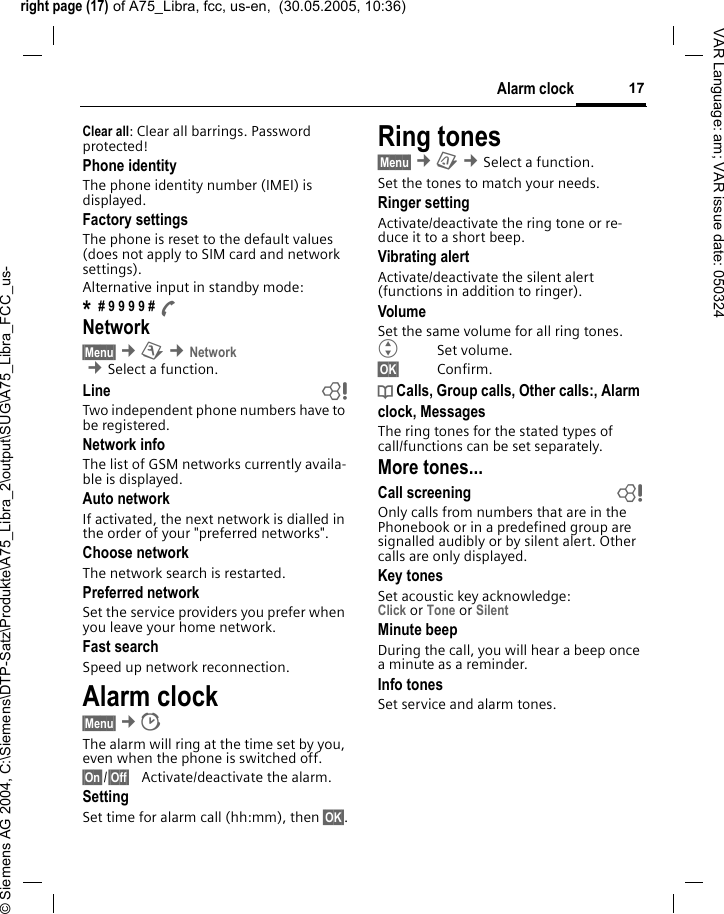
right page (17) of A75_Libra, fcc, us-en,  (30.05.2005, 10:36)© Siemens AG 2004, C:\Siemens\DTP-Satz\Produkte\A75_Libra_2\output\SUG\A75_Libra_FCC_us-17Alarm clockVAR Language: am; VAR issue date: 050324Clear all: Clear all barrings. Password protected!Phone identityThe phone identity number (IMEI) is displayed.Factory settingsThe phone is reset to the default values (does not apply to SIM card and network settings).Alternative input in standby mode:* # 9 9 9 9 # ANetwork§Menu§ ¢m ¢Network  ¢Select a function. Line bTwo independent phone numbers have to be registered.Network infoThe list of GSM networks currently availa-ble is displayed.Auto network If activated, the next network is dialled in the order of your "preferred networks".Choose networkThe network search is restarted.Preferred network Set the service providers you prefer when you leave your home network.Fast searchSpeed up network reconnection.Alarm clock §Menu§ ¢The alarm will ring at the time set by you, even when the phone is switched off. §On§/§Off§ Activate/deactivate the alarm.SettingSet time for alarm call (hh:mm), then §OK§.Ring tones§Menu§ ¢ç ¢Select a function. Set the tones to match your needs.Ringer settingActivate/deactivate the ring tone or re-duce it to a short beep.Vibrating alertActivate/deactivate the silent alert (functions in addition to ringer). VolumeSet the same volume for all ring tones.GSet volume.§OK§ Confirm.d Calls, Group calls, Other calls:, Alarm clock, MessagesThe ring tones for the stated types of call/functions can be set separately.More tones...Call screening bOnly calls from numbers that are in the Phonebook or in a predefined group are signalled audibly or by silent alert. Other calls are only displayed. Key tonesSet acoustic key acknowledge:Click or Tone or Silent Minute beepDuring the call, you will hear a beep once a minute as a reminder.Info tones Set service and alarm tones.
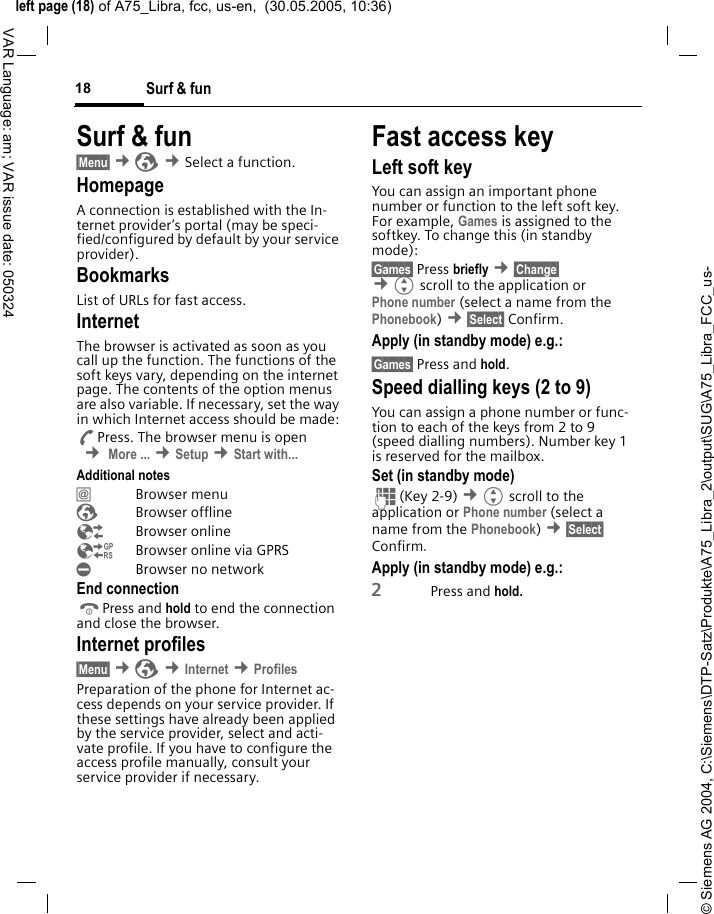
© Siemens AG 2004, C:\Siemens\DTP-Satz\Produkte\A75_Libra_2\output\SUG\A75_Libra_FCC_us-left page (18) of A75_Libra, fcc, us-en,  (30.05.2005, 10:36)Surf & fun18VAR Language: am; VAR issue date: 050324Surf & fun§Menu§ ¢É ¢Select a function. HomepageA connection is established with the In-ternet provider’s portal (may be speci-fied/configured by default by your service provider).BookmarksList of URLs for fast access. InternetThe browser is activated as soon as you call up the function. The functions of the soft keys vary, depending on the internet page. The contents of the option menus are also variable. If necessary, set the way in which Internet access should be made:APress. The browser menu is open  ¢ More ... ¢Setup ¢Start with... Additional notesÍ Browser menuÉ Browser offlineÊ Browser onlineË  Browser online via GPRSÌ  Browser no networkEnd connectionBPress and hold to end the connection and close the browser.Internet profiles§Menu§ ¢É ¢Internet ¢ProfilesPreparation of the phone for Internet ac-cess depends on your service provider. If these settings have already been applied by the service provider, select and acti-vate profile. If you have to configure the access profile manually, consult your service provider if necessary. Fast access keyLeft soft keyYou can assign an important phone number or function to the left soft key. For example, Games is assigned to the softkey. To change this (in standby mode):§Games§ Press briefly ¢§Change§  ¢Gscroll to the application or Phone number (select a name from the Phonebook) ¢§Select§ Confirm.Apply (in standby mode) e.g.:§Games§ Press and hold.Speed dialling keys (2 to 9)You can assign a phone number or func-tion to each of the keys from 2 to 9 (speed dialling numbers). Number key 1 is reserved for the mailbox. Set (in standby mode)J(Key 2-9) ¢Gscroll to the application or Phone number (select a name from the Phonebook) ¢§Select§ Confirm.Apply (in standby mode) e.g.:2Press and hold.
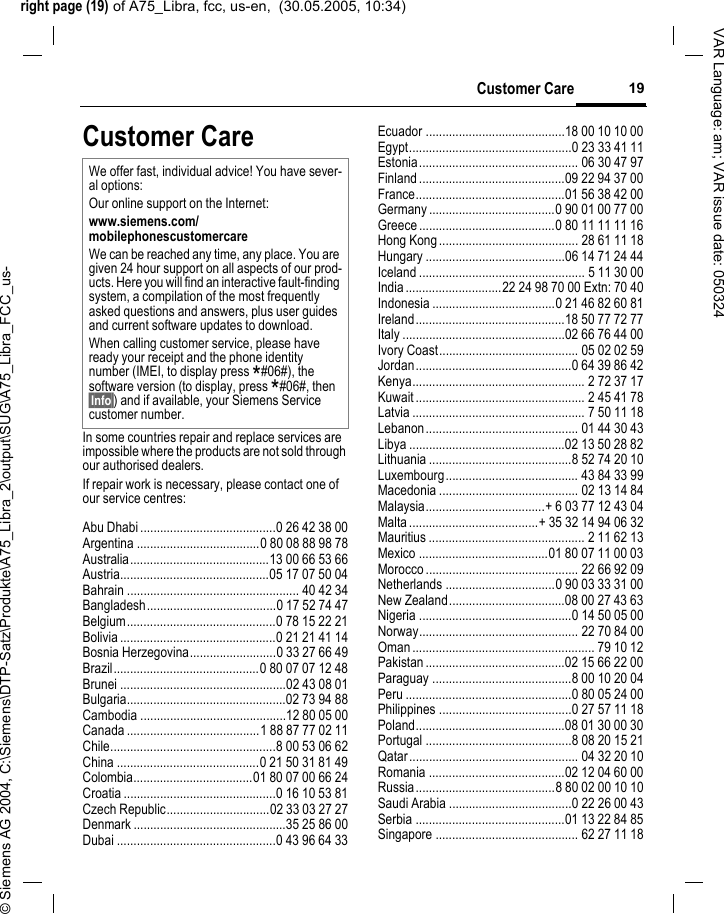
right page (19) of A75_Libra, fcc, us-en,  (30.05.2005, 10:34)© Siemens AG 2004, C:\Siemens\DTP-Satz\Produkte\A75_Libra_2\output\SUG\A75_Libra_FCC_us-19Customer CareVAR Language: am; VAR issue date: 050324Customer CareIn some countries repair and replace services are impossible where the products are not sold through our authorised dealers.If repair work is necessary, please contact one of our service centres:Abu Dhabi .........................................0 26 42 38 00Argentina .....................................0 80 08 88 98 78Australia..........................................13 00 66 53 66Austria.............................................05 17 07 50 04Bahrain .................................................... 40 42 34Bangladesh.......................................0 17 52 74 47Belgium.............................................0 78 15 22 21Bolivia ...............................................0 21 21 41 14Bosnia Herzegovina..........................0 33 27 66 49Brazil............................................0 80 07 07 12 48Brunei ..................................................02 43 08 01Bulgaria................................................02 73 94 88Cambodia ............................................12 80 05 00Canada ........................................1 88 87 77 02 11Chile..................................................8 00 53 06 62China ...........................................0 21 50 31 81 49Colombia....................................01 80 07 00 66 24Croatia ..............................................0 16 10 53 81Czech Republic...............................02 33 03 27 27Denmark ..............................................35 25 86 00Dubai ................................................0 43 96 64 33Ecuador ..........................................18 00 10 10 00Egypt.................................................0 23 33 41 11Estonia................................................ 06 30 47 97Finland............................................09 22 94 37 00France.............................................01 56 38 42 00Germany ......................................0 90 01 00 77 00Greece .........................................0 80 11 11 11 16Hong Kong.......................................... 28 61 11 18Hungary ..........................................06 14 71 24 44Iceland .................................................. 5 11 30 00India.............................22 24 98 70 00 Extn: 70 40Indonesia .....................................0 21 46 82 60 81Ireland.............................................18 50 77 72 77Italy .................................................02 66 76 44 00Ivory Coast.......................................... 05 02 02 59Jordan...............................................0 64 39 86 42Kenya.................................................... 2 72 37 17Kuwait ................................................... 2 45 41 78Latvia .................................................... 7 50 11 18Lebanon.............................................. 01 44 30 43Libya ...............................................02 13 50 28 82Lithuania ...........................................8 52 74 20 10Luxembourg........................................ 43 84 33 99Macedonia .......................................... 02 13 14 84Malaysia....................................+ 6 03 77 12 43 04Malta .......................................+ 35 32 14 94 06 32Mauritius ............................................... 2 11 62 13Mexico .......................................01 80 07 11 00 03Morocco .............................................. 22 66 92 09Netherlands .................................0 90 03 33 31 00New Zealand...................................08 00 27 43 63Nigeria ..............................................0 14 50 05 00Norway................................................ 22 70 84 00Oman ....................................................... 79 10 12Pakistan ..........................................02 15 66 22 00Paraguay ..........................................8 00 10 20 04Peru ..................................................0 80 05 24 00Philippines ........................................0 27 57 11 18Poland.............................................08 01 30 00 30Portugal ............................................8 08 20 15 21Qatar................................................... 04 32 20 10Romania .........................................02 12 04 60 00Russia..........................................8 80 02 00 10 10Saudi Arabia .....................................0 22 26 00 43Serbia .............................................01 13 22 84 85Singapore ........................................... 62 27 11 18We offer fast, individual advice! You have sever-al options:Our online support on the Internet:www.siemens.com/mobilephonescustomercare We can be reached any time, any place. You are given 24 hour support on all aspects of our prod-ucts. Here you will find an interactive fault-finding system, a compilation of the most frequently asked questions and answers, plus user guides and current software updates to download.When calling customer service, please have ready your receipt and the phone identity number (IMEI, to display press *#06#), the software version (to display, press *#06#, then §Info§) and if available, your Siemens Service customer number.
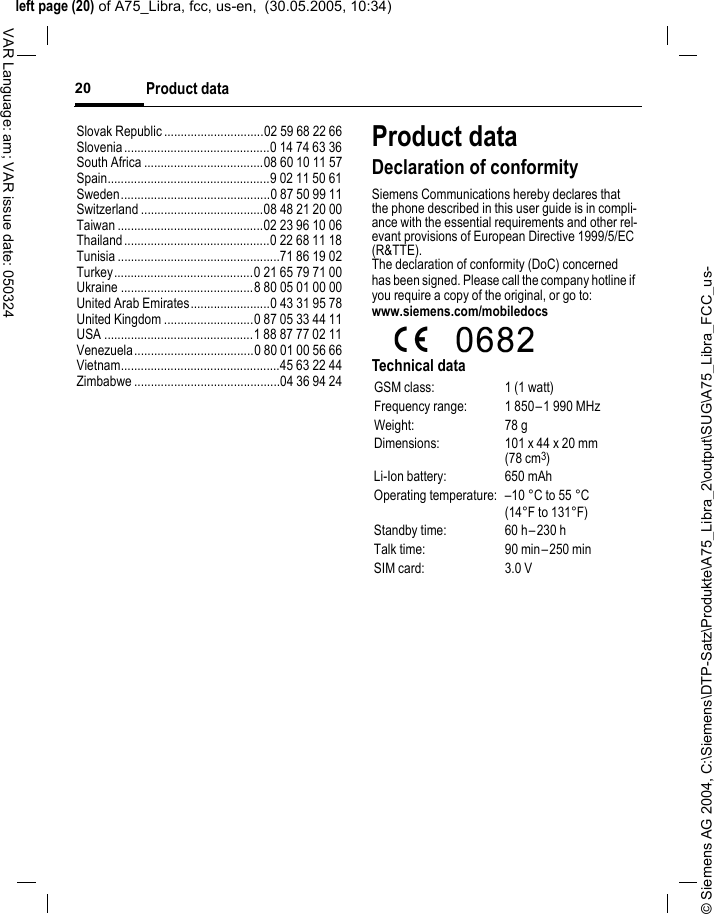
© Siemens AG 2004, C:\Siemens\DTP-Satz\Produkte\A75_Libra_2\output\SUG\A75_Libra_FCC_us-left page (20) of A75_Libra, fcc, us-en,  (30.05.2005, 10:34)Product data20VAR Language: am; VAR issue date: 050324Slovak Republic ..............................02 59 68 22 66Slovenia............................................0 14 74 63 36South Africa ....................................08 60 10 11 57Spain.................................................9 02 11 50 61Sweden.............................................0 87 50 99 11Switzerland .....................................08 48 21 20 00Taiwan ............................................02 23 96 10 06Thailand............................................0 22 68 11 18Tunisia .................................................71 86 19 02Turkey..........................................0 21 65 79 71 00Ukraine ........................................8 80 05 01 00 00United Arab Emirates........................0 43 31 95 78United Kingdom ...........................0 87 05 33 44 11USA .............................................1 88 87 77 02 11Venezuela....................................0 80 01 00 56 66Vietnam................................................45 63 22 44Zimbabwe ............................................04 36 94 24Product dataDeclaration of conformitySiemens Communications hereby declares that the phone described in this user guide is in compli-ance with the essential requirements and other rel-evant provisions of European Directive 1999/5/EC (R&TTE).The declaration of conformity (DoC) concerned has been signed. Please call the company hotline if you require a copy of the original, or go to: www.siemens.com/mobiledocsTechnical dataGSM class: 1 (1 watt)Frequency range: 1 850–1 990 MHzWeight: 78 gDimensions: 101 x 44 x 20 mm (78 cm3)Li-Ion battery: 650 mAhOperating temperature: –10 °C to 55 °C(14°F to 131°F)Standby time: 60 h–230 hTalk time: 90 min–250 minSIM card: 3.0 V
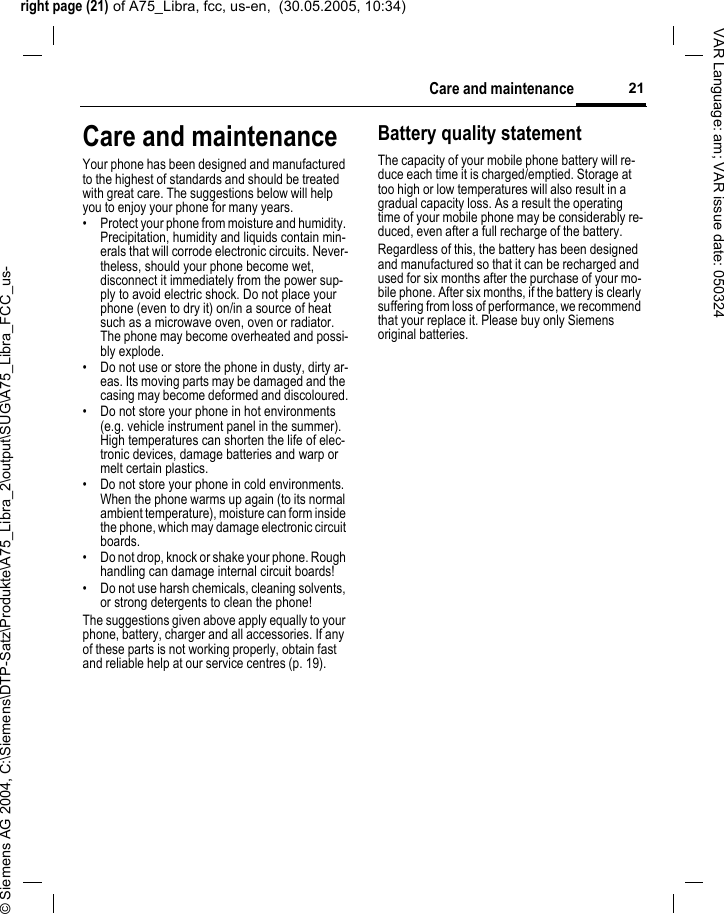
right page (21) of A75_Libra, fcc, us-en,  (30.05.2005, 10:34)© Siemens AG 2004, C:\Siemens\DTP-Satz\Produkte\A75_Libra_2\output\SUG\A75_Libra_FCC_us-21Care and maintenanceVAR Language: am; VAR issue date: 050324Care and maintenanceYour phone has been designed and manufactured to the highest of standards and should be treated with great care. The suggestions below will help you to enjoy your phone for many years.• Protect your phone from moisture and humidity. Precipitation, humidity and liquids contain min-erals that will corrode electronic circuits. Never-theless, should your phone become wet, disconnect it immediately from the power sup-ply to avoid electric shock. Do not place your phone (even to dry it) on/in a source of heat such as a microwave oven, oven or radiator. The phone may become overheated and possi-bly explode.• Do not use or store the phone in dusty, dirty ar-eas. Its moving parts may be damaged and the casing may become deformed and discoloured.• Do not store your phone in hot environments (e.g. vehicle instrument panel in the summer).  High temperatures can shorten the life of elec-tronic devices, damage batteries and warp or melt certain plastics. • Do not store your phone in cold environments. When the phone warms up again (to its normal ambient temperature), moisture can form inside the phone, which may damage electronic circuit boards. • Do not drop, knock or shake your phone. Rough handling can damage internal circuit boards!• Do not use harsh chemicals, cleaning solvents, or strong detergents to clean the phone!The suggestions given above apply equally to your phone, battery, charger and all accessories. If any of these parts is not working properly, obtain fast and reliable help at our service centres (p. 19).Battery quality statementThe capacity of your mobile phone battery will re-duce each time it is charged/emptied. Storage at too high or low temperatures will also result in a gradual capacity loss. As a result the operating time of your mobile phone may be considerably re-duced, even after a full recharge of the battery.Regardless of this, the battery has been designed and manufactured so that it can be recharged and used for six months after the purchase of your mo-bile phone. After six months, if the battery is clearly suffering from loss of performance, we recommend that your replace it. Please buy only Siemens original batteries.
© Siemens AG 2004, C:\Siemens\DTP-Satz\Produkte\A75_Libra_2\output\SUG\A75_Libra_FCC_us-left page (22) of A75_Libra, fcc, us-en,  (30.05.2005, 10:36)SAR (A75)22VAR Language: am; VAR issue date: 050324SAR (A75)RF EXPOSURE/SPECIFIC ABSORPTION RATE (SAR) INFORMATIONTHIS SIEMENS A75 PHONE MEETS THE GOVERNMENT'S REQUIREMENTS FOR EXPOSURE TO ELECTROMAGNETIC FIELDS.Your cell phone is a radio transmitter and receiver. It is designed and manufactured not to exceed the emission limits for ex-posure to radio frequency (RF) energy es-tablished by the Federal Communications Commission (FCC) of the U.S. Govern-ment and by Health Canada. These limits are part of comprehensive guidelines and establish permitted levels of RF energy for the general population. The guidelines were developed and confirmed by inde-pendent scientific organizations through periodic and thorough evaluation of sci-entific studies*. The limits include a sub-stantial safety margin designed to assure the safety of all persons, regardless of age and health.The exposure standard for cell phones employs a unit of measurement known as the Specific Absorption Rate, or SAR. The SAR limit established by the FCC and by Health Canada is 1.6 W/kg**. Tests for SAR are conducted using standard operat-ing positions accepted by the FCC and by Industry Canada with the phone transmit-ting at its highest certified power level in all tested frequency bands. Although the SAR is determined at the highest certified power level, the actual SAR level of the phone while operating can be well below the maximum value. This is because the phone is designed to operate at multiple power levels so as to use only the power required to reach the network. In general, the closer you are to a wireless base sta-tion, the lower the power output. Before a phone model is available for sale to the public, it must be tested and the manufacturer must certify to the FCC and Industry Canada that it does not exceed the limit established by each government for safe exposure. The tests are performed in positions and locations (e.g., at the ear and worn on the body), reported to the FCC and available for review by Industry Canada. The highest SAR value for this Siemens A75 when tested for use at the ear is0.45 W/kg***and when worn on the body+ is0.39 W/kg***Additional information on Specific Ab-sorption Rates (SAR) can be found on the Cellular Telecommunications Internet As-sociation (CTIA) web-site at www.phonefacts.net or the Canadian Wire-less Telecommunications Association (CWTA) website www.cwta.caSAR information on this Siemens A75 phone is on file with the FCC and can be found under the Display Grant section of www.fcc.gov/oet/fccid.While there may be differences between the SAR levels of various phones and at various positions, all Siemens products meet the governmental requirements for safe RF exposure. +  For body worn operation, this mobile phone has been tested and meets FCC RF exposure guidelines when used with a Siemens accesso-ry designated for this product, where available, or when used with a carry accessory that con-tains no metal and that positions the handset at least 1.0 cm/0.39 inch is the correct testing dis-tance from the body. Use of other carry acces-sories may not ensure compliance with FCC RF exposure guidelines.
right page (23) of A75_Libra, fcc, us-en,  (30.05.2005, 10:36)© Siemens AG 2004, C:\Siemens\DTP-Satz\Produkte\A75_Libra_2\output\SUG\A75_Libra_FCC_us-23SAR (A75)VAR Language: am; VAR issue date: 050324* The World Health Organization (WHO, CH-1211 Geneva 27, Switzerland), on the basis of the actual knowledge, does not see any ne-cessity for special precautionary measures when using cell phones.Further information: www.who.int/peh-emfwww.mmfai.orgwww.siemens.com/mobilephones** averaged over 1 g of tissue.*** SAR values may vary depending on national re-quirements and network bands. SAR informa-tion for different regions can be found at www.siemens.com/mobilephones
© Siemens AG 2004, C:\Siemens\DTP-Satz\Produkte\A75_Libra_2\output\SUG\A75_Libra_FCC_us-left page (24) of A75_Libra, fcc, us-en,  (30.05.2005, 10:36)U.S. FDA24VAR Language: am; VAR issue date: 050324U.S. FDAThe U.S. Food and Drug Administration's (FDA) Center for Devices and Radiologi-cal Health Consumer Update on Mobile PhonesFDA has been receiving inquiries about the safety of mobile phones, including cellular phones and PCS phones. The fol-lowing summarizes what is know – and what remains unknown – about whether these products can pose a hazard to health, and what can be done to mini-mize any potential risk. This information may be used to respond to questions.Why the concern?Mobile phones emit low levels of radio frequency energy (i.e., radio frequency radiation) in the microwave range while being used. They also emit very low levels of radio frequency energy (RF), consid-ered non-significant, when in the stand-by mode. It is well known that high levels of RF can produce biological damage through heating effects (this is how your microwave oven is able to cook food). However, it is not known whether, to what extent, or through what mecha-nism, lower levels of RF might cause ad-verse health effects as well. Although some research has been done to address these questions, no clear picture of the bi-ological effects of this type of radiation has emerged to date. Thus, the available science does not allow us to conclude that mobile phones are absolutely safe, or that they are unsafe. However, the avail-able scientific evidence does not demon-strate adverse health effects associated with the use of mobile phones.What kinds of phones are in question?Questions have been raised about hand-held mobile phones, the kind that have a built-in antenna that is positioned close to the user's head during normal tele-phone conversation. These types of mo-bile phones are of concern because of the short distance between the phone's an-tenna – the primary source of the RF – and the person's head. The exposure to RF from mobile phones in which the an-tenna is located at greater distances from the user (on the outside of a car, for ex-ample) is drastically lower than that from hand-held phones, because a person's RF exposure decreases rapidly with distance from the source. The safety of so-called “cordless phones,” which have a base unit connected to the telephone wiring in a house and which operate at far lower power levels and frequencies, has not been questioned.How much evidence is there that hand-held mo-bile phones might be harmful?Briefly, there is not enough evidence to know for sure, either way; however, re-search efforts are on-going. The existing scientific evidence is conflicting and many of the studies that have been done to date have suffered from flaws in their research methods. Animal experiments investigating the effects of RF exposures characteristic of mobile phones have yielded conflicting results. A few animal studies, however, have suggested that low levels of RF could accelerate the de-velopment of cancer in laboratory ani-mals. In one study, mice genetically al-tered to be predisposed to developing one type of cancer developed more than twice as many such cancers when they were exposed to RF energy compared to controls. There is much uncertainty among scientists about whether results obtained from animal studies apply to the use of mobile phones. First, it is uncertain how to apply the results obtained in rats and mice to humans. Second, many of the studies showed increased tumor de-
right page (25) of A75_Libra, fcc, us-en,  (30.05.2005, 10:36)© Siemens AG 2004, C:\Siemens\DTP-Satz\Produkte\A75_Libra_2\output\SUG\A75_Libra_FCC_us-25U.S. FDAVAR Language: am; VAR issue date: 050324velopment used animals that had already been treated with cancer-causing chemi-cals, and other studies exposed the ani-mals to the RF virtually continuously – up to 22 hours per day.For the past five years in the United States, the mobile phone industry has supported research into the safety of mo-bile phones. This research has resulted in two findings in particular that merit addi-tional study:1. In a hospital-based, case-control study, researchers looked for an association be-tween mobile phone use and either glio-ma (a type of brain cancer) or acoustic neuroma (a benign tumor of the nerve sheath). No statistically significant associ-ation was found between mobile phone use and acoustic neuroma. There was also no association between mobile phone use and gliomas when all types of gliomas were considered together. It should be noted that the average length of mobile phone exposure in this study was less than three years.When 20 types of glioma were considered separately, however, an association was found between mobile phone use and one rare type of glioma, neuroepithel-liomatous tumors. It is possible with mul-tiple comparisons of the same sample that this association occurred by chance. Moreover, the risk did not increase with how often the mobile phone was used, or the length of the calls. In fact, the risk ac-tually decreased with cumulative hours of mobile phone use. Most cancer causing agents increase risk with increased expo-sure. An ongoing study of brain cancers by the National Cancer Institute is expect-ed to bear on the accuracy and repeat-ability of these results.12. Researchers conducted a large battery of laboratory tests to assess the effects of exposure to mobile phone RF on genetic material. These included tests for several kinds of abnormalities, including muta-tions, chromosomal aberrations, DNA strand breaks, and structural changes in the genetic material of blood cells called lymphocytes. None of the tests showed any effect of the RF except for the micro-nucleus assay, which detects structural ef-fects on the genetic material. The cells in this assay showed changes after exposure to simulated cell phone radiation, but only after 24 hours of exposure. It is pos-sible that exposing the test cells to radia-tion for this long resulted in heating. Since this assay is known to be sensitive to heating, heat alone could have caused the abnormalities to occur. The data al-ready in the literature on the response of the micronucleus assay to RF are conflict-ing. Thus follow-up research is necessary.2FDA is currently working with govern-ment, industry, and academic groups to ensure the proper follow-up to these in-dustry-funded research findings. Collabo-ration with the Cellular Telecommunica-tions Industry Association (CTIA) in particular is expected to lead to FDA pro-viding research recommendations and sci-entific oversight of new CTIA-funded re-search based on such recommendations.Two other studies of interest have been reported recently in the literature:• Two groups of 18 people were exposed to simulated mobile phone signals un-der laboratory conditions while they performed cognitive function tests. There were no changes in the subjects' ability to recall words, numbers, or pic-tures, or in their spatial memory, but they were able to make choices more quickly in one visual test when they were exposed to simulated mobile phone signals. This was the only change noted among more than 20 variables compared.3• In a study of 209 brain tumor cases and 425 matched controls, there was no in-creased risk of brain tumors associated with mobile phone use. When tumors did exist in certain locations, however,
© Siemens AG 2004, C:\Siemens\DTP-Satz\Produkte\A75_Libra_2\output\SUG\A75_Libra_FCC_us-left page (26) of A75_Libra, fcc, us-en,  (30.05.2005, 10:36)U.S. FDA26VAR Language: am; VAR issue date: 050324they were more likely to be on the side of the head where the mobile phone was used. Because this occurred in only a small number of cases, the increased likelihood was too small to be statisti-cally significant.4In summary, we do not have enough in-formation at this point to assure the pub-lic that there are, or are not, any low inci-dent health problems associated with use of mobile phones. FDA continues to work with all parties, including other federal agencies and industry, to assure that re-search is undertaken to provide the nec-essary answers to the outstanding ques-tions about the safety of mobile phones.What is known about cases of human cancer that have been reported in users of hand-held mobile phones?Some people who have used mobile phones have been diagnosed with brain cancer. But it is important to understand that this type of cancer also occurs among people who have not used mobile phones. In fact, brain cancer occurs in the U.S. population at a rate of about 6 new cases per 100,000 people each year. At that rate, assuming 80 million users of mobile phones (a number increasing at a rate of about 1 million per month), about 4800 cases of brain cancer would be ex-pected each year among those 80 million people, whether or not they used their phones. Thus it is not possible to tell whether any individual's cancer arose be-cause of the phone, or whether it would have happened anyway. A key question is whether the risk of getting a particular form of cancer is greater among people who use mobile phones than among the rest of the population. One way to an-swer that question is to compare the us-age of mobile phones among people with brain cancer with the use of mobile phones among appropriately matched people without brain cancer. This is called a case-control study. The current case-control study of brain cancers by the Na-tional Cancer Institute, as well as the fol-low-up research to be sponsored by in-dustry, will begin to generate this type of information.What is FDA's role concerning the safety of mobile phones?Under the law, FDA does not review the safety of radiation emitting consumer products such as mobile phones before marketing, as it does with new drugs or medical devices. However, the agency has authority to take action if mobile phones are shown to emit radiation at a level that is hazardous to the user. In such a case, FDA could require the manufactur-ers of mobile phones to notify users of the health hazard and to repair, replace or recall the phones so that the hazard no longer exists. Although the existing scientific data do not justify FDA regulatory actions at this time, FDA has urged the mobile phone in-dustry to take a number of steps to assure public safety. The agency has recom-mended that the industry:• Support needed research into possible biological effects of RF of the type emit-ted by mobile phones;• Design mobile phones in a way that minimizes any RF exposure to the user that is not necessary for device func-tion; and• Cooperate in providing mobile phone users with the best possible informa-tion on what is known about possible effects of mobile phone use on human health.• At the same time, FDA belongs to an in-teragency working group of the federal agencies that have responsibility for different aspects of mobile phone safe-ty to ensure a coordinated effort at the federal level. These agencies are:• National Institute for Occupational Safety and Health• Environmental Protection Agency• Federal Communications Commission
right page (27) of A75_Libra, fcc, us-en,  (30.05.2005, 10:36)© Siemens AG 2004, C:\Siemens\DTP-Satz\Produkte\A75_Libra_2\output\SUG\A75_Libra_FCC_us-27U.S. FDAVAR Language: am; VAR issue date: 050324• Occupational Health and Safety Administration• National Telecommunications and In-formation AdministrationThe National Institutes of Health also par-ticipates in this group.In the absence of conclusive information about any possible risk, what can concerned individ-uals do?If there is a risk from these products – and at this point we do not know that there is – it is probably very small. But if people are concerned about avoiding even po-tential risks, there are simple steps they can take to do so. For example, time is a key factor in how much exposure a per-son receives. Those persons who spend long periods of time on their hand-held mobile phones could consider holding lengthy conversations on conventional phones and reserving the hand-held models for shorter conversations or for situations when other types of phones are not available.People who must conduct extended con-versations in their cars every day could switch to a type of mobile phone that plac-es more distance between their bodies and the source of the RF, since the expo-sure level drops off dramatically with dis-tance. For example, they could switch to:• a mobile phone in which the antenna is located outside the vehicle,• a hand-held phone with a built-in an-tenna connected to a different antenna mounted on the outside of the car or built into a separate package, or• a headset with a remote antenna to a mobile phone carried at the waist.Where can I find additional information?For additional information, see the fol-lowing websites:• Federal Communications Commission (FCC) RF Safety Program (select “Infor-mation on Human Exposure to RF Fields from Cellular and PCS Radio Transmitters”): www.fcc.gov/oet/rfsafety• World Health Organization (WHO) In-ternational Commission on Non-Ioniz-ing Radiation Protection (select Qs & As): www.who.int/emf• United Kingdom, National Radiological Protection Board: www.nrpb.org.uk• Cellular Telecommunications Industry Association (CTIA): www.wow-com.com• U.S. Food and Drug Administration (FDA) Center for devices and Radiolog-ical Health: www.fda.gov/cdhr/consumer/1 Muscat et al. Epidemiological Study of Cellular Telephone Use and Malignant Brain Tumors. In: State of the Science Symposium; 1999 June 20; Long Beach, California.2 Tice et al. Tests of mobile phone signals for activ-ity in genotoxicity and other laboratory assays. In: Annual Meeting of the Environmental Mutagen So-ciety; March 29, 1999, Washington, DC; and per-sonal communication, unpublished results.3 Preece, AW, Iwi, G, Davies-Smith, A, Wesnes, K, Butler, S, Lim, E, and Varey, A. Effect of a 915- MHz simulated mobile phone signal on cognitive function in man. Int. J. Radiat. Biol., April 8, 1999.4 Hardell, L, Nasman, A, Pahlson, A, Hallquist, A and Mild, KH. Use of cellular telephones and the risk for brain tumors; a case-control study. Int. J. Oncol, 15: 113-116, 1999.
© Siemens AG 2004, C:\Siemens\DTP-Satz\Produkte\A75_Libra_2\output\SUG\A75_Libra_FCC_us-left page (28) of A75_Libra, fcc, us-en,  (30.05.2005, 10:36)FCC/Industry Canada Notice28VAR Language: am; VAR issue date: 050324FCC/Industry Canada NoticeYour phone may cause TV or radio inter-ference (for example, when using a tele-phone in close proximity to receiving equipment). The FCC or Industry Canada can require you to stop using your tele-phone if such interference cannot be eliminated. If you require assistance, please contact your local service facility.This device complies with part 15 of the FCC rules. Operation is subject to the con-dition that this device does not cause harmful interference.
right page (29) of A75_Libra, fcc, us-en,  (30.05.2005, 10:36)© Siemens AG 2004, C:\Siemens\DTP-Satz\Produkte\A75_Libra_2\output\SUG\A75_Libra_FCC_us-29Ten Driving Safety TipsVAR Language: am; VAR issue date: 050324Ten Driving Safety TipsYour Siemens wireless phone gives you the power to communicate by voice – al-most anywhere, anytime. But an impor-tant responsibility accompanies the bene-fits of wireless phones, one that every user must uphold.When driving a car, driving is your first re-sponsibility. When using your wireless phone behind the wheel of a car, practice good common sense and remember the following tips:Get to know your phone and its features such as speed dial and redial.Carefully read your instruction manual and learn to take advantage of valuable features most phones offer including, au-tomatic redial and memory dial – most phones can store up to 99 numbers in memory dial. Also, work to memorize the phone keypad so you can use the speed dial function without taking your atten-tion off the road.When available, use a hands-free device.A number of hands-free wireless phone accessories are readily available today. Whether you choose an installed mount-ed device for your phone or a speaker phone accessory, take advantage of these devices if they are available to you.Position your phone within easy reach.Make sure you place your wireless phone within easy reach and where you can grab it without removing your eyes from the road. If you get an incoming call at an inconvenient time, let your voicemail an-swer it for you.Suspend conversations during hazardous driv-ing conditions or situations.Let the person you are speaking to know you are driving; if necessary, suspend the call in heavy traffic or hazardous weather conditions. Rain, sleet, snow and ice can be hazardous, but so is heavy traffic. As a driver, your first responsibility is to pay at-tention to the road.Do not take notes or look up phone numbers while driving.If you are reading an address book or business card while driving a car, or writ-ing a “to do” list, then you are not watch-ing where you are going. It’s common sense. Don’t get caught in a dangerous situation because you are reading or writ-ing and not paying attention to the road or nearby vehicles.Dial sensibly and assess the traffic.If possible, place calls when you are not moving or before pulling into traffic. Try to plan your calls before you begin your trip, or attempt to coincide your calls with times you may be stopped at a stop sign, red light or otherwise stationary. But if you need to dial while driving, follow this sim-ple tip – dial only a few numbers, check the road and your mirrors, then continue.Do not engage in stressful or emotional conver-sations that may be distracting.Stressful or emotional conversations and driving do not mix – they are distracting and even dangerous when you are be-hind the wheel. Make people you are talk-ing with aware you are driving and if nec-essary, suspend phone conversations that have the potential to divert your attention from the road.Use your phone to call for help.Your wireless phone is one of the greatest tools you can own to protect yourself and your family in dangerous situations – with your phone at your side, help is only three numbers away. Dial 9-1-1 in the case of fire, traffic accident, road hazard, or medical emergency. Remember, it is a free call on your wireless phone.
© Siemens AG 2004, C:\Siemens\DTP-Satz\Produkte\A75_Libra_2\output\SUG\A75_Libra_FCC_us-left page (30) of A75_Libra, fcc, us-en,  (30.05.2005, 10:36)Ten Driving Safety Tips30VAR Language: am; VAR issue date: 050324Use your phone to help others in emergencies.Your wireless phone provides you a per-fect opportunity to be a “good Samaritan” in your community. If you see an auto ac-cident, crime in progress or other serious emergencies where lives are in danger, call 9-1-1, as you would want others to do for you.Call roadside assistance or a special wireless non-emergency assistance number when nec-essary.Certain situations you encounter while driving may require attention, but are not urgent enough to merit a call to 9-1-1. But you can still use your wireless phone to lend a hand. If you see a broken-down vehicle posing no serious hazard, a bro-ken traffic signal, a minor traffic accident where no one appears injured, or a vehi-cle you know to be stolen, call roadside assistance or other special non-emergen-cy wireless numbers.Provided by the Cellular Telecommunications In-dustry Association (CTIA)“The wireless industry reminds you to use your phone safely when driving.”For more information, please call 1 (888) 901-SAFE, or visit our Web site at: www.wow-com.com
right page (31) of A75_Libra, fcc, us-en,  (30.05.2005, 10:36)© Siemens AG 2004, C:\Siemens\DTP-Satz\Produkte\A75_Libra_2\output\SUG\A75_Libra_FCC_us-31Intellectual propertyVAR Language: am; VAR issue date: 050324Intellectual propertyIntellectual Property RestrictionsAll Intellectual Property, as defined below, which is owned by or otherwise the prop-erty of Siemens Information and Commu-nications Mobile, LLC ("Siemens"), its af-filiates, partners or suppliers, relating to the Phone, including but not limited to accessories, parts or software relating thereto (the “Phone System”), is propri-etary under federal laws, state laws and International treaty provisions. Intellectu-al Property includes, but is not limited to, inventions (patentable or unpatentable), patents, trade secrets, copyrights, soft-ware, computer programs, and related documentation and other works of au-thorship. You may not infringe or other-wise violate the rights secured by the In-tellectual Property. Moreover, you agree that you will not (and will not attempt to) disassemble, decompile, reverse engi-neer, prepare derivative works from, modify or make any other effort to create source code from the software. No title to ownership in the Intellectual Property is transferred to you through purchase or possession of the Phone or its compo-nents. All applicable rights of the Intellec-tual Property shall remain with Siemens, its affiliates, partners or suppliers.Siemens will have no liability with respect to any claim of patent infringement which is based upon the combination of the Product or parts furnished hereunder with software, apparatus or devices not furnished by Siemens, nor will Siemens have any liability for the use of ancillary equipment or software not furnished by Siemens which is attached to or used in connection with the Product, The forego-ing states the entire liability of Siemens with respect to infringement of patents by the Product or any parts thereof.Laws in the United States and other coun-tries preserve for Siemens certain exclu-sive rights for copyrighted Siemens soft-ware, such as the exclusive rights to reproduce and distribute copies of such Siemens software. Siemens software may be used only in the Product in which the software was originally embodied when purchased, and such software in such Product may not be replaced, copied, dis-tributed. modified in any way, or used to produce any derivative thereof. No other use including, without limitation, alter-ation, modification, reproduction, distri-bution. or reverse engineering of such Siemens software or exercise of rights in such Siemens software is permitted. No license is granted by implication, estoppel or otherwise under Siemens patent rights or copyrights.
© Siemens AG 2004, C:\Siemens\DTP-Satz\Produkte\A75_Libra_2\output\SUG\A75_Libra_FCC_us-left page (32) of A75_Libra, fcc, us-en,  (30.05.2005, 10:36)End user license agreement32VAR Language: am; VAR issue date: 050324End user license agreementThis Software License Agreement ("Agreement") is between You and Siemens Information and Communication Mobile, LLC and/or one of its affiliates ("Licensor"). The Agreement authorizes You to use the Software specified in Clause 1 below, which may be included on Your phone, stored on a CD-ROM, sent to You by electronic mail, downloaded from Licensor's Web pages or servers or from other sources under the terms and conditions set forth below. This is an agreement on end user rights and not an agreement for sale. Licensor continues to own the copy of the Software and any other copy that You are authorized to make pursuant to this Agreement. Read this Agreement carefully before installing, downloading or using the Software. Fur-ther, by installing, downloading and/or using the Software, You agree to the terms and conditions of this Agreement.1. Software.As used in this Agreement, the term "Soft-ware" means, collectively: (i) all the software in Your phone, all of the contents of the disk(s), CD-ROM(s), electronic mail and its file attachments, or other media with which this Agreement is provided;(ii) related Licensor or third party software;(iii) digital images, stock photographs, clip art or other artistic works ("Stock Files"); (iv) related explanatory written materials ("Documentation"); (v) fonts; (vi) upgrades, modified versions, up-dates, additions and copies of the Soft-ware, if any, licensed to You by Licensor (collectively "Updates") and(vii) any other possible documentation re-lated thereto.2. End user rights and use.Licensor grants to You a non-exclusive, non-transferable end user right to install the Software or use the Software installed on the phone. The Software is licensed with the phone as a single integrated product and may be used with the phone only as set forth in these licensing terms.3. Limitations on end user rights.(a) You may not copy, distribute, or make derivative works of the Software.(b) You may not use, modify, translate, re-produce or transfer the right to use the Software or copy the Software except as expressly provided in this Agreement.(c) You may not resell, sublicense, rent, lease or lend the Software; except You may permanently transfer all of Your rights as set forth in the Agreement only as part of a permanent sale or transfer of the phone, provided the recipient agrees to the terms of this Agreement.(d) You may not reverse engineer, reverse compile, disassemble or otherwise attempt to discover the source code of the Software (except to the extent that this restriction is expressly prohibited by law) or create deriv-ative works based on the Software.(e) You shall not display, modify, reproduce or distribute any of the Stock Files included with the Software.(f) You shall not display, modify, repro-duce or distribute any of the pre-loaded content included with the software unless permitted as stated in the User Guide or in the prompts in the Software. In the event that You are allowed to display, modify, re-produce or distribute certain parts of the pre-loaded content, You shall review the "Readme" files associated with the pre-loaded content (contained on the CD) to ascertain what rights You have with re-spect to such materials. Pre-loaded con-tent may not be used in the production of libelous, defamatory, fraudulent, infring-
right page (33) of A75_Libra, fcc, us-en,  (30.05.2005, 10:36)© Siemens AG 2004, C:\Siemens\DTP-Satz\Produkte\A75_Libra_2\output\SUG\A75_Libra_FCC_us-33End user license agreementVAR Language: am; VAR issue date: 050324ing, lewd, obscene or pornographic mate-rial or in any otherwise illegal manner. You agree that You shall only use the pre-loaded content in a manner that complies with all applicable laws, including, but not limited to, applicable restrictions concern-ing copyright and other intellectual prop-erty rights. You may not register or claim any rights in the pre-loaded content or de-rivative works there of.(g) You agree that You shall only use the Software in a manner that complies with all applicable laws in the jurisdiction in which You use the Software, including, but not limited to, applicable restrictions concerning copyright and other intellec-tual property rights.4. Copyright.Licensor and/or its software suppliers and their respective affiliates own the Soft-ware and all rights, including without limi-tation including proprietary rights therein, are protected by international treaty provi-sions and other applicable national laws of the country in which it is being used. The structure, organization and code of the Software are the valuable trade se-crets and confidential information.5. Multiple copies/updates.If the Software supports multiple plat-forms or languages, if You receive the Software on multiple media, of if You oth-erwise receive multiple copies of the Soft-ware, the number of phones on which all versions of the Software are installed shall be one phone. If the Software is an Update to a previous version of the Soft-ware, You must possess a valid end user right to such previous version in order to use the Update and You may use the pre-vious version for ninety (90) days after You receive the Update in order to assist You in the transition to the Update. After such time You no longer have a right to use the previous version, except for the sole purpose of enabling You to install the Update.6. Commencement & termination.This Agreement is effective from the first date You use or install the Software. Your end user rights automatically and imme-diately terminate without notice from Li-censor if You fail to comply with any pro-vision of this Agreement. In such event, You must immediately delete, destroy or return at Your own cost and expense, and without entitlement to any refund of the purchase price, the phone and the Soft-ware, and all related material to Licensor.7. Except as expressly provided in the limited warranty for the phone, you acknowledge the Software is provided "as is" without warranty of any kind express or implied. To the maximum extent per-mitted by applicable law neither Licensor, Licensor's Software suppliers or their re-spective affiliates, nor the copyright hold-ers make any representations or warran-ties, express or implied, including but not limited to the warranties of merchantabil-ity or fitness for a particular purpose or that the Software will not infringe any third party patents, copyrights, trade-marks or other rights. There is no warran-ty by Licensor or by any other party that the functions contained in the Software will meet your requirements or that the operation of the Software will be uninter-rupted or error free.8. Not fault tolerant. The Software may contain technoloy that is not fault tolerant and is not designed, manufactured, or intended for use in en-vironments or applications in which the failure of the licensed Software could lead direclty to death, personal injury, or severe physical or environmental damage or financial loss.
© Siemens AG 2004, C:\Siemens\DTP-Satz\Produkte\A75_Libra_2\output\SUG\A75_Libra_FCC_us-left page (34) of A75_Libra, fcc, us-en,  (30.05.2005, 10:36)End user license agreement34VAR Language: am; VAR issue date: 0503249. Limitation of liability.To the maximum extent permitted by ap-plicable law, in no event shall Licensor or Licensor's Software suppliers or their re-specitve affiliates and employees be liable for any lost profits, revenue, sales, data or costs of procurement of substitute goods or services, property damage, personal injury, interruption of business, loss of business information or for any special, direct, indirect, incidental, economic, cov-er, punitive, special or consequential damages, however caused and whether arising under contract, tort, negligence, or other theory of liability arising out of the use of or inability to use the Software, even if Licensor or its Software suppliers are advised of the possibility of such dam-ages. Because some countries/states/ju-risdictions do not allow the exclusion or limitation of liability, but may allow liabili-ty to be limited, in such cases, the liability of Licensor, its Software suppliers and their respective affiliates and employees shall be limited to, at Licensor's option, ei-ther (a) return of the price paid less a rea-sonable amount for usage, or (b) repair or replacment of the Software that does not meet the limited warranty provided with the phone and which is returned in accor-dance with the requirements of the limit-ed warranty.Nothing contained in this Agreement shall prejudice the statutory rights of any party dealing as a consumer. Nothing contained in this Agreement limits Licen-sor's liability to You in the event of death or personal injury resulting from Licen-sor's negligence if law prohibits such a limitation. Licensor is acting on behalf of its software suppliers and their respective employees and affiliates for the purpose of disclaiming, excluding and/or restrict-ing obligations, warranties and liability as provided in this clause 9, but in no other respects and for no other purpose.10. Technical support.Licensor has no obligation to furnish You with technical support except as agreed in writing between You and Licensor in the Limited Warranty provided with the phone.11. Export control.The Software may be subject to export regulations of the United States and other countries. You agree that You shall com-ply with all applicable export laws, restric-tions and regulations of the United States or foreign agencies or authorities, and shall not export, or transfer for the pur-pose of re-export, any Software, product or technical data received under this Agreement or any Software or product produced by use of such technical data, including processes and services, in viola-tion of any applicable restrictions, laws or regulations, or without all necessary approvals.12. Applicable law & general provisions.This Agreement shall be governed by and construed in accordance with the laws of the State of California without regard to its conflicts of laws rules. This is the entire agreement between Licensor and You re-lating to the Software and it supersedes any prior representations, discussions, undertakings, end user agreements, com-munications or advertising relating to the Software.

Navigation menu