BenQ Mobile and OHG AL21 Triband GSM Mobile Phone User Manual Pelikan
BenQ Mobile GmbH & Co. OHG Triband GSM Mobile Phone Pelikan
Exhibit 8 User Manual

Table of Contest 1
right page (1) of AL21 PELICAN FCC us-en (27.02.2006, 13:26)
Template: X75, Version 2.1; VAR Language: am; VAR issue date: 050711
© BenQ Mobile GmbH & Co OHG 2004, \\Itl.eu\cottbus\Projekte_30\BenQ_Mobile\AL21_PELICAN\out-
Legal notices ...................................... 2
Safety precautions ............................. 4
Antenna care ...................................5
Phone operation .............................. 5
Electronic devices ............................ 6
Overview of the phone ...................... 9
Getting started .................................10
Open/close slider ..............................11
Security ............................................11
Codes ............................................11
Calling ..............................................11
Text entry .........................................12
Addressbook ..................................... 13
<New entry> .................................. 13
Change entry .................................13
Voice dialling .................................13
SMS ................................................... 13
MMS .................................................14
Ring tones ........................................14
Surf & fun .........................................15
Internet .........................................15
Games & more ............................... 15
Organizer ......................................... 16
Alarm clock ................................... 16
Calendar ....................................... 16
Appointments ............................... 16
Notes ............................................ 16
Time zones .................................... 16
Calendar setup .............................. 16
Customer Care ................................. 17
Care and maintenance ..................... 18
Product data ..................................... 19
SAR ................................................. 20
U.S. FDA ........................................... 21
FCC/Industry Canada Notice ............ 25
Intellectual property ........................ 26
Ten Driving Safety Tips .................... 27
End user license agreement ............ 29
Index ................................................ 32
Table of
Contest

Legal notices2
© BenQ Mobile GmbH & Co. OHG 2004, \\Itl.eu\cottbus\Projekte_30\BenQ_Mobile\AL21_PELICAN\out-
left page (2) of AL21 PELICAN FCC us-en, (27.02.2006, 13:02)
Template: X75, Version 2.1; VAR Language: am; VAR issue date: 050711
Legal notices
The mobile phone described in this guide is approved for use on the GSM and GPRS net-
works operating on the GSM 900, 1800 (DCS/PCN) and 1900 (PCS) bands. It is approved
for use in the country where it was originally sold and may be approved for use in other
countries.
© 2005 Siemens Communications Inc.
All rights reserved.
Siemens and the AL21 model phone are
trademarks or registered trademarks of
Siemens and/or its affiliates in the United
States and/or other countries.
T9® is a registered trademark of America
Online, Inc. in the United States. Java and
all Java-based trademarks and logos are
trademarks or registered trademarks of
Sun Microsystems, Inc. in the U.S and other
countries. The names of actual companies
and products mentioned herein may be the
trademarks of their respective owners.
Disclaimer
The information contained in the User
Guide is written for the AL21 phone.
Siemens reserves the right to make chang-
es and improvements to the products and
any of the features of the products de-
scribed in this document without prior no-
tice. The contents of the user guide are pro-
vided "AS IS". Except as required by
applicable law, no warranties of any kind,
either express or implied, including, but not
limited to, the implied warranties of mer-
chantability and fitness for a particular pur-
pose, are made in relation to the accuracy,
reliability or contents of this document.
Siemens reserves the right to revise the
user guide or withdraw it at any time with-
out prior notice. Under no circumstances
shall Siemens be responsible for any loss of
data or income or any special, incidental,
consequential or indirect damages howso-
ever caused.
Export Information
The mobile phone may be subject to export
regulation of the United States and other
countries. Diversion contrary to law is pro-
hibited. You must comply with all applica-
ble export laws, restrictions and regulations
of the United States foreign agencies or au-
thorities, and may not export, or transfer
for the purpose of re-export, the mobile
phone or any part of the phone in violation
of any applicable restrictions, laws or regu-
lations, or without all necessary approvals.
Network Services
A number of features included in this
guide are called Network Services. They
are special services provided by wireless
service providers. In order to use any of
these Network Services, you must sub-
scribe to these service(s) from your ser-
vice provider and obtain instructions for
their use. Some of these Network Servic-
es may not be available when roaming on
a network other than your home network.
3Legal notices
right page (3) of AL21 PELICAN FCC us-en (27.02.2006, 13:02)
© BenQ Mobile GmbH & Co OHG 2004, \\Itl.eu\cottbus\Projekte_30\BenQ_Mobile\AL21_PELICAN\out-
Template: X75, Version 2.1; VAR Language: am; VAR issue date: 050711
Standby and
Talk Time Information
The mobile phone incorporates features
that are new to the mobile phone world.
These may include color displays and
lighting, graphic games, music reproduc-
tion and browsing the Internet. The way
you use the display and the features will
affect the performance of the battery and
how long it lasts between charge cycles.
The quoted standby times and talk times
show the minimum and maximum per-
formance that can be expected from the
battery under normal network conditions
and with the default settings as set by the
factory. However, playing games (particu-
larly with the backlight continuously
switched on) and listening to music will
shorten the time available for standby
and to make and receive telephone calls.
Operation times also vary depending on
network conditions, SIM settings, charg-
ing and battery condition, how you use
your phone and other factors.
Memory
The mobile phone contains an internal
memory device that stores the software
required to operate the mobile phone,
communicate with the GSM/GPRS net-
work and provide the user interface.
Some features in the internal memory
run additional devices and some addition-
al games and utilities. The amount of
memory available in the mobile phone is
finite and may be insufficient to store
large numbers of applications and files.
Warning!
Remember to back up your data and to do so fre-
quently. Always back up all data and programs
before sending the mobile phone in for repair.
Safety precautions4
© BenQ Mobile GmbH & Co. OHG 2004, \\Itl.eu\cottbus\Projekte_30\BenQ_Mobile\AL21_PELICAN\out-
left page (4) of AL21 PELICAN FCC us-en, (27.02.2006, 13:02)
Template: X75, Version 2.1; VAR Language: am; VAR issue date: 050711
Safety precautions
Information for parents
Please read the operating instructions and safety precautions carefully before use.
Explain the content and the hazards associated with using the phone to your children.
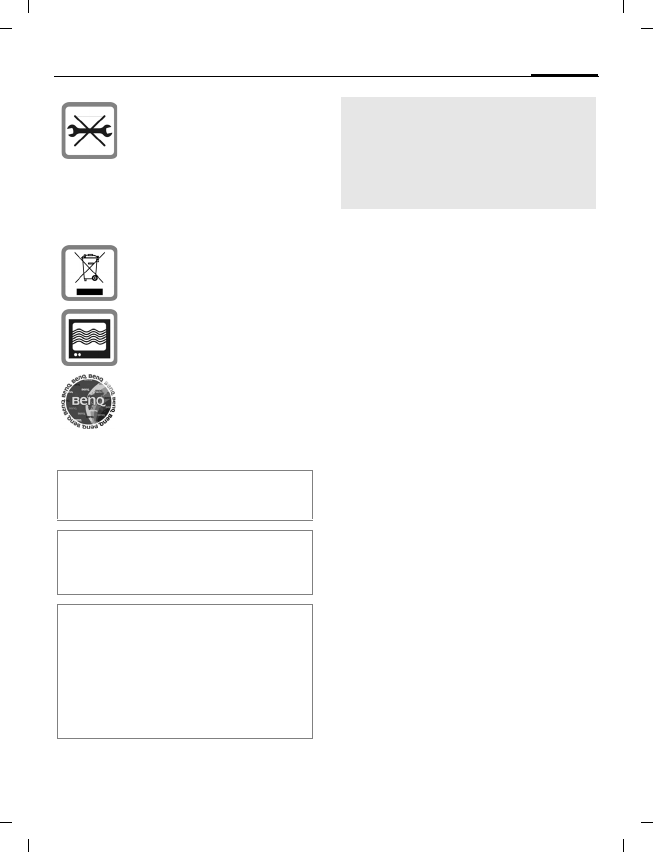
Remember to comply with le-
gal requirements and local re-
strictions when using the
phone. For example in
aeroplanes, petrol stations,
hospitals or while driving.
Cellular phones can interfere
with the functioning of medi-
cal devices such as hearing
aids or pacemakers. Keep at
least 9 inches (20 cm)
between phone and pace-
maker. When using the cell
phone hold it to the ear which
is farthest from the pacemak-
er. For more information con-
sult your doctor.
Tones, music and handsfree
talking are reproduced
through the loudspeaker. Do
not hold the phone to your
ear when it rings or when you
have switched on the hands-
free function. Otherwise you
risk serious permanent dam-
age to your hearing.
Only use original batteries
(100 % mercury-free) and –
charging devices. Otherwise
you risk serious damage to
health and property. The bat-
tery could explode, for in-
stance.
Small parts such as the SIM
card, sealing stop, lens ring
and lens cap can be disman-
tled and swallowed by small
children. The phone must
therefore be stored out of the
reach of small children.
The mains voltage specified
on the power supply unit (V)
must not be exceeded. Other-
wise the charging device may
be destroyed.
The power supply must be
plugged into an easily accessi-
ble AC mains power socket
when charging the battery.
The only way to turn off the
charging device after charg-
ing the battery is to unplug it.
Do not use a handheld while
driving.
Permanent hearing loss may
occur if you use ear- or head-
phones at high volume.You
can adapt over time to a higher
volume, which may sound nor-
mal but can be damaging to
your hearing. Set your volume
to a safe level. If you experi-
ence ringing in your ears, re-
duce the volume or discontinue
use of your system.
Do not place the phone near
to electromagnetic data carri-
ers such as credit cards and
floppy disks. Information
stored on them could be lost.
5Safety precautions
right page (5) of AL21 PELICAN FCC us-en (27.02.2006, 13:02)
© BenQ Mobile GmbH & Co OHG 2004, \\Itl.eu\cottbus\Projekte_30\BenQ_Mobile\AL21_PELICAN\out-
Template: X75, Version 2.1; VAR Language: am; VAR issue date: 050711
Antenna care
Use only the supplied or an approved re-
placement antenna. Unauthorized anten-
nas, modifications, or attachments could
damage the phone and may violate FCC
regulations.
Phone operation
Normal position
Hold the phone as you would any other
telephone with the antenna pointed up
and over your shoulder.
Tips on efficient operation
For your phone to operate most
efficiently:
• Extend your antenna fully
(if applicable).
• Do not touch the antenna unnecessari-
ly when the phone is in use. Contact
with the antenna affects call quality
and may cause the phone to operate at
a higher power level than otherwise
needed.
You may only open the phone
to replace the battery (100 %
mercury-free) or SIM card.
You must not open the bat-
tery under any circumstances.
All other changes to this de-
vice are strictly prohibited and
will invalidate the guarantee.
Important:
Please dispose of unwanted
batteries and phones as per-
mitted by the laws in your
country.
The phone may cause inter-
ference in the vicinity of TV
sets, radios and PCs.
Use only original accessories.
This will avoid potential risks to
health or property and ensure
compliance with all relevant
regulations.
Improper use will invalidate the guaran-
tee! These safety instructions also apply
to original accessories.
Product attributes are subject to chang-
es in technology, design and availability.
BenQ reserves the right to modify prod-
ucts without prior notice.
This cellular phone offers a range of
functions, it can be used in positions
other than the head, such as on the
body. In this case, separation distance of
1.5 cm is required. When a carry case,
belt clip or holder is used for body-worn
operation, it should not contain metal
and should position the device the
above-stated distance from your body.
Important
Read this information before using your
wireless handheld phone.
As this mobile phone is equipped with a
fixed (non-retractable) antenna, some
paragraphs in the text below may not be
applicable.

Safety precautions6
© BenQ Mobile GmbH & Co. OHG 2004, \\Itl.eu\cottbus\Projekte_30\BenQ_Mobile\AL21_PELICAN\out-
left page (6) of AL21 PELICAN FCC us-en, (27.02.2006, 13:02)
Template: X75, Version 2.1; VAR Language: am; VAR issue date: 050711
Driving
Laws pertaining to the use of mobile
phones while driving vary significantly from
state to state and sometimes even from lo-
cality to locality within states. For example,
some areas may allow persons to use their
mobile phones only if they employ a hands-
free device, and some areas may prohibit
the use of cell phones entirely. Accordingly,
BenQ recommends that persons check the
laws for the areas in which they drive or will
be driving. For areas where the use of mo-
bile phones while driving is permitted,
BenQ encourages persons to use their
phones responsibly and to employ hands-
free devices. Also, if using your phone while
driving, please:
• Give full attention to driving – driving
safely is your first responsibility;
• Use hands-free operation, if available;
• Pull off the road and park before mak-
ing or answering a call, if driving condi-
tions so require.
For vehicles equipped with air bags
An air bag inflates with great force. DO NOT
place objects, including either installed or
portable wireless equipment, in the area
over the air bag or in the air bag deploy-
ment area. If in-vehicle wireless equipment
is improperly installed and the air bag in-
flates, serious injury could result.
Electronic devices
Most modern electronic equipment is
shielded from radio frequency (RF) sig-
nals. However, certain electronic equip-
ment may not be shielded against the RF
signals from your wireless phone.
Pacemakers
The Health Industry Manufacturers' Associ-
ation recommends that a minimum separa-
tion of six inches (6") be maintained be-
tween a handheld wireless phone and a
pacemaker to avoid potential interference
with the pacemaker. These recommenda-
tions are consistent with the independent
research by and recommendations of Wire-
less Technology Research.
Persons with pacemakers
• should ALWAYS keep the phone more
than six inches from their pacemaker
when the phone is turned ON;
• should not carry the phone in a breast
pocket;
• should use the ear opposite the pace-
maker to minimize the potential for in-
terference;
• should turn the phone OFF immediate-
ly if there is any reason to suspect that
interference is taking place.
Hearing aids
Some digital wireless phones may
interfere with some hearing aids. In the
event of such interference, you may want
to consult your service provider or your
hearing aid manufacturer to discuss alter-
natives.

7Safety precautions
right page (7) of AL21 PELICAN FCC us-en (27.02.2006, 13:02)
© BenQ Mobile GmbH & Co OHG 2004, \\Itl.eu\cottbus\Projekte_30\BenQ_Mobile\AL21_PELICAN\out-
Template: X75, Version 2.1; VAR Language: am; VAR issue date: 050711
Other medical devices
If you use any other personal medical de-
vices, consult the manufacturers of your
devices to determine if they are ade-
quately shielded from external RF energy.
Your physician may be able to assist you
in obtaining this information.
Turn your phone OFF in health care facili-
ties when any regulations posted in these
areas instruct you to do so. Hospitals or
health care facilities may be using equip-
ment that could be sensitive to external
RF energy.
Vehicles
RF signals may affect improperly installed
or inadequately shielded electronic sys-
tems in motor vehicles. Check with the
manufacturer or its representative regard-
ing your vehicle. You should also consult
the manufacturer of any equipment that
has been added to your vehicle.
Posted facilities
Turn your phone OFF in any facility where
posted notices so require.
Airplanes
FCC and Airline Regulations prohibit using
your phone while in the air. Turn your
phone OFF when requested by the airline.
Check and comply with the policy of your
airline regarding the use of your phone
while the airplane is on the ground.
Blasting areas
To avoid interfering with blasting opera-
tions, turn your phone OFF when in a
“blasting area” or in areas posted: “Turn
off two-way radio.” Obey all signs and in-
structions.
Potentially explosive atmospheres
Turn your phone OFF when in any area
with a potentially explosive atmosphere
and obey all signs and instructions.
Sparks in such areas could cause an ex-
plosion or fire resulting in bodily injury or
even death.
Areas with a potentially explosive atmo-
sphere are often but not always clearly
marked. They include: fueling areas such
as gasoline stations; below deck on boats;
fuel or chemical transfer or storage facili-
ties; vehicles using liquefied petroleum
gas (such as propane or butane); areas
where the air contains chemicals or parti-
cles, such as grain, dust or metal pow-
ders; and any other area where you
would normally be advised to turn off
your vehicle engine.
Emergency calls (SOS)
Your wireless phone can be used to make
emergency calls. You can make an emer-
gency call from the main display screen.
Enter the local emergency number such
as 911 and then press the A key.
This phone, like any wireless phone, oper-
ates using radio signals, wireless and
landline networks, and user-pro-
grammed functions. Because of this, con-
nections in all conditions cannot be guar-
anteed. Therefore, you should never rely
solely on any wireless phone for essential
communications (for example, medical
emergencies). Remember – to make or
receive any calls, the phone must be
switched on and be used in a service area
that has adequate signal strength. Emer-
gency calls might not be possible on all
wireless phone networks or when certain
network services or phone features are in
use. Check with local service providers re-
garding their network features.

Safety precautions8
© BenQ Mobile GmbH & Co. OHG 2004, \\Itl.eu\cottbus\Projekte_30\BenQ_Mobile\AL21_PELICAN\out-
left page (8) of AL21 PELICAN FCC us-en, (27.02.2006, 13:02)
Template: X75, Version 2.1; VAR Language: am; VAR issue date: 050711
Always make certain that your phone is
properly charged before attempting any
emergency calls. If you allow your battery
to discharge, you will be unable to receive
or make calls, including emergency calls.
You must then wait a few minutes after
the charging begins to place any
emergency calls.
When making an emergency call,
remember to give all of the necessary in-
formation as accurately as possible. Re-
member that your wireless phone might
be the only means of communication at
the scene of an accident, therefore you
should not terminate the call until given
permission to do so.
Batteries and Chargers
Only use original batteries (100% mer-
cury-free) and charging devices. Use of
non-original batteries and/or charging
devices may cause explosion resulting in
serious injury and/or property damage.
Use original accessories in order to avoid
possible injury and property damage and
to ensure compliance with applicable
laws and regulations. Improper use invali-
dates the warranty.
Battery safety precautions
To reduce the risk of fire, injury or electric
shock, and to properly dispose of batter-
ies, please read and understand the fol-
lowing instructions. CONTAINS LITHIUM-
ION OR NICKEL-METAL HYDRIDE BATTERY.
BATTERY MUST BE RECYCLED OR DIS-
POSED OF PROPERLY. DO NOT DISPOSE IN
MUNICIPAL WASTE.
1. Only use the batteries specified for use
with this mobile phone.
2. Do not use batteries of different sizes
or from different manufacturers in this
mobile phone.
3. Do not dispose of the battery in a fire; it
may explode. Dispose of used batteries
and phones in accordance with applica-
ble laws and safety regulations. Do not
expose battery to water. Check with
local codes for special disposal
instructions.
4. Do not open or mutilate the battery.
Doing so may cause damage to the
eyes or skin.
5. Exercise care in handling the battery in
order not to short the battery with con-
ducting materials such as rings, brace-
lets, and keys. The battery or conduct-
ing material may overheat and cause
burns or fire.
6. Charge the battery provided with, or
identified for use with, this product
only in accordance with the instruc-
tions and limitations specified in the
User's Guide. Do not attempt to charge
the battery by any means other than
those specified in the User's Guide.
9Overview of the phone
right page (9) of AL21 PELICAN FCC us-en (27.02.2006, 13:02)
© BenQ Mobile GmbH & Co OHG 2004, \\Itl.eu\cottbus\Projekte_30\BenQ_Mobile\AL21_PELICAN\out-
Template: X75, Version 2.1; VAR Language: am; VAR issue date: 050711
Overview of the phone
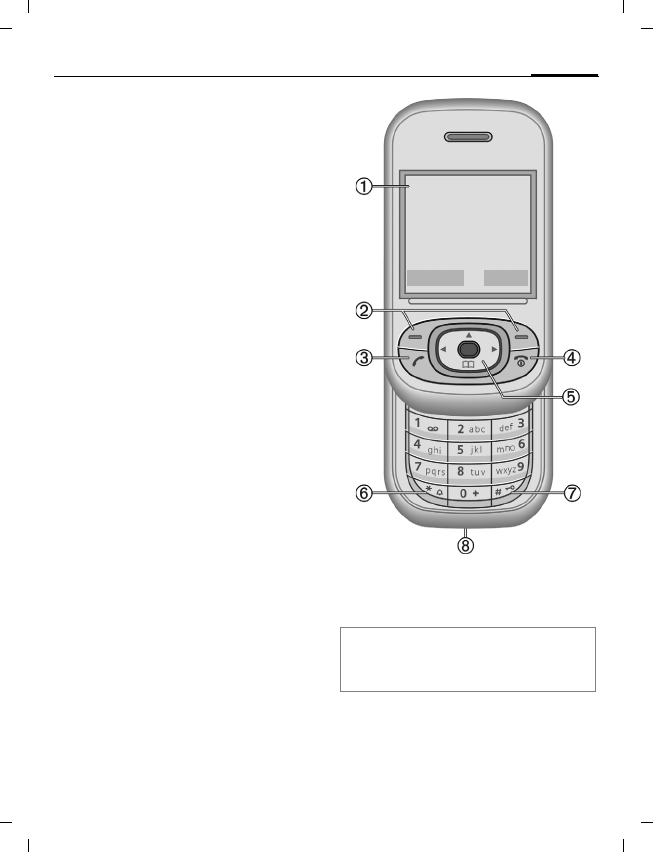
1Display indicators
Signal strength/GPRS/battery level.
2Softkeys
Press the softkey to call up the function
that is displayed as §Text§ or icon on the
grey fields above the key.
3ACall key
Dial displayed phone number or name,
accepts calls. In standby mode: Display
the last calls.
4BOn/Off/End key
• Switching on/off: press and hold.
• During a conversation or in an
application: press briefly to finish.
• In menus: press briefly to go back a
level. Press and hold to return to
standby mode.
• Keylock in standby mode, keypad
closed: press briefly to lock keypad.
Press briefly and confirm with §OK§ to
unlock the keypad.
5Navi-key
In lists and menus:
GScroll up and down.
DFunction call.
CBack a menu level.
During a call:
DOpen call menu.
GAdjust volume.
In standby mode:
EVoice comm. (press and hold), p. 13.
FOpen Addressbook/Phonebook.
DOpen menu.
CGPRS info.
6*Press and hold
• In standby mode: switch on/off all
signal tones (except alarm).
• For incoming calls: only switch off ring
tones.
7Press and hold
In standby mode: switch key lock on/off.
8 Plug socket
For charger, headset.
The phone may only be used if the keypad is fully
closed or fully opened; for optimum audio quality,
however, it is recommended you open the
keypad completely.
_ ª g
Service provider
17.02.2006 09:15
NewMMS Menu
Getting started10
© BenQ Mobile GmbH & Co. OHG 2004, \\Itl.eu\cottbus\Projekte_30\BenQ_Mobile\AL21_PELICAN\out-
left page (10) of AL21 PELICAN FCC us-en, (27.02.2006, 13:48)
Template: X75, Version 2.1; VAR Language: am; VAR issue date: 060214
Getting started
Using the SIM card/battery
Your phone's display is delivered with a
protective film. Remove this film before
getting started. The service provider sup-
plies you with a SIM card on which all the
important data for your account is stored.
If the SIM card is credit card-sized, snap
out the smaller segment and trim any
rough edges.
Always switch off phone before removing
the battery!
Only 3V and 1.8V SIM cards are support-
ed. Please contact your service provider if
you have an older card.
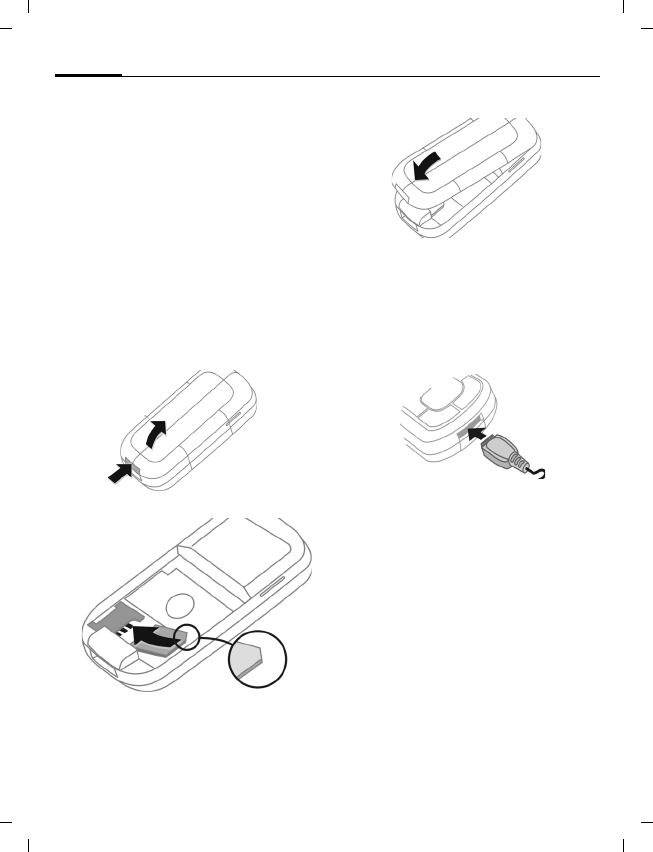
Release and open battery cover
Insert SIM card
Close battery cover
Charge battery
The battery is not fully charged when de-
livered. Plug charger cable into the bot-
tom of the phone, plug power supply unit
into a mains power socket and charge for
at least two hours. The power supply unit
heats up when used for long periods. This
is normal and not dangerous.
When charging is in progress h is
displayed.
Charging time
An empty battery is fully charged after
about 2 hours. Charging is only possible
within a temperature range of +5 °C to
+40 °C (+41°F to +104°F). If the tempera-
ture rises/falls 5°C above/below this, i.e
drops to 32°F or rises to 113°F, the charge
symbol flashes a warning. The mains
voltage specified on the power supply
unit must not be exceeded (Operating
time, p. 19).
Charge level display during operation
(empty - full): adg.
A beep sounds when the battery is nearly
empty. The charge level of the battery is
only displayed correctly after an uninter-
rupted charging/discharging cycle. You
should therefore not remove the battery
1
2
3
4

11Open/close slider
right page (11) of AL21 PELICAN FCC us-en (27.02.2006, 13:48)
© BenQ Mobile GmbH & Co OHG 2004, \\Itl.eu\cottbus\Projekte_30\BenQ_Mobile\AL21_PELICAN\out-
Template: X75, Version 2.1; VAR Language: am; VAR issue date: 060214
unnecessarily and where possible not
terminate the charging process early.
Open/close slider
Opening the slider
• Illumination on.
• Keypad unlocked.
• The call is accepted.
• Alarm sound off (appointment, alarm).
Closing the slider
• Back to standby mode.
• Illumination off.
• Keypad locked (if set).
• The call is ended.
• The call is rejected.
• Alarm sound off (appointment, alarm).
Security
§Menu§ ¢m ¢Security
¢Select function.
The phone and SIM card are protected
against misuse by several security codes.
Keep these confidential numbers in a safe
place where you can access them again if
required.
Codes
PIN control
You can stop the PIN prompt being
activated when the phone is switched on,
but you then risk unauthorised use of the
phone.
Press §Change§. Enter PIN and confirm
with §OK§.
Change PIN
You can change the PIN to any 4- to 8-dig-
it number you find easier to remember.
Change PIN2
(Display only if PIN2 is available).
Proceed as with Change PIN.
Chg.phonecode
You define the phone code (4-8 digits)
when you call up a protected function for
the first time. It is then valid for all phone-
code protected functions.
Clear SIM card barring
If the PIN is entered incorrectly three
times, the SIM card is barred. Enter the
PUK (MASTER PIN), provided by your serv-
ice provider with the SIM card, according
to instructions. If the PUK (MASTER PIN)
has been lost, please contact your service
provider.
Preventing accidental activation
Even if PIN control is deactivated confir-
mation is required to switch on the
phone.
This prevents the phone from being
switched on accidentally, e. g. when car-
ried in a pocket or whilst you are on an
aircraft.
Press and hold the On/Off/End key B
and confirm with §OK§. The phone
switches on.
Calling
Dialling with number keys
The phone must be switched on (standby
mode) and the slider must be fully open.
Dial number (always with area code, if
necessary with international dialling
code). To dial international dialling code
press and hold 0 until a "+" is displayed.
Press §Country§ and select country.
To dial press the Call key A.
Accept call
An incoming call will interrupt any other
use of the phone. Press §Answer§ or Aor
open slider fully.
Please make sure you have accepted the call
before holding the phone to your ear. This will
avoid damage to your hearing from loud ring
tones!

Text entry12
© BenQ Mobile GmbH & Co. OHG 2004, \\Itl.eu\cottbus\Projekte_30\BenQ_Mobile\AL21_PELICAN\out-
left page (12) of AL21 PELICAN FCC us-en, (27.02.2006, 13:48)
Template: X75, Version 2.1; VAR Language: am; VAR issue date: 060214
Handsfree
You can put the phone aside during a call.
You can then hear the caller via the
loudspeaker.
Activate handsfree function with §Handsfr.§
and switch on with §Yes§.
Adjust the volume with G. Pressing
§Handsfr.§ switches off "handsfree talking".
Swapping between 2 calls b
Make a new connection during a call
with §y§Menu§ ¢Hold ¢J(dial
a new phone number). With §y§Menu§
¢Toggle you can swap back and forth
between both calls.
If you are called during a phone call and
you can hear the "call waiting tone", you
can accept the waiting call with §Toggle§,
putting the current call on hold to do so.
Swap back and forth between the calls
see above or end the current call with B
and accept the new call with §Answer§.
Babysitter
If this is active, only one number can be
dialled.
§Menu§ ¢m ¢Security ¢Babysitter
Press D and enter phone code. The
phone code (4- to 8-digits) is set by you
and entered at the first security setting.
Please note this code down (see also p. 11)!
Confirm code input with §OK§. To dial,
press and hold the right softkey.
To switch direct call off, press and hold .
Enter phone code and confirm with §OK§.
Press §Change§ and Confirm Off with §OK§.
Text entry
Text entry without T9
Press number key repeatedly until the re-
quired letter appears. After a brief interval
the cursor will advance. Example:
2Press once briefly to type the let-
ter a, twice to type b, etc. Press
and hold to write the number.
Ä, ä, 1-9 Umlauts and numbers are dis-
played after the relevant letters.
§Clear§ Press briefly to delete the letter
before the cursor, press and hold
to erase the whole word.
H/GMove the cursor
(forwards/back).
Press briefly: Swap between abc,
Abc, T9abc, T9Abc, T9ABC, 123.
Status shown in top line of
display.
Press and hold: All input variants
are displayed.
*Press briefly: Special characters
are shown.
Press and hold: Open input
menu.
0Press once/repeatedly:
. , ? ! ’ " 0 - ( ) @ / : _
Press and hold: Writes 0.
1Writes blank.
Press twice = jumps a line.
Input menu
Press and hold* with text input. The input
menu ist displayed:
Text format (SMS only), Input language, Mark
text, Copy/Add
Text entry with T9
T9 deduces the correct word from the in-
dividual key entries by making compari-
sons with an extensive dictionary. Write a
word and finish it without looking at the
display. Simply press the keys where the

13Address book
right page (13) of AL21 PELICAN FCC us-en (27.02.2006, 13:48)
© BenQ Mobile GmbH & Co OHG 2004, \\Itl.eu\cottbus\Projekte_30\BenQ_Mobile\AL21_PELICAN\out-
Template: X75, Version 2.1; VAR Language: am; VAR issue date: 060214
relevant letter is located once. If several
options are found in the dictionary the
most probably is displayed first. For fur-
ther options please press the right
softkey.
Address book
The Addressbook can store up to
500 entries that are managed in the
phone memory.
<New entry>
If the Addressbook has been selected as
standard:
Open Addressbook (in standby mode)
F ¢D ¢J (enter first and/or
last name) ¢Select entry field
¢Make further entries ¢§Save§.
Group
Entries can be organized by groups.
Select with §Change§.
Picture
Press §Selection§. Assign a picture to an
Addressbook entry.
Birthday
After entering the date of birth, the "re-
minder box" can be activated. You can
now enter the time for the reminder.
All fields
Press §Selection§. Show all input fields if the
display was previously reduced (§Options§,
Field setup).
Change entry
F ¢Select entry ¢§View§ ¢§Edit§
¢Make changes ¢§Save§.
Voice dialing
Dial numbers by voice command.
Record
Open Addressbook (in standby mode).
F ¢Select entry (first letter and/or
scroll) ¢§Options§ ¢Voice dialing
¢(Select phone numbers if there are
more than one ¢§Record§ ¢§Start§.
A short signal sounds. Now speak the
name. After a second beep and message
in the display, repeat the name. A beep
now confirms the recording, which is
saved automatically.
Apply voice dialling
Press and hold E (in standby mode).
Now speak the name. The number is
dialled.
SMS
You can transmit and receive very long
messages (up to 760 characters) on your
phone. They are automatically composed
of several "normal" SMS messages (note
higher charges).
Additionally you can insert pictures and
sounds in an SMS.
§Menu§ ¢] ¢New SMS
T9® Text Input is licensed under one or more of
the following: U.S. Pat. Nos. 5,187,480,
5,818,437, 5,945,928, 5,953,541, 6,011,554,
6,286,064, 6,307,548, 6,307,549, 6,636,162 and
6,646,573; Australian Pat. Nos. 727539,
746674, and 747901; Canadian Pat. Nos.
1,331,057, 2,302,595 and 2,227,904; Japan Pat.
No. 3532780, 3492981; United Kingdom Pat.
No. 2238414B; Hong Kong Standard Pat. No.
HK1010924; Republic of Singapore Pat. No.
51383, 66959, and 71979; European Pat. Nos.
0 842 463 (96927260.8), 1 010 057
(98903671.0), 1 018 069 (98950708.2);
Republic of Korea Pat. Nos. KR201211B1 and
KR226206B1. People’s Republic of China Pat.
Application Nos. 98802801.8, 98809472.X and
96196739.0; Mexico Pat. No. 208141; Russian
Federation Pat. No. 2206118; and additional
patents are pending worldwide.

MMS14
© BenQ Mobile GmbH & Co. OHG 2004, \\Itl.eu\cottbus\Projekte_30\BenQ_Mobile\AL21_PELICAN\out-
left page (14) of AL21 PELICAN FCC us-en, (27.02.2006, 13:48)
Template: X75, Version 2.1; VAR Language: am; VAR issue date: 060214
MMS
The Multimedia Messaging Service ena-
bles you to send texts, pictures (also pho-
tos) and sounds in a combined message
to another mobile phone or to an e-mail
address. All elements of an MMS message
are merged to form a "slide show".
Writing/sending MMS messages
An MMS consists of the address header
and the content.
§Menu§ ¢] ¢New MMS
Input fields:
To: ·/J Phone number /
e-mail address of recipient(s).
Subject: Enter MMS heading (up to
40 characters).
Picture: §Insert§. The picture list is opened
for selection.
Text: §Edit§. Write text with the help
of T9.
Sound: §Insert§. Select a melody or record
a new melody (see below).
Slide duration
Enter length of display
for individual pages (minimum
0.1 seconds).
New recording
The phone records via its microphone.
Press §Insert§ in the Sound: field when com-
pleting the input fields. Select New ring
tone. Press §Record§. The current recording
duration and available time remaining are
displayed. To end recording press §Stop§.
Press §Play§ to replay recording. Press §Save§.
Rename recording: §Options§ ¢G Scroll
to Rename ¢ J ¢Confirm with §OK§§.
Attach extra pages
§Options§ ¢New slide
Attach business card
§Options§ ¢Extras ¢G Scroll to
Business card ¢·.
Attach appointment
§Options§ ¢Extras ¢G Scroll to
Appointments ¢·.
Send MMS
§Options§ ¢Send
Receive/read MMS
An arrival of a new MMS/notification of
an MMS is announced on display with
… / Û. Press the left softkey to read
the MMS or notification.
Depending on the setting, the
• complete MMS is received
• or the notification is opened. Press
§Receiving§ to receive the complete
MMS, with §Play§ automatic presenta-
tion of the MMS. Cancel using any key.
•Open attachments using §Options§ and
Attachments.
• Open images and tones using §Options§
and Content.
Ring tones
§Menu§ ¢ ¢Select function.
You can set the ring tone separately for
call types/functions. You can also set a
tone separately for any number key,
* and #. Function keys can't be custom-
ized or assigned with key tones. Down-
load new ringtones from the internet via
Download new.

15Surf & fun
right page (15) of AL21 PELICAN FCC us-en (27.02.2006, 13:48)
© BenQ Mobile GmbH & Co OHG 2004, \\Itl.eu\cottbus\Projekte_30\BenQ_Mobile\AL21_PELICAN\out-
Template: X75, Version 2.1; VAR Language: am; VAR issue date: 060214
Surf & fun
Internet
§Menu§ ¢É ¢Select function.
Get the latest information from the Inter-
net that is specifically adapted to the
display options of your phone. In addi-
tion, you can download games and appli-
cations to your phone. Internet access
may require registration with the service
provider.
End connection
Press and hold B to close the browser.
After GPRS/CSD lingertime (WAP param)
the connection will also be ended.
Additional information
ÍBrowser menu.
ÉOffline.
ÊOnline.
ËGPRS Online.
ÌNo network.
*Select special characters,
such as @, ~, \.
0Press repeatedly for:
. , ? ! ’ " 0 - ( ) @ / : _
Profiles
§Menu§ ¢É ¢Internet ¢Profiles
Activate profile
You can change the current profile each
time you access the Internet. For this,
select profile, then §Selection§. The current
profile is selected.
Games & more
Applications and games can be found at
wap.siemens.com or on the Internet at
www.siemens.com/al21
Additional information
You can use the browser to download applica-
tions (e.g. ringtones, games, pictures, anima-
tions) from the Internet.
BenQ Mobile excludes all warranty and liability
claims in respect of or in connection with any ap-
plications subsequently installed by the customer
and any software not included in the original de-
livery package. This also applies to functions ena-
bled subsequently at the customer's instigation.
The purchaser bears sole risk for the loss of,
damage to, and any defects arising in, this device
or the applications and for any direct damage or
consequential damage of whatever nature result-
ing from the use of this application. For technical
reasons, such applications and subsequent ena-
bling of certain functions are lost in the event of
the device being replaced/re-supplied and may
be lost if it is repaired. In such cases, the buyer is
required to download or enable the application
again. Please ensure that your phone has Digital
Rights Management (DRM) so that downloaded
applications are protected from unauthorised re-
production. These applications are then exclu-
sively intended for your phone and cannot be
transferred from this even to create a backup.
BenQ Mobile offers no warranty or guarantee nor
does it accept any liability for the customer's abili-
ty to download or enable applications again or to
do so free of charge.
We recommend that you carry out a backup
from time to time of the applications on your
Windows® PC using the BenQ "Mobile Phone
Manager" Software (to download from the
Internet: www.siemens.com/al21)

Organizer16
© BenQ Mobile GmbH & Co. OHG 2004, \\Itl.eu\cottbus\Projekte_30\BenQ_Mobile\AL21_PELICAN\out-
left page (16) of AL21 PELICAN FCC us-en, (27.02.2006, 13:48)
Template: X75, Version 2.1; VAR Language: am; VAR issue date: 060214
Organizer
§Menu§ ¢ç ¢Select function.
Alarm clock
The alarm will ring at the time set by you,
even when the phone is switched off.
Setting
Set the time for the alarm call (hh:mm).
Confirm with §OK§.
Press §On/off§ to activate/deactivate the
alarm.
Calendar
You can enter appointments in the calen-
dar. Time and date must be set for the
calendar to work correctly.
Page between days with H. Press G
briefly to page between weeks, press
and hold G to page between months.
Calendar days in bold face indicate
appointments on this day.
Agenda
Press §Agenda§ to call up from the monthly
overview. Appointments for each individ-
ual day are shown in the agenda in
chronological order.
Appointments
§Menu§ ¢ç ¢Appointments
All appointment entries are displayed in
chronological order.
Enter new appointment
PressD.
Select the Type of your appointment. Add
Description, Date and Time.
Alarm:
Activate alarm with §ON§ ¢J
(enter start time of the alarm before the
appointment) ¢§Change§ (select Minute,
Hours, Days).
Recurrence:
Select a timeframe for repeating the
appointment: No, Daily, Weekly, Monthly,
Annual.
Enter a parameter for repeating: Forever,
Until, Events (number).
If Weekly is selected, certain weekdays can
be highlighted.
Alarm
When the set date and time are reached
there is an audible and a visual alarm.
Alarm types: Memo, Meeting, Call, Birthday
and Anniversary
Press §Pause§. The alarm stops for
5 minutes. Press §Off§ to stop the alarm.
Notes
§Menu§ ¢ç ¢Notes
T9 support (p. 12) makes writing short
notes such as shopping lists easier.
Missed alarms
§Menu§ ¢ç ¢Missed alarms
Events with an alarm to which you have
not reacted are listed for reading.
Time zones
§Menu§ ¢ç ¢Time zones
Set the time zone for your area.
Calend. setup
§Menu§ ¢ç ¢Calend. setup
Start of week
You can set which weekday is listed first
on the left in the monthly and weekly
overviews.

17Customer Care
right page (17) of AL21 PELICAN FCC us-en (27.02.2006, 13:48)
© BenQ Mobile GmbH & Co OHG 2004, \\Itl.eu\cottbus\Projekte_30\BenQ_Mobile\AL21_PELICAN\out-
Template: X75, Version 2.1; VAR Language: am; VAR issue date: 060214
Customer Care
Qualified employees are waiting to offer you expert
information about our products and installation.
In some countries repair and replace services are
impossible where the products are not sold through
our authorised dealers.
If repair work is necessary, please contact one of
our service centres:
Abu Dhabi .........................................0 26 42 38 00
Argentina .....................................0 81 02 22 66 24
Australia..........................................13 00 66 53 66
Austria.............................................05 17 07 50 04
Bahrain .................................................... 40 42 34
Bangladesh.......................................0 17 52 74 47
Belgium.............................................0 78 15 22 21
Bolivia ...............................................0 21 21 41 14
Bosnia Herzegovina..........................0 33 27 66 49
Brunei ..................................................02 43 08 01
Bulgaria................................................02 73 94 88
Cambodia ............................................12 80 05 00
Canada ........................................1 88 87 77 02 11
Chile..................................................8 00 53 06 62
China ..............................................40 08 88 56 56
Colombia....................................01 80 07 00 66 24
Croatia ..............................................0 16 10 53 81
Czech Republic.................................2 33 03 27 27
Denmark ..............................................35 25 65 29
Dubai ................................................0 43 96 64 33
Ecuador ..........................................18 00 10 10 00
Egypt.................................................0 23 33 41 11
Estonia................................................ 56 64 54 00
Finland............................................09 22 94 37 00
France.............................................01 56 38 42 00
Germany ......................................0 18 05 33 32 26
Greece ............................................80 11 11 11 16
Hong Kong.......................................... 28 61 11 18
Hungary ..........................................06 14 71 24 44
Iceland .................................................. 5 20 30 00
India.............................22 24 98 70 00 Extn: 70 40
Indonesia .....................................0 21 46 82 60 81
Ireland.............................................18 50 77 72 77
Italy .................................................02 45 27 90 36
Ivory Coast.......................................... 05 02 02 59
Jordan...............................................0 64 39 86 42
Kenya.................................................... 2 72 37 17
Kuwait ................................................... 2 45 41 78
Latvia .................................................... 7 50 11 18
Lebanon.............................................. 01 44 30 43
Libya ...............................................02 13 50 28 82
Lithuania ...........................................8 70 07 07 00
Luxembourg....................................40 66 61 56 40
Macedonia ........................................0 23 13 18 48
Malaysia....................................+ 6 03 77 12 43 04
Malta.......................................+ 35 32 14 94 06 32
Mauritius ............................................... 2 11 62 13
Mexico .......................................01 80 07 11 00 03
Morocco .............................................. 22 66 92 09
Netherlands .................................0 90 03 33 31 00
New Zealand...................................08 00 27 43 63
Nigeria ..............................................0 14 50 05 00
Norway................................................ 22 57 77 46
Oman ....................................................... 79 10 12
Pakistan ..........................................02 15 66 22 00
Paraguay ..........................................8 00 10 20 04
Peru ..................................................0 80 05 24 00
Philippines ........................................0 27 57 11 18
Poland.............................................08 01 30 00 30
Portugal ............................................8 08 20 15 21
Qatar................................................... 04 32 20 10
Romania .........................................02 12 09 99 66
Russia..........................................8 80 02 00 10 10
We offer fast, individual advice! You have sever-
al options:
Our online support on the Internet:
www.BenQMobile.com/customercare
We can be reached any time, any place. You are
given 24 hour support on all aspects of our prod-
ucts. Here you will find an interactive fault-finding
system, a compilation of the most frequently
asked questions and answers, plus user guides
and current software updates to download.
When calling customer service, please have
ready your receipt and the phone identity
number (IMEI, to display press *#06#), the
software version (to display, press *#06#, then
§Info§) and if available, your Service customer
number.

Care and maintenance18
© BenQ Mobile GmbH & Co. OHG 2004, \\Itl.eu\cottbus\Projekte_30\BenQ_Mobile\AL21_PELICAN\out-
left page (18) of AL21 PELICAN FCC us-en, (27.02.2006, 13:48)
Template: X75, Version 2.1; VAR Language: am; VAR issue date: 060214
Saudi Arabia .....................................0 22 26 00 43
Serbia .............................................01 13 07 00 80
Singapore ............................................62 27 11 18
Slovak Republic ..............................02 59 68 22 66
Slovenia............................................0 14 74 63 36
South Africa ....................................08 60 10 11 57
Spain.................................................9 02 11 50 61
Sweden...........................................08 57 92 90 49
Switzerland .....................................08 48 21 20 00
Taiwan ............................................02 23 96 10 06
Thailand............................................0 27 22 11 18
Tunisia .................................................71 86 19 02
Turkey..........................................0 21 64 59 98 98
Ukraine ........................................8 80 05 01 00 00
United Arab Emirates........................0 43 66 03 86
United Kingdom ...........................0 87 05 33 44 11
Uruguay ..........................................00 04 05 46 62
USA .............................................1 88 87 77 02 11
Venezuela....................................0 80 01 00 56 66
Vietnam...........................................84 89 20 24 64
Zimbabwe ............................................04 36 94 24
Care and maintenance
Your phone has been designed and manufactured
to the highest of standards and should be treated
with great care. The suggestions below will help
you to enjoy your phone for many years.
• Protect your phone from moisture and humidity.
Precipitation, humidity and liquids contain min-
erals that will corrode electronic circuits. Never-
theless, should your phone become wet,
disconnect it immediately from the power sup-
ply to avoid electric shock. Do not place your
phone (even to dry it) on/in a source of heat
such as a microwave oven, oven or radiator.
The phone may become overheated and
possibly explode.
• Do not use or store the phone in dusty, dirty ar-
eas. Its moving parts may be damaged and the
casing may become deformed and discoloured.
• Do not store your phone in hot environments
(e.g. vehicle instrument panel in the summer).
High temperatures can shorten the life of elec-
tronic devices, damage batteries and warp or
melt certain plastics.
• Do not store your phone in cold environments.
When the phone warms up again (to its normal
ambient temperature), moisture can form inside
the phone, which may damage electronic circuit
boards.
• Do not drop, knock or shake your phone. Rough
handling can damage internal circuit boards!
• Do not use harsh chemicals, cleaning solvents,
or strong detergents to clean the phone!
The suggestions given above apply equally to your
phone, battery, charger and all accessories. If any
of these parts is not working properly, obtain fast
and reliable help at our service centres.
Battery quality statement
The capacity of your mobile phone battery will re-
duce each time it is charged/emptied. Storage at
too high or low temperatures will also result in a
gradual capacity loss. As a result the operating
time of your mobile phone may be considerably re-
duced, even after a full recharge of the battery.
Regardless of this, the battery has been designed
and manufactured so that it can be recharged and
used for six months after the purchase of you mo-
bile phone. After six months, if the battery is clearly
suffering from loss of performance, we recommend
that you replace it. Please buy only original batter-
ies.
Display quality declaration
For technological reasons, a few small dots with
different colours may appear in the display in ex-
ceptional cases.
Just remember that the appearance of brighter or
darker dots generally does not mean that a fault
has occurred.
19Product data
right page (19) of AL21 PELICAN FCC us-en (27.02.2006, 13:48)
© BenQ Mobile GmbH & Co OHG 2004, \\Itl.eu\cottbus\Projekte_30\BenQ_Mobile\AL21_PELICAN\out-
Template: X75, Version 2.1; VAR Language: am; VAR issue date: 060214
Product data
Declaration of conformity
BenQ Mobile hereby declares that the phone de-
scribed in this user guide is in compliance with the
essential requirements and other relevant provi-
sions of European Directive 1999/5/EC (R&TTE).
The relevant declaration of conformity (DoC) has
been signed. Please call the company hotline if you
require a copy of the original:
www.BenQMobile.com/conformity
Technical data
Operating time
The operating time depends upon usage. Extreme
temperatures considerably reduce the phone’s
standby time. You should therefore avoid the leav-
ing the phone in the sun or on a radiator.
Talk time: Up to 300 minutes.
Standby time: Up to 220 hours.
GSM class: 4 (2 watt)
Frequency range: 880-960 MHz
GSM class: 1 (1 watt)
Frequency range: 1,710-1,880 MHz
GSM class: 1 (1 watt)
Frequency range: 1,850-1,990 MHz
Weight phone: 77.7 g (2.74 oz)
Size: 86.8 x 45.8 x 19.2 mm
(3.4 x 1.8 x 0.76 inch)
(66.2 ccm)
Li-ion battery: 600 mAh
Operating temperature: -10 °C … +55 °C
(14°F to 131°F)
SIM card: 3.0 V or 1.8 V
Phone ID
You will need the following details if you lose your
phone or SIM card:
the number of the SIM card (on the card):
..............................................................
15-digit serial number of the phone
(under the battery):
..............................................................
the customer service number of the service
provider:
..............................................................
Lost phone
If you lose your phone or SIM card contact your
service provider immediately to prevent misuse.

SAR 20
© BenQ Mobile GmbH & Co. OHG 2004, \\Itl.eu\cottbus\Projekte_30\BenQ_Mobile\AL21_PELICAN\out-
left page (20) of AL21 PELICAN FCC us-en, (27.02.2006, 13:02)
Template: X75, Version 2.1; VAR Language: am; VAR issue date: 050711
SAR
INFORMATION ON RF EXPOSURE / SPECIF-
IC ABSORPTION RATE (SAR)
THIS MODEL MEETS THE GOVERNMENT’S
REQUIREMENTS FOR EXPOSURE TO RADIO
WAVES
Your cellular phone is a radio transmitter
and receiver. It is designed to meet the re-
quirements for exposure to radio waves
established by the Federal Communica-
tions Commission (FCC, USA) and by
Health Canada. These requirements in-
clude safety margins designed to assure
the protection of all persons, regardless of
age and health. They use a unit of mea-
surement known as the Specific Absorp-
tion Rate (SAR). The SAR limit is 1.6 W/kg
averaged over one gram of tissue.
The highest SAR value for this device
when tested at the ear was 0.26 W/kg. In
positions other than the head, such as on
the body, a separation distance of 1.5 cm
is required. The highest SAR value in this
case was 1.22 W/kg.
Information about this device model can
be found at http://www.fcc.gov/oet/fccid
by searching the equipment authorization
system using FCC ID: PWX-AL21.
As SAR is measured utilizing the device’s
highest transmitting power, the actual
SAR of this device while operating is typi-
cally below that indicated above. This is
due to automatic changes to the power
level of the device to ensure it only uses
the minimum level required to reach the
network.
Additional Information can be found on the
websites of the World Health Organization
(http://www.who.int/emf),
the Cellular Telecommunications Industry
Association (CTIA) web-site at
www.phonefacts.net,
the Canadian Wireless Telecommunications
Association (CWTA) website
www.cwta.ca
or BenQ Mobile
(www.BenQMobile.com).

21U.S. FDA
right page (21) of AL21 PELICAN FCC us-en (27.02.2006, 13:02)
© BenQ Mobile GmbH & Co OHG 2004, \\Itl.eu\cottbus\Projekte_30\BenQ_Mobile\AL21_PELICAN\out-
Template: X75, Version 2.1; VAR Language: am; VAR issue date: 050711
U.S. FDA
The U.S. Food and Drug Administration's
(FDA) Center for Devices and Radiologi-
cal Health Consumer Update on Mobile
Phones
FDA has been receiving inquiries about
the safety of mobile phones, including
cellular phones and PCS phones. The fol-
lowing summarizes what is know – and
what remains unknown – about whether
these products can pose a hazard to
health, and what can be done to mini-
mize any potential risk. This information
may be used to respond to questions.
Why the concern?
Mobile phones emit low levels of radio
frequency energy (i.e., radio frequency
radiation) in the microwave range while
being used. They also emit very low levels
of radio frequency energy (RF), consid-
ered non-significant, when in the stand-
by mode. It is well known that high levels
of RF can produce biological damage
through heating effects (this is how your
microwave oven is able to cook food).
However, it is not known whether, to
what extent, or through what mecha-
nism, lower levels of RF might cause ad-
verse health effects as well. Although
some research has been done to address
these questions, no clear picture of the bi-
ological effects of this type of radiation
has emerged to date. Thus, the available
science does not allow us to conclude
that mobile phones are absolutely safe, or
that they are unsafe. However, the avail-
able scientific evidence does not demon-
strate adverse health effects associated
with the use of mobile phones.
What kinds of phones are in question?
Questions have been raised about hand-
held mobile phones, the kind that have a
built-in antenna that is positioned close
to the user's head during normal tele-
phone conversation. These types of mo-
bile phones are of concern because of the
short distance between the phone's an-
tenna – the primary source of the RF –
and the person's head. The exposure to
RF from mobile phones in which the an-
tenna is located at greater distances from
the user (on the outside of a car, for ex-
ample) is drastically lower than that from
hand-held phones, because a person's RF
exposure decreases rapidly with distance
from the source. The safety of so-called
“cordless phones,” which have a base unit
connected to the telephone wiring in a
house and which operate at far lower
power levels and frequencies, has not
been questioned.
How much evidence is there that hand-held mo-
bile phones might be harmful?
Briefly, there is not enough evidence to
know for sure, either way; however, re-
search efforts are on-going. The existing
scientific evidence is conflicting and
many of the studies that have been done
to date have suffered from flaws in their
research methods. Animal experiments
investigating the effects of RF exposures
characteristic of mobile phones have
yielded conflicting results. A few animal
studies, however, have suggested that
low levels of RF could accelerate the de-
velopment of cancer in laboratory ani-
mals. In one study, mice genetically al-
tered to be predisposed to developing
one type of cancer developed more than
twice as many such cancers when they
were exposed to RF energy compared to
controls. There is much uncertainty
among scientists about whether results
obtained from animal studies apply to the
use of mobile phones. First, it is uncertain
how to apply the results obtained in rats
and mice to humans. Second, many of
the studies showed increased tumor de-

U.S. FDA22
© BenQ Mobile GmbH & Co. OHG 2004, \\Itl.eu\cottbus\Projekte_30\BenQ_Mobile\AL21_PELICAN\out-
left page (22) of AL21 PELICAN FCC us-en, (27.02.2006, 13:02)
Template: X75, Version 2.1; VAR Language: am; VAR issue date: 050711
velopment used animals that had already
been treated with cancer-causing chemi-
cals, and other studies exposed the ani-
mals to the RF virtually continuously – up
to 22 hours per day.
For the past five years in the United
States, the mobile phone industry has
supported research into the safety of mo-
bile phones. This research has resulted in
two findings in particular that merit addi-
tional study:
1. In a hospital-based, case-control study,
researchers looked for an association be-
tween mobile phone use and either glio-
ma (a type of brain cancer) or acoustic
neuroma (a benign tumor of the nerve
sheath). No statistically significant associ-
ation was found between mobile phone
use and acoustic neuroma. There was
also no association between mobile
phone use and gliomas when all types of
gliomas were considered together. It
should be noted that the average length
of mobile phone exposure in this study
was less than three years.
When 20 types of glioma were considered
separately, however, an association was
found between mobile phone use and
one rare type of glioma, neuroepithel-
liomatous tumors. It is possible with mul-
tiple comparisons of the same sample
that this association occurred by chance.
Moreover, the risk did not increase with
how often the mobile phone was used, or
the length of the calls. In fact, the risk ac-
tually decreased with cumulative hours of
mobile phone use. Most cancer causing
agents increase risk with increased expo-
sure. An ongoing study of brain cancers
by the National Cancer Institute is expect-
ed to bear on the accuracy and repeat-
ability of these results.1
2. Researchers conducted a large battery
of laboratory tests to assess the effects of
exposure to mobile phone RF on genetic
material. These included tests for several
kinds of abnormalities, including muta-
tions, chromosomal aberrations, DNA
strand breaks, and structural changes in
the genetic material of blood cells called
lymphocytes. None of the tests showed
any effect of the RF except for the micro-
nucleus assay, which detects structural ef-
fects on the genetic material. The cells in
this assay showed changes after exposure
to simulated cell phone radiation, but
only after 24 hours of exposure. It is pos-
sible that exposing the test cells to radia-
tion for this long resulted in heating.
Since this assay is known to be sensitive
to heating, heat alone could have caused
the abnormalities to occur. The data al-
ready in the literature on the response of
the micronucleus assay to RF are conflict-
ing. Thus follow-up research is
necessary.2
FDA is currently working with govern-
ment, industry, and academic groups to
ensure the proper follow-up to these in-
dustry-funded research findings. Collabo-
ration with the Cellular Telecommunica-
tions Industry Association (CTIA) in
particular is expected to lead to FDA pro-
viding research recommendations and sci-
entific oversight of new CTIA-funded re-
search based on such recommendations.
Two other studies of interest have been
reported recently in the literature:
• Two groups of 18 people were exposed
to simulated mobile phone signals un-
der laboratory conditions while they
performed cognitive function tests.
There were no changes in the subjects'
ability to recall words, numbers, or pic-
tures, or in their spatial memory, but
they were able to make choices more
quickly in one visual test when they
were exposed to simulated mobile
phone signals. This was the only
change noted among more than
20 variables compared.3
• In a study of 209 brain tumor cases and
425 matched controls, there was no in-
creased risk of brain tumors associated
with mobile phone use. When tumors
did exist in certain locations, however,

23U.S. FDA
right page (23) of AL21 PELICAN FCC us-en (27.02.2006, 13:02)
© BenQ Mobile GmbH & Co OHG 2004, \\Itl.eu\cottbus\Projekte_30\BenQ_Mobile\AL21_PELICAN\out-
Template: X75, Version 2.1; VAR Language: am; VAR issue date: 050711
they were more likely to be on the side
of the head where the mobile phone
was used. Because this occurred in only
a small number of cases, the increased
likelihood was too small to be statisti-
cally significant.4
In summary, we do not have enough in-
formation at this point to assure the pub-
lic that there are, or are not, any low inci-
dent health problems associated with use
of mobile phones. FDA continues to work
with all parties, including other federal
agencies and industry, to assure that re-
search is undertaken to provide the nec-
essary answers to the outstanding ques-
tions about the safety of mobile phones.
What is known about cases of human cancer
that have been reported in users of hand-held
mobile phones?
Some people who have used mobile
phones have been diagnosed with brain
cancer. But it is important to understand
that this type of cancer also occurs
among people who have not used mobile
phones. In fact, brain cancer occurs in the
U.S. population at a rate of about 6 new
cases per 100,000 people each year. At
that rate, assuming 80 million users of
mobile phones (a number increasing at a
rate of about 1 million per month), about
4800 cases of brain cancer would be ex-
pected each year among those 80 million
people, whether or not they used their
phones. Thus it is not possible to tell
whether any individual's cancer arose be-
cause of the phone, or whether it would
have happened anyway. A key question is
whether the risk of getting a particular
form of cancer is greater among people
who use mobile phones than among the
rest of the population. One way to an-
swer that question is to compare the us-
age of mobile phones among people with
brain cancer with the use of mobile
phones among appropriately matched
people without brain cancer. This is called
a case-control study. The current case-
control study of brain cancers by the Na-
tional Cancer Institute, as well as the fol-
low-up research to be sponsored by in-
dustry, will begin to generate this type of
information.
What is FDA's role concerning the safety of
mobile phones?
Under the law, FDA does not review the
safety of radiation emitting consumer
products such as mobile phones before
marketing, as it does with new drugs or
medical devices. However, the agency
has authority to take action if mobile
phones are shown to emit radiation at a
level that is hazardous to the user. In such
a case, FDA could require the manufactur-
ers of mobile phones to notify users of
the health hazard and to repair, replace or
recall the phones so that the hazard no
longer exists.
Although the existing scientific data do
not justify FDA regulatory actions at this
time, FDA has urged the mobile phone in-
dustry to take a number of steps to assure
public safety. The agency has recom-
mended that the industry:
• Support needed research into possible
biological effects of RF of the type emit-
ted by mobile phones;
• Design mobile phones in a way that
minimizes any RF exposure to the user
that is not necessary for device func-
tion; and
• Cooperate in providing mobile phone
users with the best possible informa-
tion on what is known about possible
effects of mobile phone use on human
health.
• At the same time, FDA belongs to an in-
teragency working group of the federal
agencies that have responsibility for
different aspects of mobile phone safe-
ty to ensure a coordinated effort at the
federal level. These agencies are:
• National Institute for Occupational
Safety and Health
• Environmental Protection Agency
• Federal Communications Commission

U.S. FDA24
© BenQ Mobile GmbH & Co. OHG 2004, \\Itl.eu\cottbus\Projekte_30\BenQ_Mobile\AL21_PELICAN\out-
left page (24) of AL21 PELICAN FCC us-en, (27.02.2006, 13:02)
Template: X75, Version 2.1; VAR Language: am; VAR issue date: 050711
• Occupational Health and Safety
Administration
• National Telecommunications and In-
formation Administration
The National Institutes of Health also par-
ticipates in this group.
In the absence of conclusive information about
any possible risk, what can concerned individ-
uals do?
If there is a risk from these products – and
at this point we do not know that there is
– it is probably very small. But if people
are concerned about avoiding even po-
tential risks, there are simple steps they
can take to do so. For example, time is a
key factor in how much exposure a per-
son receives. Those persons who spend
long periods of time on their hand-held
mobile phones could consider holding
lengthy conversations on conventional
phones and reserving the hand-held
models for shorter conversations or for
situations when other types of phones
are not available.
People who must conduct extended con-
versations in their cars every day could
switch to a type of mobile phone that plac-
es more distance between their bodies
and the source of the RF, since the expo-
sure level drops off dramatically with dis-
tance. For example, they could switch to:
• a mobile phone in which the antenna is
located outside the vehicle,
• a hand-held phone with a built-in an-
tenna connected to a different antenna
mounted on the outside of the car or
built into a separate package, or
• a headset with a remote antenna to a
mobile phone carried at the waist.
Where can I find additional information?
For additional information, see the fol-
lowing websites:
• Federal Communications Commission
(FCC) RF Safety Program (select “Infor-
mation on Human Exposure to RF
Fields from Cellular and PCS Radio
Transmitters”):
www.fcc.gov/oet/rfsafety
• World Health Organization (WHO) In-
ternational Commission on Non-Ioniz-
ing Radiation Protection (select Qs &
As):
www.who.int/emf
• United Kingdom, National Radiological
Protection Board:
www.nrpb.org.uk
• Cellular Telecommunications Industry
Association (CTIA):
www.wow-com.com
• U.S. Food and Drug Administration
(FDA) Center for devices and Radiolog-
ical Health:
www.fda.gov/cdhr/consumer/
1 Muscat et al. Epidemiological Study of Cellular
Telephone Use and Malignant Brain Tumors. In:
State of the Science Symposium; 1999 June 20;
Long Beach, California.
2 Tice et al. Tests of mobile phone signals for activ-
ity in genotoxicity and other laboratory assays. In:
Annual Meeting of the Environmental Mutagen So-
ciety; March 29, 1999, Washington, DC; and per-
sonal communication, unpublished results.
3 Preece, AW, Iwi, G, Davies-Smith, A, Wesnes, K,
Butler, S, Lim, E, and Varey, A. Effect of a 915-
MHz simulated mobile phone signal on cognitive
function in man. Int. J. Radiat. Biol., April 8, 1999.
4 Hardell, L, Nasman, A, Pahlson, A, Hallquist, A
and Mild, KH. Use of cellular telephones and the
risk for brain tumors; a case-control study. Int. J.
Oncol, 15: 113-116, 1999.

25FCC/Industry Canada Notice
right page (25) of AL21 PELICAN FCC us-en (27.02.2006, 13:02)
© BenQ Mobile GmbH & Co OHG 2004, \\Itl.eu\cottbus\Projekte_30\BenQ_Mobile\AL21_PELICAN\out-
Template: X75, Version 2.1; VAR Language: am; VAR issue date: 050711
FCC/Industry Canada Notice
Your phone may cause TV or radio inter-
ference (for example, when using a tele-
phone in close proximity to receiving
equipment). The FCC or Industry Canada
can require you to stop using your tele-
phone if such interference cannot be
eliminated. If you require assistance,
please contact your local service facility.
This device complies with part 15 of the
FCC rules. Operation is subject to the con-
dition that this device does not cause
harmful interference.

Intellectual property26
© BenQ Mobile GmbH & Co. OHG 2004, \\Itl.eu\cottbus\Projekte_30\BenQ_Mobile\AL21_PELICAN\out-
left page (26) of AL21 PELICAN FCC us-en, (27.02.2006, 13:02)
Template: X75, Version 2.1; VAR Language: am; VAR issue date: 050711
Intellectual property
Intellectual Property Restrictions
All Intellectual Property, as defined below,
which is owned by or otherwise the proper-
ty of BenQ Mobile GmbH & Co. OHG ("BenQ
Mobile"), its affiliates, partners or suppliers,
relating to the Phone, including but not lim-
ited to accessories, parts or software relat-
ing thereto (the “Phone System”), is propri-
etary under federal laws, state laws and
International treaty provisions. Intellectual
Property includes, but is not limited to, in-
ventions (patentable or unpatentable), pat-
ents, trade secrets, copyrights, software,
computer programs, and related documen-
tation and other works of authorship. You
may not infringe or otherwise violate the
rights secured by the Intellectual Property.
Moreover, you agree that you will not (and
will not attempt to) disassemble, decom-
pile, reverse engineer, prepare derivative
works from, modify or make any other ef-
fort to create source code from the soft-
ware. No title to ownership in the Intellec-
tual Property is transferred to you through
purchase or possession of the Phone or its
components. All applicable rights of the In-
tellectual Property shall remain with BenQ
Mobile, its affiliates, partners or suppliers.
BenQ Mobile will have no liability with re-
spect to any claim of patent infringement
which is based upon the combination of
the Product or parts furnished hereunder
with software, apparatus or devices not
furnished by BenQ Mobile, nor will BenQ
Mobile have any liability for the use of an-
cillary equipment or software not fur-
nished by BenQ Mobile which is attached
to or used in connection with the Product,
The foregoing states the entire liability of
BenQ Mobile with respect to infringement
of patents by the Product or any parts
thereof.
Laws in the United States and other coun-
tries preserve for BenQ Mobile certain ex-
clusive rights for copyrighted BenQ Mobile
software, such as the exclusive rights to
reproduce and distribute copies of such
BenQ Mobile software. BenQ Mobile soft-
ware may be used only in the Product in
which the software was originally embod-
ied when purchased, and such software in
such Product may not be replaced, copied,
distributed. modified in any way, or used
to produce any derivative thereof. No oth-
er use including, without limitation, alter-
ation, modification, reproduction, distri-
bution. or reverse engineering of such
BenQ Mobile software or exercise of rights
in such BenQ Mobile software is permit-
ted. No license is granted by implication,
estoppel or otherwise under BenQ Mobile
patent rights or copyrights.
27Ten Driving Safety Tips
right page (27) of AL21 PELICAN FCC us-en (27.02.2006, 13:02)
© BenQ Mobile GmbH & Co OHG 2004, \\Itl.eu\cottbus\Projekte_30\BenQ_Mobile\AL21_PELICAN\out-
Template: X75, Version 2.1; VAR Language: am; VAR issue date: 050711
Ten Driving Safety Tips
Your BenQ wireless phone gives you the
power to communicate by voice – almost
anywhere, anytime. But an important re-
sponsibility accompanies the benefits of
wireless phones, one that every user
must uphold.
When driving a car, driving is your first re-
sponsibility. When using your wireless
phone behind the wheel of a car, practice
good common sense and remember the
following tips:
Get to know your phone and its features such
as speed dial and redial.
Carefully read your instruction manual
and learn to take advantage of valuable
features most phones offer including, au-
tomatic redial and memory dial – most
phones can store up to 99 numbers in
memory dial. Also, work to memorize the
phone keypad so you can use the speed
dial function without taking your atten-
tion off the road.
When available, use a hands-free device.
A number of hands-free wireless phone
accessories are readily available today.
Whether you choose an installed mount-
ed device for your phone or a speaker
phone accessory, take advantage of these
devices if they are available to you.
Position your phone within easy reach.
Make sure you place your wireless phone
within easy reach and where you can
grab it without removing your eyes from
the road. If you get an incoming call at an
inconvenient time, let your voicemail an-
swer it for you.
Suspend conversations during hazardous driv-
ing conditions or situations.
Let the person you are speaking to know
you are driving; if necessary, suspend the
call in heavy traffic or hazardous weather
conditions. Rain, sleet, snow and ice can
be hazardous, but so is heavy traffic. As a
driver, your first responsibility is to pay at-
tention to the road.
Do not take notes or look up phone numbers
while driving.
If you are reading an address book or
business card while driving a car, or writ-
ing a “to do” list, then you are not watch-
ing where you are going. It’s common
sense. Don’t get caught in a dangerous
situation because you are reading or writ-
ing and not paying attention to the road
or nearby vehicles.
Dial sensibly and assess the traffic.
If possible, place calls when you are not
moving or before pulling into traffic. Try to
plan your calls before you begin your trip,
or attempt to coincide your calls with
times you may be stopped at a stop sign,
red light or otherwise stationary. But if you
need to dial while driving, follow this sim-
ple tip – dial only a few numbers, check
the road and your mirrors, then continue.
Do not engage in stressful or emotional conver-
sations that may be distracting.
Stressful or emotional conversations and
driving do not mix – they are distracting
and even dangerous when you are be-
hind the wheel. Make people you are talk-
ing with aware you are driving and if nec-
essary, suspend phone conversations that
have the potential to divert your attention
from the road.
Use your phone to call for help.
Your wireless phone is one of the greatest
tools you can own to protect yourself and
your family in dangerous situations –
with your phone at your side, help is only
three numbers away. Dial 9-1-1 in the
case of fire, traffic accident, road hazard,
or medical emergency. Remember, it is a
free call on your wireless phone.

Ten Driving Safety Tips28
© BenQ Mobile GmbH & Co. OHG 2004, \\Itl.eu\cottbus\Projekte_30\BenQ_Mobile\AL21_PELICAN\out-
left page (28) of AL21 PELICAN FCC us-en, (27.02.2006, 13:02)
Template: X75, Version 2.1; VAR Language: am; VAR issue date: 050711
Use your phone to help others in emergencies.
Your wireless phone provides you a per-
fect opportunity to be a “good Samaritan”
in your community. If you see an auto ac-
cident, crime in progress or other serious
emergencies where lives are in danger,
call 9-1-1, as you would want others to do
for you.
Call roadside assistance or a special wireless
non-emergency assistance number when nec-
essary.
Certain situations you encounter while
driving may require attention, but are not
urgent enough to merit a call to 9-1-1.
But you can still use your wireless phone
to lend a hand. If you see a broken-down
vehicle posing no serious hazard, a bro-
ken traffic signal, a minor traffic accident
where no one appears injured, or a vehi-
cle you know to be stolen, call roadside
assistance or other special non-emergen-
cy wireless numbers.
Provided by the Cellular Telecommunications In-
dustry Association (CTIA)
“The wireless industry reminds you to use
your phone safely when driving.”
For more information, please call
1 (888) 901-SAFE, or visit our Web site at:
www.wow-com.com

29End user license agreement
right page (29) of AL21 PELICAN FCC us-en (27.02.2006, 13:02)
© BenQ Mobile GmbH & Co OHG 2004, \\Itl.eu\cottbus\Projekte_30\BenQ_Mobile\AL21_PELICAN\out-
Template: X75, Version 2.1; VAR Language: am; VAR issue date: 050711
End user license agreement
This Software License Agreement
("Agreement") is between You and BenQ
Mobile GmbH & Co. OHG, Germany
and/or one of its affiliates ("Licensor").
The Agreement authorizes You to use the
Software specified in Clause 1 below,
which may be included on Your phone,
stored on a CD-ROM, sent to You by elec-
tronic mail, downloaded from Licensor's
Web pages or servers or from other sourc-
es under the terms and conditions set
forth below. This is an agreement on end
user rights and not an agreement for sale.
Licensor continues to own the copy of the
Software and any other copy that You are
authorized to make pursuant to this
Agreement. Read this Agreement careful-
ly before installing, downloading or using
the Software. Further, by installing,
downloading and/or using the Software,
You agree to the terms and conditions of
this Agreement.
1. Software.
As used in this Agreement, the term "Soft-
ware" means, collectively:
(i) all the software in Your phone, all of
the contents of the disk(s), CD-ROM(s),
electronic mail and its file attachments, or
other media with which this Agreement is
provided;
(ii) related Licensor or third party software;
(iii) digital images, stock photographs, clip
art or other artistic works ("Stock Files");
(iv) related explanatory written materials
("Documentation");
(v) fonts;
(vi) upgrades, modified versions, up-
dates, additions and copies of the Soft-
ware, if any, licensed to You by Licensor
(collectively "Updates") and
(vii) any other possible documentation re-
lated thereto.
2. End user rights and use.
Licensor grants to You a non-exclusive,
non-transferable end user right to install
the Software or use the Software installed
on the phone. The Software is licensed
with the phone as a single integrated
product and may be used with the phone
only as set forth in these licensing terms.
3. Limitations on end user rights.
(a) You may not copy, distribute, or make
derivative works of the Software.
(b) You may not use, modify, translate, re-
produce or transfer the right to use the
Software or copy the Software except as
expressly provided in this Agreement.
(c) You may not resell, sublicense, rent,
lease or lend the Software; except You
may permanently transfer all of Your
rights as set forth in the Agreement only
as part of a permanent sale or transfer of
the phone, provided the recipient agrees
to the terms of this Agreement.
(d) You may not reverse engineer, reverse
compile, disassemble or otherwise attempt
to discover the source code of the Software
(except to the extent that this restriction is
expressly prohibited by law) or create deriv-
ative works based on the Software.
(e) You shall not display, modify,
reproduce or distribute any of the Stock
Files included with the Software.
(f) You shall not display, modify, repro-
duce or distribute any of the pre-loaded
content included with the software unless
permitted as stated in the User Guide or in
the prompts in the Software. In the event
that You are allowed to display, modify, re-
produce or distribute certain parts of the
pre-loaded content, You shall review the
"Readme" files associated with the pre-
loaded content (contained on the CD) to
ascertain what rights You have with re-
spect to such materials. Pre-loaded con-
tent may not be used in the production of
libelous, defamatory, fraudulent, infring-

End user license agreement30
© BenQ Mobile GmbH & Co. OHG 2004, \\Itl.eu\cottbus\Projekte_30\BenQ_Mobile\AL21_PELICAN\out-
left page (30) of AL21 PELICAN FCC us-en, (27.02.2006, 13:02)
Template: X75, Version 2.1; VAR Language: am; VAR issue date: 050711
ing, lewd, obscene or pornographic mate-
rial or in any otherwise illegal manner.
You agree that You shall only use the pre-
loaded content in a manner that complies
with all applicable laws, including, but not
limited to, applicable restrictions concern-
ing copyright and other intellectual prop-
erty rights. You may not register or claim
any rights in the pre-loaded content or de-
rivative works there of.
(g) You agree that You shall only use the
Software in a manner that complies with
all applicable laws in the jurisdiction in
which You use the Software, including,
but not limited to, applicable restrictions
concerning copyright and other intellec-
tual property rights.
4. Copyright.
Licensor and/or its software suppliers and
their respective affiliates own the Soft-
ware and all rights, including without limi-
tation including proprietary rights therein,
are protected by international treaty provi-
sions and other applicable national laws
of the country in which it is being used.
The structure, organization and code of
the Software are the valuable trade se-
crets and confidential information.
5. Multiple copies/updates.
If the Software supports multiple plat-
forms or languages, if You receive the
Software on multiple media, of if You oth-
erwise receive multiple copies of the Soft-
ware, the number of phones on which all
versions of the Software are installed
shall be one phone. If the Software is an
Update to a previous version of the Soft-
ware, You must possess a valid end user
right to such previous version in order to
use the Update and You may use the pre-
vious version for ninety (90) days after
You receive the Update in order to assist
You in the transition to the Update. After
such time You no longer have a right to
use the previous version, except for the
sole purpose of enabling You to install the
Update.
6. Commencement & termination.
This Agreement is effective from the first
date You use or install the Software. Your
end user rights automatically and imme-
diately terminate without notice from Li-
censor if You fail to comply with any pro-
vision of this Agreement. In such event,
You must immediately delete, destroy or
return at Your own cost and expense, and
without entitlement to any refund of the
purchase price, the phone and the Soft-
ware, and all related material to Licensor.
7. Except as expressly provided
in the limited warranty for the phone, you
acknowledge the Software is provided "as
is" without warranty of any kind express
or implied. To the maximum extent per-
mitted by applicable law neither Licensor,
Licensor's Software suppliers or their re-
spective affiliates, nor the copyright hold-
ers make any representations or warran-
ties, express or implied, including but not
limited to the warranties of merchantabil-
ity or fitness for a particular purpose or
that the Software will not infringe any
third party patents, copyrights, trade-
marks or other rights. There is no warran-
ty by Licensor or by any other party that
the functions contained in the Software
will meet your requirements or that the
operation of the Software will be uninter-
rupted or error free.
8. Not fault tolerant.
The Software may contain technoloy that
is not fault tolerant and is not designed,
manufactured, or intended for use in en-
vironments or applications in which the
failure of the licensed Software could
lead direclty to death, personal injury, or
severe physical or environmental damage
or financial loss.

31End user license agreement
right page (31) of AL21 PELICAN FCC us-en (27.02.2006, 13:02)
© BenQ Mobile GmbH & Co OHG 2004, \\Itl.eu\cottbus\Projekte_30\BenQ_Mobile\AL21_PELICAN\out-
Template: X75, Version 2.1; VAR Language: am; VAR issue date: 050711
9. Limitation of liability.
To the maximum extent permitted by ap-
plicable law, in no event shall Licensor or
Licensor's Software suppliers or their re-
specitve affiliates and employees be liable
for any lost profits, revenue, sales, data or
costs of procurement of substitute goods
or services, property damage, personal
injury, interruption of business, loss of
business information or for any special,
direct, indirect, incidental, economic, cov-
er, punitive, special or consequential
damages, however caused and whether
arising under contract, tort, negligence,
or other theory of liability arising out of
the use of or inability to use the Software,
even if Licensor or its Software suppliers
are advised of the possibility of such dam-
ages. Because some countries/states/ju-
risdictions do not allow the exclusion or
limitation of liability, but may allow liabili-
ty to be limited, in such cases, the liability
of Licensor, its Software suppliers and
their respective affiliates and employees
shall be limited to, at Licensor's option, ei-
ther (a) return of the price paid less a rea-
sonable amount for usage, or (b) repair or
replacment of the Software that does not
meet the limited warranty provided with
the phone and which is returned in accor-
dance with the requirements of the limit-
ed warranty.
Nothing contained in this Agreement
shall prejudice the statutory rights of any
party dealing as a consumer. Nothing
contained in this Agreement limits Licen-
sor's liability to You in the event of death
or personal injury resulting from Licen-
sor's negligence if law prohibits such a
limitation. Licensor is acting on behalf of
its software suppliers and their respective
employees and affiliates for the purpose
of disclaiming, excluding and/or restrict-
ing obligations, warranties and liability as
provided in this clause 9, but in no other
respects and for no other purpose.
10. Technical support.
Licensor has no obligation to furnish You
with technical support except as agreed
in writing between You and Licensor in
the Limited Warranty provided with the
phone.
11. Export control.
The Software may be subject to export
regulations of the United States and other
countries. You agree that You shall com-
ply with all applicable export laws, restric-
tions and regulations of the United States
or foreign agencies or authorities, and
shall not export, or transfer for the pur-
pose of re-export, any Software, product
or technical data received under this
Agreement or any Software or product
produced by use of such technical data,
including processes and services, in viola-
tion of any applicable restrictions, laws or
regulations, or without all necessary
approvals.
12. Applicable law & general provisions.
This Agreement shall be governed by and
construed in accordance with the laws of
the State of California without regard to
its conflicts of laws rules. This is the entire
agreement between Licensor and You re-
lating to the Software and it supersedes
any prior representations, discussions,
undertakings, end user agreements, com-
munications or advertising relating to the
Software.

Index32
© BenQ Mobile GmbH & Co. OHG 2004, \\Itl.eu\cottbus\Projekte_30\BenQ_Mobile\AL21_PELICAN\out-
left page (32) of AL21 PELICAN FCC us-en, (27.02.2006, 13:39)
Template: X75, Version 2.1; VAR Language: am; VAR issue date: 050711
Index
A
Addressbook
Dial entry........................................ 13
New entry ...................................... 13
Read entry...................................... 13
Agenda............................................... 16
Alarm
Alarm clock..................................... 16
Appointment .................................. 16
Type............................................... 16
Appointments..................................... 16
Audio ................................................. 14
B
Battery
Charge ........................................... 10
insert.............................................. 10
Operating time ............................... 19
quality declaration.......................... 18
Birthday
Addressbook................................... 13
C
Calendar............................................. 16
Call
Accept/end ..................................... 11
Swap (change) ............................... 12
Calling ................................................ 11
Calling images (Addressbook) .............13
Camera............................................... 17
Charging the battery........................... 10
Codes ................................................. 11
Currency converter ............................. 17
D
Dialling code....................................... 11
Dialling with number keys................... 11
Direct call ........................................... 12
Driving safety .....................................27
E
End user license agreement ................ 29
Extras ................................................. 16
G
Games & More.................................... 15
H
Handsfree talking ............................... 12
Highlighting mode ............................. 11
Hold call............................................. 12
Hotline............................................... 17
L
Legal notices ........................................ 2
Loss of phone, SIM card...................... 19
M
Maintenance of phone ....................... 18
Menu
Speed dialling ................................ 11
Message
MMS .............................................. 14
Missed alarms .................................... 16
MMS
Receive .......................................... 14
Write.............................................. 14
N
Network
Line ............................................... 16
Notes ................................................. 16
O
Operating times (battery) ................... 19
Organiser ........................................... 16
Own files............................................ 17
Own stuff........................................... 17
P
Phone data......................................... 19
Picture (Addressbook)......................... 13
PIN
Change .......................................... 11
Control .......................................... 11
Preventing accidental activation ......... 11
Product data....................................... 19
R
Redial................................................. 11

33Index
right page (33) of AL21 PELICAN FCC us-en (27.02.2006, 13:39)
© BenQ Mobile GmbH & Co OHG 2004, \\Itl.eu\cottbus\Projekte_30\BenQ_Mobile\AL21_PELICAN\out-
Template: X75, Version 2.1; VAR Language: am; VAR issue date: 050711
S
Safety precautions ................................ 4
Security .............................................. 11
Settings
Accessories..................................... 16
Audio ............................................. 14
Short message (SMS) .......................... 13
Signal strength ...................................11
SIM card
Clear barring...................................11
Insert.............................................. 10
SMS
Read............................................... 13
T9 input ......................................... 12
SOS ...................................................... 7
Special characters ............................... 12
Speech time (battery) ......................... 19
Standby time: .....................................19
Surf & fun........................................... 15
Swap .................................................. 12
T
T9
Text entry.......................................12
Technical data ....................................19
Text entry with T9...............................12
Text entry without T9.......................... 12
Text module ....................................... 13
U
Upper and lowercase letters ............... 12
V
Voice dialling...................................... 13