BenQ Mobile and OHG S56 GSM 850/1900 Mobile phone with Bluetooth User Manual S56K Marlin
BenQ Mobile GmbH & Co. OHG GSM 850/1900 Mobile phone with Bluetooth S56K Marlin
Users Manual

Contents 1
This is a short version of the User Guide.
Please find the full version on the CD-ROM.
S56 am, A31008-H5700-A40-1-7619 (6. December 2002, 16:42)
© Siemens AG 2002, D:\Pool\L55\S55\am\Kurzanleitung\S56K_MarlinIVZ.fm
Contents Safety precautions ..................... 3
Safety Information ..................... 4
Antenna care ........................... 4
Phone operation ...................... 4
Electronic devices ..................... 5
SAR (Specific Absorption Rate) .. 8
Overview of the phone ............ 10
Getting started ......................... 12
Insert SIM card/battery ........... 12
Charge battery ....................... 13
Switch on, off / PIN entry ......... 14
Switching on your phone for the
first time ................................ 14
General instructions ................. 16
Security .................................... 17
Calling ...................................... 18
Handsfree .............................. 19
Swap ..................................... 20
Conference ............................ 20
Phonebook or Addressbook ..... 21
Phonebook ............................... 22
Addressbook ............................ 23
Voice dialing .......................... 24
Groups ................................... 25
Records ..................................... 26
Organizer ................................. 27
Calendar ................................ 27
Alarm ..................................... 27
Tasks ..................................... 27
Notes ..................................... 27
Dictating machine ..................28
Time zones .............................28
Message lists and profiles ........29
SMS ...........................................30
MMS ..........................................31
E-mail ........................................32
Voice mail/Cell broadcast .........33
Surf & fun .................................34
Internet browser (WAP) ..........34
Games & more ........................35
Profiles ......................................36
Extras ........................................37
Alarm clock ............................37
Calculator ...............................37
Currency converter .................37
Stopwatch ..............................37
Countdown ...........................38
Camera (Accessories) ..............38
Voice command ......................39
Fast access key .........................40
Filesystem .................................41
Setup ........................................42
Print via.../Send via .... ..............49
Infrared (IrDA) ........................49
Bluetooth™ ............................49
Text entry .................................51
Highlighting mode ...................55
Display symbols (selection) ......56
Customer Care ..........................57
This is a short
version of the
User Guide.
Please find
the full version
on the CD-
ROM.

Contents
2
This is a short version of the User Guide.
Please find the full version on the CD-ROM.
S56 am, A31008-H5700-A40-1-7619 (6. December 2002, 16:42)
© Siemens AG 2002, D:\Pool\L55\S55\am\Kurzanleitung\S56K_MarlinIVZ.fm
Specifications ........................... 59
Exposure to
radiofrequency signals ........... 59
Technical data ....................... 59
Trademarks ............................ 59
Maintenance ............................ 60
U.S. FDA .................................... 61
FCC/Industry Canada Notice ..... 67
Ten Driving Safety Tips ............ 68
Intellectual Property ................ 70
Battery quality statement ........ 71
Index ........................................ 72
Safety precautions 3
S56 am, A31008-H5700-A40-1-7619 (6. December 2002, 16:31)
© Siemens AG 2002, D:\Pool\L55\S55\am\Kurzanleitung\S56K_Security.fm
Safety
precautions
Please note:
Note for parents
Read the operating instructions and safety precautions carefully before use.
Explain to your children the contents and the hazards associated with using the phone.
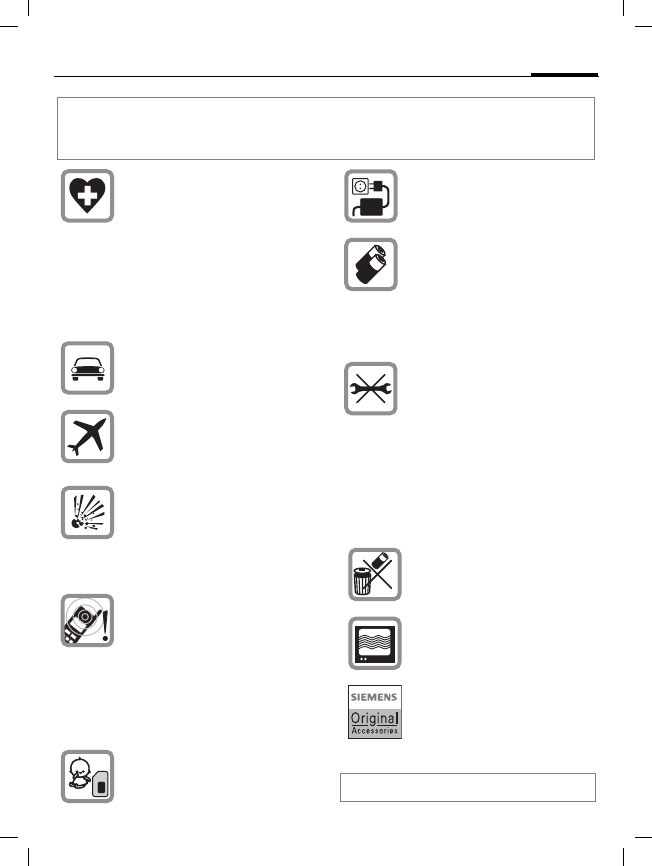
Do not use mobile phone in hos-
pitals or in the vicinity of medical
devices, such as pacemakers or
hearing aids. Mobile phones may
interfere with the operation of
these devices. Keep a minimum
distance of 8" between pacemak-
er and mobile phone. When us-
ing the mobile phone hold it to the
ear farthest from the pacemaker.
Always use the handsfree kit
(p. 48) with an external antenna
for calls while driving!
Mobile phones must be switched
off at all times in an aircraft. To
prevent accidental activation,
see (p. 36).
Switch off near service stations,
fuel depots, chemical plants or
blasting operations. Mobile
phones can interfere with the
operation of technical installa-
tions.
The ringtone (p. 43), info tones
(p. 43) and handsfree talking are
reproduced through the loud-
speaker. Do not hold the phone
to the ear when it rings or when
you have switched on the hands-
free function (p. 19). Otherwise,
there is a risk of serious lasting
damage to hearing.
Caution! The SIM card may be
removed. Caution! Small parts
could be swallowed by children.
The mains voltage (V) specified
on the power supply unit must not
be exceeded.
. Only use original Siemens batter-
ies (100% mercury-free) and
charging devices. Otherwise,
considerable health risks and
damage to the product cannot be
excluded: the battery could ex-
plode, for instance.
It is recommended that you open
the phone only to replace the bat-
tery (100% mercury-free) or SIM
card. Do not open the battery un-
der any circumstances. Any other
changes to this device may inval-
idate the FCC authorization re-
quired for operation of the unit,
and are strictly prohibited.
Safely dispose of used batteries
and phones according to the le-
gal regulations.
Mobile phones can interfere
with the operation of nearby
TVs, radios or PCs.
Only use original Siemens ac-
cessories to avoid possible
damage to health and property
and to comply with the existing
regulations.
Improper use invalidates the warranty!

Safety Information
4
S56 am, A31008-H5700-A40-1-7619 (6. December 2002, 16:31)
© Siemens AG 2002, D:\Pool\L55\S55\am\Kurzanleitung\S56K_Security.fm
Safety Infor-
mation
Antenna care
Use only the supplied or an approved
replacement antenna. Unauthorized
antennas, modifications, or attach-
ments could damage the phone and
may violate FCC regulations.
Phone operation
Normal position
Hold the phone as you would any
other telephone with the antenna
pointed up and over your shoulder.
Tips on efficient operation
For your phone to operate most effi-
ciently:
• Extend your antenna fully (if appli-
cable).
• Do not touch the antenna unnec-
essarily when the phone is in use.
Contact with the antenna affects
call quality and may cause the
phone to operate at a higher pow-
er level than otherwise needed.
Driving
Laws pertaining to the use of mobile
phones while driving vary signifi-
cantly from state-to-state and some-
times even from locality-to-locality
within states. For example, some ar-
eas may allow persons to use their
mobile phones only if they employ a
hands-free device, and some areas
may prohibit the use of mobile
phones entirely. Accordingly, Sie-
mens recommends that persons
check the laws for the areas in which
they drive or will be driving. For are-
as where the use of mobile phones
while driving is permitted, Siemens
encourages persons to use their
phones responsibly and to employ
hands-free devices. Also, if using
your phone while driving, please:
• Give full attention to driving –
driving safely is your first responsi-
bility;
• Use hands-free operation, if avail-
able;
• Pull off the road and park before
making or answering a call, if driv-
ing conditions so require.
Important
Read this information before using
your wireless handheld phone.
As this mobile phone is equipped
with a fixed (non-retractable) an-
tenna, some paragraphs in the be-
low text may not be applicable.

Safety Information 5
S56 am, A31008-H5700-A40-1-7619 (6. December 2002, 16:31)
© Siemens AG 2002, D:\Pool\L55\S55\am\Kurzanleitung\S56K_Security.fm
For vehicles equipped with Air
Bags
An air bag inflates with great force.
DO NOT place objects, including ei-
ther installed or portable wireless
equipment, in the area over the air
bag or in the air bag deployment ar-
ea. If in-vehicle wireless equipment
is improperly installed and the air
bag inflates, serious injury could re-
sult.
Electronic devices
Most modern electronic equipment
is shielded from radiofrequency (RF)
signals. However, certain electronic
equipment may not be shielded
against the RF signals from your
wireless phone.
Pacemakers
The Health Industry Manufacturer’s
Association recommends that a min-
imum separation of six inches (6”) be
maintained between a handheld
wireless phone and a pacemaker to
avoid potential interference with the
pacemaker. These recommenda-
tions are consistent with the inde-
pendent research by and recommen-
dations of Wireless Technology
Research.
Persons with pacemakers:
• should ALWAYS keep the phone
more than six inches from their
pacemaker when the phone is
turned ON;
• should not carry the phone in a
breast pocket;
• should use the ear opposite the
pacemaker to minimize the poten-
tial for interference;
• should turn the phone OFF imme-
diately if there is any reason to
suspect that interference is taking
place.
Hearing Aids
Some digital wireless phones may in-
terfere with some hearing aids. In
the event of such interference, you
may want to consult your service
provider or your hearing aid manu-
facturer to discuss alternatives.
Other Medical Devices
If you use any other personal medi-
cal devices, consult the manufactur-
ers of your devices to determine if
they are adequately shielded from
external RF energy. Your physician
may be able to assist you in obtain-
ing this information.
Turn your phone OFF in health care
facilities when any regulations post-
ed in these areas instruct you to do
so. Hospitals or health care facilities
may be using equipment that could
be sensitive to external RF energy.

Safety Information
6
S56 am, A31008-H5700-A40-1-7619 (6. December 2002, 16:31)
© Siemens AG 2002, D:\Pool\L55\S55\am\Kurzanleitung\S56K_Security.fm
Vehicles
RF signals may affect improperly in-
stalled or inadequately shielded
electronic systems in motor vehicles.
Check with the manufacturer or its
representative regarding your vehi-
cle. You should also consult the
manufacturer of any equipment that
has been added to your vehicle.
Posted Facilities
Turn your phone OFF in any facility
where posted notices so require.
Airplanes
FCC and Airline Regulations prohibit
using your phone while in the air.
Turn your phone OFF before board-
ing an airplane.
Check and comply with the policy of
your airline regarding the use of your
phone while the airplane is on the
ground.
Blasting areas
To avoid interfering with blasting op-
erations, turn your phone OFF when
in a “blasting area” or in areas post-
ed: “Turn off two-way radio.” Obey
all signs and instructions.
Potentially explosive
atmospheres
Turn your phone OFF when in any ar-
ea with a potentially explosive at-
mosphere and obey all signs and in-
structions. Sparks in such areas
could cause an explosion or fire re-
sulting in bodily injury or even
death.
Areas with a potentially explosive at-
mosphere are often but not always
clearly marked. They include: fueling
areas such as gasoline stations; be-
low deck on boats; fuel or chemical
transfer or storage facilities; vehicles
using liquefied petroleum gas (such
as propane or butane); areas where
the air contains chemicals or parti-
cles, such as grain, dust or metal
powders; and any other area where
you would normally be advised to
turn off your vehicle engine.
Emergency calls (SOS)
Your wireless phone can be used to
make emergency calls. You can
make an emergency call from the
main display screen. Enter the local
emergency number such as 911 and
then press the A key
This phone, like any wireless phone,
operates using radio signals, wire-
less and landline networks, and user-
programmed functions. Because of
this, connections in all conditions
cannot be guaranteed. Therefore,
you should never rely solely on any
wireless phone for essential commu-
nications (for example, medical
emergencies). Remember - to make
or receive any calls, the phone must
be switched on and be used in a serv-
ice area that has adequate signal
strength. Emergency calls might not

Safety Information 7
S56 am, A31008-H5700-A40-1-7619 (6. December 2002, 16:31)
© Siemens AG 2002, D:\Pool\L55\S55\am\Kurzanleitung\S56K_Security.fm
be possible on all wireless phone
networks or when certain network
services or phone features are in use.
Check with local service providers re-
garding their network features.
Always make certain that your
phone is properly charged before at-
tempting any emergency calls. If
you allow your battery to discharge,
you will be unable to receive or make
calls, including emergency calls. You
must then wait a few minutes after
the charging begins to place any
emergency calls.
When making an emergency call, re-
member to give all of the necessary
information as accurately as possi-
ble. Remember that your wireless
phone might be the only means of
communication at the scene of an
accident, therefore you should not
terminate the call until given permis-
sion to do so.

SAR (Specific Absorption Rate)
8
S56 am, A31008-H5700-A40-1-7619 (9. December 2002, 15:00)
© Siemens AG 2001, D:\Pool\L55\S55\am\Kurzanleitung\S56K_SAR.fm
SAR
(Specific
Absorption
Rate)
THIS SIEMENS S56 PHONE MEETS
THE GOVERNMENT’S REQUIRE-
MENTS FOR EXPOSURE TO RADIO
WAVES.
Your wireless Siemens S56 phone is
a radio transmitter and receiver. It is
designed and manufactured not to
exceed the emission limits for expo-
sure to radiofrequency (RF) energy
set by the Federal Communications
Commission of the U.S. Govern-
ment. These limits are part of com-
prehensive guidelines and establish
permitted levels of RF energy for the
general population. The guidelines
are based on standards that were de-
veloped by independent scientific
organizations through periodic and
thorough evaluation of scientific
studies. The standards include a sub-
stantial safety margin designed to
assure the safety of all persons, re-
gardless of age and health.
The exposure standard for wireless
mobile phones employs a unit of
measurement known as the Specific
Absorption Rate, or SAR. The SAR
limit set by the FCC is 1.6 W/kg.*
Tests for SAR are conducted using
standard operating positions speci-
fied by the FCC with the phone trans-
mitting at its highest certified power
level in all tested frequency bands.
Although the SAR is determined at
the highest certified power level, the
actual SAR level of the phone while
operating can be well below the
maximum value. This is because the
phone is designed to operate at mul-
tiple power levels so as to use only
the power required to reach the net-
work. In general, the closer you are
to a wireless base station antenna,
the lower the power output.
Before a phone model is available for
sale to the public, it must be tested
and certified to the FCC that it does
not exceed the limit established by
the government-adopted require-
ment for safe exposure. The tests are
performed in positions and locations
(for example, at the ear and worn on
the body) as required by the FCC for
each model. The highest SAR value
for this Siemens S56 phone when
tested for use at the ear is 0.89 W/kg,
and when worn on the body, as de-
scribed in this user guide, is
0.65 W/kg. (Body-worn measure-
ments differ among phone models,
depending upon available accesso-
ries and FCC requirements.) While
there may be differences between
the SAR levels of various phones and
at various positions, they all meet
the government requirement for
safe exposure.
The FCC has granted an Equipment
Authorization for this Siemens S56
phone with all reported SAR levels
evaluated as in compliance with the
FCC RF emission guidelines. SAR in-
formation on this Siemens S56
phone is on file with the FCC and can
be found under the Display Grant
section of
http://www.fcc.gov/oet/fccid
after searching on FCC ID PWX-S56.

SAR (Specific Absorption Rate) 9
S56 am, A31008-H5700-A40-1-7619 (9. December 2002, 15:00)
© Siemens AG 2001, D:\Pool\L55\S55\am\Kurzanleitung\S56K_SAR.fm
For body worn operation, to main-
tain compliance with FCC RF expo-
sure guidelines, use only Siemens
approved accessories. When carry-
ing the phone while it is on, use the
specific Siemens belt clip that has
been tested for compliance.
Use of non-Siemens-approved acces-
sories may violate FCC RF exposure
guidelines and should be avoided.
* In the United States and Canada, the SAR
limit for mobile phones used by the public is
1.6 watts/kg (W/kg) averaged over one gram
of tissue. The standard incorporates a sub-
stantial margin of safety to give additional
protection for the public and to account for
any variations in measurements.
Additional information on Specific Absorp-
tion Rates (SAR) can be found on the Cellu-
lar Telecommunications Internet Association
(CTIA) web-site at:
http://www.wow-com.com
For SAR information in other regions please
look under product information at:
www.my-siemens.com
Overview of the phone
10
S56 am, A31008-H5700-A40-1-7619 (6. December 2002, 10:20)
© Siemens AG 2002, D:\Pool\L55\S55\am\Kurzanleitung\S56K_Overview.fm
Overview of
the phone
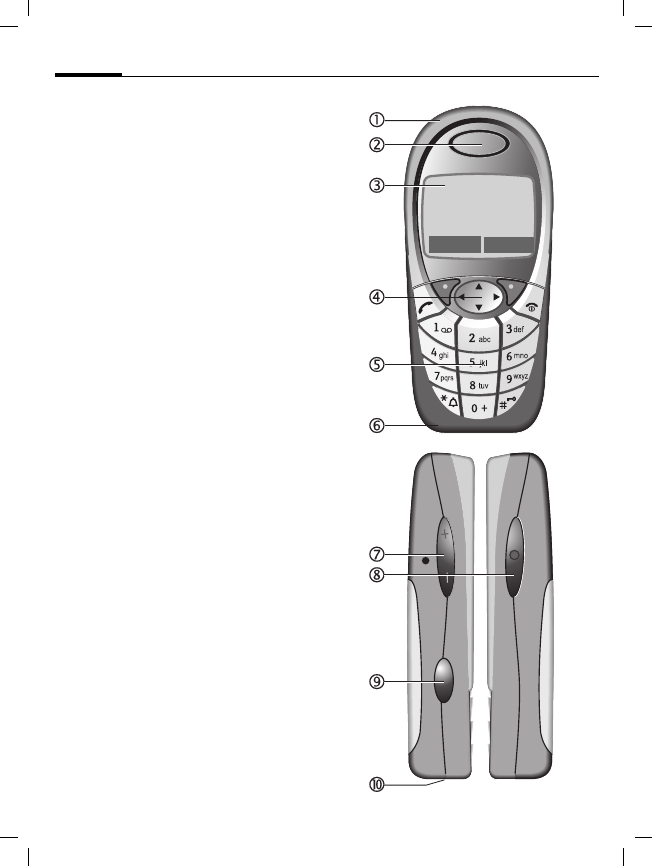
cIntegrated antenna
Do not interfere with the phone above the bat-
tery cover unnecessarily. This reduces the
signal strength.
dLoudspeaker
eDisplay indicators
Signal strength/GPRS available/battery level.
fControl key
See next page
gInput keys
Numbers, letters
hMicrophone
iPlus-Minus key
• During a call:volume loud-quiet.
• In menus, lists and WAP pages: scroll up
and down.
• In standby mode:
Ò Press key briefly: displays current profile.
Ó Hold key down: start voice control.
jDictation key
(in standby mode):
Hold down: record.
Press briefly: play back.
kInfrared interface
(IrDA, e.g. for communication between PC/
PDA and mobile phone).
lDevice interface
Connection for charger, headset etc.
_ªg
Service provider
11/05/2002 12:30
New SMS Menu
Overview of the phone 11
S56 am, A31008-H5700-A40-1-7619 (6. December 2002, 10:20)
© Siemens AG 2002, D:\Pool\L55\S55\am\Kurzanleitung\S56K_Overview.fm
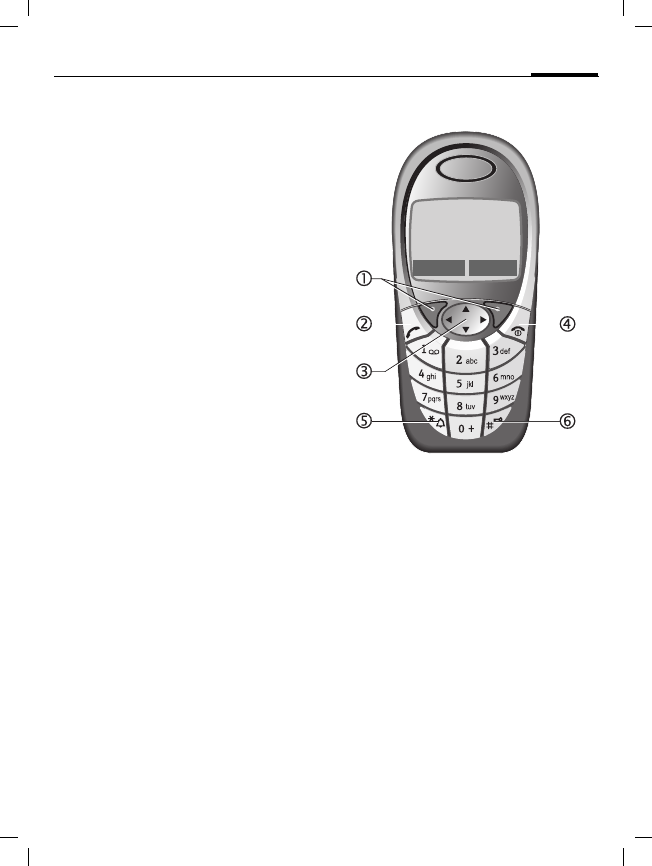
cSoft keys
The current functions of these keys are
displayed in the bottom line of the display
as §text§/icons
dACall key
Dial phone number/name displayed, take
calls. Display last calls in standby mode.
eControl key
In lists and menus:
GScroll up/down.
DSelect function.
CMenu level back.
During a call:
DOpen call menu.
In standby mode:
EVoice command.
FOpen Address/Phonebook.
DOpen menu.
CInfo (e.g. GPRS information).
fBOn/Off/End key
• Switched off: hold down to switch on.
• During a conversation or in an application:
press briefly to finish.
• In menus:press briefly to go back one level.
• In standby mode: hold down to switch off
phone.
g*Hold down
• In standby mode: switch all audible signals
on/off (except alarm).
• For incoming calls: only switch off ringtones.
h#Hold down
In standby mode: switch key lock on/off.
_ªg
Service provider
11/05/2002 12:30
New SMS Menu
Getting started
12
S56 am, A31008-H5700-A40-1-7619 (6. December 2002, 13:46)
© Siemens AG 2002, D:\Pool\L55\S55\am\Kurzanleitung\S56K_Startup.fm
Getting
started Insert SIM card/battery
The service provider supplies you
with a SIM card on which all the
important data for your line is
stored. If the SIM card has been
delivered in credit-card size, snap
the smaller segment out and
remove any rough edges.
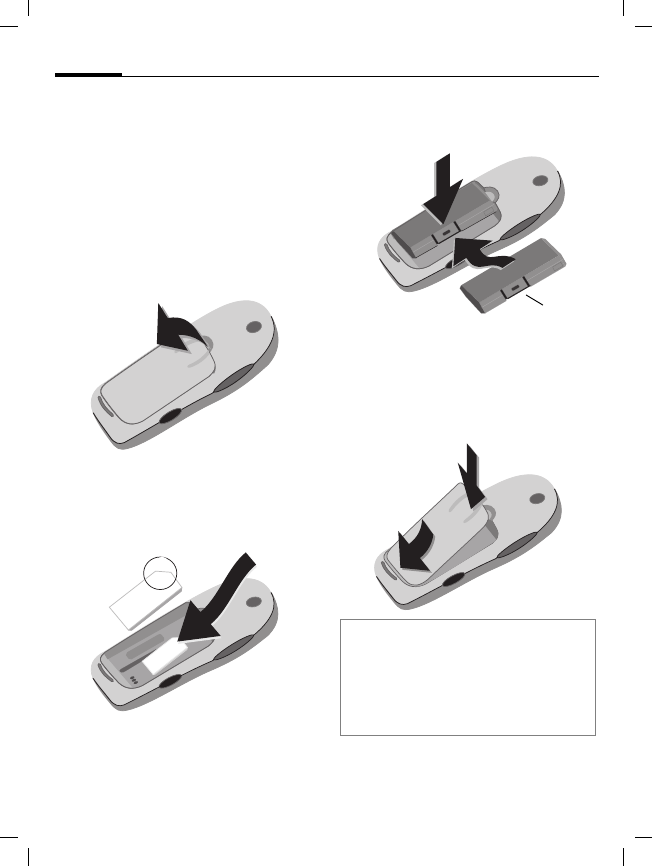
• Remove the cover upwards, in
the direction of the arrow n.
• Insert SIM card in the opening
with contacts pointing downwards
and push gently until it engages
(make sure the angled corner is
in the correct position o).
• Insert battery into the phone side-
ways p, then press downwards
q, until it engages.
• To remove, push down the re-
taining flap r, and then lift out
battery.
• Insert cover in the lower edge s,
then press downwards t, until it
engages.
n
o
Note
Always switch off phone before removing
the battery!
Only 3V SIM cards are supported. Please
contact your service provider if you have
an older card.
q
p
r
s
t
Getting started 13
S56 am, A31008-H5700-A40-1-7619 (6. December 2002, 13:46)
© Siemens AG 2002, D:\Pool\L55\S55\am\Kurzanleitung\S56K_Startup.fm
Charge battery
The battery is not fully charged
when delivered. Plug in the charger
cable at the bottom of the phone,
plug in the power supply unit to the
power socket and charge for at least
two hours.
Display when charging is in progress
hDuring charging.
Charging time
An empty battery is fully charged
after about 2 hours. Charging is only
possible in an ambient temperature
of 41 °F to 104 °F (the charge icon
flashes as a warning when the tem-
perature is 41 °F above/below this
range). The voltage specified on the
power supply unit must not be ex-
ceeded.
To obtain maximum performance
from the battery, it must be fully
charged and then emptied at least
five times.
Charge icon not visible
If the battery is totally discharged,
no charge icon is displayed when
the charger is plugged in. It will
appear after two hours at most. In
this case the battery is fully charged
after 3-4 hours.
Only use the charger provided!
Display while in service
Charge level display during
operation (empty-full):
adg
A beep sounds when the battery
is nearly empty. The battery level is
only shown correctly during an un-
broken charging/discharging cycle.
You should therefore not remove the
battery unnecessarily and where possi-
ble not finish the loading process early.
Performance
A full battery will deliver between
60 to 300 hours of standby time or
100 to 360 minutes of talktime.
Note
The charger heats up when used for long
periods. This is normal and not dangerous.
Note
Your phone's display is delivered with a protective film.
Remove this film before getting started.
In rare cases the static discharge may cause discoloration at the edges of the display.
However, this will disappear within 10 minutes.
Switch on, off / PIN entry
14
S56 am, A31008-H5700-A40-1-7619 (6. December 2002, 13:46)
© Siemens AG 2002, D:\Pool\L55\S55\am\Kurzanleitung\S56K_Startup.fm
Switch on, off
/
PIN entry Activate/deactivate
BHold down On/Off/End key
to switch on or off.
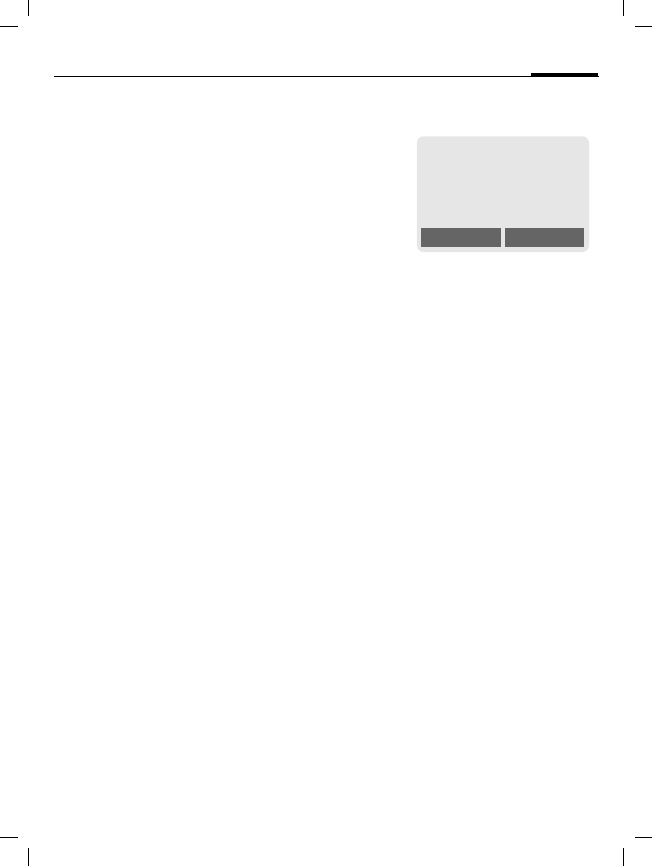
Enter PIN
The SIM card can be protected with
a4-8 digit PIN.
JEnter the PIN using the
number keys. Input is
shown as a series of
asterisks; if you make
a mistake, correct
with §Clear§.
§OK§ Confirm entry with right
soft key. Logging on to
the network will take a
few seconds.
Switching on your phone
for the first time
Contrast, time/date
GSet display contrast.
Set time/date (page 45).
Phonebook or Addressbook
You can choose whether you want
to use the Phonebook on the SIM
card or the internal Addressbook
as standard.
You can copy the SIM card Phone-
book to the Addressbook on the
phone. Please do not interrupt this
procedure. During this time, do not
accept incoming calls. Follow instruc-
tions in the display.
To copy data on the SIM card at a
later time, highlight entries
(page 55) and copy these with the
function Copy into R (Phonebook op-
tions menu ).
Please enter
your PIN:
* * * *
Clear OK
Note
Change PIN..................................page 17
Change standard index. ...............page 21
Other network...............................page 47
Clear SIM card barring .................page 17
Switch on, off / PIN entry 15
S56 am, A31008-H5700-A40-1-7619 (6. December 2002, 13:46)
© Siemens AG 2002, D:\Pool\L55\S55\am\Kurzanleitung\S56K_Startup.fm
Signal strength
<Strong signal.
>A weak signal reduces the
call quality and may lead
to loss of the connection.
Change your location.
Emergency number (SOS)
Only to be used in real emergencies!
By pressing the soft key, §SOS§ you
can make an emergency call on any
network without a SIM card and with-
out entering a PIN (not available in
all countries).
Standby mode
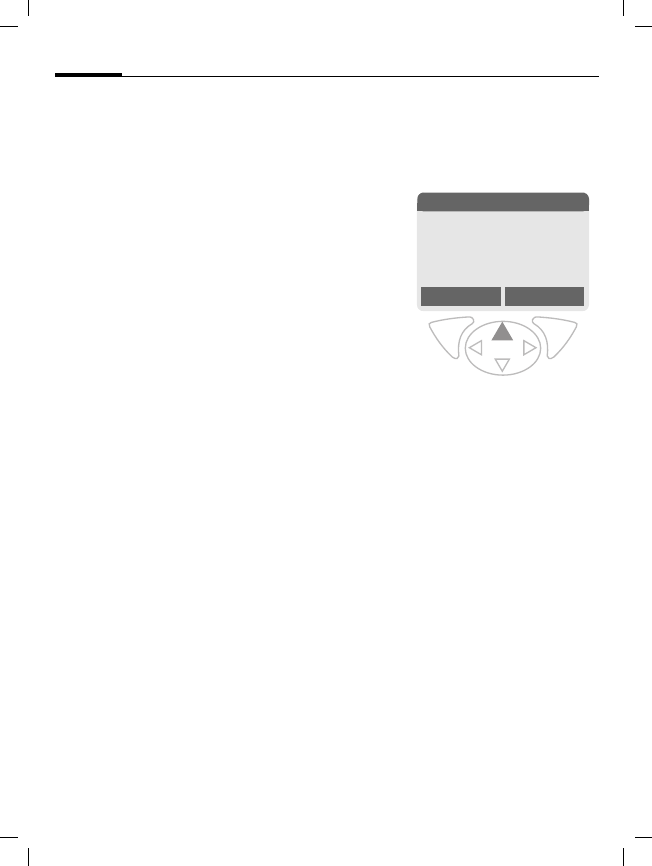
When the name of the service pro-
vider appears on the display, the
phone is in standby mode and ready
for use.
The left soft key may have different
functions pre-assigned.
BPress the On/Off/End key
repeatedly to return to
standby mode from any
situation.
_g
Service provider
11/05/2002 12:30
My menu Menu
General instructions
16
S56 am, A31008-H5700-A40-1-7619 (6. December 2002, 13:46)
© Siemens AG 2002, D:\Pool\L55\S55\am\Kurzanleitung\S56K_Startup.fm
General
instructions User guide
The following symbols are used to
explain operation:
Menu controls
In the user guide the operational
steps are presented in a shortened
form, e.g. to display call list for
missed calls:
§Menu§KRecordsKCalls missed
This corresponds to:
§Menu§ Open menu.
From standby mode: press
right soft key.
ERecords Z Select.
§Select§ Press right soft key to open
the Records submenu.
§Select§ Press the right soft key to
open the Calls missed list.
FScroll to the required
entry.
§View§ Press left soft key to dis-
play phone number with
date/time.
JEnter numbers or letters.
BOn/Off/End key.
ACall key.
DPress the control key on the
side indicated.
< > Soft keys
§Menu Displays a soft-key function.
LFunction dependent on ser-
vice provider, may require
special registration.
SMS
My menu Select
Z É
]~
[Ñm

Security 17
S56 am, A31008-H5700-A40-1-7619 (6. December 2002, 13:46)
© Siemens AG 2002, D:\Pool\L55\S55\am\Kurzanleitung\S56K_Startup.fm
Security The phone and SIM card are protect-
ed against misuse by several security
codes.
§Menu§KSetupKSecurity
Kthen select function.
Security codes
PIN control
The PIN is usually requested each
time the phone is switched on. You
can deactivate this feature, but you
risk unauthorized use of the phone.
Some service providers do not per-
mit deactivation of the control.
§Select§ Press.
JEnter PIN.
§OK§ Confirm input.
§Change§ Press.
§OK§ Confirm.
Change PIN
You can change the PIN to any 4-8
digit number you find easier to re-
member.
JEnter current PIN.
§OK§ Press.
J, §OK§ Enter new PIN.
J, §OK§ Repeat new PIN.
Change PIN2
(display only if PIN 2 is available).
Proceed as with Change PIN.
Chg.phonecode
You define and enter the phone
codes (4-8 digits) when calling up
a phone-code protected function
for the first time. It is then valid for
all phone-code protected functions.
After three incorrect entries the
phone is locked. If this happens,
please contact Siemens Service
(page 57).
Clear SIM-card barring
If the PIN is entered incorrectly three
times, the SIM card is barred. Enter
the PUK (MASTER PIN), provided by
your service provider with the SIM
card, according to instructions. If the
PUK (MASTER PIN) has been lost,
please contact your service provider.
Prevent accidental activation
Even if PIN entry is deactivated,
confirmation is required to switch
on phone. This prevents the phone
from being switched on accidentally,
e.g.
BHold down.
§OK Press. The phone
switches on.
Keep these confidential numbers in a
safe place where you can access them
again if required.

Calling
18
S56 am, A31008-H5700-A40-1-7619 (6. December 2002, 13:47)
© Siemens AG 2002, D:\Pool\L55\S55\am\Kurzanleitung\S56K_Phone.fm
Calling Dialing with number keys
The phone must be switched on
(standby mode).
JDial number (always with
prefix, if necessary with
international dialing
code).
§Clear§ A short press clears
the last digit, a long press
clears the entire number.
APress the Call key to dial
the number.
End call
BPress End key briefly.
The call is ended. Press this key even
if the person on the other end of the
line has hung up first.
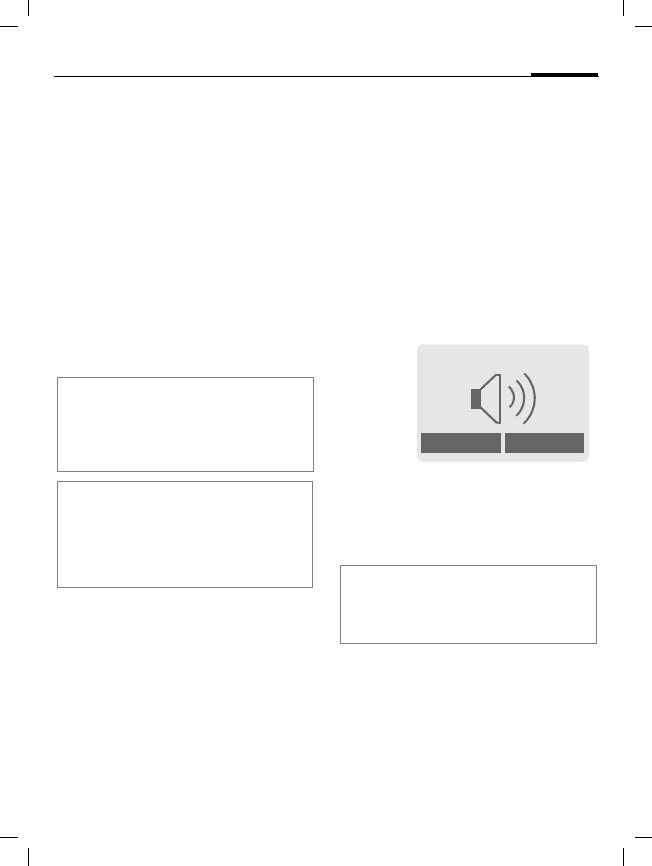
Set volume
Ò ÓUse the left side key to
change volume (only
possible during a call).
If a Car Kit is used, its volume setting
will not affect the usual setting on
the phone.
Redial previous numbers
To redial numbers that were dialed
previously:
APress the Call key once.
GPick out the required
phone number from the
list, then press ...
A... to dial.
When the connection is
busy
Automatic redial of last number
§Auto dial§ The number is auto-
matically dialed for
up to 15 minutes at
increasing intervals.
Or
Call back
§Call back§ your phone rings
when the busy number
is free.
Reminder
§Prompt§ A beep reminds you to re-
dial the displayed phone
number after 15 minutes.
International dialing code
In standby mode, to insert international di-
aling codes from the list:
0Hold down until a "+" is dis-
played. This replaces the first
two digits of the international
dialing code.
§+List§ Press, select country.
L
Calling 19
S56 am, A31008-H5700-A40-1-7619 (6. December 2002, 13:47)
© Siemens AG 2002, D:\Pool\L55\S55\am\Kurzanleitung\S56K_Phone.fm
Accept call
The phone must be switched on
(standby mode). An incoming call
will interrupt any other use of the
phone.
§Reply§ or A
If the phone number has been trans-
mitted by the network, it is dis-
played. If the caller's name appears
in the Phonebook or AddressBook,
this will appear instead of the num-
ber. If set, a picture can be displayed
instead of the bell icon.
Reject call
§Reject§ or press Bbriefly.
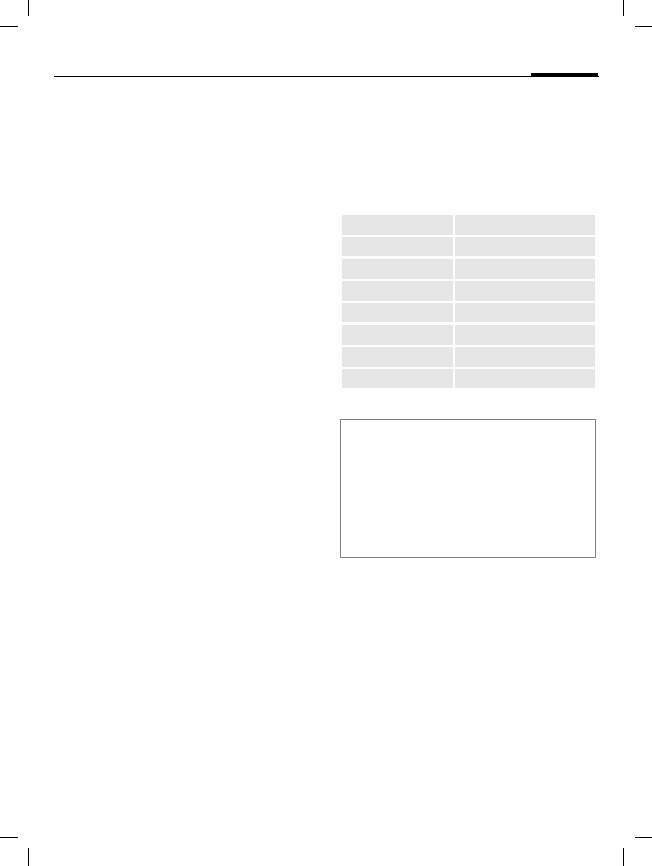
Handsfree
You can put the phone aside during
a call. You can then hear the caller
via the loudspeaker.
§Handsfr.§ Activate handsfree
talking.
§Yes§ Switch on.
Ò ÓUse the left side key to
regulate volume.
§Handsfr.§ Deactivate.
Note
Please make sure you have accepted the
call before holding the phone to your ear.
This will avoid your hearing possibly being
damaged by a loud ringtone.
Note
,º
Save phone no..............page 22, page 23
Voice dialing................................. page 24
Key lock ....................................... page 43 Note
Always deactivate "handsfree talking"
before holding the phone to your ear. This
will avoid damage to your hearing.
_g
Handsfr. % menu

Calling
20
S56 am, A31008-H5700-A40-1-7619 (6. December 2002, 13:47)
© Siemens AG 2002, D:\Pool\L55\S55\am\Kurzanleitung\S56K_Phone.fm
Swap
• You can call another number
during a call.
§; menu§ Open call menu
Hold Put current call on hold
Now dial the new phone number.
When the new connection is estab-
lished:
§; menu§ Open call menu.
Swap Swap back and forth
between both calls.
• You may be advised during a call
that there is another call waiting.
This function uses a special "call
waiting" tone (page 44).
§Swap§ Accept the waiting call
and put the current call
on hold. To swap be-
tween the two calls
proceed as above.
or
BEnd the current call.
§Reply§ Accept the new call.
Conference
• Call up to 5 parties and link them
together in a conference call.
When the connection is estab-
lished:
§; menu§ Open menu and Hold se-
lect. The current call is put
on hold.
JNow dial a new number.
When the new connec-
tion is established ...
§; menu§ ... open menu and Confer-
ence select. The held call is
joined.
Repeat procedure until all
participants are linked together
(up to 5 participants).
End
BAll calls in the conference
are ended simultaneously
when the End key is
pressed.
L
L
Phonebook or Addressbook 21
S56 am, A31008-H5700-A40-1-7619 (6. December 2002, 10:21)
© Siemens AG 2002, D:\Pool\L55\S55\am\Kurzanleitung\S56K_Pref_Book.fm
Phonebook
or
Addressbook
§Menu§KPhonebook/Addressbook
(Standard directory)
KSelect function.
Show entries
Entries in standard directory
(Addressbook or Phonebook)
are shown for selection.
J/GSelect a name with the
first letter and/or scroll.
AThe number is dialed.
<New entry>
Create new entry in standard
directory.
Phonebook (page 22)
Addressbook (page 23)
Preferred directory
Select either Phonebook or Address-
book as your standard directory.
Fselect Phonebook or
Addressbook.
§Select§ Set as standard.
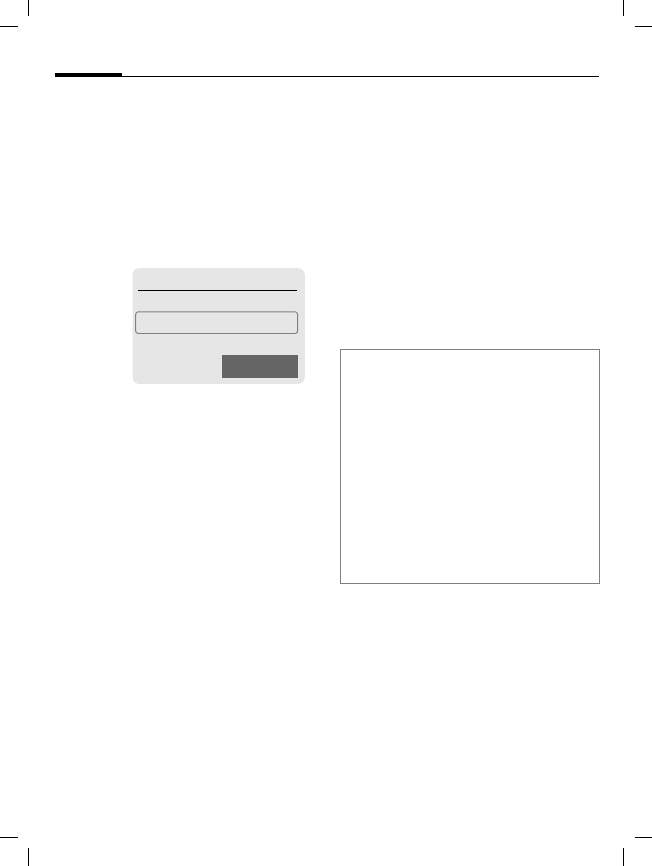
Businesscard
Create your own business card. Send
this by SMS, infrared or Bluetooth™
to another GSM phone or to a suit-
able PC/printer.
§Menu§KPhonebook/Addressbook
KBusinesscard
If no business card has been created
yet, you will be asked for your input.
GMove from field to field to
put in your details.
§Save§ Press.
Groups
(page 25)
Service numbers
(page 57)
Name: Fax 2:
First name: URL:
Phone/mobile: Street:
Phone/office: ZIP code:
Phone: City:
Fax: Country:
E-mail: Birthday:
E-mail 2: Company:
Note
The content of the business card corre-
sponds to international standards (vCard).
¹,·
Copy numbers from
Addressbook/Phonebook.
§Options§ Addressbook menu.
Phonebook
22
S56 am, A31008-H5700-A40-1-7619 (6. December 2002, 10:21)
© Siemens AG 2002, D:\Pool\L55\S55\am\Kurzanleitung\S56K_Phonebook.fm
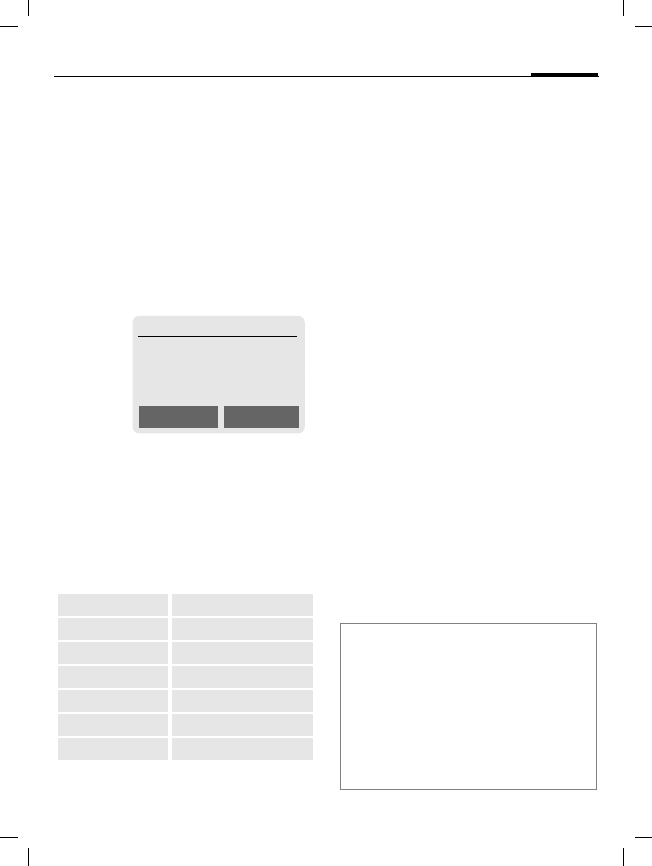
Phonebook Entries in the Phonebook (on the SIM
card) are managed separately from
those in the Addressbook.
<New entry>
If the Phonebook is set as standard:
FOpen Phonebook
(in standby mode).
D<New entry> Select.
GNavigate between and fill
in the input fields. The
max. number of letters
available is shown in the
display.
Number: Always enter phone
number with prefix.
Name: Enter first and/or last
names.
Location: Select the storage loca-
tion such as SIM or Protect-
ed SIM (PIN2 required).
Record no.:
Is automatically assigned
to an entry.
§Save§ Press to store the new
entry.
Call (search for an entry)
F Open Phonebook and se-
lect name.
ANumber is dialed.
Change entry
GSelect entry in
Phonebook.
§Options§ Press, Change select.
To store your changes
§Save§.
N Phonebook Ú
<Special books>
<New entry>
Carol
OSelect Note
<Special books>:
<Own numbrs>: Enter your own phone
numbers (e.g. fax), VIP: assign important
phone numbers to group, <Service
numb.>: service numbers.
OTemporary switch to
Addressbook.
§Options§ Edit entries, for example ex-
change data between the Phonebook and
the Addressbook.
Text entry .....................................page 51
Addressbook 23
S56 am, A31008-H5700-A40-1-7619 (6. December 2002, 13:30)
© Siemens AG 2002, D:\Pool\L55\S55\am\Kurzanleitung\S56K_Adressbook.fm
AddressbookThe Addressbook can store up to
500 entries that are managed in
the phone memory.
<New entry>
If the Addressbook has been selected
as standard:
FOpen Addressbook
(in standby mode).
D<New entry> Select.
JEnter first and/or last
name.
§Group§ Organize entries by
groups. Select with
§Change§.
DMake further entries field
by field.
Bitmap
§Select§ Assign a picture to an
Addressbook entry. It is
displayed if you are called
by the corresponding
phone number.
Input fields
§Setup§ Selection (reduced) of in-
put fields for Addressbook
entries.
§Save§ Save the new entry.
Call (search for an entry)
FOpen Addressbook
(in standby mode).
J/GSelect a name with the
first letter and/or scroll.
AThe number is dialed.
If several numbers have been saved
in Addressbook entry:
GSelect phone number.
AThe number is dialed.
Phone/mobile: URL:
Phone/office: Street:
Phone: ZIP code:
Fax: City:
Fax 2: Country:
E-mail: Birthday:
E-mail 2: Company:
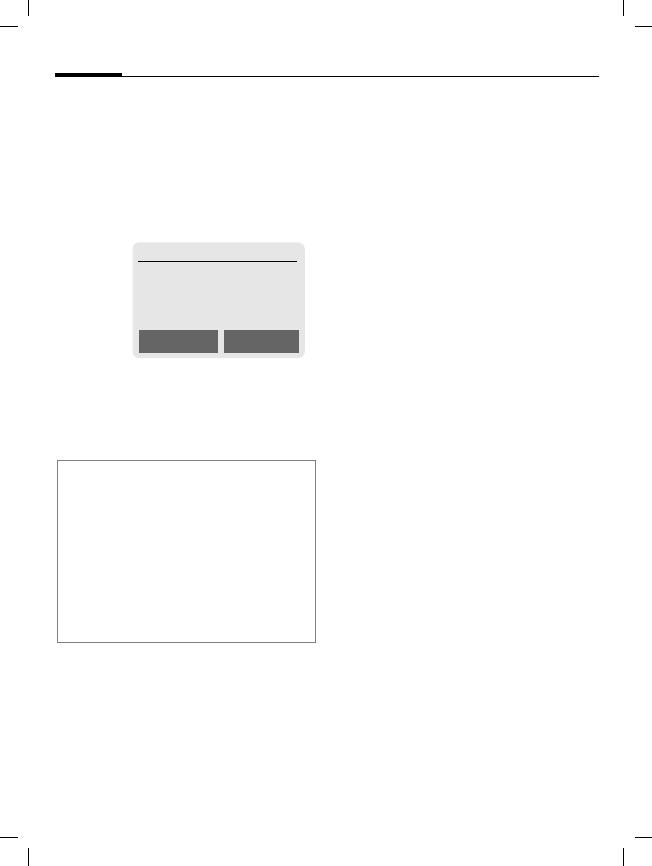
N Addressbook
Last name:
§Smith§
First name:
Clear Save
Right soft key:
When you scroll through an entry, the right
soft key will change, depending on the input
field:
§VoiceDial§ Voice control menu (page 24).
§E-mail§ Create e-mail (page 32).
§Link§ Visit URL (page 34).
§Show§ Display corresponding picture.
Addressbook
24
S56 am, A31008-H5700-A40-1-7619 (6. December 2002, 13:30)
© Siemens AG 2002, D:\Pool\L55\S55\am\Kurzanleitung\S56K_Adressbook.fm
Change/read entry
FOpen Addressbook (in
standby mode).
GSelect required entry.
§View§ Press.
§Change§ Open entry.
JMake changes.
§OK§ Save setting.
Voice dialing
Dial numbers by voice command. Up
to 20 recorded names for voice dial-
ing or voice commands (page 39)
can be saved on the mobile (not on
the SIM card).
Record
FOpen Addressbook
(in standby mode).
J/GSelect a name with the
first letter and/or scroll.
§Options§ Open menu.
Voice dialing
Select.
FChoose phone numbers,
if there are more than
one.
§Record§ Press.
§Start§ Start recording.
A short signal sounds. Now speak
the name. After a second beep and
message in the display, repeat the
name. A beep now confirms the
recording, which is saved auto-
matically.
Note
<Groups> Group functions ....... page 25
O Temporarily switch to Phonebook.
Information on text entry .............. page 51
§Options§ Edit entries, for example to
record voice dialing.
Birthday After activating the reminder box
you can enter the date and the time when
you want a reminder.
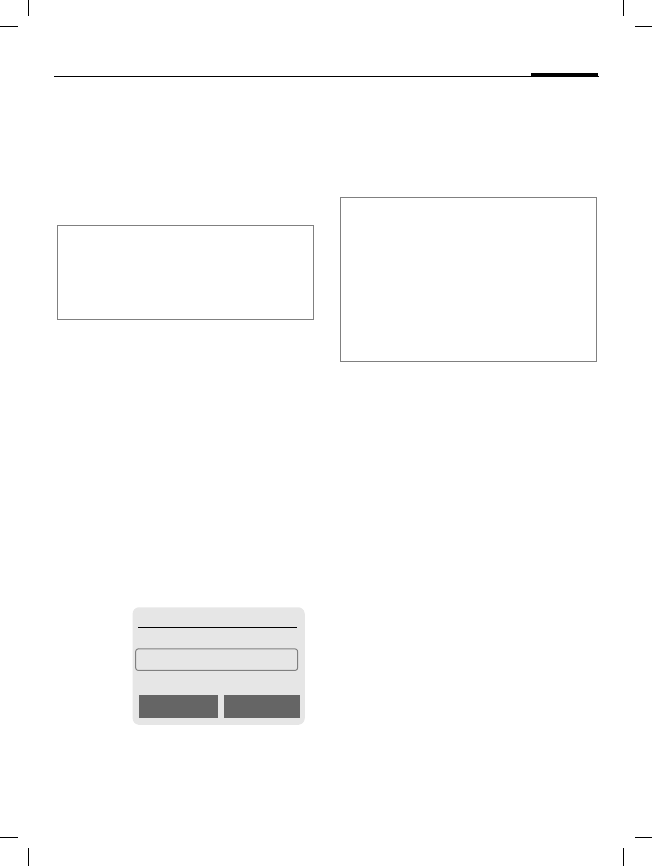
N Smith, John
§Smith§, John
Group: §No group§
¿055512345
Change Save
Addressbook 25
S56 am, A31008-H5700-A40-1-7619 (6. December 2002, 13:30)
© Siemens AG 2002, D:\Pool\L55\S55\am\Kurzanleitung\S56K_Adressbook.fm
Apply voice dialing
ÓLong press on bottom of left
side key (in standby
mode).
Now say the name. The number is
dialed.
Groups
9 groups are specified in your phone,
to enable you to arrange your Ad-
dressbook entries clearly. You can
rename seven groups.
§Menu§KAddressbookKGroups
or
FOpen Addressbook
(in standby mode).
<Groups> Select (the number of
entries is listed behind
the group name).
VIP Select.
§Options§ Open menu.
Rename group
Select and give group a
name.
Group symbol
Assign a symbol to a group that
appears on the display when one
of its members calls you.
HSelect group.
§Options§ Open menu.
Group symbol
Select.
HSelect a symbol, then con-
firm with §OK§.
Note
Noisy environments may affect voice rec-
ognition. If attempt was unsuccessful,
press the side key once more and repeat
the name.
£Groups
VIP (5)
Hobby (23)
Business (11)
Open Options
Note
• SMS to group (page 30).
• Special cases:
No group: Contains all Addressbook
entries that do not belong to a group
(name cannot be changed).
Received: Contains vCard Addressbook
entries received by IrDA, SMS or
Bluetooth™ (name cannot be changed).

Records
26
S56 am, A31008-H5700-A40-1-7619 (6. December 2002, 10:20)
© Siemens AG 2002, D:\Pool\L55\S55\am\Kurzanleitung\S56K_Records.fm
Records Your phone stores the phone num-
bers of calls for convenient redialing.
§Menu§KRecords
§Select§ Press.
GSelect call list and press
§Select§.
GSelect phone number.
ADial phone number.
Calls missed
The phone numbers of calls that you
have not accepted are stored for call-
back purposes if the network sup-
ports the "Caller Identity" feature.
Symbol for a missed call.
Calls received
Accepted calls are listed if the net-
work supports the "Caller Identity"
feature.
Calls dialed
Access to the last numbers dialed.
AFast access in standby
mode.
Erase records
The contents of all call lists are
deleted.
Call list menu
§Options§ Edit entries.
Durat/charges
You can display the charges and the
duration of calls and set a unit limit
for outgoing calls.
§Menu§KRecordsKDurat/charges
Select a function:
Last call, All calls, Remain. units
§Select§ Display the data.
§Reset§ Clear display.
§OK§ End display.
Charge settings
§Menu§KRecordsKDurat/charges
KCharge sett.
Conv. (PIN 2 prompt).
Currency for charge display.
Personal rate (PIN 2 prompt).
Charges per unit/period.
A/c limit (PIN 2 prompt).
Fix a credit/usage period on a special
SIM card.
All calls
All charges.
Incoming calls
Charges for incoming calls as well.
Auto display
Display duration and charge at end
of each call.
L
L
L
L
L

Organizer 27
S56 am, A31008-H5700-A40-1-7619 (6. December 2002, 13:31)
© Siemens AG 2002, D:\Pool\L55\S55\am\Kurzanleitung\S56K_Organizer.fm
Organizer §Menu§KOrganizer
KSelect function.
The organizer provides you with a
calendar with monthly, weekly and
daily views as well as a notepad and
dictating machine.
Calendar
You can enter appointments and
tasks in the Calendar.
Navigate with the control key de-
pending on which view is displayed:
G,HScroll between weeks/
days/hours.
§Agenda§ Display daily agenda.
Appointments and any open tasks
for the current day are displayed in
chronological order in the agenda. If
an appointment time is reached with
the alarm set, you will hear a signal
tone.
Alarm
Types of appointment:
uMemo. Description with up
to 50 characters.
vCall. Enter phone number.
Shown with alarm.
wMeeting. Description with
up to 50 characters.
xSpeech memo. Record a
voice memo.
Tasks
A task is displayed like an appoint-
ment in the agenda of the selected
day. However, it does not need a
time. When this is the case, the task
appears at the top of the list every
day until it is marked as completed.
Notes
T9 support (page 52) makes writing
short notes such as shopping lists
easier. Save confidential notes with
the phone code (page 17).
Missed appointments
Events with an alarm to which
you have not reacted are listed
for reading.
Note
An alarm sounds even when the phone is
switched off. To deactivate it, press any
key.
See display for indicator that alarms have
been set: yalarm clock,
uappointments.
Deactivate all alarms....................page 36
Set alarm tone..............................page 43
Organizer
28
S56 am, A31008-H5700-A40-1-7619 (6. December 2002, 13:31)
© Siemens AG 2002, D:\Pool\L55\S55\am\Kurzanleitung\S56K_Organizer.fm
Dictating machine
Use the dictating machine to record
short voice memos.
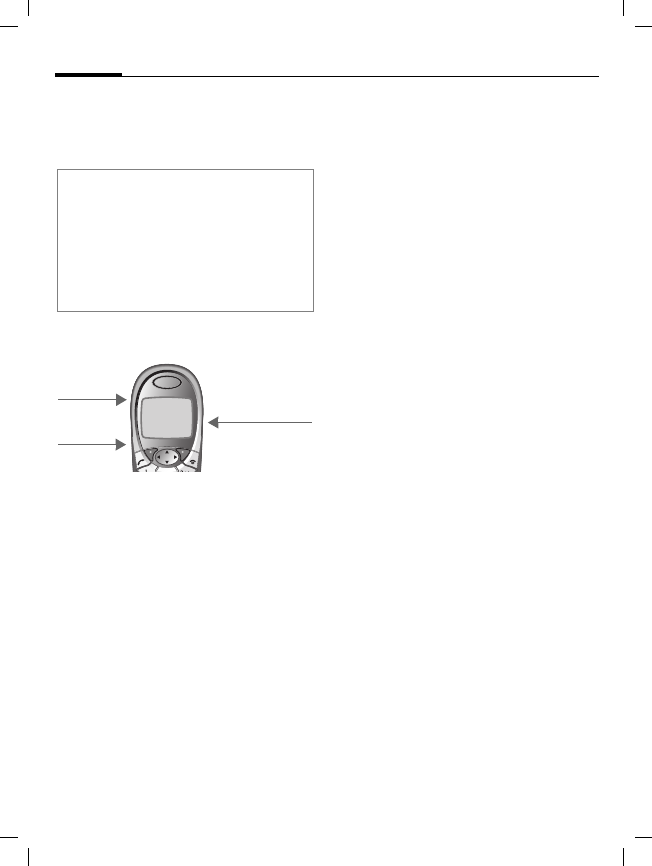
Control using the side keys
New recording
Hold down the dictation key
throughout the recording. The maxi-
mum possible recording period is
shown. Recording starts after a short
beep.
Pause
For a recording pause release the
dictation key for a maximum of 10
seconds. If you press the key again,
recording is resumed, otherwise it
will finish.
Save
Releasing the dictation key for long-
er than 10 seconds will finish the
recording.
§Stop§ End recording.
Recording is automatical-
ly saved with a time
stamp.
§Save§ Name recording.
§Save§ Save recording.
Play back
In standby mode, press dictation key
briefly. If the Options menu is set up
that way, Handsfree will be offered.
or
§Menu§KOrganizer
KDictating machine
The list of recordings is opened.
GSelect recording.
§Play§ Press.
Time zones
§Menu§KOrganizerKTime zones
Set the time zone for your area.
Note
The use of this feature may be subject to
restrictions under criminal law. Please in-
form the other party to the conversation in
advance if you want to record the conversa-
tion and please keep such recordings confi-
dential. You may only use this feature if the
other party to the conversation agrees.
Ò Loud
Ó Quiet
Record/play
back
(dictation key)

Message lists and profiles 29
S56 am, A31008-H5700-A40-1-7619 (6. December 2002, 10:21)
© Siemens AG 2002, D:\Pool\L55\S55\am\Kurzanleitung\S56K_Meldungen.fm
Message lists
and profiles
With your mobile phone, you can
send and receive messages via SMS,
MMS and e-mail.
§Menu§KMessages
KSelect message type.
Message lists
All messages are stored in various
lists; for SMS there is another sepa-
rate archive:
Inbox
§Menu§KMessagesKInbox
KMessage type
The list of SMS messages received is
displayed.
Draft
§Menu§KMessagesKDraft
KMessage stype
The list of stored drafts is displayed.
Unsent
§Menu§KMessagesKUnsent
KMessage type
The list of not yet successfully trans-
mitted MMS messages is displayed.
Sent
§Menu§KMessagesKSent
KMessage type
The list of sent messages is
displayed.
§Options§ You can use comprehen-
sive function menus to
edit the messages.
Message profiles
§Menu§KMessagesKSetup
KSelect message type.
A profile can/must be set for each
message type in which the transmis-
sion characteristics are fixed. You
will find extensive information in the
user guide on the CD-ROM provided
with this handset.
The data for these may already have
been entered. If not, your service
provider will supply you with the
relevant information. See also on
the Internet at:
www.my-siemens.com/S55

SMS
30
S56 am, A31008-H5700-A40-1-7619 (6. December 2002, 10:21)
© Siemens AG 2002, D:\Pool\L55\S55\am\Kurzanleitung\S56K_Meldungen.fm
SMS You can transmit and receive very
long messages (up to 760 charac-
ters) on your phone: these are auto-
matically composed from several
"normal" SMS messages (note higher
charges).
Additionally you can insert pictures
and sounds in an SMS.
Writing and sending text
messages (SMS)
§Menu§KMessagesKNew SMS
JWrite text (for informa-
tion on text entry see
page 52).
APress.
J / NDial number or pick
out from the Phone/
Addressbook.
§OK§ Confirm. Send the SMS
to the service centre for
transmission.
Read SMS
] Arrival of new SMS an-
nounced on display. To
read the SMS, press left
soft key.
FScroll through message
line by line.
§Reply§ Functions for a direct
reply.
Archive
§Menu§KMessagesKSMS-Archive
The list of SMS messages stored in
the phone is displayed.
Special functions
§Options§ Open options menu:
SMS to group
Send SMS as a "circular" to a group:
Send Select.
§Groups§ Press. In the Addressbook
which is now open, high-
light entries/groups to re-
ceive message.
Picture&Sound
Insert pictures and sounds into
message.
Picture&Sound
Select. The menu
contains:
Fix animations, Fix sounds,
Own animat., Own pictures,
Own sounds
G Select section, then
select entry wanted
and confirm.
Predef. text
Insert text Use text blocks (page 52).

MMS 31
S56 am, A31008-H5700-A40-1-7619 (6. December 2002, 10:21)
© Siemens AG 2002, D:\Pool\L55\S55\am\Kurzanleitung\S56K_Meldungen.fm
MMS The Multimedia Messaging Service
enables you to send texts, pictures
(also photos) and sounds in a com-
bined message to another mobile
phone or to an e-mail address.
Depending on the setting, you will
either receive the complete MMS or
only a notification with sender de-
tails and size. The actual MMS can
then be loaded manually later.
Texts can be composed using T9
support (page 52).
Pictures and graphics can be pro-
duced with accessories such as
digital cameras.
Music is sent and received in a MIDI
file, single tones/noises in an AMR
file.
All elements of an MMS message are
merged to form a "slide show".
Writing/sending MMS
messages
§Menu§KMessagesKNew MMS
An MMS consists of the address
header and the content.
Create MMS Select.
Enter MMS address
J / NTo:/Cc: Phone number/e-
mail address of recipient.
JSubject: Enter heading.
GSelect priority:
Low, Medium, High
GDelivery time: Yes/No
If required, append busi-
ness card/appointment
entry.
Create content of the MMS
§Options§ Open menu.
New slide Select:
Picture/animation.
§Insert§ Select animation.
Text
§Edit§ Write text.
Music
§Insert§ Select melody.
Slide duration
JEnter the display duration
of the individual pages.
To send MMS
§Options§ Open menu, select Send.
Send Select.
Receive/read MMS
‰Display indicates a new
MMS. Depending on pro-
file setting (page 29):
• Play back the complete MMS.
• Open the notification.
§Receiving§ Press to receive the
complete MMS.
E-mail
32
S56 am, A31008-H5700-A40-1-7619 (6. December 2002, 10:21)
© Siemens AG 2002, D:\Pool\L55\S55\am\Kurzanleitung\S56K_Meldungen.fm
E-mail Your phone has its own e-mail client.
You can use it to create and receive
e-mails.
Write/send e-mails
§Menu§KMessagesKNew e-mail
Enter e-mail address
N /JTo:/Cc:/Bcc: E-mail address
of recipient(s)
Attach.:Copy from file
system and attach.
JSubject: Enter heading.
JContent Enter text
(see also page 52).
§Options§ Open menu.
Send Send e-mail.
Add attachments
A file from the file system (e.g. ring-
tone) can be inserted in an e-mail
as an attachment.
§Attach.§ Open file system.
GSelect file to be inserted.
§Mark§ Highlight file.
§OK§ Copy file as an
attachment.
Receive e-mail
§Menu§KMessagesKInbox
KReceive e-mail
Before an e-mail can be read, it must
be retrieved from the server. The ser-
vice provider is dialed with the de-
fault access profile and all e-mails
are transmitted to the inbox list
(page 29).
Read e-mail
§Menu§KMessagesKInboxKE-mail
GSelect e-mail.
§View§ The e-mail is displayed.
The left soft key offers different
functions depending on which text
segment has been selected:
ºE-mail addresses/phone
numbers in the message
are §highlighted§ and can
be stored in the Address-
book.
ADial phone number or
start new e-mail.
§Save§ Save attachment.
§Reply§ Reply to sender.
§Link§ Start WAP browser and
visit URL (page 34).
*Press briefly to write special
characters such as @ (page 51).

Voice mail/Cell broadcast 33
S56 am, A31008-H5700-A40-1-7619 (6. December 2002, 10:21)
© Siemens AG 2002, D:\Pool\L55\S55\am\Kurzanleitung\S56K_Meldungen.fm
Voice mail/
Cell
broadcast
Voice mail/mailbox
§Menu§KMessagesKSetup
KVoice message
Most service providers supply an ex-
ternal voicemail service. A caller may
leave a voice message for you in this
mailbox
• if your phone is switched off or
not ready to receive,
• if you do not want to answer,
• or if you are making a phone call.
You may have to register for this
service with the service provider
and enter the settings manually.
Settings
The service provider supplies you
with two phone numbers:
Save mailbox number
Call this phone number to listen to
the voice mails left for you.
§Menu§KMessagesKSetup
KVoice message
Enter mailbox number and confirm
with §OK§.
Savecall forwarding number
Calls are forwarded to this phone
number.
§Menu§KSetupKMobileKForwarding
Ke.g. UnansweredKSet
Dial forwarding number and register
it at the network with §OK§. Forward
will be confirmed after a few sec-
onds. Further information on call
forwarding can be found on
page 44.
Listen to
A new voice mail can be displayed as
follows:
An \ icon with beep or ] a text
message announces a new voice
mail or you receive a call with an
automatic announcement. Call your
mailbox and play the message(s)
back.
1Hold down (if necessary
enter mailbox number
once only). Confirm with
§OK§ or §Mailbox§ depending
on your service provider.
Cell broadcast
§Menu§KMessages KCell broadcast
Some service providers offer infor-
mation services (info channels). If re-
ception is activated, your "Topic list"
will supply you with messages on
the activated topics.
L
L

Surf & fun
34
S56 am, A31008-H5700-A40-1-7619 (6. December 2002, 10:21)
© Siemens AG 2002, D:\Pool\L55\S55\am\Kurzanleitung\S56K_Surf&Fun.fm
Surf & fun Internet browser (WAP)
Get the latest information from the
Internet, specifically adapted to the
display options of your phone. In ad-
dition, you can download games and
applications to your phone. Internet
access may require registration with
the service provider.
Internet access
§Menu§KSurf & funKInternet
The browser is activated as soon as
you call up the function. The func-
tions of the soft keys vary, depend-
ing on the internet page, for exam-
ple "link" or "menu". The contents of
the option menus are also variable.
If necessary, set the way Internet ac-
cess should be made. To activate:
AOpen browser menu,
then select Setup/ Start
with... .
End connection
BHold down to clear down
the connection and to
close the browser.
WAP profiles
§Menu§KSurf & funKInternet
KProfiles
Preparation of the phone for WAP In-
ternet access depends on your ser-
vice provider: If the settings have al-
ready been made by the service
provider, select/activate the profile.
If the access profile must be set man-
ually, contact your service provider
for details, if necessary.
Activate WAP profile
You can change the active profile
each time before you access the
Internet (if the profile has been set
already).
GSelect profile,
then §Select§.
Set WAP profile
Up to5 WAP profiles can be set (if
not barred by provider). The entries
may vary depending on the service
provider:
GSelect profile, then §Edit§.
Now fill in the data fields.
To select the connection profiles, see
Data services, page 46.
Instructions on the display
ÍOpen the browser menu.
ÉOffline.
ÊOnline.
ËGPRS Online.
ÌNo network.
*To select special characters,
such as @, ~, \, see page 51.
L

Surf & fun 35
S56 am, A31008-H5700-A40-1-7619 (6. December 2002, 10:21)
© Siemens AG 2002, D:\Pool\L55\S55\am\Kurzanleitung\S56K_Surf&Fun.fm
Games & more
Download games and other applica-
tions. Once you have selected a
game or application you can start to
download it immediately. Then you
can use the application. Most appli-
cations include instructions.
Applications and games can be
found at: wap.my-siemens.com or in
the Internet under:
www.my-siemens.com/city
Games and applications
Applications and links that are
already stored on the phone are
found under:
§Menu§KSurf & funKGames & more
Different functions are available
depending on the entry:
§ Carry out game/application offline
§Select§ Loadable application can
be started immediately.
¦ Load game/application online
§Select§ Only description file;
application must still
be loaded.
É Load link (optional)
§Select§ The selected Internet
page is loaded.
HTTP profiles
§Menu§KSurf & funKGames & more
§Options§ Open menu
HTTP profile
Select.
Preparation of the phone for WAP In-
ternet access depends on your ser-
vice provider: If the settings have
already been made by the service
provider, select/activate the profile.
If the access profile must be set
manually, contact your service pro-
vider for details, if necessary.
Profiles
36
S56 am, A31008-H5700-A40-1-7619 (6. December 2002, 10:21)
© Siemens AG 2002, D:\Pool\L55\S55\am\Kurzanleitung\S56K_Profile.fm
Profiles A profile allows several settings to be
made with one function in order, for
example, to adapt the phone to the
surrounding level of noise.
• Five standard profiles are provided
with default settings. They can,
however, be changed:
Normal envi., Quiet environ., Noisy
environ., Car Kit, Headset
• You can set two personal profiles
(<No Title>).
• The special profile Aircraft mode
cannot be changed.
Activate
§Menu§KProfiles
GSelect default profile or
personal profile.
§Select§ Activate profile.
Setup
GSelect profile.
§Options§ Open menu and select
Change sett. The list of
available functions is dis-
played.
Car Kit
If an original Siemens Car Kit is used,
(page 48) the profile is activated au-
tomatically as soon as the phone is
inserted into the cradle.
Headset
If an original Siemens headset is
used, (page 48) the profile is acti-
vated automatically as soon as the
headset is in operation.
Aircraft mode
All alarms (appointments, alarm
clock) are deactivated. This profile
cannot be modified. The phone will
switch off if you select this profile.
Activate
GScroll to Aircraft mode.
§Select§ Activate profile. A security
prompt must be con-
firmed. The phone switch-
es itself off automatically.
Normal operation
The next time you switch on the
phone and return to normal opera-
tion, the profile previously set will
be activated automatically.
¾Normal envi.
½Quiet environ.
¾ Noisy environ.
Options Select
Extras 37
S56 am, A31008-H5700-A40-1-7619 (6. December 2002, 10:21)
© Siemens AG 2002, D:\Pool\L55\S55\am\Kurzanleitung\S56K_Extras.fm
Extras §Menu§KExtras
KSelect function.
Alarm clock
The alarm will ring at the time you
set, even when the phone is
switched off.
§On§ / §Off§ Activate/deactivate the
alarm.
Setting
§Edit§ Display selected time and
days for alarm calls:
HNavigate to the days.
§Edit§ Set the days for the alarm
calls, then §OK§.
Calculator
JEnter number (up to
8digits).
#Result is displayed.
Currency converter
You may calculate the exchange
rates between three different
currencies.
If no currency has yet been entered,
press §OK§ for the first input
JEnter the currencies and
confirm with §OK§.
JEnter exchange rate. Save
with §Options§ and §OK§.
Select a combination of currencies to
convert.
§Select§ Press, then enter amount.
#Result is displayed.
§Repeat§ Repeat conversion
with other data.
Stopwatch
Two intermediate times can be
clocked and stored.
§Reset§ Reset to zero.
#Start/stop.
*Intermediate time.
Control using side keys:
Select calculator
function.
§. = + - * /§ Press the right soft key
repeatedly.
±Toggle between "+" and "-".
%Convert to percentage.
Ï,ÐSave/call up figure.
eExponent (max. two digits).
Intermed. time
(Ò Key)
Start/stop

Extras
38
S56 am, A31008-H5700-A40-1-7619 (6. December 2002, 10:21)
© Siemens AG 2002, D:\Pool\L55\S55\am\Kurzanleitung\S56K_Extras.fm
§Menu§KExtras
KSelect function.
Countdown
A set time elapses. The last 3 sec-
onds are indicated by a beep. At the
end a special beep sounds.
§Set§ Set period of time.
§Start§ Start counter.
§Stop§ Interrupt counter.
§Edit§ Change period of time.
§Reset§ Reset counter to starting
time.
Camera (Accessories)
You can use the phone to save and
send photos you have taken with
the QuickPic IQP-5002 camera.
Shots can be taken in two different
formats:
• Low resolution: QQVGA
160x120 pixels, memory size up
to 6 KB to send as a picture
message(page 31).
• High resolution: VGA
640x480 pixels, memory size of
one shot up to 40 KB - e.g. for fur-
ther editing on PC. To allow the
picture to be viewed on the phone
display, a QQVGA picture is creat-
ed for every VGA shot.
§Camera§ Press when the camera
has been attached (in
standby mode).
or
§Menu§KExtrasKCamera
The number of shots that can still be
taken is shown.
§OK§ Confirm.
The last shot taken is shown.
GScroll through photos.
Depending on the setting/situation,
the following soft keys are available:
Shot
A shot requires a few seconds to be
processed.
ÒPress side key on left; a
new shot is taken, shown
in display and automati-
cally saved.
Flashlight
The flash function can be activated/
deactivated in the option menu.
If the flash is switched on, a com-
mand is given to charge the flash-
light before taking a shot:
ÒPress left side key briefly;
the flashlight will charge.
Press again to take a
photo.

Extras 39
S56 am, A31008-H5700-A40-1-7619 (6. December 2002, 10:21)
© Siemens AG 2002, D:\Pool\L55\S55\am\Kurzanleitung\S56K_Extras.fm
§Menu§KExtras
KSelect function.
Voice command
Functions can be started by a voice
command. A maximum of 20 voice
recordings for voice dialing or voice
commands can be saved in the
phone (not on SIM card!).
Record
§Menu§KExtrasKVoice command
A list with the functions available is
displayed.
GSelect a function.
§Record§ Press.
§Yes§ Confirm function.
§Start§ Start recording.
A short signal sounds. Now say
the command corresponding to
the function and repeat it when
prompted.
§Options§ Open menu for the
operating functions.
Apply
Ó Hold down bottom of left
side key (in standby
mode).
A short signal (beep) sounds and a
prompt appears in the display. Now
say the function.
Remote sync.
You can use this function remotely
to access externally filed data
(addresses, calendar, etc.) and
synchronize these with the data
on your phone.
Syncronize
§Sync§ Select computer, start
synchronization.
Sync. setup
§Setup§ Start synchronization.
Sync. Profile
Select to set a profile
§Options§ Open menu and select
Change.
Server sett.
Highlight database sections:
Addresses, Calendar, Tasks, Notes
and complete input fields.
Provider
For selection of connection profile,
see Data services, page 46.
Activate remote sync. profile
Sync. setup
Select.
Sync. Profile
Select, then choose
a profile and activate
with §Select§.

Fast access key
40
S56 am, A31008-H5700-A40-1-7619 (6. December 2002, 10:20)
© Siemens AG 2002, D:\Pool\L55\S55\am\Kurzanleitung\S56K_FastDial.fm
Fast access
key Left soft key
Assign a function/phone number to
this key for fast access.
Change (example)
§Internet§ Press briefly.
§Edit§ Pick out the application,
e.g. New SMS.
Phone number: Find in
Phonebook/Addressbook.
§Select§ Confirm setting.
Apply (example)
Soft key with a phone number/name
assigned.
§Carol§ Hold down.
Speed dialing keys
Use the number keys 2 to 9 as
speed dialing keys. Number key 1
is reserved for the mailbox.
Change (example)
3Press an unassigned
number key (2- 9):
§Set§ Pick out the application.
Phone number: Pick out
from Phone-/Address-
book.
Bookmarks: Scroll to a URL
in your bookmarks list
§Select§ Confirm setting.
Apply (example)
3Hold down key.
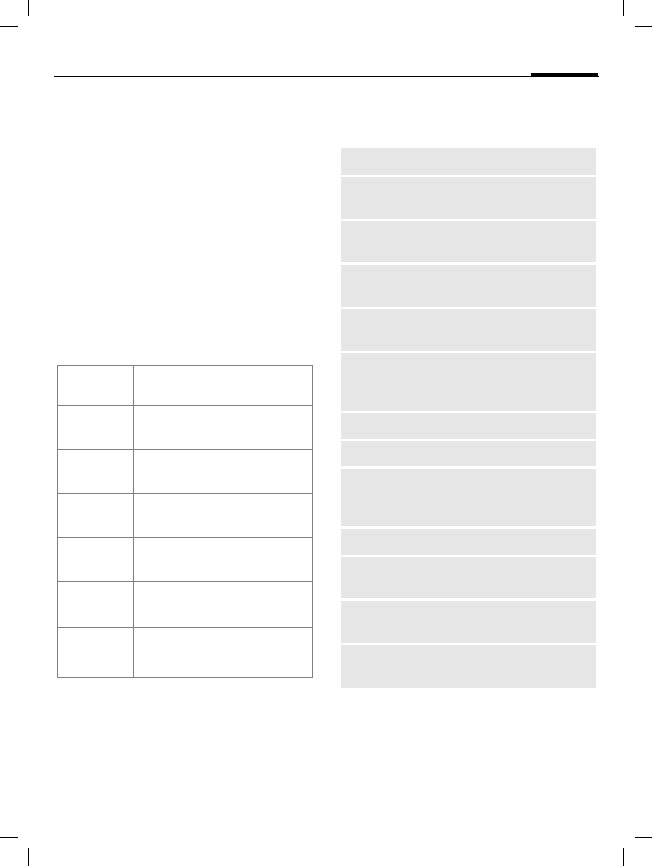
My menu
§Menu§KMy menu
Set up your own menu. The list of
10 entries is preset, but can be
changed.
Change sett.
Each preset entry can be replaced by
another entry from the selection list
of My menu.
GSelect entry.
§Options§ Press and select
Change sett..
§Set§ Press.
GSelect new entry from the
selection list.
§Set§ Press.
If you have selected a phone number
or a WAP favorite as a new entry, the
corresponding application is started.
Reset all
§Options§ Press and select Reset all.
After confirmation and entering the
phone code, the default entries are
reset.
Filesystem 41
S56 am, A31008-H5700-A40-1-7619 (6. December 2002, 10:21)
© Siemens AG 2002, D:\Pool\L55\S55\am\Kurzanleitung\S56K_Explorer.fm
Filesystem To organize your files, you can use
the file system like a PC file manager.
The file system assigns special fold-
ers to different data types.
§Menu§KFilesystem
A list of the folders and files is
displayed.
§Open§ Open folder or file with
relevant application or
if unknown data type:
§Mark§ Highlight file.
The following files can be viewed
from here:
File system menu
§Options§ Open menu
bmp, jpg,
gif, png Pictures: show picture.
bmx, (an-
im) gif Animation:
show animation.
mid, amr,
mmf Sounds:
play ringtone or sound
vmo Voice memo:
play voice file.
col Colour scheme: only usable
via Setup page 42!).
smo
smi
Sms: with sub-indexes:
Inbox, Draft, Unsent, Sent
tmo
txt
Text modules: text blocks.
Text files.
Open Open folder.
Mark See highlighting mode
(page 55).
Mark all All entries highlighted, see
highlight mode (page 55).
Move Transfer highlighted file or
folder to temporary memory.
Copy Copy highlighted file into
temporary memory.
Paste Transfer content of tempo-
rary memory into current fold-
er.
Delete Delete highlighted entry.
Delete all Delete all entries.
New folder Create a new folder and give
it a name (only one folder
depth available).
Rename Change highlighted entry.
Sort Set sort criteria
(alphabetical, type, time).
Attributes Display information on file or
folder selected.
Drive info Display the capacity used
and available.

Setup
42
S56 am, A31008-H5700-A40-1-7619 (6. December 2002, 10:21)
© Siemens AG 2002, D:\Pool\L55\S55\am\Kurzanleitung\S56K_Setup.fm
Setup Display
§Menu§KSetupKDisplay
KSelect a function
Language
Set the language of the display text.
"Automatic" will set the language of
your home service provider. Return
to this language in standby mode:
*# 0 0 0 0 # A
T9 input
T9 preferred
Activate/deactivate intelligent text
entry.
Input language
Select language for text entry.
Background
Set background graphic for display.
Logo
Choose picture to be displayed
instead of the provider logo.
Color scheme
Select color scheme for the whole
service system.
Screensaver
The screensaver shows a picture in
the display when a period you set
has elapsed. The function is ended
by an incoming call or by pressing
any key.
Start anim.
Select animation to be shown when
phone is switched on.
Shutdn animat
Select animation to be shown when
phone is switched off.
Own greeting
Enter greeting to be displayed in-
stead of animation when phone is
switched on.
Big letters
You can choose between two font
sizes for the display.
Illumination
Switch display illumination on/off or
set to "Automatic" (switched off in-
creases standby time).
Contrast
Set display contrast.

Setup 43
S56 am, A31008-H5700-A40-1-7619 (6. December 2002, 10:21)
© Siemens AG 2002, D:\Pool\L55\S55\am\Kurzanleitung\S56K_Setup.fm
Audio
§Menu§KSetupKAudio
KSelect function.
Ringer setting
Activate/deactivate the ringer or
reduce it to a short beep.
Silent alert
Activate/deactivate the silent alert
(functions in addition to ringer).
Silent alert is activated automatically
if the maximum volume has been set
for the ringtone. This is to remind
you not to hold the ringing phone to your
ear, so that avoid damaging your
hearing.
Volume
Set different volumes for types of
call/functions.
Melodies
Set different ringtones for types of
call/functions.
Call screening
Only calls from numbers that are in
the Phonebook/Addressbook or in
a group are signaled audibly or by
silent alert. Other calls are merely
displayed.
Key tones
You can set the acoustic key tone:
Click or Tone or Still
Minute beep
During the call, you will hear a beep
once a minute as a reminder.
Info tones
Set service and alarm tones:
Keys
§Menu§KSetupKKeys
KSelect function
Any to answer
You can press any key to accept an
incoming call.
(except B).
Auto key lock
When the key lock is activated, the
keypad locks automatically in stand-
by mode if no key has been pressed
for one minute. However, you can
still be called and you can still make
an emergency call.
The keypad can also be locked and
unlocked in standby mode
as follows.
#Hold down.
Key tones
See above under "Audio".
Note
Please make sure you have accepted the
call before holding the phone to your ear.
This will avoid your hearing possibly being
damaged by a loud ringtone.
L

Setup
44
S56 am, A31008-H5700-A40-1-7619 (6. December 2002, 10:21)
© Siemens AG 2002, D:\Pool\L55\S55\am\Kurzanleitung\S56K_Setup.fm
Mobile
§Menu§KSetupKMobile
KSelect function.
Call waiting
If you are registered for this service,
you can check whether it is set and
you can Call waiting activate/deacti-
vate it.
Hide ID
If activated, your phone number
will not appear on the other party’s
display (depending on the service
providers).
Forwarding
You can set the conditions under
which calls are forwarded to your
mailbox or other numbers.
Set up call forwarding (example):
Unanswered
GSelect Unanswered
(Includes the conditions
Not reachable, No reply,
Busy)
§Select§ Press and select Set.
Enter the phone number
to which the call will be
forwarded.
§OK§ Press. After a short pause,
the setting is confirmed
by the network.
All calls
nForward all calls. Symbol
in the top line of the dis-
play in standby mode.
Other possibilities for forwarding:
Not reachable, No reply, Busy,
Receiving fax, fax calls, Receiving data
Check status
After a short pause, the current
information is shown.
p,oCondition is set, not set.
sStatus unknown.
Clear all
All set diversions are cleared.
Fact. settings
Reset phone to default values
(factory setting).
Format filesys
Format the file system and delete all
saved data.
Phone identity
Display the phone identity number
(IMEI) and software version.
Auto off
The phone switches off each day at
the set time.
L
L
L
L
L
Setup 45
S56 am, A31008-H5700-A40-1-7619 (6. December 2002, 10:21)
© Siemens AG 2002, D:\Pool\L55\S55\am\Kurzanleitung\S56K_Setup.fm
Clock
§Menu§KSetupKClock
KSelect function
Time/date
§Edit§ First enter the date, then
the time.
Time zones
Set the time zone for your area.
Format date
DD.MM.YYYY or MM/DD/YYYY
Auto display
activate/deactivate time display.
Buddhist year
Switch to the Buddhist calendar
(not for all models).
Connectivity
§Menu§KSetupKConnectivity
KSelect function.
GPRS
§Yes§ / §No§ Activate/deactivate GPRS.
GPRS info
Display information on the connec-
tivity status.
IrDA
§Edit§ Activate/deactivate IrDA.
The distance between the two devic-
es must not exceed 30 cm. If IrDA is
activated, Bluetooth™ is deactivated
and vice versa.
Bluetooth™
You can activate/deactivate
Bluetooth™, give your phone a
Bluetooth™ name, and manage the
list of known Bluetooth™ devices.
Bluetooth™
Activate/deactivate, even give the
phone a name.
Visib.t.others
Make the phone visible to other
devices for data exchange.
Undertake a new entry in the list of known
devices:
§Options§ Open menu,
Known devices select.
The list is shown.
<New entry>
Select, then:
§Select§ Select a device from the
list of those most recently
connected.
or
§Accessories§
Add a headset or other
device (Car Kit, PC).
Note
If the battery is removed for longer than
30 seconds, the clock must be reset.
L

Setup
46
S56 am, A31008-H5700-A40-1-7619 (6. December 2002, 10:21)
© Siemens AG 2002, D:\Pool\L55\S55\am\Kurzanleitung\S56K_Setup.fm
Data services
§Menu§KSetup KConnectivity
KData services
KSelect function.
For the MMS, Wap and Mail,Java,Rms
applications, at least one connection
profile must be set up and activated.
If necessary enter CSD settings and
GPRS settings (your service provider
will supply you with information
on this):
§Options§ Open, select §Edit§, enter
data.
§Save§ Save settings.
Fax/data mode using a PC
Rec fax/data
The call will be signaled by a
special ringtone (fax or data). Now
start the communication program
in your PC to receive the fax/data.
Send vce/fax
To switch from voice mode to fax
mode, set the function on the phone
before transmission.
Voice/fax rec
After the start of the PC communica-
tion program, activate the function
during a call.
End transmission
End transmission with PC software
and/or press B.
Authentication
§Edit§ Activate encrypted WAP
dial-up.
Security
§Menu§KSetupKSecurity
KSelect function.
Codes
(See page 17)
Babysitter
Only one phone number can be
dialed. Hold down the right soft key.
Only ,
Restrict calls to SIM-protected
numbers in the Phonebook.
Last 10 only
Restrict calls to the list of "dialed
numbers" (page 26).
This SIM only
Your phone is prevented from being
used with a different SIM card.
L
L
L
L
L

Setup 47
S56 am, A31008-H5700-A40-1-7619 (6. December 2002, 10:21)
© Siemens AG 2002, D:\Pool\L55\S55\am\Kurzanleitung\S56K_Setup.fm
§Menu§KSetupKSecurity
KSelect function
Barrings
The network barring restricts the use
of your SIM card.
All outgoing: Outgoing calls except
emergency numbers 999 and 112
are barred.
Outgo internat: Only national calls can
be made.
Out.int.x home: International calls are
not permitted.
All incoming: The phone is barred for
all incoming calls.
When roaming: You will not receive
calls when outside your home
network.
Status check: Status check for net-
work barring
Clear all: Clear all barrings.
Network
§Menu§KSetupKNetwork
KSelect function.
Line
Two independent phone numbers
must be registered.
Network info
The list of GSM networks currently
available is displayed.
Choose network
Network search is restarted.
Auto network
If activated, the next network is
dialed in the order of your
"preferred networks".
Pref. network
Set the service providers you prefer
when you leave your home network.
Band selection
Select either GSM 900, GSM 1800 or
GSM 1900.
Fast search
Network reconnection is
speeded up.
User group
Depending on the service provider,
you can create groups with this
service. These can have access to
internal (company) information, for
example, or special tariffs apply.
Check with your service provider for
details.
L
L
L
L

Setup
48
S56 am, A31008-H5700-A40-1-7619 (6. December 2002, 10:21)
© Siemens AG 2002, D:\Pool\L55\S55\am\Kurzanleitung\S56K_Setup.fm
Accessories
§Menu§KSetupKAccessories
KSelect function.
Car Kit
Only in combination with an original
Siemens handsfree Car Kit. The pro-
file is activated automatically as
soon as the phone is inserted into
the cradle.
Auto answer
Calls are accepted automatically
after a few seconds. Eavesdropping
is possible!
Auto off
If powered by the car’s power supply,
the time between switching off the
ignition and deactivation of the
phone can be adjusted.
Headset
Only in conjunction with an original
Siemens headset. The profile is auto-
matically activated when headset is
plugged in.
Accept call with Call key or PTT key
(Push To Talk), even when key lock
is activated.
Auto answer
Calls are accepted automatically
after a few seconds.
Auto answer
If an incoming call is not noticed, there is
a risk of eavesdropping by caller.

Print via.../Send via .... 49
S56 am, A31008-H5700-A40-1-7619 (6. December 2002, 10:21)
© Siemens AG 2002, D:\Pool\L55\S55\am\Kurzanleitung\S56K_SendPrint.fm
Print via.../
Send via ....
Access to these functions is available
in the options menu of the relevant
application.
Infrared (IrDA)
Activate IrDA, page 45.
Send/Print...KIrDA
§Send§ Send data via the trans-
mission route selected.
§Print§ Send data to the
connected printer
All via IrDA
Send/Print...KAll via IrDA
All entries from the Phonebook,
Addressbook and organizer will
be sent or printed.
§Send§/§Print§
See above.
To receive via IrDA
Please turn on IrDA to receive
(page 45).
Bluetooth™
Bluetooth™ is a short-range radio
signal that permits wireless commu-
nication between different terminal
devices equipped with Bluetooth™.
Send via Bluetooth™
For settings, see page 45.
Send/Print...KBluetooth
Known devices
Select a device from the list of
known devices.
§Select§ Send.
Search device
Search for Bluetooth™ devices.
• Device sought is found:
§View§ Search is ended and
devices that have been
found are displayed.
GSelect device.
§Select§ Send.
• More than 10 devices found:
The search will finish when 10 devic-
es have been found. If the device
you are looking for is not on the list
displayed:
§Options§ Open menu.
Retry Repeat search If the de-
vice you are looking for is
found, continue as above.
• Time limit exceeded:
The search is ended if the maximum
amount of time available is
exceeded.
Note
In some countries there may be restrictions
on the use of Bluetooth™ devices. Check
with the relevant authorities.

Print via.../Send via ....
50
S56 am, A31008-H5700-A40-1-7619 (6. December 2002, 10:21)
© Siemens AG 2002, D:\Pool\L55\S55\am\Kurzanleitung\S56K_SendPrint.fm
Device addr.
You can directly enter the device
address in order to set up a
connection.
JEnter device address and
use §OK§ to send.
Last connect.
The list of the last connections is
displayed.
GSelect device and use §OK§
to send.
To receive via Bluetooth™
Bluetooth™ must be activated
(page 45). Received files are
indicated by an icon above the
left soft key.
•Known device:
If the transmitting device is on
the list of known devices, data is
received immediatelely.
• Unknown device:
With an unknown device it may be
necessary to enter a password. This
password will not be saved, and can
be reset with each new connection.
JEnter password, use §OK§
to start receiving.
The unknown device can be added
to the list of known devices.
§OK§ Confirm prompt.
SMS
Phonebook and Addressbook entries
as well as appointments can be sent
as an SMS to other suitable mobile
phones. Several SMS messages may
be created for larger objects.
SMS as text
Business cards, Addressbook entries
or appointments can be sent as text
messages (this may result in several
messages being generated).
Import
Enable transmission to receive
several objects via IrDA or
Bluetooth™ one after the other.
Data objects
Files received via Bluetooth™, IrDA
or SMS are stored in the file system.
Text entry 51
S56 am, A31008-H5700-A40-1-7619 (6. December 2002, 10:21)
© Siemens AG 2002, D:\Pool\L55\S55\am\Kurzanleitung\S56K_Text.fm
Text entry Enter text without T9
Press number key repeatedly until
the required letter appears. The cur-
sor will jump forward after a brief
interval. Example:
2Press once briefly for a,
twice for b etc. The first
letter in each name is au-
tomatically written in UP-
PER CASE.
Hold down to write the
letter.
Ä,ä/1-9 Accents, umlauts and
numbers are displayed
after the relevant letters.
§Clear§ Press briefly to delete the
letter before the cursor,
hold down to erase the
whole word.
HMove the cursor
(forward/back).
#Press briefly: Swap be-
tween abc, Abc, T9abc,
T9Abc, 123. Status shown
in top line of display.
Hold down: All input modes
are displayed.
*Press briefly: Select special
characters.
Hold down: Open the input
menu.
0Press once/repeatedly:
. ,? ! ’ " 0 - ( ) @ / : _
Hold down: Writes 0.
1Writes blank. Press twice
= jumps a line.
Special characters
*Press briefly. The symbols
chart is displayed:
1) Line skip
G, H
Navigate to character.
§Select§ Press.
Input menu
With text input:
*Hold down. The input
menu is displayed:
Format (SMS only)
Input language
Mark text
Copy/Add
1)¿¡_;.,?!+-
"’ :*/()¤¥$£
€@\&#[]{}%~
<=>| ^§Γ∆ΘΛΞ
πσΦΨΩ

Text entry
52
S56 am, A31008-H5700-A40-1-7619 (6. December 2002, 10:21)
© Siemens AG 2002, D:\Pool\L55\S55\am\Kurzanleitung\S56K_Text.fm
Predef. text
Text blocks can be stored in the
phone for adding to your SMS
messages.
Write text blocks
§Menu§KMessagesKPredef. text
§Options§ Select New entry.
JWrite text block.
§Options§ Select Save.
Accept the default name
or give it a new name,
then save with §OK§.
Use text blocks
JWrite message.
§Options§ Open text menu.
GSelect Insert text.
GSelect text block from
the list.
§Select§ Confirm. The text block is
displayed.
§Select§ Confirm. The text block is
inserted in the message to
the right of the cursor.
Text input with T9.
"T9" deduces the correct word from
the individual key entries by making
comparisons with an extensive
dictionary.
Activate, deactivate T9
§Options§ Open text menu, T9 input
select, then T9 preferred.
§Edit§ Activate T9.
Select Input language
Select the language in which you
want to compose your message.
§Options§ Open text menu, T9 input
select, then: Input
language.
§Select§ Confirm; the new lan-
guage is set.

Text entry 53
S56 am, A31008-H5700-A40-1-7619 (6. December 2002, 10:21)
© Siemens AG 2002, D:\Pool\L55\S55\am\Kurzanleitung\S56K_Text.fm
Write a word using T9
Since the display changes as you pro-
ceed, it is best if you finish a word
without looking at the display.
Simply press the keys once only
where the relevant letter is located.
For "hotel", for example, type:
# press T9Abc briefly then
4 6 8 3 5
1Press. A blank ends a
word.
Do not use special characters such
as Ä. Instead, write the standard
character, e.g. A; T9 will do the rest
for you.
T9 word suggestions
If several options are found in the
dictionary for a key sequence
(a word), the most probable is
displayed first.
The word must be §highlighted§. Then
»press again. The displayed
word is replaced with a
different word. If this is
also incorrect, repeat until
the correct word is dis-
played.
To add a word to the dictionary:
§Spell§ Select.
Now write the word without any T9
support and save it in the dictionary
with §Save§.
Note
0Entering a period finishes a
word, if it is followed by a
blank. Within a word, a period
represents an apostrophe or
hyphen:
e.g. §provider.s§ = provider’s.
DGo to the right. Ends a word.
#Press briefly: Switch be-
tween: abc, Abc, T9abc,
T9Abc, numerals. Status indi-
cator in the top line of the dis-
play.
Hold down: All input modes
are displayed.
*Press briefly: Select special
characters (page 51).
Hold down: Open input menu
(page 51).

Text entry
54
S56 am, A31008-H5700-A40-1-7619 (6. December 2002, 10:21)
© Siemens AG 2002, D:\Pool\L55\S55\am\Kurzanleitung\S56K_Text.fm
Correct a word
Words written with T9:
HMove left or right,
word by word, until
the required word
is §highlighted§.
»Scroll through the T9
word suggestions again.
§Clear§ Deletes the letter to the
left of the cursor and
displays a possible new
word.
Words not written with T9:
HMove letter by letter to
the left/right.
§Clear§ Deletes the letter to the
left of the cursor.
JLetters are inserted at the
cursor position.
T9® Text Input is licensed under one or more of
the following: U.S. Pat. Nos. 5, 818, 437, 5, 953,
541, 5, 187, 480, 5, 945, 928, and 6, 011, 554; Ca-
nadian Pat. No. 1,331,057; United Kingdom Pat.
No. 2238414B; Hong Kong Standard Pat. No.
HK0940329; Republic of Singapore Pat. No.
51383; Euro.Pat. No. 0 842 463 (96927260.8) DE/
DK, FI, FR, IT, NL, PT, ES, SE, GB; and additional
patents are pending worldwide.
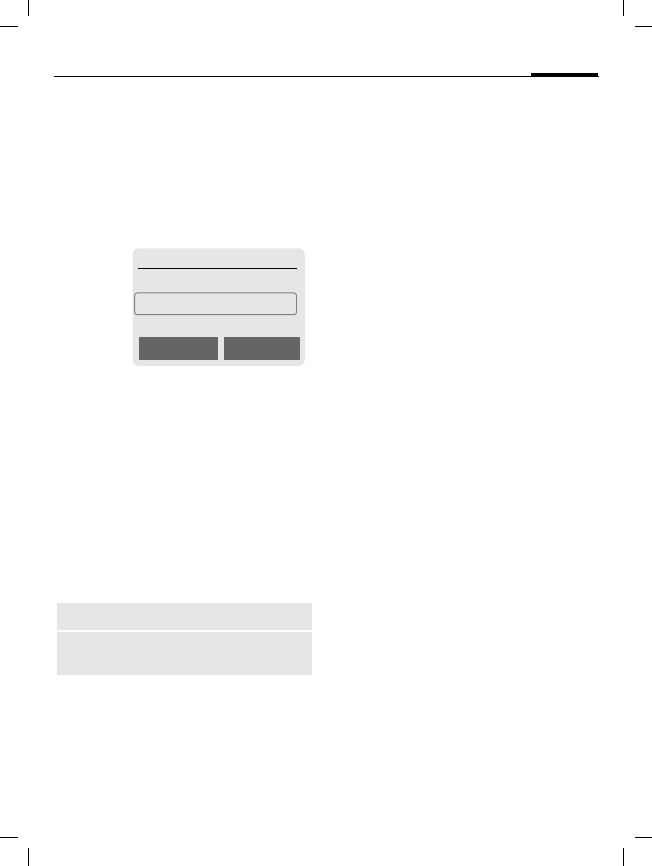
Highlighting mode 55
S56 am, A31008-H5700-A40-1-7619 (6. December 2002, 10:21)
© Siemens AG 2002, D:\Pool\L55\S55\am\Kurzanleitung\S56K_Text.fm
Highlighting
mode
With some applications (e.g. Ad-
dressbook) one or more entries in a
list can be highlighted to carry out a
function jointly.
§Options§ Open menu.
Mark text Activate highlighting
mode.
If an unmarked entry is selected, this
can be highlighted:
§Mark text§ The current entry is high-
lighted.
If a highlighted entry is selected, the
highlighting can be deleted:
§Unmark§ Unmark the current entry.
Highlighting function in options
menu:
§Options§ Open menu.
Mark all Highlight all entries.
Unmark all Delete highlighting on all
marked entries.
N Addressbook
oAnne
oBarbara
pCarol
Mark text Options
Display symbols (selection)
56
S56 am, A31008-H5700-A40-1-7619 (6. December 2002, 10:20)
© Siemens AG 2002, D:\Pool\L55\S55\am\Kurzanleitung\S56K_DisplaySymbols.fm
Display
symbols
(selection)
Display symbols
_Signal strength.
hCharging.
dCharging status, e.g. 50%.
nAll calls are forwarded
jRinger off.
kShort ring (beep) only.
lRinger only if caller is stored in
Phonebook.
iAlarm set.
yAlarm clock activated.
µKey lock activated.
Phone numbers/names:
¢On the SIM card
¡On the SIM card
(PIN 2 protected).
vIn the phone memory.
²No network access.
p,oFunction activated/deactivated.
NPhonebook/Addressbook.
ABC/
Abc/abc Indicates whether upper- or
lower-case letters are active.
™Text input with T9.
IrDA activated.
¬IrDA during transmission.
ß Bluetooth™ activated.
«Activated and available.
ªRegistered.
©GPRS Download.
ÊWAP online.
ËWAP via GPRS online.
ÌWAP No network.
Headset mode.
±Auto answer feature on.
Organizer/Extras symbols
uMemo.
vCall.
wAppointment.
xDictating mach./voice memory.
{Birthday.
tImportant event.
y/çAlarm clock/stopwatch.
Soft keys
]Message received.
\Voice mail received.
Unanswered call.
º
Store in Phonebook/
Addressbook.
·
¹
Retrieve from Phone/
Addressbook.
OChange Phonebook/
Addressbook.

Customer Care 57
S56 am, A31008-H5700-A40-1-7619 (6. December 2002, 13:33)
© Siemens AG 2002, D:\Pool\L55\S55\am\Kurzanleitung\S56K_Hotline.fm
Customer
Care
If repair work is necessary please contact one of our service centres. In some countries repair
and replace services are impossible where the products are not sold through our authorised
dealers.
Abu Dhabi ..........................................0 26 42 38 00
Argentina ......................................0 80 08 88 98 78
Australia...........................................13 00 66 53 66
Austria..............................................05 17 07 50 04
Bahrain.......................................................40 42 34
Bangladesh ........................................0 17 52 74 47
Belgium ..............................................0 78 15 22 21
Bosnia Herzegovina ...........................0 33 27 66 49
Brazil .............................................0 80 07 07 12 48
Brunei.................................................... 02 43 08 01
Bulgaria.................................................02 73 94 88
Cambodia.............................................. 12 80 05 00
Canada..........................................1 88 87 77 02 11
China .............................................0 21 50 31 81 49
Croatia................................................0 16 10 53 81
Czech Republic.................................02 33 03 27 27
Denmark................................................35 25 86 00
Dubai..................................................0 43 96 64 33
Egypt ..................................................0 23 33 41 11
Estonia ..................................................06 30 47 97
Finland..............................................09 22 94 37 00
France ..............................................01 56 38 42 00
Germany*......................................0 18 05 33 32 26
Greece...........................................0 80 11 11 11 16
Hong Kong ............................................28 61 11 18
Hungary............................................06 14 71 24 44
Iceland.....................................................5 11 30 00
India ..........................................01 13 73 85 89 - 98
Indonesia.......................................0 21 46 82 60 81
Ireland ..............................................18 50 77 72 77
Italy ..................................................02 66 76 44 00
Ivory Coast ............................................21 35 02 35
Jordan................................................0 64 39 86 42
Kenya ......................................................2 72 37 17
Kuwait.....................................................2 45 41 78
Latvia ...................................................... 7 50 11 14
Lebanon................................................ 01 44 30 43
Libya ................................................ 02 13 50 28 82
Lithuania ............................................ 8 52 74 20 10
Luxembourg......................................... 43 84 33 99
Macedonia............................................ 02 13 14 84
Malaysia.......................................... 03 21 63 11 18
Malta ..................................... 00 35 32 14 94 06 32
Mauritius ................................................ 2 11 62 13
Mexico........................................ 01 80 07 11 00 03
Morocco................................................ 22 66 92 09
Netherlands.................................. 0 90 03 33 31 00
New Zealand ................................... 08 00 27 43 63
Nigeria ............................................... 0 14 50 05 00
Norway ................................................. 22 70 84 00
Oman ......................................................... 79 10 12
Pakistan ........................................... 02 15 66 22 00
Philippines.......................................... 0 27 57 11 18
Poland.............................................. 08 01 30 00 30
Portugal ............................................. 8 08 20 15 21
Qatar..................................................... 04 32 20 10
Romania........................................... 02 12 04 60 00
Russia ........................................... 8 80 02 00 10 10
Saudi Arabia...................................... 0 22 26 00 43
Serbia .............................................. 01 13 22 84 85
Singapore ............................................. 62 27 11 18
Slovak Republic ............................... 02 59 68 22 66
Slovenia ............................................. 0 14 74 63 36
South Africa..................................... 08 60 10 11 57
Spain.................................................. 9 02 11 50 61
Sweden.............................................. 0 87 50 99 11
Switzerland...................................... 08 48 21 20 00
Taiwan............................................. 02 23 96 10 06
Thailand............................................. 0 22 68 11 18
Tunisia .................................................. 71 86 19 02
Turkey ........................................... 0 21 65 79 71 00
Ukraine ......................................... 8 80 05 01 00 00
Simple, straightforward support for technical and operational queries is available from our
online support service on the Internet: www.my-siemens.com/customercare or in the ex-
tended version of the user guide on the CD-ROM in the chapter "Questions & Answers".
*. 0.12 euros/minute

Customer Care
58
S56 am, A31008-H5700-A40-1-7619 (6. December 2002, 13:33)
© Siemens AG 2002, D:\Pool\L55\S55\am\Kurzanleitung\S56K_Hotline.fm
United Arab Emirates ........................0 43 31 95 78
United Kingdom ............................0 87 05 33 44 11
USA...............................................1 88 87 77 02 11
Vietnam.................................................45 63 22 44
Zimbabwe .............................................04 36 94 24
Note
When calling customer service, please
have ready your receipt and the phone
identity number (IMEI, to display press
*#06#), software version (to display press
*#06#, then §Info§) and if available, your
Siemens Service customer number

Specifications 59
S56 am, A31008-H5700-A40-1-7619 (9. December 2002, 15:04)
© Siemens AG 2001, D:\Pool\L55\S55\am\Kurzanleitung\S56K_Specification.fm
Specifica-
tions Exposure to
radiofrequency signals
Your wireless handheld portable
telephone is a low power radio trans-
mitter and receiver. When it is ON, it
receives and also sends out radiofre-
quency (RF) signals.
In August 1996, The Federal Com-
munications Commission (FCC)
adopted RF exposure guidelines with
safety levels for hand-held wireless
phones. Those guidelines are consis-
tent with the safety standards previ-
ously set by both U.S. and interna-
tional standards bodies:
• American National Standards In-
stitute (ANSI) C95.1 (1992)
• National Council of Radiation Pro-
tection and Measurement (NCRP)
Report 86 (1986)
• International Commission of Non-
Ionizing Radiation Protection (IC-
NIRP) 1996
• Ministry of Health (Canada) Safety
Code 6
Those standards were based on com-
prehensive and periodic evaluations
of the relevant scientific literature.
For example, over 120 scientists, en-
gineers, and physicians from univer-
sities, government health agencies,
and industry reviewed the available
body of research to develop the ANSI
standard (C95.1).
The design of your phone complies
with the FCC guidelines (and those
standards). For additional informa-
tion concerning exposure to radio
frequency signal, see the statement
by the FDA at the end of this user
guide.
Technical data
Trademarks
CPS is a trademark of Cambridge
Positioning Systems Limited.
GSM class: 4 (33 dBm - 850 MHz)
1 (30 dBm - 1.9 GHz)
BlueTooth™ class: 2 (1 mW)
Frequency range: 824 - 894 MHz
1.850 - 1.990 GHz
2.400-2.4835 GHz
Weight: 83 g / 2.96 oz.
Dimensions: 101x44/41x21 mm
(69 ccm)
LiIon battery: 700 mAh
Operating temper-
ature:
14 °F to 131 °F
SIM card: plug-in 3 V / 1.8 V
Standby Time: up to 300 hours
Talk Time: up to 6 hours
Maintenance
60
S56 am, A31008-H5700-A40-1-7619 (6. December 2002, 13:36)
© Siemens AG 2001, D:\Pool\L55\S55\am\Kurzanleitung\S56K_Maintenance.fm
Maintenance Maintenance tips
• The SIM card should be treated
with the same care as a cheque
guarantee card. Do not bend or
scratch it or expose it to static
electricity.
• Clean the card with a damp cloth
or an antistatic wipe without
chemical cleaning agents.
• Protect the phone from moisture
and shocks. Do not expose your
phone to direct sunlight.
• Remove the battery if you are not
going to use the phone for ex-
tended periods of time (more than
one month).
Phone ID
You will need the following details if you
lose your phone or SIM card. Please enter
here
the number of the SIM card (on the card):
..............................................................
15-digit serial number of the phone (under
the battery):
..............................................................
Customer Service number of the service
provider:
..............................................................
Lost phone
If you lose your phone or SIM card contact
your service provider immediately to pre-
vent misuse.

U.S. FDA 61
S56 am, A31008-H5700-A40-1-7619 (9. December 2002, 15:01)
© Siemens AG 2001, D:\Pool\L55\S55\am\Kurzanleitung\S56K_FDA.FM
U.S. FDA
The U.S. Food and Drug
Administration's (FDA) Center
for Devices and Radiological
Health Consumer Update on
Mobile Phones
FDA has been receiving inquiries
about the safety of mobile phones,
including cellular phones and PCS
phones. The following summarizes
what is know — and what remains
unknown — about whether these
products can pose a hazard to
health, and what can be done to
minimize any potential risk. This in-
formation may be used to respond
to questions.
Why the concern?
Mobile phones emit low levels of ra-
dio frequency energy (i.e., radio fre-
quency radiation) in the microwave
range while being used. They also
emit very low levels of radio frequen-
cy energy (RF), considered non-sig-
nificant, when in the stand-by mode.
It is well known that high levels of RF
can produce biological damage
through heating effects (this is how
your microwave oven is able to cook
food). However, it is not known
whether, to what extent, or through
what mechanism, lower levels of RF
might cause adverse health effects
as well. Although some research has
been done to address these ques-
tions, no clear picture of the biologi-
cal effects of this type of radiation
has emerged to date. Thus, the avail-
able science does not allow us to
conclude that mobile phones are ab-
solutely safe, or that they are unsafe.
However, the available scientific evi-
dence does not demonstrate ad-
verse health effects associated with
the use of mobile phones.
What kinds of phones are in question?
Questions have been raised about
hand-held mobile phones, the kind
that have a built-in antenna that is
positioned close to the user's head
during normal telephone conversa-
tion. These types of mobile phones
are of concern because of the short
distance between the phone's an-
tenna — the primary source of the
RF — and the person's head. The ex-
posure to RF from mobile phones in
which the antenna is located at
greater distances from the user (on
the outside of a car, for example) is
drastically lower than that from
hand-held phones, because a per-
son's RF exposure decreases rapidly
with distance from the source. The
safety of so-called “cordless phones,”
which have a base unit connected to
the telephone wiring in a house and
which operate at far lower power
levels and frequencies, has not been
questioned.

U.S. FDA
62
S56 am, A31008-H5700-A40-1-7619 (9. December 2002, 15:01)
© Siemens AG 2001, D:\Pool\L55\S55\am\Kurzanleitung\S56K_FDA.FM
How much evidence is there that hand-
held mobile phones might be harmful?
Briefly, there is not enough evidence
to know for sure, either way; howev-
er, research efforts are on-going.
The existing scientific evidence is
conflicting and many of the studies
that have been done to date have
suffered from flaws in their research
methods. Animal experiments inves-
tigating the effects of RF exposures
characteristic of mobile phones have
yielded conflicting results. A few ani-
mal studies, however, have suggest-
ed that low levels of RF could accel-
erate the development of cancer in
laboratory animals. In one study,
mice genetically altered to be predis-
posed to developing one type of can-
cer developed more than twice as
many such cancers when they were
exposed to RF energy compared to
controls. There is much uncertainty
among scientists about whether re-
sults obtained from animal studies
apply to the use of mobile phones.
First, it is uncertain how to apply the
results obtained in rats and mice to
humans. Second, many of the stud-
ies showed increased tumor devel-
opment used animals that had al-
ready been treated with cancer-
causing chemicals, and other studies
exposed the animals to the RF virtu-
ally continuously — up to 22 hours
per day.
For the past five years in the United
States, the mobile phone industry
has supported research into the safe-
ty of mobile phones. This research
has resulted in two findings in partic-
ular that merit additional study:
1. In a hospital-based, case-control
study, researchers looked for an as-
sociation between mobile phone use
and either glioma (a type of brain
cancer) or acoustic neuroma (a be-
nign tumor of the nerve sheath). No
statistically significant association
was found between mobile phone
use and acoustic neuroma. There
was also no association between
mobile phone use and gliomas when
all types of gliomas were considered
together. It should be noted that the
average length of mobile phone ex-
posure in this study was less than
three years.
When 20 types of glioma were con-
sidered separately, however, an as-
sociation was found between mobile
phone use and one rare type of glio-
ma, neuroepithelliomatous tumors.
It is possible with multiple compari-
sons of the same sample that this as-
sociation occurred by chance. More-
over, the risk did not increase with
how often the mobile phone was
used, or the length of the calls. In
fact, the risk actually decreased with
cumulative hours of mobile phone
use. Most cancer causing agents in-
crease risk with increased exposure.
An ongoing study of brain cancers by
the National Cancer Institute is ex-
pected to bear on the accuracy and
repeatability of these results.1

U.S. FDA 63
S56 am, A31008-H5700-A40-1-7619 (9. December 2002, 15:01)
© Siemens AG 2001, D:\Pool\L55\S55\am\Kurzanleitung\S56K_FDA.FM
2. Researchers conducted a large
battery of laboratory tests to assess
the effects of exposure to mobile
phone RF on genetic material. These
included tests for several kinds of ab-
normalities, including mutations,
chromosomal aberrations, DNA
strand breaks, and structural chang-
es in the genetic material of blood
cells called lymphocytes. None of
the tests showed any effect of the RF
except for the micronucleus assay,
which detects structural effects on
the genetic material. The cells in this
assay showed changes after expo-
sure to simulated cell phone radia-
tion, but only after 24 hours of expo-
sure. It is possible that exposing the
test cells to radiation for this long re-
sulted in heating. Since this assay is
known to be sensitive to heating,
heat alone could have caused the ab-
normalities to occur. The data al-
ready in the literature on the re-
sponse of the micronucleus assay to
RF are conflicting. Thus follow-up re-
search is necessary. 2
FDA is currently working with
government, industry, and academic
groups to ensure the proper follow-
up to these industry-funded
research findings. Collaboration with
the Cellular Telecommunications
Internet Association (CTIA) in
particular is expected to lead to FDA
providing research
recommendations and scientific
oversight of new CTIA-funded
research based on such
recommendations.
Two other studies of interest have
been reported recently in the litera-
ture:
• Two groups of 18 people were ex-
posed to simulated mobile phone
signals under laboratory condi-
tions while they performed cogni-
tive function tests. There were no
changes in the subjects' ability to
recall words, numbers, or pic-
tures, or in their spatial memory,
but they were able to make choic-
es more quickly in one visual test
when they were exposed to simu-
lated mobile phone signals. This
was the only change noted among
more than 20 variables com-
pared.3
• In a study of 209 brain tumor cas-
es and 425 matched controls,
there was no increased risk of
brain tumors associated with mo-
bile phone use. When tumors did
exist in certain locations, howev-
er, they were more likely to be on
the side of the head where the
mobile phone was used. Because
this occurred in only a small num-
ber of cases, the increased likeli-
hood was too small to be
statistically significant.4
In summary, we do not have enough
information at this point to assure
the public that there are, or are not,
any low incident health problems as-
sociated with use of mobile phones.
FDA continues to work with all par-

U.S. FDA
64
S56 am, A31008-H5700-A40-1-7619 (9. December 2002, 15:01)
© Siemens AG 2001, D:\Pool\L55\S55\am\Kurzanleitung\S56K_FDA.FM
ties, including other federal agencies
and industry, to assure that research
is undertaken to provide the neces-
sary answers to the outstanding
questions about the safety of mobile
phones.
What is known about cases of human
cancer that have been reported in users
of hand-held mobile phones?
Some people who have used mobile
phones have been diagnosed with
brain cancer. But it is important to
understand that this type of cancer
also occurs among people who have
not used mobile phones. In fact,
brain cancer occurs in the U.S. popu-
lation at a rate of about 6 new cases
per 100,000 people each year. At
that rate, assuming 80 million users
of mobile phones (a number increas-
ing at a rate of about 1 million per
month), about 4800 cases of brain
cancer would be expected each year
among those 80 million people,
whether or not they used their
phones. Thus it is not possible to tell
whether any individual's cancer
arose because of the phone, or
whether it would have happened
anyway. A key question is whether
the risk of getting a particular form
of cancer is greater among people
who use mobile phones than among
the rest of the population. One way
to answer that question is to com-
pare the usage of mobile phones
among people with brain cancer
with the use of mobile phones
among appropriately matched peo-
ple without brain cancer. This is
called a case-control study. The cur-
rent case-control study of brain can-
cers by the National Cancer Institute,
as well as the follow-up research to
be sponsored by industry, will begin
to generate this type of information.
What is FDA's role concerning the safety
of mobile phones?
Under the law, FDA does not review
the safety of radiation emitting con-
sumer products such as mobile
phones before marketing, as it does
with new drugs or medical devices.
However, the agency has authority
to take action if mobile phones are
shown to emit radiation at a level
that is hazardous to the user. In such
a case, FDA could require the manu-
facturers of mobile phones to notify
users of the health hazard and to re-
pair, replace or recall the phones so
that the hazard no longer exists.
Although the existing scientific data
do not justify FDA regulatory actions
at this time, FDA has urged the mo-
bile phone industry to take a number
of steps to assure public safety. The
agency has recommended that the
industry:
• Support needed research into pos-
sible biological effects of RF of the
type emitted by mobile phones;
• Design mobile phones in a way
that minimizes any RF exposure to
the user that is not necessary for
device function; and

U.S. FDA 65
S56 am, A31008-H5700-A40-1-7619 (9. December 2002, 15:01)
© Siemens AG 2001, D:\Pool\L55\S55\am\Kurzanleitung\S56K_FDA.FM
• Cooperate in providing mobile
phone users with the best possible
information on what is known
about possible effects of mobile
phone use on human health.
At the same time, FDA belongs to an
interagency working group of the
federal agencies that have responsi-
bility for different aspects of mobile
phone safety to ensure a coordinat-
ed effort at the federal level. These
agencies are:
• National Institute for Occupation-
al Safety and Health
• Environmental Protection Agency
• Federal Communications Com-
mission
• Occupational Health and Safety
Administration
• National Telecommunications and
Information Administration
The National Institutes of Health also
participates in this group.
In the absence of conclusive information
about any possible risk, what can con-
cerned individuals do?
If there is a risk from these products
— and at this point we do not know
that there is — it is probably very
small. But if people are concerned
about avoiding even potential risks,
there are simple steps they can take
to do so. For example, time is a key
factor in how much exposure a per-
son receives. Those persons who
spend long periods of time on their
hand-held mobile phones could con-
sider holding lengthy conversations
on conventional phones and reserv-
ing the hand-held models for shorter
conversations or for situations when
other types of phones are not avail-
able.
People who must conduct extended
conversations in their cars every day
could switch to a type of mobile
phone that places more distance be-
tween their bodies and the source of
the RF, since the exposure level
drops off dramatically with distance.
For example, they could switch to:
• a mobile phone in which the an-
tenna is located outside the vehi-
cle,
• a hand-held phone with a built-in
antenna connected to a different
antenna mounted on the outside
of the car or built into a separate
package, or
• a headset with a remote antenna
to a mobile phone carried at the
waist.
Where can I find additional information?
For additional information, see the
following websites:
• Federal Communications Com-
mission (FCC) RF Safety Program
(select “Information on Human Ex-
posure to RF Fields from Cellular
and PCS Radio Transmitters”):
http://www.fcc.gov/oet/rfsafety.

U.S. FDA
66
S56 am, A31008-H5700-A40-1-7619 (9. December 2002, 15:01)
© Siemens AG 2001, D:\Pool\L55\S55\am\Kurzanleitung\S56K_FDA.FM
• World Health Organization (WHO)
International Commission on
Non-Ionizing Radiation Protection
(select Qs & As):
http://www.who.int/emf
• United Kingdom, National Radio-
logical Protection Board:
http://www.nrpb.org.uk
• Cellular Telecommunications In-
ternet Association (CTIA):
http://www.wow-com.com
• U.S. Food and Drug Administra-
tion (FDA) Center for devices and
Radiological Health:
http://www.fda.gov/cdhr/
consumer/
1 Muscat et al. Epidemiological Study of Cel-
lular Telephone Use and Malignant Brain
Tumors. In: State of the Science Sympo-
sium; 1999 June 20; Long Beach, California.
2 Tice et al. Tests of mobile phone signals for
activity in genotoxicity and other laboratory
assays. In: Annual Meeting of the Environ-
mental Mutagen Society; March 29, 1999,
Washington, DC; and personal communica-
tion, unpublished results.
3 Preece, AW, Iwi, G, Davies-Smith, A,
Wesnes, K, Butler, S, Lim, E, and Varey, A.
Effect of a 915- MHz simulated mobile
phone signal on cognitive function in man.
Int. J. Radiat. Biol., April 8, 1999.
4 Hardell, L, Nasman, A, Pahlson, A,
Hallquist, A and Mild, KH. Use of cellular
telephones and the risk for brain tumors; a
case-control study. Int. J. Oncol, 15: 113-
116, 1999.

FCC/Industry Canada Notice 67
S56 am, A31008-H5700-A40-1-7619 (9. December 2002, 15:01)
© Siemens AG 2001, D:\Pool\L55\S55\am\Kurzanleitung\S56K_FDA.FM
FCC/Industry
Canada
Notice
Your phone may cause TV or radio in-
terference (for example, when using
a telephone in close proximity to re-
ceiving equipment). The FCC or In-
dustry Canada can require you to
stop using your telephone if such in-
terference cannot be eliminated. If
you require assistance, please con-
tact your local service facility.
This device complies with part 15 of
the FCC rules. Operation is subject
to the condition that this device
does not cause harmful interfer-
ence.

Ten Driving Safety Tips
68
S56 am, A31008-H5700-A40-1-7619 (9. December 2002, 15:01)
© Siemens AG 2001, D:\Pool\L55\S55\am\Kurzanleitung\S56K_Driving_Tips.fm
Ten Driving
Safety Tips
Your Siemens wireless phone gives
you the power to communicate by
voice — almost anywhere, anytime.
But an important responsibility ac-
companies the benefits of wireless
phones, one that every user must
uphold.
When driving a car, driving is your
first responsibility. When using your
wireless phone behind the wheel of
a car, practice good common sense
and remember the following tips:
Get to know your phone and its features
such as speed dial and redial.
Carefully read your instruction man-
ual and learn to take advantage of
valuable features most phones offer
including, automatic redial and
memory dial — most phones can
store up to 99 numbers in memory
dial. Also, work to memorize the
phone keypad so you can use the
speed dial function without taking
your attention off the road.
When available, use a hands-free device.
A number of hands-free wireless
phone accessories are readily avail-
able today. Whether you choose an
installed mounted device for your
phone or a speaker phone accessory,
take advantage of these devices if
they are available to you.
Position your phone within easy reach.
Make sure you place your wireless
phone within easy reach and where
you can grab it without removing
your eyes from the road. If you get
an incoming call at an inconvenient
time, let your voice mail answer it for
you.
Suspend conversations during hazard-
ous driving conditions or situations.
Let the person you are speaking to
know you are driving; if necessary,
suspend the call in heavy traffic or
hazardous weather conditions. Rain,
sleet, snow and ice can be hazard-
ous, but so is heavy traffic. As a driv-
er, your first responsibility is to pay
attention to the road.
Do not take notes or look up phone num-
bers while driving.
If you are reading an address book or
business card while driving a car, or
writing a “to do” list, then you are not
watching where you are going. It’s
common sense. Don’t get caught in a
dangerous situation because you are
reading or writing and not paying at-
tention to the road or nearby vehi-
cles.

Ten Driving Safety Tips 69
S56 am, A31008-H5700-A40-1-7619 (9. December 2002, 15:01)
© Siemens AG 2001, D:\Pool\L55\S55\am\Kurzanleitung\S56K_Driving_Tips.fm
Dial sensibly and assess the traffic.
If possible, place calls when you are
not moving or before pulling into
traffic. Try to plan your calls before
you begin your trip, or attempt to co-
incide your calls with times you may
be stopped at a stop sign, red light or
otherwise stationary. But if you need
to dial while driving, follow this sim-
ple tip — dial only a few numbers,
check the road and your mirrors,
then continue.
Do not engage in stressful or emotional
conversations that may be distracting.
Stressful or emotional conversations
and driving do not mix — they are
distracting and even dangerous
when you are behind the wheel.
Make people you are talking with
aware you are driving and if neces-
sary, suspend phone conversations
that have the potential to divert your
attention from the road.
Use your phone to call for help.
Your wireless phone is one of the
greatest tools you can own to pro-
tect yourself and your family in dan-
gerous situations — with your
phone at your side, help is only three
numbers away. Dial 9-1-1 in the case
of fire, traffic accident, road hazard,
or medical emergency. Remember, it
is a free call on your wireless phone.
Use your phone to help others in emer-
gencies.
Your wireless phone provides you a
perfect opportunity to be a “good
Samaritan” in your community. If
you see an auto accident, crime in
progress or other serious emergen-
cies where lives are in danger, call 9-
1-1, as you would want others to do
for you.
Call roadside assistance or a special
wireless non-emergency assistance
number when necessary.
Certain situations you encounter
while driving may require attention,
but are not urgent enough to merit a
call to 9-1-1. But you can still use
your wireless phone to lend a hand.
If you see a broken-down vehicle
posing no serious hazard, a broken
traffic signal, a minor traffic accident
where no one appears injured, or a
vehicle you know to be stolen, call
roadside assistance or other special
non-emergency wireless numbers.
Provided by the Cellular Telecommunica-
tions Internet Association (CTIA)
“The wireless industry reminds you to
use your phone safely when driving.”
For more information, please call
1 (888) 901-SAFE, or visit our Web site
at: www.wow-com.com

Intellectual Property
70
S56 am, A31008-H5700-A40-1-7619 (6. December 2002, 10:20)
© Siemens AG 2001, D:\Pool\L55\S55\am\Kurzanleitung\S56K_intellectual_property.fm
Intellectual
Property Intellectual Property Restrictions
All Intellectual Property, as defined
below, which is owned by or other-
wise the property of Siemens Infor-
mation and Communications Mo-
bile, LLC (“Siemens”), its affiliates,
partners or suppliers, relating to the
Phone, including but not limited to
accessories, parts or software relat-
ing thereto (the “Phone System”), is
proprietary under federal laws, state
laws and International treaty provi-
sions. Intellectual Property includes,
but is not limited to, inventions (pat-
entable or unpatentable), patents,
trade secrets, copyrights, software,
computer programs, and related
documentation and other works of
authorship. You may not infringe or
otherwise violate the rights secured
by the Intellectual Property. More-
over, you agree that you will not
(and will not attempt to) disassem-
ble, decompile, reverse engineer,
prepare derivative works from, mod-
ify or make any other effort to create
source code from the software. No
title to ownership in the Intellectual
Property is transferred to you
through purchase or possession of
the Phone or its components. All ap-
plicable rights of the Intellectual
Property shall remain with Siemens,
its affiliates, partners or suppliers.
Siemens will have no liability with re-
spect to any claim of patent infringe-
ment which is based upon the com-
bination of the Product or parts
furnished hereunder with software,
apparatus or devices not furnished
by Siemens, nor will Siemens have
any liability for the use of ancillary
equipment or software not fur-
nished by Siemens which is attached
to or used in connection with the
Product, The foregoing states the en-
tire liability of Siemens with respect
to infringement of patents by the
Product or any parts thereof.
Laws in the United States and other
countries preserve for Siemens cer-
tain exclusive rights for copyrighted
Siemens software, such as the exclu-
sive rights to reproduce and distrib-
ute copies of such Siemens software.
Siemens software may be used only
in the Product in which the software
was originally embodied when pur-
chased, and such software in such
Product may not be replaced, cop-
ied, distributed. modified in any
way, or used to produce any deriva-
tive thereof. No other use including,
without limitation, alteration, modi-
fication, reproduction, distribution.
or reverse engineering of such Sie-
mens software or exercise of rights
in such Siemens software is permit-
ted. No license is granted by implica-
tion, estoppel or otherwise under Si-
emens patent rights or copyrights.

Battery quality statement 71
S56 am, A31008-H5700-A40-1-7619 (6. December 2002, 10:20)
© Siemens AG 2001, D:\Pool\L55\S55\am\Kurzanleitung\S56K_Battery_quality_statement .fm
Battery
quality
statement
The capacity of your mobile phone
battery will reduce each time it is
charged/emptied. Storage at too
high or low temperatures will also
result in a gradual capacity loss. As a
result the operating time of your
mobile phone may be considerably
reduced, even after a full recharge of
the battery.
Regardless of this, the battery has
been designed and manufactured so
that it can be recharged and used for
six months after the purchase of
your mobile phone. After six
months, if the battery is clearly suf-
fering from loss of performance, we
recommend that you replace it.
Please buy only Siemens original
batteries.

Index
72
S56 am, A31008-H5700-A40-1-7619 (6. December 2002, 13:37)
© Siemens AG 2002, D:\Pool\L55\S55\am\Kurzanleitung\S56K_MarlinSIX.fm
Index A
Addressbook....................................23
Agenda .............................................27
Aircraft mode...................................36
Alarm................................................37
appointment................................27
switch off.....................................27
Alarm clock ......................................37
Answering service (external)......... 33
Any key, call accept ........................43
Appointments..................................27
Archive entry number.....................22
Audio ................................................43
Auto redial previous numbers ....... 18
B
Babysitter .........................................46
Battery........................................12, 13
quality statement........................71
Bluetooth™ ................................45, 49
Browser ............................................34
Business card ...................................21
C
Calculator.........................................37
Calculator functions........................ 37
Calendar ...........................................27
Call
accept/finish ................................19
barring..........................................47
charge .......................................... 26
conference...................................20
end................................................18
forwarding...................................44
reject ............................................19
swap (change) ............................20
Call forwarding................................44
Call lists ............................................26
Camera .............................................38
Car Kit ...............................................48
CB services....................................... 33
Cell Broadcast (CB) ......................... 33
Change PIN...................................... 17
Charging battery............................. 13
Command (voice command) ........ 39
Conference...................................... 20
Countdown...................................... 38
CSD................................................... 46
Currency converter......................... 37
D
Data exchange (settings)............... 45
Data service..................................... 46
Date format ..................................... 45
Dial-up access (connection) .......... 46
Dictating machine .......................... 28
Display settings............................... 42
Display symbols .............................. 56
Download ........................................ 35
Driving safety .................................. 68
Duration/costs................................. 26
E
E-mail ............................................... 32
Emergency number........................ 15
Enter PIN.......................................... 14
Extras ............................................... 37
F
Factory settings .............................. 44
Fast access key................................ 40
File system....................................... 41
Filter for calls................................... 43
Flashlight ......................................... 38
Folder (file system)......................... 41
Forwarding ...................................... 44
Frequency (band) ........................... 47

Index 73
S56 am, A31008-H5700-A40-1-7619 (6. December 2002, 13:37)
© Siemens AG 2002, D:\Pool\L55\S55\am\Kurzanleitung\S56K_MarlinSIX.fm
G
Games & More.................................35
Games (download) .........................35
Getting started ................................12
GPRS..................................................45
Group................................................25
H
Handset volume..............................18
Handsfree talking............................19
Headset ............................................48
Hide ID..............................................44
Highlighting mode..........................55
Hold call ...........................................20
Hotline Siemens ..............................57
I
Icons .................................................56
Identity number (IMEI)...................44
IMEI number ....................................44
Index (file system) ..........................41
Infrared (IrDA) .................................49
Initial animation ..............................42
International dialing code..............18
Internet (WAP).................................34
K
Keypad (settings)............................43
L
Last 10 only .....................................46
List
calls...............................................26
messages .....................................29
Lost phone, SIM card......................60
M
Mailbox.............................................33
Maintenance tips ............................60
Messages..........................................29
MMS..................................................31
My menu.......................................... 40
N
Network barring.............................. 47
Network functions.......................... 47
New folder (file system) ................ 41
Notes................................................ 27
Number busy................................... 18
O
Only ,........................................... 46
Only this SIM ................................... 46
Organizer......................................... 27
P
Phone (settings) ............................. 44
Phone barring ................................. 46
Phone code...................................... 17
Phone identity number. (IMEI) ..... 44
Phonebook ...................................... 22
Preferred directory ......................... 21
Prevent accidental activation........ 17
Print via ........................................... 49
Profiles
messages..................................... 29
phone........................................... 36
R
Redial previous numbers ............... 18
Reminder ......................................... 18
Ringtones......................................... 43
S
Safety precautions............................ 3
Screensaver ..................................... 42
Second phone number
(connection).................................... 47
Security...................................... 17, 46
Security numbers............................ 17
Send via........................................... 49
Service numbers (Siemens)........... 57
Set clock........................................... 45

Index
74
S56 am, A31008-H5700-A40-1-7619 (6. December 2002, 13:37)
© Siemens AG 2002, D:\Pool\L55\S55\am\Kurzanleitung\S56K_MarlinSIX.fm
Set ringtone.....................................43
Set time/date .................................. 45
Settings ............................................42
display ..........................................42
Shown in the display
......................................................56
Signal strength ................................15
SIM card
insert ............................................12
remove barring ...........................17
SMS...................................................30
SOS ...............................................6, 15
Special characters ...........................51
Speed dialing keys ..........................40
Standard values...............................44
Standby mode .................................15
Standby time ...................................13
Start menu (WAP) ...........................34
Stopwatch........................................37
Surf & Fun ........................................34
Swap.................................................20
T
T9 text entry.................................... 52
Tasks................................................. 27
Technical data................................. 59
Text blocks....................................... 52
Time zones ...................................... 45
U
Upper/lower cases .......................... 51
V
Voice command.............................. 39
Voice dialing.................................... 24
Voice mail (mailbox) ...................... 33
Volume
handset........................................ 18
profile .......................................... 36
ringtone....................................... 43
W
WAP profile...................................... 34
Warning tones................................. 43