Billion Electric Company Bipac 8500 8520 Users Manual 8521 User Manual_1.81
BiPAC 85008520 to the manual d1ee9f64-fc37-4809-817a-08dd7f1600ce
2015-02-02
: Billion-Electric-Company Billion-Electric-Company-Bipac-8500-8520-Users-Manual-481448 billion-electric-company-bipac-8500-8520-users-manual-481448 billion-electric-company pdf
Open the PDF directly: View PDF  .
.
Page Count: 171 [warning: Documents this large are best viewed by clicking the View PDF Link!]

Billion BiPAC SHDSL/SHDSL.bis (VPN) Firewall Bridge/ Router
Last revision 11-08-08
BiPAC 8500/8520
SHDSL VPN Firewall Bridge/ Router
BiPAC 8501/8521
SHDSL.bis (VPN) Firewall Bridge/Router
User Manual

Billion BiPAC SHDSL/SHDSL.bis (VPN) Firewall Bridge/ Router
i
T
Ta
ab
bl
le
e
o
of
f
C
Co
on
nt
te
en
nt
ts
s
C
CH
HA
AP
PT
TE
ER
R
1
1:
:
I
IN
NT
TR
RO
OD
DU
UC
CT
TI
IO
ON
N.
..
..
..
..
..
..
..
..
..
..
..
..
..
..
..
..
..
..
..
..
..
..
..
..
..
..
..
..
..
..
..
..
..
..
..
..
..
..
..
..
..
..
..
..
..
..
..
..
..
..
..
..
..
..
..
..
..
..
..
..
..
..
..
..
..
..
..
..
..
..
..
..
..
..
..
..
..
..
..
..
..
..
..
..
..
..
..
..
..
..
..
..
..
..
..
..
..
..
..
..
..
..
..
..
..
..
..
..
.1
1
I
NTRODUCTION TO YOUR
R
OUTER
........................................................................................................ 1
F
EATURES
............................................................................................................................................. 1
C
CH
HA
AP
PT
TE
ER
R
2
2:
:
I
IN
NS
ST
TA
AL
LL
LI
IN
NG
G
T
TH
HE
E
R
RO
OU
UT
TE
ER
R.
..
..
..
..
..
..
..
..
..
..
..
..
..
..
..
..
..
..
..
..
..
..
..
..
..
..
..
..
..
..
..
..
..
..
..
..
..
..
..
..
..
..
..
..
..
..
..
..
..
..
..
..
..
..
..
..
..
..
..
..
..
..
..
..
..
..
..
..
..
..
..
..
..
..
..
..
..
..
..
..
..
..
..
..
..
..
..
..
.4
4
I
MPORTANT NOTE FOR USING THIS
R
OUTER
.......................................................................................... 4
P
ACKAGE
C
ONTENTS
............................................................................................................................ 4
T
HE
F
RONT
LED
S OF
B
I
PAC
8500....................................................................................................... 5
T
HE
F
RONT
LED
S OF
B
I
PAC
8520....................................................................................................... 6
T
HE
F
RONT
LED
S OF
B
I
PAC
8501....................................................................................................... 7
T
HE
F
RONT
LED
S OF
B
I
PAC
8521....................................................................................................... 8
T
HE
R
EAR
P
ORTS OF
B
I
PAC
8500
/
8520 ............................................................................................. 9
T
HE
R
EAR
P
ORTS OF
B
I
PAC
8501...................................................................................................... 10
T
HE
R
EAR
P
ORTS OF
B
I
PAC
8521.......................................................................................................11
C
ABLING
............................................................................................................................................ 12
C
CH
HA
AP
PT
TE
ER
R
3
3:
:
B
BA
AS
SI
IC
C
I
IN
NS
ST
TA
AL
LL
LA
AT
TI
IO
ON
N.
..
..
..
..
..
..
..
..
..
..
..
..
..
..
..
..
..
..
..
..
..
..
..
..
..
..
..
..
..
..
..
..
..
..
..
..
..
..
..
..
..
..
..
..
..
..
..
..
..
..
..
..
..
..
..
..
..
..
..
..
..
..
..
..
..
..
..
..
..
..
..
..
..
..
..
..
..
..
..
..
..
..
..
..
..
..
..
..
..
..
..
..
..
..
..
.1
13
3
C
ONNECTING YOUR ROUTER
.............................................................................................................. 13
Network Configuration................................................................................................................. 14
F
ACTORY
D
EFAULT
S
ETTINGS
............................................................................................................. 23
Web Interface (Username and Password): ................................................................................... 23
Device LAN IP Settings: .............................................................................................................. 23
ISP setting in WAN site:............................................................................................................... 23
DHCP server:................................................................................................................................ 23
LAN and WAN Port Addresses .................................................................................................... 23
I
NFORMATION FROM YOUR
ISP........................................................................................................... 24
C
ONFIGURING WITH YOUR
W
EB
B
ROWSER
........................................................................................ 25
C
CH
HA
AP
PT
TE
ER
R
4
4:
:
C
CO
ON
NF
FI
IG
GU
UR
RA
AT
TI
IO
ON
N.
..
..
..
..
..
..
..
..
..
..
..
..
..
..
..
..
..
..
..
..
..
..
..
..
..
..
..
..
..
..
..
..
..
..
..
..
..
..
..
..
..
..
..
..
..
..
..
..
..
..
..
..
..
..
..
..
..
..
..
..
..
..
..
..
..
..
..
..
..
..
..
..
..
..
..
..
..
..
..
..
..
..
..
..
..
..
..
..
..
..
..
..
..
..
..
..
..
..
..
..
..
..
..
..
.2
26
6
S
TATUS
............................................................................................................................................... 27
ARP Table..................................................................................................................................... 27
Routing Table ............................................................................................................................... 28
DHCP Table.................................................................................................................................. 29
PPTP Status (BiPAC 8500/ 8501/ 8520 Only) ............................................................................. 30
IPSec Status (BiPAC 8500/ 8501/ 8520 Only)............................................................................. 31
L2TP Status (BiPAC 8500/ 8501/ 8520 Only) ............................................................................. 32
Email Status.................................................................................................................................. 32
Event Log ..................................................................................................................................... 33
Error Log ...................................................................................................................................... 33

ii
NAT Sessions ............................................................................................................................... 34
Diagnostic..................................................................................................................................... 34
UPnP Portmap .............................................................................................................................. 35
Q
UICK
S
TART
..................................................................................................................................... 36
C
ONFIGURATION
................................................................................................................................ 38
LAN (Local Area Network) ......................................................................................................... 38
WAN (Wide Area Network) ......................................................................................................... 46
System .......................................................................................................................................... 74
Firewall and Access Control......................................................................................................... 80
VPN (Virtual Private Networks) (BiPAC 8500/ 8501/ 8520 Only) ............................................. 97
QoS (Quality of Service)............................................................................................................ 136
Virtual Server (“Port Forwarding”)............................................................................................ 144
Time Schedule ............................................................................................................................ 151
Advanced.................................................................................................................................... 153
S
AVE
C
ONFIGURATION TO
F
LASH
..................................................................................................... 165
L
OGOUT
........................................................................................................................................... 165
C
CH
HA
AP
PT
TE
ER
R
5
5:
:
T
TR
RO
OU
UB
BL
LE
ES
SH
HO
OO
OT
TI
IN
NG
G.
..
..
..
..
..
..
..
..
..
..
..
..
..
..
..
..
..
..
..
..
..
..
..
..
..
..
..
..
..
..
..
..
..
..
..
..
..
..
..
..
..
..
..
..
..
..
..
..
..
..
..
..
..
..
..
..
..
..
..
..
..
..
..
..
..
..
..
..
..
..
..
..
..
..
..
..
..
..
..
..
..
..
..
..
..
..
..
..
..
..
..
..
..
..
..
.1
16
66
6
A
AP
PP
PE
EN
ND
DI
IX
X
A
A:
:
P
PR
RO
OD
DU
UC
CT
T
S
SU
UP
PP
PO
OR
RT
T
A
AN
ND
D
C
CO
ON
NT
TA
AC
CT
T
I
IN
NF
FO
OR
RM
MA
AT
TI
IO
ON
N.
..
..
..
..
..
..
..
..
..
..
..
..
..
..
..
..
..
..
..
..
..
..
..
..
..
..
..
..
..
..
..
..
..
..
..
.1
16
67
7

Billion BiPAC 8500/8501/8520/8521 SHDSL (VPN) Firewall Bridge/ Router
Chapter 1: Introduction
1
Chapter 1: Introduction
Introduction to your Router
Welcome to the Billion BiPAC 8500/ 8501/ 8520/ 8521 SHDSL Router. Your SHDSL router is an
“all-in-one” unit, combining an SHDSL modem, SHDSL router and Ethernet network switch,
providing everything you need to get the machines on your network connected to the Internet
over your SHDSL broadband connection. With features such as an SHDSL Quick-Start wizard
and DHCP Server, you can be online in no time at all and with minimum fuss and configuration,
catering for both first-time users and professionals who require advanced features to control
their Internet connection and network.
Features
SHDSL Multi-Mode Standard
BiPAC 8500 / 8520 SHDSL supports downstream and upstream transmission rates of up
to 2.3 / 4.6 Mbps, respectively, and BiPAC 8501 SHDSL.bis can support up to 5.7 Mbps
on 2-wire and 8521 SHDSL.bis can support up to 11.4 Mbps on 4-wire. BiPAC 85xx
series also supports rate management that allows SHDSL subscribers to select an
Internet access speed suiting their needs and budgets. BiPAC 8500/ 8520 and 8501/
8521 follows ITU standard PAM16 Line Code complies with G.991.2 and G.994.1
standards, and BiPAC 8501 follows PAM 32 Line code with G.991.2 and G.991.2.bis
standards. These three models can support Annex A and B operating mode.
Fast Ethernet Switch
A 4-port 10/100Mbps fast Ethernet switch is built in with automatic switching between
MDI and MDI-X for 10Base-T and 100Base-TX ports. An Ethernet straight or crossover
cable can be used directly for auto detection.
Multi-Protocol to establish a connection
It supports PPPoA (RFC 2364 - PPP over ATM Adaptation Layer 5), RFC 1483
encapsulation over ATM (bridged or routed), PPP over Ethernet (RFC 2516), and IPoA
(RFC1577) to establish a connection with the ISP. The product also supports VC-based
and LLC-based multiplexing.
Quick Installation Wizard
It supports a WEB GUI page to install this device quickly. With this wizard, end users not
only can enter the information they get from their ISP easily, it also enables immediate
internet suffing.
Universal Plug and Play (UPnP) and UPnP NAT Traversal
This protocol is used to enable simple and robust connectivity among stand-alone
devices and PCs from many different vendors. It makes networking simple and
affordable for users. UPnP architecture leverages TCP/IP and the Web to enable
seamless proximity networking in addition to controling data transfer among networked

Billion BiPAC 8500/8501/8520/8521 SHDSL (VPN) Firewall Bridge/ Router
Chapter 1: Introduction
2
devices. With this feature enabled, users can now connect to Net meeting or MSN
Messenger seamlessly.
Network Address Translation (NAT)
Allows multi-users to access outside resources such as the Internet simultaneously with
one IP address/one Internet access account. Many application layer gateways (ALG) are
supported such as web browser, ICQ, FTP, Telnet, E-mail, News, Net2phone, Ping,
NetMeeting, IP phone and others.
SOHO Firewall Security with DoS and SPI
Along with the built-in NAT natural firewall feature, the router also provides advanced
hacker pattern-filtering protection. It can automatically detect and block Denial of Service
(DoS) attacks. The router is built with Stateful Packet Inspection (SPI) to determine if a
data packet is allowed access to the private LAN through the firewall.
Domain Name System (DNS) relay
It provides an easy way to map the domain name (a friendly name for users such as
www.yahoo.com) and IP address. When a local machine sets its DNS server with this
router IP address, every DNS conversion request packet from the PC to this router will
be forwarded to the real DNS of an outside network.
Dynamic Domain Name System (DDNS)
The Dynamic DNS service allows you to alias a dynamic IP address to a static hostname.
This dynamic IP address is the WAN IP address. For example, to use the service, you
must first apply for an account from a DDNS service like http://www.dyndns.org/. More
than 5 DDNS servers are supported.
Quality of Service (QoS)
QoS gives you full control over which type of outgoing data traffic should be given priority
by the router, ensuring important data like gaming packets, customer information, or
management information move through the router speed fast, even under heavy load.
The QoS features are configurable by source IP address, destination IP address,
protocol, and port. You can throttle the speed of different types of outgoing data passing
through the router to ensure P2P users don’t saturate the upload bandwidth, or office
browsing doesn’t bring client web serving to a halt. Alternatively, you can simply change
the priority of different types of upload data and let the router sort out the actual speeds
of each data transmission.
Virtual Private Network (VPN) (BiPAC 8500/ 8501/ 8520 Only)
It allows user to establish a virtual network with a remote computer. In this way data can
be transmitted securedly through the virtual tunnel formed within the network. User can
use embedded PPTP and L2TP client/server, IKE and IPSec which are supported by this
router to make a VPN connection or run the PPTP client in PC and the router which
provides IPSec and PPTP pass through function to establish a VPN connection if the
user likes to run the PPTP client in his local computer.
Virtual Server (“port forwarding”)
Users can specify some services to be visible from outside users. The router can detect
incoming service requests and forward either a single port or a range of ports to specific
local computer for handling. For example, a user can assign a PC in the LAN acting as a
WEB server inside and expose it to the outside network. Outside users can browse
inside web servers directly while it is protected by NAT. A DMZ host setting is also
provided to a local computer exposed to the outside network, Internet.

Billion BiPAC 8500/8501/8520/8521 SHDSL (VPN) Firewall Bridge/ Router
Chapter 1: Introduction
3
Rich Packet Filtering
Not only filters the packet based on IP address, but also based on Port numbers. It will
filter packets from and to the Internet. It also provides a higher level of security control.
Dynamic Host Configuration Protocol (DHCP) client and server
In the WAN site, the DHCP client can get an IP address from the Internet Service
Provider (ISP) automatically. In the LAN site, the DHCP server can allocate a range of
client IP addresses including IP address, subnet mask as well as DNS IP address and
distribute them to local computers. It provides an easy way to manage the local IP
network.
Static and RIP1/2 Routing
It has routing capability and supports easy static routing table or RIP1/2 routing protocol.
Simple Network Management Protocol (SNMP)
It is an easy way to remotely manage the router via SNMP.
Web based GUI
It supports web based GUI for configuration and management. It is user-friendly and
comes with on-line help. It also supports remote management capability for remote users
to configure and manage this product.
Firmware Upgradeable
Device can be upgraded to the latest firmware through the WEB based GUI.
Rich Management Interfaces
It supports flexible management interfaces with local console port, LAN port, and WAN
port. Users can use terminal applications through the console port to configure and
manage the device, or Telnet, WEB GUI, and SNMP through LAN or WAN ports to
configure and manage the device.
Billion BiPAC 8500/8501/8520/8521 SHDSL (VPN) Firewall Bridge/ Router
Chapter 2: Installing the router
4
Chapter 2: Installing the Router
Important note for using this Router
Package Contents
SHDSL Firewall Bridge/Router (BiPAC 8500/8520) or SHDSL.bis Firewall Bridge/Router
(BiPAC 8501/8521)
CD-ROM containing the online manual
RJ-11 SHDSL/telephone Cable (One Cable for BiPAC 8500/8501) (Two Cables for
BiPAC 8520/8521)
Ethernet (CAT-5 LAN) Cable
Console (PS2-RS232) Cable
AC-DC power adapter (12V DC, 1A)
Quick Start Guide
Place the router on a stable surface.
Only use the power adapter that comes with the package. Using
a different voltage rating power adaptor may damage the router.
Attention
Do not use the router in high humidity or high temperatures.
Do not use the same power source for the router as other
equipment.
Do not open or repair the case yourself. If the router is too
hot, turn off the power immediately and have it repaired at a
qualified service center.
Avoid using this product and all accessories outdoors.
Warning
Billion BiPAC 8500/8501/8520/8521 SHDSL (VPN) Firewall Bridge/ Router
Chapter 2: Installing the router
5
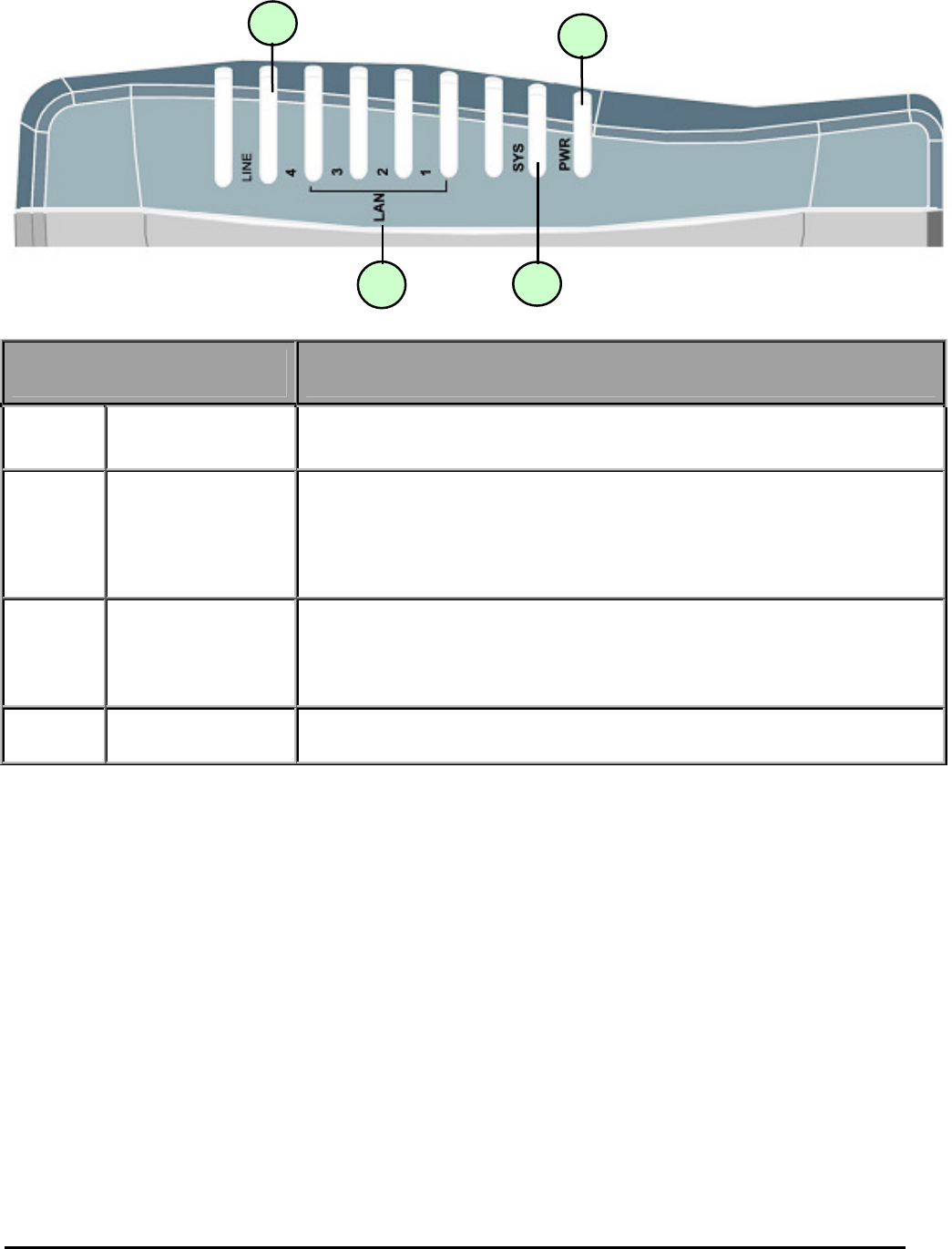
The Front LEDs of BiPAC 8500
LED Meaning
1 LINE Lit when successfully connected to SHDSL line and when it is
synchronized.
2
LAN Port
1X — 4X
(RJ-45 connector)
Lit when connected to an Ethernet device.
Green for 100Mbps; Orange for 10Mbps.
Blinking when data is Transmitted / Received.
3 SYS Lit when the system is ready.
4 PWR Lit when power is ON.
2
3
4
1
Billion BiPAC 8500/8501/8520/8521 SHDSL (VPN) Firewall Bridge/ Router
Chapter 2: Installing the router
6
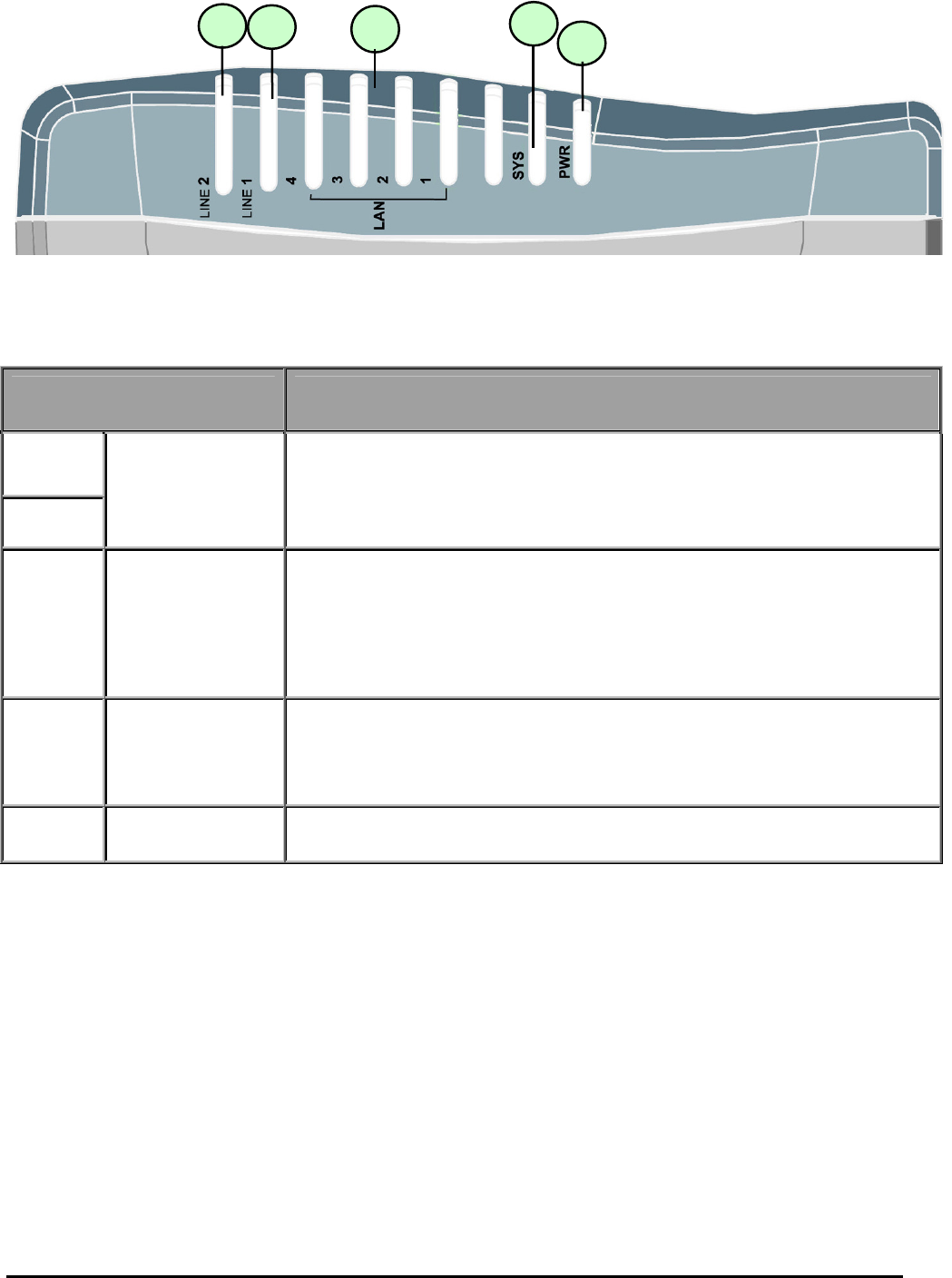
The Front LEDs of BiPAC 8520
LED Meaning
1
2
LINE 1 & 2
Lit when successfully connected to SHDSL line and when it is
synchronized.
3
LAN Port
1X — 4X
(RJ-45 connector)
Lit when connected to an Ethernet device.
Green for 100Mbps; Orange for 10Mbps.
Blinking when data is Transmitted / Received.
4 SYS Lit when the system is ready.
5 PWR Lit when power is ON.
3
4
5
2
1
Billion BiPAC 8500/8501/8520/8521 SHDSL (VPN) Firewall Bridge/ Router
Chapter 2: Installing the router
7
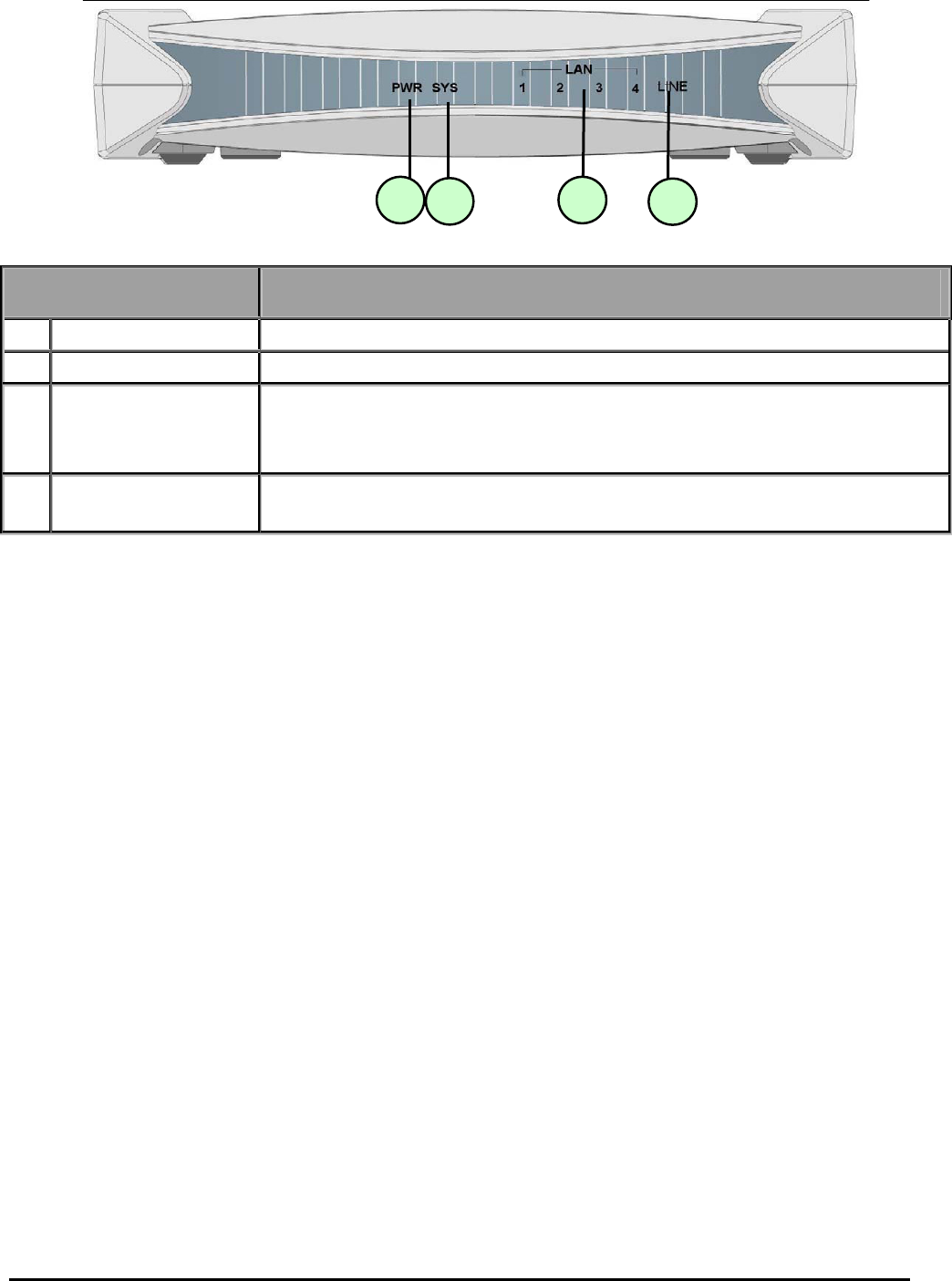
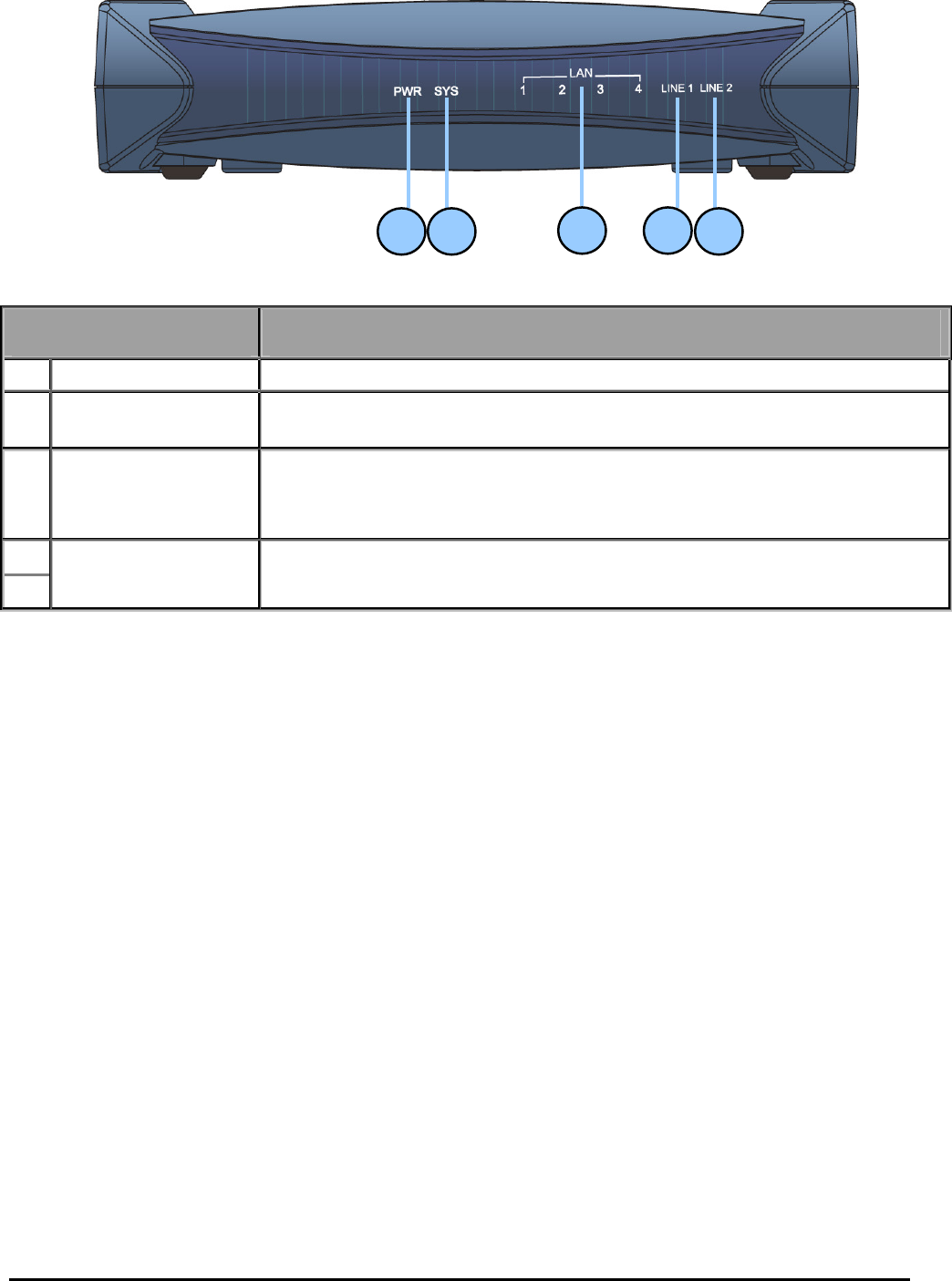
The Front LEDs of BiPAC 8501
LED Meaning
1
PWR Lit when power is ON.
2
SYS Lit when the system is ready.
3
LAN Port
1X — 4X
(RJ-45 connector)
Lit when connected to an Ethernet device.
Green for 100Mbps; Orange for 10Mbps.
Blinking when data is Transmitted / Received.
4
LINE Lit when successfully connected to SHDSL line and when it is
synchronized.
3
2
1
4
Billion BiPAC 8500/8501/8520/8521 SHDSL (VPN) Firewall Bridge/ Router
Chapter 2: Installing the router
8
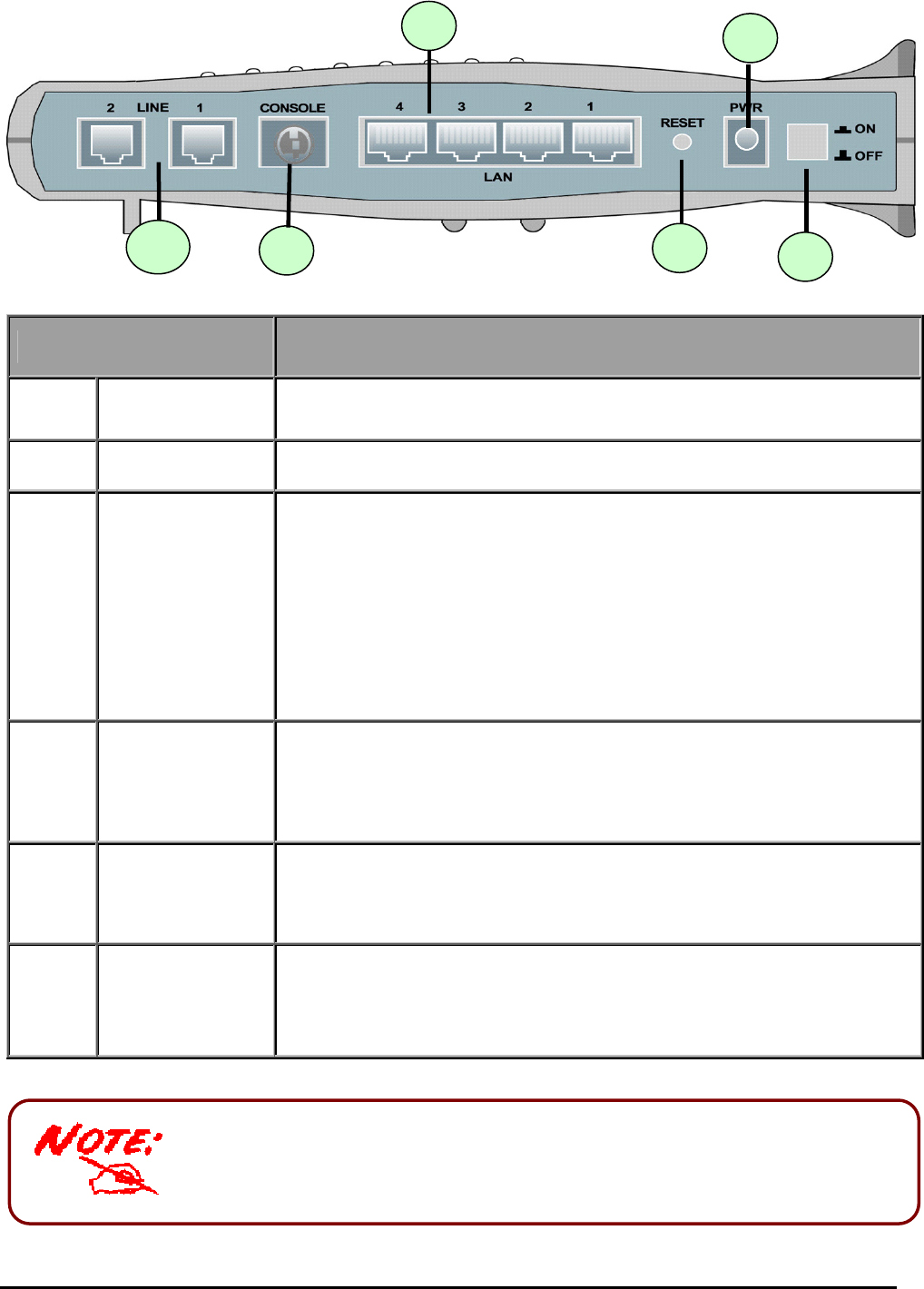
The Front LEDs of BiPAC 8521
LED Meaning
1
PWR Lit green when power is ON.
2
SYS Flashes when the system is being started. Then lit green when the
system is ready.
3
LAN Port
1X — 4X
(RJ-45 connector)
Lit when connected to an Ethernet device.
Green for 100Mbps; Orange for 10Mbps.
Blinking when data is Transmitted / Received.
4
5 LINE 1 & 2 The green LED will flash steadily when successfully connected to
SHDSL line and when it is synchronized.
1
2
3
4
5
Billion BiPAC 8500/8501/8520/8521 SHDSL (VPN) Firewall Bridge/ Router
Chapter 2: Installing the router
9
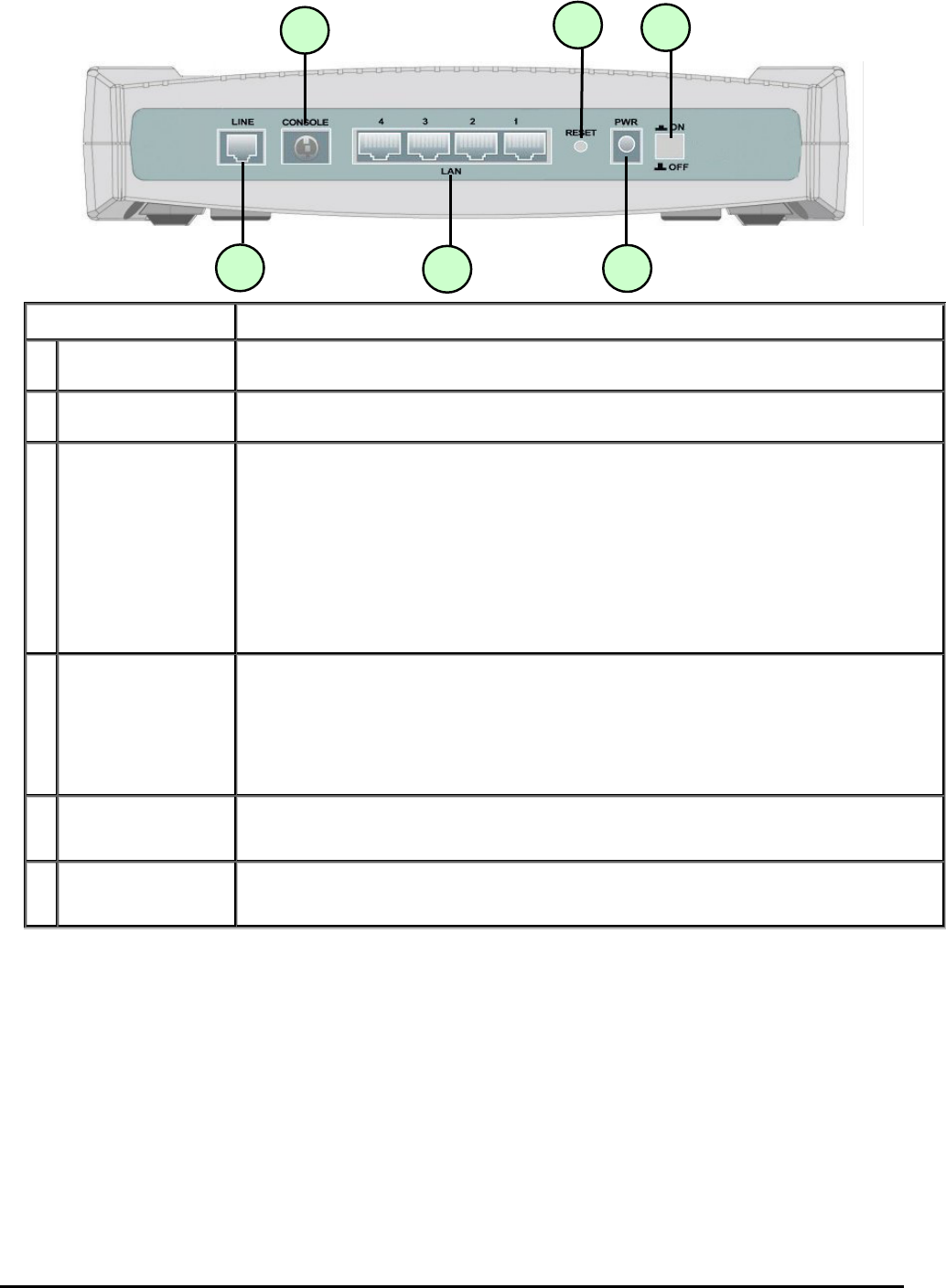
The Rear Ports of BiPAC 8500 / 8520
Port Meaning
1 Power Switch Power ON/OFF switch
2 PWR Connect the supplied power adapter to this jack.
3 RESET
To be sure the device is being turned on press RESET button
for:
1-3 seconds: quick reset the device.
6 seconds above, and power off, power on the device:
restore to factory default settings. (Cannot login to the router or
forgot your Username/Password. Press the button for more than
6 seconds).
Caution: After pressing the RESET button for more than 6
seconds, to be sure you power cycle the device again.
4
LAN
1X — 4X
(RJ-45 connector)
Connect a UTP Ethernet cable (Cat-5 or Cat-5e) to one of the
four LAN ports when connecting to a PC or an office/home
network of 10Mbps or 100Mbps.
5 CONSOLE Connect a PS2/RS-232 cable to this port when connecting to a
PC’s RS-232 port (9-pin serial port).
6
LINE
1X — 2X
(RJ-11 connector)
Connect the supplied RJ-11 (“telephone”) cable to this port when
connecting to the SHDSL line.
1
2
3
4
5
6
Only BiPAC 8520 has two Line jack ports. BiPAC 8500 has one.
.
Billion BiPAC 8500/8501/8520/8521 SHDSL (VPN) Firewall Bridge/ Router
Chapter 2: Installing the router
10
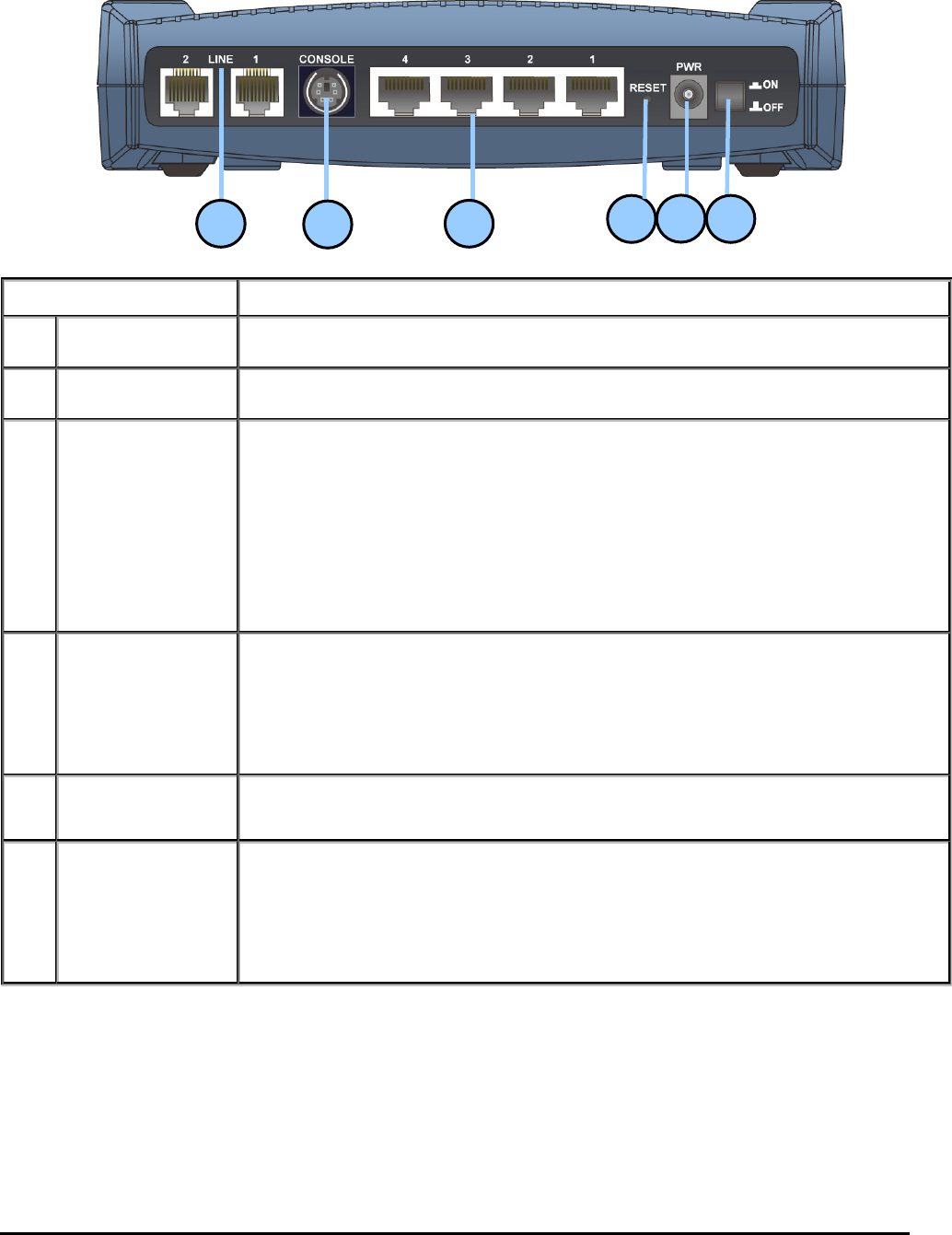
The Rear Ports of BiPAC 8501
Port Meaning
1
Power Switch Power ON/OFF switch
2
PWR Connect the supplied power adapter to this jack.
3
RESET
To be sure the device is being turned on->press RESET button for:
1-3 seconds: quick reset the device.
6 seconds above, and power off, power on the device: restore to
factory default settings. (Cannot login to the router or forgot your
Username/Password. Press the button for more than 6 seconds).
Caution: After pressing the RESET button for more than 6 seconds, to
be sure you power cycle the device again.
4
LAN
1X — 4X
(RJ-45 connector)
Connect a UTP Ethernet cable (Cat-5 or Cat-5e) to one of the four
LAN ports when connecting to a PC or an office/home network of
10Mbps or 100Mbps.
5
CONSOLE Connect a PS2/RS-232 cable to this port when connecting to a PC’s
RS-232 port (9-pin serial port).
6
LINE Connect the supplied RJ-11 (“telephone”) cable to this port when
connecting to SHDSL line.
3
1
2
4
6
5
Billion BiPAC 8500/8501/8520/8521 SHDSL (VPN) Firewall Bridge/ Router
Chapter 2: Installing the router
11
The Rear Ports of BiPAC 8521
Port Meaning
1 Power Switch Power ON/OFF switch
2 PWR Connect the supplied power adapter to this jack.
3 RESET
To be sure the device is being turned on->press RESET button for:
1-3 seconds: quick reset the device.
Press 6 seconds above to power off the device, then power on the
device to restore the factory default settings. (Used when cannot login
to the router or forgot your Username/Password. Press the button for
more than 6 seconds).
Caution: After pressing the RESET button for more than 6 seconds, to
be sure you power cycle the device again.
4
LAN
1X — 4X
(RJ-45 connector)
Connect a UTP Ethernet cable (Cat-5 or Cat-5e) to one of the four
LAN ports when connecting to a PC or an office/home network of
10Mbps or 100Mbps.
5 CONSOLE Connect a PS2/RS-232 cable to this port when connecting to a PC’s
RS-232 port (9-pin serial port).
6
LINE
1X — 2X
(RJ-11 connector)
Connect the supplied RJ-11 (“telephone”) cable to this port when
connecting to SHDSL line.
3
1
2
4
6
5

Billion BiPAC 8500/8501/8520/8521 SHDSL (VPN) Firewall Bridge/ Router
Chapter 2: Installing the router
12
Cabling
One of the most common causes to problem is bad cabling or SHDSL line(s). Make sure that all
connected devices are turned on. On the front panel of the product is a row of LEDs. Verify that
the LAN Link and SHDSL line LEDs are lit. If they are not, verify that you are using the proper
cables.

Billion BiPAC SHDSL/SHDSL.bis (VPN) Firewall Bridge/ Router
Chapter 3: Basic Installation
13
Chapter 3: Basic Installation
The router can be configured with your web browser. A web browser is included as a standard
application in the following operating systems: Linux, Mac OS, Windows 98/NT/2000/XP/Me,
etc. The product provides an easy and user-friendly interface for configuration.
Please check your PC’s network components. The TCP/IP protocol stack and Ethernet network
adapter must be installed. If not, please refer to your Windows-related or other operating
system manuals.
There are ways to connect to the router, either through an external repeater hub to the router or
directly connecting with PCs. However, to be sure PCs have an Ethernet interface installed
properly prior to connecting to the router. You ought to configure your PCs to obtain an IP
address through a DHCP server or a fixed IP address that must be in the same subnet as the
router. The default IP address of the router is 192.168.1.254 and the subnet mask is
255.255.255.0 (i.e. any attached PC must be in the same subnet, and have an IP address in the
range of 192.168.1.1 to 192.168.1.253). The best and easiest way is to configure the PC to get
an IP address automatically from the router using DHCP. If you encounter any problem
accessing the router’s web interface it may also be advisable to uninstall any kind of software
firewall on your PCs, as they can cause problems accessing the 192.168.1.254 IP address of
the router. Users should make their own decisions on how to best protect their network.
Please follow the steps below for your PC’s network environment installation.
Connecting your router
1. Connect the Router to a LAN (Local Area Network) and the SHDSL LINE.
2. Power on the device.
3. Make sure the PWR and SYS LEDs are lit steadily and that the relevant LAN LED are lit.
Any TCP/IP capable workstation can be used to communicate with or
through the SHDSL Router. To configure other types of workstations, please
consult the manufacturer’s documentation.
Billion BiPAC SHDSL/SHDSL.bis (VPN) Firewall Bridge/ Router
Chapter 3: Basic Installation
14
Network Configuration
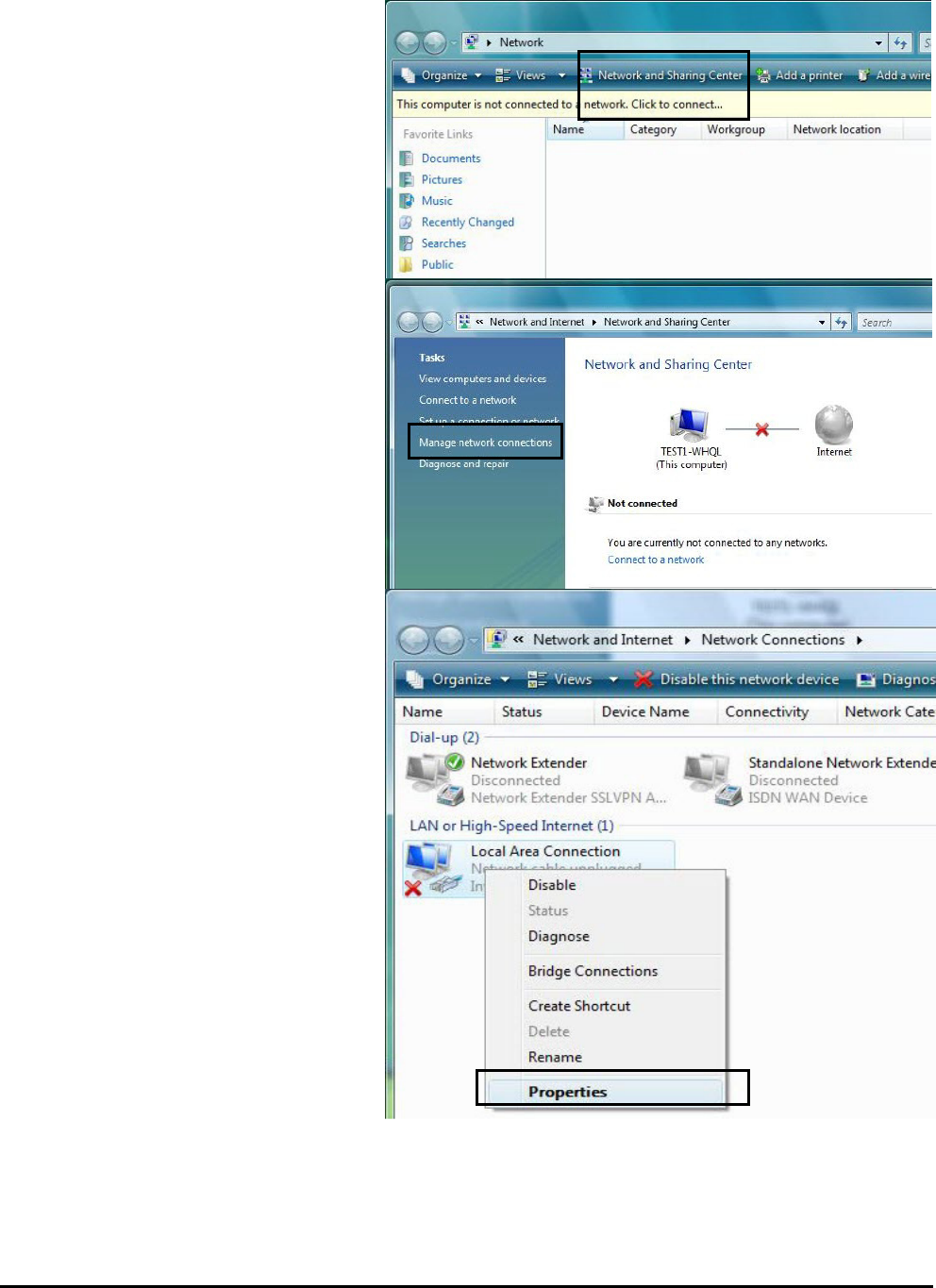
For Windows Vista
1. Go to Start. Click on
Network.
2. Then click on Network and
Sharing Center at the top
bar.
3. When the Network and
Sharing Center window
pops up, select and click on
Manage network
connections on the left
window pane.
4. Select the Local Area
Connection, and right click
the icon to select
Properties.
Billion BiPAC 8500/8501/8520/8521 SHDSL (VPN) Firewall Bridge/ Router
Chapter 3: Basic Installation
15
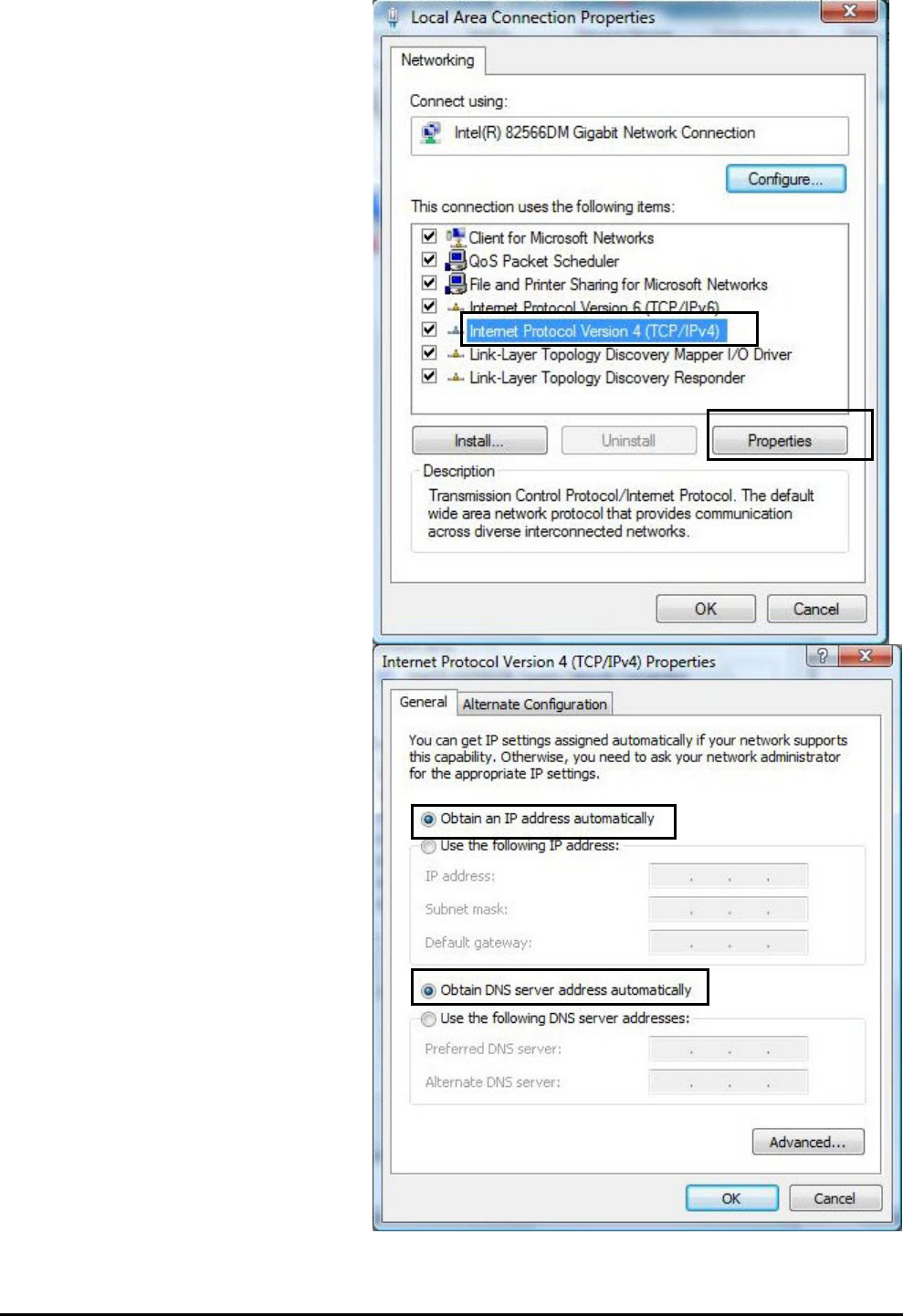
5. Select Internet Protocol
Version 4 (TCP/IPv4) then
click Properties.
6. In the TCP/IPv4 properties
window, select the Obtain
an IP address
automatically and Obtain
DNS Server address
automatically radio
buttons. Then click OK to
exit the setting.
7. Click OK again in the Local
Area Connection
Properties window to apply
the new configuration.
Billion BiPAC 8500/8501/8520/8521 SHDSL (VPN) Firewall Bridge/ Router
Chapter 3: Basic Installation
16
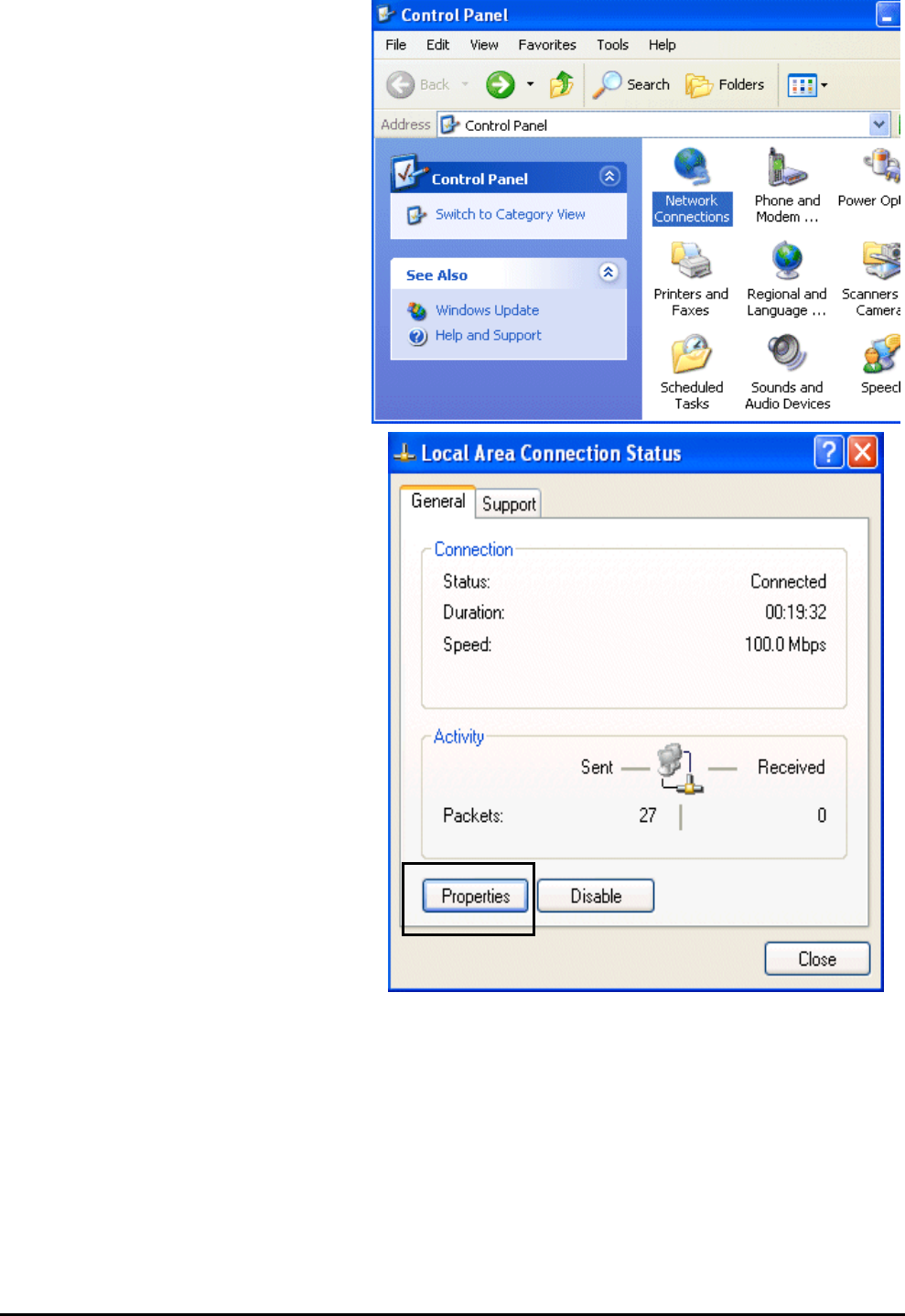
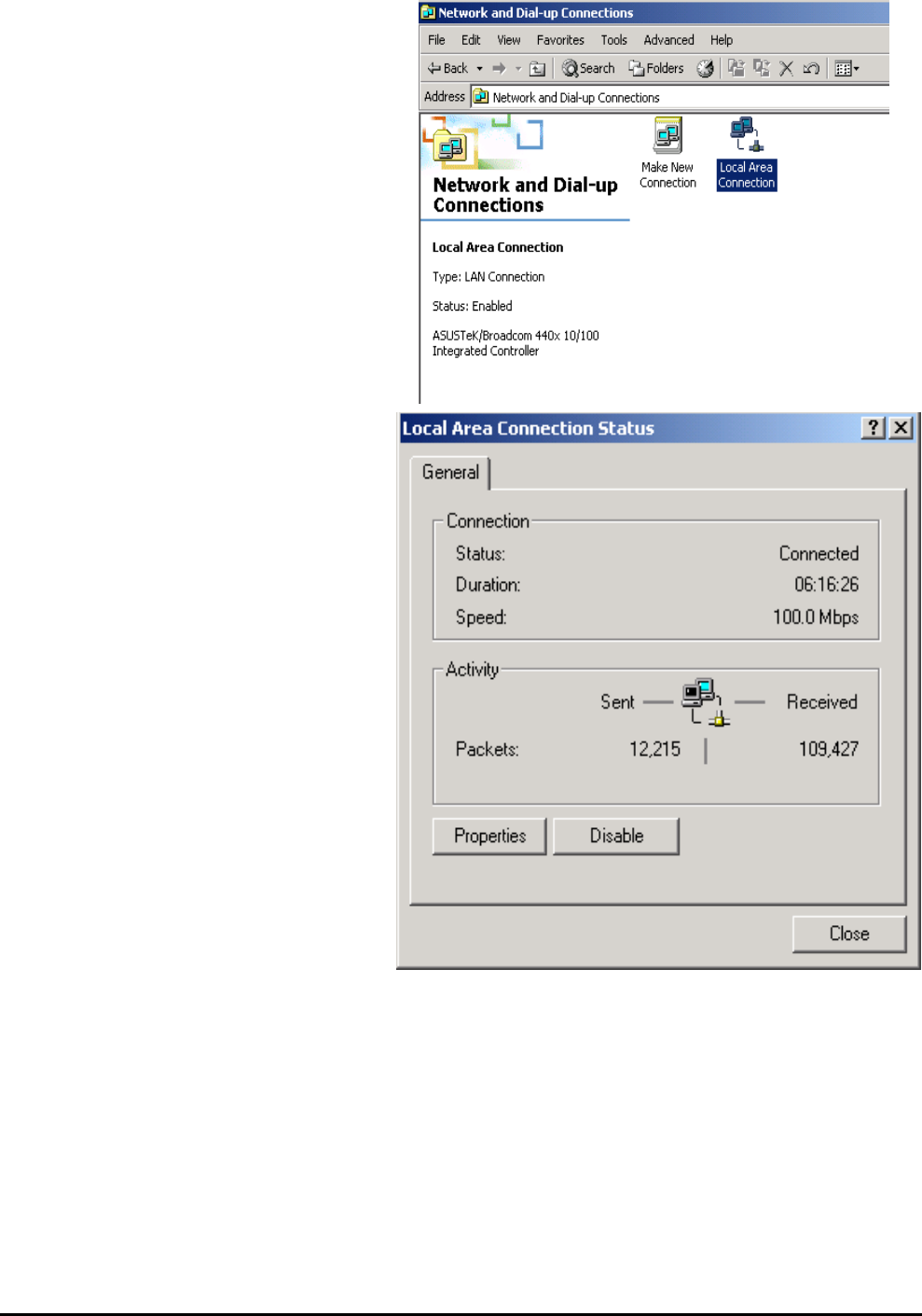
For Windows XP
1. Go to Start / Control Panel
(in Classic View). In the
Control Panel, double-click
on Network Connections
2. Double-click Local Area
Connection.
3. In the Local Area
Connection Status window,
click Properties.
Billion BiPAC 8500/8501/8520/8521 SHDSL (VPN) Firewall Bridge/ Router
Chapter 3: Basic Installation
17
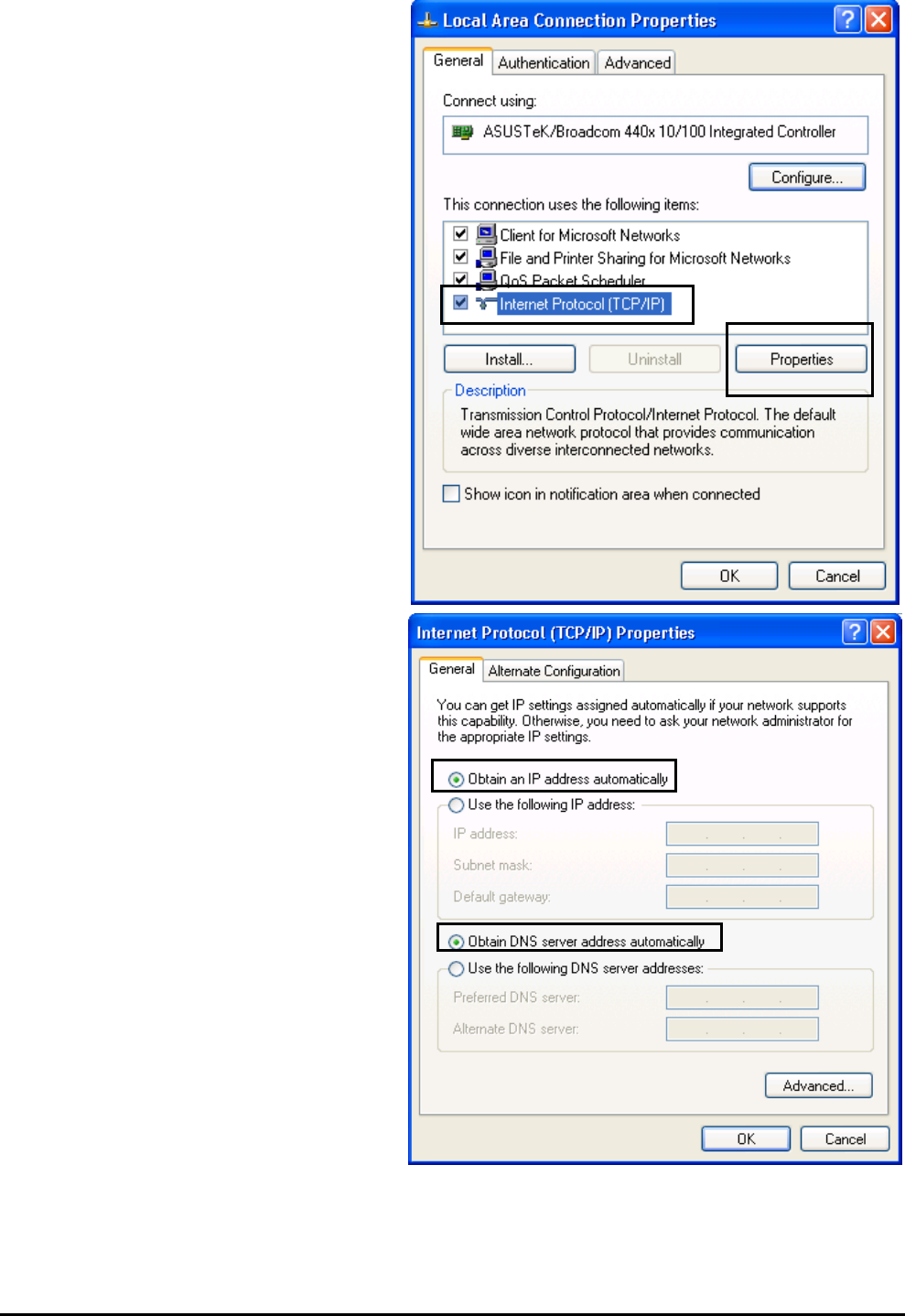
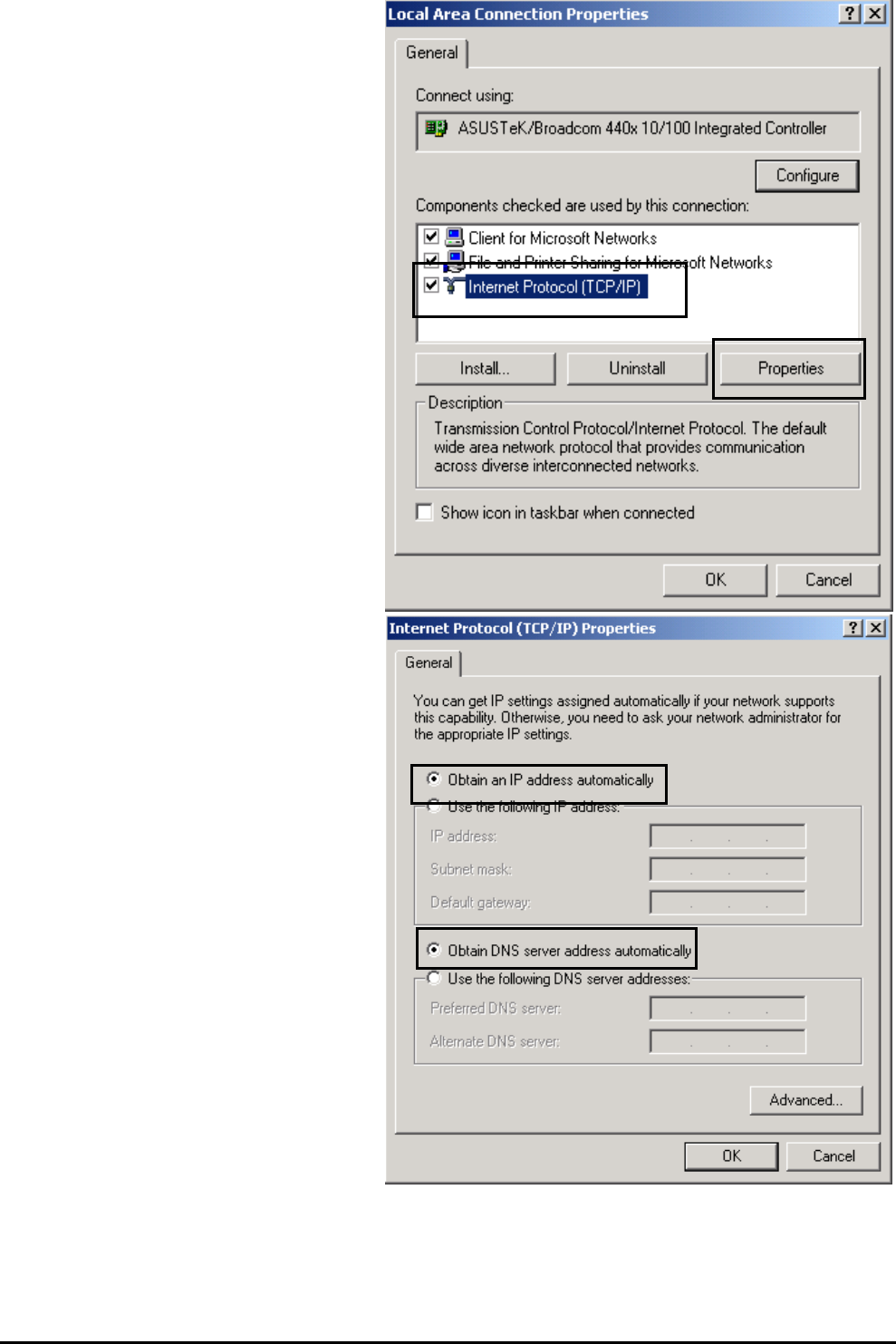
4. Select Internet Protocol
(TCP/IP) and click Properties.
5. Select the Obtain an IP
address automatically and the
Obtain DNS server address
automatically radio buttons.
6. Click OK to finish the
configuration.
Billion BiPAC 8500/8501/8520/8521 SHDSL (VPN) Firewall Bridge/ Router
Chapter 3: Basic Installation
18
For Windows 2000
1. Go to Start / Settings /
Control Panel. In the Control
Panel, double-click on
Network and Dial-up
Connections.
2. Double-click Local Area
Connection.
3. In the Local Area Connection
Status window click
Properties.
Billion BiPAC 8500/8501/8520/8521 SHDSL (VPN) Firewall Bridge/ Router
Chapter 3: Basic Installation
19
4. Select Internet Protocol
(TCP/IP) and click Properties.
5. Select the Obtain an IP
address automatically and
the Obtain DNS server
address automatically radio
buttons.
6. Click OK to finish the
configuration.
Billion BiPAC 8500/8501/8520/8521 SHDSL (VPN) Firewall Bridge/ Router
Chapter 3: Basic Installation
20
For Windows 98/Me
1. Go to Start / Settings /
Control Panel. In the Control
Panel, double-click on
Network and choose the
Configuration tab.
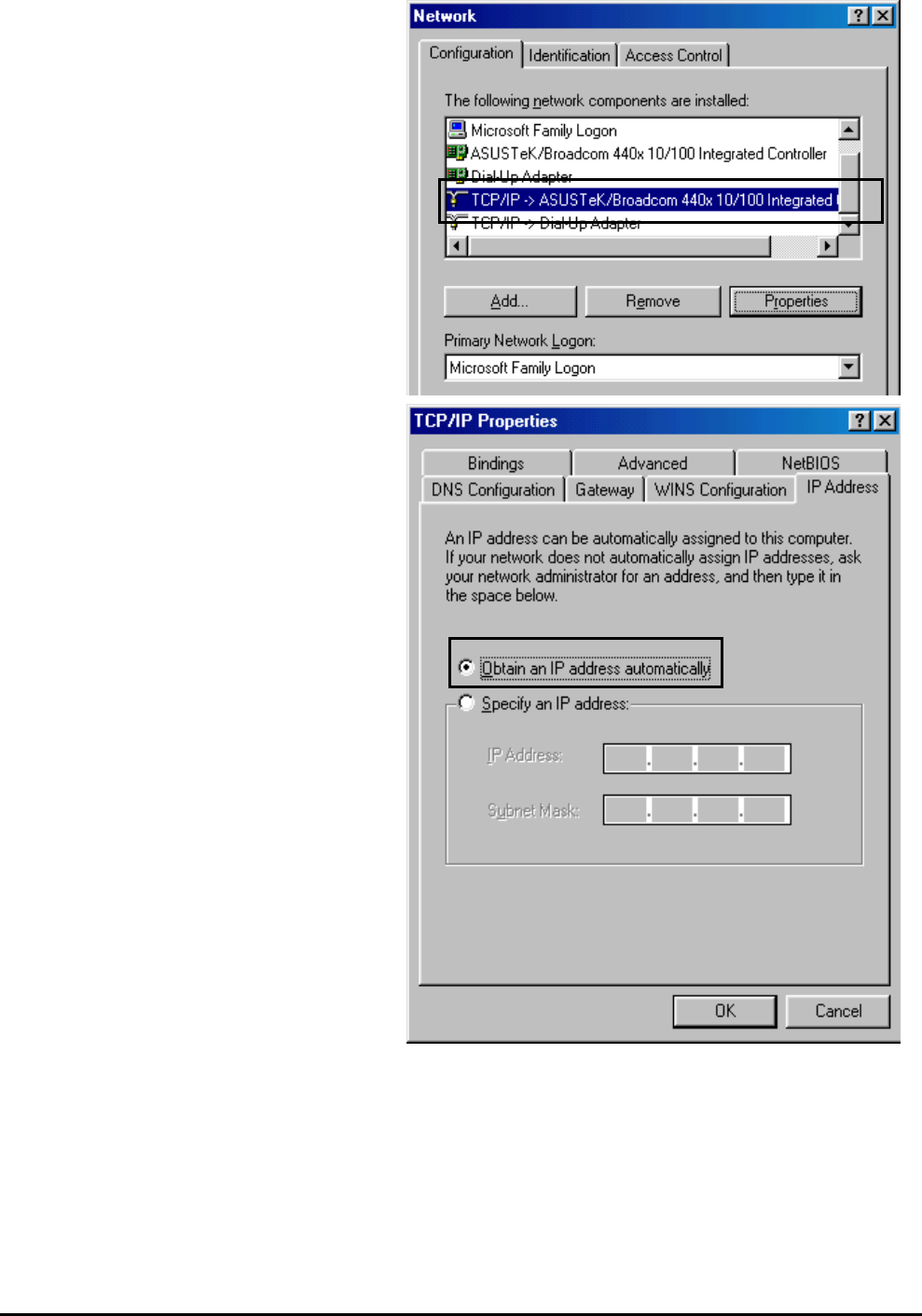
2. Select TCP/IP ->NE2000
Compatible, or the name of
your Network Interface Card
(NIC) in your PC. Then click
Properties.
3. Select the Obtain an IP
address automatically radio
button.
Billion BiPAC 8500/8501/8520/8521 SHDSL (VPN) Firewall Bridge/ Router
Chapter 3: Basic Installation
21
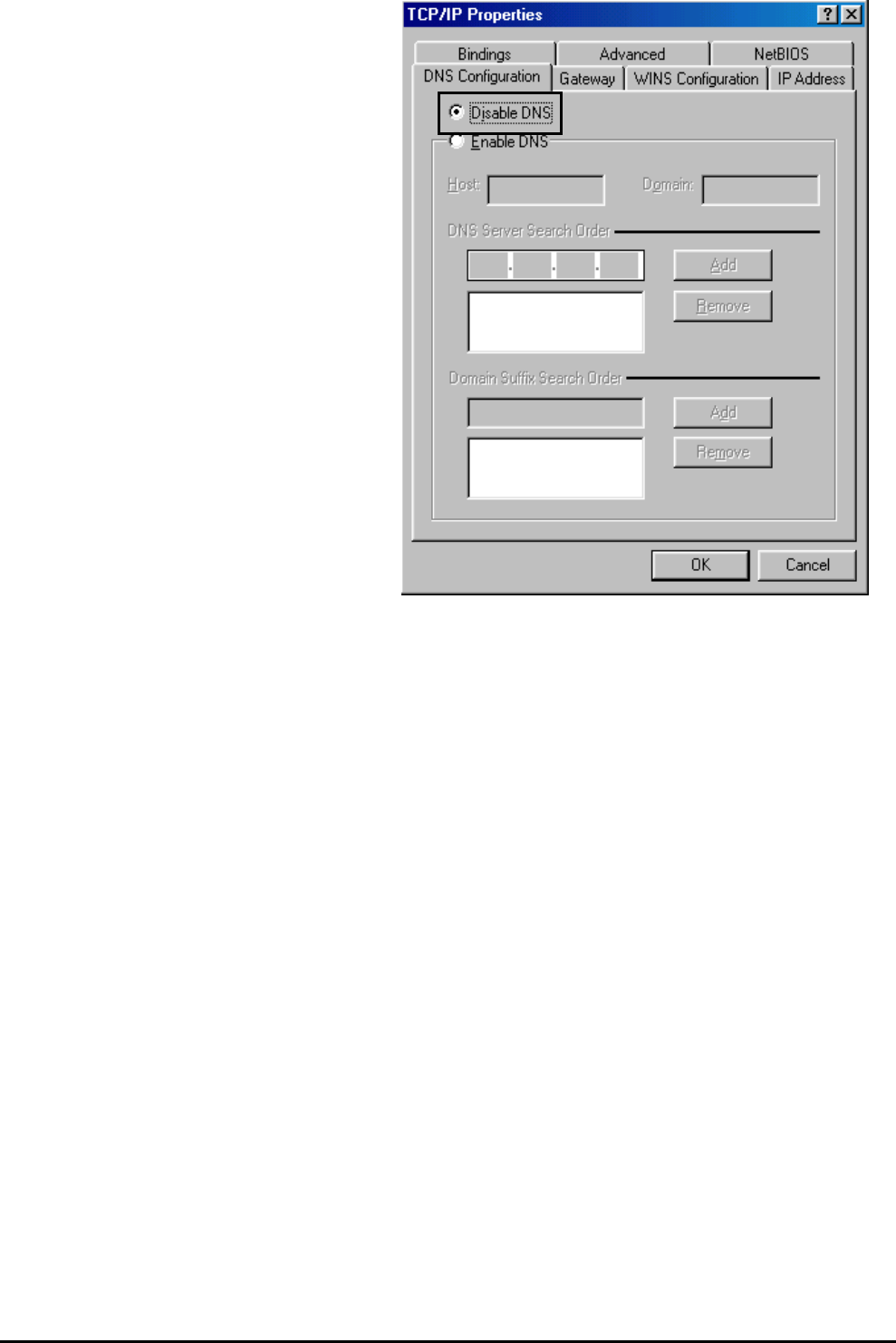
4. Then select the DNS
Configuration tab.
5. Select the Disable DNS radio
button and click OK to finish
the configuration.
Billion BiPAC 8500/8501/8520/8521 SHDSL (VPN) Firewall Bridge/ Router
Chapter 3: Basic Installation
22
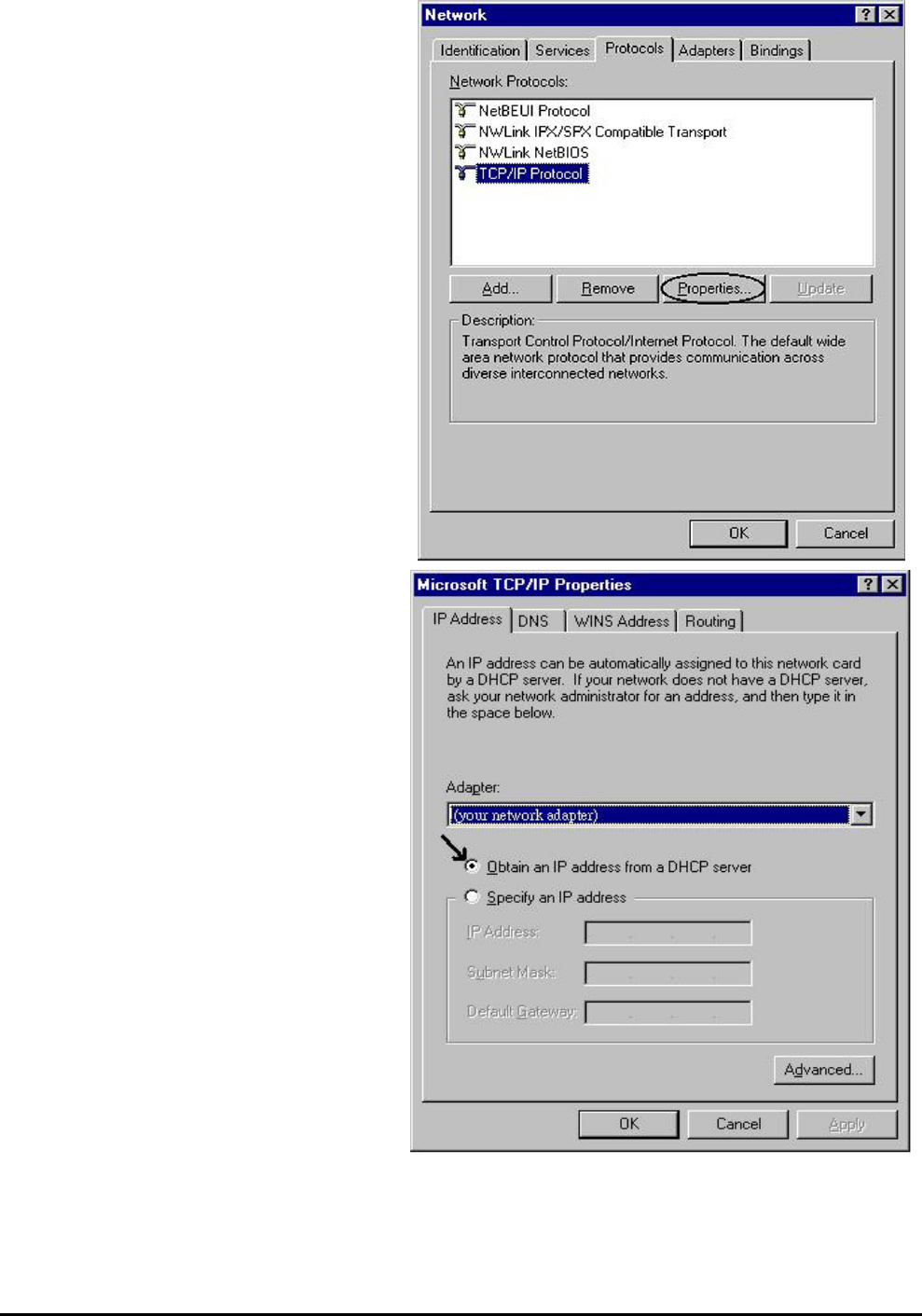
For Windows NT4.0
1. Go to Start / Settings / Control
Panel. In the Control Panel,
double-click on Network and
choose the Protocols tab.
2. Select TCP/IP Protocol and
click Properties.
3. Select the Obtain an IP
address from a DHCP server
radio button and click OK.
Billion BiPAC 8500/8501/8520/8521 SHDSL (VPN) Firewall Bridge/ Router
Chapter 3: Basic Installation
23
Factory Default Settings
Before configuring your router, you need to know the following default settings.
Web Interface (Username and Password):
Username: admin
Password: admin
The default username and password are “admin” and “admin” respectively.
Device LAN IP Settings:
IP Address: 192.168.1.254
Subnet Mask: 255.255.255.0
ISP setting in WAN site:
PPPoE
DHCP server:
DHCP server is enabled.
Start IP Address: 192.168.1.100
IP pool counts: 100
LAN and WAN Port Addresses
The parameters of LAN and WAN ports are pre-set in the factory. The default values are shown
below.
LAN Port WAN Port
IP address 192.168.1.254
Subnet Mask 255.255.255.0
DHCP server function Enabled
IP addresses for
distribution to PCs
100 IP addresses ranging from
192.168.1.100 to 192.168.1.199
The PPPoE function is
enabled to automatically get
the WAN port configuration
from the ISP.
Attention
If you ever forget the username/password to login to the router, you may
press the RESET button up to 6 seconds to restore the factory default
settings.
Caution: After pressing the RESET button for more than 6 seconds, to be
sure you power
cycle the device again.
Attention

Billion BiPAC SHDSL/SHDSL.bis (VPN) Firewall Bridge/ Router
Chapter 3: Basic Installation
24
Information from your ISP
Before configuring this device, you have to check with your ISP (Internet Service Provider) to
find out what kind of service is provided such as DHCP (Obtain an IP Address Automatically,
Static IP (Fixed IP Address) and PPPoE.
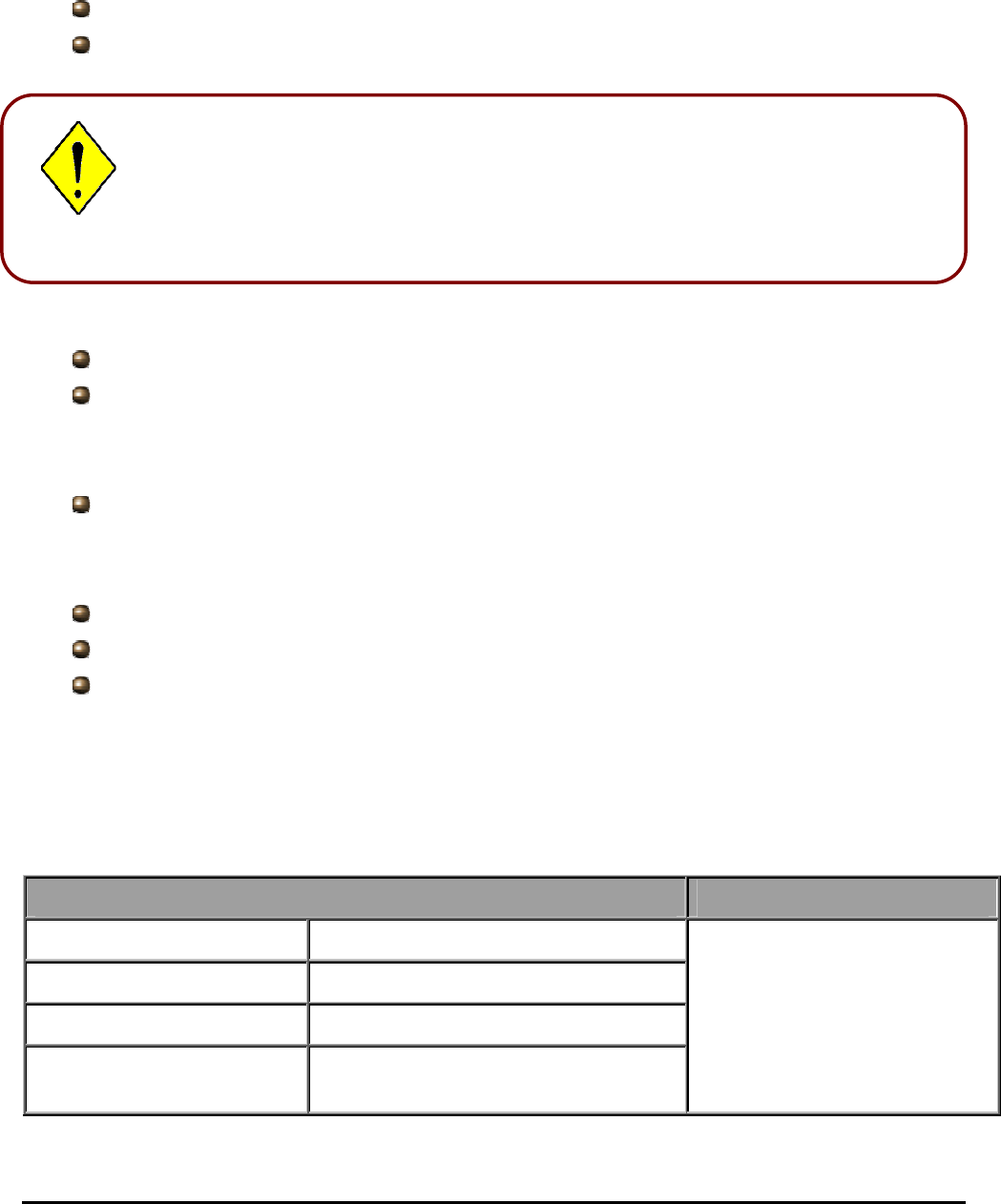
Gather the information as illustrated in the following table and keep it for reference.
PPPoE
VPI/VCI, VC / LLC-based multiplexing, Username, Password, Service Name,
and Domain Name System (DNS) IP address (it can be automatically
assigned by your ISP when you connect or be set manually).
PPPoE /
PPPoE with
Pass-through
VPI/VCI, VC / LLC-based multiplexing, Username, Password, Service Name,
and Domain Name System (DNS) IP address (it can be automatically
assigned by your ISP when you connect or be set manually). In addition, an
additional WAN address can be assigned using PPPoE dialer.
PPPoA
VPI/VCI, VC / LLC-based multiplexing, Username, Password and Domain
Name System (DNS) IP address (it can be automatically assigned by your
ISP when you connect or be set manually).
RFC 1483
Bridged VPI/VCI, VC / LLC-based multiplexing to use Bridged Mode.
RFC 1483
Routed
VPI/VCI, VC / LLC-based multiplexing, IP address, Subnet mask, Gateway
address, and Domain Name System (DNS) IP address (it is a fixed IP
address).
IPoA Routed
(IP over ATM)
VPI/VCI, VC / LLC-based multiplexing, IP address, Subnet mask, Gateway
address, and Domain Name System (DNS) IP address (it is a fixed IP
address).
Billion BiPAC 8500/8501/8520/8521 SHDSL (VPN) Firewall Bridge/ Router
Chapter 3: Basic Installation
25
Configuring with your Web Browser
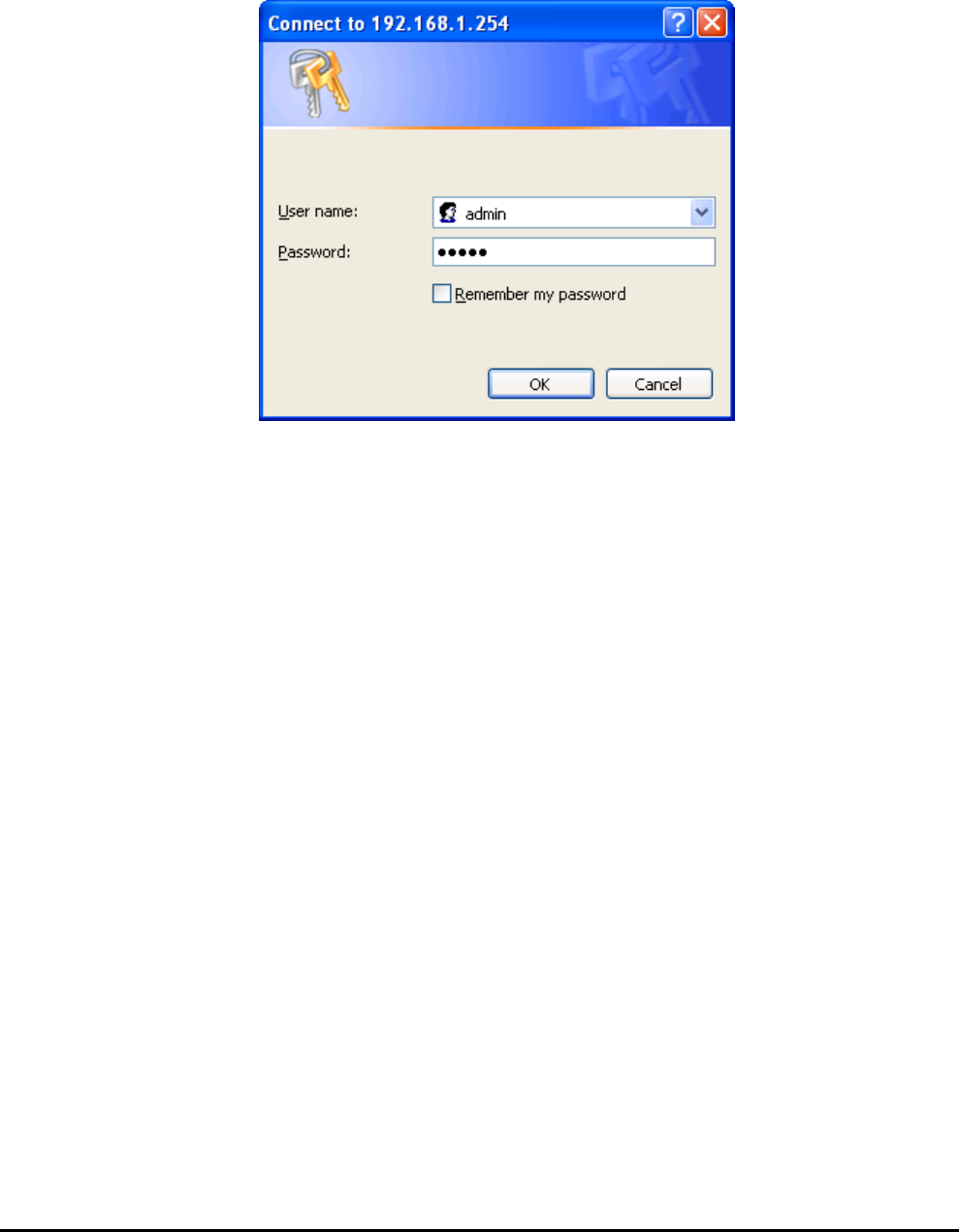
Open your web browser, enter the IP address of your router, which by default is 192.168.1.254,
and click “Go”, a user name and password window prompt will appear. The default username
and password are “admin” and “admin”.
Congratulation! You are now successfully logon to SHDSL Router!

Billion BiPAC SHDSL/SHDSL.bis (VPN) Firewall Bridge/ Router
Chapter 4: Configuration
26
Chapter 4: Configuration
At the configuration homepage, the left navigation pane where bookmarks are provided links
you directly to the desired setup page, including:
Status
- ARP Table
- Routing Table
- DHCP Table
- PPTP Status
- IPSec Status
- L2TP Status
- Email Status
- Event Log
- Error Log
- NAT Sessions
- Diagnostic
- UPnP Portmap
Quick Start
Configuration
- LAN
- WAN
- System
- Firewall
- VPN (BiPAC 8500/ 8501/ 8520 Only)
- QoS
- Virtual Server
- Time Schedule
- Advanced
Save Config to FLASH
Language (provides user interface in English and French languages).
Logout
Please click the links to see the relevant sections of this manual for detailed instructions
on how to configure the SHDSL VPN Firewall Bridged Router.
Billion BiPAC 8500/8501/8520/8521 SHDSL (VPN) Firewall Bridge/ Router
Chapter 4: Configuration
27
Status
ARP Table
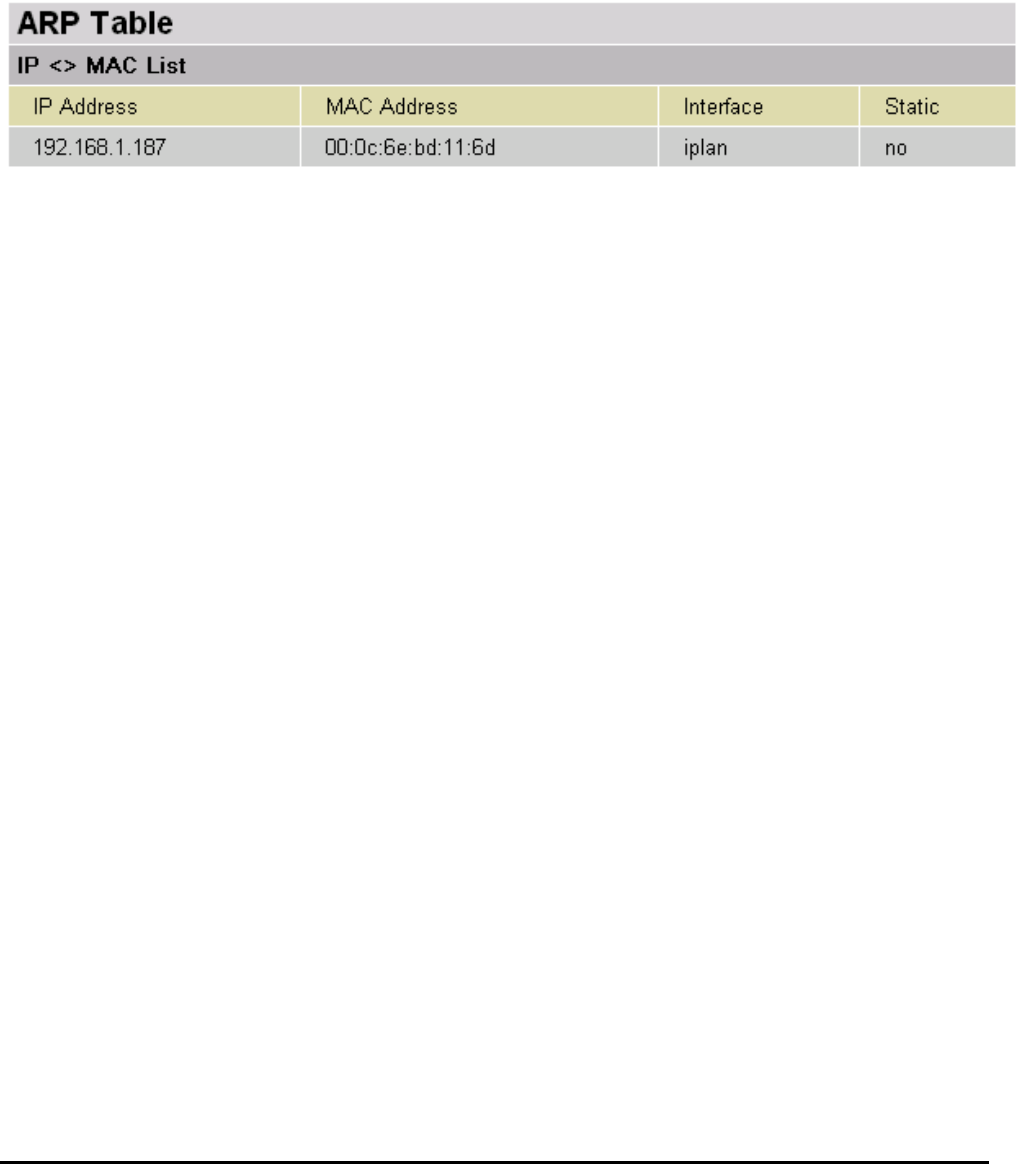
This section displays the router’s ARP (Address Resolution Protocol) Table, which shows the
mapping of Internet (IP) addresses to Ethernet (MAC) addresses. This is a useful & quick way
to determine the MAC address of your PCs network interface through the router’s Firewall –
MAC Address Filter function. See the Firewall section of this manual for more information on
this feature.
IP Address: A list of IP addresses of devices on your LAN (Local Area Network).
MAC Address: The MAC (Media Access Control) addresses for each device on your LAN.
Interface: The interface name (on the router) that this IP Address connects to.
Static: Static status of the ARP table entry:
“no” for dynamically-generated ARP table entries
“yes” for static ARP table entries added by the user
Billion BiPAC SHDSL/SHDSL.bis (VPN) Firewall Bridge/ Router
Chapter 4: Configuration
28
Routing Table
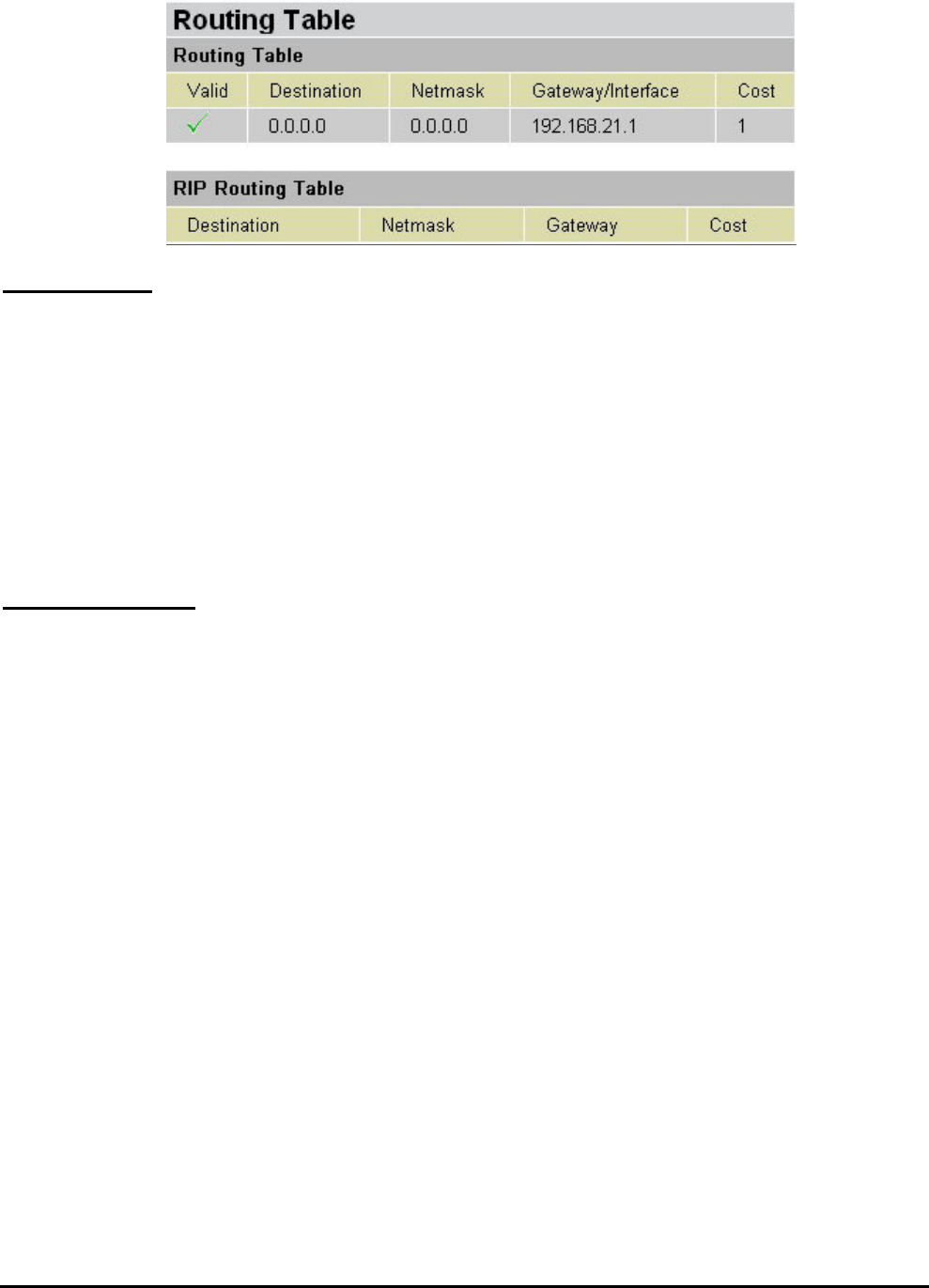
Routing Table
Valid: It indicates a successful routing status.
Destination: The IP address of the destination network.
Netmask: The destination netmask address.
Gateway/Interface: The IP address of the gateway or existing interface that this route will
use.
Cost: The number of hops counted as the cost of the route.
RIP Routing Table
Destination: The IP address of the destination network.
Netmask: The destination netmask address.
Gateway: The IP address of the gateway that this route will use.
Cost: The number of hops counted as the cost of the route.
Billion BiPAC SHDSL/SHDSL.bis (VPN) Firewall Bridge/ Router
Chapter 4: Configuration
29
DHCP Table
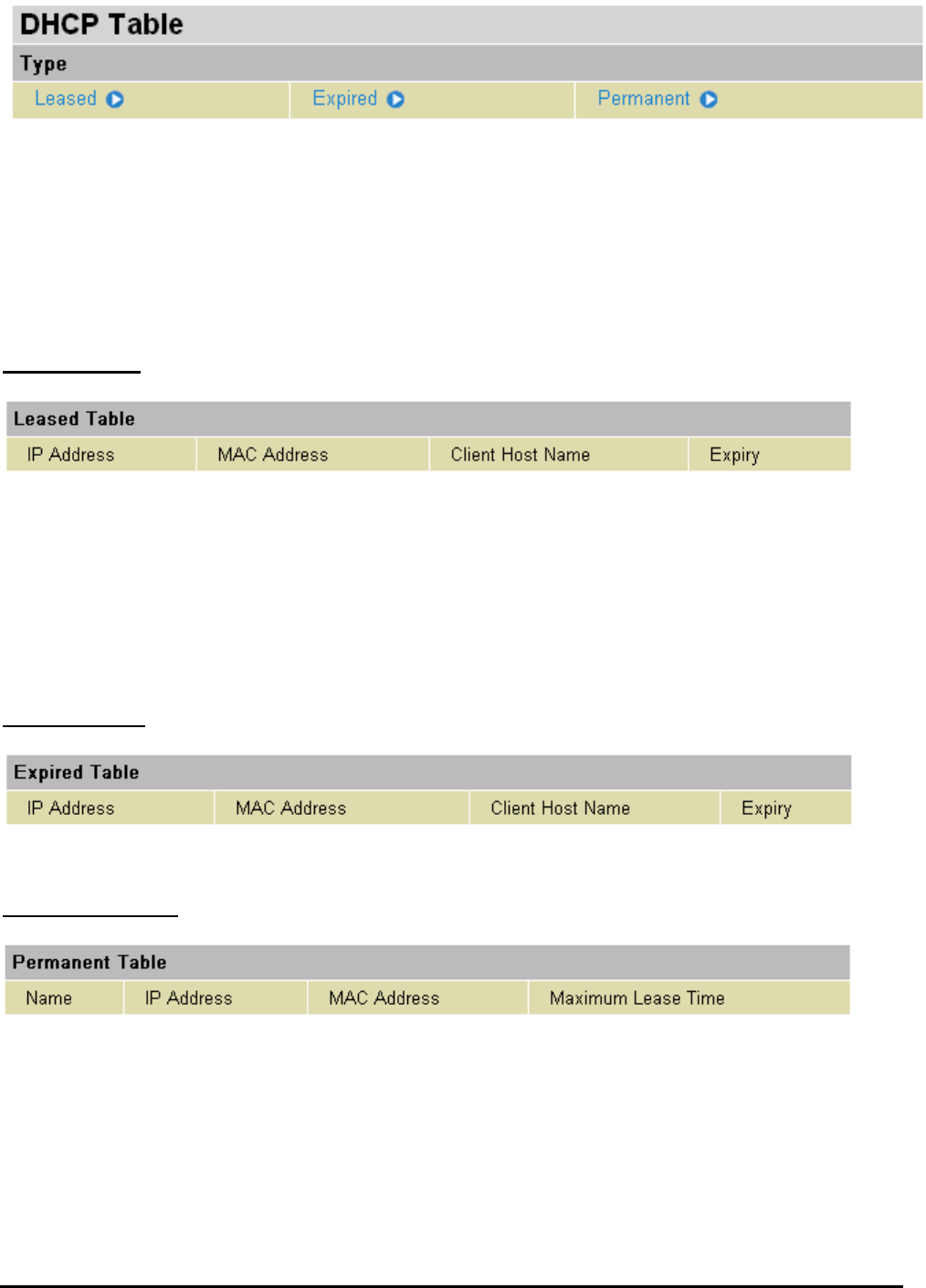
Leased: The DHCP assigned IP addresses information.
IP Address: A list of IP addresses of devices on your LAN (Local Area Network).
Expired: The expired IP addresses information.
Permanent: The fixed host mapping information
Leased Table
IP Address: The IP address that assigned to client.
MAC Address: The MAC address of client.
Client Host Name: The Host Name (Computer Name) of client.
Expiry: The current lease time of client.
Expired Table
Please refer the Leased Table.
Permanent Table
Name: The name you assigned to the Permanent configuration.
IP Address: The fixed IP address for the specify client.
MAC Address: The MAC Address that you want to assign the fixed IP address
Maximum Lease Time: The maximum lease time interval you allow to clients
Billion BiPAC 8500/8501/8520/8521 SHDSL (VPN) Firewall Bridge/ Router
Chapter 4: Configuration
30
PPTP Status (BiPAC 8500/ 8501/ 8520 Only)
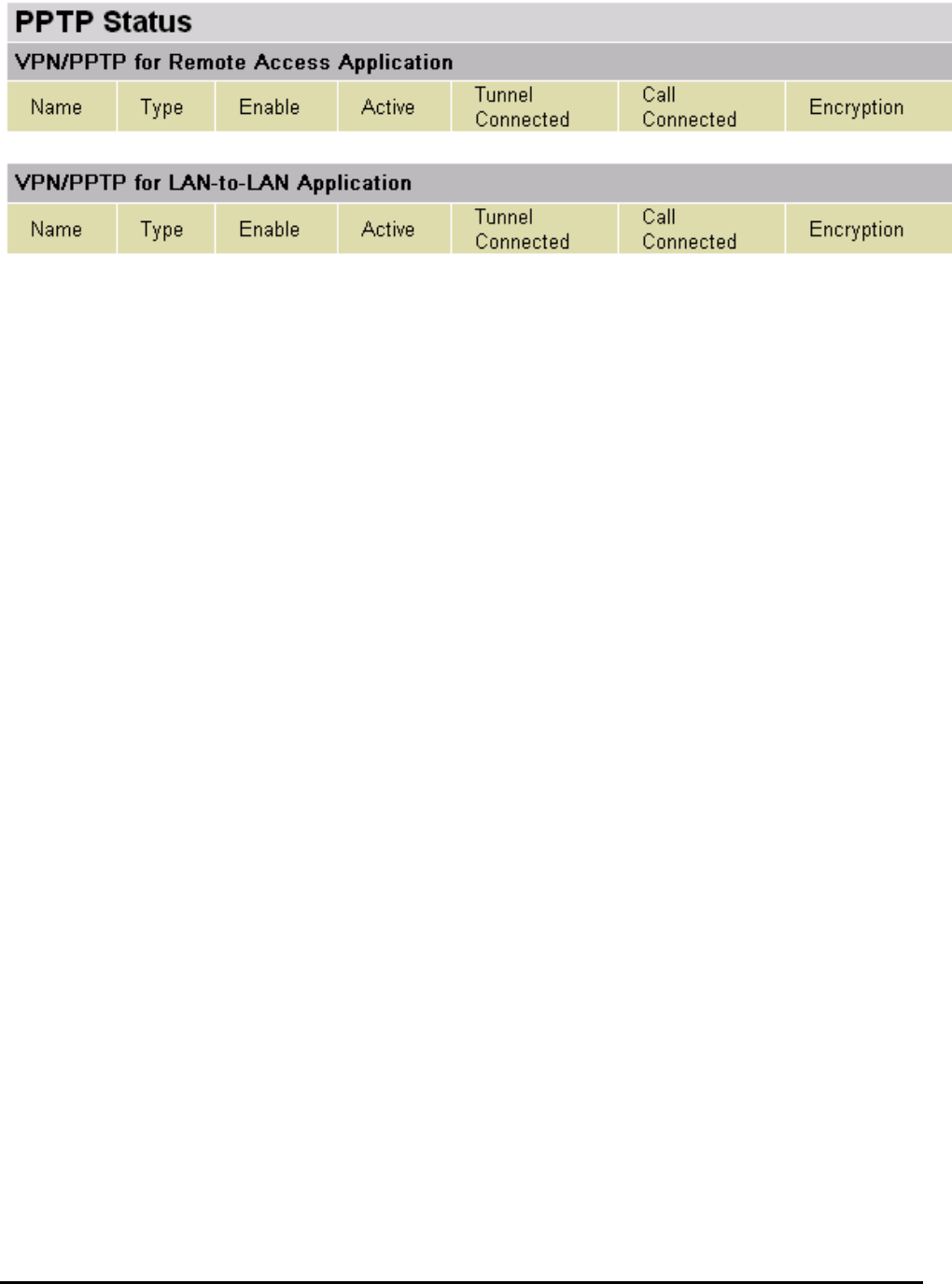
This shows details of your configured PPTP VPN Connections.
• Name: The name you assigned to the particular PPTP connection in your VPN
configuration.
• Type: The type of connection (dial-in/dial-out).
• Enable: Whether the connection is currently enabled.
• Active: Whether the connection is currently active.
• Tunnel Connected: Whether the VPN Tunnel is currently connected.
• Call Connected: If the Call for this VPN entry is currently connected.
• Encryption: The encryption type used for this VPN connection.

Billion BiPAC 8500/8501/8520/8521 SHDSL (VPN) Firewall Bridge/ Router
Chapter 4: Configuration
31
IPSec Status (BiPAC 8500/ 8501/ 8520 Only)
This shows details of your configured IPSec VPN Connections.
• Name: The name you assigned to the particular VPN entry.
• Active: Whether the VPN Connection is currently Active.
• Connection State: Whether the VPN is Connected or Disconnected.
• Statistics: Statistics for this VPN Connection.
• Local Subnet: The local IP Address or Subnet used.
• Remote Subnet: The Subnet of the remote site.
• Remote Gateway: The Remote Gateway IP address.
• SA: The Security Association for this VPN entry.
Billion BiPAC 8500/8501/8520/8521 SHDSL (VPN) Firewall Bridge/ Router
Chapter 4: Configuration
32
L2TP Status (BiPAC 8500/ 8501/ 8520 Only)
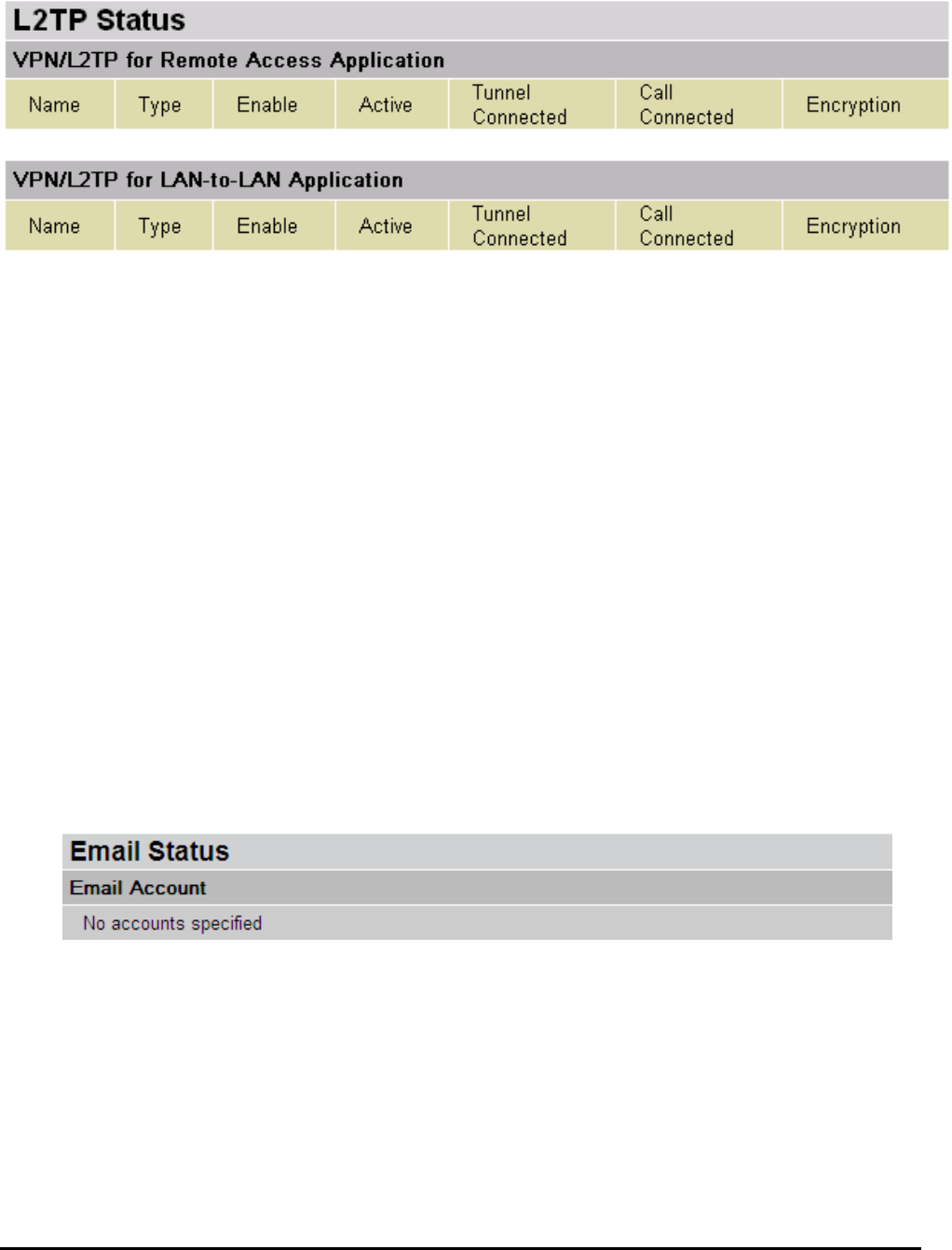
This shows details of your configured L2TP VPN Connections.
• Name: The name you assigned to the particular L2TP connection in your VPN
configuration.
• Type: The type of connection (dial-in/dial-out).
• Enable: Whether the connection is currently enabled.
• Active: Whether the connection is currently active.
• Tunnel Connected: Whether the VPN Tunnel is currently connected.
• Call Connected: If the Call for this VPN entry is currently connected.
• Encryption: The encryption type used for this VPN connection.
Email Status
Details and status for the Email Account you have configured the router to check. Please see
the Advanced section of this manual for details on this function.
Billion BiPAC SHDSL/SHDSL.bis (VPN) Firewall Bridge/ Router
Chapter 4: Configuration
33
Event Log
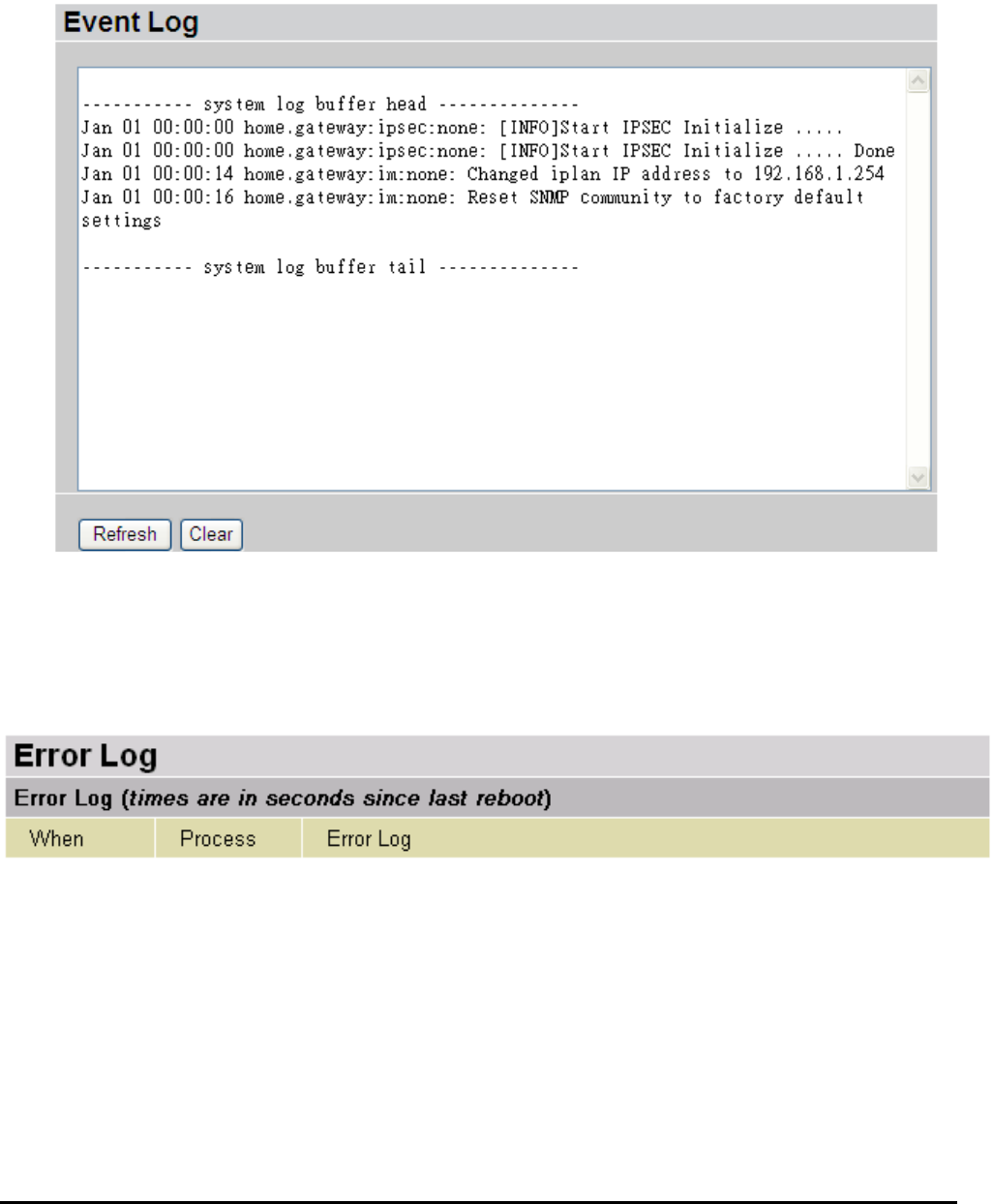
This page displays the router’s Event Log entries. Major events are logged to this window, such
as when the router’s ADSL connection is disconnected, and Firewall events such as when you
have enabled Intrusion or Blocking Logging in the Configuration – Firewall section of the
interface. Please see the Firewall section of this manual for more details on how to enable
Firewall logging.
Error Log
Any errors encountered by the router (e.g. invalid names given to entries) are logged to this
window.
Billion BiPAC SHDSL/SHDSL.bis (VPN) Firewall Bridge/ Router
Chapter 4: Configuration
34
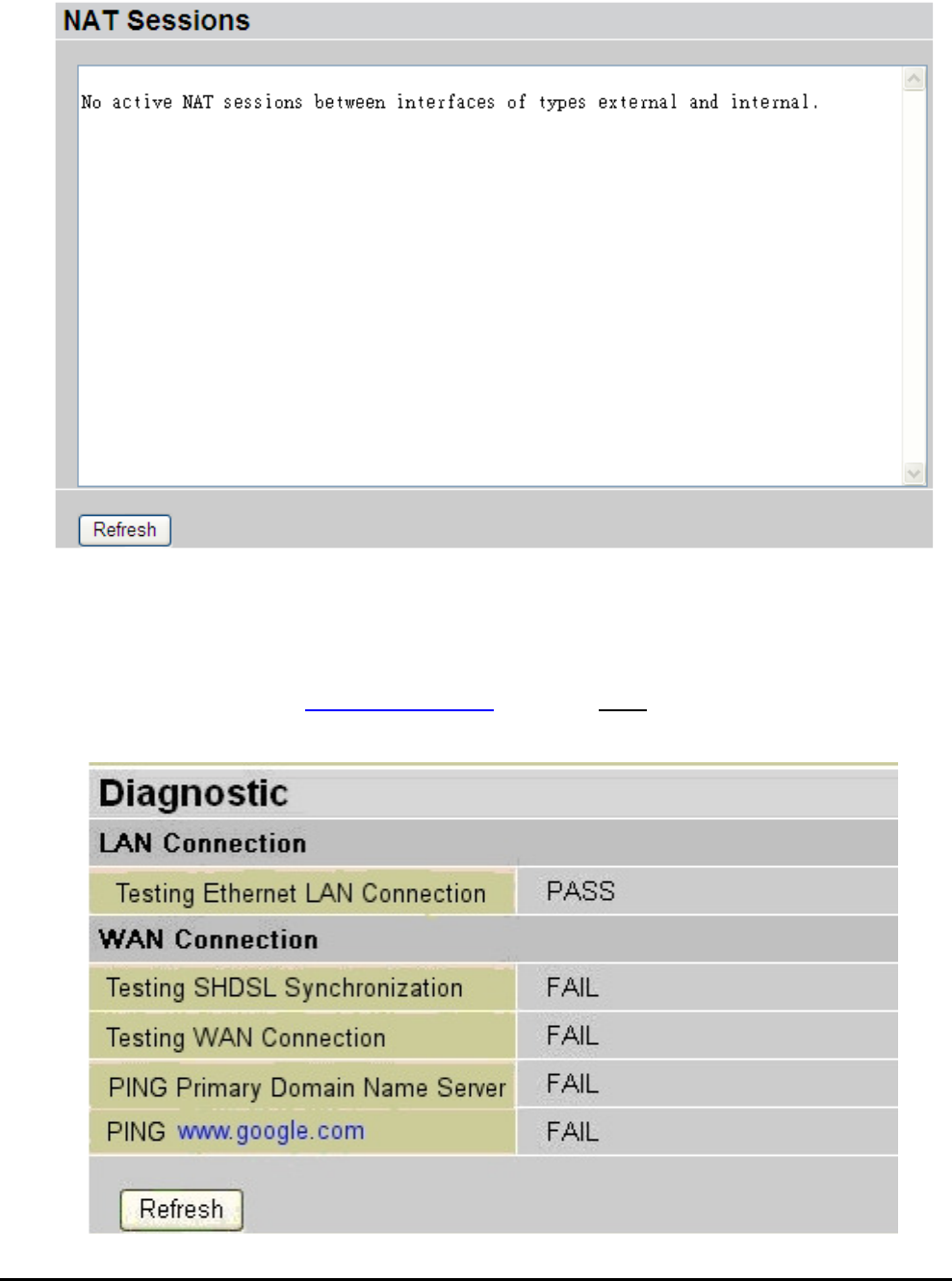
NAT Sessions
This section lists all current NAT sessions between interface of types external (WAN) and
internal (LAN).
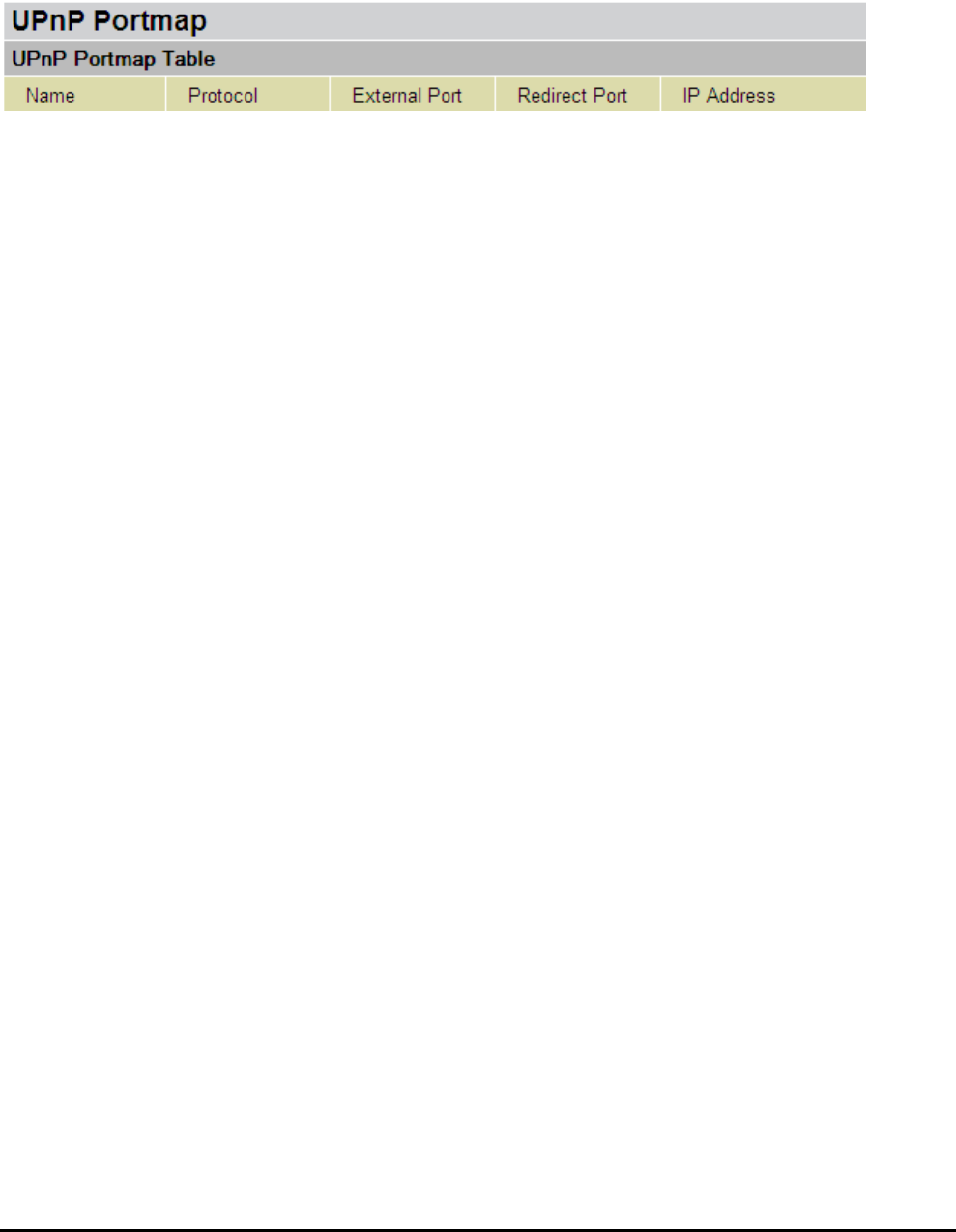
Diagnostic
It tests the connection of computer(s) which is connected to LAN ports and also the WAN
Internet connection. If PING www.google.com is shown FAIL and the rest is PASS, you ought
to check if your PC’s DNS setting is correct.
Billion BiPAC 8500/8501/8520/8521 SHDSL (VPN) Firewall Bridge/ Router
Chapter 4: Configuration
35
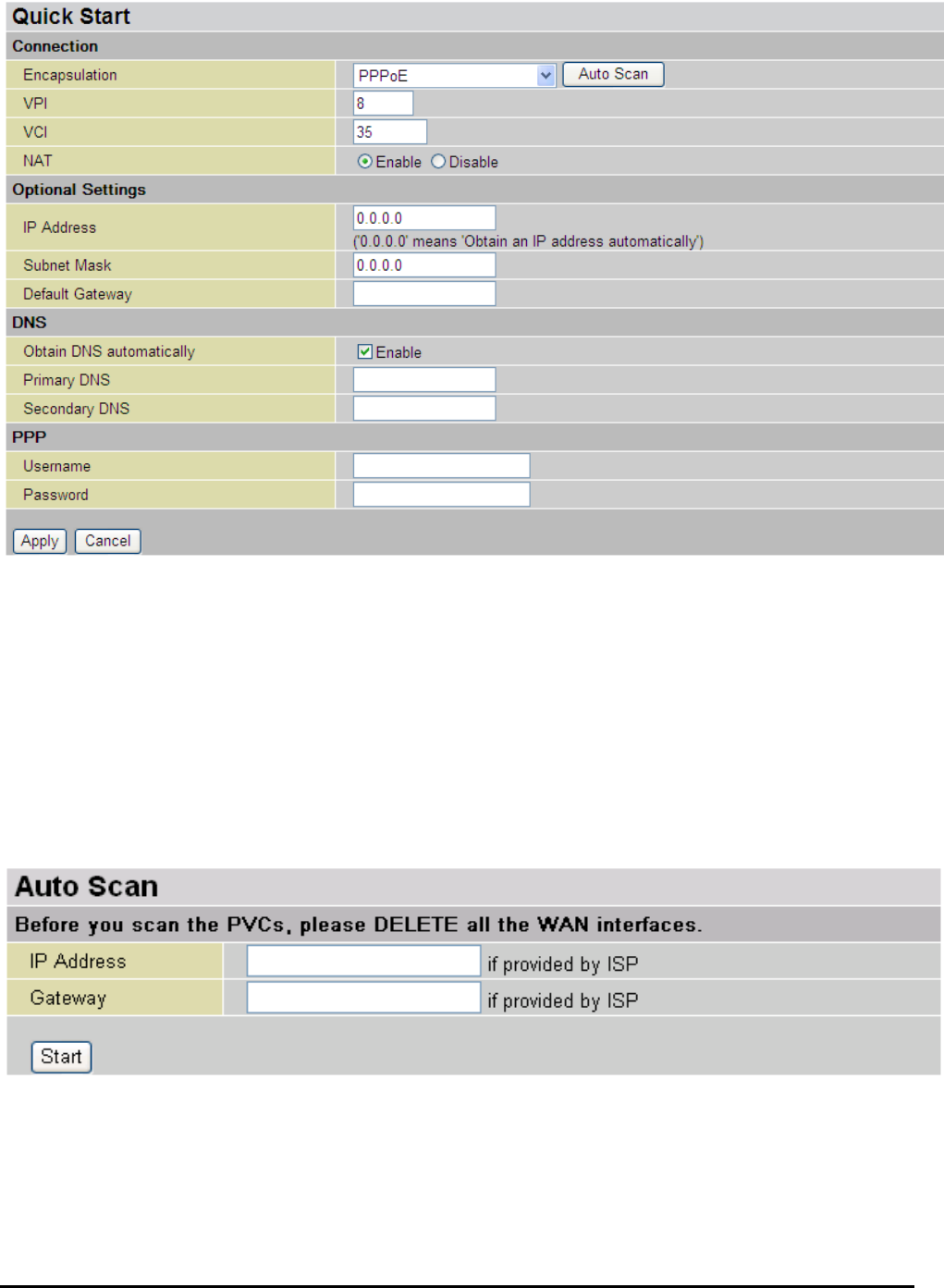
UPnP Portmap
The section lists all port-mapping established using UPnP (Universal Plug and Play). Please
see the Advanced section of this manual for more details on UPnP and the router’s UPnP
configuration options.
Billion BiPAC SHDSL/SHDSL.bis (VPN) Firewall Bridge/ Router
Chapter 4: Configuration
36
Quick Start
For detailed instructions on configuring your WAN settings, please see the WAN section of this
manual.
Usually, the only details you will need for the Quick Start wizard to get you online are your login
(often in the form of username@ispname), your password and the encapsulation type. In
addition to this, you can either provide a specific DNS, or check the Enable box to get the DNS
automatically from your ISP.
Your ISP will be able to supply all the details you need, alternatively, if you have deleted the
current WAN Connection in the WAN – ISP section of the interface, you can use the router’s
PVC Scan feature to attempt to determine the Encapsulation types offered by your ISP.
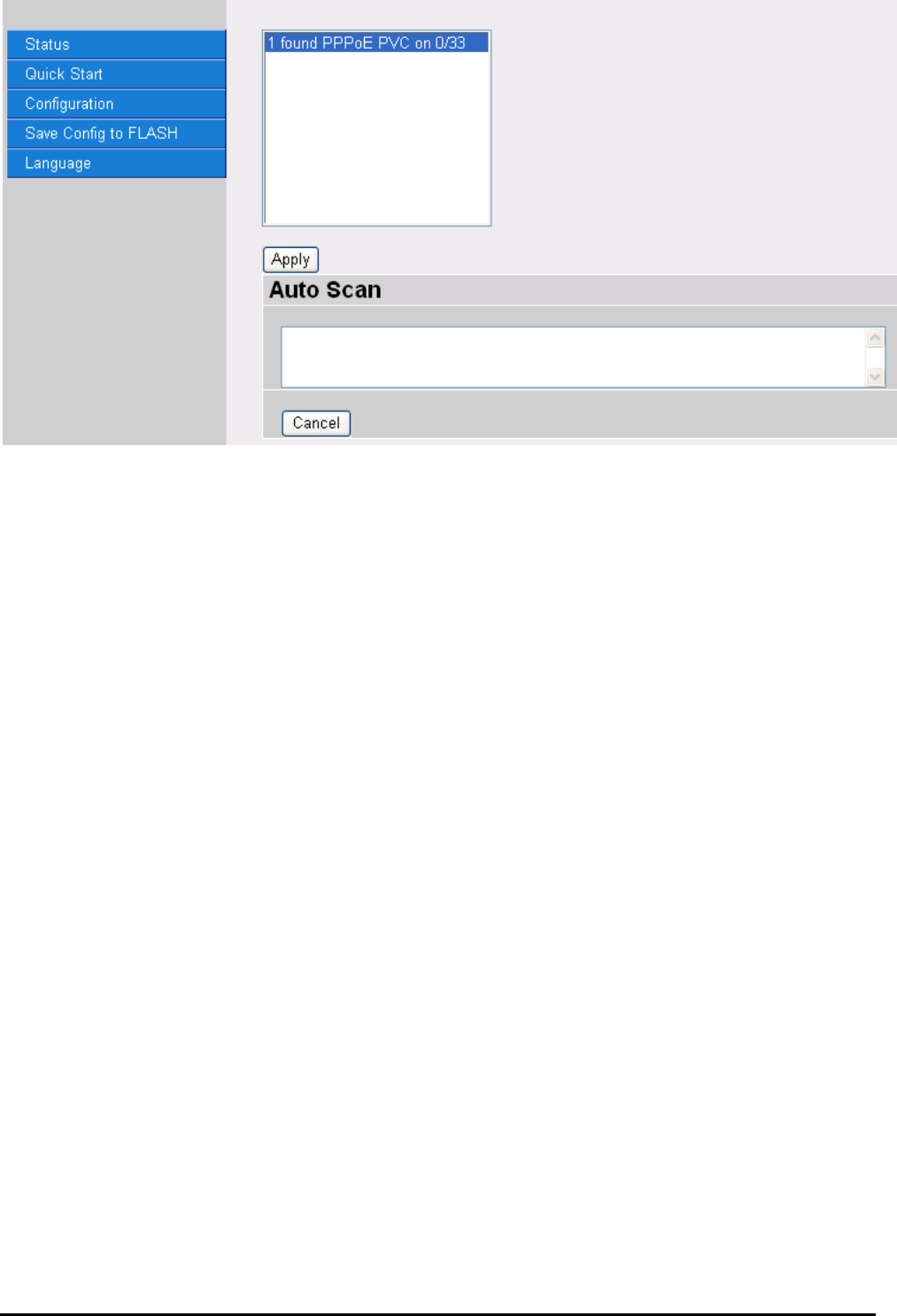
Click Start to begin scanning for encapsulation types offered by your ISP. If the scan is
successful you will then be presented with a list of supported options:
Billion BiPAC 8500/8501/8520/8521 SHDSL (VPN) Firewall Bridge/ Router
Chapter 4: Configuration
37
Select the desired option from the list and click Apply to return to the Quick Start interface to
continue configuring your ISP connection. Please note that the contents of this list will vary,
depending on what is supported by your ISP.
Billion BiPAC 8500/8501/8520/8521 SHDSL (VPN) Firewall Bridge/ Router
Chapter 4: Configuration
38
Configuration
When you click this item, you will get the following sub-items to configure your router:
LAN, WAN, System, Firewall, VPN (not available in 8521), QoS, Virtual Server, Time
Schedule and Advanced
These functions are described below in the following sections.
LAN (Local Area Network)
There are seven items within the LAN section: Bridge Interface, Ethernet, IP Alias, Ethernet
Client Filter, Port Setting and DHCP Server.
Bridge Interface
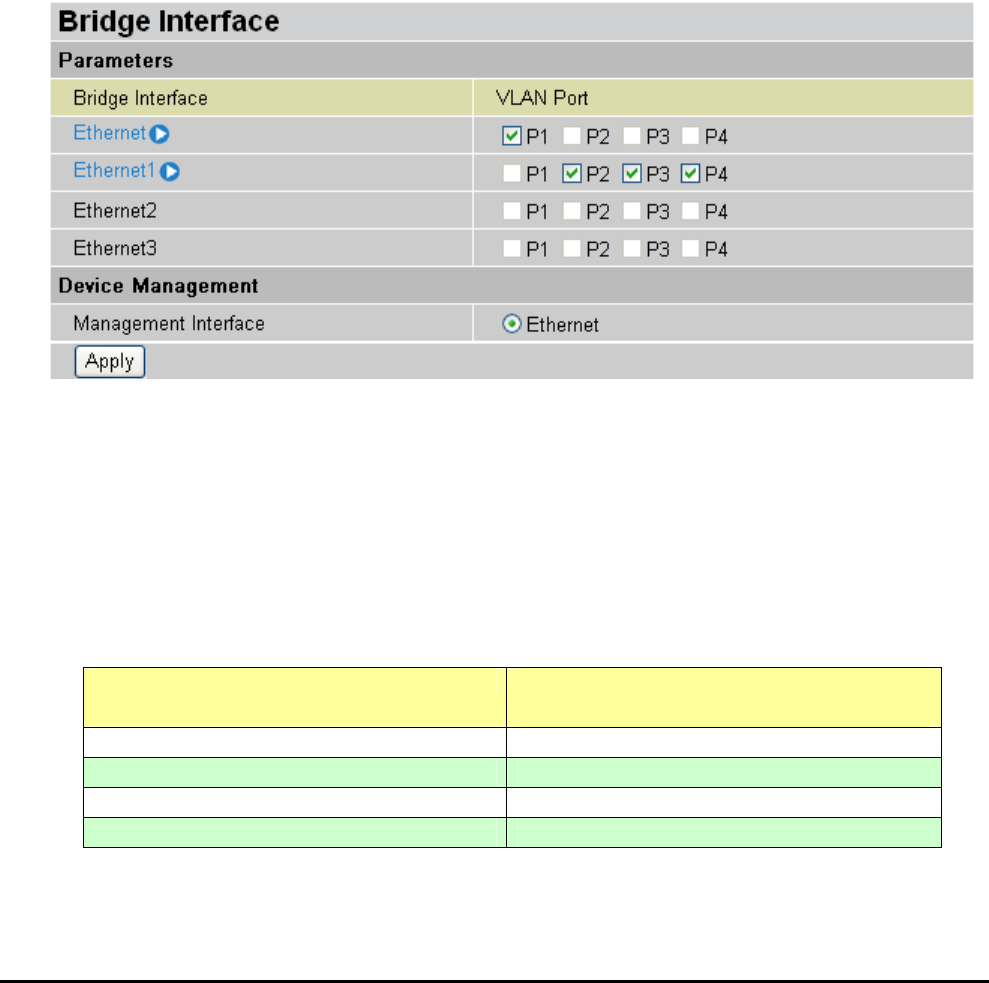
You can setup member ports for each VLAN group under Bridge Interface section. From the
example, two VLAN groups need to be created.
Ethernet: P1 (Port 1)
Ethernet1: P2, P3 and P4 (Port 2, 3, 4) Please uncheck P2, P3, P4 from Ethernet VLAN port
first.
Note: You should setup each VLAN group with caution. Each Bridge Interface is arranged in
this order.
Bridge Interface VLAN Port (Always starts
with)
Ethernet P1 / P2 / P3 / P4
Ethernet1 P2 / P3 / P4
Ethernet2 P3 / P4
Ethernet3 P4
Billion BiPAC SHDSL/SHDSL.bis (VPN) Firewall Bridge/ Router
Chapter 4: Configuration
39
Edit Ethernet Interface Parameter
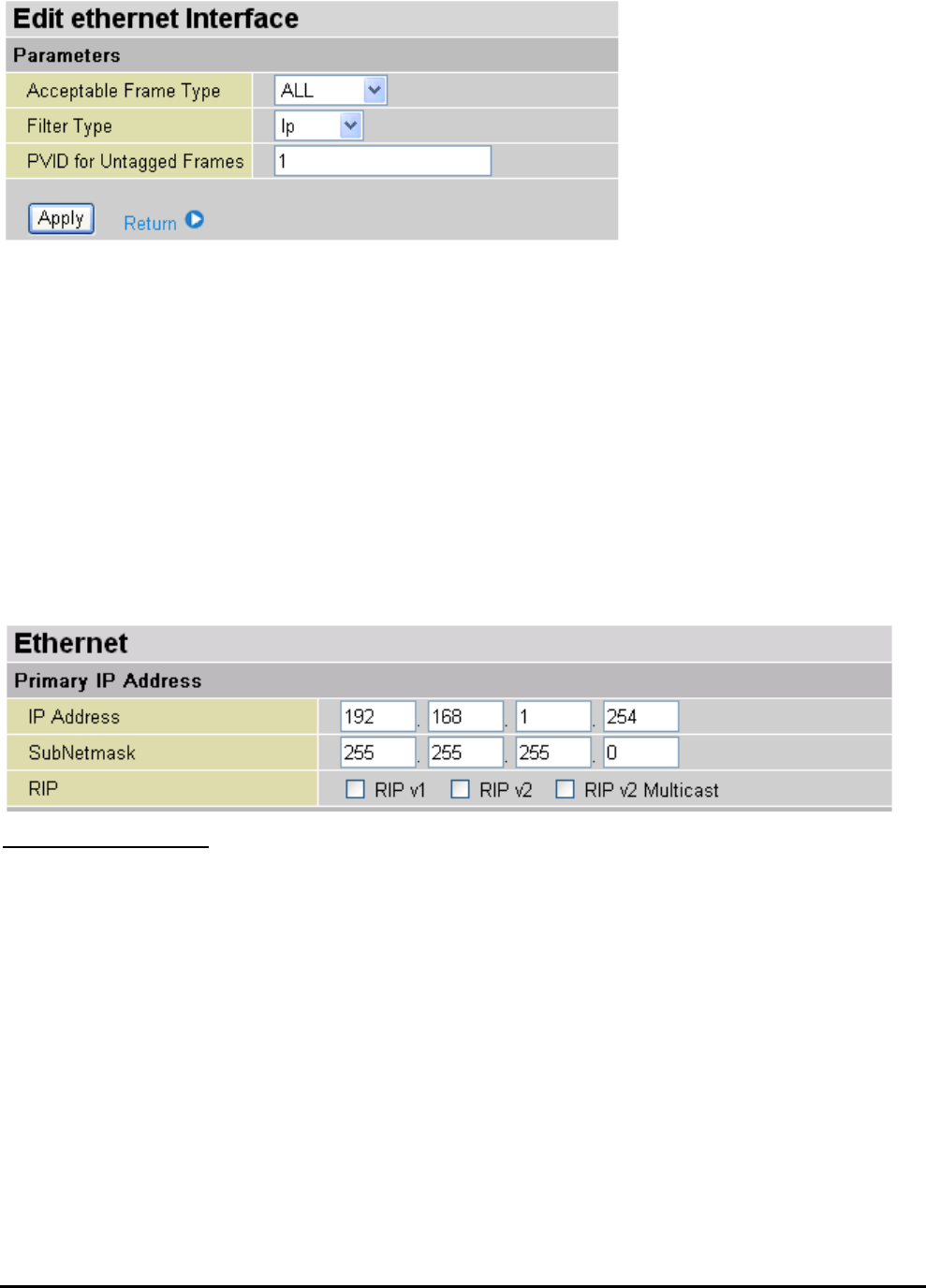
Click on a specific Ethernet you that you wish to edit its interface parameter under the Bridged
Interface section.
You can also edit the Ethernet Interface parameter such as its Acceptable Frame Type; Filter
Type or PVID for Untagged Frames. When the editing is complete, click Apply to save the
changes and then click Return to go back to the Bridged Interface page.
Management Interface: To specify which VLAN group is responsible for device management,
like doing web management.
Note: NAT/NAPT can be applied to management interface only.
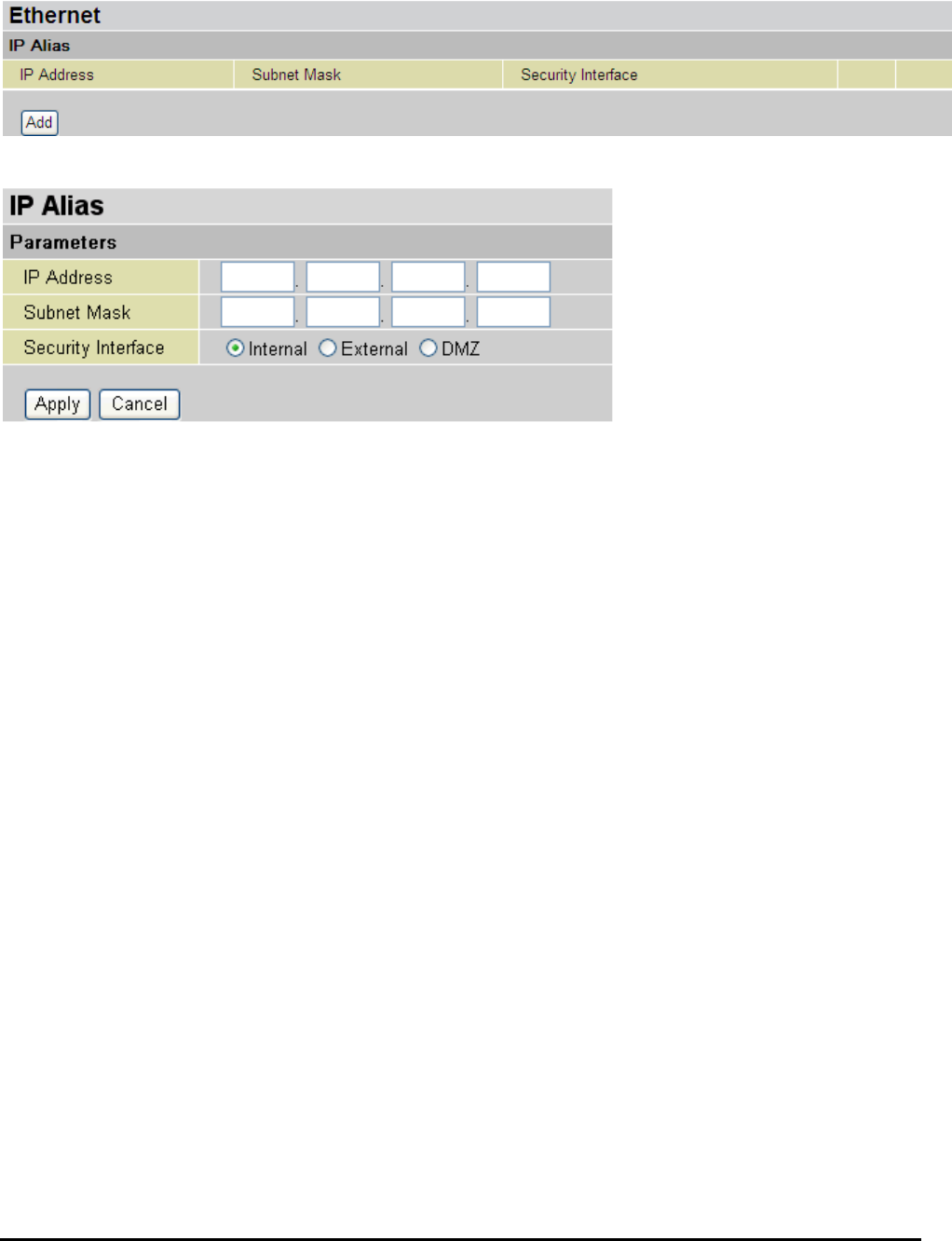
Ethernet
Primary IP Address
• IP Address: The default IP of this router.
• SubNetmask: The default subnet mask of this router.
• RIP: RIP v1, RIP v2, and RIP v2 Multicast. Check to enable RIP function.
Billion BiPAC 8500/8501/8520/8521 SHDSL (VPN) Firewall Bridge/ Router
Chapter 4: Configuration
40
IP Alias
This function supports the creation of multiple virtual IP interfaces on this router. It helps to
connect two or more local networks to the ISP or a remote node. In this case, an internal router
is not required.
Click Add to add a new IP alias.
• IP Address: Specify an IP address on this virtual interface.
• SubNetmask: Specify a subnet mask on this virtual interface.
• Security Interface: Specify the firewall setting on this virtual interface.
• Internal: The network is behind NAT. All traffic will translate network address when being
sent out to the Internet if NAT is enabled.
• External: There is no NAT on this IP interface and it is connecting to the Internet directly.
This is used when provided with multiple public IP addresses by ISP. In this case, you
can use the public IP address in the local network with gateway IP address point to the
IP address on this interface.
• DMZ: Specify this network to the DMZ area. There is no NAT on this interface.
Billion BiPAC SHDSL/SHDSL.bis (VPN) Firewall Bridge/ Router
Chapter 4: Configuration
41
Ethernet Client Filter
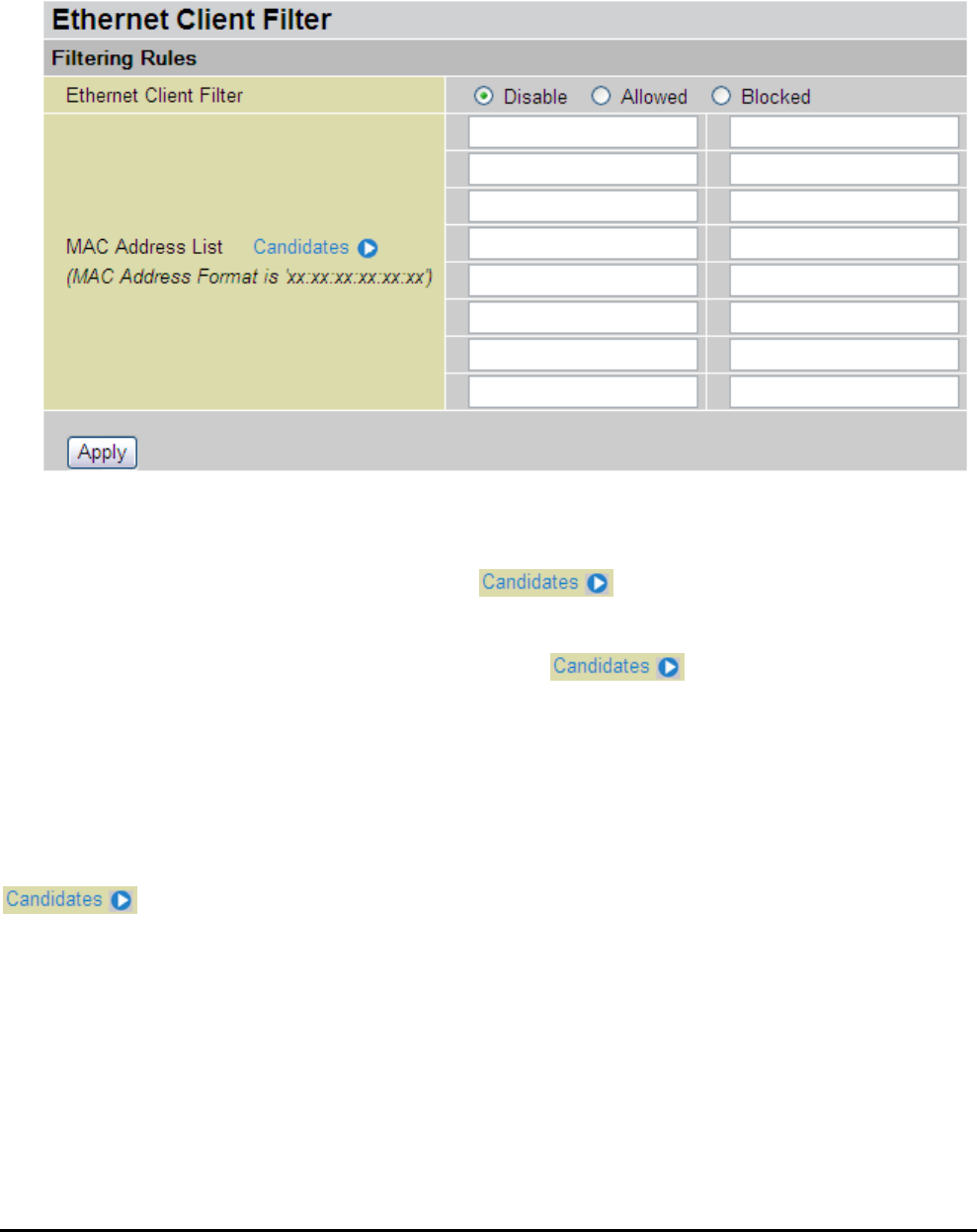
The Ethernet Client Filter supports up to 16 Ethernet network machines that helps you to
manage your network control to accept traffic from specific authorized machines or to restrict
unwanted machine(s) to access your LAN.
There are no pre-define Ethernet MAC address filter rules; you can add the filter rules to meet
your requirements.
Ethernet Client Filter: Default setting is set to Disable.
• Allowed: check to authorize specific device accessing your LAN by inserting the MAC
Address in the space provided or click . Make sure your PC’s MAC is listed.
• Blocked: check to prevent unwanted device from accessing your LAN by inserting the
MAC Address in the space provided or click . Make sure your PC’s MAC is
not listed.
The maximum number of client is 16. The MAC address is 6 byte long; it is presented only in
hexadecimal characters. The number 0 - 9 and letters a - f are acceptable.
Note: Follow the MAC Address Format xx:xx:xx:xx:xx:xx. Semicolon ( : ) must be included
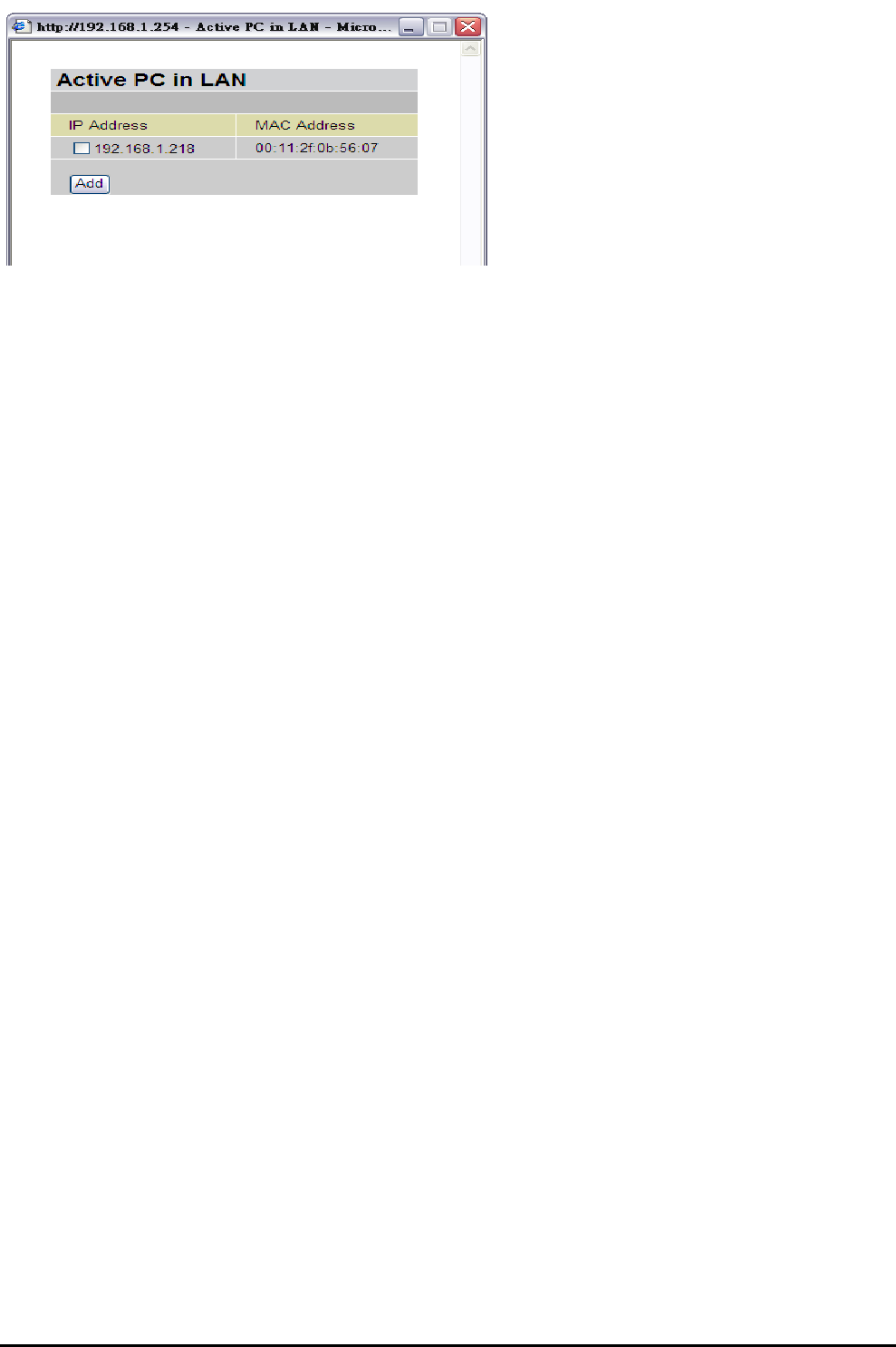
Candidates: automatically detects devices connected to the router through the Ethernet. .
→ Active PC in LAN
Billion BiPAC 8500/8501/8520/8521 SHDSL (VPN) Firewall Bridge/ Router
Chapter 4: Configuration
42
Active PC in LAN displays a list of IP Address & MAC Address of each individual Ethernet
device which is connected to the router.
You can check the box next to the IP address to block or allow. Then, click Add to insert to the
Ethernet Client Filter table. The maximum number of Ethernet client is 16.
Billion BiPAC SHDSL/SHDSL.bis (VPN) Firewall Bridge/ Router
Chapter 4: Configuration
43
Port Setting
This section allows you to configure the settings for the router’s Ethernet ports to solve some of
the compatibility problems that may be encountered while connecting to the Internet, as well
allowing users to tweak the performance of their network.
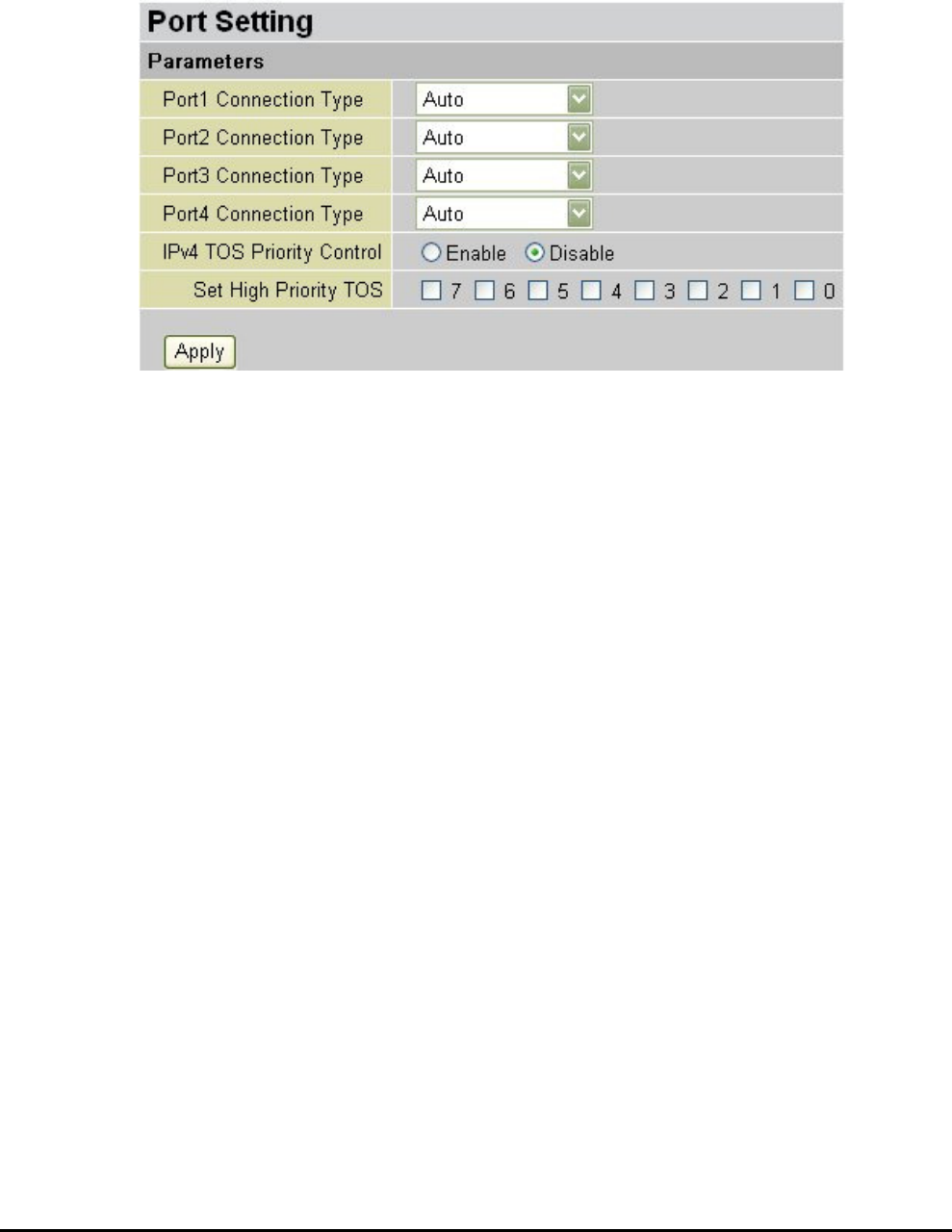
• Port # Connection Type: Six options to choose from: Auto, 10M half-duplex, 10M full-
duplex, 100M half-duplex, 100M full-duplex and Disable. Sometimes, there are Ethernet
compatibility problems with legacy Ethernet devices, and you can configure different
types to solve compatibility issues. The default is Auto, which users should keep unless
there are specific problems with PCs not being able to access your LAN.
• IPv4 TOS priority Control (Advanced users): TOS, Type of Services, is the 2
nd
octet of
an IP packet. Bits 6-7 of this octet are reserved and bit 0-5 are used to specify the priority
of the packet.
This feature uses bits 0-5 to classify the packet’s priority. If the packet is high priority, it
will flow first and will not be constrained by the Rate Limit. Therefore, when this feature is
enabled, the router’s Ethernet switch will check the 2
nd
octet of each IP packet. If the
value in the TOS field matches the checked values in the table (0 to 63), this packet will
be treated as high priority.
Billion BiPAC 8500/8501/8520/8521 SHDSL (VPN) Firewall Bridge/ Router
Chapter 4: Configuration
44
DHCP Server
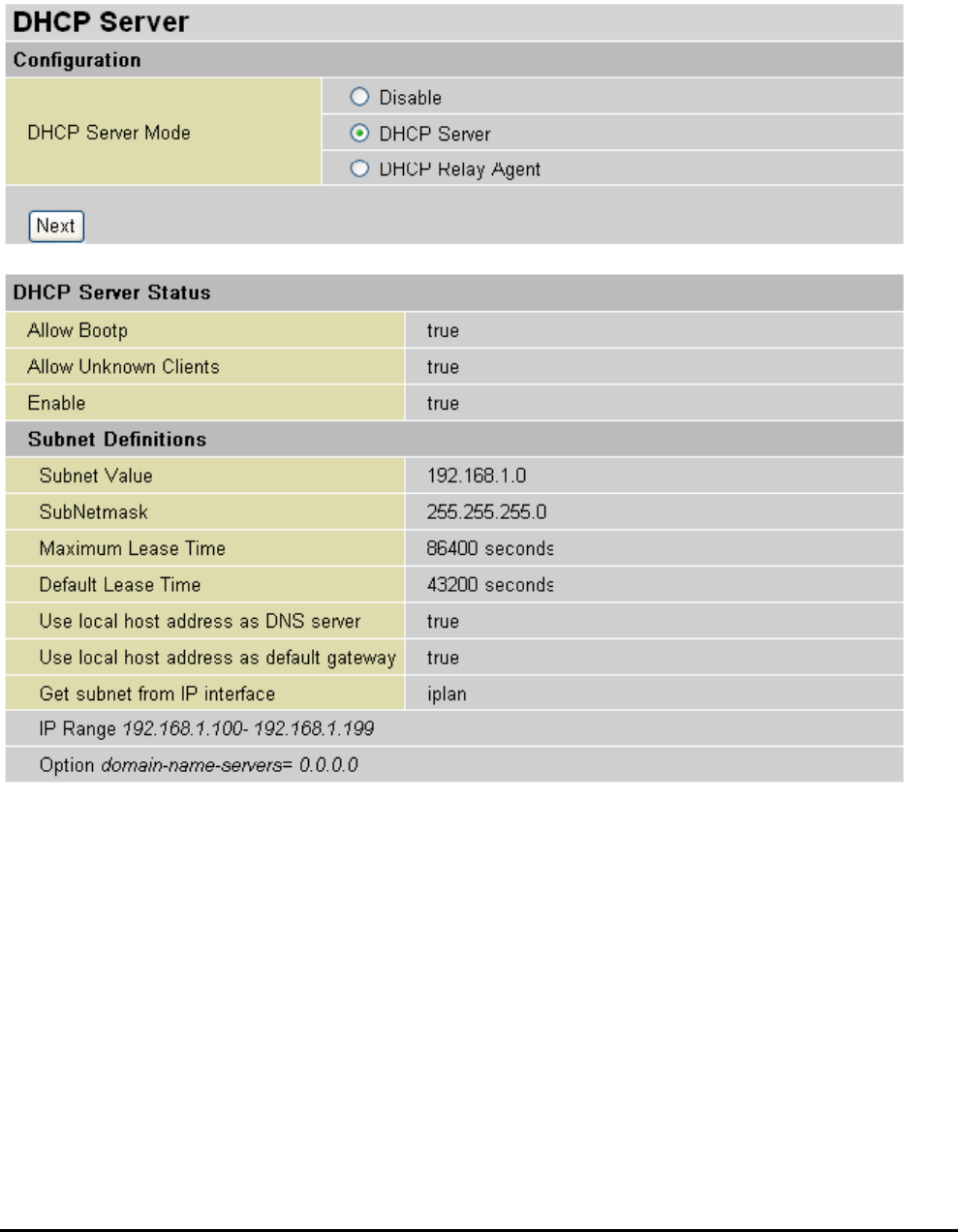
You can disable or enable the DHCP (Dynamic Host Configuration Protocol) server or enable
the router’s DHCP relay functions. The DHCP protocol allows your router to dynamically assign
IP addresses to PCs on your network if they are configured to obtain IP addresses automatically.
To disable the router’s DHCP Server, check Disabled and click Next, then click Apply. When
the DHCP Server is disabled you will need to manually assign a fixed IP address to each PCs
on your network, and set the default gateway for each PCs to the IP address of the router (by
default this is 192.168.1.254).
To configure the router’s DHCP Server, check DHCP Server and click Next. You can then
configure parameters of the DHCP Server including the IP pool (starting IP address and ending
IP address to be allocated to PCs on your network), lease time for each assigned IP address
(the period of time the IP address assigned will be valid), DNS IP address and the gateway IP
address. These details are sent to the DHCP client (i.e. your PC) when it requests an IP
address from the DHCP server. Click Apply to enable this function. If you check “Use Router
as a DNS Server”, the Router will perform the domain name lookup, find the IP address from
the network outside your network automatically and forward it back to the requesting PC in the
LAN (your Local Area Network).

Billion BiPAC 8500/8501/8520/8521 SHDSL (VPN) Firewall Bridge/ Router
Chapter 4: Configuration
45
If you check DHCP Relay Agent and click Next, then you will have to enter the IP address of
the DHCP server which will assign an IP address back to the DHCP client in the LAN. Use this
function only if advised to do so by your network administrator or ISP.
Click Apply to enable this function.
Billion BiPAC SHDSL/SHDSL.bis (VPN) Firewall Bridge/ Router
Chapter 4: Configuration
46
WAN (Wide Area Network)
WAN refers to your Wide Area Network connection, i.e. your router’s connection to your ISP and
the Internet. There are three items within the WAN section: ISP, DNS and SHDSL.
ISP
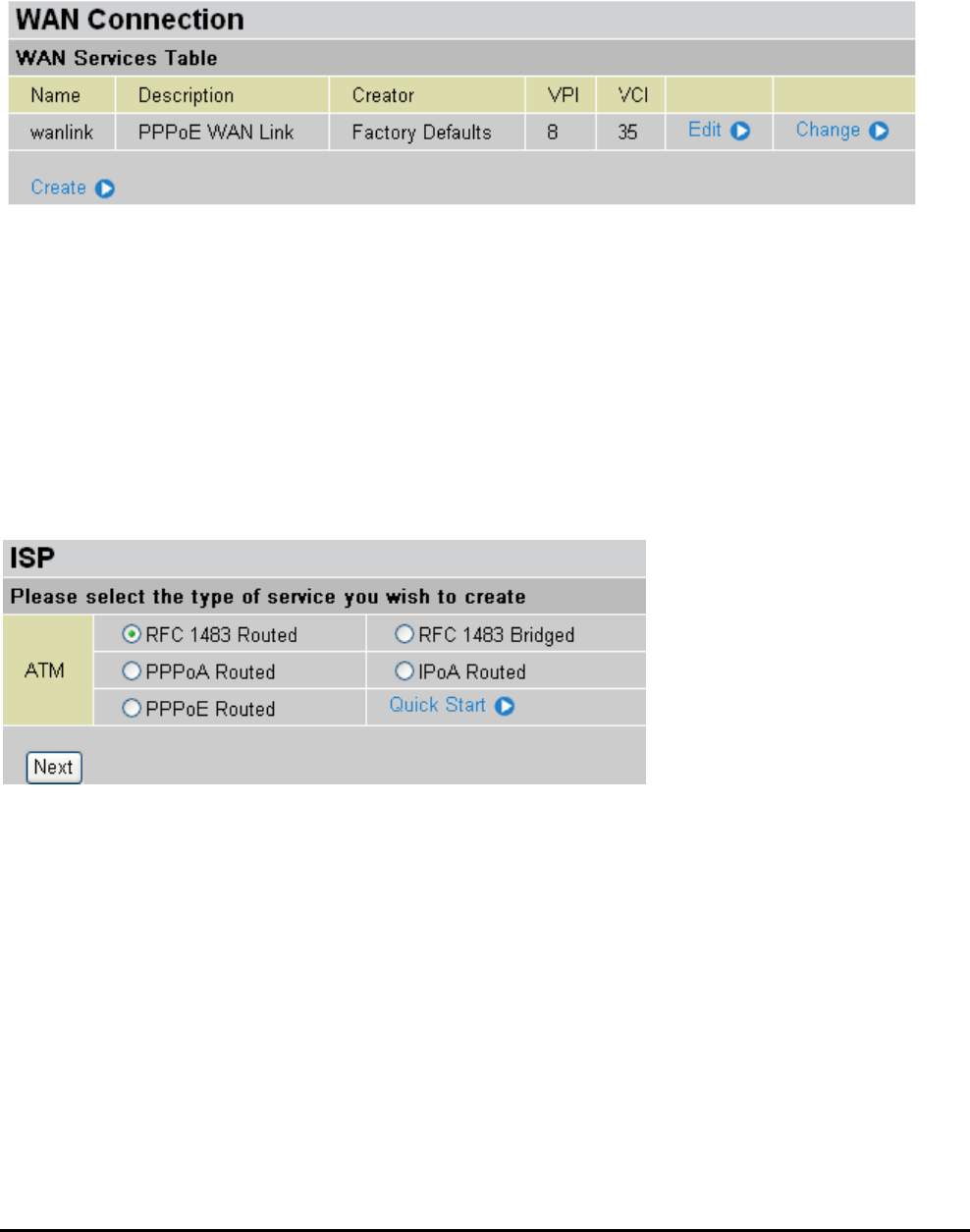
The factory default is PPPoE. If your ISP uses this access protocol, click Edit to input other
parameters as below. If your ISP does not use PPPoE, you can change the default WAN
connection entry by clicking Change.
Some ISP may provide more service via different WAN connection. In this case, you can create
more connections by clicking Create to enter the configuration page to setup the type of sevice
from the list then press Next to continue with the configuration. There are 5 types of ISP service
to choose from: RFC 1483 Routed, PPPoA Routed, PPPoE Routed, RFC 1483 Bridged and
IPoA Routed. The device can support maximum of up to 8 WAN connections.
Note: The application of multiple WAN connections depends on your Internet Service Provider.
A simpler alternative is to select Quick Start from the main menu on the left wondow pane.
Please see the Quick Start section of the manual for more information.
Billion BiPAC SHDSL/SHDSL.bis (VPN) Firewall Bridge/ Router
Chapter 4: Configuration
47
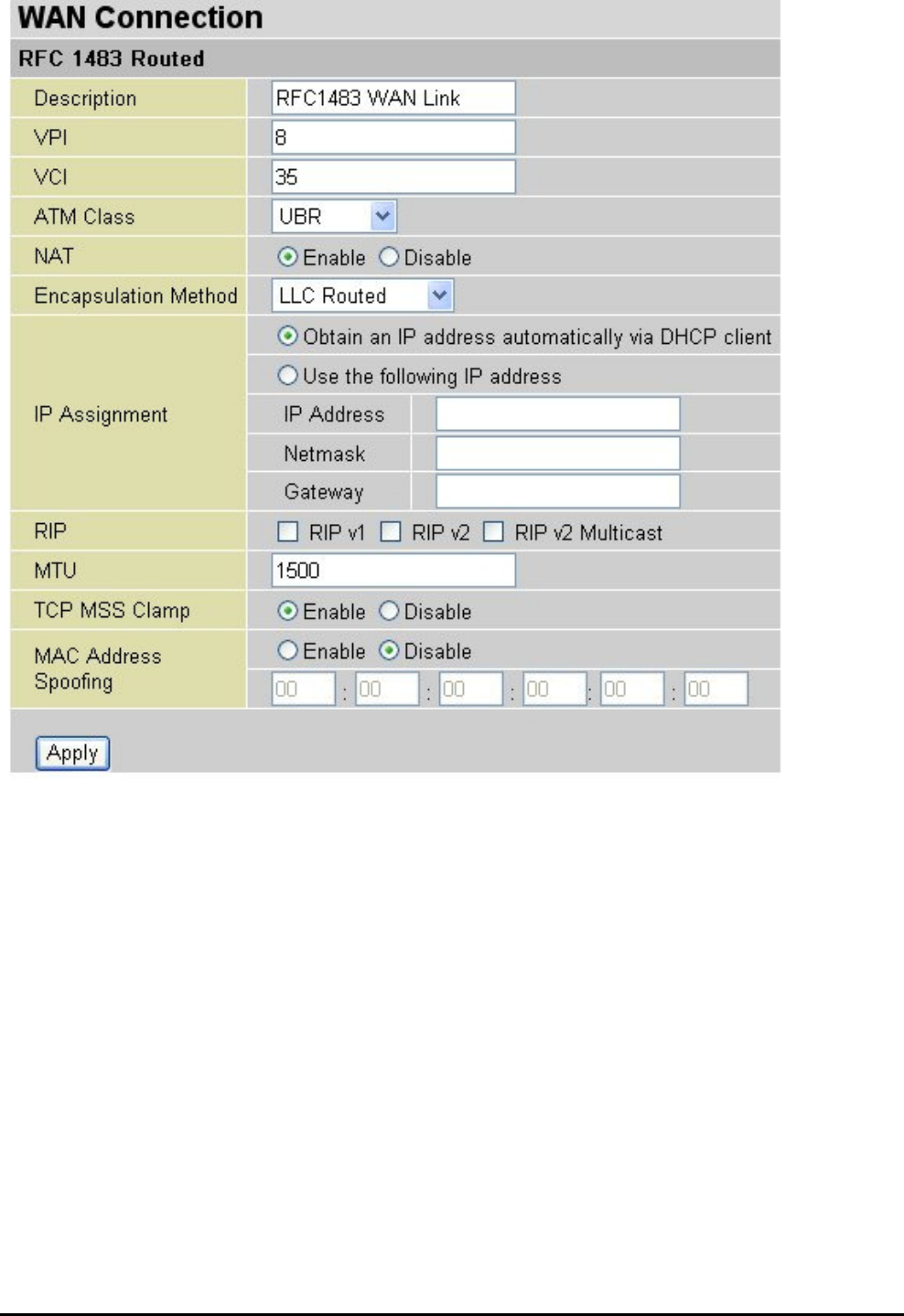
RFC 1483 Routed Connections
• Description: User-definable name for the connection.
• VPI and VCI: Enter the information provided by your ISP.
• ATM Class: The Quality of Service for ATM layer.
• NAT: The NAT (Network Address Translation) feature allows multiple users to access the
Internet through a single IP account by sharing the single IP address. If users on your
LAN have their own public IP addresses for accessing Internet directly, the NAT function
can be disabled.
• Encapsulation method: Select the encapsulation format, the default is LLC Bridged.
Select the one provided by your ISP.
• IP Assignment
o Obtain an IP address automatically via DHCP client: specify if the Router can
get an IP address from the ISP (Internet Service Provider) automatically.
o Use the following IP Address: Specify the IP address manually; the IP should be

Billion BiPAC 8500/8501/8520/8521 SHDSL (VPN) Firewall Bridge/ Router
Chapter 4: Configuration
48
given by you our ISP.
• RIP: RIP v1, RIP v2, and RIP v2 Multicast. Check to enable RIP function.
• MTU: Maximum Transmission Unit. The size of the largest datagram (excluding media-
specific headers) that IP will attempt to send through the interface.
• TCP MSS Clamp: This option helps to auto detect the optimal MTU size. Default is
enabled.
• MAC Address Spoofing: This option is required by Service Providers. You must fill in
the MAC address that is specified by your Service Provider if this is required. Default is
disabled.
Billion BiPAC 8500/8501/8520/8521 SHDSL (VPN) Firewall Bridge/ Router
Chapter 4: Configuration
49
RFC 1483 Bridged Connections
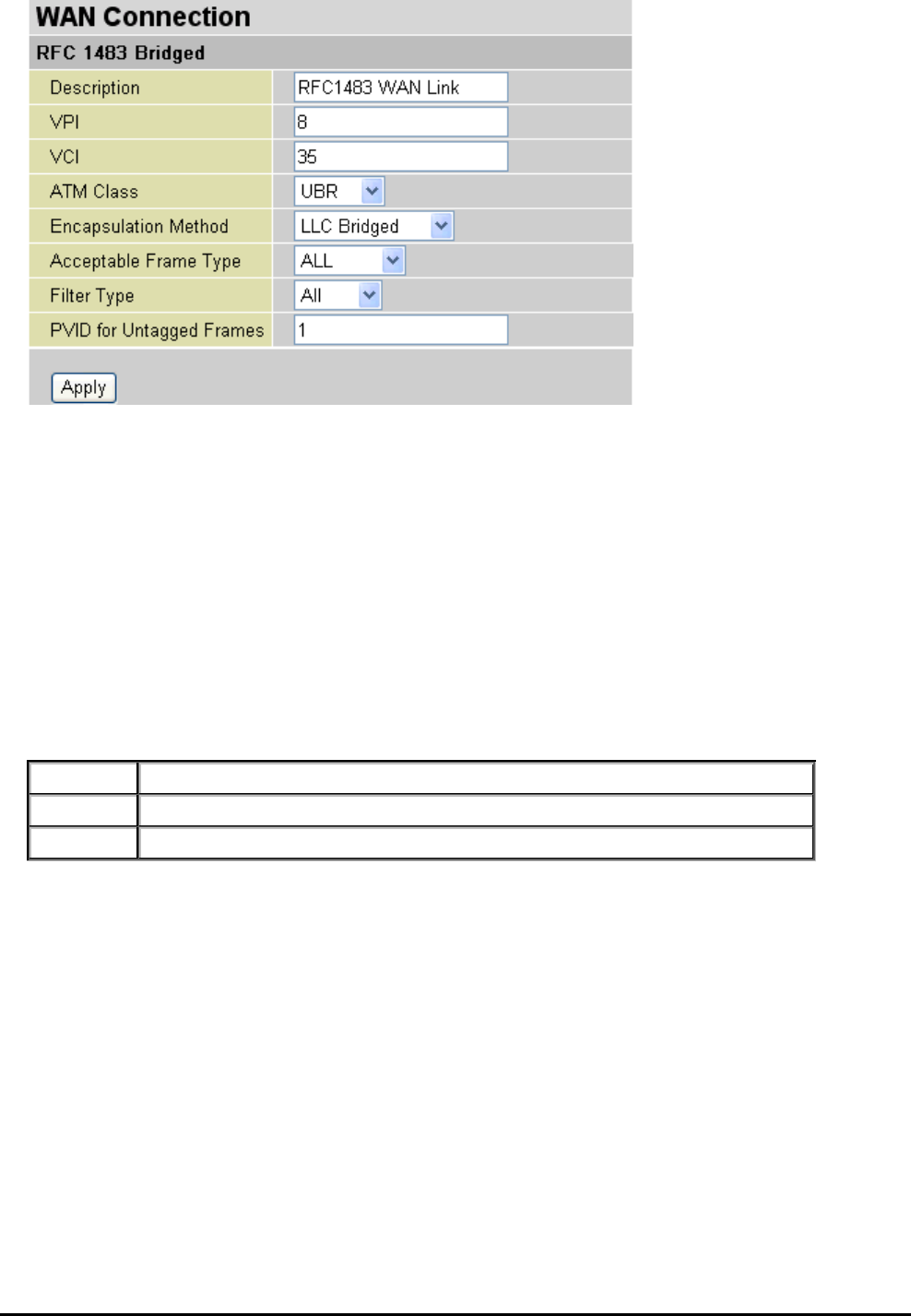
• Description: User-definable name for the connection.
• VPI and VCI: Enter the information provided by your ISP.
• ATM Class: The Quality of Service for ATM layer.
• Encapsulation method: Select the encapsulation format, this is provided by your ISP.
• Acceptable Frame Type: Specify what kind of traffic can pass through this connection,
all traffic or only VLAN tagged.
• Filter Type: Specify the type of ethernet filtering performed by the named bridge
interface.
All Allows all types of ethernet packets through the port.
Ip Allows only IP/ARP types of ethernet packets through the port.
Pppoe Allows only PPPoE types of ethernet packets through the port.
• PVID for Untagged Frames: PVID is known as Port VLAN Identifier. When an untagged
packet is received by input port(s), this packet will be tagged with a specific PVID. The
valid value range for PVID is 1~4094.
Billion BiPAC SHDSL/SHDSL.bis (VPN) Firewall Bridge/ Router
Chapter 4: Configuration
50
PPPoA Routed Connections
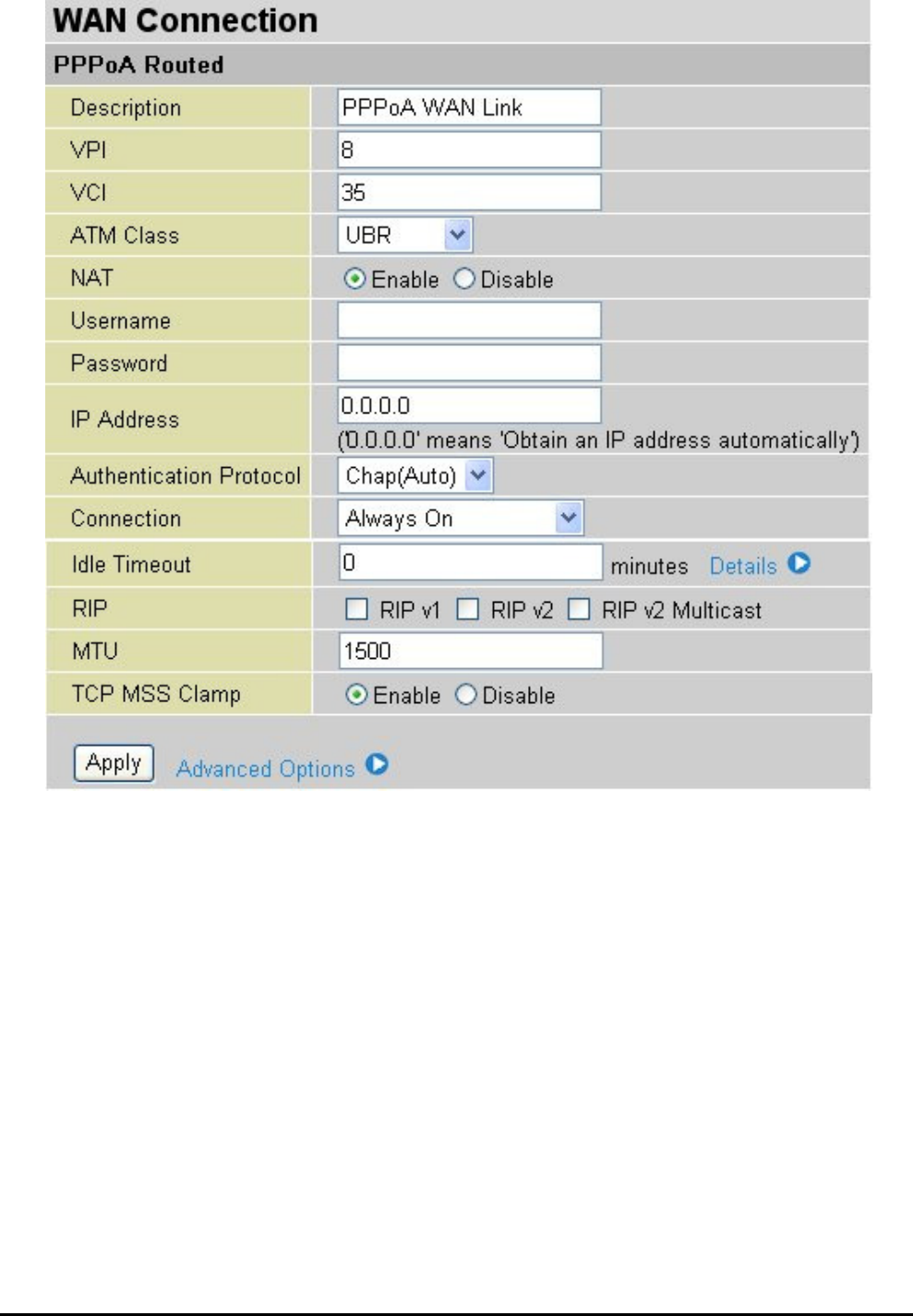
• Description: User-definable name for the connection.
• VPI/VCI: Enter the information provided by your ISP.
• ATM Class: The Quality of Service for ATM layer.
• NAT: The NAT (Network Address Translation) feature allows multiple users to access the
Internet through a single IP account by sharing a single IP address. If users on your LAN
have their own public IP addresses for accessing Internet directly, the NAT function can
be disabled.
• Username: Enter the username provided by your ISP. You can input up to 128
alphanumeric characters (case sensitive). This will usually be in the format of
“username@ispname” instead of simply “username”.
• Password: Enter the password provided by your ISP. You can input up to 128
alphanumeric characters (case sensitive).
• IP Address: specify if the Router can get an IP address from the Internet Server

Billion BiPAC 8500/8501/8520/8521 SHDSL (VPN) Firewall Bridge/ Router
Chapter 4: Configuration
51
Provider (ISP) automatically or not. Please click Obtain an IP address automatically via
DHCP client to enable the DHCP client function or click Specify an IP address to disable
the DHCP client function, and specify the IP address manually. The setting of this item is
specified by your ISP.
• Authentication Protocol Type: Default is Chap (Auto). Your ISP will advise you
whether to use Chap or Pap.
• Connection:
o Always on: If you want the router to establish a PPPoA session when starting up
and to automatically re-establish the PPPoA session when disconnected by the
ISP.
o Connect to Demand: If you want to establish a PPPoA session only when there
is a packet requesting to access the Internet (i.e. when a program on your
computer attempts to access the Internet).
• Idle Timeout: Auto-disconnect the broadband firewall gateway when there is no activity
on the line for a predetermined period of time.
o Detail: You can define the destination port and packet type (TCP/UDP) without
being checked by the timer. It allows you to set which outgoing traffic will not
trigger and reset the idle timer.
• RIP: RIP v1, RIP v2, and RIP v2 Multicast. Check to enable RIP function.
• MTU: Maximum Transmission Unit. The size of the largest datagram (excluding media-
specific headers) that IP will attempt to send through the interface.
• TCP MSS Clamp: This option helps to auto detect the optimal MTU size. Default is
enabled.
Billion BiPAC 8500/8501/8520/8521 SHDSL (VPN) Firewall Bridge/ Router
Chapter 4: Configuration
52
Advanced Options (PPPoA)
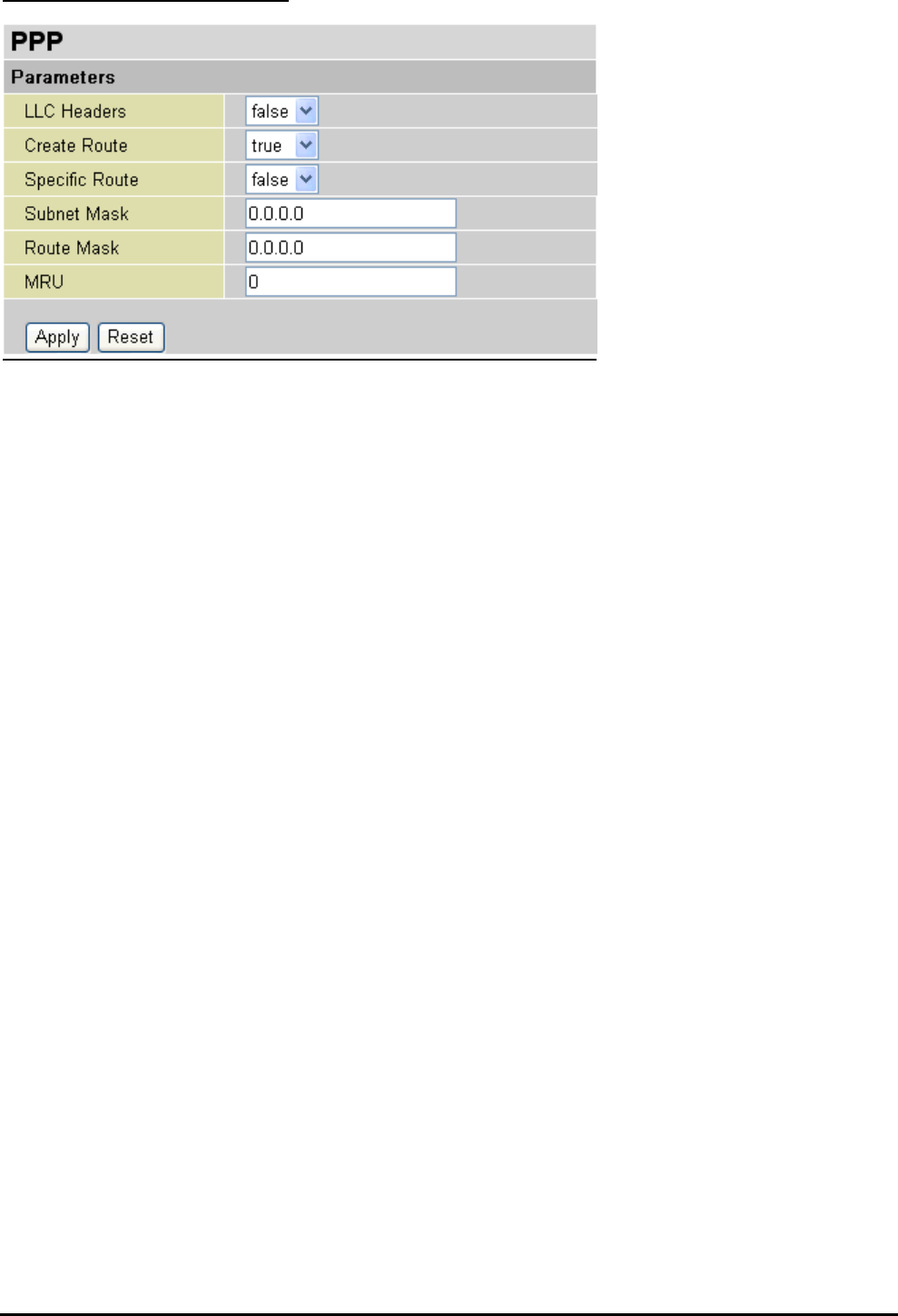
• LLC Header: Select encapsulation mode, true for using LLC or false for using VC-Mux.
• Create Route: This setting specifies whether a route is to be added to the system after
IPCP (Internet Protocol Control Protocol) negotiation is complete. If set to enabled, a
route will be created which directs packets to the remote end of the PPP link.
• Specific Route: Specify whether the route created when a PPP link comes up is a
specific or default route. If set to enabled, the route created will only be applied to
packets for the subnet at the remote end of the PPP link. The address of this subnet is
obtained during IPCP negotiation.
• Subnet Mask: Set the subnet mask used for the local IP interface connected to the PPP
transport. If the value 0.0.0.0 is supplied, the netmask will be calculated from the class of
the IP address obtained during IPCP negotiation.
• Route Mask: Set the subnet mask used by the route that is created when a PPP link
comes up. If it is set to 0.0.0.0, the subnet mask is determined by the IP address of the
remote end of the link. The class of the IP address is obtained during IPCP (Internet
Protocol Control Protocol) negotiation.
• MRU: Maximum Receive Unit. This is negotiated during the LCP protocol stage.
Billion BiPAC 8500/8501/8520/8521 SHDSL (VPN) Firewall Bridge/ Router
Chapter 4: Configuration
53
IPoA Routed Connections
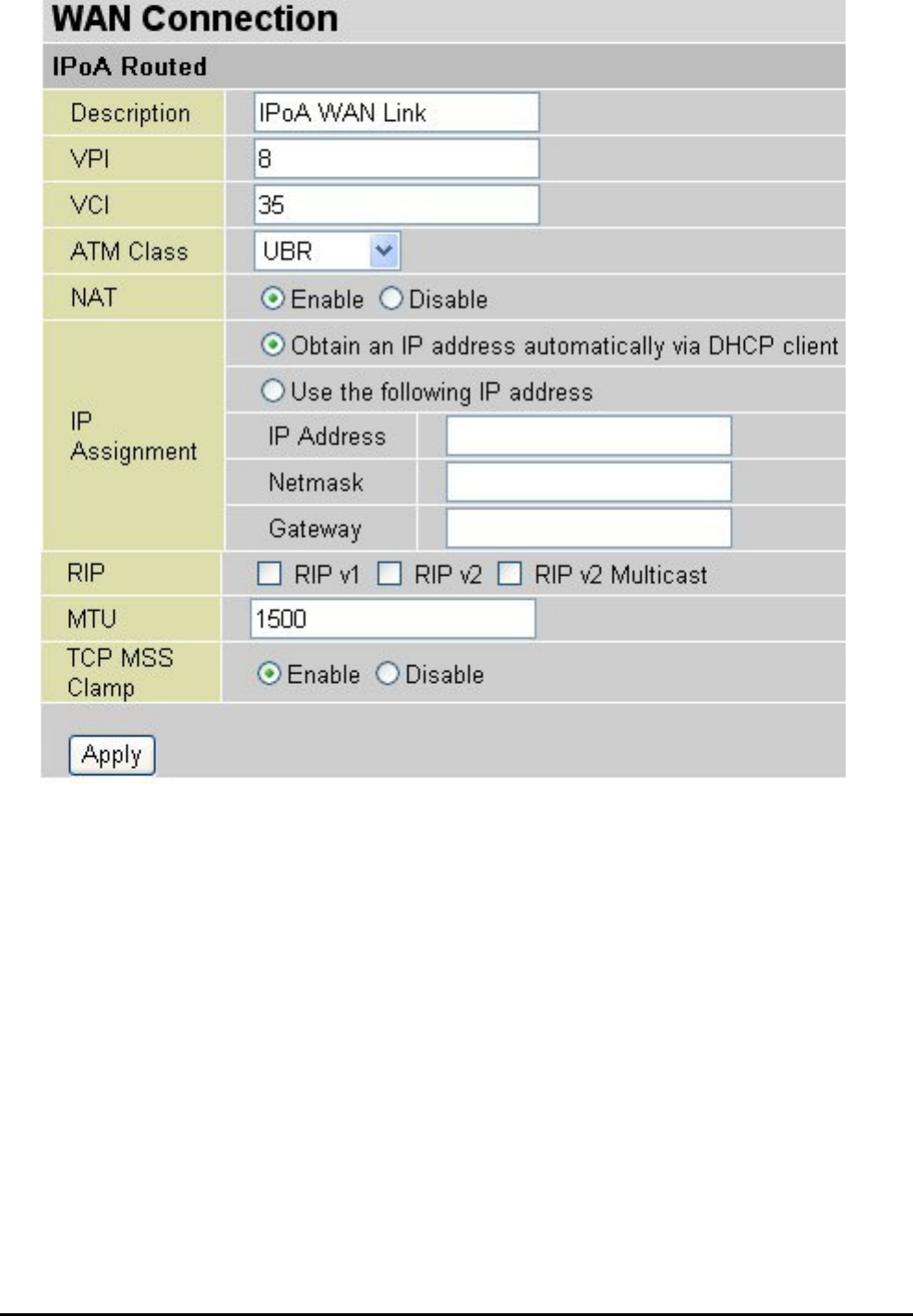
• Description: User-definable name for the connection.
• VPI/VCI: Enter the information provided by your ISP.
• ATM Class: The Quality of Service for ATM layer.
• NAT: The NAT (Network Address Translation) feature allows multiple users to access the
Internet through a single IP account by sharing a single IP address. If users on your LAN
have their own public IP addresses for accessing Internet directly, the NAT function can
be disabled.
• IP Assignment
o Obtain an IP address automatically via DHCP client: specify if the Router can
get an IP address from the ISP (Internet Service Provider) automatically.
o Use the following IP Address: Specify the IP address manually; the IP should be
given by you our ISP.

Billion BiPAC 8500/8501/8520/8521 SHDSL (VPN) Firewall Bridge/ Router
Chapter 4: Configuration
54
• RIP: RIP v1, RIP v2, and RIP v2 Multicast. Check to enable RIP function.
• MTU: Maximum Transmission Unit. The size of the largest datagram (excluding media-
specific headers) that IP will attempt to send through the interface.
• TCP MSS Clamp: This option helps to auto detect the optimal MTU size. Default is
enabled.
Billion BiPAC 8500/8501/8520/8521 SHDSL (VPN) Firewall Bridge/ Router
Chapter 4: Configuration
55
PPPoE Connections
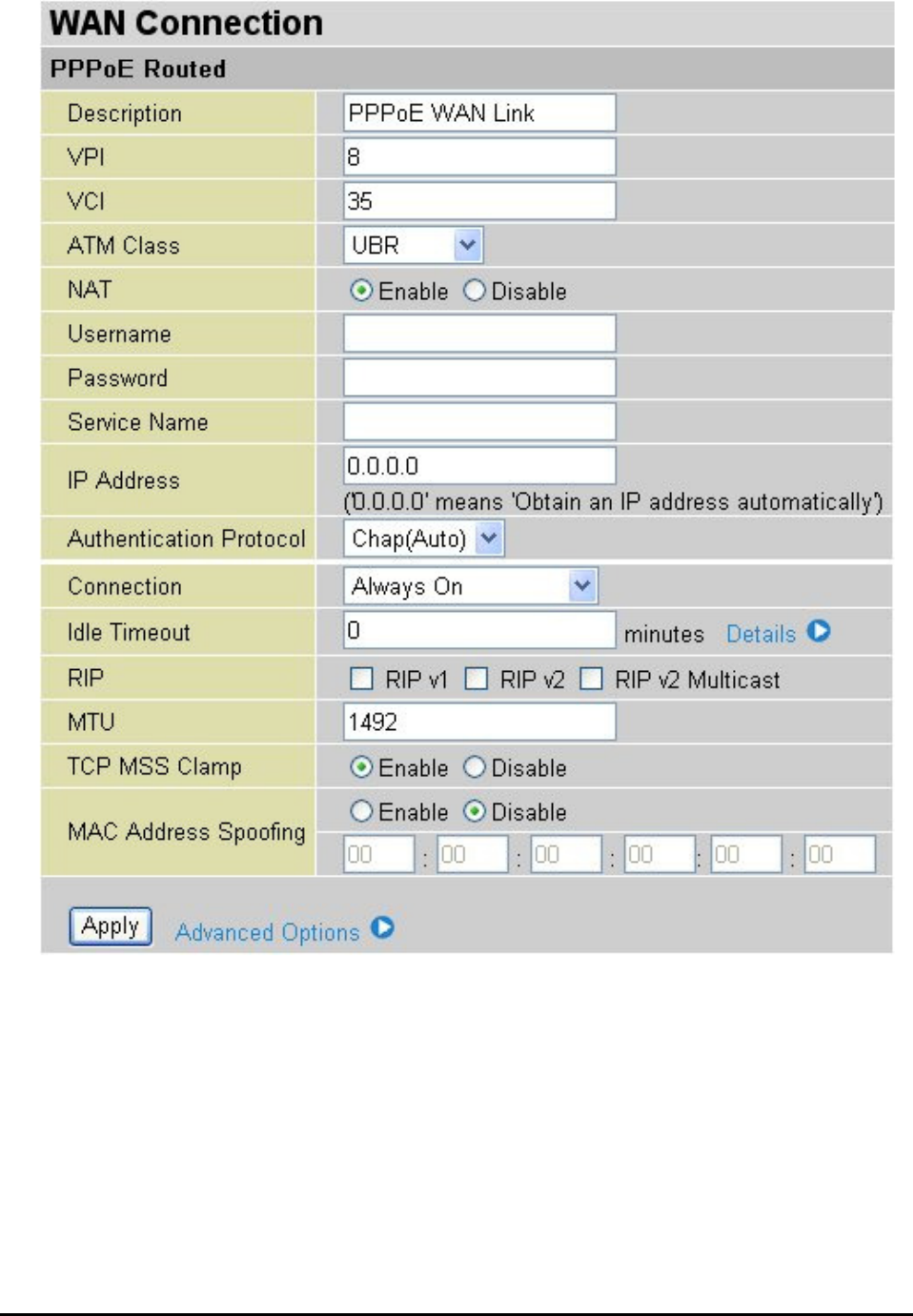
• Description: User-definable name for this connection.
• VPI/VCI: Enter the information provided by your ISP.
• ATM Class: The Quality of Service for ATM layer.
• NAT: The NAT (Network Address Translation) feature allows multiple users to access the
Internet through a single IP account by sharing a single IP address. If users on your LAN
have their own public IP addresses for accessing Internet directly, the NAT function can
be disabled.
• Username: Enter the username provided by your ISP. You can input up to 128

Billion BiPAC 8500/8501/8520/8521 SHDSL (VPN) Firewall Bridge/ Router
Chapter 4: Configuration
56
alphanumeric characters (case sensitive). This will usually be in the format of
“username@ispname” instead of simply “username”.
• Password: Enter the password provided by your ISP. You can input up to 128
alphanumeric characters (case sensitive).
• Service Name: This item is for identification purposes. If it is required, your ISP will
provide you the information. Maximum input is 20 alphanumeric characters.
• IP Address: specify if the Router can get an IP address from the Internet Server
Provider (ISP) automatically or not. Please click Obtain an IP address automatically via
DHCP client to enable the DHCP client function or click Specify an IP address to disable
the DHCP client function, and specify the IP address manually. The setting of this item is
specified by your ISP.
• Authentication Protocol: Default is Chap (Auto). Your ISP will advise you whether to
use Chap or Pap.
• Connection
o Always on: If you want the router to establish a PPPoE session when starting up
and to automatically re-establish the PPPoE session when disconnected by the
ISP.
o Connect on Demand: If you want to establish a PPPoE session only when there
is a packet requesting access to the Internet (i.e. when a program on your
computer attempts to access the Internet).
• Idle Timeout: Auto-disconnect the broadband firewall gateway when there is no activity
on the line for a predetermined period of time.
o Detail: You can define the destination port and packet type (TCP/UDP) without
being checked by the timer. It allows you to set which outgoing traffic will not
trigger and reset the idle timer.
• RIP: RIP v1, RIP v2, and RIP v2 Multicast. Check to enable RIP function.
• MTU: Maximum Transmission Unit. The size of the largest datagram (excluding media-
specific headers) that IP will attempt to send through the interface.
• TCP MSS Clamp: This option helps to auto detect the optimal MTU size. Default is
enabled.
• MAC Address Spoofing: This option is required by Service Providers. You must fill in
the MAC address that is specified by your Service Provider if this is required. Default is
disabled.
Billion BiPAC 8500/8501/8520/8521 SHDSL (VPN) Firewall Bridge/ Router
Chapter 4: Configuration
57
Advanced Options (PPPoE)
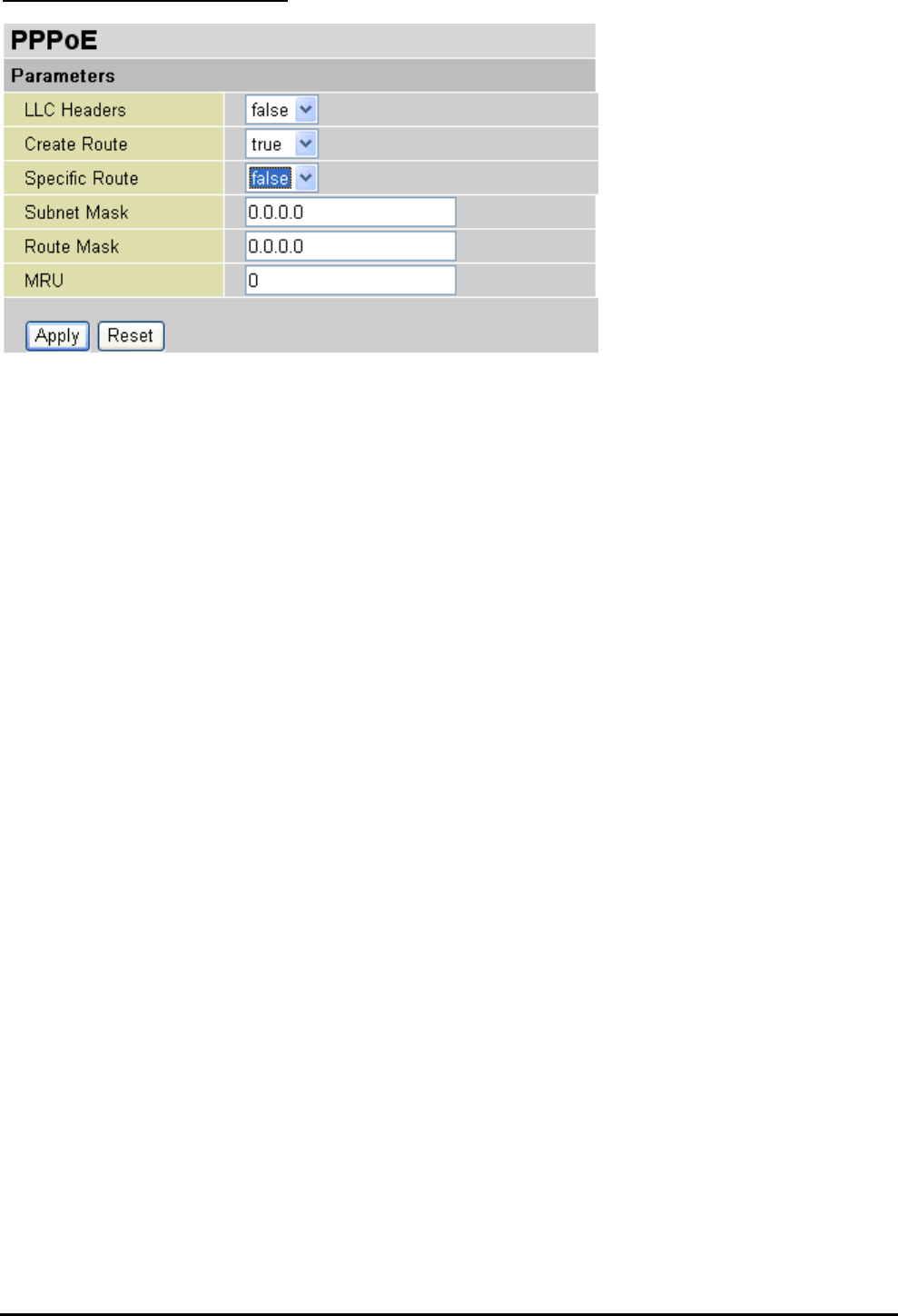
• LLC Header: Selects encapsulation mode, true for using LLC or false for using VC-Mux.
• Create Route: This setting specify whether a route is to be added to the system after
IPCP (Internet Protocol Control Protocol) negotiation is completed. If set to enabled, a
route will be created which directs packets to the remote end of the PPP link.
• Specific Route: Specify whether the route created when a PPP link comes up is a
specific or default route. If set to enabled, the route created will only apply to packets for
the subnet at the remote end of the PPP link. The address of this subnet is obtained
during IPCP negotiation.
• Subnet Mask: set the subnet mask used for the local IP interface connected to the PPP
transport. If the value 0.0.0.0 is supplied, the netmask will be calculated from the class of
the IP address obtained during IPCP negotiation.
• Route Mask: Set the subnet mask used by the route that is created when a PPP link
comes up. If it is set to 0.0.0.0, the subnet mask is determined by the IP address of the
remote end of the link. The class of the IP address is obtained during IPCP (Internet
Protocol Control Protocol) negotiation.
• MRU: Maximum Receive Unit. This is negotiated during the LCP protocol stage.
Billion BiPAC 8500/8501/8520/8521 SHDSL (VPN) Firewall Bridge/ Router
Chapter 4: Configuration
58
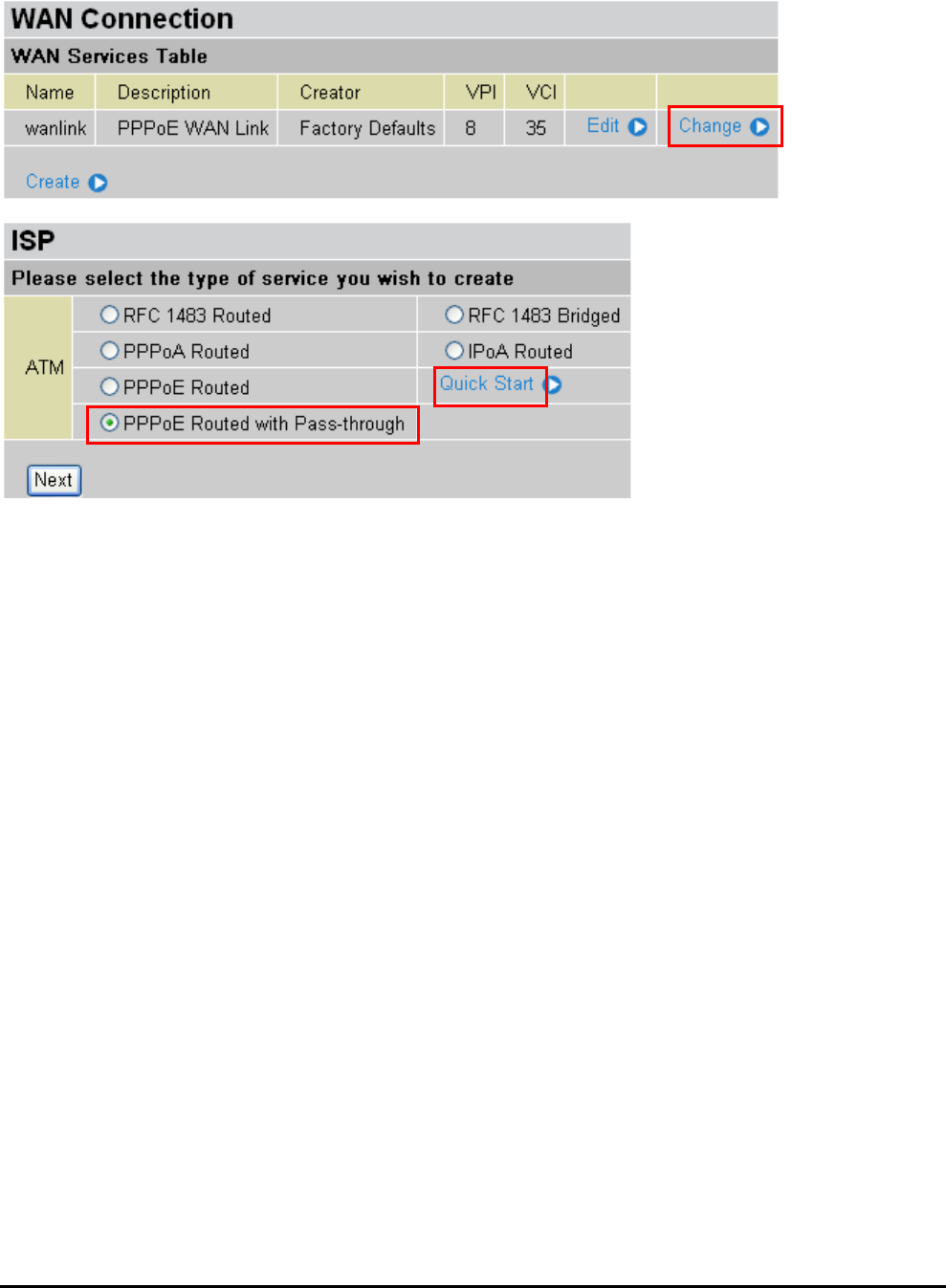
PPPoE with Pass-through Connections
To access PPPoE with Pass-through Connection: Press Change > PPPoE Routed with Pass-
Through > Quick Start
PPPoE with pass-through adapts the following method: PPPoE Routed mode + 1483 Bridge
Mode. With pure PPPoE connection, the router can get one WAN address to the router. With
the PPPoE and PPPoE pass-through, concurrently, it allows user to have a WAN address
assigned to the router but also able to get another WAN IP from ISP using PPPoE dialer (e.g
WinPoETor Windows XP PPPoE Dialer) at the same time.
Billion BiPAC 8500/8501/8520/8521 SHDSL (VPN) Firewall Bridge/ Router
Chapter 4: Configuration
59
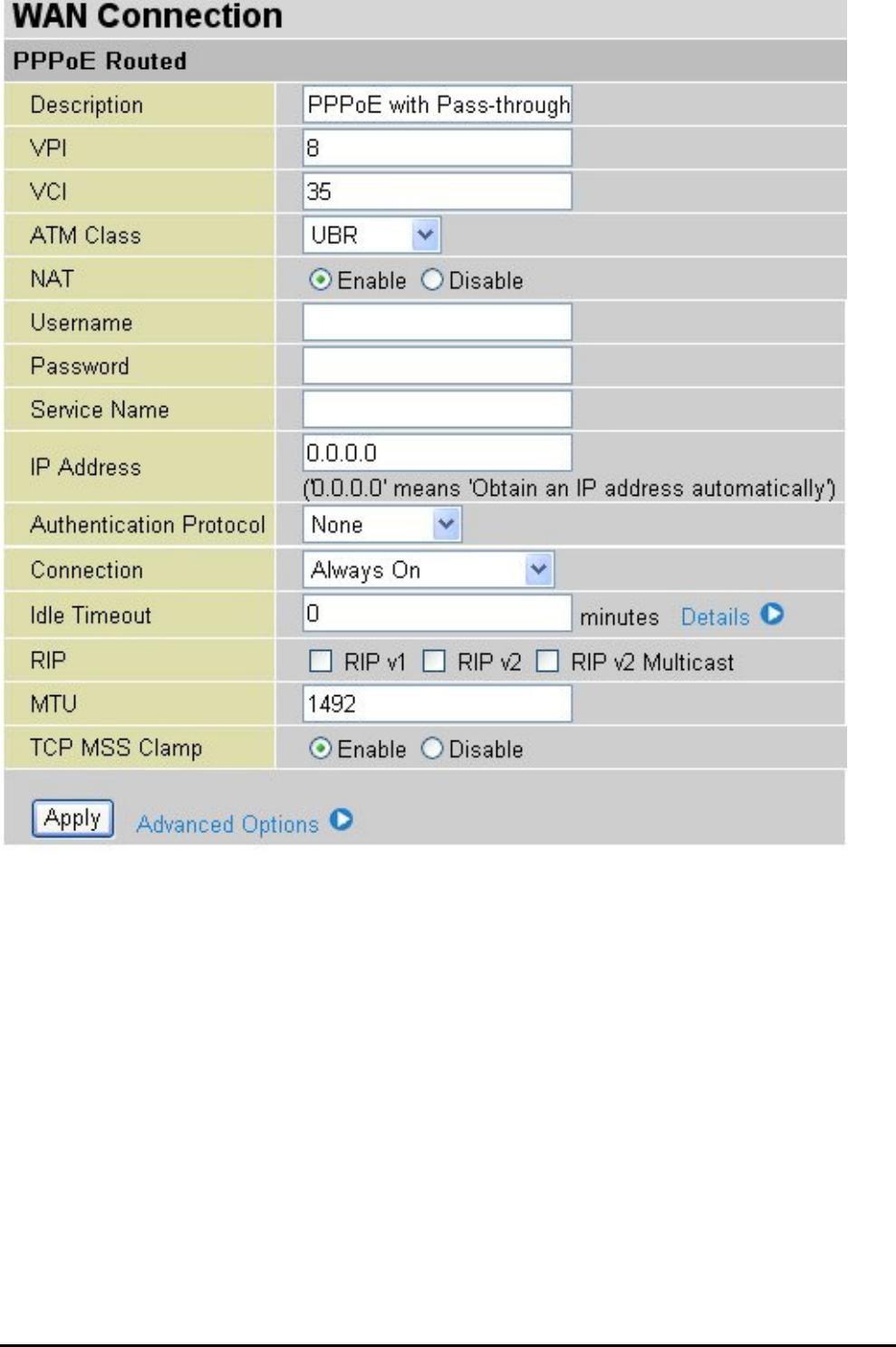
• Description: User-definable name for this connection.
• VPI/VCI: Enter the information provided by your ISP.
• ATM Class: The Quality of Service for ATM layer.
• NAT: The NAT (Network Address Translation) feature allows multiple users to access the
Internet through a single IP account by sharing a single IP address. If users on your LAN
have their own public IP addresses for accessing Internet directly, the NAT function can
be disabled.
• Username: Enter the username provided by your ISP. You can input up to 128
alphanumeric characters (case sensitive). This will usually be in the format of
“username@ispname” instead of simply “username”.
• Password: Enter the password provided by your ISP. You can input up to 128
alphanumeric characters (case sensitive).

Billion BiPAC 8500/8501/8520/8521 SHDSL (VPN) Firewall Bridge/ Router
Chapter 4: Configuration
60
• Service Name: This item is for identification purposes. If it is required, your ISP will
provide you the information. Maximum input is 20 alphanumeric characters.
• IP Address: specify if the Router can get an IP address from the Internet Server
Provider (ISP) automatically or not. Please click Obtain an IP address automatically via
DHCP client to enable the DHCP client function or click Specify an IP address to disable
the DHCP client function, and specify the IP address manually. The setting of this item is
specified by your ISP.
• Authentication Protocol: Default is Chap (Auto). Your ISP will advise you whether to
use Chap or Pap.
• Connection:
o Always on: If you want the router to establish a PPPoE session when starting up
and to automatically re-establish the PPPoE session when disconnected by the
ISP.
o Connect on Demand: If you want to establish a PPPoE session only when there
is a packet requesting access to the Internet (i.e. when a program on your
computer attempts to access the Internet).
• Idle Timeout: Auto-disconnect the broadband firewall gateway when there is no activity
on the line for a predetermined period of time.
o Detail: You can define the destination port and packet type (TCP/UDP) without
being checked by the timer. It allows you to set which outgoing traffic will not
trigger and reset the idle timer.
• RIP: RIP v1, RIP v2, and RIP v2 Multicast. Check to enable RIP function.
• MTU: Maximum Transmission Unit. The size of the largest datagram (excluding media-
specific headers) that IP will attempt to send through the interface.
• TCP MSS Clamp: This option helps to auto detect the optimal MTU size. Default is
enabled.
Billion BiPAC 8500/8501/8520/8521 SHDSL (VPN) Firewall Bridge/ Router
Chapter 4: Configuration
61
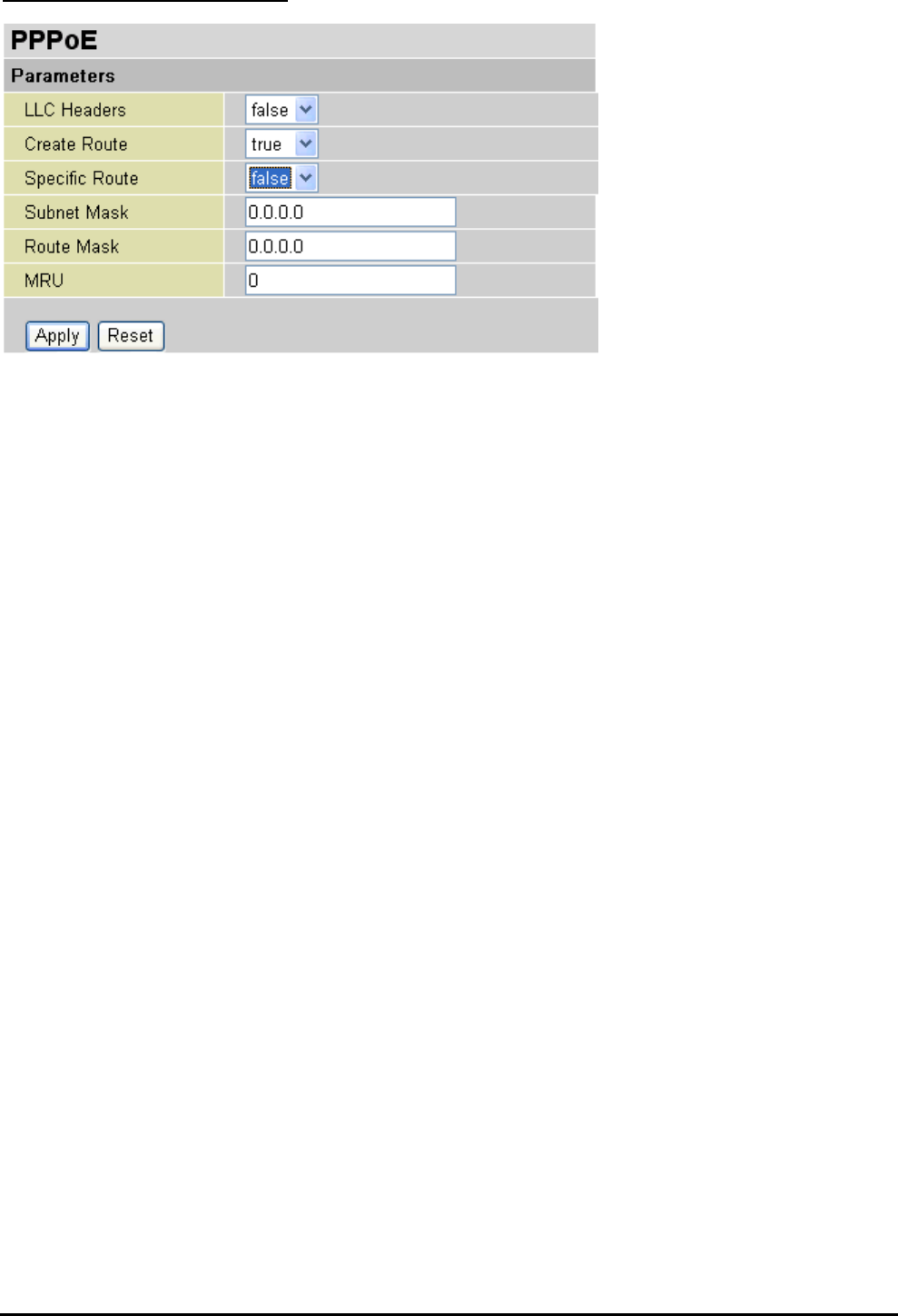
Advanced Options (PPPoE)
LLC Header: Select encapsulation mode, true for using LLC or false for using VC-Mux.
Create Route: This setting specifies whether a route is to be added to the system after IPCP
(Internet Protocol Control Protocol) negotiation is complete. If set to enabled, a route will be
created which directs packets to the remote end of the PPP link.
Specific Route: Specify whether the route created when a PPP link comes up is a specific or
default route. If set to enabled, the route created will only apply to packets for the subnet at the
remote end of the PPP link. The address of this subnet is obtained during IPCP negotiation.
Subnet Mask: set the subnet mask used for the local IP interface connected to the PPP
transport. If the value 0.0.0.0 is supplied, the netmask will be calculated from the class of the IP
address obtained during IPCP negotiation.
Route Mask: Set the subnet mask used by the route that is created when a PPP link comes up.
If it is set to 0.0.0.0, the subnet mask is determined by the IP address of the remote end of the
link. The class of the IP address is obtained during IPCP (Internet Protocol Control Protocol)
negotiation.
MRU: Maximum Receive Unit. This is negotiated during the LCP protocol stage.
Discover Primary / Secondary DNS: This setting enables/disables whether the
primary/secondary DNS server address is requested from a remote PPP peer using IPCP. The
default setting for this command is enabled.
Give DNS to Relay: Control whether the PPP Internet Protocol Control Protocol (IPCP) can
request the DNS server IP address for a remote PPP peer. Once IPCP has discovered the DNS
server IP address, it automatically gives the address to the local DNS relay so that a connection
can be established.
Give DNS to Client: Control whether the PPP Internet Protocol Control Protocol (IPCP) can
request a DNS server IP address for a remote PPP peer. Once IPCP has discovered the DNS
server IP address, it automatically gives the address to the local DNS client so that a
connection can be established.
Give DNS to DHCP Server: Similar to the above, but it gives the DNS server address to the
DHCP server instead.

Billion BiPAC 8500/8501/8520/8521 SHDSL (VPN) Firewall Bridge/ Router
Chapter 4: Configuration
62
Discover Primary NBNS / Discover Secondary NBNS: This setting enables/disables whether
the primary/secondary NBNS server address is requested from a remote PPP peer using IPCP.
The default setting for this command is disabled.
Discover Subnet Mask: Specify if the subnet mask given by IPCP negotiation process is to be
used.
Give Subnet Mask To DHCP Server: Enable to change your DHCP Server settings by using
the given information in IPCP negotiation process.
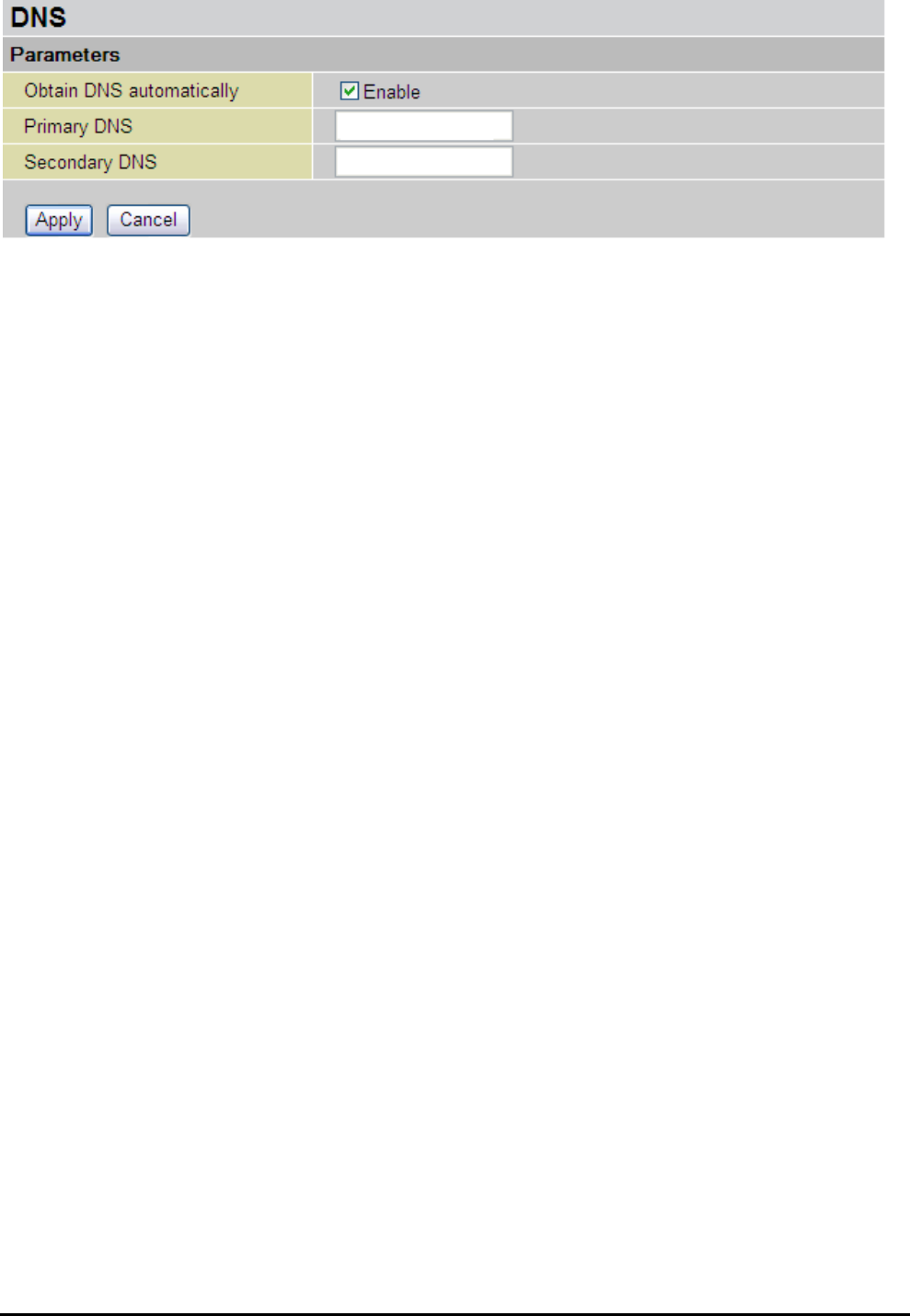
Billion BiPAC 8500/8501/8520/8521 SHDSL (VPN) Firewall Bridge/ Router
Chapter 4: Configuration
63
DNS
A Domain Name System (DNS) contains a mapping table for domain name and IP addresses.
On the Internet, every host has a unique and user-friendly name (domain name) such as
www.helloworld.com and an IP address. An IP address is a 32-bit number in the form of
xxx.xxx.xxx.xxx, for example 192.168.1.254. You can think of an IP address as a telephone
number for devices on the Internet, and the DNS will allow you to find the telephone number for
any particular domain name. As an IP Address is hard to remember, the DNS converts the
friendly name into its equivalent IP Address.
You can obtain a Domain Name System (DNS) IP address automatically if your ISP has
provided it when you logon, check the Enable box. Usually when you choose PPPoE or PPPoA
as your WAN - ISP protocol, the ISP will provide the DNS IP address automatically. You may
leave the configuration field blank.
Alternatively, your ISP may provide you with an IP address of their DNS. If this is the case, you
must enter the DNS IP address manually.
If you choose one of the other three protocols ─ RFC1483 Routed/Bridged and IPoA, check
with your ISP as it may provide you with an IP address for their DNS server. You must enter the
DNS IP address if you set the DNS of your PC to the LAN IP address of this router.
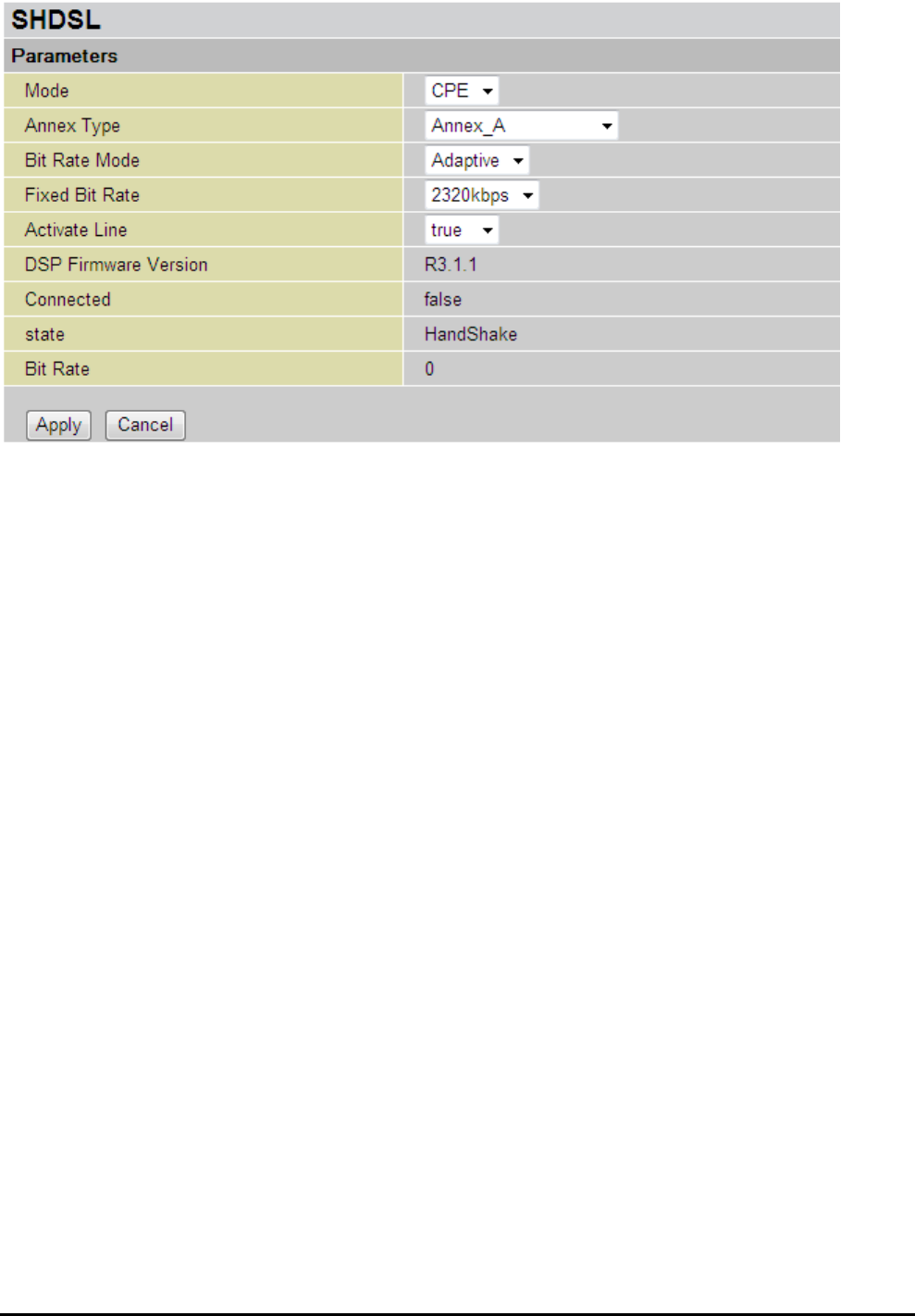
Billion BiPAC 8500/8501/8520/8521 SHDSL (VPN) Firewall Bridge/ Router
Chapter 4: Configuration
64
SHDSL-BiPAC 8500
• Mode: The SHDSL device can function as a CPE (Customer Premises Equipment) or
CO (Central Office). Select CPE mode when the BiPAC 8500 is connected to your ISP.
• Back – to –back: it is a direct connection between two SHDSL devices with one being
set to CPE and the other is set to CO by using a standard RJ-11 telephone cable.
• Annex Type: It is the DSL operating mode standard. Select Annex A or Annex B to
support up to 2.3Mpbs SHDSL function. Select other annex such as Annex B_ANFP /
Annex A_B_ANFP, you may consult with your ISP first.
• Back – to –back: to be sure the Annex type is the same on the BiPAC 8500 and the
remote router.
• Bit Rate Mode: The mode selections are Adaptive and Fixed. Selecting the Adaptive
mode, the best connection rate will be automatically negotiated with the CO / ISP.
Selecting the Fixed mode, the connection rate will be fixed to the specific fixed bit rate
selected with the CO / ISP.
• Fixed Bit Rate: Specify the fix transfer rate when Fixed Mode is selected. Specify the
maximum transfer rate when Adaptive Mode is selected. Bit Rate range is from 200kbps
~ 2312kbps.
• Activate Line: Line active true is set by default. Select false to disable and true to
enable SHDSL SHDSL connection
Note: Once Active Line is selected as false, you must enable the Active Line to true again and
click the Apply button to reactivate SHDSL connection.
• DSP Firmware Version: Display the SHDSL line code firmware version.
• Connected: Display current SHDSL line sync status.
• State: Display current SHDSL line status.

Billion BiPAC 8500/8501/8520/8521 SHDSL (VPN) Firewall Bridge/ Router
Chapter 4: Configuration
65
• Bit Rate: Display SHDSL line synch speed rate.
Click Apply button to apply your changes.
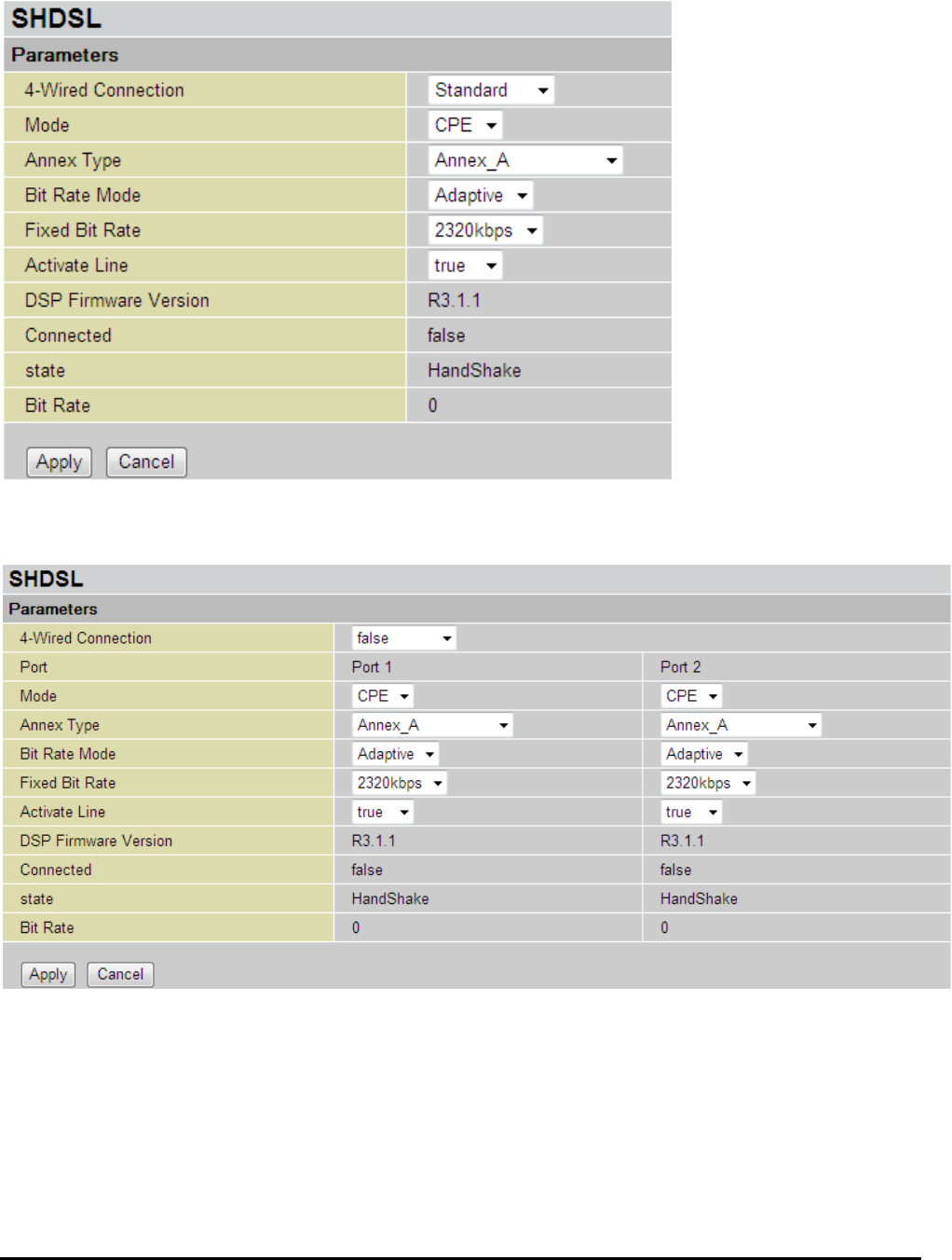
Billion BiPAC 8500/8501/8520/8521 SHDSL (VPN) Firewall Bridge/ Router
Chapter 4: Configuration
66
SHDSL – BiPAC 8520
Standard 4-wired connection: the 4-wired handshaking procedure that is compliant with ITU-T
standard.
False 4-wired connection: This mode is used when 4-wired connection is disabled.
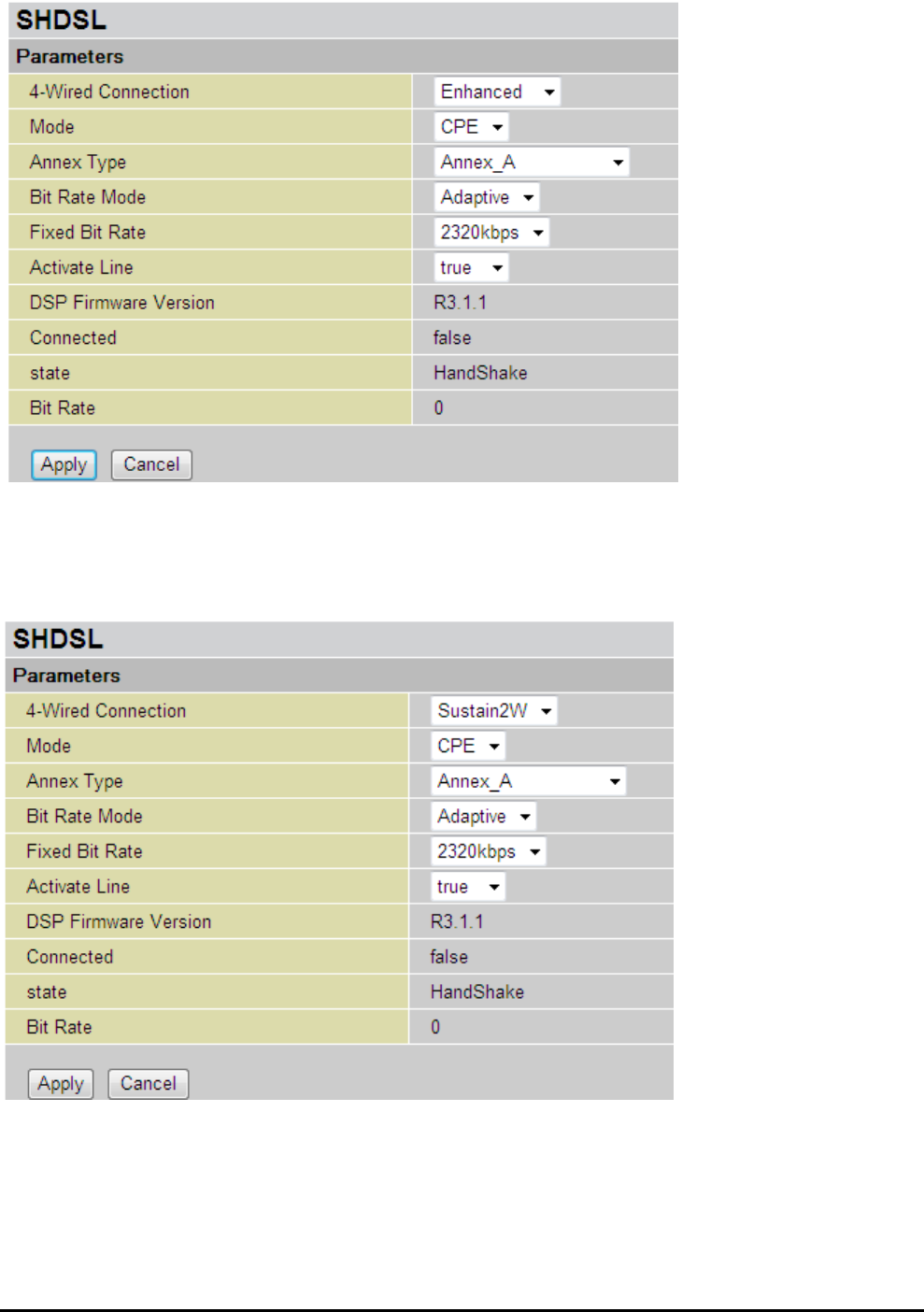
Billion BiPAC 8500/8501/8520/8521 SHDSL (VPN) Firewall Bridge/ Router
Chapter 4: Configuration
67
Enhanced 4-wired connection: Conexant enhanced 4-wired mode and compliant with
Conexant Legacy codes.
Sustain2W 4-wired connection: This mode is used to auto detect whether the device uses 2-
wired connection or 4-wired connection.
• 4-Wired Connection: BiPAC 8520 supports 4 types of SHDSL.bis connection: Standard,
False, Enahnced & Sustain2W. Select the type of SHDSL.bis connection from the 4-
wired connection drop down menu, then select Apply to activate the configuration page.

Billion BiPAC 8500/8501/8520/8521 SHDSL (VPN) Firewall Bridge/ Router
Chapter 4: Configuration
68
Note: When select 2-wired mode, only Port 1 settings need to be configured and the SHDSL
(RJ-11 cable) must be connected to LINE 1 on the back of the device.

Billion BiPAC 8500/8501/8520/8521 SHDSL (VPN) Firewall Bridge/ Router
Chapter 4: Configuration
69
• Mode: The SHDSL device can function as a CPE (Customer Premises Equipment) or
CO (Central Office). Select CPE mode when the BiPAC 8520 is connected to your ISP.
• Back – to –back: it is a direct connection between two SHDSL devices with one being
set to CPE and the other is set to CO by using a standard RJ-11 telephone cable.
• Annex Type: It is the DSL operating mode standard. Select Annex A or Annex B to
support up to 2.3Mpbs (for 2-wired mode) and 4.6Mpbs (for 4-wired mode). Select other
annex such as Annex B_ANFP / Annex A_B_ANFP, you may consult with your ISP first.
• Back – to –back: to be sure the Annex type is the same on the BiPAC 8520 and the
remote router.
• Bit Rate Mode: The mode selections are Adaptive and Fixed. Selecting the Adaptive
mode, the best connection rate will be automatically negotiated with the CO / ISP.
Selecting the Fixed mode, the connection rate will be fixed to the specific fixed bit rate
selected with the CO / ISP.
• Fixed Bit Rate: Specify the fix transfer rate when Fixed Mode is selected. Specify the
maximum transfer rate when Adaptive Mode is selected. Bit Rate range is from 200kbps
~ 2312kbps.
• Activate Line: Line active true is set by default. Select false to disable and true to
enable SHDSL connection
Note: Once Active Line is selected as false, you must enable the Active Line to true again and
click the Apply button to reactivate SHDSL connection.
• DSP FirmwareVersion: Display the SHDSL line code firmware version.
• Connected: Display current SHDSL line sync status.
• State: Display current SHDSL line status.
• Bit Rate: Display SHDSL line synch speed rate.
Click the Apply button to apply your changes
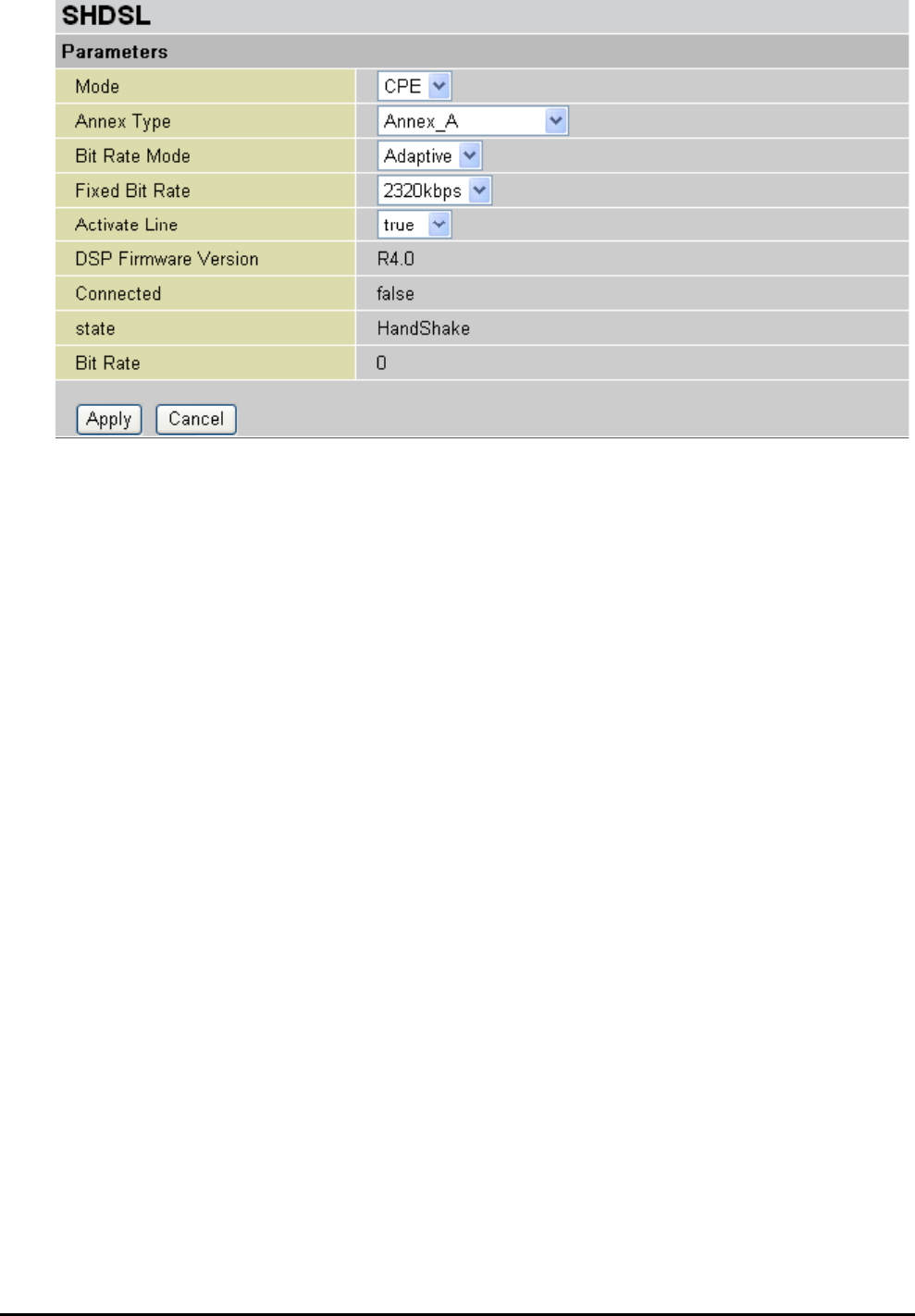
Billion BiPAC 8500/8501/8520/8521 SHDSL (VPN) Firewall Bridge/ Router
Chapter 4: Configuration
70
SHDSL – BiPAC 8501
• Mode: The SHDSL.bis device can function as a CPE (Customer Premises Equipment) or
CO. Select CPE mode when the BiPAC 8501 is connecting to your ISP.
• Annex Type: It is the DSL operating mode standard. Select Annex A or Annex B to
support up to 5.7Mbps SHDSL.bis function. Select other annex such as Annex B_ANFP /
Annex A_B_ANFP, you may consult with your ISP first.
• Bit Rate Mode: The mode selections are Adaptive and Fixed. Selecting the Adaptive
mode, the best connection rate will be automatically negotiated with the CO / ISP.
Selecting the Fixed mode, the connection rate will be fixed to the specific fixed bit rate
selected with the CO / ISP.
• Fixed Bit Rate: Specify the fix transfer rate when Fixed Mode is selected. Specify the
maximum transfer rate when Adaptive Mode is selected. Bit Rate range is from 200kbps
~ 5704kbps.
• Activate Line: Line active true is set by default. Select false to disable and true to
enable SHDSL.bis connection
Note: Once Active Line is selected as false, you must enable the Active Line to true again and
click the Apply button to reactivate SHDSL.bis connection.
• DSP FirmwareVersion: Display the SHDSL line code firmware version.
• Connected: Display current SHDSL line sync status.
• State: Display current SHDSL line status.
• Bit Rate: Display SHDSL line synch speed rate.
Click Apply button to apply your changes.
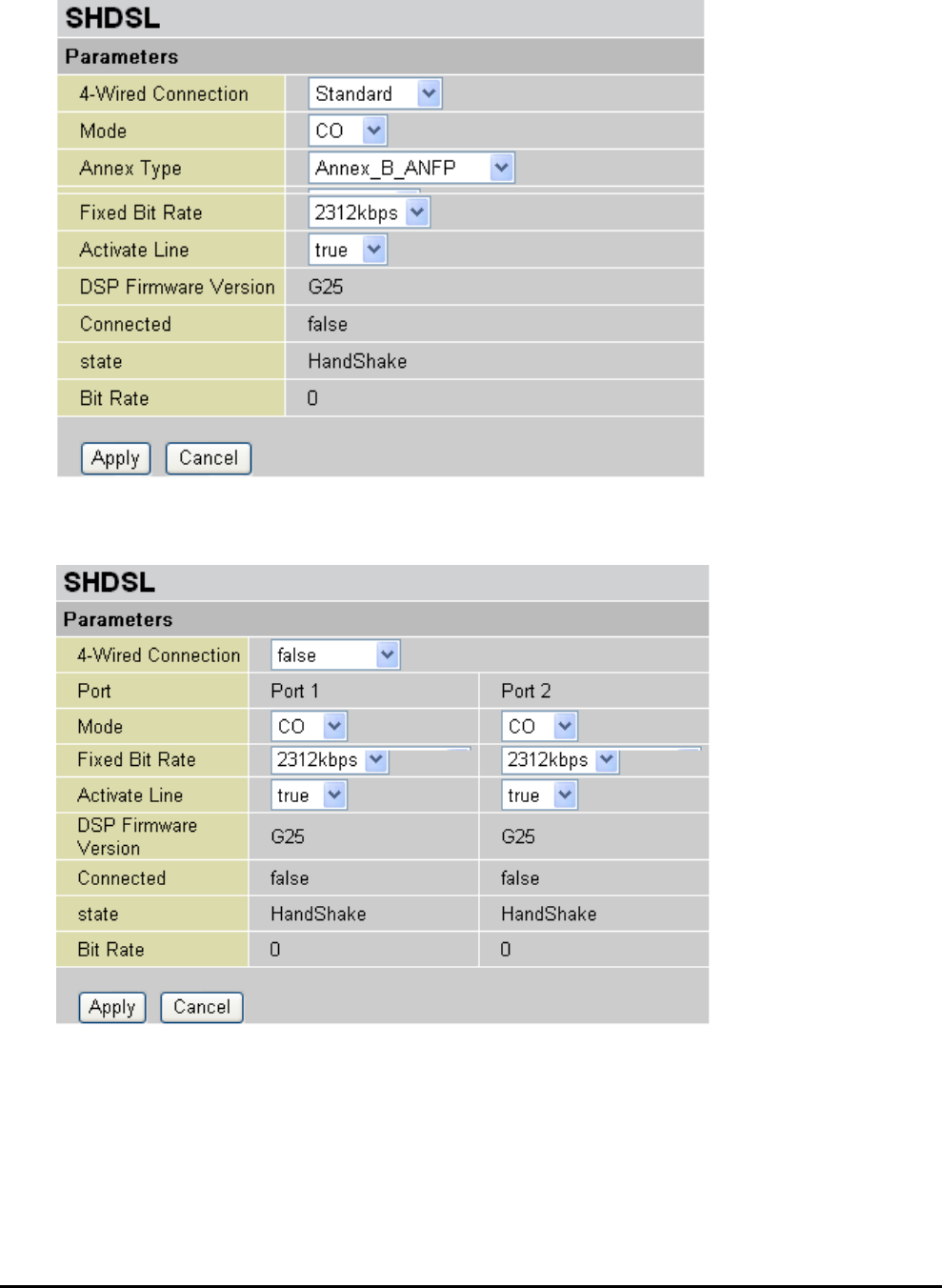
Billion BiPAC 8500/8501/8520/8521 SHDSL (VPN) Firewall Bridge/ Router
Chapter 4: Configuration
71
SHDSL – BiPAC 8521
Standard 4-wired connection: the 4-wired handshaking procedure that is compliant
with ITU-T standard.
False 4-wired connection: This mode is used when 4-wired connection is disabled.
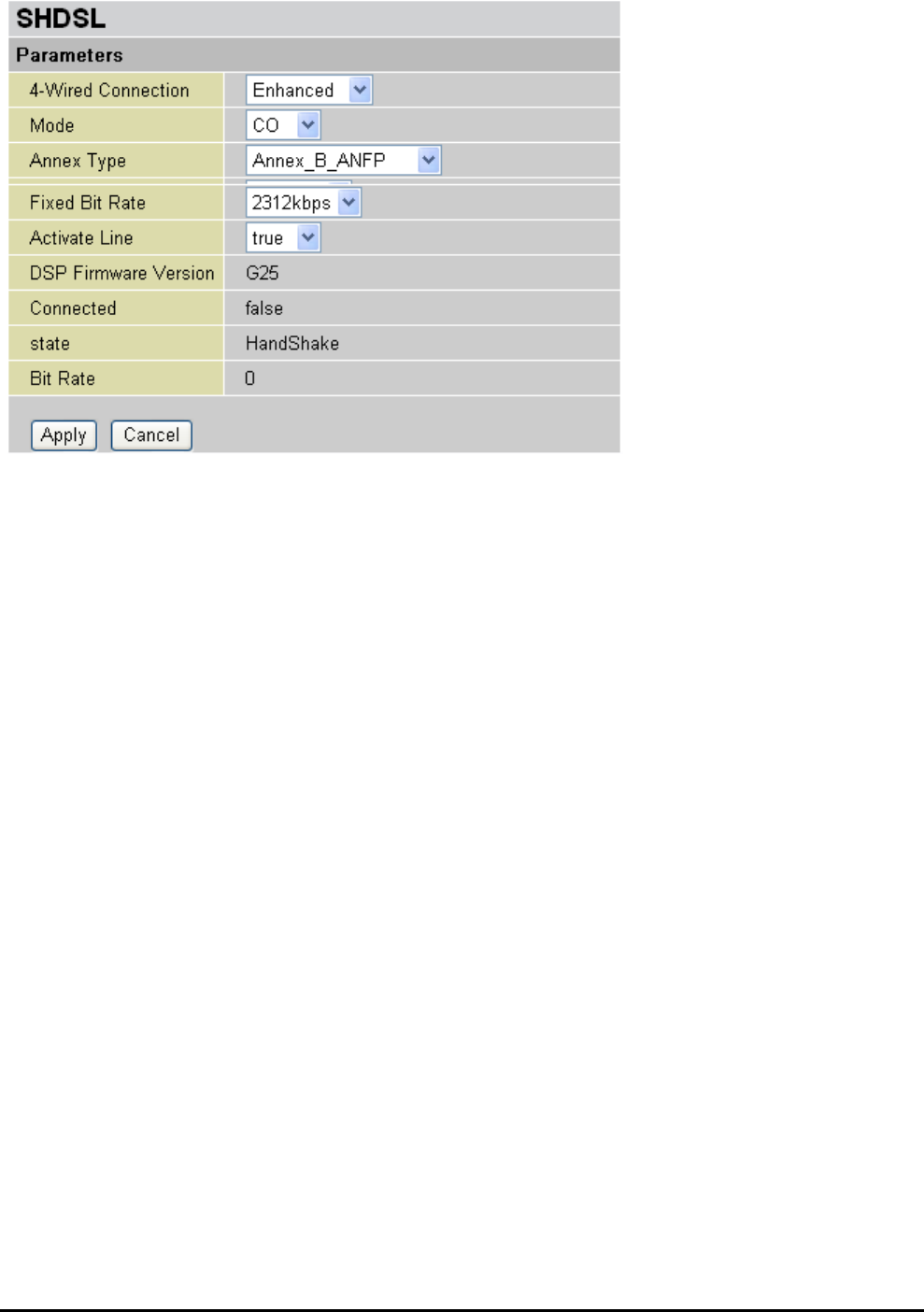
Billion BiPAC 8500/8501/8520/8521 SHDSL (VPN) Firewall Bridge/ Router
Chapter 4: Configuration
72
Enhanced 4-wired connection: Conexant enhanced 4-wired mode and compliant with
Conexant Legacy codes.

Billion BiPAC 8500/8501/8520/8521 SHDSL (VPN) Firewall Bridge/ Router
Chapter 4: Configuration
73
• 4-Wired Connection: BiPAC 8521 supports 3 types of SHDSL.bis connection: Standard,
False & Enahnced. Select the type of SHDSL.bis connection from the 4-wired
connection drop down menu, then select Apply to activate the configuration page.
Note: When select 2-wire mode, only Port 1 settings need to be configured and the SHDSL
(RJ-11 cable) must be connected to LINE 1 on the back of the device.
• Mode: The SHDSL.bis device can function as a CPE (Customer Premises Equipment) or
CO (Central Office). Select CPE mode when the BiPAC 8521 is connected to your ISP.
• Back – to –back: it is a direct connection between two SHDSL.bis devices with one
being set to CPE and the other is set to CO by using a standard RJ-11 telephone cable.
• Annex Type: It is the DSL operating mode standard. Select Annex A or Annex B to
support up to 5.7Mpbs (for 2-wired mode) and 11.4Mpbs (for 4-wired mode). Select other
annex such as Annex B_ANFP / Annex A_B_ANFP, you may consult with your ISP first.
• Back – to –back: to be sure the Annex type is the same on the BiPAC 8521 and the
remote router.
• Bit Rate Mode: The mode selections are Adaptive and Fixed. Selecting the Adaptive
mode, the best connection rate will be automatically negotiated with the CO / ISP.
Selecting the Fixed mode, the connection rate will be fixed to the specific fixed bit rate
selected with the CO / ISP.
• Fixed Bit Rate: Specify the fix transfer rate when Fixed Mode is selected. Specify the
maximum transfer rate when Adaptive Mode is selected. Bit Rate range is from 200kbps
~ 5704kbps.
• Activate Line: Line active true is set by default. Select false to disable and true to
enable SHDSL.bis connection.
Note: Once Active Line is selected as false, you must enable the Active Line to true again and
click the Apply button to reactivate SHDSL.bis connection.
• DSP FirmwareVersion: Display the SHDSL line code firmware version.
• Connected: Display current SHDSL line sync status.
• State: Display current SHDSL line status.
• Bit Rate: Display SHDSL line synch speed rate.
Click Apply button to apply your changes
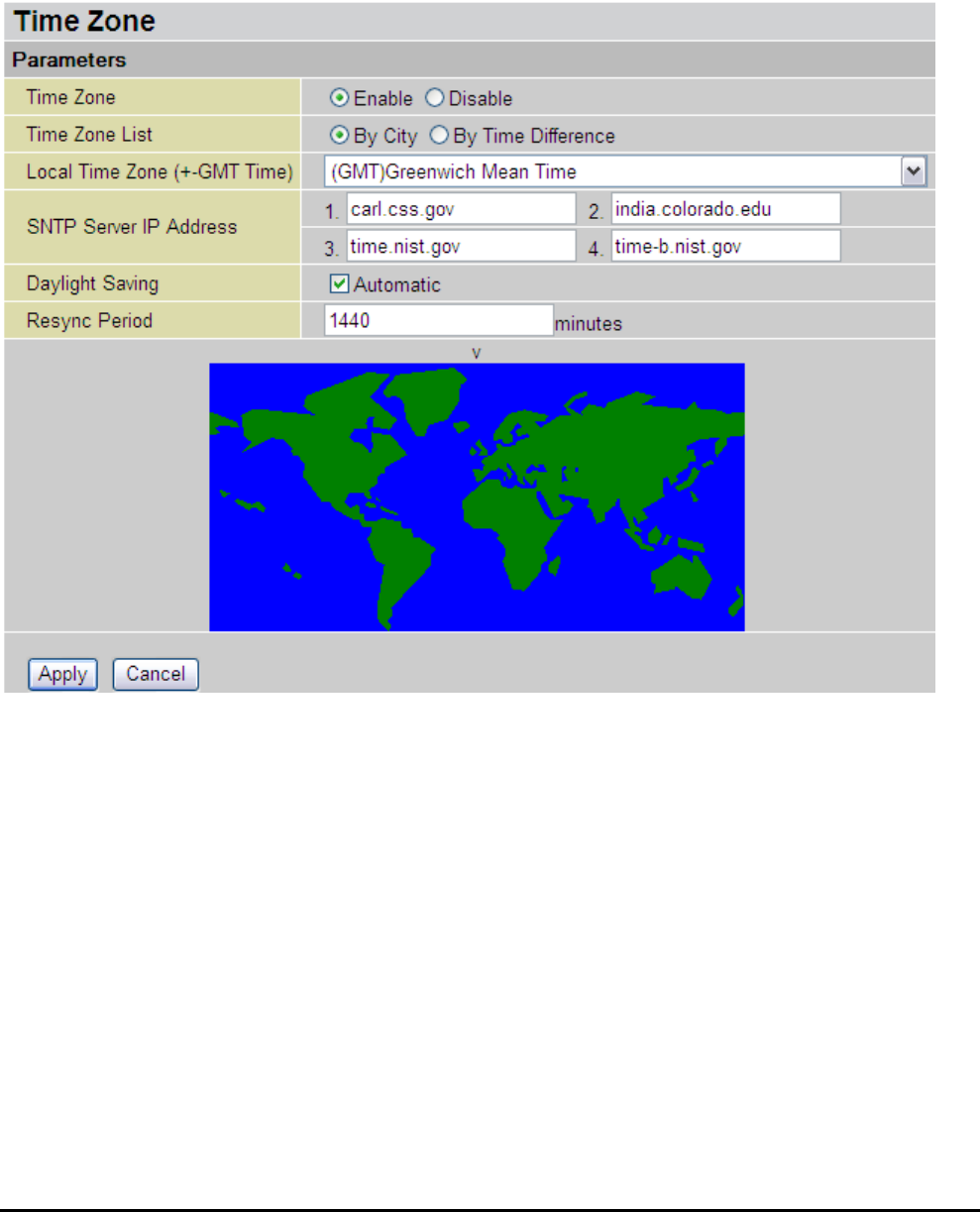
Billion BiPAC 8500/8501/8520/8521 SHDSL (VPN) Firewall Bridge/ Router
Chapter 4: Configuration
74
System
Listed are items within the System section: Time Zone, Remote Access, Firmware Upgrade,
Backup/Restore, Restart and User Management.
Time Zone
The router does not have a real time clock on board; instead, it uses the Simple Network Time
Protocol (SNTP) to get the current time from an SNTP server outside your network. Choose
your local time zone, click Enable and click the Apply button. After a successful connection to
the Internet, the router will retrieve the correct local time from the SNTP server you have
specified. If you prefer to specify an SNTP server other than those in the list, simply enter its IP
address as shown above. Your ISP may provide an SNTP server for you to use.
• Daylight Saving is also known as Summer Time Period. Many places in the world
adapt it during summer time to move one hour of daylight from morning to the evening in
local standard time. Check Automatic box to auto set your local time.
• Resync Period (in minutes) is the periodic interval the router will wait before it re-
synchronizes the router’s time with that of the specified SNTP server. In order to avoid
unnecessary increase of the load on your specified SNTP server you should keep the
poll interval as high as possible – at the absolute minimum every few hours or even days.
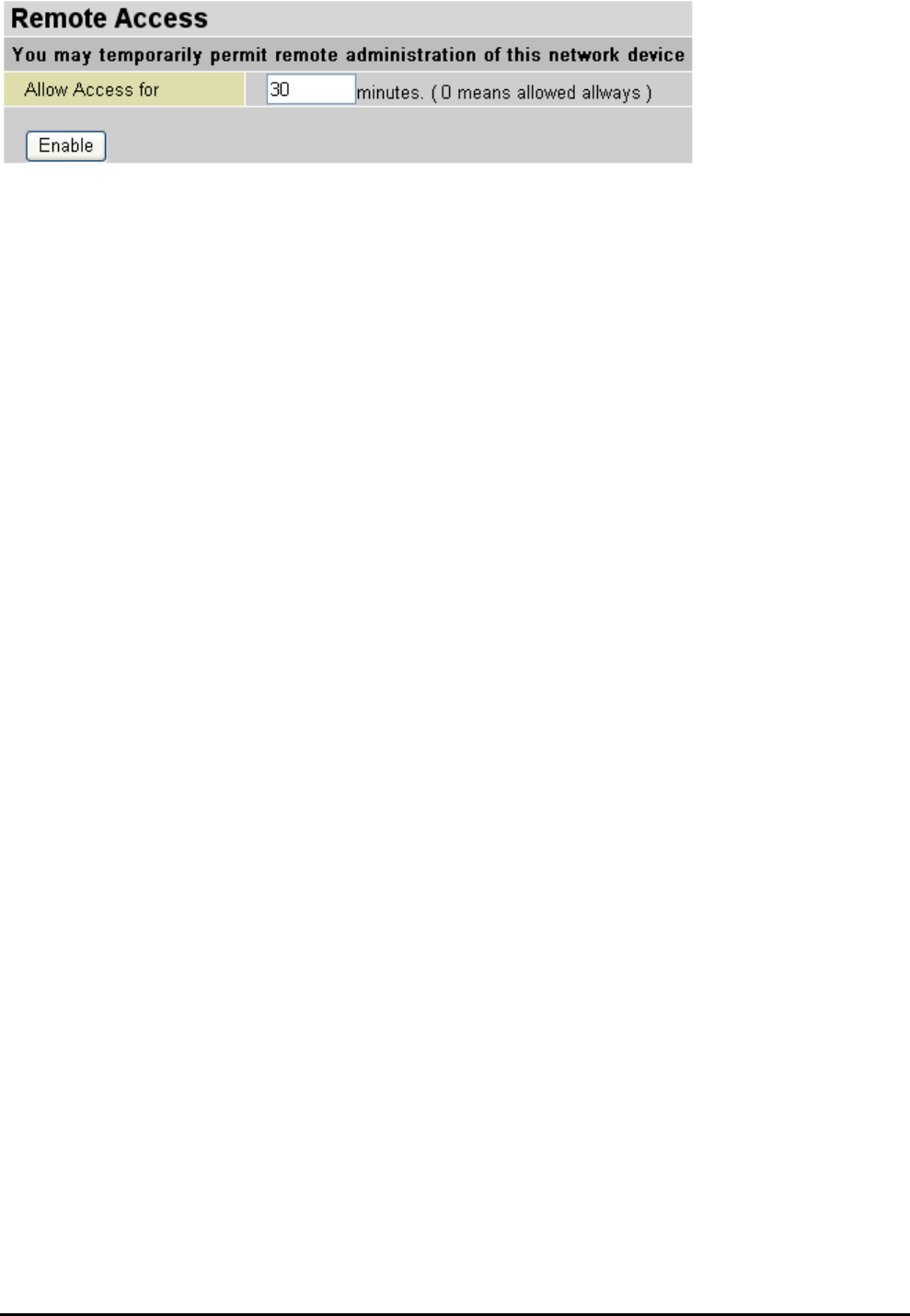
Billion BiPAC 8500/8501/8520/8521 SHDSL (VPN) Firewall Bridge/ Router
Chapter 4: Configuration
75
Remote Access
To temporarily permit remote administration of the router (i.e. from outside your LAN), select a
time period the router will permit remote access and click Enable. You may change other
configuration options for the web administration interface using Device Management options in
the Advanced section of the GUI.
If you wish to permanently enable remote access, choose a time period of 0 minutes.
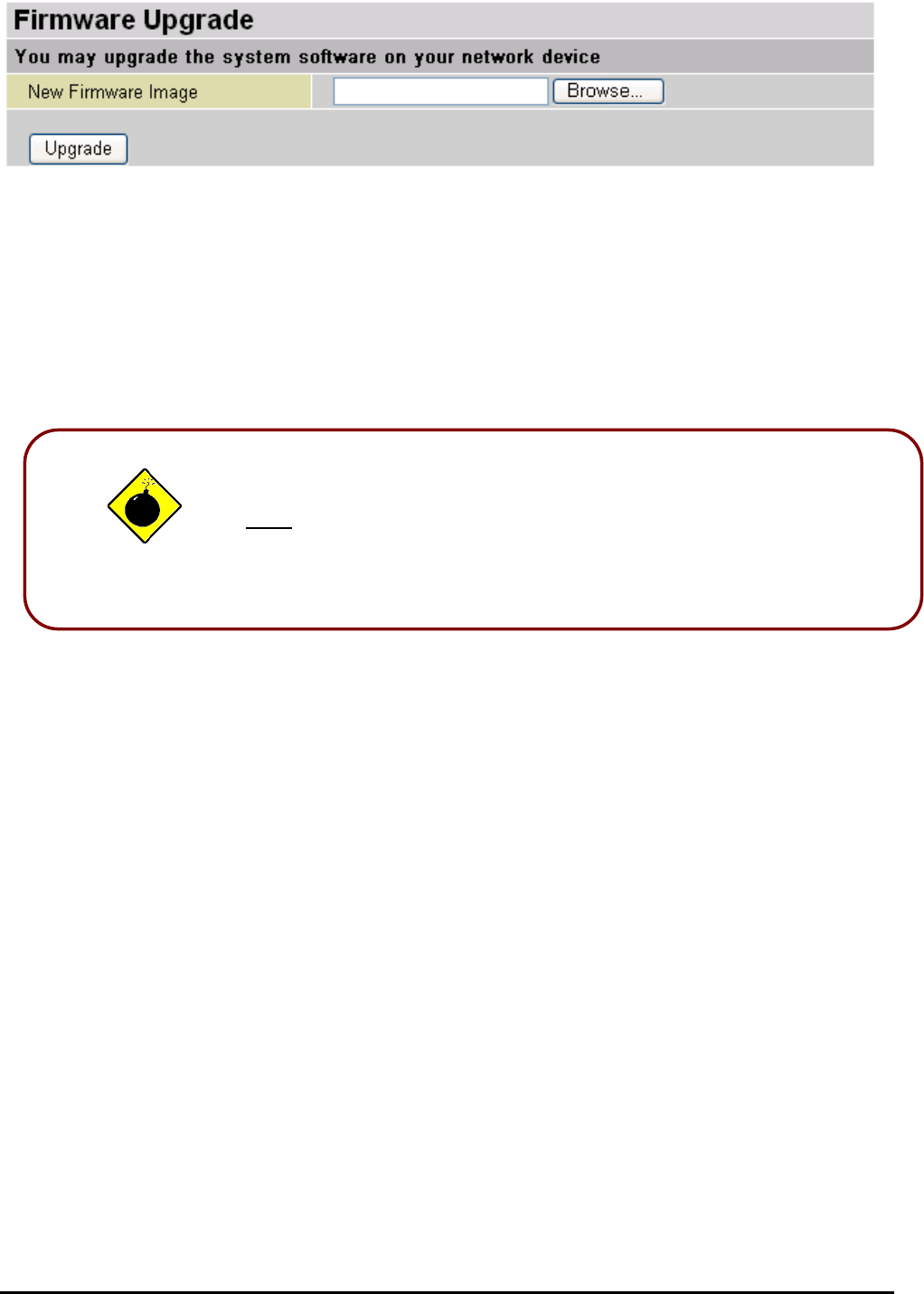
Billion BiPAC SHDSL/SHDSL.bis (VPN) Firewall Bridge/ Router
Chapter 4: Configuration
76
DO NOT power down the router or interrupt the firmware upgrading
while it is still in process. Improper operation could damage the router.
Firmware Upgrade
Your router’s “firmware” is the software that allows it to operate and provides all its functionality.
Think of your router as a dedicated computer, and the firmware as the software it runs. Over
time this software may be improved and modified, and your router allows you to upgrade the
software it runs to take on advantage of these changes.
Clicking on Browse will allow you to select the new firmware image file you have downloaded
to your PC. Once the correct file is selected, click Upgrade to update the firmware in your router.
Warning
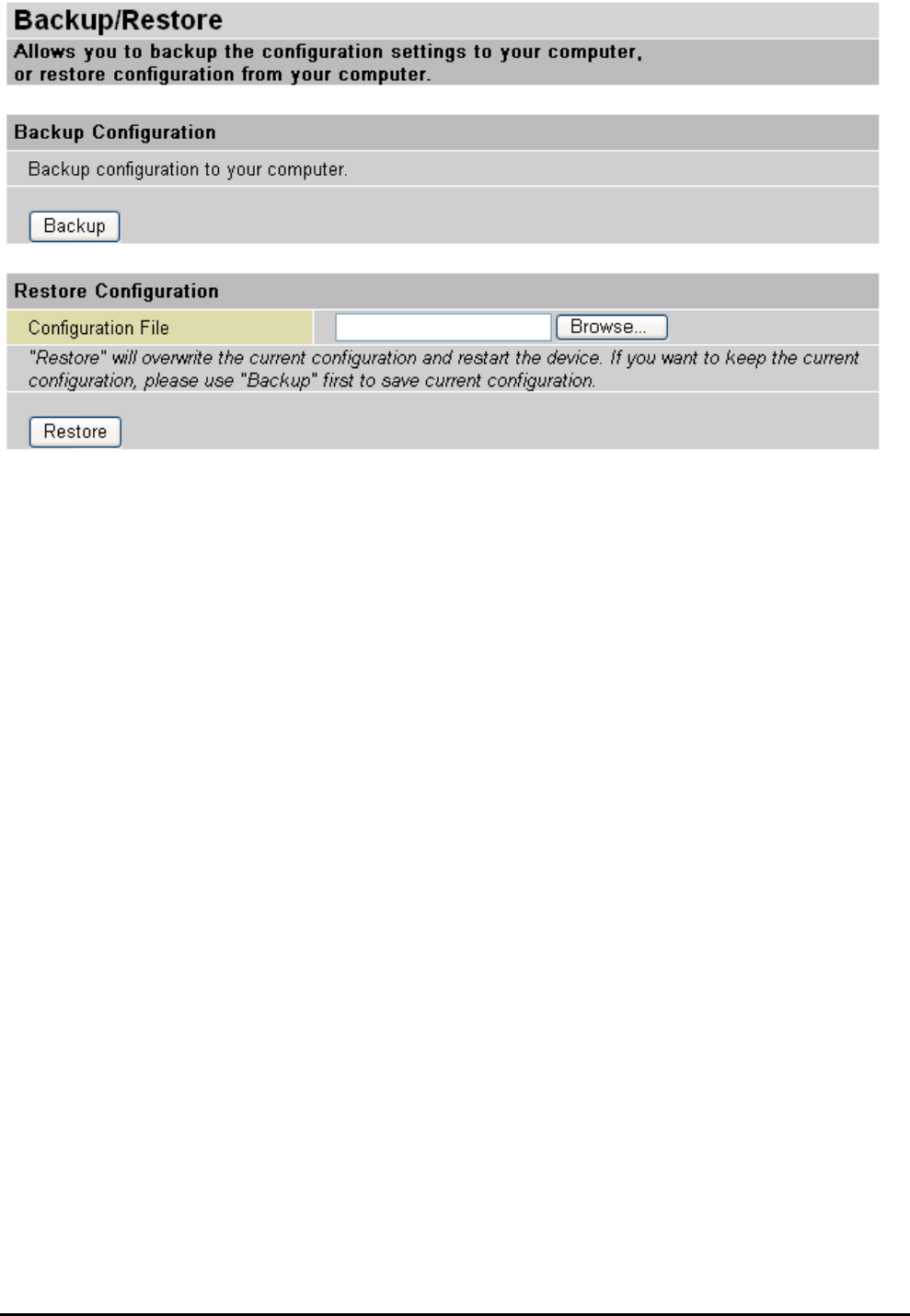
Billion BiPAC SHDSL/SHDSL.bis (VPN) Firewall Bridge/ Router
Chapter 4: Configuration
77
Backup / Restore
These functions allow you to save and to create a backup of your router current settings to a file
on your PC, or to restore a previously saved setting. This is useful if you wish to experiment
with different settings, knowing that you have a backup in hand in case any mistakes occur. It is
advisable to backup your router’s settings before making any significant changes to your
router’s configuration.
Press Backup to select where on your local PC you want to save the setting file. You may also
change the name of the file when saving if you wish to keep multiple backups.
Press Browse to select a file from your PC to restore. You should only restore settings files that
have been generated by the Backup function using the current version of the router’s firmware.
Settings files saved to your PC should not be manually edited in any way.
After selecting the settings file you wish to use, pressing Restore will load those settings into
the router.
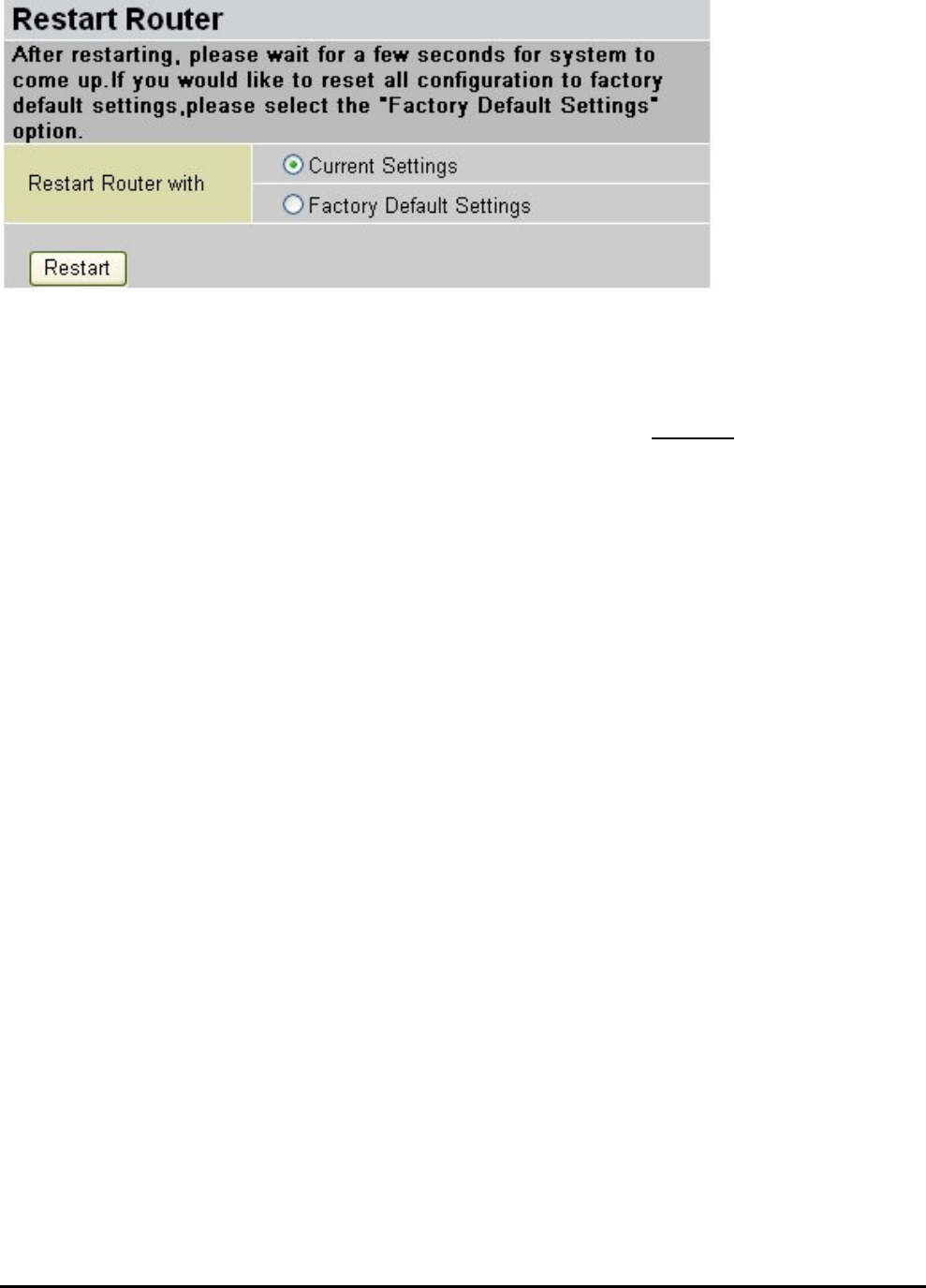
Billion BiPAC SHDSL/SHDSL.bis (VPN) Firewall Bridge/ Router
Chapter 4: Configuration
78
Restart Router
Click Restart with option Current Settings to reboot your router (and restore your last saved
configuration).
If you wish to restart the router using the factory default settings (for example, after a firmware
upgrade or if you have saved an incorrect configuration), select Factory Default Settings to
reset to factory default settings.
You may also reset your router to factory settings by holding the RESET pinhole button on the
back panel of the router for more than 6 seconds whilst the router is turned on.
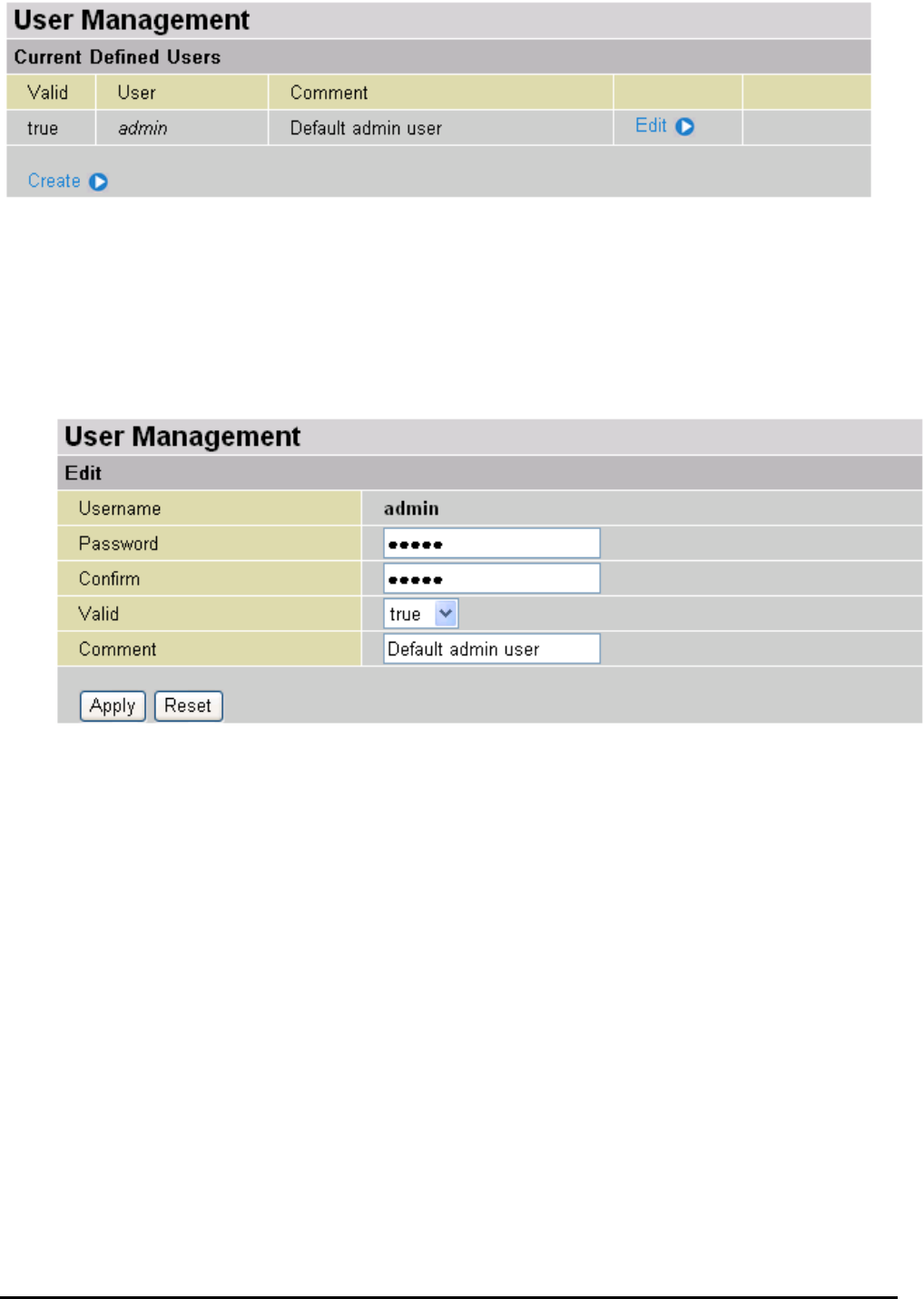
Billion BiPAC 8500/8501/8520/8521 SHDSL (VPN) Firewall Bridge/ Router
Chapter 4: Configuration
79
User Management
In order to prevent unauthorized access to your router’s configuration interface, all users are
required to login to the system with a password. You can set up multiple user accounts, each
with their own password.
You are able to Edit existing user accounts or Create new user accounts to grant access
permission to the device’s configuration interface. Once you have clicked on Edit, you will see
the following account management window:
You can change the user password, even when the account is active and Valid, as well as add
a comment to each user account. These options are the same for creating a user account, with
the exception that once an account is created you cannot change the username. You cannot
delete the default admin account. However you can delete any other accounts created by
clicking Delete when editing the user account.
You are strongly advised to change the password on the default “admin” account when you
receive your router, and whenever you reset your configuration to Factory Defaults.
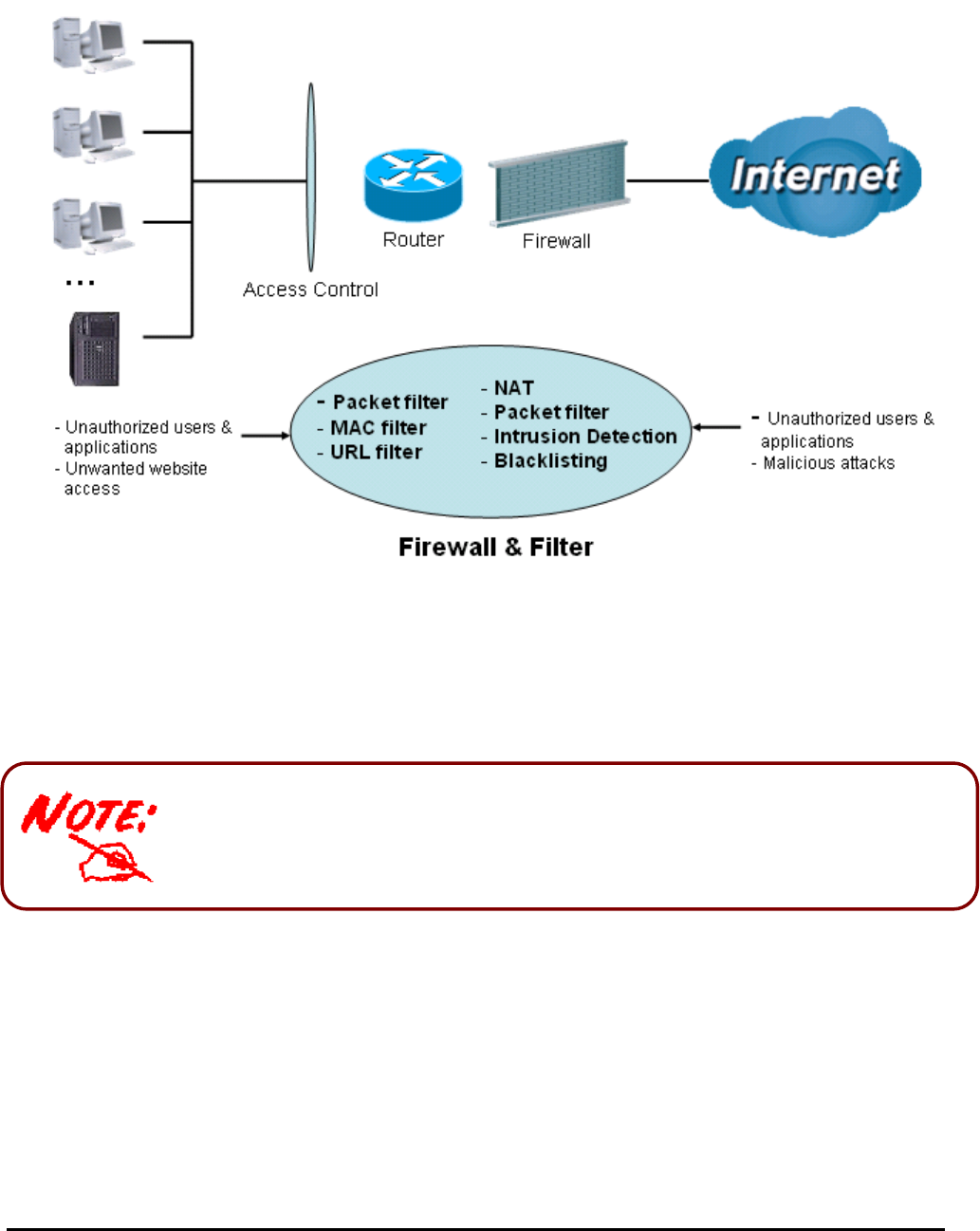
Billion BiPAC 8500/8501/8520/8521 SHDSL (VPN) Firewall Bridge/ Router
Chapter 4: Configuration
80
When using Virtual Servers, your PCs will be exposed at a certain degree
specified in your Virtual Server settings when the ports specified are
opened in your firewall packet filter settings.
Firewall and Access Control
Your router includes a full SPI (Stateful Packet Inspection) firewall for controlling Internet access
from your LAN, as well as helping to prevent attacks from hackers. In addition to this, when
using NAT, the router acts as a “natural” Internet firewall, as all PCs on your LAN will use private
IP addresses that cannot be directly accessed from the Internet.
• Firewall: Prevents access from outside your network. The router provides three levels of
security support:
• NAT natural firewall: This masks LAN users’ IP addresses which is invisible to outside
users on the Internet, making it much more difficult for a hacker to target a machine on
your network. This natural firewall is on when NAT function is enabled.
• Firewall Security and Policy (General Settings): Inbound direction of Packet Filter
rules to prevent unauthorized computers or applications accessing your local network
from the Internet.
• Intrusion Detection: Enable Intrusion Detection to detect, prevent and log malicious
attacks.
• Access Control: Allow the filtering of unauthorized users from other networks or WAN,
unwanted websites & malicious programs from accessing the local network.

Billion BiPAC 8500/8501/8520/8521 SHDSL (VPN) Firewall Bridge/ Router
Chapter 4: Configuration
81
• Firewall Security and Policy (General Settings): Outbound direction of Packet Filter
rules to prevent unauthorized computers or applications accessing the Internet.
• URL Filter: To block PCs on your local network from unwanted websites.
Listed are items under the Firewall section: General Settings, Packet Filter, Intrusion
Detection, URL Filter, IM/P2P Blocking and Firewall Log.
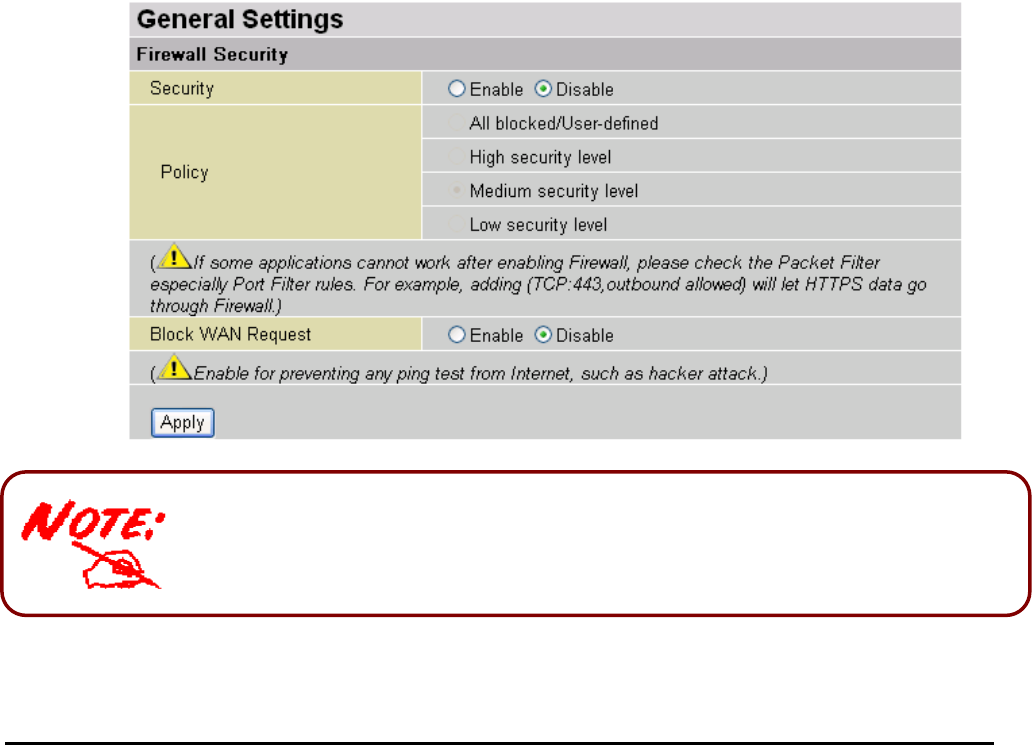
Billion BiPAC 8500/8501/8520/8521 SHDSL (VPN) Firewall Bridge/ Router
Chapter 4: Configuration
82
Any remote user who is attempting to perform this action may result in
blocking all the access to configure and management of the device from
the Internet.
General Settings
You can choose not to enable Firewall, you will not able to add filter rules by yourself in the
Packet Filter, or enable the Firewall using preset filter rules and modify the packet filter rules as
required. The Packet Filter is used to filter packets based-on Applications (Port) or IP addresses.
There are four options to choose when you enable Firewall, these are:
• All blocked/User-defined: no pre-defined port or address filter rules by default, meaning
that all inbound (Internet to LAN) and outbound (LAN to Internet) packets will be blocked.
Users have to add their own filter rules for further access to the Internet.
• High/Medium/Low security level: the predefined port filter rules for High, Medium and
Low security are displayed in Port Filters of the Packet Filter.
Select either High, Medium or Low security level to enable Firewall. The only difference
between these three security levels is the preset port filter rules in the Packet Filter. Firewall
functionality is the same for all levels; it is only the list of preset port filters that changes
between each setting. For more detailed on level of preset port filter information, refer to Table
1: Predefined Port Filter.
Note: The changes or added custom filters on a previous security level will be remembered
whenever newer security level is selected. There is no need to reconfigure all settings again if
switching back to the previous level.
The “Block WAN Request” is a stand-alone function and is not affected by whether security is
enabled or disabled. Mostly this is for preventing any scan tools from the hacker from WAN site.
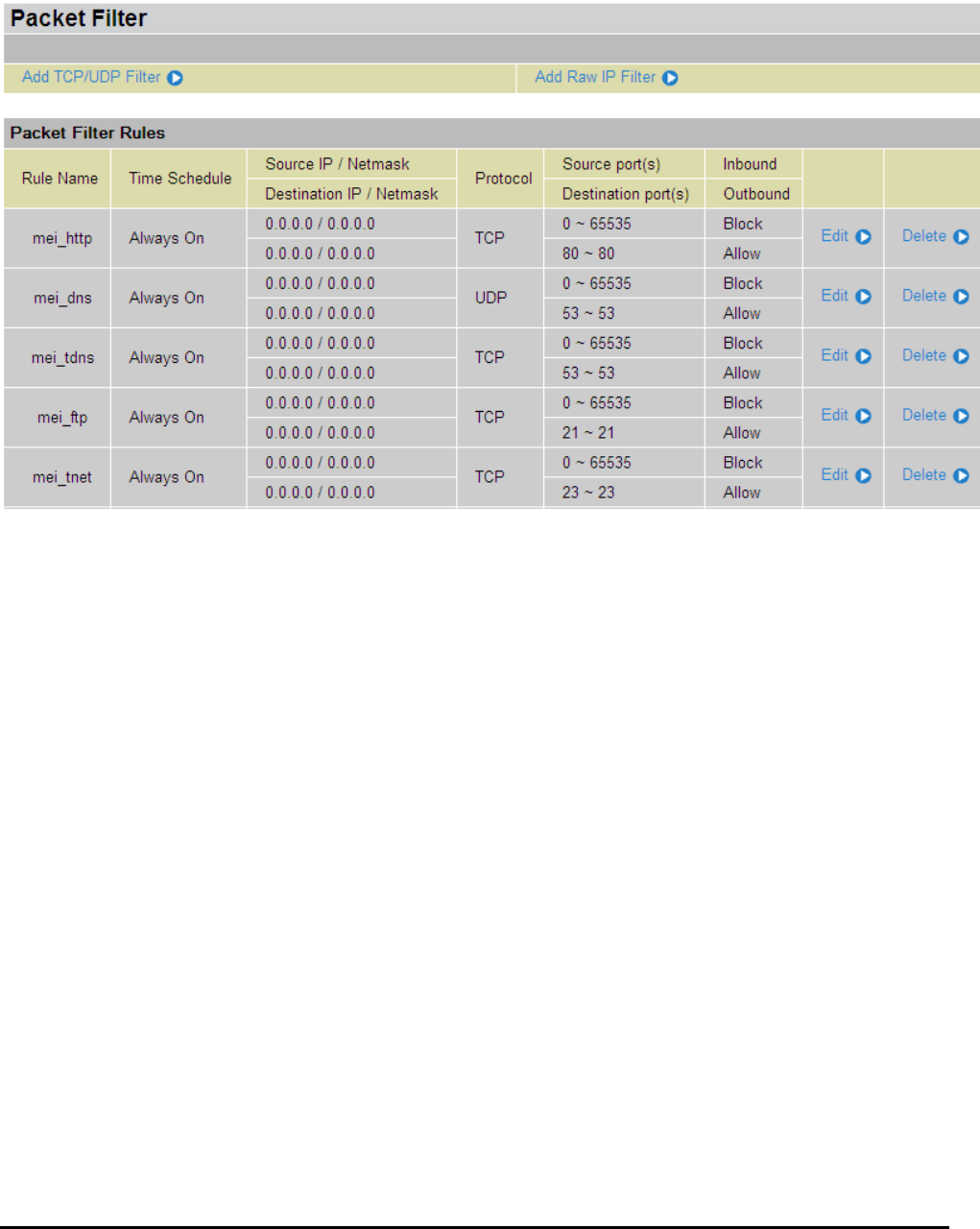
Billion BiPAC 8500/8501/8520/8521 SHDSL (VPN) Firewall Bridge/ Router
Chapter 4: Configuration
83
Packet Filter
This function is only available when Firewall is enabled and one of these four security levels is
chosen (All blocked, High, Medium and Low). The predefined port filter rules in the Packet
Filter must modify according to the level of Firewall, which is selected. See Table1: Predefined
Port Filter for more detailed information.

Billion BiPAC 8500/8501/8520/8521 SHDSL (VPN) Firewall Bridge/ Router
Chapter 4: Configuration
84
Example: Predefined Port Filters Rules
The predefined port filter rules for High, Medium and Low security levels are listed. See Table 1.
Note: Firewall – All Blocked/User-defined, you must define and create the port filter rules
yourself. No predefined rule is set
Table 1: Predefined Port Filter
Port Number
Firewall - High Firewall - Medium
Firewall – Low
Application
Protocol
Start End Inbound Outbound Inbound
Outbound Inbound Outbound
HTTP(80)
TCP(6)
80 80 NO YES NO YES NO YES
DNS (53) UDP(17)
53 53 NO YES NO YES YES YES
DNS (53) TCP(6)
53 53 NO YES NO YES YES YES
FTP(21) TCP(6)
21 21 NO NO NO YES NO YES
Telnet(23) TCP(6)
23 23 NO NO NO YES NO YES
SMTP(25)
TCP(6)
25 25 NO YES NO YES NO YES
POP3(110)
TCP(6)
110 110
NO YES NO YES NO YES
NEWS(119)
TCP(6)
119 119
NO NO NO YES NO YES
RealAudio
(7070) UDP(17)
7070 7070
NO NO YES YES YES YES
PING ICMP(1)
N/A N/A
NO YES NO YES NO YES
H.323(1720)
TCP(6)
1720 1720
NO NO NO YES YES YES
T.120(1503)
TCP(6)
1503 1503
NO NO NO YES YES YES
SSH(22) TCP(6)
22 22 NO NO NO YES YES YES
NTP(123) UDP(17)
123 123
NO YES NO YES NO YES
HTTPS(443)
TCP(6)
443 443
NO NO NO YES NO YES
ICQ (5190)
TCP(6)
5190 5190
NO NO NO NO YES YES
Inbound: Internet to LAN ; Outbound: LAN to Internet.
YES: Allowed ; NO: Blocked ; N/A: Not Applicable
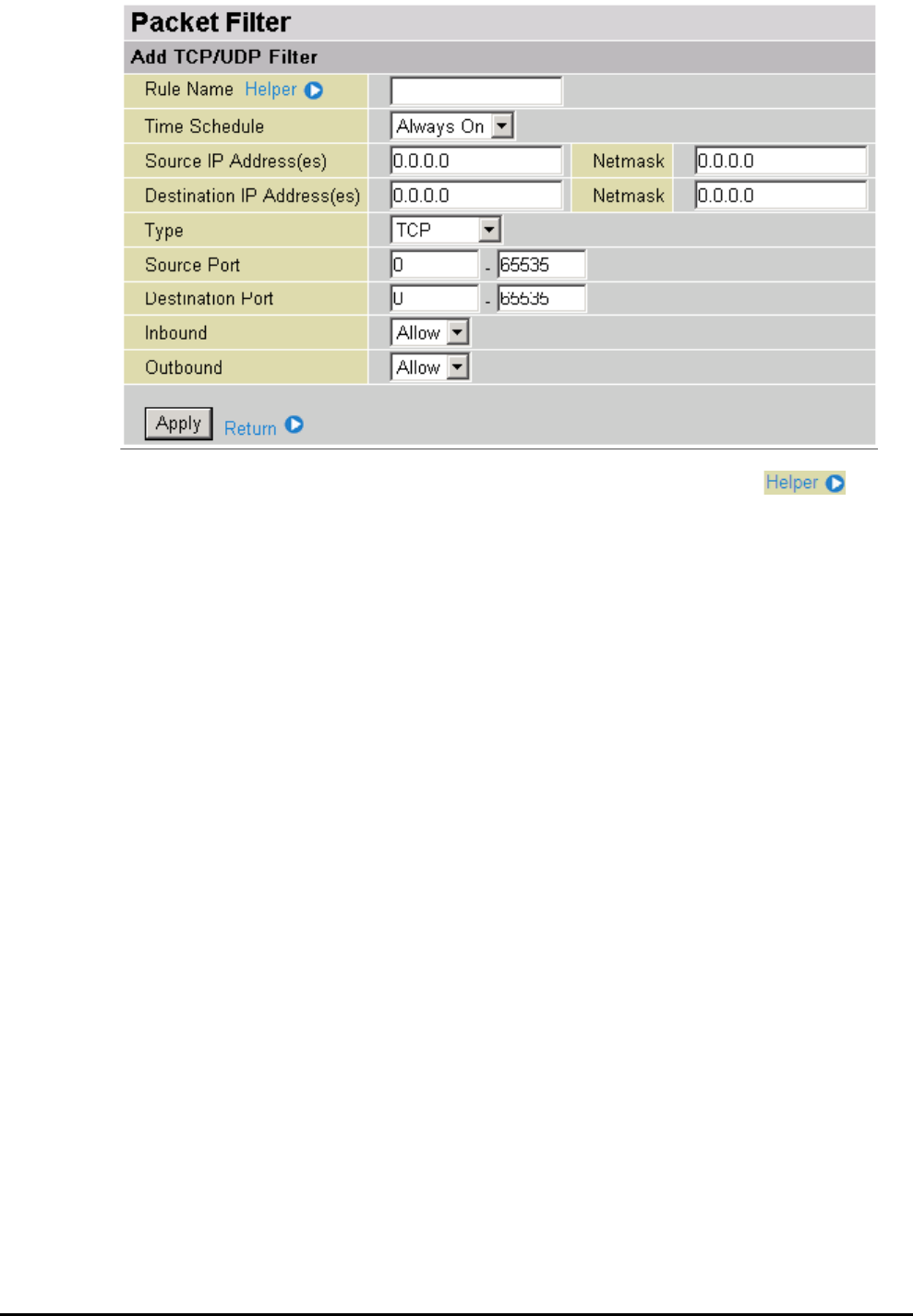
Billion BiPAC 8500/8501/8520/8521 SHDSL (VPN) Firewall Bridge/ Router
Chapter 4: Configuration
85
Packet Filter – Add TCP/UDP Filter
• Rule Name: User-define description to identify this entry or click to select
existing predefined rules. The maximum name length is 32 characters.
• Time Schedule: It is self-defined time period. You may specify a time schedule for your
prioritization policy. For setup and detail, refer to Time Schedule section
• Source IP Address(es) / Destination IP Address(es): This is the Address-Filter used to
allow or block traffic to/from particular IP address(es). Selecting the Subnet Mask of the
IP address range you wish to allow/block the trafficn direction; set IP address and Subnet
Mask to 0.0.0.0 to inactivate the Address-Filter rule.
Tip: To block access, to/from a single IP address, enter that IP address as the Host IP Address
and use a Host Subnet Mask of “255.255.255.255”.
• Type: It is the packet protocol type used by the application. Select either TCP or UDP or
both of TCP/UDP.
• Source Port: This Port or Port Ranges defines the port allowed to be used by the
Remote/WAN to connect to the application. Default is set from range 0 ~ 65535. It is
recommended that this option be configured by an advanced user.
• Destination Port: This is the Port or Port Ranges that defines the application.
• Inbound / Outbound: Select Allow or Block the access to the Internet (“Outbound”)
or from the Internet (“Inbound”).
Click the Apply button to apply your changes.
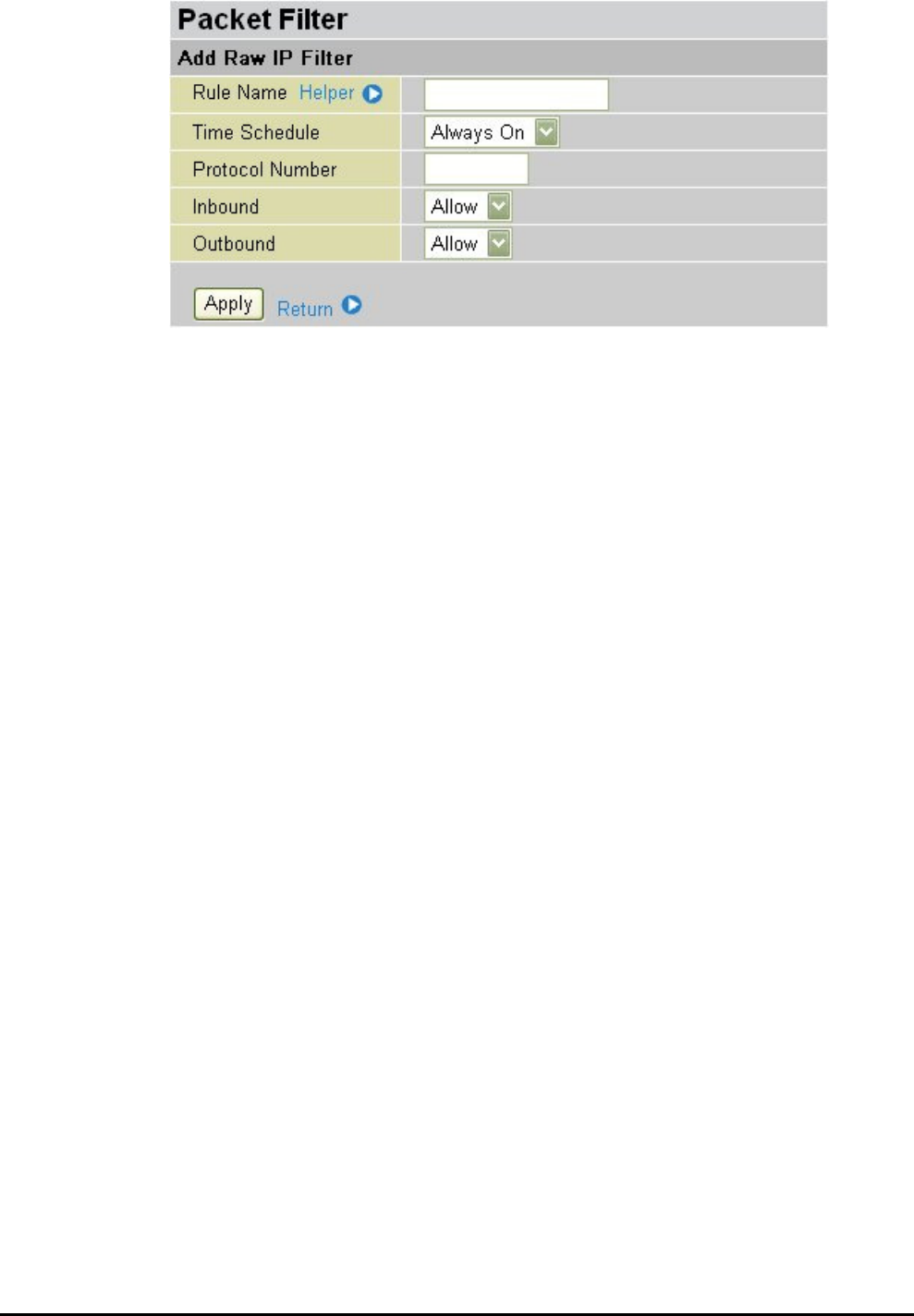
Billion BiPAC 8500/8501/8520/8521 SHDSL (VPN) Firewall Bridge/ Router
Chapter 4: Configuration
86
Packet Filter – Add Raw IP Filter
• Rule Name: A user-defined name for identifying the rule.
• Time Schedule: It is self-defined time period. You may specify a time schedule for your
prioritization policy. For setup and detail, refer to Time Schedule section
• Protocol Number: Insert the port number, i.e. GRE 47.
• Inbound / Outbound: Select Allow or Block the access to the Internet (“Outbound”)
or from the Internet (“Inbound”).
Click the Apply button to apply your changes.
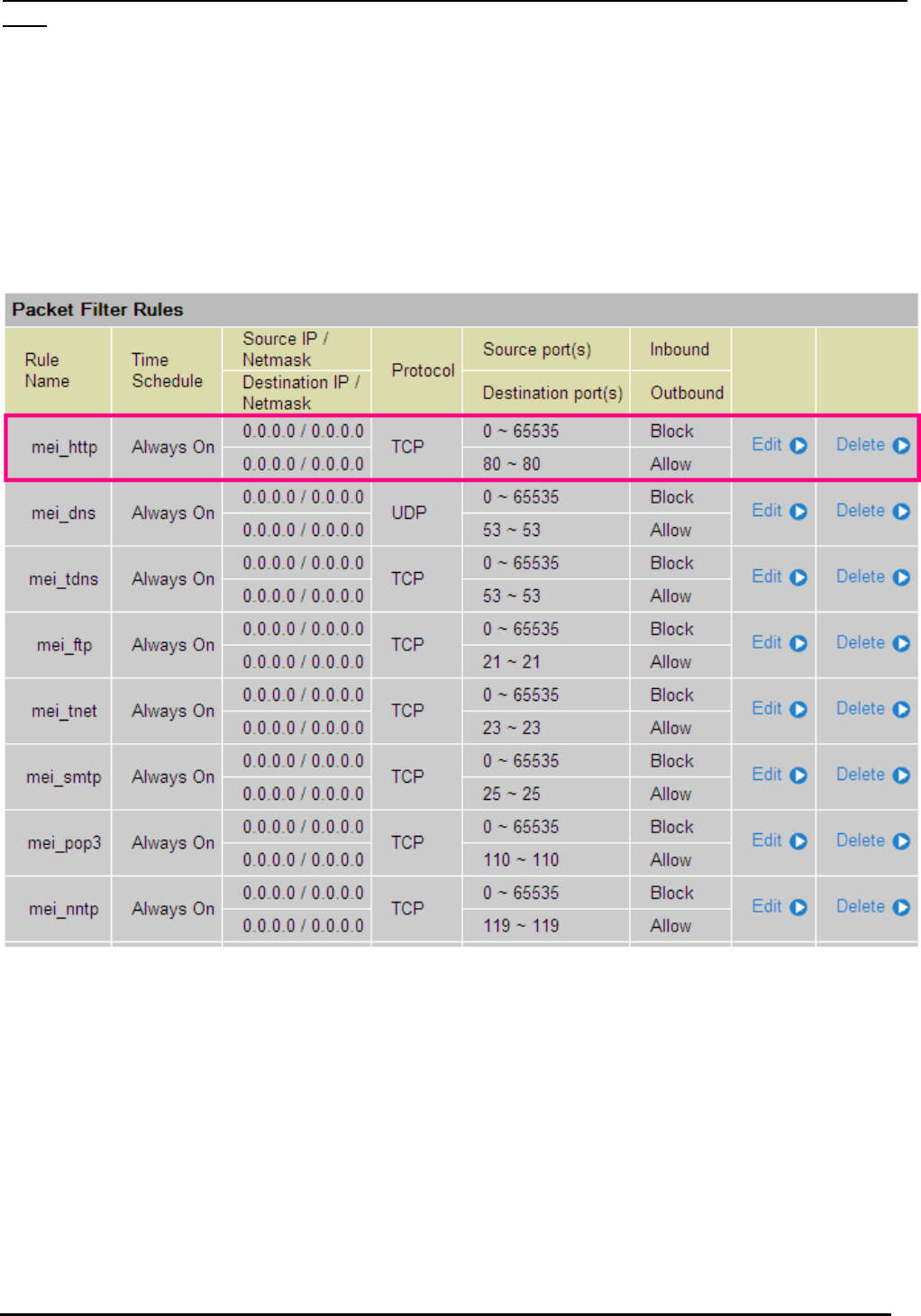
Billion BiPAC 8500/8501/8520/8521 SHDSL (VPN) Firewall Bridge/ Router
Chapter 4: Configuration
87
Example: Configuring your firewall to allow for a publicly accessible web server on your
LAN
The predefined port filter rule for HTTP (TCP port 80) is the same whether the firewall is set to a
high, medium or low security level. To setup a web server located on the local network when the
firewall is enabled, you have to configure the Port Filters setting for HTTP.
As you can see from the diagram below, when the firewall is enabled with one of the three
presets (Low/Medium/High), inbound HTTP access is not allowed which means remote access
through HTTP to your router is not allowed.
Note: Inbound indicates accessing from Internet to LAN and Outbound is from LAN to the
Internet
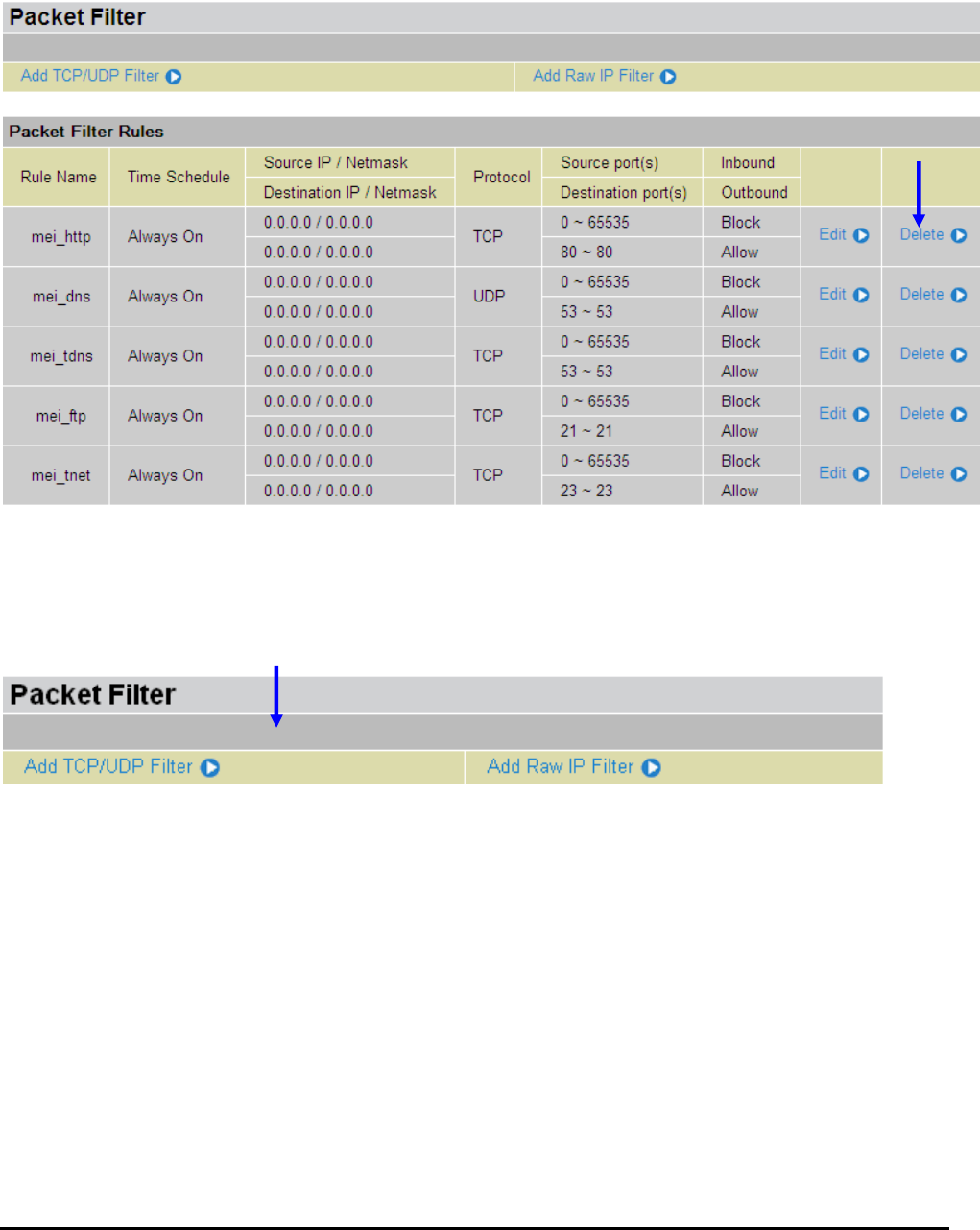
Billion BiPAC SHDSL/SHDSL.bis (VPN) Firewall Bridge/ Router
Chapter 4: Configuration
88
Configuring Packet Filter:
1. Click Port Filters. You will then be presented with the predefined port filter rules screen (in
this case for the low security level), shown below:
Note: You may click Edit the predefined rule instead of Delete it. This is an example to
show to how you add a filter on your own.
2. Click Delete to delete the existing HTTP rule.
3. Click Add TCP/UDP Filter.
4. Input the Rule Name, Time Schedule, Source/Destination IP, Type, Source/Destination Port,
Inbound and Outbound.
Example:
Application: Cindy_HTTP
Time Schedule: Always On
Source / Destination IP Address(es): 0.0.0.0 (I do not wish to activate the address-filter,
instead I use the port-filter)
Type: TCP (Please refer to Table1: Predefined Port Filter)
Source Port: 0-65535 (I allow all ports to connect with the application)
Redirect Port: 80-80 (This is Port defined for HTTP)
Inbound / Outbound: Allow
Click Add TCP/UDP Filter
Click Delete
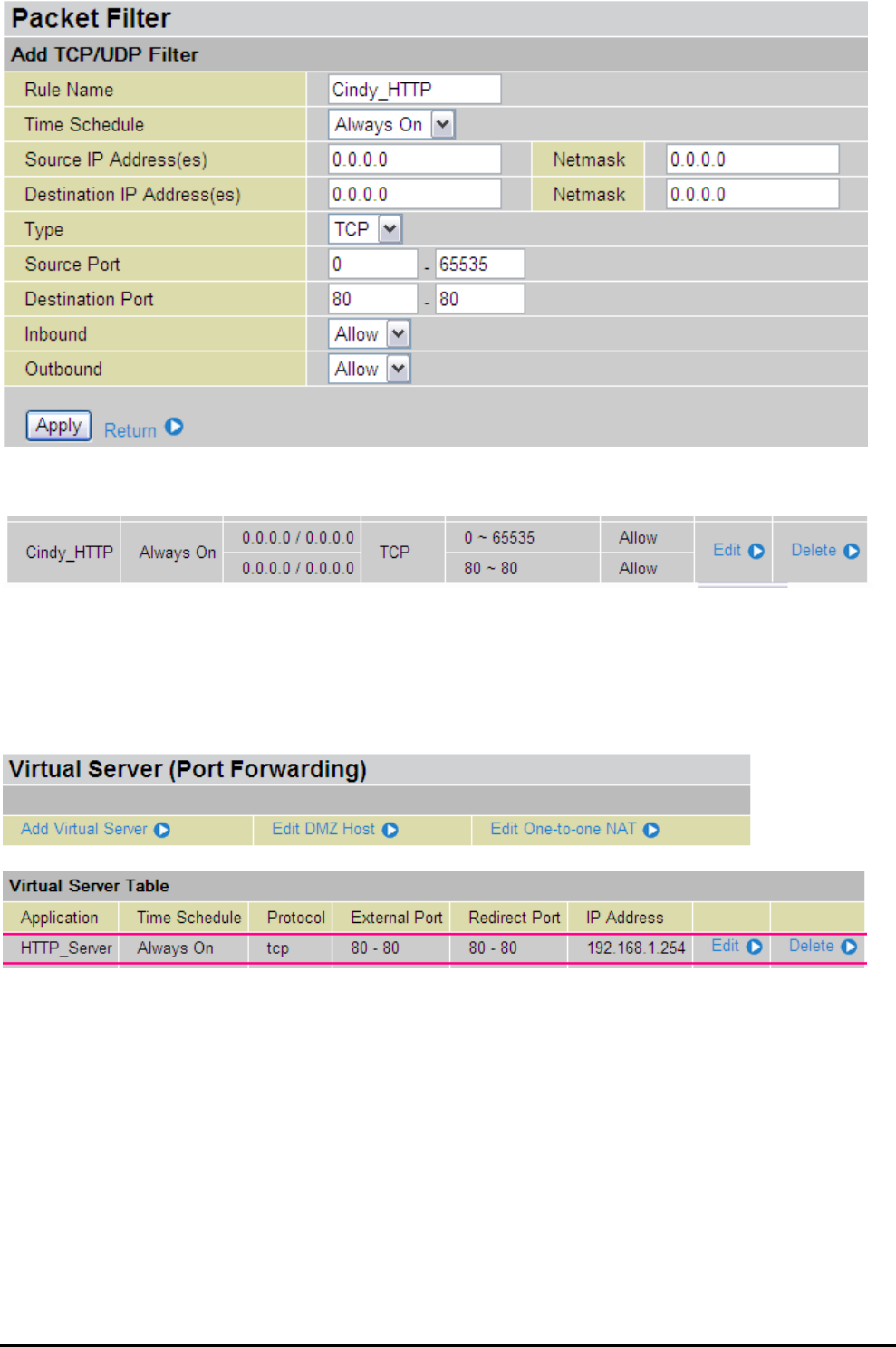
Billion BiPAC 8500/8501/8520/8521 SHDSL (VPN) Firewall Bridge/ Router
Chapter 4: Configuration
89
5. The new port filter rule for HTTP is shown below:
6. Configure your Virtual Server (“port forwarding”) settings so that incoming HTTP requests
on port 80 will be forwarded to the PC running your web server:
Note: For how to configure the HTTP in Virtual Server, go to Add Virtual Server in Virtual
Server section for more details.
.
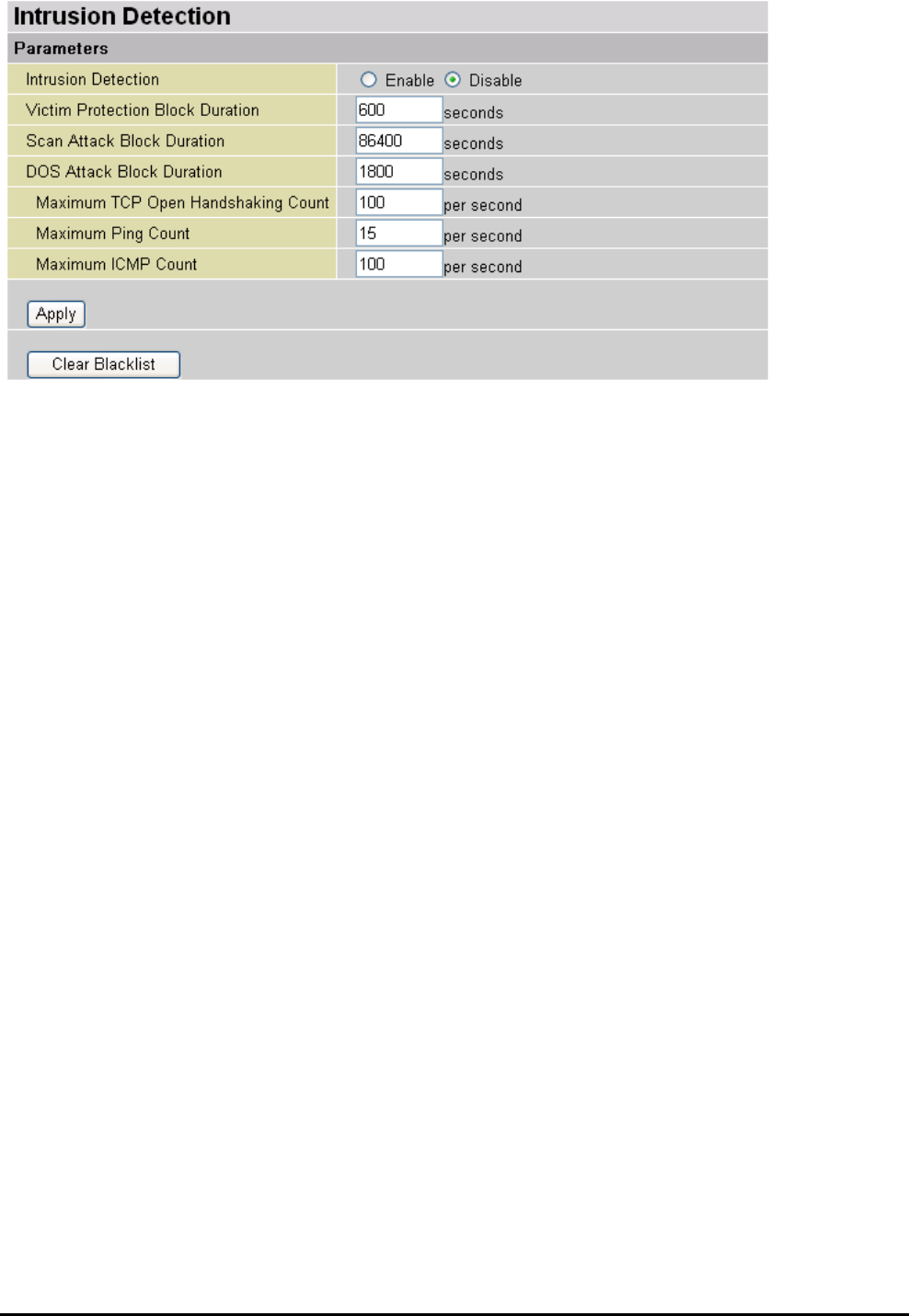
Billion BiPAC SHDSL/SHDSL.bis (VPN) Firewall Bridge/ Router
Chapter 4: Configuration
90
Intrusion Detection
The router’s Intrusion Detection System (IDS) is used to detect hacker attacks and intrusion
attempts from the Internet. If the IDS function of the firewall is enabled, inbound packets are
filtered and blocked depending on whether they are detected as possible hacker attacks,
intrusion attempts or other connections that the router determines to be suspicious.
Blacklist: If the router detects a possible attack, the source IP or destination IP address will be
added to the Blacklist. Any further attempts using this IP address will be blocked for the time
period specified as the Block Duration. The default setting for this function is false (disabled).
Some attack types are denied immediately without using the Blacklist function, such as Land
attack and Echo/CharGen scan.
• Intrusion Detection: If enabled, IDS will block Smurf attack attempts. Default is false.
• Block Duration:
o Victim Protection Block Duration: This is the duration for blocking Smurf attacks.
Default value is 600 seconds.
o Scan Attack Block Duration: This is the duration for blocking hosts that attempt
a possible Scan attack. Scan attack types include X’mas scan, IMAP SYN/FIN
scan and similar attempts. Default value is 86400 seconds.
o DOS Attack Block Duration: This is the duration for blocking hosts that attempt a
possible Denial of Service (DoS) attack. Possible DoS attacks this attempts to
block include Ascend Kill and WinNuke. Default value is 1800 seconds.
• Max TCP Open Handshaking Count: This is a threshold value to decide whether a
SYN Flood attempt is occurring or not. Default value is 100 TCP SYN per seconds.
• Max PING Count: This is a threshold value to decide whether an ICMP Echo Storm is
occurring or not. Default value is 15 ICMP Echo Requests (PING) per second.
• Max ICMP Count: This is a threshold to decide whether an ICMP flood is occurring or
not. Default value is 100 ICMP packets per seconds except ICMP Echo Requests

Billion BiPAC 8500/8501/8520/8521 SHDSL (VPN) Firewall Bridge/ Router
Chapter 4: Configuration
91
(PING).
For SYN Flood, ICMP Echo Storm and ICMP flood, IDS will just warn the user in the Event Log.
It cannot protect against such attacks. Table 2: Types of Hacker attack recognized by the IDS.
1 Detect
Parameter Blacklist
Type of
Block
Duration
Drop
Packet Show Log
Ascend Kill Ascend Kill data
Src IP
DoS Yes Yes
WinNuke
TCP
Port 135,
137~139, Flag:
URG
Src IP
DoS Yes Yes
Smurf
ICMP type 8
Des IP is
broadcast
Dst IP
Victim
Protection
Yes Yes
Land attack SrcIP = DstIP Yes Yes
Echo/CharGen
Scan
UDP Echo Port
and CharGen
Port
Yes Yes
Echo Scan UDP Dst Port =
Echo(7) Src IP
Scan Yes Yes
CharGen Scan UDP Dst Port =
CharGen(19) Src IP
Scan Yes Yes
X’mas Tree Scan
TCP Flag:
X’mas Src IP
Scan Yes Yes
IMAP
SYN/FIN Scan
TCP Flag:
SYN/FIN
DstPort:
IMAP(143)
SrcPort: 0 or
65535
Src IP
Scan Yes Yes
SYN/FIN/RST/ACK
Scan
TCP,
No Existing
session And
Scan Hosts
more than five.
Src IP
Scan Yes Yes
Net Bus Scan
TCP
No Existing
session
DstPort = Net
Bus
12345,12346,
3456
SrcIP Scan Yes Yes
Back Orifice Scan
UDP, DstPort =
Orifice Port
(31337)
SrcIP Scan Yes Yes
SYN Flood
Max TCP Open
Handshaking
Count (Default
100 c/sec)
Yes

Billion BiPAC 8500/8501/8520/8521 SHDSL (VPN) Firewall Bridge/ Router
Chapter 4: Configuration
92
ICMP Flood
Max ICMP
Count (Default
100 c/sec)
Yes
ICMP Echo
Max PING
Count
(Default 15
c/sec)
Yes
Src IP: Source IP Src Port: Source Port
Dst Port: Destination Port Dst IP: Destination IP
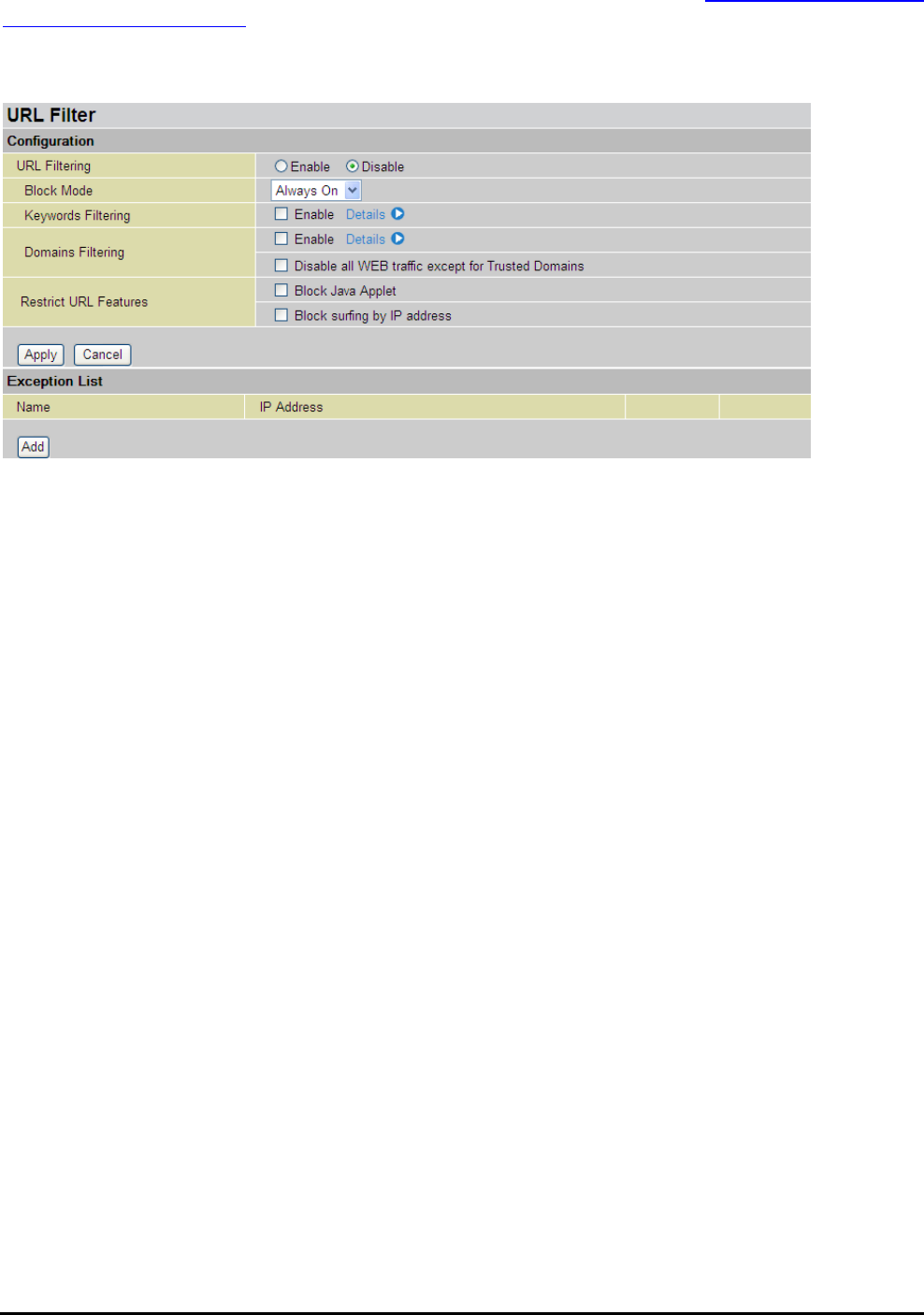
Billion BiPAC 8500/8501/8520/8521 SHDSL (VPN) Firewall Bridge/ Router
Chapter 4: Configuration
93
URL Filtering
URL (Uniform Resource Locator – e.g. an address in the form of http://www.abcde.com or
http://www.example.com) filter rules allow you to prevent users on your network from accessing
particular websites by their URL. There are no pre-defined URL filter rules; you can add filter
rules to meet your requirements.
• Enable/Disable: To enable or disable URL Filter feature.
• Block Mode: A list of modes that you can choose from to check the URL filter rules.
o Disabled: No action will be performed by the Block Mode.
o Always On: Action is enabled. URL filter rules will be monitoring and checking at
all hours of the day.
o TimeSlot1 ~ TimeSlot16: It is self-defined time period. You may specify the time
period to check the URL filter rules, i.e. during working hours. For setup and detail,
refer to Time Schedule section.
• Keywords Filtering: Allow blocking by specific keywords within a particular URL rather
than having to specify a complete URL (e.g. to block any image called
“advertisement.gif”). When enabled, your specified keywords list will be checked to see if
any keywords are present in URLs accessed to determine if the connection attempt
should be blocked. Please note that the URL filter blocks web browser (HTTP)
connection attempts using port 80 only.
For example, if the URL is http://www.abc.com/abcde.html, it will be dropped if the keyword
“abcde” occurs in the URL.
• Domains Filtering: This function checks the whole URL accessed and not just the IP
address in URLs against your list of domains to block or to allow. If it is matched, the
URL request will be sent (Trusted) or dropped (Forbidden). For this function to be
activated, both check-boxes must be checked. Below is the checking procedure:
1. Check the domain in the URL to determine if it is in the trusted list. If yes, the connection
attempt is sent to the remote web server.
2. If not, check if it is listed in the forbidden list. If yes, then the connection attempt will be
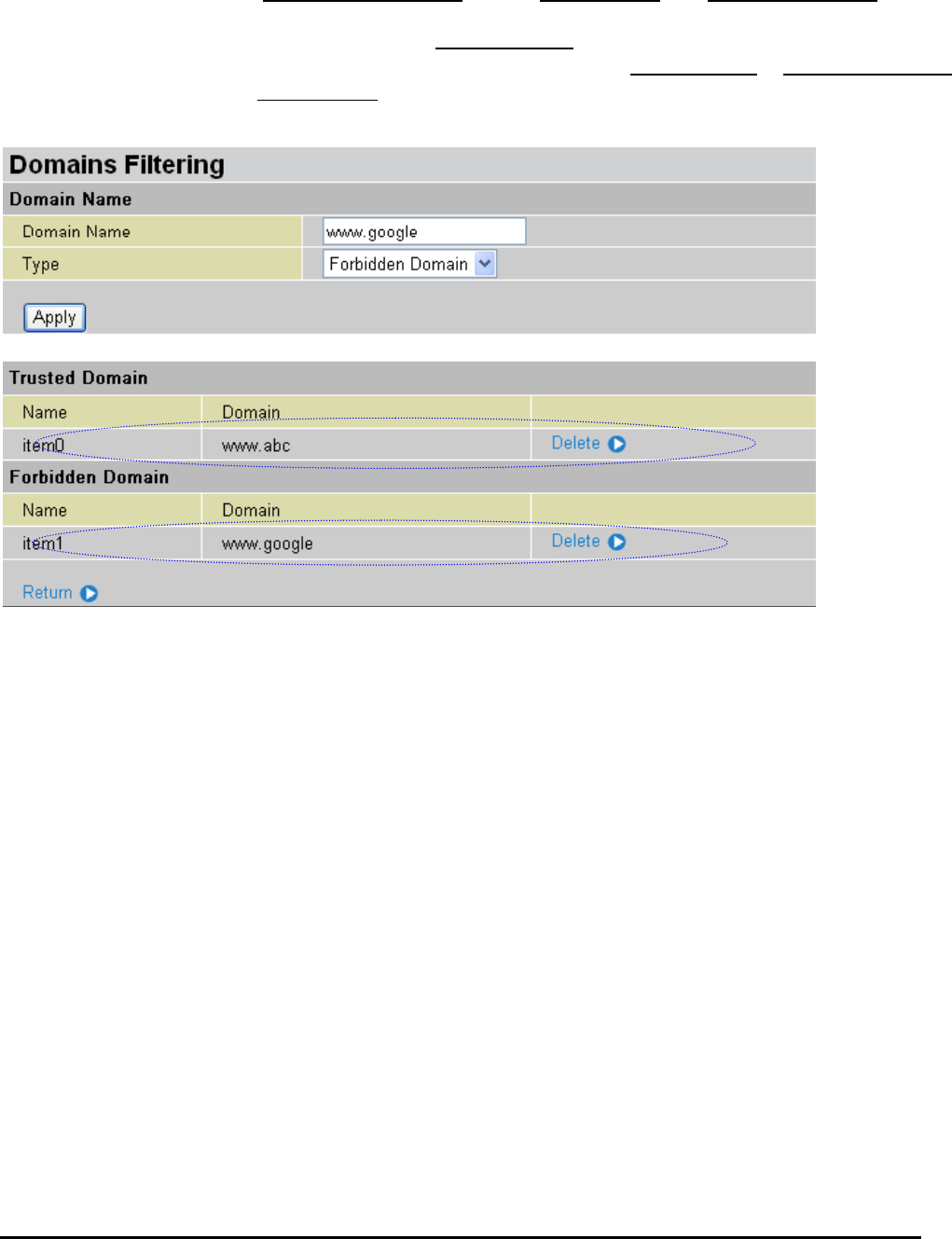
Billion BiPAC 8500/8501/8520/8521 SHDSL (VPN) Firewall Bridge/ Router
Chapter 4: Configuration
94
dropped.
3. If the packet does not match either of the above two items, it is sent to the remote web server.
4. Please be noted that the completed URL, “www” + domain name, shall be specified. For
example to block traffic to www.google.com.au, enter “www.google” or “www.google.com”
In the example below, the URL request for www.abc.com will be sent to the remote web server
because it is listed in the trusted list, whilst the URL request for www.google or www.google.com
will be dropped, because www.google is in the forbidden list.
Example: Andy wishes to disable all WEB traffic except for the ones listed in the trusted
domain list, which would prevent Bobby from accessing other web sites. Andy selects both
functions in the Domain Filtering and thinks that it will stop Bobby. Nevertheless, Bobby knows
that Domain Filtering will ONLY disable all WEB traffic except for the one in the Trusted
Domain, BUT not its IP address. If this is the situation, Block surfing by IP address function
can be handy and helpful to Andy. With this feature, Andy can prevent Bobby from accessing
unwanted websites.
• Restrict URL Features: This function enhances the restriction to your URL rules.
o Block Java Applet: This function can block Web content that includes the Java
Applet. It is to prevent someone who wants to damage your system via standard
HTTP protocol.
o Block surfing by IP address: Preventing someone who uses the IP address as
URL for skipping Domains Filtering function. Activate only and if Domain Filtering
is enabled.
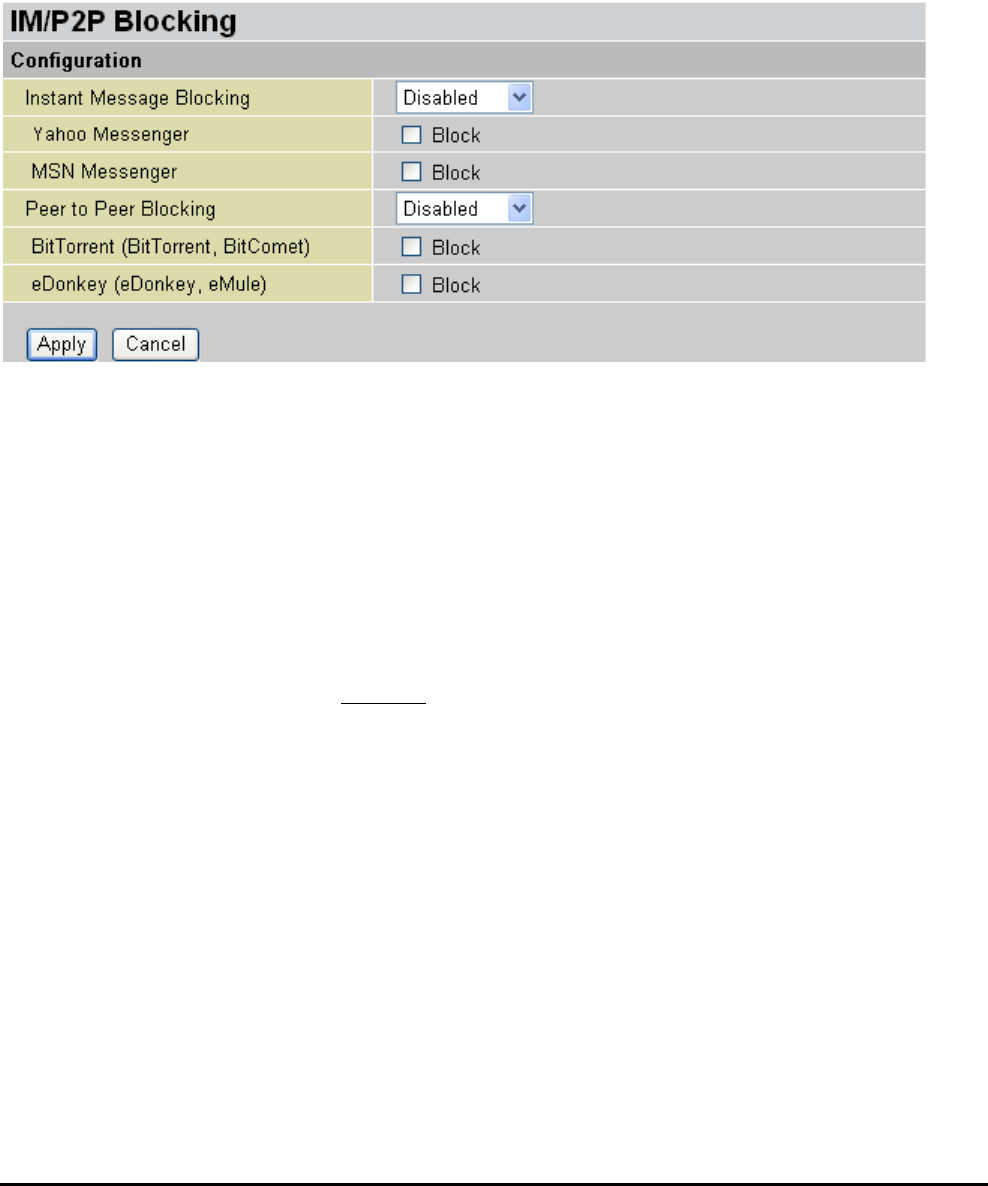
Billion BiPAC 8500/8501/8520/8521 SHDSL (VPN) Firewall Bridge/ Router
Chapter 4: Configuration
95
IM / P2P Blocking
IM, short for Instant Message, is required to use client program software that allows users to
communicate, in exchanging text message, with other IM users in real time over the Internet. A
P2P application, known as Peer-to-peer, is a group of computer users who share files with
specific groups of people across the Internet. Both Instant Message and Peer-to-peer
applications make communication faster and easier but your network can become increasingly
insecure at the same time. Billion’s IM and P2P blocking helps to restrict LAN PCs from
accessing the commonly used IM such as Yahoo and MSN, and P2P, BitTorrent and eDonkey
applications over the Internet.
• Instant Message Blocking: The default is set to Disabled.
o Disabled: Instant Message blocking is not triggered. No action will be performed.
o Always On: Action is enabled.
o TimeSlot1 ~ TimeSlot16: This is the self-defined time period. You may specify
the time period to trigger the blocking, i.e. during working hours. For setup and
detail, refer to Time Schedule section.
• Yahoo/MSN Messenger: Check the box to block either or both Yahoo or/and MSN
Messenger. Be sure you enabled the Instant Message Blocking first.
• Peer to Peer Blocking: The default is set to Disabled.
o Disabled: Instant Message blocking is not triggered. No action will be performed.
o Always On: Action is enabled.
o TimeSlot1 ~ TimeSlot16: This is the self-defined time period. You may specify
the time period to trigger the blocking, i.e. during working hours. For setup and
detail, refer to Time Schedule section.
• BitTorrent / eDonkey: Check the box to block either or both Bit Torrent or/and eDonkey.
Be sure you enabled the Peer to Peer Blocking first.
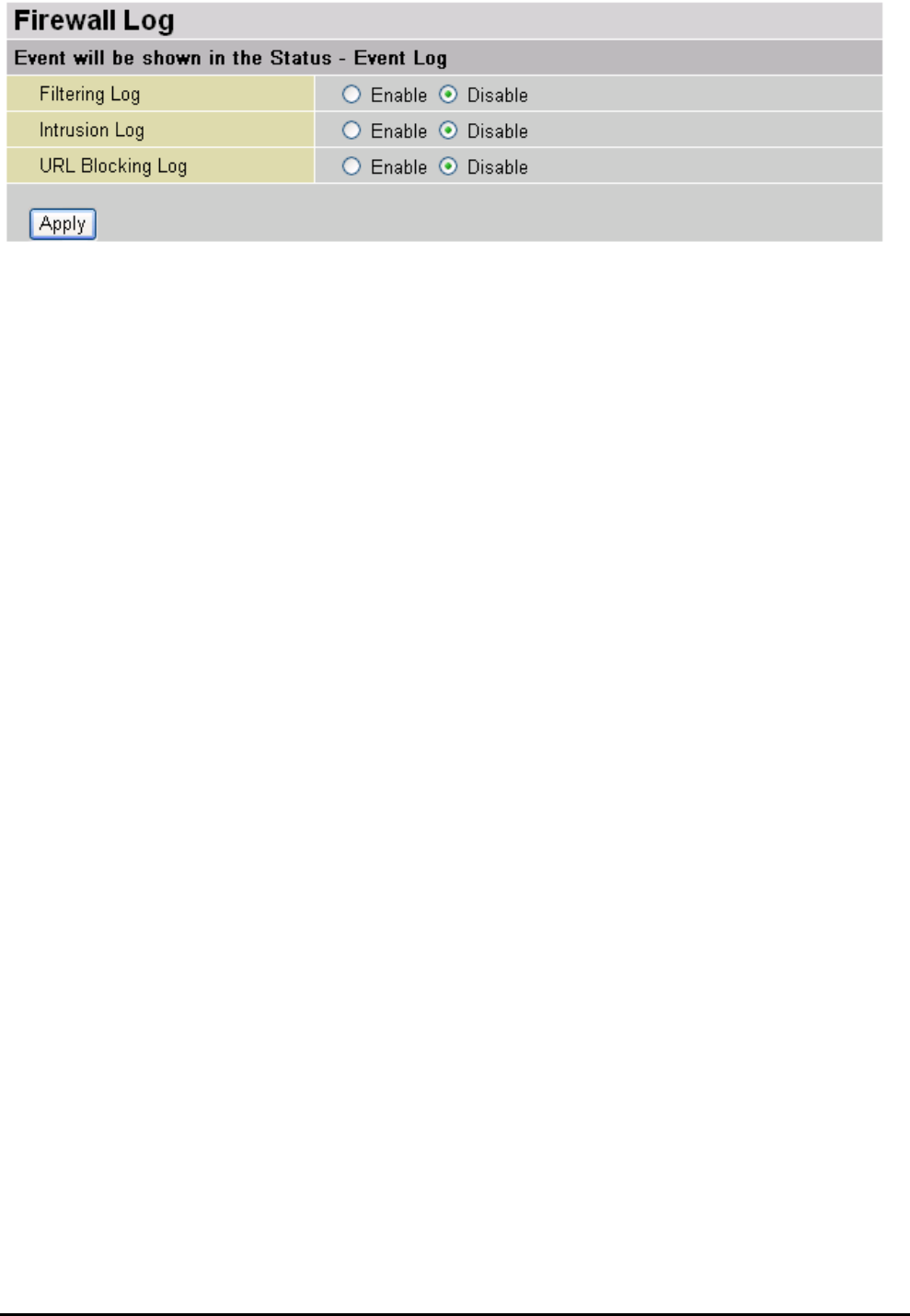
Billion BiPAC SHDSL/SHDSL.bis (VPN) Firewall Bridge/ Router
Chapter 4: Configuration
96
Firewall Log
Firewall Log displays log information of all unexpected action taken by your firewall settings.
Check the Enable box to activate the logs.
Log information can be seen in the Status – Event Log after enabling.
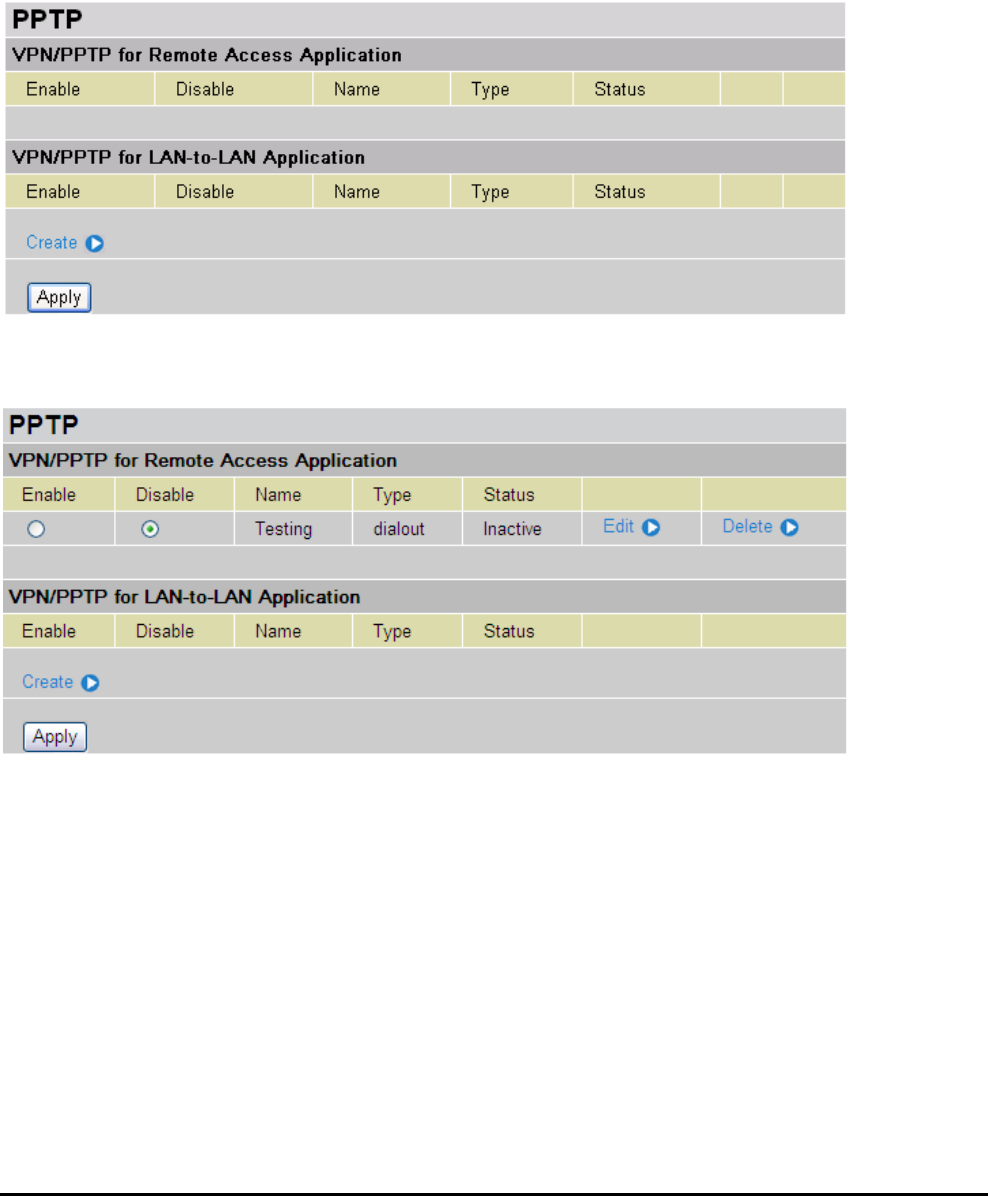
Billion BiPAC SHDSL/SHDSL.bis (VPN) Firewall Bridge/ Router
Chapter 4: Configuration
97
VPN (Virtual Private Networks) (BiPAC 8500/ 8501/ 8520 Only)
Virtual Private Networks is a way to establish a secured communication tunnel to an
organization’s network via the Internet. Your router supports three main types of VPN (Virtual
Private Network), PPTP, IPSec and L2TP.
PPTP (Point-to-Point Tunneling Protocol) (BiPAC 8500/ 8501/ 8520 Only)
There are two types of PPTP VPN supported; Remote Access and LAN-to-LAN (please refer
below for more information.). Click Create to configure a new VPN connection.
After you have created a PPTP connection, an account status will be displayed. (See example
above).
• Enable / Disable: This function activates or deactivates the PPTP connection. To
interrupt the tunnel, check the Disable radio button and click the Apply button to
deactivate the connection.
• Name: This is the user-defined name of the connection.
• Type: This refers to your router which operates as a client or a server, Dialout or Dialin
respectively.
• Status: It shows the condition of your PPTP tunnel connection.
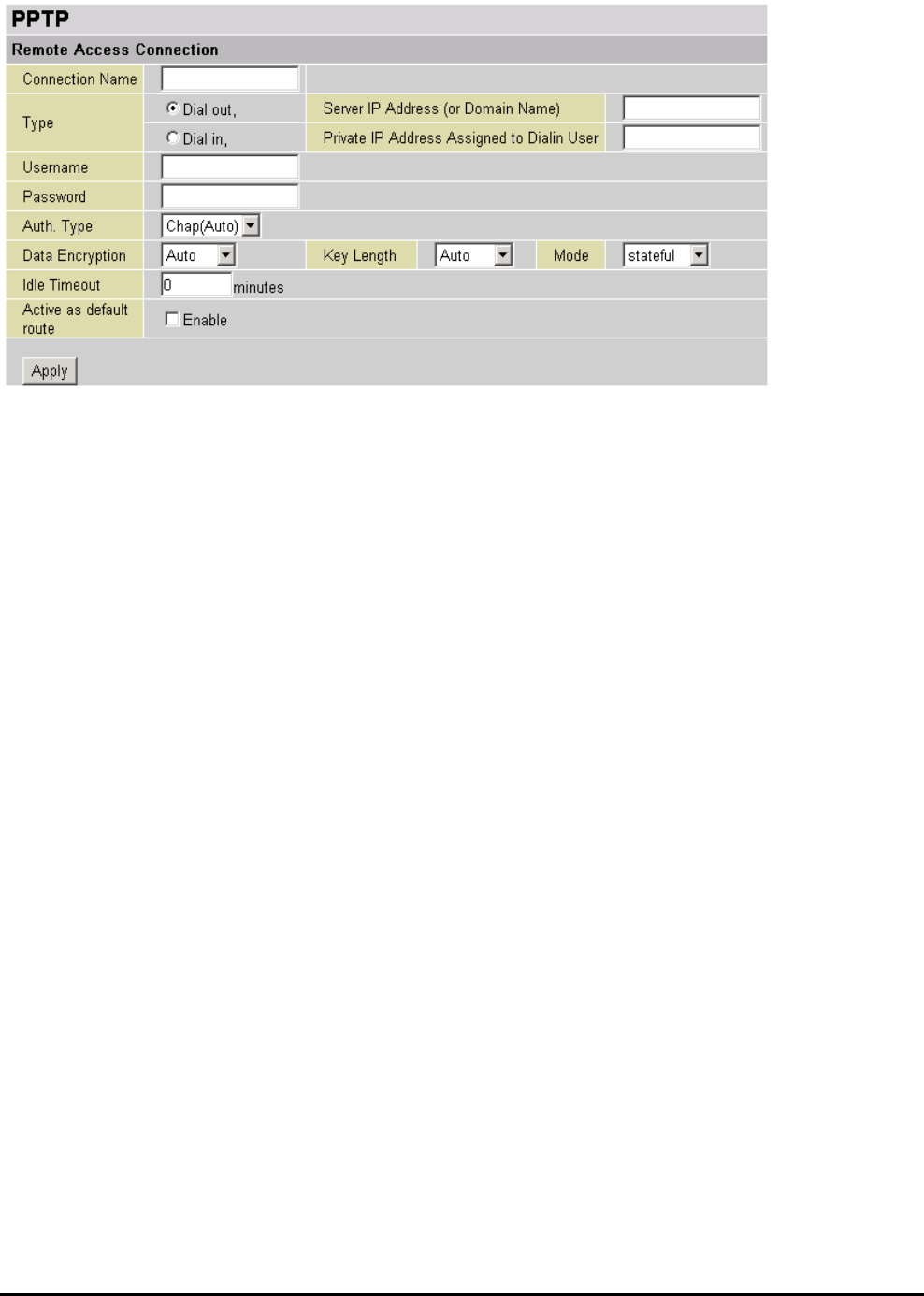
Billion BiPAC 8500/8501/8520/8521 SHDSL (VPN) Firewall Bridge/ Router
Chapter 4: Configuration
98
PPTP Connection - Remote Access(BiPAC 8500/ 8501/ 8520 Only)
• Connection Name: A user-defined name for the connection (e.g. “connection to office”).
• Type: Check Dial Out if you want your router to operate as a client (connecting to a
remote VPN server, e.g. your office server), check Dial In if you want the router to
operate as a VPN server.
o When configuring your router as a Client, enter the remote Server IP Address (or
Domain Name) you wish to connect to.
o When configuring your router as a server, enter the Private IP Address Assigned
to Dial in User address.
• Username: If you are a Dial-Out user (client), enter the username provided by your Host.
If you are a Dial-In user (server), enter your own username.
• Password: If you are a Dial-Out user (client), enter the password provided by your Host.
If you are a Dial-In user (server), enter your own password.
• Authentication Type: Default is Auto if you want the router to determine which
authentication type to use. You can also manually specify CHAP (Challenge Handshake
Authentication Protocol) or PAP (Password Authentication Protocol) if you know which
type the server is using (when acting as a client), or the authentication type you want
clients to use (when acting as a server). When using PAP, the password is sent
unencrypted, whilst CHAP encrypts the password before sending. This presents
challenges at different periods to ensure that an intruder has not replaced the client.
• Data Encryption: Data sent over the VPN connection can be encrypted by a MPPE
algorithm. Default is Auto, which means this setting is negotiated when establishing a
connection. You can also manually Enable or Disable encryption.
• Key Length: The data can be encrypted by MPPE algorithm with 40 bits or 128 bits.
Default is Auto, it is negotiated when establishing a connection. 128 bit keys provide
stronger encryption than 40 bit keys.

Billion BiPAC 8500/8501/8520/8521 SHDSL (VPN) Firewall Bridge/ Router
Chapter 4: Configuration
99
• Mode: You may select Stateful or Stateless mode. The key will be changed every 256
packets when you select Stateful mode. If you select Stateless mode, the key will be
changed in each packet.
• Idle Time: Auto-disconnect the VPN connection when there is no activity on the
connection for a predetermined period of time. 0 means this connection is always on.
• Active as default route: Commonly used by the Dial-out connection which all packets
will route through the VPN tunnel to the Internet; therefore, activate the function may
degrade the Internet performance.
Click the Apply button to apply your changes.
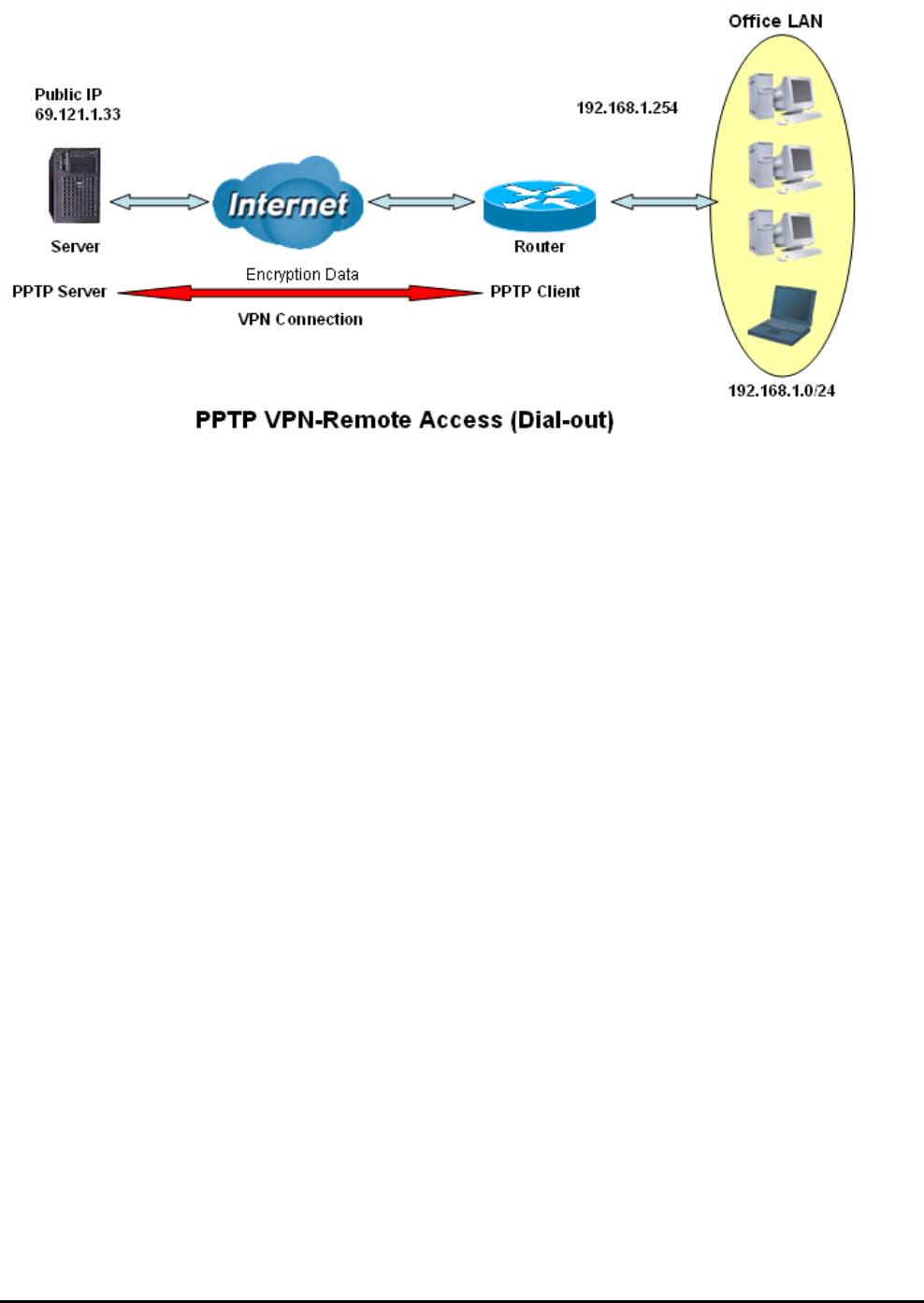
Billion BiPAC SHDSL/SHDSL.bis (VPN) Firewall Bridge/ Router
Chapter 4: Configuration
100
Example: Configuring a Remote Access PPTP VPN Dial-out Connection
An office of a company establishes a PPTP VPN connection with a file server located at a
different location. The router is installed at the office, connecting to a couple of PCs and Servers.
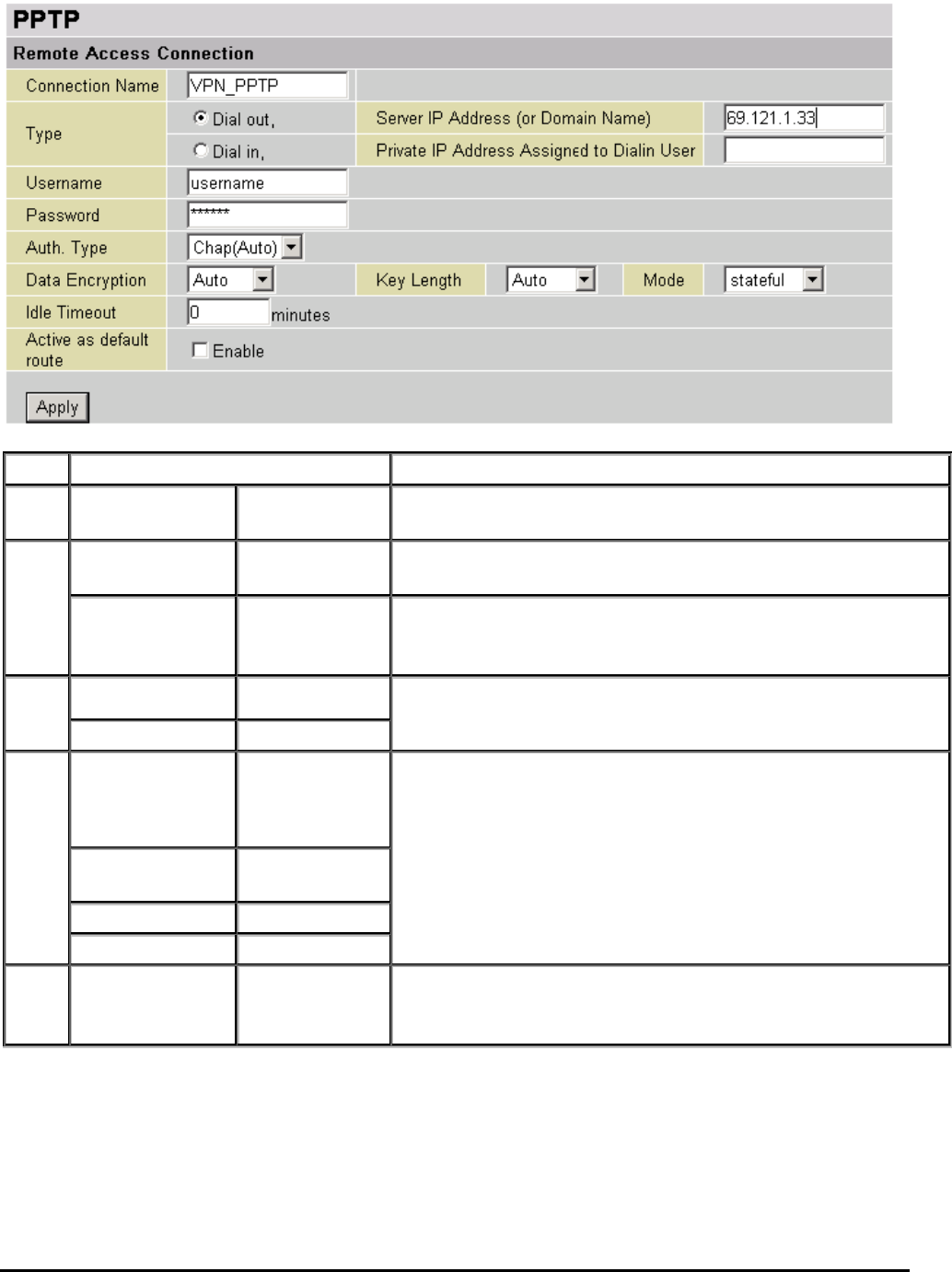
Billion BiPAC SHDSL/SHDSL.bis (VPN) Firewall Bridge/ Router
Chapter 4: Configuration
101
Configuring the PPTP VPN in the Office
You can either input the IP address (69.1.121.33 in this case) or the hostname to reach the
server.
Item
Function Description
1 Connection
Name VPN_PPTP
Given name of PPTP connection
Dial out Check Dial out
2 Server IP
Address (or
Hostname)
69.121.1.33
An Dialed server IP
Username username
3
Password 123456
A given username & password
Auth.Type Chap(Auto)
Data
Encryption Auto
Key Length Auto
4
Mode stateful
Keep as default value in most of the cases, PPTP
server & client will determine the value automatically.
Refer to manual fordetails if you want to change the
setting.
5 Idle Time 0
The connection will be disconnected when there Is no
traffic in a predefined period of time. Idle time 0
means the connection is always on.
1
2
3
4
5
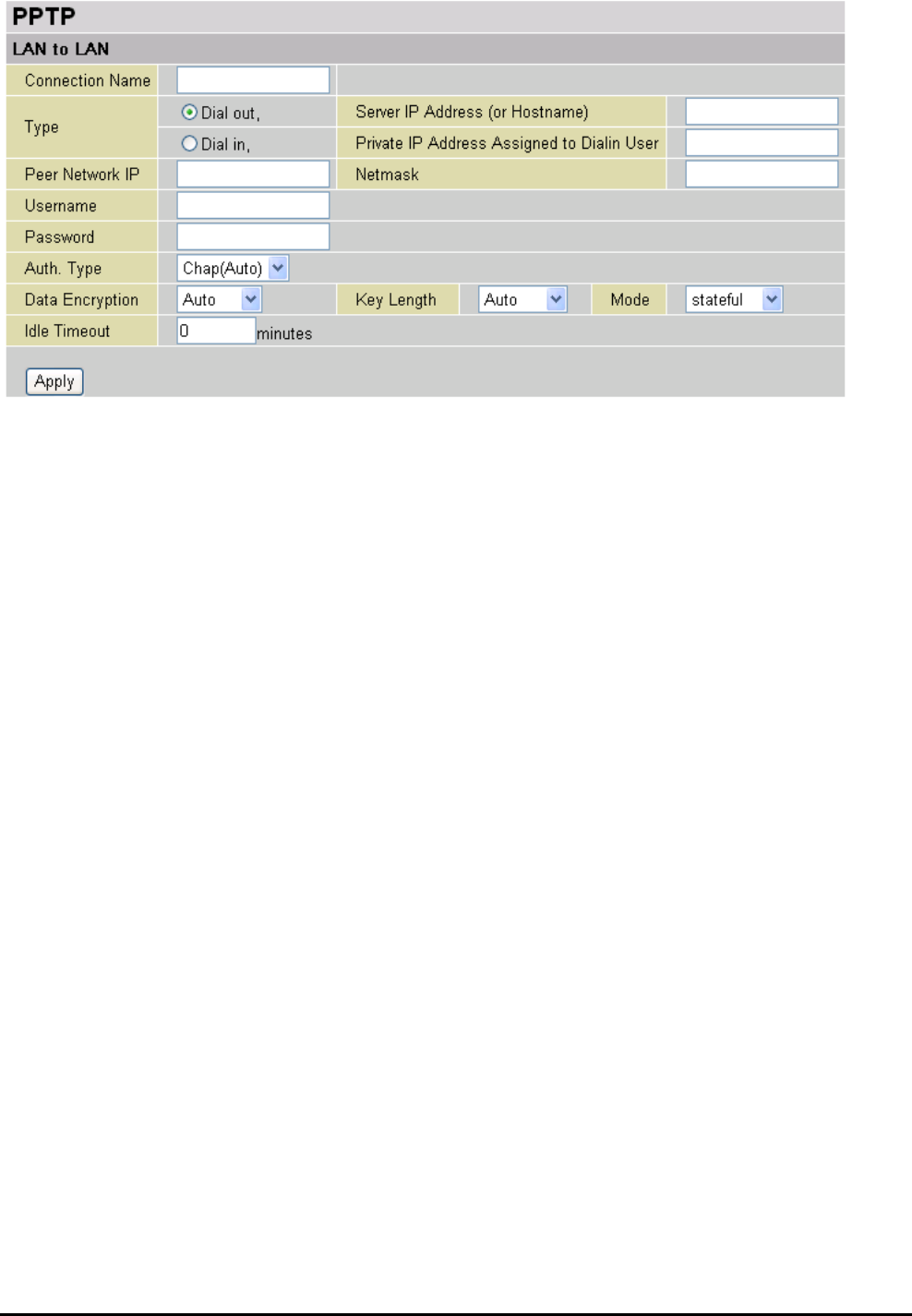
Billion BiPAC 8500/8501/8520/8521 SHDSL (VPN) Firewall Bridge/ Router
Chapter 4: Configuration
102
PPTP Connection - LAN to LAN (BiPAC 8500/ 8501/ 8520 Only)
• Connection Name: A user-define description of the connection.
• Type: Check Dial Out if you want your router to operate as a client (connecting to a
remote VPN server, e.g. your office server), check Dial In if you want it to operate as a
VPN server.
o When configuring your router as a Client, enter the remote Server IP Address (or
Hostname) you wish to connect to.
o When configuring your router as a server, enter the Private IP Address Assigned
to Dial in User address.
• Peer Network IP: Enter the Peer network IP address.
• Netmask: Enter the subnet mask of the peer network based on the Peer Network IP
setting.
• Username: If you are a Dial-Out user (client), enter the username provided by your Host.
If you are a Dial-In user (server), enter your own username.
• Password: If you are a Dial-Out user (client), enter the password provided by your Host.
If you are a Dial-In user (server), enter your own password.
• Authentication Type: Default is Auto if you want the router to determine which
authentication type to use, or else manually specify CHAP (Challenge Handshake
Authentication Protocol) or PAP (Password Authentication Protocol) if you know which
type the server is using (when acting as a client), or specify the authentication type you
want clients to use (when acting as a server). When using PAP, the password is sent
unencrypted, whilst CHAP encrypts the password before sending. This presents
challenges at different periods to ensure that the client has not been replaced by an
intruder.
• Data Encryption: Data sent over the VPN connection can be encrypted by an MPPE
algorithm. Default is Auto, so that this setting is negotiated when establishing a

Billion BiPAC 8500/8501/8520/8521 SHDSL (VPN) Firewall Bridge/ Router
Chapter 4: Configuration
103
connection or you can manually Enable or Disable encryption.
• Key Length: The data can be encrypted by MPPE algorithm with 40 bits or 128 bits.
Default is Auto, it is negotiated when establishing a connection. 128 bit keys provide
stronger encryption than 40 bit keys.
• Mode: You may select Stateful or Stateless mode. The key will be changed every 256
packets when you select Stateful mode. If you select Stateless mode, the key will be
changed in each packet.
• Idle Time: Auto-disconnect the VPN connection when there is no activity on the
connection for a predetermined period of time. 0 means this connection is always on.
Click the Apply button to apply your changes.
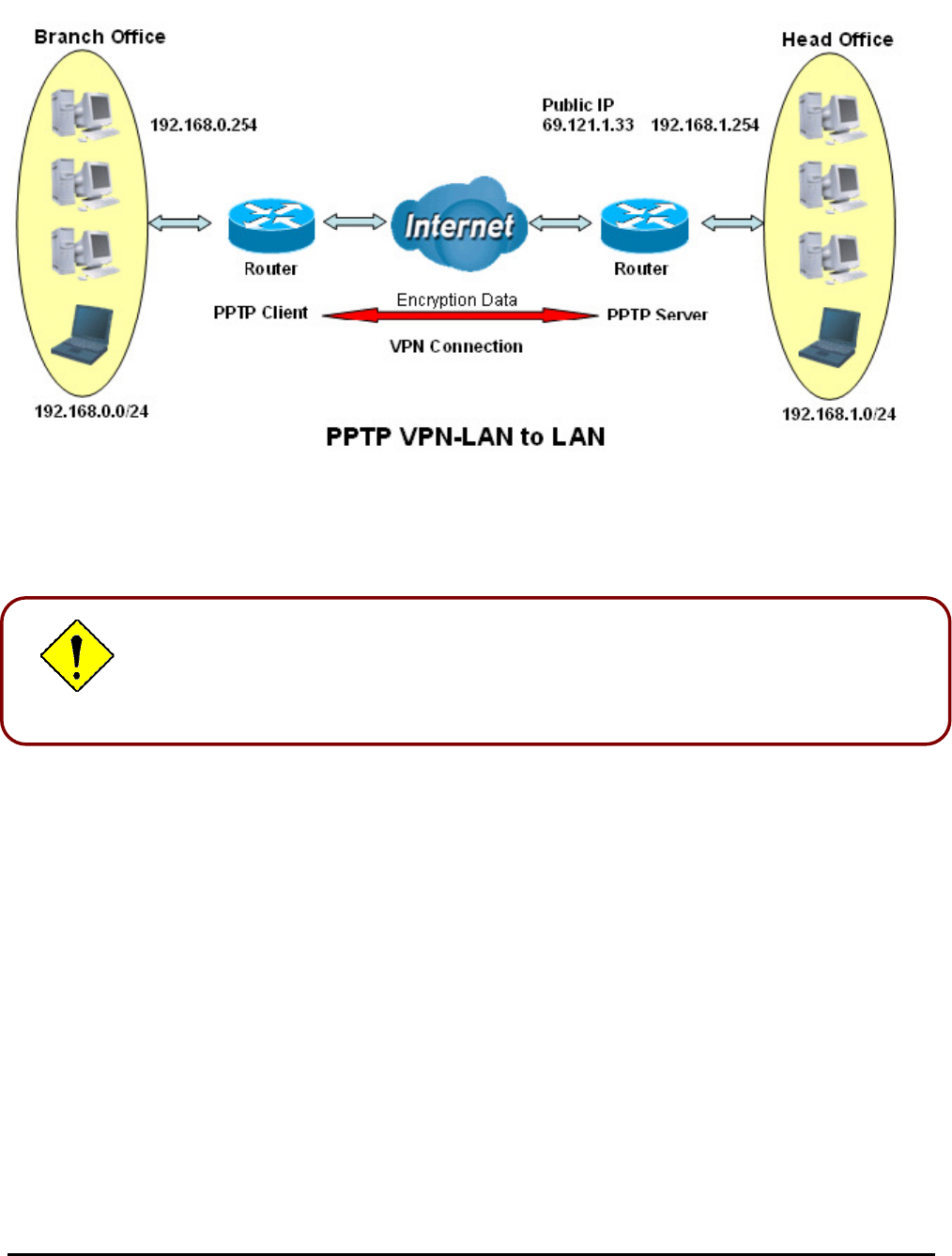
Billion BiPAC SHDSL/SHDSL.bis (VPN) Firewall Bridge/ Router
Chapter 4: Configuration
104
Example: Configuring a PPTP LAN-to-LAN VPN Connection
The branch office establishes a PPTP VPN tunnel with the head office to connect two private
networks over the Internet. The routers are installed in the head office and the branch office
respectively.
Attention
Both office LAN networks MUST be in different subnet with LAN to LAN
application.
Attention
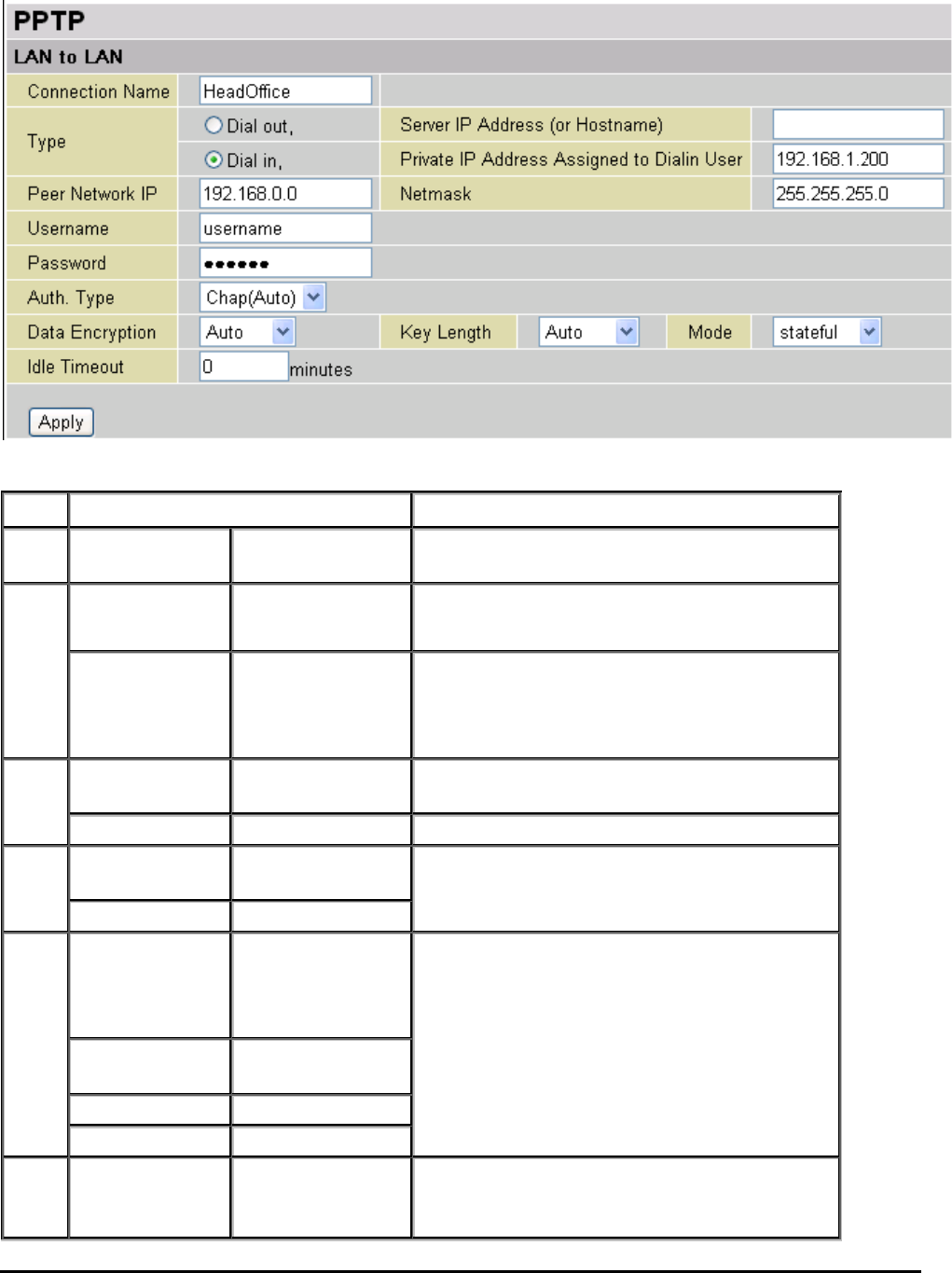
Billion BiPAC 8500/8501/8520/8521 SHDSL (VPN) Firewall Bridge/ Router
Chapter 4: Configuration
105
Configuring PPTP VPN in the Head Office
The IP address 192.168.1.201 will be assigned to the router located in the branch office. Please
make sure this IP is not used in the head office LAN.
Item
Function Description
1 Connection
Name HeadOffice Given a name of PPTP connection
Dial in Check Dial in
2 Private IP
Address
Assigned to
Dialing User
192.168.1.200
IP address assigned to branch office
network
Peer
Network IP 192.168.0.0 Branch office network
3
Netmask 255.255.255.0
Username username
4
Password 123456
Input username & password to
authenticate branch office network
Auth.Type Chap(Auto)
Data
Encryption Auto
Key Length Auto
5
Mode stateful
Keep as default value in most of the
cases, PPTP server & client will
determine the value automatically.
Refer to manual for details if you want
to change the setting.
6 Idle Time 0
The connection will be disconnected
when there Is no traffic in a predefined
period of time. Idle time 0 means the
1
4
5
2
3
6
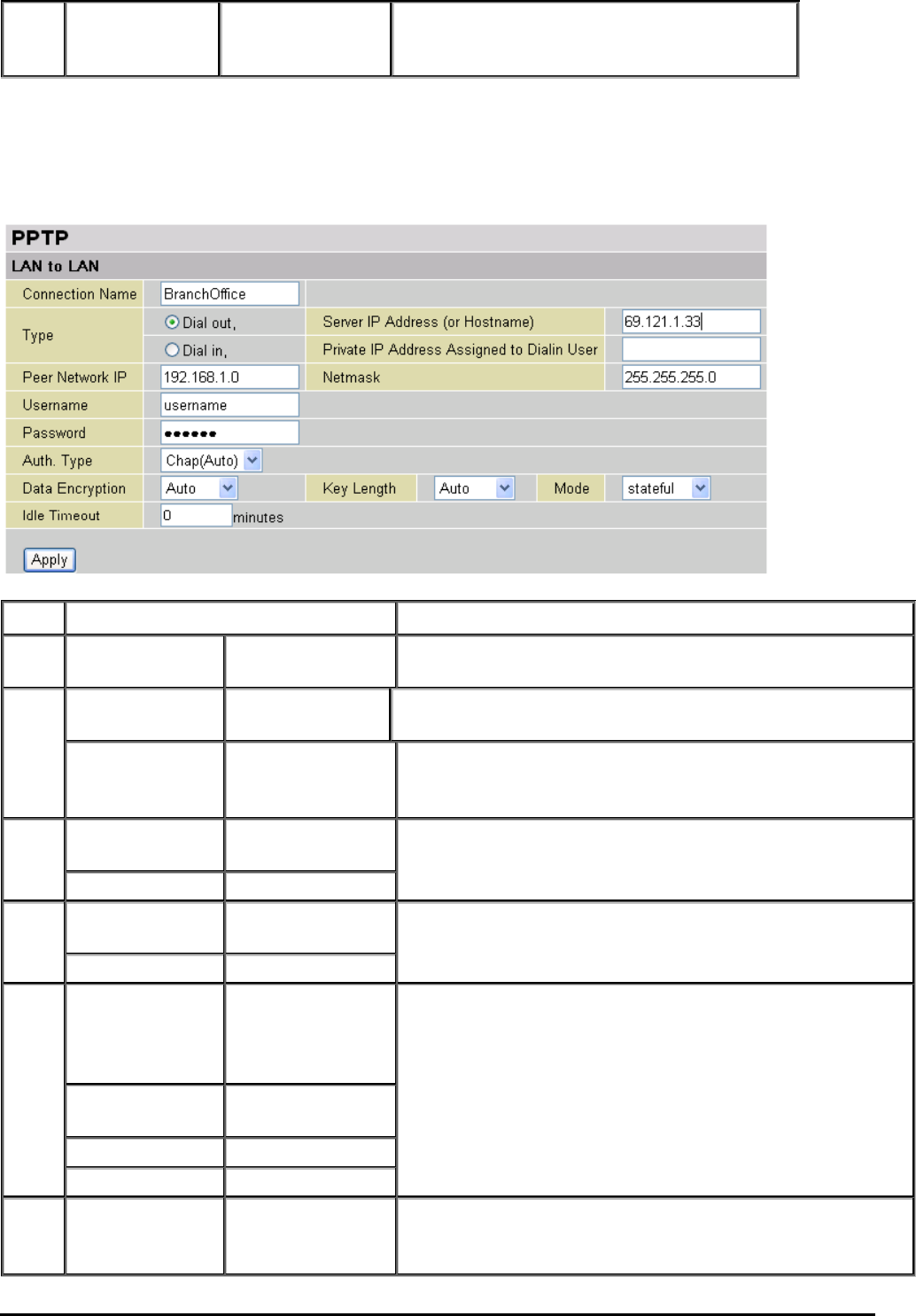
Billion BiPAC 8500/8501/8520/8521 SHDSL (VPN) Firewall Bridge/ Router
Chapter 4: Configuration
106
connection is always on.
Configuring PPTP VPN in the Branch Office
The IP address 69.1.121.30 is the Public IP address of the router located in the head office. If
you registered the DDNS (please refer to the DDNS section of this manual), you can also use
the domain name instead of the IP address to reach the router.
Item
Function Description
1 Connection
Name BranchOffice Given a name of PPTP connection
Dial out Check Dial out
2 Server IP
Address (or
Hostname)
69.121.1.33 IP address of the head office router (in WAN side)
Peer
Network IP 192.168.1.0
3
Netmask 255.255.255.0
Head office network
Username username
4
Password 123456
Input username & password to authenticate branch
office network
Auth.Type Chap(Auto)
Data
Encryption Auto
Key Length Auto
5
Mode stateful
Keep as default value in most of the cases, PPTP
server & client will determine the value
automatically. Refer to manual for details if you
want to change the setting.
6 Idle Time 0
The connection will be disconnected when there Is
no traffic in a predefined period of time. Idle time 0
means the connection is always on.
1
2
3
4
5
6
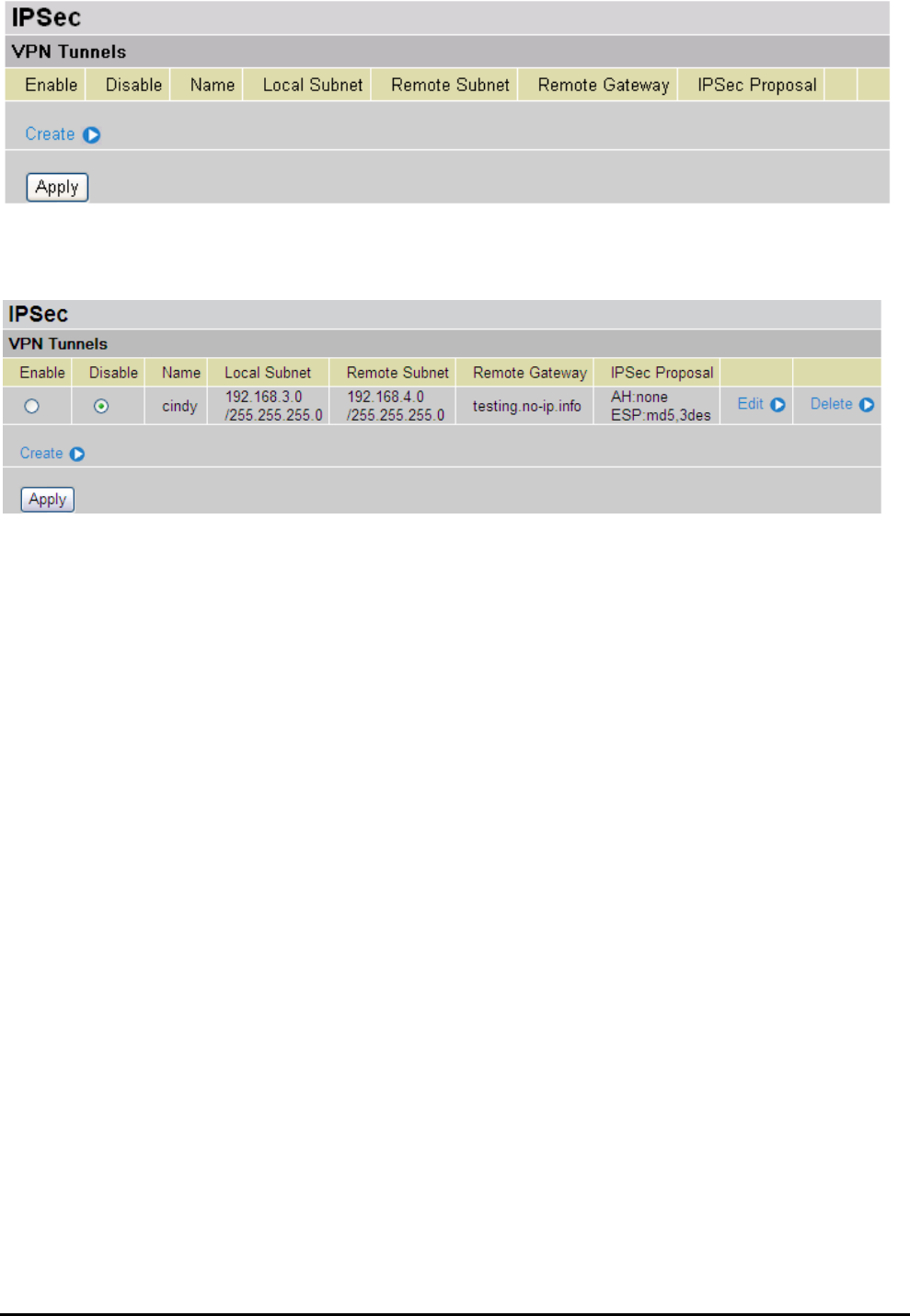
Billion BiPAC SHDSL/SHDSL.bis (VPN) Firewall Bridge/ Router
Chapter 4: Configuration
107
IPSec (IP Security Protocol) (BiPAC 8500/ 8501/ 8520 Only)
Click Create to create a new IPSec VPN connection account.
After you have created the IPSec connection, account information will be displayed. (See
example above).
• Enable / Disable: This function activates or deactivates the IPSec connection. To
interrupt the tunnel, check the Disable radio button and click the Apply button to
deactivate the connection.
• Name: This is the user-defined name of the connection.
• Local Subnet: Displays IP address and subnet of the local network.
• Remote Subnet: Displays IP address and subnet of the remote network.
• Remote Gateway: This is the IP address or the Domain Name of the remote VPN
device that is connected and used to establishe a VPN tunnel.
• IPSec Proposal: This is the selected IPSec security method.
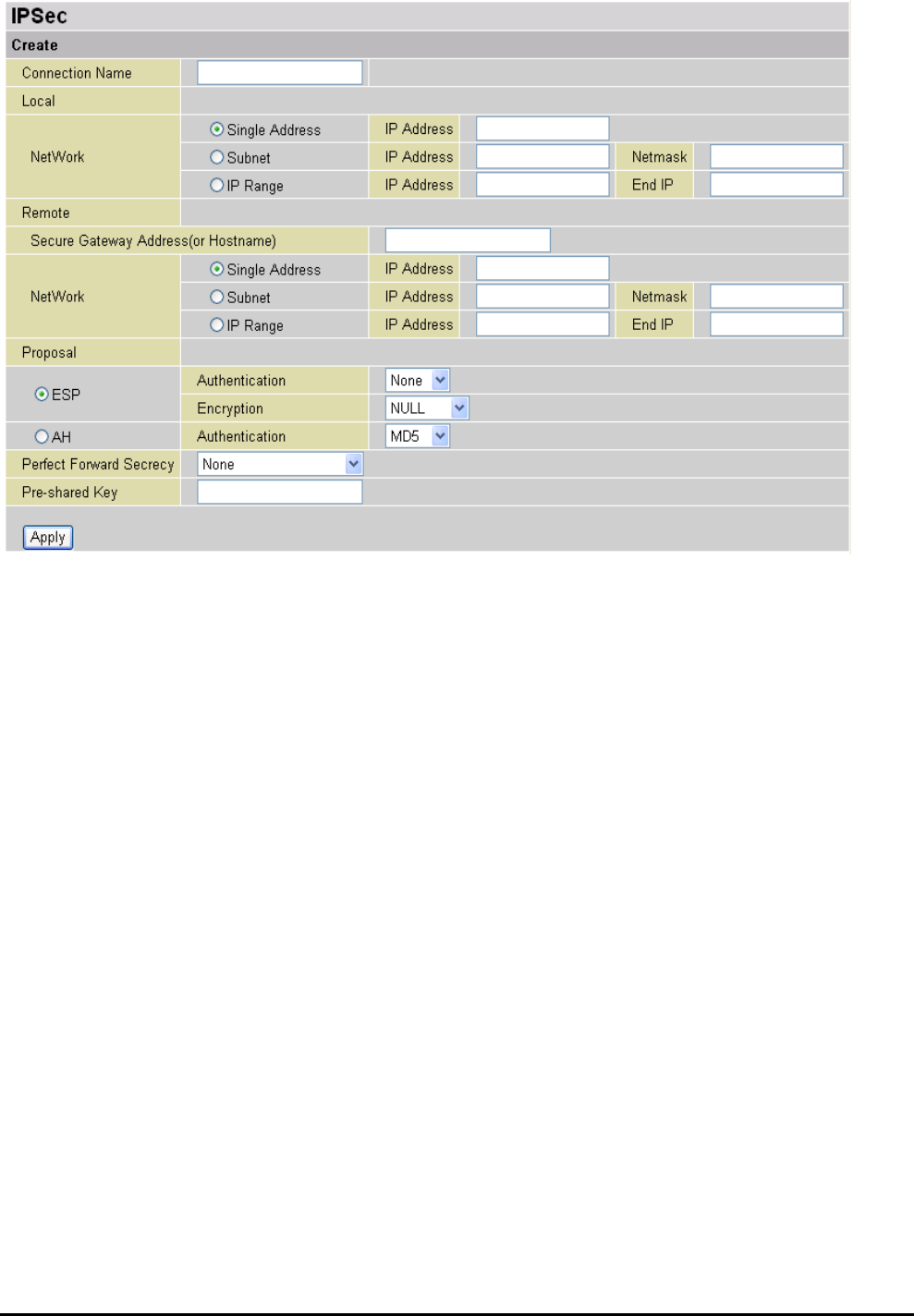
Billion BiPAC 8500/8501/8520/8521 SHDSL (VPN) Firewall Bridge/ Router
Chapter 4: Configuration
108
IPSec VPN Connection (BiPAC 8500/ 8501/ 8520 Only)
• Connection Name: User-defined name for the connection (e.g. “connection to office”).
• Local Network: Set the IP address, subnet or address range of the local network.
o Single Address: The IP address of the local host.
o Subnet: The subnet of the local network. For example, IP: 192.168.1.0 with
netmask 255.255.255.0 specifies one class C subnet starting from 192.168.1.1
(i.e. 192.168.1.1 through to 192.168.1.254).
o IP Range: The IP address range of the local network. For example, IP:
192.168.1.1, end IP: 192.168.1.10.
• Remote Secure Gateway Address (or Domain Name): The IP address or hostname of
the remote VPN device that is connected and is used to establishe a VPN tunnel.
• Remote Network: Set the IP address, subnet or address range of the remote network.
• Proposal: Select the IPSec security method. There are two methods of checking the
authentication information, AH (authentication header) and ESP (Encapsulating Security
Payload). Use ESP for greater security so that data will be encrypted and authenticated.
Using AH data will be authenticated but not encrypted.
• Authentication: Authentication establishes the integrity of the datagram and ensures
that it is not tampered with during transmission. There are three options, Message Digest
5 (MD5), Secure Hash Algorithm (SHA1) or NONE. SHA1 is more resistant to brute-force
attacks than MD5, however it is slower.
o MD5: A one-way hashing algorithm that produces a 128−bit hash.

Billion BiPAC 8500/8501/8520/8521 SHDSL (VPN) Firewall Bridge/ Router
Chapter 4: Configuration
109
o SHA1: A one-way hashing algorithm that produces a 160−bit hash.
• Encryption: Select the encryption method from the pull-down menu. There are several
options, DES, 3DES, AES (128, 192 and 256) and NULL. NULL means it is a tunnel only
with no encryption. 3DES and AES are more powerful but increase the latency.
o DES: Stand for Data Encryption Standard, it uses 56 bits as an encryption method.
o 3DES: Stand for Triple Data Encryption Standard, it uses 168 (56*3) bits as an
encryption method.
o AES: Stand for Advanced Encryption Standards, you can use 128, 192 or 256 bits
encryption method.
• Perfect Forward Secrecy: Choose whether to enable PFS using Diffie-Hellman public-
key cryptography to change the encryption keys during second phase of VPN negotiation.
This function will provide better security, but extends the VPN negotiation time. Diffie-
Hellman is a public-key cryptography protocol that allows two parties to establish a
shared secret over an unsecured communication channel (i.e. over the Internet). There
are three modes, MODP 768-bit, MODP 1024-bit and MODP 1536-bit. MODP stands for
Modular Exponentiation Groups.
• Pre-shared Key: This is for the Internet Key Exchange (IKE) protocol, a string from 4 to
128 characters. Both sides should use the same key. IKE is used to establish a shared
security policy and authenticated keys for services (such as IPSec) that require a key.
Before any IPSec traffic can be passed, each router must be able to verify the identity of
its peer. This can be done by manually entering the pre-shared key to the router or hosts
at both ends.
Select the Apply button to apply your changes.
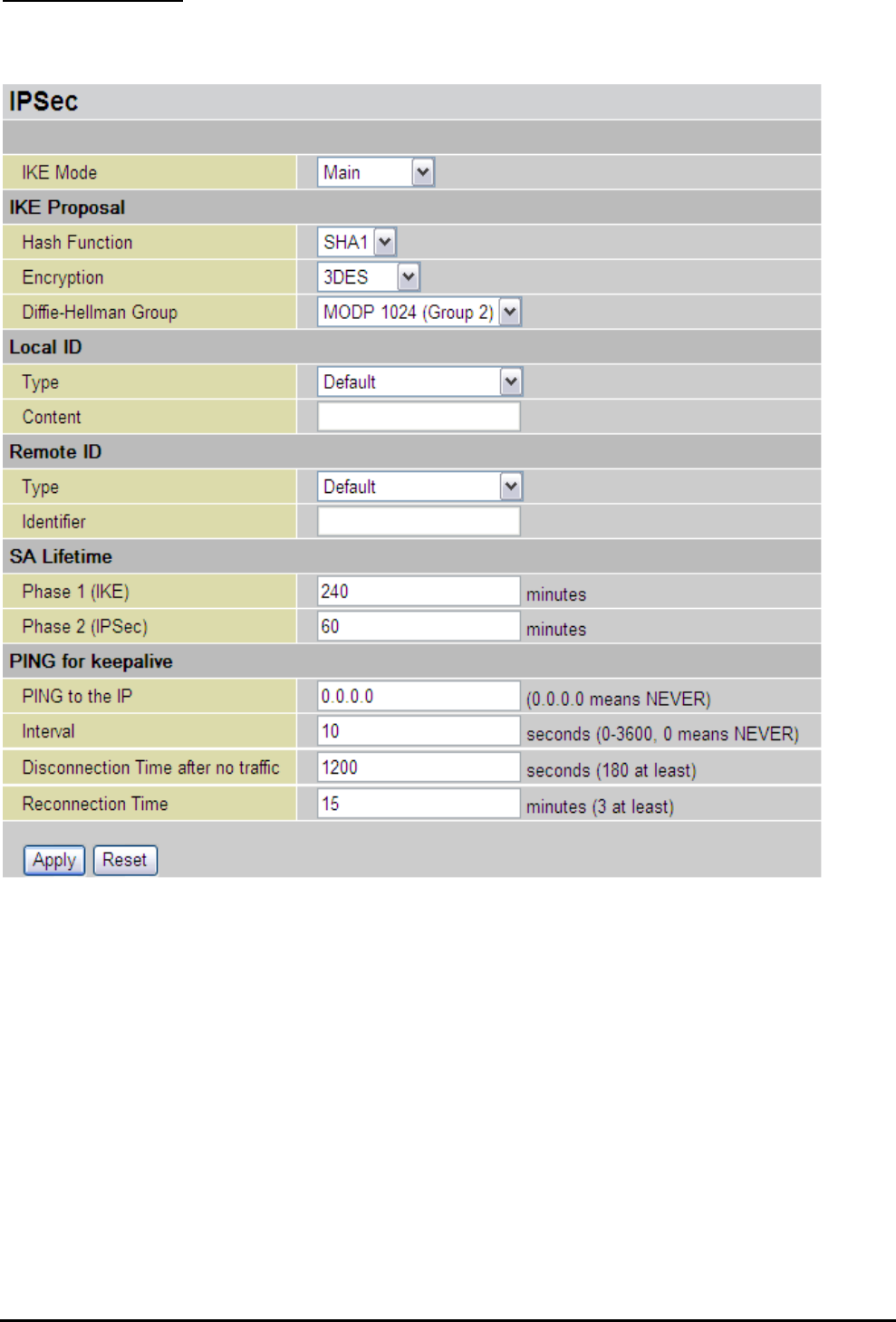
Billion BiPAC 8500/8501/8520/8521 SHDSL (VPN) Firewall Bridge/ Router
Chapter 4: Configuration
110
Advanced Option
This function is only available after finish creating an IPSec account. Click Advanced Option to
change the following settings:
• IKE (Internet key Exchange) Mode: Select IKE mode to Main mode or Aggressive
mode. This IKE provides secured key generation and key management.
IKE Proposal:
o Hash Function: It is a Message Digest algorithm which coverts any length of a
message into a unique set of bits. It is widely used MD5 (Message Digest) and
SHA-1 (Secure Hash Algorithm) algorithms. SHA1 is more resistant to brute-force
attacks than MD5, however it is slower. SHA1 is more resistant to brute-force
attacks than MD5, however it is slower
MD5: A one-way hashing algorithm that produces a 128−bit hash.
SHA1: A one-way hashing algorithm that produces a 160−bit hash
o Encryption: Select the encryption method from the pull-down menu. There are
several options, DES, 3DES and AES (128, 192 and 256). 3DES and AES are

Billion BiPAC 8500/8501/8520/8521 SHDSL (VPN) Firewall Bridge/ Router
Chapter 4: Configuration
111
more powerful but increase the latency.
DES: Stands for Data Encryption Standard, it uses 56 bits encryption
method.
3DES: Stands for Triple Data Encryption Standard, it uses 168 (56*3) bits
encryption method.
AES: Stands for Advanced Encryption Standards, you can use 128, 192 or
256 bits encryption method.
o Diffie-Hellman Group: It is a public-key cryptography protocol that allows two
parties to establish a shared secret over an unsecured communication channel
(i.e. over the Internet). There are three modes, MODP 768-bit, MODP 1024-bit
and MODP 1536-bit. MODP stands for Modular Exponentiation Groups.
o Local ID:
Type: Specify a local ID type.
Content: Input ID information, like domain name www.ipsectest.com.
o Remote ID:
Type: Specify a Remote ID type.
Identifier: Input remote ID information, like domain name
www.ipsectest.com.
o SA Lifetime: Specify the number of minutes that a Security Association (SA) will
stay active before a new encryption and an authentication key will be exchanged.
There are two kinds of SAs, IKE and IPSec. IKE negotiates and establishes SA on
behalf of IPSec, an IKE SA is used by IKE.
Phase 1 (IKE): To issue an initial connection request for a new VPN tunnel.
The range can be from 5 to 15,000 minutes, and the default is 240 minutes.
Phase 2 (IPSec): To negotiate and establish a secure authentication. The
range can be from 5 to 15,000 minutes, and the default is 60 minutes.
Note: A short SA time increases security by forcing two parties to update the keys. However,
every time the VPN tunnel re-negotiates, access through the tunnel will be temporarily
disconnected.
• PING to Keepalive: It is used to detect IPSec tunnel connection failure. Connection
failure is defined as abort or in NO response state. In such event Ping to Keepalive takes
proper action to ensure the connection quality of IPSec.
o PING to the IP: It can IP Ping the remote PC with the specified IP address and
issue alert when the connection fails. Once alter message is received, Router will
drop this tunnel connection. Re-establishing of this connection is required. Default
setting is 0.0.0.0 which disables the function.
o Interval: This sets the time interval of Pings to the IP function to monitor the
connection status. Default interval setting is 10 seconds. Time interval can be set
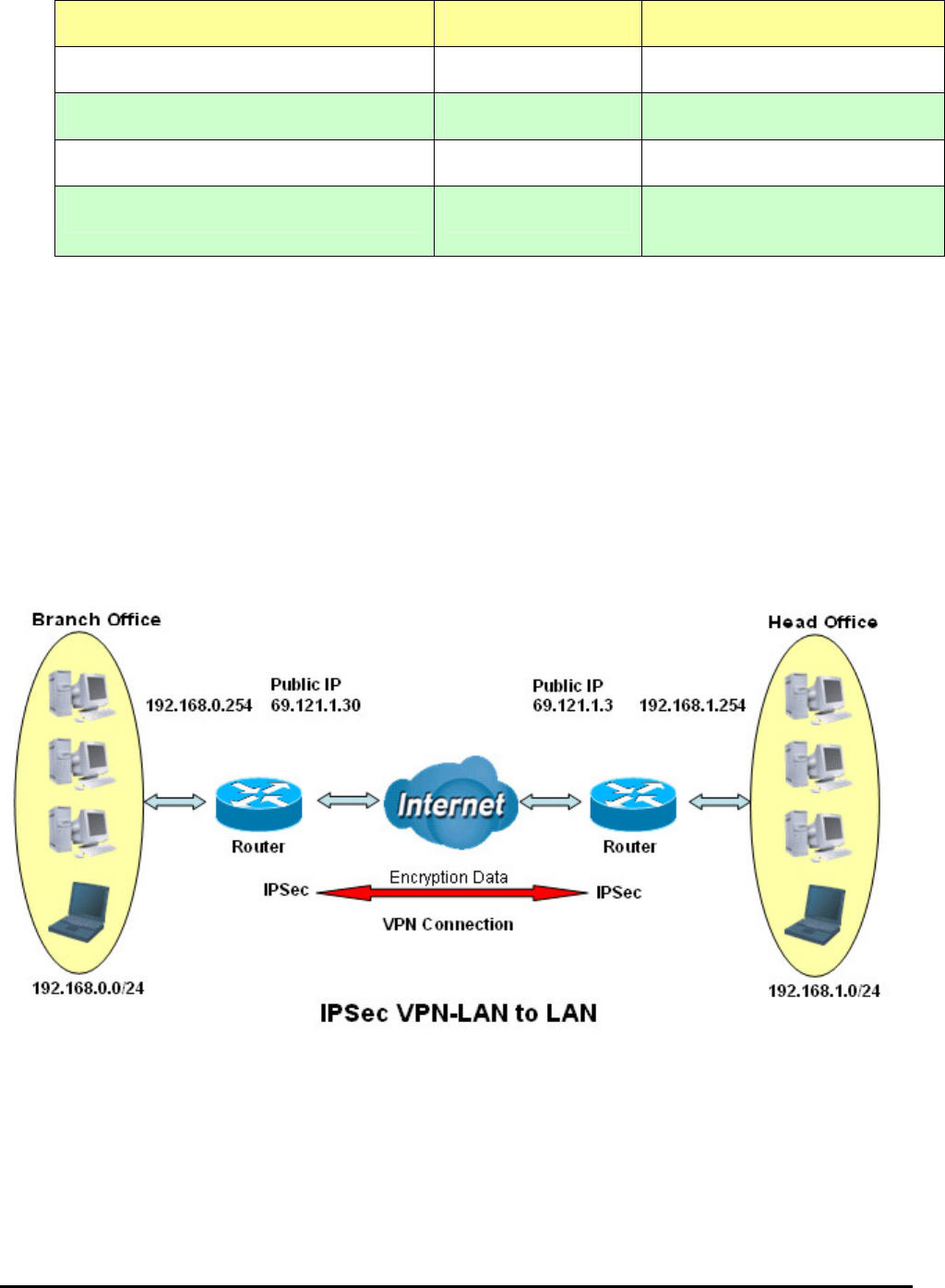
Billion BiPAC 8500/8501/8520/8521 SHDSL (VPN) Firewall Bridge/ Router
Chapter 4: Configuration
112
from 0 to 3600 second; 0 second disables the function.
Ping to the IP Internal (sec) Ping to the IP Action
0.0.0.0 0 No
0.0.0.0 2000 No
xxx.xxx.xxx.xxx (A valid IP Address) 0 No
xxx.xxx.xxx.xxx(A valid IP Address) 2000 Yes, activate it in every 2000
second.
Disconnection Time after no traffic: It is the NO Response time clock. When no traffic stage
time is beyond the Disconnection time set, Router will automatically halt the tunnel connection
and re-establish it base on the Reconnection Time set. Default setting is 1200 seconds; 180
seconds is the minimum time interval for this function.
Reconnection Time: It is the reconnecting time interval after NO TRAFFIC is initiated. Default
setting is 15 minutes; 3 minutes is the minimum time interval for this function.
Select the Apply button to update the settings.
Example: Configuring a IPSec LAN-to-LAN VPN Connection
Table 3: Network Configuration and Security Plan
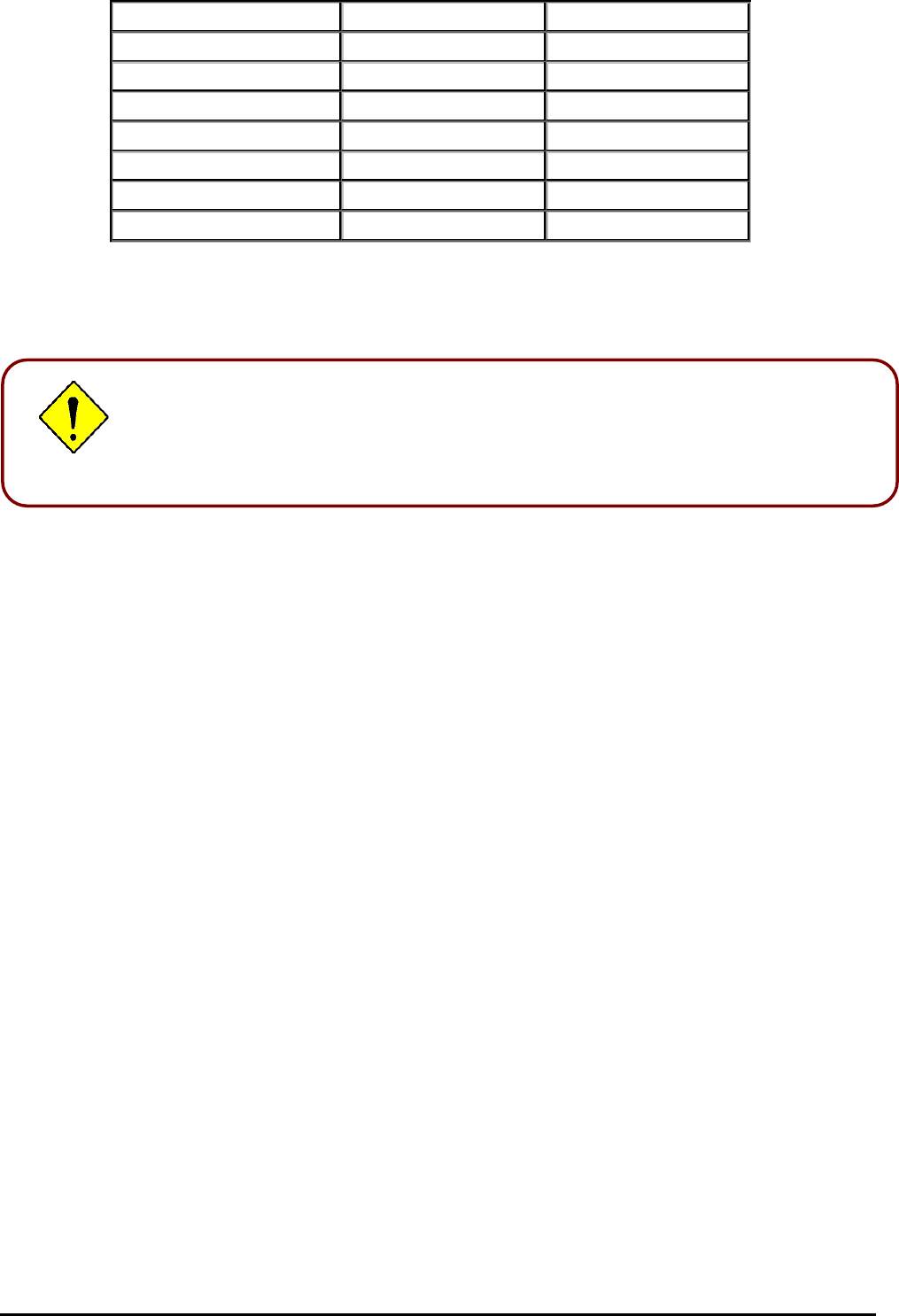
Billion BiPAC 8500/8501/8520/8521 SHDSL (VPN) Firewall Bridge/ Router
Chapter 4: Configuration
113
Branch Office Head Office
Local Network ID 192.168.0.0/24 192.168.1.0/24
Local Router IP 69.1.121.30 69.1.121.3
Remote Network ID
192.168.1.0/24 192.168.0.0/24
Remote Router IP 69.1.121.3 69.1.121.30
IKE Pre-shared Key
12345678 12345678
VPN Connection Type
Tunnel mode Tunnel mode
Security Algorithm ESP:MD5 with AES
ESP:MD5 with AES
Attention
Both office LAN networks MUST be in different subnet with LAN to LAN
application. Functions of Pre-shared Key, VPN Connection Type and
Security Algorithm MUST BE identically set up on both sides.
Attention
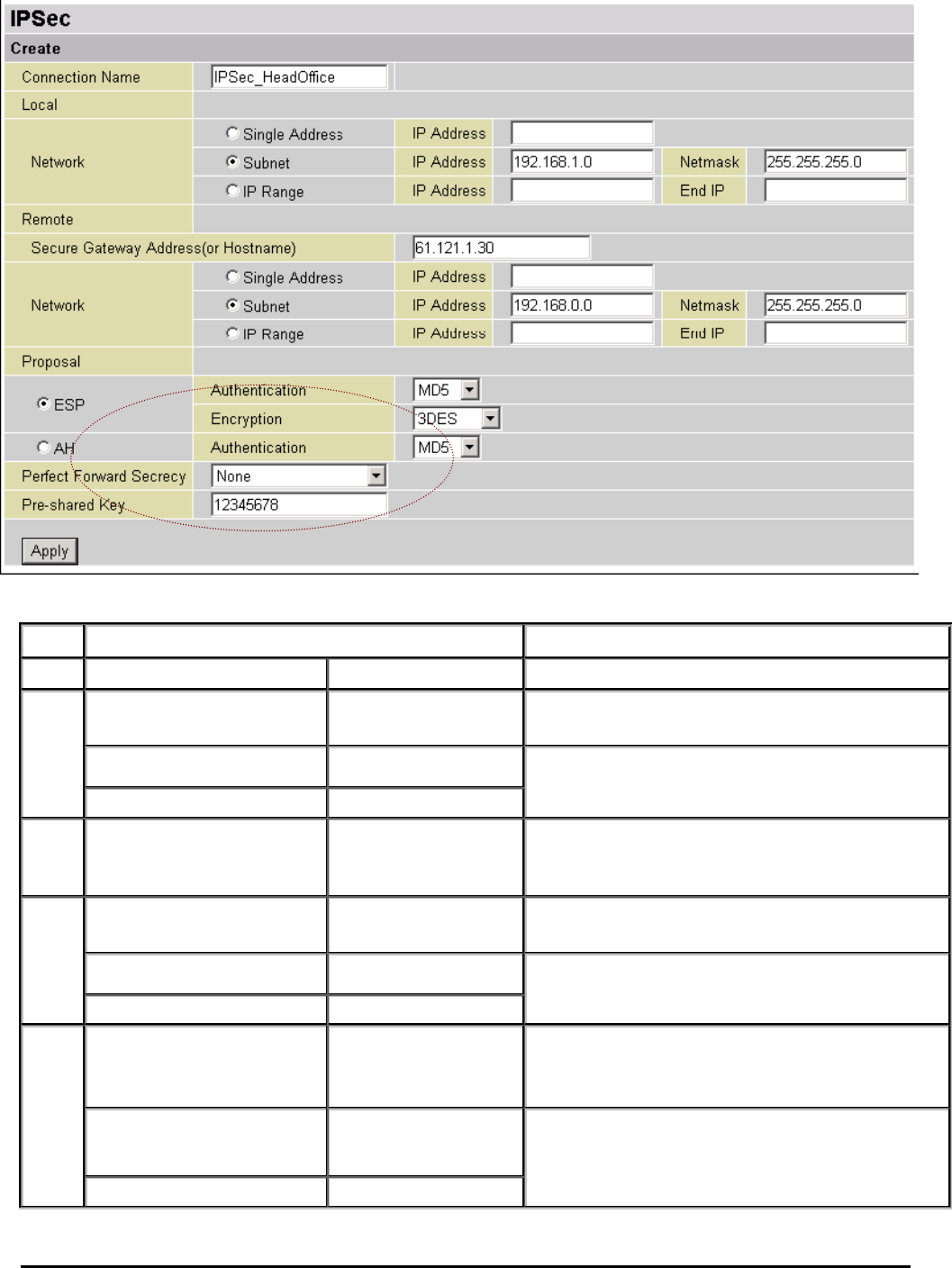
Billion BiPAC SHDSL/SHDSL.bis (VPN) Firewall Bridge/ Router
Chapter 4: Configuration
114
Configuring IPSec VPN in the Head Office
Item
Function Description
1 Connection Name IPSec_HeadOffice
Given a name of IPSec connection
Subnet Check the Subnet radio button
IP Address 192.168.1.0
2
Netmask 255.255.255.0
Head office network
3
Secure Gateway
Address
(or Hostname)
69.121.1.30 IP address of the head office router (in
WAN side)
Subnet Check the Subnet radio button
IP Address 192.168.0.0
4
Netmask 255.255.255.0
Branch office network
ESP Check the ESP radio button
Authentication MD5
5
Encryption 3DES
Security plan
1
2
3
4
5

Billion BiPAC 8500/8501/8520/8521 SHDSL (VPN) Firewall Bridge/ Router
Chapter 4: Configuration
115
Prefer Forward
Security None
Pre-shared Key 12345678
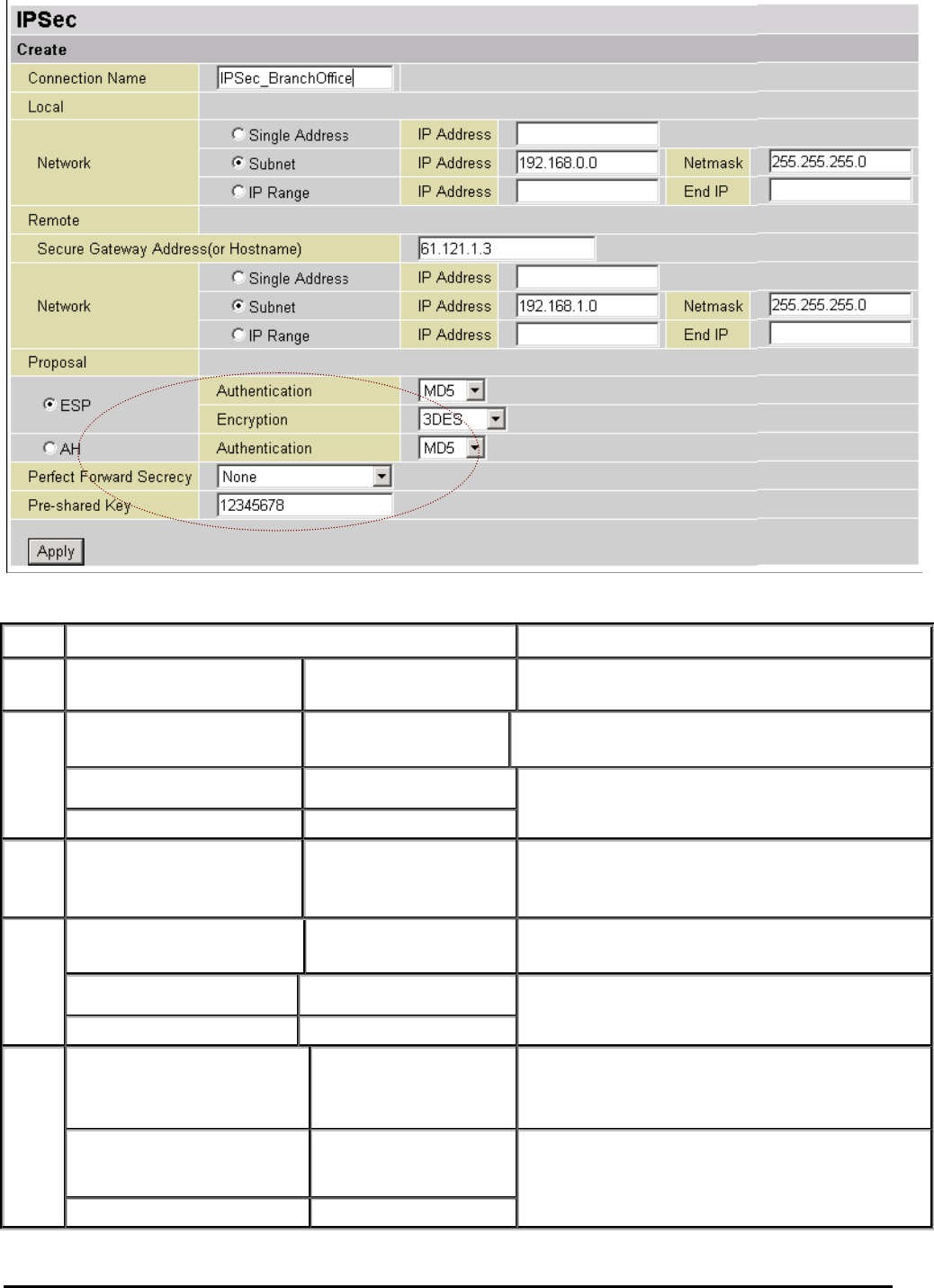
Billion BiPAC SHDSL/SHDSL.bis (VPN) Firewall Bridge/ Router
Chapter 4: Configuration
116
Configuring IPSec VPN in the Branch Offiece
Item
Function Description
1 Connection Name IPSec_BranchOffice
Given a name of IPSec connection
Subnet Check the Subnet radio button
IP Address 192.168.0.0
2
Netmask 255.255.255.0
Branch office network
3
Secure Gateway
Address
(or Hostname)
69.121.1.3 IP address of the head office router (in
WAN side)
Subnet Check the Subnet radio button
IP Address 192.168.1.0
4
Netmask 255.255.255.0
Head office network
ESP Check the ESP radio button
Authentication MD5
5
Encryption 3DES
Security plan
1
2
3
4
5
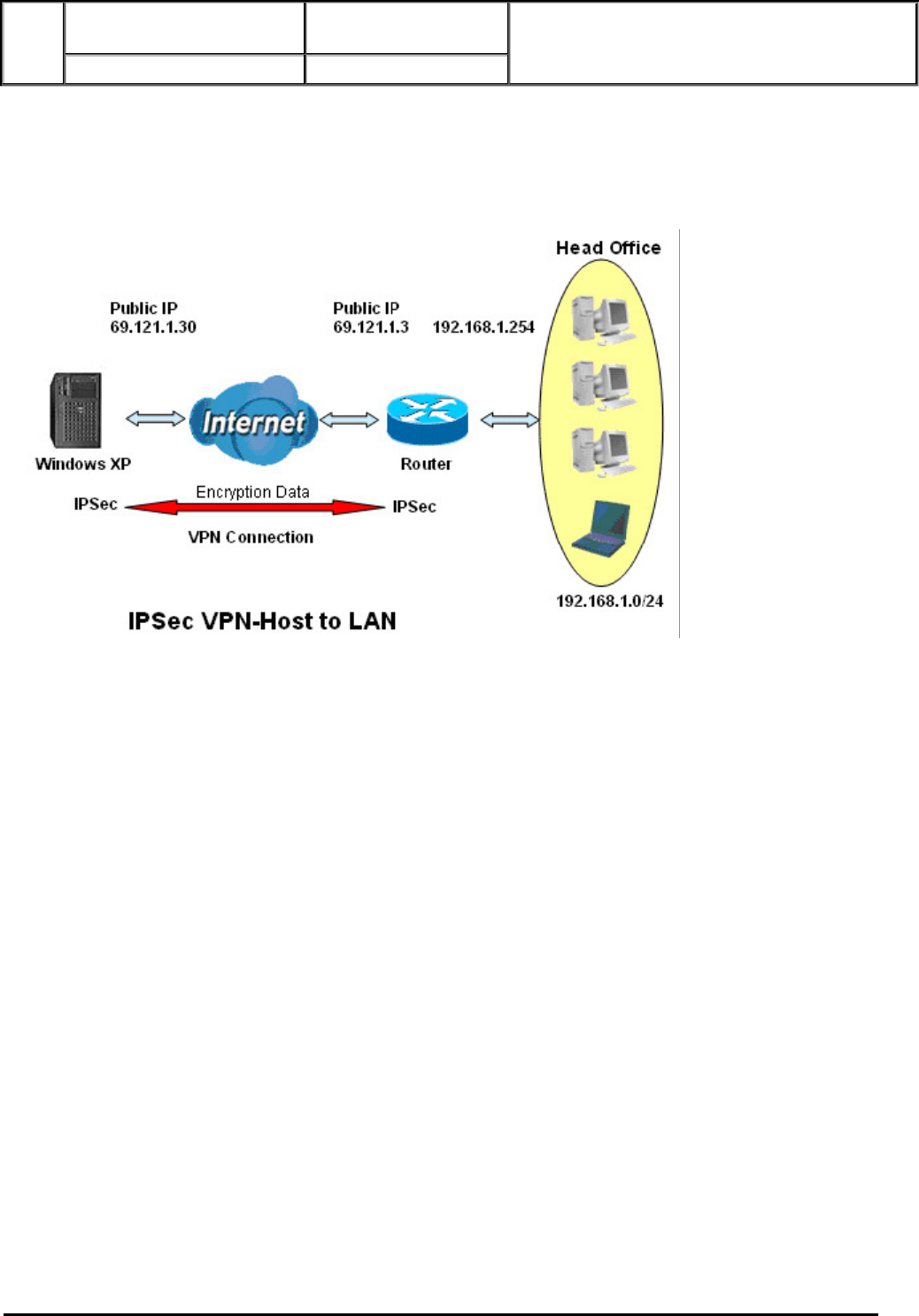
Billion BiPAC 8500/8501/8520/8521 SHDSL (VPN) Firewall Bridge/ Router
Chapter 4: Configuration
117
Prefer Forward
Security None
Pre-shared Key 12345678
Example: Configuring a IPSec Host-to-LAN VPN Connection
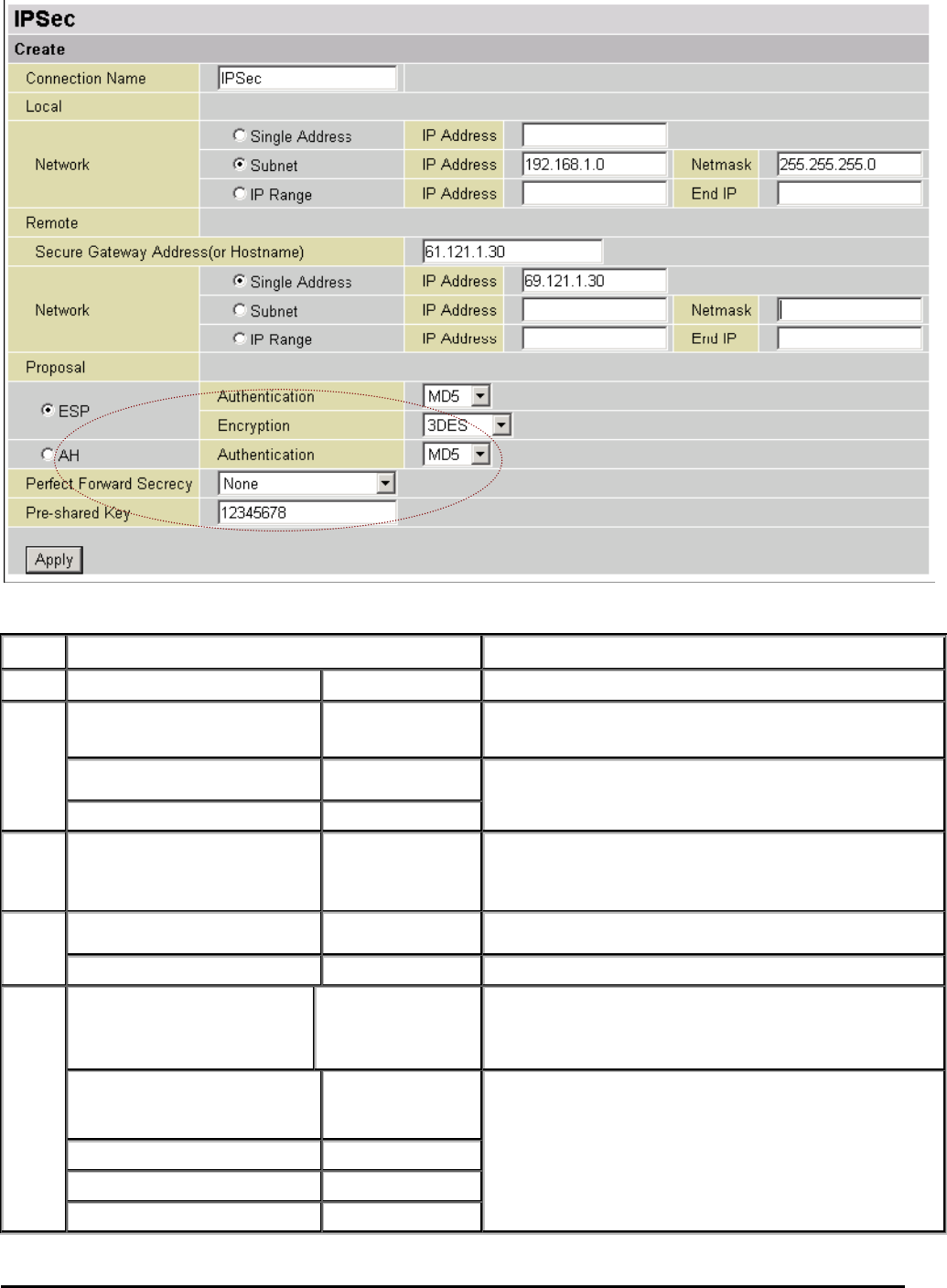
Billion BiPAC SHDSL/SHDSL.bis (VPN) Firewall Bridge/ Router
Chapter 4: Configuration
118
Configuring IPSec VPN in the Office
Item
Function Description
1 Connection Name IPSec Given a name of IPSec connection
Subnet Check the Subnet radio button
IP Address 192.168.1.0
2
Netmask 255.255.255.0
Head office network
3
Secure Gateway
Address
(or Hostname)
69.121.1.30 IP address of the head office router (in WAN
side)
Single Address Check the Single Address radio button
4
IP Address 69.121.1.30 Remote worker’s IP address
ESP Check the ESP radio button
Authentication MD5
Encryption 3DES
Prefer Forward Security
None
5
Pre-shared Key 12345678
Security plan
1
2
3
4
5
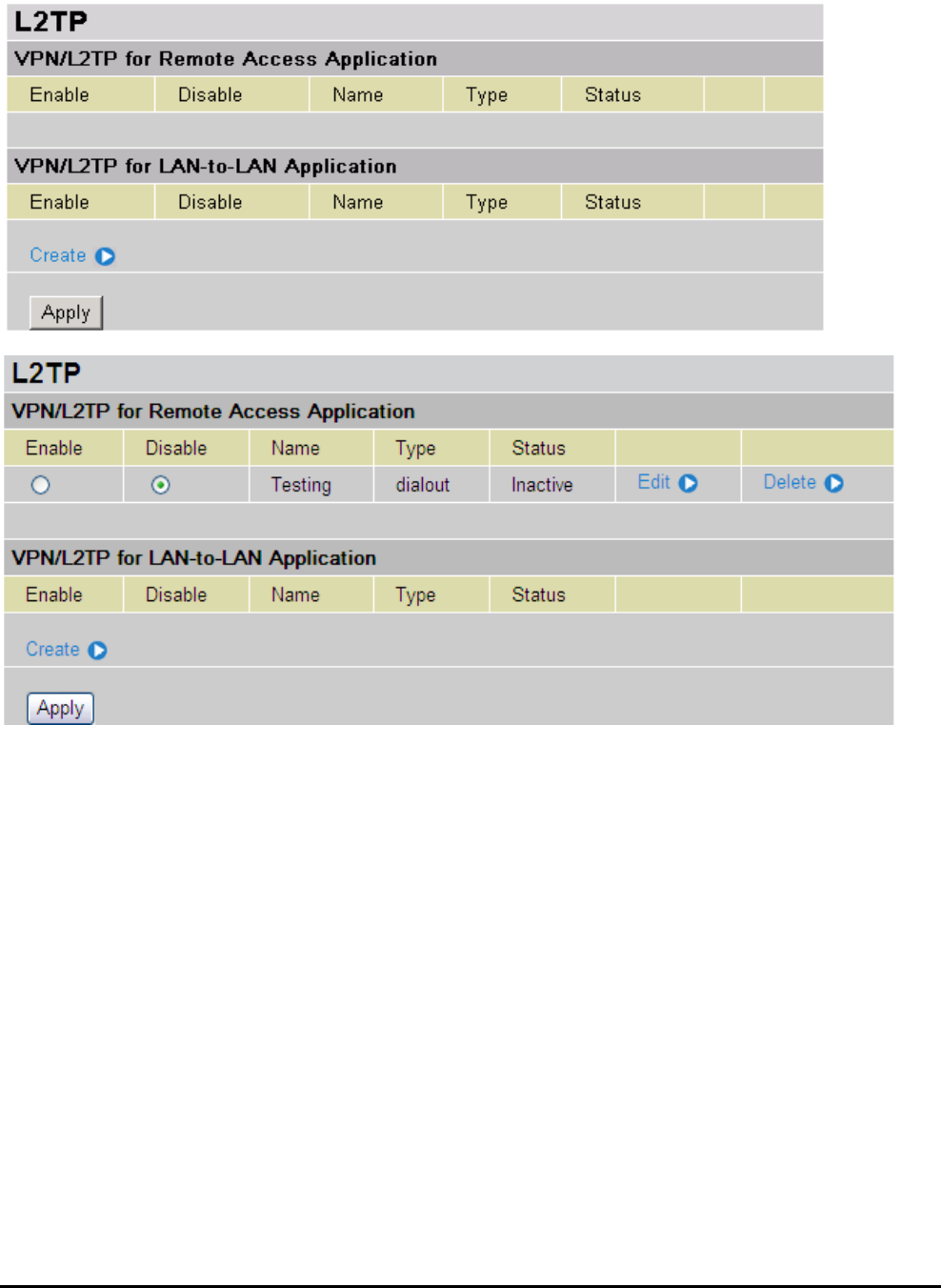
Billion BiPAC SHDSL/SHDSL.bis (VPN) Firewall Bridge/ Router
Chapter 4: Configuration
119
L2TP (Layer Two Tunneling Protocol) (BiPAC 8500/ 8501/ 8520 Only)
Support two types of L2TP VPN, Remote Access and LAN-to-LAN (please refer below for
more information.). Click Create to create a new VPN connection account.
After you have created L2TP connection, the account status will be displayed. (See example
above).
• Enable / Disable: This function activates or deactivates the L2TP connection. To
interrupt the tunnel, check the Disable radio button and click the Apply button to
deactivate the connection.
• Name: This is the user-defined name of the connection.
• Type: This refers to your router which operates as a client or a server, Dialout or Dialin
in respectively.
• Status: It shows the condition of your L2TP tunnel connection.
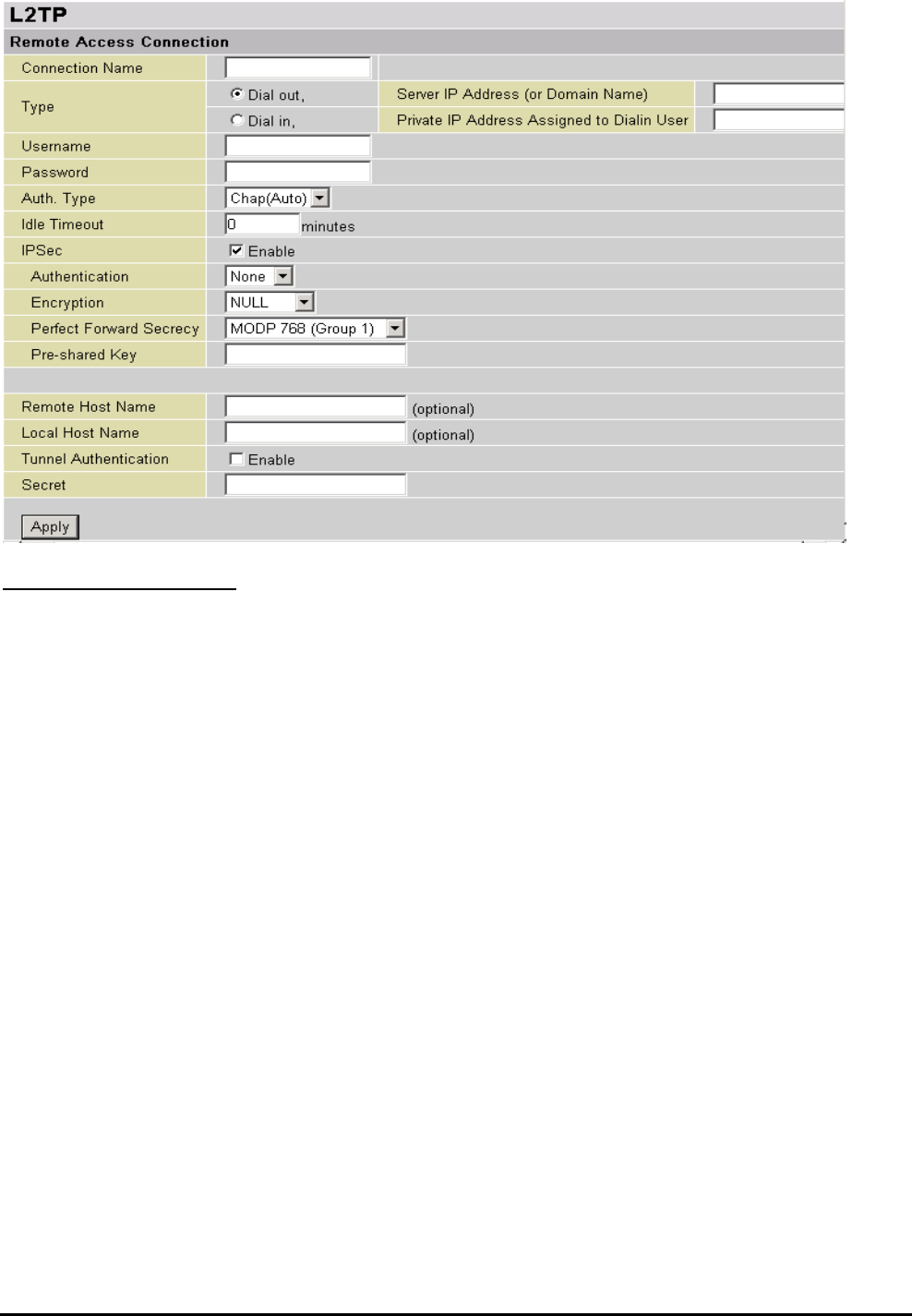
Billion BiPAC 8500/8501/8520/8521 SHDSL (VPN) Firewall Bridge/ Router
Chapter 4: Configuration
120
L2TP Connection - Remote Access (BiPAC 8500/ 8501/ 8520 Only)
L2TP VPN Connection
• Connection Name: User-defined name for the connection (e.g. “connection to office”).
• Type: Check the Dial Out radio button if you want your router to operate as a client
(connecting to a remote VPN server, e.g. your office server), check the Dial In radion
button if it is to operate as a VPN server.
o When configuring your router as a Client, enter the remote Server IP Address (or
Hostname) you wish to connect to.
o When configuring your router as a server, enter the Private IP Address Assigned
to Dial in User address.
• Username: If you are a Dial-Out user (client), enter the username provided by your Host.
If you are a Dial-In user (server), enter your own username.
• Password: If you are a Dial-Out user (client), enter the password provided by your Host.
If you are a Dial-In user (server), enter your own password.
• PPP Authentication Type: Default is Auto if you want the router to determine the type
of authentication to use, or else manually specify CHAP (Challenge Handshake
Authentication Protocol) or PAP (Password Authentication Protocol) if you know which
type the server is using (when acting as a client), or the authentication type you want
clients to use (when acting as a server). When using PAP, the password is sent
unencrypted, whilst CHAP encrypts the password before sending, and this presents
challenges at different periods to ensure that the client has not been replaced by an
intruder.

Billion BiPAC 8500/8501/8520/8521 SHDSL (VPN) Firewall Bridge/ Router
Chapter 4: Configuration
121
• Idle Time: Auto-disconnect the VPN connection when there is no activity on the
connection for a pre-determined period of time. 0 means this connection is always on.
• Active as default route: Commonly used by the Dial-out connection which all packets
will route through the VPN tunnel to the Internet; therefore, activate the function may
downgrade the Internet performance.
Click Apply after changing settings.
• IPSec: Enable for enhancing your L2TP VPN security.(L2TP over IPSec (L2TP/IPSec)
VPN Connection)
Note: Authentication, Encryption, Perfect Forward Secrecy and Pre-shared Key will only
be available for selection after IPSec is enabled
o Authentication: Authentication establishes the integrity of the datagram and
ensures it is not tampered with during transmission. There are three options,
Message Digest 5 (MD5), Secure Hash Algorithm (SHA1) or NONE. SHA1 is
more resistant to brute-force attacks than MD5, however it is slower.
MD5: A one-way hashing algorithm that produces a 128−bit hash.
SHA1: A one-way hashing algorithm that produces a 160−bit hash.
o Encryption: Select the encryption method from the pull-down menu. There are
four options, DES, 3DES, AES and NONE. NONE means it is only a tunnel with
no encryption. 3DES and AES are more powerful but increase the latency.
DES: Stands for Data Encryption Standard, it uses 56 bits as an encryption
method.
3DES: Stands for Triple Data Encryption Standard, it uses 168 (56*3) bits
as an encryption method.
AES: Stands for Advanced Encryption Standards, it uses 128 bits as an
encryption method.
o Perfect Forward Secrecy: Choose whether to enable PFS using Diffie-Hellman
public-key cryptography to change the encryption keys during second phase of
VPN negotiation. This function will provide better security, but extends the VPN
negotiation time. Diffie-Hellman is a public-key cryptography protocol that allows
two parties to establish a shared secret over an unsecured communication
channel (i.e. over the Internet). There are three modes, MODP 768-bit, MODP
1024-bit and MODP 1536-bit. MODP stands for Modular Exponentiation Groups.
o Pre-shared Key: This is for the Internet Key Exchange (IKE) protocol, a string
consists of 4 to 128 characters. Both sides should use the same key. IKE is used
to establish a shared security policy and authenticated keys for services (such as
IPSec) that require a key. Before any IPSec traffic can be passed, each router
must be able to verify the identity of its peer. This can be done by manually
entering the pre-shared key into the router or host at both ends.

Billion BiPAC 8500/8501/8520/8521 SHDSL (VPN) Firewall Bridge/ Router
Chapter 4: Configuration
122
• Remote Host Name (Optional): Enter hostname of remote VPN device. It is a tunnel
identifier from the Remote VPN device that will match the Remote hostname provided. If
the remote hostname is matched, the tunnel will be connected; otherwise, it will be
dropped.
Cautious: This is only when the router performs as a VPN server. This option should be used
by advanced users only.
• Local Host Name (Optional): Enter hostname of Local VPN device that is connected /
establishes a VPN tunnel. As default, Router default Hostname is home.gateway.
• Tunnel Authentication: This enables router to authenticate both the L2TP remote and
L2TP host. This is only valid when L2TP remote supports this feature.
• Secret: The secure password length should be 16 characters which may include
numbers and characters.
Click Apply after changing settings.
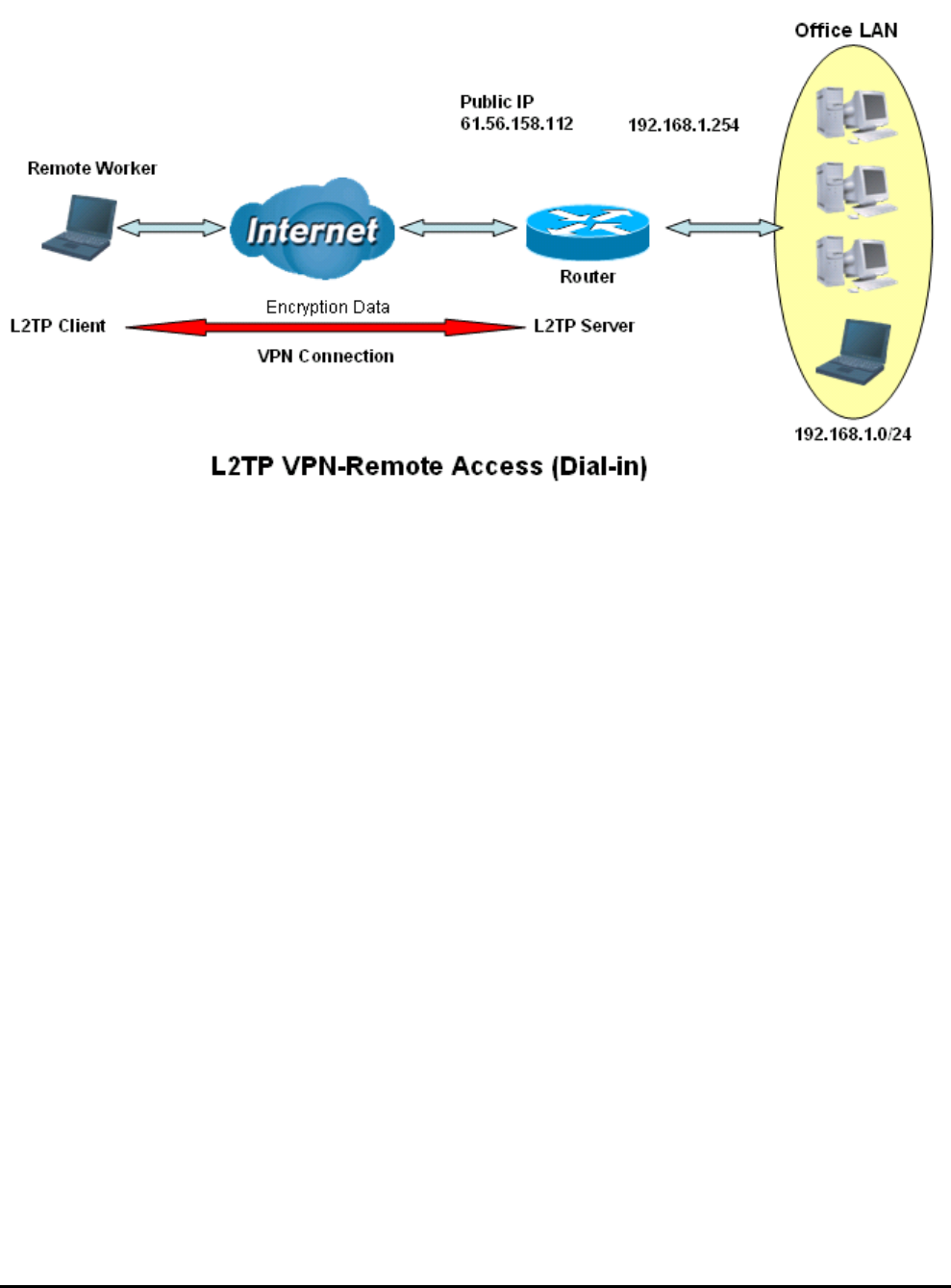
Billion BiPAC SHDSL/SHDSL.bis (VPN) Firewall Bridge/ Router
Chapter 4: Configuration
123
Example: Configuring a L2TP VPN - Remote Access Dial-in Connection
A remote worker establishes a L2TP VPN connection with the head office using Microsoft VPN
Adapter (included with Windows XP/2000/ME, etc.). The router is installed in the head office,
connecting to a couple of PCs and Servers.
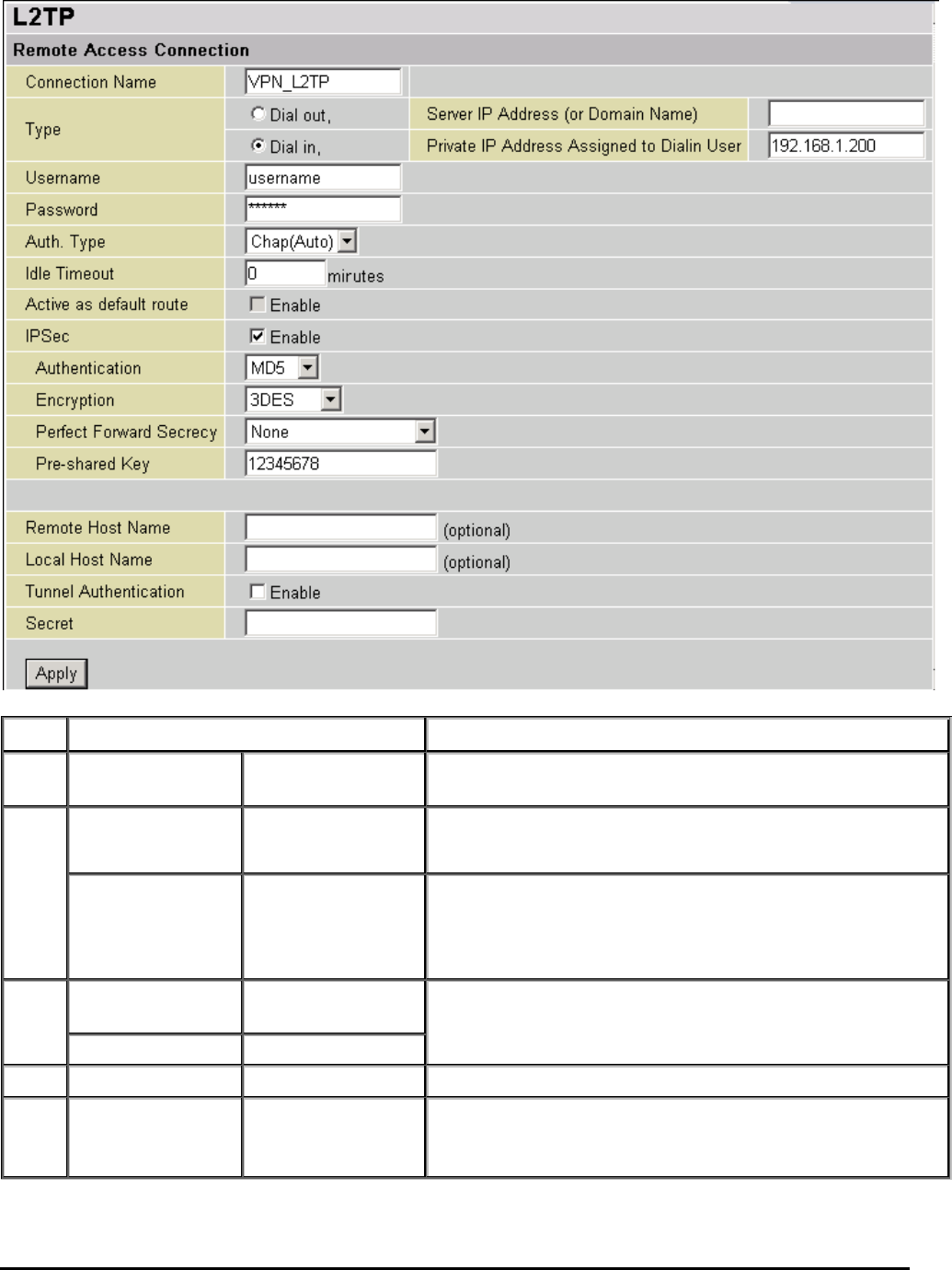
Billion BiPAC SHDSL/SHDSL.bis (VPN) Firewall Bridge/ Router
Chapter 4: Configuration
124
Configuring L2TP VPN in the Office
The input IP address 192.168.1.200 will be assigned to the remote worker. Please make sure
this IP is not used by the Office LAN.
Item
Function Description
1 Connection
Name VPN_L2TP Given a name of L2TP connection
Dial in Check the Dial in radio button
2 Private IP
Address
Assigned to
Dialing User
192.168.1.200 An assigned IP address for the remote worker
Username username
3
Password 123456
Input username & password to authenticate
remote worker
4 Auth.Type Chap(Auto) Kept as a default value in most cases.
5 Idle Timeout 0
The connection will be disconnected when there
is no traffic within a predefined period of time. Idle
time 0 means the connection is always on.
1
2
3
4
5
6
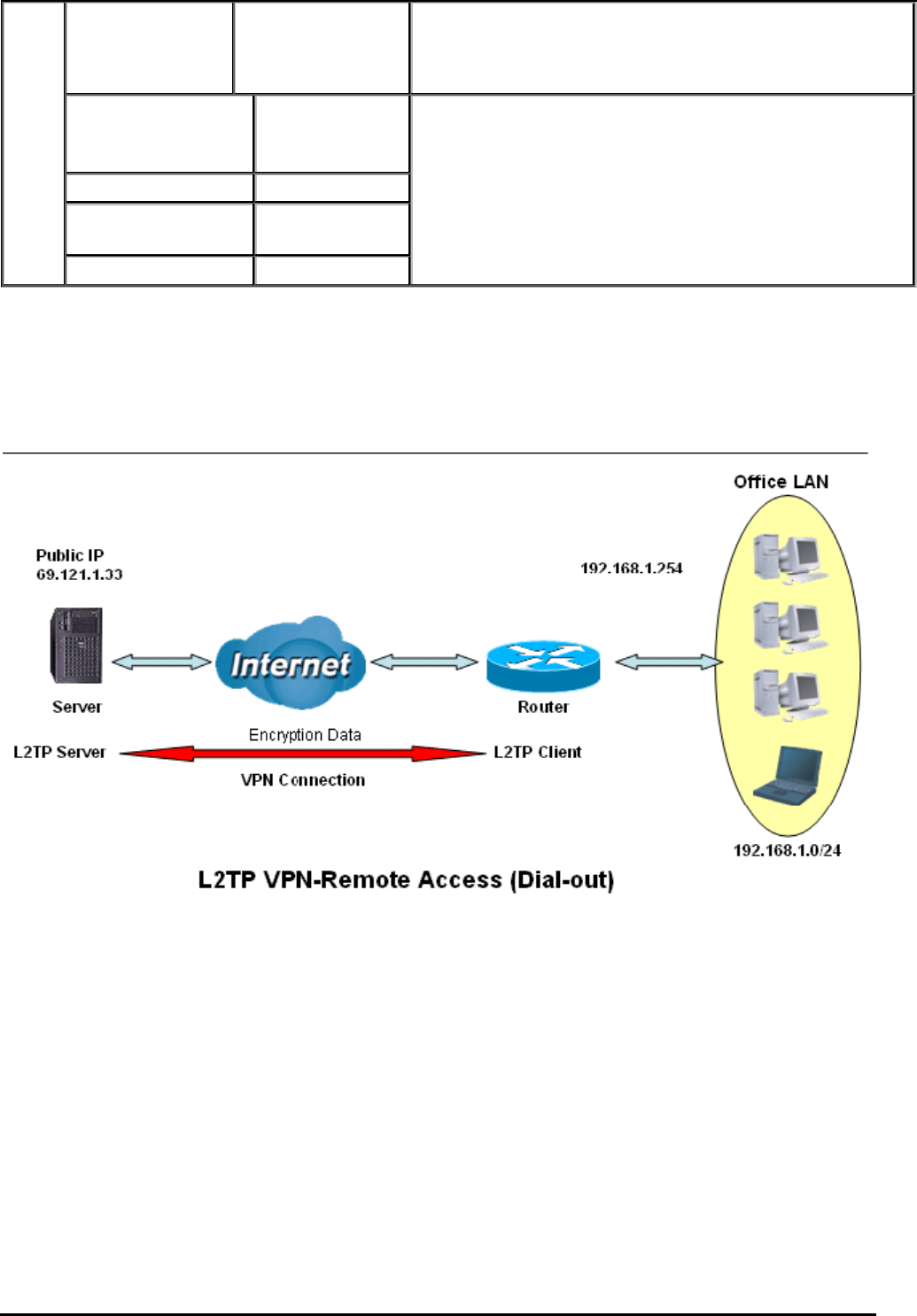
Billion BiPAC 8500/8501/8520/8521 SHDSL (VPN) Firewall Bridge/ Router
Chapter 4: Configuration
125
IPSec Enabled for enhancing your L2TP VPN security.
Authentication MD5
Encryption 3DES
Perfect Forward
Secrecy None
6
Pre-shared Key 12345678
Both sites should use the same value.
Example: Configuring a Remote Access L2TP VPN Dial-out Connection
A company’s office establishes a L2TP VPN connection with a file server located at a different
location. The router is installed in the office, connecting to a couple of PCs and Servers.
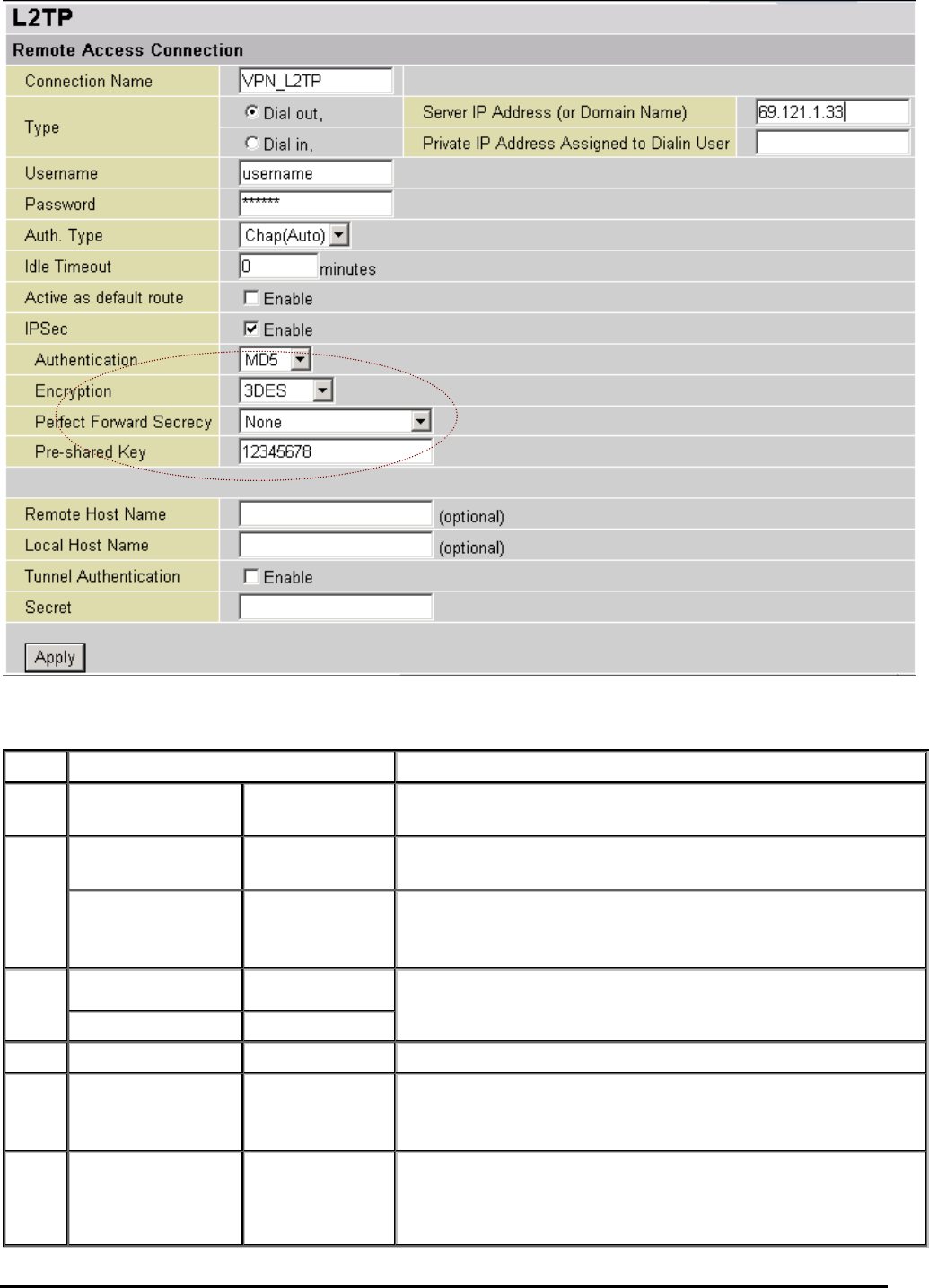
Billion BiPAC SHDSL/SHDSL.bis (VPN) Firewall Bridge/ Router
Chapter 4: Configuration
126
Configuring the L2TP VPN in the Office
Item
Function Description
1 Connection
Name VPN_L2TP Given name of L2TP connection
Dial out Check the Dial out radio button
2 Server IP
Address (or
Hostname)
69.121.1.33
A Dialed server IP
Username username
3
Password 123456
A given username & password
4 Auth.Type Chap(Auto) Kept as a default value in most cases.
5 Idle Timeout 0
The connection will be disconnected when there is
no traffic within a predefined period of time. Idle time
0 means the connection is always on.
6 IPSec Enabled for enhancing your L2TP VPN security.
1
2
3
4
5
6

Billion BiPAC 8500/8501/8520/8521 SHDSL (VPN) Firewall Bridge/ Router
Chapter 4: Configuration
127
Authentication MD5
Encryption 3DES
Perfect
Forward
Secrecy
None
Pre-shared Key
12345678
Both sites should use the same value.
Example: Configuring your Router to Dial-in to the Server
Currently, Microsoft Windows operation system does not support L2TP incoming service.
Additional software may be required to set up your L2TP incoming service.
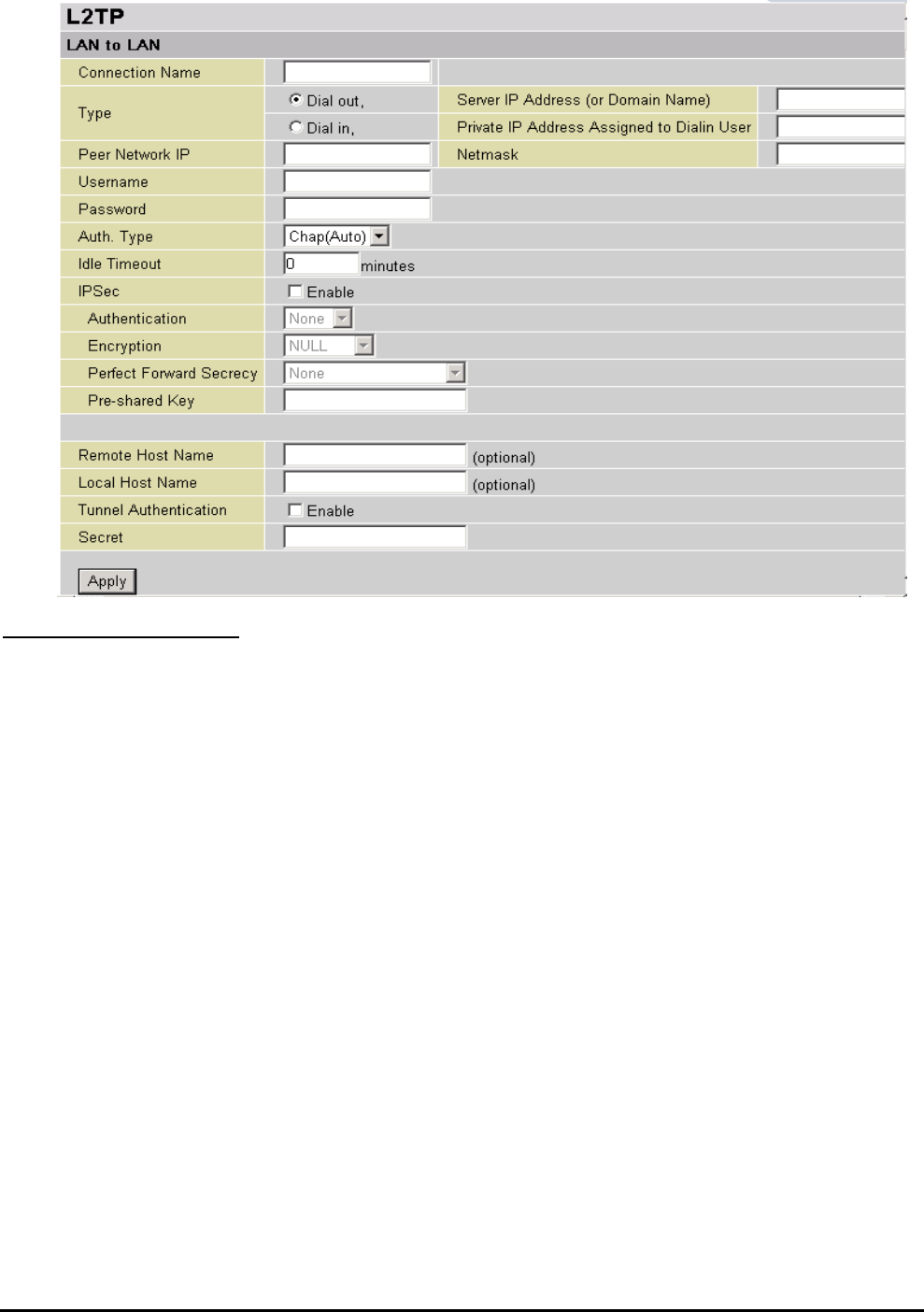
Billion BiPAC SHDSL/SHDSL.bis (VPN) Firewall Bridge/ Router
Chapter 4: Configuration
128
L2TP Connection - LAN to LAN (BiPAC 8500/ 8501/ 8520 Only)
L2TP VPN Connection
• Connection Name: User-defined description of the connection.
• Type: Check the Dial Out radio button if you want your router to operate as a client
(connecting to a remote VPN server, e.g. your office server), check the Dial In radio
button if it is to operate as a VPN server.
o When configuring your router to establish the connection with a remote LAN, enter
the remote Server IP Address (or Hostname) you wish to connect to.
o When configuring your router as a server to accept incoming connections, enter
the Private IP Address Assigned to Dial in User address.
• Peer Network IP: Enter the Peer network IP address.
• Netmask: Enter the subnet mask of peer network based on the Peer Network IP setting.
• Username: If you are a Dial-Out user (client), enter the username provided by your Host.
If you are a Dial-In user (server), enter your own username.
• Password: If you are a Dial-Out user (client), enter the password provided by your Host.
If you are a Dial-In user (server), enter your own password.
• PPP Authentication Type: Default is Auto if you want the router to determine the
authentication type to use, or else manually specify CHAP (Challenge Handshake
Authentication Protocol) or PAP (Password Authentication Protocol) if you know which

Billion BiPAC 8500/8501/8520/8521 SHDSL (VPN) Firewall Bridge/ Router
Chapter 4: Configuration
129
type the server is using (when acting as a client), or the authentication type you want
clients to use (when acting as a server). When using PAP, the password is sent
unencrypted, whilst CHAP encrypts the password before sending, and this presents
challenges at different periods to ensure that the client has not been replaced by an
intruder.
• Idle Time: Auto-disconnect the VPN connection when there is no activity on the
connection for a predetermined period of time. 0 means this connection is always on.
Click Apply after changing settings.
• IPSec: Enabled for enhancing your L2TP VPN security. (L2TP over IPSec (L2TP/IPSec)
VPN Connection)
Note: Authentication, Encryption, Perfect Forward Secrecy and Pre-shared Key will only
be available for selection after IPSec is enabled
o Authentication: Authentication establishes the integrity of the datagram and
ensures it is not tampered with during transmission. There are three options,
Message Digest 5 (MD5), Secure Hash Algorithm (SHA1) or NONE. SHA-1 is
more resistant to brute-force attacks than MD5, however it is slower.
MD5: A one-way hashing algorithm that produces a 128−bit hash.
SHA1: A one-way hashing algorithm that produces a 160−bit hash.
o Encryption: Select the encryption method from the pull-down menu. There are
four options, DES, 3DES, AES and NONE. NONE means it is a tunnel only with
no encryption. 3DES and AES are more powerful but increase the latency.
DES: Stand for Data Encryption Standard, it uses 56 bits as an encryption
method.
3DES: Stand for Triple Data Encryption Standard, it uses 168 (56*3) bits as
an encryption method.
AES: Stand for Advanced Encryption Standard, it uses 128 bits as an
encryption method.
o Perfect Forward Secrecy: Choose whether to enable PFS using Diffie-Hellman
public-key cryptography to change the encryption keys during second phase of
VPN negotiation. This function will provide better security, but extends the VPN
negotiation time. Diffie-Hellman is a public-key cryptography protocol that allows
two parties to establish a shared secret over an unsecured communication
channel (i.e. over the Internet). There are three modes, MODP 768-bit, MODP
1024-bit and MODP 1536-bit. MODP stands for Modular Exponentiation Groups.
o Pre-shared Key: This is for the Internet Key Exchange (IKE) protocol, a string
consists of 4 to 128 characters. Both sides should use the same key. IKE is used
to establish a shared security policy and authenticated keys for services (such as
IPSec) that require a key. Before any IPSec traffic can be passed, each router

Billion BiPAC 8500/8501/8520/8521 SHDSL (VPN) Firewall Bridge/ Router
Chapter 4: Configuration
130
must be able to verify the identity of its peer. This can be done by manually
entering the pre-shared key into the router or hosts at both ends.
• Remote Host Name (Optional): Enter hostname of remote VPN device. It is a tunnel
identifier from the Remote VPN device that matches the Remote hostname provided. If
remote hostname is matched, the tunnel will be connected; otherwise, it will be dropped.
Cautious: This is used only when the router performs as a VPN server. This option should be
used by advanced users only.
• Local Host Name (Optional): Enter the hostname of the Local VPN device that is
connected / establishes a VPN tunnel. As a default, Router default Hostname is
home.gateway.
• Tunnel Authentication: This enables router to authenticate both the L2TP remote and
L2TP host. This is only valid when L2TP remote supports this feature.
• Secret: The secure password length should be 16 characters which may include
numbers and characters.
Click Apply after changing settings.
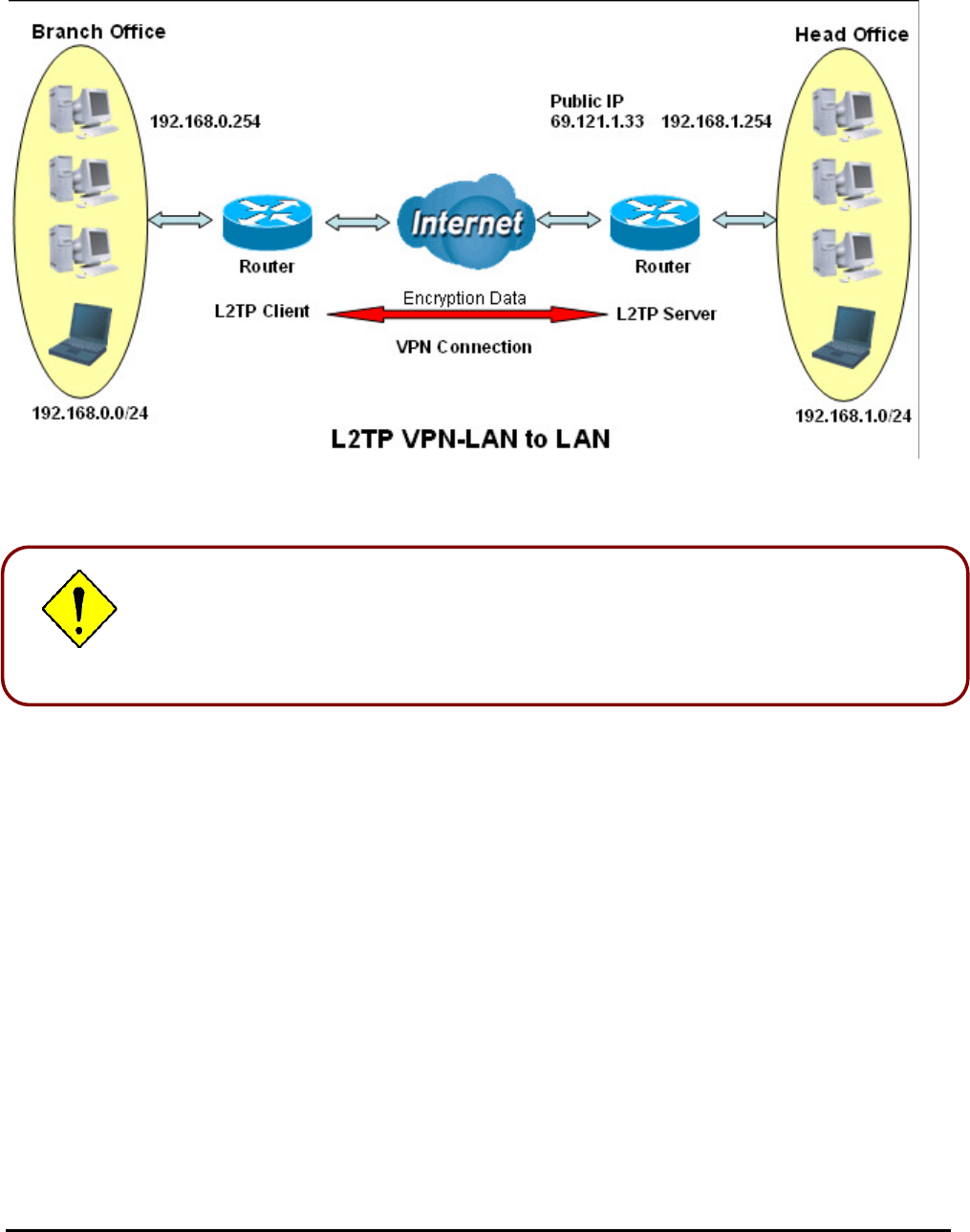
Billion BiPAC 8500/8501/8520/8521 SHDSL (VPN) Firewall Bridge/ Router
Chapter 4: Configuration
131
Example: Configuring L2TP LAN-to-LAN VPN Connection
The branch office establishes a L2TP VPN tunnel with the head office to connect two private
networks over the Internet. The routers are installed in the head office and branch office
respectively.
Attention
Both office LAN networks MUST be in different subnet with LAN to LAN
application.Functions of Pre-shared Key, VPN Connection Type and
Security Algorithm MUST BE identically set up at both ends.
Attention
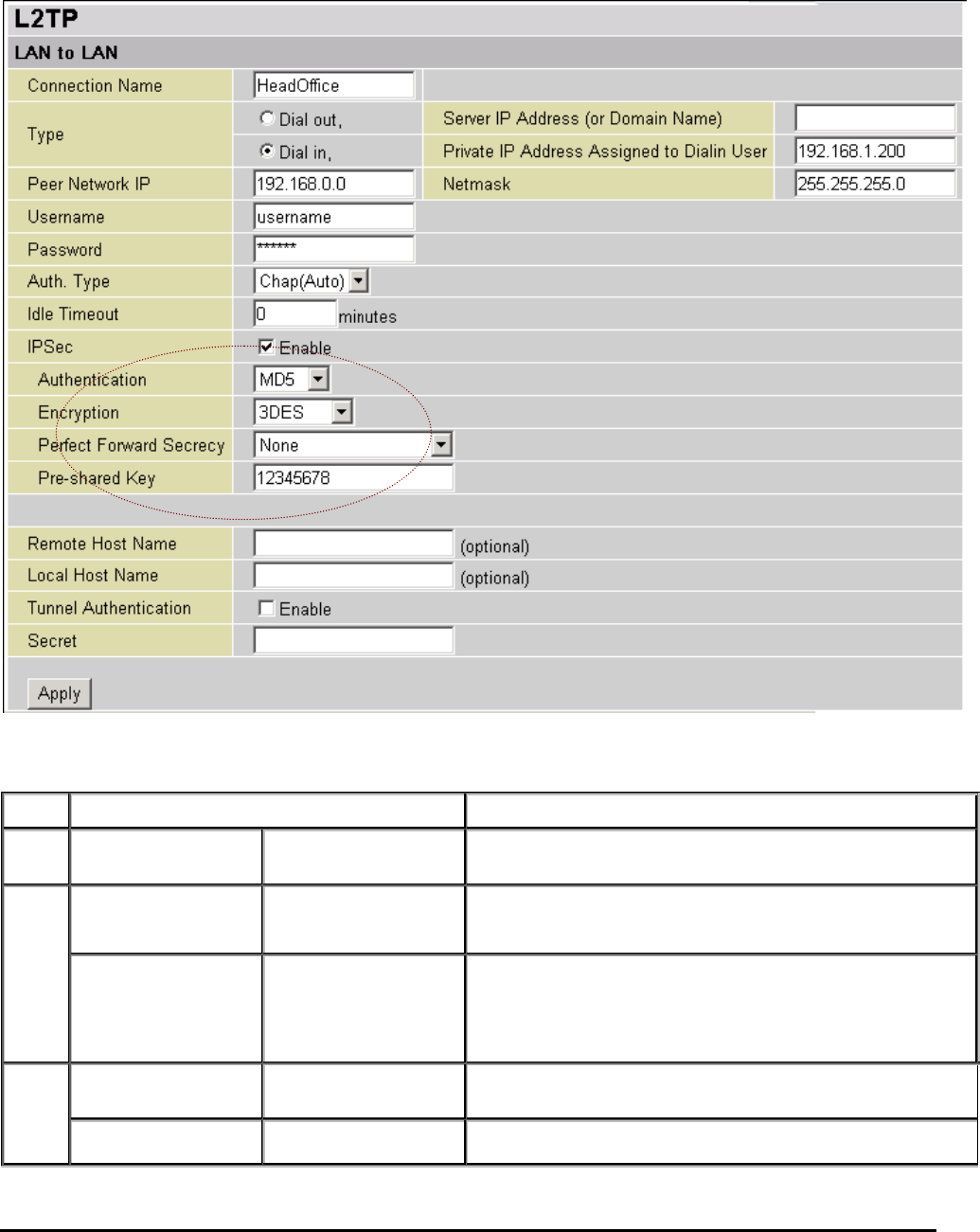
Billion BiPAC SHDSL/SHDSL.bis (VPN) Firewall Bridge/ Router
Chapter 4: Configuration
132
Configuring L2TP VPN in the Head Office
The IP address 192.168.1.200 will be assigned to the router located at the branch office. Please
make sure this IP is not used by the head office LAN.
Item
Function Description
1 Connection
Name HeadOffice Given a name of L2TP connection
Dial in Check the Dial in radio button
2 Private IP
Address
Assigned to
Dialing User
192.168.1.200 IP address assigned to the branch office
network
Peer Network
IP 192.168.0.0 Branch office network
3
Netmask 255.255.255.0
1
2
3
4
5
6
7

Billion BiPAC 8500/8501/8520/8521 SHDSL (VPN) Firewall Bridge/ Router
Chapter 4: Configuration
133
Username username
4
Password 123456
Input username & password to authenticate
branch office network
5 Auth.Type Chap(Auto) Kept as a default value in most cases.
6 Idle Timeout 0
The connection will be disconnected when
there Is no traffic for a predefined period of
time. Idle time 0 means the connection is
always on.
IPSec Enable for enhancing your L2TP VPN security.
Authentication MD5
Encryption 3DES
Perfect
Forward
Secrecy
None
7
Pre-shared
Key 12345678
Both ends should use the same value.
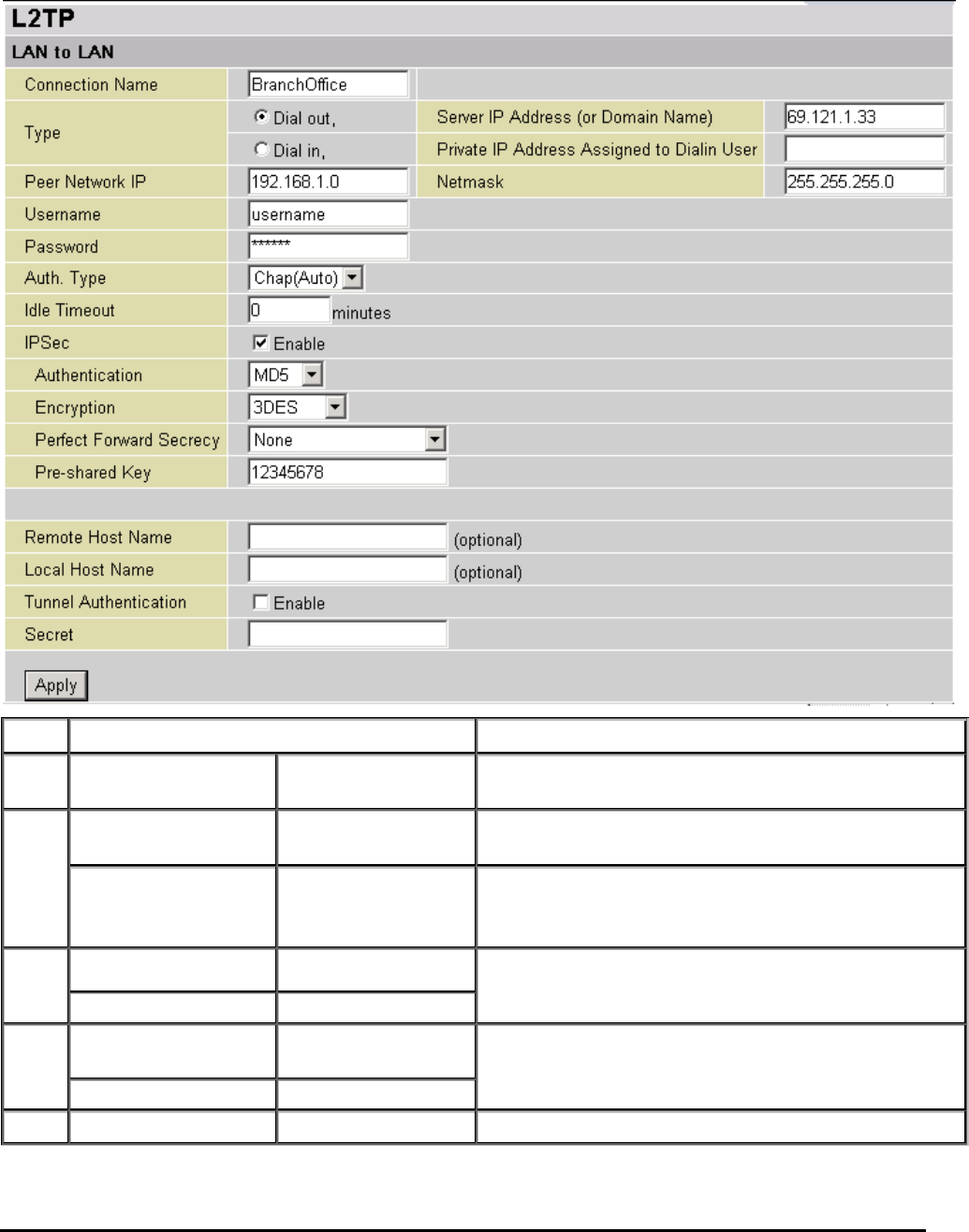
Billion BiPAC SHDSL/SHDSL.bis (VPN) Firewall Bridge/ Router
Chapter 4: Configuration
134
Configuring L2TP VPN in the Branch Office
The IP address 69.1.121.30 is the Public IP address of the router located at head office. If you
registered the DDNS (please refer to the DDNS section of this manual), you can also use the
domain name instead of the IP address to reach the router.
Item
Function Description
1 Connection
Name BranchOffice Given a name of L2TP connection
Dial out Check the Dial out radio button
2 Server IP
Address (or
Hostname)
69.121.1.33 IP address of the head office router (in WAN
side)
Peer Network IP 192.168.1.0
3
Netmask 255.255.255.0
Head office network
Username username
4
Password 123456
Input username & password to authenticate
branch office network
5 Auth.Type Chap(Auto) Kept as a default value in most cases.
1
2
3
4
5
6
7

Billion BiPAC 8500/8501/8520/8521 SHDSL (VPN) Firewall Bridge/ Router
Chapter 4: Configuration
135
6 Idle Timeout 0
The connection will be disconnected when
there Is no traffic for a predefined period of
time. Idle time 0 means the connection is
always on.
IPSec Enabled for enhancing your L2TP VPN
security.
Authentication MD5
Encryption 3DES
Perfect Forward
Secrecy None
7
Pre-shared Key 12345678
Both ends should use the same value.

Billion BiPAC 8500/8501/8520/8521 SHDSL (VPN) Firewall Bridge/ Router
Chapter 4: Configuration
136
QoS (Quality of Service)
QoS function helps you to control your network traffic for each application from LAN (Ethernet
and/or Wireless) to WAN (Internet). It facilitates you to control the different quality and speed of
throughput for each application when the system is running with full upstream loading.
You can find three items under the QoS section: Prioritization and Outbound / Inbound IP
Throttling (bandwidth management).
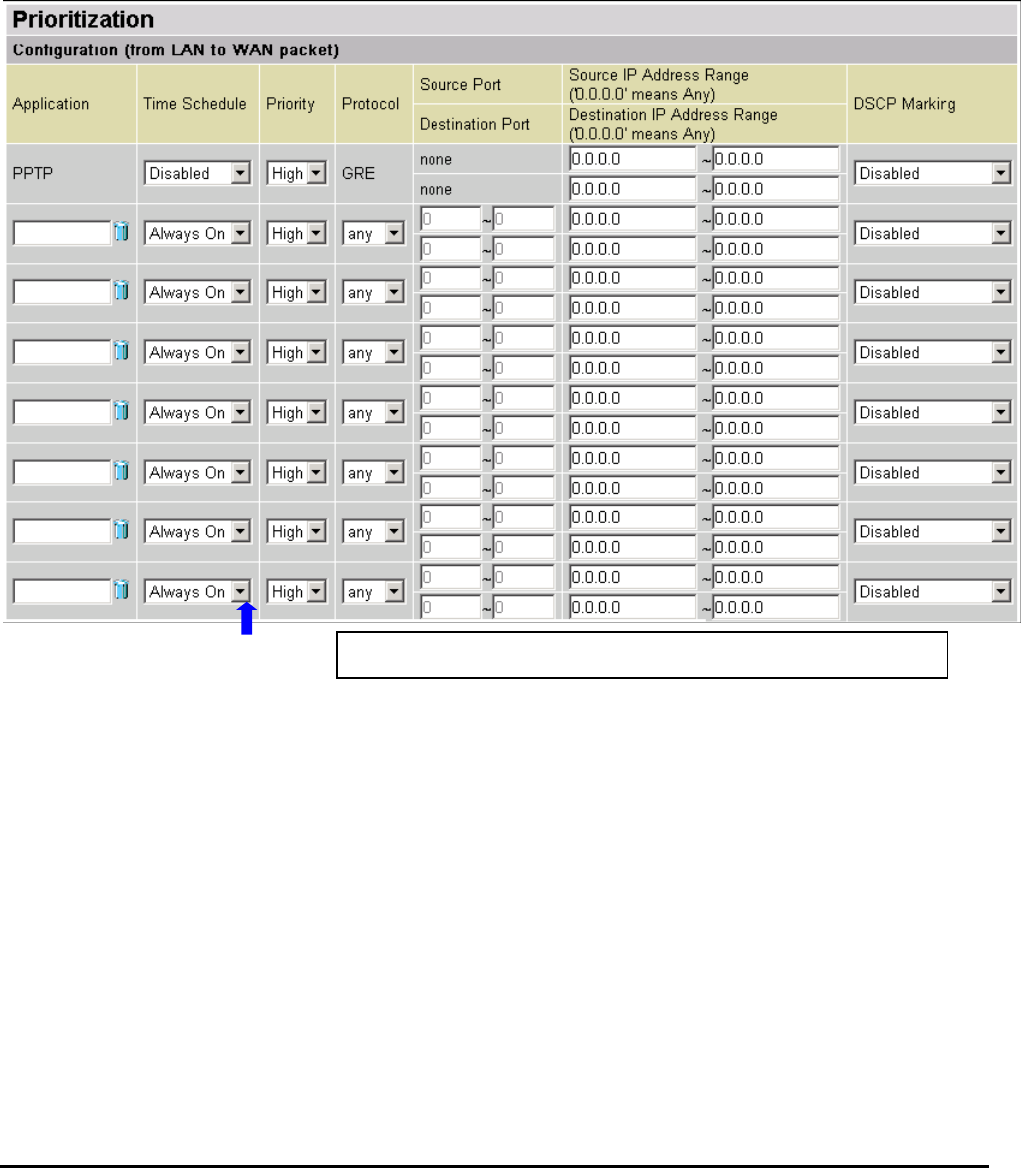
Billion BiPAC 8500/8501/8520/8521 SHDSL (VPN) Firewall Bridge/ Router
Chapter 4: Configuration
137
Prioritization
There are three priority settings provided in the Router:
• High
• Normal (The default is normal priority for all of traffic without setting)
• Low
Average utilization of each priority type: High (60%), Normal (30%) and Low (10%).
• Application: A user-define description to identify this new policy/application.
• Time Schedule: Schedule your prioritization policy.
• Priority: The priority given to each policy/application. Its default setting is set to High;
you may adjust this setting to fit your policy/application.
• Protocol: The name of supported protocol.
• Source Port: The packet source port to be monitored.
• Destination Port: The packet destination port to be monitored.
• Source IP Address Range: The source IP address or range of packets to be monitored.
• Destination IP address Range: The destination IP address or range of packets to be
Clic
k Clear
You can click Clear to delete existing Application
.
Billion BiPAC 8500/8501/8520/8521 SHDSL (VPN) Firewall Bridge/ Router
Chapter 4: Configuration
138
monitored.
• DSCP Marking: Differentiated Services Code Point (DSCP), it is the first 6 bits in the ToS
byte. DSCP Marking allows users to classify traffic based on DSCP value and send
packets to next Router. See Table 4. The DSCP Mapping Table is shown below:
Note: To be sure the router(s) in the backbones network have the capability in executing and
checking the DSCP through-out the QoS network.
Table 4: DSCP Mapping Table
DSCP Mapping Table
(Wireless) ADSL Router
Standard DSCP
Disabled None
Best Effort Best Effort (000000)
Premium Express Forwarding (101110)
Gold service (L) Class 1, Gold (001010)
Gold service (M) Class 1, Silver (001100)
Gold service (H) Class 1, Bronze (001110)
Silver service (L) Class 2, Gold (010010)
Silver service (M) Class 2, Silver (010100)
Silver service (H) Class 2, Bronze (010110)
Bronze service (L) Class 3, Gold (011010)
Bronze service (M) Class 3, Silver (011100)
Bronze service (H) Class 3, Bronze (011110)
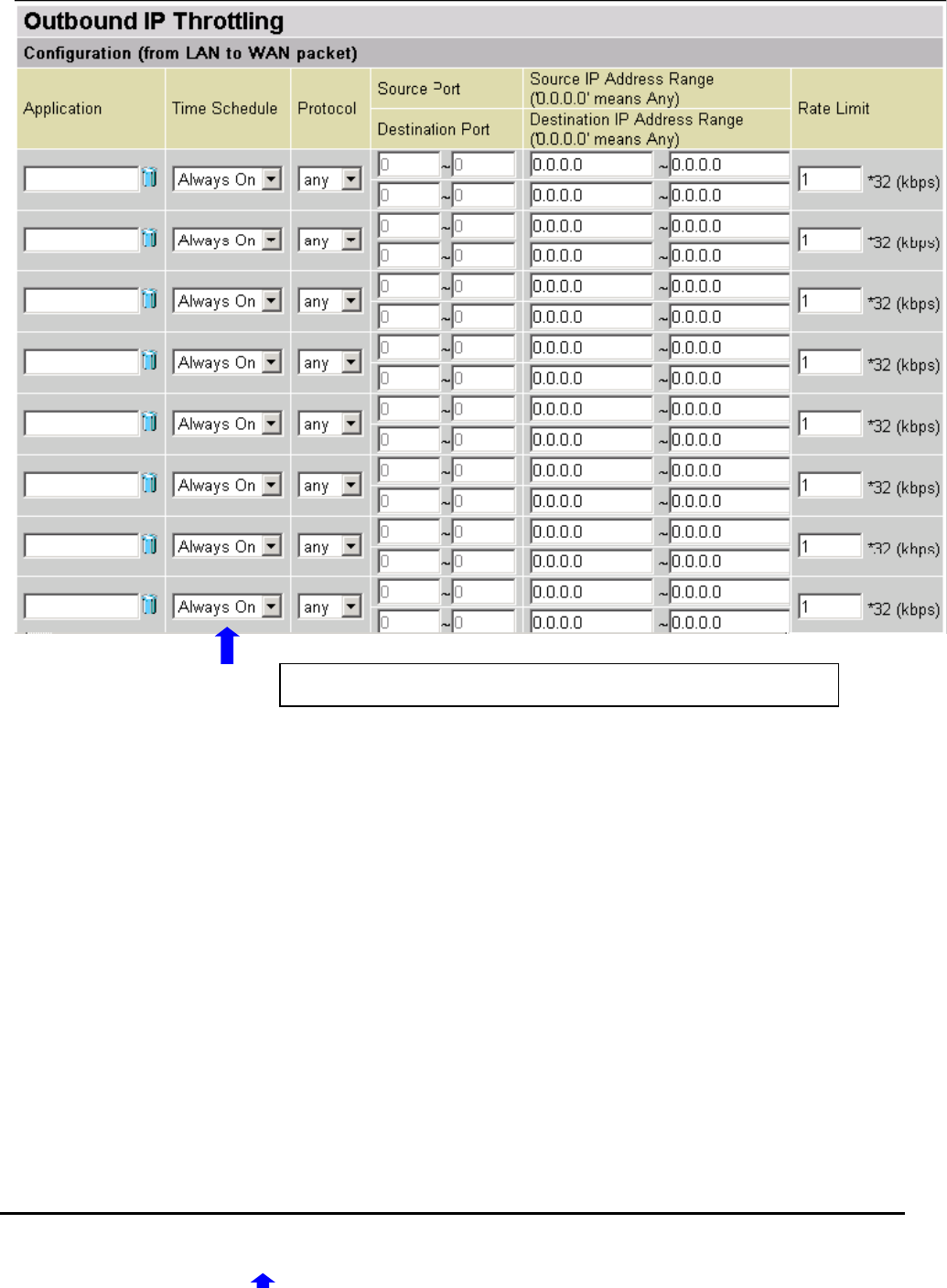
Billion BiPAC 8500/8501/8520/8521 SHDSL (VPN) Firewall Bridge/ Router
Chapter 4: Configuration
139
Outbound IP Throttling (LAN to WAN)
IP Throttling allows you to limit the speed of IP traffic. The value entered will limit the speed of
the application that you set to the specified value multiple of 32kbps.
• Application: A user-define description to identify this new policy/application.
• Time Schedule: Scheduling your prioritization policy. Refer to Time Schedule for more
information.
• Protocol: The name of supported protocol.
• Source Port: The source port of packets to be monitored.
• Destination Port: The destination port of packets to be monitored.
• Source IP Address Range: The source IP address or range of packets to be monitored.
• Destination IP address Range: The destination IP address or range of packets to be
monitored.
• Outbound Rate Limit: To limit the speed of outbound traffic
Click Clea
r
You can click Clear to delete existing Application.
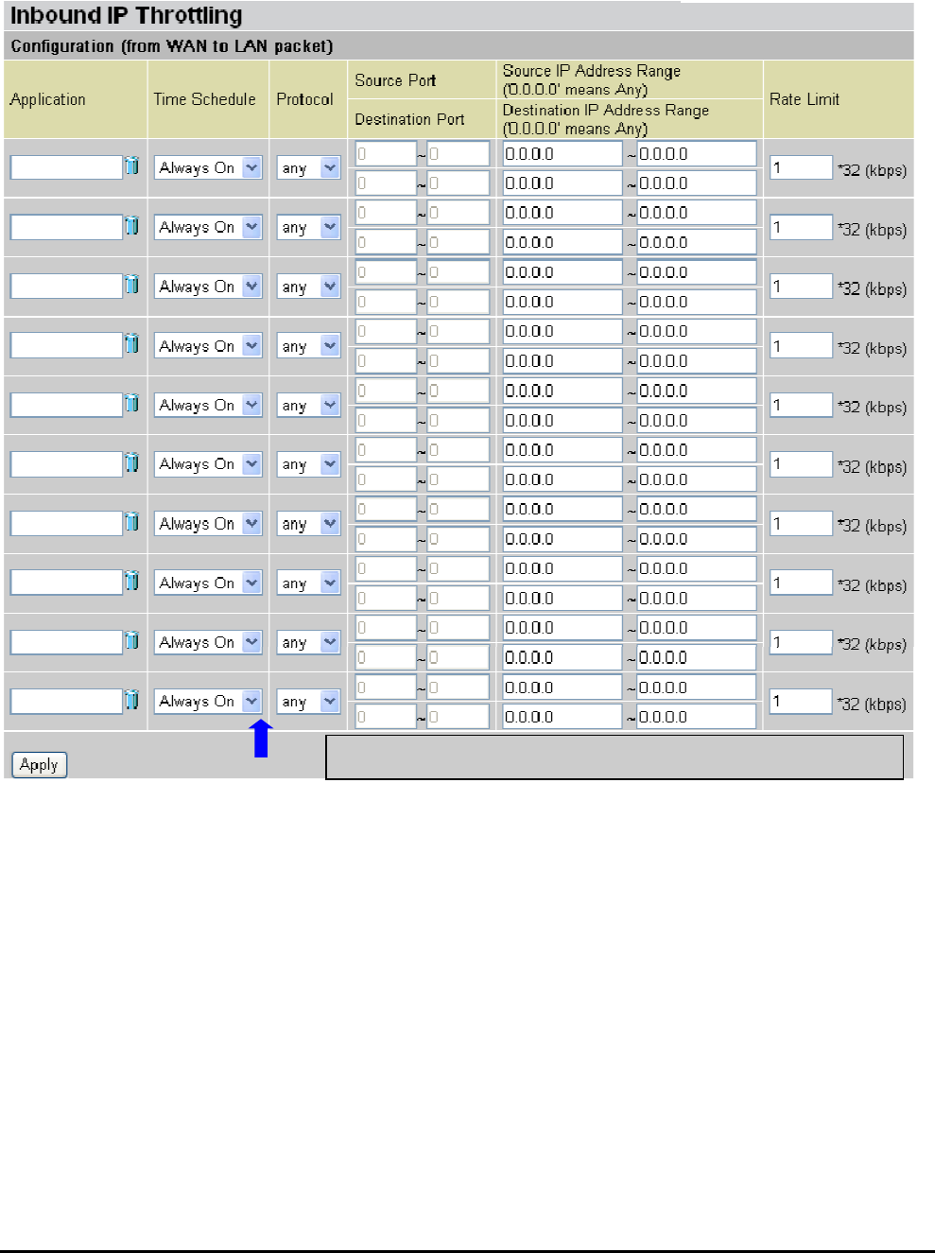
Billion BiPAC 8500/8501/8520/8521 SHDSL (VPN) Firewall Bridge/ Router
Chapter 4: Configuration
140
Inbound IP Throttling (WAN to LAN)
IP Throttling allows you to limit the speed of IP traffic. The value entered will limit the speed of
the application that you set to the specified value multiple of 32kbps.
• Application: A user-define description to identify this new policy/application.
• Time Schedule: Scheduling your prioritization policy. Refer to Time Schedule for more
information.
• Protocol: The name of supported protocol.
• Source Port: The packet source port to be monitored.
• Destination Port: The packet destination port to be monitored.
• Source IP Address Range: The source IP address or range of packets to be monitored.
• Destination IP address Range: The destination IP address or range of packets to be
monitored.
Click Clea
r
You can click Clear to delete existing Application.
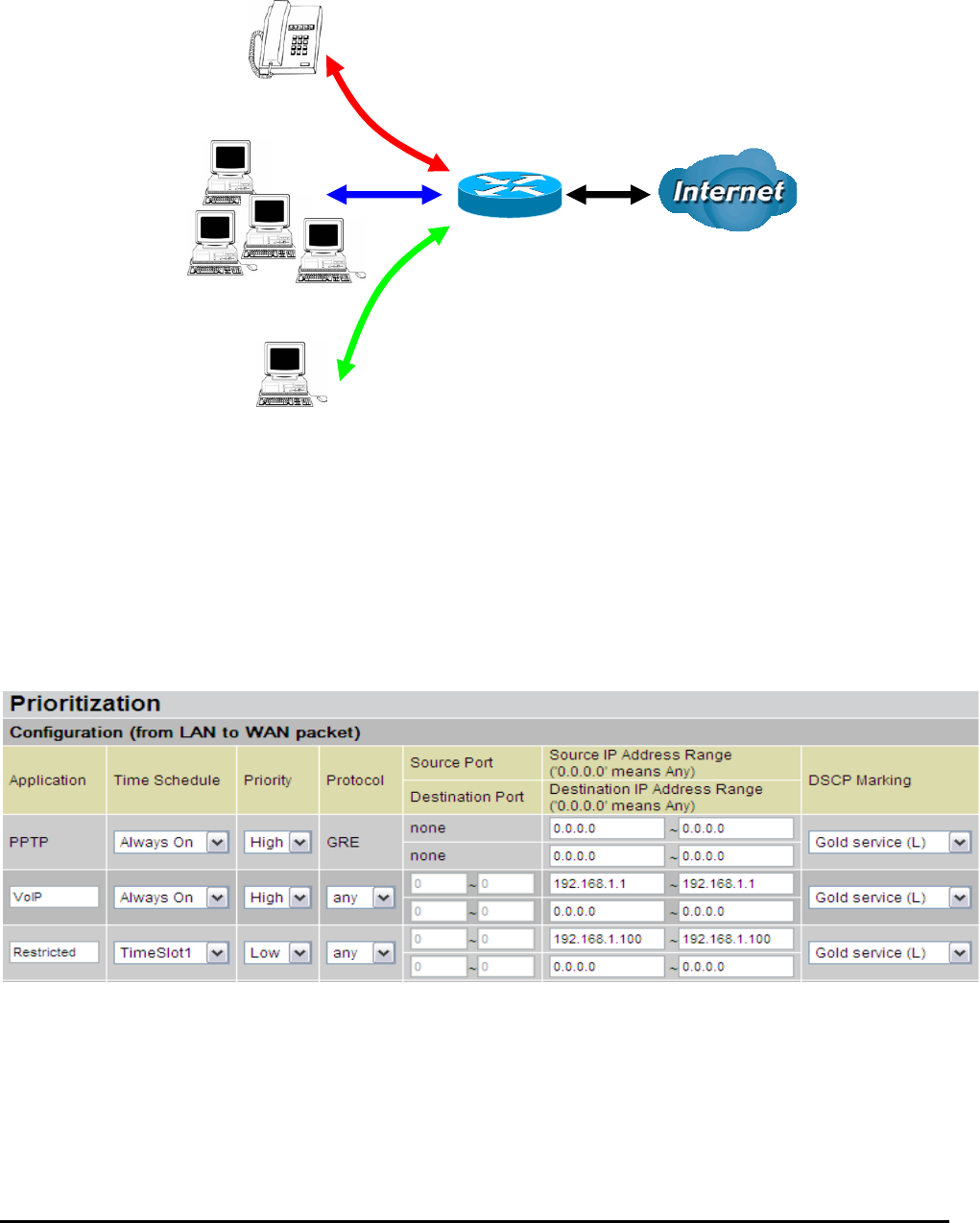
Billion BiPAC 8500/8501/8520/8521 SHDSL (VPN) Firewall Bridge/ Router
Chapter 4: Configuration
141
• Inbound Rate Limit: To limit the speed of inbound traffic.
Example: QoS for your Network
Connection Diagram
Information and Settings
Upstream: 928 kbps
Downstream: 8 Mbps
VoIP User : 192.168.1.1
Normal Users : 192.168.1.2~192.168.1.5
Restricted User: 192.168.1.100
Restricted PC
Normal PCs
VoIP
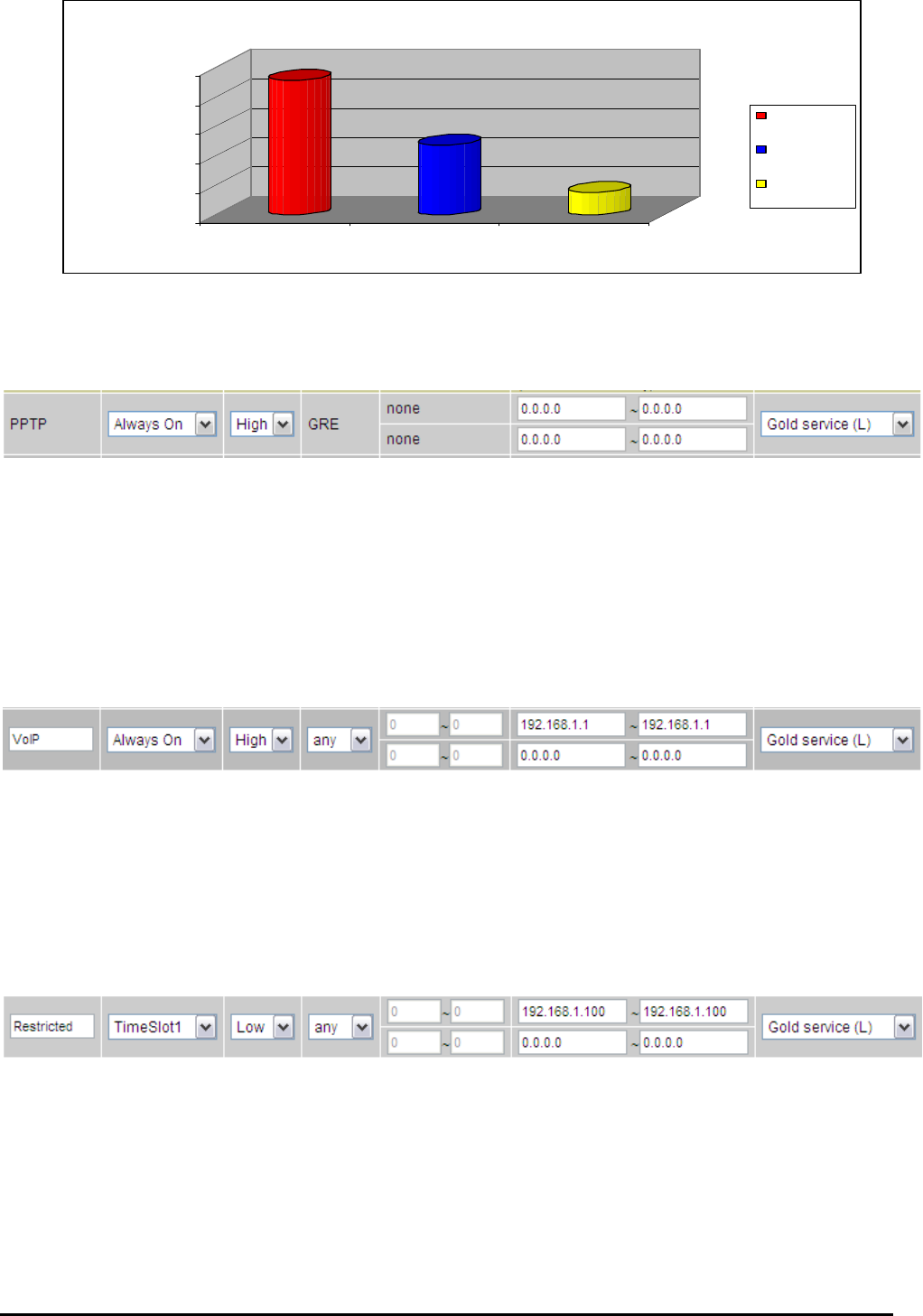
Billion BiPAC 8500/8501/8520/8521 SHDSL (VPN) Firewall Bridge/ Router
Chapter 4: Configuration
142
0
100
200
300
400
500
kbps
VoIP/VPN
HIGH
Others
NORMAL
Restricted
LOW
Throughput
VoIP/VPN
HIGH
Others
NORMAL
Restricted
LOW
Mission-critical application
VPN connection is a mission-critical application used for data exchange between head office
and branch office.
This mission-critical application must be sent out smoothly without any dropping. Set this
application as high priority to prevent other applications to saturate the bandwidth.
Voice application
Voice is latency-sensitive application. Most VoIP devices use SIP protocol and the port number
will be assigned by SIP module automatically. It is recommended to set a high priority for
catching VoIP packets with a fixed IP address.
The settings above will help to improve the quality of your VoIP service when the traffic loading
is full.
Restricted Application
Some companies will setup a FTP server for customers to download files or home users to
share their files via FTP.
The settings above help to limit upstream utilization of the FTP. Time schedule feature also
helps to limit daytime utilization.
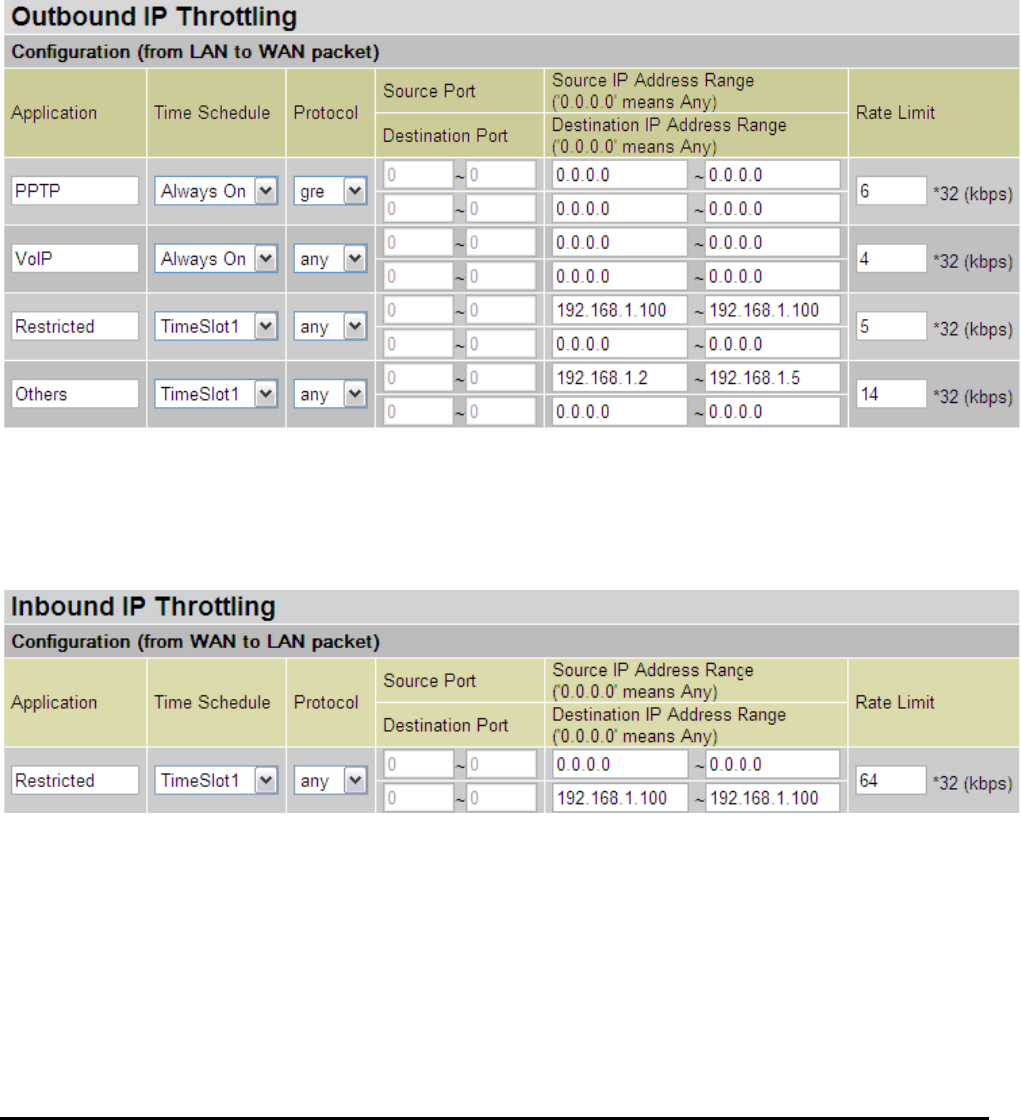
Billion BiPAC 8500/8501/8520/8521 SHDSL (VPN) Firewall Bridge/ Router
Chapter 4: Configuration
143
Advanced setting by using IP throttling
With IP throttling you can set more detailed parameters to manage bandwidth allocation even
when the applications are located on the same level.
Upstream: 928kbps (29*32kbps)
Mission-critical Application: 192kbps (6*32kbps)
Voice Application: 128kbps (4*32kbps)
Restricted Application: 160kbps (5*32kbps)
Other Applications: 448kbps (14*32kbps)
6+4+14+5=29, 29*32kbps=928kbps
Sometime your customers or friends may upload their files to your FTP server and saturate your
downstream bandwidth. The settings below can help you to limit the bandwidth for the restricted
application.
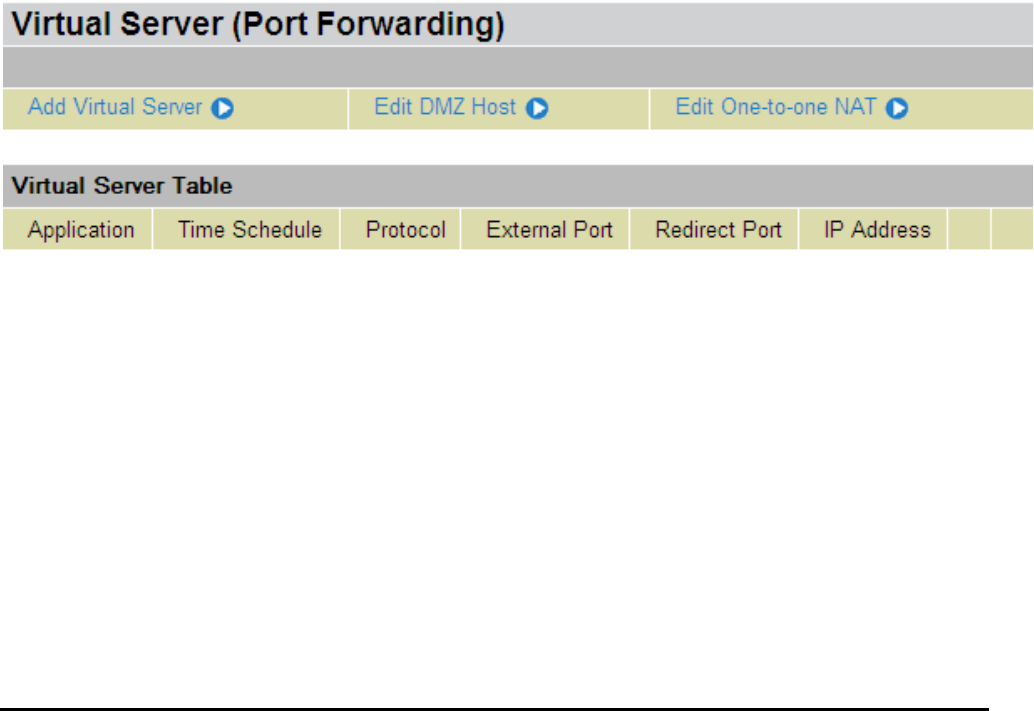
Billion BiPAC 8500/8501/8520/8521 SHDSL (VPN) Firewall Bridge/ Router
Chapter 4: Configuration
144
Virtual Server (“Port Forwarding”)
In TCP/IP and UDP network, a port is a 16-bit number used to identify which application
program (usually a server) incoming connections should be delivered to. Some ports have
numbers that are pre-assigned to them by the IANA (the Internet Assigned Numbers Authority),
and these are referred to as “well-known ports”. Servers follow the well-known port assignments
so clients can locate them.
If you wish to run a server on your network that can be accessed from WAN (i.e. from other
machines on the Internet outside your local network), or any application that can accept
incoming connections (e.g. Peer-to-peer/P2P software such as instant messaging applications
and P2P file-sharing applications) and are using NAT (Network Address Translation), then you
will usually need to configure your router to forward these incoming connection attempts using
specific ports to the PC on your network running the application. You will also need to use port
forwarding if you want to host an online game server.
The reason for this is that when using NAT, your publicly accessible IP address will be used by
and point to your router, which will then deliver all traffic to the private IP addresses used by
your PCs. Please see the WAN configuration section of this manual for more information on
NAT.
The device can be configured as a virtual server so that remote users accessing services such
as Web or FTP services via the public (WAN) IP address can be automatically redirected to the
local servers in the LAN network. Depending on the requested service (TCP/UDP port number),
the device will redirects the external service request to the appropriate server within the LAN
network
Add Virtual Server
Because NAT can act as a “natural” Internet firewall, your router protects your network from
being accessed by outside users when using NAT, as all incoming connection attempts will point
to your router unless you specifically create new Virtual Server entries to forward those ports to
a PC on your network.
When your router needs to allow outside users to access internal servers, e.g. a web server,
FTP server, Email server or game server, the router can act as a “virtual server”. You can set up
a local server with a specific port number for the service to use, e.g. web/HTTP (port 80), FTP
(port 21), Telnet (port 23), SMTP (port 25), or POP3 (port 110), When an incoming access
request to the router for a specified port is received, it will be forwarded to the corresponding
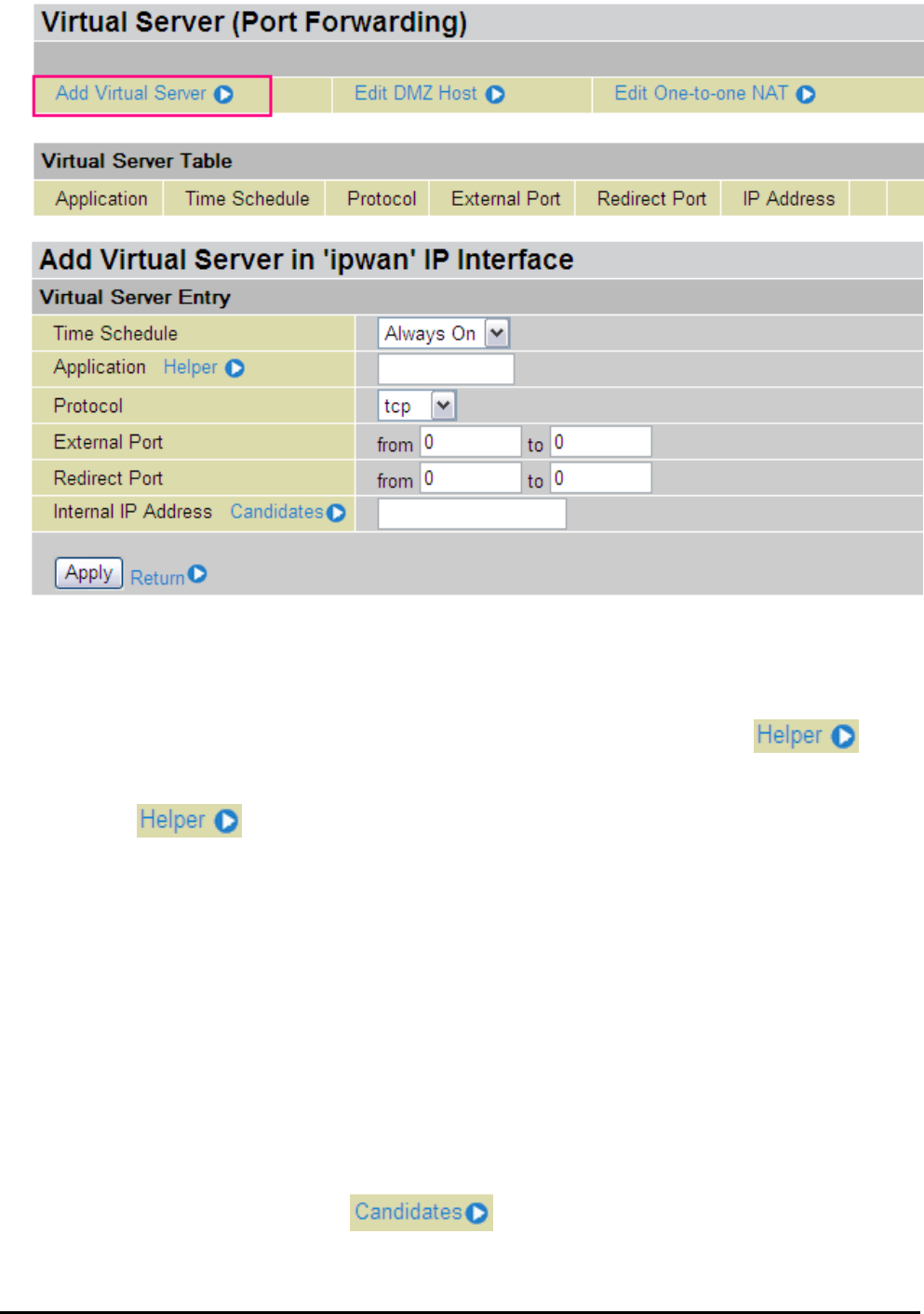
Billion BiPAC 8500/8501/8520/8521 SHDSL (VPN) Firewall Bridge/ Router
Chapter 4: Configuration
145
internal server.
• Time Schedule: A self-defined time period to enable your virtual server. You may
specify a time schedule or Always on for the usage of this Virtual Server Entry. For setup
and detail, refer to Time Schedule section
• Application: Users-define description to identify this entry or click to select
existing predefined rules.
o : 20 predefined rules are available. Click the Radio button to select the
rule; Application, Protocol and External/Redirect Ports will be filled after the
selection.
• Protocol: It is the supported protocol for the virtual server. In addition to specifying the
port number to be used, you will also need to specify the protocol being used. The
protocol used is determined by a particular application. Most applications will use TCP or
UDP.
• External Port: The Port number which will be used by the Remote/WAN client when
accessing the virtual server.
• Redirect Port: The Port number which is used by the Local server in the LAN network.
• Internal IP Address: The private IP in the LAN network, which will be providing the
virtual server application. List all the existing PCs connecting to the
network. You may assign a PC a specific IP address and MAC from this list.
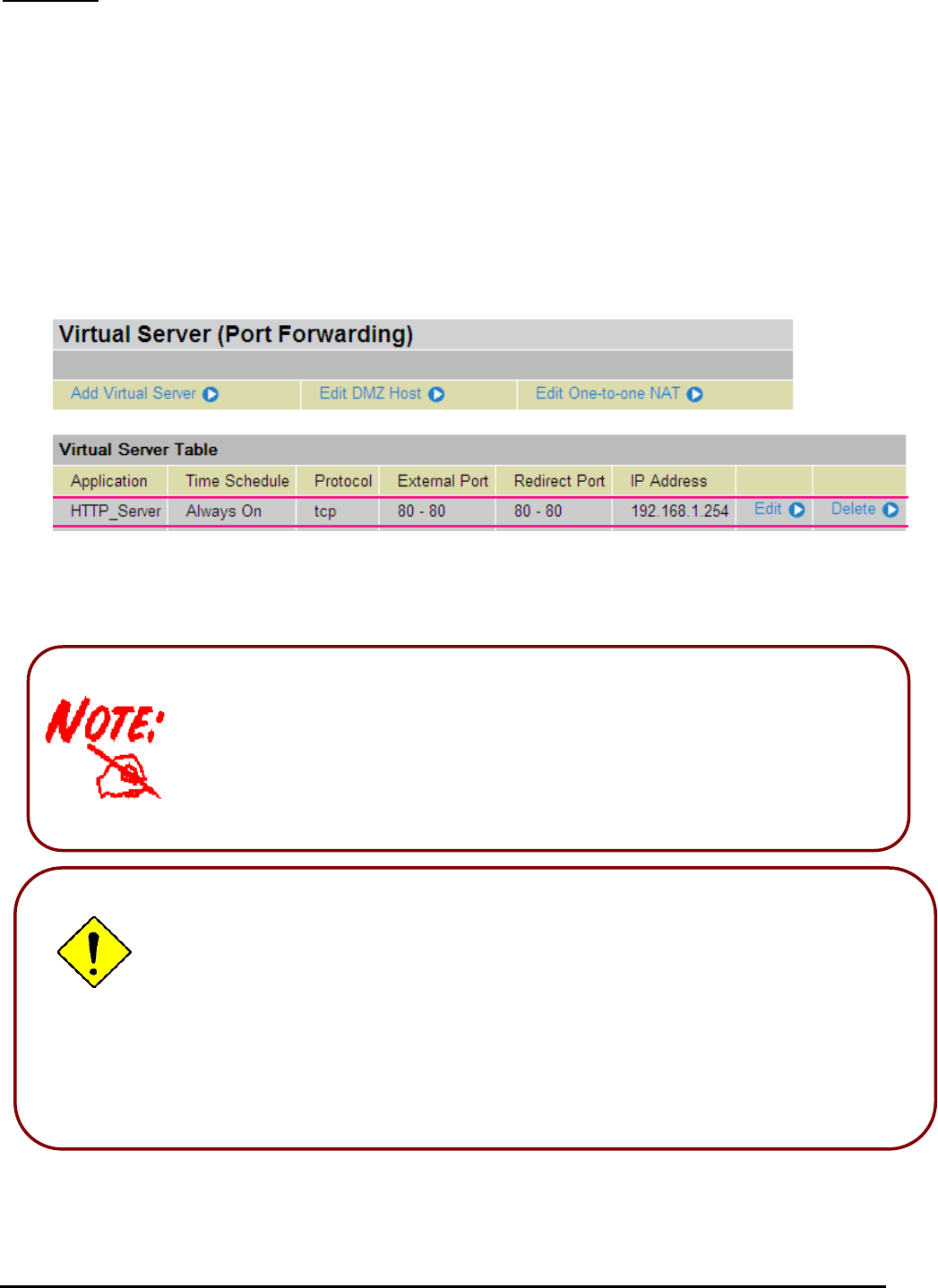
Billion BiPAC 8500/8501/8520/8521 SHDSL (VPN) Firewall Bridge/ Router
Chapter 4: Configuration
146
Example:
If you like to access your Router remotely through the Web/HTTP at all time, you would need to
enable port number 80 (Web/HTTP) and map to the Router IP Address. Then all incoming
HTTP requests from you (Remote side) will be forwarded to the Router with the IP address of
192.168.1.254. Since port number 80 has already been predefined, next to the Application
click Helper. When a predefined rule window pops up, select HTTP_Sever from the rule list.
Application: HTT_Sever
Time Schedule: Always On
Protocol: tcp
External Port: 80-80
Redirect Port: 80-80
IP Address: 192.168.1.254
• Edit: Click it to edit virtual server application.
• Delete: Click it to delete virtual server application.
If you have disabled the NAT option in the WAN-ISP section, the Virtual
Server function will hence be invalid.
If the DHCP server option is enabled, you have to be very careful in
assigning the IP addresses of the virtual servers in order to avoid conflicts.
The easiest way of configuring Virtual Servers is to manually assign static
IP address to each virtual server PC, with an address that does not fall into
the range of IP addresses that are to be issued by the DHCP server. You
can configure the virtual server IP address manually, but it must still be in
the same subnet as the router.
Attention
Using port forwarding does have security implications, as outside users
will be able to connect to PCs on your network. For this reason you are
advised to use specific Virtual Server entries just for the ports your
application requires, instead of using DMZ. As doing so will result in all
connections from the WAN attempt to access to your public IP of the
DMZ PC specified.
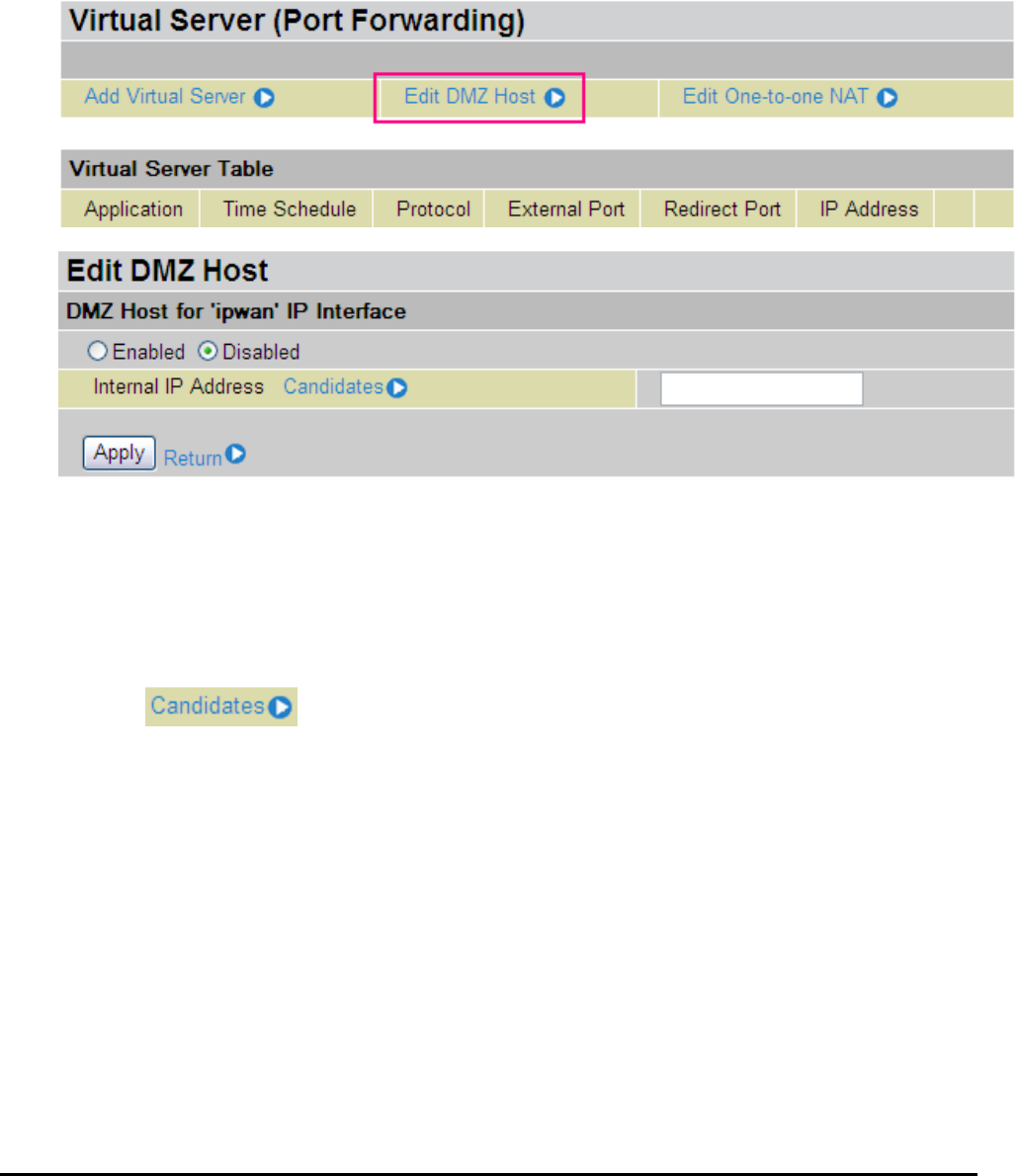
Billion BiPAC 8500/8501/8520/8521 SHDSL (VPN) Firewall Bridge/ Router
Chapter 4: Configuration
147
Edit DMZ Host
The DMZ Host is a local computer exposed to the Internet. When setting a particular internal IP
address as the DMZ Host, all incoming packets that use the port number different from the one
used by other Virtual Server entries will be checked by the Firewall and NAT algorithms before
being passed to the DMZ host.
Cautious: This Local computer exposing to the Internet may face various security risks.
• Disabled: As set in default setting, it disables the DMZ function.
• Enabled: It activates your DMZ function.
• Internal IP Address: Give a static IP address to the DMZ Host when the Enabled radio
button is checked. Be aware that this IP will be exposed to the WAN/Internet.
o List all existing PCs connected to the network. You may assign a
PC with IP address and MAC from this list.
Select the Apply button to apply your changes.
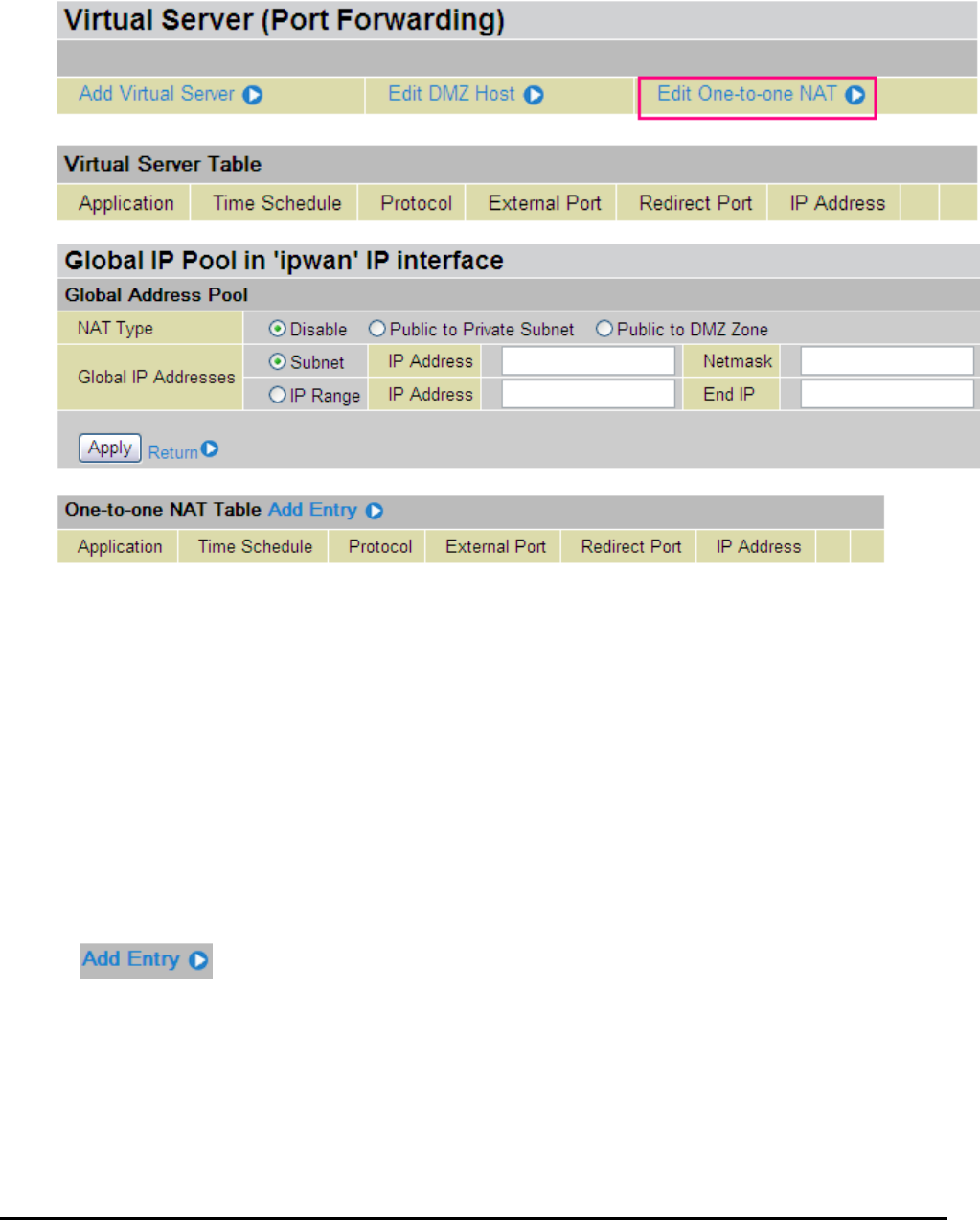
Billion BiPAC 8500/8501/8520/8521 SHDSL (VPN) Firewall Bridge/ Router
Chapter 4: Configuration
148
Edit One-to-One NAT (Network Address Translation)
One-to-One NAT maps a specific private/local IP address to a global/public IP address.
If you have multiple public/WAN IP addresses from you ISP, you are eligible for One-to-One
NAT to utilize these IP addresses.
• NAT Type: Select the desired NAT type. As set in default setting, it disables the One-to-
One NAT function.
• Global IP Address:
o Subnet: The subnet of the public/WAN IP address given by your ISP. If your ISP
has provided this information, you may insert it here. Otherwise, use IP Range
method.
o IP Range: The IP address range of your public/WAN IP addresses. For example,
IP: 192.168.1.1, end IP: 192.168.1.10
Select the Apply button to apply your changes.
Check to create a new One-to-One NAT rule:
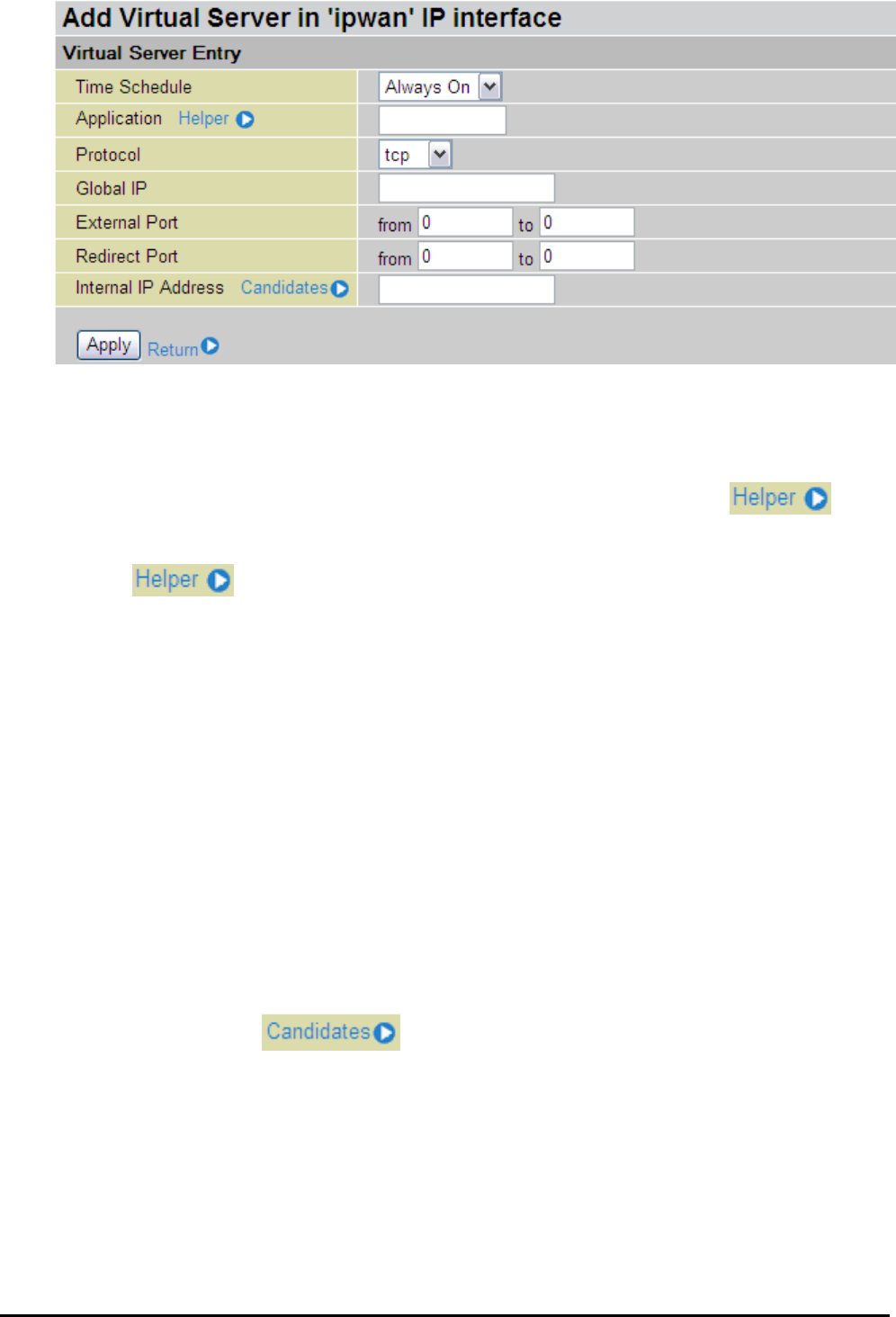
Billion BiPAC 8500/8501/8520/8521 SHDSL (VPN) Firewall Bridge/ Router
Chapter 4: Configuration
149
• Time Schedule: A self-defined time period to enable your virtual server. You may
specify a time schedule or Always on for the usage of this Virtual Server Entry. For setup
and detail, refer to Time Schedule section
• Application: Users-defined description to identify this entry or click to select
the existing predefined rules.
o : 20 predefined rules are available. Click the Radio button to select the
rule; Application, Protocol and External/Redirect Ports will be filled after the
selection.
• Protocol: It is the supported protocol for the virtual server. In addition to specifying the
port number to be used, you will also need to specify the protocol being used. The
protocol used is determined by a particular application. Most applications will use TCP or
UDP;
• Global IP: Define a public/ WAN IP address for this Application to use. This Global IP
address must be defined in the Global IP Address.
• External Port: The Port number the Remote/WAN client use when when accessing the
virtual server.
• Redirect Port: The Port number used by the Local server in the LAN network.
• Internal IP Address: The private IP in the LAN network, which will provide the virtual
server application. List all existing PCs connected to the network. You
may assign a PC an IP address and MAC address from this list.
Select the Apply button to apply your changes.

Billion BiPAC 8500/8501/8520/8521 SHDSL (VPN) Firewall Bridge/ Router
Chapter 4: Configuration
150
Example: List of some well-known and registered port numbers.
The Internet Assigned Numbers Authority (IANA) is the central coordinator for the assigning
unique parameter values to the Internet protocols. Port numbers range from 0 to 65535, but
only ports numbers 0 to 1023 are reserved for privileged services and are designated as “well-
known ports” (Please refer to Table 5). The registered ports are numbered from 1024 through
49151. The remaining ports from 49152 through 65535 are referred to as dynamic or private
ports.
Table 5: Well-known and registered Ports
Port Number
Protocol Description
20 TCP FTP Data
21 TCP FTP Control
22 TCP & UDP SSH Remote Login Protocol
23 TCP Telnet
25 TCP SMTP (Simple Mail Transfer Protocol)
53 TCP & UDP DNS (Domain Name Server)
69 UDP TFTP (Trivial File Transfer Protocol)
80 TCP World Wide Web HTTP
110 TCP POP3 (Post Office Protocol Version 3)
119 TCP NEWS (Network News Transfer Protocol)
123 UDP NTP (Network Time Protocol)
161 TCP SNMP
443 TCP & UDP HTTPS
1503 TCP T.120
1720 TCP H.323
4000 TCP ICQ
7070 UDP RealAudio
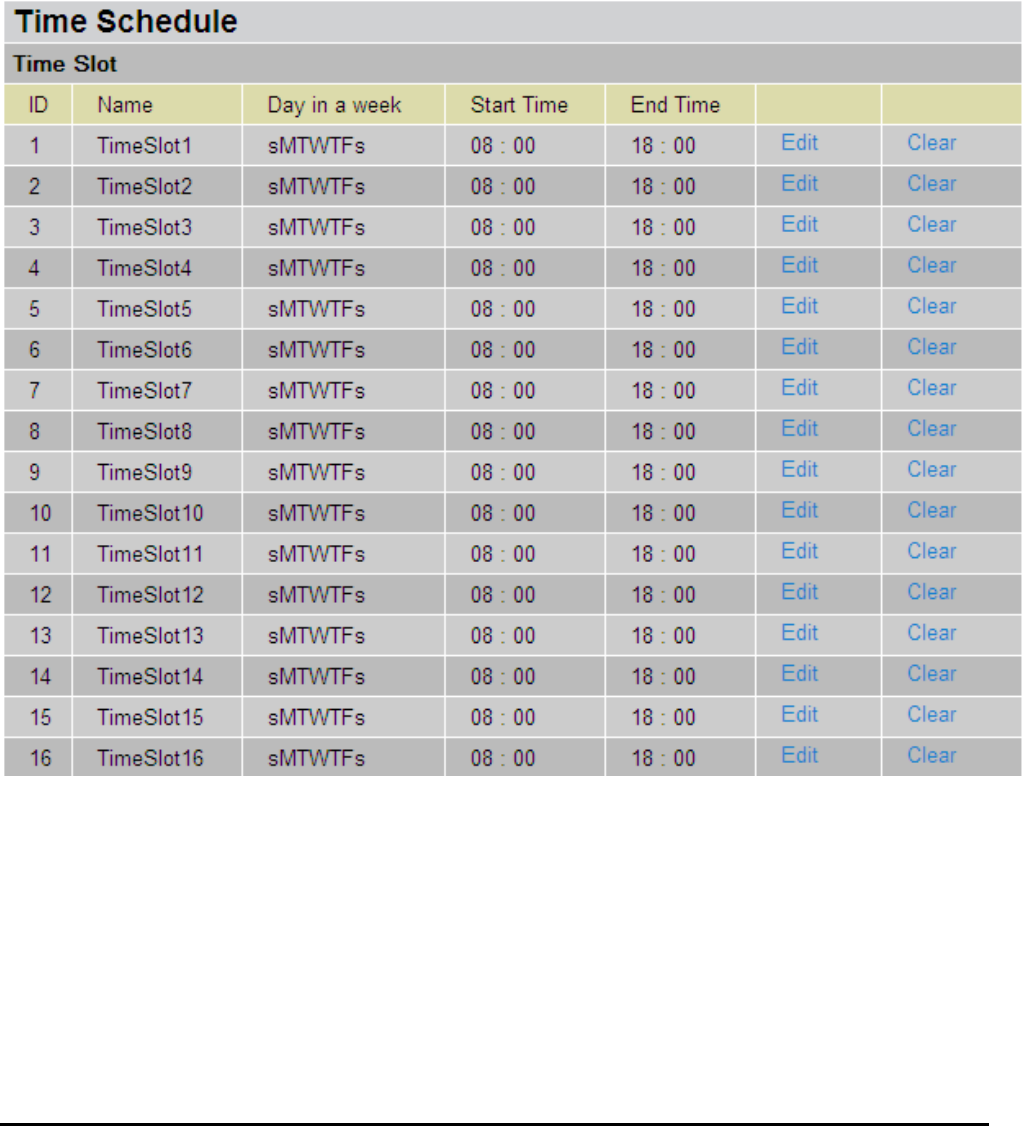
Billion BiPAC 8500/8501/8520/8521 SHDSL (VPN) Firewall Bridge/ Router
Chapter 4: Configuration
151
Time Schedule
The Time Schedule supports up to 16 time slots which helps you to manage your Internet
connection. In each time profile, you may schedule specific day(s) i.e. Monday through Sunday
to restrict or allow the usage of the Internet for certain users or applications.
This Time Schedule correlates closely with router time, since router does not have a real time
clock on board; it uses the Simple Network Time Protocol (SNTP) to get the current time from a
SNTP server from the Internet. Refer to Time Zone for details. You router time should
correspond with your local time. If the time is not set correctly, your Time Schedule will not
function properly.
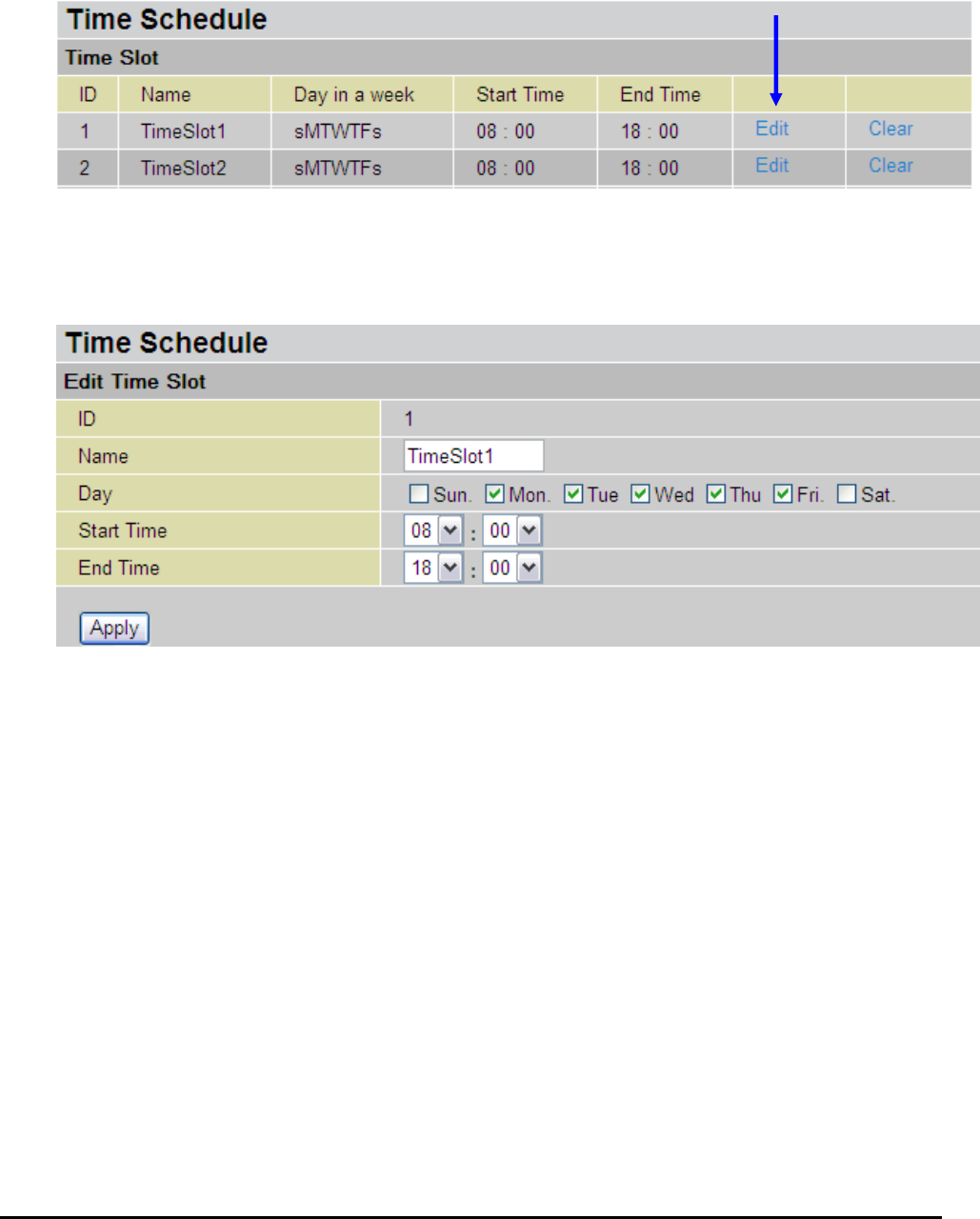
Billion BiPAC 8500/8501/8520/8521 SHDSL (VPN) Firewall Bridge/ Router
Chapter 4: Configuration
152
Configuration of Time Schedule
Edit a Time Slot
1. Choose any Time Slot (ID 1 to ID 16) to edit, click Edit.
Note: Watch it carefully, the days you have selected will present in capital letter. Lower case
letter shows the day(s) is not selected, and no rule will apply on this day(s).
2. A detailed setting of this Time Slot will be shown below.
• ID: This is the index of the time slot.
• Name: A user-define description to identify the time profile.
• Day: The default is set from Monday through Friday. You may specify the days for the
schedule to be applied.
• Start Time: The default is set at 8:00 AM. You may specify the schedule starting time.
• End Time: The default is set at 18:00 (6:00PM). You may specify the schedule ending
time.
Select the Apply button to apply your changes.
Delete a Time Slot
Click Clear to delete the existing Time profile, i.e. erase the Day and reset it to the default
setting for the Start Time / End Time.
Click Edit
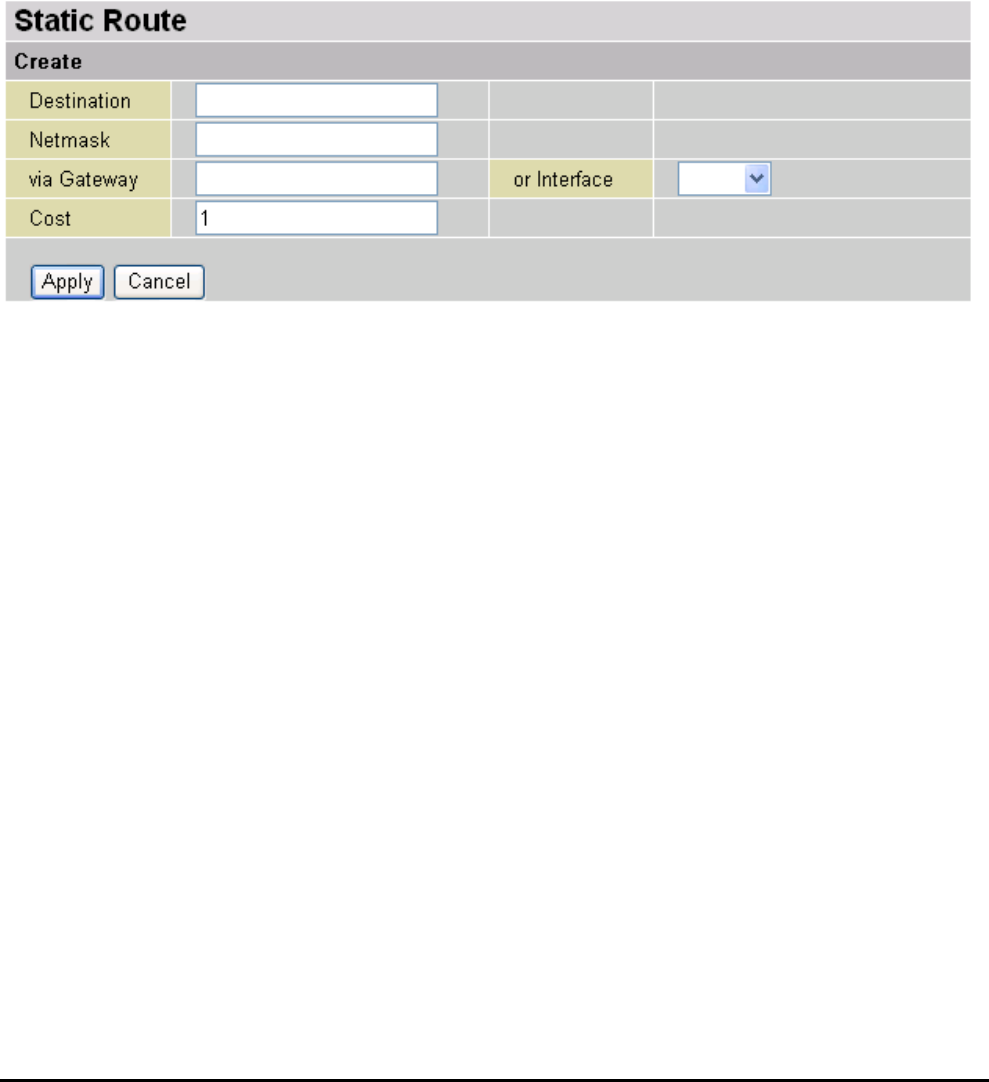
Billion BiPAC 8500/8501/8520/8521 SHDSL (VPN) Firewall Bridge/ Router
Chapter 4: Configuration
153
Advanced
Configuration options within the Advanced section are for users who wish to take advantage of
the more advanced features of the router. Users who do not understand the features should not
attempt to reconfigure their router, unless advised to do so by the support staff.
There are four items within the Advanced section: Static Route, Dynamic DNS, Check Email,
Device Management, IGMP, and VLAN Bridge.
Static Routing
Click on the Routing Table and then choose Create Route to add a routing table.
• Destination: This is the destination subnet IP address.
• Netmask: Subnet mask of the destination IP addresses based on the above destination
subnet IP.
• Gateway: This is the gateway IP address to which packets are to be forwarded.
• Interface: Select the interface through which packets are to be forwarded.
• Cost: This is the same meaning as Hop. This should usually be left at 1.
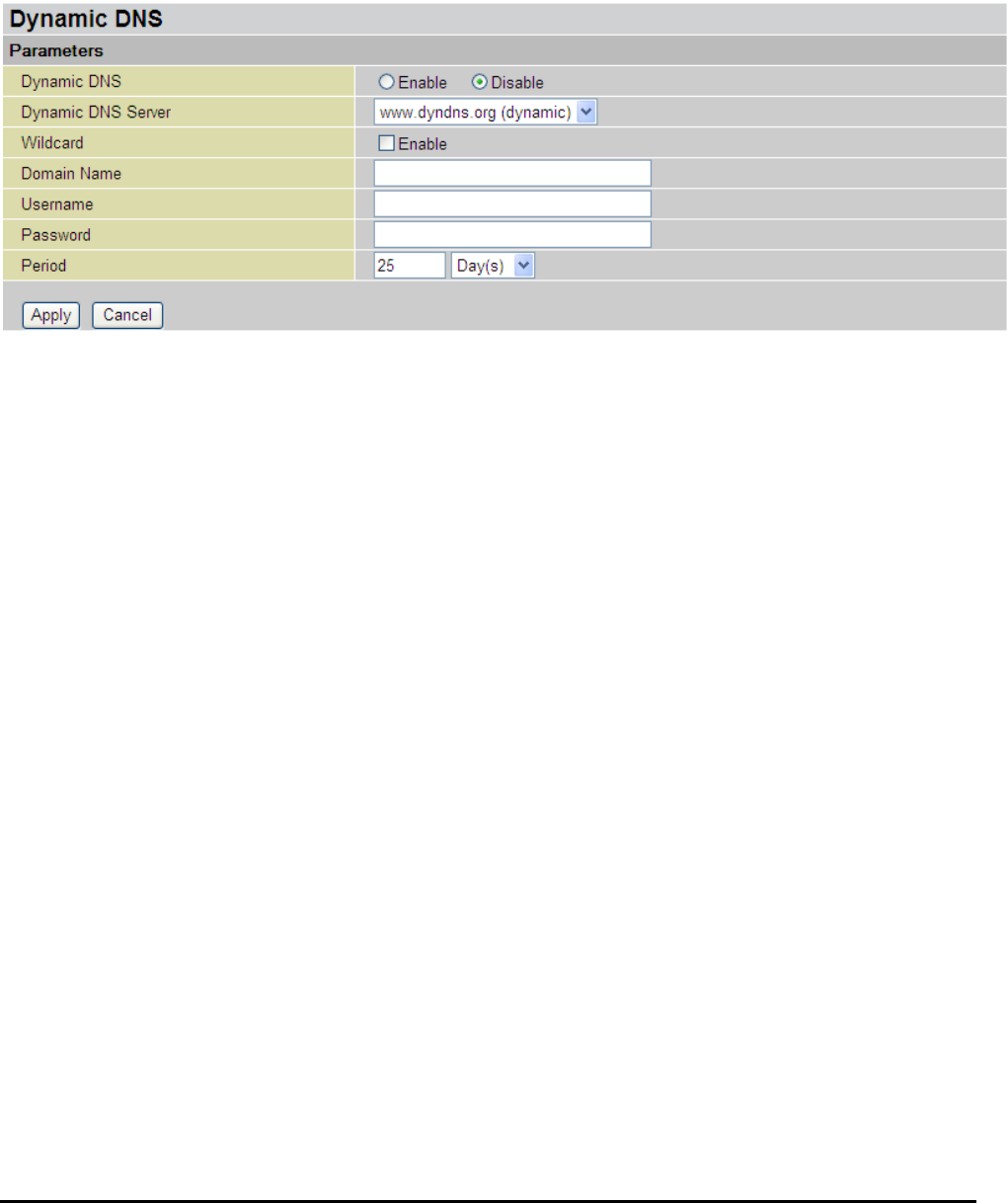
Billion BiPAC 8500/8501/8520/8521 SHDSL (VPN) Firewall Bridge/ Router
Chapter 4: Configuration
154
Dynamic DNS
The Dynamic DNS function allows you to alias a dynamic IP address to a static hostname,
allowing users whose ISP does not assign them a static IP address to use a domain name. This
is especially useful for hosting servers via your ADSL connection, so that anyone wishing to
connect to you may use your domain name, rather than having to use your dynamic IP address,
which changes from time to time. This dynamic IP address is the WAN IP address of the router,
which is assigned to you by your ISP.
You will first need to register and establish an account with the Dynamic DNS provider using
their website, for example http://www.dyndns.org/
There are more than 5 DDNS services supported.
• Disable: Check to disable the Dynamic DNS function.
• Enable: Check to enable the Dynamic DNS function. The following fields will be
activated and required:
• Dynamic DNS Server: Select the DDNS service you have established an account with.
• Wildcard: This function enables sub-domain name support. Enable this function when
there is any subdomain name.
• Domain Name, Username and Password: Enter your registered domain name and
your username and password for this service.
• Period: Set the time period between updates for the Router to exchange information with
the DDNS server. In addition, the router will perform an update when your dynamic IP
address changes.
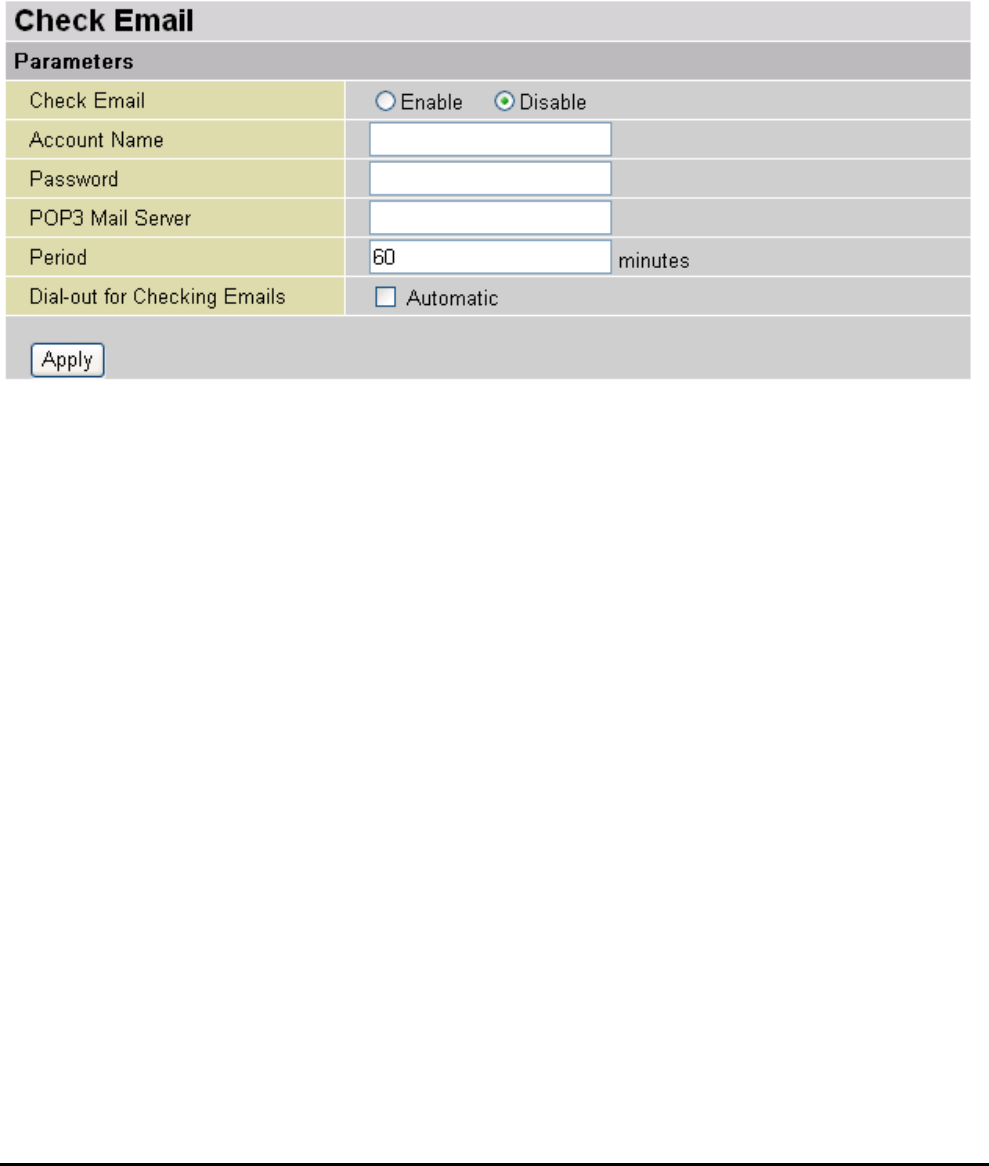
Billion BiPAC 8500/8501/8520/8521 SHDSL (VPN) Firewall Bridge/ Router
Chapter 4: Configuration
155
Check Emails
This function allows you to have the router check your POP3 mailbox for new Email messages.
The Mail LED on your router will lit when it detects new messages waiting for download. You
may also view the status of this function using the Status – Email Checking section of the web
interface, which also provides details on the number of new messages await for download. See
the Status section of this manual for more information.
• Disable: Check to disable the router Email checking function.
• Enable: Check to enable the router Email checking function. The following fields will be
activated and required:
• Account Name: Enter the name (login) of the POP3 account you wish the system to
check. Normally, it is the name of your email address before the "@" symbol. If you have
trouble with it, please contact your ISP.
• Password: Enter the account password.
• POP3 Mail Server: Enter your (POP) mail server name. You Internet Service Provider
(ISP) or network administrator will be able to supply you with this.
• Period: Enter the value in minutes between each mail checking interval.
• Automatically dial-out for checking emails: When the function is enabled, your ADSL
router will connect to your ISP automatically to check for emails if your Internet
connection drops. Please be careful when using this feature if your ADSL service is
charged by time online.
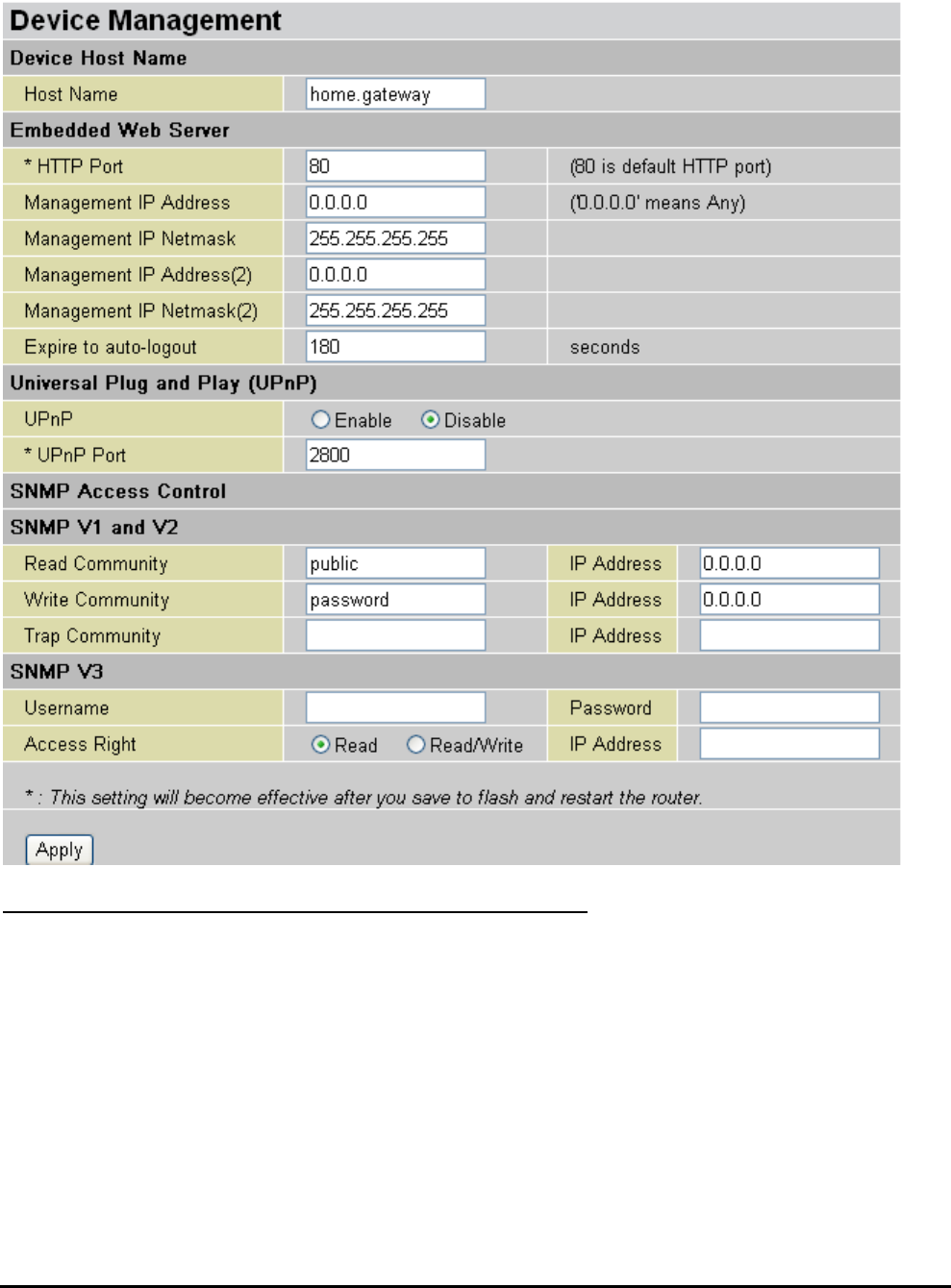
Billion BiPAC 8500/8501/8520/8521 SHDSL (VPN) Firewall Bridge/ Router
Chapter 4: Configuration
156
Device Management
The Device Management advanced configuration settings allows you to control your router
security options and device monitoring features.
Embedded Web Server ( to Management IP accounts)
• HTTP Port: This is the port number the router’s embedded web server (for web-based
configuration) will use. The default value is the standard HTTP port, 80. Users may
specify an alternative if, for example, they are running a web server on a PC within their
LAN.
• Management IP Address: You may specify an IP address used to logon and access the
router’s web server. Setting the IP address to 0.0.0.0 will disable IP address restrictions,
allowing users to login from any IP address.
• Expire to auto-logout: Specify a time frame for the system to auto-logout from the
user’s configuration session.

Billion BiPAC 8500/8501/8520/8521 SHDSL (VPN) Firewall Bridge/ Router
Chapter 4: Configuration
157
For Example: User A changes HTTP port number to 100, specifies their own IP address of
192.168.1.55, and sets the logout time to be 100 seconds. The router will only allow User A
access from the IP address 192.168.1.55 to logon to the Web GUI by typing:
http://192.168.1.254:100 in their web browser. After 100 seconds, the device will automatically
log User A out.
Universal Plug and Play (UPnP)
UPnP offers peer-to-peer network connectivity for PCs and other network devices, along with
control and data transfer between devices. UPnP offers many advantages for users who run
NAT routers through UPnP NAT Traversal, and on other supported systems. User can perform
various tasks more easily such as port forwarding by letting the application control the required
settings, removing the need for the user to control advanced configuration of their device.
Both the user’s Operating System and the relevant application must support UPnP in addition to
the router. Windows XP and Windows ME natively support UPnP (when the component is
installed), and Windows 98 users may install the Internet Connection Sharing client from
Windows XP in order to support UPnP. Windows 2000 does not support UPnP.
• Disable: Check to disable the router UPnP functionality.
• Enable: Check to enable the router UPnP functionality.
• UPnP Port: Its default setting is 2800. It is highly recommended for users to use this port
value. If this value conflicts with other ports already used, you may change the port.
SNMP Access Control (Software on a PC within the LAN is required in order to utilize this
function) – Simple Network Management Protocol.
SNMP V1 and V2:
• Read Community: Specify a name to be identified as the Read Community, and an IP
address. This community string will be checked against the string entered in the
configuration file. Once the string name is matched, user who obtains this IP address will
be able to view the data.
• Write Community: Specify a name to be identified as the Write Community, and an IP
address. This community string will be checked against the string entered in the
configuration file. Once the string name is matched, user from this IP address will be able
to view and modify the data.
• Trap Community: Specify a name to be identified as the Trap Community, and an IP
address. This community string will be checked against the string entered in the
configuration file. Once the string name is matched, user from this IP address will be sent
to SNMP Traps.

Billion BiPAC 8500/8501/8520/8521 SHDSL (VPN) Firewall Bridge/ Router
Chapter 4: Configuration
158
SNMP V3:
Specify a name and password for authentication. And define the access right from an identified
IP address. Once the authentication has succeeded, user from this IP address will be able to
view and modify the data.
SNMP Version: SNMPv2c and SNMPv3
SNMPv2c is the combination of the enhanced protocol features of SNMPv2 without the
SNMPv2 security. The "c" comes from the fact that SNMPv2c uses the SNMPv1 community
string paradigm for "security", but is widely accepted as the SNMPv2 standard.
SNMPv3 is a strong authentication mechanism, authorizing with fine granularity for remote
monitoring.
Traps supported: Cold Start, Authentication Failure.
The following MIBs are supported:
From RFC 1213 (MIB-II):
System group
Interfaces group
Address Translation group
IP group
ICMP group
TCP group
UDP group
EGP (not applicable)
Transmission
SNMP group
From RFC1650 (EtherLike-MIB):
dot3Stats
From RFC 1493 (Bridge MIB):
dot1dBase group

Billion BiPAC 8500/8501/8520/8521 SHDSL (VPN) Firewall Bridge/ Router
Chapter 4: Configuration
159
dot1dTp group
dot1dStp group (if configured as spanning tree)
From RFC 1471 (PPP/LCP MIB):
pppLink group
pppLqr group
From RFC 1472 (PPP/Security MIB):
PPP Security Group)
From RFC 1473 (PPP/IP MIB):
PPP IP Group
From RFC 1474 (PPP/Bridge MIB):
PPP Bridge Group
From RFC1573 (IfMIB):
ifMIBObjects Group
From RFC1695 (atmMIB):
atmMIBObjects
From RFC 1907 (SNMPv2):
only snmpSetSerialNo OID
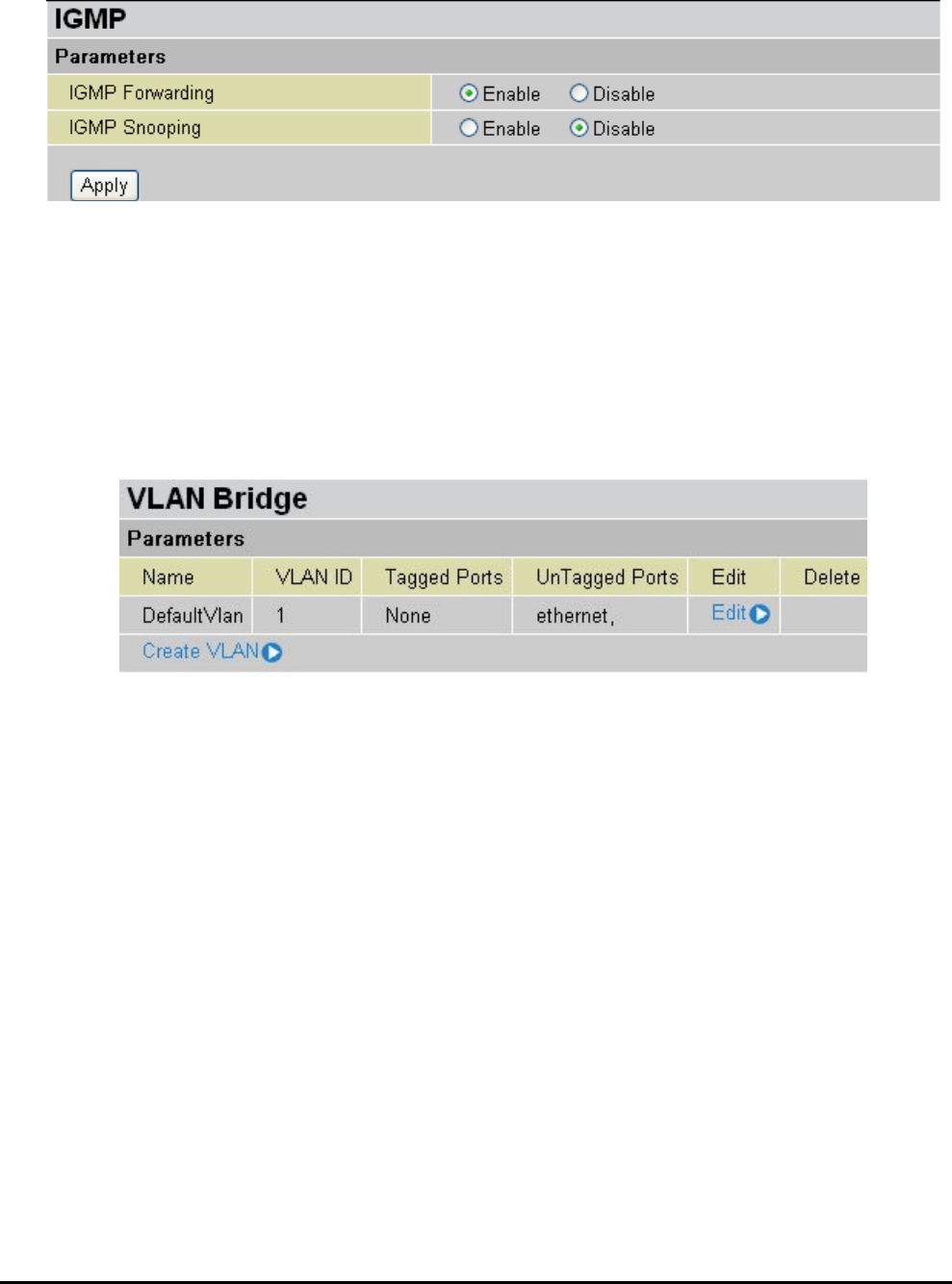
Billion BiPAC 8500/8501/8520/8521 SHDSL (VPN) Firewall Bridge/ Router
Chapter 4: Configuration
160
IGMP
IGMP, known as Internet Group Management Protocol, is used to manage hosts from multicast
group.
• IGMP Forwarding: Accept multicast packet. Default is set to Enable.
• IGMP Snooping: Allow switched Ethernet to check and make correct forwarding
decisions. Default is set to Disable.
VLAN Bridge
This section allows you to create a VLAN group and specify the members of the VLAN group.
• Edit: Edit your member ports in selected VLAN group.
• Create VLAN: To create another VLAN group.
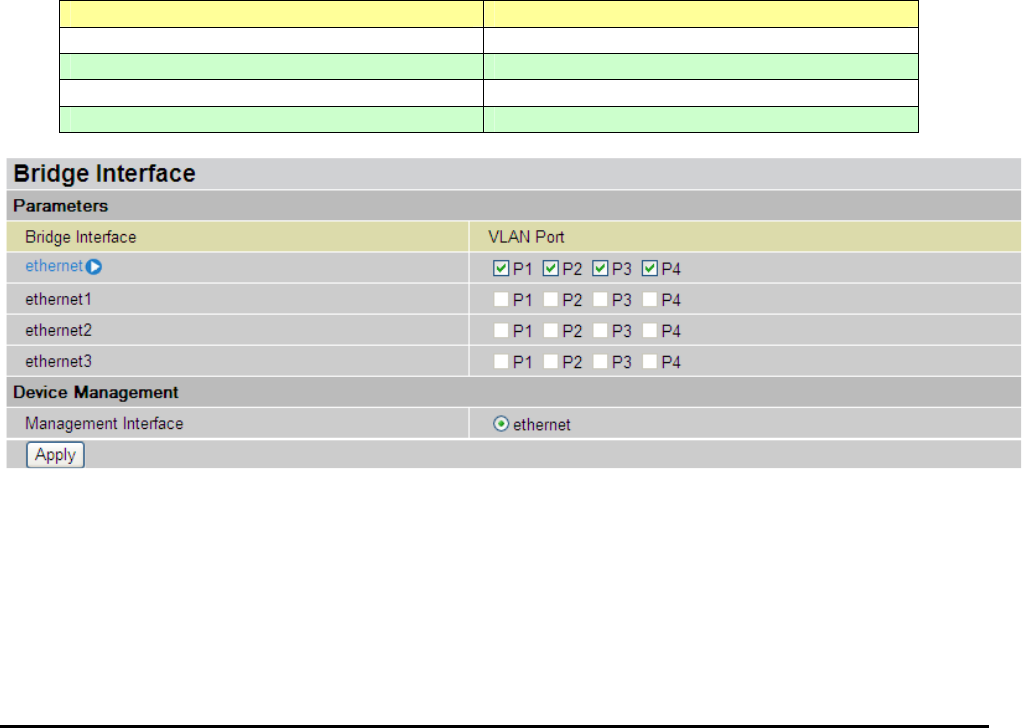
Billion BiPAC 8500/8501/8520/8521 SHDSL (VPN) Firewall Bridge/ Router
Chapter 4: Configuration
161
Advanced VLAN Setup Example (Triply Play)
VLAN_data:
Ethernet Port 1, Wireless and Wireless WDS are reserved for Internet
- On Ethernet port 1 I also need VC 0/40 bridged.
VLAN_Vedio
Ethernet ports: 2, 3 and 4:
- 0/33 Bi-directional IP
- 0/34 Video
- 0/35 Video
- 0/36 Video Subscriber Services (EPG, EAS, etc.)
- 0/37 Video
- 0/38 Video
- 0/39 Spare
Step 1: Setup Member Ports
Go to Configuration
LAN
Bridge Interface.
You can setup member ports for each VLAN group under Bridge Interface section. From the
example, two VLAN groups need to be created first.
Ethernet: P1 (Port 1)
Ethernet1: P2, P3 and P4 (Port 2, 3, 4) Please uncheck P2, P3, P4 from Ethernet VLAN Port
first.
Note: You should setup each VLAN group with caution. Each Bridge Interface is arranged
in this order.
Bridge Interface VLAN Port (Always starts with)
Ethernet P1 / P2 / P3 / P4
Ethernet1 P2 / P3 / P4
Ethernet2 P3 / P4
Ethernet3 P4
Step 2: Create WAN Interface
Go to Configuration
WAN
ISP
wanlink is the factory default WAN interface which provides service for data/internet access. If
your ISP uses this access protocol, click Edit to input other parameters if needed. If your ISP
does not use PPPoE, you can change the default WAN connection entry by clicking Change.
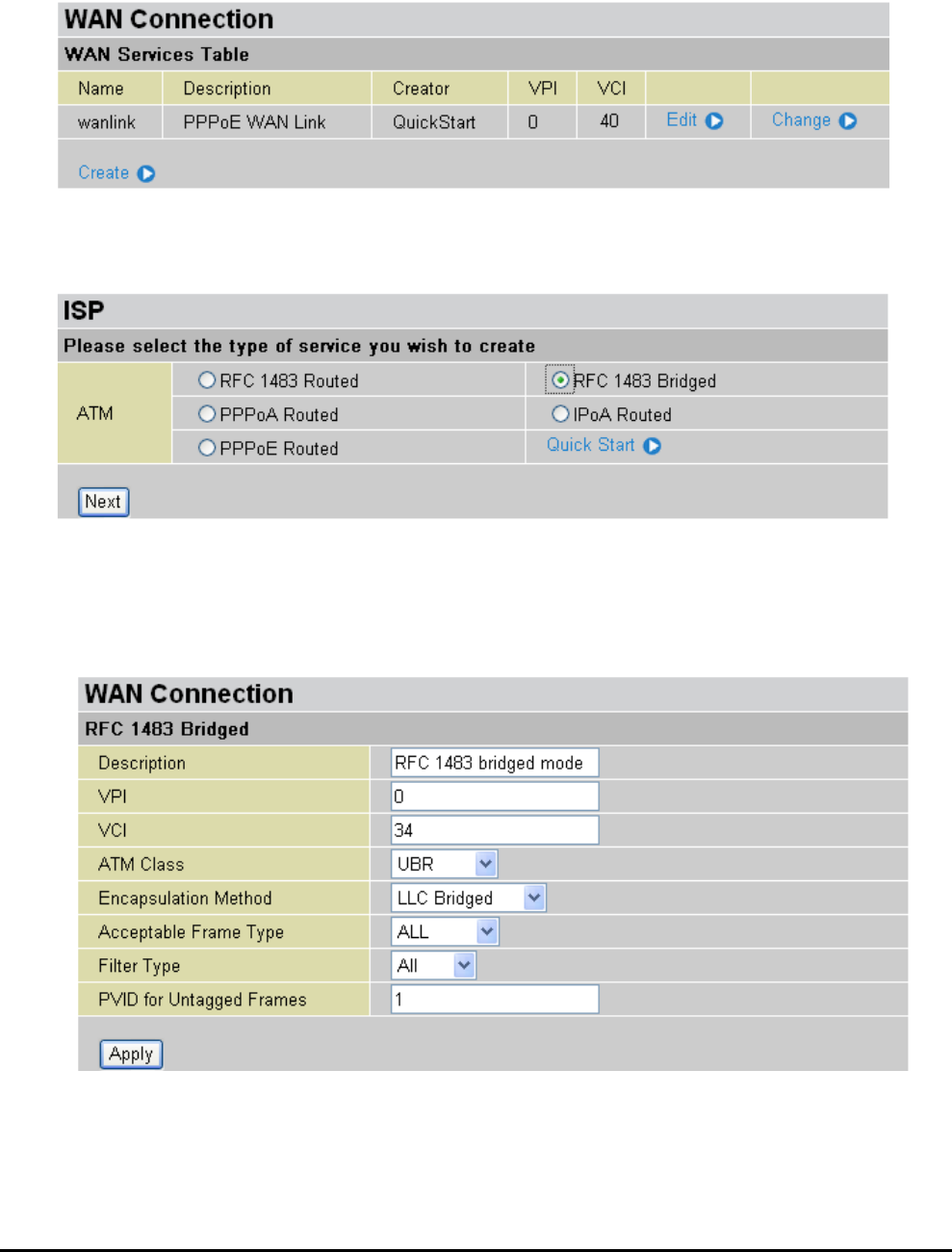
Billion BiPAC 8500/8501/8520/8521 SHDSL (VPN) Firewall Bridge/ Router
Chapter 4: Configuration
162
From the example, 0/40 is used for data/internet and with the assumption that PPPoE is used;
click the Edit button to change the VPI/VCI to 0/40.
Click Create to setup up an additional WAN interface for video applications. A total of 8 VLAN is
supported; therefore, only 8 WAN interfaces can be created in the table.
From the example, PVC 0/33 to 0/39 is assigned to video using 1483 Bridged mode. Check
RFC 1483 Bridged and click Next to continue the setup.
Enter 0 for VPI and 33 for VCI in their respective blanks provided. Select an appropriate ATM
Class, Encapsulation Method, Acceptable Frame Type and Filter Type from their drop down
menus and enter the correct PVID for Untagged Frames in the blank. When all information has
been entered, press Apply to save changes.
• VPI and VCI: Enter the information provided by your ISP.
• ATM Class: The Quality of Service for ATM layer.
• Encapsulation method: Select the encapsulation format, this is provided by your ISP.
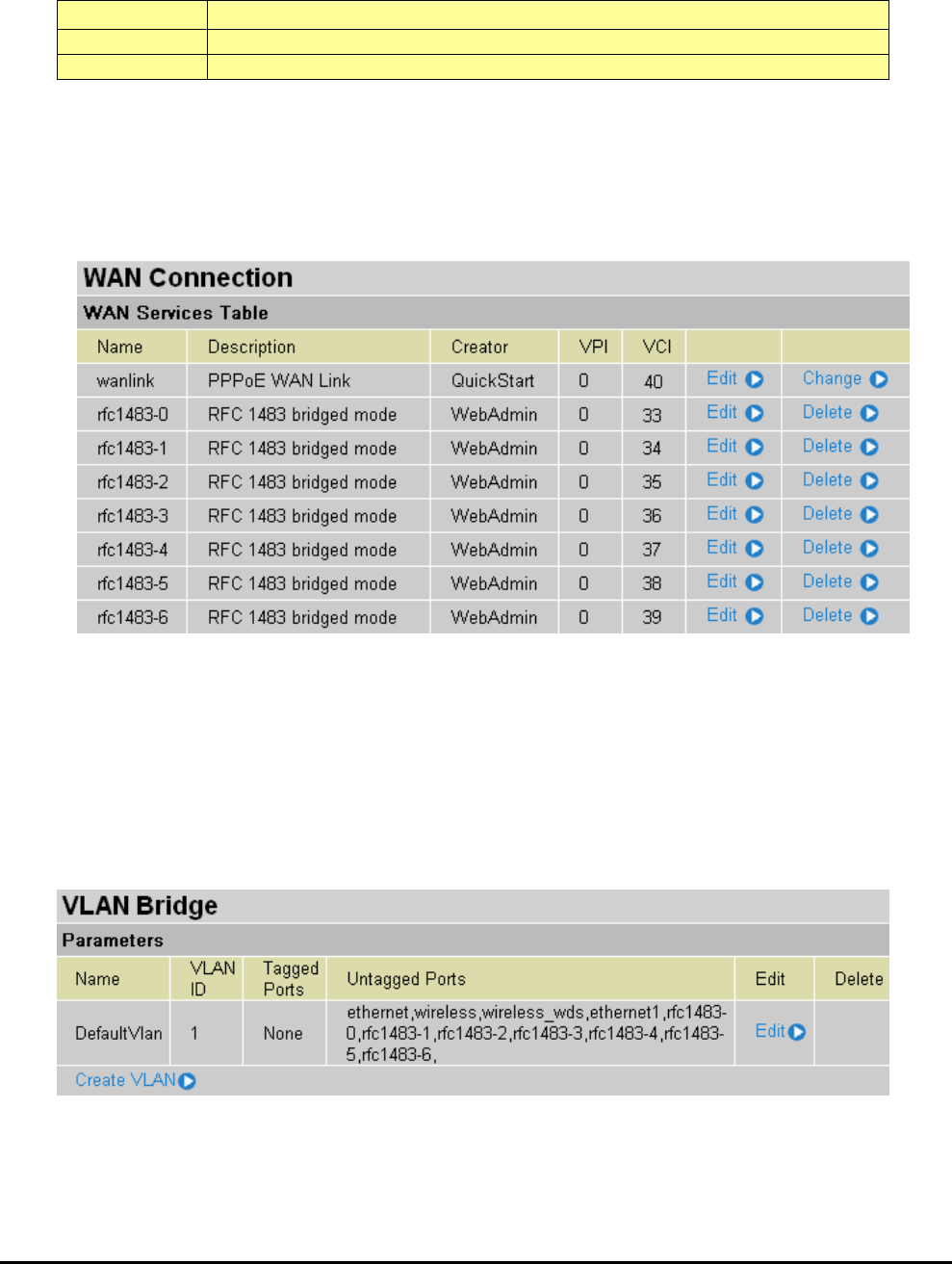
Billion BiPAC 8500/8501/8520/8521 SHDSL (VPN) Firewall Bridge/ Router
Chapter 4: Configuration
163
• Acceptable Frame Type: Specify what kind of traffic can pass through this connection,
whether all traffic or only VLAN tagged traffic.
• Filter Type: Specify the type of Ethernet filtering performed by the named bridge
interface.
All Allows all types of ethernet packets through the port.
Ip Allows only IP/ARP types of ethernet packets through the port.
Pppoe Allows only PPPoE types of ethernet packets through the port.
• PVID for Untagged Frames: PVID is known as Port VLAN Identifier. When an untagged
packet is received by the input port(s), this packet will be tagged with a specific PVID.
From the example, only VPI and VCI sections need to be filled in and leave the rest of the
section as it is. Repeat the same procedure by clicking Create select RFC1483 Bridged
fill-in the rest of the PVC 0/34 to 0/39.
Step 3: Setup VLAN Service
Go to Configuration
Advanced
VLAN Bridge
DefaultVlan lists all its member ports. It is necessary to group specific member ports for each
VLAN.
From the example, two VLAN groups are requested: Data and Video.
To create another VLAN group for Video click Create VLAN.
Give a name and ID (PVID) to identify the Video group. The valid value range for PVID is 1 ~
4094.
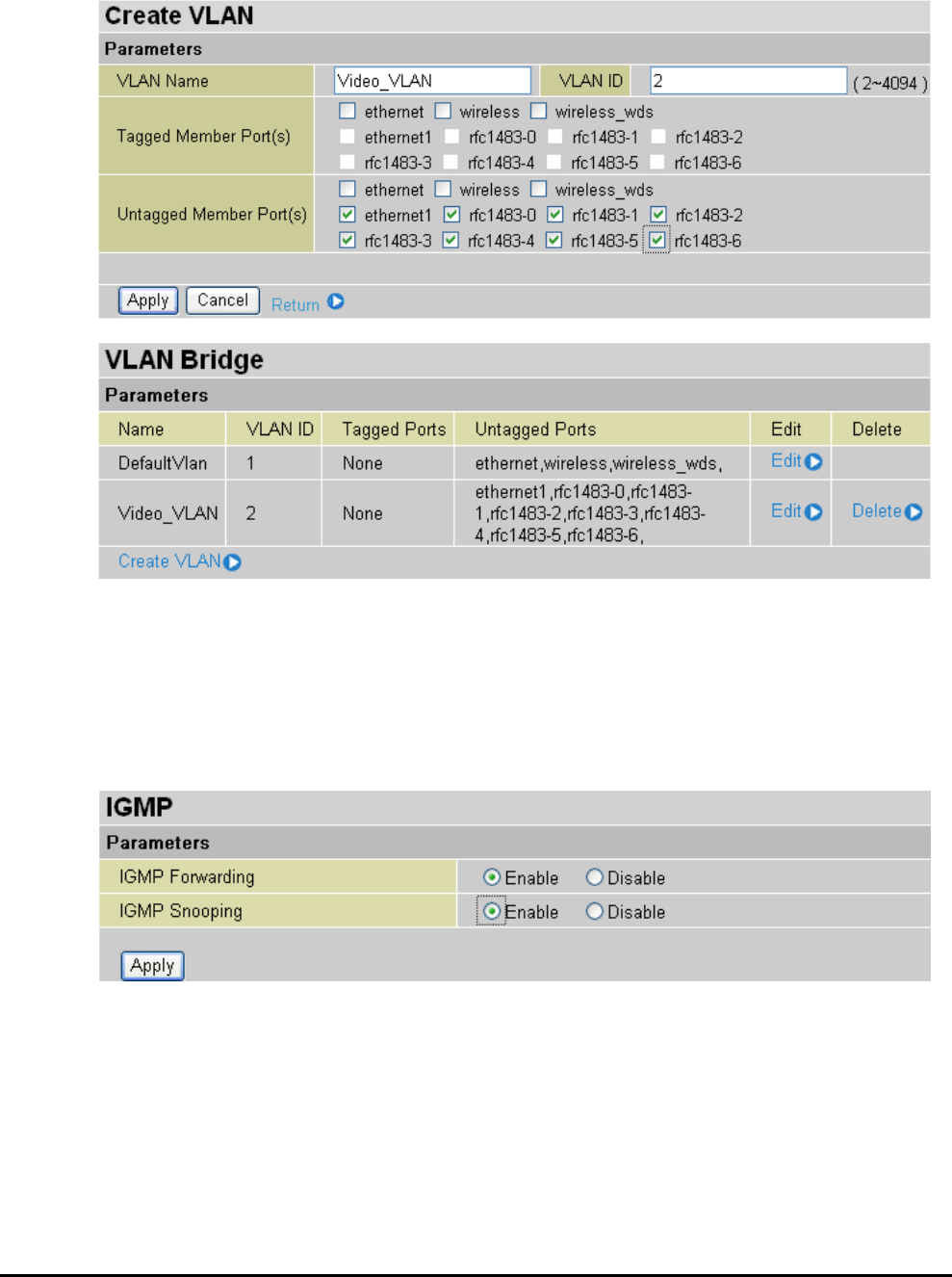
Billion BiPAC 8500/8501/8520/8521 SHDSL (VPN) Firewall Bridge/ Router
Chapter 4: Configuration
164
From the example:
VLAN untagged ports for Data/Internet: ethernet, wireless and wireless_wds.
VLAN untagged ports for Video: ethernet1, rfc-1483-0 ~ rfc-1483-6.
Click Apply to made changes effective immediately.
Mapping the VLAN Bridge with Bridge Interface created in Step1, you will see the relationship
in these two screenshots.
Step 4: IGMP Snooping Enable
Go Configuration
Advanced
IGMP.
IGMP Snooping must be enabled in order to allow video stream forwarding correctly.
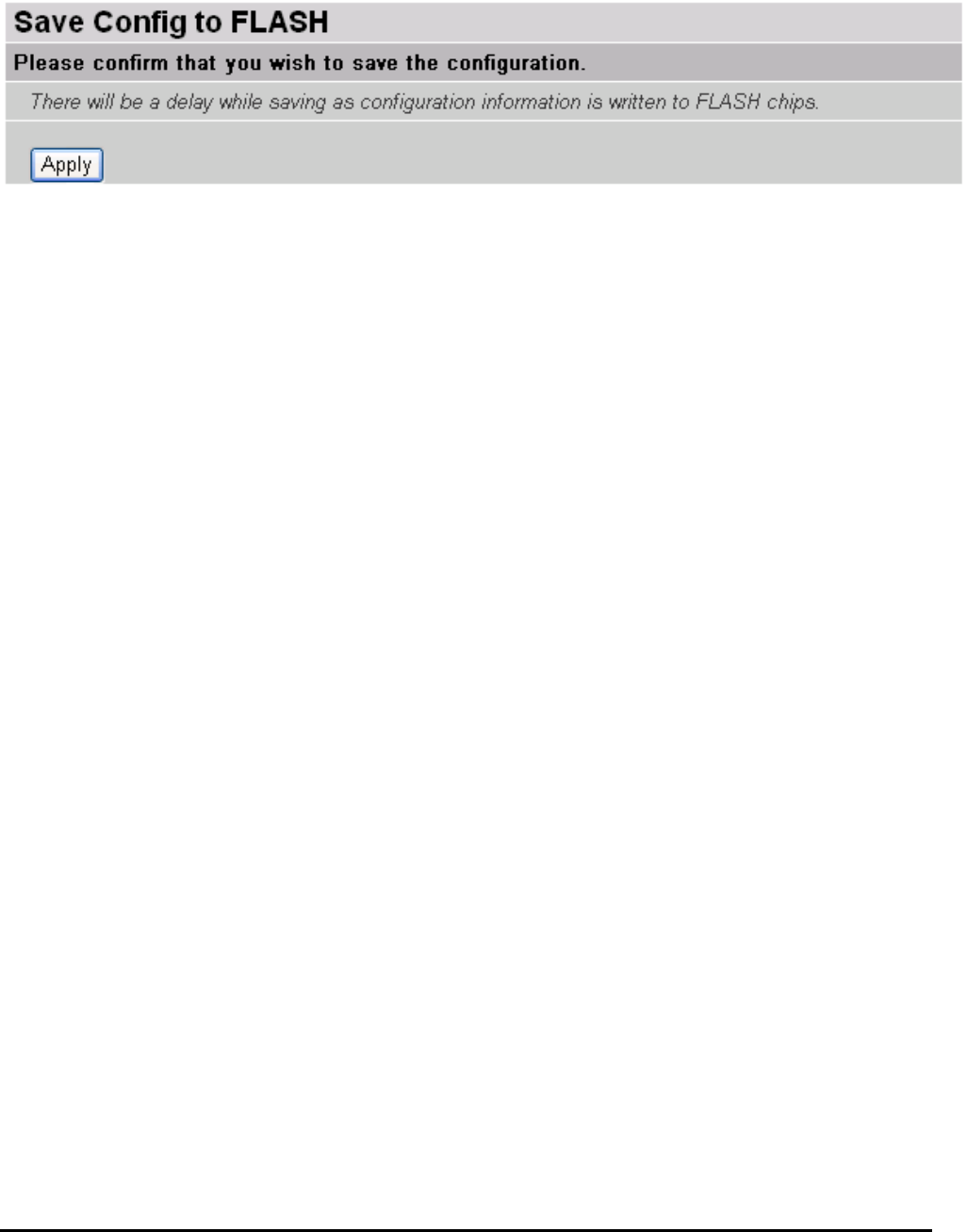
Billion BiPAC 8500/8501/8520/8521 SHDSL (VPN) Firewall Bridge/ Router
Chapter 4: Configuration
165
Save Configuration to Flash
After changing the router configuration settings, you must save all of the configuration
parameters to FLASH to avoid them being lost after turning off or resetting your router. Click
Save to write your new configuration to FLASH.
Logout
To exit the router web interface, choose Logout. Please make sure that you have saved the
configuration settings before you logout.
Be aware that the router is restricted to only one PC accessing the configuration page at a time.
Once a PC has logged into the web interface, other PCs cannot access until the current PC has
logged out of the web interface. If the previous PC forget to logout, the second PC can only
access the page after a user-defined auto logout time which is by default 3 minutes. You can
modify this value using the Advanced – Device Management section of the web interface.
Please see the Advanced section of this manual for more information.

Billion BiPAC 8500/8501/8520/8521 SHDSL (VPN) Firewall Bridge/ Router
Chapter 5: Troubleshooting
166
Chapter 5: Troubleshooting
If the router is not functioning properly, first check this chapter for simple troubleshooting before
contacting your service provider.
Problems starting up the router
Problem Corrective Action
None of the LEDs are
on when you turn on
the router.
Check the connection between the adapter and the router. If the
error persists, you may have a hardware problem. In this case you
should seek technical support.
You have forgotten
your router login
and/or password.
Try the default login and password, refer to Chapter 3. If this fails,
you can restore your router to its factory settings by pressing the
Reset button at the back of your router for more than 6 seconds.
Problems with the WAN Interface
Problem Corrective Action
Initialization of the
PVC connection
(“linesync”) failed.
Ensure that the telephone cable is connected properly from the
SHDSL port to the wall jack. The SHDSL LED on the front panel of the
router should be on. Check that your VPI, VCI, encapsulation type and
the multiplexing settings type are the same as those provided by your
ISP. Reboot the router. If you still have problems, you may need to
verify these settings with your ISP.
Problems with the LAN Interface
Problem Corrective Action
Can’t ping any
PCs on the
LAN.
Check the Ethernet LEDs on the front panel. The LED should be on for a
port that has a PC connected. If it is off, check the cables between your
router and the PC. Make sure you have uninstalled any software firewall for
troubleshooting.
Verify that the IP address and the subnet mask are consistent between the router and the
workstations.

Billion BiPAC 8500/8501/8520/8521 SHDSL (VPN) Firewall Bridge/ Router
Appendix A: Product Support and Contact Information
167
APPENDIX A: Product Support and Contact Information
Most problems can be solved by referring to the Troubleshooting section in the User’s Manual.
If you cannot resolve the problem with the Troubleshooting chapter, please contact the dealer
where you purchased this product.
Mac OS is a registered Trademark of Apple Computer, Inc.
Windows 98, Windows NT, Windows 2000, Windows Me and Windows XP, Windows Vista are
registered Trademarks of Microsoft Corporation.
