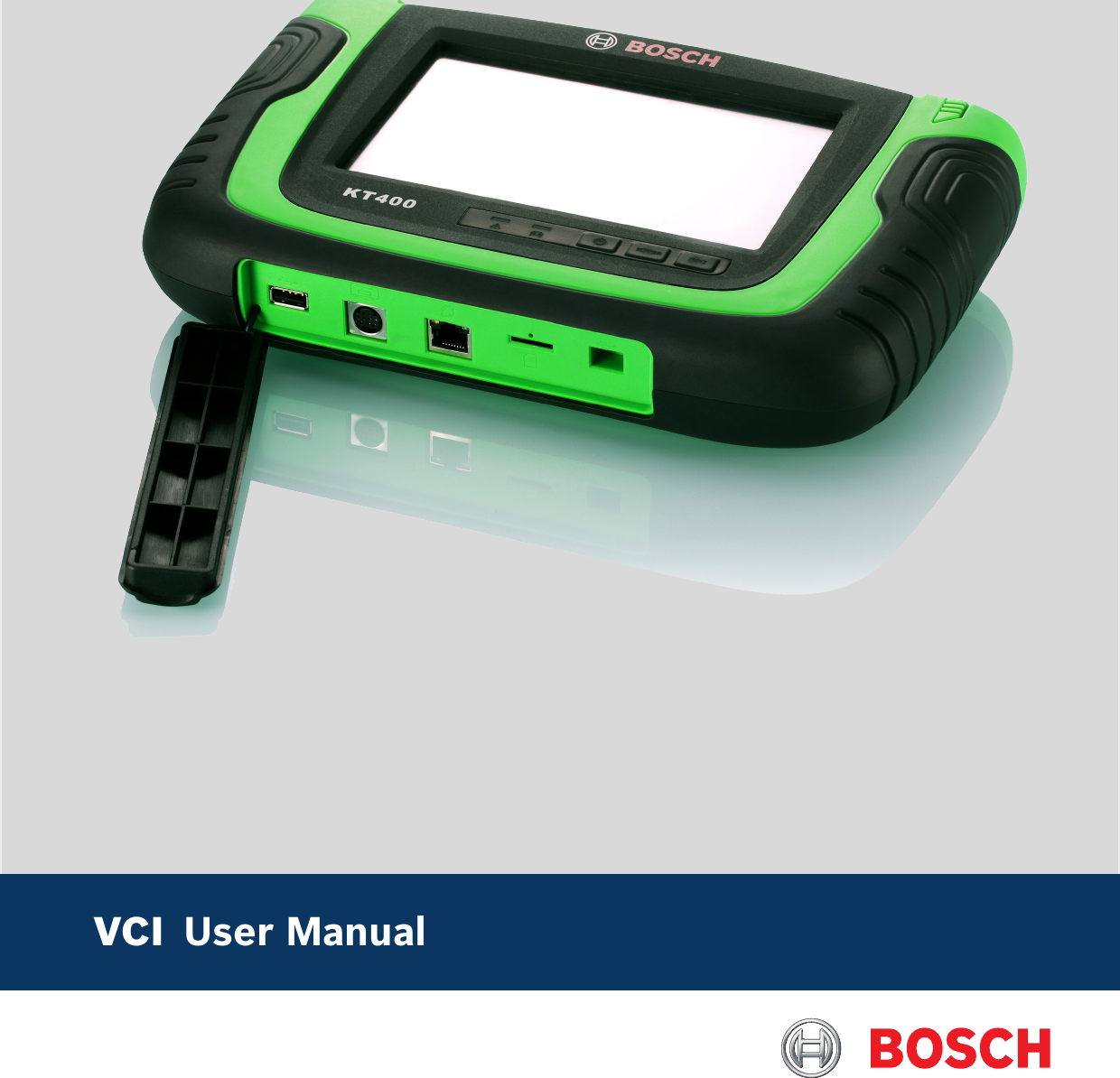
Bosch Automotive Diagnostics Equipment KT400 KT400 is used for vehicle ECU diagnosis User Manual

Bosch Automotive Diagnostics Equipment (Shenzhen) Limited KT400 is used for vehicle ECU diagnosis

User manual

VCI User Manual
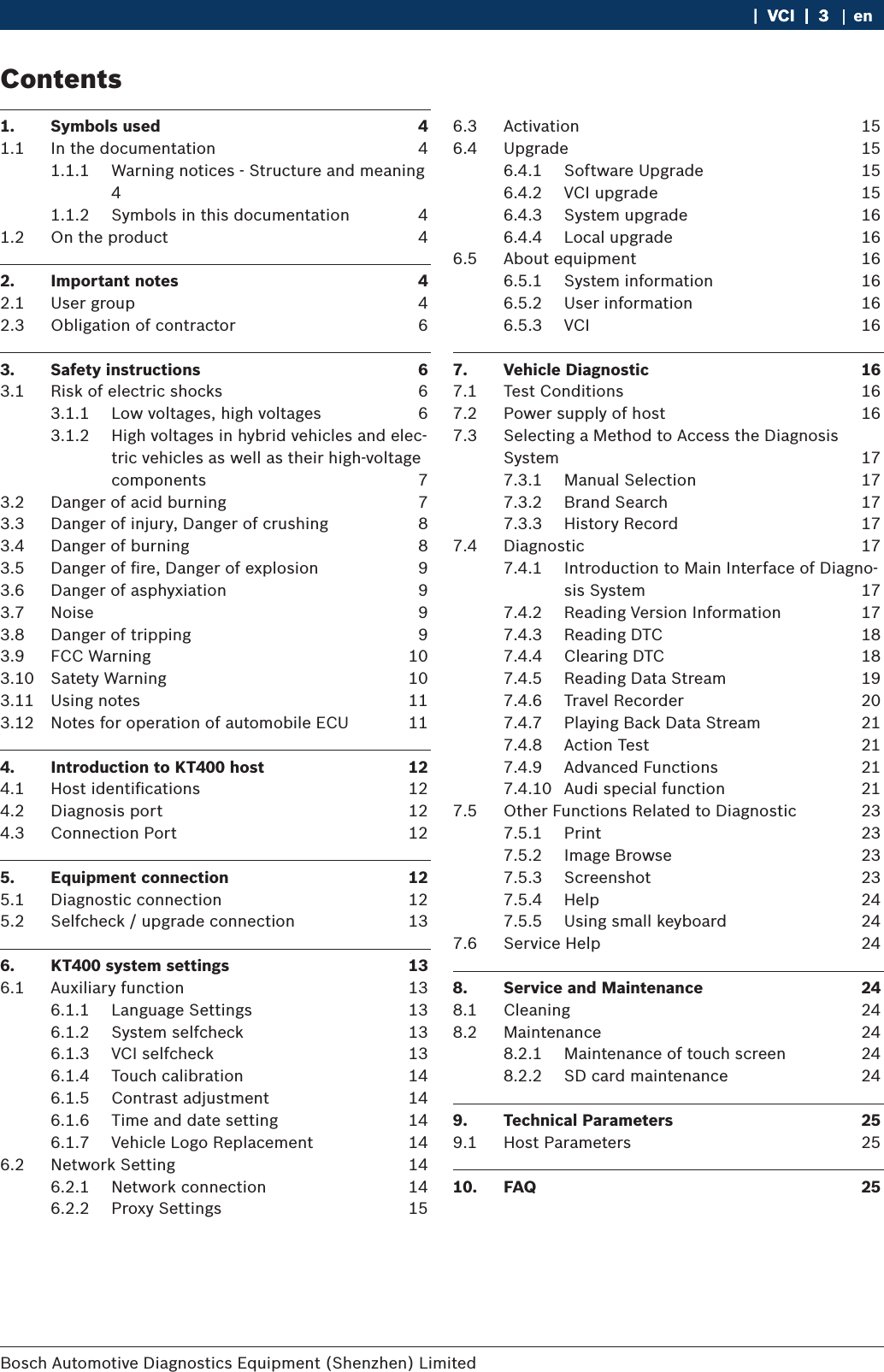
Bosch Automotive Diagnostics Equipment (Shenzhen) Limited    |  VCI  |  3VCI  |  3  |  3 en1.  Symbols used  41.1  In the documentation  41.1.1  Warning notices - Structure and meaning 41.1.2  Symbols in this documentation  41.2  On the product  42.  Important notes  42.1  User group  42.3  Obligation of contractor  63.  Safety instructions  63.1  Risk of electric shocks  63.1.1  Low voltages, high voltages  63.1.2  High voltages in hybrid vehicles and elec-tric vehicles as well as their high-voltage components  73.2  Danger of acid burning  73.3  Danger of injury, Danger of crushing  83.4  Danger of burning  83.5  Danger of fire, Danger of explosion  93.6  Danger of asphyxiation  93.7  Noise  93.8  Danger of tripping  93.9  FCC Warning  103.10  Satety Warning  103.11  Using notes  113.12  Notes for operation of automobile ECU  114.  Introduction to KT400 host  124.1  Host identifications   124.2  Diagnosis port  124.3  Connection Port  125.  Equipment connection  125.1  Diagnostic connection  125.2  Selfcheck / upgrade connection  136.  KT400 system settings  136.1  Auxiliary function  136.1.1  Language Settings  136.1.2  System selfcheck  136.1.3  VCI selfcheck  136.1.4  Touch calibration  146.1.5  Contrast adjustment  146.1.6  Time and date setting  146.1.7  Vehicle Logo Replacement  146.2  Network Setting  146.2.1  Network connection  146.2.2  Proxy Settings  156.3  Activation  156.4  Upgrade  156.4.1  Software Upgrade  156.4.2  VCI upgrade  156.4.3  System upgrade  166.4.4  Local upgrade  166.5  About equipment  166.5.1  System information  166.5.2  User information  166.5.3  VCI  167.  Vehicle Diagnostic  167.1  Test Conditions  167.2  Power supply of host  167.3  Selecting a Method to Access the Diagnosis System  177.3.1  Manual Selection  177.3.2  Brand Search  177.3.3  History Record  177.4  Diagnostic  177.4.1  Introduction to Main Interface of Diagno-sis System  177.4.2  Reading Version Information  177.4.3  Reading DTC  187.4.4  Clearing DTC  187.4.5  Reading Data Stream  197.4.6  Travel Recorder  207.4.7  Playing Back Data Stream  217.4.8  Action Test  217.4.9  Advanced Functions  217.4.10  Audi special function  217.5  Other Functions Related to Diagnostic  237.5.1  Print  237.5.2  Image Browse  237.5.3  Screenshot  237.5.4  Help  247.5.5  Using small keyboard  247.6  Service Help  248.  Service and Maintenance  248.1  Cleaning  248.2  Maintenance  248.2.1  Maintenance of touch screen  248.2.2  SD card maintenance  249.  Technical Parameters  259.1  Host Parameters  2510.  FAQ  25Contents
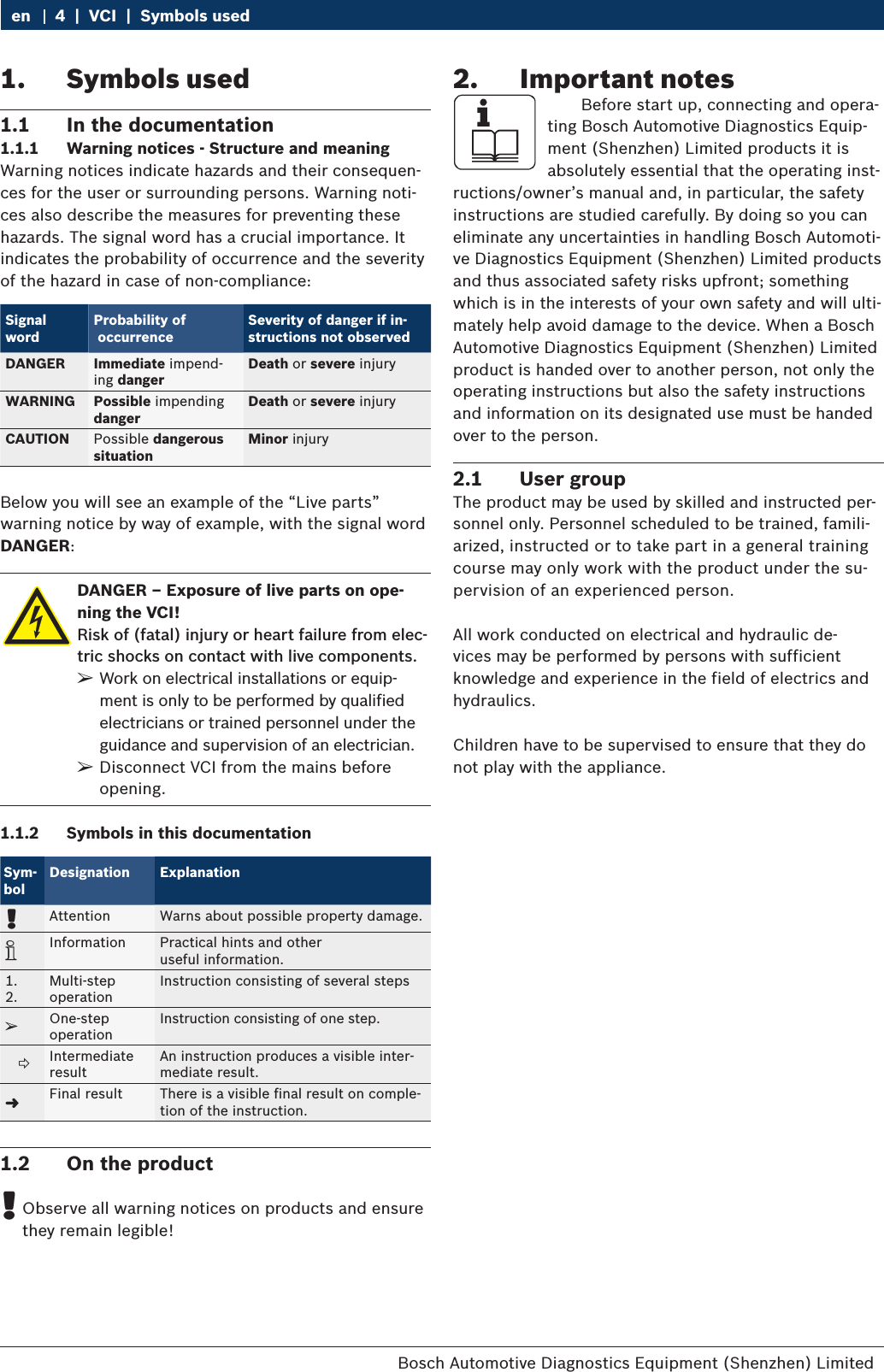
Bosch Automotive Diagnostics Equipment (Shenzhen) Limited 4  |  VCI  |  Symbols useden1.  Symbols used1.1  In the documentation1.1.1  Warning notices - Structure and meaningWarning notices indicate hazards and their consequen-ces for the user or surrounding persons. Warning noti-ces also describe the measures for preventing these hazards. The signal word has a crucial importance. It indicates the probability of occurrence and the severity of the hazard in case of non-compliance: Signal wordProbability of  occurrenceSeverity of danger if in-structions not observedDANGER Immediate impend-ing dangerDeath or severe injuryWARNING Possible impendingdangerDeath or severe injuryCAUTION Possible dangerous situationMinor injuryBelow you will see an example of the “Live parts” warning notice by way of example, with the signal word DANGER:DANGER – Exposure of live parts on ope-ning the VCI!Risk of (fatal) injury or heart failure from elec-tric shocks on contact with live components.  ¶Work on electrical installations or equip-ment is only to be performed by qualified electricians or trained personnel under the guidance and supervision of an electrician.  ¶Disconnect VCI from the mains before opening.1.1.2  Symbols in this documentationSym- bolDesignation Explanation!Attention Warns about possible property damage.iInformation Practical hints and other  useful information.1.2.Multi-step  operationInstruction consisting of several stepseOne-step  operationInstruction consisting of one step.    Intermediate  resultAn instruction produces a visible inter-mediate result."Final result There is a visible final result on comple-tion of the instruction.1.2  On the product !Observe all warning notices on products and ensure they remain legible!2.  Important notes    Before start up, connecting and opera-ting Bosch Automotive Diagnostics Equip-ment (Shenzhen) Limited products it is absolutely essential that the operating inst-ructions/owner’s manual and, in particular, the safety instructions are studied carefully. By doing so you can eliminate any uncertainties in handling Bosch Automoti-ve Diagnostics Equipment (Shenzhen) Limited products and thus associated safety risks upfront; something which is in the interests of your own safety and will ulti-mately help avoid damage to the device. When a Bosch Automotive Diagnostics Equipment (Shenzhen) Limited product is handed over to another person, not only the operating instructions but also the safety instructions and information on its designated use must be handed over to the person.2.1  User groupThe product may be used by skilled and instructed per-sonnel only. Personnel scheduled to be trained, famili-arized, instructed or to take part in a general training course may only work with the product under the su-pervision of an experienced person.All work conducted on electrical and hydraulic de-vices may be performed by persons with sufficient knowledge and experience in the field of electrics and hydraulics.Children have to be supervised to ensure that they do not play with the appliance.
Bosch Automotive Diagnostics Equipment (Shenzhen) Limited Symbols used  |  VCI  |  5VCI  |  5  |  5 en2.2  AgreementBy using the product you agree to the following regulations:Declare RRefer to packing list for detailed product configura-tion; RRefer to software for functions, pictures.This product cannot use in:Locations characterized by a separate power network, in most cases supplied from a high- or medium-voltage transformer, dedicated for the supply of installations feeding manufacturing or similar plants with one or more of the following conditions:– frequent switching of heavy inductive or capacitive loads;– high currents and associated magnetic fields;– presence of Industrial, Scientific and Medical (ISM) apparatus (for example, welding machines).The equipment complies with relevant requirements of Directive 2004/108/EC for Electromagnetic compatibili-ty (EMC) and Directive 2006/95/EC for Low Voltage.CopyrightSoftware and data are the property of Bosch Automo-tive  Diagnostics  Equipment  (Shenzhen)  Limited  or  its suppliers  and  protected  against  copying  by  copyright laws, international agreements and other national legal regulations. Copying or selling of data and software or any  part  thereof  is  impermissible  and  punishable;  in the event of  any infringements  Bosch  Automotive Dia-gnostics  Equipment  (Shenzhen)  Limited  reserves  the right to proceed with criminal prosecution and to claim for damages.LiabilityAll data in this program is based - where possible - on manufacturer  and  importer  details.  Bosch  Automotive Diagnostics  Equipment  (Shenzhen)  Limited  does  not accept liability for the correctness and completeness of software and data; liability for damage caused by faulty software  and  data  is  ruled  out.  Whatever  the  event, Bosch  Automotive  Diagnostics  Equipment  (Shenzhen) Limited liability is restricted to the amount for which the customer actually pays for this product. This disclaimer of liability does not apply to damages caused by intent or  gross  negligence  on  the  part  of  Bosch  Automotive Diagnostics Equipment (Shenzhen) Limited.WarrantyAny  use  of  non-approved  hardware  and  software  will result in a modification to our product and thus to exclu-sion of any liability and warranty, even if the hardware or software has in the meantime been removed or deleted.No changes may be made to our products. Our products may  only  be  used  in  combination  with  original  acces-sories and original service parts. Failing to do so, will render null and void all warranty claims.This  product  may  only  be  operated  using  Bosch  Au-tomotive  Diagnostics  Equipment  (Shenzhen)  Limited  approved operating systems. If the product is operated using an operating system other than the approved one, then  our  warranty  obligation  pursuant  to  our  supply conditions will be rendered null and void. Furthermore, we will not be held liable for damage and consequential damage  incurred  through  the  use  of  a  non-approved operating system.
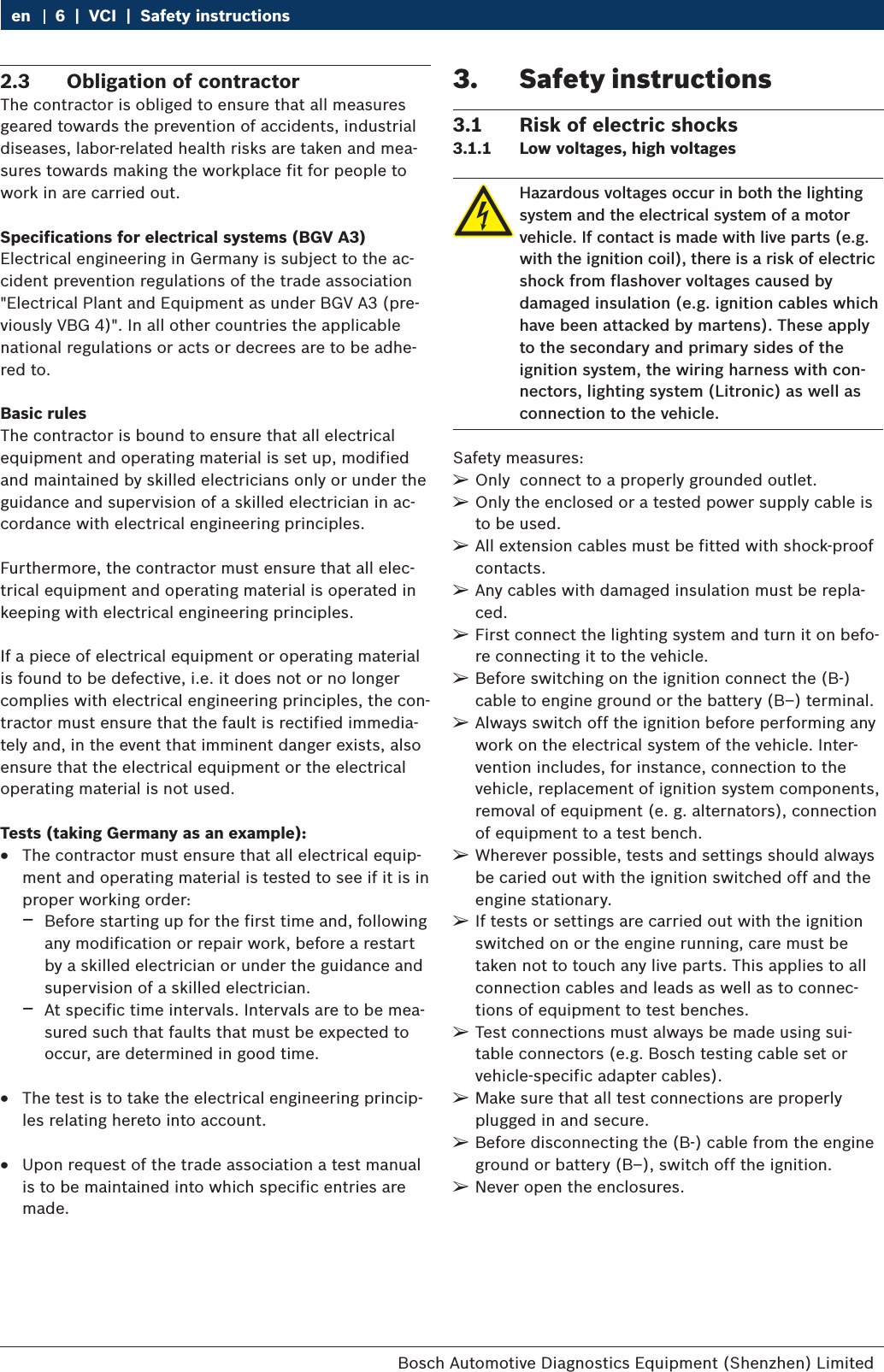
Bosch Automotive Diagnostics Equipment (Shenzhen) Limited 6  |  VCI  |  Safety instructionsen2.3  Obligation of contractorThe contractor is obliged to ensure that all measures geared towards the prevention of accidents, industrial diseases, labor-related health risks are taken and mea-sures towards making the workplace fit for people to work in are carried out. Specifications for electrical systems (BGV A3)Electrical engineering in Germany is subject to the ac-cident prevention regulations of the trade association "Electrical Plant and Equipment as under BGV A3 (pre-viously VBG 4)". In all other countries the applicable national regulations or acts or decrees are to be adhe-red to.Basic rulesThe contractor is bound to ensure that all electrical equipment and operating material is set up, modified and maintained by skilled electricians only or under the guidance and supervision of a skilled electrician in ac-cordance with electrical engineering principles. Furthermore, the contractor must ensure that all elec-trical equipment and operating material is operated in keeping with electrical engineering principles.If a piece of electrical equipment or operating material is found to be defective, i.e. it does not or no longer complies with electrical engineering principles, the con-tractor must ensure that the fault is rectified immedia-tely and, in the event that imminent danger exists, also ensure that the electrical equipment or the electrical operating material is not used.Tests (taking Germany as an example): RThe contractor must ensure that all electrical equip-ment and operating material is tested to see if it is in proper working order: $Before starting up for the first time and, following any modification or repair work, before a restart by a skilled electrician or under the guidance and supervision of a skilled electrician. $At specific time intervals. Intervals are to be mea-sured such that faults that must be expected to occur, are determined in good time. RThe test is to take the electrical engineering princip-les relating hereto into account. RUpon request of the trade association a test manual is to be maintained into which specific entries are made. 3.  Safety instructions3.1  Risk of electric shocks3.1.1  Low voltages, high voltagesHazardous voltages occur in both the lightingsystem and the electrical system of a motorvehicle. If contact is made with live parts (e.g.with the ignition coil), there is a risk of electricshock from flashover voltages caused bydamaged insulation (e.g. ignition cables whichhave been attacked by martens). These apply to the secondary and primary sides of the ignition system, the wiring harness with con-nectors, lighting system (Litronic) as well as connection to the vehicle.Safety measures: ¶Only  connect to a properly grounded outlet. ¶Only the enclosed or a tested power supply cable is to be used. ¶All extension cables must be fitted with shock-proof contacts. ¶Any cables with damaged insulation must be repla-ced. ¶First connect the lighting system and turn it on befo-re connecting it to the vehicle. ¶Before switching on the ignition connect the (B-) cable to engine ground or the battery (B–) terminal. ¶Always switch off the ignition before performing any work on the electrical system of the vehicle. Inter-vention includes, for instance, connection to the vehicle, replacement of ignition system components, removal of equipment (e. g. alternators), connection of equipment to a test bench. ¶Wherever possible, tests and settings should always be caried out with the ignition switched off and the engine stationary. ¶If tests or settings are carried out with the ignition switched on or the engine running, care must be taken not to touch any live parts. This applies to all connection cables and leads as well as to connec-tions of equipment to test benches. ¶Test connections must always be made using sui-table connectors (e.g. Bosch testing cable set or vehicle-specific adapter cables). ¶Make sure that all test connections are properly plugged in and secure. ¶Before disconnecting the (B-) cable from the engine ground or battery (B–), switch off the ignition. ¶Never open the enclosures.
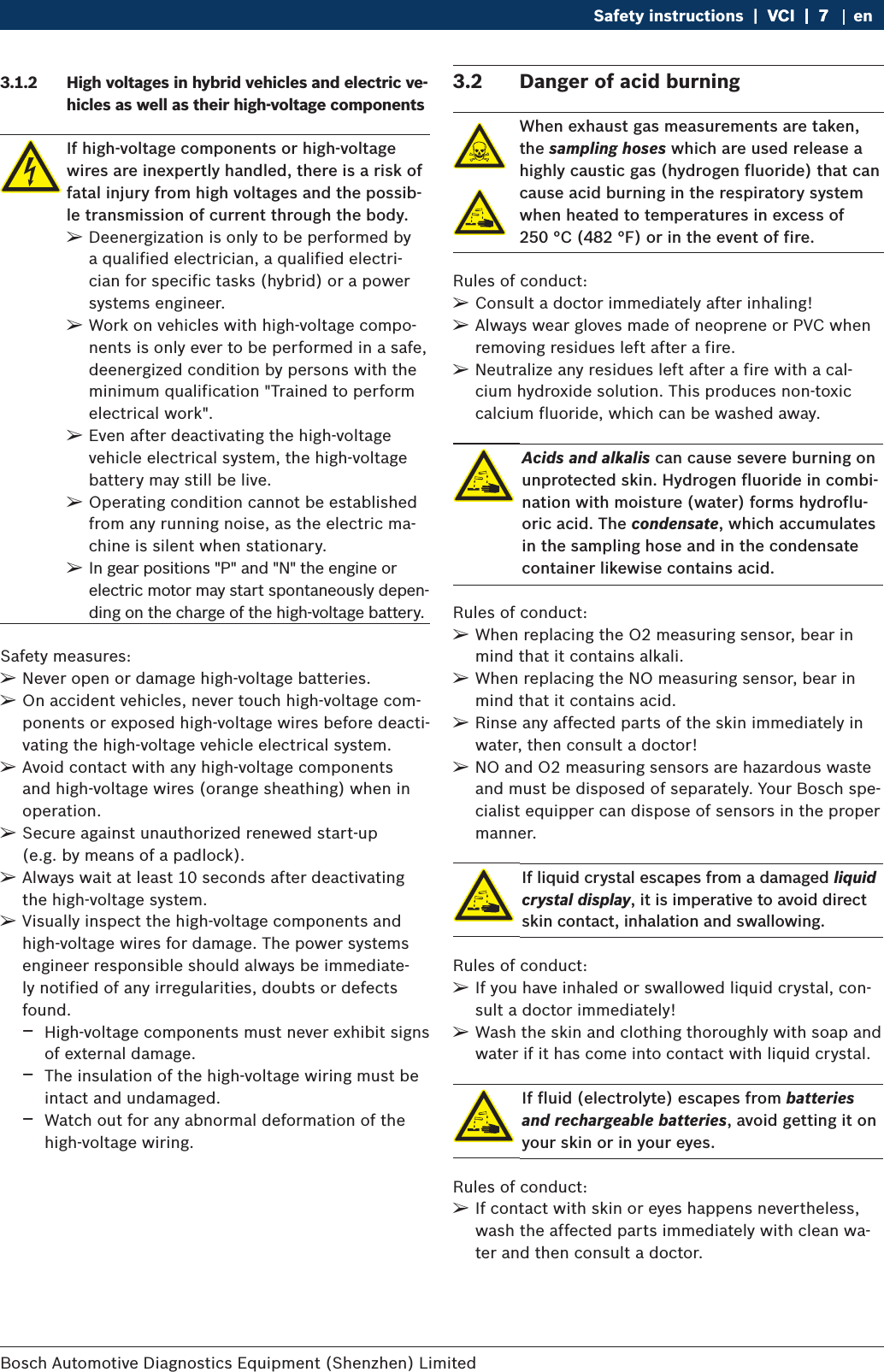
Bosch Automotive Diagnostics Equipment (Shenzhen) Limited Safety instructions  |  VCI  |  7VCI  |  7  |  7 en3.1.2  High voltages in hybrid vehicles and electric ve-hicles as well as their high-voltage componentsIf high-voltage components or high-voltage wires are inexpertly handled, there is a risk of fatal injury from high voltages and the possib-le transmission of current through the body.  ¶Deenergization is only to be performed by a qualified electrician, a qualified electri-cian for specific tasks (hybrid) or a power systems engineer.   ¶Work on vehicles with high-voltage compo-nents is only ever to be performed in a safe, deenergized condition by persons with the minimum qualification "Trained to perform electrical work".  ¶Even after deactivating the high-voltage vehicle electrical system, the high-voltage battery may still be live. ¶Operating condition cannot be established from any running noise, as the electric ma-chine is silent when stationary. ¶In gear positions "P" and "N" the engine or electric motor may start spontaneously depen-ding on the charge of the high-voltage battery.Safety measures: ¶Never open or damage high-voltage batteries. ¶On accident vehicles, never touch high-voltage com-ponents or exposed high-voltage wires before deacti-vating the high-voltage vehicle electrical system. ¶Avoid contact with any high-voltage components and high-voltage wires (orange sheathing) when in operation. ¶Secure against unauthorized renewed start-up  (e.g. by means of a padlock). ¶Always wait at least 10 seconds after deactivating the high-voltage system. ¶Visually inspect the high-voltage components and high-voltage wires for damage. The power systems engineer responsible should always be immediate-ly notified of any irregularities, doubts or defects found. $High-voltage components must never exhibit signs of external damage. $The insulation of the high-voltage wiring must be intact and undamaged. $Watch out for any abnormal deformation of the high-voltage wiring.3.2  Danger of acid burningWhen exhaust gas measurements are taken, the sampling hoses which are used release a highly caustic gas (hydrogen fluoride) that can cause acid burning in the respiratory system when heated to temperatures in excess of  250 °C (482 °F) or in the event of fire.Rules of conduct: ¶Consult a doctor immediately after inhaling! ¶Always wear gloves made of neoprene or PVC when removing residues left after a fire. ¶Neutralize any residues left after a fire with a cal-cium hydroxide solution. This produces non-toxic calcium fluoride, which can be washed away.Acids and alkalis can cause severe burning on unprotected skin. Hydrogen fluoride in combi-nation with moisture (water) forms hydroflu-oric acid. The condensate, which accumulates in the sampling hose and in the condensate container likewise contains acid.Rules of conduct: ¶When replacing the O2 measuring sensor, bear in mind that it contains alkali. ¶When replacing the NO measuring sensor, bear in mind that it contains acid. ¶Rinse any affected parts of the skin immediately in water, then consult a doctor! ¶NO and O2 measuring sensors are hazardous waste and must be disposed of separately. Your Bosch spe-cialist equipper can dispose of sensors in the proper manner.If liquid crystal escapes from a damaged liquid crystal display, it is imperative to avoid direct skin contact, inhalation and swallowing.Rules of conduct: ¶If you have inhaled or swallowed liquid crystal, con-sult a doctor immediately! ¶Wash the skin and clothing thoroughly with soap and water if it has come into contact with liquid crystal.If fluid (electrolyte) escapes from batteries and rechargeable batteries, avoid getting it on your skin or in your eyes.Rules of conduct: ¶If contact with skin or eyes happens nevertheless, wash the affected parts immediately with clean wa-ter and then consult a doctor.
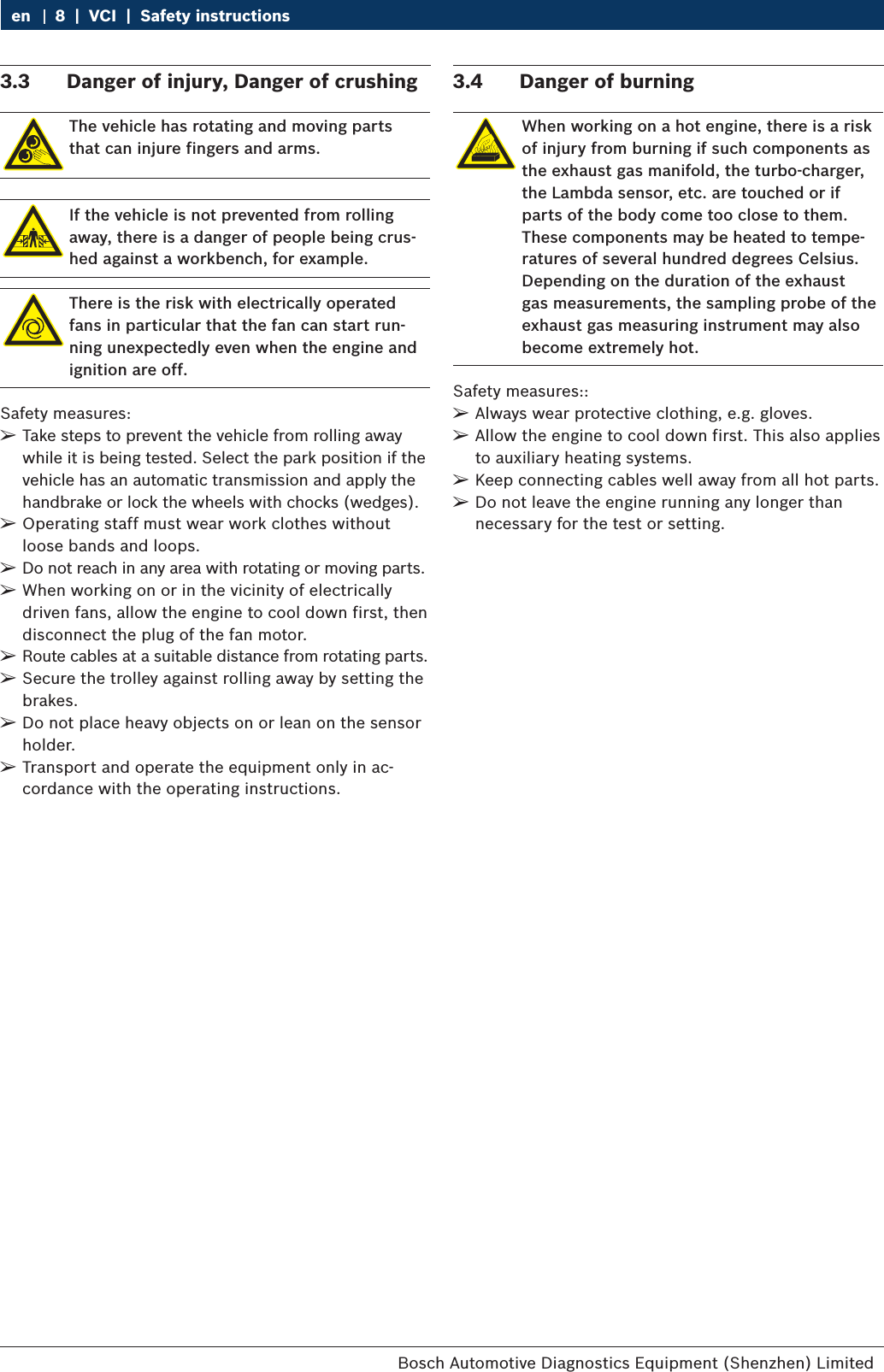
Bosch Automotive Diagnostics Equipment (Shenzhen) Limited 8  |  VCI  |  Safety instructionsen3.3  Danger of injury, Danger of crushingThe vehicle has rotating and moving parts that can injure fingers and arms.If the vehicle is not prevented from rolling away, there is a danger of people being crus-hed against a workbench, for example.There is the risk with electrically operated fans in particular that the fan can start run-ning unexpectedly even when the engine and ignition are off.Safety measures: ¶Take steps to prevent the vehicle from rolling away while it is being tested. Select the park position if the vehicle has an automatic transmission and apply the handbrake or lock the wheels with chocks (wedges). ¶Operating staff must wear work clothes without loose bands and loops. ¶Do not reach in any area with rotating or moving parts. ¶When working on or in the vicinity of electrically driven fans, allow the engine to cool down first, then disconnect the plug of the fan motor. ¶Route cables at a suitable distance from rotating parts. ¶Secure the trolley against rolling away by setting the brakes. ¶Do not place heavy objects on or lean on the sensor holder. ¶Transport and operate the equipment only in ac-cordance with the operating instructions.3.4  Danger of burningWhen working on a hot engine, there is a risk of injury from burning if such components as the exhaust gas manifold, the turbo-charger, the Lambda sensor, etc. are touched or if parts of the body come too close to them. These components may be heated to tempe-ratures of several hundred degrees Celsius. Depending on the duration of the exhaust gas measurements, the sampling probe of the exhaust gas measuring instrument may also become extremely hot.Safety measures:: ¶Always wear protective clothing, e.g. gloves. ¶Allow the engine to cool down first. This also applies to auxiliary heating systems. ¶Keep connecting cables well away from all hot parts. ¶Do not leave the engine running any longer than necessary for the test or setting.
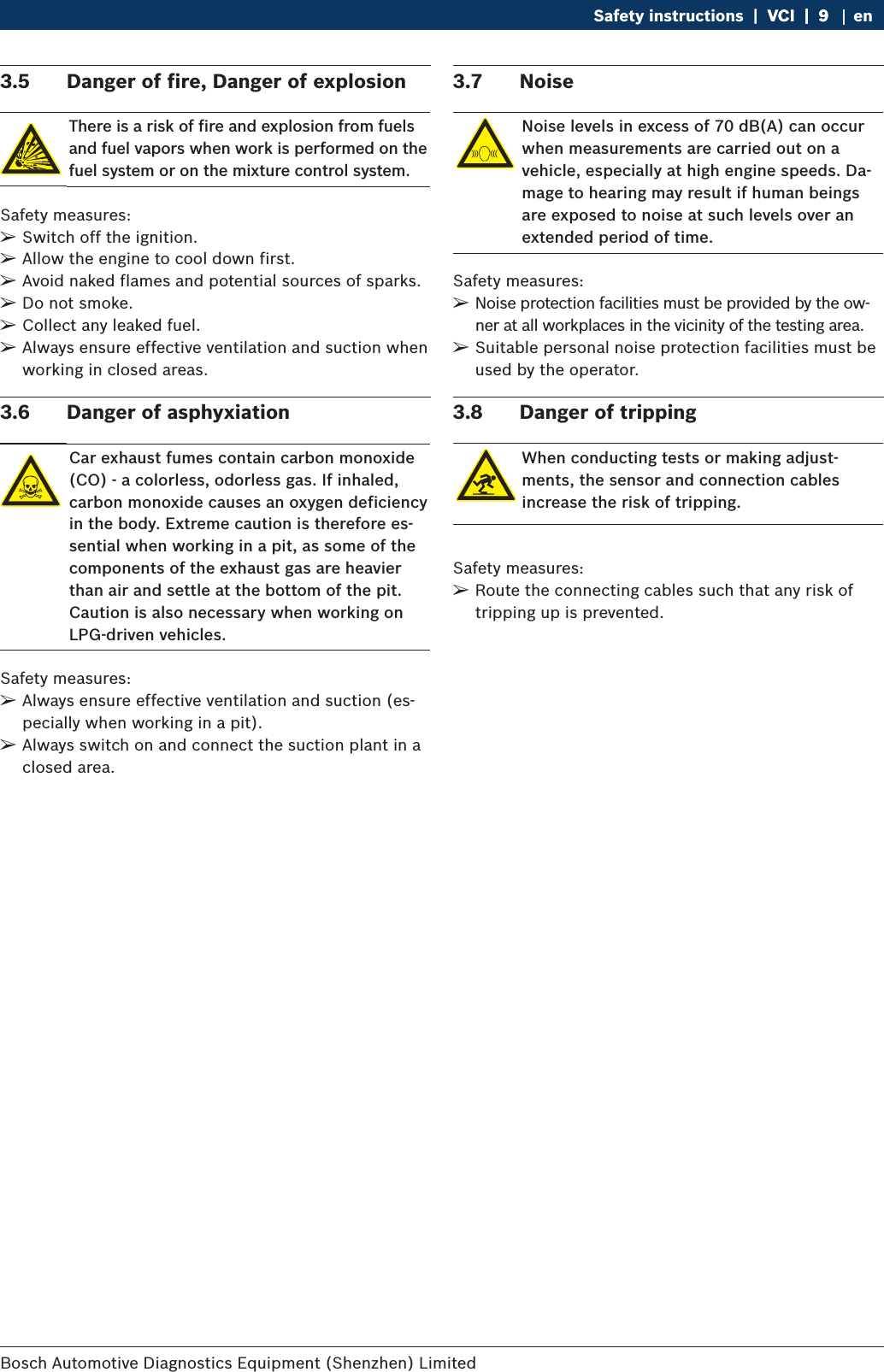
Bosch Automotive Diagnostics Equipment (Shenzhen) Limited Safety instructions  |  VCI  |  9VCI  |  9  |  9 en3.5  Danger of fire, Danger of explosionThere is a risk of fire and explosion from fuels and fuel vapors when work is performed on the fuel system or on the mixture control system.Safety measures: ¶Switch off the ignition. ¶Allow the engine to cool down first. ¶Avoid naked flames and potential sources of sparks. ¶Do not smoke. ¶Collect any leaked fuel. ¶Always ensure effective ventilation and suction when working in closed areas.3.6  Danger of asphyxiationCar exhaust fumes contain carbon monoxide (CO) - a colorless, odorless gas. If inhaled, carbon monoxide causes an oxygen deficiency in the body. Extreme caution is therefore es-sential when working in a pit, as some of the components of the exhaust gas are heavier than air and settle at the bottom of the pit. Caution is also necessary when working on LPG-driven vehicles.Safety measures: ¶Always ensure effective ventilation and suction (es-pecially when working in a pit). ¶Always switch on and connect the suction plant in a closed area.3.7  NoiseNoise levels in excess of 70 dB(A) can occur when measurements are carried out on a vehicle, especially at high engine speeds. Da-mage to hearing may result if human beings are exposed to noise at such levels over an extended period of time.Safety measures: ¶Noise protection facilities must be provided by the ow-ner at all workplaces in the vicinity of the testing area. ¶Suitable personal noise protection facilities must be used by the operator.3.8  Danger of trippingWhen conducting tests or making adjust-ments, the sensor and connection cables increase the risk of tripping.Safety measures: ¶Route the connecting cables such that any risk of tripping up is prevented.
Bosch Automotive Diagnostics Equipment (Shenzhen) Limited 10  |  VCI  |  Safety instructionsen3.9  FCC WarningThis device complies with Part 15 of the FCC Rules. Operation is subject to the following two conditions:(1) this device may not cause harmful intererence, and (2) this device must accept any interference received, including interference that may cause undesired opera-tion.Note: changes or modifications not expressly approved by the party responsible for compliance could void the user's authority to operate the equipment. This equip-ment has been tested and found to comply with the limits for a Class B digital device, pursuant to Part 15 of the FCC Rules. These limits are designed to provide reasonable protection against harmful interference in a residential installation. This equipment generates, us-ers and can radiate radio frequency energy and, if not installed and used in accordance with the instructions, may cause harmful interference to radio communica-tions. However, there is no guarantee the interference will not occur in a particular insatllation. If this equip-ment does cause harmful interference to radio or televi-sion reception, which can be determined by turning the equipment off and on, the user is encouraged to try to correct the interference by one or more of the following measures: RReorient or relocate the receiving antenna; RIncrease the separation between the equipment and receiver; RConnect the equipment into an outlet on a circuit different from that to which the receiver is connec-ted; RConsult the dealer or an experienced radio/TV tech-nician for help.3.10  Satety Warning RInspection shall be carried out in good ventilation. Connect the exhaust pipe to outside if there is no enough ventilation; RSmoking and open fire are prohibited in the inspec-tion; RThe battery liquid contains sulphuric acid that could erode the skin. Avoid battery liquid from touching the skin directly in operation, especially note that the liquid shall not be splashed into eye; RThe engine temperature is high when running. Avoid touching the high-temperature parts, such as radia-tor and exhaust pipe; RPull manual brake before starting the engine. Block the front wheels and place shift lever at P or neutral gear to avoid accident when starting the engine; RIf external batter is used as power supply, pay attention to the electrode; use red alligator clip to connect anode and black alligator clip to connect cathode; RKeep all the power cables, pens and tools away from belt or other moving parts if using instrument in engine compartment; RDo not wear watch, ring and loose clothes in mainte-nance for engine compartment; RWear approved safety glasses in all inspection pro-cesses; ROnly the enclosed power adapter or power supply cable can be used for supply connection; RIf the equipment is used in a manner not specified by the manufacturer, the protection provided by the equipment may be impaired; RPlease don't use it to clip the body when Alligator Clip have powered.
Bosch Automotive Diagnostics Equipment (Shenzhen) Limited Safety instructions  |  VCI  |  11VCI  |  11  |  11 en3.11  Using notes RThe instrument is precise electronic instrument, do not drop it; RThe instrument may respond slowly in first inspec-tion. Please be patient. Do not operate the instru-ment frequently; RIf the program is interrupted or the display is disor-dered after flashing. Shut off the power and switch it on again for test; REnsure that the instrument and the diagnosis retai-ner are connected securely, otherwise the interrup-ted signal will affect the test. If they can’t be con-nected normally, pull out the connector and plug it again. Do not shake the connector in using; RUse screw to fasten the connection wire and con-nectors to avoid disconnecting and damaging the interface. Hold the front end of the connector when pulling it. Do not pull the rear connection wire; RHandle the instrument gently and put it in safe place to avoid impact. Shut off the power when not using; RInsert the touch pen into the hole of the instrument after using and put the accessories into the kit; ROnline upgrade will be affected by local wire speed. Please wait patiently if the loading is slow; RCertain inspection and maintenance basis are requi-red to operate the instrument, as well as electrical control system of the inspected automobile.3.12  Notes for operation of automobile ECUPay attention to the following when diagnosing the au-tomobile equipped with computer control system: RDo not put the magnetic objects, such as radio loudspeaker near the computer, because the magne-tism of the loudspeaker will damage the circuits and parts in ECU; RNever switch off the internal electrical devices when the ignition switch is on. The self-induction of the coil when power-off will generate high instantaneous voltage that will damage the sensor and ECU; RSpecial attention shall be paid to avoid damaging ECU and sensor when carrying out maintenance near the computer or sensor; RConnect the ECU harness connector securely, other-wise it will damage the electronic units, such as integral circuit in ECU; RWear earthing metal strap with one end on the body and another end twisting finesse when repairing or approaching ECU-control digital instrument; RShut down ECU system power before welding on the automobile; RUnless specified, do not test the electrical devices related to ECU with test lamp to avoid damaging ECU or sensor; RUnless specified in test process, use digital instru-ment with high impedance to test ECU and sensor, rather than pointer ohm gauge.
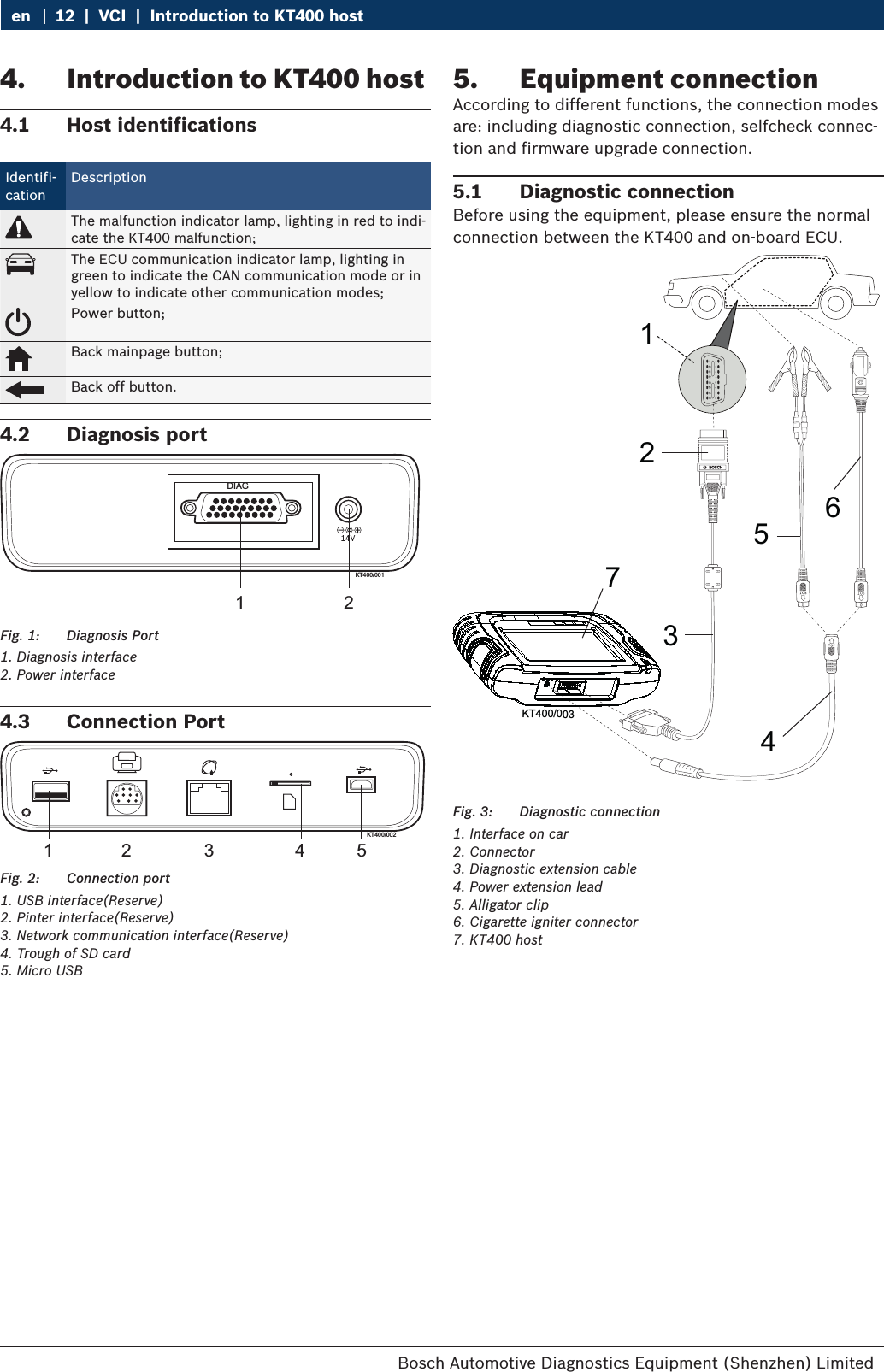
Bosch Automotive Diagnostics Equipment (Shenzhen) Limited 12  |  VCI  |  Introduction to KT400 hosten4.  Introduction to KT400 host4.1  Host identifications Identifi-cationDescriptionThe malfunction indicator lamp, lighting in red to indi-cate the KT400 malfunction;The ECU communication indicator lamp, lighting in green to indicate the CAN communication mode or in yellow to indicate other communication modes;Power button;Back mainpage button;Back off button.4.2  Diagnosis port1 2DIAGKT400/001Fig. 1:  Diagnosis Port1. Diagnosis interface2. Power interface4.3  Connection Port1 2 3 4 5KT400/002Fig. 2:  Connection port1. USB interface(Reserve)2. Pinter interface(Reserve)3. Network communication interface(Reserve)4. Trough of SD card5. Micro USB5.  Equipment connectionAccording to different functions, the connection modes are: including diagnostic connection, selfcheck connec-tion and firmware upgrade connection.5.1  Diagnostic connectionBefore using the equipment, please ensure the normal connection between the KT400 and on-board ECU.1234657KT400/003Fig. 3:  Diagnostic connection1. Interface on car2. Connector3. Diagnostic extension cable4. Power extension lead5. Alligator clip6. Cigarette igniter connector7. KT400 host
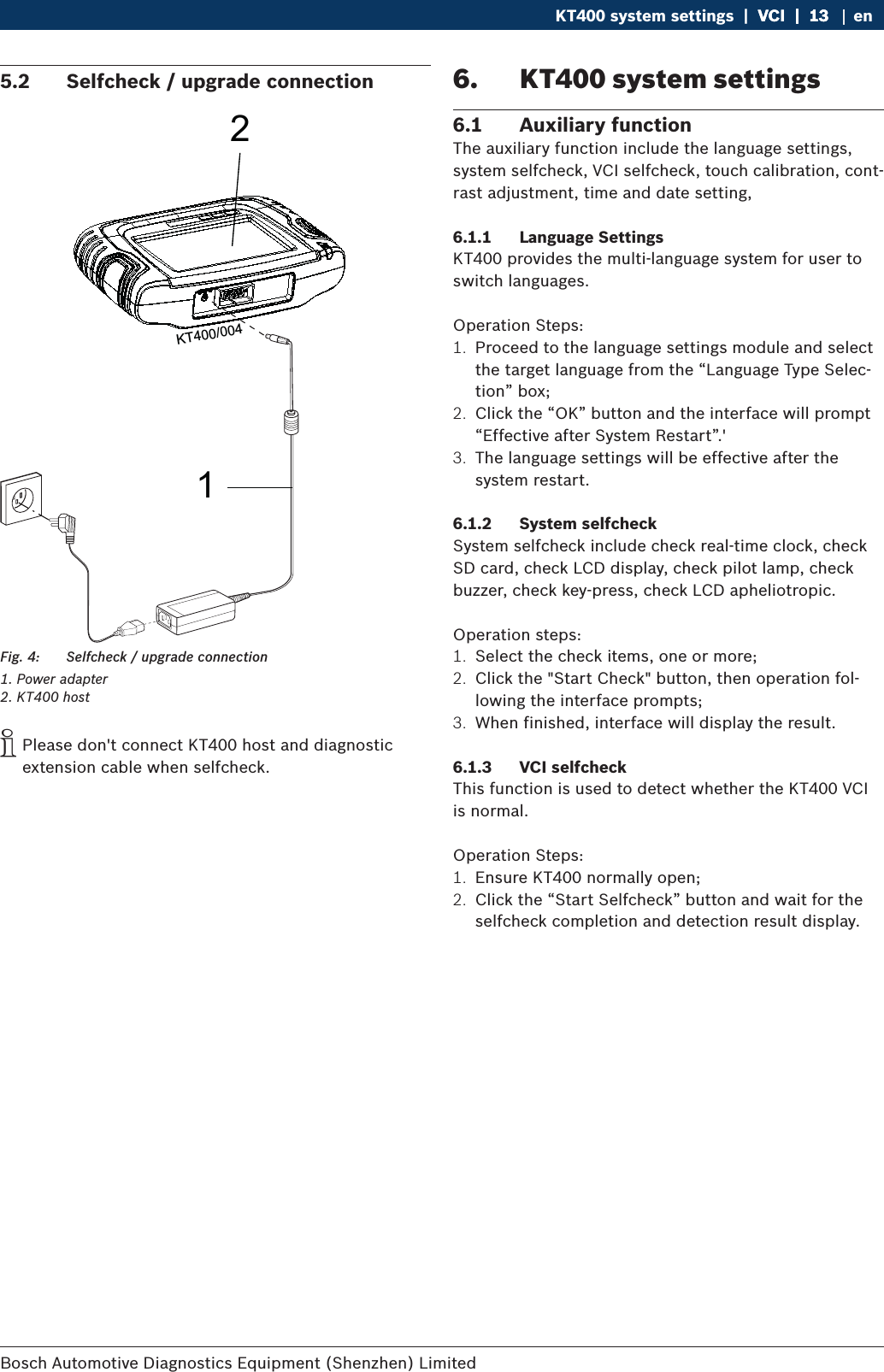
Bosch Automotive Diagnostics Equipment (Shenzhen) Limited KT400 system settings  |  VCI  |  13VCI  |  13  |  13 en5.2  Selfcheck / upgrade connection12KT400/004Fig. 4:  Selfcheck / upgrade connection1. Power adapter2. KT400 host iPlease don't connect KT400 host and diagnostic extension cable when selfcheck.6.  KT400 system settings6.1  Auxiliary functionThe auxiliary function include the language settings, system selfcheck, VCI selfcheck, touch calibration, cont-rast adjustment, time and date setting, 6.1.1  Language SettingsKT400 provides the multi-language system for user to switch languages.Operation Steps:1.  Proceed to the language settings module and select the target language from the “Language Type Selec-tion” box;2.  Click the “OK” button and the interface will prompt “Effective after System Restart”.'3.  The language settings will be effective after the system restart.6.1.2  System selfcheckSystem selfcheck include check real-time clock, check SD card, check LCD display, check pilot lamp, check buzzer, check key-press, check LCD apheliotropic.Operation steps:1.  Select the check items, one or more;2.  Click the "Start Check" button, then operation fol-lowing the interface prompts;3.  When finished, interface will display the result.6.1.3  VCI selfcheckThis function is used to detect whether the KT400 VCI is normal.Operation Steps:1.  Ensure KT400 normally open;2.  Click the “Start Selfcheck” button and wait for the selfcheck completion and detection result display.
Bosch Automotive Diagnostics Equipment (Shenzhen) Limited 14  |  VCI  |  KT400 system settingsen6.1.4  Touch calibrationWhen feeling the screen distorted during the use, the user may need to calibrate the touch screen. Click the Touch Calibration module to enter into the calibration window.Operation steps:1.  Click "Touch calibration" button, Click on the center of cross cursor accurately with the touch pen by following the prompt.,One calibration ends once the cursor changes;2.  Cross cursor will move to 5 points, include top left corner, below left corner, top right corner, below right corner, and center, after completing calibration at all corners, the system will prompt it the screen has been calibrated successfully and will return to the system setting menu automatically. iDon't click on the srceen before the cursor appears, otherwise it may lead to calibration failure.6.1.5  Contrast adjustmentThis function menu allows you to adjust LCD bright-ness of the instrument. Owing to its characteristics, LCD may perform differently in different sunlight, at different temperature and humidity. You may adjust and save the brightness value of LCD at any time to achieve the best effect.Operation steps:1.  By clicking the buttons "-" and "+" increase or decre-ase the brightness percentage;2.  After adjustment, click "ok" button, save the adjust-ments; You can click "cancel" button, don't change the adjustments.6.1.6  Time and date settingThis function is used to set time and date, for example: when you screenshot, the file name include current date and time.Operation steps:1.  Please select the change items;2.  By clicking the buttons "-" and "+" adjust the date and time;3.  Select format and separator of date; select time zone and format of time;4.  Click "OK" button, save the adjustments; you can click "Cancel" button, don't change the adjustments.6.1.7  Vehicle Logo ReplacementThere are two vehicle logo replacement methods: single replacement and integral replacement, with the single replacement taken as the default mode. The picture size is 136*115 (mm) and the picture format is bmp.6.1.7.1 Single ReplacementOnly one vehicle logo can be replaced one time.Operation Steps:1.  Select “Single Replacement”;2.  Select the vehicle logo to be replaced in the left dropdown box;3.  Select the target vehicle logo on the right;4.  Click the    button in the middle to synchronize logos at both sides; at the same time, the replace-ment button changes to the available status;5.  Click the “Replace” button. iYou can select the vehicle logo according to brand when single replacement.6.1.7.2 Integral ReplacementSeveral vehicle logos can be replaced one time.Operation Steps:1.  Select the “Integral Replacement”;2.  Click the “Browse” button to select the target pic-ture folder, and its path shall correspond with the path in the CF folder;3.  Click the “Replace” button.6.2  Network Setting6.2.1  Network connectionThis function is used to set netword connection.Automatic access to IP or automatic access to DNS, click "OK" button to save the setting informaton.Operation steps of manually set the IP:1.  Click "Manually set the IP" option;2.  Order to enter information of IP adress, Subnet mask , the default gateway;3.  Click "OK" button to save the information.Operation steps of manually set the DNS:1.  Click "Manully set the DNS" option;2.  Order to enter information of "Preferred DNS server" or "Altemate DNS server";3.  Click "OK" button to save the information.
Bosch Automotive Diagnostics Equipment (Shenzhen) Limited KT400 system settings  |  VCI  |  15VCI  |  15  |  15 en6.2.2  Proxy SettingsThis function is intended to judge whether the proxy server is required for the computer networking; if not required, select “Don't Use the Proxy Server”.Setting method for using the proxy server:1.  Select “Use the Proxy Server”;2.  Enter the address and port information;3.  If there have user name and password, you must to enter the correct information, then using the proxy server;4.  Click the “OK” button.6.3  ActivationIf the product is not activated, you can only view the test demonstration rather than carrying out the diagno-sis with KT400.Operation Steps:1.  Check whether KT400 is normally connected with internet;2.  KT400 will automatically detect the product serial number, click "Activation" button, the software will automatically detect the netword; If not ok, display "Network connection overtime", please enter into "Network connection" model to set;3.  If network is worked to proceed to the individual in-formation filling interface; please enter your informa-tion following the interface prompts; If information incorrect, you must to re-enter;4.  If all information is accurate, click the “Next” button, the interface will display "Successful product activa-tion, software must to restart";5.  Please restart software, you can using it. i User name is combined by letters and numbers, the length is 3-16 characters; the password length is 6-16 characters; i The user name is used for upgrade log-in, which can’t be repeated, and real-name registration is recommended; the E-mail is used for the password retrieve, and please fill your frequently-used E-mail; upon submitting your individual information, please remember your user name and password.6.4  UpgradeUpgrade include software upgrade, VCI upgrade, sys-tem upgrade and local upgrade.This function is available only after the product activati-on. If not, display "Not activation". iBefore upgrade, please ensure the normal connec-tion between the KT400 and internet; iEnsure the integrity of the upgrade process by not forcing to terminate the program.6.4.1  Software UpgradeSoftware upgrade includes application software up-grade and diagnostic database upgrade.Operation Steps:1.  The software will automatically detect the version of application software and diagnostic database;2.  If you didn't change the user name and password, click the “New Version Detection” button to detect the latest version; If you changed, you must to enter user name and password at first;3.  If there have new version, the interface will display "Download" button;4.  Click "Download" button, waiting for finished; You can monitor download progress;5.  After successfully download, click "Install" button to insatll upgrade package;6.  After restart software, you can using the latest soft-ware. iWhen you log-in, user name and password is entered 3 times, if more, you must to wait 15 minutes.6.4.2  VCI upgradeIf software upgrade package include the latest VCI up-grade package, when you open KT400, the system will automatically remind to upgrade.Operation steps of manually upgrade:1.  Click "Upgrade" button to upgrade, You can monitor upgrade progress;2.  Wait for finished, if successfully upgrade, display "Successfully upgrade".
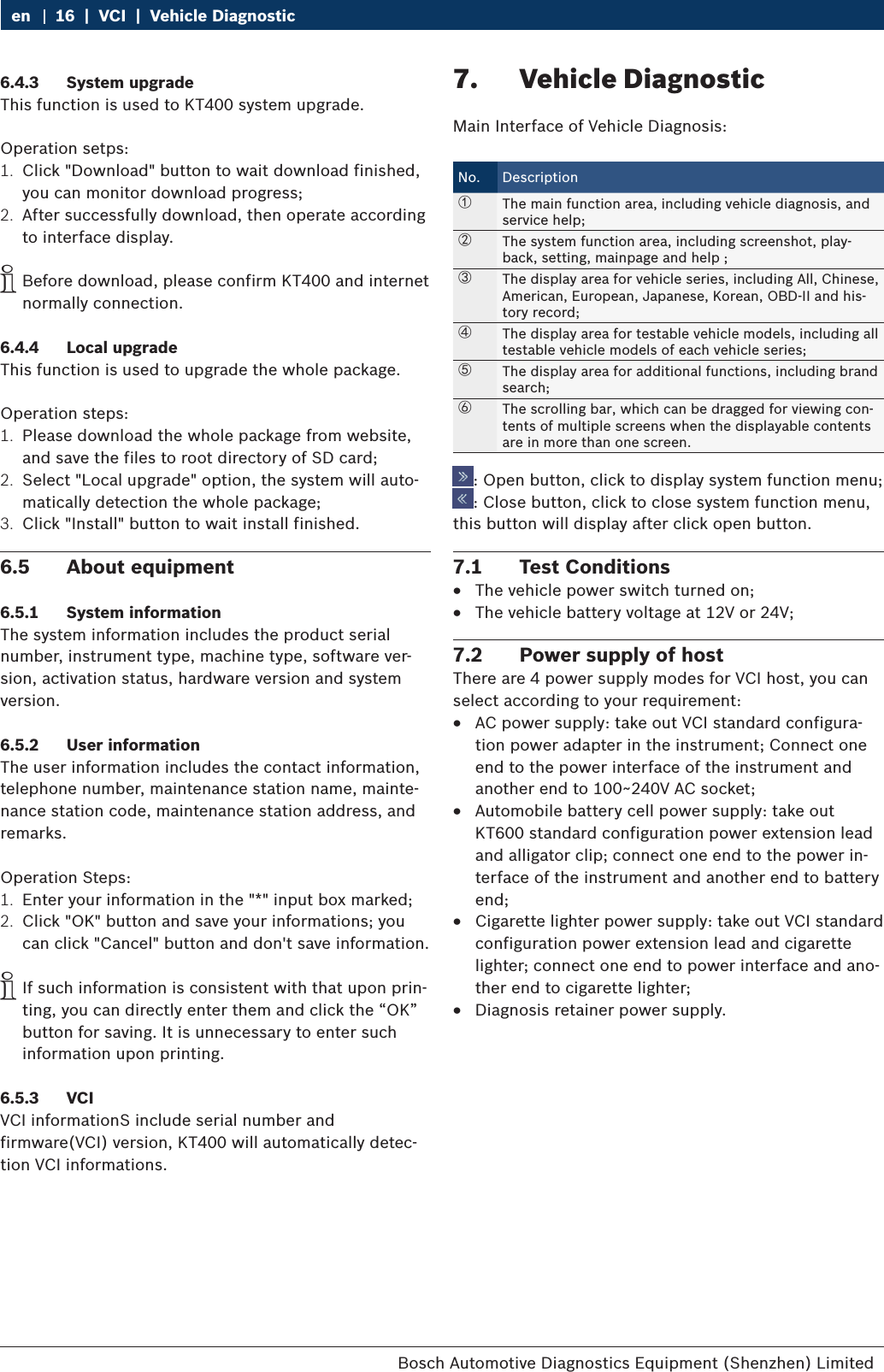
Bosch Automotive Diagnostics Equipment (Shenzhen) Limited 16  |  VCI  |  Vehicle Diagnosticen6.4.3  System upgradeThis function is used to KT400 system upgrade.Operation setps:1.  Click "Download" button to wait download finished, you can monitor download progress;2.  After successfully download, then operate according to interface display. iBefore download, please confirm KT400 and internet normally connection.6.4.4  Local upgradeThis function is used to upgrade the whole package.Operation steps:1.  Please download the whole package from website, and save the files to root directory of SD card;2.  Select "Local upgrade" option, the system will auto-matically detection the whole package;3.  Click "Install" button to wait install finished.6.5  About equipment6.5.1  System informationThe system information includes the product serial number, instrument type, machine type, software ver-sion, activation status, hardware version and system version.6.5.2  User informationThe user information includes the contact information, telephone number, maintenance station name, mainte-nance station code, maintenance station address, and remarks.Operation Steps:1.  Enter your information in the "*" input box marked;2.  Click "OK" button and save your informations; you can click "Cancel" button and don't save information. iIf such information is consistent with that upon prin-ting, you can directly enter them and click the “OK” button for saving. It is unnecessary to enter such information upon printing.6.5.3  VCIVCI informationS include serial number and firmware(VCI) version, KT400 will automatically detec-tion VCI informations.7.  Vehicle DiagnosticMain Interface of Vehicle Diagnosis:No. Description①The main function area, including vehicle diagnosis, and service help;②The system function area, including screenshot, play-back, setting, mainpage and help ;③The display area for vehicle series, including All, Chinese, American, European, Japanese, Korean, OBD-II and his-tory record;④The display area for testable vehicle models, including all testable vehicle models of each vehicle series;⑤The display area for additional functions, including brand search;⑥The scrolling bar, which can be dragged for viewing con-tents of multiple screens when the displayable contents are in more than one screen.: Open button, click to display system function menu;: Close button, click to close system function menu, this button will display after click open button.7.1  Test Conditions RThe vehicle power switch turned on; RThe vehicle battery voltage at 12V or 24V;7.2  Power supply of hostThere are 4 power supply modes for VCI host, you can select according to your requirement: RAC power supply: take out VCI standard configura-tion power adapter in the instrument; Connect one end to the power interface of the instrument and another end to 100~240V AC socket; RAutomobile battery cell power supply: take out KT600 standard configuration power extension lead and alligator clip; connect one end to the power in-terface of the instrument and another end to battery end; RCigarette lighter power supply: take out VCI standard configuration power extension lead and cigarette lighter; connect one end to power interface and ano-ther end to cigarette lighter; RDiagnosis retainer power supply.
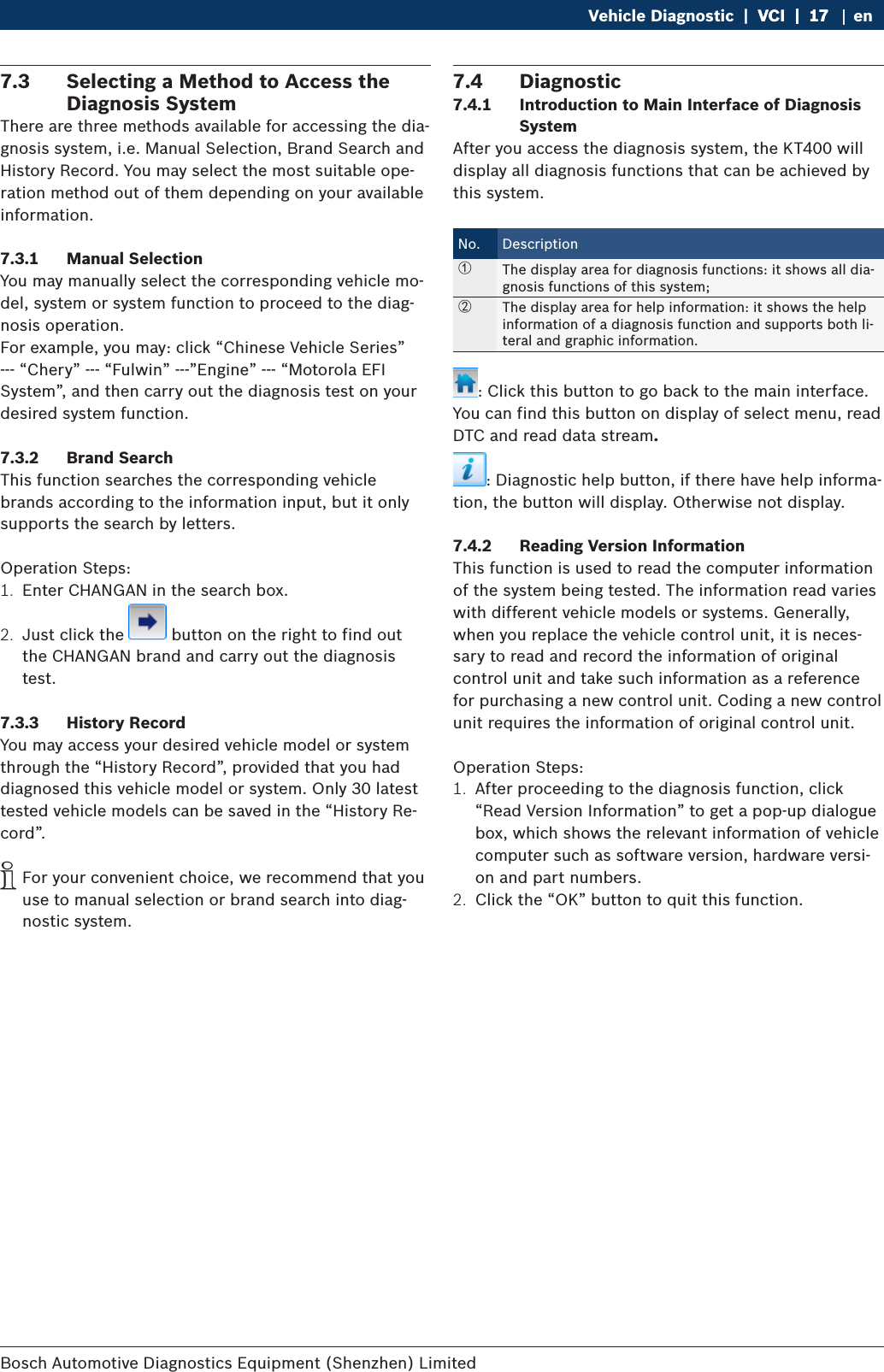
Bosch Automotive Diagnostics Equipment (Shenzhen) Limited Vehicle Diagnostic  |  VCI  |  17VCI  |  17  |  17 en7.3  Selecting a Method to Access the Diagnosis SystemThere are three methods available for accessing the dia-gnosis system, i.e. Manual Selection, Brand Search and History Record. You may select the most suitable ope-ration method out of them depending on your available information.7.3.1  Manual SelectionYou may manually select the corresponding vehicle mo-del, system or system function to proceed to the diag-nosis operation.For example, you may: click “Chinese Vehicle Series” --- “Chery” --- “Fulwin” ---”Engine” --- “Motorola EFI System”, and then carry out the diagnosis test on your desired system function.7.3.2  Brand SearchThis function searches the corresponding vehicle brands according to the information input, but it only supports the search by letters.Operation Steps:1.  Enter CHANGAN in the search box.2.  Just click the   button on the right to find out the CHANGAN brand and carry out the diagnosis test.7.3.3  History RecordYou may access your desired vehicle model or system through the “History Record”, provided that you had diagnosed this vehicle model or system. Only 30 latest tested vehicle models can be saved in the “History Re-cord”. iFor your convenient choice, we recommend that you use to manual selection or brand search into diag-nostic system.7.4  Diagnostic7.4.1  Introduction to Main Interface of Diagnosis SystemAfter you access the diagnosis system, the KT400 will display all diagnosis functions that can be achieved by this system.No. Description①The display area for diagnosis functions: it shows all dia-gnosis functions of this system;②The display area for help information: it shows the help information of a diagnosis function and supports both li-teral and graphic information.: Click this button to go back to the main interface. You can find this button on display of select menu, read DTC and read data stream.: Diagnostic help button, if there have help informa-tion, the button will display. Otherwise not display.7.4.2  Reading Version InformationThis function is used to read the computer information of the system being tested. The information read varies with different vehicle models or systems. Generally, when you replace the vehicle control unit, it is neces-sary to read and record the information of original control unit and take such information as a reference for purchasing a new control unit. Coding a new control unit requires the information of original control unit.Operation Steps:1.  After proceeding to the diagnosis function, click “Read Version Information” to get a pop-up dialogue box, which shows the relevant information of vehicle computer such as software version, hardware versi-on and part numbers.2.  Click the “OK” button to quit this function.
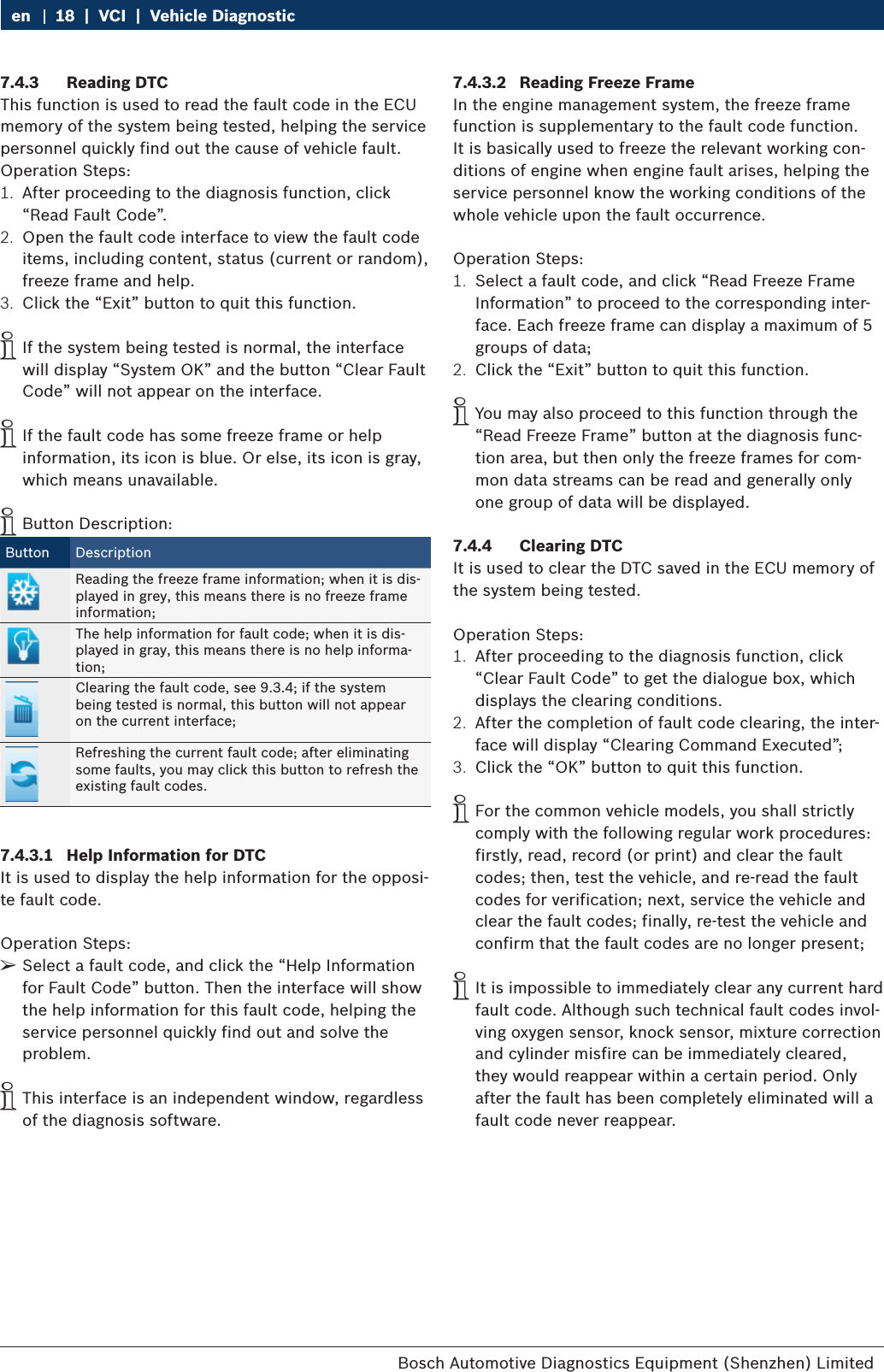
Bosch Automotive Diagnostics Equipment (Shenzhen) Limited 18  |  VCI  |  Vehicle Diagnosticen7.4.3  Reading DTCThis function is used to read the fault code in the ECU memory of the system being tested, helping the service personnel quickly find out the cause of vehicle fault.Operation Steps:1.  After proceeding to the diagnosis function, click “Read Fault Code”.2.  Open the fault code interface to view the fault code items, including content, status (current or random), freeze frame and help.3.  Click the “Exit” button to quit this function. iIf the system being tested is normal, the interface will display “System OK” and the button “Clear Fault Code” will not appear on the interface. iIf the fault code has some freeze frame or help information, its icon is blue. Or else, its icon is gray, which means unavailable. iButton Description:Button DescriptionReading the freeze frame information; when it is dis-played in grey, this means there is no freeze frame information;The help information for fault code; when it is dis-played in gray, this means there is no help informa-tion;Clearing the fault code, see 9.3.4; if the system being tested is normal, this button will not appear on the current interface;Refreshing the current fault code; after eliminating some faults, you may click this button to refresh the existing fault codes.7.4.3.1  Help Information for DTCIt is used to display the help information for the opposi-te fault code.Operation Steps: ¶Select a fault code, and click the “Help Information for Fault Code” button. Then the interface will show the help information for this fault code, helping the service personnel quickly find out and solve the problem. iThis interface is an independent window, regardless of the diagnosis software.7.4.3.2  Reading Freeze FrameIn the engine management system, the freeze frame function is supplementary to the fault code function. It is basically used to freeze the relevant working con-ditions of engine when engine fault arises, helping the service personnel know the working conditions of the whole vehicle upon the fault occurrence.Operation Steps:1.  Select a fault code, and click “Read Freeze Frame Information” to proceed to the corresponding inter-face. Each freeze frame can display a maximum of 5 groups of data;2.  Click the “Exit” button to quit this function. iYou may also proceed to this function through the “Read Freeze Frame” button at the diagnosis func-tion area, but then only the freeze frames for com-mon data streams can be read and generally only one group of data will be displayed.7.4.4  Clearing DTCIt is used to clear the DTC saved in the ECU memory of the system being tested.Operation Steps:1.  After proceeding to the diagnosis function, click “Clear Fault Code” to get the dialogue box, which displays the clearing conditions.2.  After the completion of fault code clearing, the inter-face will display “Clearing Command Executed”;3.  Click the “OK” button to quit this function. iFor the common vehicle models, you shall strictly comply with the following regular work procedures: firstly, read, record (or print) and clear the fault codes; then, test the vehicle, and re-read the fault codes for verification; next, service the vehicle and clear the fault codes; finally, re-test the vehicle and confirm that the fault codes are no longer present; iIt is impossible to immediately clear any current hard fault code. Although such technical fault codes invol-ving oxygen sensor, knock sensor, mixture correction and cylinder misfire can be immediately cleared, they would reappear within a certain period. Only after the fault has been completely eliminated will a fault code never reappear.
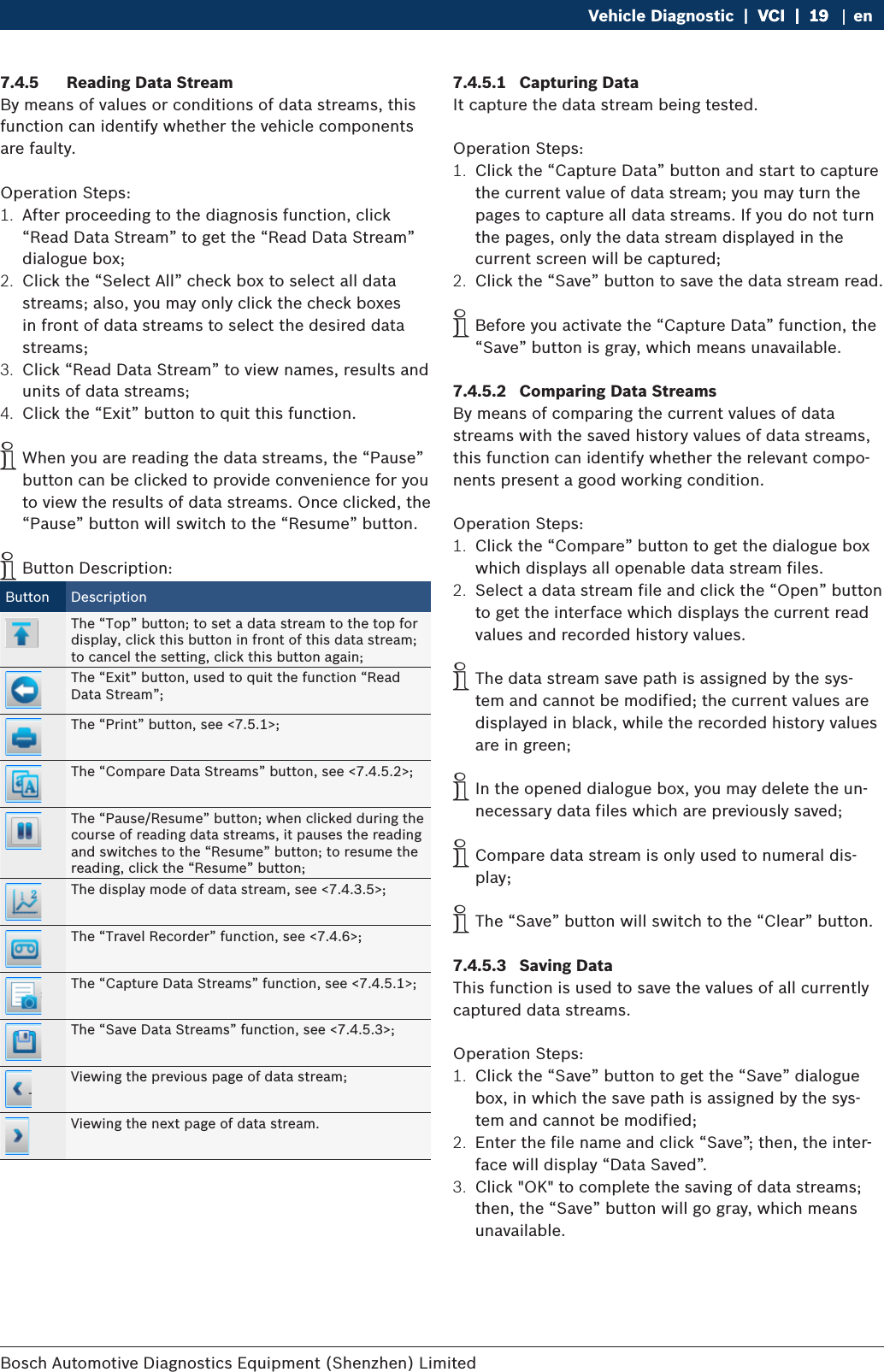
Bosch Automotive Diagnostics Equipment (Shenzhen) Limited Vehicle Diagnostic  |  VCI  |  19VCI  |  19  |  19 en7.4.5  Reading Data StreamBy means of values or conditions of data streams, this function can identify whether the vehicle components are faulty.Operation Steps:1.  After proceeding to the diagnosis function, click “Read Data Stream” to get the “Read Data Stream” dialogue box;2.  Click the “Select All” check box to select all data streams; also, you may only click the check boxes in front of data streams to select the desired data streams;3.  Click “Read Data Stream” to view names, results and units of data streams;4.  Click the “Exit” button to quit this function. iWhen you are reading the data streams, the “Pause” button can be clicked to provide convenience for you to view the results of data streams. Once clicked, the “Pause” button will switch to the “Resume” button. iButton Description:Button DescriptionThe “Top” button; to set a data stream to the top for display, click this button in front of this data stream; to cancel the setting, click this button again;The “Exit” button, used to quit the function “Read Data Stream”;The “Print” button, see <7.5.1>;The “Compare Data Streams” button, see <7.4.5.2>;The “Pause/Resume” button; when clicked during the course of reading data streams, it pauses the reading and switches to the “Resume” button; to resume the reading, click the “Resume” button;The display mode of data stream, see <7.4.3.5>;The “Travel Recorder” function, see <7.4.6>;The “Capture Data Streams” function, see <7.4.5.1>;The “Save Data Streams” function, see <7.4.5.3>;Viewing the previous page of data stream;Viewing the next page of data stream.7.4.5.1  Capturing DataIt capture the data stream being tested.Operation Steps:1.  Click the “Capture Data” button and start to capture the current value of data stream; you may turn the pages to capture all data streams. If you do not turn the pages, only the data stream displayed in the current screen will be captured;2.  Click the “Save” button to save the data stream read. iBefore you activate the “Capture Data” function, the “Save” button is gray, which means unavailable.7.4.5.2  Comparing Data StreamsBy means of comparing the current values of data streams with the saved history values of data streams, this function can identify whether the relevant compo-nents present a good working condition.Operation Steps:1.  Click the “Compare” button to get the dialogue box which displays all openable data stream files.2.  Select a data stream file and click the “Open” button to get the interface which displays the current read values and recorded history values. iThe data stream save path is assigned by the sys-tem and cannot be modified; the current values are displayed in black, while the recorded history values are in green;  iIn the opened dialogue box, you may delete the un-necessary data files which are previously saved; iCompare data stream is only used to numeral dis-play; iThe “Save” button will switch to the “Clear” button.7.4.5.3  Saving DataThis function is used to save the values of all currently captured data streams.Operation Steps:1.  Click the “Save” button to get the “Save” dialogue box, in which the save path is assigned by the sys-tem and cannot be modified;2.  Enter the file name and click “Save”; then, the inter-face will display “Data Saved”.3.  Click "OK" to complete the saving of data streams; then, the “Save” button will go gray, which means unavailable.
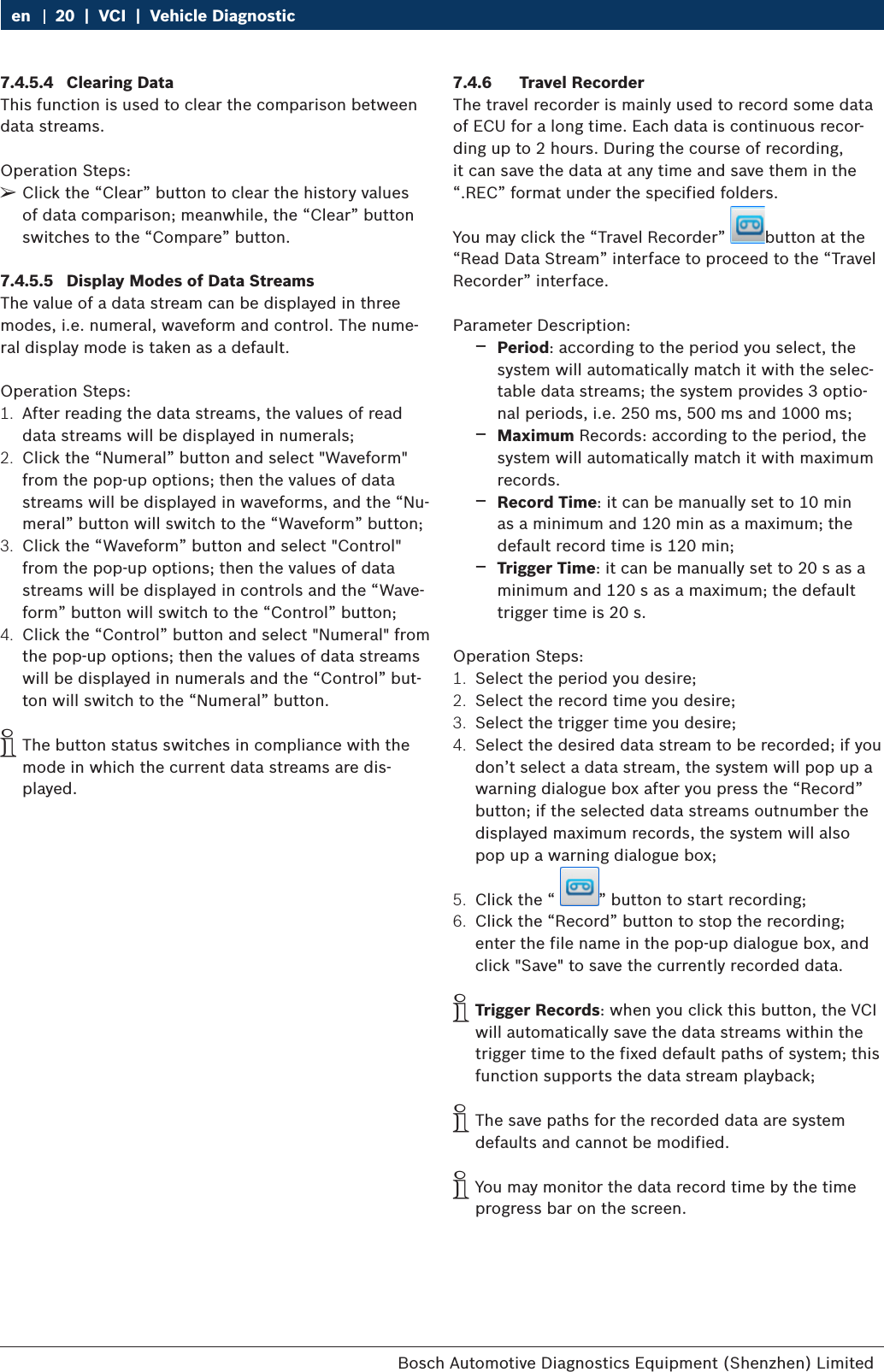
Bosch Automotive Diagnostics Equipment (Shenzhen) Limited 20  |  VCI  |  Vehicle Diagnosticen7.4.5.4  Clearing DataThis function is used to clear the comparison between data streams.Operation Steps: ¶Click the “Clear” button to clear the history values of data comparison; meanwhile, the “Clear” button switches to the “Compare” button.7.4.5.5  Display Modes of Data StreamsThe value of a data stream can be displayed in three modes, i.e. numeral, waveform and control. The nume-ral display mode is taken as a default.Operation Steps:1.  After reading the data streams, the values of read data streams will be displayed in numerals;2.  Click the “Numeral” button and select "Waveform" from the pop-up options; then the values of data streams will be displayed in waveforms, and the “Nu-meral” button will switch to the “Waveform” button;3.  Click the “Waveform” button and select "Control" from the pop-up options; then the values of data streams will be displayed in controls and the “Wave-form” button will switch to the “Control” button;4.  Click the “Control” button and select "Numeral" from the pop-up options; then the values of data streams will be displayed in numerals and the “Control” but-ton will switch to the “Numeral” button. iThe button status switches in compliance with the mode in which the current data streams are dis-played.7.4.6  Travel RecorderThe travel recorder is mainly used to record some data of ECU for a long time. Each data is continuous recor-ding up to 2 hours. During the course of recording, it can save the data at any time and save them in the “.REC” format under the specified folders.You may click the “Travel Recorder”  button at the “Read Data Stream” interface to proceed to the “Travel Recorder” interface.Parameter Description: $Period: according to the period you select, the system will automatically match it with the selec-table data streams; the system provides 3 optio-nal periods, i.e. 250 ms, 500 ms and 1000 ms;  $Maximum Records: according to the period, the system will automatically match it with maximum records. $Record Time: it can be manually set to 10 min as a minimum and 120 min as a maximum; the default record time is 120 min; $Trigger Time: it can be manually set to 20 s as a minimum and 120 s as a maximum; the default trigger time is 20 s.Operation Steps:1.  Select the period you desire;2.  Select the record time you desire;3.  Select the trigger time you desire;4.  Select the desired data stream to be recorded; if you don’t select a data stream, the system will pop up a warning dialogue box after you press the “Record” button; if the selected data streams outnumber the displayed maximum records, the system will also pop up a warning dialogue box;5.  Click the “  ” button to start recording;6.  Click the “Record” button to stop the recording; enter the file name in the pop-up dialogue box, and click "Save" to save the currently recorded data. iTrigger Records: when you click this button, the VCI will automatically save the data streams within the trigger time to the fixed default paths of system; this function supports the data stream playback; iThe save paths for the recorded data are system defaults and cannot be modified. iYou may monitor the data record time by the time progress bar on the screen.
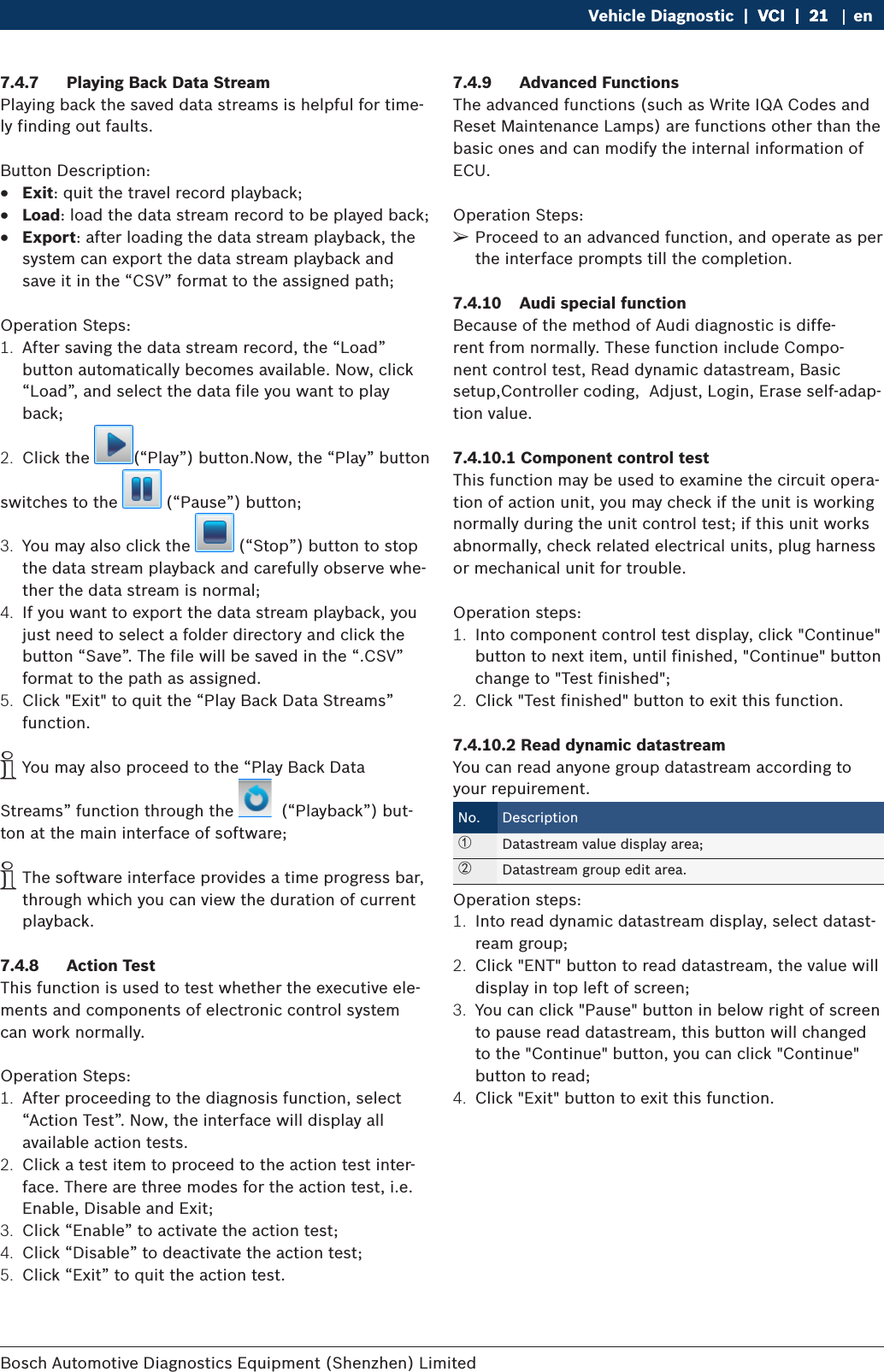
Bosch Automotive Diagnostics Equipment (Shenzhen) Limited Vehicle Diagnostic  |  VCI  |  21VCI  |  21  |  21 en7.4.7  Playing Back Data StreamPlaying back the saved data streams is helpful for time-ly finding out faults.Button Description: RExit: quit the travel record playback; RLoad: load the data stream record to be played back; RExport: after loading the data stream playback, the system can export the data stream playback and save it in the “CSV” format to the assigned path;Operation Steps:1.  After saving the data stream record, the “Load” button automatically becomes available. Now, click “Load”, and select the data file you want to play back;2.  Click the  (“Play”) button.Now, the “Play” buttonswitches to the   (“Pause”) button;3.  You may also click the   (“Stop”) button to stop the data stream playback and carefully observe whe-ther the data stream is normal;4.  If you want to export the data stream playback, you just need to select a folder directory and click the button “Save”. The file will be saved in the “.CSV” format to the path as assigned.5.  Click "Exit" to quit the “Play Back Data Streams” function. iYou may also proceed to the “Play Back Data Streams” function through the    (“Playback”) but-ton at the main interface of software; iThe software interface provides a time progress bar, through which you can view the duration of current playback.7.4.8  Action TestThis function is used to test whether the executive ele-ments and components of electronic control system can work normally.Operation Steps:1.  After proceeding to the diagnosis function, select “Action Test”. Now, the interface will display all available action tests.2.  Click a test item to proceed to the action test inter-face. There are three modes for the action test, i.e. Enable, Disable and Exit;3.  Click “Enable” to activate the action test;4.  Click “Disable” to deactivate the action test;5.  Click “Exit” to quit the action test.7.4.9  Advanced FunctionsThe advanced functions (such as Write IQA Codes and Reset Maintenance Lamps) are functions other than the basic ones and can modify the internal information of ECU.Operation Steps: ¶Proceed to an advanced function, and operate as per the interface prompts till the completion.7.4.10  Audi special functionBecause of the method of Audi diagnostic is diffe-rent from normally. These function include Compo-nent control test, Read dynamic datastream, Basic setup,Controller coding,  Adjust, Login, Erase self-adap-tion value.7.4.10.1 Component control testThis function may be used to examine the circuit opera-tion of action unit, you may check if the unit is working normally during the unit control test; if this unit works abnormally, check related electrical units, plug harness or mechanical unit for trouble.Operation steps:1.  Into component control test display, click "Continue" button to next item, until finished, "Continue" button change to "Test finished";2.  Click "Test finished" button to exit this function.7.4.10.2 Read dynamic datastreamYou can read anyone group datastream according to your repuirement.No. Description①Datastream value display area;②Datastream group edit area.Operation steps:1.  Into read dynamic datastream display, select datast-ream group;2.  Click "ENT" button to read datastream, the value will display in top left of screen;3.  You can click "Pause" button in below right of screen to pause read datastream, this button will changed to the "Continue" button, you can click "Continue" button to read;4.  Click "Exit" button to exit this function.
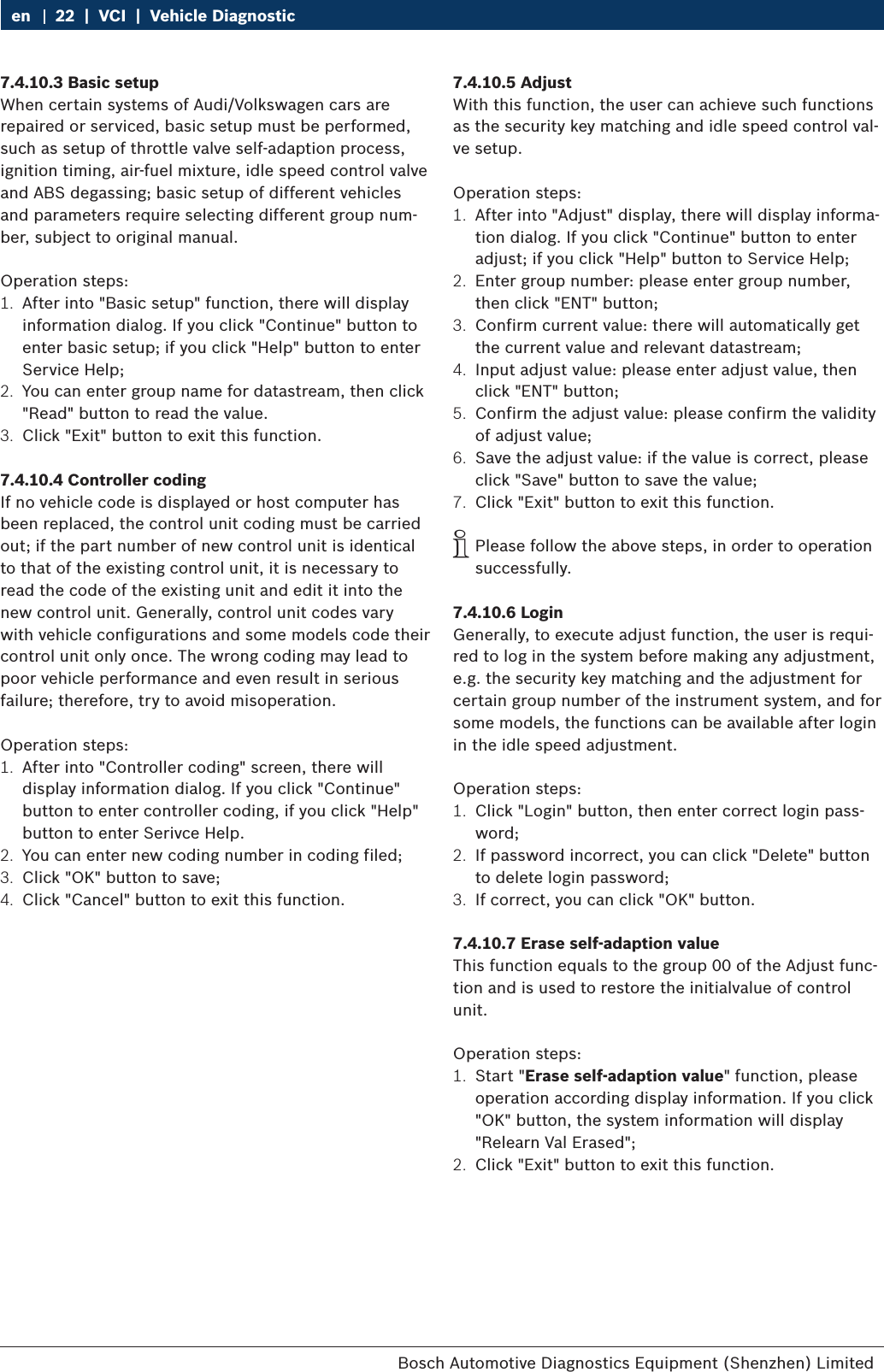
Bosch Automotive Diagnostics Equipment (Shenzhen) Limited 22  |  VCI  |  Vehicle Diagnosticen7.4.10.3 Basic setupWhen certain systems of Audi/Volkswagen cars are repaired or serviced, basic setup must be performed, such as setup of throttle valve self-adaption process, ignition timing, air-fuel mixture, idle speed control valve and ABS degassing; basic setup of different vehicles and parameters require selecting different group num-ber, subject to original manual.Operation steps:1.  After into "Basic setup" function, there will display information dialog. If you click "Continue" button to enter basic setup; if you click "Help" button to enter Service Help;2.  You can enter group name for datastream, then click "Read" button to read the value.3.  Click "Exit" button to exit this function.7.4.10.4 Controller codingIf no vehicle code is displayed or host computer has been replaced, the control unit coding must be carried out; if the part number of new control unit is identical to that of the existing control unit, it is necessary to read the code of the existing unit and edit it into the new control unit. Generally, control unit codes vary with vehicle configurations and some models code their control unit only once. The wrong coding may lead to poor vehicle performance and even result in serious failure; therefore, try to avoid misoperation.Operation steps:1.  After into "Controller coding" screen, there will display information dialog. If you click "Continue" button to enter controller coding, if you click "Help" button to enter Serivce Help.2.  You can enter new coding number in coding filed;3.  Click "OK" button to save;4.  Click "Cancel" button to exit this function.7.4.10.5 AdjustWith this function, the user can achieve such functions as the security key matching and idle speed control val-ve setup.Operation steps:1.  After into "Adjust" display, there will display informa-tion dialog. If you click "Continue" button to enter adjust; if you click "Help" button to Service Help;2.  Enter group number: please enter group number, then click "ENT" button;3.  Confirm current value: there will automatically get the current value and relevant datastream;4.  Input adjust value: please enter adjust value, then click "ENT" button;5.  Confirm the adjust value: please confirm the validity of adjust value;6.  Save the adjust value: if the value is correct, please click "Save" button to save the value;7.  Click "Exit" button to exit this function. iPlease follow the above steps, in order to operation successfully.7.4.10.6 LoginGenerally, to execute adjust function, the user is requi-red to log in the system before making any adjustment, e.g. the security key matching and the adjustment for certain group number of the instrument system, and for some models, the functions can be available after login in the idle speed adjustment.Operation steps:1.  Click "Login" button, then enter correct login pass-word;2.  If password incorrect, you can click "Delete" button to delete login password;3.  If correct, you can click "OK" button.7.4.10.7 Erase self-adaption valueThis function equals to the group 00 of the Adjust func-tion and is used to restore the initialvalue of control unit.Operation steps:1.  Start "Erase self-adaption value" function, please operation according display information. If you click "OK" button, the system information will display "Relearn Val Erased";2.  Click "Exit" button to exit this function.
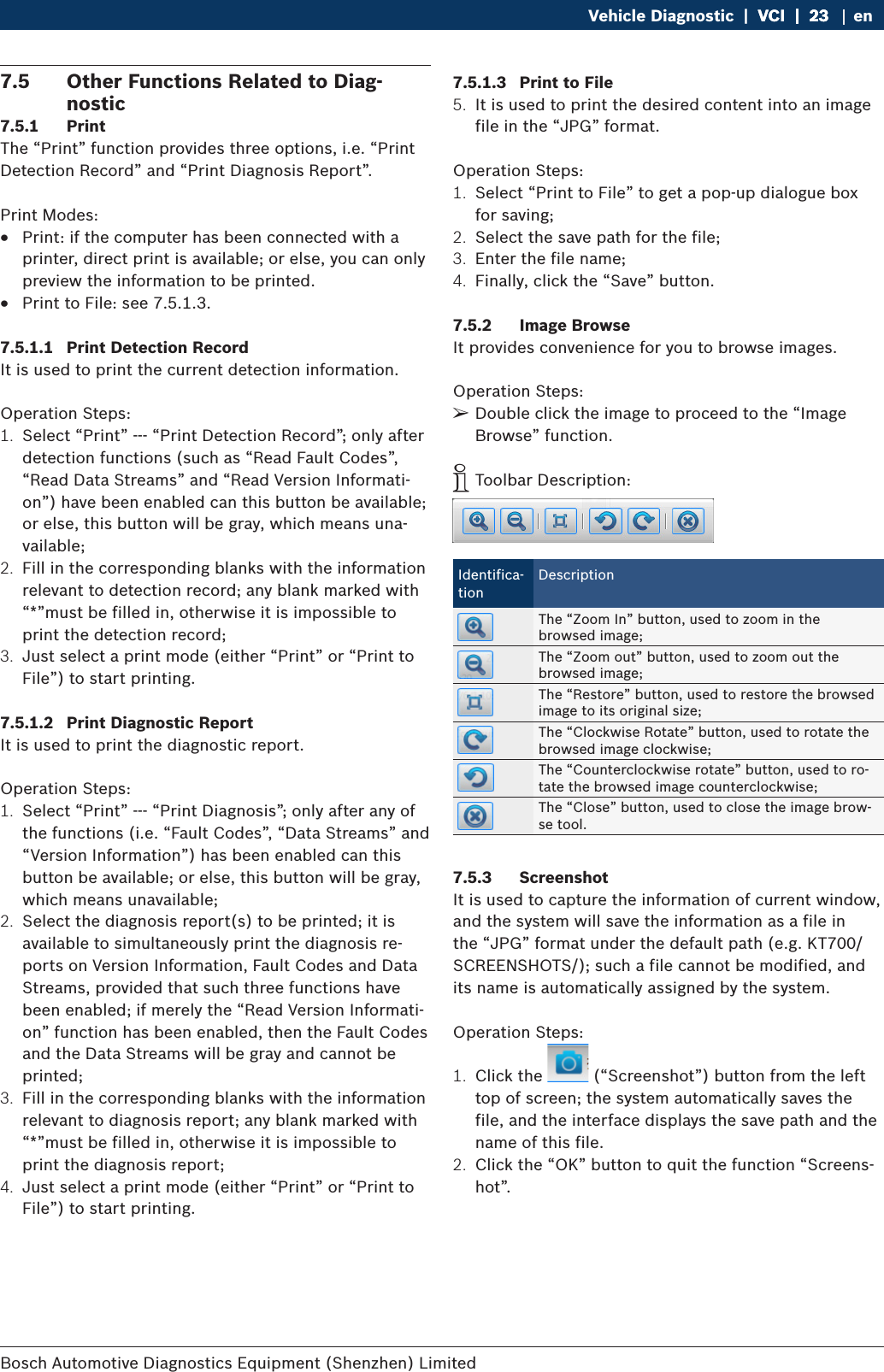
Bosch Automotive Diagnostics Equipment (Shenzhen) Limited Vehicle Diagnostic  |  VCI  |  23VCI  |  23  |  23 en7.5  Other Functions Related to Diag-nostic7.5.1  PrintThe “Print” function provides three options, i.e. “Print Detection Record” and “Print Diagnosis Report”.Print Modes: RPrint: if the computer has been connected with a printer, direct print is available; or else, you can only preview the information to be printed. RPrint to File: see 7.5.1.3.7.5.1.1  Print Detection RecordIt is used to print the current detection information.Operation Steps:1.  Select “Print” --- “Print Detection Record”; only after detection functions (such as “Read Fault Codes”, “Read Data Streams” and “Read Version Informati-on”) have been enabled can this button be available; or else, this button will be gray, which means una-vailable;2.  Fill in the corresponding blanks with the information relevant to detection record; any blank marked with “*”must be filled in, otherwise it is impossible to print the detection record;3.  Just select a print mode (either “Print” or “Print to File”) to start printing.7.5.1.2  Print Diagnostic ReportIt is used to print the diagnostic report.Operation Steps:1.  Select “Print” --- “Print Diagnosis”; only after any of the functions (i.e. “Fault Codes”, “Data Streams” and “Version Information”) has been enabled can this button be available; or else, this button will be gray, which means unavailable;2.  Select the diagnosis report(s) to be printed; it is available to simultaneously print the diagnosis re-ports on Version Information, Fault Codes and Data Streams, provided that such three functions have been enabled; if merely the “Read Version Informati-on” function has been enabled, then the Fault Codes and the Data Streams will be gray and cannot be printed;3.  Fill in the corresponding blanks with the information relevant to diagnosis report; any blank marked with “*”must be filled in, otherwise it is impossible to print the diagnosis report;4.  Just select a print mode (either “Print” or “Print to File”) to start printing.7.5.1.3  Print to File5.  It is used to print the desired content into an image file in the “JPG” format.Operation Steps:1.  Select “Print to File” to get a pop-up dialogue box for saving;2.  Select the save path for the file;3.  Enter the file name;4.  Finally, click the “Save” button.7.5.2  Image BrowseIt provides convenience for you to browse images.Operation Steps: ¶Double click the image to proceed to the “Image Browse” function. iToolbar Description:Identifica-tionDescriptionThe “Zoom In” button, used to zoom in the browsed image;The “Zoom out” button, used to zoom out the browsed image;The “Restore” button, used to restore the browsed image to its original size;The “Clockwise Rotate” button, used to rotate the browsed image clockwise;The “Counterclockwise rotate” button, used to ro-tate the browsed image counterclockwise;The “Close” button, used to close the image brow-se tool.7.5.3  ScreenshotIt is used to capture the information of current window, and the system will save the information as a file in the “JPG” format under the default path (e.g. KT700/SCREENSHOTS/); such a file cannot be modified, and its name is automatically assigned by the system.Operation Steps:1.  Click the   (“Screenshot”) button from the left top of screen; the system automatically saves the file, and the interface displays the save path and the name of this file.2.  Click the “OK” button to quit the function “Screens-hot”.
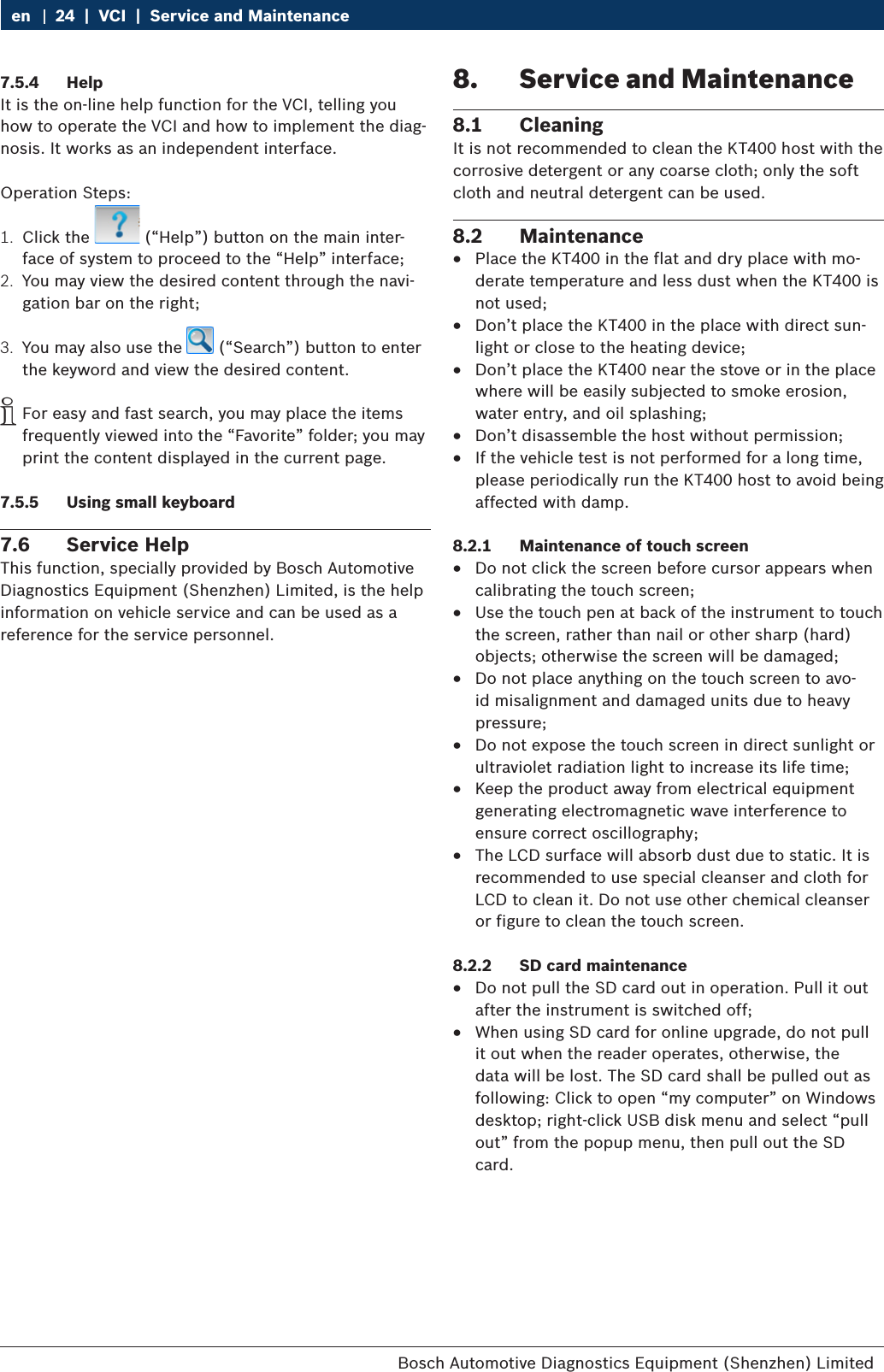
Bosch Automotive Diagnostics Equipment (Shenzhen) Limited 24  |  VCI  |  Service and Maintenanceen7.5.4  HelpIt is the on-line help function for the VCI, telling you how to operate the VCI and how to implement the diag-nosis. It works as an independent interface.Operation Steps:1.  Click the   (“Help”) button on the main inter-face of system to proceed to the “Help” interface;2.  You may view the desired content through the navi-gation bar on the right;3.  You may also use the   (“Search”) button to enter the keyword and view the desired content. iFor easy and fast search, you may place the items frequently viewed into the “Favorite” folder; you may print the content displayed in the current page.7.5.5  Using small keyboard7.6  Service HelpThis function, specially provided by Bosch Automotive Diagnostics Equipment (Shenzhen) Limited, is the help information on vehicle service and can be used as a reference for the service personnel.8.  Service and Maintenance8.1  CleaningIt is not recommended to clean the KT400 host with the corrosive detergent or any coarse cloth; only the soft cloth and neutral detergent can be used.8.2  Maintenance RPlace the KT400 in the flat and dry place with mo-derate temperature and less dust when the KT400 is not used; RDon’t place the KT400 in the place with direct sun-light or close to the heating device; RDon’t place the KT400 near the stove or in the place where will be easily subjected to smoke erosion, water entry, and oil splashing; RDon’t disassemble the host without permission; RIf the vehicle test is not performed for a long time, please periodically run the KT400 host to avoid being affected with damp.8.2.1  Maintenance of touch screen RDo not click the screen before cursor appears when calibrating the touch screen; RUse the touch pen at back of the instrument to touch the screen, rather than nail or other sharp (hard) objects; otherwise the screen will be damaged; RDo not place anything on the touch screen to avo-id misalignment and damaged units due to heavy pressure; RDo not expose the touch screen in direct sunlight or ultraviolet radiation light to increase its life time; RKeep the product away from electrical equipment generating electromagnetic wave interference to ensure correct oscillography; RThe LCD surface will absorb dust due to static. It is recommended to use special cleanser and cloth for LCD to clean it. Do not use other chemical cleanser or figure to clean the touch screen.8.2.2  SD card maintenance RDo not pull the SD card out in operation. Pull it out after the instrument is switched off; RWhen using SD card for online upgrade, do not pull it out when the reader operates, otherwise, the data will be lost. The SD card shall be pulled out as following: Click to open “my computer” on Windows desktop; right-click USB disk menu and select “pull out” from the popup menu, then pull out the SD card.
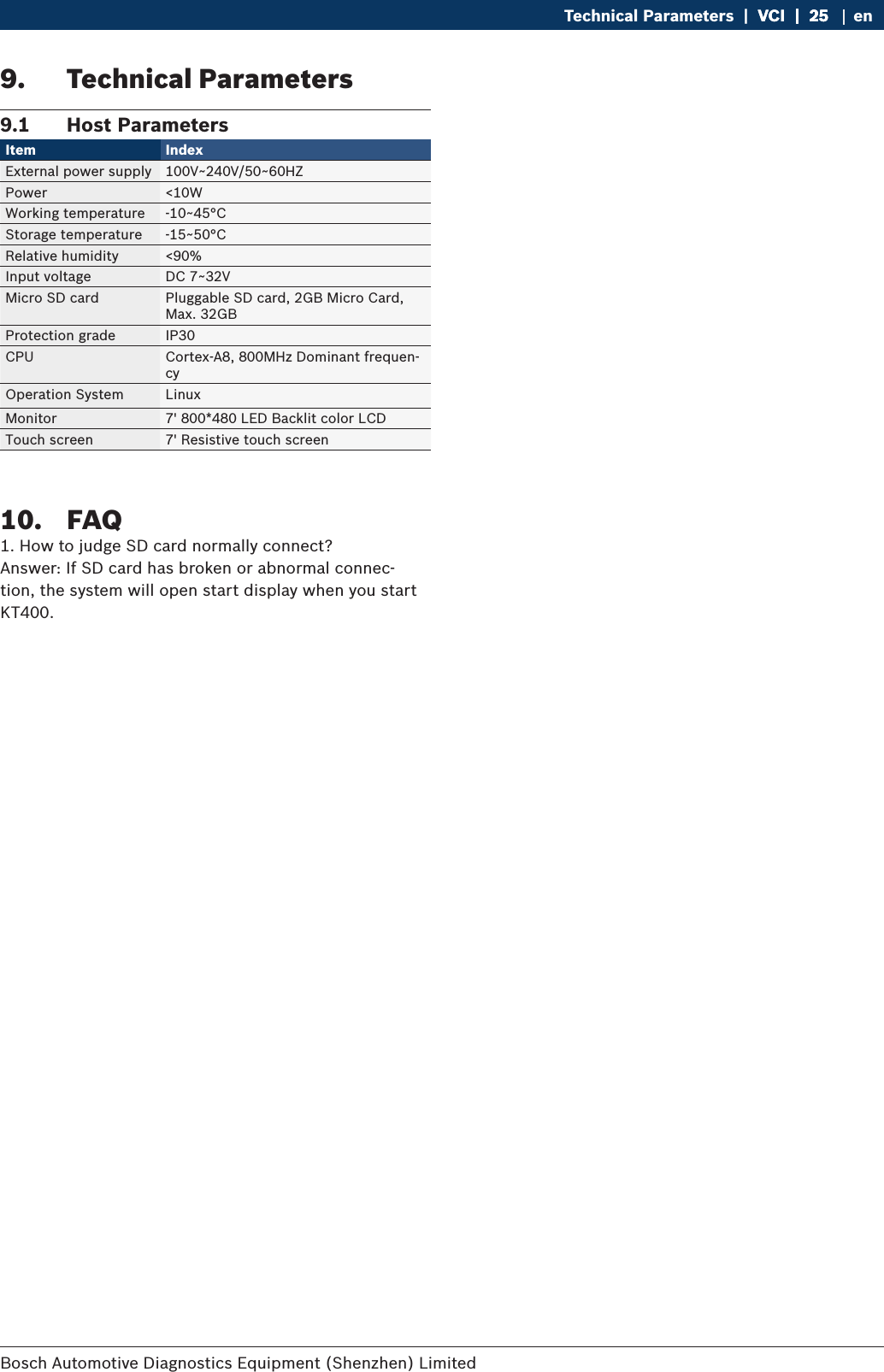
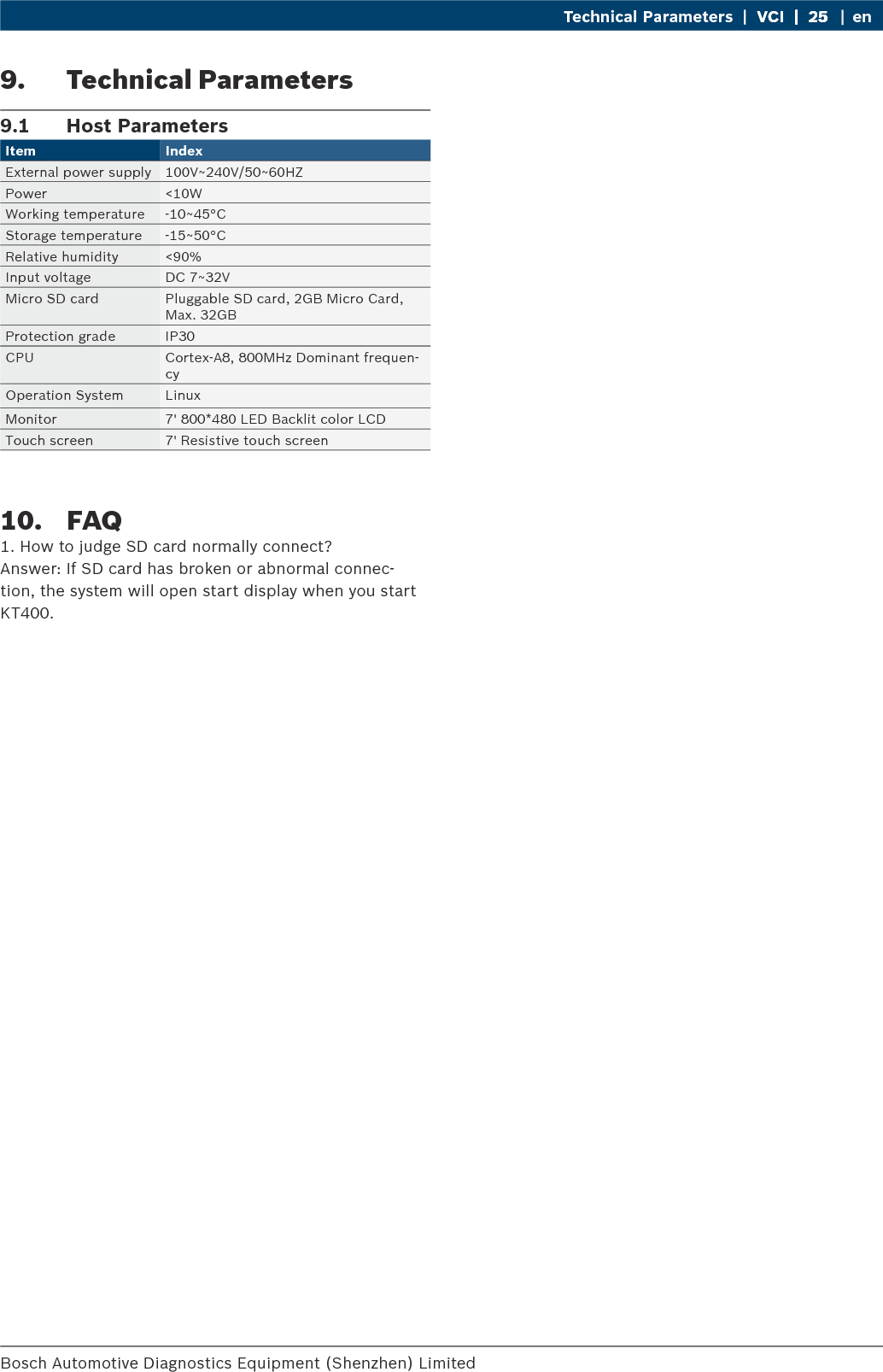
Bosch Automotive Diagnostics Equipment (Shenzhen) Limited Technical Parameters  |  VCI  |  25VCI  |  25  |  25 en9.  Technical Parameters9.1  Host ParametersItem Index External power supply 100V~240V/50~60HZPower <10WWorking temperature -10~45°CStorage temperature -15~50°CRelative humidity <90%Input voltage DC 7~32VMicro SD card Pluggable SD card, 2GB Micro Card, Max. 32GBProtection grade IP30CPU Cortex-A8, 800MHz Dominant frequen-cyOperation System LinuxMonitor 7' 800*480 LED Backlit color LCDTouch screen 7' Resistive touch screen10.  FAQ1. How to judge SD card normally connect?Answer: If SD card has broken or abnormal connec-tion, the system will open start display when you start KT400.
Bosch Automotive Diagnostics Equipment(Shenzhen) Limited5/F,A,Garden City Cyber Port, Nanhai Road N.1079,Nanshan District, Shenzhen518067 China400 000 5109www.bosch-diagnostics.com.cn

Navigation menu