Bowflex Owner's Manual BFX Revo XP OM Rev B Web
Owner's Manual BFX_RevoXP_OM_RevB_web Bowflex Product Manuals | Bowflex
User Manual: Bowflex Owner's Manual Bowflex Product Manuals | Bowflex
Open the PDF directly: View PDF  .
.
Page Count: 100
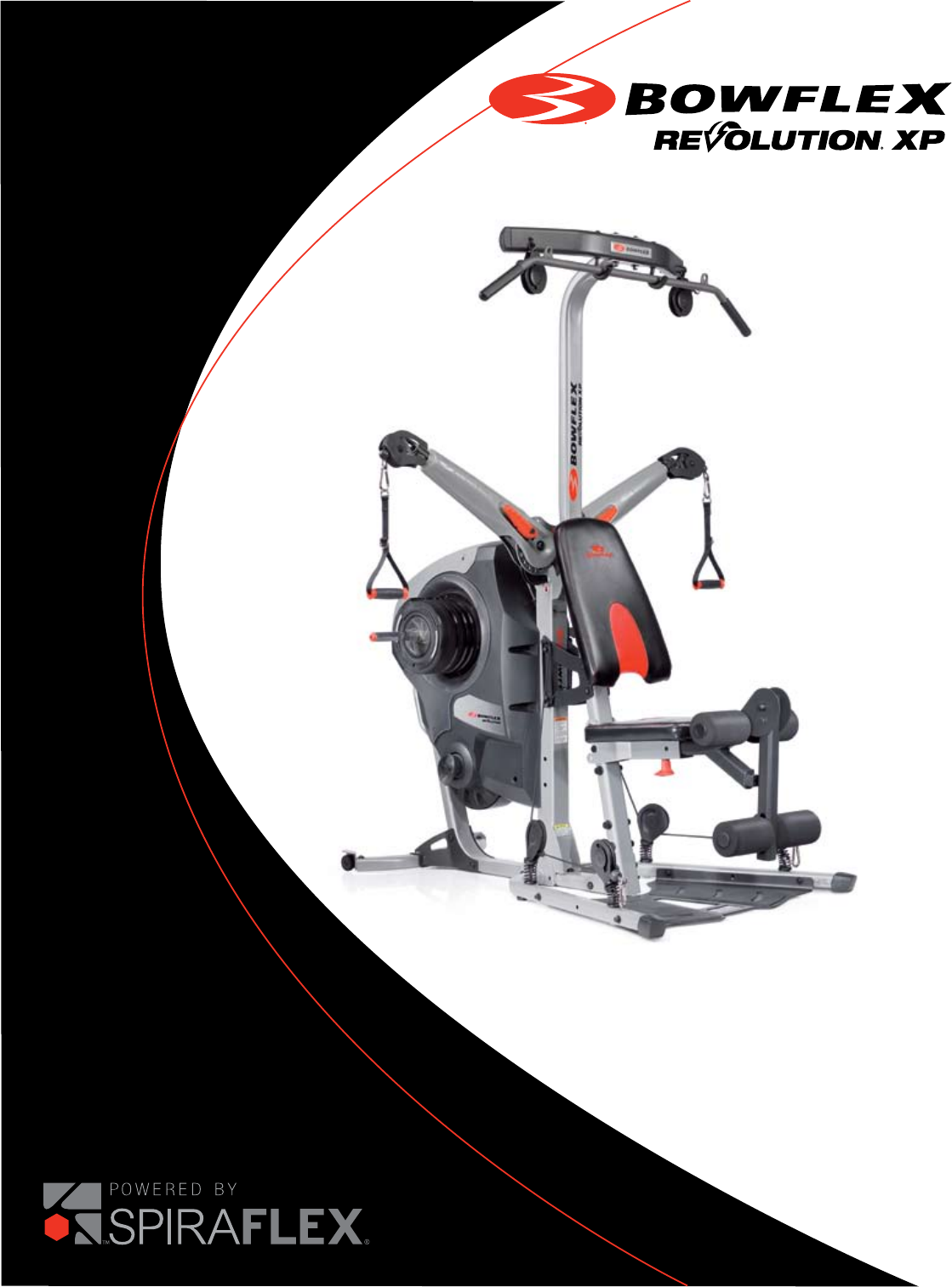
Bowflex Revolution® XP
Owner’s Manual
and Fitness Guide
Special Edition Includes:
Dr. Ellington Darden’s
Six Week Fast Fat Loss –
Body Leanness Program
PN001-7058 RevC (10/28/2009)
(Shown with optional Lat Tower attachment)

Owner’s Manual and Fitness Guide Table of Contents
Product Specifications
Dimensions (arms raised) 64.5” L x 37.8” W x 73” H (163.8cm x 98cm x 185.4cm)
Dimensions with optional Lat Tower Attachment 64.5” L x 37.8” W x 83.2” H (163.8cm x 98cm x 211.3cm)
Workout Area 84” x 84” (213.4cm x 213.4cm)
SpiraFlex® Resistance 200 lbs. (90.72 kg)
SpiraFlex® Upgradability 280 lbs. (127 kg)
Maximum User Weight 300 lbs. (136 kg)
Safety Precautions 1
Safety Warning Labels 2
Getting to Know Your Bowflex Revolution® XP Home Gym 4
Using Your Bowflex Revolution® XP Home Gym
SpiraFlex® Resistance 5
Adjusting And Understanding the Resistance 5
Attaching SpiraFlex® Resistance Packs 6
Preparing for Use, Storing, and Moving 7
Maintenance 8
Adjusting Cable Tension 9
Cable Routing and Storage 10
Attaching Accessories 11
Hand Grips 11
Foot Harnesses 11
Squat Harness 11
Installing the Seat and Attachments 12
Seat and Back Pad with Locking Pin 12
Leg Extension 13
Lat Tower (optional) 14
Ab Attachment (optional) 14
Companion Equipment 15
Defining Goals
Reaching Your Goals 16
Designing Your Own Program 16
Exercising Properly
Working Out 18
Warming Up 18
Breathing 18
Performing Your Routine 18
Cool Down 18
The Workouts
20 Minute Better Body Workout 19
Advanced General Conditioning 19
20 Minute Upper/Lower Body 20
Body Building 21
Circuit Training – Anaerobic/Cardiovascular 22
Strength Training 23
Exercises
Chest Exercises 25
Shoulder Exercises 33
Back Exercises 44
Arm Exercises 49
Abdominal Exercises 59
Leg Exercises 62
Muscle Chart 71
Exercise Log 73
Bowflex® Body Leanness Program 75
Warranty Information 94
Contact Information 97
1
Safety Precautions
Indicates a potentially hazardous situation which, if not
avoided, could result in death or serious injury.
PRIOR TO USING THIS EQUIPMENT,
OBSERVE THE FOLLOWING WARNINGS.
IMPORTANT SAFETY INSTRUCTIONS
The following definition applies to the word “Warning” found throughout this manual:
7!2.).'
!44%.4)/.
$!.'%2
)--%$)!4%!#4)/.2%15)2%$
#!54)/.
• Read and understand the Owner’s Manual
prior to using this machine.
• Read and understand all Warning Labels on this machine.
• Keep children away from this machine and/or supervise
them closely if they are near the machine or are present
during its operation. This machine is not suitable as a
children’s toy. There is a natural tendency for children
to want to play on exercise equipment, and parents and
others in charge of children should be aware of their
respective responsibilities. Moving parts that may
appear to present obvious hazards to adults may not
appear to do so to children.
• Consult a physician prior to commencing an exercise
program. If, at any time, you feel faint or dizzy, or
experience pain, stop and consult your physician.
• Inspect this machine for loose parts or signs of wear.
Pay special attention to Cables and Belts and their
connections. Do not use if found in this condition;
contact Nautilus Customer Service.
• This machine is designed for a User’s Weight Limit of 300
pounds (136 kg). Do not use if you are over this weight.
• This machine contains moving parts. Use Caution. Do
not wear loose clothing or jewelry.
• Set up and operate this machine on a solid level surface.
• This machine is for Consumer use only.
• Do not use additional means to increase the resistance
(lifting load) of this machine.
• Set up the machine so that there is a workout area of
at least 84” x 84” (213.4cm x 213.4cm) of free space
for safe operation of the Bowflex Revolution® XP
home gym. Keep third parties out of this area when the
machine is in use.
• Operate the machine in the manner described in this
manual. It can be hazardous to over-exert yourself during
exercise.
• Make sure that all positional adjustment devices are
securely engaged.
• Never move or adjust the seat while sitting on it. Never
stand on the seat.
2Safety Warning Labels
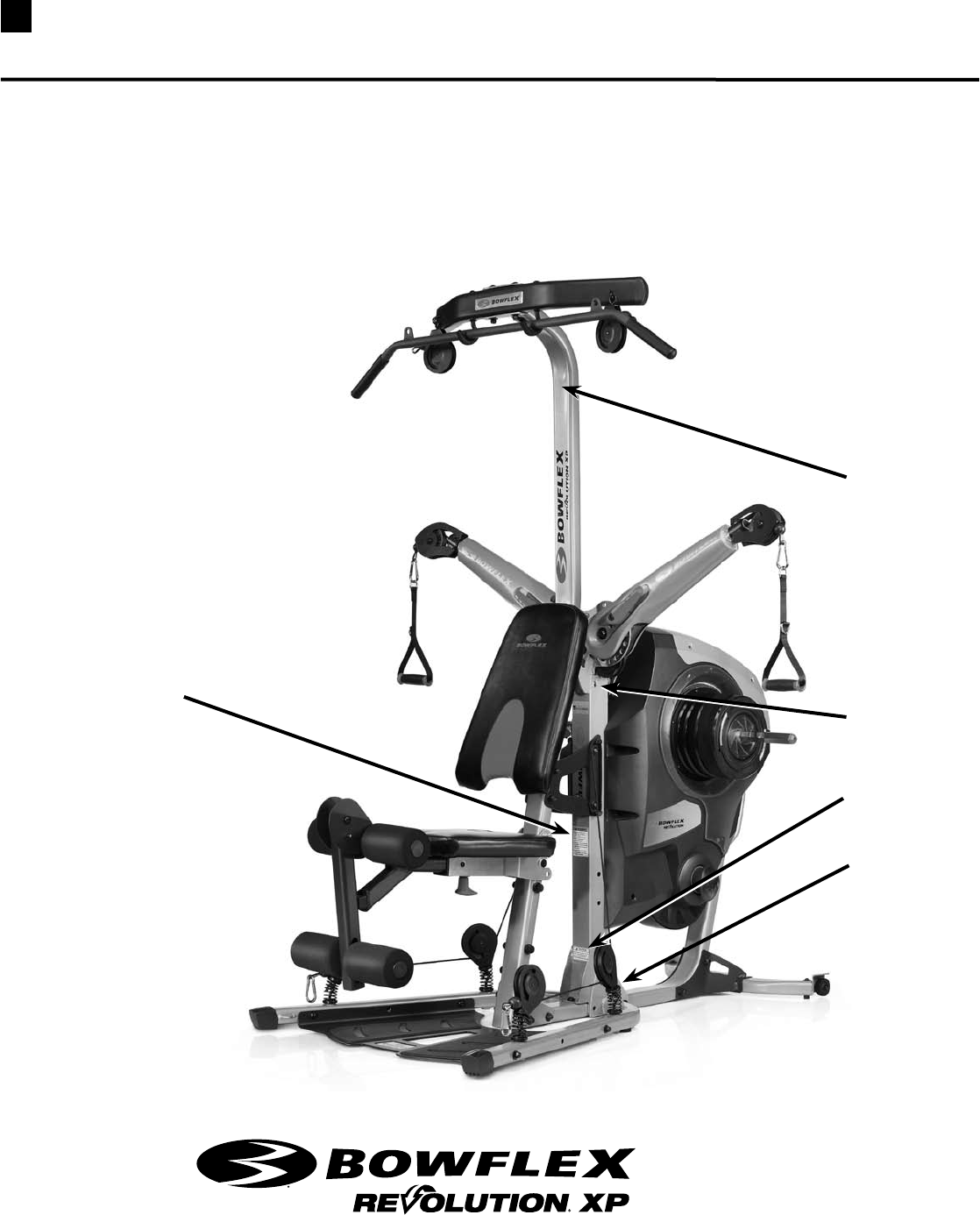
Home Gym
The following safety warnings are located on the Bowex Revolution® XP exercise machine. Please read all safety
precautions and warning information prior to using your product. Be sure to replace any warning label if damaged,
illegible, or missing. If you need replacement labels, please call a Bowex Representative at 1-800-628-8458.
Label 1
Label 3
Label 4
Label 2
Serial number
3
Safety Warning Labels
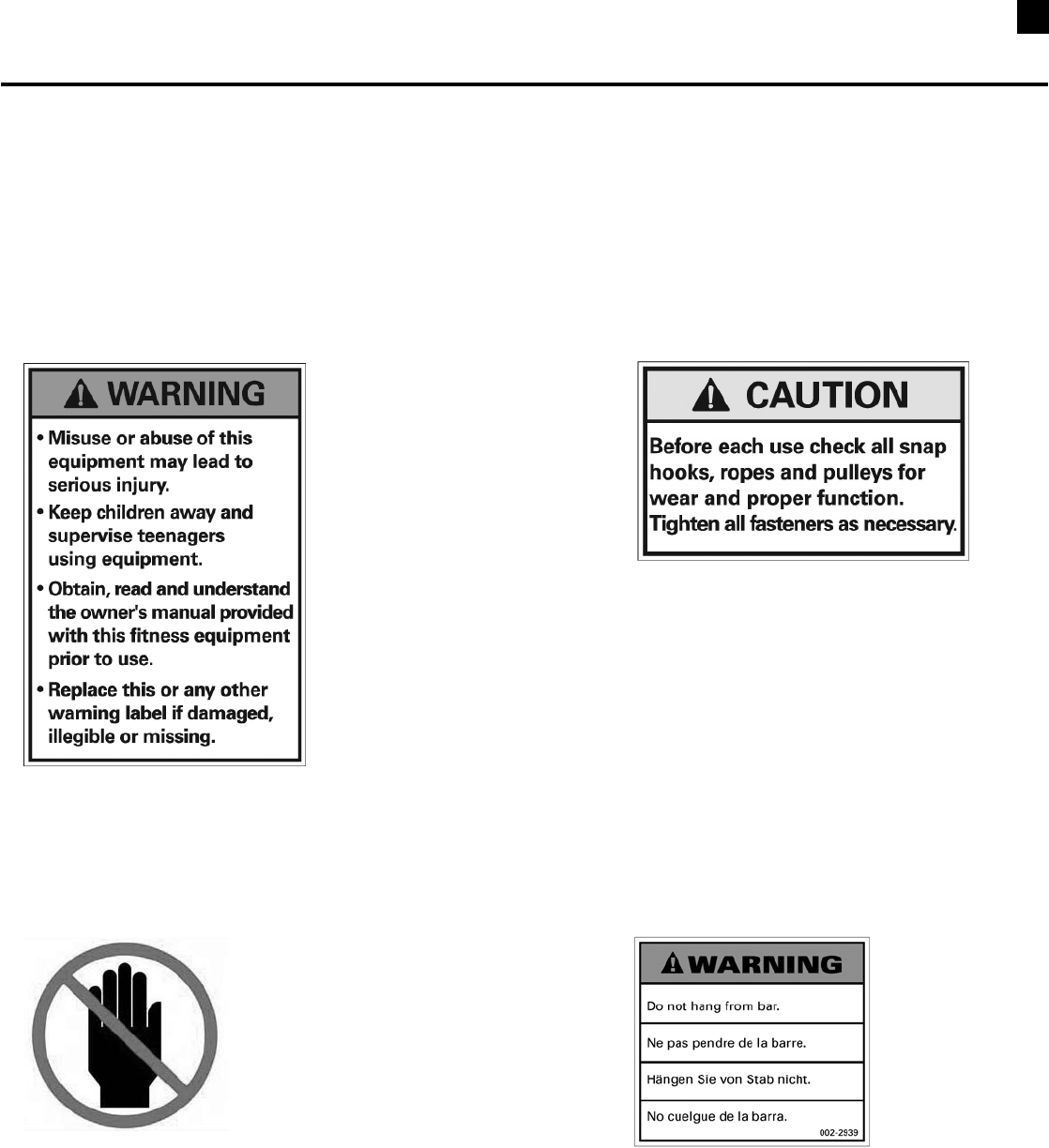
The following safety warnings are located in site specific areas on the unit. Please review and understand the safety
warning labels and their locations on the unit prior to use.
If you need to replace a warning label please call 1-800-628-8458 to obtain a new label.
Label 4: Do not hang notice.
Location: Top front of the lat tower
(optional attachment).
Label 1: General use safety label.
Location: Front of the main unit below seat bracket.
Label 2: Keep hands away.
Location: Below freearms on main unit.
Label 3: Check all equipment before use.
Location: Bottom front of the main unit.
4
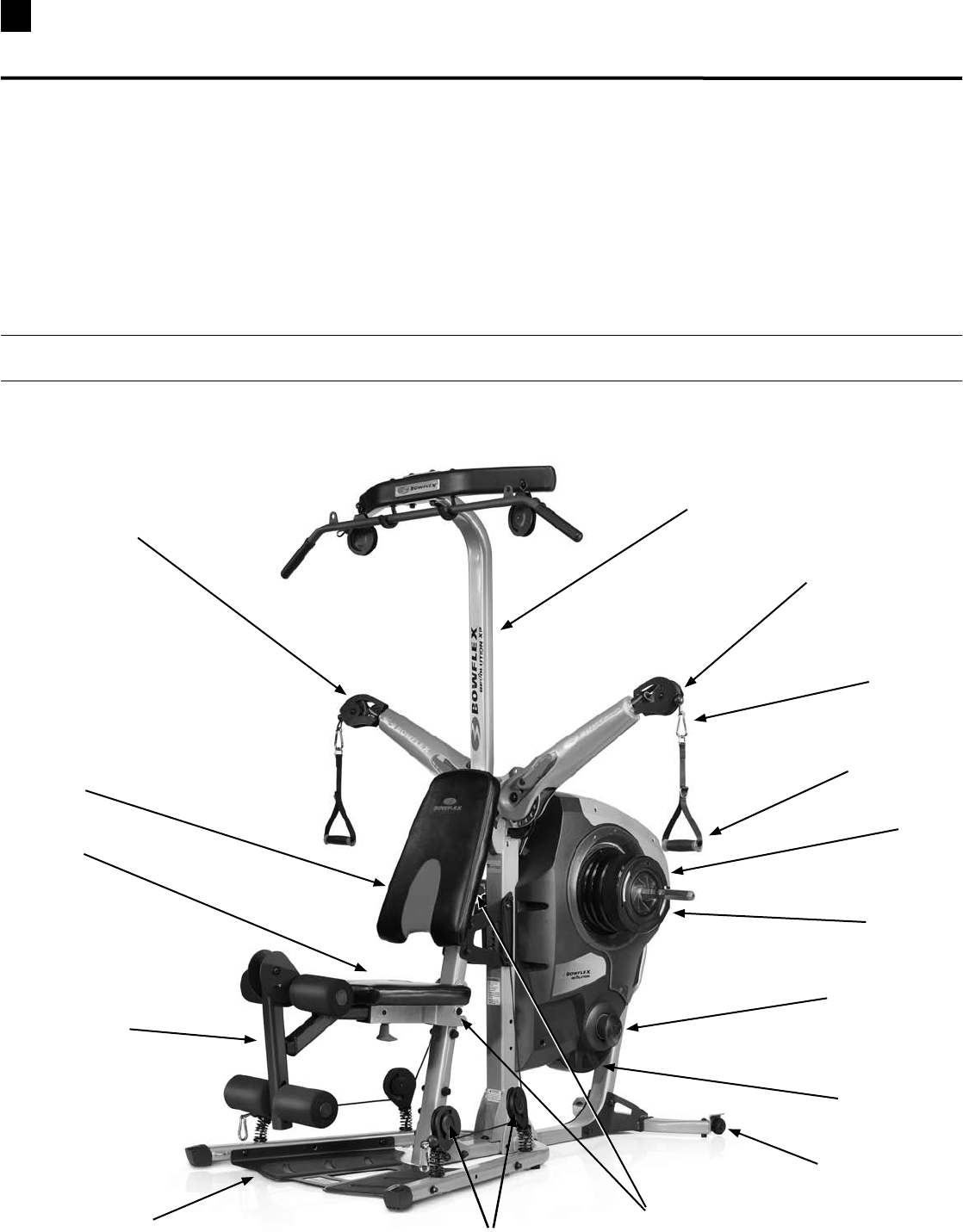
Adjustable
Seat Back
Adjustable
Seat
Cable
Variable
Pulley System
Hand Grip
Standing Platform Spring Lock Seat
Pin
Leg Extension/
Leg Curl
Attachment
Bowflex Revolution® XP Parts Reference Guide
Adjustable Arms
SpiraFlex®
Resistance Packs
Engine
Housing
Tension Control
Knob
Please take your time to read through the entire manual and follow it carefully before attempting to use your
Bowflex Revolution® XP home gym. Also locate and read all warning labels that are posted on the machine. It is
important to understand how to properly perform each exercise before you do so using SpiraFlex® Resistance.
The image below shows the machine set up in just one of many configurations. Included as standard accessories
with your new Bowflex Revolution® XP home gym are a leg extension, ab attachment, foot harnesses, and squat
harness. Instructions for attaching various accessories, storing cables, and changing out components are included
later in this manual, as well as in the Assembly Manual.
Lower Pulley
Getting to Know Your Bowflex Revolution® XP Home Gym
Lat Tower
(optional)
Squat Frame
Pulleys
Transport Wheels
5
SpiraFlex® Resistance
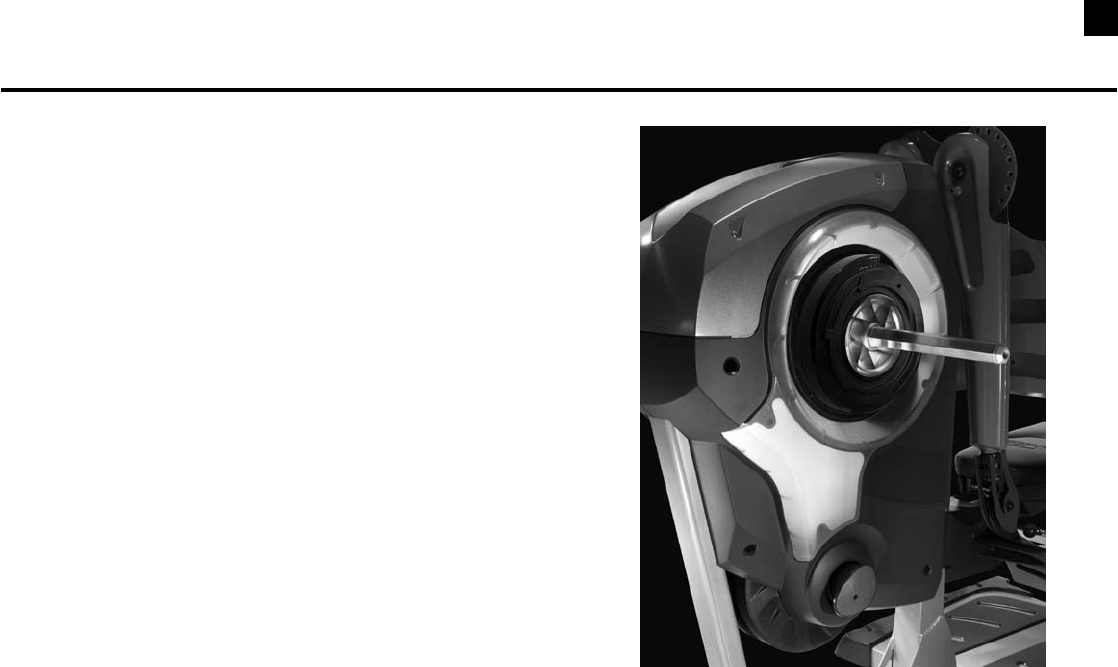
The Bowflex Revolution® XP home gym features an
ingenious patented technology called SpiraFlex®. The
Bowflex Revolution® XP muscle-building resistance
comes in the form of these cleverly designed resistance
packs, each constructed with a heavy-duty elastic strap
inside the pack. When you perform an exercise, these
resistance packs rotate around the center, stretching
the elastic strap and creating resistance.
A significant advantage of the resistance packs is
that the resistance is present throughout the ENTIRE
range of motion. That gives you a more consistent,
gym-quality experience – which means your muscles
get a bigger burn, a better workout and faster results.
SpiraFlex® technology is a non-inertial resistance
mechanism that provides the smoothness and feel of
gym-quality pack-loaded machines, but eliminates the
excessive bulk and weight. This totally unique, state-
of-the-art resistance system involves wrapping an
elastic strap tighter and tighter around a coil, which
is contained in a small canister that looks very similar
to free weight packs, but weighs only a few pounds.
Because no metal parts are used, SpiraFlex® technology
is quiet, lightweight, portable, and safe.
Adjusting And Understanding
The Resistance
The Bowflex Revolution® XP home gym comes with 200
lbs. (90.72 kg) of resistance. The SpiraFlex® resistance
packs look very much like free weight plates and are
assigned a pound rating based on their resistance –
including 5, 10, 20, and 40-pound packs (2.27kg, 4.54kg,
9.07kg, 18.14kg). The real power of the workout is in the
RESISTANCE, not the weight. And that means you can
quickly and easily stack these lightweight resistance
packs on to the Revolution® XP – just like free weights –
and get a great workout.
To upgrade to 280 pounds
(127 kg) of resistance
please call
1-800-NAUTILUS (628-8458)
Using Your Bowflex Revolution® XP Home Gym
6Using Your Bowflex Revolution® XP Home Gym
Attaching SpiraFlex® Resistance Packs
During assembly, you attached 5-lb (2.27kg) SpiraFlex®
resistance packs to the machine. The 5-lb packs are
permanently attached to the machine. The Bowflex Revolution®
XP home gym comes with 200 lbs (90.72kg) of resistance packs
in 5, 10, 20, and 40-lb packs (2.27kg, 4.54kg, 9.07kg, 18.14kg).
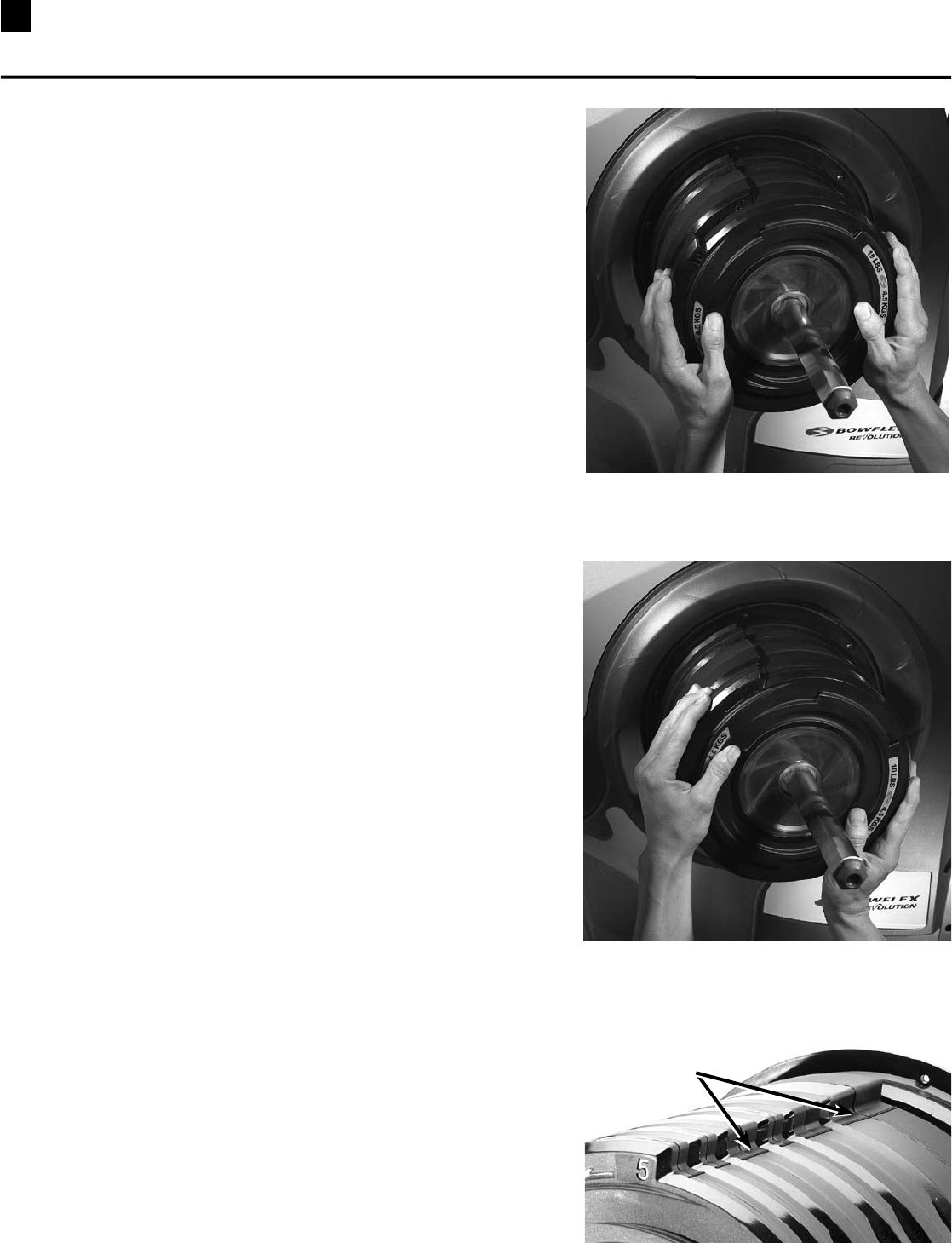
Attaching resistance packs is simple. You simply select the
resistance pack and slide it onto the shaft, making sure the
rounded edge of the hole in the plate is matched up with the
rounded edge of the shaft (see photos to the right). Once you
push the pack all the way onto the shaft, press and turn the
plate counterclockwise about 10 degrees until the locking
tabs click into place. While applying pressure, turn the plate
clockwise until the index marks on the packs are aligned.
NOTE: It is extremely important to make sure that
all six locking tabs engage to ensure proper and safe
operation of the machine. Check that the pack is
seated evenly, with no extra gap behind the bottom
edge of the pack.
You can choose any combination of resistance packs to suit
your needs. Each pack needs to be installed in the same
manner, by placing the pack onto the shaft, sliding it all the way
to the housing, and turning it counterclockwise until the locking
tabs engage. Then turn it clockwise so that the index marks
on each pack are aligned. If you are using multiple resistance
packs, each one contains locking mechanisms to stack multiple
packs.
You can set resistance either symmetrically or offset. What this
means is that you can set resistance to 40 lbs (18.14kg) on one
side and 60 lbs (27.22kg) on the other side, or set both sides to
60 lbs, or 60 lbs on one side and nothing on the other side--or
any variation like that. Setting resistance on one side is useful
when doing one-sided exercises such as trunk rotations or hip
extensions. You do not always have to have the same amount
of resistance on each side. Doing so, however, is common for
symmetrical exercises such as bench press or chest fly.
For an animated demonstration of proper pack installation,
visit the FAQ section of the Bowflex Revolution® website at
www.bowflexrevolution.com.
Step 1: Place resistance pack on shaft, matching
rounded top of hole with rounded top of shaft. Push
resistance pack all the way onto shaft.
Step 2: While pressing pack towards machine, turn
counterclockwise about 10 degrees until all six plate
tabs lock into place. Then turn clockwise until index
marks are aligned.
Index marks
7
The Bowflex Revolution® XP home gym offers one of the largest ranges of exercises ever offered by a Bowflex®
home gym. Preparing your machine for use and maintaining your machine are simple.
Preparing for Use
Before using your Bowflex Revolution® XP home gym, make sure you read through all of the safety warnings in this
manual, and pay close heed to the warning labels on the machine. Additionally, inspect the machine prior to each
use to ensure all parts are in good working order.
Preparing to Exercise
To do exercises, read the instructions in this manual or on the exercise poster included with your machine. Each
exercise uses a unique set of adjustable arm positions and cable connections. Using your Bowflex Revolution® XP
home gym should be easy:
• Select the desired resistance packs
• Position the adjustable arms to the correct setting
• Attach cable clips to appropriate location
• Complete the exercise
A full description of each exercise is included later in this manual.
Moving & Storing Your Machine
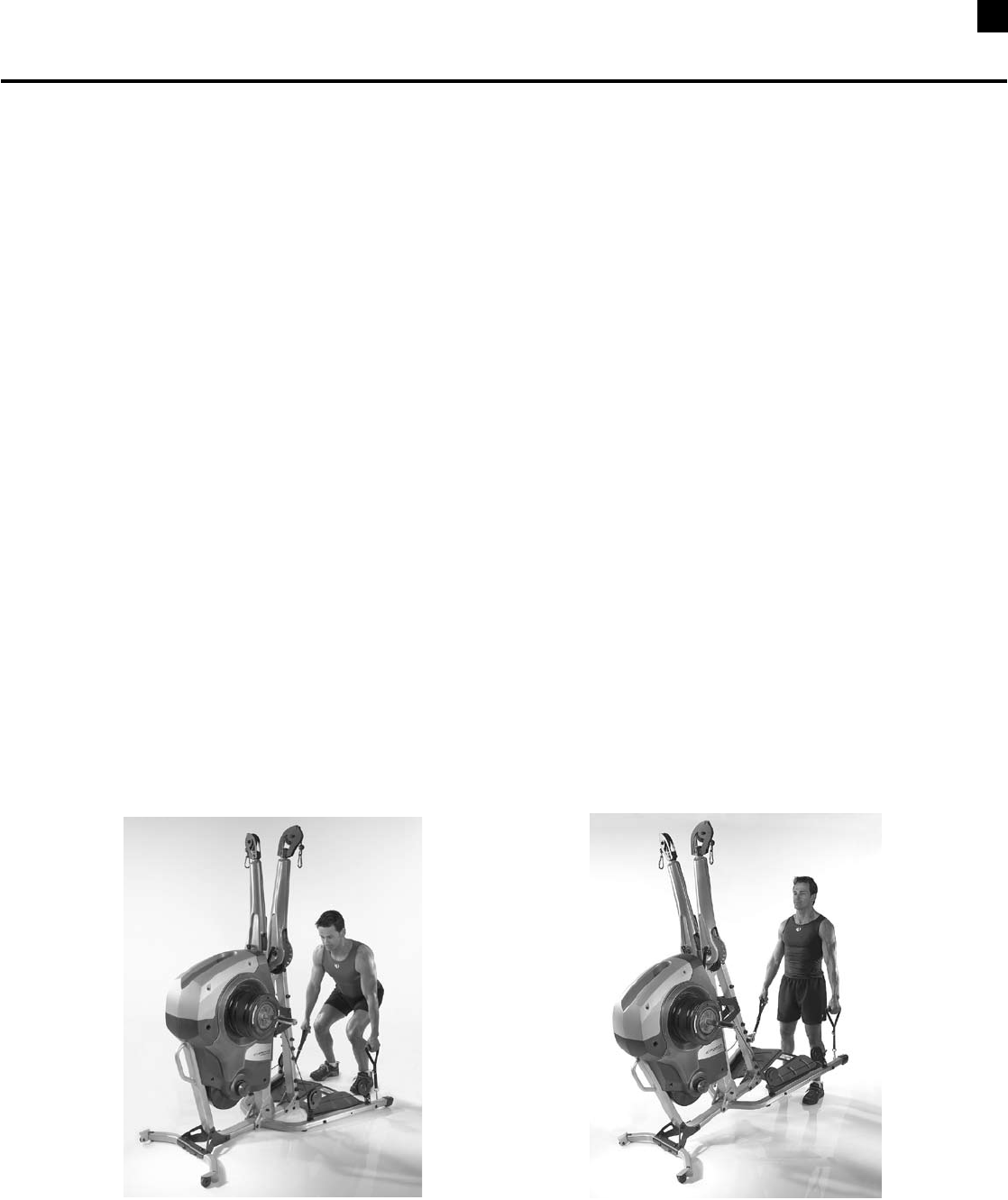
The full assembled weight of your machine is in excess of 200 lbs. It is imperative that you observe all safety
warnings and cautions when using or moving your machine. To move your machine, raise the adjustable arms to
the 0 position and make sure they are locked in place. Hook the D-handle Hand Grips to the hooks at the front of the
Standing Platform. Carefully lift the front of the machine to shift its weight to the back transport wheels. You can
now roll the machine.
Preparing for Use, Storing, and Moving
Raise adjustable arms to 0 position
(see above photo) and lock in place.
Attach hand grips to loops at the
front of the Standing Platform.
To move the machine, use hand
grips to lift the front of the unit and
shift its weight onto the transport
wheels at the back of the base.

8Maintenance
To store your machine, you can either leave the machine fully assembled, or you can remove the Leg
Extension to make a smaller footprint for storing. It is advisable to raise the adjustable arms to the 0
position and make sure they are locked in place.
Preventative Maintenance
Keeping your machine in good repair takes a minimal amount of time, and will ensure you have many
years of use. In addition to preventative maintenance such as checking to make sure the unit is clean and
free from defects, wiping down surfaces, and keeping attachments in a secure location, maintenance
should be limited.
Daily
Wipe down with a damp cloth. Pay special attention to areas where perspiration could settle.
Monthly
Inspect the unit for loose parts, nuts, bolts, etc. Inspect ropes and straps for fraying or excessive wear.
Yearly
Remove the Top Cover and inspect the condition of the internal components.
Look for fraying or excessive wear on straps, ropes, and moving parts, and replace as nessesary.
9
Adjusting Cable Tension
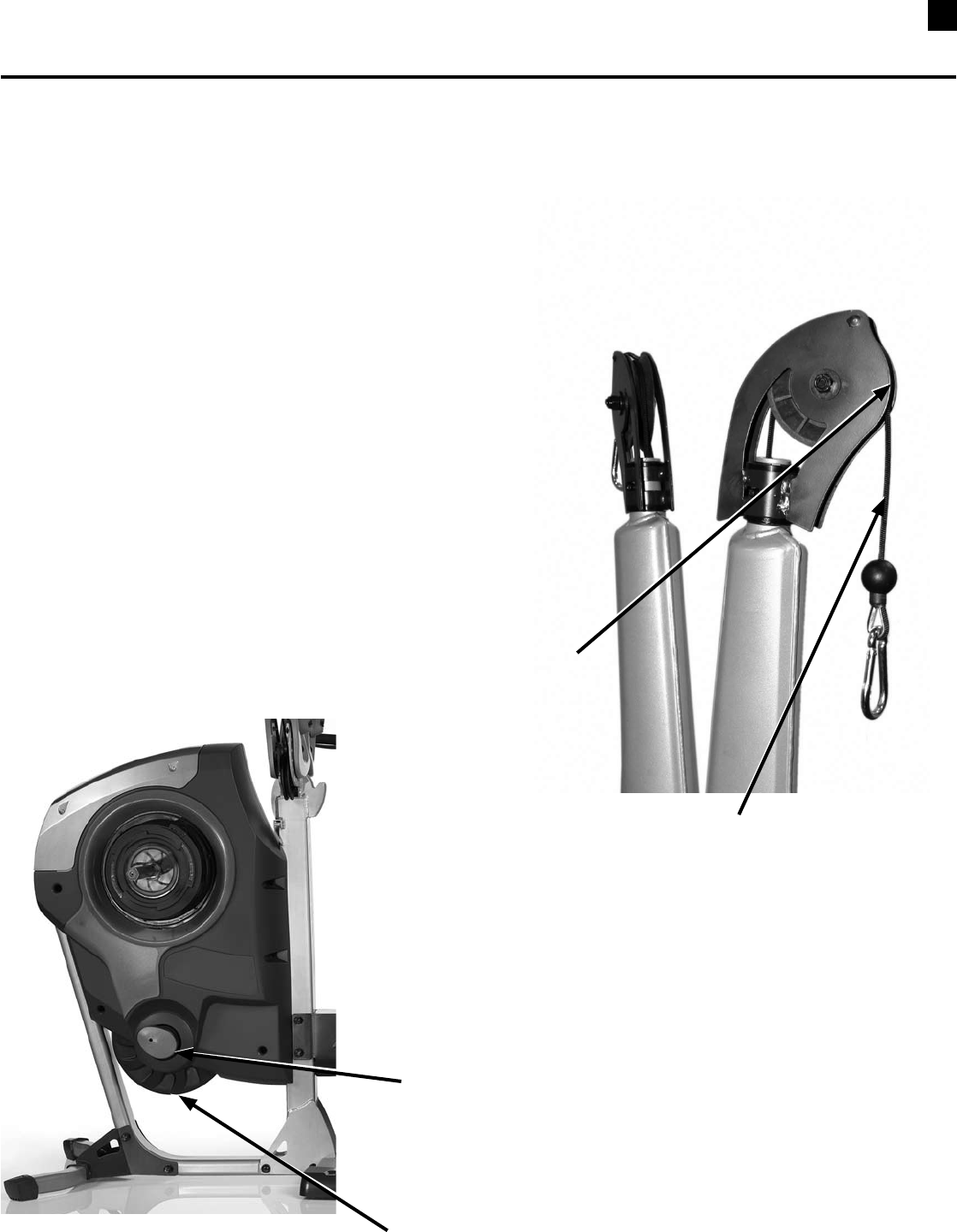
Pay close attention to maintenance of the cable tension. Over time and with heavy use, the cables are designed
to give slightly. Located on the main engine housing is a tension control knob which allows you to increase the
tension in the cables.
Checking for incorrect cable tension is simple.
1. Position the adjustable swing arms in the upper most
position.
2. Check to see if clips at end of cable hang down or if they
are tight against the pulley.
3. If cables don’t have enough tension, use the tension control
knob on the side of the machine to tighten the cables. (See
image below).
4. To increase tension, pull tension knob outward and turn
the large pulley clockwise. The clip on the cable should be
touching the pulley.
In this image, the cable clip extends a
few inches below the pulley, so there
is not enough tension in the cable. The
cable clip should be tight against the
pulley with appropriate tension.
There are tension knobs on each side of the machine.
To increase cable tension, pull knob and turn the large
pulley clockwise. You’ll know when you have enough
tension when the cable retracts and the cable clip
touches the pulley.
The cable clip
should stop here.
Large pulley. This is what you need to turn to increase the
tension on the cable. Pull the tension knob and use your
other hand to turn the large pulley clockwise.
10 Cable Routing and Storage
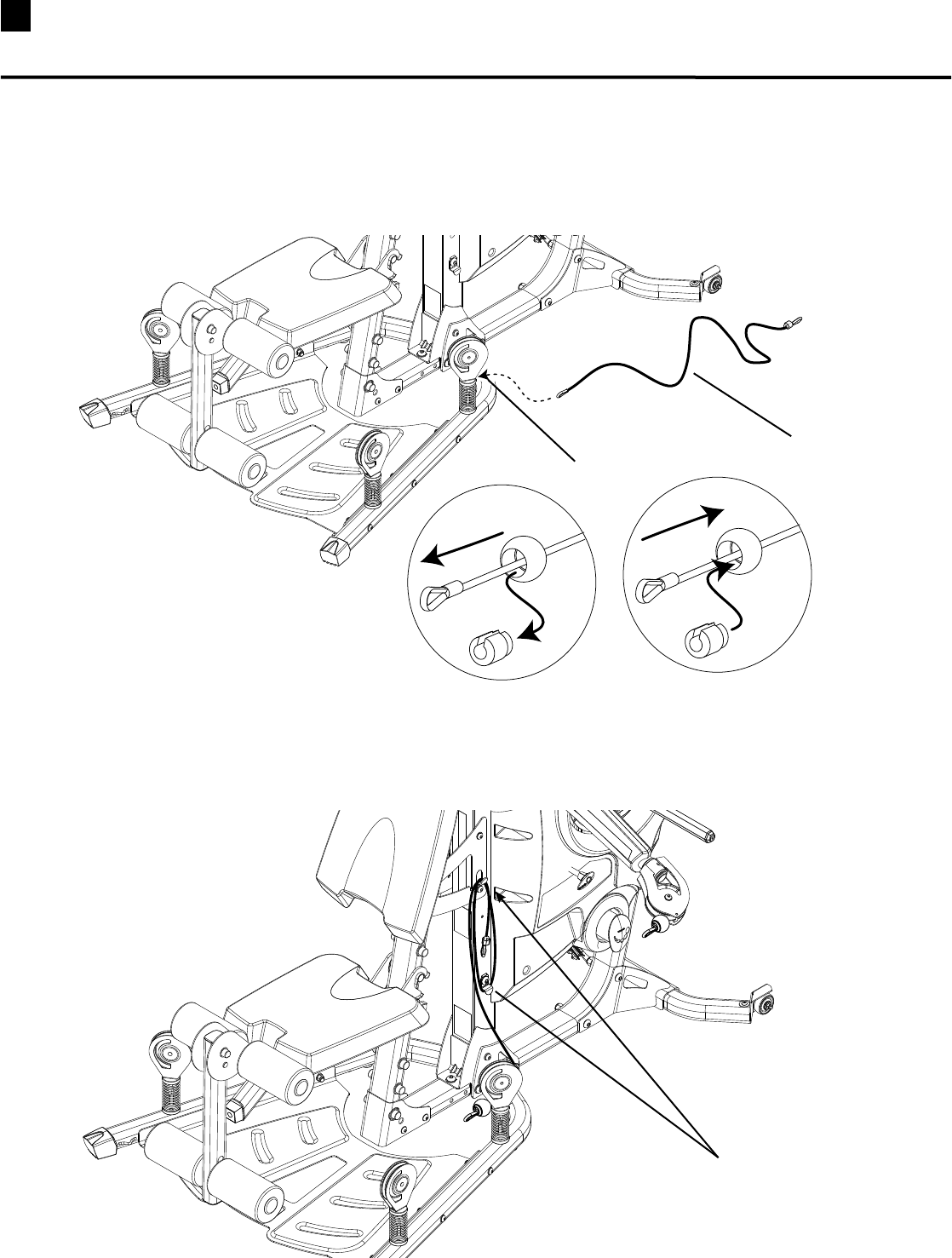
Squat Frame Pulley Cables
To install the Squat Frame Pulley cables, remove the ball end from the rope by pressing the insert out of the ball (Figure
A), and slide the ball off the rope. Route the cable under the pulley closest to the engine and reinstall the ball end
(Figure B).
When the Squat Pulley cables are not in use, store them by wrapping around the rope hooks as shown.
Figure A Figure B
Cable
Pulley
Hooks
11
Attaching Accessories
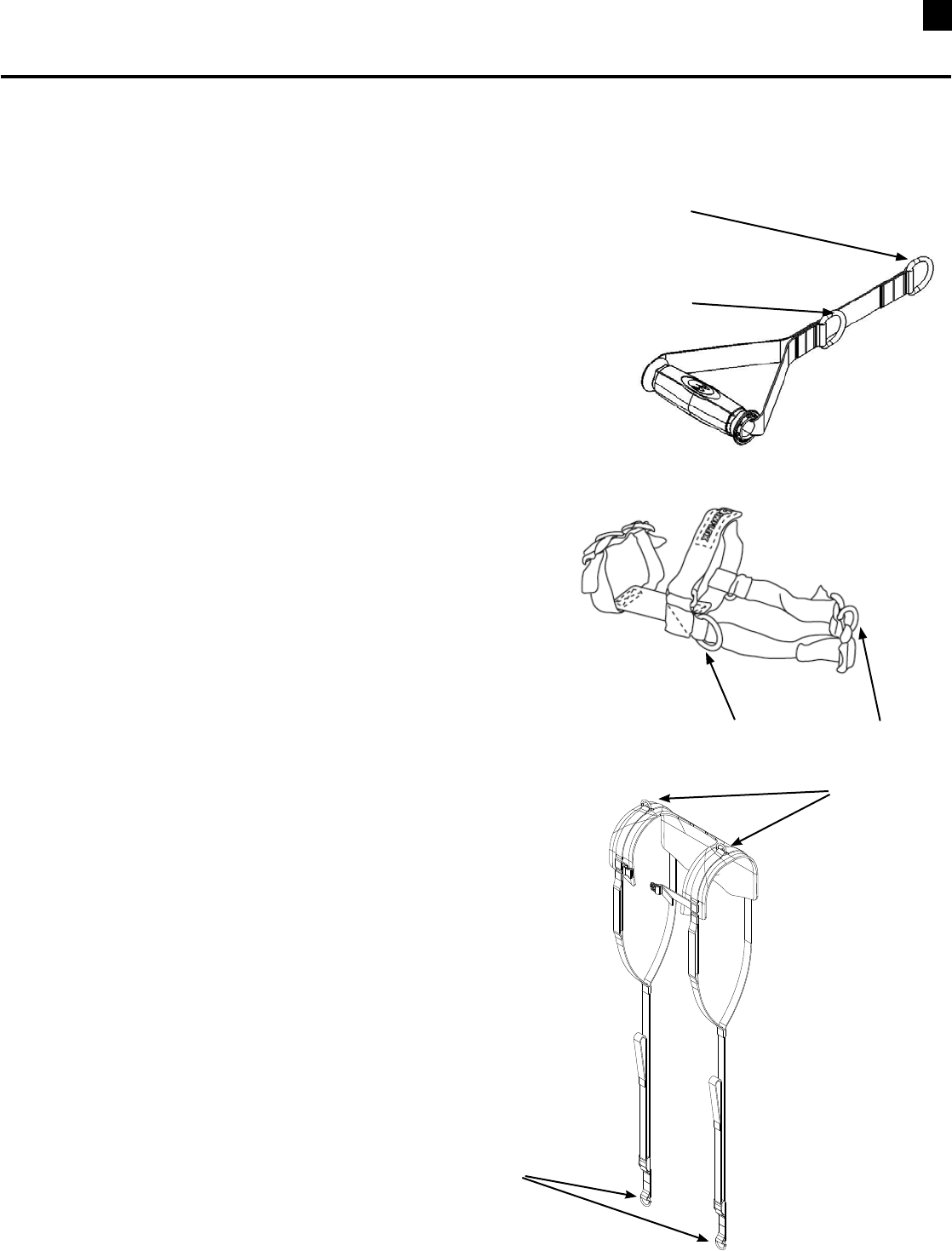
Your Bowflex Revolution® XP home gym comes with a pair each of hand grips and foot harnesses, and a squat
harness.
Hand Grips
You receive two hand grips with your Bowflex Revolution®
XP home gym. Hand grips contain two D-rings on each
grip, allowing for a shorter hand grip or longer hand grip,
depending on the exercise.
For exercises that require a specific hand grip attachment,
attaching to the D-ring closest to the handle will be referred
to as using the “short hand grip”. Attachments to the D-ring
furthest from the handle will be referred to as using the “long
hand grip”.
Connect here for
longer hand grip.
Connect here for
shorter hand grip.
Foot Harness
You additionally receive two foot harnesses. Foot harnesses
are used for several types of leg exercises. The foot
harnesses contain attachment rings on multiple sides.
Attach to cables using clips here.
Squat Harness
You receive a squat harness, which connects to the cables
in the Squat Frame pulleys. The squat harness contains
attachment rings on the adjustable straps and shoulders,
and loop handles on the straps. The D-rings on the straps
attach to the Squat Frame Pulley cables. You can also attach
Hand Grips to the rings on the shoulders, and use the grips to
stabilize your hands and arms.
Attach Hand
Grips here.
Attach Squat
Frame cables
here.
12
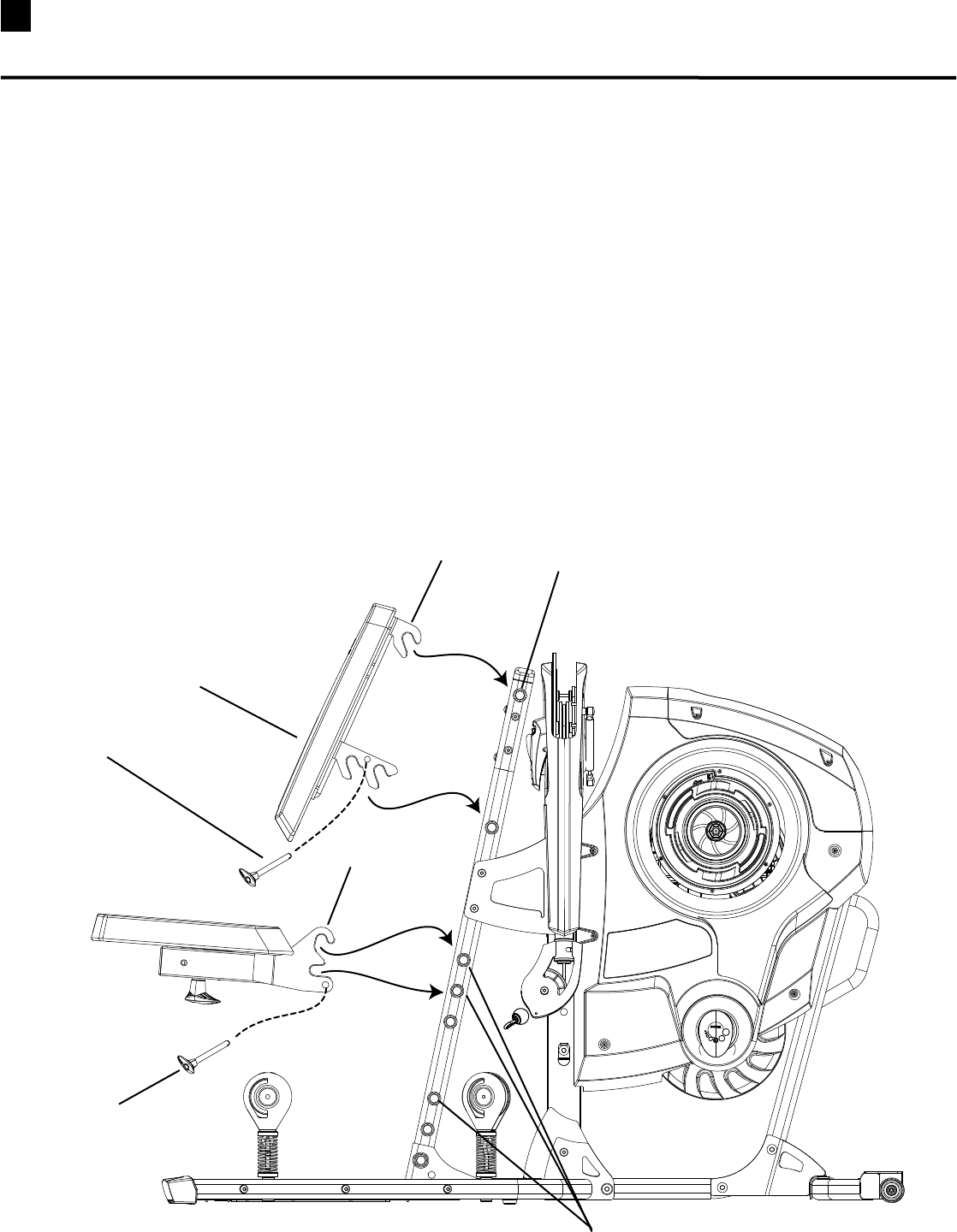
The illustrations on the following pages show how to install the seat and each of the Bowflex Revolution® XP
attachments.
Installing the Seat and Attachments
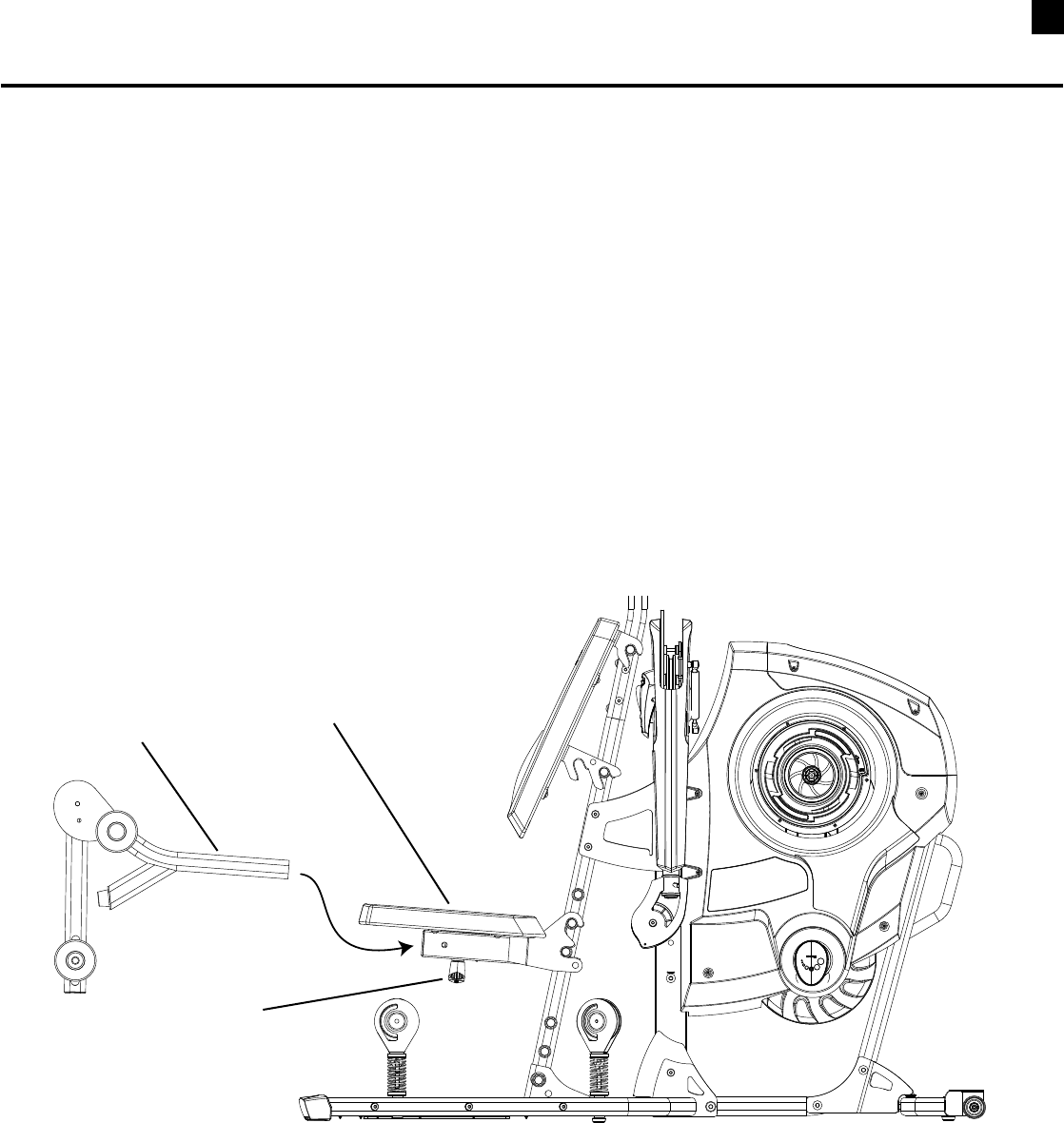
Seat and Back Pad with Locking Pin
Attach the seat and back pad to the seat rail by placing the upper hooks onto the respective upper posts and
rotating the lower hooks into position.
Once the pads are in position, insert the locking pin through the hole behind the lower hook to secure the pad:
• Use the locking pin to secure the seat pad for the Standing Single Leg Curl exercise.
• Use the locking pin to secure the back pad when you are performing seated lat pulldowns.
Note: Do not use the locking pin on the back pad when it is in the angled position.
Back Pad
Locking Pin
Upper Hook
Upper Hook
Upper Post
Upper Post
Locking Pin
13
Installing the Seat and Attachments
Leg Extension
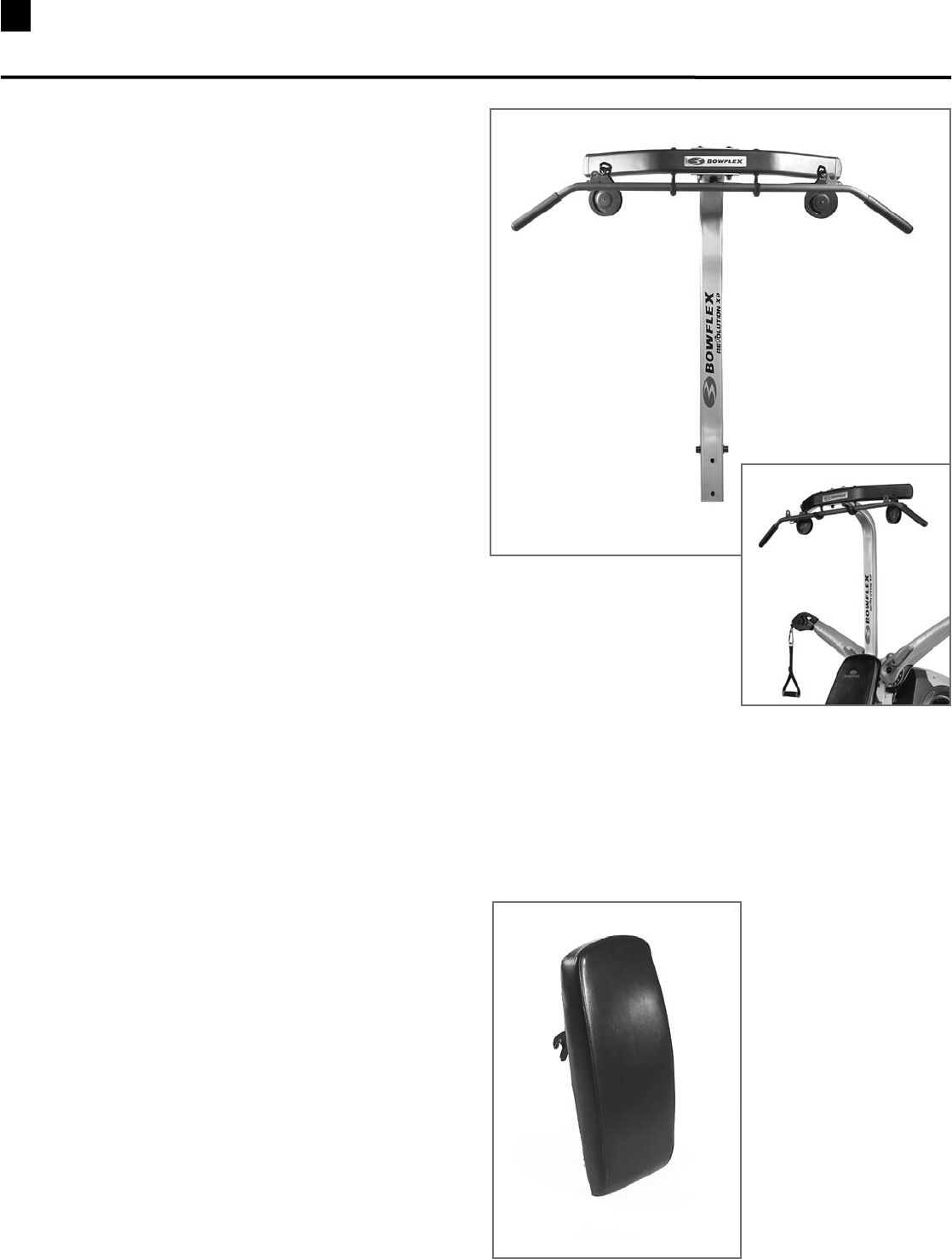
The Leg Extension is used when doing leg extension and leg curl exercises. To attach the Leg Extension, pull down
on the pop-pin under the seat and insert the leg extension into the mounting bracket. Slide the Leg Extension to the
desired position and screw the pop-pin tightly into place. Then attach the hooks on the ends of the Squat Pulley
cables to the snaphook on the Leg Extension.
Leg Extension
Assembly
Seat
Pop-pin
14
Ab Attachment (ordered separately)
Use the ab attachment when performing ab crunch
exercises. Remove the locking pin from the back of the
seatback, and remove the seatback from the seat rail.
Install the ab attachment in its place on the seat rail.
Installing Attachments
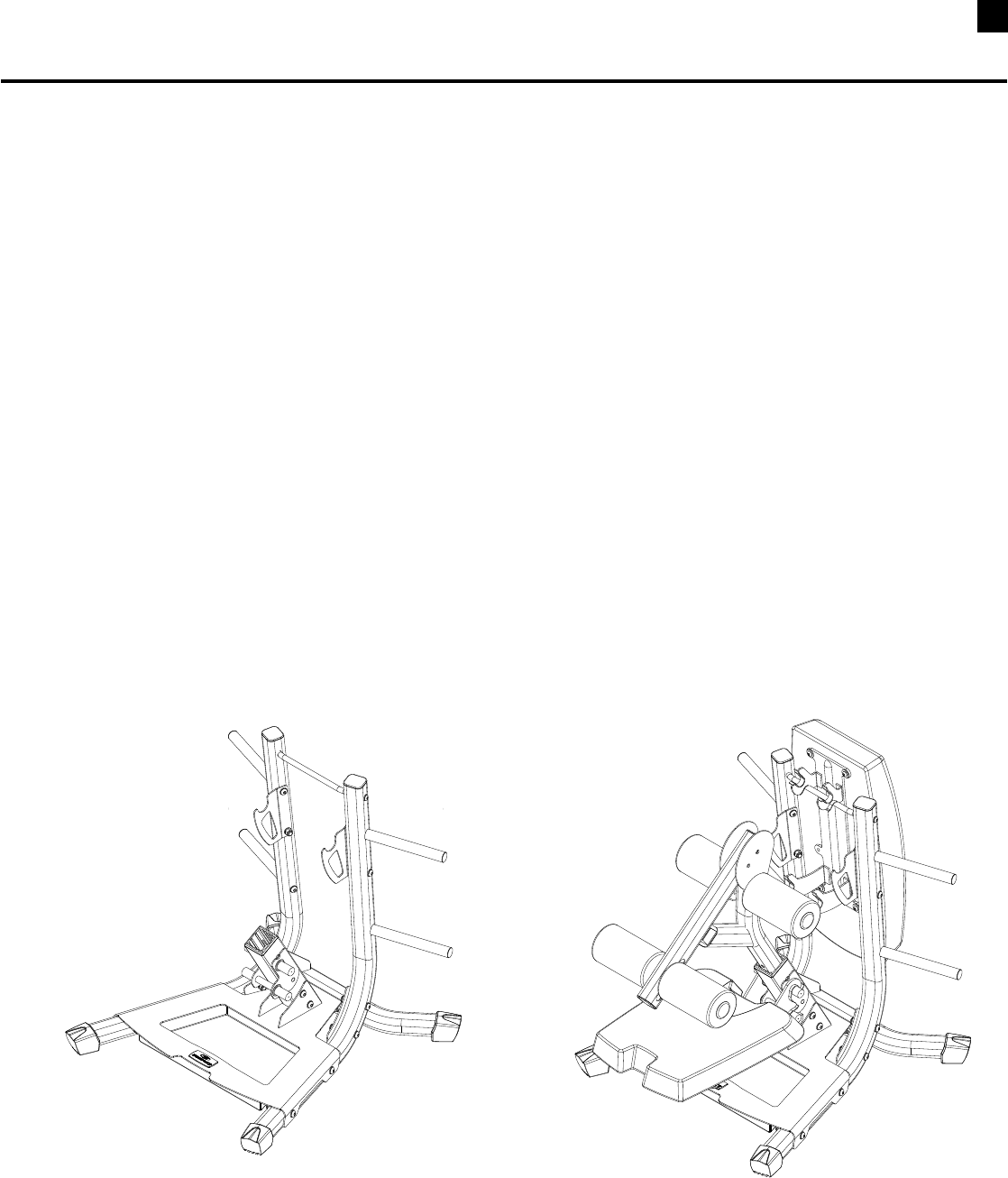
Lat Tower (ordered separately)
The Lat Tower is used for performing a wide variety of
standing and seated exercises. The product kit includes
the Lat Pulldown Bar, which enhances exercises that work
the back, shoulders and triceps muscles.
Remove the cap on the mast of the main frame. Insert the
Lat Tower in the mast and secure with the bolts provided.
Refer to the Lat Tower Assembly Manual for detailed
instructions.
Safety precautions:
• Before using the Lat Cross Bar, make sure that all
fasteners are in place and tightened.
• Make sure that the Lat Tower cables are securely
fastened to the regular Bowex® cables and the Lat
Pulldown Bar or Hand Grips.
• Always use the Lat Bar holders to support the Lat
Pulldown Bar, or remove the bar when not in use.
• Do not hang from or attempt to perform “chin ups” from
the Lat Cross Bar.
• Never pull on the Lat Pulldown Bar unless there is
resistance attached to it.
15
Companion Equipment
Bowflex Revolution® XP Accessory Rack (ordered separately)
The Bowex Revolution® XP home gym comes with many accessories and attachments to provide you with a wide variety of
exercises. Between workouts, this specially designed accessory rack stores the gear that makes your home gym versatile, so
your workout area stays organized and ready for your next workout.
The accessory rack features specially designed storage for many accessories including:
• Leg Extension
• Resistance Packs
• Handgrips & Foot Harnesses
• Squat Harness
• Ab Attachment Seat Back (optional)
Heavy-duty steel construction for years of use
Stand Size: 29.01” L x 28.81” W x 30.2” H (73.83cm x 73.17cm x 76.71cm)
Rack with AccessoriesUnloaded Rack
Check out the Bowflex Revolution® XP Accessory Rack and a wide selection of other
great products available at www.bowflex.com

16 Defining Your Goals
Muscle Strength is the maximum force you can exert against
resistance at one time. Your muscle strength comes into
play when you pick up a heavy bag of groceries or lift a small
child. It is developed when a localized muscle is worked
both positively (concentric) and negatively (eccentric) at
a resistance great enough to perform only five to eight
repetitions of the exercise before the muscle fails. Each set
of repetitions is followed by a rest interval that typically runs
three times longer than the set. Later, between exercise
sessions, the muscle overcompensates for the stress and
usually increases in both strength and size.
Muscle Endurance is the ability to perform repeated
contractions. It comes into play when you cross-country ski
or work on your feet all day. Endurance training addresses
the slow twitch, endurance muscle fibers, which depend on
oxygen for energy. To develop muscle endurance, use low
resistance and high repetitions— about 15-20 repetitions in
each set, three sets to each exercise, working the muscle
only to fatigue.
Muscle Power is the combination of strength and
speed of the muscular contraction. This is often
misinterpreted as:
a) Being directly associated with certain skill or sport; and/or
b) Meaning that you must move fast.
Load is actually a more important factor than speed when
attempting to improve power. When training to achieve
muscular power, pick a resistance that fatigues you in the
3-5 repetition range. When performing these reps, it is
more important to think of contracting the muscles faster
rather than attempting to move faster. Performing sport
simulation exercises usually results in a deterioration of the
motor pattern or skill. The biomechanically sound method
of improving power in your sport is to train for power using
the correct joint movements, as described in this manual.
Then practice the skill associated with your sport, learning to
apply this newly achieved power.
Body Composition is the ratio of fat weight (fat) to lean
weight (muscles, bones and tissue). As you age, the
ratio shifts. The fat weight increases and the lean weight
decreases. Training for muscle strength will generally
increase muscle size and aerobic conditioning will help burn
extra calories. Performing these two forms of exercise,
either at different times or together, will create the greatest
changes in body fat weight.
Balanced Strength and alignment is the result of equal
strength developed in all parts of the body. It comes into
play in your standing and sitting posture, and in your ability
to perform just about any activity safely and effectively.
An over-development of the back will round the shoulders;
weak or stretched abdominals can cause lower back pain.
You want a balance of muscle strength in front and back.
In addition, you need a balance of strength between your
middle, lower, and upper body.
Flexibility is the ability of a muscle or group of muscles
to move the joint through a full range of motion. Flexibility
comes into play when you execute an overhand serve or
stretch for the top shelf in the kitchen. It is a cooperative
movement of opposite muscle groups. When a muscle
contracts, its opposite muscle group must relax for the action
to occur. Increased flexibility means an increased range
of motion, made possible by this simultaneous contracting
and relaxing. Good flexibility is important in protecting the
body from injury and can be achieved through the balanced
strength training programs included in this manual.
Cardiovascular Endurance is the ability of the heart and lungs
to supply oxygen and nutrients to exercising muscles over an
extended period of time. It comes into play when you jog a
mile or ride a bike. It is a critical component of overall fitness
and health. Any exercise program must be supplemented
with cardiovascular training.
Reaching Your Goals
To reach your goals you must follow a consistent, well
designed program that provides balanced development to
Your body will do what you train it to do. That’s why it’s important to define your goals and focus on those goals. Here are some
fitness components that will help you define your goals and choose your fitness program.
17
Defining Your Goals
all parts of the body and includes both aerobic and strength
exercise. Only then will you meet your goals safely and
efficiently.
The workout routines found in this manual are professionally
designed and written to target specific fitness goals. Should
you not find one specific program to your liking, you can
design your own, based on sound information and the
principles found in this manual.
Designing Your Own Program
You may want to design your own personal program
specifically geared to your goals and lifestyle. Designing a
program is easy, as long as you follow these guidelines.
Understand fitness and its components: Improperly designed
programs can be dangerous. Take some time to review this
manual as well as other fitness guides.
Know your current fitness level: Before you start any fitness
program you should consult a physician who will help you
determine your current abilities.
Identify your goals: Goals are critical to choosing and
designing an exercise program that fits and enhances your
lifestyle, but so is strategy. It’s important not to rush the
process and try to accomplish too much too soon. That will
lead to setbacks and discouragement. Instead, set a series of
smaller achievable goals.
Select complementary exercises: Be sure to pair exercises
that address compound joint movements and single joint
movements. In addition, select exercises that address
complementary muscle groups.
Put first things first: During each session, first work those
muscle groups that need the most training.
Remember your cardiovascular component: Any fitness
program must contain a cardiovascular fitness component
to be complete. So complement your resistance training
with aerobic exercise such as walking, running, bicycling or
rowing.
Training variables: When designing your own program there
are several variables that, when mixed properly, will equal
the right fitness formula for you. In order to find the best
formula, you must experiment with several combinations of
variables. The variables are as follows:
• Training Frequency: The number of times you train per
week. We recommend daily activity but not daily training of
the same muscle group.
• Training Intensity: The amount of resistance used during
your repetition.
• Training Volume: The number of repetitions and sets
performed.
• Rest intervals: The time you rest between sets and the time
you rest between workouts.
Once you’ve established a base of fitness, follow these basic
principles:
• Isolate muscle groups: Focus work on specific muscle
groups.
• Progressive Loading: The gradual systematic increase of
repetitions, resistance and exercise period.

18 Exercising Properly
Working Out
A workout begins in your mind’s eye. With concentration and
visualization you can approach your workout with a positive,
constructive attitude. A good pre-workout mental routine is
to sit and relax, so you can focus on what you are about to do
and think about achieving your end goal.
Warming Up
It is important to warm up each muscle group before doing
strenuous resisted exercise. We recommend that you warm
up by doing light stretching and performing light exercises on
the Bowflex Revolution® XP home gym.
Breathing
The most important part of breathing during exercise is, quite
simply, that you do it. Breathing in or out during the actual
performance is not dependent upon the direction of air flow
relative to exertion. It is, in fact, a mechanical process that
changes the position of your spine as your rib cage moves.
Here are some tips for breathing:
1) Be cautious when you are concentrating or exerting
effort. This is when you will probably hold your breath.
DO NOT hold your breath. Do not exaggerate breathing.
Depth of inhalation and exhalation should be natural for the
situation.
2) Allow breathing to occur naturally. Don’t force it.
Performing Your Routine
The workout portion of your fitness routine is the series of
exercises devoted to your particular goals. Remember, make
sure to have fun!
Cool Down
An essential part of the exercise routine is the cool down.
Gradually reduce the level of exercise intensity so that blood
does not accumulate in one muscle group, but continues to
circulate at a decreasing rate. We recommend the rowing
exercise for the cool down. Remember to gradually move
yourself into a relaxed state.
19
The Workouts
20 Minute Better Body Workout
Frequency: 3 Days Per Week (M-W-F) Time: About 20 Minutes
Start by performing one set of each exercise. Warm up with a light resistance exercise that you can perform easily for 5 -10
reps without fatiguing. Focus on practicing and learning your technique before increasing the resistance. Then move to a more
challenging resistance you can perform for no less than 10 reps and no more than 15 reps without your form deteriorating. As
you become stronger, you can advance to two sets for each exercise. Complete all sets of each exercise before moving on to
the next. Rest 30 to 45 seconds between sets. Move slowly on each rep. Use a pace that will allow you to stop the movement
instantly at any point in the rep. Count three seconds up and three seconds down and work to fatigue during each set.
Advanced General Conditioning
Frequency: 4 Days Per Week (M-T-TH-F) Time: About 35-45 Minutes
When you are proficient in performing the exercise techniques of the above routine and are no longer realizing results, or if
you become bored, it is time to change your program. You can increase your training with this “split system” routine that works
opposing muscle groups on different days. To do this, you’ll increase your resistance when you can perform 12 reps perfectly,
and you’ll increase your volume by performing more sets and more exercises. Move slowly on each rep. Use a pace that will
allow you to stop the movement instantly at any point in the rep. Count three seconds up and three seconds down and work to
fatigue during each set.
Body Part
Chest
Back
Shoulders
Arms
Legs
Trunk
Exercise
Bench Press
Seated Lat Pulldown
Crosssover Rear Deltoid Row
Standing Biceps Curl
Cross Triceps Extension
Leg Extension
Standing Single Leg Curl
Standing Single Leg Calf Raise
Standing Low Back Extension
Standing Abdominal Crunch
Sets
1-2
1-2
1-2
1-2
1-2
1-2
1-2
1-2
1-2
1-2
Reps
10-15
10-15
10-15
10-15
10-15
10-15
10-15
10-15
10-15
10-15
Body Part
Back
Shoulders
Arms
Trunk
Exercise
Standing Lat Row
Stiff Arm Pulldown
Bent Rear Deltoid Row
Standing Biceps Curl
Reverse Grip Barbell Curl
Standing Low Back Extension
Standing Abdominal Crunch
Standing Single Arm/Single Leg Lat Row
Sets
1-3
1-3
1-3
1-3
1-3
1-3
1-3
1-3
Reps
10-12
10-12
10-12
10-12
10-12
10-12
10-12
10-12
Body Part
Chest
Shoulders
Arms
Legs
Exercise
Bench Press
Seated Shoulder Press
Triceps Pushdown with Bar
Seated French Press
The Squat
Standing Single Leg Curl
Standing Calf Raise
Sets
1-3
1-3
1-3
1-3
1-3
1-3
1-3
Reps
10-12
10-12
10-12
10-12
10-12
10-12
10-12
Day 1 & 3
Day 2 & 4
20 The Workouts
20 Minute Upper/Lower Body
Frequency: 4 Days Per Week (M-T-TH-F) Time: About 20 Minutes
This program provides you with a quick and effective workout that combines muscle conditioning with some cardiovascular
benefits. Do this routine when you are limited in time or just want a variation to your normal routine. Perform this program
training 2 days, resting 1 to 2. Perform all exercises to near failure, stopping at the point that your technique starts to
deteriorate. Rest only 20-30 seconds between sets. As you get stronger, increase the number of sets you perform. Move
slowly on each rep. Use a pace that will allow you to stop the movement instantly at any point in the rep. Count three seconds
up and three seconds down and work to fatigue during each set.
DAY 1 & 3 Body Part
Chest
Back
Shoulders
Arms
Exercise
Bench Press
Crossover Narrow Pulldown
Standing Lateral Raise
Standing Biceps Curl
French Press
Sets
1-3
1-3
1-3
1-3
1-3
Reps
12-15
12-15
12-15
12-15
12-15
Body Part
Legs
Trunk
Exercise
Leg Extension
Standing Leg Curl
Standing Hip Extension
Standing Calf Raise
Standing Low Back Extension
Standing Abdominal Crunch
Sets
1-3
1-3
1-3
1-3
1-3
1-3
Reps
12-15
12-15
12-15
12-15
10-12
10-12
DAY 2 & 4
21
The Workouts
Body Building
Frequency: 3 Days On, 1 Day Off Time: About 45-60 Minutes
Body building requires focused concentration and dedication to training, as well as proper eating habits. Train each muscle
group to failure before moving on to the next exercise. Do not neglect any muscle group. If needed, include an aerobic activity
to increase your caloric expenditure and help to reduce your body fat levels to achieve a defined muscular look. Rest 30-60
seconds between each set and exercise. Focus on proper form. Tighten the muscle before you move, squeeze the muscle as you
move, cramp the muscle at the point of full contraction, and resist the movement as you lower the weight. Move slowly on each
rep. Use a pace that will allow you to stop the movement instantly at any point in the rep. Count three seconds up and three
seconds down and work to fatigue during each set.
Body Part
Chest
Shoulders
Exercise
Bench Press
Chest Fly
Seated Shoulder Press
Crossover Bent Rear Rear Deltoid Rows
Standing Lateral Raise
Shoulder Shrug
Sets
2-4
2-4
2-4
2-4
2-4
2-4
Reps
8-12
8-12
8-12
8-12
8-12
8-12
DAY 1
DAY 2
DAY 3 Body Part
Legs
Trunk
Exercise
The Squat
Leg Extension
Standing Hip Extension
Standing Single Leg Curl
Seated (Straight Leg) Calf Raise
Standing Low Back Extensions
Standing Abdominal Crunch
Seated Resisted Oblique Crunch
Sets
2-4
2-4
2-4
1-3
2-4
2-4
2-4
2-4
Reps
8-12
8-12
8-12
8-12
12-15
8-12
8-12
8-12
Body Part
Back
Arms
Exercise
Seated Lat Pulldown
Narrow Pulldowns
Standing Biceps Curl
Reverse Grip Barbell Curls
Cross Triceps Extension
French Press
Sets
2-4
2-4
2-4
2-4
2-4
2-4
Reps
8-12
8-12
8-12
8-12
8-12
8-12
22 The Workouts
Circuit Training – Anaerobic/Cardiovascular
Frequency: 2-3 Times Per Week Time: About 20-45 Minutes
Circuit training is a great way to achieve the benefits of strength training and cardiovascular training in one quick, challenging
routine. The idea is to move quickly from exercise to exercise, taking only as much rest between sets as it takes to set up the
next exercise (less than 20 seconds). One circuit equals one set of each exercise. Initially, start with completing one round of
Circuit 1. Then add an additional round of the same circuit. Once you reach three rounds of Circuit 1, add one round of Circuit
2. Add additional rounds of Circuit 2 as your fitness level increases. Repeat process with Circuit 3. Do not let your heart rate
exceed 220 minus your age. Perform each rep of each exercise slowly and with perfect technique. Count three seconds up and
three seconds down. Warm-up with 5-15 minutes of rowing or some other aerobic exercise before starting your circuits.
Circuit 1
Circuit 2
Body Part
Chest
Legs
Back
Legs
Trunk
Exercise
Bench Press
The Squat
Seated Lat Pulldown
Seated Leg Curl
Standing Abdominal Crunch
Reps
8-12
8-12
8-12
8-12
8-12
Body Part
Shoulders
Legs
Back
Trunk
Arms
Exercise
Seated Shoulder Press
Leg Extension
Seated Lat Pulldown
Standing Low Back Extension
Standing Biceps Curl
Reps
8-12
8-12
8-12
8-12
8-12
Body Part
Shoulders
Arms
Legs
Trunk
Legs
Exercise
Rear Deltoid Rows
Cross Triceps Extensions
Standing Single Leg Curl
Seated Resisted Oblique Crunch
Seated (Straight Leg) Calf Raise
Reps
8-12
8-12
8-12
8-12
8-12
Circuit 3
23
The Workouts
Strength Training
Frequency: 3 Days Per Week (M-W-F) Time: About 45-60 Minutes
This program is designed to emphasize overall strength development. This is an advanced routine to be used only after you
have progressed from the advanced general conditioning routine and only after you have perfected your exercise techniques.
Work each set to near exhaustion. If you can perform more than 5 to 8 reps, you should increase your resistance 5 pounds
and decrease your reps to 5. Rest 60 - 120 seconds between each set and exercise. Focus on proper form. Tighten the muscle
before you move, squeeze the muscle as you move, cramp the muscle at the point of full contraction, and resist the movement
as you lower the weight. Move slowly on each rep. Use a pace that will allow you to stop the movement instantly at any point
in the rep. Count two seconds up and four seconds down and work to fatigue during each set.
Body Part
Chest
Shoulders
Exercise
Bench Press
Chest Fly (wide pulley)
Seated Shoulder Press
Standing Lateral Raise
Rear Deltoid Row
Shoulder Shrug
Sets
2-4
2-4
2-4
2-4
2-4
2-4
Reps
5-8
5-8
5-8
5-8
5-8
5-8
Body Part
Back
Arms
Exercise
Barbell Bent Over Row
Wide Pulldown
Standing Biceps Curl
Reverse Grip Barbell Curl
Triceps Extension
Triceps Pushdown
Sets
2-4
2-4
2-4
2-4
2-4
2-4
Reps
5-8
5-8
5-8
5-8
5-8
5-8
Body Part
Legs
Trunk
Exercise
The Squat
Lying Prone Leg Curl
Standing Single Leg Leg Curl
Seated (Straight Leg) Calf Raise
Standing Low Back Extension
Standing Abdominal Crunch
Sets
2-4
2-4
2-4
2-4
2-4
2-4
Reps
5-8
5-8
5-8
5-8
8-12
5-8
Day 1
Day 2
Day 3
24 Exercises
A Revolutionary Way to Exercise
The Bowflex Revolution® XP home gym provides a more than 90 exercises and over 400 total variations. You can switch quickly
between hundreds of exercises with less setup time than most gym machines. That means a shorter workout while maintaining
a higher, calorie-burning heart rate.
This manual and the included poster provide information on a large number of these exercises, but feel free to vary the
exercises to meet your needs. Using the adjustable freearms, you can set the arms at 8 for one exercise, and exercise an
entirely different set of muscles by simply moving the freearms to 6 or 7 and doing the same exercise.
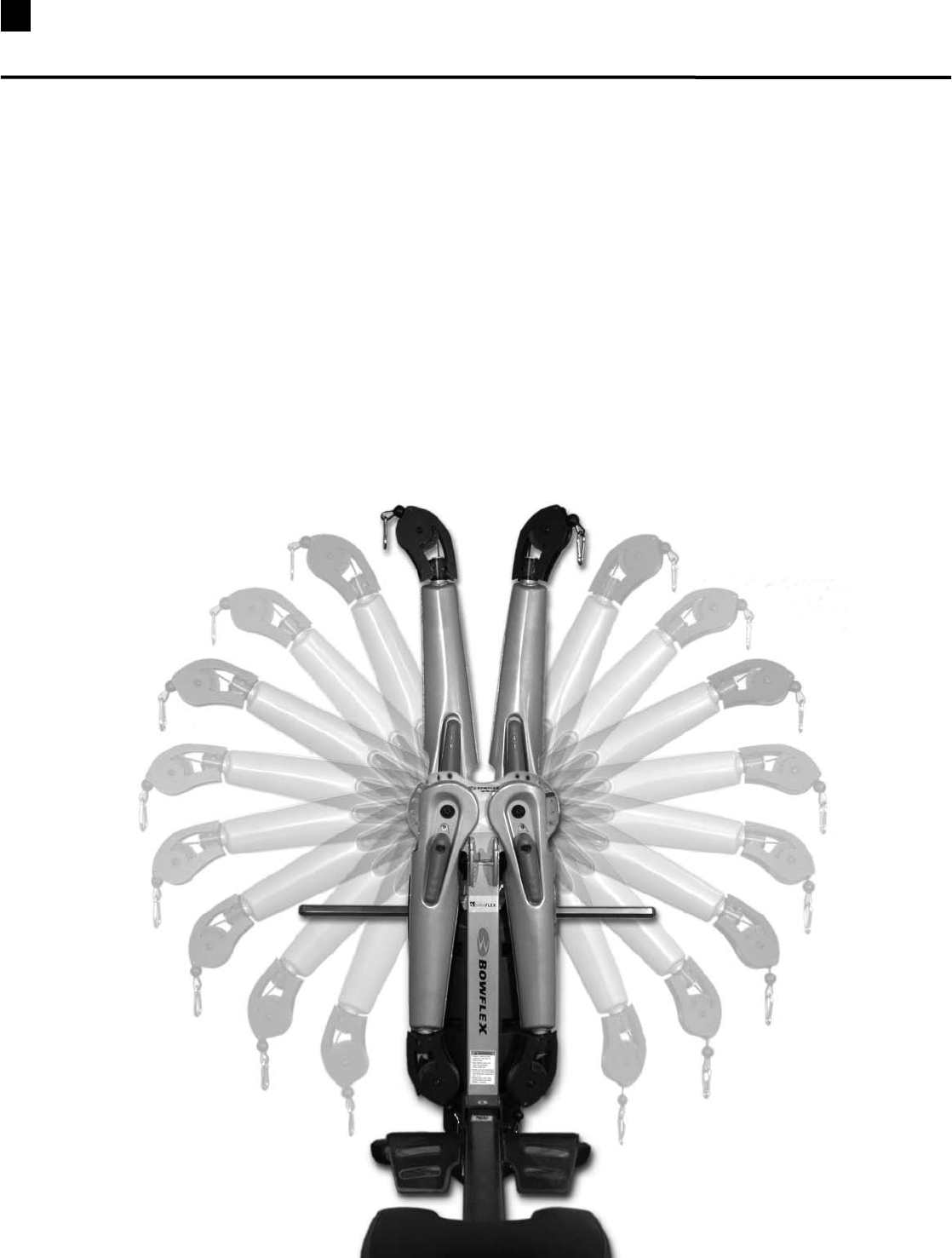
Changing exercises is simple. The freearms rotate between positions 0 and 9, with 0 being straight up and 9 being straight
down. That means you have ten arm positions to work out with, each one providing a slightly different variation of each
exercise. Switching cables between exercises is simple with snap-hook attachments.
Please note that the exercise photos in this section show the optional Lat Tower and Ab Attachment (available separately).
25
25
Chest Exercises
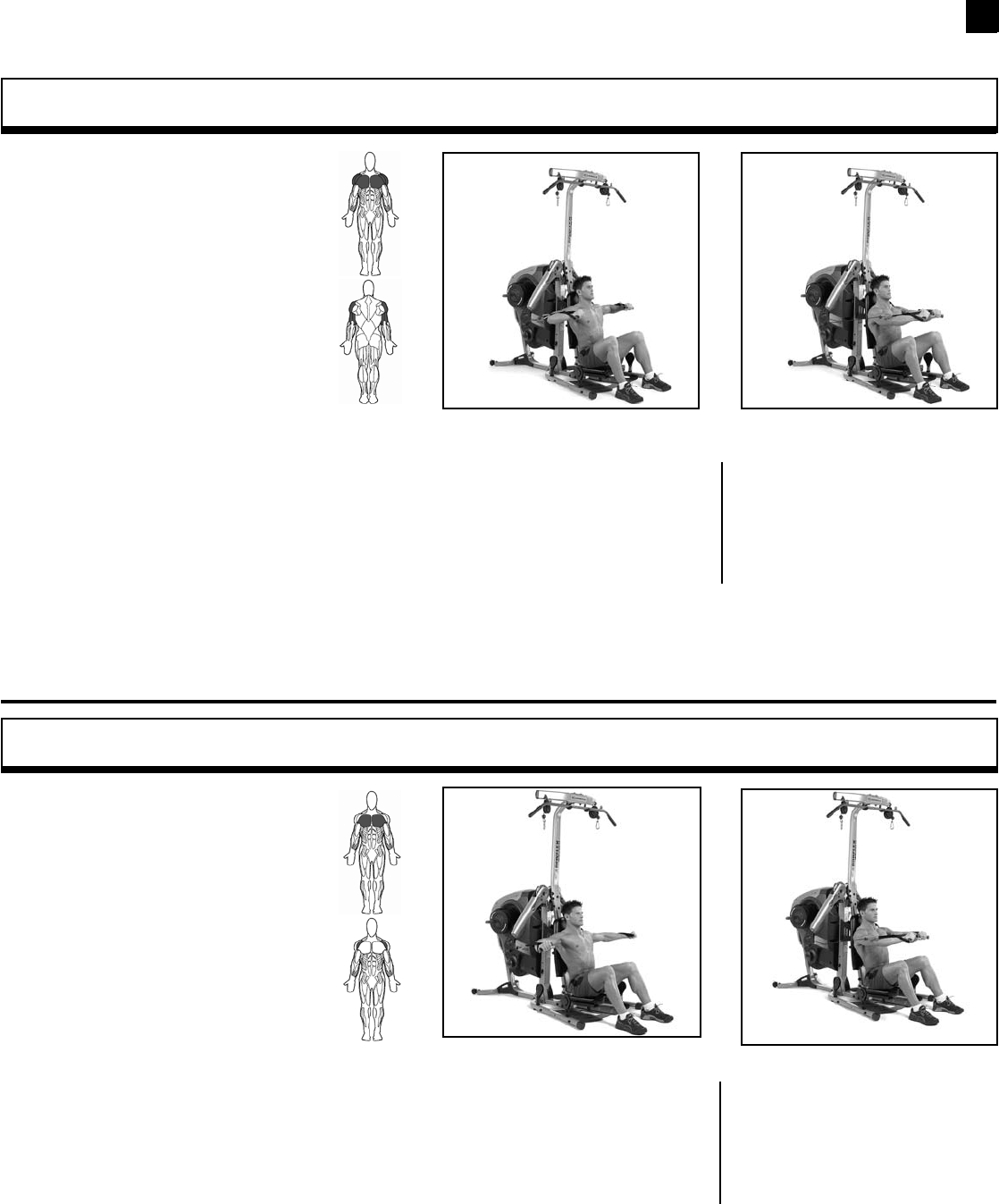
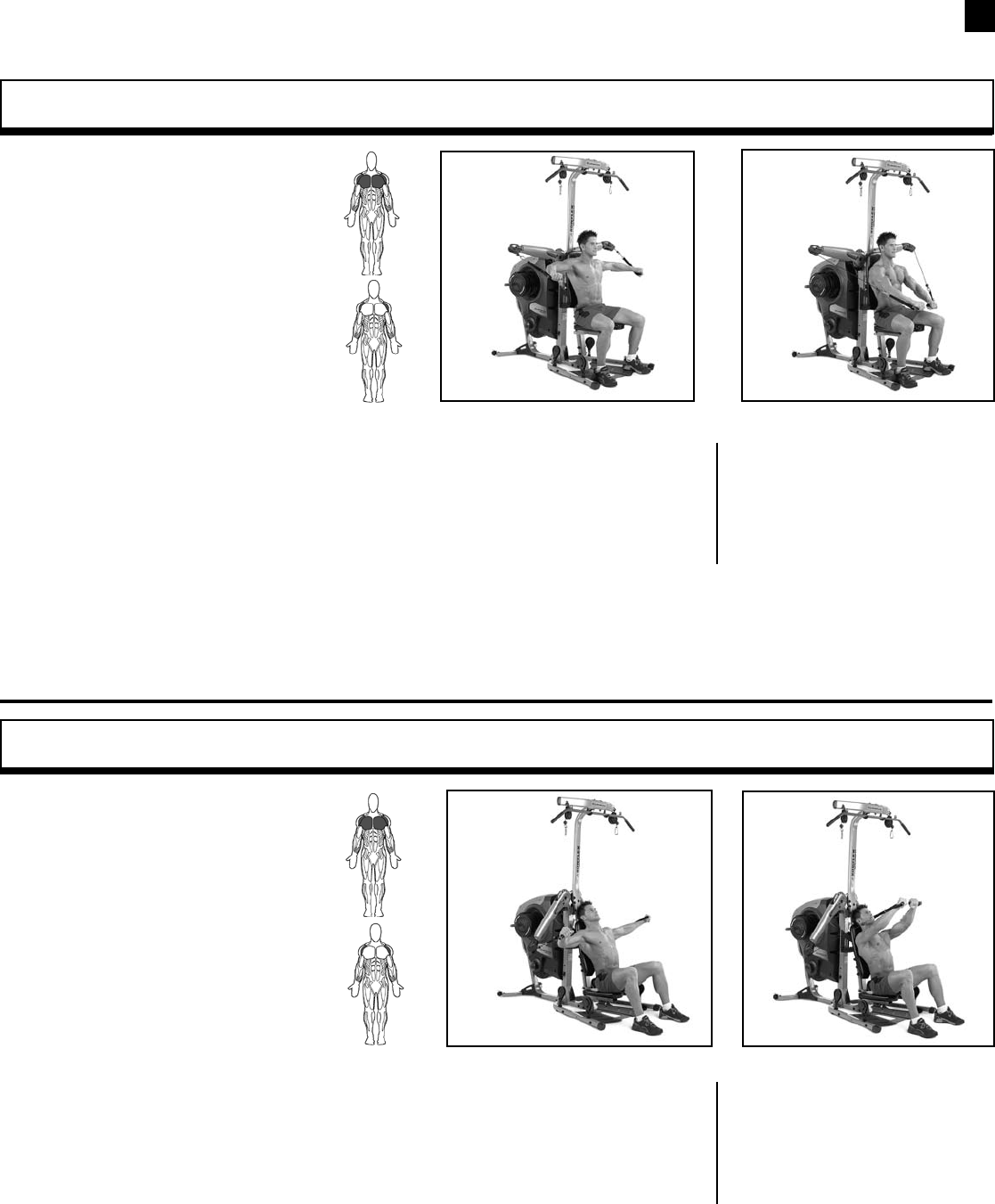
Bench Press — Shoulder Horizontal Adduction (and elbow extension)
Muscles worked:
Pectoralis Major; Deltoids; Triceps
Position:
Seated—facing outward
Accessory:
Long Hand Grips
Adjustable Arm Position:
5 or 6
Success Tips
• Maintain a 90° angle between upper
arms and torso throughout motion.
• Keep chest muscles tightened. Limit and
control your range of motion.
• Keep knees bent, feet on Platform, head
back against Seat Back Pad.
• Keep elbows in front of shoulders.
• Keep shoulder blades pinched together
and maintain good spinal alignment.
• Grasp Hand Grips in both hands.
• Bend your elbows until hands
are at chest level. Rotate upper
arms away from torso, elbows
out, palms forward.
• Line up arms with cables keeping
your wrists straight.
• Raise chest, pinch shoulder
blades together, and maintain a
slight, comfortable arch in your
lower back.
START
START
Chest Fly — Shoulder Horizontal Adduction (elbow stabilized)
START FINISH
START
• Grasp Hand Grips in both hands.
• Open your arms into a wide,
elbow bent position. Keep
elbows and forearms below
chest level, palms forward.
• Raise chest, pinch shoulder
blades together, and maintain a
slight, comfortable arch in your
lower back.
• Slowly press your arms forward
and upward, straightening arms
and moving your hands together.
• Rotate your wrists and forearms
upward, making sure that your
arms are directly in line with the
cables.
• Slowly return to Start position.
FINISH
Muscles worked:
Pectoralis Major; Anterior Deltoid
Position:
Seated—facing outward
Accessory:
Long Hand Grips
Adjustable Arm Position:
5 or 6
Success Tips
• Maintain a 60-90° angle between upper
arms and torso during exercise.
• Keep chest muscles tightened. Limit and
control your range of motion.
• Keep knees bent, feet on Platform, head
back against Seat Back Pad.
• To improve your pectoralis involvement,
keep your shoulder blades pinched
together throughout upward and
downward movements.
• Slowly press your hands
forward, straightening your
arms while moving your hands
together.
• Do not lock elbows.
• Return to Start position, keeping
your wrists at shoulder width and
in line with the cables.
FINISH
FINISH
Decline Bench Press — Shoulder Horizontal Adduction (and elbow extension)
START FINISH
START
• Grasp Hand Grips in both hands.
• Cables travel beneath arms,
forearms aligned with cables.
• Bend your elbows, keeping your
forearms at least 10° lower than
when in the standard Bench Press
Start position.
• Raise chest, pinch shoulder
blades together, and maintain a
comfortable arch in lower back.
• Slowly straighten your elbows,
keeping upper arms at a 90°
angle from your torso. Forearms
should be 5- 6” lower than when
in the standard Bench Press
position.
• Do not lock your elbows.
• Slowly return to the Start
position, keeping your wrists
steady and your movements slow
and controlled.
FINISH
Muscles worked:
Pectoralis Major; Deltoids; Triceps
Position:
Seated—facing outward
Accessory:
Long Hand Grips
Adjustable Arm Position:
5 or 6
Success Tips
• Maintain a 90° angle between your
upper arms and torso at the start of the
motion, and slightly less than 90° at the
finish.
• Keep knees bent, feet on Platform, head
back against Seat Back Pad.
• Do not let your elbows travel behind
your shoulders.
• Keep shoulder blades pinched together
and maintain good spinal alignment.
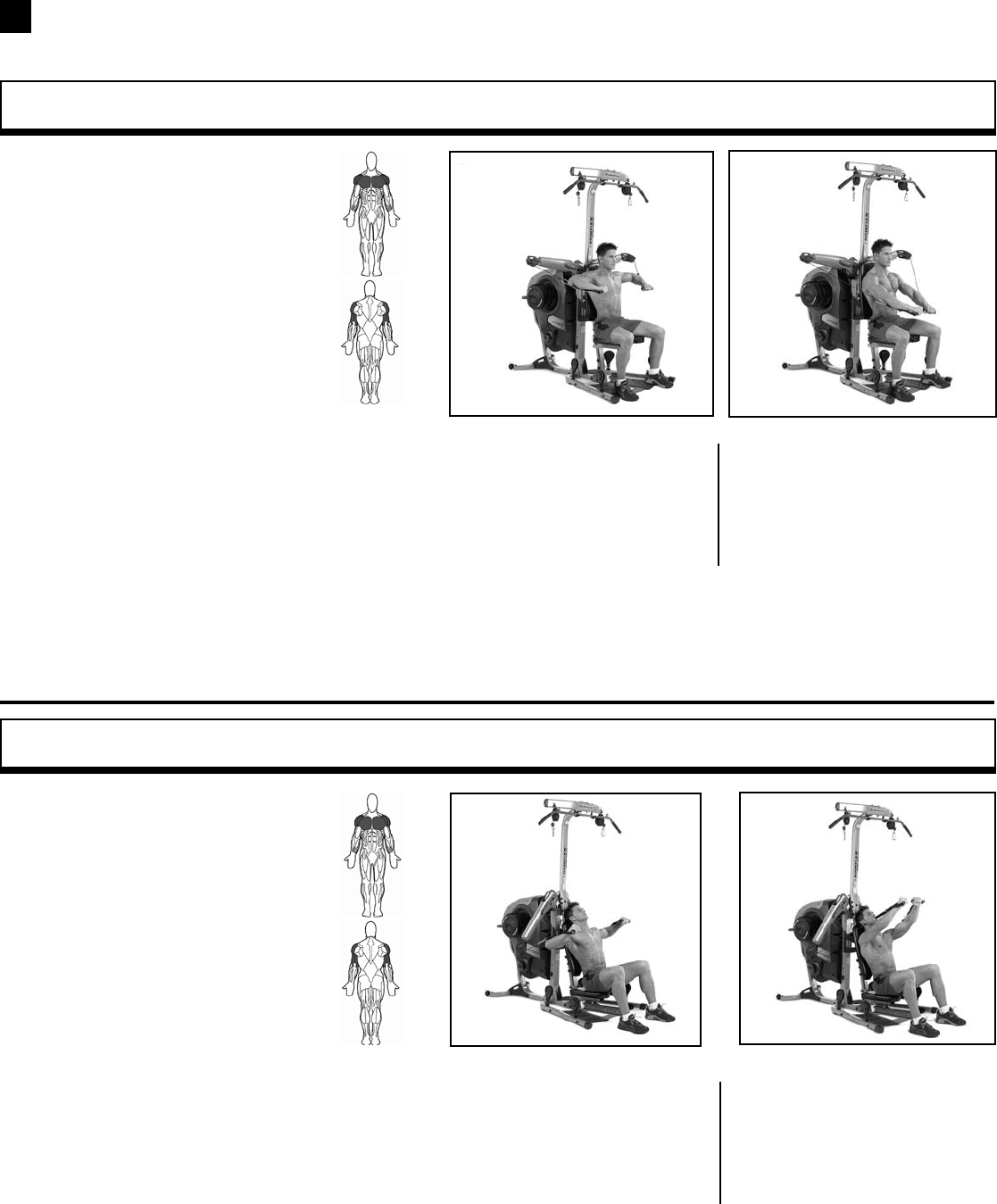
Incline Bench Press — Shoulder Horizontal Adduction (and elbow extension)
START FINISH
START
• Grasp Hand Grips in both hands.
• Cables travel over arms, forearms
aligned with cables.
• Bend your elbows, keeping your
forearms at least 10° higher than
when in the standard Bench Press
Start position.
• Raise chest, pinch shoulder blades
together, and maintain a slight arch
in your lower back.
• Slowly straighten your elbows,
keeping upper arms at a 90°
angle from your torso. Forearms
should be 5- 6” higher than when
in the standard Bench Press
position.
• Do not lock your elbows.
• Slowly return to the Start
position, keeping your wrists
steady and your movements slow
and controlled.
FINISH
Muscles worked:
Pectoralis Major; Deltoids; Triceps
Position:
Seated—facing outward
Accessory:
Hand Grips
Adjustable Arm Position:
6 or 7
Success Tips
• Maintain a 90° angle between your
upper arms and torso at the start of the
motion, and slightly less than 90° at the
finish.
• Keep knees bent, feet on Platform, head
back against Seat Back Pad.
• Do not let your elbows travel behind
your shoulders.
• Keep shoulder blades pinched together
and maintain good spinal alignment.
Chest Exercises
26
27
Chest Exercises
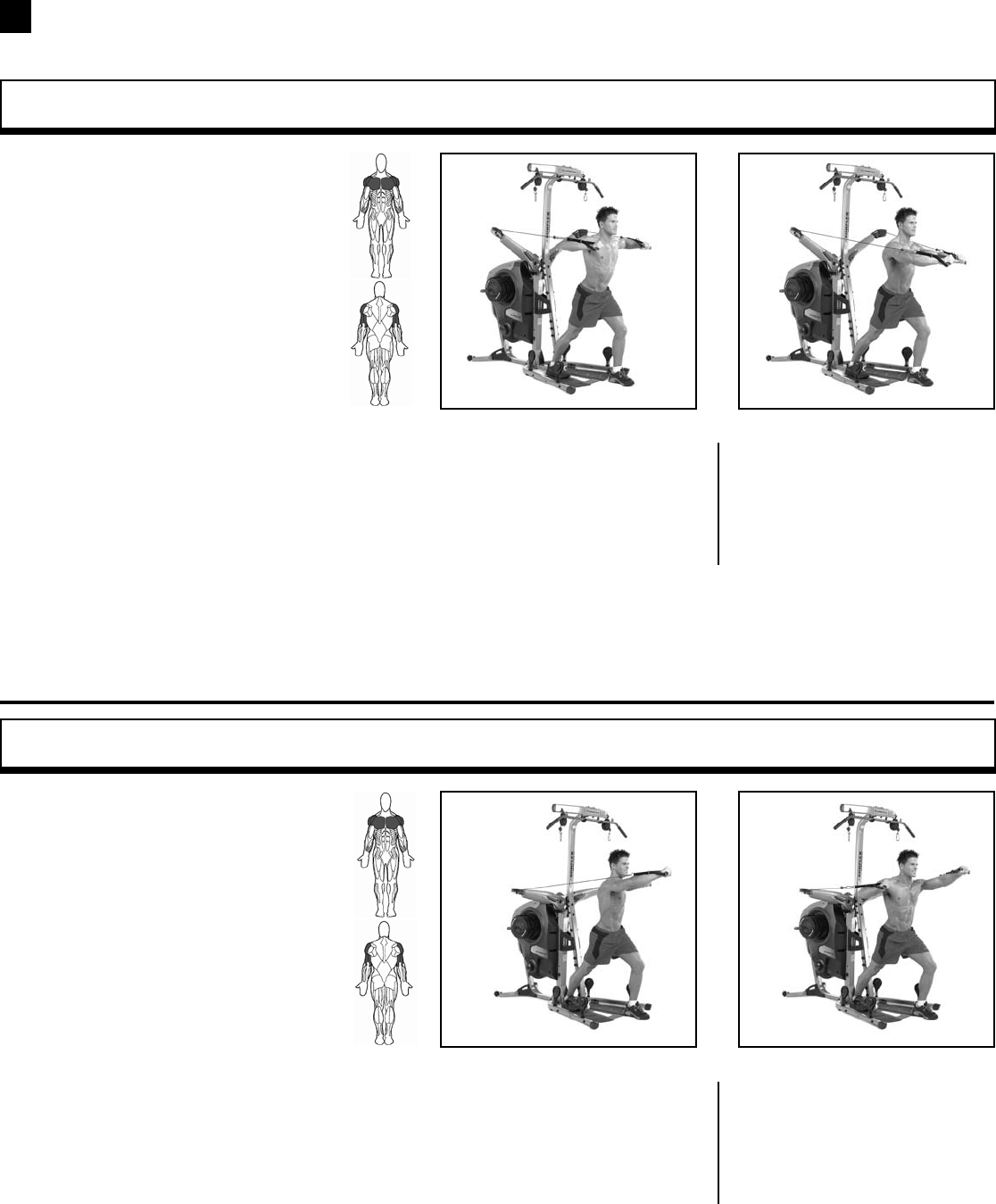
Decline Chest Fly — Shoulder Horizontal Adduction (elbow stabilized)
START FINISH
START
• Grasp Hand Grips in both hands.
• Open your arms into a wide,
“embrace” position, elbows
slightly bent. Press your forearms
downward. At full extension, hands
should be level with your hips, palms
facing forward.
• Do not lock your elbows.
• Raise chest, pinch shoulder blades
together, and maintain a slight,
comfortable arch in your lower
back.
• Slowly press your arms forward
and downward, straightening arms
and moving your hands together.
Hands should be 5-6” lower than
standard Chest Fly finish position.
• Rotate your wrists and forearms
upward.
• Return to Start position, slowly
bringing your arms in front of you,
just below chest level.
FINISH
Muscles worked:
Pectoralis Major; Anterior Deltoid
Position:
Seated—facing outward
Accessory:
Hand Grips
Adjustable Arm Position:
5 or 6
Success Tips
• Maintain a 60-90º angle between upper
arms and torso during the exercise.
• Keep chest muscles tightened. Limit and
control your range of motion.
• Keep knees bent, feet on Platform, head
back against Seat Back Pad.
• To improve your pectoralis involvement,
pinch your shoulder blades together
throughout movement.
Incline Chest Fly — Shoulder Horizontal Adduction (elbow stabilized)
START FINISH
START
• Grasp Hand Grips in both hands.
• Press your arms forward and
upward, straightening arms and
moving your hands together. Hands
should be 5-6” higher than standard
Chest Fly Start position.
• Do not lock your elbows.
• Raise chest, pinch shoulder blades
together, and maintain a slight,
comfortable arch in your lower
back.
• Open your arms into a wide,
“embrace” position, elbows
slightly bent. Press your forearms
upward. At full extension, your
elbows should be level with your
ears, palms facing forward.
• Rotate your wrists and forearms
upward.
• Return to Start position, slowly
bringing your arms in front of
you, just below chest level.
FINISH
Muscles worked:
Pectoralis Major; Anterior Deltoid
Position:
Seated—facing outward
Accessory:
Hand Grips
Adjustable Arm Position:
6 or 7
Success Tips
• Maintain a 60-90º angle between upper
arms and torso during the exercise.
• Keep chest muscles tightened. Limit and
control your range of motion.
• Keep knees bent, feet on Platform, head
back against Seat Back Pad.
• To improve your pectoralis involvement,
pinch your shoulder blades together
throughout movement.
28 Chest Exercises
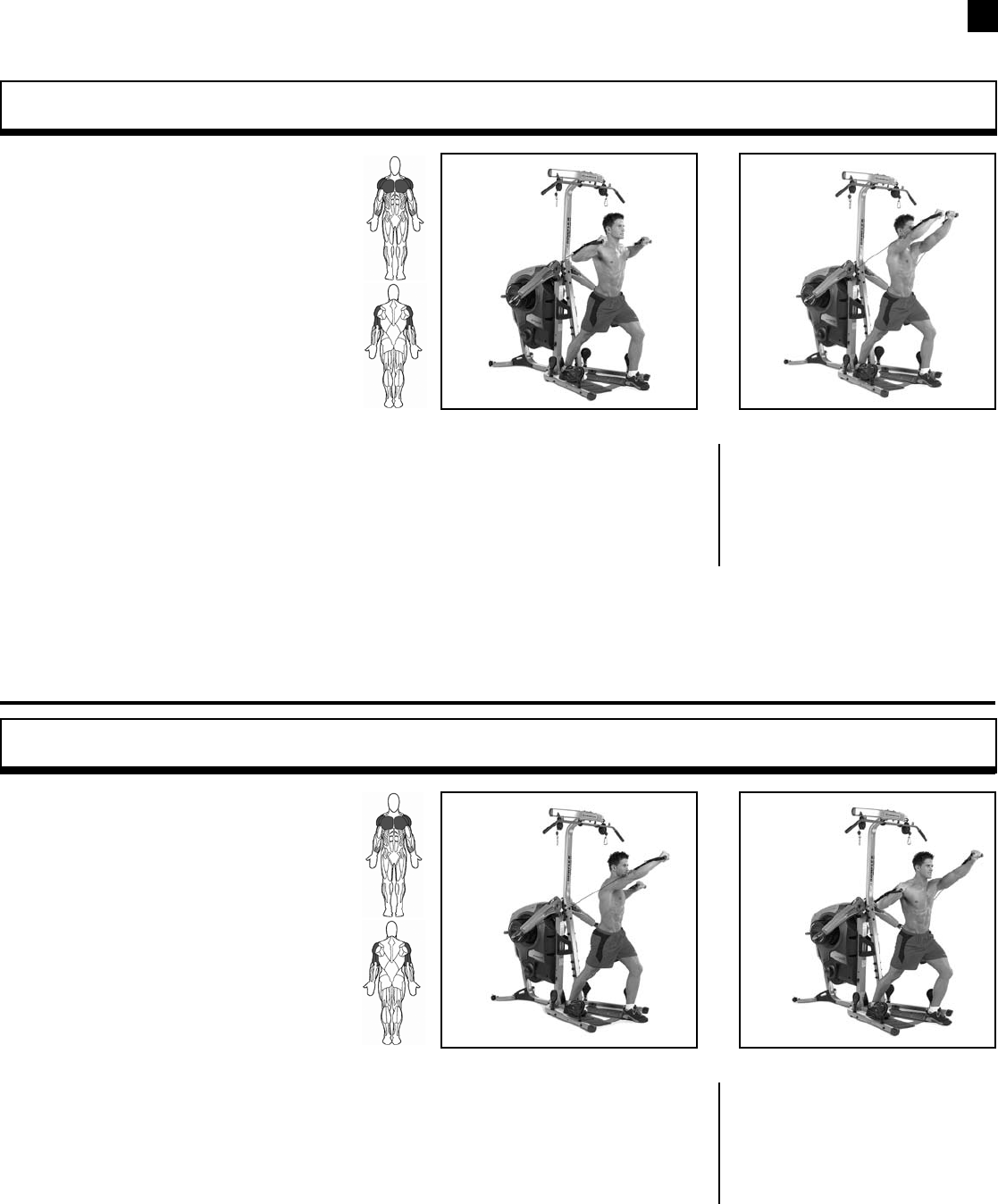
Standing Chest Press — Shoulder Horizontal Adduction (and elbow extension)
START FINISH
START
• Grasp Hand Grips so the cables
are in line close to the front of
your forearms.
• Stand with one foot forward and
one foot back for added stability.
• Start with elbows bent to 90º and
slightly behind or equal to the
shoulders.
• Press straight out away from
your chest, bringing the handles
together in front of you.
• Slowly return to the Start
position, keeping tension on the
chest throughout the motion.
FINISH
Muscles worked:
Pectoralis Major; Deltoids; Triceps. Also
ankles, knees, hips and core in stabilization.
Position:
Standing—facing outward. Seat removed.
Accessory:
Long Hand Grips
Adjustable Arm Position:
3 or 4
Success Tips
• Stabilize body from your feet all the way
up through your trunk.
• Maintain a 90º angle between upper arms
and torso throughout the motion.
• Keep chest muscles tight, limit and control
your range of motion.
• Keep knees slightly bent, feet flat on the
floor and in a staggered step for stability.
• Keep shoulder blades pinched, chest lifted
and a slight curve in the lower back.
Standing Chest Press w/ Alternating Shoulder Movement
START FINISH
START
• Grasp Hand Grips so the cables
are in line close to the front of
your forearms.
• Stand with one foot forward and
one foot back for added stability.
• Start with elbows bent to 90º and
slightly behind or equal to the
shoulders.
• Press straight out away from
your chest with one arm, as the
other arms moves out and back.
This is an alternating motion,
so your arms will move in the
opposite direction during the set.
• Slowly return each arm to the
Start position keeping tension on
the chest throughout the motion.
FINISH
Muscles worked:
Pectoralis Major; Deltoids; Triceps. Also ankles,
knees, hips and core in stabilization.
Position:
Standing—facing outward. Seat removed.
Accessory:
Long Hand Grips
Adjustable Arm Position:
3 or 4
Success Tips
• Stabilize body from your feet all the way up
through your trunk.
• Maintain a 90º angle between upper arms
and torso throughout the motion.
• Keep chest muscles tight, limit and control
your range of motion.
• Keep knees slightly bent, feet flat on the floor
and in a staggered step for stability.
• Keep shoulder blades pinched, chest lifted
and a slight curve in the lower back.
• Do not allow your trunk to rotate during the
motion.
29
Chest Exercises
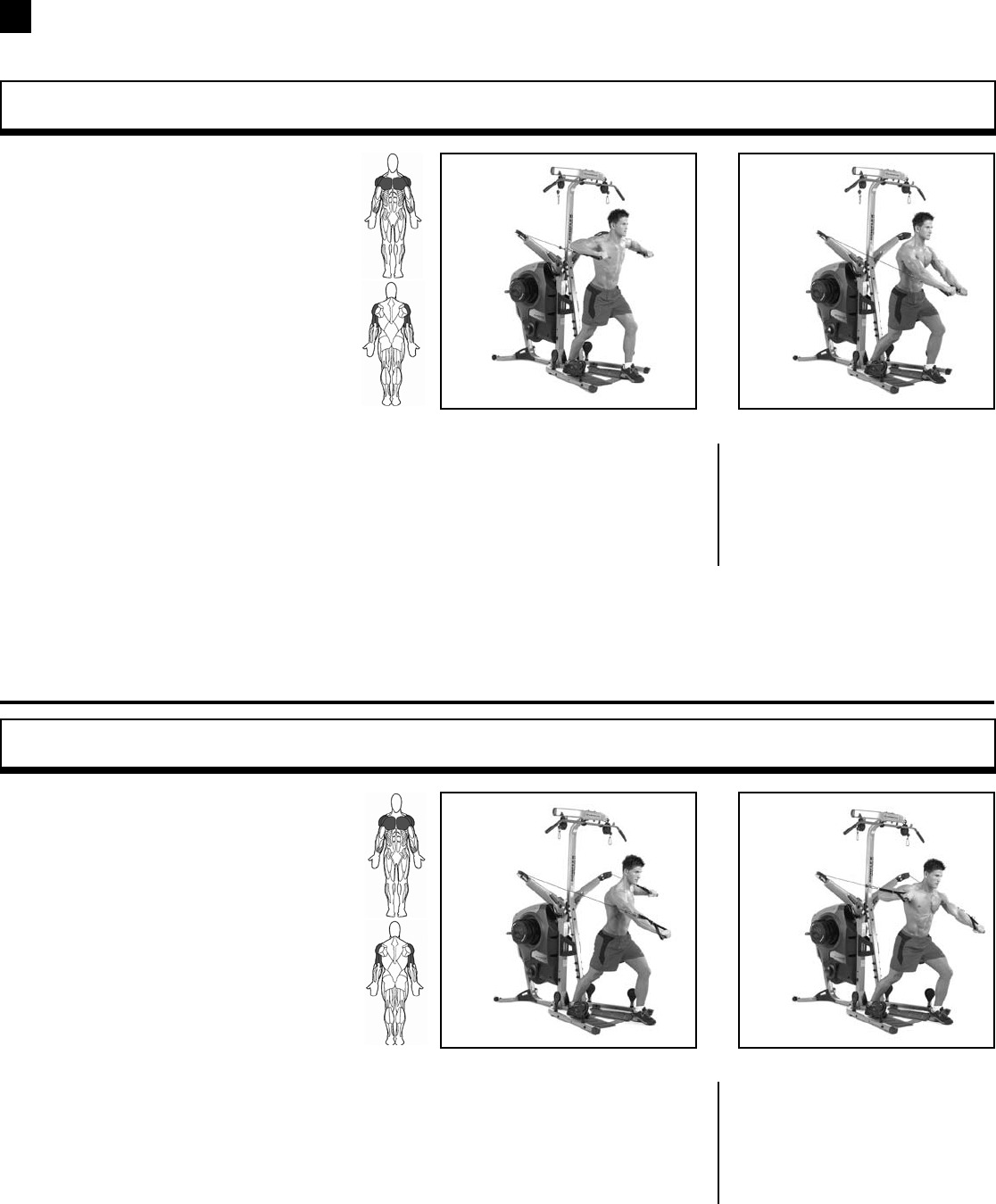
Standing Incline Chest Press — Shoulder Horizontal Adduction (and elbow extension)
START FINISH
START
• Stand with one foot forward and
one foot back for added stability.
• Start with elbows bent to 90º and
slightly behind or even with the
shoulders.
• Press slightly upward, away from
your chest, bringing the handles
together in front of you at about
10º above your shoulders.
• Slowly return to the Start
position, keeping tension on the
chest throughout the motion.
FINISH
Muscles worked:
Pectoralis Major; Deltoids; Triceps. Also
ankles, knees, hips and core in stabilization.
Position:
Standing—facing outward. Seat removed.
Accessory:
Long Hand Grips
Adjustable Arm Position:
4 or 5
Success Tips
• Stabilize body from your feet all the way up
through your trunk.
• Maintain a 90º angle between upper arms
and torso at the start of the press, and
slightly higher than 90º at the finish.
• Keep chest muscles tight, limit and control
your range of motion.
• Keep knees slightly bent, feet flat on the
floor and in a staggered step for stability.
• Keep shoulder blades pinched, chest lifted
and a slight curve in the lower back.
Standing Incline Chest Press w/ Alternating Motion
START FINISH
START
• Grasp Hand Grips so the cables
are in line close to the front of
your forearms.
• Stand with one foot forward and
one foot back for added stability.
• Start with elbows bent to 90º
and slightly behind or equal to
the shoulders, and the other arm
straight in front of you at a slight
inclined angle about head high.
• Press one arm slightly upward
away from your chest, the other
arm moves out and back. This
is an alternating motion, so your
arms will move in the opposite
direction during the set.
• Slowly return each arm to the
Start position keeping tension on
the chest throughout the motion.
FINISH
Muscles worked:
Pectoralis Major; Deltoids; Triceps. Also
ankles, knees, hips and core in stabilization.
Position:
Standing—facing outward. Seat removed.
Accessory:
Long Hand Grips
Adjustable Arm Position:
4 or 5
Success Tips
• Stabilize body from your feet all the way up
through your trunk.
• Maintain a 90º angle between upper arms
and torso throughout the motion.
• Keep chest muscles tight, limit and control
your range of motion.
• Keep knees slightly bent, feet flat on the floor
and in a staggered step for stability.
• Keep shoulder blades pinched, chest lifted
and a slight curve in the lower back.
• Do not allow your torso to rotate or bend
side to side during the motion.
30 Chest Exercises
Standing Decline Chest Press — Shoulder Horizontal Adduction (and elbow extension)
START FINISH
START
• Grasp the handles so the cables
travel under the forearm.
• Keep your forearms in line with the
cable at all times.
• Start with elbows back and upper
arms 90° from your torso.
• Elbows should be 10° lower than
the standard bench press position.
• Stand with one foot forward and
one foot back for added stability.
• Press forward, straightening your
arms while moving your hands
toward the center and slightly
downward about 10˚ below your
shoulders.
• Do not lock your elbows.
• Slowly return to the Start
position, keeping tension on the
chest throughout the motion.
FINISH
Muscles worked:
Pectoralis Major; Deltoids; Triceps. Also
ankles, knees, hips and core in stabilization.
Position:
Standing—facing outward. Seat removed.
Accessory:
Long Hand Grips
Adjustable Arm Position:
3, 4 or 5
Success Tips
• Stabilize body from your feet all the way up
through your trunk.
• Maintain a 90° angle between your upper
arms and torso at the start of the motion,
and slightly less than 90˚ at the finish.
• Keep chest muscles tight, limit and control
your range of motion.
• Keep knees slightly bent, feet flat on the
floor and in a staggered step for stability.
• Keep shoulderblades pinched, chest lifted
and a slight curve in the lower back.
Standing Decline Chest Press W/ Alternating Motion
START FINISH
START
• Grasp the handles so the cables
are in line and close to the front
of your forearms.
• Stand with one foot forward and
one foot back for added stability.
• Start with one elbow bent to
90° and slightly behind or even
with the shoulder, the other arm
straight in front of you 10˚ lower.
Do not lock the elbow.
• Press one arm slightly downward
away from your chest, as the
other arm moves out and back.
This is an alternating motion,
so your arms will move in the
opposite direction during the set.
• Slowly return each arm to the
Start position, keeping tension on
the chest throughout the motion.
FINISH
Muscles worked:
Pectoralis Major; Deltoids; Triceps. Also
ankles, knees, hips and core in stabilization.
Position:
Standing—facing outward. Seat removed.
Accessory:
Long Hand Grips
Adjustable Arm Position:
3, 4 or 5
Success Tips
• Stabilize body from your feet all the way up
through your trunk.
• Keep chest muscles tight, limit and control
your range of motion.
• Keep knees slightly bent, feet flat on the
floor and in a staggered step for stability.
• Keep shoulderblades pinched, chest lifted
and a slight curve in the lower back.
• Do not allow your torso to rotate or bend
side to side during the motion.
31
Chest Exercises
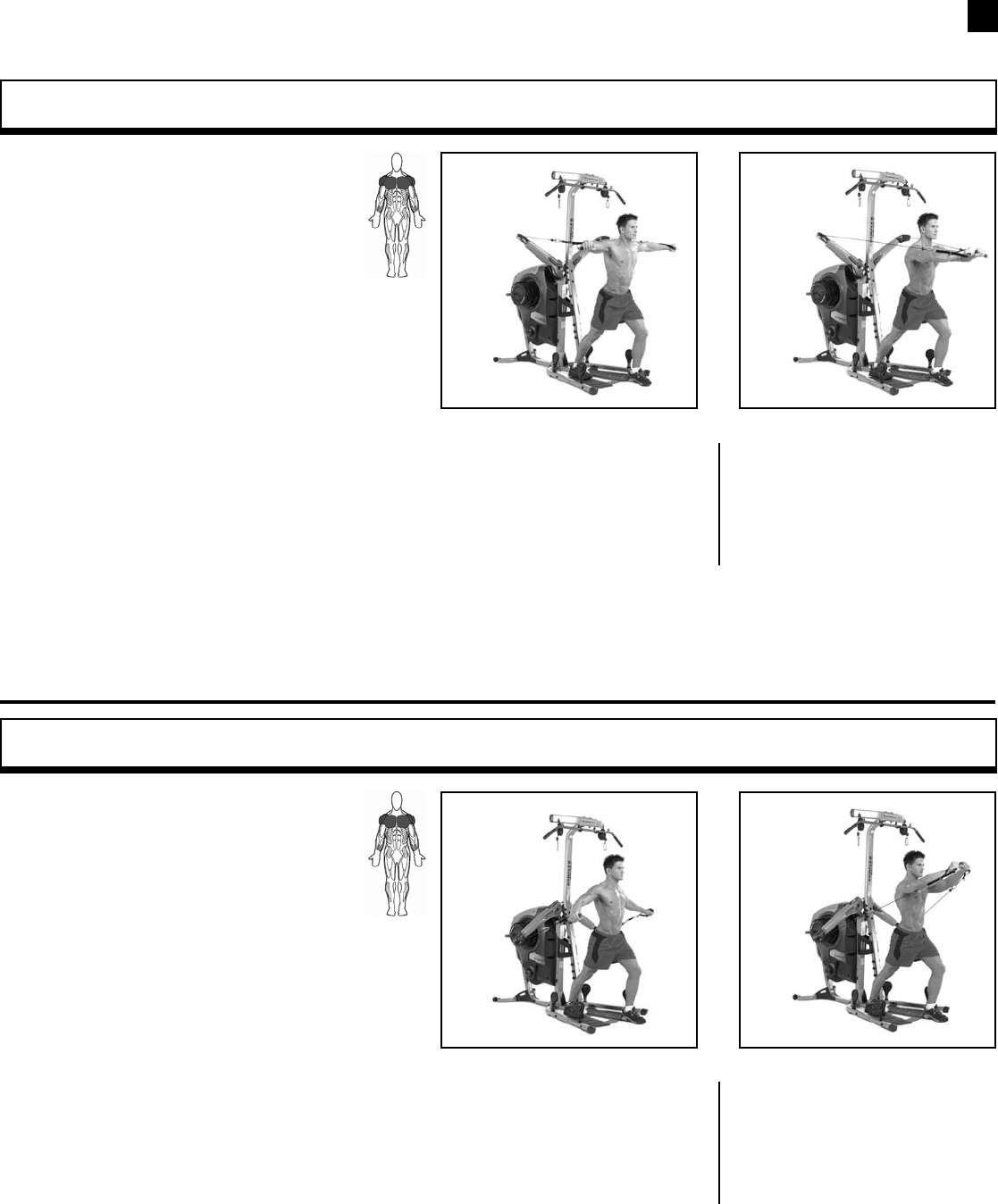
Standing Chest Fly — Shoulder Horizontal Adduction (elbow stabilization)
START FINISH
START
• Grasp the handles so the cables
lie close to the front of your
forearms and palms facing
forward.
• Stand with one foot forward and
one foot back for added stability.
• Stabilize the elbows so they are
slightly bent and slightly behind
or equal to the shoulders.
• Slowly move the arms forward
and inward, bringing the handles
together in front of you.
• Slowly return to the Start
position, keeping tension on the
chest throughout the motion.
FINISH
Muscles worked:
Pectoralis Major; Deltoids. Also ankles,
knees, hips and core in stabilization.
Position:
Standing—facing outward. Seat removed.
Accessory:
Long Hand Grips
Adjustable Arm Position:
4, 5 or 6
Success Tips
• Stabilize body from your feet all the way
up through your trunk.
• Maintain a 90° angle between upper arms
and torso throughout the motion.
• Keep chest muscles tight, limit and control
your range of motion.
• Keep knees slightly bent, feet flat on the
floor and in a staggered step for stability.
• Keep shoulder blades pinched, chest lifted
and a slight curve in the lower back.
Standing Incline Chest Fly — Shoulder Horizontal Adduction (elbow stabilization)
START FINISH
START
• Grasp the handles so the
cables lie close to the front of
your forearms, and palms face
forward.
• Stand with one foot forward and
one foot back for added stability.
• Stabilize the elbows so they are
slightly bent and slightly behind
or even with the shoulders.
• Slowly move the arms slightly
upward and inward, bringing the
handles together in front of you
at about neck/chin height.
• Slowly return to the Start
position, keeping tension on the
chest throughout the motion.
FINISH
Muscles worked:
Pectoralis Major; Deltoids. Also ankles,
knees, hips and core in stabilization.
Position:
Standing—facing outward. Seat removed.
Accessory:
Long Hand Grips
Adjustable Arm Position:
4, 5 or 6
Success Tips
• Stabilize body from your feet all the way
up through your trunk.
• Keep chest muscles tight, limit and
control your range of motion.
• Keep knees slightly bent, feet flat on
the floor and in a staggered step for
stability.
• Keep shoulder blades pinched, chest
lifted and a slight curve in the lower
back.
32 Chest Exercises
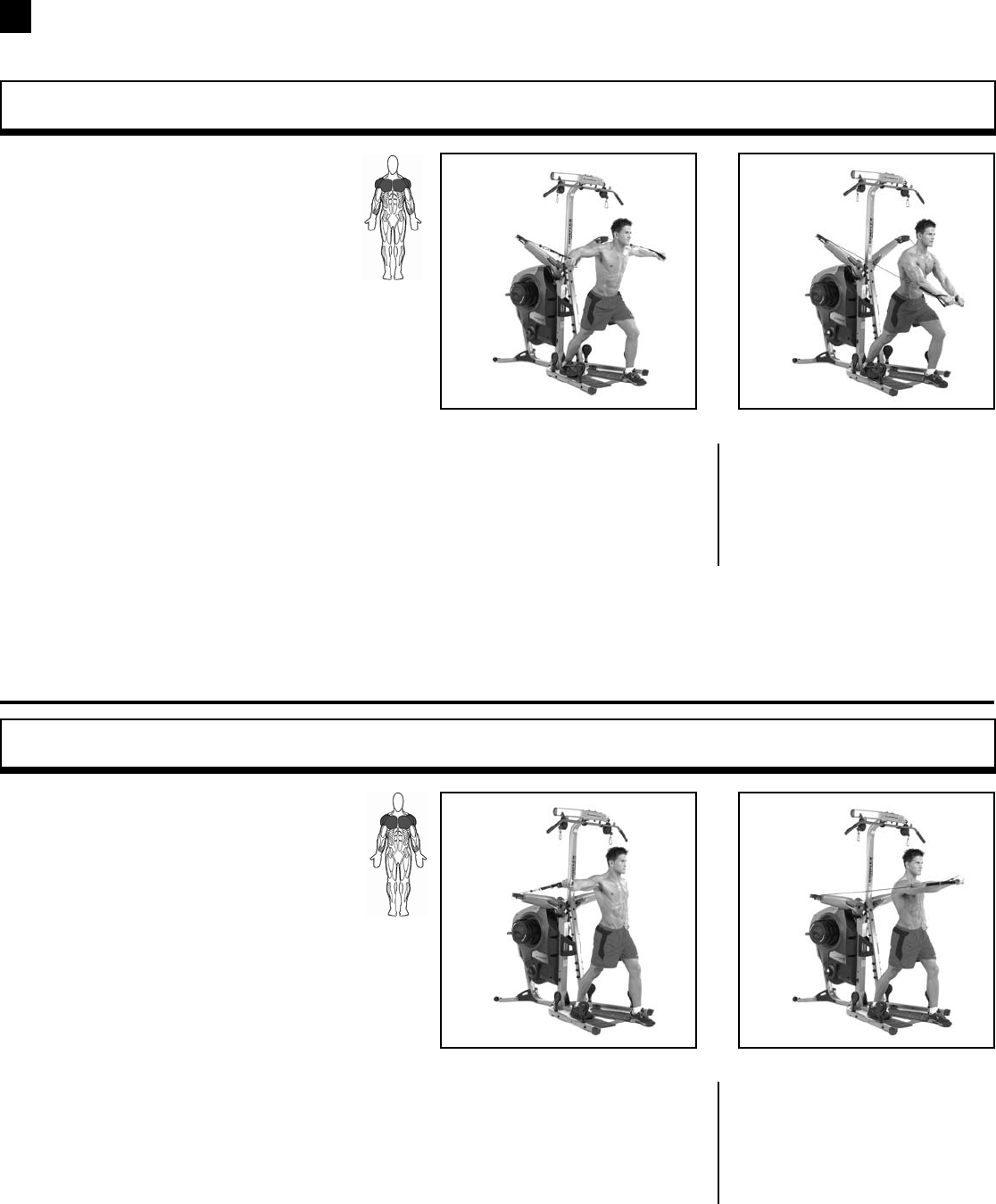
Standing Decline Chest Fly — Shoulder Horizontal Adduction (elbow stabilization)
START FINISH
START
• Grasp the Hand Grips so the
cables lie close to the front of
your forearms and palms face
forward.
• Stand with one foot forward and
one foot back for added stability.
• Stabilize the elbows so they are
slightly bent and slightly behind
or equal to the shoulders.
• Slowly move the arms slightly
downward and inward, bringing
the handles together in front of
you at about lower chest height.
• Slowly return to the Start
position, keeping tension on the
chest throughout the motion.
FINISH
Muscles worked:
Pectoralis Major; Deltoids. Also ankles,
knees, hips and core in stabilization
Position:
Standing—facing outward. Seat
removed.
Accessory:
Long Hand Grips
Adjustable Arm Position:
4 or 5
Success Tips
• Stabilize body from your feet all the way
up through your trunk.
• Keep chest muscles tight, limit and
control your range of motion.
• Keep knees slightly bent, feet flat on
the floor and in a staggered step for
stability.
• Keep shoulder blades pinched, chest
lifted and a slight curve in the lower
back.
Standing Single Arm Chest Fly — Shoulder Horizontal Adduction (elbow stabilization)
START FINISH
START
• Grasp the Hand Grip so the cable
lies close to the front of your
forearm and palm face forward.
• Stand with one foot forward and
one foot back for added stability.
• Stabilize the elbow so it is
slightly bent and slightly behind
or equal to the shoulder.
• Slowly move the arm forward
and inward, bringing the handle
in front of you.
• Slowly return to the Start
position, keeping tension on the
chest throughout the motion.
FINISH
Muscles worked:
Pectoralis Major; Deltoids. Also ankles, knees,
hips and core in stabilization
Position:
Standing—facing outward. Seat removed.
Accessory:
Long Hand Grips
Adjustable Arm Position:
4 or 5
Success Tips
• Stabilize body from your feet all the way up
through your trunk.
• Maintain a 90° angle between upper arm
and torso throughout the motion.
• Keep chest muscles tight, limit and control
your range of motion.
• Keep knees slightly bent, feet flat on the
floor and in a staggered step for stability.
• Keep shoulder blade pinched, chest lifted
and a slight curve in the lower back.
• Do not lean sideways or turn the trunk
during the motion.
33
Shoulder Exercises
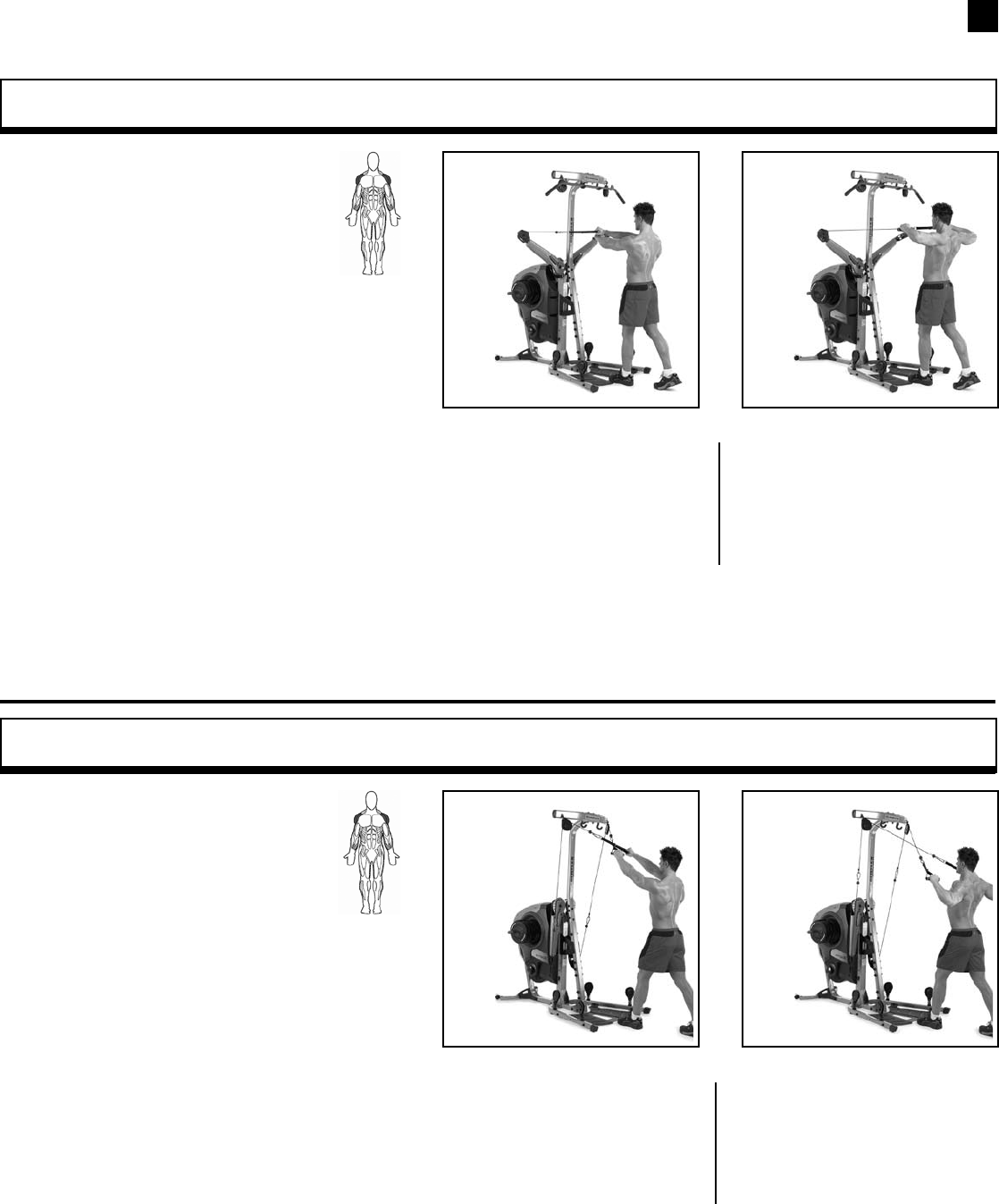
Crossover Rear Delt Rows — Elbow Flexion
START FINISH
START
• Cross your arms in front of you
and grasp the Hand Grips (right
Grip in left hand and vice versa),
palms facing toward the floor,
arms nearly straight.
• Raise your arms in front of your
body until they are at a 90° angle
to your torso.
• Allowing your arms to bend
slowly, move your elbows
outward and backward between
your upper arms and torso.
• Keep your forearms pointing in
the direction of the cables.
• Slowly return to the Start
position. Do not relax the tension
in your shoulder muscles.
FINISH
Muscles worked:
Anterior and Middle Deltoids
Position:
Standing—facing machine. Seat
removed.
Accessory:
Long Hand Grips
Adjustable Arm Position:
2 or 3
Success Tips
• Maintain a 90° angle between your
upper arms and torso during motion.
• Lift your chest, keep knees bent and
feet on Platform or in front of it.
• Keep shoulder blades pinched together
and maintain good spinal alignment.
Crossover High Rear Delt Rows — Elbow Flexion
START FINISH
START
• Cross your arms in front of you and
grasp the Hand Grips (right Grip
in left hand and vice versa), palms
facing toward the floor, arms nearly
straight.
• Stand up straight and then lean back
slightly from hips.
• Allowing your arms to bend slowly,
move your elbows outward and
backward between your upper
arms and torso.
• Keep your forearms pointing in the
direction of the cables.
• Move until your elbows are slightly
behind your shoulders.
• Slowly return to the Start position.
Do not relax the tension in your
shoulder muscles.
FINISH
Muscles worked:
Anterior and Middle Deltoids
Position:
Standing—facing machine. Seat
removed.
Accessory:
Long Hand Grips
Adjustable Arm Position:
0 or 1
Success Tips
• Maintain a 90° angle between your
upper arms and torso during motion.
• Keep shoulder blades pinched together,
good spinal alignment and your chest
lifted throughout exercise.
• Lift your chest, keep your knees bent
and feet on Standing Platform or in front
of the platform.
34 Shoulder Exercises
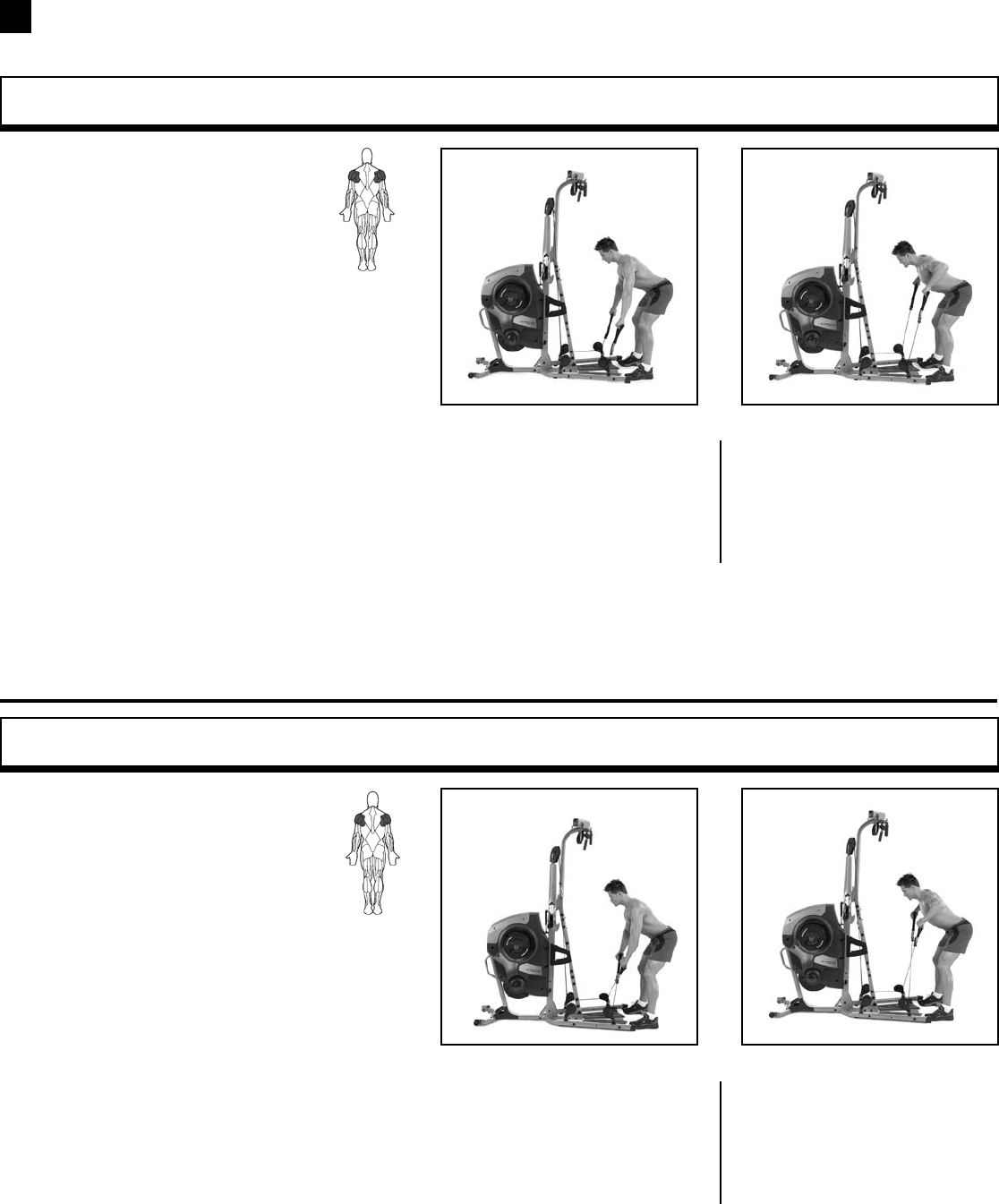
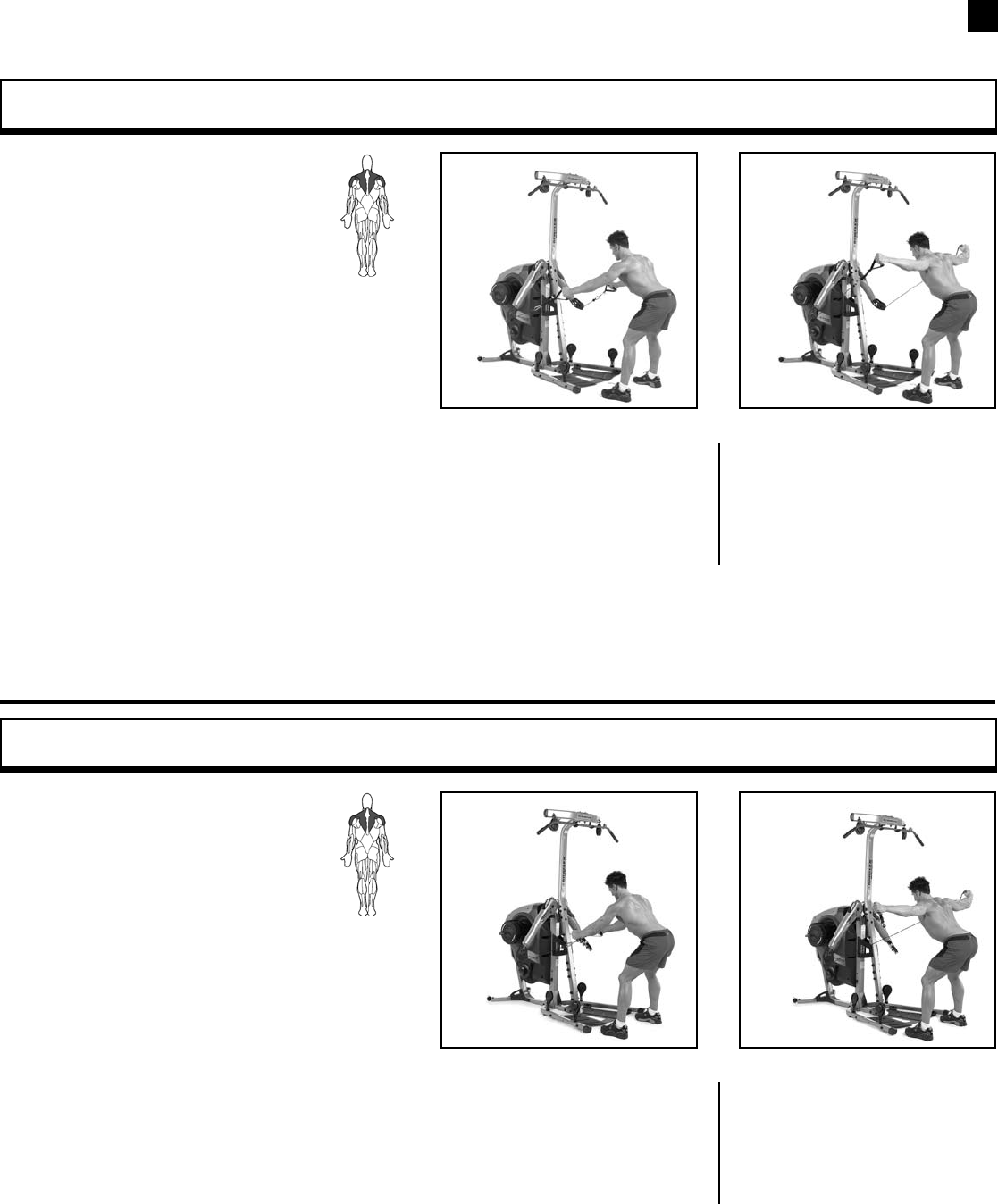
Bent Rear Delt Row
START FINISH
START
• Pivot forward from your hips,
knees bent, spinal muscles tight.
• Grasp the Hand Grips, palms
facing backward. Keep hands
shoulder-width apart.
• Let your arms hang in the
direction of the pulleys—do not
lock your elbows.
• Initiate movement by pulling your
elbows back as you bring the
Hand Grips upward to a point
below your chest. Keep hands
shoulder-width apart.
• Slowly return to Start position,
keeping your knees bent and
your back flat.
FINISH
Muscles worked:
Teres Major; Rear Deltoids. Also core
muscle group for stability.
Position:
Standing—facing machine. Seat
removed.
Accessory:
Short Hand Grips
Pulleys / Adjustable Arm
Position:
Squat Frame Pulleys / 0
Success Tips
• Lift your chest, keep your knees bent
and feet on Standing Platform.
• Do not bend your neck forwards or
backwards during motion.
• Keep your spine aligned, abs tight and
a slight arch in your lower back. Do not
slouch.
Crossover Bent Rear Delt Row
START FINISH
START
• Pivot forward from your hips,
knees bent, spinal muscles tight.
• Cross your arms, reach down
and grasp the Hand Grips (right
Grip in left hand and vice versa),
palms facing backward. Keep
hands shoulder-width apart.
• Let your arms hang in the
direction of the pulleys—do not
lock elbow.
• Initiate movement by pulling your
elbows back as you bring the
Hand Grips upward and cross
them over your chest. Keep your
crossed hands shoulder-width
apart.
• Slowly return to Start position,
keeping your knees bent and your
back flat.
FINISH
Muscles worked:
Teres Major; Rear Deltoids. Also core
muscle group for stability.
Position:
Standing—facing machine. Seat
removed.
Accessory:
Short Hand Grips
Pulleys / Adjustable Arm
Position:
Squat Frame Pulleys / 0
Success Tips
• Lift your chest, keep your knees bent
and feet on Standing Platform.
• Do not bend your neck forwards or
backwards during motion.
• Keep your spine aligned, abs tight and
a slight arch in your lower back. Do not
slouch.
• Keep the lats tightened throughout the
entire motion.
35
Shoulder Exercises
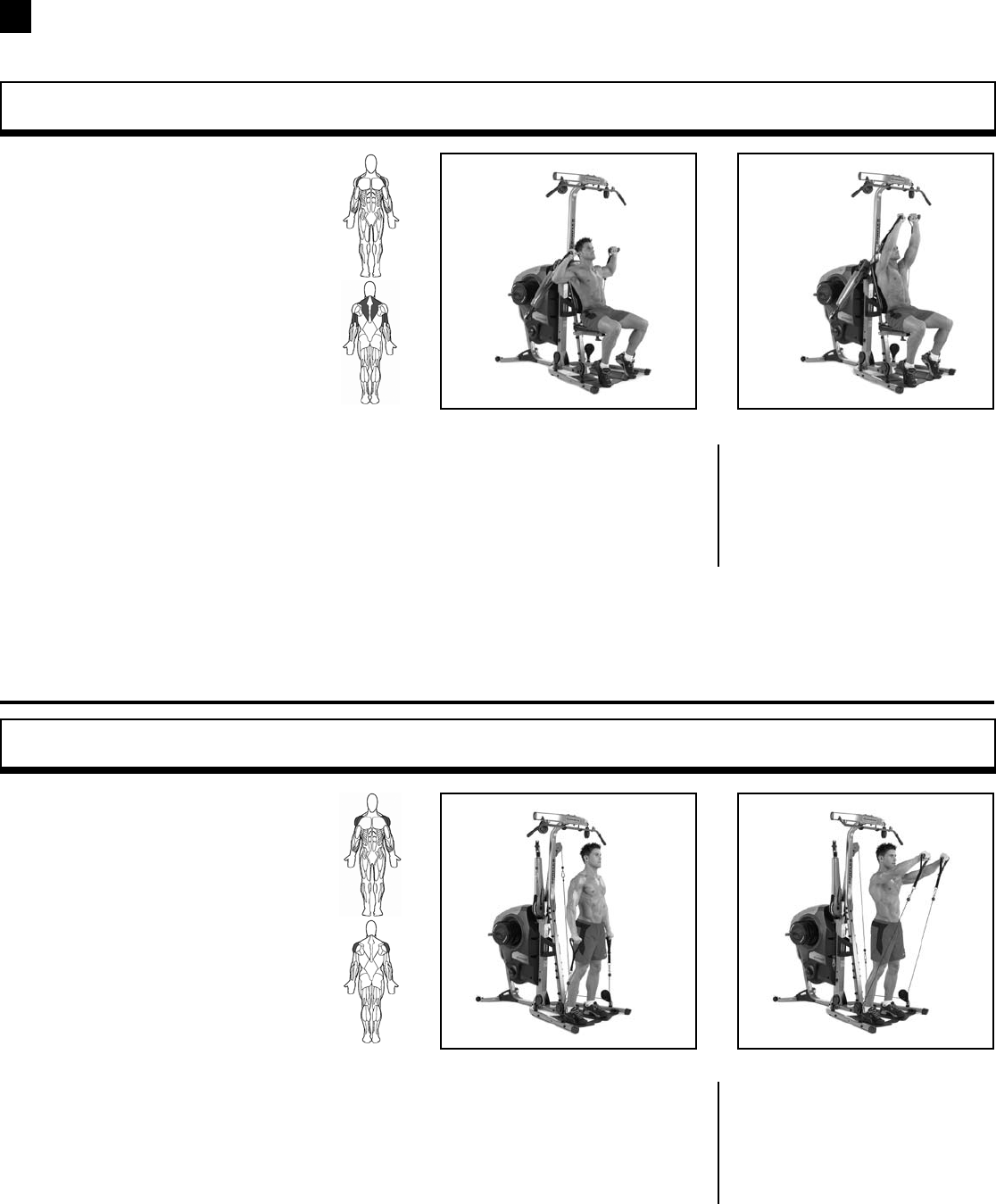
Reverse Fly — Shoulder Horizontal Abduction (elbows stabilized in slight flexion)
START FINISH
START
• Grasp the Hand Grips, palms
facing floor, arms nearly straight.
• Stand up straight and bend
slightly forward from the hips
until arms/cables are in front of
body at a 90˚ angle from torso.
• Maintaining the bend in your
arms, move your elbows outward
and backward.
• When your elbows are slightly
behind your shoulders, slowly
return to the Start position,
keeping your rear shoulder
muscles tightened throughout
movement.
FINISH
Muscles worked:
Rear Deltoids; Middle Deltoids;
Trapezius; Rhomboids
Position:
Standing—facing machine. Seat
removed.
Accessory:
Hand Grips
Adjustable Arm Position:
6 or 7
Success Tips
• Do not lose spinal alignment—keep
your chest lifted.
• Lift your chest, keep your knees bent
and feet on Platform or in front of the
platform.
• Keep your spine aligned and a slight
arch in your lower back.
• Maintain a 90° angle between upper
arms and torso throughout exercise.
Crossover Reverse Fly — Shoulder Horizontal Abduction (elbows stabilized in slight flexion)
START FINISH
START
• Cross your arms in front of your
body and grasp the Hand Grips,
right Grip in left hand and vice
versa, with your palms facing the
floor and arms nearly straight.
• Stand up straight and bend
slightly forward from the hips
until arms/cables are in front of
body at a 90˚ angle from torso.
• Maintaining the bend in your
arms, move your elbows outward
and backward, crossing the
cables as your arms move back.
• When your elbows are slightly
behind your shoulders, slowly
return to the Start position,
keeping your rear shoulder
muscles tightened throughout
movement.
FINISH
Muscles worked:
Rear Deltoids; Middle Deltoids;
Trapezius; Rhomboids
Position:
Standing—facing machine. Seat
removed.
Accessory:
Hand Grips
Adjustable Arm Position:
6 or 7
Success Tips
• Do not lose spinal alignment—keep
your chest lifted.
• Lift your chest, keep your knees bent
and feet on Platform or in front of the
platform.
• Keep your spine aligned and a slight
arch in your lower back.
• Maintain a 90° angle between upper
arms and torso throughout exercise.
• Bend slight forward from the hips.
36 Shoulder Exercises
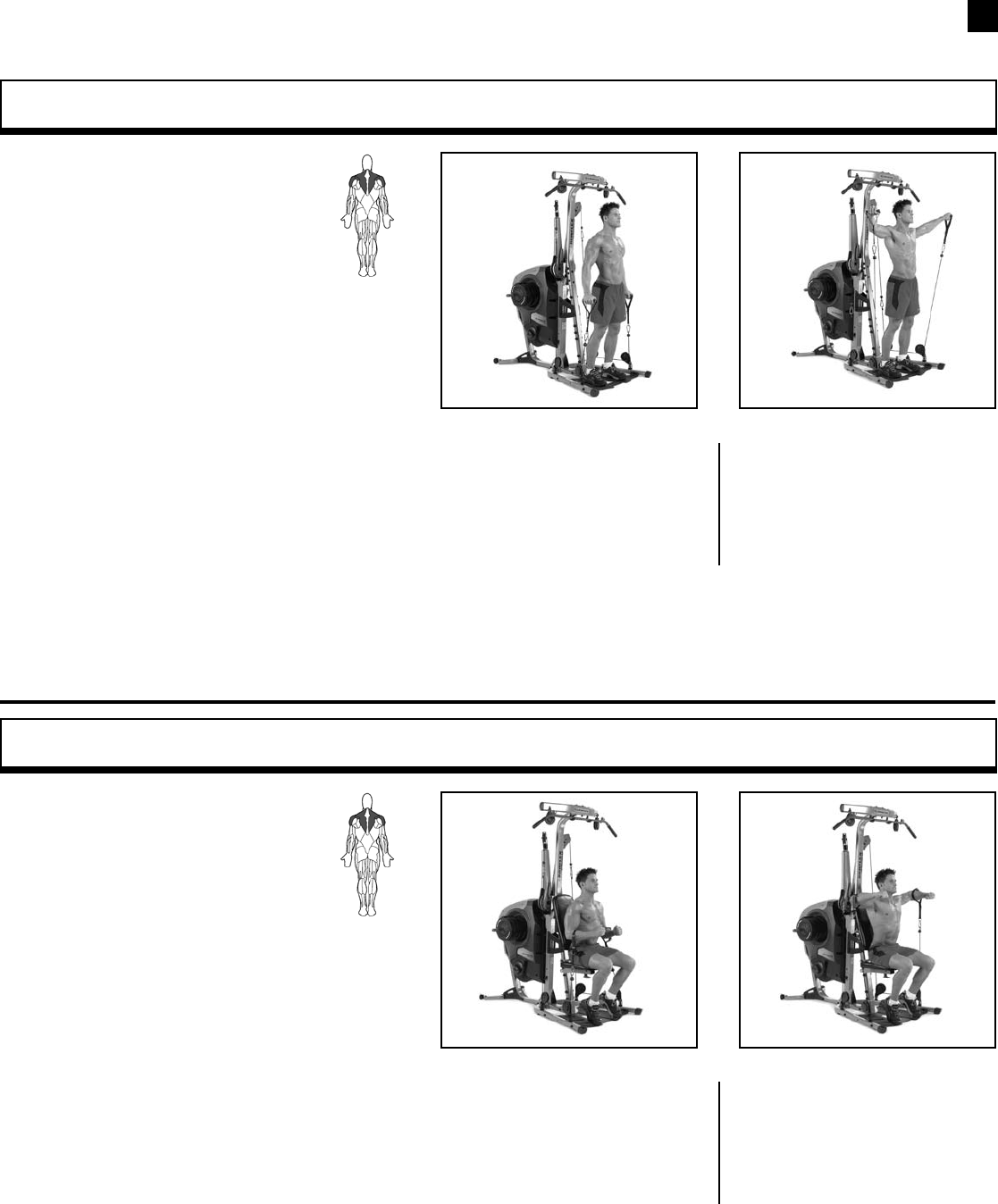
Seated Shoulder Press — Shoulder Adduction (and elbow extension)
START FINISH
START
• Grasp Hand Grips, palms facing
away from the engine.
• Raise the Hand Grips to shoulder
level. Keep your palms facing
forward.
• Straighten your arms slowly over
your head, focusing on moving
your elbows up and inward
toward your ears.
• Slowly return to the Start
position, keeping tension in your
front shoulder muscles.
FINISH
Muscles worked:
Front Deltoids; Upper Trapezius; Triceps
Position:
Seated—facing outward
Accessory:
Long Hand Grips
Adjustable Arm Position:
7 or 8
Success Tips
• Lift your chest, keep your knees bent
and feet on Standing Platform.
• Do not increase the arch in your lower
back as you raise your arms, but keep
your spine steady and tight.
• Keep abdominals tight and maintain
good spinal alignment.
Front Shoulder Raise — Shoulder Flexion (elbow stabilized)
START FINISH
START
• Grasp the Hand Grips, palms
facing back toward the engine,
arms straight at your sides.
• Keeping your arms straight,
move them forward, leading
with your forearms, until arms
are extended in front of you at
shoulder height.
• Arms may be moved alternately
or together.
• Slowly return to the Start position
with your upper arms next to
your torso.
FINISH
Muscles worked:
Front and Middle Deltoids
Position:
Standing—facing outward. Seat
removed.
Accessory:
Long Hand Grips
Pulleys / Adjustable Arm
Position:
Squat Frame Pulleys / 0
Success Tips
• Keep abdominals tight and maintain
good spinal alignment.
• Keep knees bent and feet on Platform.
• Do not increase the arch in your lower
back as you raise your arms. You may
wish to lean your lower back against
the Seat Back Pad.
37
Shoulder Exercises
Lateral Shoulder Raise — Shoulder Abduction (elbows stabilized)
START FINISH
START
• Grasp the Hand Grips, palms
facing each other.
• Let your arms hang at your sides,
directly in line with the cables.
• Keep your chest lifted, and a
slight arch in your lower back.
• Raise your arms directly out to
the sides, nearly to shoulder
level.
• Keep the side of your arm/elbow
facing out and up throughout the
movement.
• With controlled movement,
slowly return to the Start
position.
FINISH
Muscles worked:
Middle Deltoids; Supraspinatus; Upper
Trapezius
Position:
Standing—facing outward. Seat
removed.
Accessory:
Long Hand Grips
Pulleys / Adjustable Arm
Position:
Squat Frame Pulleys —Standard
Pulleys
Success Tips
• Elevate your shoulders slightly toward
the back of your head.
• Maintain good spinal alignment and
bend forward slightly from the hip.
• Do not swing your arms upward or
move your trunk during this exercise.
• Lift your chest, keep your knees bent
and feet on Standing Platform.
Seated Forearm Lateral Shoulder Raise — Elbows stabilized
START FINISH
START
• Slide the handles on the Hand
Grips to one side and slide the
straps over your forearms until
they are cradled in your elbows.
• Let your upper arms hang directly
in line with the cables. Bend your
elbows 90°.
• Sit up straight and bend slightly
forward from the hips until arms/
cables are in front of body at a 90°
angle from torso.
• Raise your arms directly out to
the sides, nearly to shoulder
level.
• Keep the side of your forearms/
elbows facing out and up
throughout the movement.
• Slowly bring your arms back
to the Start position without
relaxing.
FINISH
Muscles worked:
Middle Deltoids; Supraspinatus; Upper
Trapezius
Position:
Seated—facing outward.
Accessory:
Long Hand Grips
Pulleys / Adjustable Arm
Position:
Squat Frame Pulleys —Narrow Pulleys / 0
Success Tips
• Raise your chest and keep your
shoulder blades pinched together.
• Elevate your shoulders slightly toward
the back of your head.
• Maintain good spinal alignment and
bend forward slightly from the hip.
• Do not swing your arms upward or move
your trunk during this exercise.
• Lift your chest, keep your knees bent and
feet on Platform.
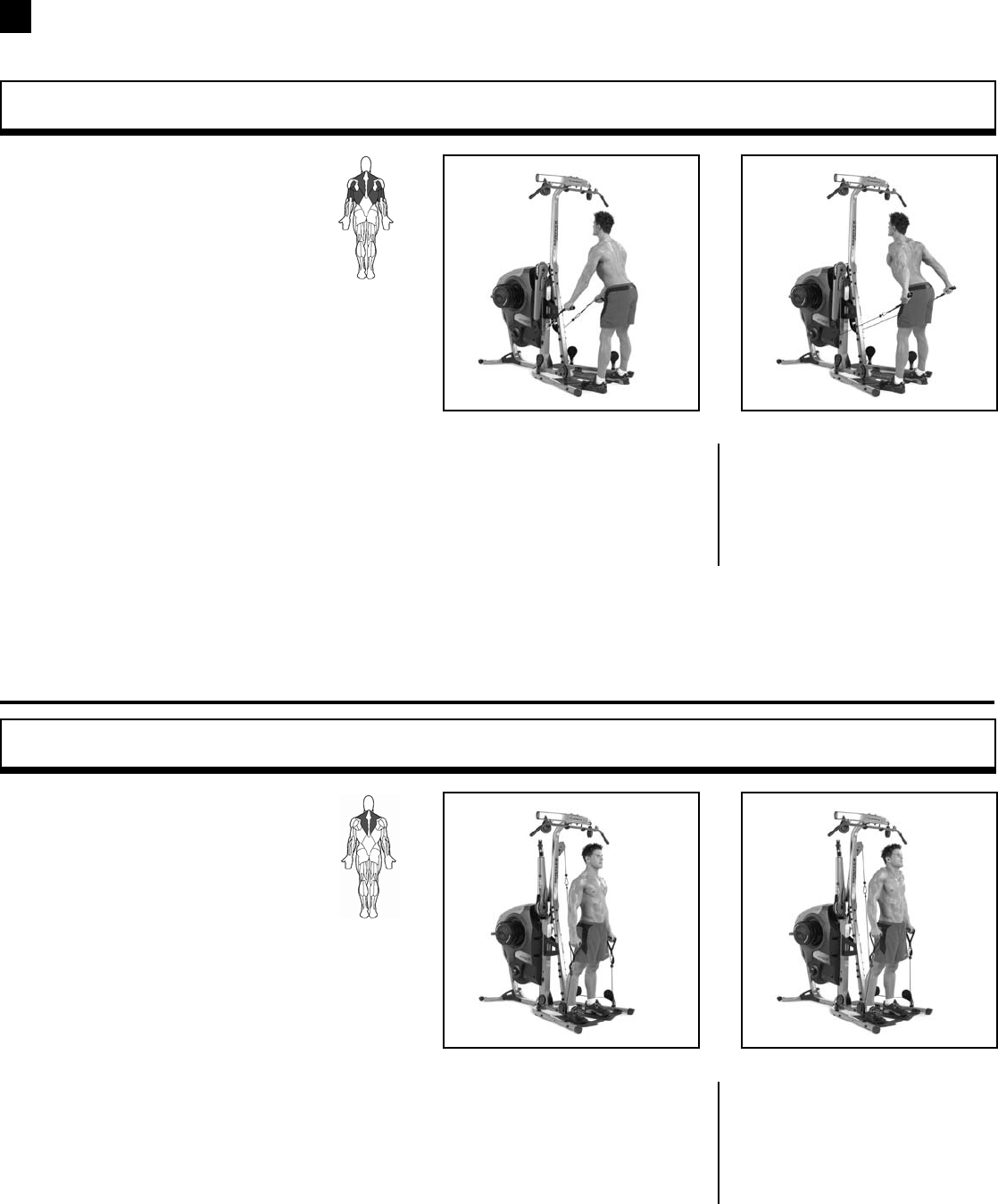
38 Shoulder Exercises
Shoulder Extension — (elbows stabilized)
START FINISH
START
• Grasp the Hand Grips, palms
facing down, arms straight and
at approximately a 30° angle
from torso.
• Tighten your trunk muscles
to stabilize your spine while
maintaining a slight arch in the
lower back.
• Initiate movement by pinching
shoulder blades together.
• Continue movement by moving
your hands in an arc downward,
along your sides, until hands are
level with hips.
• With controlled movement,
slowly return to the Start
position.
FINISH
Muscles worked:
Latissimus Dorsi; Teres Major; Rear Del-
toid; Middle Trapezius; Rhomboids; Triceps
Position:
Standing—facing machine. Seat
removed.
Accessory:
Long Hand Grips
Adjustable Arm Position:
8 or 9
Success Tips
• Keep knees bent and feet flat
on floor.
• Keep your lats tightened throughout the
motion.
• Keep abdominals tight and maintain
good spinal alignment.
• Release your shoulder blades at the
end of each rep and initiate new rep by
retracting your shoulder blades.
Shoulder Shrug — Scapular Elevation
START FINISH
START
• Reach down and grasp the Hand
Grips, palms facing each other.
• Let your arms hang at
your sides.
• Slowly raise your shoulders
towards the back of your
head, keeping your neck
and head still.
• Slowly reverse back to the
Start position, keeping your
upper trapezius muscles tight
throughout the motion.
FINISH
Muscles worked:
Upper Trapezius
Position:
Standing—facing outward. Seat
removed.
Accessory:
Long Hand Grips
Pulleys / Adjustable Arm
Position:
Squat Frame Pulleys —Standard
Pulleys / 0
Success Tips
• Keep abdominals tight and maintain
good spinal alignment.
• Do not bend your neck or slouch during
this exercise.
• Raise shoulders evenly.
• For variation, try this exercise bent
forward slightly from the hips.
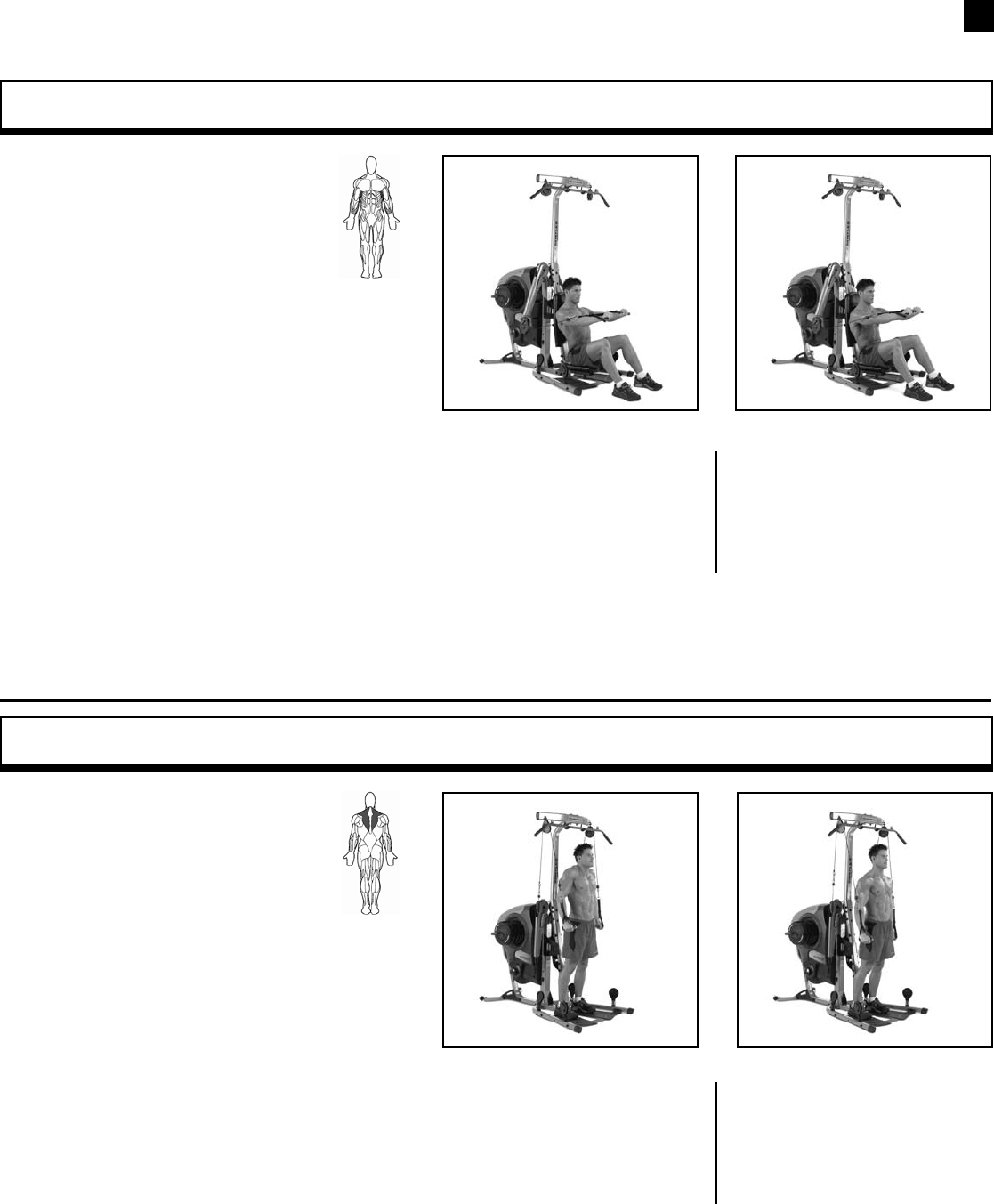
39
Shoulder Exercises
Scapular Protraction — (elbows stabilized)
START FINISH
• Reach behind your body, grasp
the Hand Grips and straighten
your arms in front of you at a 90°
angle from torso.
• Keep your arms in line with the
cables, palms facing down and
wrists straight.
• Keeping your arms straight and
in line with the cables, slowly
move your shoulder blades
forward away from the Seat
Back Pad. Slowly bring your
hands together using only your
shoulder muscles.
• Slowly return to the Start
position, keeping tension in your
shoulder blades.
• Movement is very subtle and
occurs only in shoulder blades.
Muscles worked:
Serratus Anterior
Position:
Seated—facing outward. Seat
in lowest position.
Accessory:
Long Hand Grips
Adjustable Arm Position:
7, 8 ot 9
Success Tips
• Lift your chest, keep your knees bent
and feet on floor.
• Keep your spine aligned and a slight
arch in your lower back.
• Maintain a 90° angle between upper
arms and torso throughout exercise.
• Do not slouch forward or use your arm
muscles to assist this motion. Keep this
motion only in the shoulder blades
Scapular Depression
START FINISH
• Grasp the Hand Grips and keep
your arms at your side, palms
facing inward, arms nearly
straight.
• Tighten your trunk muscles
to stabilize your spine while
maintaining a slight arch in your
lower back.
• Keeping your arms straight, slide
your shoulder blades downward,
toward your hips.
• When your shoulder blades have
fully depressed, slowly return to
the Start position.
• Movement is very subtle and
occurs only in shoulder blades.
Muscles worked:
Lower Trapezius
Position:
Standing—facing outward.
Accessory:
Short Hand Grips
Pulleys / Adjustable Arm
Position:
Lat Tower Pulleys / 9
Success Tips
• Do not lose spinal alignment—keep
your chest lifted and head against the
Seat Back Pad.
• Keep knees bent and feet flat
on Platform.
START FINISH
START FINISH
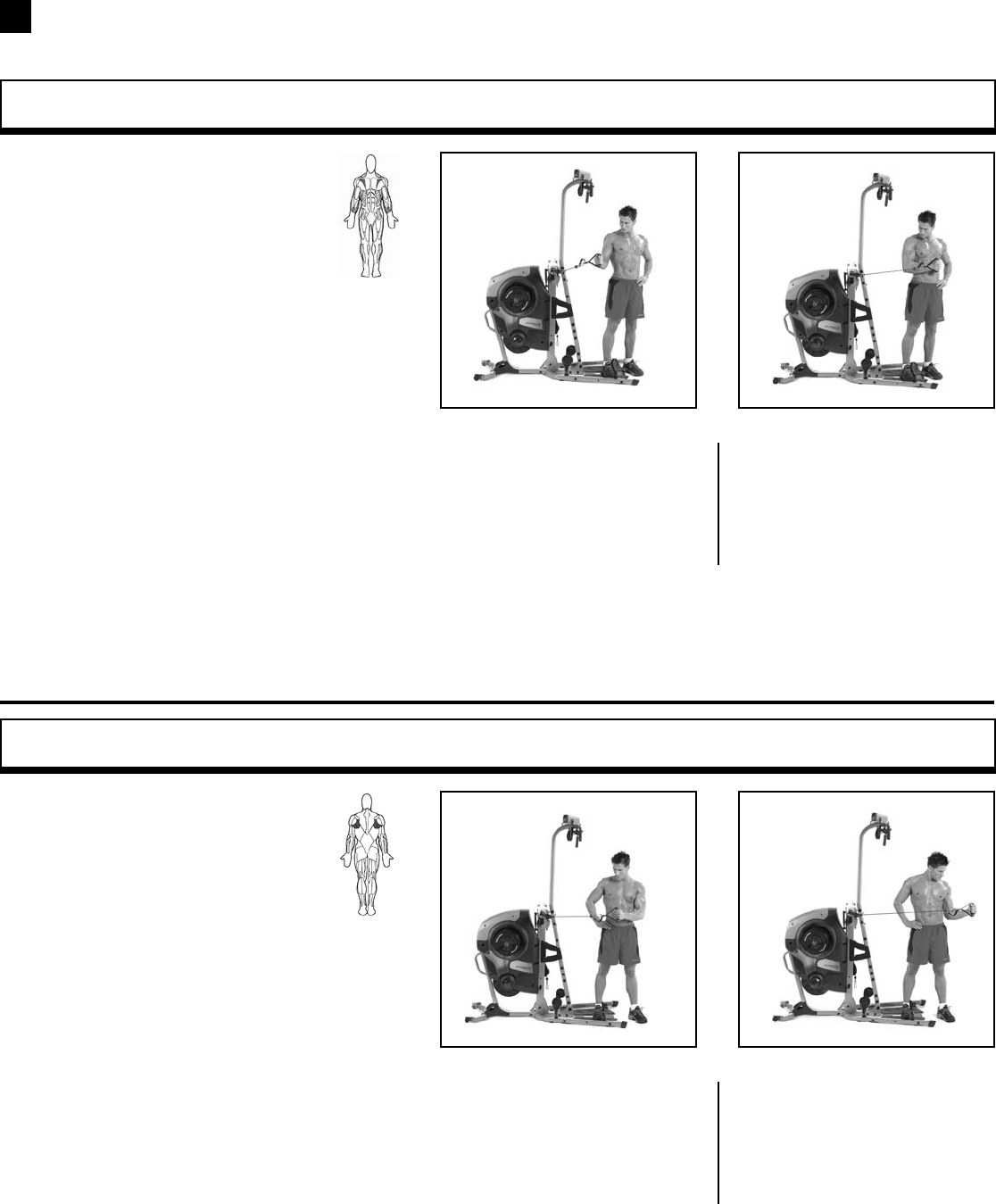
40 Shoulder Exercises
Shoulder Rotator Cuff — Internal Rotation
START FINISH
START
• Grasp the Hand Grip nearest you
in the hand closest to the engine,
and draw your upper arm into
your torso. Keep your elbow bent
and your forearm at a 90° angle
from your torso.
• Give yourself enough distance to
eliminate slack in the cable.
• Use a light resistance—this is not
a powerful movement.
• Rotate your forearm toward your
abdomen, keeping your elbow at
your side throughout motion.
• Slowly return to the Start position,
maintaining slow, controlled
motion.
FINISH
Muscles worked:
Subscapularis
Position:
Standing—facing right or left. Seat re-
moved.
Accessory:
Long Hand Grips
Adjustable Arm Position:
4 or 5
Success Tips
• Lift your chest, keep your knees bent
and feet on or near the Platform.
• Keep your spine aligned and a slight
arch in your lower back.
• Maintain a 90° angle between forearms
and torso throughout exercise.
• Do not rotate the spine to get additional
range of motion.
Shoulder Rotator Cuff — External Rotation
START FINISH
START
• Grasp the Hand Grip nearest
you in the hand farthest from the
engine, and draw your upper arm
into your torso. Keep your elbow
bent and your forearm at a 90°
angle from your torso.
• Give yourself enough distance to
eliminate slack in the cable.
• Use a light resistance—this is not
a powerful movement.
• Rotate your forearm away from
your abdomen, keeping your
elbow at your side throughout
motion.
• Slowly return to the Start position,
maintaining slow, controlled
motion.
FINISH
Muscles worked:
Infraspinatus; Teres Minor
Position:
Standing—facing right or left. Seat re-
moved.
Accessory:
Hand Grips
Adjustable Arm Position:
4 or 5
Success Tips
• Lift your chest, keep your knees bent
and feet on Platform.
• Keep your spine aligned and a slight
arch in your lower back.
• Maintain a 90° angle between forearms
and torso throughout exercise.
• Do not rotate the spine to get additional
range of motion.
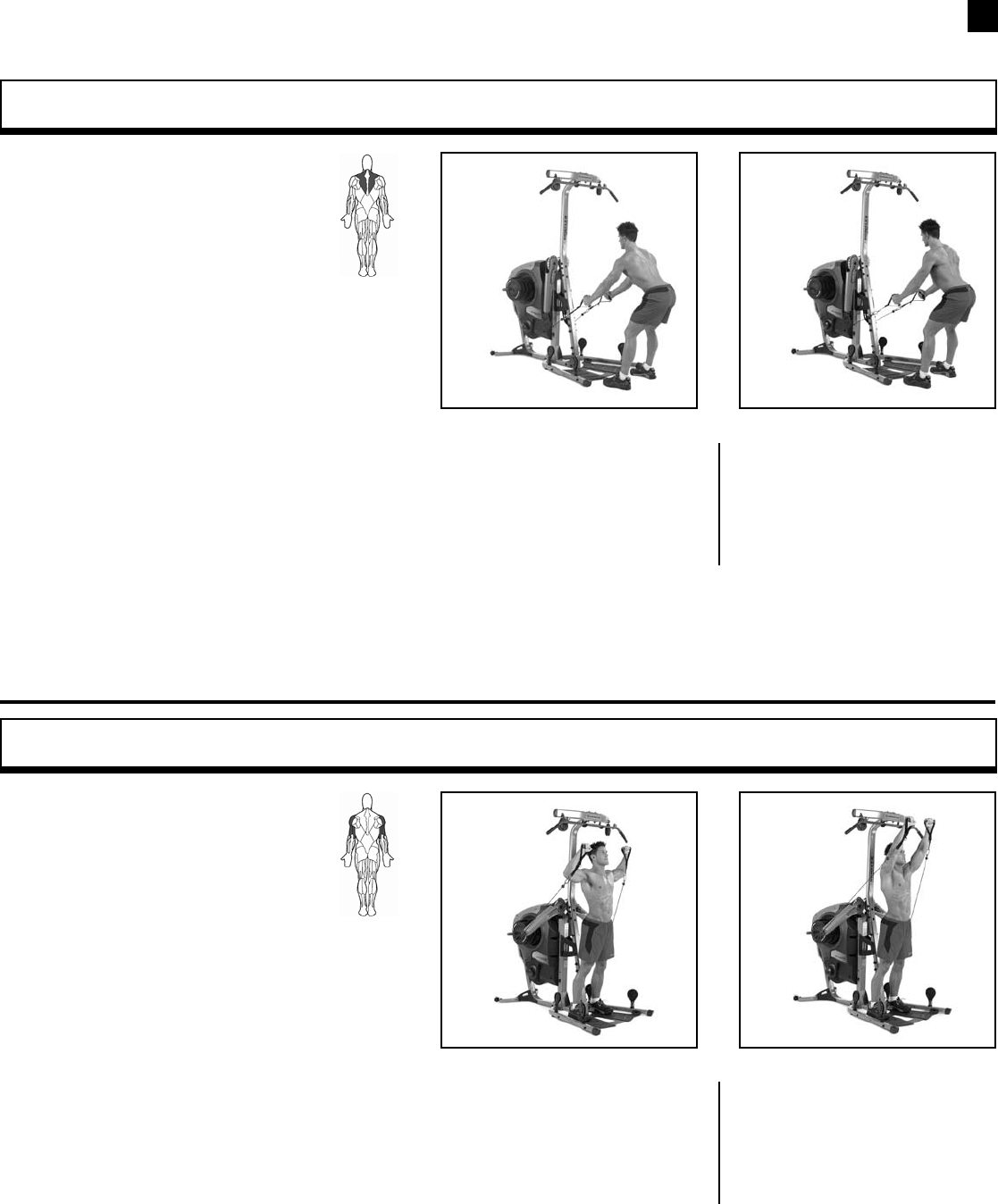
41
Shoulder Exercises
Scapular Retraction
START FINISH
START
• Grasp the Hand Grips,
palmsfacing each other.
• Extend arms toward the pulleys.
• Keeping your arms straight,
slowly pinch your shoulder
blades together.
• When shoulder blades are fully
retracted, slowly return to the
Start position.
FINISH
Muscles worked:
Middle Trapezius; Rhomboids
Position:
Standing—facing machine. Seat
removed.
Accessory:
Short Hand Grips
Adjustable Arm Position:
8
Success Tips
• Do not lose spinal alignment—keep
your chest lifted.
• Keep knees bent and feet flat on the
Platform.
• Bend your torso forward slightly at hips.
• Do not use your arm muscles for this
movement.
Standing Shoulder Press — Shoulder Abduction (and elbow extension)
START FINISH
START
• Grasp the Hand Grips so the cables
are in line close to the front of your
forearms and palms facing forward.
• Stand with feet flat on the platform,
knees slightly bent.
• Keep chest up, abs tight and maintain
a slight arch in the low back.
• Raise the hand grips to head level so
your elbows are equal to shoulder
level, keeping the palms facing
forward.
• Straighten your arms slowly over
your head, focusing on moving
your elbows up and inward
toward your ears.
• Slowly return to the Start
position, keeping tension on
the front shoulder muscles
throughout the motion.
FINISH
Muscles worked:
Deltoids; Triceps. Also ankles, knees, hips
& core in stabilization.
Position:
Standing—facing outward. Seat
removed.
Accessory:
Long Hand Grips
Adjustable Arm Position:
7 or 8
Success Tips
• Stabilize body from your feet all the way
up through your trunk.
• Keep shoulder muscles tight, limit and
control your range of motion.
• Keep knees slightly bent and feet flat on
the floor.
• Keep abdominals tight and maintain
good spinal alignment.
• Do not increase the arch in your low
back as you raise your arms, but keep
your spine stable and tight.
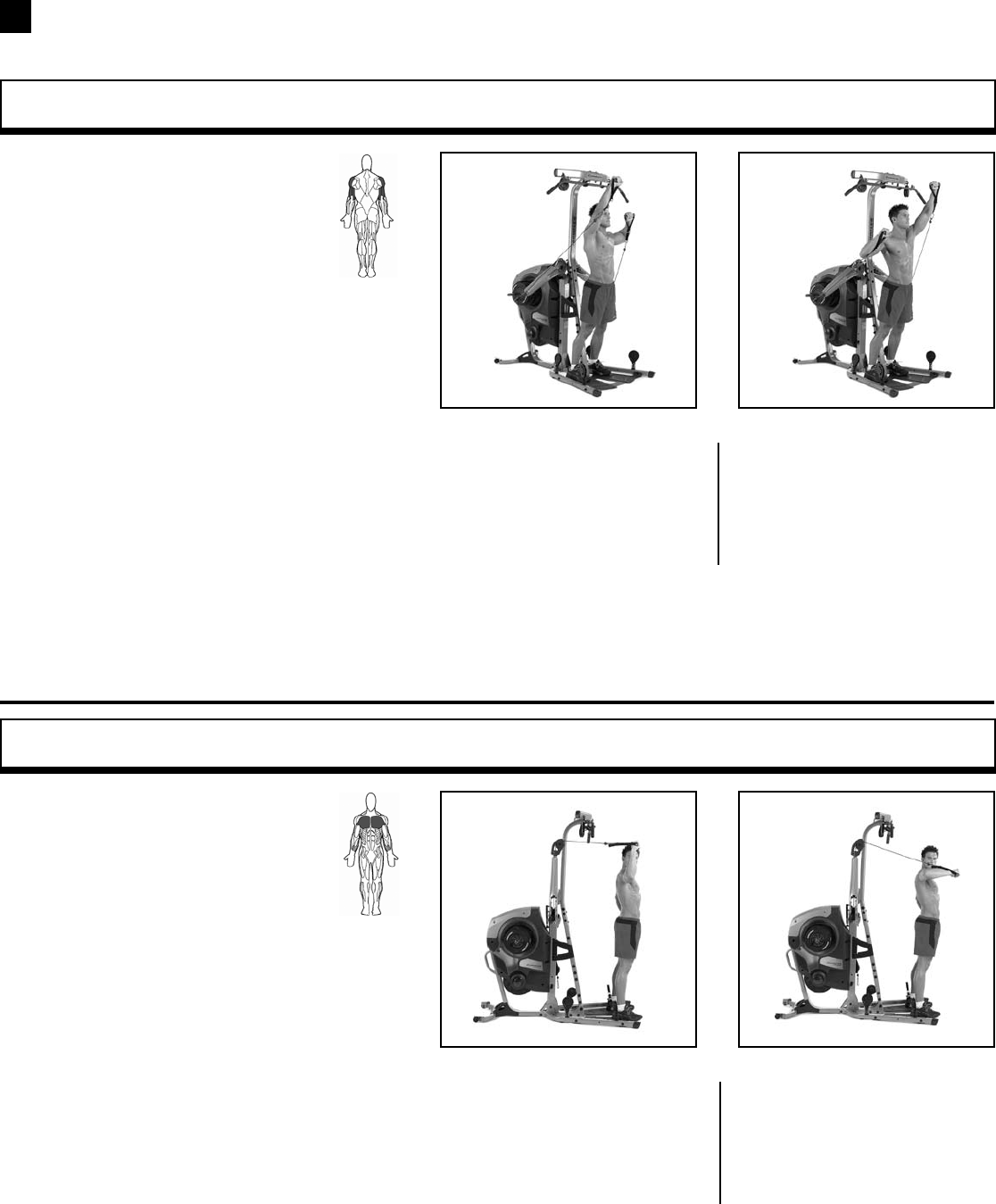
42 Shoulder Exercises
Standing Shoulder Press w/ Alternating Motion — Shoulder Abduction
START FINISH
START
• Grasp the handles so the cables are in
line close to the front of your forearms
and palms facing forward.
• Stand with feet flat on the platform,
knees slightly bent.
• Keep chest up, abs tight and maintain
a slight arch in the low back.
• Raise one hand grip to head level so
your elbow is equal to shoulder level,
keeping the palms facing forward,
while the other arm is extended
upward over your head.
• Straighten your arms slowly over
your head, focusing on moving
your elbows up and inward
toward your ears.
• Slowly return to the Start
position, keeping tension on
the front shoulder muscles
throughout the motion.
FINISH
Muscles worked:
Deltoids; Triceps. Also ankles, knees, hips
& core in stabilization.
Position:
Standing—facing outward. Seat
removed.
Accessory:
Long Hand Grips
Adjustable Arm Position:
7 or 8
Success Tips
• Stabilize body from your feet all the way
up through your trunk.
• Keep shoulder muscles tight, limit and
control your range of motion.
• Keep knees slightly bent and feet flat on
the floor.
• Keep abdominals tight and maintain
good spinal alignment.
• Do not increase the arch in your low
back as you raise your arms; keep your
spine stable and tight.
• Do not allow your body to side bend
during the motion.
Shoulder Internal Rotation with 90˚ of Abduction
START FINISH
START
• Grasp the HandGrip and position your
upper arm 90 degrees away from your
side.
• Stand up straight with chest lifted,
slight arch in the lower back and
shoulder blades retracted.
• Moving the arm of the machine to
different positions above your shoulder
will alter the resistance application to
the muscle.
• Distance yourself from the arm of
the machine to eliminate slack in the
cable\handgrip.
• Rotate your forearm forward then
down, keeping your upper arm
stable.
• Do not let your arm move closer
to your side during the motion.
• Slowly return to the Start
position.
• Repeat with the other arm after
you have completed the set.
FINISH
Muscles worked:
Subscapularis Middle\Inferior fibers;
Pectoralis Major
Position:
Standing—facing outward. Seat
removed.
Accessory:
Long Hand Grips
Adjustable Arm Position:
1
Success Tips
• Control the motion during the entire
exercise. Do not use momentum.
• Do not rotate your spine to gain
additional range of motion. Try for pure
rotation of your shoulder—more is not
better.
• Use light resistance to perform 12-15
perfect repetitions.
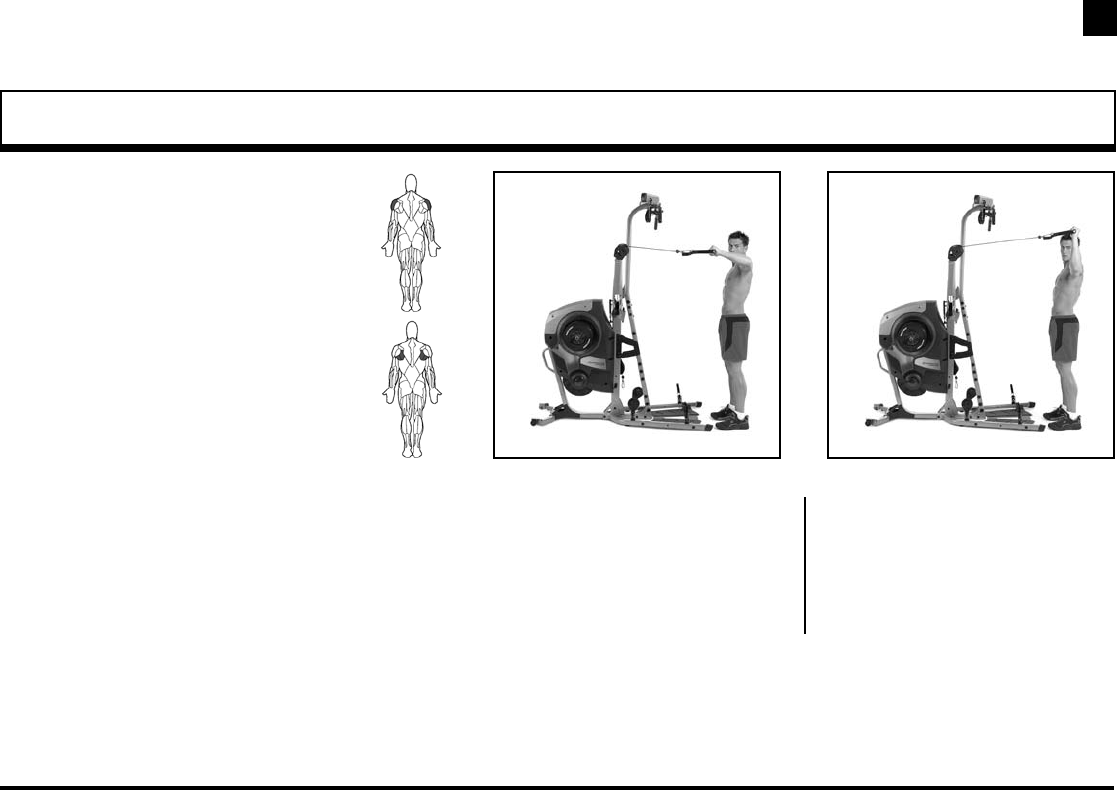
43
Shoulder Exercises
Shoulder External Rotation with 90˚ of Abduction
START FINISH
START
• Grasp the Hand Grips and position
your upper arm 90º away from your
side.
• Stand up straight with chest lifted,
slight arch in the lower back and
shoulder blades retracted.
• Moving the arm of the machine
to different positions will alter the
resistance application to the muscle.
• Distance yourself from the arm of
the machine to eliminate slack in the
cable\handgrip.
• Rotate your forearm up and back,
keeping your upper arm stable.
• Don’t let your arm move closer to
your side during the motion.
• Slowly return to the Start
position, keeping tension on the
muscle.
• Repeat with the other arm after
you have completed the set.
FINISH
Muscles worked:
Posterior Deltoid, Teres minor, Infraspina-
tus
Position:
Standing—facing machine. Seat
removed.
Accessory:
Long Hand Grips
Adjustable Arm Position:
7 or 8
Success Tips
• Control the motion during the entire
exercise. Do not use momentum.
• Do not rotate your spine to gain
additional range of motion. Try for pure
rotation of your shoulder—more is not
better.
• Use light resistance to perform 12-15
perfect repetitions.
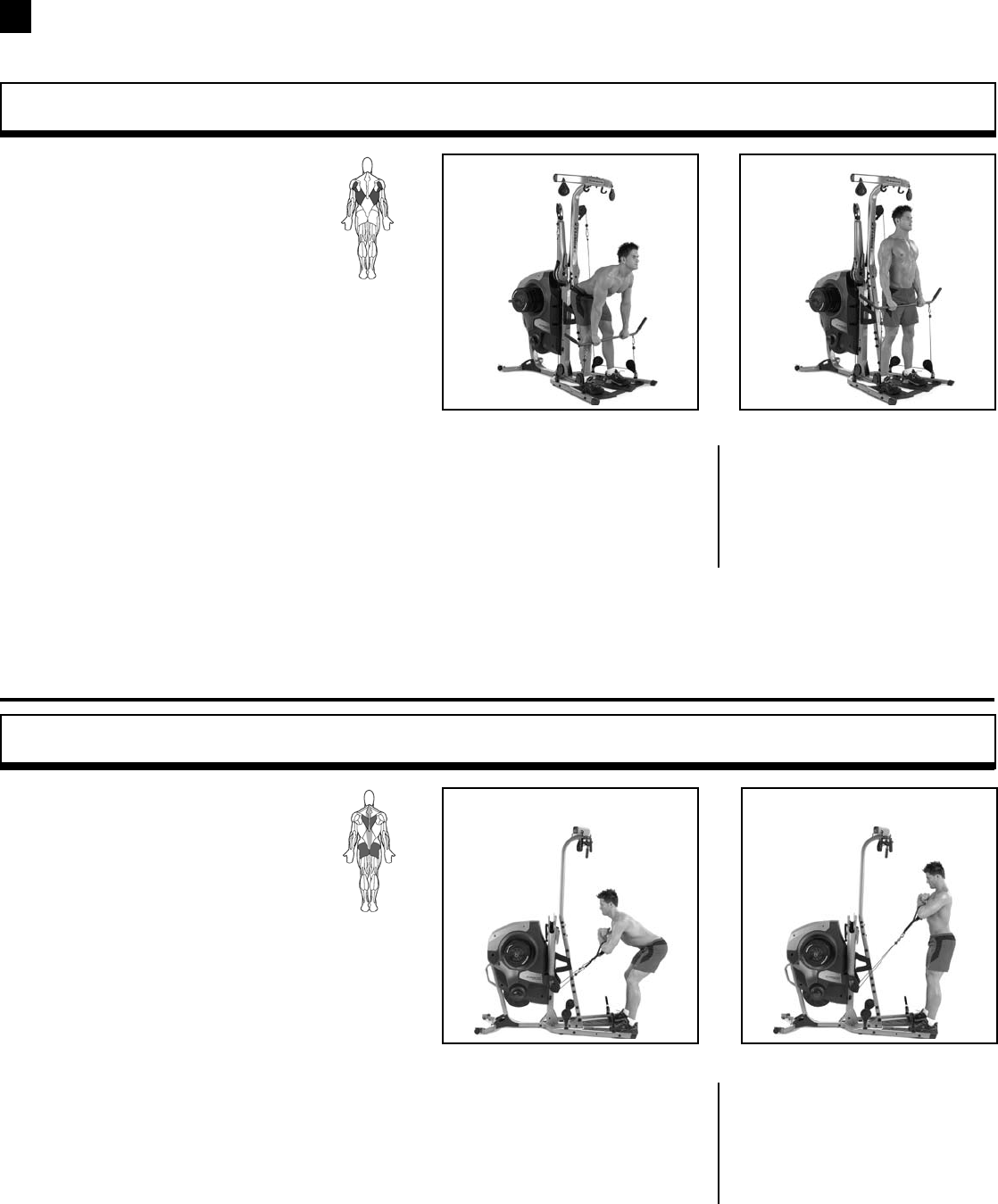
44 Back Exercises
Standing Low Back Extension — (hip extension)
START FINISH
• Slide the handles on the Hand Grips
to one side and slide the straps
over your forearms, tightening near
your elbows.
• Bend your knees comfortably, arms
crossed in front of chest. Pull the
Hand Grips tightly into your chest.
• Pinch shoulder blades together and
lean forward from the hips, at least
45˚, letting the tension out of the
Cables.
• Keeping your chest lifted, move
your entire torso upwards into
a straight standing position by
pivoting at the hips.
• Slowly return to the Start position
without slouching or changing
spinal alignment.
Muscles worked:
Lower Trapezius; Erector Spinae;
Gluteus Maximus
Position:
Standing—facing machine. Seat
removed.
Accessory:
Long Hand Grips
Pulleys / Adjustable Arm
Position:
Squat Frame Pulleys / 0, or 9
Success Tips
• Lift your chest, keep your knees bent
and feet on Platform. Pinch shoulder
blades together.
• Keep your spine aligned, abs tight and a
slight arch in your lower back.
• Move from the hips only—do not bend
from waist.
Good Morning
START FINISH
START
• Grasp the Squat Bar with your
palms facing downward.
• Keep your legs bent slightly.
• Bend over, approximately 90˚
from your hips (not your waist).
• Initiate the movement by pushing
your hips forward.
• Slowly move your trunk until
you are in the standing position.
Back should be tightened when
reaching upright position.
• Slowly return to the Start position
without relaxing tension in your
legs.
FINISH
Muscles worked:
Latissimus Dorsi; Teres Major; Rear Del-
toids
Position:
Standing—facing outward. Seat
removed.
Accessory:
Lat Bar
Pulleys / Adjustable Arm
Position:
Squat Frame Pulleys / 0
Success Tips
• Keep your chest lifted, spine aligned,
abs tight and your back flat with no
arch.
• Lift with your legs, not lower back or
arms.
• Use a light resistance for this
movement.
• Lift your head, keep your knees bent
and feet on Standing Platform.
START FINISH
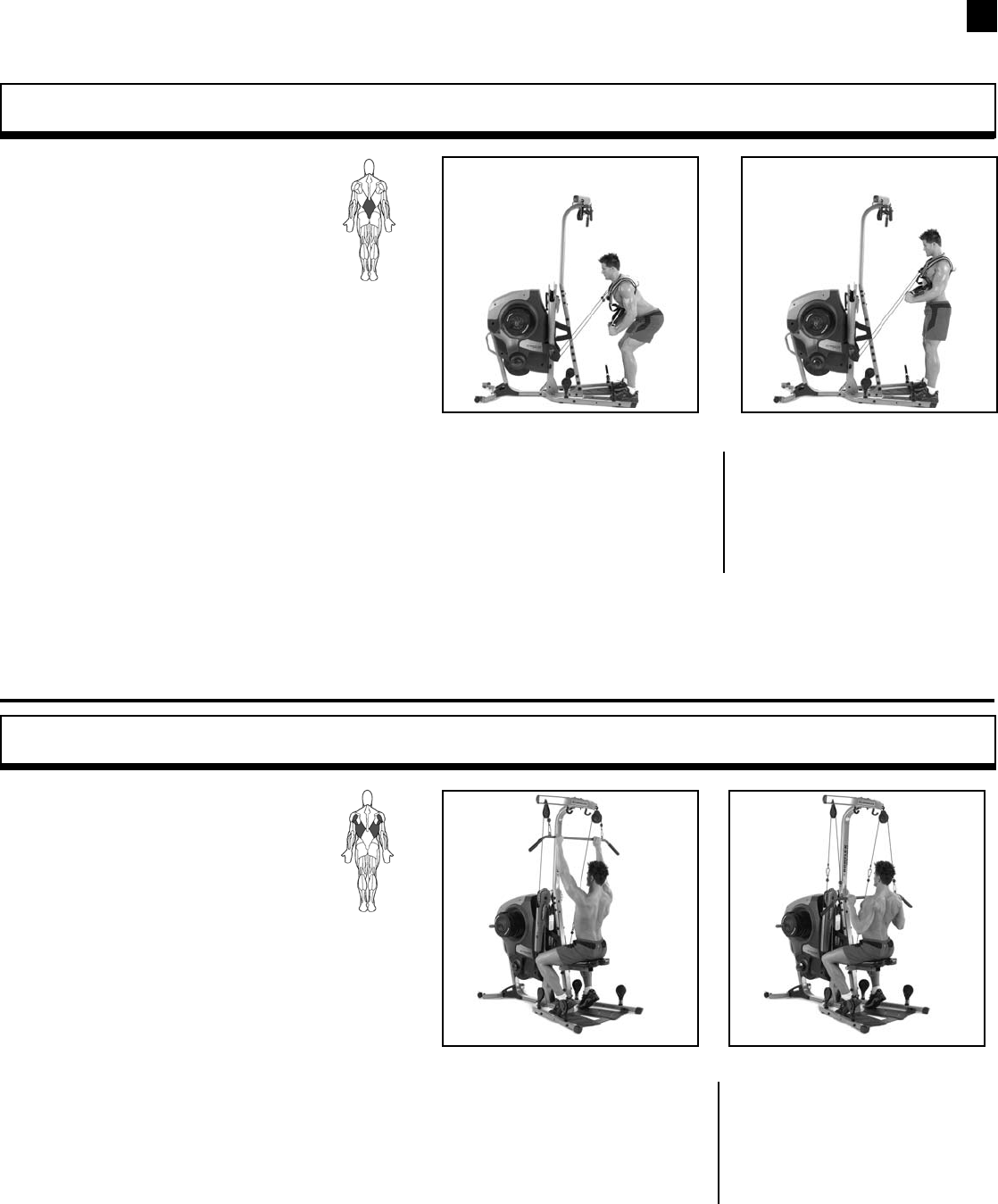
45
Back Exercises
Seated Lat Pulldowns — Shoulder Adduction (with elbow flexion)
START FINISH
START
• Grasp the Lat Pulldown Bar at
a comfortable, wide grip, then
sit, with your arms extending
upward.
• You may position your thighs
directly beneath the pulleys, but
lean back slightly from hips.
• Initiate the movement by pulling
your shoulder blades downward
and together, drawing your elbows
down toward your hips and then
inward into your trunk.
• The Lat Pulldown Bar may not
touch your chest.
• Forearms should stay in line with
the direction of the cables.
• Slowly return to the Start position,
without relaxing the tension in
your shoulders.
FINISH
Muscles worked:
Latissimus Dorsi; Teres Major; Rear Del-
toids
Position:
Seated—facing machine.
Accessory:
Lat Pulldown Bar
Pulleys / Adjustable Arm
Position:
Lat Cross Bars / 9
Success Tips
• Lift your chest, keep your knees bent
and feet on Platform.
• Do not bend your neck forward or
backward during motion.
• Keep your spine aligned, abs tight and
a slight arch in your lower back. Do not
slouch.
• If you can’t complete motion with hands
wide, bring your hands closer together.
Standing Low Back Extension — (Squat Harness variation)
START FINISH
• While standing on the platform,
attach the cables to the shoulder
D-rings on the Squat Harness.
• Grasp the strap handles and hold
them forward to keep the Squat
Harness from sliding up your
back.
• Pinch shoulder blades together
and lean forward from the hips,
at least 45˚.
• Keeping your chest lifted and
knees slightly bent, move your
entire torso upward by pivoting at
the hips. Move as far as you can
in a controlled motion.
• Slowly return to the Start position
without slouching or changing
spinal alignment.
Muscles worked:
Erector Spinae. Also hip, knee and ankle
stabilizers.
Position:
Standing—facing the machine. Seat
removed.
Accessory:
Squat Harness
Pulleys / Adjustable Arm
Position:
Squat Frame Pulleys / 0, or 9
Success Tips
• Keep knees bent, feet flat on the floor
and shoulder blades pinched. Pinch
shoulder blades together.
• Keep your spine aligned, chest lifted,
abs tight and a slight arch in your lower
back.
• Move from the hips only—do not bend
from waist.
START FINISH
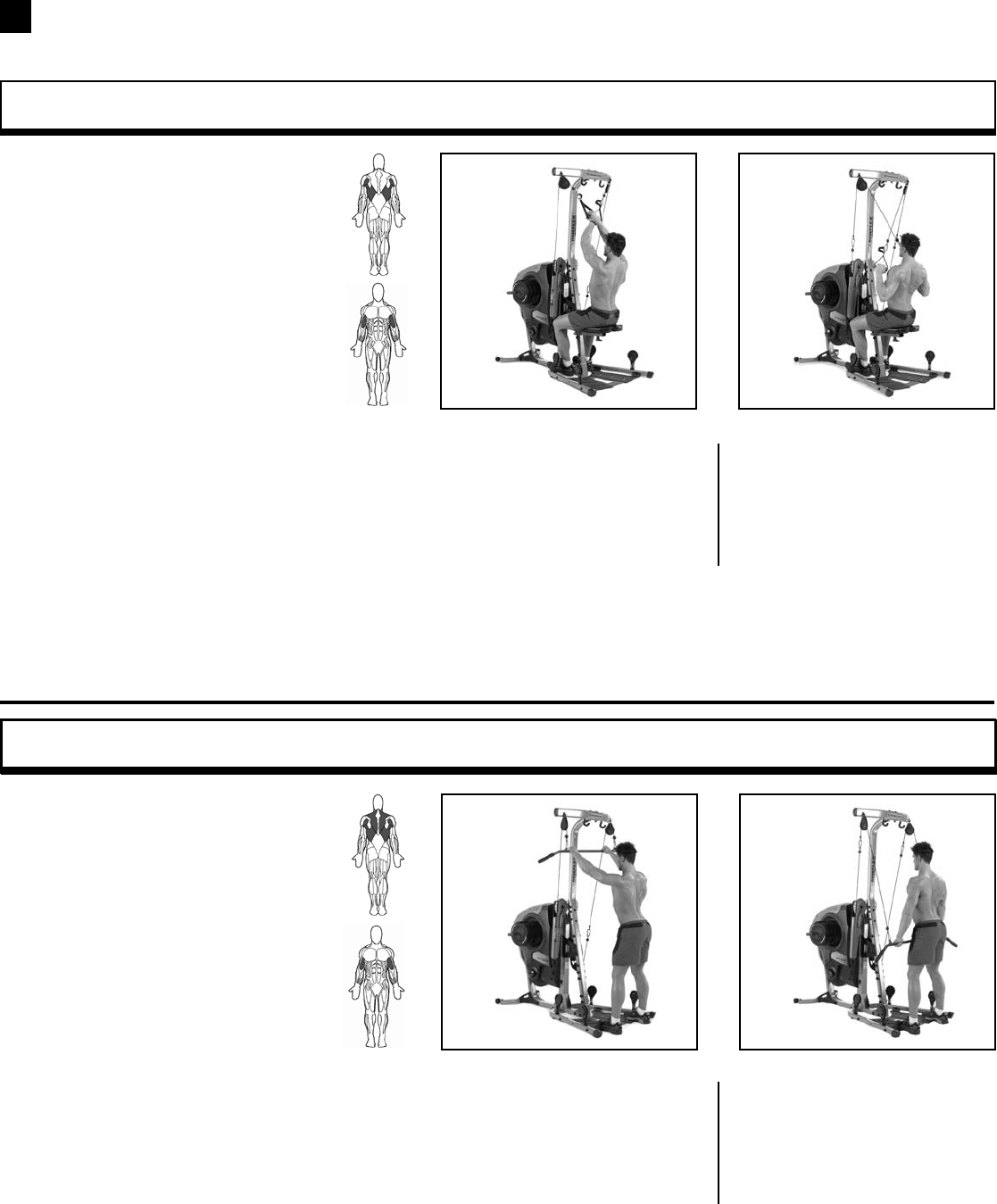
46 Back Exercises
Crossover Narrow Pulldowns — Shoulder Extension (with elbow flexion)
START FINISH
START
• Cross your arms and grasp the
Hand Grips (right Grip in left
hand and vice versa).
• Sit, arms extending upward,
muscles relaxed and ready.
• You may position your thighs
directly beneath the pulleys, but
lean back slightly from hips.
• Initiate the movement by pulling
your shoulder blades downward
and together, drawing your elbows
down toward your hips and then
inward into your trunk.
• At end of motion, shoulders should
be fully depressed.
• Forearms should stay in line with
the direction of the cables.
• Slowly return to the Start position,
without relaxing the tension in
your shoulders.
FINISH
Muscles worked:
Latissimus Dorsi; Teres Major;
Rear Deltoids; Biceps
Position:
Seated—facing machine.
Accessory:
Short Hand Grips
Pulleys / Adjustable Arm
Position:
Lat Cross Bar / 9
Success Tips
• Lift your chest, keep your knees bent
and feet on Standing Platform.
• Do not bend your neck forwards or
backwards during motion.
• Keep your spine aligned, abs tight and
a slight arch in your lower back. Do not
slouch.
Stiff Arm Pulldown
START FINISH
START
• Grasp the Lat Pulldown Bar,
keeping your hands next to each
other with an underhand grip,
and then sit, with your arms
extending upward, muscles
relaxed and ready.
• You may position your thighs
directly beneath the pulleys, but
lean back slightly from hips.
• Initiate the movement by
lowering your shoulder blades,
bringing them down and together.
• Keep your arms straight, moving
your hands downward in an arc
and slowly in toward your thighs.
• Slowly return to the Start position
without relaxing muscle tension.
FINISH
Muscles worked:
Latissimus Dorsi; Teres Major; Rear Del-
toids; Lower Trapezius; Biceps
Position:
Standing—facing machine. Seat
removed.
Accessory:
Lat Pulldown Bar
Pulleys / Adjustable Arm
Position:
Lat Cross Bar / 9
Success Tips
• Lift your chest, keep your knees bent
and feet on Standing Platform.
• Do not bend your neck forwards or
backwards during motion.
• Keep your spine aligned, abs tight and
a slight arch in your lower back. Do not
slouch.
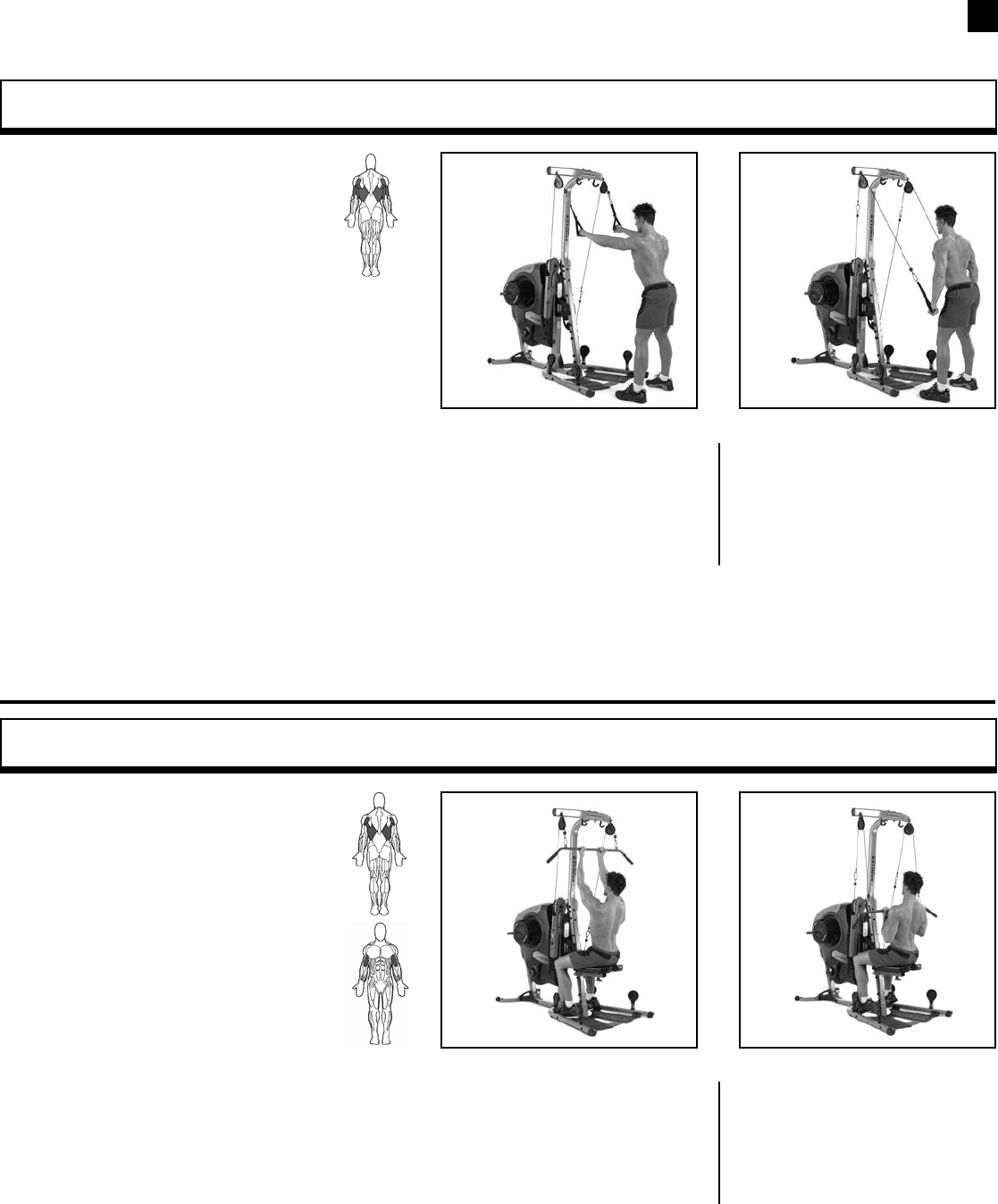
47
Back Exercises
Standing Shoulder Pullover with Hand Grips — Elbow Stabilized
START FINISH
START
• Grasp the Hand Grips, palms
facing down, keeping hands
shoulder-width apart.
• Tighten your abdominals to
stabilize your spine while
maintaining a slight arch in your
lower back.
• Initiate the movement by pulling
your shoulder blades downwards
and tightening your lats.
• Pull your arms in an arc into your
sides, keeping them as steady
as possible and using slow,
controlled movement.
• Slowly return to the Start
position, allowing your arms and
shoulder blades to relax without
losing readiness.
FINISH
Muscles worked:
Latissimus Dorsi; Teres Major; Rear Del-
toids; Biceps; Triceps
Position:
Standing—facing machine. Seat
removed.
Accessory:
Long Hand Grips
Pulleys / Adjustable Arm
Position:
Lat Cross Bar / 9
Success Tips
• Lift your chest, keep your knees bent
and feet on Standing Platform.
• Keep your lats tightened throughout
entire motion.
• Keep your spine aligned, abs tight and a
slight arch in your lower back.
• Release your shoulder blades at the end
of each rep. Initiate each new rep by
depressing your shoulder blades.
Reverse Grip Pulldown with Lat Bar
START FINISH
START
• Grasp the Lat Pulldown Bar,
keeping your hands next to each
other with an underhand grip,
and then sit, with your arms
extending upward, muscles
relaxed and ready.
• You may position your thighs
directly beneath the pulleys, but
lean back slightly from hips.
• Initiate the movement by pulling
your shoulder blades downward
and together, drawing your elbows
down toward your hips and then
inward into your trunk.
• The Lat Pulldown Bar may not
touch your chest.
• Forearms should stay in line with
the direction of the cables.
• Slowly return to the Start position,
without relaxing the tension in
your shoulders.
FINISH
Muscles worked:
Latissimus Dorsi; Teres Major;
Rear Deltoids; Biceps
Position:
Seated—facing machine
Accessory:
Lat Pulldown Bar
Pulleys / Adjustable Arm
Position:
Lat Cross Bar / 9
Success Tips
• Lift your chest, keep your knees bent
and feet on Standing Platform.
• Do not bend your neck forwards or
backwards during motion.
• Keep your spine aligned, abs tight and a
slight arch in your lower back. Do not
slouch.
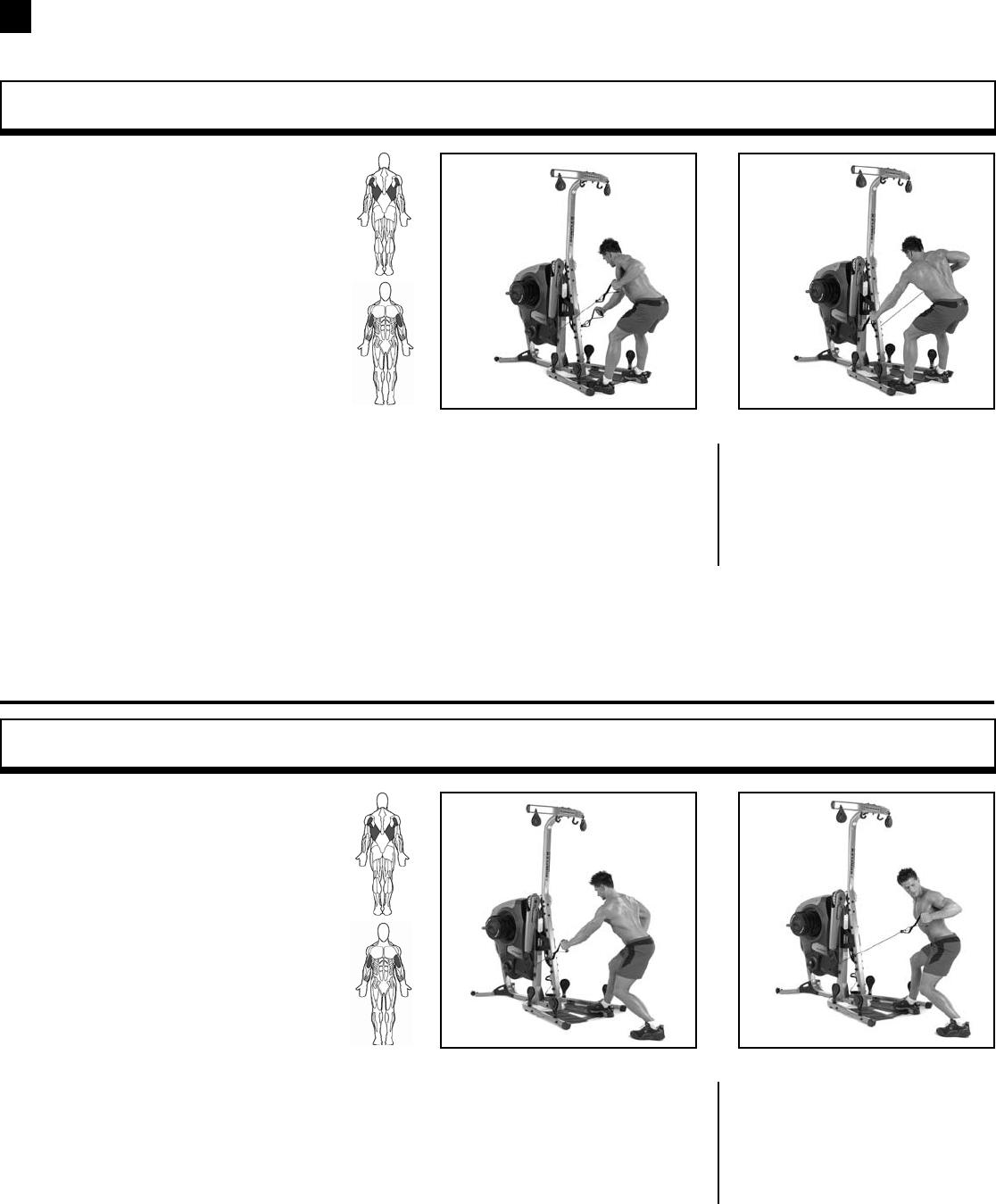
48 Back Exercises
Standing Lat Row Alternating Motion-Low Pulley — Shoulder extension (and elbow flexion)
START FINISH
START
• Stand on the platform facing the
engine.
• Grasp the handles with one arm
hanging forward toward the
pulley and the other arm back
with the elbow bent and forearm
in line with the cable.
• Bend over to about 45º, keeping
tension on the cables.
• Slowly move one elbow backward
as you bring the hand to a point
just below your chest, while
the other arm moves forward
with your hand moving toward
the pulley. This is an alternating
motion, with the arms moving in
opposite directions.
• Keep knees bent and back
straight.
FINISH
Muscles worked:
Latissimus Dorsi; Rear Deltoids; Biceps; Teres
Major. Also hip and core stabilizers.
Position:
Standing—facing machine. Seat
removed.
Accessory:
Short Hand Grips
Adjustable Arm Position:
8 or 9
Success Tips
• Do not bend your neck forward or
backward.
• Start each rep by retracting the shoulder
blade of the arm moving backward.
• Release your shoulder blades at the end of
each rep of the arm going forward.
• Keep your spine in alignment and chest
lifted.
Standing Single Arm Lat Row Low Pulley — Shoulder extension (with elbow flexion and
trunk rotation)
START FINISH
START
• Stand facing the engine in a
staggered stance, with the
opposite foot forward of the side
you are pulling from.
• Grasp the Hand Grip with the
arm hanging forward toward the
pulley.
• Bend over to about 45º, knees
slightly bent.
• Slowly move your elbow
backward as you bring the hand
to a point just below your chest
while rotating your trunk in the
same direction that you are
pulling.
• Slowly extend the arm back to
the Start position and rotate your
trunk back to the center.
• Keep knees bent and back
straight.
FINISH
Muscles worked:
Latissimus Dorsi; Rear Deltoids; Biceps;
Teres Major. Also hip and core rotators.
Position:
Standing—facing machine. Seat
removed.
Accessory:
Short Hand Grips
Adjustable Arm Position:
9
Success Tips
• Do not bend your neck forward or
backward.
• Start each rep by retracting your
shoulder blade.
• Release your shoulder blade at the end
of each rep.
• Keep your spine in alignment and chest
lifted.
• Do not throw the resistance or
use momentum to gain more trunk
rotation—more is not better.
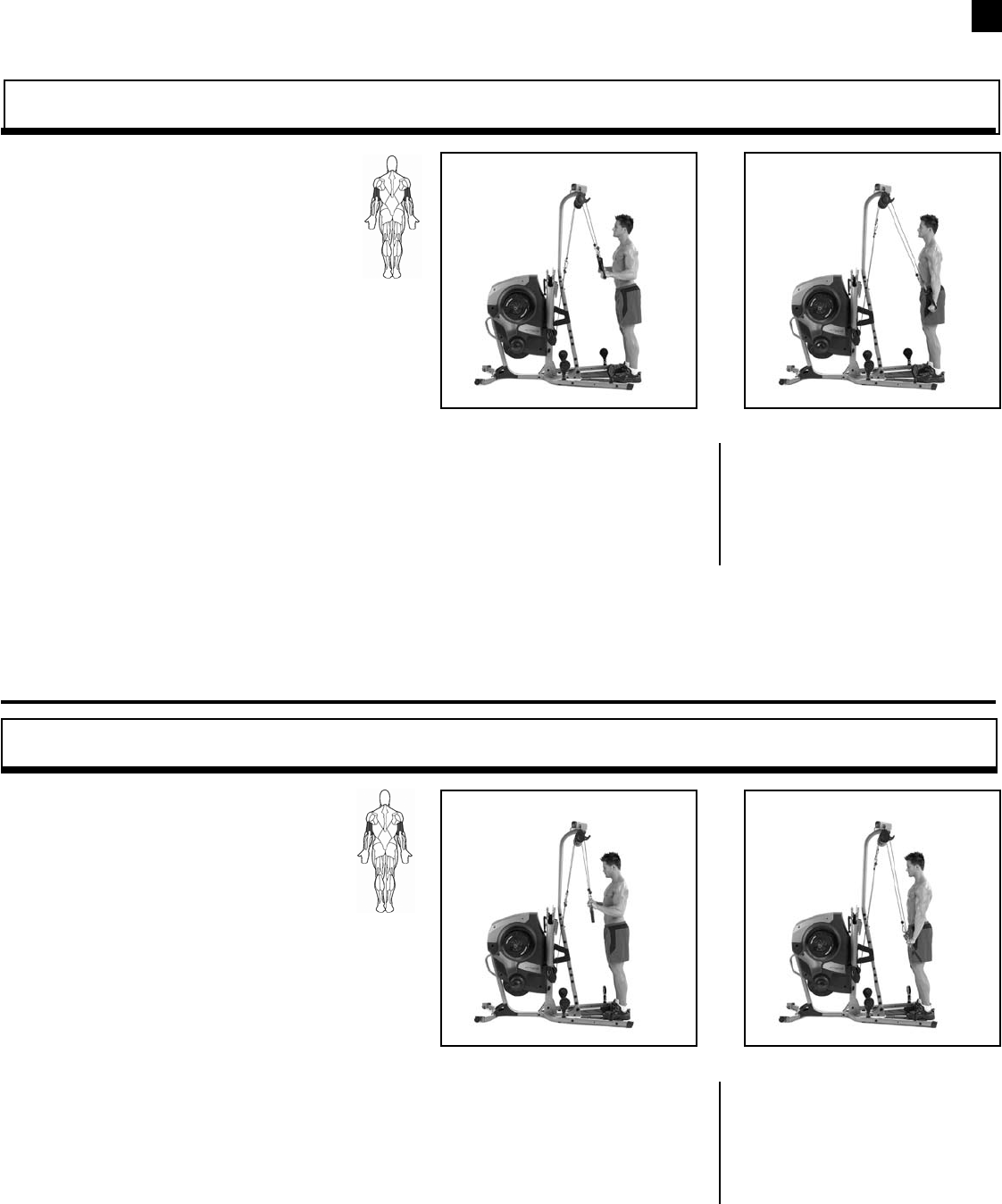
Arm Exercises 49
Triceps Pushdown w/ Handgrips — Elbow Extension
START FINISH
START
• Grasp one or both of the Hand
Grips, palms facing the floor.
• Keep hands and elbows
approximately shoulder-width
apart. Bend your elbows until
hands are near shoulders.
• Bend slightly from your hips but
maintain a stabilized spine.
• Keeping your forearms and
wrists stationary, straighten your
elbows, bringing your hands
down to your thighs, palms
facing out.
• Stop the motion before your
elbows are completely straight,
and then reverse, slowly
returning to the Start position
without relaxing muscle tension.
FINISH
Muscles worked:
Triceps
Position:
Standing—facing machine. Seat removed.
Accessory:
Long Hand Grips
Pulleys / Adjustable Arm
Position:
Lat Cross Bar / 9
Success Tips
• Keep your upper arms motionless and your
wrists straight.
• Keep your chest lifted and maintain spinal
alignment, keeping a very slight arch in
your lower back.
• Tighten the triceps throughout the
exercise, using controlled motion.
• Keep your knees bent and feet on Standing
Platform.
Variations
You can also perform this exercise using the
“Hammer” hold, palms facing inward.
Triceps Pushdown w/ Lat Pulldown Bar — Elbow Extension
START FINISH
START
• Grasp the Lat Pulldown Bar,
palms facing the floor.
• Keep hands and elbows
approximately shoulder-width
apart. Bend your elbows until
hands are near shoulders.
• Bend slightly from your hips but
maintain a stabilized spine.
• Keeping your forearms and
wrists stationary, straighten your
elbows, bringing your hands
down to your thighs, palms
facing out.
• Stop the motion before your
elbows are completely straight,
and then reverse, slowly
returning to the Start position
without relaxing muscle tension.
FINISH
Muscles worked:
Triceps
Position:
Standing—facing machine. Seat
removed.
Accessory:
Lat Pulldown Bar
Pulleys / Adjustable Arm
Position:
Lat Cross Bar / 9
Success Tips
• Keep your upper arms motionless and
your wrists straight.
• Keep your chest lifted and maintain
spinal alignment, keeping a very slight
arch in your lower back.
• Tighten the triceps throughout the
exercise, using controlled motion.
• Keep your knees bent and feet on
Platform.
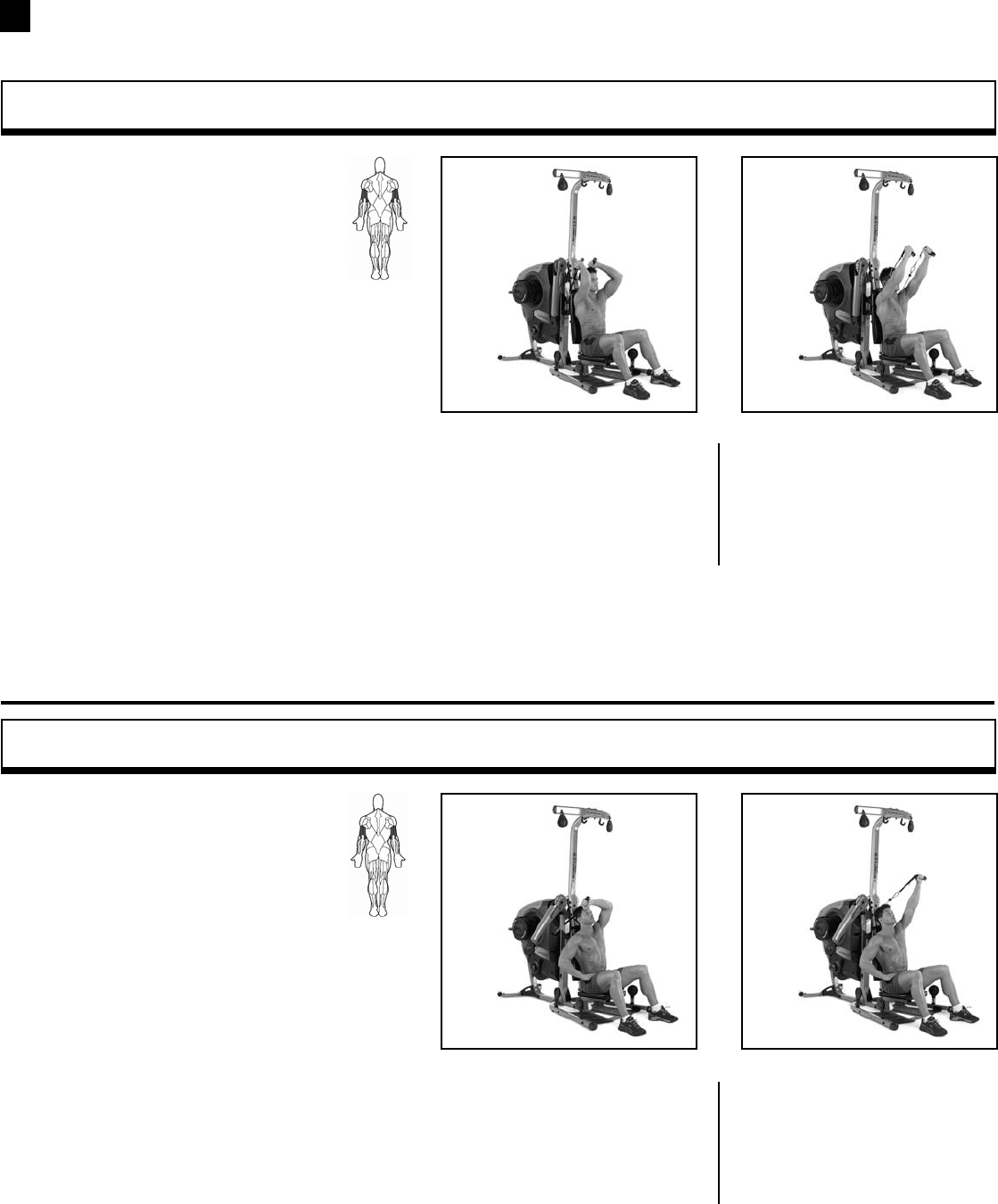
Arm Exercises
50
Triceps Extension — Elbow Extension overhead
START FINISH
START
• Grasp one or both of the Hand
Grips, palms facing outward.
• Draw arms up until elbows are
pointing forward, hands behind
shoulders.
• Keep your elbows “in line” with
the cables throughout movement
and your wrists straight.
• Keeping your upper arms
stationary, straighten your
elbows, bringing your hands
overhead, palms facing out.
• Stop your motion before your
elbows are completely straight,
and then reverse, slowly
returning to the Start position
without relaxing muscle tension.
FINISH
Muscles worked:
Triceps
Position:
Seated—facing outward.
Accessory:
Long Hand Grips
Adjustable Arm Position:
8 or 9
Success Tips
• Keep your upper arms motionless and
your wrists straight.
• Keep your chest lifted and maintain
spinal alignment, keeping a very slight
arch in your lower back.
• Tighten the triceps throughout the
exercise, using controlled motion.
• Keep your knees bent and feet on
Platform.
Variations
You can also perform this exercise using
the “Hammer” hold, palms facing inward.
Cross Triceps Extension
START FINISH
START
• Take one hand, reach over the
opposite shoulder and grasp a Hand
Grip.
• Bend and lower your elbow until
your hand is in front of your chest,
palm facing the floor and using a
Hammer Grip.
• Spread your back and shoulders
into the Seat Back Pad.
• Use your free hand to grasp theback
of the active arm near the elbow to
stabilize it.
• Keeping your upper arm
stationary, slowly straighten your
elbow, bringing your hand across
your chest in an arcing motion.
• Stop the motion when your arm is
straight. Do not lock your elbow.
• Slowly reverse the arcing motion,
bringing your hand back to the
Start position.
FINISH
Muscles worked:
Triceps
Position:
Seated—facing outward.
Accessory:
Long Hand Grips
Adjustable Arm Position:
7
Success Tips
• Keep your chest lifted and maintain a
very slight arch in your lower back.
• Keep knees bent and feet flat on the
Standing Platform.
• Keep your upper arms motionless and
your wrists straight.
• Tighten the triceps throughout the
exercise, using controlled motion
throughout the exercise.
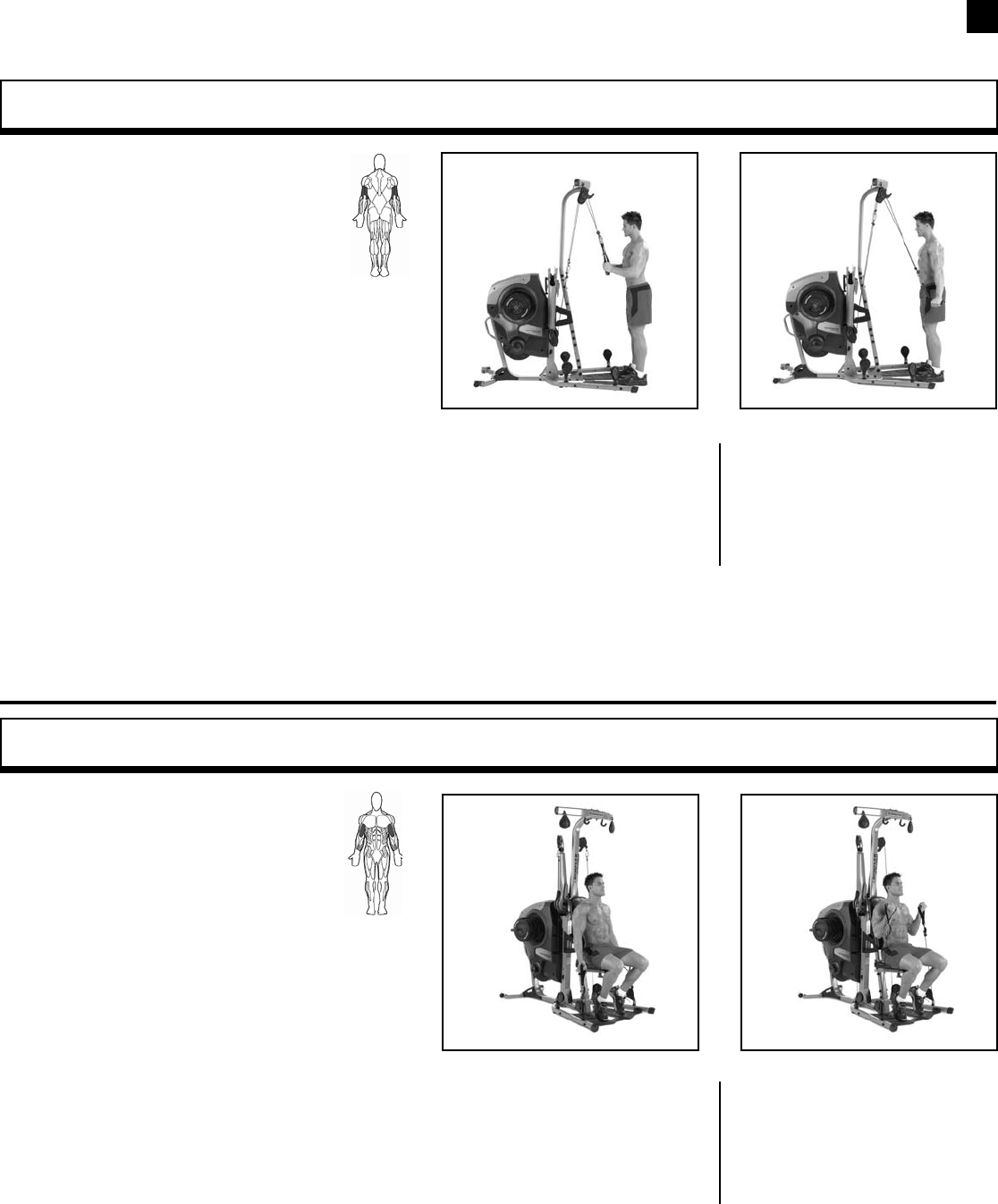
Arm Exercises 51
“Rope” Pushdown — Elbow Extension
START FINISH
START
• Distance yourself from the Lat
Tower, but keep your feet on the
Platform.
• Cross your arms and grasp the
Hand Grips (right Grip in left
hand and vice versa), palms
facing down.
• Bring hands toward each other,
in front of you, until they are
positioned as if grabbing a rope.
• Keep your elbows bent, upper
arms at your sides.
• Keeping your upper arms
stationary, elbows next to trunk,
slowly straighten your arms
downward, in a gentle arc,
until hands are near tops of
your thighs, hands and elbows
straightened and directly in line
with shoulders.
• Keeping your triceps tightened,
slowly reverse the arcing motion
and bring the Hand Grips back to
the Start position.
FINISH
Muscles worked:
Triceps
Position:
Standing—facing machine. Seat
removed.
Accessory:
Long Hand Grips in “Hammer” hold
Lat Tower (optional)
Pulleys / Adjustable Arm
Position:
Lat Cross Bar / 9
or (without Lat Tower) 0 or 1
Success Tips
• Keep your knees bent and feet on
Platform.
• Keep your upper arms motionless and
your wrists straight.
• Keep your chest lifted, abs tight and
maintain a slight arch in lower back.
• Tighten the triceps throughout the
exercise, using controlled motion.
Seated Biceps Curl — Elbow Extension (in supination)
START FINISH
START
• Grasp one or both Hand Grips,
keeping your arms at your sides,
forearms near your thighs.
• Keep your spine aligned
throughout motion.
• Curl your forearms toward the
upper arms, keeping upper arms
completely still.
• Keeping the motion fluid, slowly
return to the Start position
without relaxing your biceps.
FINISH
Muscles worked:
Biceps
Position:
Seated—facing outward.
Accessory:
Short Hand Grips
Pulleys / Adjustable Arm
Position:
Squat Frame Pulleys
Success Tips
• Keep knees bent, feet flat on the
Platform
• Keep your chest lifted, shoulders
pinched together, and a very slight arch
in your lower back.
• Keep your upper arms and shoulders
motionless and your wrists straight.
• Lay your head back against the Seat
Back Pad.
START FINISH
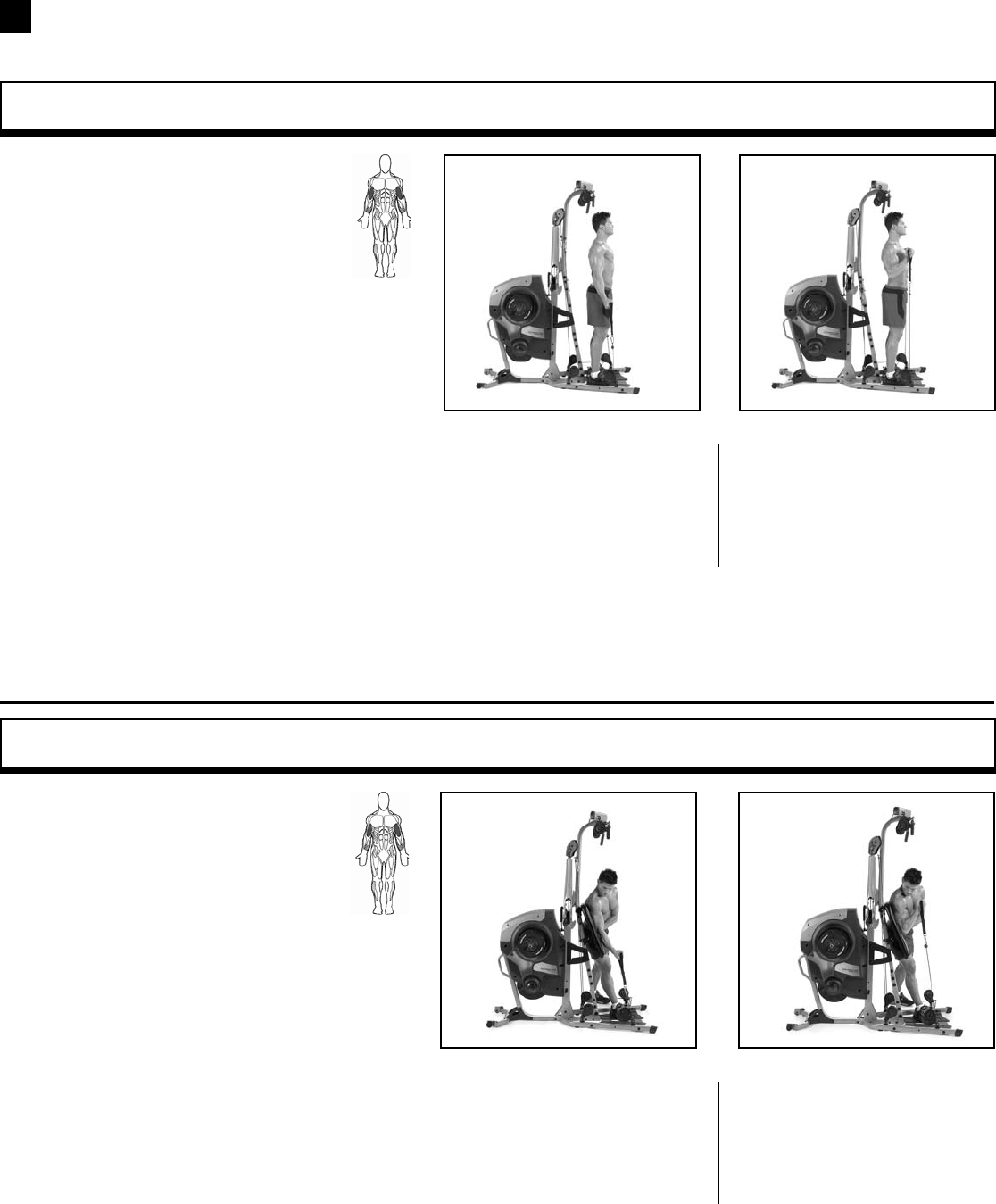
52 Arm Exercises
Concentration Biceps Curl — Flexion (in supination)
START FINISH
START
• Stand on the Platform, one side
facing the engine.
• With the inside hand, grasp the
Hand Grip closest to you.
• Keeping your back straight, bend
at your hips and knees until your
trunk is parallel to the floor.
• Place your free hand on your
thigh to stabilize.
• Slowly curl your the Hand Grip
away from the Cable and then
upward toward your shoulder.
Keep your upper arm completely
motionless and elbow pointing
directly at the floor at all times.
• Keeping your biceps tightened,
slowly reverse the curling motion
and bring your arm back to the
Start position.
FINISH
Muscles worked:
Biceps
Position:
Standing—facing right or left. Seat
removed.
Accessory:
Short Hand Grips
Pulleys / Adjustable Arm
Position:
Squat Frame Pulleys
Success Tips
• Keep your knees bent and feet on
Platform.
• Keep your upper body motionless and
your wrists straight.
• Bend from the hips, not the waist.
• Elbow should point toward the floor at all
times.
• Keep chest lifted, trunk muscles tight
and maintain a slight arch in lower
back.
• Keep your spine aligned throughout
movement.
Standing Biceps Curl — Elbow Flexion (in supination)
START FINISH
START
• Reach down and grasp the Hand
Grips, palms facing forward.
• Straighten, keeping your arms by
your sides, elbows loose.
• Keeping your upper arms
stationary and your elbows at
your sides, slowly curl the Hand
Grips forward, then upward and
in towards your shoulders.
• Slowly reverse the arcing motion,
bringing your hands back to the
Start position.
FINISH
Muscles worked:
Biceps
Position:
Standing—facing outward. Seat
removed.
Accessory:
Short Hand Grips
Pulleys / Adjustable Arm
Position:
Squat Frame Pulleys
Success Tips
• Keep your knees bent and feet on
Platform.
• Keep your chest lifted, abs tight and a
very slight arch in your lower back.
• Keep your elbows at your sides and
your wrists straight.
Variations
You can also perform this exercise using
the “Hammer” hold, palms facing inward.
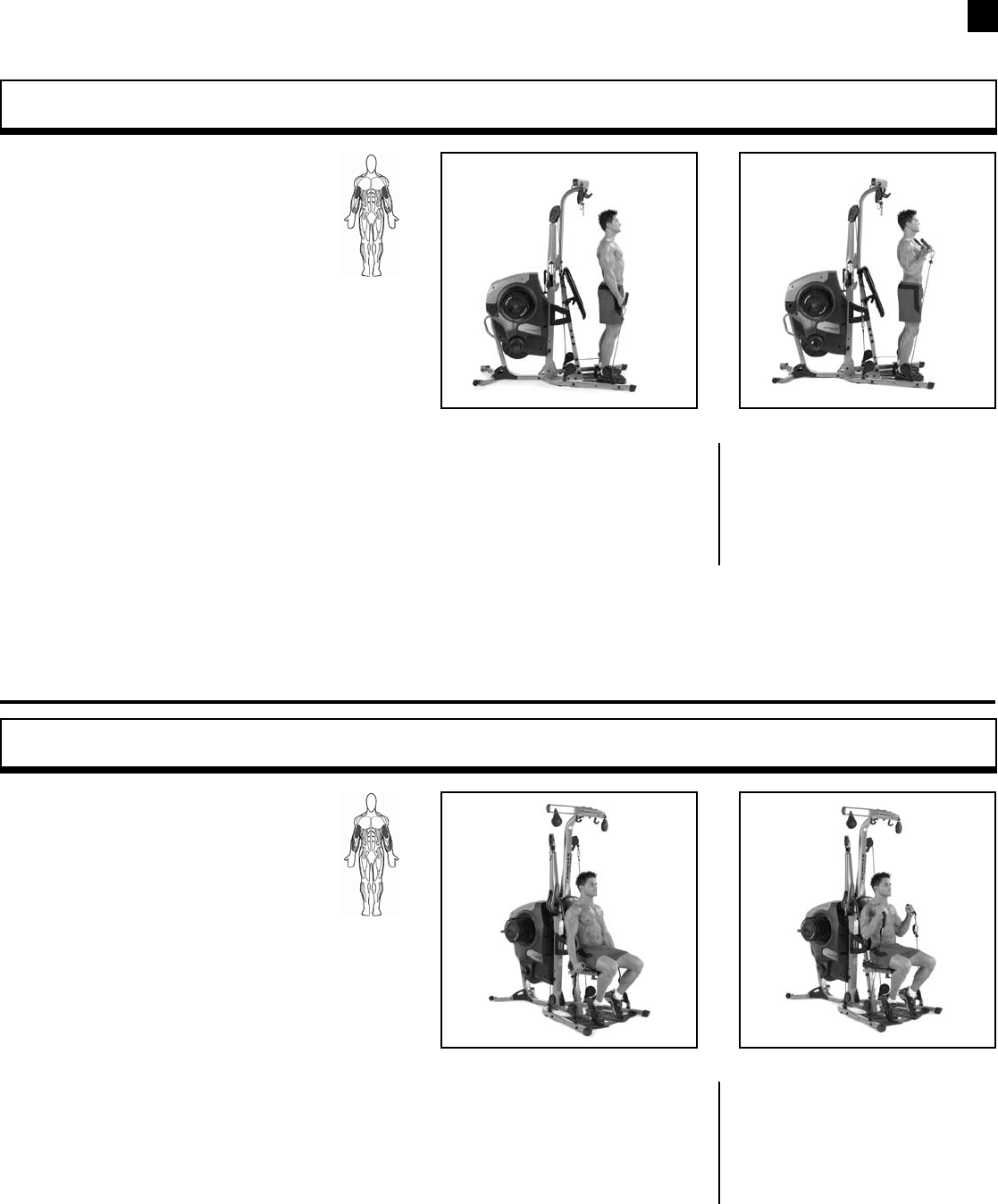
53
Arm Exercises
Barbell Biceps Curl — Elbow Flexion (in supination)
START FINISH
START
• Grasp the Lat Bar, palms facing
forward.
• Stand with your upper arms by
your sides (not pressed tightly)
and keep your elbows bent so
that your forearms are at a 90°
angle to your upper arms.
• Slowly curl the Lat Bar forward
and then upward toward your
shoulders, keeping your elbows
at your sides and your upper
arms still.
• Slowly lower the Lat Bar back to
the Start position.
FINISH
Muscles worked:
Biceps
Position:
Standing—facing outward. Seat
removed.
Accessory:
Lat Bar
Adjustable Arm Position:
0
Success Tips
• Keep your knees bent and feet on
Platform.
• Keep your chest lifted, shoulders
pinched together, and a very slight arch
in your lower back.
• Keep your upper arms and shoulders
motionless and your wrists straight.
Seated Biceps Hammer Curl — Elbow Flexion (neutral)
START FINISH
START
• Reach down and grasp the Hand
Grips in the vertical “Hammer
Grip” position.
• Straighten, keeping your upper
arms and elbows by your sides,
elbows loose. Forearms should
be at a 90° angle to upper arms.
• Curl the Hand Grips forward,
then upward and in towards your
shoulders.
• Keep your elbows at your sides
and your upper arms completely
still.
• Slowly reverse the curling motion
and bring your arms back to Start
position.
FINISH
Muscles worked:
Brachioradialis; Biceps
Position:
Standing—facing outward. Seat
removed.
Accessory:
Short Hand Grips in “Hammer” hold
Pulleys / Adjustable Arm
Position:
Squat Frame Pulleys / 0
Success Tips
• Keep your knees bent and feet on
Platform.
• Keep your upper body motionless,
elbows at your sides and your wrists
straight.
• Keep your trunk muscles tight and
maintain a slight arch in lower back.
• Do not rock your upper body while
bending your elbow.
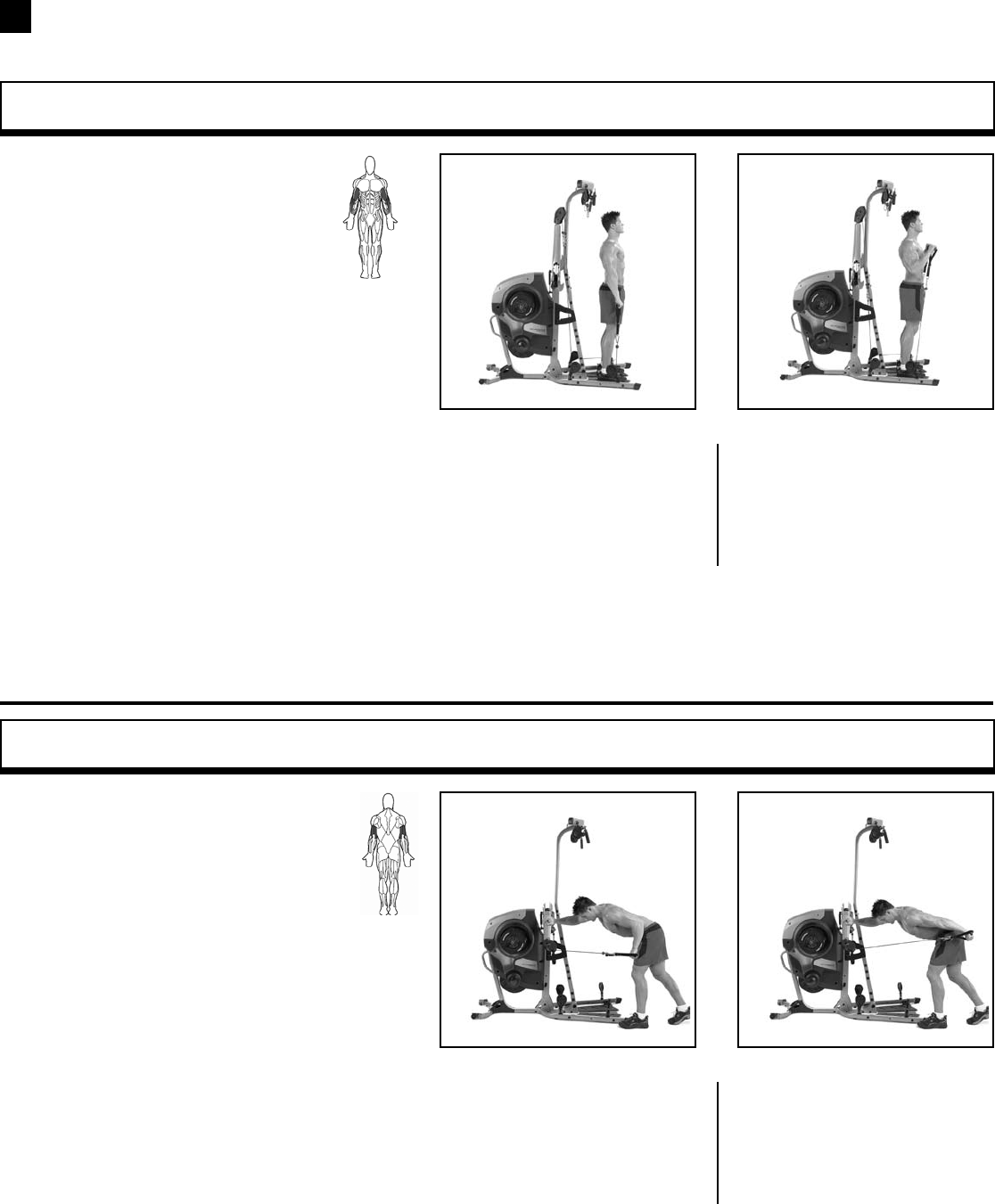
54 Arm Exercises
Reverse Curl — Elbow Flexion (in pronation)
START FINISH
START
• Reach down and grasp the Hand
Grips, palms facing backward.
• Straighten, keeping your upper
arms and elbows by your sides,
elbows loose. Bend your elbows
until your forearms are between
45-90˚ angles with your upper
arms.
• Keeping your palms facing down,
use your forearms to slowly bend
your elbows, curling the Hand
Grips forward, then upward and
in towards your shoulders.
• Keep your elbows at your sides
and your upper arms completely
still.
• Slowly reverse the curling motion
and bring your arms back to the
Start position.
FINISH
Muscles worked:
Brachialis; Brachioradialis; Biceps
Position:
Standing—facing outward. Seat
removed.
Accessory:
Short Hand Grips
Pulleys / Adjustable Arm
Position:
Squat Frame Pulleys / 0
Success Tips
• Keep your knees slightly bent and feet
on Platform.
• Keep your upper body motionless,
elbows at your sides and your wrists
straight.
• Keep your trunk muscles tight and
maintain a slight arch in lower back.
Triceps Kickback — Elbow Extension
START FINISH
START
• Reach down and grasp a Hand
Grip in one hand, palm facing
backward.
• Draw your elbow back until the
forearm is at approximately a 90°
angle to the upper arm.
• Straighten your elbow, keeping
your upper arm completely still.
• When arm is completely straight,
slowly return to the Start
position.
FINISH
Muscles worked:
Triceps
Position:
Standing—facing machine. Seat
removed.
Accessory:
Short Hand Grips
Adjustable Arm Position:
8
Success Tips
• Keep your knees slightly bent and feet on
Platform.
• Keep your chest lifted, trunk muscles
tightened, and a very slight arch in your
lower back.
• Keep one hand on the Back Pad to stabilize
yourself throughout motion.
• Keep triceps tightened throughout the
exercise.
Variations
You can also perform this exercise using the
“Hammer” hold, palms facing inward.
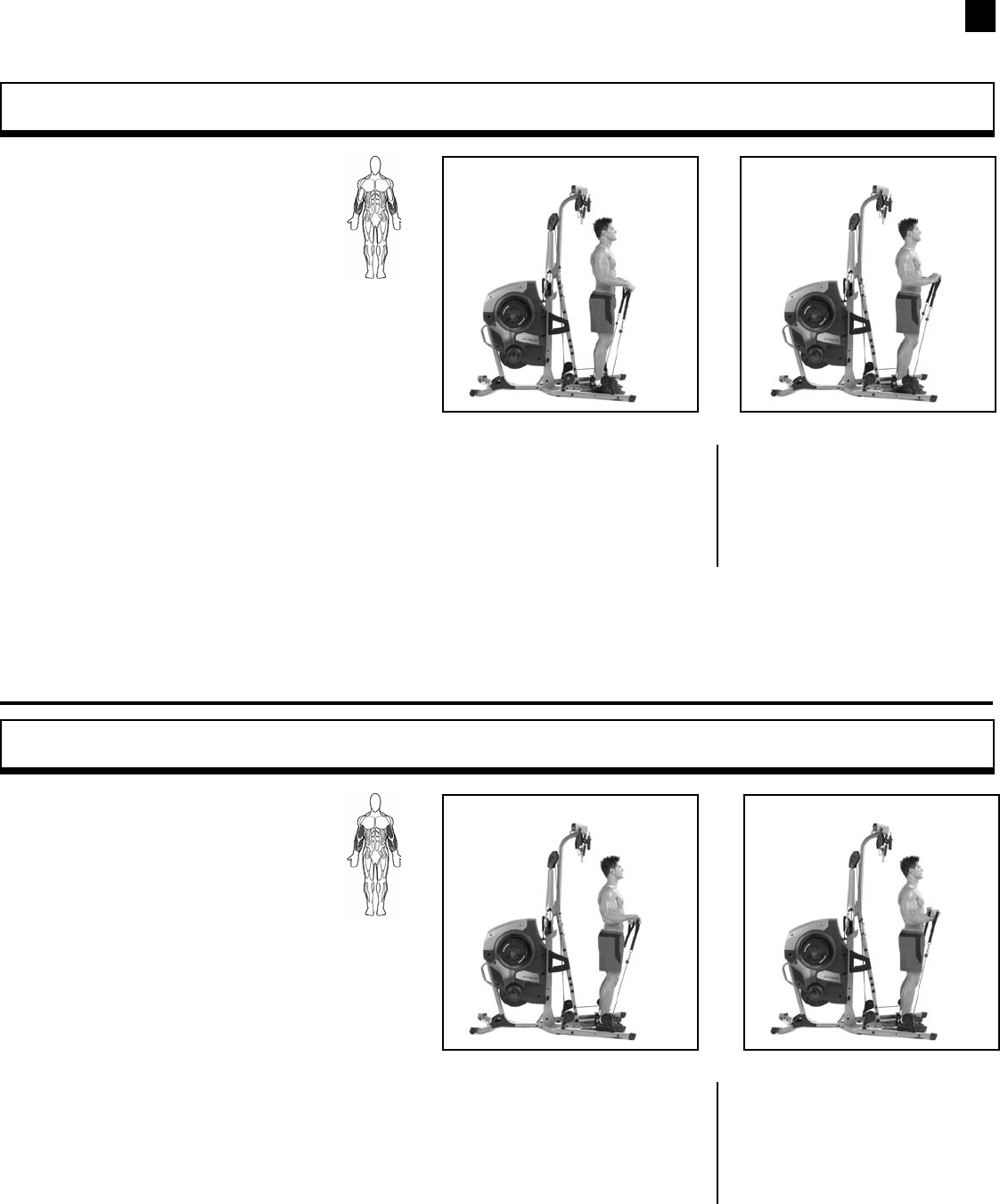
55
Arm Exercises
Wrist Extension
START FINISH
START
• Grasp the Hand Grips, palm
facing down, keeping your
elbows flared slightly to the side,
elbows bent approximately 90°.
• Slowly curl the back of your
fists backward towards your
forearms.
• Stop when wrists are 90°
from forearms or when you
experience discomfort.
• Slowly return to the Start
position.
FINISH
Muscles worked:
Forearms
Position:
Standing—facing outward. Seat
removed.
Accessory:
Short Hand Grips
Pulleys / Adjustable Arm
Position:
Squat Frame Pulleys / 0
Success Tips
• Keep your knees slightly bent and feet
on Platform.
• Move slowly and keep tension in the
back of the forearms at all times.
• Keep your chest lifted, trunk muscles
tightened, and a very slight arch in your
lower back.
• You may perform this exercise one arm
at a time to make it easier to focus and
isolate the back of your forearms, or
with both arms simultaneously to save
time.
Wrist Curl — Wrist Flexion
START FINISH
START
• Reach down and grasp the Hand
Grips, palms facing forward,
fingertips down.
• Straighten, keeping your upper
arms and elbows by your sides,
elbows loose.
• Bend your elbows 90°, palms
up, and maintain that position
throughout the entire exercise.
• With your upper arms stationary
and your elbows at your sides,
slowly curl your fists toward the
front of your forearms.
• Keeping your forearms still,
slowly let your fists return to the
Start position.
FINISH
Muscles worked:
Biceps; Forearms
Position:
Standing—facing outward. Seat
removed.
Accessory:
Short Hand Grips
Pulleys / Adjustable Arm
Position:
Squat Frame Pulleys / 0
Success Tips
• Keep your chest lifted, trunk muscles
tight and a very slight arch in your lower
back.
• Move slowly, keeping tension in the
front of your forearms at all times.
• Do not increase or decrease the bend in
your elbow during this exercise—keep
all motion in the wrist.
• Do not rock your body back and forth
during wrist motion.
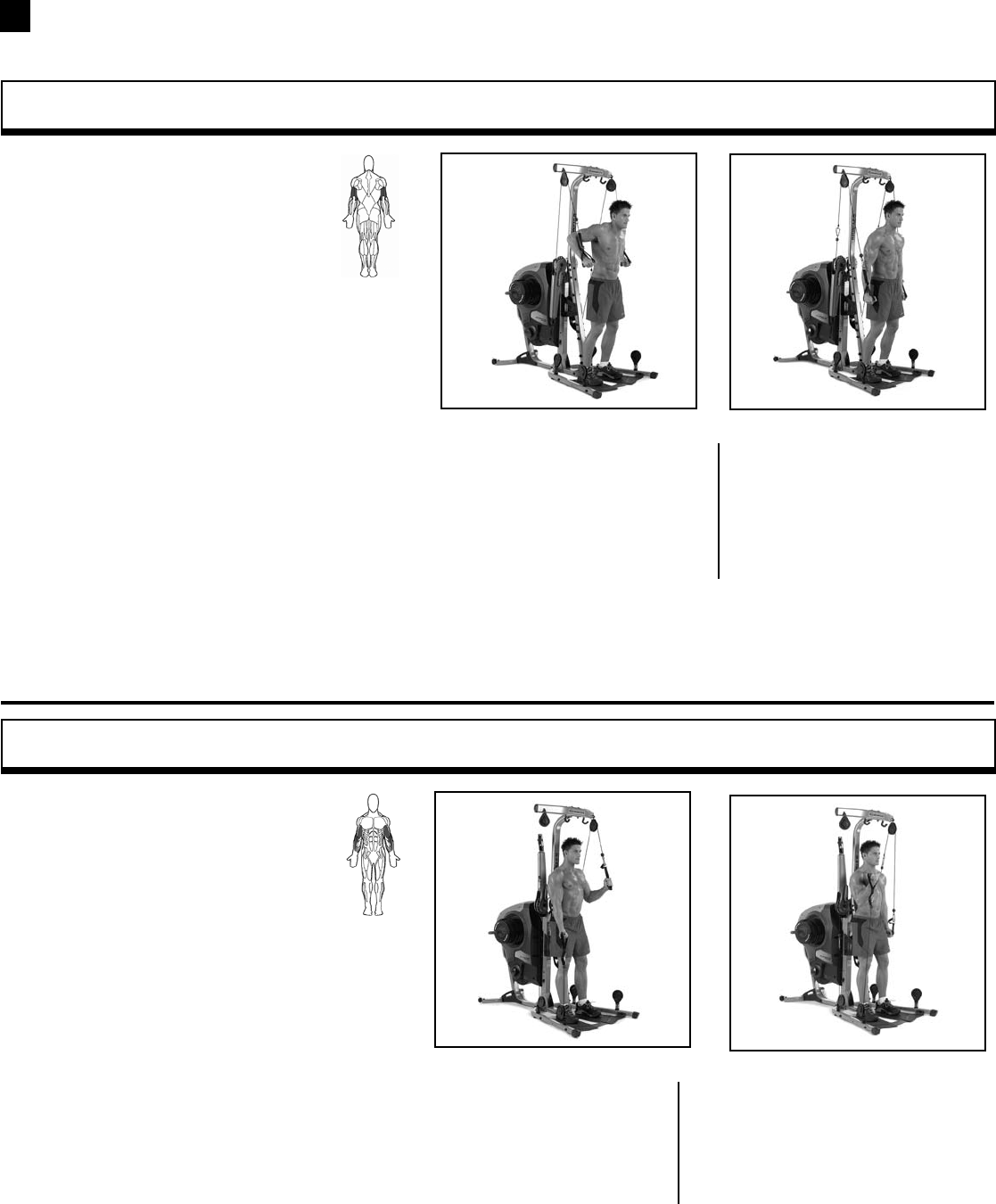
Arm Exercises
56
Resisted Dip — Elbow Extension
• Reach up and grasp the Hand
Grips, palms facing the floor,
keeping your thumbs on the
inside, toward your body.
• Cable should be between your
arms and your body.
• Upper arms should be at a 90˚
angle from torso.
• Straighten your arms downward,
focusing on not moving your
elbows down or inward.
• Slowly reverse the motion,
returning to the Start position
without relaxing the tension in
the back shoulder muscles.
Muscles worked:
Triceps
Position:
Standing—facing outward. Seat
removed.
Accessory:
Long Hand Grips
Pulleys / Adjustable Arm
Position:
Lat Cross Bar / 9
Success Tips
• Lift your chest, keep your knees slightly
bent and feet on Platform.
• Keep your back straight and knees
slightly bent.
• Keep your abs tight throughout entire
motion and maintain good spinal
alignment.
Arm Opposition Push-Pull
START FINISH
• Grasp the Hand Grips, keeping
the one attached to the Lat
Tower in an overhand grip and
the one attached to the Squat
Cable in an underhand grip.
• Straighten the Squat Cable arm
and bend the Lat Cable arm at a
90° angle from your upper arm.
• Slowly raise the Squat Cable arm
while simultaneously lowering
the Lat Cable arm, until each
arm has reached full possible
extension in opposition to each
other.
• Slowly reverse, returning to Start
position.
Muscles worked:
Biceps; Brachialis; Brachioradialis
Position:
Standing—facing outward. Seat
removed.
Accessory:
Short Hand Grips
Pulleys / Adjustable Arm
Position:
Lat Cross Bar / 0, and
Squat Frame / 9
Success Tips
• Lift your chest and keep your knees
slightly bent and feet on Platform.
• For this exercise, one Hand Grip is
attached to a Lat Cable and one Hand
Grip is attached to a Squat Cable.
Alternate sides to build muscle evenly.
• Keep your upper body motionless,
elbows at your sides and your wrists
straight.
• Keep your trunk muscles tight and
maintain a slight arch in lower back.
START FINISH
START FINISH
START FINISH
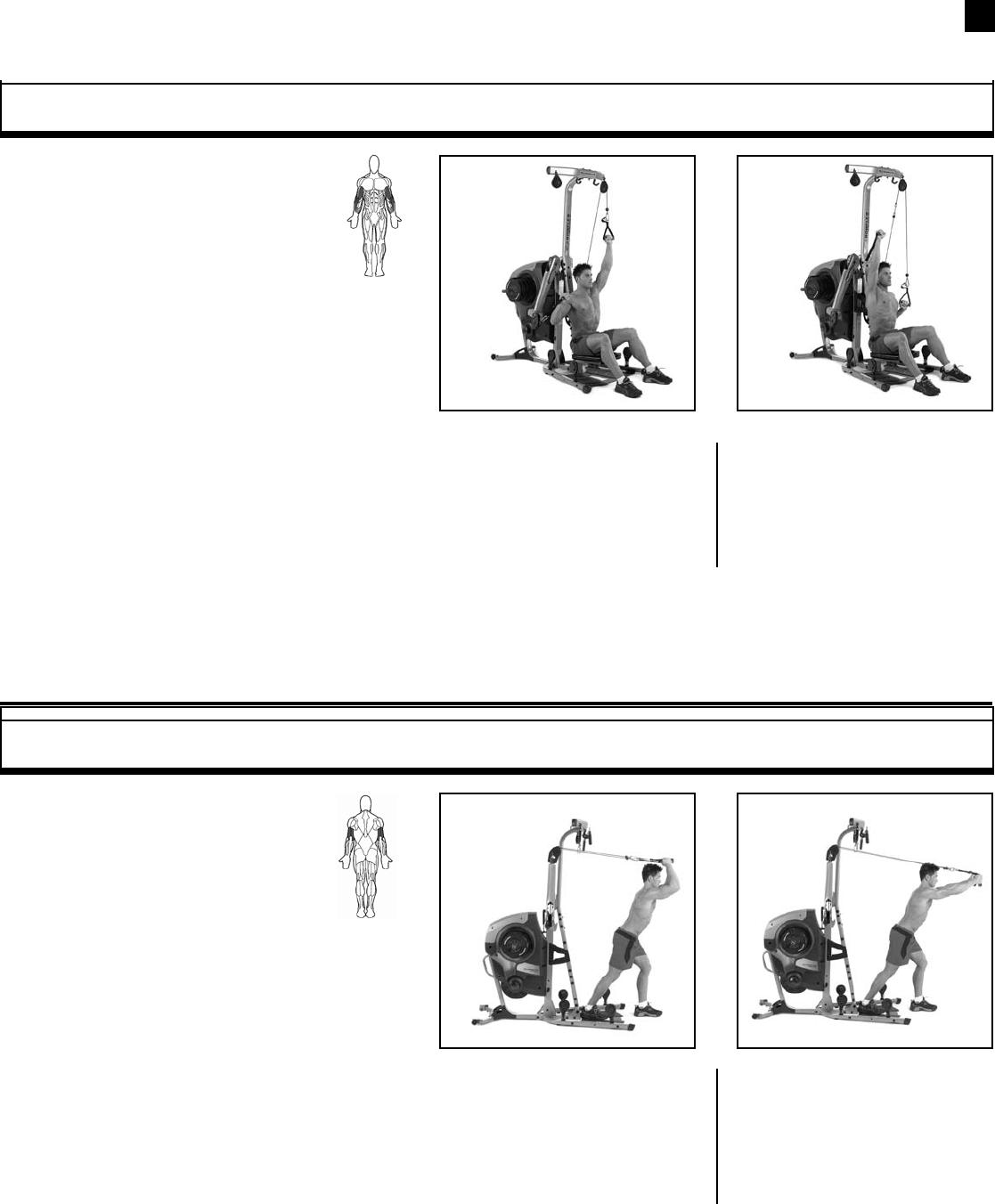
Arm Exercises 57
Upper Body Opposition Push-Pull
START FINISH
START
• Grasp the Hand Grips, keeping
the one attached to the Lat
Tower in an overhand grip
and the one attached to the
Adjustable Arm Cable in an
underhand grip.
• Bend your forearms at a 90°
angle from your upper arms,
which should be at 90° angles
from your torso.
• Slowly raise the Adjustable Arm
Cable arm while simultaneously
lowering the Lat Cable arm,
until each arm has reached full
possible extension in opposition
to each other.
• Slowly reverse, returning to Start
position.
FINISH
Muscles worked:
Biceps; Brachialis; Brachioradialis
Position:
Seated—facing outward.
Accessory:
Hand Grips
Pulleys / Adjustable Arm
Position:
Lat Cross Bar / 9, and 7
Success Tips
• Lift your chest and keep your knees
bent and feet on Platform.
• For this exercise, one Hand Grip is
attached to a Lat Cable and one Hand
Grip is attached to an Adjustable Arm
Cable. Alternate sides to build muscle
evenly.
• Keep your upper body motionless,
elbows at your sides and your wrists
straight.
• Keep your trunk muscles tight and
maintain a slight arch in lower back.
Standing French Press — Elbow Extension from a Shoulder Flexed Position
START FINISH
START
• Stand facing away from the engine
with one foot forward and one foot
back for added stability.
• Reach overhead and grasp the
Hand Grips with your palms
facing each other in a “Hammer
Grip” position, elbows bent and
pointing forward, hands behind the
shoulders.
• Keep your elbows in line with the
cables throughout the movement,
and wrists straight.
• Keeping the upper arms
stationary, straighten your
elbows, bringing your hands
overhead.
• Stop your motion before your
elbows are completely straight,
and reverse the motion, slowly
returning to the Start position
maintaining tension on the
muscle.
FINISH
Muscles worked:
Triceps. Also ankles, knees, hips and core
in stabilization.
Position:
Standing—facing outward. Seat
removed.
Accessory:
Short Hand Grips
Adjustable Arm Position:
0 or 1
Success Tips
• Stabilize body from your feet all the way
up through your trunk.
• Keep knees slightly bent, feet flat on
the floor and in a staggered step for
stability.
• Keep abs tight, chest lifted and a slight
curve in the lower back.
• Stabilize the shoulder and wrist, only
allowing the elbow joint to be involved
in the motion.
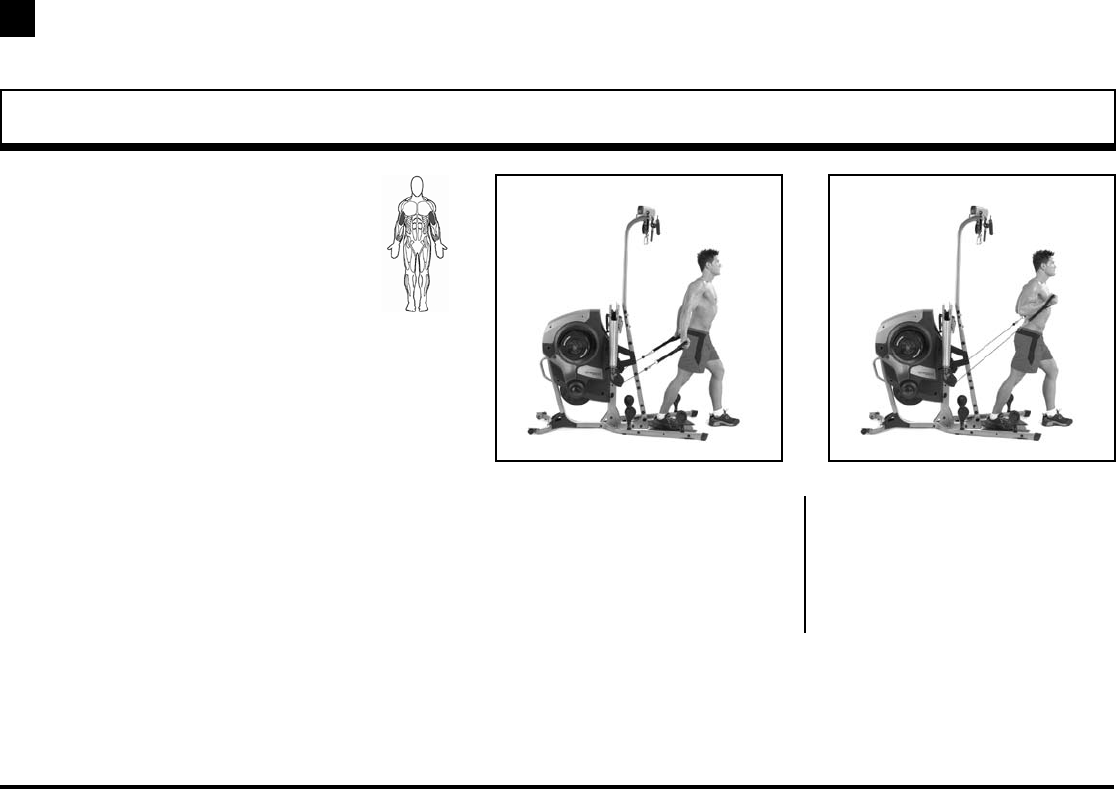
Standing Biceps Curl — Elbow Flexion from a Shoulder Extended Position
START FINISH
START
• Reach back and grasp the Hand
Grips with your arm extended
backward.
• Do not let your arm go
completely straight; maintain
tension on the biceps.
• Keeping the upper arms
stationary, slowly curl the
handles up then inward toward
the shoulders.
• Fully shorten the biceps by
squeezing the forearm toward
the upper arm.
• Slowly reverse the arcing motion,
bringing your hands back to the
Start position.
FINISH
Muscles worked:
Biceps
Position:
Standing—facing outward. Seat
removed.
Accessory:
Short Hand Grips
Adjustable Arm Position:
6 or 7
Success Tips
• Stand in front of the Platform, facing
away from the engine with a staggered
step for more stability.
• Keep abs tight, chest lifted and a slight
curve in the lower back.
• Stabilize the shoulder and wrist, only
allowing the elbow joint to be involved
in the motion.
58 Arm Exercises
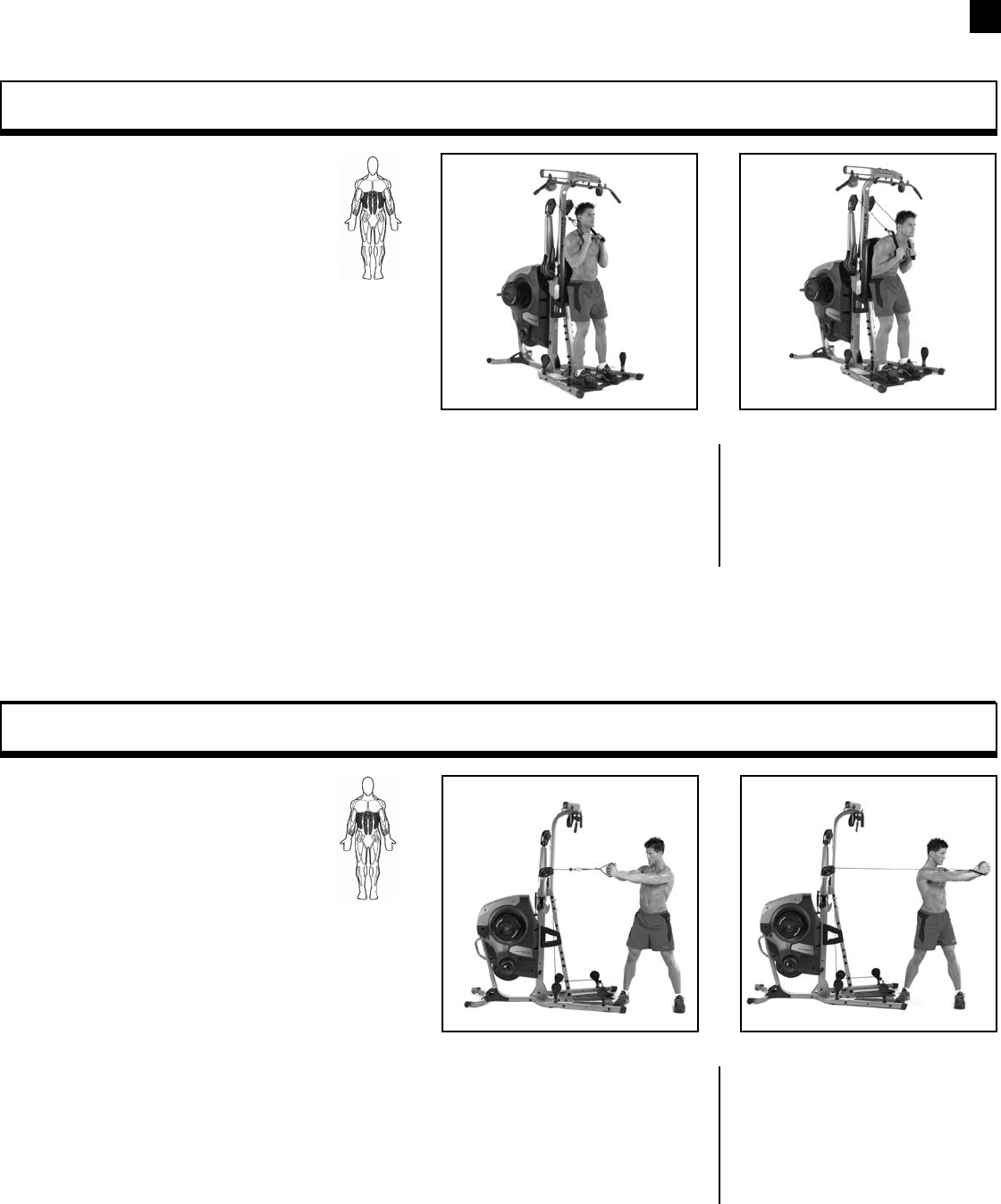
Abdominal Exercises 59
Trunk Rotation
• Stand with one side toward the
engine. Grasp the Hand Grip
closest to you with both hands.
• Raise both arms up near
shoulder level, hands extended
over the leg closest to the
engine.
• Keep your elbows slightly bent.
• Tighten your entire abdominal
area and slowly rotate your rib
cage and arms away from the
engine 30-40°, as if you were
rotating with a rod through the
middle of your spine.
• Slowly reverse the motion,
returning to the Start position
without relaxing muscle tension.
Muscles worked:
Rectus Abdominus; Obliques;
Serratus Anterior
Position:
Standing—facing right or left 45º. Seat
removed.
Accessory:
Short Hand Grips
Adjustable Arm Position:
4
Success Tips
• Keep knees slightly bent and feet on
Platform.
• This exercise must be performed cor-
rectly—failure to do so could result in
injury. Use only low
resistance.
• Keep all motion in your torso.
• Move only as far as your muscles will
take you—do not use momentum to
increase your range of motion
START FINISH
START FINISH
Standing (Resisted) Abdominal Crunch — Spinal Flexion
START FINISH
START
• Grasp the Hand Grips in both
hands, drawing them over your
shoulders. Rest the back of your
fists on your chest or shoulders,
palms facing up.
• Lower back can start out flat or
in a normal arch, knees and hips
are bent and feet should be flat
on the Platform.
• Tighten your abs and curl only
your torso, slowly moving your
ribs toward your hips. Move as
far as you can without moving
your hips or neck.
• Do not allow your lower back
to lose contact with the Ab
Attachment during this entire
exercise.
• Slowly reverse the motion,
returning to the Start position
without relaxing your abs.
FINISH
Muscles worked:
Rectus Abdominus; Obliques
Position:
Standing—facing outward. Seat
removed.
Accessory:
Short Hand Grips, Ab Attachment
Adjustable Arm Position:
0 or 1
Success Tips
• Lift your chest, keep your knees bent
and feet on Platform.
• Do not lift your head or chin—your head
should follow the rib motion rather than
lead it. Maintain normal neck posture.
• Tighten your abs throughout the entire
exercise, relaxing only at the end of
each set.
• Move slowly to eliminate momentum.
• Allow exhalation up and inhalation
down without exaggerating breathing.
START FINISH
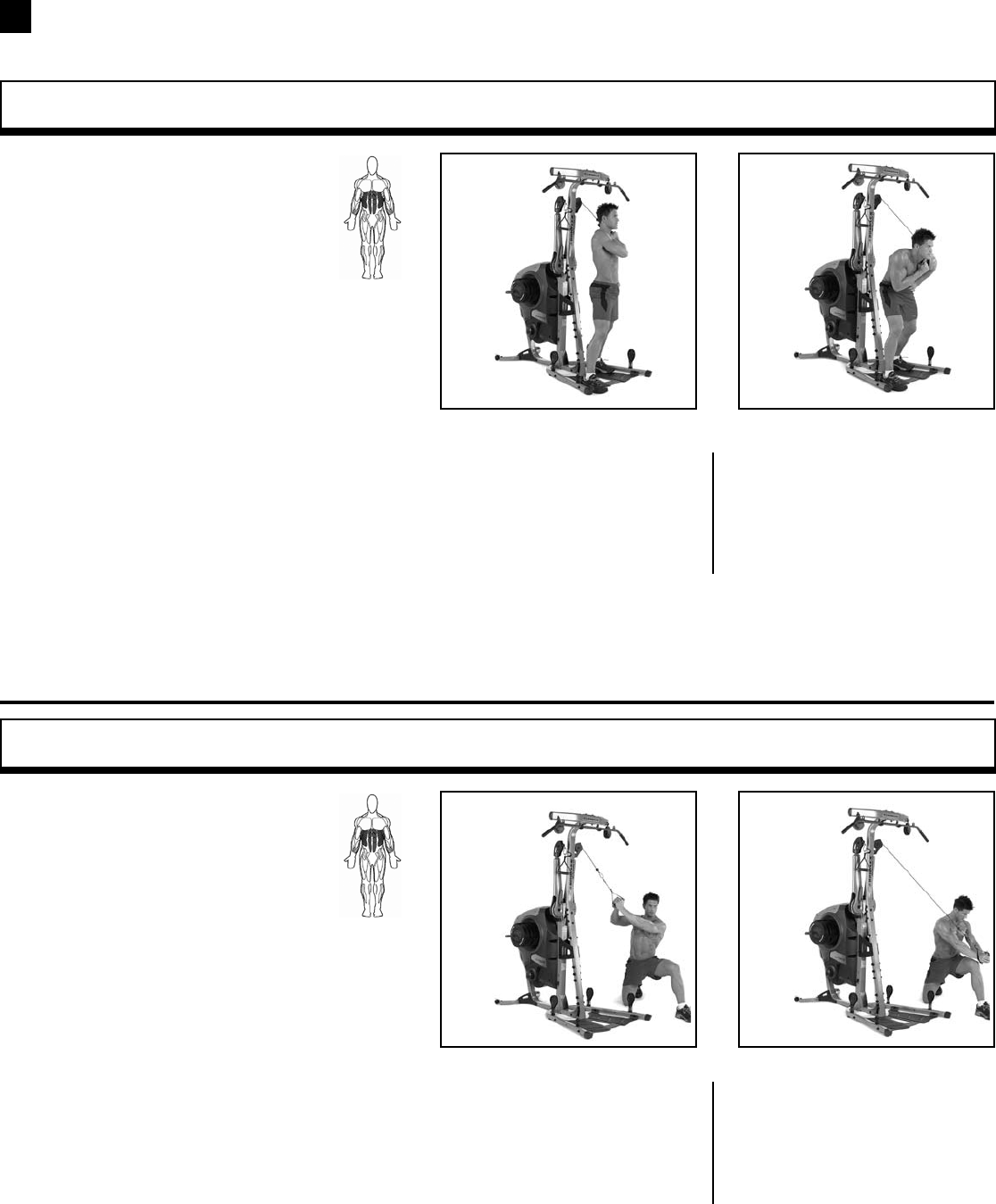
60 Abdominal Exercises
Standing Oblique Abdominal Crunch
START FINISH
START
• Stand to one side, facing the
seat rail, angled about 45º away
from the platform.
• Grasp the Hand Grip closest to
you with the outside hand and
position the handle webbing over
your shoulder.
• Tighten your ab muscles on the
side with the active arm, focusing
on the side of your ribs toward the
front of your pelvis.
• Slowly move diagonally, rotating
your torso away from the side
holding the hand grip.
• Crunch as deeply as you can
keeping the hips stable. Do not
lean forward at the hips.
• Slowly reverse the motion,
returning to the starting position
without losing muscle tension.
FINISH
Muscles worked:
Rectus Abdominus; Obliques
Position:
Standing—facing right or left 45º. Seat
removed.
Accessory:
Long Hand Grips
Adjustable Arm Position:
0 or 1
Success Tips
• Keep your knees slightly bent and feet
flat on the floor.
• This exercise must be performed
correctly, failure to do so could result in
injury. Use only low
resistance.
• Keep all motion in your torso.
• Move only as far as your muscles will
take you. Do not use momentum to
increase your range of motion.
Kneeling “Wood Chop” — High to Low Trunk Flexion w/ Rotation
START FINISH
START
• Stand off to one side of the
platform and kneel down on the
knee closest to the engine angled
about 45º away from the platform.
• Raise your arms above your head
and grasp the Hand Grip closest
to you with both hands.
• Extend arms toward the pulley.
• Keep the elbows slightly bent.
• Tighten the entire abdominal area
and slowly rotate your rib cage
and arms away from the pulley
toward your opposite knee.
• Slowly reverse the motion,
returning to the starting position
without losing muscle tension.
FINISH
Muscles worked:
Rectus Abdominus; Obliques;
Serratus Anterior
Position:
Kneeling—facing right or left 45º. Seat
removed.
Accessory:
Long Hand Grips
Adjustable Arm Position:
0 or 1
Success Tips
• This exercise must be performed
correctly, failure to do so could result in
injury. Use only low
resistance.
• Keep all motion in your torso.
• Move only as far as your muscles will
take you. Do not use momentum to
increase your range of motion.
START FINISH
START FINISH
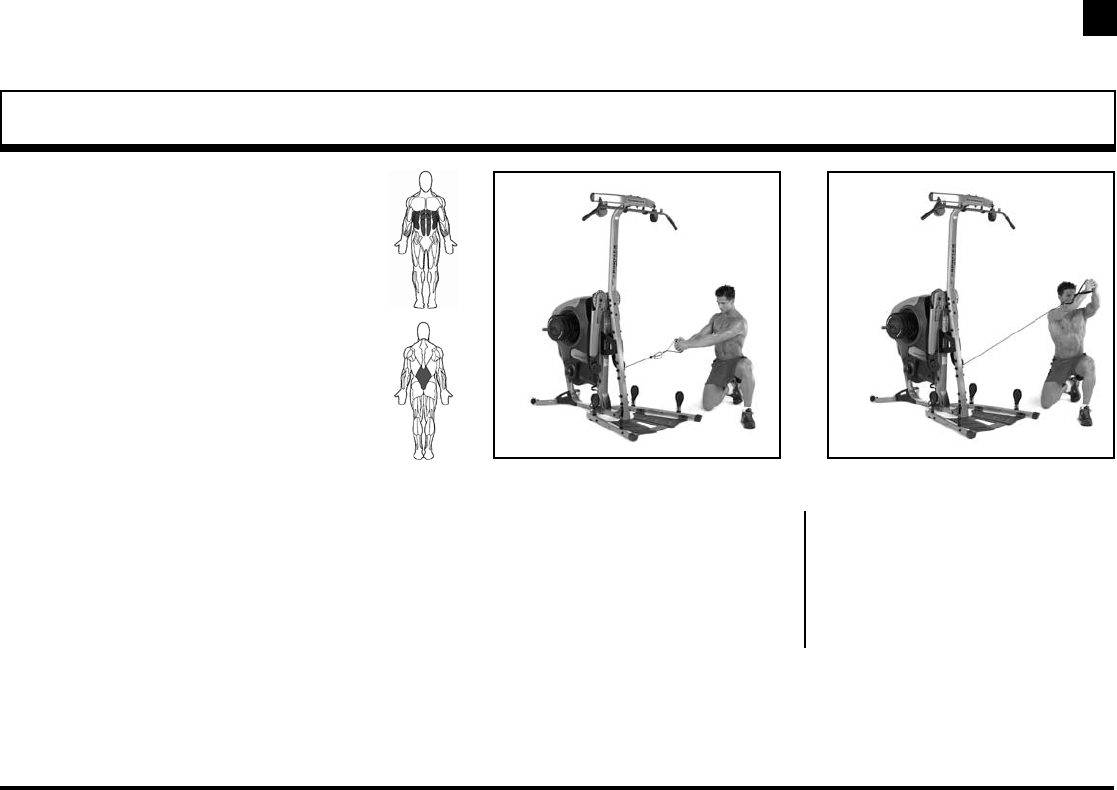
61
Abdominal Exercises
Kneeling Low to High Trunk Rotation
START FINISH
START
• Stand off to one side of the
platform and kneel down on
the knee closest to the engine
angled about 45º away from the
platform.
• Reach across and down, and
grasp the Hand Grip closest to
you with both hands.
• Extend arms toward the pulley.
• Keep the elbows slightly bent.
• Tighten the entire abdominal area
and slowly rotate your rib cage
and arms up and away from the
pulley toward your opposite knee
and slightly above your head.
• Slowly reverse the motion,
returning to the Start position
without losing muscle tension.
FINISH
Muscles worked:
Rectus Abdominus; Obliques; Spinal Erec-
tors; Serratus Anterior
Position:
Kneeling—facing right or left 45º. Seat
removed.
Accessory:
Long Hand Grips
Adjustable Arm Position:
9
Success Tips
• This exercise must be performed
correctly, failure to do so could result in
injury. Use only low
resistance.
• Keep all motion in your torso.
• Move only as far as your muscles will
take you. Do not use momentum to
increase your range of motion.
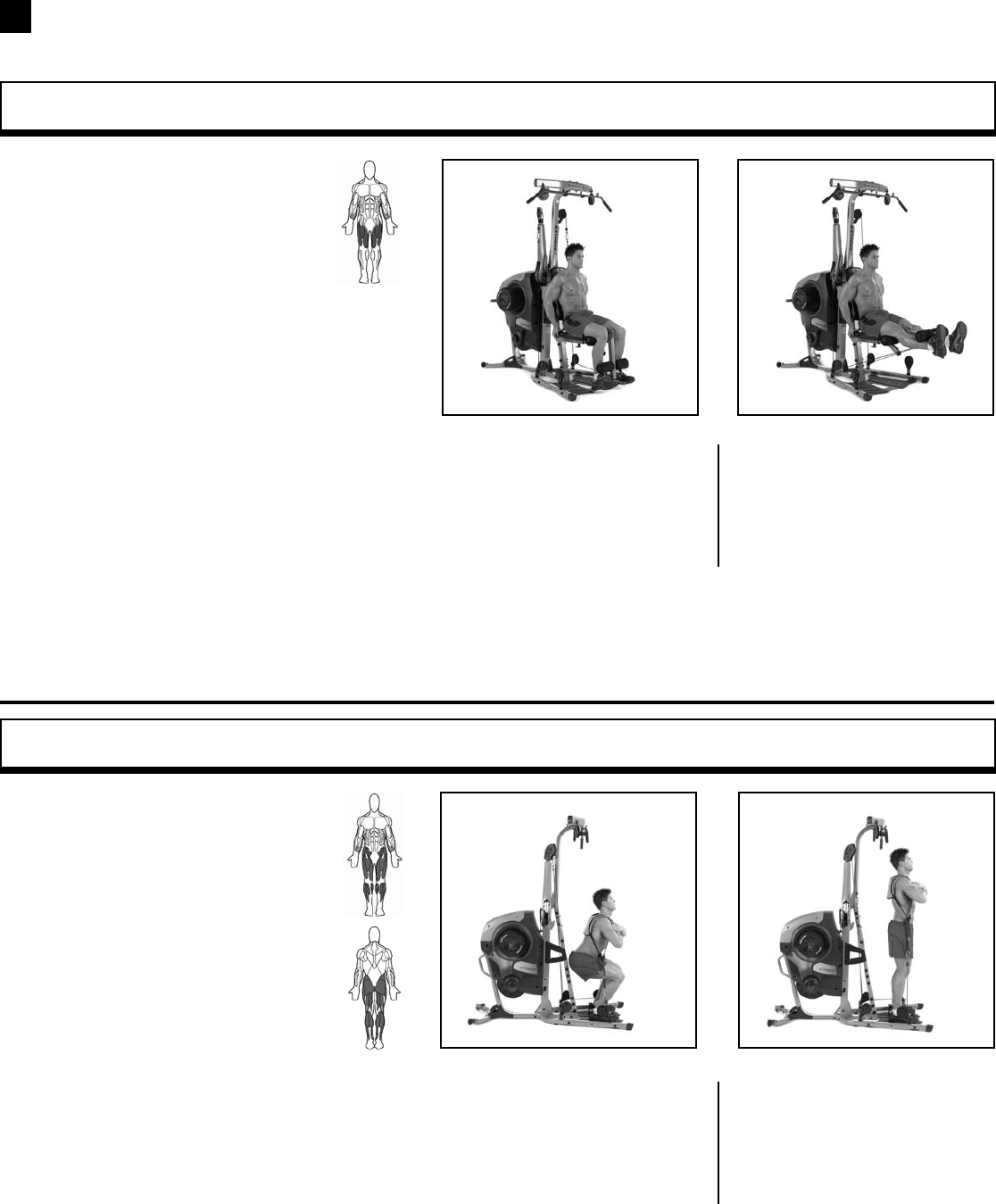
62 Leg Exercises
Squat
START FINISH
START
• Stand with your feet about
shoulder-width apart.
• Squat down and place the
Squat Harness across your
shoulders— adjust the straps to
make sure you have resistance
from the start of the movement.
• Slowly rise to a standing position,
keeping your knees slightly bent.
Do not lock your knees.
• Slowly return to the Start position
without relaxing your quadriceps.
• Do not allow your knees to
exceed a 90˚ angle.
FINISH
Muscles worked:
All Leg Muscles; Gluteus Maximus
Position:
Standing—facing outward. Seat
removed.
Accessory:
Squat Harness
Pulleys / Adjustable Arm
Position:
Squat Frame Pulleys
Success Tips
• Keep your chest lifted, spine aligned,
abs tight and a slight arch in your lower
back.
• Bend at the hips—do not use your waist
or lower back.
• Keep your abs tightened throughout
motion and knees pointed forward.
• Never step off of Platform while using
the Squat Harness with Spiraflex®
resistance.
Leg Extension
START FINISH
START
• Put your legs over the Leg Extension,
with your knees near the pivot point
and the lower roller pads in front of
your shins (see start image above).
• Keep your thighs hip-width apart,
knees pointing forward.
• Grasp the sides of the seat to
stabilize yourself.
• Tighten your quads and slowly
straighten your legs, moving your
feet forward then upward until
your legs are completely straight
and your kneecaps point upward
to the ceiling.
• Slowly reverse the motion
returning to the Start position
without relaxing your quads.
FINISH
Muscles worked:
Quadriceps
Position:
Seated—facing outward.
Accessory:
Leg Extension
Pulleys / Adjustable Arm
Position:
Squat Frame Pulleys
Success Tips
• Use slow, controlled motion—do not
“kick” into the extension.
• Do not let your knees rotate outward
during the exercise. Keep kneecaps
pointing up and straight forward.
• Sit up straight, chest lifted, abs tight and
a slight arch in your lower back.
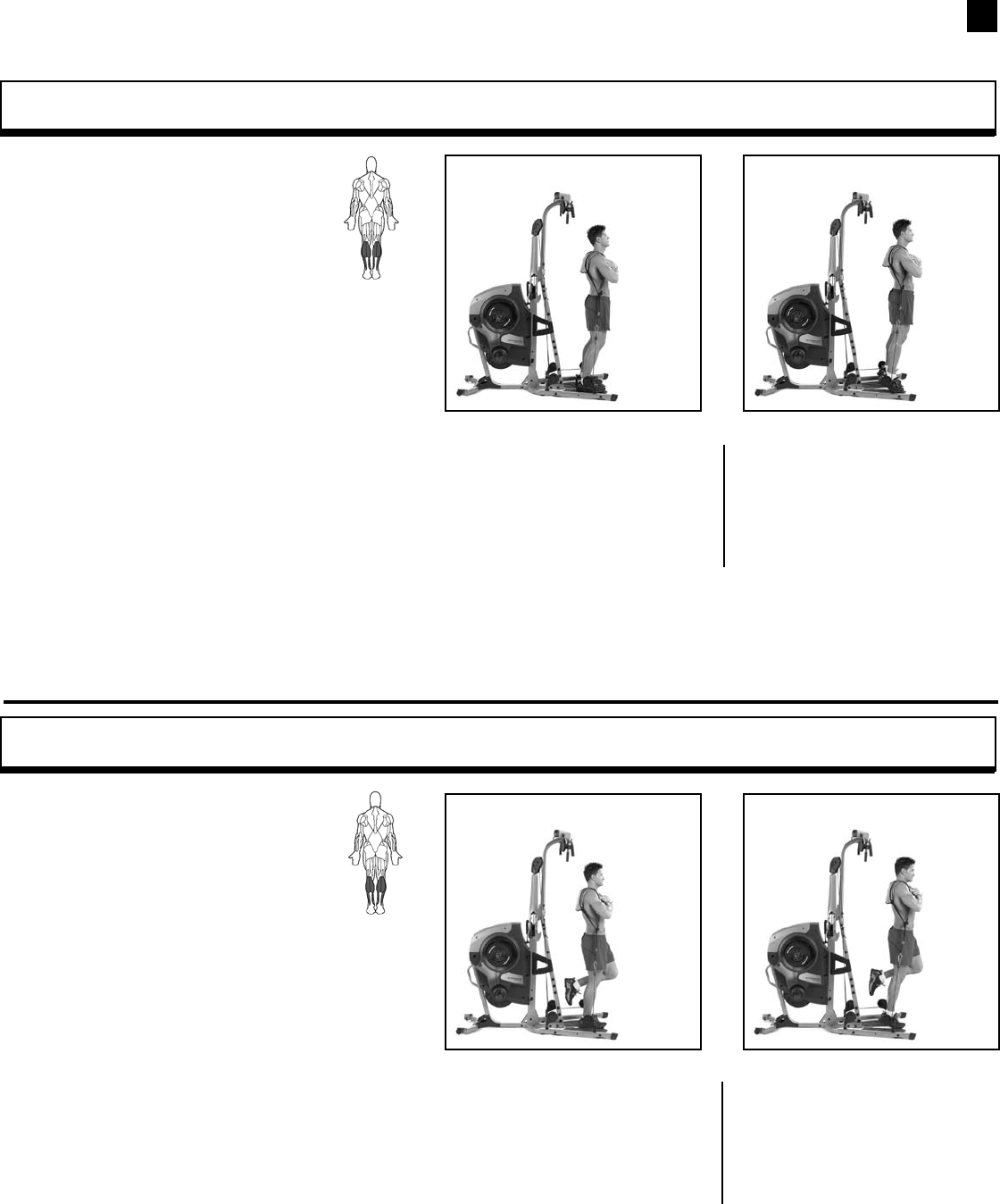
63
Leg Exercises
Single Leg Calf Raise — Ankle Plantarflexion (knee stabilized)
START FINISH
START
• Stand on one foot, with your
toes/balls of feet on the Platform.
• Use the Hand Grips in both
hands as resistance and as a
balance stabilizer.
• Keep the unused leg out of
the way, do not use it to build
momentum.
• Slowly press the ball of your foot
into the Platform and lift your
heel upward.
• Then, maintaining tension, slowly
return to the Start position.
FINISH
Muscles worked:
Gastrocnemius; Soleus
Position:
Standing—facing outward. Seat
removed.
Accessory:
Short Hand Grips
Pulleys / Adjustable Arm
Position:
Squat Frame Pulleys—Standard Pulley / 0
Success Tips
• Do not lose contact with the balls
of your foot and the Platform during
motion.
• Keep your chest lifted, spine aligned,
abs tight and a slight arch in your lower
back.
• Do not lift your hips or excessively arch
your back.
• Do not change hip or knee
position—ONLY ankle motion should be
used.
Calf Raise — Ankle Plantarflexion (knee stabilized)
START FINISH
START
• Stand with your toes on the
Platform.
• Use the Hand Grips in both hands
as resistance and as a balance
stabilizer.
• Slowly press the balls of your
feet into the Platform and lift your
heels upward.
• Then, maintaining tension, slowly
return to the Start position.
FINISH
Muscles worked:
Gastrocnemius; Soleus
Position:
Standing—facing outward. Seat
removed.
Accessory:
Short Hand Grips
Pulleys / Adjustable Arm
Position:
Squat Frame Pulleys—Standard Pulley / 0
Success Tips
• Keep your knees slightly bent and toes/
balls of feet on Platform.
• Do not lose contact between the balls of
your feet and the Platform.
• Keep your chest lifted, spine aligned, abs
tight and slight arch in your lower back.
• Do not lift your hips or excessively arch
your back.
• Do not change hip or knee position— ONLY
ankle motion should be used.
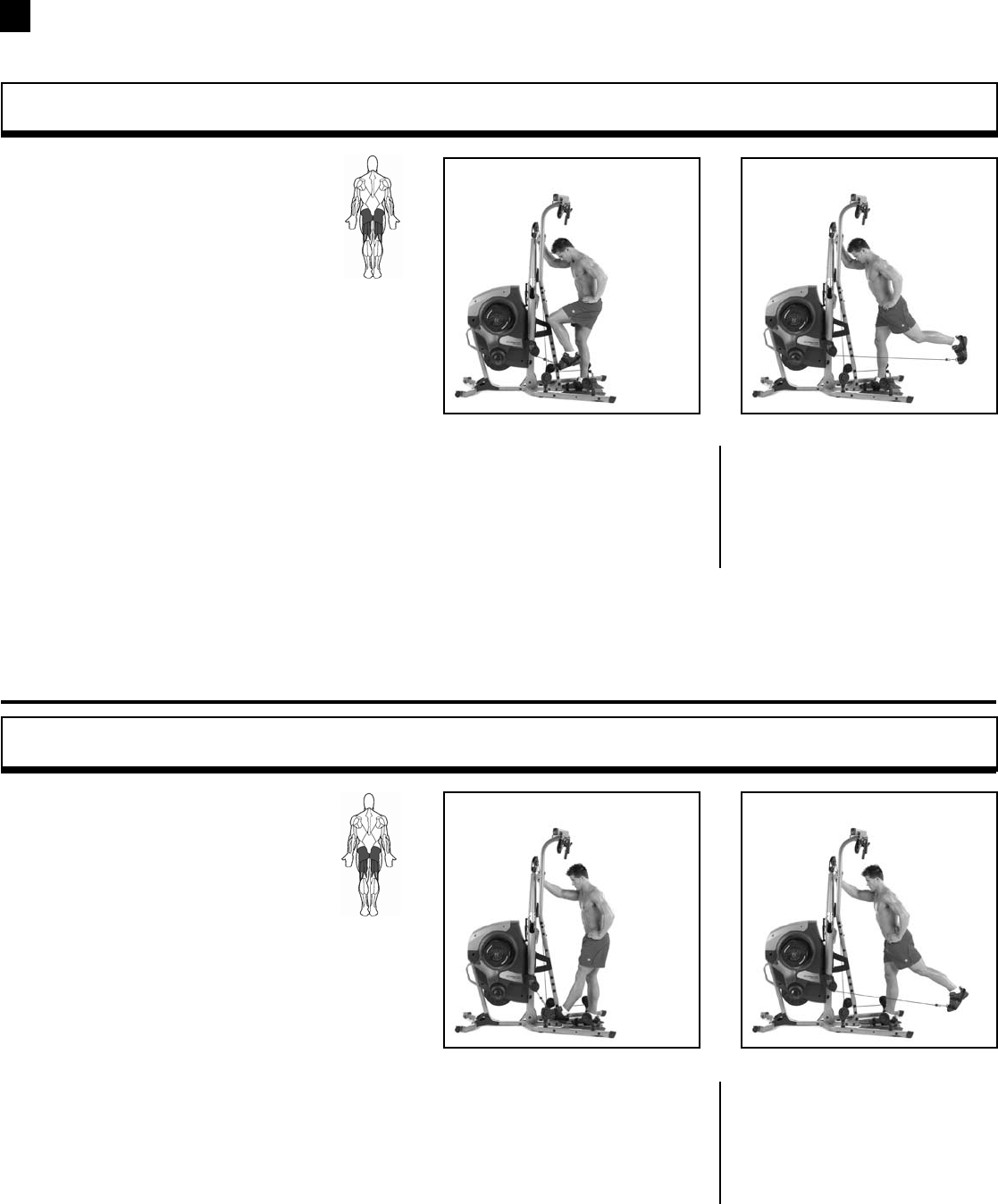
Leg Exercises
64
Standing Hip Extension — (knee stabilized)
START FINISH
START
• Secure the Foot Harness on your
foot. Keep this leg straight, but
not locked at the knee.
• Bend forward 30-40° from your
hips (not your waist) and very
slightly bend the knee of your
supporting leg.
• Hold onto the Seat Back Pad to
stabilize yourself.
• Initiate the movement by
tightening your glutes and slowly
pivoting your leg from your hip.
Move your entire leg backward
and then lift it slightly behind you.
• Slowly move your leg as far as
you can, without allowing any
movement at the waist, knee or
lower back.
• Slowly return to Start position.
FINISH
Muscles worked:
Gluteus Maximus; Hamstring muscles
Position:
Standing—facing machine. Seat
removed.
Accessory:
Foot Harness
Adjustable Arm Position:
9
Success Tips
• Keep your knees slightly bent and
support foot on Platform.
• Keep your chest lifted, spine aligned,
abs tight and a very slight arch in your
lower back.
• Do not bend from waist or lower back.
• Keep working leg straight or only very
slightly bent.
Standing Hip Extension — (knee flexed)
START FINISH
START
• Secure the Foot Harness on your
foot. Bend this leg approximately
90°.
• Bend forward 30-40° from your
hips (not your waist) and very
slightly bend the knee of your
supporting leg.
• Hold onto the Seat Back Pad to
stabilize yourself.
• Initiate the movement by
tightening your glutes and
hamstrings. Slowly pivot your
leg from your hip. Move your
entire leg backward, to a straight
position.
• Slowly move your leg as far as
you can, without allowing any
movement at the waist or lower
back.
• Slowly return to Start position.
FINISH
Muscles worked:
Gluteus Maximus; Hamstring muscles
Position:
Standing—facing machine. Seat
removed.
Accessory:
Foot Harness
Adjustable Arm Position:
9
Success Tips
• Keep your knees slightly bent and
support foot on Platform.
• Keep your chest lifted, spine aligned,
abs tight and a very slight arch in your
lower back.
• Do not bend from waist or lower back.
• Keep your knee stabilized in the 90°
angle position.
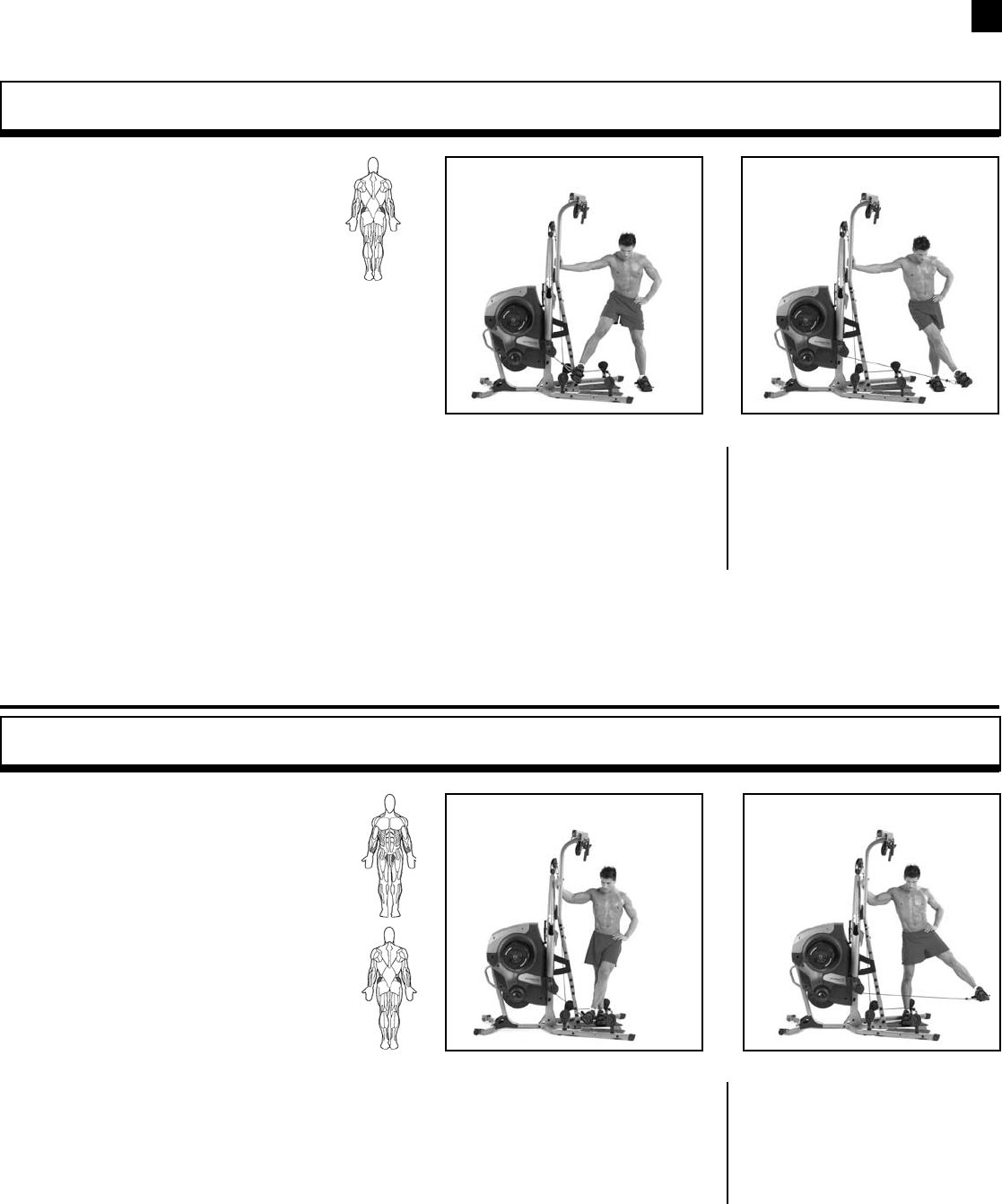
65
Leg Exercises
Standing Hip Abduction
START FINISH
START
• Stand on Platform.
• Secure Foot Harness on the ankle
furthest from the pulley. Keep leg
straightened, but knee loose.
• Adjust your position so that there
is some tension in the cables at
the start of this exercise.
• You may use your hand on
the Seat Back Pad to stabilize
movement.
• Slowly move the attached leg
outward, away from the engine,
at a 30-45° angle, keeping your
hips and spine motionless.
• Slowly return to the Start position
without relaxing tension in your
leg.
• Keep your hips level during
movement.
FINISH
Muscles worked:
Gluteus Minimus; Gluteus Medius
Position:
Standing—facing right or left. Seat
removed.
Accessory:
Foot Harness
Adjustable Arm Position:
9
Success Tips
• Keep your chest lifted, spine aligned, abs
tight and a slight arch in your lower back.
• This exercise does not burn fat from hips but
builds strength and stability.
• Keep working leg straight or only very
slightly bent and your hips level.
• Use only a small range of motion.
Standing Hip Adduction
START FINISH
START
• Stand on Platform.
• Secure Foot Harness on the foot
closest to the engine. Keep leg
straightened, but knee loose.
• Adjust your position so that there
is some tension in the cables at
the start of this exercise.
• You may use your hand on
the Seat Back Pad to stabilize
movement.
• Slowly allow the attached leg to
move inward, toward the support
leg (30–45˚) as you face forward,
keeping your hips and spine
perfectly still.
• Keeping the leg still, slowly move
it back into the Start position.
FINISH
Muscles worked:
Gluteus Medius; Adductor Longus
Position:
Standing—facing right or left. Seat
removed.
Accessory:
Foot Harness
Adjustable Arm Position:
9
Success Tips
• Attach the Foot Harness to the Cables
farthest from the active ankle.
• Do not cross the attached leg in front of the
stabilized leg.
• Keep abs tight and do not lift your hips or
excessively arch your back.
• Keep your spine straight and your hips
level—do not raise hips during motion.
• Use only a small range of motion.
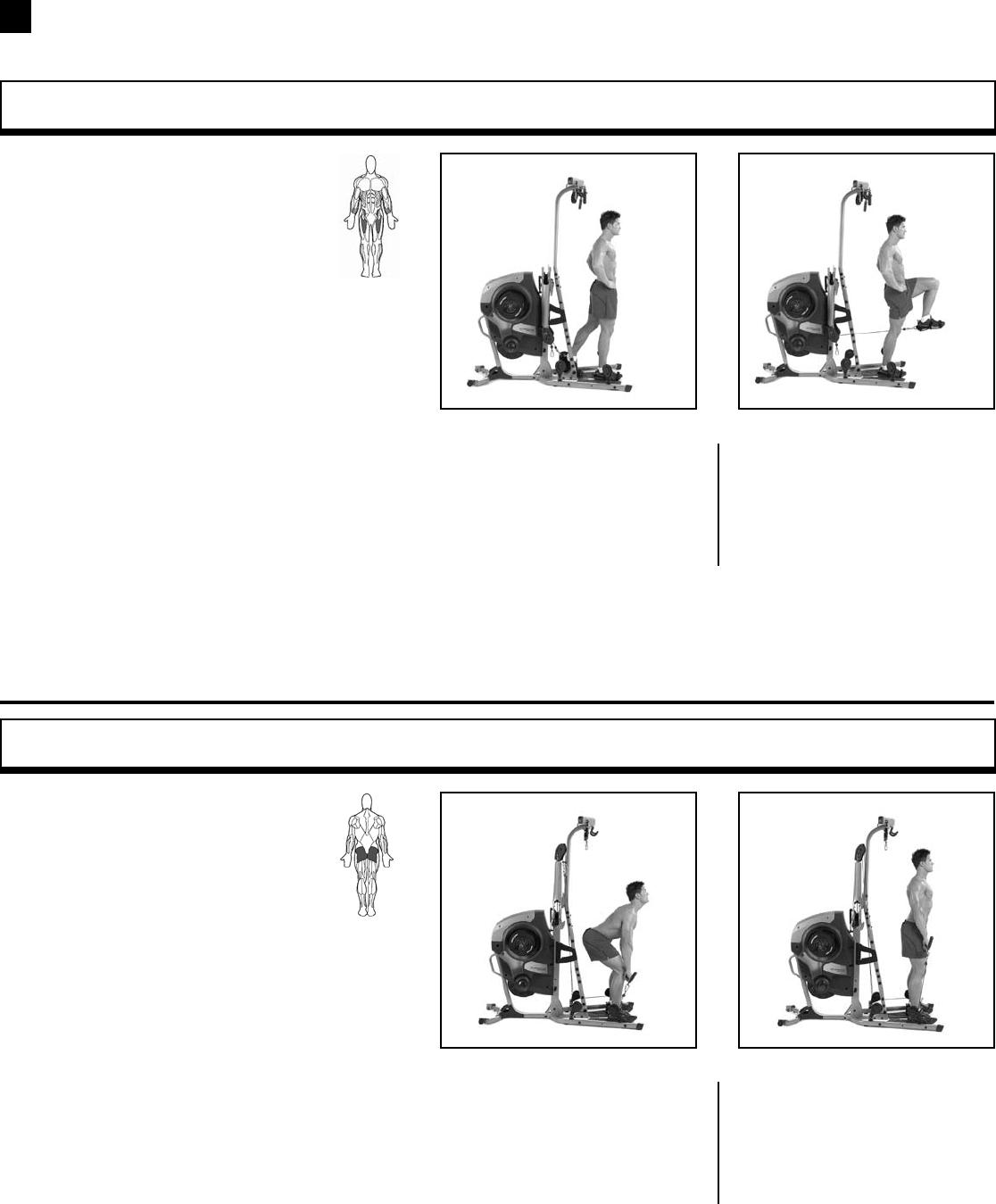
66 Leg Exercises
Hip Flexion — (with Knee Flexion)
START FINISH
START
• Stand on Platform.
• Secure Foot Harness on the foot
furthest from the engine.
• Bend forward 30-40° from your
hips (not your waist) and very
slightly bend the knee of your
supporting leg.
• Initiate the movement by lifting
your knee up and in, toward your
torso.
• Slowly move your leg as far as
you can, without allowing any
movement at the waist, knee or
lower back.
• Slowly return to the Start position
without relaxing your leg
muscles.
FINISH
Muscles worked:
Iliopsoas; Rectus Femoris
Position:
Standing—facing outward.
Accessory:
Foot Harness
Adjustable Arm Position:
9
Success Tips
• Attach the Foot Harness to the Cables
farthest from the active ankle.
• Keep your chest lifted, spine aligned, abs
tight and a very slight arch in your lower
back.
• Do not bend from waist or lower back.
• Allow active leg to hang in the direction
of the cable throughout movement.
Dead Lift
START FINISH
START
• Grasp the Lat Bar with one hand
in an overhand grip and the other
in an underhand grip.
• Bend legs approximately 90°.
• Bend over, approximately 30-45˚
from your hips (not your waist).
• Initiate the movement by pushing
up with your legs.
• Slowly move upward until you are
in the standing position.
• Slowly return to the Start position
without relaxing tension in your
legs.
FINISH
Muscles worked:
Gluteus Maximus
Position:
Standing—facing outward. Seat
removed.
Accessory:
Lat Bar
Pulleys / Adjustable Arm
Position:
Squat Frame Pulleys—Standard Pulley / 0
Success Tips
• Keep your knees slightly bent and feet
on Platform.
• Keep your chest lifted, spine aligned, abs
tight and your back flat with no arch.
• Lift with your legs, not lower back or
arms.
• Keep your abs tight throughout
movement.
• Keep your knees bent and your head up.
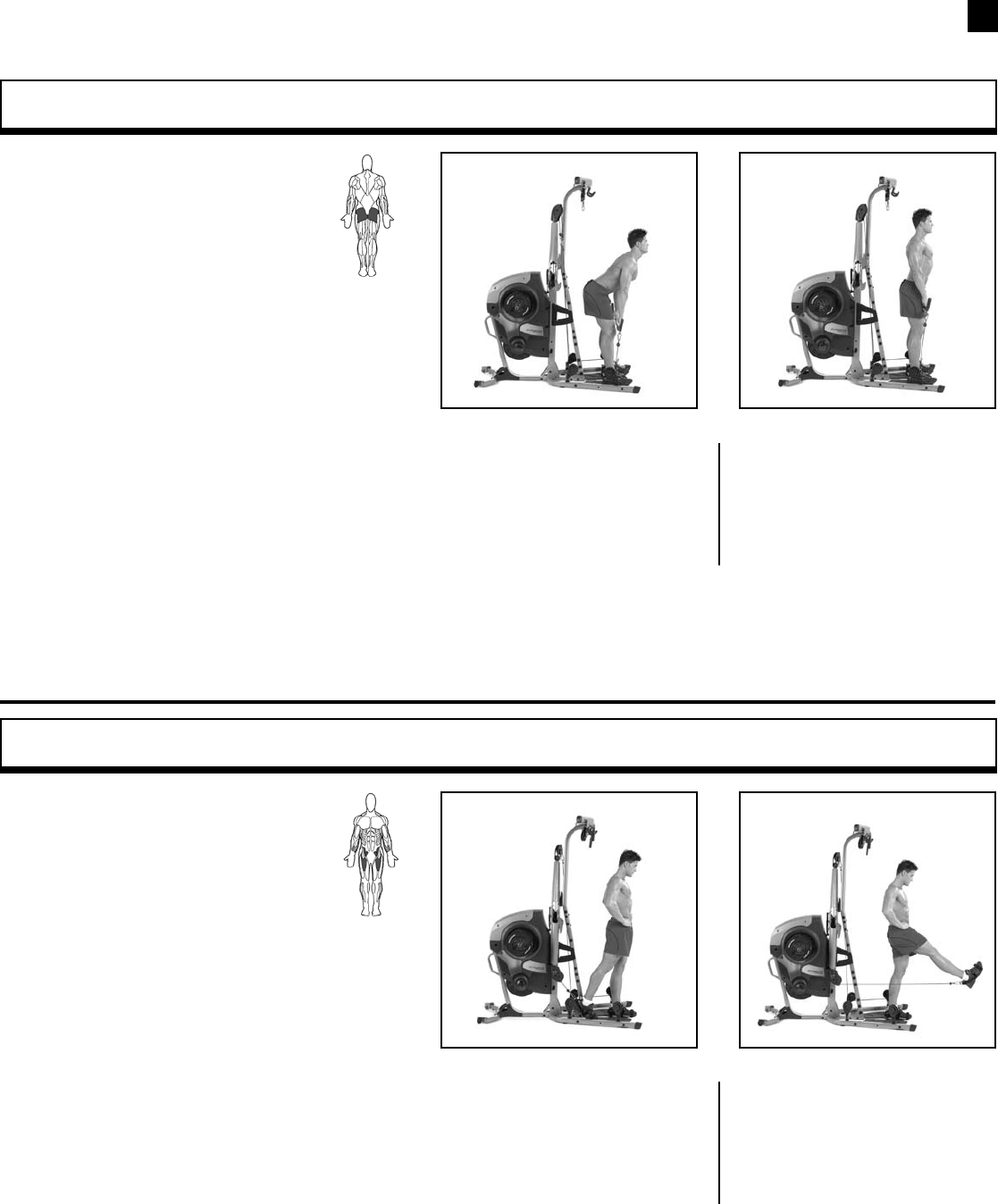
67
Leg Exercises
Stiff Leg Dead Lift
START FINISH
START
• Grasp the Lat Bar with your
palms facing downward.
• Keep your legs bent slightly.
• Bend over, approximately 90°
from your hips (not your waist)
• Initiate the movement by pushing
your hips forward.
• Slowly move your trunk until you
are in the standing position.
Glutes should be tightened when
reaching upright position
• Slowly return to the Start position
without relaxing tension in your
legs.
FINISH
Muscles worked:
Gluteus Maximus
Position:
Standing—facing outward. Seat
removed.
Accessory:
Lat Bar
Pulleys / Adjustable Arm
Position:
Squat Frame Pulleys—Standard Pulley / 0
Success Tips
• Keep your knees slightly bent and feet
on Standing Platform.
• Keep your chest lifted, spine aligned, abs
tight and your back flat with no arch.
• Lift with your legs, not lower back or
arms.
• Keep your abs tight throughout
movement.
• Keep your knees bent and your head up.
Standing Hip Flexion
START FINISH
START
• Stand on the Platform facing away
from the engine.
• Attach one cable to the D-ring on
the heel of the foot harness.
• Straighten but do not lock out the
support leg.
• Stand far enough away from the
pulley so that there is tension at
the start of the motion.
• Initiate the movement by moving
your whole leg forward, without
allowing any movement in your
waist or lower back.
• After moving your leg as far
as possible, return to the Start
position. Repeat with the other
leg.
FINISH
Muscles worked:
Iliacus; Psoas; Rectus Femoris
Position:
Standing—facing outward. Seat
removed.
Accessory:
Foot Harness
Adjustable Arm Position:
9
Success Tips
• Make sure all the motion is occurring at
your hip.
• Keep the torso tight throughout the
motion.
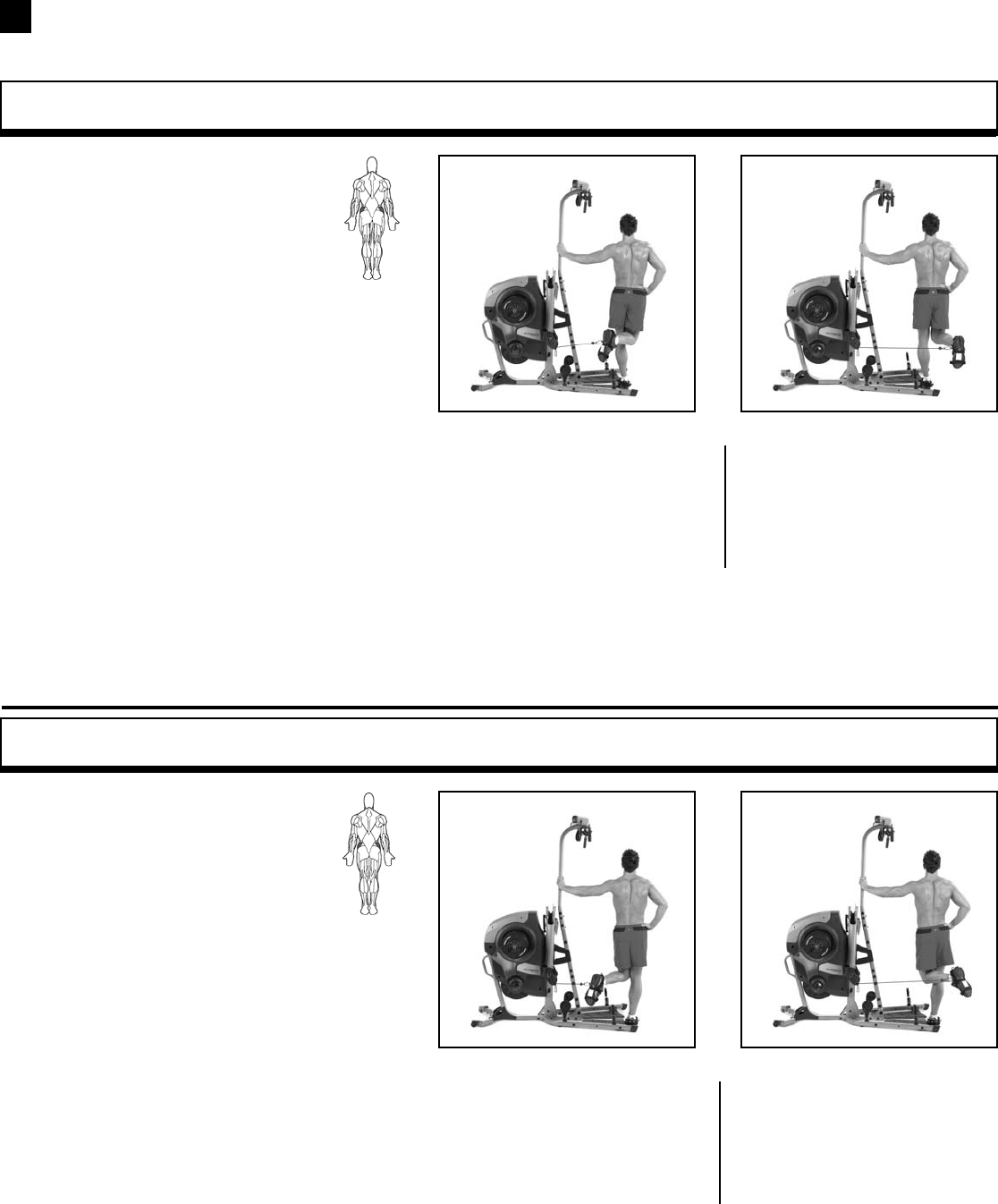
Leg Exercises
Standing Hip Internal Rotation
START FINISH
START
• Stand on the platform on one side of
the seat rail facing sideways from
the engine.
• Attach one cable to the D ring on
the foot closest to the pulley on the
outside edge near the front of your
foot.
• Straighten but do not lock out the
support leg.
• Stand far enough away from the
pulley so that there is tension at the
start of the motion.
• Initiate the movement by moving
your whole leg by rotating at
the hip, without allowing any
movement in your waist or lower
back.
• After rotating your leg as far
as possible, return to the Start
position.
• Repeat with the other leg.
FINISH
Muscles worked:
Gracilis; Adductor Magnus
Position:
Standing—facing right or left. Seat
removed.
Accessory:
Foot Harness
Adjustable Arm Position:
9
Success Tips
• Make sure all the motion is occurring
at your hip.
• Keep the torso tight throughout the
motion.
Standing Hip External Rotation
START FINISH
START
• Stand on the platform on one side
of the seat rail facing sideways
from the engine.
• Attach one cable to the D-ring
on the outside foot near the front
inside edge.
• Straighten but do not lock out the
support leg.
• Stand far enough away from the
pulley so that there is tension at
the start of the motion.
• Initiate the movement by moving
your whole leg by rotating at
the hip, without allowing any
movement in your waist or lower
back.
• After rotating your leg as far
as possible, return to the Start
position.
• Repeat with the other leg.
FINISH
Muscles worked:
Gluteus Medius posterior fibers;
Piriformis and other deep rotators
Position:
Standing—facing right or left. Seat
removed.
Accessory:
Foot Harness
Adjustable Arm Position:
9
Success Tips
• Make sure all the motion is occurring at
your hip.
• Keep the torso tight throughout the
motion.
68
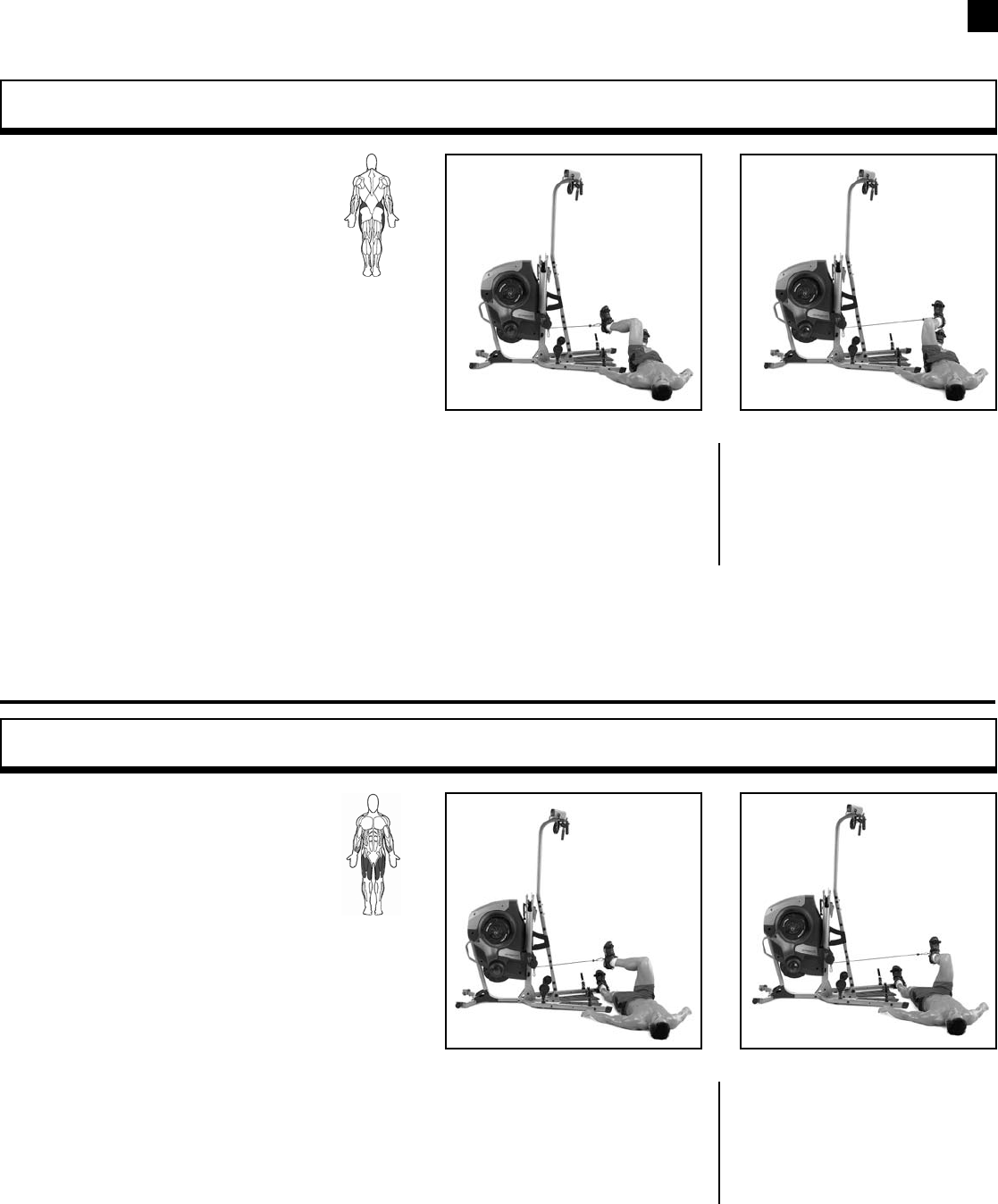
69
Leg Exercises
Lying Hip Internal Rotation
START FINISH
START
• Attach one cable to the D-ring on
the foot closest to the pulley on
the outside edge near the front
of your foot.
• Lie on your back with your hip
and knee flexed to 90º.
• Position yourself so the cable is
pulling at a 90º angle off the foot
harness.
• Lie far enough away from the
pulley so that there is tension at
the start of the motion.
• Initiate the movement by moving
your whole leg by rotating at
the hip, without allowing any
movement in your waist or lower
back.
• After rotating your leg as far
as possible, return to the Start
position.
• Repeat with the other leg.
FINISH
Muscles worked:
Tensor Facia Latae; Piriformis; Gluteus
medius anterior fibers
Position:
Lying—right or left side toward engine. Seat
removed.
Accessory:
Foot Harness
Adjustable Arm Position:
9
Success Tips
• Make sure all the motion is occurring at
your hip.
• Keep the torso tight throughout the
motion.
Lying Hip External Rotation
START FINISH
START
• Attach one cable to the D-ring on
the foot farthest away from the
pulley on the inside edge of your
foot.
• Lie on your back with your hip and
knee flexed to 90º.
• Position yourself so the cable is
pulling at a 90º angle off the foot
harness.
• Lie far enough away from the
pulley so that there is tension at
the start of the motion.
• Initiate the movement by moving
your whole leg by rotating at
the hip, without allowing any
movement in your waist or lower
back.
• After rotating your leg as far
as possible, return to the Start
position.
• Repeat with the other leg.
FINISH
Muscles worked:
Quadratus Femoris; Gemelli; deep hip
rotators
Position:
Lying—right or left side toward engine.
Seat removed.
Accessory:
Foot Harness
Adjustable Arm Position:
9
Success Tips
• Make sure all the motion is occurring at
your hip.
• Keep the torso tight throughout the
motion.
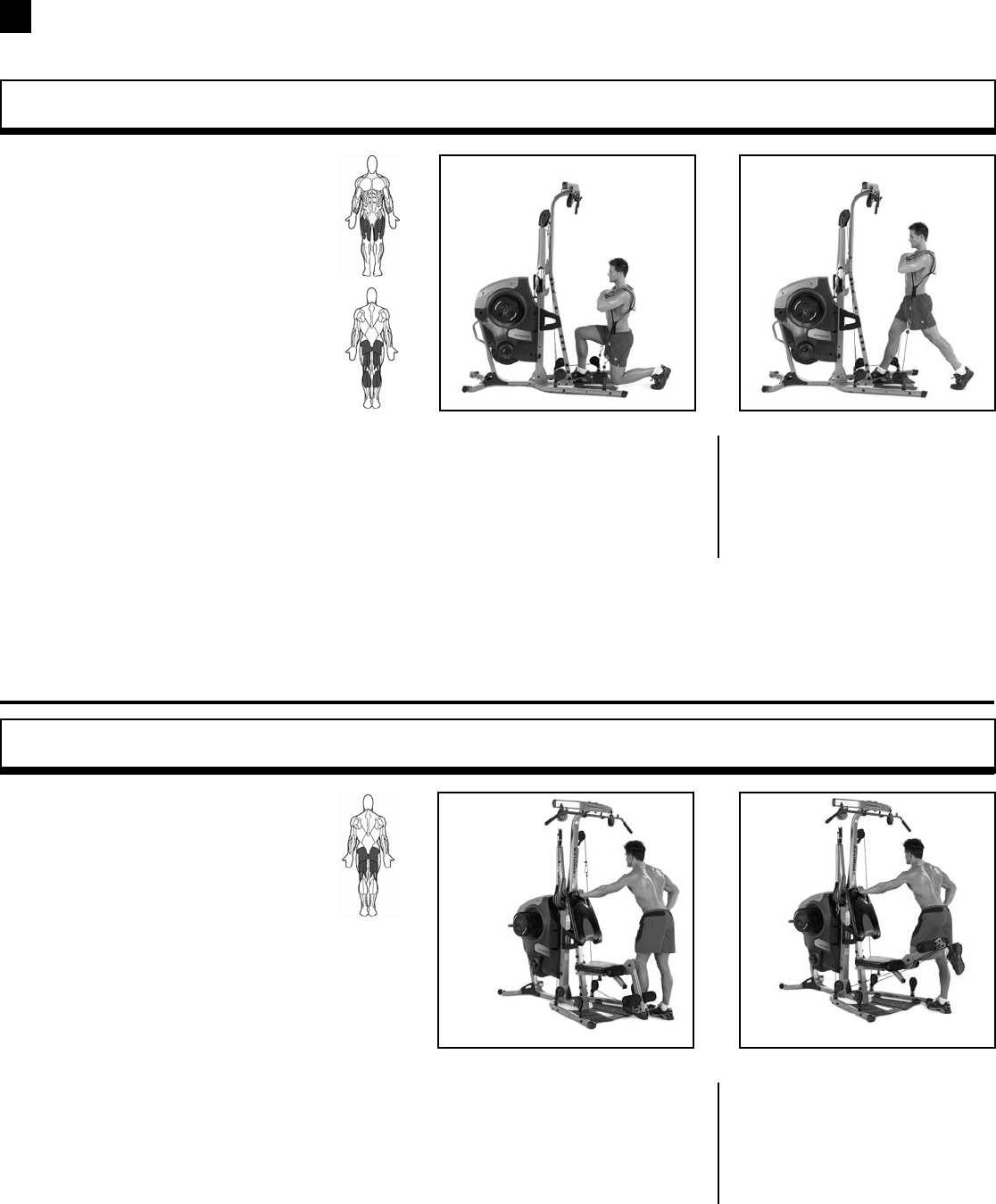
70 Leg Exercises
Lunge — Single leg hip extension w/ knee extension
START FINISH
• Stand facing the engine, with one
foot forward on the center of the
platform and the other foot back
behind you.
• Attach the cables to the D-ring
on the bottom strap of the Squat
Harness.
• Bend the front knee to
approximately 90º. Bend the back
knee slightly less.
• The front foot is flat on the
platform, and the back foot is on
the ball of the foot.
• Initiate the movement by
extending your front leg and hip.
• Keep your upper body as stable
as possible while moving
upward, fully extending the knee,
but not locking it.
• Return to the Start position.
• Repeat with the other leg.
Muscles worked:
Quadriceps; Hamstrings;
Gluteus Maximus; Calf muscles
Position:
Standing—facing the machine. Seat
removed.
Accessory:
Squat Harness
Pulleys / Adjustable Arm
Position:
Squat Frame Pulleys—Standard Pulley / 0
Success Tips
• Keep the chest lifted, abs tight and a
slight curve in the lower back.
• On the forward leg, while lowering the
body, keep the knee pointed forward.
• Bend at the hip, not at the waist.
START FINISH
Standing Single Leg Curl — Knee Flexion
START FINISH
START
• Stand on either side of the seat
pad and position your leg so the
lower Leg Curl pad is on the back
of your lower leg.
• The upper Leg Curl pad should be
positioned just below the knee on
the front of your leg.
• On the standing leg, stabilize your
ankle, knee, hip and trunk.
• Initiate the movement by bending
your knee to move your lower leg
upward.
• Keep your upper body as stable
as possible while moving.
• Return to the Start position.
• Repeat with the other leg.
FINISH
Muscles worked:
Hamstrings
Position:
Standing—facing the machine.
Accessory:
Leg Extension/Curl Attachment
Adjustable Arm Position:
0
Success Tips
• Keep the chest lifted, abs tight and a
slight curve in the lower back.
• Only bend at the knee of the working
leg.
• Stabilize your upper body by holding
onto the tower.
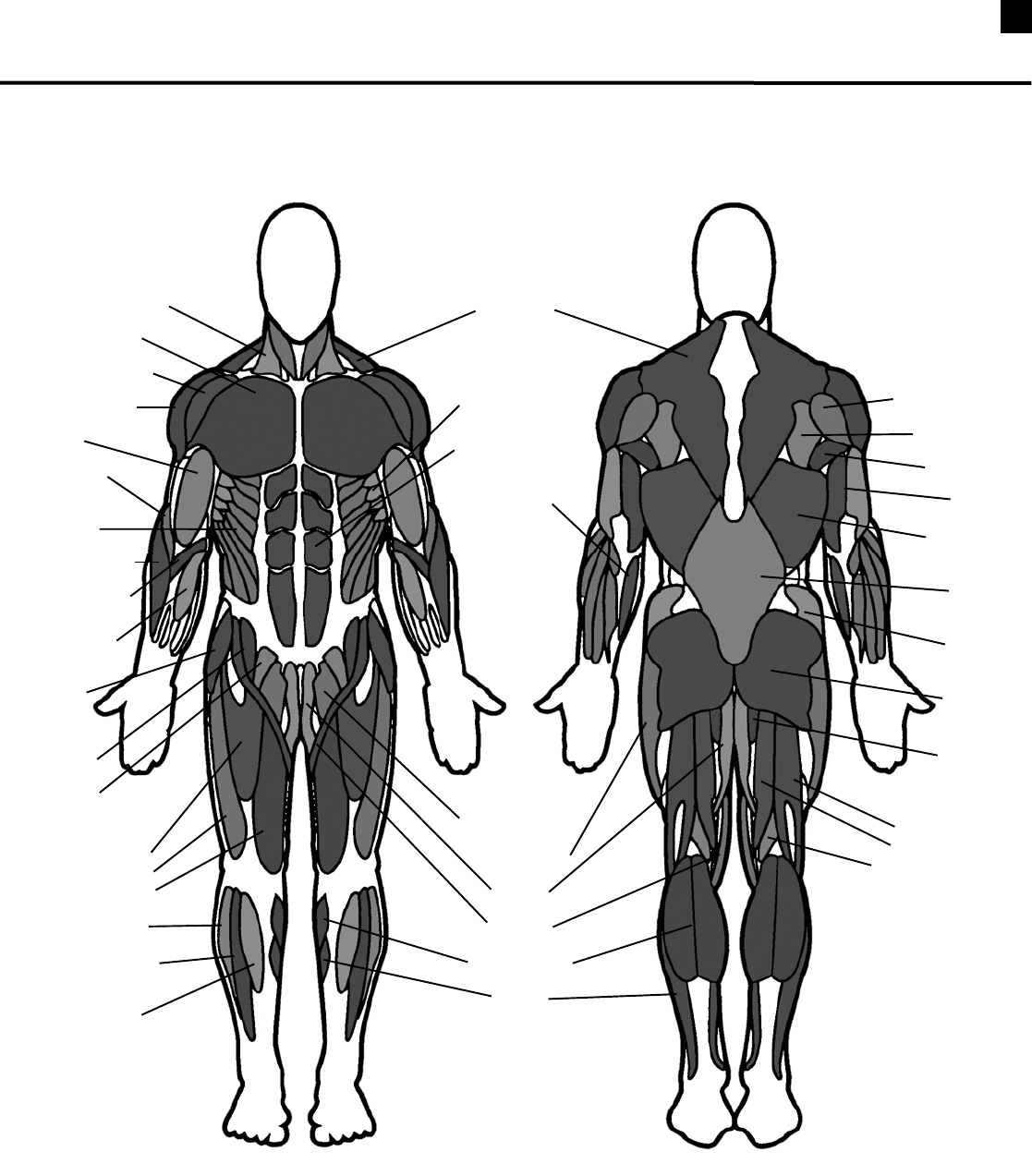
71
Sternocleidomastoid
Pectoralis Major
Anterior Deltoid
Medial Deltoid
Biceps
Brachialis
External
Obliques
Brachioradialis
Pronator Teres
Flexor Carpi
Radialis
Tensor
Fasciae
Latae
Iliopsoas
Pectineus
Quadriceps:
• Rectus Femoris
• Vastus Lateralis
• Vastus Medialis
Peroneus Longus
Extensor Digitorum
Longus
Tibialis Anterior
Posterior Deltoid
Infraspinatus
Teres Major
Triceps
Latissimus
Dorsi
Gluteus
Medius
Gluteus
Maximus
Adductor
Magnus
Hamstrings:
• Biceps Femoris
• Semitendinosus
• Semimembranosus
Trapezius
Serratus Anterior
Rectus Abdominus
Flexor Digitorum
Superficials
Adductor Longus
Iliotibial Tract
Gracilis
Sartorius
Gastrocnemius
Soleus
Muscle Chart
Erector
Spinae

72
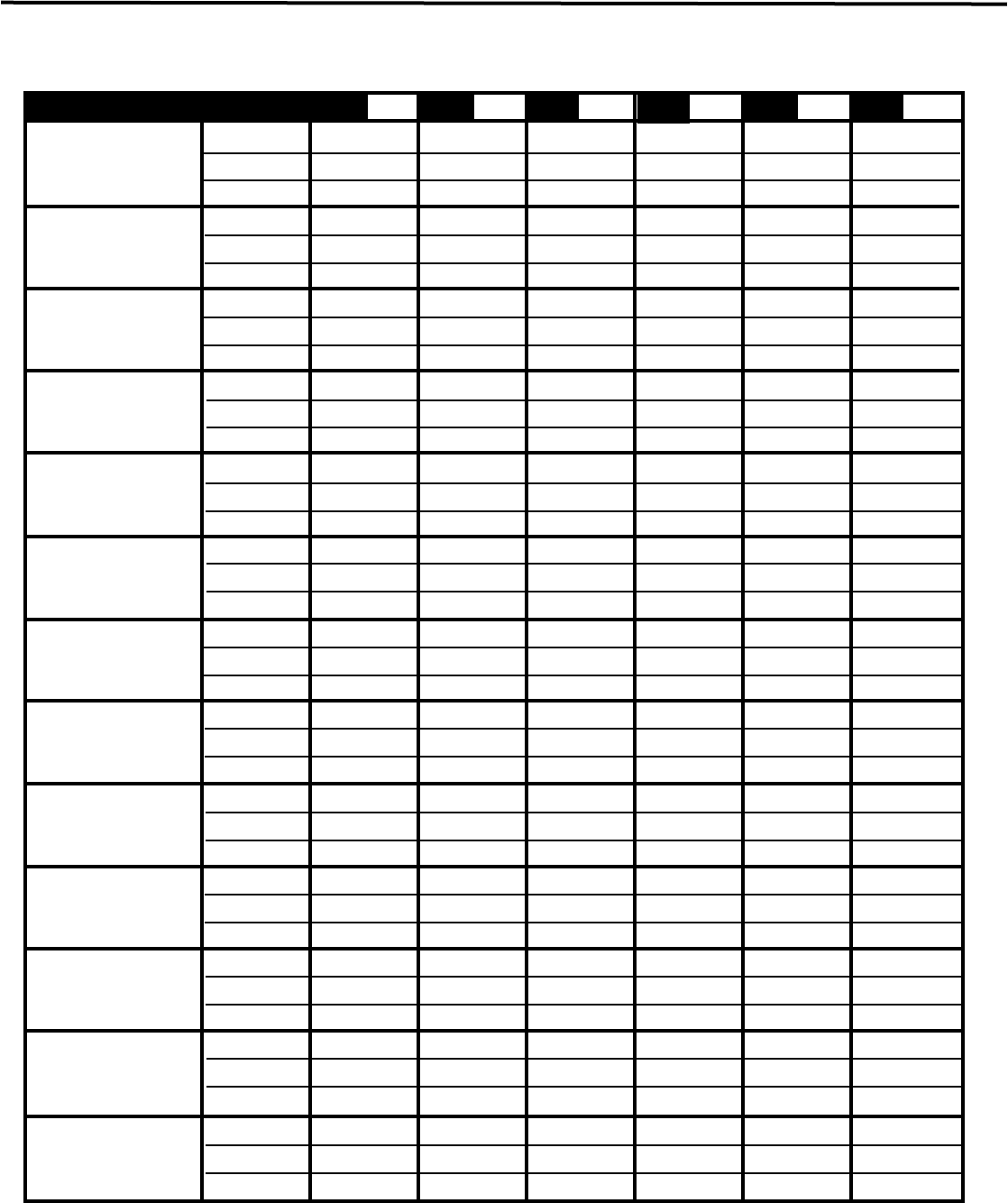
Please feel free to make copies of this chart to continue your exercise log.
EXERCISE DATE DATE DATE DATE DATE DATE
Sets
Reps
Resistance
Sets
Reps
Resistance
Sets
Reps
Resistance
Sets
Reps
Resistance
Sets
Reps
Resistance
Sets
Reps
Resistance
Sets
Reps
Resistance
Sets
Reps
Resistance
Sets
Reps
Resistance
Sets
Reps
Resistance
Sets
Reps
Resistance
Sets
Reps
Resistance
Sets
Reps
Resistance
Bench Press
2
10, 9
120, 130
Exercise Log
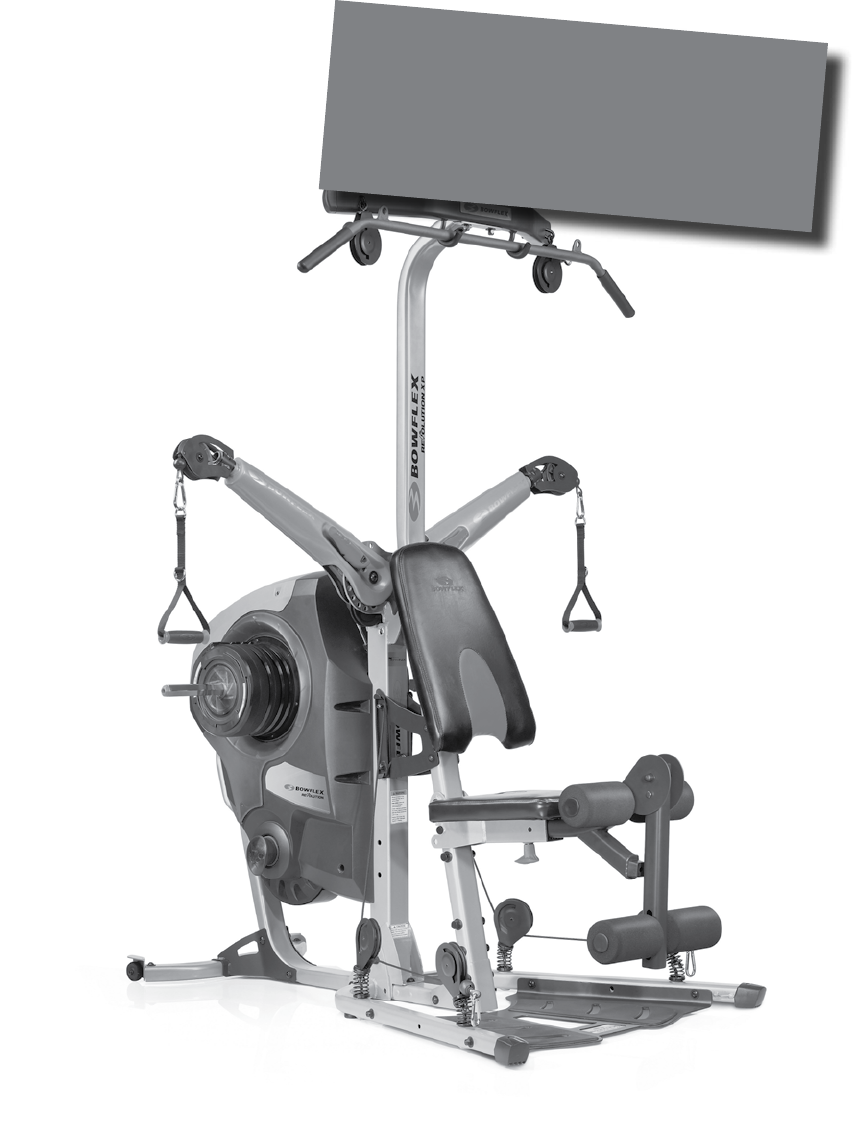
The Bowflex® Body
Leanness Program
By Ellington Darden, Ph.D.
The following program was created by
Dr. Ellington Darden. It contains a rigorous fitness and
dietary program. Please consult your physician before
beginning any fitness or dietary program.
Some of the names of the exercises listed in this program
have been changed in order to match the names of the
exercises in this manual. The exercises themselves have
not been changed, in order to preserve the integrity of Dr.
Darden’s Study.
FAST FAT LOSS
NOW!
76
The Bowflex® Body Leanness Program
This program is scientifically designed for maximal fat
loss over six weeks. It is important that you practice
every aspect of the plan to achieve optimum results.
The program separates into three two-week stages.
During each stage you will exercise, control the number
and quality of calories you consume, and drink plenty of
ice-cold water.
Before starting the exercise routine you must be
familiar with your Bowflex Revolution™. You should
experiment with finding the proper amount of
resistance to use on each exercise. You should be
able to perform 8 repetitions, but not more than 12
repetitions, for each exercise. It is essential that you
learn how to perform each movement before trying a
complete circuit, because part of the effectiveness of
the training depends on minimal rest between each
exercise.
WARNING!
Before beginning this program consult your physician or health care
professional. Show this plan and your Bowflex Revolution® XP Owner’s
Manual to your physician or health care pro fessional. Only he or she
can determine if this course is appropriate for your particular age and
condition. If you experience any light-headedness, dizziness, or shortness
of breath while exercising, stop the movement and consult a physician.
Make sure you read your Bowflex Revolution® XP
Owner’s Manual BEFORE attempting a workout.
There are a few people who should not try this program: Children and
teenagers; pregnant women; women who are breast feeding; diabetics;
individuals with certain types of heart, liver, or kidney disease; and those
suffering from certain types of arthritis. This should not be taken as an
all inclusive list. Some people should follow the course only with their
physician’s specific guidance.
Play it safe and consult a health care professional.
Introduction
77
Dear Bowflex® Enthusiast,
I’m excited, really excited! I’m elated because I’ve developed an exercising and eating program that produces fat
loss faster than any plan I’ve ever tested.
The men involved in my research, for example, had an average fat loss of 27.95 pounds (12.68 kg) per man. Women
on the same program averaged a reduction of 16.96 pounds (7.69 kg). Best of all, these dramatic results were
achieved—not in six months—but in only six weeks!
That’s right. Similar results can be accomplished by you in six short weeks, which include just 18 workouts (3 per
week) on the Bowflex® machine.
The Bowflex® home gym was a significant part of the results. The exercises performed on it allowed the participants
to build muscle, which accelerated their metabolisms, and produced faster and greater fat losses.
The plan worked so well that it became know as The Bowflex® Body Leanness Program.
Leanness means to strip away the fat from under the skin as well as at deeper levels. Leanness also implies a
pleasing shape and tone to the skeletal muscles.
You might say leanness is the opposite of fatness because the people involved in my research certainly got rid of
their excessive fatness in record time.
All the guidelines that were applied have been organized in the booklet you are now holding in your hands. It’s the
next best thing to actually going through one of my research projects. In fact, it’s probably better since nothing is
experimental. All of the fine points have been tried, tested and proven effective.
If you are overfat, and if you are interested in doing this program, there are several things that you need to
understand about my experience. Since 1965, I’ve trained more than 10,000 overfat individuals. After many years of
pushing, coaxing, and listening to these trainees, certain traits became evident to me:
• People are not lazy by choice. They are forced into it by the confusion that surrounds
the abundance of fitness information that is available. If these individuals are given
simple decisive instructions, they will train very intensely.
• People, if they are provided with specific menus, will drastically alter their eating habits.
• Most of these people, however, will do neither of these challenging things for more than
a week—unless they quickly see and feel changes in their body.
The Bowflex® Body Leanness Program emerged from these findings. For you to get the best-possible results, you
must be willing to exercise very intensely on the Bowflex® machine and adhere to a strict eating plan.
In return, you’ll get simple exercise instructions, specific menus to use, and my guarantee that if you follow the
program exactly as directed, you’ll observe the pounds and inches disappear on almost a
weekly basis.
Now it’s your turn to get excited, and get started!
Sincerely,
Dr. Ellington Darden
A Personal Guarantee From Dr. Ellington Darden
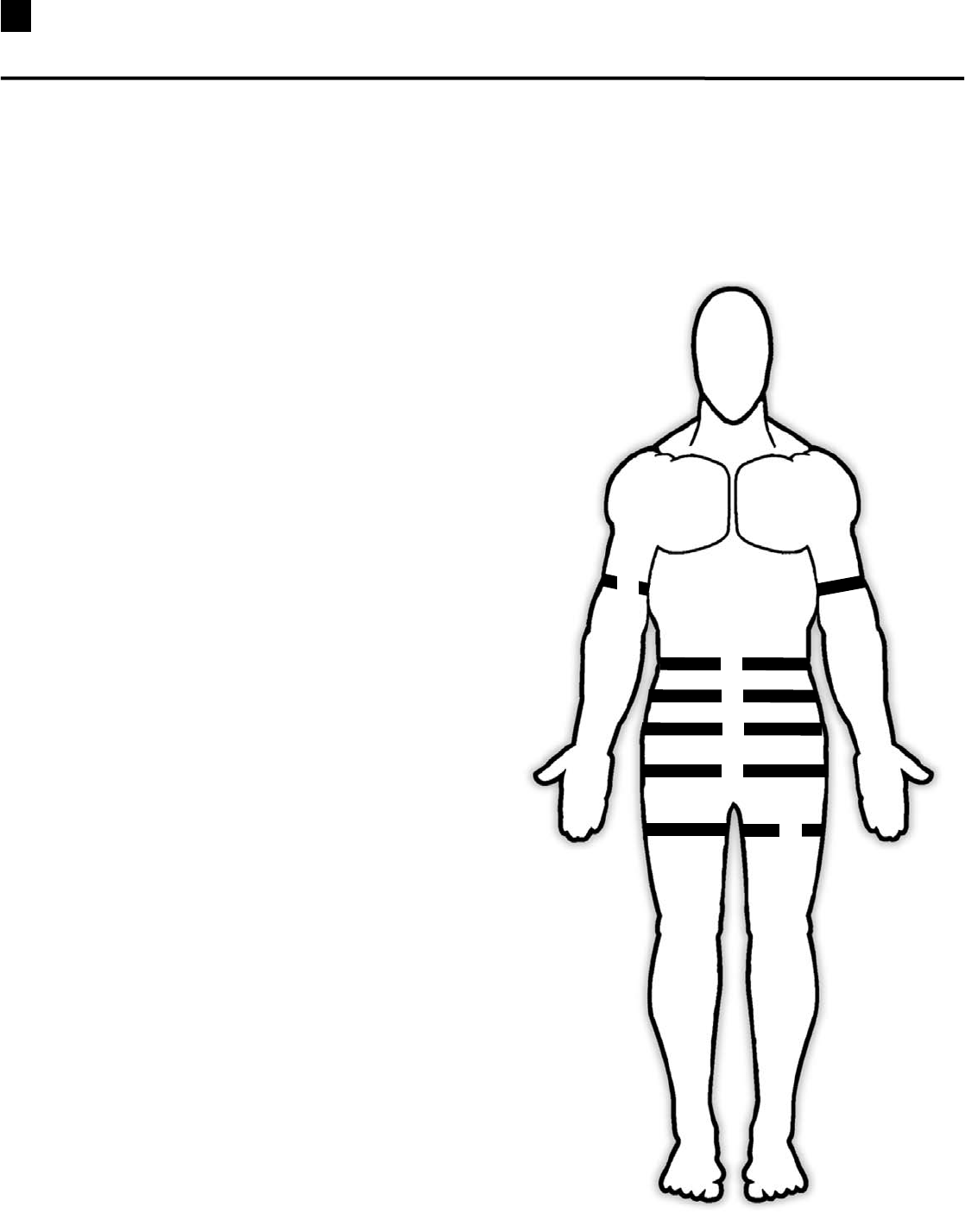
78
If you would like to measure your personal before-and-
after results, there are several steps you need to take.
It is important that you accurately perform each task,
then at the end of the six-week program, repeat the
process in the same manner.
Body Weight:
Remove clothing and shoes and record your weight to
the nearest quarter pound or hundred grams. Be sure
to use the same scale when weighing yourself at the
end of the six-week program. For the most accurate
recordings, weigh yourself nude in the morning.
Since the program is divided into three two-week
segments, you may want to weigh yourself at the end
of each two-week period. Understand, however that
weight loss is not the best way to determine your
success. Fat loss is the key component. To determine
the amount of fat you’ve lost, you’ll need to follow the
instructions in the next section.
Enter your starting weight on the RESULTS SUMMARY
SHEET provided.
Circumference of Body Parts:
For an even better idea of the changes that will occur
to your body in the next six weeks, it is necessary to
measure the circumference of certain body parts. This
will tell you where the fat is shrinking and what areas
are toning up.
Use a plastic tape to measure the following:
1) Upper arms — hanging and relaxed,
midway between the
shoulder and elbow.
2) 2” (5 cm) above navel — belly relaxed.
3) At navel — belly relaxed.
4) 2” (5 cm) below navel — belly relaxed.
5) Hips — feet together at maximum protrusion of
buttocks.
6) Thighs — high, just below the buttocks crease
with legs apart and
weight distributed equally
on both feet.
Record each measurement on your Results Summary Sheet.
1
2
3
4
5
6
Women Measure:
Suprailium, triceps, and thigh.
Men Measure:
Chest, abdomen, and thigh.
Measurements
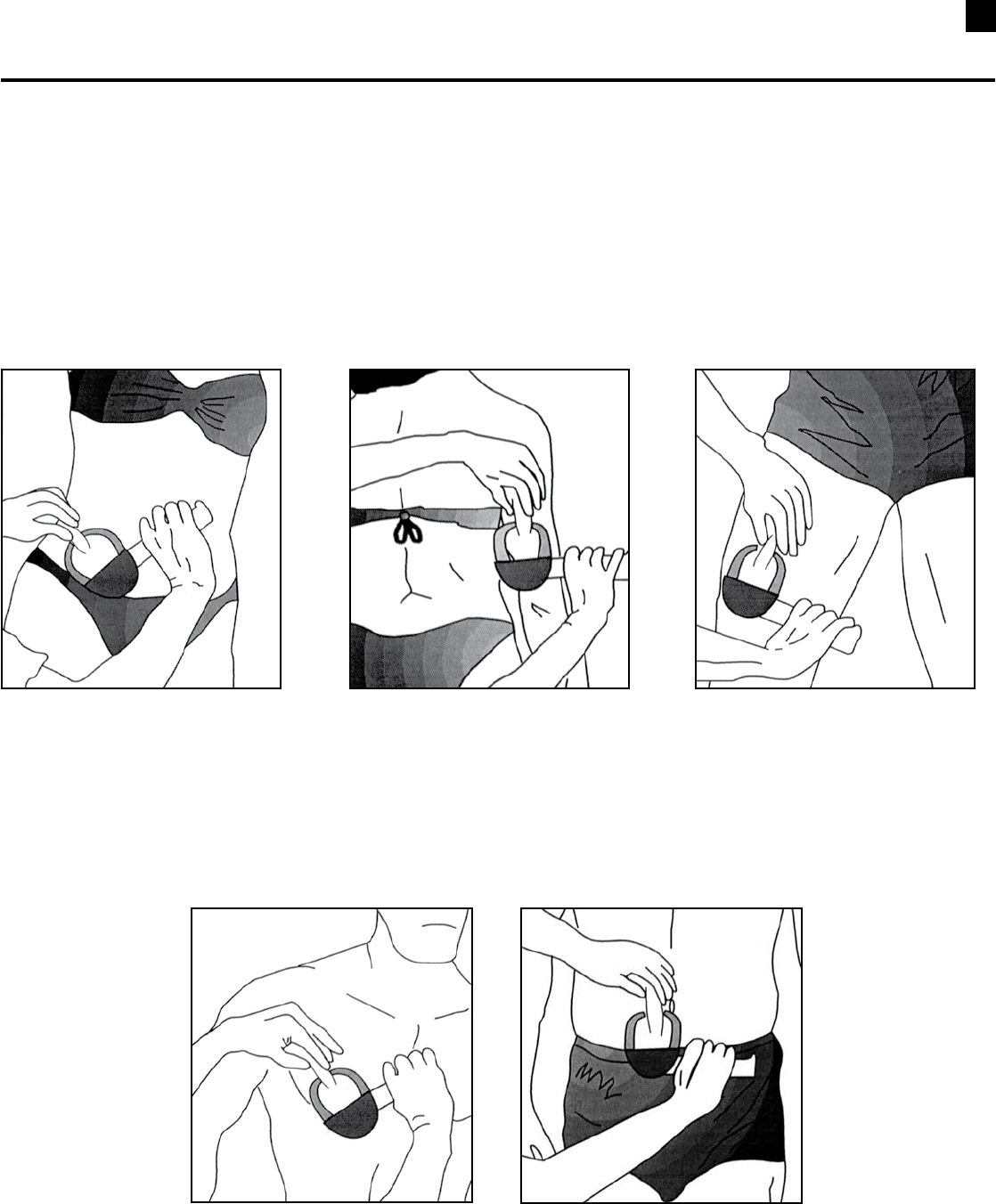
79
Skinfold Measurements
To accurately track your progress through this six-week program, it is necessary to take skinfold measurements.
By measuring yourself in this way, you will be able to determine your lean-body mass and your body-fat
percentage. The goal of this program is to increase your lean-body mass and decrease your body-fat percentage.
Please read this section carefully. Proper measuring techniques are essential to track your success. It is best to
have someone measure you. Measuring yourself can lead to inaccurate results.
Women Measure: Suprailium, Triceps, and Thigh
Men Measure: Chest, Abdomen and Thigh
Suprailium
Stand relaxed. Pick up a diagonal
skinfold just above the crest of
the hip bone on the right side
of the waist.
Triceps
Stand with right elbow flexed 90 degrees
and locate the center of the back of the
upper arm midway between the shoulder
and the elbow. Relax arm at your side.
Pick up skinfold as pictured.
Thigh
Stand relaxed with most of the weight
on your left leg. Pick up a skinfold in the
vertical plane on the front side of the
right thigh, midway between the hip and
knee joints.
Chest
Stand relaxed. Pick up a diagonal
skinfold over the right pectorals
muscle, midway between the armpit
and the nipple.
Abdomen
Stand relaxed. Pick up a vertical
skinfold on the right side of the navel.
Measurements
80
Using Calipers When Measuring Skinfolds
The procedure for measuring skinfold thickness is to grasp firmly with the thumb and forefinger a fold of skin and
surface fat and pull it away from the underlying muscle. Take the caliper in your other hand and open the jaws.
Clamp the jaws over the pinched skin and fat. The jaws exert constant tension at the point of contact with the
skin. The thickness of the double layer of skin and fat can then be read directly from the caliper, which is marked in
millimeters.
Use these figures on the following chart to
determine your body-fat percentage and enter the
number on the line below.
Starting body-fat percentage
Women
Suprailium
Triceps
Thigh
Total
Men
Chest
Abdomen
Thigh
Total
Optional Picture Taking
Pictures can be the most exciting evaluation you can
do. The numbers and the tape measurements are
great, but actually seeing differences from comparison
photographs of yourself is quite satisfying.
Taking full-length photographs is not difficult, but to
see the maximum difference between before and after,
you should follow these guidelines.
1) Keep everything the same. Wear the same outfit, a
snug solid color is best, and have the person taking
the picture stand in the same place, with the same
setting behind you.
2) Make sure you stand against an uncluttered, light
background.
3) Have the person taking the photograph move away
from you until he can see your entire body in the
viewfinder.
4) Stand relaxed for three pictures, front, right side,
and back. Do not try to suck in your stomach.
5) Interlace your fingers and place them on top of your
head, so the contours of your torso will be plainly
visible. Keep your feet 8” (20 cm) apart in all three
pictures.
6) When you get the film developed tell the processors
to make your after photos the same size as your
previous ones. This way, your height in both sets of
photos is equal and more valid comparisons can be
made.
Measurements
81
To Use The Nomogram:
1) Locate the sum of your three skinfolds in the right column and mark it.
2) Locate your age in years on the far left column and mark it.
3) Connect the two marks with a straightedge. Where the straightedge intersects the line in the middle column
appropriate to you, you will find your body-fat percentage.
Baun, W.D, Baun, M.R., and Raven, P.B. A nomogram for the estimate of percent body fat from generalized equations.
Research Quarterly for Exercise and Sport, 52:380-384, 1981.
130
40
38
36
34
32
30
28
26
24
22
20
18
16
14
12
10
3
15
20
25
30
35
40
45
50
55
60
5
7
9
11
13
15
17
19
21
23
25
27
29
31
33
125
120
11 5
110
105
100
95
90
85
80
75
70
65
60
55
50
45
40
35
30
25
20
15
10
Sum of Three Skinfolds (mm)
Age in Years
Percent
Body-Fat
Male
Female
Determining Your Body Fat
82
Before
Body Weight Fat Percentage Body Fat Weight
x =
Body Weight Weight of Body Fat Lean-Body Weight
– =
Use the Same Factors to Calculate After Six Weeks.
After
Body Weight Fat Percentage Body Fat Weight
x =
Body Weight Weight of Body Fat Lean-Body Weight
– =
Final Results
Before Body Fat Weight After Body Fat Weight Total Fat Lost
– =
After Lean-Mass Weight Before Lean-Mass Weight Total Lean-Mass Gained
– =
Now that you know your body-fat percentage, you can calculate your lean-body percentage. This will eventually
show you how many pounds of muscle were added to your body, after completing the program.
For Example:
Before the program, Joe weighs 200 pounds (90.7 kg) and measures 30% fat, which amounts to 60 pounds (27.2
kg). Thus, his lean-body mass is 70%, or 140 pounds (63.5 kg).
After the program, Joe weighs 180 pounds (81.6 kg) and is 20% fat, which equals 36 pounds (16.3 kg).
His lean-body mass is 80%, or 144 pounds (65.3 kg).
Simple calculations allow us to find the amount of fat Joe lost, and the amount of muscle Joe gained. Before fat
weight (60 pounds), minus after fat weight (36 pounds) equals 24 pounds (10.8 kg) of fat lost. After lean-mass
weight (144 pounds) minus before lean-mass weight (140 pounds) equals 4 pounds (1.8 kg) of muscle gained.
Enter Your Information Here: (Pounds or Kilograms)
Calculating Lean Body Mass
83
Name Age
Height Weight Loss
Weight Before Muscle Gain
Weight After Fat Loss
Please follow the instructions in the “Measurements” section for measuring circumferences.
Measurements
Right Arm
Left Arm
2” (5 cm) Above Navel
Navel
2” (5 cm) Below Navel
Hips
Right Thigh
Left Thigh
Percent Body Fat
Before After
Total
Difference
If you wish to submit your results, please send to: Bowflex Results, 16400 SE Nautilus Drive, Vancouver, WA
98683. Or you may fax this sheet to Bowflex Results at 1-360-694-7755. Please include your name, address, and
phone number. Submissions may be selected for use in promotional marketing materials.
Your Results Summary Sheet
84
GUIDELINES Week 1&2
All exercises should be practiced with one set of 8 to 12 repetitions. The style of performance is very important.
The movement for each repetition should be 4 seconds in the positive phase and 4 seconds in the negative. Keep
the motion slow and smooth. When 12 repetitions are accomplished, increase the resistance by approximately 5
percent. Keep the time between exercises to a minimum, no longer than
60 seconds. No workout should take more than 30 minutes to complete. Perform each workout three
days a week.
GUIDELINES Week 3&4
All exercises should be practiced with one set of 8 to 12 repetitions. The style of performance is very important.
The movement for each repetition should be 4 seconds in the positive phase and 4 seconds in the negative. Keep
the motion slow and smooth. When 12 repetitions are accomplished, increase the resistance by approximately 5
percent. Keep the time between exercises to a minimum, no longer than
45 seconds. No workout should take more than 30 minutes to complete. Perform each workout three
days a week.
GUIDELINES Week 5&6
All exercises should be practiced with one set of 8 to 12 repetitions. The style of performance is very important.
The movement for each repetition should be 4 seconds in the positive phase and 4 seconds in the negative. Keep
the motion slow and smooth. When 12 repetitions are accomplished, increase the resistance by approximately 5
percent. Keep the time between exercises to a minimum, no longer than
30 seconds. No workout should take more than 30 minutes to complete. Perform each workout three
days a week.
Exercise
Leg Extension
Bench Press
Lying Biceps Curl
Seated Shoulder Press
Seated Abdominal Crunch
Sets
1
1
1
1
1
Reps
8-12
8-12
8-12
8-12
8-12
Exercise
Leg Extension
Bench Press
Lying Biceps Curl
Seated Shoulder Press
Rear Deltoid Rows*
Seated Triceps Extension
Seated Abdominal Crunch
Sets
1
1
1
1
1
1
1
Reps
8-12
8-12
8-12
8-12
8-12
8-12
8-12
Exercise
Leg Extension
Leg Press
Bench Press
Lying Biceps Curl
Lying Shoulder Pullover
Reverse Fly
Rear Deltoid Rows*
Seated Triceps Extension
Seated Abdominal Crunch
Sets
1
1
1
1
1
1
1
1
1
Reps
8-12
8-12
8-12
8-12
8-12
8-12
8-12
8-12
8-12
* The Upright Row exercise was used in Dr. Darden’s original study. Although many people have used this exercise for years, recent information in the Physical
Therapy field has caused the authors of this manual to caution against performing this exercise because of the unnatural twisting movement created in the
shoulder joint. We suggest you substitute Rear Deltoid Rows for the Upright Row exercise.
The Workouts
85
You will be following a reduced-calorie nutrition program, which is divided into three two-week segments. The
program is a proven method for achieving maximal fat loss over a six-week period. It consists of a carbohydrate-
rich, descending-calorie eating plan, and a superhydration routine.
Follow a Carbohydrate-Rich, Descending-Calorie Eating Plan:
Approximately 60 percent of the daily calories should be from carbohydrates. The other 40 percent will be equally
divided between proteins and fats. The 60:20:20 ratio of carbohydrates, proteins, and fats is ideal for maximum fat
loss.
Keep Menus Simple and Food Substitutions to a Minimum:
Research has established that successful dieters prefer the same foods each day for breakfast and lunch. They like
variety, however, for dinner. Detailed menus and food choices are included later in this manual.
If you must vary from the menu items, try to stay within the 60:20:20 ratio of carbohydrates, proteins
and fats.
Avoid Too Much Stress:
Too much stress of any kind can cause the body to actually preserve fat stores. You should relax more. An after-
dinner walk at a leisurely pace is helpful. Extra sleep is suggested, since sleep facilitates fat loss and muscle
recovery. Furthermore, to keep the body well rested, no other exercises or activities are allowed during the six-
week program. This is a scientifically proven program that works. More is not better. Any additional exercise other
than the amount recommended can and will harm your fat loss.
For Example
Daily Amount
Calories
Carbohydrate
60%
Protein
20%
Fat
20%
2000
1900
1800
1700
1600
1500
1400
1300
1200
110 0
1000
1200
1140
1080
1020
960
900
840
780
720
660
600
400
380
360
340
320
300
280
260
240
220
200
400
380
360
340
320
300
280
260
240
220
200
Eating Guidelines

86
Drinking plenty of water is essential to the success
of this program. Drinking the recommended amount
of water can seem like a challenge at first. Stick with
it. Carry a large sport bottle or similar item with you
throughout the day. After several weeks, you will find
that you actually thirst for more and more water, and
the amounts recommended are easily reached.
Superhydration aids fat loss in a number of ways. First,
the kidneys are unable to function without adequate
water. When they do not work to capacity some of their
load is dumped onto the liver.
This diverts the liver from its primary function, which is
to metabolize stored fat into usable energy. Because it’s
performing the chores of the water-depleted kidneys,
the liver metabolizes less fat.
Second, overeating can be averted through water
intake, as water can keep the stomach feeling full and
satisfied between meals.
Third, ice-cold water requires calories to warm it to
core body temperature. In fact, 1 US gallon of ice cold
water (3.8 l) generates 123 calories of heat energy.
You’ll be drinking from 1 to 1 5/8 US gallons
(3.8 - 6.2 l) of water each day on the following
superhydration schedule:
Don’t be surprised if you have to make more than a
dozen trips to the rest room, especially during the
first week of the program. Remember, your body is an
adaptive system, and it will soon accommodate the
increased water consumption.
Note: Although it is doubtful that you could ever drink
too much water, a few ailments can be negatively
affected by large amounts of fluid. For example,
anyone with a kidney disorder, or anyone who takes
diuretics, should consult a physician before going on
the recommended water-drinking schedule. If you have
any doubts about the recommendations, play it safe and
check with your doctor.
Week 1 = drink four 32-oz. bottles (3.8 l) of ice-cold water per day.
Week 2 = drink four and a half 32-oz. bottles (4.3 l) of ice-cold water per day.
Week 3 = drink five 32-oz. bottles (4.6 l) of ice-cold water per day.
Week 4 = drink five and a half 32-oz. bottles (5.2 l) of ice-cold water per day.
Week 5 = drink six 32-oz. bottles (5.7 l) of ice-cold water per day.
Week 6 = drink six and a half 32-oz. bottles (6.2 l) of ice-cold water per day.
Superhydrate Your System

87
The menus in the Bowflex® eating plan are designed
for maximum fat-loss effectiveness
and nutritional value. For best results, follow
them exactly.
Every attempt has been made to utilize current popular
brand names and accurate calorie counts, which are
listed in the menus. But as you probably realize the
products are sometimes changed or discontinued. If a
listed item is not available in your area, you’ll need to
substitute a similar product. Become an informed label
reader at your supermarket. Ask questions about any
products you don’t understand. Supermarket managers
are usually helpful. If they don’t have an answer to your
question, they will get it for you.
Each day you will choose a limited selection of foods
for breakfast and lunch. Most people can consume
the same basic breakfast and the same basic lunch for
months with little modification. Ample variety during
your evening meal, however, will make daily eating
interesting and enjoyable. Additionally, the eating plan
includes a mid-afternoon and late-night snack to keep
your energy high and your hunger low.
Begin Week 1 on Monday and continue through
Sunday. Week 2 is a repeat of Week 1. Calories for each
food are noted in parentheses. A shopping
list follows.
The eating plan for the next six weeks descends:
Week 1 & 2:
Men 1500 calories per day.
Women 1200 calories per day.
Week 3 & 4:
Men 1400 calories per day.
Women 1100 calories per day.
Week 5 & 6:
Men 1300 calories per day.
Women 1000 calories per day.
You’ll always have a 300 calorie breakfast, a 300
calorie lunch, and a 300 calorie dinner (women), or 500
calorie dinner (men). With each two-week descend,
only your snack calories will change:
from 400 to 300 to 200 calories per day (men),
or 300 to 200 to 100 calories per day (women).
For each of your five daily meals, you’ll have at least
three choices.
Everything has been simplified so even the most
kitchen-inept man or woman can succeed. Very
little cooking is required. All you have to do is read
the menus, select your food choices, and follow the
directions. It’s as simple as that.
If you find that you wish to vary from the outline menu
items try to stay with in the 60:20:20 ratio
of carbohydrates, proteins, and fats.
The Eating Plan
88
Breakfast = 300 calories
Choice of bagel, cereal or shake.
Bagel
1 plain bagel, Sarah Lee® (frozen) (210)
3/4 oz. light cream cheese (45)
1/2 C. orange juice, fresh or frozen (55)
Any beverage without calories, caffeine, or
sodium, such as decaffeinated coffee or tea.
Cereal
1.5 oz. (42 grams) serving equals
approximately 165 calories.
Choice of one: Kellogg’s® Low Fat Granola
(without raisins), General Mills® Honey Nut
Clusters, General Mills® Basic 4
1/2 C. skim milk (45)
3/4 C. orange juice (82)
Noncaloric beverage
Shake (choice of one shake)
Place ingredients in blender. Blend until smooth.
Banana-Orange Shake
1 large banana (8 3/4 inches long) (100)
1/2 C. orange juice (55)
1/2 C. skim milk (45)
2 T. wheat germ (66)
1 t. safflower oil (42)
2 ice cubes (optional)
or Chocolate or Vanilla Shake
1 packet Carnation® Instant Breakfast,
Champion UltraMet®, or another diet shake
powder that contains the appropriate calories
(100)
1 C. skim milk (90)
1/2 large banana (8 3/4 inches long) (50)
1 t. safflower oil (42)
1 t. Carnation® Malted Milk powder (20)
2 ice cubes (optional)
Lunch = 300 calories.
Choice of sandwich, soup or salad.
Sandwich
2 slices whole wheat bread (140)
2 t. Promise Ultra® Vegetable Oil Spread (24)
2 oz. white meat (about 8 thin slices), chicken or
turkey (80)
1 oz. fat-free cheese (1 1/2 slices) (50)
(Opt.: Add to bread 1 t. Dijon mustard (0)
Noncaloric beverage
Soup (choice of one soup)
• Healthy Choice® Hearty Chicken, 15-oz. can
(260), or
• Campbell’s® Healthy Request Hearty
Vegetable Beef, 16-oz. can (260)
1/2 slice whole-wheat bread (35)
Noncaloric beverage
Chef Salad
2 C. lettuce, chopped (20)
2 oz. white meat, chicken or turkey (80)
2 oz. fat-free cheese (100)
4 slices tomato, chopped (28)
1 T. Italian, fat-free dressing (6)
1 slice whole wheat bread (70)
Noncaloric beverage
Mid-Afternoon Snack
Men–200 calories for Weeks 1&2;
150 calories for Weeks 3&4;
100 calories for Weeks 5&6.
Women–150 calories for Weeks 1&2;
100 calories for Weeks 3&4;
50 calories for Weeks 5&6.
Choose calories from:
1 large banana (8 3/4 inches long) (100)
1 apple (3-inch diameter) (100)
1/2 cantaloupe (5-inch diameter) (94)
5 dried prunes (100)
1 oz. (2 small 1/2 oz. boxes) raisins (82)
1 C. light, nonfat, flavored yogurt (100)
Dinner
Men–500 calories, Women–300 calories
Choice of tuna salad dinner, steak dinner
or frozen microwave dinner.
Tuna Salad Dinner
In a large bowl, mix the following:
1 6-oz. can chunk light tuna in water (180)
1 T. Hellmann’s® Light, Reduced-Calorie
Mayonnaise (50)
2 T. sweet pickle relish (40)
1/4 C. whole kernel corn, canned, no salt added
(30)
Noncaloric beverage
Men add:
1/2 C. sliced white potatoes, canned (45)
2 slices whole wheat bread (140)
Steak Dinner
3 oz. lean sirloin, broiled (176)
1/2 C. sweet peas, canned, no salt added (60)
1/2 C. beets, canned (35)
1/2 C. skim milk (45)
Noncaloric beverage
Men add:
2 slices whole wheat bread (140)
1 t. Promise Ultra® Vegetable Oil Spread (12)
1/2 C. skim milk (45)
Frozen Microwave Dinner
Choice of one meal:
• Glazed Chicken Dinner, Lean Cuisine® (230)
2/3 C. skim milk (60)
Noncaloric beverage
• Lasagna with Meat Sauce, Lean Cuisine®
(240)
1/2 C. skim milk (45)
Noncaloric beverage
• Macaroni and Cheese, Weight Watchers®
(260)
1/2 C. skim milk (45)
Noncaloric beverage
• Broccoli & Cheddar Cheese Sauce over Baked
Potato, Lean Cuisine® Lunch Express (250)
1/2 C. skim milk (45)
Noncaloric beverage
• Grilled Turkey Breast, Healthy Choice® (260)
1/2 C. skim milk (45)
Noncaloric beverage
Men add:
2 slices whole wheat bread (140)
2 t. Promise Ultra® Vegetable Oil Spread (24)
1/2 C. skim milk (45)
Late-Night Snack
Men–200 calories for 1&2; 150 calories for
Weeks 3&4; 100 calories for Weeks 5&6.
Women–150 calories for Weeks 1&2; 100
calories for Weeks 3&4; 50 calories for Weeks
5&6.
Choose calories from afternoon snack
selections plus the following:
1/2 C. low-fat frozen yogurt (100)
2 C. light, microwave popcorn (100)
The Eating Plan – US Measurements
89
Breakfast = 300 calories
Choice of bagel, cereal or shake.
Bagel
1 plain bagel, Sarah Lee® (frozen) (210)
21 g light cream cheese (45)
120 ml orange juice, fresh or frozen (55)
Any beverage without calories, caffeine, or
sodium, such as decaffeinated coffee or tea.
Cereal
42 gram serving equals
approximately 165 calories.
Choice of one: Kellogg’s® Low Fat Granola
(without raisins), General Mills® Honey Nut
Clusters, General Mills® Basic 4
120 ml skim milk (45)
177 ml orange juice (82)
Noncaloric beverage
Shake (choice of one shake)
Place ingredients in blender. Blend until smooth.
Banana-Orange Shake
1 large banana (22 cm long) (100)
120 ml orange juice (55)
120 ml skim milk (45)
15 ml wheat germ (66)
5 ml safflower oil (42)
2 ice cubes (optional)
or Chocolate or Vanilla Shake
1 packet Carnation® Instant Breakfast,
Champion UltraMet®, or another diet shake
powder that contains the appropriate calories
(100)
240 ml skim milk (90)
1/2 large banana (22 cm long) (50)
5 ml safflower oil (42)
5 ml Carnation® Malted Milk powder (20)
2 ice cubes (optional)
Lunch = 300 calories.
Choice of sandwich, soup or salad.
Sandwich
2 slices whole wheat bread (140)
10 ml Promise Ultra® Vegetable Oil
Spread (24)
57 g white meat (about 8 thin slices), chicken or
turkey (80)
28 g fat-free cheese (1 1/2 slices) (50)
(Opt.: Add to bread 5 ml Dijon mustard (0)
Noncaloric beverage
Soup (choice of one soup)
• Healthy Choice® Hearty Chicken, 420 g can
(260), or
• Campbell’s® Healthy Request Hearty
Vegetable Beef, 450 g can (260)
1/2 slice whole-wheat bread (35)
Noncaloric beverage
Chef Salad
480 ml lettuce, chopped (20)
57 g white meat, chicken or turkey (80)
57 g fat-free cheese (100)
4 slices tomato, chopped (28)
15 ml Italian, fat-free dressing (6)
1 slice whole wheat bread (70)
Noncaloric beverage
Mid-Afternoon Snack
Men–200 calories for Weeks 1&2;
150 calories for Weeks 3&4;
100 calories for Weeks 5&6.
Women–150 calories for Weeks 1&2;
100 calories for Weeks 3&4;
50 calories for Weeks 5&6.
Choose calories from:
1 large banana (22 cm long) (100)
1 apple (7.6 cm diameter) (100)
1/2 cantaloupe (12.7 cm diameter) (94)
5 dried prunes (100)
28 g (2 small 14 g. boxes) raisins (82)
240 ml light, nonfat, flavored yogurt (100)
Dinner
Men–500 calories, Women–300 calories
Choice of tuna salad dinner, steak dinner
or frozen microwave dinner.
Tuna Salad Dinner
In a large bowl, mix the following:
1 can (170 g) chunk light tuna in water (180)
15 ml Hellmann’s® Light, Reduced-Calorie
Mayonnaise (50)
30 ml sweet pickle relish (40)
60 ml whole kernel corn, canned, no salt added
(30)
Noncaloric beverage
Men add:
120 ml sliced white potatoes, canned (45)
2 slices whole wheat bread (140)
Steak Dinner
85 g lean sirloin, broiled (176)
120 ml sweet peas, canned, no salt
added (60)
120 ml beets, canned (35)
120 ml skim milk (45)
Noncaloric beverage
Men add:
2 slices whole wheat bread (140)
5 ml Promise Ultra® Vegetable Oil Spread (12)
120 ml skim milk (45)
Frozen Microwave Dinner
Choose one meal:
• Glazed Chicken Dinner, Lean Cuisine® (230)
160 ml skim milk (60)
Noncaloric beverage
• Lasagna with Meat Sauce, Lean Cuisine®
(240)
120 ml skim milk (45)
Noncaloric beverage
• Macaroni and Cheese, Weight Watchers®
(260)
120 ml skim milk (45)
Noncaloric beverage
• Broccoli & Cheddar Cheese Sauce over Baked
Potato, Lean Cuisine® Lunch Express (250)
120 ml skim milk (45)
Noncaloric beverage
• Grilled Turkey Breast, Healthy Choice® (260)
120 ml skim milk (45)
Noncaloric beverage
Men add:
2 slices whole-wheat bread (140)
10 ml Promise Ultra® Vegetable Oil
Spread (24)
120 ml skim milk (45)
Late-Night Snack
Men–200 calories for 1&2; 150 calories for
Weeks 3&4; 100 calories for Weeks 5&6.
Women–150 calories for Weeks 1&2; 100
calories for Weeks 3&4; 50 calories for Weeks
5&6.
Choose calories from afternoon snack
selections plus the following:
120 ml low-fat frozen yogurt (100)
240 ml light, microwave popcorn (100)
The Eating Plan – Metric Measurements*
* Nutritionally equivalent products with similar calorie counts may be substituted if recommended products cannot be found.

90
Quantities needed for listed items will depend on your
specific selections. Review your choices and adjust
the shopping list accordingly. It may be helpful for you
to photocopy this list each week before doing your
shopping.
Staples
Orange juice, skim milk, whole-wheat bread, Promise
Ultra® Vegetable Oil Spread, Italian fat-free dressing,
Dijon mustard, safflower oil, noncaloric beverages (tea,
decaffeinated coffee, diet soft drinks, water).
Grains
Bagels, Sarah Lee® (frozen)
Cereals – 1.5 oz. (42 g) serving equals approximately
165 calories; Kellogg’s® Low-Fat Granola (without
raisins), General Mills® Honey Nut Clusters, General
Mills® Basic 4.
Wheat germ, malted milk powder, popcorn
(microwave light).
Fruits
Bananas, large (8 3/4 inches [22 cm] long), apples
(3-inch [7.6 cm] diameter), cantaloupes (5-inch [12.7
cm] diameter), dried prunes, raisins.
Vegetables
Lettuce, tomatoes, whole kernel corn (canned no salt
added), sweet peas, (canned no salt added), sliced
white potatoes (canned), cut beets (canned).
Dairy
Yogurt (light nonfat), cream cheese (light), cheese
(fat-free), low-fat frozen yogurt, Carnation® Instant
Breakfast packets, Champion UltraMet® Packets.
Meat, Poultry, Fish and Entrees
Chicken (thin sliced), turkey (thin sliced), tuna
(canned in water), sirloin steak (lean).
Canned soup:
Healthy Choice® Hearty Chicken, Campbell’s® Healthy
Request Hearty Vegetable Beef.
Frozen microwave dinners or entrees:
Lean Cuisine® Glazed Chicken Dinner, Lean Cuisine®
Lasagna with Meat Sauce, Lean Cuisine® Lunch
Express Broccoli & Cheddar Cheese over Potato,
Weight Watchers® Macaroni and Cheese, Healthy
Choice® Grilled Turkey Breast.
Shopping List

91
Q. I often get headaches when I eat only 1000 calories
a day. What should I do?
A. Your headaches may be caused by going longer than
three hours between meals or snacks. Try spacing
your meals and snacks where there are fewer hours
between them.
Some people who are used to drinking regular
coffee with caffeine notice headaches when they
stop consuming coffee for several days. If this is the
case with you, you might want to ease off the coffee
more gradually.
Q. I don’t like red meat. I notice that the Lean Cuisine®
Lasagna with Meat Sauce contains beef. What can
I substitute for it?
A. Lean Cuisine® has many other frozen dinners that
you may substitute for Lasagna with Meat Sauce.
Try to find one that contains the same calories,
with approximately 15 to 20 percent of the calories
coming from fat. Some of the Lean Cuisine®
dinners actually have too little fat for my nutritional
requirements.
Q. May I have dinner for lunch and lunch
for dinner?
A. Yes.
Q. I tend to get a headache when I drink
cold water. Can I drink water without it
being chilled?
A. Yes, but you won’t get the 123 calories or more
thermogenic effect from warming the cold water to
core body temperature. Try a more gradual drinking
of the cold water. You may have been consuming it
too quickly.
Q. Is it possible to drink too much water?
A. Certainly. To do so, however, you’d probably have
to drink four or five times as much per day as I’m
recommending. There are a few ailments that can
be negatively affected by large amounts of fluid. If
you feel you have a problem, check with your doctor
before starting the program.
Q. Is bottled water better than tap water?
A. Research shows that bottled water is not always
higher quality water than tap water. The decision
to drink bottled water or not is usually one of taste.
If you dislike the taste of your tap water, then drink
your favorite bottled water. But first you might
want to try a twist of lemon or lime added to the
water from your tap. Some people say it makes a
significant difference in the taste.
Q. I’m a middle-aged woman who gets black and blue
marks on my legs when I diet. Am I doing anything
wrong?
A. I doubt you are doing anything wrong. Such
black and blue marks are usually the result of an
increased level of estrogen circulating in your body,
which weakens the walls of the capillaries and
causes them to break under the slightest pressure.
When this happens, blood escapes and a bruise
occurs. Estrogen is broken down in the liver, and
so is fat. When you are dieting, your liver breaks
down the fat, leaving a lot more estrogen in the
bloodstream.
It may be helpful to supplement your diet with a little
extra vitamin C each day to help toughen the walls
of the capillaries.
Q. I’m a 40-year-old woman with a teenage son and
daughter. My husband and I both want to lose 10
pounds (4.5 kg) and the children would also like to
lose some weight. Can I put the whole family on the
program?
A. It would be great if you could, but you cannot.
The number of calories per day is the problem.
Teenagers require significantly more calories each
day than 1500, which is the highest level. Check
with a registered dietician (RD) for appropriate
recommendations.
Your teenage son and daughter, however, could
follow the Bowflex® exercise routines.
Q. I’m afraid that I might get large, unfeminine
muscles from some of the Bowflex® exercises you
recommend in this course. What can I do to prevent
this from happening?
A. You are worrying about large muscles unnecessarily.
Building large muscles requires two conditions. First,
the individual must have long muscles and short
tendons. Second, an abundance of testosterone
must be present in the blood stream. Women almost
never have either of these conditions.
Under no circumstances could 99.99 percent
of American women develop excessively large
muscles. Progressive resistance exercise such as
with the Bowflex® machine will make your muscles
larger—but not excessively large—and larger
muscles will make your body firmer and more
shapely.
Q. Why is it so important I perform the Bowflex®
exercises with a 4-second count on the lifting and
lowering?
Q & A

92
A. Because a slow, smooth 4-second lifting followed
by a 4-second lowering involves more muscle fibers
more thoroughly than faster speeds of movement.
The more completely each involved muscle fiber
works simply means you’ll get better muscle-building
results.
Q. I’m confused about how to breathe during each
Bowflex® exercise?
A. Let’s say your goal is to do 10 repetitions on a
specific Bowflex® exercise that is performed in
the recommended 4-second lifting and 4- second
lowering style. Here are the proper breathing
guidelines to follow:
• Breathe normally during the first five repetitions.
• Take shorter, more shallow breaths during the sixth,
seventh, and eighth repetitions.
• Emphasize exhalation more than inhalation, especially
during the ninth and tenth repetitions. Focus on good
form and slow movement.
• Do not hold your breath on any repetition. Practice
relaxing your face and neck. Do not grit your teeth.
Keep your eyes open and remain alert.
Q. I’m not as disciplined and patient as I’d like to be.
How can I better stay on track with the program?
A. One suggestion is to team up with a partner.
Most people are more motivated and make better
progress if they go through the program with a
friend. In selecting a training partner, here are
several things to keep in mind:
• Your partner should be similar to you in age
and condition.
• Your partner should be serious about getting into shape
and making a commitment. That commitment means
you’ll be exercising together one hour, three times per
week. Each of your joint training sessions should take
approximately 50 minutes: 25 minutes for your workout
and 25 minutes supervising your partner’s workout.
• Your partner should be someone with whom you’ll
share a spirit of cooperation, not competition.
• Your partner should not be your spouse, brother,
sister, or other family member. You do not want normal
interpersonal problems to interfere with the training.
Q. Why won’t you allow me to do aerobic dancing on
my off-days to speed up the loss of body fat?
A. Because doing so doesn’t speed up fat loss. Aerobic
dancing—and other activities such as running,
swimming, cycling, stair-stepping, and racquetball—
do not contribute significantly to the fat-loss
process. In fact, when added to proper strength
training they can actually retard the reduction of fat.
Fat loss is retarded in two ways. Too much repetitive
activity prevents maximum muscle building by
using up your recover ability. A well-rested recover
ability is necessary for muscle growth. Too much
activity—especially if you are on a reduced-calorie
diet—causes you to get the blahs and quickly lose
your enthusiasm. If this happens, you’re sure to
break your diet.
The primary purpose of this program is to lose fat
in the most effective and most efficient manner. Fat
loss is prioritized and maximized by building muscle
at the same time. The muscle-building process is
optimized by a well-rested recovery ability, which
necessitates keeping your strenuous and moderately
strenuous activities to a bare minimum.
Once you get your body fat to a low level, you can
add other activities—and I encourage you to do
so—to your weekly fitness schedule. For now, follow
the plan exactly as directed.
Q. What happens after six weeks? How do I continue
the program if I need to lose
more weight?
A. You should repeat the program for as long as it takes
you to reach your goal. For example, it took Barry
Ozer three six-week sessions—18 weeks—to lose all
of his excessive fat, which amounted to 75 pounds
(34 kg). There are, however, a few guidelines and
modifications to apply.
Repeat the eating plan exactly as before: Men, go back
to 1500 calories a day for two weeks. Women, go back
to 1200 calories a day for two weeks. Then, descend
your calories in the same manner.
Keep your superhydration schedule at the highest
level. In other words, sip 1 5/8 gallons (6.2 l) of ice-
cold water each day.
Continue your Bowflex® exercise routine at the
highest level. Perform the same 10 exercises three
times per week. Try to get as strong as you can
in each exercise, while always focusing on the
4-second count in both lifting and lowering.
Q. I’m pleased that I lost the fat I wanted to lose. What
do I do to maintain my new body weight?
A. Once you’ve lost your excessive fat, your next task is
to maintain that status. Here are the adjustments you
need to make to your current practices.
Q & A

93
Adhere to a carbohydrate-rich, moderate-calorie
eating plan.
Instead of eating from 1000 to 1500 calories a day,
you’ll be consuming from 1600 to 2400 calories per day.
Maybe you can eat even more after your new body
weight has stabilized. Trial-and-error experimentation
is a must. Women should start with 1600 calories, and
men with 2000 calories per day. Note what happens
after a week. If your body weight keeps going down,
raise the calories by 100 or 200, depending on how
much weight you lost during the last week. Soon, you
should reach a level where your body weight stabilizes.
That level is your daily calorie requirement. Naturally,
you’ll be able to consume other foods than those
listed in the Bowflex® eating plan. By then, however,
you should know the value of being a smart shopper
and a wise eater. Read labels. Compare nutritional
information. Be conscious of the ideal 60:20:20 ratio for
carbohydrates, proteins, and fats.
Eat smaller meals more frequently.
You’ve been limiting your five meals per day to 300
calories if you’re a woman, or 500 calories if you’re
a man. You may now up the calories by 100. What
happens if during a single meal you eat more than 400
calories if you’re a woman, or 600 calories if you’re
a man? Don’t panic. Simply understand that you will
sometimes backslide. Learn to anticipate these urges
and take corrective action.
Drink at least 1 gallon (3.8 l) of cold water each day.
You should realize by now the benefits of consuming
plenty of water each day. Make your water bottle a
permanent part of your lifestyle.
Train on the Bowflex® machine at least twice a week.
There are two primary differences between
maintenance and strength-building routines. First,
for maintenance, you do not have to increase the
resistance each week or so. If you can do 100 pounds
for 12 repetitions on the leg extension, then keep it on
100 pounds and do not go up to 105 pounds. You can
maintain the 100-pound level much easier that you
can increase it. Second, you do not need to train three
times a week. You can maintain your strength at twice
a week.
Add variety to your Bowflex® routines.
Now is the time to introduce more variety to
your routines by adding some new exercises
while removing some old ones. Below are two sample
routines.
Maintenance Routine 1
1. Seated Hip Abduction
2. Seated Hip Adduction
3. Seated Straight Leg Calf Raise
4. Chest Fly
5. Incline Bench Press
6. Shoulder Pullover
7. Shoulder Shrug
8. Standing Biceps Curl
9. Seated Wrist Curl
10. Seated Wrist Extension
Maintenance Routine 2
1. Standing Single Leg Curl
2. Leg Extension
3. Standing Lateral Raise
4. Seated Shoulder Press
5. Rear Deltoid Row
6. Decline Press
7. Reverse Curl
8. Seated Triceps Extension
9. Standing Low Back Extension
10. Abdominal Crunch
Look in your Bowflex Revolution® XP Owner’s Manual
for descriptions of the new exercises.
Be consistent with your Bowflex® machine exercising,
healthy eating, and superhydrating—and your
accomplishments may well exceed your goals.
Q & A
94
6-Week Satisfaction Guarantee
We want you to know that the Bowflex Revolution®
XP home gym is a superior product. Your satisfaction is
guaranteed. If, for any reason, you are not 100% satisfied
with your Bowflex Revolution® XP home gym, please follow
the instructions below to return your merchandise and
receive a refund of the purchase price, less shipping and
handling.
1. Call a Nautilus Representative at 1-800-605-3369 or write
to Nautilus, Inc. at 16400 SE Nautilus Drive, Vancouver,
WA 98683 for a Return Authorization Number. Return
Authorization will be granted if:
a. You purchased your Bowflex Revolution® XP home
gym directly from Nautilus or from a certified
Nautilus® dealer; and
b. You are calling within 6 weeks of the delivery date of
your merchandise.
Returns should be shipped to: Nautilus, 16400 SE Nautilus
Drive, Vancouver, Washington, USA 98683.
All returned merchandise must be properly packaged in the
original boxes and in good condition.
NOTE: You are responsible for return shipping and
for any damage or loss to merchandise that occurs during
return shipment. We highly recommend that you insure your
shipment.
3. Please mark all boxes clearly with:
• Return Authorization Number • Your Name
• Your Address • Your Phone Number
Boxes without this information clearly marked on the
outside may be refused.
4. Please make copies of your original invoice and put one
in each box of merchandise. Your shipment must be
received within two weeks from the date the Nautilus
Representative issued you your Return Authorization
Number.
Refunds may be denied or delayed if these instructions are
not completely followed. Satisfaction Guarantee applies
only to merchandise purchased by consumers directly from
Nautilus, and does not apply to sales made by dealers or
distributors.
What Does This Warranty Cover?
Nautilus warrants to the original purchaser of this Bowflex®
product that the equipment is free from defects in materials
or workmanship, with the exceptions stated below. This
warranty is not transferable or applicable to any person
other than the original purchaser. Tampering with the unit
will void the warranty.
Warranty
• 10 Years on machine and SpiraFlex® resistance packs.
Warranty terms may differ outside the USA.
To make this warranty effective, you must completely fill out
the Bowflex Revolution® XP Warranty Registration Card
within 30 days of purchase and return it to the address on
the Warranty Registration Card.
Warranties Do Not Cover
• Damage due to use by persons who weigh more
than 300 pounds (136 kg).
• Damage due to normal wear and tear.
• Damage due to abuse, accident, failure to follow
instructions or warnings in the Owner’s Manual, misuse,
mishandling, accident or Acts of God
(such as floods, tornadoes, power surges, etc.).
• Use in any institutional or commercial settings such as
health clubs, schools, or recreation centers.
• Consequential or incidental damage.
Some states do not allow the exclusion or limitation
of incidental or consequential damages, so the above
limitation or exclusion may not apply to you.
What We Will Repair
During your Warranty Coverage Period, Nautilus will
repair any Bowflex® equipment that proves to be defective
in materials or workmanship. In the event repair is not
possible, Nautilus, Inc., at its option, will either replace your
equipment or refund your purchase price, less shipping and
handling. Nautilus reserves the right to substitute material of
equal or better quality if identical materials are not available
at the time of service under this Warranty. The replacement
of the product under the terms of the Warranty in no way
extends the Warranty period.
How to Obtain Service
To obtain service for a Bowflex
®
Fitness Product, contact an
authorized Bowflex® Fitness Retailer. You may also contact a
Nautilus representative at 800-628-8458 to help you locate a
dealer in your area.
How State Law Applies
This warranty gives you specific legal rights. You may also
have other rights, which vary from state to state.
Limited Warranty
©2007. Nautilus, Inc. All rights reserved. Nautilus, Bowflex, the Bowflex logo, Bowflex Revolution and Power Rod are either registered trademarks or trademarks of Nautilus, Inc.
All other trademarks are owned by their respective companies.
Nautilus, Inc., World Headquarters, 16400 SE Nautilus Drive, Vancouver, WA 98683 1-800-NAUTILUS www.nautilus.com
Bowflex Revolution® XP Warranty Registration Card
IMPORTANT! MAIL WITHIN 30 DAYS OF PURCHASE
Thanks for filling out this questionnaire. Your answers are important to us. Please check here if you would prefer
not to obtain information on new and interesting opportunities from other exciting companies.
PLEASE PRINT CLEARLY – THANK YOU
Mr. 2. Mrs. 3. Ms. 4. Miss Customer ID from Invoice
Name:
Address: Apt. #:
City: State: Zip:
Phone number: -
E-Mail address:
Is this your primary address? Yes No
Place of purchase:
Date of purchase:
Purchaser date of birth:
Gender: Male Female
Marital status: Married Single
Including yourself, total number of people living in your household: (Examples: 01, 02, 03 …)
Would you like to receive additional information on healthy lifestyle products? Yes No
Which best describes your family income: (US dollar figures)
Under $15,000 $25,000 – $34,999 $50,000 – $74,999 $100,000 – $149,999
$15,000 – $24,999 $35,000 – $49,999 $75,000 – $99,999 Over $150,000
What other types of exercise equipment do you own?
Did you receive this item as a gift? Yes No
Name of original purchaser:
Original purchaser customer ID number:
( )
M MD D
EXT.
M MD D Y Y
Y Y
Please fold over and tape before mailing
Please fold over and tape before mailing
Place
Stamp
Here
Bowflex Revolution® XP Home Gym
16400 SE Nautilus Drive
Vancouver, WA 98683
What Is Covered
Nautilus, Inc. warrants to the original purchaser
of this Bowflex® product that the equipment is
free from defects in materials or workmanship,
with the exceptions stated below. This
warranty is not transferable or applicable to
any person other than the original purchaser.
Tampering with the unit will void the warranty.
Warranty Period
• 10 years on machine and
Spiraflex® resistance packs.
Warranties Do Not Cover
• Damage due to use by persons who
weigh more than 300 pounds (136 kg).
• Damage due to normal wear and tear.
• Damage due to abuse, accident, failure to
follow instructions or warnings, misuse,
mishandling, accident or Acts of God
(such as floods or power surges).
• Use in any commercial or institutional
settings such as health clubs,
schools or recreation centers.
• Consequential or incidental damage.
Some states do not allow the exclusion or
limitation of incidental or consequential
damages, so the above limitation or
exclusion may not apply to you.
What We Will Do
During your Warranty Coverage Period,
Nautilus will repair any Bowflex® equipment
that proves to be defective in materials
or workmanship. In the event repair is not
possible, Nautilus, Inc., at its option, will
either replace your equipment or refund your
purchase price, less shipping and handling.
How To Obtain Service
To obtain service for a Bowflex® Fitness
Product, contact an authorized Bowflex®
Fitness Retailer. You may also contact a
Nautilus representative at 800-628-8458
to help you locate a dealer in your area.
How State Law Applies
This warranty gives you specific legal rightsrights.
You may also have other rights which vary from
state to state.
OFFICES IN THE UNITED STATES:
E-mail: customerservice@nautilus.com
• TECHNICAL/CUSTOMER SERVICE
Nautilus, Inc.
World Headquarters
16400 SE Nautilus Drive
Vancouver, Washington, USA 98683
Phone: 800-NAUTILUS (800-628-8458)
Email: customerservice@nautilus.com
Fax: 877-686-6466
• CORPORATE HEADQUARTERS
Nautilus, Inc.
World Headquarters
16400 SE Nautilus Drive
Vancouver, Washington, USA 98683
Phone: 800-NAUTILUS (800-628-8458)
If you need assistance, please have both the serial number of your machine and the date of purchase available when you
contact the appropriate Nautilus office listed below.
To locate the serial number label on your machine, refer to the Safety
Warning Labels information in this manual.
INTERNATIONAL:
For technical assistance and a list of distributors in your
area, please call or fax one of the following numbers.
• INTERNATIONAL CUSTOMER SERVICE
Nautilus International S.A.
Rue Jean Prouvé 6
1762 Givisiez / Switzerland
Tel: + 41-26-460-77-77
Fax: + 41-26-460-77-70
Email: technics@nautilus.com
BUSINESS OFFICES:
• SWITZERLAND OFFICE
Nautilus Switzerland S.A.
Tel: + 41-26-460-77-66
Fax: + 41-26-460-77-60
• GERMANY and AUSTRIA OFFICE
Nautilus GmbH
Tel: +49-2203-20-20-0
Fax: +49-2203-20-20-4545
• ITALY OFFICE
Nautilus Italy s.r.l.
Tel: +39-051-664-6201
Fax: +39-051-664-7461
• UNITED KINGDOM OFFICE
Nautilus UK Ltd.
Tel: +44-1908-267-345
Fax: +44-1908-267-346
• CHINA OFFICE
Nautilus Representative Office
Tel: +86-21-523-707-00
Fax: +86-21-523-707-09
Serial Number
Date of Purchase
Please record the following information for future reference.
97
Important Contact Numbers
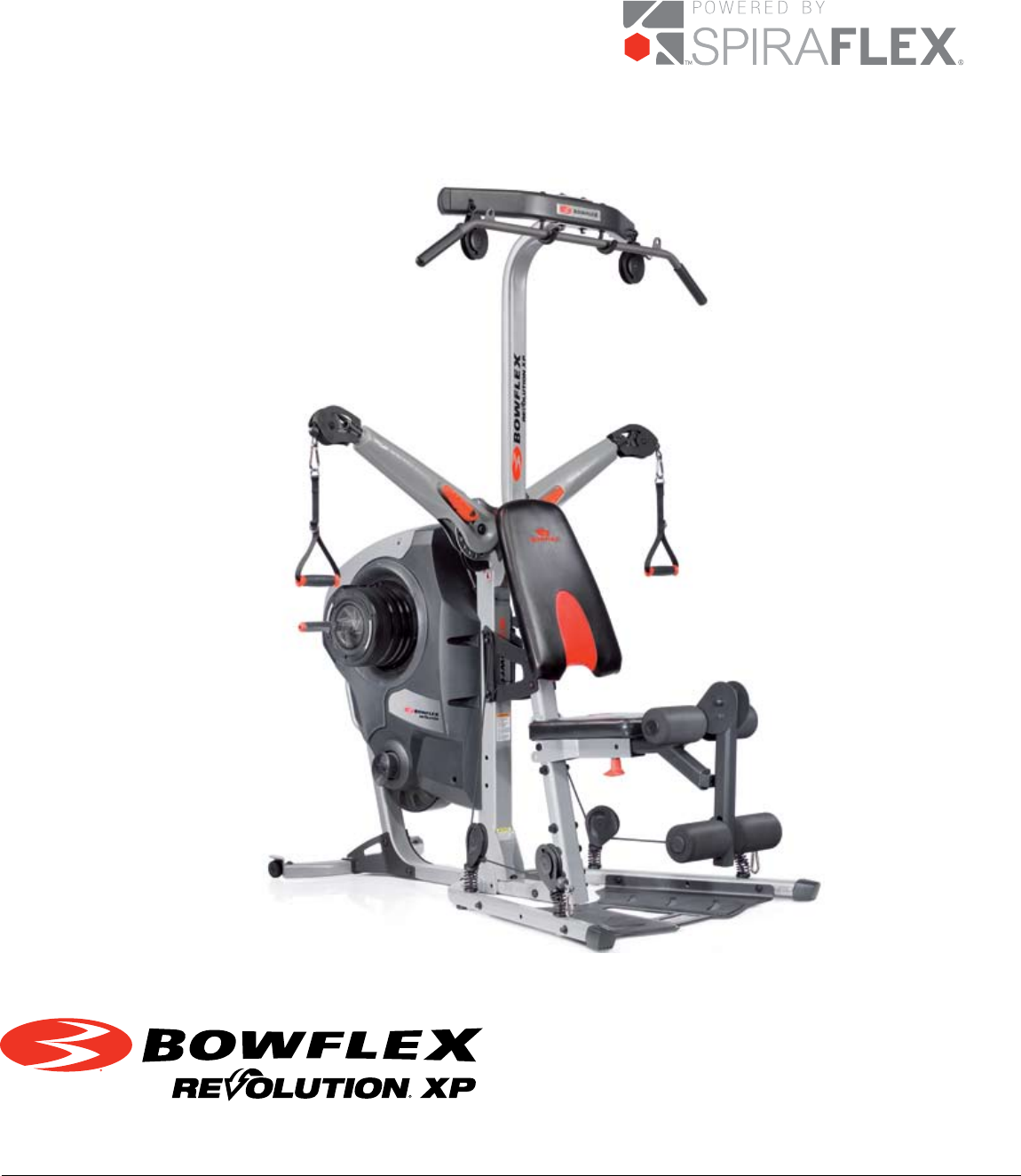
©2009 Nautilus, Inc. All rights reserved. Nautilus, Bowflex, the Bowflex logo, and Bowflex Revolution are either registered trademarks or trademarks of Nautilus, Inc.
All other trademarks are owned by their respective companies.
Nautilus, Inc., World Headquarters, 16400 SE Nautilus Drive, Vancouver, Washington, USA 98683 1-800-NAUTILUS www.nautilus.com
Printed in China
