Brother Hl L8250Cdn Users Manual
HL-L8350CDW to the manual 8b1a8a18-ac3e-4813-9ea6-7b12a1a14835
2015-01-25
: Brother Brother-Hl-L8250Cdn-Users-Manual-213210 brother-hl-l8250cdn-users-manual-213210 brother pdf
Open the PDF directly: View PDF  .
.
Page Count: 223 [warning: Documents this large are best viewed by clicking the View PDF Link!]
- User’s Guide HL-L8250CDN/HL-L8350CDW/HL-L8350CDWT
- User's Guides and where do I find them?
- Using the documentation
- Accessing Brother Utilities (Windows®)
- Table of Contents
- 1 Printing Methods
- About this Machine
- Acceptable paper and other print media
- Loading paper
- 2-sided printing
- Printing from a USB flash drive or digital camera supporting mass storage
- 2 Driver and Software
- Printer driver
- Windows®
- Macintosh
- Software
- 3 General Information
- 4 Options
- 5 Routine Maintenance
- 6 Troubleshooting
- A Appendix
- Index
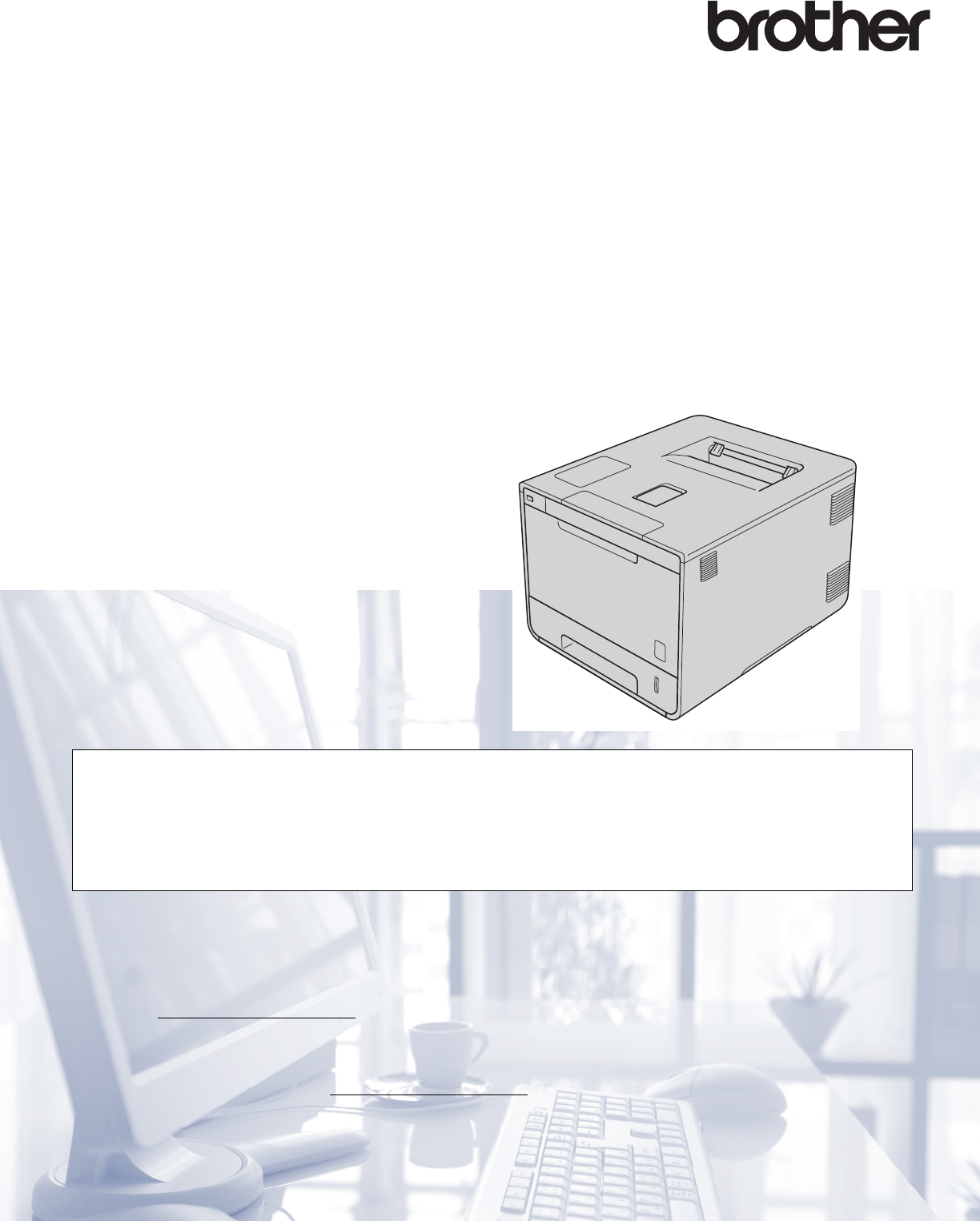
User’s Guide
Brother Laser Printer
HL-L8250CDN
HL-L8350CDW
HL-L8350CDWT
For visually-impaired users
You can read this manual with Screen Reader ‘text-to-speech’ software.
You must set up the hardware and install the driver before you can use the machine.
Please use the Quick Setup Guide to set up the machine. You can find a printed copy in the box.
Please read this User's Guide thoroughly before you use the machine.
Please visit http://solutions.brother.com/ where you can get product support, the latest driver updates and utilities, and
answers to frequently asked questions (FAQs) and technical questions.
Note: Not all models are available in all countries.
Visit the Brother Solutions Center at http://solutions.brother.com/ and click Manuals on your model's page to download
other manuals.
Version 0
USA/CAN
i
User's Guides and where do I find them?
Which Guide? What's in it? Where is it?
Product Safety Guide Read this Guide first. Read the Safety Instructions
before you set up your machine. See this Guide for
trademarks and legal limitations.
Printed / In the Box
Quick Setup Guide Follow the instructions for setting up your machine
and installing the drivers and software for the
operating system and connection type you are using.
Printed / In the Box
User's Guide Learn the print operations and how to replace
supplies and perform routine maintenance. See
troubleshooting tips.
For USA:
PDF file / Brother Solutions Center
at http://solutions.brother.com/
For Other Countries:
PDF file / CD-ROM / In the box
Network User's Guide This Guide provides useful information about wired
and wireless network settings and security settings
using the Brother machine. You can also find
supported protocol information for your machine and
detailed troubleshooting tips.
For USA:
HTML file / Brother Solutions Center
at http://solutions.brother.com/
For Other Countries:
HTML file / CD-ROM / In the box
Google Cloud Print
Guide
This Guide provides information about how to
configure your Brother machine to a Google account
and use Google Cloud Print services for printing over
the Internet.
PDF file / Brother Solutions Center
at http://solutions.brother.com/
Mobile Print/Scan
Guide for Brother
iPrint&Scan
This Guide provides useful information about printing
from your mobile device and scanning from your
Brother machine to your mobile device when
connected on a Wi-Fi network.
PDF file / Brother Solutions Center
at http://solutions.brother.com/
ii
Using the documentation
Thank you for buying a Brother machine! Reading the documentation will help you make the most of your
machine.
Symbols and conventions used in the documentation
The following symbols and conventions are used throughout the documentation:
WARNING WARNING indicates a potentially hazardous situation which, if not avoided,
could result in death or serious injuries.
IMPORTANT IMPORTANT indicates a potentially hazardous situation which, if not avoided,
may result in damage to property or loss of product functionality.
NOTE Notes tell you how to respond to a situation that may arise or give tips about
how the operation works with other features.
Electrical Hazard icons alert you to possible electrical shocks.
Fire Hazard icons alert you to the possibility of a fire.
Hot Surface icons warn you not to touch machine parts that are hot.
Prohibition icons indicate actions that must not be performed.
Bold Bold style identifies buttons on the machine's control panel or computer
screen.
Italics Italicized style emphasizes an important point or refers you to a related topic.
Courier New Courier New font identifies the messages shown on the LCD of the machine.
iii
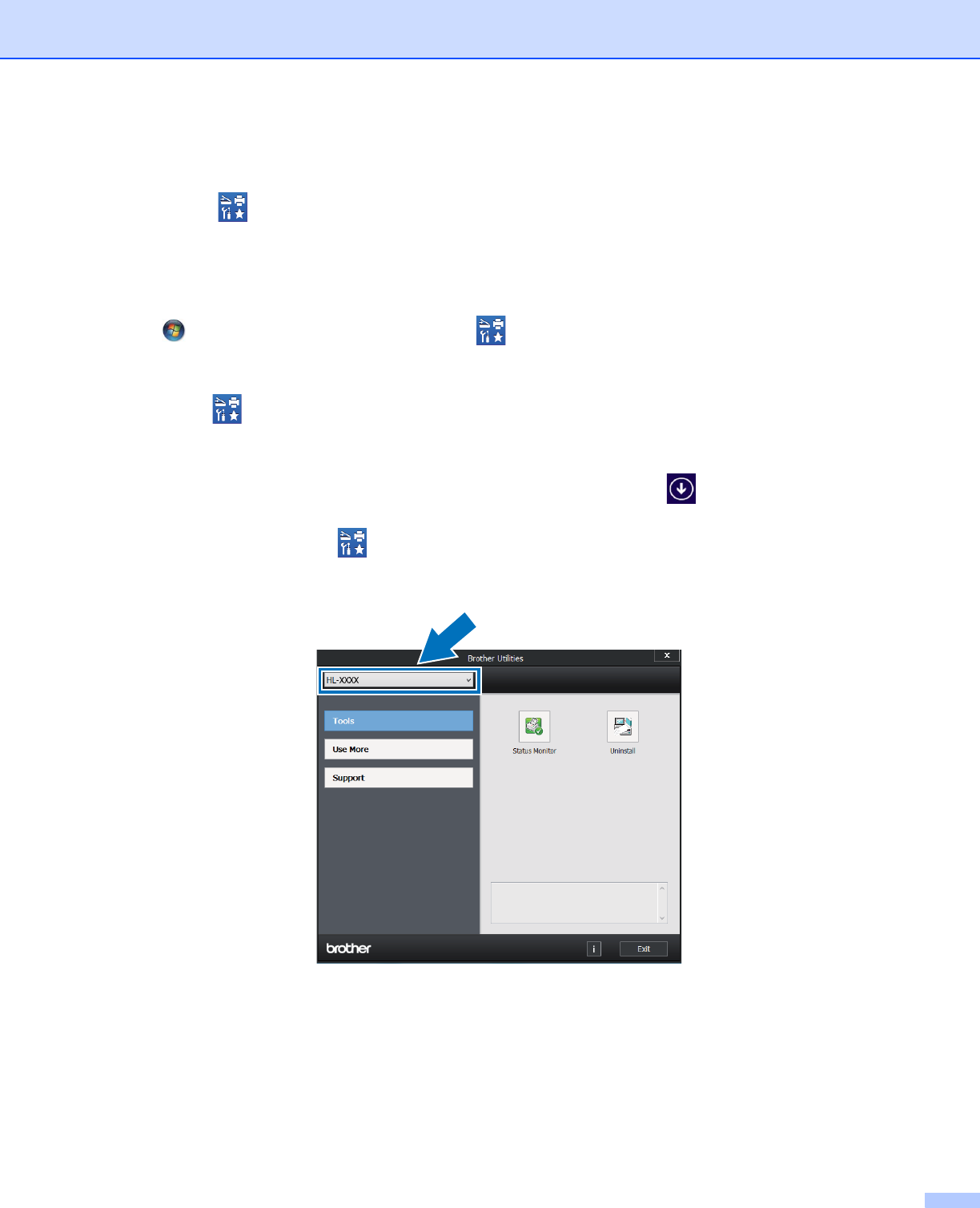
Accessing Brother Utilities (Windows®)
Brother Utilities is an application launcher that offers convenient access to all Brother applications
installed on your device.
a(Windows® XP, Windows Vista®, Windows® 7, Windows Server® 2003, Windows Server® 2008 and
Windows Server® 2008 R2)
Click (Start) > All Programs > Brother > Brother Utilities.
(Windows® 8 and Windows Server® 2012)
Tap or click (Brother Utilities) either on the Start screen or the desktop.
(Windows® 8.1 and Windows Server® 2012 R2)
Move your mouse to the lower left corner of the Start screen and click (if you are using a touch-
based device, swipe up from the bottom of the Start screen to display the Apps screen). When the Apps
screen appears, tap or click (Brother Utilities).
bSelect your machine.
cChoose the operation you want to use.

iv
Table of Contents
1 Printing Methods 1
About this Machine ....................................................................................................................................1
Front view and Back view....................................................................................................................1
Acceptable paper and other print media....................................................................................................2
Recommended paper and print media ................................................................................................2
Paper type and size.............................................................................................................................2
Handling and using special paper .......................................................................................................4
Unprintable area when printing from a computer ................................................................................7
Loading paper............................................................................................................................................8
Loading paper and print media............................................................................................................8
Loading paper in the standard paper tray and the optional lower tray ................................................8
Loading paper in the multi-purpose tray (MP tray) ............................................................................12
2-sided printing ........................................................................................................................................20
Guidelines for printing on both sides of the paper .............................................................................20
Automatic 2-sided printing .................................................................................................................21
Manual 2-sided printing .....................................................................................................................23
Printing from a USB flash drive or digital camera supporting mass storage............................................24
Creating a PRN file for direct printing ................................................................................................25
Printing directly from the USB flash drive or digital camera supporting mass storage ......................26
2 Driver and Software 29
Printer driver ............................................................................................................................................29
Printing a document...........................................................................................................................30
Printer driver settings.........................................................................................................................31
Windows®................................................................................................................................................32
Accessing the printer driver settings..................................................................................................32
Features in the Windows® printer driver............................................................................................33
Basic tab............................................................................................................................................33
Advanced tab.....................................................................................................................................41
Print Profiles tab ................................................................................................................................50
Device Settings tab............................................................................................................................52
Support ..............................................................................................................................................53
BR-Script 3 printer driver features (PostScript®3™ language emulation) .......................................55
Uninstalling the printer driver.............................................................................................................63
Status Monitor ...................................................................................................................................64
Macintosh ................................................................................................................................................66
Features in the printer driver (Macintosh)..........................................................................................66
Choosing page setup options ............................................................................................................66
Features in the BR-Script3 printer driver (PostScript®3™ language emulation) .............................76
Removing the printer driver ...............................................................................................................81
Status Monitor ...................................................................................................................................82
Software ..................................................................................................................................................84
Software for networks .......................................................................................................................84

v
3 General Information 85
Control panel ...........................................................................................................................................85
Control panel overview ......................................................................................................................85
LED indications..................................................................................................................................87
Machine status messages .................................................................................................................87
Settings table.....................................................................................................................................88
Entering Text for Wireless Settings .......................................................................................................103
Printing Secure documents....................................................................................................................104
Secure documents...........................................................................................................................104
How to print Secure documents ......................................................................................................104
Security features....................................................................................................................................105
Setting Lock.....................................................................................................................................105
Secure Function Lock 3.0................................................................................................................106
IPSec ...............................................................................................................................................107
Ecology features ....................................................................................................................................108
Toner Save ......................................................................................................................................108
Sleep Time ......................................................................................................................................108
Deep Sleep mode............................................................................................................................108
Auto Power Off ................................................................................................................................109
Quiet mode feature ................................................................................................................................110
Turning Quiet mode on/off...............................................................................................................110
Color Correction.....................................................................................................................................111
Color Calibration..............................................................................................................................111
Color Registration............................................................................................................................112
Auto Correction................................................................................................................................112
4 Options 113
Lower tray (LT-320CL)...........................................................................................................................114
SO-DIMM...............................................................................................................................................115
SO-DIMM types ...............................................................................................................................115
Installing extra memory ...................................................................................................................116
5 Routine Maintenance 118
Replacing supplies.................................................................................................................................118
Replacing the toner cartridges.........................................................................................................122
Replacing the drum unit...................................................................................................................128
Replacing the belt unit .....................................................................................................................135
Resetting the belt counter................................................................................................................140
Replacing the waste toner box ........................................................................................................141
Cleaning and Checking the machine .....................................................................................................148
Cleaning the outside of the machine ...............................................................................................148
Cleaning the inside of the machine .................................................................................................150
Cleaning the corona wires ...............................................................................................................154
Cleaning the drum unit ....................................................................................................................157
Cleaning the paper pick-up roller.....................................................................................................164
Replacing periodic maintenance parts...................................................................................................165
Packing and shipping the machine ........................................................................................................166

vi
6 Troubleshooting 170
Identifying the problem ..........................................................................................................................170
Error and maintenance messages.........................................................................................................171
Paper jams ......................................................................................................................................176
If you are having difficulty with your machine ........................................................................................188
Improving the print quality......................................................................................................................192
Machine Information ..............................................................................................................................200
Checking the Serial Number............................................................................................................200
Default settings................................................................................................................................200
A Appendix 202
Machine specifications...........................................................................................................................202
General............................................................................................................................................202
Print media ......................................................................................................................................204
Printer ..............................................................................................................................................205
Interface...........................................................................................................................................205
Network (LAN) .................................................................................................................................206
Direct Print feature...........................................................................................................................206
Computer requirements...................................................................................................................207
Important information for choosing your paper................................................................................208
Supplies...........................................................................................................................................209
Important information for the toner cartridge life..............................................................................210
Brother numbers....................................................................................................................................212
B Index 215
1
1
1
About this Machine 1
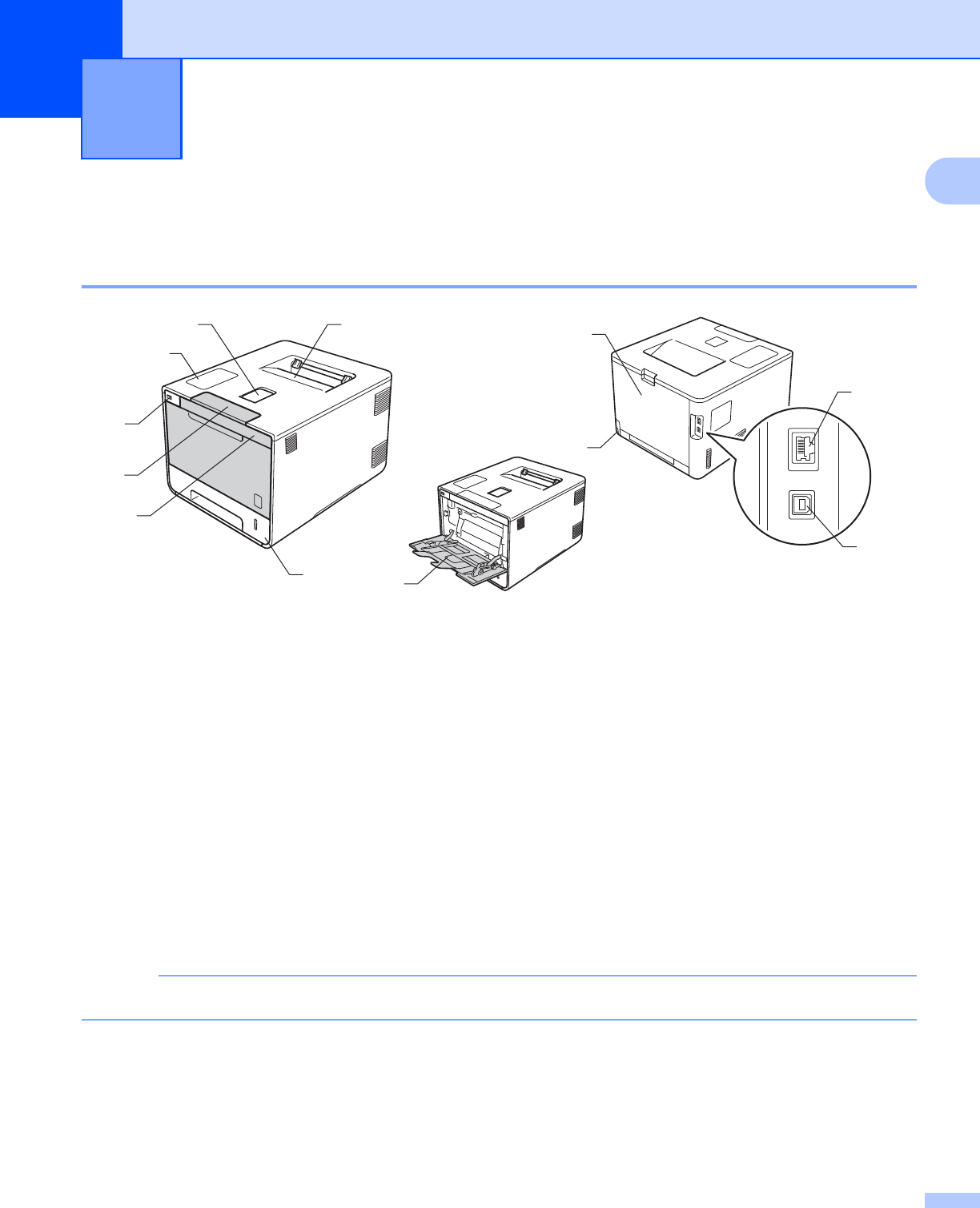
Front view and Back view 1
1 Face-down output tray support flap (support flap)
2 Control panel with a Liquid Crystal Display (LCD)
3 USB direct print interface
4 Front cover release button
5 Front cover
6 Paper tray
7 Face-down output tray
8 Multi-purpose tray (MP tray)
9 Back cover (Face-up output tray when open)
10 AC power connector
11 USB connector
12 10BASE-T/100BASE-TX port
NOTE
Most of the illustrations in this User's Guide show the HL-L8350CDW.
Printing Methods 1
1
2
10
3
4
5
7
68
9
11
12
Printing Methods
2
1
Acceptable paper and other print media 1
Print quality may vary according to the type of paper you are using.
You can use the following types of print media: plain paper, thin paper, thick paper, thicker paper, bond paper,
recycled paper, labels, envelopes or glossy paper (see Print media on page 204).
For best results, follow the instructions below:
DO NOT load different types of paper in the paper tray at the same time because it may cause paper jams
or misfeeds.
For correct printing, you must choose the same paper size in your software application as the paper in the
tray.
Avoid touching the printed surface of the paper immediately after printing.
Before you buy a lot of paper, test a small quantity to make sure that the paper is appropriate for the
machine.
Recommended paper and print media 1
Paper type and size 1
The machine feeds paper from the installed standard paper tray, multi-purpose tray or optional lower tray.
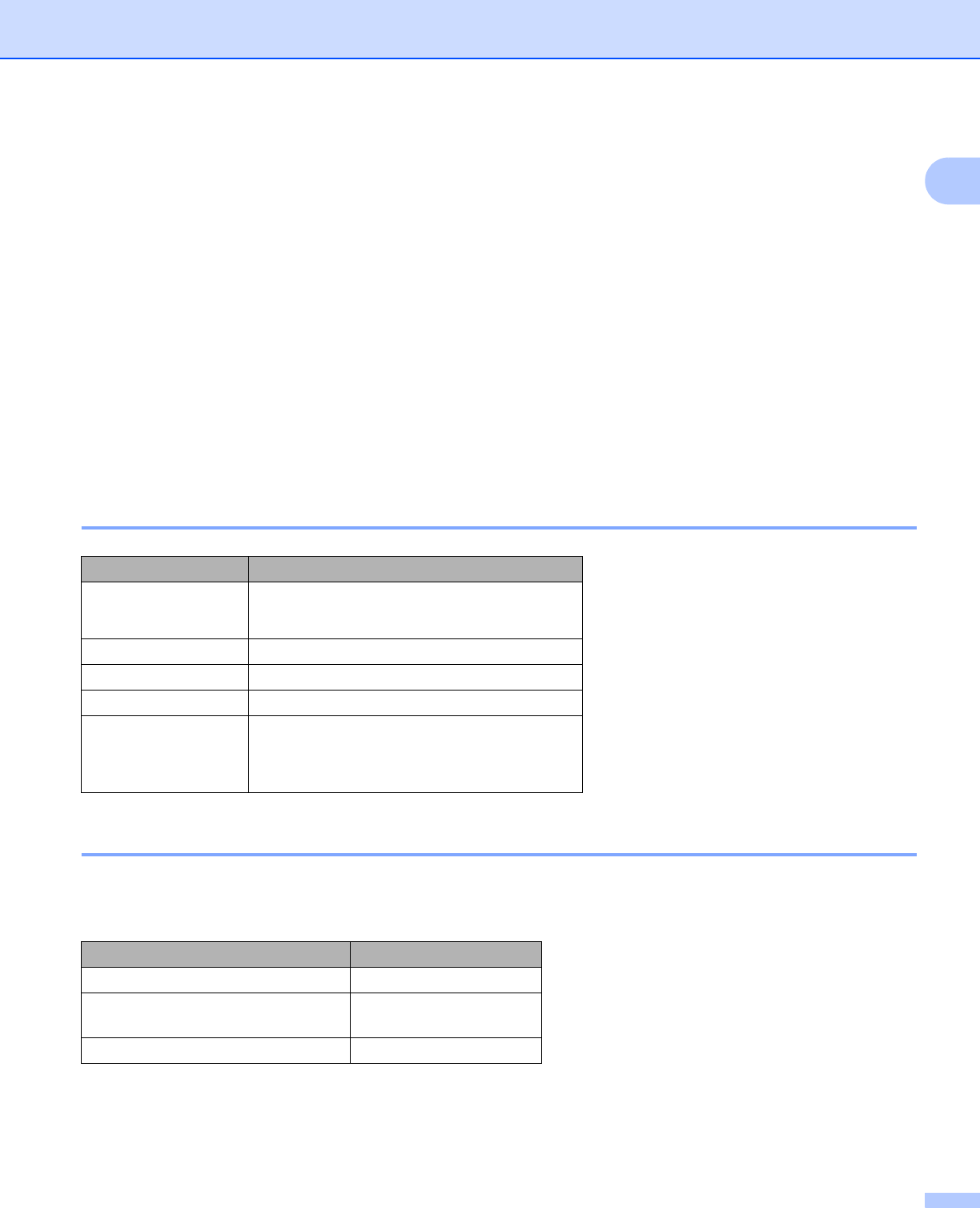
The names for the paper trays in the printer driver and this Guide are as follows:
Paper Type Item
Plain Paper Xerox 4200 20 lb
Hammermill Laser Print 24 lb (90 g/m2)
Recycled Paper (No specific brand recommended)
Labels Avery laser labels white #5160
Envelopes (No specific brand recommended)
Glossy Paper NewPage Futura Laser Gloss
80 lb Text/32 lb Bond (118 g/m2)
Xerox Digital Color Elite Gloss
Tray Name
Paper Tray Tray 1
Optional Lower Tray Unit (Standard
equipment for HL-L8350CDWT)
Tray 2
Multi-purpose Tray MP Tray
Printing Methods
3
1
1Folio size is 8.5 in. 13 in. (215.9 mm x 330.2 mm).
2Load only one sheet of Glossy in the MP tray.
3Tray 2 is standard on HL-L8350CDWT.
Recommended paper specifications 1
The following paper specifications are appropriate for this machine:
Use plain paper that is appropriate for laser machines to make copies.
Use paper that is 20 to 24 lb (75 to 90 g/m2).
Use long grain paper with a neutral Ph value, and a moisture content of approx. 5%.
This machine can use recycled paper that meets DIN 19309 specifications.
(Before you load paper in this machine, see Important information for choosing your paper on page 208.)
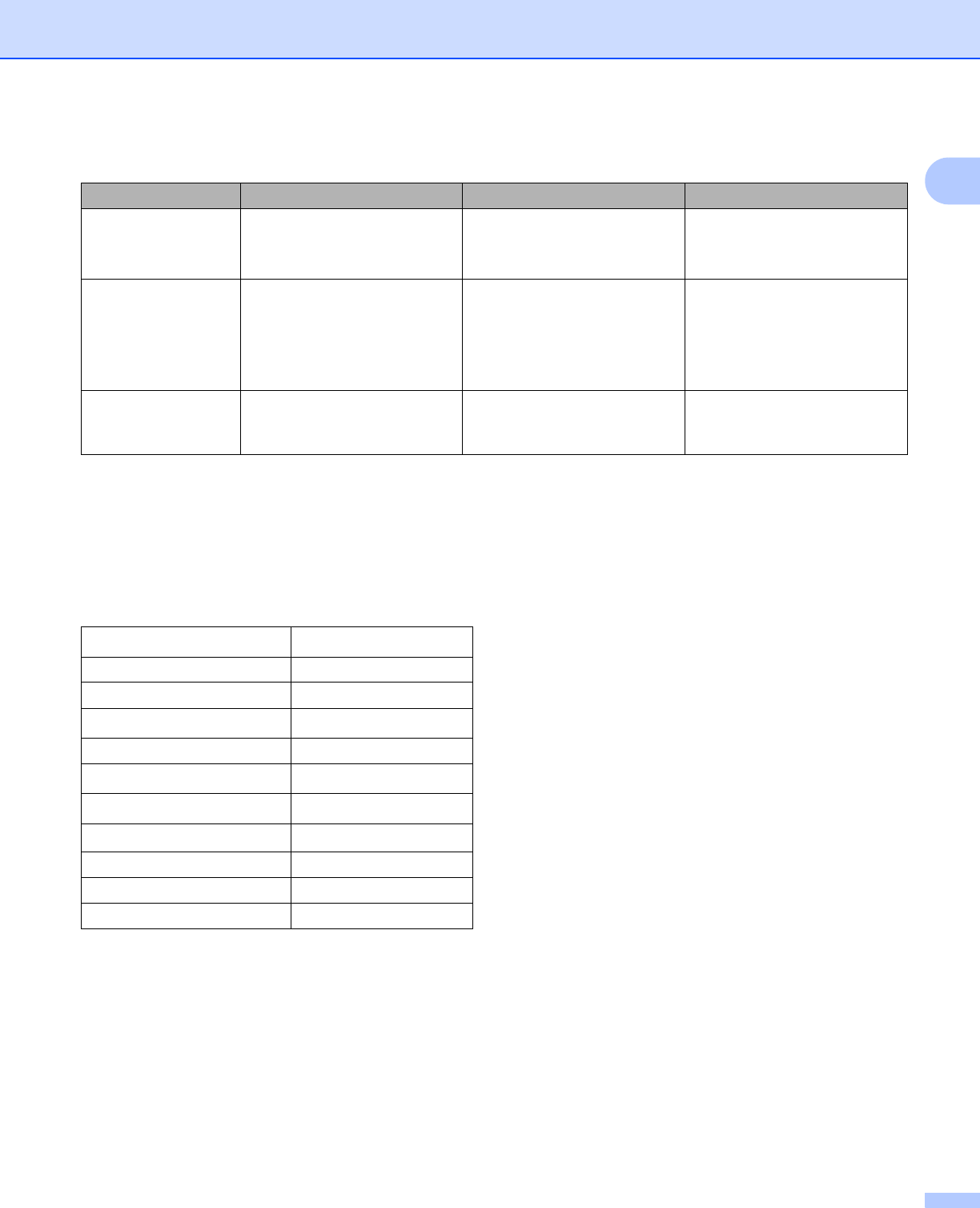
Paper Tray Capacity
Paper size Paper types No. of sheets
Paper Tray
(Tray 1)
Letter, A4, Legal, B5 (JIS),
Executive, A5,
A5 (Long Edge), A6, Folio 1
Plain Paper, Thin Paper and
Recycled Paper
up to 250 sheets
20 lb (80 g/m2)
Multi-purpose Tray
(MP Tray)
Width: 3.0 to 8.5 in.
(76.2 to 215.9 mm)
Length: 5 to 14 in.
(127 to 355.6 mm)
Plain Paper, Thin Paper,
Thick Paper, Thicker Paper,
Recycled Paper, Bond Paper,
Labels, Envelopes, Env. Thin,
Env.Thick and Glossy Paper 2
up to 50 sheets
20 lb (80 g/m2)
3 Envelopes
1 Glossy paper
Optional Lower Tray
(Tray 2) 3
Letter, A4, Legal, B5(JIS),
Executive, A5, Folio 1
Plain Paper, Thin Paper and
Recycled Paper
up to 500 sheets
20 lb (80 g/m2)
Basis Weight 20-24 lb (75-90 g/m2)
Thickness 80-110 m
Roughness Higher than 20 sec.
Stiffness 90-150 cm3/100
Grain Direction Long Grain
Volume Resistivity 10e9-10e11 ohm
Surface Resistivity 10e9-10e12 ohm-cm
Filler CaCO3 (Neutral)
Ash Content Below 23 wt%
Brightness Higher than 80%
Opacity Higher than 85%

Printing Methods
4
1
Handling and using special paper 1
The machine is designed to work well with most types of xerographic and bond paper. However, some paper
variables may have an effect on print quality or handling reliability. Always test samples of paper before
purchasing to ensure desirable performance. Store paper in its original packaging and keep it sealed. Keep
the paper flat and away from moisture, direct sunlight and heat.
Some important guidelines when selecting paper are:
DO NOT use inkjet paper because it may cause a paper jam or damage your machine.
Preprinted paper must use ink that can withstand the temperature of the machine’s fusing process 392 F
(200 C).
If you use bond paper, paper having a rough surface, or paper that is wrinkled or creased, the paper may
exhibit degraded performance.
Types of paper to avoid 1
IMPORTANT
Some types of paper may not perform well or may cause damage to your machine.
DO NOT use paper:
• that is highly textured
• that is extremely smooth or shiny
• that is curled or warped
1 A curl of 0.08 in. (2 mm) or greater may cause jams to occur.
• that is coated or has a chemical finish
• that is damaged, creased or folded
• that exceeds the recommended weight specification in this guide
• with tabs and staples
• with letterheads using low temperature dyes or thermography
• that is multipart or carbonless
• that is designed for inkjet printing
If you use any of the types of paper listed above, they may damage your machine. This damage is not
covered under any Brother warranty or service agreement.
1
1

Printing Methods
5
1
Envelopes 1
Most envelopes can be used with your machine. However, some envelopes may have feed and print-quality
problems because of the way they have been made. Envelopes should have edges with straight,
well-creased folds. Envelopes should lie flat and not be of baggy or flimsy construction. Use only quality
envelopes from a supplier who understands that you will be using the envelopes in a laser machine.
We recommend printing a test envelope to make sure the print results are what you want.
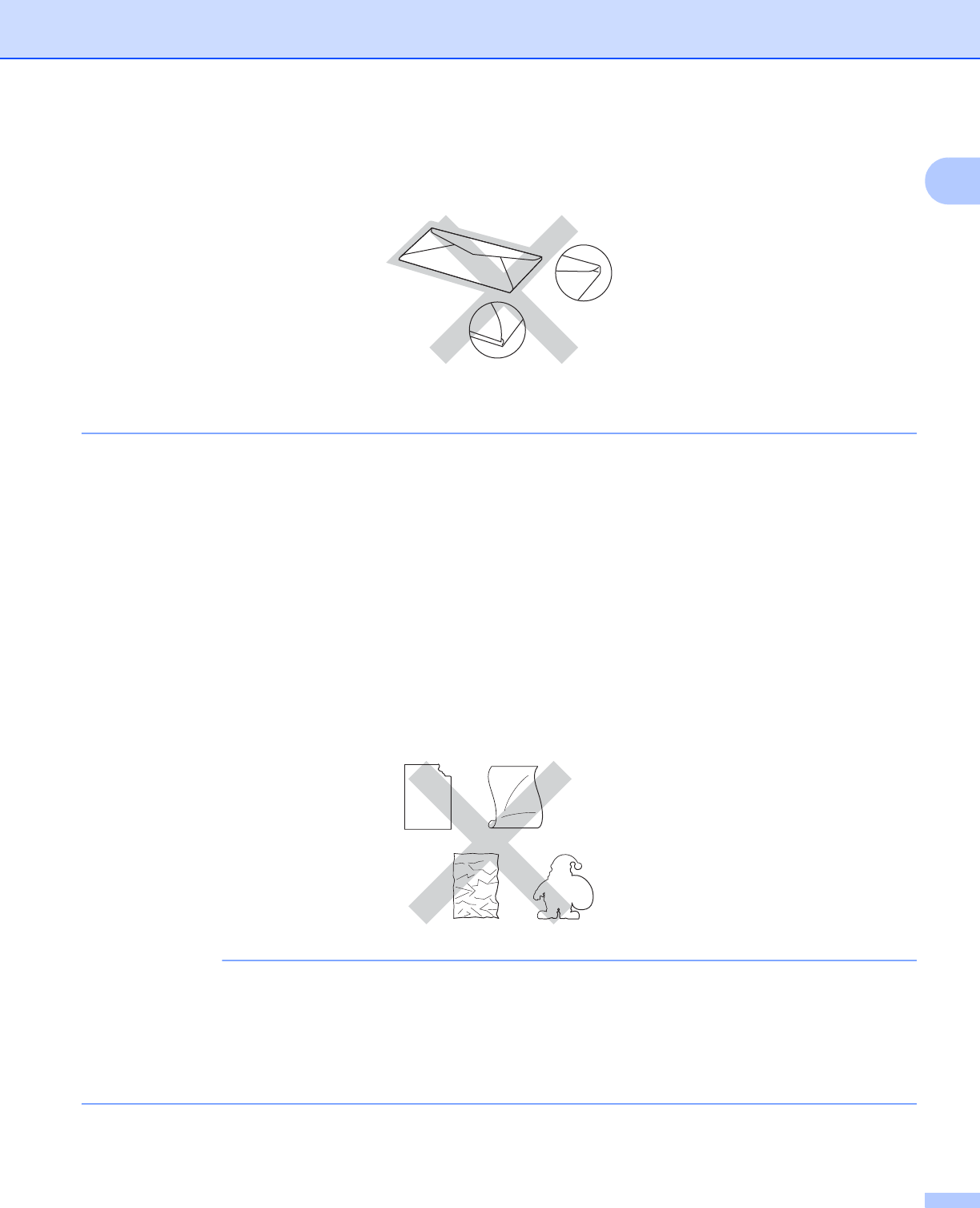
Types of envelopes to avoid 1
IMPORTANT
DO NOT use envelopes:
• that are damaged, curled, wrinkled or an unusual shape
• that are extremely shiny or textured
• with clasps, staples, snaps or tie strings
• with self-adhesive closures
• that are of a baggy construction
• that are not sharply creased
• that are embossed (have raised writing on them)
• that were previously printed by a laser printer
• that are pre-printed on the inside
• that cannot be arranged neatly when stacked
• that are made of paper that weighs more than the paper weight specifications for the machine
• with edges that are not straight or consistently square
• with windows, holes, cut-outs or perforations
• with glue on the surface as shown in the figure below
• with double flaps as shown in the figure below
Printing Methods
6
1
• with sealing flaps that are not folded down when purchased
• with each side folded as shown in the figure below
If you use any of the types of envelopes listed above, they may damage your machine. This damage may
not be covered under any Brother warranty or service agreement.
Labels 1
Most labels can be used with your machine. Labels should have an adhesive that is acrylic-based since this
material is more stable at the high temperatures in the fuser unit. Adhesives should not come in contact with
any part of the machine, because the label stock may stick to the drum unit or rollers and cause jams and
print quality problems. No adhesive should be exposed between the labels. Labels should be arranged so
that they cover the entire length and width of the sheet. Using labels with spaces may result in labels peeling
off and causing serious jams or print problems.
All labels used in this machine must be able to withstand a temperature of 392 F (200 C) for a period of 0.1
seconds.
Types of labels to avoid 1
Do not use labels that are damaged, curled, wrinkled or an unusual shape.
IMPORTANT
• DO NOT feed partially used label sheets or labels with the carrier sheet exposed because your machine
will be damaged.
• DO NOT reuse or insert labels that have been used previously or are missing a few labels on the sheet.
• Label sheets should not exceed the paper weight specifications described in this User's Guide. Labels
exceeding this specification may not feed or print correctly and may cause damage to your machine.
Printing Methods
7
1
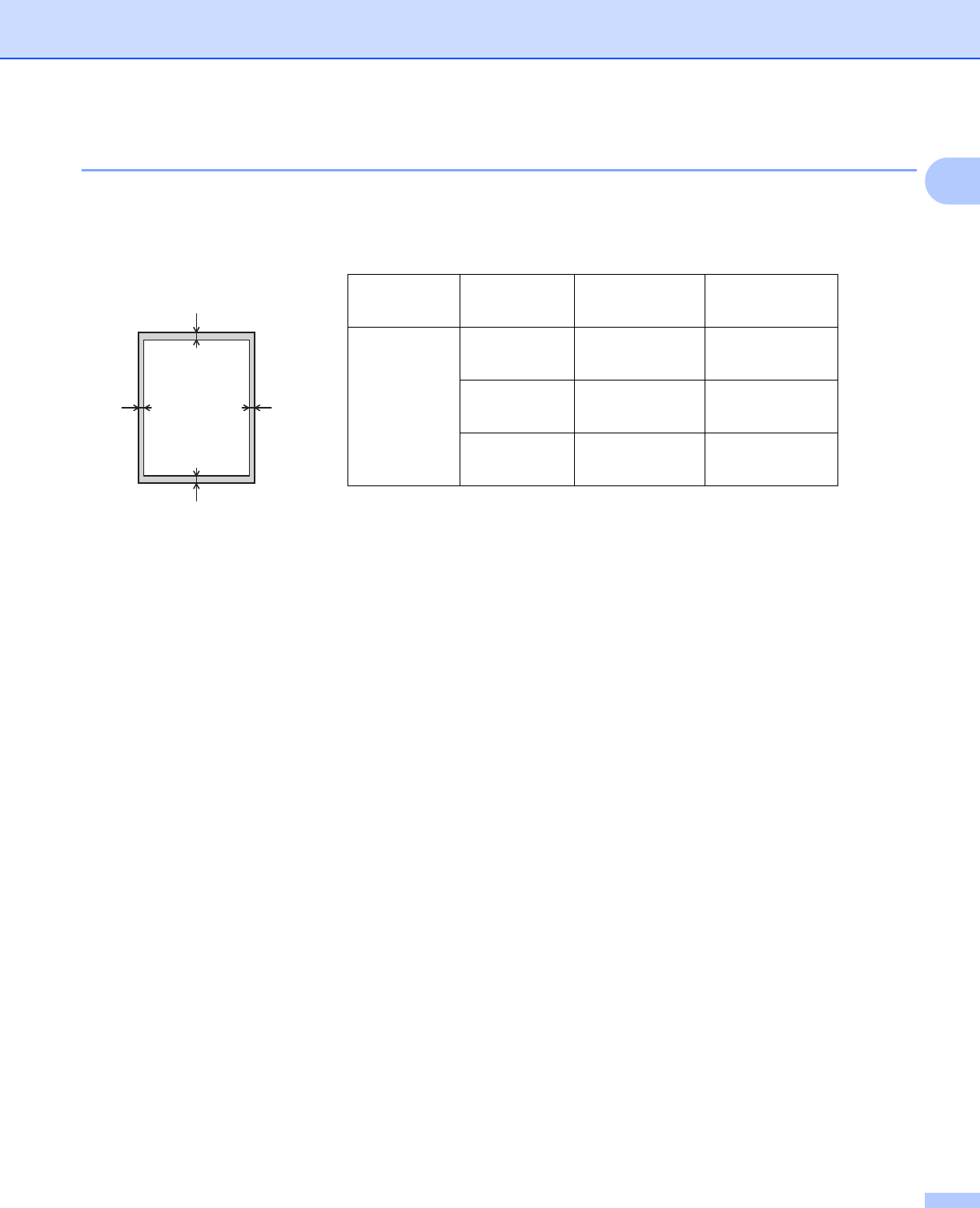
Unprintable area when printing from a computer 1
The figures below show maximum unprintable areas. The unprintable areas may vary depending on the
paper size or settings in the application you are using.
Usage Document
Size
Top (1)
Bottom (3)
Left (2)
Right (4)
Print Letter 0.16 in.
(4.23 mm)
0.16 in.
(4.23 mm)
A4 0.16 in.
(4.23 mm)
0.16 in.
(4.23 mm)
Legal 0.16 in.
(4.23 mm)
0.16 in.
(4.23 mm)
1
3
24
Printing Methods
8
1
Loading paper 1
Loading paper and print media 1
The machine can feed paper from the standard paper tray, multi-purpose tray or optional lower tray.
When you load paper into the paper tray, note the following:
If your application software supports paper size selection on the print menu, you can select it through the
software. If your application software does not support it, you can set the paper size in the printer driver or
by using the control panel buttons.
Loading paper in the standard paper tray and the optional lower tray 1
Load up to 250 sheets of paper in the standard paper tray (Tray 1). You can also load up to 500 sheets in the
optional lower tray (Tray 2) 1. Paper can be loaded up to the maximum paper mark ( ) on the right side
of the paper tray. (For the recommended paper to use, see Acceptable paper and other print media
on page 2.)
1Tray 2 is standard on HL-L8350CDWT.
Printing on plain paper, thin paper, or recycled paper from Tray 1 and Tray 2 1
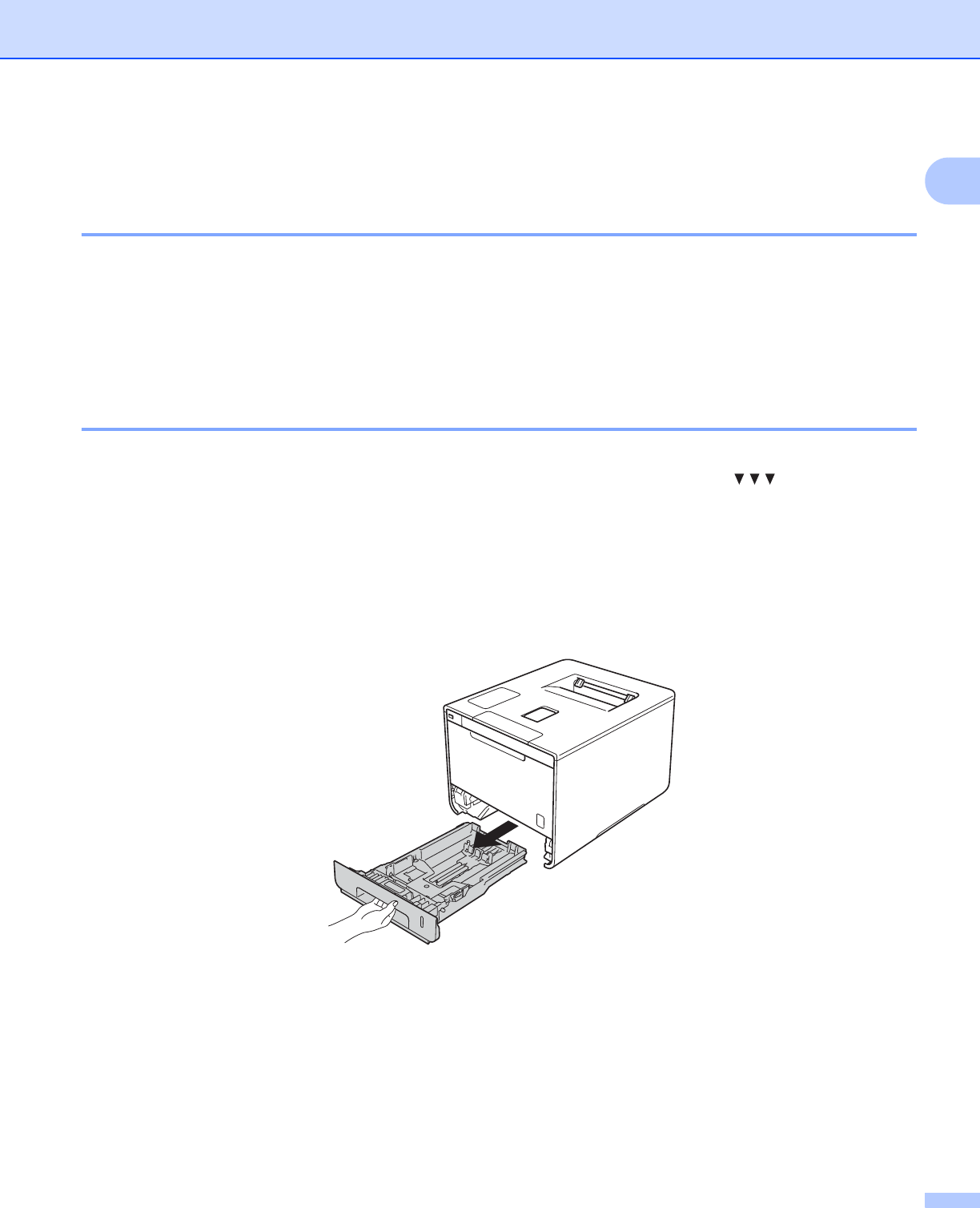
aPull the paper tray completely out of the machine.
Printing Methods
9
1
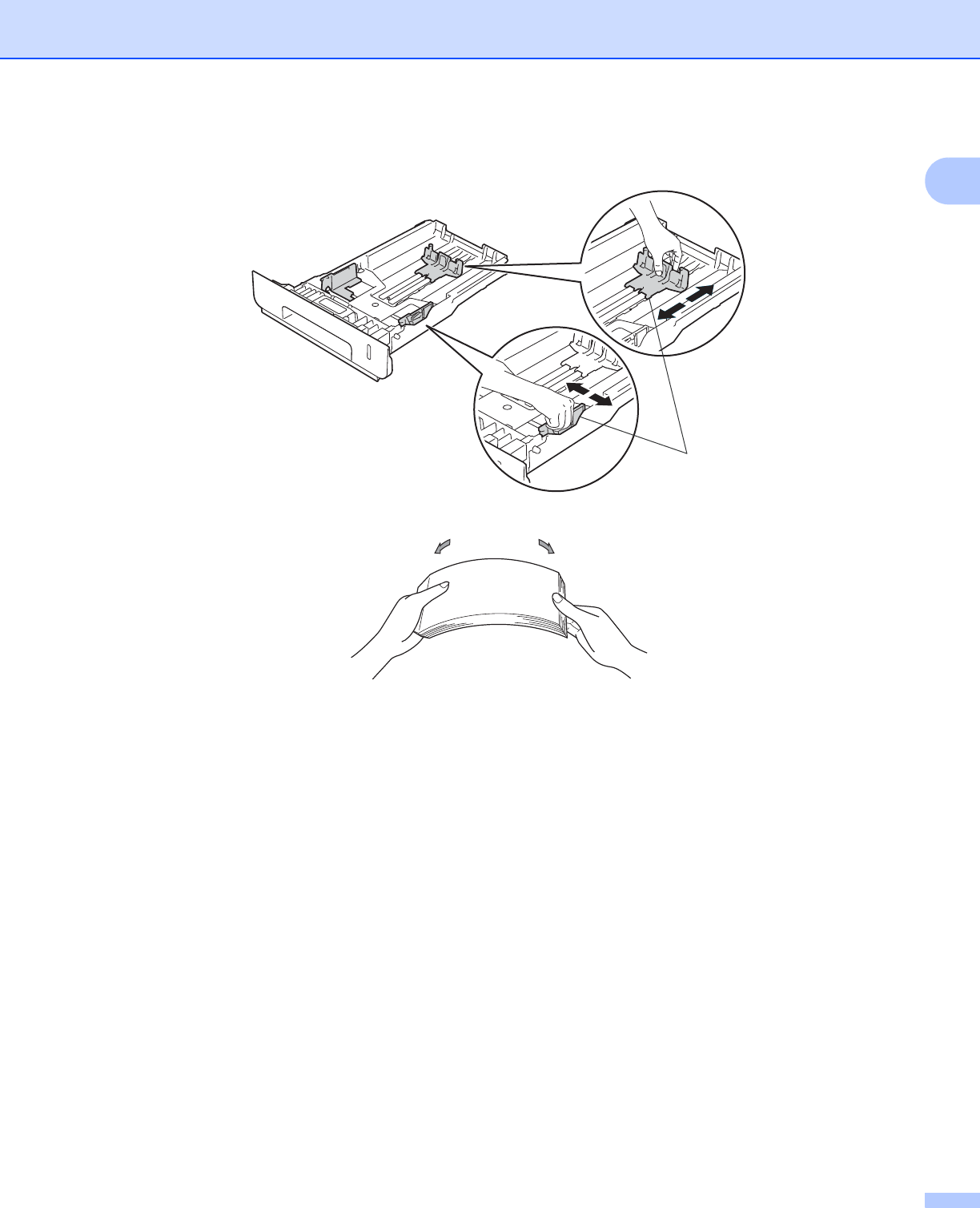
bWhile pressing the blue paper-guide release levers (1), slide the paper guides to fit the size of paper you
are loading in the tray. Make sure that the guides are firmly in the slots.
cFan the stack of paper well to avoid paper jams and misfeeds.
1
Printing Methods
10
1
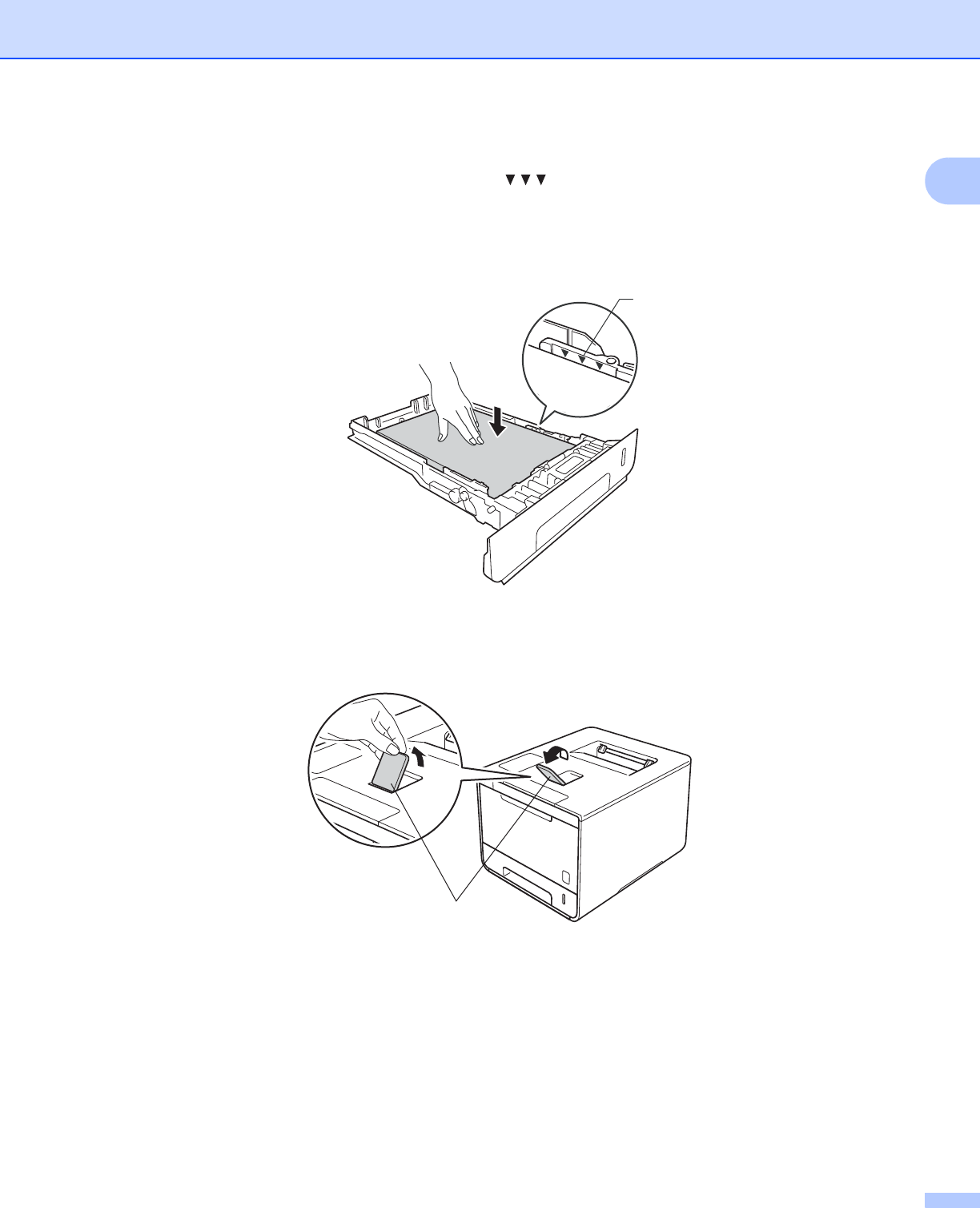
dLoad paper in the tray and make sure:
The paper is below the maximum paper mark ( ) (1).
Over filling the paper tray will cause paper jams.
The side to be printed on is face down.
The paper guides touch the sides of the paper so it will feed correctly.
ePut the paper tray firmly back in the machine. Make sure that it is completely inserted into the machine.
fLift up the support flap (1) to prevent paper from sliding off the face-down output tray, or remove each
page as soon as it comes out of the machine.
1
1

Printing Methods
11
1
gChange the printer driver settings for your operating system (for details, see Chapter 2: Driver and
Software).
Choose the option you want from each of the following drop-down lists:
Paper Size
A4
Letter
Legal
Executive
A5
JIS B5
Folio
A5 Long Edge
A6
For the acceptable paper sizes, see Paper type and size on page 2.
Media Type
Plain Paper
Thin Paper
Recycled Paper
Paper Source
Tray1
Tray2 (if available)
For other settings, see Chapter 2: Driver and Software.
NOTE
The name of options in the drop-down lists may vary depending on your operating system and its version.
hSend the print job to the machine.
Printing Methods
12
1
Loading paper in the multi-purpose tray (MP tray) 1
You can load up to three envelopes, one sheet of glossy paper, other special print media, or up to 50 sheets
of plain paper in the MP tray. Use this tray to print on thick paper, bond paper, labels, envelopes or glossy
paper. (For the recommended paper to use, see Acceptable paper and other print media on page 2.)
Printing on plain paper, thin paper, recycled paper, bond paper, or glossy paper from the MP
tray 1
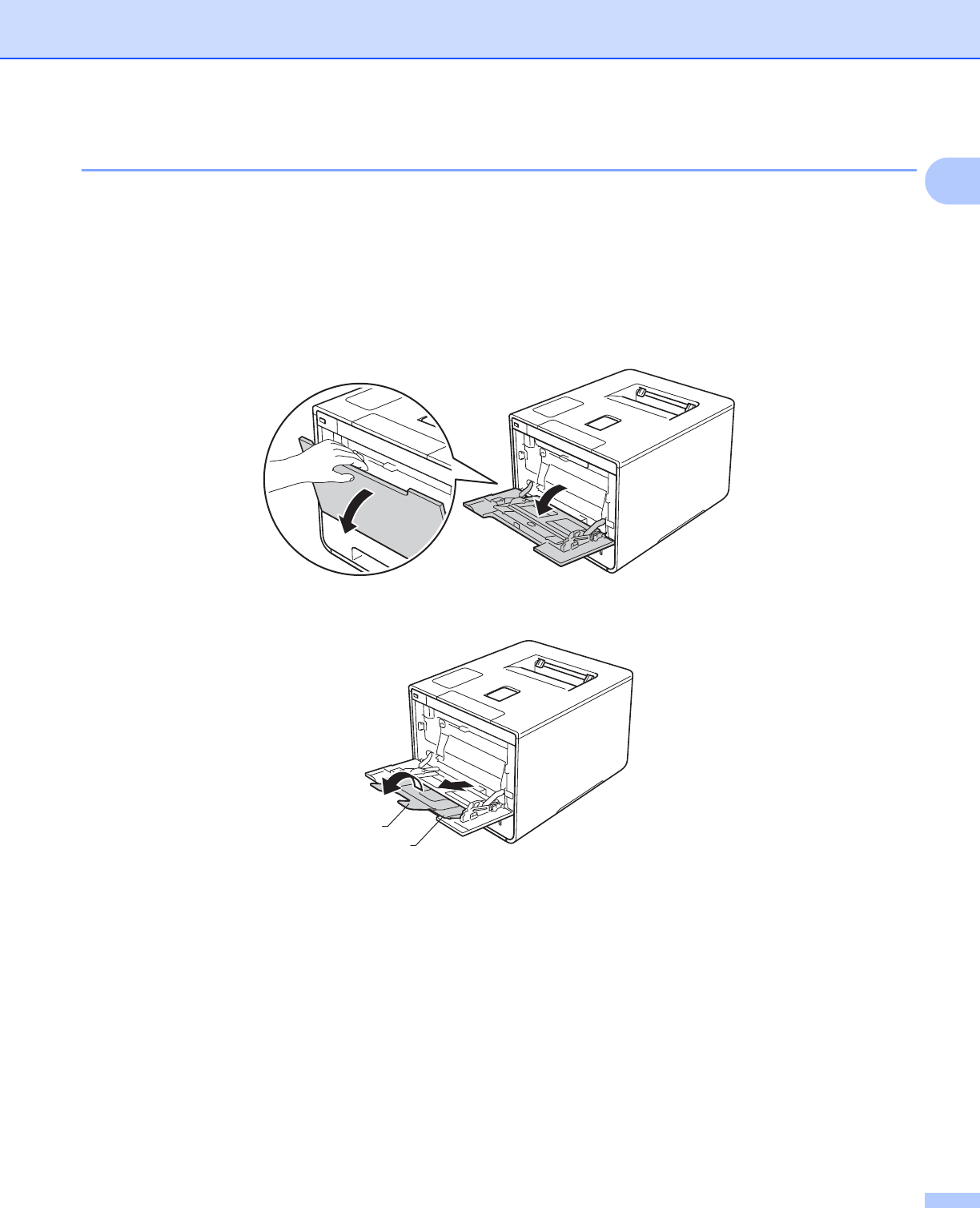
aOpen the MP tray and lower it gently.
bPull out the MP tray support (1) and unfold the flap (2).
2
1
Printing Methods
13
1
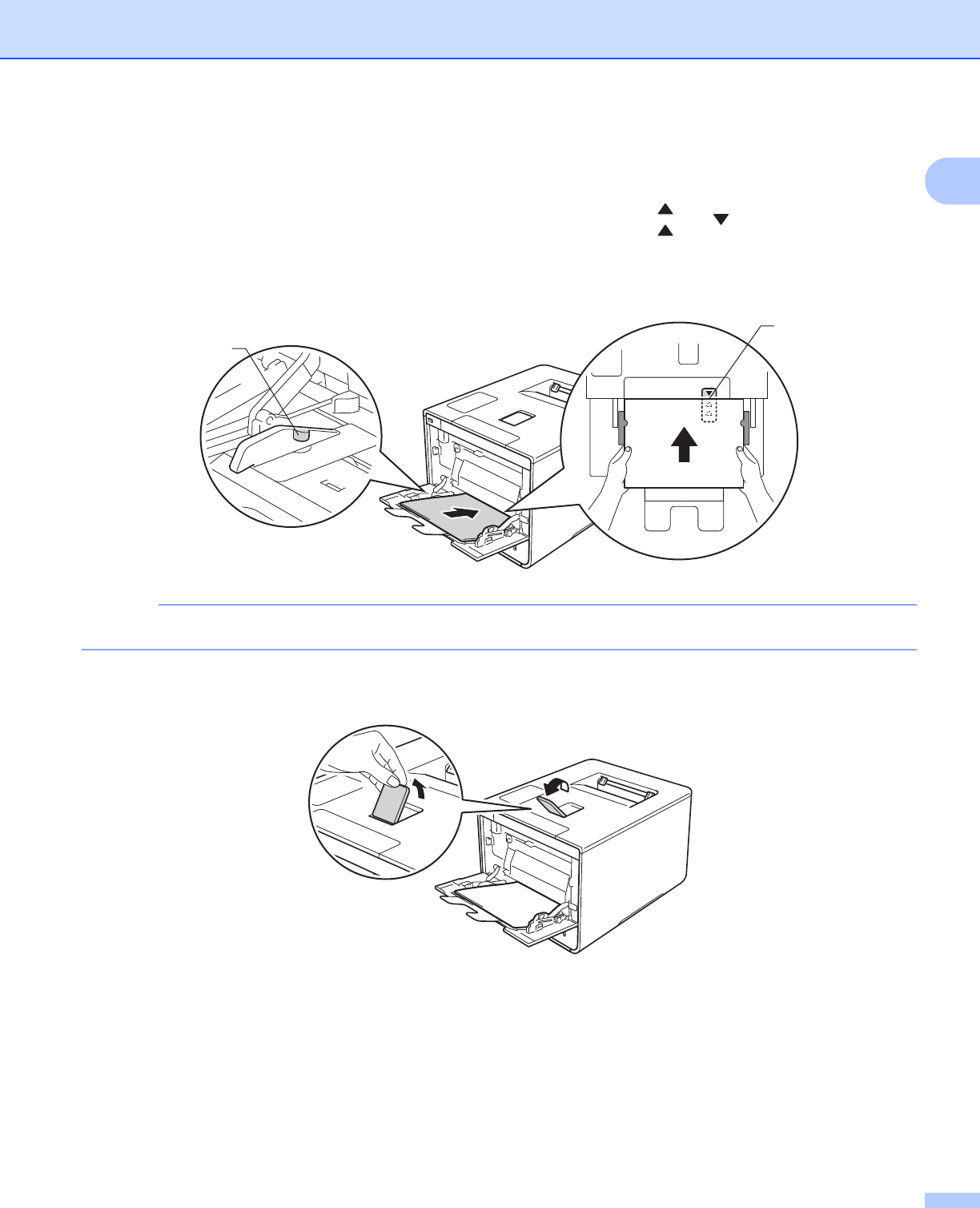
cLoad paper in the MP tray, making sure:
The paper stays under the maximum paper tab (1).
The paper's leading edge (top of paper) is positioned between the and arrows (2).
The side to be printed on must be face up with the leading edge in first.
The paper guides touch the sides of the paper so it will feed properly.
NOTE
When you are using glossy paper, load only one sheet at a time in the MP tray to avoid a paper jam.
dLift up the support flap to prevent paper from sliding off the face-down output tray, or remove each page
as soon as it comes out of the machine.
1
2

Printing Methods
14
1
eChange the printer driver settings for your operating system (for details, see Chapter 2: Driver and
Software).
Choose the option you want from each of the following drop-down lists:
Paper Size
A4
Letter
Legal
Executive
A5
A5 Long Edge
A6
B5
JIS B5
3 x 5
Folio
Customized paper size 1
1You can define your original paper size by choosing User Defined... in Windows® printer driver, PostScript Custom Page Size in
BR-Script printer driver for Windows®, or Manage Custom Sizes... in Macintosh printer drivers.
For the acceptable paper sizes, see Paper type and size on page 2.
Media Type
Plain Paper
Thin Paper
Recycled Paper
Bond Paper
Glossy Paper
Paper Source
MP Tray
For other settings, see Chapter 2: Driver and Software.
NOTE
The names of options in the drop-down lists may vary depending on your operating system and its version.
fSend the print job to the machine.
Printing Methods
15
1
Printing on thick paper, labels and envelopes from the MP tray 1
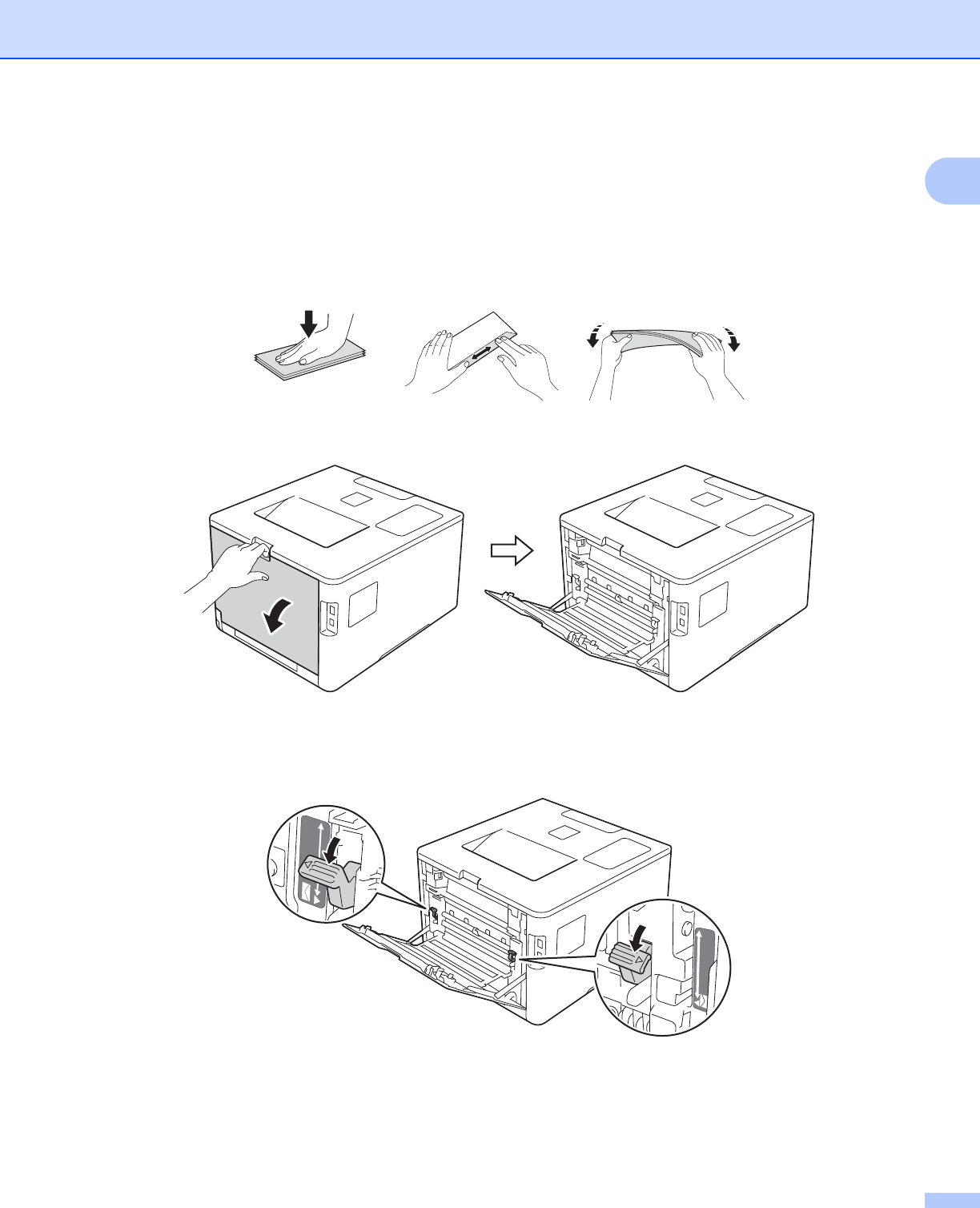
When the back cover (face-up output tray) is pulled down, the machine has a straight paper path from the MP
tray through to the back of the machine. Use this paper feed and output method when you print on thick paper,
labels, or envelopes. (For the recommended paper to use, see Acceptable paper and other print media
on page 2 and Envelopes on page 5.)
Before loading, press the corners and sides of the envelopes to make them as flat as possible.
aOpen the back cover (face-up output tray).
b(For printing envelopes only)
Pull down the two gray levers, one on the left side and one on the right side, toward you as shown in the
illustration.
Printing Methods
16
1
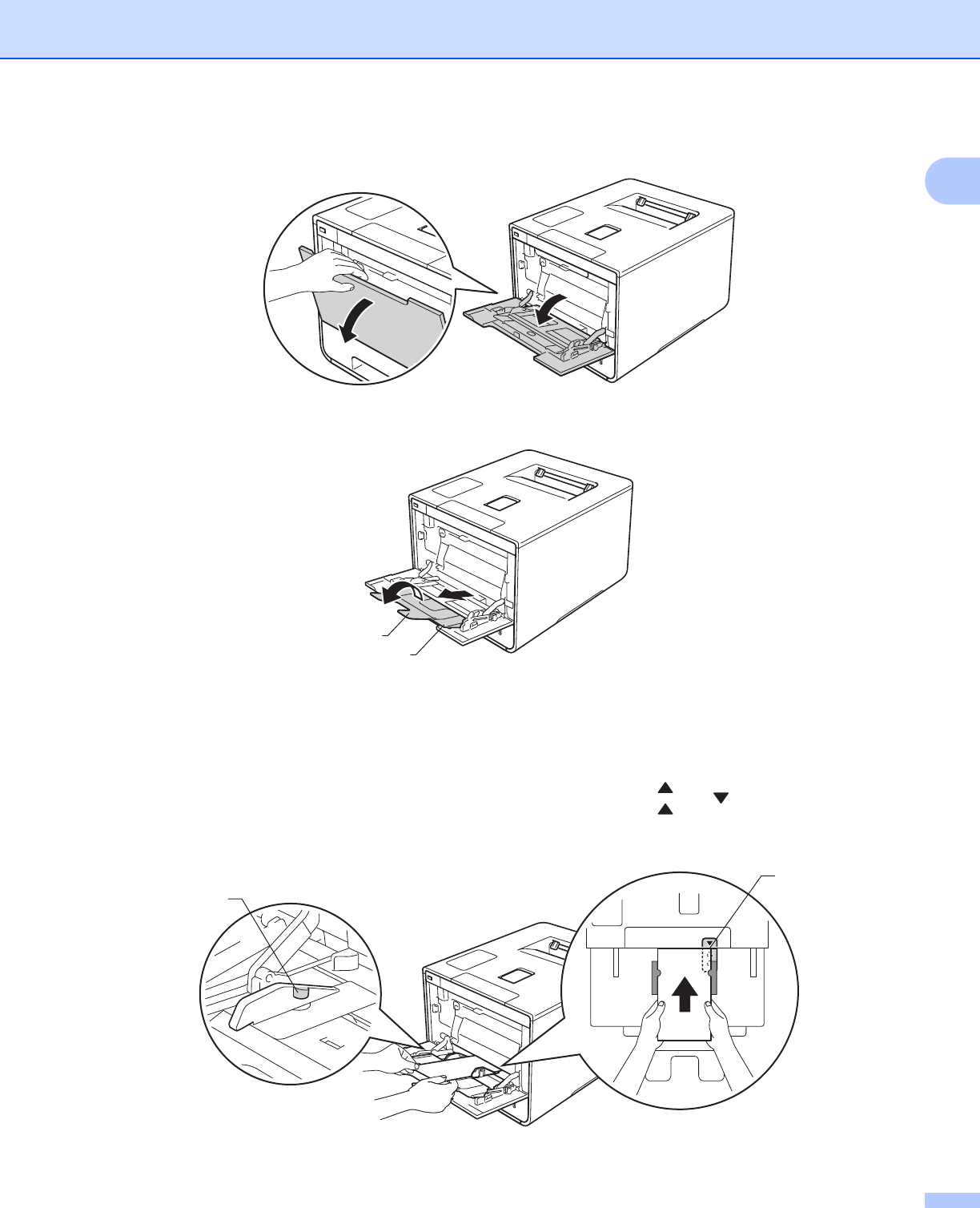
cOpen the MP tray and lower it gently.
dPull out the MP tray support (1) and unfold the flap (2).
eLoad paper, labels, or envelopes in the MP tray, making sure:
The number of envelopes in the MP tray does not exceed three.
The paper, labels or envelopes stay under the maximum paper tab (1).
The paper's leading edge (top of paper) is positioned between the and arrows (2).
The side to be printed on is face up.
2
1
1
2

Printing Methods
17
1
fChange the printer driver settings for your operating system (for details, see Chapter 2: Driver and
Software).
Choose the option you want from each of the following drop-down lists:
Paper Size
For printing thick paper or labels
A4
Letter
Legal
Executive
A5
A5 Long Edge
A6
B5
JIS B5
3 x 5
Folio
Customized paper size 1
For printing envelopes
Com-10
DL
C5
Monarch
Customized paper size 1
1You can define your original paper size by choosing User Defined... in Windows® printer driver, PostScript Custom Page Size in
BR-Script printer driver for Windows®, or Manage Custom Sizes... in Macintosh printer drivers.
For the acceptable paper sizes, see Paper type and size on page 2.

Printing Methods
18
1
Media Type
For printing thick paper
Thick Paper
Thicker Paper
For printing labels
Label
For printing envelopes
Envelopes
Env. Thin
Env. Thick
Paper Source
MP Tray
For other settings, see Chapter 2: Driver and Software.
NOTE
• The name of options in the drop-down lists may vary depending on your operating system and its version.
• When you use Envelope #10, choose Com-10 (for Windows®) or Envelope #10 (for Macintosh) from the
Paper Size drop-down list.
• For other envelopes that are not listed in the printer driver, such as Envelope #9 or Envelope C6, choose
User Defined... (for Windows® printer driver), PostScript Custom Page Size (for BR-Script printer driver
for Windows®), or Manage Custom Sizes... (for Macintosh printer driver).
gSend the print job to the machine.
NOTE
• Remove each envelope as soon as it has been printed. Stacking the envelopes may cause them to jam
or curl.
• If envelopes or thick paper get smudged during printing, set the Media Type to Env. Thick or Thicker
Paper to increase the fixing temperature.
• If the envelopes are creased after they are printed, see Improving the print quality on page 192.
• If your thick paper curls during printing, load only one sheet at a time in the MP tray.
• Envelope joints that are sealed by the manufacturer should be secure.
• All sides of the envelope should be properly folded without wrinkles or creases.


Printing Methods
20
1
2-sided printing 1
The supplied printer drivers all enable 2-sided printing.
Guidelines for printing on both sides of the paper 1
If the paper is thin, it may wrinkle.
If paper is curled, straighten it and put it back in the paper tray. If the paper continues to curl, replace the
paper.
If the paper is not feeding correctly, it may be curled. Remove the paper and straighten it. If the paper
continues to curl, replace the paper.
When you use the manual 2-sided setting, it is possible that there may be paper jams or poor print quality.
(If the paper jams, see Paper jams on page 176. If you have a print quality problem, see Improving the
print quality on page 192.)
NOTE
Make sure that the paper tray is completely inserted in the machine.

Printing Methods
21
1
Automatic 2-sided printing 1
If you are using the Macintosh Printer Driver, see 2-sided Printing on page 75.
Automatic 2-sided printing using the Windows® printer driver 1
a
Change the printer driver settings for your operating system (for details, see
Chapter 2: Driver and Software).
Choose the option you want from each of the following drop-down lists:
Paper Size
Letter
Legal
Folio
Media Type
Plain Paper
Recycled Paper
Thin Paper
Glossy Paper (MP Tray only)
Paper Source
Tray1
MP Tray
Tray2 (if available)
2-sided / Booklet
2-sided
2-sided Type in 2-sided Settings
There are four options for each orientation (see 2-sided / Booklet on page 38).
Binding Offset in 2-sided Settings
Specify the offset for binding (see 2-sided / Booklet on page 38).
NOTE
• Do not use bond paper.
• The name of options in the drop-down lists may vary depending on your operating system and its version.
For other settings, see Chapter 2: Driver and Software.
bSend the print job to the machine. The machine will print on both sides of the paper automatically.

Printing Methods
22
1
Automatic 2-sided printing using the BR-Script printer driver for Windows®
1
a
Change the printer driver settings for your operating system (for details,
see Chapter 2: Driver and Software).
Choose the option you want from each of the following drop-down lists:
Paper Size
Letter
Legal
Folio
Media Type
Plain Paper
Recycled Paper
Thin Paper
Glossy Paper (MP Tray only)
Paper Source
Tray1
MP Tray
Tray2 (if available)
Print on Both Sides
Flip on Short Edge
Flip on Long Edge
Page Order
Front to Back
Back to Front
NOTE
• Do not use bond paper.
• The name of options in the drop-down lists may vary depending on your operating system and its version.
For other settings, see Chapter 2: Driver and Software.
bSend the print job to the machine. The machine will print on both sides of the paper automatically.

Printing Methods
23
1
Manual 2-sided printing 1
The BR-Script printer driver for Windows® does not support manual 2-sided printing.
If you are using the Macintosh Printer Driver, see Manual 2–sided Printing on page 75.
Manual 2-sided printing using the Windows® printer driver 1
a
Change the printer driver settings for your operating system (for details, see
Chapter 2: Driver and Software).
Choose the option you want from each of the following drop-down lists:
Paper Size
You can use all the paper sizes specified for the tray you are using.
Media Type
You can use all the media types that are specified for the tray you are using, except envelopes and
labels, which have only one print side.
Paper Source
Tray1
MP Tray
Tray2 (if available)
2-sided / Booklet
2-sided (Manual)
2-sided Type in 2-sided Settings
There are four options for each orientation (see 2-sided / Booklet on page 38).
Binding Offset in 2-sided Settings
Specify the offset for binding (see 2-sided / Booklet on page 38).
For other settings, see Chapter 2: Driver and Software.
bSend the print job to the machine. The machine will print all the even-numbered pages on one side of
the paper first. Then, the Windows® driver instructs you (with a pop-up message) to reinsert the paper
to print the odd-numbered pages.
NOTE
Before reinserting the paper, straighten it well, or you may get a paper jam. Very thin or thick paper is not
recommended.

Printing Methods
24
1
Printing from a USB flash drive or digital camera supporting
mass storage 1
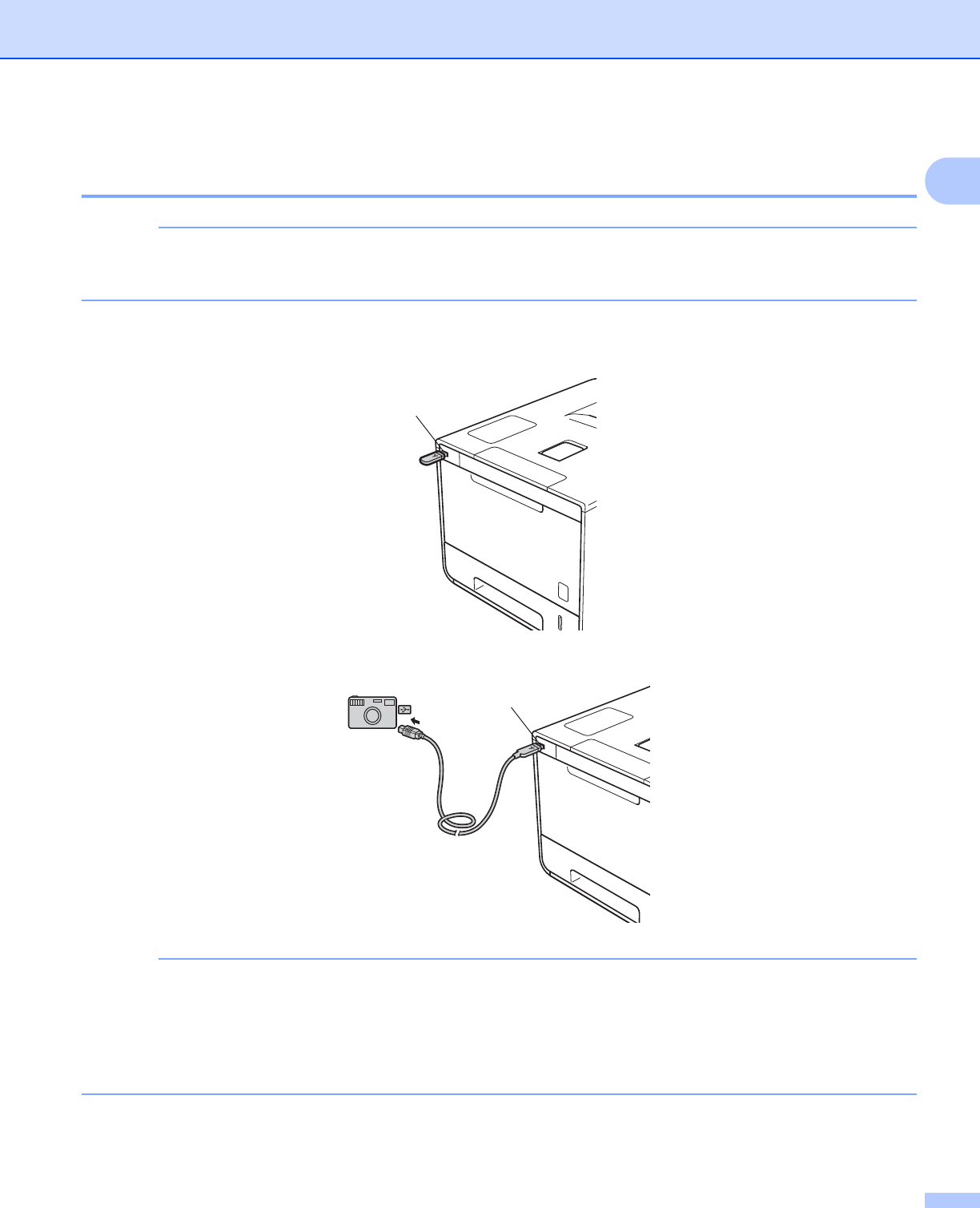
With the Direct Print feature, you do not need a computer for printing. You can print by just plugging your USB
flash drive into the machine’s USB direct interface. You can also connect and print directly from a camera set
to USB mass storage mode.
You can use a USB flash drive that has the following specifications:
1NTFS format is not supported.
NOTE
• Some USB flash drives may not work with the machine.
• If your camera is in PictBridge mode, you cannot print from it. See the documentation supplied with your
camera to switch from PictBridge mode to mass storage mode.
USB Class USB Mass Storage Class
USB Mass Storage Sub Class SCSI or SFF-8070i
Transfer protocol Bulk transfer Only
Format 1FAT12/FAT16/FAT32
Sector size Max. 4096 Byte
Encryption Encrypted devices are not supported.
Printing Methods
25
1
Creating a PRN file for direct printing 1
NOTE
The screens in this section may vary depending on your application and operating system.
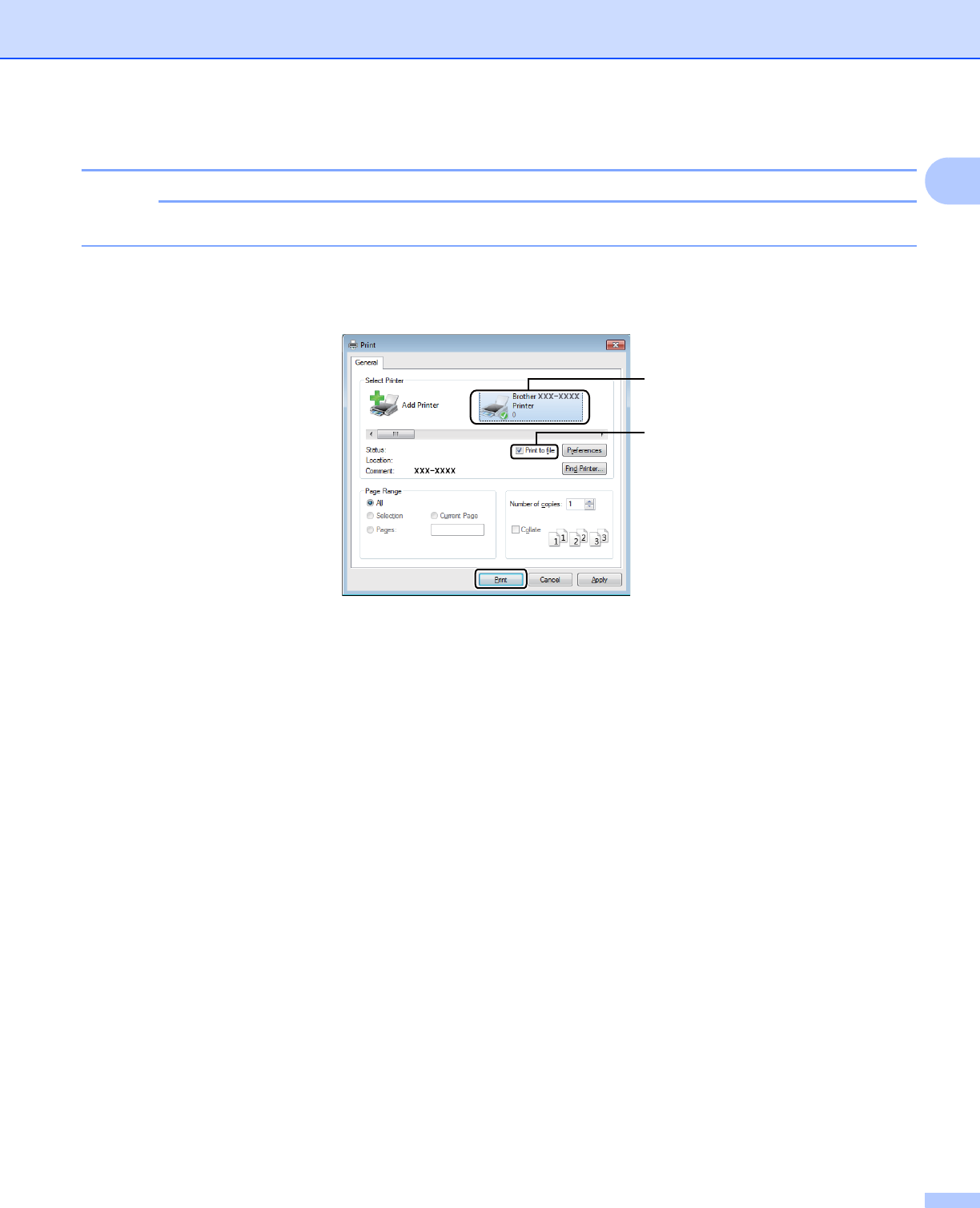
aFrom the menu bar of an application, click File, then Print.
bChoose Brother HL-XXXX Printer (1) and check the Print to file box (2). Click Print.
cChoose the folder you want to save the file to and type the file name if prompted.
If you are prompted for a file name only, you can also specify the folder you want to save the file in by
typing the directory name. For example: C:\Temp\FileName.prn
If a USB flash drive is connected to your computer, you can save the file directly to the USB flash drive.
2
1
Printing Methods
26
1
Printing directly from the USB flash drive or digital camera supporting mass
storage 1
NOTE
• Make sure your digital camera is turned on.
• Your digital camera must be switched from PictBridge mode to mass storage mode.
aConnect your USB flash drive or digital camera to the USB direct interface (1) on the front of the machine.
The LCD displays the Checking Device message.
NOTE
• When the machine is in the Deep Sleep mode, the LCD does not show any information even if you
connect a USB flash drive to the USB direct interface connector. Press any of the Menu buttons to wake
up the machine.
• If your machine has been set to Secure Function Lock On, you may not be able to access Direct Print
(see the Network User's Guide).
1
1

Printing Methods
27
1
bPress aor b ( + or -) to choose the folder name or file name you want to print.
If you have selected the folder name, press OK. Press aor b ( + or -) to choose the file name, and then
press OK.
NOTE
To print an index of the files, press aor b ( + or -) to choose Index Print. Press OK or Go to start
printing.
cDo one of the following:
To change the current settings, Go to step d.
If you do not want to change the current settings, press Go. Go to step f.
d
Press
a
or
b
(
+
or
-
) to display the setting you want to change, and then press
OK. Press
a
or
b
(
+
or
-
)
to select the option you want, and then press
OK
.
NOTE
• You can choose the following settings:
Paper Size
Media Type
Multiple Page
Orientation
2-sided
Collate
Tray Use
Print Quality
PDF Option
Output Color
• Depending on the file type, some of these settings may not appear.
eDo one of the following:
To change another setting, repeat step d.
If you do not want to change other settings, press Go and go to step f.
fPress aor b ( + or -) to enter the number of copies you want.

Printing Methods
28
1
gPress OK or Go to start printing.
IMPORTANT
• To prevent damage to your machine, DO NOT connect any device other than a digital camera or USB
flash drive to the USB direct interface.
• DO NOT remove the USB flash drive or digital camera from the USB direct interface until the machine
has finished printing.
NOTE
You can change the default settings for Direct Print by using the control panel when the machine is not in
the Direct Print mode. Press aor b ( + or -) to enter the Direct Print menu. (See Direct Print
on page 102.)

29
2
2
Printer driver 2
A printer driver is software that translates data from the format used by a computer to the format that a
particular printer needs. Typically, this format is page description language (PDL).
The printer drivers for the supported versions of Windows® and Macintosh are on the CD-ROM we have
supplied (Windows® only) or on the Brother Solutions Center website at http://solutions.brother.com/. Install
the drivers by following the steps in the Quick Setup Guide. The latest printer drivers can be downloaded from
the Brother Solutions Center website at:
http://solutions.brother.com/
For Windows®
2
Windows® printer driver (the recommended printer driver for this product)
BR-Script printer driver (PostScript® 3™ language emulation) 1
1Install the driver using the Custom Install from the CD-ROM.
For Macintosh 1
2
Macintosh printer driver (the recommended printer driver for this product)
BR-Script printer driver (PostScript® 3™ language emulation) 2
1To download the printer driver for Macintosh, please visit your model page at http://solutions.brother.com/.
2For the installation instruction of the driver, visit http://solutions.brother.com/.
For Linux®12
2
LPR printer driver
CUPS printer driver
1For more information and to download the printer driver for Linux, please visit your model page at http://solutions.brother.com/ or use the link on
the CD-ROM we have supplied.
2Depending on Linux distributions, the driver may not be available or it may be released after the initial release of your model.
Driver and Software 2

Driver and Software
30
2
Printing a document 2
When the machine receives data from your computer, it begins printing by picking up paper from the paper
tray, multi-purpose tray or optional lower tray. The multi-purpose tray can feed many types of paper and
envelopes (see Paper Tray Capacity on page 3).
aFrom your application, choose the Print command.
If other printer drivers are installed on your computer, choose Brother HL-XXXX series (where XXXX
is your model name) as your printer driver from the Print or Print Settings menu in your software
application, and then click OK or Print to begin printing.
bYour computer sends the print job to the machine. The Data LED will blink and the LCD will show
Printing.
cWhen the machine finishes printing all the jobs, the Data LED finishes blinking.
NOTE
• Select the paper size and orientation in your application software.
• If your application software does not support your custom paper size, choose the next largest paper size.
• Then adjust the print area by changing the right and left margins in your application software.
Driver and Software
31
2
Printer driver settings 2
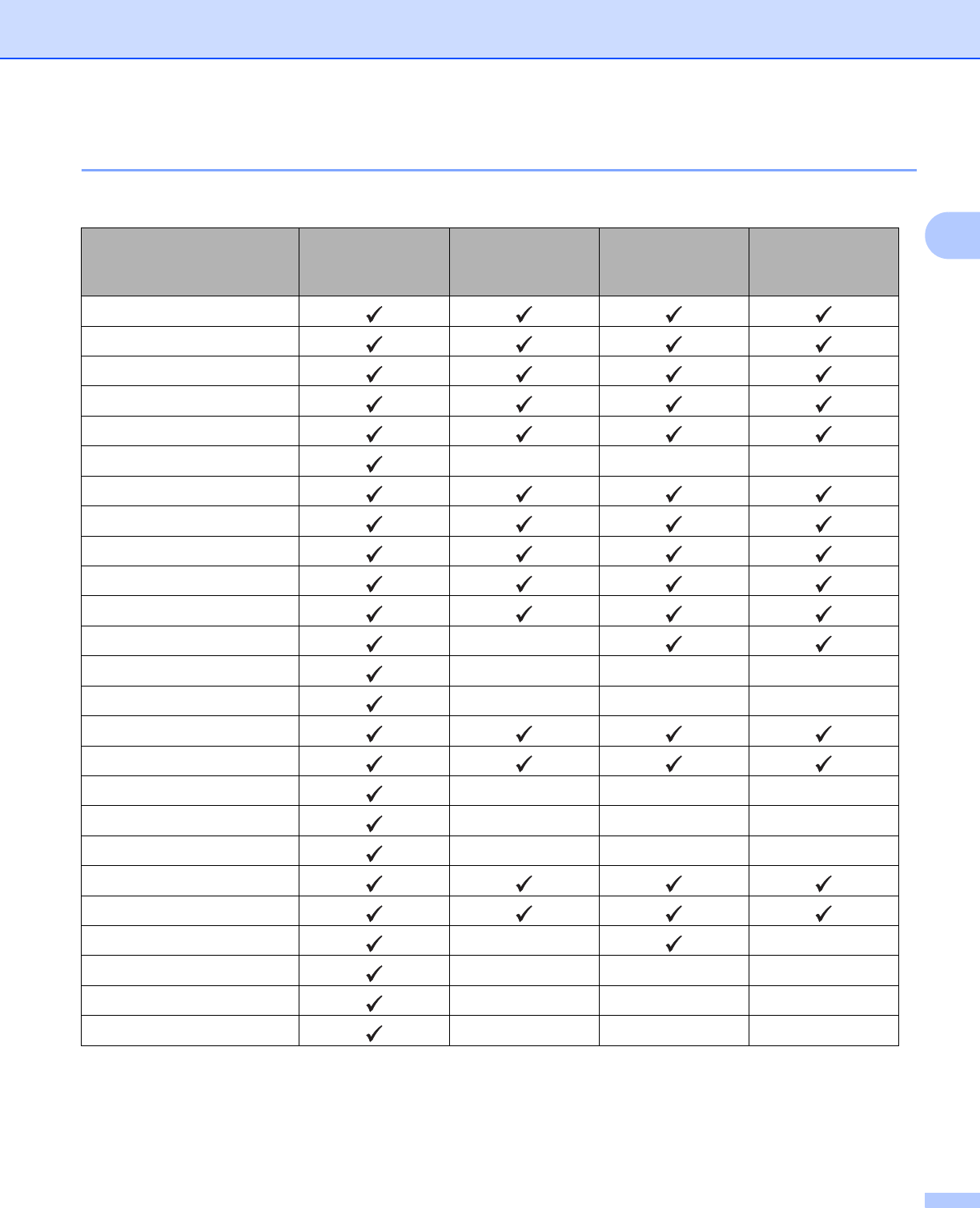
You can change the following printer settings when printing from your computer:
1Manual 2-sided printing is not available with the BR-Script printer driver for Windows®.
2Booklet is not available with the Macintosh printer driver and the BR-Script printer driver for Macintosh.
Windows® printer
driver
BR-Script printer
driver for
Windows®
Macintosh Printer
Driver
BR-Script printer
driver for
Macintosh
Paper Size
Orientation
Copies
Media Type
Print Quality
Document Type
Color/Mono
Multiple Page
2–sided 1 / Booklet 2
Paper Source
Scaling
Reverse Print
Use Watermark
Header-Footer Print
Toner Save Mode
Secure Print
Administrator
User Authentication
Color Calibration
Sleep Time
Improve Print Output
Skip Blank Page
Print Text in Black
Print Archive
Print Profile

Driver and Software
32
2
Windows®
2
Accessing the printer driver settings 2
a(For Windows® XP and Windows Server® 2003)
Click Start > Printers and Faxes.
(For Windows Vista® and Windows Server® 2008)
Click the (Start) button > Control Panel > Hardware and Sound > Printers.
(For Windows®7 and Windows Server® 2008 R2)
Click the (Start) button > Devices and Printers.
(For Windows®8 and Windows Server® 2012)
Move your mouse to the lower right corner of your desktop. When the menu bar appears, click Settings
> Control Panel. In the Hardware and Sound (Hardware) group, click View devices and printers.
(For Windows Server® 2012 R2)
Click Control Panel on the Start screen. In the Hardware group, click View devices and printers.
bRight-click the Brother HL-XXXX series icon (where XXXX is your model name) and select
Printer properties (Properties), and Brother HL-XXXX series if needed. The printer properties dialog
box appears.
cClick the General tab, and then click Preferences... (Printing Preferences...). To configure the tray
settings, click the Device Settings tab.
Driver and Software
33
2
Features in the Windows® printer driver 2
For more information, see the Help text in the printer driver.
NOTE
• The screens in this section are from Windows®7. The screens on your computer will vary depending on
your operating system.
• To access the printer driver settings, see Accessing the printer driver settings on page 32.
• For HL-L8350CDWT users, please read HL-L8350CDW as HL-L8350CDWT.
Basic tab 2
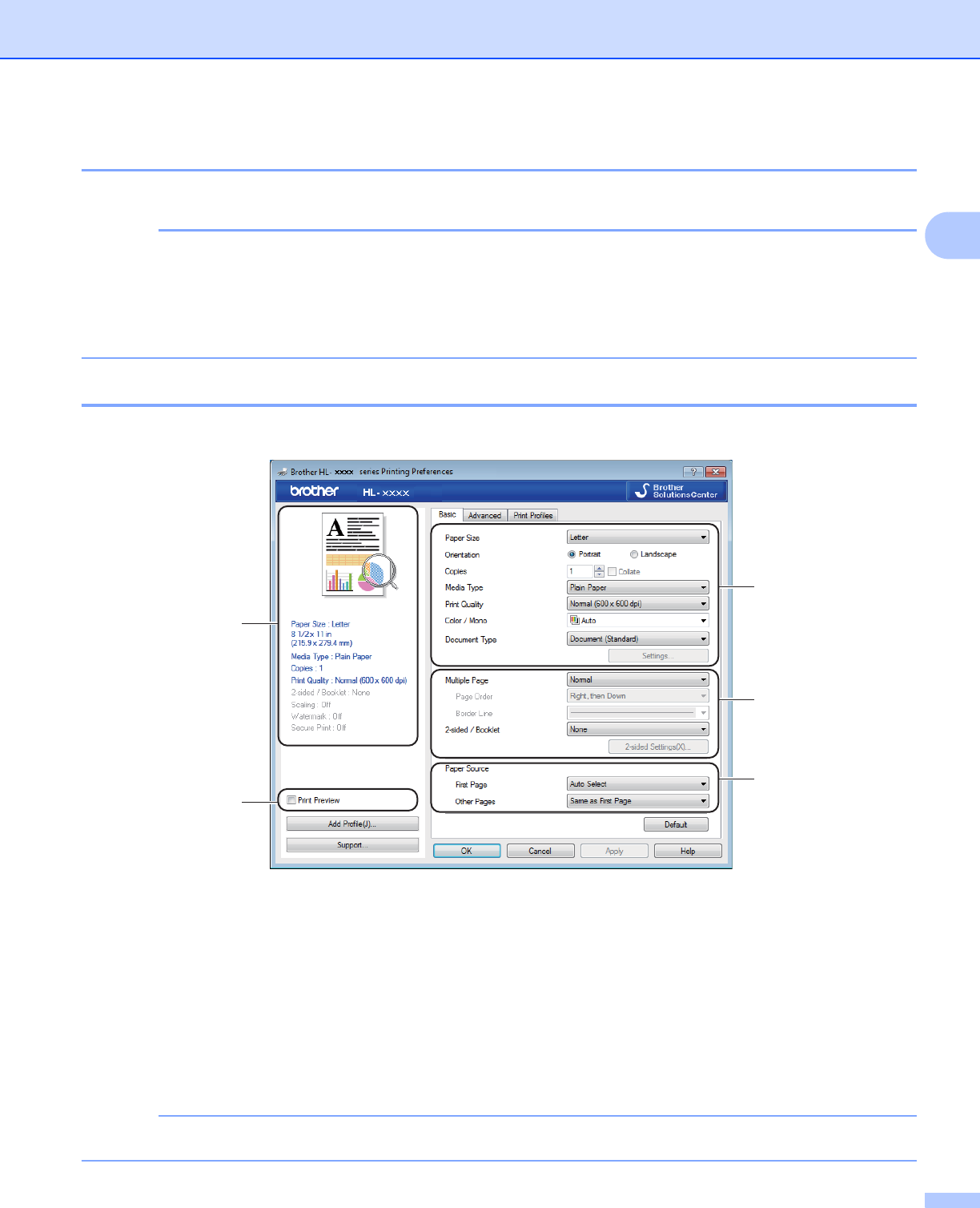
Change the Page Layout settings by clicking the illustration on the left side of the Basic tab.
aChoose the Paper Size, Orientation, Copies, Media Type, Print Quality, Color / Mono and
Document Type (1).
bChoose Multiple Page and 2-sided / Booklet (2).
cChoose the Paper Source (3).
dReview the displayed list of settings (4).
eClick OK to confirm the settings.
To return to the default settings, click Default, then OK.
NOTE
To preview your document before printing, select the Print Preview check box (5).
4
1
2
3
5
Driver and Software
34
2
Paper Size 2
From the drop-down list choose the Paper Size you are using.
Orientation 2
Orientation selects the position of how your document will be printed (Portrait or Landscape).
Copies 2
Click aor b to enter the number of copies to be printed.
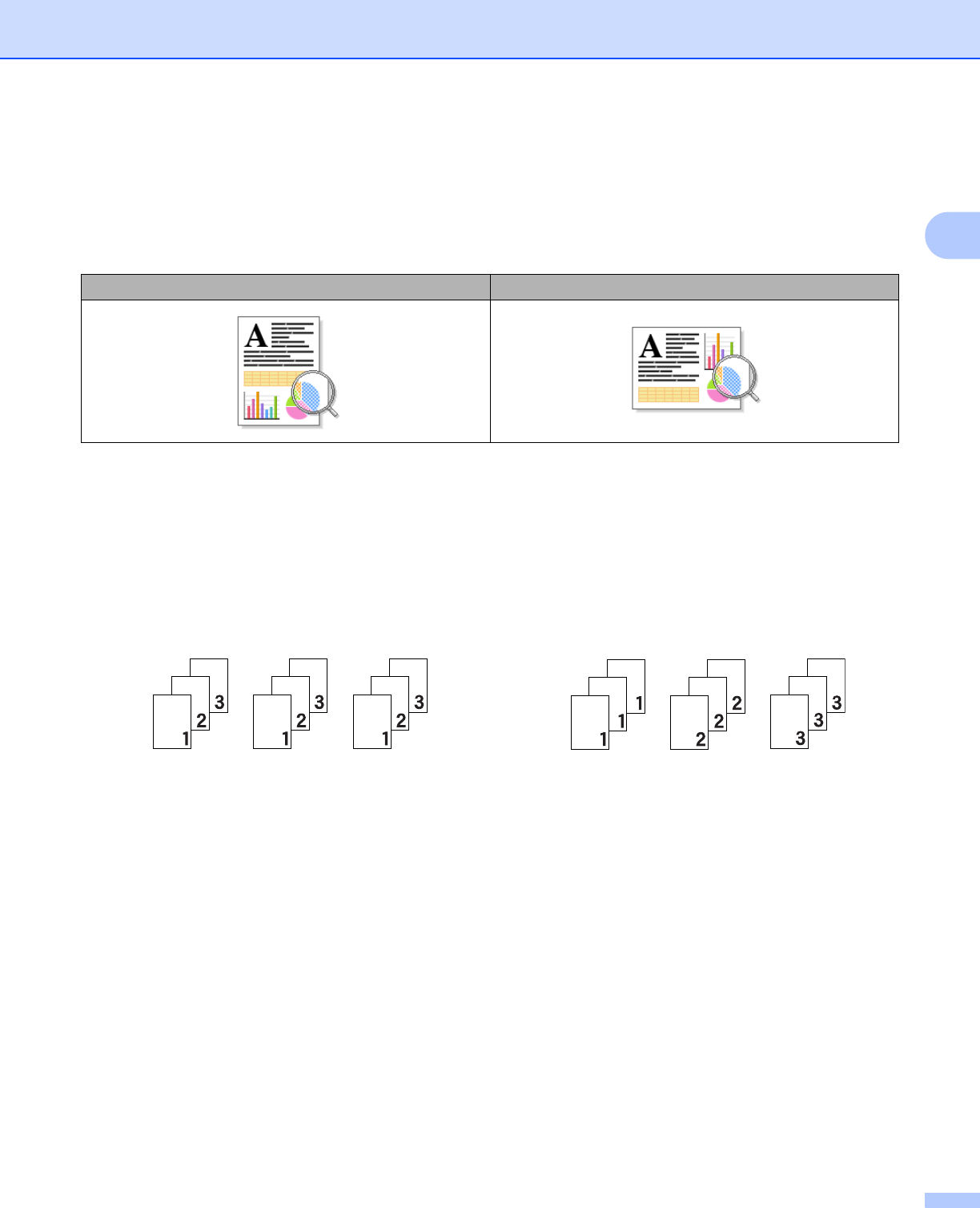
Collate
With the Collate check box selected, one complete copy of your document will be printed and then
repeated for the number of copies you selected. If the Collate check box is not selected, then each page
will be printed for all the copies before the next page of the document is printed.
Media Type 2
You can use the following types of media in your machine. For the best print quality, select the type of media
that matches the paper you are using.
Plain Paper
Thin Paper
Thick Paper
Thicker Paper
Bond Paper
Envelopes
Env. Thick
Env. Thin
Recycled Paper
Label
Glossy Paper
Portrait (Vertical) Landscape (Horizontal)
Collate selected
Collate cleared

Driver and Software
35
2
NOTE
• When using ordinary plain paper 16 to 28 lb (60 to 105 g/m2) choose Plain Paper. When using heavier
weight paper or rough paper choose Thick Paper or Thicker Paper. For bond paper, choose
Bond Paper.
• When using envelopes, choose Envelopes. If the toner is not fixed to the envelope correctly when
Envelopes is selected, choose Env. Thick. If the envelope is crumpled when Envelopes is selected,
choose Env. Thin. For more information, see Paper Tray Capacity on page 3.
• When Label is selected in the printer driver, the machine will feed the paper from the MP tray, even if MP
Tray is not selected as the paper source.
Print Quality 2
Choose one of the following print quality settings:
Normal (600 x 600 dpi)
600600 dpi. Recommended for ordinary printing. Use this mode for good print quality with reasonable
print speeds.
Fine (2400 dpi class)
2400 dpi class. The finest print mode. Use this mode to print precise images such as photographs. Since
the print data is much larger than in Normal mode, processing time / data transfer time and print time will
be longer.
NOTE
The print speed will change depending on the print quality setting you choose. Higher print quality takes
longer to print, while lower print quality takes less time to print.
Color / Mono 2
You can change the Color/Mono settings in the printer driver as follows:
Auto
The machine checks the content of the document for color. If color is detected anywhere in the document,
it will print the whole of the document using all the colors. In other words, it will mix some of the toners to
help achieve every shade detected in the document, increasing the density of toner applied to the page.
If no color content is detected, it will print the document in monochrome. The default setting on your
machine is Auto.
Color
Whether the document contains color or just monochrome, your machine will print the document using all
the colors.
Mono
Select Mono if the document has only black and grayscale text and objects. If your document contains
color, this mode prints the document in 256 levels of gray using the black toner.

Driver and Software
36
2
NOTE
• The machine’s color sensor is very sensitive and may perceive faded black text or an off-white background
as color. If you know that your document is black and white and you want to conserve color toner, select
Mono mode.
• If either the Cyan, Magenta or Yellow toner reaches the end of its life while printing a color document, the
print job cannot be completed. You can cancel your print job and choose to start the print job again in
Mono mode, as long as Black toner is available.
Document Type 2
Use Document Type to select the optimal settings for printing the relevant type of data.
Document (Standard)
Use this mode for printing a combination of graphics and text.
Photo / Image
Use this mode for printing photos or images.
Document (Mixed)
Use this mode for printing combinations of graphics/text and photos/images.
NOTE
This mode takes longer to print the data.
Manual
Choosing Manual allows you to select the settings manually by clicking the Settings button.
Settings dialog box 2
To change the following settings, click Settings... in the Basic tab.
Color Mode
The following options are available in color Matching mode:
•Normal
This is the default color mode.
•Vivid
The color of all elements are adjusted to become a brighter color.
•Auto
The printer driver selects the Color Mode type.
NOTE
Choosing this option may take longer to print the data.
•None

Driver and Software
37
2
Import...
To adjust the print configuration of a particular image, click Settings. When you have finished adjusting
the image parameters, such as brightness and contrast, import those settings as a print configuration file.
Use the Export... option to create a print configuration file from the current settings.
Export...
To adjust the print configuration of a particular image, click Settings. When you have finished adjusting
the image parameters, such as brightness and contrast, export those settings as a print configuration file.
Use the Import... option to load a previously exported configuration file.
Improve Gray Color
You can improve the image quality of a shaded area.
Enhance Black Printing
If a black graphic does not print correctly, choose this setting.
Improve Thin Line
You can improve the image quality of thin lines.
Improve Pattern Printing
Select this option if printed fills and patterns are different from the patterns and fills you see on your
computer.
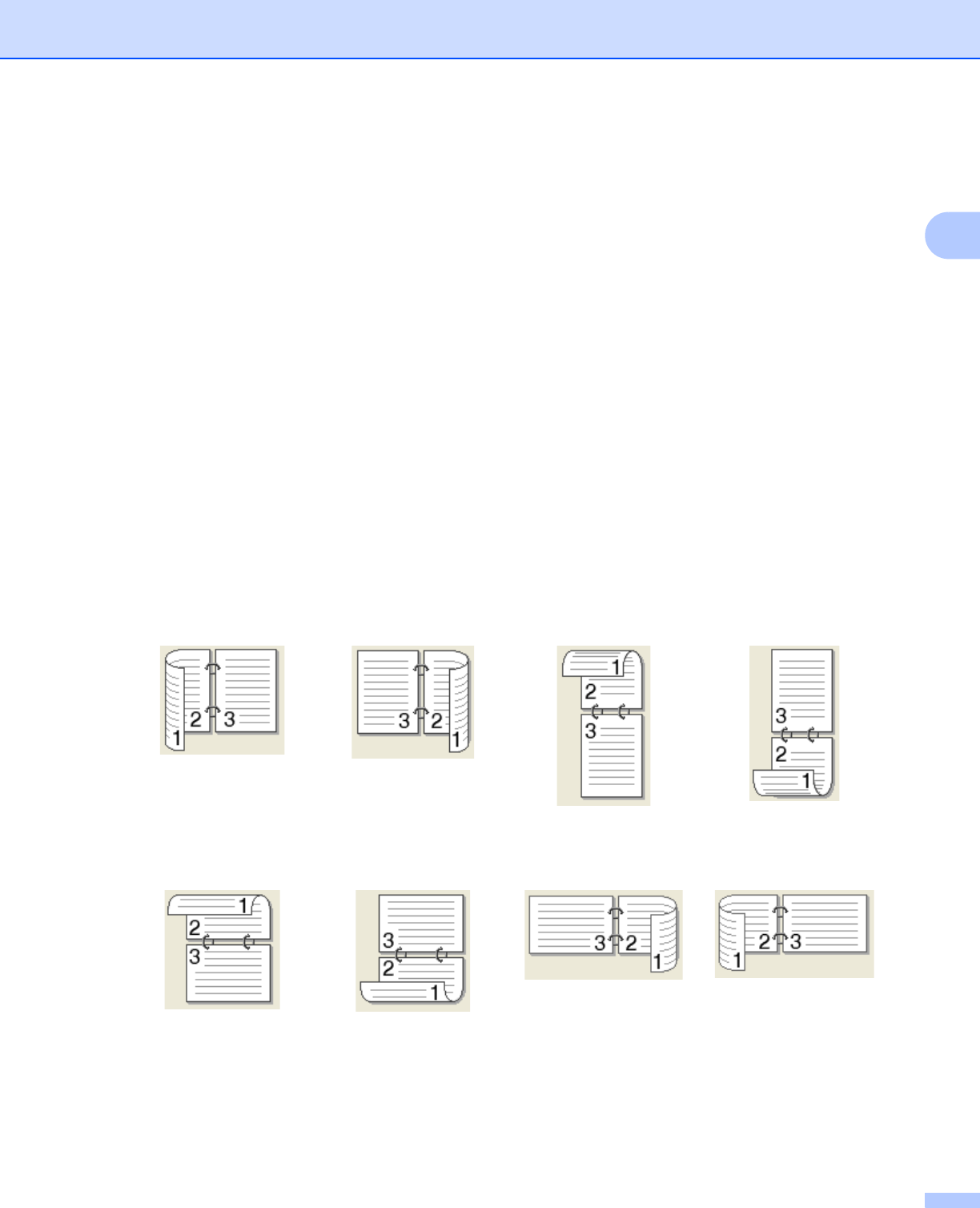
Multiple Page 2
The Multiple Page selection can reduce the image size of a page to allow multiple pages to be printed on one
sheet of paper or to enlarge the image size for printing one page on multiple sheets of paper.
Page Order
When the N in 1 option is selected, the page order can be selected from the drop-down list.
Border Line
When using the Multiple Page feature to print multiple pages on one sheet, you can choose to have a solid
border, dash border or no border around each page on the sheet.
Print cut-out line
When the 1 in NxN pages option is selected, the Print cut-out line option can be selected. This option
allows you to print a faint cut-out line around the printable area.
Driver and Software
38
2
2-sided / Booklet 2
To print a booklet or do 2-sided printing, use this option.
None
Disable 2-sided printing.
2-sided / 2-sided (Manual)
To do 2-sided printing, use these options.
•2-sided
The machine prints on both sides of the paper automatically.
•2-sided (Manual)
The machine prints all the even numbered pages first. Then the printer driver will stop and show the
instructions required to reload the paper. When you click OK the odd numbered pages will be printed.
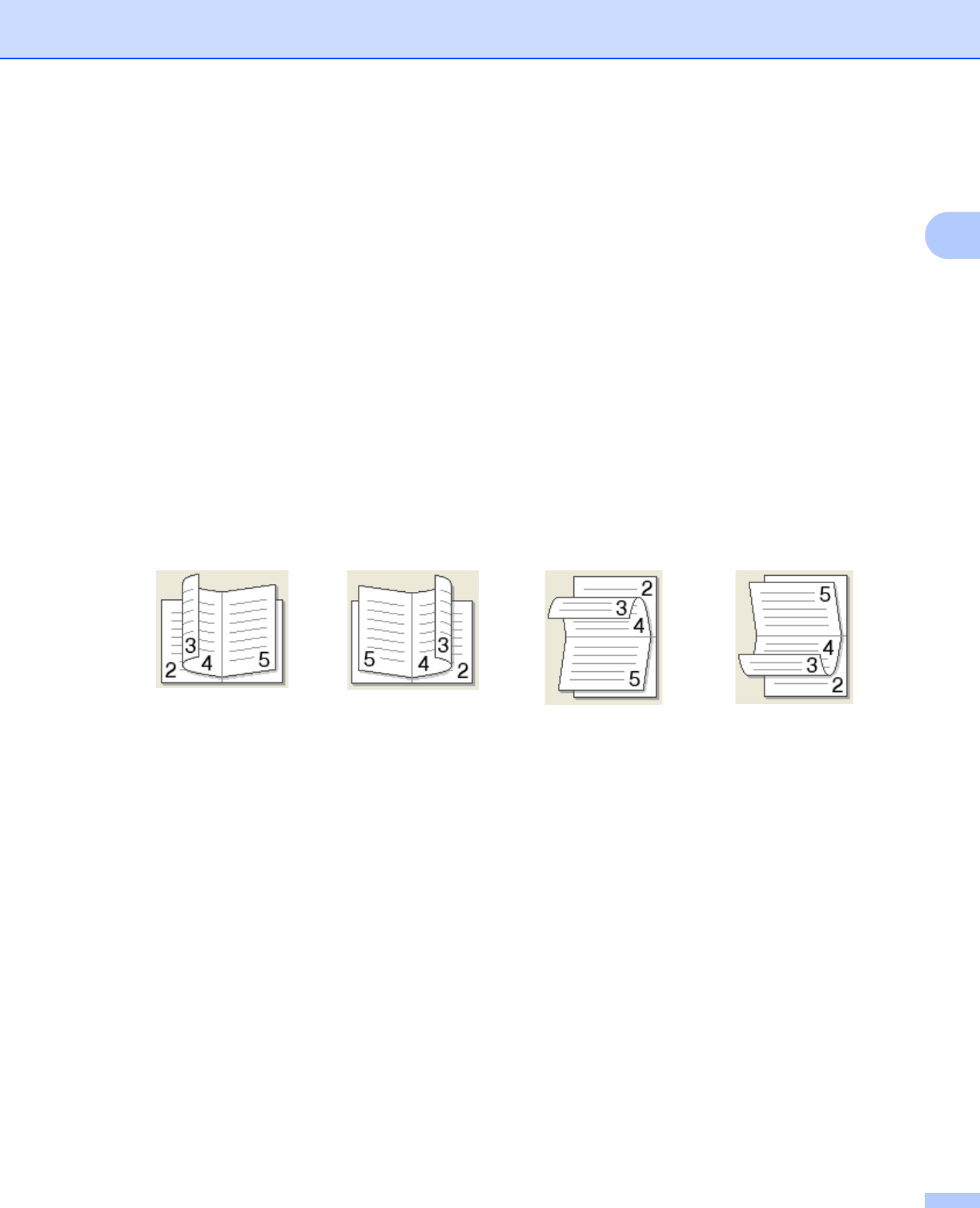
When you choose 2-sided or 2-sided (Manual), the 2-sided Settings... button becomes available to
choose. You can choose from the following options in the 2-sided Settings dialog box:
•2-sided Type
There are four types of 2-sided binding directions available for each orientation.
•Binding Offset
When you check Binding Offset, you can also specify the offset for binding in inches or millimeters.
Portrait
Long Edge (Left)
Long Edge (Right)
Short Edge (Top)
Short Edge (Bottom)
Landscape
Long Edge (Top)
Long Edge (Bottom)
Short Edge (Right)
Short Edge (Left)
Driver and Software
39
2
Booklet / Booklet (Manual)
Use this option to print a document in booklet format using 2-sided printing; it will arrange the document
according to the correct page number and allow you to fold at the center of the print output without having
to change the order of the page numbers.
•Booklet
The machine prints on both sides of the paper automatically.
•Booklet (Manual)
The machine prints all the even numbered sides first. Then the printer driver will stop and show the
instructions required to reload the paper. When you click OK the odd numbered sides will be printed.
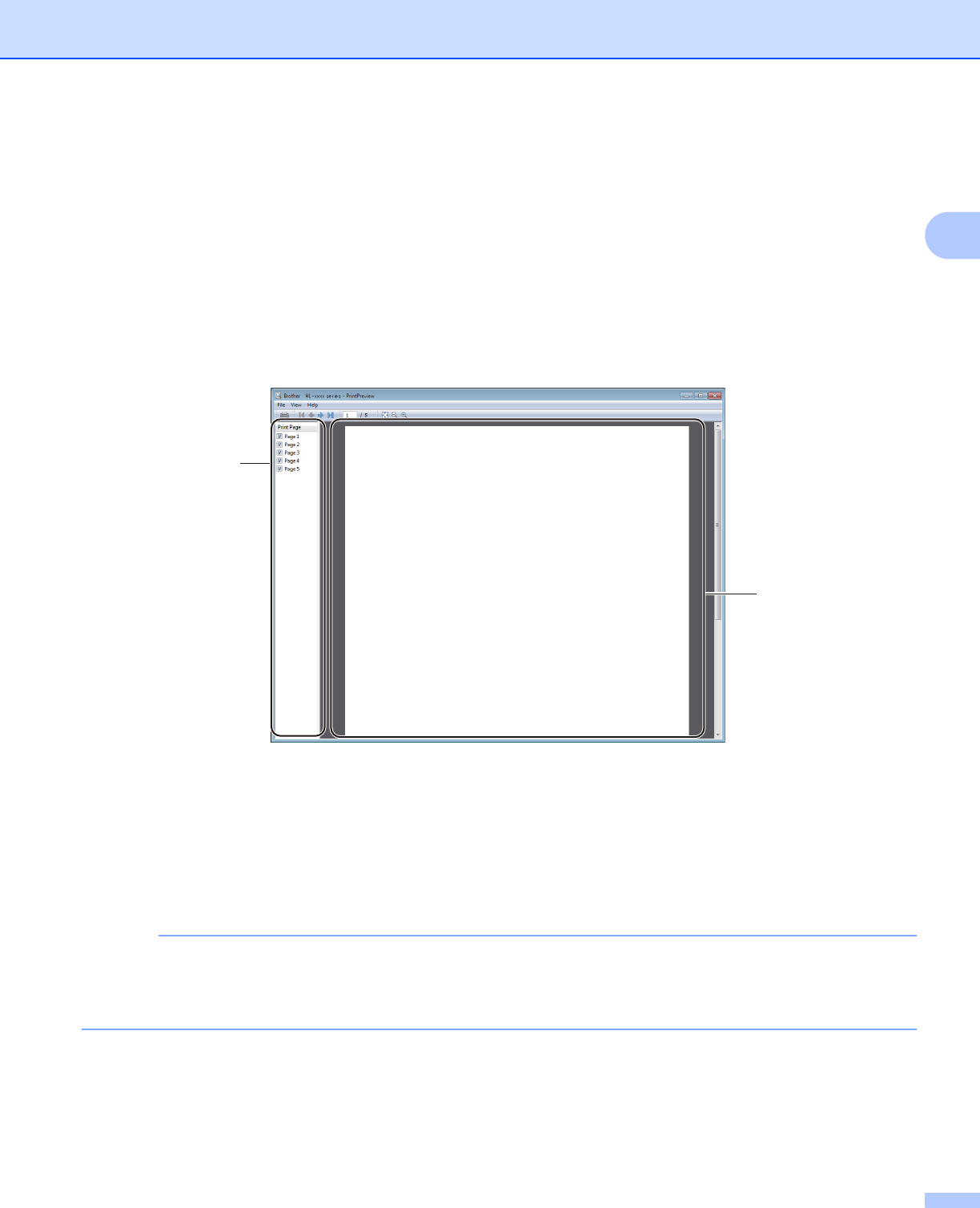
When you choose Booklet or Booklet (Manual), the 2-sided Settings... button becomes available to
choose. You can choose the following settings in the 2-sided Settings dialog box.
•2-sided Type
There are two types of 2-sided binding directions available for each orientation.
•Booklet Printing Method
When Divide into Sets is selected:
This option allows you to print the whole booklet in smaller individual booklet sets, and it still allows you
to fold at the center of the smaller individual booklet sets without having to change the order of the page
numbers. You can specify the number of sheets in each smaller booklet, from 1 to 15. This option is
helpful for folding a printed booklet that has a large number of pages.
•Binding Offset
Check Binding Offset to specify the offset for binding in inches or millimeters.
Portrait Landscape
Left Binding
Right Binding
Top Binding
Bottom Binding
Driver and Software
40
2
Paper Source 2
You can choose Auto Select, Tray1, Tray2,12
or MP Tray and specify separate trays for printing the first
page and for printing from the second page onward.
1Available if the optional tray is installed.
2Tray 2 is standard on HL-L8350CDWT.
Print Preview 2
Preview a document before it is printed. If you check the Print Preview check box the Print Preview Viewer
window will open before printing starts.
(1) Page List Area
The Page List Area displays the page numbers for the actual pages that will be printed. If you choose a
page in this list, a preview of the print results for the page will be displayed in the Preview Area. If you do
not want to print a page, clear the check box.
(2) Preview Area
The Preview Area displays a preview of the print results for the pages chosen in the Page List Area.
NOTE
• If the Booklet setting was selected in the Printer driver settings, you cannot use the Print Preview option.
• If the 2-sided setting was selected in the Printer driver settings, you cannot delete pages using the Page
List Area.
2
1
Driver and Software
41
2
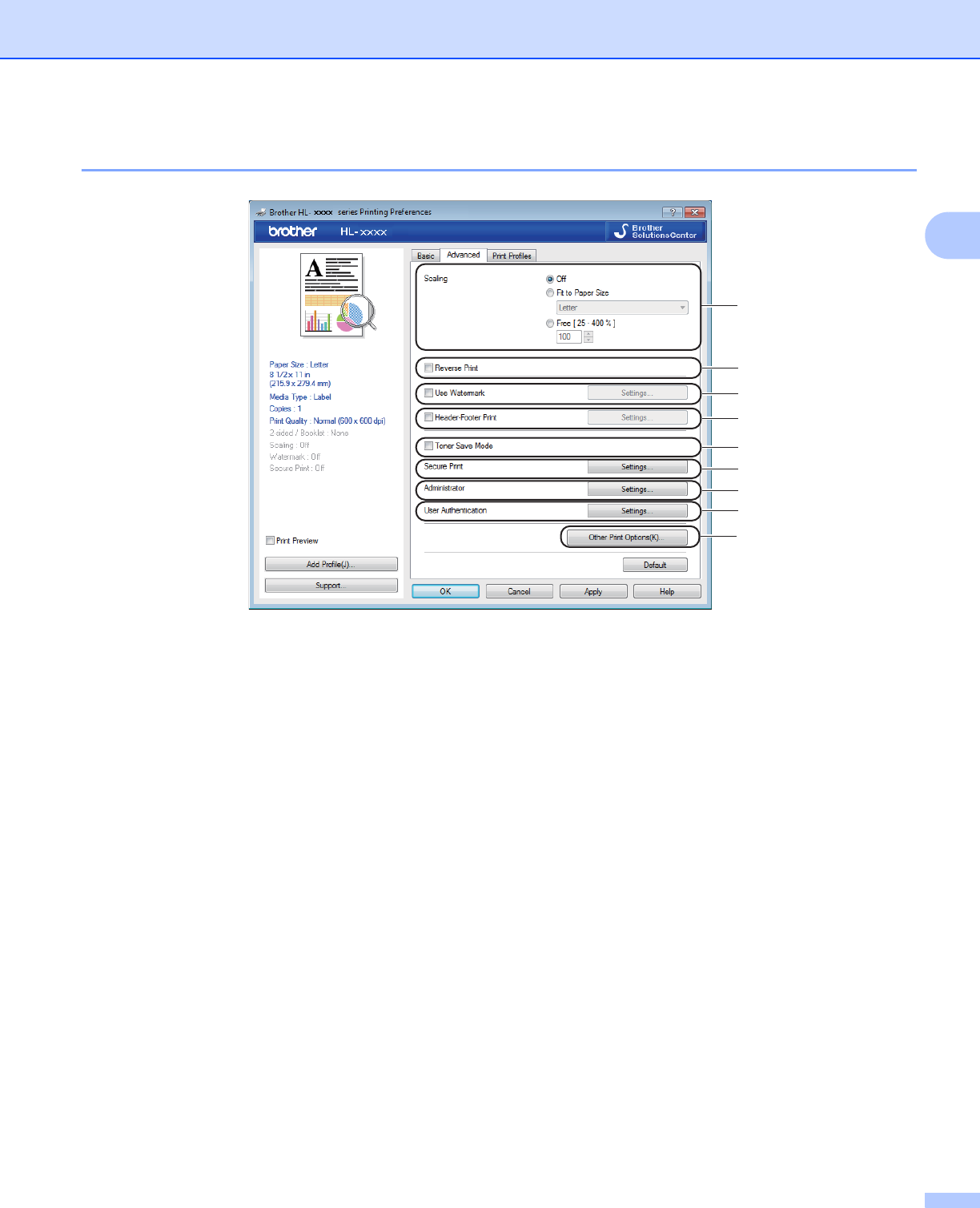
Advanced tab 2
Change the tab settings by clicking the following settings:
(1) Scaling
(2) Reverse Print
(3) Use Watermark
(4) Header-Footer Print
(5) Toner Save Mode
(6) Secure Print
(7) Administrator
(8) User Authentication
(9) Other Print Options
Scaling 2
Select an option to change the scale of the printed image.
Reverse Print 2
Select Reverse Print to rotate the page 180 degrees.
1
2
3
4
5
6
7
8
9
Driver and Software
42
2
Use Watermark 2
Add a logo or text to your document as a watermark. Choose one of the preset Watermarks, or use an image
file that you have created. Check Use Watermark, and then click the Settings... button.
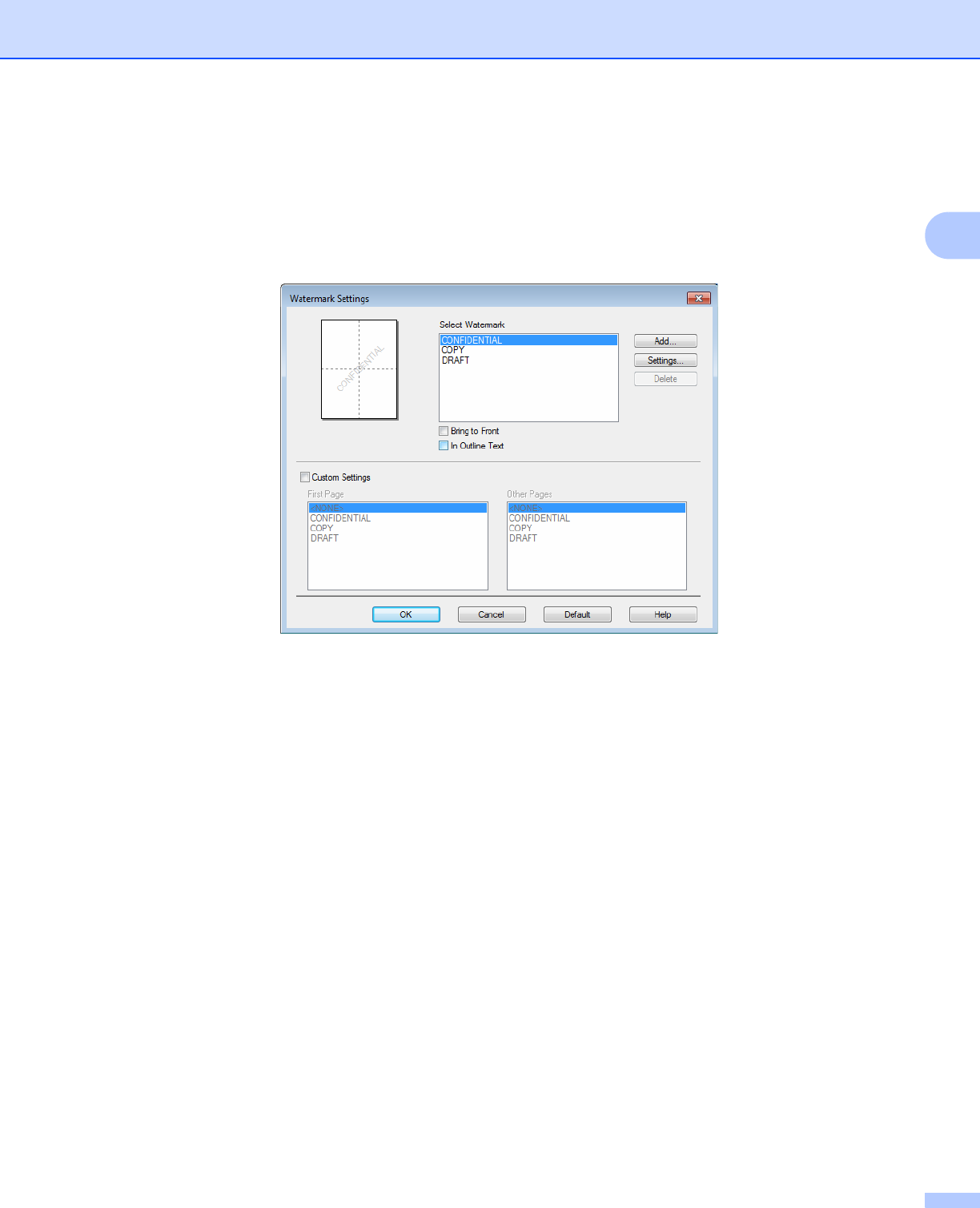
Watermark Settings 2
Bring To Front
Select this check box to overlay the selected characters or image onto your printed document.
In Outline Text
Select this check box if you want to print only an outline of a text watermark.
Custom Settings
Select this check box if you want to print one watermark on the first page and a different watermark on the
following pages.
Driver and Software
43
2
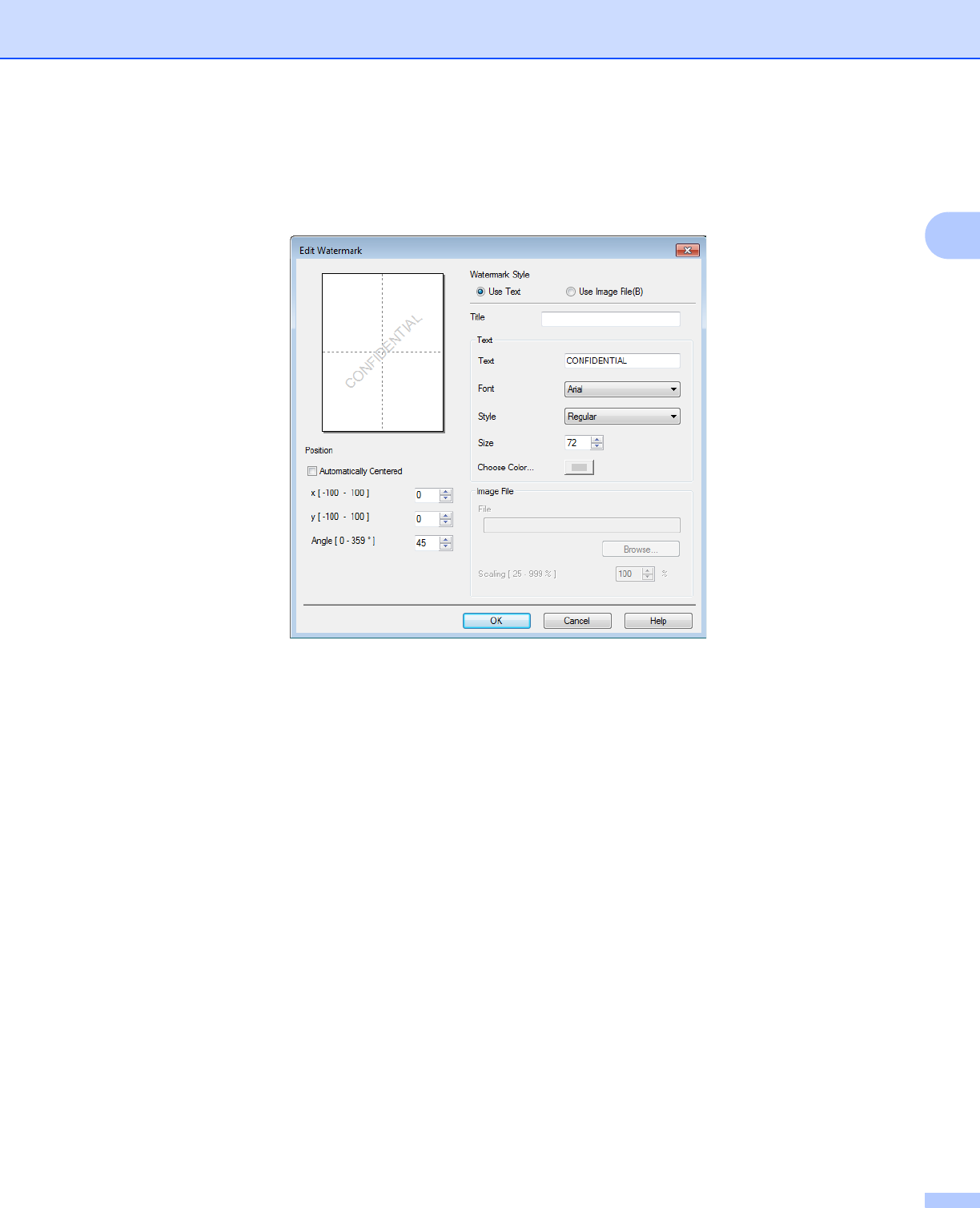
Edit Watermark
Click the Add button to add the watermark settings, and then choose Use Text or Use Image File in
Watermark Style.
•Title
Type an appropriate title for the watermark.
•Text
Type your Watermark Text into the Text box, and then choose the Font, Style, Size and Choose
Color....
•Image File
Type the file name and location of the Image File you want to use as the Watermark in File, or click
Browse to search for the file. Bitmap, JPEG and PNG file formats are supported. The scaling of the
image can be adjusted from 25 - 999%.
•Position
Use this setting to control the position of the watermark on the page.
Driver and Software
44
2
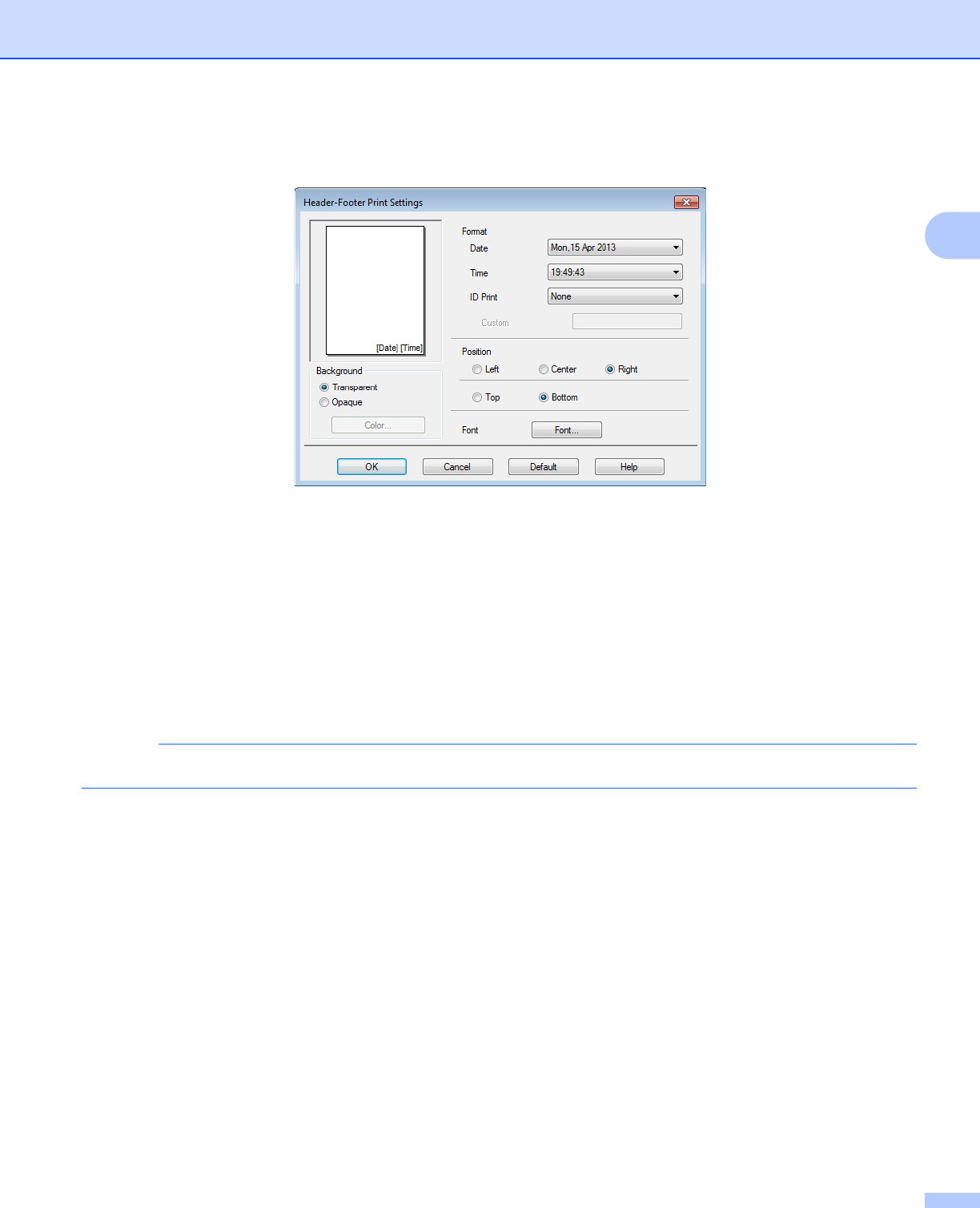
Header-Footer Print 2
When this feature is enabled, it will print the date and time on your document from your computer’s system
clock and the computer login user name or the text you typed. Click Settings to customize.
ID Print
Select Login User Name to print your computer login user name. To print a different name, select Custom
and type a name in the Custom text box.
Toner Save Mode 2
Conserve toner use with this feature. When you set Toner Save Mode to On, print appears lighter. The
default setting is Off (unchecked).
NOTE
We do not recommend Toner Save Mode for printing photo or grayscale images.
Driver and Software
45
2
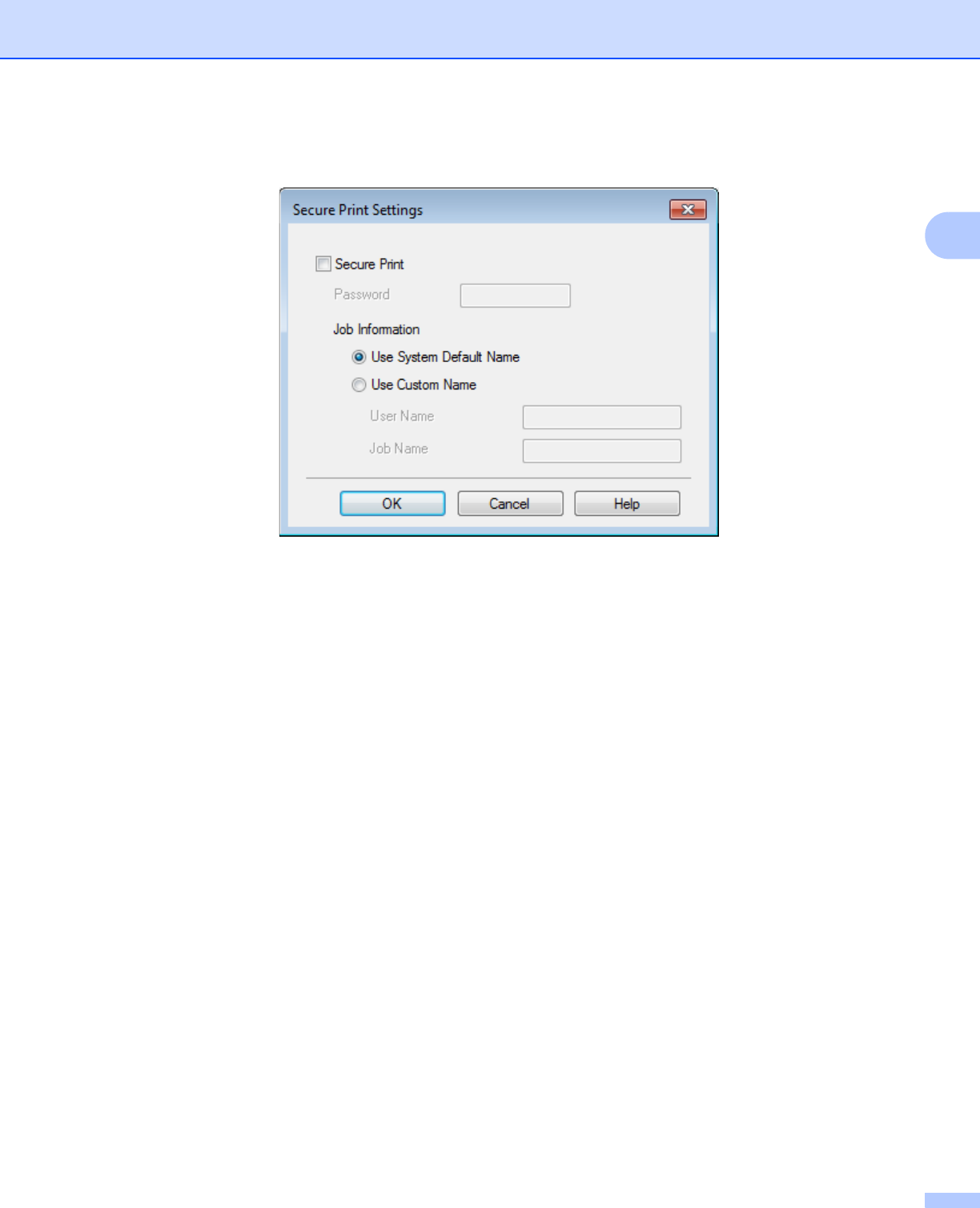
Secure Print 2
Secure documents are documents that are password-protected when they are sent to the machine. Only the
people who know the password will be able to print them. Since the documents are secured at the machine,
you must enter the password using the control panel of the machine to print them.
To send a secured document:
aClick Settings... from Secure Print and check Secure Print.
bEnter your password and click OK.
cTo print a secured document, you must enter your password using the control panel of the machine
(see Printing Secure documents on page 104).
To delete a secured document:
You must use the control panel of the machine to delete a secured document (see Printing Secure documents
on page 104).
Driver and Software
46
2
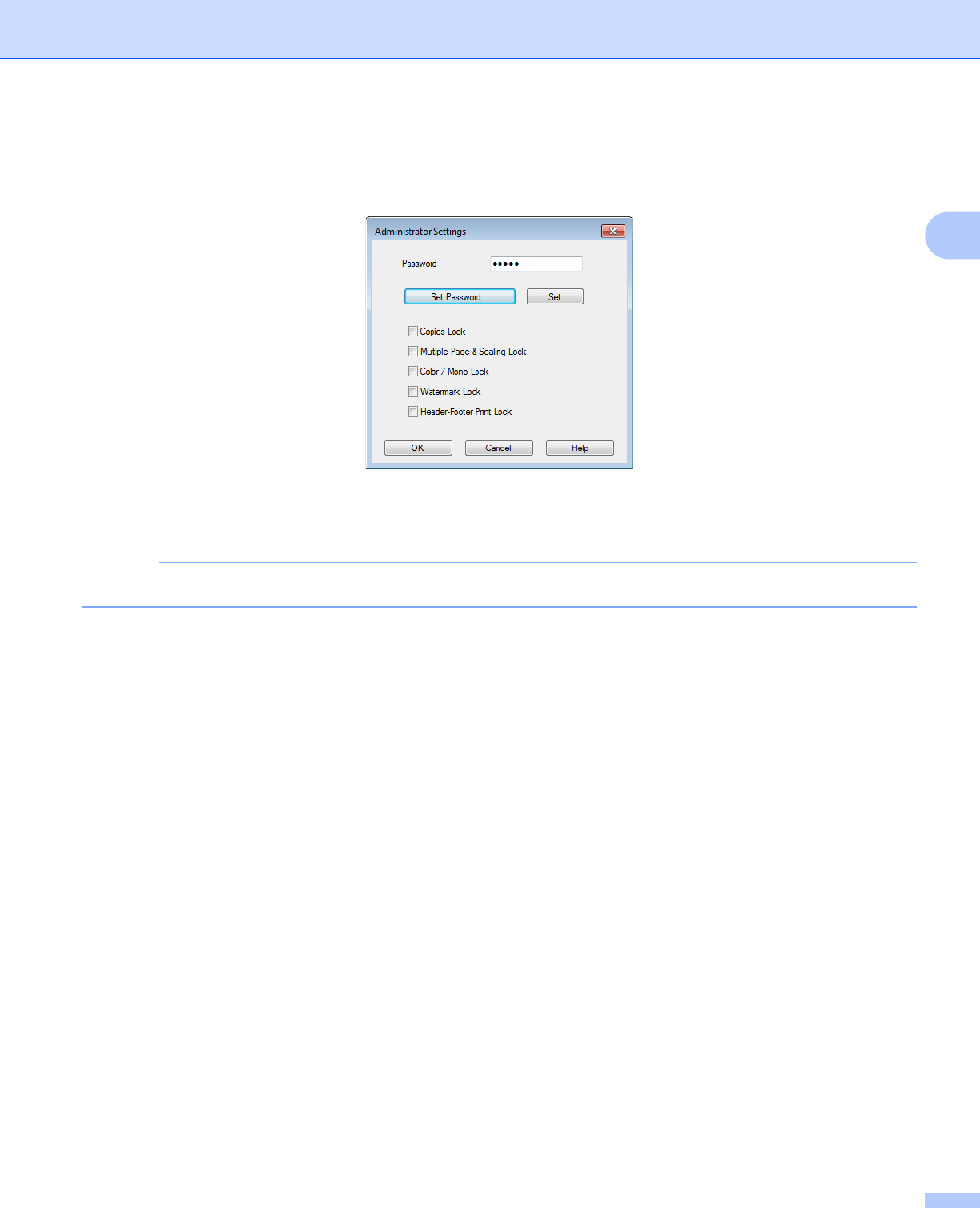
Administrator 2
Administrators have the authority to limit access to settings such as scaling and watermark.
Password
Type the password in this box.
NOTE
Click Set Password... to change the password.
Copies Lock
Select this check box to lock the Copies selection in the Basic tab to prevent users from printing multiple
copies.
Multiple Page & Scaling Lock
Select this check box to lock the multiple page and scaling settings.
Color / Mono Lock
Select this check box to lock the Color/Mono settings as Mono to prevent color printing.
Watermark Lock
Select this check box to lock the settings of the Watermark option to prevent changes being made.
Header-Footer Print Lock
Select this check box to lock the settings of the Header-Footer Print option to prevent changes being
made.
User Authentication 2
If you are restricted from using computer to print by the Secure Function Lock feature, you can check your
current print status. Click Check Print Status to see your computer login name information, such as the
restricted features and the remaining number of pages you are allowed to print when you are using the
machine on a network. The Authentication result dialog box appears.
To cause the Authentication result dialog box to open each time you print, check the Show print status
before printing check box.
For more information about Secure Function Lock, see the Network User's Guide
Driver and Software
47
2
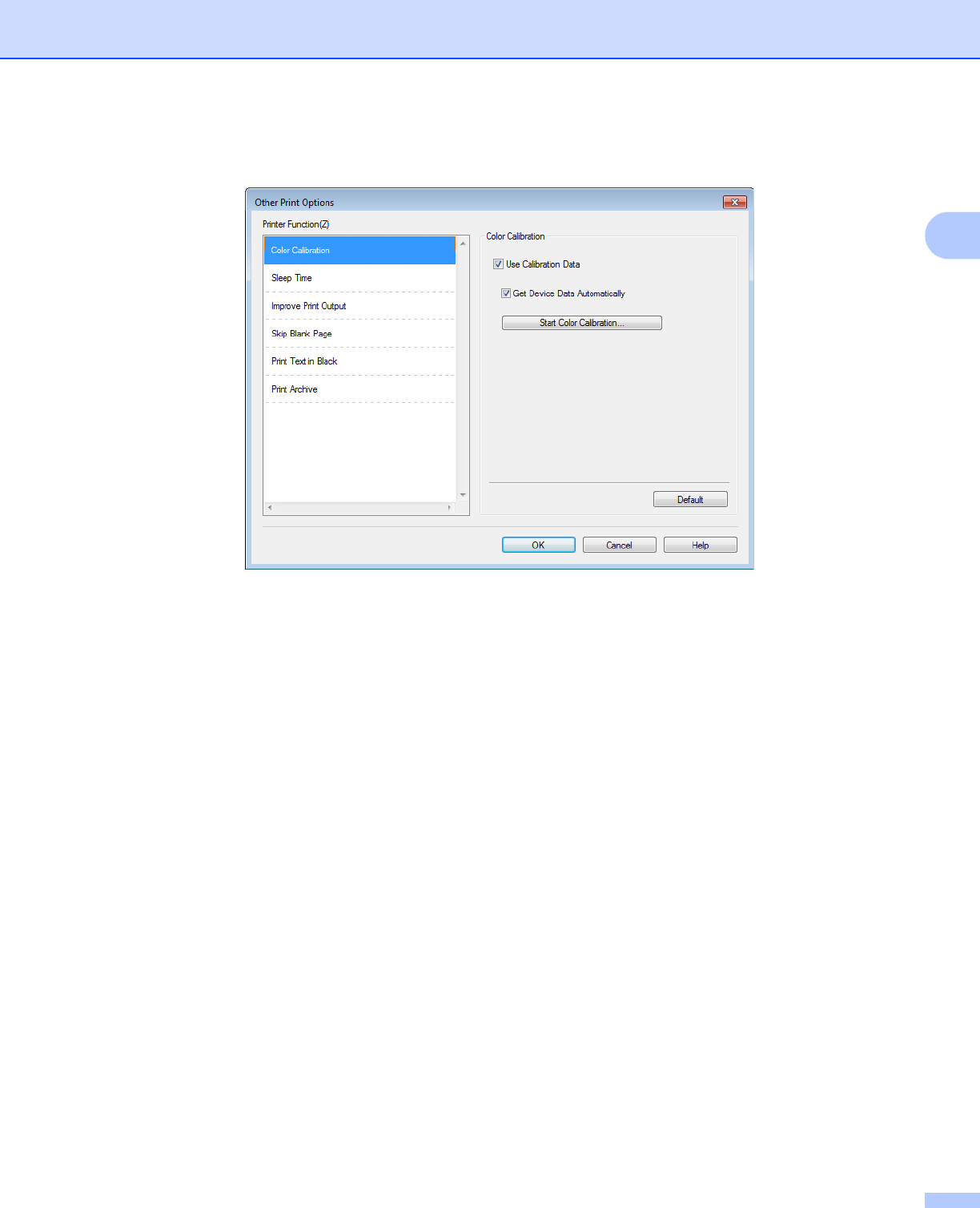
Other Print Options 2
You can set the following in Printer Function:
Color Calibration
Sleep Time
Improve Print Output
Skip Blank Page
Print Text in Black
Print Archive
Color Calibration 2
The output density of each color may vary depending on the temperature and humidity of the machine's
environment. This setting helps you improve color density by letting the printer driver use the color calibration
data stored in your machine.
Use Calibration Data
If you select this check box, the printer driver will use the calibration data retrieved from the machine to set
color matching in the printer driver. This will ensure consistent print quality.
Get Device Data Automatically
If you select this check box, the printer driver will use the color calibration data from your machine.
Start Color Calibration
If you click this button, your machine will start the color calibration process, and then the printer driver will
use the calibration data from your machine.

Driver and Software
48
2
Sleep Time 2
When the machine does not receive data for a certain period of time, it enters Sleep mode. In Sleep mode,
the machine acts as though it were turned off. When you choose Printer Default, the timeout setting will be
reset to the specific time set at the factory; this can be altered in the driver. Intelligent Sleep mode adjusts to
the most appropriate timeout setting depending on the frequency of your machine use.
While the machine is in Sleep mode, the LCD displays Sleep, but the machine can still receive data.
Receiving a print job will wake up the machine to start printing.
Improve Print Output 2
This feature allows you to improve a print quality problem.
Reduce Paper Curl
Select this setting to reduce paper curl.
If you are printing only a few pages, you do not have to choose this setting. We recommend changing the
printer driver setting in Media Type to a thin setting.
NOTE
This operation will decrease the temperature of the machine's fusing process.
Improve Toner Fixing
Select this setting to improve the toner fixing capabilities. If this selection does not provide enough
improvement, change the printer driver setting in Media Type to a thick setting.
NOTE
This operation will increase the temperature of the machine's fusing process.

Driver and Software
49
2
Skip Blank Page 2
If Skip Blank Page is selected, the printer driver detects blank pages and excludes them from printing.
NOTE
This option does not work with the following options:
•Use Watermark
•Header-Footer Print
•N in 1 and 1 in NxN Pages in Multiple Page
•2-sided (Manual), Booklet, Booklet (Manual) and 2-sided with Binding Offset in 2-sided / Booklet
Print Text in Black 2
Select this option to print all text in Black only.
NOTE
It may not work with certain characters.
Print Archive 2
A copy of your printout can be saved as a PDF file to your computer. To change the file size, move the File
Size slider to the right or left. The resolution is set according to the file size.
NOTE
By enabling this feature, there may be a longer wait before your machine begins printing.
Driver and Software
50
2
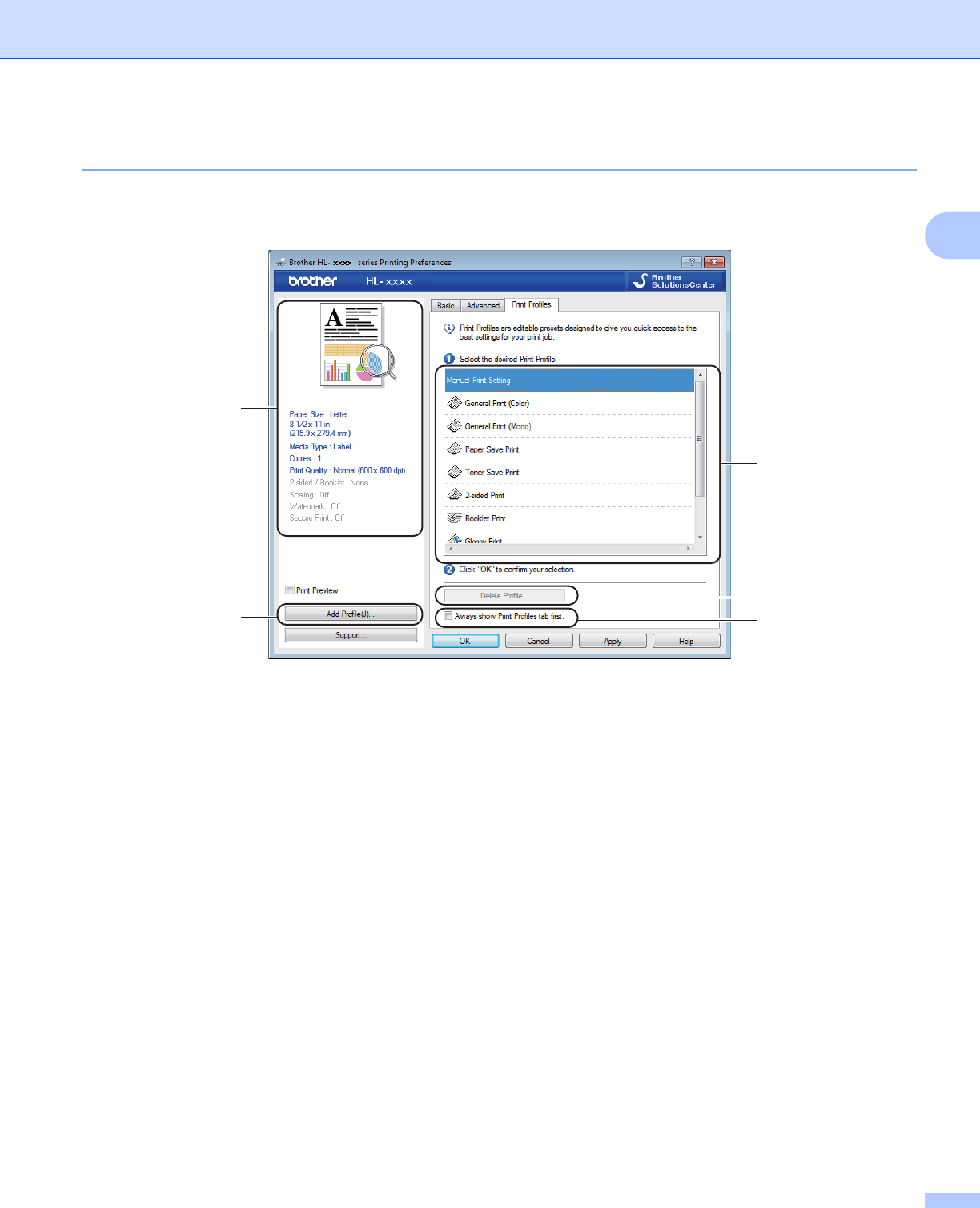
Print Profiles tab 2
Print Profiles are editable presets designed to give you quick access to frequently used printing
configurations.
(1) Print profile list box
(2) Delete Profile
(3) Always show Print Profiles tab first
(4) Add Profile
(5) Current print profile view
aChoose your profile from the print profile list box.
bTo display the Print Profiles tab at the front of the window every time you print, click Always show Print
Profiles tab first.
cClick OK to apply your chosen profile.
Add Profile 2
Click the Add Profile button to display the Add Profile dialog box. Add up to 20 new profiles with your
preferred settings.
aType a title in Name.
bChoose an icon you want to use from the Icon list, then click OK.
cThe settings shown on the left side of the printer driver window will be saved.
1
2
3
4
5

Driver and Software
51
2
Delete Profile 2
Click Delete Profile to display the Delete Profile dialog box. You can delete any of the profiles you have
added.
aChoose your profile from the print profile list box.
bClick Delete.
cThe selected profile will be deleted.
Driver and Software
52
2
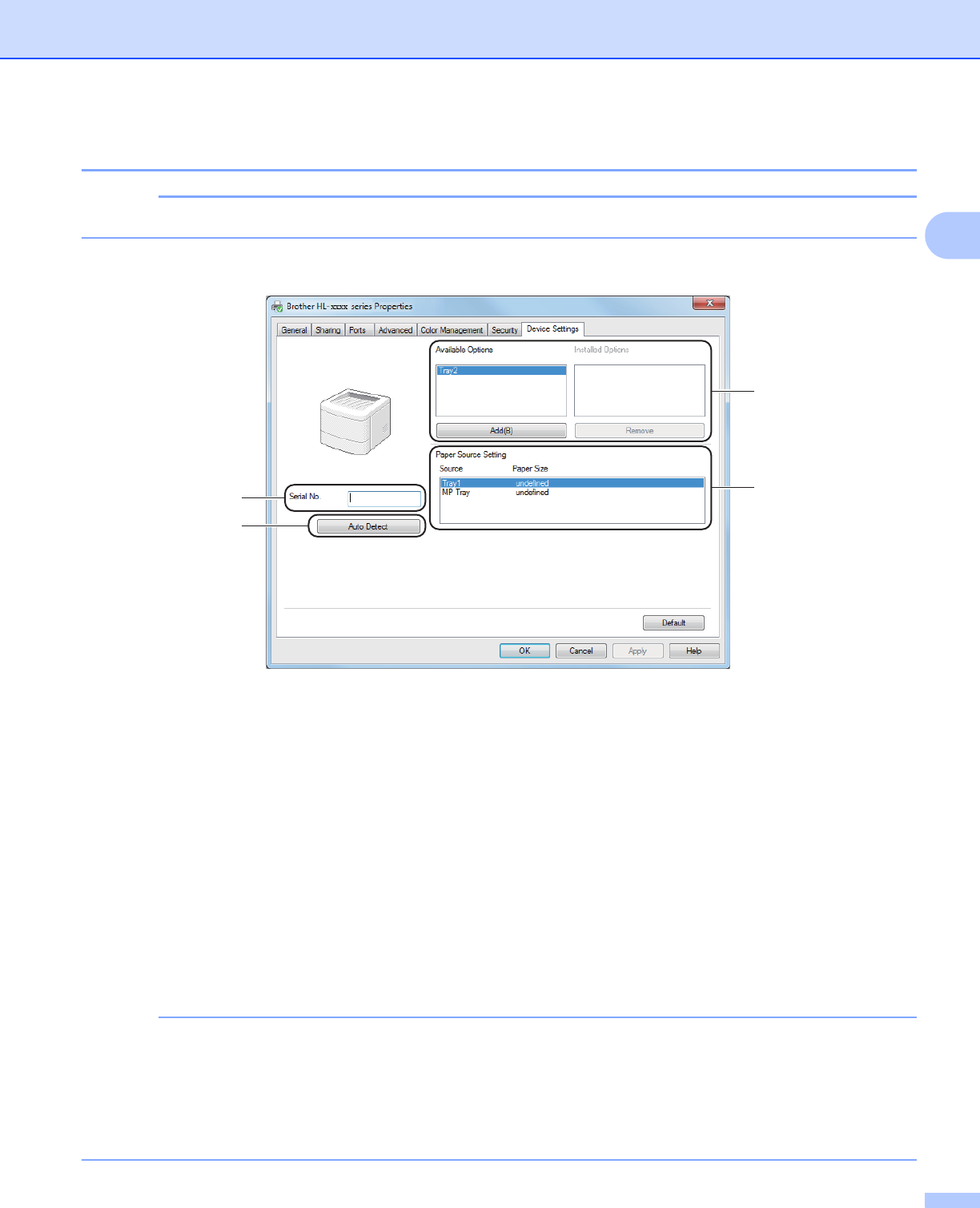
Device Settings tab 2
NOTE
To access the Device Settings tab, see Accessing the printer driver settings on page 32.
You can define the paper size for each paper tray and auto detect the serial number in the Device Settings
tab as follows.
(1) Available Options / Installed Options
You can manually add and remove the options that are installed on the machine. Tray settings will match
the installed options.
(2) Paper Source Setting
Click the Auto Detect (4) button to detect and display the machine's serial number and paper size setting
for the paper trays.
(3) Serial No.
By clicking Auto Detect (4), the printer driver will probe the machine and display its serial number. If it fails
to receive the information, the screen displays “---------------”.
(4) Auto Detect
The Auto Detect setting finds the currently installed optional devices and displays the available options in
the printer driver. When you click Auto Detect, options that are installed on the machine will be listed in
Available Options (1). Manually add or remove the options by choosing an optional device you want to
add or remove, and then clicking Add or Remove.
NOTE
The Auto Detect (4) setting is not available under the following machine conditions:
• The machine is turned off.
• The machine is in an error state.
• The machine is connected to the print server using a USB cable in a shared network environment.
• The cable is not connected to the machine correctly.
1
2
3
4
Driver and Software
53
2
Support 2
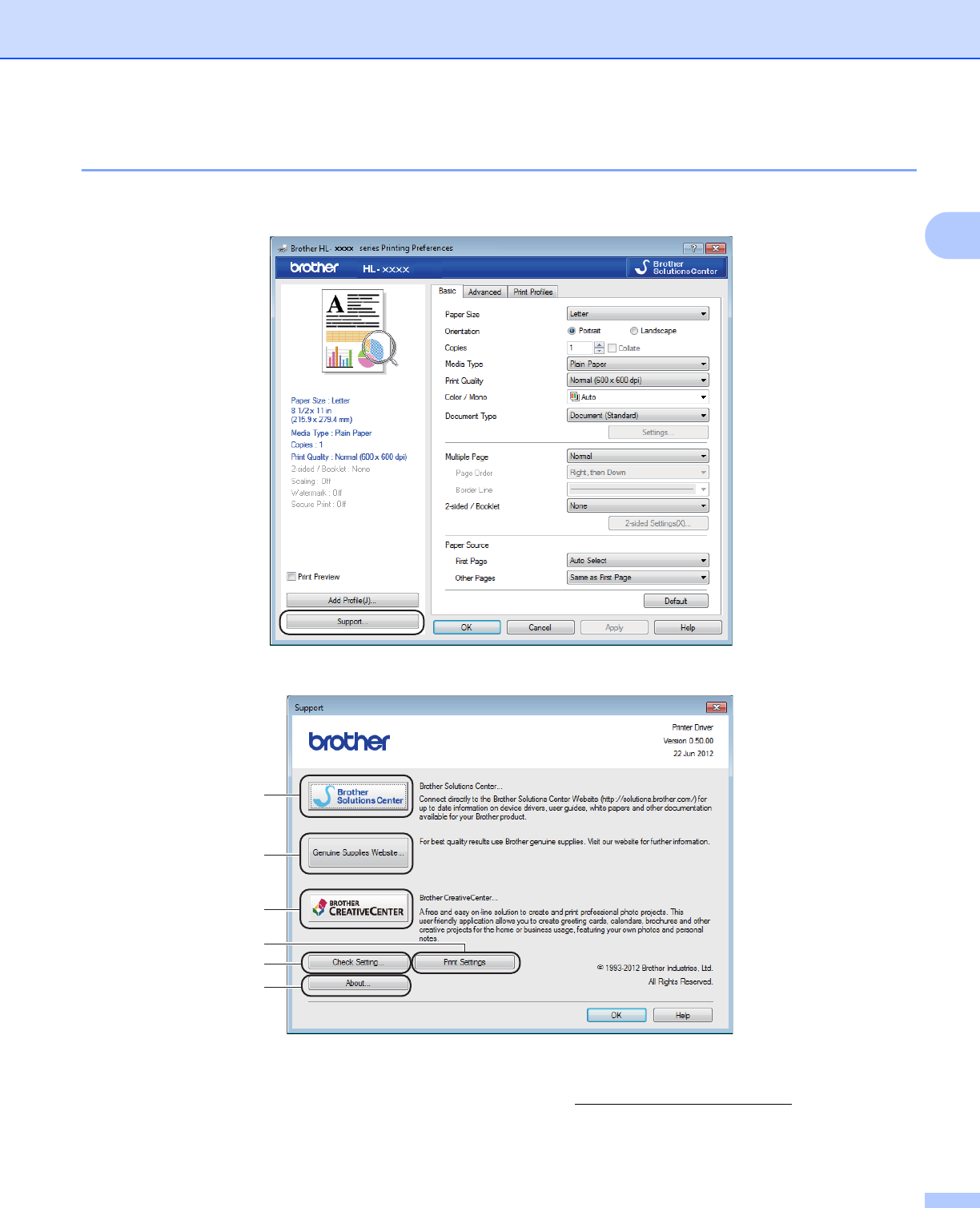
Click Support... in the Printing Preferences dialog box.
(1) Brother Solutions Center
Click this button to visit the Brother Solutions Center website (http://solutions.brother.com/) for information
about your Brother product including FAQs (Frequently Asked Questions), User’s Guides, driver updates
and tips for using your machine.
1
2
3
4
5
6

Driver and Software
54
2
(2) Genuine Supplies website
Click this button to visit our website for genuine Brother supplies.
(3) Brother CreativeCenter
Click this button to visit our website for free online solutions for business and home users.
(4) Print Settings
Click this button to print pages that show how the internal settings of the machine have been configured.
(5) Check Setting...
Click this button to check the printer driver settings.
(6) About...
Click this button to view a list of the printer driver files and version information.
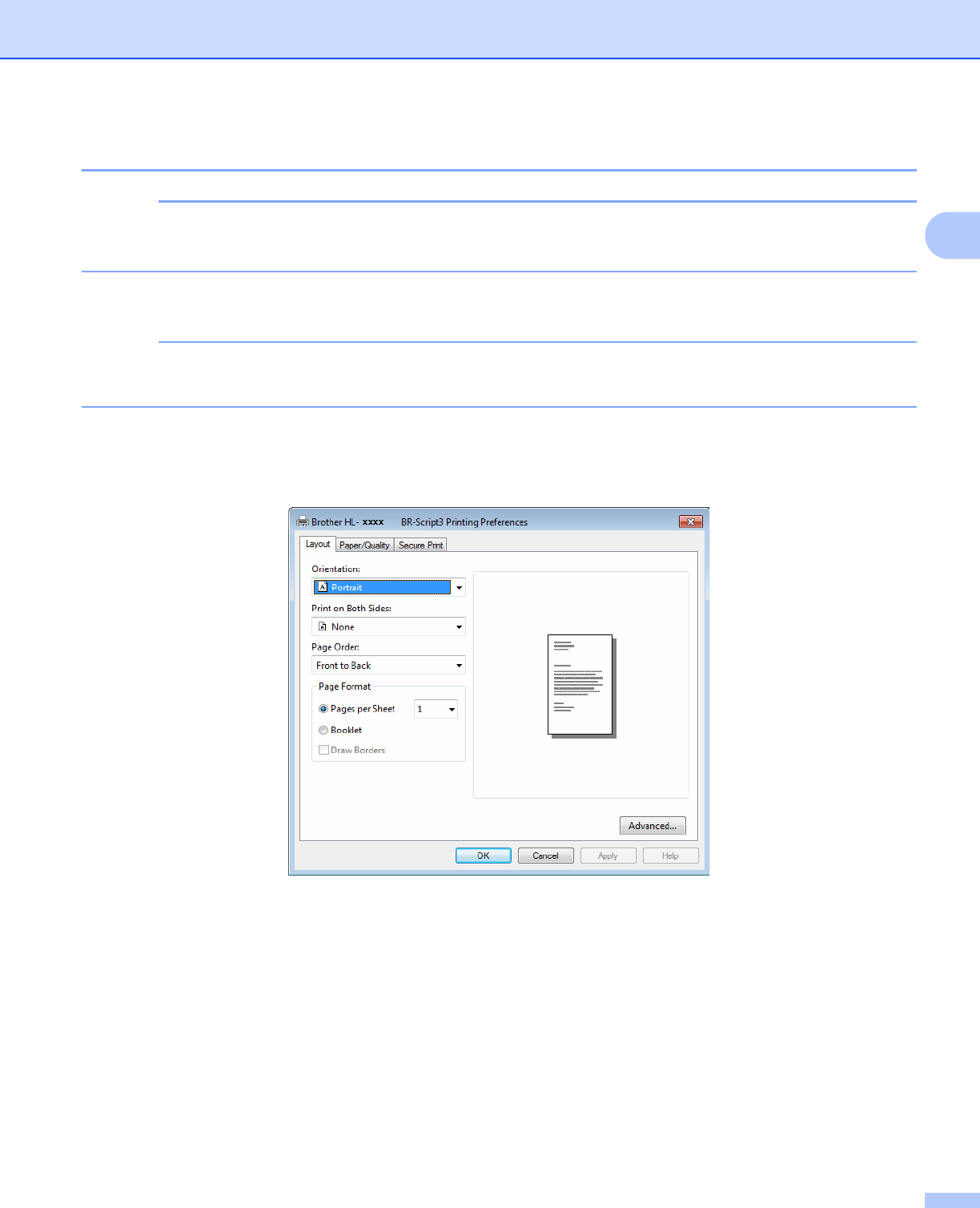
Driver and Software
55
2
BR-Script 3 printer driver features (PostScript®3™ language emulation) 2
NOTE
The screens in this section are from Windows®7. The screens on your computer may vary depending on
your operating system.
Printing Preferences 2
NOTE
To access the Printing Preferences dialog box, click Preferences... in the General tab of the Brother
HL-XXXX BR-Script3 Properties dialog box.
Layout tab
Change the layout by choosing the settings for Orientation, Print on Both Sides (2-sided), Page Order
and Pages Per Sheet.
•Orientation
Portrait
Landscape
Rotated Landscape
Orientation selects the position of your document on the printed page.
•Print on Both Sides
To do 2-sided printing, choose Flip on Short Edge or Flip on Long Edge.
•Page Order
Specify the order in which the pages of your document will be printed. Front to Back prints the
document so that page 1 is on top of the stack. Back to Front prints the document so that page 1 is on
the bottom of the stack.
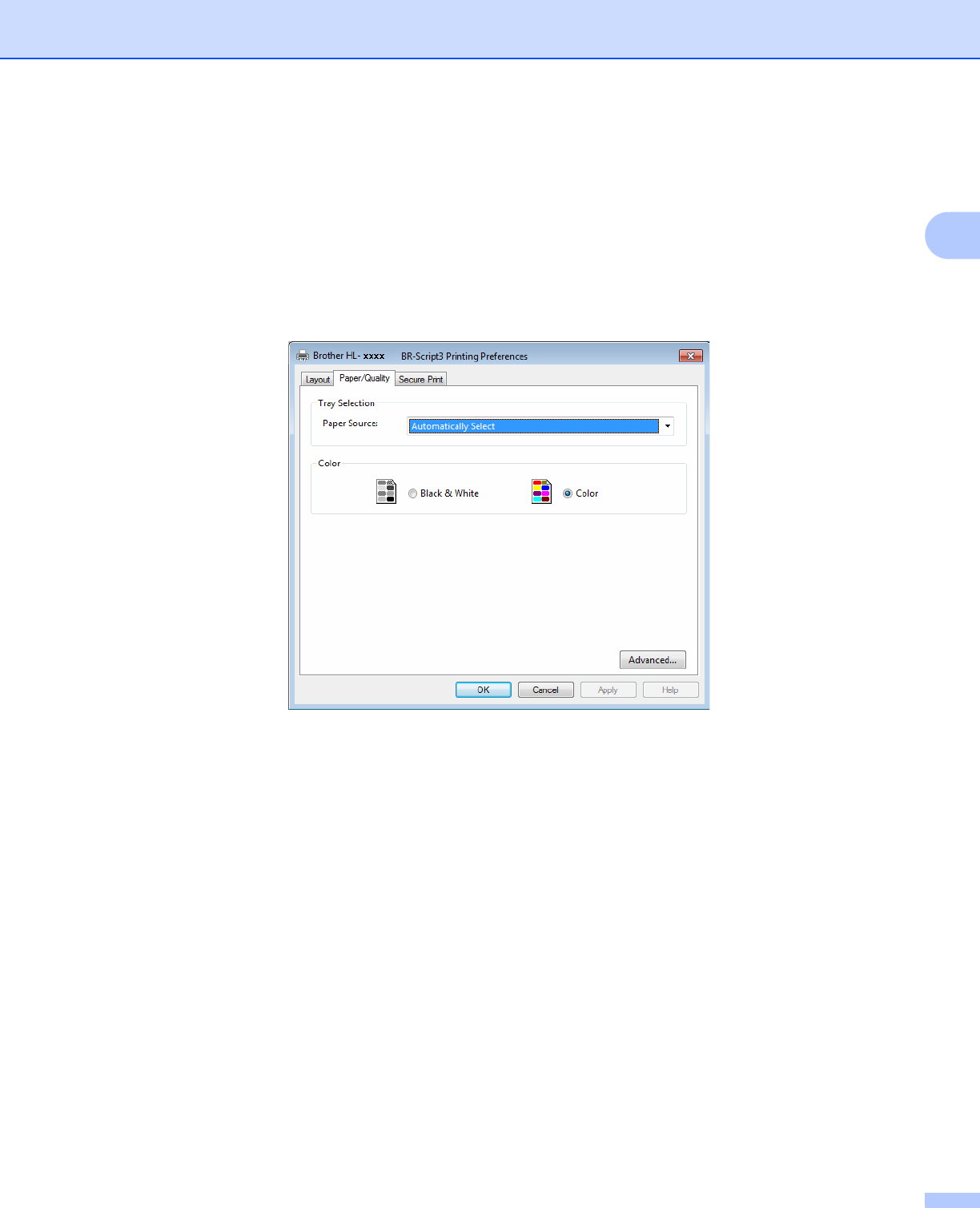
Driver and Software
56
2
•Pages Per Sheet
Click Pages Per Sheet to reduce the image size of a page by allowing multiple pages to be printed on
one sheet of paper. Click Booklet to print a document in the booklet style.
•Draw Borders
Select this check box to add a border.
Paper/Quality tab
Choose the Paper Source.
•Paper Source
Automatically Select
Auto Select by Printer
Tray1
Tray2 12
MP Tray
Automatically Select
Select this option to pull paper from any paper source that has a paper size defined in the printer driver
that matches your document.
Auto Select by Printer
Select this option to pull paper from any paper source that has a paper size defined in the machine that
matches your document.
Tray1
Select this option to pull paper from Tray 1.
Tray2
Select this option to pull paper from Tray 2. (Available if the optional tray is installed.) 2
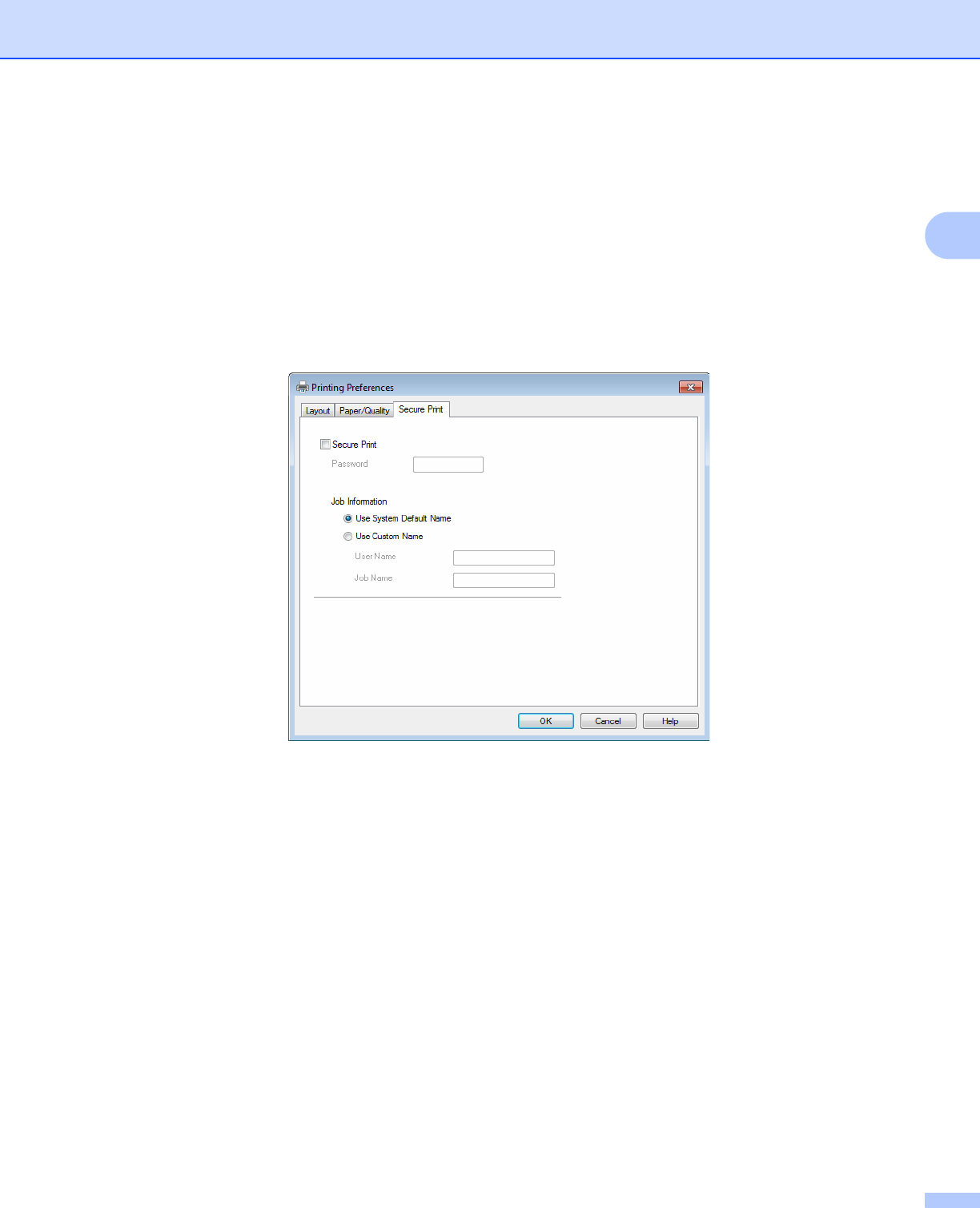
Driver and Software
57
2
MP Tray
Select this option to pull paper from the multi-purpose tray. The paper size in the multi-purpose tray
must match the size defined in the printer driver.
1Available if the optional tray is installed.
2Tray 2 is standard on HL-L8350CDWT.
•Color
Select either Black & White or Color.
Secure Print tab
Secure documents are documents that are password protected when they are sent to the machine. Only
the people who know the password will be able to print them. Since the documents are secured at the
machine, you must enter the password using the control panel of the machine to print them.
To send a secured document:
aCheck Secure Print.
bType your password and click OK.
cTo print the secured document, you must enter your password using the control panel of the machine
(see Printing Secure documents on page 104).
To delete a secured document:
You must use the control panel of the machine to delete a secured document (see Printing Secure
documents on page 104).
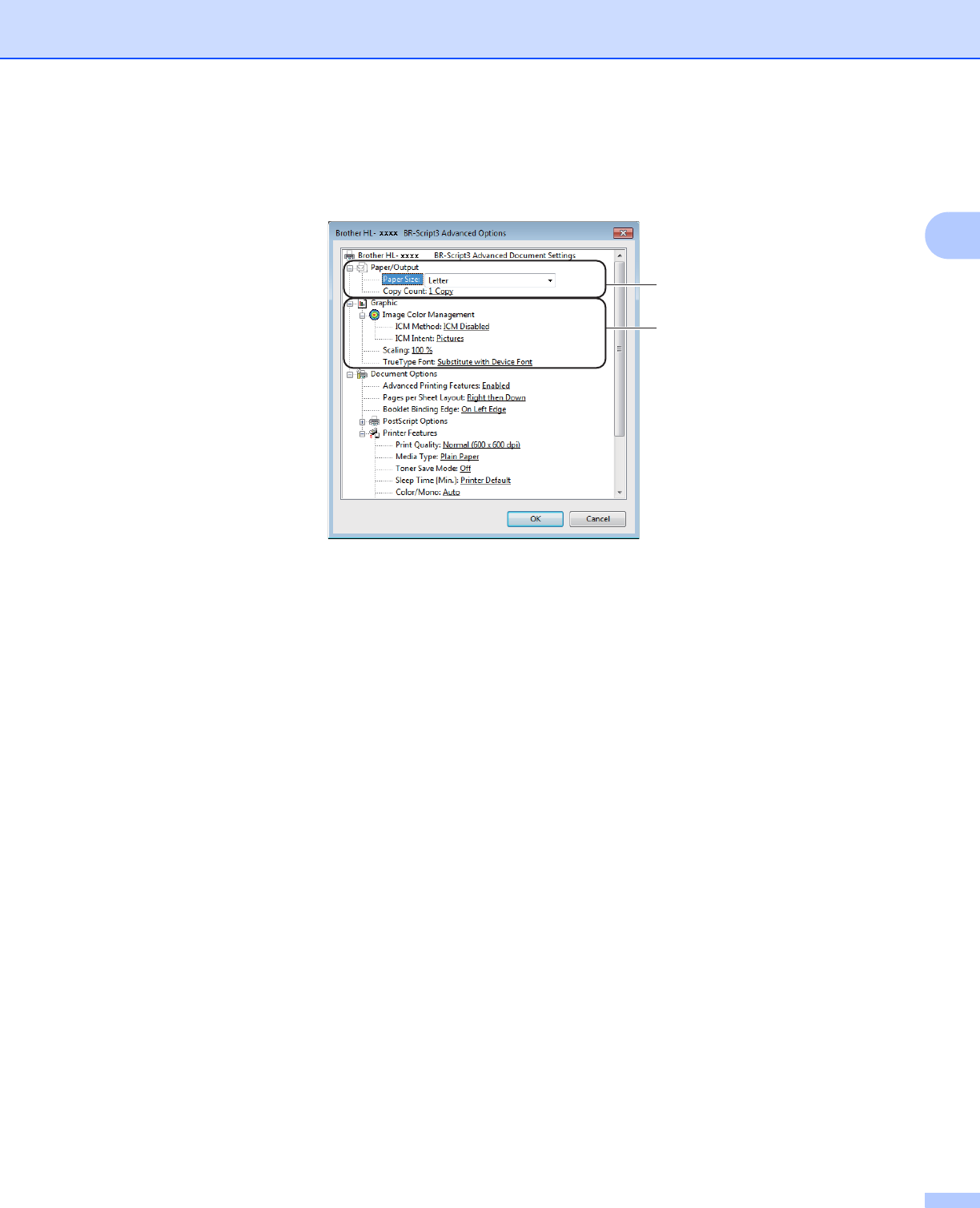
Driver and Software
58
2
Advanced options 2
Access the Advanced options by clicking the Advanced... button on the Layout tab or Paper/Quality tab.
aChoose the Paper Size and Copy Count (1).
Paper Size
From the drop-down list choose the size of paper you are using.
Copy Count
The copy selection sets the number of copies that will be printed.
bSet the Image Color Management, Scaling and TrueType Font settings (2).
Image Color Management
Specify how to print your color graphics.
• If you don’t want to enable Image Color Management, click ICM Disabled.
• If you want the calculations for color matching to be performed on the host computer before it
sends the document to the machine, click ICM Handled by Host System.
• If you want the calculations for color matching to be performed on your machine, click ICM
Handled by Printer using printer calibration.
Scaling
Specify whether to reduce or enlarge documents, and by what percentage.
TrueType Font
Specify the TrueType font options. Click Substitute with Device Font (the default) to use equivalent
printer fonts for printing documents that contain TrueType fonts. This will permit faster printing;
however, you might lose special characters not supported by the printer font. Click Download as
Softfont to download TrueType fonts for printing instead of using printer fonts.
1
2
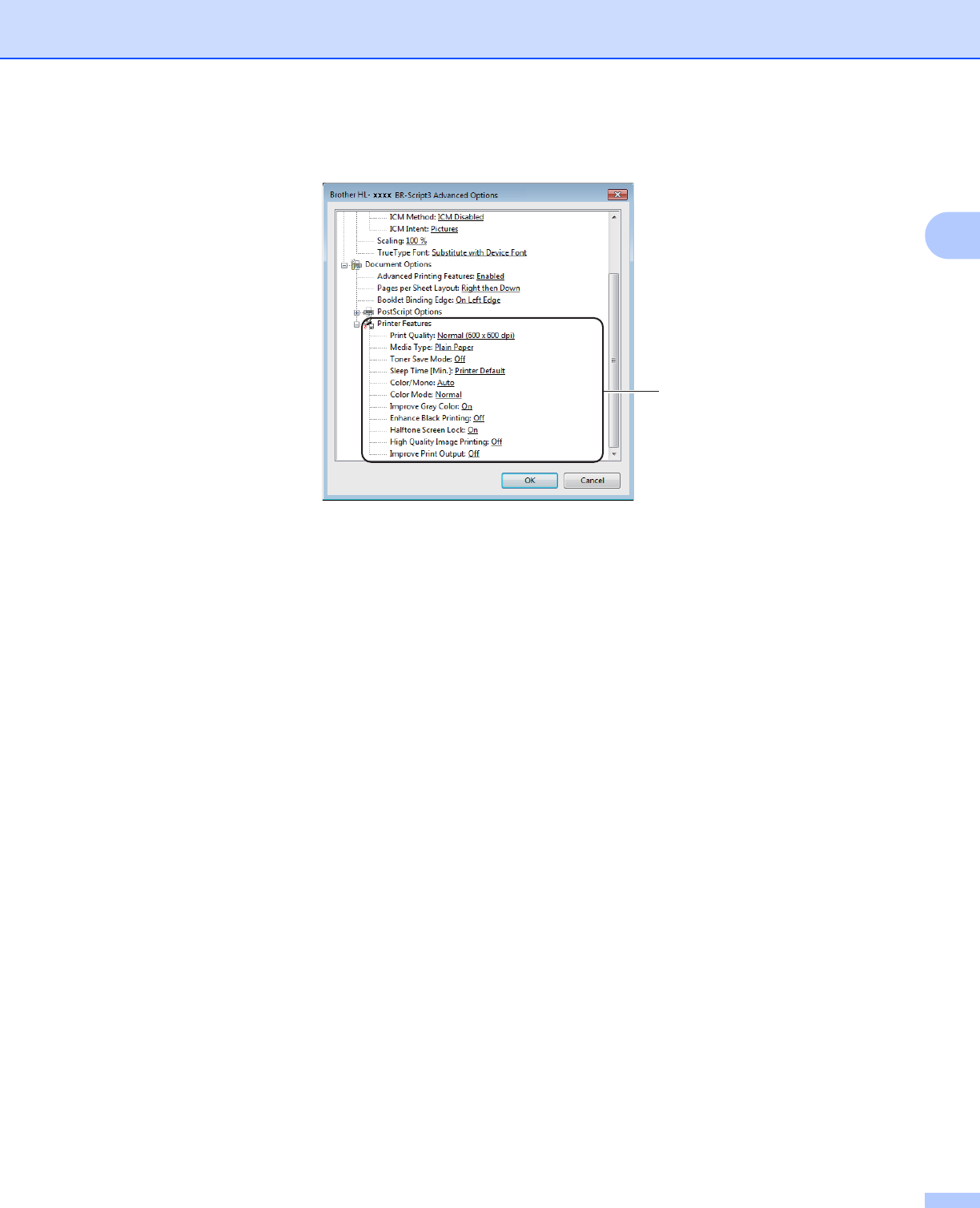
Driver and Software
59
2
cChange settings by choosing a setting in the Printer Features list (3):
Print Quality
Choose one of the following print quality settings:
•Normal (600 x 600 dpi)
600 dpi class. Recommended for ordinary printing. Use this mode for good print quality with
reasonable print speeds.
•Fine (2400 dpi class)
2400 dpi class. The finest print mode. Use this mode to print precise images such as photographs.
Since the print data is much larger than in Normal mode, processing time, data transfer time, and
print time will be longer.
Media Type
You can use the following types of media in your machine. For the best print quality, select the type
of media you are using.
•Plain Paper
•Thin Paper
•Thick Paper
•Thicker Paper
•Bond Paper
•Envelopes
•Env. Thick
•Env. Thin
•Recycled Paper
•Label
•Glossy Paper
3

Driver and Software
60
2
Toner Save Mode
Conserve toner use with this feature. When you set Toner Save Mode to On, print appears lighter.
The default setting is Off.
NOTE
We do not recommend Toner Save Mode for printing Photo or grayscale images.
Sleep Time [Min.]
When the machine does not receive data for a certain period of time, it enters Sleep mode. In Sleep
mode, the machine acts as though it were turned off. When you choose Printer Default, the timeout
setting will be reset to the specific time set at the factory; this can be altered in the driver.
While the machine is in Sleep mode, the LCD displays Sleep, but the machine can still receive data.
Receiving a print job will wake up the machine to start printing.
Color / Mono
You can change the Color/Mono settings in the printer driver as follows:
•Auto
The machine checks the content of the document for color. If color is detected anywhere in the
document, it will print the whole of the document using all the colors. In other words, it will mix some
of the toners to help achieve every shade detected in the document, increasing the density of toner
applied to the page. If no color content is detected, it will print the document in monochrome. The
default setting on your machine is Auto.
•Color
Whether the document contains color or just monochrome, your machine will print the document
using all the colors.
•Mono
Select this mode if the document has only black and grayscale text and objects. If your document
contains color, this mode prints the document in 256 levels of gray using the black toner.
NOTE
• The machine’s color sensor is very sensitive and may perceive faded black text or an off-white background
as color. If you know that your document is black and white and you want to conserve color toner, select
Mono mode.
• If either the Cyan, Magenta or Yellow toner reaches the end of its life while printing a color document, the
print job cannot be completed. You can cancel your print job and choose to start the print job again in
Mono mode, as long as Black toner is available.

Driver and Software
61
2
Color Mode
The following options are available in Color Matching mode:
•Normal
This is the Default color mode.
•Vivid
The color of all elements are adjusted to become a more vivid color.
•None
Improve Gray Color
You can improve the image of a shaded area.
Enhance Black Printing
If a black graphic does not print correctly, choose this setting.
Halftone Screen Lock
This lock stops other applications from modifying the Halftone settings. The default setting is On.
High Quality Image Printing
You can get high quality image printing. If you set High Quality Image Printing to On, the print speed
will be slower.
Improve Print Output
This feature allows you to improve a print quality problem.
•Reduce Paper Curl
If you choose this setting, the paper curl may be reduced. If you are printing only a few pages, you
do not have to choose this setting. We recommend changing the printer driver setting in Media
Type to a thin setting.
NOTE
This operation will decrease the temperature of the machine's fusing process.
•Improve Toner Fixing
If you choose this setting, the toner fixing capabilities may be improved. If this selection does not
provide enough improvement, change the printer driver setting in Media Type to a thick setting.
NOTE
This operation will increase the temperature of the machine's fusing process.
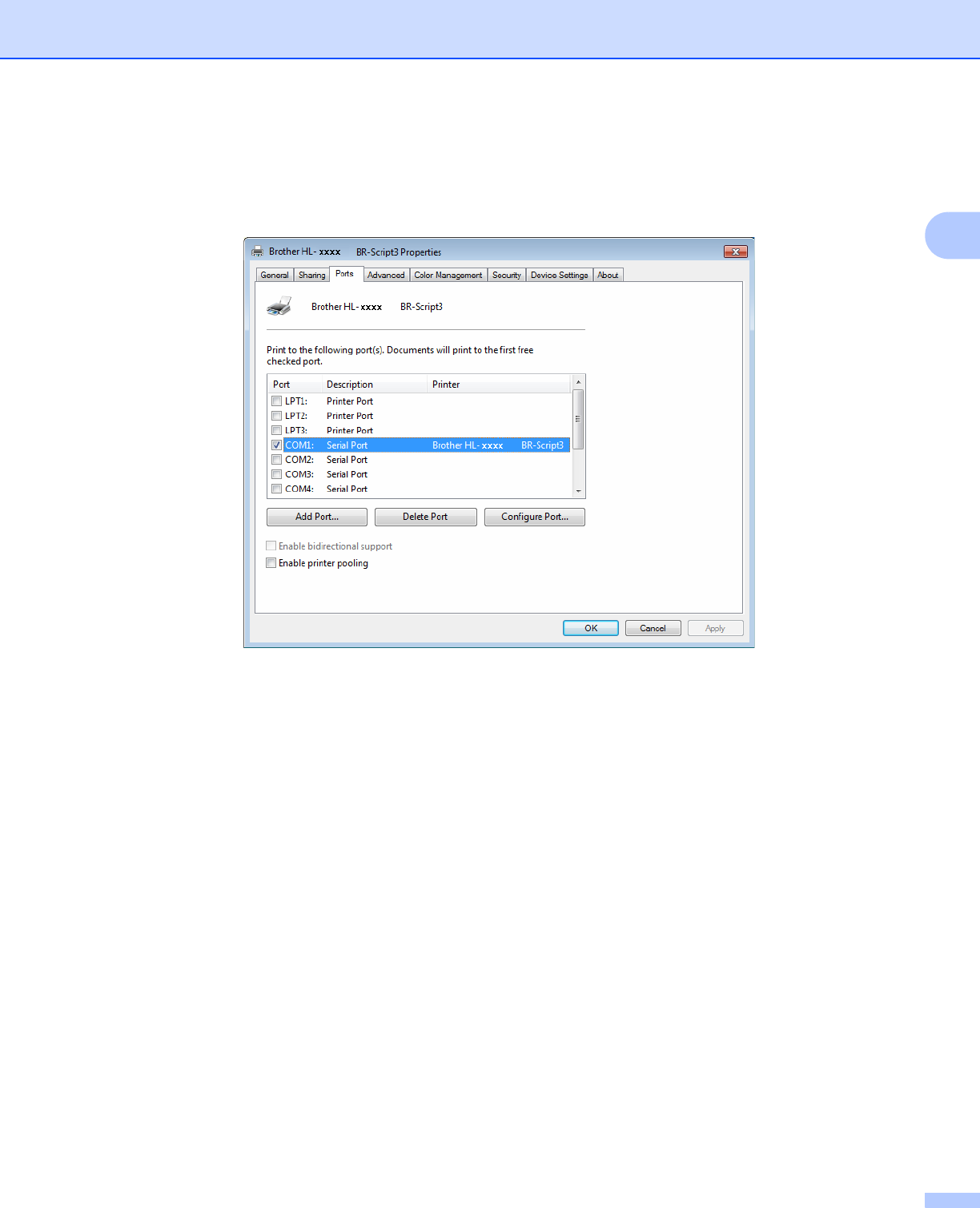
Driver and Software
62
2
Ports tab 2
To change the port where your machine is connected or the path to the network machine you are using,
choose or add the port you want to use.

Driver and Software
63
2
Uninstalling the printer driver 2
Uninstall the printer driver that you have installed with the following steps.
NOTE
•UnInstall is not available if you originally installed the printer driver from the Windows Add a printer
setting.
• After uninstalling, we recommend restarting your computer to remove files that were in use during the
uninstall.
(Windows® XP, Windows Vista® and Windows® 7)
aClick the Start button, point to All Programs, Brother, and then to your machine name.
bClick UnInstall.
cFollow the instructions on the screen.
(Windows® 8)
aClick (Brother Utilities). Brother Utilities screen appears.
bClick the drop-down list and select your model name (if not already selected).
cClick Tools in the left navigation bar.
dClick Uninstall.
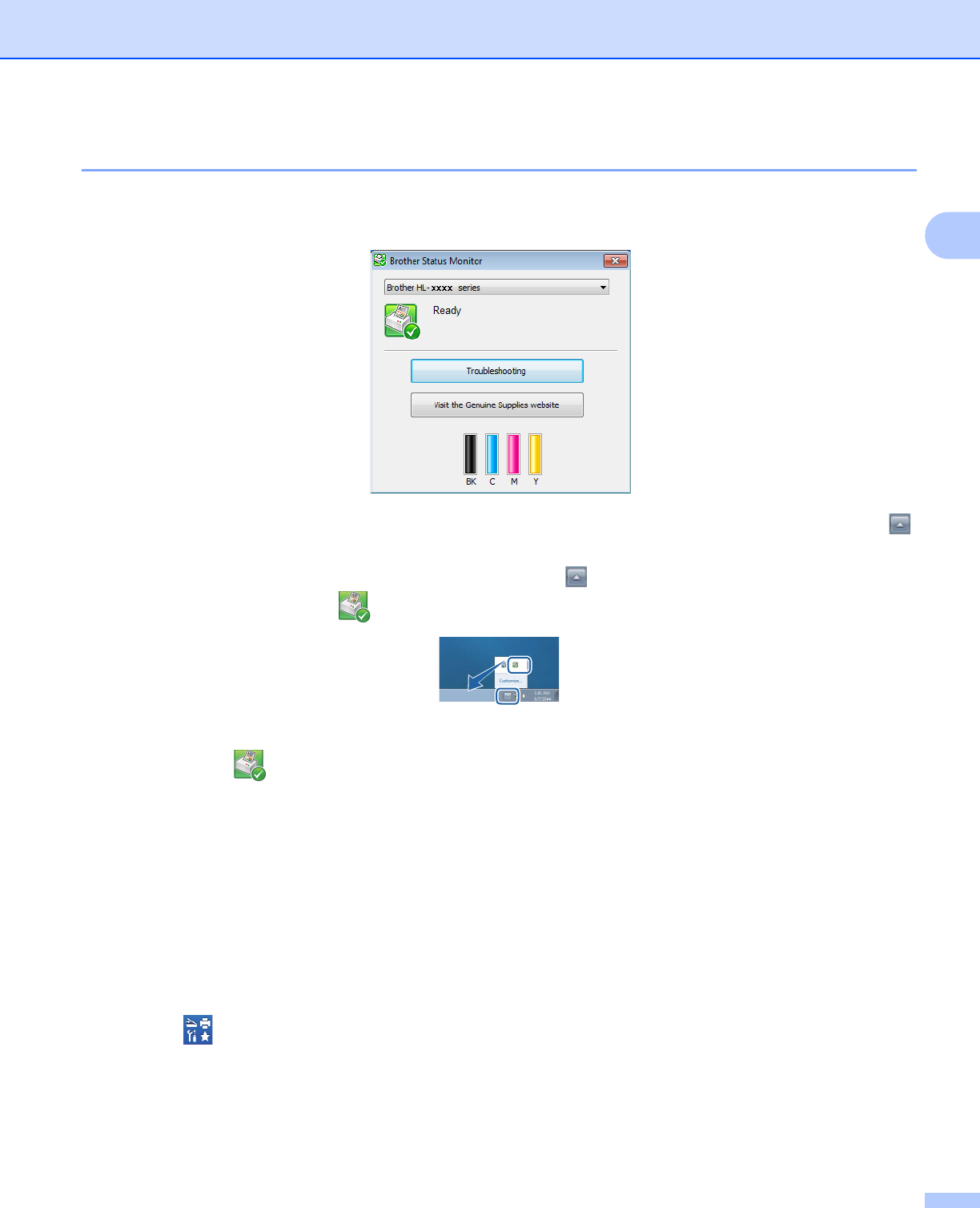
Driver and Software
64
2
Status Monitor 2
The Status Monitor utility is a configurable software tool for monitoring the status of one or more devices,
allowing you to get immediate notification of errors.
If you selected the Enable Status Monitor on startup check box during installation, you will find the
button or the Status Monitor icon on the taskbar.
To show the Status Monitor icon on your taskbar, click the button. The Status Monitor icon appears
in the small window. Drag the icon to the taskbar.
Do one of the following:
Double-click the icon in the task tray.
(Windows® XP, Windows Vista® and Windows® 7)
aClick Start > All Programs > Brother > Brother Utilities. The Brother Utilities screen appears.
bClick the drop-down list and select your model name (if not already selected).
cClick Tools in the left navigation bar.
dClick Status Monitor.
(Windows® 8)
aClick (Brother Utilities). The Brother Utilities screen appears.
bClick the drop-down list and select your model name (if not already selected).
cClick Tools in the left navigation bar.
dClick Status Monitor.
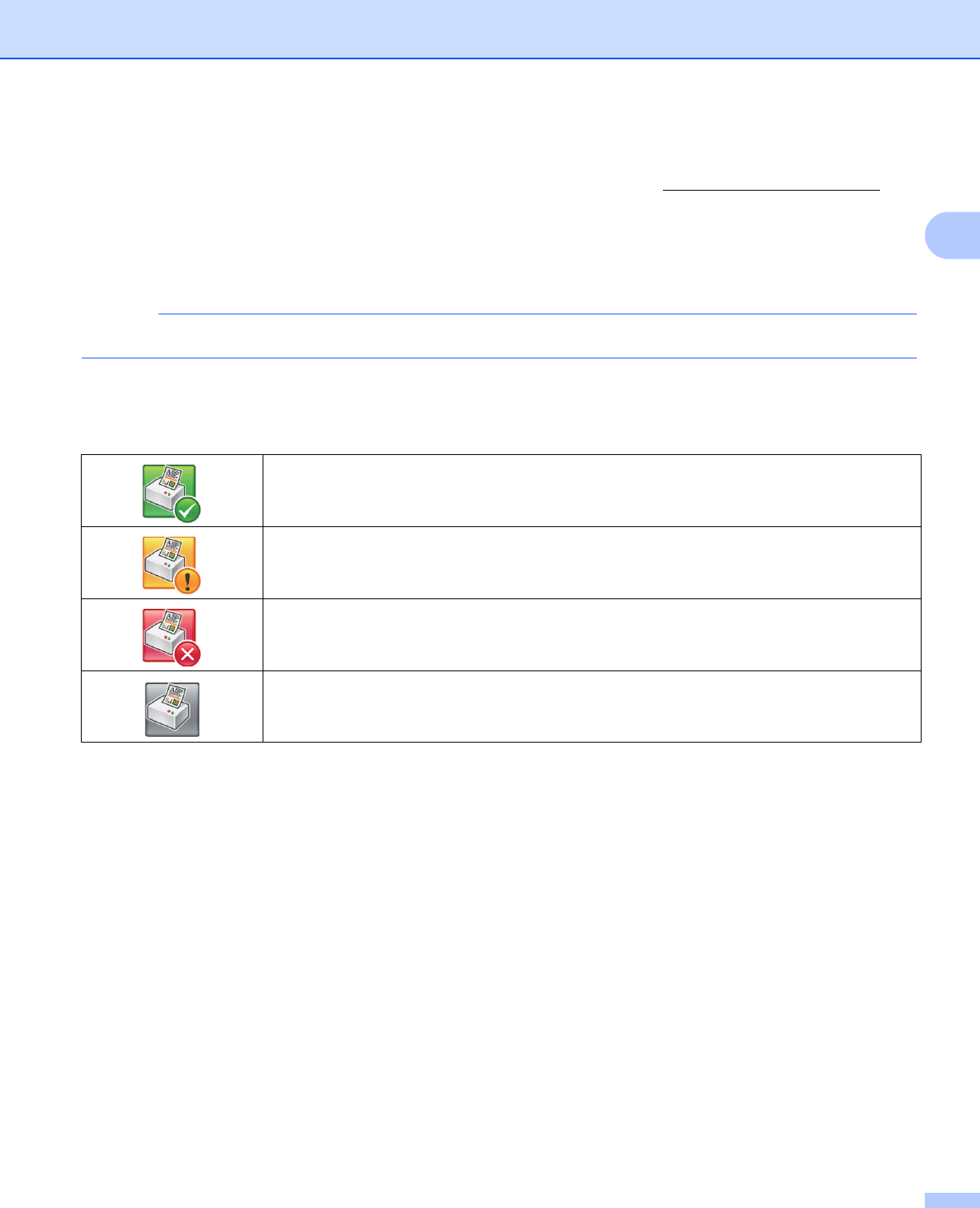
Driver and Software
65
2
Troubleshooting 2
Click the Troubleshooting button to access the Brother Solutions Center at http://solutions.brother.com/ and
visit FAQs on your model page for instructions.
Visit the Genuine Supplies website 2
Click the Visit the Genuine Supplies website button for more information on Brother genuine supplies.
NOTE
The automatic firmware update is active when the status monitor feature is enabled.
Monitoring the machine’s status 2
When you start up your computer, the Brother Status Monitor icon appears on the tasktray.
The Status Monitor can be displayed in the tasktray or on the desktop of your computer.
A green icon indicates the normal stand-by condition.
A yellow icon indicates a warning.
A red icon indicates an error has occurred.
A gray icon indicates the offline condition.
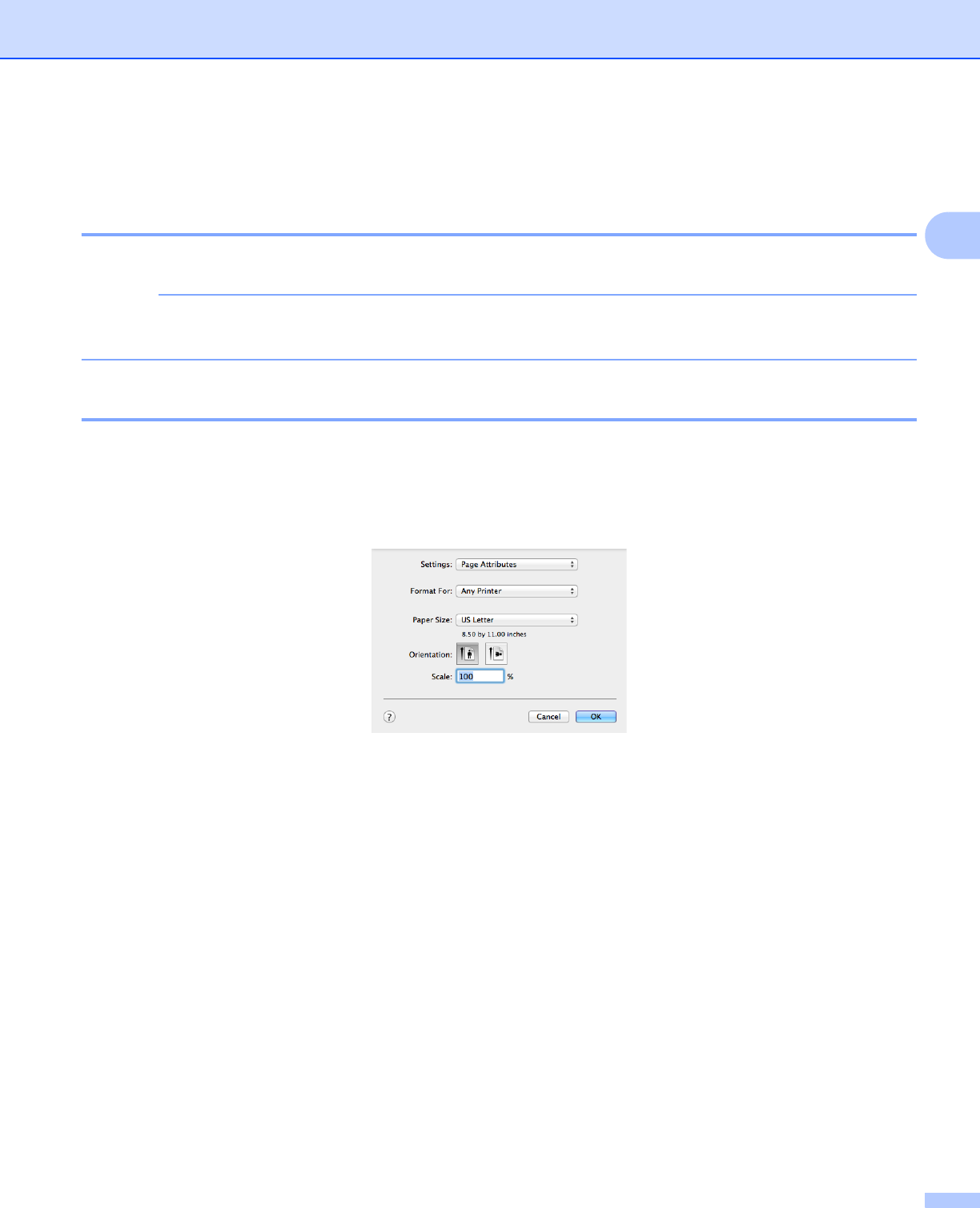
Driver and Software
66
2
Macintosh 2
Features in the printer driver (Macintosh) 2
This machine supports Mac OS X 10.7.5, 10.8.x, 10.9.x.
NOTE
The screens in this section are from OS X v10.7.x. The screens on your Macintosh will vary depending on
your operating system version.
Choosing page setup options 2
Select the Paper Size, Orientation and Scale.
aFrom an application such as TextEdit, click File, then Page Setup. Make sure Brother HL-XXXX (where
XXXX is your model name.) is chosen in the Format For pop-up menu. Select the settings for Paper
Size, Orientation and Scale, then click OK.
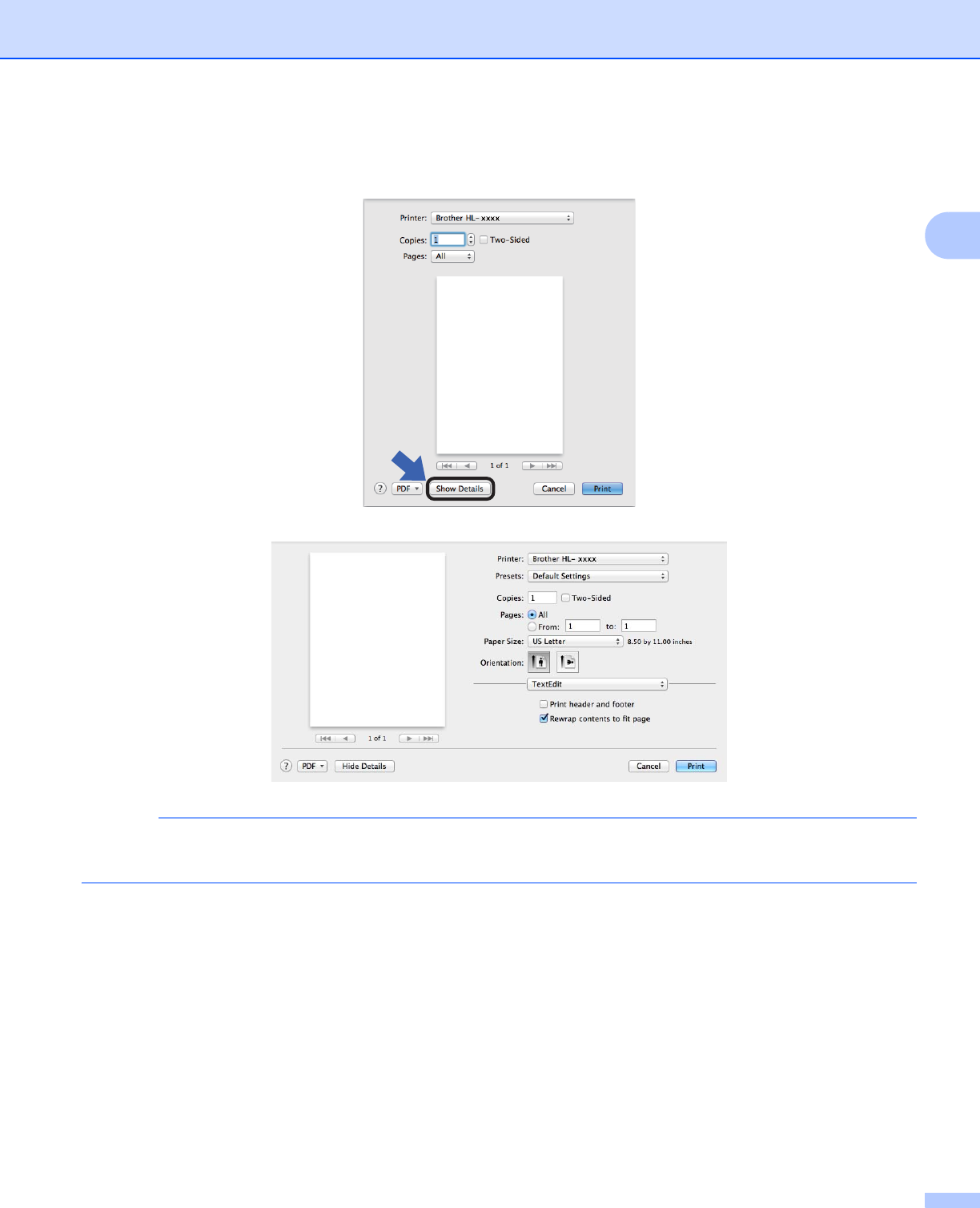
Driver and Software
67
2
bFrom an application such as TextEdit, click File, then Print to start printing.
For more page setup options, click the Show Details button.
NOTE
Save the current settings as a preset by choosing Save Current Settings as Preset... from the Presets
pop-up menu.
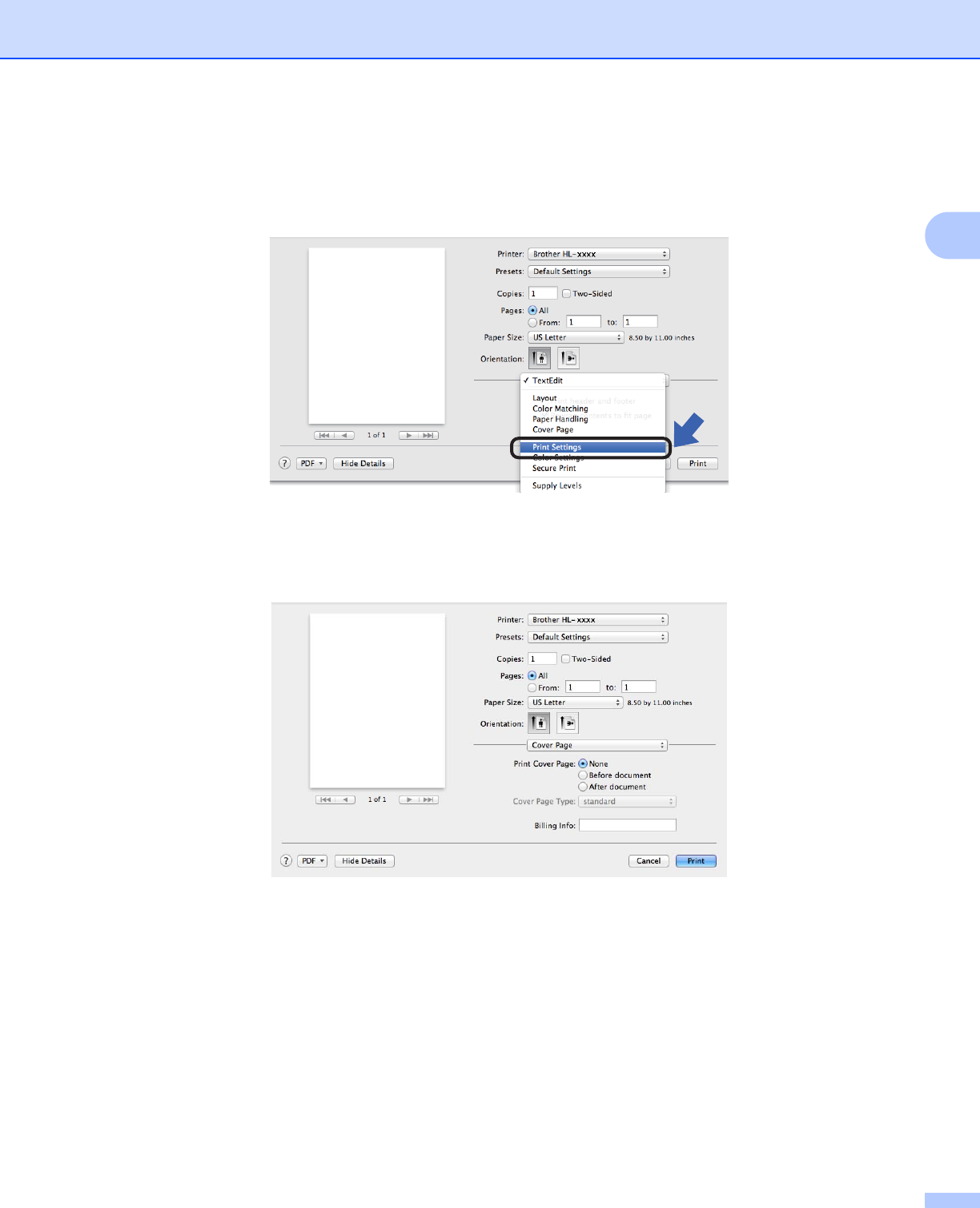
Driver and Software
68
2
Choosing printing options 2
To control special printing features, choose Print Settings from the Print dialog box. For more information
about the available options, see the following descriptions:
Cover Page 2
You can choose the following cover page settings:
Print Cover Page
To add a cover page to your document, use this setting.
Cover Page Type
Choose a template for the cover page.
Billing Info
To add the billing information to the cover page, type text in the Billing Info text box.
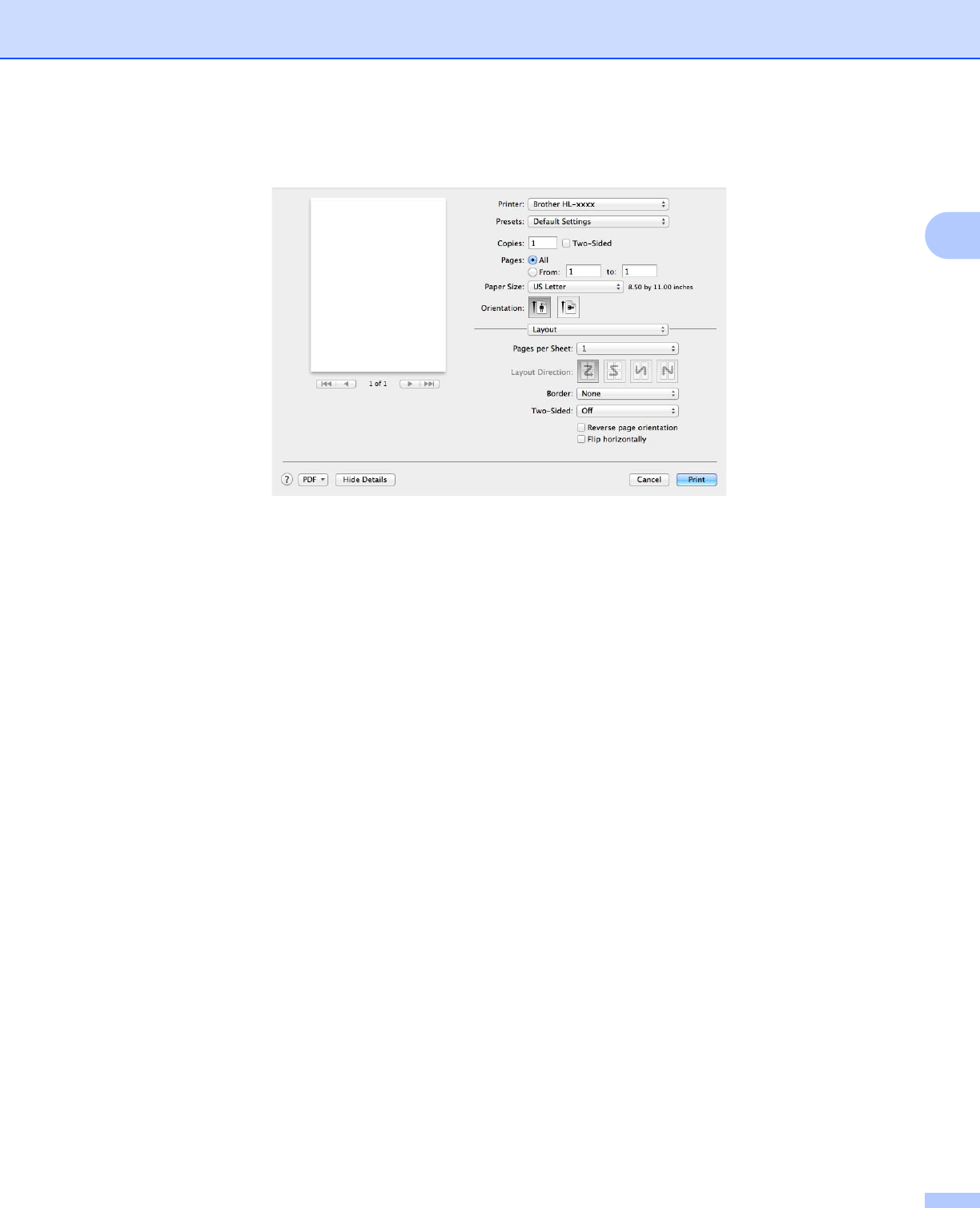
Driver and Software
69
2
Layout 2
Pages per Sheet
The Pages per Sheet selection can reduce the image size of a page by allowing multiple pages to be
printed on one sheet of paper.
Layout Direction
When you specify the pages per sheet, you can also specify the direction of the layout.
Border
To add a border, use this setting.
Two-Sided
See 2-sided Printing on page 75.
Reverse page orientation
Select Reverse page orientation to rotate the page 180 degrees.
Flip horizontally
Select Flip horizontally to print the page as a reflection flipped left-to-right.
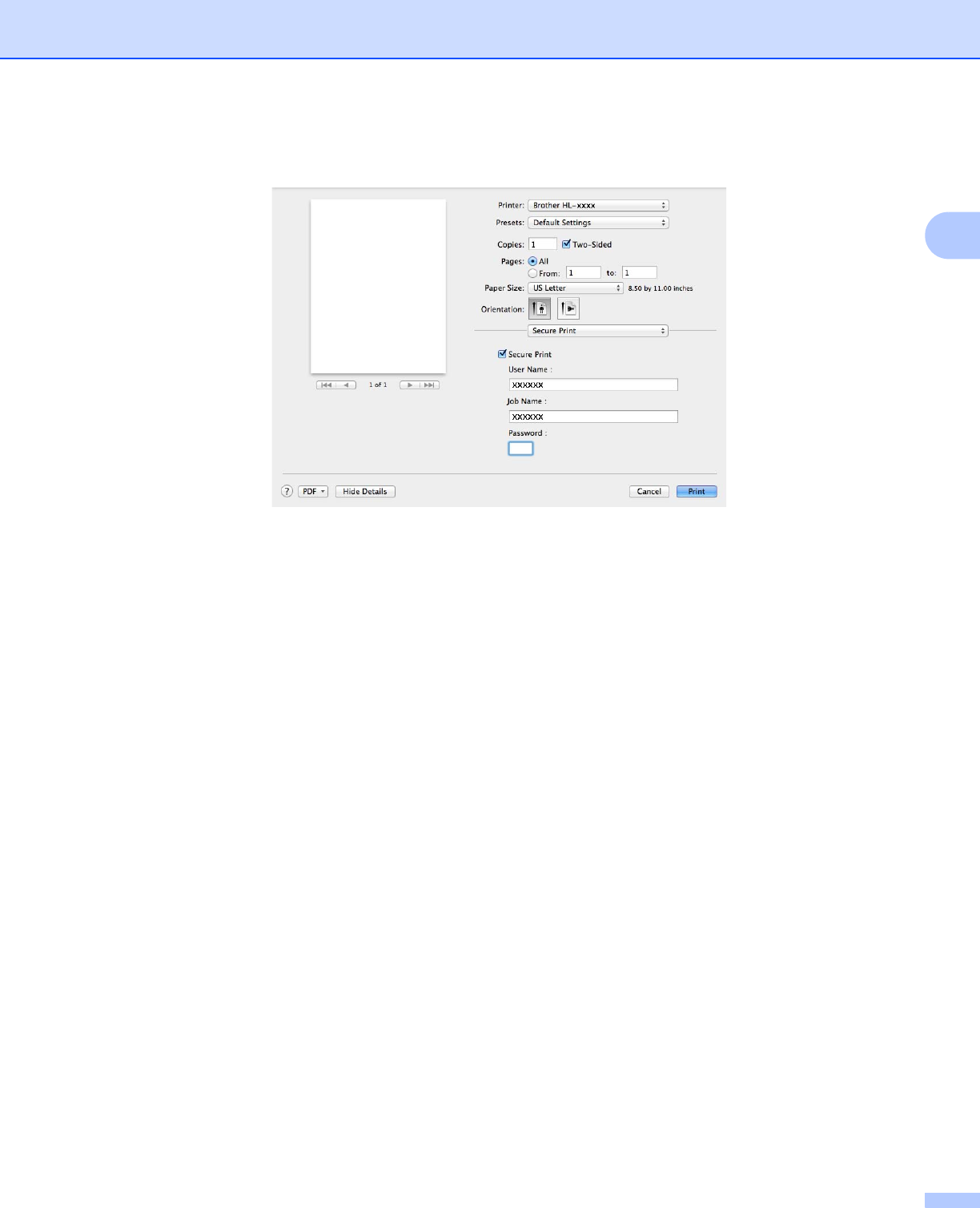
Driver and Software
70
2
Secure Print 2
Secure Print:
Secure documents are documents that are password protected when they are sent to the machine. Only
the people who know the password will be able to print them. Since the documents are secured at the
machine, you must enter the password using the control panel of the machine to print them.
To send a secured document:
aSelect Secure Print.
bType your password, user name and job name, and then click Print.
cTo print a secured document, you must enter your password using the control panel of the machine
(see Printing Secure documents on page 104).
To delete a secured document, you must use the control panel of the machine to delete it (see Printing
Secure documents on page 104).
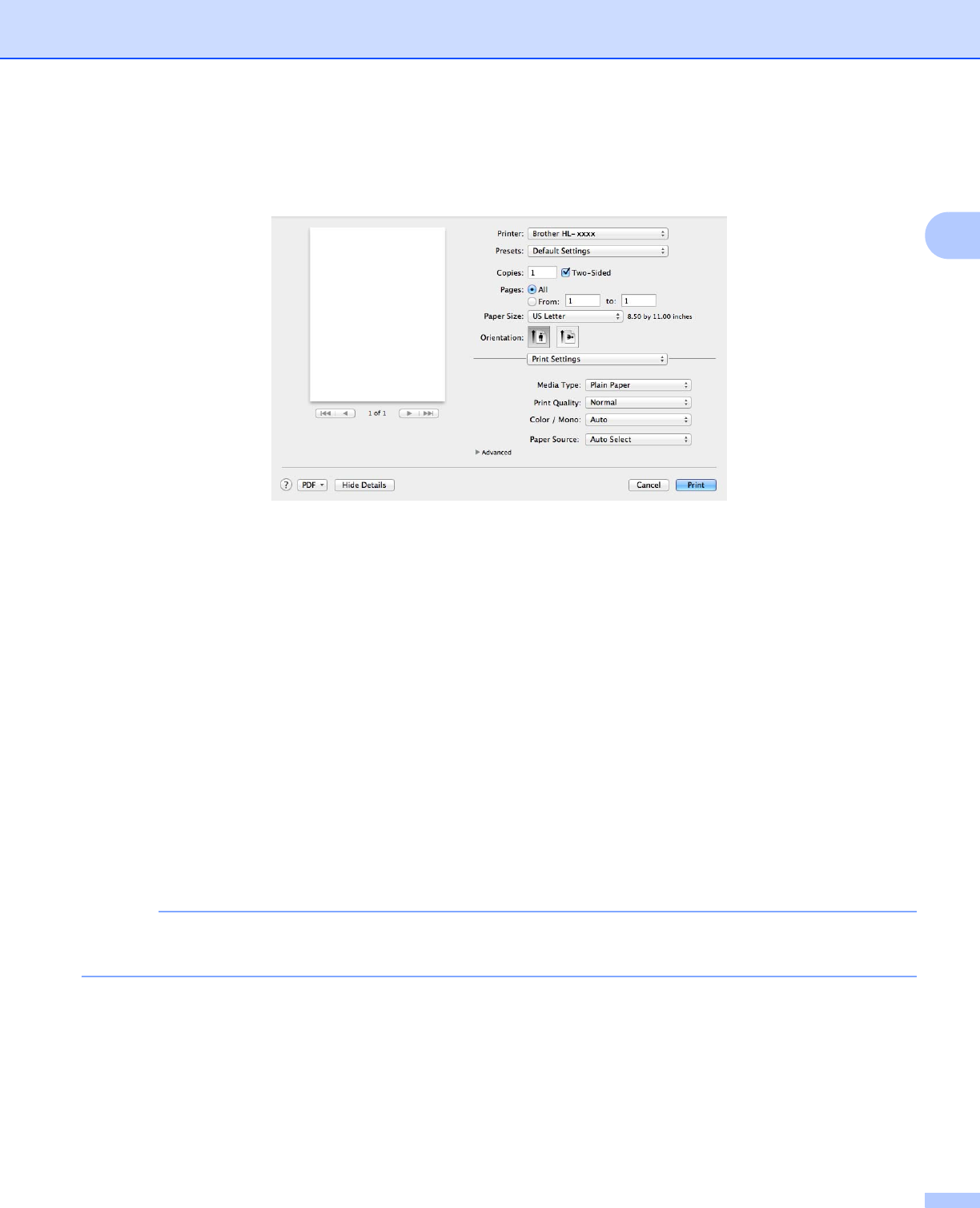
Driver and Software
71
2
Print Settings 2
Choose your settings in the Print Settings list:
Media Type
Select one of the following media types:
•Plain Paper
•Thin Paper
•Thick Paper
•Thicker Paper
•Bond Paper
•Envelopes
•Env. Thick
•Env. Thin
•Recycled Paper
•Label
•Glossy Paper
NOTE
When Label is selected in the printer driver, the machine will feed the paper from the MP tray, even if MP
Tray is not selected as the paper source.

Driver and Software
72
2
Print Quality
Choose one of the following print quality settings:
•Normal
600 dpi class. Recommended for ordinary printing. Use this mode for good print quality with reasonable
print speeds.
•Fine
2400 dpi class. The finest print mode. Use this mode to print precise images such as photographs.
Since the print data is much larger than in Normal mode, processing time, data transfer time, and
printing time will be longer.
NOTE
The print speed will change depending on the print quality setting you choose. Higher print quality takes
longer to print, while lower print quality takes less time to print.
Color / Mono
You can change the Color/Mono settings in the printer driver as follows:
•Auto
The machine checks the content of the document for color. If color is detected anywhere in the
document, it will print the whole of the document using all the colors. In other words, it will mix some of
the toners to help achieve every shade detected in the document, increasing the density of toner
applied to the page. If no color content is detected, it will print the document in monochrome. The default
setting on your machine is Auto.
•Color
Whether the document contains color or just monochrome, your machine will print the document using
all the colors.
•Mono
Select this mode if the document has only black and grayscale text and objects. If your document
contains color, this mode prints the document in 256 levels of gray using the black toner.
NOTE
• The machine’s color sensor is very sensitive and may perceive faded black text or an off-white background
as color. If you know that your document is black and white and you want to conserve color toner, select
Mono mode.
• If either the Cyan, Magenta or Yellow toner reaches the end of its life while printing a color document, the
print job cannot be completed. You can cancel your print job and choose to start the print job again in
Mono mode, as long as Black toner is available.
Paper Source
Choose Auto Select, Tray1, Tray2,12
or MP Tray.
1Available if the optional tray is installed.
2Tray 2 is standard on HL-L8350CDWT.
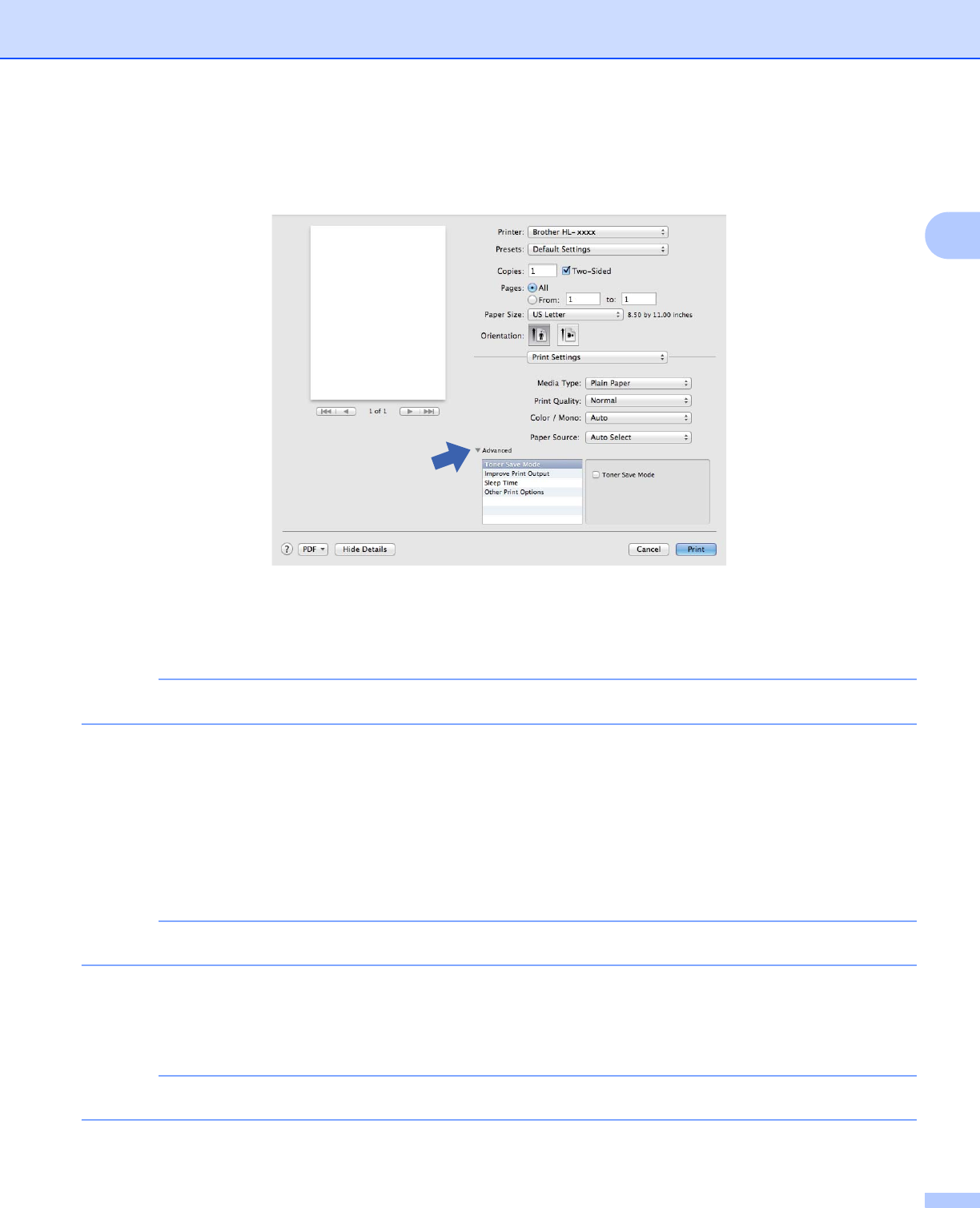
Driver and Software
73
2
Advanced print settings
When you click the triangle mark (c) beside Advanced, the advanced print settings appear.
Toner Save Mode
Conserve toner use with this feature. When you select the Toner Save Mode check box, print appears
lighter. The default setting is off (unchecked).
NOTE
We do not recommend Toner Save Mode for printing Photo or grayscale images.
Improve Print Output
This feature allows you to improve a print quality problem.
•Reduce Paper Curl
If you choose this setting, the paper curl may be reduced.
If you are printing only a few pages, you do not have to choose this setting. We recommend changing
the printer driver setting in Media Type to a thin setting.
NOTE
This operation will decrease the temperature of the machine's fusing process.
•Improve Toner Fixing
If you choose this setting, the toner fixing capabilities may be improved. If this selection does not
provide enough improvement, change the printer driver setting in Media Type to a thick setting.
NOTE
This operation will increase the temperature of the machine's fusing process.

Driver and Software
74
2
Sleep Time
When the machine does not receive data for a certain period of time, it enters Sleep mode. In Sleep mode,
the machine acts as though it were turned off. If you choose Printer Default, the timeout setting will be
reset to the specific time set at the factory; this can be altered in the driver. To change the Sleep Time,
select Manual, and then type the time in the text box.
While the machine is in Sleep mode, the LCD displays Sleep, but the machine can still receive data.
Receiving a print job will wake up the machine to start printing.
Other Print Options
•Skip Blank Page
If Skip Blank Page is selected, the printer driver detects blank pages and excludes them from printing.
Color Settings 2
Color Mode
The following options are available in Color Matching mode:
•Normal
This is the Default color mode.
•Vivid
The color of all elements are adjusted to become a more vivid color.
•None
Improve Gray Color
You can improve the image of a shaded area.
Enhance Black Printing
If a black graphic does not print correctly, choose this setting.
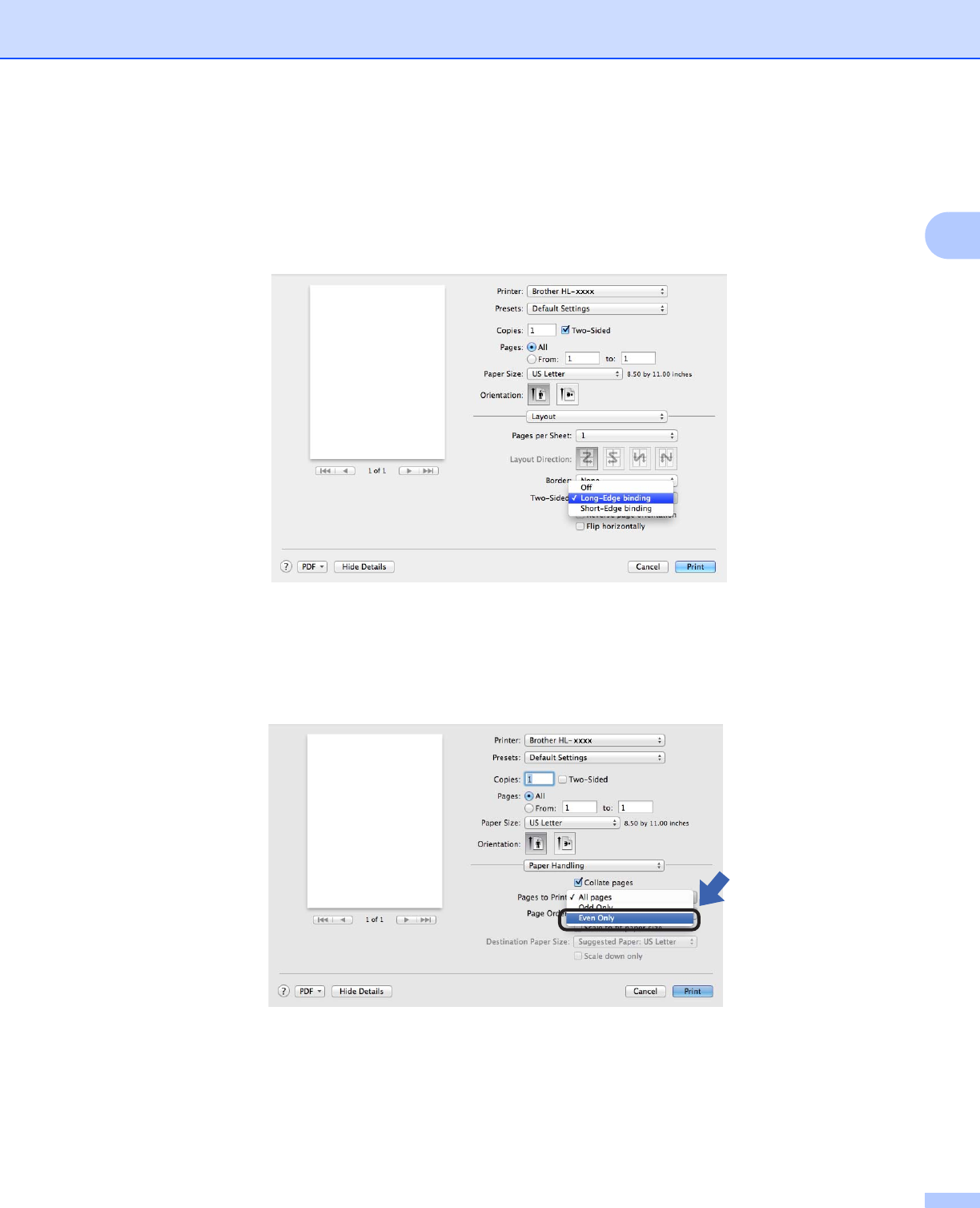
Driver and Software
75
2
2-sided Printing 2
Automatic 2–sided Printing
Select Layout.
Choose Long-Edge binding or Short-Edge binding in Two-Sided.
Manual 2–sided Printing
Select Paper Handling.
• Choose Even Only and Print. Reload the printed paper into the tray (blank side face down in Tray 1
Tray 2, or blank side face up in the MP tray). Choose Odd Only and Print.
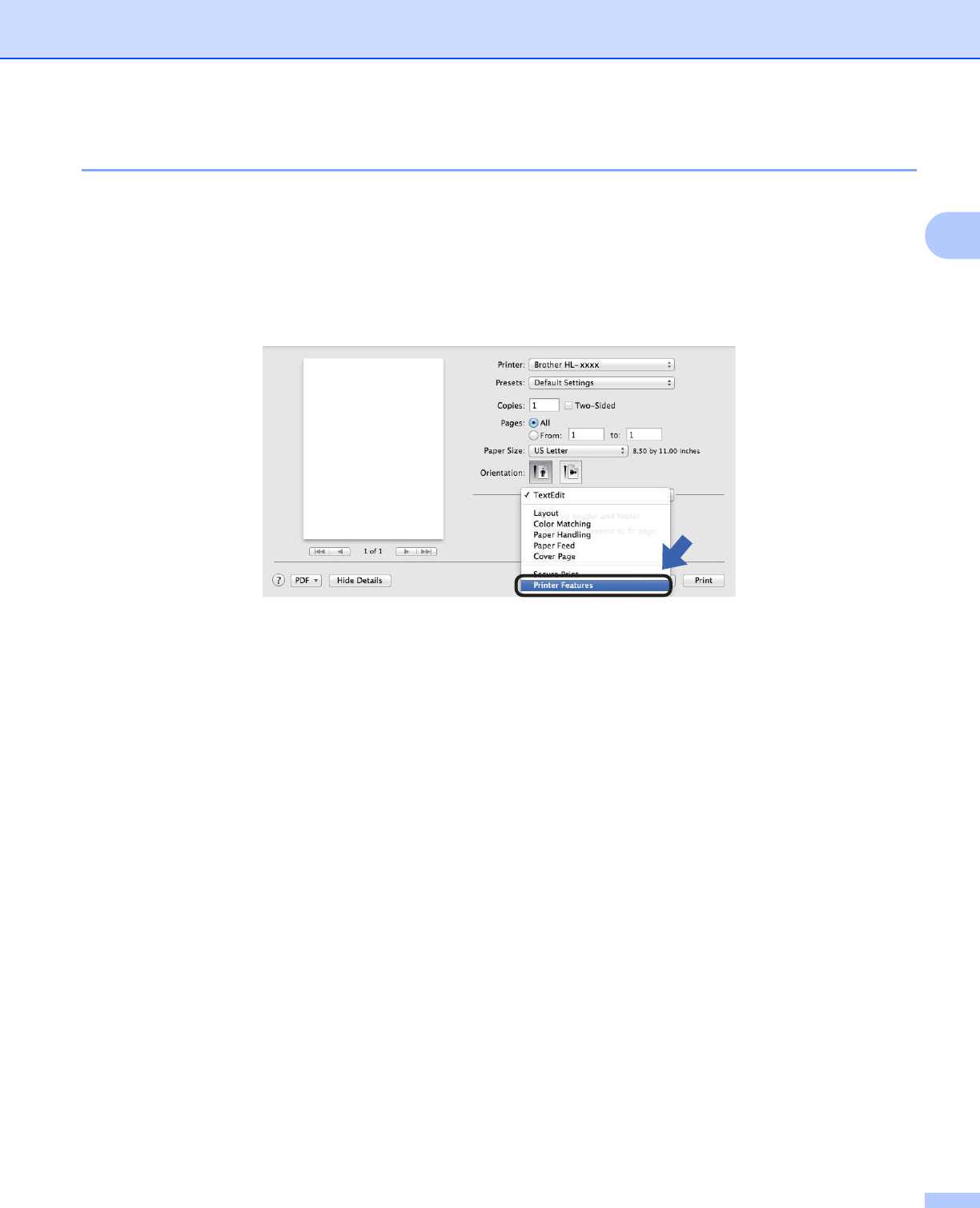
Driver and Software
76
2
Features in the BR-Script3 printer driver (PostScript®3™ language emulation) 2
This section introduces the distinctive operations of the BR-Script3 printer driver. For the basic operations of
the BR-Script3 printer driver, see Features in the printer driver (Macintosh) on page 66 for Page Setup,
Cover Page, Paper Source and Layout.
Choosing printing options 2
To control special print features, choose Printer Features in the Print dialog box.
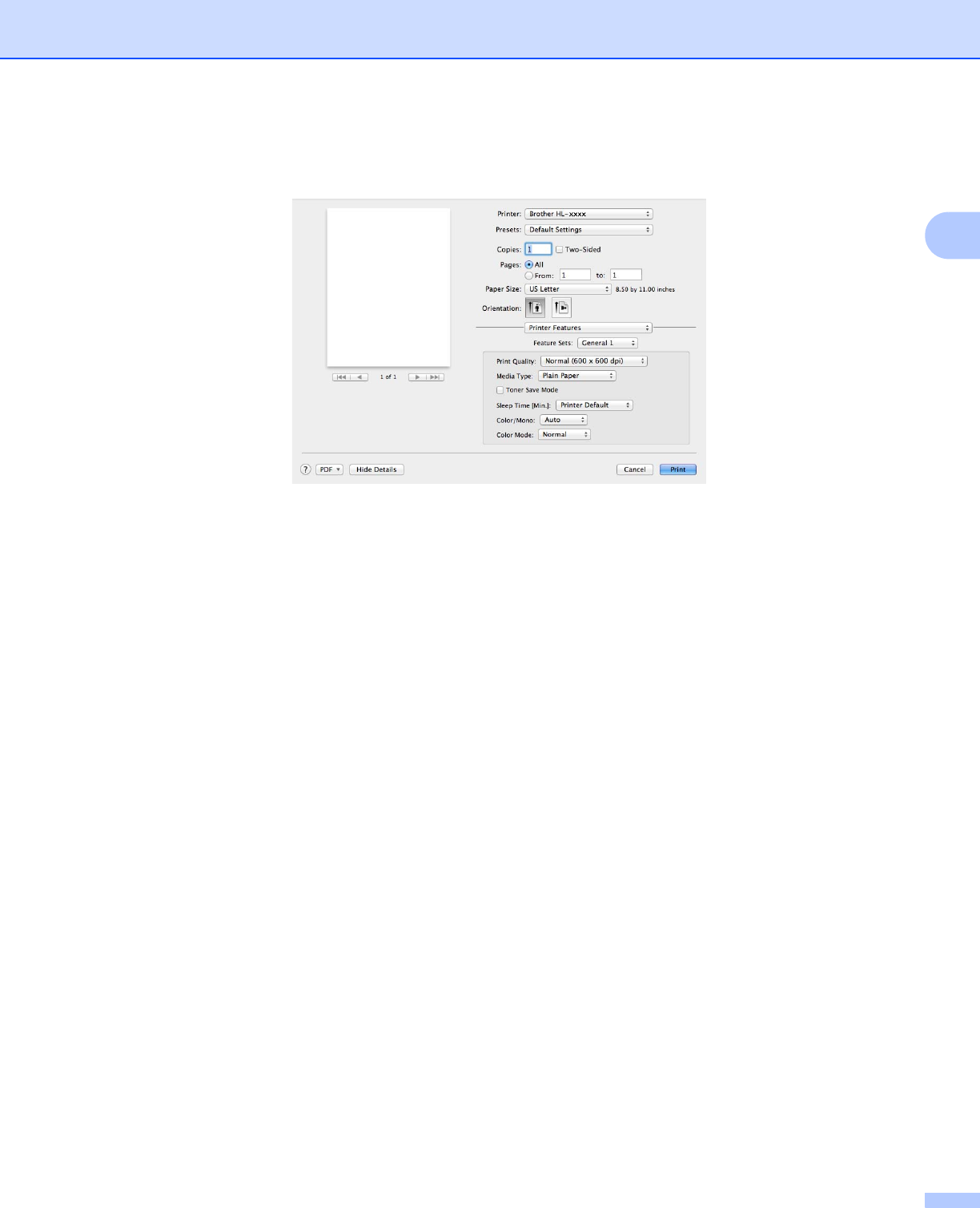
Driver and Software
77
2
Printer Features 2
Feature Sets: General 1
Print Quality
Select one of the following resolutions from the Print Quality pop-up menu:
•Normal
600600 dpi. Recommended for ordinary printing. Use this mode for good print quality with reasonable
print speeds.
•Fine
2400 dpi class. The finest print mode. Use this mode to print precise images such as photographs.
Since the print data is much larger than in Normal mode, processing time / data transfer time and print
time will be longer.
Media Type
Select the media type that matches the type of paper you loaded in the machine.
•Plain Paper
•Thin Paper
•Thick Paper
•Thicker Paper
•Bond Paper
•Envelopes
•Env. Thick
•Env. Thin
•Recycled Paper
•Label
•Glossy Paper
•Hagaki 1
1Postcard with the size specified by Japan Post Service Co., LTD

Driver and Software
78
2
Toner Save Mode
When you select the Toner Save Mode check box, print appears lighter. The default setting is Off
(unchecked).
NOTE
We do not recommend Toner Save Mode for printing Photo or grayscale images.
Sleep Time [Min.]
When the machine does not receive data for a certain period of time, it enters Sleep mode. In Sleep mode,
the machine acts as though it were turned off. If you choose Printer Default, the timeout setting will be
reset to the specific time set at the factory; this can be altered in the driver. To change the Sleep Time,
choose 2, 10 or 30.
While the machine is in Sleep mode, the LCD displays Sleep, but the machine can still receive data.
Receiving a print job will wake up the machine to start printing.
Color / Mono
You can change the Color/Mono settings in the printer driver as follows:
•Auto
The machine checks the content of the document for color. If color is detected anywhere in the
document, it will print the whole of the document using all the colors. In other words, it will mix some of
the toners to help achieve every shade detected in the document, increasing the density of toner
applied to the page. If no color content is detected, it will print the document in monochrome. The default
setting on your machine is Auto.
•Color
Whether the document contains color or just monochrome, your machine will print the document using
all the colors.
•Mono
Select this mode if the document has only black and grayscale text and objects. If your document
contains color, this mode prints the document in 256 levels of gray using the black toner.
NOTE
• The machine’s color sensor is very sensitive and may perceive faded black text or an off-white background
as color. If you know that your document is black and white and you want to conserve color toner, select
Mono mode.
• If either the Cyan, Magenta or Yellow toner reaches the end of its life while printing a color document, the
print job cannot be completed. You can cancel your print job and choose to start the print job again in
Mono mode, as long as Black toner is available.
Color Mode
The following options are available in Color Matching mode:
•Normal
This is the Default color mode.
•Vivid
The color of all elements are adjusted to become a more vivid color.
•None
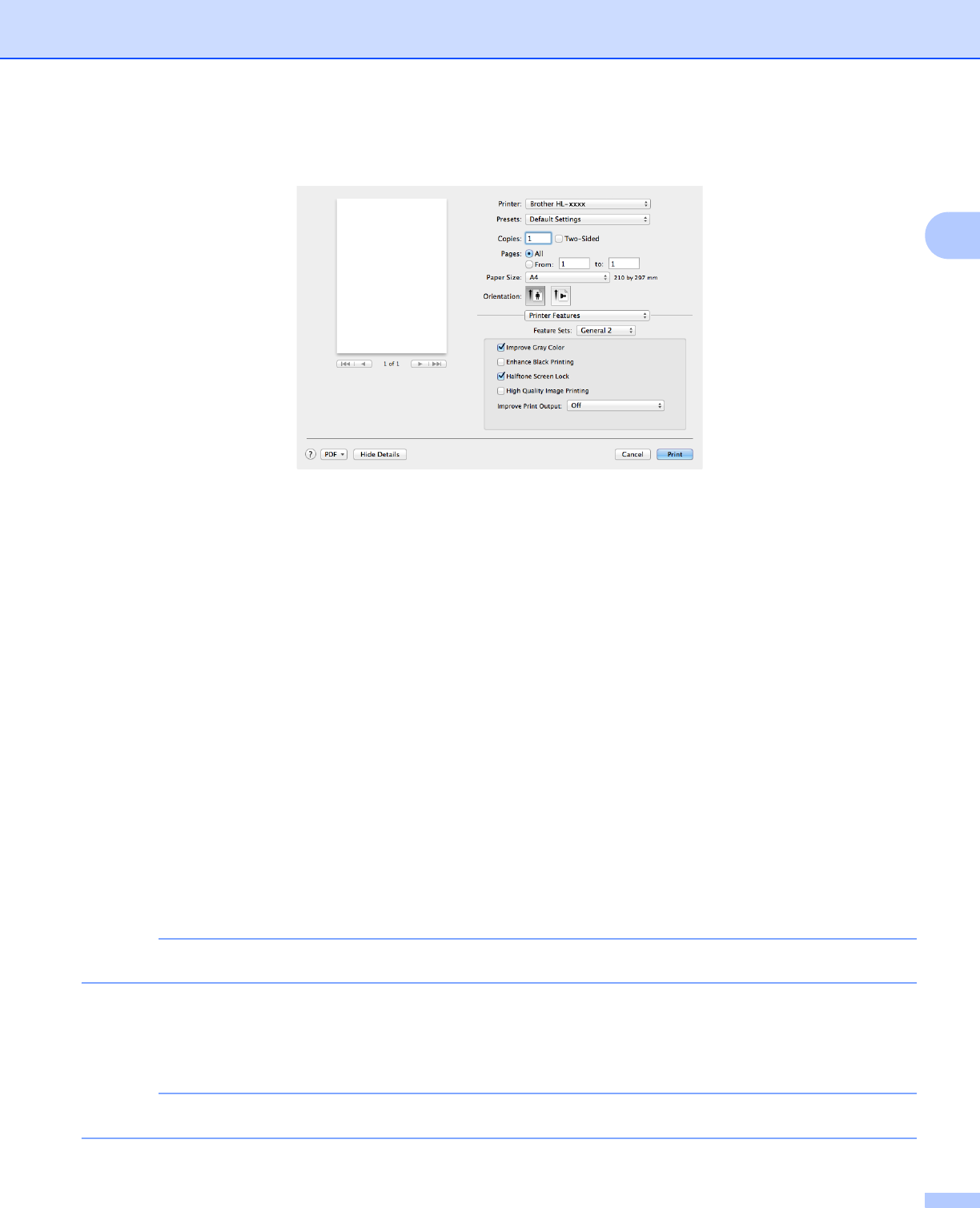
Driver and Software
79
2
Feature Sets: General 2
Improve Gray Color
You can improve the image of a shaded area.
Enhance Black Printing
If a black graphic does not print correctly, choose this setting.
Halftone Screen Lock
This lock stops other applications from modifying the Halftone settings. The Default setting is On
(checked).
High Quality Image Printing
You can increase the quality of the printed image. If you set High Quality Image Printing to On (checked),
the print speed will be slower.
Improve Print Output
This feature allows you to improve a print quality problem.
•Reduce Paper Curl
If you choose this setting, the paper curl may be reduced.
If you are printing only a few pages, you do not have to choose this setting. We recommend changing
the printer driver setting in Media Type to a thin setting.
NOTE
This operation will decrease the temperature of the machine's fusing process.
•Improve Toner Fixing
If you choose this setting, the toner fixing capabilities may be improved. If this selection does not
provide enough improvement, change the printer driver setting in Media Type to a thick setting.
NOTE
This operation will increase the temperature of the machine's fusing process.
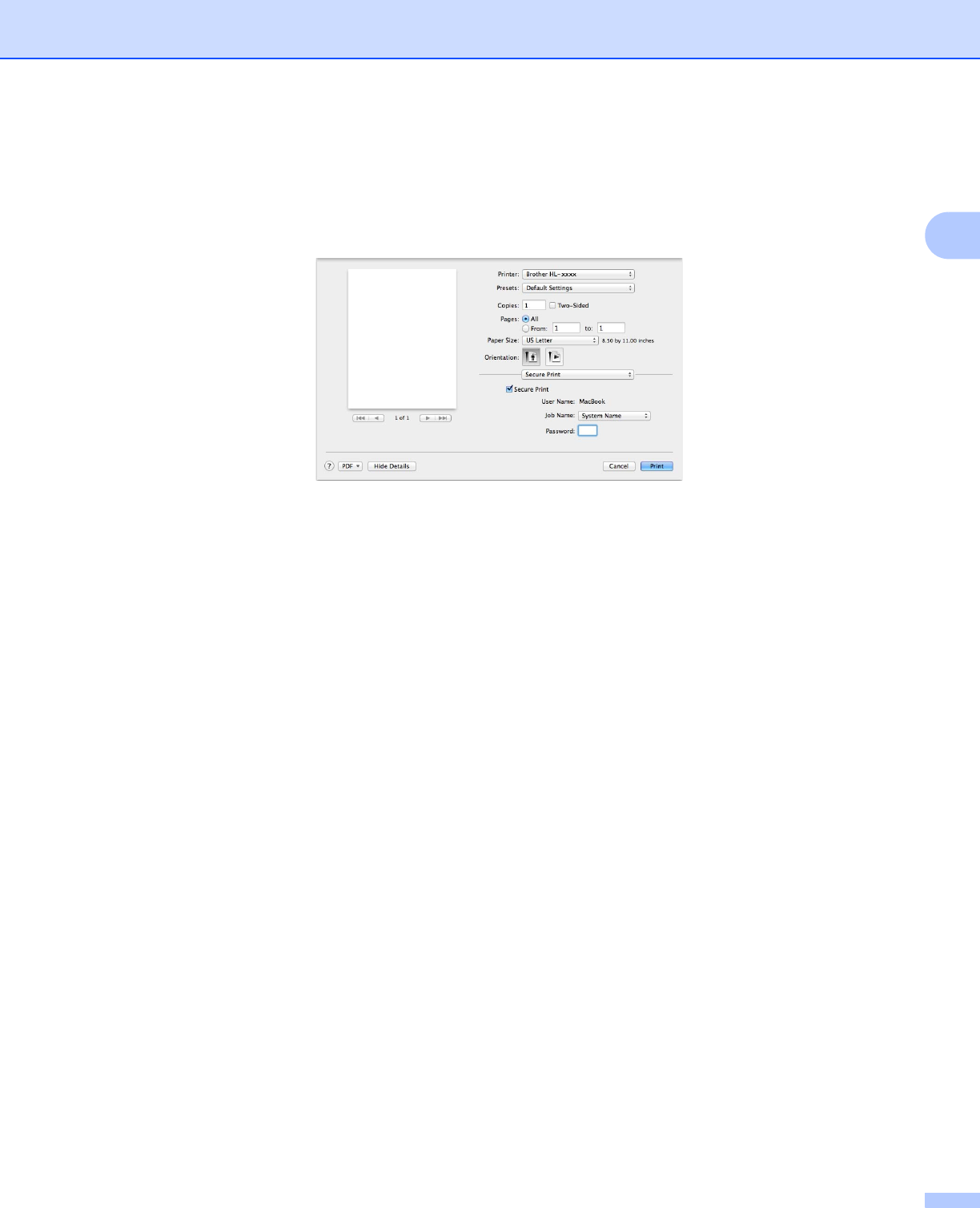
Driver and Software
80
2
Secure Print 2
Secure documents are documents that are password protected when they are sent to the machine. Only the
people who know the password will be able to print them. Since the documents are secured at the machine,
you must enter the password using the control panel of the machine to print them.
To create a secure print job, select Secure Print and select the Secure Print check box. Type a password
in the Password text box and click Print.
(For more information about Secure Print, see Printing Secure documents on page 104.)

Driver and Software
81
2
Removing the printer driver 2
aLog on as an ‘Administrator’.
bFrom the Apple menu, choose System Preferences. Click Print & Scan or Printers & Scanners 1, then
select the printer you want to remove and remove it by clicking the - button.
cClick Delete Printer.
1Printers & Scanners for OS X v10.9.x users
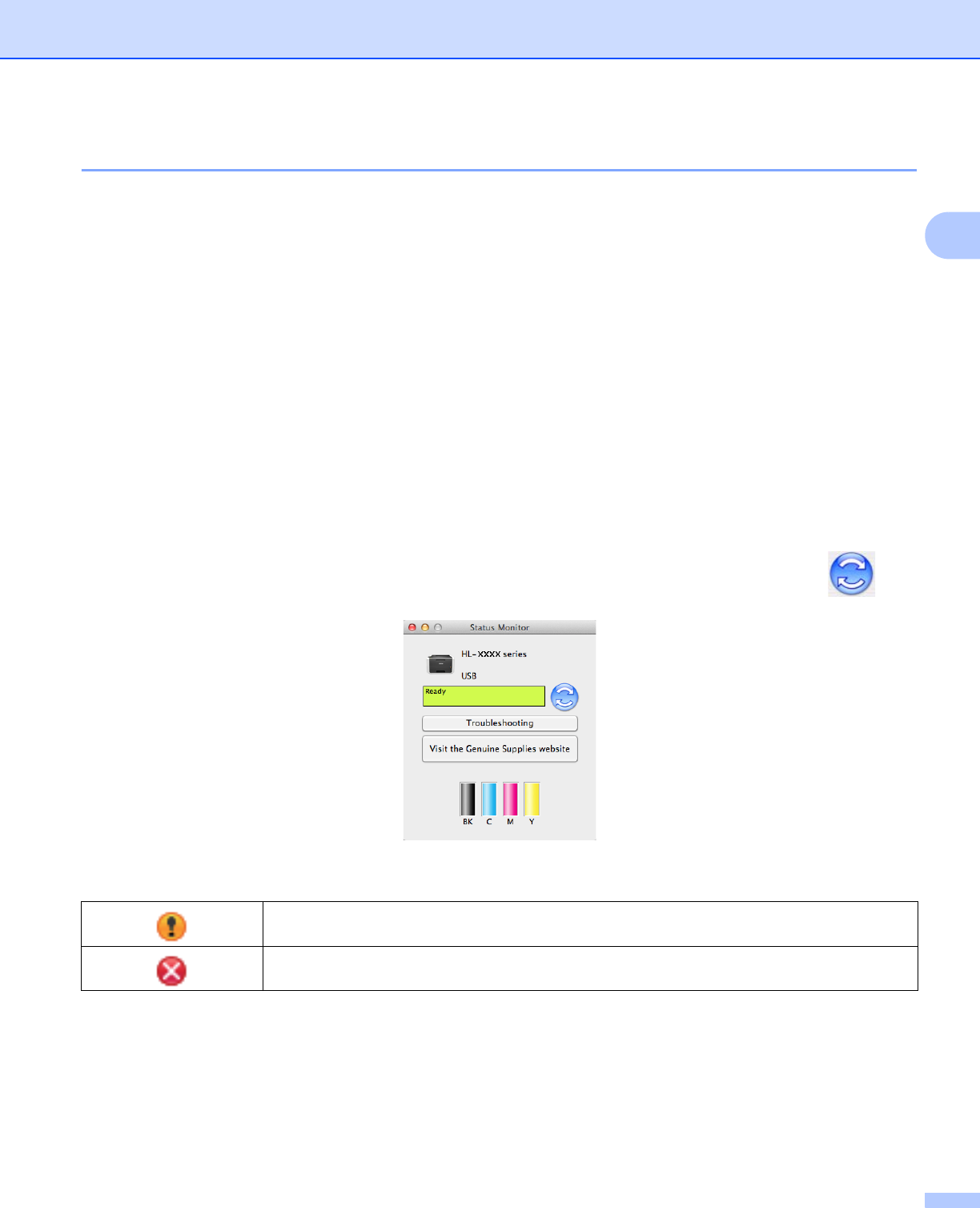
Driver and Software
82
2
Status Monitor 2
The Status Monitor utility is a configurable software tool for monitoring the status of the machine; it lets you
see error messages such as paper empty or paper jam at pre-set update intervals and access the Web Based
Management utility. Check the device status by following these steps to Launch the Brother Status Monitor:
For OS X v10.7.5 and 10.8.x
aRun System Preferences, select Print & Scan, and then choose the machine.
bClick Options & Supplies.... Click the Utility tab, and then click Open Printer Utility. The Status
Monitor will start up.
For OS X v10.9.x
aRun System Preferences, select Printers & Scanners, and then choose the machine.
bClick Options & Supplies.... Click the Utility tab, and then click Open Printer Utility. The Status
Monitor will start up.
Updating the machine’s status 2
If you want the latest machine status while the Status Monitor window is open, click the Refresh icon.
If the toner level is low or there is a problem with the toner cartridge, the following icons appear:
You can set the interval at which the software will update the machine's status information. Go to the menu
bar, Brother Status Monitor and select Preferences.
The toner level is low.
The toner cartridge is empty.
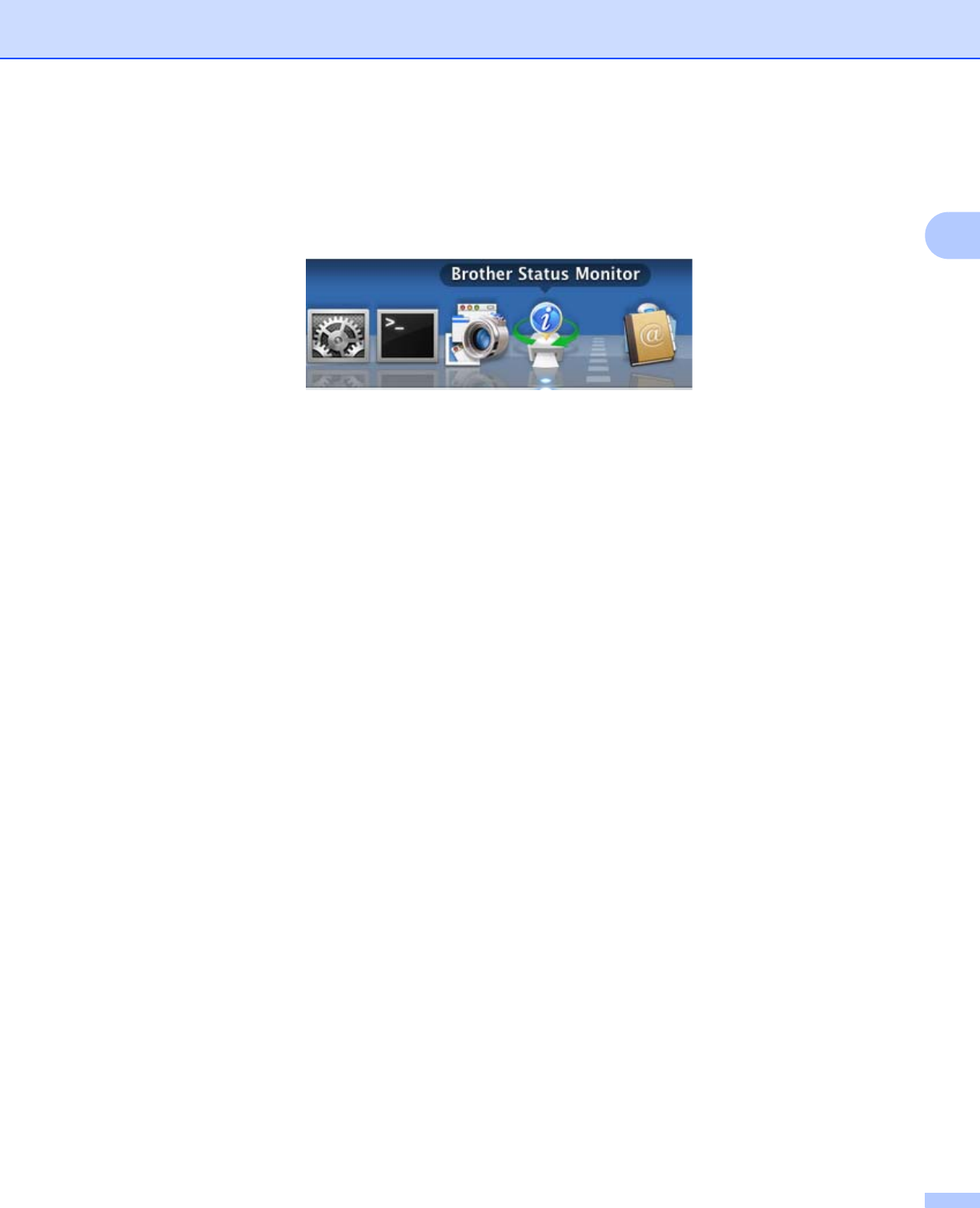
Driver and Software
83
2
Hiding or showing the window 2
After starting the Status Monitor, you can hide or show the window. To hide the window, go to the menu bar,
click Brother Status Monitor and select Hide Status Monitor. To show the window, click the Brother
Status Monitor icon in the dock.
Quitting the window 2
Click Brother Status Monitor in the menu bar, and then select Quit Status Monitor from the pop-up menu.
Web Based Management (Network Connection only) 2
Access the Web Based Management System by clicking the machine icon on the Status Monitor screen. A
standard Web Browser can be used to manage your machine using HTTP (Hyper Text Transfer Protocol).
For information about the Web Based Management System, see the Network User's Guide.

Driver and Software
84
2
Software 2
Software for networks 2
For information about network utility software, see the Network User's Guide.
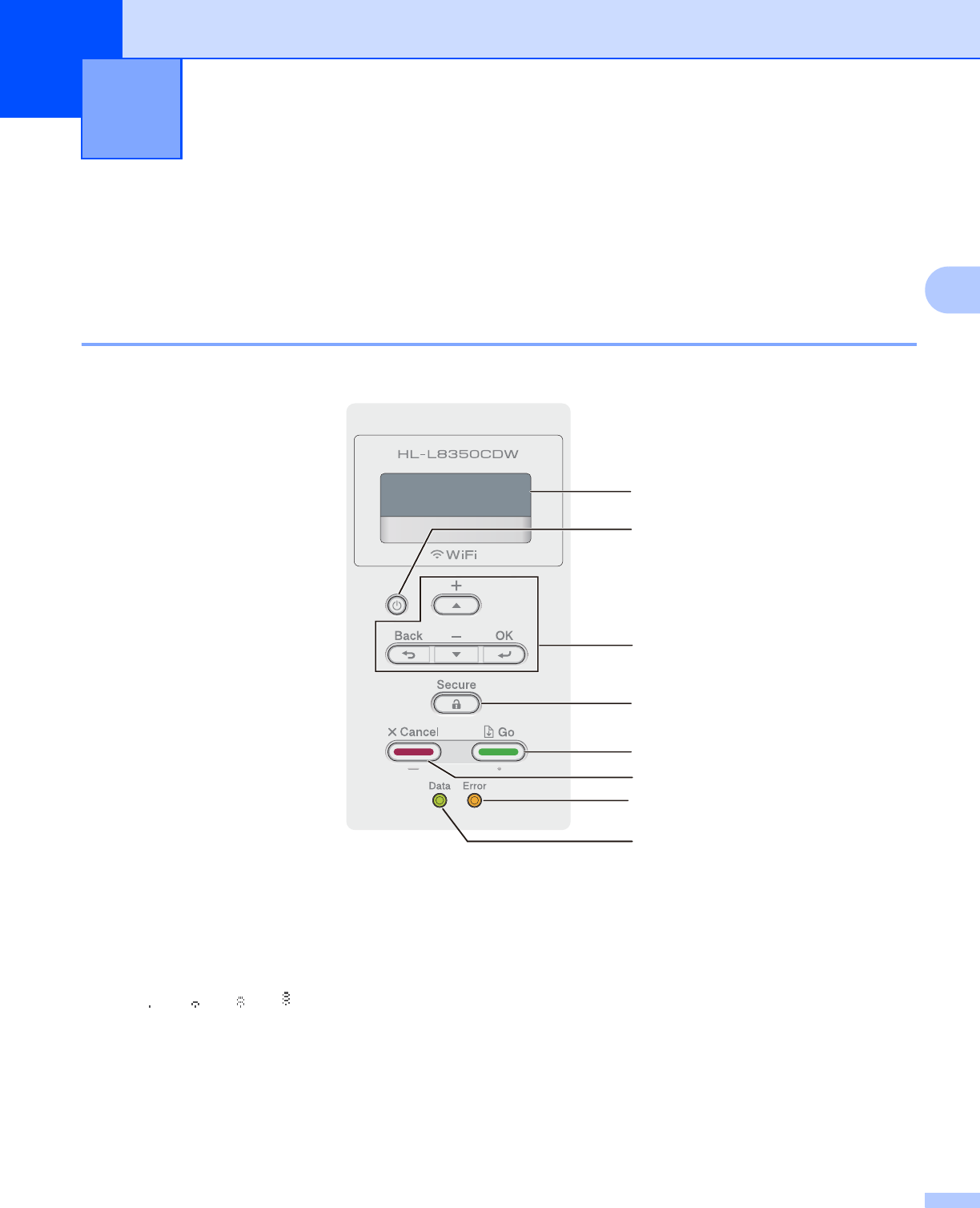
85
3
3
Control panel 3
This machine has one Liquid Crystal Display (LCD), eight buttons and two Light Emitting Diodes (LEDs) on
the control panel. The LCD is a 16 character two-line display.
Control panel overview 3
The illustration is based on HL-L8350CDW.
1LCD
The LCD displays messages to help you set up and use your machine.
A four level indicator displays the wireless signal strength if you are using a wireless connection.
General Information 3
0Max
1
2
3
5
6
7
8
4

General Information
86
3
2 Power On/Off
You can turn the machine on and off.
Press to turn the machine on.
Press and hold down to turn the machine off. The LCD displays Shutting Down and stays on for a
few seconds before going off.
3 Menu Buttons:
aor b ( + or -)
Press aor b ( + or -) to scroll through the menus and options.
Press aor b ( + or -) to enter a number, or to increase or decrease the number. Hold down aor b ( + or -)
to move faster to the number you want, and then press OK.
OK
Press OK to store your settings in the machine. After changing a setting, the machine returns to the
previous menu level.
Back
Press Back to go back one level in the menu structure.
Back lets you choose the previous digit while entering numbers.
4 Secure
You can print jobs saved in the memory when you enter your four-digit password. (For more information,
see Printing Secure documents on page 104.)
5Go
You can clear some error messages by pressing Go. To clear all other errors follow the control panel
instructions or see Error and maintenance messages on page 171.
Press Go to print jobs remaining in the machine's memory.
This button lets you choose the displayed option in the last menu level. After a setting is changed, the
machine returns to Ready mode.
6 Cancel
Press Cancel to cancel the current setting.
This button cancels a programmed print job and clears it from the machine’s memory.
7 Error LED
The Error LED blinks in orange when the LCD displays an error or an important status message. (For
details, see LED indications on page 87.)
8 Data LED
The Data LED will blink depending on the machine status. (For details, see LED indications on page 87.)
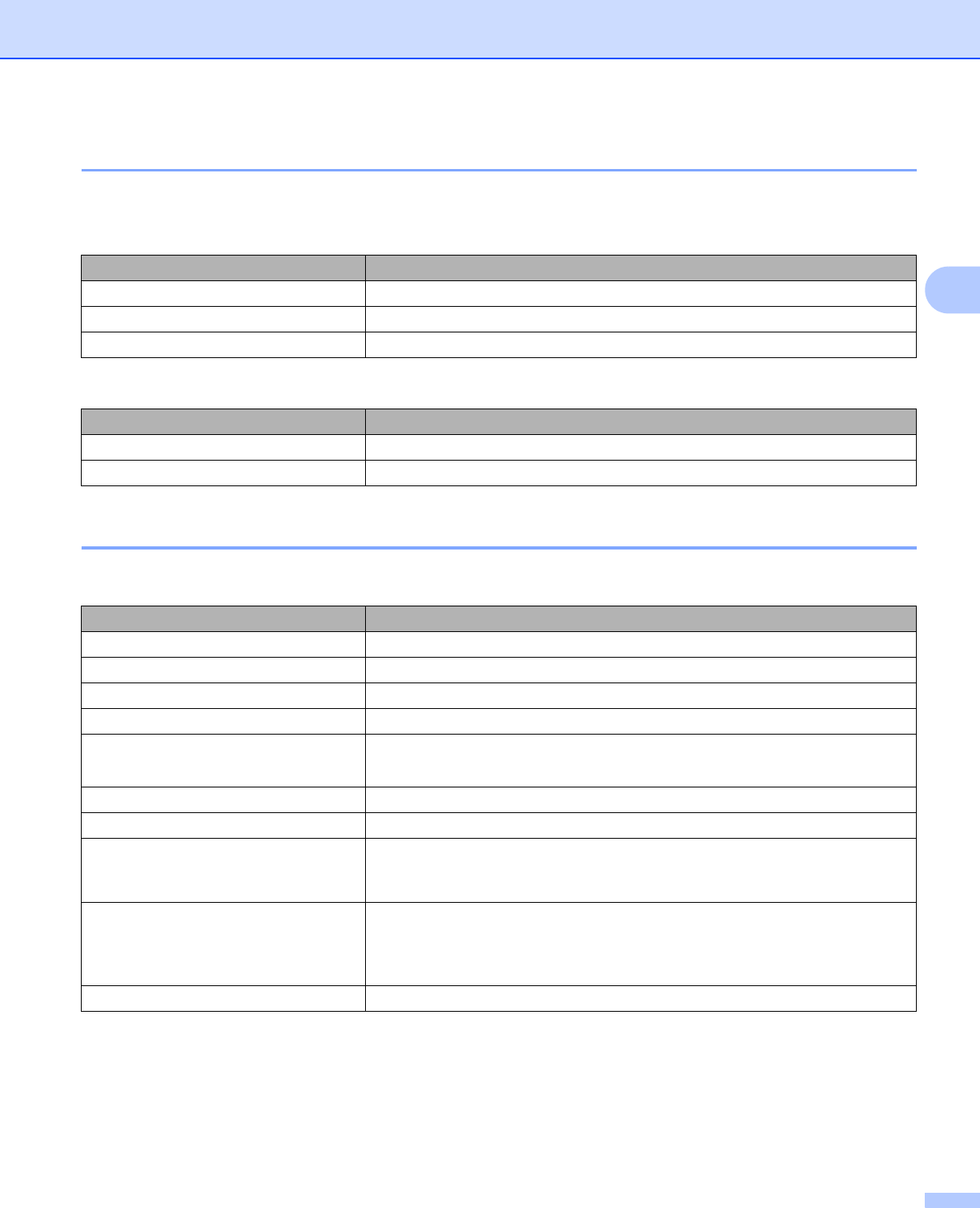
General Information
87
3
LED indications 3
The LEDs are lights that show the machine's status.
Machine status messages 3
The following table explains the machine's status messages during normal operation:
Data LED (Green)
LED indication Meaning
On Data is in the machine's memory.
Blinking The machine is receiving or processing data.
Off There is no remaining data in the memory.
Error LED (Orange)
LED indication Meaning
Blinking There is a problem with the machine.
Off There is no problem with the machine.
Machine Status Message Meaning
Cooling Down The machine is cooling down.
Cancel Printing The machine is canceling the job.
Calibrate The machine is calibrating the color density.
Ignore Data The machine is ignoring data processed using the PS driver.
Please Wait The machine is warming up.
The machine is performing the calibration process.
Printing The machine is printing.
Ready The machine is ready to print.
Sleep In Sleep mode (power save mode) the machine acts as though it were turned
off, but the machine can still receive data. Receiving a print job will wake up
the machine to start printing.
Deep Sleep In Deep Sleep mode (reducing more power consumption than Sleep mode),
the machine acts as though it were turned off. If the machine does not receive
data for a certain length of time while it is in Sleep mode, it enters Deep Sleep
mode. The machine will wake up when the machine receives a print job.
Registration The machine is adjusting the print position.

General Information
88
3
Settings table 3
How to access the menu mode 3
aPress any Menu buttons (a, b, OK or Back) to take the machine offline.
bScroll through each menu level by pressing a or b ( + or -) for the direction you want.
cPress OK when the option you want appears on the LCD. The LCD will then show the next menu level.
dPress a or b ( + or -) to scroll to your next menu selection.
ePress OK or Go.
When you have finished setting an option, the LCD will show Accepted.
Menu table 3
There are seven menus. For more information about the selections available in each menu, see the following
tables.
If no control panel operations are performed for 30 seconds, the LCD returns to Ready mode.
NOTE
The LCD displays the tray names as follows:
• Standard paper tray: Tray1
• Multi-purpose tray: MP Tray
• Optional lower tray 1: Tray2 and T2
1Tray 2 is standard on HL-L8350CDWT.
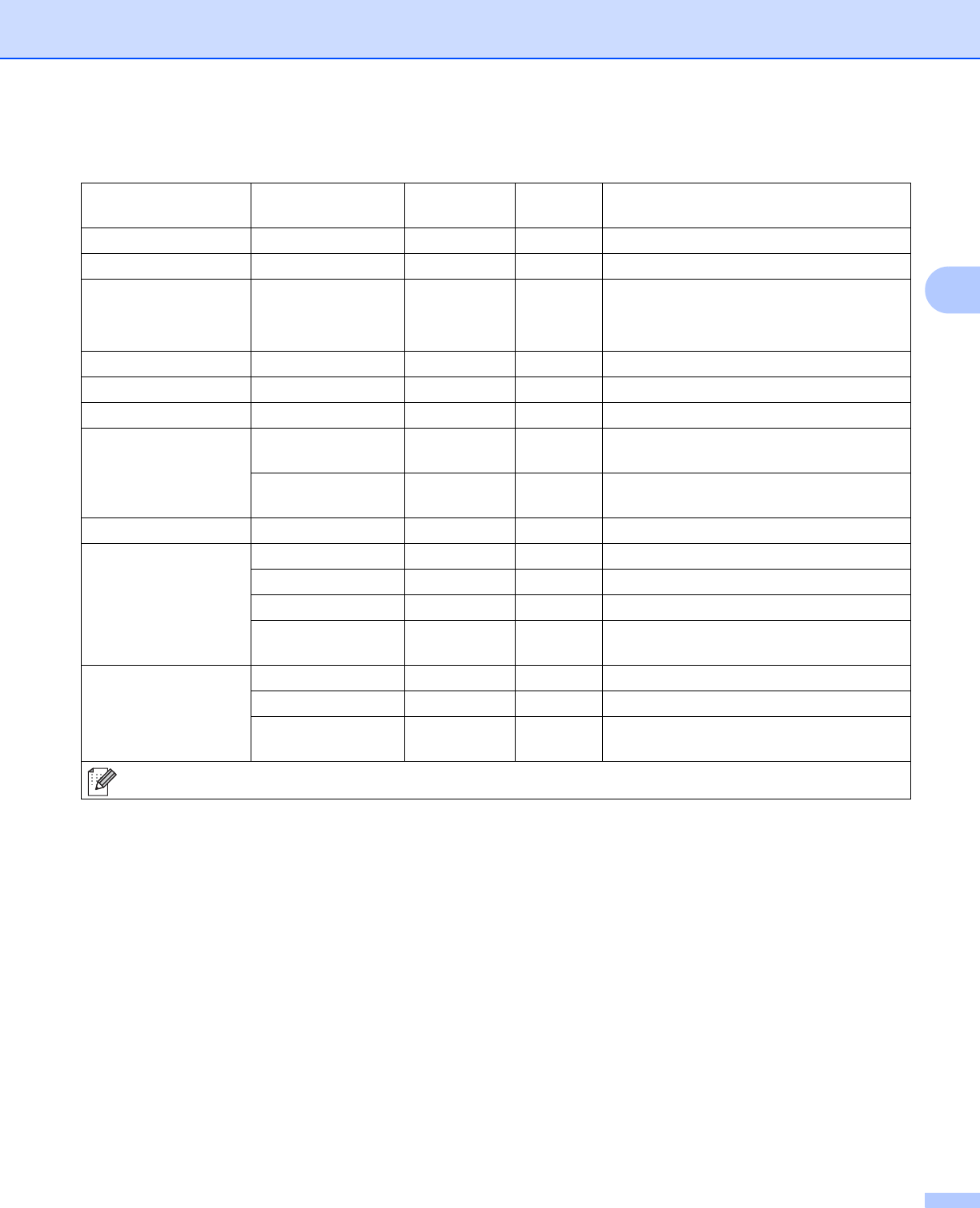
General Information
89
3
Machine Info.
Submenu 1 Submenu 2 Menu
Selections
Options Descriptions
Print Settings - - - Prints the Printer Settings page.
Print NetSetting - - - Prints the Network Configuration Report.
Print WLANReport
(HL-L8350CDW and
HL-L8350CDWT)
- - - The WLAN Report shows the wireless
LAN connectivity diagnosis.
Test Print - - - Prints the test page.
Demo Print - - - Prints the demonstration sheet.
Drum Dot Print - - - Prints the drum dot check sheet.
Print Font HP LaserJet - - Prints the font list and samples of HP
LaserJet.
BR-Script 3 - - Prints the font list and samples of
BR-Script.
Serial No. - - - Displays the machine's serial number.
Version Main Version - - Displays the main firmware version.
Sub1 Version - - Displays the sub firmware version.
Sub4 Version - - Displays the sub firmware version.
RAM Size - - Displays the size of memory in this
machine.
Page Count Total - - Displays the total printed pages.
Color - - Displays the total color printed pages.
Monochrome - - Displays the total monochrome printed
pages.
The factory settings are shown in Bold with an asterisk.
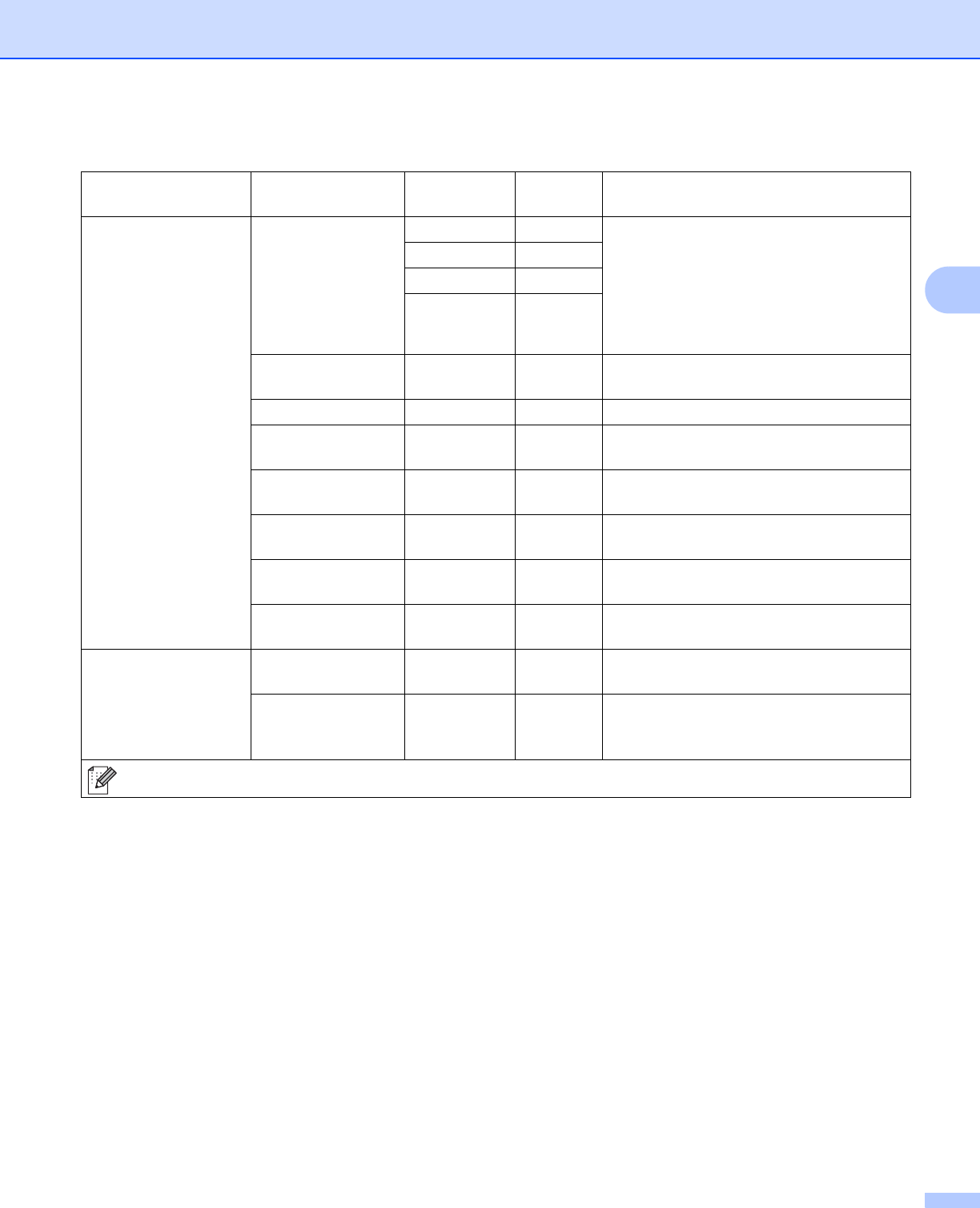
General Information
90
3
Parts Life Toner Life Black(BK) - Displays the remaining life for each toner
cartridge.
For example, if the remaining life for the
black toner cartridge is 20%, the LCD
displays the following:
BK oonnnnnnnn
Cyan(C) -
Magenta(M) -
Yellow(Y) -
Drum Life - - Displays the remaining life for the drum
unit.
Belt Life - - Displays the remaining life for the belt unit.
PF Kit MP Life - - Displays the pages left to print with the PF
kit MP.
PF Kit 1 Life - - Displays the pages left to print with the PF
kit 1.
PF Kit 2 Life - - Displays the pages left to print with the PF
kit 2.
Fuser Life - - Displays the pages left to print with the
fuser unit.
Laser Life - - Displays the pages left to print with the
laser unit.
Reset Parts Life
(Appears only when
the drum unit or belt
unit has exceeded its
rated life.)
Drum Unit - - Resets the drum unit life. Appears when
you replace the drum unit.
Belt Unit - - Resets the belt unit life. Appears when
you replace the belt unit.
Machine Info. (continued)
Submenu 1 Submenu 2 Menu
Selections
Options Descriptions
The factory settings are shown in Bold with an asterisk.
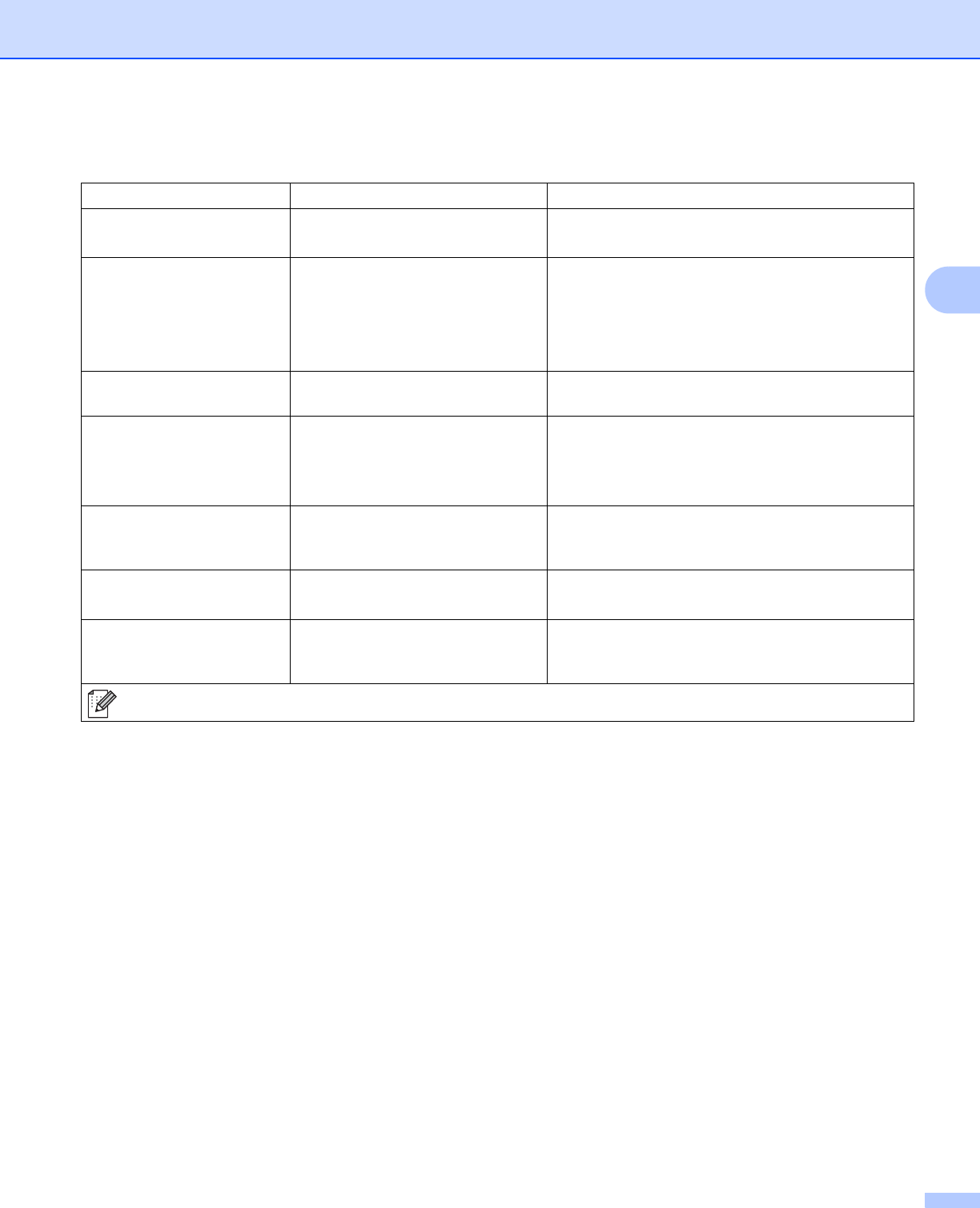
General Information
91
3
1When Tray 2 is installed.
2Tray 2 is standard on HL-L8350CDWT.
Paper Tray
Submenu Options Descriptions
Tray Use Auto* / MP Only / Tray1 Only /
Tray2 Only 1
Select the tray that will be used.
Priority (Without Tray2 installed)
MP>T1*/ T1>MP
(With Tray2 installed)
MP>T1>T2 / MP>T2>T1 /
T1>T2>MP / T2>T1>MP
When Auto is chosen in Tray Use, the machine
chooses the order in which it uses the paper trays
that contain paper of the same size.
2-sided On(Long Bind) / On(Short
Bind) / Off*
Select whether to print on both sides of the paper.
MP Size A4 / Letter*/JIS B5 / B5 / A5 /
A5 L / A6 / Executive / Legal /
Folio / 3X5 / Com-10 /
Monarch / C5 / DL
Select the size of paper you are loading in the MP
tray.
Tray1 Size A4 / Letter*/JIS B5 / A5 / A5
L/ A6 / Executive / Legal /
Folio
Choose the size of paper you loaded in the
standard paper tray.
Tray2 Size 1A4 / Letter*/ JIS B5 / A5 /
Executive / Legal / Folio
Choose the size of paper you loaded in the
optional lower tray (Tray 2) 2.
Check Size Off / On*Select whether to display the message telling you
to check that the size of the paper in the machine
and the machine's Paper Size setting match.
The factory settings are shown in Bold with an asterisk.
General Information
92
3
General Setup
Submenu Menu Selections Options Descriptions
Local Language -English*/ Français... Select the LCD language for your
country.
Ecology Toner Save On / Off* Increases the page yield of the toner
cartridge.
Sleep Time 0 / 1/ 2/ 3*/ 4/ 5/ ... Min Set the time to return to Power Save
mode.
Quiet Mode On / Off*Decreases printing noise.
Auto Power Off Off*/ 1 hour / 2 hours /
4 hours / 8 hours
Sets the number of hours that the
machine will remain in Deep Sleep
mode before going into Power Off
mode. Choose Off if you do not
want the machine to go into Power
Off mode.
Panel Control Button Repeat 0.1*/ 0.4 / 0.6 / 0.8 /
1.0 / 1.4 / 1.8 / 2.0 Sec
Sets the time for the LCD message
to change when holding aor b at
intervals.
Message Scroll Level1*/ Level2 / ... /
Level10
Sets the time in seconds that an LCD
message will scroll across the LCD.
From Level 1=0.2 sec to Level
10=2.0 sec.
LCD Contrast -nnonn+Adjusts the contrast of the LCD.
Auto Online On*/ Off Set the machine to return to Ready
mode after it has been idle for 30
seconds. If you select Off, the
machine cannot receive print jobs if it
has been left in Menu mode.
Setting Lock -On / Off*Turn the lock panel settings On or
Off by using the password.
Interface Select Auto*/ USB / Network Choose the interface to use.
If you select Auto, the machine
changes the interface to USB or
Ethernet depending on which
interface is receiving data.
Auto IF Time 1 / 2/ 3/ 4/ 5*/ ... / 99Sec You must set the time-out period for
the auto interface selection.
Input Buffer Level 1 / 2/ 3/ 4*/ ... / 7 Increases or decreases the input
buffer capacity.
The factory settings are shown in Bold with an asterisk.

General Information
93
3
Print Menu
Submenu Menu Selections Options Descriptions
Emulation -Auto*/ HP LaserJet /
BR-Script 3
Chooses the emulation mode you
use.
Auto Continue -On*/ Off Select this setting if you want the
machine to clear paper size errors.
Output Color -Auto*/ Color / Mono Sets the output color.
Media Type -Plain Paper*/ Thick
Paper / Thicker Paper /
Thin Paper / Recycled
Paper / Bond Paper /
Label / Envelope / Env.
Thick / Env. Thin /
Glossy Paper
Sets the type of paper.
Paper -A4 / Letter*/ JIS B5 /
B5 / A5 / A5 L / A6 /
Executive / Legal /
Folio / 3X5 / Com-10 /
Monarch / C5 / DL
Sets the size of paper.
Copies -1*/ 2/ ... / 999 Sets the number of printed pages.
Orientation -Portrait*/ Landscape This machine can print pages in
portrait or landscape orientation.
Print Position X Offset -500 / -499 / ... / -1 / 0*/
1/ ... / 499 / 500Dots
Moves the print start position (at the
top-left corner of pages) horizontally
up to -500 (left) to +500 (right) dots in
300 dpi.
Y Offset -500 / -499 / ... / -1 / 0*/
1/ ... / 499 / 500Dots
Moves the print start position (at the
top-left corner of pages) vertically up
to -500 (up) to +500 (down) dots in
300 dpi.
Auto FF -On / Off*Allows the machine to print any
remaining data automatically.
HP LaserJet Font No. I000 / ... / I059*/ ... / I071 Sets the font number.
Font Pitch 0.44 / ... / 10.00*/ ... /
99.99
Sets the font pitch.
The Font Pitch menu will appear
when you choose I059 to I071 in
Font No. setting.
Font Point 4.00 / ... / 12.00*/ ... /
999.75
Sets the font size.
The Font Point menu will appear
when you choose I000 to I058 in
Font No. setting.
The factory settings are shown in Bold with an asterisk.
General Information
94
3
HP LaserJet
(Continued)
Symbol Set PC-8*/ PC-8 D/N / ... Sets the symbol set or the character
set.
Table Print - Prints the code table.
If Change Emulation appears on
the LCD, select Auto or HP
LaserJet in Emulation of the
Print Menu (see page 93).
Auto LF On / Off* ON: CR i CR+LF, OFF: CR i CR
Auto CR On / Off* ON: LF i LF+CR, FF i FF+CR, or
VT i VT+CR
OFF: LF i LF, FF i FF, or VT i VT
Auto WRAP On / Off* Chooses whether a line feed and
carriage return will happen when the
machine reaches the right margin.
Auto SKIP On*/ Off Chooses whether a line feed and
carriage return will happen when the
carriage position reaches the bottom
margin.
Left Margin ## Sets the left margin at column 0 to 70
columns at 1 cpi. The default setting
is 0 cpi.
Right Margin ## Sets the right margin at column 10 to
80 columns at 1 cpi. The default
setting is 80 cpi (Letter).
Top Margin #.## Sets the top margin at a distance
from the top edge of the paper: 0.00,
0.33, 0.50, 1.00, 1.50 or 2.00 inches.
The default setting is 0.50 inches.
Bottom Margin #.## Sets the bottom margin at a distance
from the bottom edge of the paper:
0.00, 0.33, 0.50, 1.00, 1.50 or
2.00 inches. The default setting is
0.50 inches.
Lines ### Sets the number of lines on each
page from 5 to 128 lines. The default
setting is 60 lines (Letter).
Print Menu (continued)
Submenu Menu Selections Options Descriptions
The factory settings are shown in Bold with an asterisk.
General Information
95
3
BR-Script 3 Error Print On*/ Off Choose whether the machine prints
the error information when errors
occur.
CAPT On / Off* Use CAPT (Color Advanced Printing
Technology) for optimal print quality
when printing a PS file created by a
non-Brother PS driver. Colors and
photos appear clearer and more
accurate. Print speed will be slower.
Print Menu (continued)
Submenu Menu Selections Options Descriptions
The factory settings are shown in Bold with an asterisk.

General Information
96
3
1### means a number within the range of 000 to 255. On connection to the network, if the machine's ‘Boot Method’ is ‘Auto’ the machine will attempt
to set the IP address and Subnet Mask from a boot server such as DHCP or BOOTP. If a boot server cannot be found, an APIPA IP address will
be allocated, such as 169. 254. [001-254]. [000-255]. If the ‘Boot Method’ of the machine is set to ‘Static’ you must manually enter an IP address
from the machine's control panel.
Network for HL-L8250CDN
Submenu 1 Submenu 2 Menu Selections Options Descriptions
TCP/IP Boot Method -Auto*/ Static / RARP /
BOOTP / DHCP
Chooses the IP method
that best suits your needs.
IP Address -###.###.###.###
(000.000.000.000)*1
Enter the IP address.
Subnet Mask -###.###.###.###
(000.000.000.000)*1
Enter the Subnet mask.
Gateway -###.###.###.###
(000.000.000.000)*1
Enter the Gateway
address.
IP Boot Tries -0/ 1/ 2/ 3*/ ... / 32767 Specifies the number of
attempts the machine will
try to obtain an IP address
when the Boot Method is
set to any setting except
Static.
APIPA -On*/ Off Automatically allocates
the IP address from the
link-local address range. 1
IPv6 -On / Off* Enables or disables the
IPv6 protocol.
Ethernet --Auto*/ 100B-FD /
100B-HD / 10B-FD /
10B-HD
Chooses Ethernet link
mode.
Wired Status --Active 100B-FD /
Active 100B-HD /
Active 10B-FD /
Active 10B-HD /
Inactive / Wired OFF
Displays Ethernet link
status.
MAC Address - - - Displays MAC address of
the machine.
Security IPsec -On / Off*
IPsec is an optional security
feature of the IP protocol
that provides authentication
and encryption services.
We recommend contacting
your network administrator
before changing this
setting.
Network Reset Restores all network settings of the internal print server to the factory settings.
The factory settings are shown in Bold with an asterisk.
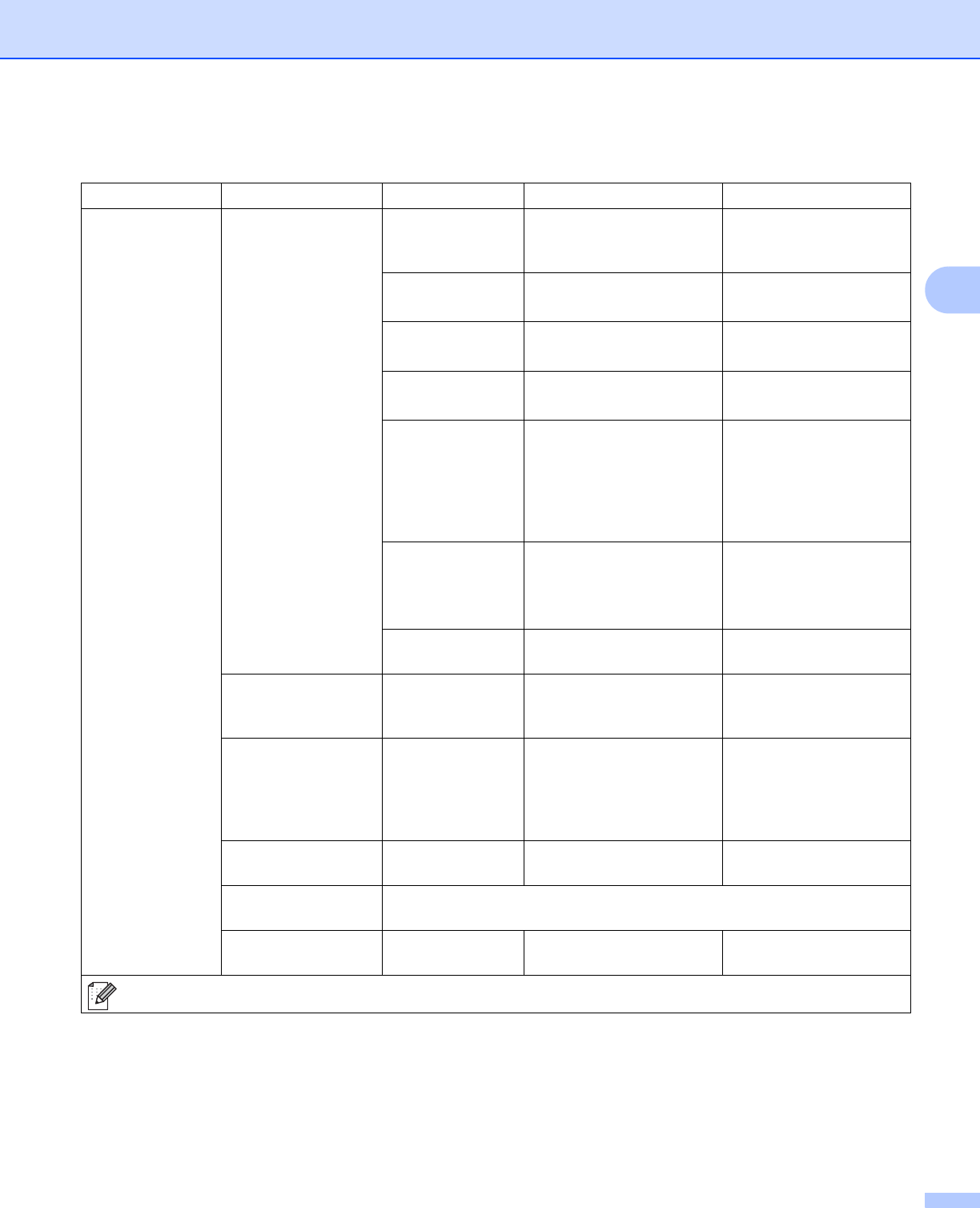
General Information
97
3
Network for HL-L8350CDW and HL-L8350CDWT
Submenu 1 Submenu 2 Menu Selections Options Descriptions
Wired LAN
(HL-L8350CDW
and
HL-L8350CDWT)
TCP/IP Boot Method Auto*/ Static / RARP /
BOOTP / DHCP
Chooses the IP method
that best suits your
needs.
IP Address ###.###.###.###
(000.000.000.000)*1
Enter the IP address.
Subnet Mask ###.###.###.###
(000.000.000.000)*1
Enter the Subnet mask.
Gateway ###.###.###.###
(000.000.000.000)*1
Enter the Gateway
address.
IP Boot Tries 0 / 1/ 2/ 3*/ ... / 32767 Specifies the number of
attempts the machine
will try to obtain an IP
address when the Boot
Method is set to any
setting except Static.
APIPA On*/ Off Automatically allocates
the IP address from the
link-local address
range. 1
IPv6 On / Off* Enables or disables the
IPv6 protocol.
Ethernet -Auto*/ 100B-FD /
100B-HD / 10B-FD /
10B-HD
Chooses Ethernet link
mode.
Wired Status -Active 100B-FD /
Active 100B-HD /
Active 10B-FD /
Active 10B-HD /
Inactive / Wired OFF
Displays Ethernet link
status.
MAC Address - - Displays MAC address
of the machine.
Set to Default Restores wired network settings of the internal print server to the factory
settings.
Wired Enable -On*/ Off Chooses Ethernet link
mode.
The factory settings are shown in Bold with an asterisk.
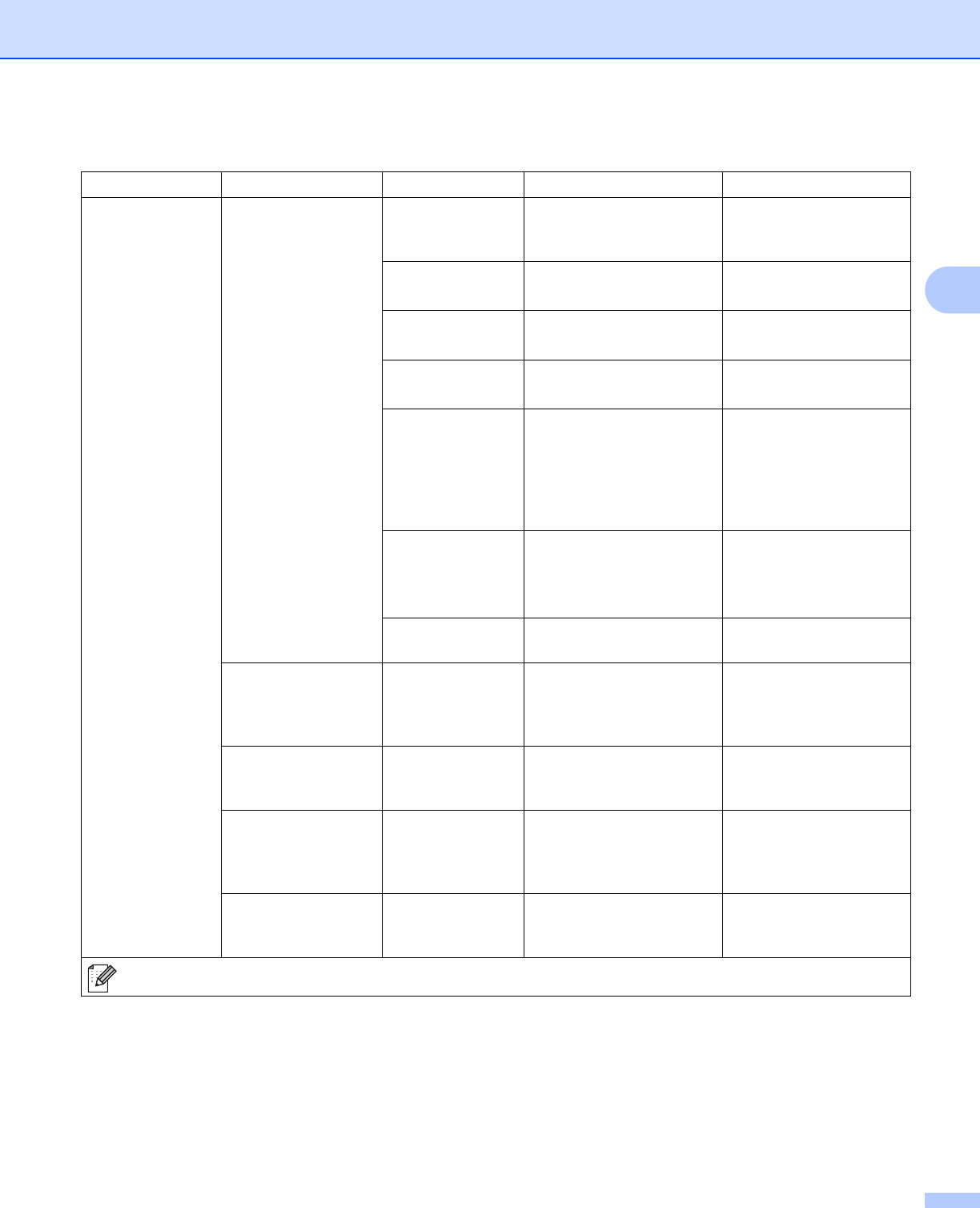
General Information
98
3
WLAN TCP/IP Boot Method Auto*/ Static / RARP /
BOOTP / DHCP
Chooses the IP method
that best suits your
needs.
IP Address ###.###.###.###
(000.000.000.000)*1
Enter the IP address.
Subnet Mask ###.###.###.###
(000.000.000.000)*1
Enter the Subnet mask.
Gateway ###.###.###.###
(000.000.000.000)*1
Enter the Gateway
address.
IP Boot Tries 0 / 1/ 2/ 3*/ ... / 32767 Specifies the number of
attempts the machine
will try to obtain an IP
address when the Boot
Method is set to any
setting except Static.
APIPA On*/ Off Automatically allocates
the IP address from the
link-local address
range. 1
IPv6 On / Off* Enables or Disables the
IPv6 protocol.
WLAN Assistant - - You can configure your
wireless network settings
using the Brother
CD-ROM.
Setup Wizard - - Configures the wireless
network settings using
the setup wizard.
WPS/AOSS - - Configures the wireless
network settings using
WPS or AOSS™
method.
WPS w/PIN Code - - Configures the wireless
network settings using
WPS with a PIN code.
Network for HL-L8350CDW and HL-L8350CDWT (continued)
Submenu 1 Submenu 2 Menu Selections Options Descriptions
The factory settings are shown in Bold with an asterisk.

General Information
99
3
WLAN
(Continued)
WLAN Status
(Appears only when
WLAN Enable is On
and Wired Enable
is Off.)
Status Active(11n) /
Active(11b) /
Active(11g) / Wired
LAN Active / WLAN
OFF / AOSS Active /
Connection Fail
Displays wireless
Ethernet link status.
Signal Strong / Medium /
Weak / None
Displays the signal
condition.
Channel - Displays the channel in
use when Status is
Active.
Speed - Displays the connecting
speed when Status is
Active.
SSID - Displays SSID [uses a
maximum of 32 digits
and characters 0-9, a-z
and A-Z in ASCII values]
Comm. Mode Ad-hoc /
Infrastructure
Displays the current
Communication Mode.
MAC Address - - Displays MAC address
of the machine.
Set to Default Restores wireless network settings of the internal print server to the
factory settings.
WLAN Enable -On / Off* Turns the wireless
interface on or off.
Wi-Fi Direct Push Button - - You can easily configure
your Wi-Fi Direct™
network settings using
the one-button push
method.
PIN Code - - You can easily configure
your Wi-Fi Direct™
network settings using
WPS with a PIN code.
Manual - - You can manually
configure your Wi-Fi
Direct™ network
settings.
Group Owner -On / Off Sets your machine as
the Group Owner.
Network for HL-L8350CDW and HL-L8350CDWT (continued)
Submenu 1 Submenu 2 Menu Selections Options Descriptions
The factory settings are shown in Bold with an asterisk.

General Information
100
3
Wi-Fi Direct
(Continued)
Device Info. Device Name - You can see the device
name of your machine.
SSID - Displays SSID of Group
Owner.
When the machine is not
connected, the LCD
displays Not
Connected.
IP Address - Displays the IP Address
of your machine.
Status Info. Status G/O Active(**) /
Client Active / Not
Connected / Off /
Wired LAN Active
** = the number of
devices
Displays the Wi-Fi
Direct™ network status.
Signal Strong / Medium / Weak /
None
Displays the Wi-Fi
Direct™ network signal
strength.
When your machine acts
as the Group Owner, the
LCD always displays
Strong.
Channel - Displays the channel in
use when the Status is
G/O Active(**) or
Client Active.
Speed - Displays the connecting
speed when the Status
is G/O Active(**) or
Client Active.
I/F Enable -On / Off* Enables or disables the
Wi-Fi Direct™
connection.
Security IPsec -On / Off*IPsec is an optional
security feature of the IP
protocol that provides
authentication and
encryption services. We
recommend contacting
your network
administrator before
changing this setting.
Network for HL-L8350CDW and HL-L8350CDWT (continued)
Submenu 1 Submenu 2 Menu Selections Options Descriptions
The factory settings are shown in Bold with an asterisk.
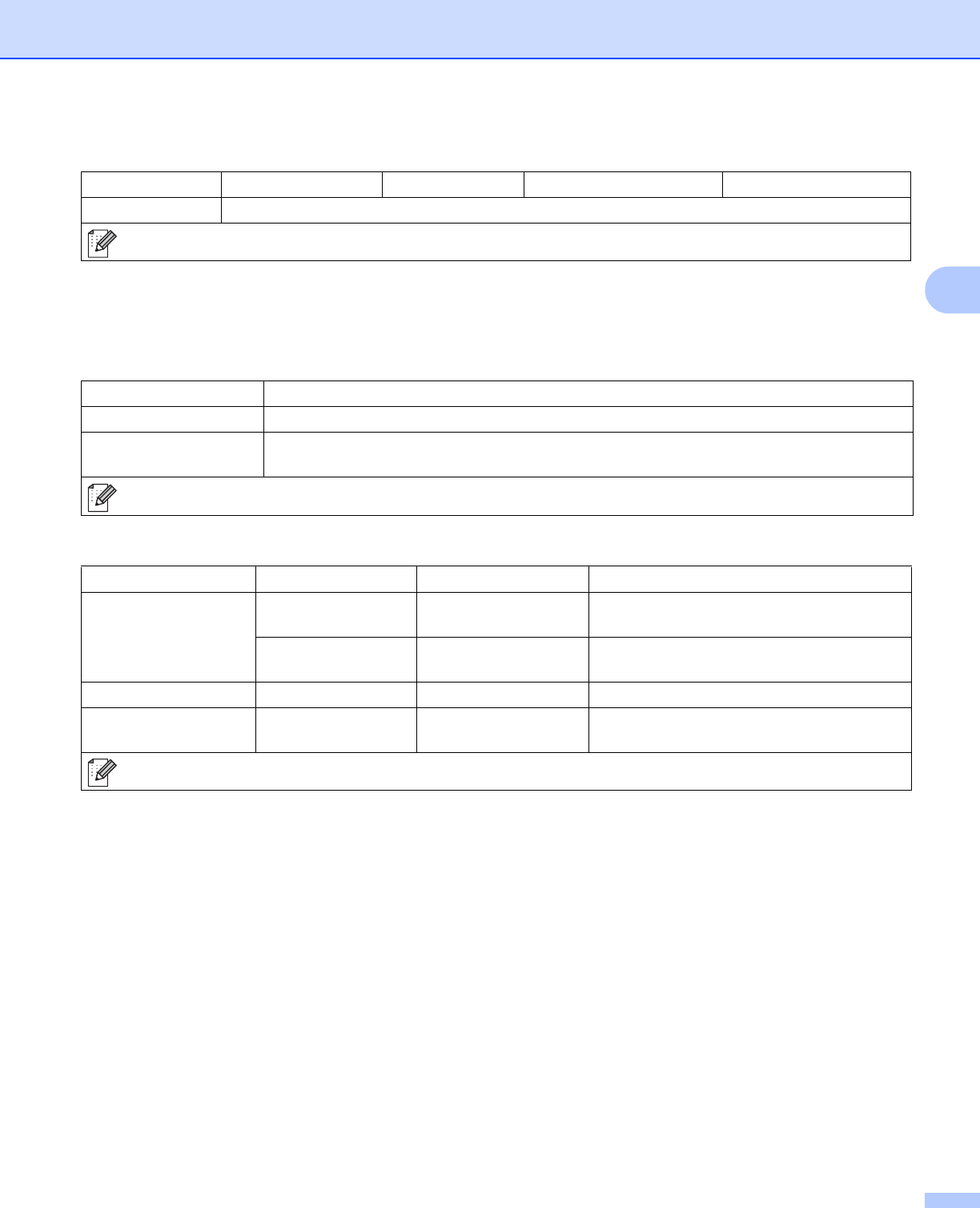
General Information
101
3
1### means a number within the range of 000 to 255. On connection to the network, if the machine's ‘Boot Method’ is ‘Auto’ the machine will attempt
to set the IP address and Subnet Mask from a boot server such as DHCP or BOOTP. If a boot server cannot be found, an APIPA IP address will
be allocated, such as 169. 254. [001-254]. [000-255]. If the ‘Boot Method’ of the machine is set to ‘Static’ you must manually enter an IP address
from the machine's control panel.
Network Reset Restores all network settings of the internal print server to the factory settings.
Reset Menu
Type of Reset Description
Network Restores all network settings of the internal print server to the factory settings.
Factory Reset Resets the machine and restores the printer settings (including command settings) to the
factory settings.
The factory settings are shown in Bold with an asterisk.
Color Correction
Submenu Menu Selections Options Descriptions
Calibration Calibrate a Yes b No Performs a calibration to check and correct
the colors.
Reset a Reset b Exit Set the calibration parameters back to the
default settings.
Registration -a Yes b No Aligns the print position of each color.
Auto Correction -On*/ Off Sets the machine to perform Color
Calibration and Registration automatically.
The factory settings are shown in Bold with an asterisk.
Network for HL-L8350CDW and HL-L8350CDWT (continued)
Submenu 1 Submenu 2 Menu Selections Options Descriptions
The factory settings are shown in Bold with an asterisk.
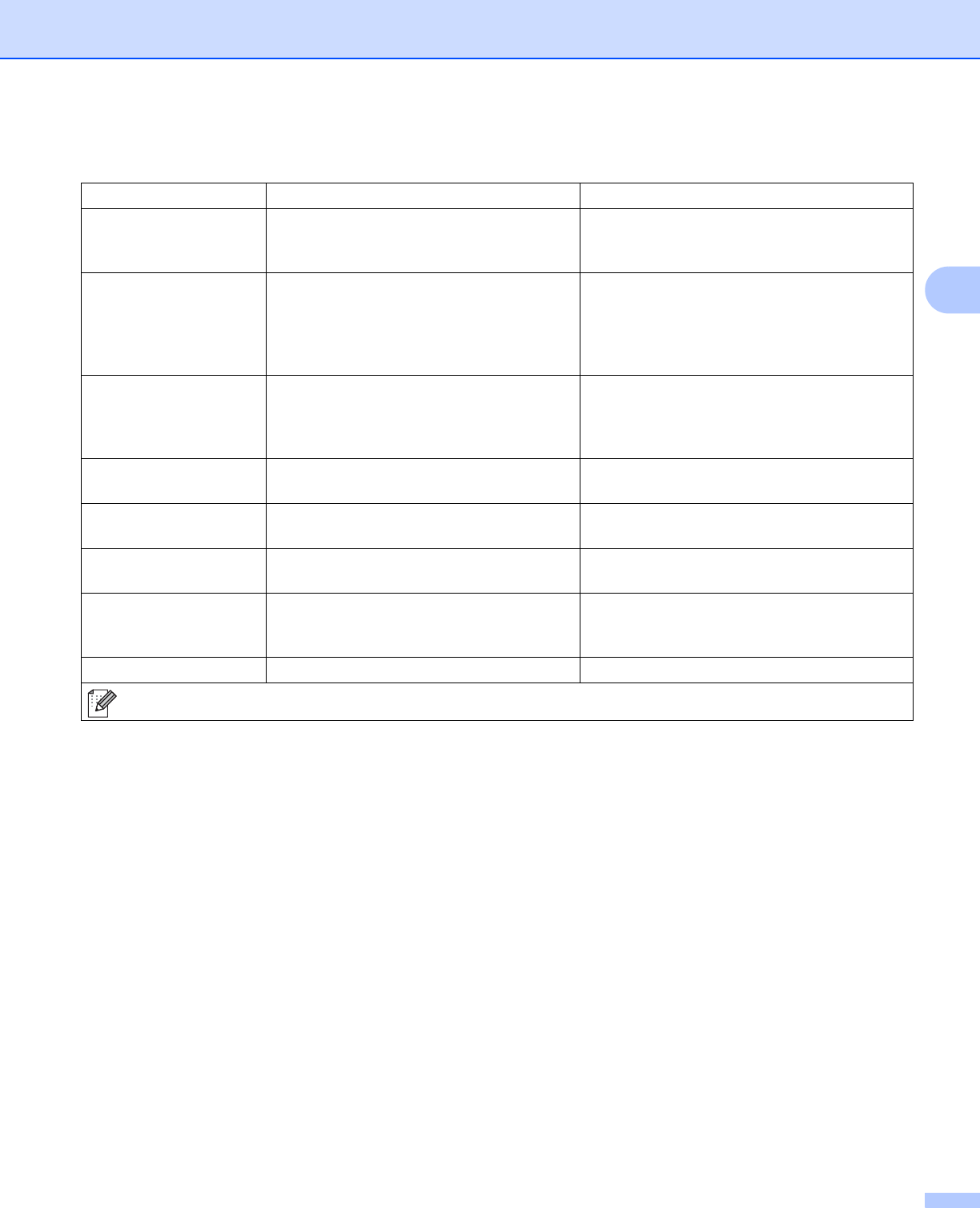
General Information
102
3
Direct Print
Submenu Options Descriptions
Paper Size A4 / Letter*/ JIS B5 / B5 / A5 / A5 L /
A6 / Executive / Legal / Folio / 3X5 /
Com-10 / Monarch / C5 / DL
Set the paper size when printing directly from
the USB flash drive.
Media Type Plain Paper*/ Thick Paper /
Thicker Paper / Thin Paper /
Recycled Paper / Bond Paper /
Label / Envelope / Env. Thick / Env.
Thin / Glossy Paper
Set the print media type when printing directly
from the USB flash drive.
Multiple Page 1in1*/ 2in1 / 4in1 / 9in1 / 16in1 /
25in1 / 1 in 2X2 pages/ 1 in 3X3
pages / 1 in 4X4 pages / 1 in 5X5
pages
Set the page layout when printing multiple
pages directly from the USB flash drive.
Orientation Portrait*/ Landscape Set the page orientation when printing directly
from the USB flash drive.
Collate On*/ Off Enable or disable page collation when printing
directly from the USB flash drive.
Print Quality Normal*/ Fine Set the print quality option when printing
directly from the USB flash drive.
PDF Option Document*/ Document&Stamps /
Document&Markup
Set the USB direct print setting to print either
comments (Markup) or stamps in the PDF file
along with the text.
Index Print Simple*/ Details Print a thumbnail page.
The factory settings are shown in Bold with an asterisk.

General Information
103
3
Entering Text for Wireless Settings 3
Hold down or repeatedly press aor b ( + or -) to select from the following characters:
0123456789
abcdefghijklmnopqrstuvwxyzABCDEFGHIJKLMNOPQRSTUVWXYZ
(space) !"#$%&'() *+,-./:;<=>?@[]^_
Press OK to confirm the current character, and then enter the next character.
Press the Back key to delete the characters you have entered.

General Information
104
3
Printing Secure documents 3
Secure documents 3
Secure documents are protected by a password and only those people who know the password will be able
to print the document. The machine will not print the document when you send it for printing. To print the
document, you must enter the password at the control panel of the machine. Secure documents will be
deleted after they are printed once.
When the area to spool documents is full, the LCD displays Print Data Full. Press Cancel to return to
Ready mode.
To delete the spooled documents, you must delete it at the control panel.
NOTE
• Secure documents will be deleted when the machine is turned off.
• If you wait 30 seconds to continue the control panel operation, the Secure Print setting will close and the
LCD will return to Ready mode.
• For more information about the settings in the printer driver and how to create secure documents,
see Secure Print on page 45 (for Windows® printer driver), Secure Print tab on page 57 (for Windows®
BR-Script printer driver), Secure Print on page 70 (for Macintosh printer driver) or Secure Print on page 80
(for Macintosh BR-Script printer driver).
How to print Secure documents 3
aPress Secure.
bPress aor b ( + or -) to choose the user name. Press OK.
cPress aor b ( + or -) to choose the job. Press OK.
dEnter the registered four-digit password.
To enter each digit, press aor b ( + or -) to choose a number, and then press OK, (see Entering Text for
Wireless Settings on page 103) .
ePress aor b ( + or -) to choose Print. Press OK.
fPress aor b ( + or -) to enter the number of copies you want.
gPress OK or Go.
NOTE
To delete the secure document from the memory, replace steps e - g with the following step:
•Press aor b ( + or -) to select Delete. Press OK.
The LCD displays Deleted and returns to Ready mode.

General Information
105
3
Security features 3
Setting Lock 3
Setting Lock lets you set a password to stop other people from accidentally changing your machine's settings.
Make a careful note of your password. If you forget it, you must reset the passwords stored in the machine.
Please call your administrator or Brother Customer Service.
While Setting Lock is On, you cannot change the following settings without the password:
Paper Tray
General Setup
Print Menu (except Table Print)
Network (except Status, Mac Address, Status Info. and Device Info. of Wi-Fi Direct 1)
Reset Menu
Auto Correction of Color Correction
1For HL-L8350CDW and HL-L8350CDWT
Setting up the password 3
aPress aor b ( + or -) to choose General Setup. Press OK.
bPress aor b ( + or -) to choose Setting Lock. Press OK.
cEnter a four-digit number for the password. To enter each digit, press aor b ( + or -) to choose a number,
and then press OK.
dRe-enter the password when the LCD displays Verify:.
Changing your Setting Lock password 3
Turn Setting Lock off before you change the password (see Turning Setting Lock on/off on page 106).
aPress aor b ( + or -) to choose General Setup. Press OK.
bPress aor b ( + or -) to choose Setting Lock. Press OK.
cPress aor b ( + or -) to choose Set Password. Press OK.
dEnter the registered four-digit password. To enter each digit, press aor b ( + or -) to choose a number,
and then press OK.
eEnter a four-digit number for the new password. To enter each digit, press aor b ( + or -) to choose a
number, and then press OK.
fRe-enter the password when the LCD displays Verify:.

General Information
106
3
Turning Setting Lock on/off 3
If you enter the wrong password when following the instructions below, the LCD will show Wrong Password.
Enter the correct password.
Turning Setting Lock on
aPress aor b ( + or -) to choose General Setup. Press OK.
bPress aor b ( + or -) to choose Setting Lock. Press OK.
cPress OK when the LCD displays On.
dEnter the registered four-digit password. To enter each digit, press aor b ( + or -) to choose a number,
and then press OK.
Turning Setting Lock off
aPress aor b ( + or -) to choose General Setup. Press OK.
bPress aor b ( + or -) to choose Setting Lock. Press OK.
cEnter the registered four-digit password. To enter each digit, press aor b ( + or -) to choose a number,
and then press OK.
dPress OK or Go when the LCD displays Off.
Secure Function Lock 3.0 3
Use Secure Function Lock to configure passwords, set specific user page limits, and grant access to some
or all of the operations listed here. You can configure and change the following Secure Function Lock 3.0
settings using Web Based Management or BRAdmin Professional 3 (Windows®):
Print 1
USB Direct Print
Color Print 12
Page Limit 2
1Print and Color Print include print jobs via Google Cloud Print and Brother iPrint&Scan.
2Available for Print and USB Direct Print.
NOTE
• Make a careful note of your password. If you forget it, you must reset the password stored in the machine.
For information about how to reset the password call Brother Customer Service.
• Only administrators can set limitations and make changes for each user.

General Information
107
3
IPSec 3
IPsec (Internet Protocol Security) is a security protocol that uses an optional Internet Protocol function to
prevent manipulation and ensure the confidentiality of data transmitted as IP packets. IPsec encrypts data
carried over the network, such as print data sent from computers to a printer. Because the data is encrypted
at the network layer, applications that use a higher-level protocol use IPsec even if the user is not aware of
its use.
IPsec supports the following operations:
IPsec transmissions
IPsec settings
For more information about IPsec, see the Network User's Guide.

General Information
108
3
Ecology features 3
Toner Save 3
Save toner by using this feature. When you set Toner Save to On, print appears lighter. The default setting is
Off.
aPress aor b ( + or -) to choose General Setup. Press OK.
bPress aor b ( + or -) to choose Ecology. Press OK.
cPress aor b ( + or -) to choose Toner Save. Press OK.
dPress aor b ( + or -) to choose On or Off. Press OK or Go.
NOTE
If your machine has been set to Quiet mode On, you cannot set Toner Save to On.
Sleep Time 3
The Sleep mode setting can reduce power consumption. When the machine is in Sleep mode (Power Save
mode) it acts as though it were turned off. The machine will wake up and start printing when it receives a print
job.
Choose how long the machine must be idle before it goes into Sleep mode. When the machine receives a
print file or document, the timer will be reset. The default setting is 3 minutes. While the machine is in Sleep
mode the LCD displays Sleep.
aPress aor b ( + or -) to choose General Setup. Press OK.
bPress aor b ( + or -) to choose Ecology. Press OK.
cPress aor b ( + or -) to choose Sleep Time. Press OK.
dPress aor b ( + or -) to enter the length of time the machine will remain idle before entering Sleep mode.
Press OK or Go.
Deep Sleep mode 3
If the machine is in Sleep mode and does not receive any jobs for a certain length of time, the machine will
go into Deep Sleep mode and the LCD will show Deep Sleep. Deep Sleep mode uses less power than Sleep
mode. The machine will wake up, when the machine receives a print job.

General Information
109
3
Auto Power Off 3
If the machine is in Deep Sleep mode for a certain length of time, it will go into Power Off mode. To start
printing, press on the control panel, and then send the print job.
You can choose how long the machine must be in Deep Sleep mode before it goes into Auto Power Off mode,
by following these steps:
aPress aor b ( + or -) to choose General Setup. Press OK.
bPress aor b ( + or -) to choose Ecology. Press OK.
cPress aor b ( + or -) to choose Auto Power Off. Press OK.
dPress aor b ( + or -) to choose Off, 1 hour, 2 hours, 4 hours or 8 hours. Press OK or Go.
NOTE
The machine does not go into Power Off mode when the machine is connected to a wired or wireless
network or has secure documents in the memory.

General Information
110
3
Quiet mode feature 3
The Quiet mode setting can reduce printing noise. When Quiet Mode is turned on, the print speed becomes
slower. The default setting is Off.
Turning Quiet mode on/off 3
aPress aor b ( + or -) to choose General Setup. Press OK.
bPress aor b ( + or -) to choose Ecology. Press OK.
cPress aor b ( + or -) to choose Quiet Mode. Press OK.
dPress aor b ( + or -) to choose On or Off. Press OK or Go.
NOTE
If your machine has been set to Toner Save On, you cannot set Quiet mode to On.

General Information
111
3
Color Correction 3
The output density and print position for each color may vary depending on the machine's environment, such
as temperature and humidity.
Color Calibration 3
Calibration helps you improve the color density.
NOTE
• If you are using the Windows® printer driver, the driver will get the calibration data automatically if both
the Use Calibration Data and Get Device Data Automatically check boxes are selected. The default
settings are On. See Color Calibration on page 47.
• If you are using the Macintosh printer driver, you must perform the calibration using the Status Monitor.
Turn on the Status Monitor, and then select Color Calibration from the Control menu. See Status Monitor
on page 82 for how to turn on the Status Monitor.
Calibrate
aPress aor b ( + or -) to choose Color Correction. Press OK.
bPress aor b ( + or -) to choose Calibration. Press OK.
cPress aor b ( + or -) to choose Calibrate. Press OK.
dPress a to choose Yes.
The machine performs the Calibration and then returns to Ready mode.
Reset
Reset the calibration parameters back to those set at the factory.
aPress aor b ( + or -) to choose Color Correction. Press OK.
bPress aor b ( + or -) to choose Calibration. Press OK.
cPress aor b ( + or -) to choose Reset. Press OK.
dPress a to choose Reset.
The LCD displays Accepted and then returns to Ready mode.

General Information
112
3
Color Registration 3
Registration helps you improve the print position for each color.
aPress aor b ( + or -) to choose Color Correction. Press OK.
bPress aor b ( + or -) to choose Registration. Press OK.
cPress a to choose Yes.
The machine performs the Registration and then returns to Ready mode.
Auto Correction 3
Select Auto Correction if you want the machine to perform Color Calibration and Registration automatically.
The factory setting is On. The color correction process consumes some toner.
aPress aor b ( + or -) to choose Color Correction. Press OK.
bPress aor b ( + or -) to choose Auto Correction. Press OK.
cPress aor b ( + or -) to choose On or Off. Press OK or Go.
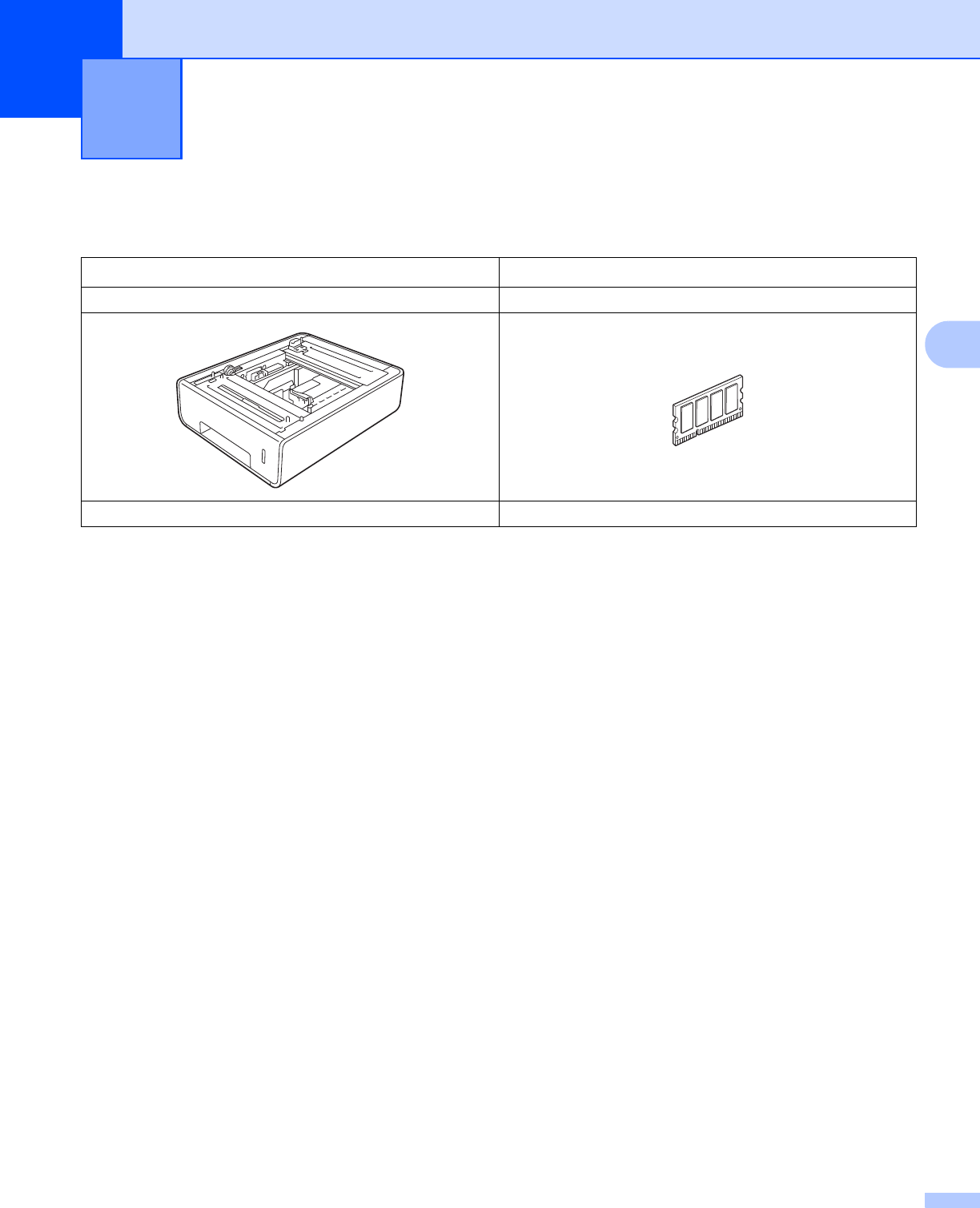
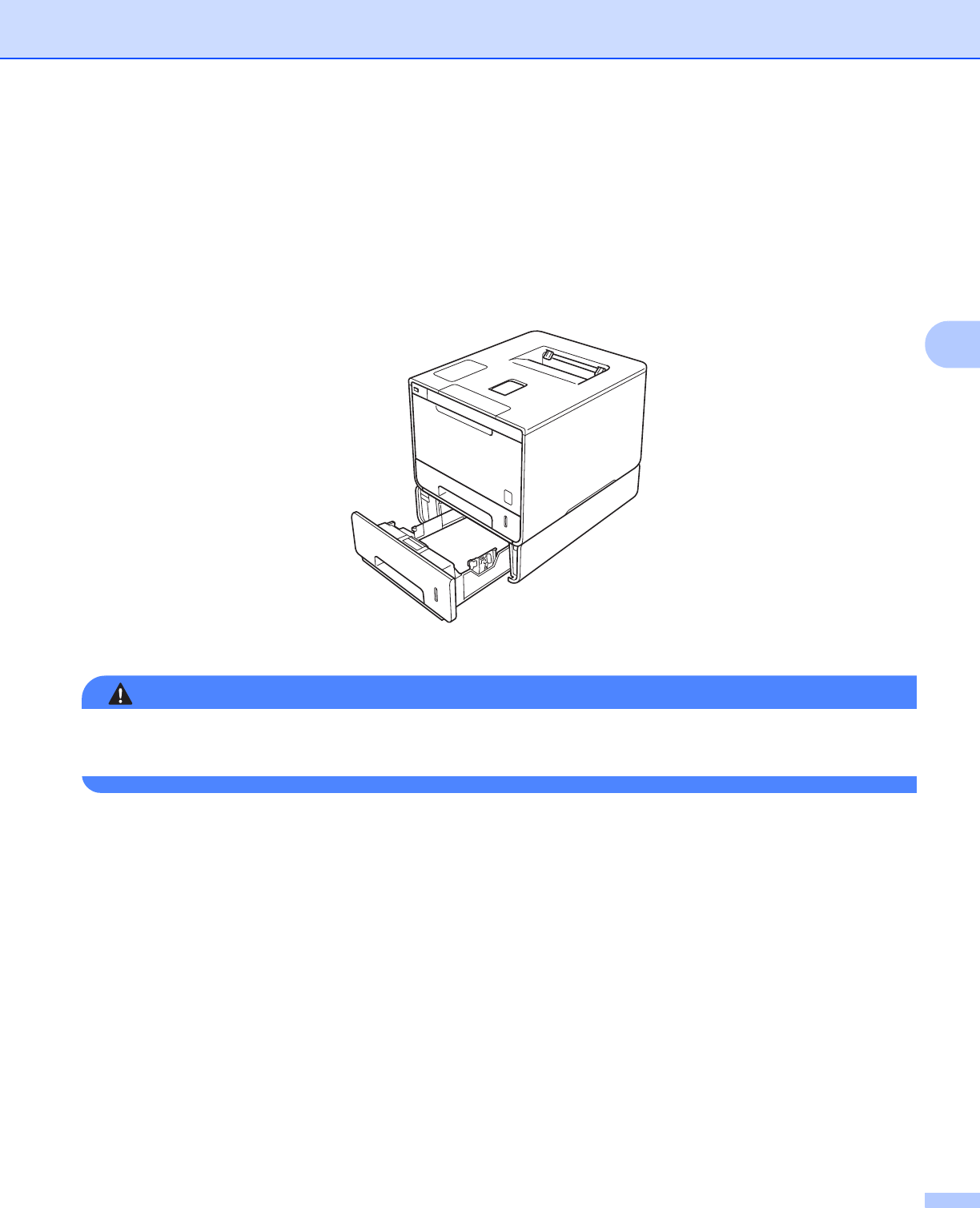
Options
114
4
Lower tray (LT-320CL) 4
One optional lower tray (Tray 2) can be installed on HL-L8250CDN and HL-L8350CDW 1, and the lower tray
can hold up to 500 sheets of 20 lb (80 g/m2) paper. When the optional lower tray is installed, the machine can
hold up to 800 sheets of plain 20 lb (80 g/m2) paper. If you want to buy the optional lower tray unit, call the
dealer you bought the machine from or Brother Customer Service.
1Tray 2 is standard on HL-L8350CDWT.
For setup, see the User’s Guide that we have supplied with the lower tray unit.
WARNING
If you use a Lower Tray, DO NOT carry the machine with the Lower Tray. Since the Lower Tray is not
attached, you may be injured or cause damage to the machine.

Options
115
4
SO-DIMM 4
The machine has 128 MB of standard memory and one slot for optional memory expansion. You can increase
the memory up to a maximum of 384 MB by installing one SO-DIMM (Small Outline Dual In-line Memory
Module).
SO-DIMM types 4
For information about memory for your Brother machine, please visit:
http://www.brother-usa.com/support/memory/
In general, the SO-DIMM must have the following specifications:
Type: 144-pin and 16-bit output
CAS latency: 4
Clock frequency: 267 MHz (533 Mb/S/Pin) or more
Capacity: 256 MB
Height: 1.18 in. (30.0mm)
DRAM type: DDR2 SDRAM
NOTE
• There might be some SO-DIMMs that will not work with the machine.
• For more information, call the dealer you bought the machine from or Brother Customer Service.
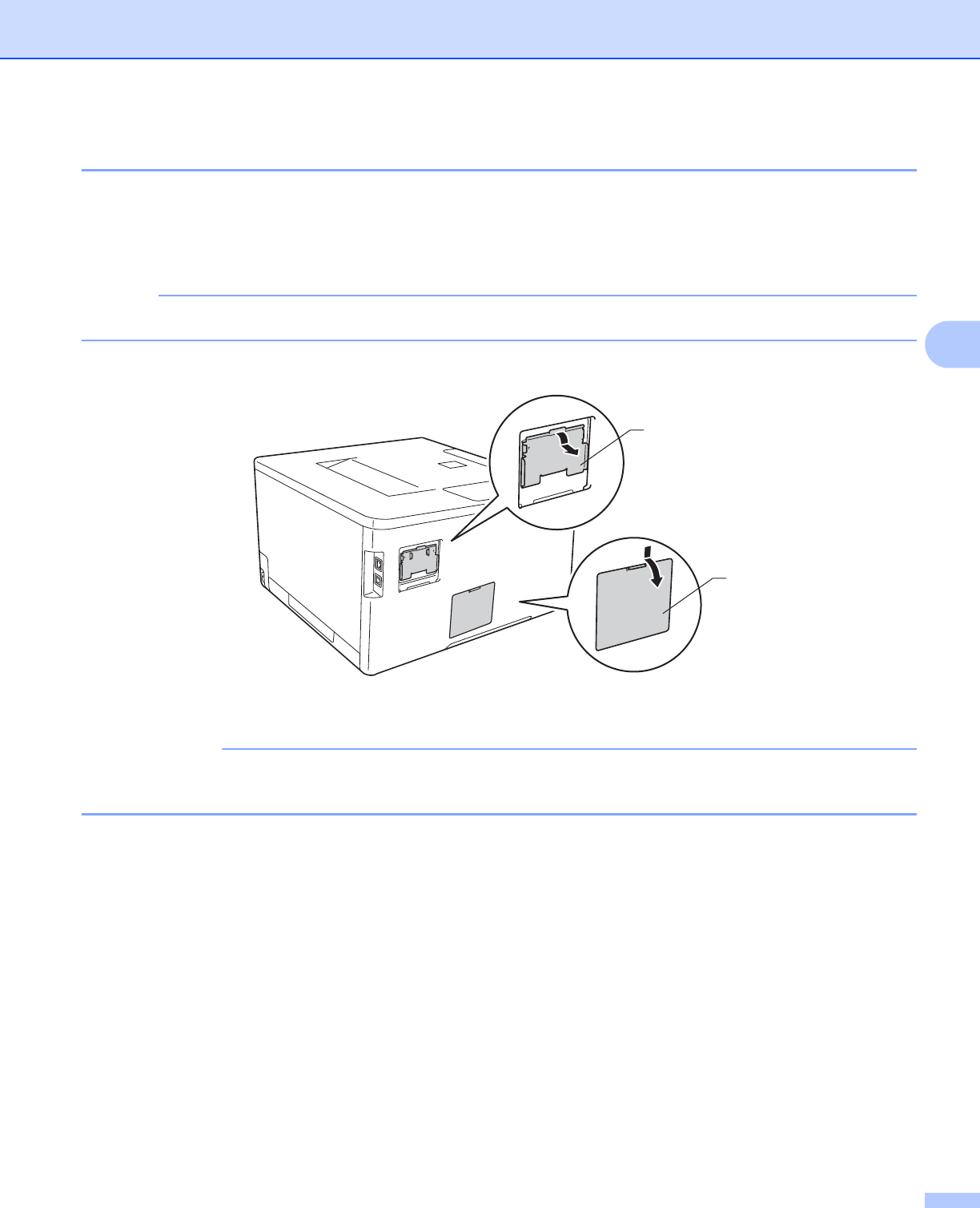
Options
116
4
Installing extra memory 4
aTurn off the machine’s power switch.
bDisconnect the interface cables from the machine, and then unplug the power cord from the AC power
outlet.
NOTE
Always unplug the power cord from the AC power outlet before installing or removing the SO-DIMM.
cRemove the plastic (1) and then the metal (2) SO-DIMM covers.
dUnpack the SO-DIMM and hold it by its edges.
IMPORTANT
To prevent damage to the machine from static electricity, DO NOT touch the memory chips or the board's
surface.
2
1
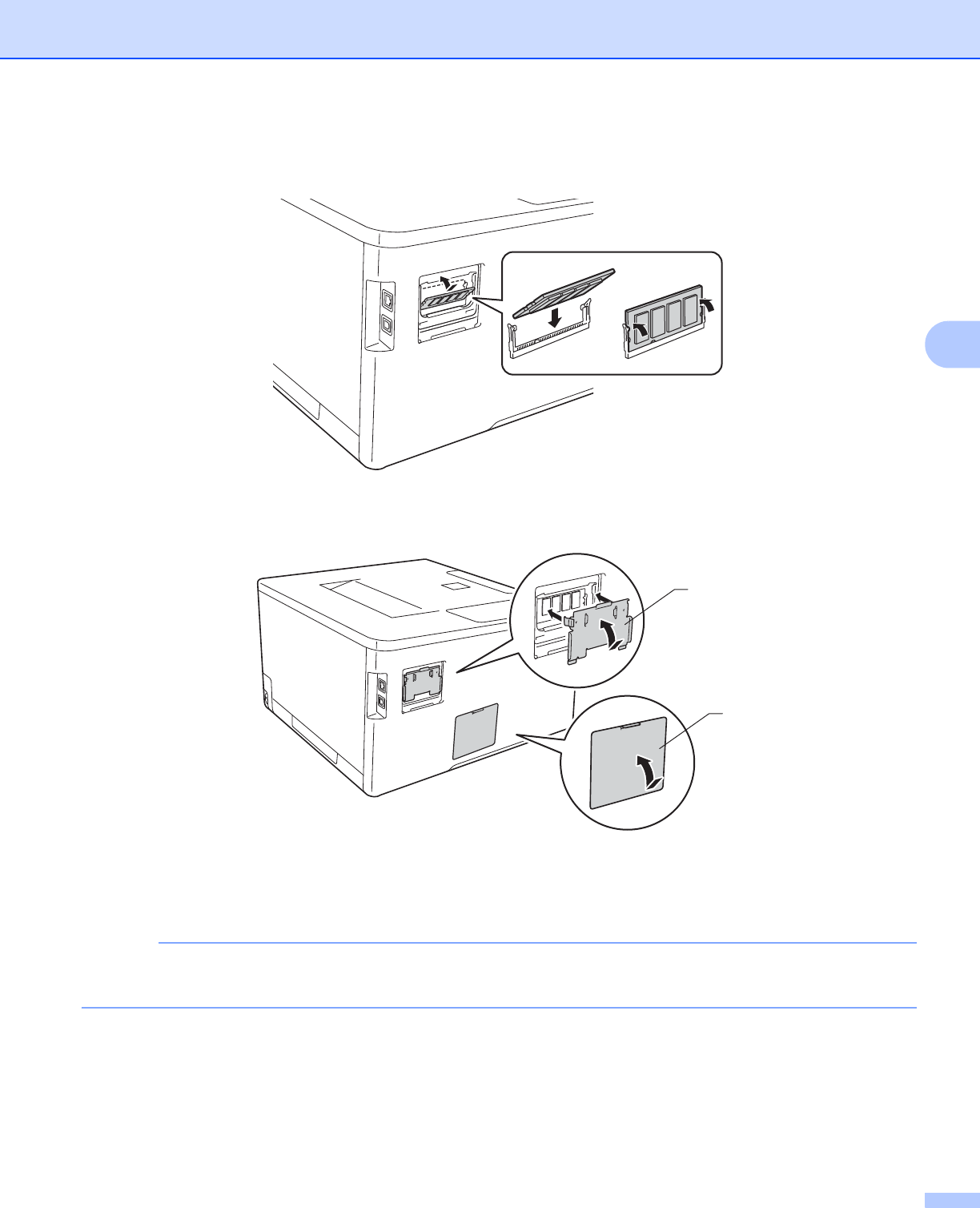
Options
117
4
eHold the SO-DIMM by the edges and align the notches in the SO-DIMM with the protrusions in the slot.
Insert the SO-DIMM diagonally (1), then tilt it toward the interface board until it locks into place (2).
fPut the metal (2) and then the plastic (1) SO-DIMM covers back on.
gPlug the machine’s power cord back into the AC power outlet first, and then connect the interface cables.
hTurn on the machine’s power switch.
NOTE
To make sure that you have installed the SO-DIMM properly, you can print the Printer Settings page that
shows the current memory size. (See Machine Info. on page 89.)
12
2
1
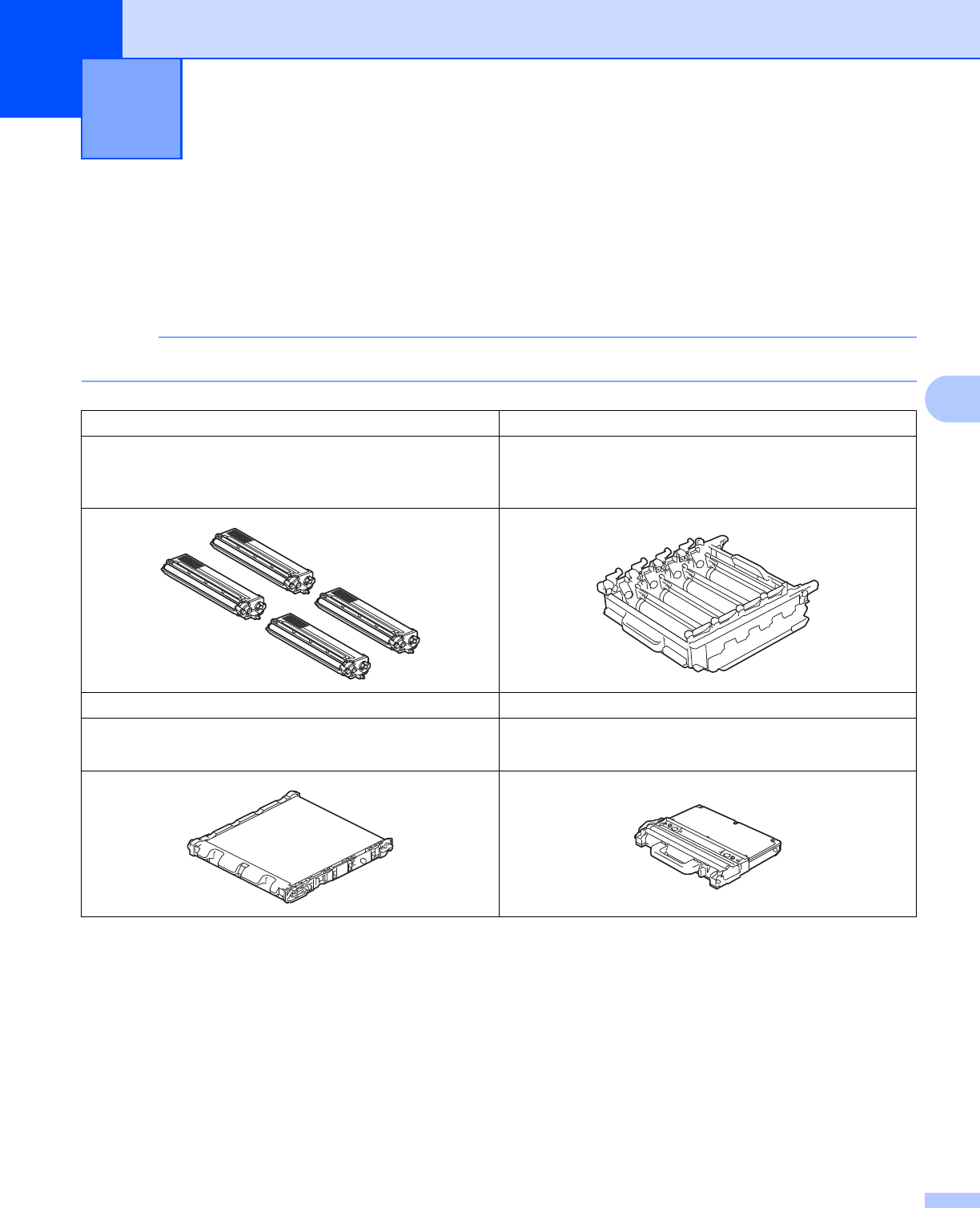
118
5
5
Replacing supplies 5
You must replace supplies when the machine indicates that the life of the supply is over. You can replace the
following supplies yourself.
Using non-Brother supplies may affect the print quality, hardware performance, and machine reliability.
NOTE
The drum unit and toner cartridge are two separate parts.
Routine Maintenance 5
Toner cartridge Drum unit
See Replacing the toner cartridges on page 122.
Order No. TN-331BK, TN-336BK, TN-331C, TN-336C,
TN-331M, TN-336M, TN-331Y, TN-336Y
See Replacing the drum unit on page 128.
Order No. DR-331CL
Belt unit Waste toner box
See Replacing the belt unit on page 135.
Order No. BU-320CL
See Replacing the waste toner box on page 141.
Order No. WT-320CL

Routine Maintenance
119
5
The following messages appear on the LCD in Ready mode. These messages provide advanced warnings
to replace supplies before they reach their end of life. To avoid any inconvenience, you may want to buy spare
supplies before the machine stops printing.
1Letter or A4 size single-sided pages
2Approximate cartridge yield is declared in accordance with ISO/IEC 19798.
3Life of supply is approximate and may vary by type of use.
4Standard toner cartridge
5High yield toner cartridge
LCD messages Supply to get
ready
Approximate life How to replace Order No.
Toner Low: X Toner cartridge
X = C, M, Y, BK
C = Cyan
M = Magenta
Y = Yellow
BK = Black
(Black)
2,500 pages 124
4,000 pages 125
(Cyan, Magenta,
Yellow)
1,500 pages 124
3,500 pages 125
See page 123 TN-331BK 4
TN-336BK 5
TN-331C 4
TN-336C 5
TN-331M 4
TN-336M 5
TN-331Y 4
TN-336Y 5
Drum End Soon Drum unit 25,000 pages 13 See page 129 DR-331CL
Belt End Soon Belt unit 50,000 pages
(5 pages per job) 13
20,000 pages
(1 page per job) 13
See page 135 BU-320CL
WT Box End Soon Waste toner box 50,000 pages 13 See page 141 WT-320CL

Routine Maintenance
120
5
You must clean the machine regularly and replace supplies when the following messages are displayed on
the LCD:
LCD messages
Supply to replace
Approximate life How to replace Order No.
Replace Toner
(The second line of the
LCD)
Open the Front
Cover, replace
Toner Cartridge.
Black (BK).
Toner cartridge,
Black 2,500 pages 124
4,000 pages 125
See page 123 TN-331BK 4
TN-336BK 5
Replace Toner
(The second line of the
LCD)
Open the Front
Cover, replace
Toner Cartridge.
Cyan (C).
Toner cartridge,
Cyan 1,500 pages 124
3,500 pages 125
TN-331C 4
TN-336C 5
Replace Toner
(The second line of the
LCD)
Open the Front
Cover, replace
Toner Cartridge.
Magenta (M).
Toner cartridge,
Magenta TN-331M 4
TN-336M 5
Replace Toner
(The second line of the
LCD)
Open the Front
Cover, replace
Toner Cartridge.
Yellow (Y).
Toner cartridge,
Yellow TN-331Y 4
TN-336Y 5
Replace Drum Drum unit 25,000 pages 13 See page 129 DR-331CL
Drum Stop Drum unit 25,000 pages 13 See page 129 DR-331CL
Replace Belt Belt unit 50,000 pages
(5 pages per job) 13
20,000 pages
(1 page per job) 13
See page 135 BU-320CL
Replace WT Box Waste toner box 50,000 pages 13 See page 141 WT-320CL
Replace Fuser Fuser unit 100,000 pages 13 Call Brother Customer Service for a
replacement fuser unit.
Replace PF KitMP Paper feeding kit 50,000 pages 13 Call Brother Customer Service for a
replacement PF kit MP.

Routine Maintenance
121
5
1Letter or A4 size single-sided pages
2Approximate cartridge yield is declared in accordance with ISO/IEC 19798.
3Life of supply is approximate and may vary by type of use.
4Standard toner cartridge
5High yield toner cartridge
NOTE
• Visit to http://www.brother.com/original/index.html for instructions about how to return the used toner
cartridge to the brother collection program. If you choose not to return your used toner cartridge, please
discard the used toner cartridge according to local regulations, keeping it separate from domestic waste.
If you have questions, call your local waste disposal office.
• We recommend placing used supplies on a piece of paper to prevent accidentally spilling or scattering the
material inside.
• If you use paper that is not a direct equivalent of the recommended paper, the life of supplies and machine
parts may be reduced.
• The projected life for each of the toner cartridges is based on ISO/ICE 19798. Frequency of replacement
will vary depending on the print volume, percentage of coverage, types of media used, and powering on/off
of the machine.
• Frequency of replacement supplies except toner cartridges will vary depending on the print volume, types
of media used, and powering on/off of the machine.
Replace PF Kit1 Paper feeding kit 100,000 pages 13 Call Brother Customer Service for a
replacement PF kit 1.
Replace PF Kit2 Paper feeding kit 100,000 pages 13 Call Brother Customer Service for a
replacement PF kit 2.
Replace Laser Laser unit 100,000 pages 13 Call Brother Customer Service for a
replacement laser unit.
LCD messages
Supply to replace
Approximate life How to replace Order No.

Routine Maintenance
122
5
Replacing the toner cartridges 5
Order No. For the item number of the toner cartridges, see Replacing supplies on page 118
The Standard toner cartridge can print approximately 2,500 pages (black) or approximately 1,500 pages
(cyan, magenta, yellow) 1. The High Yield toner cartridge can print approximately 4,000 pages (black) or
approximately 3,500 pages (cyan, magenta, yellow) 1. Actual page count will vary depending on your average
type of document. When a toner cartridge is running low, the LCD displays Toner Low.
The toner cartridge that comes supplied with the machine must be replaced after printing approximately 2,500
pages (black) or approximately 1,500 pages (cyan, magenta, yellow) 1.
1Approximate cartridge yield is declared in accordance with ISO/IEC 19798.
NOTE
• The indication of remaining toner life will vary depending on the types of documents printed and your
usage.
• It is a good idea to keep a new toner cartridge ready for use when you see the Toner Low warning.
• To ensure high quality printing, we recommend using only Genuine Brother Brand toner cartridges. When
you want to buy toner cartridges, contact your local Brother retailer or Brother Customer Service.
• We recommend cleaning the machine when you replace the toner cartridge. See Cleaning and Checking
the machine on page 148.
• DO NOT unpack the new toner cartridge until you are ready to install it.
Toner Low: X 5
Toner Low: X
If the LCD displays Toner Low: X, the machine has nearly run out of toner. Buy a new toner cartridge and
have it ready before you get a Replace Toner message. The X shows the toner color that is near the end
of its life. (BK=Black, C=Cyan, M=Magenta, Y=Yellow). To replace the toner cartridge, see Replacing the toner
cartridges on page 123.
Replace Toner 5
When the following message appears on the LCD, you must replace the toner cartridge:
Replace Toner
The second line of the LCD indicates which color must replace.
When the LCD displays Replace Toner the machine will stop printing until you replace the toner cartridge.
A new genuine Brother toner cartridge will reset the Replace Toner message.
NOTE
For more information about how toner cartridge life is calculated, see Important information for the toner
cartridge life on page 210.
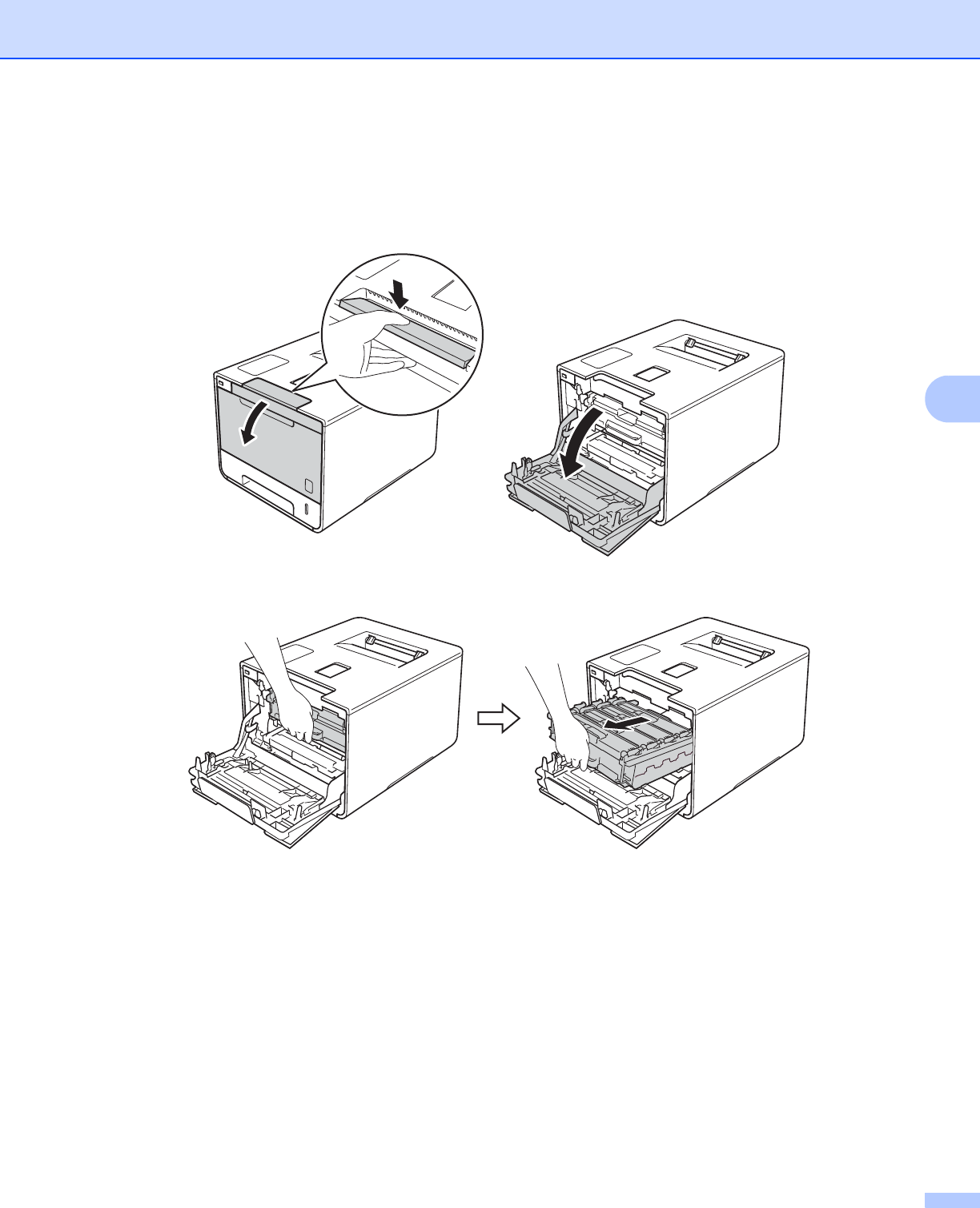
Routine Maintenance
123
5
Replacing the toner cartridges 5
aMake sure that the machine is turned on.
bPress the front cover release button and pull open the front cover.
cHold the blue handle of the drum unit. Pull the drum unit out until it stops.
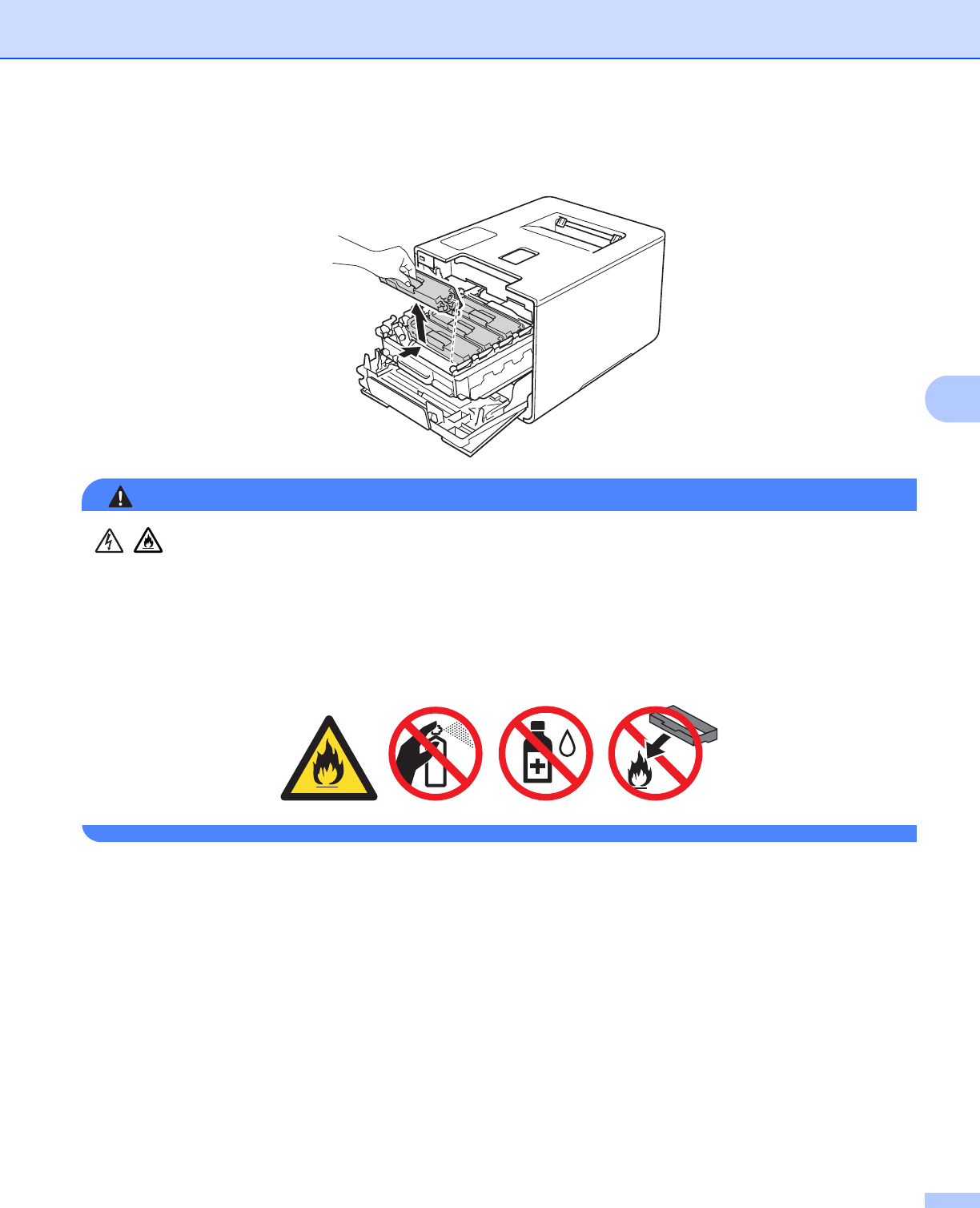
Routine Maintenance
124
5
dHold the handle of the toner cartridge and gently push it toward the machine to unlock it. Then pull it out
of the drum unit. Repeat this for all the toner cartridges.
WARNING
• DO NOT put a toner cartridge into a fire. It could explode, resulting in injuries.
• DO NOT use flammable substances, any type of spray, or an organic solvent/liquid containing alcohol
or ammonia to clean the inside or outside of the machine. Doing so could cause a fire or electrical shock.
Instead, use only a dry, soft, lint-free cloth.
(See the Product Safety Guide.)
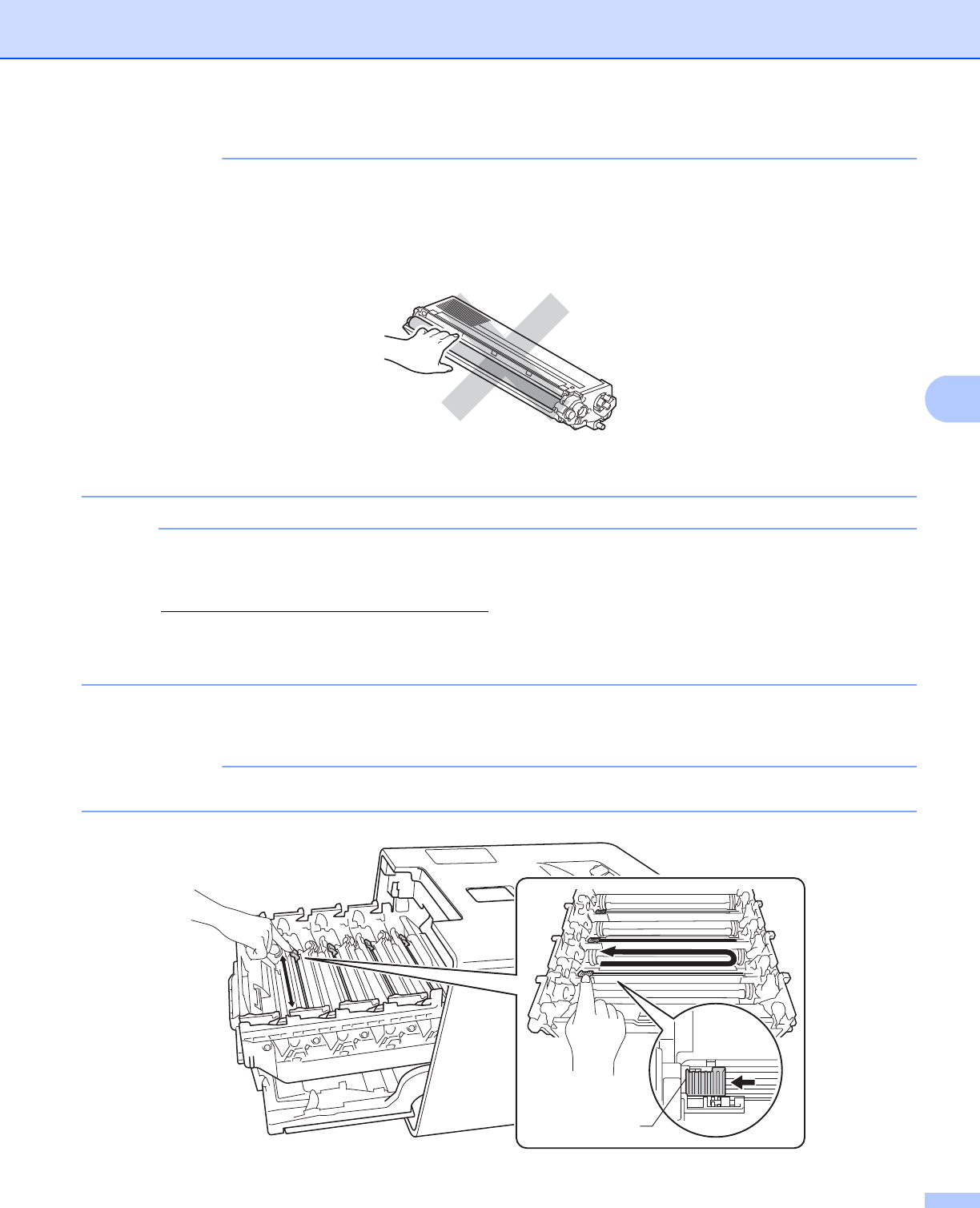
Routine Maintenance
125
5
IMPORTANT
• Handle the toner cartridge carefully. If toner scatters on your hands or clothes, immediately wipe or wash
it off with cold water.
• To avoid print quality problems, DO NOT touch the shaded parts shown in the illustration.
<Toner cartridge>
• We recommend placing the toner cartridge on a clean, flat, level, stable surface with a sheet of disposable
paper or cloth underneath it in case you accidentally spill or scatter toner.
NOTE
• Be sure to seal up the used toner cartridge tightly in a bag so that toner powder does not spill out of the
cartridge.
• Visit to http://www.brother.com/original/index.html for instructions about how to return your used supplies
to the Brother collection program. If you choose not to return your used supply, please discard the used
supply according to local regulations, keeping it separate from domestic waste. If you have questions, call
your local waste disposal office.
eClean the corona wire inside the drum unit by gently sliding the blue tab from left to right and right to left
several times.
IMPORTANT
Be sure to return the tab to the home position (1). If you do not, printed pages may have a vertical stripe.
1
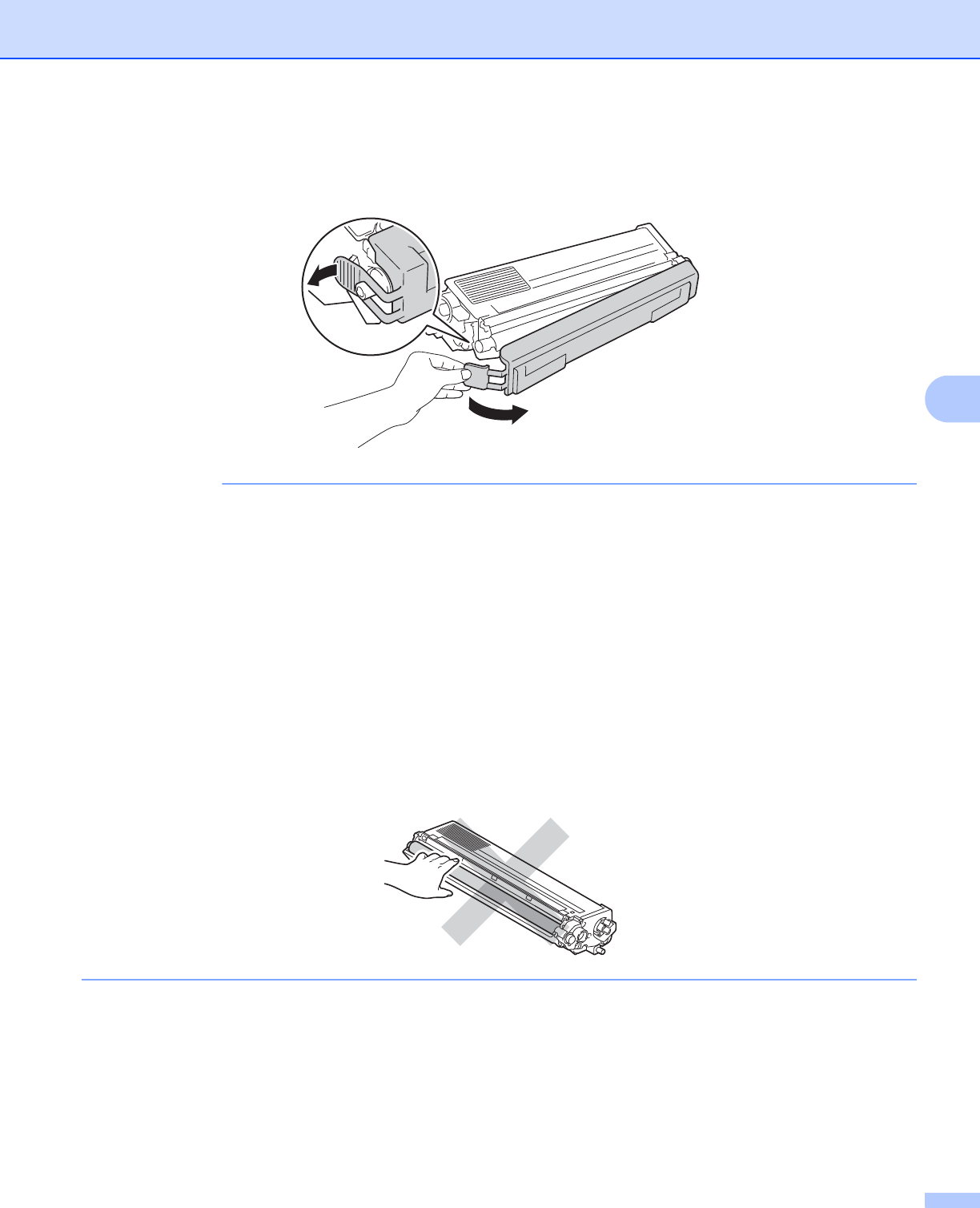
Routine Maintenance
126
5
fRepeat step e to clean each of three remaining corona wires.
gUnpack the new toner cartridge, then pull off the protective cover.
IMPORTANT
• DO NOT unpack the new toner cartridge until you are ready to install it. If a toner cartridge is left unpacked
for a long time, the toner life will be shortened.
• If an unpacked drum unit is exposed to direct sunlight (or room light for long periods of time), the unit may
be damaged.
• Brother strongly recommends that you DO NOT refill the toner cartridge provided with your machine. We
also strongly recommend that you continue to use only Genuine Brother Brand replacement toner
cartridges. Use or attempted use of potentially incompatible toner and/or cartridges in the Brother machine
may cause damage to the machine and/or may result in unsatisfactory print quality. Our limited warranty
coverage does not apply to any problem that is caused by the use of unauthorized third party toner and/or
cartridges. To protect your investment and obtain premium performance from the Brother machine, we
strongly recommend the use of Genuine Brother Supplies.
• Put the toner cartridge in the drum unit immediately after you have removed the protective cover. To
prevent degradation to the print quality, DO NOT touch the shaded parts shown in the illustration.
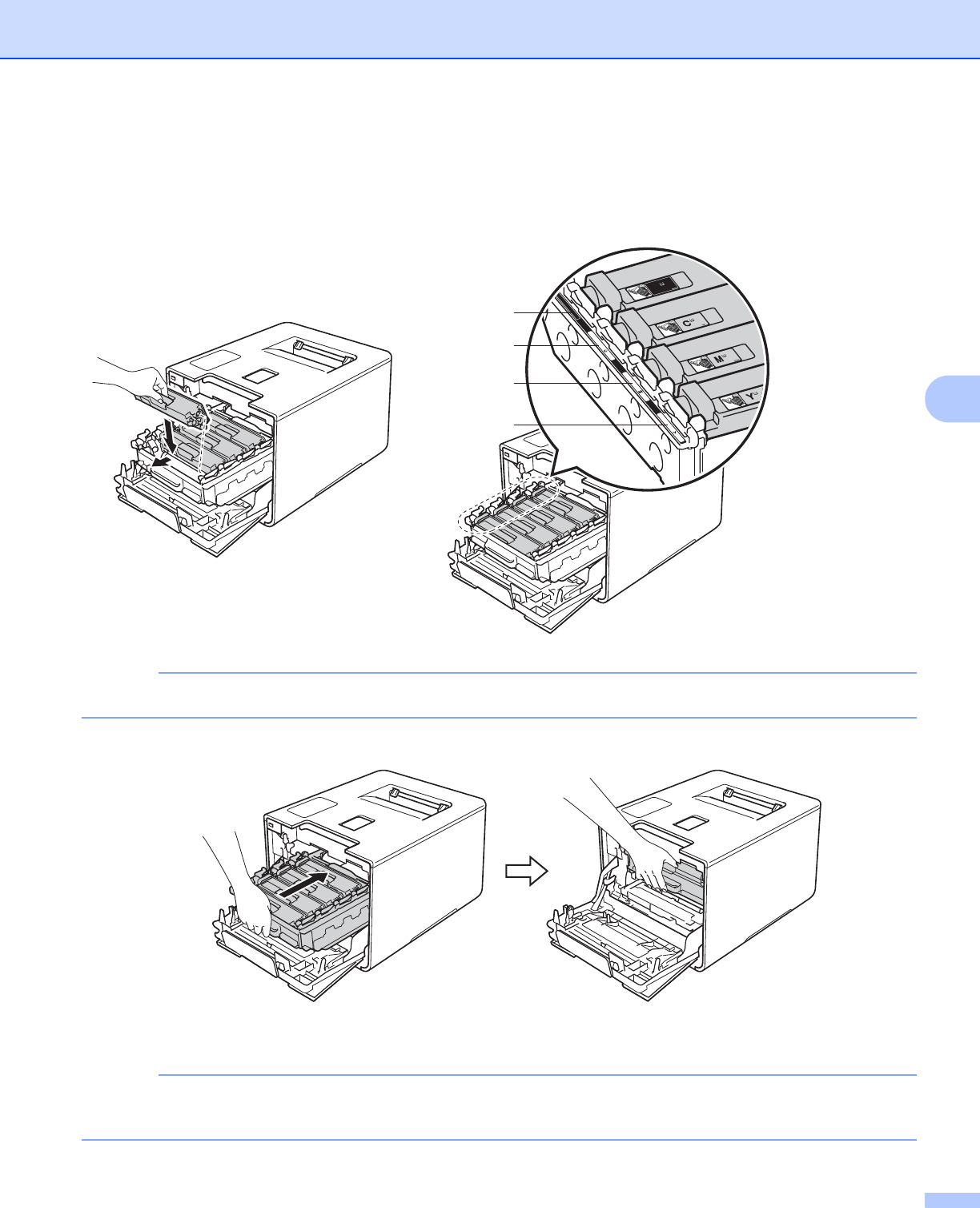
Routine Maintenance
127
5
hHold the handle of the toner cartridge and slide the toner cartridge into the drum unit then gently pull it
toward you until you hear it lock into place. Make sure that you match the toner cartridge color to the
same color label on the drum unit. Repeat this for all the toner cartridges.
NOTE
Make sure you installed the toner cartridge correctly or it may separate from the drum unit.
iPush the drum unit in until it stops.
jClose the front cover of the machine.
NOTE
After replacing the toner cartridge, DO NOT turn off the machine's power switch or open the front cover
until the LCD displays Ready.
BK - Black
C - Cyan
M - Magenta
Y - Yellow
BK
TN-BK
TN-C
TN-M
TN-Y
BK
BK
C
M
Y

Routine Maintenance
128
5
Replacing the drum unit 5
Order No. DR-331CL
A new drum unit can print approximately 25,000 pages. 12
1Letter or A4 size single-sided pages.
2Drum life is approximate and may vary by type of use.
NOTE
• There are many factors that determine the actual drum life, such as the temperature, humidity, type of
paper, type of toner used and so on. Under ideal conditions, the average drum life is estimated at
approximately 25,000 pages. The actual number of pages that your drum will print may be significantly
less than this estimate. Because we have no control over the many factors that determine the actual drum
life, we cannot guarantee a minimum number of pages that will be printed by your drum.
• For best performance, use only genuine Brother toner. The machine should be used only in a clean,
dust-free environment with adequate ventilation.
• Printing with a non-Brother drum unit may reduce not only the print quality but also the quality and life of the
machine itself. Warranty coverage does not apply to problems caused by the use of a non-Brother drum unit.
Drum ! 5
Drum !
The corona wires are coated with paper dust or toner. Clean the corona wires in the drum unit (see Cleaning
the corona wires on page 154).
Drum End Soon 5
Drum End Soon
The drum unit is nearing the end of its rated life and will require replacement. We recommend you keep a
genuine Brother drum unit ready for installation. Buy a new drum unit (DR-331CL) and have it ready before
you get a Replace Drum message.
Replace Drum 5
Replace Drum
The drum unit has exceeded its rated life. Please replace the drum unit with a new one. We recommend a
genuine Brother drum unit be installed at this time.
After replacement, reset the drum counter by following the instructions included with the new drum unit.
Drum Stop 5
Drum Stop
We cannot guarantee the print quality. Please replace the drum unit with a new one. We recommend a
genuine Brother drum unit be installed at this time.
After replacement, reset the drum counter by following the instructions included with the new drum unit.
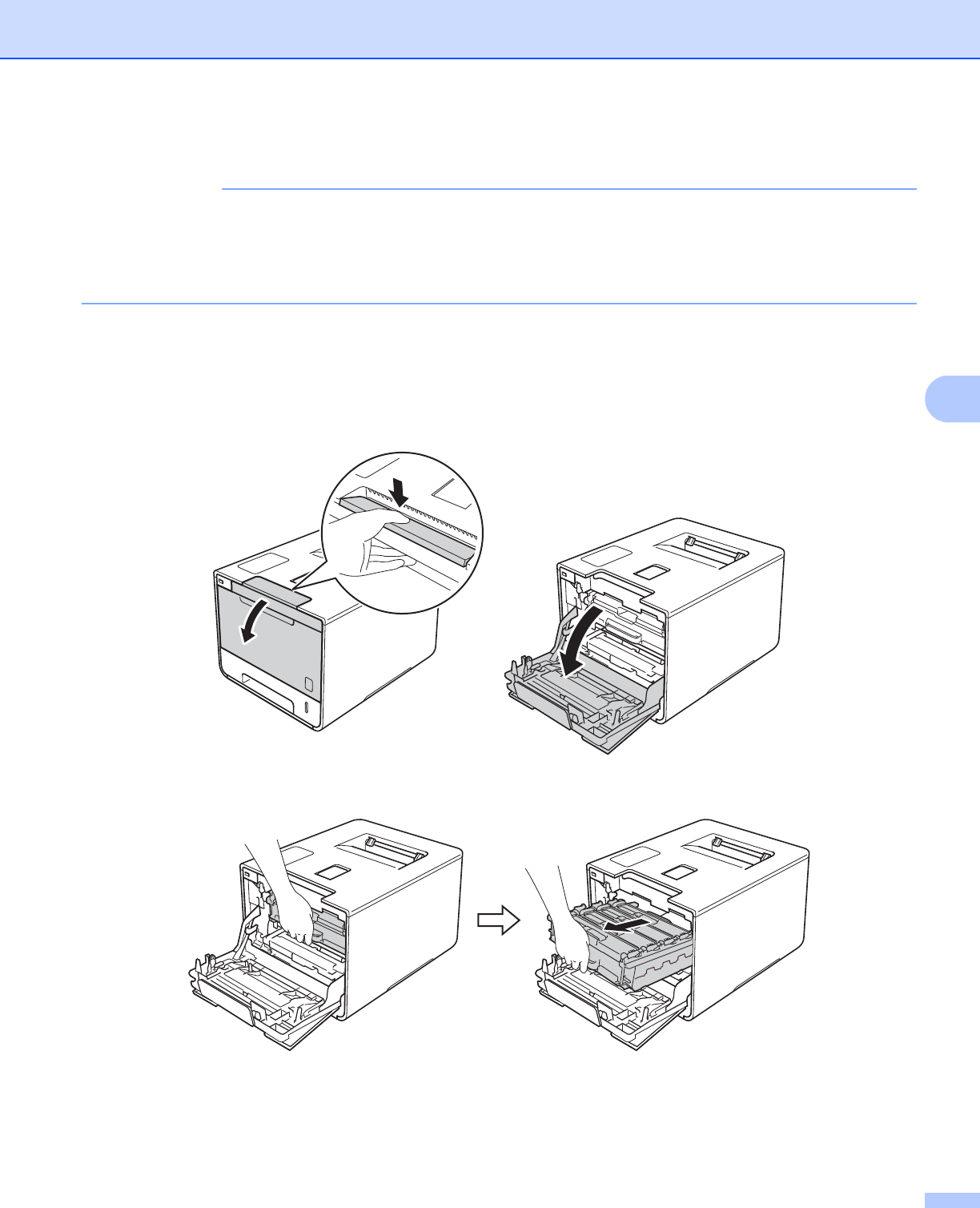
Routine Maintenance
129
5
Replacing the drum unit 5
IMPORTANT
• While removing the drum unit, handle it carefully because it may contain toner. If toner scatters on your
hands or clothes, immediately wipe or wash it off with cold water.
• Every time you replace the drum unit, clean the inside of the machine (see Cleaning and Checking the
machine on page 148).
When you replace the drum unit with a new one, follow these steps, and then reset the drum counter by
following the steps on page 134.
aMake sure that the machine is turned on.
bPress the front cover release button and pull open the front cover.
cHold the blue handle of the drum unit. Pull the drum unit out until it stops.
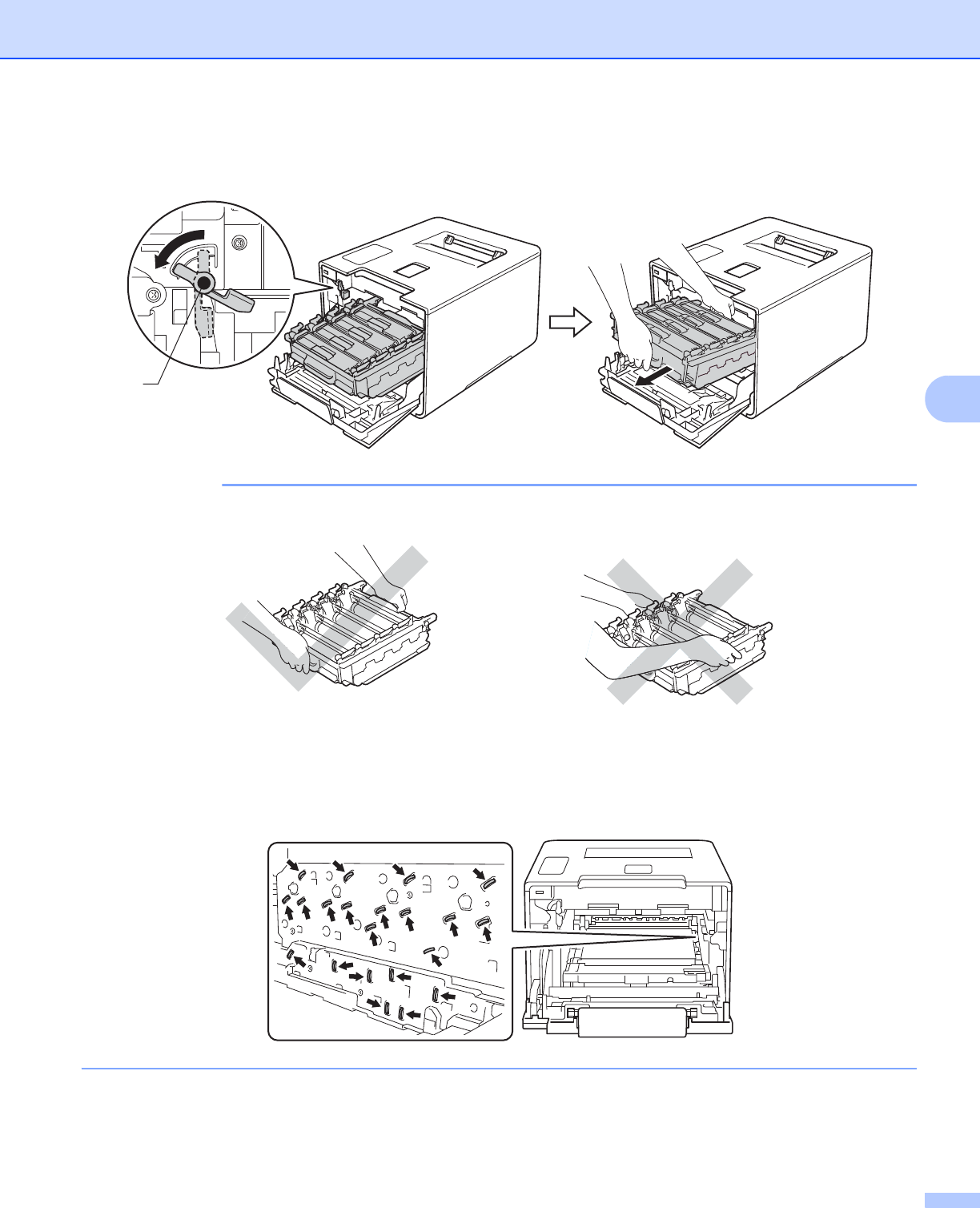
Routine Maintenance
130
5
dTurn the blue lock lever (1) at the left of the machine counterclockwise to the release position. Holding
the blue handles of the drum unit, lift the front of the drum unit and remove it from the machine.
IMPORTANT
• Hold the blue handles of the drum unit when you carry it. DO NOT hold the sides of the drum unit.
• We recommend placing the drum unit on a clean, flat, level, stable surface with a sheet of disposable paper
or cloth underneath it in case you accidentally spill or scatter toner.
• To prevent damage to the machine from static electricity, DO NOT touch the electrodes shown in the
illustration.
2
1
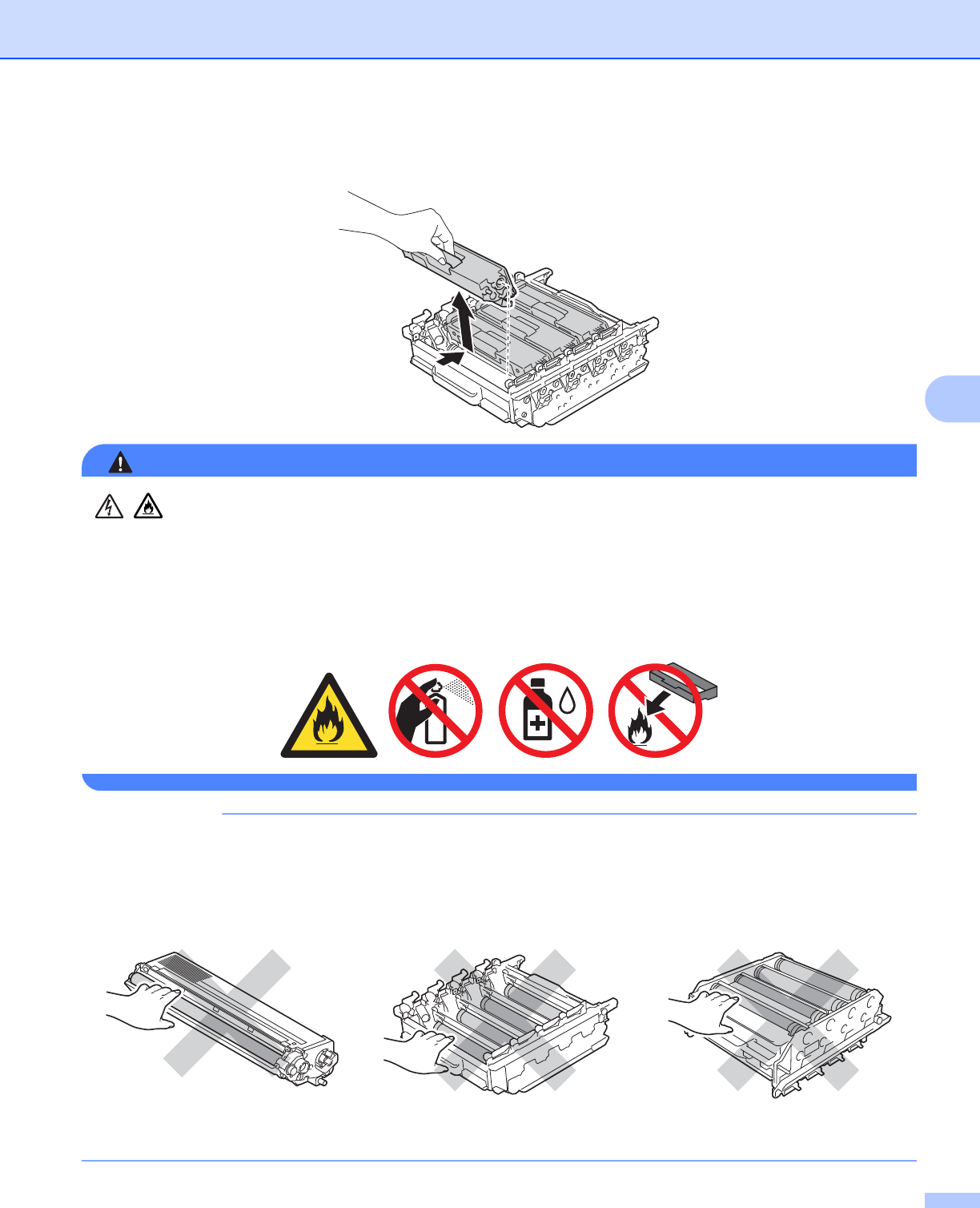
Routine Maintenance
131
5
e
Hold the handle of the toner cartridge and gently push it forward to unlock it. Then pull it out of the drum unit.
Repeat this for all the toner cartridges.
WARNING
• DO NOT put a toner cartridge into a fire. It could explode, resulting in injuries.
• DO NOT use flammable substances, any type of spray, or an organic solvent/liquid containing alcohol
or ammonia to clean the inside or outside of the machine. Doing so could cause a fire or electrical shock.
Instead, use only a dry, soft, lint-free cloth.
(See the Product Safety Guide.)
IMPORTANT
• Handle the toner cartridge carefully. If toner scatters on your hands or clothes, immediately wipe or wash
it off with cold water.
• To avoid print quality problems, DO NOT touch the shaded parts shown in the illustrations.
• We recommend placing the toner cartridge on a clean, flat, level, stable surface with a sheet of disposable
paper or cloth underneath it in case you accidentally spill or scatter toner.
<Toner cartridge> <Drum unit>
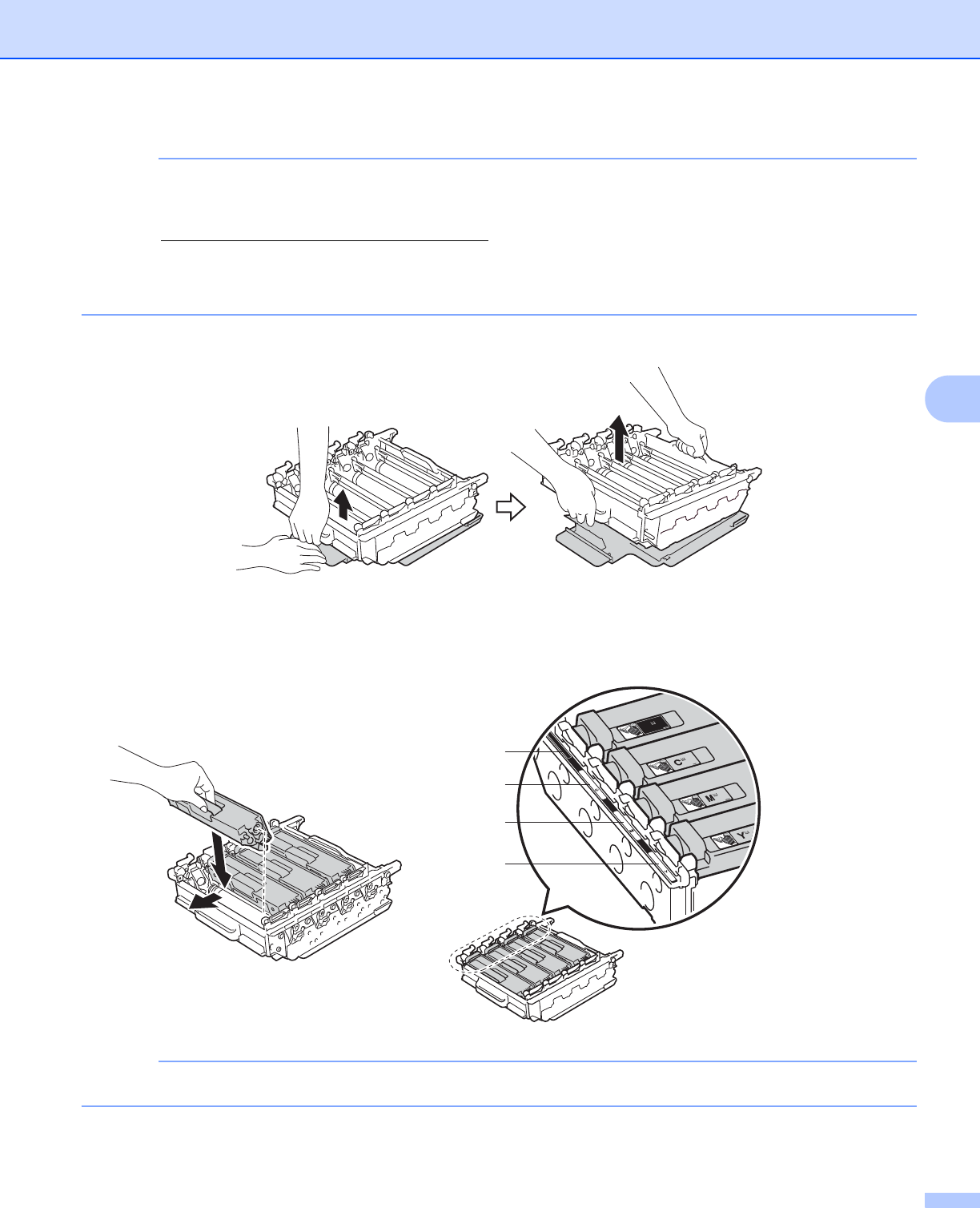
Routine Maintenance
132
5
NOTE
• Be sure to seal up the used drum unit tightly in a bag so that toner powder does not spill out of the drum
unit.
• Visit to http://www.brother.com/original/index.html for instructions about how to return your used supplies
to the Brother collection program. If you choose not to return your used supply, please discard the used
supply according to local regulations, keeping it separate from domestic waste. If you have questions, call
your local waste disposal office.
fUnpack the new drum unit and remove the protective cover.
gHold the handle of the toner cartridge and slide it into the appropriate colored section of the drum unit
until you hear it lock into place.
NOTE
Make sure you install the toner cartridge correctly or it may separate from the drum unit.
BK - Black
C - Cyan
M - Magenta
Y - Yellow
BK
TN-BK
TN-C
TN-M
TN-Y
BK
BK
C
M
Y
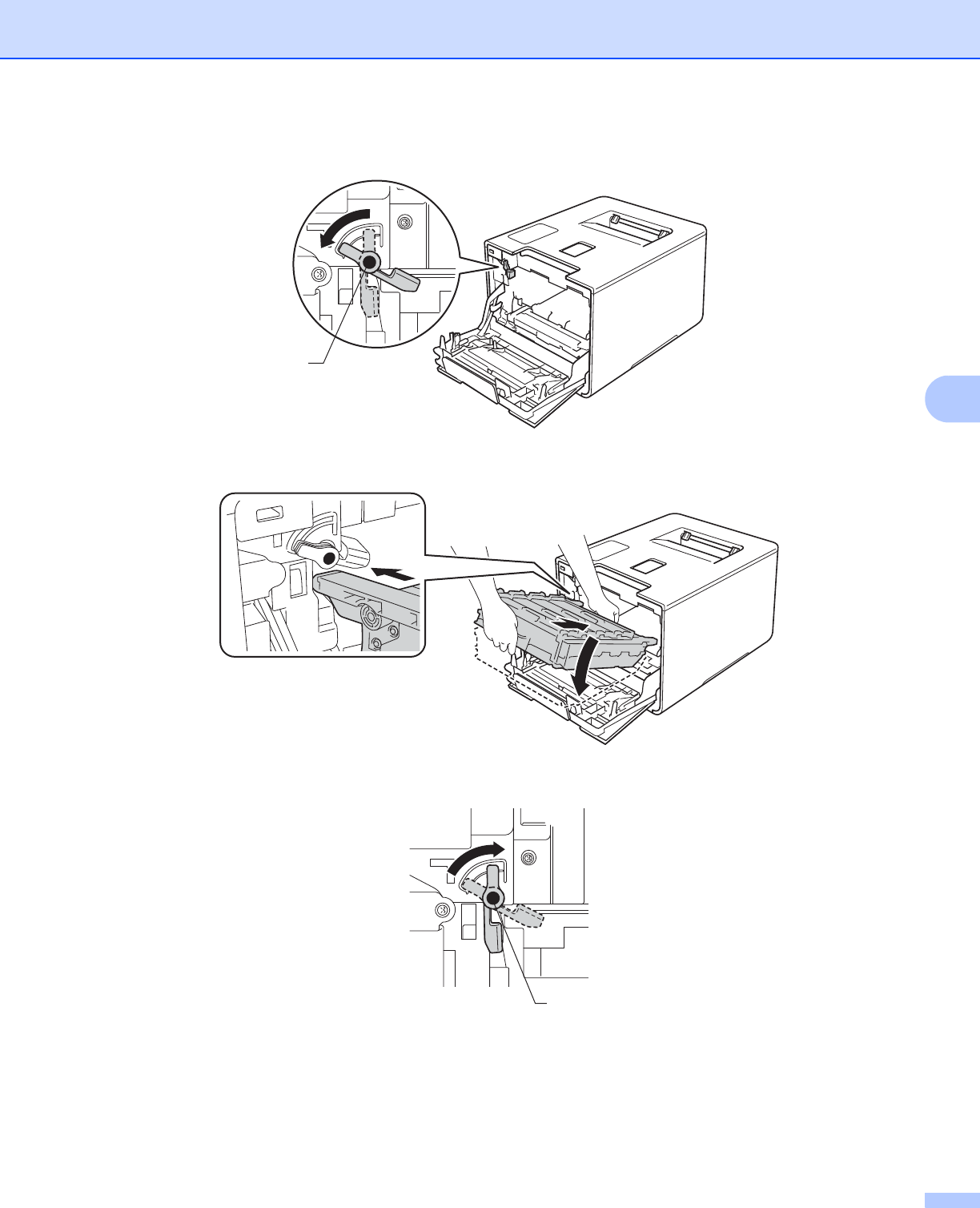
Routine Maintenance
133
5
hMake sure the blue lock lever (1) is in the release position as shown in the illustration.
iGently slide the drum unit into the machine until it stops at the blue lock lever.
jTurn the blue lock lever (1) clockwise to the lock position.
2
1
2
2
1
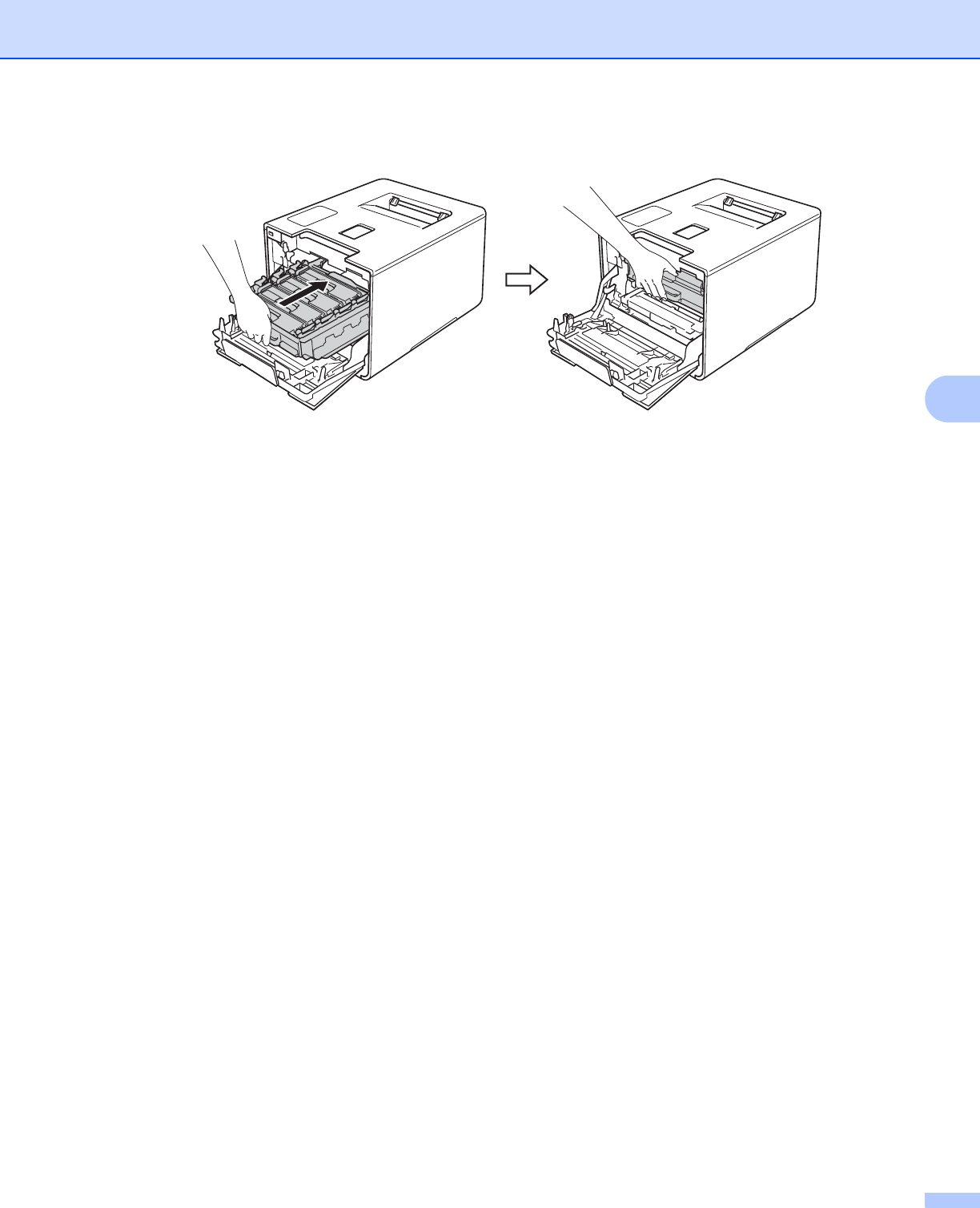
Routine Maintenance
134
5
kPush the drum unit in until it stops.
lClose the front cover of the machine.
Resetting the drum counter 5
When you replace a drum unit with a new one, you must reset the drum counter by completing the following
steps:
aPress awhile holding down Go on the machine's control panel to display Reset Menu.
bPress aor b ( + or -) to display Drum Unit. Press OK.
cPress afor Reset to reset the drum counter.
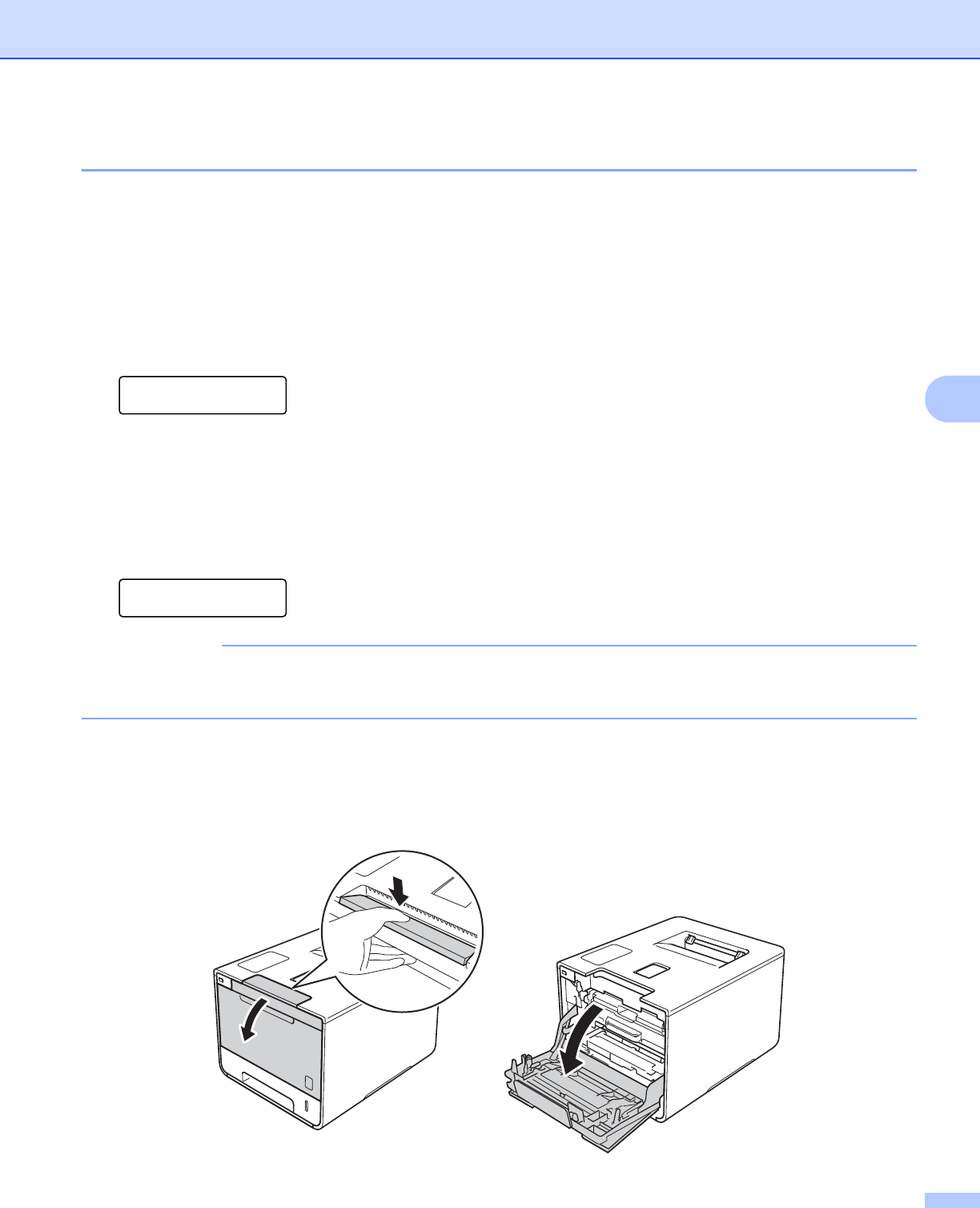
Routine Maintenance
135
5
Replacing the belt unit 5
Order No. BU-320CL
A new belt unit can print approximately 50,000 pages (5 pages per job), 12
or 20,000 pages
(1 page per job) 12
1Letter or A4 size single-sided pages.
2Belt unit life is approximate and may vary by type of use.
Belt End Soon 5
Belt End Soon
If the LCD displays Belt End Soon, it means the belt unit is near the end of its life. Buy a new belt unit and
have it ready before you get a Replace Belt message. To replace the belt unit, see Replacing the belt unit
on page 135.
Replace Belt 5
When the following message appears on the LCD, you must replace the belt unit:
Replace Belt
IMPORTANT
• DO NOT touch the surface of the belt unit. If you touch it, it could degrade print quality.
• Damage caused by incorrect handling of the belt unit may void your warranty.
Replacing the belt unit 5
aMake sure that the machine is turned on.
bPress the front cover release button and pull open the front cover.
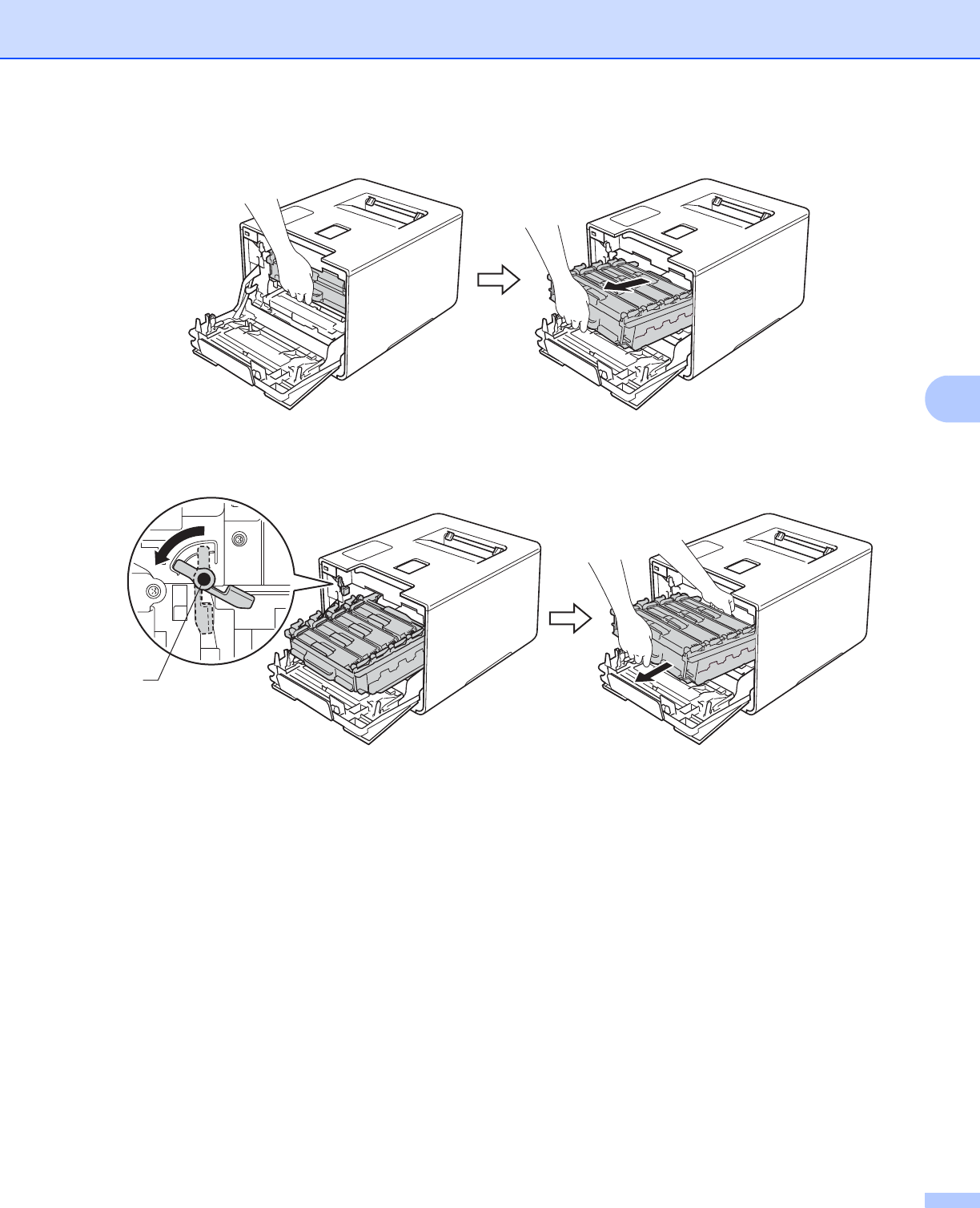
Routine Maintenance
136
5
cHold the blue handle of the drum unit. Pull the drum unit out until it stops.
dTurn the blue lock lever (1) at the left of the machine counterclockwise to the release position. Holding
the blue handles of the drum unit, lift the front of the drum unit and remove it from the machine.
2
1
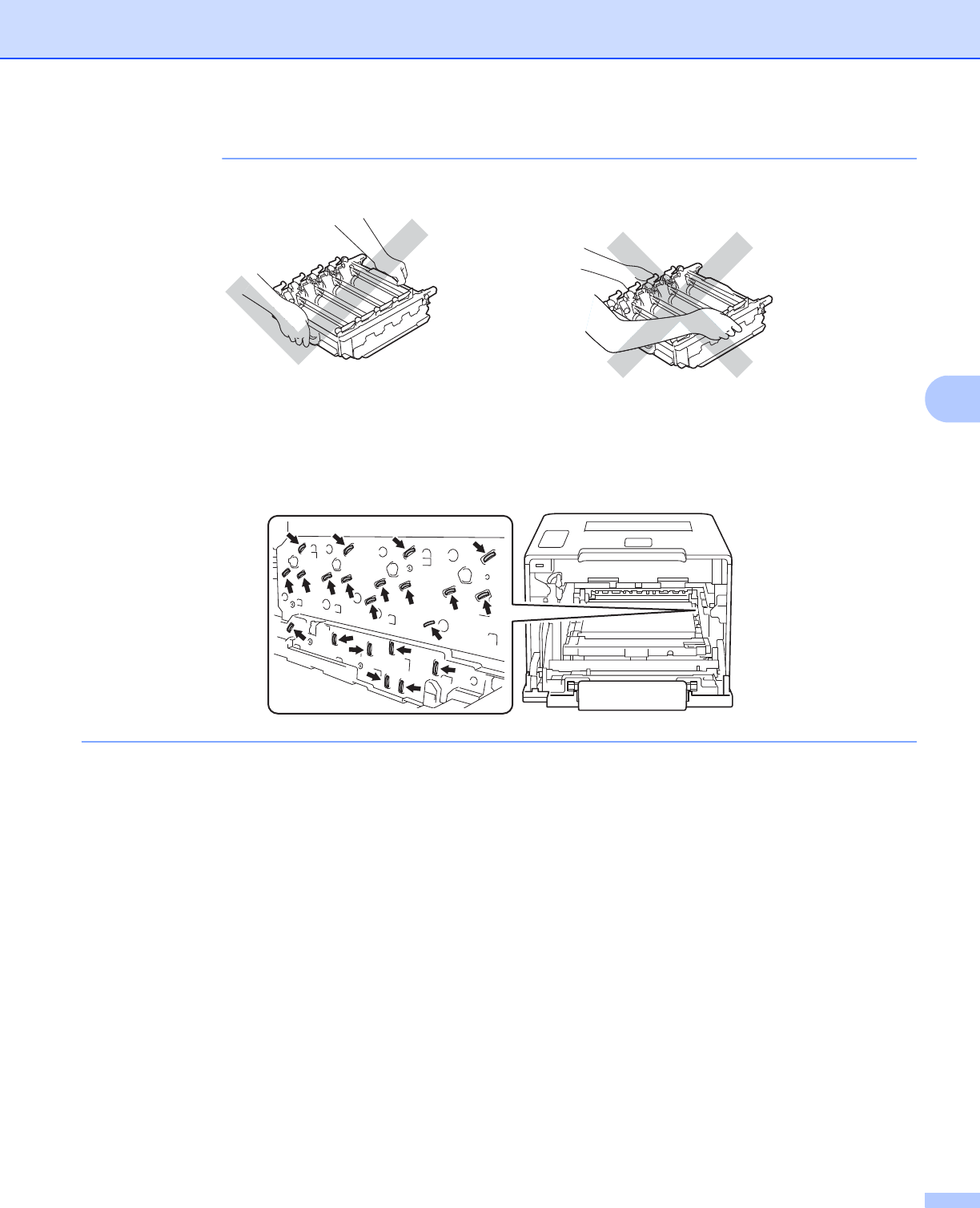
Routine Maintenance
137
5
IMPORTANT
• Hold the blue handles of the drum unit when you carry it. DO NOT hold the sides of the drum unit.
• We recommend placing the drum unit on a clean, flat, level, stable surface with a sheet of disposable paper
or cloth underneath it in case you accidentally spill or scatter toner.
• To prevent damage to the machine from static electricity, DO NOT touch the electrodes shown in the
illustration.
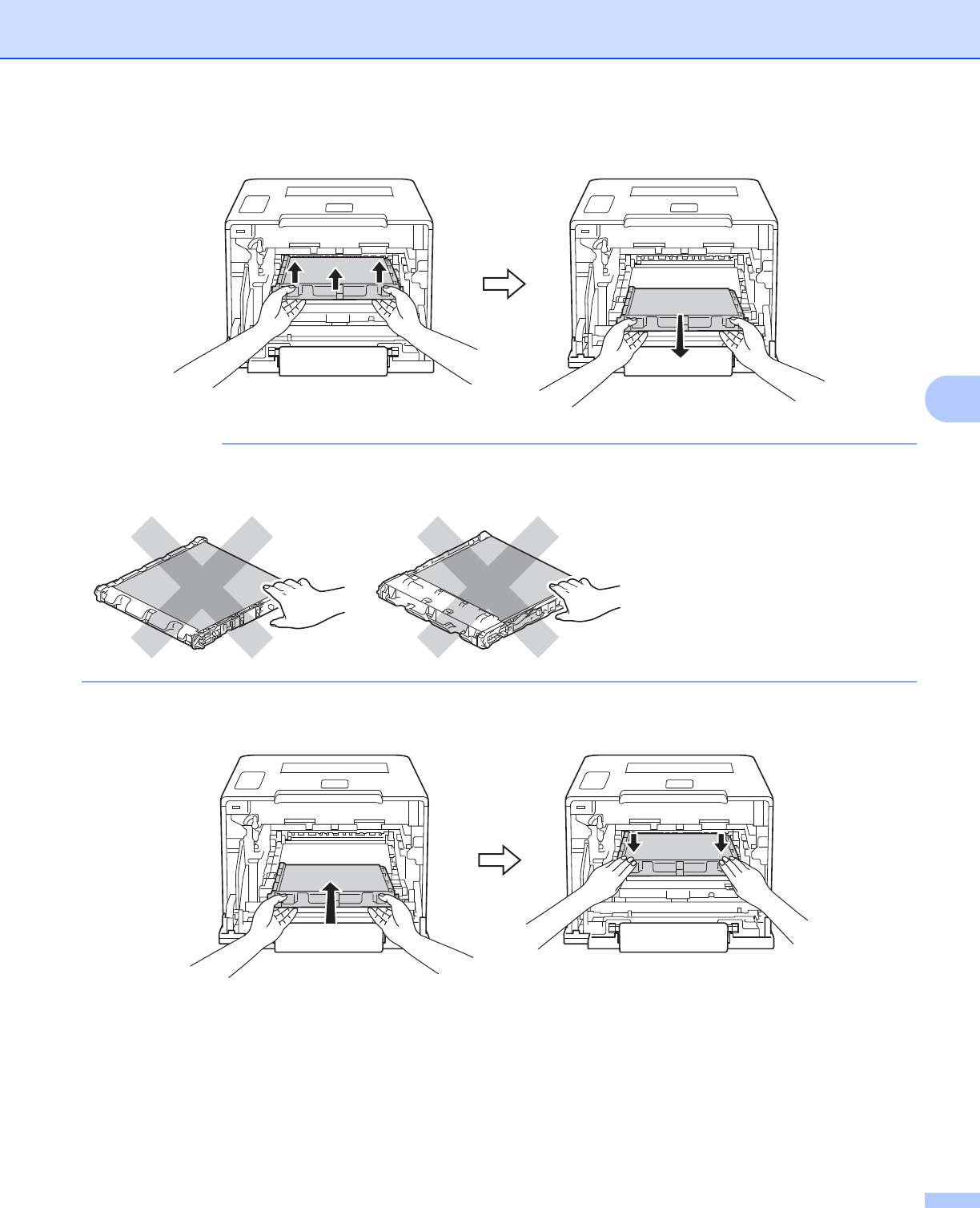
Routine Maintenance
138
5
eHold the blue handle of the belt unit with both hands and lift the belt unit up, and then pull it out.
IMPORTANT
To avoid print quality problems, DO NOT touch the shaded parts shown in the illustrations.
fUnpack the new belt unit and install it in the machine. Make sure the belt unit is level and fits firmly into
place.
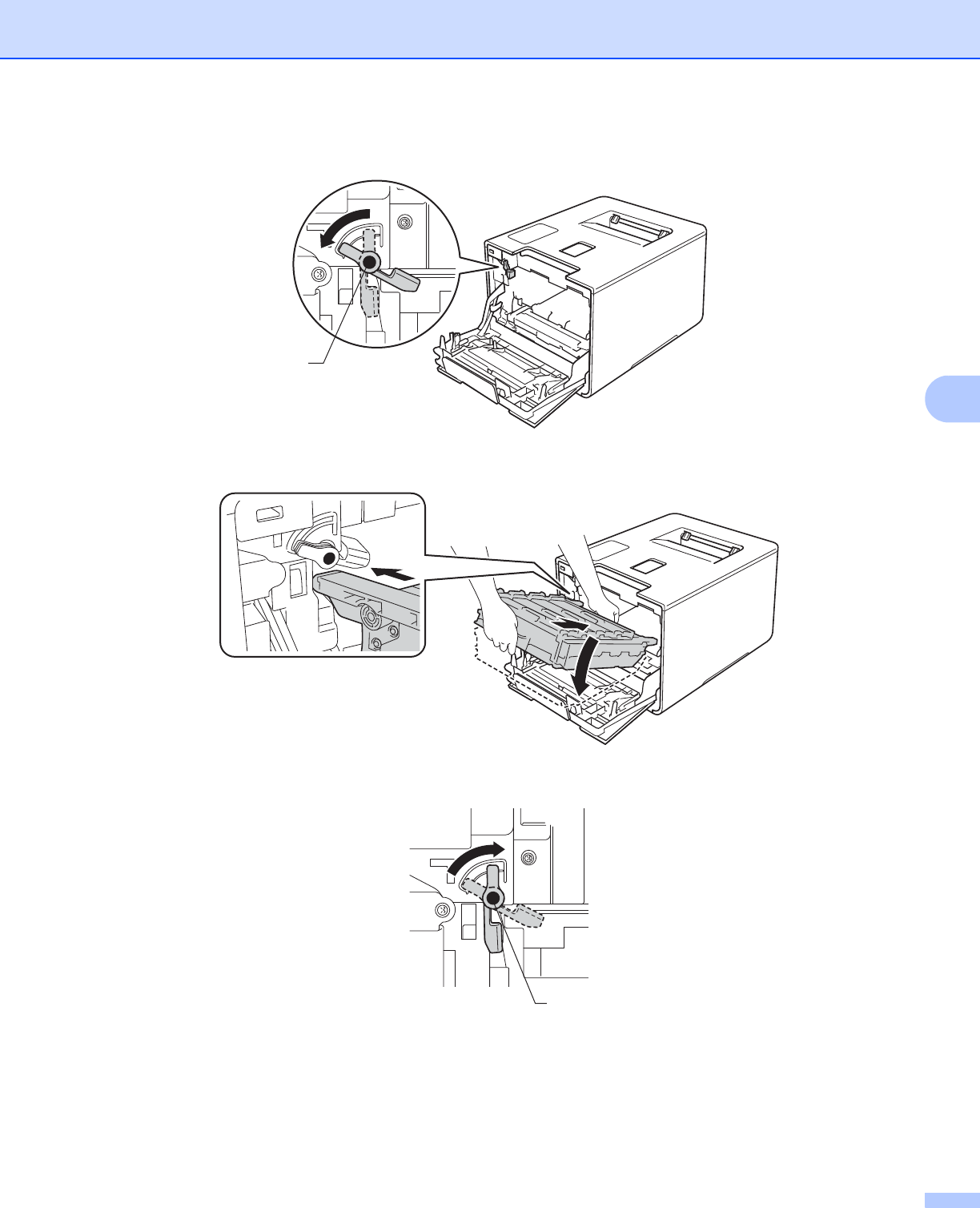
Routine Maintenance
139
5
gMake sure the blue lock lever (1) is in the release position as shown in the illustration.
hGently slide the drum unit into the machine until it stops at the blue lock lever.
iTurn the blue lock lever (1) clockwise to the lock position.
2
1
2
2
1
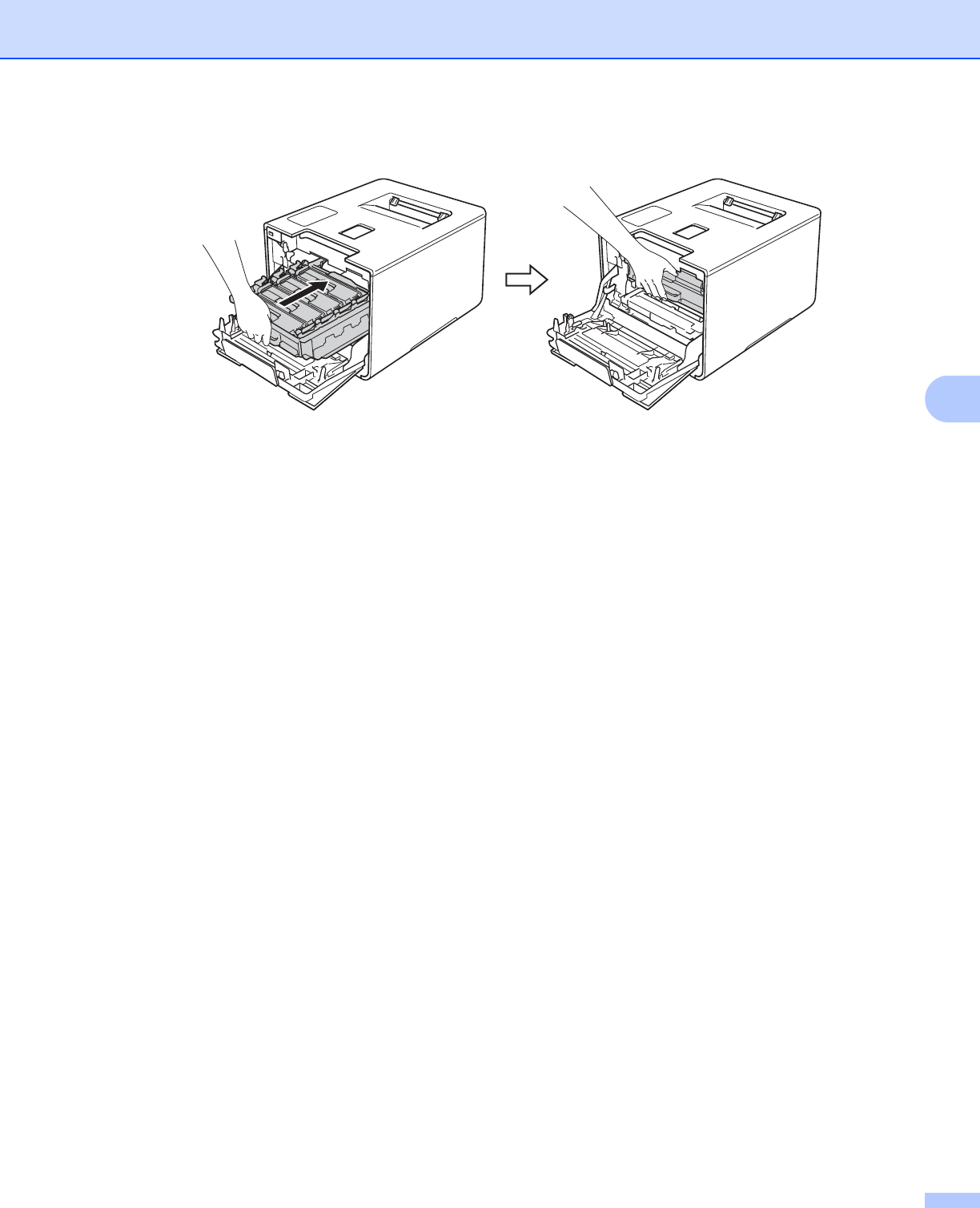
Routine Maintenance
140
5
jPush the drum unit in until it stops.
kClose the front cover of the machine.
Resetting the belt counter
When you replace the belt unit with a new one, you must reset the belt unit counter by completing the
following steps:
aPress awhile holding down Go on the machine's control panel.
bPress aor b ( + or -) to display Belt Unit. Press OK.
cPress afor Reset to reset the belt unit counter.
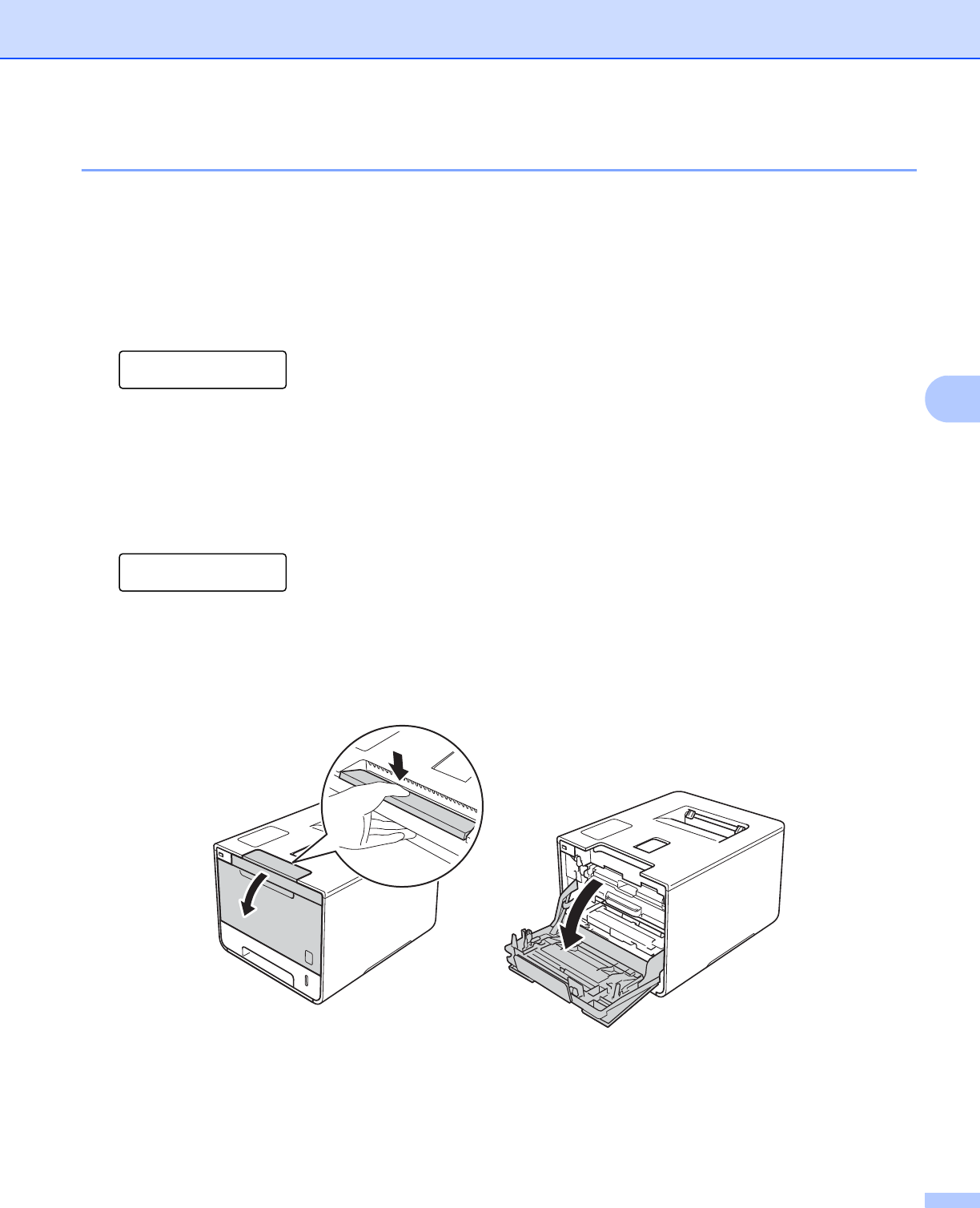
Routine Maintenance
141
5
Replacing the waste toner box 5
Order No. WT-320CL
The life of a waste toner box is approximately 50,000 pages. 12
1Letter or A4 size single-sided pages.
2Waste toner box life is approximate and may vary by type of use.
WT Box End Soon 5
WT Box End Soon
If the LCD displays WT Box End Soon, it means the waste toner box is near the end of its life. Buy a new
waste toner box and have it ready before you get a Replace WT Box message. To replace the waste toner
box, see Replacing the waste toner box on page 141.
Replace WT Box 5
When the following message appears on the LCD, you must replace the waste toner box:
Replace WT Box
Replacing the waste toner box 5
aMake sure that the machine is turned on.
bPress the front cover release button and pull open the front cover.
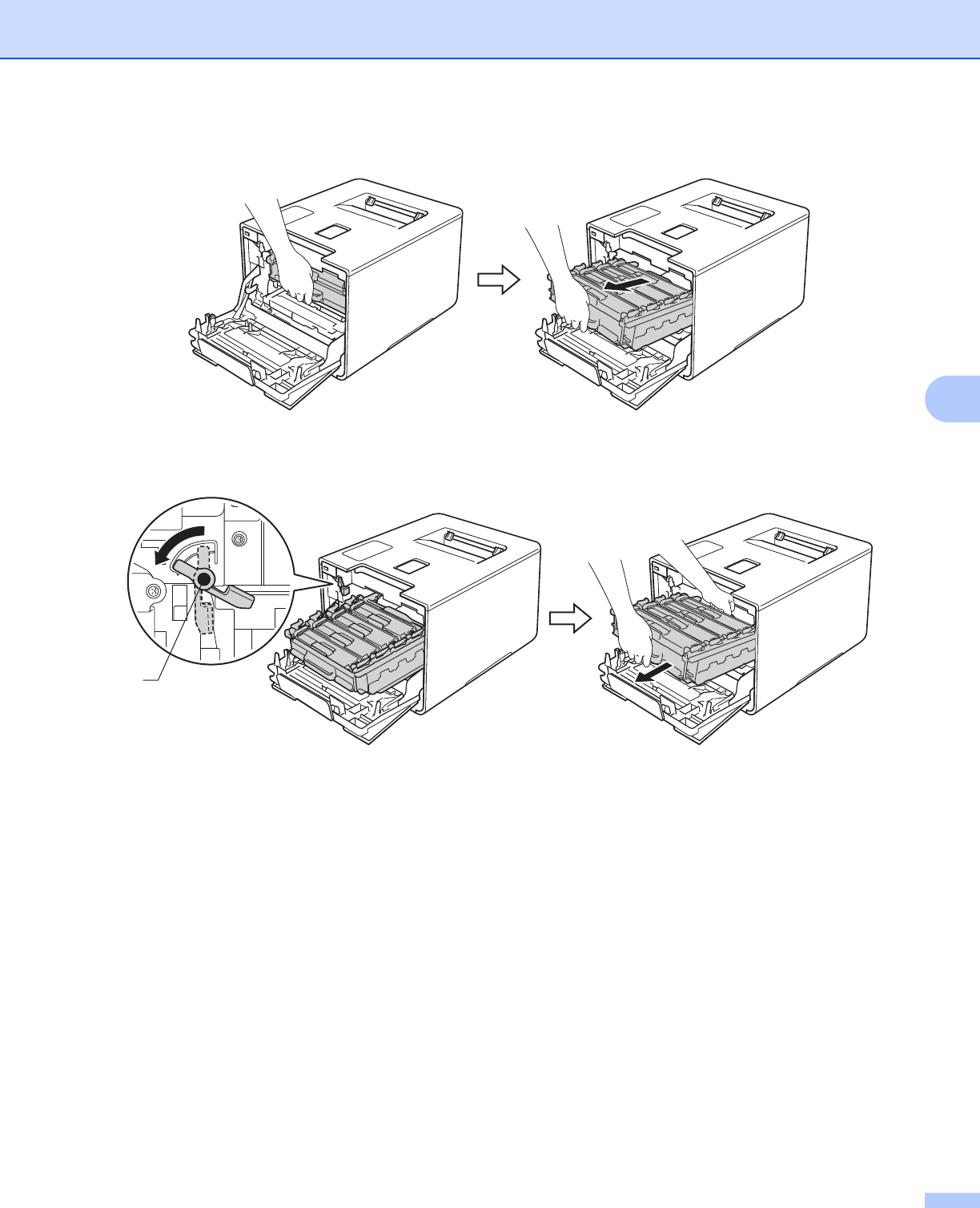
Routine Maintenance
142
5
cHold the blue handle of the drum unit. Pull the drum unit out until it stops.
dTurn the blue lock lever (1) at the left of the machine counterclockwise to the release position. Holding
the blue handles of the drum unit, lift the front of the drum unit and remove it from the machine.
2
1
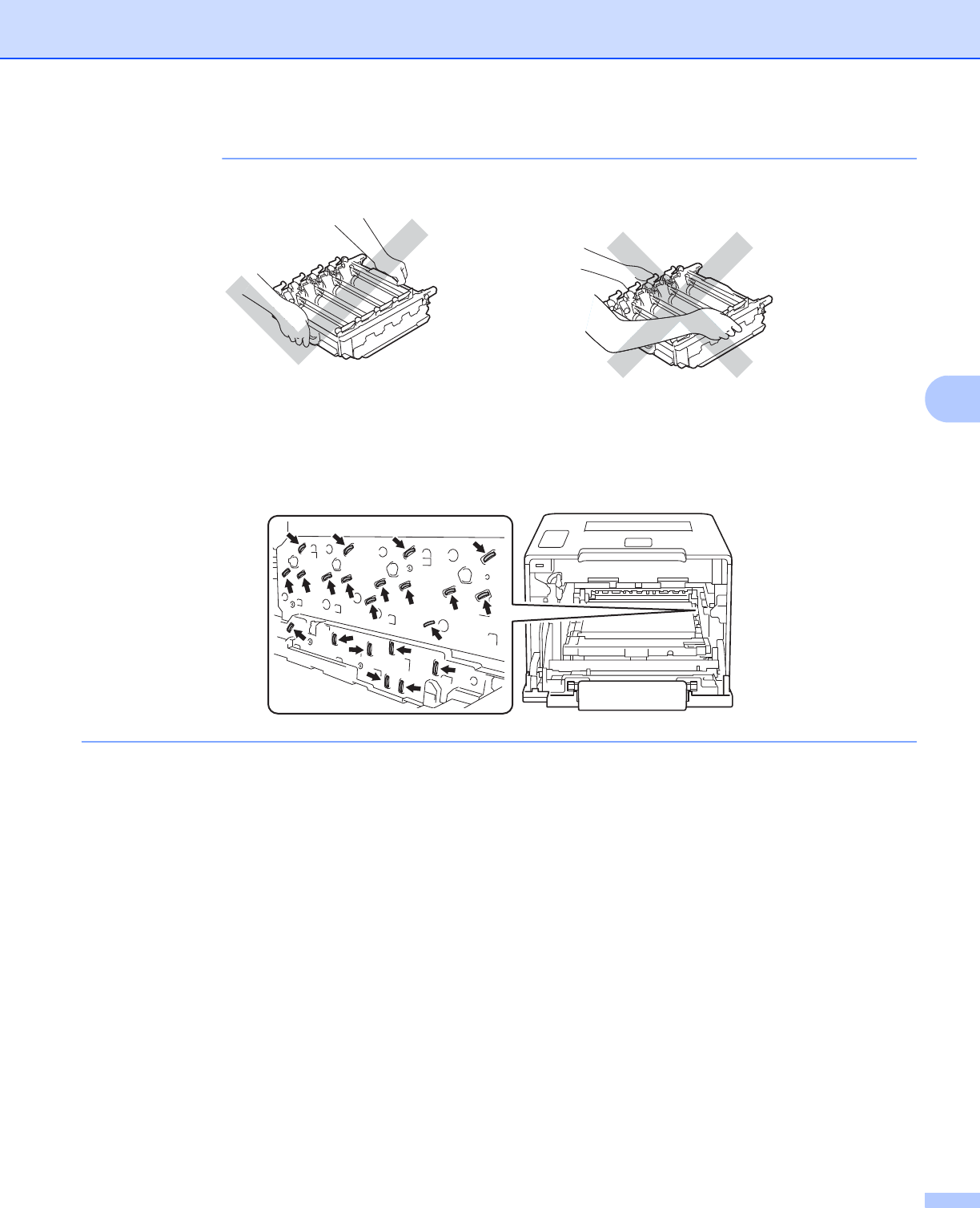
Routine Maintenance
143
5
IMPORTANT
• Hold the blue handles of the drum unit when you carry it. DO NOT hold the sides of the drum unit.
• We recommend placing the drum unit on a clean, flat, level, stable surface with a sheet of disposable paper
or cloth underneath it in case you accidentally spill or scatter toner.
• To prevent damage to the machine from static electricity, DO NOT touch the electrodes shown in the
illustration.
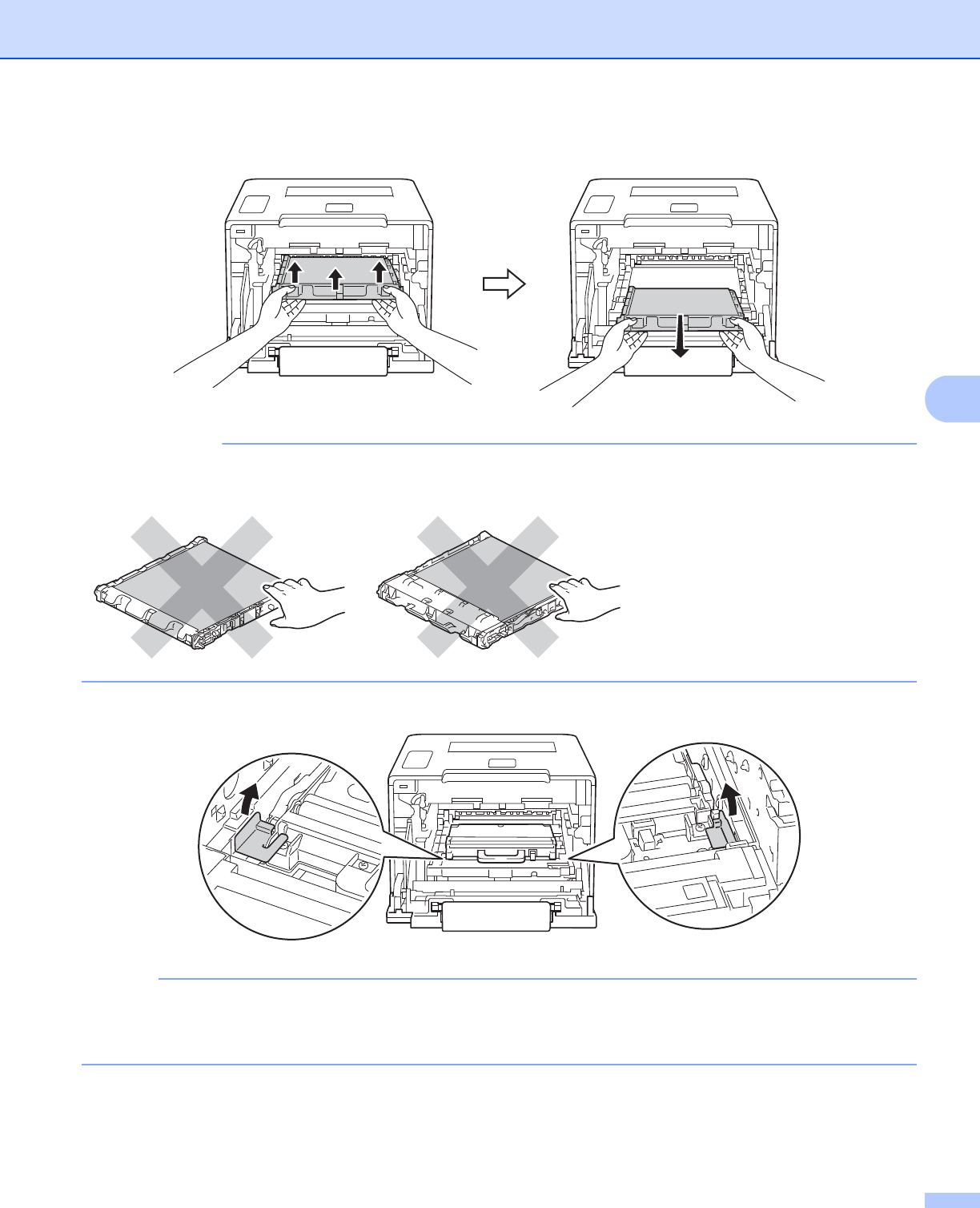
Routine Maintenance
144
5
eHold the blue handle of the belt unit with both hands and lift the belt unit up, and then pull it out.
IMPORTANT
To avoid print quality problems, DO NOT touch the shaded parts shown in the illustrations.
fRemove the two pieces of orange packing material and discard them.
NOTE
This step is only necessary when you are replacing the waste toner box for the first time, and is not
required for the replacement waste toner box. The orange packing pieces are installed at the factory to
protect your machine during shipment.
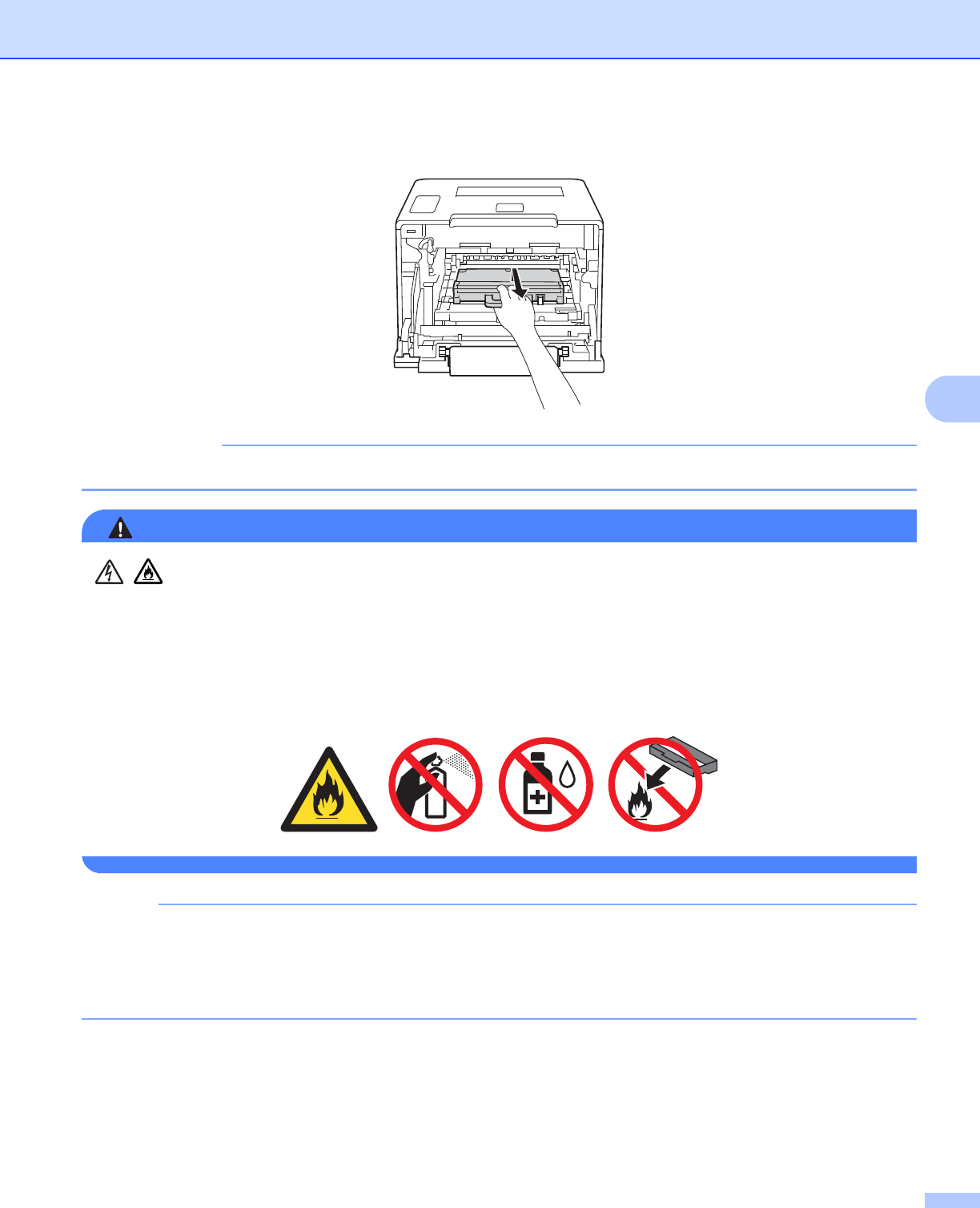
Routine Maintenance
145
5
gHold the blue handle of the waste toner box and remove the waste toner box from the machine.
IMPORTANT
DO NOT reuse the waste toner box.
WARNING
• DO NOT put the waste toner box into a fire. It could explode, resulting in injuries.
• DO NOT use flammable substances, any type of spray, or an organic solvent/liquid containing alcohol
or ammonia to clean the inside or outside of the machine. Doing so could cause a fire or electrical shock.
Instead, use only a dry, soft, lint-free cloth.
(See the Product Safety Guide.)
NOTE
• Be sure to seal up the waste toner box tightly in an appropriate bag so that toner powder does not spill out
of the waste toner box.
• Discard the used waste toner box according to local regulations, keeping it separate from domestic waste.
If you have questions, call your local waste disposal office.
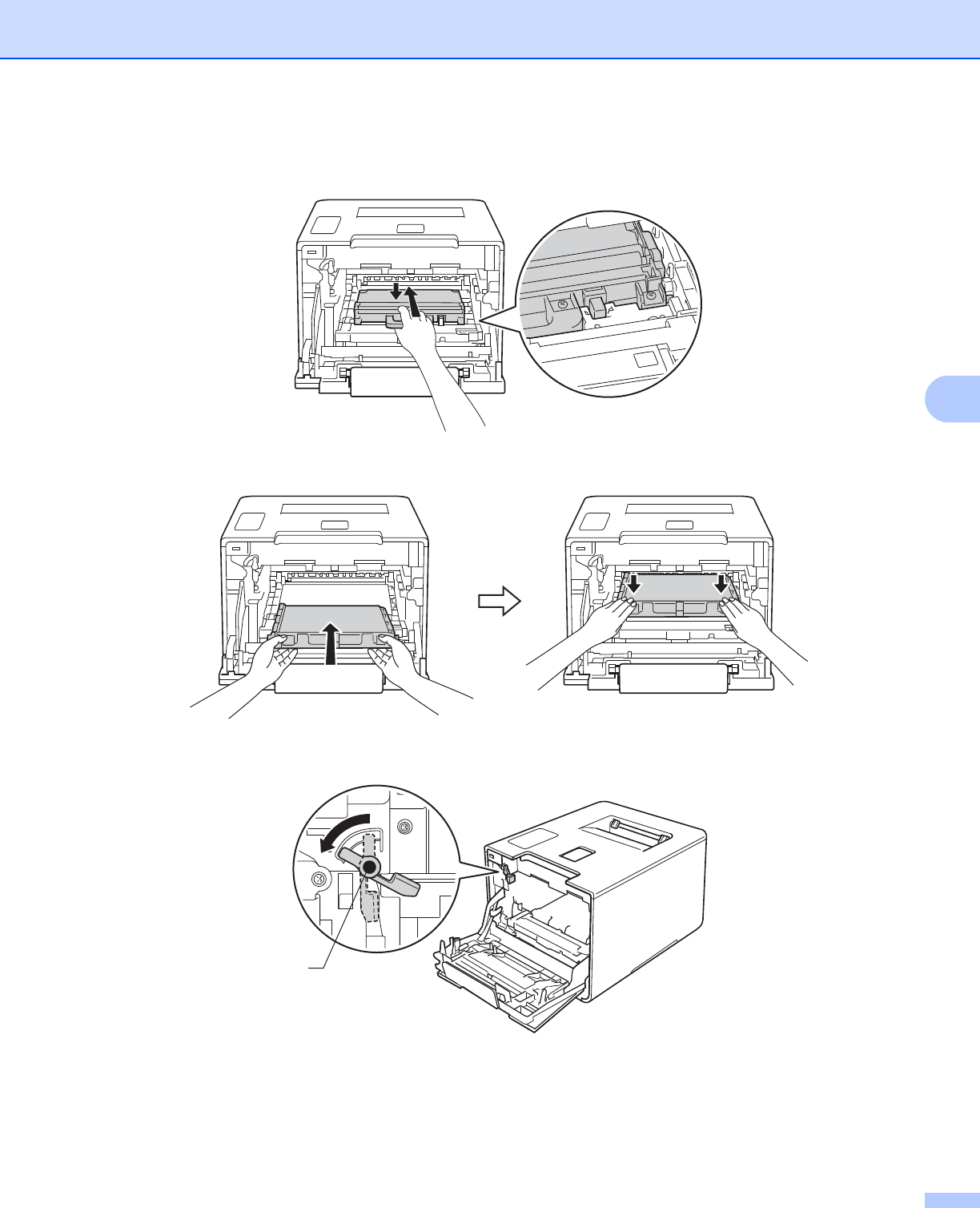
Routine Maintenance
146
5
hUnpack the new waste toner box and install it in the machine using the blue handle. Make sure the waste
toner box is level and fits firmly into place.
iSlide the belt unit back into the machine. Make sure the belt unit is level and fits firmly into place.
jMake sure the blue lock lever (1) is in the release position as shown in the illustration.
2
1
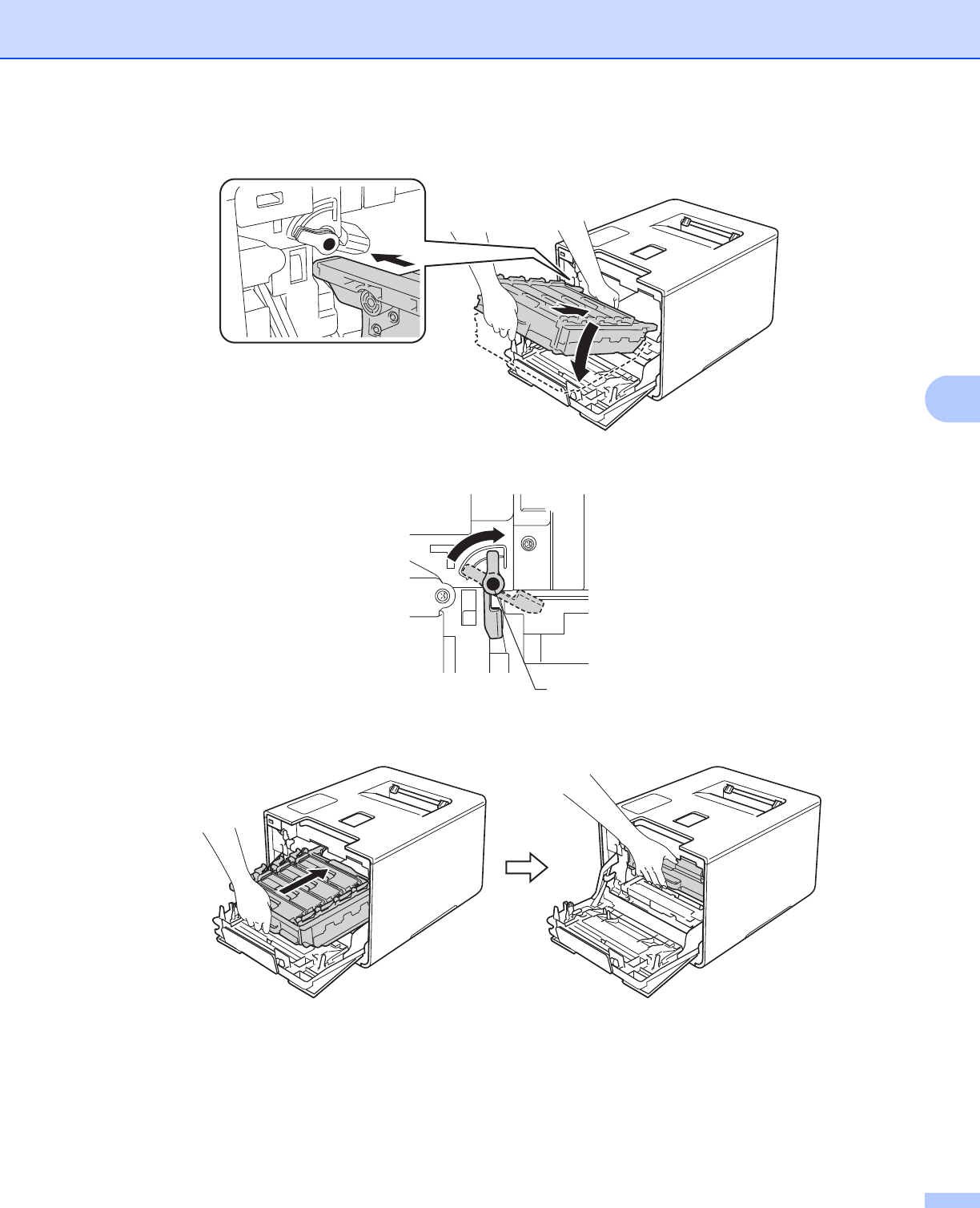
Routine Maintenance
147
5
kGently slide the drum unit into the machine until it stops at the blue lock lever.
lTurn the blue lock lever (1) clockwise to the lock position.
mPush the drum unit in until it stops.
nClose the front cover of the machine.
2
2
1
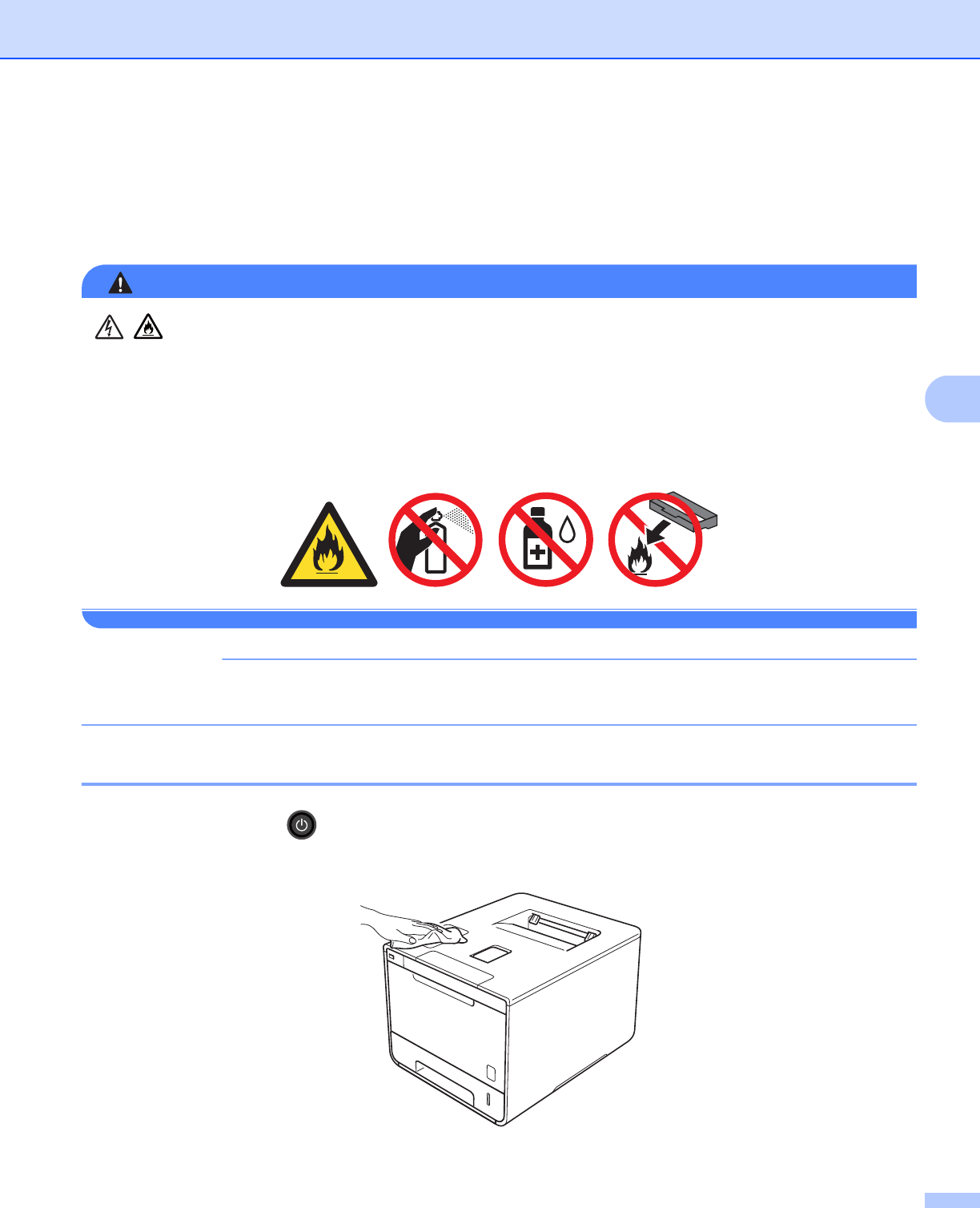
Routine Maintenance
148
5
Cleaning and Checking the machine 5
Clean the outside and inside of the machine regularly with a dry, soft, lint-free cloth. When you replace the
toner cartridge or the drum unit, make sure that you clean the inside of the machine. If printed pages are
stained with toner, clean the inside of the machine with a dry, soft, lint-free cloth.
WARNING
• DO NOT put a toner cartridge into a fire. It could explode, resulting in injuries.
• DO NOT use flammable substances, any type of spray, or an organic solvent/liquid containing alcohol
or ammonia to clean the inside or outside of the machine. Doing so could cause a fire or electrical shock.
Instead, use only a dry, soft, lint-free cloth.
(See the Product Safety Guide.)
IMPORTANT
Use neutral detergents. Cleaning with volatile liquids such as thinner or benzine will damage the surface
of the machine.
Cleaning the outside of the machine 5
aPress and hold down to turn the machine off.
bWipe the outside of the machine with a dry, soft, lint-free cloth to remove dust.
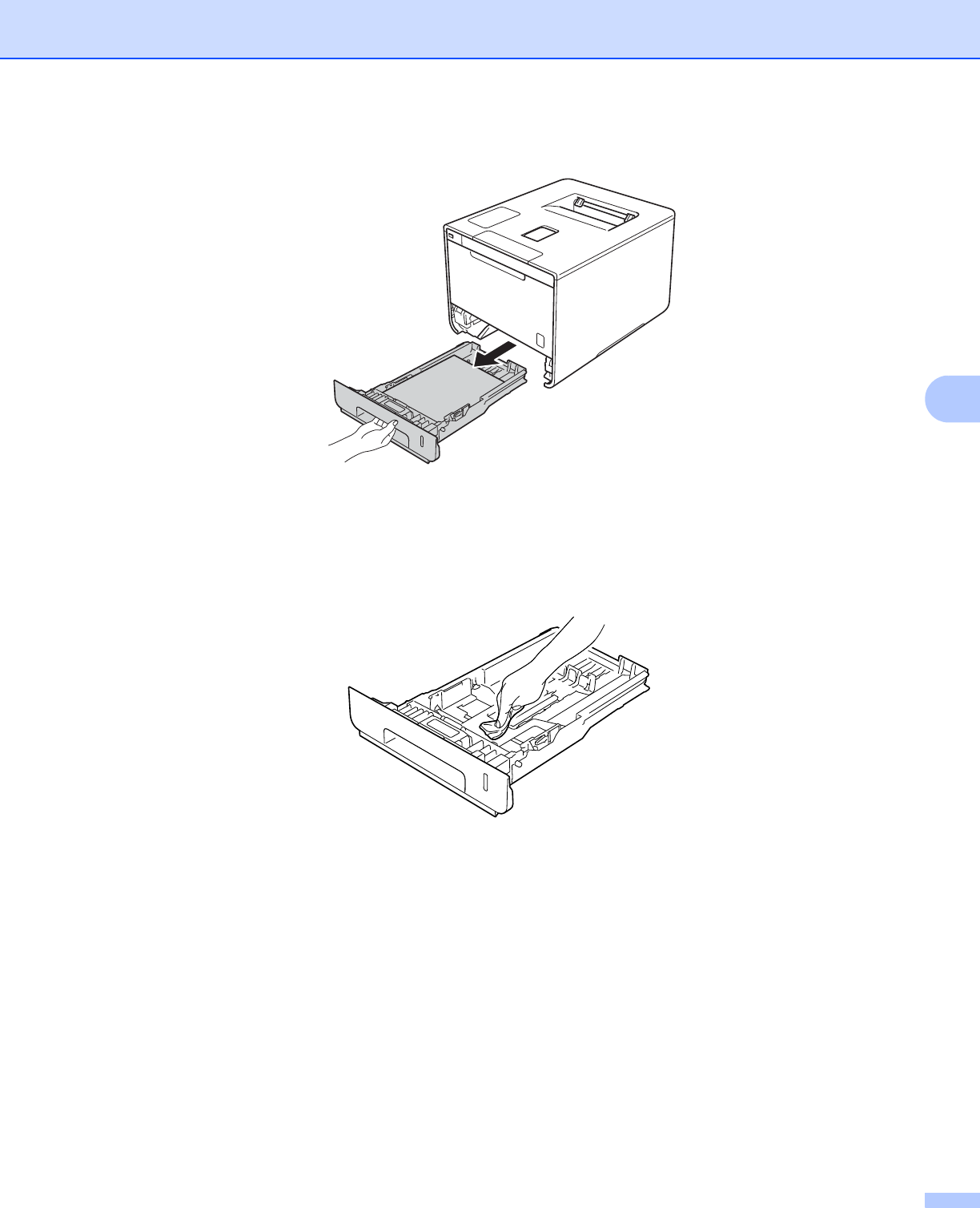
Routine Maintenance
149
5
cPull the paper tray completely out of the machine.
dIf paper is loaded in the paper tray, remove it.
eRemove anything that is stuck inside the paper tray.
fWipe the inside and the outside of the paper tray with a dry, soft, lint-free cloth to remove dust.
gRe-load the paper and put the paper tray firmly back in the machine.
hTurn on the machine.
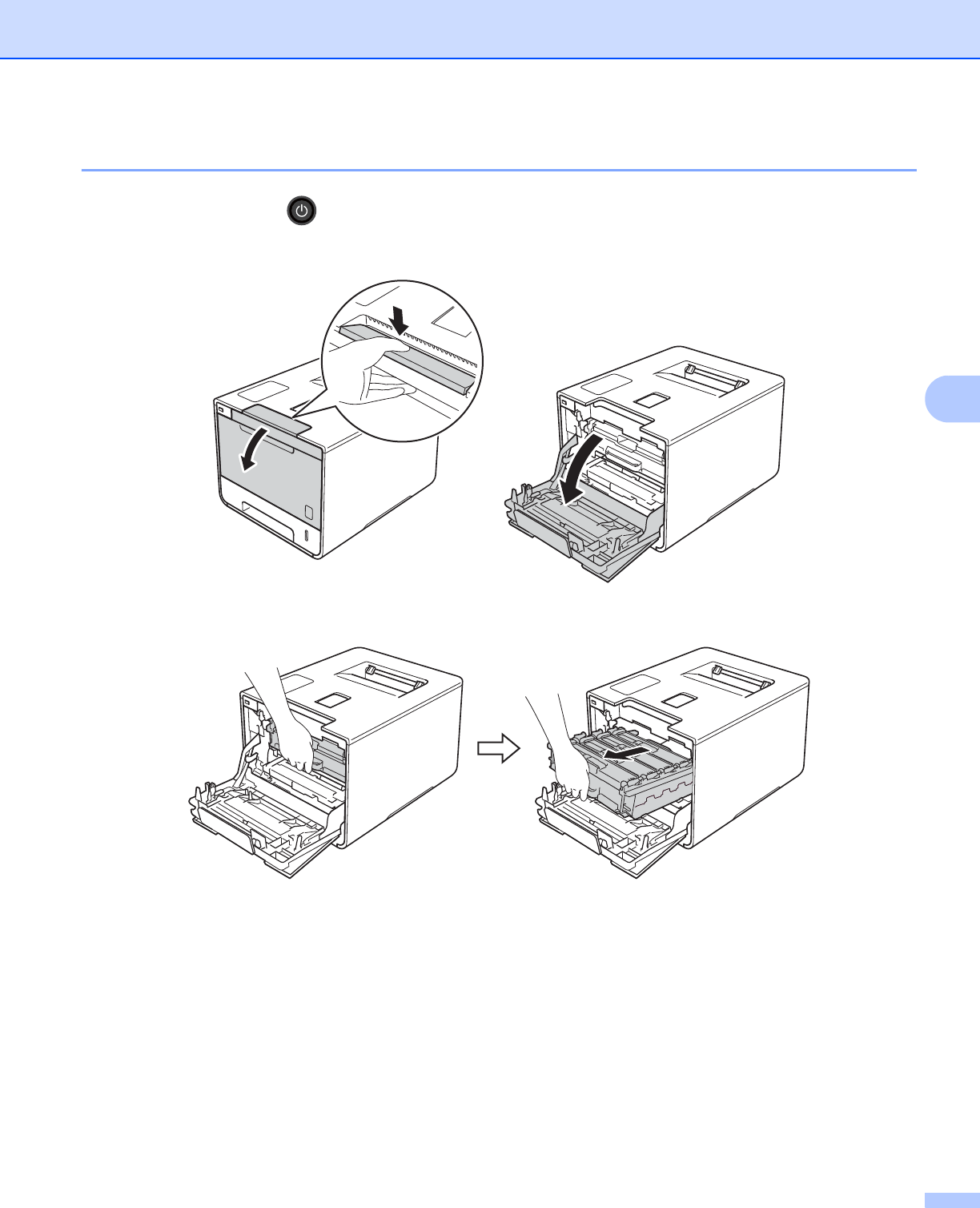
Routine Maintenance
150
5
Cleaning the inside of the machine 5
aPress and hold down to turn the machine off.
bPress the front cover release button and pull open the front cover.
cHold the blue handle of the drum unit. Pull the drum unit out until it stops.
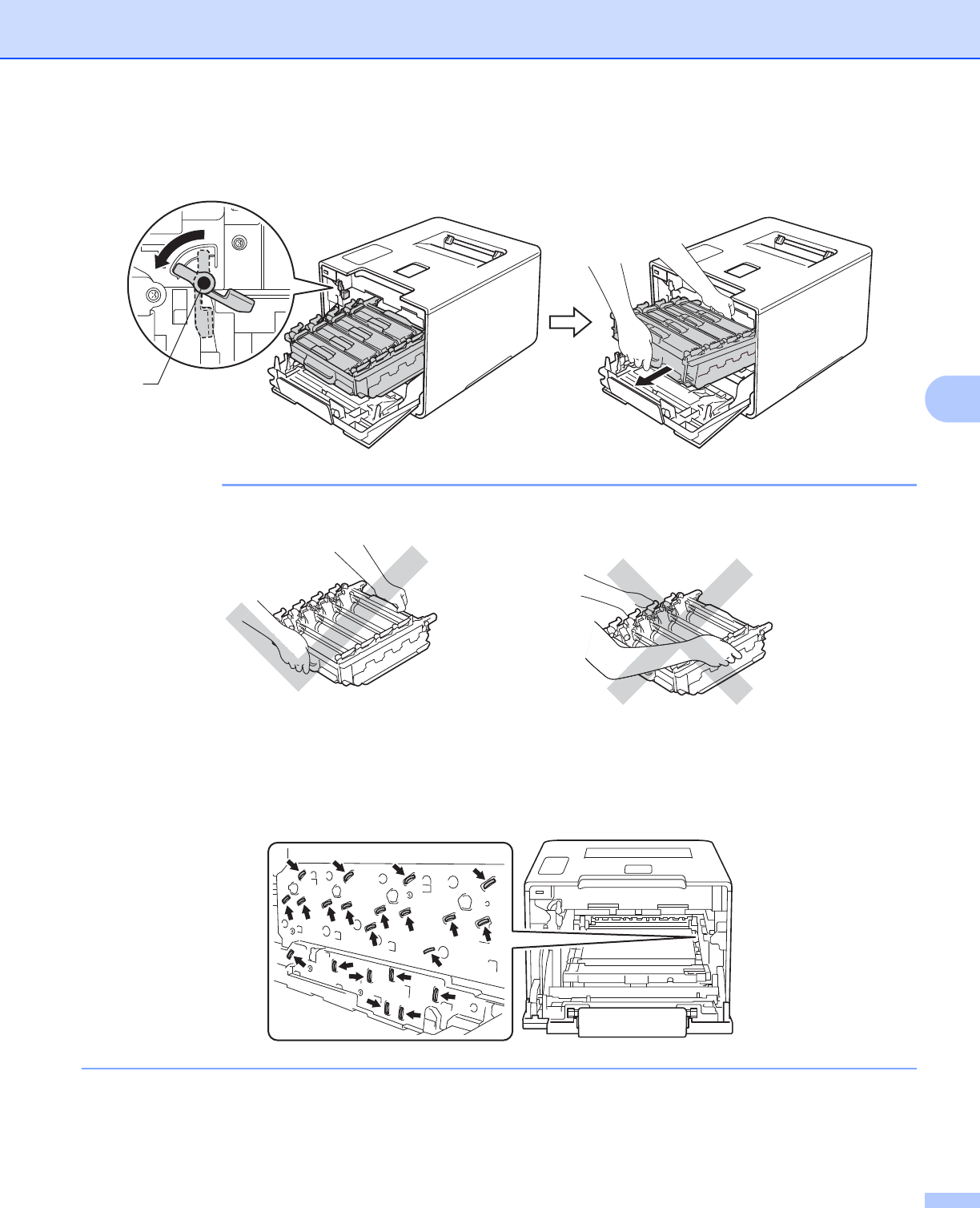
Routine Maintenance
151
5
dTurn the blue lock lever (1) at the left of the machine counterclockwise to the release position. Holding
the blue handles of the drum unit, lift the front of the drum unit and remove it from the machine.
IMPORTANT
• Hold the blue handles of the drum unit when you carry it. DO NOT hold the sides of the drum unit.
• We recommend placing the drum unit on a clean, flat, level, stable surface with a sheet of disposable paper
or cloth underneath it in case you accidentally spill or scatter toner.
• To prevent damage to the machine from static electricity, DO NOT touch the electrodes shown in the
illustration.
2
1
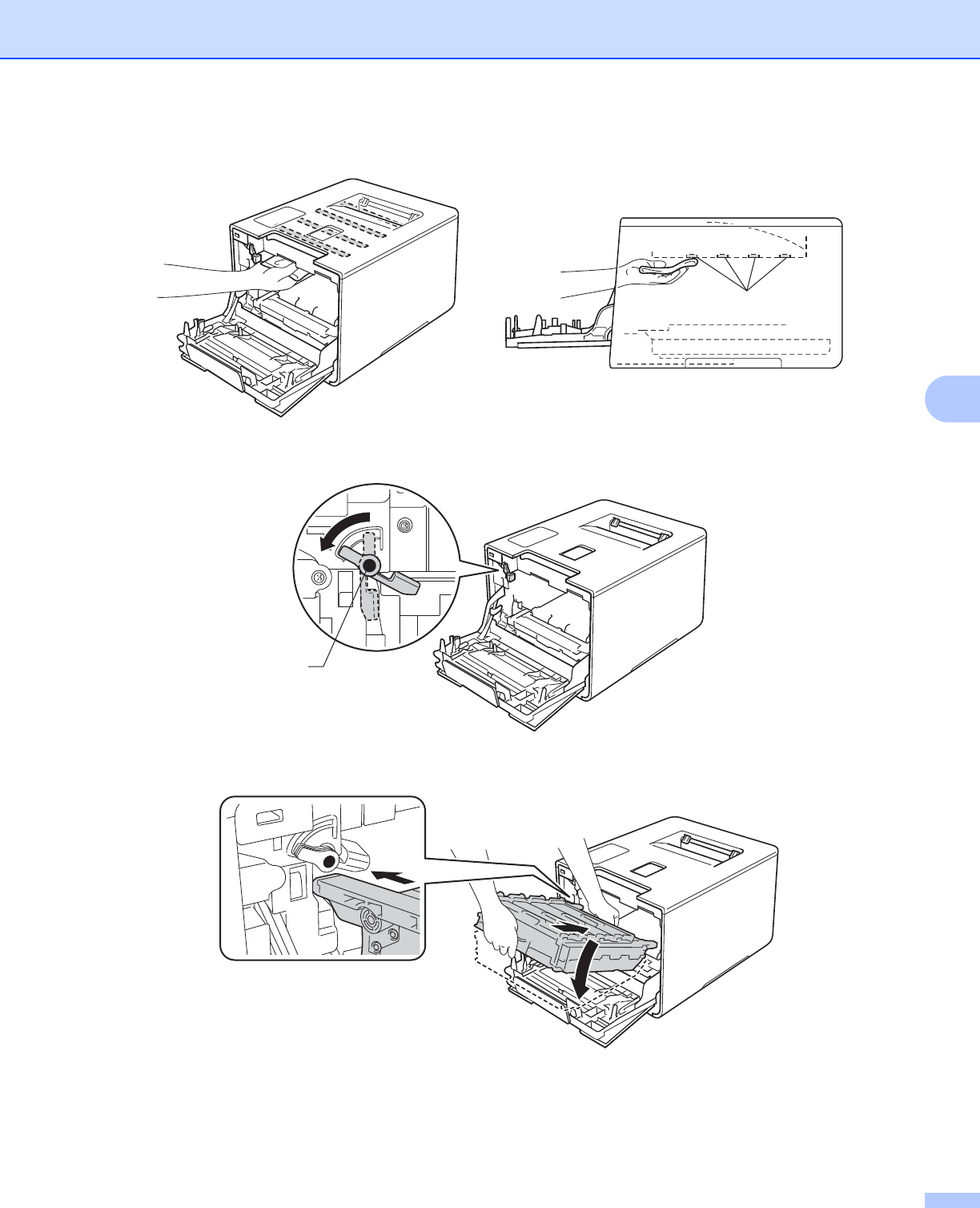
Routine Maintenance
152
5
eWipe the four scanner windows (1) with a dry, soft, lint-free cloth.
fMake sure the blue lock lever (1) is in the release position as shown in the illustration.
gGently slide the drum unit into the machine until it stops at the blue lock lever.
1
2
1
2
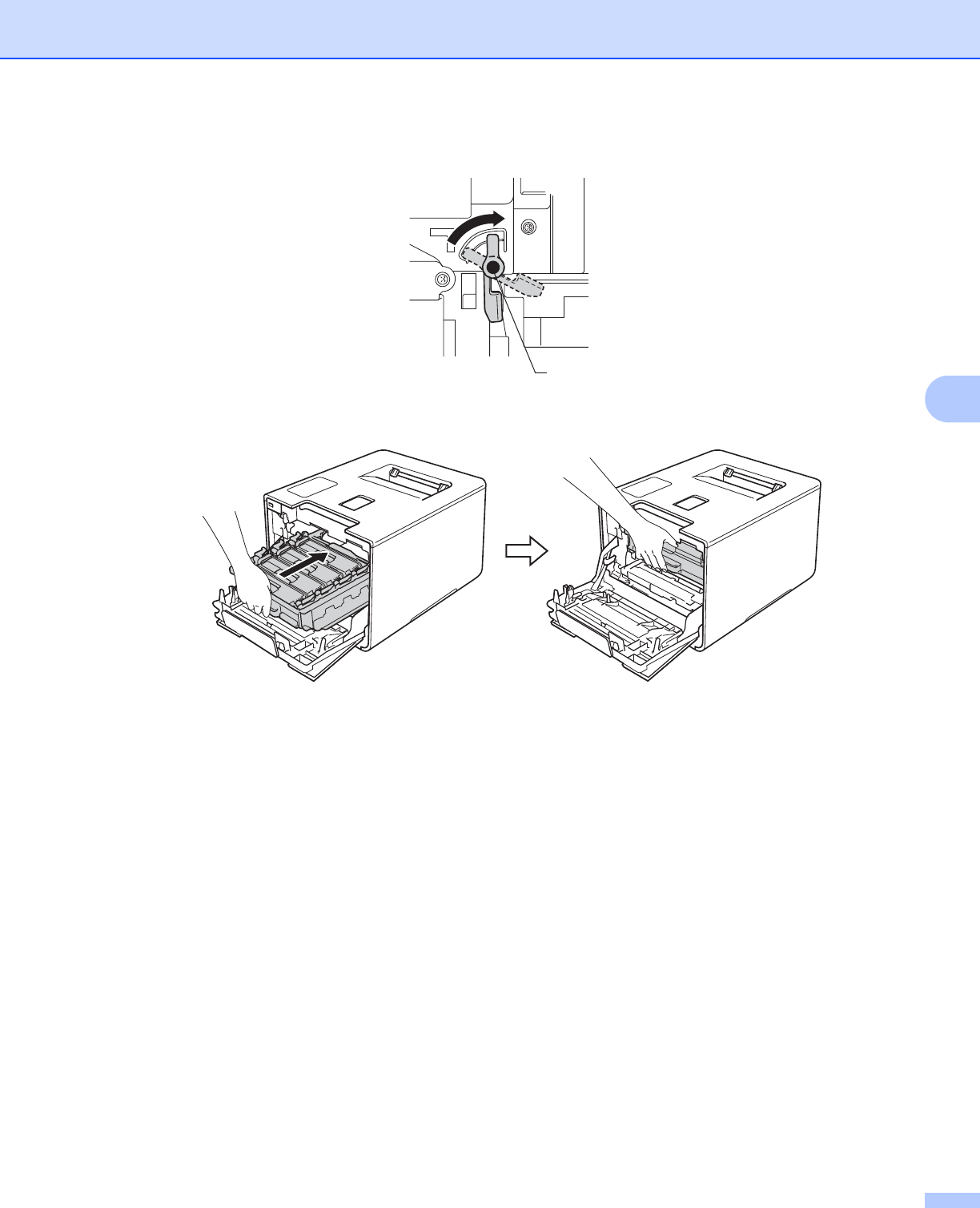
Routine Maintenance
153
5
hTurn the blue lock lever (1) clockwise to the lock position.
iPush the drum unit in until it stops.
jClose the front cover of the machine.
kTurn on the power switch.
2
1
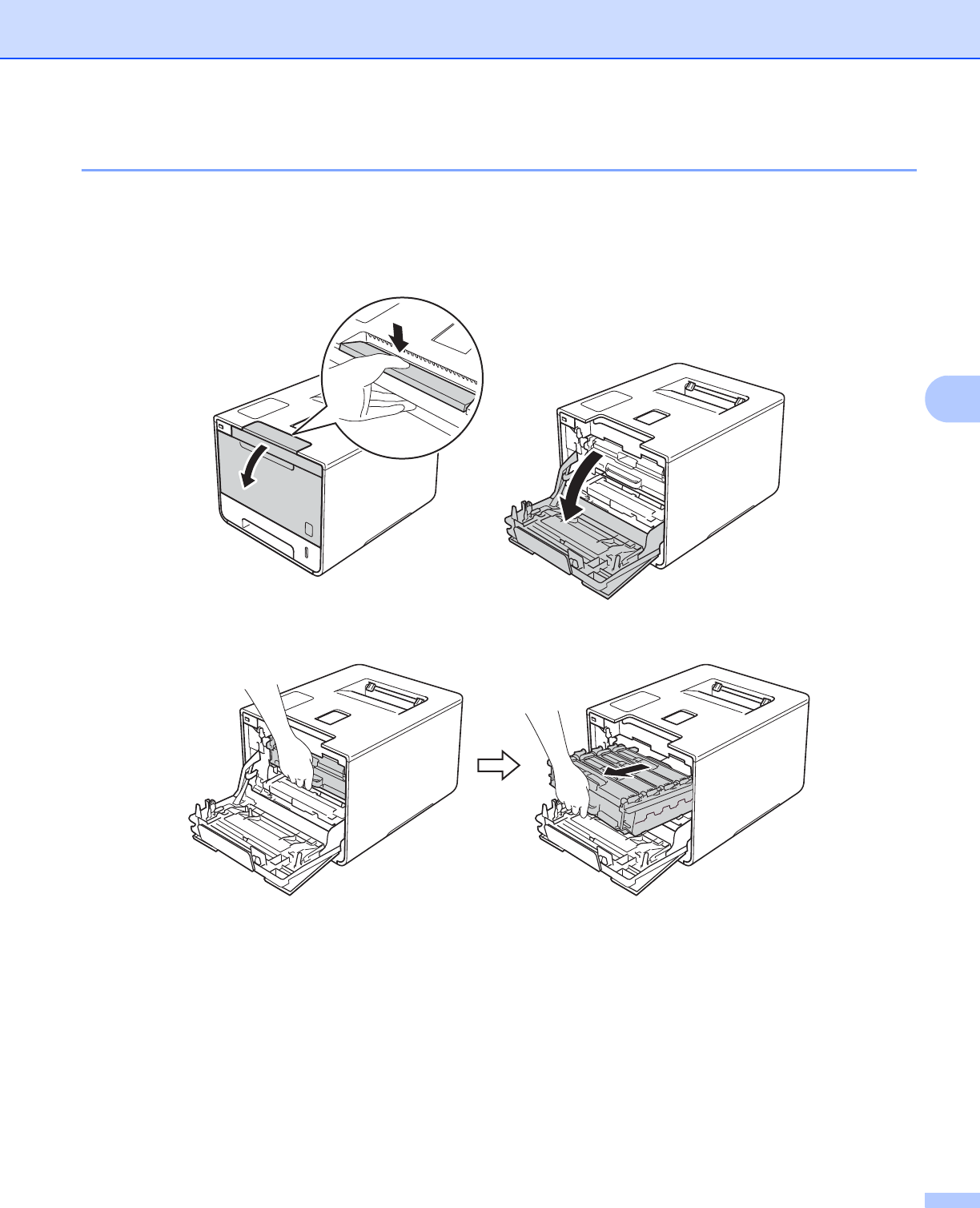
Routine Maintenance
154
5
Cleaning the corona wires 5
If you have print quality problems, clean the corona wires as follows:
aMake sure that the machine is turned on.
bPress the front cover release button and pull open the front cover.
cHold the blue handle of the drum unit. Pull the drum unit out until it stops.
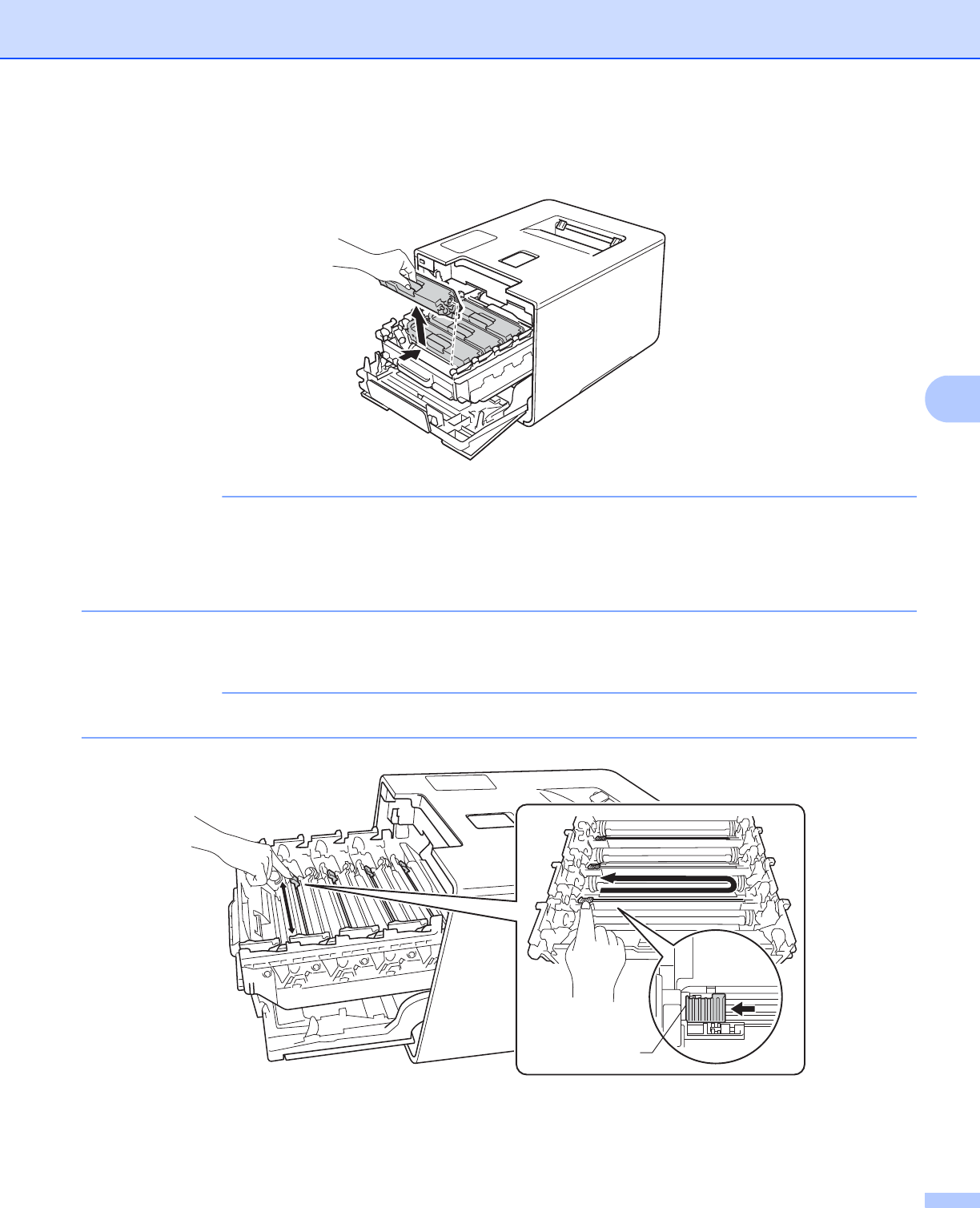
Routine Maintenance
155
5
dHold the handle of the toner cartridge and gently push it toward the machine to unlock it. Then pull it out
of the drum unit. Repeat this for all the toner cartridges.
IMPORTANT
• We recommend placing the toner cartridges on a piece of disposable paper or cloth in case you
accidentally spill or scatter toner.
• Handle the toner cartridges carefully. If toner scatters on your hands or clothes, immediately wipe or wash
it off with cold water.
eClean the corona wire inside the drum unit by gently sliding the blue tab from left to right and right to left
several times.
IMPORTANT
Be sure to return the tab to the home position (1). If you do not, printed pages may have a vertical stripe.
fRepeat step e to clean each of three remaining corona wires.
1
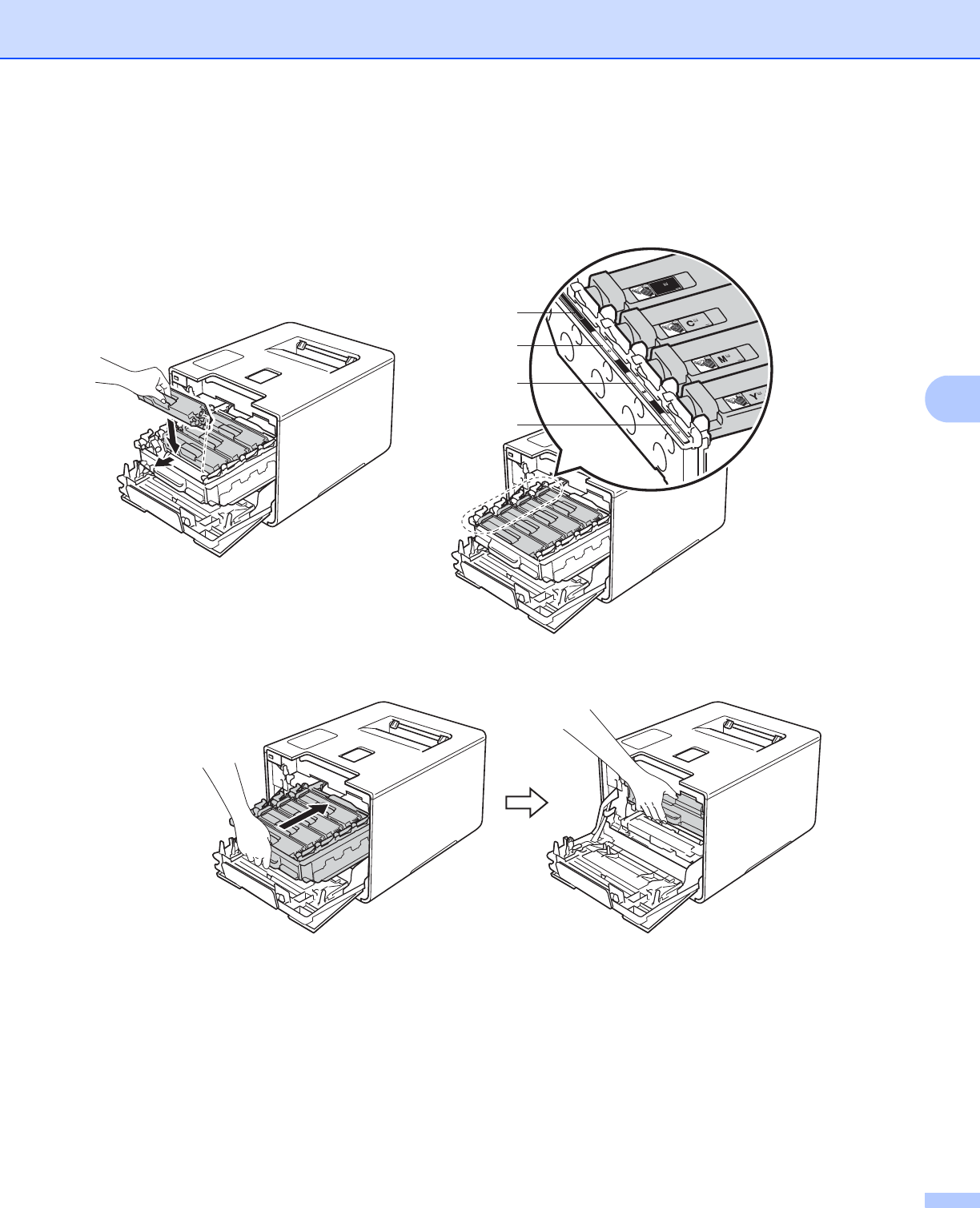
Routine Maintenance
156
5
gHold the handle of the toner cartridge and slide the toner cartridge into the drum unit then gently pull it
toward you until you hear it lock into place. Make sure that you match the toner cartridge color to the
same color label on the drum unit. Repeat this for all the toner cartridges.
hPush the drum unit in until it stops.
iClose the front cover of the machine.
BK - Black
C - Cyan
M - Magenta
Y - Yellow
BK
TN-BK
TN-C
TN-M
TN-Y
BK
BK
C
M
Y
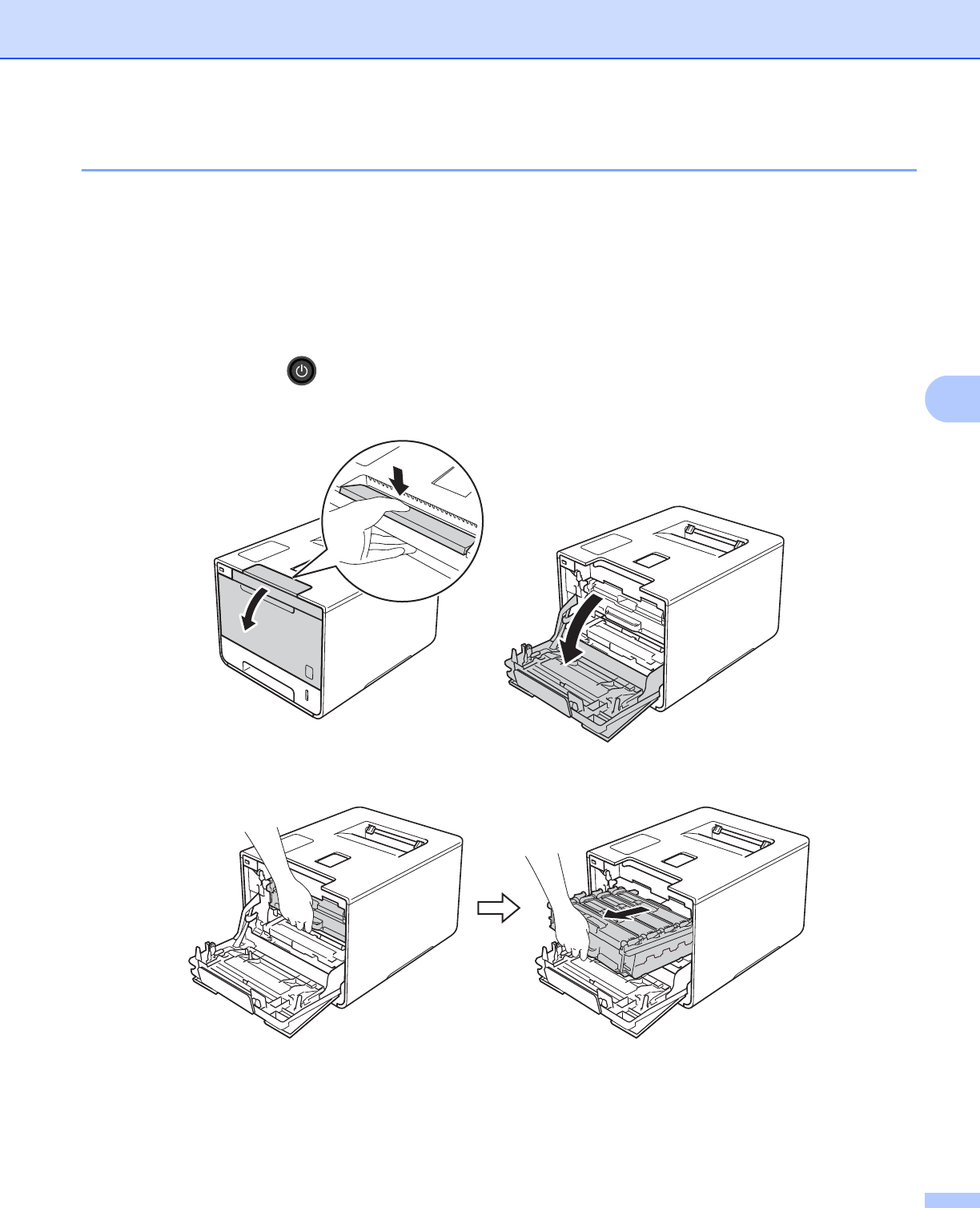
Routine Maintenance
157
5
Cleaning the drum unit 5
If your printout has white or black dots at 3.7 in. (94 mm) intervals, the drum may have foreign material, such
as glue from a label, stuck on the drum surface. Follow the steps below to solve the problem:
aMake sure the machine is in Ready mode.
bPress aor b ( + or -) to choose Machine Info.. Press OK.
cPress aor b ( + or -) to choose Drum Dot Print. Press OK to print the drum dot check sheet.
dPress and hold down to turn the machine off.
ePress the front cover release button and pull open the front cover.
fHold the blue handle of the drum unit. Pull the drum unit out until it stops.
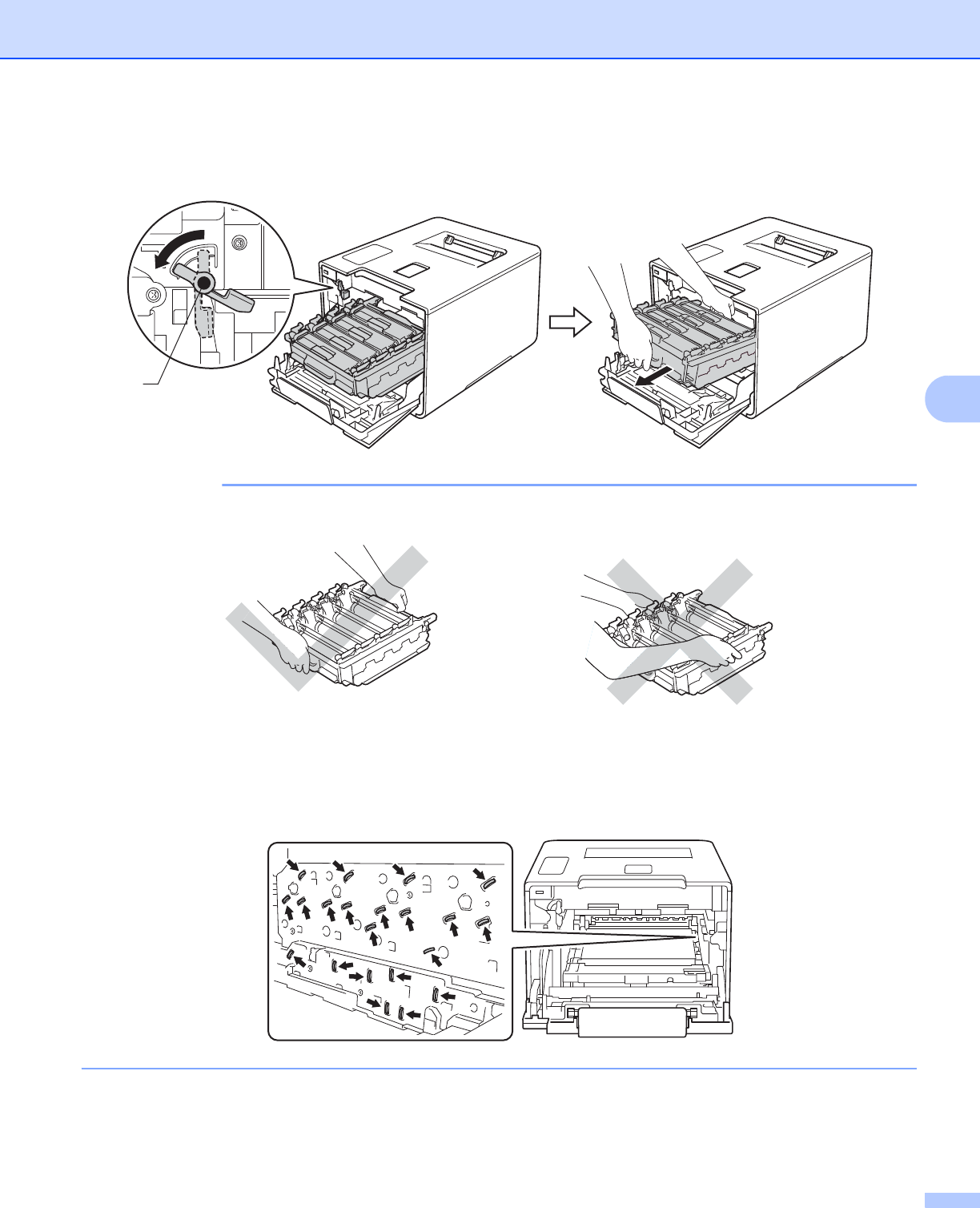
Routine Maintenance
158
5
gTurn the blue lock lever (1) at the left of the machine counterclockwise to the release position. Holding
the blue handles of the drum unit, lift the front of the drum unit and remove it from the machine.
IMPORTANT
• Hold the blue handles of the drum unit when you carry it. DO NOT hold the sides of the drum unit.
• We recommend placing the drum unit on a clean, flat, level, stable surface with a sheet of disposable paper
or cloth underneath it in case you accidentally spill or scatter toner.
• To prevent damage to the machine from static electricity, DO NOT touch the electrodes shown in the
illustration.
2
1
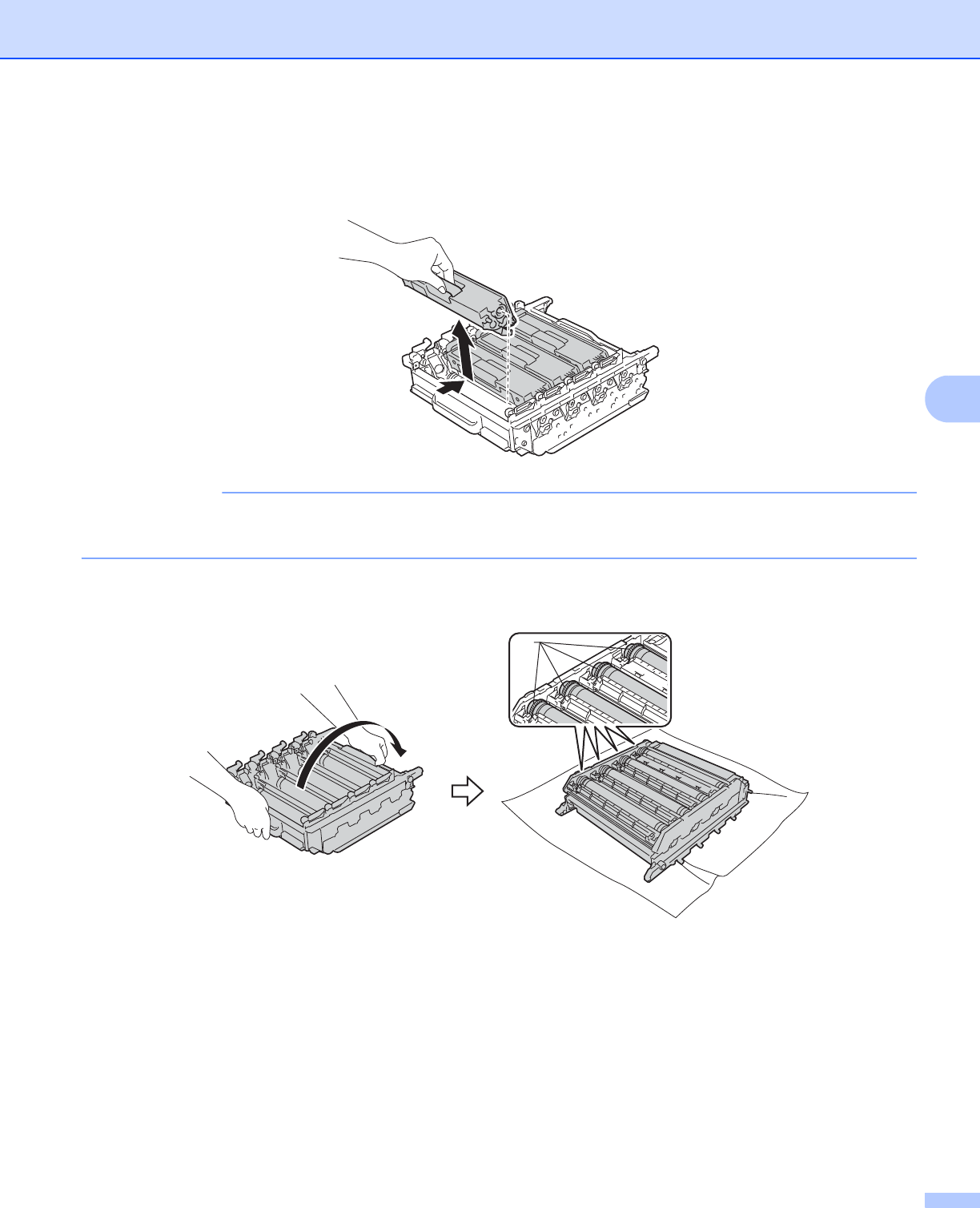
Routine Maintenance
159
5
hHold the handle of the toner cartridge and gently push it toward the machine to unlock it. Then pull it out
of the drum unit.
Repeat this for all the toner cartridges.
IMPORTANT
Handle the toner cartridges carefully. If toner scatters on your hands or clothes, immediately wipe or wash
it off with cold water.
iTurn the drum unit over by holding the blue handles. Make sure that the drum unit gears (1) are on the
left side.
jRead the following information from the drum dot check sheet:
Dot Color problem: The color of printed dots is the color of the drum you will clean.
Dot location: The sheet has eight numbered columns. The number of the column with the printed dot
in it is used to find the dot position on the drum.
1
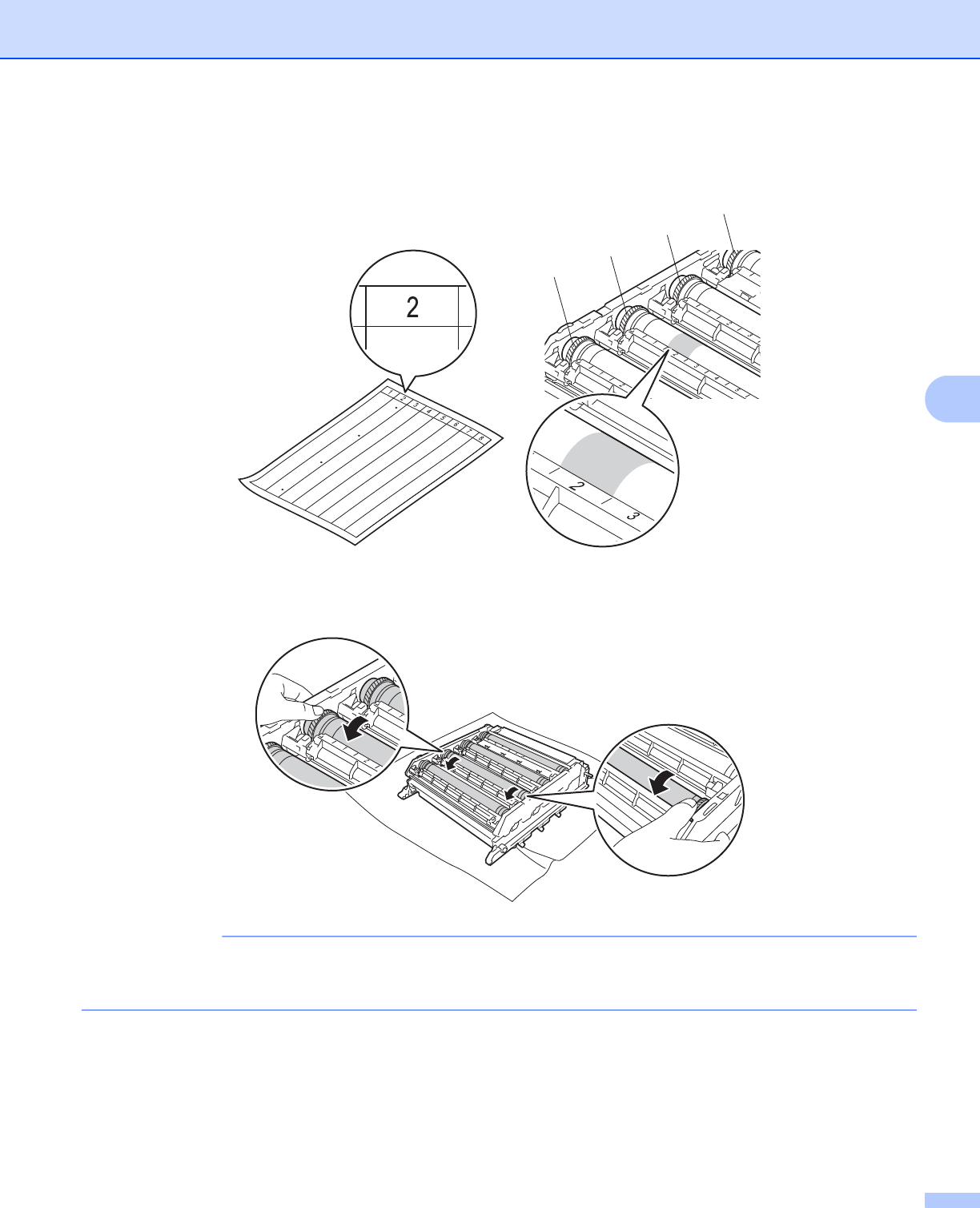
Routine Maintenance
160
5
kUse the numbered markers next to the drum roller to find the mark. For example, a cyan dot in column 2
on the check sheet would mean that there is a mark in the “2” region of the cyan drum.
lTurn the drum unit gear and the edge of the drum unit toward you using both hands while looking at the
surface of the suspected area.
IMPORTANT
• To avoid print quality problems, DO NOT touch the surface of the drum unit.
• Handle the drum unit gear carefully.
BK
C
M
Y
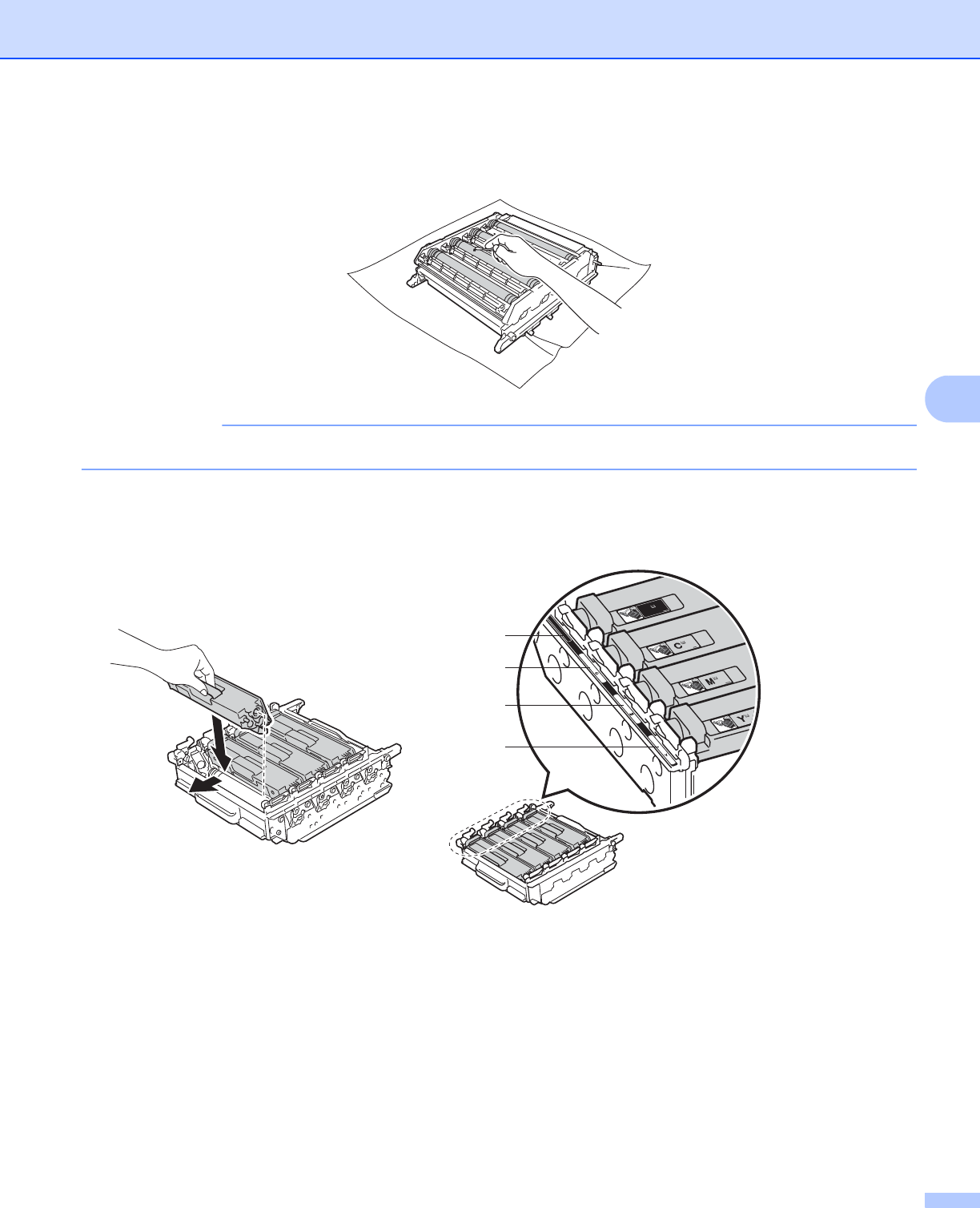
Routine Maintenance
161
5
mWhen you have found the mark on the drum that matches the drum dot check sheet, wipe the surface
of the drum gently with a cotton swab until the mark on the surface comes off.
IMPORTANT
DO NOT clean the surface of the photosensitive drum with a sharp object or any liquids.
nHold the handle of the toner cartridge and slide it into the appropriate colored section of the drum unit
until you hear it lock into place.
BK - Black
C - Cyan
M - Magenta
Y - Yellow
BK
TN-BK
TN-C
TN-M
TN-Y
BK
BK
C
M
Y
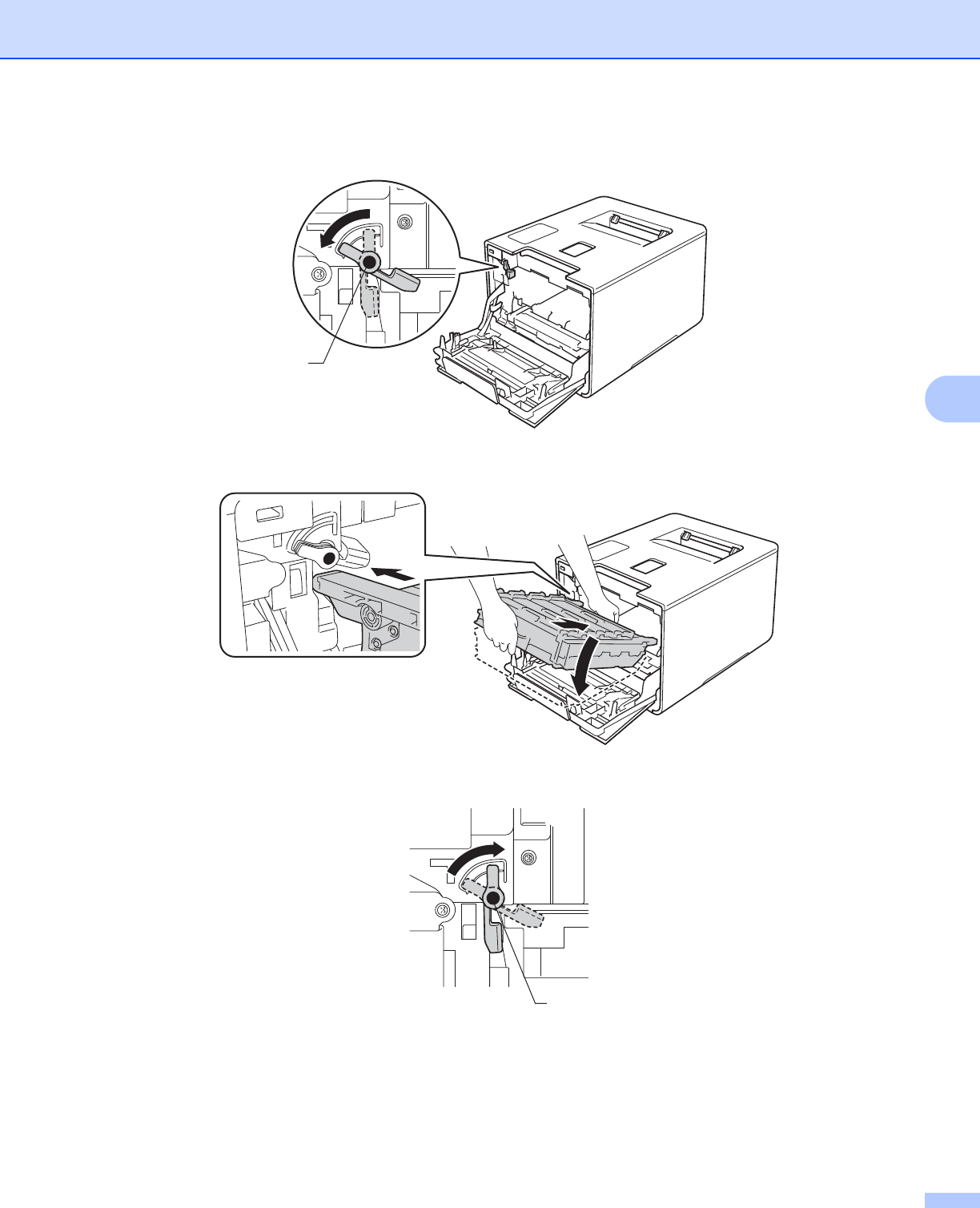
Routine Maintenance
162
5
oMake sure the blue lock lever (1) is in the release position as shown in the illustration.
pGently slide the drum unit into the machine until it stops at the blue lock lever.
qTurn the blue lock lever (1) clockwise to the lock position.
2
1
2
2
1
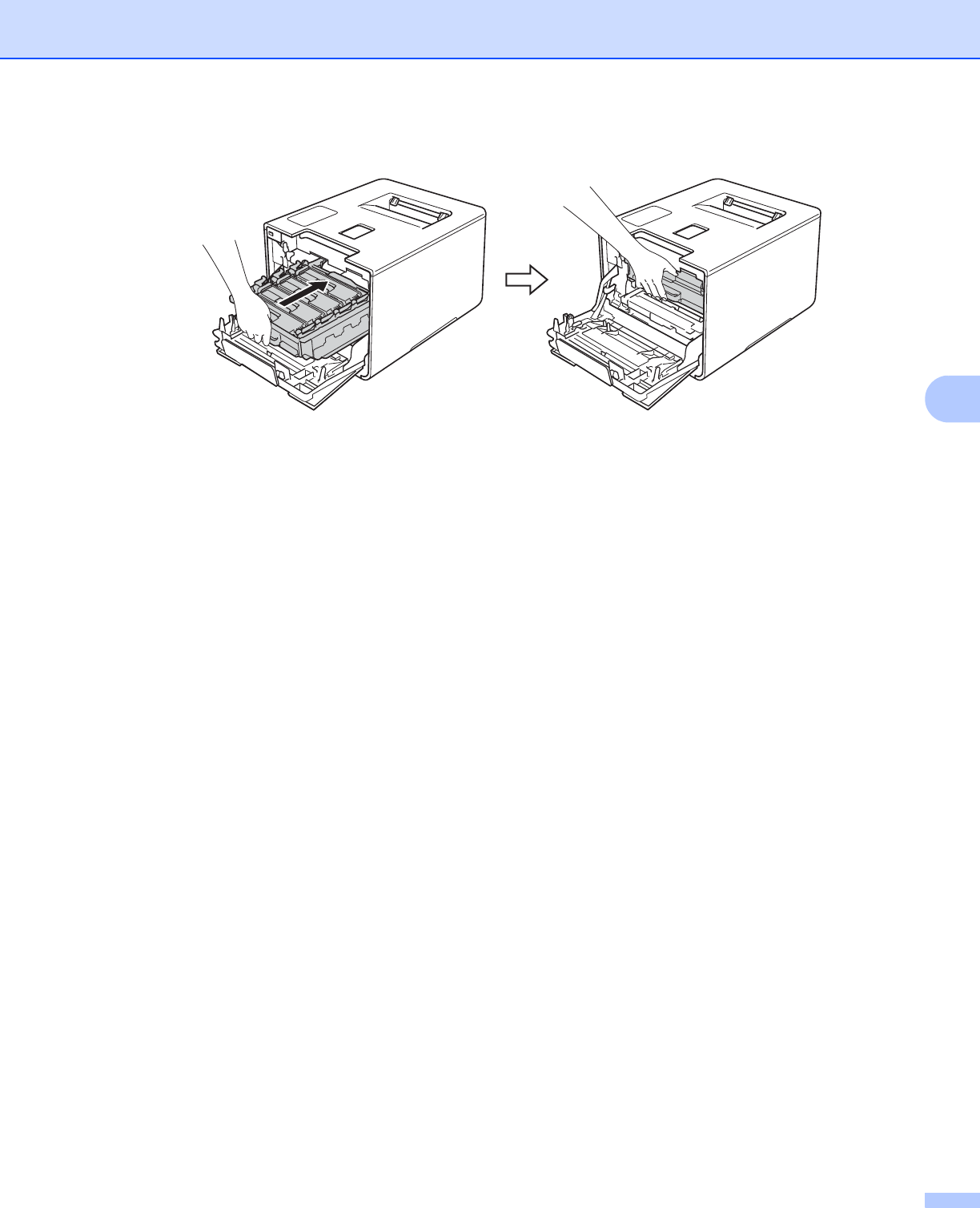
Routine Maintenance
163
5
rPush the drum unit in until it stops.
sClose the front cover of the machine.
tTurn on the power switch.
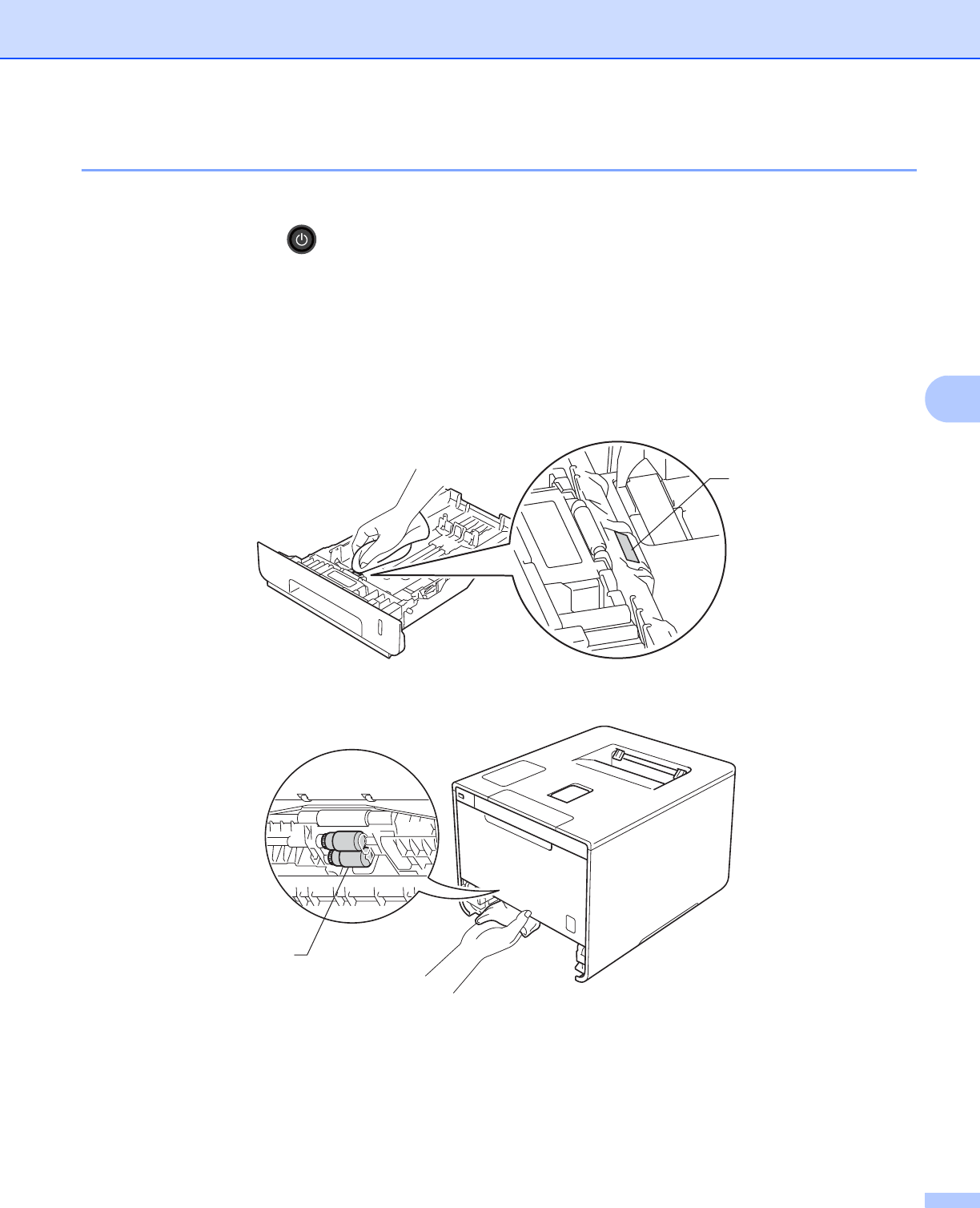
Routine Maintenance
164
5
Cleaning the paper pick-up roller 5
Cleaning the paper pick-up roller periodically may prevent paper jams by insuring the proper feeding of paper.
aPress and hold down to turn the machine off.
bPull the paper tray completely out of the machine.
cIf paper is loaded in the paper tray, remove it.
dRemove anything that is stuck inside the paper tray.
eTightly wring out a soft, lint-free cloth soaked in lukewarm water, and then wipe the separator pad (1) of
the paper tray with it to remove dust.
fWipe the two pick-up rollers (1) inside of the machine to remove dust.
gReload the paper, and then put the paper tray firmly back in the machine.
hTurn on the machine.
1
1
Routine Maintenance
165
5
Replacing periodic maintenance parts 5
The periodic maintenance parts must be replaced regularly to maintain print quality. The parts listed below
must be replaced after printing approximately 50,000 pages 1 for PF Kit MP and 100,000 pages 1 for PF Kit
1, PF Kit 2, Fuser and Laser.
Please call Brother Customer Service or a Brother Authorized Service Center when the following messages
appear on the LCD:
1Letter or A4 size single-sided pages.
2Life of part is approximate and may vary by type of use.
3If the optional lower tray is installed on HL-L8250CDN or HL-L8350CDW.
LCD message Description
Replace Fuser 2Replace the fuser unit.
Replace Laser 2Replace the laser unit.
Replace PF Kit1 2Replace the paper feeding kit for the paper tray.
Replace PF Kit2 23 Replace the paper feeding kit for the lower tray (option).
Replace PF KitMP 2Replace the paper feeding kit for the multi-purpose tray.
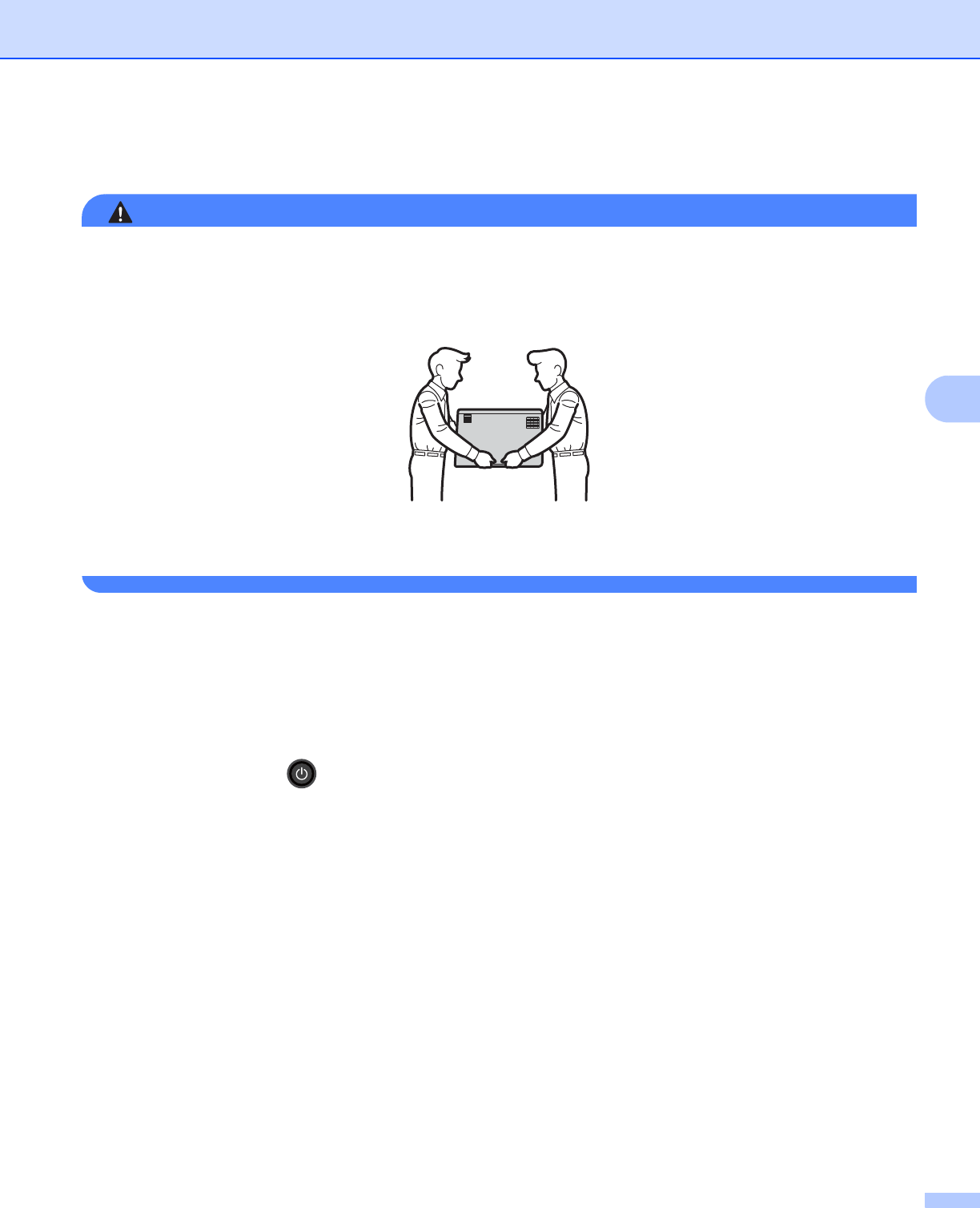
Routine Maintenance
166
5
Packing and shipping the machine 5
WARNING
• This machine is heavy and weighs more than 47.5 lb (21.5 kg). To prevent possible injuries at least two
people should lift the machine. One person should hold the front of the machine, and one person should
hold the back, as shown in the illustration. Be careful not to pinch your fingers when you put the machine
down.
• If you use a Lower Tray, DO NOT carry the machine with the Lower Tray. Since the Lower Tray is not
attached, you may be injured or cause damage to the machine.
If for any reason you must ship your machine, carefully repack the machine in the original packaging to avoid
damage during transit. The machine should be adequately insured with the carrier.
For HL-L8350CDWT users, pack the lower tray and the machine separately into each original packing box,
and then pack them both into the largest original box.
Unless you are returning the machine as part of the Brother Exchange Service, leave the toner cartridges and
drum unit inside the machine when you pack and ship it.
aPress and hold down to turn the machine off. Leave the machine turned off for at least 10 minutes
to cool down.
bDisconnect all the cables, and then unplug the power cord from the AC power outlet.
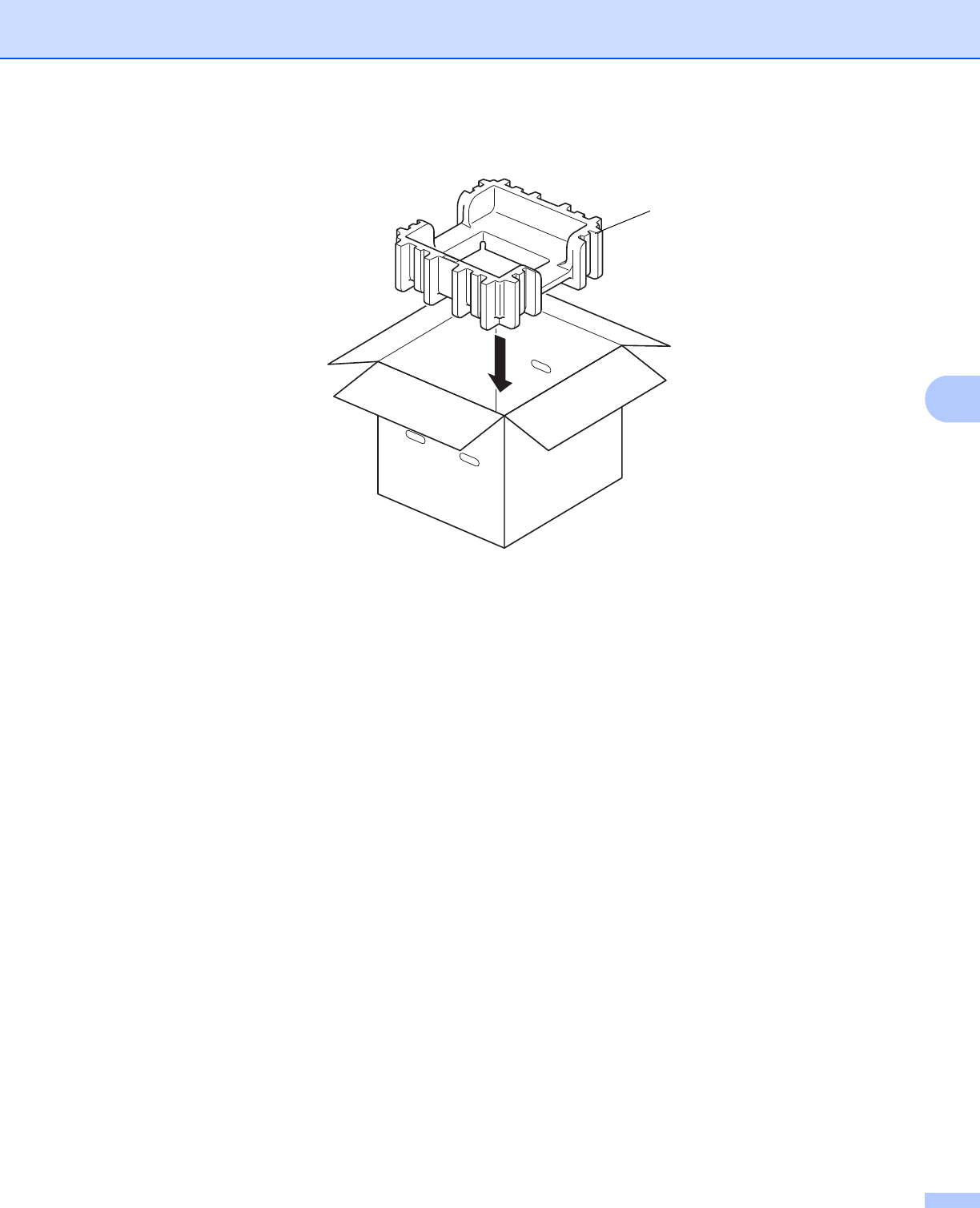
Routine Maintenance
167
5
cPut the packing material (1) into the carton.
1
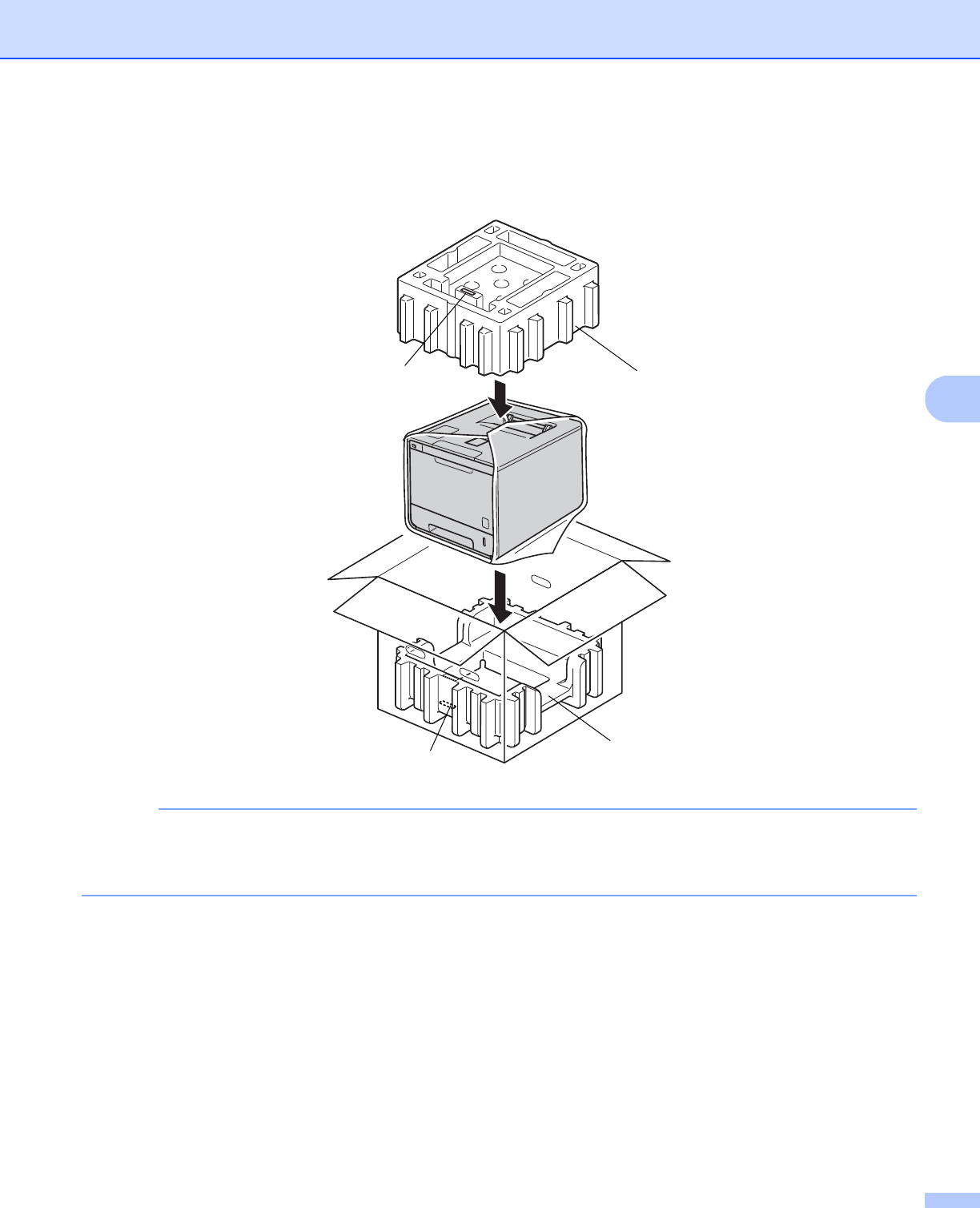
Routine Maintenance
168
5
dWrap the machine in a plastic bag. Put the machine on the bottom packing material (1) and the packing
material (2) on the top of the machine. Match the front side of the machine to the “FRONT” mark on each
packing material.
NOTE
If you are returning your machine to Brother as part of the Exchange Service, pack only the machine. Keep
all separate parts, including the drum unit, toner cartridges, belt unit, waste toner box and printed
materials, to use with your ‘Exchange’ machine.
FRONT 2
1
FRONT
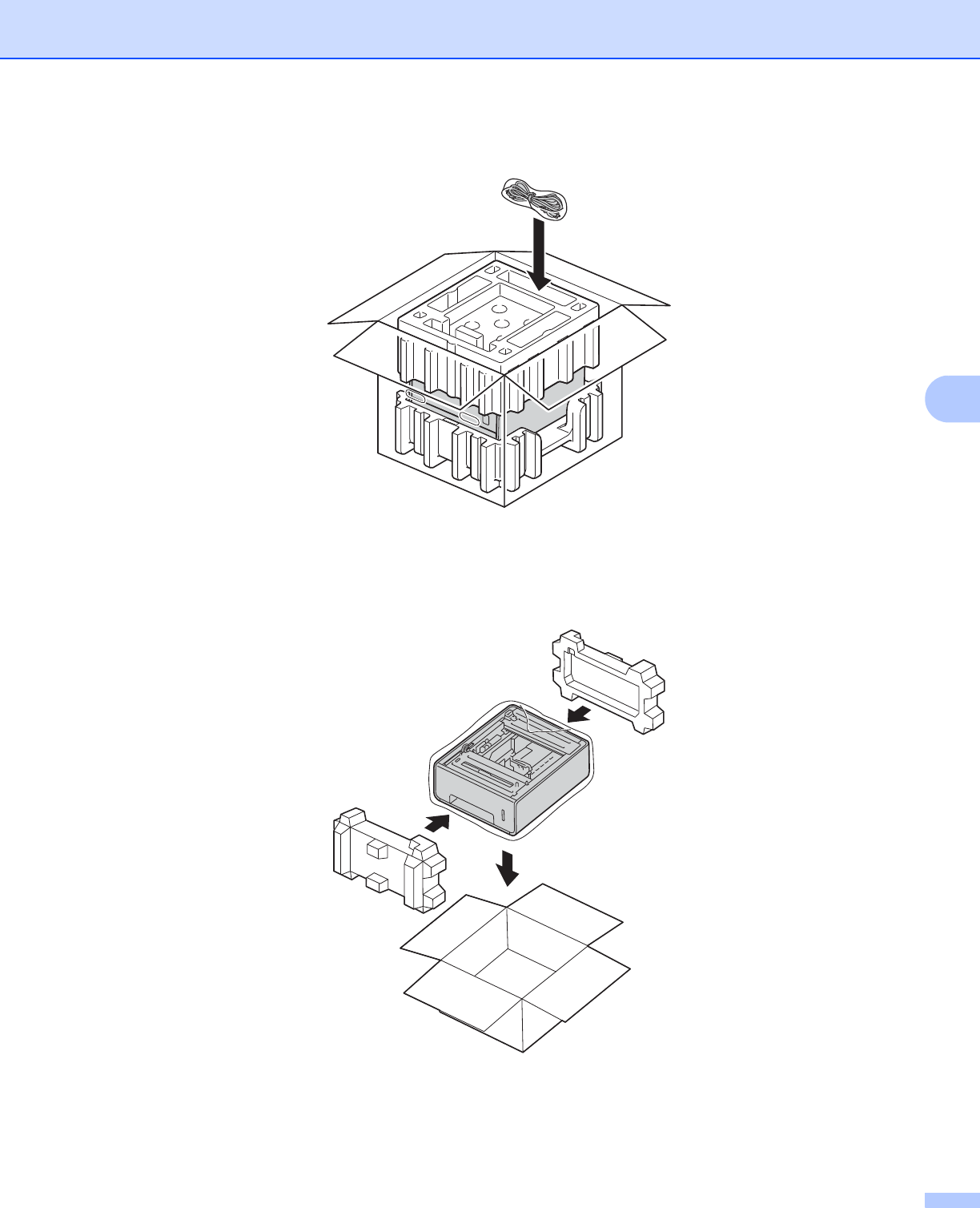
Routine Maintenance
169
5
ePut the AC power cord in the original carton as shown in the illustration.
fClose the carton and tape it shut.
g<If you have a Lower Tray>
Pack the lower tray as shown in the illustration.

170
6
6
If you think there is a problem with your machine, check each item below first and follow the troubleshooting
tips. You can solve most problems yourself.
Visit the Brother Solutions Center at http://solutions.brother.com/ and click Manuals on your model page to
download the other manuals.
Identifying the problem 6
First, check that
The machine's power cord is connected correctly and the machine is turned on. If the machine does not
turn on after connecting the power cord, see Other difficulties on page 191.
All of the protective parts have been removed.
Paper is inserted correctly in the paper tray.
The interface cables are securely connected to the machine and the computer, or the wireless connection
is set up on both the machine and your computer.
LCD Messages
(See Error and maintenance messages on page 171.)
If you did not solve the problem with the above checks, identify the problem, and then go to the page
suggested below.
Machine does not print.
Paper handling
(See Paper handling difficulties on page 189.)
Pages are printed, but there are still problems.
Print quality
(See Improving the print quality on page 192.)
Printout is incorrect
(See Printing difficulties on page 188.)
Network and other problems:
Network difficulties on page 190
Other difficulties on page 191
Troubleshooting 6
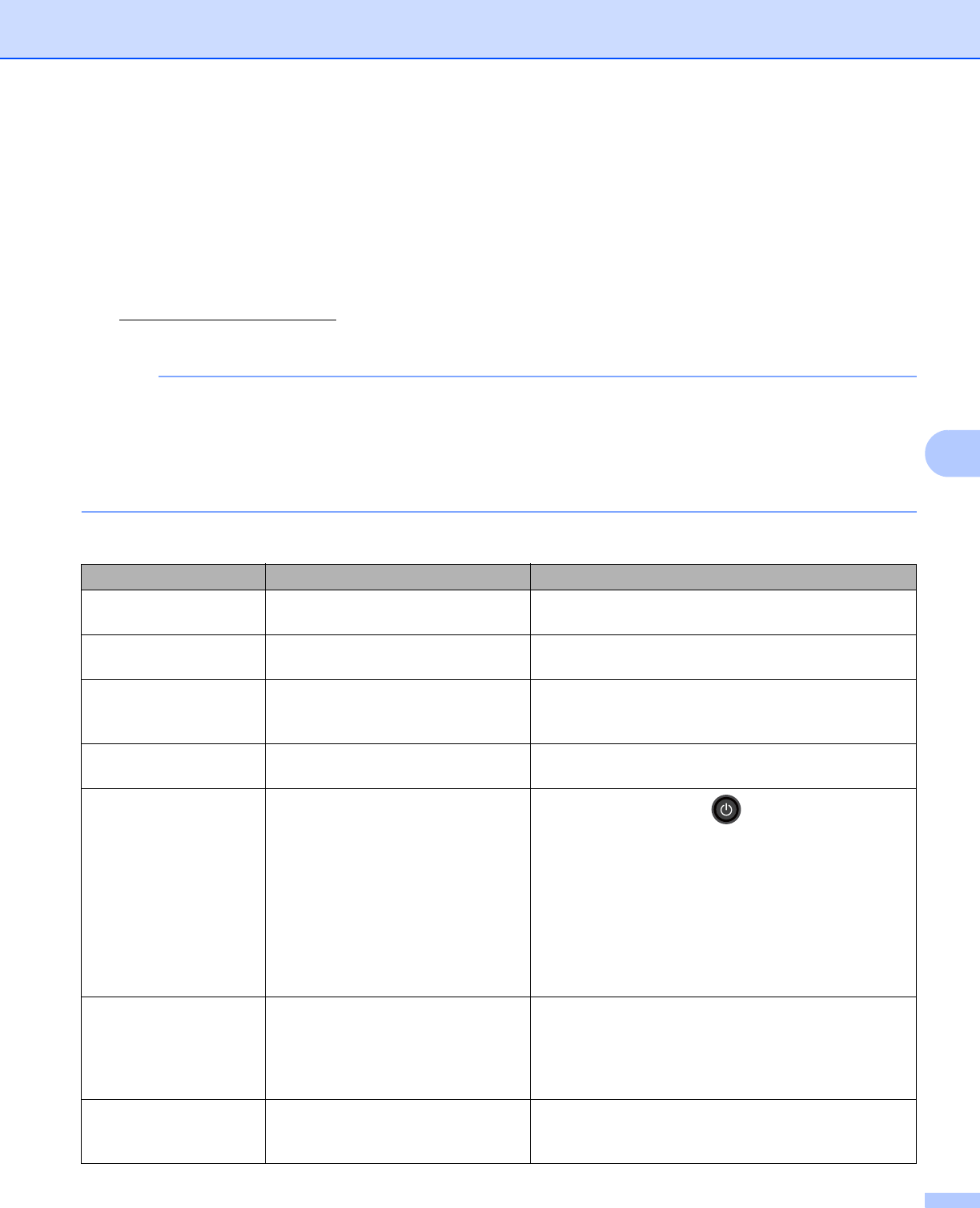
Troubleshooting
171
6
Error and maintenance messages 6
As with any sophisticated office product, errors may occur and supplies must be replaced. If this happens,
your machine identifies the error or required routine maintenance and displays the appropriate message. The
most common error and maintenance messages are shown below.
You can correct most errors and perform routine maintenance yourself. If you need more help, the Brother
Solutions Center offers the latest FAQs and troubleshooting tips:
Visit http://solutions.brother.com/.
Using non-Brother supplies may affect the print quality, hardware performance, and machine reliability.
NOTE
The LCD displays the tray names as follows.
• Standard paper tray: Tray 1
• Multi-purpose tray: MP Tray
• Optional lower tray 1: Tray 2 and T2
1Tray 2 is standard on HL-L8350CDWT.
Error message Cause Action
2-sided Disabled The back cover of the machine is
not closed completely.
Close the back cover of the machine.
Access Denied The function you want to use is
restricted by Secure Function Lock.
Contact your administrator to check your Secure
Function Lock settings.
Access Error The device was removed from the
USB direct interface while data was
processing.
Press Cancel. Reinsert the device and try to print
with Direct Print.
Belt End Soon The belt unit is near the end of its
life.
Buy a new belt unit before you get a Replace Belt
message.
Calibrate Calibration failed. Press and hold down to turn the machine off.
Wait a few seconds, and then turn it on again.
Perform the color calibration again using the
control panel or the printer driver (see Color
Calibration on page 47).
Install a new belt unit (see Replacing the belt unit
on page 135).
If the problem continues, call Brother Customer
Service.
Cartridge Error The toner cartridge is not installed
correctly.
Pull out the drum unit, remove the toner cartridge for
the color that is indicated on the LCD, and put it back
into the drum unit again. Install the drum unit in the
machine again. If the problem continues, call Brother
Customer Service.
Condensation Condensation may have formed
inside the machine after a room
temperature change.
Leave the machine turned on. Wait for 30 minutes
with the front cover in the open position. Then turn off
the machine and close the cover. Turn it on again.

Troubleshooting
172
6
Cover is Open The front cover is not closed
completely.
Close the front cover of the machine.
The fuser cover is not closed
completely.
Close the fuser cover located inside the back cover of
the machine.
DIMM Error The DIMM is not installed
correctly.
The DIMM is broken.
The DIMM does not meet the
required specifications.
Turn off the machine and unplug the power cord.
Remove the DIMM. (See Installing extra memory
on page 116.)
Confirm that the DIMM meets the required
specifications. (For details, see SO-DIMM types
on page 115.)
Reinstall the DIMM correctly. Wait a few seconds. Plug
in the power cord, and then turn the machine on again.
If this error message appears again, replace the
DIMM with a new one. (See Installing extra
memory on page 116.)
Drum End Soon The drum unit is near the end of its
life.
Order a new drum unit now so a replacement drum
unit will be available when the LCD displays
Replace Drum (see Drum End Soon on page 128).
Drum ! The corona wire on the drum unit
needs to be cleaned.
Clean all four corona wires inside the drum unit by
sliding the blue tabs (see Cleaning the corona wires
on page 154).
The drum unit is not installed
correctly.
Remove the drum unit, remove the toner cartridges from
the drum unit, and put the toner cartridges back into the
drum unit. Reinstall the drum unit in the machine.
Drum Stop It is time to replace the drum unit. Replace the drum unit (see Replacing the drum unit
on page 128).
Jam 2-sided The paper is jammed underneath
the paper tray or the fuser unit.
See Paper is jammed underneath the Paper Tray
on page 178.
Jam Inside The paper is jammed inside the
machine.
See Paper is jammed inside the machine
on page 184.
Jam MP Tray The paper is jammed in the
multi-purpose tray of the machine.
See Paper is jammed in the multi-purpose tray
on page 176.
Jam Rear The paper is jammed in the back of
the machine.
See Paper is jammed at the back of the machine
on page 181.
Jam Tray 1
Jam Tray 2
The paper is jammed in the paper
tray of the machine.
See Paper is jammed in Paper Tray 1 or Tray 2
on page 176.
Limit Exceeded The print limit set in Secure
Function Lock was reached.
Contact your administrator to check your Secure
Function Lock settings.
Log Access Error The machine could not access the
print log file in the server.
Contact your administrator to check the Store Print
Log to Network settings.
(For detailed information, see the Network User's
Guide.)
No Belt Unit The belt unit is not installed
correctly.
Reinstall the belt unit (see the steps in Replacing the
belt unit on page 135).
Error message Cause Action

Troubleshooting
173
6
No Drum Unit The drum unit is not installed
correctly.
Reinstall the drum unit. (See Replacing the drum unit
on page 128.)
No HUB Support A USB hub device is connected to
the USB direct interface.
Disconnect the USB hub device from the USB direct
interface.
No Paper
(The second line of the
LCD)
Load (size) paper
in (tray).
The machine is out of paper or
paper is not correctly loaded in the
specified paper tray.
Load paper in the indicated paper tray.
Make sure the paper guides are set to the correct
size.
No Permission Printing color documents is
restricted.
Contact your administrator to check your Secure
Function Lock settings.
No Toner The toner cartridge for the color
indicated on the second line of LCD
is not installed correctly.
Remove the drum unit, remove the toner cartridge for
the color indicated on the second line of LCD from the
drum unit, and put the toner cartridge back into the
drum unit. Reinstall the drum unit in the machine. If
the problem continues, replace the toner cartridge
(see Replacing the toner cartridges on page 123).
No Tray The paper tray that is indicated on
the second line of the LCD is not
installed or not installed correctly.
Reinstall the paper tray that is indicated on the
second line of the LCD.
No Waste Toner The waste toner box is not installed
correctly.
Reinstall the Waste Toner Box (see the steps
in Replacing the waste toner box on page 141).
Not Available The requested function is not
permitted to all User IDs by Secure
Function Lock.
Contact your administrator to check your Secure
Function Lock settings.
Out of Memory The machine’s memory is full. Reduce the complexity of your document or reduce
the print resolution.
Add more memory. (see Installing extra memory
on page 116.)
Print Data Full The machine’s memory is full. Press Cancel and delete the previously stored
secure print jobs.
Add more memory. (see Installing extra memory
on page 116.)
Print Unable ## The machine has a mechanical
problem. Press and hold down to turn the machine off.
Wait a few seconds, then turn it on again.
If the problem continues, call Brother Customer
Service.
Error message Cause Action

Troubleshooting
174
6
Registration Registration failed. Press and hold down to turn the machine off.
Wait a few seconds, and then turn it on again.
Perform the color registration again using the control
panel
(see Color Registration on page 112).
Install a new belt unit (see Replacing the belt unit
on page 135).
If the problem continues, call Brother Customer
Service.
Replace Belt It is time to replace the belt unit. Replace the belt unit (see Replacing the belt unit
on page 135).
Replace Drum It is time to replace the drum unit. Replace the drum unit (see Replacing the drum unit
on page 128).
The drum unit counter was not reset
when a new drum was installed.
Reset the drum unit counter (see Resetting the drum
counter on page 134).
Replace Fuser It is time to replace the fuser unit. Call Brother Customer Service or a Brother
Authorized Service Center to replace the fuser unit.
To replace the Fuser Unit contact Brother Customer
Service at:
1-877-BROTHER (1-877-276-8437) (in USA)
www.brother.ca/support (in Canada)
or to locate a Brother Authorized Service Center, visit:
http://www.brother-usa.com/service/
Replace Laser It is time to replace the laser unit. Call Brother Customer Service or a Brother
Authorized Service Center to replace the laser unit.
To replace the Laser Unit contact Brother Customer
Service at:
1-877-BROTHER (1-877-276-8437) (in USA)
www.brother.ca/support (in Canada)
or to locate a Brother Authorized Service Center, visit:
http://www.brother-usa.com/service/
Replace PF Kit1
Replace PF Kit2
Replace PF KitMP
It is time to replace the paper
feeding kit.
Call Brother Customer Service or a Brother
Authorized Service Center to replace the PF kit.
To replace the PF Kit contact Brother Customer
Service at:
1-877-BROTHER (1-877-276-8437) (in USA)
www.brother.ca/support (in Canada)
or to locate a Brother Authorized Service Center, visit:
http://www.brother-usa.com/service/
Replace Toner The toner cartridge is at the end of
its life. The machine will stop all print
operations.
Replace the toner cartridge for the color indicated on
the LCD (see Replacing the toner cartridges
on page 123).
Error message Cause Action

Troubleshooting
175
6
Replace WT Box It is time to replace the waste toner
box.
Replace the waste toner box (see Replacing the
waste toner box on page 141).
Self-Diagnostic
The temperature of the fuser unit
does not rise to a specified
temperature within the specified time.
Turn the machine off, wait a few seconds, and then
turn it on again. Leave the machine for 15 minutes
with the power on.
The fuser unit is too hot.
Short paper The length of the paper in the tray is
too short for the machine to deliver it
to the Face-down output tray.
Open the back cover (face-up output tray) to let the
printed page exit onto the face-up output tray.
Remove the printed pages, and then press Go.
Size Error The paper size specified in the
printer driver is not supported by the
specified tray.
Choose a paper size that is supported for each tray.
(See Paper type and size on page 2.)
Size Error DX The paper size specified in the
printer driver and the control panel
menu is not available for automatic
2-sided printing.
Press Cancel. Choose a paper size that is supported
by 2-sided printing.
The paper sizes for automatic 2-sided printing are
Letter, Legal or Folio.
The paper in the tray is not the
correct size and is not available for
automatic 2-sided printing.
Load the correct size of paper in the tray and set the
size of paper for the tray (see Paper Tray
on page 91).
The paper sizes for automatic 2-sided printing are
Letter, Legal or Folio.
Size Mismatch The paper in the indicated tray is not
the correct size.
Do one of the following:
Load the same size of paper in the paper tray that is
selected in the printer driver, and then press Go.
In the printer driver select the size of paper that you
loaded in the indicated paper tray.
Small paper
The paper size specified in the printer
driver is too small for the machine to
deliver it to the Face-down output tray.
Open the back cover (face-up output tray) to let the
printed paper exit onto the face-up output tray, and
then press Go.
Toner Error One or more toner cartridges are
not installed correctly.
Pull out the drum unit. Remove all the toner
cartridges, and then put them back into the drum unit.
Toner Low: X
(X indicates the toner
cartridge or drum unit
color that is near the end
of its life. BK=Black,
C=Cyan, M=Magenta,
Y=Yellow.)
If the LCD displays Toner Low you
can still print; however, the machine
is telling you that the toner cartridge
is near the end of its life.
Order a new toner cartridge now so a replacement
toner cartridge will be available when the LCD
displays Replace Toner.
Tray 2 Error The optional lower tray is not
installed correctly.
Reinstall the lower tray.
Unusable Device An incompatible or defective device
has been connected to the USB
direct interface.
Remove the USB flash drive from the USB Direct
Interface.
WT Box End Soon The waste toner box is almost full. Order a new waste toner box before you get a
Replace WT Box message.
Error message Cause Action
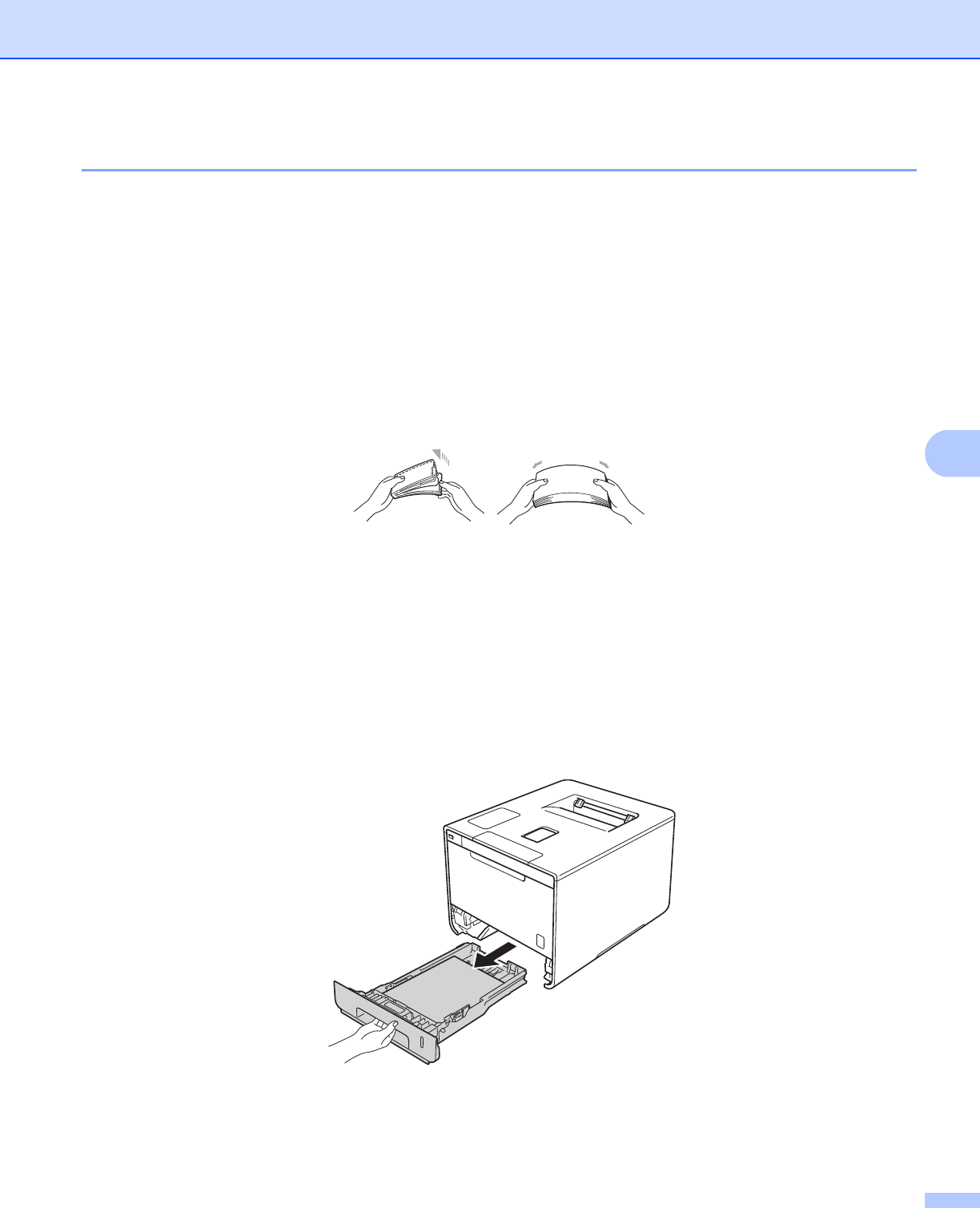
Troubleshooting
176
6
Paper jams 6
When you are adding new paper, always remove all the paper from the paper tray and straighten the stack.
This helps prevent multiple sheets of paper from feeding through the machine at one time and prevents paper
jams.
Paper is jammed in the multi-purpose tray 6
If the LCD displays Jam MP Tray, follow these steps:
aRemove the paper from the MP tray.
bRemove any jammed paper from in and around the MP tray.
cFan the paper stack, and then put it back in the MP tray.
dWhen loading paper in the MP tray, make sure that the paper stays under the maximum paper height
guides on both sides of the tray.
ePress Go to resume printing.
Paper is jammed in Paper Tray 1 or Tray 2 6
If the LCD displays Jam Tray 1 or Jam Tray 2, follow these steps:
aPull the paper tray completely out of the machine.
For Jam Tray 1:
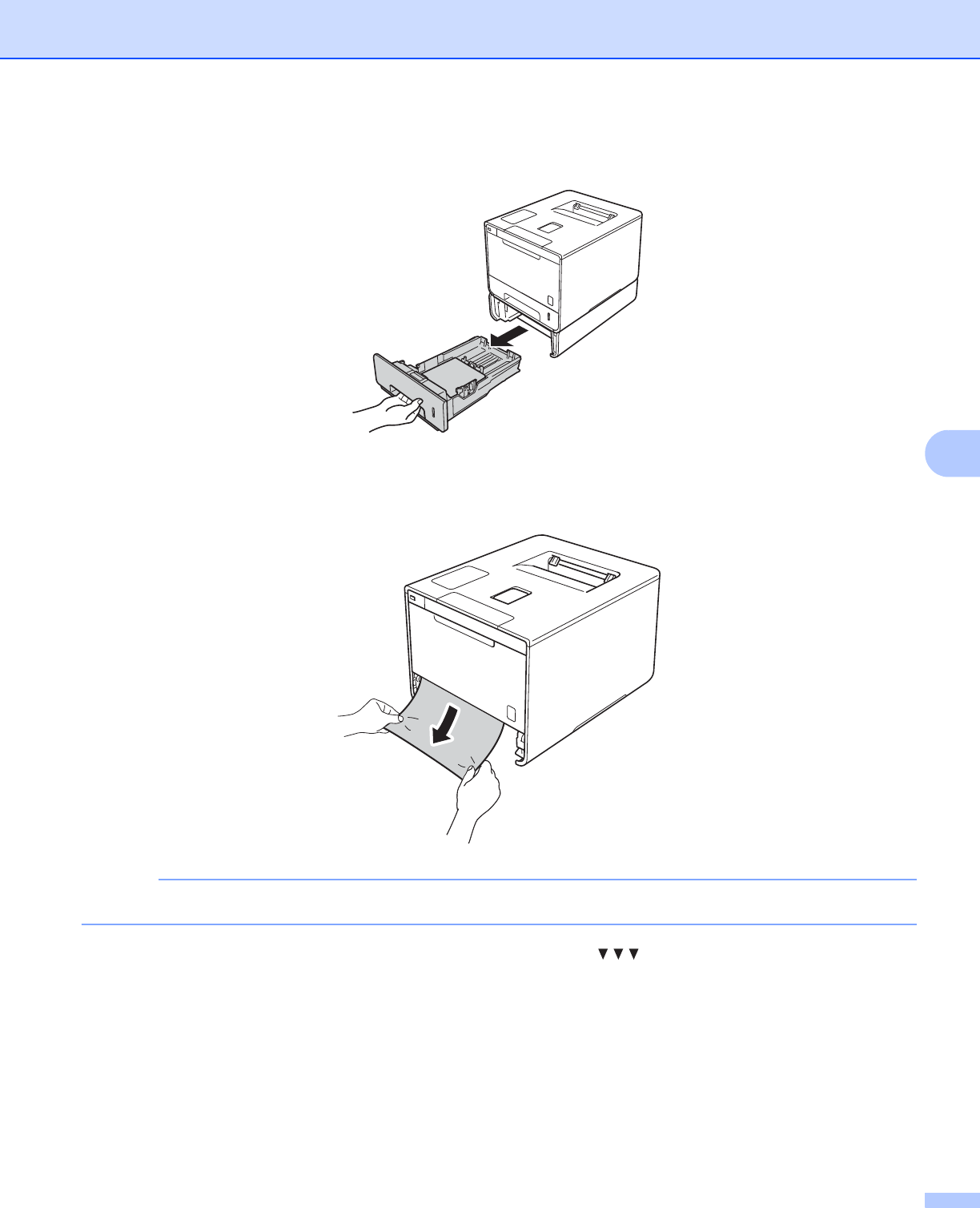
Troubleshooting
177
6
For Jam Tray 2:
bUse both hands to slowly pull out the jammed paper.
NOTE
Pulling the jammed paper downward allows you to remove the paper more easily.
cMake sure that the paper is below the maximum paper mark ( ) in the paper tray. While pressing
the blue paper-guide release lever, slide the paper guides to fit the paper size. Make sure that the guides
are firmly in the slots.
dPut the paper tray firmly back in the machine.
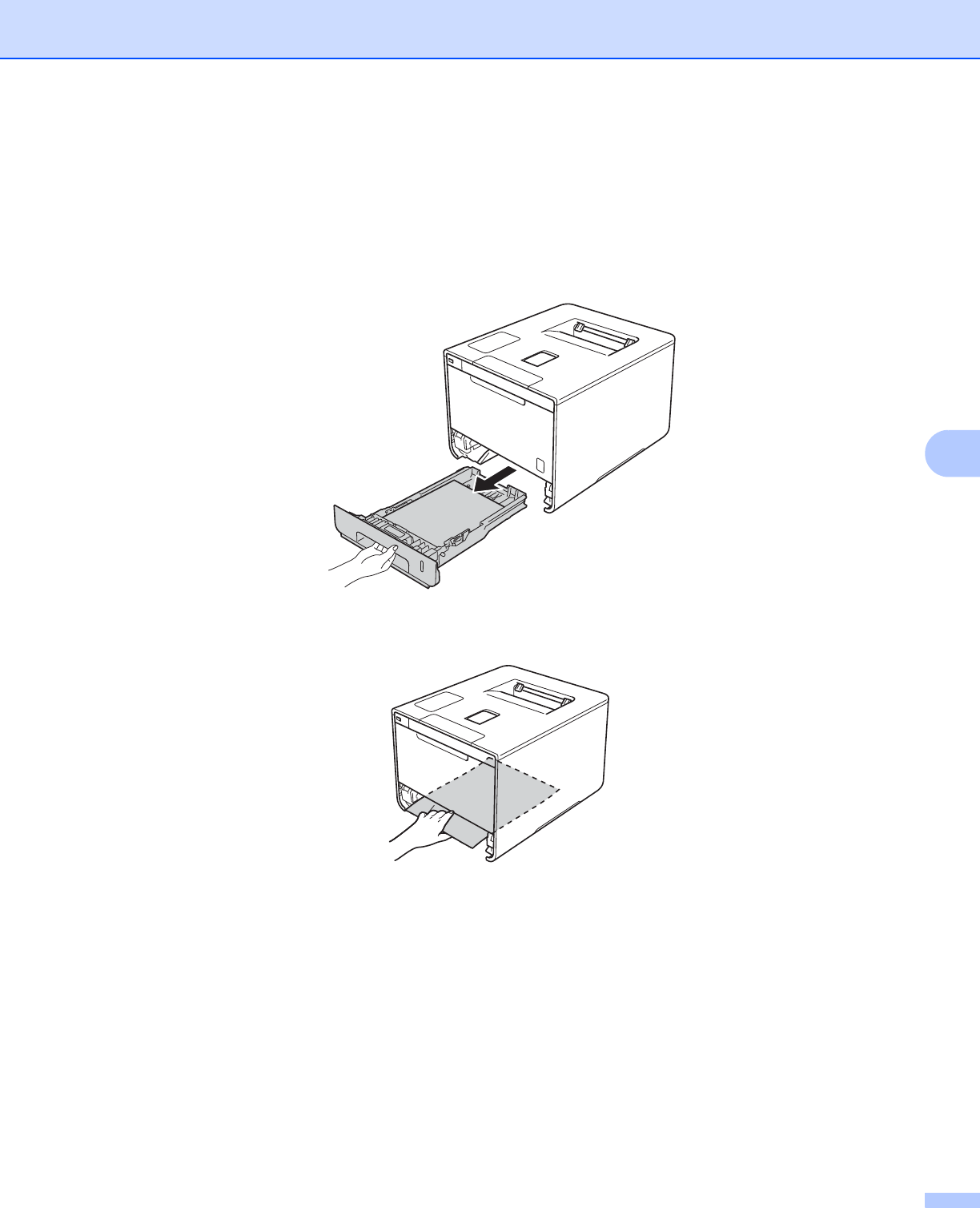
Troubleshooting
178
6
Paper is jammed underneath the Paper Tray 6
If the LCD displays Jam 2-sided, follow these steps:
aLeave the machine turned on for 10 minutes for the internal fan to cool the extremely hot parts inside the
machine.
bPull the paper tray completely out of the machine.
cMake sure that the jammed paper does not remain inside the machine.
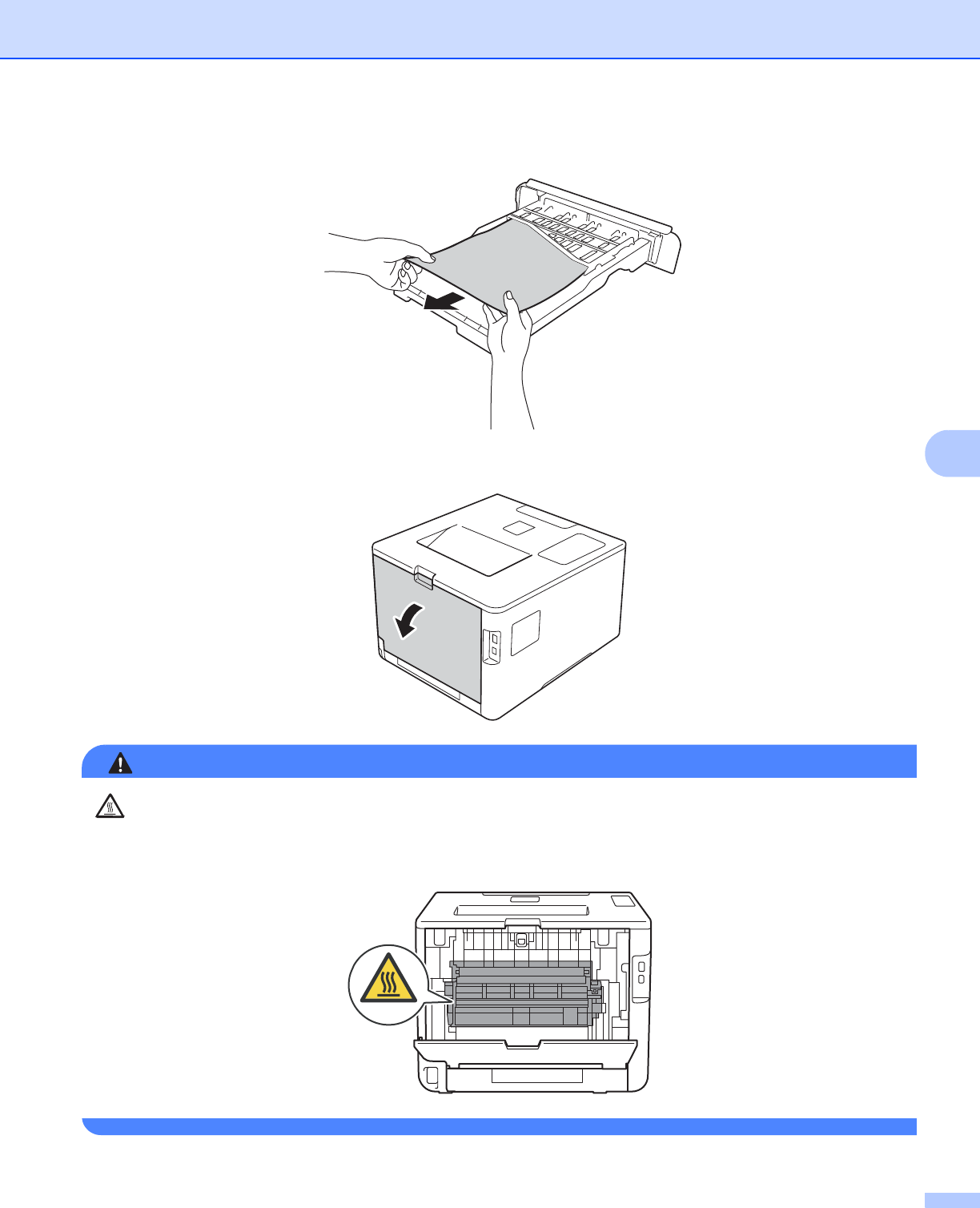
Troubleshooting
179
6
dIf paper is not caught inside the machine, check underneath the paper tray.
eIf the paper is not caught in the paper tray, open the back cover.
WARNING
HOT SURFACE
After you have just used the machine, some internal parts of the machine will be extremely hot. Wait for the
machine to cool down before you touch the internal parts of the machine.
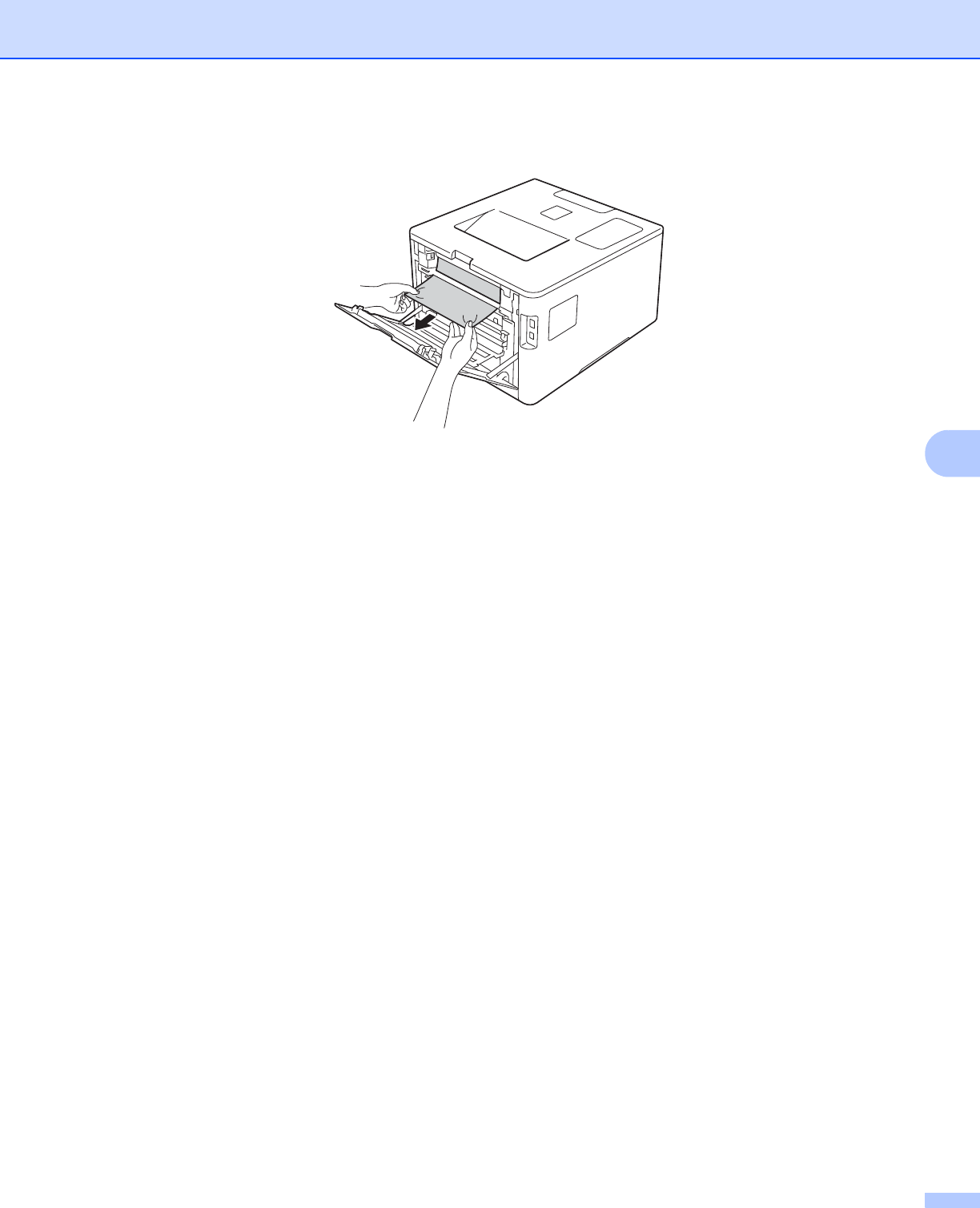
Troubleshooting
180
6
fUse both hands to pull out the jammed paper slowly.
gClose the back cover until it locks in the closed position.
hPut the paper tray back in the machine.
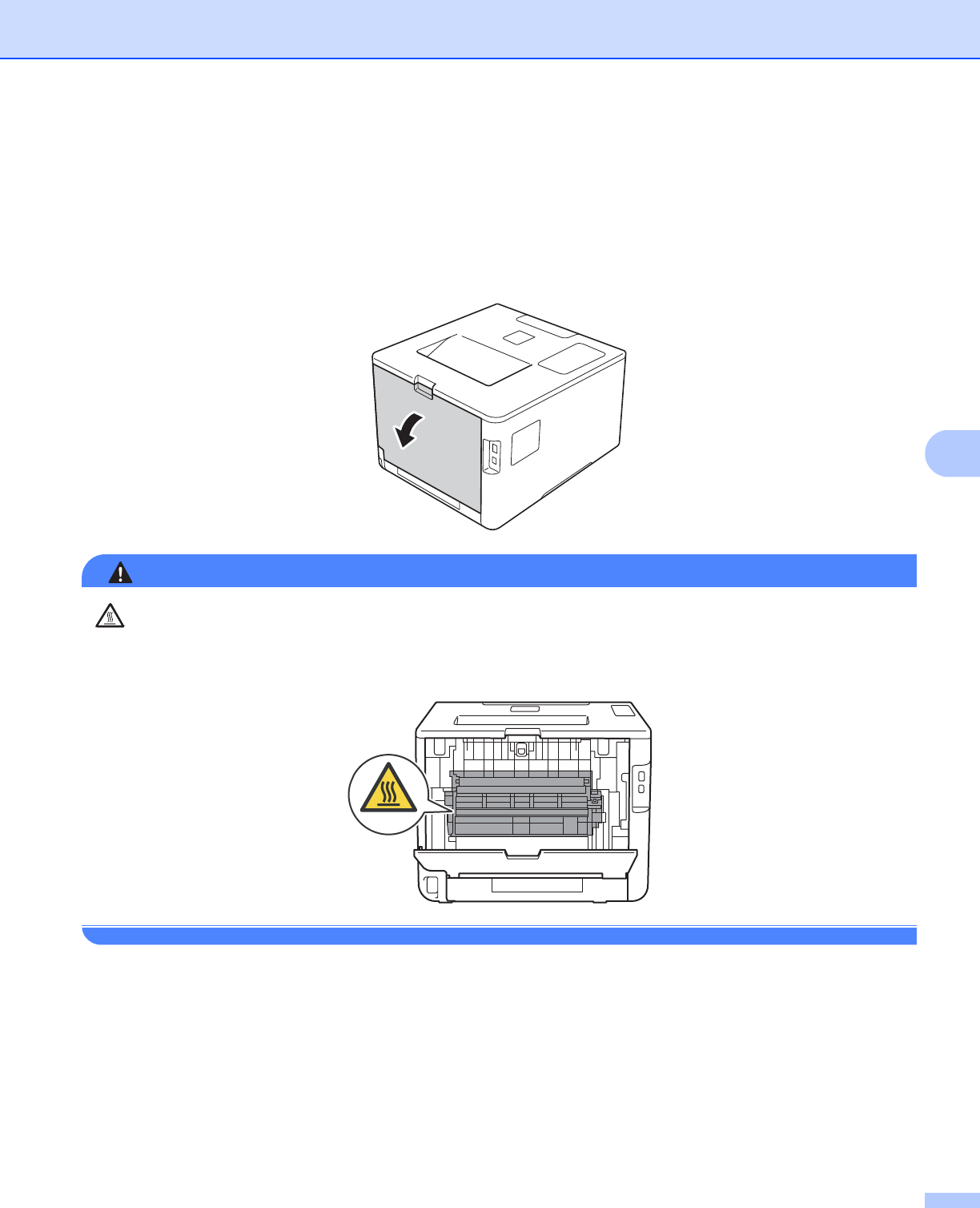
Troubleshooting
181
6
Paper is jammed at the back of the machine 6
If the LCD displays Jam Rear, a paper jam occurred behind the back cover. Follow these steps:
aLeave the machine turned on for 10 minutes for the internal fan to cool the extremely hot parts inside the
machine.
bOpen the back cover.
WARNING
HOT SURFACE
After you have just used the machine, some internal parts of the machine are extremely hot. Wait for the
machine to cool down before you touch the internal parts of the machine.
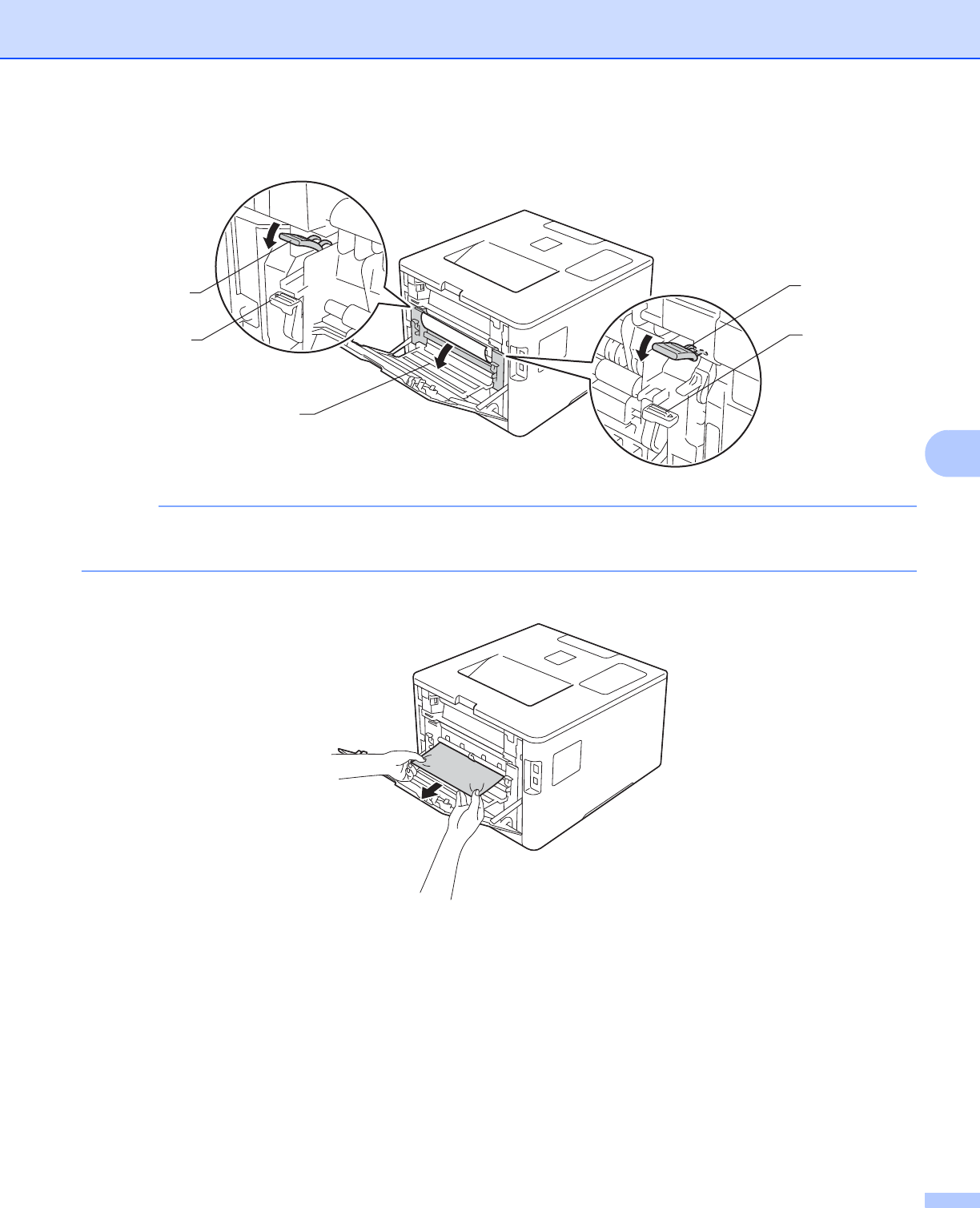
Troubleshooting
182
6
cPull the blue tabs at the left and right sides toward you to release the fuser cover (1).
NOTE
If the envelope levers (3) inside the back cover are pulled down to the envelope position, lift these levers
to the original position before pulling the blue tabs (2) down.
dUse both hands to gently pull the jammed paper out of the fuser unit.
1
2
3
2
3
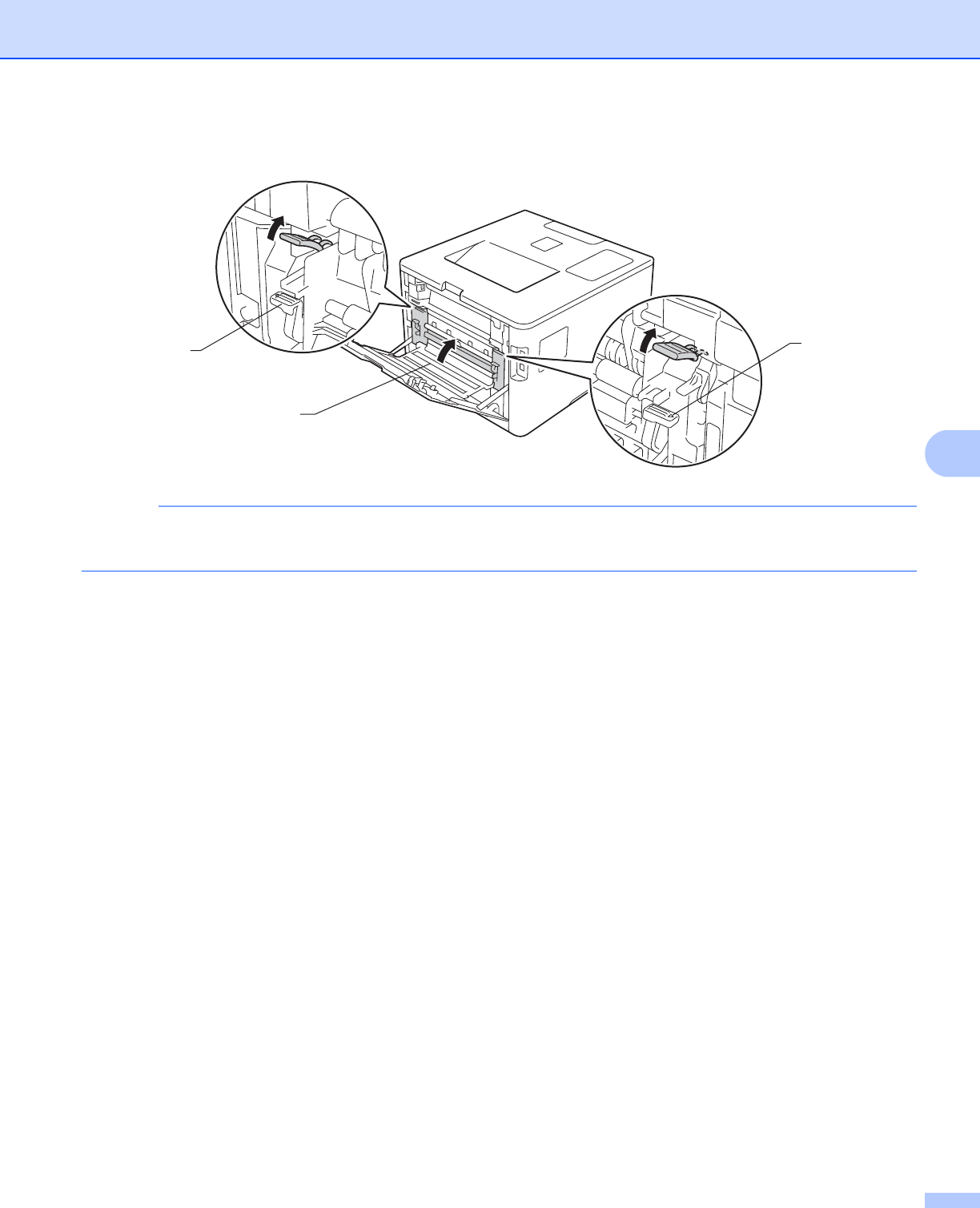
Troubleshooting
183
6
eClose the fuser cover (1).
NOTE
If you print on envelopes, pull down the envelope levers (2) to the envelope position again before closing
the back cover.
fClose the back cover.
1
22
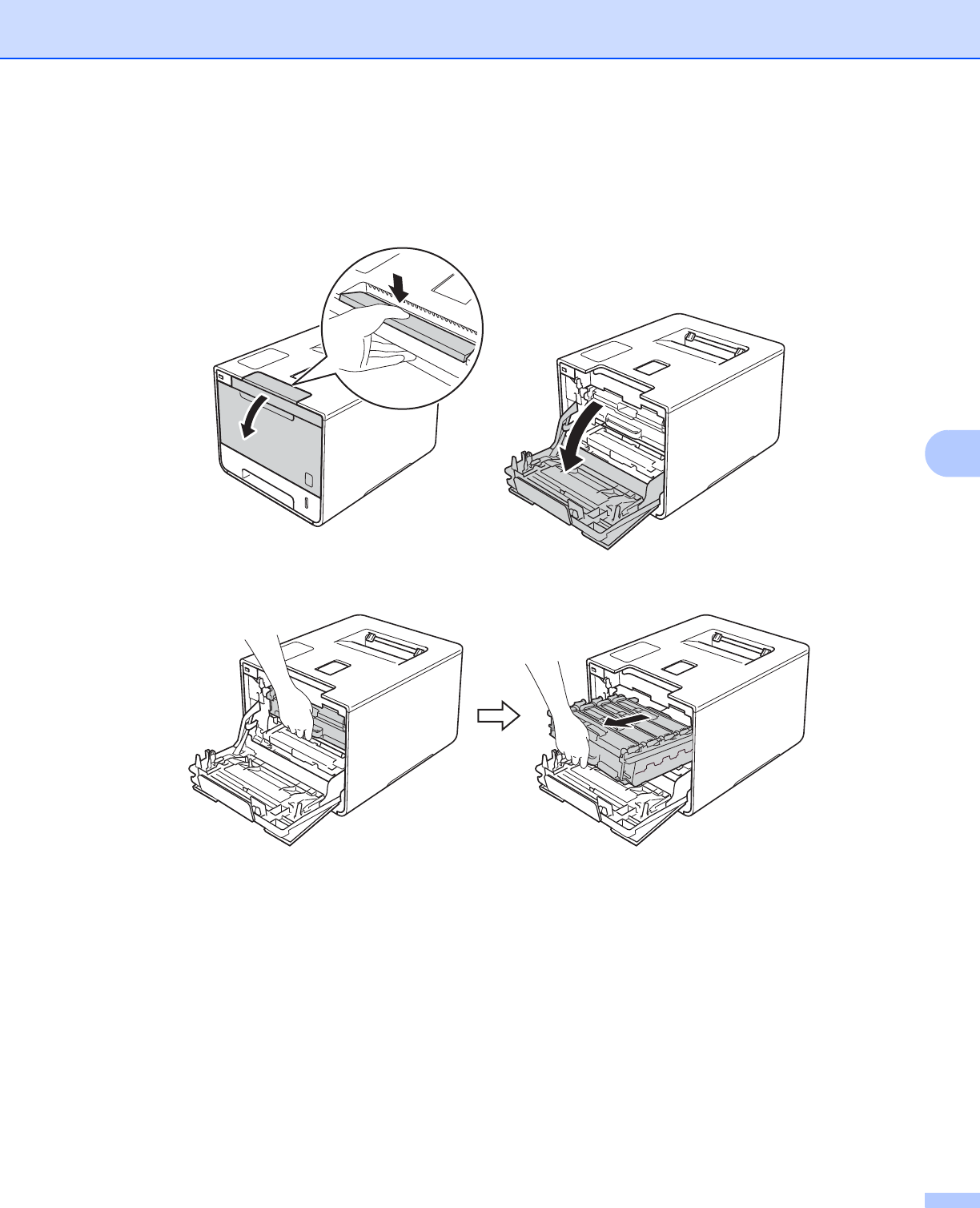
Troubleshooting
184
6
Paper is jammed inside the machine 6
If the LCD displays Jam Inside, follow these steps:
aPress the front cover release button and pull open the front cover.
bHold the blue handle of the drum unit. Pull the drum unit out until it stops.
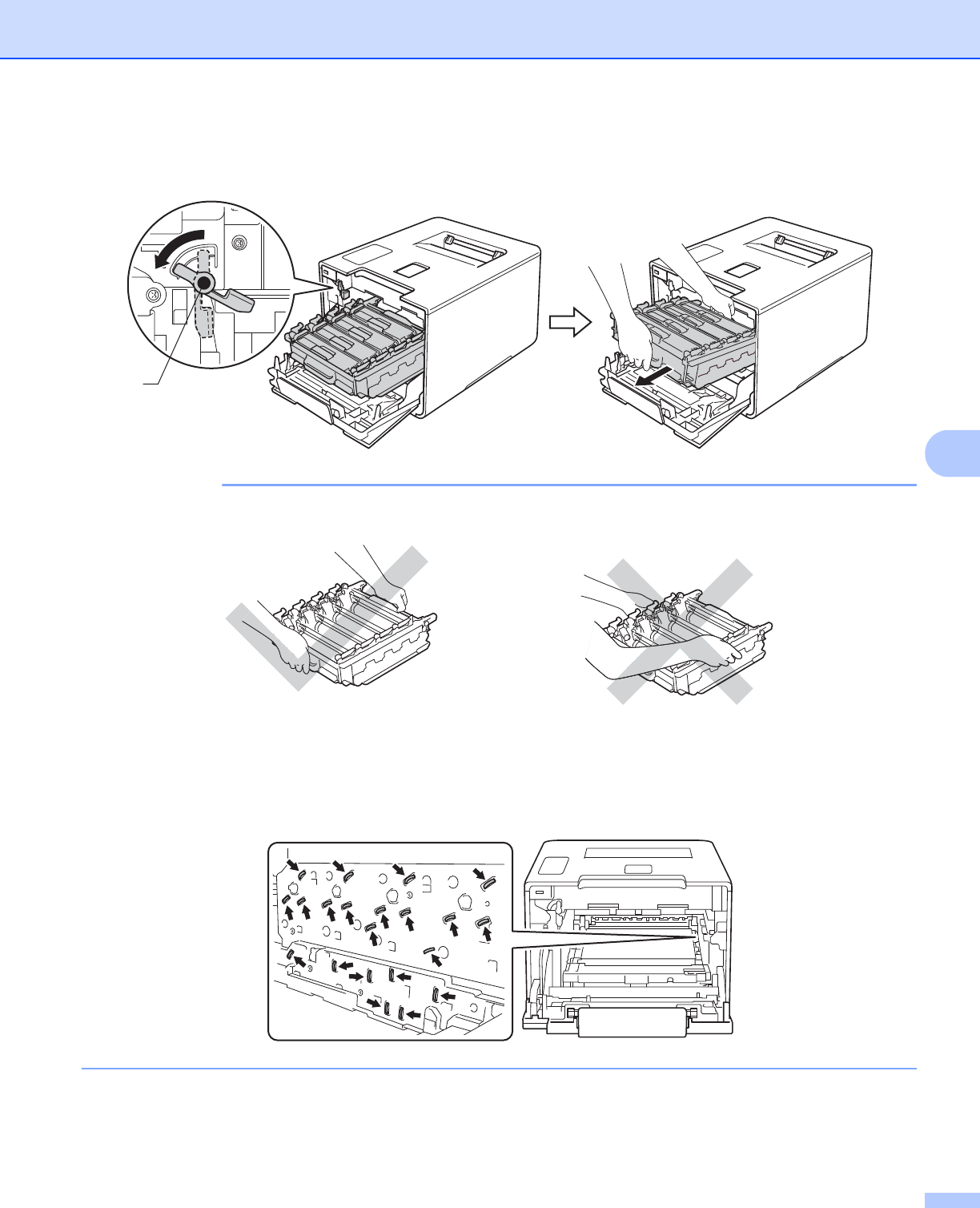
Troubleshooting
185
6
cTurn the blue lock lever (1) at the left of the machine counterclockwise to the release position. Holding
the blue handles of the drum unit, lift the front of the drum unit and remove it from the machine.
IMPORTANT
• Hold the blue handles of the drum unit when you carry it. DO NOT hold the sides of the drum unit.
• We recommend placing the drum unit on a clean, flat, level, stable surface with a sheet of disposable paper
or cloth underneath it in case you accidentally spill or scatter toner.
• To prevent damage to the machine from static electricity, DO NOT touch the electrodes shown in the
illustration.
2
1
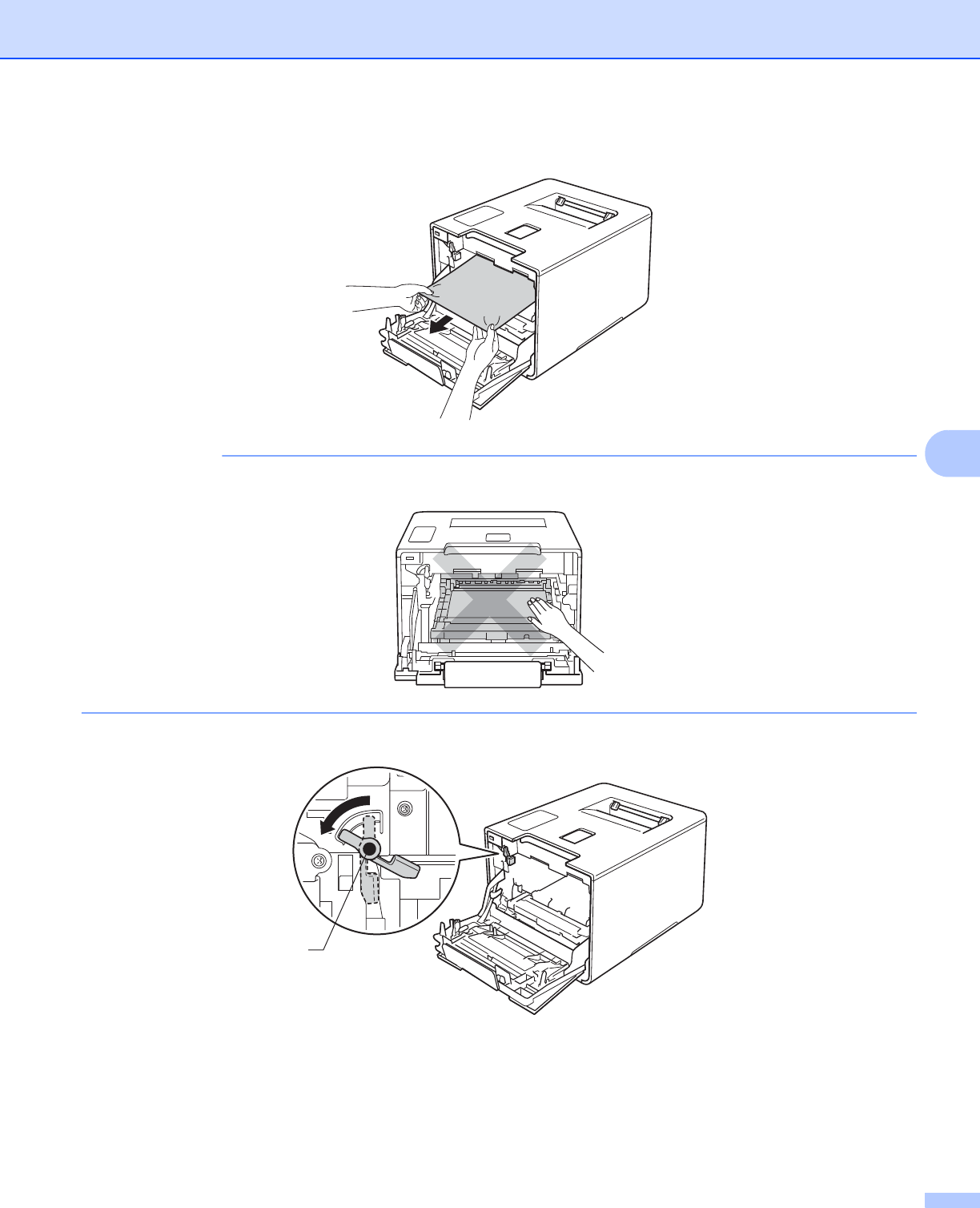
Troubleshooting
186
6
dPull out the jammed paper slowly.
IMPORTANT
To avoid print quality problems, DO NOT touch the shaded parts shown in the illustration.
eMake sure the blue lock lever (1) is in the release position as shown in the illustration.
2
1
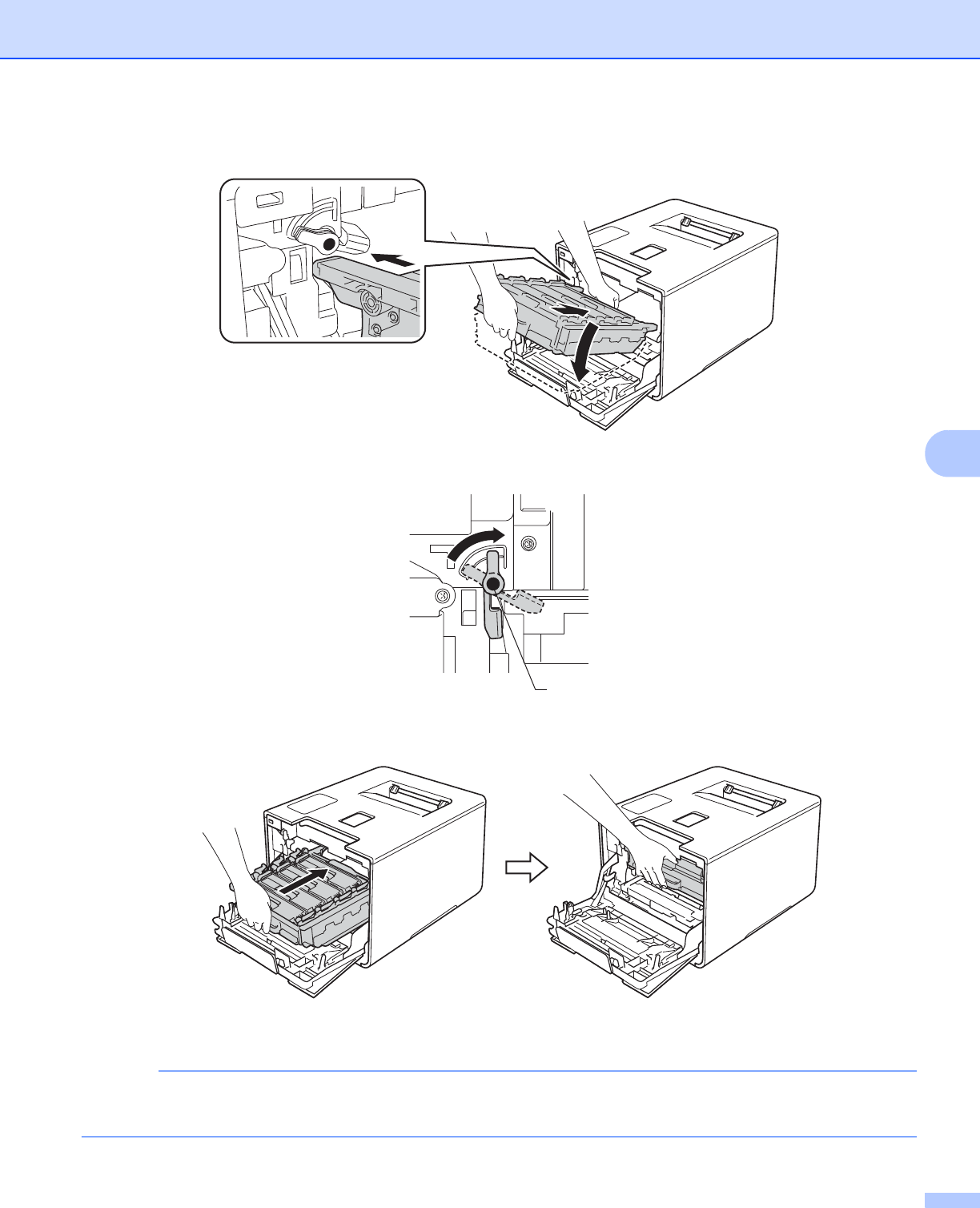
Troubleshooting
187
6
fGently slide the drum unit into the machine until it stops at the blue lock lever.
gTurn the blue lock lever (1) clockwise to the lock position.
hPush the drum unit in until it stops.
iClose the front cover of the machine.
NOTE
If you turn off the machine during Jam Inside, the machine will print incomplete data from your computer
when it is turned back on. Before you turn on the machine, delete the print spooler job on your computer.
2
2
1
Troubleshooting
188
6
If you are having difficulty with your machine 6
IMPORTANT
• For technical help, you must call the country where you bought the machine. Calls must be made from
within that country.
• If you think there is a problem with your machine, check the chart below and follow the troubleshooting
tips. You can solve most problems yourself.
• If you need additional help, the Brother Solutions Center offers the latest FAQs and troubleshooting tips.
Visit http://solutions.brother.com/.
• Using non-Brother supplies may affect the print quality, hardware performance, and machine reliability.
Printing difficulties
Difficulties Suggestions
No printout. Check that the correct printer driver has been installed and chosen.
Check to see if the LCD is showing an error message.
(See Error and maintenance messages on page 171.)
Check that the machine is online:
(Windows®7 and Windows Server®2008 R2)
Click the (Start) button > Devices and Printers. Right-click Brother HL-XXXX
series and click See what's printing. Click Printer and make sure you clear the
check mark before Use Printer Offline.
(Windows Vista® and Windows Server®2008)
Click the (Start) button > Control Panel > Hardware and Sound > Printers.
Right-click Brother HL-XXXX series. Make sure you clear the check mark before
Use Printer Offline.
(Windows®XP and Windows Server®2003)
Click the Start button > Printers and Faxes. Right-click Brother HL-XXXX series.
Make sure you clear the check mark before Use Printer Offline.
(Windows®8 and Windows Server®2012)
Move your mouse to the lower right corner of your desktop. When the menu bar
appears, click Settings > Control Panel. In the Hardware and Sound (Hardware)
group, click View devices and printers. Right-click the Brother HL-XXXX Printer >
See what’s printing. If printer driver options appear, select your printer driver. Click
Printer in the menu bar and make sure you clear the check mark before Use Printer
Offline.
(For Windows Server® 2012 R2)
Click Control Panel on the Start screen. In the Hardware group, click View devices
and printers. Right-click the Brother HL-XXXX Printer > See what’s printing. If
printer driver options appear, select your printer driver. Click Printer in the menu bar
and make sure you clear the check mark before Use Printer Offline.
Contact your administrator to check your Secure Function Lock settings.
Make sure the interface is set to Auto on the machine (see how to change the
interface on page 92).
Troubleshooting
189
6
No printout.
(Continued)
Check that the machine is not in Power Off mode.
If the machine is in Power Off mode, press on the control panel, and then re-
send the print job.
(See Auto Power Off on page 109.)
The machine is not printing or
has stopped printing.
Press Cancel.
The machine will cancel the print job and clear it from the memory. The printout may
be incomplete.
The headers or footers appear
when the document is
displayed on the screen but
they are not on the printed
page.
There is an unprintable area on the top and bottom of the page. Adjust the top and
bottom margins in your document to allow for this.
(See Unprintable area when printing from a computer on page 7.)
The machine prints
unexpectedly or it prints
garbage.
Press Cancel to cancel the print jobs.
Check the settings in your application to make sure they are set to work with your
machine.
The machine prints the first
couple of pages correctly, then
some pages have text
missing.
Check the settings in your application to make sure that they are set to work with your
machine.
Your computer is not recognizing the machine’s input buffer’s full signal. Make sure
the interface cable is connected correctly.
Cannot perform ‘Page Layout’
printing.
Check that the paper size settings in the application and in the printer driver are the
same.
Print speed is too slow. Try changing the printer driver setting. The highest quality takes longer data
processing, sending and printing time.
If the machine is in Quiet mode, print speed is slower. Check the Quiet mode setting.
(See Turning Quiet mode on/off on page 110.)
The machine does not print
from Adobe® Illustrator®.
Reduce the print quality.
(For Windows, see Basic tab on page 33.)
(For Macintosh, see Print Settings on page 71.)
Poor print quality See Improving the print quality on page 192.
Paper handling difficulties
Difficulties Suggestions
The machine does not feed
paper.
If the paper tray is empty, load a new stack of paper in the paper tray.
If there is paper in the paper tray, make sure it is straight. If the paper is curled,
straighten it. Sometimes it is helpful to remove the paper, turn the stack over and put
it back in the paper tray.
Reduce the amount of paper in the paper tray, and then try again.
Make sure that MP Tray mode is not selected in the printer driver.
Clean the paper pick-up roller.
(See Cleaning the paper pick-up roller on page 164.)
Printing difficulties (continued)
Difficulties Suggestions
Troubleshooting
190
6
The machine does not feed
paper from the MP tray.
Make sure that MP Tray is selected in the printer driver.
Fan the paper well and put the paper tray back in the machine.
How do I print on envelopes? 1 Open the back cover.
2 Pull down the two gray levers to the envelope position.
3 When you have finished printing envelopes, reset the two gray levers to their
original positions and close the back cover.
(See Printing on thick paper, labels and envelopes from the MP tray on page 15.)
Load three envelopes at a time in the MP tray. Your application must be set to print
the envelope size you are using. This is usually done in the Page Setup or Document
Setup menu of your application.
(See your application’s manual for more information.)
Network difficulties
Difficulties Suggestions
Cannot print over a network
after completing the software
installation.
When the Cannot print to the networked printer. screen appears, follow the
on-screen instructions. If the problem is not solved, see the Network User's Guide.
Make sure the interface is set to Auto on the machine (see how to change the
interface on page 92).
The Brother software cannot
be installed. (Windows®)
If the Security Software warning appears on the computer screen during the
installation, change the Security Software settings to permit the Brother product
setup program or other program to run.
(Macintosh)
If you are using a firewall function of anti-spyware or antivirus security software,
temporarily disable it, and then install the Brother software.
Cannot connect to wireless
network.
(HL-L8350CDW and
HL-L8350CDWT)
Investigate the problem using the WLAN report. Print the WLAN report in the menu
selection:
Machine Info., Print WLANReport, and then press Go.
For more details, see the Network User's Guide.
For other problems concerning using your machine on a Network, see the Network User's Guide.
Paper handling difficulties (continued)
Difficulties Suggestions

Troubleshooting
191
6
Other difficulties
Difficulties Suggestions
The machine will not turn on. Adverse conditions on the power connection (such as lightning or a power surge)
may have triggered the machine’s internal safety mechanisms. Turn the machine off
and unplug the power cord. Wait for ten minutes, then plug in the power cord and turn
the machine on.
If you still cannot turn on the machine, plug the power cord directly into a different
known working wall outlet (do not plug it into a surge suppressor or backup battery
type of device), and then turn on the machine. If this works, then the wall outlet,
battery backup device, or surge suppressor device is the cause of the problem.
The machine cannot print EPS
data that includes binary with
the BR-Script3 printer driver.
(Windows®)
To print EPS data, do the following:
aFor Windows® 7 and Windows Server® 2008 R2:
Click the (Start) button > Devices and Printers.
For Windows Vista® and Windows Server® 2008:
Click the (Start) button > Control Panel, Hardware and Sound > Printers.
For Windows® XP and Windows Server® 2003:
Click the Start button > Printers and Faxes.
For Windows® 8 and Windows Server® 2012:
Move your mouse to the lower right corner of your desktop. When the menu bar
appears, click Settings > Control Panel. In the Hardware and Sound group,
click View devices and printers.
For Windows Server® 2012 R2:
Click Control Panel on the Start screen. In the Hardware group, click View
devices and printers.
bFor Windows® 7, Windows® XP, Windows Vista®, Windows Server®
2003,Windows Server® 2008 and Windows Server® 2008 R2:
Right-click the Brother HL-XXXX BR-Script3 icon and select Printer
properties (Properties), and Brother HL-XXXX BR-Script3 if needed.
For Windows® 8, Windows Server® 2012 and Windows Server® 2012 R2:
Right-click the Brother HL-XXXX BR-Script3 icon, select Printer properties.
cFrom the Device Settings tab, choose TBCP (Tagged binary communication
protocol) in Output Protocol.
(Macintosh)
If your machine is connected to a computer with a USB interface, you cannot print
EPS data that includes binary. You can print the EPS data at the machine through a
network. For installing the BR-Script3 printer driver through the network, visit the
Brother Solutions Center at http://solutions.brother.com/.
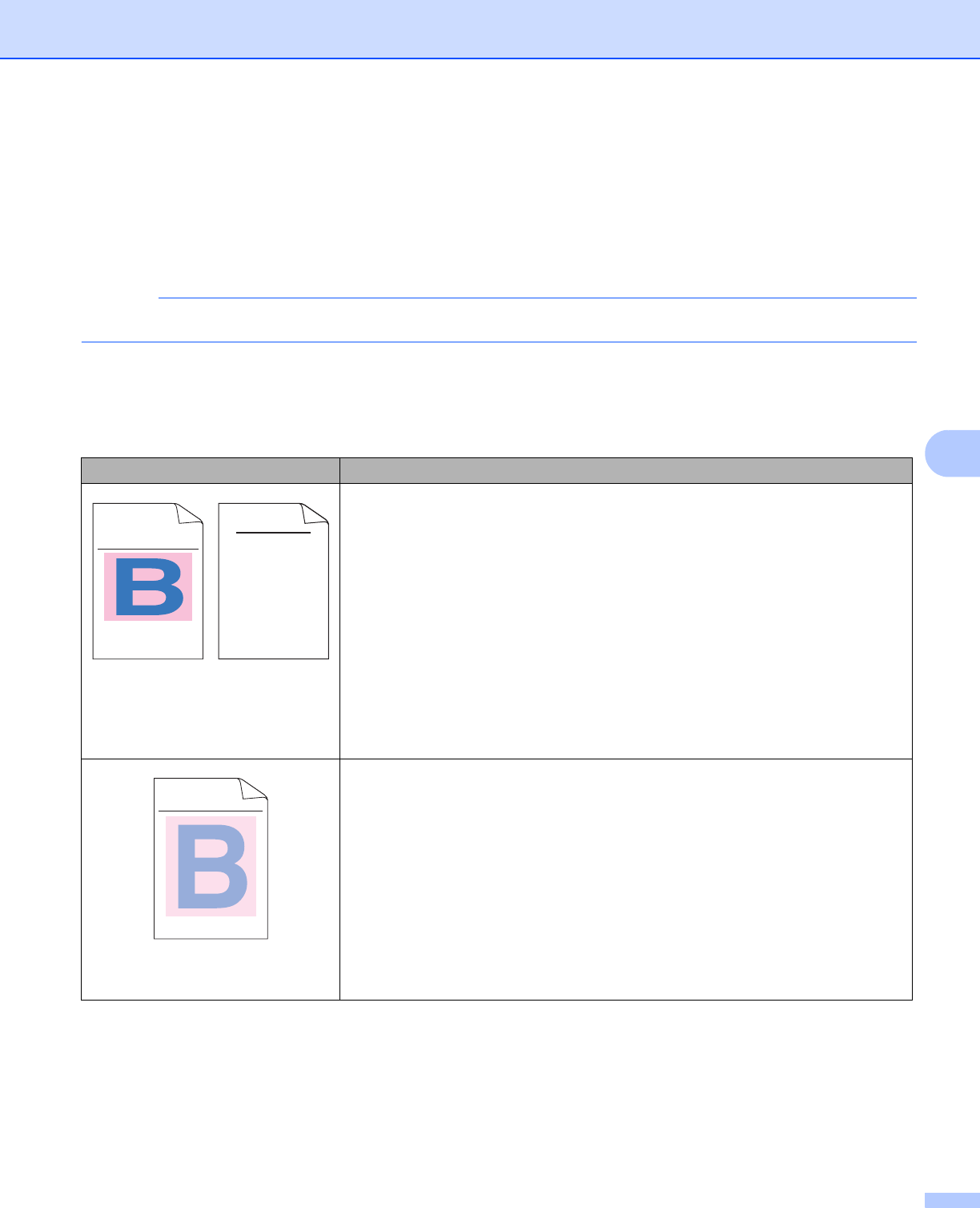
Troubleshooting
192
6
Improving the print quality 6
If you have a print quality problem, print a test page first (see Machine Info. on page 89). If the printout looks
good, the problem is probably not the machine. Check the interface cable or try the machine on another
computer. If the printout has a quality problem, check the following steps first. And then, if you still have a
print quality problem, check the chart below and follow the recommendations.
NOTE
Using non-Brother supplies may affect the print quality, hardware performance, and machine reliability.
aTo get the best print quality, we suggest using the recommended paper. Check that you are using paper
that meets our specifications (see Acceptable paper and other print media on page 2).
bCheck that the drum unit and toner cartridges are installed correctly.
Examples of poor print quality Recommendation
Printed pages are compressed,
horizontal stripes appear, or
characters in the top, bottom,
left and right margins are cut off
Adjust the print margins on your application and reprint the job.
Colors are light or faint on the
whole page
Perform the color calibration using the control panel or the printer driver
(see Color Calibration on page 111).
Make sure toner save mode is off in the control panel or the printer driver.
Make sure that the media type setting in the driver matches the type of paper
you are using (see Acceptable paper and other print media on page 2).
Shake all four toner cartridges gently.
Wipe the scanner windows with a dry, soft, lint-free cloth. (See Cleaning the
inside of the machine on page 150.)
ABCDEFGHIJKLMNOPQRSTUVWXYZ. 0123456789. abcdefghijklmnopqrstuvwxyz.
ABCDEFGHIJKLMNOPQRSTUVWXYZ. 0123456789. abcdefghijklmnopqrstuvwxyz.
ABCDEFGHIJKLMNOPQRSTUVWXYZ. 0123456789. abcdefghijklmnopqrstuvwxyz.
ABCDEFGHIJKLMNOPQRSTUVWXYZ. 0123456789. abcdefghijklmnopqrstuvwxyz.
ABCDEFGH
abcdefghijk
ABCD
abcde
01234
ABCDEFGHIJKLMNOPQRSTUVWXYZ. 0123456789. abcdefghijklmnopqrstuvwxyz.
ABCDEFGHIJKLMNOPQRSTUVWXYZ. 0123456789. abcdefghijklmnopqrstuvwxyz.
ABCDEFGHIJKLMNOPQRSTUVWXYZ. 0123456789. abcdefghijklmnopqrstuvwxyz.
ABCDEFGHIJKLMNOPQRSTUVWXYZ. 0123456789. abcdefghijklmnopqrstuvwxyz.
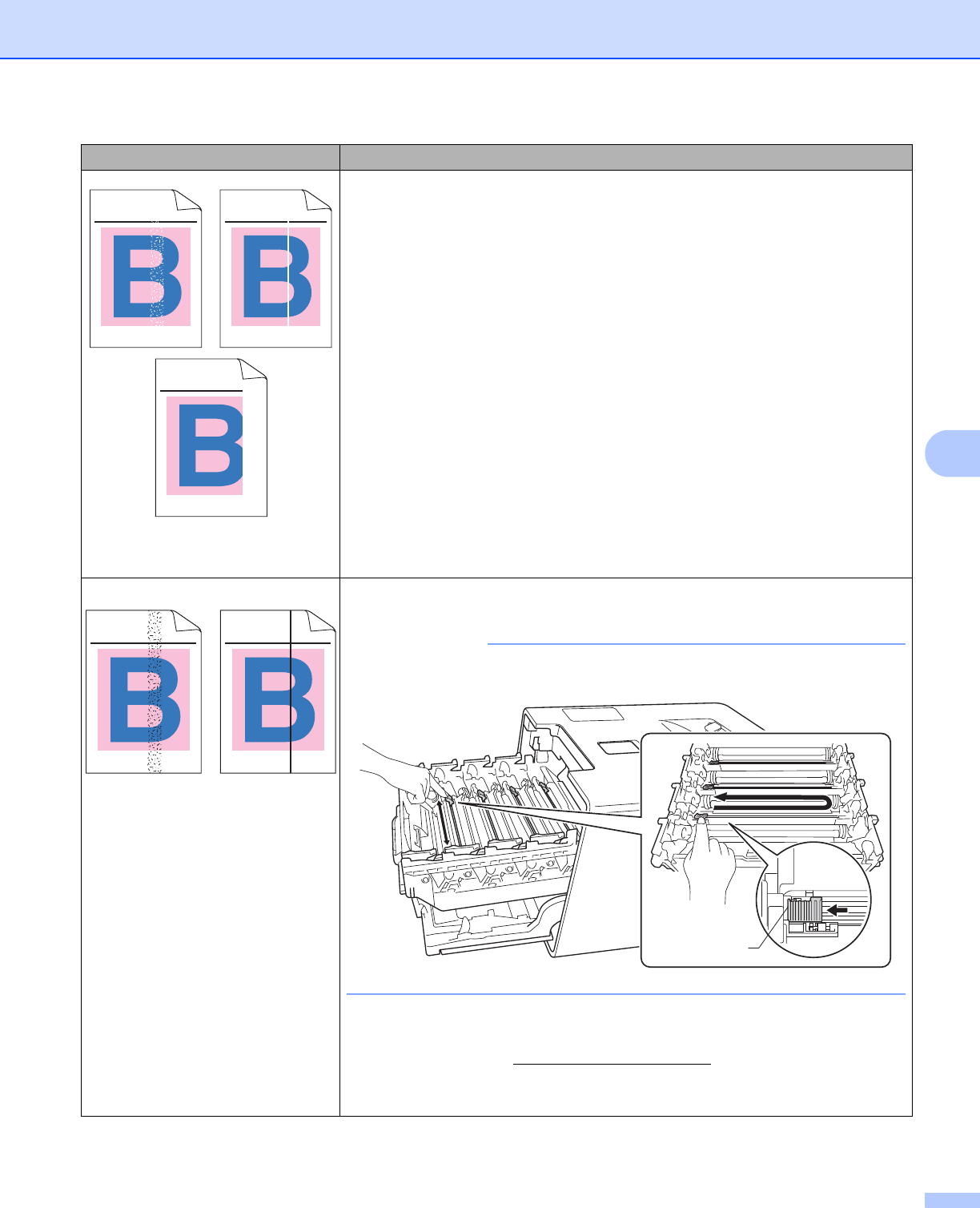
Troubleshooting
193
6
White streaks or bands down the
page
Wipe the scanner windows with a dry, soft, lint-free cloth (see Cleaning the
inside of the machine on page 150.)
Make sure that foreign material such as a torn piece of paper, sticky note or
dust is not inside the machine and around the drum unit and toner cartridge.
Colored streaks or bands down
the page
Clean all four corona wires inside the drum unit by sliding the blue tabs
(see Cleaning the corona wires on page 154).
IMPORTANT
Make sure the blue tabs of the corona wires are at the home position (1).
Replace the toner cartridge that matches the color of the streak or band
(see Replacing the toner cartridges on page 123). To identify the color of the
toner cartridge, visit http://solutions.brother.com/ to view our FAQs and
troubleshooting tips.
Install a new drum unit (see Replacing the drum unit on page 128).
Examples of poor print quality Recommendation
ABCDEFGHIJKLMNOPQRSTUVWXYZ. 0123456789. abcdefghijklmnopqrstuvwxyz.
ABCDEFGHIJKLMNOPQRSTUVWXYZ. 0123456789. abcdefghijklmnopqrstuvwxyz.
ABCDEFGHIJKLMNOPQRSTUVWXYZ. 0123456789. abcdefghijklmnopqrstuvwxyz.
ABCDEFGHIJKLMNOPQRSTUVWXYZ. 0123456789. abcdefghijklmnopqrstuvwxyz.
ABCDEFGHIJKLMNOPQRSTUVWXYZ. 0123456789. abcdefghijklmnopqrstuvwxyz.
ABCDEFGHIJKLMNOPQRSTUVWXYZ. 0123456789. abcdefghijklmnopqrstuvwxyz.
ABCDEFGHIJKLMNOPQRSTUVWXYZ. 0123456789. abcdefghijklmnopqrstuvwxyz.
ABCDEFGHIJKLMNOPQRSTUVWXYZ. 0123456789. abcdefghijklmnopqrstuvwxyz.
ABCDEFGHIJKLMNOPQRSTUVWXYZ. 0123456789. abcdefghijklmnopqrstuvwxyz.
ABCDEFGHIJKLMNOPQRSTUVWXYZ. 0123456789. abcdefghijklmnopqrstuvwxyz.
ABCDEFGHIJKLMNOPQRSTUVWXYZ. 0123456789. abcdefghijklmnopqrstuvwxyz.
ABCDEFGHIJKLMNOPQRSTUVWXYZ. 0123456789. abcdefghijklmnopqrstuvwxyz.
ABCDEFGHIJKLMNOPQRSTUVWXYZ. 0123456789. abcdefghijklmnopqrstuvwxyz.
ABCDEFGHIJKLMNOPQRSTUVWXYZ. 0123456789. abcdefghijklmnopqrstuvwxyz.
ABCDEFGHIJKLMNOPQRSTUVWXYZ. 0123456789. abcdefghijklmnopqrstuvwxyz.
ABCDEFGHIJKLMNOPQRSTUVWXYZ. 0123456789. abcdefghijklmnopqrstuvwxyz.
ABCDEFGHIJKLMNOPQRSTUVWXYZ. 0123456789. abcdefghijklmnopqrstuvwxyz.
ABCDEFGHIJKLMNOPQRSTUVWXYZ. 0123456789. abcdefghijklmnopqrstuvwxyz.
ABCDEFGHIJKLMNOPQRSTUVWXYZ. 0123456789. abcdefghijklmnopqrstuvwxyz.
ABCDEFGHIJKLMNOPQRSTUVWXYZ. 0123456789. abcdefghijklmnopqrstuvwxyz.
1
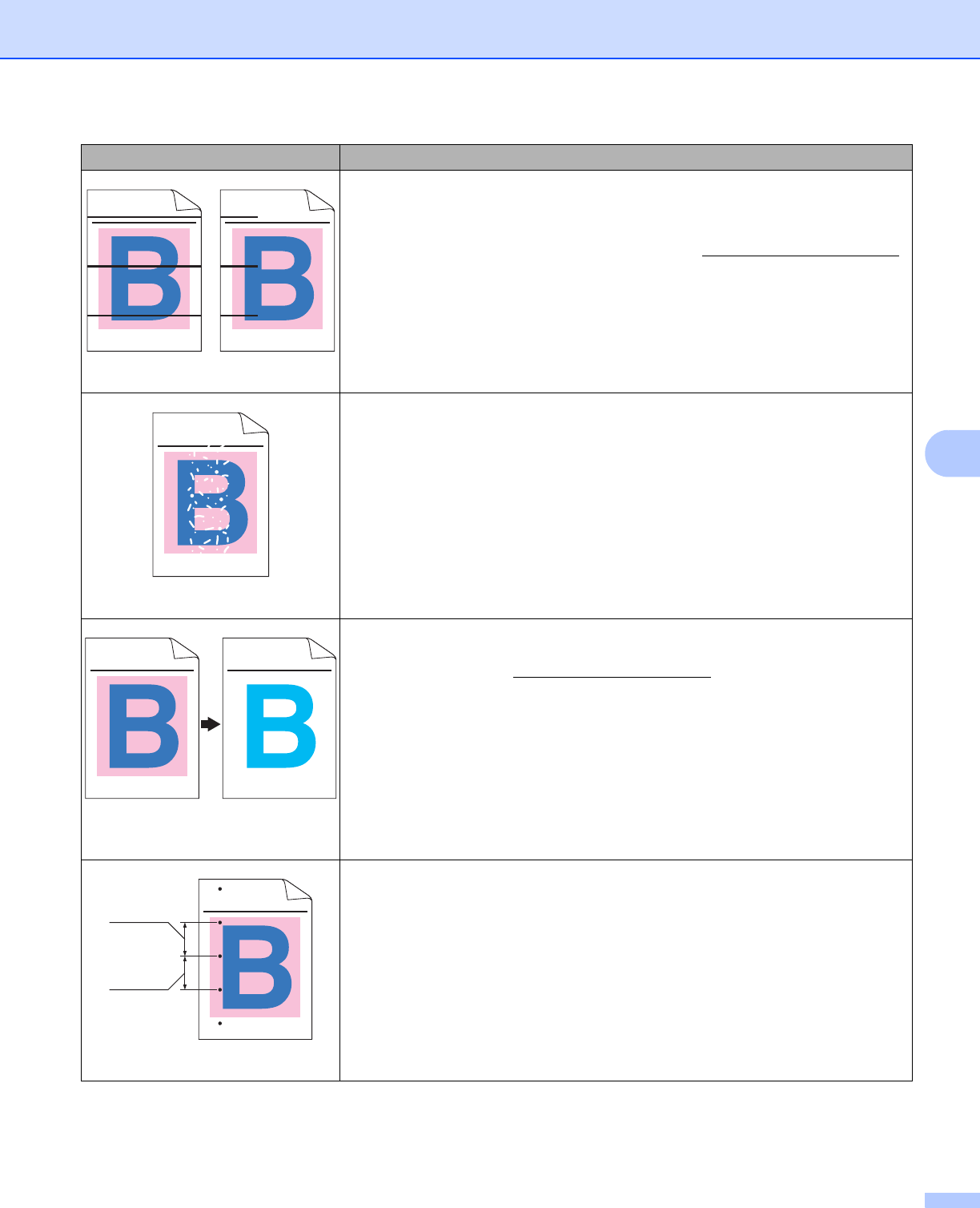
Troubleshooting
194
6
Colored lines across the page
Identify the color causing the problem and replace the toner cartridge that
matches the color of the line (see Replacing the toner cartridges
on page 122).
To identify the color of the toner cartridge, visit http://solutions.brother.com/
to view our FAQs and troubleshooting tips.
Install a new drum unit (see Replacing the drum unit on page 128).
White spots or hollow print
Make sure that the media type setting in the printer driver matches the type
of paper you are using (see Acceptable paper and other print media
on page 2).
Check the machine’s environment. Conditions such as high humidity can
cause hollow print (See the Product Safety Guide).
If the problem is not solved after printing a few pages, the drum may have
foreign material, such as glue from a label, stuck on the drum surface. Clean
the drum unit (see Cleaning the drum unit on page 157).
Install a new drum unit (see Replacing the drum unit on page 128).
Blank page or some colors are
missing
Identify the color causing the problem and put in a new toner cartridge
(see Replacing the toner cartridges on page 123). To identify the color of the
toner cartridge, visit http://solutions.brother.com/ to view our FAQs and
troubleshooting tips.
Install a new drum unit (see Replacing the drum unit on page 128).
Colored spots at 3.7 in. (94mm)
If the problem is not solved after printing a few pages, the drum may have
foreign material, such as glue from a label, stuck on the drum surface. Clean
the drum unit (see Cleaning the drum unit on page 157).
Install a new drum unit (see Replacing the drum unit on page 128).
Examples of poor print quality Recommendation
ABCDEFGHIJKLMNOPQRSTUVWXYZ. 0123456789. abcdefghijklmnopqrstuvwxyz.
ABCDEFGHIJKLMNOPQRSTUVWXYZ. 0123456789. abcdefghijklmnopqrstuvwxyz.
ABCDEFGHIJKLMNOPQRSTUVWXYZ. 0123456789. abcdefghijklmnopqrstuvwxyz.
ABCDEFGHIJKLMNOPQRSTUVWXYZ. 0123456789. abcdefghijklmnopqrstuvwxyz.
ABCDEFGHIJKLMNOPQRSTUVWXYZ. 0123456789. abcdefghijklmnopqrstuvwxyz.
ABCDEFGHIJKLMNOPQRSTUVWXYZ. 0123456789. abcdefghijklmnopqrstuvwxyz.
ABCDEFGHIJKLMNOPQRSTUVWXYZ. 0123456789. abcdefghijklmnopqrstuvwxyz.
ABCDEFGHIJKLMNOPQRSTUVWXYZ. 0123456789. abcdefghijklmnopqrstuvwxyz.
ABCDEFGHIJKLMNOPQRSTUVWXYZ. 0123456789. abcdefghijklmnopqrstuvwxyz.
ABCDEFGHIJKLMNOPQRSTUVWXYZ. 0123456789. abcdefghijklmnopqrstuvwxyz.
ABCDEFGHIJKLMNOPQRSTUVWXYZ. 0123456789. abcdefghijklmnopqrstuvwxyz.
ABCDEFGHIJKLMNOPQRSTUVWXYZ. 0123456789. abcdefghijklmnopqrstuvwxyz.
ABCDEFGHIJKLMNOPQRSTUVWXYZ. 0123456789. abcdefghijklmnopqrstuvwxyz.
ABCDEFGHIJKLMNOPQRSTUVWXYZ. 0123456789. abcdefghijklmnopqrstuvwxyz.
ABCDEFGHIJKLMNOPQRSTUVWXYZ. 0123456789. abcdefghijklmnopqrstuvwxyz.
ABCDEFGHIJKLMNOPQRSTUVWXYZ. 0123456789. abcdefghijklmnopqrstuvwxyz.
ABCDEFGHIJKLMNOPQRSTUVWXYZ. 0123456789. abcdefghijklmnopqrstuvwxyz.
ABCDEFGHIJKLMNOPQRSTUVWXYZ. 0123456789. abcdefghijklmnopqrstuvwxyz.
ABCDEFGHIJKLMNOPQRSTUVWXYZ. 0123456789. abcdefghijklmnopqrstuvwxyz.
ABCDEFGHIJKLMNOPQRSTUVWXYZ. 0123456789. abcdefghijklmnopqrstuvwxyz.
ABCDEFGHIJKLMNOPQRSTUVWXYZ. 0123456789. abcdefghijklmnopqrstuvwxyz.
ABCDEFGHIJKLMNOPQRSTUVWXYZ. 0123456789. abcdefghijklmnopqrstuvwxyz.
ABCDEFGHIJKLMNOPQRSTUVWXYZ. 0123456789. abcdefghijklmnopqrstuvwxyz.
ABCDEFGHIJKLMNOPQRSTUVWXYZ. 0123456789. abcdefghijklmnopqrstuvwxyz.
3.7 in.
(94 mm)
3.7 in.
(94 mm)
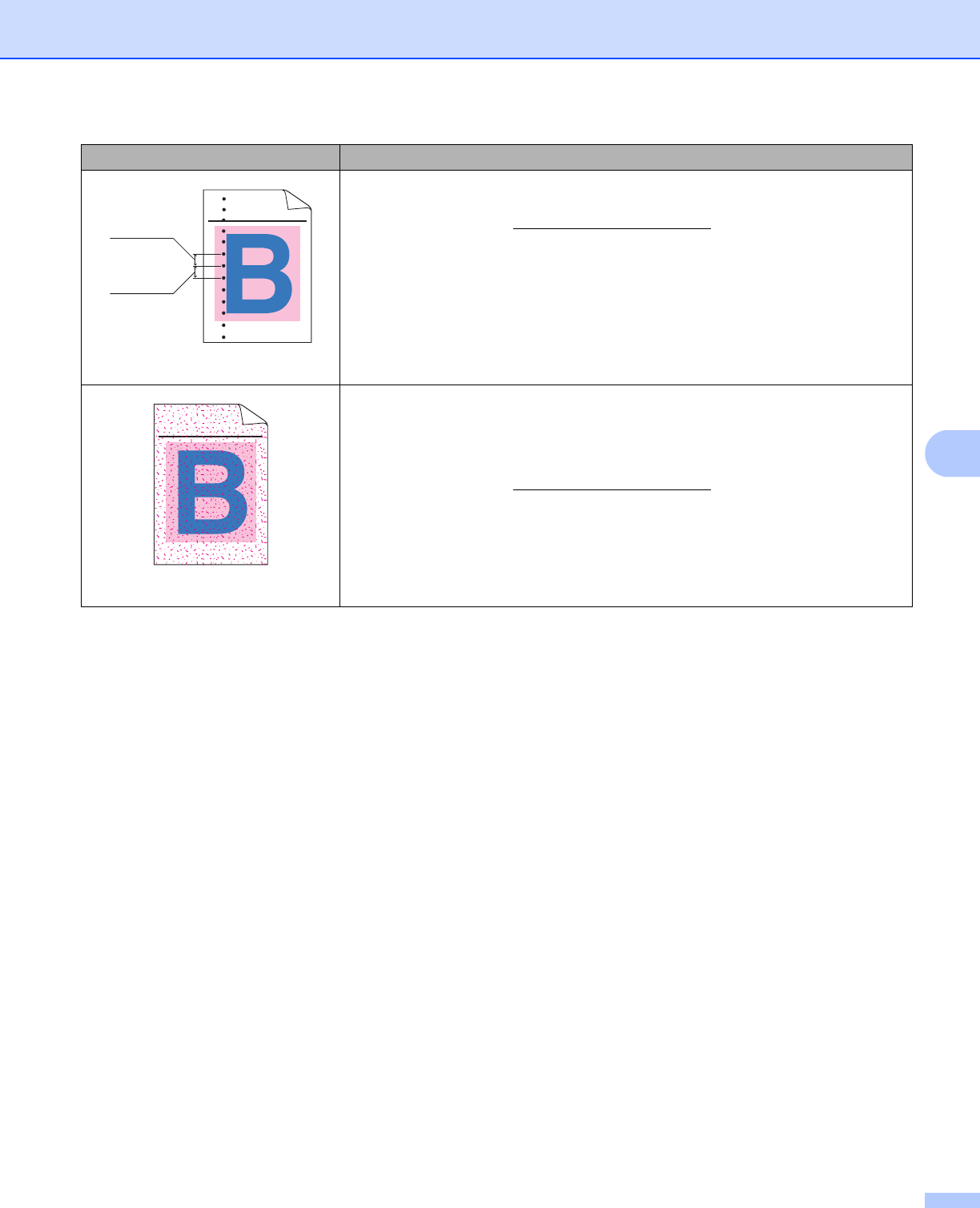
Troubleshooting
195
6
Colored spots at 1.2 in. (30mm)
Identify the color causing the problem and put in a new toner cartridge
(see Replacing the toner cartridges on page 123). To identify the color of the
toner cartridge, visit http://solutions.brother.com/ to view our FAQs and
troubleshooting tips.
Toner scatter or toner stain
Check the machine’s environment. Conditions such as high humidity and
high temperatures may cause this print quality problem.
Identify the color causing the problem and put in a new toner cartridge
(see Replacing the toner cartridges on page 123). To identify the color of the
toner cartridge, visit http://solutions.brother.com/ to view our FAQs and
troubleshooting tips.
Install a new drum unit (see Replacing the drum unit on page 128).
Examples of poor print quality Recommendation
ABCDEFGHIJKLMNOPQRSTUVWXYZ. 0123456789. abcdefghijklmnopqrstuvwxyz.
ABCDEFGHIJKLMNOPQRSTUVWXYZ. 0123456789. abcdefghijklmnopqrstuvwxyz.
ABCDEFGHIJKLMNOPQRSTUVWXYZ. 0123456789. abcdefghijklmnopqrstuvwxyz.
ABCDEFGHIJKLMNOPQRSTUVWXYZ. 0123456789. abcdefghijklmnopqrstuvwxyz.
1.2 in.
(30 mm)
1.2 in.
(30 mm)
ABCDEFGHIJKLMNOPQRSTUVWXYZ. 0123456789. abcdefghijklmnopqrstuvwxyz.
ABCDEFGHIJKLMNOPQRSTUVWXYZ. 0123456789. abcdefghijklmnopqrstuvwxyz.
ABCDEFGHIJKLMNOPQRSTUVWXYZ. 0123456789. abcdefghijklmnopqrstuvwxyz.
ABCDEFGHIJKLMNOPQRSTUVWXYZ. 0123456789. abcdefghijklmnopqrstuvwxyz.
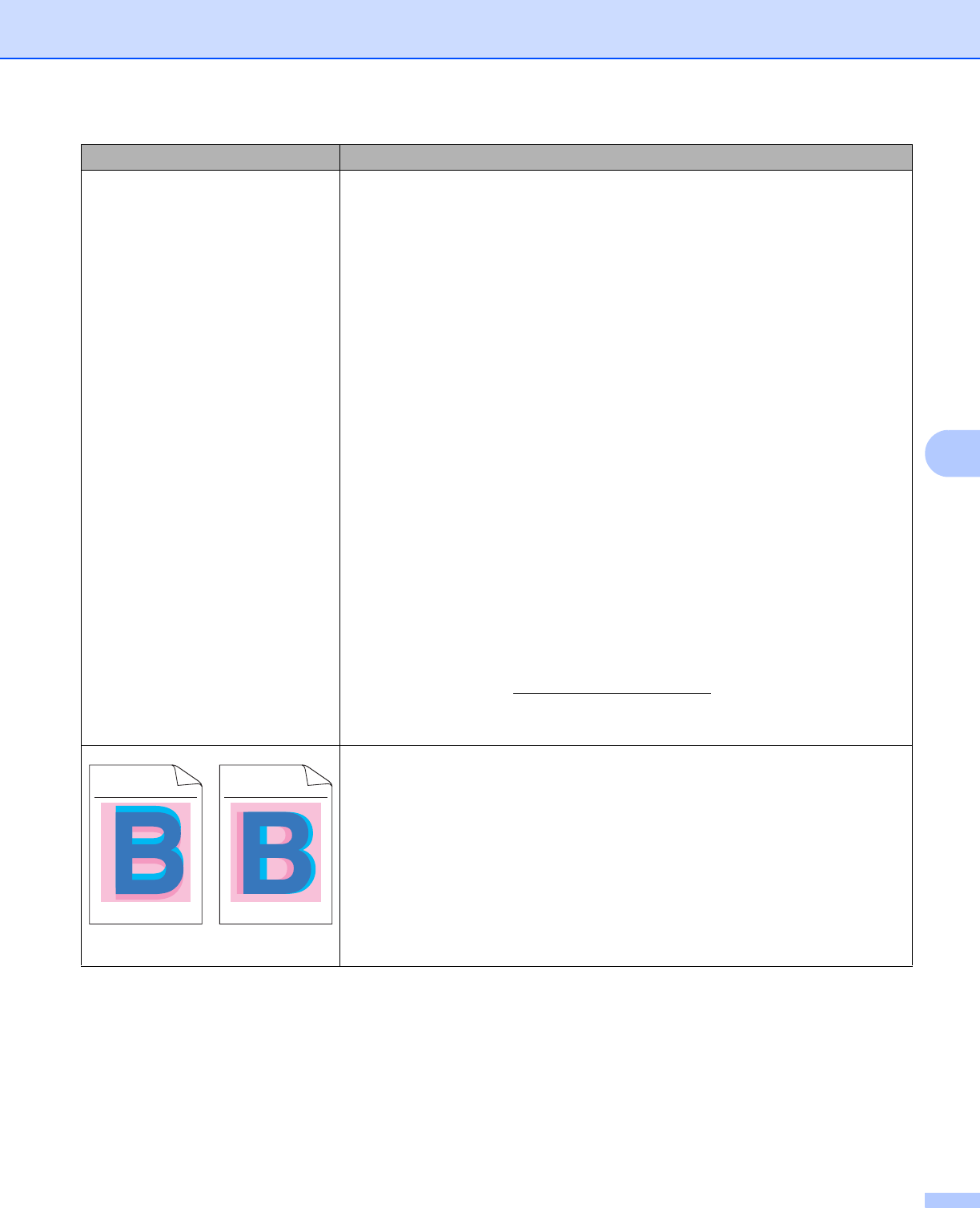
Troubleshooting
196
6
The color of your printouts is not
what you expected
To improve the color density, calibrate the colors using first the control panel
and then the printer driver (see Color Calibration on page 111).
To adjust the print position of colors for sharper edges, perform the color
registration using the control panel (see Color Registration on page 112).
Make sure toner save mode is off in the control panel or the printer driver.
See Toner Save Mode in Advanced tab on page 41 (For Windows® printer
driver), Advanced options on page 58 (For Windows® BR-Script printer
driver), Advanced print settings on page 73 (For Macintosh printer driver),
Printer Features on page 77 (For Macintosh BR-Script printer driver).
If the print quality is poor, clear the Improve Gray Color check box of the
printer driver. See Improve Gray Color in Settings dialog box on page 36
(for Windows® printer driver), Advanced options on page 58 (for Windows®
BR-Script printer driver), Advanced print settings on page 73 (for Macintosh
printer driver), or Printer Features on page 77 (for Macintosh BR-Script
printer driver).
If the print quality of the black portion is not what you expected, select the
Enhance Black Printing check box of the printer driver. See Enhance
Black Printing in Settings dialog box on page 36 (for Windows® printer
driver), Advanced options on page 58 (for Windows® BR-Script printer
driver), Advanced print settings on page 73 (for Macintosh printer driver), or
Printer Features on page 77 (for Macintosh BR-Script printer driver).
Identify the color causing the problem and put in a new toner cartridge
(see Replacing the toner cartridges on page 123). To identify the color of the
toner cartridge, visit http://solutions.brother.com/ to view our FAQs and
troubleshooting tips.
Install a new drum unit (see Replacing the drum unit on page 128).
Color misregistration
Make sure that the machine is on a solid level surface.
Perform the color registration using the control panel (see Color Registration
on page 112).
Install a new drum unit (see Replacing the drum unit on page 128).
Install a new belt unit (see Replacing the belt unit on page 135).
Examples of poor print quality Recommendation
ABCDEFGHIJKLMNOPQRSTUVWXYZ. 0123456789. abcdefg hijkl mnop qrstuvw xyz.
ABCDEFGHIJKLMNOPQRSTUVWXYZ. 0123456789. abcdefg hijkl mnop qrstuvw xyz.
ABCDEFGHIJKLMNOPQRSTUVWXYZ. 0123456789. abcdefg hijkl mnop qrstuvw xyz.
ABCDEFGHIJKLMNOPQRSTUVWXYZ. 0123456789. abcdefg hijkl mnop qrstuvw xyz.
ABCDEFGHIJKLMNOPQRSTUVWXYZ. 0123456789. abcdefg hijkl mnop qrstuvw xyz.
ABCDEFGHIJKLMNOPQRSTUVWXYZ. 0123456789. abcdefg hijkl mnop qrstuvw xyz.
ABCDEFGHIJKLMNOPQRSTUVWXYZ. 0123456789. abcdefg hijkl mnop qrstuvw xyz.
ABCDEFGHIJKLMNOPQRSTUVWXYZ. 0123456789. abcdefg hijkl mnop qrstuvw xyz.
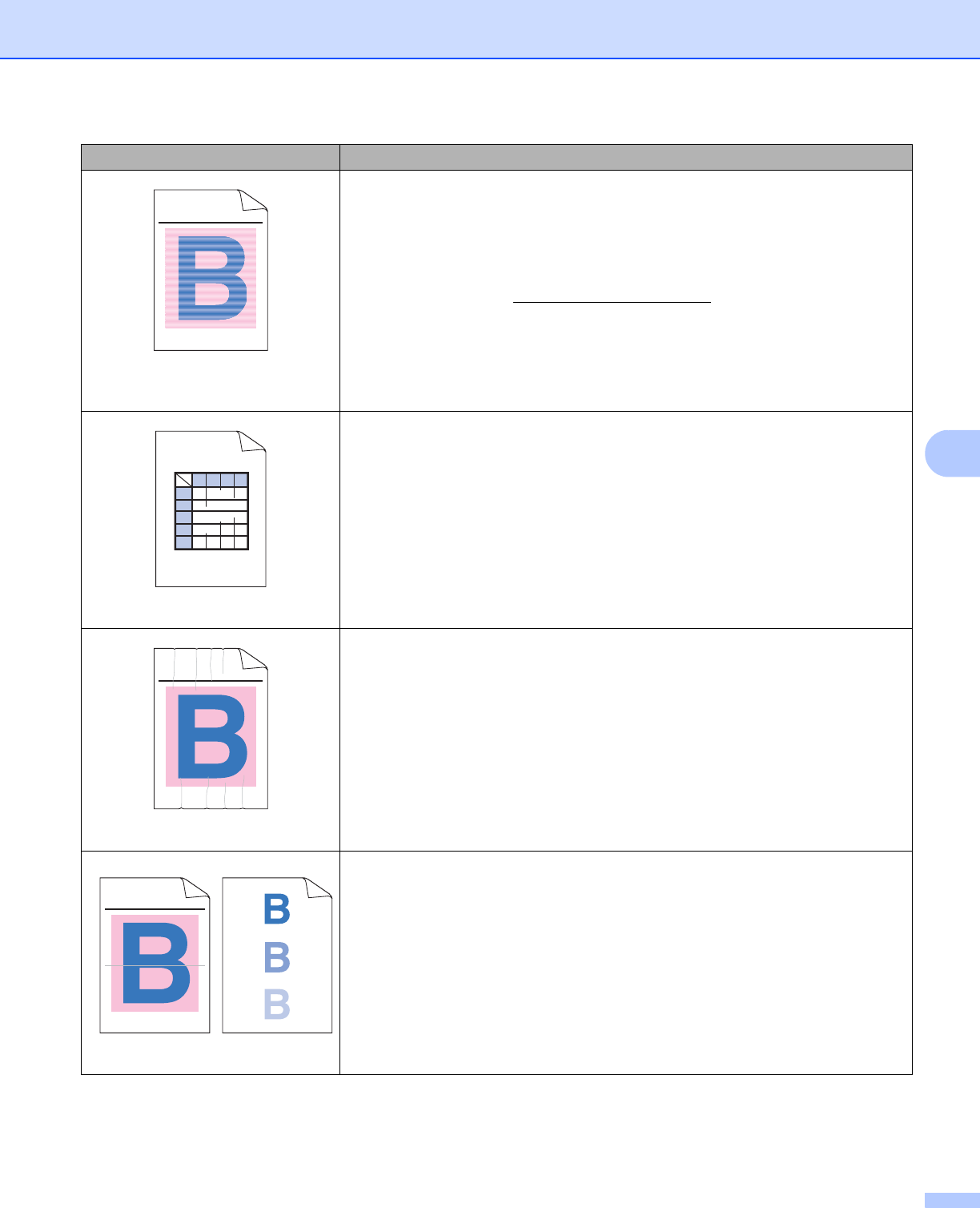
Troubleshooting
197
6
Uneven density appears
periodically across the page
Perform the calibration using the control panel or the printer driver (see Color
Calibration on page 111).
Clear the Improve Gray Color check box of the printer driver.
Identify the color causing the problem and put in a new toner cartridge
(see Replacing the toner cartridges on page 122). To identify the color of the
toner cartridge, visit http://solutions.brother.com/ to view our FAQs and
troubleshooting tips.
Install a new drum unit (see Replacing the drum unit on page 128).
Missing image at thin line
Make sure toner save mode is off in the control panel or the printer driver.
See Toner Save Mode in Advanced tab on page 41 (for Windows® printer
driver), Advanced options on page 58 (for Windows® BR-Script printer
driver), Advanced print settings on page 73 (for Macintosh printer driver), or
Printer Features on page 77 (for Macintosh BR-Script printer driver).
Change the print resolution.
If you use a Windows printer driver, choose Improve Pattern Printing in
Print Setting of the Basic tab (see Settings dialog box on page 36).
Wrinkled
Check the paper type and quality (see Acceptable paper and other print
media on page 2).
Make sure that the back cover is closed completely.
Make sure that the two gray levers inside the back cover are in the up
positions.
Make sure that the media type setting in the driver matches the type of paper
you are using (see Acceptable paper and other print media on page 2).
Ghost
Check the machine’s environment. Conditions such as low humidity and low
temperatures may cause this print quality problem (see the Product Safety
Guide).
Make sure that the media type setting in the printer driver matches the type
of paper you are using (see Acceptable paper and other print media
on page 2).
Make sure you lift up the two gray levers inside the back cover until they stop
in the up position.
Install a new drum unit (see Replacing the drum unit on page 128).
Examples of poor print quality Recommendation
ABCDEFGHIJKLMNOPQRSTUVWXYZ. 0123456789. abcdefghijklmnopqrstuvwxyz.
ABCDEFGHIJKLMNOPQRSTUVWXYZ. 0123456789. abcdefghijklmnopqrstuvwxyz.
ABCDEFGHIJKLMNOPQRSTUVWXYZ. 0123456789. abcdefghijklmnopqrstuvwxyz.
ABCDEFGHIJKLMNOPQRSTUVWXYZ. 0123456789. abcdefghijklmnopqrstuvwxyz.
A
B
C
D
E
WX Y Z
ABCDEFGHIJKLMNOPQRSTUVWXYZ. 0123456789. abcdefghijklmnopqrstuvwxyz.
ABCDEFGHIJKLMNOPQRSTUVWXYZ. 0123456789. abcdefghijklmnopqrstuvwxyz.
ABCDEFGHIJKLMNOPQRSTUVWXYZ. 0123456789. abcdefghijklmnopqrstuvwxyz.
ABCDEFGHIJKLMNOPQRSTUVWXYZ. 0123456789. abcdefghijklmnopqrstuvwxyz.
ABCDEFGHIJKLMNOPQRSTUVWXYZ. 0123456789. abcdefghijklmnopqrstuvwxyz.
ABCDEFGHIJKLMNOPQRSTUVWXYZ. 0123456789. abcdefghijklmnopqrstuvwxyz.
ABCDEFGHIJKLMNOPQRSTUVWXYZ. 0123456789. abcdefghijklmnopqrstuvwxyz.
ABCDEFGHIJKLMNOPQRSTUVWXYZ. 0123456789. abcdefghijklmnopqrstuvwxyz.
ABCDEFGHIJKLMNOPQRSTUVWXYZ. 0123456789. abcdefghijklmnopqrstuvwxyz.
ABCDEFGHIJKLMNOPQRSTUVWXYZ. 0123456789. abcdefghijklmnopqrstuvwxyz.
ABCDEFGHIJKLMNOPQRSTUVWXYZ. 0123456789. abcdefghijklmnopqrstuvwxyz.
ABCDEFGHIJKLMNOPQRSTUVWXYZ. 0123456789. abcdefghijklmnopqrstuvwxyz.
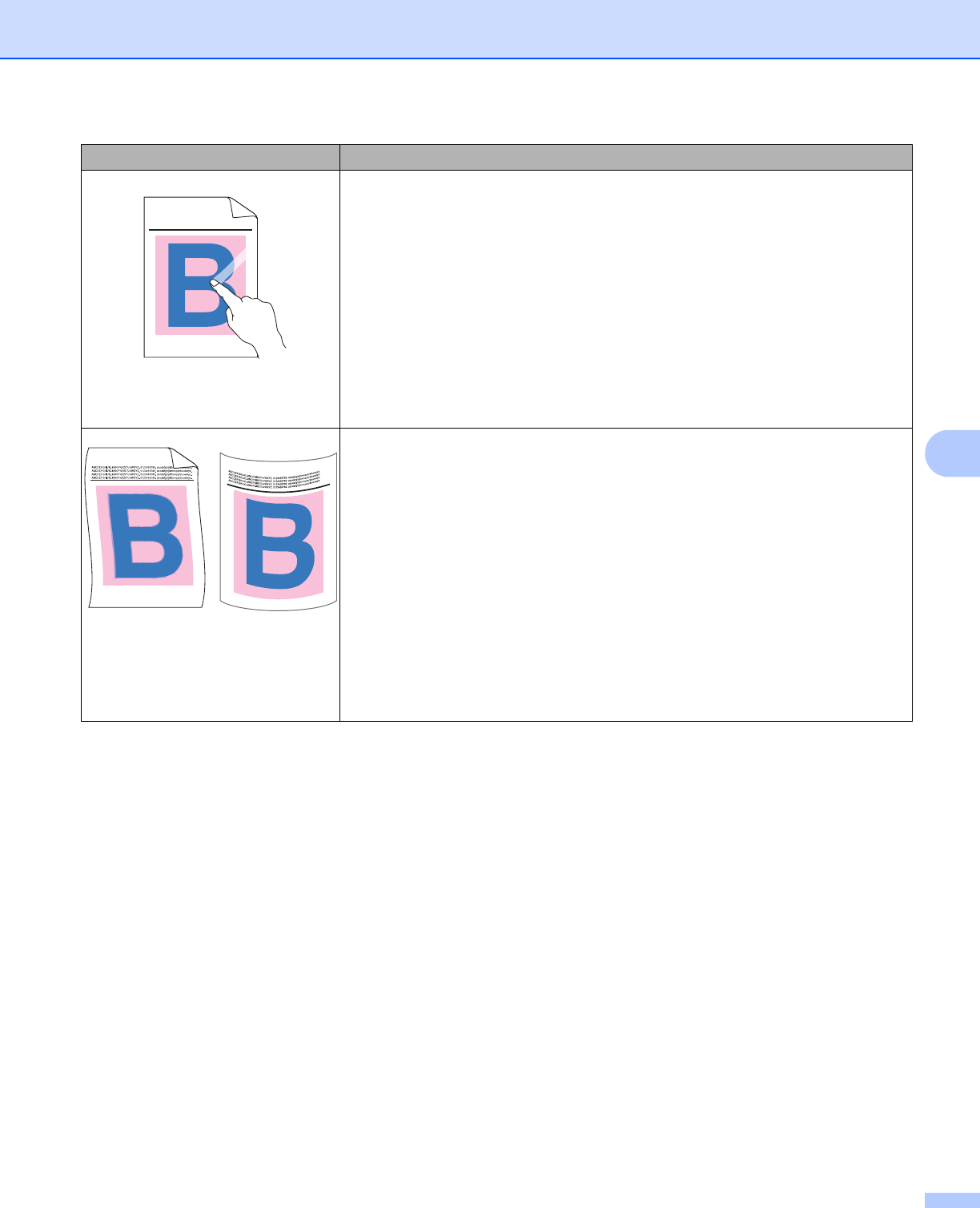
Troubleshooting
198
6
Poor fixing
Make sure you lift up the two gray levers inside the back cover until they stop
in the up position.
Make sure that the media type setting in the printer driver matches the type
of paper you are using (see Acceptable paper and other print media
on page 2).
Choose Improve Toner Fixing mode in the printer driver.
(For Windows, see Other Print Options on page 47.)
(For Macintosh, see Print Settings on page 71.)
If this selection does not provide enough improvement, change the printer
driver setting in Media Type to a thick setting. If you are printing an envelope,
choose Env. Thick in the media type setting.
Curled or wavy
Choose Reduce Paper Curl mode in the printer driver.
(For Windows, see Other Print Options on page 47.)
(For Macintosh, see Print Settings on page 71.)
If the problem is not solved, choose Plain Paper in the media type setting.
If you are printing an envelope, choose Env. Thin in the media type setting.
If you do not use the machine often, the paper may have been in the paper
tray too long. Turn over the stack of paper in the paper tray. Also, fan the
paper stack, and then rotate the paper 180 in the paper tray.
Store the paper where it will not be exposed to high temperatures and high
humidity.
Open the back cover (face-up output tray) to let the printed pages exit onto
the face-up output tray.
Examples of poor print quality Recommendation
ABCDEFGHIJKLMNOPQRSTUVWXYZ. 0123456789. abcdefghijklmnopqrstuvwxyz.
ABCDEFGHIJKLMNOPQRSTUVWXYZ. 0123456789. abcdefghijklmnopqrstuvwxyz.
ABCDEFGHIJKLMNOPQRSTUVWXYZ. 0123456789. abcdefghijklmnopqrstuvwxyz.
ABCDEFGHIJKLMNOPQRSTUVWXYZ. 0123456789. abcdefghijklmnopqrstuvwxyz.
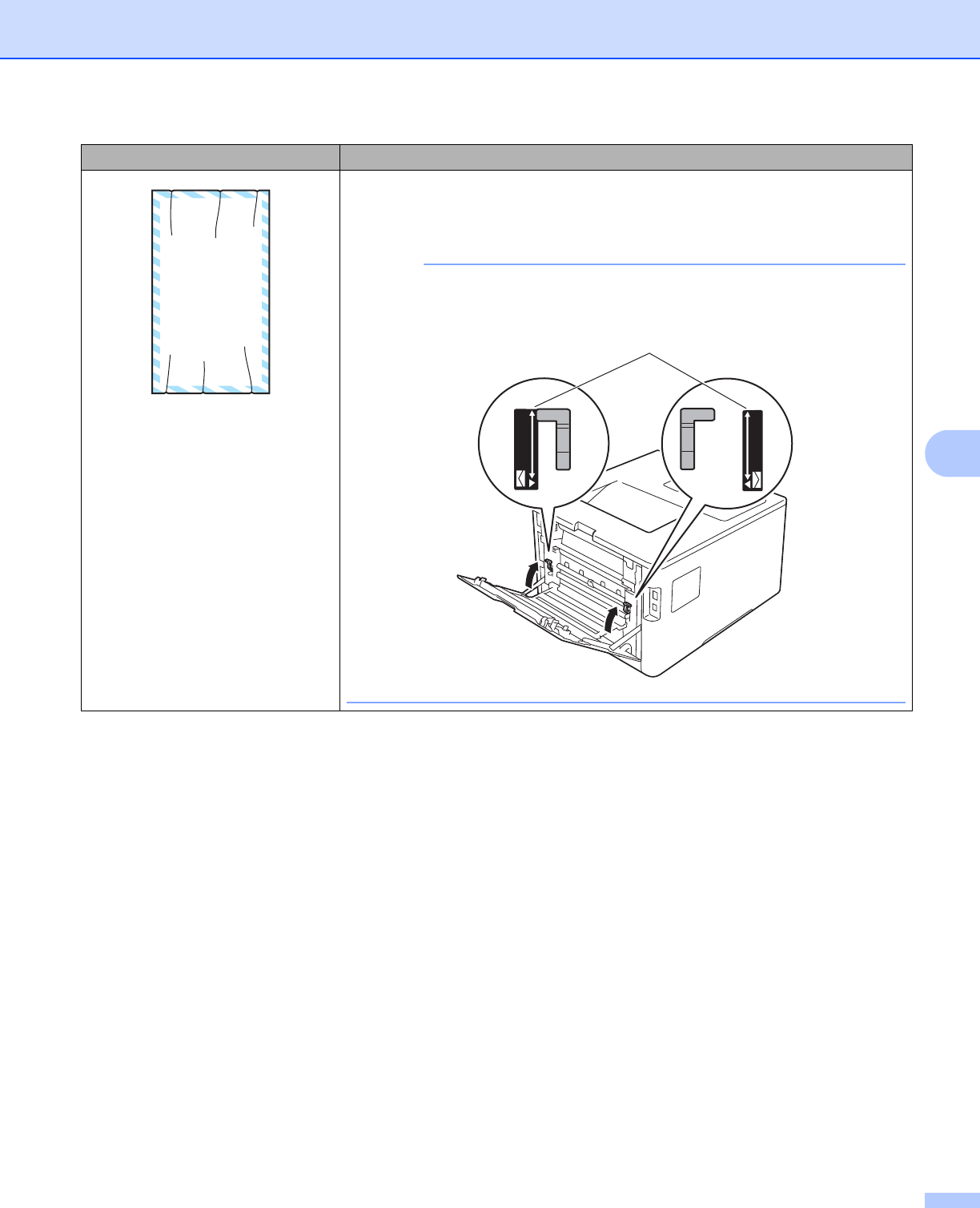
Troubleshooting
199
6
Envelope Creases
Make sure that the envelope levers inside the back cover are pulled down to
the envelope position when you print envelopes.
See Loading paper in the multi-purpose tray (MP tray) on page 12.
NOTE
When you have finished printing, open the back cover and reset the two gray
levers back to their original positions (1) by lifting them up until they stop.
Examples of poor print quality Recommendation
ABCDEFG
EFGHIJKLMN
1

Troubleshooting
200
6
Machine Information 6
Checking the Serial Number 6
You can see the machine’s Serial Number on the LCD.
aPress aor b ( + or -) to choose Machine Info.. Press OK.
bPress aor b ( + or -) to choose Serial No.. Press OK.
Default settings 6
The machine has three levels of default settings; the default settings have been set at the factory before
shipment (see Settings table on page 88).
Network
Factory Reset
Settings Reset
NOTE
• Changing the default settings does not modify the preset factory defaults.
• Page counters can never be changed.
Network default settings 6
To reset only the print server back to its default settings (by resetting all network information such as the
password and IP address), follow these steps:
aPress aor b ( + or -) to choose Reset Menu. Press OK.
bPress aor b ( + or -) to choose Network. Press OK.
cPress ato choose Reset.
dPress ato choose Yes. The machine will restart automatically.
Factory Reset 6
You can partially reset the machine back to its factory printer settings. The settings that will not be reset are
the Interface, Local Language, Setting Lock, Secure Function Lock and the Network settings:
aPress aor b ( + or -) to choose Reset Menu. Press OK.
bPress aor b ( + or -) to choose Factory Reset. Press OK.
cPress ato choose Reset.

Troubleshooting
201
6
Settings Reset 6
This operation will reset all the machine's settings back to the defaults that were set at the factory.
aDisconnect the network cable from the machine; otherwise the network settings (such as IP address) will
not be reset.
bPress aor b ( + or -) to choose Reset Menu. Press OK.
cPress aand Cancel at the same time. Press OK after Settings Reset appears.
dPress ato choose Reset.
ePress ato choose Yes. The machine will restart automatically.
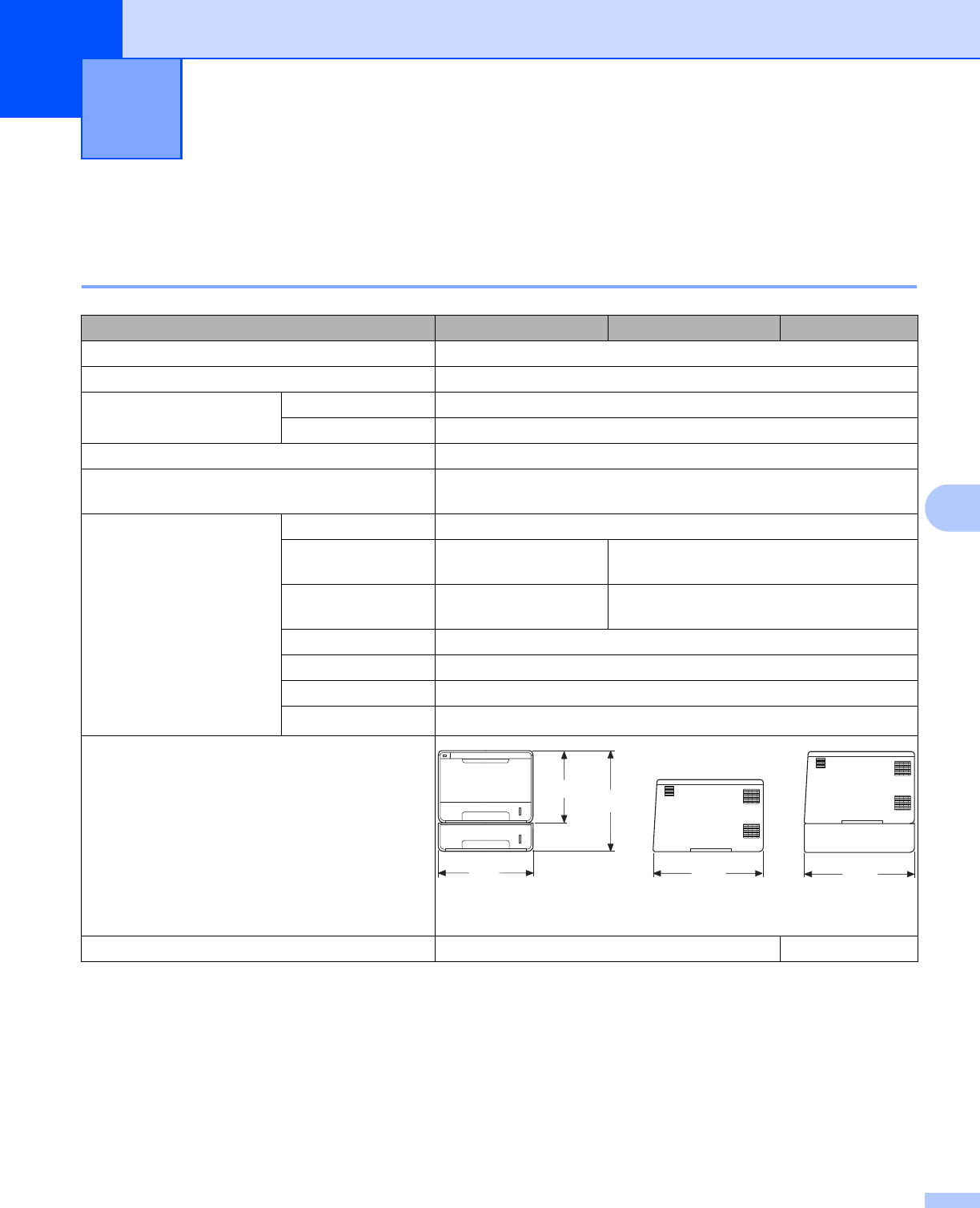
202
A
A
Machine specifications A
General A
1USB connections to computer.
2Measured according to IEC 62301 Edition 2.0.
3Power consumption varies slightly depending on the usage environment or part wear.
Appendix A
Model HL-L8250CDN HL-L8350CDW HL-L8350CDWT
Printer Type Laser
Print Method Electrophotographic Laser Printer (single-pass)
Memory Capacity Standard 128 MB
Optional 1 slot: DDR2 SO-DIMM (144-pin) up to 256 MB
LCD (liquid crystal display) 16 characters 2 lines
Power Source 110 - 120 V
AC 50/60 Hz
Power Consumption 1
(Average)
Peak Approx. 1170 W
Printing Approx. 530 W at
77 F (25 C)
Approx. 555 W at 77 F (25 C)
Printing
(Quiet Mode)
Approx. 370 W Approx. 375 W
Ready Approx. 65 W at 77 F (25 C)
Sleep Approx. 8.5 W
Deep Sleep
Power Off 23 Approx. 0.02 W
Dimensions
Weights (with supplies) 47.5 lb (21.5 kg) 61.4lb (27.8kg)
16.1
(410)
12.3 (313)*
17.5 (445)**
* : HL-L8250CDN
HL-L8350CDW
** : HL-L8350CDWT
19.5
(495)**
19.1
(486)*
Approx. 0.9 W
Appendix
203
A
1Measured in accordance with the method described in RAL-UZ171.
Model HL-L8250CDN HL-L8350CDW HL-L8350CDWT
Noise Level Sound Pressure Printing
Lp
A
m = 53.5 dB (A)
Lp
A
m = 55.0 dB (A)
Ready LpAm = 27.9 dB (A)
Lp
A
m = 27.3 dB (A)
Printing
(Quiet Mode)
Lp
A
m = 51.1 dB (A) Lp
A
m = 50.6 dB (A) Lp
A
m = 50.8 dB (A)
Sound Power 1Printing LWAd = 6.75 B (A) LWAd = 6.78 B (A)
Ready LWAd = 4.06 B (A)
Printing
(Quiet Mode)
(Color)
LWAd = 6.30 B (A)
(Mono)
LWAd = 6.35 B (A)
(Color)
LWAd = 6.33 B (A)
(Mono)
LWAd = 6.35 B (A)
(Color)
LWAd = 6.39 B (A)
(Mono)
LWAd = 6.41 B (A)
Temperature Operating 50 F to 90 F (10 to 32 C)
Storage 32 F to 104 F (0 to 40 C)
Humidity Operating 20 - 80% (without condensation)
Storage 10 - 90% (without condensation)

Appendix
204
A
Print media A
1For labels, we recommend removing the printed sheets from the output paper tray immediately after they exit the machine to avoid the possibility
of smudging.
2For glossy paper, place only one sheet in the MP Tray.
3Tray 2 is standard on HL-L8350CDWT.
Model HL-L8250CDN HL-L8350CDW HL-L8350CDWT
Paper Input 1Paper Tray
(Standard)
Paper Type Plain Paper, Thin Paper, Recycled Paper
Paper Size Letter, A4, B5 (JIS), A5, A5 (Long Edge), A6, Executive,
Legal, Folio
Paper Weight 16 to 28 lb (60 to 105 g/m2)
Maximum Paper
Capacity Up to 250 sheets of 20 lb (80 g/m2) Plain paper
Multi-purpose
tray
(MP tray)
Paper Type Plain Paper, Thin Paper, Thick Paper, Thicker Paper,
Recycled Paper, Bond Paper, Label, Envelope, Env.Thin,
Env.Thick, Glossy Paper 2
Paper Size Width: 3 to 8.5 in (76.2 to 215.9 mm)
Length: 5 to 14 in (127 to 355.6 mm)
Paper Weight 16 to 43 lb (60 to 163 g/m2)
Maximum
Paper
Capacity
Up to 50 sheets of 20 lb (80 g/m2) Plain paper
Paper Tray 2
(Optional) 3
Paper Type Plain Paper, Thin Paper, Recycled Paper
Paper Size Letter, A4, B5 (JIS), A5, Executive, Legal, Folio
Paper Weight 16 to 28 lb (60 to 105 g/m2)
Maximum Paper
Capacity Up to 500 sheets of 20 lb (80 g/m2) Plain paper
Paper Output 1Face-Down Output Tray Up to 150 sheets of 20 lb (80 g/m2) Plain paper (face-down
delivery to the face-down output paper tray)
Face-Up Output Tray One sheet (face-up delivery to the face-up output tray)
2-sided Automatic
2-sided Printing
Paper Type Plain Paper, Thin Paper, Recycled Paper, Glossy Paper
Paper Size Letter, Legal, Folio
Paper Weight 16 to 28 lb (60 to 105 g/m2)
Appendix
205
A
Printer A
1The print speed may change depending on the type of document you print.
2Print speed may be slower when the machine is connected by wireless LAN.
3From Ready mode and standard tray
Interface A
1Your machine has a Hi-Speed USB 2.0 interface. The machine can also be connected to a computer that has a USB 1.1 interface.
2Third party USB ports are not supported.
3For detailed network specifications, see Network (LAN) on page 206 and see the Network User's Guide.
Model HL-L8250CDN HL-L8350CDW HL-L8350CDWT
Automatic 2-sided Print Yes
Emulation PCL6, BR-Script3 (PostScript® 3™)
Resolution 600 600 dpi
2400dpi (2400 600) quality
Print Speed 12 Single side
print
Monochrome Up to 30 ppm (Letter size)
Up to 28 ppm (A4 size)
Up to 32 ppm (Letter size)
Up to 30 ppm (A4 size)
Full color Up to 30 ppm (Letter size)
Up to 28 ppm (A4 size)
Up to 32 ppm (Letter size)
Up to 30 ppm (A4 size)
2-sided Print Monochrome Up to 14 sides per minute (7 sheets per minute) (Letter or A4 size)
Full color Up to 14 sides per minute (7 sheets per minute) (Letter or A4 size)
First Print Time 3(Color)
Less than 15 seconds at 73.4 F (23 C) / 115 V
(Mono)
Less than 15 seconds at 73.4 F (23 C) / 115 V
Model HL-L8250CDN HL-L8350CDW HL-L8350CDWT
USB Hi-Speed USB 2.0 12
We recommend using a USB 2.0 cable (Type A/B) that is no more than 6 feet (2 meters)
long.
Ethernet 310BASE-T / 100BASE-TX
Use a straight-through Category 5 (or greater) twisted-pair cable.
Wireless LAN 3- IEEE 802.11b/g/n (Infrastructure Mode/Ad-hoc Mode)
IEEE 802.11g (Wi-Fi Direct)
Appendix
206
A
Network (LAN) A
1(For Windows® users) Brother BRAdmin Light is available from the CD-ROM provided with the machine.
(For Macintosh users) Brother BRAdmin Light is available as a download from http://solutions.brother.com/.
2(For Windows® users) If you want more advanced printer management, use the latest Brother BRAdmin Professional utility version that is
available as a download from http://solutions.brother.com/.
Direct Print feature A
1PDF data including a JBIG2 image file, a JPEG2000 image file or a transparency file is not supported.
Model HL-L8250CDN HL-L8350CDW HL-L8350CDWT
LAN You can connect your machine to a network for Network Printing.
Also included is Brother BRAdmin Light 12
Network Management
software.
Protocols IPv4 ARP, RARP, BOOTP, DHCP, APIPA(Auto IP), WINS/NetBIOS name
resolution, DNS Resolver, mDNS, LLMNR responder, LPR/LPD,
Custom Raw Port/Port9100, IPP/IPPS, FTP Server, TELNET Server,
HTTP/HTTPS server, TFTP client and server, SMTP Client,
SNMPv1/v2c/ v3, ICMP, Web Services (Print), CIFS client, SNTP client
IPv6 NDP, RA, DNS resolver, mDNS, LLMNR responder, LPR/LPD, Custom
Raw Port/Port9100, IPP/IPPS, FTP Server,TELNET Server,
HTTP/HTTPS server, TFTP client and server, SMTP Client,
SNMPv1/v2c/v3, ICMPv6, Web Services (Print), CIFS Client, SNTP
Client
Security Protocols Wired SMTP-AUTH, SSL/TLS (IPPS, HTTPS, SMTP), SNMP v3
802.1x (EAP-MD5, EAP-FAST, PEAP, EAP-TLS, EAP-TTLS),
Kerberos, IPSec
Wireless - SMTP-AUTH, SSL/TLS (IPPS, HTTPS,
SMTP), SNMP v3
802.1x (LEAP, EAP-FAST, PEAP, EAP-TLS,
EAP-TTLS), Kerberos, IPSec
Wireless Network Security - WEP 64/128 bit, WPA-PSK (TKIP/AES),
WPA2-PSK (AES)
Wireless Network Setup
Support Utility
AOSS™ -Yes
WPS -Yes
Model HL-L8250CDN HL-L8350CDW HL-L8350CDWT
Compatibility PDF version 1.7 1, JPEG, Exif+JPEG, PRN (created by Brother printer driver),
TIFF (scanned by all Brother MFC or DCP models), XPS version 1.0
Interface USB direct interface
Appendix
207
A
Computer requirements A
1Third party USB ports are not supported.
For the latest driver updates, visit http://solutions.brother.com/.
All trademarks, brand and product names are property of their respective companies.
Computer Platform &
Operating System Version
PC Interface Processor Hard Disk
Space to
install
USB 110/100
Base-TX
(Ethernet)
Wireless
802.11b/g/n
Windows®
Operating
System
Windows® XP Home
Windows® XP
Professional
Printing 32bit (x86) or 64bit
(x64) processor
80 MB
Windows® XP
Professional x64
Edition
64bit (x64) processor
Windows Vista®32bit (x86) or 64bit
(x64) processor
Windows® 7
Windows® 8
Windows® 8.1
Windows Server®
2003
Printing 32bit (x86) or 64bit
(x64) processor
Windows Server®
2003 x64 Edition
64bit (x64) processor
Windows Server®
2008
32bit (x86) or 64bit
(x64) processor
Windows Server®
2008 R2
64bit (x64) processor
Windows Server®
2012
64bit (x64) processor
Windows Server®
2012 R2
64bit (x64) processor
Macintosh
Operating
System
OS X v10.7.5 Printing Intel® Processor 80 MB
OS X v10.8.x
OS X v10.9.x

Appendix
208
A
Important information for choosing your paper A
The information in this section will help you choose paper to use with this machine.
NOTE
If you use paper that is not recommended, a paper jam or misfeed may occur in the machine.
Before you buy a large quantity of paper A
Make sure that the paper is appropriate for the machine.
Paper for plain paper copies A
Paper is divided by usage, such as paper for printing and paper for copying. The usage is usually written on
the paper’s package. Check the package to see whether it is appropriate for laser printers. Use paper that is
appropriate for laser printers.
Basis weight A
The basis weight of the paper for general use varies in different countries. We recommend using paper that
weighs 20 to 24 lb (75 to 90 g/m2), although this machine is able to cope with thinner or thicker paper than
these weights.
Long grain and short grain A
The pulp fiber of the paper is aligned during paper manufacturing. Paper can be classified into two types, long
grain and short grain.
Long grain paper fibers run in the same direction as the long edge of the paper. Short grain paper fibers run
perpendicular to the long edge of the paper. Though most plain paper for copying is long grain, some is short
grain. We recommend using long grain paper for this machine. Short grain paper is too weak for the paper
transport of the machine.
Acid paper and neutralized paper A
Paper can be classified as either acid paper or neutralized paper.
Though modern paper manufacture methods started with acid paper, neutralized paper is recently taking the
place of acid paper because of environmental issues.
However, many forms of acid paper can be found in recycled paper. We recommend using neutralized paper
for this machine.
Use an acid paper check pen to distinguish acid paper from neutral paper.
Print surface A
The characteristics of the face side and reverse side of a sheet of paper may vary a little.
Usually, the opening side of the paper ream package is the print side. Follow the instructions on the paper
package. Typically, the print side is indicated by an arrow.
Appendix
209
A
Supplies A
1Approximate cartridge yield is declared in accordance with ISO/IEC 19798.
2Life of supply is approximate and may vary by type of use.
Model HL-L8250CDN HL-L8350CDW HL-L8350CDWT Order No.
Toner
Cartridge
Inbox Black Approx. 2,500 pages Letter or A4 page 1-
Cyan,
Magenta,
Yellow
Approx. 1,500 pages Letter or A4 page 1-
Standard Black Approx. 2,500 pages Letter or A4 page 1TN-331BK
Cyan,
Magenta,
Yellow
Approx. 1,500 pages Letter or A4 page 1TN-331C,
TN-331M,
TN-331Y
High Yield Black Approx. 4,000 pages Letter or A4 page 1TN-336BK
Cyan,
Magenta,
Yellow
Approx. 3,500 pages Letter or A4 page 1TN-336C,
TN-336M,
TN-336Y
Drum Unit Approx. 25,000 pages Letter or A4 pages 2DR-331CL
Belt Unit 50,000 pages (5 pages per job) 2
20,000 pages (1 page per job) 2
BU-320CL
Waste Toner Box Approx. 50,000 pages Letter or A4 pages 2WT-320CL

Appendix
210
A
Important information for the toner cartridge life A
Color/Mono setting in the printer driver A
Users can change the Color/Mono settings on the printer driver as follows:
Auto
The machine checks the content of the document for color. If color is detected anywhere in the document,
it will print the whole of the document using all the colors. In other words, it will mix some of the toners to
help achieve every shade detected in the document, increasing the density of toner applied to the page.
If no color content is detected, it will print the document in monochrome.
The default setting on your machine is Auto.
NOTE
The machine’s color sensor is very sensitive and may perceive faded black text or an off-white background
as color. If you know that your document is black and white and you want to conserve color toner, select
Mono mode.
Color
Whether the document contains color or just monochrome, your machine will print the document using all
the colors.
Mono
Select this mode if the document has only black and grayscale text and/or objects. If your document
contains color, this mode prints the document in 256 levels of gray using the black toner.
NOTE
If either the Cyan, Magenta or Yellow toner reaches the end of its life while printing a color document, the
print job cannot be completed. You can cancel your print job and choose to start the print job again in
Mono mode, as long as Black toner is available.
For more information about the settings in the printer driver, see Chapter 2: Driver and Software.
Toner Cartridge Life A
This product detects the life of the toner cartridges using the following two methods:
Detection by counting the dots of each color that are necessary to create an image
Detection by counting the rotations of the developer roller
This product has a function that will count the dots of each color used to print every document and the
rotations of each toner cartridge’s developer roller. The print operation will stop when either one of the
upper limits are reached. The upper limit is set above the number of dots or rotations that would be
required for the cartridge to perform consistently with its advertised page yield (for more information on
page yield, please visit http://www.brother.com/pageyield). This function is intended to reduce the risk of
poor print quality and damage to the machine.
There are two messages that indicate when the toner nears or reaches its life end: Toner Low and
Replace Toner.

Appendix
211
A
Toner Low is displayed on the LCD when the number of dots or rotations of the developer roller nears its
maximum count: Replace Toner is displayed on the LCD when the number of dots or rotations of the
developer roller reaches its maximum count.
Color Correction A
The number of developer roller rotations that are counted may not only be for normal operations such as
printing, but also for machine adjustments, such as Color Calibration and Color Registration.
Color Calibration (Adjustment of Color Density)
To obtain stable print quality, the density of each toner cartridge needs to be maintained at a fixed value.
If the density balance between the colors cannot be kept, the tint becomes unstable, and accurate color
reproduction becomes unavailable. The toner density can change due to chemical changes to the toner
that affect its electrical charge, deterioration of the developer unit, and temperature and humidity levels in
the device. When calibration occurs, the density level adjustment test patterns are printed on the belt unit.
Calibration is mainly performed at the following times:
• When the user manually selects calibration from the operation panel or the printer driver.
(Please perform calibration if color density needs to be improved.)
• When a used toner cartridge is replaced with a new one.
• When the printer senses that the ambient temperature and humidity have changed.
• When a specified number of printed pages is reached.
Color Registration (Correction of Color Position)
In this device, the drum unit and developer unit are prepared for black (K), yellow (Y), magenta (M), and
cyan (C), respectively. Four color images are combined into one image, and therefore color registration
errors (i.e., how the four color images align) might occur. When registration errors occur, registration
correction test patterns are printed on the belt unit.
Registration is mainly performed at the following times:
• When the user manually selects registration from the operation panel.
(Please perform registration if a color registration error needs to be corrected.)
• When a specified number of printed pages is reached.

Appendix
212
A
Brother numbers A
IMPORTANT
For technical and operational help, you must call the country where you bought the machine. Calls must
be made from within that country.
Register your product A
By registering your product with Brother International Corporation, you will be recorded as the original owner
of the product.
Your registration with Brother:
may serve as a confirmation of the purchase date of your product should you lose your receipt;
may support an insurance claim by you in the event of product loss covered by insurance; and,
will help us notify you of enhancements to your product and special offers.
Complete the Brother Warranty Registration or, for your convenience and most efficient way to register your
new product, register on-line at
http://www.brother.com/registration/
FAQs (frequently asked questions) A
The Brother Solutions Center is our one-stop resource for all your machine needs. Download the latest
software and utilities and read FAQs and troubleshooting tips to learn how to get the most from your Brother
product.
http://solutions.brother.com/
Check here for Brother driver updates.

Appendix
213
A
Customer Service A
If you have comments or suggestions, write us at:
Service center locator (USA only) A
For the location of a Brother authorized service center, call 1-877-BROTHER (1-877-276-8437),
or visit http://www.brother-usa.com/service/.
Service center locations (Canada only) A
For the location of a Brother authorized service center, visit www.brother.ca/support
In USA: http://www.brother-usa.com/support (Self-Service/Email/Chat)
1-877-BROTHER (1-877-276-8437)
In Canada: www.brother.ca/support
(Self-Service, Videos, Email, Chat, Facebook and Twitter Help)
In USA: Printer Customer Support
Brother International Corporation
7905 North Brother Boulevard
Bartlett, TN 38133
In Canada: Brother International Corporation (Canada), Ltd.
Customer Experience Team
1, rue Hotel de Ville Dollard-des-Ormeaux, PQ, Canada H9B 3H6
Internet addresses
Brother Global Web Site: http://www.brother.com/
For Frequently Asked Questions (FAQs), Product Support and Technical Questions, and Driver Updates and Utilities:
http://solutions.brother.com/
For Brother Accessories & Supplies:
In USA: http://www.brothermall.com/
In Canada: http://www.brother.ca/

Appendix
214
A
Ordering supplies A
For best quality results use only genuine Brother supplies, which are available at most Brother retailers. If you
cannot find the supply you need and have a Visa, MasterCard, Discover, or American Express credit card, or
PayPal account, you can order directly from Brother. Visit us online for a complete selection of the Brother
accessories and supplies that are available for purchase.
NOTE
In Canada, only Visa and MasterCard are accepted.
1Letter or A4 size single-sided pages.
2Approx. cartridge yield is declared in accordance with ISO/IEC 19798.
3Life is approximate and may vary by type of use.
In USA: 1-877-552–MALL (1-877-552-6255)
1-800-947-1445 (fax)
http://www.brothermall.com/
In Canada: http://www.brother.ca/
Description Item
Toner Cartridge <Black> TN-331BK (Standard, Approx. 2,500 pages) 12
TN-336BK (High Yield, Approx. 4,000 pages) 12
Toner Cartridge <Cyan> TN-331C (Standard, Approx. 1,500 pages) 12
TN-336C (High Yield, Approx. 3,500 pages) 12
Toner Cartridge <Magenta> TN-331M (Standard, Approx. 1,500 pages) 12
TN-336M (High Yield, Approx. 3,500 pages) 12
Toner Cartridge <Yellow> TN-331Y (Standard, Approx. 1,500 pages) 12
TN-336Y (High Yield, Approx. 3,500 pages) 12
Drum Unit DR-331CL (Approx. 25,000 pages) 13
Waste Toner Box WT-320CL (Approx. 50,000 pages) 13
Belt Unit BU-320CL
50,000 pages (5 pages per job) 13
20,000 pages (1 page per job) 13

Index
215
B
B
Numerics
2-sided printing ......................................................... 20
A
Apple Macintosh .................................................29, 66
Auto Power Off ........................................................ 109
B
Back button ............................................................... 86
Brother Numbers (USA/Canada) ........... 212, 213, 214
BR-Script3 ...........................................................55, 76
Buttons ...................................................................... 85
C
Cancel button ............................................................ 86
Cleaning .................................................................. 148
Color Correction ..............................................101, 111
Computer requirements .......................................... 207
Control panel ............................................................. 85
Control panel LCD menu .......................................... 88
Corona wires ........................................................... 154
D
Data LED .................................................................. 87
Deep Sleep ............................................................... 87
Deep Sleep mode ................................................... 108
Default settings ....................................................... 200
Device Settings tab ................................................... 52
Dimensions ............................................................. 202
Drum unit ................................................................ 128
E
Emulation ................................................................ 205
Envelopes ........................................................ 3, 5, 15
Error LED .................................................................. 87
Error messages ....................................................... 171
F
FAQs (Frequently Asked Questions) ...................... 212
Folio ............................................................................ 3
G
General Setup ........................................................... 92
Go button .................................................................. 86
I
Interface .................................................................. 205
J
Jam 2-sided ............................................................ 178
Jam Inside ............................................................... 184
Jam MP Tray ........................................................... 176
Jam Rear ................................................................ 181
Jam Tray 1 .............................................................. 176
Jam Tray 2 .............................................................. 176
L
Labels .............................................................. 3, 6, 15
LCD (liquid crystal display) ....................................... 85
LED (light-emitting diode) ......................................... 87
Linux ......................................................................... 29
M
Machine Information ............................................... 200
Macintosh ............................................................29, 66
Maintenance messages ..................................119, 120
Manual 2-sided printing ............................................. 23
Media specifications ................................................ 204
Memory ................................................................... 202
Menu Buttons ............................................................ 86
Menu settings ............................................................ 88
N
Network connectivity ............................................... 205
Network menu .....................................................96, 97
Network software ...................................................... 84

Index
216
B
P
Packing and shipping the machine ......................... 166
Paper ..................................................................2, 208
loading ...............................................................8, 12
recommended ......................................................2, 3
size .......................................................................... 2
tray capacity ............................................................. 3
type .......................................................................... 2
Paper jams .............................................................. 176
Paper Tray ................................................................ 91
Plain paper .................................................................. 2
Print
difficulties ............................................................. 188
Macintosh
BR-Script3 printer driver ..................................... 76
Printer driver ....................................................... 66
Windows®
2-sided printing ................................................... 38
Booklet printing ................................................... 39
BR-Script3 printer driver ..................................... 55
Printer driver ....................................................... 33
Print Menu ................................................................. 93
Print quality ............................................................. 192
Printer driver ................................................ 29, 63, 81
Q
Quiet mode ............................................................. 110
R
Register your product .............................................. 212
Reset Menu ............................................................. 101
S
Secure documents .................................................. 104
Service centers (USA/Canada) ............................... 213
Sleep mode .......................................................87, 108
Specifications .......................................................... 202
Status Monitor
Macintosh .............................................................. 82
Windows® .............................................................. 64
Supplies ......................................... 118, 119, 120, 209
Supplies (USA/Canada) .......................................... 214
T
TCP/IP ......................................................... 96, 97, 98
Thick paper ............................................................... 15
Toner cartridge ................................................122, 123
Toner cartridge life .................................................. 210
Troubleshooting ..............................................170, 188
error messages on LCD ....................................... 171
if you are having difficulty
network ............................................................. 190
paper handling .................................................. 189
paper jams ........................................................ 176
printing .............................................................. 188
U
Unprintable area ......................................................... 7
USB direct interface .................................................. 24
USB flash drive ......................................................... 24
Utilities .................................................................... 212
W
Watermark ..........................................................41, 46
Weights ................................................................... 202
Windows® ................................................................. 29
WLAN ..................................................................98, 99
World Wide Web ..................................................... 212
