Buick Owner's Manual 2006 Lacrosse Owners
User Manual: Buick sitemap
Open the PDF directly: View PDF  .
.
Page Count: 438 [warning: Documents this large are best viewed by clicking the View PDF Link!]
- 2006 Buick LaCrosse BOOK TOC
- Seats and Restraint Systems
- Front Seats
- Rear Seats
- Safety Belts
- Safety Belts: They Are for Everyone
- Questions and Answers About Safety Belts
- How to Wear Safety Belts Properly
- Driver Position
- Shoulder Belt Height Adjustment
- Safety Belt Use During Pregnancy
- Right Front Passenger Position
- Center Front Passenger Position
- Rear Seat Passengers
- Rear Safety Belt Comfort Guides
- Safety Belt Pretensioners
- Safety Belt Extender
- Child Restraints
- Older Children
- Infants and Young Children
- Child Restraint Systems
- Where to Put the Restraint
- Lower Anchors and Tethers for Children (LATCH)
- Securing a Child Restraint in a Rear Seat Position
- Securing a Child Restraint in the Center Front Seat Position
- Securing a Child Restraint in the Right Front Seat Position
- Airbag System
- Restraint System Check
- Features and Controls
- Instrument Panel
- Instrument Panel Overview
- Hazard Warning Flashers
- Other Warning Devices
- Horn
- Tilt Wheel
- Turn Signal/Multifunction Lever
- Turn and Lane-Change Signals
- Headlamp High/Low-Beam Changer
- Flash-to-Pass
- Windshield Wipers
- Windshield Washer
- Cruise Control
- Exterior Lamps
- Daytime Running Lamps (DRL)/Automatic Headlamp System
- Fog Lamps
- Exterior Lighting Battery Saver
- Interior Lamps
- Instrument Panel Brightness
- Courtesy Lamps
- Entry Lighting
- Delayed Entry Lighting
- Theater Dimming
- Delayed Exit Lighting
- Perimeter Lighting
- Overhead Console Reading Lamps
- Rear Assist Handle Reading Lamps
- Battery Run-Down Protection
- Ultrasonic Rear Parking Assist (URPA)
- Accessory Power Outlet(s)
- Ashtray(s) and Cigarette Lighter
- Climate Controls
- Warning Lights, Gages, and Indicators
- Instrument Panel Cluster
- Speedometer and Odometer
- Tachometer
- Safety Belt Reminder Light
- Passenger Safety Belt Reminder Light
- Airbag Readiness Light
- Passenger Airbag Status Indicator
- Charging System Light
- Brake System Warning Light
- Anti-Lock Brake System Warning Light
- Traction Control System (TCS) Warning Light
- Engine Coolant Temperature Warning Light
- Engine Coolant Temperature Gage
- Low Coolant Warning Light
- Malfunction Indicator Lamp
- Oil Pressure Light
- Change Engine Oil Light
- Security Light
- Cruise Control Light
- Reduced Engine Power Light
- Highbeam On Light
- Headlamps Suggested Light
- Low Washer Fluid Warning Light
- Door Ajar Light
- Trunk Ajar Light
- Service Vehicle Soon Light
- Fuel Gage
- Low Fuel Warning Light
- Check Gas Cap Light
- Driver Information Center (DIC)
- Audio System(s)
- Instrument Panel Overview
- Driving Your Vehicle
- Your Driving, the Road, and Your Vehicle
- Defensive Driving
- Drunken Driving
- Control of a Vehicle
- Braking
- Anti-Lock Brake System (ABS)
- Braking in Emergencies
- Traction Control System (TCS)
- StabiliTrak® System
- Steering
- Off-Road Recovery
- Passing
- Loss of Control
- Driving at Night
- Driving in Rain and on Wet Roads
- City Driving
- Freeway Driving
- Before Leaving on a Long Trip
- Highway Hypnosis
- Hill and Mountain Roads
- Winter Driving
- If Your Vehicle is Stuck in Sand, Mud, Ice or Snow
- Rocking Your Vehicle to Get It Out
- Loading Your Vehicle
- Towing
- Your Driving, the Road, and Your Vehicle
- Service and Appearance Care
- Service
- Fuel
- Checking Things Under the Hood
- Hood Release
- Engine Compartment Overview
- Engine Oil
- Engine Oil Life System
- Engine Air Cleaner/Filter
- Automatic Transaxle Fluid
- Engine Coolant
- Radiator Pressure Cap
- Engine Overheating
- Overheated Engine Protection Operating Mode
- Cooling System
- Power Steering Fluid
- Windshield Washer Fluid
- Brakes
- Battery
- Jump Starting
- Headlamp Aiming
- Bulb Replacement
- Windshield Replacement
- Windshield Wiper Blade Replacement
- Tires
- Tire Sidewall Labeling
- Tire Terminology and Definitions
- Inflation - Tire Pressure
- Tire Inspection and Rotation
- When It Is Time for New Tires
- Buying New Tires
- Different Size Tires and Wheels
- Uniform Tire Quality Grading
- Wheel Alignment and Tire Balance
- Wheel Replacement
- Tire Chains
- If a Tire Goes Flat
- Changing a Flat Tire
- Removing the Spare Tire and Tools
- Removing the Flat Tire and Installing the Spare Tire
- Storing a Flat or Spare Tire and Tools
- Compact Spare Tire
- Appearance Care
- Cleaning the Inside of Your Vehicle
- Fabric/Carpet
- Leather
- Instrument Panel, Vinyl, and Other Plastic Surfaces
- Care of Safety Belts
- Weatherstrips
- Washing Your Vehicle
- Cleaning Exterior Lamps/Lenses
- Finish Care
- Windshield and Wiper Blades
- Aluminum or Chrome-Plated Wheels
- Tires
- Sheet Metal Damage
- Finish Damage
- Underbody Maintenance
- Chemical Paint Spotting
- Vehicle Care/Appearance Materials
- Vehicle Identification
- Electrical System
- Capacities and Specifications
- Maintenance Schedule
- Maintenance Schedule
- Introduction
- Maintenance Requirements
- Your Vehicle and the Environment
- Using the Maintenance Schedule
- Scheduled Maintenance
- Additional Required Services
- Maintenance Footnotes
- Owner Checks and Services
- At Each Fuel Fill
- At Least Once a Month
- At Least Once a Year
- Recommended Fluids and Lubricants
- Normal Maintenance Replacement Parts
- Maintenance Record
- Maintenance Schedule
- Customer Assistance and Information
- Index

Seats and Restraint Systems ........................... 1-1
Front Seats ............................................... 1-2
Rear Seats ............................................... 1-7
Safety Belts .............................................. 1-8
Child Restraints ....................................... 1-28
Airbag System ......................................... 1-53
Restraint System Check ............................ 1-67
Features and Controls ..................................... 2-1
Keys ........................................................ 2-2
Doors and Locks ...................................... 2-10
Windows ................................................. 2-16
Theft-Deterrent Systems ............................ 2-18
Starting and Operating Your Vehicle ........... 2-22
Mirrors .................................................... 2-36
OnStar
®
System ...................................... 2-38
Universal Home Remote System ................ 2-40
Storage Areas ......................................... 2-44
Sunroof .................................................. 2-47
Instrument Panel ............................................. 3-1
Instrument Panel Overview .......................... 3-4
Climate Controls ...................................... 3-22
Warning Lights, Gages, and Indicators ........ 3-31
Driver Information Center (DIC) .................. 3-49
Audio System(s) ....................................... 3-82
Driving Your Vehicle ....................................... 4-1
Your Driving, the Road, and Your Vehicle ..... 4-2
Towing ................................................... 4-36
Service and Appearance Care .......................... 5-1
Service ..................................................... 5-3
Fuel ......................................................... 5-5
Checking Things Under the Hood ............... 5-10
Headlamp Aiming ..................................... 5-48
Bulb Replacement .................................... 5-51
Windshield Replacement ........................... 5-56
Windshield Wiper Blade Replacement ......... 5-56
Tires ...................................................... 5-57
Appearance Care ..................................... 5-84
Vehicle Identification ................................. 5-92
Electrical System ...................................... 5-93
Capacities and Specifications ..................... 5-98
Maintenance Schedule ..................................... 6-1
Maintenance Schedule ................................ 6-2
Customer Assistance and Information .............. 7-1
Customer Assistance and Information ........... 7-2
Reporting Safety Defects ........................... 7-14
Index ................................................................ 1
2006 Buick LaCrosse Owner Manual M
GENERAL MOTORS, GM, the GM Emblem, BUICK,
and the BUICK Emblem are registered trademarks, and
the name LACROSSE
®
is a trademark of General
Motors Corporation.
This manual includes the latest information at the time it
was printed. We reserve the right to make changes
after that time without notice. For vehicles first sold in
Canada, substitute the name “General Motors of Canada
Limited” for Buick Motor Division whenever it appears
in this manual.
Keep this manual in the vehicle, so it will be there if it
is needed while you are on the road. If the vehicle
is sold, leave this manual in the vehicle.
Canadian Owners
A French language copy of this manual can be obtained
from your dealer or from:
Helm, Incorporated
P.O. Box 07130
Detroit, MI 48207
How to Use This Manual
Many people read the owner manual from beginning to
end when they first receive their new vehicle. If this
is done, it can help you learn about the features
and controls for the vehicle. Pictures and words work
together in the owner manual to explain things.
Index
A good place to quickly locate information about the
vehicle is the Index in the back of the manual. It is
an alphabetical list of what is in the manual and
the page number where it can be found.
Litho in U.S.A.
Part No. 06LACROSSE A First Printing
©
2005 General Motors Corporation. All Rights Reserved.
ii
Safety Warnings and Symbols
There are a number of safety cautions in this book. We
use a box and the word CAUTION to tell about things
that could hurt you if you were to ignore the warning.
{CAUTION:
These mean there is something that could hurt
you or other people.
In the caution area, we tell you what the hazard is.
Then we tell you what to do to help avoid or reduce
the hazard. Please read these cautions. If you do not,
you or others could be hurt.
You will also find a circle
with a slash through it in
this book. This safety
symbol means “Do Not,”
“Do Not do this” or
“Do Not let this happen.”
iii

Vehicle Damage Warnings
Also, in this manual you will find these notices:
Notice: These mean there is something that could
damage your vehicle.
A notice tells about something that can damage the
vehicle. Many times, this damage would not be covered
by your vehicle’s warranty, and it could be costly. But
the notice will tell what to do to help avoid the damage.
When you read other manuals, you might see
CAUTION and NOTICE warnings in different colors
or in different words.
There are also warning labels on the vehicle. They use
the same words, CAUTION or NOTICE.
Vehicle Symbols
The vehicle has components and labels that use
symbols instead of text. Symbols are shown along with
the text describing the operation or information
relating to a specific component, control, message,
gage, or indicator.
If you need help figuring out a specific name of a
component, gage, or indicator, reference the
following topics:
•Seats and Restraint Systems in Section 1
•Features and Controls in Section 2
•Instrument Panel Overview in Section 3
•Climate Controls in Section 3
•Warning Lights, Gages, and Indicators in Section 3
•Audio System(s) in Section 3
•Engine Compartment Overview in Section 5
iv
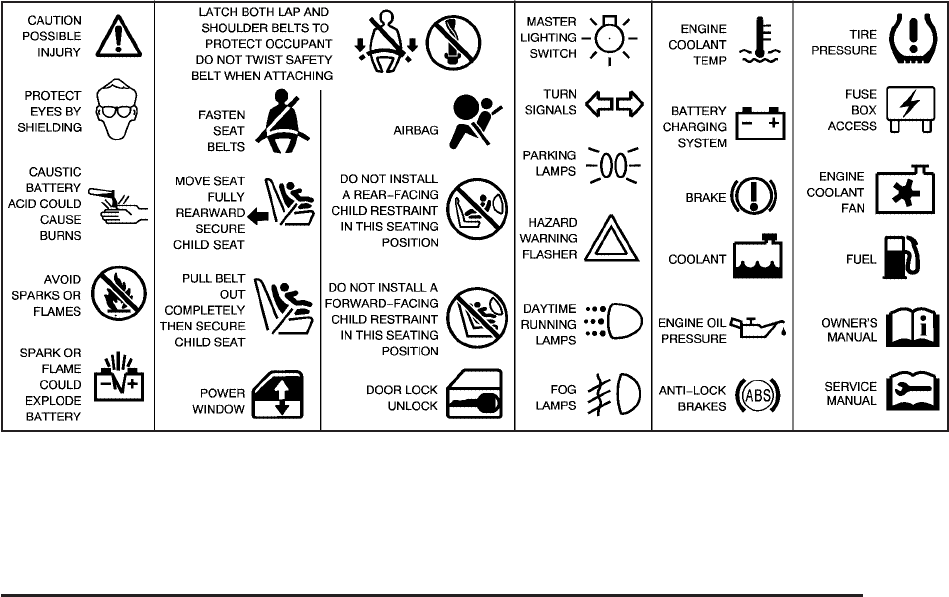
These are some examples of symbols that may be found on the vehicle:
v

✍NOTES
vi

Front Seats ......................................................1-2
Manual Seats ................................................1-2
Six-Way Power Seats .....................................1-3
Power Lumbar ...............................................1-3
Heated Seats .................................................1-4
Reclining Seatbacks ........................................1-4
Head Restraints .............................................1-6
Center Seat ...................................................1-7
Rear Seats .......................................................1-7
Split Folding Rear Seat ...................................1-7
Safety Belts .....................................................1-8
Safety Belts: They Are for Everyone .................1-8
Questions and Answers About Safety Belts ......1-13
How to Wear Safety Belts Properly .................1-14
Driver Position ..............................................1-14
Shoulder Belt Height Adjustment .....................1-20
Safety Belt Use During Pregnancy ..................1-21
Right Front Passenger Position .......................1-21
Center Front Passenger Position .....................1-22
Rear Seat Passengers ..................................1-23
Rear Safety Belt Comfort Guides ....................1-25
Safety Belt Pretensioners ...............................1-27
Safety Belt Extender .....................................1-28
Child Restraints .............................................1-28
Older Children ..............................................1-28
Infants and Young Children ............................1-31
Child Restraint Systems .................................1-34
Where to Put the Restraint .............................1-38
Lower Anchors and Tethers for
Children (LATCH) ......................................1-39
Securing a Child Restraint in a Rear
Seat Position ............................................1-46
Securing a Child Restraint in the Center
Front Seat Position ....................................1-48
Securing a Child Restraint in the Right
Front Seat Position ....................................1-49
Airbag System ...............................................1-53
Where Are the Airbags? ................................1-55
When Should an Airbag Inflate? .....................1-58
What Makes an Airbag Inflate? .......................1-59
How Does an Airbag Restrain? .......................1-59
What Will You See After an Airbag Inflates? .....1-60
Passenger Sensing System ............................1-61
Servicing Your Airbag-Equipped Vehicle ...........1-65
Adding Equipment to Your Airbag-Equipped
Vehicle ....................................................1-66
Restraint System Check ..................................1-67
Checking the Restraint Systems ......................1-67
Replacing Restraint System Parts
After a Crash ............................................1-68
Section 1 Seats and Restraint Systems
1-1
Front Seats
Manual Seats
{CAUTION:
You can lose control of the vehicle if you try to
adjust a manual driver’s seat while the vehicle
is moving. The sudden movement could startle
and confuse you, or make you push a pedal
when you do not want to. Adjust the driver’s
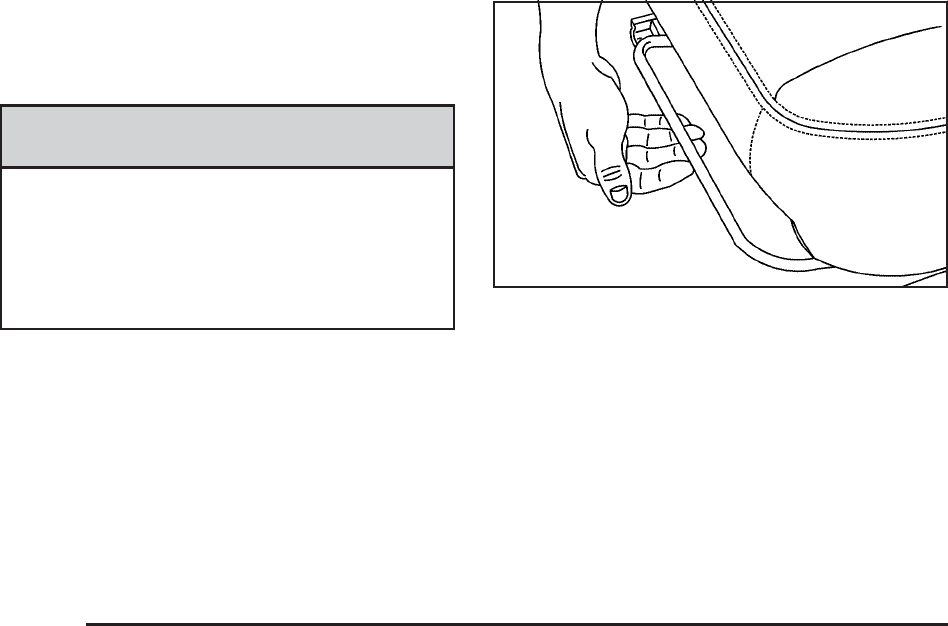
seat only when the vehicle is not moving. Lift the bar located under the front of the seat to unlock
it. Slide the seat to where you want it and release
the bar. Try to move the seat with your body to be sure
the seat is locked in place.
1-2
Six-Way Power Seats
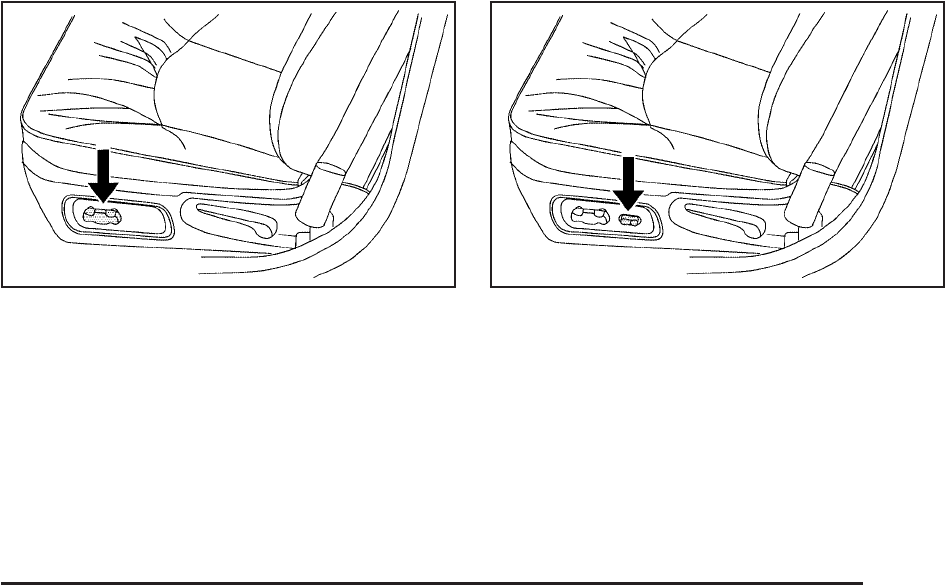
If your vehicle has power seats, the controls are located
on the outboard side of the seat cushions.
•To move the entire seat forward or rearward, move
the control forward or rearward.
•To raise or lower the entire seat, move the control
up or down.
•To raise or lower the front of the seat, move the
front of the control up or down.
•To raise or lower the rear of the seat, move the
rear of the control up or down.
Power Lumbar
Your driver’s seat may have power lumbar. The control
is located on the outboard side of the seat cushion.
Press the front of the control to increase lumbar support.
Press the rear of the control to decrease lumbar support.
Keep in mind that as your seating position changes,
as it may during long trips, so should the position of your
lumbar support. Adjust the seat as needed.
1-3
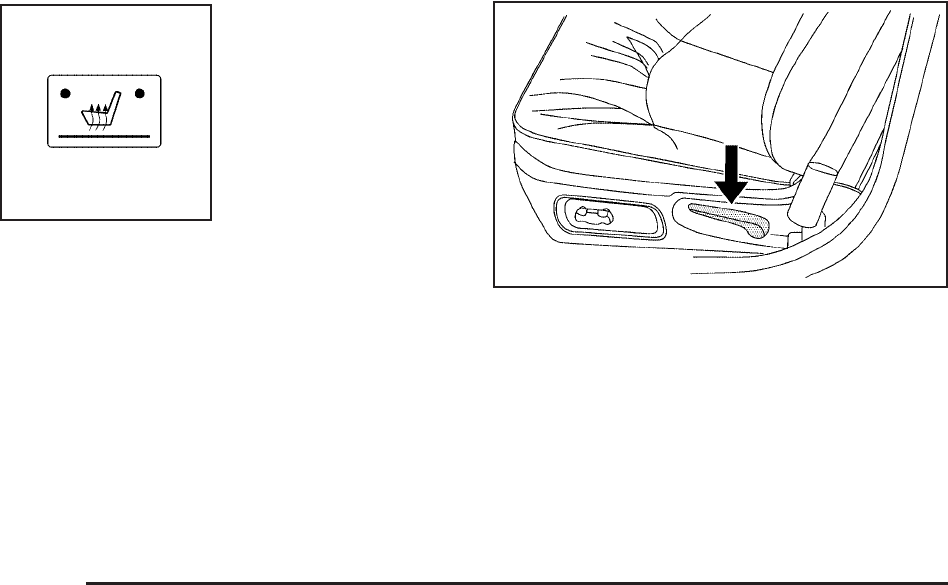
Heated Seats
If your vehicle has this
feature, the buttons are
located on the climate
control panel.
Press the button once to activate the high heat setting.
Both indicator lights on the button will come on.
Press the button again to select the lower temperature
setting. Only one indicator light will come on. Press the
button a third time to turn the heat off.
This feature only works when the ignition is on.
Reclining Seatbacks
Lift the lever located on the outboard side of the seat to
release the seatback, then move the seatback to the
desired position. Release the lever to lock the seatback
in place.
1-4
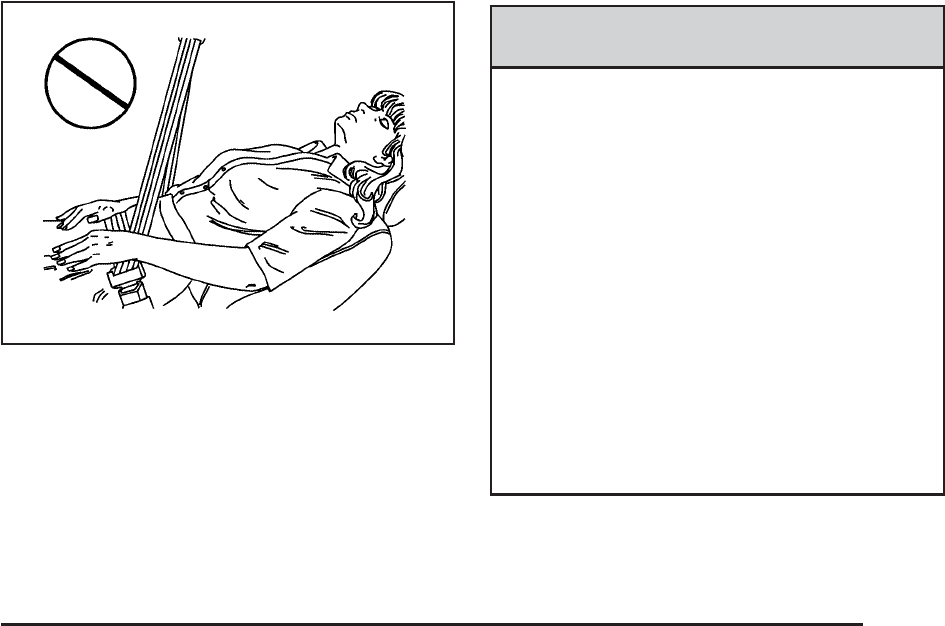
Do not have a seatback reclined if your vehicle is
moving.
{CAUTION:
Sitting in a reclined position when your vehicle
is in motion can be dangerous. Even if you
buckle up, your safety belts cannot do their
job when you are reclined like this.
The shoulder belt cannot do its job because it
will not be against your body. Instead, it will be
in front of you. In a crash, you could go into it,
receiving neck or other injuries.
The lap belt cannot do its job either. In a crash,
the belt could go up over your abdomen.
The belt forces would be there, not at your
pelvic bones. This could cause serious internal
injuries.
For proper protection when the vehicle is in
motion, have the seatback upright. Then sit
well back in the seat and wear your safety belt
properly.
1-5
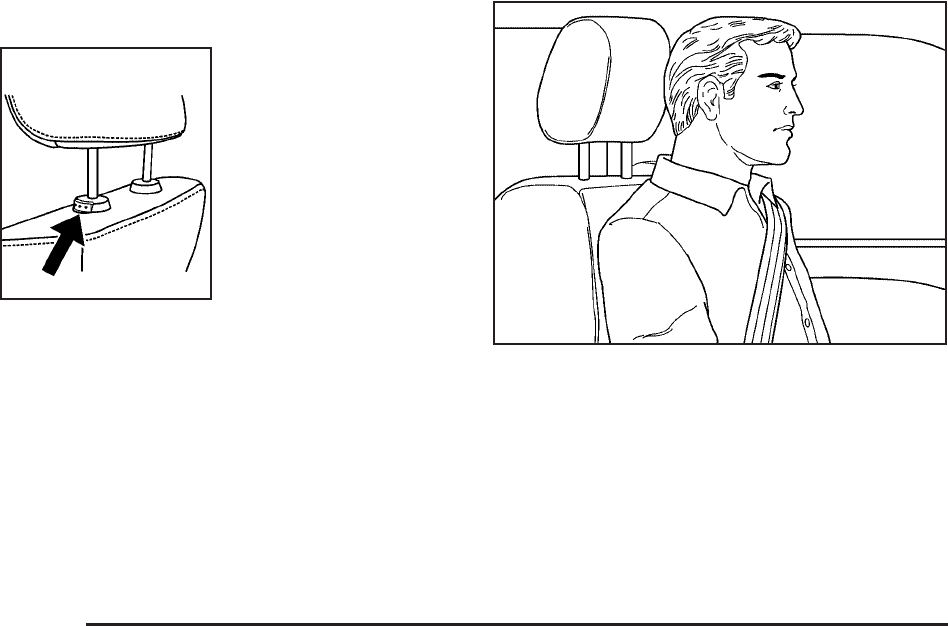
Head Restraints
Pull up the head restraint
to raise it. Press the
release button, located at
the base of the head
restraint, and push the
head restraint down
to lower it.
Adjust the head restraint so that the top of the restraint is
closest to the top of the occupant’s head. This position
reduces the chance of a neck injury in a crash.
1-6
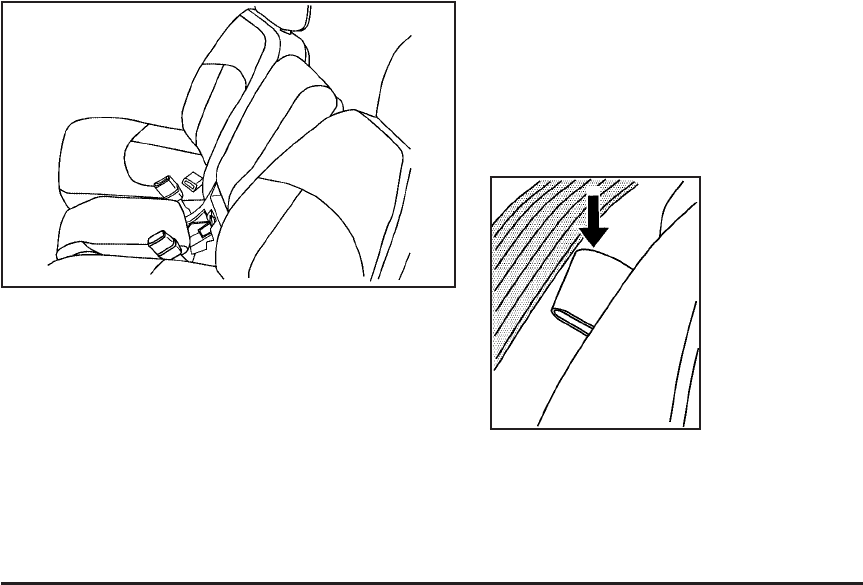
Center Seat
Your vehicle may have a front center seat. There are
cupholders on the underside of the seat cushion. To use
them, flip the seat cushion forward. This seat can also
be converted to a storage area by lowering the armrest.
See Center Console Storage Area on page 2-46.
For information on safety belts for this position, see
Center Front Passenger Position on page 1-22.
Rear Seats
Split Folding Rear Seat
If your vehicle has this feature, both sides of the rear
seatback can be folded down. This gives direct access to
the trunk. Make sure the front seats are not reclined.
If they are, the rear seatback(s) may not fold down all
the way.
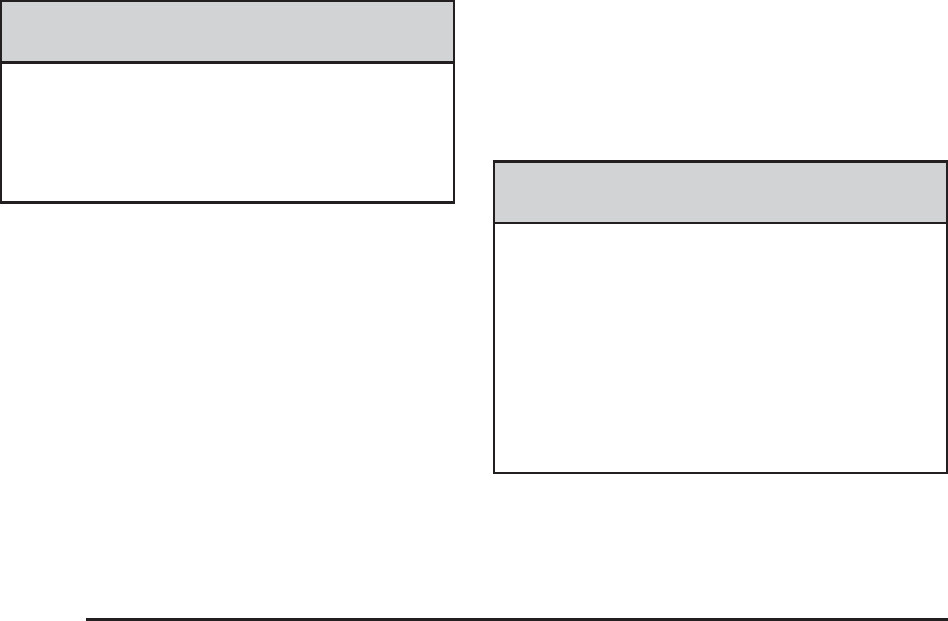
To lower the rear seatback,
pull the tab located on the
outboard side of the
seatback and fold the
seatback forward.
1-7
{CAUTION:
If the seatback is not locked, it could move
forward in a sudden stop or crash. That could
cause injury to the person sitting there. Always
push and pull on the seatback to be sure it is
locked.
To raise the rear seatback, lift the seatback up until it
latches. Push and pull on the seatback to be sure
it is locked in position.
The seatbacks should be kept in the upright, locked
position when they are not being used to extend
the cargo area.
Safety Belts
Safety Belts: They Are for Everyone
This part of the manual tells you how to use safety
belts properly. It also tells you some things you should
not do with safety belts.
{CAUTION:
Do not let anyone ride where he or she cannot
wear a safety belt properly. If you are in a
crash and you are not wearing a safety belt,
your injuries can be much worse. You can hit
things inside the vehicle or be ejected from it.
You can be seriously injured or killed. In the
same crash, you might not be, if you are
buckled up. Always fasten your safety belt,
and check that your passengers’ belts are
fastened properly too.
1-8
{CAUTION:
It is extremely dangerous to ride in a cargo
area, inside or outside of a vehicle. In a
collision, people riding in these areas are more
likely to be seriously injured or killed. Do not
allow people to ride in any area of your vehicle
that is not equipped with seats and safety
belts. Be sure everyone in your vehicle is in a
seat and using a safety belt properly.
Your vehicle has indicators to remind you and your
passengers to buckle your safety belts. See Safety Belt
Reminder Light on page 3-33 and Passenger Safety
Belt Reminder Light on page 3-34.
In most states and in all Canadian provinces, the law
says to wear safety belts. Here is why: They work.
You never know if you will be in a crash. If you do have
a crash, you do not know if it will be a bad one.
A few crashes are mild, and some crashes can be so
serious that even buckled up, a person would not
survive. But most crashes are in between. In many of
them, people who buckle up can survive and sometimes
walk away. Without belts they could have been badly
hurt or killed.
After more than 30 years of safety belts in vehicles,
the facts are clear. In most crashes buckling up
does matter...a lot!
1-9
Why Safety Belts Work
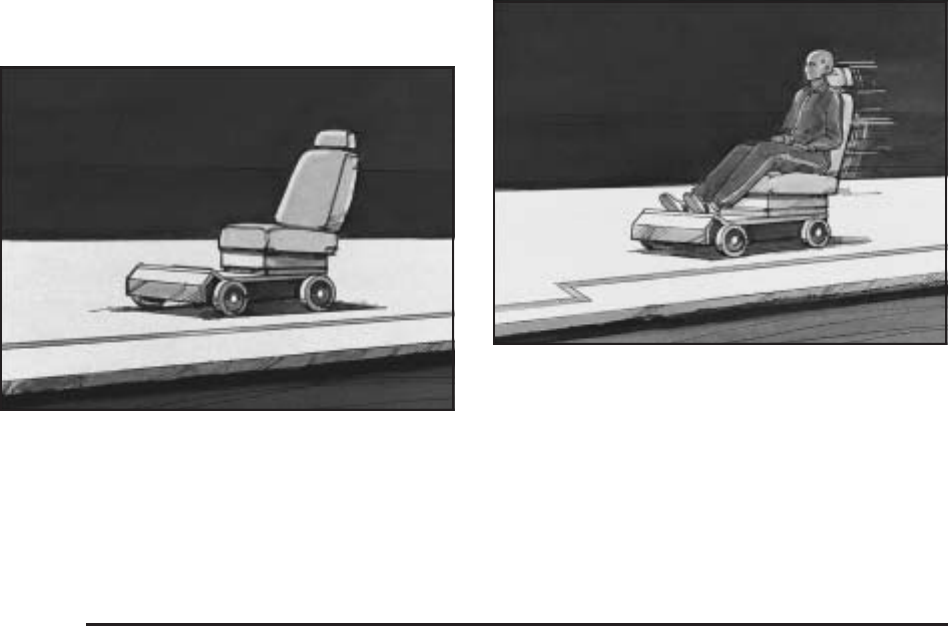
When you ride in or on anything, you go as fast as it goes.
Take the simplest vehicle. Suppose it is just a seat on
wheels.
Put someone on it.
1-10
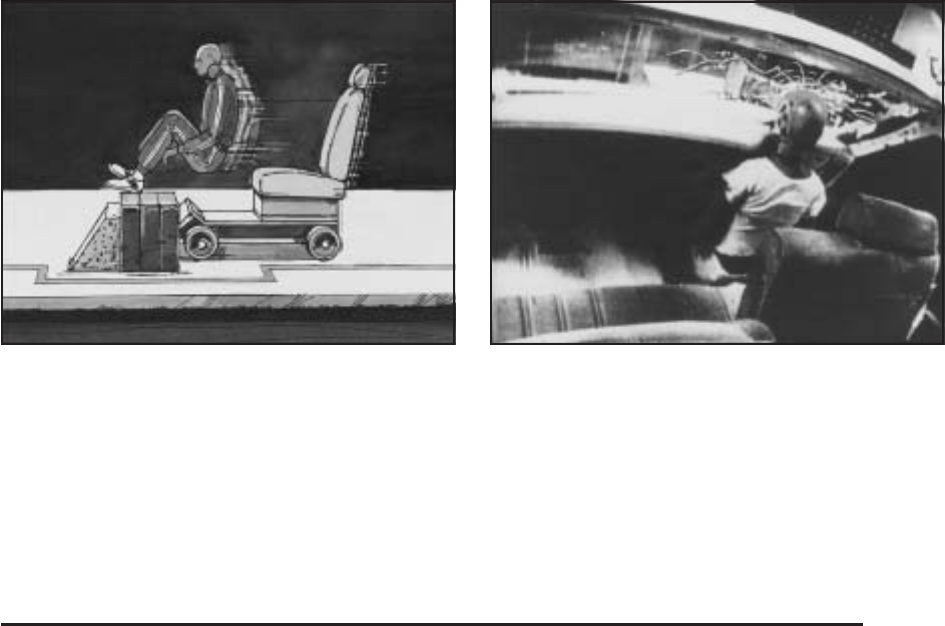
Get it up to speed. Then stop the vehicle. The rider
does not stop. The person keeps going until stopped by something.
In a real vehicle, it could be the windshield...
1-11
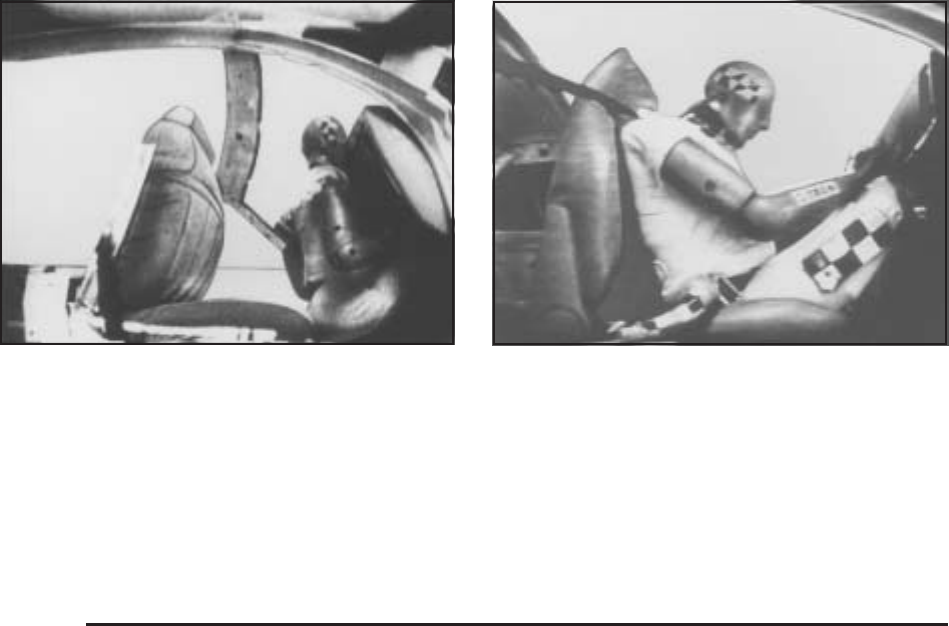
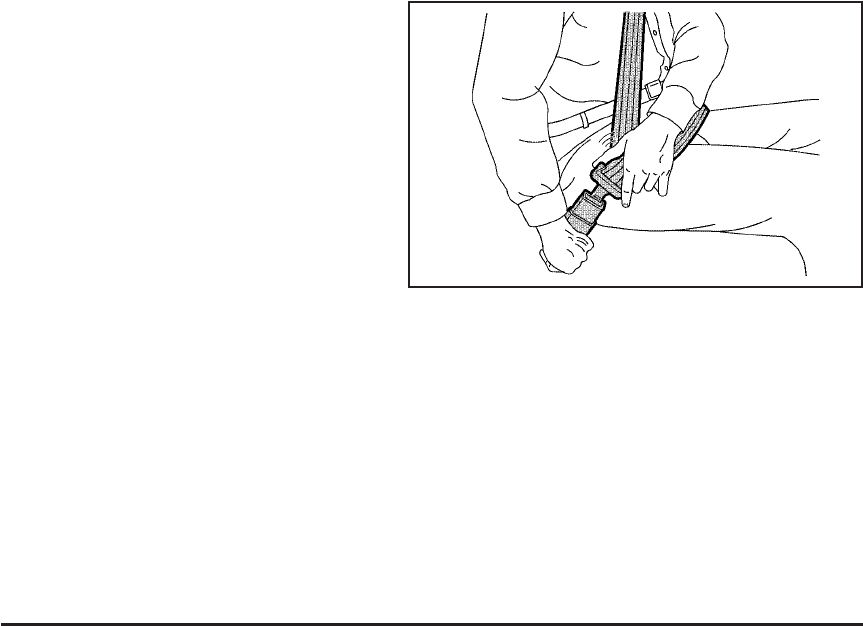
or the instrument panel... or the safety belts!
With safety belts, you slow down as the vehicle does.
You get more time to stop. You stop over more distance,
and your strongest bones take the forces. That is why
safety belts make such good sense.
1-12

Questions and Answers About
Safety Belts
Q: Will I be trapped in the vehicle after an accident
if I am wearing a safety belt?
A: You could be — whether you are wearing a safety
belt or not. But you can unbuckle a safety belt,
even if you are upside down. And your chance of
being conscious during and after an accident,
so you can unbuckle and get out, is much greater if
you are belted.
Q: If my vehicle has airbags, why should I have to
wear safety belts?
A: Airbags are in many vehicles today and will be
in most of them in the future. But they are
supplemental systems only; so they work with
safety belts — not instead of them. Every airbag
system ever offered for sale has required the use of
safety belts. Even if you are in a vehicle that has
airbags, you still have to buckle up to get the most
protection. That is true not only in frontal collisions,
but especially in side and other collisions.
Q: If I am a good driver, and I never drive far from
home, why should I wear safety belts?
A: You may be an excellent driver, but if you are in an
accident — even one that is not your fault — you
and your passengers can be hurt. Being a good
driver does not protect you from things beyond your
control, such as bad drivers.
Most accidents occur within 25 miles (40 km)
of home. And the greatest number of serious
injuries and deaths occur at speeds of less than
40 mph (65 km/h).
Safety belts are for everyone.
1-13
How to Wear Safety Belts Properly
This part is only for people of adult size.
Be aware that there are special things to know about
safety belts and children. And there are different rules for
smaller children and babies. If a child will be riding in your
vehicle, see Older Children on page 1-28 or Infants and
Young Children on page 1-31. Follow those rules for
everyone’s protection.
First, you will want to know which restraint systems your
vehicle has.
We will start with the driver position.
Driver Position
Lap-Shoulder Belt
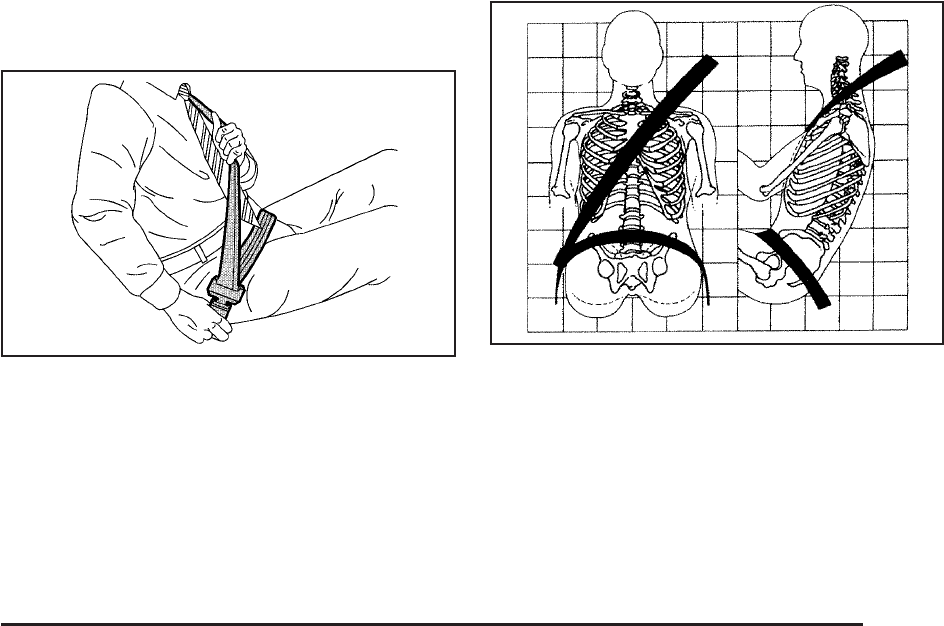
The driver has a lap-shoulder belt. Here is how to wear
it properly.
1. Close and lock the door.
2. Adjust the seat so you can sit up straight. To see
how, see “Seats” in the Index.
3. Pick up the latch plate and pull the belt across you.
Do not let it get twisted.
The shoulder belt may lock if you pull the belt
across you very quickly. If this happens, let the belt
go back slightly to unlock it. Then pull the belt
across you more slowly.
4. Push the latch plate into the buckle until it clicks.
Pull up on the latch plate to make sure it is secure.
If the belt is not long enough, see Safety Belt
Extender on page 1-28.
Make sure the release button on the buckle is
positioned so you would be able to unbuckle the
safety belt quickly if you ever had to.
1-14
5. Move the shoulder belt height adjuster to the
height that is right for you. See Shoulder Belt
Height Adjustment on page 1-20.
6. To make the lap part tight, pull up on the
shoulder belt.
The lap part of the belt should be worn low and snug on
the hips, just touching the thighs. In a crash, this applies
force to the strong pelvic bones. And you would be less
likely to slide under the lap belt. If you slid under it, the
belt would apply force at your abdomen. This could cause
serious or even fatal injuries. The shoulder belt should go
over the shoulder and across the chest. These parts of
the body are best able to take belt restraining forces.
The safety belt locks if there is a sudden stop or crash,
or if you pull the belt very quickly out of the retractor.
1-15
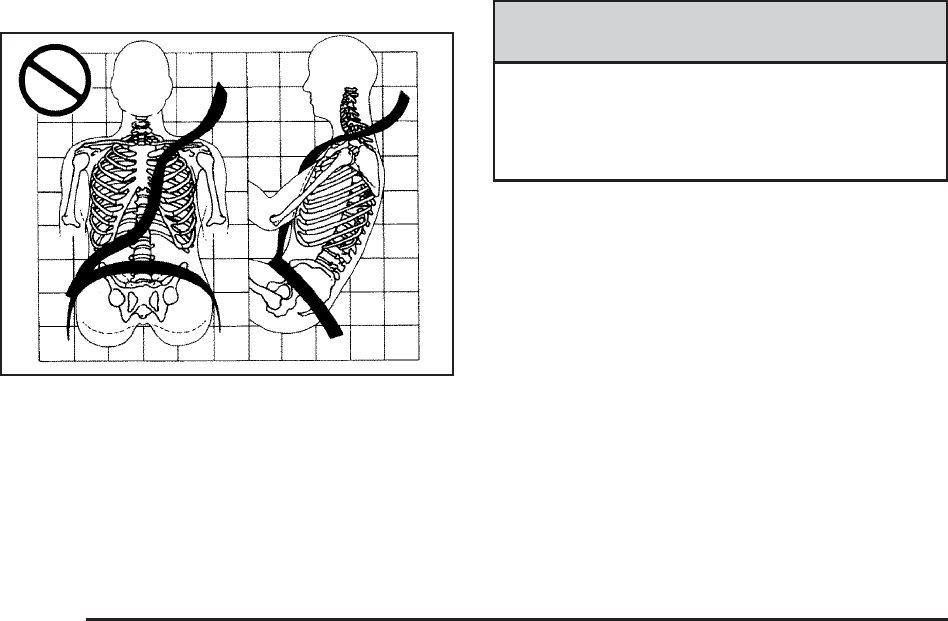
Q: What is wrong with this?
A: The shoulder belt is too loose. It will not give nearly
as much protection this way.
{CAUTION:
You can be seriously hurt if your shoulder belt
is too loose. In a crash, you would move
forward too much, which could increase injury.
The shoulder belt should fit against your body.
1-16
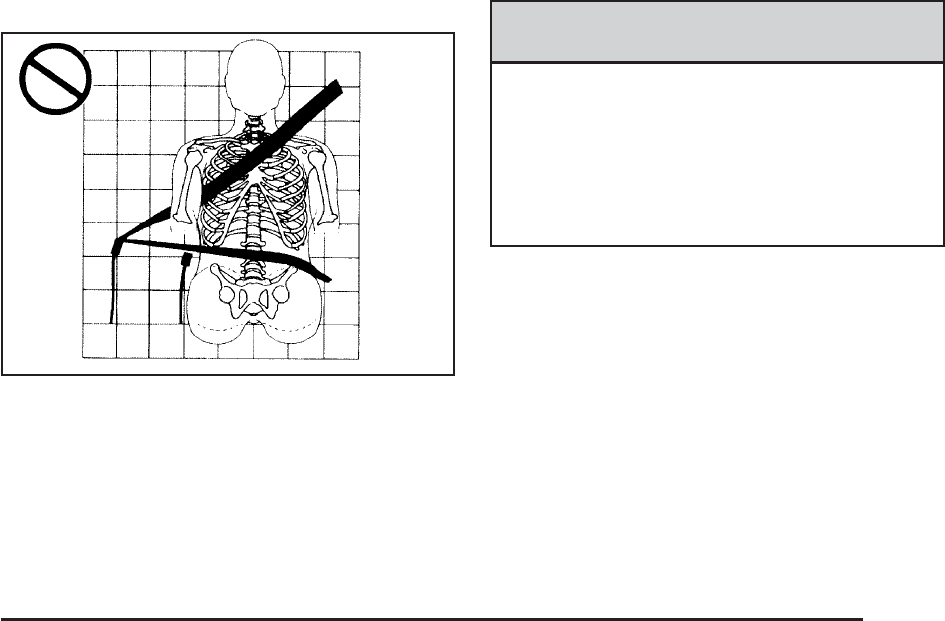
Q: What is wrong with this?
A: The belt is buckled in the wrong place.
{CAUTION:
You can be seriously injured if your belt is
buckled in the wrong place like this. In a crash,
the belt would go up over your abdomen.
The belt forces would be there, not at the
pelvic bones. This could cause serious internal
injuries. Always buckle your belt into the
buckle nearest you.
1-17
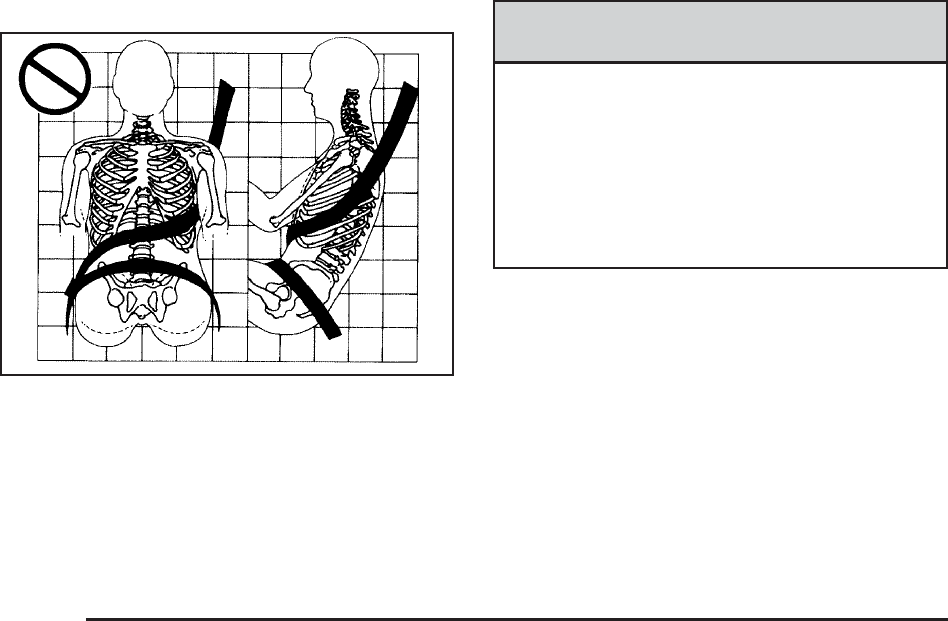
Q: What is wrong with this?
A: The shoulder belt is worn under the arm. It should
be worn over the shoulder at all times.
{CAUTION:
You can be seriously injured if you wear the
shoulder belt under your arm. In a crash, your
body would move too far forward, which would
increase the chance of head and neck injury.
Also, the belt would apply too much force to
the ribs, which are not as strong as shoulder
bones. You could also severely injure internal
organs like your liver or spleen.
1-18
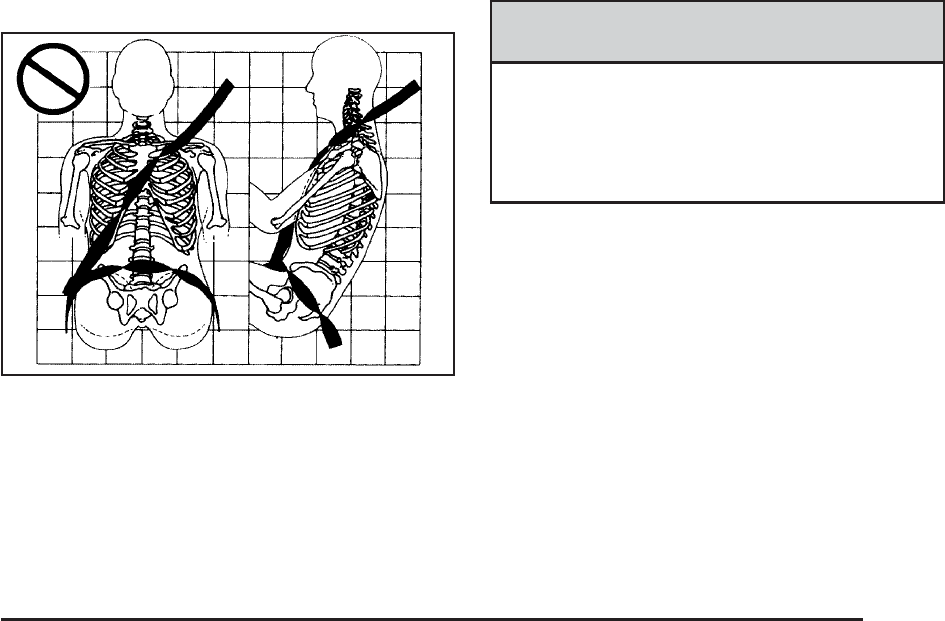
Q: What is wrong with this?
A: The belt is twisted across the body.
{CAUTION:
You can be seriously injured by a twisted belt.
In a crash, you would not have the full width
of the belt to spread impact forces. If a belt
is twisted, make it straight so it can work
properly, or ask your dealer to fix it.
1-19
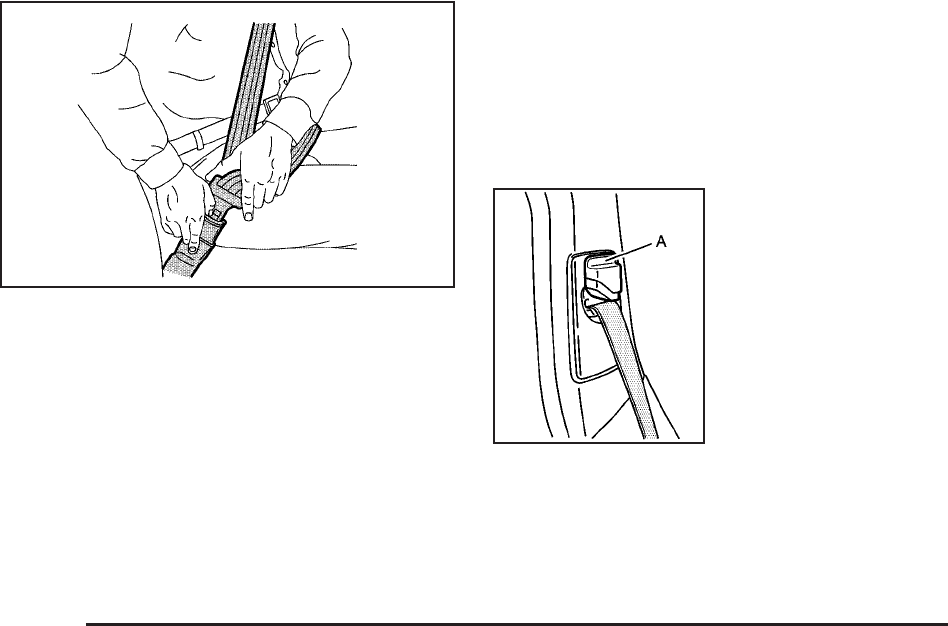
To unlatch the belt, just push the button on the buckle.
The belt should go back out of the way.
Before you close the door, be sure the belt is out of the
way. If you slam the door on it, you can damage
both the belt and your vehicle.
Shoulder Belt Height Adjustment
Before you begin to drive, move the shoulder belt height
adjuster to the height that is right for you.
Adjust the height so that the shoulder portion of the
belt is centered on your shoulder. The belt should
be away from your face and neck, but not falling off
your shoulder.
To move it down, press
down on the release
lever (A) move the height
adjuster to the desired
position. You can move the
height adjuster up just
by pressing up on
the shoulder belt guide.
After you move the height adjuster to where you want it,
try to move it down without squeezing the release
lever to make sure it has locked into position.
1-20
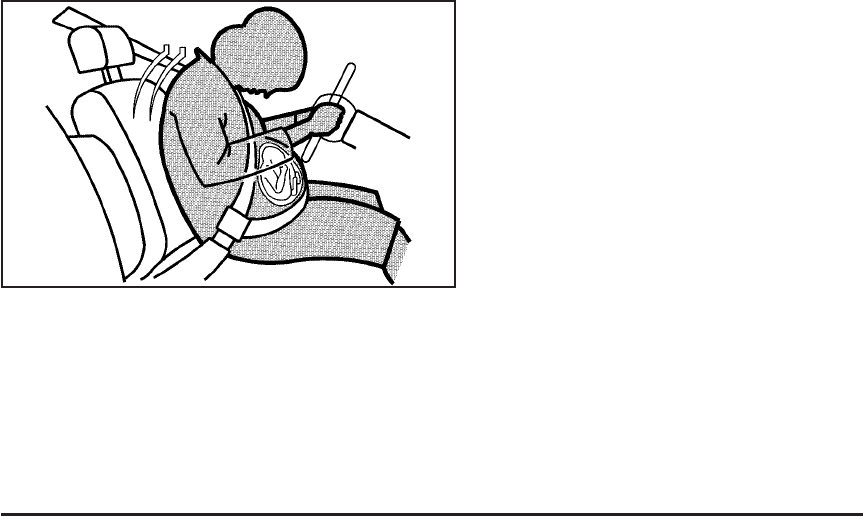
Safety Belt Use During Pregnancy
Safety belts work for everyone, including pregnant
women. Like all occupants, they are more likely to be
seriously injured if they do not wear safety belts.
A pregnant woman should wear a lap-shoulder belt, and
the lap portion should be worn as low as possible,
below the rounding, throughout the pregnancy.
The best way to protect the fetus is to protect the mother.
When a safety belt is worn properly, it is more likely that
the fetus will not be hurt in a crash. For pregnant women,
as for anyone, the key to making safety belts effective is
wearing them properly.
Right Front Passenger Position
To learn how to wear the right front passenger’s safety
belt properly, see Driver Position on page 1-14.
The right front passenger’s safety belt works the same
way as the driver’s safety belt — except for one
thing. If you ever pull the shoulder portion of the belt out
all the way, you will engage the child restraint locking
feature. If this happens, just let the belt go back all
the way and start again.
1-21
Center Front Passenger Position
Lap Belt
If your vehicle has a front bench seat, someone can sit
in the center position.
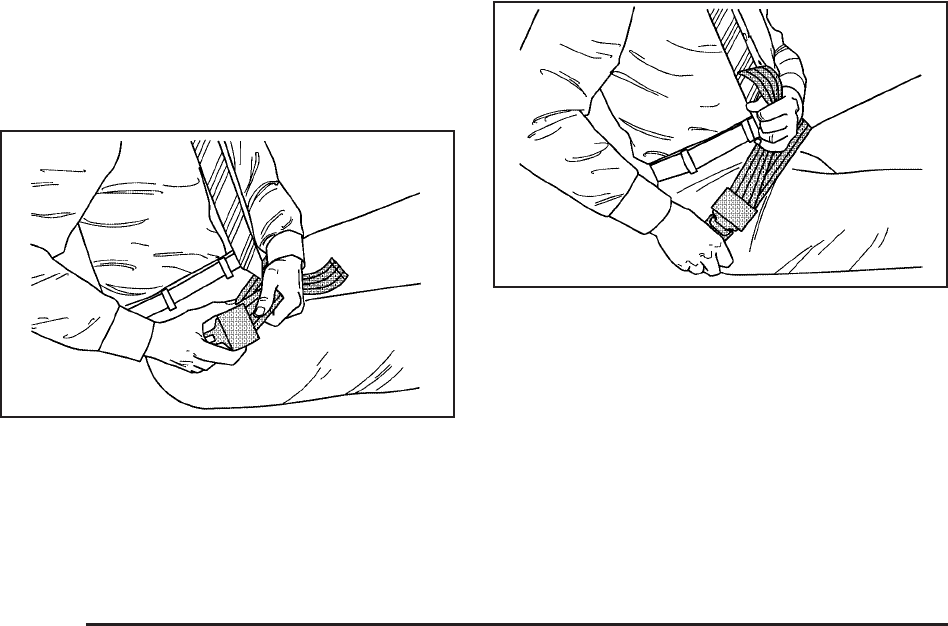
When you sit in the center front seating position, you
have a lap safety belt, which has no retractor. To make
the belt longer, tilt the latch plate and pull it along the belt.
To make the belt shorter, pull its free end as shown
until the belt is snug.
Buckle, position and release it the same way as the
lap part of a lap-shoulder belt. If the belt is not
long enough, see Safety Belt Extender on page 1-28.
Make sure the release button on the buckle is positioned
so you would be able to unbuckle the safety belt
quickly if you ever had to.
1-22
Rear Seat Passengers
It is very important for rear seat passengers to buckle
up! Accident statistics show that unbelted people in
the rear seat are hurt more often in crashes than those
who are wearing safety belts.
Rear passengers who are not safety belted can be
thrown out of the vehicle in a crash. And they can strike
others in the vehicle who are wearing safety belts.
Lap-Shoulder Belt
All rear seat positions have lap-shoulder belts.
Here is how to wear one properly.
1. Pick up the latch plate and pull the belt across you.
Do not let it get twisted.
The shoulder belt may lock if you pull the belt
across you very quickly. If this happens, let the belt
go back slightly to unlock it. Then pull the belt
across you more slowly.
1-23
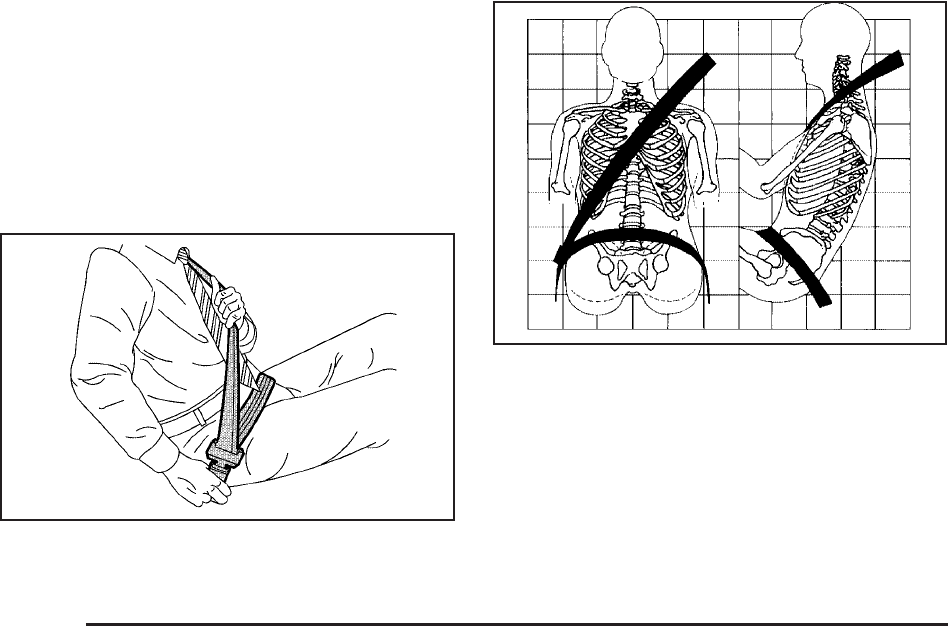
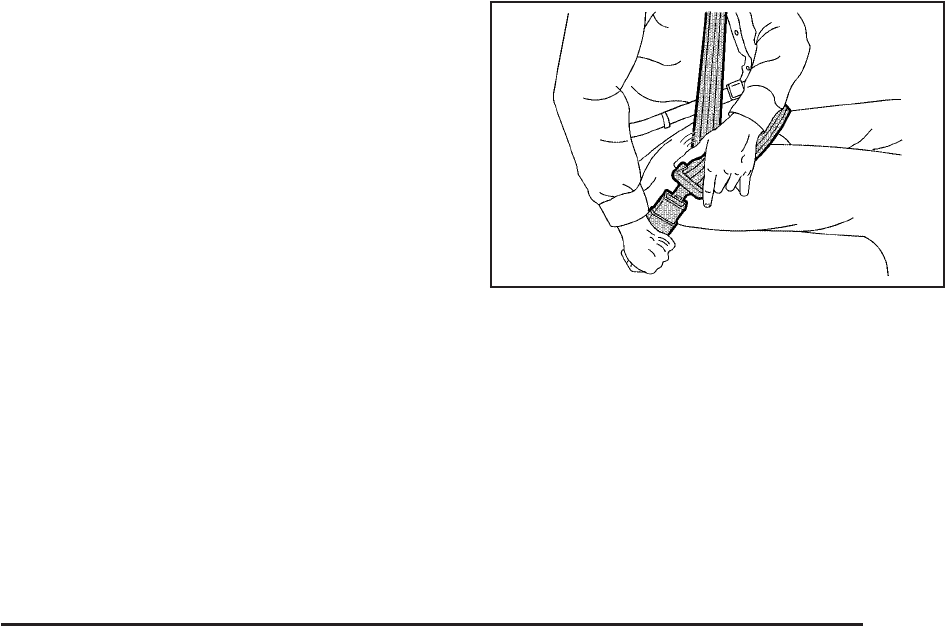
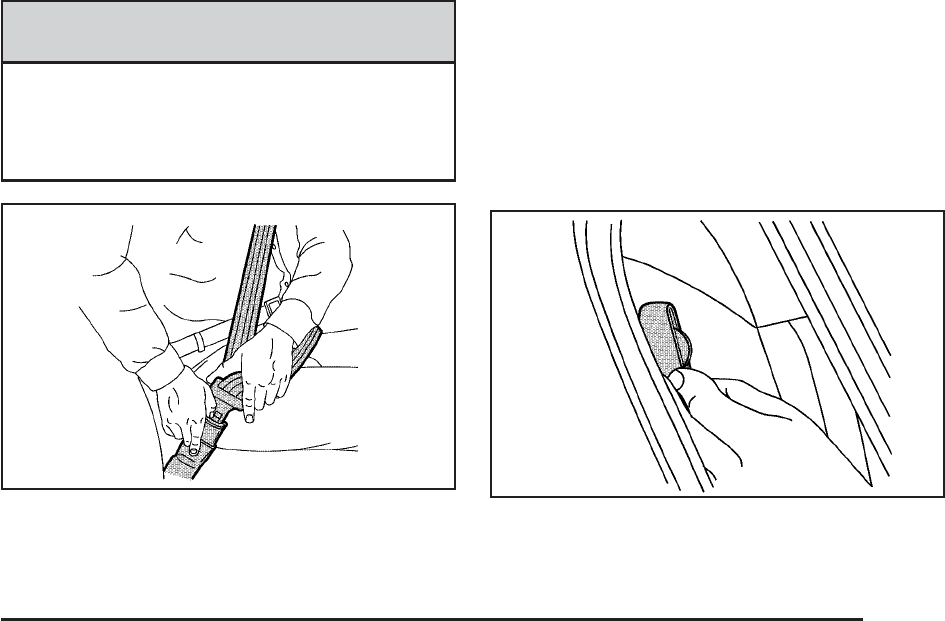
2. Push the latch plate into the buckle until it clicks.
Pull up on the latch plate to make sure it is secure.
When the shoulder belt is pulled out all the way,
it will lock. If it does, let it go back all the way and
start again.
If the belt is not long enough, see Safety Belt
Extender on page 1-28.
Make sure the release button on the buckle is
positioned so you would be able to unbuckle the
safety belt quickly if you ever had to.
3. To make the lap part tight, pull up on the
shoulder part.
The lap part of the belt should be worn low and snug on
the hips, just touching the thighs. In a crash, this applies
force to the strong pelvic bones. And you would be less
likely to slide under the lap belt. If you slid under it, the
belt would apply force at your abdomen. This could cause
serious or even fatal injuries. The shoulder belt should go
over the shoulder and across the chest. These parts of
the body are best able to take belt restraining forces.
The safety belt locks if there is a sudden stop or a crash,
or if you pull the belt very quickly out of the retractor.
1-24
{CAUTION:
You can be seriously hurt if your shoulder belt
is too loose. In a crash, you would move
forward too much, which could increase injury.
The shoulder belt should fit against your body.
To unlatch the belt, push the button on the buckle.
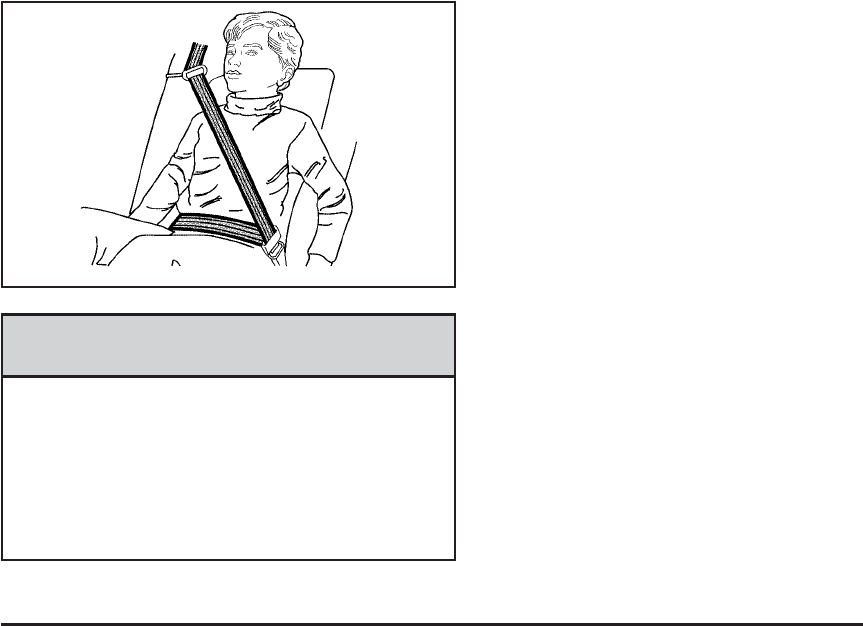
Rear Safety Belt Comfort Guides
Rear shoulder belt comfort guides may provide added
safety belt comfort for older children who have outgrown
booster seats and for some adults. When installed on
a shoulder belt, the comfort guide positions the belt
away from the neck and head.
There is one guide for each outboard passenger
position in the rear seat. Here is how to install a
comfort guide and use the safety belt:
1. Pull the elastic cord out from between the edge of
the seatback and the interior body to remove the
guide from its storage clip.
1-25
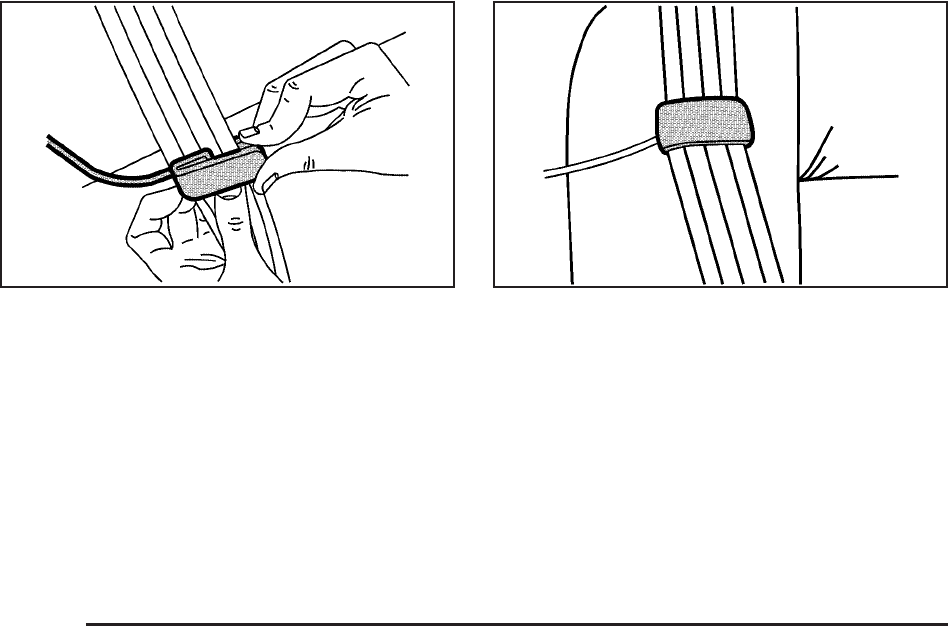
2. Slide the guide under and past the belt. The elastic
cord must be under the belt. Then, place the guide
over the belt, and insert the two edges of the
belt into the slots of the guide.
3. Be sure that the belt is not twisted and it lies flat.
The elastic cord must be under the belt and the
guide on top.
1-26
{CAUTION:
A safety belt that is not properly worn may not
provide the protection needed in a crash.
The person wearing the belt could be seriously
injured. The shoulder belt should go over the
shoulder and across the chest. These parts of
the body are best able to take belt restraining
forces.
4. Buckle, position, and release the safety belt as
described in Rear Seat Passengers on page 1-23.
Make sure that the shoulder belt crosses the
shoulder.
To remove and store the comfort guides, squeeze the
belt edges together so that you can take them out of the
guides. Pull the guide upward to expose its storage
clip, and then slide the guide onto the clip. Turn the
guide and clip inward and slide them in between
the seatback and the interior body, leaving only the
loop of the elastic cord exposed.
Safety Belt Pretensioners
Your vehicle has safety belt pretensioners for the driver
and right front passenger. Although you cannot see
them, they are located on the buckle end of the safety
belts. They help the safety belts reduce a person’s
forward movement in a moderate to severe frontal and
near frontal crash.
Pretensioners work only once. If they activate in a
crash, you will need to get new ones, and probably other
new parts for your safety belt system. See Replacing
Restraint System Parts After a Crash on page 1-68.
1-27
Safety Belt Extender
If the vehicle’s safety belt will fasten around you,
you should use it.
But if a safety belt is not long enough, your dealer will
order you an extender. It is free. When you go in to
order it, take the heaviest coat you will wear, so the
extender will be long enough for you. To help avoid
personal injury, do not let someone else use it, and use
it only for the seat it is made to fit. The extender has
been designed for adults. Never use it for securing child
seats. To wear it, just attach it to the regular safety
belt. For more information, see the instruction sheet that
comes with the extender.
Child Restraints
Older Children
Older children who have outgrown booster seats should
wear the vehicle’s safety belts.
1-28
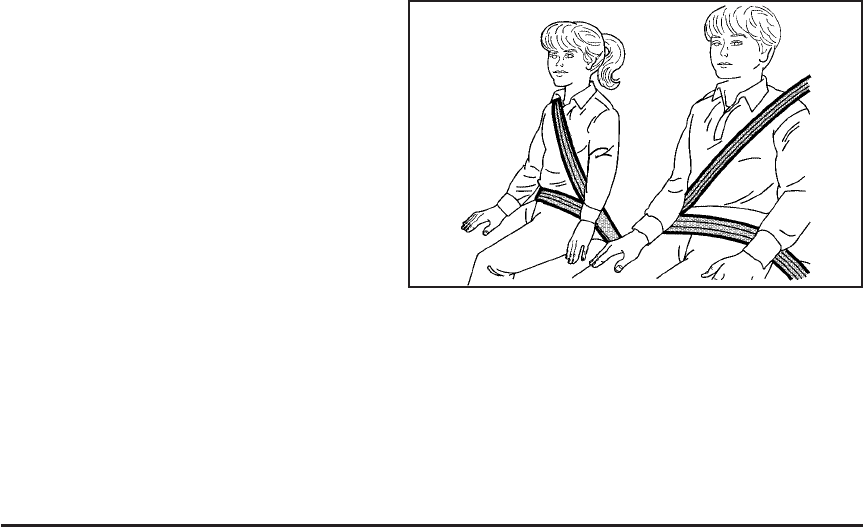
Q: What is the proper way to wear safety belts?
A: An older child should wear a lap-shoulder belt and
get the additional restraint a shoulder belt can
provide. The shoulder belt should not cross the face
or neck. The lap belt should fit snugly below the
hips, just touching the top of the thighs. It should
never be worn over the abdomen, which could
cause severe or even fatal internal injuries in
a crash.
Accident statistics show that children are safer if they
are restrained in the rear seat.
In a crash, children who are not buckled up can strike
other people who are buckled up, or can be thrown
out of the vehicle. Older children need to use safety
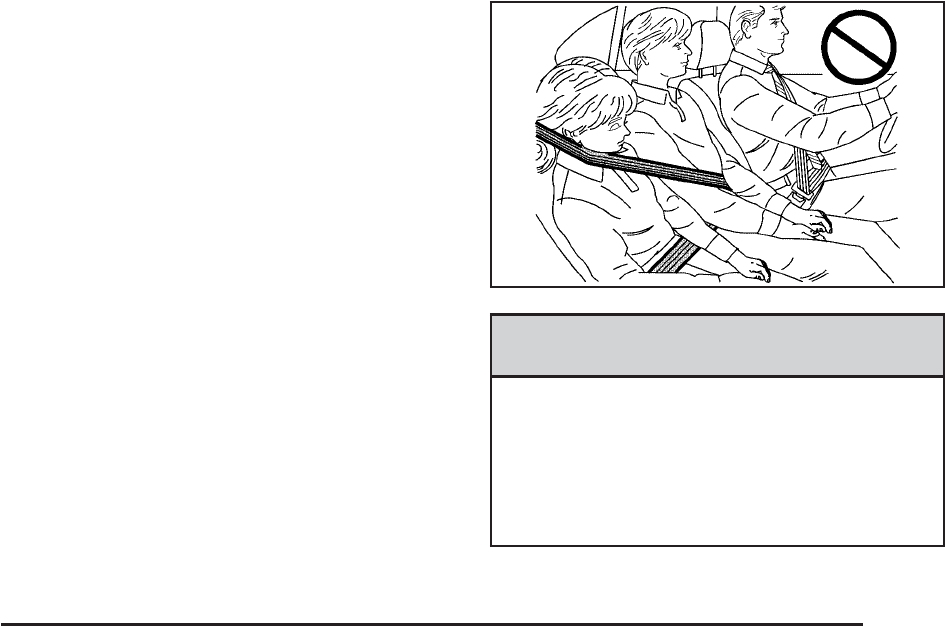
belts properly. {CAUTION:
Never do this.
Here two children are wearing the same belt.
The belt can not properly spread the impact
forces. In a crash, the two children can be
crushed together and seriously injured. A belt
must be used by only one person at a time.
1-29
Q: What if a child is wearing a lap-shoulder belt,
but the child is so small that the shoulder belt
is very close to the child’s face or neck?
A: If the child is sitting in a seat next to a window,
move the child toward the center of the vehicle.
Also see Rear Safety Belt Comfort Guides on
page 1-25. If the child is sitting in the center rear
seat passenger position, move the child toward the
safety belt buckle. In either case, be sure that
the shoulder belt still is on the child’s shoulder, so
that in a crash the child’s upper body would
have the restraint the belts provide.
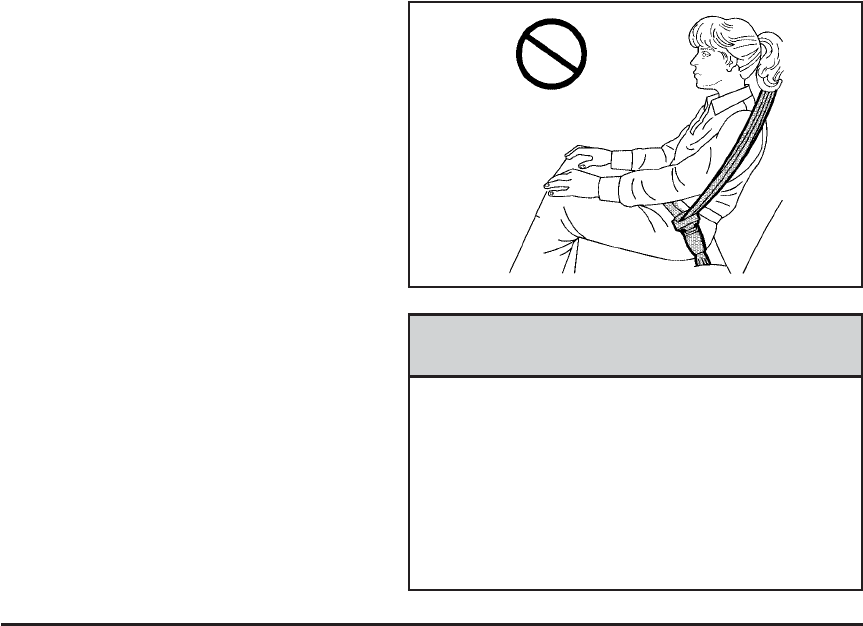
{CAUTION:
Never do this.
Here a child is sitting in a seat that has a
lap-shoulder belt, but the shoulder part is
behind the child. If the child wears the belt in
this way, in a crash the child might slide under
the belt. The belt’s force would then be applied
right on the child’s abdomen. That could cause
serious or fatal injuries.
1-30
Wherever the child sits, the lap portion of the belt
should be worn low and snug on the hips, just touching
the child’s thighs. This applies belt force to the child’s
pelvic bones in a crash.
Infants and Young Children
Everyone in a vehicle needs protection! This includes
infants and all other children. Neither the distance
traveled nor the age and size of the traveler changes
the need, for everyone, to use safety restraints. In fact,
the law in every state in the United States and in
every Canadian province says children up to some age
must be restrained while in a vehicle.
Every time infants and young children ride in vehicles,
they should have the protection provided by appropriate
restraints. Young children should not use the vehicle’s
adult safety belts alone, unless there is no other choice.
Instead, they need to use a child restraint.
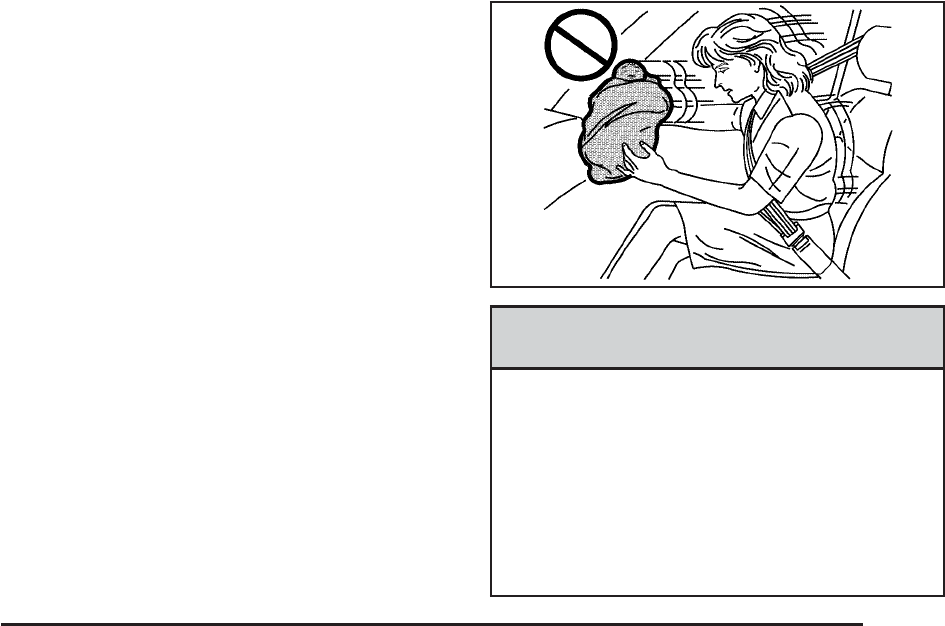
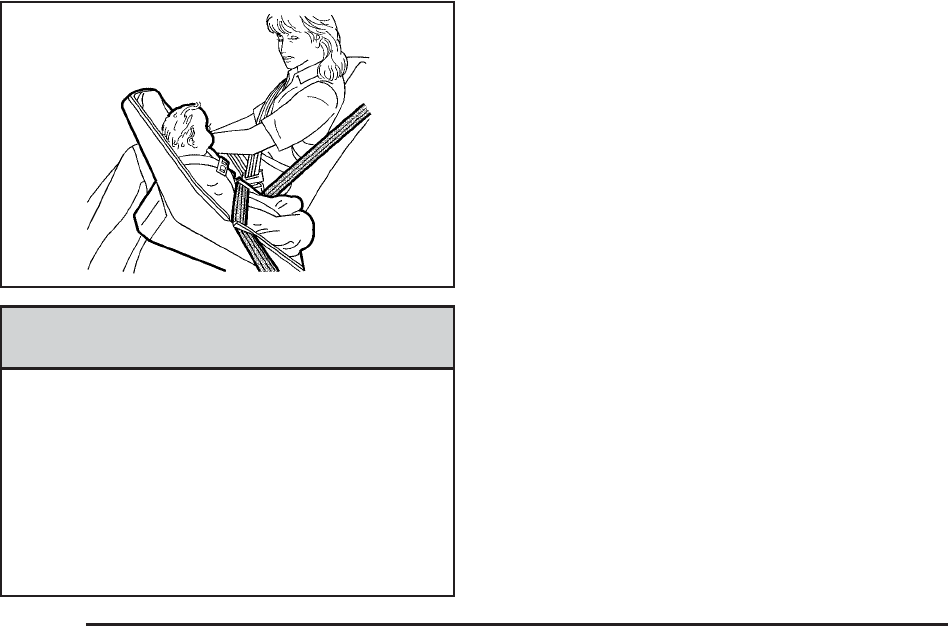
{CAUTION:
People should never hold a baby in their arms
while riding in a vehicle. A baby does not
weigh much — until a crash. During a crash a
baby will become so heavy it is not possible to
hold it. For example, in a crash at only 25 mph
(40 km/h), a 12 lb (5.5 kg) baby will suddenly
become a 240 lb (110 kg) force on a person’s
arms. A baby should be secured in an
appropriate restraint.
1-31
{CAUTION:
Children who are up against, or very close to,
any airbag when it inflates can be seriously
injured or killed. Airbags plus lap-shoulder
belts offer protection for adults and older
children, but not for young children and
infants. Neither the vehicle’s safety belt system
nor its airbag system is designed for them.
Young children and infants need the protection
that a child restraint system can provide.
Q: What are the different types of add-on
child restraints?
A: Add-on child restraints, which are purchased by the
vehicle’s owner, are available in four basic types.
Selection of a particular restraint should take
into consideration not only the child’s weight, height
and age but also whether or not the restraint will
be compatible with the motor vehicle in which it will
be used.
For most basic types of child restraints, there are
many different models available. When purchasing a
child restraint, be sure it is designed to be used
in a motor vehicle. If it is, the restraint will have a
label saying that it meets federal motor vehicle
safety standards.
The restraint manufacturer’s instructions that come
with the restraint, state the weight and height
limitations for a particular child restraint. In addition,
there are many kinds of restraints available for
children with special needs.
1-32
{CAUTION:
Newborn infants need complete support,
including support for the head and neck.
This is necessary because a newborn infant’s
neck is weak and its head weighs so much
compared with the rest of its body. In a crash,
an infant in a rear-facing seat settles into
the restraint, so the crash forces can be
distributed across the strongest part of an
infant’s body, the back and shoulders.
Infants always should be secured in
appropriate infant restraints.
{CAUTION:
The body structure of a young child is quite
unlike that of an adult or older child, for whom
the safety belts are designed. A young child’s
hip bones are still so small that the vehicle’s
regular safety belt may not remain low on the
hip bones, as it should. Instead, it may settle
up around the child’s abdomen. In a crash,
the belt would apply force on a body area
that is unprotected by any bony structure.
This alone could cause serious or fatal
injuries. Young children always should be
secured in appropriate child restraints.
1-33
Child Restraint Systems
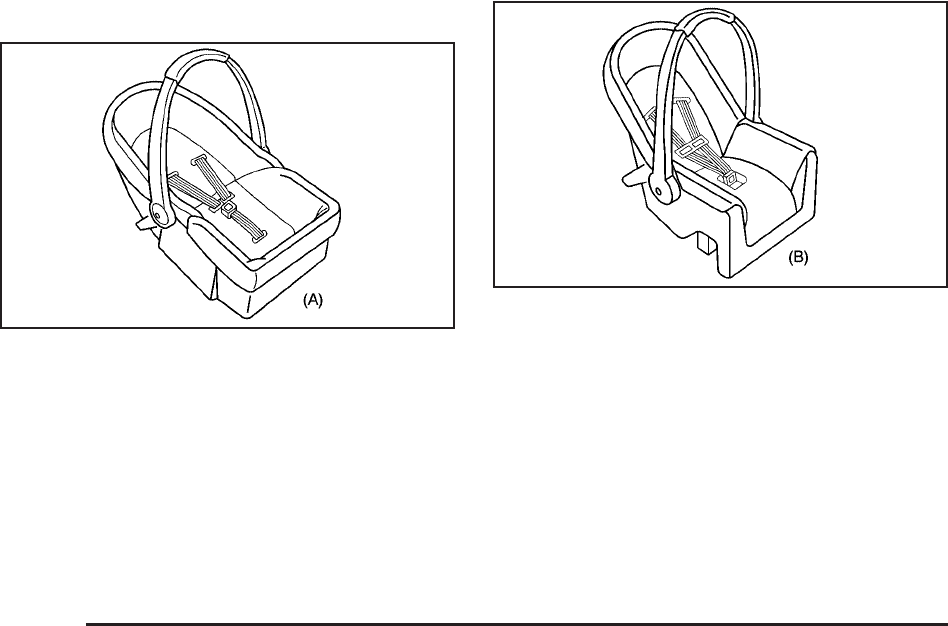
An infant car bed (A), a special bed made for use in a
motor vehicle, is an infant restraint system designed
to restrain or position a child on a continuous flat
surface. Make sure that the infant’s head rests toward
the center of the vehicle.
A rear-facing infant seat (B) provides restraint with
the seating surface against the back of the infant.
The harness system holds the infant in place and,
in a crash, acts to keep the infant positioned in
the restraint.
1-34
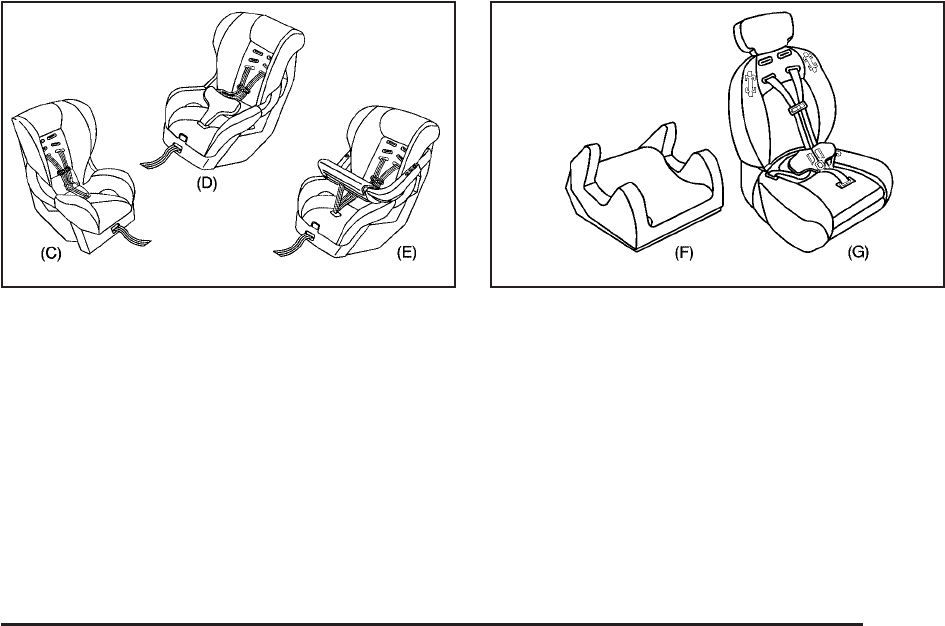
A forward-facing child seat (C-E) provides restraint for
the child’s body with the harness and also sometimes
with surfaces such as T-shaped or shelf-like shields.
A booster seat (F-G) is a child restraint designed to
improve the fit of the vehicle’s safety belt system.
Some booster seats have a shoulder belt positioner,
and some high-back booster seats have a five-point
harness. A booster seat can also help a child to see out
the window.
1-35
Q: How Should I Use a Child Restraint?
A: A child restraint system is any device designed for
use in a motor vehicle to restrain, seat, or position
children. A built-in child restraint system is a
permanent part of the motor vehicle. An add-on
child restraint system is a portable one, which
is purchased by the vehicle’s owner. To help reduce
injuries, an add-on child restraint must be secured
in the vehicle. With built-in or add-on child
restraints, the child has to be secured within the
child restraint.
When choosing an add-on child restraint, be sure
the child restraint is designed to be used in a
vehicle. If it is, it will have a label saying that it
meets federal motor vehicle safety standards.
Then follow the instructions for the restraint.
You may find these instructions on the restraint
itself or in a booklet, or both.
Securing an Add-on Child Restraint
in the Vehicle
{CAUTION:
A child can be seriously injured or killed in a
crash if the child restraint is not properly
secured in the vehicle. Make sure the child
restraint is properly installed in the vehicle
using the vehicle’s safety belt or LATCH
system, following the instructions that came
with that restraint, and also the instructions in
this manual.
To help reduce the chance of injury, the child restraint
must be secured in the vehicle. Child restraint systems
must be secured in vehicle seats by lap belts or the
lap belt portion of a lap-shoulder belt, or by the LATCH
system. See Lower Anchors and Tethers for Children
(LATCH) on page 1-39 for more information. A child can
be endangered in a crash if the child restraint is not
properly secured in the vehicle.
1-36

When securing an add-on child restraint, refer to the
instructions that come with the restraint which may be on
the restraint itself or in a booklet, or both, and to this
manual. The child restraint instructions are important,
so if they are not available, obtain a replacement
copy from the manufacturer.
Keep in mind that an unsecured child restraint can
move around in a collision or sudden stop and injure
people in the vehicle. Be sure to properly secure
any child restraint in your vehicle — even when no child
is in it.
Securing the Child Within the
Child Restraint
There are several systems for securing the child
within the child restraint. One system, the three-point
harness, has straps that come down over each of
the infant’s shoulders and buckle together at the crotch.
The five-point harness system has two shoulder straps,
two hip straps, and a crotch strap. A shield may take
the place of hip straps. A T-shaped shield has shoulder
straps that are attached to a flat pad which rests low
against the child’s body. A shelf- or armrest-type shield
has straps that are attached to a wide, shelf-like
shield that swings up or to the side.
{CAUTION:
A child can be seriously injured or killed in a
crash if the child is not properly secured in the
child restraint. Make sure the child is properly
secured, following the instructions that came
with that restraint.
Because there are different systems, it is important to
refer to the instructions that come with the restraint.
A child can be endangered in a crash if the child is not
properly secured in the child restraint.
1-37
Where to Put the Restraint
Accident statistics show that children are safer if they
are restrained in the rear rather than the front seat.
We, therefore, recommend that child restraints be
secured in a rear seat, including an infant riding in a
rear-facing infant seat, a child riding in a forward-facing
child seat and an older child riding in a booster seat.
Your vehicle has a rear seat that will accommodate
a rear-facing child restraint. A label on your sun visor
says, “Never put a rear-facing child seat in the front.”
This is because the risk to the rear-facing child is
so great, if the airbag deploys.
{CAUTION:
A child in a rear-facing child restraint can be
seriously injured or killed if the right front
passenger’s airbag inflates. This is because
the back of the rear-facing child restraint
would be very close to the inflating airbag.
Even though the passenger sensing system is
designed to turn off the passenger’s frontal
airbag if the system detects a rear-facing child
restraint, no system is fail-safe, and no one
can guarantee that an airbag will not deploy
under some unusual circumstance, even
though it is turned off. We recommend that
rear-facing child restraints be secured in the
rear seat, even if the airbag is off.
If you need to secure a forward-facing child
restraint in the right front seat, always move
the front passenger seat as far back as it will
go. It is better to secure the child restraint in a
rear seat.
1-38
{CAUTION:
A child in a child restraint in the center front
seat can be badly injured or killed by the right
front passenger’s airbag if it inflates. Never
secure a child restraint in the center front seat.
It is always better to secure a child restraint in
the rear seat.
Wherever you install a child restraint, be sure to secure
the child restraint properly.
Keep in mind that an unsecured child restraint can
move around in a collision or sudden stop and injure
people in the vehicle. Be sure to properly secure
any child restraint in your vehicle — even when no child
is in it.
Lower Anchors and Tethers for
Children (LATCH)
Your vehicle has the LATCH system. The LATCH
system holds a child restraint during driving or in a
crash. This system is designed to make installation of a
child restraint easier. The LATCH system uses
anchors in the vehicle and attachments on the child
restraint that are made for use with the LATCH system
Make sure that a LATCH-compatible child restraint
is properly installed using the anchors, or use the
vehicle’s safety belts to secure the restraint, following
the instructions that came with that restraint, and
also the instructions in this manual. When installing a
child restraint with a top tether, you must also use either
the lower anchors or the safety belts to properly
secure the child restraint. A child restraint must never
be installed using only the top tether and anchor.
1-39
In order to use the LATCH system in your vehicle,
you need a child restraint equipped with LATCH
attachments. The child restraint manufacturer will
provide you with instructions on how to use the child
restraint and its attachments. The following explains how
to attach a child restraint with these attachments in
your vehicle.
Your vehicle has lower anchors and top tether anchors.
Your child restraint may have lower attachments and
a top tether.
Not all vehicle seating positions or child restraints have
lower anchors and attachments or top tether anchors
and attachments.
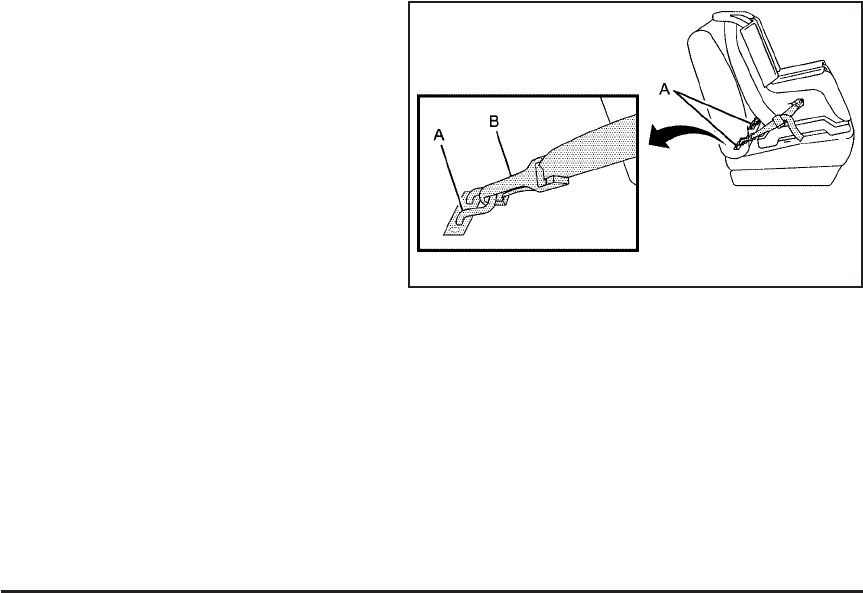
Lower Anchors
Lower anchors (A) are metal bars built into the vehicle.
There are two lower anchors for each LATCH seating
position that will accommodate a child restraint with
lower attachments (B).
1-40
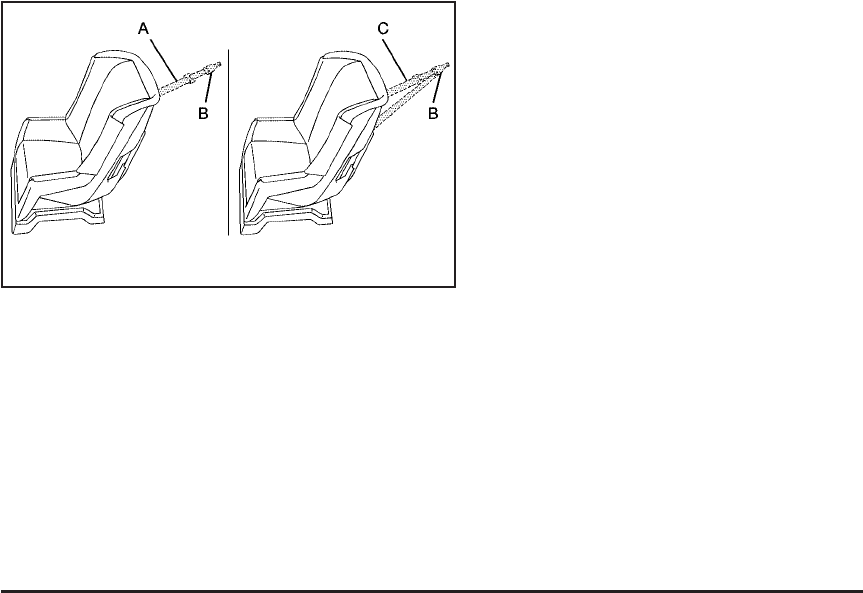
Top Tether Anchor
A top tether (A, C) anchors the top of the child restraint
to the vehicle. A top tether anchor is built into the
vehicle. The top tether attachment (B) on the child
restraint connects to the top tether anchor in the vehicle
in order to reduce the forward movement and rotation
of the child restraint during driving or in a crash.
Your child restraint may have a single tether (A) or a
dual tether (C). Either will have a single attachment (B)
to secure the top tether to the anchor.
Some top tether-equipped child restraints are designed
for use with or without the top tether being attached.
Others require the top tether always to be attached.
In Canada, the law requires that forward-facing
child restraints have a top tether, and that the tether be
attached. In the United States, some child restraints
also have a top tether. Be sure to read and follow the
instructions for your child restraint.
If the child restraint does not have a top tether,
one can be obtained, in kit form, for many child
restraints. Ask the child restraint manufacturer
whether or not a kit is available.
1-41
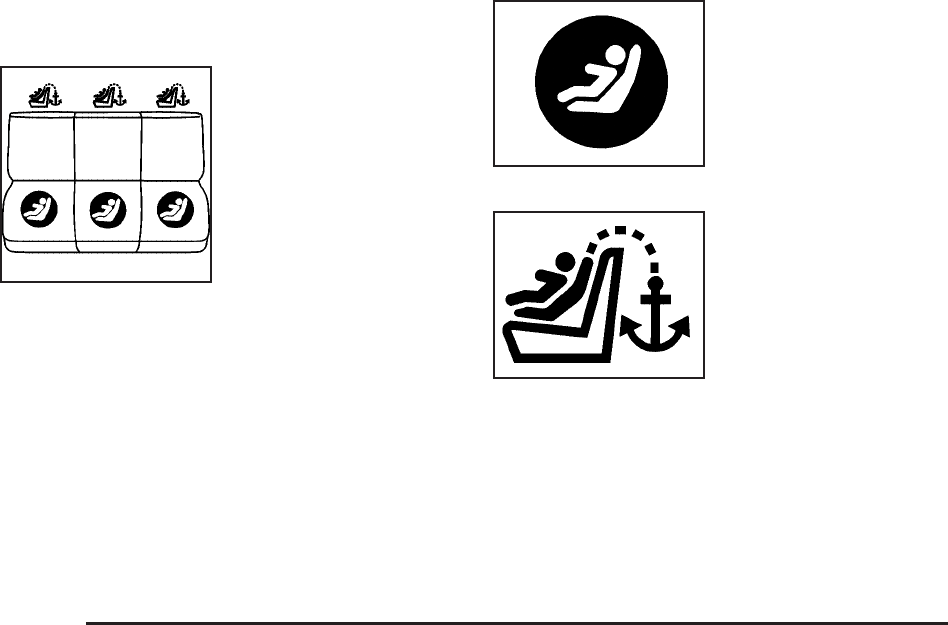
Lower Anchor and Top Tether Anchor
Locations
i(Top Tether Anchor):
Seating positions with
top tether anchors.
j(Lower Anchor):
Seating positions with
two lower anchors.
To assist you in locating
the lower anchors, each
seating position with lower
anchors has two labels,
near the crease between
the seatback and the
seat cushion, showing
where the anchors
are located.
To assist you in locating
the top tether anchors,
the top tether anchor
symbol is located on the
trim cover.
Rear Seat
1-42
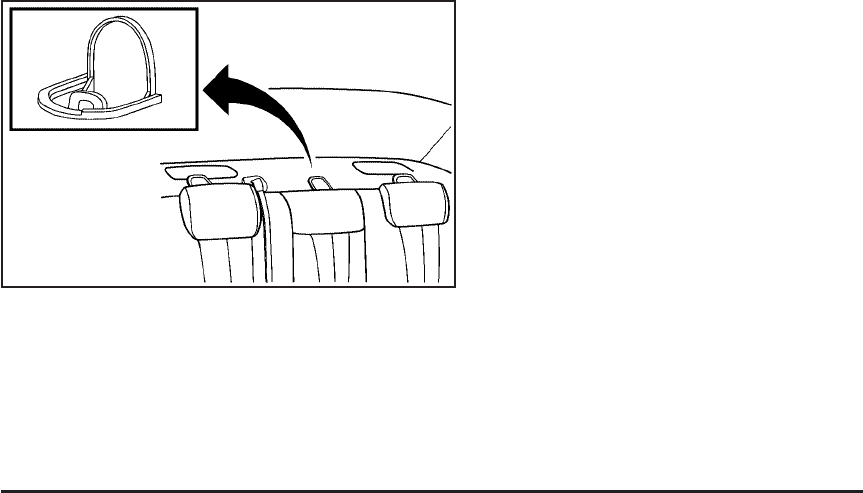
The top tether anchors are located under the trim
covers on the rear seatback filler panel. Flip open the
trim cover to access the anchors. Be sure to use
an anchor located on the same side of the vehicle as
the seating position where the child restraint will
be placed.
Do not secure a child restraint in the right front
passenger’s position if a national or local law requires
that the top tether be attached, or if the instructions that
come with the child restraint say that the top tether
must be attached. There is no place to attach the top
tether in this position.
Accident statistics show that children are safer if they
are restrained in the rear rather than the front seat.
See Where to Put the Restraint on page 1-38 for
additional information.
1-43
Securing a Child Restraint Designed for
the LATCH System
{CAUTION:
If a LATCH-type child restraint is not attached
to anchors, the restraint will not be able to
protect the child correctly. In a crash, the child
could be seriously injured or killed. Make sure
that a LATCH-type child restraint is properly
installed using the anchors, or use the
vehicle’s safety belts to secure the restraint,
following the instructions that came with that
restraint, and also the instructions in this
manual.
{CAUTION:
Each top tether anchor and lower anchor in
the vehicle is designed to hold only one child
restraint. Attaching more than one child
restraint to a single anchor could cause the
anchor or attachment to come loose or even
break during a crash. A child or others could
be injured if this happens. To help prevent
injury to people and damage to your vehicle,
attach only one child restraint per anchor.
1. Attach and tighten the lower attachments to the
lower anchors. If the child restraint does not have
lower attachments or the desired seating position
does not have lower anchors, secure the child
restraint with the top tether and the safety belts.
Refer to your child restraint manufacturer
instructions and the instructions in this manual.
1.1. Find the lower anchors for the desired
seating position.
1.2. Put the child restraint on the seat.
1.3. Attach and tighten the lower attachments on
the child restraint to the lower anchors.
1-44
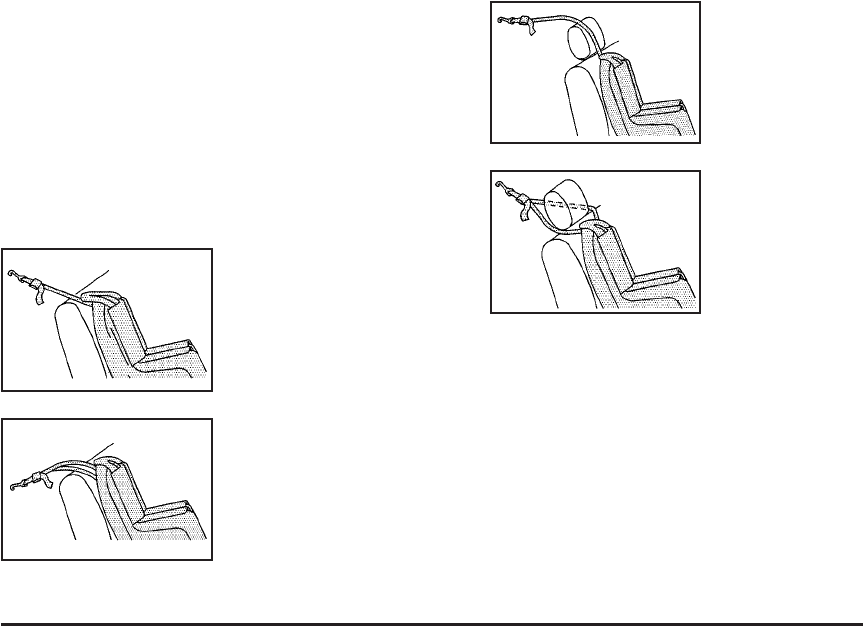
2. If the child restraint manufacturer recommends that
the top tether be attached, attach and tighten the
top tether to the top tether anchor, if equipped.
Refer to the child restraint instructions and
the following steps:
2.1. Find the top tether anchor.
2.2. Flip open the top tether anchor trim cover to
expose the anchor.
2.3. Route, attach, and tighten the top tether
according to your child restraint instructions
and the following instructions:
If the position you are
using does not have a
head restraint and you are
using a single tether,
route the tether over the
seatback.
If the position you are
using does not have a
head restraint and you are
using a dual tether,
route the tether over the
seatback.
If the position you are
using has a fixed head
restraint and you are using
a single tether, route the
tether over the head
restraint.
If the position you are
using has a fixed head
restraint and you are using
a dual tether, route the
tether around the
head restraint.
3. Push and pull the child restraint in different
directions to be sure it is secure.
1-45
Securing a Child Restraint in a
Rear Seat Position
If your child restraint is equipped with the LATCH
system, see Lower Anchors and Tethers for
Children (LATCH) on page 1-39.
If your child restraint does not have the LATCH system,
you will be using the lap-shoulder belt to secure the
child restraint in this position. Be sure to follow the
instructions that came with the child restraint. Secure
the child in the child restraint when and as the
instructions say.
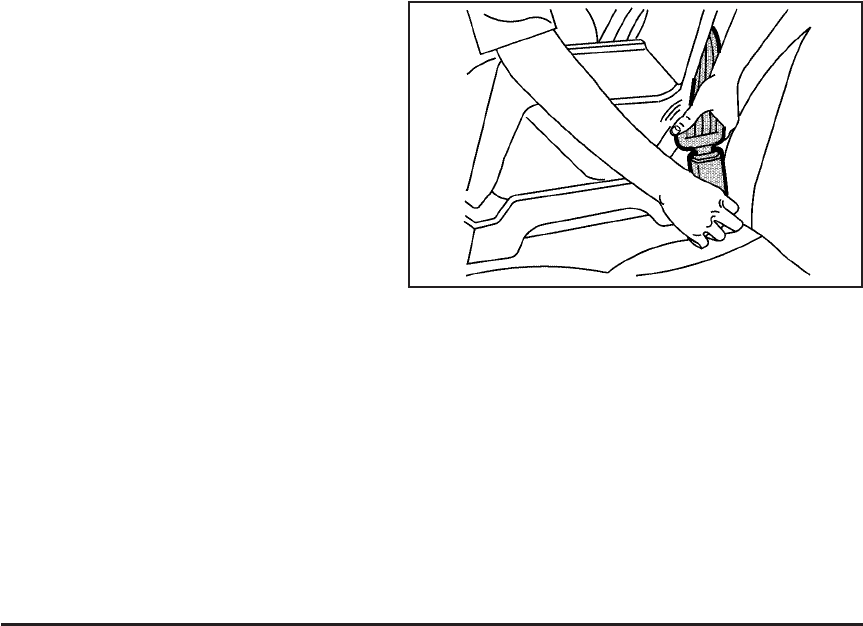
1. Put the child restraint on the seat.
2. Pick up the latch plate, and run the lap and shoulder
portions of the vehicle’s safety belt through or
around the restraint. The child restraint instructions
will show you how.
3. Buckle the belt. Make sure the release button is
positioned so you would be able to unbuckle the
safety belt quickly if you ever had to.
1-46
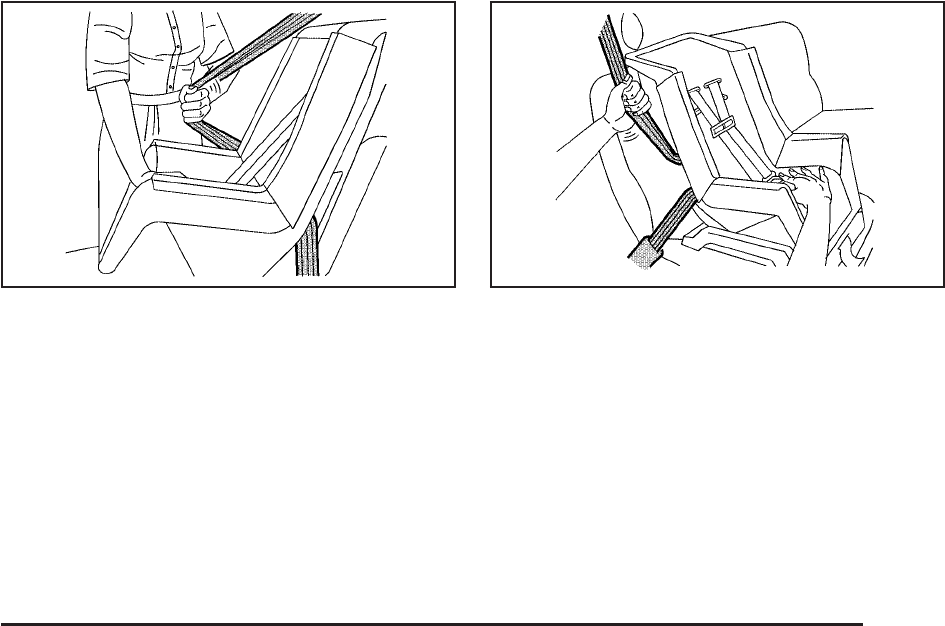
4. Pull the rest of the shoulder belt all the way out of
the retractor to set the lock. 5. To tighten the belt, push down on the child restraint,
pull the shoulder portion of the belt to tighten the
lap portion of the belt and feed the shoulder
belt back into the retractor. If you are using a
forward-facing child restraint, you may find it helpful
to use your knee to push down on the child
restraint as you tighten the belt.
1-47
6. If your child restraint manufacturer recommends
using a top tether, attach and tighten the top
tether to the top tether anchor. Refer to the
instructions that came with the child restraint and
see Lower Anchors and Tethers for Children
(LATCH) on page 1-39.
7. Push and pull the child restraint in different
directions to be sure it is secure.
To remove the child restraint, if the top tether is attached
to the top tether anchor, disconnect it. Unbuckle the
vehicle’s safety belt and let it go back all the way.
The safety belt will move freely again and be ready to
work for an adult or larger child passenger.
Securing a Child Restraint in the
Center Front Seat Position
{CAUTION:
A child in a child restraint in the center front
seat can be badly injured or killed by the right
front passenger’s airbag if it inflates. Never
secure a child restraint in the center front seat.
It is always better to secure a child restraint in
the rear seat.
Do not secure a child restraint in the center front seat
position.
1-48

Securing a Child Restraint in the
Right Front Seat Position
Your vehicle has a right front passenger’s airbag. A rear
seat is a safer place to secure a forward-facing child
restraint. See Where to Put the Restraint on page 1-38.
In addition, your vehicle has a passenger sensing
system. The passenger sensing system is designed to
turn off the right front passenger’s frontal airbag
when an infant in a rear-facing infant seat or a small
child in a forward-facing child restraint or booster seat is
detected. See Passenger Sensing System on page 1-61
and Passenger Airbag Status Indicator on page 3-35
for more information on this including important
safety information.
A label on your sun visor says, “Never put a rear-facing
child seat in the front.” This is because the risk to the
rear-facing child is so great, if the airbag deploys.
{CAUTION:
A child in a rear-facing child restraint can be
seriously injured or killed if the right front
passenger’s airbag inflates. This is because
the back of the rear-facing child restraint
would be very close to the inflating airbag.
Even though the passenger sensing system is
designed to turn off the passenger’s frontal
airbag if the system detects a rear-facing child
restraint, no system is fail-safe, and no one
can guarantee that an airbag will not deploy
under some unusual circumstance, even
though it is turned off. We recommend that
rear-facing child restraints be secured in the
rear seat, even if the airbag is off.
1-49

If you need to secure a forward-facing child restraint in
the right front seat position, move the seat as far
back as it will go before securing the forward-facing
child restraint. See Manual Seats on page 1-2 or
Six-Way Power Seats on page 1-3.
If your child restraint is equipped with the LATCH
system, see Lower Anchors and Tethers for Children
(LATCH) on page 1-39.
There is no top tether anchor at the right front seating
position. Do not secure a child restraint in this position if
a national or local law requires that the top tether be
anchored or if the instructions that come with the child
restraint say that the top tether must be anchored.
See Lower Anchors and Tethers for Children (LATCH)
on page 1-39 if your child restraint has a top tether.
You will be using the lap-shoulder belt to secure
the child restraint in this position. Be sure to follow
the instructions that came with the child restraint.
Secure the child in the child restraint when and as the
instructions say.
1. Your vehicle has a right front passenger’s frontal
airbag. See Passenger Sensing System on
page 1-61. General Motors recommends that
rear-facing child restraints be secured in a rear seat,
even if the airbag is off. If your child restraint is
forward-facing, move the seat as far back as it will
go before securing the child restraint in this seat.
See Manual Seats on page 1-2 or Six-Way Power
Seats on page 1-3.
When the passenger sensing system has turned off
the right front passenger’s frontal airbag, the off
indicator in the passenger airbag status indicator
should light and stay lit when you turn the ignition to
RUN or START. See Passenger Airbag Status
Indicator on page 3-35.
2. Put the child restraint on the seat.
3. Pick up the latch plate, and run the lap and shoulder
portions of the vehicle’s safety belt through or
around the restraint. The child restraint instructions
will show you how.
1-50
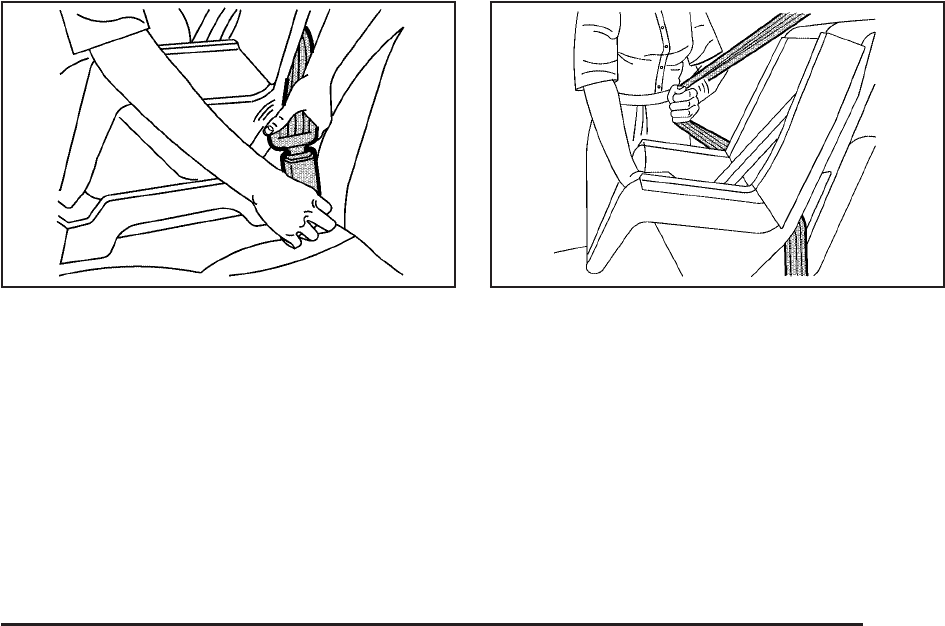
4. Buckle the belt. Make sure the release button is
positioned so you would be able to unbuckle the
safety belt quickly if you ever had to.
5. Pull the rest of the shoulder belt all the way out of
the retractor to set the lock.
1-51
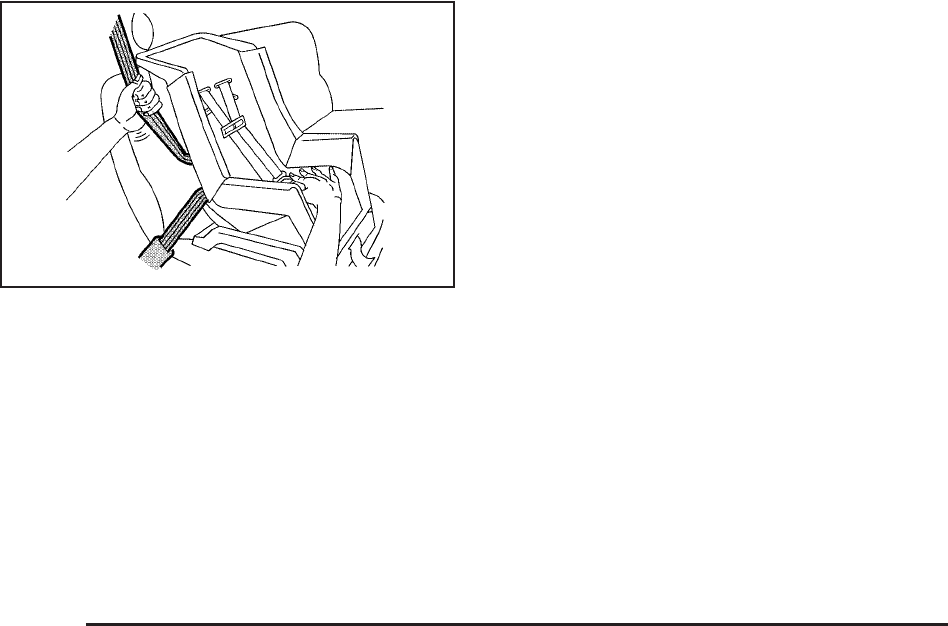
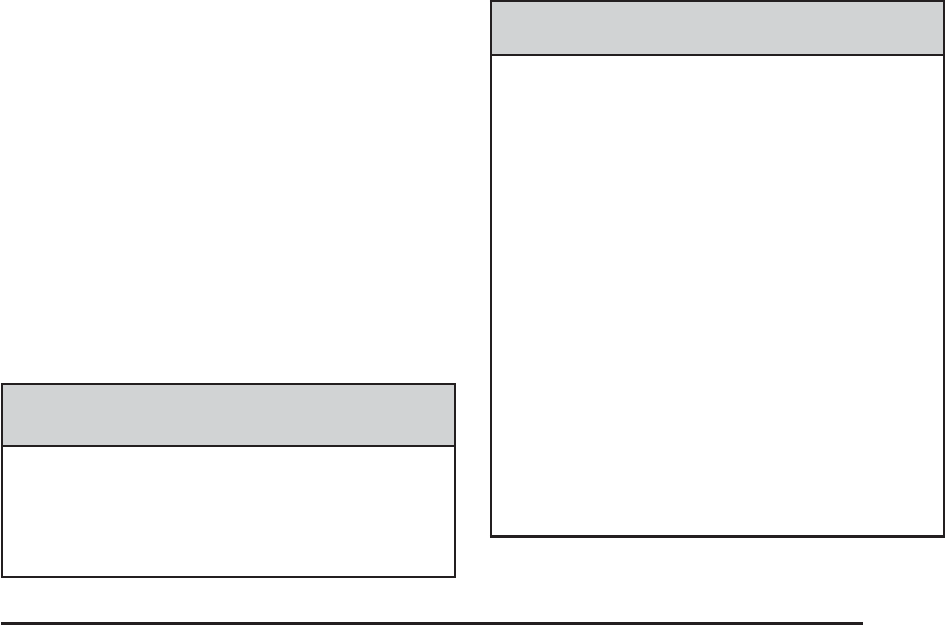
6. To tighten the belt, push down on the child restraint,
pull the shoulder portion of the belt to tighten the
lap portion of the belt and feed the shoulder
belt back into the retractor. If you are using a
forward-facing child restraint, you may find it helpful
to use your knee to push down on the child
restraint as you tighten the belt. You should not be
able to pull more of the belt from the retractor
once the lock has been set.
7. Push and pull the child restraint in different
directions to be sure it is secure.
8. If the airbag is off, the off indicator on the instrument
panel will be lit and stay lit when the key is turned
to RUN or START.
If a child restraint has been installed and the on
indicator is lit, turn the vehicle off. Remove the child
restraint from the vehicle and reinstall the child restraint.
If after reinstalling the child restraint and restarting
the vehicle, the on indicator is still lit, check to make
sure that the vehicle’s seatback is not pressing the child
restraint into the seat cushion. If this happens, slightly
recline the vehicle’s seatback and adjust the seat
cushion if possible. Also make sure the child restraint is
not trapped under the vehicle head restraint. If this
happens, adjust the head restraint.
If the on indicator is still lit, secure the child in the child
restraint in a rear seat position in the vehicle and
check with your dealer.
To remove the child restraint, just unbuckle the vehicle’s
safety belt and let it go back all the way. The safety
belt will move freely again and be ready to work for an
adult or larger child passenger.
1-52
Airbag System
Your vehicle has a frontal airbag for the driver and a
frontal airbag for the right front passenger. Your vehicle
may also have roof-mounted side impact airbags.
Roof-mounted side impact airbags are available for the
driver and the passenger seated directly behind the
driver and for the right front passenger and the
passenger seated directly behind that passenger.
If your vehicle has side impact airbags, the word
AIRBAG will appear on the airbag covering on the
ceiling near the side windows.
Frontal airbags are designed to help reduce the risk of
injury from the force of an inflating frontal airbag.
But these airbags must inflate very quickly to do their
job and comply with federal regulations.
Here are the most important things to know about the
airbag system:
{CAUTION:
You can be severely injured or killed in a crash
if you are not wearing your safety belt — even if
you have airbags. Wearing your safety belt
CAUTION: (Continued)
CAUTION: (Continued)
during a crash helps reduce your chance of
hitting things inside the vehicle or being ejected
from it. Airbags are “supplemental restraints”
to the safety belts. All airbags are designed to
work with safety belts but do not replace them.
Frontal airbags for the driver and right front
passenger are designed to deploy in moderate
to severe frontal and near frontal crashes.
They are not designed to inflate in rollover, rear
crashes, or in many side crashes. And, for some
unrestrained occupants, frontal airbags may
provide less protection in frontal crashes than
more forceful airbags have provided in the past.
Roof-mounted side impact airbags are designed
to inflate in moderate to severe crashes where
something hits the side of your vehicle. They
are not designed to inflate in frontal, in rollover
or in rear crashes. Everyone in your vehicle
should wear a safety belt properly — whether or
not there is an airbag for that person.
1-53
{CAUTION:
Both frontal and side impact airbags inflate
with great force, faster than the blink of an
eye. If you are too close to an inflating airbag,
as you would be if you were leaning forward,
it could seriously injure you. Safety belts help
keep you in position for airbag inflation before
and during a crash. Always wear your safety
belt even with frontal airbags. The driver
should sit as far back as possible while still
maintaining control of the vehicle. Occupants
should not lean on or sleep against the door.
{CAUTION:
Anyone who is up against, or very close to,
any airbag when it inflates can be seriously
injured or killed. Airbags plus lap-shoulder
belts offer the best protection for adults, but
not for young children and infants. Neither the
vehicle’s safety belt system nor its airbag
system is designed for them. Young children
and infants need the protection that a child
restraint system can provide. Always secure
children properly in your vehicle. To read how,
see Older Children on page 1-28 or Infants and
Young Children on page 1-31.
1-54
There is an airbag
readiness light on the
instrument panel cluster,
which shows the airbag
symbol.
The system checks the airbag electrical system for
malfunctions. The light tells you if there is an electrical
problem. See Airbag Readiness Light on page 3-34
for more information.
Where Are the Airbags?
The driver’s airbag is in the middle of the steering wheel.
1-55
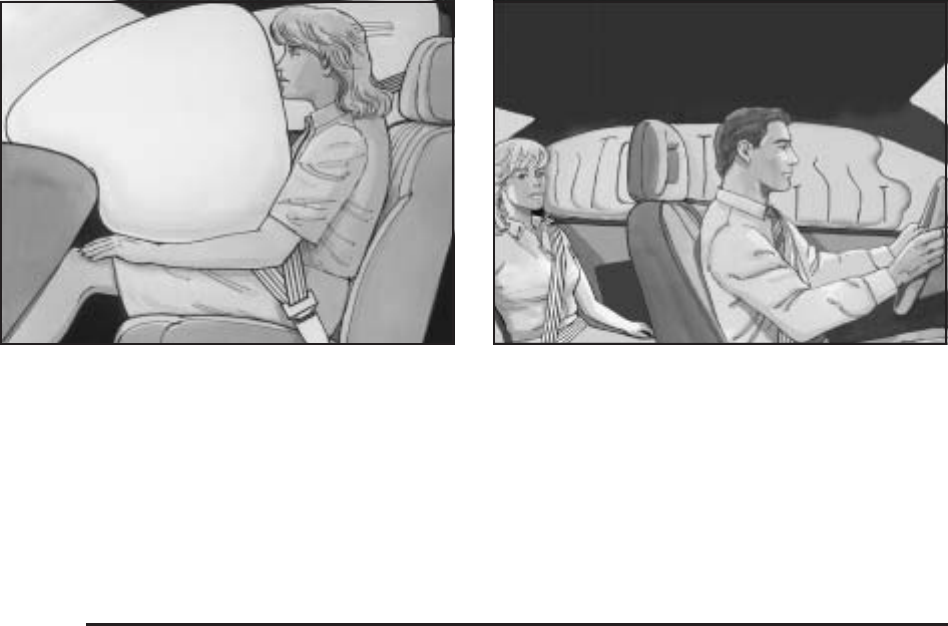
The right front passenger’s airbag is in the instrument
panel on the passenger’s side. If your vehicle has a side impact airbag for the driver
and the person seated directly behind the driver,
it is located in the ceiling above the side windows.
1-56
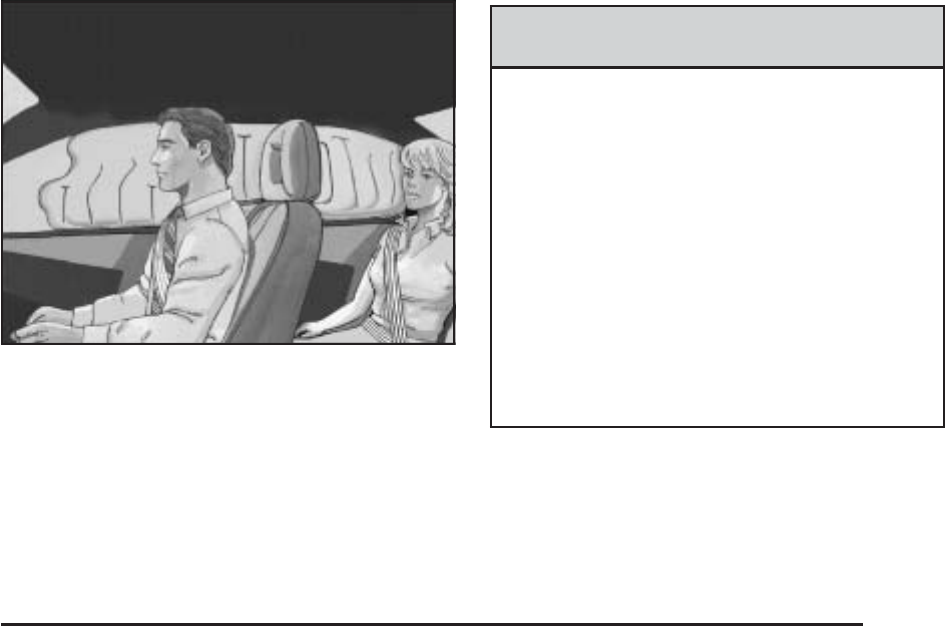
If your vehicle has a side impact airbag for the right front
passenger and the person directly behind that passenger,
it is located in the ceiling above the side windows.
{CAUTION:
If something is between an occupant and an
airbag, the bag might not inflate properly or it
might force the object into that person causing
severe injury or even death. The path of an
inflating airbag must be kept clear. Do not put
anything between an occupant and an airbag,
and do not attach or put anything on the
steering wheel hub or on or near any other
airbag covering. And, if your vehicle has
roof-mounted side impact airbags, never secure
anything to the roof of your vehicle by routing
the rope or tiedown through any door or window
opening. If you do, the path of an inflating side
impact airbag will be blocked. The path of an
inflating airbag must be kept clear.
1-57

When Should an Airbag Inflate?
The driver’s and right front passenger’s frontal airbags
are designed to inflate in moderate to severe frontal
or near-frontal crashes. But they are designed to inflate
only if the impact exceeds a predetermined deployment
threshold. Deployment thresholds take into account
a variety of desired deployment and non-deployment
events and are used to predict how severe a crash
is likely to be in time for the airbags to inflate and help
restrain the occupants. Whether your frontal airbags
will or should deploy is not based on how fast your
vehicle is traveling. It depends largely on what you hit,
the direction of the impact and how quickly your
vehicle slows down.
In addition, your vehicle has “dual-stage” frontal airbags,
which adjust the restraint according to crash severity.
Your vehicle is equipped with electronic frontal sensors
which help the sensing system distinguish between a
moderate frontal impact and a more severe frontal
impact. For moderate frontal impacts, these airbags
inflate at a level less than full deployment. For more
severe frontal impacts, full deployment occurs.
If the front of your vehicle goes straight into a wall
that does not move or deform, the threshold level for
the reduced deployment is about 12 to 16 mph
(19 to 26 km/h), and the threshold level for a full
deployment is about 18 to 22 mph (29 to 35.5 km/h).
The threshold level can vary, however, with specific
vehicle design, so that it can be somewhat above
or below this range.
Frontal airbags may inflate at different crash speeds.
For example:
•If the vehicle hits a stationary object, the airbags
could inflate at a different crash speed than if the
vehicle hits a moving object.
•If the vehicle hits an object that deforms, the
airbags could inflate at a different crash speed than
if the vehicle hits an object that does not deform.
•If the vehicle hits a narrow object (like a pole) the
airbags could inflate at a different crash speed
than if the vehicle hits a wide object (like a wall).
•If the vehicle goes into an object at an angle the
airbags could inflate at a different crash speed
than if the vehicle goes straight into the object.
Frontal airbags (driver and right front passenger) are not
intended to inflate during vehicle rollovers, rear impacts,
or in many side impacts.
Your vehicle may or may not have side impact airbags.
See Airbag System on page 1-53. Side impact airbags
are intended to inflate in moderate to severe side
crashes. A side impact airbag will inflate if the crash
severity is above the system’s designed threshold level.
1-58

The threshold level can vary with specific vehicle
design. Side impact airbags are not intended to inflate
in frontal or near-frontal impacts, rollovers or rear
impacts. A side impact airbag is intended to deploy on
the side of the vehicle that is struck.
In any particular crash, no one can say whether an
airbag should have inflated simply because of the
damage to a vehicle or because of what the repair costs
were. For frontal airbags, inflation is determined by
what the vehicle hits, the angle of the impact, and how
quickly the vehicle slows down. For side impact
airbags, inflation is determined by the location and
severity of the impact.
What Makes an Airbag Inflate?
In an impact of sufficient severity, the airbag sensing
system detects that the vehicle is in a crash. The
sensing system triggers a release of gas from the
inflator, which inflates the airbag. The inflator, airbag,
and related hardware are all part of the airbag modules
inside the steering wheel and in the instrument panel
in front of the right front passenger. For vehicles
with side impact airbags, there are also airbag modules
in the ceiling of the vehicle, near the side windows.
How Does an Airbag Restrain?
In moderate to severe frontal or near frontal collisions,
even belted occupants can contact the steering wheel
or the instrument panel. In moderate to severe side
collisions, even belted occupants can contact the inside
of the vehicle. The airbag supplements the protection
provided by safety belts. Airbags distribute the force of
the impact more evenly over the occupant’s upper
body, stopping the occupant more gradually. But the
frontal airbags would not help you in many types
of collisions, including rollovers, rear impacts, and many
side impacts, primarily because an occupant’s motion
is not toward the airbag. Side impact airbags would not
help you in many types of collisions, including many
frontal or near frontal collisions, and rear impacts,
primarily because an occupant’s motion is not toward
those airbags. Airbags should never be regarded
as anything more than a supplement to safety belts, and
then only in moderate to severe frontal or near-frontal
collisions for the driver’s and right front passenger’s
frontal airbags, and only in moderate to severe
side collisions for side impact airbags.
1-59
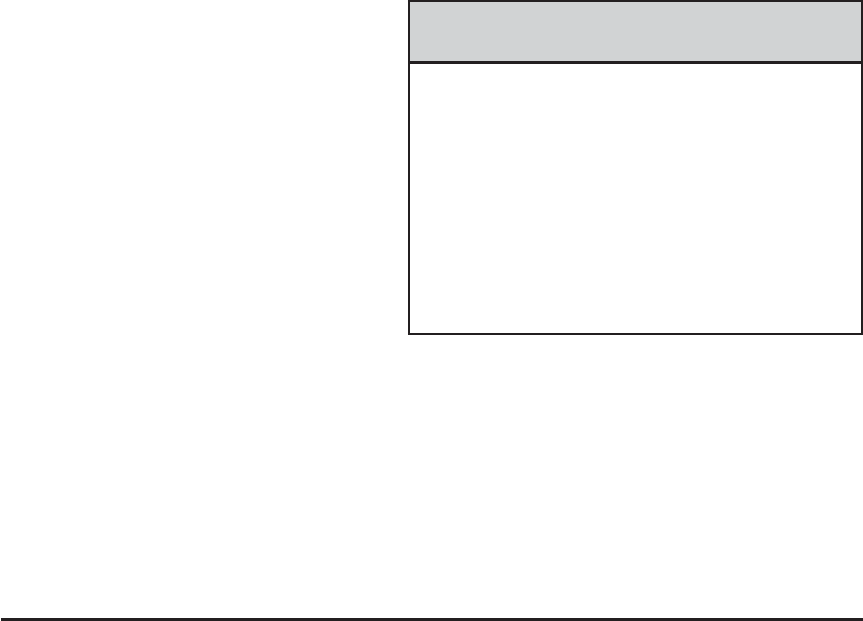
What Will You See After an
Airbag Inflates?
After a frontal airbag inflates, it quickly deflates, so
quickly that some people may not even realize
the airbag inflated. Roof-mounted side impact airbags
deflate more slowly and may still be at least partially
inflated minutes after the vehicle comes to rest. Some
components of the airbag module — the steering wheel
hub for the driver’s airbag, the instrument panel for
the right front passenger’s airbag, or the ceiling of your
vehicle near the side windows — may be hot for a
short time. The parts of the bag that come into contact
with you may be warm, but not too hot to touch.
There will be some smoke and dust coming from the
vents in the deflated airbags. Airbag inflation does
not prevent the driver from seeing out of the windshield
or being able to steer the vehicle, nor does it stop
people from leaving the vehicle.
{CAUTION:
When an airbag inflates, there is dust in the
air. This dust could cause breathing problems
for people with a history of asthma or other
breathing trouble. To avoid this, everyone in
the vehicle should get out as soon as it is safe
to do so. If you have breathing problems but
cannot get out of the vehicle after an airbag
inflates, then get fresh air by opening a
window or a door. If you experience breathing
problems following an airbag deployment,
you should seek medical attention.
1-60
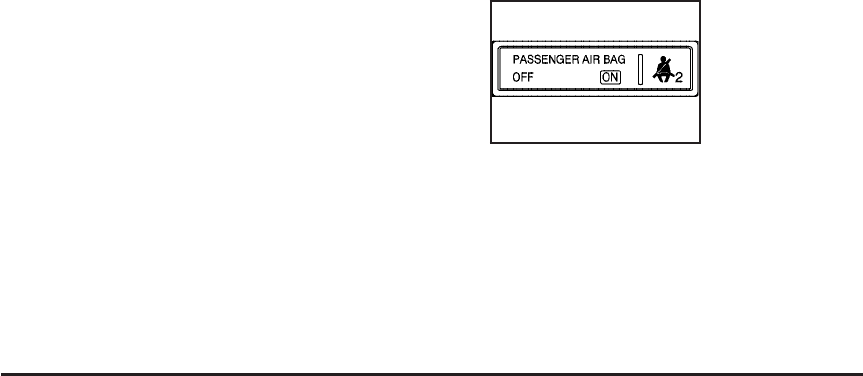
In many crashes severe enough to inflate an airbag,
windshields are broken by vehicle deformation.
Additional windshield breakage may also occur from
the right front passenger airbag.
•Airbags are designed to inflate only once. After an
airbag inflates, you will need some new parts for
your airbag system. If you do not get them,
the airbag system will not be there to help protect
you in another crash. A new system will include
airbag modules and possibly other parts.
The service manual for your vehicle covers other
parts that need to be replaced.
•Your vehicle is equipped with a crash sensing and
diagnostic module which records information after
a crash. See Vehicle Data Collection and Event
Data Recorders on page 7-10.
•Let only qualified technicians work on your airbag
system. Improper service can mean that your
airbag system will not work properly. See your
GM dealer for service.
Passenger Sensing System
Your vehicle has a passenger sensing system.
The passenger airbag status indicator on the instrument
panel will be visible when you turn your ignition key
to RUN or START. The words ON and OFF will be
visible during the system check. If you use remote start
to start your vehicle from a distance, if equipped,
you may not see the system check. When the system
check is complete, either the word ON or the word OFF
will be visible. See Passenger Airbag Status Indicator
on page 3-35.
The passenger sensing system will turn off the right
front passenger’s frontal airbag under certain conditions.
The driver’s airbag and the side airbags (if equipped)
are not part of the passenger sensing system.
Passenger Airbag
Status Indicator
1-61
The passenger sensing system works with sensors that
are part of the right front passenger’s seat. The sensors
are designed to detect the presence of a properly-seated
occupant and determine if the passenger’s frontal airbag
should be enabled (may inflate) or not.
Accident statistics show that children are safer if they
are restrained in the rear rather than the front seat.
General Motors recommends that child restraints
be secured in a rear seat, including an infant riding in a
rear-facing infant seat, a child riding in a forward-facing
child seat, and an older child riding in a booster seat.
Your vehicle has a rear seat that will accommodate
a rear-facing child restraint. A label on your sun visor
says, “Never put a rear-facing child seat in the front.”
This is because the risk to the rear-facing child is
so great, if the airbag deploys.
{CAUTION:
A child in a rear-facing child restraint can be
seriously injured or killed if the right front
passenger’s airbag inflates. This is because
the back of the rear-facing child restraint
would be very close to the inflating airbag.
Even though the passenger sensing system is
designed to turn off the passenger’s frontal
airbag if the system detects a rear-facing child
restraint, no system is fail-safe, and no one
can guarantee that an airbag will not deploy
under some unusual circumstance, even
though it is turned off. We recommend that
rear-facing child restraints be secured in the
rear seat, even if the airbag is off.
If you need to secure a forward-facing child
restraint in the right front seat, always move
the front passenger seat as far back as it will
go. It is better to secure the child restraint in a
rear seat.
1-62

The passenger sensing system is designed to turn off
the right front passenger’s frontal airbag if:
•the right front passenger seat is unoccupied
•the system determines that an infant is present in a
rear-facing infant seat
•the system determines that a small child is present
in a forward-facing child restraint
•the system determines that a small child is present
in a booster seat
•a right front passenger takes his/her weight off of
the seat for a period of time
•the right front passenger seat is occupied by a
smaller person, such as a child who has outgrown
child restraints
•or if there is a critical problem with the airbag
system or the passenger sensing system.
When the passenger sensing system has turned off the
right front passenger’s frontal airbag, the off indicator
on the instrument panel will light and stay lit to remind
you that the airbag is off.
If a child restraint has been installed and the on
indicator is lit, turn the vehicle off. Remove the child
restraint from the vehicle and reinstall the child restraint
following the child restraint manufacturer’s directions
and refer to Securing a Child Restraint in the Right Front
Seat Position on page 1-49.
If after reinstalling the child restraint and restarting the
vehicle, the on indicator is still lit, check to make
sure that the vehicle’s seatback is not pressing the child
restraint into the seat cushion. If this happens, slightly
recline the vehicle’s seatback and adjust the seat
cushion if possible. Also make sure the child restraint is
not trapped under the vehicle head restraint. If this
happens, adjust the head restraint.
If the on indicator is still lit, secure the child in the child
restraint in a rear seat position in the vehicle and
check with your dealer.
The passenger sensing system is designed to enable
(may inflate) the right front passenger’s frontal
airbag anytime the system senses that a person of adult
size is sitting properly in the right front passenger’s
seat. When the passenger sensing system has allowed
the airbag to be enabled, the on indicator will light
and stay lit to remind you that the airbag is active.
For some children who have outgrown child restraints
and for very small adults, the passenger sensing system
may or may not turn off the right front passenger’s
frontal airbag, depending upon the person’s seating
posture and body build. Everyone in your vehicle who
has outgrown child restraints should wear a safety
belt properly — whether or not there is an airbag for
that person.
1-63
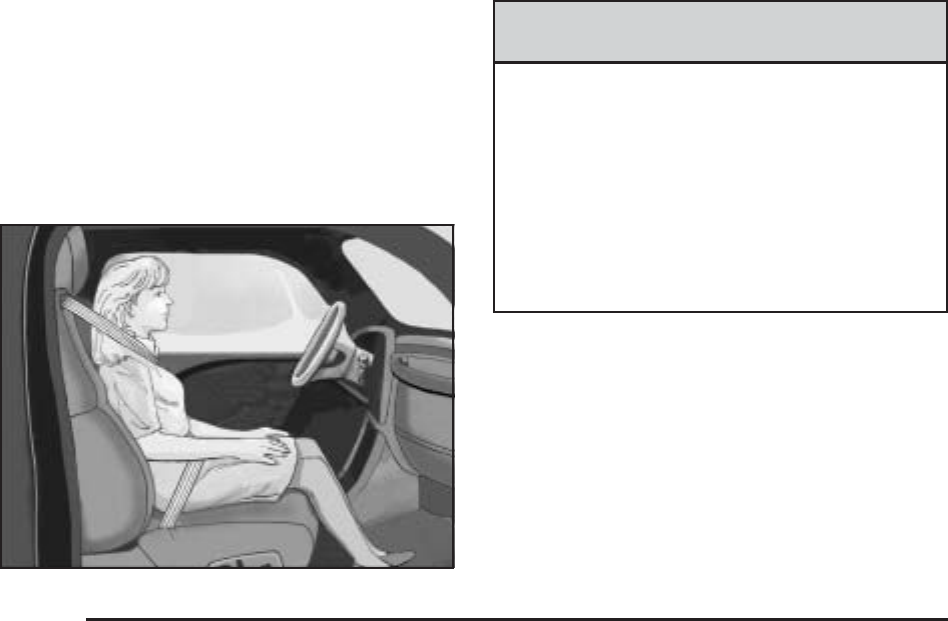
If a person of adult-size is sitting in the right front
passenger’s seat, but the off indicator is lit, it could be
because that person is not sitting properly in the
seat. If this happens, turn the vehicle off and ask the
person to place the seatback in the fully upright position,
then sit upright in the seat, centered on the seat
cushion, with the person’s legs comfortably extended.
Restart the vehicle and have the person remain in
this position for about two minutes. This will allow the
system to detect that person and then enable the
passenger’s airbag.
{CAUTION:
If the airbag readiness light in the instrument
panel cluster ever comes on and stays on,
it means that something may be wrong with
the airbag system. If this ever happens, have
the vehicle serviced promptly, because an
adult-size person sitting in the right front
passenger’s seat may not have the protection
of the frontal airbag. See Airbag Readiness
Light on page 3-34 for more on this, including
important safety information.
A thick layer of additional material such as a blanket,
or aftermarket equipment such as seat covers,
seat heaters, and seat massagers, can affect
how well the passenger sensing system operates.
Remove any additional material from the seat cushion
before reinstalling or securing the child restraint
and before a small occupant, including a small
adult, sits in the right front passenger’s seat.
1-64
You may want to consider not using seat covers or
other aftermarket equipment if your vehicle has
the passenger sensing system. See Adding Equipment
to Your Airbag-Equipped Vehicle on page 1-66 for
more information about modifications that can affect
how the system operates.
The passenger sensing system may suppress the
airbag deployment when liquid is soaked into the seat.
If this happens, the off indicator in the passenger
airbag status indicator and the airbag readiness light on
the instrument panel will be lit. The system should
resume normal operation after the seat is allowed to dry.
If the system operates incorrectly after the seat has
dried, have your dealer check the system.
{CAUTION:
Stowing of articles under the passenger’s seat
or between the passenger’s seat cushion and
seatback may interfere with the proper
operation of the passenger sensing system.
Servicing Your Airbag-Equipped
Vehicle
Airbags affect how your vehicle should be serviced.
There are parts of the airbag system in several places
around your vehicle. You do not want the system to
inflate while someone is working on your vehicle.
Your dealer and the service manual have information
about servicing your vehicle and the airbag system.
To purchase a service manual, see Service Publications
Ordering Information on page 7-15.
{CAUTION:
For up to 10 seconds after the ignition key is
turned off and the battery is disconnected, an
airbag can still inflate during improper service.
You can be injured if you are close to an
airbag when it inflates. Avoid yellow
connectors. They are probably part of the
airbag system. Be sure to follow proper
service procedures, and make sure the person
performing work for you is qualified to do so.
The airbag system does not need regular maintenance.
1-65

Adding Equipment to Your
Airbag-Equipped Vehicle
Q: Is there anything I might add to the front or
sides of the vehicle that could keep the
airbags from working properly?
A: Yes. If you add things that change your vehicle’s
frame, bumper system, front end or side sheet
metal or height, they may keep the airbag system
from working properly. Also, the airbag system may
not work properly if you relocate any of the airbag
sensors. If you have any questions about this,
you should contact Customer Service before you
modify your vehicle. The phone numbers and
addresses for Customer Assistance are in Step Two
of the Customer Satisfaction Procedure in this
manual. See Customer Satisfaction Procedure on
page 7-2.
Q: Because I have a disability, I have to get my
vehicle modified. How can I find out whether
this will affect my airbag system?
A: Changing or moving any parts of the front seats,
safety belts, the airbag sensing and diagnostic
module (located under the right front passenger’s
seat), or the instrument panel can affect the
operation of the airbag system. If you have
questions, call Customer Assistance. The phone
numbers and addresses for Customer Assistance
are in Step Two of the Customer Satisfaction
Procedure in this manual. See Customer
Satisfaction Procedure on page 7-2.
1-66

Restraint System Check
Checking the Restraint Systems
Now and then, make sure the safety belt reminder light
and all your belts, buckles, latch plates, retractors
and anchorages are working properly. Look for any other
loose or damaged safety belt system parts. If you see
anything that might keep a safety belt system from doing
its job, have it repaired.
Torn or frayed safety belts may not protect you in a
crash. They can rip apart under impact forces. If a belt
is torn or frayed, get a new one right away.
Also look for any opened or broken airbag covers, and
have them repaired or replaced. (The airbag system
does not need regular maintenance.)
Notice: If you damage the covering for the driver’s
or the right front passenger’s airbag, or the side
impact airbag covering (if equipped) on the ceiling
near the side windows, the airbag may not work
properly. You may have to replace the airbag
module in the steering wheel, both the airbag
module and the instrument panel for the right front
passenger’s airbag, or side impact airbag module
and ceiling covering for roof-mounted side impact
airbags (if equipped.) Do not open or break the
airbag coverings.
1-67
Replacing Restraint System Parts
After a Crash
{CAUTION:
A crash can damage the restraint systems in
your vehicle. A damaged restraint system
may not properly protect the person using it,
resulting in serious injury or even death in a
crash. To help make sure your restraint
systems are working properly after a crash,
have them inspected and any necessary
replacements made as soon as possible.
If you have had a crash, do you need new belts or
LATCH system parts?
After a very minor collision, nothing may be necessary.
But if the belts were stretched, as they would be if
worn during a more severe crash, then you need
new parts.
If the LATCH system was being used during a more
severe crash, you may need new LATCH system parts.
If belts are cut or damaged, replace them. Collision
damage also may mean you will need to have LATCH
system, safety belt or seat parts repaired or replaced.
New parts and repairs may be necessary even if the belt
or LATCH system was not being used at the time of
the collision.
If an airbag inflates, you will need to replace airbag
system parts. See the part on the airbag system earlier
in this section.
If the frontal airbags inflate, you will also need to
replace the driver’s and right front passenger’s safety
belt buckle assembly. Be sure to do so. Then the
new buckle assembly will be there to help protect you
in a collision.
After a crash you may need to replace the driver and
front passenger’s safety belt buckle assemblies, even if
the frontal airbags have not deployed. The driver
and front passenger’s safety belt buckle assemblies
contain the safety belt pretensioners. Have your safety
belt pretensioners checked if your vehicle has been
in a collision, or if your airbag readiness light stays on
after you start your vehicle or while you are driving.
See Airbag Readiness Light on page 3-34.
1-68

Keys ...............................................................2-2
Remote Keyless Entry System .........................2-3
Remote Keyless Entry System Operation ...........2-4
Doors and Locks ............................................2-10
Door Locks ..................................................2-10
Power Door Locks ........................................2-11
Delayed Locking ...........................................2-11
Automatic Door Lock .....................................2-12
Rear Door Security Locks ..............................2-12
Lockout Protection ........................................2-13
Trunk ..........................................................2-13
Windows ........................................................2-16
Power Windows ............................................2-17
Sun Visors ...................................................2-18
Theft-Deterrent Systems ..................................2-18
Content Theft-Deterrent .................................2-18
PASS-Key
®
III ..............................................2-20
PASS-Key
®
III Operation ...............................2-21
Starting and Operating Your Vehicle ................2-22
New Vehicle Break-In ....................................2-22
Ignition Positions ..........................................2-23
Retained Accessory Power (RAP) ...................2-23
Starting the Engine .......................................2-24
Engine Coolant Heater ..................................2-25
Automatic Transaxle Operation .......................2-26
Parking Brake ..............................................2-30
Shifting Into Park (P) .....................................2-31
Shifting Out of Park (P) .................................2-32
Parking Over Things That Burn .......................2-34
Engine Exhaust ............................................2-34
Running the Engine While Parked ...................2-35
Mirrors ...........................................................2-36
Manual Rearview Mirror .................................2-36
Manual Rearview Mirror with OnStar
®
..............2-36
Automatic Dimming Rearview Mirror ................2-36
Automatic Dimming Rearview Mirror
with OnStar
®
............................................2-37
Outside Power Mirrors ...................................2-37
Outside Power Heated Mirrors ........................2-38
Outside Convex Mirror ...................................2-38
OnStar
®
System .............................................2-38
Universal Home Remote System ......................2-40
Universal Home Remote System Operation ......2-41
Storage Areas ................................................2-44
Glove Box ...................................................2-44
Cupholder(s) ................................................2-45
Center Console Storage Area .........................2-46
Convenience Net ..........................................2-46
Sunroof .........................................................2-47
Section 2 Features and Controls
2-1
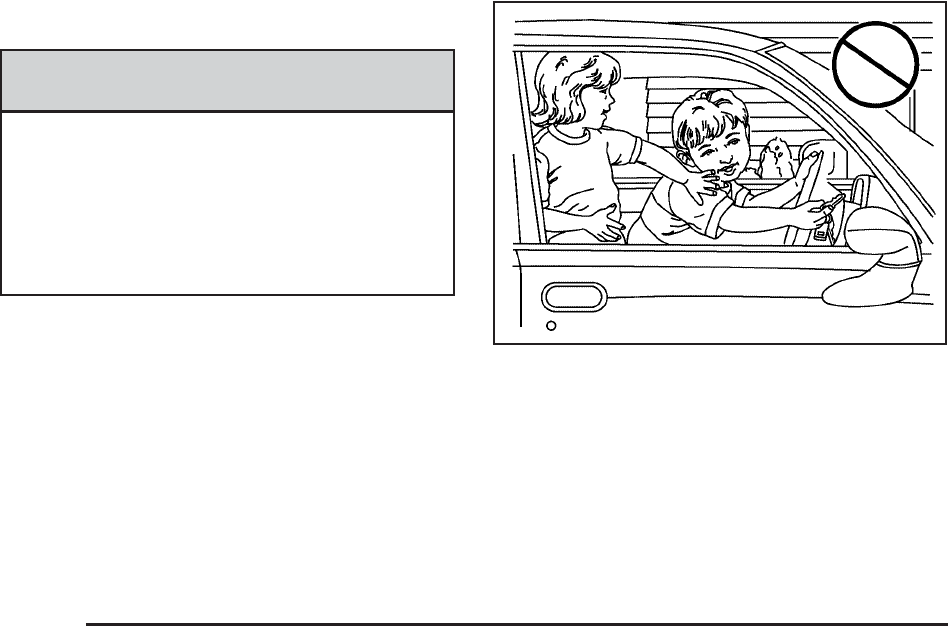
Keys
{CAUTION:
Leaving children in a vehicle with the ignition
key is dangerous for many reasons. They
could operate the power windows or other
controls or even make the vehicle move. The
children or others could be badly injured or
even killed. Do not leave the keys in a vehicle
with children.
2-2
One key is used for the
ignition and all locks.
When a new vehicle is delivered, the key has a
bar-coded key tag. This tag may be removed by your
dealer before it is delivered.
The vehicle has the PASS-Key
®
III vehicle theft system.
The key has a transponder in the key head that
matches a decoder in the vehicle’s instrument panel.
The key will have PK3 stamped on it. If a replacement
key or an additional key is needed, it must be
purchased from your dealer or certified locksmith.
Any new PASS-Key
®
III key must be programmed before
it will start the vehicle. See PASS-Key
®
III on page 2-20
for more information on programming a new key.
In an emergency, contact Roadside Assistance.
See Roadside Assistance Program on page 7-6 for
more information.
Notice: If you ever lock your keys in your vehicle,
you may have to damage the vehicle to get in.
Be sure you have spare keys.
If your vehicle is equipped with the OnStar
®
system with
an active subscription and you lock your keys inside
the vehicle, OnStar
®
may be able to send a command to
unlock your vehicle. See OnStar
®
System on page 2-38
for more information.
Remote Keyless Entry System
Your keyless entry system operates on a radio
frequency subject to Federal Communications
Commission (FCC) Rules and with Industry Canada.
This device complies with Part 15 of the FCC Rules.
Operation is subject to the following two conditions:
1. This device may not cause interference.
2. This device must accept any interference received,
including interference that may cause undesired
operation of the device.
2-3
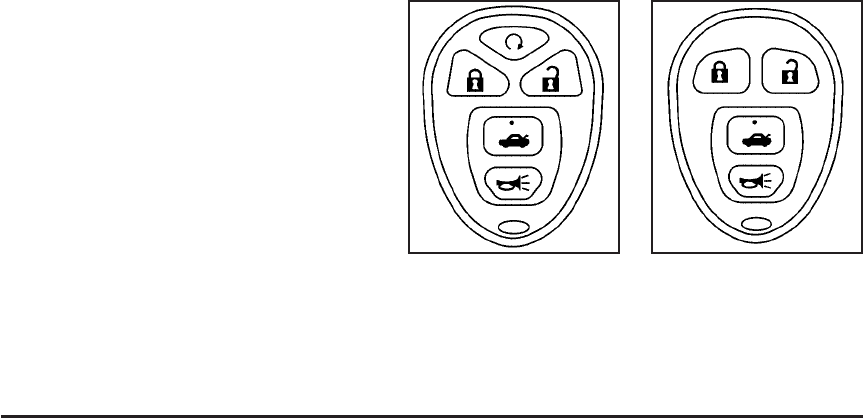
This device complies with RSS-210 of Industry Canada.
Operation is subject to the following two conditions:
1. This device may not cause interference.
2. This device must accept any interference received,
including interference that may cause undesired
operation of the device.
Changes or modifications to this system by other than
an authorized service facility could void authorization to
use this equipment.
At times you may notice a decrease in range. This is
normal for any remote keyless entry system. If the
transmitter does not work or if you have to stand closer
to your vehicle for the transmitter to work, try this:
•Check the distance. You may be too far from
your vehicle. You may need to stand closer
during rainy or snowy weather.
•Check the location. Other vehicles or objects may
be blocking the signal. Take a few steps to the
left or right, hold the transmitter higher, and
try again.
•Check to determine if battery replacement is
necessary. See “Battery Replacement” under
Remote Keyless Entry System Operation on
page 2-4.
•If you are still having trouble, see your dealer
or a qualified technician for service.
Remote Keyless Entry System
Operation
The vehicle’s doors can be locked and unlocked, and
the trunk can be opened from approximately 3 feet (1 m)
up to 60 feet (18 m) away with the remote keyless
entry transmitter. If your vehicle has the remote start
feature, you can also start the vehicle’s engine with the
remote keyless entry transmitter.
Remote Keyless Entry
with Remote Start Remote Keyless Entry
without Remote Start
2-4

The following functions may be available with your
vehicle’s remote keyless entry system:
/(Remote Vehicle Start): If your vehicle has this
feature, the engine may be started from outside the
vehicle using the remote keyless entry transmitter.
See “Remote Vehicle Start” at the end of this section
for more detailed information.
Q(Lock): Press the lock button to lock all the doors.
If enabled through the Driver Information Center (DIC),
the parking lamps may flash once to indicate locking has
occurred, or the horn may chirp when the lock button is
pressed again within five seconds from the previous
press of the lock button. See “FOB LOCK FEEDBACK”
under DIC Vehicle Personalization on page 3-73 for
additional information. If the vehicle has the content
theft-deterrent system, pressing the lock button may also
arm it. See Content Theft-Deterrent on page 2-18.
"(Unlock): Press the unlock button to unlock the
driver’s door. If the button is pressed again within
five seconds, all remaining doors will unlock. The interior
lamps will come on and stay on for 20 seconds or
until the ignition is turned on. If enabled through the
DIC, the parking lamps can be programmed to come
on for a set amount of time when the vehicle is
unlocked using the remote keyless entry transmitter.
See “EXT (Exterior) LIGHT DELAY” under DIC Vehicle
Personalization on page 3-73. If the vehicle has the
content theft-deterrent system, pressing the unlock
button on the remote keyless entry transmitter may
disarm it. See Content Theft-Deterrent on page 2-18.
V(Remote Trunk Release): Press this button
to release the trunk lid. The transaxle must be in
PARK (P) for this feature to operate.
L(Panic Alarm): Press this button to activate the
alarm. The ignition must be in OFF or ACCESSORY for
the alarm to work. When the alarm button is pressed, the
headlamps will flash and the horn will sound repeatedly
for two minutes. The alarm will turn off when the ignition is
moved to RUN or the alarm button is pressed again.
Matching Transmitter(s) to Your Vehicle
Each remote keyless entry transmitter is coded to
prevent another transmitter from unlocking your vehicle.
If a transmitter is lost or stolen, a replacement can
be purchased through your GM dealer. Remember
to bring any additional transmitters so they can also
be re-coded to match the new transmitter. Once
your dealer has coded the new transmitter, the lost
transmitter will not unlock your vehicle. The vehicle
can have a maximum of four transmitters matched to it.
2-5
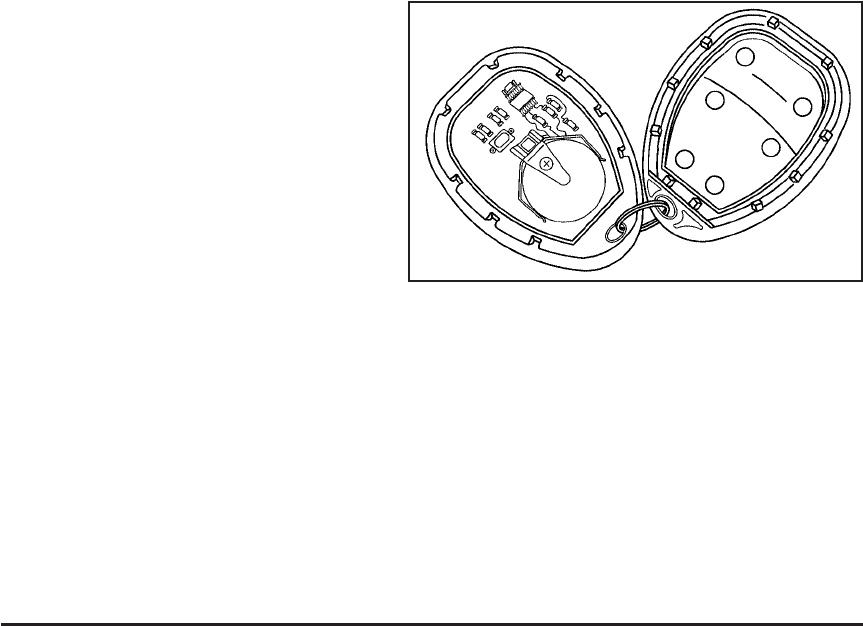
Battery Replacement
Under normal use, the battery in your remote keyless
entry transmitter should last about four years.
You can tell the battery is weak if the transmitter will
not work at the normal range in any location. If you
have to get close to your vehicle before the transmitter
works, it is probably time to change the battery.
The KEY FOB BATT LOW message in the vehicle’s
DIC will display if the remote keyless entry transmitter
battery is low.
Notice: When replacing the battery, use care not
to touch any of the circuitry. Static from your
body transferred to these surfaces may damage
the transmitter. To replace the battery in the remote keyless entry
transmitter, do the following:
1. Insert a flat object, with a thin edge, into the notch
located below the panic alarm button, and separate
the bottom half from the top half of the transmitter.
2. Remove the old battery. Do not use a metal object
to do this.
3. Slide the new battery into the transmitter with the
positive (+) side of the battery facing up. Use one
three-volt, CR2032 battery, or equivalent type.
4. Snap the front and the back of the transmitter
together. Make sure the cover is on tight, so
water will not get inside the transmitter.
5. Test the operation of the transmitter with the vehicle.
2-6

Remote Vehicle Start
Your vehicle may have a remote starting feature. This
feature allows you to start the engine from outside of the
vehicle. It may also start up the vehicle’s heating or
air conditioning systems and rear window defogger.
When the remote start system is active, the climate
control system will heat and cool the inside of the vehicle
based on the outside temperature. The rear window
defogger will be turned on by the climate control system
when it is heating the inside of the vehicle. Normal
operation of the system will return after the key is turned
to the RUN position.
Laws in some communities may restrict the use of
remote starters. For example, some laws may require
a person using remote start to have the vehicle in
view when doing so. Check local regulations for any
requirements on remote starting of vehicles.
Do not use the remote start feature if your vehicle is
low on fuel. Your vehicle may run out of fuel.
The remote start feature provides two separate starts
per ignition cycle, each with 10 minutes of engine
running time.
The remote vehicle start feature needs to be reset after
your vehicle’s engine is started two times using the
transmitter’s remote start button. The remote start
system is reset by inserting the vehicle’s key into the
ignition switch and turning it to RUN. See Ignition
Positions on page 2-23 for information regarding the
ignition positions on your vehicle.
Your remote keyless entry transmitter with the remote
start button provides an increased range of operation.
You can start your vehicle from an average range
of approximately 492 feet (150 m) away. However the
range may be less while the vehicle is running, and as
a result, you may need to be closer to your vehicle
to turn it off than you were to turn it on.
There are other conditions which can affect the
performance of the transmitter, see Remote Keyless
Entry System on page 2-3 for additional information.
2-7

/(Remote Start): If your vehicle has the remote
start feature, the keyless entry transmitter will have a
button with this symbol on it.
To start the vehicle using the remote start feature,
do the following:
1. Aim the transmitter at the vehicle.
2. Press and release the transmitter’s lock button,
then immediately press and hold the transmitter’s
remote start button for 4 seconds or until the
turn signal lamps flash. The vehicle’s doors
will lock.
3. When the vehicle’s engine starts, the parking lamps
will turn on and remain on while the engine is
running.
The engine will shut off automatically after
10 minutes, unless a time extension has been
done or the vehicle’s key is inserted into the
ignition switch and turned to RUN.
If you enter the vehicle after a remote start, and
the engine is still running, insert the key into
the ignition switch and turn it to RUN to drive
the vehicle.
4. To manually shut off a remote start, do any of the
following. The parking lamps will turn off:
•Aim the remote keyless entry transmitter at the
vehicle and press the remote start button.
•Turn on the hazard warning flashers.
•Turn the ignition switch to RUN and then
to OFF.
Your vehicle’s engine may be started two times using
the transmitter’s remote start feature. If only one remote
start procedure has been done, since last driving the
vehicle, or resetting the remote start system, the engine
may be started again remotely following the remote
start procedure a second time
If the remote start procedure is used again before
the first 10 minute time frame has ended, the first
10 minutes will immediately expire and the second
10 minute time frame will start.
2-8

The remote vehicle start feature will not operate if
any of the follow occur:
•The remote start system is disabled through
the DIC.
•The vehicle’s key is in the ignition.
•A door on the vehicle is open.
•The vehicle’s hood is open.
•The hazard warning flashers are on.
•The check engine light is on. See Malfunction
Indicator Lamp on page 3-41.
•The engine coolant temperature is too high.
•The oil pressure is low.
•Two remote vehicle starts have already been
provided for that ignition cycle.
If a remote start is attempted and is unsuccessful, the
Driver Information Center (DIC) will display REMOTE
START DISABLED.
Vehicles that have the remote vehicle start feature
are shipped from the factory with the remote vehicle
start system enabled. The system may be enabled
or disabled through the DIC. See “REMOTE START”
under DIC Vehicle Personalization on page 3-73
for additional information. If your vehicle does not have
the DIC feature, and remote vehicle start was installed
at the dealership, you will need to have the dealership
enable or disable the system.
Remote Start Ready
If your vehicle does not have the remote vehicle start
feature, it may have the remote start ready feature. This
feature allows your dealer to add the manufacturer’s
remote vehicle start feature.
If the keyless entry transmitter has a plus (+) symbol
on the back cover, your vehicle has the remote
start ready feature. You can lock or unlock your
vehicle from approximately 492 feet (150 m) away.
See your dealer if you would like to add the
manufacturer’s remote vehicle start feature to
your vehicle.
2-9

Doors and Locks
Door Locks
{CAUTION:
Unlocked doors can be dangerous.
•Passengers — especially children — can
easily open the doors and fall out of a
moving vehicle. When a door is locked,
the handle will not open it. You increase
the chance of being thrown out of the
vehicle in a crash if the doors are not
locked. So, wear safety belts properly
and lock the doors whenever you drive.
•Young children who get into unlocked
vehicles may be unable to get out. A child
can be overcome by extreme heat and can
suffer permanent injuries or even death
from heat stroke. Always lock your vehicle
whenever you leave it.
CAUTION: (Continued)
CAUTION: (Continued)
•Outsiders can easily enter through an
unlocked door when you slow down or
stop your vehicle. Locking your doors can
help prevent this from happening.
There are several ways to lock and unlock the vehicle.
From the outside, turn the door/ignition key in the
driver’s door lock cylinder briefly counterclockwise to
unlock the driver’s door. Turn and hold it to unlock all the
doors. You can also use the remote keyless entry
transmitter. From the inside use the manual or power
door locks.
2-10
Power Door Locks
To lock or unlock all doors
from inside the vehicle,
use the power door
lock switch located on
either front door armrest.
Press the bottom of the switch to lock all doors.
Press the top of the switch to unlock all doors.
The driver’s and front passenger’s power door lock
switch also releases the trunk lid. Press the top of the
switch for approximately one and a half seconds to
open the trunk.
If the vehicle has the content theft-deterrent system,
the vehicle is programmed from the factory to arm
the system with the power door lock switch. If your
vehicle has a Driver Information Center (DIC) this
feature can be turned off. See “Content Theft” under
DIC Vehicle Personalization on page 3-73.
Delayed Locking
Your vehicle may have this feature. If so, it delays the
locking of the vehicle’s doors for five seconds after
the last door is closed. Two chimes will sound when
the power door lock switch or the LOCK button on the
remote keyless entry transmitter is pressed when a
door is open. The chimes indicate that the delayed
locking feature is on. If your vehicle has a Driver
Information Center (DIC), a warning will be displayed.
The doors can be locked immediately by pressing
the power door lock switch or the LOCK button on
the transmitter a second time.
The delayed locking feature will not activate when
the ignition is in RUN or ACCESSORY.
You can program this feature on or off through
the Driver Information Center (DIC), if equipped.
See “Delayed Locking” under DIC Vehicle
Personalization on page 3-73.
2-11
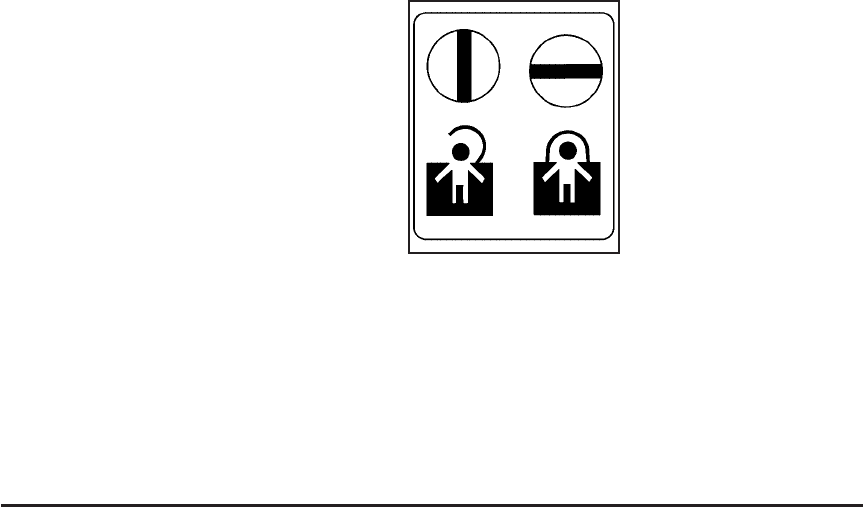
Automatic Door Lock
The vehicle’s doors are programmed from the factory
to lock when the shift lever is moved into a forward gear,
and to unlock when the shift lever is moved into
PARK (P).
If someone needs to get in or out of the vehicle after
the doors have been locked, place the shift lever
into PARK (P). You may also unlock all doors using the
power door lock switch or unlock one door using the
inside manual door lock.
If your vehicle has a Driver Information Center (DIC),
there are different programming options for locking and
unlocking the doors automatically. See DIC Vehicle
Personalization on page 3-73.
Rear Door Security Locks
Your vehicle may have rear door security locks.
These prevent passengers from opening the rear
doors from the inside.
The rear door security
locks are located on
the inside edge of each
rear door. You must
open the rear doors to
access them.
To set the locks, do the following:
1. Insert the key into the security lock slot and turn
it so the slot is in the horizontal position.
2. Close the door.
2-12
When you want to open a rear door when the security
lock is on, do the following:
1. Unlock the door using the remote keyless entry
transmitter, if equipped, the power door lock
switch, or by lifting the rear door manual lock.
2. Open the door from the outside.
To cancel the rear door security lock, do the following:
1. Unlock the door and open it from the outside.
2. Insert the key into the security lock slot and turn
it so the slot is in the vertical position.
Lockout Protection
The lockout protection feature makes it more difficult
to lock the key in the vehicle. If the driver’s door is
open while the key is in the ignition, the door cannot
be locked with the power door lock switch.
This feature cannot guarantee that you will never
be locked out of the vehicle. If the key is not left in
the ignition, or, if the manual door lock is used,
the key could still be locked inside the vehicle.
Always remember to take the key with you.
Trunk
{CAUTION:
It can be dangerous to drive with the trunk lid
open because carbon monoxide (CO) gas can
come into your vehicle. You cannot see or
smell CO. It can cause unconsciousness and
even death. If you must drive with the trunk lid
open or if electrical wiring or other cable
connections must pass through the seal
between the body and the trunk lid:
•Make sure all other windows are shut.
•Turn the fan on your heating or cooling
system to its highest speed and select the
control setting that will force outside air
into your vehicle. See Climate Control
System.
•If you have air outlets on or under the
instrument panel, open them all the way.
See Engine Exhaust on page 2-34.
2-13
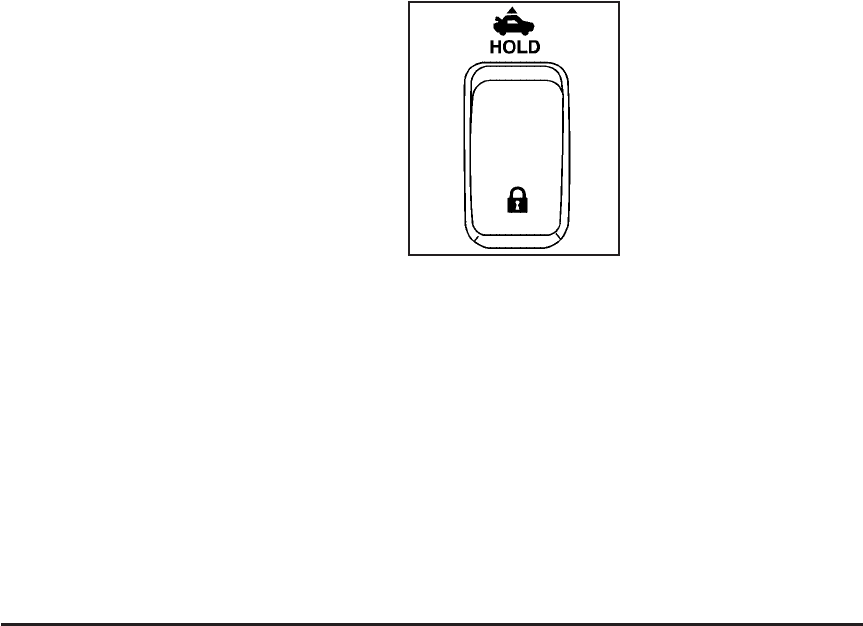
Opening the Trunk
To open the trunk from the outside, use the remote
keyless entry transmitter. See Remote Keyless Entry
System Operation on page 2-4 for more information.
The ignition must be off, or the transaxle must be
in PARK (P), to open the trunk.
If the vehicle has lost power, you can open the trunk by
lowering the split folding rear seat, if equipped, and
pulling the emergency trunk release handle located in
the trunk. See Split Folding Rear Seat on page 1-7
and “Emergency Trunk Release Handle” following.
Remote Trunk Release
This feature is used to unlock the trunk from inside
the vehicle using the power door lock switch.
Press and hold the top
of the driver’s or front
passenger’s power door
lock switch for one
and one-half seconds
to unlock the trunk.
The vehicle must be in PARK (P) to unlock the trunk.
Emergency Trunk Release Handle
Notice: Do not use the emergency trunk release
handle as a tie-down or anchor point when securing
items in the trunk as it could damage the handle.
The emergency trunk release handle is only
intended to aid a person trapped in a latched trunk,
enabling them to open the trunk from the inside.
2-14
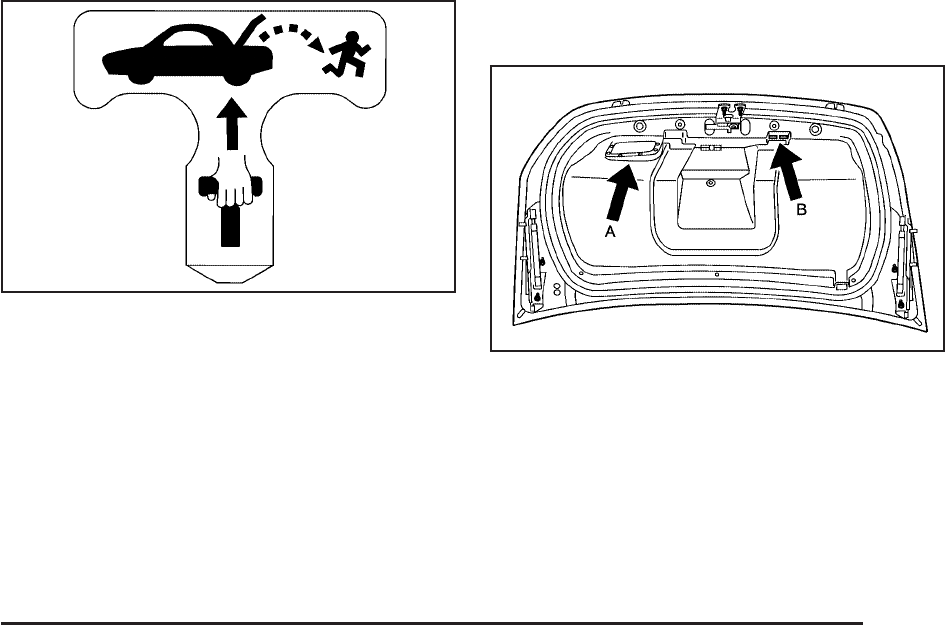
There is a glow-in-the-dark emergency trunk release
handle located on the trunk latch of the trunk lid.
This handle will glow following exposure to light.
If ever needed, pull the emergency trunk release
handle to open the trunk from the inside.
Trunk Lid Pull Down Handle and
Tie-Down Features
Your vehicle has a trunk lid pull down handle (A)
located on the inside of the trunk lid on the driver’s side
of the vehicle. Use the handle to pull down the trunk
lid when closing it.
Your vehicle also has a tie-down feature (B) located
on the inside the trunk lid on the passenger’s side of
the vehicle that can be used to secure the trunk lid
when large items are stored in the trunk.
2-15
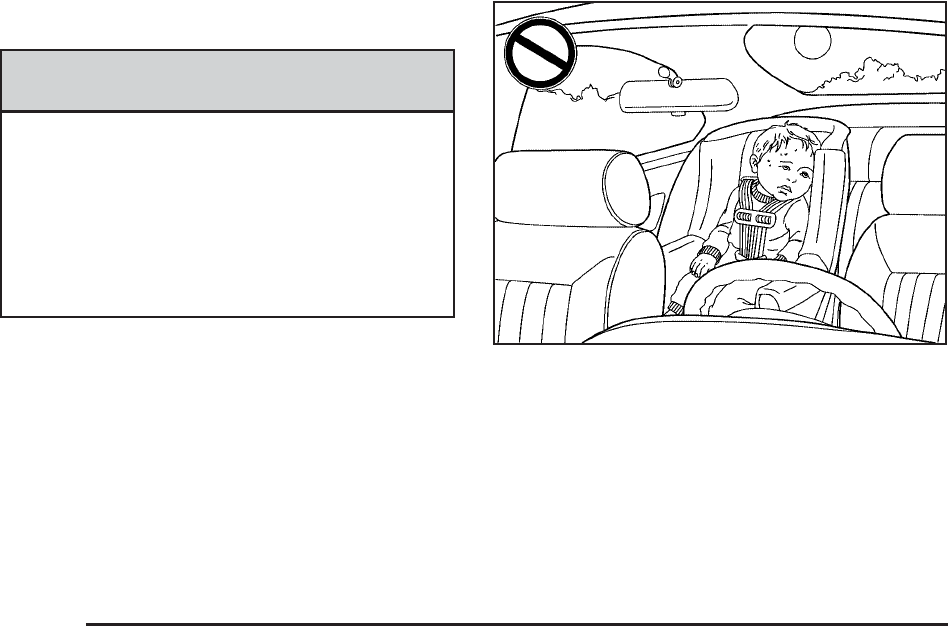
Windows
{CAUTION:
Leaving children, helpless adults, or pets in a
vehicle with the windows closed is dangerous.
They can be overcome by the extreme heat
and suffer permanent injuries or even death
from heat stroke. Never leave a child, a
helpless adult, or a pet alone in a vehicle,
especially with the windows closed in warm
or hot weather.
2-16
Power Windows
The switches on the driver’s door armrest are used to
control each of the windows. The power window switches
work while the ignition is in RUN, ACCESSORY, or while
Retained Accessory Power (RAP) is active. See Retained
Accessory Power (RAP) on page 2-23. Each passenger
door has its own window switch.
To lower the window, press and hold the front of the
switch to the first position until the window is at the
desired level. To raise the window, pull up and hold the
front of the switch.
Express-Down Window
The driver’s window switch has an express-down
feature labeled AUTO. This allows you to lower the
window completely without holding the switch. Press the
front of the switch to the second position and release.
To stop the window while it is lowering, briefly pull up
on the switch.
Window Lockout
o(Window Lockout): The driver’s window switches
also include a lockout switch. Press the right side of
the switch to prevent the rear passengers from
using their window switches. The driver can still control
all the windows and the front passenger can control
their own window with the lockout on. Press the left
side of the switch to return to normal window operation.
A visible red bar on the right side of the switch
indicates that the lockout is off.
2-17
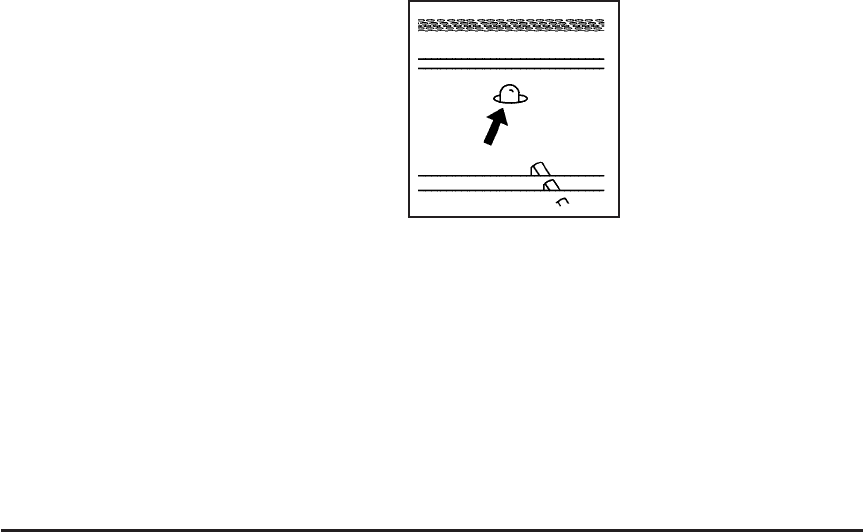
Sun Visors
To block out glare, swing down the sun visors. They
can be detached from the center retainer and slid
along the rod to cover different areas of the front
window and rotated to cover the side windows.
Visor Vanity Mirror
Swing down the sun visors and lift the cover to expose
the vanity mirror. Do not drive with the cover lifted
due to possible glare impeding other drivers behind
or to the side of the vehicle.
Theft-Deterrent Systems
Vehicle theft is big business, especially in some cities.
Although your vehicle has a number of theft-deterrent
features, we know that nothing we put on it can make
it impossible to steal.
Content Theft-Deterrent
Your vehicle may have a content theft-deterrent
alarm system.
A red light located on top
of the instrument panel,
toward the center of
the vehicle and near the
windshield, will flash
slowly when the system
is armed.
The theft-deterrent alarm system needs to be activated
through the Driver Information Center (DIC). See
“CONTENT THEFT” under “Customization Menu Items”
in DIC Vehicle Personalization on page 3-73. While
armed, the doors will not unlock with the power door lock
switch. The remote alarm will sound if someone tampers
with the trunk or enters the vehicle without using the
remote keyless entry transmitter or key to unlock the
doors. The horn will sound and the headlamps will flash
for up to two minutes. The system will also cut off the fuel
supply, preventing the vehicle from being driven.
2-18

Arming with the Power Lock Switch
The vehicle’s content theft-deterrent alarm system can be
activated when the key is removed from the ignition and
the power door lock switch of either the driver’s or front
passenger’s door is used to lock the vehicle. The door
needs to be in the open position when pressing the power
door lock switch. The alarm system will not activate
if the door is closed when the power door lock switch
is pressed. This system can be activated through the
Driver Information Center (DIC). See “CONTENT THEFT”
under “Customization Menu Items” in DIC Vehicle
Personalization on page 3-73.
When the doors are locked using the power door lock
switch of either front door, the red light on top of the
instrument panel will start flashing at a fast rate,
indicating that the system is arming. After all the doors
are locked there will be a time delay and then the red
light will begin to flash at a very slow rate, indicating
the system is armed.
Arming with the Remote Keyless
Entry Transmitter
The alarm system will arm when the remote keyless
entry transmitter is used to lock the doors after the
key is removed from the ignition. The red light will
come on to indicate that the system is arming.
After all doors are closed and locked, and after a
time delay, the red light will begin flashing at a very
slow rate to show the system is armed.
Arming Confirmation
A red light located on top of the instrument panel,
towards the center of the vehicle and near the
windshield, will flash slowly to confirm when the
system is armed.
2-19

Disarming with the Remote Keyless
Entry Transmitter
The alarm system will disarm when the remote keyless
entry transmitter is used to unlock the doors. The
red light will go out to show that the system is disarmed.
Disarming with Your Key
The alarm system will disarm when the key is used
to unlock the doors. The red light will stop flashing when
the system is disarmed. If you would like the key to
disarm the alarm system, see “CONTENT THEFT” under
DIC Vehicle Personalization on page 3-73 for more
information.
PASS-Key
®
III
Your PASS-Key
®
III system operates on a radio
frequency subject to Federal Communications
Commission (FCC) Rules and with Industry Canada.
This device complies with Part 15 of the FCC Rules.
Operation is subject to the following two conditions:
1. This device may not cause harmful interference.
2. This device must accept any interference received,
including interference that may cause undesired
operation.
This device complies with RSS-210 of Industry Canada.
Operation is subject to the following two conditions:
1. This device may not cause interference.
2. This device must accept any interference received,
including interference that may cause undesired
operation of the device.
Changes or modifications to this system by other than
an authorized service facility could void authorization to
use this equipment.
PASS-Key
®
III uses a radio frequency transponder in
the key that matches a decoder in your vehicle.
2-20
PASS-Key
®
III Operation
Your vehicle is equipped
with PASS-Key
®
III
(Personalized Automotive
Security System)
theft-deterrent system.
PASS-Key
®
III is a passive
theft-deterrent system.
This means nothing special
needs to be done to arm
or disarm the system.
It works when the key
is inserted or removed
from the ignition.
PASS-Key III
®
uses a transponder in the ignition key
that matches a decoder in the vehicle.
When the PASS-Key
®
III system senses that the wrong
key has been inserted into the ignition, it shuts down
the vehicle’s starter and fuel systems. The starter will
not work and fuel will stop flowing to the engine.
If someone tries to start the vehicle again with the
wrong key, the vehicle will not start. Anyone using
a trial-and-error method to start the vehicle will
be discouraged to do so because of the high number
of electrical key codes.
When trying to start the vehicle, if the engine does not
start and the STARTING DISABLED warning message
on the Driver Information Center (DIC) comes on,
the key may have a damaged transponder. Turn the
ignition off and try again.
If the engine still does not start, and the key appears
to be undamaged, try another ignition key. At this
time, you may also want to check the fuse. See Fuses
and Circuit Breakers on page 5-93. If the engine still
does not start with the other key, the vehicle needs
service. If the vehicle does start, the first key may
be faulty. See your dealer who can service the
PASS-Key
®
III to have a new key made. In an
emergency, contact Roadside Assistance. See
Roadside Assistance Program on page 7-6 for
more information.
It is possible for the PASS-Key
®
III decoder to accept
the transponder value of a new or replacement key.
Up to 10 keys may be programmed for the vehicle.
The following procedure is for programming additional
keys only. If all the programmed keys are lost or do
not operate, see your dealer or a locksmith who
can service PASS-Key
®
III to have keys made and
programmed to the system.
2-21

To program the new key do the following:
1. Verify that the new key has PK3 stamped on it.
2. Insert the master key in the ignition and start
the engine. If the engine will not start, see your
dealer for service.
3. After the engine has started, turn the key to OFF,
and remove the key.
4. Insert the key to be programmed and turn it to RUN
within five seconds of removing the original key.
5. The SERVICE THEFT SYSTEM warning message
on the DIC will turn off, once the key has been
programmed. It may not be apparent that the
SERVICE THEFT SYSTEM warning message went
on due to how quickly the key is programmed.
6. Repeat Steps 1 through 5 if additional keys are to
be programmed.
If the SERVICE THEFT SYSTEM warning message
appears and stays on the DIC while the vehicle is being
driven, the engine will be able to be restarted if it is
turned off. Your PASS-Key
®
III system, however,
is not working properly and must be serviced by
your dealer. The vehicle is not protected by the
PASS-Key
®
III system at this time.
If the PASS-Key
®
III key is lost or stolen, see your
dealer or a locksmith who can service PASS-Key
®
III
to have a new key made.
Starting and Operating
Your Vehicle
New Vehicle Break-In
Notice: Your vehicle does not need an elaborate
break-in. But it will perform better in the long run if
you follow these guidelines:
•Do not drive at any one constant speed, fast or
slow, for the first 500 miles (805 km). Do not
make full-throttle starts. Avoid downshifting to
brake, or slow, the vehicle.
•Avoid making hard stops for the first 200 miles
(322 km) or so. During this time your new brake
linings are not yet broken in. Hard stops with new
linings can mean premature wear and earlier
replacement. Follow this breaking-in guideline
every time you get new brake linings.
•Do not tow a trailer during break-in. See Towing
a Trailer on page 4-38 for the trailer towing
capabilities of your vehicle and more
information.
Following break-in, engine speed and load can be
gradually increased.
2-22
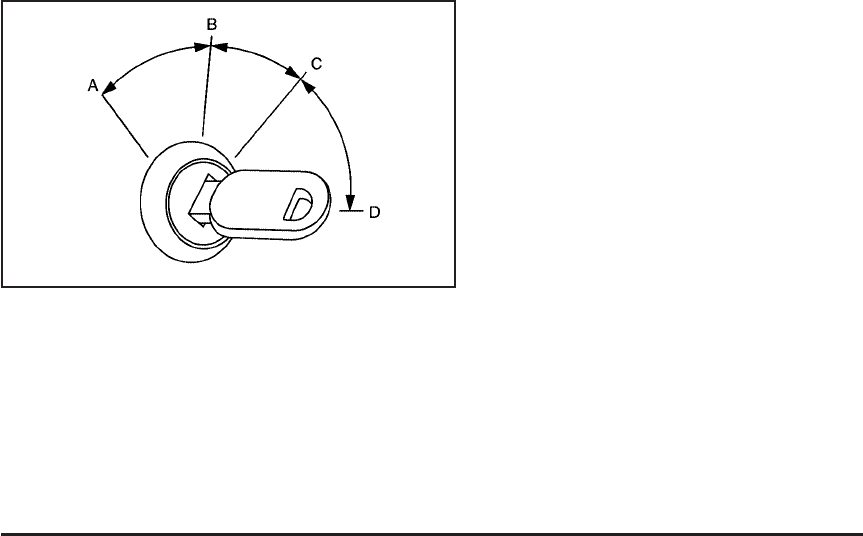
Ignition Positions
With the ignition key in the ignition, the key can be
turned to four different positions:
Notice: Using a tool to force the key from the
ignition switch could cause damage or break the
key. Use the correct key and turn the key only with
your hand. Make sure the key is in all the way. If
none of this works, then your vehicle needs service.
A (OFF): This is the only position in which the ignition
key can be inserted or removed. This position locks
the ignition and transaxle. It is a theft-deterrent feature.
B (ACCESSORY): This position lets the radio and
windshield wipers operate while the engine is off.
To use ACCESSORY, turn the key clockwise.
C (RUN): This position is where the key returns to
after the vehicle is started. This position displays
some of the warning and indicator lights.
D (START): This position starts the engine.
A warning chime will sound and the Driver Information
Center (DIC) will display DRIVER’S DOOR AJAR
when the driver’s door is opened if the ignition is in
OFF, ACCESSORY and the key is in the ignition.
See DIC Warnings and Messages on page 3-57 for
more information.
Retained Accessory Power (RAP)
If the vehicle has Retained Accessory Power (RAP),
certain features will continue to operate for up to
10 minutes after the ignition key is turned to OFF
unless a door is opened.
2-23

Starting the Engine
Move your shift lever to PARK (P) or NEUTRAL (N).
The engine will not start in any other position — that is
a safety feature. To restart when you are already
moving, use NEUTRAL (N) only.
Notice: Shifting into PARK (P) with the vehicle
moving could damage the transaxle. Shift into
PARK (P) only when your vehicle is stopped.
1. With your foot off the accelerator pedal, turn the
ignition key to START. When the engine starts,
let go of the key. The idle speed will go down as
the engine gets warm.
Notice: Holding your key in START for longer than
15 seconds at a time will cause your battery to be
drained much sooner. And the excessive heat can
damage your starter motor. Wait about 15 seconds
between each try to help avoid draining your battery
or damaging your starter.
2. If the engine does not start within 10 seconds,
hold your key in START for about 10 seconds
at a time until the engine starts. Wait about
15 seconds between each try.
When your engine has run for about 10 seconds
to warm up, your vehicle is ready to be driven.
Do not race your engine when it is cold.
If the weather is below freezing (32°F or 0°C),
let the engine run for a few minutes to warm up.
3. If your engine still will not start, or starts but then
stops, it could be flooded with too much gasoline.
Try pushing your accelerator pedal all the way to
the floor and holding it there as you hold the key
in START for about three seconds. If the vehicle
starts briefly but then stops again, do the same
thing. This time keep the pedal down for five or
six seconds to clear the extra gasoline from
the engine. After waiting about 15 seconds,
repeat the normal starting procedure.
Notice: Your engine is designed to work with the
electronics in your vehicle. If you add electrical
parts or accessories, you could change the way the
engine operates. Before adding electrical equipment,
check with your dealer. If you do not, your engine
might not perform properly. Any resulting damage
would not be covered by your vehicle’s warranty.
2-24

Engine Coolant Heater
Your vehicle may be equipped with this feature.
In very cold weather, 0°F (−18°C) or colder, the engine
coolant heater can help. You will get easier starting
and better fuel economy during engine warm-up.
Usually, the coolant heater should be plugged in a
minimum of four hours prior to starting your vehicle.
At temperatures above 32°F (0°C), use of the coolant
heater is not required. Your vehicle may also have
an internal thermostat in the plug end of the cord.
This will prevent operation of the engine coolant heater
when the temperature is at or above 0°F (−18°C) as
noted on the cord.
To Use the Engine Coolant Heater
1. Turn off the engine.
2. Open the hood and unwrap the electrical cord.
The cord is attached to the underside of the
diagonal brace, which is located above the
engine air cleaner/filter assembly.
3. Plug it into a normal, grounded 110-volt AC outlet.
{CAUTION:
Plugging the cord into an ungrounded outlet
could cause an electrical shock. Also, the
wrong kind of extension cord could overheat
and cause a fire. You could be seriously
injured. Plug the cord into a properly grounded
three-prong 110-volt AC outlet. If the cord will
not reach, use a heavy-duty three-prong
extension cord rated for at least 15 amps.
4. Before starting the engine, be sure to unplug and
store the cord as it was before to keep it away
from moving engine parts. If you do not, it could
be damaged.
How long should you keep the coolant heater plugged
in? The answer depends on the outside temperature,
the kind of oil you have, and some other things.
Instead of trying to list everything here, we ask that
you contact your dealer in the area where you will
be parking your vehicle. The dealer can give you the
best advice for that particular area.
2-25
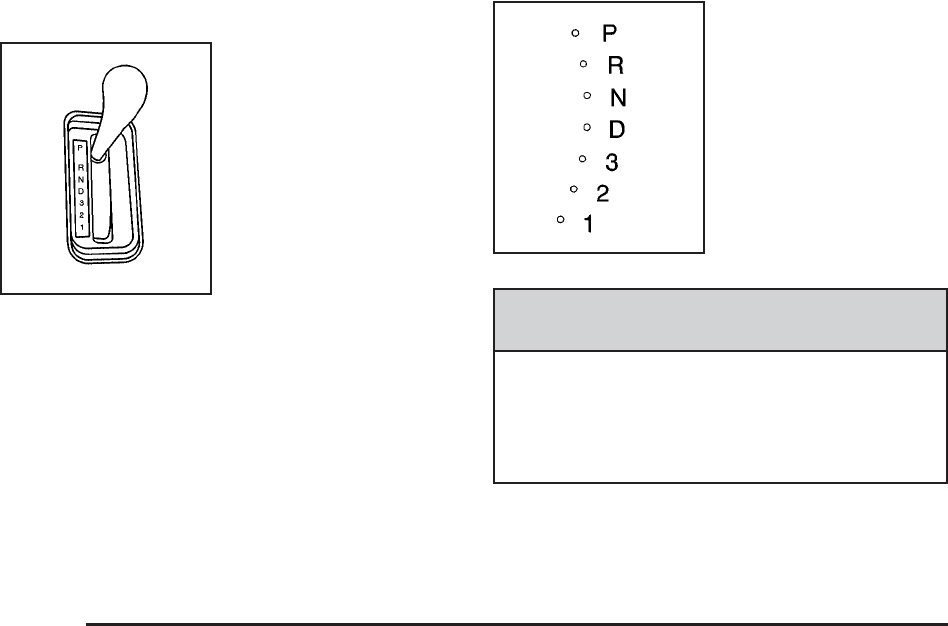
Automatic Transaxle Operation
Your vehicle’s automatic transaxle may have a
shift lever on the steering column or on the console
between the seats.
There is also a display
located on the instrument
panel cluster that will
indicate the gear the
vehicle is in.
{CAUTION:
It is dangerous to get out of your vehicle if
the shift lever is not fully in PARK (P) with the
parking brake firmly set. Your vehicle can roll.
CAUTION: (Continued)
Console Shift Lever
2-26
CAUTION: (Continued)
Do not leave your vehicle when the engine is
running unless you have to. If you have left
the engine running, the vehicle can move
suddenly. You or others could be injured.
To be sure your vehicle will not move, even
when you are on fairly level ground, always
set your parking brake and move the shift
lever to PARK (P). See Shifting Into Park (P)
on page 2-31. If you are pulling a trailer, see
Towing a Trailer on page 4-38.
The positions for the shift lever are:
PARK (P): This position locks the vehicle’s front
wheels. It is the best position to use when the engine
is started because the vehicle cannot move easily.
Make sure the shift lever is fully in PARK (P) before
starting the engine. The vehicle has an automatic
transaxle shift lock control system. You must fully apply
the regular brakes before shifting from PARK (P)
when the ignition is in RUN. If you cannot shift out of
PARK (P), ease pressure on the shift lever by pushing
it all the way into PARK (P) while keeping the brake
pedal pushed down. Release the shift lever button.
Then move the shift lever out of PARK (P). See Shifting
Out of Park (P) on page 2-32
Notice: Shifting to REVERSE (R) while your vehicle
is moving forward could damage the transaxle.
The repairs would not be covered by your warranty.
Shift to REVERSE (R) only after your vehicle is
stopped.
REVERSE (R): Use this gear to back up.
To rock the vehicle back and forth in order to get it out
of snow, ice, or sand without damaging the transaxle,
see If Your Vehicle is Stuck in Sand, Mud, Ice or Snow
on page 4-30.
2-27
NEUTRAL (N): In this position, the engine does not
connect with the wheels. To restart when you are
already moving, use NEUTRAL (N) only. Also, use
NEUTRAL (N) when the vehicle is being towed.
{CAUTION:
Shifting into a drive gear while your engine is
running at high speed is dangerous. Unless
your foot is firmly on the brake pedal, your
vehicle could move very rapidly. You could
lose control and hit people or objects. Do not
shift into a drive gear while your engine is
running at high speed.
Notice: Shifting out of PARK (P) or NEUTRAL (N)
while the engine is running at high speed may
damage the transaxle. The repairs would not be
covered by your warranty. Be sure the engine is not
running at high speeds when shifting your vehicle.
Notice: If your vehicle seems to start up rather
slowly or not shift gears when you go faster, and
you continue to drive your vehicle that way, you
could damage the transaxle. Have your vehicle
serviced right away. You can drive in SECOND (2)
when you are driving less than 35 mph (55 km/h)
and AUTOMATIC OVERDRIVE (D) for higher speeds
until then.
AUTOMATIC OVERDRIVE (D): This position is for
normal driving. If more power is needed for passing,
and the vehicle is:
•Going less than 35 mph (55 km/h), push the
accelerator pedal about halfway down.
•Going about 35 mph (55 km/h) or more, push the
accelerator pedal all the way down.
By doing this the vehicle will automatically shift down
to the next gear and have more power.
2-28

THIRD (3): This position is also used for normal driving,
but it offers more power and lower fuel economy than
AUTOMATIC OVERDRIVE (D).
Here are some times you might choose THIRD (3)
instead of AUTOMATIC OVERDRIVE (D):
•When driving on hilly, winding roads.
•When towing a trailer, so there is less shifting
between gears.
•When going down a steep hill.
•When driving in no-highway scenarios such as
city streets.
Notice: Driving in SECOND (2) for more than
25 miles (40 km) or at speeds over 55 mph (90 km/h)
may damage the transaxle. Also, shifting into
SECOND (2) at speeds above 65 mph (105 km/h) can
cause damage. Drive in THIRD (3) or AUTOMATIC
OVERDRIVE (D) instead of SECOND (2).
SECOND (2): This position gives the vehicle more
power but lower fuel economy than THIRD (3). You
can use SECOND (2) on hills. It can help control
the speed going down steep mountain roads, but then
you would also want to use the brakes off and on.
FIRST (1): This position gives the vehicle even more
power but lower fuel economy than SECOND (2).
You can use it on very steep hills, or in deep snow or
mud. If the shift lever is put in FIRST (1), the transaxle
will not shift into first gear until the vehicle is going
slowly enough.
Notice: Spinning the tires or holding the vehicle
in one place on a hill using only the accelerator
pedal may damage the transaxle. If you are stuck,
do not spin the tires. When stopping on a hill,
use the brakes, or parking brake to hold the vehicle
in place.
2-29
Parking Brake
To set the parking brake,
hold the regular brake
pedal down with your
right foot. Push down
the parking brake pedal
with your left foot.
To release the parking brake, hold the regular brake
pedal down with your right foot and push the parking
brake pedal with your left foot. While you lift your
left foot, the parking brake pedal will follow it to the
released position.
A warning chime will sound and PARKING BRAKE ON
will display in the DIC if the parking brake is set, the
ignition is on, and the vehicle speed is greater than
5 mph (8km/h). For more information see Brake System
Warning Light on page 3-38 and DIC Warnings and
Messages on page 3-57.
Notice: Driving with the parking brake on can
overheat the brake system and cause premature
wear or damage to brake system parts. Verify that
the parking brake is fully released and the brake
warning light is off before driving.
If you are towing a trailer and parking on any hill, see
Towing a Trailer on page 4-38. That section shows what
to do first to keep the trailer from moving.
2-30
Shifting Into Park (P)
{CAUTION:
It can be dangerous to get out of your vehicle
if the shift lever is not fully in PARK (P) with
the parking brake firmly set. Your vehicle can
roll. If you have left the engine running, the
vehicle can move suddenly. You or others
could be injured. To be sure your vehicle
will not move, even when you are on fairly
level ground, use the steps that follow.
If you are pulling a trailer, see Towing a
Trailer on page 4-38.
Steering Column Shift Lever
1. Hold the brake pedal down and set the
parking brake.
2. Move the shift lever into the PARK (P) like this:
•Pull the lever toward you.
•Move the lever up as far as it will go.
3. Turn the ignition key to OFF.
4. Remove the key and take it with you. If you
can leave your vehicle with the ignition key in
your hand, your vehicle is in PARK (P).
Console Shift Lever
1. Hold the brake pedal down and set the
parking brake.
2. Move the shift lever into the PARK (P) position
by holding in the button on the shift lever and
pushing it all the way toward the front of the vehicle.
3. Turn the ignition key to OFF.
4. Remove the key and take it with you. If you
can leave your vehicle with the ignition key in
your hand, your vehicle is in PARK (P).
2-31
Leaving Your Vehicle With the
Engine Running
{CAUTION:
It can be dangerous to leave your vehicle
with the engine running. Your vehicle could
move suddenly if the shift lever is not fully in
PARK (P) with the parking brake firmly set.
And, if you leave the vehicle with the engine
running, it could overheat and even catch fire.
You or others could be injured. Do not leave
your vehicle with the engine running.
If you have to leave your vehicle with the engine
running, be sure your vehicle is in PARK (P) and your
parking brake is firmly set before you leave it. After
you have moved the shift lever into PARK (P), hold
the regular brake pedal down. Then, see if you
can move the shift lever away from PARK (P) without
first pushing the button. If you can, it means that the
shift lever was not fully locked into PARK (P).
Torque Lock
If you are parking on a hill and you do not shift your
transaxle into PARK (P) properly, the weight of the
vehicle may put too much force on the parking pawl in the
transaxle. You may find it difficult to pull the shift lever out
of PARK (P). This is called “torque lock.” To prevent
torque lock, set the parking brake and then shift into
PARK (P) properly before you leave the driver’s seat.
To find out how, see Shifting Into Park (P) on page 2-31.
When you are ready to drive, move the shift lever out of
PARK (P) before you release the parking brake.
If torque lock does occur, you may need to have another
vehicle push yours a little uphill to take some of the
pressure from the parking pawl in the transaxle, so you
can pull the shift lever out of PARK (P).
Shifting Out of Park (P)
Automatic Transaxle Shift Lock
This vehicle is equipped with an electronic shift lock
release system. The shift lock release is designed to:
•Prevent ignition key removal unless the shift lever
is in PARK (P)
•Prevent movement of the shift lever out of PARK (P)
unless the ignition is in a position other than OFF.
2-32

The shift lock is always functional except in the case
of a an uncharged or low voltage (less than 9 volt)
battery.
If your vehicle has an uncharged battery or a battery
with low voltage, try charging or jump starting the
battery. See Jump Starting on page 5-42
Console Shift
If your console shift cannot be moved out of PARK (P)
1. Apply and maintain the regular brakes.
2. Turn the ignition to the RUN position. See Ignition
Positions on page 2-23 for more information.
3. Let up on the shift lever and make sure the shift
lever is pushed all the way into PARK (P).
4. Then, move the shift lever into the desired gear.
If you still cannot move the shift lever from PARK (P),
consult your dealer or a professional towing service.
Column Shift
If your column shift cannot be moved out of PARK (P)
1. Apply and maintain the regular brakes.
2. Turn the Ignition key to the ACCESSORY position.
See Ignition Positions on page 2-23 for more
information.
3. Shift out of the PARK (P) position to the
NEUTRAL (N) position.
4. Move the vehicle to a safe location.
If you still cannot move the shift lever from PARK (P),
consult your dealer or a professional towing service.
2-33
Parking Over Things That Burn
{CAUTION:
Things that can burn could touch hot exhaust
parts under your vehicle and ignite. Do not
park over papers, leaves, dry grass, or other
things that can burn.
Engine Exhaust
{CAUTION:
Engine exhaust can kill. It contains the gas
carbon monoxide (CO), which you cannot see or
smell. It can cause unconsciousness and death.
You might have exhaust coming in if:
•Your exhaust system sounds strange or
different.
•Your vehicle gets rusty underneath.
•Your vehicle was damaged in a collision.
•Your vehicle was damaged when driving
over high points on the road or over road
debris.
•Repairs were not done correctly.
•Your vehicle or exhaust system had been
modified improperly.
If you ever suspect exhaust is coming into your
vehicle:
•Drive it only with all the windows down to
blow out any CO; and
•Have your vehicle fixed immediately.
2-34

Running the Engine While Parked
It is better not to park with the engine running. But if you
ever have to, here are some things to know.
{CAUTION:
Idling the engine with the climate control
system off could allow dangerous exhaust into
your vehicle. See the earlier caution under
Engine Exhaust on page 2-34.
Also, idling in a closed-in place can let
deadly carbon monoxide (CO) into your vehicle
even if the climate control fan is at the highest
setting. One place this can happen is a garage.
Exhaust — with CO — can come in easily.
NEVER park in a garage with the engine
running.
Another closed-in place can be a blizzard.
See Winter Driving on page 4-26.
{CAUTION:
It can be dangerous to get out of your vehicle
if the shift lever is not fully in PARK (P) with
the parking brake firmly set. Your vehicle can
roll. Do not leave your vehicle when the engine
is running unless you have to. If you have
left the engine running, the vehicle can move
suddenly. You or others could be injured.
To be sure your vehicle will not move, even
when you are on fairly level ground, always
set your parking brake and move the shift
lever to PARK (P).
Follow the proper steps to be sure your vehicle will
not move. See Shifting Into Park (P) on page 2-31.
If you are parking on a hill and if you are pulling a trailer,
also see Towing a Trailer on page 4-38.
2-35

Mirrors
Manual Rearview Mirror
While sitting in a comfortable driving position, adjust
the mirror so you can see clearly behind your vehicle.
Grip the mirror in the center to move it up or down
and side to side. The day/night control at the bottom
of the mirror lets you adjust the mirror to avoid
glare from the lamps behind you. Turn the control to
the right for nighttime conditions and to the center
for daytime conditions.
Manual Rearview Mirror with
OnStar
®
The vehicle may have a mirror with Onstar
®
. While sitting
in a comfortable driving position, adjust the mirror so you
can see clearly behind your vehicle. Grip the mirror in
the center to move it up and down and side to side.
The mirror has a day/night control located at the bottom.
Turn the control to the right for the night position to
reduce glare from other vehicles’ headlamps. Turn the
control to the front for the day position.
There are also three OnStar
®
buttons located at the
bottom of the mirror. See your dealer for more
information on the system and how to subscribe to
OnStar
®
. See OnStar
®
System on page 2-38 for more
information about the services OnStar
®
provides.
Automatic Dimming Rearview Mirror
While sitting in a comfortable driving position, adjust
the mirror so you can see clearly behind your vehicle.
Grip the mirror in the center to move it up or down
and side to side.
The vehicle may have an automatic dimming rearview
mirror that darkens gradually to reduce the glare of
headlamps from behind. Push the button in the center
of the mirror to turn this feature on or off.
One photocell on the front of the mirror senses when it
is becoming dark outside. Another photocell, facing
rearward, senses headlamps behind you.
To keep the photocells operating well, occasionally
clean them with a cotton swab and glass cleaner.
Push the two outer buttons at the bottom of the mirror
to turn the map lamps on or off.
2-36
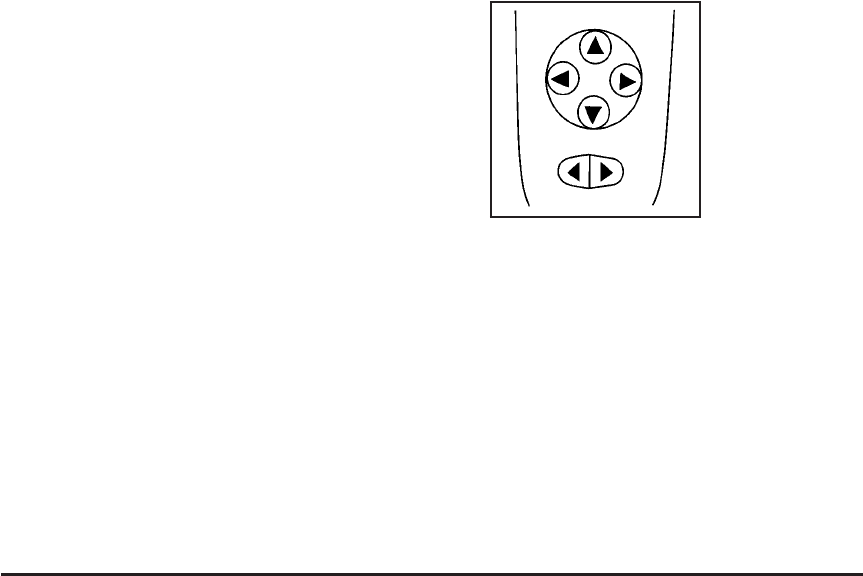
Automatic Dimming Rearview Mirror
with OnStar
®
While sitting in a comfortable driving position, adjust
the mirror so you can see clearly behind your vehicle.
Grip the mirror in the center to move it up or down
and side to side.
The vehicle may have an automatic dimming rearview
mirror with the OnStar
®
System.
The automatic dimming feature is turned on or off by
pressing the left button, located on the lower part of the
mirror, for up to three seconds. When turned on, this
mirror functions like the automatic dimming rearview
mirror described previously. See Automatic Dimming
Rearview Mirror on page 2-36.
There are also three OnStar
®
buttons located at
the bottom of the mirror. See your dealer for more
information on the system and how to subscribe
to OnStar
®
. See OnStar
®
System on page 2-38 for
more information about the services OnStar
®
provides.
Outside Power Mirrors
The controls for the
outside power mirrors,
are located on the
driver’s door armrest.
Move the selector switch located below the four-way
control pad to the left or right to choose either the driver’s
side or passenger’s side mirror. To adjust a mirror, use
the arrows located on the four-way control pad to move
the mirror in the desired direction. Adjust each outside
mirror so that a little of the vehicle and the area behind it
can be seen while sitting in a comfortable driving position.
Keep the selector switch in the center position when not
adjusting either outside mirror.
2-37
Outside Power Heated Mirrors
For information on the operation of the outside power
mirrors see Outside Power Mirrors on page 2-37.
If the vehicle has heated mirrors, they will warm up to
melt ice and snow, and dissolve condensation when
the defroster is turned on. See Dual Automatic Climate
Control System on page 3-25 or Climate Control System
on page 3-22.
Outside Convex Mirror
{CAUTION:
A convex mirror can make things (like other
vehicles) look farther away than they really are.
If you cut too sharply into the right lane, you
could hit a vehicle on your right. Check your
inside mirror or glance over your shoulder
before changing lanes.
The passenger’s side mirror is convex. A convex mirror’s
surface is curved so more can be seen from the driver’s
seat, but it also makes things look farther away than
they really are.
OnStar
®
System
OnStar
®
uses global positioning system (GPS) satellite
technology, wireless communications, and live advisors
to provide you with a wide range of safety, security,
information, and convenience services. If your airbags
deploy, the system is designed to make an automatic call
to OnStar
®
Emergency where we can request emergency
services be sent to your location. If you lock your keys in
the car, call OnStar
®
at 1-888-4-ONSTAR and they can
send a signal to unlock your doors. If you need roadside
assistance, press the OnStar
®
button and they will get
you the help you need.
2-38

A complete OnStar
®
User’s Guide and the Terms and
Conditions of the OnStar
®
Subscription Service
Agreement are included in the vehicle’s glove box
literature. For more information, visit www.onstar.com or
www.onstar.ca. Contact OnStar
®
at 1-888-4-ONSTAR
(1-888-466-7827), or press the OnStar
®
button to speak
to an OnStar
®
advisor 24 hours a day, 7 days a week.
Terms and conditions of the Subscription Service
Agreement can be found at www.onstar.com or
www.onstar.ca.
OnStar
®
Services
For new vehicles equipped with OnStar
®
, the Safe
and Sound Plan is included for one year from the
date of purchase. You can extend this plan beyond the
first year, or upgrade to the Directions and Connections
®
Plan to meet your needs. For more information,
press the OnStar
®
button to speak to an advisor.
Safe and Sound Plan
•Automatic Notification of Airbag Deployment
•Emergency Services
•Roadside Assistance
•Stolen Vehicle Tracking
•AccidentAssist
•Remote Door Unlock/Vehicle Alert
•Remote Diagnostics
•Online Concierge
Directions and Connections
®
Plan
•All Safe and Sound Plan Services
•Driving Directions
•RideAssist
•Information and Convenience Services
OnStar
®
Personal Calling
As an OnStar
®
subscriber, the Personal Calling capability
allows you to make hands-free calls using a wireless
system that is integrated into the vehicle. Calls can be
placed nationwide using simple voice commands with no
additional contracts and no additional roaming charges.
To find out more about OnStar
®
Personal Calling, refer
to the OnStar
®
User’s Guide in the vehicle’s glove box,
visit www.onstar.com or www.onstar.ca, or speak to an
OnStar
®
advisor by pressing the OnStar
®
button or
calling 1-888-4-ONSTAR (1-888-466-7827).
2-39
OnStar
®
Virtual Advisor
Your vehicle may have Virtual Advisor. It is a feature of
OnStar
®
Personal Calling that uses minutes to access
weather, local traffic reports, and stock quotes. By
pressing the phone button and giving a few simple
voice commands, you can browse through the
various topics. Customize your information profile at
www.myonstar.com. See the OnStar
®
User’s Guide
for more information.
OnStar
®
Steering Wheel Controls
Your vehicle may be
equipped with a Talk/Mute
button that can be used to
interact with OnStar
®
. See
the Audio Steering Wheel
Control section for your
specific vehicle operation.
When calling into voice mail systems, or to dial directory
numbers, press this button once, wait for the response,
say the number(s) to be dialed, wait for the number(s)
to be repeated and then say “dial”. See the OnStar
®
User’s Guide for more information.
Universal Home Remote
System
If your vehicle has this feature, the control buttons are
located on the driver’s sun visor.
The Universal Home Remote System provides a way
to replace up to three hand-held radio-frequency (RF)
transmitters used to activate devices such as
gate operators, garage door openers, entry door
locks, security systems, and home lighting.
2-40

This device complies with Part 15 of the FCC Rules.
Operation is subject to the following two conditions:
1. This device may not cause harmful interference.
2. This device must accept any interference received,
including interference that may cause undesired
operation.
This device complies with RSS-210 of Industry Canada.
Operation is subject to the following two conditions:
1. This device may not cause interference.
2. This device must accept any interference received,
including interference that may cause undesired
operation of the device.
Changes or modifications to this system by other than
an authorized service facility could void authorization to
use this equipment.
Universal Home Remote System
Operation
Do not use the Universal Home Remote with any garage
door opener that does not have the “stop and reverse”
feature. This includes any garage door opener model
manufactured before April 1, 1982. If you have a newer
garage door opener with rolling codes, please be sure to
follow Steps 6 through 8 to complete the programming of
your Universal Home Remote Transmitter.
Read the instructions completely before attempting to
program the Universal Home Remote. Because of
the steps involved, it may be helpful to have another
person available to assist you in the programming steps.
Keep the original hand-held transmitter for use in
other vehicles as well as for future Universal Home
Remote programming. It is also recommended that upon
the sale of the vehicle, the programmed Universal
Home Remote buttons should be erased for security
purposes. See “Erasing Universal Home Remote
Buttons” later in this section or, for assistance, see
Customer Assistance Offices on page 7-4.
2-41

Be sure that people and objects are clear of the garage
door or gate operator you are programming. When
programming a garage door, it is advised to park outside
of the garage.
It is recommended that a new battery be installed in
your hand-held transmitter for quicker and more
accurate transmission of the radio-frequency signal.
Programming Universal Home Remote
Follow these steps to program up to three channels:
1. Press and hold down the two outside Universal
Home Remote buttons, releasing only when the
Universal Home Remote indicator light begins
to flash, after 20 seconds. Do not hold down the
buttons for longer than 30 seconds and do not
repeat this step to program a second and/or third
hand-held transmitter to the remaining two Universal
Home Remote buttons.
2. Position the end of your hand-held transmitter
about 1 to 3 inches (3 to 8 cm) away from the
Universal Home Remote buttons while keeping the
indicator light in view.
3. Simultaneously press and hold both the desired
Universal Home Remote button and the hand-held
transmitter button. Do not release the buttons
until Step 4 has been completed.
Some entry gates and garage door openers may
require you to substitute Step 3 with the procedure
noted in “Gate Operator and Canadian
Programming” later in this section.
4. The indicator light will flash slowly at first and then
rapidly after Universal Home Remote successfully
receives the frequency signal from the hand-held
transmitter. Release both buttons.
5. Press and hold the newly-trained Universal Home
Remote button and observe the indicator light.
If the indicator light stays on constantly,
programming is complete and your device should
activate when the Universal Home Remote button is
pressed and released.
To program the remaining two Universal Home
Remote buttons, begin with Step 2 under
“Programming Universal Home Remote.” Do not
repeat Step 1 as this will erase all of the
programmed channels.
If the indicator light blinks rapidly for two seconds
and then turns to a constant light, continue with
Steps 6 through 8 following to complete the
programming of a rolling-code equipped device,
most commonly, a garage door opener.
2-42

6. Locate in the garage, the garage door opener
receiver (motor-head unit). Locate the “Learn”
or “Smart” button. This can usually be found where
the hanging antenna wire is attached to the
motor-head unit.
7. Firmly press and release the “Learn” or “Smart”
button. The name and color of the button may
vary by manufacturer.
You will have 30 seconds to start Step 8.
8. Return to the vehicle. Firmly press and hold the
programmed Universal Home Remote button for
two seconds, then release. Repeat the
press/hold/release sequence a second time, and
depending on the brand of the garage door opener,
or other rolling code device, repeat this sequence
a third time to complete the programming.
The Universal Home Remote should now activate
your rolling-code equipped device.
To program the remaining two Universal Home Remote
buttons, begin with Step 2 of “Programming Universal
Home Remote.” You do not want to repeat Step 1,
as this will erase all previous programming from
the Universal Home Remote buttons.
Gate Operator and Canadian
Programming
Canadian radio-frequency laws require transmitter
signals to time out or quit after several seconds of
transmission. This may not be long enough for Universal
Home Remote to pick up the signal during programming.
Similarly, some U.S. gate operators are manufactured
to time out in the same manner.
If you live in Canada, or you are having difficulty
programming a gate operator or garage door opener
by using the “Programming Universal Home Remote”
procedures, regardless of where you live, replace Step 3
under “Programming Universal Home Remote” with
the following:
Continue to press and hold the Universal Home Remote
button while you press and release every two seconds
(cycle) the hand-held transmitter button until the
frequency signal has been successfully accepted by the
Universal Home Remote. The Universal Home Remote
indicator light will flash slowly at first and then rapidly.
Proceed with Step 4 under “Programming Universal
Home Remote” to complete.
2-43

Using Universal Home Remote
Press and hold the appropriate Universal Home Remote
button for at least half of a second. The indicator light
will come on while the signal is being transmitted.
Erasing Universal Home Remote
Buttons
To erase programming from the three Universal Home
Remote buttons do the following:
1. Press and hold down the two outside buttons until
the indicator light begins to flash, after 20 seconds.
Do not hold the two outside buttons for longer
than 30 seconds.
2. Release both buttons.
The Universal Home Remote is now in the train
(learning) mode and can be programmed at any time
beginning with Step 2 under “Programming Universal
Home Remote” shown earlier in this section.
Individual buttons cannot be erased, but they can be
reprogrammed. See “Reprogramming a Single Universal
Home Remote Button” following this section.
Reprogramming a Single Universal
Home Remote Button
To program a device to Universal Home Remote using
a Universal Home Remote button previously trained,
follow these steps:
1. Press and hold the desired Universal Home
Remote button. Do not release the button.
2. The indicator light will begin to flash after
20 seconds. While still holding the Universal
Home Remote button, proceed with Step 2 under
“Programming Universal Home Remote” shown
earlier in this section.
For additional information on Universal Home Remote,
see Customer Assistance Offices on page 7-4.
Storage Areas
Glove Box
To open the glove box, lift up on the lever. The glove
box may have a light inside and a shelf located at
the top of the glove box.
2-44
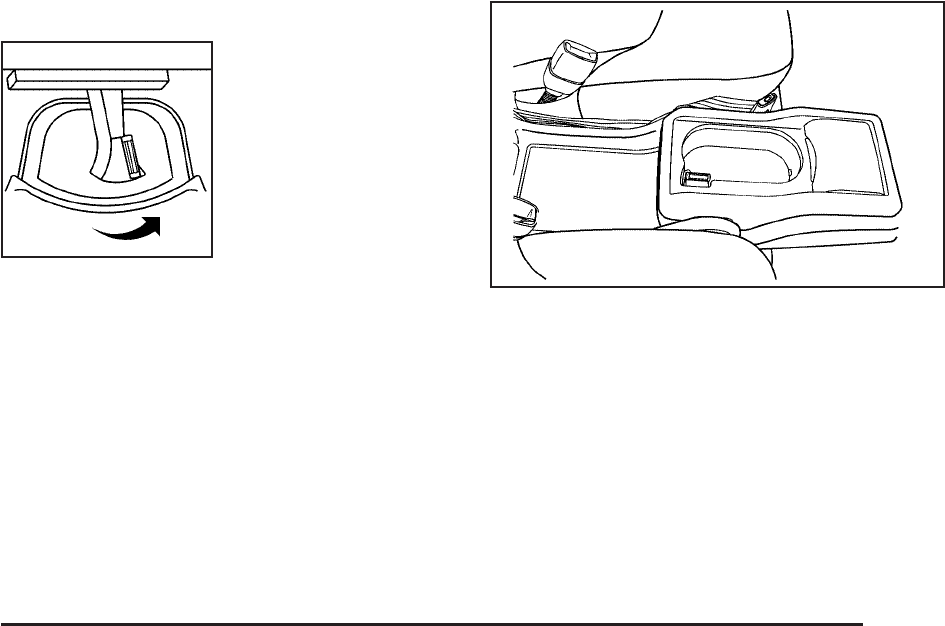
Cupholder(s)
If your vehicle is the
five-passenger model,
there is a cupholder in
front of the center console.
The cupholder has an arm
that adjusts to two positions
to fit either a large cup or
two smaller cups.
If your vehicle is the six-passenger model, there is a
cupholder located underneath the seat. To access,
pull the center seat forward. The cupholder has an
arm that adjusts to two positions to fit either a large
cup or two smaller cups.
2-45

Center Console Storage Area
If your vehicle has a five-passenger console, the center
console has a padded lid that can be used as an
armrest. Lift the armrest lid to access a storage bin
with a coin holder and a CD holder. Located under
the lid is a card clip.
If your vehicle has a six-passenger console, there is a
flip and fold center armrest that allows you to choose
between a three-passenger front row bench seat
or a center console. For more information see Center
Seat on page 1-7. In the upward position the armrest
acts as a back support for the front row bench seat.
Flip the center armrest down and it can be used as
an armrest for the driver and passenger seat. Lift the
armrest lid to access the storage area.
Convenience Net
The vehicle may have a convenience net located on
the back wall of the trunk.
Put small loads, like grocery bags, behind the net.
It can help keep them from falling over.
The net is not for larger, heavier loads. Store those in
the trunk as far forward as possible.
Unhook the net so that it will lie flat when not in use.
2-46
Sunroof
The vehicle may have a sunroof. It includes a sliding
glass panel and a sunshade.
The sunroof control
is on the headliner,
by the map lamps.
The sunroof control works only when the ignition is
on or in ACCESSORY, or when Retained Accessory
Power (RAP) is active. See Retained Accessory
Power (RAP) on page 2-23.
To raise the sunroof to the vent position, open the
sunshade by hand, then press the back of the control.
Push and hold the front of the control to close the
sunroof from the vent position.
With the sunroof in the vent position, press and release
the back of the control to express-open the sunroof.
The sunshade will automatically open with the sunroof.
To stop the express-open function, press the back
of the control again.
To close the sunroof, press and hold the front of the
control. To stop the sunroof, release the control.
The sunshade must be closed manually.
The sunroof panel cannot be opened or closed if your
vehicle has an electrical failure.
2-47

✍NOTES
2-48

Instrument Panel Overview ...............................3-4
Hazard Warning Flashers ................................3-6
Other Warning Devices ...................................3-6
Horn .............................................................3-6
Tilt Wheel .....................................................3-6
Turn Signal/Multifunction Lever .........................3-7
Turn and Lane-Change Signals ........................3-8
Headlamp High/Low-Beam Changer ..................3-8
Flash-to-Pass .................................................3-8
Windshield Wipers ..........................................3-9
Windshield Washer .........................................3-9
Cruise Control ..............................................3-10
Exterior Lamps .............................................3-13
Daytime Running Lamps (DRL)/
Automatic Headlamp System .......................3-14
Fog Lamps ..................................................3-15
Exterior Lighting Battery Saver ........................3-15
Interior Lamps ..............................................3-16
Instrument Panel Brightness ...........................3-16
Courtesy Lamps ...........................................3-16
Entry Lighting ...............................................3-16
Delayed Entry Lighting ...................................3-17
Theater Dimming ..........................................3-17
Delayed Exit Lighting .....................................3-17
Perimeter Lighting .........................................3-18
Overhead Console Reading Lamps .................3-18
Rear Assist Handle Reading Lamps ................3-18
Battery Run-Down Protection ..........................3-18
Ultrasonic Rear Parking Assist (URPA) ............3-18
Accessory Power Outlet(s) .............................3-20
Ashtray(s) and Cigarette Lighter ......................3-21
Climate Controls ............................................3-22
Climate Control System .................................3-22
Dual Automatic Climate Control System ...........3-25
Outlet Adjustment .........................................3-29
Passenger Compartment Air Filter ...................3-30
Steering Wheel Climate Controls .....................3-31
Warning Lights, Gages, and Indicators ............3-31
Instrument Panel Cluster ................................3-32
Speedometer and Odometer ...........................3-33
Tachometer .................................................3-33
Safety Belt Reminder Light .............................3-33
Passenger Safety Belt Reminder Light .............3-34
Airbag Readiness Light ..................................3-34
Passenger Airbag Status Indicator ...................3-35
Charging System Light ..................................3-37
Brake System Warning Light ..........................3-38
Anti-Lock Brake System Warning Light .............3-39
Traction Control System (TCS)
Warning Light ...........................................3-39
Engine Coolant Temperature Warning Light ......3-40
Section 3 Instrument Panel
3-1

Engine Coolant Temperature Gage ..................3-40
Low Coolant Warning Light ............................3-41
Malfunction Indicator Lamp .............................3-41
Oil Pressure Light .........................................3-44
Change Engine Oil Light ................................3-45
Security Light ...............................................3-45
Cruise Control Light ......................................3-45
Reduced Engine Power Light .........................3-46
Highbeam On Light .......................................3-46
Headlamps Suggested Light ...........................3-46
Low Washer Fluid Warning Light .....................3-47
Door Ajar Light .............................................3-47
Trunk Ajar Light ............................................3-47
Service Vehicle Soon Light ............................3-47
Fuel Gage ...................................................3-48
Low Fuel Warning Light .................................3-48
Check Gas Cap Light ....................................3-48
Driver Information Center (DIC) .......................3-49
DIC Operation and Displays ...........................3-50
DIC Warnings and Messages .........................3-57
DIC Vehicle Personalization ............................3-73
Audio System(s) .............................................3-82
Setting the Time ...........................................3-83
Radio with CD (Base) ...................................3-84
Radio with CD (Uplevel) ................................3-88
Radio with CD (MP3) ....................................3-97
Radio with Six-Disc CD ................................3-111
Theft-Deterrent Feature ................................3-124
Audio Steering Wheel Controls ......................3-124
Radio Reception .........................................3-126
Care of Your CDs .......................................3-126
Care of the CD Player .................................3-127
Backglass Antenna ......................................3-127
XM™ Satellite Radio Antenna System ............3-128
Chime Level Adjustment ...............................3-128
Section 3 Instrument Panel
3-2

✍NOTES
3-3
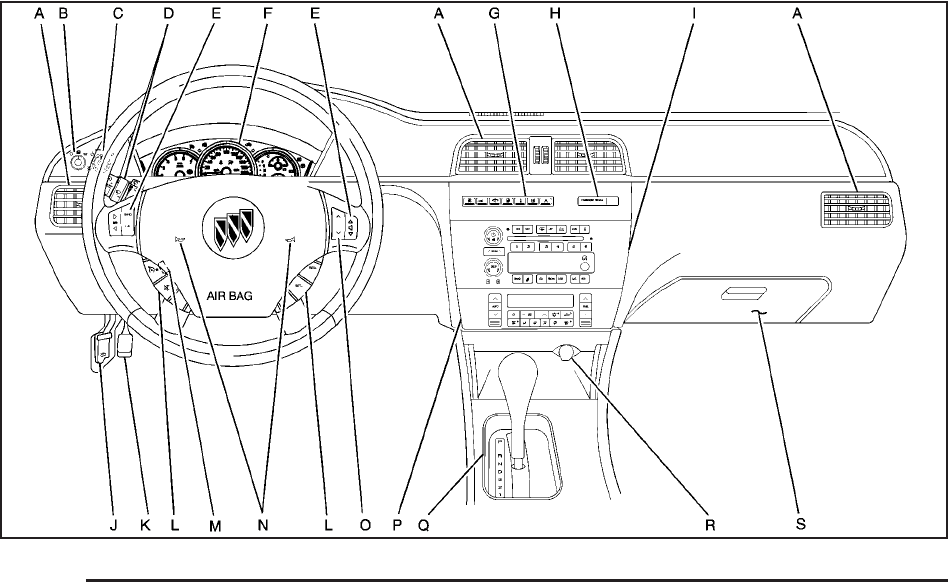
Instrument Panel Overview
3-4

The main components of the instrument panel are the following:
A. Air Outlets. See Outlet Adjustment on page 3-29.
B. Interior Lamps Control. See Interior Lamps
on page 3-16.
C. Exterior Lamps Control. See Exterior Lamps on
page 3-13. Fog Lamp Control. See Fog Lamps
on page 3-15
D. Turn Signal/Multifunction Lever. See Turn Signal/
Multifunction Lever on page 3-7.
E. Audio Steering Wheel Controls. See Audio Steering
Wheel Controls on page 3-124.
F. Instrument Panel Cluster. See Instrument Panel
Cluster on page 3-32.
G. DIC Buttons (If Equipped) and Hazard Warning
Flasher Button. See DIC Operation and Displays
on page 3-50 and Hazard Warning Flashers
on page 3-6.
H. Passenger Airbag Status Indicator. See Passenger
Airbag Status Indicator on page 3-35.
I. Audio System Controls. See Audio System(s)
on page 3-82.
J. Hood Release. See Hood Release on page 5-11.
K. Parking Brake. See Parking Brake on page 2-30.
L. Cruise Controls. See Cruise Control on page 3-10.
M. Tilt Lever. See Tilt Wheel on page 3-6.
N. Horn. See Horn on page 3-6.
O. Steering Wheel Climate Controls. See Steering
Wheel Climate Controls on page 3-31.
P. Climate Controls. See Climate Control System on
page 3-22 or Dual Automatic Climate Control System
on page 3-25.
Q. Shift Lever. See Shifting Into Park (P) on page 2-31.
R. Accessory Power Outlet. See Accessory Power
Outlet(s) on page 3-20.
S. Glove Box. See Glove Box on page 2-44.
3-5
Hazard Warning Flashers
Your hazard warning flashers let you warn others. They
also let police know you have a problem. Your front
and rear turn signal lamps will flash on and off.
The hazard warning
flasher button is located
in the center of the
instrument panel.
Your hazard warning flashers work no matter what
position your key is in, and even if the key is not in.
Press the button to make the front and rear turn signal
lamps flash on and off. Press the button again to
turn the flashers off.
When the hazard warning flashers are on, your turn
signals will not work.
Other Warning Devices
If you carry reflective triangles, you can set them up
at the side of the road about 300 feet (100 m) behind
your vehicle.
Horn
Press near or on the horn symbols on your steering
wheel pad to sound the horn.
Tilt Wheel
A tilt wheel allows adjustment of the steering wheel
before you drive. The steering wheel can be raised to
the highest level to give the driver’s legs more room
when you enter and exit the vehicle.
The lever that allows you
to tilt the steering wheel is
located on the left side
of the steering column.
To tilt the wheel, pull the lever down. Then move the
wheel to a comfortable position and pull the lever up to
lock the wheel in place.
3-6
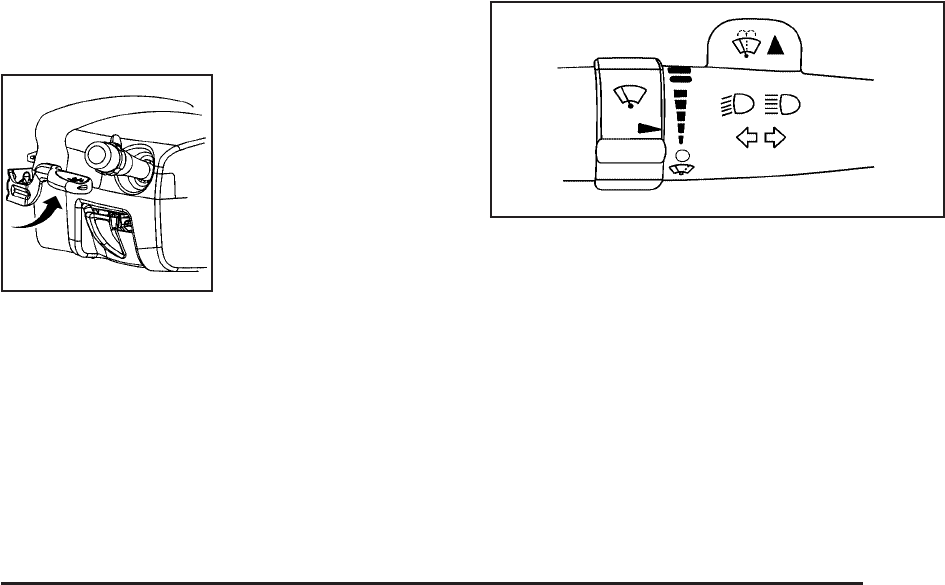
Telescoping Column
A telescoping column on the steering wheel allows
adjustment of the distance of the steering wheel and
the driver without moving the driver’s seat.
The lever on the steering
wheel column that enables
telescoping is located
on the left side of
the steering column and
behind the tilt lever.
To adjust the steering wheel, pull the steering wheel
column lever down and push or pull the steering wheel
to a comfortable position. Then pull the lever up to
lock the wheel in place.
Do not drive the vehicle unless the telescoping column
is locked.
Turn Signal/Multifunction Lever
The lever on the left side of the steering column
includes the following:
•GTurn and Lane Change Signals. See Turn and
Lane-Change Signals on page 3-8.
•2Headlamp High/Low-Beam Changer. See
Headlamp High/Low-Beam Changer on page 3-8.
•Flash-to-Pass. See Flash-to-Pass on page 3-8.
•NWindshield Wipers. See Windshield Wipers on
page 3-9.
•LQWindshield Washer. See Windshield Washer
on page 3-9.
For information on the headlamps, see Exterior Lamps
on page 3-13.
3-7
Turn and Lane-Change Signals
To signal a turn, move the lever up or down. The lever
returns to its original position when the turn is completed.
An arrow on the instrument
panel cluster will flash in
the direction of the
turn or lane change.
To signal a lane change, raise or lower the lever until the
arrow starts to flash. Hold it there until the lane change is
completed. The lever will return to its original position
when released.
Arrows that flash rapidly when signaling for a turn or lane
change, or that fail to work, may indicate a burned-out
signal bulb or fuse. Other drivers will not see the signal.
See Front Turn Signal and Parking Lamps on page 5-53
and Taillamps, Turn Signal, Sidemarker, Stoplamps and
Back-up Lamps on page 5-54 for turn signal bulb
replacement procedures. Also see Fuses and Circuit
Breakers on page 5-93 for location of fuses.
A chime will sound if the turn signal is left on for more
than 3/4 mile (1.2 km).
Headlamp High/Low-Beam Changer
To change the headlamps from low beam to high beam,
push the turn signal/multifunction lever away from you.
When the high beams are
on, a light on the instrument
panel cluster also will be on
if the ignition is on.
To change the headlamps from high beam to low beam,
pull the turn signal lever toward you.
Flash-to-Pass
This feature lets you use your high-beam headlamps
momentarily to signal a driver in front of you that
you want to pass.
To use it, pull the turn signal/multifunction lever toward
you until the high-beam headlamps come on, then
release the lever to turn them off.
3-8

Windshield Wipers
Be sure to clear ice and snow from the wiper blades
before using them. If they are frozen to the windshield,
gently loosen or thaw them. Damaged wiper blades
may not clear the windshield well, making it harder to
see and drive safely. If the blades do become damaged,
install new blades or blade inserts. For more information,
see Windshield Wiper Blade Replacement on page 5-56
Heavy snow or ice can overload the wiper motor.
A circuit breaker will stop the motor until it cools down.
Clear away snow or ice to prevent an overload.
You control the windshield wipers by turning the band
with the wiper symbol on it.
8(Mist): For a single wiping cycle, turn the band to
mist. Hold it there until the wipers start. Then let go.
The wipers will stop after one wipe. If you want
more wipes, hold the band on mist longer.
N(Delay): You can set the wiper speed for a long or
short delay between wipes. This can be very useful
in light rain or snow. Turn the band to choose the delay
time. The closer to the top of the lever, the shorter
the delay.
6(Low Speed): For steady wiping at low speed,
turn the band away from you to the first solid band past
the delay settings. For high-speed wiping, turn the
band further, to the second solid band past the delay
settings. To stop the wipers, move the band to off.
1(High Speed): For high-speed wiping, turn the
band further, to the second solid band past the
delay settings.
9(Off): To stop the wipers, move the band to off.
Windshield Washer
LQ(Washer Fluid): There is a paddle marked
with the windshield washer symbol at the top of
the multifunction lever. To spray washer fluid on the
windshield, push the paddle. The wipers will clear the
window and then either stop or return to your preset
speed.
{CAUTION:
In freezing weather, do not use your washer
until the windshield is warmed. Otherwise the
washer fluid can form ice on the windshield,
blocking your vision.
3-9
Cruise Control
The buttons for the cruise control are located on the
steering wheel.
I(Cruise On/Off): Push this button to turn the
system on and off.
RES + (Resume/Accelerate): Push this button to
make the vehicle resume a previously set speed or
to accelerate when cruise is already active.
SET −(Set/Decelerate): Push this button to set the
speed or to decrease the speed when cruise is
already active.
With cruise control, a speed of about 25 mph (40 km/h)
or more can be maintained without keeping your foot
on the accelerator. This can really help on long
trips. Cruise control does not work at speeds below
about 25 mph (40 km/h).
When the brakes are applied, the cruise control shuts off.
{CAUTION:
Cruise control can be dangerous where you
cannot drive safely at a steady speed. So, do
not use your cruise control on winding roads
or in heavy traffic.
Cruise control can be dangerous on slippery
roads. On such roads, fast changes in tire
traction can cause needless wheel spinning,
and you could lose control. Do not use cruise
control on slippery roads.
The cruise control will automatically disengage if the
vehicle has the traction control system and begins
to limit wheel spin. See Traction Control System (TCS)
on page 4-10. When road conditions allow, the cruise
control can be used again.
3-10
Setting Cruise Control
{CAUTION:
If you leave your cruise control on when you
are not using cruise, you might hit a button
and go into cruise when you do not want to.
You could be startled and even lose control.
Keep the cruise control switch off until you
want to use cruise control.
1. Press the cruise on/off button. The indicator light
in the button will come on.
2. Get up to the speed you want.
3. Press the SET −button. The cruise symbol will
display in the instrument panel cluster when the
system is engaged.
4. Take your foot off the accelerator pedal.
Resuming a Set Speed
Suppose you set your cruise control at a desired
speed and then you apply the brake. This, of course,
disengages the cruise control. The cruise symbol in
the instrument panel cluster will go out, indicating
cruise control is no longer engaged.
To return to your previously set speed, press the RES +
button once you are going about 25 mph (40 km/h)
or more.
You will go right back up to your chosen speed and
stay there.
If you hold the RES + button, the vehicle will keep going
faster until you release the button or apply the brake.
So unless you want to go faster, do not hold the RES +
button.
Increasing Speed While Using Cruise
Control
There are two ways to go to a higher speed:
•Use the accelerator pedal to get to the higher
speed. Press the SET −button, then release
the button and the accelerator pedal. You’ll now
cruise at the higher speed.
•Press the RES + button. Hold it there until you get
up to the speed you want, and then release the
button. To increase your speed in very small
amounts, press the button briefly. Each time you do
this, your vehicle will go about 1 mph (1.6 km/h)
faster.
3-11

Reducing Speed While Using Cruise
Control
There are two ways to reduce your speed while using
cruise control:
•Press the SET −button until you reach the lower
speed you want, then release it.
•To slow down in very small amounts, briefly press
the SET −button. Each time you do this, you will
go about 1 mph (1.6 km/h) slower.
Passing Another Vehicle While Using
Cruise Control
Use the accelerator pedal to increase the vehicle’s
speed. When you take your foot off the pedal, the
vehicle will slow down to the cruise control speed you
set earlier.
Using Cruise Control on Hills
How well the cruise control will work on hills depends
upon the speed and load of the vehicle, and the
steepness of the hills. When going up steep hills, you
may have to step on the accelerator pedal to maintain
the vehicle’s speed. When going downhill, you may have
to brake or shift to a lower gear to keep the vehicle’s
speed down. Of course, applying the brake takes
the vehicle out of cruise control. Many drivers find this
to be too much trouble and do not use cruise control
on steep hills.
Ending Cruise Control
To end a cruise control session, step lightly on the
brake pedal.
Stepping on the brake will end the current cruise control
session only. Press the cruise on/off button to turn off
the system completely.
Erasing Speed Memory
When you turn off the cruise control or the ignition, your
cruise control set speed memory is erased.
3-12
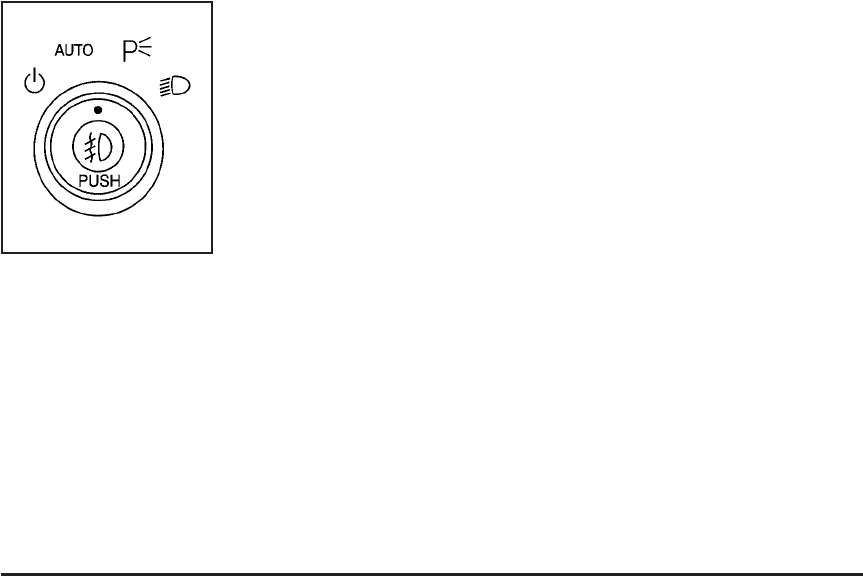
Exterior Lamps
The control located to the
left of the cluster on the
instrument panel, operates
the exterior lamps.
P(On/Off): Turn the control to this position to
manually turn the headlamps on and off. This is a
momentary control that will spring back to AUTO when
released.
AUTO (Automatic): Turn the control to this position to
set your headlamps in automatic mode. AUTO mode,
if enabled, will turn the exterior lamps on and off
automatically depending on how much light is available
outside the vehicle.
Due to the momentary switch design, your automatic
lights may be disabled even if the control is in the
AUTO position.
To enable automatic lighting, do any of the following:
•Turn the headlamp control from AUTO to off
and release the control. It will return back to
the AUTO position by itself.
•Turn the headlamp control from the parking lamp
position to AUTO.
•Turn the headlamp control from the headlamp
position to AUTO.
To disable automatic lighting, do any of the following:
•Turn the headlamp control from AUTO to off
and release the control. It will return back to
the AUTO position by itself.
•Turn the headlamp control from AUTO to the
parking lamp position.
•Turn the headlamp control from AUTO to the
headlamp position.
3-13

<(Parking Lamps): Turn the control to this position
to turn on the parking lamps together with the
following:
•Taillamps
•License Plate Lamps
•Sidemarker Lamps
•Instrument Panel Lights
2(Headlamps): Turn the control to this position to
turn your headlamps on, together with the previously
listed lamps and lights.
A warning chime will sound if the driver’s door is
opened when the ignition switch is turned to OFF or
ACCESSORY and the headlamps are on.
-(Foglamps): If your vehicle is equipped with
fog lamps, press this button to turn them on and off.
See Fog Lamps on page 3-15 for additional information.
Daytime Running Lamps (DRL)/
Automatic Headlamp System
Daytime Running Lamps (DRL) can make it easier for
others to see the front of your vehicle during the
day. DRL can be helpful in many different driving
conditions, but they can be especially helpful in the short
periods after dawn and before sunset. Daytime running
lamps are required to function at all times on all
vehicles first sold in Canada.
A light sensor on top of the instrument panel makes the
DRL work, so be sure it is not covered.
The DRL system will make the low-beam headlamps
come on at reduced brightness when the following
conditions are met:
•The ignition is on.
•The exterior lamps control is off.
•The parking brake is released.
While the DRL are on, only the vehicle’s low-beam
headlamps will be on at reduced brightness. The turn
signal, taillamps, sidemarker and other lamps will not be
on. The instrument panel will not be lit up either.
3-14
When it is dark enough outside, the DRL will turn off
and the vehicle’s headlamps and parking lamps will turn
on. The other lamps that come on with the headlamps
will also come on.
When it is bright enough outside, the headlamps will
go off and the DRL will come on.
To idle the vehicle with the DRL off, turn the exterior
lamp control off and then do one of the following:
•Turn the exterior lamp control to the parking
lamp position.
•Turn the exterior lamp control to the headlamp
position.
•Turn the exterior lamp control from AUTO to off
and back to AUTO.
This feature is not available for vehicles first sold in
Canada.
To turn off the automatic headlamp feature when it is
dark outside, move the exterior lamp control to the
parking lamp position. The parking lamps will remain
illuminated and the headlamps will turn off. The
fog lamps will also go on if they were on previously.
As with any vehicle, the regular headlamp system
should be turned on when needed.
Fog Lamps
If your vehicle is equipped
with fog lamps, press the
fog lamps button in the
center of the exterior lamps
control on the left side of
the steering column to turn
the fog lamps on or off.
While the high-beam headlamps are on, the fog lamps
are off.
Some localities have laws that require the headlamps to
be on along with the fog lamps.
Exterior Lighting Battery Saver
If the parking lamps or headlamps have been left on
after the ignition has been turned to off, the exterior
lamps will turn off after approximately 10 minutes.
This protects the battery from being drained.
If the lamps need to be left on for more than 10 minutes,
use the exterior lamp control to turn the lamps back on.
3-15
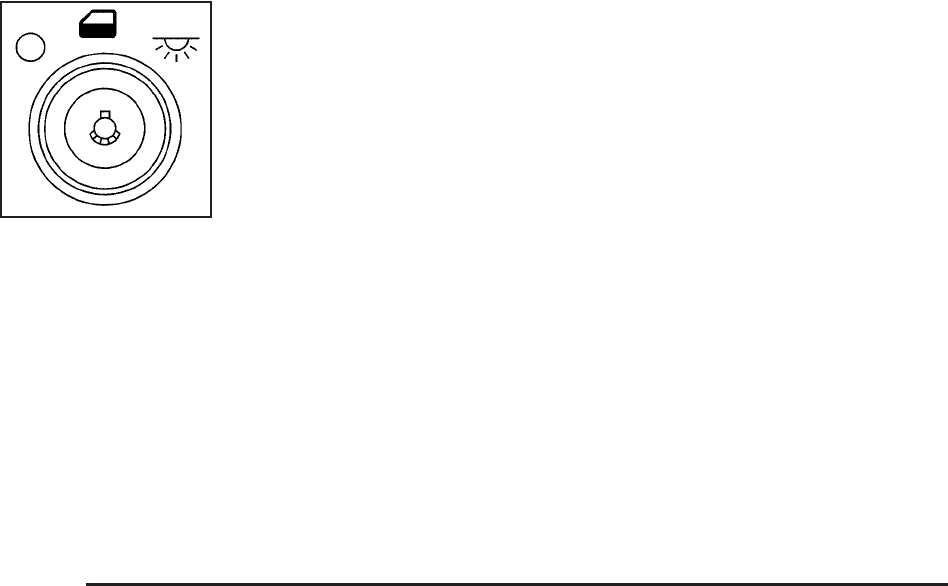
Interior Lamps
Your interior lamps
control is located next
to the exterior lamps
control and to the left of
the steering wheel on
the instrument panel.
9(Off): Turn the control to this position to disable
courtesy lamps, entry lighting, delayed entry lighting,
and delayed exit lighting.
1(Door): Turn the control to this position to turn the
interior lamps on when any door is open and when
the ignition key is removed from the ignition.
+(On): Turn the control to this position to turn the
interior lamps on.
The interior lamps can be controlled, or automatically
turned on or off under certain conditions. They are
explained in the following text.
Instrument Panel Brightness
The instrument panel lights can be brightened or
dimmed by pressing the center knob of the interior lamp
controls until it pops out. Turn the knob clockwise to
brighten the lights or counterclockwise to dim them.
Courtesy Lamps
Courtesy lamps come on to make it easier to enter and
exit the vehicle. These lamps will come on when the
interior lamp control is in the door position and any door
is opened.
Entry Lighting
The courtesy lamps will come on and stay on for a set
time whenever the interior lamp control is in the door
position and the UNLOCK button on the remote keyless
entry transmitter is pressed.
The lamps will stay on while a door is opened and
then turn off automatically about 25 seconds after it
is closed. If the UNLOCK button is pressed and a
door is not opened, the lamps will turn off after about
25 seconds.
3-16

Entry lighting includes a feature called theater dimming.
With theater dimming, the lamps do not turn off at
the end of the delay time. Instead, they slowly dim
after the delay time and then turn off.
The courtesy lamps turn off when the ignition key is
turned to RUN or START. They will come on again
when a door is opened.
Delayed Entry Lighting
Delayed entry lighting lights the vehicle’s interior for a
period of time after all the doors have been closed.
After all the doors have been closed, the delayed entry
lighting feature will continue to work until one of the
following occurs:
•The ignition is in run.
•The doors are locked.
•Twenty-five seconds has elapsed.
If during the illumination period a door is opened,
the timed illumination period will be canceled and
the interior lamps will remain on.
Theater Dimming
This feature allows for a three to five-second fade out
of the courtesy lamps instead of immediate turn off.
Delayed Exit Lighting
This feature can be programmed either on or off
using the Driver Information Center. See DIC Vehicle
Personalization on page 3-73 under INT LIGHTS KEYS
REMOVED. When activated, this feature illuminates
the interior for a period of time after the ignition key is
removed from the ignition.
The ignition must be off and the interior lamp control
must be in the door position for delayed exit lighting
to work. When the ignition key is removed, interior
illumination will activate and remain on until one of the
following occurs:
•The ignition is in RUN.
•The power door locks are activated.
•Twenty-five seconds has elapsed.
If during the illumination period a door is opened,
the timed illumination period will be canceled and
the interior lamps will remain on.
3-17

Perimeter Lighting
Perimeter lighting provides a period of exterior vehicle
lighting. Perimeter lighting activates when the key
is removed from the ignition or the vehicle is unlocked
using the remote keyless entry transmitter. The
amount of time the exterior lamps will remain on can
be programmed using the Driver Information Center
(DIC). See “EXIT LIGHT DELAY” under DIC Vehicle
Personalization on page 3-73 for additional information.
Overhead Console Reading
Lamps
Your vehicle may have reading lamps located on
the overhead console. Press the lens to turn them
on and off.
Rear Assist Handle Reading Lamps
Your vehicle may have reading lamps located near
the rear assist handles. Press the lens to turn them
on and off.
Battery Run-Down Protection
This helps prevent the vehicle’s battery from draining
in case the interior courtesy lamps, reading lamps, trunk
lamp, underhood lamp, glove box lamps, or sun visor
vanity lamps, if equipped, are accidently left on. If any
of these lamps are left on while the ignition is off,
they will automatically turn off after 10 minutes. The
lamps will not come back on again until one of the
following occurs:
•The ignition is turned on.
•The interior lamps control is turned off,
then to door or on.
Ultrasonic Rear Parking
Assist (URPA)
Your vehicle may be equipped with Ultrasonic Rear
Parking Assist (URPA). URPA is designed to help you
park while in REVERSE (R) and operates only at speeds
less than 3 mph (5 km/h). URPA can help you avoid
colliding with objects such as parked vehicles. The
system can detect objects 5 feet (1.5 m) behind your
vehicle and tell you how close those objects are to your
rear bumper.
3-18
The URPA display is located inside the vehicle, above
the rear window. It has three color-coded lights that
can be seen through the rearview mirror or by turning
around.
{CAUTION:
Even with the Ultrasonic Rear Park Assist
system, the driver must check carefully before
backing up. The system does not operate
above typical backing speeds of 3 mph (5 km/h)
while parking. And, the system does not detect
objects that are more than 5 feet (1.5 meters)
behind the vehicle.
So, unless you check carefully behind you
before and when you back up, you could strike
children, pedestrians, bicyclists or pets behind
you, and they could be injured or killed.
Whether or not you are using rear park assist,
always check carefully behind your vehicle
before you back up and then watch closely
as you do.
How the System Works
URPA comes on automatically when the shift lever is
moved into REVERSE (R). When the system comes on,
the three lights on the display will briefly illuminate to
let you know that the system is working. If your vehicle
is moving in REVERSE (R) at a speed greater than
3 mph (5 km/h), the red light will flash to remind you
the system does not work at this speed.
The first time an object is detected while in
REVERSE (R), a chime will sound and the following
will occur in sequence, depending on the distance
from the object:
•At 5 feet (1.5 m) a chime will sound and one amber
light will be lit.
•At 40 inches (1.0 m) both amber lights will be lit.
•At 20 inches (0.5 m) a continuous chime will sound
and all three lights (amber/amber/red) will be lit.
•At 1 foot (0.3 m) a continuous chime will sound and
all three lights (amber/amber/red) will flash.
URPA can detect objects 3 inches (7.6 cm) and wider,
and at least 10 inches (25.4 cm) tall, but it cannot detect
objects that are above trunk level. In order for the
rear sensors to recognize an object, it must be within
operating range.
3-19

If the URPA system is not functioning properly, the
display will flash red, indicating that there is a problem.
The light will also flash red while driving if a trailer is
attached to your vehicle, or a bicycle or object is on
the back of, or hanging out of your trunk. The light
will continue to flash until the trailer or the object
is removed and your vehicle is driven forward at
least 15 mph (25 km/h).
It may also flash red if the ultrasonic sensors are not
kept clean. So be sure to keep your rear bumper free
of mud, dirt, snow, ice and slush or materials such
as paint or the system may not work properly. If after
cleaning the rear bumper and driving forward at
least 15 mph (25 km/h), the display continues to flash
red, see your GM dealer. For cleaning instructions,
see Washing Your Vehicle on page 5-87.
It may also flash red if your vehicle is moving in
REVERSE (R) at a speed greater than 3 mph (5 km/h).
Other conditions that may affect system performance
include things like the vibrations from a jackhammer or
the compression of airbrakes on a very large truck.
As always, drivers should use care when backing up a
vehicle. Always look behind you, being sure to check
for other vehicles, obstructions and blind spots.
Accessory Power Outlet(s)
The accessory power outlets enable power electrical
equipment such as a cellular telephone or a CB radio to
be used inside the vehicle.
Your vehicle is equipped with 12-volt outlets. One outlet
is located on the center console below the climate
controls. There may be another outlet located inside the
center storage console or in the flip and fold console.
Open the cover to use the outlet. Be sure to close
the cover when the outlet is not in use.
Notice: Adding any electrical equipment to your
vehicle may damage it or keep other components
from working as they should. The repairs would not
be covered by your warranty. Do not use equipment
exceeding maximum amperage rating. Check
with your dealer before adding electrical equipment.
Certain power accessory plugs may not be compatible
to the power accessory outlet and could result in
blown vehicle or adapter fuses. If you experience a
problem, see your dealer.
3-20

Notice: Improper use of the power outlet can
cause damage not covered by your warranty.
Do not hang any type of accessory or accessory
bracket from the plug because the power outlets
are designed for accessory power plugs only.
Notice: Leaving electrical equipment on for
extended periods will drain the battery. Always turn
off electrical equipment when not in use and do
not plug in equipment that exceeds the maximum
amperage rating.
When adding electrical equipment, be sure to follow
the proper installation instructions included with
the equipment.
Ashtray(s) and Cigarette Lighter
You may have an ashtray and cigarette lighter.
Notice: If you put papers, pins, or other flammable
items in the ashtray, hot cigarettes or other
smoking materials could ignite them and possibly
damage your vehicle. Never put flammable items in
the ashtray.
To remove the ashtray, pull it from the center console.
Slide it back in and push down to be sure it is secure.
To use the cigarette lighter, push it in all the way, and let
go. When it’s ready, it will pop back out by itself.
Notice: Holding a cigarette lighter in while it is
heating will not allow the lighter to back away from
the heating element when it is hot. Damage from
overheating may occur to the lighter or heating
element, or a fuse could be blown. Do not hold a
cigarette lighter in while it is heating.
3-21
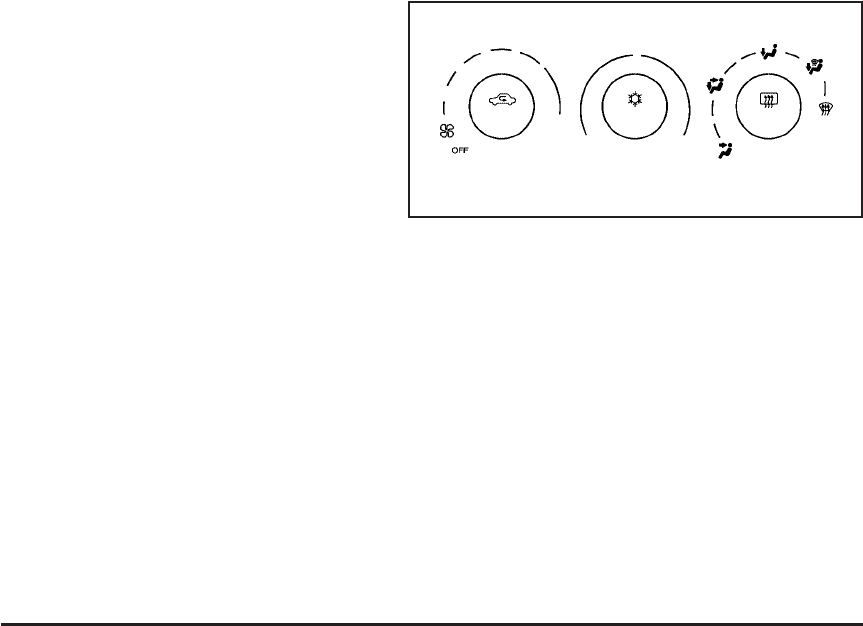
Climate Controls
Climate Control System
With this system you can control the heating, cooling
and ventilation for your vehicle.
If your vehicle has the remote start feature and it is
activated, the climate control system will automatically
cool the vehicle if the temperature is greater than
90°F (32°C) and heat the vehicle if the temperature
is below 37°F (3°C). If the temperature is between
37°F (3°C) and 90°F (32°C), the last control setting
selected when the engine was running will be used.
Normal operation and the last setting of the climate
control system will return after the key is turned to
the RUN position.
Operation
OFF: Turn the left knob to this position to turn the
climate control system off.
9(Fan): Turn the knob by this symbol, located on
the left side of the climate control panel, clockwise or
counterclockwise to increase or decrease the fan speed.
The fan speed will be temporarily reduced between
the transition to a new mode. The fan will resume the
original speed when the transition to the new mode
is complete.
Temperature Control: Turn the center knob clockwise
or counterclockwise to increase or decrease the
temperature inside your vehicle.
3-22

Use the right knob to select from the following modes:
H(Vent): This mode directs outside air to the
instrument panel outlets. If driving in city traffic, and
the vehicle is stopped and idling, or the weather is hot,
turn on the recirculation mode. To prevent the air
inside the vehicle from becoming stale, after five minutes
recirculate will allow outside air into the vehicle.
)(Bi-Level): This mode directs half of the air to
the instrument panel outlets, and the remaining air to
the floor outlets. Some air may be directed toward
the windshield. Slightly cooler air is directed to
the instrument panel outlets and warmer air is directed
to the floor outlets.
6(Floor): This mode directs most of the air to the
floor outlets with some air directed toward the side
window outlets and a little air directed to the windshield.
In this mode, the system will automatically use outside
air. The air conditioning compressor will be engaged
unless the outside temperature is 40°F (4°C) or below.
If recirculation is selected, the led will come on.
You can also select modes by using the following
buttons:
h(Recirculate): Press this button to recirculate
cabin air through the vehicle. It can be used to prevent
outside air and odors from entering your vehicle or
to help heat or cool the air inside your vehicle more
quickly. An indicator light below the button will come on
in this mode. Operation in this mode during periods
of high humidity and cool outside temperatures
may result in increased window fogging. If window
fogging is experienced, select the defrost mode.
To prevent the air inside the vehicle from becoming
stale, after five minutes recirculate will allow outside air
into the vehicle.
#(Air Conditioning): Press this button to turn the
air conditioning system on or off. When this button
is pressed, an indicator light below the button will come
on to let you know the air conditioning is activated.
Air conditioning can be selected in any mode as long as
the fan switch is on. Note that the indicator light will
change with each button press even when conditions
prevent operation.
3-23

On hot days during the vehicle’s initial start-up, open
the windows to let hot inside air escape; then close
them. This helps to reduce the time it takes for
the vehicle to cool down. It also helps the system to
operate more efficiently.
For quicker cool down on hot days, do the following:
1. Select the vent air mode.
2. Select the recirculation mode.
3. Select the air conditioner.
4. Select the coolest temperature.
5. Select the highest fan speed.
The air-conditioning system removes moisture from the
air, so you may sometimes notice a small amount of
water dripping underneath your vehicle while idling
or after turning off the engine. This is normal.
Defogging and Defrosting
Fog on the inside of the vehicle is a result of high
humidity causing moisture to condense on the
cool window glass. This can be minimized if the
climate control system is used properly. There are
two modes to clear frost or fog from the windshield.
Use the defog mode to clear the windows of
condensation and to warm the vehicle’s occupants.
Use the defrost mode to remove frost or condensation
from the windshield quickly. Recirculation cannot be
selected when in these modes (the indicator light
will come on when pressed).
See “Rear Window Defogger” later in this section for
information on clearing the rear window of fog or ice.
Turn the right knob to select the defog or defrost mode.
-(Defog): This mode directs half of the air to the
windshield and the side window outlets and half to the
floor outlets. When you select this mode, the system
turns recirculation off and runs the air conditioning
compressor unless the outside temperature is near
or below freezing. Pressing the recirculation button will
have no effect other than turning on the indicator
light while in defog mode.
0(Defrost): This mode directs most of the air to the
windshield and the side window outlets, with some
air directed to the floor outlets. When you select this
mode, the system turns recirculation off and runs the air
conditioning compressor unless the outside temperature
is near or below freezing. Pressing the recirculation
button will have no effect other than turning on
the indicator light while in defrost mode.
3-24
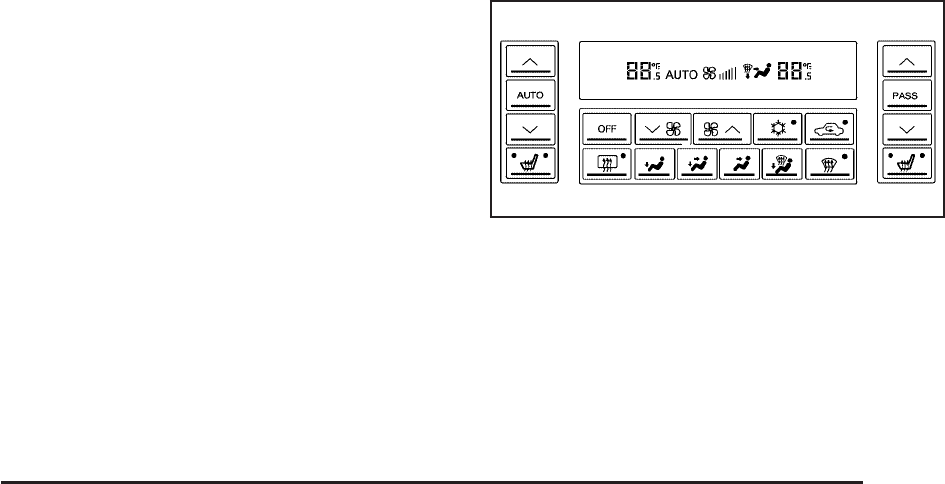
Rear Window Defogger
The rear window defogger uses a warming grid to
remove fog from the rear window.
<(Rear): Press the button to turn the rear window
defogger on or off. An indicator light below the button will
come on to let you know that the rear window defogger
is activated.
The rear window defogger will only work when the
ignition is in run. The rear window defogger will stay
on for approximately 20 minutes after the button
is pressed, unless the ignition is turned to ACCESSORY
or RUN. If turned on again, the defogger will only run
for approximately 20 minutes before turning off.
The defogger can also be turned off by pressing the
button again or by turning off the engine.
Notice: Do not use anything sharp on the inside
of the rear window. If you do, you could cut or
damage the warming grid, and the repairs would
not be covered by your warranty. Do not attach
a temporary vehicle license, tape, a decal or
anything similar to the defogger grid.
Dual Automatic Climate Control
System
Your vehicle may have this climate control system.
The heating, cooling and ventilation can be controlled
with it.
Automatic Operation
AUTO (Automatic): Press the AUTO button for
automatic control of the inside temperature, the air
delivery mode and the fan speed. There might be a
delay of two to three minutes before the fan comes on
when the automatic operation is used in cold weather.
3-25

For the automatic system to function, the temperature
must be set between 61°F (15°C) and 89°F (32°C).
1. Adjust the temperature to a comfortable setting.
2. Press the PASS button or the up or down arrows
on the passenger side to turn the passenger
temperature set on and off. When turned on,
the passenger temperature will be the same as
the driver setting. Press the up or down arrow
on passenger side to adjust the passenger
temperature setting.
When the passenger temperature set is off, the
passenger display will be off and the driver’s
set temperature will be for the driver and passenger.
In cold weather, the system will start at reduced
fan speeds to avoid blowing cold air into the vehicle
until warmer air is available. The system will
start out blowing air at the floor but may change
modes automatically as the vehicle warms up
to maintain the chosen temperature setting. The
length of time needed for warm up will depend on
the outside temperature and the length of time
that has elapsed since the vehicle was last driven.
3. Wait for the system to regulate. This may take from
10 to 30 minutes. Then, adjust the temperature,
if necessary.
Do not cover the solar sensor located in the center
of the instrument panel, near the windshield. For
more information on the solar sensor, see “Sensors”
later in this section.
4. Press OFF to turn the climate control system off.
Only the rear defog and heated seats will function.
Press AUTO or any other button except the
heated seats or rear defog to turn the climate
control system back on.
This control has 4 types of operation.
•Automatic can set/change the temperature only.
AUTO and temperature only will appear on the
display.
•Semi-Automatic Fan can set/change the
temperature and mode. The fan operates
automatically. The temperature and mode will
appear on the display.
•Semi-Automatic Mode can set/change the
temperature and fan speed. The mode operates
automatically. The fan speed and temperature
will appear on the display.
•Manual can set/change the temperature, mode
and fan. The fan speed, temperature and mode
will appear on the display.
If your vehicle has the remote start feature, the climate
control system will automatically regulate the inside
temperature of your vehicle when the remote start
system is activated. Normal operation and the last
setting of the climate control system will return after
the key is turned on.
3-26

Manual Operation
During daylight hours, the instrument panel brightness
control might need to be adjusted to the highest setting,
in order to see the indicator lights for the various
climate control settings.
OFF: Press this button to turn the climate control
system off.
yz(Temperature): Press these buttons to manually
adjust the temperature inside the vehicle. Press the
up arrow on the driver or passenger side to raise
the temperature and press the down arrow to lower
the temperature. The display will show the selected
temperature.
You may also have controls on your steering wheel
that can be used to adjust the temperature inside your
vehicle. See Steering Wheel Climate Controls on
page 3-31 for additional information.
z9(Fan): Press this button to decrease the fan
speed. Pressing the arrows cancels the automatic
operation and places the system in manual or
semi-automatic mode. Press the AUTO button to
return to automatic operation. If the airflow seems low
when the fan is at the highest setting, the passenger
compartment air filter may need to be replaced.
For more information see Passenger Compartment
Air Filter on page 3-30 and Scheduled Maintenance
on page 6-4.
9y (Fan): Press this button to increase the fan
speed. Pressing the arrows cancels the automatic
operation and places the system in manual or
semi-automatic mode. Press the AUTO button to
return to automatic operation. If the airflow seems low
when the fan is at the highest setting, the passenger
compartment air filter may need to be replaced.
For more information see Passenger Compartment
Air Filter on page 3-30 and Scheduled Maintenance
on page 6-4.
6(Floor): This mode directs most of the air to the
floor, with some air directed to the side window outlets
and a small amount to the windshield.
)(Bi-Level): This setting directs airflow to the
instrument panel and floor outlets. A small amount of
air is also directed to the windshield and the side window
outlets.
Y(Vent): This mode directs air through the instrument
panel outlets.
3-27

h(Recirculation): Press this button to turn
recirculation mode on or off. This mode keeps outside
air from coming into the vehicle. It can be used to
prevent outside air and odors from entering your vehicle
or to help cool the air inside the vehicle more quickly.
Recirculation is not available while in the floor, defrost,
or floor/defog modes. Using recirculation for long
periods of time may cause the air inside your vehicle
to become too dry. Recirculation mode has a 5 minute
timer after which the system allows for some fresh
outside air into the vehicle to maintain interior air quality.
#(Air Conditioning): Press this button to turn the
air conditioning compressor on and off. The indicator
light on the button will come on when the air conditioning
is on. Note that the indicator light will change with
each button press even when conditions prevent
operation. The indicator light on the air conditioning
button will come on every time the vehicle is started.
The air conditioning may be turned off by pressing
the air conditioner button.
((Heated Seats): Press this button to turn the driver
or passenger heated seats on and off. See Heated
Seats on page 1-4 for additional information.
Defogging and Defrosting
Fog on the inside of windows is a result of high humidity
(moisture) condensing on the cool window glass.
This can be minimized if the climate control system is
used properly. There are two modes to clear fog or
frost from your windshield. Use the floor/defog mode to
clear the windows of fog or moisture and warm the
passengers. Use defrost to remove fog or frost from
the windshield more quickly.
-(Floor/Defog): Press this button to direct the air
between the windshield, floor outlets and side windows.
When you select this mode, the system turns recirculation
off and runs the air conditioning compressor unless the
outside temperature is near or below freezing. Pressing
the recirculation button will have no effect other than
turning on the indicator light while in floor/defog mode.
1(Defrost): Press this button to direct most of the air
to the windshield, with some air directed to the side
windows. In this mode, the system will automatically turn
off the recirculation and run the air conditioning
compressor, unless the outside temperature is near or
below freezing. Pressing the recirculation button will
have no effect other than turning on the indicator light
while in defrost mode.
Do not drive the vehicle until all windows are clear.
3-28

Sensors
The solar sensor on the vehicle monitors the solar
heat and the air inside of the vehicle. This information
is used to maintain the selected temperature by
initiating needed adjustments to the temperature, the
fan speed, and the air delivery system. The system may
also supply cooler air to the side of the vehicle facing
the sun. The recirculation mode will also be activated,
as necessary. Do not cover the solar sensor located
in the center of the instrument panel, near the
windshield, or the system will not work properly.
Rear Window Defogger
The rear window defogger uses a warming grid to
remove fog or frost from the rear window. The rear
window defogger will only work when the engine
is running.
=(Rear Window Defogger): Press this button to
turn the rear window defogger on and off. Be sure
to clear as much snow from the rear window as possible.
The rear window defogger will turn off approximately
20 minutes after the button is pressed. If turned on
again, the defogger will only run for approximately
20 minutes before turning off. The defogger can also
be turned off by pressing the button again or by
turning off the engine.
Do not drive the vehicle until all the windows are clear.
Notice: Do not use a razor blade or sharp object
to clear the inside rear window. Do not adhere
anything to the defogger grid lines in the rear glass.
These actions may damage the rear defogger.
Repairs would not be covered by your warranty.
Outlet Adjustment
Use the thumbwheels located between the center
outlets to open and close the outlets. Move the lever in
the center of each air outlet to adjust the direction of
the airflow.
Operation Tips
•Clear away any ice, snow or leaves from the air
inlets at the base of the windshield that may
block the flow of air into the vehicle.
•Use of non-GM approved hood deflectors may
adversely affect the performance of the system.
•Keep the path under the front seats clear of objects
to help circulate the air inside of the vehicle more
effectively.
•If the vehicle has a passenger compartment air filter
and the airflow seems low when the fan is at the
highest setting it may need to be replaced. For more
information, see Passenger Compartment Air
Filter on page 3-30.
3-29
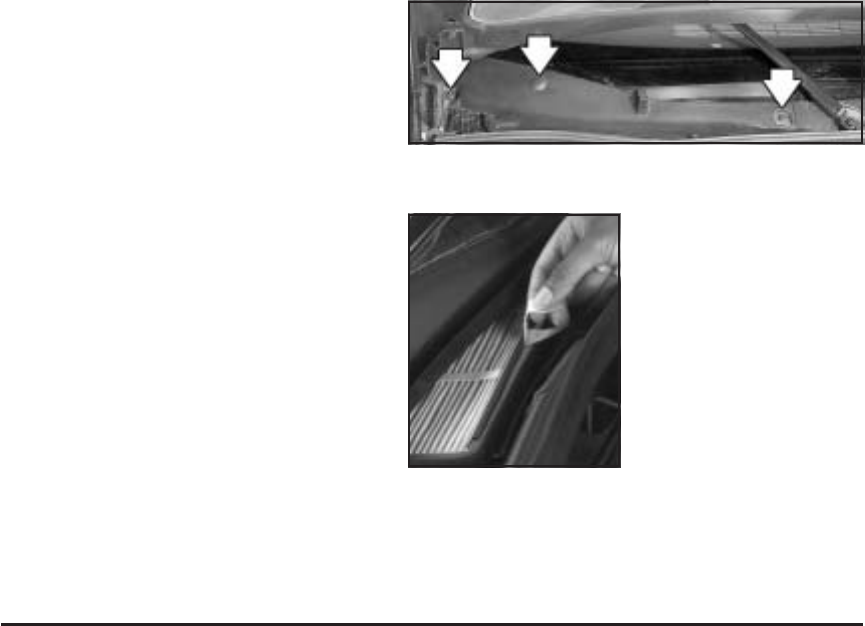
Passenger Compartment Air Filter
The passenger compartment air filter is located
below the air inlet grille, near the passenger’s side
windshield wiper arm. See Engine Compartment
Overview on page 5-12.
The filter traps most of the pollen from the air entering
the air conditioning module. Like the engine’s air
cleaner filter, it may need to be changed periodically.
For information on how often to change the passenger
compartment air filter, see Scheduled Maintenance
on page 6-4.
To change the passenger compartment air filter,
use the following steps:
1. Turn the ignition to ACCESSORY and turn the
windshield wipers on.
2. Turn the ignition to OFF when the windshield
wipers are in the upright position.
3. Raise the hood.
4. Disconnect the windshield washer pump hose
from the fender rail and air inlet grille.
5. Peel back the hood weather-strip from the
passenger’s side of the vehicle halfway to the
center of the hood.
6. Remove the three air inlet grille retainers.
7. Remove the air inlet grille.
8. Remove the old
air filter by pulling
up on its tab.
9. Install a new passenger compartment air filter.
See Normal Maintenance Replacement Parts on
page 6-13 for the type of filter to use. Make sure
it slides under the compartment retainers.
10. Reverse Steps 1 through 7.
3-30
Steering Wheel Climate Controls
If your vehicle has this
feature, you can control
the driver’s temperature
setting by using the
control located on your
steering wheel.
yz(Temperature): Press the up arrow to increase
or the down arrow decrease the temperature inside
your vehicle.
Warning Lights, Gages, and
Indicators
This part describes the warning lights and gages that may
be on the vehicle. The pictures will help you locate them.
Warning lights and gages can signal that something is
wrong before it becomes serious enough to cause an
expensive repair or replacement. Paying attention to the
warning lights and gages could also save you or others
from injury.
Warning lights come on when there may be or is a
problem with one of the vehicle’s functions. As you will
see in the details on the next few pages, some warning
lights come on briefly when you start the engine just to let
you know they are working. If you are familiar with this
section, you should not be alarmed when this happens.
Gages can indicate when there may be or is a problem
with one of your vehicle’s functions. Often gages and
warning lights work together to let you know when there
is a problem with your vehicle.
When one of the warning lights comes on and stays on
when you are driving, or when one of the gages shows
there may be a problem, check the section that tells you
what to do about it. Please follow this manual’s advice.
Waiting to do repairs can be costly – and even
dangerous. So please get to know the warning lights
and gages. They are a big help.
3-31
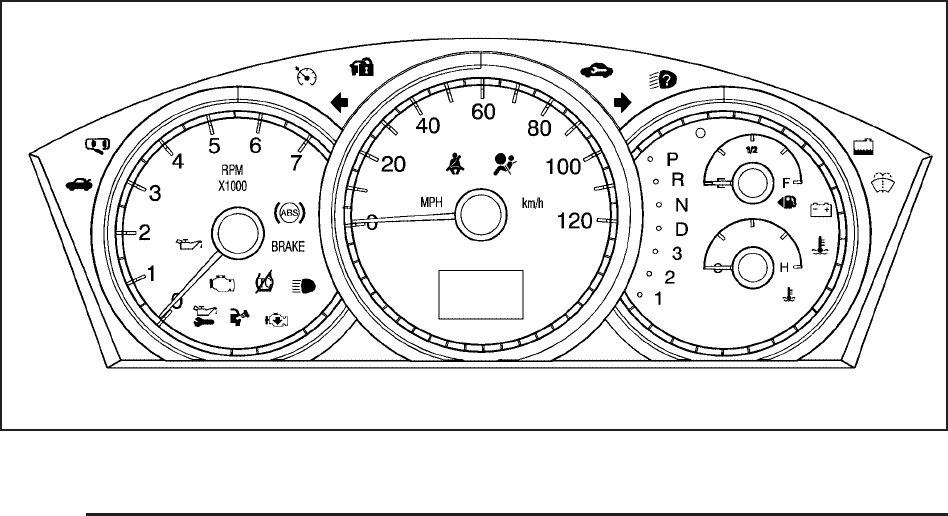
Instrument Panel Cluster
The instrument panel cluster is designed to let the driver know at a glance how the vehicle is running. It will show
how fast the vehicle is going, about how much fuel is in the fuel tank and many other things needed to drive safely
and economically.
3-32
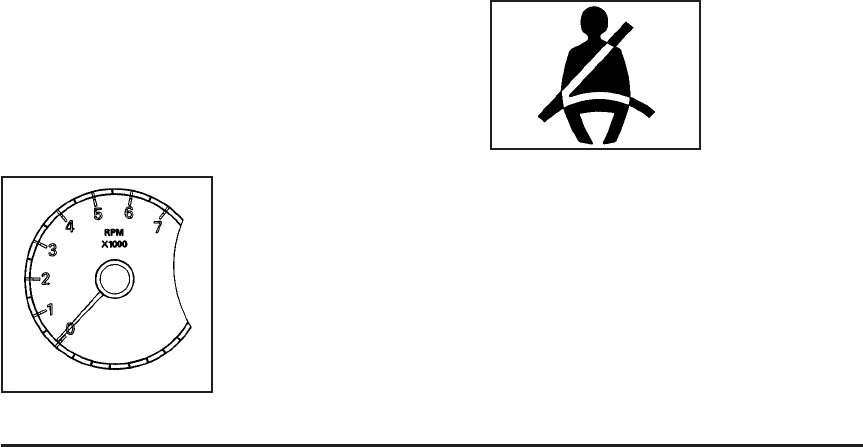
Speedometer and Odometer
Your speedometer lets you see your speed in both
miles per hour (mph) and kilometers per hour (km/h).
Your vehicle’s odometer works together with the
driver information center. You can set a Trip A
and Trip B odometer. See “Trip Information” under
DIC Operation and Displays on page 3-50.
The odometer mileage can be checked without the
vehicle running. Simply press the odometer/trip switch
on the instrument panel cluster.
If your vehicle ever needs a new odometer installed,
the new one will be set to the correct mileage total
of the old odometer.
Tachometer
The tachometer displays
the engine speed in
thousands of revolutions
per minute (rpm).
Safety Belt Reminder Light
When the key is turned to RUN or START, a chime
will sound for several seconds to remind you and your
passengers to buckle your safety belts. The driver safety
belt light will also come on and stay on for several
seconds, then it will flash for several more. You should
buckle your seat belt.
If the driver’s belt is
buckled, neither the
chime nor the light
will come on.
3-33
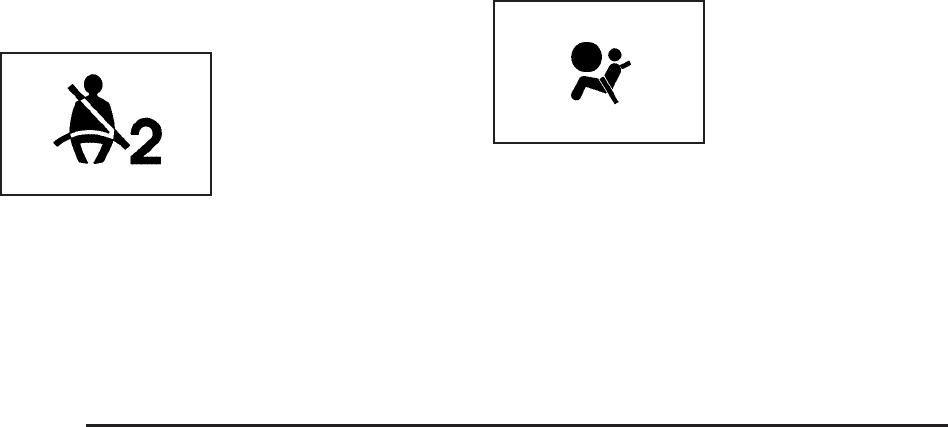
Passenger Safety Belt
Reminder Light
Several seconds after the key is turned to RUN or
START, a chime will sound for several seconds
to remind the front passenger to buckle their safety
belt. This would only occur if the passenger airbag is
enabled. See Passenger Sensing System on page 1-61
for more information. The passenger safety belt light
will also come on and stay on for several seconds, then
it will flash for several more.
If the passenger’s safety
belt is buckled, neither
the chime nor the light
will come on.
Airbag Readiness Light
There is an airbag readiness light on the instrument
panel, which shows the airbag symbol. The system
checks the airbag’s electrical system for malfunctions.
The system check includes the airbag modules, the
wiring and the crash sensing and diagnostic module.
For more information on the airbag system, see
Airbag System on page 1-53.
This light will come on
when the vehicle is
started, and it will flash
for a few seconds. Then
the light should go out.
This means the system
is functioning properly.
If the airbag readiness light stays on after the vehicle
is started, or comes on as the vehicle is being
driven, there may be an electrical problem and the
airbag system may not work properly. Have the vehicle
serviced right away.
3-34
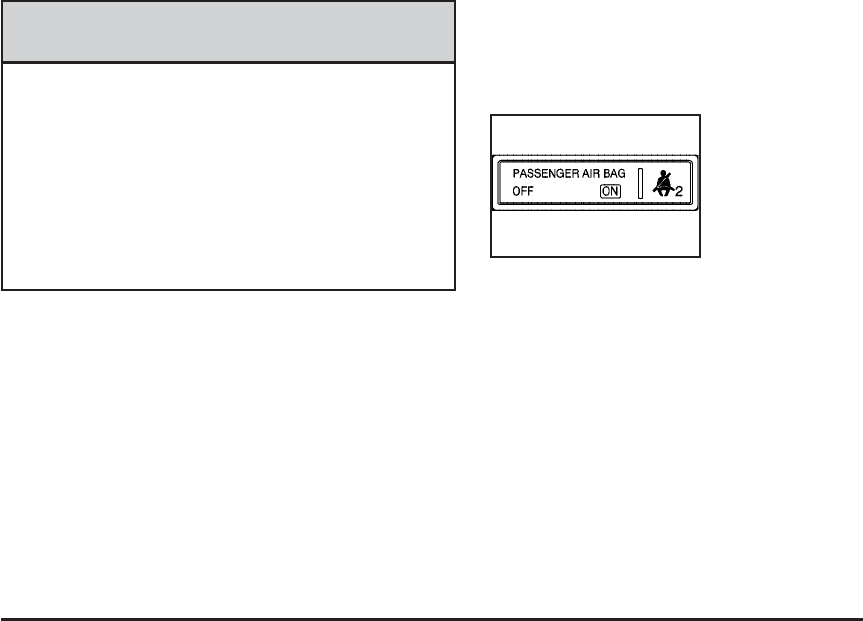
{CAUTION:
If the airbag readiness light stays on after
you start your vehicle, it means the airbag
system may not be working properly. The
airbags in your vehicle may not inflate in a
crash, or they could even inflate without a
crash. To help avoid injury to yourself or
others, have your vehicle serviced right away
if the airbag readiness light stays on after
you start your vehicle.
The airbag readiness light should flash for a few
seconds when you turn the ignition key to RUN.
If the light does not come on then, have it fixed so
it will be ready to warn you if there is a problem.
Passenger Airbag Status Indicator
Your instrument panel has a passenger airbag status
indicator. See Passenger Sensing System on page 1-61
for more information.
When the ignition key is turned to RUN or START,
the passenger airbag status indicator will light ON and
OFF for several seconds as a system check. If you
use remote start to start your vehicle from a distance
(if equipped), you may not see the system check.
Then, after several more seconds, the status indicator
will light either ON or OFF to let you know the status
of the right front passenger’s frontal airbag.
Passenger Airbag
Status Indicator
3-35
If the word ON is lit on the passenger airbag status
indicator, it means that the right front passenger’s
frontal airbag is enabled (may inflate).
{CAUTION:
If the on indicator comes on when you have a
rear-facing child restraint installed in the right
front passenger’s seat, it means that the
passenger sensing system has not turned off
the passenger’s frontal airbag. A child in a
rear-facing child restraint can be seriously
injured or killed if the right front passenger’s
airbag inflates. This is because the back of the
rear-facing child restraint would be very close
to the inflating airbag. Do not use a rear-facing
child restraint in the right front passenger’s
seat if the airbag is turned on.
Your vehicle has a rear seat that will accommodate a
rear-facing child restraint. A label on your sun visor says,
“Never put a rear-facing child seat in the front.” This
is because the risk to the rear-facing child is so great,
if the airbag deploys.
{CAUTION:
Even though the passenger sensing system is
designed to turn off the passenger’s frontal
airbag if the system detects a rear-facing child
restraint, no system is failsafe, and no one can
guarantee that an airbag will not deploy under
some unusual circumstance, even though it is
turned off. We recommend that rear-facing
child restraints be secured in the rear seat,
even if the airbag is off.
If the word OFF is lit on the airbag status indicator, it
means that the passenger sensing system has turned off
the right front passenger’s frontal airbag. See Passenger
Sensing System on page 1-61 for more on this,
including important safety information.
3-36
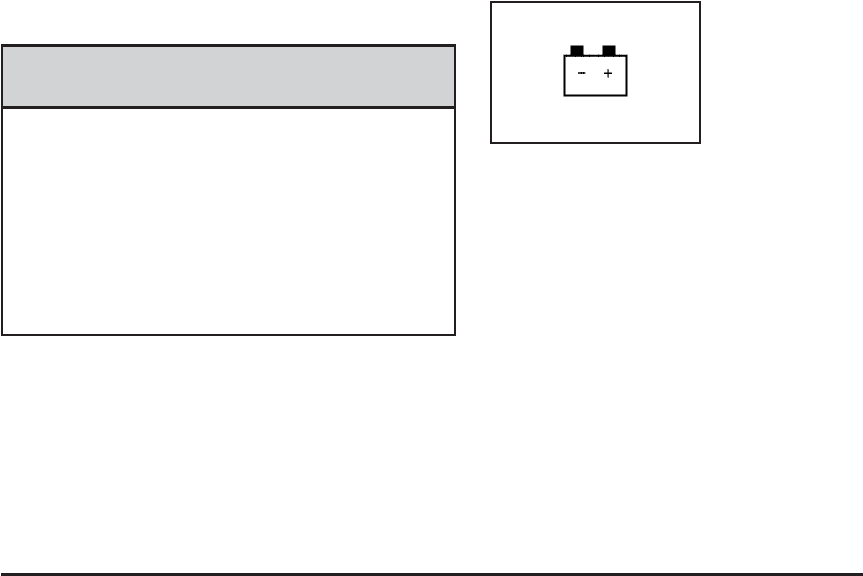
If, after several seconds, all status indicator lights
remain on, or if there are no lights at all, there may be
a problem with the lights or the passenger sensing
system. See your dealer for service.
{CAUTION:
If the off indicator and the airbag readiness
light ever come on together, it means that
something may be wrong with the airbag
system. If this ever happens, have the vehicle
serviced promptly, because an adult-size
person sitting in the right front passenger
seat may not have the protection of the
frontal airbag. See Airbag Readiness Light
on page 3-34.
Charging System Light
The charging system light
will come on briefly when
the ignition is turned
on, as a check to show
that it is working. Then it
should go out.
If it stays on, or comes on while the vehicle is being
driven, a chime will sound and there may be a problem
with the charging system. It could indicate that the
vehicle has a loose accessory belt or another electrical
problem. Have it checked right away. Driving while
this light is on could drain the battery.
If the vehicle must be driven a short distance with
the light on, be certain to turn off all the accessories,
such as the radio and air conditioner.
3-37
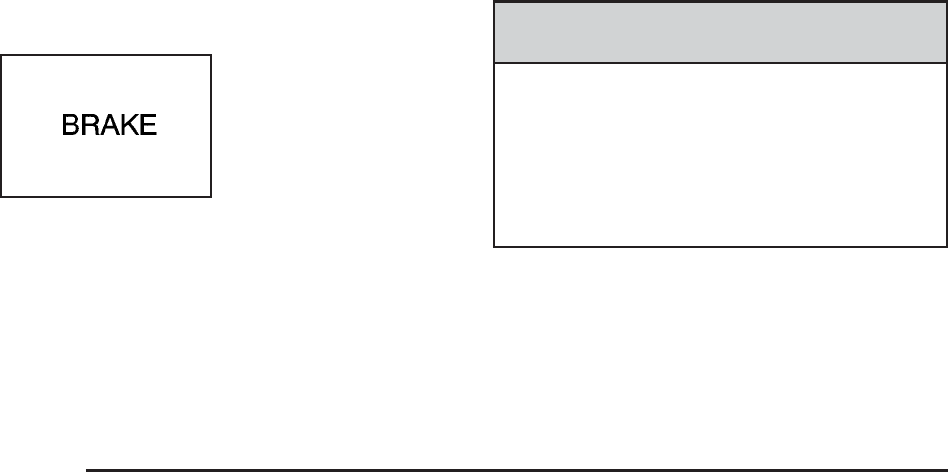
Brake System Warning Light
Your vehicle’s hydraulic brake system is divided into
two parts. If one part is not working, the other part can
still work and stop you. For good braking, though,
you need both parts working well.
If the warning light comes on and the parking brake
is not applied, there is a brake problem. Have your
brake system inspected right away.
This light should come
on briefly when you turn
the ignition key to RUN.
If it does not come on then, have it fixed so it will be
ready to warn you if there is a problem.
When the ignition is on, the brake system warning light
will also come on when you set your parking brake.
The light will stay on if your parking brake does
not release fully. If it stays on after your parking brake
is fully released, it means you have a brake problem.
If the light comes on while you are driving, a chime
will sound and you should pull off the road and
stop carefully. You may notice that the pedal is harder
to push. Or, the pedal may go closer to the floor.
It may take longer to stop. If the light is still on, have
the vehicle towed for service. See Towing Your Vehicle
on page 4-36.
{CAUTION:
Your brake system may not be working
properly if the brake system warning light is
on. Driving with the brake system warning
light on can lead to an accident. If the light
is still on after you have pulled off the road
and stopped carefully, have the vehicle towed
for service.
3-38
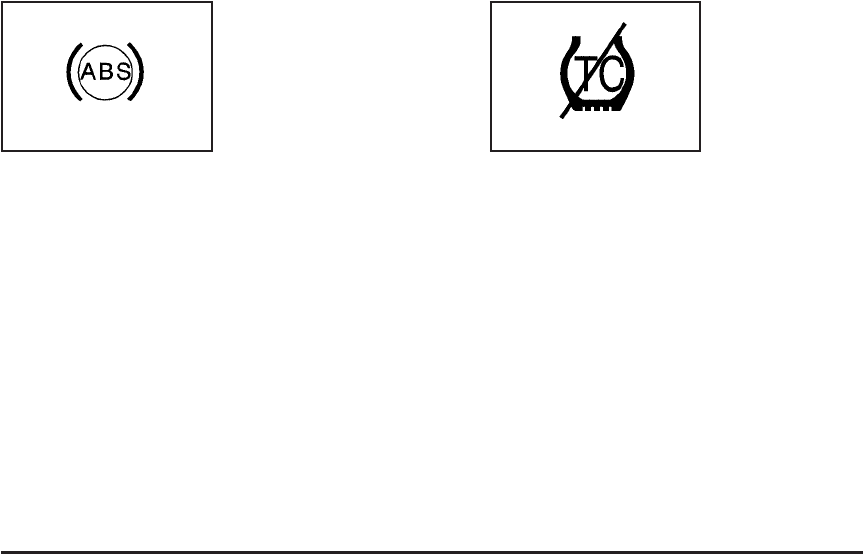
Anti-Lock Brake System
Warning Light
Your vehicle may have the
anti-lock brake system, this
light will come on when
your engine is started and
may stay on for several
seconds. That is normal.
If the ABS warning light comes on and stays on, there
may be a problem with the anti-lock portion of the brake
system. If the brake system warning light is not on,
you still have brakes, but you do not have anti-lock
brakes. See Brake System Warning Light on page 3-38.
If the light stays on, turn the ignition to OFF. If the
light comes on when you are driving, stop as soon as
possible and turn the ignition off. Then start the
engine again to reset the system. If the light still stays
on, or comes on again while you are driving, your
vehicle needs service. If the regular brake system
warning light is not on, you still have brakes, but you do
not have anti-lock brakes. If the regular brake system
warning light is also on, you do not have anti-lock brakes
and there is a problem with your regular brakes. See
Brake System Warning Light on page 3-38.
Traction Control System (TCS)
Warning Light
Your vehicle may be
equipped with the Traction
Control System (TCS),
if this warning light comes
on and stays on, there
may be a problem with
the TCS and, if equipped,
the StabiliTrak
®
system.
The TCS warning light will come on briefly when you turn
the ignition to RUN. If it does not come on then, have it
fixed so it will be ready to warn you if there is a problem.
The light will also come on if you turn the TCS off using
the TCS on/off button located near the shift lever.
If the TCS warning light stays on or comes on while
you are driving, pull off the road as soon as possible and
stop carefully. Try resetting the system by turning the
ignition off then back on. If the light still stays on
or comes back on again while you are driving, your
vehicle needs service. Have the traction control system
and, if equipped, the StabiliTrak
®
system inspected
as soon as possible. See Traction Control System (TCS)
on page 4-10 and StabiliTrak
®
System on page 4-11
for more information.
3-39
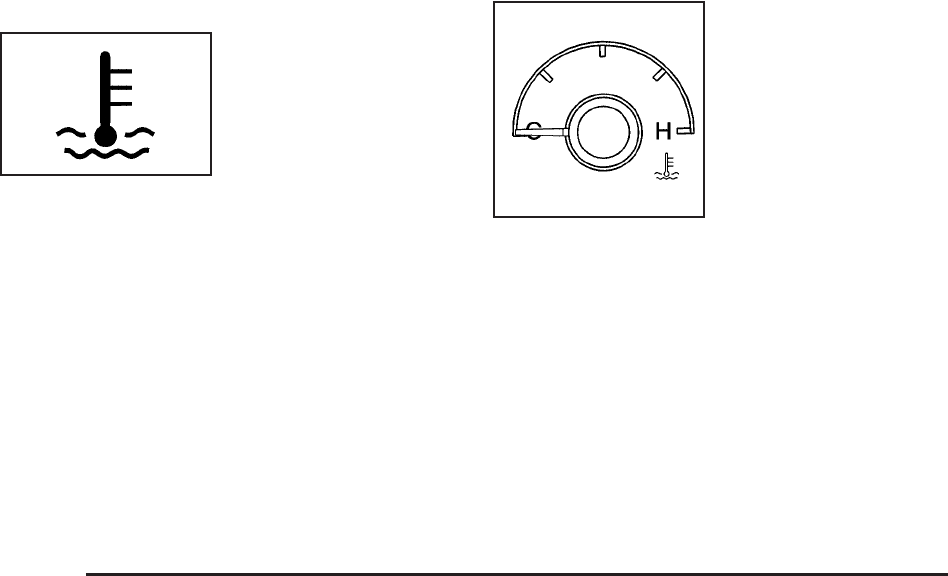
Engine Coolant Temperature
Warning Light
This light tells you that
your engine is very hot.
This light will come on when you first start the vehicle
as a check to let you know that the light is working. It will
go out after a few seconds. If the light does not come
on, the bulb may be burned out. See your GM dealer to
have it corrected.
If the light does not go out or if the light comes on
and stays on while you are driving, your vehicle may
have a problem with the cooling system. You should
stop the vehicle and turn off the engine as soon
as possible to avoid damage to the engine. A warning
chime will sound when this light is on, also.
See Engine Overheating on page 5-27.
Engine Coolant Temperature Gage
The vehicle has a gage
that shows the engine
coolant temperature.
If the gage pointer moves towards the H, the engine
is too hot.
This reading indicates the same thing as the warning
light. It means that the engine coolant has overheated.
If the vehicle has been operating under normal
driving conditions, pull off the road, stop the vehicle,
and turn off the engine as soon as possible. See Engine
Overheating on page 5-27.
3-40
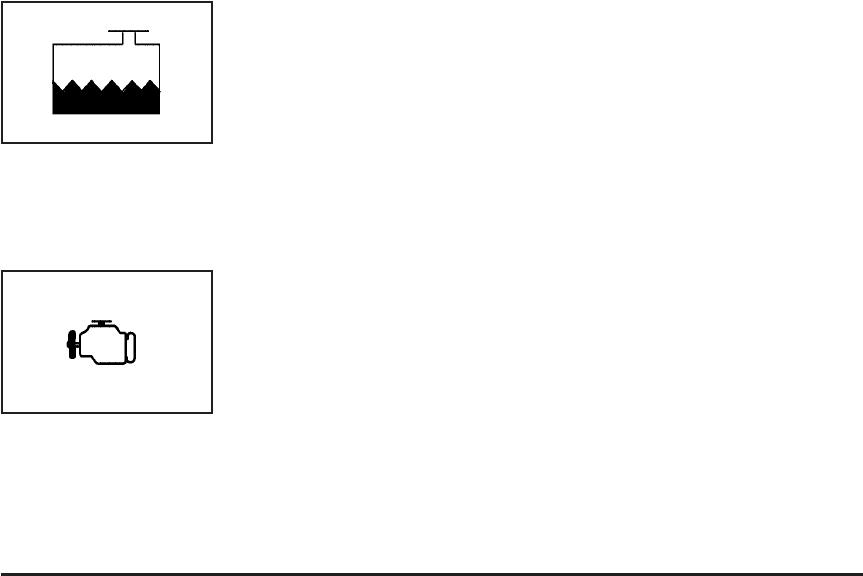
Low Coolant Warning Light
If equipped, this light
comes on briefly when
you turn your ignition on
as a bulb check only.
Malfunction Indicator Lamp
Check Engine Light
Your vehicle is equipped
with a computer which
monitors operation of the
fuel, ignition, and emission
control systems.
This system is called OBD II (On-Board
Diagnostics-Second Generation) and is intended to
assure that emissions are at acceptable levels for the life
of the vehicle, helping to produce a cleaner environment.
The check engine light comes on to indicate that there
is a problem and service is required. Malfunctions often
will be indicated by the system before any problem is
apparent. This may prevent more serious damage to
your vehicle. This system is also designed to assist
your service technician in correctly diagnosing any
malfunction.
Notice: If you keep driving your vehicle with
this light on, after awhile, your emission controls
may not work as well, your fuel economy may not be
as good, and your engine may not run as smoothly.
This could lead to costly repairs that may not be
covered by your warranty.
Notice: Modifications made to the engine,
transaxle, exhaust, intake, or fuel system of your
vehicle or the replacement of the original tires with
other than those of the same Tire Performance
Criteria (TPC) can affect your vehicle’s emission
controls and may cause this light to come on.
Modifications to these systems could lead to costly
repairs not covered by your warranty. This may
also result in a failure to pass a required Emission
Inspection/Maintenance test. See Accessories
and Modifications on page 5-3.
3-41

This light should come on, as a check to show you
it is working, when the ignition is on and the engine
is not running. If the light does not come on, have
it repaired. This light will also come on during a
malfunction in one of two ways:
•Light Flashing — A misfire condition has been
detected. A misfire increases vehicle emissions
and may damage the emission control system
on your vehicle. Diagnosis and service may
be required.
•Light On Steady — An emission control system
malfunction has been detected on your vehicle.
Diagnosis and service may be required.
If the Light is Flashing
The following may prevent more serious damage to
your vehicle:
•Reducing vehicle speed
•Avoiding hard accelerations
•Avoiding steep uphill grades
•If you are towing a trailer, reduce the amount of
cargo being hauled as soon as it is possible
If the light stops flashing and remains on steady, see
“If the Light Is On Steady” following.
If the light continues to flash, when it is safe to do
so, stop the vehicle. Find a safe place to park your
vehicle. Turn the key off, wait at least 10 seconds and
restart the engine. If the light remains on steady, see
“If the Light Is On Steady” following. If the light is
still flashing, follow the previous steps, and see your
dealer for service as soon as possible.
If the Light Is On Steady
You may be able to correct the emission system
malfunction by considering the following:
Did you recently put fuel into your vehicle?
If so, reinstall the fuel cap, making sure to fully
install the cap. See Filling the Tank on page 5-8.
The diagnostic system can determine if the fuel cap
has been left off or improperly installed. A loose
or missing fuel cap will allow fuel to evaporate into the
atmosphere. A few driving trips with the cap properly
installed should turn the light off.
3-42

Did you just drive through a deep puddle of water?
If so, your electrical system may be wet. The condition
will usually be corrected when the electrical system
dries out. A few driving trips should turn the light off.
Have you recently changed brands of fuel?
If so, be sure to fuel your vehicle with quality fuel.
See Gasoline Octane on page 5-5. Poor fuel quality
will cause your engine not to run as efficiently as
designed. You may notice this as stalling after start-up,
stalling when you put the vehicle into gear, misfiring,
hesitation on acceleration, or stumbling on acceleration.
(These conditions may go away once the engine is
warmed up.) This will be detected by the system and
cause the light to turn on.
If you experience one or more of these conditions,
change the fuel brand you use. It will require at least
one full tank of the proper fuel to turn the light off.
If none of the above steps have made the light turn off,
your dealer can check the vehicle. Your dealer has
the proper test equipment and diagnostic tools to
fix any mechanical or electrical problems that may
have developed.
Emissions Inspection and Maintenance
Programs
Some state/provincial and local governments have or
may begin programs to inspect the emission control
equipment on your vehicle. Failure to pass this
inspection could prevent you from getting a vehicle
registration.
Here are some things you need to know to help your
vehicle pass an inspection:
Your vehicle will not pass this inspection if the check
engine light is on or not working properly.
Your vehicle will not pass this inspection if the OBD
(on-board diagnostic) system determines that critical
emission control systems have not been completely
diagnosed by the system. The vehicle would be
considered not ready for inspection. This can happen
if you have recently replaced your battery or if your
battery has run down. The diagnostic system is
designed to evaluate critical emission control systems
during normal driving. This may take several days
of routine driving. If you have done this and your vehicle
still does not pass the inspection for lack of OBD
system readiness, your GM dealer can prepare the
vehicle for inspection.
3-43
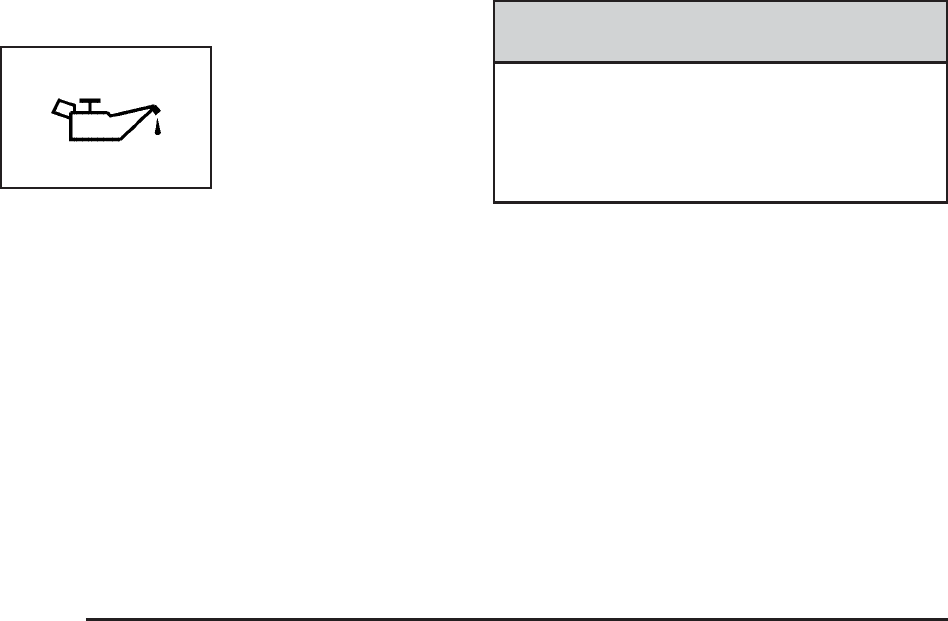
Oil Pressure Light
Your vehicle may have this
feature. If the vehicle has
an oil problem, this light
may stay on after the
engine is started, or come
on while you are driving.
This light indicates that oil is not going through the
engine quickly enough to keep it lubricated. The engine
could be low on oil or could have some other oil
problem. Have it fixed right away.
The oil light could also come on in the following
situations:
•The light will come on briefly when the ignition
is turned on to show that it is working properly.
If it does not come on with the ignition on,
there may be a problem with the fuse or bulb.
Have it fixed right away.
•Sometimes when the engine is idling at a stop,
a chime will sound and the light may blink on
and off. This is normal.
{CAUTION:
Do not keep driving if the oil pressure is low.
If you do, your engine can become so hot that
it catches fire. You or others could be burned.
Check your oil as soon as possible and have
your vehicle serviced.
Notice: Lack of proper engine oil maintenance
may damage the engine. The repairs would not
be covered by your warranty. Always follow
the maintenance schedule in this manual for
changing engine oil.
3-44
Change Engine Oil Light
If this light comes on,
it means that service
is required for your
vehicle. See Scheduled
Maintenance on page 6-4
and Engine Oil on
page 5-15 for more
information.
After having the oil changed you will need to reset the
light. See Engine Oil on page 5-15 for more information.
If this light is blinking, a chime will sound indicating
low engine oil.
Security Light
For information
regarding this light,
see Theft-Deterrent
Systems on page 2-18.
Cruise Control Light
This light comes on
whenever you set
your cruise control.
The light will go out when the cruise control is
turned off. See Cruise Control on page 3-10 for
more information.
3-45
Reduced Engine Power Light
If the reduced engine
power light is on, a
chime will sound and a
noticeable reduction in
the vehicle’s performance
may occur.
If the reduced engine power light is on, but there is no
reduction in performance, proceed to your destination.
The performance may be reduced the next time
the vehicle is driven. The vehicle may be driven at a
reduced speed while the reduced engine power light is
on, but acceleration and speed may be reduced.
Anytime the reduced engine power light stays on, the
vehicle should be taken to an authorized GM dealer as
soon as possible for service.
Highbeam On Light
This light will come on
when the high-beam
headlamps are in use.
See Headlamp High/Low-Beam Changer on page 3-8.
Headlamps Suggested Light
This light will come
on when the use of
headlamps is suggested.
3-46
Low Washer Fluid Warning Light
This light will come on
briefly when the ignition is
on. If the light stays on,
a chime will sound
indicating your windshield
washer fluid is low.
See Windshield Washer Fluid on page 5-38 for more
information.
Door Ajar Light
When the ignition is on,
this light will stay on until
all doors are closed
and completely latched.
You will hear a chime if a door is unlatched after the
engine is started and the vehicle is not in PARK (P).
Trunk Ajar Light
This light will come on and
a chime will sound if the
trunk is ajar and the
vehicle is not in Park (P).
Try closing the trunk
again. Never drive with
the trunk open.
Service Vehicle Soon Light
If equipped, this light will
come on and a chime will
sound if it detects a
problem on the vehicle.
3-47
Fuel Gage
The fuel gage indicates
about how much fuel
is left in the fuel tank
when the ignition is on.
When the indicator nears empty, there is still a little
fuel left, but you should get more fuel soon.
Here are four things that some owners ask about.
All these things are normal and do not indicate that
anything is wrong with the fuel gage:
•At the gas station, the pump shuts off before the
gage reads full.
•It takes more, or less, fuel to fill up than the gage
reads. For example, the gage reads half full,
but it took more, or less, than half of the tank’s
capacity to fill it.
•The gage pointer may move while cornering,
braking or accelerating.
•The gage may not indicate empty when the ignition
is turned off.
Low Fuel Warning Light
If the vehicle’s fuel is low, a light on the fuel gage,
if equipped, will come on and a chime will sound
periodically until fuel is added to the fuel tank.
It will also come on for a few seconds when the
ignition is turned on as a check to indicate it is
working. If it does not come on then, have it fixed.
For vehicles with a DIC, a LOW FUEL message
will appear. See DIC Warnings and Messages
on page 3-57 for more information.
Check Gas Cap Light
If equipped, this light will
come on and a chime will
sound if your gas cap
is not securely fastened.
See Malfunction Indicator Lamp on page 3-41 and
Filling the Tank on page 5-8 for more information.
3-48

Driver Information Center (DIC)
Your vehicle may have a Driver Information Center (DIC).
All messages will appear in the DIC display located in
the instrument panel cluster, below the speedometer.
The DIC buttons are located on the center of the
instrument panel, below the center outlets.
The DIC comes on when the ignition is on. After a short
delay, the DIC on the uplevel vehicle will display the
WELCOME DRIVER (1 or 2) if a personalized key 1 or 2
is used, and then the information that was last
displayed before the engine was turned off.
The DIC on the base level vehicle displays the odometer
and trip odometers only.
The DIC on the uplevel vehicle displays the odometer,
trip odometers, fuel economy, trip computer, vehicle
system, and compass display information. It also
displays warning messages if a system problem is
detected. In addition, the DIC on the uplevel vehicle
displays phone numbers that are called using the
OnStar
®
system, if equipped. See OnStar
®
System
on page 2-38.
The outside air temperature automatically appears in
the bottom right corner of the uplevel DIC display
when viewing the trip/odometer screens, fuel screens
and some of the gages screens. If the outside air
temperature is at or below 37°F (3°C), the temperature
reading will toggle between displaying the outside
temperature and the word ICE for two minutes.
If there is a problem with the system that controls the
temperature display, the letters OC (open circuit) or
SC (short circuit) will appear on the display. If this
occurs, have the vehicle serviced by your GM dealer.
The DIC on the uplevel vehicle also allows some
features to be customized or personalized. See
DIC Vehicle Personalization on page 3-73 for
more information.
3-49
DIC Operation and Displays
The DIC has different modes which can be accessed by
pressing the DIC buttons located on the center of the
instrument panel. Depending on whether your vehicle
has the base level or uplevel DIC, the buttons and
modes available will differ.
The buttons on the base level vehicle are the
trip/odometer and English/Metric buttons.
The buttons on the uplevel vehicle are the trip/odometer,
fuel, gages, set/reset, and option buttons.
The button functions are detailed in the
following pages.
DIC Buttons
TRIP/ODO (Trip/Odometer): Press this button on the
base level vehicle to display the odometer and trip
distance.
Press this button on the uplevel vehicle to display the
odometer, trip distance, time elapsed, and average
speed.
E/M (English/Metric)**: Press this button on the base
level vehicle to select between English or Metric units.
To select between English or Metric units on the uplevel
vehicle, see “Units” later in this section.
.(Fuel)*: Press this button to display the fuel range,
average fuel economy, and instantaneous fuel economy.
Uplevel shown
3-50

2(Gages)*: Press this button to display the battery
voltage and oil life.
r(Set/Reset)*: Press this button to set or reset
certain functions and to turn off or acknowledge
messages on the DIC.
4(Option)*: Press this button to display the units,
language, personalization, compass zone, and compass
calibration. See DIC Vehicle Personalization on
page 3-73 for more information.
t(Traction Control)*: If your vehicle has the traction
control system, press this button to turn traction
control on or off. See Traction Control System (TCS)
on page 4-10 for more information.
|(Hazard): Press this button to turn the hazard
warning flashers on and off. See Hazard Warning
Flashers on page 3-6 for more information.
*These buttons are available on uplevel vehicles only.
**This button is available on base level vehicles only.
Trip/Odometer Menu Items
TRIP/ODO (Trip Odometer): Press this button to
scroll through the following menu items:
Odometer
Press the trip/odometer button until the odometer
displays. This mode shows the distance the vehicle
has been driven in either miles or kilometers.
Trip A and Trip B
Press the trip/odometer button until A or B displays.
This mode shows the current distance traveled in either
miles or kilometers since the last reset for each trip
odometer. Both trip odometers can be used at the
same time.
The display will show the odometer on the top line
and the trip odometer information, either A or B, on
the bottom line.
Each trip odometer can be reset to zero separately by
briefly pressing the set/reset button on the uplevel
vehicle or by briefly pressing and holding the trip
odometer button on the base level vehicle while the
desired trip odometer is displayed.
3-51

There is also a retroactive trip odometer function that
performs the following for each trip odometer:
•If the vehicle’s speed has exceeded 3 mph (5 km/h)
during the current ignition cycle, this function will
set the trip odometer to the distance driven
during the current ignition cycle.
•If the vehicle’s speed has not exceeded 3 mph
(5 km/h), this function will set the trip odometer
to the distance driven during the previous ignition
cycle plus the distance driven during the current
ignition cycle.
Press and hold the set/reset button on the uplevel
vehicle or the trip/odometer button on the base level
vehicle for three seconds, then release the button.
The retroactive trip odometer value will be set into the
currently displayed trip odometer.
Time Elapsed (Uplevel Only)
Press the trip/odometer button until TIME ELAPSED :00
displays. This mode is like a stopwatch, in that you
can clock the time it takes to get from one point
to another. Each of the fields for the hours, minutes,
and seconds are two numeric digits.
Once TIME ELAPSED :00 is displayed, press the
set/reset button on the uplevel vehicle to start the timing
feature. Press the set/reset button again to stop it.
If you will be starting and stopping your vehicle, during
a trip for instance, the TIME ELAPSED feature will
automatically start timing where it left off when you
last stopped. To reset it, press and hold the set/reset
button for approximately 1.5 seconds. The display
will return to zero. Press the trip/odometer button to
exit from the TIME ELAPSED display.
Average Speed (Uplevel Only)
Press the trip/odometer button until AVERAGE SPEED
displays. This mode shows the average speed of
the vehicle in miles per hour (mph) or kilometers per
hour (km/h). This average is calculated based on
the various vehicle speed recorded since the last reset
of this value. To reset the value, press the trip/odometer
button to display AVERAGE SPEED, then press and
hold the set/reset button on the uplevel vehicle.
The display will return to zero.
3-52

Fuel Menu Items (Uplevel Only)
.(Fuel): Press this button to scroll through the
following menu items:
Fuel Range
Press the fuel button until FUEL RANGE displays.
This mode shows the approximate number of remaining
miles or kilometers the vehicle can be driven without
refueling.
Fuel range is based on several factors, including
distance traveled, fuel used, fuel capacity, etc. This
estimate will change if driving conditions change.
For example, if driving in traffic and making frequent
stops, this mode may read one number, but if the vehicle
is driven on a freeway, the number may change even
though the same amount of fuel is in the fuel tank.
This is because different driving conditions produce
different fuel economies. Generally, freeway driving
produces better fuel economy than city driving.
Fuel range cannot be reset.
If your vehicle is low on fuel, FUEL RANGE LOW will
display followed by the LOW FUEL message. See
“LOW FUEL” under DIC Warnings and Messages
on page 3-57 for more information.
Average Fuel Economy
Press the fuel button until AVG ECONOMY displays.
This mode shows the approximate average miles
per gallon (mpg) or liters per 100 kilometers (L/100 km).
This number is calculated based on the number of
mpg (L/100 km) recorded since the last time this
menu item was reset. To reset AVG ECONOMY,
press and hold the set/reset button. The display will
return to zero.
Instantaneous Fuel Economy
Press the fuel button until INST ECONOMY displays.
This mode shows the current fuel economy at a
particular moment and will change frequently as driving
conditions change. This mode shows the instantaneous
fuel economy in miles per gallon (mpg) or liters per
100 kilometers (L/100 km). Unlike average fuel
economy, this screen cannot be reset.
3-53

Gages Menu Items (Uplevel Only)
2(Gages): Press this button to scroll through the
following menu items:
Battery
Press the gages button until BATTERY displays.
This mode shows the current battery voltage.
If there is a problem with the battery charging system,
a DIC message will display. See DIC Warnings and
Messages on page 3-57 for more information.
Your vehicle’s charging system regulates voltage based
on the state of the battery. The battery voltage may
fluctuate when viewing this information on the DIC.
This is normal.
Oil Life
Press the gages button until OIL LIFE displays. This
mode shows an estimate of the oil’s remaining useful
life. If you see OIL LIFE 99% on the display, that means
99% of the current oil life remains. The engine oil life
system will alert you to change your oil on a schedule
consistent with your driving conditions.
When the remaining oil life is low, the CHANGE OIL
SOON message will appear on the display. You should
change your oil as soon as possible. See Engine Oil
on page 5-15. In addition to the engine oil life system
monitoring the oil life, additional maintenance is
recommended in the Maintenance Schedule in this
manual. See Scheduled Maintenance on page 6-4 for
more information.
Remember, you must reset the OIL LIFE yourself
after each oil change. It will not reset itself. Also, be
careful not to reset the OIL LIFE accidentally at any
time other than when the oil has just been changed.
It cannot be reset accurately until the next oil change.
To reset the engine oil life system, see Engine Oil
Life System on page 5-18. The display will show 100%
when the system is reset.
3-54

Option Menu Items (Uplevel Only)
4(Option): Press this button to scroll through the
following menu items:
Units
Press the option button until UNITS displays. This mode
allows you to select between English or Metric units
of measurement. Once in this mode, press the set/reset
button to select between ENGLISH or METRIC units.
Language
Press the option button until the language screen
displays. This mode allows you to select the language
in which the DIC messages will appear. Once in
this mode, press the set/reset button to select among
the following choices:
•English
•Francais (French)
•Espanol (Spanish)
Personalization
Press the option button until PERSONAL PROGRAM
displays. Your vehicle may have personalization
capabilities that allow you to program certain features
to a preferred setting for up to two drivers.
Your vehicle may also have customization capabilities
that allow you to program certain features to one
preferred setting. Customization features can only be
programmed to one setting on the vehicle and cannot be
programmed to a preferred setting for up to two drivers.
See DIC Vehicle Personalization on page 3-73 for
additional information on personal programming.
Compass Zone
Under certain circumstances, such as during a long
distance cross-country trip, it will be necessary to
compensate for compass variance and reset the
zone through the DIC.
Compass variance is the difference between the
earth’s magnetic north and true geographic north.
If not adjusted to account for compass variance, the
compass in the vehicle could give false readings.
In order to do this, the compass must be set or
calibrated to the variance zone in which the vehicle
is travelling.
3-55
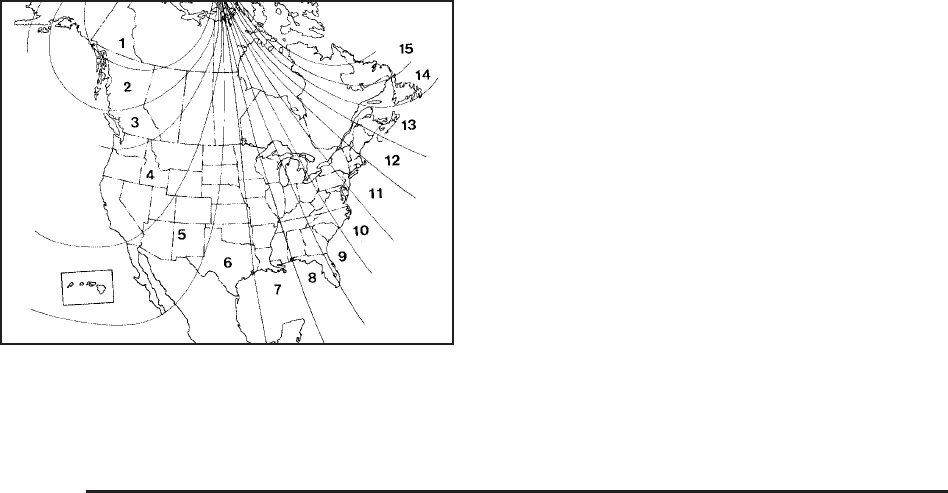
To adjust for compass variance, use the following
procedure:
Compass Variance Procedure
1. Press the option button until COMPASS ZONE
displays.
2. Find the vehicle’s current location and variance
zone number on the map.
Zones 1 through 15 are available.
3. Press the set/reset button to scroll through and
select the appropriate variance zone.
Navigate to one of the trip/fuel menu screens to
view the direction the vehicle is moving. This will be
shown in the top right corner of the DIC display.
4. If you need to calibrate the compass, use the
compass calibration procedure. See “Compass
Calibration Procedure” following.
Compass Calibration
The compass is manually calibrated. Only calibrate the
compass in a safe location where driving the vehicle
in circles is not a problem.
To calibrate the compass, use the following procedure:
Compass Calibration Procedure
1. Press the option button until the COMPASS
CALIBRATION screen is displayed.
2. Press the set/reset button to start the compass
calibration.
3. The DIC will display CALIBRATION BEGUN
DRIVE IN CIRCLES. Drive the vehicle in a
circle until the DIC displays CALIBRATION
FINISHED. The DIC will display CALIBRATION
FINISHED for several seconds and then will
display the COMPASS CALIBRATION screen.
3-56

DIC Warnings and Messages
Messages are displayed on the uplevel DIC to notify the
driver that the status of the vehicle has changed and
that some action may be needed by the driver to correct
the condition. Multiple messages may appear one
after another.
Some messages may not require immediate action, but
you can press any of the DIC buttons on the uplevel
vehicle to acknowledge that you received the message
and clear it from the DIC display.
Some messages cannot be cleared from the DIC
display because they are more urgent. These messages
require action before they can be cleared.
If there are any active warning messages when the
vehicle is turned off, two chimes will sound and the
DIC will go into a reminder mode. The reminder mode
displays any active message. If there are multiple
messages, the DIC will display each message for
five seconds. After each active message is displayed
once, the reminder mode will turn off.
You should take any messages that appear on the
display seriously and remember that clearing the
messages will only make the messages disappear,
not correct the problem.
The following are the possible messages that can be
displayed and some information about them.
A/C OFF FOR ENGINE PROTECTION
This message will display when the engine coolant
becomes hotter than the normal operating temperature.
See Engine Coolant Temperature Gage on page 3-40.
To avoid added strain on a hot engine, the air
conditioning compressor is automatically turned off.
When the coolant temperature returns to normal, the
air conditioning compressor will turn back on. You can
continue to drive your vehicle.
This message will come on while the ignition is in RUN.
Press any of the DIC buttons to acknowledge this
warning message and to clear it from the screen.
This message will continue to display for two seconds
if it has not been acknowledged when the engine is
turned off. It will also re-display for two seconds if the
message has been acknowledged, but the condition still
exists when the engine is turned off.
If the condition still exists, the message will re-appear
when the engine is turned on. If this message continues
to appear, have the system repaired by your GM dealer
as soon as possible to avoid damage to your engine.
3-57

BATTERY SAVER ACTIVE
This message will display when the system detects that
the battery voltage is dropping beyond a reasonable
level. The battery saver system will start reducing certain
features of the vehicle that you may be able to notice.
At the point that the features are disabled, this message
is displayed. It means that the vehicle is trying to
save the charge in the battery.
Turn off all unnecessary accessories to allow the battery
to recharge.
The normal battery voltage range is 11.5 to 15.5 volts.
If you have an uplevel DIC, you can monitor the
battery voltage by pressing the gages button until
BATTERY displays.
CHANGE OIL SOON
This message will display when service is required
for the vehicle. See your GM dealer. See Engine Oil on
page 5-15 and Scheduled Maintenance on page 6-4
for more information.
The CHANGE OIL SOON message is reset by
acknowledging the message. The OIL LIFE screen
under the gages menu on the DIC must also be reset.
See “Oil Life” under DIC Operation and Displays on
page 3-50 and Engine Oil Life System on page 5-18.
This message will display while the ignition is in RUN.
Press any of the DIC buttons to acknowledge this
message and to clear it from the screen.
This message will continue to display for two seconds
if it has not been acknowledged when the engine is
turned off. It will also re-display for two seconds if the
message has been acknowledged, but the condition still
exists when the engine is turned off.
If the condition still exists, the message will re-appear
when the engine is turned on.
CHARGING SYSTEM FAILURE
This message will display when there is a problem
with the generator and battery charging systems.
Driving with this problem could drain your battery.
Turn off all unnecessary accessories. Stop and turn
off the vehicle as soon as it is safe to do so. Have
the electrical system checked by your GM dealer
immediately.
This message will display and a chime will sound while
the ignition is in RUN. Press any of the DIC buttons
to acknowledge this message and to clear it from
the screen.
3-58

This message will continue to display for two seconds
if it has not been acknowledged when the engine is
turned off. It will also re-display for two seconds if the
message has been acknowledged, but the condition still
exists when the engine is turned off.
If the condition still exists, the message will re-appear
when the engine is turned on.
CHECK GAS CAP
This message may be displayed if the gas cap is not on,
or is not fully tightened. Check the gas cap to ensure that
it is on properly. The diagnostic system can determine if
the fuel cap has been left off or improperly installed. A
loose or missing fuel cap will allow fuel to evaporate into
the atmosphere. A few driving trips with the cap properly
installed should turn this message off. See Filling the
Tank on page 5-8 for more information.
This message will display while the ignition is in RUN.
Press any of the DIC buttons to acknowledge this
message and to clear it from the screen.
This message will continue to display for two seconds
if it has not been acknowledged when the engine is
turned off. It will also re-display for two seconds if the
message has been acknowledged, but the condition still
exists when the engine is turned off.
If the condition still exists, the message will re-appear
when the engine is turned on.
DELAYED LOCKING
This message will display to inform the driver that even
though a door lock switch or the lock button on the
remote keyless entry transmitter has been pressed, that
actual locking of the doors is being delayed because
the delayed locking feature has been activated in
the DIC. See “DELAYED LOCKING” under DIC Vehicle
Personalization on page 3-73 for more information.
This message will appear and a chime will sound when
the ignition is off.
This message cannot be acknowledged.
DRIVER’S DOOR AJAR
This message will display when the driver’s door is not
closed properly. When this message appears, you
should make sure that the driver’s door is closed
completely.
This message will display while the ignition is in RUN.
A chime will sound when the ignition is shifted out of
PARK (P). Press any of the DIC buttons to acknowledge
this message and to clear it from the screen.
3-59

This message will continue to display for two seconds
if it has not been acknowledged when the engine is
turned off. It will also re-display for two seconds if the
message has been acknowledged, but the condition still
exists when the engine is turned off.
If the condition still exists, the message will re-appear
when the engine is turned on.
DRIVER’S REAR DOOR AJAR
This message will display when the driver’s side rear
door is not closed properly. When this message
appears, you should make sure that the driver’s side
rear door is closed completely.
This message will display while the ignition is in RUN.
A chime will sound when the ignition is shifted out
of PARK (P). Press any of the DIC buttons to
acknowledge this message and to clear it from
the screen.
This message will continue to display for two seconds
if it has not been acknowledged when the engine is
turned off. It will also re-display for two seconds if the
message has been acknowledged, but the condition still
exists when the engine is turned off.
If the condition still exists, the message will re-appear
when the engine is turned on.
ENGINE COOLANT HOT
Notice: If you drive your vehicle while the engine
is overheating, severe engine damage may occur.
If an overheat warning appears on the instrument
panel cluster and/or DIC, stop the vehicle as soon as
possible. Do not increase the engine speed above
normal idling speed. See Engine Overheating
on page 5-27 for more information.
This message will display when the engine coolant
temperature is too hot. The engine coolant temperature
warning light will also appear on the instrument panel
cluster. See Engine Coolant Temperature Warning Light
on page 3-40 and Engine Coolant Temperature Gage
on page 3-40 for more information.
To avoid added strain on the engine, turn off the air
conditioner if it is on. When the coolant temperature
returns to normal, the air conditioner can be turned
back on.
This message will display only when the ignition is
in RUN. A chime will sound continuously when this
message is displayed. Press any of the DIC buttons
to acknowledge this message and to clear it from
the screen.
3-60

This message will continue to display for two seconds
if it has not been acknowledged when the engine is
turned off. It will also re-display for two seconds if the
message has been acknowledged, but the condition still
exists when the engine is turned off.
If the condition still exists, the message will re-appear
when the engine is turned on.
HEADLAMPS SUGGESTED
This message will display when the amount of available
light outside of the vehicle is low, or the windshield
wipers have been on for approximately 30 seconds, and
the exterior lamps control is off or in the park lamps
position. This message informs the driver that turning
on the exterior lamps is recommended. See Exterior
Lamps on page 3-13 for more information.
This message will display while the ignition is in RUN.
Press any of the DIC buttons to acknowledge this
message and to clear it from the screen.
This message will continue to display for two seconds
if it has not been acknowledged when the engine is
turned off. It will also re-display for two seconds if the
message has been acknowledged, but the condition still
exists when the engine is turned off.
If the condition still exists, the message will re-appear
when the engine is turned on.
HOOD AJAR
This message will display when the hood is not closed
properly. When this message appears, you should
make sure that the hood is closed completely.
See Hood Release on page 5-11.
This message will display while the ignition is in RUN.
Press any of the DIC buttons to acknowledge this
message and to clear it from the screen.
This message will continue to display for two seconds
if it has not been acknowledged when the engine is
turned off. It will also re-display for two seconds if the
message has been acknowledged, but the condition still
exists when the engine is turned off.
If the condition still exists, the message will re-appear
when the engine is turned on.
HOT TRANS FLUID
This message will display when the transaxle fluid in
your vehicle is too hot. Stop the vehicle and allow
it to idle until it cools down. If the warning message
continues to display, have the vehicle serviced by your
GM dealer as soon as possible.
This message will display and a chime will sound
only while the ignition is in RUN. Press any of the
DIC buttons to acknowledge this message and to
clear it from the screen.
3-61

This message will continue to display for two seconds
if it has not been acknowledged when the engine is
turned off. It will also re-display for two seconds if the
message has been acknowledged, but the condition still
exists when the engine is turned off.
If the condition still exists, the message will re-appear
when the engine is turned on.
KEY FOB BATTERY LOW
This message will display when the battery in the
remote keyless entry transmitter needs to be replaced.
To replace the battery, see “Battery Replacement”
under Remote Keyless Entry System Operation
on page 2-4.
This message will display while the ignition is in RUN.
Press any of the DIC buttons to acknowledge this
message and to clear it from the screen.
This message will continue to display for two seconds
if it has not been acknowledged when the engine is
turned off. It will also re-display for two seconds if the
message has been acknowledged, but the condition
still exists when the engine is turned off.
If the condition still exists, the message will re-appear
when the engine is turned on.
KEY IN IGNITION
This message will display and a chime will sound
continuously when the driver’s door is open and the key
is in the ignition and in the accessory or off position.
This message cannot be acknowledged.
This message will disappear and the chiming will stop
when the key is removed from the ignition.
LEFT FRONT TURN LAMP OUT
This message will display when the left front turn signal
bulb needs to be replaced. See Front Turn Signal
and Parking Lamps on page 5-53.
This message will display while the ignition is in RUN.
Press any of the DIC buttons to acknowledge this
message and to clear it from the screen.
This message will continue to display for two seconds
if it has not been acknowledged when the engine is
turned off. It will also re-display for two seconds if the
message has been acknowledged, but the condition still
exists when the engine is turned off.
If the condition still exists, the message will re-appear
when the engine is turned on.
3-62

LEFT REAR TURN LAMP OUT
This message will display when the left rear turn
signal bulb needs to be replaced. See Taillamps,
Turn Signal, Sidemarker, Stoplamps and Back-up
Lamps on page 5-54.
This message will display while the ignition is in RUN.
Press any of the DIC buttons to acknowledge this
message and to clear it from the screen.
This message will continue to display for two seconds
if it has not been acknowledged when the engine is
turned off. It will also re-display for two seconds if the
message has been acknowledged, but the condition still
exists when the engine is turned off.
If the condition still exists, the message will re-appear
when the engine is turned on.
LOW BRAKE FLUID
This message will display when the brake fluid level
is low. Fill the brake master cylinder to the proper level.
See Engine Compartment Overview on page 5-12 for
the location of the brake master cylinder reservoir.
Also, see Brakes on page 5-39 for proper fluid level.
The brake system warning light will also appear on
the instrument panel cluster when this message
appears on the DIC. See Brake System Warning Light
on page 3-38.
This message will display and a chime will sound
only while the ignition is in RUN. Press any of the
DIC buttons to acknowledge this message and to
clear it from the screen.
This message will continue to display for two seconds
if it has not been acknowledged when the engine is
turned off. It will also re-display for two seconds if the
message has been acknowledged, but the condition still
exists when the engine is turned off.
If the condition still exists, the message will re-appear
when the engine is turned on.
LOW FUEL
This message will display when your vehicle is low on
fuel. You should refill the tank as soon as possible.
See Fuel Gage on page 3-48 and Filling the Tank on
page 5-8 for more information.
The message will display and a chime will sound while
the ignition is in RUN. Press any of the DIC buttons
to acknowledge this message and to clear it from
the screen.
If the condition still exists, the message will re-appear
when the engine is turned on.
3-63

LOW OIL LEVEL
This message will display when the vehicle’s engine
oil is low. Fill the oil to the proper level as soon as
possible. See Engine Compartment Overview on
page 5-12 for the engine oil fill location. Also, see
Engine Oil on page 5-15 for information on the kind
of oil to use and the proper oil level.
The message will display and a chime will sound while
the ignition is in RUN. Press any of the DIC buttons
to acknowledge this message and to clear it from
the screen.
This message will continue to display for two seconds
if it has not been acknowledged when the engine is
turned off. It will also re-display for two seconds if the
message has been acknowledged, but the condition still
exists when the engine is turned off.
If the condition still exists, the message will re-appear
when the engine is turned on.
LOW OIL PRESSURE
Notice: If the LOW OIL PRESSURE warning
message appears on the DIC display, stop the
vehicle immediately. Do not drive the vehicle until
the cause of the low oil pressure is corrected.
Severe engine damage can result from driving a
vehicle with low oil pressure. See Engine Oil
on page 5-15 for more information.
This message will display when the vehicle’s engine oil
pressure is low. The oil pressure light will also appear
on the instrument panel cluster. See Oil Pressure Light
on page 3-44.
Stop the vehicle immediately, as engine damage can
result from driving a vehicle with low oil pressure.
Have the vehicle serviced by your GM dealer as
soon as possible when this message is displayed.
This message will display only when the ignition is
in RUN. A chime will sound continuously when
this message is displayed.
This message cannot be acknowledged and cleared
from the screen. This message will re-display for a
few seconds if the condition still exists when the engine
is turned off.
If the condition still exists, the message will re-appear
when the engine is turned on.
3-64

LOW WASHER FLUID
This message will display when the windshield washer
fluid is low. Fill the windshield washer reservoir as
soon as possible. See Engine Compartment Overview
on page 5-12 for the location of the windshield
washer reservoir. Also, see Windshield Washer Fluid
on page 5-38 for more information.
This message will display and a chime will sound only
when the ignition is in RUN. Press any of the DIC
buttons to acknowledge this message and to clear it
from the screen.
This message will continue to display for two seconds
if it has not been acknowledged when the engine is
turned off. It will also re-display for two seconds if the
message has been acknowledged, but the condition still
exists when the engine is turned off.
If the condition still exists, the message will re-appear
when the engine is turned on.
PARKING BRAKE ON
This message will display to alert the driver when the
vehicle’s parking brake is on, the ignition is in RUN,
and the vehicle speed is greater than 5 mph (8 km/h).
Release the parking brake before driving. See Parking
Brake on page 2-30 for more information.
The brake light will also appear on the instrument
panel cluster when this message appears on the DIC.
See Brake System Warning Light on page 3-38.
A chime will sound continuously while this message
is displayed if driving above 5 mph (8 km/h). Press
any of the DIC buttons to acknowledge this message
and to clear it from the screen.
This message will continue to display for two seconds
if it has not been acknowledged when the engine is
turned off. It will also re-display for two seconds if the
message has been acknowledged, but the condition still
exists when the engine is turned off.
If the condition still exists, the message will re-appear
when the engine is turned on.
PARK LAMPS ON
This message will display to alert the driver when the
headlamps or parking lamps are on while the ignition
is off and the driver’s door is opened. See Exterior
Lamps on page 3-13 for more information.
A chime will sound continuously while this message is
displayed. Press any of the DIC buttons to acknowledge
this message and to clear it from the screen.
3-65

PASSENGER’S DOOR AJAR
This message will display when the front passenger’s
door is not closed properly. When this message
appears, you should make sure that the front
passenger’s door is closed completely.
This message will display while the ignition is in RUN.
A chime will sound when the ignition is shifted out
of PARK (P). Press any of the DIC buttons to
acknowledge this message and to clear it from
the screen.
This message will continue to display for two seconds
if it has not been acknowledged when the engine is
turned off. It will also re-display for two seconds if the
message has been acknowledged, but the condition still
exists when the engine is turned off.
If the condition still exists, the message will re-appear
when the engine is turned on.
PASSENGER’S REAR DOOR AJAR
This message will display when the passenger’s side
rear door is not closed properly. When this message
appears, you should make sure that the passenger’s
side rear door is closed completely.
This message will display while the ignition is in RUN.
A chime will sound when the ignition is shifted out
of PARK (P). Press any of the DIC buttons to
acknowledge this message and to clear it from
the screen.
This message will continue to display for two seconds
if it has not been acknowledged when the engine is
turned off. It will also re-display for two seconds if the
message has been acknowledged, but the condition still
exists when the engine is turned off.
If the condition still exists, the message will re-appear
when the engine is turned on.
REDUCED ENGINE POWER
This message will display when the vehicle’s engine
power is reduced. Reduced engine power can affect the
vehicle’s ability to accelerate. If this message is on,
but there is no reduction in performance, proceed
to your destination. The performance may be reduced
the next time the vehicle is driven. The vehicle may
be driven at a reduced speed while this message is on,
but acceleration and speed may be reduced. Anytime
this message stays on, the vehicle should be taken
to your GM dealer for service as soon as possible.
This message will display and a chime will sound
only when the ignition is in RUN. Press any of the
DIC buttons to acknowledge this message and to
clear it from the screen.
3-66

This message will continue to display for two seconds
if it has not been acknowledged when the engine is
turned off. It will also re-display for two seconds if the
message has been acknowledged, but the condition still
exists when the engine is turned off.
If the condition still exists, the message will re-appear
when the engine is turned on.
REDUCED POWER STOP WHEN SAFE
This message will display when your vehicle is in an
overheated engine operating mode. This operating mode
allows your vehicle to be driven to a safe place in an
emergency. In this mode, you will notice a significant
loss in power and engine performance. See Overheated
Engine Protection Operating Mode on page 5-29 for
more information. Anytime this message is on, the
vehicle should be taken to your GM dealer for service
as soon as possible.
This message will display and a chime will sound
only when the ignition is in RUN. Press any of the
DIC buttons to acknowledge this message and to
clear it from the screen.
This message will continue to display for two seconds
if it has not been acknowledged when the engine is
turned off. It will also re-display for two seconds if the
message has been acknowledged, but the condition
still exists when the engine is turned off.
If the condition still exists, the message will re-appear
when the engine is turned on.
REMOTE START DISABLED
This warning message will come on if a remote start
attempt is unsuccessful. This may be caused if any
of the following conditions are true when a remote start
attempt is made:
•The remote start system is disabled through
the DIC.
•The key is in the ignition.
•The hood or the doors are not closed.
•There is an emission control system malfunction.
•The engine coolant temperature is too high.
•The oil pressure is low.
•The hazard warning flashers are turned on.
•The maximum number of remote starts or
remote start attempts between ignition cycles
has been reached.
•The content theft-deterrent alarm is on while
attempting to remote start the vehicle.
See “REMOTE START” under DIC Vehicle
Personalization on page 3-73 and “Remote Vehicle
Start” under Remote Keyless Entry System Operation
on page 2-4 for more information.
3-67

RIGHT FRONT TURN LAMP OUT
This message will display when the right front turn
signal bulb needs to be replaced. See Front Turn
Signal and Parking Lamps on page 5-53.
This message will display while the ignition is in RUN.
Press any of the DIC buttons to acknowledge this
message and to clear it from the screen.
This message will continue to display for two seconds
if it has not been acknowledged when the engine is
turned off. It will also re-display for two seconds if the
message has been acknowledged, but the condition still
exists when the engine is turned off.
If the condition still exists, the message will re-appear
when the engine is turned on.
RIGHT REAR TURN LAMP OUT
This message will display when the right rear turn
signal bulb needs to be replaced. See Taillamps,
Turn Signal, Sidemarker, Stoplamps and Back-up
Lamps on page 5-54.
This message will display while the ignition is in RUN.
Press any of the DIC buttons to acknowledge this
message and to clear it from the screen.
This message will continue to display for two seconds
if it has not been acknowledged when the engine is
turned off. It will also re-display for two seconds if the
message has been acknowledged, but the condition still
exists when the engine is turned off.
If the condition still exists, the message will re-appear
when the engine is turned on.
SERVICE ABS SYSTEM
If the vehicle has the Anti-Lock Brake System (ABS),
this message will display when the system is not
functioning properly. Have the brake system serviced
by your GM dealer as soon as possible.
The anti-lock brake system warning light will also
appear on the instrument panel cluster when this
message appears on the DIC. See Anti-Lock Brake
System Warning Light on page 3-39.
This message will only display while the ignition is in
RUN. Press any of the DIC buttons to acknowledge this
message and to clear it from the screen.
This message will continue to display for two seconds
if it has not been acknowledged when the engine is
turned off. It will also re-display for two seconds if the
message has been acknowledged, but the condition still
exists when the engine is turned off.
If the condition still exists, the message will re-appear
when the engine is turned on.
3-68

SERVICE BRAKE SYSTEM
This message will display when a problem with the
brake system has been detected. Have your vehicle
serviced by your GM dealer as soon as possible.
The brake system warning light will also appear on the
instrument panel cluster when this message appears on
the DIC. See Brake System Warning Light on page 3-38.
This message will only display while the ignition is in
RUN. Press any of the DIC buttons to acknowledge
this message and to clear it from the screen.
This message will continue to display for two seconds
if it has not been acknowledged when the engine is
turned off. It will also re-display for two seconds if the
message has been acknowledged, but the condition still
exists when the engine is turned off.
If the condition still exists, the message will re-appear
when the engine is turned on.
SERVICE PARK LAMPS
This message will display when there is a problem
with the park lamps. Check to see if the park lamp
fuse is blown and replace the fuse if necessary.
See Fuses and Circuit Breakers on page 5-93 and
Instrument Panel Fuse Block on page 5-94 for more
information. If changing the fuse does not correct
the problem, see your GM dealer.
This message will only display while the ignition is in
RUN. Press any of the DIC buttons to acknowledge
this message and to clear it from the screen.
This message will continue to display for two seconds
if it has not been acknowledged when the engine is
turned off. It will also re-display for two seconds if the
message has been acknowledged, but the condition still
exists when the engine is turned off.
If the condition still exists, the message will re-appear
when the engine is turned on.
SERVICE STABILITY SYSTEM
If your vehicle has StabiliTrak
®
, this message will display
if there has been a problem detected with StabiliTrak
®
.
A warning light will also appear on the instrument panel
cluster. See Traction Control System (TCS) Warning
Light on page 3-39. See StabiliTrak
®
System on
page 4-11 for more information.
If this message turns on while you are driving, pull off the
road as soon as possible and stop carefully. Try resetting
the system by turning the ignition off and then back on.
If this message still stays on or turns back on again while
you are driving, your vehicle needs service. Have the
StabiliTrak
®
System inspected by your GM dealer as
soon as possible.
3-69

This message will display only while the ignition is in
RUN. Press any of the DIC buttons to acknowledge
this message and to clear it from the screen.
This message will continue to display for two seconds
if it has not been acknowledged when the engine is
turned off. It will also re-display for two seconds if the
message has been acknowledged, but the condition still
exists when the engine is turned off.
If the condition still exists, the message will re-appear
when the engine is turned on.
SERVICE THEFT SYSTEM
This message will display when there is a problem
with the theft-deterrent system programmed in the key.
A fault has been detected in the system which means
that the system is disabled and it is not protecting
the vehicle. The vehicle usually restarts; however,
you may want to take the vehicle to your GM dealer
before turning off the engine. See PASS-Key
®
III
Operation on page 2-21 for more information.
This message will display and a chime will sound
only while the ignition is in RUN. Press any of the
DIC buttons to acknowledge this message and to
clear it from the screen.
This message will continue to display for two seconds
if it has not been acknowledged when the engine is
turned off. It will also re-display for two seconds if the
message has been acknowledged, but the condition still
exists when the engine is turned off.
If the condition still exists, the message will re-appear
when the engine is turned on.
SERVICE TRACTION SYSTEM
If your vehicle has the traction control system, this
message will display when the system is not functioning
properly. A warning light will also appear on the
instrument panel cluster. See Traction Control System
(TCS) Warning Light on page 3-39. See Traction Control
System (TCS) on page 4-10 for more information.
Have the traction control system serviced by your
GM dealer as soon as possible.
This message will display only while the ignition is in
RUN. Press any of the DIC buttons to acknowledge this
message and to clear it from the screen.
This message will continue to display for two seconds
if it has not been acknowledged when the engine is
turned off. It will also re-display for two seconds if the
message has been acknowledged, but the condition still
exists when the engine is turned off.
If the condition still exists, the message will re-appear
when the engine is turned on.
3-70

SERVICE VARIABLE EFFORT
STEERING
If your vehicle has variable effort steering, this message
will display when if this system is not functioning
properly. See Steering on page 4-11 for more
information. Have your system serviced by your
GM dealer as soon as possible.
This message will display only while the ignition is in
RUN. Press any of the DIC buttons to acknowledge
this message and to clear it from the screen.
This message will continue to display for two seconds
if it has not been acknowledged when the engine is
turned off. It will also re-display for two seconds if the
message has been acknowledged, but the condition still
exists when the engine is turned off.
If the condition still exists, the message will re-appear
when the engine is turned on.
SERVICE VEHICLE SOON
This message will display when a non-emissions related
malfunction occurs. Have the vehicle serviced by your
GM dealer as soon as possible.
This message will display only while the ignition is in
RUN. Press any of the DIC buttons to acknowledge
this message and to clear it from the screen.
This message will continue to display for two seconds
if it has not been acknowledged when the engine is
turned off. It will also re-display for two seconds if the
message has been acknowledged, but the condition still
exists when the engine is turned off.
If the condition still exists, the message will re-appear
when the engine is turned on.
STABILITY CONTROL ACTIVE
If your vehicle has StabiliTrak
®
, this message will
display when StabiliTrak
®
is actively assisting you
with directional control of the vehicle. Slippery road
conditions may exist when this message is displayed,
so adjust your driving accordingly. See StabiliTrak
®
System on page 4-11.
This message will display only while the ignition is in
RUN. This message stays on until road conditions
change and StabiliTrak
®
is not active.
This message cannot be acknowledged and cleared
from the screen.
3-71

STABILITY CONTROL OFF
If your vehicle has StabiliTrak
®
, this message will
display any time the system turns off. When this
message has been displayed, StabiliTrak
®
is no
longer available to assist you with directional control
of the vehicle. Adjust your driving accordingly.
See StabiliTrak
®
System on page 4-11.
This message will display only while the ignition
is in RUN.
Any of the following conditions may cause the
StabiliTrak
®
system to turn off:
•The battery is low.
•There is a StabiliTrak
®
system failure.
See your GM dealer for service.
STARTING DISABLED
This message will display if the starting of the engine
is disabled due to the electronic throttle control system
or vehicle theft-deterrent system. Have your vehicle
serviced by your GM dealer immediately.
This message will only appear while the ignition is
in RUN, and will not disappear until the problem
is resolved.
This message cannot be acknowledged.
TRACTION CONTROL ACTIVE
If your vehicle has the traction control system, this
message will display when the system is on. Slippery
road conditions may exist if this message is displayed,
so adjust your driving accordingly. See Traction
Control System (TCS) on page 4-10 for more
information.
This message only displays while the ignition is in RUN
and will not disappear until driving conditions change
and the traction control is no longer active.
This message cannot be acknowledged or cleared from
the screen.
TRACTION CONTROL OFF
If your vehicle has the traction control system, this
message will display when the traction control system
turns off. See Traction Control System (TCS) on
page 4-10 for more information.
This message will only display while the ignition is in
RUN and will disappear after two seconds.
3-72

Any of the following conditions may cause the traction
control system to turn off:
•The traction control system is turned off by pressing
the traction control button located on the center
of the instrument panel. See Traction Control
System (TCS) on page 4-10.
•The battery is low.
•There is a traction control system failure.
See your GM dealer for service.
TRUNK AJAR
This message will display when the trunk is not closed
completely. You should make sure that the trunk is
closed completely. See Trunk on page 2-13.
This message will display while the ignition is in RUN.
A chime will sound when the ignition is shifted out
of PARK (P). Press any of the DIC buttons to
acknowledge this message and to clear it from
the screen.
This message will continue to display for two seconds
if it has not been acknowledged when the engine is
turned off. It will also re-display for two seconds if the
message has been acknowledged, but the condition still
exists when the engine is turned off.
If the condition still exists, the message will re-appear
when the engine is turned on.
TURN SIGNAL ON
This message will display as a reminder to turn off
the turn signal if you drive your vehicle for more than
about 0.75 mile (1.2 km) with a turn signal on.
See Turn Signal/Multifunction Lever on page 3-7.
This message displays and a chime sounds only when
the ignition is in RUN. This message will clear from
the screen if the turn signal is manually turned off,
a turn is completed, or the message is acknowledged.
DIC Vehicle Personalization
Your vehicle may have customization capabilities that
allow you to program certain features to one preferred
setting. Customization features can only be programmed
to one setting on the vehicle and cannot be programmed
to a preferred setting for two different drivers.
The customization features include the following:
•Exterior lighting delay
•Interior lighting delay
•Delayed locking
•Content theft
•Remote keyless entry feedback
•Remote start
3-73

Your vehicle may also have personalization capabilities
that allow you to program certain features to a preferred
setting for up to two drivers. The first personalized key
corresponds to driver 1 and the second personalized key
corresponds to driver 2. The personalization features
include the following:
•Radio station presets
•Auto door lock preferences
•Auto door unlock preferences
•Remote keyless entry unlock preferences
All of the customization and personalization options
may not be available on your vehicle. Only the options
available will be displayed on your DIC.
The default settings for the customization and
personalization features were set when your vehicle
left the factory, but may have been changed from
their default state since then.
The customization preferences are automatically
recalled.
The driver’s personalization preferences are recalled
by using the key programmed for driver 1 or 2.
To change customization and personalization
preferences, use the following procedure.
Entering the Personal Program Menu
1. Turn the ignition on and place the vehicle in
PARK (P).
2. Press the option button until PERSONAL
PROGRAM displays.
If the vehicle is not in PARK (P), PERSONAL
PROGRAM ONLY IN PARK will display.
If the vehicle is not able to enter the personal
program menu, PERSONAL PROGRAM NOT
AVAILABLE will display.
3. Press the set/reset button to begin.
4. The DIC will then display an instruction screen.
Press the option button to display the features
that are available to program.
Press the set/reset button to change the setting
of each feature.
3-74

Customization Menu Items
The following are customization features that allow you
to program settings to the vehicle:
FACTORY DEFAULTS
This feature allows you to set all of the customization
and personalization features back to their factory default
settings.
Press the option button until FACTORY DEFAULTS
appears on the DIC display. Press the set/reset button
to scroll through the following choices:
NO (default): The customization and personalization
features will not be set to their factory default settings.
YES: The customization and personalization features
will be set to their factory default settings.
Select one of the available choices and press the option
button while it is displayed on the DIC to select it and
move on to the next feature.
ALL KEYS WILL BE RESET
This screen will only display if YES was selected on the
FACTORY DEFAULTS screen.
Press the set/reset button to scroll through the
following choices:
CANCEL (default): The features will not be set to their
factory default settings and the DIC will return to the
PERSONAL PROGRAM menu.
OK: The features will be set to their factory default
settings, the DIC will exit the personal program menu,
and PERSONAL OPTIONS SAVED will display.
EXT (Exterior) LIGHT DELAY
This feature allows you to set the amount of time the
exterior lamps remain on after the key is removed from
the ignition or the vehicle is unlocked using the
remote keyless entry transmitter.
Press the option button until EXT LIGHT DELAY
appears on the DIC display. Press the set/reset button
to scroll through the following choices:
OFF: The exterior lamps will not turn on.
15 seconds: The exterior lamps will stay on for
15 seconds.
30 seconds (default): The exterior lamps will stay
on for 30 seconds.
3-75

60 seconds: The exterior lamps will stay on for
60 seconds.
90 seconds: The exterior lamps will stay on for
90 seconds.
Select one of the available choices and press the option
button while it is displayed on the DIC to select it and
move on to the next feature.
INT (Interior) LIGHTS KEYS REMOVED
This feature enables the interior lamps in the vehicle to
turn on for about 25 seconds after the key is removed
from the ignition.
Press the option button until INT LIGHTS KEYS
REMOVED appears on the DIC display. Press the
set/reset button to scroll through the following choices:
OFF: Removing the key from the ignition will not
cause the interior lamps to turn on.
ON (default): Removing the key from the ignition will
cause the interior lamps to be turned on for about
25 seconds.
Select one of the available choices and press the option
button while it is displayed on the DIC to select it and
move on to the next feature.
DELAYED LOCKING
This feature allows the locking of the vehicle to be
delayed until all of the doors have been closed
for approximately five seconds.
When the delayed locking feature is enabled, it may be
activated when the key is out of the ignition by doing
one of the following:
•Pressing the driver’s door power lock switch
one time while the driver’s door is open.
•Pressing the passenger’s door power lock switch
one time while the passenger’s door is open.
•Pressing the lock button on the remote keyless
entry transmitter one time while any door is open.
Two chimes will sound to signal that delayed locking
is active.
The doors may be locked immediately by repeating
one of the above actions more than one time.
If a door remains open, without any other door
being opened or closed, the vehicle will lock after
approximately 45 seconds.
3-76

If a key is in the ignition, this feature will not lock the
doors. See Delayed Locking on page 2-11 for more
information.
Press the option button until DELAYED LOCKING
appears on the DIC display. Press the set/reset button
to scroll through the following choices:
OFF: There will be no delayed locking of the
vehicle’s doors.
ON (default): The locking of the vehicle’s doors will be
delayed by five seconds while a door is open after a
power door lock switch is pressed, or the lock button on
the remote keyless entry transmitter is pressed while
a door is open.
Select one of the available choices and press the option
button while it is displayed on the DIC to select it and
move on to the next feature.
CONTENT THEFT
If your vehicle has the content theft-deterrent system,
once this feature is turned on, the system will activate if
someone tries to enter the vehicle without using the
remote keyless entry transmitter or the correct key.
Press the option button until CONTENT THEFT appears
on the DIC display. Press the set/reset button to
scroll through the following choices:
OFF: The content theft-deterrent system will be
turned off.
ON (default): The content theft-deterrent system will
be turned on.
When ON is selected, the content theft-deterrent
system will be armed when the vehicle is locked
by pressing the lock button on the remote keyless entry
transmitter or by pressing the power door lock switch.
See Content Theft-Deterrent on page 2-18 and
Power Door Locks on page 2-11 for more information.
Select one of the available choices and press the option
button while it is displayed on the DIC to select it and
move on to the next feature.
3-77

FOB LOCK FEEDBACK
This feature allows you to select the type of feedback
you will receive when locking the vehicle with the remote
keyless entry transmitter.
Press the option button until FOB LOCK FEEDBACK
appears on the DIC display. Press the set/reset button
to scroll through the following choices:
OFF: There will be no feedback when locking the
vehicle.
LIGHTS: The exterior lamps will flash when you press
the lock button on the remote keyless entry transmitter.
LIGHTS and HORN (default): The exterior lamps
will flash when you press the lock button on the
remote keyless entry transmitter, and the horn will
sound when the lock button is pressed again within
five seconds of the previous command.
Select one of the available choices and press the option
button while it is displayed on the DIC to select it and
move on to the next feature.
REMOTE START
If your vehicle has remote start, this feature allows the
remote start to be turned off or on. The remote start
feature allows you to start the engine from outside of the
vehicle using your remote keyless entry transmitter.
See “Remote Vehicle Start” under Remote Keyless Entry
System Operation on page 2-4 for more information.
Press the option button until REMOTE START appears
on the DIC display. Press the set/reset button to
scroll through the following choices:
OFF: The remote start feature will be disabled.
ON (default): The remote start feature will be enabled.
Select one of the available choices and press the
option button while it is displayed on the DIC to select
it and move on to the next feature.
3-78

Personalization Menu Items
The following are personalization features that allow
you to program setting for up to two drivers:
PERSONALIZE KEY
This feature allows you to personalize a key to be
recognized as key 1 or 2. A personalized key allows
you to program personalization features to a preferred
setting to correspond to key 1 or 2. If you are using
a key that has already been personalized, this screen
will not display.
Press the option button until PERSONALIZE KEY
appears on the DIC display. Press the set/reset button
to scroll through the following choices:
NO (default): The key will not be personalized.
YES: The key will be personalized.
Select one of the available choices and press the option
button while it is displayed on the DIC to select it and
move on to the next feature.
REPLACE KEY
This screen displays only if YES was selected for the
PERSONALIZE KEY feature, keys 1 and 2 have already
been personalized, and the current key being used is
not key 1 or 2. This feature allows you to program a key
to be recognized as key 1 or 2 in the event that the
previously programmed key needs to be replaced.
1: The key will be programmed to be recognized
as key 1.
2: The key will be programmed to be recognized
as key 2.
CANCEL (default): The key will not be programmed.
RADIO STATIONS PERSONALIZED
This screen displays only if YES was selected for the
PERSONALIZE KEY feature. This feature allows you to
set the radio station presets to be recognized for the
key, 1 or 2, that is being used. You may notice a change
to the radio after this message displays. After this
message displays, any change to the presets will be
recognized for key 1 or 2 and will be maintained by
the radio.
3-79

AUTO DOOR LOCK
This feature allows automatic door locking to be turned
OFF or ON.
Press the option button until AUTO DOOR LOCK
appears on the DIC display. Press the set/reset button
to scroll through the following choices:
OFF: All automatic door locking is disabled. The doors
will always need to be locked manually before driving,
to increase occupant safety.
ON (default): The vehicle’s doors automatically lock
when the doors are closed and the vehicle is shifted into
DRIVE (D).
Select one of the available choices and press the option
button while it is displayed on the DIC to select it and
move on to the next feature.
AUTO DOOR UNLOCK
This feature displays only if ON was selected for the
AUTO DOOR LOCK feature. This feature allows
automatic door unlocking to be turned off, used for
the driver’s door only, or for all of the doors.
Press the option button until AUTO DOOR UNLOCK
appears on the DIC display. Press the set/reset button to
scroll through the following choices:
OFF: None of the doors will unlock when the vehicle is
shifted into PARK (P) or the key is taken out of the
ignition.
DRIVER: Only the driver’s door will unlock when the
vehicle is shifted into PARK (P) or the key is taken out of
the ignition.
ALL (default): All of the doors will unlock when the
vehicle is shifted into PARK (P) or the key is taken out
of the ignition.
Select one of the available choices and press the option
button while it is displayed on the DIC to select it and
move on to the next feature.
AUTO UNLOCK ON
This feature displays only if DRIVER or ALL was
selected for the AUTO DOOR UNLOCK feature. This
feature allows the selection of when the vehicle’s doors
will unlock.
3-80

Press the option button until AUTO UNLOCK ON
appears on the DIC display. Press the set/reset button
to scroll through the following choices:
KEY-OUT: The door(s) will unlock when the key is
taken out of the ignition.
PARK (default): The door(s) will unlock when the
vehicle is shifted into PARK (P).
Select one of the available choices and press the option
button while it is displayed on the DIC to select it and
move on to the next feature.
FOB UNLOCK ON 1ST PRESS
This feature allows the selection of which doors will
unlock on the first press of the unlock button on
the remote keyless entry transmitter. See Remote
Keyless Entry System Operation on page 2-4 for more
information.
Press the option button until FOB UNLOCK ON 1ST
PRESS appears on the DIC display. Press the set/reset
button to scroll through the following choices:
DRIVER (default): The driver’s door will unlock on the
first press of the unlock button on the remote keyless
entry transmitter.
ALL: All of the doors will unlock on the first press
of the unlock button on the remote keyless entry
transmitter.
Select one of the available choices and press the option
button while it is displayed on the DIC to select it.
The DIC will then display PRESS UNLOCK SWITCH
ON KEY FOB. Press the unlock button on the remote
keyless entry transmitter and your setting will be
saved for that remote keyless entry transmitter.
After programming the last option, the message
PERSONAL OPTIONS SAVED appears on the DIC
display for a few seconds, then the display returns to
the PERSONAL PROGRAM main screen.
Exiting the Personal Program Menu
The personal program menu will be exited when any
of the following occurs:
•The vehicle is shifted out of PARK (P).
•The vehicle is no longer in RUN.
•The end of the personal program menu
is reached.
3-81
Audio System(s)
Determine which radio your vehicle has and then read
the pages following to familiarize yourself with its
features.
Driving without distraction is a necessity for a safer
driving experience. See Defensive Driving on page 4-2.
By taking a few moments to read this manual and
get familiar with your vehicle’s audio system, you can
use it with less effort, as well as take advantage of
its features. While your vehicle is parked, set up your
audio system by presetting your favorite radio stations,
setting the tone and adjusting the speakers. Then,
when driving conditions permit, you can tune to your
favorite stations using the presets and steering
wheel controls (if equipped).
{CAUTION:
This system provides you with a far greater
access to audio stations and song listings.
Giving extended attention to entertainment
tasks while driving can cause a crash and you
or others can be injured or killed. Always keep
your eyes on the road and your mind on the
drive — avoid engaging in extended searching
while driving.
Keeping your mind on the drive is important for safe
driving. For more information, see Defensive Driving
on page 4-2. Get familiar with your vehicle’s audio
system so you can use it with less effort and take full
advantage of its features.
3-82

Here are some ways in which you can help avoid
distraction while driving.
While your vehicle is parked:
•Familiarize yourself with all of its controls.
•Familiarize yourself with its operation.
•Set up your audio system by presetting your
favorite radio stations, setting the tone, and
adjusting the speakers. Then, when driving
conditions permit, you can tune to your favorite
radio stations using the presets and steering
wheel controls (if equipped).
Notice: Before adding any sound equipment to
your vehicle, such as an audio system, CD player,
CB radio, mobile telephone, or two-way radio, make
sure that it can be added by checking with your
dealer. Also, check federal rules covering mobile
radio and telephone units. If sound equipment can
be added, it is very important to do it properly.
Added sound equipment may interfere with the
operation of your vehicle’s engine, radio, or other
systems, and even damage them. Your vehicle’s
systems may interfere with the operation of sound
equipment that has been added.
Your vehicle has a feature called Retained Accessory
Power (RAP). With RAP, the audio system can be
played even after the ignition is turned off. See Retained
Accessory Power (RAP) on page 2-23 for more
information.
Setting the Time
Press and hold H until the correct hour appears on
the display. AM or PM will appear on the display
(Radio with CD (UpLevel, MP3, and Six-Disc CD)).
Press and hold M until the correct minute appears
on the display. The time can be set with the ignition
on or off.
3-83
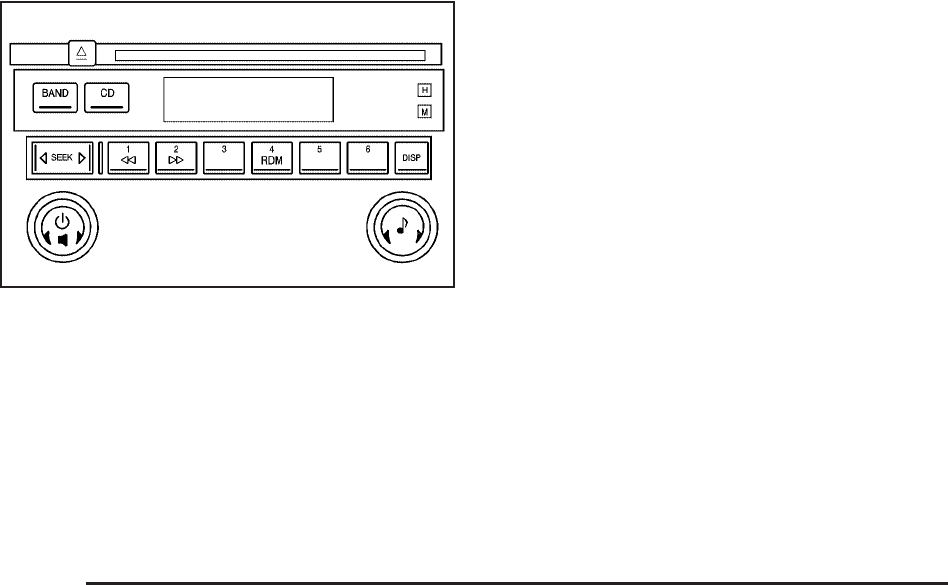
Radio with CD (Base)
Playing the Radio
P(Power): Press this knob to turn the system on
and off.
v(Volume): Turn this knob to increase or to decrease
the volume.
DISP (Display): Press this button to switch the display
between the radio station frequency, band, and time
of day. When the ignition is turned off, press this knob to
display the time.
To change the default on the display, press the DISP
button until you see the display you want, then hold this
button for two seconds. The radio will produce one
beep and the selected display will now be the default.
Finding a Station
BAND: Press this button to switch between FM1, FM2,
and AM. The display will show the selection.
e(Tune): Turn this knob to select radio stations.
oSEEK p:Press and release the right or the left
arrow to go to the next or to the previous station
and stay there.
To scan stations, press and hold either arrow for more
than two seconds. SCN will appear on the display
and the radio will produce one beep. The radio will go
to a station, play for a few seconds, then go on to
the next station. Press either arrow again or one of the
pushbuttons to stop scanning presets.
3-84

To scan preset stations, press and hold either arrow
for more than four seconds. PSC will appear on
the display and the radio will produce two beeps. The
radio will go to a preset station, play for a few seconds,
then go on to the next preset station. Press either
arrow again or one of the pushbuttons to stop scanning.
The radio will only seek and scan stations with a
strong signal that are in the selected band.
Setting Preset Stations
Up to 18 stations (six FM1, six FM2, and six AM), can
be programmed on the six numbered pushbuttons,
by performing the following steps:
1. Turn the radio on.
2. Press BAND to select FM1, FM2, or AM.
3. Tune in the desired station.
4. Press and hold one of the six numbered
pushbuttons until you hear a beep. Whenever
that numbered pushbutton is pressed, the
station that was set will return.
5. Repeat the steps for each pushbutton.
Setting the Tone (Bass/Treble)
e(Bass/Treble): Push and release this knob until
BAS or TRE appears on the display. Turn this knob to
increase or to decrease. The display will show the
bass or the treble level. If a station is weak or noisy,
decrease the treble.
To adjust the bass and the treble to the middle position,
push and hold the tone knob. The radio will produce
one beep.
To adjust all tone and speaker controls to the middle
position, push and hold the tone knob when no tone or
speaker control is displayed. CEN will appear on the
display and you will hear a beep.
Adjusting the Speakers (Balance/Fade)
e(Balance/Fade): To adjust the balance between
the right and the left speakers, push and release
this knob until BAL appears on the display. Turn the
knob to move the sound toward the right or the
left speakers.
To adjust the fade between the front and the rear
speakers, push and release the speaker knob until FAD
appears on the display. Turn the knob to move the
sound toward the front or the rear speakers.
3-85

To adjust the balance and the fade to the middle
position, push the speaker knob, then push it again
and hold it until you hear one beep.
To adjust all tone and speaker controls to the middle
position, push and hold the speaker knob when no
tone or speaker control is displayed. CEN will appear
on the display and you will hear a beep.
Radio Messages
CAL (Calibration): The audio system has been
calibrated for your vehicle from the factory. If CAL
appears on the display it means that the radio has not
been configured properly for your vehicle and it must
be returned to your GM dealer for service.
LOC (Locked): This message is displayed when the
THEFTLOCK
®
system has locked up. Take your vehicle
to your GM dealer for service.
If any error occurs repeatedly or if an error cannot be
corrected, contact your GM dealer.
Playing a CD
Insert a CD partway into the slot, label side up. The
player will pull it in and the CD should begin playing.
If you want to insert a CD with the ignition off, first
press the eject button or the DISP knob.
If the ignition or radio is turned off with a CD in the
player it will stay in the player. When the ignition or radio
is turned on, the CD will start to play where it stopped,
if it was the last selected audio source.
When the CD is inserted, CD will appear on the display.
As each new track starts to play, the track number
will appear on the display.
The CD player can play the smaller 3 inch (8 cm)
single CDs with an adapter ring. Full-size CDs and the
smaller CDs are loaded in the same manner.
If playing a CD-R, the sound quality may be reduced
due to CD-R quality, the method of recording, the quality
of the music that has been recorded, and the way the
CD-R has been handled. There may be an increase
in skipping, difficulty in finding tracks, and/or difficulty in
loading and ejecting. If these problems occur, check
the bottom surface of the CD. If the surface of the CD
is damaged, such as cracked, broken, or scratched,
the CD will not play properly. If the surface of the CD
is soiled, see Care of Your CDs on page 3-126 for
more information.
3-86

If there is no apparent damage, try a known good CD.
Do not add any label to a CD, it could get caught in the
CD player. If a CD is recorded on a personal computer
and a description label is needed, try labeling the top
of the recorded CD with a marking pen instead.
Notice: If you add any label to a CD, insert more
than one CD into the slot at a time, or attempt
to play scratched or damaged CDs, you could
damage the CD player. When using the CD player,
use only CDs in good condition without any
label, load one CD at a time, and keep the CD player
and the loading slot free of foreign materials,
liquids, and debris.
If an error appears on the display, see “CD Messages”
later in this section.
1s(Reverse): Press this button to reverse within
the current track.
2\(Fast Forward): Press this button to fast forward
within the current track.
4 RDM (Random): Press this pushbutton to hear the
tracks in random, rather than sequential, order. RND will
appear on the display. Press this pushbutton again to
turn off random play.
oSEEK p:Press the left arrow to go to the start
of the current or the previous track. Press the right arrow
to go to the start of the next track.
To scan tracks, press either arrow for more than
two seconds until SCN appears on the display. The CD
will search the previous or next tracks at two seconds
per track. Press either arrow to stop scanning.
DISP (Display): Press this button to see how long the
current track has been playing. The elapsed time of the
track will appear on the display. To change the default on
the display, track, elapsed time, or time of day, press this
button until you see the display you want, then hold the
button for two seconds. The radio will produce one beep
and the selected display will now be the default.
BAND: Press this button to listen to the radio when
a CD is playing. The inactive CD will remain safely
inside the radio for future listening.
CD: Press this button to play a CD when listening to
the radio. The CD symbol will appear on the display
when a CD is loaded.
Z(Eject): Press this button to eject a CD. Eject may
be activated with either the ignition or radio off. CDs
may be loaded with the ignition and radio off if this
button is pressed first.
3-87
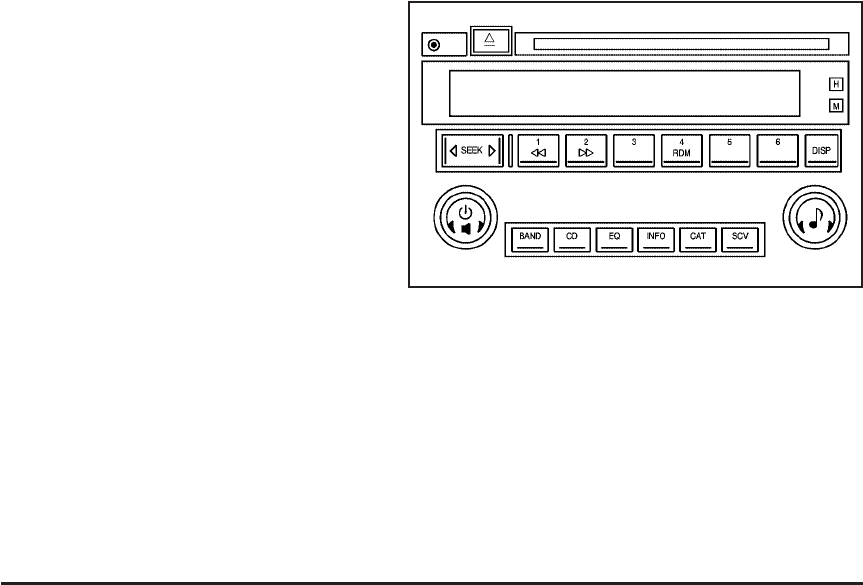
CD Messages
CHECK CD: If this message appears on the display
and/or the CD comes out, it could be for one of the
following reasons:
•It is very hot. When the temperature returns to
normal, the CD should play.
•You are driving on a very rough road. When the
road becomes smoother, the CD should play.
•The CD is dirty, scratched, wet, or upside down.
•The air is very humid. If so, wait about an hour
and try again.
•There may have been a problem while burning
the CD.
•The label may be caught in the CD player.
If the CD is not playing correctly, for any other reason,
try a known good CD.
If any error occurs repeatedly or if an error cannot
be corrected, contact your GM dealer. If the radio
displays an error message, write it down and provide
it to your GM dealer when reporting the problem.
Radio with CD (Uplevel)
XM™ Satellite Radio Service
XM™ is a satellite radio service that is based in the
48 contiguous United States and in Canada (if available).
XM™ offers over 100 coast-to-coast channels including
music, news, sports, talk, and children’s programming.
XM™ provides digital quality audio and text information
that includes song title and artist name. A service fee is
required in order to receive the XM™ service. For more
information, contact XM™ at www.xmradio.com or
call 1-800-852-XMXM (9696).
3-88

Playing the Radio
P(Power): Press this knob to turn the system
on and off.
v(Volume): Turn this knob to increase or to decrease
the volume.
DISP (Display): When the ignition is turned off, press
this button to display the time.
For XM™ (if equipped), press the DISP button while
in XM™ mode to retrieve four different categories
of information related to the current song or channel:
Artist, Song Title, Category or PTY, Channel
Number/Channel Name.
To change the default on the display, press the DISP
button until you see the display you want, then hold this
button for two seconds. The radio will produce one
beep and the selected display will now be the default.
SCV (Speed Compensated Volume): With SCV,
the audio system adjusts automatically to make up
for road and wind noise as you drive.
Set the volume at the desired level. Press this button
to select SPEED VOL MIN, SPEED VOL MED, or
SPEED VOL MAX. Each higher setting will allow for
more volume compensation at faster vehicle speeds.
Then as you drive, SCV increases the volume, as
necessary, to overcome noise at any speed. The volume
level should always sound the same to you as you
drive. NONE will appear on the display if the radio
cannot determine the vehicle speed. To turn SCV off,
press this button until SPEED VOL OFF appears on
the display.
Finding a Station
BAND: Press this button to switch between FM1, FM2,
AM, or XM1 or XM2 (if equipped). The display will
show the selection.
e(Tune): Turn this knob to select radio stations.
oSEEK p:Press and release the right or the
left arrow to go to the next or to the previous station
and stay there.
To scan stations, press and hold either arrow for more
than two seconds. SCAN will appear on the display
and the radio will produce one beep. The radio will
go to a station, play for a few seconds, then go on to
the next station. Press either arrow again or one of
the pushbuttons to stop scanning presets.
3-89

To scan preset stations, press and hold either arrow
for more than four seconds. PSCAN will appear on
the display and the radio will produce two beeps. The
radio will go to a preset station, play for a few seconds,
then go on to the next preset station. Press either
arrow again or one of the pushbuttons to stop scanning
presets.
The radio will only seek and scan stations with a strong
signal that are in the selected band.
INFO (Information) (XM™ Satellite Radio Service
Only): If the current station has a message, the
information symbol will appear on the display. Press
this button to see the message. The message may
display the artist, song title, call in phone numbers, etc.
If the entire message is not displayed, parts of
the message will appear every three seconds.
To scroll through the message, press and release
the INFO button. A new group of words will appear
on the display after every press of this button.
Once the complete message has been displayed,
the information symbol will disappear from the
display until another new message is received.
The last message can be displayed by pressing the
INFO button. You can view the last message until a new
message is received or a different station is tuned to.
When a message is not available from a station,
NO INFO will appear on the display.
Setting Preset Stations
Up to 30 stations (six FM1, six FM2, and six AM,
six XM1 and six XM2 (if equipped)), can be programmed
on the six numbered pushbuttons, by performing the
following steps:
1. Turn the radio on.
2. Press BAND to select FM1, FM2, AM, or XM1
or XM2.
3. Tune in the desired station.
4. Press EQ to select the equalization.
5. Press and hold one of the six numbered
pushbuttons until you hear a beep. Whenever that
numbered pushbutton is pressed, the station
that was set will return and the equalization that
was selected will be stored for that pushbutton.
6. Repeat the steps for each pushbutton.
3-90

Setting the Tone (Bass/Treble)
e(Bass/Treble): Push and release this knob until
BASS or TREBLE appears on the display. Turn
this knob to increase or to decrease. The display will
show the bass or the treble level. If a station is weak
or noisy, decrease the treble.
To adjust the bass and the treble to the middle position,
push and hold the tone knob. The radio will produce
one beep.
To adjust all tone and speaker controls to the middle
position, push and hold the tone knob when no tone or
speaker control is displayed. ALL CENTERED will
appear on the display and you will hear a beep.
EQ (Equalization): Press this button to select
customized equalization settings designed for
country/western, jazz, talk, pop, rock, classical, and
custom.
To return the bass and treble to the manual mode,
push and release the tone knob until BASS or TREBLE
appears on the display.
Adjusting the Speakers (Balance/Fade)
e(Balance/Fade): To adjust the balance between
the right and the left speakers, push and release
this knob until BAL appears on the display. Turn the
knob to move the sound toward the right or the
left speakers.
To adjust the fade between the front and the rear
speakers, push and release the speaker knob until
FAD appears on the display. Turn the knob to move
the sound toward the front or the rear speakers.
To adjust the balance and the fade to the middle
position, push the speaker knob, then push it again
and hold it until you hear one beep.
To adjust all tone and speaker controls to the middle
position, push and hold the speaker knob when no tone
or speaker control is displayed. ALL CENTERED will
appear on the display and you will hear a beep.
3-91

Finding a Category (CAT) Station
(XM™ Satellite Radio Service Only)
To select and find a desired category perform the
following:
1. Press the CAT button to activate category select
mode. The current category will appear on the
display.
2. Turn the tune knob to select a category.
3. Once the desired category is displayed, press
either SEEK arrow to take you to the categories
first station.
4. To go to another station within that category and
the category is displayed, press either SEEK
arrow again. If CAT times out and is no longer
on the display, go back to Step 1.
5. Press CAT to exit category select mode or wait
for CAT to time out.
If the radio cannot find the desired category, NOT
FOUND will appear on the display and the radio will
return to the last station you were listening to.
Scanning Categories (CAT)
(XM™ Satellite Radio Service Only)
To scan a desired category perform the following:
1. Press the CAT button to activate category select
mode. The current category will appear on the
display.
2. Turn the tune knob to select a category.
3. Once the desired category is displayed, press either
SEEK arrow for two seconds to scan the stations in
the category.
4. Press either SEEK arrow again to stop scanning.
If the radio cannot find the desired category, NOT
FOUND will appear on the display and the radio will
return to the last station you were listening to.
Radio Messages
CALIBRATE: The audio system has been calibrated for
your vehicle from the factory. If CALIBRATE appears
on the display it means that the radio has not been
configured properly for your vehicle and it must
be returned to your GM dealer for service.
LOCKED: This message is displayed when the
THEFTLOCK
®
system has locked up. Take your vehicle
to your GM dealer for service.
If any error occurs repeatedly or if an error cannot be
corrected, contact your GM dealer.
3-92
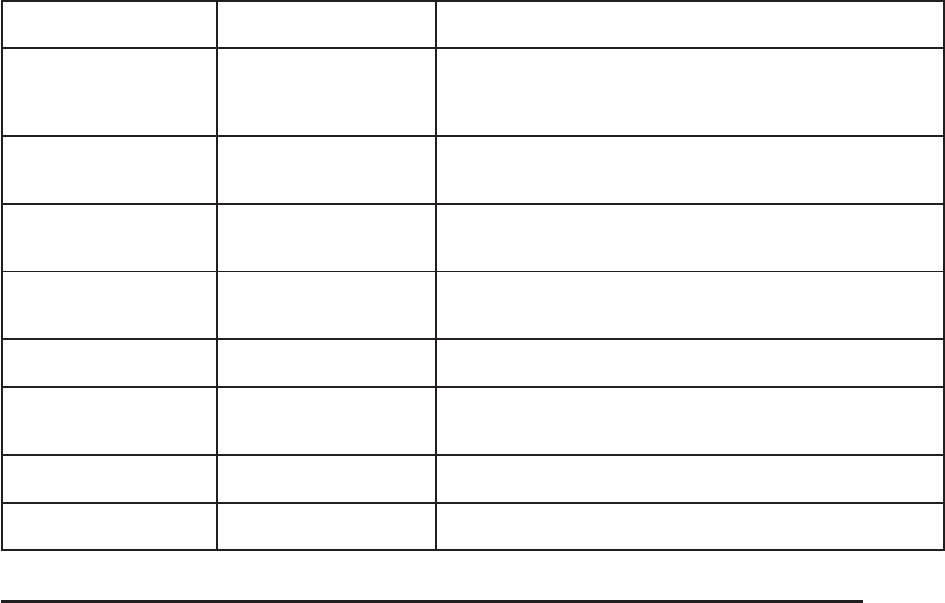
XM™ Radio Messages
Radio Display
Message Condition Action Required
XL (Explicit Language
Channels) XL on the radio display,
after the channel name,
indicates content with
explicit language.
These channels, or any others, can be blocked at a
customer’s request, by calling 1-800-852-XMXM (9696).
Updating Updating
encryption code The encryption code in the receiver is being updated, and
no action is required. This process should take no longer
than 30 seconds.
No Signl Loss of signal The system is functioning correctly, but the vehicle is in a
location that is blocking the XM™ signal. When the vehicle
is moved into an open area, the signal should return.
Loading Acquiring channel audio
(after 4 second delay) The radio system is acquiring and processing audio and
text data. No action is needed. This message should
disappear shortly.
Off Air Channel not in service This channel is not currently in service. Tune to another
channel.
CH Unavl Channel no longer
available This previously assigned channel is no longer assigned.
Tune to another station. If this station was one of the
presets, choose another station for that preset button.
No Info Artist Name/Feature
not available No artist information is available at this time on this channel.
The system is working properly.
No Info Song/Program Title
not available No song title information is available at this time on this
channel. The system is working properly.
3-93
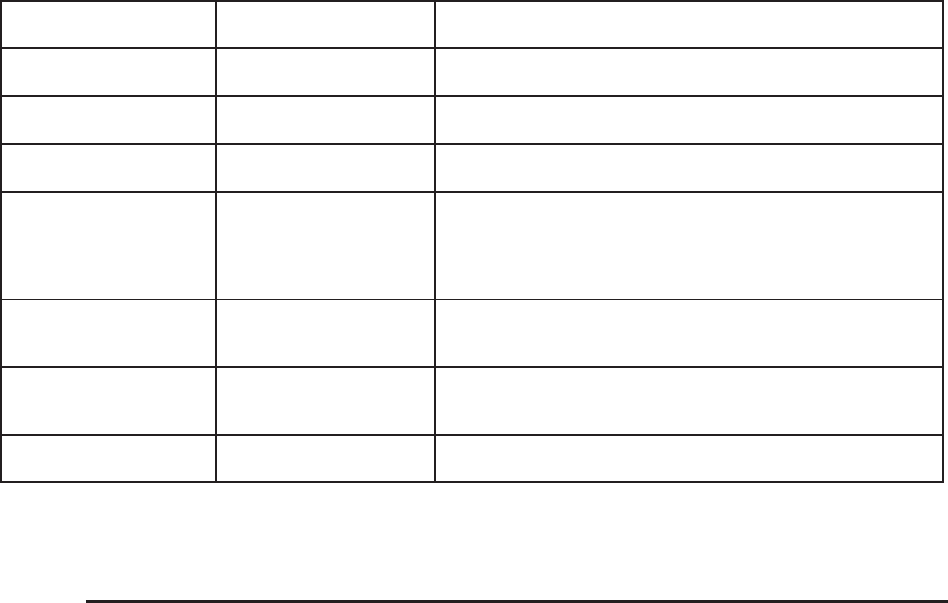
XM™ Radio Messages (cont’d)
Radio Display
Message Condition Action Required
No Info Category Name
not available No category information is available at this time on this
channel. The system is working properly.
No Info No Text/Informational
message available No text or informational messages are available at this time
on this channel. The system is working properly.
Not Found No channel available for
the chosen category There are no channels available for the selected category.
The system is working properly.
XM Lock Theft lock active The XM™ receiver in your vehicle may have previously
been in another vehicle. For security purposes, XM™
receivers cannot be swapped between vehicles. If this
message is received after having your vehicle serviced,
check with your GM dealer.
Radio ID Radio ID label
(channel 0) If tuned to channel 0, this message will alternate with the
XM™ Radio eight-digit radio ID label. This label is needed
to activate the service.
Unknown Radio ID not known
(should only be if
hardware failure)
If this message is received when tuned to channel 0, there
may be a receiver fault. Consult with your GM dealer.
Check XM Hardware failure If this message does not clear within a short period of time,
the receiver may have a fault. Consult with your GM dealer.
3-94

Playing a CD
Insert a CD partway into the slot, label side up. The
player will pull it in and the CD should begin playing. If
you want to insert a CD with the ignition off, first
press the eject button or the DISP knob.
If the ignition or radio is turned off with a CD in the
player it will stay in the player. When the ignition or radio
is turned on, the CD will start to play where it stopped,
if it was the last selected audio source.
When the CD is inserted, the CD symbol will appear on
the display. As each new track starts to play, the
track number will appear on the display.
The CD player can play the smaller 3 inch (8 cm) single
CDs with an adapter ring. Full-size CDs and the
smaller CDs are loaded in the same manner.
If playing a CD-R, the sound quality may be reduced
due to CD-R quality, the method of recording, the quality
of the music that has been recorded, and the way the
CD-R has been handled. There may be an increase
in skipping, difficulty in finding tracks, and/or difficulty in
loading and ejecting. If these problems occur, check
the bottom surface of the CD. If the surface of the CD
is damaged, such as cracked, broken, or scratched,
the CD will not play properly. If the surface of the CD
is soiled, see Care of Your CDs on page 3-126 for
more information.
If there is no apparent damage, try a known good CD.
Do not add any label to a CD, it could get caught in the
CD player. If a CD is recorded on a personal computer
and a description label is needed, try labeling the top of
the recorded CD with a marking pen instead.
Notice: If you add any label to a CD, insert more
than one CD into the slot at a time, or attempt
to play scratched or damaged CDs, you could
damage the CD player. When using the CD player,
use only CDs in good condition without any
label, load one CD at a time, and keep the CD player
and the loading slot free of foreign materials,
liquids, and debris.
If an error appears on the display, see “CD Messages”
later in this section.
1s(Reverse): Press this pushbutton to go to the
start of the current track if more than eight seconds have
played. The reverse symbol and the track number will
appear on the display. If this pushbutton is held or
pressed more than once, the player will continue moving
backward through the CD.
3-95

2\(Fast Forward): Press this pushbutton to go to
the next track. The fast forward symbol and the
track number will appear on the display. If this
pushbutton is held or pressed more than once, the
player will continue moving forward through the CD.
4 RDM (Random): Press this pushbutton to hear
the tracks in random, rather than sequential, order. The
random symbol will appear on the display. Press this
pushbutton again to turn off random play.
oSEEK p:Press the left arrow to go to the start
of the current or the previous track. Press the right
arrow to go to the start of the next track. Pressing
either arrow for more than two seconds will search
the previous or next tracks at two tracks per second.
Release the arrow to stop searching and to play
the track.
To scan tracks, press either arrow for more than
two seconds until SCAN appears on the display.
The CD will search the previous or next tracks at
two seconds per track. Press either arrow to stop
scanning.
DISP (Display): Press this button to see how long the
current track has been playing. The elapsed time of the
track will appear on the display. To change the default
on the display, track or elapsed time, press this button
until you see the display you want, then hold the button
for two seconds. The radio will produce one beep and
the selected display will now be the default.
BAND: Press this button to listen to the radio when
a CD is playing. The inactive CD will remain safely
inside the radio for future listening.
CD: Press this button to play a CD when listening to
the radio. The CD symbol will appear on the display
when a CD is loaded.
EQ (Equalization): Press EQ to select an equalization
setting while playing a CD. The equalization will be
set whenever a CD is played. See “EQ” listed previously
for more information. If you select an EQ setting for
your CD, it will be activated each time you play a CD.
Z(Eject): Press this button to eject a CD. Eject
may be activated with either the ignition or radio off.
CDs may be loaded with the ignition and radio off if
this button is pressed first.
3-96
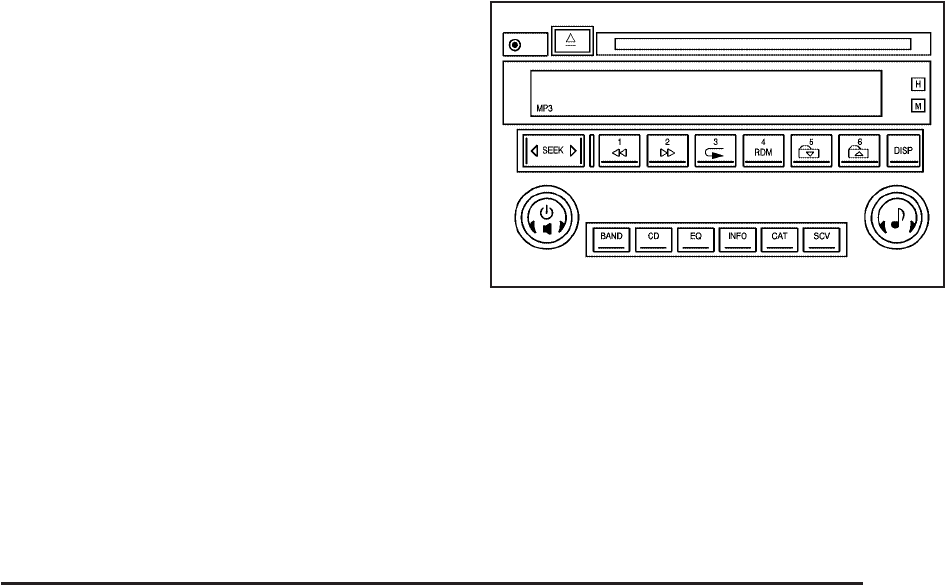
CD Messages
CHECK CD: If this message appears on the display
and/or the CD comes out, it could be for one of the
following reasons:
•It is very hot. When the temperature returns to
normal, the CD should play.
•You are driving on a very rough road. When the
road becomes smoother, the CD should play.
•The CD is dirty, scratched, wet, or upside down.
•The air is very humid. If so, wait about an hour
and try again.
•There may have been a problem while burning
the CD.
•The label may be caught in the CD player.
If the CD is not playing correctly, for any other reason,
try a known good CD.
If any error occurs repeatedly or if an error cannot
be corrected, contact your GM dealer. If the radio
displays an error message, write it down and provide
it to your GM dealer when reporting the problem.
Radio with CD (MP3)
XM™ Satellite Radio Service
XM™ is a satellite radio service that is based in the
48 contiguous United States and in Canada (if available).
XM™ offers over 100 coast-to-coast channels including
music, news, sports, talk, and children’s programming.
XM™ provides digital quality audio and text information
that includes song title and artist name. A service fee is
required in order to receive the XM™ service. For more
information, contact XM™ at www.xmradio.com or
call 1-800-852-XMXM (9696).
3-97

Playing the Radio
P(Power): Press this knob to turn the system
on and off.
v(Volume): Turn this knob to increase or to decrease
the volume.
DISP (Display): Press this button to switch the display
between the radio station frequency and time of day.
When the ignition is turned off, press this knob to display
the time.
For XM™ (if equipped), press the DISP button while
in XM™ mode to retrieve four different categories
of information related to the current song or channel:
Artist, Song Title, Category or PTY, Channel
Number/Channel Name.
To change the default on the display, press the DISP
button until you see the display you want, then hold this
knob for two seconds. The radio will produce one
beep and the selected display will now be the default.
SCV (Speed Compensated Volume): With SCV,
the audio system adjusts automatically to make up
for road and wind noise as you drive.
Set the volume at the desired level. Press this button to
select LOW, MEDIUM, or HIGH. Each higher setting will
allow for more volume compensation at faster vehicle
speeds. Then as you drive, SCV increases the volume,
as necessary, to overcome noise at any speed.
The volume level should always sound the same to you
as you drive. NONE will appear on the display if the radio
cannot determine the vehicle speed. To turn SCV off,
press this button until OFF appears on the display.
Finding a Station
BAND: Press this button to switch between FM1, FM2,
AM, or XM1 or XM2 (if equipped). The display will
show the selection.
e(Tune): Turn this knob to select radio stations.
oSEEK p:Press and release the right or the
left arrow to go to the next or to the previous station
and stay there.
To scan stations, press and hold either arrow for more
than two seconds. SCAN will appear on the display
and the radio will produce one beep. The radio will go
to a station, play for a few seconds, then go on to
the next station. Press either arrow again or one of the
pushbuttons to stop scanning presets.
3-98

To scan preset stations, press and hold either arrow
for more than four seconds. PSCAN will appear on
the display and the radio will produce two beeps. The
radio will go to a preset station, play for a few seconds,
then go on to the next preset station. Press either
arrow again or one of the pushbuttons to stop scanning
presets.
The radio will only seek and scan stations with a strong
signal that are in the selected band.
INFO (Information) (XM™ Satellite Radio Service
Only): If the current station has a message, the
information symbol will appear on the display. Press
this button to see the message. The message may
display the artist, song title, call in phone numbers, etc.
If the entire message is not displayed, parts of
the message will appear every three seconds.
To scroll through the message, press and release
the INFO button. A new group of words will appear
on the display after every press of this button.
Once the complete message has been displayed,
the information symbol will disappear from the
display until another new message is received.
The last message can be displayed by pressing the
INFO button. You can view the last message until a new
message is received or a different station is tuned to.
When a message is not available from a station,
NO INFO will appear on the display.
Setting Preset Stations
Up to 30 stations (six FM1, six FM2, and six AM,
six XM1 and six XM2 (if equipped)), can be programmed
on the six numbered pushbuttons, by performing the
following steps:
1. Turn the radio on.
2. Press BAND to select FM1, FM2, AM, or XM1
or XM2.
3. Tune in the desired station.
4. Press EQ to select the equalization.
5. Press and hold one of the six numbered
pushbuttons until you hear a beep. Whenever that
numbered pushbutton is pressed, the station
that was set will return and the equalization that
was selected will be stored for that pushbutton.
6. Repeat the steps for each pushbutton.
3-99

Setting the Tone (Bass/Treble)
e(Bass/Treble): Push and release this knob until
BASS or TREBLE appears on the display. Turn
this knob to increase or to decrease. The display will
show the bass or the treble level. If a station is weak
or noisy, decrease the treble.
To adjust the bass and the treble to the middle position,
push and hold the tone knob. The radio will produce
one beep.
To adjust all tone and speaker controls to the middle
position, push and hold the tone knob when no tone or
speaker control is displayed. ALL CENTERED will
appear on the display and you will hear a beep.
EQ (Equalization): Press this button to select
customized equalization settings designed for
country/western, jazz, talk, pop, rock, classical, and
custom.
To return the bass and treble to the manual mode, push
and release the tone knob until BASS or TREBLE
appears on the display.
Adjusting the Speakers (Balance/Fade)
e(Balance/Fade): To adjust the balance between
the right and the left speakers, push and release
this knob until BAL appears on the display. Turn the
knob to move the sound toward the right or the
left speakers.
To adjust the fade between the front and the rear
speakers, push and release the speaker knob until FAD
appears on the display. Turn the knob to move the
sound toward the front or the rear speakers.
To adjust the balance and the fade to the middle
position, push the speaker knob, then push it again
and hold it until you hear one beep.
To adjust all tone and speaker controls to the middle
position, push and hold the speaker knob when no tone
or speaker control is displayed. ALL CENTERED will
appear on the display and you will hear a beep.
3-100

Finding a Category (CAT) Station
(XM™ Satellite Radio Service Only)
To select and find a desired category perform the
following:
1. Press the CAT button to activate category select
mode. The current category will appear on the
display.
2. Turn the tune knob to select a category.
3. Once the desired category is displayed, press
either SEEK arrow to take you to the categories
first station.
4. To go to another station within that category and
the category is displayed, press either SEEK
arrow again. If CAT times out and is no longer
on the display, go back to Step 1.
5. Press CAT to exit category select mode or wait
for CAT to time out.
If the radio cannot find the desired category, NOT
FOUND will appear on the display and the radio will
return to the last station you were listening to.
Scanning Categories (CAT)
(XM™ Satellite Radio Service Only)
To scan a desired category perform the following:
1. Press the CAT button to activate category select
mode. The current category will appear on the
display.
2. Turn the tune knob to select a category.
3. Once the desired category is displayed, press either
SEEK arrow for two seconds to scan the stations in
the category.
4. Press either SEEK arrow again to stop scanning.
If the radio cannot find the desired category, NOT
FOUND will appear on the display and the radio will
return to the last station you were listening to.
Radio Messages
CALIBRATE: The audio system has been calibrated for
your vehicle from the factory. If CALIBRATE appears
on the display it means that the radio has not been
configured properly for your vehicle and it must
be returned to your GM dealer for service.
LOCKED: This message is displayed when the
THEFTLOCK
®
system has locked up. Take your vehicle
to your GM dealer for service.
If any error occurs repeatedly or if an error cannot be
corrected, contact your GM dealer.
3-101
XM™ Radio Messages
Radio Display
Message Condition Action Required
XL (Explicit Language
Channels) XL on the radio display,
after the channel name,
indicates content with
explicit language.
These channels, or any others, can be blocked at a
customer’s request, by calling 1-800-852-XMXM (9696).
Updating Updating
encryption code The encryption code in the receiver is being updated, and
no action is required. This process should take no longer
than 30 seconds.
No Signl Loss of signal The system is functioning correctly, but the vehicle is in a
location that is blocking the XM™ signal. When the vehicle
is moved into an open area, the signal should return.
Loading Acquiring channel audio
(after 4 second delay) The radio system is acquiring and processing audio and text
data. No action is needed. This message should disappear
shortly.
Off Air Channel not in service This channel is not currently in service. Tune to another
channel.
CH Unavl Channel no longer
available This previously assigned channel is no longer assigned.
Tune to another station. If this station was one of the
presets, choose another station for that preset button.
No Info Artist Name/Feature
not available No artist information is available at this time on this channel.
The system is working properly.
No Info Song/Program Title
not available No song title information is available at this time on this
channel. The system is working properly.
3-102
XM™ Radio Messages (cont’d)
Radio Display
Message Condition Action Required
No Info Category Name
not available No category information is available at this time on this
channel. The system is working properly.
No Info No Text/Informational
message available No text or informational messages are available at this time
on this channel. The system is working properly.
Not Found No channel available for
the chosen category There are no channels available for the selected category.
The system is working properly.
XM Lock Theft lock active The XM™ receiver in your vehicle may have previously
been in another vehicle. For security purposes, XM™
receivers cannot be swapped between vehicles. If this
message is received after having your vehicle serviced,
check with your GM dealer.
Radio ID Radio ID label
(channel 0) If tuned to channel 0, this message will alternate with the
XM™ Radio eight-digit radio ID label. This label is needed
to activate the service.
Unknown Radio ID not known
(should only be if
hardware failure)
If this message is received when tuned to channel 0, there
may be a receiver fault. Consult with your GM dealer.
Check XM Hardware failure If this message does not clear within a short period of time,
the receiver may have a fault. Consult with your GM dealer.
3-103

Playing a CD
Insert a CD partway into the slot, label side up. The
player will pull it in and the CD should begin playing.
If you want to insert a CD with the ignition off, first press
the eject button or the DISP knob.
If the ignition or radio is turned off with a CD in the
player it will stay in the player. When the ignition or radio
is turned on, the CD will start to play where it stopped,
if it was the last selected audio source.
When the CD is inserted, the CD symbol will appear
on the display. As each new track starts to play,
the track number will appear on the display.
The CD player can play the smaller 3 inch (8 cm)
single CDs with an adapter ring. Full-size CDs and
the smaller CDs are loaded in the same manner.
If playing a CD-R, the sound quality may be reduced
due to CD-R quality, the method of recording, the quality
of the music that has been recorded, and the way the
CD-R has been handled. There may be an increase
in skipping, difficulty in finding tracks, and/or difficulty in
loading and ejecting. If these problems occur, check
the bottom surface of the CD. If the surface of the CD
is damaged, such as cracked, broken, or scratched,
the CD will not play properly. If the surface of the CD
is soiled, see Care of Your CDs on page 3-126 for more
information.
If there is no apparent damage, try a known good CD.
Do not add any label to a CD, it could get caught in the
CD player. If a CD is recorded on a personal computer
and a description label is needed, try labeling the top of
the recorded CD with a marking pen instead.
Notice: If you add any label to a CD, insert more
than one CD into the slot at a time, or attempt
to play scratched or damaged CDs, you could
damage the CD player. When using the CD player,
use only CDs in good condition without any
label, load one CD at a time, and keep the CD player
and the loading slot free of foreign materials,
liquids, and debris.
If an error appears on the display, see “CD Messages”
later in this section.
1s(Reverse): Press this button to reverse within
the current track.
2\(Fast Forward): Press this button to fast forward
within the current track.
3N(Repeat): Press this pushbutton to hear a
track over again. REPEAT TRACK will appear on the
display. The current track will continue to repeat.
Press this pushbutton again to turn off repeat play.
3-104

4 RDM (Random): Press this pushbutton to hear
the tracks in random, rather than sequential, order.
RANDOM ON will appear on the display. Press
this pushbutton again to turn off random play.
oSEEK p:Press the left arrow to go to the start
of the current or the previous track. Press the right arrow
to go to the start of the next track.
To scan tracks, press and hold either arrow for more
than two seconds. SCAN will appear on the display.
The CD will search the previous or next tracks at
two seconds per track. Press either arrow to stop
scanning.
DISP (Display): Press this button to see how long
the current track has been playing. The elapsed time of
the track will appear on the display. To change the
default on the display, track or elapsed time, press this
button until you see the display you want, then hold
the button for two seconds. The radio will produce one
beep and the selected display will now be the default.
BAND: Press this button to listen to the radio when
a CD is playing. The inactive CD will remain safely
inside the radio for future listening.
CD: Press this button to play a CD when listening to
the radio. The CD symbol will appear on the display
when a CD is loaded.
EQ (Equalization): Press EQ to select an equalization
setting while playing a CD. The equalization will be
set whenever a CD is played. See “EQ” listed previously
for more information. If you select an EQ setting for
your CD, it will be activated each time you play a CD.
Z(Eject): Press this button to eject a CD. Eject may
be activated with either the ignition or radio off. CDs
may be loaded with the ignition and radio off if this
button is pressed first.
Using an MP3 CD
MP3 Format
If you burn your own MP3 disc on a personal computer:
•Make sure the MP3 files are recorded on
a CD-R disc.
•Make sure to finalize the disc when burning an MP3
disc, using multiple sessions. It is usually better to
burn the disc all at once.
•Files can be recorded with a variety of fixed or
variable bit rates. Song title, artist name, and album
will be available for display by the radio when
recorded using ID3 tags version 1 and 2.
•Do not mix standard audio and MP3 files on
one disc.
•Make sure playlists have a.pls, or.m3u, or.rmp
extension, other file extensions may not work.
3-105

The player will be able to read and play a maximum of
50 folders, 50 playlists, 10 sessions, and 255 files.
Long file names, folder names, or playlist names may use
more disc memory space than necessary. To conserve
space on the disc, minimize the length of the file, folder
or playlist name. You can also play an MP3 CD that was
recorded using no file folders. The system can support
up to 11 folders in depth, though, keep the depth of
the folders to a minimum in order to keep down the
complexity and confusion in trying to locate a particular
folder during playback. If a CD contains more than the
maximum of 50 folders, 50 playlists, 10 sessions, and
255 files the player will let you access and navigate up
to the maximum, but all items over the maximum will
be ignored.
Root Directory
The root directory will be treated as a folder. If the
root directory has compressed audio files, the directory
will be displayed as F1 ROOT. All files contained
directly under the root directory will be accessed prior
to any root directory folders. However, playlists (Px) will
always be accessed before root folders or files.
Empty Directory or Folder
If a root directory or a folder exists somewhere in the
file structure that contains only folders/subfolders and no
compressed files directly beneath them, the player will
advance to the next folder in the file structure that
contains compressed audio files and the empty folder
will not be displayed or numbered.
No Folder
When the CD contains only compressed files, the files will
be located under the root folder. The next and previous
folder functions will have no function on a CD that was
recorded without folders or playlists. When displaying the
name of the folder the radio will display ROOT.
When the CD contains only playlists and compressed
audio files, but no folders, all files will be located
under the root folder. The folder down and the folder
up buttons will search playlists (Px) first and then go to
the root folder. When the radio displays the name of
the folder the radio will display ROOT.
3-106

Order of Play
Tracks will be played in the following order:
•Play will begin from the first track in the first playlist
and will continue sequentially through all tracks in
each playlist. When the last track of the last playlist
has been played, play will continue from the first
track of the first playlist.
•If the CD does not contain any playlists, then play
will begin from the first track under the root
directory. When all tracks from the root directory
have been played, play will continue from files
according to their numerical listing. After playing
the last track from the last folder, play will
begin again at the first track of the first folder or
root directory.
When play enters a new folder, the display will not
automatically show the new folder name unless
you have chosen the folder mode as the default display.
See DISP later in this section for more information.
The new track name will appear on the display.
File System and Naming
The song name that will be displayed will be the song
name that is contained in the ID3 tag. If the song
name is not present in the ID3 tag, then the radio
will display the file name without the extension
(such as .mp3) as the track name.
Track names longer than 32 characters or four pages
will be shortened. The display will not show parts
of words on the last page of text and the extension
of the filename will not be displayed.
Preprogrammed Playlists
You can access preprogrammed playlists which
were created by WinAmp™, MusicMatch™, or Real
Jukebox™ software, however, you will not have editing
capability. These playlists will be treated as special
folders containing compressed audio song files.
Playing an MP3
Insert a CD partway into the slot, label side up. The
player will pull it in, and READING DISC will appear
on the display. The CD should begin playing and the
CD symbol will appear on the display. If you want
to insert a CD with the ignition off, first press the eject
button or the DISP knob.
3-107

If the ignition or radio is turned off with a CD in the
player it will stay in the player. When the ignition or radio
is turned on, the CD will start to play where it stopped,
if it was the last selected audio source.
The CD player can play the smaller 3 inch (8 cm)
single CDs with an adapter ring. Full-size CDs and the
smaller CDs are loaded in the same manner.
If playing a CD-R, the sound quality may be reduced
due to CD-R quality, the method of recording, the quality
of the music that has been recorded, and the way the
CD-R has been handled. There may be an increase
in skipping, difficulty in finding tracks, and/or difficulty in
loading and ejecting. If these problems occur, check
the bottom surface of the CD. If the surface of the CD
is damaged, such as cracked, broken, or scratched,
the CD will not play properly. If the surface of the CD
is soiled, see Care of Your CDs on page 3-126 for more
information.
If there is no apparent damage, try a known good CD.
Do not add any label to a CD, it could get caught in the
CD player. If a CD is recorded on a personal computer
and a description label is needed, try labeling the top
of the recorded CD with a marking pen instead.
Notice: If you add any label to a CD, insert more
than one CD into the slot at a time, or attempt
to play scratched or damaged CDs, you could
damage the CD player. When using the CD player,
use only CDs in good condition without any
label, load one CD at a time, and keep the CD player
and the loading slot free of foreign materials,
liquids, and debris.
If an error appears on the display, see “CD Messages”
later in this section.
1s(Reverse): Press this button to reverse within
the current track.
2\(Fast Forward): Press this button to fast forward
within the current track.
3N(Repeat): With repeat, one track, the entire
folder, or playlist can be repeated.
Press and release this pushbutton until REPEAT
TRACK, REPEAT FOLDER, or REPEAT P-LIST
appears on the display. The current track, folder or
playlist will continue to repeat. Press and release this
pushbutton until REPEAT OFF appears on the display
to turn off repeated play.
3-108

4 RDM (Random): Press this pushbutton to hear
tracks in random, rather than sequential order.
You can random the entire folder, playlist, or CD.
Press and release this pushbutton until RANDOM
FOLDER, RANDOM P-LIST, or RANDOM DISC appears
on the display. Once all of the tracks in the current
folder or playlist have been played the system will
move on to the next folder or playlist and play all of
the tracks in random order.
When in random, pressing and releasing either SEEK
arrow will take you to the next or previous random track.
Press and release this pushbutton until RANDOM
OFF appears on the display, to turn off random play.
5!(Previous Folder): Press this pushbutton to go
to the first track in the previous folder. Pressing this
button while in folder random mode will take you to the
previous folder and random the tracks in that folder.
6#(Next Folder): Press this pushbutton to go to
the first track in the next folder. Pressing this button
while in folder random mode will take you to the next
folder and random the tracks in that folder.
oSEEK p:Press the left arrow to go to the start of
the previous track. Press the right arrow to go to the
start of the next track.
To scan tracks, press either arrow for more than
two seconds until SCAN appears on the display. The CD
will search the previous or next tracks at two seconds
per track. Press either arrow to stop scanning.
DISP (Display): Press this button to switch between
track mode, folder/playlist mode, and ID3 tag. The display
will show only eight characters, but there can be up to
four pages of text. If there are more than eight characters
in the song, folder, or playlist name, pressing this knob
within two seconds will take you to the next page of text.
If there are no other pages to be shown, pressing this
button within two seconds will take you to the next
display mode.
•Song name and time of day mode will display the
current song name and time of day.
•Folder/playlist mode will display the current folder or
playlist number the track number and the elapsed
time of the track.
•Song name and track number mode will display the
current song name and track number.
•ID3 Tag and folder mode will display the ID3 tag
information and the folder number.
•Song and folder mode will display the number of
songs in the folder and the folder number.
3-109

To change the default on the display, press the DISP
knob until you see the display you want, then hold
this knob for two seconds. The radio will produce one
beep and the selected display will now be the default.
INFO (Information): INFO will appear on the display
whenever a current track has ID3 tag information.
Press this button to display the artist name and album
contained in the tag.
BAND: Press this button to listen to the radio when
a CD is playing. The inactive CD will remain safely
inside the radio for future listening.
CD: Press this button to play a CD when listening to
the radio. The CD symbol will appear on the display
when a CD is loaded.
EQ (Equalization): Press EQ to select an equalization
setting while playing a CD. The equalization will be
set whenever a CD is played. See “EQ” listed previously
for more information. If you select an EQ setting for
your CD, it will be activated each time you play a CD.
Z(Eject): Press this button to eject a CD.
Eject may be activated with either the ignition or
radio off. CDs may be loaded with the ignition and
radio off if this button is pressed first.
CD Messages
CHECK CD: If this message appears on the display
and/or the CD comes out, it could be for one of the
following reasons:
•It is very hot. When the temperature returns to
normal, the CD should play.
•You are driving on a very rough road. When the
road becomes smoother, the CD should play.
•The CD is dirty, scratched, wet, or upside down.
•The air is very humid. If so, wait about an hour
and try again.
•The format of the CD may not be compatible.
See “MP3 Format” earlier in this section.
•There may have been a problem while burning
the CD.
•The label may be caught in the CD player.
If the CD is not playing correctly, for any other reason,
try a known good CD.
If any error occurs repeatedly or if an error cannot be
corrected, contact your GM dealer. If the radio displays
an error message, write it down and provide it to
your GM dealer when reporting the problem.
3-110
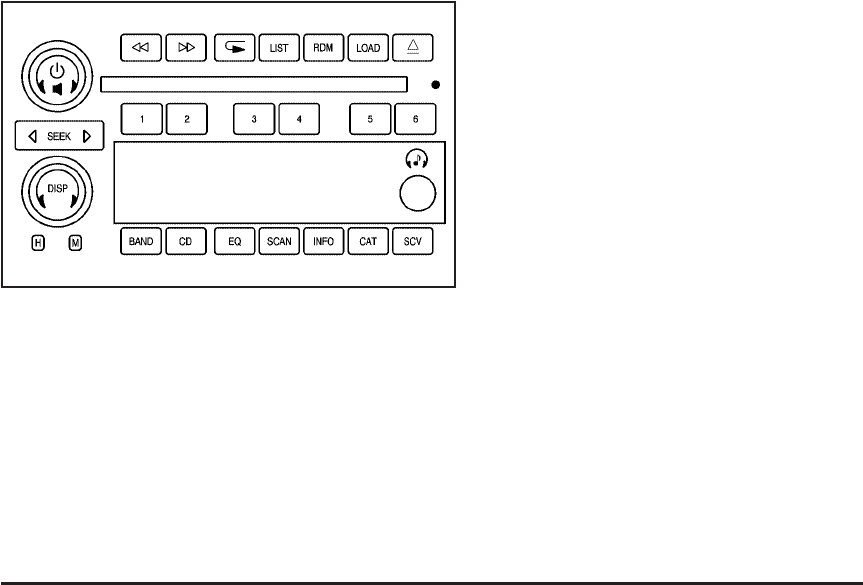
Radio with Six-Disc CD
XM™ Satellite Radio Service
XM™ is a satellite radio service that is based in the
48 contiguous Untied States and in Canada (if available).
XM™ offers over 100 coast-to-coast channels including
music, news, sports, talk, and children’s programming.
XM™ provides digital quality audio and text information
that includes song title and artist name. A service fee is
required in order to receive the XM™ service. For more
information, contact XM™ at www.xmradio.com or
call 1-800-852-XMXM (9696).
Playing the Radio
P(Power): Press this knob to turn the system
on and off.
v(Volume): Turn this knob to increase or to decrease
the volume.
DISP (Display): When the ignition is turned off, press
this knob to display the time.
For XM™ (if equipped), press the DISP knob while
in XM™ mode to retrieve four different categories
of information related to the current song or channel:
Artist, Song Title, Category or PTY, Channel
Number/Channel Name.
To change the default on the display, press the DISP
knob until you see the display you want, then hold
this knob for two seconds. The radio will produce one
beep and the selected display will now be the default.
SCV (Speed Compensated Volume): With SCV,
the audio system adjusts automatically to make up for
road and wind noise as you drive.
3-111

Set the volume at the desired level. Press this button to
select LOW, MEDIUM, or HIGH. Each higher setting
will allow for more volume compensation at faster
vehicle speeds. Then as you drive, SCV increases the
volume, as necessary, to overcome noise at any
speed. The volume level should always sound the same
to you as you drive. To turn SCV off, press this button
until OFF appears on the display.
Finding a Station
BAND: Press this button to switch between FM1, FM2,
AM, or XM1 or XM2 (if equipped). The display will
show the selection.
e(Tune): Turn this knob to select radio stations.
oSEEK p:Press and release the right or the
left arrow to go to the next or to the previous station
and stay there.
To scan radio stations, press and hold either arrow for
more than two seconds. SCAN will appear on the
display and the radio will produce one beep. The radio
will go to a station, play for a few seconds, then go
on to the next station. Press either arrow again or
one of the pushbuttons to stop scanning presets.
To scan the preset stations, press and hold either arrow
for more than four seconds. PSC will appear on the
display and the radio will produce two beeps. The radio
will go to a preset station, play for a few seconds, then go
on to the next preset station. Press either arrow again or
one of the pushbuttons to stop scanning presets.
The radio will only seek and scan stations with a strong
signal that are in the selected band.
SCAN: Press this button until SC appears on the
display. The radio will go to a station, play for a
few seconds, then go on to the next station. Press
this button again to stop scanning stations.
The radio will only scan stations with a strong signal
that are in the selected band.
INFO (Information) (XM™ Satellite Radio Service
Only): If the current station has a message, the
information symbol will appear on the display. Press this
button to see the message. The message may display
the artist, song title, call in phone numbers, etc.
If the entire message is not displayed, parts of
the message will appear every three seconds.
To scroll through the message, press and release
the INFO button. A new group of words will appear
on the display after every press of this button.
3-112

Once the complete message has been displayed, the
information symbol will disappear from the display
until another new message is received. The last
message can be displayed by pressing the INFO button.
You can view the last message until a new message
is received or a different station is tuned to.
When a message is not available from a station,
NO INFO will appear on the display.
Setting Preset Stations
Up to 30 stations (six FM1, six FM2, and six AM,
six XM1 and six XM2 (if equipped)), can be programmed
on the six numbered pushbuttons, by performing the
following steps:
1. Turn the radio on.
2. Press BAND to select FM1, FM2, AM, or XM1
or XM2.
3. Tune in the desired station.
4. Press EQ to select the equalization.
5. Press and hold one of the six numbered
pushbuttons until you hear a beep. Whenever that
numbered pushbutton is pressed, the station
that was set will return and the equalization that
was selected will be stored for that pushbutton.
6. Repeat the steps for each pushbutton.
Setting the Tone (Bass/Treble)
e(Bass/Treble): Push and release this knob until
BASS or TREB appears on the display. Turn this knob
to increase or to decrease. The display will show
the bass or the treble level. If a station is weak or noisy,
decrease the treble.
To adjust the bass and the treble to the middle position,
push and hold the tone knob. The radio will produce
one beep.
To adjust all tone and speaker controls to the middle
position, push and hold the tone knob when no tone or
speaker control is displayed. ALL CENTERED will
appear on the display and you will hear a beep.
EQ (Equalization): Press this button to select
customized equalization settings designed for
country/western, jazz, talk, pop, rock, classical, and
custom.
To return the bass and treble to the manual mode,
push and release the tone knob until BASS or TREBLE
appears on the display.
3-113

Adjusting the Speakers (Balance/Fade)
e(Balance/Fade): To adjust the balance between
the right and the left speakers, push and release
this knob until BAL appears on the display. Turn the
knob to move the sound toward the right or the
left speakers.
To adjust the fade between the front and the rear
speakers, push and release the speaker knob until
FADE appears on the display. Turn the knob to move
the sound toward the front or the rear speakers.
To adjust the balance and the fade to the middle
position, push the speaker knob, then push it again and
hold it until you hear one beep.
To adjust all tone and speaker controls to the middle
position, push and hold the speaker knob when no tone
or speaker control is displayed. CEN will appear on
the display and you will hear a beep.
Finding a Category (CAT) Station
(XM™ Satellite Radio Service Only)
To select and find a desired category perform the
following:
1. Press the CAT button to activate category select
mode. The current category will appear on the
display.
2. Turn the tune knob to select a category.
3. Once the desired category is displayed, press either
SEEK arrow to take you to the categories first
station.
4. To go to another station within that category and
the category is displayed, press either SEEK
arrow again. If CAT times out and is no longer on
the display, go back to Step 1.
5. Press CAT to exit category select mode or wait for
CAT to time out.
If the radio cannot find the desired category, NOT
FOUND will appear on the display and the radio will
return to the last station you were listening to.
3-114

Scanning Categories (CAT)
(XM™ Satellite Radio Service Only)
To scan a desired category perform the following:
1. Press the CAT button to activate category select
mode. The current category will appear on the
display.
2. Turn the tune knob to select a category.
3. Once the desired category is displayed, press either
SEEK arrow for two seconds to scan the stations in
the category.
4. Press either SEEK arrow again to stop scanning.
If the radio cannot find the desired category, NOT
FOUND will appear on the display and the radio will
return to the last station you were listening to.
Radio Messages
CALIBRATE: The audio system has been calibrated for
your vehicle from the factory. If CALIBRATE appears
on the display it means that the radio has not been
configured properly for your vehicle and it must
be returned to your GM dealer for service.
LOCKED: This message is displayed when the
THEFTLOCK
®
system has locked up. Take your vehicle
to your GM dealer for service.
If any error occurs repeatedly or if an error cannot be
corrected, contact your GM dealer.
3-115
XM™ Radio Messages
Radio Display
Message Condition Action Required
XL (Explicit Language
Channels) XL on the radio display,
after the channel name,
indicates content with
explicit language.
These channels, or any others, can be blocked at a
customer’s request, by calling 1-800-852-XMXM (9696).
Updating Updating
encryption code The encryption code in the receiver is being updated, and
no action is required. This process should take no longer
than 30 seconds.
No Signl Loss of signal The system is functioning correctly, but the vehicle is in a
location that is blocking the XM™ signal. When the vehicle
is moved into an open area, the signal should return.
Loading Acquiring channel audio
(after 4 second delay) The radio system is acquiring and processing audio and text
data. No action is needed. This message should disappear
shortly.
Off Air Channel not in service This channel is not currently in service. Tune to another
channel.
CH Unavl Channel no longer
available This previously assigned channel is no longer assigned.
Tune to another station. If this station was one of the
presets, choose another station for that preset button.
No Info Artist Name/Feature
not available No artist information is available at this time on this channel.
The system is working properly.
No Info Song/Program Title
not available No song title information is available at this time on this
channel. The system is working properly.
3-116
XM™ Radio Messages (cont’d)
Radio Display
Message Condition Action Required
No Info Category Name
not available No category information is available at this time on this
channel. The system is working properly.
No Info No Text/Informational
message available No text or informational messages are available at this time
on this channel. The system is working properly.
Not Found No channel available for
the chosen category There are no channels available for the selected category.
The system is working properly.
XM Lock Theft lock active The XM™ receiver in your vehicle may have previously
been in another vehicle. For security purposes, XM™
receivers cannot be swapped between vehicles. If this
message is received after having your vehicle serviced,
check with your GM dealer.
Radio ID Radio ID label
(channel 0) If tuned to channel 0, this message will alternate with the
XM™ Radio eight-digit radio ID label. This label is needed
to activate the service.
Unknown Radio ID not known
(should only be if
hardware failure)
If this message is received when tuned to channel 0, there
may be a receiver fault. Consult with your GM dealer.
Check XM Hardware failure If this message does not clear within a short period of time,
the receiver may have a fault. Consult with your GM dealer.
3-117

Playing a CD
If the ignition or radio is turned off, with a CD in the
player, it will stay in the player. When the ignition
or radio is turned on, the CD will start playing where
it stopped, if it was the last selected audio source.
When a CD is inserted, the CD symbol will appear on
the CD. As each new track starts to play, the track
number will appear on the display.
The CD player can play the smaller 3 inch (8 cm)
single CDs with an adapter ring. Full-size CDs and
the smaller CDs are loaded in the same manner.
If playing a CD-R, the sound quality may be reduced
due to CD-R quality, the method of recording, the quality
of the music that has been recorded, and the way the
CD-R has been handled. There may be an increase
in skipping, difficulty in finding tracks, and/or difficulty in
loading and ejecting. If these problems occur, check
the bottom surface of the CD. If the surface of the CD
is damaged, such as cracked, broken, or scratched,
the CD will not play properly. If the surface of the CD
is soiled, see Care of Your CDs on page 3-126 for
more information.
If there is no apparent damage, try a known good CD.
Do not add any label to a CD, it could get caught in the
CD player. If a CD is recorded on a personal computer
and a description label is needed, try labeling the top of
the recorded CD with a marking pen instead.
Notice: If you add any label to a CD, insert more
than one CD into the slot at a time, or attempt
to play scratched or damaged CDs, you could
damage the CD player. When using the CD player,
use only CDs in good condition without any
label, load one CD at a time, and keep the CD player
and the loading slot free of foreign materials,
liquids, and debris.
If an error appears on the display, see “CD Messages”
later in this section.
LOAD: Press this button to load CDs into the CD
player. This CD player will hold up to six CDs.
To insert one CD, do the following:
1. Turn the ignition on.
2. Press and release the LOAD button.
3. Wait for the indicator light, located to the right of
the slot, to turn green.
4. Load a CD. Insert the CD partway into the slot,
label side up. The player will pull the CD in.
3-118

To insert multiple CDs, do the following:
1. Turn the ignition on.
2. Press and hold the LOAD button for two seconds.
You will hear a beep and the indicator light, located
to the right of the slot, will begin to flash and
MULTI LOAD # will appear on the display.
3. Once the light stops flashing and turns green,
INSERT CD # will appear on the display, load
a CD. Insert the CD partway into the slot, label
side up. The player will pull the CD in.
Once the CD is loaded, the indicator light will
begin flashing again. Once the light stops flashing
and turns green, you can load another CD.
The CD player takes up to six CDs. Do not try
to load more than six.
To load more than one CD but less than six, complete
Steps 1 through 3. When finished loading CDs,
press the LOAD button to cancel the loading function.
The radio will begin to play the last CD loaded.
If more than one CD has been loaded, a number for
each CD will appear on the display.
Playing a Specific Loaded CD
For every CD loaded, a number will appear on the
display. To play a specific CD, press the numbered
pushbutton that corresponds to the CD. A small bar will
appear under the CD number that is playing and the
track number will appear on the display.
If an error appears on the display, see “CD Messages”
later in this section.
Z(Eject): Press this button to eject CD(s).
To eject the CD that is currently playing, press and
release this button.
To eject multiple CDs, do the following:
1. Press and hold the CD eject button for two seconds.
You will hear a beep and the indicator light, located
to the right of the slot, will begin to flash and
EJECT ALL will appear on the display.
2. Once the light stops flashing, REMOVE CD # will
appear on the display. The CD will eject and can
be removed.
Once the CD is removed, the indicator light will
begin flashing again and another CD will eject.
To stop ejecting the CDs, press the LOAD or the
eject button.
3-119

If the CD is not removed, after 25 seconds, the CD will
be automatically pulled back into the player. If CD is
pushed back into the player, before the 25 second time
period is complete, the player will sense an error
and will try to eject the CD several times before
stopping.
Do not repeatedly press the CD eject button to eject a
CD after you have tried to push it in manually. The
player’s 25-second eject timer will reset at each press of
eject, causing the player to not eject the CD until the
25-second time period has elapsed.
s(Reverse): Press this button to reverse within the
current track.
\(Fast Forward): Press this button to fast forward
within the current track.
N(Repeat): With repeat, one track or an entire
CD can be repeated.
To use repeat, do the following:
•To repeat the track you are listening to, press
and release the repeat button. RPT # will appear
on the display. Press this button again to turn
off repeat play.
•To repeat the CD you are listening to, press and
hold the repeat button for two seconds. REPEAT
CD # will appear on the display. Press this
button again to turn off repeat play.
RDM (Random): With random, you can listen to the
tracks in random, rather than sequential, order, on one
CD or on all of the CDs. To use random, do one of
the following:
•To play the tracks on the CD you are listening to
in random order, press and release the random
button. RANDOM ONE will appear on the display.
Press this button again to turn off random play.
•To play the tracks on all of the CDs that are loaded
in random order, press and hold this button for
more than two seconds. You will hear a beep and
RANDOM ALL will appear on the display. Press this
button again to turn off random play.
3-120

oSEEK p:Press the left arrow to go to the start
of the current track, if more than ten seconds have
played. Press the right arrow to go to the next track.
If either arrow is held or pressed more than once,
the player will continue moving backward or forward
through the CD.
To scan one CD, press and hold either SEEK arrow for
more than two seconds until TRACK SCAN appears
on the display and you hear a beep. The radio will go to
the next track, play for 10 seconds, then go on to the
next track. Press either SEEK arrow again, to stop
scanning.
To scan all loaded CDs, press and hold either SEEK
arrow for more than four seconds until ALL CD
SCAN appears on the display and you hear a beep.
Use this feature to listen to 10 seconds of the first track
of each loaded CD. Press either SEEK arrow again,
to stop scanning.
DISP (Display): Press this knob to see how long the
current track has been playing. The elapsed time of
the track will appear on the display. To change
the default on the display, track or elapsed time, press
this knob until you see the display you want, then
hold the knob for two seconds. The radio will produce
one beep and the selected display will now be the
default.
BAND: Press this button to listen to the radio when a
CD is playing. The inactive CD(s) will remain safely
inside the radio for future listening.
CD: Press this button to play a CD when listening to
the radio. The CD symbol will appear on the display
when a CD is loaded.
EQ (Equalization): Press EQ to select an equalization
setting while playing a CD. The equalization will be
set whenever a CD is played. See “EQ” listed previously
for more information. If you select an EQ setting for
your CD, it will be activated each time you play a CD.
3-121

Using List Mode
The six-disc CD changer has a feature called song list.
This feature is capable of saving 20 track selections.
To save tracks into the song list feature, perform
the following steps:
1. Turn the CD player on and load it with at least
one CD. See “LOAD” listed previously in this
section for more information.
2. Check to see that the CD changer is not in song
list mode. LIST should not appear on the display.
If LIST is present, press the LIST button to turn
it off.
3. Select the desired CD by pressing the numbered
pushbutton and then use the SEEK right arrow
to locate the track to be saved. The track will
begin to play.
4. Press and hold the LIST button to save the track
into memory. When LIST is pressed, one beep
will be heard immediately. After two seconds
of continuously pressing the LIST button, TRACK
ADD will appear on the display and two beeps
will sound to confirm the track has been saved.
5. Repeat Steps 3 and 4 for saving other selections.
S-LIST FULL will appear on the display if you try to save
more than 20 selections.
To play the song list, press the LIST button. One beep
will be heard and S-LIST will appear on the display.
The recorded tracks will begin to play in the order they
were saved.
Seek through the song list by using the SEEK arrows.
Seeking past the last saved track will return to the
first saved track.
To delete tracks from the song list, perform the
following steps:
1. Turn the CD player on.
2. Press the LIST button to turn song list on.
LIST will appear on the display.
3. Press either SEEK arrow to select the desired
track to be deleted.
4. Press and hold the LIST button for two seconds.
When LIST is pressed, one beep will be heard
immediately. After two seconds of continuously
pressing the LIST button, TRACK DELETE
will appear on the display and two beeps will be
heard to confirm that the track has been deleted.
After a track has been deleted, the remaining tracks are
moved up the list. When another track is added to the
song list, the track will be added to the end of the list.
3-122

To delete the entire song list, perform the
following steps:
1. Turn the CD player on.
2. Press the LIST button to turn song list on.
LIST will appear on the display.
3. Press and hold the LIST button for more than
four seconds. One beep will be heard, followed
by two beeps after two seconds, and a final beep
will be heard after four seconds. LIST EMPTY
will appear on the display indicating the song list
has been deleted.
If a CD is ejected, and the song list contains saved
tracks from that CD, those tracks are automatically
deleted from the song list. Any tracks saved to the
song list again are added to the bottom of the list.
To end song list mode, press the LIST button.
One beep will be heard and LIST will be removed
from the display.
CD Messages
CHECK CD: If this message appears on the display
and/or the CD comes out, it could be for one of the
following reasons:
•It is very hot. When the temperature returns to
normal, the CD should play.
•You are driving on a very rough road. When the
road becomes smoother, the CD should play.
•The CD is dirty, scratched, wet, or upside down.
•The air is very humid. If so, wait about an hour
and try again.
•There may have been a problem while burning
the CD.
•The label may be caught in the CD player.
If the CD is not playing correctly, for any other reason,
try a known good CD.
If any error occurs repeatedly or if an error cannot be
corrected, contact your GM dealer. If the radio displays
an error message, write it down and provide it to
your GM dealer when reporting the problem.
3-123
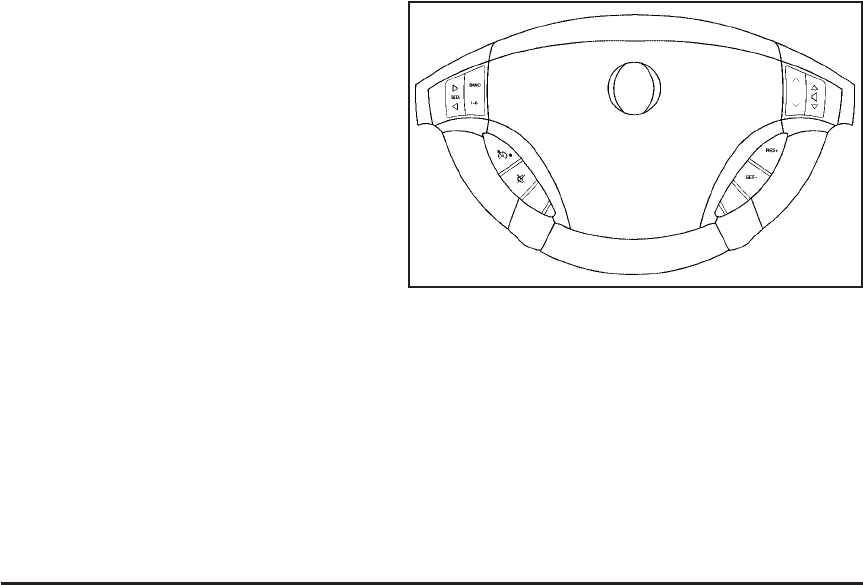
Theft-Deterrent Feature
THEFTLOCK
®
is designed to discourage theft of
your vehicle’s radio. The feature works automatically
by learning a portion of the Vehicle Identification
Number (VIN). If the radio is moved to a different
vehicle, it will not operate and LOC or LOCKED
will appear on the display.
With THEFTLOCK
®
activated, the radio will not
operate if stolen.
Audio Steering Wheel Controls
If your vehicle has this feature, some audio functions
can be adjusted at the steering wheel. They include
the following:
pSEEK o:Press and release the right or the
left arrow to go to the next or to the previous station
and stay there.
3-124

To scan stations, press and hold either arrow for more
than two seconds. SCAN will appear on the display
and the radio will produce one beep. The radio will go
to a station, play for a few seconds, then go on to
the next station. Press either arrow again or one of
the pushbuttons to stop scanning presets.
To scan preset stations, press and hold either arrow
for more than four seconds. PSCAN will appear on
the display and the radio will produce two beeps.
The radio will go to a preset station, play for a
few seconds, then go on to the next preset station.
Press either arrow again or one of the pushbuttons
to stop scanning presets.
The radio will only seek and scan stations with a strong
signal that are in the selected band.
When a CD is playing, press the right or the left arrow
to go to the next or the previous track.
BAND: Press this button to switch between FM1, FM2,
or AM, or XM1 or XM2 (if equipped).
When a CD is playing, press this button to listen to the
radio. The inactive CD will remain safely inside the
radio for future listening.
1 – 6 (Preset Stations): Press this button to go to the
next station that is programmed on the radio preset
pushbuttons.
>(Mute/OnStar
®
): Press and release this button
to silence the audio system. Press it again, or any other
radio button, to turn on the sound.
If your vehicle is equipped with OnStar, press and hold
this button for two seconds to interact with the OnStar
system. See the OnStar
®
System on page 2-38 in
this manual for more information.
wxx(Volume): Press the up or the down arrow to
increase or to decrease the volume.
3-125

Radio Reception
You may experience frequency interference and static
during normal radio reception if items such as cellphone
chargers, vehicle convenience accessories, and
external electronic devices are plugged into the
accessory power outlet. If there is interference or static,
unplug the item from the accessory power outlet.
AM
The range for most AM stations is greater than for
FM, especially at night. The longer range can cause
station frequencies to interfere with each other.
For better radio reception, most AM radio stations will
boost the power levels during the day, and then reduce
these levels during the night. Static can also occur
when things like storms and power lines interfere with
radio reception. When this happens, try reducing
the treble on your radio.
FM Stereo
FM stereo will give the best sound, but FM signals
will reach only about 10 to 40 miles (16 to 65 km).
Tall buildings or hills can interfere with FM signals,
causing the sound to fade in and out.
XM™ Satellite Radio Service
XM™ Satellite Radio Service gives digital radio
reception from coast-to-coast in the 48 contiguous
United States, and in Canada (if available). Just as
with FM, tall buildings or hills can interfere with satellite
radio signals, causing the sound to fade in and out.
In addition, traveling or standing under heavy foliage,
bridges, garages, or tunnels may cause loss of the
XM™ signal for a period of time. The radio may display
NO SIGNAL to indicate interference.
Care of Your CDs
Handle CDs carefully. Store them in their original
cases or other protective cases and away from direct
sunlight and dust. The CD player scans the bottom
surface of the disc. If the surface of a CD is damaged,
such as cracked, broken, or scratched, the CD will
not play properly or not at all. If the surface of a CD is
soiled, take a soft, lint free cloth or dampen a clean,
soft cloth in a mild, neutral detergent solution mixed
with water, and clean it. Make sure the wiping process
starts from the center to the edge.
Do not touch the bottom side of a CD while handling
it; this could damage the surface. Pick up CDs by
grasping the outer edges or the edge of the hole and
the outer edge.
3-126

Care of the CD Player
The use of CD lens cleaners for CD players is not
advised, due to the risk of contaminating the internal
lens of the CD optics with lubricants.
Backglass Antenna
The AM-FM antenna is integrated with the rear window
defogger, located in the rear window. Be sure that
the inside surface of the rear window is not scratched
and that the lines on the glass are not damaged.
If the inside surface is damaged, it could interfere
with radio reception. Also, for proper radio reception,
the antenna connector at the top-center of the rear
window needs to be properly attached to the post
on the glass.
Notice: Using a razor blade or sharp object to
clear the inside rear window may damage the rear
window antenna and/or the rear window defogger.
Repairs would not be covered by your warranty.
Do not clear the inside rear window with sharp
objects.
Notice: Do not apply aftermarket glass tinting
with metallic film. The metallic film in some tinting
materials will interfere with or distort the incoming
radio reception. Any damage caused to your
backglass antenna due to metallic tinting materials
will not be covered by your warranty.
Because this antenna is built into your rear window,
there is a reduced risk of damage caused by car washes
and vandals.
If you choose to add a cellular telephone to your
vehicle, and the antenna needs to be attached to the
glass, be sure that you do not damage the grid lines for
the AM-FM antenna. There is enough space between
the lines to attach a cellular telephone antenna
without interfering with radio reception.
Do not apply aftermarket glass tinting to the back
glass. The metallic film in some tinting materials will
interfere with or distort the incoming radio reception.
Care must be taken when cleaning the rear window
because it breaks in the resistive material heating
element and will adversely affect radio and defogger
performance. See your dealer for details.
3-127

XM™ Satellite Radio Antenna
System
The XM™ Satellite Radio antenna is located on the roof
of your vehicle. Keep this antenna clear of snow and
ice build up for clear radio reception.
If your vehicle has a sunroof, the performance of the
XM™ system may be affected if the sunroof is open.
Loading items onto the roof of your vehicle can interfere
with the performance of the XM™ system. Make sure
the XM™ Satellite Radio antenna is not obstructed.
Chime Level Adjustment
The radio is used to adjust the vehicle’s chime level.
To change the volume level of the chime, press and hold
pushbutton 6 with the ignition on and the radio power
off. The volume level will change from the normal
level to loud, and LOUD will appear on the radio display.
To change back to the default or normal setting,
press and hold pushbutton 6 again. The volume level
will change from the loud level to normal, and NORMAL
will appear on the radio display. Removing the radio
and not replacing it with a factory radio or chime module
will disable vehicle chimes.
3-128

Your Driving, the Road, and Your Vehicle ..........4-2
Defensive Driving ...........................................4-2
Drunken Driving .............................................4-3
Control of a Vehicle ........................................4-6
Braking .........................................................4-6
Anti-Lock Brake System (ABS) .........................4-7
Braking in Emergencies ...................................4-9
Traction Control System (TCS) .......................4-10
StabiliTrak
®
System ......................................4-11
Steering ......................................................4-11
Off-Road Recovery .......................................4-13
Passing .......................................................4-14
Loss of Control .............................................4-15
Driving at Night ............................................4-16
Driving in Rain and on Wet Roads ..................4-17
City Driving ..................................................4-20
Freeway Driving ...........................................4-21
Before Leaving on a Long Trip .......................4-22
Highway Hypnosis ........................................4-23
Hill and Mountain Roads ................................4-24
Winter Driving ..............................................4-26
If Your Vehicle is Stuck in Sand, Mud,
Ice or Snow ..............................................4-30
Rocking Your Vehicle to Get It Out .................4-31
Loading Your Vehicle ....................................4-31
Towing ..........................................................4-36
Towing Your Vehicle .....................................4-36
Recreational Vehicle Towing ...........................4-36
Towing a Trailer ...........................................4-38
Section 4 Driving Your Vehicle
4-1
Your Driving, the Road, and
Your Vehicle
Defensive Driving
The best advice anyone can give about driving is: Drive
defensively.
Please start with a very important safety device in your
vehicle: Buckle up. See Safety Belts: They Are for
Everyone on page 1-8.
{CAUTION:
Defensive driving really means “Be ready for
anything.” On city streets, rural roads, or
expressways, it means “Always expect the
unexpected.” Assume that pedestrians or
other drivers are going to be careless and make
mistakes. Anticipate what they might do and be
ready. Rear-end collisions are about the most
preventable of accidents. Yet they are common.
Allow enough following distance. Defensive
driving requires that a driver concentrate on the
driving task. Anything that distracts from the
driving task makes proper defensive driving
more difficult and can even cause a collision,
with resulting injury. Ask a passenger to help
do these things, or pull off the road in a safe
place to do them. These simple defensive
driving techniques could save your life.
4-2

Drunken Driving
Death and injury associated with drinking and driving
is a national tragedy. It is the number one contributor
to the highway death toll, claiming thousands of
victims every year.
Alcohol affects four things that anyone needs to drive
a vehicle:
•Judgment
•Muscular Coordination
•Vision
•Attentiveness
Police records show that almost half of all motor
vehicle-related deaths involve alcohol. In most cases,
these deaths are the result of someone who was
drinking and driving. In recent years, more than
16,000 annual motor vehicle-related deaths have been
associated with the use of alcohol, with more than
300,000 people injured.
Many adults — by some estimates, nearly half the adult
population — choose never to drink alcohol, so they
never drive after drinking. For persons under 21,
it is against the law in every U.S. state to drink alcohol.
There are good medical, psychological, and
developmental reasons for these laws.
The obvious way to eliminate the leading highway
safety problem is for people never to drink alcohol
and then drive. But what if people do? How much is
“too much” if someone plans to drive? It is a lot less than
many might think. Although it depends on each person
and situation, here is some general information on
the problem.
The Blood Alcohol Concentration (BAC) of someone
who is drinking depends upon four things:
•The amount of alcohol consumed
•The drinker’s body weight
•The amount of food that is consumed before
and during drinking
•The length of time it has taken the drinker to
consume the alcohol
4-3
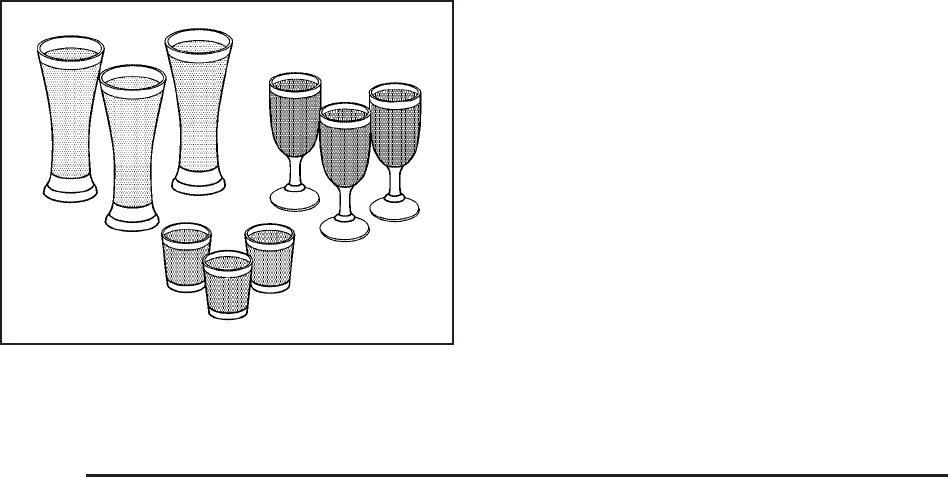
According to the American Medical Association, a 180 lb
(82 kg) person who drinks three 12 ounce (355 ml)
bottles of beer in an hour will end up with a BAC
of about 0.06 percent. The person would reach the
same BAC by drinking three 4 ounce (120 ml) glasses
of wine or three mixed drinks if each had 1-1/2 ounces
(45 ml) of liquors like whiskey, gin, or vodka.
It is the amount of alcohol that counts. For example,
if the same person drank three double martinis
(3 ounces or 90 ml of liquor each) within an hour,
the person’s BAC would be close to 0.12 percent.
A person who consumes food just before or during
drinking will have a somewhat lower BAC level.
There is a gender difference, too. Women generally
have a lower relative percentage of body water
than men. Since alcohol is carried in body water, this
means that a woman generally will reach a higher BAC
level than a man of her same body weight will when
each has the same number of drinks.
The law in most U.S. states, and throughout Canada,
sets the legal limit at 0.08 percent. In some other
countries, the limit is even lower. For example, it is
0.05 percent in both France and Germany. The
BAC limit for all commercial drivers in the United States
is 0.04 percent.
The BAC will be over 0.10 percent after three to
six drinks (in one hour). Of course, as we have seen,
it depends on how much alcohol is in the drinks,
and how quickly the person drinks them.
But the ability to drive is affected well below a BAC of
0.10 percent. Research shows that the driving skills
of many people are impaired at a BAC approaching
0.05 percent, and that the effects are worse at night. All
drivers are impaired at BAC levels above 0.05 percent.
4-4
Statistics show that the chance of being in a collision
increases sharply for drivers who have a BAC of
0.05 percent or above. A driver with a BAC level of
0.06 percent has doubled his or her chance of having a
collision. At a BAC level of 0.10 percent, the chance
of this driver having a collision is 12 times greater; at a
level of 0.15 percent, the chance is 25 times greater!
The body takes about an hour to rid itself of the alcohol
in one drink. No amount of coffee or number of cold
showers will speed that up. “I will be careful” is not the
right answer. What if there is an emergency, a need
to take sudden action, as when a child darts into
the street? A person with even a moderate BAC
might not be able to react quickly enough to avoid
the collision.
There is something else about drinking and driving that
many people do not know. Medical research shows
that alcohol in a person’s system can make crash
injuries worse, especially injuries to the brain, spinal
cord, or heart. This means that when anyone who has
been drinking — driver or passenger — is in a crash,
that person’s chance of being killed or permanently
disabled is higher than if the person had not been
drinking.
{CAUTION:
Drinking and then driving is very dangerous.
Your reflexes, perceptions, attentiveness,
and judgment can be affected by even a
small amount of alcohol. You can have a
serious — or even fatal — collision if you
drive after drinking. Please do not drink and
drive or ride with a driver who has been
drinking. Ride home in a cab; or if you are
with a group, designate a driver who will
not drink.
4-5

Control of a Vehicle
You have three systems that make your vehicle go
where you want it to go. They are the brakes, the
steering, and the accelerator. All three systems have
to do their work at the places where the tires meet
the road.
Sometimes, as when you are driving on snow or ice,
it is easy to ask more of those control systems than
the tires and road can provide. That means you can
lose control of your vehicle. See Traction Control
System (TCS) on page 4-10.
Adding non-GM accessories can affect your vehicle’s
performance. See Accessories and Modifications
on page 5-3.
Braking
See Brake System Warning Light on page 3-38.
Braking action involves perception time and
reaction time.
First, you have to decide to push on the brake pedal.
That is perception time. Then you have to bring up
your foot and do it. That is reaction time.
Average reaction time is about three-fourths of a
second. But that is only an average. It might be less
with one driver and as long as two or three seconds or
more with another. Age, physical condition, alertness,
coordination, and eyesight all play a part. So do alcohol,
drugs, and frustration. But even in three-fourths of a
second, a vehicle moving at 60 mph (100 km/h) travels
66 feet (20 m). That could be a lot of distance in an
emergency, so keeping enough space between
your vehicle and others is important.
And, of course, actual stopping distances vary greatly
with the surface of the road, whether it is pavement
or gravel; the condition of the road, whether it is
wet, dry, or icy; tire tread; the condition of your brakes;
the weight of the vehicle; and the amount of brake
force applied.
4-6
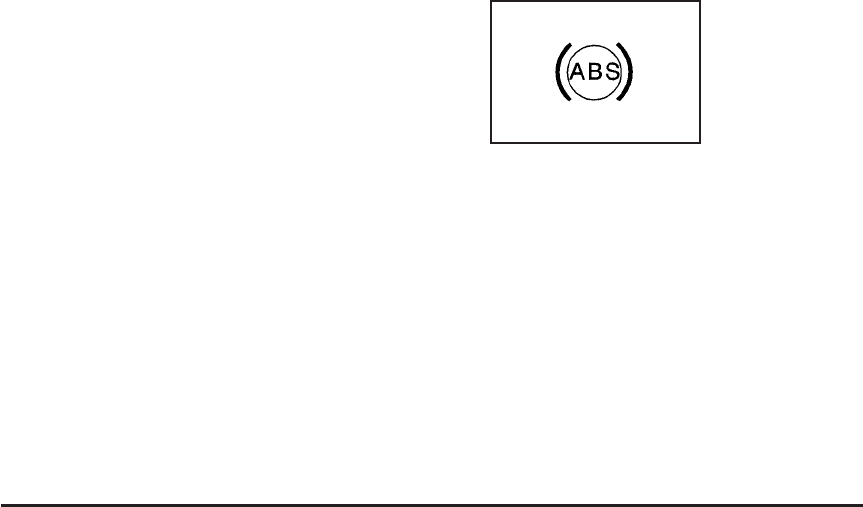
Avoid needless heavy braking. Some people drive
in spurts — heavy acceleration followed by heavy
braking — rather than keeping pace with traffic.
This is a mistake. Your brakes may not have time
to cool between hard stops. Your brakes will wear
out much faster if you do a lot of heavy braking. If you
keep pace with the traffic and allow realistic following
distances, you will eliminate a lot of unnecessary
braking. That means better braking and longer
brake life.
If your engine ever stops while you are driving, brake
normally but do not pump your brakes. If you do,
the pedal may get harder to push down. If your engine
stops, you will still have some power brake assist.
But you will use it when you brake. Once the power
assist is used up, it may take longer to stop and
the brake pedal will be harder to push.
Adding non-GM accessories can affect your vehicle’s
performance. See Accessories and Modifications
on page 5-3.
Anti-Lock Brake System (ABS)
Your vehicle may have anti-lock brakes. ABS is an
advanced electronic braking system that will help
prevent a braking skid.
If your vehicle has anti-lock
brakes, this warning light
on the instrument panel will
come on briefly when
you start your vehicle.
When you start your engine, or when you begin to
drive away, your anti-lock brake system will check itself.
You may hear a momentary motor or clicking noise
while this test is going on, and you may even notice
that your brake pedal moves or pulses a little.
This is normal.
4-7
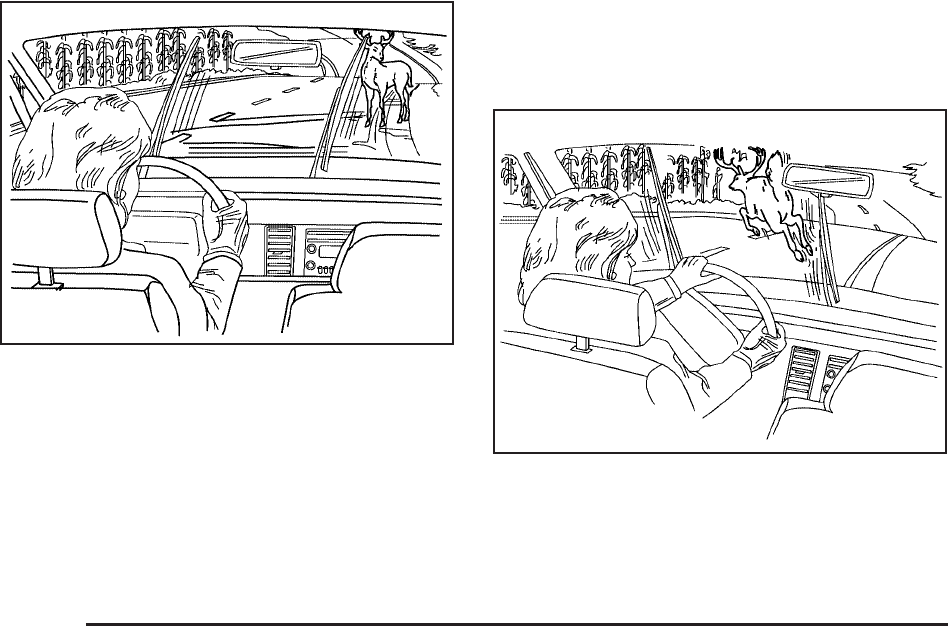
Let us say the road is wet and you are driving safely.
Suddenly, an animal jumps out in front of you. You
slam on the brakes and continue braking. Here is what
happens with ABS:
A computer senses that wheels are slowing down.
If one of the wheels is about to stop rolling, the computer
will separately work the brakes at each wheel.
The anti-lock system can change the brake pressure
faster than any driver could. The computer is
programmed to make the most of available tire and
road conditions. This can help you steer around
the obstacle while braking hard.
As you brake, your computer keeps receiving updates
on wheel speed and controls braking pressure
accordingly.
4-8

Remember: Anti-lock does not change the time you
need to get your foot up to the brake pedal or always
decrease stopping distance. If you get too close to
the vehicle in front of you, you will not have time to apply
your brakes if that vehicle suddenly slows or stops.
Always leave enough room up ahead to stop, even
though you have anti-lock brakes.
Using Anti-Lock
Do not pump the brakes. Just hold the brake pedal
down firmly and let anti-lock work for you. You may
feel a slight brake pedal pulsation or notice some
noise, but this is normal.
Braking in Emergencies
At some time, nearly every driver gets into a situation
that requires hard braking.
If you have anti-lock brakes, you can steer and brake at
the same time. However, if you do not have anti-lock
brakes, your first reaction — to hit the brake pedal hard
and hold it down — may be the wrong thing to do.
Your wheels can stop rolling. Once they do, the vehicle
cannot respond to your steering. Momentum will
carry it in whatever direction it was headed when the
wheels stopped rolling. That could be off the road, into
the very thing you were trying to avoid, or into traffic.
If you do not have anti-lock brakes, use a “squeeze”
braking technique. This will give you maximum braking
while maintaining steering control. You can do this
by pushing on the brake pedal with steadily increasing
pressure.
In an emergency, you will probably want to squeeze
the brakes hard without locking the wheels. If you hear
or feel the wheels sliding, ease off the brake pedal.
This will help you retain steering control. If you do have
anti-lock brakes, it is different. See Anti-Lock Brake
System (ABS) on page 4-7.
In many emergencies, steering can help you more than
even the very best braking.
4-9
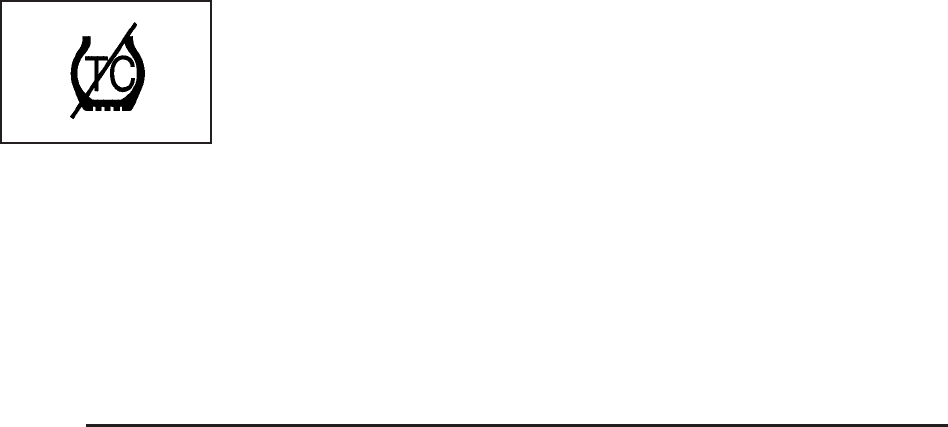
Traction Control System (TCS)
Your vehicle may have a Traction Control System (TCS)
that limits wheel spin. This is especially useful in
slippery road conditions. The system operates only
if it senses that one or both of the front wheels
are spinning or beginning to lose traction. When this
happens, the system reduces engine power and
may also upshift the transaxle to limit wheel spin.
The traction control system
active light will come on
while the TCS is limiting
wheel spin.
If your vehicle has a Driver Information Center (DIC),
the TRACTION CONTROL ACTIVE message will
come on in the while the TCS is limiting wheel spin.
You may feel or hear the system working, but this
is normal.
If the vehicle is in cruise control when the TCS begins
to limit wheel spin, the cruise control will automatically
disengage. When road conditions allow safe use of
the cruise control, it can be used again. See Cruise
Control on page 3-10.
The TCS operates in all transaxle shift lever positions.
But the system can upshift the transaxle only as high as
the shift lever position that was chosen, so use the
lower gears only when necessary. See Automatic
Transaxle Operation on page 2-26.
To limit wheel spin, especially in slippery road conditions,
you should always leave the TCS on. But you can turn
the system off if you ever need to. The TCS should be
turned off if the vehicle ever gets stuck in sand, mud or
snow and rocking the vehicle is required. See Rocking
Your Vehicle to Get It Out on page 4-31 and If Your
Vehicle is Stuck in Sand, Mud, Ice or Snow on page 4-30.
To turn the TCS on or off, press the TCS button located
directly behind the gear shift lever. If your vehicle
has a DIC, the TCS button is located above the radio.
When the TCS is turned off, the TCS warning light
will come on. It will disappear when the TCS is turned
back on. If the TCS is limiting wheel spin when the
TCS button is pressed, the TCS warning light will come
on and the TCS will turn off right away.
Adding non-GM accessories can affect your vehicle’s
performance. See Accessories and Modifications
on page 5-3 for more information.
4-10

StabiliTrak
®
System
Your vehicle may be equipped with a vehicle stability
enhancement system called StabiliTrak
®
.Itisan
advanced computer controlled system that assists
you with directional control of the vehicle in difficult
driving conditions.
StabiliTrak
®
activates when the computer senses a
discrepancy between your intended path and the
direction the vehicle is actually traveling. StabiliTrak
®
selectively applies braking pressure at any one of
the vehicle’s brakes to help steer the vehicle in the
direction which you are steering.
When the system activates, a STABILITY CONTROL
ACTIVE message will be displayed on the Driver
Information Center (DIC). See DIC Warnings and
Messages on page 3-57. You may also hear a noise
or feel vibration in the brake pedal. This is normal.
Continue to steer the vehicle in the direction you want
it to go.
If there is a problem detected with StabiliTrak
®
,a
SERVICE STABILITY SYSTEM message will be
displayed on the Driver Information Center (DIC).
See DIC Warnings and Messages on page 3-57.
When this message is displayed, the system is not
operational. Driving should be adjusted accordingly.
If your vehicle is in cruise control when the StabiliTrak
®
activates, the cruise control will automatically
disengage. When road conditions allow you to safely
use it again, you may reengage the cruise control.
See Cruise Control on page 3-10 for more information.
Steering
Power Steering
If you lose power steering assist because the engine
stops or the system is not functioning, you can steer
but it will take much more effort.
Steering Tips
It is important to take curves at a reasonable speed.
A lot of the “driver lost control” accidents mentioned on
the news happen on curves. Here is why:
Experienced driver or beginner, each of us is subject
to the same laws of physics when driving on curves.
The traction of the tires against the road surface makes
it possible for the vehicle to change its path when
you turn the front wheels. If there is no traction, inertia
will keep the vehicle going in the same direction.
If you have ever tried to steer a vehicle on wet ice,
you will understand this.
4-11

The traction you can get in a curve depends on the
condition of your tires and the road surface, the angle
at which the curve is banked, and your speed. While you
are in a curve, speed is the one factor you can control.
Suppose you are steering through a sharp curve.
Then you suddenly apply the brakes. Both control
systems — steering and braking — have to do their
work where the tires meet the road. Unless you
have four-wheel anti-lock brakes, adding the hard
braking can demand too much of those places.
You can lose control.
The same thing can happen if you are steering through
a sharp curve and you suddenly accelerate. Those
two control systems — steering and acceleration — can
overwhelm those places where the tires meet the
road and make you lose control. See Traction Control
System (TCS) on page 4-10.
What should you do if this ever happens? Ease up on
the brake or accelerator pedal, steer the vehicle the
way you want it to go, and slow down.
Speed limit signs near curves warn that you should
adjust your speed. Of course, the posted speeds
are based on good weather and road conditions. Under
less favorable conditions you will want to go slower.
If you need to reduce your speed as you approach
a curve, do it before you enter the curve, while your
front wheels are straight ahead.
Try to adjust your speed so you can “drive” through the
curve. Maintain a reasonable, steady speed. Wait to
accelerate until you are out of the curve, and then
accelerate gently into the straightaway.
Adding non-GM accessories can affect your vehicle’s
performance. See Accessories and Modifications
on page 5-3.
Steering in Emergencies
There are times when steering can be more effective
than braking. For example, you come over a hill and find
a truck stopped in your lane, or a car suddenly pulls
out from nowhere, or a child darts out from between
parked cars and stops right in front of you. You
can avoid these problems by braking — if you can stop
in time. But sometimes you cannot; there is not room.
That is the time for evasive action — steering around
the problem.
Your vehicle can perform very well in emergencies like
these. First apply your brakes.
See Braking on page 4-6. It is better to remove as
much speed as you can from a possible collision.
Then steer around the problem, to the left or right
depending on the space available.
4-12
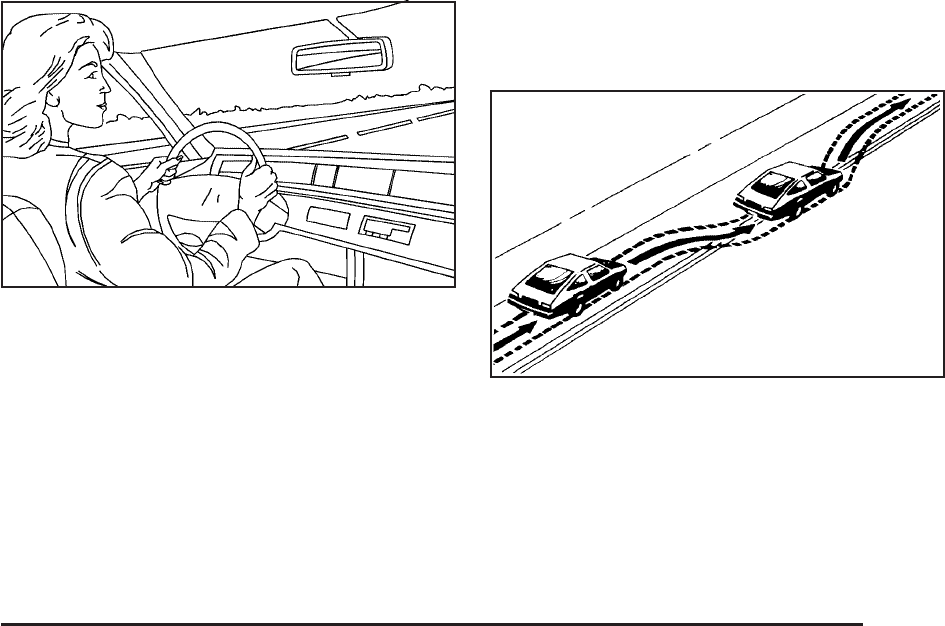
An emergency like this requires close attention and a
quick decision. If you are holding the steering wheel
at the recommended 9 and 3 o’clock positions, you can
turn it a full 180 degrees very quickly without removing
either hand. But you have to act fast, steer quickly,
and just as quickly straighten the wheel once you have
avoided the object.
The fact that such emergency situations are always
possible is a good reason to practice defensive driving
at all times and wear safety belts properly.
Off-Road Recovery
You may find that your right wheels have dropped off the
edge of a road onto the shoulder while you are driving.
If the level of the shoulder is only slightly below the
pavement, recovery should be fairly easy. Ease off the
accelerator and then, if there is nothing in the way,
steer so that your vehicle straddles the edge of
the pavement. You can turn the steering wheel up to
one-quarter turn until the right front tire contacts
the pavement edge. Then turn your steering wheel
to go straight down the roadway.
4-13

Passing
The driver of a vehicle about to pass another on a
two-lane highway waits for just the right moment,
accelerates, moves around the vehicle ahead, then
goes back into the right lane again. A simple maneuver?
Not necessarily! Passing another vehicle on a two-lane
highway is a potentially dangerous move, since the
passing vehicle occupies the same lane as oncoming
traffic for several seconds. A miscalculation, an error in
judgment, or a brief surrender to frustration or anger
can suddenly put the passing driver face to face with the
worst of all traffic accidents — the head-on collision.
So here are some tips for passing:
•Drive ahead. Look down the road, to the sides
and to crossroads for situations that might affect
your passing patterns. If you have any doubt
whatsoever about making a successful pass,
wait for a better time.
•Watch for traffic signs, pavement markings and
lines. If you can see a sign up ahead that might
indicate a turn or an intersection, delay your pass.
A broken center line usually indicates it is all
right to pass, providing the road ahead is clear.
Never cross a solid line on your side of the lane or
a double solid line, even if the road seems empty
of approaching traffic.
•Do not get too close to the vehicle you want to
pass while you are awaiting an opportunity.
For one thing, following too closely reduces your
area of vision, especially if you are following a
larger vehicle. Also, you will not have adequate
space if the vehicle ahead suddenly slows or
stops. Keep back a reasonable distance.
•When it looks like a chance to pass is coming up,
start to accelerate but stay in the right lane and do
not get too close. Time your move so you will
be increasing speed as the time comes to move
into the other lane. If the way is clear to pass, you will
have a running start that more than makes up for the
distance you would lose by dropping back. And if
something happens to cause you to cancel your
pass, you need only slow down and drop back again
and wait for another opportunity.
•If other vehicles are lined up to pass a slow vehicle,
wait your turn. But take care that someone is not
trying to pass you as you pull out to pass the slow
vehicle. Remember to glance over your shoulder
and check the blind spot.
•Check your mirrors, glance over your shoulder,
and start your left lane change signal before moving
out of the right lane to pass. When you are far
enough ahead of the passed vehicle to see its
front in your inside mirror, activate your right lane
change signal and move back into the right lane.
4-14

Remember that your passenger side outside mirror
is convex. The vehicle you just passed may seem
to be farther away from you than it really is.
•Try not to pass more than one vehicle at a time
on two-lane roads. Reconsider before passing
the next vehicle.
•Do not overtake a slowly moving vehicle too rapidly.
Even though the brake lamps are not flashing,
it may be slowing down or starting to turn.
•If you are being passed, make it easy for the
following driver to get ahead of you. Perhaps you
can ease a little to the right.
Loss of Control
Let us review what driving experts say about what
happens when the three control systems — brakes,
steering, and acceleration — do not have enough
friction where the tires meet the road to do what the
driver has asked.
In any emergency, do not give up. Keep trying to
steer and constantly seek an escape route or area
of less danger.
Skidding
In a skid, a driver can lose control of the vehicle.
Defensive drivers avoid most skids by taking reasonable
care suited to existing conditions, and by not overdriving
those conditions. But skids are always possible.
The three types of skids correspond to your vehicle’s
three control systems. In the braking skid, your wheels
are not rolling. In the steering or cornering skid, too much
speed or steering in a curve causes tires to slip and lose
cornering force. And in the acceleration skid, too much
throttle causes the driving wheels to spin.
A cornering skid is best handled by easing your foot off
the accelerator pedal.
If you have the Traction Control System (TCS),
remember: It helps avoid only the acceleration skid.
See Traction Control System (TCS) on page 4-10.
If you do not have this system, or if the system is off,
then an acceleration skid is also best handled by easing
your foot off the accelerator pedal.
If your vehicle starts to slide, ease your foot off the
accelerator pedal and quickly steer the way you want
the vehicle to go. If you start steering quickly enough,
your vehicle may straighten out. Always be ready
for a second skid if it occurs.
4-15

Of course, traction is reduced when water, snow, ice,
gravel, or other material is on the road. For safety,
you will want to slow down and adjust your driving to
these conditions. It is important to slow down on slippery
surfaces because stopping distance will be longer and
vehicle control more limited.
While driving on a surface with reduced traction, try
your best to avoid sudden steering, acceleration,
or braking, including engine braking by shifting to a
lower gear. Any sudden changes could cause the tires
to slide. You may not realize the surface is slippery
until your vehicle is skidding. Learn to recognize warning
clues — such as enough water, ice, or packed snow
on the road to make a mirrored surface — and
slow down when you have any doubt.
If you have the Anti-Lock Brake System (ABS),
remember: It helps avoid only the braking skid. If you
do not have ABS, then in a braking skid, where the
wheels are no longer rolling, release enough pressure
on the brakes to get the wheels rolling again. This
restores steering control. Push the brake pedal down
steadily when you have to stop suddenly. As long as
the wheels are rolling, you will have steering control.
Driving at Night
Night driving is more dangerous than day driving. One
reason is that some drivers are likely to be impaired — by
alcohol or drugs, with night vision problems, or by fatigue.
Here are some tips on night driving.
•Drive defensively.
•Do not drink and drive.
•Adjust the inside rearview mirror to reduce the
glare from headlamps behind you.
•Since you cannot see as well, you may need to
slow down and keep more space between you
and other vehicles.
•Slow down, especially on higher speed roads.
Your vehicle’s headlamps can light up only so
much road ahead.
•In remote areas, watch for animals.
•If you are tired, pull off the road in a safe place
and rest.
No one can see as well at night as in the daytime.
But as we get older these differences increase.
A 50-year-old driver may require at least twice as much
light to see the same thing at night as a 20-year-old.
4-16
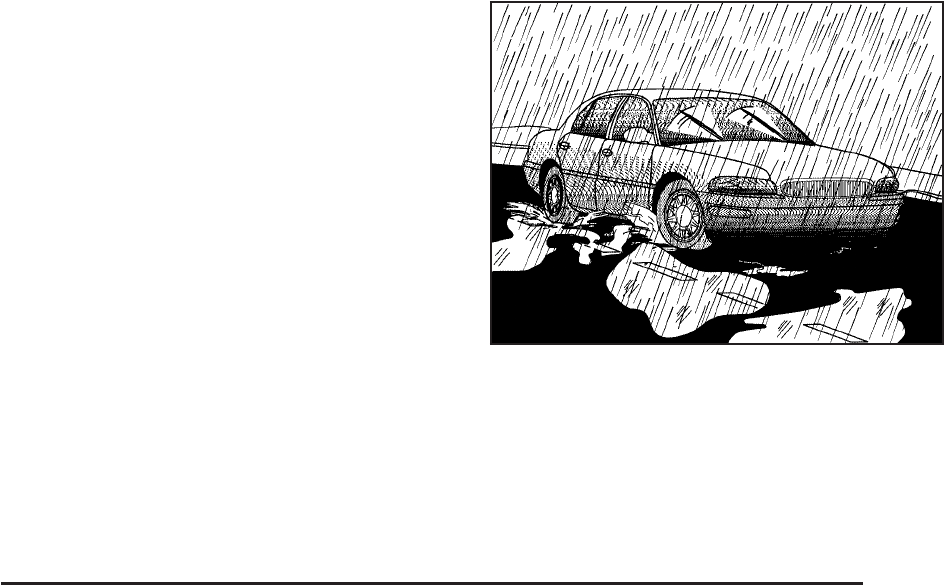
What you do in the daytime can also affect your night
vision. For example, if you spend the day in bright
sunshine you are wise to wear sunglasses. Your eyes
will have less trouble adjusting to night. But if you
are driving, do not wear sunglasses at night. They
may cut down on glare from headlamps, but they also
make a lot of things invisible.
You can be temporarily blinded by approaching
headlamps. It can take a second or two, or even
several seconds, for your eyes to re-adjust to the dark.
When you are faced with severe glare, as from a
driver who does not lower the high beams, or a vehicle
with misaimed headlamps, slow down a little. Avoid
staring directly into the approaching headlamps.
Keep the windshield and all the glass on your vehicle
clean — inside and out. Glare at night is made much
worse by dirt on the glass. Even the inside of the glass
can build up a film caused by dust. Dirty glass makes
lights dazzle and flash more than clean glass would,
making the pupils of your eyes contract repeatedly.
Remember that the headlamps light up far less of a
roadway when you are in a turn or curve. Keep your
eyes moving; that way, it is easier to pick out dimly lighted
objects. Just as the headlamps should be checked
regularly for proper aim, so should your eyes be
examined regularly. Some drivers suffer from night
blindness — the inability to see in dim light — and are
not even aware of it.
Driving in Rain and on Wet Roads
Rain and wet roads can mean driving trouble. On a
wet road, you cannot stop, accelerate, or turn as well
because your tire-to-road traction is not as good as
on dry roads. And, if your tires do not have much tread
left, you will get even less traction. It is always wise
to go slower and be cautious if rain starts to fall while
you are driving. The surface may get wet suddenly when
your reflexes are tuned for driving on dry pavement.
4-17
The heavier the rain, the harder it is to see. Even if
your windshield wiper blades are in good shape, a heavy
rain can make it harder to see road signs and traffic
signals, pavement markings, the edge of the road, and
even people walking.
It is wise to keep your windshield wiping equipment
in good shape and keep your windshield washer
fluid reservoir filled with washer fluid. Replace your
windshield wiper inserts when they show signs of
streaking or missing areas on the windshield, or when
strips of rubber start to separate from the inserts.
{CAUTION:
Wet brakes can cause accidents. They will not
work as well in a quick stop and may cause
pulling to one side. You could lose control of
the vehicle.
After driving through a large puddle of water
or a car wash, apply your brake pedal lightly
until your brakes work normally.
Driving too fast through large water puddles or even
going through some car washes can cause problems,
too. The water may affect your brakes. Try to avoid
puddles. But if you cannot, try to slow down before
you hit them.
Hydroplaning
Hydroplaning is dangerous. So much water can build
up under your tires that they can actually ride on
the water. This can happen if the road is wet enough
and you are going fast enough. When your vehicle
is hydroplaning, it has little or no contact with the road.
Hydroplaning does not happen often. But it can if
your tires do not have much tread or if the pressure
in one or more is low. It can happen if a lot of water is
standing on the road. If you can see reflections from
trees, telephone poles, or other vehicles, and raindrops
dimple the water’s surface, there could be hydroplaning.
Hydroplaning usually happens at higher speeds.
There just is not a hard and fast rule about hydroplaning.
The best advice is to slow down when it is raining.
4-18
Driving Through Deep Standing Water
Notice: If you drive too quickly through deep
puddles or standing water, water can come in
through your engine’s air intake and badly damage
your engine. Never drive through water that is
slightly lower than the underbody of your vehicle.
If you cannot avoid deep puddles or standing water,
drive through them very slowly.
Driving Through Flowing Water
{CAUTION:
Flowing or rushing water creates strong
forces. If you try to drive through flowing
water, as you might at a low water crossing,
your vehicle can be carried away. As little as
six inches of flowing water can carry away a
smaller vehicle. If this happens, you and other
vehicle occupants could drown. Do not ignore
police warning signs, and otherwise be very
cautious about trying to drive through
flowing water.
Some Other Rainy Weather Tips
•Besides slowing down, allow some extra following
distance. And be especially careful when you
pass another vehicle. Allow yourself more clear
room ahead, and be prepared to have your
view restricted by road spray.
•Have good tires with proper tread depth.
See Tires on page 5-57.
4-19
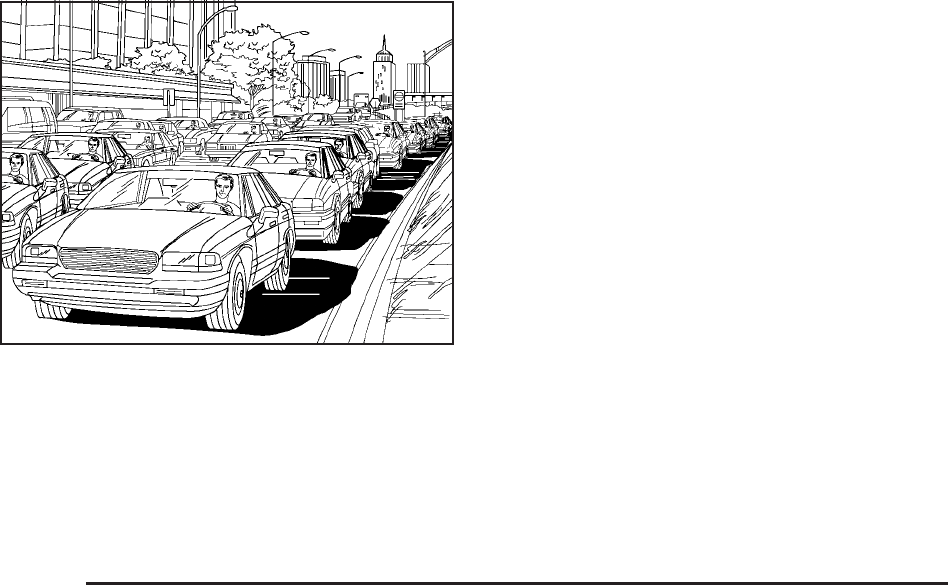
City Driving
One of the biggest problems with city streets is the
amount of traffic on them. You will want to watch out for
what the other drivers are doing and pay attention to
traffic signals.
Here are ways to increase your safety in city driving:
•Know the best way to get to where you are
going. Get a city map and plan your trip into
an unknown part of the city just as you would
for a cross-country trip.
•Try to use the freeways that rim and crisscross
most large cities. You will save time and energy.
See Freeway Driving on page 4-21.
•Treat a green light as a warning signal. A traffic
light is there because the corner is busy enough
to need it. When a light turns green, and just before
you start to move, check both ways for vehicles
that have not cleared the intersection or may
be running the red light.
4-20
Freeway Driving
Mile for mile, freeways — also called thruways, parkways,
expressways, turnpikes, or superhighways — are the
safest of all roads. But they have their own special rules.
The most important advice on freeway driving is: Keep up
with traffic and keep to the right. Drive at the same speed
most of the other drivers are driving. Too-fast or too-slow
driving breaks a smooth traffic flow. Treat the left lane
on a freeway as a passing lane.
At the entrance, there is usually a ramp that leads to the
freeway. If you have a clear view of the freeway as you
drive along the entrance ramp, you should begin to check
traffic. Try to determine where you expect to blend with
the flow. Try to merge into the gap at close to the
prevailing speed. Switch on your turn signal, check your
mirrors, and glance over your shoulder as often as
necessary. Try to blend smoothly with the traffic flow.
Once you are on the freeway, adjust your speed to the
posted limit or to the prevailing rate if it is slower. Stay
in the right lane unless you want to pass.
Before changing lanes, check your mirrors. Then use
your turn signal.
Just before you leave the lane, glance quickly over your
shoulder to make sure there is not another vehicle in
your blind spot.
4-21

Once you are moving on the freeway, make certain
you allow a reasonable following distance.
Expect to move slightly slower at night.
When you want to leave the freeway, move to the proper
lane well in advance. If you miss your exit, do not, under
any circumstances, stop and back up. Drive on to the
next exit.
The exit ramp can be curved, sometimes quite sharply.
The exit speed is usually posted. Reduce your speed
according to your speedometer, not to your sense
of motion. After driving for any distance at higher
speeds, you may tend to think you are going slower
than you actually are.
Before Leaving on a Long Trip
Make sure you are ready. Try to be well rested. If you
must start when you are not fresh — such as after
a day’s work — do not plan to make too many miles
that first part of the journey. Wear comfortable clothing
and shoes you can easily drive in.
Is your vehicle ready for a long trip? If you keep it
serviced and maintained, it is ready to go. If it needs
service, have it done before starting out. Of course,
you will find experienced and able service experts in
GM dealerships all across North America. They will be
ready and willing to help if you need it.
4-22

Here are some things you can check before a trip:
•Windshield Washer Fluid: Is the reservoir full?
Are all windows clean inside and outside?
•Wiper Blades: Are they in good shape?
•Fuel, Engine Oil, Other Fluids: Have you checked
all levels?
•Lamps: Are they all working? Are the lenses clean?
•Tires: They are vitally important to a safe,
trouble-free trip. Is the tread good enough for
long-distance driving? Are the tires all inflated to
the recommended pressure?
•Weather Forecasts: What is the weather outlook
along your route? Should you delay your trip a
short time to avoid a major storm system?
•Maps: Do you have up-to-date maps?
Highway Hypnosis
Is there actually such a condition as highway hypnosis?
Or is it just plain falling asleep at the wheel? Call it
highway hypnosis, lack of awareness, or whatever.
There is something about an easy stretch of road with
the same scenery, along with the hum of the tires on
the road, the drone of the engine, and the rush of
the wind against the vehicle that can make you sleepy.
Do not let it happen to you! If it does, your vehicle
can leave the road in less than a second, and you
could crash and be injured.
What can you do about highway hypnosis? First, be
aware that it can happen.
Then here are some tips:
•Make sure your vehicle is well ventilated, with a
comfortably cool interior.
•Keep your eyes moving. Scan the road ahead
and to the sides. Check your rearview mirrors
and your instruments frequently.
•If you get sleepy, pull off the road into a rest,
service, or parking area and take a nap, get some
exercise, or both. For safety, treat drowsiness
on the highway as an emergency.
4-23
Hill and Mountain Roads
Driving on steep hills or mountains is different from
driving in flat or rolling terrain.
If you drive regularly in steep country, or if you are
planning to visit there, here are some tips that can make
your trips safer and more enjoyable.
•Keep your vehicle in good shape. Check all fluid
levels and also the brakes, tires, cooling system,
and transaxle. These parts can work hard on
mountain roads.
{CAUTION:
If you do not shift down, your brakes could
get so hot that they would not work well. You
would then have poor braking or even none
going down a hill. You could crash. Shift down
to let your engine assist your brakes on a
steep downhill slope.
4-24
{CAUTION:
Coasting downhill in NEUTRAL (N) or with the
ignition off is dangerous. Your brakes will have
to do all the work of slowing down. They could
get so hot that they would not work well. You
would then have poor braking or even none
going down a hill. You could crash. Always
have your engine running and your vehicle in
gear when you go downhill.
•Know how to go down hills. The most important
thing to know is this: let your engine do some of
the slowing down. Shift to a lower gear when you
go down a steep or long hill.
•Know how to go uphill. You may want to shift down
to a lower gear. The lower gears help cool your
engine and transaxle, and you can climb the
hill better.
•Stay in your own lane when driving on two-lane
roads in hills or mountains. Do not swing wide
or cut across the center of the road. Drive at
speeds that let you stay in your own lane.
•As you go over the top of a hill, be alert. There
could be something in your lane, like a stalled car
or an accident.
•You may see highway signs on mountains that
warn of special problems. Examples are long
grades, passing or no-passing zones, a falling
rocks area, or winding roads. Be alert to these
and take appropriate action.
4-25
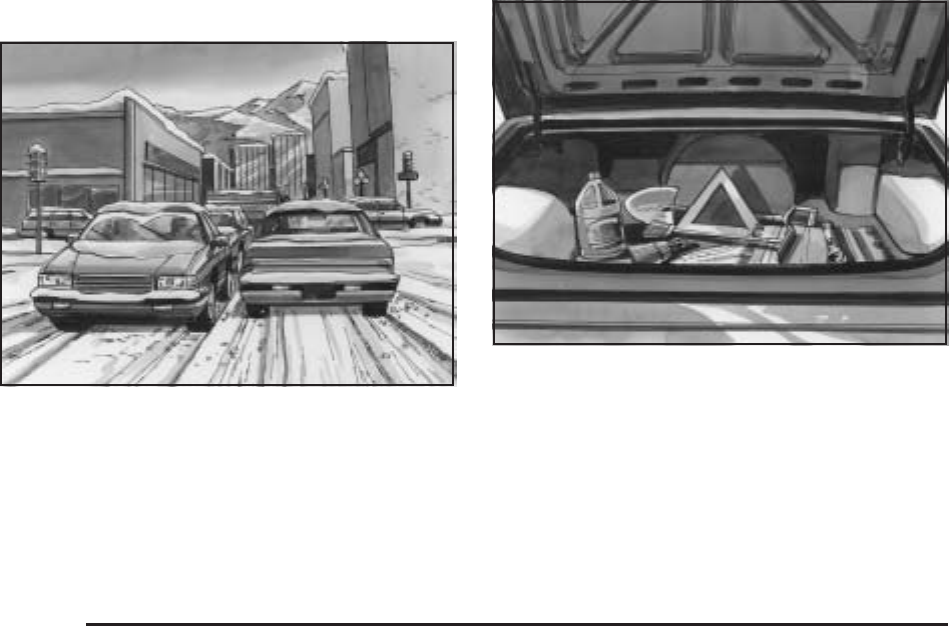
Winter Driving
Here are some tips for winter driving:
•Have your vehicle in good shape for winter.
•You may want to put winter emergency supplies
in your trunk.
Also see Tires on page 5-57.
Include an ice scraper, a small brush or broom, a
supply of windshield washer fluid, a rag, some winter
outer clothing, a small shovel, a flashlight, a red
cloth, and a couple of reflective warning triangles.
And, if you will be driving under severe conditions,
include a small bag of sand, a piece of old carpet,
or a couple of burlap bags to help provide traction.
Be sure you properly secure these items in your vehicle.
4-26
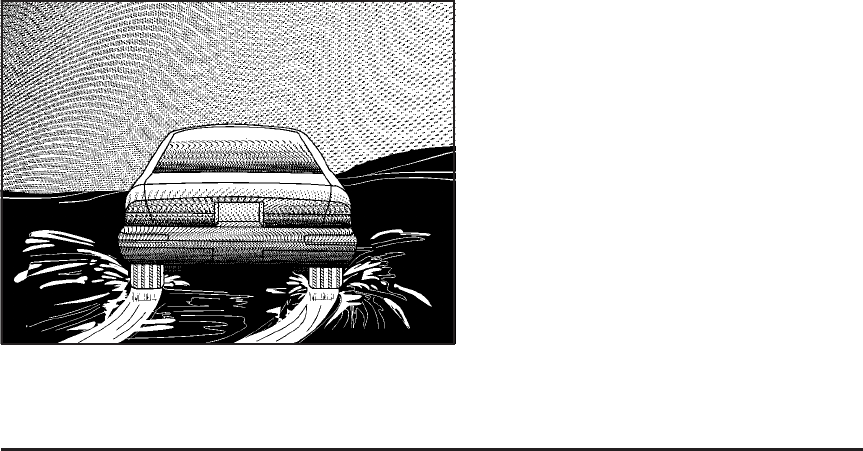
Driving on Snow or Ice
Most of the time, those places where the tires meet
the road probably have good traction.
However, if there is snow or ice between the tires and
the road, you can have a very slippery situation. You will
have a lot less traction, or grip, and will need to be
very careful.
What is the worst time for this? Wet ice. Very cold snow
or ice can be slick and hard to drive on. But wet ice
can be even more trouble because it may offer the least
traction of all. You can get wet ice when it is about
freezing, 32°F (0°C), and freezing rain begins to fall.
Try to avoid driving on wet ice until salt and sand crews
can get there.
Whatever the condition — smooth ice, packed, blowing,
or loose snow — drive with caution.
If you have the Traction Control System (TCS), it
improves your ability to accelerate when driving on a
slippery road. Even though your vehicle has TCS,
you will want to slow down and adjust your driving to
the road conditions. Under certain conditions, you
may want to turn the TCS off, such as when driving
through deep snow and loose gravel, to help maintain
vehicle motion at lower speeds. See Traction Control
System (TCS) on page 4-10.
Unless you have the Anti-Lock Brake System (ABS),
you will want to brake very gently, too. If you do
have ABS, see Anti-Lock Brake System (ABS) on
page 4-7. ABS improves your vehicle’s stability when
you make a hard stop on a slippery road. Whether
you have ABS or not, you will want to begin stopping
sooner than you would on dry pavement. Without ABS,
if you feel your vehicle begin to slide, let up on the
brakes a little. Push the brake pedal down steadily to
get the most traction you can.
4-27

Remember, unless you have ABS, if you brake so
hard that your wheels stop rolling, you will just slide.
Brake so your wheels always keep rolling and you
can still steer.
•Whatever your braking system, allow greater
following distance on any slippery road.
•Watch for slippery spots. The road might be
fine until you hit a spot that is covered with ice.
On an otherwise clear road, ice patches may
appear in shaded areas where the sun cannot
reach, such as around clumps of trees, behind
buildings, or under bridges. Sometimes the surface
of a curve or an overpass may remain icy when
the surrounding roads are clear. If you see a patch
of ice ahead of you, brake before you are on it.
Try not to brake while you are actually on the ice,
and avoid sudden steering maneuvers.
If You Are Caught in a Blizzard
If you are stopped by heavy snow, you could be in
a serious situation. You should probably stay with your
vehicle unless you know for sure that you are near
help and you can hike through the snow. Here are some
things to do to summon help and keep yourself and
your passengers safe:
•Turn on your hazard flashers.
•Tie a red cloth to your vehicle to alert police that
you have been stopped by the snow.
•Put on extra clothing or wrap a blanket around you.
If you do not have blankets or extra clothing, make
body insulators from newspapers, burlap bags,
rags, floor mats — anything you can wrap around
yourself or tuck under your clothing to keep warm.
4-28
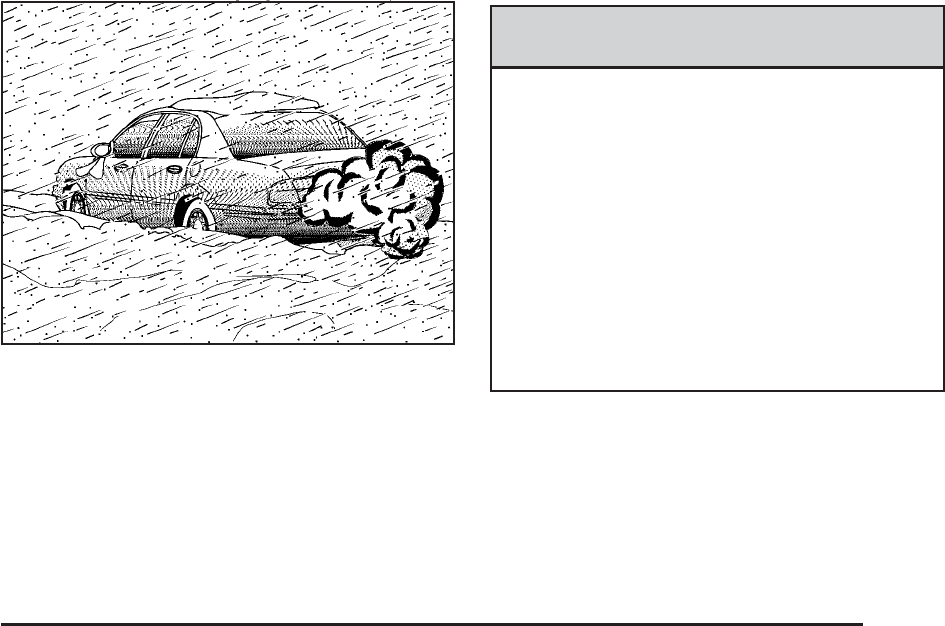
You can run the engine to keep warm, but be careful.
{CAUTION:
Snow can trap exhaust gases under your
vehicle. This can cause deadly CO (carbon
monoxide) gas to get inside. CO could
overcome you and kill you. You cannot see it
or smell it, so you might not know it is in your
vehicle. Clear away snow from around the
base of your vehicle, especially any that is
blocking your exhaust pipe. And check around
again from time to time to be sure snow does
not collect there.
Open a window just a little on the side of the
vehicle that is away from the wind. This will
help keep CO out.
Run your engine only as long as you must. This saves
fuel. When you run the engine, make it go a little faster
than just idle. That is, push the accelerator slightly.
This uses less fuel for the heat that you get and it keeps
the battery charged. You will need a well-charged battery
to restart the vehicle, and possibly for signaling later on
with your headlamps. Let the heater run for a while.
4-29
Then, shut the engine off and close the window almost
all the way to preserve the heat. Start the engine again
and repeat this only when you feel really uncomfortable
from the cold. But do it as little as possible. Preserve
the fuel as long as you can. To help keep warm, you
can get out of the vehicle and do some fairly vigorous
exercises every half hour or so until help comes.
If Your Vehicle is Stuck in Sand,
Mud, Ice or Snow
In order to free your vehicle when it is stuck, you
will need to spin the wheels, but you do not want to
spin your wheels too fast. The method known as
rocking can help you get out when you are stuck,
but you must use caution.
{CAUTION:
If you let your tires spin at high speed, they
can explode, and you or others could be
injured. And, the transaxle or other parts of
the vehicle can overheat. That could cause
an engine compartment fire or other damage.
When you are stuck, spin the wheels as little
as possible. Do not spin the wheels above
35 mph (55 km/h) as shown on the
speedometer.
Notice: Spinning your wheels can destroy parts of
your vehicle as well as the tires. If you spin the
wheels too fast while shifting your transaxle back
and forth, you can destroy your transaxle. See
Rocking Your Vehicle to Get It Out on page 4-31.
For information about using tire chains on your vehicle,
see Tire Chains on page 5-72.
4-30

Rocking Your Vehicle to Get It Out
First, turn your steering wheel left and right. That
will clear the area around your front wheels. If your
vehicle has traction control, you should turn your
traction control system off. See Traction Control
System (TCS) on page 4-10. Then shift back and
forth between REVERSE (R) and a forward gear,
spinning the wheels as little as possible. Release
the accelerator pedal while you shift, and press lightly
on the accelerator pedal when the transaxle is in
gear. By slowly spinning your wheels in the forward
and reverse directions, you will cause a rocking motion
that may free your vehicle. If that does not get you
out after a few tries, you may need to be towed out.
If you do need to be towed out, see Towing Your
Vehicle on page 4-36.
Loading Your Vehicle
It is very important to know how much weight your
vehicle can carry. Two labels on your vehicle show how
much weight it may properly carry, the Tire and Loading
Information label and the Vehicle Certification label.
{CAUTION:
Do not load your vehicle any heavier than the
Gross Vehicle Weight Rating (GVWR), or either
the maximum front or rear Gross Axle Weight
Rating (GAWR). If you do, parts on your
vehicle can break, and it can change the way
your vehicle handles. These could cause you
to lose control and crash. Also, overloading
can shorten the life of your vehicle.
4-31
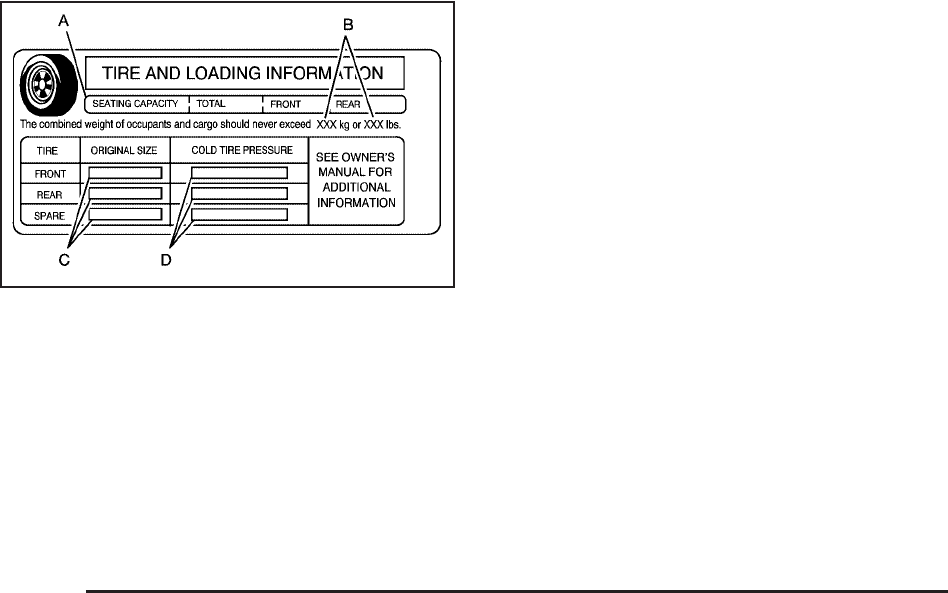
Tire and Loading Information Label
A vehicle specific Tire and Loading Information label
is attached to the vehicle’s center pillar (B-pillar).
With the driver’s door open, you will find the label
attached below the door lock post (striker).
The tire and loading information label lists the number
of occupant seating positions (A), and the maximum
vehicle capacity weight (B) in kilograms and pounds.
The Tire and Loading Information label also lists the
tire size of the original equipment tires (C) and the
recommended cold tire inflation pressures (D).
For more information on tires and inflation, see Tires
on page 5-57 and Inflation - Tire Pressure on page 5-63.
There is also important loading information on the
Certification label. It tells you the Gross Vehicle Weight
Rating (GVWR) and the Gross Axle Weight Rating
(GAWR) for the front and rear axle, see “Certification
Label” later in this section.
Steps for Determining Correct Load Limit
1. Locate the statement “The combined weight of
occupants and cargo should never exceed
XXX kg or XXX lbs” on your vehicle’s placard.
2. Determine the combined weight of the driver and
passengers that will be riding in your vehicle.
3. Subtract the combined weight of the driver and
passengers from XXX kg or XXX lbs.
Label Example
4-32
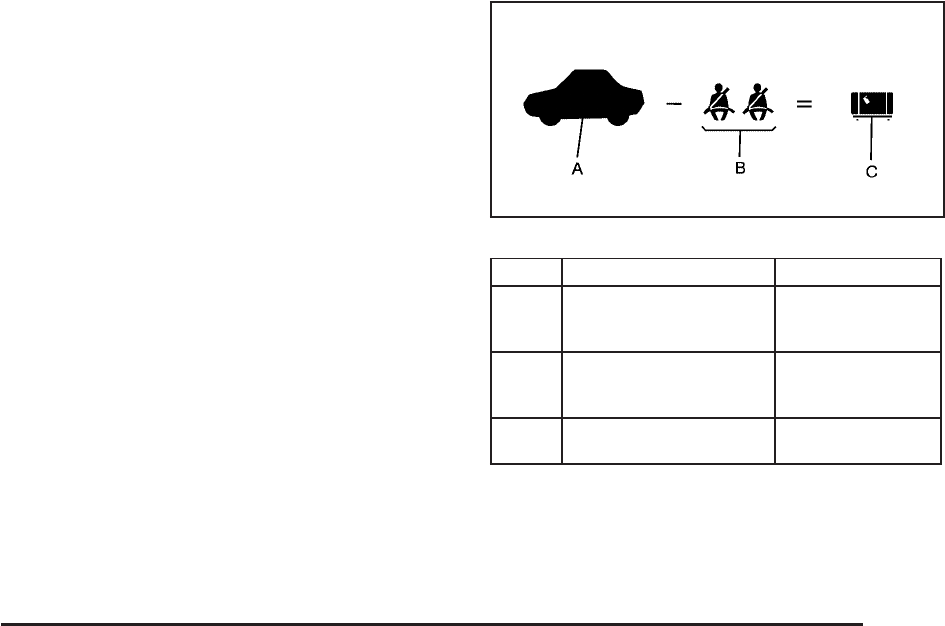
4. The resulting figure equals the available amount of
cargo and luggage load capacity. For example, if
the “XXX” amount equals 1400 lbs and there will be
five 150 lb passengers in your vehicle, the amount
of available cargo and luggage load capacity is
650 lbs (1400 −750 (5 x 150) = 650 lbs).
5. Determine the combined weight of luggage and
cargo being loaded on the vehicle. That weight
may not safely exceed the available cargo
and luggage load capacity calculated in Step 4.
6. If your vehicle will be towing a trailer, the load
from your trailer will be transferred to your
vehicle. Consult this manual to determine how this
reduces the available cargo and luggage load
capacity for your vehicle.
If your vehicle can tow a trailer, see Towing a Trailer
on page 4-38 for important information on towing
a trailer, towing safety rules, and trailering tips.
Item Description Total
AMaximum Vehicle
Capacity Weight
for Example 1 =1,000 lbs (453 kg)
BSubtract
Occupant Weight
150 lbs (68 kg) ×2=300 lbs (136 kg)
CAvailable Occupant
and Cargo Weight =700 lbs (317 kg)
Example 1
4-33
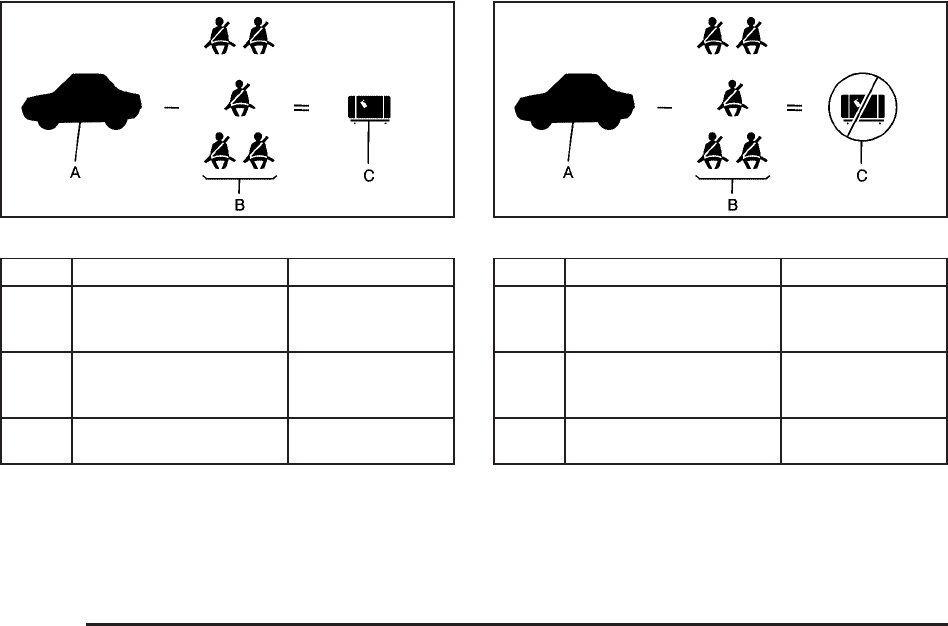
Item Description Total
AMaximum Vehicle
Capacity Weight
for Example 2 =1,000 lbs (453 kg)
BSubtract
Occupant Weight
150 lbs (68 kg) ×5=750 lbs (340 kg)
CAvailable Cargo
Weight =250 lbs (113 kg)
Item Description Total
AMaximum Vehicle
Capacity Weight
for Example 3 =1,000 lbs (453 kg)
BSubtract
Occupant Weight
200 lbs (91 kg) ×5=1,000 lbs (453 kg)
CAvailable Cargo
Weight =0 lbs (0 kg)
Refer to your vehicle’s tire and loading information
label for specific information about your vehicle’s
maximum vehicle capacity weight and seating positions.
The combined weight of the driver, passengers, and
cargo should never exceed your vehicle’s maximum
vehicle capacity weight.
Example 2 Example 3
4-34
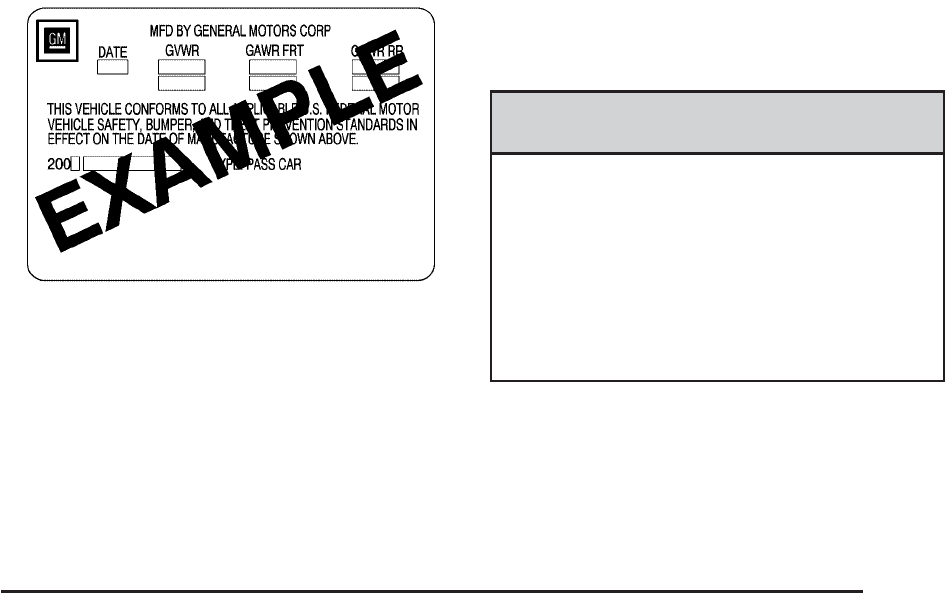
Certification Label
A vehicle specific Certification label is found on the
rear edge of the driver’s door.
The label shows the gross weight capacity of your
vehicle, called the Gross Vehicle Weight Rating (GVWR).
The GVWR includes the weight of the vehicle, all
occupants, fuel, and cargo.
Never exceed the GVWR for your vehicle or the
Gross Axle Weight Rating (GAWR) for either the
front or rear axle.
If the vehicle is going to carry a heavy load, spread it
out. Do not carry more than 167 lbs (76 kg) in the trunk.
{CAUTION:
Do not load your vehicle any heavier than
the Gross Vehicle Weight Rating (GVWR), or
either the maximum front or rear Gross Axle
Weight Rating (GAWR). If you do, parts on
your vehicle can break, and it can change
the way your vehicle handles. These could
cause you to lose control and crash. Also,
overloading can shorten the life of your
vehicle.
Notice: Overloading your vehicle may cause
damage. Repairs would not be covered by your
warranty. Do not overload your vehicle.
4-35
If things like suitcases, tools, packages, or anything
else are put inside the vehicle, they will go as fast as
the vehicle goes. If you have to stop or turn quickly,
or if there is a crash, they will keep going.
{CAUTION:
Things you put inside your vehicle can strike
and injure people in a sudden stop or turn,
or in a crash.
•Put things in the trunk of your vehicle.
In a trunk, put them as far forward as you
can. Try to spread the weight evenly.
•Never stack heavier things, like suitcases,
inside the vehicle so that some of them
are above the tops of the seats.
•Do not leave an unsecured child restraint
in your vehicle.
•When you carry something inside the
vehicle, secure it whenever you can.
•Do not leave a seat folded down unless
you need to.
Towing
Towing Your Vehicle
Consult your dealer or a professional towing service
if you need to have your disabled vehicle towed.
See Roadside Assistance Program on page 7-6.
If you want to tow your vehicle behind another vehicle
for recreational purposes (such as behind a motorhome),
see “Recreational Vehicle Towing” following.
Recreational Vehicle Towing
Recreational vehicle towing means towing your vehicle
behind another vehicle – such as behind a motorhome.
The two most common types of recreational vehicle
towing are known as dinghy towing, towing your vehicle
with all four wheels on the ground, and dolly towing,
towing your vehicle with two wheels on the ground
and two wheels up on a device known as a dolly.
With the proper preparation and equipment, many
vehicles can be towed in these ways. See “Dinghy
Towing” and “Dolly Towing,” following.
4-36
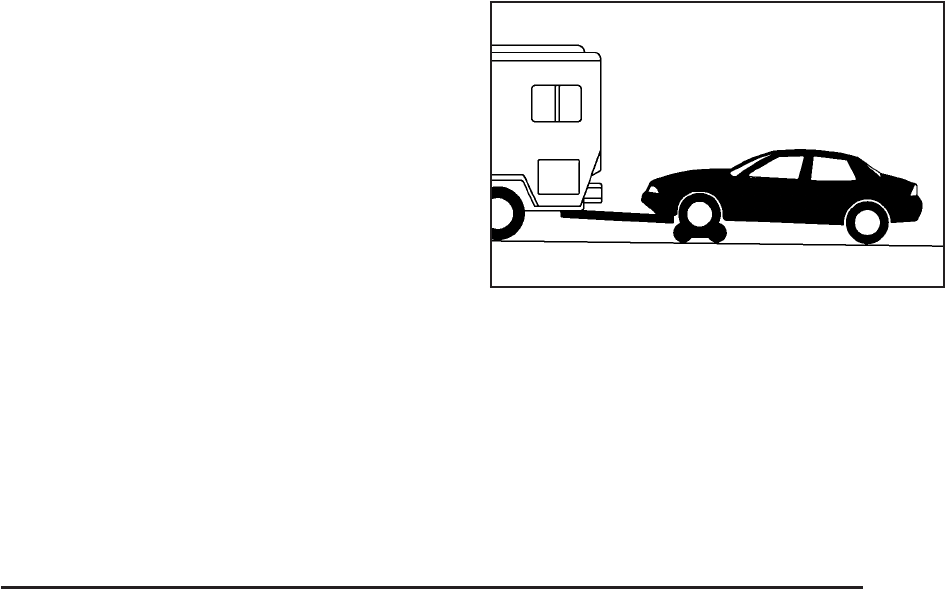
Here are some important things to consider before
you do recreational vehicle towing:
•What is the towing capacity of the towing vehicle?
Be sure you read the tow vehicle manufacturer’s
recommendations.
•How far will you tow? Some vehicles have
restrictions on how far and how long they can tow.
•Do you have the proper towing equipment?
See your dealer or trailering professional for
additional advice and equipment recommendations.
•Is your vehicle ready to be towed? Just as you
would prepare your vehicle for a long trip, you
will want to make sure your vehicle is prepared to
be towed. See Before Leaving on a Long Trip
on page 4-22.
Dinghy Towing
Notice: If you tow your vehicle with all four wheels
on the ground, the drivetrain components could
be damaged. The repairs would not be covered
by your warranty. Do not tow your vehicle with all
four wheels on the ground.
The vehicle was not designed to be towed with all four
wheels on the ground. If your vehicle must be towed,
you should use a dolly. See “Dolly Towing” that follows
for more information.
Dolly Towing
Your vehicle can be towed using a dolly. To tow your
vehicle using a dolly, follow these steps:
1. Put the front wheels on a dolly.
2. Put the gear shift lever in PARK (P).
3. Set the parking brake and then remove the
ignition key.
4. Clamp the steering wheel in a straight-ahead
position.
5. Release the parking brake.
4-37
Towing a Trailer
{CAUTION:
If you do not use the correct equipment and
drive properly, you can lose control when you
pull a trailer. For example, if the trailer is too
heavy, the brakes may not work well — or even
at all. You and your passengers could be
seriously injured. You may also damage your
vehicle; the resulting repairs would not be
covered by your warranty. Pull a trailer only if
you have followed all the steps in this section.
Ask your dealer for advice and information
about towing a trailer with your vehicle.
Your vehicle can tow a trailer if it is equipped with the
proper trailer towing equipment. To identify the trailering
capacity of your vehicle, read the information in “Weight
of the Trailer” that appears later in this section. Trailering
is different than just driving the vehicle by itself.
Trailering means changes in handling, acceleration,
braking, durability, and fuel economy. Successful,
safe trailering takes correct equipment, and it has to
be used properly.
That is the reason for this part. In it are many
time-tested, important trailering tips and safety rules.
Many of these are important for your safety and that of
your passengers. So please read this section carefully
before pulling a trailer.
Load-pulling components such as the engine, transaxle,
wheel assembly, and tires are forced to work harder
against the drag of the added weight. The engine
is required to operate at relatively higher speeds and
under greater loads, generating extra heat. What
is more, the trailer adds considerably to wind resistance,
increasing the pulling requirements.
If You Do Decide To Pull A Trailer
Here are some important points:
•There are many different laws, including speed limit
restrictions, having to do with trailering. Make sure
your rig will be legal, not only where you live
but also where you will be driving. A good source
for this information can be state or provincial police.
•Consider using a sway control. Ask a hitch
dealer about sway controls.
•Do not tow a trailer at all during the first 1,000 miles
(1 600 km) the vehicle is driven. The engine, axle or
other parts could be damaged.
4-38

•Then, during the first 500 miles (800 km) that the
vehicle tows a trailer, do not drive over 50 mph
(80 km/h) and do not make starts at full throttle.
This helps the engine and other parts of the vehicle
wear in at the heavier loads.
•Obey speed limit restrictions when towing a trailer.
Do not drive faster than the maximum posted
speed for trailers, or no more than 55 mph
(90 km/h), to save wear on the vehicle’s parts.
There are three important considerations have to
do with weight:
•The weight of the trailer
•The weight of the trailer tongue
•The total weight on the vehicle’s tires
Weight of the Trailer
How heavy can a trailer safely be?
It should never weigh more than 1,000 lbs (450 kg).
But even that can be too heavy.
It depends on how you plan to use your rig. For example,
speed, altitude, road grades, outside temperature and
how much the vehicle is used to pull a trailer are all
important. It can also depend on any special equipment
that is on the vehicle, and the amount of tongue weight
the vehicle can carry. See “Weight of the Trailer Tongue”
later in this section for more information.
Maximum trailer weight is calculated assuming only the
driver is in the tow vehicle and it has all the required
trailering equipment. The weight of additional optional
equipment, passengers and cargo must be subtracted
from the maximum trailer weight.
Ask your dealer for our trailering information or advice,
or you can write us at:
Buick Customer Assistance Center
P.O. Box 33136
Detroit, MI 48232-5136
In Canada, write to:
General Motors of Canada Limited
Customer Communication Centre, 163-005
1908 Colonel Sam Drive
Oshawa, Ontario L1H 8P7
4-39
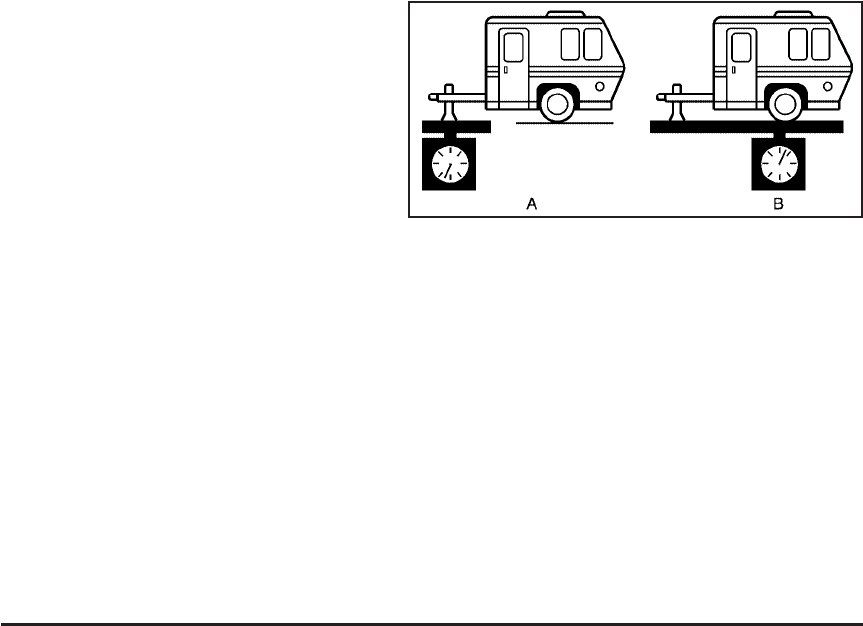
Weight of the Trailer Tongue
The tongue load (A) of any trailer is an important weight
to measure because it affects the total or gross weight
of the vehicle. The Gross Vehicle Weight (GVW)
includes the curb weight of the vehicle, any cargo in
it, and the people who will be riding in the vehicle.
If there are a lot of options, equipment, passengers
or cargo in the vehicle, it will reduce the tongue weight
the vehicle can carry, which will also reduce the
trailer weight the vehicle can tow. And if you tow a
trailer, you must add the tongue load to the GVW
because the vehicle will be carrying that weight, too.
See Loading Your Vehicle on page 4-31 for more
information about the vehicle’s maximum load capacity.
When using a weight-carrying hitch, the trailer tongue (A)
should weigh 10 percent to 15 percent of the total
loaded trailer weight (B).
After the trailer is loaded, weigh the trailer and the
tongue, separately, to see if the weights are proper.
The correct weight could be achieved simply by moving
some items around in the trailer.
4-40

Total Weight on Your Vehicle’s Tires
Be sure the vehicle’s tires are inflated to the upper limit
for cold tires. These numbers can be found on the
Tire-Loading Information label. See Loading Your
Vehicle on page 4-31. Be sure not to go over the
GVW limit for the vehicle, or the GAWR, including the
weight of the trailer tongue. If a weight distribution hitch
is used, make sure not to go over the rear axle limit
before applying the weight distribution spring bars.
Hitches
It is important to have the correct hitch equipment.
Crosswinds, large trucks going by and rough roads
are a few reasons why the right hitch is needed.
Here are some rules to follow:
•The rear bumper on the vehicle is not intended
for hitches. Do not attach rental hitches or other
bumper-type hitches to it. Use only a frame-mounted
hitch that does not attach to the bumper.
•If holes need to be made in the body of the vehicle to
install a trailer hitch, then be sure to seal the holes
later when the hitch is removed. If the holes are not
sealed, deadly carbon monoxide (CO) from the
exhaust can get into the vehicle. See Engine Exhaust
on page 2-34. Dirt and water can, too.
Safety Chains
Chains should always be attached between the vehicle
and the trailer. Cross the safety chains under the
tongue of the trailer so that the tongue will not drop
to the road if it becomes separated from the hitch.
Instructions about safety chains may be provided by
the hitch manufacturer or by the trailer manufacturer.
Follow the manufacturer’s recommendation for attaching
safety chains and do not attach them to the bumper.
Always leave just enough slack so the rig can be turned.
And, never allow safety chains to drag on the ground.
Trailer Brakes
Because the vehicle has anti-lock brakes, do not try
to tap into the vehicle’s brake system. If that is done,
both brake systems will not work well, or at all.
4-41

Driving with a Trailer
Towing a trailer requires a certain amount of experience.
Before setting out for the open road, get to know
the rig. Acquaint yourself with the feel of handling
and braking with the added weight of the trailer.
And always keep in mind that the vehicle is now a
good deal longer and not nearly as responsive as
the vehicle is by itself.
Before starting, check all trailer hitch parts and
attachments, safety chains, electrical connector, lamps,
tires, and mirror adjustment. If the trailer has electric
brakes, start the vehicle and trailer moving and
then apply the trailer brake controller by hand to be
sure the brakes are working. This lets you check
the electrical connection at the same time.
During your trip, check occasionally to be sure that
the load is secure, and that the lamps and any trailer
brakes are still working.
Following Distance
Stay at least twice as far behind the vehicle ahead
as when driving the vehicle without a trailer. This
can help avoid situations that require heavy braking
and sudden turns.
Passing
More passing distance is needed up ahead when
towing a trailer. And, because the vehicle is a good deal
longer with the trailer, you will need to go much farther
beyond the vehicle you have passed before you
can return to the proper lane.
Backing Up
Hold the bottom of the steering wheel with one hand.
Then, to move the trailer to the left, move that hand
to the left. To move the trailer to the right, move your
hand to the right. Always back up slowly and, if possible,
have someone guide you.
Making Turns
Notice: Making very sharp turns while trailering
could cause the trailer to come in contact with the
vehicle. Your vehicle could be damaged. Avoid
making very sharp turns while trailering.
When turning with a trailer, make wider turns than
normal. Do this so the trailer will not strike soft
shoulders, curbs, road signs, trees, or other objects.
Avoid jerky or sudden maneuvers. Signal well in
advance.
4-42
Turn Signals When Towing a Trailer
When towing a trailer, the vehicle may need a different
turn signal flasher and/or extra wiring. Check with your
dealer. The arrows on the instrument panel will flash
whenever signaling a turn or lane change. Properly
hooked up, the trailer lamps will also flash, telling other
drivers you are about to turn, change lanes or stop.
When towing a trailer, the arrows on the instrument
panel will flash for turns even if the bulbs on the trailer
are burned out. You may think drivers behind you
are seeing your signal when they are not. It is important
to check occasionally to be sure the trailer bulbs are
still working.
Driving On Grades
Reduce speed and shift to a lower gear before starting
down a long hill or steep downgrade. If the vehicle is not
shifted down, the brakes might have to be used so much
that they would get hot and no longer work well.
On a long uphill grade, shift down and reduce the
vehicle’s speed to around 45 mph (70 km/h) to reduce
the possibility of engine and transaxle overheating.
If towing a trailer, you may want to drive in THIRD (3)
instead of AUTOMATIC OVERDRIVE (D). Shift to
a lower gear as needed.
Parking on Hills
{CAUTION:
You really should not park your vehicle, with
a trailer attached, on a hill. If something goes
wrong, your rig could start to move. People
can be injured, and both your vehicle and the
trailer can be damaged.
But if the rig ever has to be parked on a hill, here is
how to do it:
1. Apply the regular brakes, but do not shift into
PARK (P) yet.
2. Have someone place chocks under the trailer’s
wheels.
3. When the wheel chocks are in place, release the
regular brakes until the chocks absorb the load.
4. Reapply the regular brakes. Then apply the parking
brake, and shift to PARK (P).
5. Release the regular brakes.
4-43

When You Are Ready to Leave After
Parking on a Hill
1. Apply the regular brakes and hold the pedal
down while you:
•Start the engine.
•Shift into a gear.
•Release the parking brake.
2. Let up on the brake pedal.
3. Drive slowly until the trailer is clear of the chocks.
4. Stop and have someone pick up and store
the chocks.
Maintenance When Trailer Towing
The vehicle will need service more often when it pulls
a trailer. See Scheduled Maintenance on page 6-4
for more information. Things that are especially
important in trailer operation are automatic transaxle
fluid; which should not be overfilled; engine oil,
drive belt(s), and cooling and brake systems.
Each of these is covered in this manual, and the
Index will help you find them quickly. If trailering,
it is a good idea to review this information before
starting on a trip.
Check periodically to see that all hitch nuts and bolts
are tight.
Engine Cooling When Trailer Towing
The cooling system may temporarily overheat during
severe operating conditions. See Engine Overheating
on page 5-27.
4-44

Service ............................................................5-3
Accessories and Modifications ..........................5-3
California Proposition 65 Warning .....................5-4
Doing Your Own Service Work .........................5-4
Adding Equipment to the Outside
of Your Vehicle ...........................................5-5
Fuel ................................................................5-5
Gasoline Octane ............................................5-5
Gasoline Specifications ....................................5-6
California Fuel ...............................................5-6
Additives .......................................................5-6
Fuels in Foreign Countries ...............................5-7
Filling the Tank ..............................................5-8
Filling a Portable Fuel Container .....................5-10
Checking Things Under the Hood ....................5-10
Hood Release ..............................................5-11
Engine Compartment Overview .......................5-12
Engine Oil ...................................................5-15
Engine Oil Life System ..................................5-18
Engine Air Cleaner/Filter ................................5-20
Automatic Transaxle Fluid ..............................5-21
Engine Coolant .............................................5-24
Radiator Pressure Cap ..................................5-27
Engine Overheating .......................................5-27
Overheated Engine Protection
Operating Mode ........................................5-29
Cooling System ............................................5-30
Power Steering Fluid .....................................5-37
Windshield Washer Fluid ................................5-38
Brakes ........................................................5-39
Battery ........................................................5-42
Jump Starting ...............................................5-42
Headlamp Aiming ...........................................5-48
Bulb Replacement ..........................................5-51
Halogen Bulbs ..............................................5-51
Headlamps and Sidemarker Lamps .................5-51
Front Turn Signal and Parking Lamps ..............5-53
Taillamps, Turn Signal, Sidemarker,
Stoplamps and Back-up Lamps ...................5-54
Windshield Replacement .................................5-56
Windshield Wiper Blade Replacement ..............5-56
Tires ..............................................................5-57
Tire Sidewall Labeling ...................................5-58
Tire Terminology and Definitions .....................5-60
Inflation - Tire Pressure .................................5-63
Tire Inspection and Rotation ...........................5-64
When It Is Time for New Tires .......................5-66
Buying New Tires .........................................5-66
Different Size Tires and Wheels ......................5-68
Uniform Tire Quality Grading ..........................5-68
Wheel Alignment and Tire Balance ..................5-70
Section 5 Service and Appearance Care
5-1

Wheel Replacement ......................................5-70
Tire Chains ..................................................5-72
If a Tire Goes Flat ........................................5-72
Changing a Flat Tire .....................................5-73
Removing the Spare Tire and Tools ................5-74
Removing the Flat Tire and Installing
the Spare Tire ..........................................5-76
Storing a Flat or Spare Tire and Tools ............5-82
Compact Spare Tire ......................................5-83
Appearance Care ............................................5-84
Cleaning the Inside of Your Vehicle .................5-84
Fabric/Carpet ...............................................5-85
Leather .......................................................5-86
Instrument Panel, Vinyl, and Other
Plastic Surfaces ........................................5-86
Care of Safety Belts ......................................5-87
Weatherstrips ...............................................5-87
Washing Your Vehicle ...................................5-87
Cleaning Exterior Lamps/Lenses .....................5-87
Finish Care ..................................................5-88
Windshield and Wiper Blades .........................5-88
Aluminum or Chrome-Plated Wheels ................5-89
Tires ...........................................................5-89
Sheet Metal Damage .....................................5-90
Finish Damage .............................................5-90
Underbody Maintenance ................................5-90
Chemical Paint Spotting .................................5-90
Vehicle Care/Appearance Materials ..................5-91
Vehicle Identification ......................................5-92
Vehicle Identification Number (VIN) .................5-92
Service Parts Identification Label .....................5-92
Electrical System ............................................5-93
Add-On Electrical Equipment ..........................5-93
Headlamp Wiring ..........................................5-93
Windshield Wiper Fuses ................................5-93
Power Windows and Other Power Options .......5-93
Fuses and Circuit Breakers ............................5-93
Instrument Panel Fuse Block ..........................5-94
Underhood Fuse Block ..................................5-95
Capacities and Specifications ..........................5-98
Section 5 Service and Appearance Care
5-2

Service
Your dealer knows your vehicle best and wants you to
be happy with it. We hope you will go to your dealer
for all your service needs. You will get genuine GM parts
and GM-trained and supported service people.
We hope you will want to keep your GM vehicle all GM.
Genuine GM parts have one of these marks:
Accessories and Modifications
When you add non-GM accessories to your vehicle they
can affect your vehicle’s performance and safety,
including such things as, braking, stability, ride and
handling, emissions systems, aerodynamics, durability,
and electronic systems like antilock brakes, traction
control and stability control. Some of these accessories
may even cause malfunction or damage not covered
by warranty.
GM Accessories are designed to complement and
function with other systems on your vehicle. Your GM
dealer can accessorize your vehicle using genuine
GM Accessories. When you go to your GM dealer and
ask for GM Accessories, you will know that GM-trained
and supported service technicians will perform the
work using genuine GM Accessories.
5-3
California Proposition 65 Warning
Most motor vehicles, including this one, contain and/or
emit chemicals known to the State of California to
cause cancer and birth defects or other reproductive
harm. Engine exhaust, many parts and systems
(including some inside the vehicle), many fluids, and
some component wear by-products contain and/or
emit these chemicals.
Doing Your Own Service Work
{CAUTION:
You can be injured and your vehicle could be
damaged if you try to do service work on a
vehicle without knowing enough about it.
•Be sure you have sufficient knowledge,
experience, the proper replacement parts,
and tools before you attempt any vehicle
maintenance task.
•Be sure to use the proper nuts, bolts,
and other fasteners. English and metric
fasteners can be easily confused. If you
use the wrong fasteners, parts can later
break or fall off. You could be hurt.
If you want to do some of your own service work, you
will want to use the proper service manual. It tells you
much more about how to service your vehicle than this
manual can. To order the proper service manual, see
Service Publications Ordering Information on page 7-15.
5-4

Your vehicle has an airbag system. Before attempting
to do your own service work, see Servicing Your
Airbag-Equipped Vehicle on page 1-65.
You should keep a record with all parts receipts and
list the mileage and the date of any service work
you perform. See Maintenance Record on page 6-14.
Adding Equipment to the Outside
of Your Vehicle
Things you might add to the outside of your vehicle
can affect the airflow around it. This may cause
wind noise and affect windshield washer performance.
Check with your dealer before adding equipment to
the outside of your vehicle.
Fuel
The 8th digit of your vehicle identification number (VIN)
shows the code letter or number that identifies your
engine. You will find the VIN at the top left of the
instrument panel. See Vehicle Identification Number
(VIN) on page 5-92.
Gasoline Octane
If your vehicle has the 3.8L V6 engine (VIN Code 2),
use regular unleaded gasoline with a posted octane
rating of 87 or higher. If the octane rating is less than 87,
you may notice an audible knocking noise when you
drive, commonly referred to as spark knock. If this
occurs, use a gasoline rated at 87 octane or higher as
soon as possible. If you are using gasoline rated at
87 octane or higher and you hear heavy knocking,
your engine needs service.
If your vehicle has the 3.6L V6 engine (VIN Code 7),
use regular unleaded gasoline with a posted octane
rating of 87 or higher. For best performance or trailer
towing, you may choose to use middle grade 89 octane
unleaded gasoline. If the octane rating is less than
87, you may notice an audible knocking noise when
you drive, commonly referred to as spark knock. If this
occurs, use a gasoline rated at 87 octane or higher
as soon as possible. If you are using gasoline rated at
87 octane or higher and you hear heavy knocking,
your engine needs service.
5-5

Gasoline Specifications
At a minimum, gasoline should meet ASTM
specification D 4814 in the United States or
CAN/CGSB-3.5 in Canada. Some gasolines may
contain an octane-enhancing additive called
methylcyclopentadienyl manganese tricarbonyl (MMT).
General Motors recommends against the use of
gasolines containing MMT. See Additives on
page 5-6 for additional information.
California Fuel
If your vehicle is certified to meet California Emissions
Standards, it is designed to operate on fuels that
meet California specifications. See the underhood
emission control label. If this fuel is not available
in states adopting California emissions standards,
your vehicle will operate satisfactorily on fuels meeting
federal specifications, but emission control system
performance may be affected. The malfunction
indicator lamp may turn on and your vehicle may fail
a smog-check test. See Malfunction Indicator Lamp
on page 3-41. If this occurs, return to your authorized
GM dealer for diagnosis. If it is determined that the
condition is caused by the type of fuel used, repairs
may not be covered by your warranty.
Additives
To provide cleaner air, all gasolines in the United States
are now required to contain additives that will help
prevent engine and fuel system deposits from forming,
allowing your emission control system to work properly.
5-6

In most cases, you should not have to add anything
to your fuel. However, some gasolines contain only
the minimum amount of additive required to meet
U.S. Environmental Protection Agency regulations.
To help keep fuel injectors and intake valves clean,
or if your vehicle experiences problems due to dirty
injectors or valves, look for gasoline that is advertised
as TOP TIER Detergent Gasoline. Also, your GM dealer
has additives that will help correct and prevent most
deposit-related problems.
Gasolines containing oxygenates, such as ethers and
ethanol, and reformulated gasolines may be available
in your area. General Motors recommends that you use
these gasolines if they comply with the specifications
described earlier. However, E85 (85% ethanol) and
other fuels containing more than 10% ethanol must
not be used in vehicles that were not designed for
those fuels.
Notice: Your vehicle was not designed for fuel
that contains methanol. Do not use fuel containing
methanol. It can corrode metal parts in your fuel
system and also damage the plastic and rubber
parts. That damage would not be covered under
your warranty.
Some gasolines that are not reformulated for low
emissions may contain an octane-enhancing additive
called methylcyclopentadienyl manganese tricarbonyl
(MMT); ask the attendant where you buy gasoline
whether the fuel contains MMT. General Motors
recommends against the use of such gasolines. Fuels
containing MMT can reduce the life of spark plugs
and the performance of the emission control system
may be affected. The malfunction indicator lamp
may turn on. If this occurs, return to your authorized
GM dealer for service.
Fuels in Foreign Countries
If you plan on driving in another country outside the
United States or Canada, the proper fuel may be hard
to find. Never use leaded gasoline or any other fuel
not recommended in the previous text on fuel. Costly
repairs caused by use of improper fuel would not
be covered by your warranty.
To check the fuel availability, ask an auto club, or
contact a major oil company that does business in
the country where you will be driving.
5-7
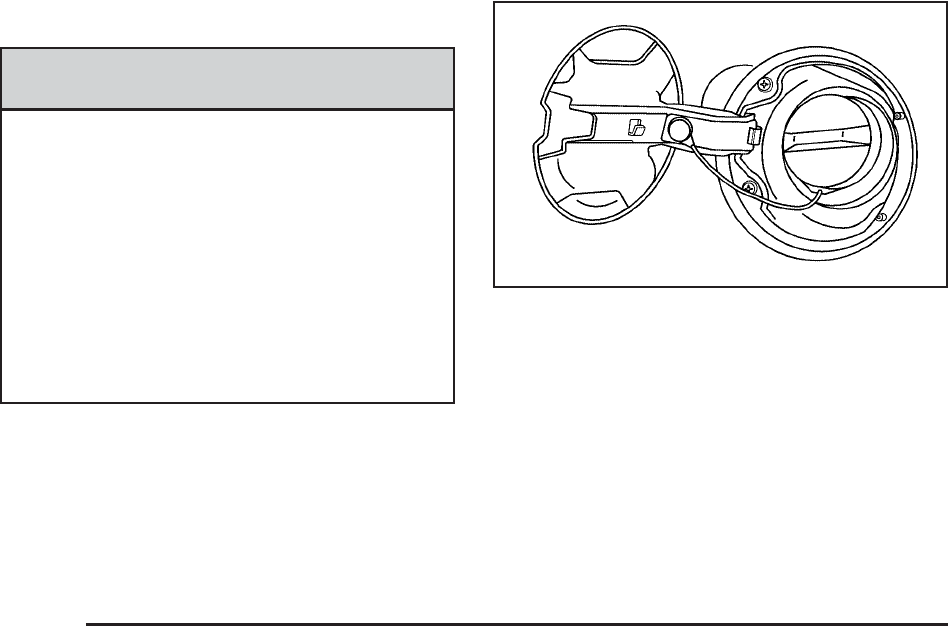
Filling the Tank
{CAUTION:
Fuel vapor burns violently and a fuel fire
can cause bad injuries. To help avoid injuries
to you and others, read and follow all the
instructions on the pump island. Turn off
your engine when you are refueling. Do not
smoke if you are near fuel or refueling your
vehicle. Keep sparks, flames, and smoking
materials away from fuel. Do not leave the
fuel pump unattended when refueling your
vehicle — this is against the law in some
places. Keep children away from the fuel
pump; never let children pump fuel.
The tethered fuel cap is located behind a hinged fuel
door on the driver’s side of the vehicle.
To remove the fuel cap, turn it slowly counterclockwise.
The fuel cap has a spring in it; if the cap is released
too soon, it will spring back to the right.
While refueling, hang the tethered fuel cap from the
hook on the fuel door.
5-8
{CAUTION:
If you spill fuel and then something ignites it,
you could be badly burned. Fuel can spray out
on you if you open the fuel cap too quickly.
This spray can happen if your tank is nearly
full, and is more likely in hot weather. Open
the fuel cap slowly and wait for any hiss noise
to stop. Then unscrew the cap all the way.
Be careful not to spill fuel. Do not top off or overfill
the tank and wait a few seconds after you have finished
pumping before removing the nozzle. Clean fuel from
painted surfaces as soon as possible. See Washing
Your Vehicle on page 5-87.
When replacing the fuel cap, turn it clockwise until
it clicks. Make sure the cap is fully installed. The
diagnostic system can determine if the fuel cap has
been left off or improperly installed. This would allow
fuel to evaporate into the atmosphere. See Malfunction
Indicator Lamp on page 3-41.
Your vehicle may also be equipped with a check gas
cap warning light, which will be displayed on the
instrument panel cluster if the fuel cap is not properly
installed. See Check Gas Cap Light on page 3-48
for more information.
If your vehicle has a Driver Information Center (DIC),
the CHECK GAS CAP message will be displayed if the
fuel cap is not properly installed. See DIC Warnings
and Messages on page 3-57 for more information.
{CAUTION:
If a fire starts while you are refueling, do not
remove the nozzle. Shut off the flow of fuel
by shutting off the pump or by notifying the
station attendant. Leave the area immediately.
Notice: If you need a new fuel cap, be sure to get
the right type. Your dealer can get one for you.
If you get the wrong type, it may not fit properly.
This may cause your malfunction indicator lamp
to light and may damage your fuel tank and
emissions system. See Malfunction Indicator
Lamp on page 3-41.
5-9
Filling a Portable Fuel Container
{CAUTION:
Never fill a portable fuel container while it is in
your vehicle. Static electricity discharge from
the container can ignite the gasoline vapor.
You can be badly burned and your vehicle
damaged if this occurs. To help avoid injury
to you and others:
•Dispense gasoline only into approved
containers.
•Do not fill a container while it is inside a
vehicle, in a vehicle’s trunk, pickup bed,
or on any surface other than the ground.
•Bring the fill nozzle in contact with the
inside of the fill opening before operating
the nozzle. Contact should be maintained
until the filling is complete.
•Do not smoke while pumping gasoline.
Checking Things Under
the Hood
{CAUTION:
An electric fan under the hood can start up
and injure you even when the engine is not
running. Keep hands, clothing and tools away
from any underhood electric fan.
{CAUTION:
Things that burn can get on hot engine parts
and start a fire. These include liquids like fuel,
oil, coolant, brake fluid, windshield washer
and other fluids, and plastic or rubber. You or
others could be burned. Be careful not to drop
or spill things that will burn onto a hot engine.
5-10
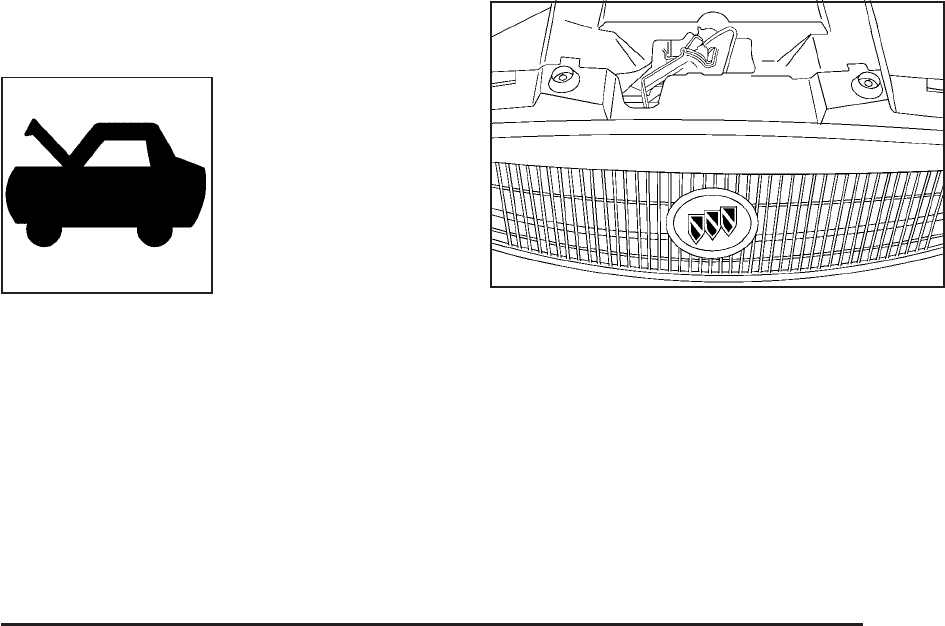
Hood Release
To open the hood, do the following:
1. Pull the interior hood
release handle with
this symbol on it.
It is located to the
left of the steering
column below
the instrument panel.
2. Push the secondary hood release lever, located
under the center of the hood above the grille,
up and to the right to disengage it.
3. Lift the hood.
Before closing the hood, make sure all the filler caps
are properly secured. Pull the hood down and close
it firmly.
5-11
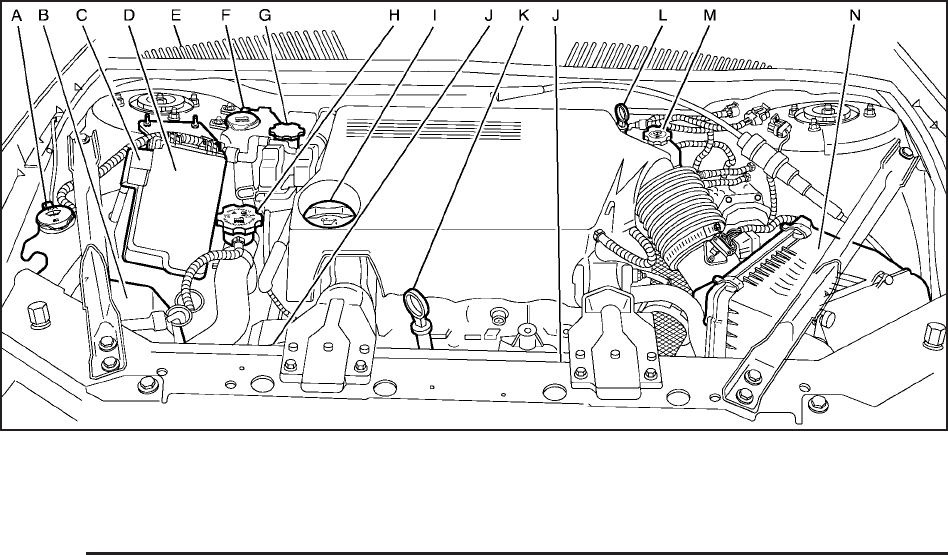
Engine Compartment Overview
When you open the hood on the 3.6L V6 engine, here is what you will see:
5-12

A. Windshield Washer Fluid Reservoir. See “Adding
Washer Fluid” under Windshield Washer Fluid
on page 5-38.
B. Battery. See Battery on page 5-42.
C. Remote Positive (+) Terminal. See Jump Starting
on page 5-42.
D. Underhood Fuse Block. See Underhood Fuse Block
on page 5-95.
E. Passenger Compartment Air Filter. See Passenger
Compartment Air Filter on page 3-30.
F. Engine Coolant Recovery Tank. See Cooling System
on page 5-30.
G. Power Steering Fluid Reservoir. See Power Steering
Fluid on page 5-37.
H. Pressure Cap. See Radiator Pressure Cap
on page 5-27.
I. Engine Oil Fill Cap. See “When to Add Engine Oil”
under Engine Oil on page 5-15.
J. Electric Engine Cooling Fans. See Cooling System
on page 5-30.
K. Engine Oil Dipstick. See “Checking Engine Oil”
under Engine Oil on page 5-15.
L. Automatic Transaxle Fluid Dipstick. See “Checking
the Fluid Level” under Automatic Transaxle Fluid
on page 5-21.
M. Brake Master Cylinder Reservoir. See “Brake Fluid”
under Brakes on page 5-39.
N. Engine Air Cleaner/Filter. See Engine Air
Cleaner/Filter on page 5-20.
5-13
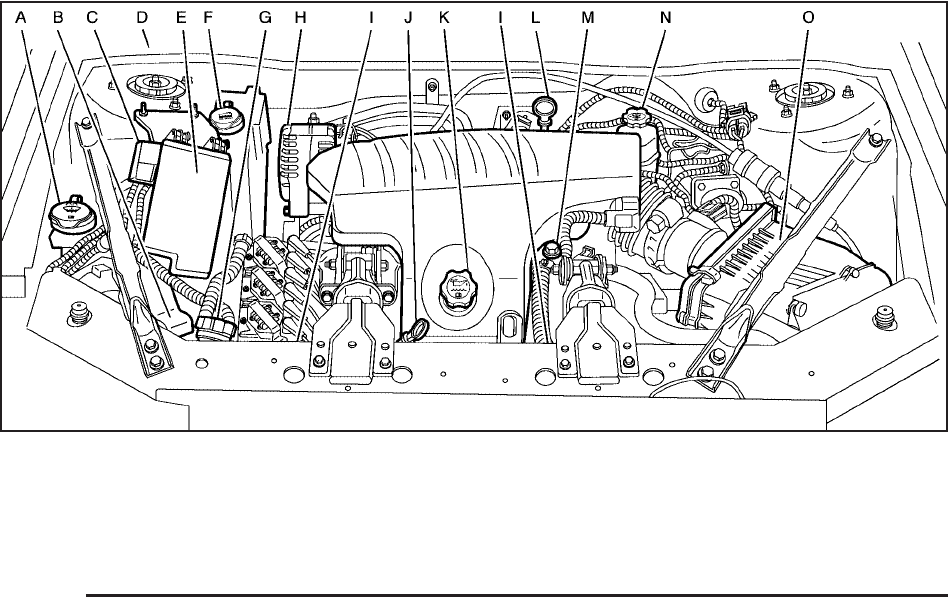
When you open the hood on the 3.8L V6 engine, here is what you will see:
5-14

A. Windshield Washer Fluid Reservoir. See “Adding
Washer Fluid” under Windshield Washer Fluid
on page 5-38.
B. Battery. See Battery on page 5-42.
C. Remote Positive (+) Terminal. See Jump Starting
on page 5-42.
D. Passenger Compartment Air Filter. See Passenger
Compartment Air Filter on page 3-30.
E. Underhood Fuse Block. See Underhood Fuse Block
on page 5-95.
F. Engine Coolant Recovery Tank. See Cooling System
on page 5-30.
G. Radiator Pressure Cap. See Radiator Pressure Cap
on page 5-27.
H. Power Steering Fluid Reservoir (Below Generator).
See Power Steering Fluid on page 5-37.
I. Electric Engine Cooling Fans. See Cooling System
on page 5-30.
J. Engine Oil Dipstick. See “Checking Engine Oil”
under Engine Oil on page 5-15.
K. Engine Oil Fill Cap. See “When to Add Engine Oil”
under Engine Oil on page 5-15.
L. Automatic Transaxle Fluid Dipstick. See “Checking
the Fluid Level” under Automatic Transaxle Fluid
on page 5-21.
M. Engine Coolant Bleed Valve. See “How to Add
Coolant to the Radiator” under Cooling System
on page 5-30.
N. Brake Master Cylinder Reservoir. See “Brake Fluid”
under Brakes on page 5-39.
O. Engine Air Cleaner/Filter. See Engine Air Cleaner/
Filter on page 5-20.
Engine Oil
Checking Engine Oil
It is a good idea to check your engine oil every time
you get fuel. In order to get an accurate reading, the
oil must be warm and the vehicle must be on level
ground.
The engine oil dipstick handle is a yellow loop. See
Engine Compartment Overview on page 5-12 for
the location of the engine oil dipstick.
1. Turn off the engine and give the oil several minutes
to drain back into the oil pan. If you do not do this,
the oil dipstick might not show the actual level.
2. Pull out the dipstick and clean it with a paper towel
or cloth, then push it back in all the way. Remove it
again, keeping the tip down, and check the level.
5-15
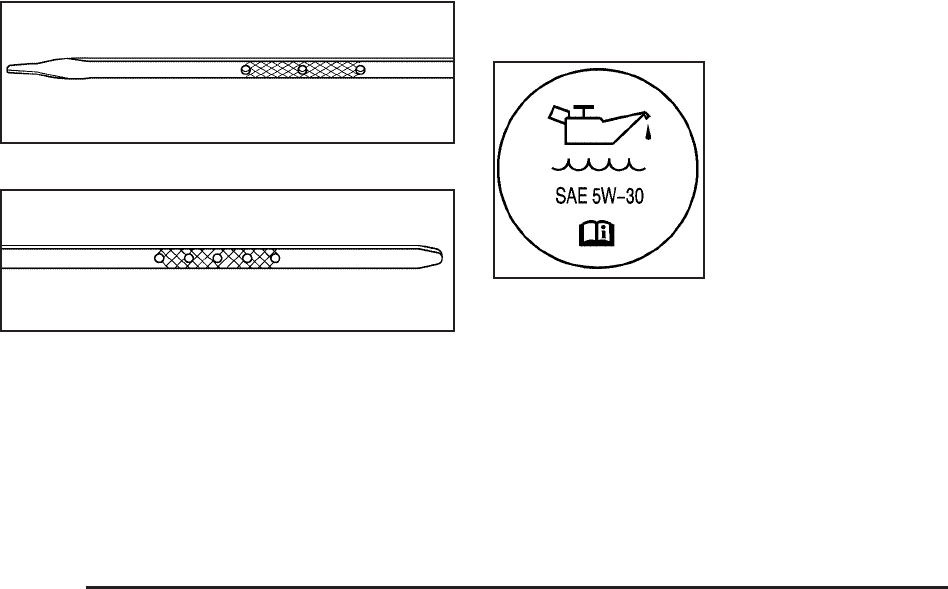
When to Add Engine Oil
If the oil is below the cross-hatched area at the tip of the
dipstick, you will need to add at least one quart/liter of oil.
But you must use the right kind. This section explains
what kind of oil to use. For engine oil crankcase capacity,
see Capacities and Specifications on page 5-98.
Notice: Do not add too much oil. If the engine has
so much oil that the oil level gets above the
cross-hatched area that shows the proper operating
range, the engine could be damaged.
See Engine Compartment
Overview on page 5-12
for the location of the
engine oil fill cap.
Be sure to add enough oil to put the level somewhere in
the proper operating range in the cross-hatched area.
Push the dipstick all the way back in when you are
through.
3.6L V6 Engine
3.8L V6 Engine
5-16
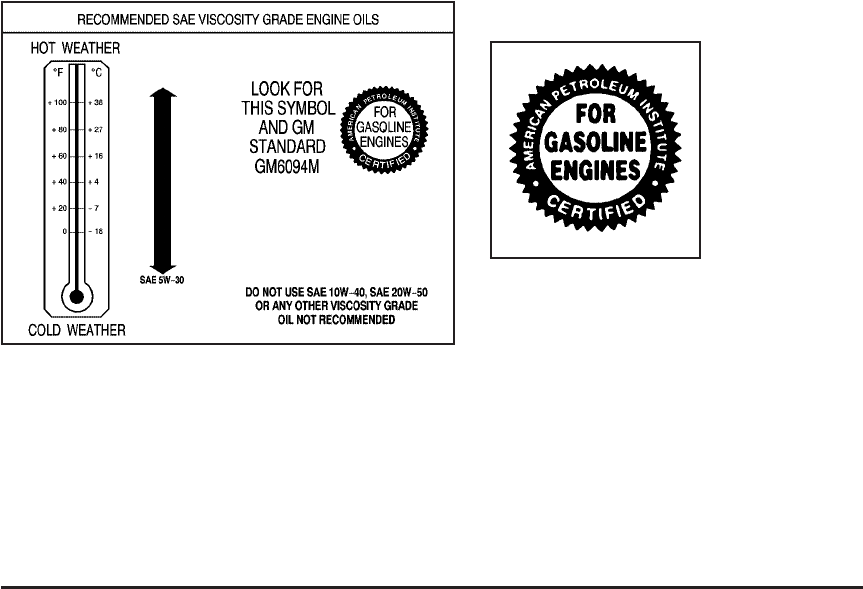
What Kind of Engine Oil to Use
Look for two things:
•GM6094M
Your vehicle’s engine requires oil meeting GM
Standard GM6094M. You should look for and use
only an oil that meets GM Standard GM6094M.
•SAE 5W-30
As shown in the viscosity chart, SAE 5W-30 is best
for your vehicle.
These numbers on an oil container show its
viscosity, or thickness. Do not use other viscosity
oils such as SAE 20W-50.
Oils meeting these
requirements should also
have the starburst
symbol on the container.
This symbol indicates
that the oil has been
certified by the American
Petroleum Institute (API).
You should look for this information on the oil container,
and use only those oils that are identified as meeting
GM Standard GM6094M and have the starburst symbol
on the front of the oil container.
Notice: Use only engine oil identified as meeting
GM Standard GM6094M and showing the American
Petroleum Institute Certified For Gasoline Engines
starburst symbol. Failure to use the recommended
oil can result in engine damage not covered by
your warranty.
GM Goodwrench
®
oil meets all the requirements for
your vehicle.
5-17

If you are in an area of extreme cold, where the
temperature falls below −20°F (−29°C), it is
recommended that you use either an SAE 5W-30
synthetic oil or an SAE 0W-30 oil. Both will provide
easier cold starting and better protection for your
engine at extremely low temperatures.
Engine Oil Additives
Do not add anything to your oil. The recommended
oils with the starburst symbol that meet GM Standard
GM6094M are all you will need for good performance
and engine protection.
Engine Oil Life System
When to Change Engine Oil
Your vehicle has a computer system that lets you know
when to change the engine oil and filter. This is based
on engine revolutions and engine temperature, and not
on mileage. Based on driving conditions, the mileage
at which an oil change will be indicated can vary
considerably. For the oil life system to work properly,
you must reset the system every time the oil is changed.
When the system has calculated that oil life has been
diminished, it will indicate that an oil change is necessary.
A change engine oil light or, if your vehicle has the
Driver Information Center (DIC), a CHANGE OIL SOON
message will come on. See Change Engine Oil Light on
page 3-45 or DIC Warnings and Messages on page 3-57.
Change the oil as soon as possible within the next
600 miles (1 000 km). It is possible that, if you are driving
under the best conditions, the oil life system may not
indicate that an oil change is necessary for over a year.
However, the engine oil and filter must be changed at
least once a year and at this time the system must be
reset. Your dealer has GM-trained service people who
will perform this work using genuine GM parts and reset
the system. It is also important to check your oil regularly
and keep it at the proper level.
If the system is ever reset accidentally, you must
change the oil at 3,000 miles (5 000 km) since the last
oil change. Remember to reset the oil life system
whenever the oil is changed.
How to Reset the Engine Oil Life
System
The Engine Oil Life System calculates when to change
the engine oil and filter based on vehicle use. Anytime
the oil is changed, reset the system so it can calculate
when the next oil change is required. If a situation
occurs where you change the oil prior to a change
engine oil light or CHANGE OIL SOON message being
turned on, reset the system.
5-18

After changing the engine oil, reset the system by
performing the following steps:
•Vehicles with Driver Information Center (DIC)
1. Press the option button on the DIC until
ENGINE OIL MONITOR appears on the
DIC screen.
2. Press the set/reset button to reset the system.
The next screen indicates that the CHANGE
OIL SOON message has been reset.
If the vehicle has the uplevel DIC, when
the gages button is pressed and the
OIL LIFE REMAINING mode appears,
it should read 100 percent OIL LIFE
REMAINING.
3. Turn the key to OFF.
•Vehicles without Driver Information Center (DIC)
1. With the engine off, turn the ignition key
to RUN.
2. Fully press and release the accelerator
pedal slowly three times within five seconds.
3. Turn the key to OFF, then start the vehicle.
If the light or message comes back on when you
start your vehicle, the oil life system has not reset.
Repeat the procedure.
What to Do with Used Oil
Used engine oil contains certain elements that may be
unhealthy for your skin and could even cause cancer.
Do not let used oil stay on your skin for very long. Clean
your skin and nails with soap and water, or a good
hand cleaner. Wash or properly dispose of clothing or
rags containing used engine oil. See the manufacturer’s
warnings about the use and disposal of oil products.
Used oil can be a threat to the environment. If you
change your own oil, be sure to drain all the oil from the
filter before disposal. Never dispose of oil by putting it in
the trash, pouring it on the ground, into sewers, or into
streams or bodies of water. Instead, recycle it by taking it
to a place that collects used oil. If you have a problem
properly disposing of used oil, ask your dealer, a service
station or a local recycling center for help.
5-19
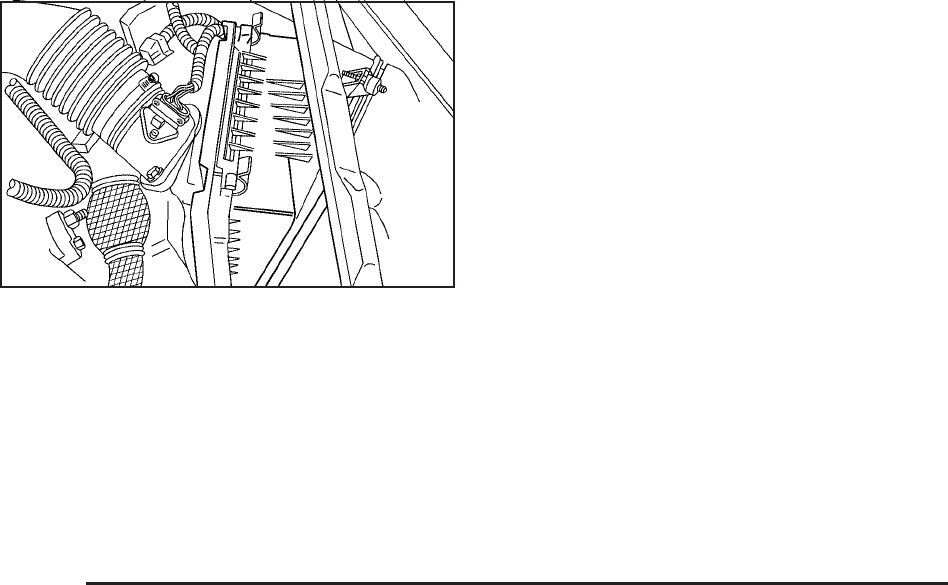
Engine Air Cleaner/Filter
The engine air cleaner/filter is located in the engine
compartment on the driver’s side of the vehicle.
See Engine Compartment Overview on page 5-12
for more information on location.
When to Inspect the Engine
Air Cleaner/Filter
Inspect the air cleaner/filter at the Maintenance II
intervals and replace it at the first oil change after each
50,000 mile (83 000 km) interval. See Scheduled
Maintenance on page 6-4 for more information. If you
are driving in dusty/dirty conditions, inspect the filter
at each engine oil change.
How to Inspect the Engine
Air Cleaner/Filter
To inspect the air cleaner/filter, remove the filter from
the vehicle and lightly shake the filter to release
loose dust and dirt. If the filter remains caked with dirt,
a new filter is required.
To inspect or replace the engine air cleaner/filter do
the following:
1. Lift the filter cover tabs on top of the engine
air cleaner/filter housing.
2. Push the filter cover housing toward the engine.
3. Pull out the filter.
4. Inspect or replace the engine air cleaner/filter.
See Normal Maintenance Replacement Parts
on page 6-13.
3.6L V6 Engine shown, 3.8L V6 Engine similar
5-20
5. To reinstall the cover, position the tabs through the
slots on the housing. A notch on the sides of the
filter cover will indicate the correct engagement.
6. Push the cover tabs on top of the housing to lock
the cover in place.
{CAUTION:
Operating the engine with the air cleaner/filter
off can cause you or others to be burned.
The air cleaner not only cleans the air; it helps
to stop flames if the engine backfires. If it is
not there and the engine backfires, you could
be burned. Do not drive with it off, and be
careful working on the engine with the air
cleaner/filter off.
Notice: If the air cleaner/filter is off, a backfire
can cause a damaging engine fire. And, dirt
can easily get into your engine, which will damage
it. Always have the air cleaner/filter in place
when you are driving.
Automatic Transaxle Fluid
When to Check and Change Automatic
Transaxle Fluid
A good time to check the automatic transaxle fluid level
is when the engine oil is changed.
Change the fluid and filter at the intervals listed in
Additional Required Services on page 6-6, and be sure
to use the transaxle fluid listed in Recommended
Fluids and Lubricants on page 6-12.
5-21

How to Check Automatic Transaxle
Fluid
Because this operation can be a little difficult, you may
choose to have this done at the dealership service
department.
If you do it yourself, be sure to follow all the instructions
here, or you could get a false reading on the dipstick.
Notice: Too much or too little fluid can damage the
transaxle. Too much can mean that some of the fluid
could come out and fall on hot engine or exhaust
system parts, starting a fire. Too little fluid could
cause the transaxle to overheat. Be sure to get an
accurate reading if you check the transaxle fluid.
Wait at least 30 minutes before checking the transaxle
fluid level if you have been driving:
•When outside temperatures are above 90°F (32°C).
•At high speed for quite a while.
•In heavy traffic — especially in hot weather.
•While pulling a trailer.
To get the right reading, the fluid should be at normal
operating temperature, which is 180°F to 200°F
(82°C to 93°C).
Get the vehicle warmed up by driving about 15 miles
(24 km) when outside temperatures are above 50°F
(10°C). If it is colder than 50°F (10°C), you may have
to drive longer.
Checking the Fluid Level
Prepare the vehicle as follows:
1. Park the vehicle on a level place. Keep the engine
running.
2. With the parking brake applied, place the shift lever
in PARK (P).
3. With your foot on the brake pedal, move the
shift lever through each gear, pausing for about
three seconds in each one. Then, position the
shift lever in PARK (P).
4. Let the engine run at idle for three to five minutes.
5-22
Then, without shutting off the engine, follow these steps:
The transaxle fluid dipstick
handle has this symbol on
it, and is located near
the rear of the engine
compartment. See Engine
Compartment Overview
on page 5-12 for more
information on location.
1. Pull out the dipstick and wipe it with a clean rag
or paper towel.
2. Push it back in all the way, wait three seconds and
then pull it back out again.
3. Check both sides of the dipstick, and read
the lower level. The fluid level must be in the
crosshatched area.
4. If the fluid level is in the acceptable range,
push the dipstick back in all the way.
How to Add Automatic Transaxle Fluid
Refer to the Maintenance Schedule to determine
what kind of transaxle fluid to use. See Recommended
Fluids and Lubricants on page 6-12.
If the fluid level is low, add only enough of the proper
fluid to bring the level into the crosshatched area on
the dipstick.
1. Pull out the dipstick.
2. Using a long-neck funnel, add enough fluid at
the dipstick hole to bring it to the proper level.
It does not take much fluid, generally less than
one pint (0.5 L). Do not overfill.
Notice: Use of the incorrect automatic transaxle
fluid may damage your vehicle, and the damages may
not be covered by your warranty. Always use the
automatic transaxle fluid listed in Recommended
Fluids and Lubricants on page 6-12.
3. After adding fluid, recheck the fluid level as
described under “How to Check Automatic
Transaxle Fluid,” earlier in this section.
4. When the correct fluid level is obtained,
push the dipstick back in all the way.
5-23

Engine Coolant
The cooling system in the vehicle is filled with
DEX-COOL
®
engine coolant. This coolant is
designed to remain in the vehicle for five years or
150,000 miles (240 000 km), whichever occurs first,
if only DEX-COOL
®
extended life coolant is added.
The following explains the cooling system and how
to add coolant when it is low. If there is a problem with
engine overheating or if coolant needs to be added
to the radiator, see Engine Overheating on page 5-27.
A 50/50 mixture of clean, drinkable water and
DEX-COOL
®
engine coolant will:
•Give freezing protection down to −34°F (−37°C).
•Give boiling protection up to 265°F (129°C).
•Protect against rust and corrosion.
•Help keep the proper engine temperature.
•Let the warning lights and gages work as
they should.
Notice: Using coolant other than DEX-COOL
®
may
cause premature engine, heater core, or radiator
corrosion. In addition, the engine coolant may
require changing sooner, at the first maintenance
service after each 25,000 miles (41 500 km) or
24 months, whichever occurs first. Any repairs
would not be covered by your warranty. Always use
DEX-COOL
®
(silicate-free) coolant in your vehicle.
What to Use
Use a mixture of one-half clean, drinkable water and
one-half DEX-COOL
®
engine coolant which will not
damage aluminum parts. If this coolant mixture is used,
nothing else needs to be added.
5-24
{CAUTION:
Adding only plain water to your cooling
system can be dangerous. Plain water, or
some other liquid such as alcohol, can boil
before the proper coolant mixture will. Your
vehicle’s coolant warning system is set for the
proper coolant mixture. With plain water or the
wrong mixture, your engine could get too hot
but you would not get the overheat warning.
Your engine could catch fire and you or others
could be burned. Use a 50/50 mixture of clean,
drinkable water and DEX-COOL
®
coolant.
Notice: If you use an improper coolant mixture,
your engine could overheat and be badly damaged.
The repair cost would not be covered by your
warranty. Too much water in the mixture can freeze
and crack the engine, radiator, heater core and
other parts.
If coolant needs to be added more than four times a
year, have your dealer check the cooling system.
Notice: If you use extra inhibitors and/or additives
in your vehicle’s cooling system, you could
damage your vehicle. Use only the proper mixture
of the engine coolant listed in this manual for
the cooling system. See Recommended Fluids and
Lubricants on page 6-12 for more information.
5-25
Checking Coolant
The coolant recovery tank
is located in the engine
compartment toward
the rear of the engine on
the passenger’s side of
the vehicle. See Engine
Compartment Overview
on page 5-12 for more
information on location.
The vehicle must be on a level surface when checking
the coolant level.
When the engine is cold, the coolant level should be
at the cold fill line or a little higher. The cold fill line
is near the bottom of the surge tank and has an
arrow pointing down at it.
Adding Coolant
If more coolant is needed, add the proper DEX-COOL
®
coolant mixture at the coolant recovery tank, but be
careful not to spill it.
If the coolant recovery tank is completely empty, add
coolant to the radiator. See Engine Overheating
on page 5-27.
{CAUTION:
Turning the radiator pressure cap when the
engine and radiator are hot can allow steam
and scalding liquids to blow out and burn
you badly. With the coolant recovery tank,
you will almost never have to add coolant at
the radiator. Never turn the radiator pressure
cap — even a little — when the engine and
radiator are hot.
3.8L V6 Engine shown,
3.6L V6 Engine
similar
5-26
{CAUTION:
You can be burned if you spill coolant on hot
engine parts. Coolant contains ethylene glycol,
and it will burn if the engine parts are hot
enough. Do not spill coolant on a hot engine.
Occasionally check the coolant level in the radiator.
For information on how to add coolant to the radiator,
see Cooling System on page 5-30.
Radiator Pressure Cap
Notice: If the pressure cap is not tightly installed,
coolant loss and possible engine damage may
occur. Be sure the cap is properly and tightly
secured.
The radiator pressure cap is located in the front of
the engine compartment on the passenger’s side of
the vehicle. See Engine Compartment Overview
on page 5-12 for more information on location.
Engine Overheating
There is a coolant temperature gage and a warning
light on the instrument panel cluster that indicate
an overheated engine condition. See Engine Coolant
Temperature Gage on page 3-40 and Engine Coolant
Temperature Warning Light on page 3-40 for more
information.
In addition, if your vehicle is equipped with a Driver
Information Center (DIC), you will find an ENGINE
COOLANT HOT and a REDUCED POWER STOP
WHEN SAFE message displayed on the DIC.
See DIC Warnings and Messages on page 3-57 for
more information.
5-27
If Steam Is Coming From Your Engine
{CAUTION:
Steam from an overheated engine can burn
you badly, even if you just open the hood.
Stay away from the engine if you see or hear
steam coming from it. Just turn it off and get
everyone away from the vehicle until it cools
down. Wait until there is no sign of steam or
coolant before you open the hood.
If you keep driving when your engine is
overheated, the liquids in it can catch fire.
You or others could be badly burned. Stop
your engine if it overheats, and get out of
the vehicle until the engine is cool.
See Overheated Engine Protection Operating
Mode on page 5-29 for information on driving
to a safe place in an emergency.
Notice: If your engine catches fire because you
keep driving with no coolant, your vehicle can
be badly damaged. The costly repairs would not be
covered by your warranty. See Overheated Engine
Protection Operating Mode on page 5-29 for
information on driving to a safe place in an
emergency.
If No Steam Is Coming From
Your Engine
If you get an engine overheat warning, but see or
hear no steam, the problem may not be too serious.
Sometimes the engine can get a little too hot
when you:
•Climb a long hill on a hot day.
•Stop after high-speed driving.
•Idle for long periods in traffic.
•Tow a trailer.
5-28

If you get the overheat warning with no sign of steam,
try this for a minute or so:
1. In heavy traffic, let the engine idle in NEUTRAL (N)
while stopped. If it is safe to do so, pull off the road,
shift to PARK (P) or NEUTRAL (N) and let the
engine idle.
2. Set the climate controls to the highest heat setting
and fan speed and open the windows as necessary.
If you no longer have the overheat warning, you
can drive. Just to be safe, drive slower for about
10 minutes. If the warning does not come back on,
you can drive normally.
If the warning continues and you have not stopped,
pull over, stop, and park your vehicle right away.
If there is still no sign of steam, you can idle the
engine for three minutes while you are parked. If you
still have the warning, turn off the engine and get
everyone out of the vehicle until it cools down.
Also, see “Overheated Engine Protection Operating
Mode” later in this section.
You may decide not to lift the hood but to get service
help right away.
Overheated Engine Protection
Operating Mode
This emergency operating mode allows your vehicle to
be driven to a safe place in an emergency situation.
If an overheated engine condition exists, an overheat
protection mode which alternates firing groups of
cylinders helps prevent engine damage. In this mode,
you will notice a significant loss in power and engine
performance. The REDUCED POWER STOP WHEN
SAFE message will come on in the Driver Information
Center (DIC), along with the engine coolant temperature
warning light on the instrument panel, to indicate the
vehicle has entered overheated engine protection
operating mode. The temperature gage will also indicate
an overheat condition exists. Driving extended miles
(km) and/or towing a trailer in the overheat protection
mode should be avoided.
Notice: After driving in the overheated engine
protection operating mode, to avoid engine damage,
allow the engine to cool before attempting any
repair. The engine oil will be severely degraded.
Repair the cause of coolant loss, change the oil
and reset the oil life system. See Engine Oil
on page 5-15.
5-29
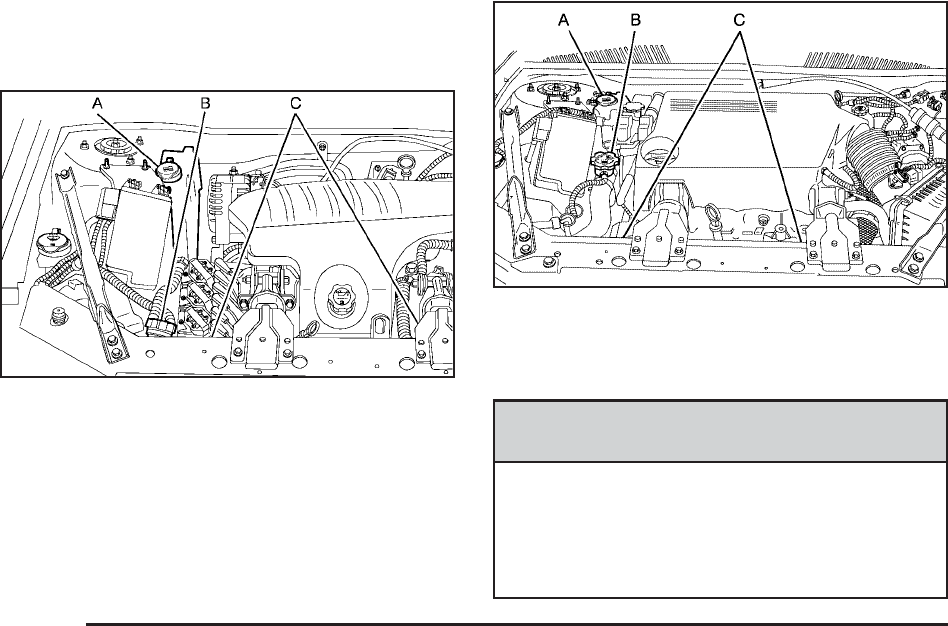
Cooling System
When you decide it is safe to lift the hood, here is what
you will see:
A. Coolant Recovery Tank
B. Radiator Pressure Cap
C. Electric Engine Cooling Fans
A. Coolant Recovery Tank
B. Pressure Cap
C. Electric Engine Cooling Fans
{CAUTION:
An electric engine cooling fan under the hood
can start up even when the engine is not
running and can injure you. Keep hands,
clothing and tools away from any underhood
electric fan.
3.8L V6 Engine
3.6L V6 Engine
5-30
If the coolant inside the coolant recovery tank is
boiling, do not do anything else until it cools down.
The vehicle should be parked on a level surface.
When the engine is cold, the coolant level should be
at or above the cold fill line on the coolant recovery tank.
If it is not, there may be a leak at the pressure cap or
in the radiator hoses, heater hoses, radiator, water
pump, or somewhere else in the cooling system.
{CAUTION:
Heater and radiator hoses, and other engine
parts, can be very hot. Do not touch them.
If you do, you can be burned.
Do not run the engine if there is a leak. If you
run the engine, it could lose all coolant. That
could cause an engine fire, and you could be
burned. Get any leak fixed before you drive
the vehicle.
If there seems to be no leak, with the engine on, check
to see if the electric engine cooling fans are running.
If the engine is overheating, the fans should be running.
If the fans are not running, the vehicle needs service.
Notice: Engine damage from running your engine
without coolant is not covered by your warranty.
See Overheated Engine Protection Operating Mode
on page 5-29 for information on driving to a safe
place in an emergency.
Notice: Using coolant other than DEX-COOL
®
may
cause premature engine, heater core or radiator
corrosion. In addition, the engine coolant may
require changing sooner, at 30,000 miles (50 000 km)
or 24 months, whichever occurs first. Any repairs
would not be covered by your warranty. Always use
DEX-COOL
®
(silicate-free) coolant in your vehicle.
5-31
How to Add Coolant to the Coolant
Recovery Tank
{CAUTION:
Adding only plain water to your cooling
system can be dangerous. Plain water, or
some other liquid such as alcohol, can boil
before the proper coolant mixture will. Your
vehicle’s coolant warning system is set for the
proper coolant mixture. With plain water or the
wrong mixture, your engine could get too hot
but you would not get the overheat warning.
Your engine could catch fire and you or others
could be burned. Use a 50/50 mixture of clean,
drinkable water and DEX-COOL
®
coolant.
If you have not found a problem yet, but the coolant
level is not at the cold fill line, add a 50/50 mixture
of clean, drinkable water and DEX-COOL
®
engine
coolant at the coolant recovery tank. See Engine
Coolant on page 5-24 for more information.
Notice: In cold weather, water can freeze and crack
the engine, radiator, heater core and other parts.
Use the recommended coolant and the proper
coolant mixture.
{CAUTION:
You can be burned if you spill coolant on hot
engine parts. Coolant contains ethylene glycol
and it will burn if the engine parts are hot
enough. Do not spill coolant on a hot engine.
When the coolant level in the coolant recovery tank is at
the cold fill line, start the vehicle.
5-32
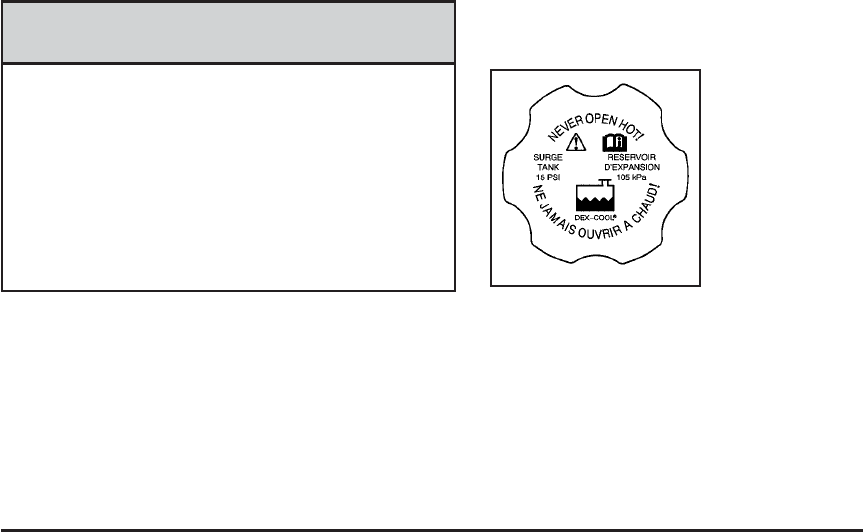
If the overheat warning continues, there is one more
thing you can try. You can add the proper coolant
mixture directly to the radiator, but be sure the system
is cool before you do it.
{CAUTION:
Steam and scalding liquids from a hot cooling
system can blow out and burn you badly. They
are under pressure, and if you turn the radiator
pressure cap — even a little — they can come
out at high speed. Never turn the cap when the
cooling system, including the radiator pressure
cap, is hot. Wait for the cooling system and
radiator pressure cap to cool if you ever have
to turn the pressure cap.
How to Add Coolant to the Radiator
(3.8L V6 Engine)
Notice: Your engine has a specific radiator fill
procedure. Failure to follow this procedure could
cause your engine to overheat and be severely
damaged.
1. You can remove the
radiator pressure cap
when the cooling
system, including the
radiator pressure cap
and upper radiator
hose, is no longer hot.
Turn the pressure cap
slowly counterclockwise
until it first stops.
Do not press down while turning the pressure cap.
If you hear a hiss, wait for that to stop. A hiss
means there is still some pressure left.
2. Then keep turning the pressure cap, but now push
down as you turn it. Remove the pressure cap.
5-33
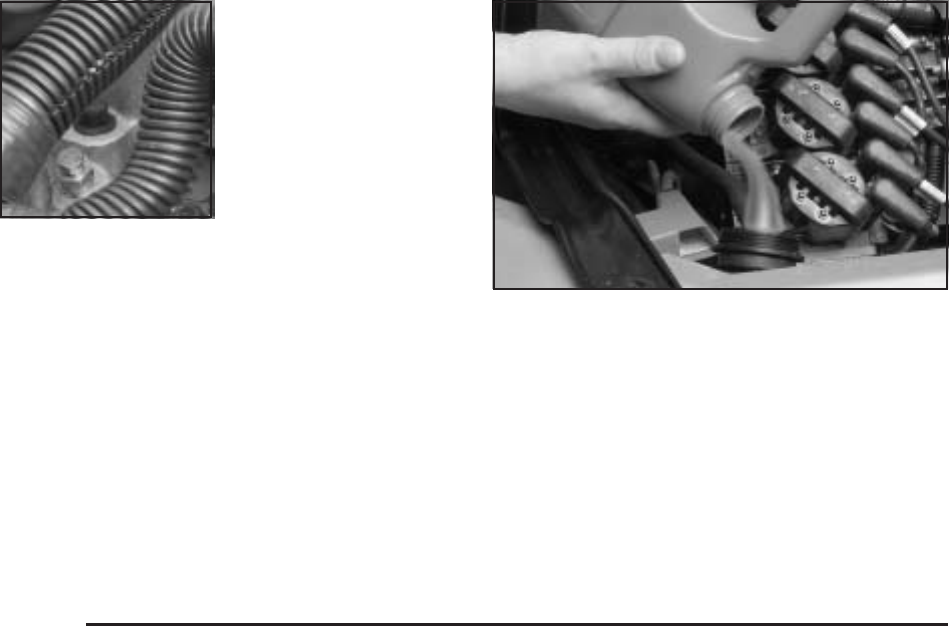
3. Open the coolant air
bleed valve located
on the thermostat
housing near the
heater hose. See
Engine Compartment
Overview on page 5-12
for more information
on location.
4. Fill the radiator with the proper DEX-COOL
®
coolant mixture, up to the base of the filler
neck. See Engine Coolant on page 5-24 for more
information about the proper coolant mixture.
If you see a stream of coolant coming from the
air bleed valve, close the valve. Otherwise, close
the valve after the radiator is filled.
5. Rinse or wipe any spilled coolant from the engine
and the compartment.
6. Then fill the coolant recovery tank to the cold fill line.
7. Put the cap back on the coolant recovery tank,
but leave the radiator pressure cap off.
5-34
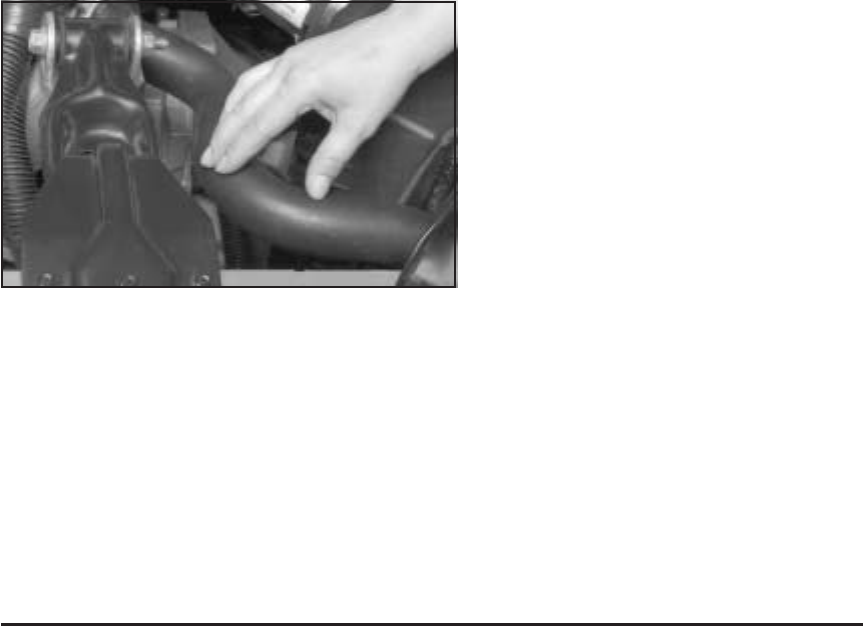
8. Start the engine and let it run until you can feel the
upper radiator hose getting hot. Watch out for the
engine cooling fans.
9. By this time, the coolant level inside the radiator
filler neck may be lower. If the level is lower, add
more of the proper DEX-COOL
®
coolant mixture
through the filler neck until the level reaches
the base of the filler neck.
10. Then replace the radiator pressure cap. At any time
during this procedure if coolant begins to flow out of
the filler neck, reinstall the pressure cap. Be sure
the pressure cap is hand-tight and fully seated.
11. Check the coolant in the recovery tank. The level in
the coolant recovery tank should be at the cold fill
line when the engine is cold.
5-35
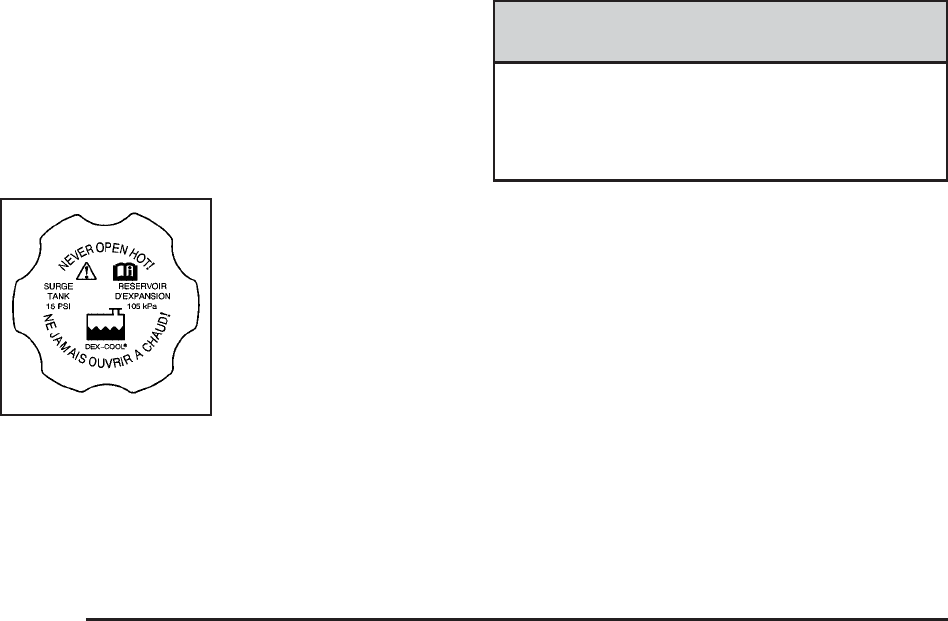
How to Add Coolant to the Cooling
System (3.6L V6 Engine)
Notice: Your engine has a specific cooling system
drain and fill procedure. Failure to follow this
procedure could cause your engine to overheat
and be severely damaged. If your engine’s cooling
system needs to be drained and re-filled, please
see your dealer.
1. You can remove the
pressure cap when
the cooling system,
including the pressure
cap and upper radiator
hose is no longer hot.
Turn the pressure
cap slowly
counterclockwise.
If you hear a hiss, wait for that to stop. A hiss
means that there is still some pressure left.
2. Then keep turning the pressure cap and remove it.
{CAUTION:
You can be burned if you spill coolant on hot
engine parts. Coolant contains ethylene glycol
and it will burn if the engine parts are hot
enough. Do not spill coolant on a hot engine.
3. Fill the cooling system with the proper DEX-COOL
®
coolant mixture, up to the base of the filler neck.
See Engine Coolant on page 5-24 for more
information about the proper coolant mixture.
4. Rinse or wipe any spilled coolant from the engine
and the compartment.
5-36
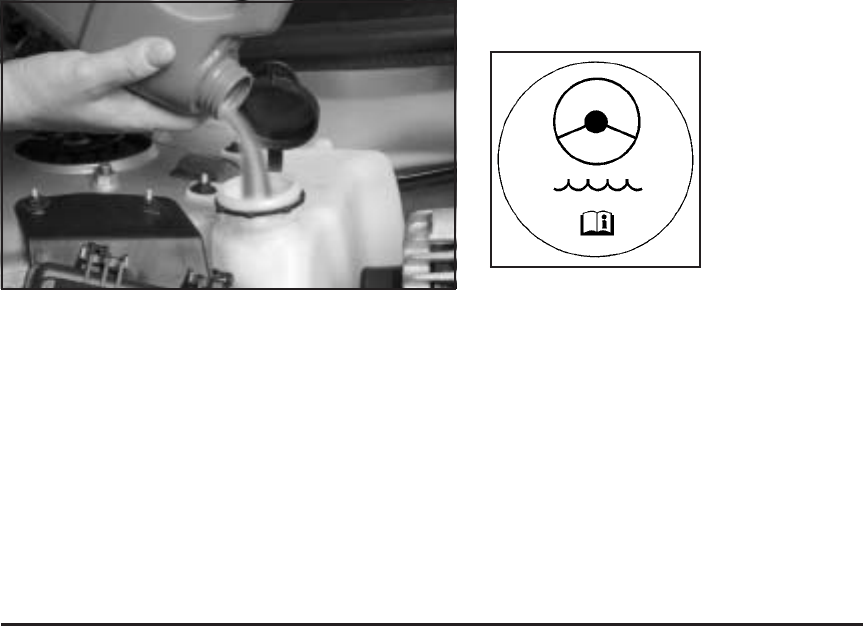
5. Then fill the coolant recovery tank to the cold fill line.
6. Reinstall the coolant recovery tank cap and the
pressure cap.
7. If the coolant in the recovery tank is constantly low,
you should have your dealership service department
inspect the vehicle for leaks.
Power Steering Fluid
See Engine Compartment
Overview on page 5-12 for
reservoir location.
When to Check Power Steering Fluid
It is not necessary to regularly check power steering fluid
unless you suspect there is a leak in the system or
you hear an unusual noise. A fluid loss in this system
could indicate a problem. Have the system inspected
and repaired.
5-37

How to Check Power Steering Fluid
To check the power steering fluid, do the following:
1. Turn the key off and let the engine compartment
cool down.
2. Wipe the cap and the top of the reservoir clean.
3. Unscrew the cap and wipe the dipstick with a
clean rag.
4. Replace the cap and completely tighten it.
5. Remove the cap again and look at the fluid level
on the dipstick.
If your vehicle has the 3.8L V6 engine, the fluid level
should be between the ADD and HOT marks when the
engine is cold, and at the HOT mark when the engine
is hot. If the fluid is at the ADD mark when the engine
is cold or hot, power steering fluid should be added.
If your vehicle has the 3.6L V6 engine, the fluid
level should be between the Min (Minimum) and
Max (Maximum) marks when the engine is cold, and
at the Max mark when the engine is hot. If the fluid
is at the Min mark when the engine is cold or hot,
power steering fluid should be added.
What to Use
To determine what kind of fluid to use, see
Recommended Fluids and Lubricants on page 6-12.
Always use the proper fluid. Failure to use the proper
fluid can cause leaks and damage hoses and seals.
Windshield Washer Fluid
What to Use
When you need windshield washer fluid, be sure to
read the manufacturer’s instructions before use. If you
will be operating your vehicle in an area where the
temperature may fall below freezing, use a fluid that
has sufficient protection against freezing.
Adding Washer Fluid
When the windshield washer fluid is low, a low washer
fluid light may appear on the instrument panel cluster.
See Low Washer Fluid Warning Light on page 3-47
for more information.
In addition, if your vehicle is equipped with a Driver
Information Center (DIC), the LOW WASHER FLUID
message will appear when the fluid level is low.
See DIC Warnings and Messages on page 3-57 for
more information.
5-38
Open the cap with the
washer symbol on it.
Add washer fluid until the
tank is full. See Engine
Compartment Overview
on page 5-12 for reservoir
location.
Notice:
•When using concentrated washer fluid, follow
the manufacturer’s instructions for adding
water.
•Do not mix water with ready-to-use washer fluid.
Water can cause the solution to freeze and
damage your washer fluid tank and other parts
of the washer system. Also, water does not
clean as well as washer fluid.
•Fill your washer fluid tank only three-quarters
full when it is very cold. This allows for
expansion if freezing occurs, which could
damage the tank if it is completely full.
•Do not use engine coolant (antifreeze) in your
windshield washer. It can damage your washer
system and paint.
Brakes
Brake Fluid
Your brake master
cylinder reservoir is filled
with DOT-3 brake fluid.
See Engine Compartment
Overview on page 5-12
for the location of the
reservoir.
There are only two reasons why the brake fluid level
in the reservoir might go down. The first is that the brake
fluid goes down to an acceptable level during normal
brake lining wear. When new linings are put in, the
fluid level goes back up. The other reason is that fluid
is leaking out of the brake system. If it is, you should
have your brake system fixed, since a leak means that
sooner or later your brakes will not work well, or will
not work at all.
5-39
So, it is not a good idea to top off your brake fluid.
Adding brake fluid will not correct a leak. If you add
fluid when your linings are worn, then you will have
too much fluid when you get new brake linings.
You should add or remove brake fluid, as necessary,
only when work is done on the brake hydraulic system.
{CAUTION:
If you have too much brake fluid, it can spill on
the engine. The fluid will burn if the engine is
hot enough. You or others could be burned,
and your vehicle could be damaged. Add brake
fluid only when work is done on the brake
hydraulic system.
When your brake fluid falls to a low level, your brake
warning light will come on. See Brake System Warning
Light on page 3-38.
What to Add
When you do need brake fluid, use only DOT-3 brake
fluid. Use new brake fluid from a sealed container
only. See Recommended Fluids and Lubricants
on page 6-12.
Always clean the brake fluid reservoir cap and the
area around the cap before removing it. This will help
keep dirt from entering the reservoir.
{CAUTION:
With the wrong kind of fluid in your brake
system, your brakes may not work well, or they
may not even work at all. This could cause a
crash. Always use the proper brake fluid.
Notice:
•Using the wrong fluid can badly damage brake
system parts. For example, just a few drops of
mineral-based oil, such as engine oil, in your
brake system can damage brake system parts so
badly that they will have to be replaced. Do not
let someone put in the wrong kind of fluid.
•If you spill brake fluid on your vehicle’s painted
surfaces, the paint finish can be damaged. Be
careful not to spill brake fluid on your vehicle. If
you do, wash it off immediately. See Washing
Your Vehicle on page 5-87.
5-40
Brake Wear
Your vehicle has four-wheel disc brakes.
Disc brake pads have built-in wear indicators that
make a high-pitched warning sound when the brake
pads are worn and new pads are needed. The sound
may come and go or be heard all the time your vehicle
is moving, except when you are pushing on the
brake pedal firmly.
{CAUTION:
The brake wear warning sound means that soon
your brakes will not work well. That could lead
to an accident. When you hear the brake wear
warning sound, have your vehicle serviced.
Notice: Continuing to drive with worn-out brake
pads could result in costly brake repair.
Some driving conditions or climates may cause a brake
squeal when the brakes are first applied or lightly
applied. This does not mean something is wrong with
your brakes.
Properly torqued wheel nuts are necessary to help
prevent brake pulsation. When tires are rotated, inspect
brake pads for wear and evenly tighten wheel nuts in
the proper sequence to GM torque specifications.
Brake linings should always be replaced as complete
axle sets.
Brake Pedal Travel
See your dealer if the brake pedal does not return
to normal height, or if there is a rapid increase in
pedal travel. This could be a sign of brake trouble.
Brake Adjustment
Every time you apply the brakes, with or without the
vehicle moving, your brakes adjust for wear.
5-41

Replacing Brake System Parts
The braking system on a vehicle is complex. Its many
parts have to be of top quality and work well together if
the vehicle is to have really good braking. Your vehicle
was designed and tested with top-quality GM brake parts.
When you replace parts of your braking system — for
example, when your brake linings wear down and you
need new ones put in — be sure you get new approved
GM replacement parts. If you do not, your brakes may no
longer work properly. For example, if someone puts in
brake linings that are wrong for your vehicle, the balance
between your front and rear brakes can change — for
the worse. The braking performance you have come to
expect can change in many other ways if someone puts
in the wrong replacement brake parts.
Battery
Your vehicle has a maintenance free battery. When
it is time for a new battery, get one that has the
replacement number shown on the original battery’s
label. We recommend an ACDelco
®
replacement
battery. See Engine Compartment Overview on
page 5-12 for battery location.
Warning: Battery posts, terminals, and related
accessories contain lead and lead compounds,
chemicals known to the State of California to cause
cancer and reproductive harm. Wash hands after
handling.
If the battery has a very low charge or is dead, you may
not be able to remove the ignition key from the ignition
switch or shift out of PARK (P). Refer to Shifting
Out of Park (P) on page 2-32.
Vehicle Storage
If you are not going to drive your vehicle for 25 days
or more, remove the black, negative (−) cable from
the battery. This will help keep the battery from
running down.
{CAUTION:
Batteries have acid that can burn you and
gas that can explode. You can be badly hurt
if you are not careful. See Jump Starting on
page 5-42 for tips on working around a battery
without getting hurt.
Jump Starting
If your vehicle’s battery has run down, you may want to
use another vehicle and some jumper cables to start
your vehicle. Be sure to use the following steps to do
it safely.
5-42
{CAUTION:
Batteries can hurt you. They can be dangerous
because:
•They contain acid that can burn you.
•They contain gas that can explode or
ignite.
•They contain enough electricity to
burn you.
If you do not follow these steps exactly, some
or all of these things can hurt you.
Notice: Ignoring these steps could result in costly
damage to your vehicle that would not be covered
by your warranty.
Trying to start your vehicle by pushing or pulling it
will not work, and it could damage your vehicle.
1. Check the other vehicle. It must have a 12-volt
battery with a negative ground system.
Notice: If the other vehicle’s system is not a 12-volt
system with a negative ground, both vehicles can
be damaged. Only use vehicles with 12-volt systems
with negative grounds to jump start your vehicle.
2. Get the vehicles close enough so the jumper cables
can reach, but be sure the vehicles are not touching
each other. If they are, it could cause a ground
connection you do not want. You would not be able
to start your vehicle, and the bad grounding
could damage the electrical systems.
To avoid the possibility of the vehicles rolling, set
the parking brake firmly on both vehicles involved
in the jump start procedure. Put an automatic
transaxle in PARK (P) or a manual transaxle in
NEUTRAL before setting the parking brake.
Notice: If you leave your radio or other accessories
on during the jump starting procedure, they could
be damaged. The repairs would not be covered
by your warranty. Always turn off your radio and
other accessories when jump starting your vehicle.
3. Turn off the ignition on both vehicles. Unplug
unnecessary accessories plugged into the cigarette
lighter or the accessory power outlets. Turn off
the radio and all lamps that are not needed. This
will avoid sparks and help save both batteries.
And it could save the radio!
5-43
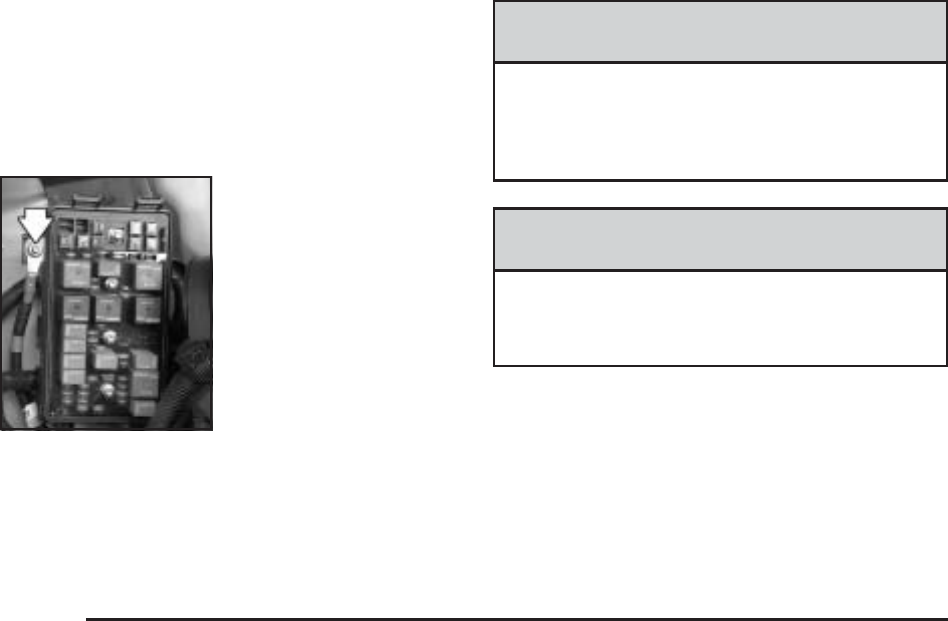
4. Open the hood on the other vehicle and locate the
positive (+) and negative (−) terminal locations on
that vehicle.
You will not use your vehicle’s battery for jump
starting. It has a remote positive (+) jump starting
terminal, located on the underhood fuse block, for
that purpose. See Engine Compartment Overview on
page 5-12 for more information on location.
To uncover the remote
positive (+) terminal, press
the tab at the bottom of
the fuse block and lift
the cover up.
Always use the remote positive (+) terminal instead
of the positive (+) terminal on the battery.
{CAUTION:
An electric fan can start up even when the
engine is not running and can injure you.
Keep hands, clothing and tools away from any
underhood electric fan.
{CAUTION:
Fans or other moving engine parts can injure
you badly. Keep your hands away from moving
parts once the engine is running.
3.8L V6 Engine shown,
3.6L V6 Engine
similar
5-44
{CAUTION:
Using a match near a battery can cause battery
gas to explode. People have been hurt doing
this, and some have been blinded. Use a
flashlight if you need more light.
Be sure the battery has enough water. You do
not need to add water to the battery installed
in your new vehicle. But if a battery has filler
caps, be sure the right amount of fluid is there.
If it is low, add water to take care of that first.
If you do not, explosive gas could be present.
Battery fluid contains acid that can burn you.
Do not get it on you. If you accidentally get it
in your eyes or on your skin, flush the place
with water and get medical help immediately.
5. Check that the jumper cables do not have loose
or missing insulation. If they do, you could get a
shock. The vehicles could be damaged too.
Before you connect the cables, here are some
basic things you should know. Positive (+) will go to
positive (+) or to a remote positive (+) terminal if
the vehicle has one. Negative will go to a heavy,
unpainted metal engine part or to a remote
negative (−) terminal if the vehicle has one.
Notice: If you connect a negative cable to the ECM,
ECM mounting bracket or any cables that attach
to the ECM bracket, you may damage the ECM.
Attach the negative cable to a heavy, unpainted
metal engine part, other than the ECM, ECM bracket
or cables attached to the ECM bracket.
Do not connect positive (+) to negative (−), or you
will get a short that would damage the battery
and maybe other parts too. And do not connect the
negative (−) cable to the negative (−) terminal on
the dead battery because this can cause sparks.
5-45
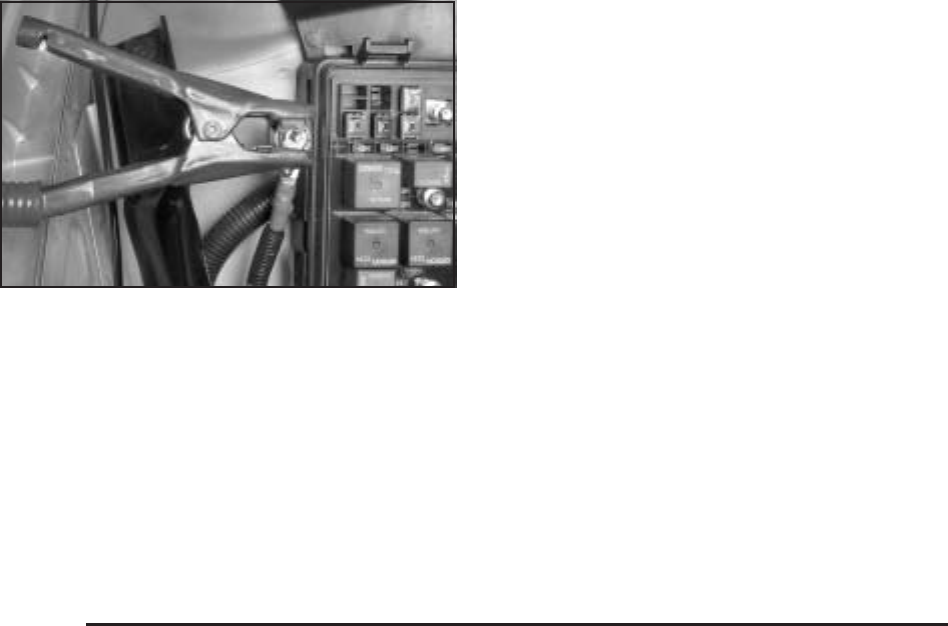
6. Connect the red positive (+) cable to the positive (+)
terminal location on the vehicle with the dead
battery. Use a remote positive (+) terminal if the
vehicle has one.
7. Do not let the other end touch metal. Connect it
to the positive (+) terminal location on the vehicle
with the good battery. Use a remote positive (+)
terminal if the vehicle has one.
8. Now connect the black negative (−) cable to the
negative (−) terminal location on the vehicle with
the good battery. Use a remote negative (−) terminal
if the vehicle has one.
Do not let the other end touch anything until the
next step. The other end of the negative (−) cable
does not go to the dead battery. It goes to a
heavy, unpainted metal engine part or to a remote
negative (–) terminal on the vehicle with the
dead battery.
9. Connect the other end of the negative (−) cable at
least 18 inches (45 cm) away from the dead battery,
but not near engine parts that move. The electrical
connection is just as good there, and the chance
of sparks getting back to the battery is much less.
10. Now start the vehicle with the good battery and run
the engine for a while.
11. Try to start the vehicle that had the dead battery.
If it will not start after a few tries, it probably needs
service.
3.8L V6 Engine shown, 3.6L V6 Engine similar
5-46
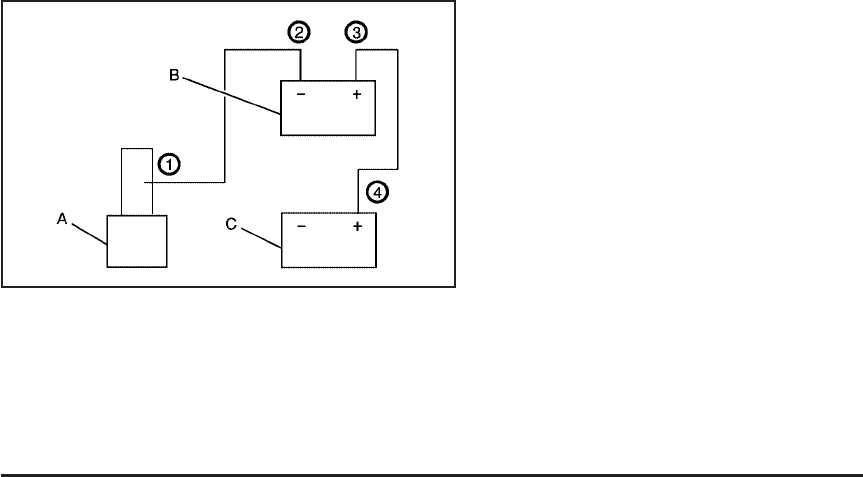
Notice: If the jumper cables are connected or
removed in the wrong order, electrical shorting may
occur and damage the vehicle. The repairs would
not be covered by your warranty. Always connect
and remove the jumper cables in the correct
order, making sure that the cables do not touch
each other or other metal.
A. Heavy, Unpainted Metal Engine Part or Remote
Negative (−) Terminal
B. Good Battery or Remote Positive (+) and Remote
Negative (−) Terminals
C. Dead Battery or Remote Positive (+) Terminal
To disconnect the jumper cables from both vehicles,
do the following:
1. Disconnect the black negative (−) cable from the
vehicle that had the dead battery.
2. Disconnect the black negative (−) cable from the
vehicle with the good battery.
3. Disconnect the red positive (+) cable from the
vehicle with the good battery.
4. Disconnect the red positive (+) cable from the
other vehicle.
5. Return the fuse block cover to its original position.
Jumper Cable Removal
5-47

Headlamp Aiming
The vehicle has a visual optical headlamp aiming
system. The aim has been preset at the factory and
should need no further adjustment
However, If the vehicle is damaged in an accident, the
headlamp aim may be affected and adjustment may
be necessary.
If oncoming vehicles flash their high beams at you, this
may also mean the vertical aim needs to be adjusted.
It is recommended that the vehicle is taken to your
dealer for service if the headlamps need to be re-aimed.
It is possible however, to re-aim the headlamps as
described in the following procedure.
The vehicle should be properly prepared as follows:
•The vehicle should be placed so the headlamps are
25 ft. (7.6 m) from a light colored wall or other flat
surface.
•The vehicle must have all four tires on a perfectly
level surface which is level all the way to the wall
or other flat surface.
•The vehicle should be placed so it is perpendicular
to the wall or other flat surface.
•The vehicle should not have any snow, ice or
mud on it.
•The vehicle should be fully assembled and all other
work stopped while headlamp aiming is being done.
•The vehicle should be normally loaded with a
full tank of fuel and one person or 160 lbs (75 kg)
on the driver’s seat.
•Tires should be properly inflated.
Headlamp aiming is done with the vehicle’s low-beam
headlamps. The high-beam headlamps will be correctly
aimed if the low-beam headlamps are aimed properly.
5-48
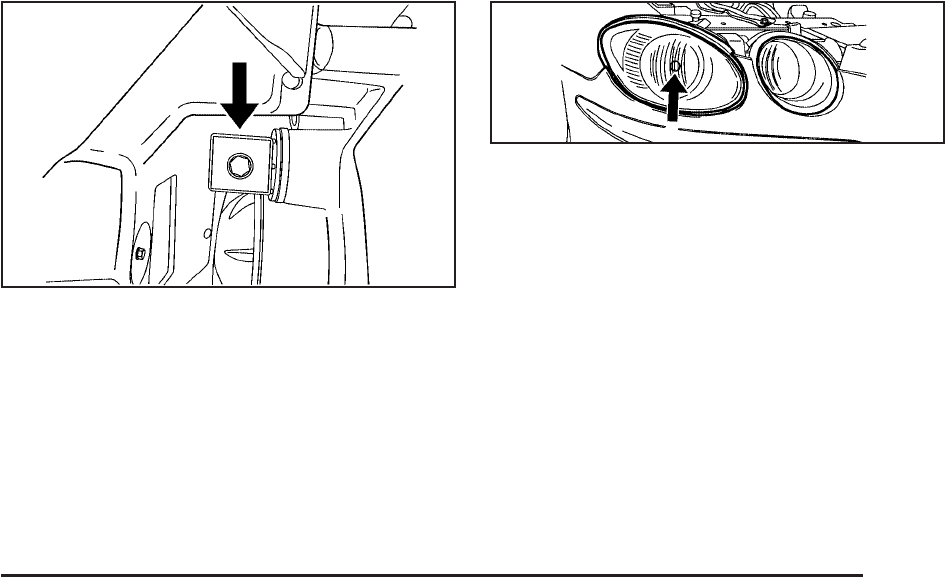
The vertical headlamp aiming screws are located under
the hood near the headlamps.
The adjustment screw can be turned with a
6 mm male hex.
To adjust the vertical aim on the headlamps, do the
following:
1. Find the aim dot on the lens of the low-beam lamp.
2. Measure the distance from the ground to the aim
dot on the lamp. Record the distance.
5-49
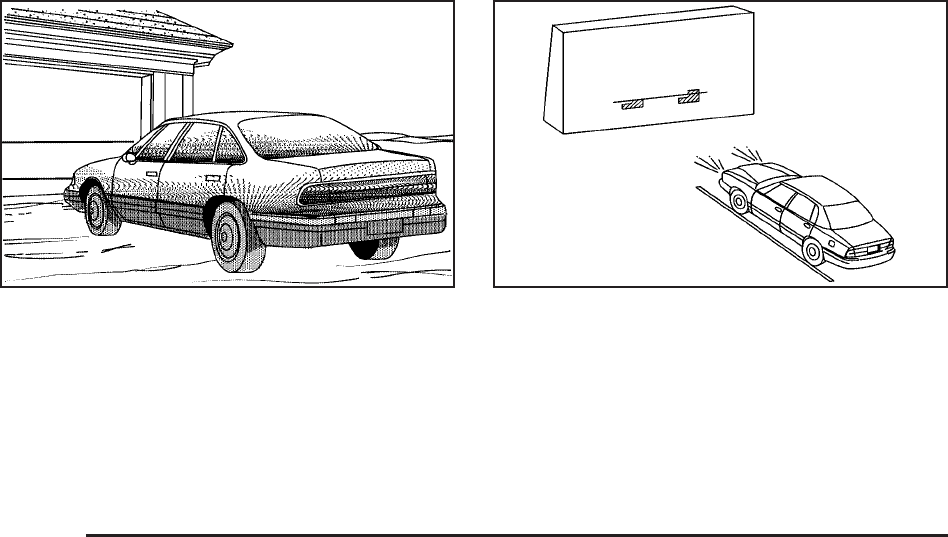
3. At the wall or other flat surface, measure from the
ground upward the recorded distance from Step 2
and draw or tape a horizontal line the width of
the vehicle.
4. Turn on the low-beam headlamps and place a
piece of cardboard or equivalent in front of the
headlamp not being aimed. This should allow
only the beam of light from the headlamp being
aimed to be seen on the flat surface.
Notice: Do not cover a headlamp to improve beam
cut-off when aiming. Covering a headlamp may
cause excessive heat build-up which may cause
damage to the headlamp.
5. Turn the vertical aiming screw until the headlamp
beam is aimed to the horizontal tape line. The
top edge of the cut-off should be positioned at the
bottom edge of the horizontal tape line.
6. Repeat Steps 4 and 5 for the opposite headlamp.
5-50
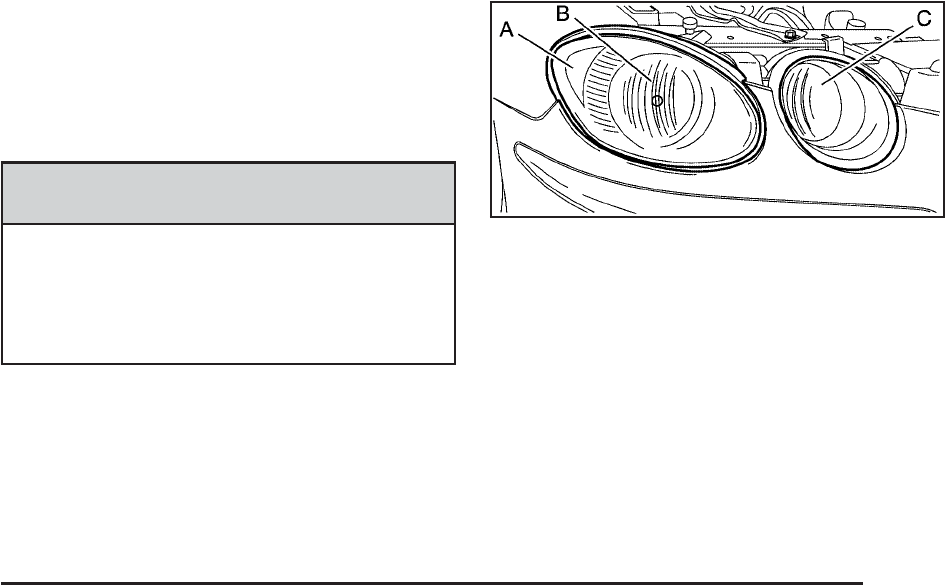
Bulb Replacement
For the proper type of replacement bulbs, see
Replacement Bulbs on page 5-56.
For any bulb changing procedure not listed in
this section, contact your dealer.
Halogen Bulbs
{CAUTION:
Halogen bulbs have pressurized gas inside
and can burst if you drop or scratch the bulb.
You or others could be injured. Be sure to
read and follow the instructions on the bulb
package.
Headlamps and Sidemarker Lamps
A. Sidemarker Lamp
B. Low-Beam Headlamp
C. High-Beam Headlamp
5-51
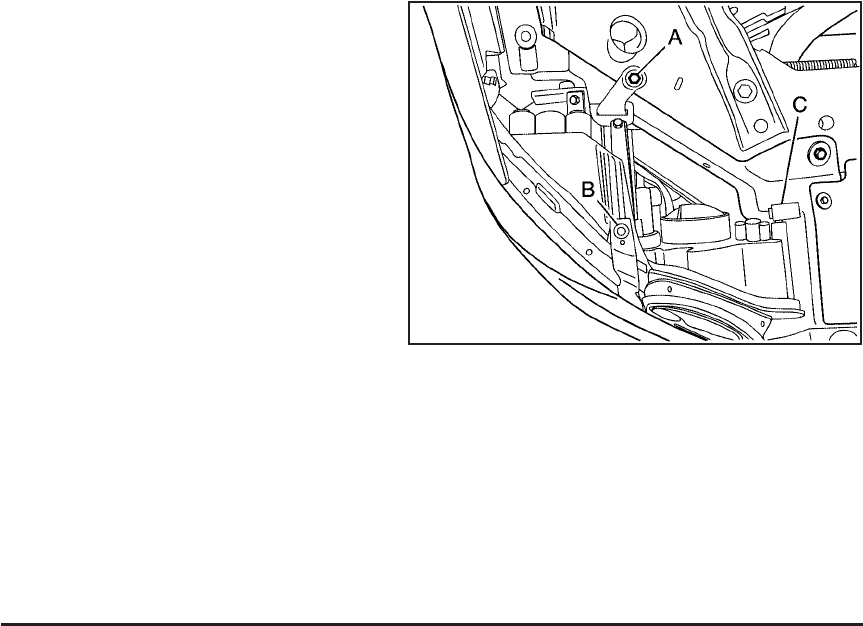
Low-Beam Headlamp and
Sidemarker Bulbs
To replace a low-beam headlamp or sidemarker bulb,
do the following:
1. Open the hood. See Hood Release on page 5-11
for more information.
2. Remove the fastener from the front fascia.
The fastener is located inboard of the headlamp
assembly, near the high-beam headlamp.
3. Pull up on the plastic retaining clip (C) while
pushing rearward on the headlamp. Align the square
cut-out on the retaining clip with the notch on the
headlamp.
4. Remove the screw (A) from the metal headlamp
retainer to pull up and release the headlamp
assembly.
5. Remove the push pin (B) retaining the front fascia.
5-52

6. Pull back on the front fascia and then pull the
headlamp assembly out from the vehicle. Moving
the headlamp up and down slightly may help with
its removal.
You may have someone assist you with this step.
7. Remove the access cover from behind the bulb
being replaced.
8. Turn the bulb socket one-quarter of a turn to
remove it from the headlamp assembly.
9. Holding the base of the socket, pull the old bulb
from the socket.
10. Replace with a new bulb.
11. Reverse all the steps to reassemble the headlamp
assembly.
When replacing the plastic retaining clip, push down
on it while pushing rearward on the headlamp,
making sure the headlamp assembly is secure.
High-Beam Headlamp Bulbs
To replace the high-beam headlamp bulb, do the
following:
1. Open the hood. See Hood Release on page 5-11
for more information.
2. Locate the high-beam headlamp bulb socket.
3. Remove the access cover from behind the bulb
being replaced.
4. Turn the bulb socket counterclockwise and pull it
from the headlamp assembly.
5. Holding the base of the socket, pull the old bulb
from the socket.
6. Replace with a new bulb.
7. Reverse Steps 2 through 4 to reinstall.
Front Turn Signal and
Parking Lamps
To replace a front turn signal/parking lamp bulb in the
front fascia, do the following:
1. Locate the front turn signal/parking bulb socket by
reaching behind the front bumper.
2. Turn the bulb socket counterclockwise and pull it
out of the assembly.
3. Holding the base of the socket, pull the old bulb
from the socket.
4. Push the new bulb into the socket.
5. Reverse Steps 1 through 3 to reinstall.
5-53
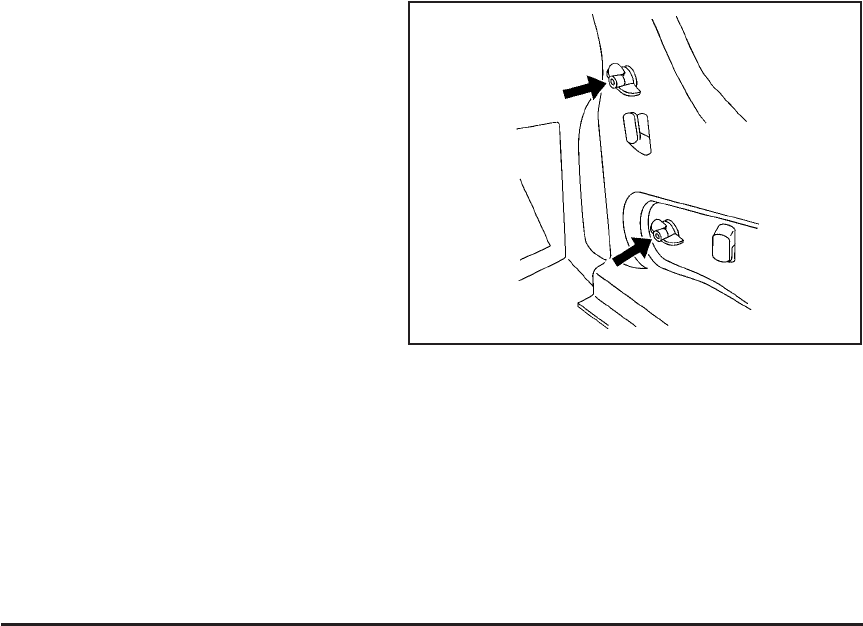
Taillamps, Turn Signal, Sidemarker,
Stoplamps and Back-up Lamps
To replace a taillamp, turn signal, sidemarker, stoplamp
or back-up lamp bulb, do the following:
1. Open the trunk. See Trunk on page 2-13 for more
information.
2. Remove the convenience net if the vehicle has one.
3. Remove the four plastic wing nuts retaining the
trunk trim. There are two wing nuts located on
the driver’s side (shown) and two located on the
passenger’s side of the vehicle.
4. Pull back the trunk trim.
5-54
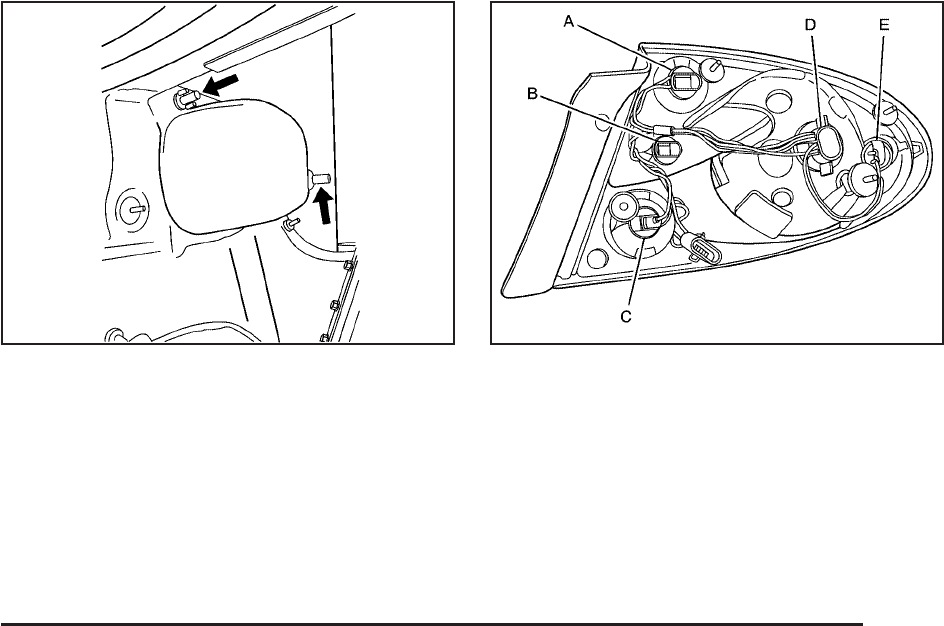
5. Remove the two wing nuts holding the taillamp
assembly in place.
6. Pull out the taillamp assembly and disconnect the
wiring harness.
A. Taillamp
B. Back-up
C. Taillamp
D. Stoplamp/Taillamp/
Turn Signal
E. Sidemarker
7. Turn the bulb socket counterclockwise to remove it.
8. Replace with a new bulb.
9. Turn the bulb socket clockwise to reinstall.
10. Reverse these steps to reinstall the taillamp
assembly.
5-55
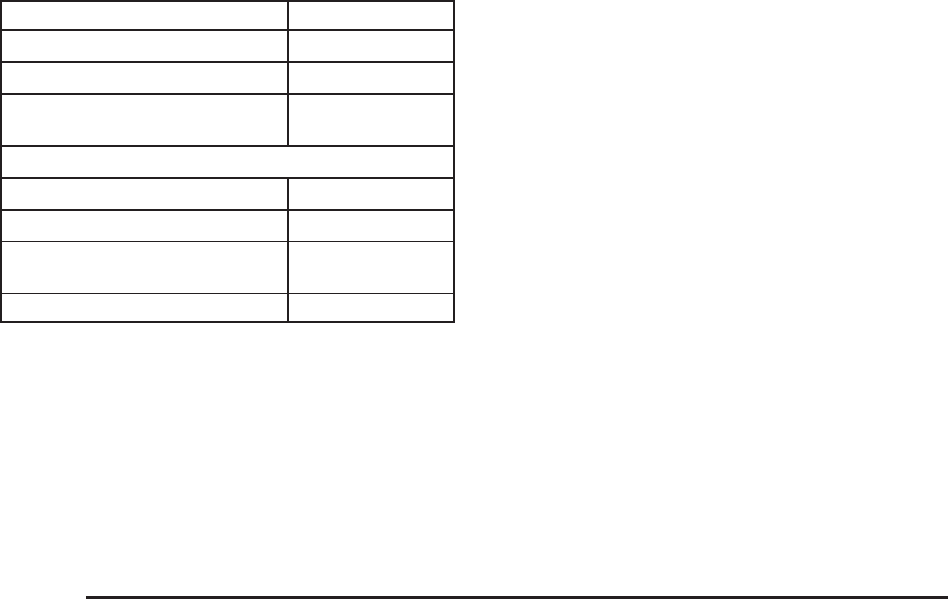
Replacement Bulbs
Exterior Lamps Bulb Number
Back-Up Lamps 921
Fog Lamp H11
Front Turn Signal and
Parking Lamps 3157NAK
Headlamps
High-Beam H9
Low-Beam H11
Front/Rear Sidemarker
and Taillamp 194
Stoplamps and Taillamps 3057
For replacement bulbs not listed here, contact
your dealer.
Windshield Replacement
Your vehicle is equipped with an acoustic windshield.
If you ever have to have your windshield replaced
be sure to get an acoustic windshield so you will
continue to have the benefits an acoustic windshield
can provide.
Windshield Wiper Blade
Replacement
Windshield wiper blades should be inspected for wear
or cracking. See Scheduled Maintenance on page 6-4
for more information on wiper blade inspection.
Replacement blades come in different types and are
removed in different ways. For the proper type and
length, see Normal Maintenance Replacement Parts
on page 6-13. Here’s how to remove the wiper blade:
1. Pull the windshield wiper arm connector away from
the windshield.
5-56
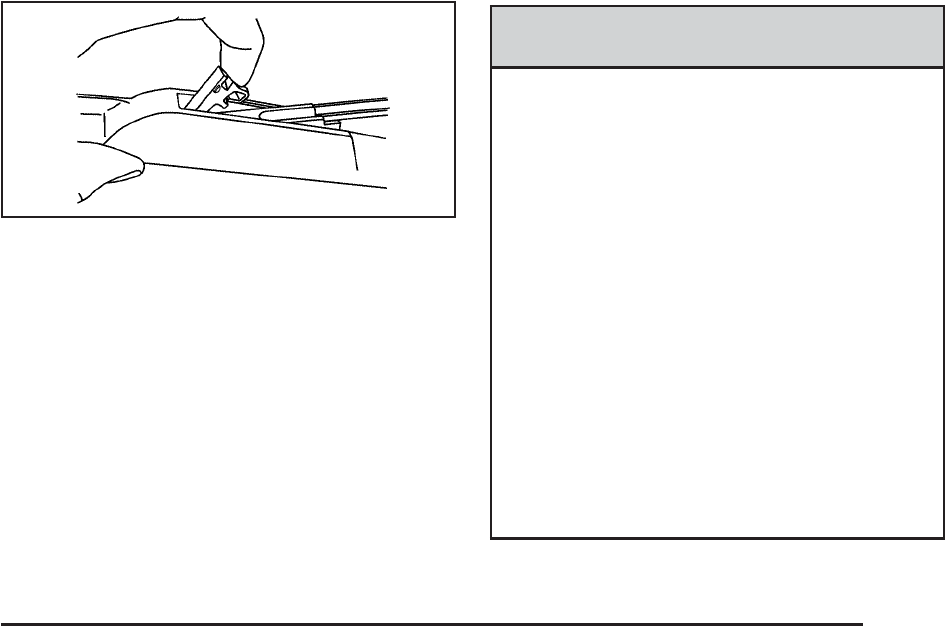
2. While holding the wiper arm, pull the clip up from
the blade connecting point, and pull the blade
assembly down toward the windshield to remove it
from the wiper arm.
3. Install the new wiper blade onto the wiper arm and
snap the clip into place.
Tires
Your new vehicle comes with high-quality tires made by
a leading tire manufacturer. If you ever have questions
about your tire warranty and where to obtain service,
see your GM Warranty booklet for details. For additional
information refer to the tire manufacturer’s booklet
included with your vehicle’s Owner Manual.
{CAUTION:
Poorly maintained and improperly used tires
are dangerous.
•Overloading your tires can cause
overheating as a result of too much
friction. You could have an air-out and
a serious accident. See Loading Your
Vehicle on page 4-31.
•Underinflated tires pose the same danger
as overloaded tires. The resulting accident
could cause serious injury. Check all tires
frequently to maintain the recommended
pressure. Tire pressure should be checked
when your tires are cold. See Inflation - Tire
Pressure on page 5-63.
•Overinflated tires are more likely to be
cut, punctured, or broken by a sudden
impact — such as when you hit a pothole.
Keep tires at the recommended pressure.
•Worn, old tires can cause accidents. If your
tread is badly worn, or if your tires have
been damaged, replace them.
5-57
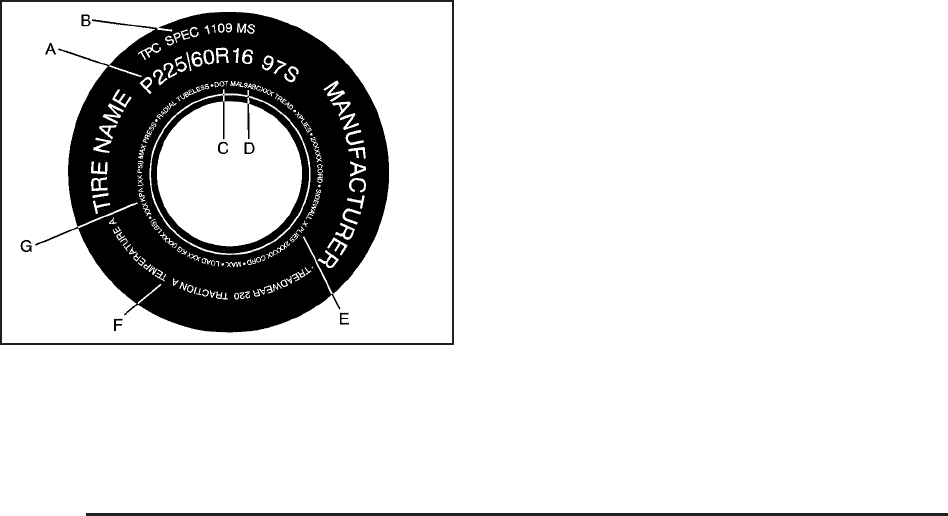
Tire Sidewall Labeling
Useful information about a tire is molded into its
sidewall. The examples below show a typical passenger
vehicle tire and a compact spare tire sidewall.
(A) Tire Size: The tire size is a combination of letters
and numbers used to define a particular tire’s width,
height, aspect ratio, construction type, and service
description. See the “Tire Size” illustration later in this
section for more detail.
(B) TPC Spec (Tire Performance Criteria
Specification): Original equipment tires designed to
GM’s specific tire performance criteria have a TPC
specification code molded onto the sidewall. GM’s TPC
specifications meet or exceed all federal safety
guidelines.
(C) DOT (Department of Transportation): The
Department of Transportation (DOT) code indicates that
the tire is in compliance with the U.S. Department of
Transportation Motor Vehicle Safety Standards.
(D) Tire Identification Number (TIN): The letters and
numbers following DOT (Department of Transportation)
code is the Tire Identification Number (TIN). The
TIN shows the manufacturer and plant code, tire size,
and date the tire was manufactured. The TIN is molded
onto both sides of the tire, although only one side
may have the date of manufacture.
(E) Tire Ply Material: The type of cord and number of
plies in the sidewall and under the tread.
(F) Uniform Tire Quality Grading (UTQG): Tire
manufacturers are required to grade tires based on
three performance factors: treadwear, traction,
and temperature resistance. For more information
see Uniform Tire Quality Grading on page 5-68.
(G) Maximum Cold Inflation Load Limit: Maximum
load that can be carried and the maximum pressure
needed to support that load.
Passenger (P-Metric) Tire Example
5-58
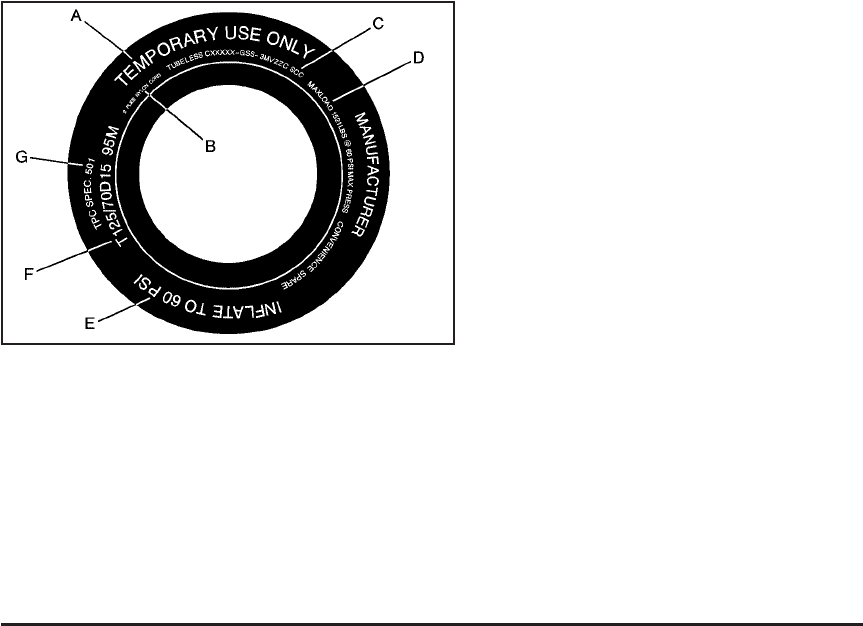
(A) Temporary Use Only: The compact spare tire or
temporary use tire has a tread life of approximately
3,000 miles (5 000 km) and should not be driven
at speeds over 65 mph (105 km/h). The compact spare
tire is for emergency use when a regular road tire
has lost air and gone flat. If your vehicle has a compact
spare tire, see Compact Spare Tire on page 5-83
and If a Tire Goes Flat on page 5-72.
(B) Tire Ply Material: The type of cord and number of
plies in the sidewall and under the tread.
(C) Tire Identification Number (TIN): The letters
and numbers following the DOT (Department of
Transportation) code is the Tire Identification Number
(TIN). The TIN shows the manufacturer and plant code,
tire size, and date the tire was manufactured. The
TIN is molded onto both sides of the tire, although
only one side may have the date of manufacture.
(D) Maximum Cold Inflation Load Limit: Maximum
load that can be carried and the maximum pressure
needed to support that load.
(E) Tire Inflation: The temporary use tire or compact
spare tire should be inflated to 60 psi (420 kPa).
For more information on tire pressure and inflation
see Inflation - Tire Pressure on page 5-63.
(F) Tire Size: A combination of letters and numbers
define a tire’s width, height, aspect ratio, construction
type and service description. The letter T as the
first character in the tire size means the tire is for
temporary use only.
(G) TPC Spec (Tire Performance Criteria
Specification): Original equipment tires designed to
GM’s specific tire performance criteria have a TPC
specification code molded onto the sidewall. GM’s TPC
specifications meet or exceed all federal safety
guidelines.
Compact Spare Tire Example
5-59
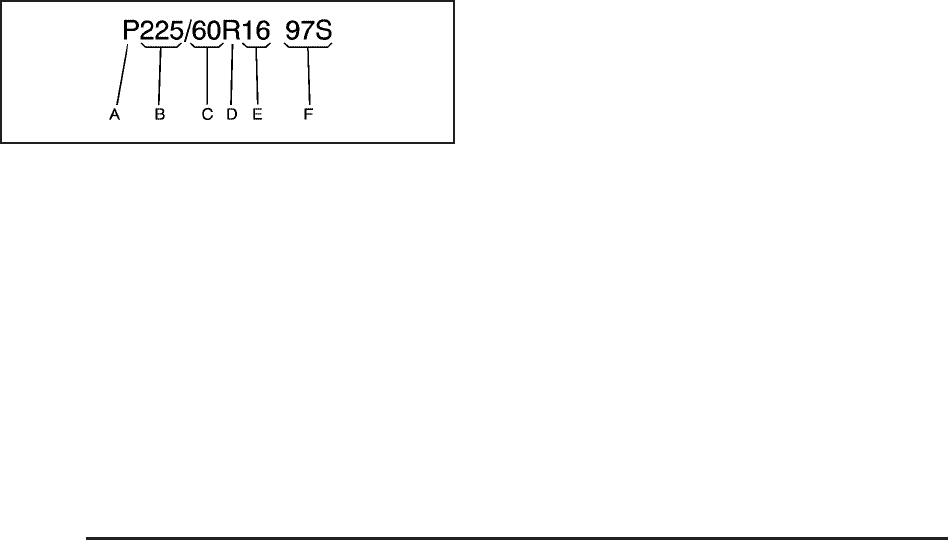
Tire Size
The following illustration shows an example of a typical
passenger vehicle tire size.
(A) Passenger (P-Metric) Tire: The United States
version of a metric tire sizing system. The letter P as
the first character in the tire size means a passenger
vehicle tire engineered to standards set by the U.S. Tire
and Rim Association.
(B) Tire Width: The three-digit number indicates the
tire section width in millimeters from sidewall to sidewall.
(C) Aspect Ratio: A two-digit number that indicates
the tire height-to-width measurements. For example,
if the tire size aspect ratio is 60, as shown in item C
of the illustration, it would mean that the tire’s sidewall
is 60 percent as high as it is wide.
(D) Construction Code: A letter code is used to
indicate the type of ply construction in the tire.
The letter R means radial ply construction; the letter D
means diagonal or bias ply construction; and the
letter B means belted-bias ply construction.
(E) Rim Diameter: Diameter of the wheel in inches.
(F) Service Description: These characters represent
the load range and speed rating of the tire. The load
index represents the load carry capacity a tire is certified
to carry. The load index can range from 1 to 279. The
speed rating is the maximum speed a tire is certified
to carry a load. Speed ratings range from A to Z.
Tire Terminology and Definitions
Air Pressure: The amount of air inside the tire pressing
outward on each square inch of the tire. Air pressure
is expressed in pounds per square inch (psi) or
kilopascal (kPa).
Accessory Weight: This means the combined weight
of optional accessories. Some examples of optional
accessories are, automatic transmission, power steering,
power brakes, power windows, power seats, and air
conditioning.
Aspect Ratio: The relationship of a tire’s height to
its width.
5-60

Belt: A rubber coated layer of cords that is located
between the plies and the tread. Cords may be made
from steel or other reinforcing materials.
Bead: The tire bead contains steel wires wrapped by
steel cords that hold the tire onto the rim.
Bias Ply Tire: A pneumatic tire in which the plies are
laid at alternate angles less than 90 degrees to the
centerline of the tread.
Cold Inflation Pressure: The amount of air pressure
in a tire, measured in pounds per square inch (psi)
or kilopascals (kPa) before a tire has built up heat from
driving. See Inflation - Tire Pressure on page 5-63.
Curb Weight: This means the weight of a motor vehicle
with standard and optional equipment including the
maximum capacity of fuel, oil and coolant, but without
passengers and cargo.
DOT Markings: A code molded into the sidewall of a
tire signifying that the tire is in compliance with the
U.S. Department of Transportation (DOT) motor vehicle
safety standards. The DOT code includes the Tire
Identification Number (TIN), an alphanumeric designator
which can also identify the tire manufacturer, production
plant, brand and date of production.
GVWR: Gross Vehicle Weight Rating, see Loading
Your Vehicle on page 4-31.
GAWR FRT: Gross Axle Weight Rating for the front
axle, see Loading Your Vehicle on page 4-31.
GAWR RR: Gross Axle Weight Rating for the rear axle,
see Loading Your Vehicle on page 4-31.
Intended Outboard Sidewall: The side of an
asymmetrical tire, that must always face outward when
mounted on a vehicle.
Kilopascal (kPa): The metric unit for air pressure.
Light Truck (LT-Metric) Tire: A tire used on light duty
trucks and some multipurpose passenger vehicles.
Load Index: An assigned number ranging from 1 to 279
that corresponds to the load carrying capacity of a tire.
Maximum Inflation Pressure: The maximum air
pressure to which a cold tire may be inflated. The
maximum air pressure is molded onto the sidewall.
Maximum Load Rating: The load rating for a tire at the
maximum permissible inflation pressure for that tire.
Maximum Loaded Vehicle Weight: The sum of curb
weight; accessory weight; vehicle capacity weight;
and production options weight.
Normal Occupant Weight: The number of occupants a
vehicle is designed to seat multiplied by 150 lbs (68 kg).
See Loading Your Vehicle on page 4-31.
5-61

Occupant Distribution: Designated seating positions.
Outward Facing Sidewall: The side of an
asymmetrical tire that has a particular side that faces
outward when mounted on a vehicle. The side of the
tire that contains a whitewall, bears white lettering,
or bears manufacturer, brand, and/or model name
molding that is higher or deeper than the same moldings
on the other sidewall of the tire.
Passenger (P-Metric) Tire: A tire used on passenger
cars and some light duty trucks and multipurpose
vehicles.
Recommended Inflation Pressure: Vehicle
manufacturer’s recommended tire inflation pressure and
shown on the tire placard. See Inflation - Tire Pressure
on page 5-63 and Loading Your Vehicle on page 4-31.
Radial Ply Tire: A pneumatic tire in which the ply cords
that extend to the beads are laid at 90 degrees to the
centerline of the tread.
Rim: A metal support for a tire and upon which the
tire beads are seated.
Sidewall: The portion of a tire between the tread and
the bead.
Speed Rating: An alphanumeric code assigned to
a tire indicating the maximum speed at which a tire
can operate.
Traction: The friction between the tire and the road
surface. The amount of grip provided.
Tread: The portion of a tire that comes into contact
with the road.
Treadwear Indicators: Narrow bands, sometimes
called wear bars, that show across the tread of a tire
when only 1/16 inch (1.6 mm) of tread remains.
See When It Is Time for New Tires on page 5-66.
UTQGS (Uniform Tire Quality Grading Standards):
A tire information system that provides consumers with
ratings for a tire’s traction, temperature, and treadwear.
Ratings are determined by tire manufacturers using
government testing procedures. The ratings are molded
into the sidewall of the tire. See Uniform Tire Quality
Grading on page 5-68.
Vehicle Capacity Weight: The number of designated
seating positions multiplied by 150 lbs (68 kg) plus
the rated cargo load. See Loading Your Vehicle
on page 4-31.
Vehicle Maximum Load on the Tire: Load on an
individual tire due to curb weight, accessory weight,
occupant weight, and cargo weight.
Vehicle Placard: A label permanently attached to a
vehicle showing the vehicle’s capacity weight and
the original equipment tire size and recommended
inflation pressure. See “Tire and Loading Information
Label” under Loading Your Vehicle on page 4-31.
5-62

Inflation - Tire Pressure
Tires need the correct amount of air pressure to operate
effectively.
Notice: Do not let anyone tell you that
under-inflation or over-inflation is all right. It is not.
If your tires do not have enough air (under-inflation),
you can get the following:
•Too much flexing
•Too much heat
•Tire overloading
•Premature or irregular wear
•Poor handling
•Reduced fuel economy
If your tires have too much air (over-inflation),
you can get the following:
•Unusual wear
•Poor handling
•Rough ride
•Needless damage from road hazards
A Tire and Loading Information label is attached to the
vehicle’s center pillar (B-pillar), below the driver’s
door latch. This label shows your vehicle’s original
equipment tires and the correct inflation pressures for
your tires when they are cold. The recommended
cold tire inflation pressure, shown on the label, is the
minimum amount of air pressure needed to support your
vehicle’s maximum load carrying capacity.
For additional information regarding how much weight
your vehicle can carry, and an example of the tire
and loading information label, see Loading Your Vehicle
on page 4-31. How you load your vehicle affects
vehicle handling and ride comfort, never load your
vehicle with more weight than it was designed to carry.
When to Check
Check your tires once a month or more. Do not forget
to check the compact spare tire, it should be at
60 psi (420 kPa). For additional information regarding
the compact spare tire, see Compact Spare Tire
on page 5-83.
5-63

How to Check
Use a good quality pocket-type gage to check tire
pressure. You cannot tell if your tires are properly
inflated simply by looking at them. Radial tires may look
properly inflated even when they are under-inflated.
Check the tire’s inflation pressure when the tires
are cold. Cold means your vehicle has been sitting
for at least three hours or driven no more than
1 mile (1.6 km).
Remove the valve cap from the tire valve stem. Press
the tire gage firmly onto the valve to get a pressure
measurement. If the cold tire inflation pressure matches
the recommended pressure on the Tire and Loading
Information label, no further adjustment is necessary.
If the inflation pressure is low, add air until you reach
the recommended amount.
If you overfill the tire, release air by pushing on the
metal stem in the center of the tire valve. Re-check
the tire pressure with the tire gage.
Be sure to put the valve caps back on the valve
stems. They help prevent leaks by keeping out dirt
and moisture.
Tire Inspection and Rotation
Tires should be rotated every 5,000 to 8,000 miles
(8 000 to 13 000 km).
Any time you notice unusual wear, rotate your tires as
soon as possible and check wheel alignment. Also
check for damaged tires or wheels. See When It Is Time
for New Tires on page 5-66 and Wheel Replacement
on page 5-70 for more information.
The purpose of regular rotation is to achieve more
uniform wear for all tires on the vehicle. The first rotation
is the most important. See Scheduled Maintenance
on page 6-4.
5-64
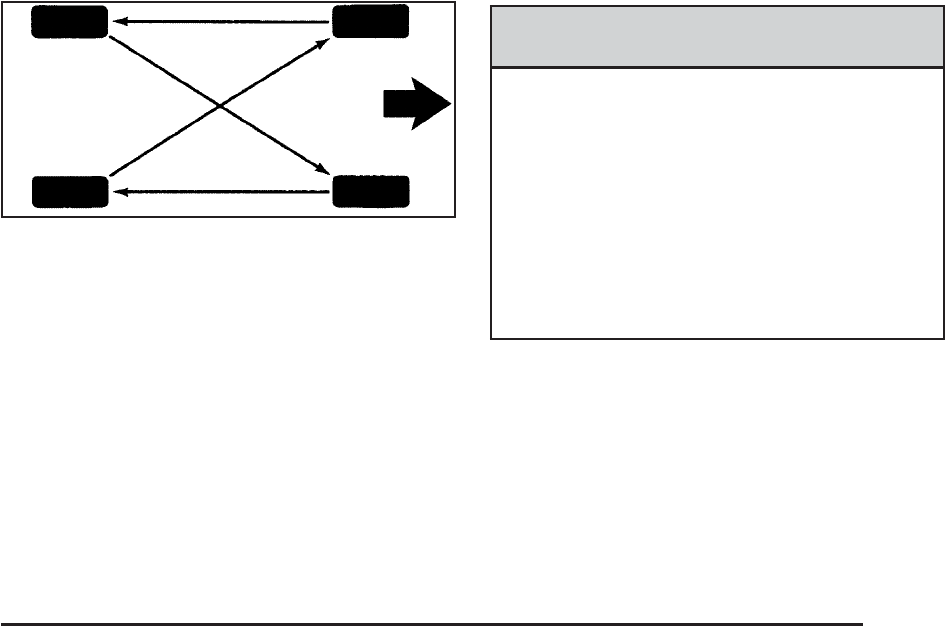
When rotating your tires, always use the correct rotation
pattern shown here.
Do not include the compact spare tire in your tire rotation.
After the tires have been rotated, adjust the front and
rear inflation pressures as shown on the Tire and
Loading Information label.
Make certain that all wheel nuts are properly tightened.
See “Wheel Nut Torque” under Capacities and
Specifications on page 5-98.
{CAUTION:
Rust or dirt on a wheel, or on the parts to
which it is fastened, can make wheel nuts
become loose after a time. The wheel could
come off and cause an accident. When you
change a wheel, remove any rust or dirt from
places where the wheel attaches to the vehicle.
In an emergency, you can use a cloth or a
paper towel to do this; but be sure to use a
scraper or wire brush later, if needed, to get
all the rust or dirt off. See Changing a Flat
Tire on page 5-73.
5-65
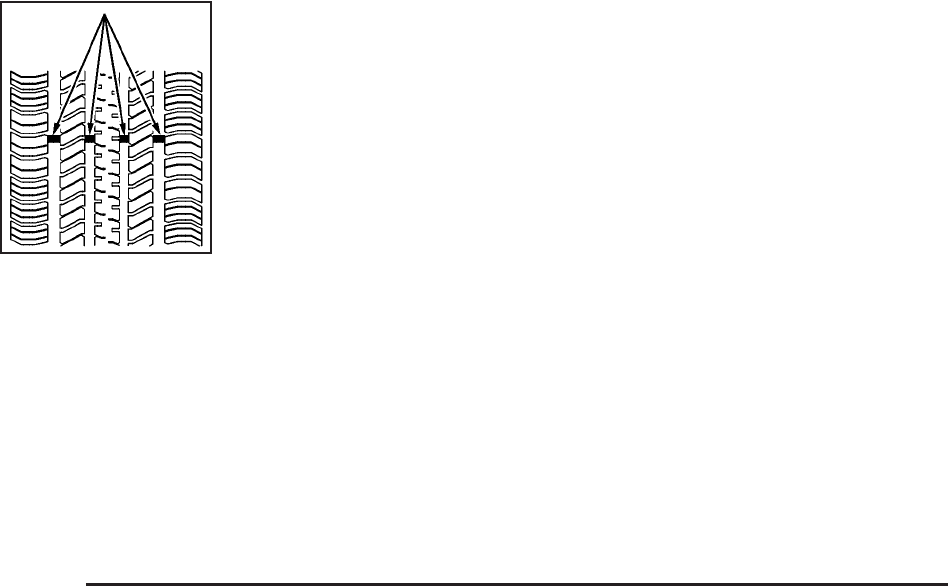
When It Is Time for New Tires
One way to tell when
it is time for new tires
is to check the treadwear
indicators, which will
appear when your tires
have only 1/16 inch
(1.6 mm) or less of
tread remaining.
You need a new tire if any of the following statements
are true:
•You can see the indicators at three or more places
around the tire.
•You can see cord or fabric showing through the
tire’s rubber.
•The tread or sidewall is cracked, cut, or snagged
deep enough to show cord or fabric.
•The tire has a bump, bulge, or split.
•The tire has a puncture, cut or other damage that
cannot be repaired well because of the size or
location of the damage.
Buying New Tires
GM has developed and matched specific tires for your
vehicle. The original equipment tires installed on
your vehicle, when it was new, were designed to meet
General Motors Tire Performance Criteria Specification
(TPC spec) system rating. If you need replacement
tires, GM strongly recommends that you get tires with
the same TPC Spec rating. This way, your vehicle
will continue to have tires that are designed to give the
same performance and vehicle safety, during normal
use, as the original tires.
GM’s exclusive TPC Spec system considers over a
dozen critical specifications that impact the overall
performance of your vehicle, including brake system
performance, ride and handling, traction control, and tire
pressure monitoring performance. GM’s TPC Spec
number is molded onto the tire’s sidewall by the
tire manufacturer. If the tires have an all-season tread
design, the TPC spec number will be followed by an
MS for mud and snow. See Tire Sidewall Labeling
on page 5-58 for additional information.
5-66
{CAUTION:
Mixing tires could cause you to lose control
while driving. If you mix tires of different
sizes, brands, or types (radial and bias-belted
tires), the vehicle may not handle properly,
and you could have a crash. Using tires of
different sizes, brands, or types may also
cause damage to your vehicle. Be sure to
use the correct size, brand, and type of tires
on all wheels. It is all right to drive with
your compact spare temporarily, as it was
developed for use on your vehicle. See
Compact Spare Tire on page 5-83.
{CAUTION:
If you use bias-ply tires on your vehicle, the
wheel rim flanges could develop cracks after
many miles of driving. A tire and/or wheel
could fail suddenly, causing a crash. Use only
radial-ply tires with the wheels on your vehicle.
If you must replace your vehicle’s tires with those
that do not have a TPC Spec number, make sure
they are the same size, load range, speed rating,
and construction type (radial and bias-belted tires)
as your vehicle’s original tires.
Your vehicle’s original equipment tires are listed on
the Tire and Loading Information Label. This label
is attached to the vehicle’s center pillar (B-pillar).
See Loading Your Vehicle on page 4-31, for more
information about the Tire and Loading Information
Label and its location on your vehicle.
5-67

Different Size Tires and Wheels
If you add wheels or tires that are a different size
than your original equipment wheels and tires, this
may affect the way your vehicle performs, including its
braking, ride and handling characteristics, stability
and resistance to rollover. Additionally, if your vehicle
has electronic systems such as, antilock brakes; traction
control; and electronic stability control, the performance
of these systems can be affected.
{CAUTION:
If you add different sized wheels, your
vehicle may not provide an acceptable
level of performance and safety if tires not
recommended for those wheels are selected.
You may increase the chance that you will
crash and suffer serious injury. Only use
GM specific wheel and tire systems developed
for your vehicle, and have them properly
installed by a GM certified technician.
See Buying New Tires on page 5-66 and Accessories
and Modifications on page 5-3 for additional information.
Uniform Tire Quality Grading
Quality grades can be found where applicable on the
tire sidewall between tread shoulder and maximum
section width. For example:
Treadwear 200 Traction AA Temperature A
The following information relates to the system
developed by the United States National Highway
Traffic Safety Administration, which grades tires by
treadwear, traction and temperature performance.
(This applies only to vehicles sold in the United States.)
The grades are molded on the sidewalls of most
passenger car tires. The Uniform Tire Quality Grading
system does not apply to deep tread, winter-type
snow tires, space-saver or temporary use spare tires,
tires with nominal rim diameters of 10 to 12 inches
(25 to 30 cm), or to some limited-production tires.
While the tires available on General Motors passenger
cars and light trucks may vary with respect to these
grades, they must also conform to federal safety
requirements and additional General Motors Tire
Performance Criteria (TPC) standards.
5-68

Treadwear
The treadwear grade is a comparative rating based on
the wear rate of the tire when tested under controlled
conditions on a specified government test course.
For example, a tire graded 150 would wear one and
a half (1.5) times as well on the government course
as a tire graded 100. The relative performance of
tires depends upon the actual conditions of their
use, however, and may depart significantly from the
norm due to variations in driving habits, service practices
and differences in road characteristics and climate.
Traction – AA, A, B, C
The traction grades, from highest to lowest, are AA,
A, B, and C. Those grades represent the tire’s ability
to stop on wet pavement as measured under controlled
conditions on specified government test surfaces of
asphalt and concrete. A tire marked C may have poor
traction performance. Warning: The traction grade
assigned to this tire is based on straight-ahead braking
traction tests, and does not include acceleration,
cornering, hydroplaning, or peak traction characteristics.
Temperature – A, B, C
The temperature grades are A (the highest), B, and C,
representing the tire’s resistance to the generation
of heat and its ability to dissipate heat when tested
under controlled conditions on a specified indoor
laboratory test wheel. Sustained high temperature
can cause the material of the tire to degenerate and
reduce tire life, and excessive temperature can lead
to sudden tire failure. The grade C corresponds to
a level of performance which all passenger car tires
must meet under the Federal Motor Vehicle Safety
Standard No. 109. Grades B and A represent higher
levels of performance on the laboratory test wheel
than the minimum required by law.
Warning: The temperature grade for this tire is
established for a tire that is properly inflated and
not overloaded. Excessive speed, underinflation, or
excessive loading, either separately or in combination,
can cause heat buildup and possible tire failure.
5-69

Wheel Alignment and Tire Balance
The tires and wheels on your vehicle were aligned
and balanced carefully at the factory to give you
the longest tire life and best overall performance.
Adjustments to wheel alignment and tire balancing
will not be necessary on a regular basis. However,
if you notice unusual tire wear or your vehicle pulling
to one side or the other, the alignment may need to
be checked. If you notice your vehicle vibrating when
driving on a smooth road, your tires and wheels
may need to be rebalanced. See your dealer for
proper diagnosis.
Wheel Replacement
Replace any wheel that is bent, cracked or badly
rusted or corroded. If wheel nuts keep coming loose,
the wheel, wheel bolts and wheel nuts should be
replaced. If the wheel leaks air, replace it (except some
aluminum wheels, which can sometimes be repaired).
See your dealer if any of these conditions exist.
Your dealer will know the kind of wheel you need.
Each new wheel should have the same load-carrying
capacity, diameter, width, offset and be mounted
the same way as the one it replaces.
If you need to replace any of your wheels, wheel
bolts or wheel nuts, replace them only with new GM
original equipment parts. This way, you will be sure
to have the right wheel, wheel bolts and wheel nuts
for your vehicle.
5-70
{CAUTION:
Using the wrong replacement wheels, wheel
bolts, or wheel nuts on your vehicle can be
dangerous. It could affect the braking and
handling of your vehicle, make your tires
lose air and make you lose control. You could
have a collision in which you or others could
be injured. Always use the correct wheel,
wheel bolts and wheel nuts for replacement.
Notice: The wrong wheel can also cause problems
with bearing life, brake cooling, speedometer or
odometer calibration, headlamp aim, bumper height,
vehicle ground clearance, and tire or tire chain
clearance to the body and chassis.
See Changing a Flat Tire on page 5-73 for more
information.
Used Replacement Wheels
{CAUTION:
Putting a used wheel on your vehicle is
dangerous. You cannot know how it has been
used or how far it has been driven. It could
fail suddenly and cause a crash. If you have
to replace a wheel, use a new GM original
equipment wheel.
5-71
Tire Chains
{CAUTION:
If your vehicle has P225/55R17 size tires,
do not use tire chains, there is not enough
clearance.
Tire chains used on a vehicle without the
proper amount of clearance can cause damage
to the brakes, suspension or other vehicle
parts. The area damaged by the tire chains
could cause you to lose control of your vehicle
and you or others may be injured in a crash.
Use another type of traction device only if
its manufacturer recommends it for use on
your vehicle and tire size combination and
road conditions. Follow that manufacturer’s
instructions. To help avoid damage to your
vehicle, drive slowly, readjust or remove the
device if it is contacting your vehicle, and
do not spin your wheels.
If you do find traction devices that will fit,
install them on the front tires.
Notice: If your vehicle has a tire size other than
P225/55R17 size tires, use tire chains only where
legal and only when you must. Use only SAE Class
“S” type chains that are the proper size for your
tires. Install them on the front tires and tighten
them as tightly as possible with the ends securely
fastened. Drive slowly and follow the chain
manufacturer’s instructions. If you can hear the
chains contacting your vehicle, stop and retighten
them. If the contact continues, slow down until
it stops. Driving too fast or spinning the wheels
with chains on will damage your vehicle.
If a Tire Goes Flat
It is unusual for a tire to blowout while you are driving,
especially if you maintain your vehicle’s tires properly.
If air goes out of a tire, it is much more likely to leak out
slowly. But if you should ever have a blowout, here
are a few tips about what to expect and what to do:
If a front tire fails, the flat tire will create a drag that
pulls the vehicle toward that side. Take your foot off
the accelerator pedal and grip the steering wheel firmly.
Steer to maintain lane position, and then gently brake
to a stop well out of the traffic lane.
A rear blowout, particularly on a curve, acts much
like a skid and may require the same correction
you would use in a skid. In any rear blowout
remove your foot from the accelerator pedal.
5-72
Get the vehicle under control by steering the way you
want the vehicle to go. It may be very bumpy and noisy,
but you can still steer. Gently brake to a stop, well off
the road if possible.
{CAUTION:
Lifting a vehicle and getting under it to do
maintenance or repairs is dangerous without
the appropriate safety equipment and training.
The jack provided with your vehicle is
designed only for changing a flat tire. If it is
used for anything else, you or others could
be badly injured or killed if the vehicle slips
off the jack. Use the jack provided with your
vehicle only for changing a flat tire.
If a tire goes flat, the next part shows how to use the
jacking equipment to change a flat tire safely.
Changing a Flat Tire
If a tire goes flat, avoid further tire and wheel damage
by driving slowly to a level place. Turn on your vehicle’s
hazard warning flashers. See Hazard Warning Flashers
on page 3-6 for more information.
{CAUTION:
Changing a tire can be dangerous. The vehicle
can slip off the jack and roll over or fall on you
or other people. You and they could be badly
injured or even killed. Find a level place to
change your tire. To help prevent the vehicle
from moving:
1. Set the parking brake firmly.
2. Put the shift lever in PARK (P).
3. Turn off the engine and do not restart
while the vehicle is raised.
4. Do not allow passengers to remain in
the vehicle.
To be even more certain the vehicle will not
move, you should put blocks at the front and
rear of the tire farthest away from the one
being changed. That would be the tire, on the
other side, at the opposite end of the vehicle.
5-73
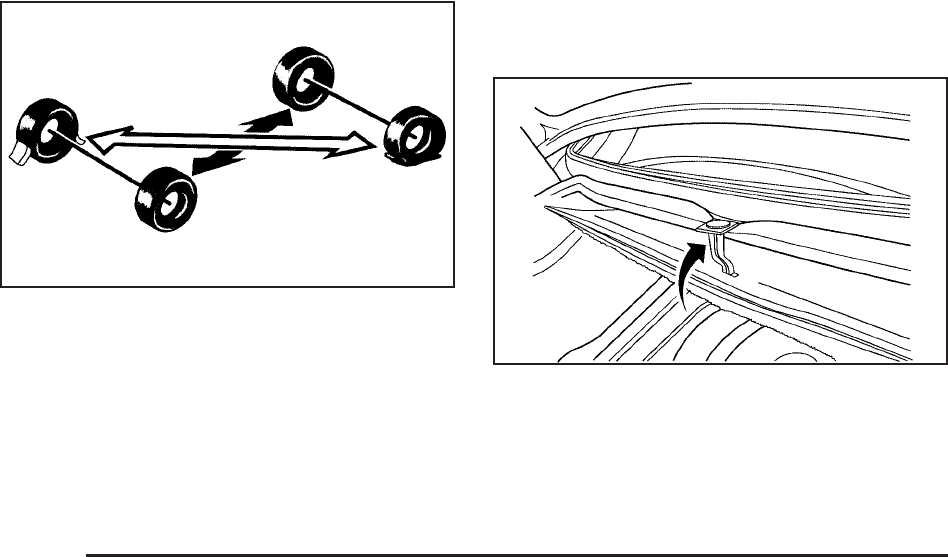
When your vehicle has a flat tire, use the following
example as a guide to assist you in the placement of
wheel blocks.
The following information will tell you next how to use
the jack and change a tire.
Removing the Spare Tire and Tools
The equipment you will need is located in the trunk.
1. Open the trunk. See Trunk on page 2-13 for more
information.
2. Remove the convenience net if the vehicle has one.
3. Lift the handle on the spare tire cover. The handle
may hook on the front edge of the trunk’s
weatherstrip to hold the cover out of the way.
5-74
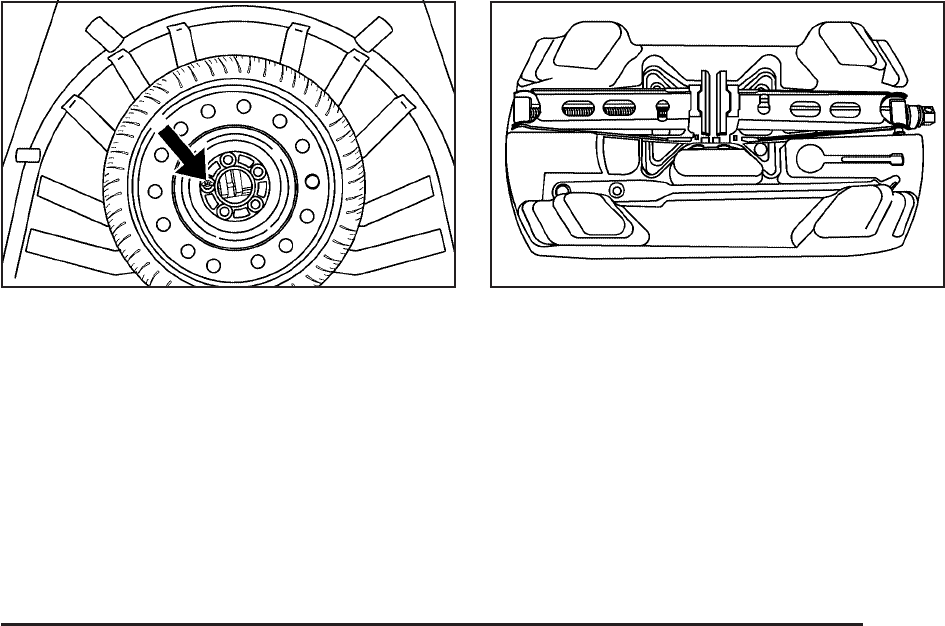
4. Turn the wing nut counterclockwise and remove it.
5. Remove the compact spare tire.
6. Turn the nut holding the jack counterclockwise and
remove it. Then remove the jack and wrench.
5-75
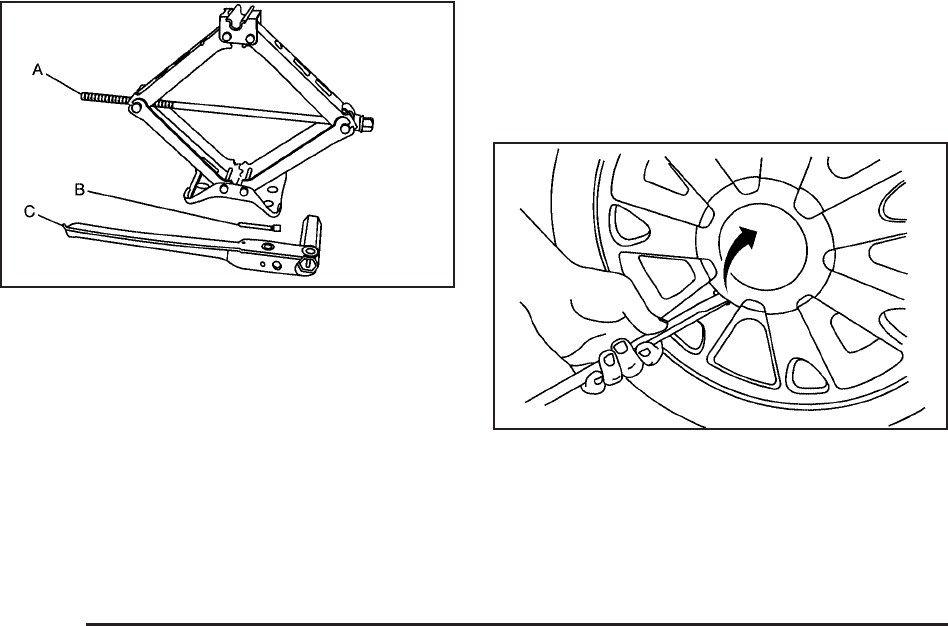
The tools you will need to change a tire include the
jack (A), extension and protection guide (B), and
wheel wrench (C).
Removing the Flat Tire and
Installing the Spare Tire
If the vehicle has steel wheel covers with center caps,
the wheel nuts are hidden behind the cap. To remove
the wheel cover, do the following:
1. Pry off the center cap by using the flat end of the
wheel wrench at the notch on the cap.
5-76
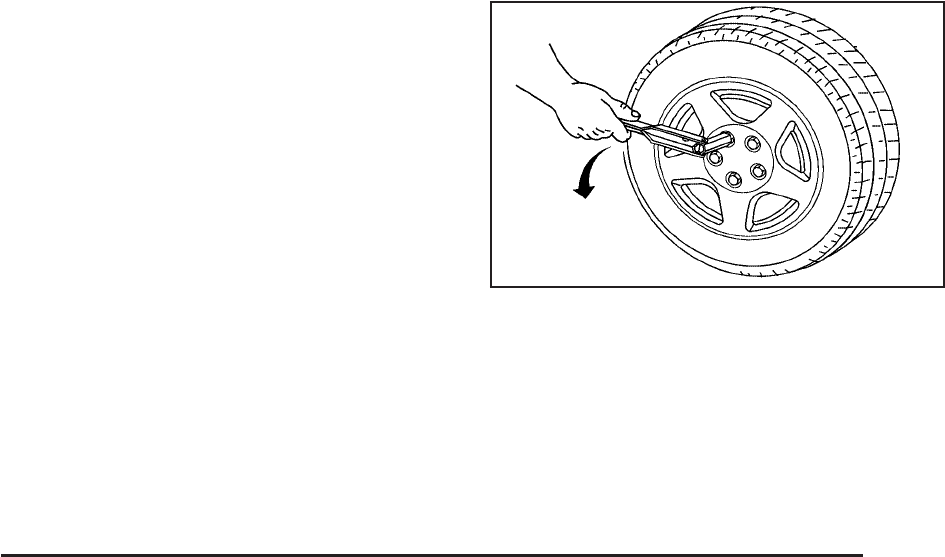
2. Use the wheel wrench to loosen the plastic wheel
nut caps, if equipped, in a counterclockwise
direction.
If needed, finish loosening them by hand. The nut
caps will not come off of the wheel cover.
3. Use the flat end of the wheel wrench and pry along
the edge of the cover until it comes off. Pull off the
wheel cover and set it aside.
The edge of the wheel cover could be sharp, so do
not try to remove the cover with your bare hands.
Do not drop the cap or lay it face down, as it could
become scratched or damaged.
If the vehicle has aluminum wheels and wheel center
caps, the wheel nuts are hidden behind the center cap.
Pry off the center cap by using the flat end of the
wheel wrench at the notch.
Do not drop the cap or lay it facedown, as it could
become scratched or damaged.
Once you have removed the wheel cover or center
cap, use the following procedure to remove the flat tire
and install the spare tire.
1. Place the wheel wrench securely over the wheel
nut. Turn the wheel wrench counterclockwise
to loosen all the wheel nuts, but do no remove
them yet.
2. Turn the jack handle clockwise to raise the jack
lift head.
5-77
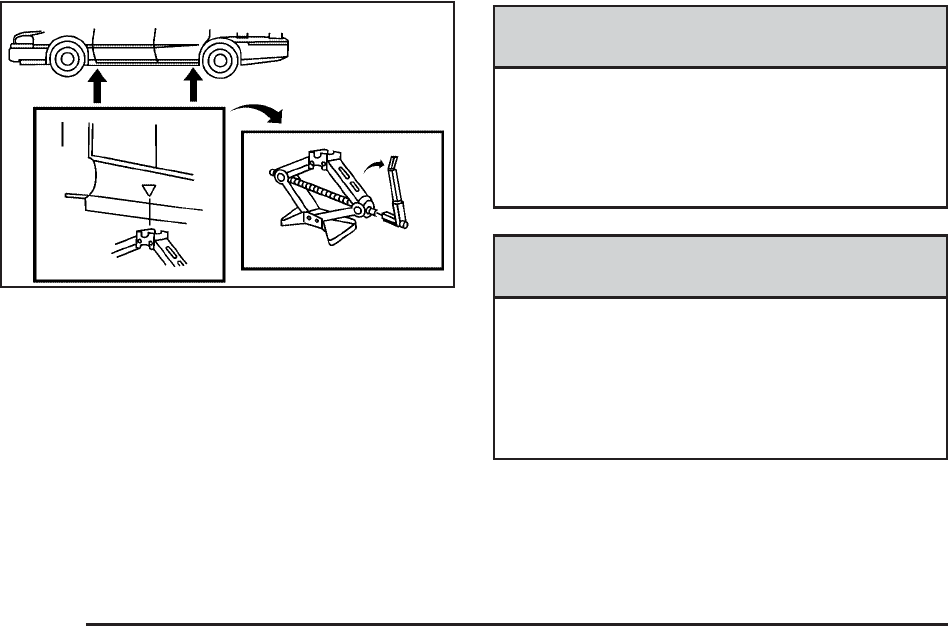
3. Find the jacking location using the diagram above
and corresponding hoisting notches located on the
underside of the vehicle’s plastic molding. The
notches in the plastic molding are marked with a
triangle shape to help you find them.
The front location is about 6.5 inches (16.5 cm)
from the rear edge of the front wheel well. The
rear location is about 9 inches (22.8 cm) from
the front edge of the rear wheel well.
4. Put the compact spare tire near you.
{CAUTION:
Getting under a vehicle when it is jacked up
is dangerous. If the vehicle slips off the jack
you could be badly injured or killed. Never get
under a vehicle when it is supported only by
a jack.
{CAUTION:
Raising your vehicle with the jack improperly
positioned can damage the vehicle and even
make the vehicle fall. To help avoid personal
injury and vehicle damage, be sure to fit the
jack lift head into the proper location before
raising the vehicle.
5-78
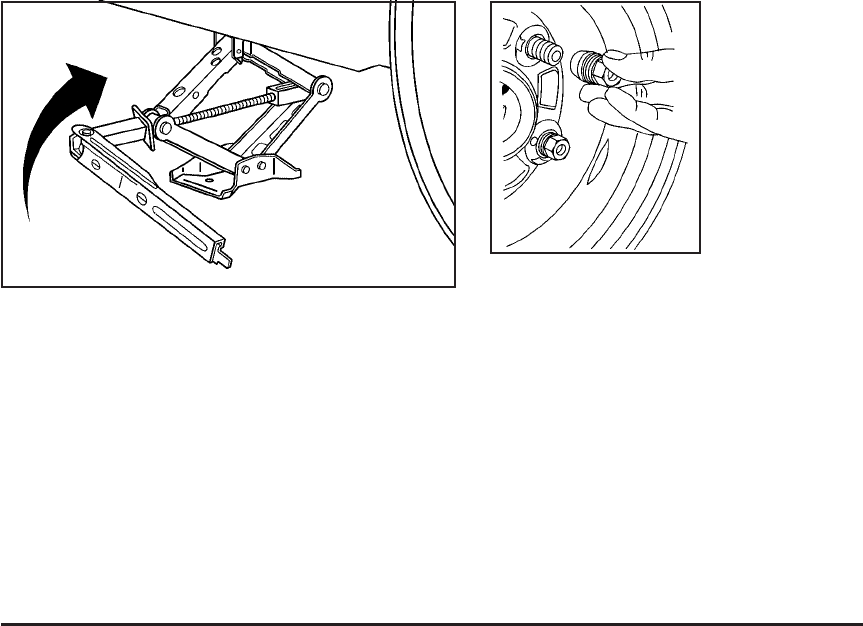
5. Raise the vehicle by turning the jack handle
clockwise. Raise the vehicle far enough off the
ground for the compact spare tire to fit under
the vehicle.
6. Remove all wheel
nuts and take off
the flat tire.
5-79
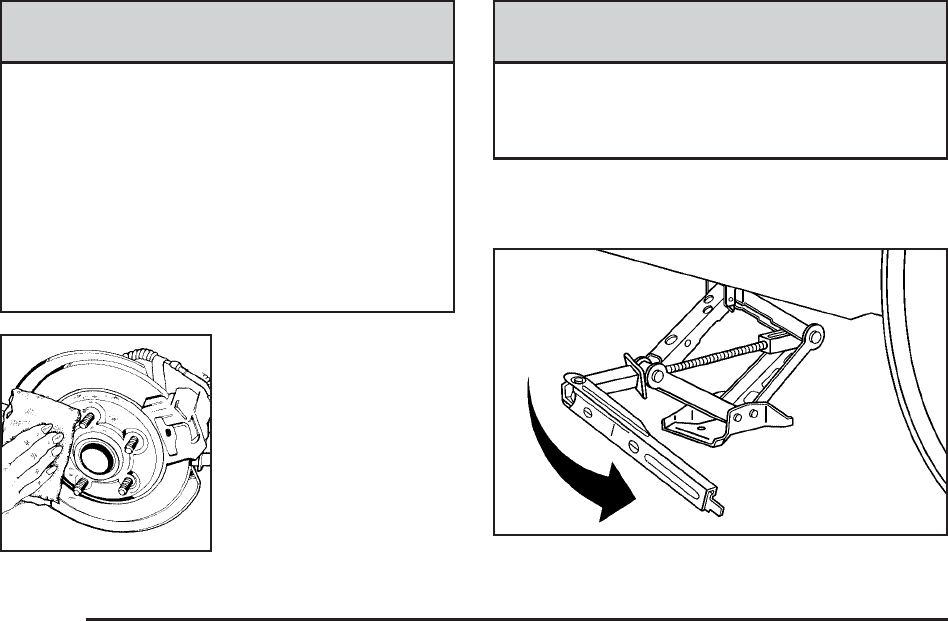
{CAUTION:
Rust or dirt on the wheel, or on the parts to
which it is fastened, can make the wheel nuts
become loose after a time. The wheel could
come off and cause an accident. When you
change a wheel, remove any rust or dirt from
the places where the wheel attaches to the
vehicle. In an emergency, you can use a cloth
or a paper towel to do this; but be sure to
use a scraper or wire brush later, if needed,
to get all the rust or dirt off.
7. Remove any rust or dirt
from the wheel bolts,
mounting surfaces
and spare wheel.
8. Install the compact spare tire.
{CAUTION:
Never use oil or grease on studs or nuts. If you
do, the nuts might come loose. Your wheel
could fall off, causing a serious accident.
9. Put the wheel nuts back on with the rounded end
of the nuts toward the wheel. Tighten each nut by
hand until the wheel is held against the hub.
10. Lower the vehicle by turning the jack handle
counterclockwise. Lower the jack completely.
5-80
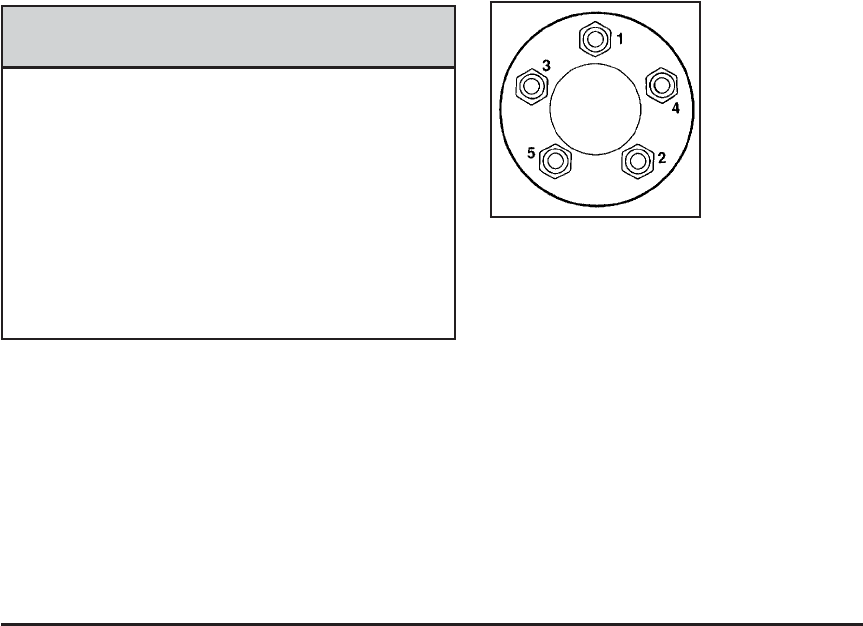
{CAUTION:
Incorrect wheel nuts or improperly tightened
wheel nuts can cause the wheel to come loose
and even come off. This could lead to an
accident. Be sure to use the correct wheel
nuts. If you have to replace them, be sure to
get new GM original equipment wheel nuts.
Stop somewhere as soon as you can and have
the nuts tightened with a torque wrench to the
proper torque specification. See Capacities
and Specifications on page 5-98 for wheel nut
torque specification.
Notice: Improperly tightened wheel nuts can lead
to brake pulsation and rotor damage. To avoid
expensive brake repairs, evenly tighten the wheel
nuts in the proper sequence and to the proper
torque specification. See Capacities and
Specifications on page 5-98 for the wheel nut
torque specification.
11. Tighten the wheel nuts
firmly in a crisscross
sequence as shown.
Notice: Wheel covers will not fit on your compact
spare. If you try to put a wheel cover on the compact
spare, you could damage the cover or the spare.
Do not try to put the wheel cover on the compact spare
tire. It will not fit. Store the wheel cover in the trunk
until you have the flat tire repaired or replaced.
5-81
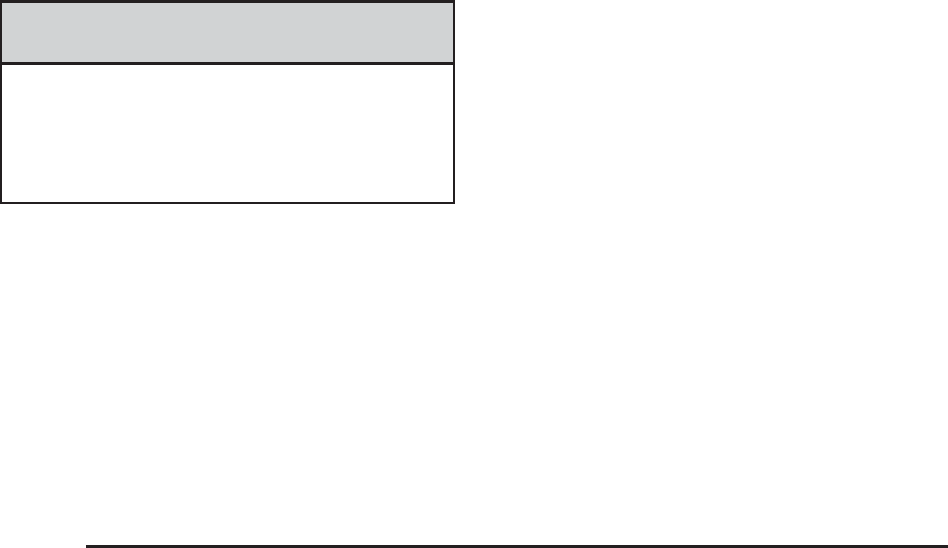
Storing a Flat or Spare Tire
and Tools
{CAUTION:
Storing a jack, a tire, or other equipment in
the passenger compartment of the vehicle
could cause injury. In a sudden stop or
collision, loose equipment could strike
someone. Store all these in the proper place.
After the compact spare tire has been installed on
the vehicle, store the flat tire in the trunk.
When storing a full-size tire, use the extension with
the protector, located in the foam holder, to help
avoid wheel surface damage.
To store a full-size tire, do the following:
1. Install the tools in their original location in the
trunk area and secure.
2. Place the tire valve stem facing down and
the protector/guide placed through a wheel
bolt hole.
3. Remove the protector and attach the retainer
securely
4. Store the cover as far forward as possible.
When storing a compact spare tire in the trunk, put the
protector back in the foam holder.
The compact spare is for temporary use only. Replace
the compact spare tire with a full-size tire as soon
as you can. See Compact Spare Tire on page 5-83.
Use the following as a guide for storing the compact
spare tire and tools.
5-82
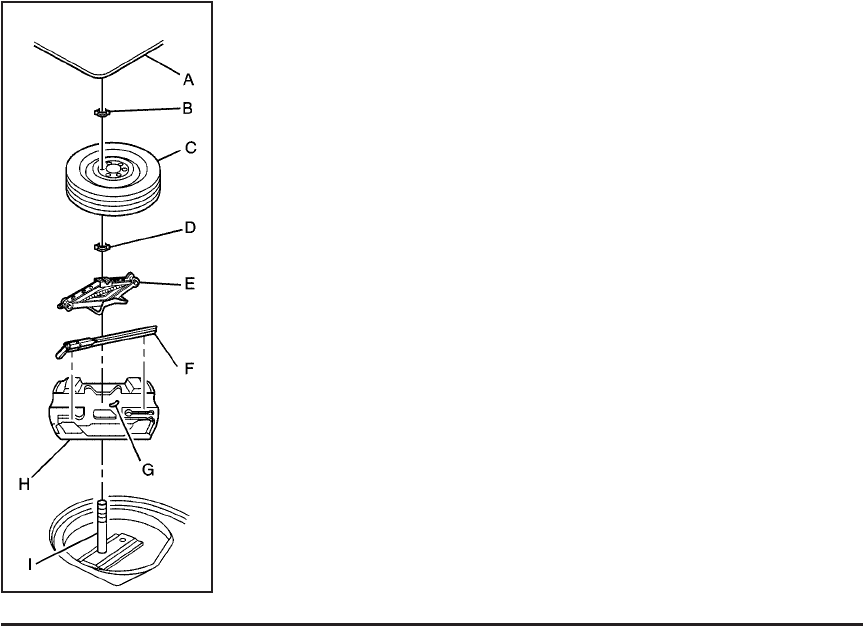
A. Cover
B. Wing Nut
C. Compact Spare Tire
D. Wing Nut
E. Jack
F. Wheel Wrench
G. Extension Protector
H. Foam Holder
I. Bolt Screw
Compact Spare Tire
Although the compact spare tire was fully inflated
when the vehicle was new, it can lose air after a time.
Check the inflation pressure regularly. It should be
60 psi (420 kPa).
After installing the compact spare on the vehicle,
check to make sure it is correctly inflated. The compact
spare is made to perform well at speeds up to 65 mph
(105 km/h) for distances up to 3,000 miles (5 000 km).
However, it is best to replace the compact spare
with a full-size tire as soon as possible. The spare
will last longer and be in good shape in case it is
needed again.
Notice: When the compact spare is installed,
do not take your vehicle through an automatic car
wash with guide rails. The compact spare can
get caught on the rails. That can damage the tire
and wheel, and maybe other parts of your vehicle.
Do not use the compact spare on other vehicles.
Do not mix the compact spare tire or wheel with other
wheels or tires. They will not fit. Keep the spare tire
and its wheel together.
Notice: Tire chains will not fit your compact spare.
Using them can damage your vehicle and can
damage the chains too. Do not use tire chains
on your compact spare.
5-83

Appearance Care
Cleaning the Inside of Your Vehicle
Your vehicle’s interior will continue to look its best
if it is cleaned often. Although not always visible,
dust and dirt can accumulate on your upholstery.
Dirt can damage carpet, fabric, leather, and plastic
surfaces. Regular vacuuming is recommended to
remove particles from your upholstery. It is important to
keep your upholstery from becoming and remaining
heavily soiled. Soils should be removed as quickly
as possible. Your vehicle’s interior may experience
extremes of heat that could cause stains to set rapidly.
Lighter colored interiors may require more frequent
cleaning. Use care because newspapers and garments
that transfer color to your home furnishings may also
transfer color to your vehicle’s interior.
When cleaning your vehicle’s interior, only use
cleaners specifically designed for the surfaces being
cleaned. Permanent damage may result from using
cleaners on surfaces for which they were not intended.
Use glass cleaner only on glass. Remove any
accidental over-spray from other surfaces immediately.
To prevent over-spray, apply cleaner directly to the
cleaning cloth.
Notice: If you use abrasive cleaners when cleaning
glass surfaces on your vehicle, you could scratch
the glass and/or cause damage to the integrated
radio antenna and the rear window defogger.
When cleaning the glass on your vehicle, use only
a soft cloth and glass cleaner.
Many cleaners contain solvents that may become
concentrated in your vehicle’s breathing space.
Before using cleaners, read and adhere to all safety
instructions on the label. While cleaning your vehicle’s
interior, maintain adequate ventilation by opening
your vehicle’s doors and windows.
Dust may be removed from small buttons and knobs
using a small brush with soft bristles.
5-84

Your GM dealer has a product for cleaning your
vehicle’s glass. Should it become necessary, you can
also obtain a product from your GM dealer to remove
odors from your vehicle’s upholstery.
Do not clean your vehicle using the following cleaners
or techniques:
•Never use a knife or any other sharp object to
remove a soil from any interior surface.
•Never use a stiff brush. It can cause damage to
your vehicle’s interior surfaces.
•Never apply heavy pressure or rub aggressively
with a cleaning cloth. Use of heavy pressure
can damage your interior and does not improve
the effectiveness of soil removal.
•Use only mild, neutral-pH soaps. Avoid laundry
detergents or dishwashing soaps with degreasers.
Using too much soap will leave a residue that
leaves streaks and attracts dirt. For liquid cleaners,
about 20 drops per gallon (3.78 L) of water is a
good guide.
•Do not heavily saturate your upholstery while
cleaning.
•Damage to your vehicle’s interior may result from
the use of many organic solvents such as naptha,
alcohol, etc.
Fabric/Carpet
Use a vacuum cleaner with a soft brush attachment
frequently to remove dust and loose dirt. A canister
vacuum with a beater bar in the nozzle may only
be used on floor carpet and carpeted floor mats.
For soils, always try to remove them first with plain
water or club soda. Before cleaning, gently remove
as much of the soil as possible using one of the
following techniques:
•For liquids: gently blot the remaining soil with a
paper towel. Allow the soil to absorb into the
paper towel until no more can be removed.
•For solid dry soils: remove as much as possible
and then vacuum.
To clean, use the following instructions:
1. Saturate a lint-free, clean white cloth with water
or club soda.
2. Wring the cloth to remove excess moisture.
3. Start on the outside edge of the soil and gently rub
toward the center. Continue cleaning, using a clean
area of the cloth each time it becomes soiled.
4. Continue to gently rub the soiled area until the
cleaning cloth remains clean.
5. If the soil is not completely removed, use a mild
soap solution and repeat the cleaning process
that was used with plain water.
5-85

If any of the soil remains, a commercial fabric cleaner
or spot lifter may be necessary. When a commercial
upholstery cleaner or spot lifter is to be used, test
a small hidden area for colorfastness first. If the
locally cleaned area gives any impression that a
ring formation may result, clean the entire surface.
After the cleaning process has been completed,
a paper towel can be used to blot excess moisture
from the fabric or carpet.
Leather
A soft cloth dampened with water may be used to
remove dust. If a more thorough cleaning is necessary,
a soft cloth dampened with a mild soap solution can
be used. Allow the leather to dry naturally. Do not use
heat to dry. Never use steam to clean leather. Never
use spot lifters or spot removers on leather. Many
commercial leather cleaners and coatings that are
sold to preserve and protect leather may permanently
change the appearance and feel of your leather and are
not recommended. Do not use silicone or wax-based
products, or those containing organic solvents to
clean your vehicle’s interior because they can alter the
appearance by increasing the gloss in a non-uniform
manner. Never use shoe polish on your leather.
Instrument Panel, Vinyl, and Other
Plastic Surfaces
A soft cloth dampened with water may be used to
remove dust. If a more thorough cleaning is necessary,
a clean soft cloth dampened with a mild soap solution
can be used to gently remove dust and dirt. Never
use spot lifters or removers on plastic surfaces.
Many commercial cleaners and coatings that are sold
to preserve and protect soft plastic surfaces may
permanently change the appearance and feel of your
interior and are not recommended. Do not use silicone
or wax-based products, or those containing organic
solvents to clean your vehicle’s interior because
they can alter the appearance by increasing the gloss
in a non-uniform manner.
Some commercial products may increase gloss on
your instrument panel. The increase in gloss may cause
annoying reflections in the windshield and even make
it difficult to see through the windshield under certain
conditions.
5-86
Care of Safety Belts
Keep belts clean and dry.
{CAUTION:
Do not bleach or dye safety belts. If you do,
it may severely weaken them. In a crash,
they might not be able to provide adequate
protection. Clean safety belts only with mild
soap and lukewarm water.
Weatherstrips
Silicone grease on weatherstrips will make them
last longer, seal better, and not stick or squeak.
Apply silicone grease with a clean cloth. During
very cold, damp weather frequent application may
be required. See Recommended Fluids and Lubricants
on page 6-12.
Washing Your Vehicle
The paint finish on the vehicle provides beauty, depth
of color, gloss retention, and durability.
The best way to preserve the vehicle’s finish is to keep it
clean by washing it often with lukewarm or cold water.
Do not wash the vehicle in the direct rays of the sun.
Use a car washing soap. Do not use strong soaps
or chemical detergents. Be sure to rinse the vehicle well,
removing all soap residue completely. GM-approved
cleaning products can be obtained from your dealer.
See Vehicle Care/Appearance Materials on page 5-91.
Do not use cleaning agents that are petroleum
based, or that contain acid or abrasives. All cleaning
agents should be flushed promptly and not allowed
to dry on the surface, or they could stain. Dry the
finish with a soft, clean chamois or an all-cotton towel
to avoid surface scratches and water spotting.
High pressure car washes may cause water to enter
the vehicle.
Cleaning Exterior Lamps/Lenses
Use only lukewarm or cold water, a soft cloth and a car
washing soap to clean exterior lamps and lenses. Follow
instructions under Washing Your Vehicle on page 5-87.
5-87

Finish Care
Occasional waxing or mild polishing of the vehicle by
hand may be necessary to remove residue from
the paint finish. GM-approved cleaning products can
be obtained from your dealer. See Vehicle Care/
Appearance Materials on page 5-91.
Notice: Machine compounding or aggressive
polishing on a basecoat/clearcoat paint finish may
damage it. Use only non-abrasive waxes and
polishes that are made for a basecoat/clearcoat
paint finish on your vehicle.
The vehicle has a “basecoat/clearcoat” paint finish.
The clearcoat gives more depth and gloss to the
colored basecoat. Always use waxes and polishes that
are non-abrasive and made for a basecoat/clearcoat
paint finish.
Foreign materials such as calcium chloride and other
salts, ice melting agents, road oil and tar, tree sap,
bird droppings, chemicals from industrial chimneys,
etc., can damage the vehicle’s finish if they remain
on painted surfaces. Wash the vehicle as soon
as possible. If necessary, use non-abrasive cleaners
that are marked safe for painted surfaces to remove
foreign matter.
Exterior painted surfaces are subject to aging, weather,
and chemical fallout that can take their toll over a
period of years. To help keep the paint finish looking
new, keep the vehicle in a garage or covered whenever
possible.
Windshield and Wiper Blades
If the windshield is not clear after using the windshield
washer, or if the wiper blade chatters when running,
wax, sap, or other material may be on the blade
or windshield.
Clean the outside of the windshield with a glass
cleaning liquid or powder and water solution. The
windshield is clean if beads do not form when it is
rinsed with water.
Grime from the windshield will stick to the wiper blades
and affect their performance. Clean the blade by
wiping vigorously with a cloth soaked in full-strength
windshield washer solvent. Then rinse the blade
with water.
Check the wiper blades and clean them as necessary;
replace blades that look worn.
5-88

Aluminum or Chrome-Plated Wheels
The vehicle may be equipped with either aluminum or
chrome-plated wheels.
Keep the wheels clean using a soft clean cloth with mild
soap and water. Rinse with clean water. After rinsing
thoroughly, dry with a soft clean towel. A wax may
then be applied.
Notice: If you use strong soaps, chemicals,
abrasive polishes, cleaners, brushes, or cleaners
that contain acid on aluminum or chrome-plated
wheels, you could damage the surface of the
wheel(s). The repairs would not be covered by
your warranty. Use only GM-approved cleaners
on aluminum or chrome-plated wheels.
The surface of these wheels is similar to the painted
surface of your vehicle. Do not use strong soaps,
chemicals, abrasive polishes, abrasive cleaners,
cleaners with acid, or abrasive cleaning brushes
on them because you could damage the surface.
Do not use chrome polish on aluminum wheels.
Notice: Using chrome polish on aluminum wheels
could damage the wheels. The repairs would not
be covered by your warranty. Use chrome polish
on chrome wheels only.
Use chrome polish only on chrome-plated wheels,
but avoid any painted surface of the wheel, and buff
off immediately after application.
Notice: If you drive your vehicle through an
automatic car wash that has silicone carbide tire
cleaning brushes, you could damage the aluminum
or chrome-plated wheels. The repairs would not
be covered by your warranty. Never drive a vehicle
equipped with aluminum or chrome-plated wheels
through an automatic car wash that uses silicone
carbide tire cleaning brushes.
Do not take your vehicle through an automatic car wash
that has silicone carbide tire cleaning brushes. These
brushes can also damage the surface of these wheels.
Tires
To clean the tires, use a stiff brush with tire cleaner.
Notice: Using petroleum-based tire dressing
products on your vehicle may damage the paint
finish and/or tires. When applying a tire dressing,
always wipe off any overspray from all painted
surfaces on your vehicle.
5-89

Sheet Metal Damage
If the vehicle is damaged and requires sheet metal
repair or replacement, make sure the body repair shop
applies anti-corrosion material to parts repaired or
replaced to restore corrosion protection.
Original manufacturer replacement parts will provide
the corrosion protection while maintaining the warranty.
Finish Damage
Any stone chips, fractures or deep scratches in the
finish should be repaired right away. Bare metal
will corrode quickly and may develop into major
repair expense.
Minor chips and scratches can be repaired with
touch-up materials available from your GM dealer.
Larger areas of finish damage can be corrected in
your GM dealer’s body and paint shop.
Underbody Maintenance
Chemicals used for ice and snow removal and dust
control can collect on the underbody. If these are
not removed, corrosion and rust can develop on the
underbody parts such as fuel lines, frame, floor pan,
and exhaust system even though they have corrosion
protection.
At least every spring, flush these materials from the
underbody with plain water. Clean any areas where
mud and debris can collect. Dirt packed in close areas
of the frame should be loosened before being flushed.
Your dealer or an underbody car washing system can
do this for you.
Chemical Paint Spotting
Some weather and atmospheric conditions can create a
chemical fallout. Airborne pollutants can fall upon and
attack painted surfaces on the vehicle. This damage can
take two forms: blotchy, ring-shaped discolorations, and
small, irregular dark spots etched into the paint surface.
Although no defect in the paint job causes this, GM
will repair, at no charge to the owner, the surfaces of
new vehicles damaged by this fallout condition within
12 months or 12,000 miles (20 000 km) of purchase,
whichever occurs first.
5-90
Vehicle Care/Appearance Materials
Description Usage
Polishing Cloth
Wax-Treated Interior and exterior
polishing cloth.
Tar and Road Oil
Remover Removes tar, road oil,
and asphalt.
Chrome Cleaner
and Polish Use on chrome or
stainless steel.
White Sidewall
Tire Cleaner Removes soil and black
marks from whitewalls.
Vinyl Cleaner Cleans vinyl.
Glass Cleaner Removes dirt, grime,
smoke and fingerprints.
Chrome and Wire
Wheel Cleaner
Removes dirt and grime
from chrome wheels and
wire wheel covers.
Finish Enhancer
Removes dust,
fingerprints, and surface
contaminants. Spray on
and wipe off.
Description Usage
Swirl Remover Polish Removes swirl marks, fine
scratches, and other light
surface contamination.
Cleaner Wax Removes light scratches
and protects finish.
Foaming Tire Shine
Low Gloss
Cleans, shines, and
protects in one step.
No wiping necessary.
Wash Wax
Concentrate
Medium foaming
shampoo. Cleans
and lightly waxes.
Biodegradable and
phosphate free.
Spot Lifter
Quickly removes spots
and stains from carpets,
vinyl, and cloth
upholstery.
Odor Eliminator Odorless spray odor
eliminator used on fabrics,
vinyl, leather and carpet.
5-91
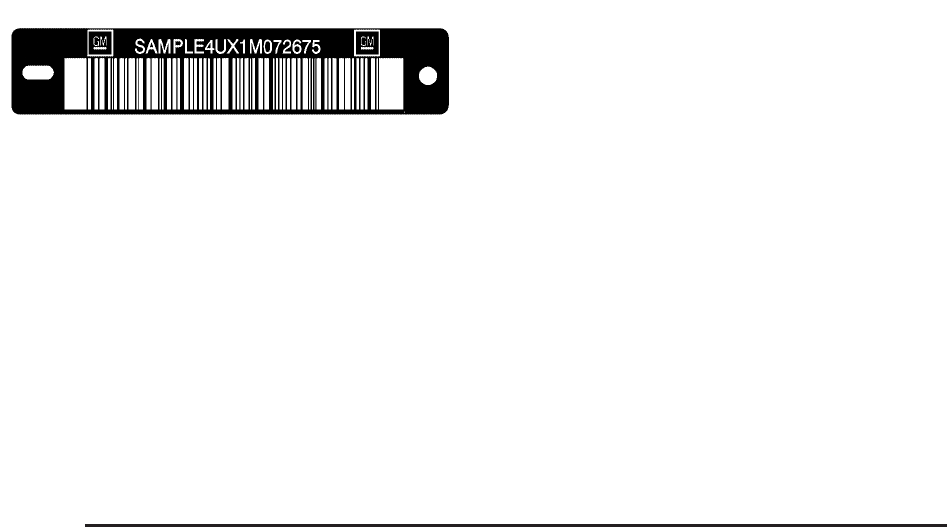
Vehicle Identification
Vehicle Identification Number (VIN)
This is the legal identifier for your vehicle. It appears
on a plate in the front corner of the instrument panel,
on the driver’s side. You can see it if you look through
the windshield from outside your vehicle. The VIN
also appears on the Vehicle Certification and Service
Parts labels and the certificates of title and registration.
Engine Identification
The eighth character in the VIN is the engine code.
This code will help you identify your vehicle’s engine,
specifications, and replacement parts.
Service Parts Identification Label
You will find this label in the trunk. It is very helpful if
you ever need to order parts. On this label, you will
find the following:
•VIN
•Model designation
•Paint information
•Production options and special equipment
Be sure that this label is not removed from the vehicle.
5-92

Electrical System
Add-On Electrical Equipment
Notice: Don’t add anything electrical to your
vehicle unless you check with your dealer first.
Some electrical equipment can damage your
vehicle and the damage wouldn’t be covered by
your warranty. Some add-on electrical equipment
can keep other components from working as
they should.
Your vehicle has an airbag system. Before attempting
to add anything electrical to your vehicle, see Servicing
Your Airbag-Equipped Vehicle on page 1-65.
Headlamp Wiring
The headlamp wiring is protected by a circuit breaker
in the underhood fuse block. An electrical overload
will cause the headlamps to go on and off, or in some
cases to remain off. If this happens, have the headlamp
system checked right away.
Windshield Wiper Fuses
The windshield wiper motor is protected by a circuit
breaker and a fuse. If the motor overheats due to heavy
snow, etc., the wiper will stop until the motor cools.
If the overload is caused by some electrical problem,
have it fixed.
Power Windows and Other
Power Options
Circuit breakers in the instrument panel fuse block
protect the power windows and other power accessories.
When the current load is too heavy, the circuit breaker
opens and closes, protecting the circuit until the
problem is fixed.
Fuses and Circuit Breakers
The wiring circuits in the vehicle are protected from
short circuits by a combination of fuses, circuit breakers
and in the fuse block wiring itself. This greatly reduces
the chance of fires caused by electrical problems.
Look at the silver-colored band inside the fuse. If the
band is broken or melted, replace the fuse. Make sure
a bad fuse is replaced with a new one of the identical
size and rating.
5-93
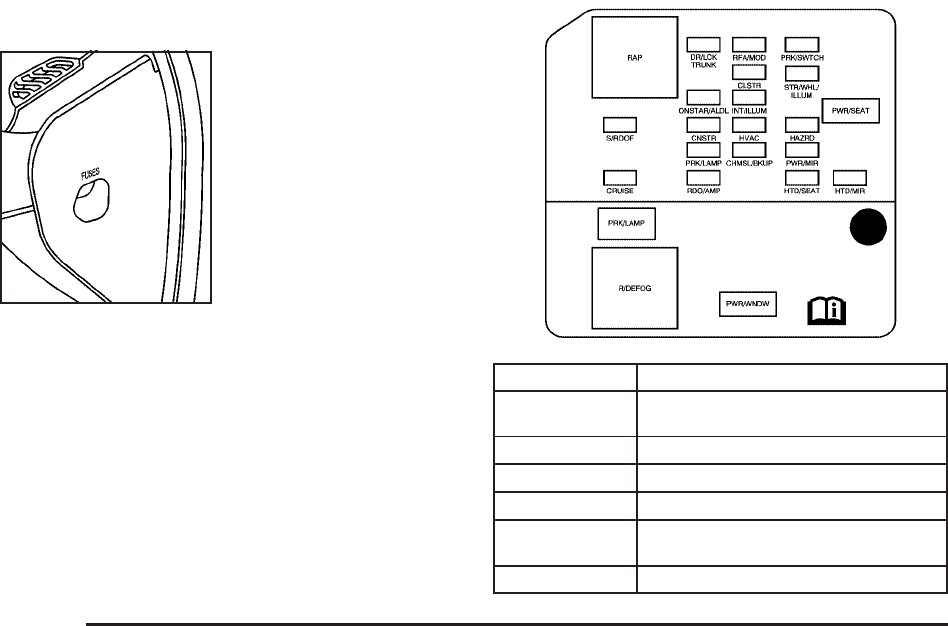
Instrument Panel Fuse Block
The instrument panel
fuse block is located on
the passenger’s side of
the instrument panel.
Pull off the cover labeled
FUSES to expose the
fuse block.
Fuses Usage
DR/LCK
TRUNK Door Locks, Trunk
RFA/MOD Remote Keyless Entry
PRK/SWTCH Ignition Key Lock
CLSTR Cluster
STR/WHL/
ILLUM Steering Wheel Controls
Illumination
ONSTAR/ALDL OnStar
®
, Data Link
5-94
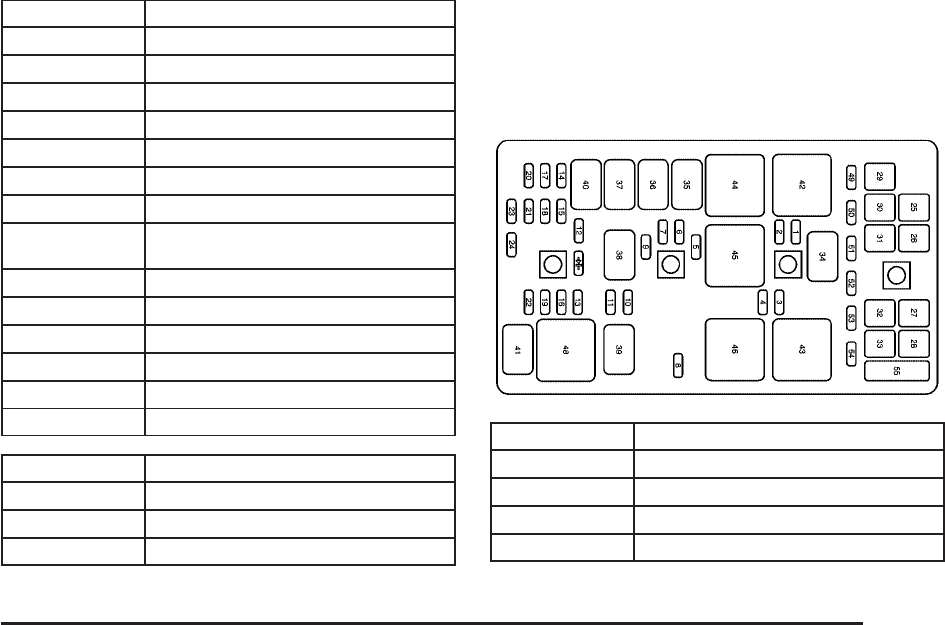
Fuses Usage
INT/ILLUM Interior Lamps
PWR/SEAT Power Seat
S/ROOF Sunroof
CNSTR Canister Vent
HVAC Climate Control System
HAZRD Turn Signal, Hazard
PRK/LAMP Park Lamps
CHMSL/BKUP Center-High-Mounted
Stoplamp/Back-up Lamps
PWR/MIR Power Mirrors
CRUISE Cruise Control
RDO/AMP Radio, Amplifier
HTD/SEAT Heated Seats
HTD/MIR Heated Mirrors
PWR/WNDW Power Window
Relays Usage
RAP Retained Accessory Power
PRK/LAMP Park Lamp Relay
R/DEFOG Rear Defogger Relay
Underhood Fuse Block
Some fuses and relays are located in the underhood
fuse block on the passenger’s side of the vehicle in
the engine compartment. See Engine Compartment
Overview on page 5-12 for more information on location.
Mini-Fuses Usage
1 Left High Beam
2 Right High Beam
3 Left Low Beam
4 Right Low Beam
5-95
Mini-Fuses Usage
5 Windshield Wiper
6 Washer/Regulated Voltage Control
7 Fog Lamps
8 Transaxle Control Module
9 Supplemental Inflatable Restraint
10 Auxiliary Power
11 Horn
12 Emission
13 Air Conditioner Clutch
14 Oxygen Sensor
15 Powertrain Control Module
16 Powertrain Control Module,
Electronic Throttle Control
17 Electronic Throttle Control
18 Display
19 Anti-lock Brake Solenoid
20 Fuel Injector
Mini-Fuses Usage
21 Transmission Solenoid
22 Fuel Pump
23 Anti-lock Brake System
24 Ignition
J-Style Fuses Usage
25 Air Pump
26 Battery Main 1
27 Battery Main 2
28 Battery Main 3
29 Fan 1
30 Battery Main 4
31 Anti-lock Brake System Motor
32 Fan 2
33 Starter
5-96
Micro-Relays Usage
34 Headlamp High Beam
35 HDM Module
36 Fog Lamp
37 Ignition 1
38 Air Conditioning Compressor
39 Horn
40 Powertrain
41 Fuel Pump
Mini-Relays Usage
42 Fan 1
43 Fan 3
44 Windshield Wiper High
45 Windshield Wiper
46 Fan 2
48 Crank
Spare Fuses Usage
49 Spare
50 Spare
51 Spare
52 Spare
53 Spare
54 Spare
Fuse Puller Usage
55 Fuse Puller
Diodes Usage
§Air Conditioner Compressor
Clutch Diode
5-97
Capacities and Specifications
The following approximate capacities are given in English and metric conversions.
Capacities and Specifications
Application
Capacities
English Metric
Automatic Transaxle 7.4 qt 7.0 L
Cooling System Including Reservoir
3.6L V6 12.2 qt 11.6 L
3.8L V6 11.7 qt 11.0 L
Engine Oil with Filter
3.6L V6 5.5 qt 5.2 L
3.8L V6 4.5 qt 4.3 L
Fuel Tank 17.5 gal 66.0 L
Wheel Nut Torque 100 lb ft 140 Y
All capacities are approximate. When adding, be sure to fill to the approximate level, as recommended in this
manual. See Scheduled Maintenance on page 6-4
Engine Specifications
Engine VIN Code Transaxle Spark Plug Gap
3.6L V6 7 Automatic 0.044 inches (1.1 mm)
3.8L V6 2 Automatic 0.060 inches (1.52 mm)
5-98

Maintenance Schedule ......................................6-2
Introduction ...................................................6-2
Maintenance Requirements ..............................6-2
Your Vehicle and the Environment ....................6-2
Using the Maintenance Schedule ......................6-3
Scheduled Maintenance ...................................6-4
Additional Required Services ............................6-6
Maintenance Footnotes ...................................6-7
Owner Checks and Services ............................6-8
At Each Fuel Fill ............................................6-9
At Least Once a Month ...................................6-9
At Least Once a Year ...................................6-10
Recommended Fluids and Lubricants ...............6-12
Normal Maintenance Replacement Parts ..........6-13
Maintenance Record .....................................6-14
Section 6 Maintenance Schedule
6-1

Maintenance Schedule
Introduction
Important: Keep engine oil at the proper level and
change as recommended.
Have you purchased the GM Protection Plan?
The Plan supplements your new vehicle warranties.
See your Warranty and Owner Assistance booklet
or your dealer for details.
Maintenance Requirements
Notice: Maintenance intervals, checks, inspections,
replacement parts, and recommended fluids and
lubricants as prescribed in this manual are necessary
to keep your vehicle in good working condition.
Any damage caused by failure to follow scheduled
maintenance may not be covered by warranty.
Your Vehicle and the Environment
Proper vehicle maintenance not only helps to keep your
vehicle in good working condition, but also helps the
environment. All recommended maintenance is
important. Improper vehicle maintenance can even
affect the quality of the air we breathe. Improper fluid
levels or the wrong tire inflation can increase the level
of emissions from your vehicle. To help protect our
environment, and to keep your vehicle in good condition,
be sure to maintain your vehicle properly.
6-2
Using the Maintenance Schedule
We at General Motors want to help you keep your
vehicle in good working condition. But we do not know
exactly how you will drive it. You may drive very
short distances only a few times a week. Or you may
drive long distances all the time in very hot, dusty
weather. You may use your vehicle in making deliveries.
Or you may drive it to work, to do errands, or in many
other ways.
Because of all the different ways people use their
vehicles, maintenance needs vary. You may need more
frequent checks and replacements. So please read
the following and note how you drive. If you have any
questions on how to keep your vehicle in good condition,
see your GM Goodwrench
®
dealer.
This schedule is for vehicles that:
•carry passengers and cargo within recommended
limits. You will find these limits on the tire and
loading information label. See Loading Your Vehicle
on page 4-31.
•are driven on reasonable road surfaces within legal
driving limits.
•use the recommended fuel. See Gasoline Octane
on page 5-5.
The services in Scheduled Maintenance on page 6-4
should be performed when indicated. See Additional
Required Services on page 6-6 and Maintenance
Footnotes on page 6-7 for further information.
{CAUTION:
Performing maintenance work on a vehicle
can be dangerous. In trying to do some jobs,
you can be seriously injured. Do your own
maintenance work only if you have the
required know-how and the proper tools and
equipment for the job. If you have any doubt,
see your GM Goodwrench
®
dealer to have a
qualified technician do the work.
Some maintenance services can be complex.
So, unless you are technically qualified and have
the necessary equipment, you should have your
GM Goodwrench
®
dealer do these jobs.
When you go to your GM Goodwrench
®
dealer for
your service needs, you will know that GM-trained and
supported service technicians will perform the work
using genuine GM parts.
If you want to purchase service information, see
Service Publications Ordering Information on page 7-15.
6-3

Owner Checks and Services on page 6-8 tells you
what should be checked, when to check it, and what
you can easily do to help keep your vehicle in good
condition.
The proper replacement parts, fluids, and lubricants to
use are listed in Recommended Fluids and Lubricants
on page 6-12 and Normal Maintenance Replacement
Parts on page 6-13. When your vehicle is serviced,
make sure these are used. All parts should be replaced
and all necessary repairs done before you or anyone
else drives the vehicle. We recommend the use of
genuine GM parts.
Scheduled Maintenance
When the change engine oil light or CHANGE OIL
SOON DIC message comes on, it means that service
is required for your vehicle. Have your vehicle
serviced as soon as possible within the next 600 miles
(1 000 km). It is possible that, if you are driving
under the best conditions, the engine oil life system
may not indicate that vehicle service is necessary
for over a year. However, the engine oil and filter must
be changed at least once a year and at this time the
system must be reset. Your GM Goodwrench
®
dealer
has GM-trained service technicians who will perform this
work using genuine GM parts and reset the system.
If the engine oil life system is ever reset accidentally,
you must service your vehicle within 3,000 miles
(5 000 km) since the last service. Remember to reset
the oil life system whenever the oil is changed. See
Engine Oil Life System on page 5-18 for information on
the Engine Oil Life System and resetting the system.
When the light or message appears, certain services,
checks, and inspections are required. Required services
are described in the following for “Maintenance I” and
“Maintenance II.” Generally, it is recommended that the
first service be Maintenance I, the second service be
Maintenance II, and that you alternate Maintenance I
and Maintenance II thereafter. However, in some cases,
Maintenance II may be required more often.
Maintenance I— Use Maintenance Iif the light or
message comes on within 10 months since the vehicle
was purchased or Maintenance II was performed.
Maintenance II — Use Maintenance II if the previous
service performed was Maintenance I. Always use
Maintenance II whenever the light or message comes
on 10 months or more since the last service or if the
light or message has not come on at all for one year.
6-4
Scheduled Maintenance
Service Maintenance IMaintenance II
Change engine oil and filter. See Engine Oil on page 5-15. Reset oil life
system. See Engine Oil Life System on page 5-18.An Emission Control Service. ••
Visually check for any leaks or damage. See footnote (k). ••
Inspect engine air cleaner filter. If necessary, replace filter. See Engine Air
Cleaner/Filter on page 5-20.See footnote (l). •
Rotate tires and check inflation pressures and wear. See Tire Inspection and
Rotation on page 5-64 and “Tire Wear Inspection” in At Least Once a Month
on page 6-9.••
Inspect brake system. See footnote (a). ••
Check engine coolant and windshield washer fluid levels and add fluid as
needed. ••
Perform any needed additional services. See “Additional Required Services”
in this section. ••
Inspect suspension and steering components. See footnote (b). •
Inspect engine cooling system. See footnote (c). •
Inspect wiper blades. See footnote (d). •
Inspect restraint system components. See footnote (e). •
Lubricate body components. See footnote (f). •
Check transaxle fluid level and add fluid as needed. •
Replace passenger compartment air filter. See footnote (g). •
Inspect throttle system. See footnote (j). •
6-5
Additional Required Services
The following services should be performed at the first maintenance service (Ior II) after the indicated miles (kilometers)
shown for each item. Additional Required Services
Service and Miles (Kilometers) 25,000
(41 500) 50,000
(83 000) 75,000
(125 000) 100,000
(166 000) 125,000
(207 500) 150,000
(240 000)
Inspect fuel system for damage
or leaks. • •••••
Inspect exhaust system for loose or
damaged components. • •••••
Replace engine air cleaner filter. See
Engine Air Cleaner/Filter on page 5-20.•••
Change automatic transaxle fluid and
filter (severe service). See footnote (h). •••
Change automatic transaxle fluid
and filter (normal service). •
Replace spark plugs and inspect
spark plug wires. An Emission
Control Service. •
Engine cooling system service
(or every five years, whichever occurs
first). An Emission Control Service.
See footnote (i).
•
Inspect engine accessory drive belt.
An Emission Control Service.
See footnote (m). •
6-6

Maintenance Footnotes
(a) Visually inspect brake lines and hoses for proper
hook-up, binding, leaks, cracks, chafing, etc. Inspect
disc brake pads for wear and rotors for surface
condition. Inspect other brake parts, including calipers,
parking brake, etc.
(b) Visually inspect front and rear suspension and
steering system for damaged, loose, or missing parts or
signs of wear. Inspect power steering lines and hoses
for proper hook-up, binding, leaks, cracks, chafing, etc.
(c) Visually inspect hoses and have them replaced if
they are cracked, swollen, or deteriorated. Inspect
all pipes, fittings and clamps; replace with genuine GM
parts as needed. To help ensure proper operation,
a pressure test of the cooling system and pressure
cap and cleaning the outside of the radiator and
air conditioning condenser is recommended at least
once a year.
(d) Visually inspect wiper blades for wear or cracking.
Replace wiper blades that appear worn or damaged
or that streak or miss areas of the windshield.
(e) Make sure the safety belt reminder light and all your
belts, buckles, latch plates, retractors, and anchorages
are working properly. Look for any other loose or
damaged safety belt system parts. If you see anything
that might keep a safety belt system from doing its
job, have it repaired. Have any torn or frayed safety belts
replaced. Also look for any opened or broken airbag
coverings, and have them repaired or replaced.
The airbag system does not need regular maintenance.
(f) Lubricate all key lock cylinders. Lubricate all
hinges and latches, including those for the body doors,
hood, secondary latch, pivots, spring anchor, release
pawl, rear compartment, glove box door, and console
door. More frequent lubrication may be required
when exposed to a corrosive environment. Applying
silicone grease on weatherstrips with a clean cloth will
make them last longer, seal better, and not stick or
squeak.
(g) If you drive regularly under dusty conditions, the
filter may require replacement more often.
6-7

(h) Change automatic transaxle fluid and filter if the
vehicle is mainly driven under one or more of these
conditions:
−In heavy city traffic where the outside temperature
regularly reaches 90°F (32°C) or higher.
−In hilly or mountainous terrain.
−When doing frequent trailer towing.
−Uses such as found in taxi, police, or delivery
service.
(i) Drain, flush, and refill cooling system. This service
can be complex; you should have your dealer perform
this service. See Engine Coolant on page 5-24 for
what to use. Inspect hoses. Clean radiator, condenser,
pressure cap, and filler neck. Pressure test the
cooling system and pressure cap.
(j) Check throttle system for interference or binding
and for damaged or missing parts. Replace parts
as needed. Replace any components that have high
effort or excessive wear. Do not lubricate accelerator
or cruise control cables.
(k) A fluid loss in any vehicle system could indicate
a problem. Have the system inspected and repaired
and the fluid level checked. Add fluid if needed.
(l) If you drive regularly under dusty conditions, inspect
the filter at each engine oil change.
(m) Visually inspect belt for fraying, excessive cracks,
or obvious damage. Replace belt if necessary.
Owner Checks and Services
These owner checks and services should be performed
at the intervals specified to help ensure the safety,
dependability, and emission control performance of your
vehicle. Your GM Goodwrench
®
dealer can assist you
with these checks and services.
Be sure any necessary repairs are completed at once.
Whenever any fluids or lubricants are added to your
vehicle, make sure they are the proper ones, as shown
in Recommended Fluids and Lubricants on page 6-12.
6-8

At Each Fuel Fill
It is important to perform these underhood checks
at each fuel fill.
Engine Oil Level Check
Check the engine oil level and add the proper oil if
necessary. See Engine Oil on page 5-15 for further
details.
Notice: It is important to check your oil regularly
and keep it at the proper level. Failure to keep your
engine oil at the proper level can cause damage
to your engine not covered by your warranty.
Engine Coolant Level Check
Check the engine coolant level and add
DEX-COOL
®
coolant mixture if necessary.
See Engine Coolant on page 5-24 for further details.
Windshield Washer Fluid Level Check
Check the windshield washer fluid level in the windshield
washer fluid reservoir and add the proper fluid if
necessary.
At Least Once a Month
Tire Inflation Check
Visually inspect your vehicle’s tires and make sure they
are inflated to the correct pressures. Do not forget to
check the spare tire. See Tires on page 5-57 for further
details. Check to make sure the spare tire is stored
securely. See Changing a Flat Tire on page 5-73.
Tire Wear Inspection
Tire rotation may be required for high mileage highway
drivers prior to the Engine Oil Life System service
notification. Check the tires for wear and, if necessary,
rotate the tires. See Tire Inspection and Rotation on
page 5-64.
6-9
At Least Once a Year
Starter Switch Check
{CAUTION:
When you are doing this inspection, the
vehicle could move suddenly. If the vehicle
moves, you or others could be injured.
1. Before you start, be sure you have enough room
around the vehicle.
2. Firmly apply both the parking brake and the regular
brake. See Parking Brake on page 2-30.
Do not use the accelerator pedal, and be ready to
turn off the engine immediately if it starts.
3. Try to start the engine in each gear. The vehicle
should start only in PARK (P) or NEUTRAL (N).
If the vehicle starts in any other position, contact
your GM Goodwrench
®
dealer for service.
Automatic Transaxle Shift Lock Control
System Check
{CAUTION:
When you are doing this inspection, the
vehicle could move suddenly. If the vehicle
moves, you or others could be injured.
1. Before you start, be sure you have enough room
around the vehicle. It should be parked on a level
surface.
2. Firmly apply the parking brake. See Parking Brake
on page 2-30.
Be ready to apply the regular brake immediately if
the vehicle begins to move.
3. With the engine off, turn the ignition to RUN, but do
not start the engine. Without applying the regular
brake, try to move the shift lever out of PARK (P)
with normal effort. If the shift lever moves out
of PARK (P), contact your GM Goodwrench
®
dealer for service.
6-10

Ignition Transaxle Lock Check
While parked, and with the parking brake set, try to
turn the ignition to OFF in each shift lever position.
•The ignition should turn to OFF only when the
shift lever is in PARK (P).
•The key should come out only in OFF.
Contact your GM Goodwrench
®
dealer if service is
required.
Parking Brake and Automatic Transaxle
Park (P) Mechanism Check
{CAUTION:
When you are doing this check, your vehicle
could begin to move. You or others could be
injured and property could be damaged. Make
sure there is room in front of your vehicle in
case it begins to roll. Be ready to apply the
regular brake at once should the vehicle begin
to move.
Park on a fairly steep hill, with the vehicle facing
downhill. Keeping your foot on the regular brake,
set the parking brake.
•To check the parking brake’s holding ability: With
the engine running and transaxle in NEUTRAL (N),
slowly remove foot pressure from the regular
brake pedal. Do this until the vehicle is held by
the parking brake only.
•To check the PARK (P) mechanism’s holding
ability: With the engine running, shift to PARK (P).
Then release the parking brake followed by the
regular brake.
Contact your GM Goodwrench
®
dealer if service is
required.
Underbody Flushing Service
At least every spring, use plain water to flush any
corrosive materials from the underbody. Take care
to clean thoroughly any areas where mud and other
debris can collect.
6-11
Recommended Fluids and
Lubricants
Fluids and lubricants identified below by name,
part number, or specification may be obtained from
your dealer.
Usage Fluid/Lubricant
Engine Oil
Engine oil which meets GM
Standard GM6094M and displays
the American Petroleum Institute
Certified for Gasoline Engines
starburst symbol. GM Goodwrench
®
oil meets all the requirements for
your vehicle. To determine the
proper viscosity for your vehicle’s
engine, see Engine Oil on
page 5-15.
Engine Coolant
50/50 mixture of clean, drinkable
water and use only DEX-COOL
®
Coolant. See Engine Coolant on
page 5-24.
Hydraulic Brake
System Delco
®
Supreme 11 Brake Fluid or
equivalent DOT-3 brake fluid.
Windshield
Washer GM Optikleen
®
Washer Solvent.
Usage Fluid/Lubricant
Power Steering
System
GM Power Steering Fluid
(GM Part No. U.S. 89021184, in
Canada 89021186).
Automatic
Transaxle DEXRON
®
-VI Automatic
Transmission Fluid.
Key Lock
Cylinders
Multi-Purpose Lubricant, Superlube
(GM Part No. U.S. 12346241, in
Canada 10953474).
Hood Latch
Assembly,
Secondary
Latch, Pivots,
Spring
Anchor, and
Release Pawl
Lubriplate Lubricant Aerosol
(GM Part No. U.S. 12346293, in
Canada 992723) or lubricant
meeting requirements of NLGI #2,
Category LB or GC-LB.
Hood and Door
Hinges
Multi-Purpose Lubricant, Superlube
(GM Part No. U.S. 12346241, in
Canada 109435474).
Weatherstrip
Conditioning
Dielectric Silicone Grease
(GM Part No. U.S. 12345579, in
Canada 992887).
6-12
Normal Maintenance Replacement Parts
Replacement parts identified below by name, part number, or specification can be obtained from your GM dealer.
Normal Maintenance Replacement Parts
Part GM Part Number ACDelco
®
Part
Number
Engine Air Cleaner/Filter 15221217 —
Engine Oil Filter
3.6L V6 89017342 PF61
3.8L V6 25010792 PF47
Passenger Compartment Air Filter 15284938 CF132
Spark Plugs
3.6L V6 Engine 12597464 41-990
3.8L V6 Engine 12568387 41-101
Windshield Wiper Assembly – 22.0 inches (55.0 cm)
Driver’s Side 15146564 —
Passenger’s Side 15146565 —
6-13
Maintenance Record
After the scheduled services are performed, record the date, odometer reading, who performed the service, and the
type of services performed in the boxes provided. See Maintenance Requirements on page 6-2. Any additional
information from Owner Checks and Services on page 6-8 can be added on the following record pages. You should
retain all maintenance receipts. Maintenance Record
Date Odometer
Reading Serviced By Maintenance Ior
Maintenance II Services Performed
6-14
Maintenance Record (cont’d)
Date Odometer
Reading Serviced By Maintenance Ior
Maintenance II Services Performed
6-15
Maintenance Record (cont’d)
Date Odometer
Reading Serviced By Maintenance Ior
Maintenance II Services Performed
6-16

Customer Assistance and Information ...............7-2
Customer Satisfaction Procedure ......................7-2
Online Owner Center ......................................7-4
Customer Assistance for Text
Telephone (TTY) Users ................................7-4
Customer Assistance Offices ............................7-4
GM Mobility Reimbursement Program ................7-6
Roadside Assistance Program ..........................7-6
Courtesy Transportation ...................................7-8
Vehicle Data Collection and Event
Data Recorders .........................................7-10
Collision Damage Repair ................................7-11
Reporting Safety Defects ................................7-14
Reporting Safety Defects to the
United States Government ..........................7-14
Reporting Safety Defects to the
Canadian Government ................................7-15
Reporting Safety Defects to
General Motors .........................................7-15
Service Publications Ordering
Information ...............................................7-15
Section 7 Customer Assistance and Information
7-1

Customer Assistance and
Information
Customer Satisfaction Procedure
Your satisfaction and goodwill are important to
your dealer and to Buick. Normally, any concerns with
the sales transaction or the operation of your vehicle
will be resolved by your GM dealer’s sales or service
departments. Sometimes, however, despite the
best intentions of all concerned, misunderstandings can
occur. If your concern has not been resolved to your
satisfaction, the following steps should be taken:
STEP ONE: Discuss your concern with a member of
dealership management. Normally, concerns can
be quickly resolved at that level. If the matter has
already been reviewed with the sales, service, or parts
manager, contact the owner of the dealership or the
general manager.
STEP TWO: If after contacting a member of dealership
management, it appears your concern cannot be
resolved by the dealership without further help,
contact the Buick Customer Assistance Center by
calling 1-800-521-7300. In Canada, contact GM of
Canada Customer Communication Centre by calling
1-800-263-3777 (English) or 1-800-263-7854 (French).
We encourage you to call the toll-free number in
order to give your inquiry prompt attention. Please
have the following information available to give
the Customer Assistance Representative:
•Vehicle Identification Number. This is available
from the vehicle registration or title, or the plate
at the top left of the instrument panel.
•Dealership name and location
•Vehicle delivery date and present mileage
When contacting Buick, please remember that your
concern will likely be resolved at a dealer’s facility.
That is why we suggest you follow Step One first if
you have a concern.
7-2

STEP THREE: Both General Motors and your dealer
are committed to making sure you are completely
satisfied with your new vehicle. However, if you continue
to remain unsatisfied after following the procedure
outlined in Steps One and Two, you should file with the
BBB Auto Line Program to enforce any additional
rights you may have. Canadian owners refer to your
Warranty and Owner Assistance Information booklet for
information on the Canadian Motor Vehicle Arbitration
Plan (CAMVAP).
The BBB Auto Line Program is an out of court
program administered by the Council of Better Business
Bureaus to settle automotive disputes regarding
vehicle repairs or the interpretation of the New Vehicle
Limited Warranty. Although you may be required to
resort to this informal dispute resolution program prior
to filing a court action, use of the program is free of
charge and your case will generally be heard within
40 days. If you do not agree with the decision given
in your case, you may reject it and proceed with any
other venue for relief available to you.
You may contact the BBB Auto Line Program using
the toll-free telephone number or write them at the
following address:
BBB Auto Line Program
Council of Better Business Bureaus, Inc.
4200 Wilson Boulevard
Suite 800
Arlington, VA 22203-1838
Telephone: 1-800-955-5100
This program is available in all 50 states and the
District of Columbia. Eligibility is limited by vehicle age,
mileage and other factors. General Motors reserves
the right to change eligibility limitations and/or
discontinue its participation in this program.
7-3

Online Owner Center
The Owner Center is a resource for your GM ownership
needs. Specific vehicle information can be found in
one place.
The Online Owner Center allows you to:
•Get e-mail service reminders.
•Access information about your specific vehicle,
including tips and videos and an electronic
version of this owner’s manual (United States only).
•Keep track of your vehicle’s service history and
maintenance schedule.
•Find GM dealers for service nationwide.
•Receive special promotions and privileges only
available to members (United States only).
Refer to the web for updated information.
To register your vehicle, visit www.MyGMLink.com
(United States) or My GM Canada within
www.gmcanada.com (Canada).
Customer Assistance for Text
Telephone (TTY) Users
To assist customers who are deaf, hard of hearing, or
speech-impaired and who use Text Telephones (TTYs),
Buick has TTY equipment available at its Customer
Assistance Center. Any TTY user can communicate
with Buick by dialing: 1-800-83-BUICK. TTY users
in Canada can dial 1-800-263-3830.
Customer Assistance Offices
Buick encourages customers to call the toll-free number
for assistance. However, if a customer wishes to
write or e-mail Buick, refer to the addresses below.
United States — Customer Assistance
Buick Customer Assistance Center
P.O. Box 33136
Detroit, MI 48232-5136
www.Buick.com
1-800-521-7300
1-800-832-8425 (For Text Telephone devices (TTYs))
Roadside Assistance: 1-800-252-1112
Fax Number: 313-381-0022
7-4

From Puerto Rico:
1-800-496-9992 (English)
1-800-496-9993 (Spanish)
Fax Number: 313-381-0022
From U.S. Virgin Islands
1-800-496-9994
Fax Number: 313-381-0022
Canada — Customer Assistance
General Motors of Canada Limited
Customer Communication Centre, 163-005
1908 Colonel Sam Drive
Oshawa, Ontario L1H 8P7
1-800-263-3777 (English)
1-800-263-7854 (French)
1-800-263-3830 (For Text Telephone devices (TTYs))
Roadside Assistance: 1-800-268-6800
Overseas — Customer Assistance
Please contact the local General Motors Business Unit.
Mexico, Central America and
Caribbean Islands/Countries
(Except Puerto Rico and U.S. Virgin
Islands) — Customer Assistance
General Motors de Mexico, S. de R.L. de C.V.
Customer Assistance Center
Paseo de la Reforma # 2740
Col. Lomas de Bezares
C.P. 11910, Mexico, D.F.
01-800-508-0000
Long Distance: 011-52-53 29 0 800
7-5
GM Mobility Reimbursement
Program
This program, available to qualified applicants, can
reimburse you up to $1,000 of the cost of eligible
aftermarket adaptive equipment required for your vehicle,
such as hand controls or a wheelchair/scooter lift.
The offer is available for a very limited period of time
from the date of vehicle purchase/lease. For more
details, or to determine your vehicle’s eligibility, visit
gmmobility.com or call the GM Mobility Assistance
Center at 1-800-323-9935. Text telephone (TTY) users,
call 1-800-833-9935.
GM of Canada also has a Mobility Program.
Call 1-800-GM-DRIVE (463-7483) for details.
TTY users call 1-800-263-3830.
Roadside Assistance Program
Call 1-800-252-1112 for Buick Roadside Assistance.
As the proud owner of a new Buick vehicle, you
are automatically enrolled in the Buick Roadside
Assistance program. This value-added service is
intended to provide you with peace of mind as you
drive in the city or travel the open road. Call Buick’s
Roadside Assistance toll-free number at 1-800-252-1112
to speak with a Buick Roadside Assistance
representative 24 hours a day, 365 days a year.
We will provide the following services during the
Bumper-to-Bumper warranty period, at no expense
to you:
•Fuel Delivery: Delivery of enough fuel,
$5 maximum, for the customer to get to the
nearest service station.
•Lock-out Service (identification required):
Replacement keys or locksmith service will
be covered at no charge if you are unable to gain
entry into your vehicle. Delivery of the replacement
key will be covered within 10 miles (16 km).
•Emergency Tow: Tow to the nearest dealership
for warranty service or in the event of a
vehicle-disabling accident. Assistance when the
vehicle is mired in sand, mud, or snow.
7-6

•Flat Tire Change: Installation of a spare tire will be
covered at no charge. The customer is responsible
for the repair or replacement of the tire if not
covered by a warrantable failure.
•Jump Start: No-start occurrences which require a
battery jump start will be covered at no charge.
•Dealer Locator Service
In many instances, mechanical failures are covered
under Buick’s Bumper-to-Bumper warranty. However,
when other services are utilized, our Roadside
Assistance Representatives will explain any payment
obligations you might incur.
For prompt and efficient assistance when calling,
please provide the following to the Roadside Assistance
Representative:
•Your name, home address, and home
telephone number.
•Telephone number of your location.
•Location of the vehicle.
•Model, year, color, and license plate number.
•Mileage, Vehicle Identification Number, and
delivery date of the vehicle.
•Description of the problem.
While we hope you never have the occasion to use
our service, it is added security while traveling for you
and your family. Remember, we are only a phone
call away. Buick Roadside Assistance: 1-800-252-1112,
text telephone (TTY) users, call 1-888-889-2438.
Buick reserves the right to limit services or
reimbursement to an owner or driver when, in Buick’s
judgement, the claims become excessive in frequency
or type of occurrence.
Roadside Assistance is not part of or included in the
coverage provided by the New Vehicle Limited Warranty.
Buick reserves the right to make any changes or
discontinue the Roadside Assistance program at any
time without notification.
Canadian Roadside Assistance
Vehicles purchased in Canada have an extensive
roadside assistance program accessible from anywhere
in Canada or the United States. Please refer to the
Warranty and Owner Assistance Information book.
7-7

Courtesy Transportation
To enhance your ownership experience, we and our
participating dealers are proud to offer Courtesy
Transportation, a customer support program for
new vehicles.
The Courtesy Transportation program is offered to
customers in conjunction with the Bumper-to-Bumper
coverage provided by the New Vehicle Limited Warranty.
Several transportation options are available when
warranty repairs are required. This will reduce your
inconvenience during warranty repairs.
Scheduling Service Appointments
When your vehicle requires warranty service, you
should contact your dealer and request an appointment.
By scheduling a service appointment and advising
your service consultant of your transportation needs,
your dealer can help minimize your inconvenience.
If your vehicle cannot be scheduled into the service
department immediately, keep driving it until it can be
scheduled for service, unless, of course, the problem is
safety-related. If it is, please call your dealership, let
them know this, and ask for instructions.
If the dealer requests that you simply drop the vehicle off
for service, you are urged to do so as early in the work
day as possible to allow for the same day repair.
Transportation Options
Warranty service can generally be completed while you
wait. However, if you are unable to wait, GM helps
to minimize your inconvenience by providing several
transportation options. Depending on the circumstances,
your dealer can offer you one of the following:
Shuttle Service
Participating dealers can provide you with shuttle
service to get you to your destination with minimal
interruption of your daily schedule. This includes
one-way or round trip shuttle service to a destination
up to 10 miles (16 km) from the dealership.
Public Transportation or Fuel
Reimbursement
If your vehicle requires overnight warranty repairs,
reimbursement of public transportation expenses may
be available, for up to a maximum of five days. In
addition, should you arrange transportation through a
friend or relative, reimbursement for reasonable
fuel expenses may be available, up to a five-day
maximum. Claim amounts should reflect actual costs
and be supported by original receipts.
7-8

Courtesy Rental Vehicle
Your dealer may arrange to provide you with a courtesy
rental vehicle or reimburse you for a rental vehicle
that you obtain if your vehicle is kept for a warranty
repair. Reimbursement will be limited to a maximum
amount per day and must be supported by receipts.
This requires that you sign and complete a rental
agreement and meet state, local and rental vehicle
provider requirements. Requirements vary and
may include minimum age requirements, insurance
coverage, credit card, etc. You are responsible for
fuel usage charges and may also be responsible for
taxes, levies, usage fees, excessive mileage or
rental usage beyond the completion of the repair.
Generally it is not possible to provide a like-vehicle
as a courtesy rental.
Additional Program Information
Courtesy Transportation is available during the
Bumper-to-Bumper warranty coverage period, but
t is not part of the New Vehicle Limited Warranty.
A separate booklet entitled Warranty and Owner
Assistance Information furnished with each new vehicle
provides detailed warranty coverage information.
Courtesy Transportation is available only at participating
dealers and all program options, such as shuttle
service, may not be available at every dealer. Please
contact your dealer for specific information about
availability. All Courtesy Transportation arrangements
will be administered by appropriate dealer personnel.
Canadian Vehicles: For warranty repairs during
the Complete Vehicle Coverage period of the General
Motors of Canada New Vehicle Limited Warranty,
alternative transportation may be available under
the Courtesy Transportation Program. Please consult
your dealer for details.
General Motors reserves the right to unilaterally modify,
change or discontinue Courtesy Transportation at
any time and to resolve all questions of claim eligibility
pursuant to the terms and conditions described
herein at its sole discretion.
7-9

Vehicle Data Collection and
Event Data Recorders
Your vehicle, like other modern motor vehicles, has a
number of sophisticated computer systems that monitor
and control several aspects of the vehicle’s performance.
Your vehicle uses on-board vehicle computers to monitor
emission control components to optimize fuel economy,
to monitor conditions for airbag deployment and, if so
equipped, to provide anti-lock braking and to help the
driver control the vehicle in difficult driving situations.
Some information may be stored during regular
operations to facilitate repair of detected malfunctions;
other information is stored only in a crash event by
computer systems, such as those commonly called
event data recorders (EDR).
In a crash event, computer systems, such as the Airbag
Sensing and Diagnostic Module (SDM) in your vehicle
may record information about the condition of the vehicle
and how it was operated, such as data related to engine
speed, brake application, throttle position, vehicle speed,
safety belt usage, airbag readiness, airbag performance,
and the severity of a collision. If your vehicle is equipped
with StabiliTrak
®
, steering performance, including yaw
rate, steering wheel angle, and lateral acceleration, is
also recorded. This information has been used to improve
vehicle crash performance and may be used to improve
crash performance of future vehicles and driving safety.
Unlike the data recorders on many airplanes, these
on-board systems do not record sounds, such as
conversation of vehicle occupants.
To read this information, special equipment is needed
and access to the vehicle or the device that stores
the data is required. GM will not access information
about a crash event or share it with others other than:
•with the consent of the vehicle owner or, if the
vehicle is leased, with the consent of the lessee,
•in response to an official request of police or similar
government office,
•as part of GM’s defense of litigation through the
discovery process, or
•as required by law.
In addition, once GM collects or receives data, GM may:
•use the data for GM research needs,
•make it available for research where appropriate
confidentiality is to be maintained and need is
shown, or
•share summary data which is not tied to a specific
vehicle with non-GM organizations for research
purposes.
7-10

Others, such as law enforcement, may have access
to the special equipment that can read the information
if they have access to the vehicle or the device that
stores the data.
If your vehicle is equipped with OnStar
®
, please
check the OnStar
®
subscription service agreement
or manual for information on its operations and
data collection.
Collision Damage Repair
If your vehicle is involved in a collision and it is
damaged, have the damage repaired by a qualified
technician using the proper equipment and quality
replacement parts. Poorly performed collision repairs
will diminish your vehicle’s resale value, and safety
performance can be compromised in subsequent
collisions.
Collision Parts
Genuine GM Collision parts are new parts made with the
same materials and construction methods as the parts
with which your vehicle was originally built. Genuine GM
Collision parts are your best choice to assure that your
vehicle’s designed appearance, durability and safety are
preserved. The use of Genuine GM parts can help
maintain your GM New Vehicle Warranty.
Recycled original equipment parts may also be used for
repair. These parts are typically removed from vehicles
that were total losses in prior accidents. In most cases,
the parts being recycled are from undamaged sections of
the vehicle. A recycled original equipment GM part, may
be an acceptable choice to maintain your vehicle’s
originally designed appearance and safety performance,
however, the history of these parts is not known. Such
parts are not covered by your GM New Vehicle Limited
Warranty, and any related failures are not covered by that
warranty.
Aftermarket collision parts are also available. These are
made by companies other than GM and may not have
been tested for your vehicle. As a result, these parts may
fit poorly, exhibit premature durability/corrosion problems,
and may not perform properly in subsequent collisions.
Aftermarket parts are not covered by your GM New
Vehicle Limited Warranty, and any vehicle failure related
to such parts are not covered by that warranty.
7-11

Repair Facility
GM also recommends that you choose a collision repair
facility that meets your needs before you ever need
collision repairs. Your GM dealer may have a collision
repair center with GM-trained technicians and state of the
art equipment, or be able to recommend a collision repair
center that has GM-trained technicians and comparable
equipment.
Insuring Your Vehicle
Protect your investment in your GM vehicle with
comprehensive and collision insurance coverage. There
are significant differences in the quality of coverage
afforded by various insurance policy terms. Many
insurance policies provide reduced protection to your
GM vehicle by limiting compensation for damage repairs
by using aftermarket collision parts. Some insurance
companies will not specify aftermarket collision
parts. When purchasing insurance, we recommend that
you assure your vehicle will be repaired with GM
original equipment collision parts. If such insurance
coverage is not available from your current insurance
carrier, consider switching to another insurance carrier.
If your vehicle is leased, the leasing company may
require you to have insurance that assures repairs with
Genuine GM Original Equipment Manufacturer (OEM)
parts or Genuine Manufacturer replacement parts. Read
your lease carefully, as you may be charged at the
end of your lease for poor quality repairs.
If an Accident Occurs
Here is what to do if you are involved in an accident.
•Try to relax and then check to make sure you are all
right. If you are uninjured, make sure that no one else
in your vehicle, or the other vehicle, is injured.
•If there has been an injury, call 911 for help. Do not
leave the scene of an accident until all matters have
been taken care of. Move your vehicle only if its
position puts you in danger or you are instructed to
move it by a police officer.
•Give only the necessary and requested information
to police and other parties involved in the accident.
Do not discuss your personal condition, mental frame
of mind, or anything unrelated to the accident. This
will help guard against post-accident legal action.
7-12

•If you need roadside assistance, call GM Roadside
Assistance. See Roadside Assistance Program on
page 7-6 for more information.
•If your vehicle cannot be driven, know where the
towing service will be taking it. Get a card from the
tow truck operator or write down the driver’s name,
the service’s name, and the phone number.
•Remove any valuables from your vehicle before it is
towed away. Make sure this includes your insurance
information and registration if you keep these items
in your vehicle.
•Gather the important information you will need from
the other driver. Things like name, address, phone
number, driver’s license number, vehicle license
plate, vehicle make, model and model year, Vehicle
Identification Number (VIN), insurance company and
policy number, and a general description of the
damage to the other vehicle.
•If possible, call your insurance company from the
scene of the accident. They will walk you through the
information they will need. If they ask for a police
report, phone or go to the police department
headquarters the next day and you can get a copy
of the report for a nominal fee. In some states with
“no fault” insurance laws, a report may not be
necessary. This is especially true if there are no
injuries and both vehicles are driveable.
•Choose a reputable collision repair facility for your
vehicle. Whether you select a GM dealer or a private
collision repair facility to fix the damage, make sure
you are comfortable with them. Remember, you
will have to feel comfortable with their work for a
long time.
•Once you have an estimate, read it carefully and
make sure you understand what work will be
performed on your vehicle. If you have a question,
ask for an explanation. Reputable shops welcome
this opportunity.
7-13

Managing the Vehicle Damage
Repair Process
In the event that your vehicle requires damage repairs,
GM recommends that you take an active role in its
repair. If you have a pre-determined repair facility of
choice, take your vehicle there, or have it towed there.
Specify to the facility that any required replacement
collision parts be original equipment parts, either
new Genuine GM parts or recycled original GM parts.
Remember, recycled parts will not be covered by
your GM vehicle warranty.
Insurance pays the bill for the repair, but you must
live with the repair. Depending on your policy limits,
your insurance company may initially value the repair
using aftermarket parts. Discuss this with your repair
professional, and insist on Genuine GM parts.
Remember if your vehicle is leased you may be
obligated to have the vehicle repaired with Genuine
GM parts, even if your insurance coverage does not
pay the full cost.
If another party’s insurance company is paying for
the repairs, you are not obligated to accept a repair
valuation based on that insurance company’s collision
policy repair limits, as you have no contractual limits
with that company. In such cases, you can have control
of the repair and parts choices as long as cost stays
within reasonable limits.
Reporting Safety Defects
Reporting Safety Defects to the
United States Government
If you believe that your vehicle has a defect which
could cause a crash or could cause injury or death,
you should immediately inform the National Highway
Traffic Safety Administration (NHTSA), in addition
to notifying General Motors.
If NHTSA receives similar complaints, it may open an
investigation, and if it finds that a safety defect exists in
a group of vehicles, it may order a recall and remedy
campaign. However, NHTSA cannot become involved
in individual problems between you, your dealer, or
General Motors.
To contact NHTSA, you may either call the Auto Safety
Hotline toll-free at 1-800-424-9393 (or 366-0123 in
the Washington, D.C. area) or write to:
NHTSA, U.S. Department of Transportation
Washington, D.C. 20590
You can also obtain other information about motor
vehicle safety from the hotline.
7-14

Reporting Safety Defects to the
Canadian Government
If you live in Canada, and you believe that your vehicle
has a safety defect, you should immediately notify
Transport Canada, in addition to notifying General
Motors of Canada Limited. You may call them at
1-800-333-0510 or write to:
Transport Canada
Place de Ville Tower C
330 Sparks Street
Ottawa, Ontario K1A 0N5
Reporting Safety Defects to
General Motors
In addition to notifying NHTSA (or Transport Canada)
in a situation like this, we certainly hope you will notify us.
Please call us at 1-800-521-7300, or write:
Buick Customer Assistance Center
P.O. Box 33136
Detroit, MI 48232-5136
In Canada, please call us at 1-800-263-3777 (English)
or 1-800-263-7854 (French). Or, write:
General Motors of Canada Limited
Customer Communication Centre, 163-005
1908 Colonel Sam Drive
Oshawa, Ontario L1H 8P7
Service Publications Ordering
Information
Service Manuals
Service Manuals have the diagnosis and repair
information on engines, transmission, axle suspension,
brakes, electrical, steering, body, etc.
Transmission, Transaxle, Transfer
Case Unit Repair Manual
This manual provides information on unit repair service
procedures, adjustments, and specifications for GM
transmissions, transaxles, and transfer cases.
7-15

Service Bulletins
Service Bulletins give technical service information
needed to knowledgeably service General Motors cars
and trucks. Each bulletin contains instructions to
assist in the diagnosis and service of your vehicle.
In Canada, information pertaining to Product Service
Bulletins can be obtained by contacting your General
Motors dealer or by calling 1-800-GM-DRIVE
(1-800-463-7483).
Owner’s Information
Owner publications are written specifically for owners
and intended to provide basic operational information
about the vehicle. The owner’s manual will include
the Maintenance Schedule for all models.
In-Portfolio: Includes a Portfolio, Owner’s Manual,
and Warranty Booklet.
RETAIL SELL PRICE: $35.00
Without Portfolio: Owner’s Manual only.
RETAIL SELL PRICE: $25.00
Current and Past Model Order Forms
Service Publications are available for current and
past model GM vehicles. To request an order form,
please specify year and model name of the vehicle.
ORDER TOLL FREE: 1-800-551-4123
Monday-Friday 8:00 AM - 6:00 PM
Eastern Time
For Credit Card Orders Only
(VISA-MasterCard-Discover), visit Helm, Inc. on
the World Wide Web at: www.helminc.com
Or you can write to:
Helm, Incorporated
P.O. Box 07130
Detroit, MI 48207
Prices are subject to change without notice and without
incurring obligation. Allow ample time for delivery.
Note to Canadian Customers: All listed prices are
quoted in U.S. funds. Canadian residents are to make
checks payable in U.S. funds.
7-16

A
Accessories and Modifications ............................ 5-3
Accessory Power Outlet(s) ............................... 3-20
Adding Equipment to Your Airbag-Equipped
Vehicle ....................................................... 1-66
Additives, Fuel ................................................. 5-6
Add-On Electrical Equipment ............................ 5-93
Air Cleaner/Filter, Engine ................................. 5-20
Air Conditioning ...................................... 3-22, 3-25
Airbag
Passenger Status Indicator ........................... 3-35
Readiness Light .......................................... 3-34
Airbag Sensing and Diagnostic Module (SDM) .... 7-10
Airbag System ................................................ 1-53
Adding Equipment to Your Airbag-Equipped
Vehicle ................................................... 1-66
How Does an Airbag Restrain? ...................... 1-59
Passenger Sensing System ........................... 1-61
Servicing Your Airbag-Equipped Vehicle .......... 1-65
What Makes an Airbag Inflate? ...................... 1-59
What Will You See After an Airbag Inflates? .... 1-60
When Should an Airbag Inflate? .................... 1-58
Where Are the Airbags? ............................... 1-55
Antenna, Backglass ....................................... 3-127
Antenna, XM™ Satellite Radio Antenna
System ..................................................... 3-128
Anti-Lock Brake System (ABS) ........................... 4-7
Anti-Lock Brake, System Warning Light .............. 3-39
Appearance Care
Aluminum or Chrome-Plated Wheels .............. 5-89
Care of Safety Belts .................................... 5-87
Chemical Paint Spotting ............................... 5-90
Cleaning Exterior Lamps/Lenses .................... 5-87
Cleaning the Inside of Your Vehicle ................ 5-84
Fabric/Carpet .............................................. 5-85
Finish Care ................................................. 5-88
Finish Damage ............................................ 5-90
Instrument Panel, Vinyl, and Other
Plastic Surfaces ....................................... 5-86
Leather ...................................................... 5-86
Sheet Metal Damage ................................... 5-90
Tires .......................................................... 5-89
Underbody Maintenance ............................... 5-90
Vehicle Care/Appearance Materials ................ 5-91
Washing Your Vehicle ................................... 5-87
Weatherstrips .............................................. 5-87
Windshield and Wiper Blades ........................ 5-88
Ashtray(s) ...................................................... 3-21
Audio System(s) ............................................. 3-82
Audio Steering Wheel Controls .................... 3-124
Backglass Antenna ..................................... 3-127
Care of Your CD Player .............................. 3-127
Care of Your CDs ...................................... 3-126
Chime Level Adjustment ............................. 3-128
Radio with CD ............................ 3-84, 3-88, 3-97
Radio with Six-Disc CD .............................. 3-111
1

Audio System(s) (cont.)
Setting the Time .......................................... 3-83
Theft-Deterrent Feature ............................... 3-124
Understanding Radio Reception ................... 3-126
XM™ Satellite Radio Antenna System ........... 3-128
Automatic Door Lock ....................................... 2-12
Automatic Transaxle
Fluid .......................................................... 5-21
Operation ................................................... 2-26
B
Backglass Antenna ........................................ 3-127
Battery .......................................................... 5-42
Exterior Lighting Battery Saver ...................... 3-15
Run-Down Protection ................................... 3-18
Before Leaving on a Long Trip ......................... 4-22
Brake
Anti-Lock Brake System (ABS) ........................ 4-7
Emergencies ................................................ 4-9
Parking ...................................................... 2-30
System Warning Light .................................. 3-38
Brakes .......................................................... 5-39
Braking ........................................................... 4-6
Braking in Emergencies ..................................... 4-9
Break-In, New Vehicle ..................................... 2-22
Bulb Replacement ........................................... 5-51
Front Turn Signal and Parking Lamps ............. 5-53
Halogen Bulbs ............................................ 5-51
Headlamp Aiming ........................................ 5-48
Replacement Bulbs ...................................... 5-56
Taillamps, Turn Signal, Sidemarker,
Stoplamps, and Back-Up Lamps ................. 5-54
Buying New Tires ........................................... 5-66
C
California Fuel .................................................. 5-6
California Proposition 65 Warning ....................... 5-4
Canadian Owners ................................................ ii
Capacities and Specifications ............................ 5-98
Carbon Monoxide ................... 2-13, 2-34, 4-26, 4-38
Care of
Safety Belts ................................................ 5-87
Your CD Player ......................................... 3-127
Your CDs ................................................. 3-126
Center Console Storage Area ........................... 2-46
Center Front Passenger Position,
Safety Belts ................................................ 1-22
Center Seat ..................................................... 1-7
Chains, Tire ................................................... 5-72
Charging System Light .................................... 3-37
2

Check
Engine Light ............................................... 3-41
Check Gas Cap Light ...................................... 3-48
Checking Things Under the Hood ...................... 5-10
Chemical Paint Spotting ................................... 5-90
Child Restraints
Child Restraint Systems ............................... 1-34
Infants and Young Children ........................... 1-31
Lower Anchors and Tethers for Children .......... 1-39
Older Children ............................................. 1-28
Securing a Child Restraint in a Rear
Seat Position ........................................... 1-46
Securing a Child Restraint in the Center
Front Seat Position ................................... 1-48
Securing a Child Restraint in the Right
Front Seat Position ................................... 1-49
Where to Put the Restraint ........................... 1-38
Chime Level Adjustment ................................. 3-128
Cigarette Lighter ............................................. 3-21
Cleaning
Aluminum or Chrome-Plated Wheels .............. 5-89
Exterior Lamps/Lenses ................................. 5-87
Fabric/Carpet .............................................. 5-85
Finish Care ................................................. 5-88
Inside of Your Vehicle .................................. 5-84
Cleaning (cont.)
Instrument Panel, Vinyl, and Other
Plastic Surfaces ....................................... 5-86
Leather ...................................................... 5-86
Tires .......................................................... 5-89
Underbody Maintenance ............................... 5-90
Washing Your Vehicle ................................... 5-87
Weatherstrips .............................................. 5-87
Windshield and Wiper Blades ........................ 5-88
Climate Control System ................................... 3-22
Air Filter, Passenger Compartment ................. 3-30
Dual Automatic ............................................ 3-25
Outlet Adjustment ........................................ 3-29
Steering Wheel Controls ............................... 3-31
Collision Damage Repair .................................. 7-11
Comfort Guides, Rear Safety Belt ..................... 1-25
Compact Spare Tire ........................................ 5-83
Content Theft-Deterrent .................................... 2-18
Control of a Vehicle .......................................... 4-6
Convenience Net ............................................ 2-46
Coolant
Engine Temperature Gage ............................ 3-40
Engine Temperature Warning Light ................. 3-40
Heater, Engine ............................................ 2-25
Low Warning Light ....................................... 3-41
3

Cooling System .............................................. 5-30
Courtesy Lamps ............................................. 3-16
Cruise Control ................................................ 3-10
Cruise Control Light ........................................ 3-45
Cupholder(s) .................................................. 2-45
Customer Assistance Information
Courtesy Transportation .................................. 7-8
Customer Assistance for Text
Telephone (TTY) Users ............................... 7-4
Customer Assistance Offices ........................... 7-4
Customer Satisfaction Procedure ..................... 7-2
GM Mobility Reimbursement Program ............... 7-6
Reporting Safety Defects to General Motors .... 7-15
Reporting Safety Defects to the
Canadian Government .............................. 7-15
Reporting Safety Defects to the
United States Government ......................... 7-14
Roadside Assistance Program ......................... 7-6
Service Publications Ordering Information ........ 7-15
D
Daytime Running Lamps/Automatic
Headlamp System ....................................... 3-14
Defensive Driving ............................................. 4-2
Delayed Entry Lighting ..................................... 3-17
Delayed Exit Lighting ....................................... 3-17
Delayed Locking ............................................. 2-11
Doing Your Own Service Work ........................... 5-4
Door
Ajar Light ................................................... 3-47
Automatic Door Lock .................................... 2-12
Delayed Locking .......................................... 2-11
Locks ........................................................ 2-10
Power Door Locks ....................................... 2-11
Rear Door Security Locks ............................. 2-12
Driver
Position, Safety Belt ..................................... 1-14
Driver Information Center (DIC) ......................... 3-49
DIC Operation and Displays .......................... 3-50
DIC Vehicle Personalization .......................... 3-73
DIC Warnings and Messages ........................ 3-57
Driving
At Night ..................................................... 4-16
City ........................................................... 4-20
Defensive ..................................................... 4-2
Drunken ....................................................... 4-3
Freeway ..................................................... 4-21
Hill and Mountain Roads .............................. 4-24
In Rain and on Wet Roads ........................... 4-17
Rocking Your Vehicle to Get it Out ................. 4-31
Winter ........................................................ 4-26
Dual Automatic Climate Control System ............. 3-25
4

E
Electrical System
Add-On Equipment ...................................... 5-93
Fuses and Circuit Breakers ........................... 5-93
Headlamp Wiring ......................................... 5-93
Instrument Panel Fuse Block ......................... 5-94
Power Windows and Other Power Options ...... 5-93
Underhood Fuse Block ................................. 5-95
Windshield Wiper Fuses ............................... 5-93
Engine
Air Cleaner/Filter ......................................... 5-20
Battery ....................................................... 5-42
Change Engine Oil Light ............................... 3-45
Check and Service Engine Soon Light ............ 3-41
Coolant ...................................................... 5-24
Coolant Heater ............................................ 2-25
Coolant Temperature Gage ........................... 3-40
Coolant Temperature Warning Light ................ 3-40
Engine Compartment Overview ...................... 5-12
Exhaust ..................................................... 2-34
Oil ............................................................. 5-15
Oil Life System ........................................... 5-18
Overheated Protection Operating Mode ........... 5-29
Overheating ................................................ 5-27
Reduced Power Light ................................... 3-46
Starting ...................................................... 2-24
Entry Lighting ................................................. 3-16
Event Data Recorders (EDR) ............................ 7-10
Extender, Safety Belt ....................................... 1-28
Exterior Lamps ............................................... 3-13
Exterior Lighting Battery Saver .......................... 3-15
F
Filter
Engine Air Cleaner ...................................... 5-20
Finish Damage ............................................... 5-90
Flash-to-Pass ................................................... 3-8
Flat Tire ........................................................ 5-72
Flat Tire, Changing ......................................... 5-73
Flat Tire, Storing ............................................. 5-82
Fluid
Automatic Transaxle ..................................... 5-21
Power Steering ........................................... 5-37
Windshield Washer ...................................... 5-38
Fog Lamps .................................................... 3-15
Folding Rear Seat ............................................ 1-7
Fuel ............................................................... 5-5
Additives ...................................................... 5-6
California Fuel .............................................. 5-6
Check Gas Cap Light ................................... 3-48
Filling a Portable Fuel Container .................... 5-10
5

Fuel (cont.)
Filling Your Tank ........................................... 5-8
Fuels in Foreign Countries .............................. 5-7
Gage ......................................................... 3-48
Gasoline Octane ........................................... 5-5
Gasoline Specifications .................................. 5-6
Low Warning Light ....................................... 3-48
Fuses
Fuses and Circuit Breakers ........................... 5-93
Instrument Panel Fuse Block ......................... 5-94
Underhood Fuse Block ................................. 5-95
Windshield Wiper ......................................... 5-93
G
Gage
Engine Coolant Temperature ......................... 3-40
Fuel .......................................................... 3-48
Speedometer .............................................. 3-33
Tachometer ................................................. 3-33
Garage Door Opener ....................................... 2-40
Gasoline
Octane ........................................................ 5-5
Specifications ............................................... 5-6
Glove Box ..................................................... 2-44
GM Mobility Reimbursement Program .................. 7-6
H
Hazard Warning Flashers ................................... 3-6
Head Restraints ............................................... 1-6
Headlamp
Aiming ....................................................... 5-48
Headlamp Wiring ............................................ 5-93
Headlamps
Bulb Replacement ....................................... 5-51
Daytime Running Lamps/Automatic
Headlamp System .................................... 3-14
Flash-to-Pass ............................................... 3-8
Front Turn Signal and Parking Lamps ............. 5-53
Halogen Bulbs ............................................ 5-51
Headlamps and Sidemarker Lamps ................ 5-51
High/Low Beam Changer ................................ 3-8
Suggested Light .......................................... 3-46
Headlamps and Sidemarker Lamps ................... 5-51
Heated Seats ................................................... 1-4
Heater ........................................................... 3-22
Heater ........................................................... 3-25
Highbeam On Light ......................................... 3-46
Highway Hypnosis ........................................... 4-23
Hill and Mountain Roads .................................. 4-24
6

Hood
Checking Things Under ................................ 5-10
Release ..................................................... 5-11
Horn ............................................................... 3-6
How to Use This Manual ...................................... ii
How to Wear Safety Belts Properly ................... 1-14
I
Ignition Positions ............................................. 2-23
Infants and Young Children, Restraints ............... 1-31
Inflation -- Tire Pressure .................................. 5-63
Instrument Panel
Overview ..................................................... 3-4
Instrument Panel (I/P)
Brightness .................................................. 3-16
Cluster ....................................................... 3-32
Interior Lamps ................................................ 3-16
J
Jump Starting ................................................. 5-42
K
Keyless Entry System ....................................... 2-3
Keys ............................................................... 2-2
L
Labeling, Tire Sidewall ..................................... 5-58
Lamps
Battery Run-Down Protection ......................... 3-18
Courtesy .................................................... 3-16
Exterior ...................................................... 3-13
Exterior Lighting Battery Saver ...................... 3-15
Fog ........................................................... 3-15
Interior ....................................................... 3-16
Overhead Console Reading .......................... 3-18
Rear Assist Handle Reading .......................... 3-18
LATCH System
Child Restraints ........................................... 1-39
Light
Airbag Readiness ........................................ 3-34
Anti-Lock Brake System Warning ................... 3-39
Brake System Warning ................................. 3-38
7

Light (cont.)
Change Engine Oil ...................................... 3-45
Charging System ......................................... 3-37
Check Gas Cap .......................................... 3-48
Cruise Control ............................................. 3-45
Door Ajar ................................................... 3-47
Engine Coolant Temperature Warning ............. 3-40
Headlamps Suggested ................................. 3-46
Highbeam On ............................................. 3-46
Low Coolant Warning ................................... 3-41
Low Fuel Warning ....................................... 3-48
Low Washer Fluid Warning ........................... 3-47
Malfunction Indicator .................................... 3-41
Oil Pressure ............................................... 3-44
Passenger Airbag Status Indicator .................. 3-35
Passenger Safety Belt Reminder .................... 3-34
Reduced Engine Power ................................ 3-46
Safety Belt Reminder ................................... 3-33
Security ..................................................... 3-45
Service Vehicle Soon ................................... 3-47
TCS Warning Light ...................................... 3-39
Traction Control System (TCS) Warning .......... 3-39
Trunk Ajar .................................................. 3-47
Lighting
Delayed Entry ............................................. 3-17
Delayed Exit ............................................... 3-17
Entry ......................................................... 3-16
Perimeter ................................................... 3-18
Theater Dimming ......................................... 3-17
Loading Your Vehicle ....................................... 4-31
Lockout Protection .......................................... 2-13
Locks
Automatic Door Lock .................................... 2-12
Delayed Locking .......................................... 2-11
Door .......................................................... 2-10
Lockout Protection ....................................... 2-13
Power Door ................................................ 2-11
Rear Door Security Locks ............................. 2-12
Loss of Control ............................................... 4-15
Low Coolant Warning Light .............................. 3-41
Low Fuel Warning Light ................................... 3-48
Low Washer Fluid Warning Light ....................... 3-47
Lumbar
Power Controls ............................................. 1-3
8

M
Maintenance Schedule
Additional Required Services ........................... 6-6
At Each Fuel Fill ........................................... 6-9
At Least Once a Month .................................. 6-9
At Least Once a Year .................................. 6-10
Introduction .................................................. 6-2
Maintenance Footnotes .................................. 6-7
Maintenance Record .................................... 6-14
Maintenance Requirements ............................. 6-2
Normal Maintenance Replacement Parts ......... 6-13
Owner Checks and Services ........................... 6-8
Recommended Fluids and Lubricants ............. 6-12
Scheduled Maintenance ................................. 6-4
Using .......................................................... 6-3
Your Vehicle and the Environment ................... 6-2
Malfunction Indicator Light ................................ 3-41
Manual Seats ................................................... 1-2
Message
DIC Warnings and Messages ........................ 3-57
Mirrors
Automatic Dimming Rearview ........................ 2-36
Automatic Dimming Rearview with OnStar
®
..... 2-37
Manual Rearview Mirror ................................ 2-36
Manual Rearview Mirror with OnStar
®
............. 2-36
Outside Convex Mirror ................................. 2-38
Mirrors (cont.)
Outside Power Heated Mirrors ....................... 2-38
Outside Power Mirrors .................................. 2-37
MyGMLink.com ................................................ 7-4
N
New Vehicle Break-In ...................................... 2-22
Normal Maintenance Replacement Parts ............ 6-13
O
Odometer ...................................................... 3-33
Off-Road Recovery .......................................... 4-13
OilChange Engine Oil Light ............................... 3-45
Engine ....................................................... 5-15
Pressure Light ............................................. 3-44
Oil, Engine Oil Life System .............................. 5-18
Older Children, Restraints ................................ 1-28
Online Owner Center ........................................ 7-4
OnStar
®
System, see OnStar
®
Manual ............... 2-38
Other Warning Devices ...................................... 3-6
Outlet Adjustment ............................................ 3-29
9

Outside
Convex Mirror ............................................. 2-38
Power Heated Mirrors .................................. 2-38
Power Mirrors ............................................. 2-37
Overhead Console Reading Lamps .................... 3-18
Overheated Engine Protection
Operating Mode .......................................... 5-29
Owner Checks and Services .............................. 6-8
Owners, Canadian ............................................... ii
P
Park Aid ........................................................ 3-18
Park (P)
Shifting Into ................................................ 2-31
Shifting Out of ............................................ 2-32
Parking
Assist ........................................................ 3-18
Brake ........................................................ 2-30
Over Things That Burn ................................. 2-34
Passenger Airbag Status Indicator ..................... 3-35
Passenger Compartment Air Filter ..................... 3-30
Passenger Sensing System .............................. 1-61
Passing ......................................................... 4-14
PASS-Key
®
III ................................................ 2-20
PASS-Key
®
III Operation .................................. 2-21
Perimeter Lighting ........................................... 3-18
Power
Accessory Outlet(s) ...................................... 3-20
Door Locks ................................................. 2-11
Electrical System ......................................... 5-93
Lumbar Controls ........................................... 1-3
Reduced Engine Light .................................. 3-46
Retained Accessory (RAP) ............................ 2-23
Six-Way Seats .............................................. 1-3
Steering Fluid ............................................. 5-37
Windows .................................................... 2-17
Pretensioners, Safety Belt ................................ 1-27
Q
Questions and Answers About Safety Belts ......... 1-13
R
Radiator Pressure Cap .................................... 5-27
Radios .......................................................... 3-82
Care of Your CD Player .............................. 3-127
Care of Your CDs ...................................... 3-126
Radio with CD ............................ 3-84, 3-88, 3-97
Radio with Six-Disc CD .............................. 3-111
Setting the Time .......................................... 3-83
Theft-Deterrent .......................................... 3-124
Understanding Reception ............................ 3-126
10

Rear Assist Handle Reading Lamps ................... 3-18
Rear Door Security Locks ................................ 2-12
Rear Safety Belt Comfort Guides ...................... 1-25
Rear Seat Passengers, Safety Belts .................. 1-23
Rearview Mirror, Automatic Dimming .................. 2-36
Rearview Mirror, Automatic Dimming
with OnStar
®
.............................................. 2-37
Rearview Mirror with OnStar
®
........................... 2-36
Rearview Mirrors ............................................. 2-36
Reclining Seatbacks .......................................... 1-4
Recommended Fluids and Lubricants ................. 6-12
Recreational Vehicle Towing ............................. 4-36
Reduced Engine Power Light ............................ 3-46
Remote Keyless Entry System ............................ 2-3
Remote Keyless Entry System, Operation ............ 2-4
Removing the Flat Tire and Installing
the Spare Tire ............................................. 5-76
Removing the Spare Tire and Tools ................... 5-74
Replacement Bulbs ......................................... 5-56
Replacement, Windshield ................................. 5-56
Reporting Safety Defects
Canadian Government .................................. 7-15
General Motors ........................................... 7-15
United States Government ............................ 7-14
Restraint System Check
Checking the Restraint Systems .................... 1-67
Replacing Restraint System Parts
After a Crash .......................................... 1-68
Retained Accessory Power (RAP) ...................... 2-23
Right Front Passenger Position, Safety Belts ...... 1-21
Roadside
Assistance Program ....................................... 7-6
Rocking Your Vehicle to Get it Out .................... 4-31
Running the Engine While Parked ..................... 2-35
S
Safety Belt
Passenger Reminder Light ............................ 3-34
Pretensioners .............................................. 1-27
Reminder Light ............................................ 3-33
Safety Belts
Care of ...................................................... 5-87
Center Front Passenger Position .................... 1-22
Driver Position ............................................ 1-14
How to Wear Safety Belts Properly ................ 1-14
Questions and Answers About Safety Belts ..... 1-13
Rear Safety Belt Comfort Guides ................... 1-25
Rear Seat Passengers ................................. 1-23
Right Front Passenger Position ...................... 1-21
Safety Belt Extender .................................... 1-28
Safety Belt Use During Pregnancy ................. 1-21
Safety Belts Are for Everyone ......................... 1-8
Shoulder Belt Height Adjuster ........................ 1-20
Safety Warnings and Symbols .............................. iii
Scheduled Maintenance ..................................... 6-4
11

Seats
Center Seat .................................................. 1-7
Head Restraints ............................................ 1-6
Heated Seats ............................................... 1-4
Manual ........................................................ 1-2
Power Lumbar .............................................. 1-3
Reclining Seatbacks ...................................... 1-4
Six-Way Power Seats .................................... 1-3
Split Folding Rear Seat .................................. 1-7
Securing a Child Restraint
Center Front Seat Position ............................ 1-48
Rear Seat Position ...................................... 1-46
Right Front Seat Position .............................. 1-49
Security Light ................................................. 3-45
Service ........................................................... 5-3
Accessories and Modifications ......................... 5-3
Adding Equipment to the Outside of
Your Vehicle .............................................. 5-5
California Proposition 65 Warning .................... 5-4
Doing Your Own Work ................................... 5-4
Engine Soon Light ....................................... 3-41
Publications Ordering Information ................... 7-15
Vehicle Soon Light ....................................... 3-47
Servicing Your Airbag-Equipped Vehicle .............. 1-65
Setting the Time ............................................. 3-83
Sheet Metal Damage ....................................... 5-90
Shifting Into Park (P) ....................................... 2-31
Shifting Out of Park (P) ................................... 2-32
Shoulder Belt Height Adjuster ........................... 1-20
Signals, Turn and Lane-Change .......................... 3-8
Spare Tire
Compact .................................................... 5-83
Installing .................................................... 5-76
Removing ................................................... 5-74
Storing ....................................................... 5-82
Specifications, Capacities ................................. 5-98
Speedometer .................................................. 3-33
Split Folding Rear Seat ..................................... 1-7
StabiliTrak
®
System ......................................... 4-11
Starting Your Engine ....................................... 2-24
Steering ........................................................ 4-11
Steering Wheel Comfort Controls ...................... 3-31
Steering Wheel Controls, Audio ....................... 3-124
Steering Wheel, Tilt Wheel ................................. 3-6
Storage Areas
Center Console Storage Area ........................ 2-46
Convenience Net ......................................... 2-46
Cupholder(s) ............................................... 2-45
Glove Box .................................................. 2-44
Stuck in Sand, Mud, Ice or Snow ...................... 4-30
Sun Visors ..................................................... 2-18
Sunroof ......................................................... 2-47
12

T
Tachometer .................................................... 3-33
Taillamps
Turn Signal, Sidemarker, Stoplamps,
and Back-Up Lamps ................................. 5-54
TCS Warning Light .......................................... 3-39
Theater Dimming ............................................ 3-17
Theft-Deterrent, Radio .................................... 3-124
Theft-Deterrent Systems ................................... 2-18
Content Theft-Deterrent ................................ 2-18
PASS-Key
®
III ............................................. 2-20
PASS-Key
®
III Operation .............................. 2-21
Tilt Wheel ........................................................ 3-6
Tires ............................................................. 5-57
Aluminum or Chrome-Plated Wheels,
Cleaning ................................................. 5-89
Buying New Tires ........................................ 5-66
Chains ....................................................... 5-72
Changing a Flat Tire .................................... 5-73
Cleaning .................................................... 5-89
Compact Spare Tire ..................................... 5-83
Different Size .............................................. 5-68
If a Tire Goes Flat ....................................... 5-72
Inflation -- Tire Pressure ............................... 5-63
Inspection and Rotation ................................ 5-64
Installing the Spare Tire ................................ 5-76
Removing the Flat Tire ................................. 5-76
Removing the Spare Tire and Tools ............... 5-74
Storing a Flat or Spare Tire and Tools ............ 5-82
Tire Sidewall Labeling .................................. 5-58
Tires (cont.)
Tire Terminology and Definitions .................... 5-60
Uniform Tire Quality Grading ......................... 5-68
Wheel Alignment and Tire Balance ................. 5-70
Wheel Replacement ..................................... 5-70
When It Is Time for New Tires ...................... 5-66
Towing
Recreational Vehicle ..................................... 4-36
Towing a Trailer .......................................... 4-38
Your Vehicle ............................................... 4-36
Traction
Control System (TCS) .................................. 4-10
Control System Warning Light ....................... 3-39
StabiliTrak
®
System ..................................... 4-11
Transaxle
Fluid, Automatic ........................................... 5-21
Transaxle Operation, Automatic ......................... 2-26
Trunk ............................................................ 2-13
Trunk Ajar Light .............................................. 3-47
Turn and Lane-Change Signals .......................... 3-8
Turn Signal/Multifunction Lever ........................... 3-7
U
Ultrasonic Rear Parking Assist (URPA) ............... 3-18
Understanding Radio Reception ....................... 3-126
Uniform Tire Quality Grading ............................ 5-68
Universal Home Remote System ....................... 2-40
Operation ................................................... 2-41
13

V
Vehicle
Control ........................................................ 4-6
Damage Warnings ........................................... iv
Loading ...................................................... 4-31
Service Soon Light ...................................... 3-47
Symbols ......................................................... iv
Vehicle Data Collection and Event
Data Recorders ........................................... 7-10
Vehicle Identification
Number (VIN) ............................................. 5-92
Service Parts Identification Label ................... 5-92
Vehicle Personalization
DIC ........................................................... 3-73
Ventilation Adjustment ...................................... 3-29
Visors ........................................................... 2-18
W
Warning Lights, Gages and Indicators ................ 3-31
Warnings
DIC Warnings and Messages ........................ 3-57
Hazard Warning Flashers ............................... 3-6
Other Warning Devices .................................. 3-6
Safety and Symbols ......................................... iii
Vehicle Damage .............................................. iv
Washer Fluid, Low Warning Light ...................... 3-47
Wheels
Alignment and Tire Balance .......................... 5-70
Different Size .............................................. 5-68
Replacement ............................................... 5-70
Where to Put the Restraint ............................... 1-38
Windows ....................................................... 2-16
Power ........................................................ 2-17
Windshield
Wiper Blades, Cleaning ................................ 5-88
Windshield Replacement .................................. 5-56
Windshield Washer ........................................... 3-9
Fluid .......................................................... 5-38
Windshield Wiper
Blade Replacement ...................................... 5-56
Fuses ........................................................ 5-93
Windshield Wipers ......................................... 3-9
Winter Driving ................................................ 4-26
X
XM™ Satellite Radio Antenna System .............. 3-128
Y
Your Vehicle and the Environment ....................... 6-2
14
