Buick 1994 Roadmaster Owners Manual Owner's
2015-10-23
: Buick Buick-1994-Buick-Roadmaster-Owners-Manual-812604 buick-1994-buick-roadmaster-owners-manual-812604 buick pdf
Open the PDF directly: View PDF  .
.
Page Count: 324 [warning: Documents this large are best viewed by clicking the View PDF Link!]
- Table of Contents
- How to Use this Manual
- Seats and Restraint Systems
- Seats and Seat Controls
- Head Restraints
- Raising and Lowering Wagon Rear Seats
- Safety Belts
- How to Wear Safety Belts Properly
- Lap-Shoulder Belt
- Supplemental Restraint System (Air bag)
- Safety Belt Use During Pregnancy
- Children
- Smaller Children and Babies
- Child Restraints
- Larger Children
- Safety Belt Extender
- Replacing Safety Belts After a Crash
- Checking Your Restraint System
- Features and Controls
- Comfort Controls and Audio Systems
- Your Driving and the Road
- Problems on the Road
- Service and Appearance Care
- Maintenance Schedule
- Introduction
- A Word About Maintenance
- Your Vehicle and the Environment
- How This Part is Organized
- Section A: Scheduled Maintenance Services
- Using Your Maintenance Schedules
- Selecting the Right Schedule
- Schedule I
- Schedule II
- Explanation of Scheduled Maintenance Services
- Section B: Owner Checks and Services
- At Each Fuel Fill
- At Least Once a Month
- At Least Once a Year
- Section C: Periodic Maintenance Inspections
- Section D: Recommended Fluids and Lubricants
- Section E: Maintenance Record
- Customer Assistance Information
- Index

I
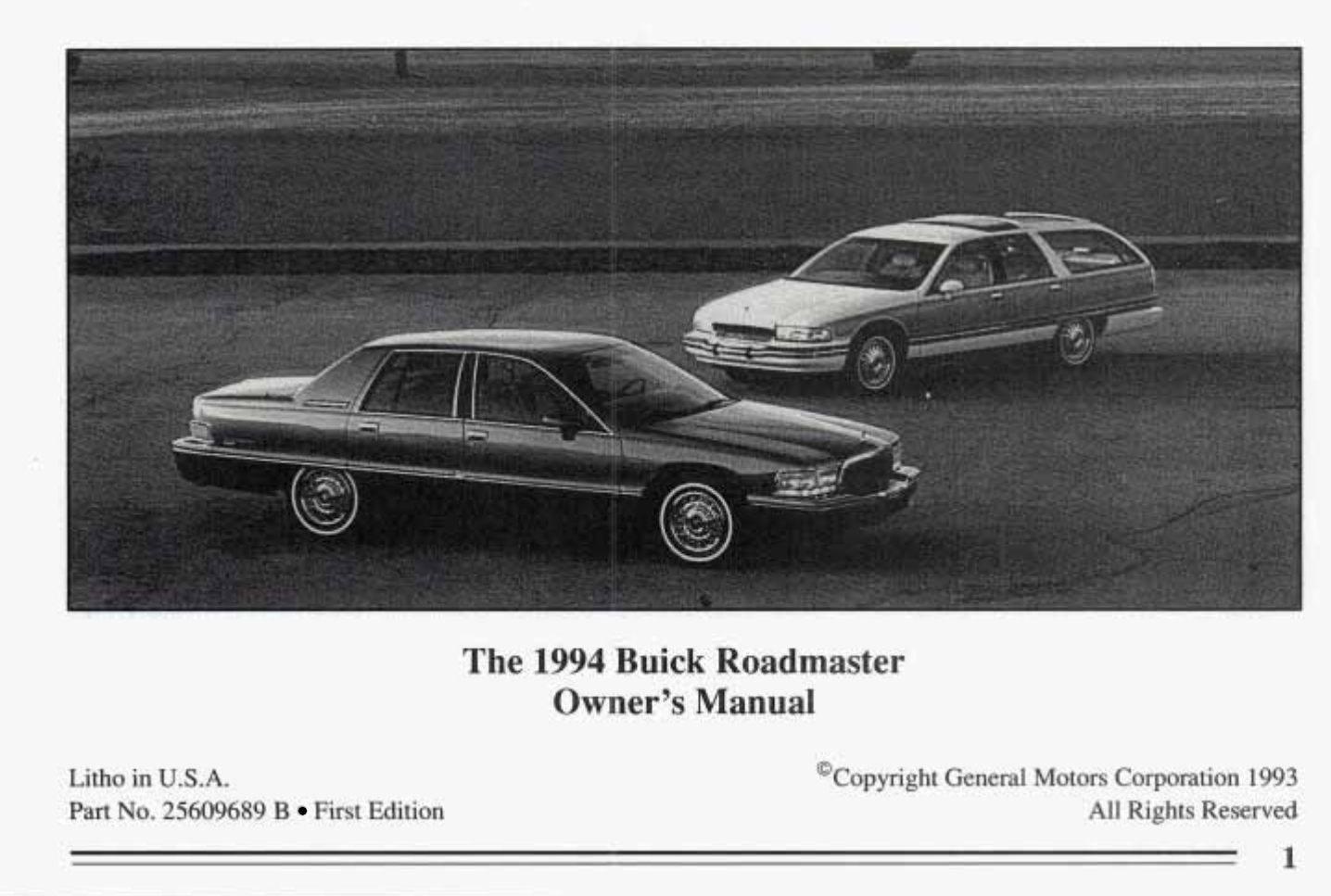
Litho in U.S.A.
Part
No.
25609689
B
First
Edition
The
1994
Buick Roadmaster
Owner's Manual
:.
,
'Copyright General Motors Corporation
1993
All Rights Reserved.
1
I
‘,This manual hcludes the latest information at the time
IF?$
wasprinted. We reserve the right to make, changes in the
’.:
i-
1
.?<.
>
;”<
i
‘4
7
.VOLUNTARY TECHNICIAN
WE
SUPPQRT
~GERT1FlCATION THROUGH
Nallonal
lnslttule
for
AUTOMOTIVE
EXGELLENCE
SERVICE
]pko&ct after that. time without further’notice. For
..:
.
::
.
1
3-
3
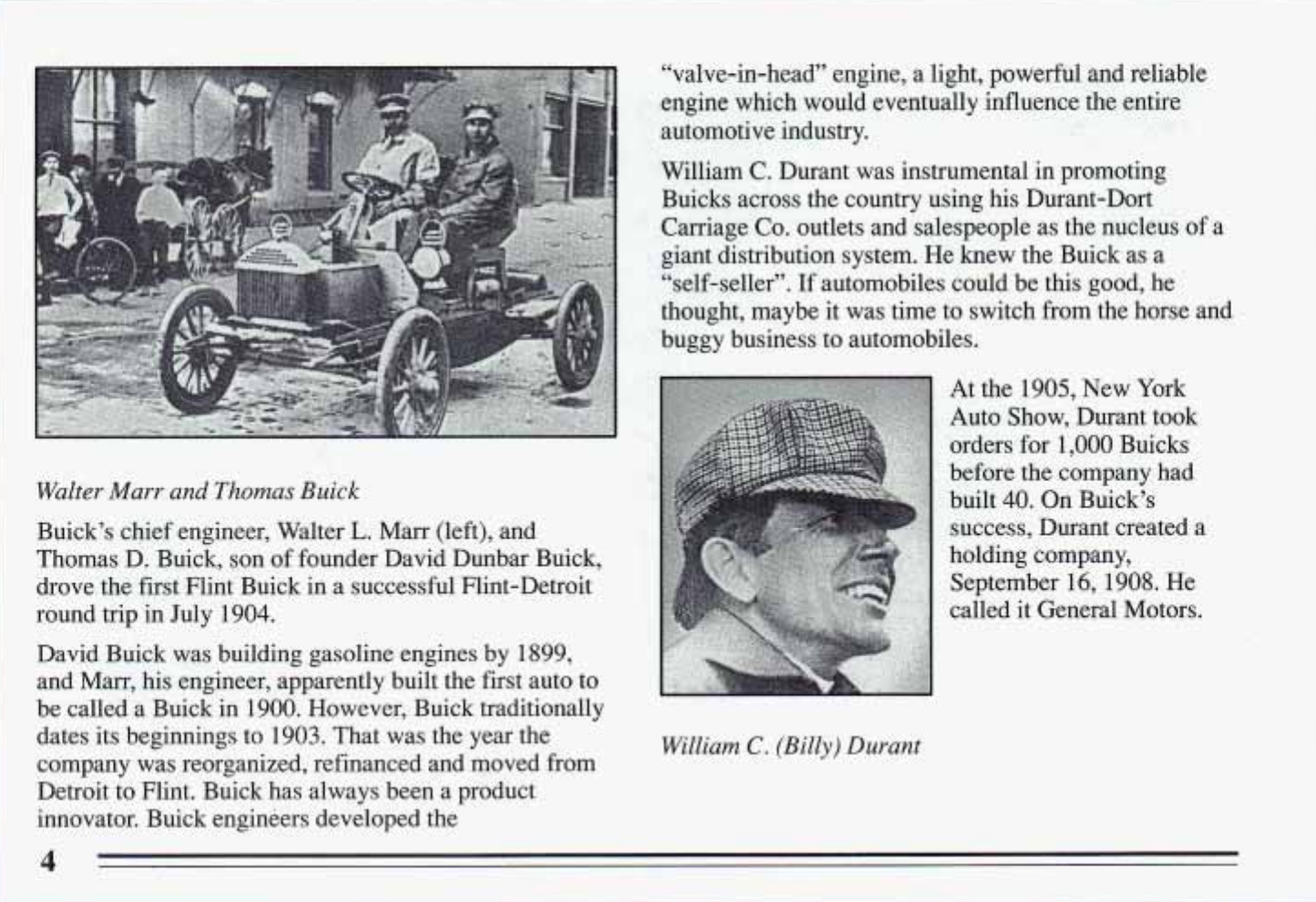
Walter
Marr
and
Thomas
Buick
Buick’s chief engineer, Walter L.
Man
(left), and
Thomas D. Buick, son
of
founder David Dunbar Buick,
drove the first Flint Buick in a successful Flint-Detroit
round trip in July 1904.
David Buick was building gasoline engines by 1899,
and
Marr,
his engineer, apparently built the first auto to
be called a Buick
in
1900. However, Buick traditionally
dates its beginnings to 1903. That was the year the
company was reorganized, refinanced and moved from
Detroit to Flint. Buick has always been a product
innovator. Buick engineers developed the
4
Durant also created a racing team that won
500
racing
trophies in 1909 and 19 10, including successes at
Indianapolis two years before the Indy
500
began.
The success of Buick engines was visible not only on
the race track, but in endurance tests across the country
and around the world. Buick was the only car
to
complete a 1,000-mile Chicago-to-New York race in
1906. And a hick was the first car
to travel across
South America, driven from Buenos Aires, Argentina,
over the Andes to Santiago, Chile in 19 14.
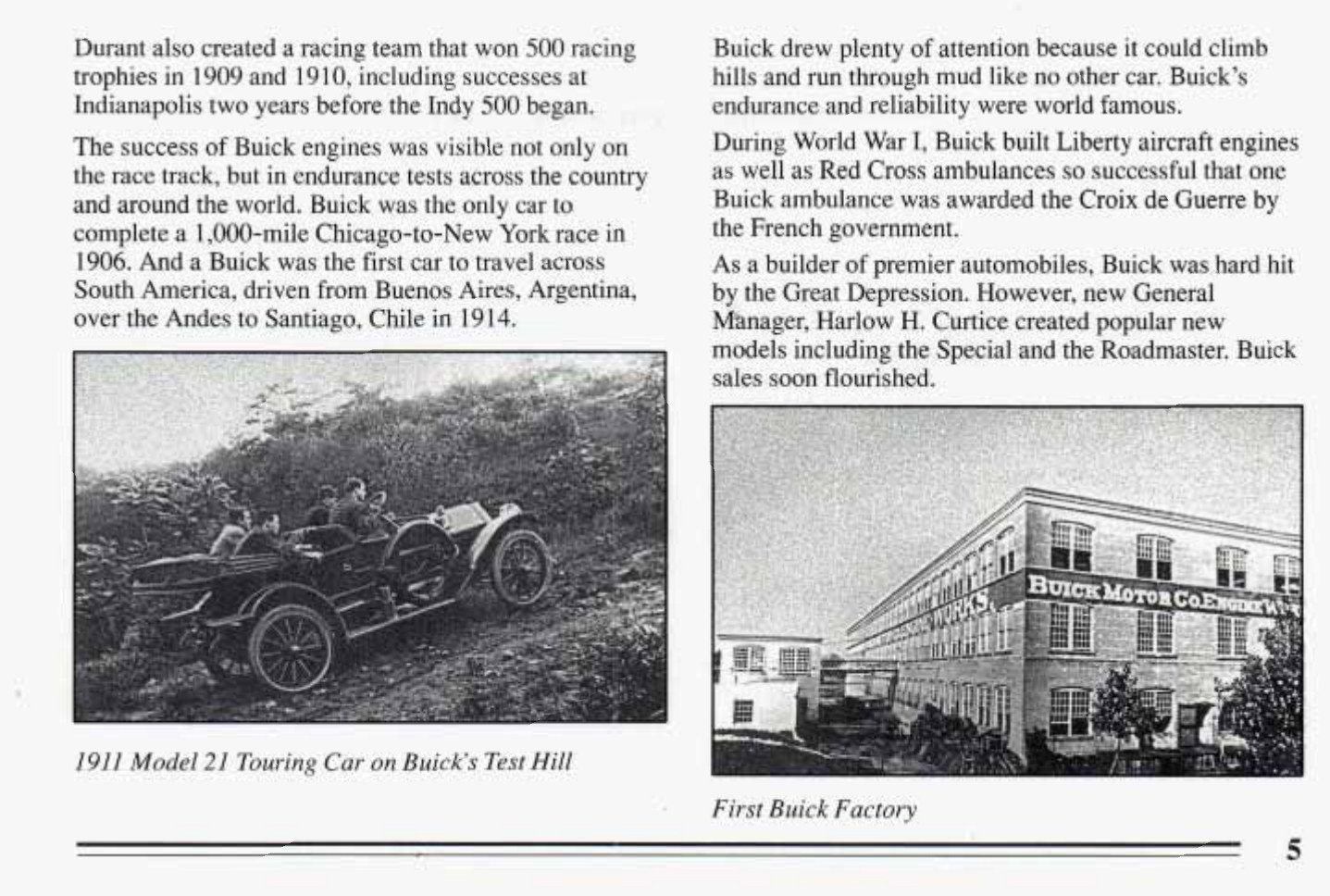
I9II
Model
21
Touring
Car
on
Buick’s Test
Hill
Buick drew plenty of attention because it could climb
hills and run through mud like no other car. Buick’s
endurance and .reliability were world famous.
During World War
I,
Buick built Liberty aircraft engines
as
well
as
Red Cross ambulances
so
successful that one
Buick ambulance was awarded the Croix de Guewe by
the French government.
As a builder of premier automobiles, Buick was hard hit
by the Great Depression. However, new General
M%nager, Harlow
H.
Curtice created popular new
models including-the Special and the Roadmaster. Buick
sales soon flourished.
I
First Buick Factory
3
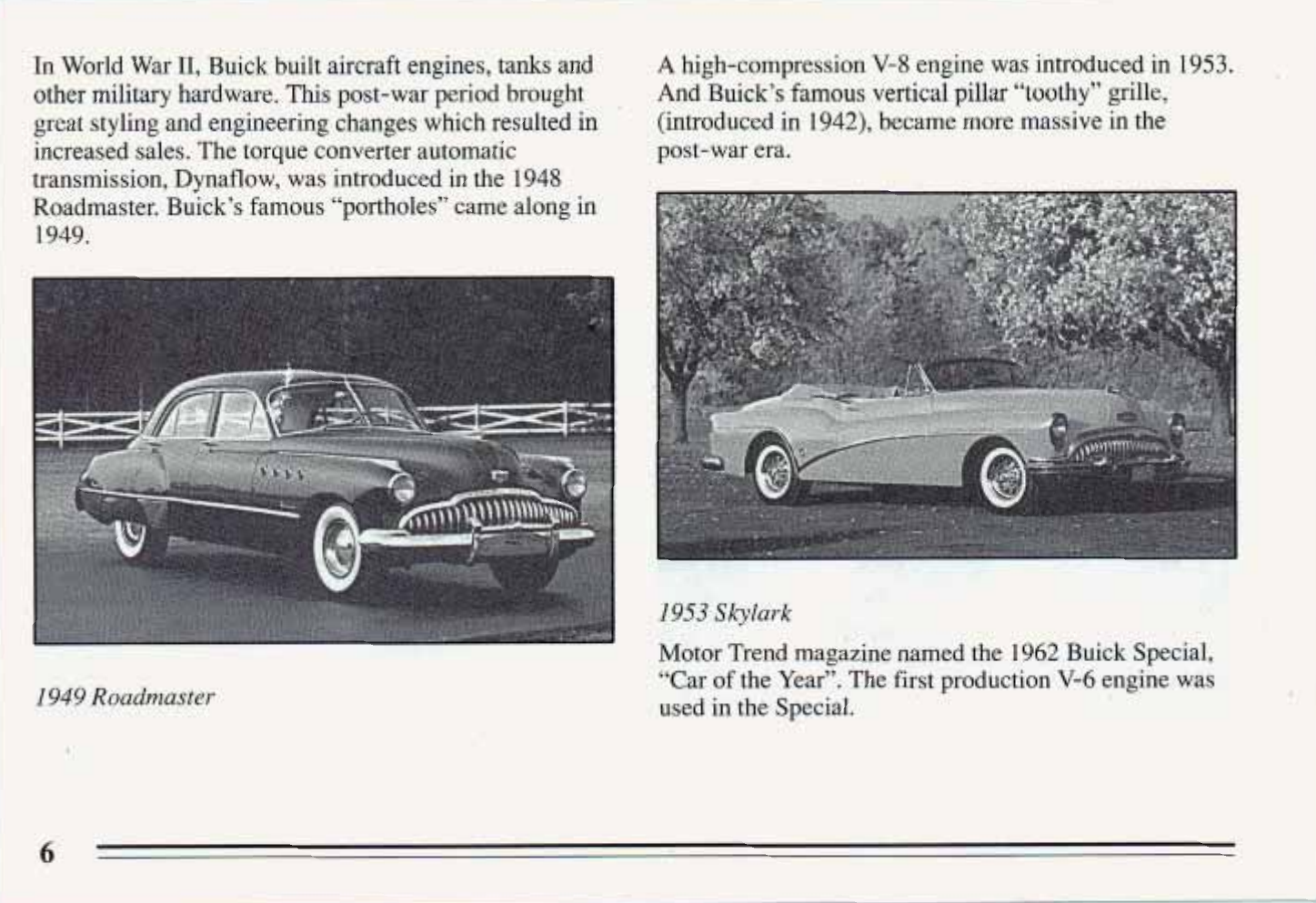
In World War
II,
Buick built aircraft engines, tanks and
A
high-compression V-8 engine was introduced in 1953.
other military hardware. This post-war period brought And Buick’s famous vertical pillar “toothy” grille,
great styling and engineering changes which resulted in (introduced
in
1942), became more massive in the
increased sales. The torque converter automatic post-war era.
transmission, Dynaflow, was introduced in the 1948
Roadmaster. Buick’s famous “portholes” came along in
1949.
1953
Skylark
Motor Trend magazine named the 1962 Buick $pecial,
I949
Roadmaster
“Car of the Year”. The first production
V-6
engine was
used in the Special.
-
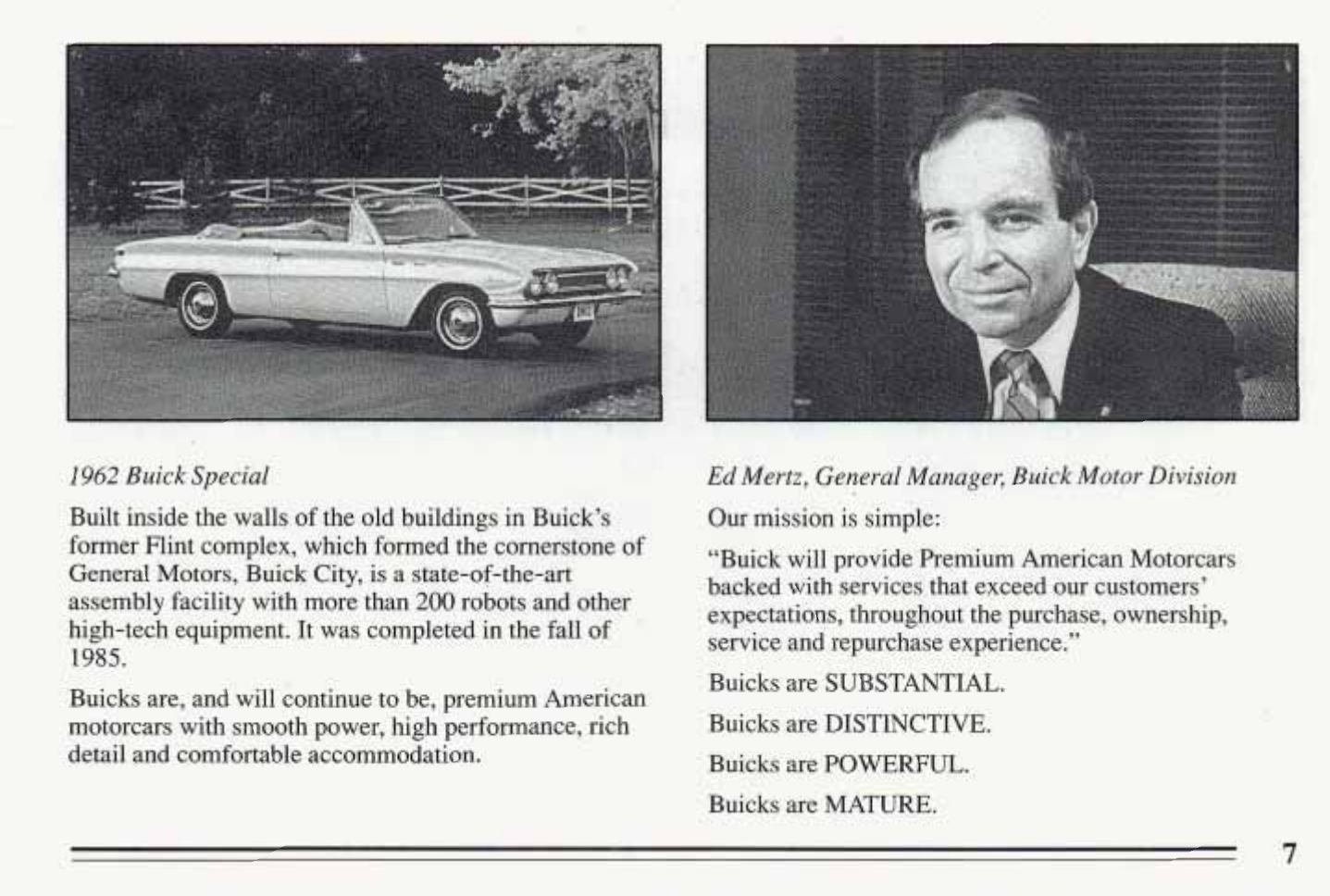
1962
Buick Special
Ed
Mertz, General Manager, Buick Motor Division
Built inside the walls of the old buildings in Buick’s Our mission is simple:
-
former Flint complex, which formed the cornerstone
of
General Motors, Buick City, is a state-of-the-art
assembly facility with more than
200
robots and other
high-tech equipment.
It
was completed in the fall of
1985.
“Buick will provide Premium American Motorcars
backed with services,that exceed our customers’
expectations, throughout the purchase, ownership,
service and repurchase experience.”
Buicks are, and will continue to be, premium American
motorcars with smooth power, high performance, rich
detail and comfortable accommodation.
Buicks are SUBSTANTIAL.
Buicks are DISTINCTIVE.
Buicks are
POWERFUL.
Buicks are MATURE.
7
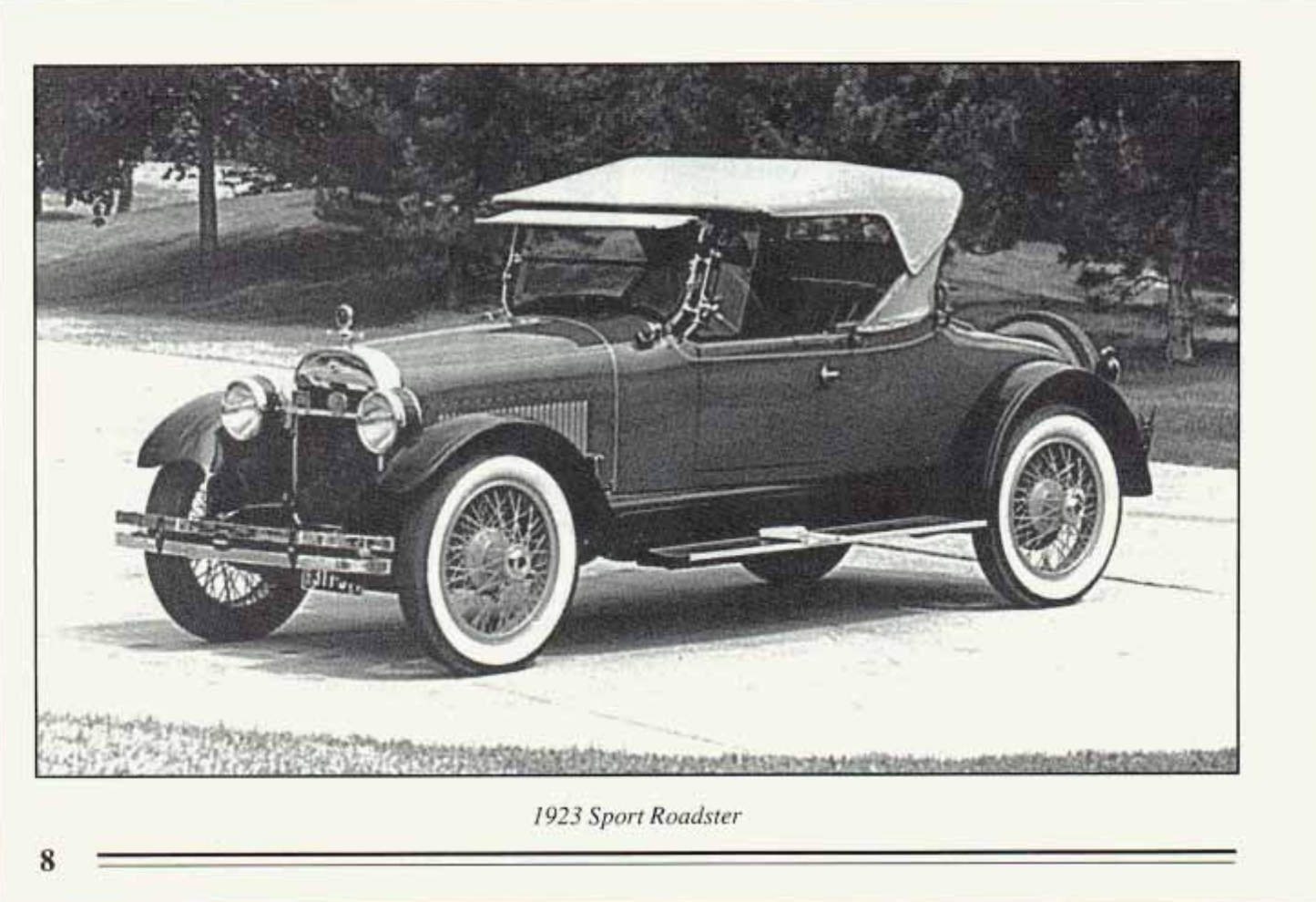
1923
Sport
Roadster
8
Table
of
Contents
~ ~~
How
to Use this Manual
.................................................................
10
This part tells you how to use your manual and includes safety and vehicle damage warnings and symbols.
Seats and Restraint Systems
.............................................................
13
This part tells you how to use your seats and safety belts properly. It also explains the
“SRS”
system.
FeaturesandControls
..................................................................
63
This part explains how to start and operate your Buick.
Comfort Controls and Audio Systems
.....................................................
127
This part tells you how to adjust the ventilation and comfort controls and how to operate your
sound system.
YourDrivingandtheRoad
..............................................................
153
Here you’ll find helpful information and tips about
the
road and how to drive under different conditions.
ProblemsontheRoad
..................................................................
187
This part tells you what to do if you have a problem while driving, such as a flat tire or engine
overheating, etc.
Here the manual tells you how to keep your Buick running properly and looking good.
This part tells you when
to
perform vehicle maintenance and what fluids and lubricants to use.
This part tells you how to contact Buick for assistance and how to get service publications. It also
gives you information on “Reporting Safety Defects” on page
305.
Here’s an alphabetical listing of almost every subject
in
this manual. You can use
it
to
quickly find
something you want to read.
ServiceandAppearanceCare
............................................................
223
Maintenanceschedule
..................................................................
281
Customer Assistance Information
........................................................
303
Index
................................................................................
311
9
How
to
Use
This
Manual
.Many people read their owner’s manual from beginning
to end’ when they first receive their new vehicle. This
will help you learn about the features and controls for
your vehicle.
In
this manual, you’ll find that pictures
and words work together to explain things quickly.
Safety Warnings and Symbols
You
will
find a number of safety cautions
in
this book.
We
use a box with gray background and the word
CAUTION
to tell you about things that could hurt you if
you were to ignore the warning.
’
’
In
the gray caution area, we tell you what
the
hazard is.
Then we tell you what to do to help avoid or reduce the
hazard. Please
read
these cautions. ‘If you don’t, you
or
I
others could
be
hurt.
You
w~ill
also find a circle with a slash through it in this
I
book.
k
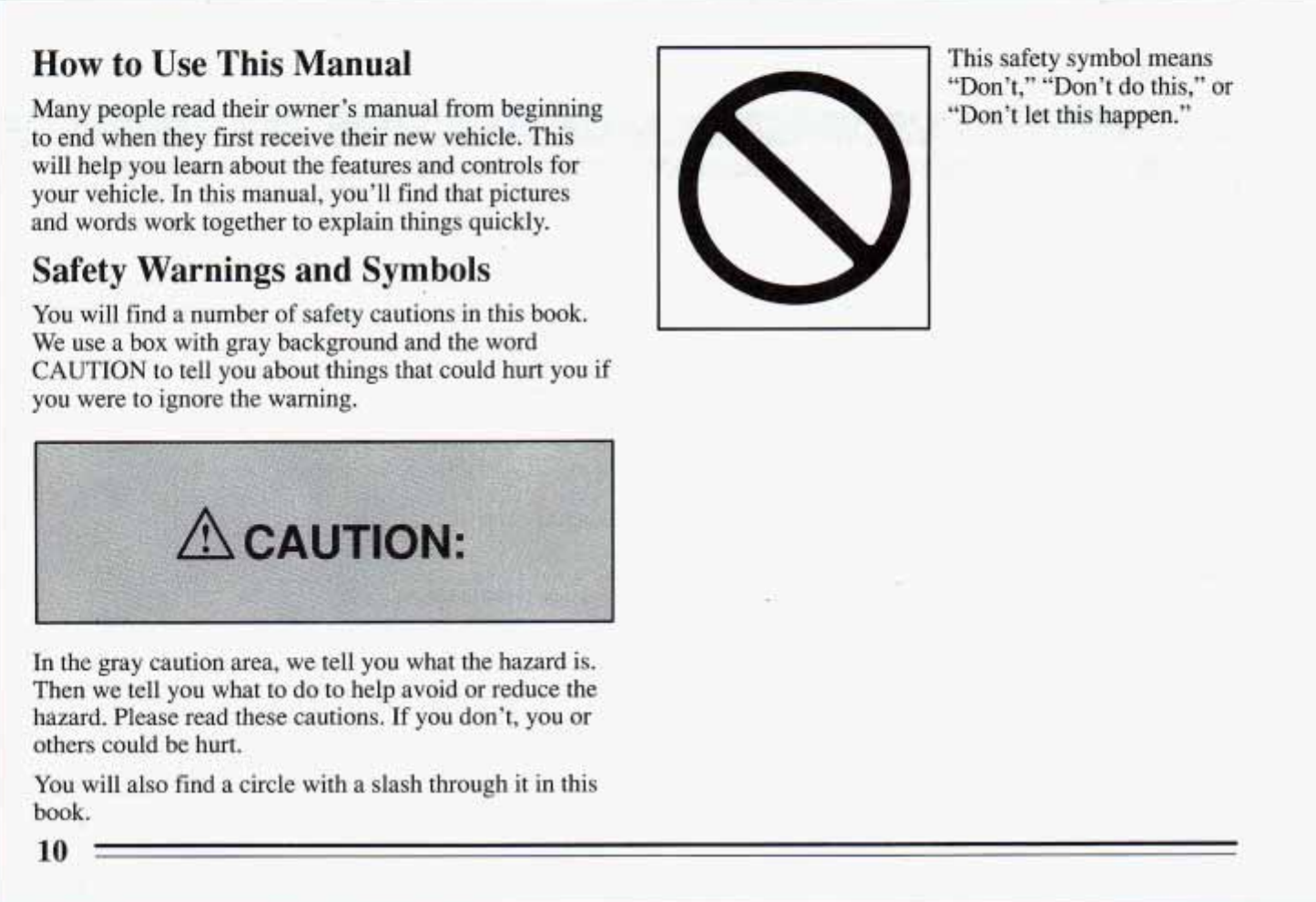
This safety symbol means
“D.on’t,” “Don’t
do
this,” or
,“Don’t let this happen.”
Vehicle Damage Warnings
Also, in this book you will find these notices:
NOTICE:
In
the notice area, we tell you about something that can
damage your vehicle. Many times, this damage would
not be covered by your warranty, and
it
could be costly.
But the notice will tell you what to do to help avoid the
damage.
When you read other manuals, you might see
CAUTION and NOTICE warnings in dif€erent colors or
in different words.
You’ll also see warning labels on your vehicle. They use
yellow for cautions, blue for notices and the words
CAUTION or NOTICE.
11
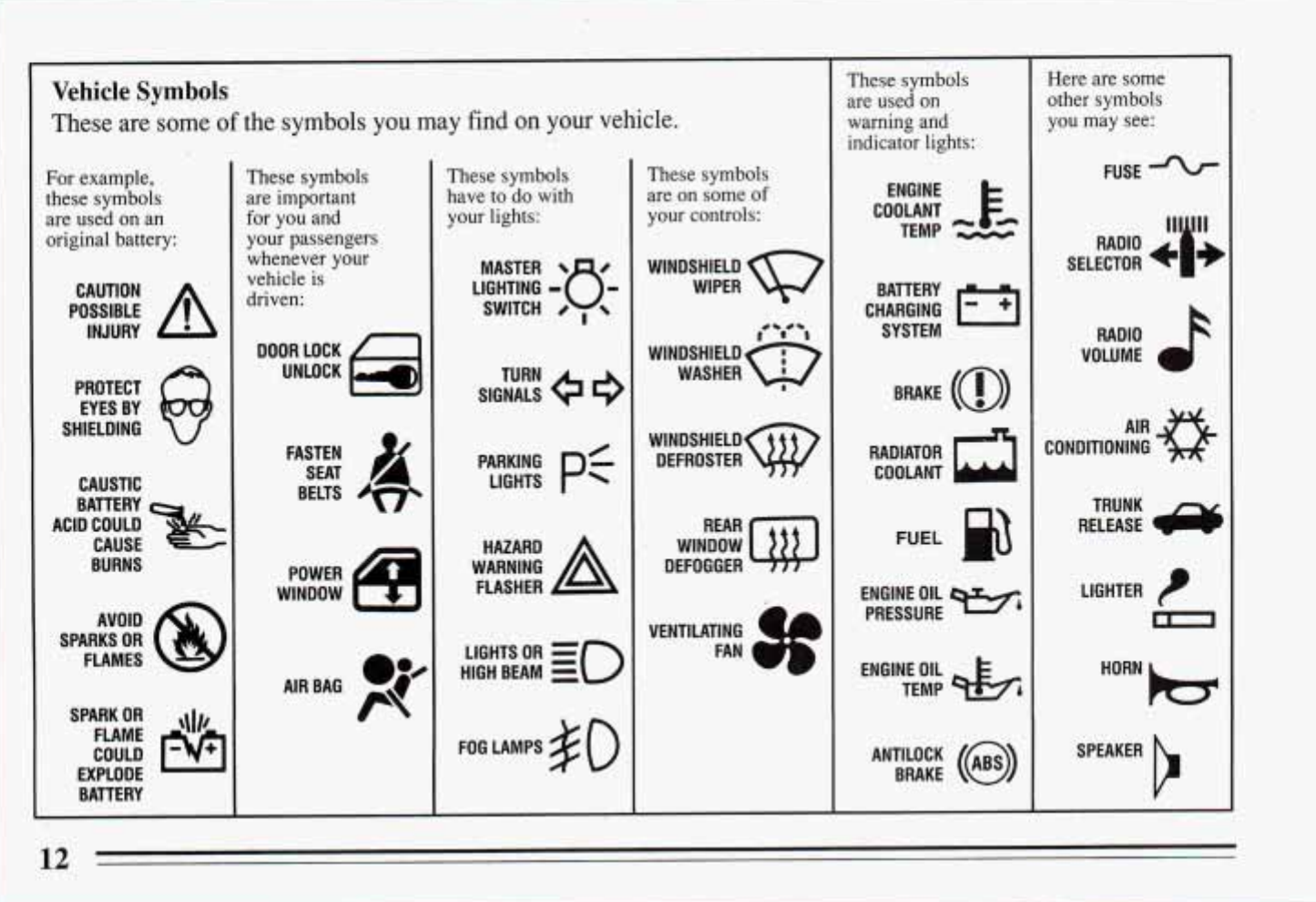
Vehicle
Symbols
These are some
of
the symbols you may find on your vehicle.
For example,
these symbols
are used
on
an
original battery:
POSSIBLE
A
CAUTION
INJURY
PROTECT
EYES BY
SHIELDING
CAUSTIC
ACID COULD
BATTERY
CAUSE
BURNS
AVOID
SPARKS
OR
FLAMES
SPARK
OR
,\I/,
COULD
FLAME
EXPLODE
BATTERY
These symbols
are important
for you and
your passengers
whenever your
vehicle
is
driven:
DOOR
LOCK
UNUICK
FASTEN SEAT
4
BELTS
POWER
WINDOW
These symbols
have to do with
your
lights:
SIGNALS
TURN
WARNING
A
HAZARD
FLASHER
HIGH BEAM
OR
=
=o
FOG LAMPS
$0
These symbols
are on some
of
your controls:
WIPER.
Q7
WINDSHIELDw
DEFROSTER
WINDOW
DEFOGGER
VENTILATING
FAN
These symbols
are used on
warning and
indicator lights:
COOLANT
Fe
TEMP
--
ENGINE
CHARGING
I-1
BATTERY-
'SYSTEM
RADIATOR
a
COOLANT
FUEL
ENGINE OIL
e,
PRESSURE
TEMP OIL
&
ANTILOCK
(@)
BRAKE
Here are some
other symbols
you may see:
FUSE
-%-
SELECTOR
.)
RADIO
"y
"
RADIO
>
VOLUME
CONDITIONING
AIR
)#t
RUEASE
/y
TRUNK
LIGHTER
n
SPEAKER
b
12
~
Part
1
Seats and Restraint Systems
Here you’ll find information about the seats in your
Buick
and how to use your safety belts properly . You can also
learn about some things you should
do
with safety belts .
Part
1
includes:
SeatsandSeatControls
.............................................................
HeadRestraints
...................................................................
Raising and Lowering Wagon Rear Seats
................................................
SafetyBelts
......................................................................
How
to Wear Safety Belts Properly ....................................................
Lap-ShoulderBelt
............................................................
Supplemental Restraint System (Air bag) ...............................................
Safety Belt Use During Pregnancy
.....................................................
Children
.........................................................................
Smaller Children and Babies ....................................................
Child Restraints ............................................
:
.................
LargerChildren ...............................................................
Replacing Safety Belts After a Crash
...................................................
Checking Your Restraint System
......................................................
SafetyBeltExtender ................................................................
14
18
18
20
27
28
35
41
46
47
48
58
61
61
61
13
Seats
and
Seat
Controls
,Fb+~This
section tells
you
about the seats
--
how to adjust,
.%them, and also about reclining front seatbacks, raising
1
!and lowering wagon rear seats, and head restraints.
Manual
Seat
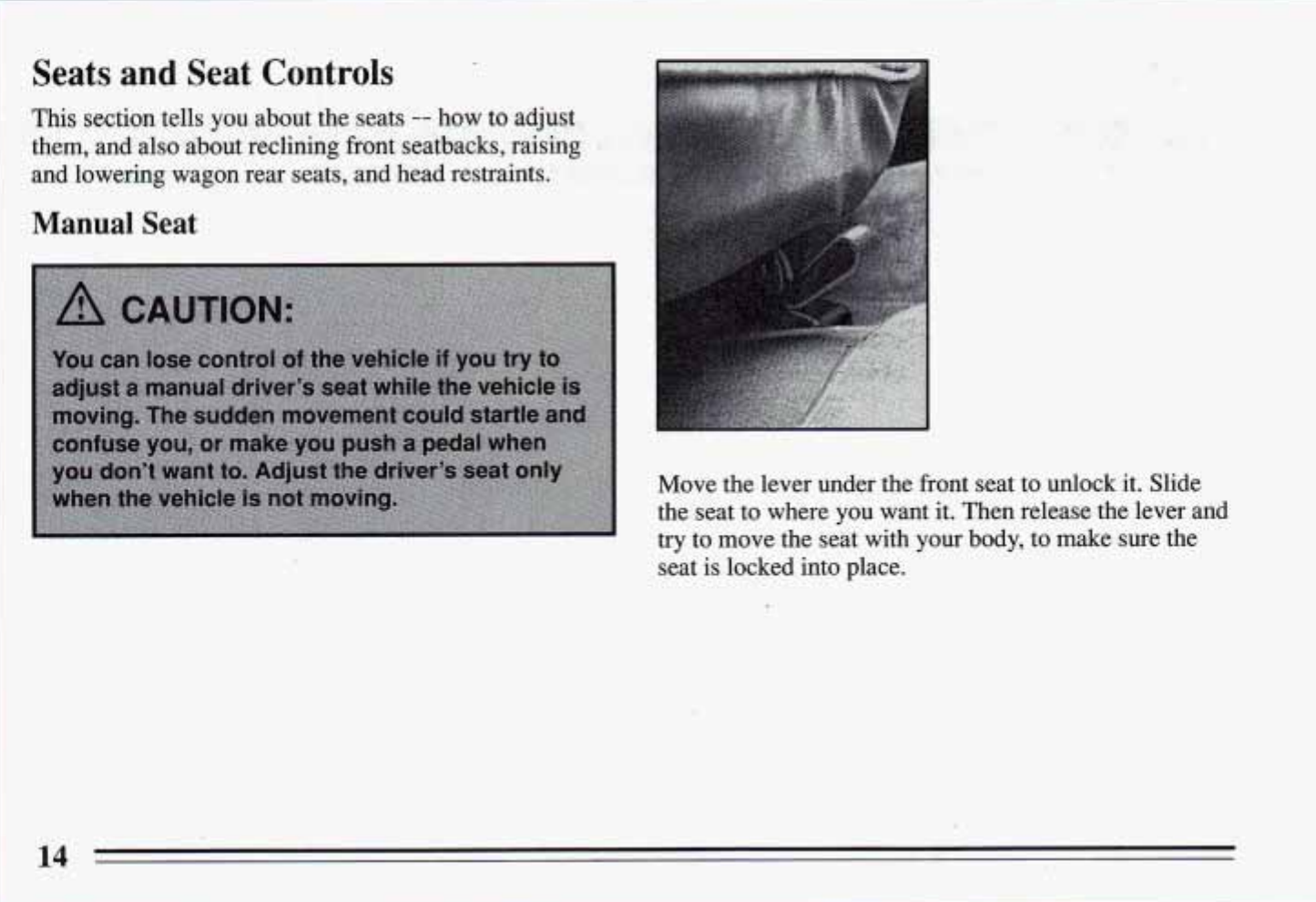
Move the lever under the front sea
.t
tc
I
unlock
i
t. Slide
the seat to where you want it. Then release the lever and
try to move the seat with your body, to make sure the
seat is locked into place.
14
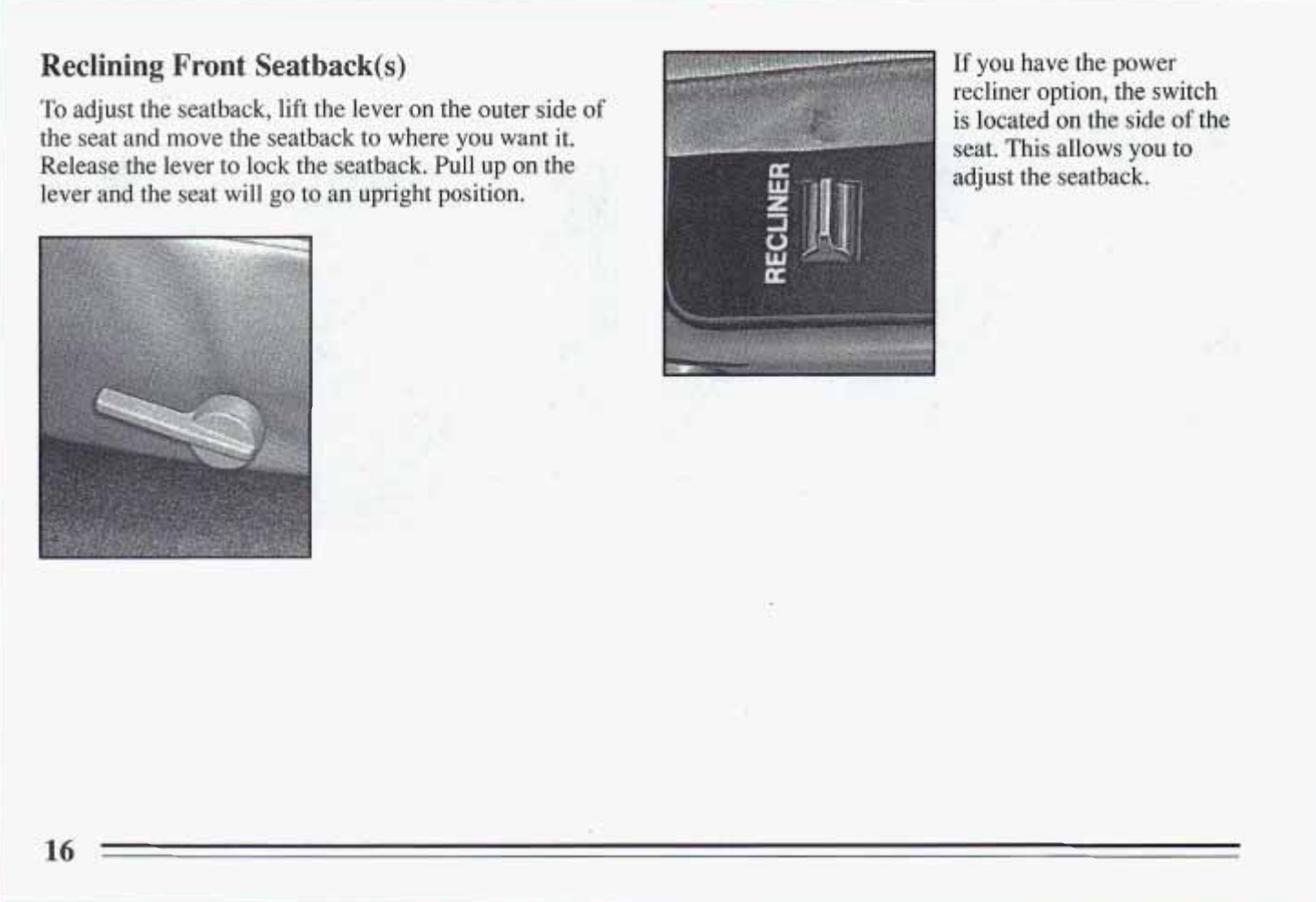
Reclining
Front
'Seatback(§)
To
adjust the seatback, 1ift.tlie lever
on
the outer side
of
the seat and
move
the seatback
to
where
you
want it.
Releastxihe lever to lock the
seatback.
Pull.up
on
the
kver and the seat will
go
to
an
upright position.,
'
.
,
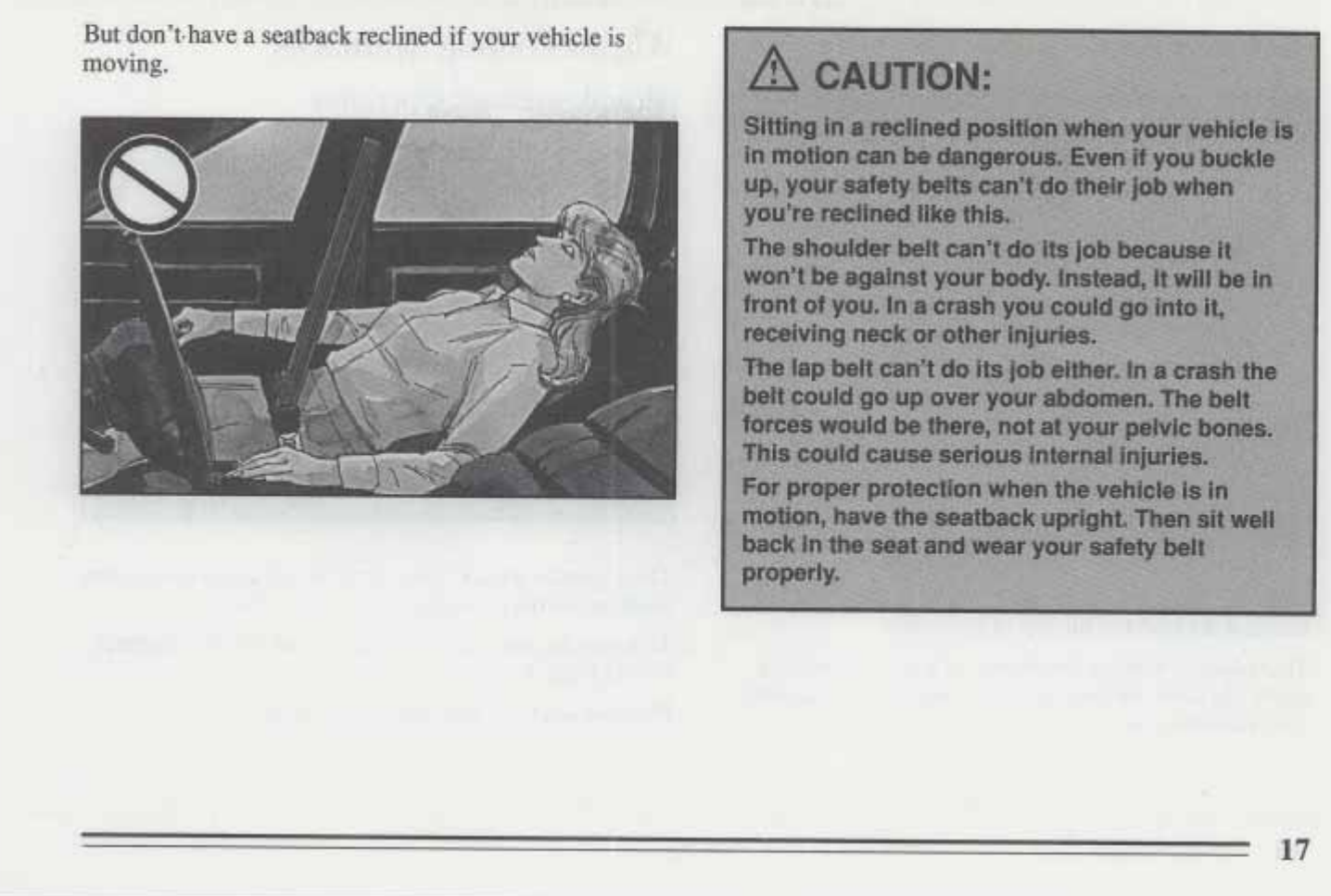
If
you
have the power
recliner option, the switch
eat. This alIiows
'you
to
"adjust the seatback.
.
I
".
I
I
~
i
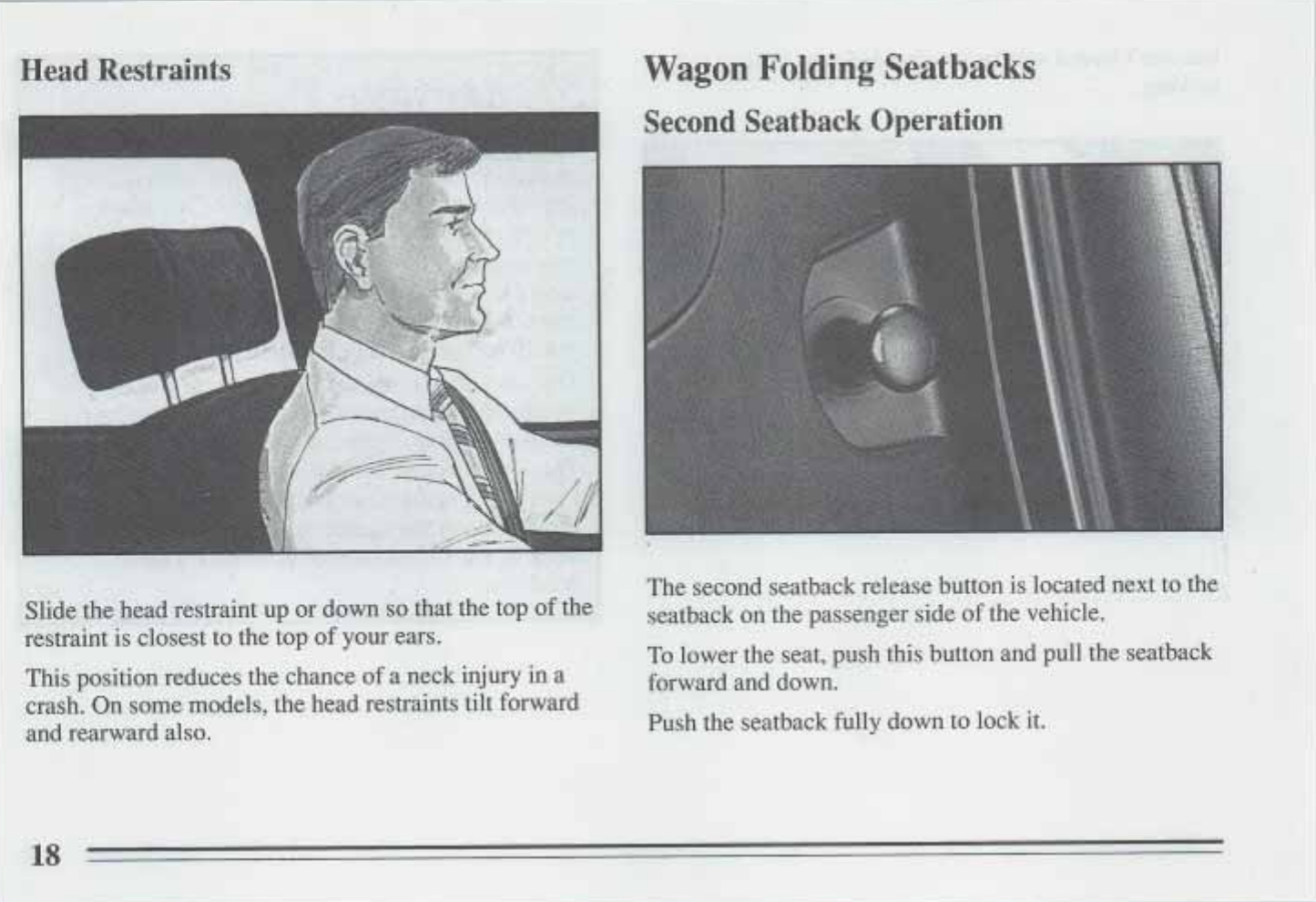
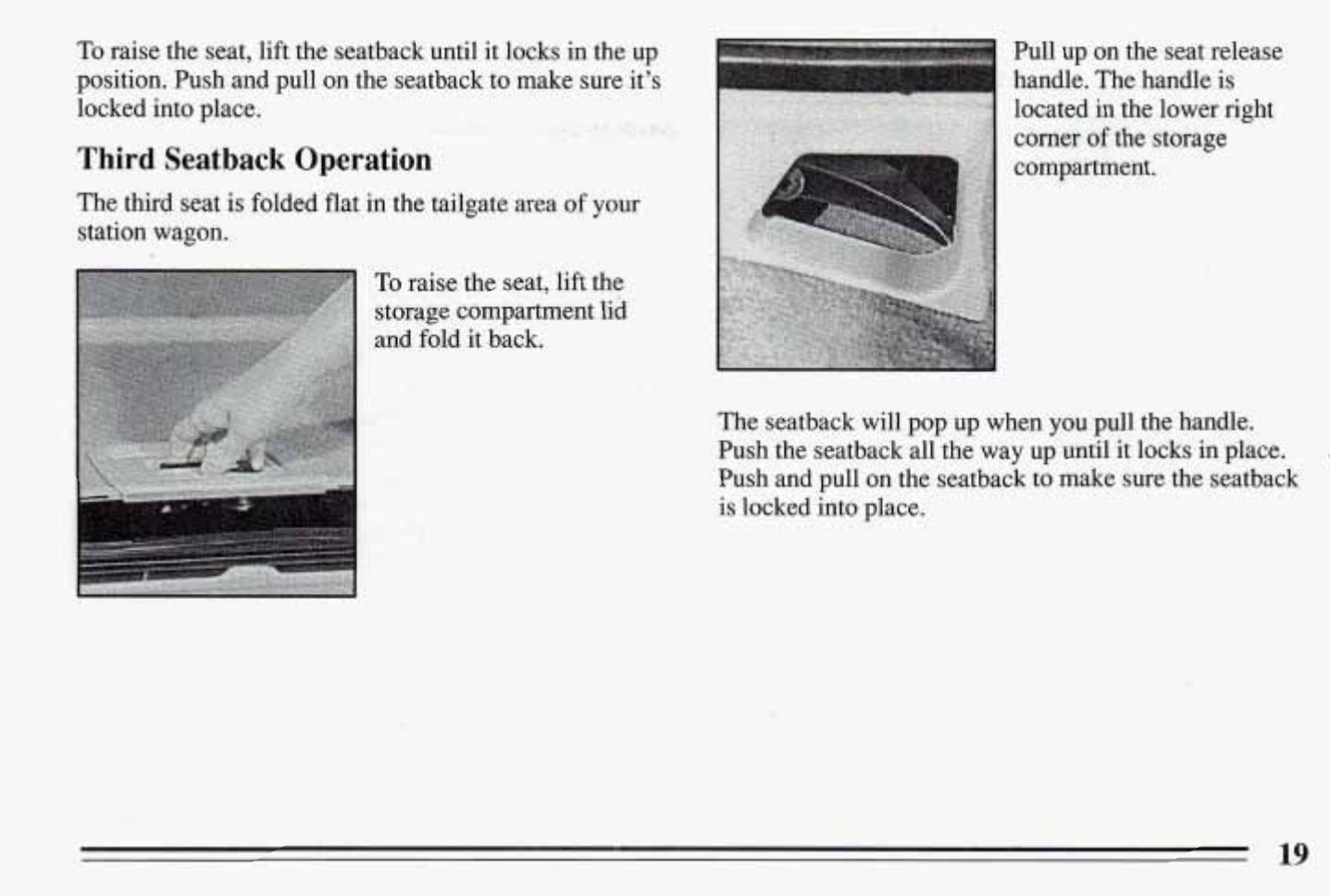
To raise the seat, lift the seatback until it locks in the up
position. Push and pull on the seatback to make sure it’s
locked into place.
Third Seatback Operation
The third seat
is
folded flat in the tailgate area
of
your
station wagon.
.
..
,.
..~,
To raise the seat, lift the
storage compartment lid
and fold it back.
Pull up on the seat release
handle. The handle is
located
in
the lower right
corner
of
the
storage
compartment.
The seatback will pop up when
you
pull the handle.
Push the seatback all the way up until it locks in place.
Push and pull on the seatback to make sure the seatback
is
locked into place.
19
This figure lights up as a reminder to buckle up. (See
“Safety Belt Reminder Light’’ in the Index.)
In
many states and Canadian provinces, the law says
to
wear safety belts. Here’s why: They work.
You never know
if
you’ll be in a crash.
If
you do have a
crash, you don’t know
if
it will be
a
bad one.
A
few crashes are mild, and some crashes can be
so
serious that even buckled up a person wouldn’t survive.
But most crashes are in between.
In
many of them,
people who buckle up can survive and sometimes walk
away. Without belts they could have been badly hurt or
killed.
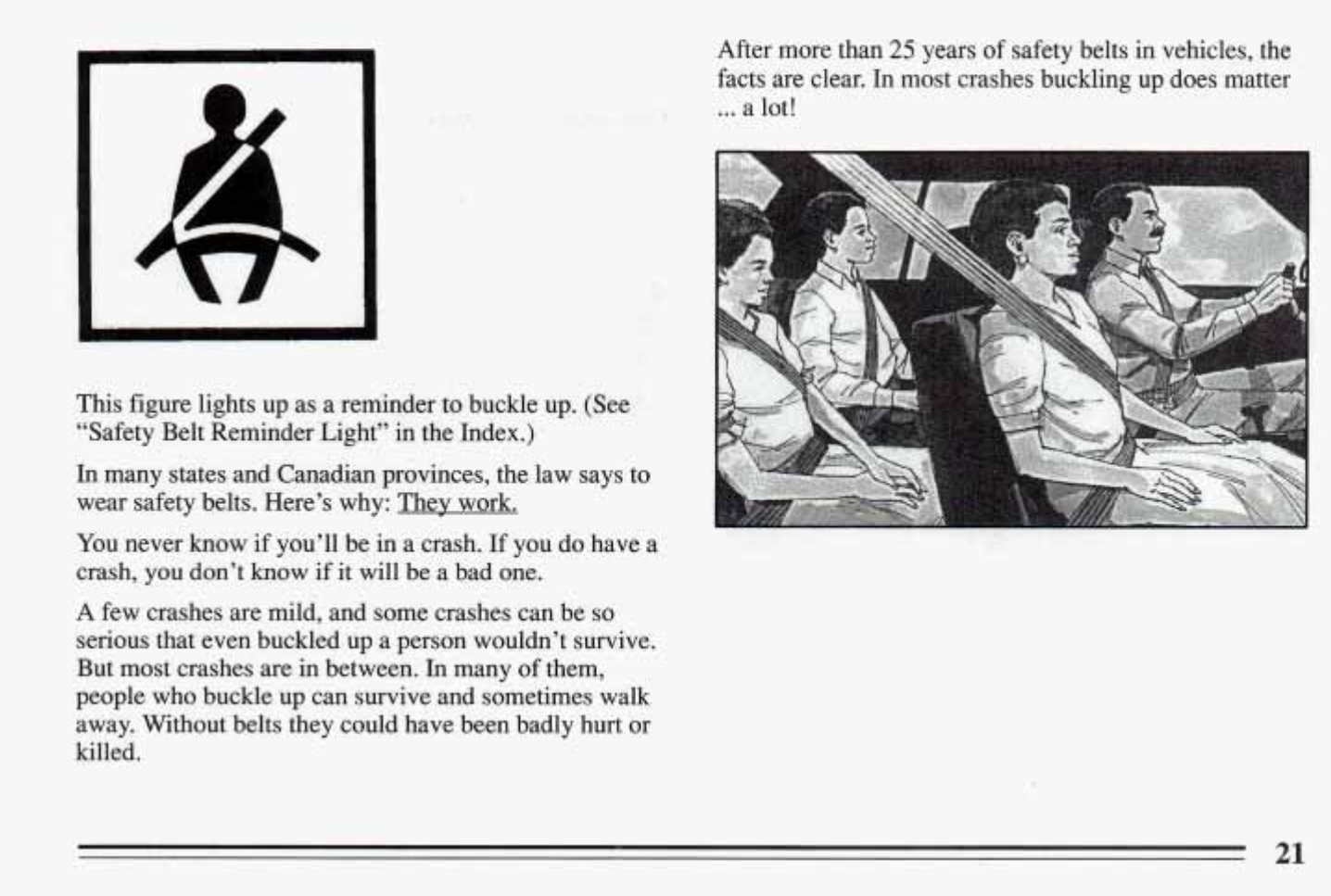
After more than
25
years
of
safety belts in vehicles,
the
facts are clear. In most crashes buckling
up
does matter
...
a lot!
Why
Safety
Belts
Work
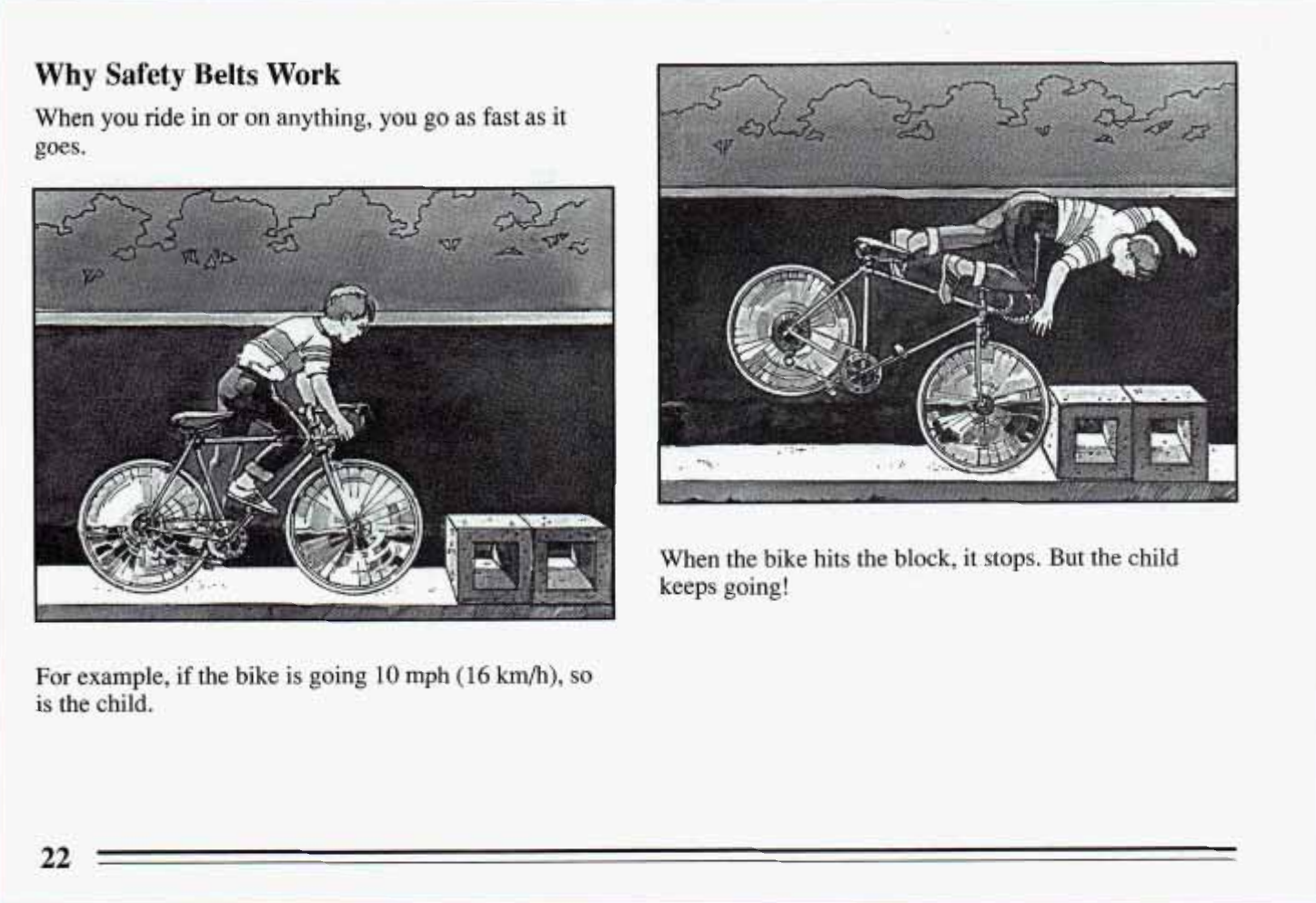
When
you
ride
in
or
on anything,
you
go
as
fast
as
it
goes.
For
example,
if
the
bike
is going
10
mph
(16
km/h),
SO
is the child.
22
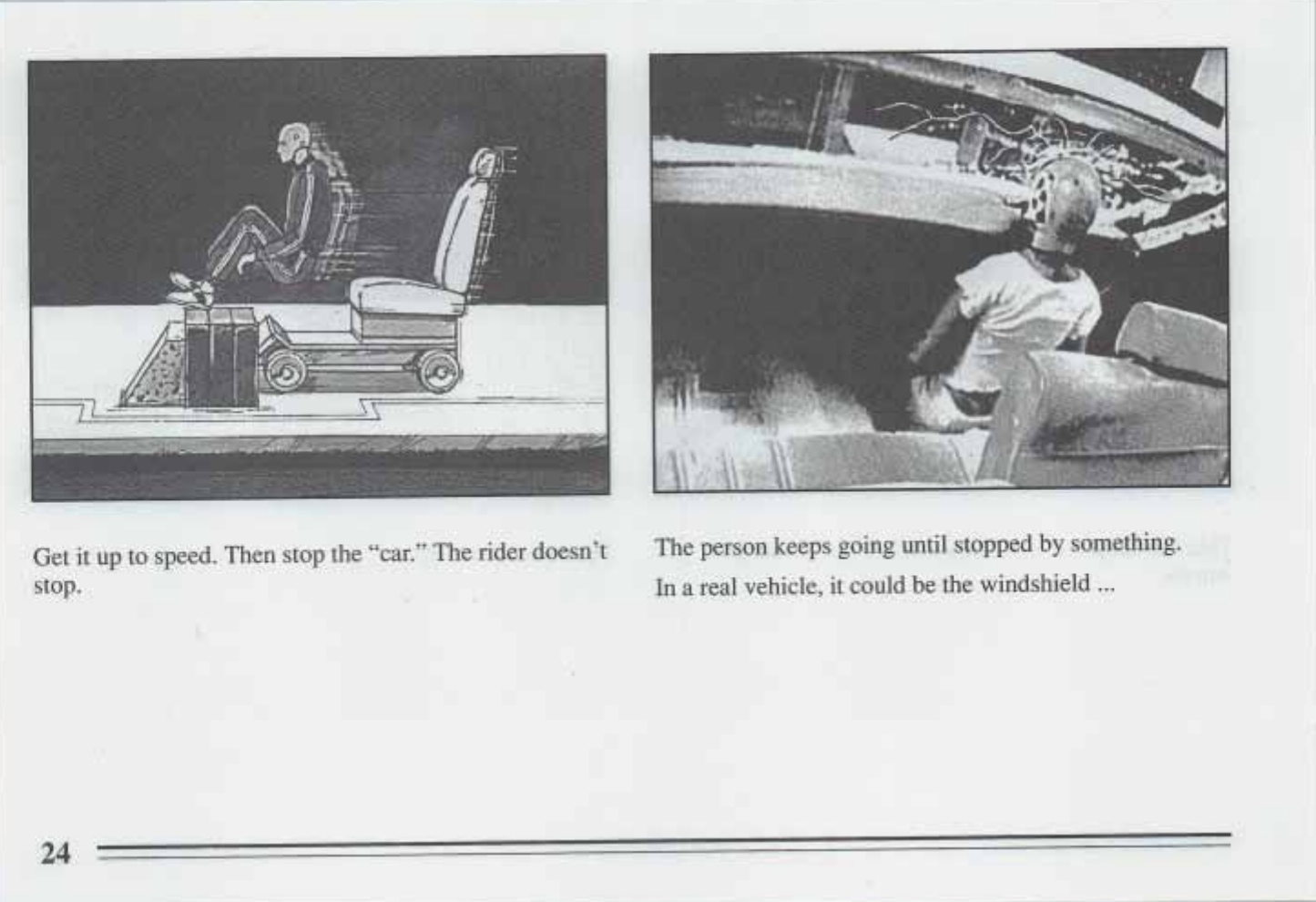
I
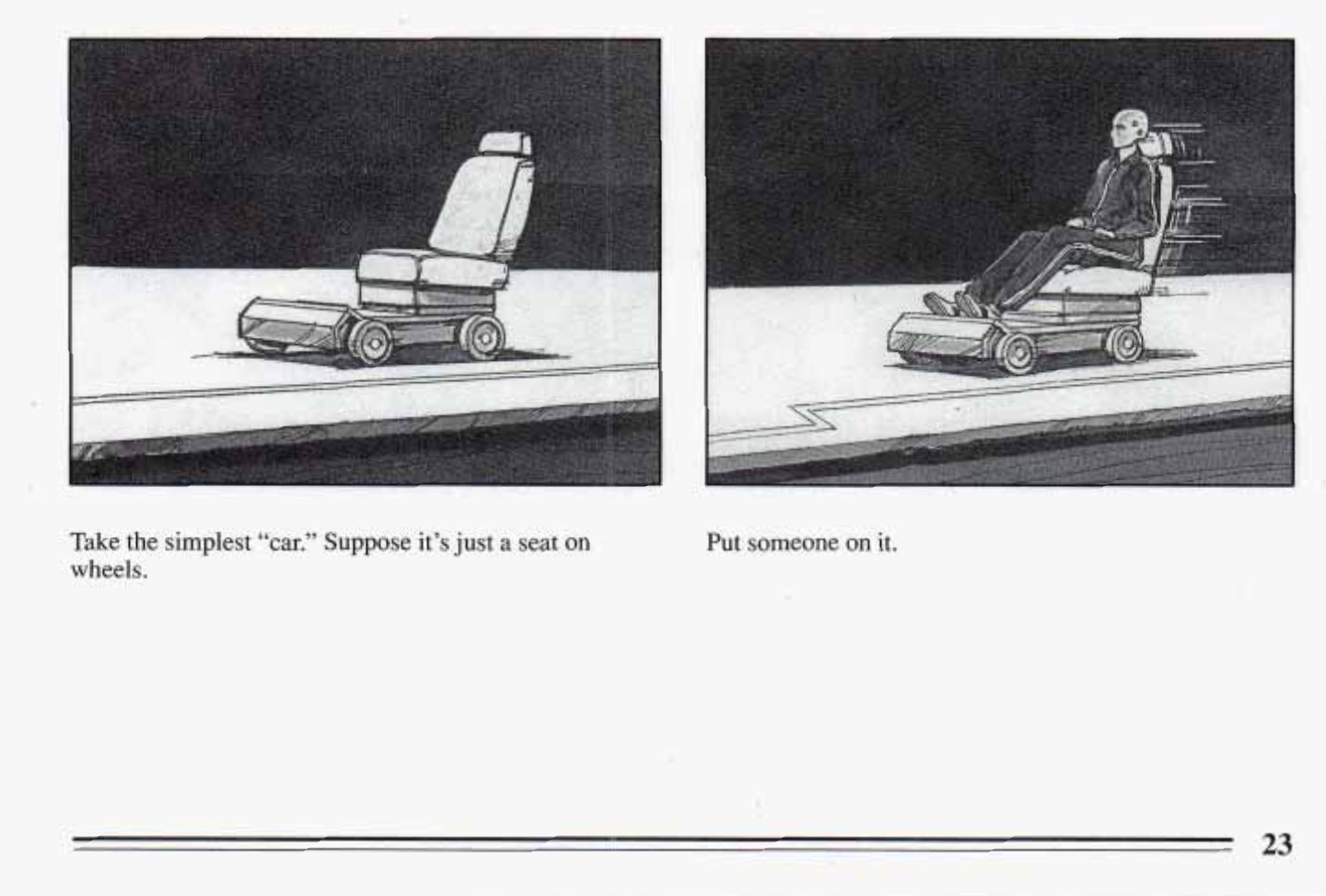
Take the simplest “car.” Suppose it’s just
a
seat
on
wheels. .Put someone
on
it.
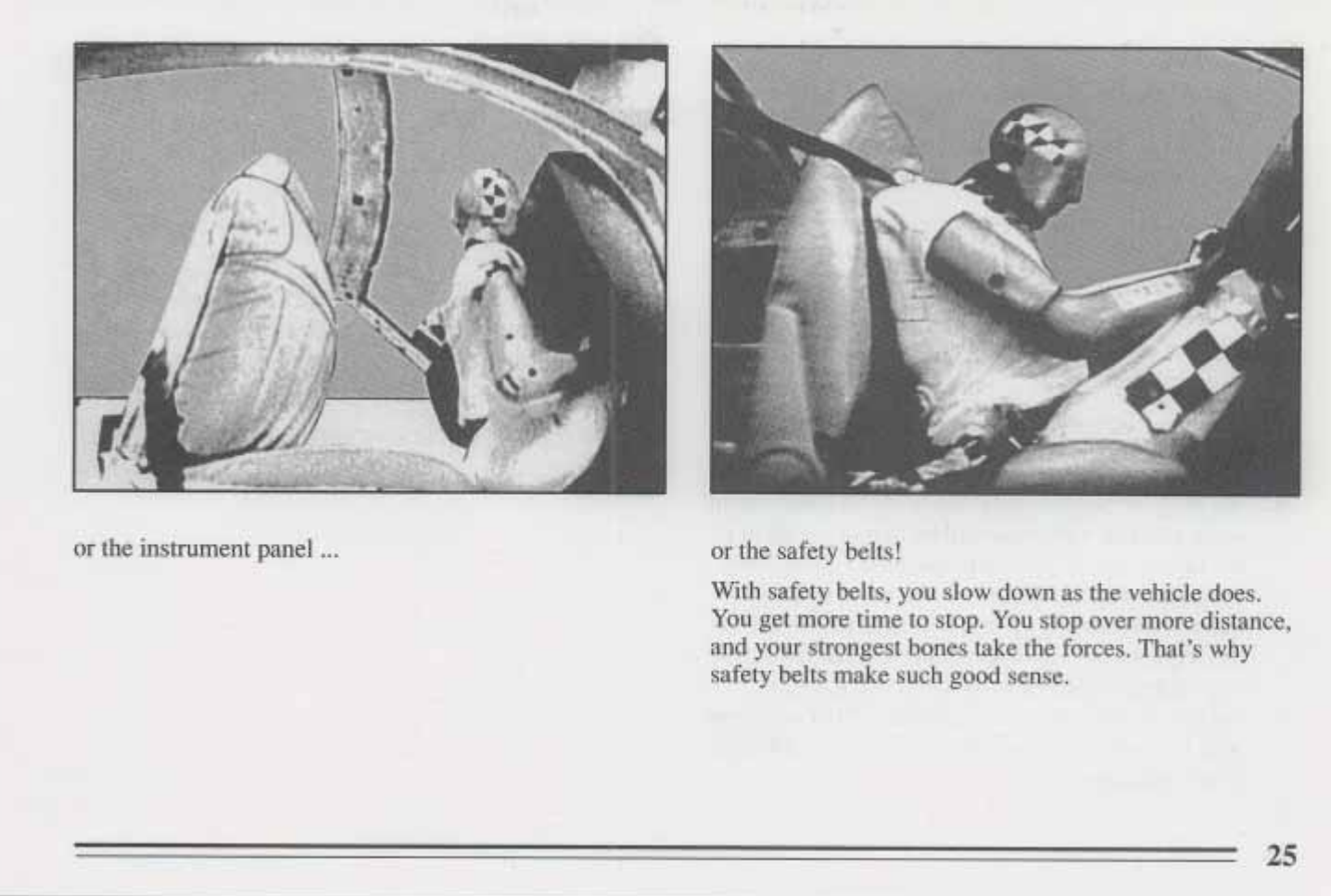
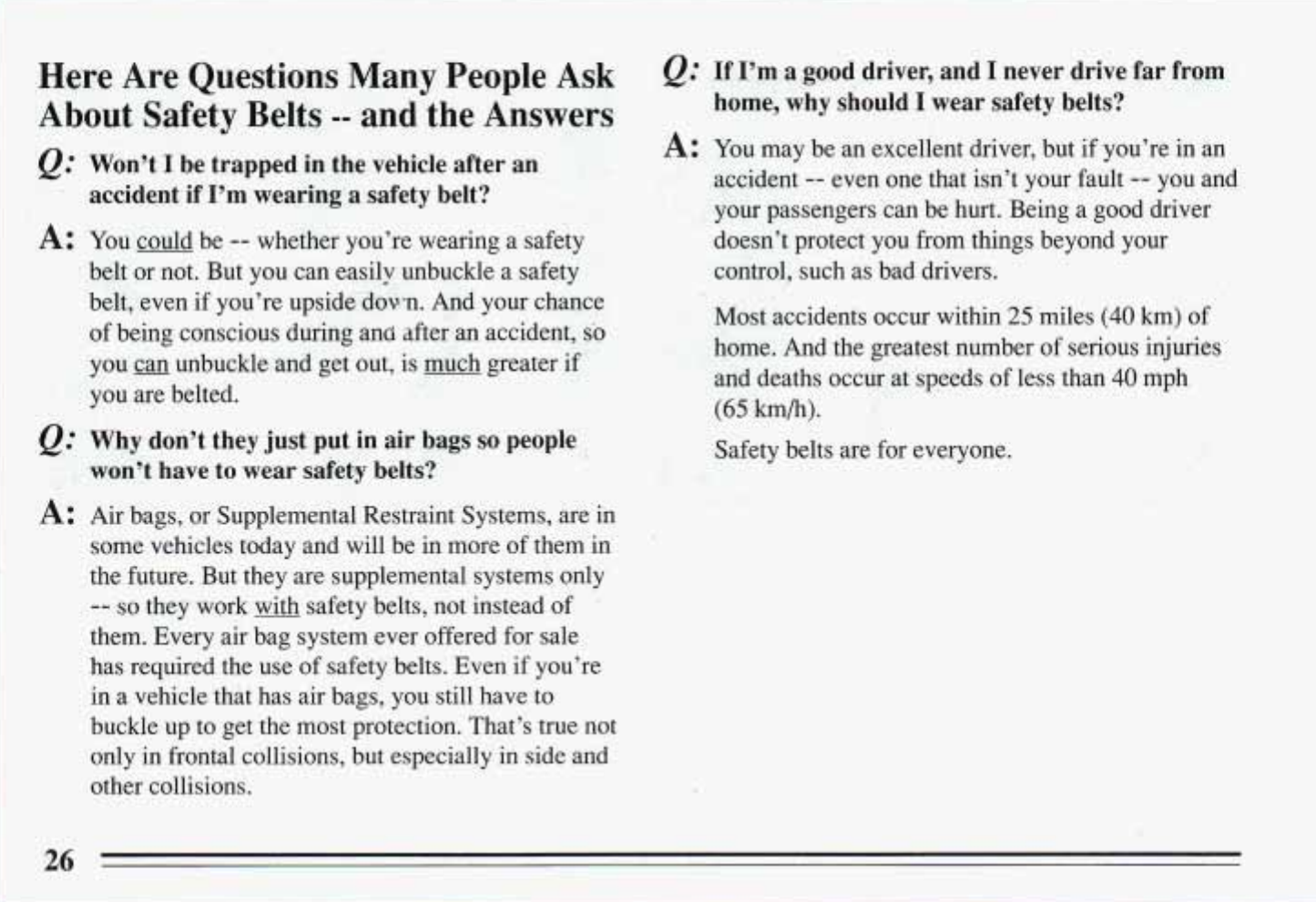
23
Here Are Questions Many People
Ask
About Safety Belts
--
and the Answers
Won’t I be trapped in the vehicle after an
accident’ if I’m wearing a safety belt?
A:
You could be
--
whether you’re wearing a safety
belt
or
not. But you can easily unbuckle a safety
belt, even if you’re upside’down. And your chance
of being conscious during
an6
after an accident,
so
you
can
unbuckle and get out, is much greater if
you are belted.
F
&:
Why don’t they just put in air bags
so
people
A:
Air bags, or Supplemental Restraint Systems, are in
some vehicles today and will be in more
of
them in
the future. But they are supplemental systems only
--
so
they work with safety belts, not instead of
them. Every air bag system ever offered for sale
has required the use of safety belts. Even if you’re
in a vehicle that has air bags, you still have to
buckle up to get the most protection. That’s true not
only in frontal collisions, but especially in side and
other collisions.
won’t have
to
wear safety belts?
&:
If I’m
a
good driver, and I never drive far from
borne,
why should I wear safety belts?
A:
You may be an excellent driver, but if you’re in an
accident
--
even one that isn’t your fault -- you and
your passengers ‘can be hurt. Being a good driver
doesn’t protect you from things beyond your
control, such as bad drivers.
Most accidents occur within
25
miles
(40
km) of
home. And the greatest number
of
serious injuries
and deaths occur at speeds of less than
40
mph
(65
bh).
Safety belts are for everyone.
26
1
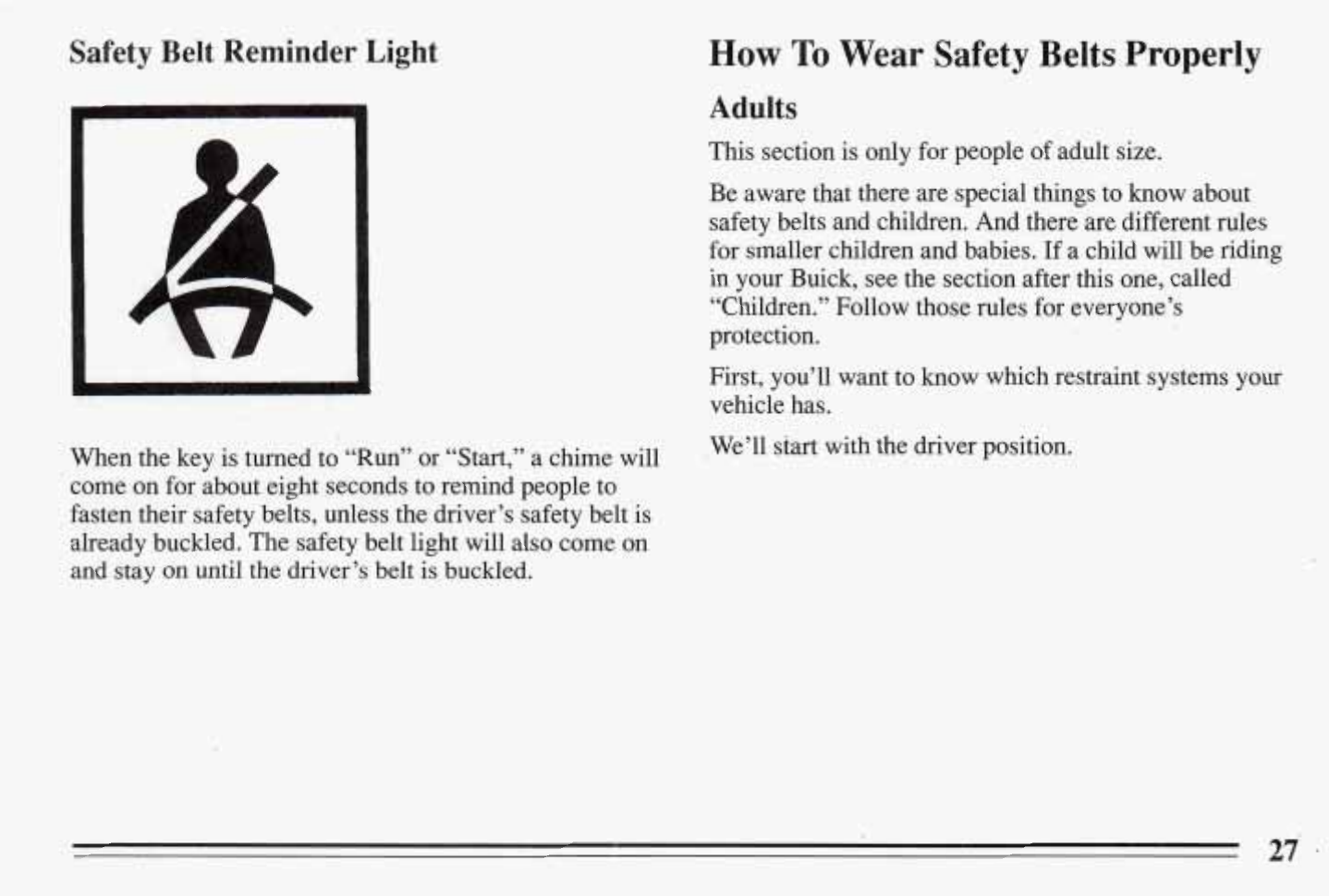
Safety Belt Reminder Light
How
To
Wear Safety Belts Properly
Adults
This section is only for people of adult size.
Be aware that there are special things to know about
safety belts and children. And there are different rules
for smaller children and babies. If a child will be riding
in your Buick, see the section after this one, called
“Children.” Follow those rules for everyone’s
protection.
First, you’ll want to know which restraint systems your
vehicle has.
When the key- is turned to “Run” or “Start,” a chime will
come on for about eight seconds to remind people to
fasten their safety belts, unless the driver’s safety belt is
already buckled. The safety belt light will also come on
and stay on until the driver’s belt is buckled.
We’ll start with the driver position.
27’
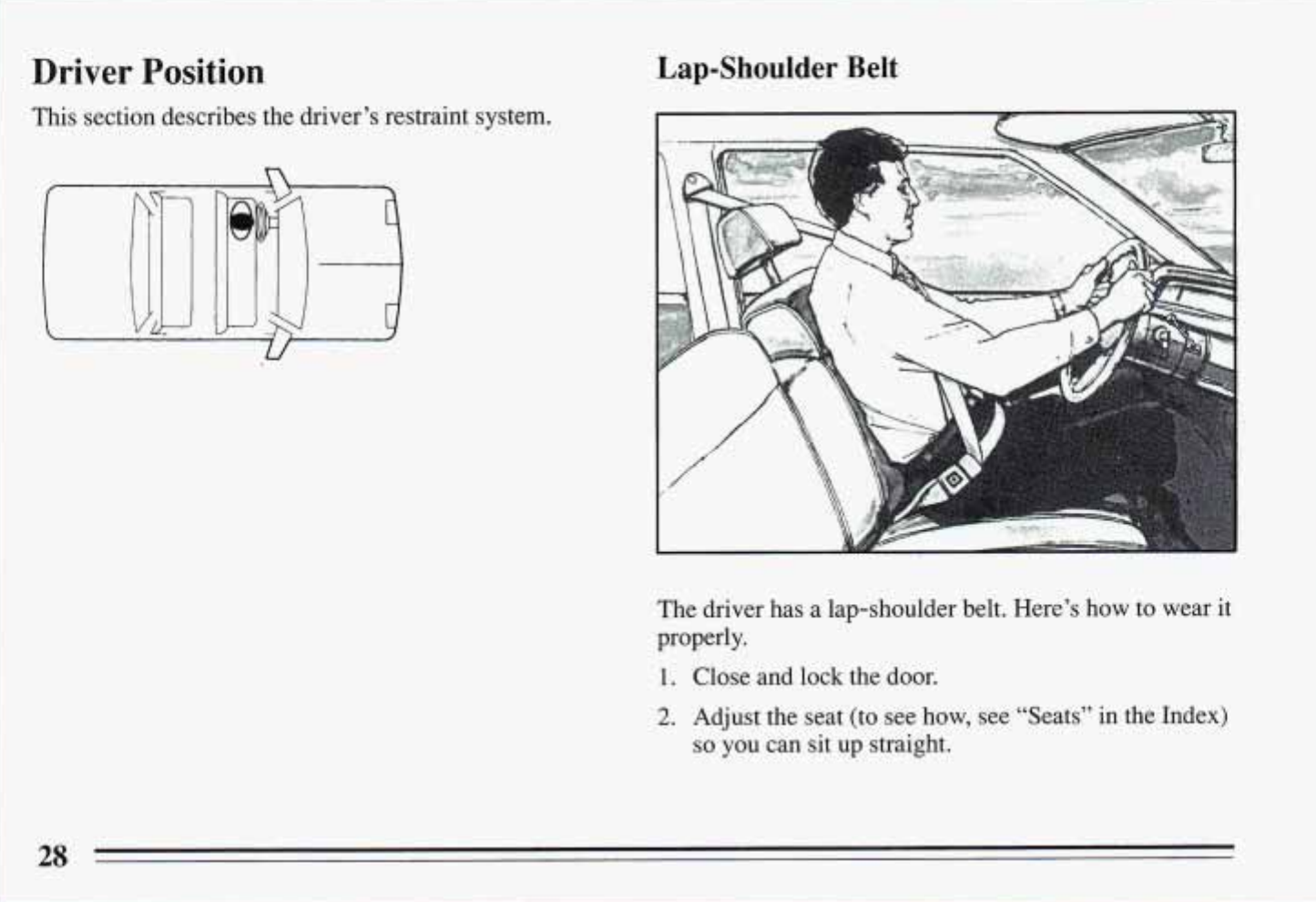
Driver
Position
This section describes the driver’s restraint system.
Lap-Shoulder
Belt
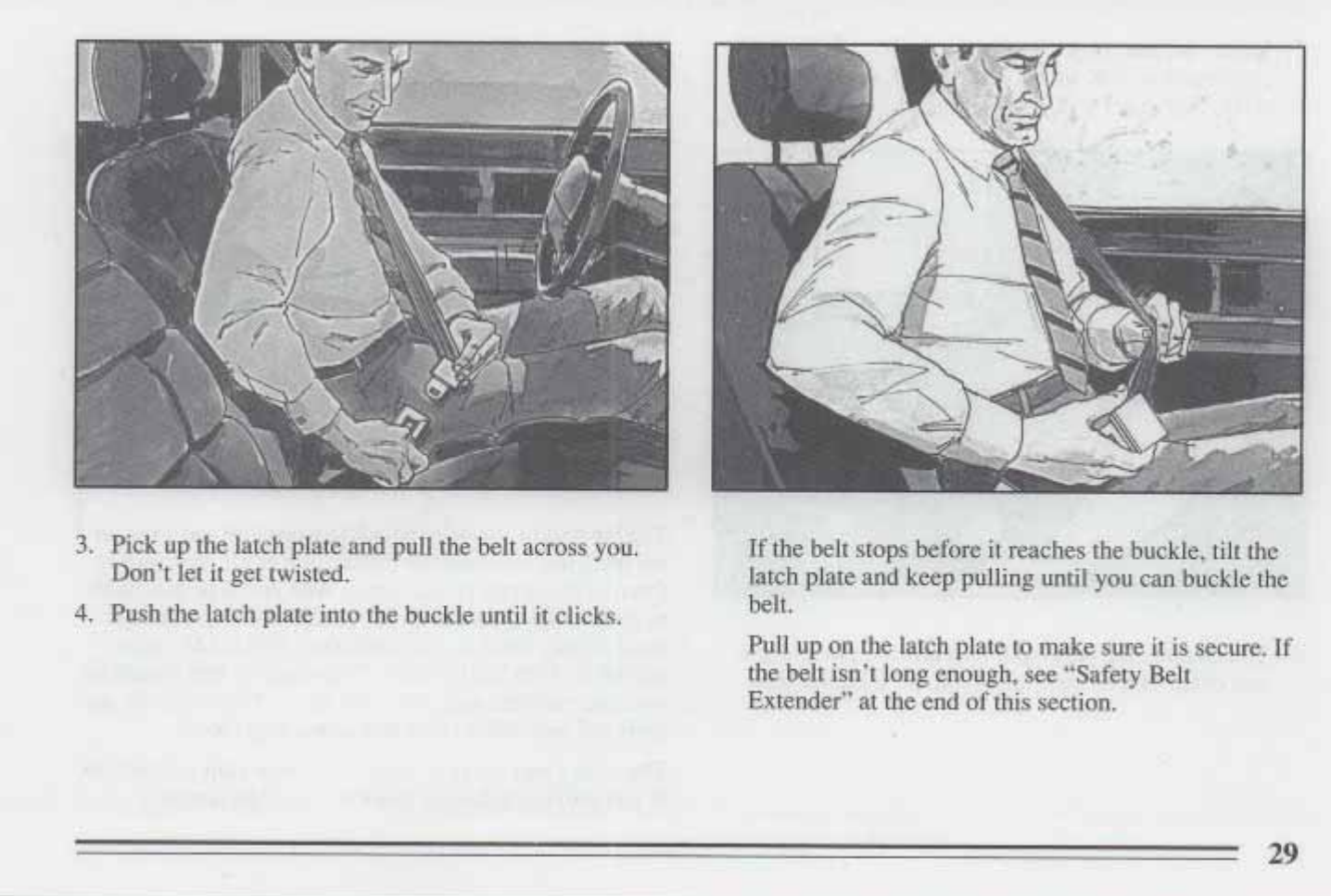
The driver has
a
lap-shoulder belt. Here’s how to wear it
properly.
1.
Close and lock the door.
2.
Adjust the seat (to see how, see “Seats” in the Index)
so
you
can sit
up
straight.
@
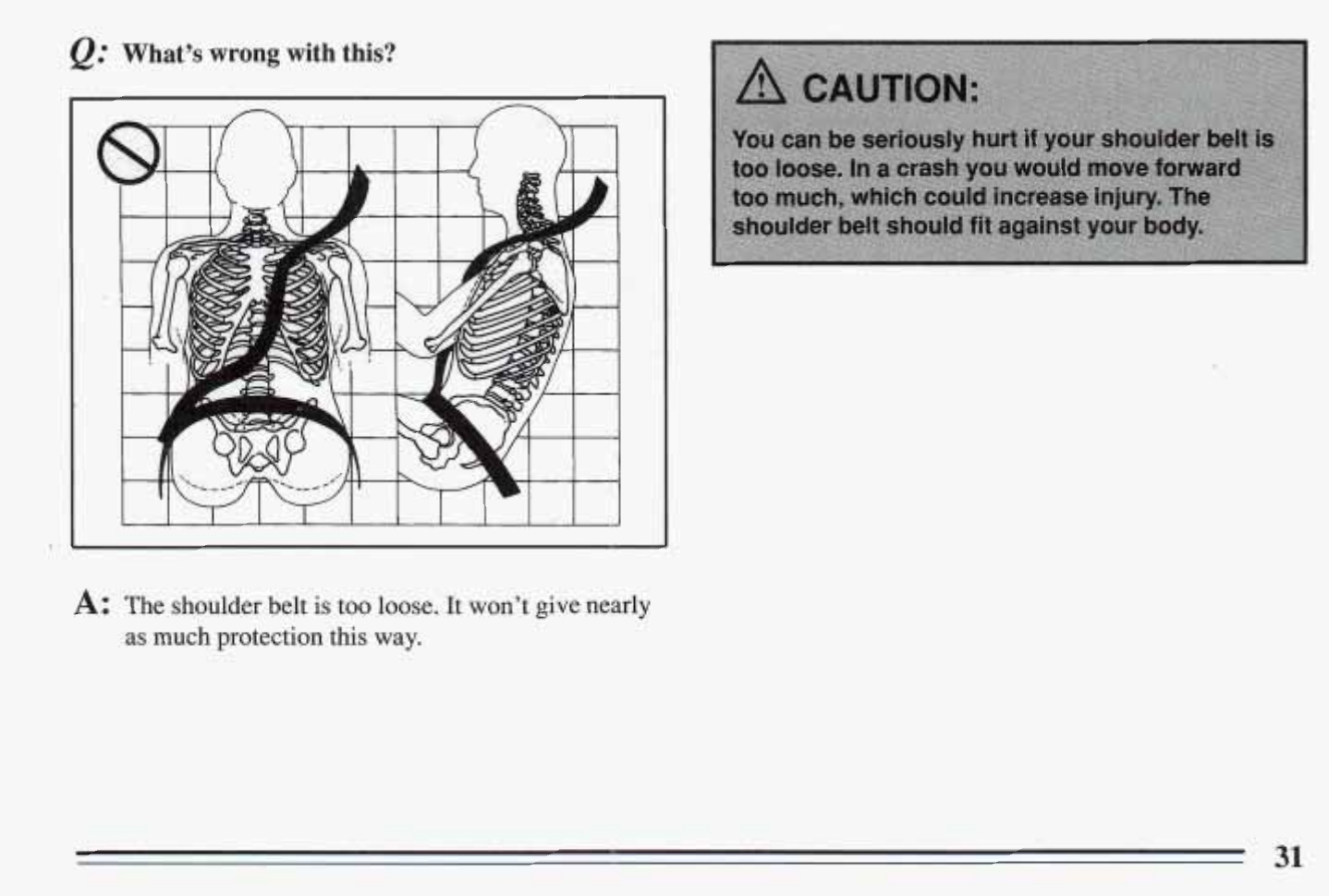
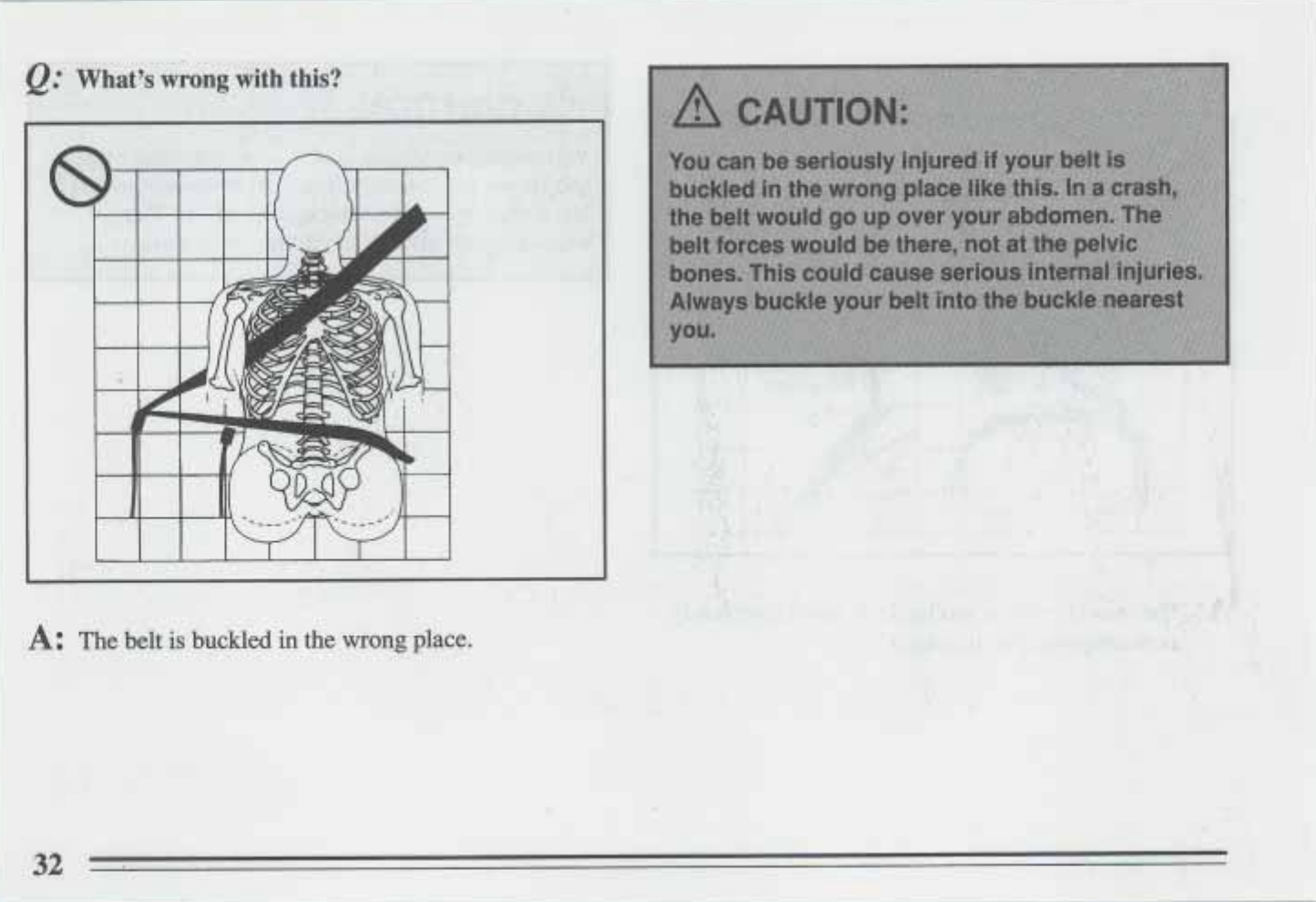
What’s wrong with this?
A:
The shoulder belt is
too
loose.
It
won’t give nearly
as much protection this way.
31
L
@
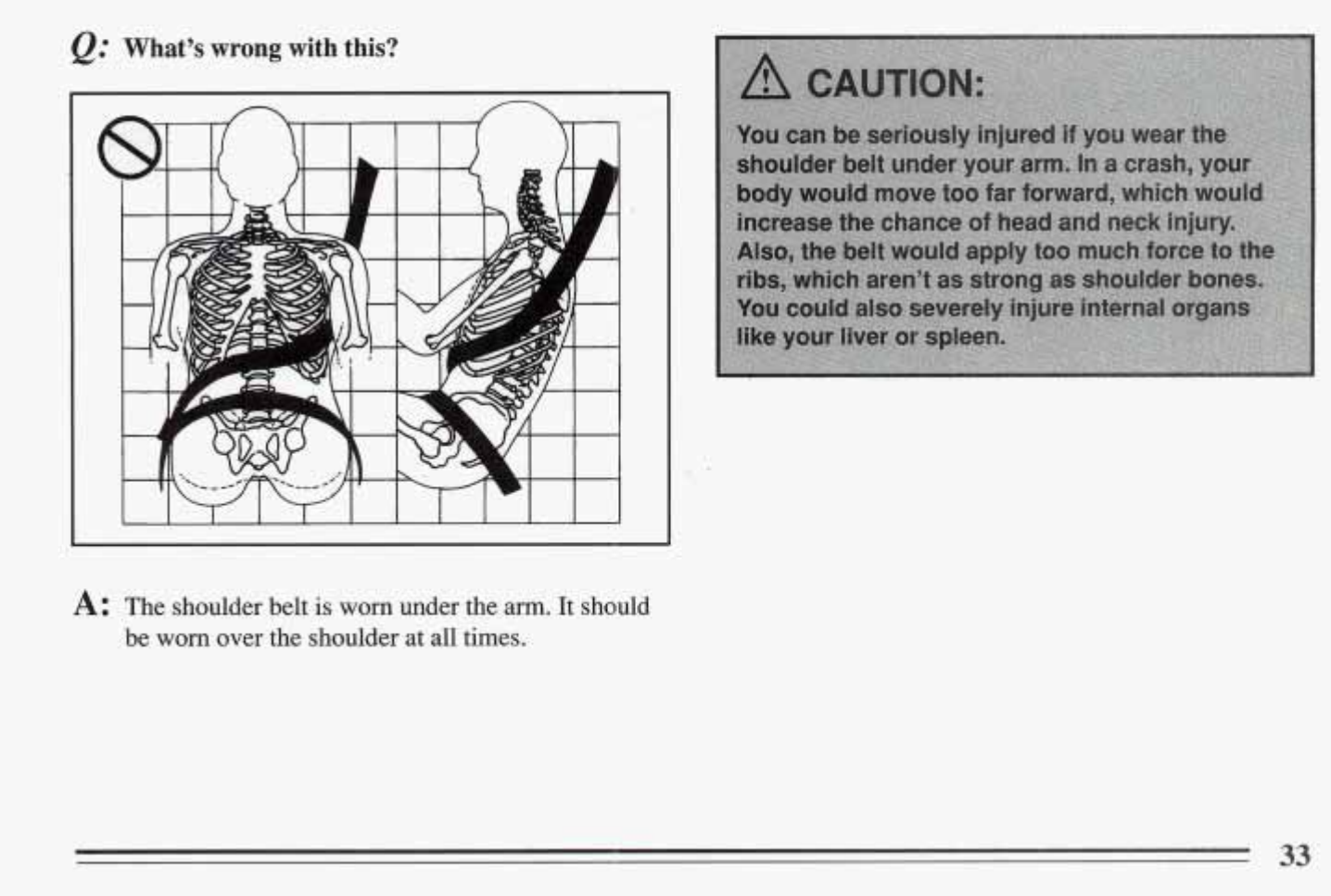
What's
wrong
with this?
A:
The shoulder belt
is
worn under the arm. It should
be
worn
over the shoulder at all times.
33
@
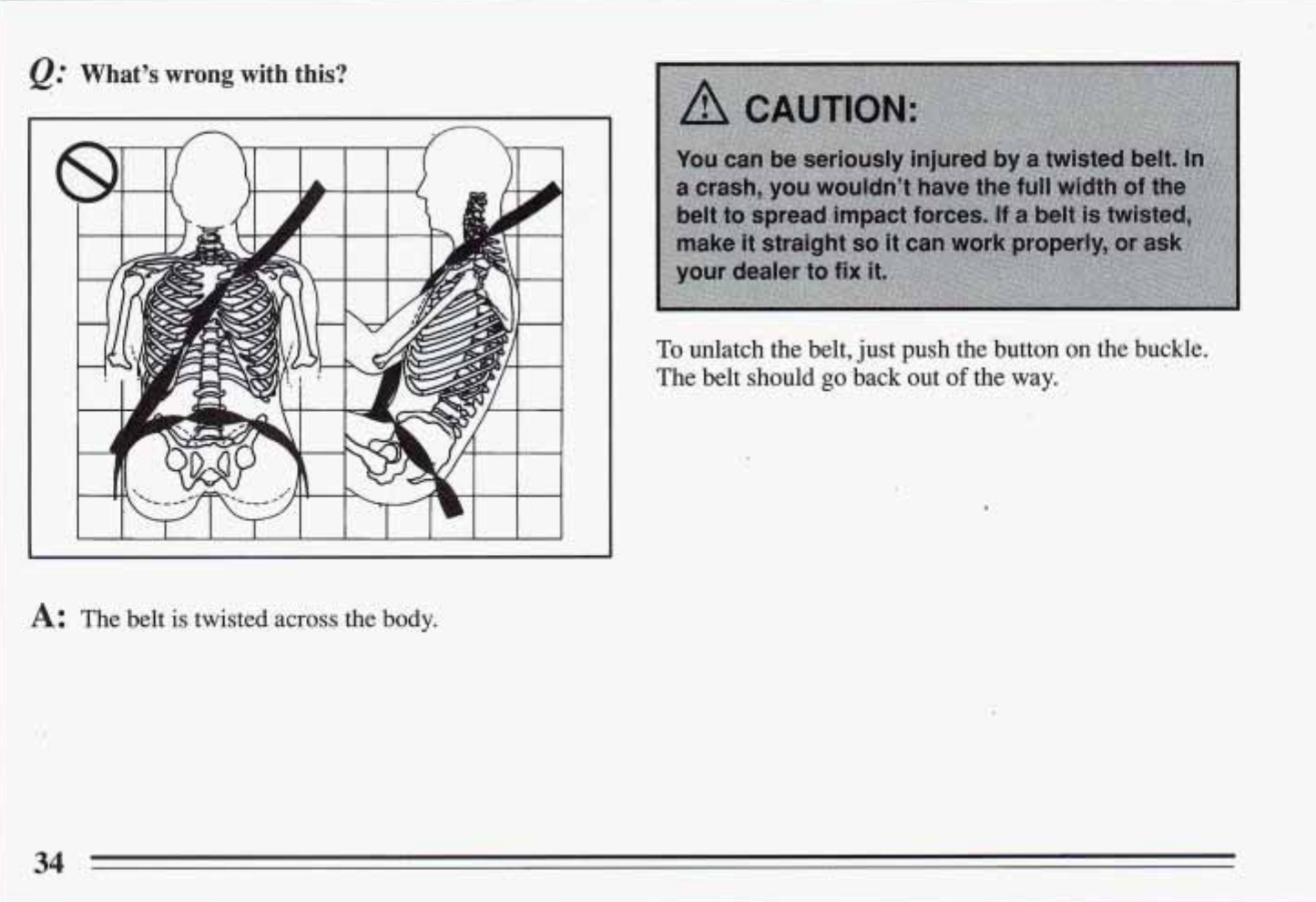
what's
wrong
with
this?
I
I
I
I
1
I
I
I
I
I
I
I
To unlatch the belt, just push the button
on
the buckle.
The belt should
go
back out
of
the way.
A:
The belt
is
twisted
across
the body.
34
!
I
36
Air Bag Readiness Light
There is ‘an air bag readiness light
on
the instrument
panel, which
shows
“AIR
BAG”.
The
.system
chekks for
electrical malfunctions, and the light tells you if there is
a
problem.
AIR
BAG
You
will see this light flash for a few sec,onds when you
turn your ignition to “Run” or “Start.” Then the light
should go out, which means the system
is
ready.
Remember, if the air bag readiness light doesn’t come
on
when you start your vehicle,’or stays on, or comes on
when you are driving, your air bag system may not work
properly. Have your vehicle serviced right away.
How
The
Air Bag
System
Works
37
/.:
.
.
.i
..
’
Where
is
the air bag?
The driver’s air bag is in the middle of the steering
wheel. The right-front passenger’s air bag is located in
the instrument panel on the passenger’s side.
When
is
an air bag expected to inflate?
The air bag is designed to inflate in moderate to severe
frontal
or
near-frontal crashes. The air bag will only
inflate if the velocity of the impact is above the designed
threshold level.
When
impacting straight into
a
wall that
does not move
or
deform, the threshold level for most
GM
vehicles is between
9
and
15
mph
(14
and
23
km/h).
However, this velocity threshold depends on the
vehicle design and may be several miles-per-hour faster
or slower. In addition, this threshold velocity will be
considerably higher if the vehicle strikes an object such
as a parked car which will move and deform on impact.
The air bag is also not designed to inflate in rollovers,
side impacts, or rear impacts where the inflation would
provide no occupant protection benefit.
It is possible that in a crash, only one
of
the two air
bags in your Roadmaster will deploy. This is rare, but
can happen in a crash just severe enough to make an air
bag inflate.
In any particular crash, the determination of whether the
air bag should have inflated cannot be based solely on
the level
of
damage on the.vehicle(s). Inflation is
determined by the angle of the impact and the vehicle’s
deceleration, of which vehicle damage is only one
indication. Repair cost is not a good indicator of
whether an air bag should have deployed.
38
What makes an air bag inflate?
In
a frontal or near-frontal impact of sufficient severity,
the air bag sensing system detects that the vehicle is
suddenly stopping as a result of a crash. The sensing
system triggers a chemical reaction of the sodium azide
sealed in the inflator. The reaction produces nitrogen
gas, which inflates a cloth bag. The inflator, cloth bag,
and related hardware are all part
of
the air bag inflator
modules packed inside the steering wheel and in the
instrument panel in front of the passenger.
How
does
an air bag restrain?
In
moderate to severe frontal or near-frontal collisions,
even belted occupants can contact the steering wheel or
the instrument panel. The air bag supplements the
protection provided by safety belts. Air bags distribute
the force of the impact more
evenly
over the occupant’s
upper body, stopping the occupant more gradually. But
air bags would not provide protection
in
many types
of
collisions, including rollovers and rear and side impacts,
primarily because an occupant’s motion is not toward the
air bag.
Air
bags should never be regarded as anything
more than a supplement to safety belt protection
in
moderate to severe frontal and near-frontal collisions.
What will
you
see after an air bag inflation?
After the air bag has inflated, it will then quickly
de,flgte..This occurs
so
quickly that some people may
not even realize that the air bag inflated. Some
components
of
the air bag module in the steering wheel
hub for the driver’s
,air
bag or-the instrument panel for
the passenger’s bag may be hat for a short time, but the
portion of the bag that comes into contact with you will
not be hot to the touch. There will be small amounts of
smoke and dust coming from vents in the deflated air
bags. The air bag will
not
impede the driver’s vision
or
ability to steer the vehicle, nor will it hinder the
occupants from exiting the vehicle.
In many crashes severe enough to inflate an air bag,
windshields are broken by vehicle deformation.
Additional windshield breakage may occur in vehicles
with passenger air bags because the windshield acts as
a
reaction surface for the inflating air bag.
0
The air bags are designed to inflate only once. After
they inflate, you’ll need some new parts for your air
bag system. If you don’t get them, the air bag system
won’t be there to help protect you in another crash.
A new system will include air bag modules and
possibly other parts. The service manual has
information about the need to replace other parts.
39
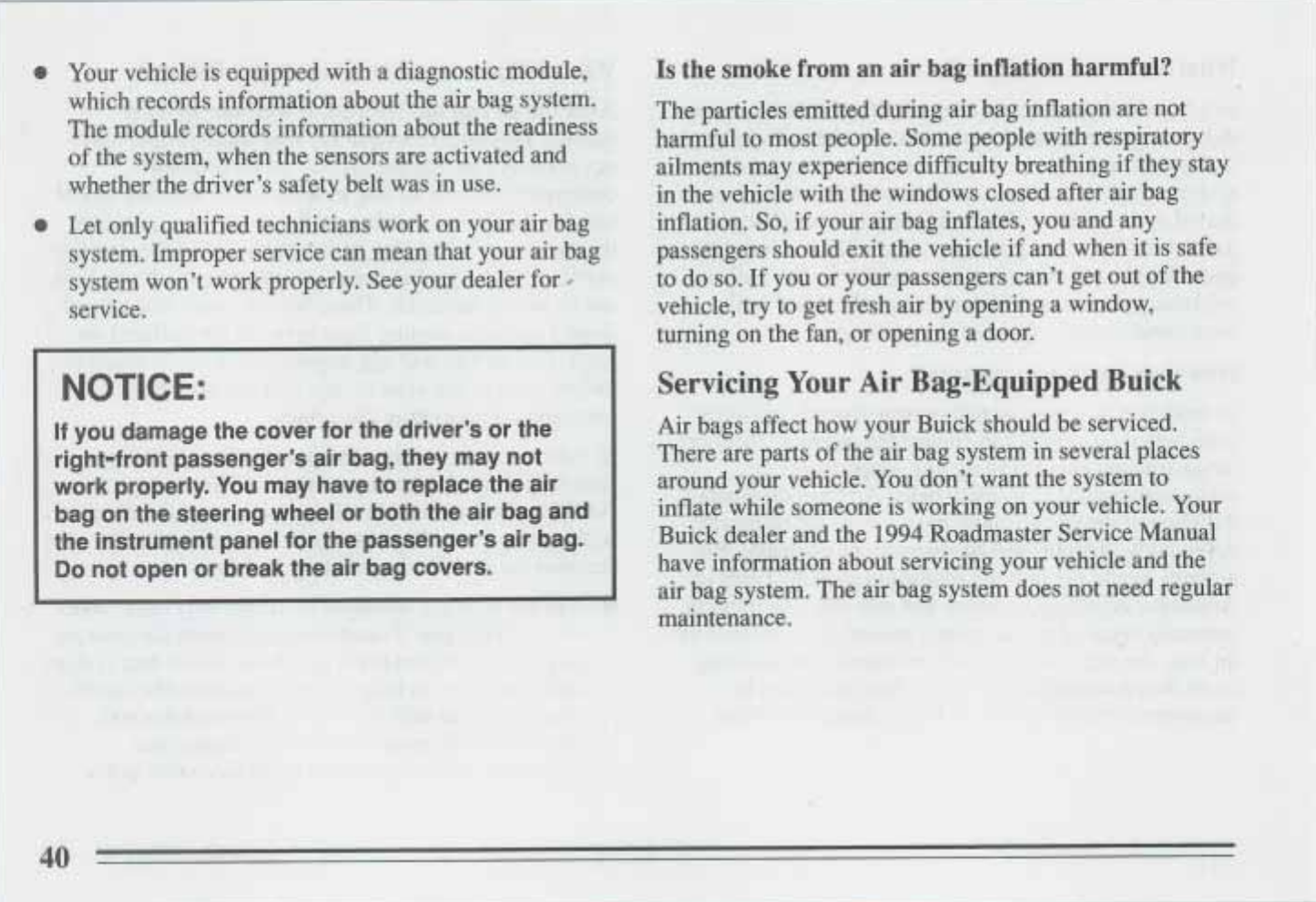
Right Front Passenger Position
The right front passenger’s safety belt works the same
way as the driver’s safety belt. See “Driver Position,’’
earlier
in
this part.
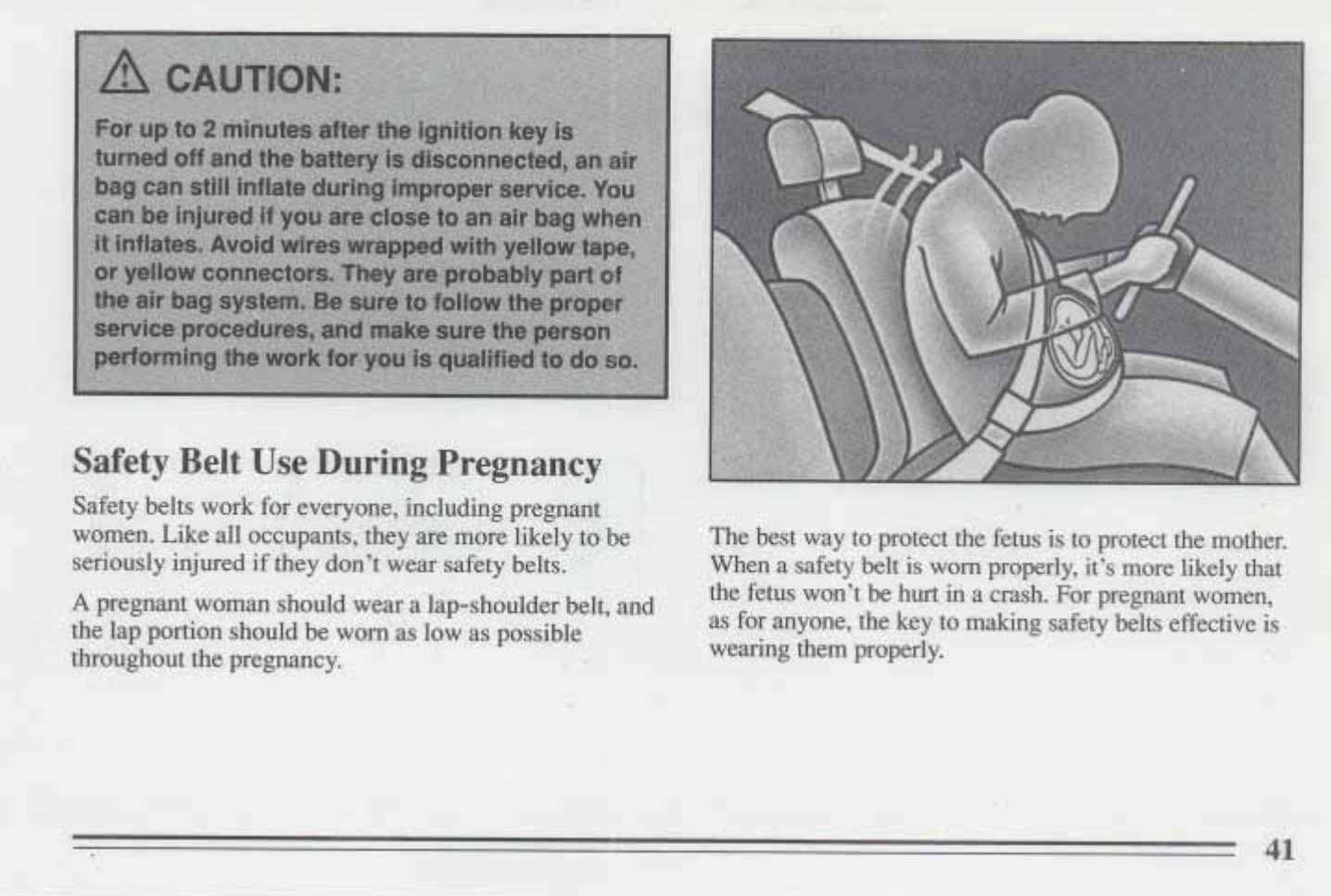
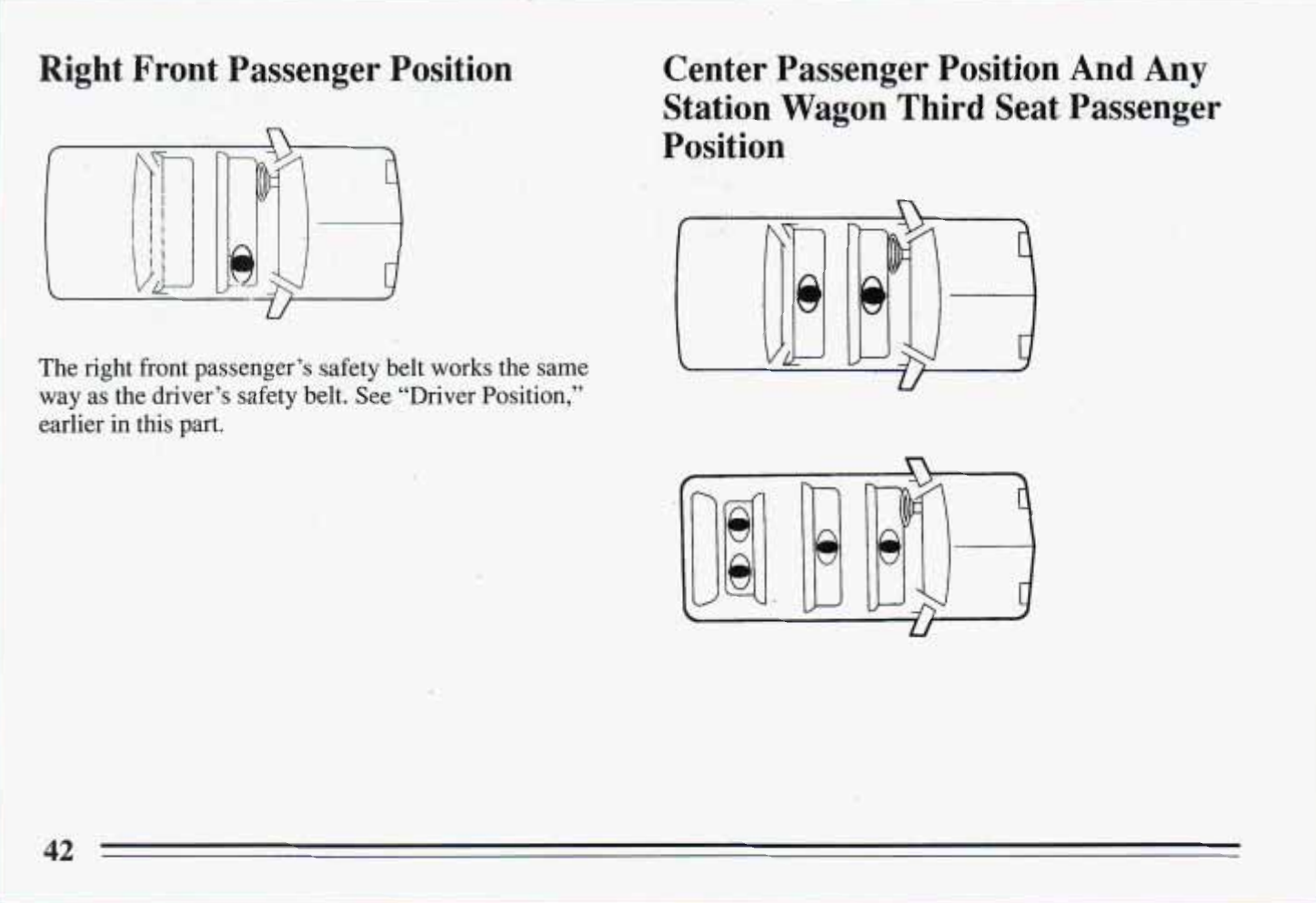
Center Passenger Position And Any
Station
Wagon
Third Seat Passenger
Position
U
42
I
Lap
Belt
3
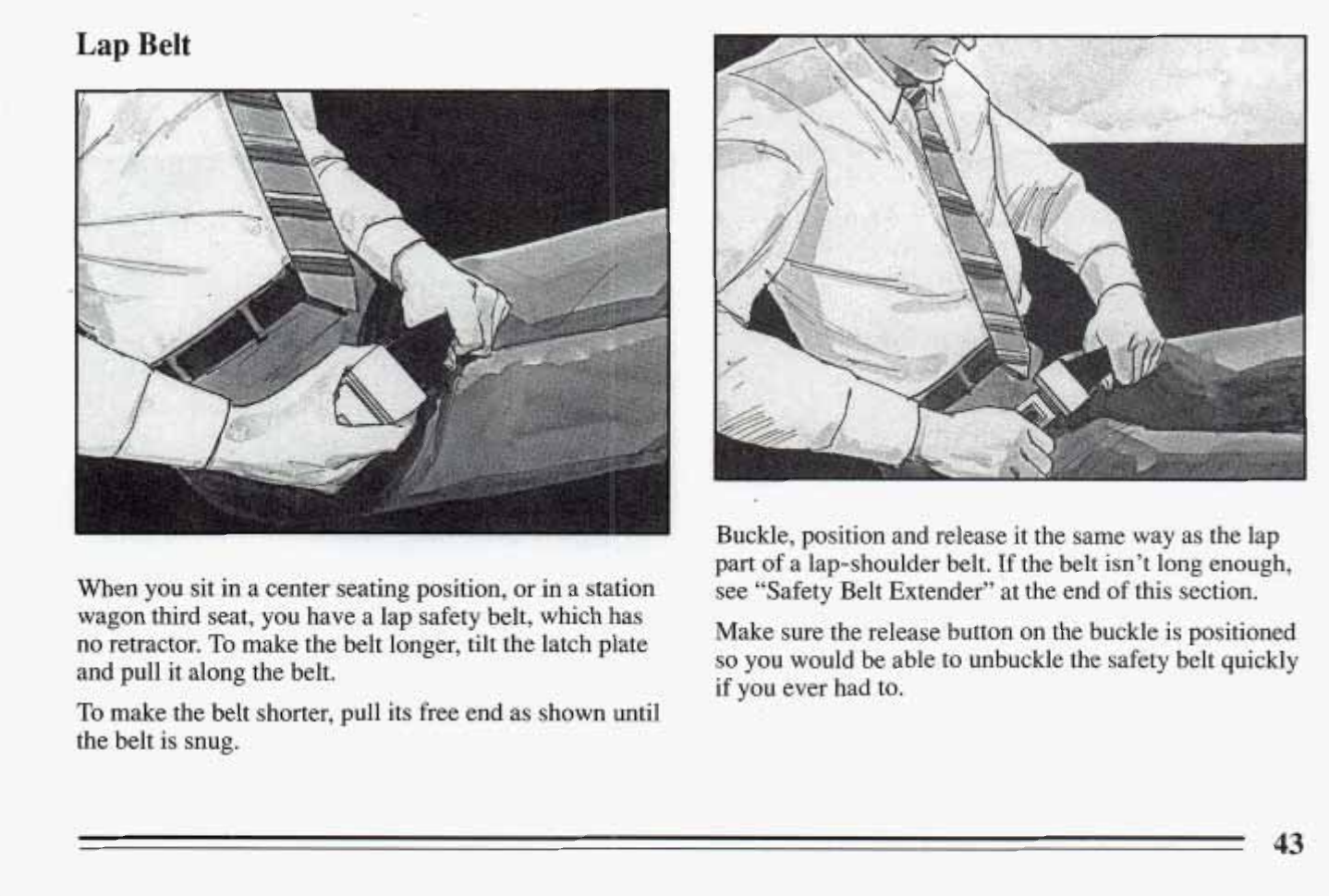
When you sit in a center seating position, or in
a
station
wagon third seat,
you
have a lap safety belt, which has
no retractor. To make the belt longer, tilt the latch plate
and pull it along the belt.
To
make the belt shorter, pull its free end as shown until
the belt is snug.
Buckle, position and release it the same way as the lap
part
of
a lap-shoulder belt.
If
the belt isn’t long enough,
see “Safety Belt Extender” at the end
of
this section.
Make sure the release button on the buckle
is
positioned
so you would be able
to
unbuckle the safety belt quickly
if you ever had to.
f
43
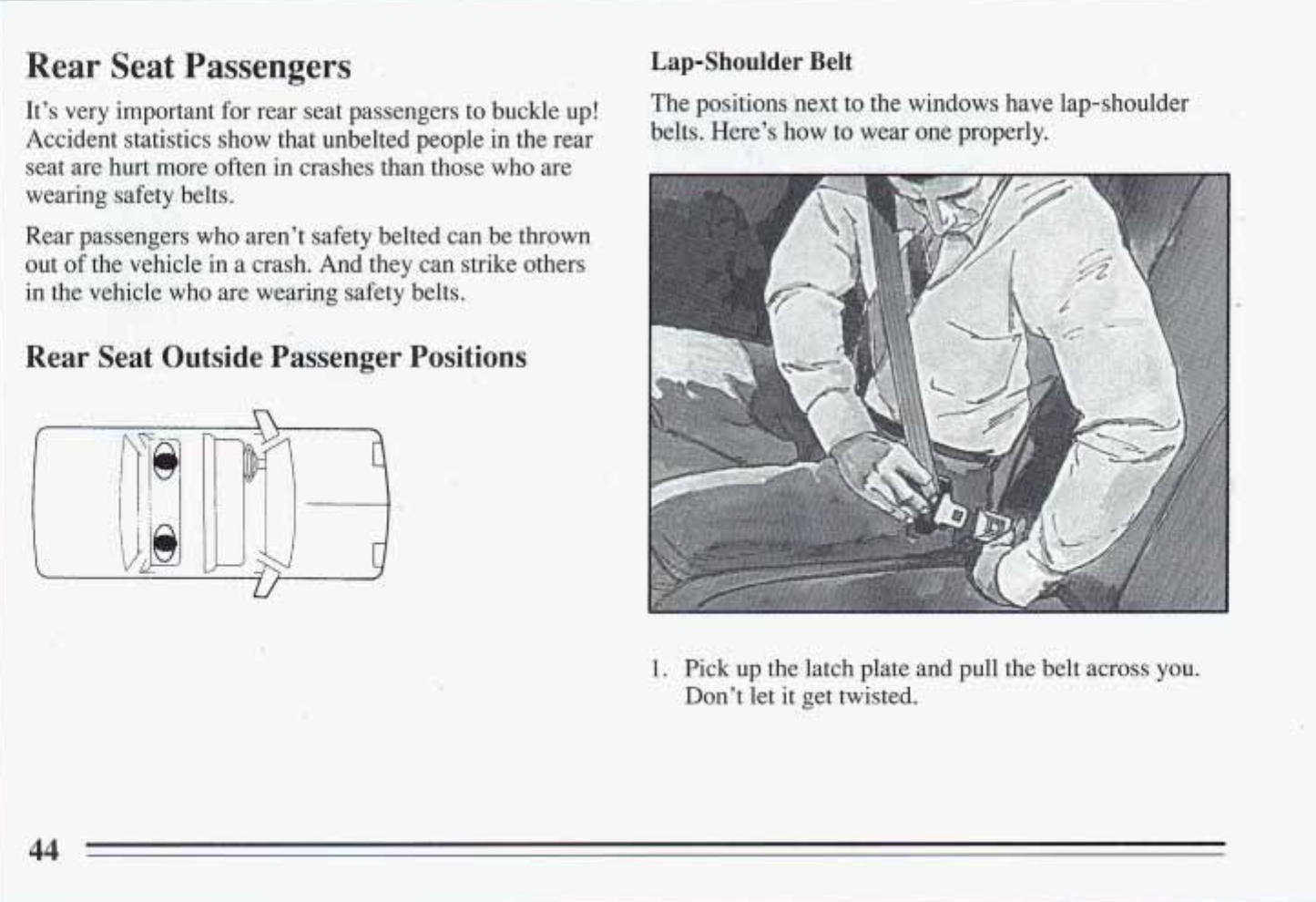
Rear Seat Passengers
It’s very important for rear seat passengers to buckle up!
Accident statistics show that unbelted people in the rear
seat are hurt mare often in crashes than those who are
wearing safety. belts.
Rear passengers who aren’t safety belted can
be
thr.own
out
of the vehicle in a crash. And they .can strike others
in the vehicle who are wearbg safety belts.
Rear Seat Outside Passenger Positions
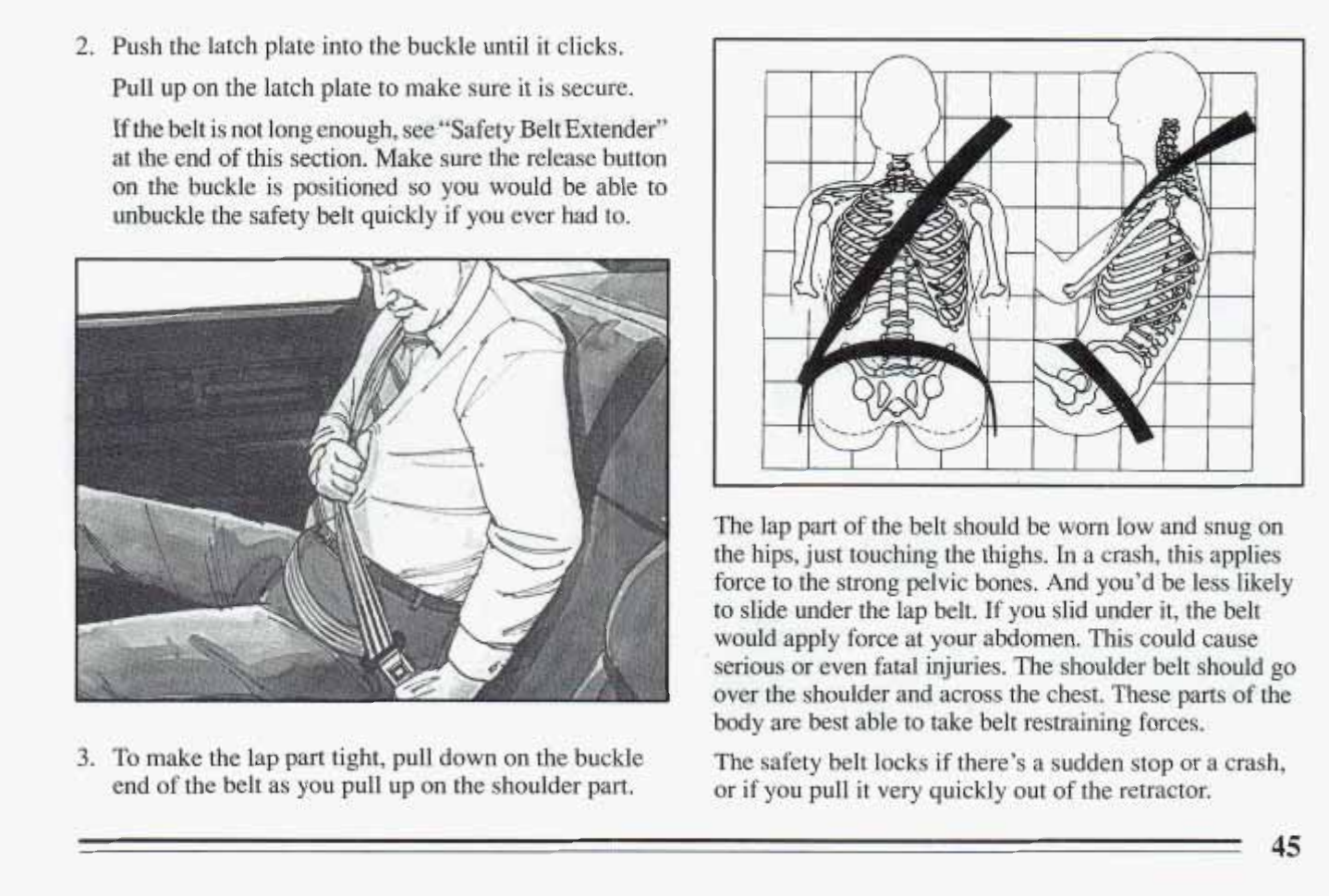
Lap-Shoulder
Belt
The positions next
to
the
windows have lap-shoulder
:,
....,
belts. Here’s how to wear
one
properly.
;
1.
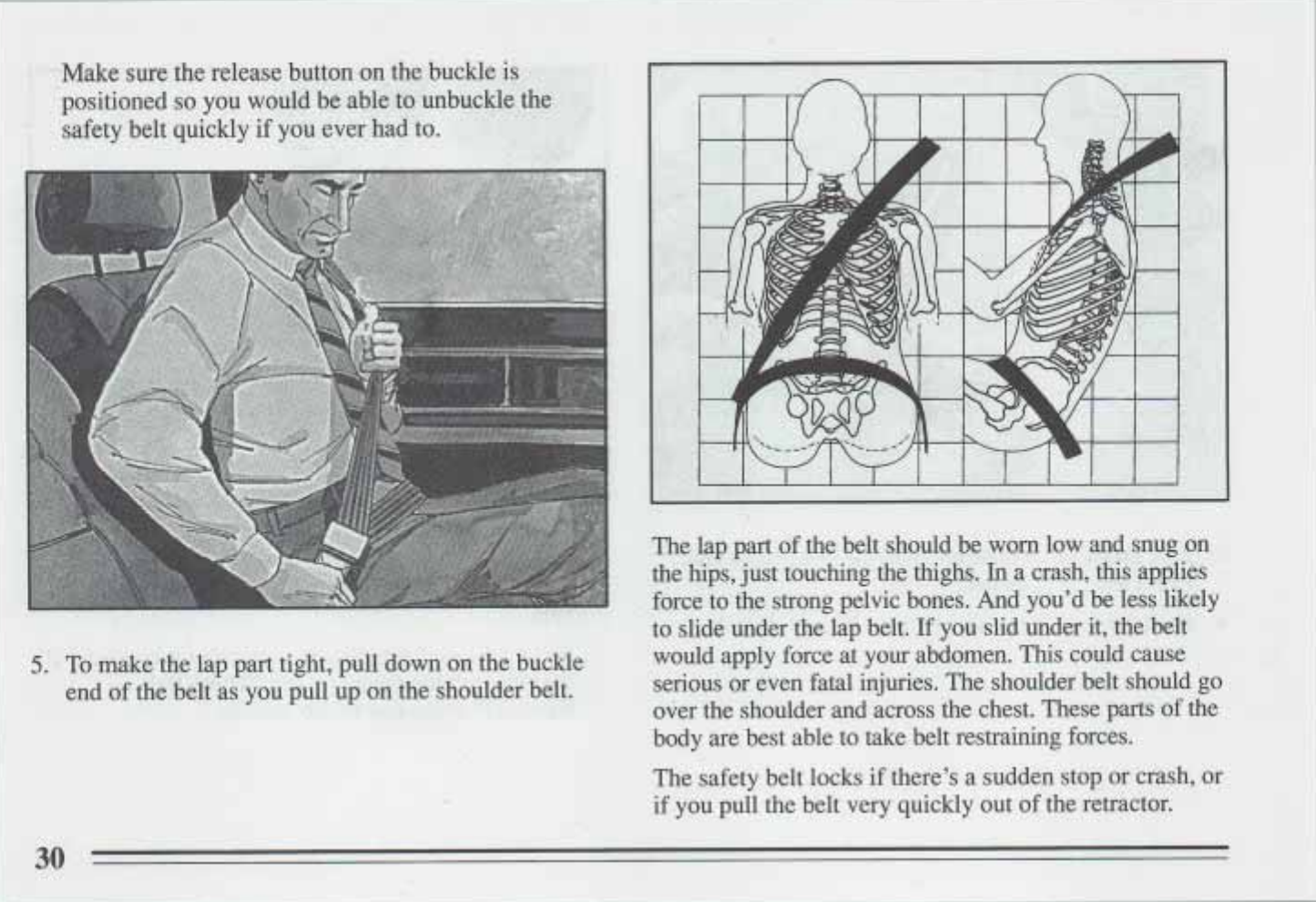
Pick up the latch plate and pull the belt across you.
Don’t let it get twisted.
44
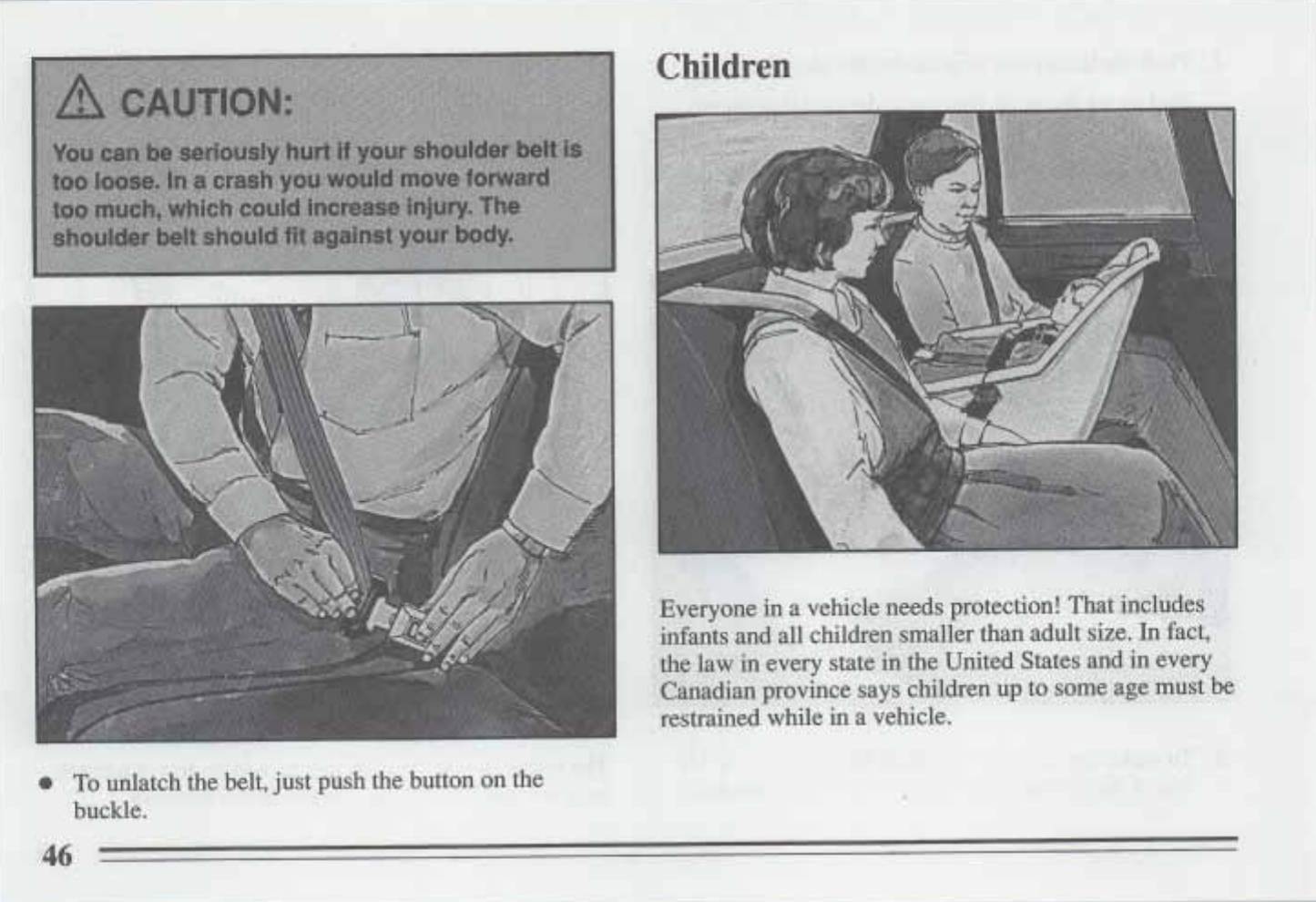
2.
Push the latch plate into the buckle until it clicks,
Pull up on the latch plate to make sure it is secure.
If
the belt is not long enough, see3afety Belt'Extender"'
at the end of this section. Make sure the release button
on the buckle is positioned
so
you
would
be
able
to
unbuckle
the
safety belt quickly if
you
ever had to.
3.
To make the lap part tight, pull down
on
the
buckle
end of the belt as
you
pull up on.the shoulder part.
I
I
I
I
I
I
45
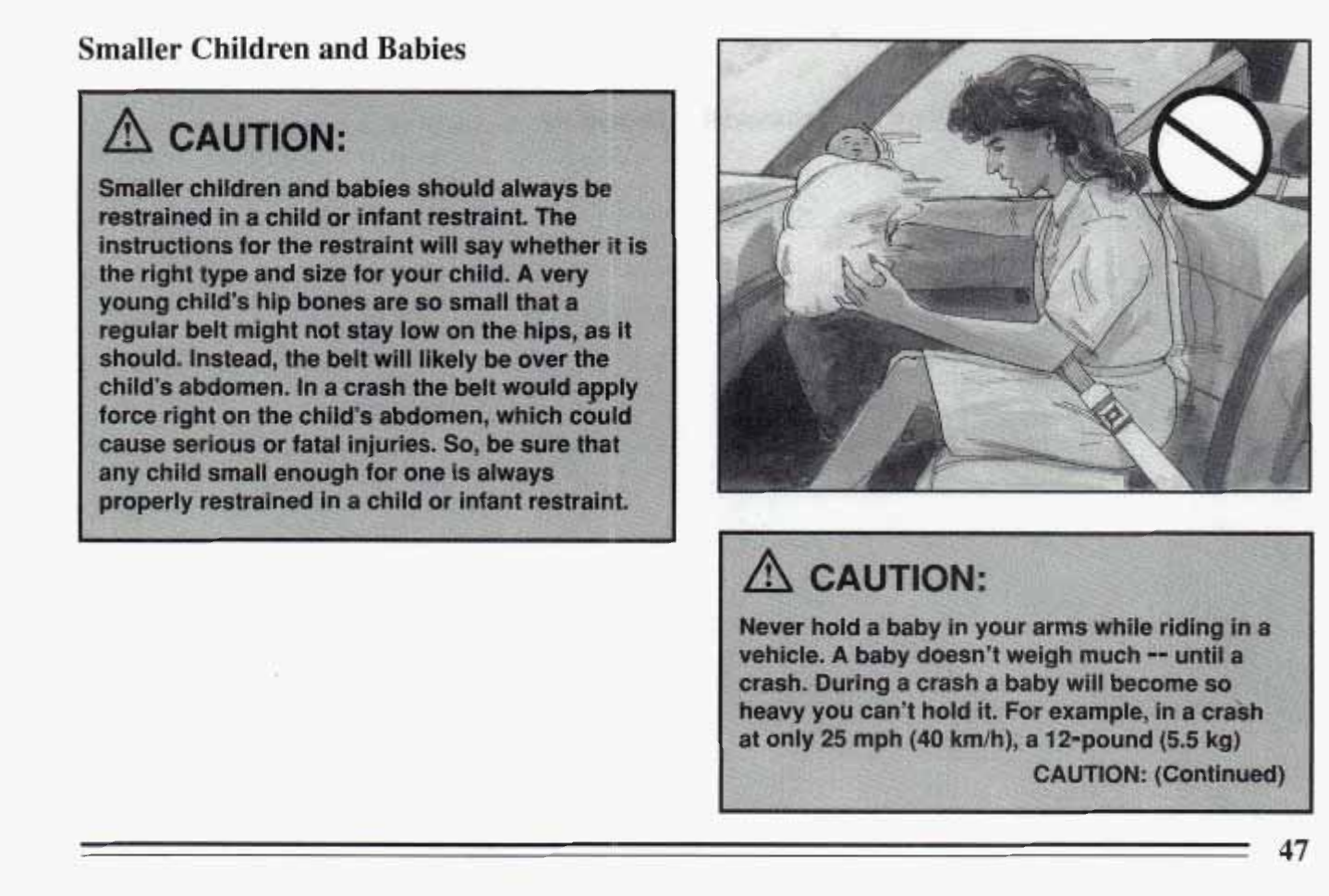
Smaller Children and Babies
47
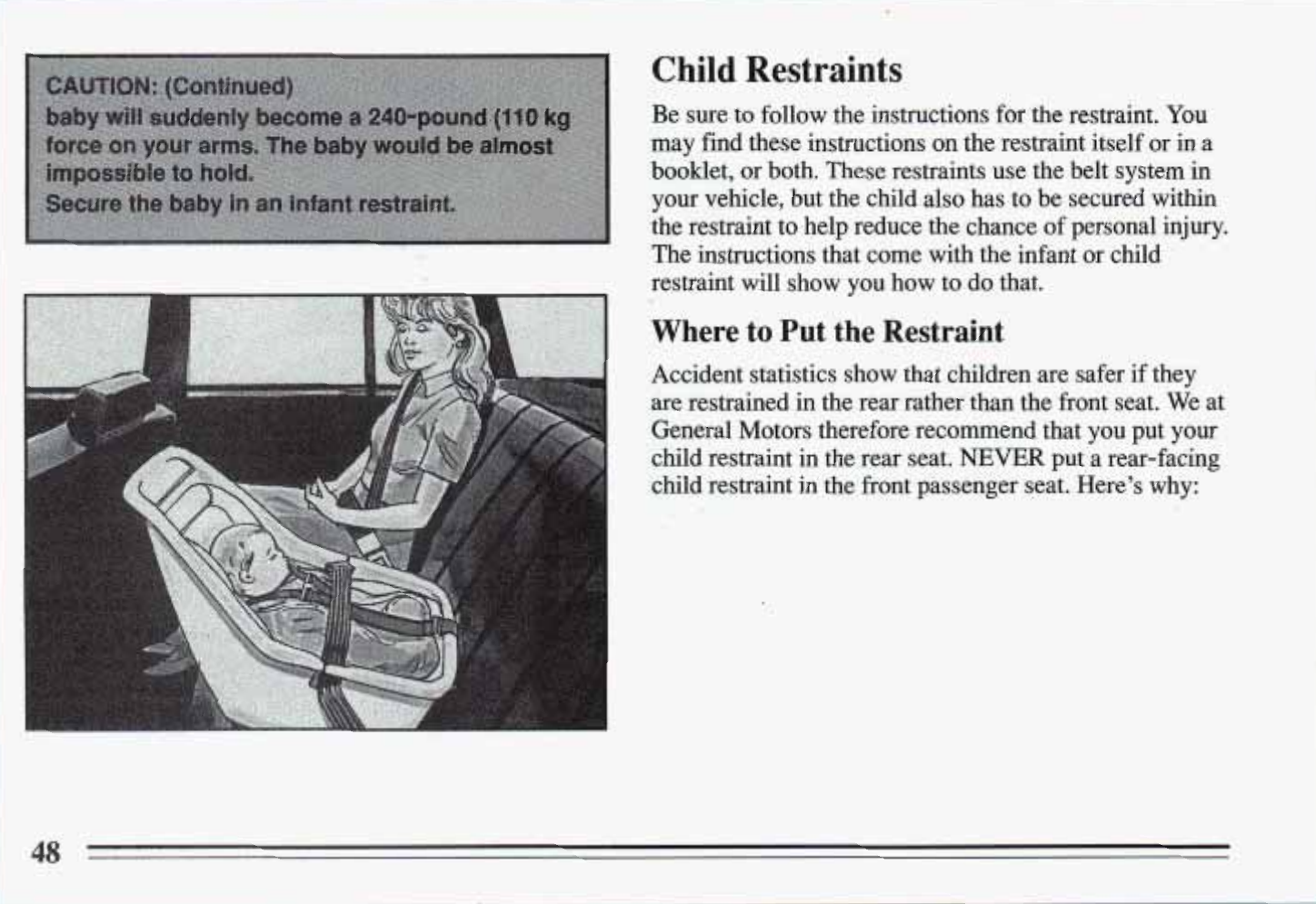
L
..,.,.
,
.
.
.
..
.
Child
Restraints
Be
sure
to follow the- instructions for
the
restraint. You
may find these instructions on the restraint itself or
in
a
booklet,
or
both. These restraints use the belt system in
your vehicle, but the child also has to be secured within
the restraint to help reduce the chance of personal injury.
The instructions that come with the infant or child
restraint will show you how to
do
that.
Where to Put the Restraint
Accident statistics show that children are safer
if
they
are restrained
in
the rear rather than the front seat. We at
General Motors therefore recommend that you put your
child restraint in the rear seat.
NEVER
put a rear-facing
child restraint in the front passenger seat. Here’s
why:
48
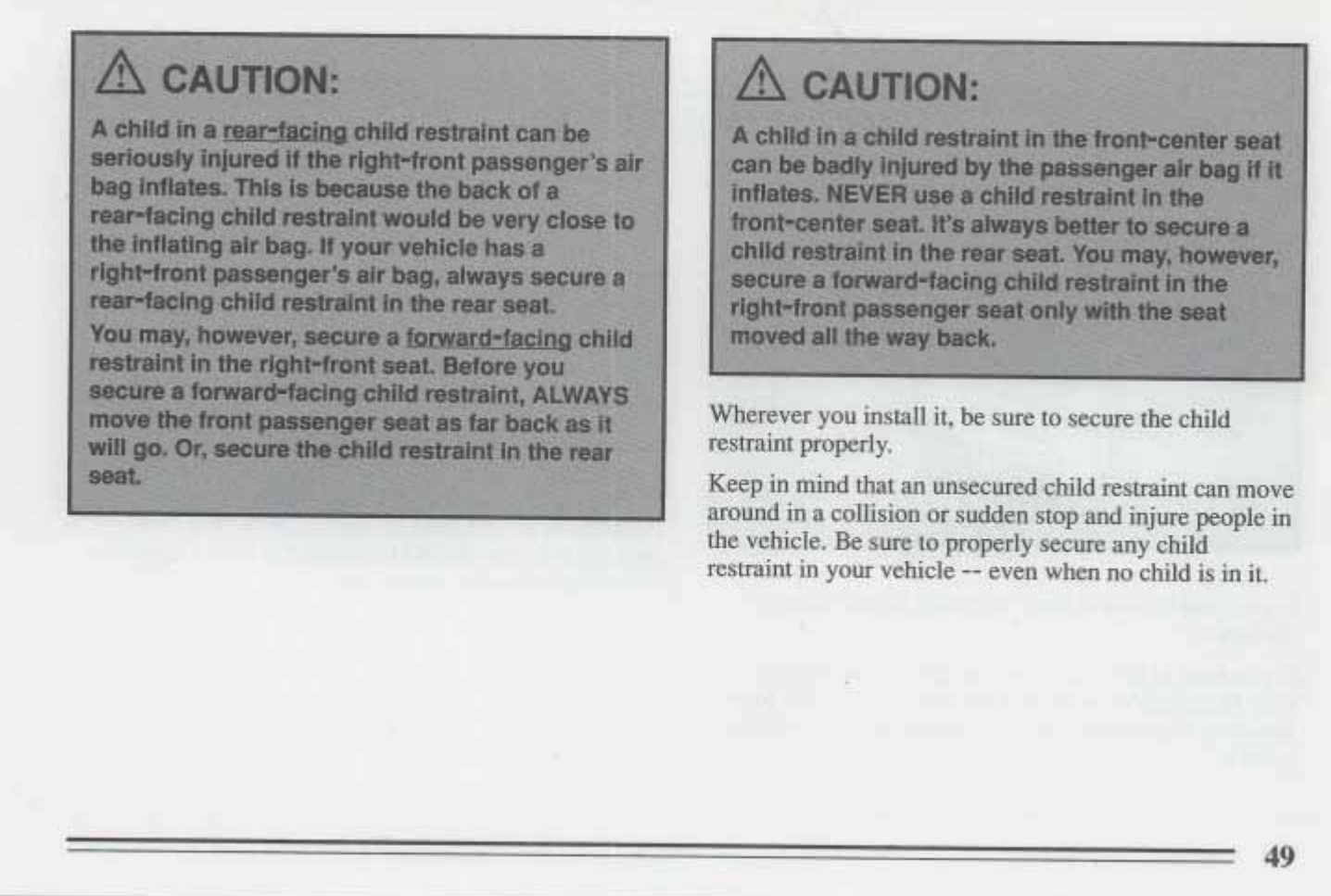
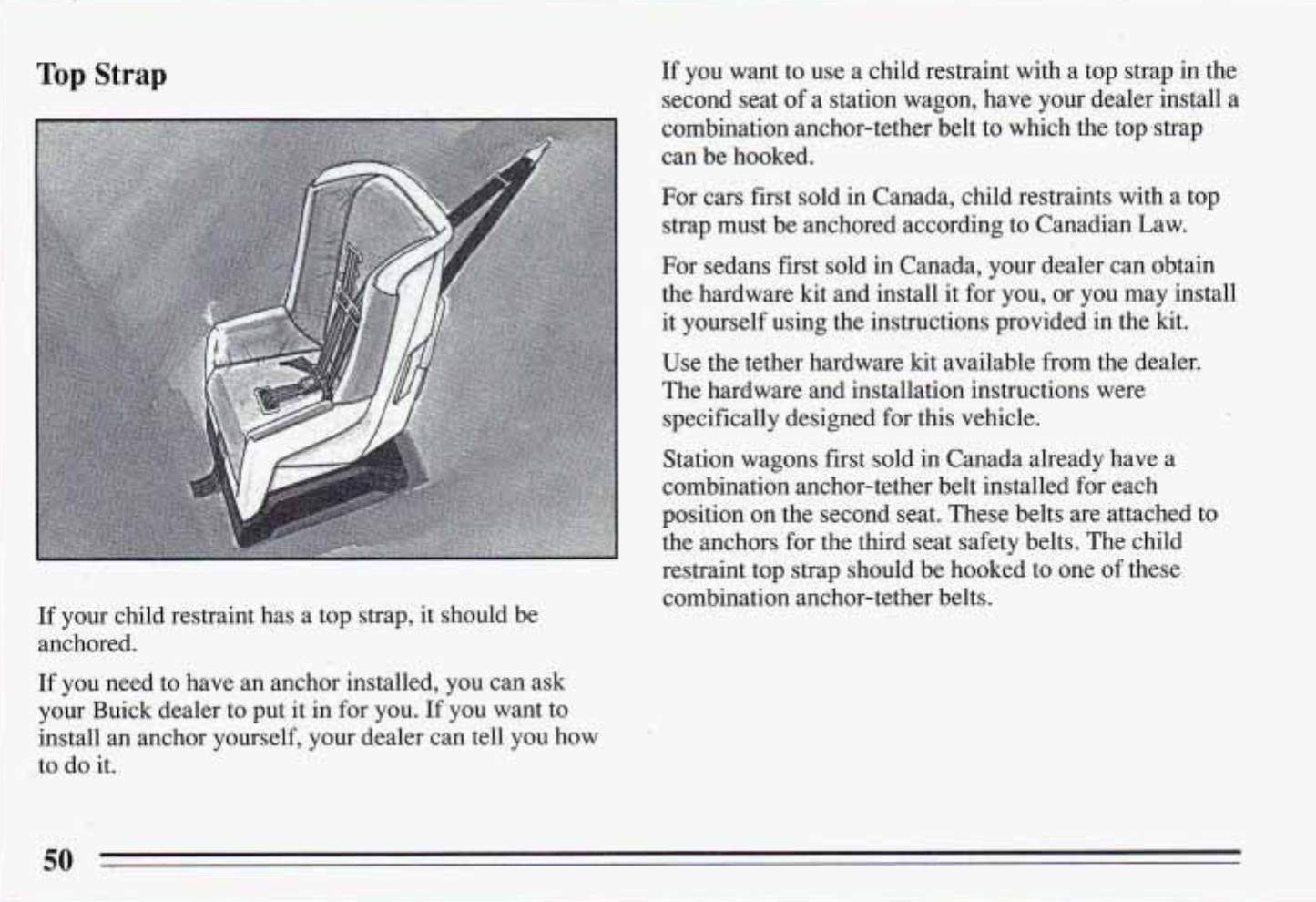
Top
Strap
If
your child restraint has a top strap, it should be
anchored.
If you need
to have an anchor installed, you can ask
your Buick dealer to put
it
in
for
you.
If
you want to
install an anchor yourself, your dealer can tell you
how
to do it.
50
Securing
a
Child Restraint in a Rear
Outside Position
You’ll be using the lap-shoulder belt. See the earlier
section about the top strap
if
the child restraint has one.
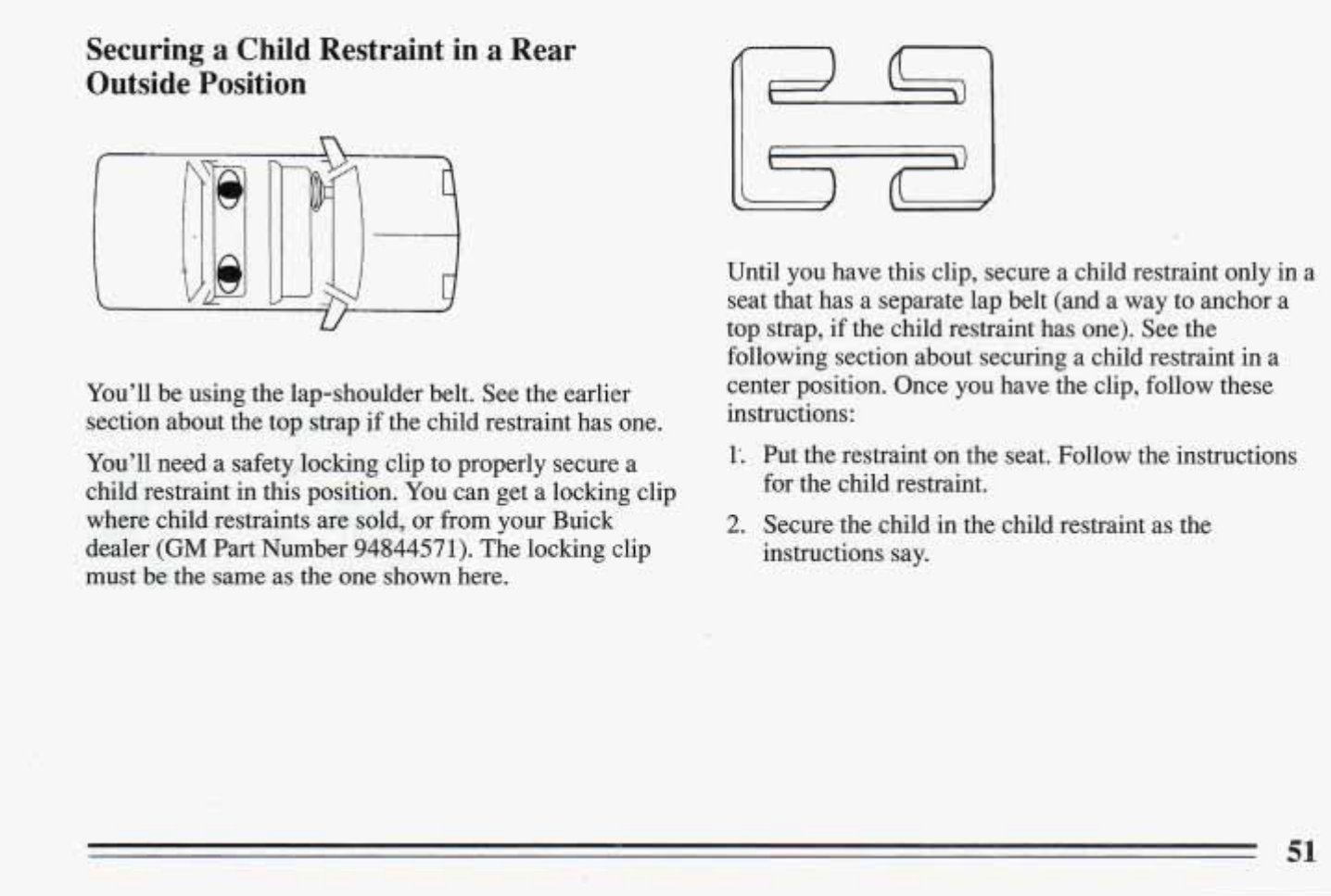
You’ll need a safety,locking clip to properly secure a
child restraint
in
this position.
You
can get a locking clip
where child restraints are sold, or from your Buick
dealer
(GM
Part Number
94844571).
The locking clip
must be the same
as
the one
shown
here.
Until you have this clip, secure a child restraint only in a
seat that has
a
separate lap belt (and a way to anchor a
top strap, if the child restraint has one). See the
following section about securing
a
child restraint in a
center position. Once you have the clip, follow these
instructions:
I:
Put the restraint on the seat. Follow the instructions
for the child restraint.
2. Secure the child in the child restraint as the
instructions say.
51
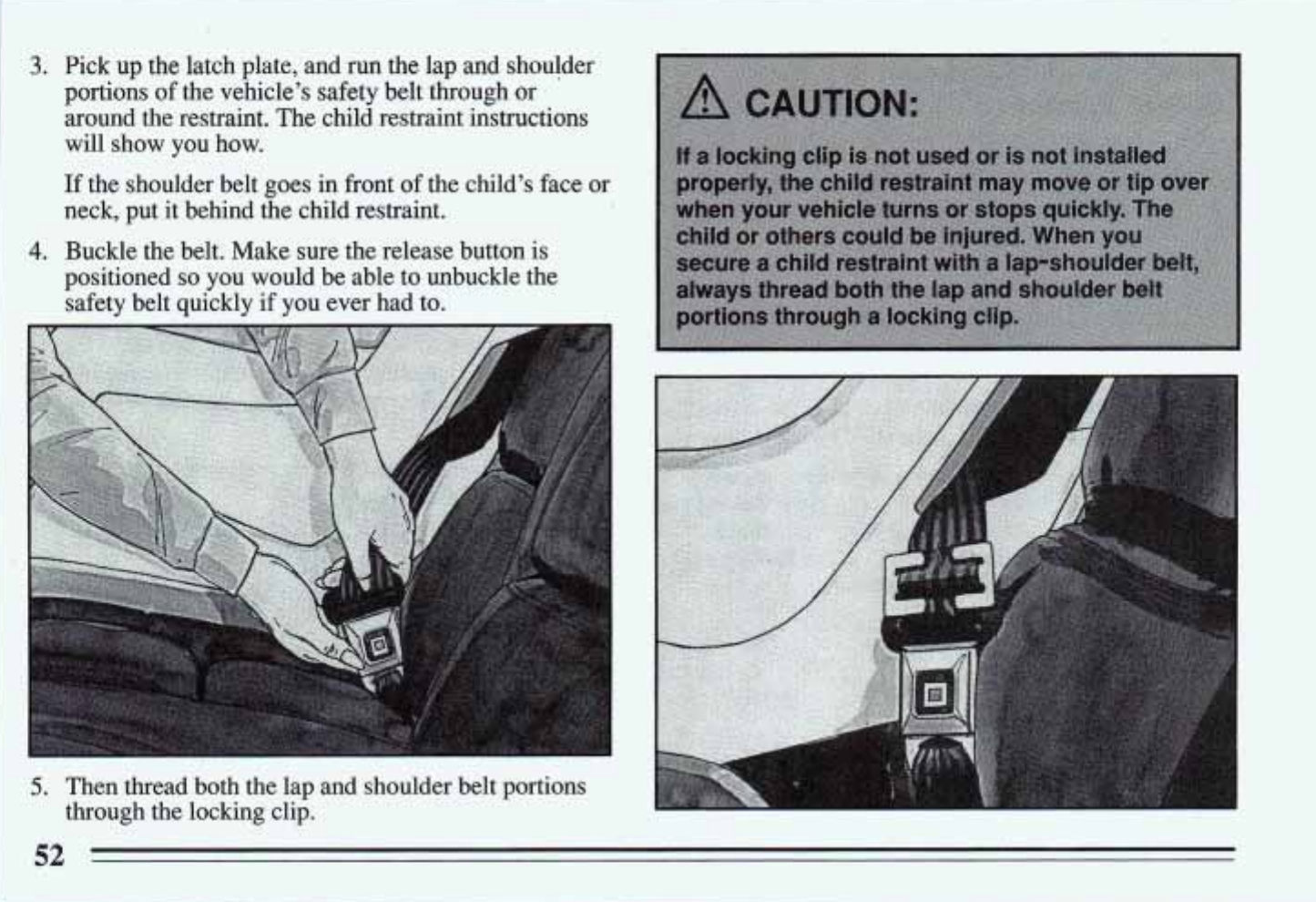
~
3.
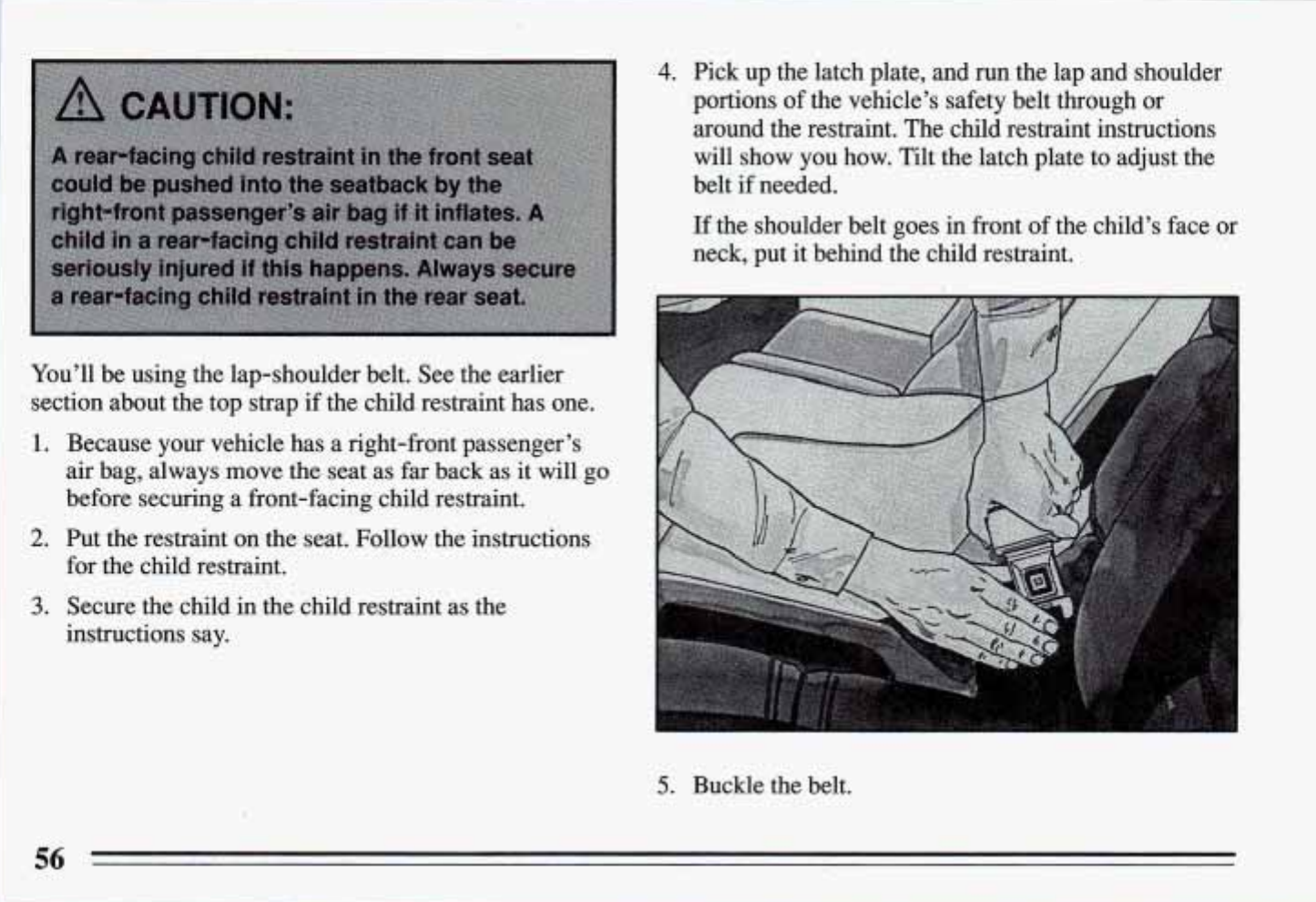
Pick up the latch plate, and run the lap and shoulder
portions of the vehicle’s safety belt through or
around the restraint. The child restraint instructions
will show you how.
If
the shoulder belt goes in front
of
the child’s face
or
neck, put it behind the child restraint.
positioned
so
you would be able to unbuckle the
safety belt quickly if you ever had to.
4.
Buckle the belt. Make sure the release button is
5.
Then thread both the lap and shoulder belt portions
i
through the locking clip.
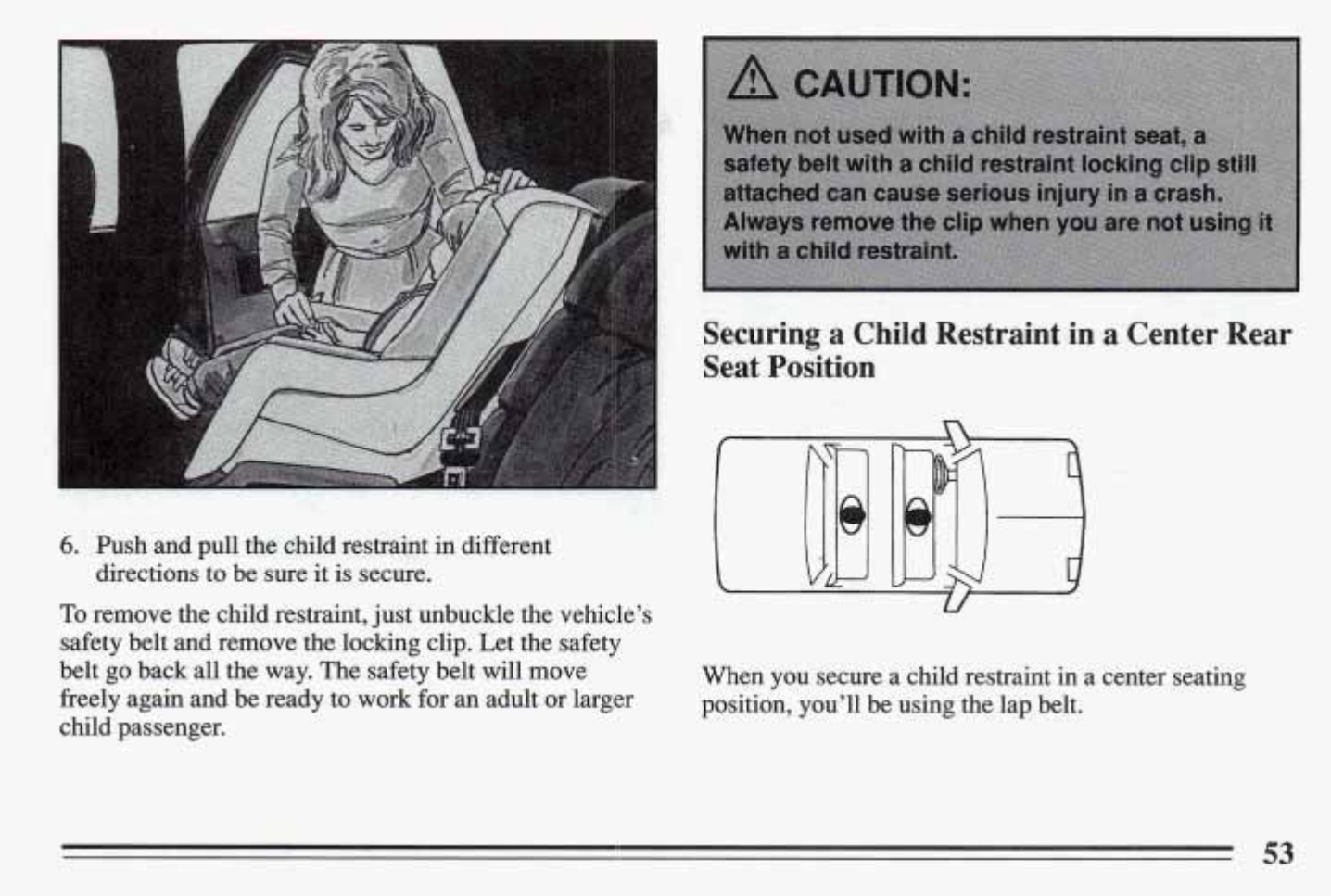
6.
Push and pull the child.restraint
in
different
directions to be sure
it
is
secure.
To
remove the child restraint, just unbuckle the vehicle’s
safety belt and remove the locking clip. Let the safety
belt go back all the way. The safety belt will move When you secure a child restraint in a center seating
freely again and be ready to work, for an adult or larger position, you’ll be using the lap belt.
child passenger.
53
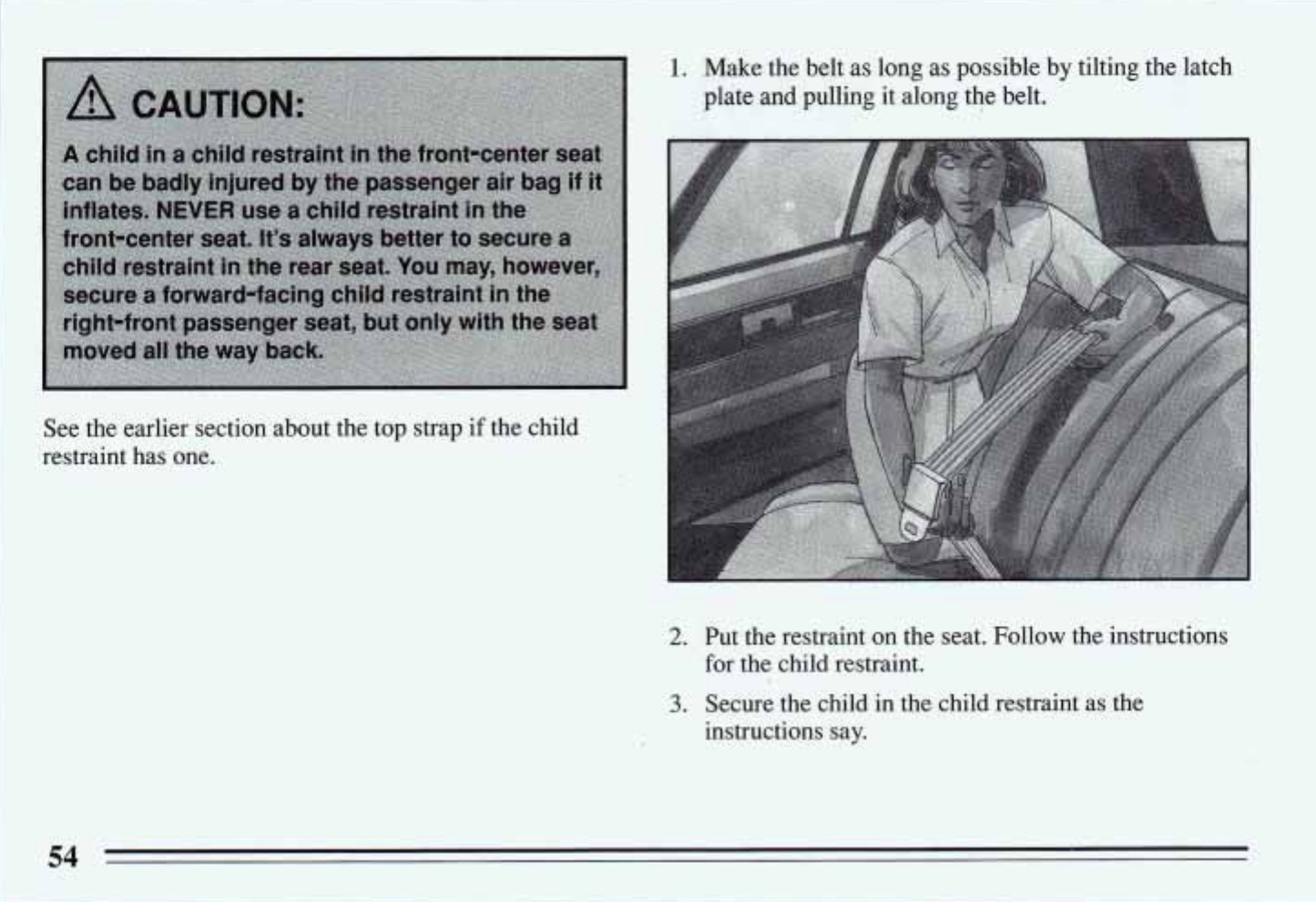
See the earlier section about the top strap if the child
restraint has one.
2.
3.
1.
Make'
the belt as long as possible
by
tilting the latch
plate and pulling it along the belt.
Put the restraint
on
the seat. Follow the instructions
for the child restraint.
Secure the child
in
the child restraint as the
instructions
say.
54
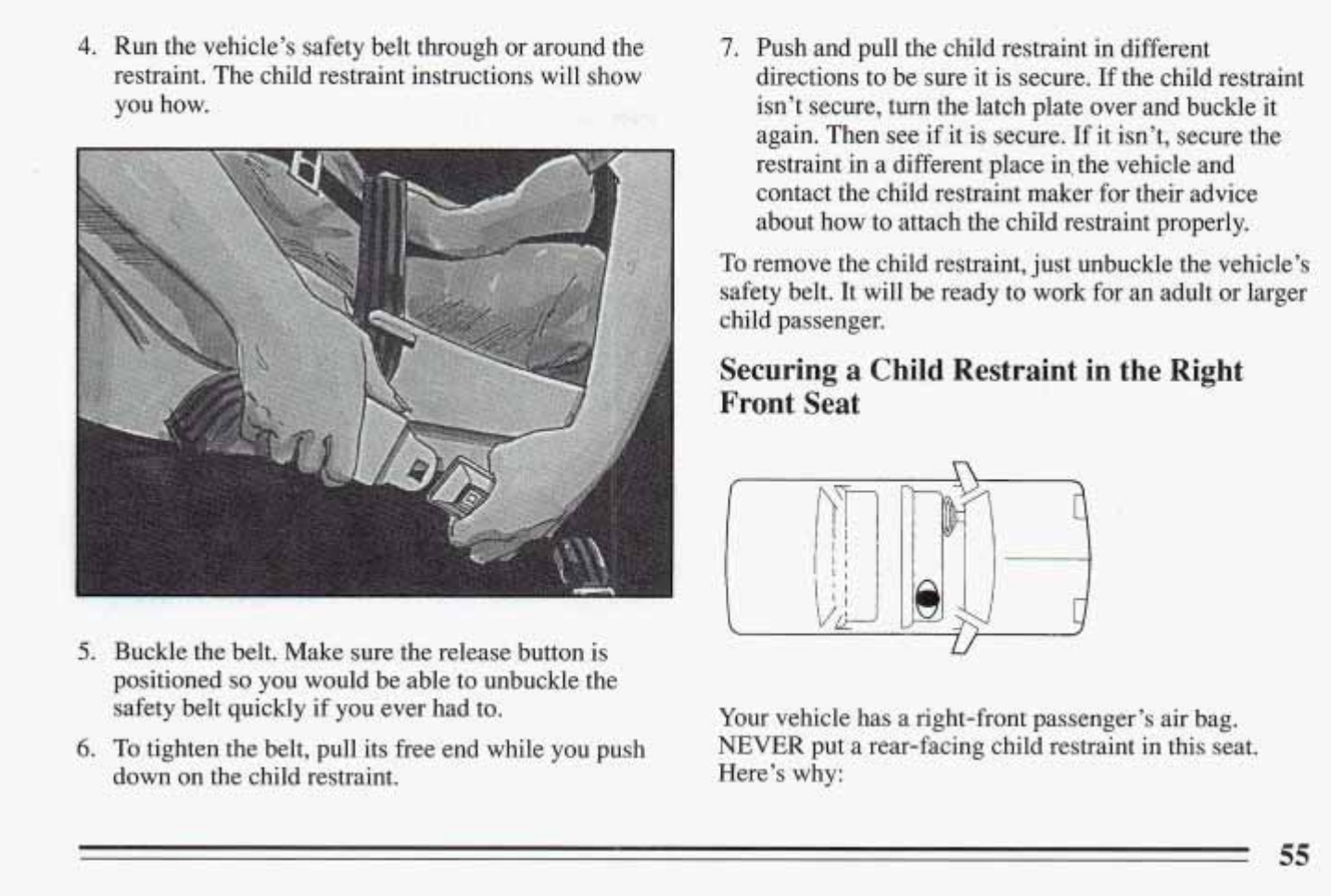
4.
Run the vehicle’s safety belt through or around the
restraint. The child restraint instructions will show
you how.
..
.
5.
Buckle the belt. Make sure
the
release button is
positioned
so
you would
be
able to unbuckle the
safety belt quickly if you ever had
to.
6.
To tighten the belt, pull its free end while you push
down
on
the child restraint.
7.
Push and pull the child restraint in different
directions to be sure it is secure.
If
the child restraint
isn’t secure, turn the latch plate over and buckle it
again. Then see if it is secure.
If
it
isn’t, secure the
restraint in a different place in. the vehicle and
contact the child restraint maker for their advice
about how to attach the child restraint properly.
To
remove the child restraint, just unbuckle the vehicle’s
safety belt. It will be ready to work for an adult or larger
child passenger.
Securing a Child Restraint in the Right
Front Seat
U
Your vehicle has a right-front passenger’s air bag.
NEVER
put a rear-facing child restraint in this seat.
Here’s why:
55
I
5.
Buckle
the
belt.
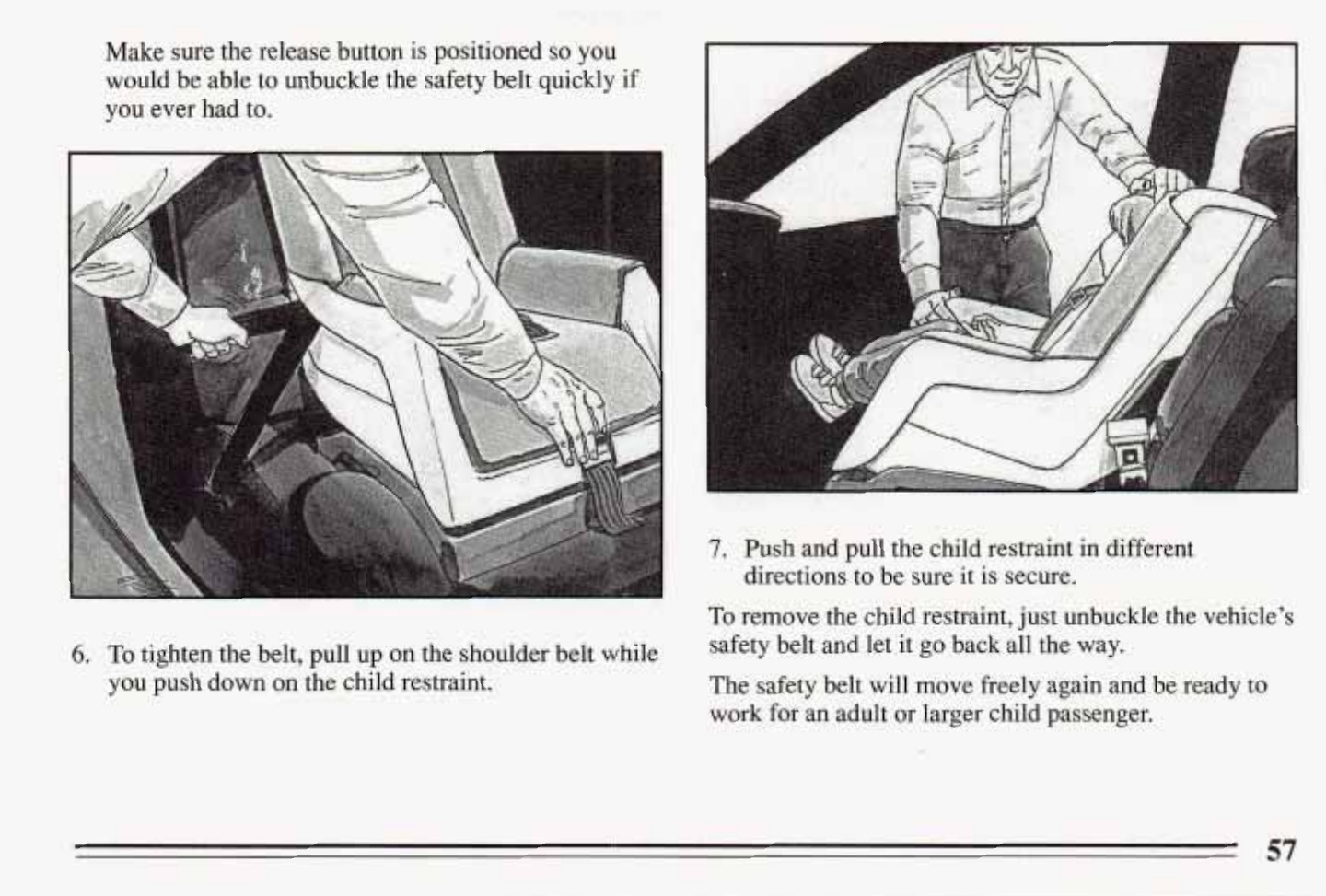
Make sure the release button is positioned
so
you
would be able to unbuckle the safety belt quickly if
you ever had to.
To remove the child restraint, just unbuckle the vehicle's
6.
To tighten the belt, pull
up
on
the shoulder belt while safety belt and let it go back all the way.
you push down on the child restraint. The safety belt will move freely again and be ready to
work for an adult or larger child passenger.
57
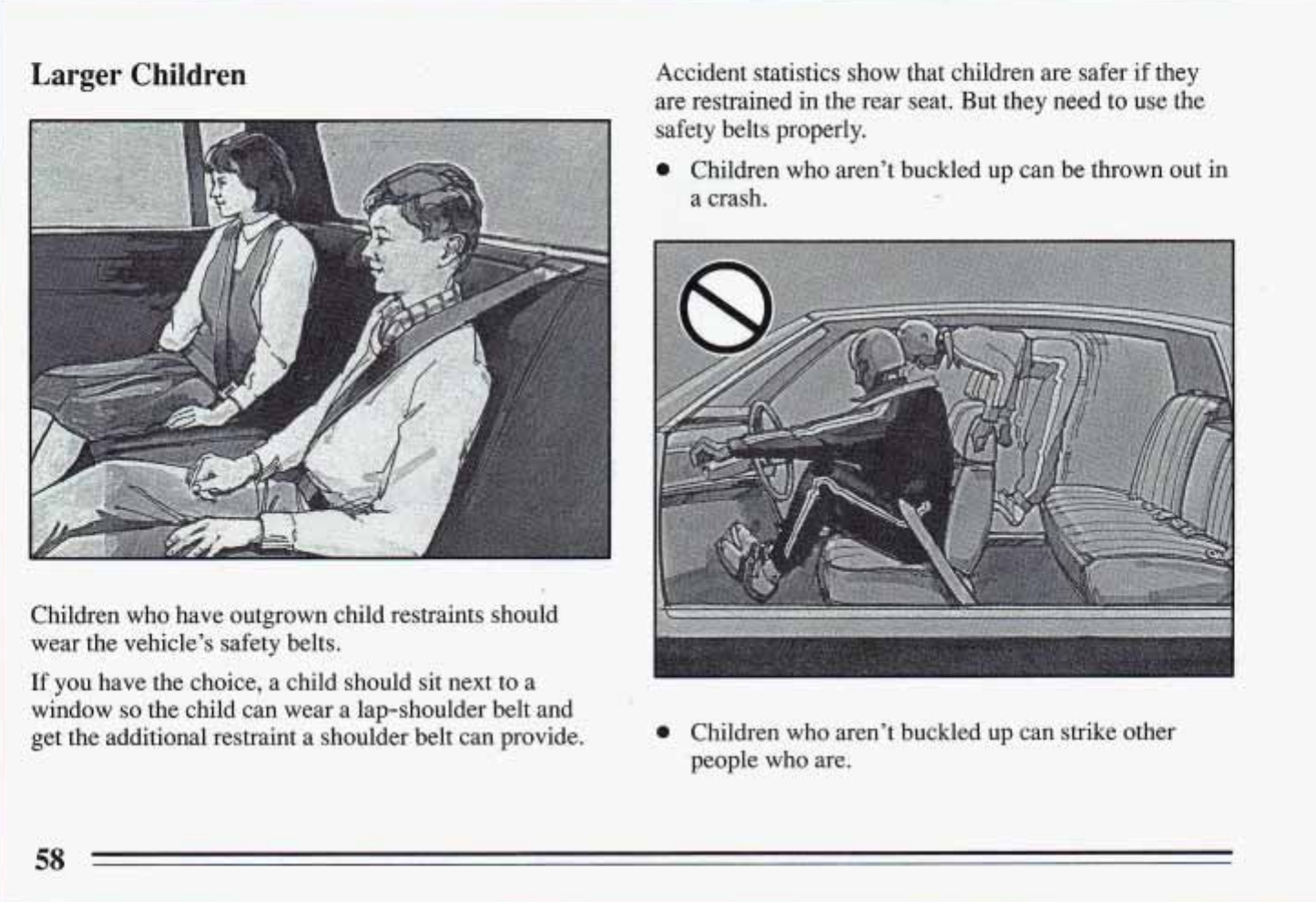
-Larger
Children
Accident statistics
show
that children are safer if they
are restrained in the rear seat.
But
they need to
use
the
safety belts properly.
0
Children
who
aren’t buckled up can
be
thrown out
in
a crash.
.
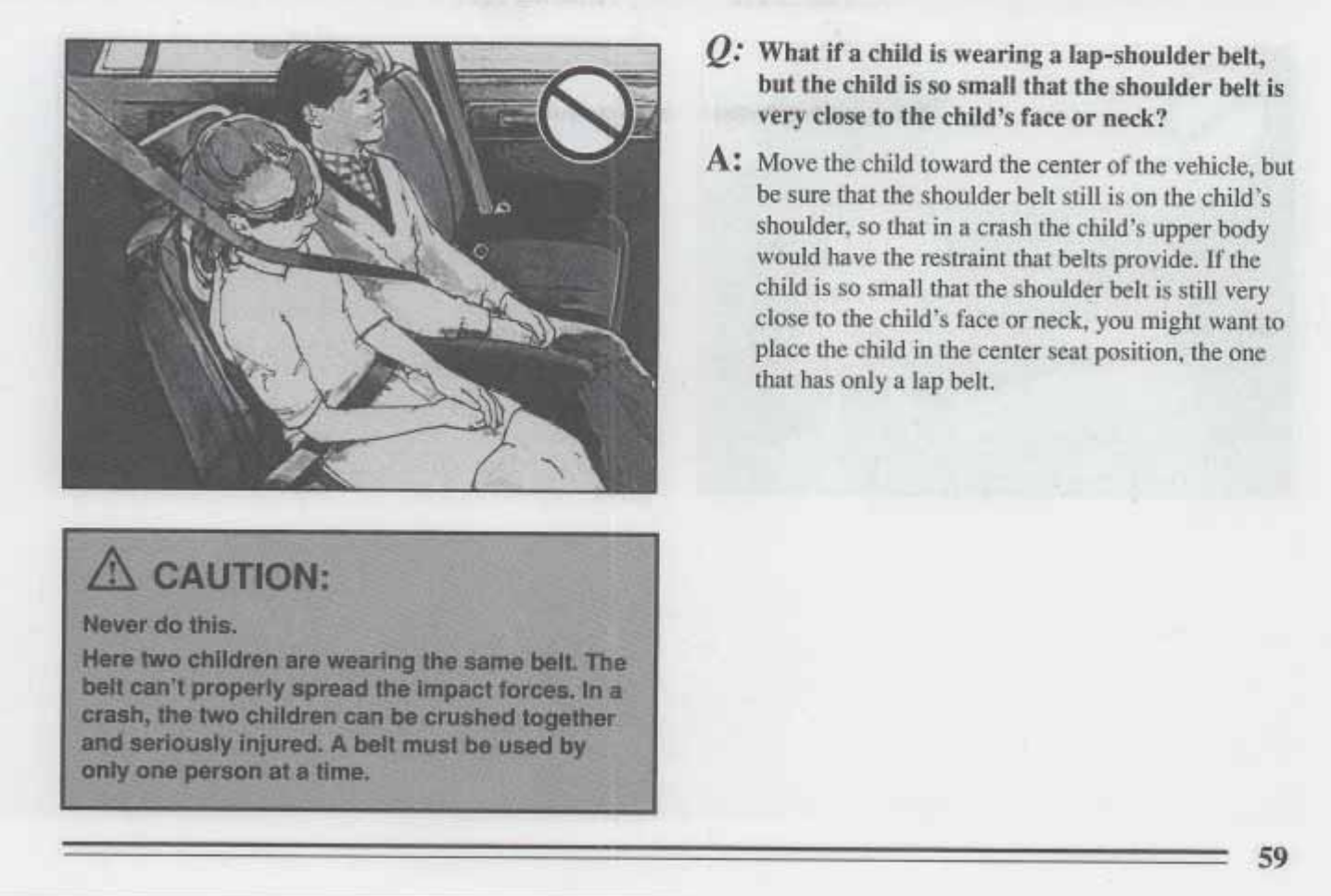
0
Children who aren’t buckled up can strike other
people
who
are.
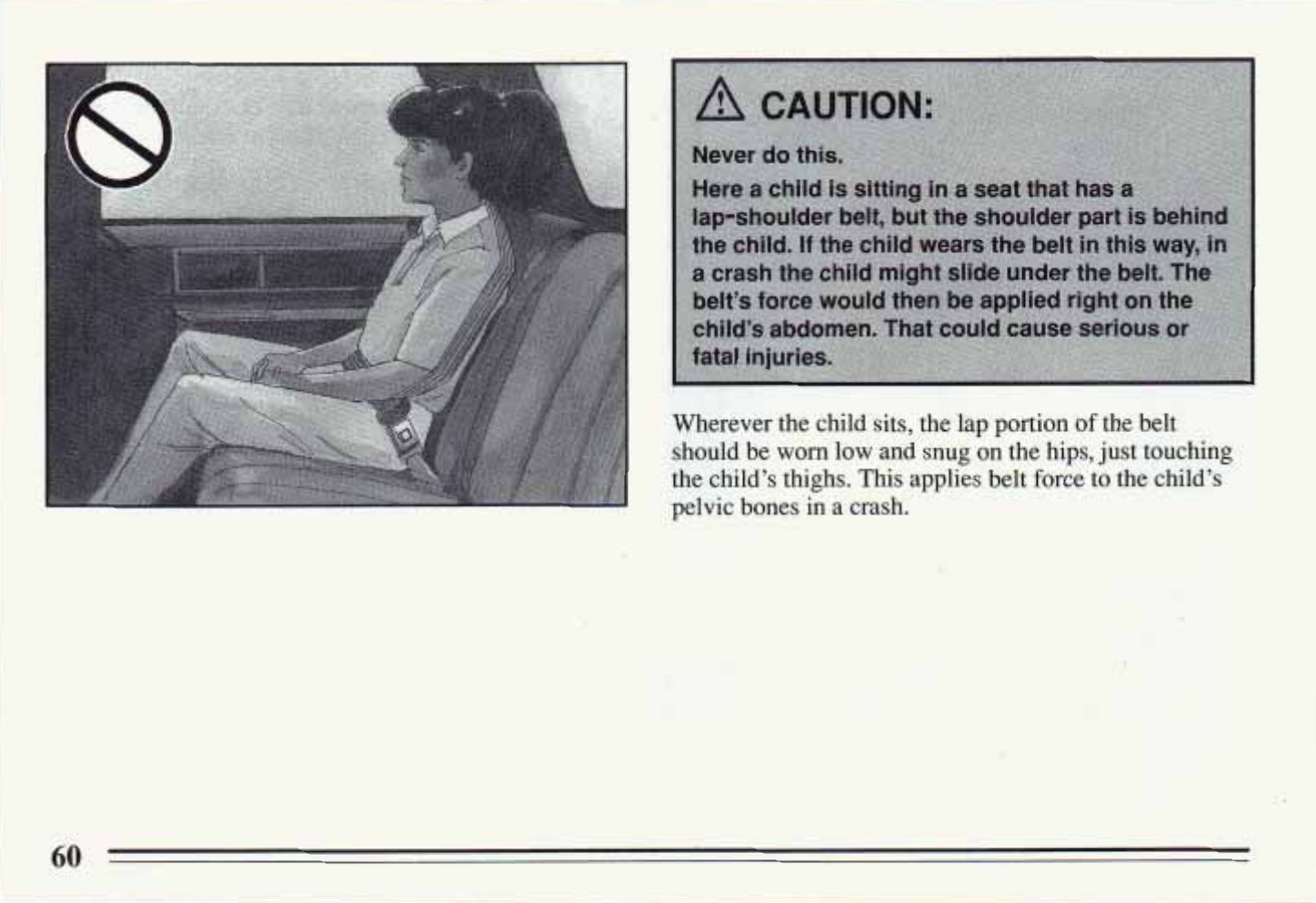
.
’..-.
the child.sits, the lap portion of the belt
.. %he child’s thighs.
This
applies ,belt force to the child’s
:‘{should be worn low and snug
on
the hips, just touching
!pelvic bones in a crash.
60
Safety Belt Extender
If the vehicle’s safety belt will fasten around you, you
should use
it.
But if
a
safety belt isn’t long enough to fasten, your
dealer will order you an extender. It’s free. When you
go
in to order it, take the heaviest coat you will wear, so the
extender will be tong enough for you. The extender will
be just for you, and just
for
the seat in your vehicle that
you choose. Don’t let someone else use it, and use
it
only for the seat it is made to
fit.
To wear it, just attach it
to the regular safety belt.
Checking
Your
Restraint Systems
Replacing Safety Belts After a Crash
If you’ve
..
had
a crash, do you need new belts?
After a very minor collision, nothing may be necessary.
But if the belts were stretched, as they would be if worn
during a more severe crash, then you need new belts.
If
you ever see a label on the driver’s or the right-fkont.
passenger’s safety belt that says to replace the belt, be
sure to do so. Then the new belt will be there to help
protect you in an accident. You would see this label on
the belt near the door opening.
,r
..-
Now and then, make sure all your belts, buckles, latch
plates, retractors, anchorages and reminder systems are
working properly.
Look
for any loose parts or damage.
If
you see anything that might keep a restraint system
from
doing
its
job,
have it repaired.
I
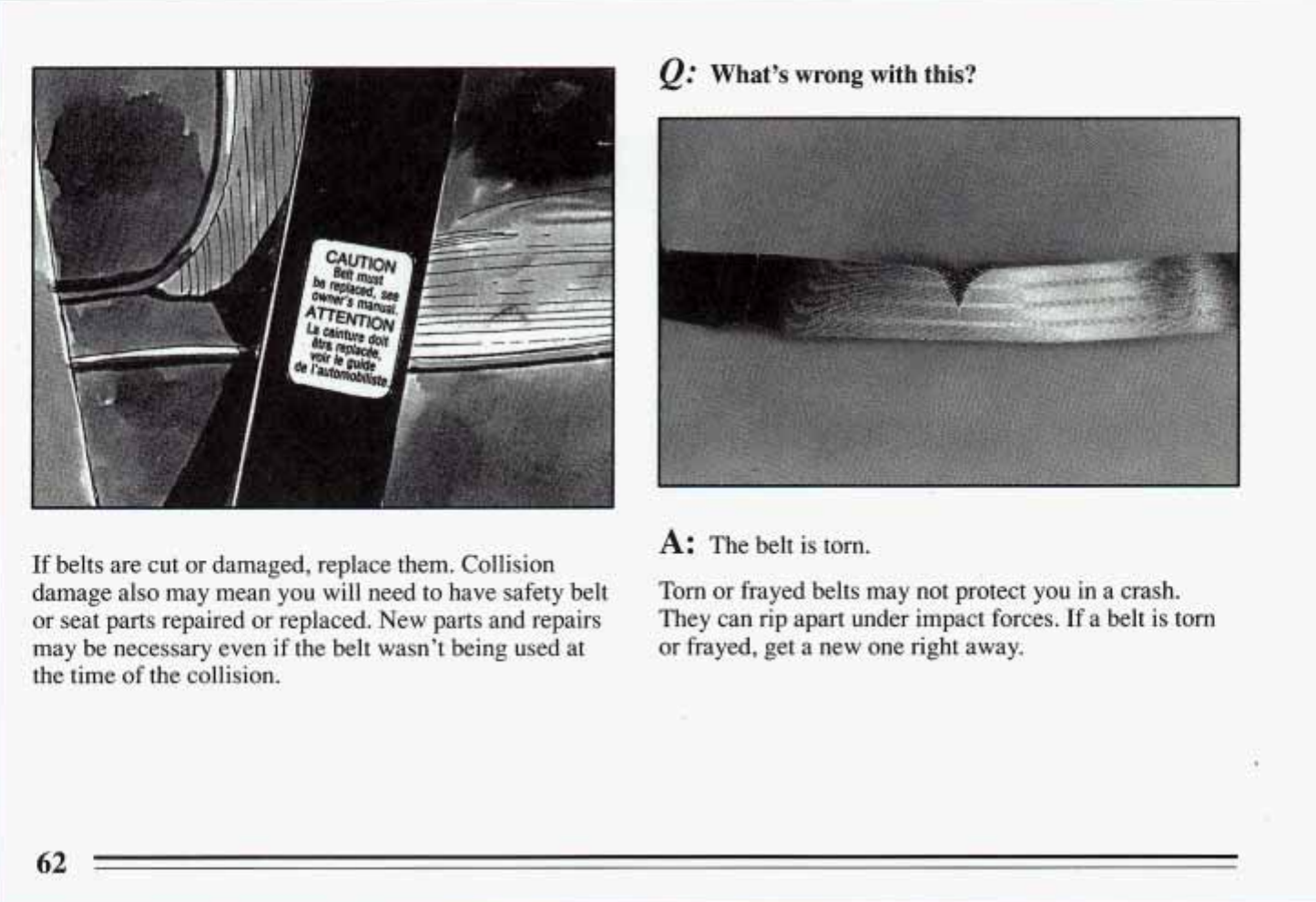
If belts are cut or damaged, replace them. Collision
damage also may mean you will need to have safety belt
or seat parts repaired or replaced. New parts and repairs
may be necessary even if the belt wasn’t being used at
the time of the collision.
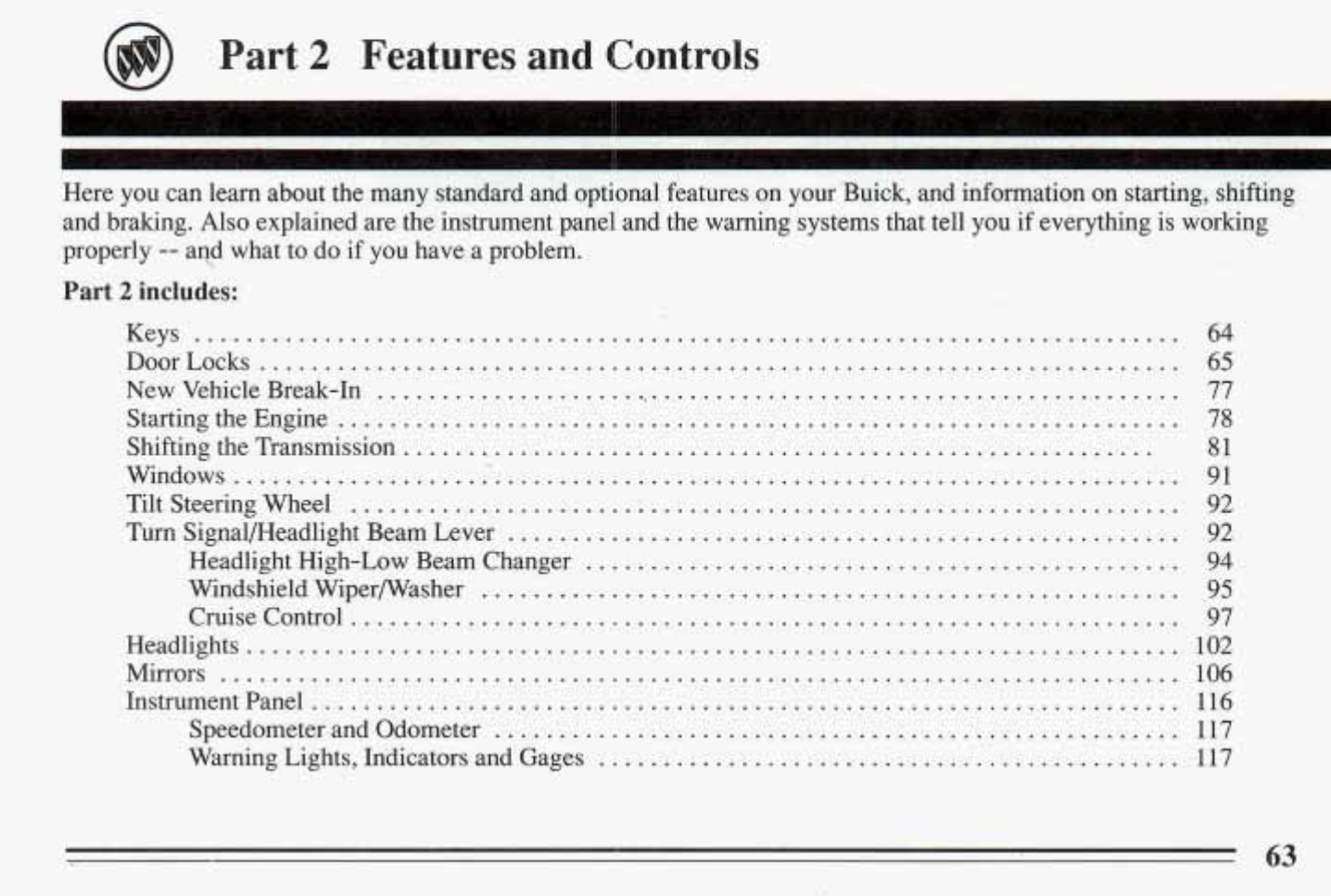
Q:
What’s wrong with this?
A:
The belt is torn.
Torn or frayed belts may not protect you in a crash.
They can
rip
apart under impact forces.
If
a belt is tom
or frayed, get a new one right away.
Part
2
Features and Controls
Here you can learn about the many standard and optional features on your Buick. and information on starting. shifting
and braking . Also explained are the instrument panel and the warning systems that tell
you
if everything is working
1
properly
..
aryd what to do if you have a problem
.
Part
2
includes:
Keys
............................................................................
DoorLocks
.......................................................................
NewVehicleBreak-In
...............................................................
StartingtheEngine
..................................................................
Shifting the Transmission
..........................................................
Windows
..........................................................................
TiltSteeringWheel
.................................................................
Turn Signal/Headlight Beam Lever
.....................................................
Headlight High-Low Beam Changer
..............................................
Windshield Wipermasher ......................................................
CruiseControl
................................................................
Headlights
........................................................................
Mirrors
..........................................................................
Instrumentpanel
...................................................................
Speedometer and Odometer
......................................................
Warning Lights, Indicators and Gages
.............................................
64
65
77
78
81
91
92
92
94
95
97
102
106
116
117
117
I
63
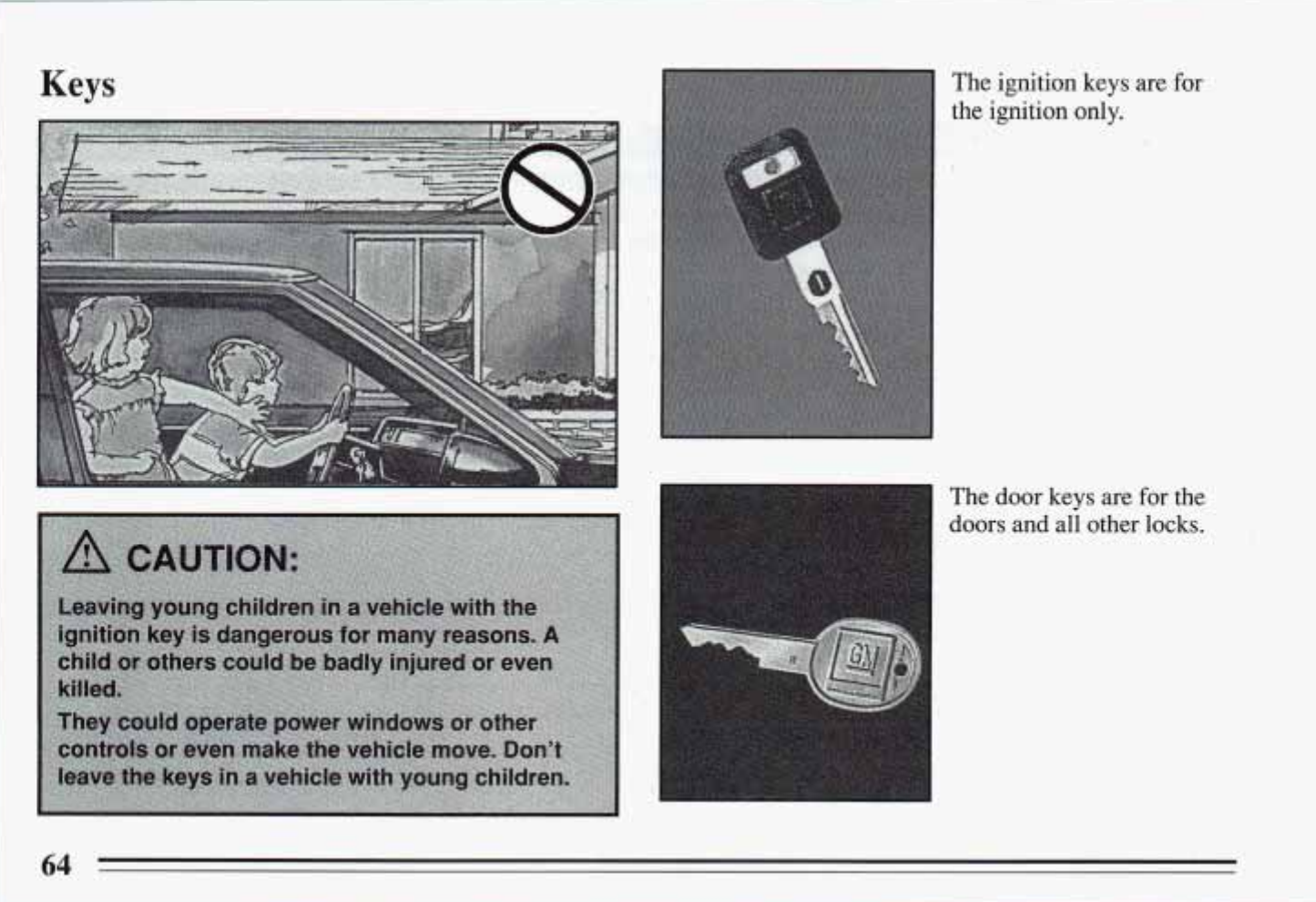
Keys
The
ignition
keys are
for
the ignition
only.
The door keys are for the
doors and
all
other
locks.
64
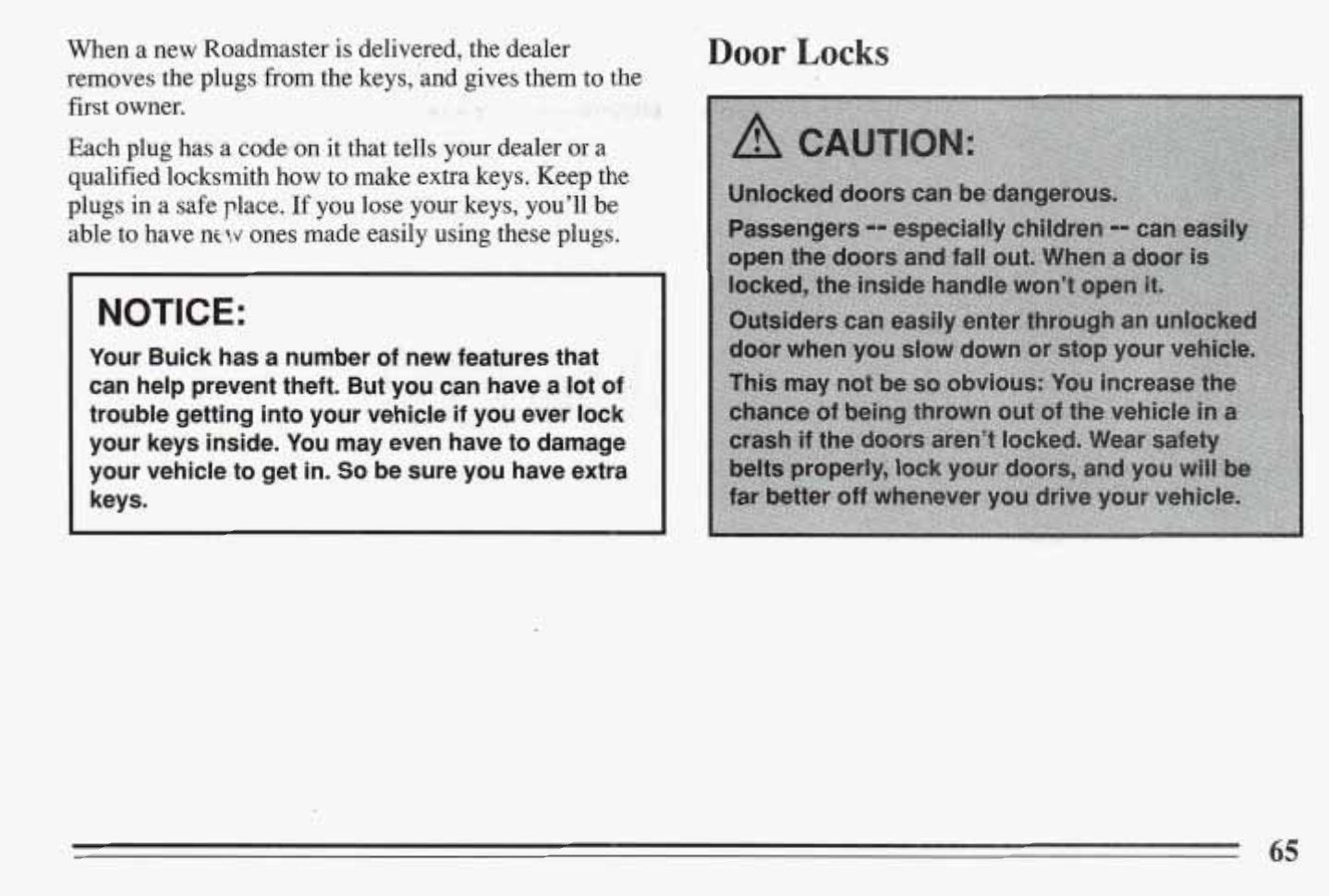
When a new Roadmaster is delivered, the dealer
removes the plugs from the keys, ‘and gives them to the
first owner.
I.
..
,
.
.,
-.
.
Each plug has
a
code on it that tells your dealer or a
qualified locksmith how to make extra keys. Keep the
plugs in a safe place.
If
you lose your keys, you’ll be
able to have nw ones made easily using these plugs.
NOTICE:
Your Buick has a number of new features that
can help prevent theft. But you can have a lot of
trouble getting into your vehicle
if
you ever lock
your keys inside. You may even have to damage
your vehicle to get in.
So
be sure you have extra
keys.
Door
Locks
65
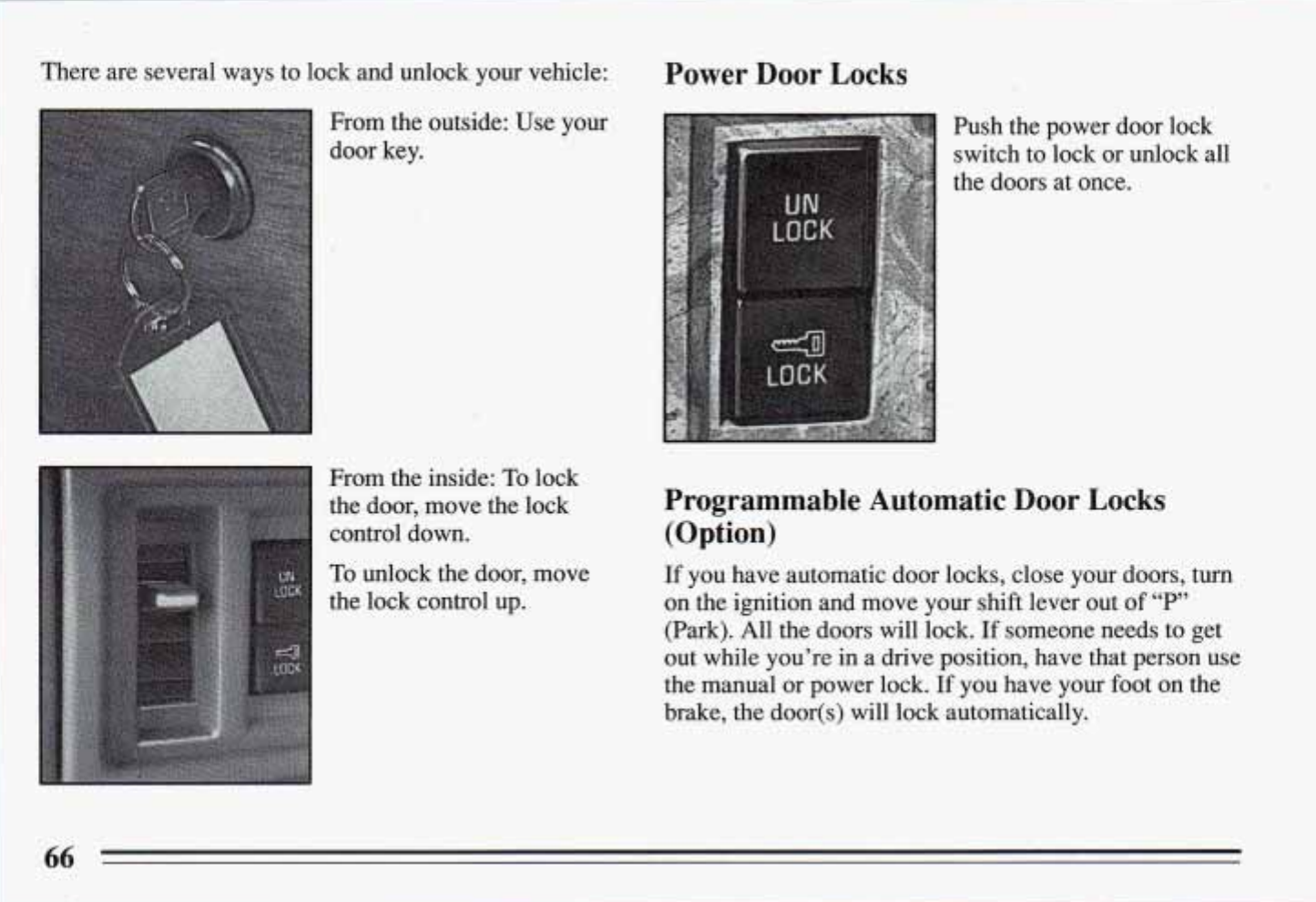
There are several ways to lock and unlock
your
vehicle:
From the outside:
Use
your
door key.
From the inside:
To
lock
the door, move the lock
control down.
To unlock the door, mov
the lock control up. e
Power Door Locks
Push the power door lock
switch to lock or unlock all
the doors at once.
Programmable Automatic Door Locks
(Option)
If
you have automatic door locks, close your doors, turn
on the ignition and move your shift lever out
of
“P”
(Park). All the doors will lock. If someone needs to get
out while you’re in
a
drive position, have that person use
the manual or power lock.
If
you have your foot on the
brake, the door(s) will lock automatically.
66
When you stop and move your selector into “P” (Park),
your doors will unlock.
You can have the automatic door lock feature
,
.
,,<’,
..;
.
..
..
:,
., .
programmed to allow the doors to remain locked after
you shift into
‘‘I?’’
(Park). See your Buick dealer if you
want the automatic door locks reprogrammed.
Leaving
Your
Vehicle
If you areyeaving the vehicle, take your keys, open your
door and set the locks
from
inside. Then get out and
close the door.
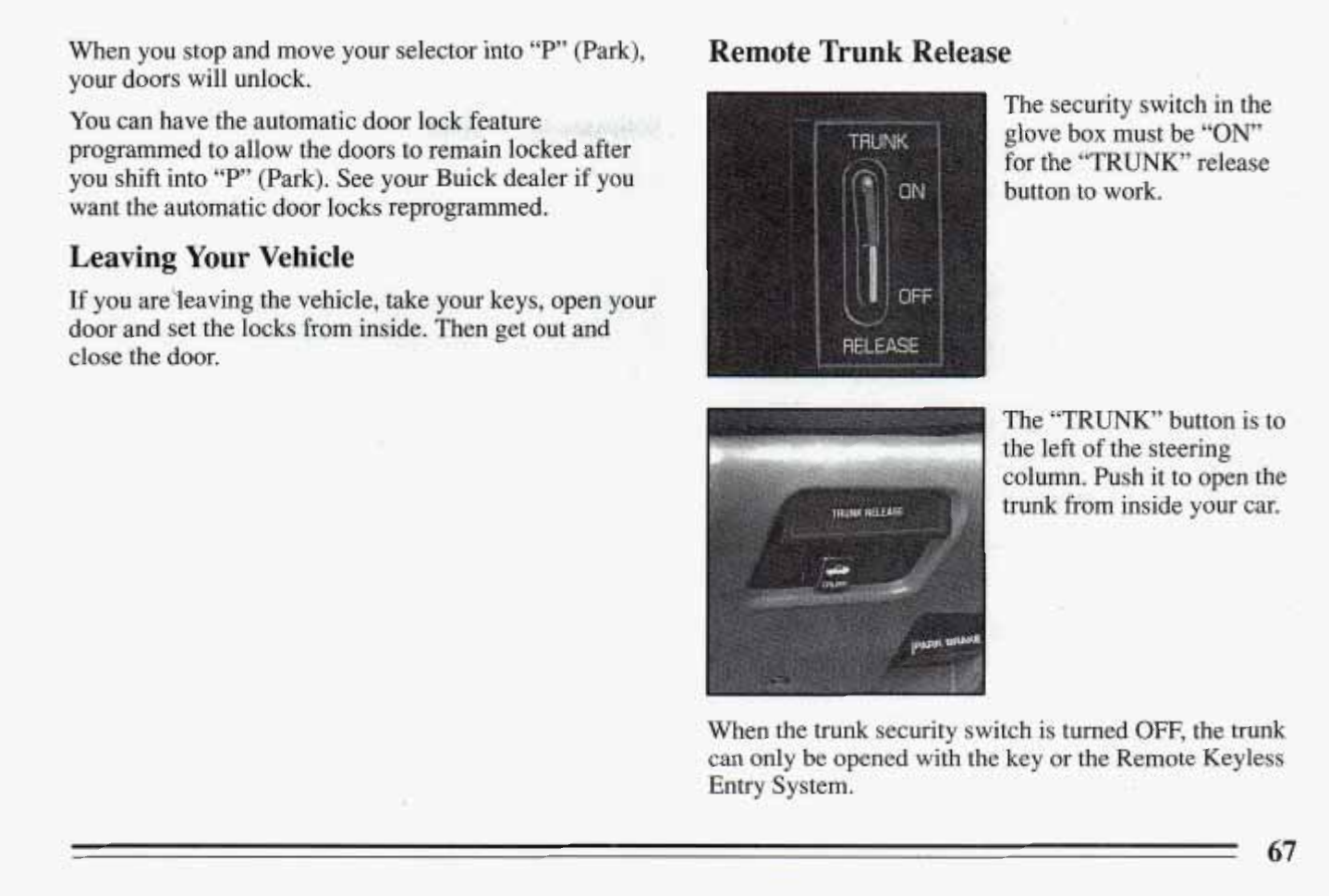
Remote Trunk
Release
The security switch in the
glove box must be
“ON’
for the
“TRUNK”
release
’
button to work.
The “TRUNK” button is to
the left of the steering
column. Push it to open the
trunk
from
inside your car.
When the trunk security switch is turned
OFF,
the trunk
can only be opened with
the
key or
the
Remote Keyless
Entry System.
67
Automatic Pull-Down Feature (Option)
If
you have this feature, it pulls the trunk lid closed. This,
allows you to gently push the trunk lid down and the
pull-down feature then secures it completely.
NOTICE:
I
Do not slam your trunk
lid
down if you have the
Pull-Down feature. If you
do,
you may damage
the Pull-Down System.
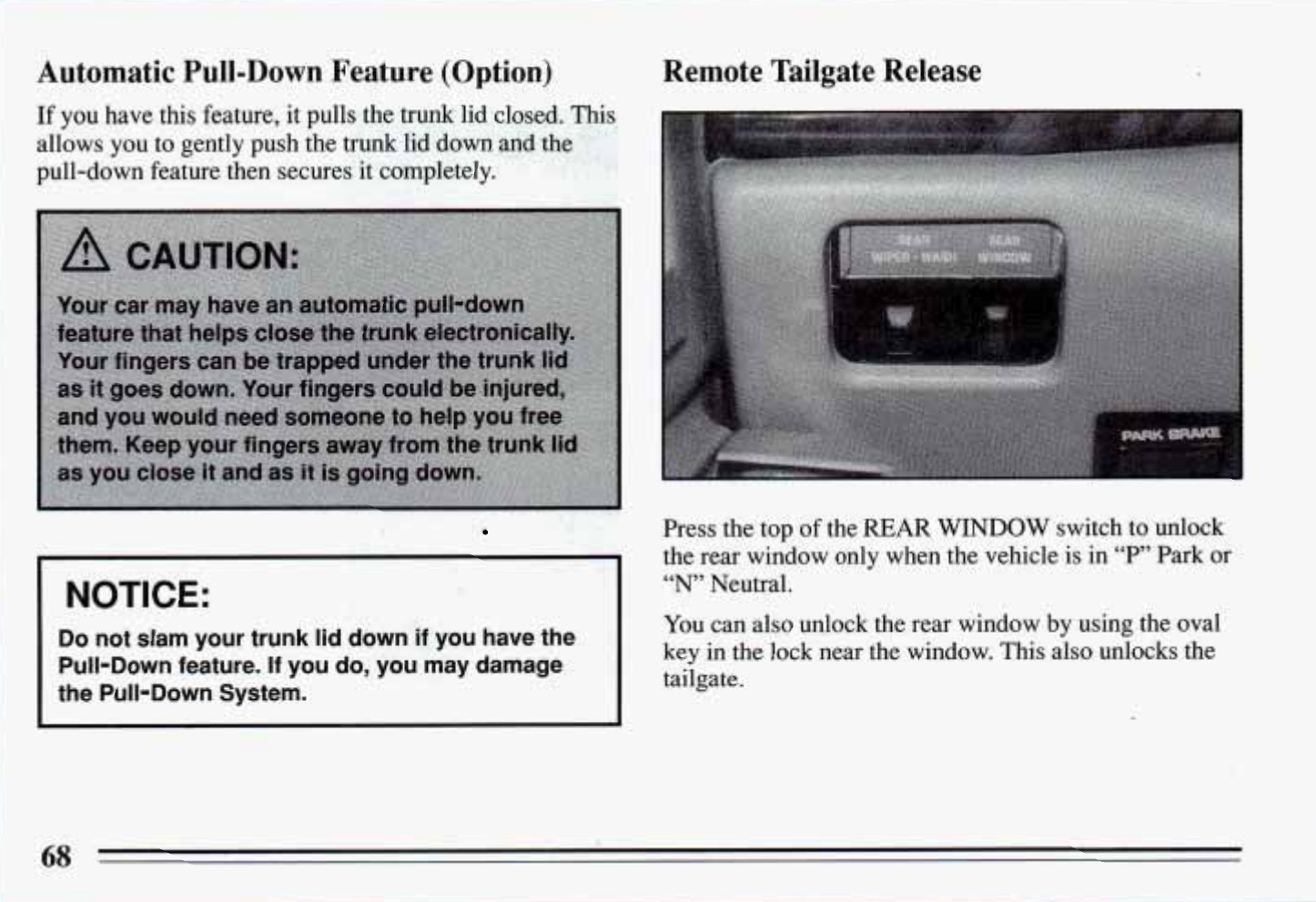
Remote Tailgate Release
Press the top of the
REAR
WINDOW
switch to unlock
the rear window only when the vehicle is in
“F”’
Park or
“N’
Neutral.
You can also unlock the rear window by using the oval
key in the lock near the window. This also unlocks the
tailgate.
68
Tailgate Operation
.The tailgate is locked and unlocked by using the power
door lock controls, the oval key in the.lock or the
T-
..
..
.
'
Remote Keyless Entry System if you have it.
'
It can be opened like a regular .door,
or
like a drop-gate.
The symbols on the handles indicate their function.
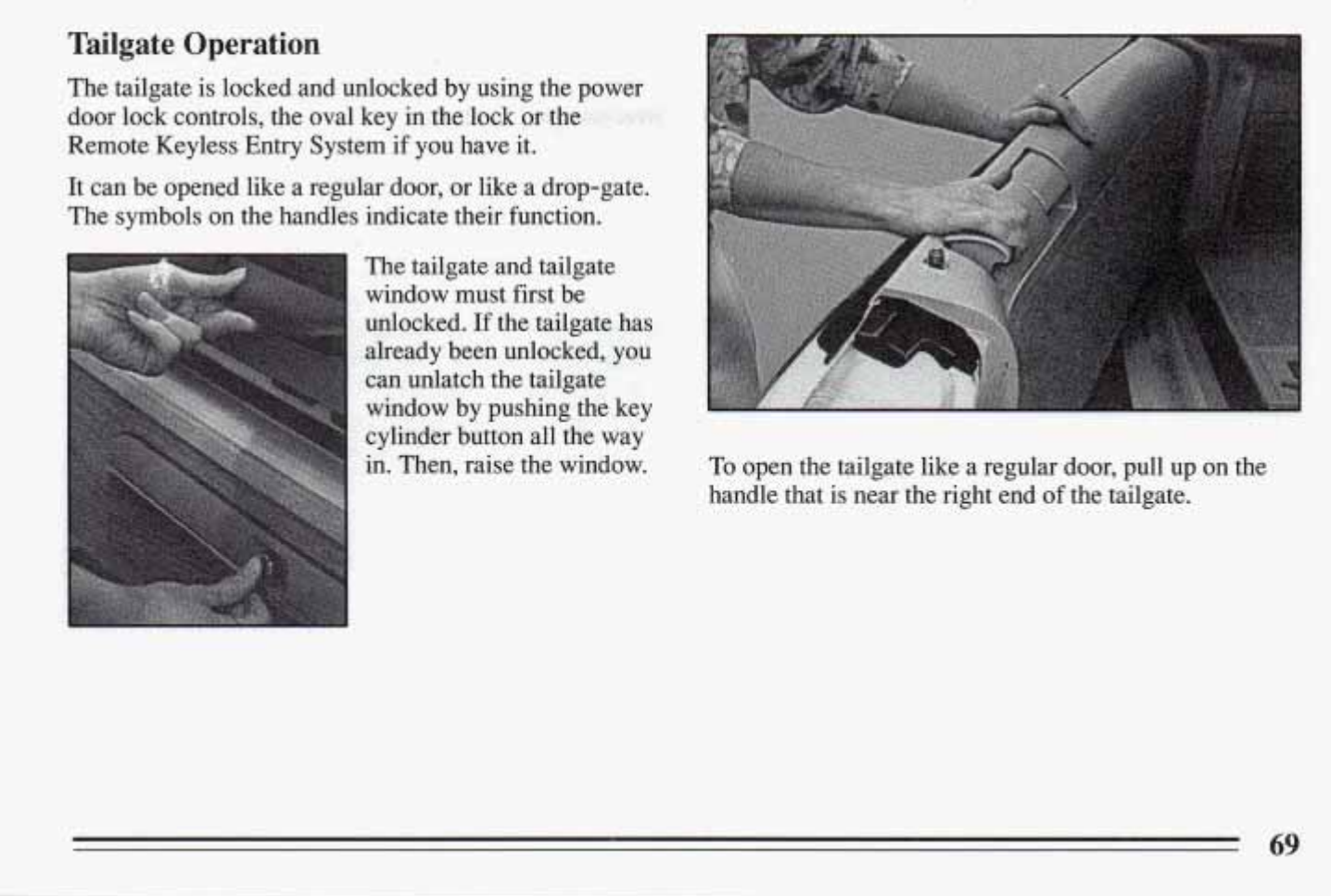
The tailgate and tailgate
window must first be
unlocked.
If
the tailgate has
already been unlocked, yau
can
unlatch the tailgate
window by pushing the key
cylinder button all the way
in. Then, raise the window. To open the tailgate like a regular door, pull up
on
the
handle that is near the right end
of
the tailgate.
LQ
To
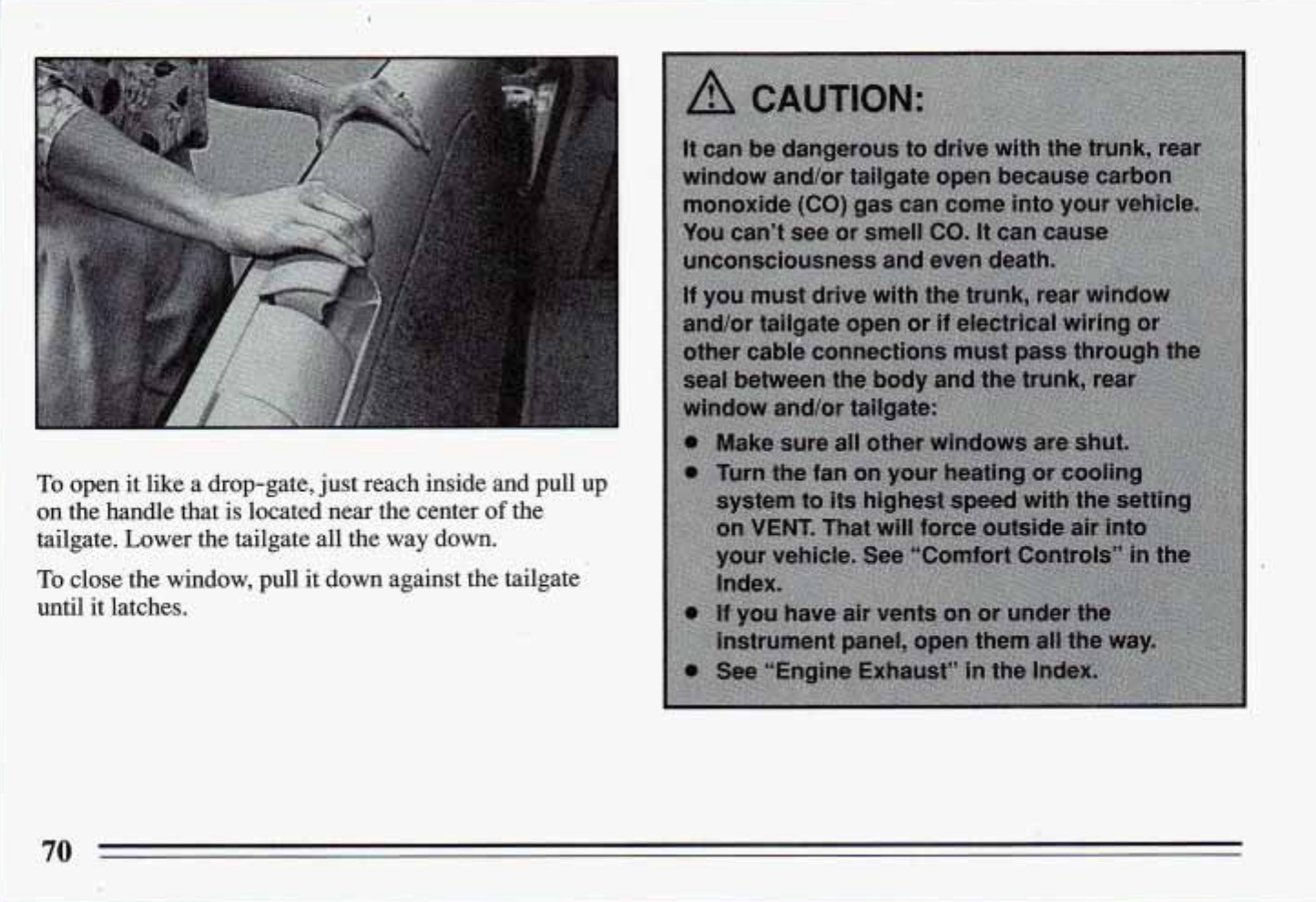
open it like a drop-gate, just reach inside and pull up
on
the handle-that
is
located near the center
of
the
tailgate. Lower the tailgate all the way down.
To
close the window, pull it down against the tailgate
.
until it latches.
70
Wagon Locked Storage Compartment
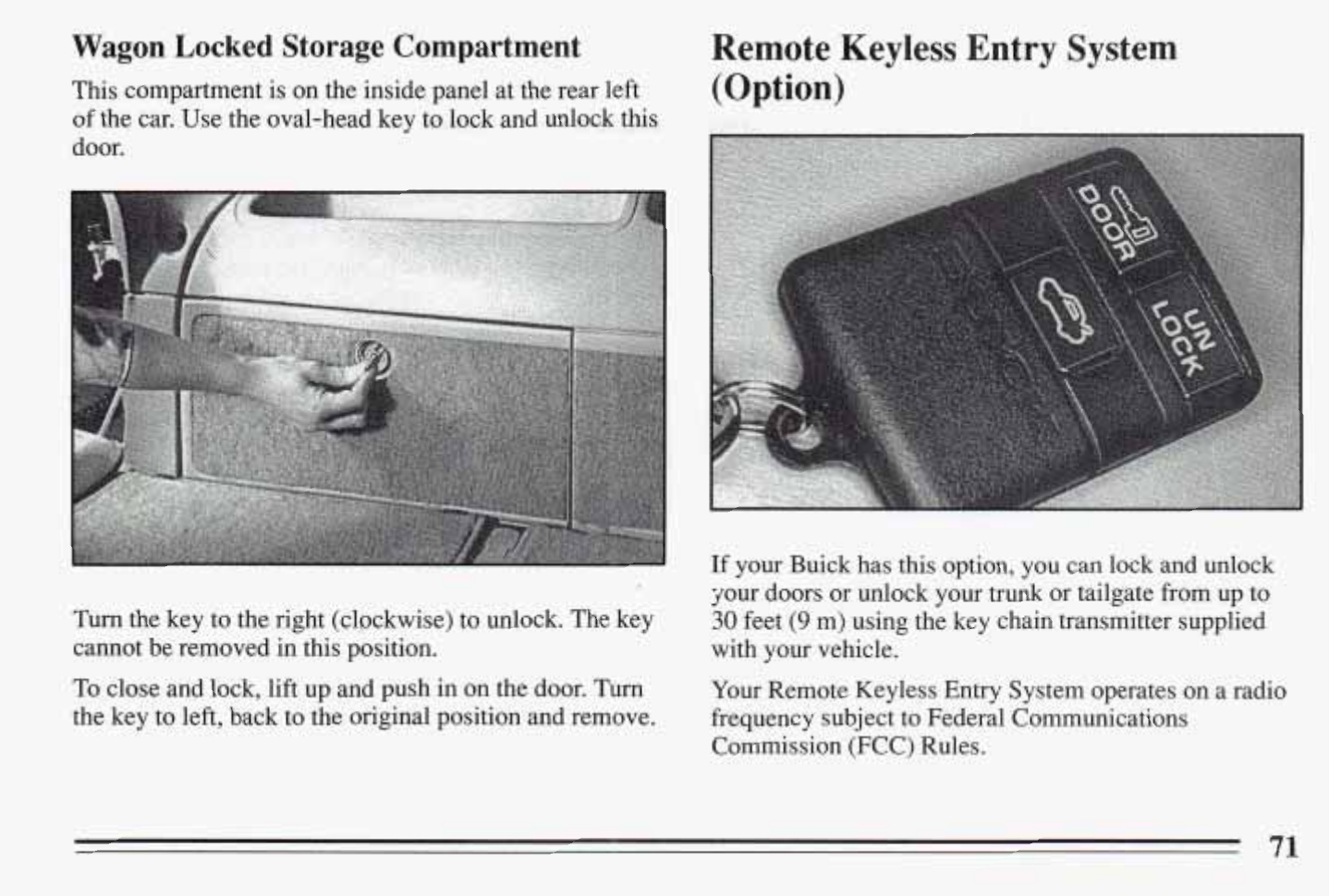
This compartment is on the inside panel at the rear left
of the car. Use the oval-head key to.lock and unl.o.ck
this
door.
Turn the key to the right (clpckwise) to unlock. The key
cannot be removed in this position.
To close and lock, lift up and push in on the door. Turn
the key to left, back to the original position and remove.
Remote Keyless Entry System
(Option)
If your Buick has this option, you can
lock
and unlock
your doors or unlock your trunk or tailgate from up to
30
feet
(9
m)
using the key chain transmitter supplied
with your vehicle.
Your Remote Keyless Entry System operates on
a
radio
frequency subject to Federal Communications
Commission (FCC) Rules.
This device complies with Part
15
of the FCC Rules.
Operation is subject to the following two conditions:
(1)
This device may not cause harmful interference, and
(2)
This device must accept any interference received,
including interference that may cause undesired
operation..
.
,;
.
.
9
'.
;$
..~'.~
&>
.
.:
Should inteiference to
this
.system occur, try this:
Check to determine if battery replacement is
necessary. See the instructions on battery
replacement.
vehicle. This product has a maximum range.
blocking the signal.
service.
..
.
.--
..
.
r.
.LI
:;,-,7,-.:,"
,
.
Check the distance. You may be too far from your
0
Check the location. Other vehicles
or
objects may be
0
See
your Buick dealer or a qualified technician for
Changes or modifications to this system by other than an
authorized service facility could void authorization to
use this equipment.
Operation
The driver's door will unlock when
UNLOCK
is
pressed. Press
it
again quickly and all the doors will
unlock. The door courtesy lights will also come on.
All doors will lock when DOOR is pressed.
The trunk or tailgate will unlock when the opened trunk
symbol is pressed, but only when the transmission is in
PARK.
Matching Transmitter(s) To Your Vehicle
Each key chain transmitter' is coded to prevent another
transmitter from unlocking your vehicle.
If
a transmitter
is lost or stolen, a replacement can be purchased through
your dealer. Remember to bring the remaining
transmitters with you when you go to your dealer. When
the dealer matches the replacement transmitter to your
vehicle, the remaining transmitters must also be
matched. Once the new transmitter is coded, the lost
transmitter will not unlock your vehicle.
You
can match a transmitter to as many different vehicles
as you own, provided they are equipped with exactly the
same model system. (General Motors offers several
different models
of
these systems on their vehicles.) Each
vehicle can have only two transmitters matched to
it.
See your dealer to match transmitters to another vehicle.
Battery Replacement
Under normal use, the batteries in your key chain
transmitter should last about two years.
You can tell the batteries are weak if the transmitter
won’t work at the normal range in any location.
If
you
have to get close to your vehicle before the transmitter
works, it’s probably time to change the batteries.
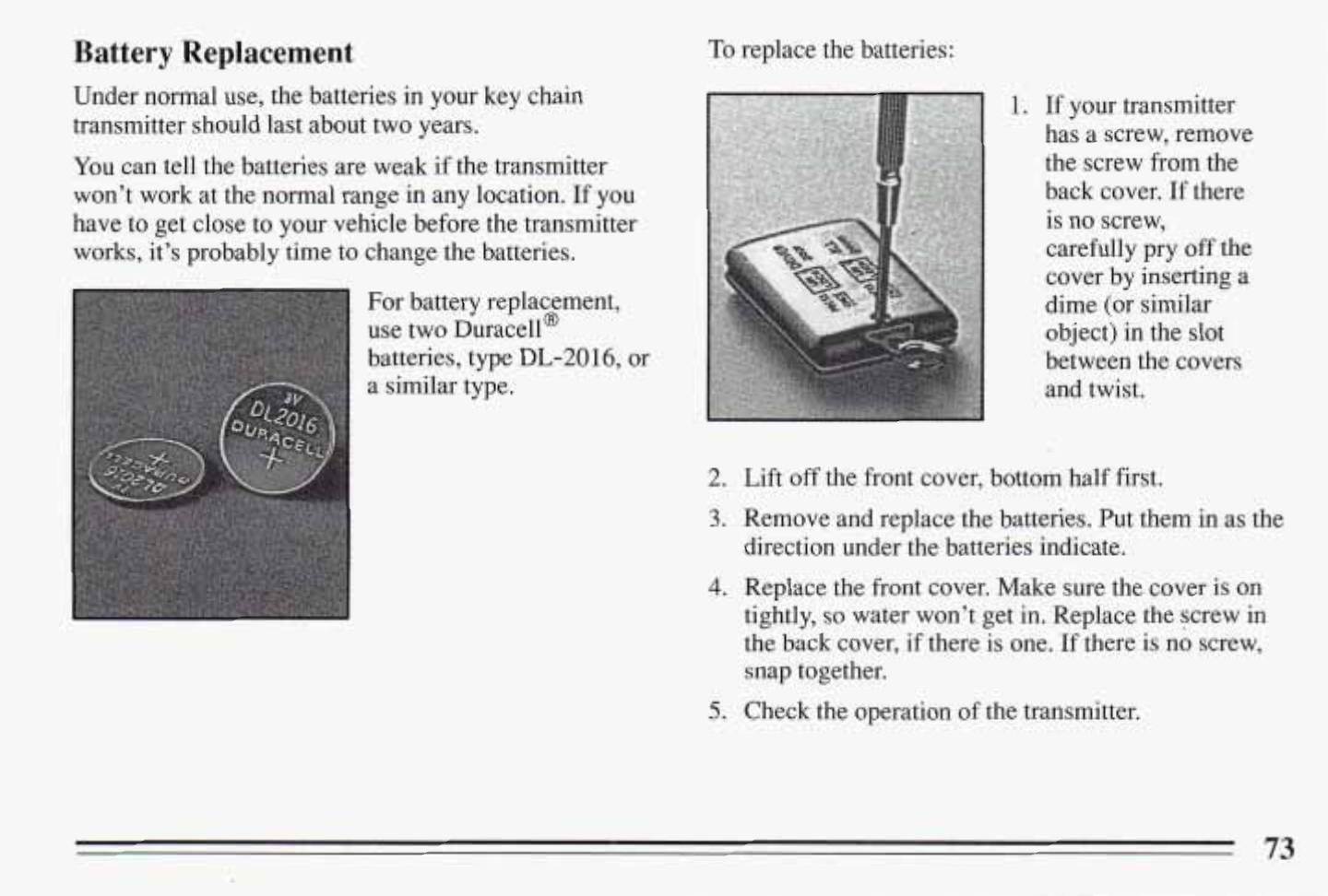
For battery replacement,
use two Duracell@
batteries, type DL-2016, or
a
similar type.
To
replace the batteries:
1.
If
your transmitter
has a screw, remove
the screw from the
back cover.
If
there
is
no
screw,
carefully pry
off
the
cover by inserting a
dime
(or
similar
object) in the slot
between the covers
and twist.
2.
Lift off the front cover, bottom half first.
3.
Remove and replace the batteries. Put them in as the
direction under the batteries indicate.
4.
Replace the front cover. Make sure the cover is on
tightly,
so
water won’t get in. Replace the screw in
the back cover, if there is one.
If
there is
no
screw,
snap together.
5,
Check the operation of the transmitter.
73
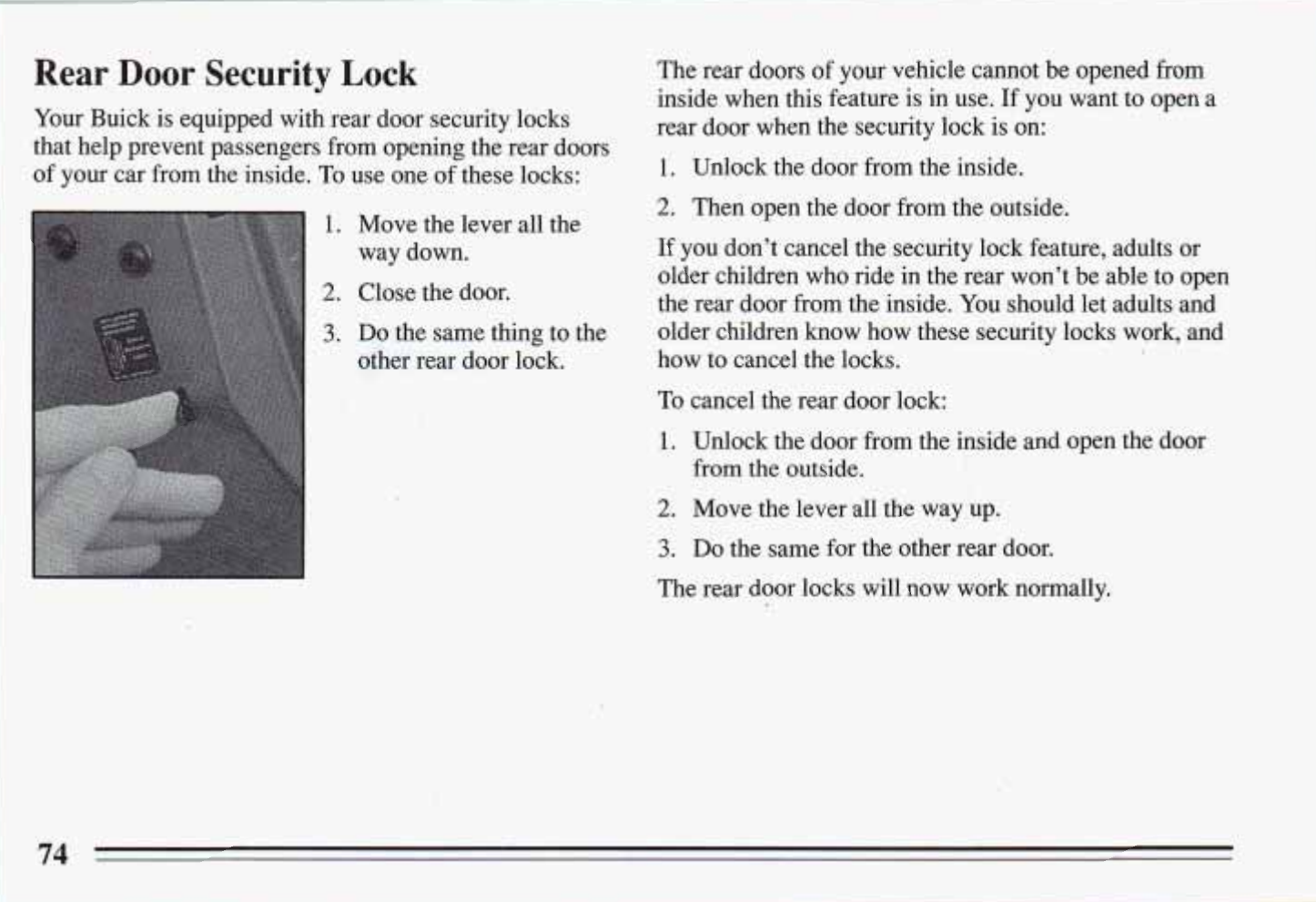
Rear Door Security Lock
Your Buick is equipped with rear door security, locks
that help prevent passengers from opening the rear doors
of your car from the inside. To use one of these locks:
The rear doors of your vehicle cannot be opened from
inside when this feature is in use.
If
you want to open a
rear door when the security lock is
on:
1.
Unlock the door from the inside.
2.
Then open the door from the outside.
older children who ride
in
the rear won’t be able to open
2.
Close the door. the rear door
from
the inside. You should let adults and
3.
Do
the same thing to the older children know how these security locks work, and
1.
Move the lever all the
way down.
If
you don’t cancel the security lock feature, adults or
other rear door lock. how to cancel the locks.
To cancel the rear door lock:
1.
Unlock the door from the inside and open the door
2.
Move the lever all the way up.
3.
Do
the same for the other rear door.
from the outside.
The rear door locks will now work normally.
Theft
Parking
Lots
Vehicle theft is big business, especially in some cities.
Although your Buick has a number of theft deterrent
features, we know that nothing we put on it can make it
impossible to steal. However, there are ways you can
help.
Key
in
the
Ignition
If
you walk away from your vehicle with the keys
-
inside, it’s an easy target for joy riders or professional
thieves
.--
so
don’t do it.
When you park your Buick and open the driver’s door,
you’ll hear a‘chime reminding you to remove your key
from the ignition and take it with you. Always do this.
Your steering wheel will be locked, and
so
will your
ignition and transmission. And remember to lock the
doors.
Parking at Night
Park in a lighted spot, close all windows and lock your
vehicle. Remember to keep your valuables out of sight.
Put them in a storage area, or take them with you.
If you park in a lot where someone will be watching
your vehicle, it’s best to lock it up and take your keys.
But what if you have to leave your ignition key? What
if
you have to leave something valuable in your vehicle?
0
0
0
0
Put
your valuables in a ‘storage area, like your trunk,
glove box, or in the wagon storage compartment;
Lock the glove box.
Lock all the doors except the driver’s.
,
.
.
Then take the door key with you.
75
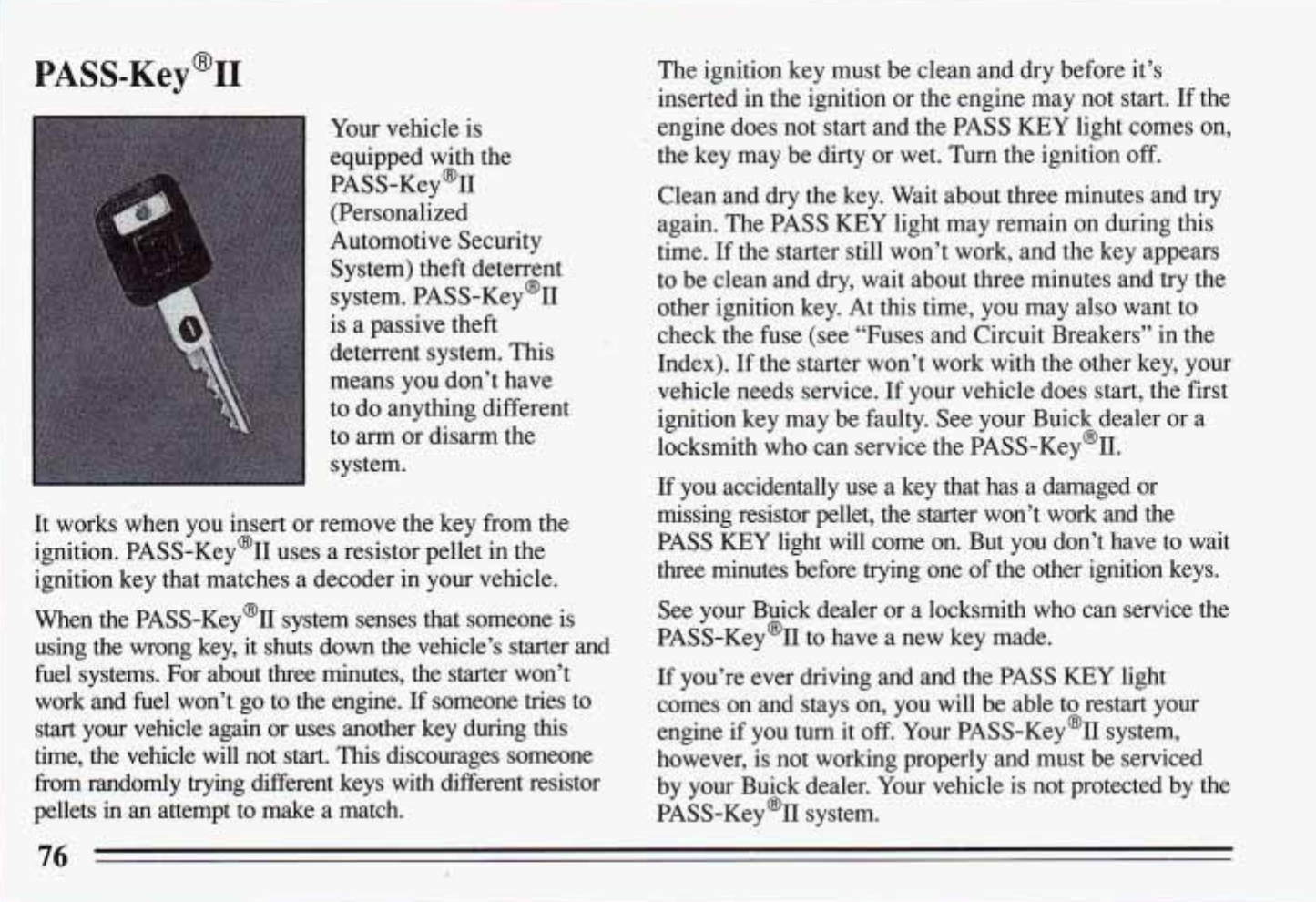
PASS-Key@II
Your vehicle is
equipped with the
PASS-Key%
(Personalized
Automotive Security
System) theft deterrent
system. PASS-Key%
is a passive theft
deterrent system. This
means you don’t have
to do anything different
to ann or disarm the
system.
It works when you insert or remove the key from the
ignition. PASS-Key% uses a resistor pellet in the
ignition key that matches a decoder in your vehicle.
When the PASS-Key% system senses that someone is
using the wrong key, it shuts down the vehicle’s starter and
fuel systems. For about three minutes, the starter won’t
work and fuel won’t go to the engine.
If
someone tries to
start
your vehicle again or uses another key during this
time, the vehicle will not start.
This
discourages someone
fiom randomly trying different keys with different resistor
pellets in
an
attempt to make a match.
The ignition key must be clean and dry before it’s
inserted in the ignition or the engine may not
start.
If the
engine does not
start
and the PASS
KEY
light comes on,
the key may be dirty or wet. Turn the ignition
off.
Clean and dry the key. Wait about three minutes and try
again. The PASS
KEY
light may remain on during this
time. If the starter still won’t work, and the key appears
to be clean and dry, wait about three minutes and try the
other ignition key. At this time, you may also want to
check the fuse (see “Fuses and Circuit Breakers” in the
Index). If the starter won’t work with the otherkey, your
vehicle needs service. If your vehicle does start, the first
ignition key may be faulty. See your Buick dealer or a
locksmith who can service the PASS-Key%.
If you accidentally use a key that has a damaged or
missing resistor pellet, the starter won’t work and the
PASS
KEY
light will come on. But you don’t have to wait
three minutes before trying one of the other ignition keys.
See your hick dealer or a locksmith who can service the
PASS-Key%
to
have a new key made.
If you’re ever driving and and the PASS KEY light
comes on and stays on, you will be able to restart your
engine if you
turn
it
off.
Your PASS-Key% system,
however, is not working properly and must be serviced
by your Buick dealer. Your vehicle is not protected by the
PASS-Key% system.
If you lose or damage a PASS-Key@II ignition key, see
your Buick dealer or a locksmith who can service
PASS-Key% to have a new key made.
.”!
.
,
;
;.-”‘LC;..
.,
I
.
.
:
,
*
a
..:*
New Vehicle
‘‘Break-in''
NOTICE:
Your modern Buick doesh’t need an elaborate
“break-in.”
But
it
will perform better
in
the long
run
if you follow these guidelines:
0
Keep your speed at
55
mph
(88.
km/h)’or
less for the first
500
miles
(804
km).
0
Don’t drive at any one speed
--
fast or slow
--
for the first
500
miles
(804
km). Don’t
make full-throttle starts.
,
Avoid making hard stops for the first
200
miles
(322
km) or
so.
During this time your
new brake linings aren’t. yet broken
in.
Hard
stops with new linings can mean premature
wear and earlier replacement. Follow-this
“breaking-in” guideline every time you get
new brake linings.
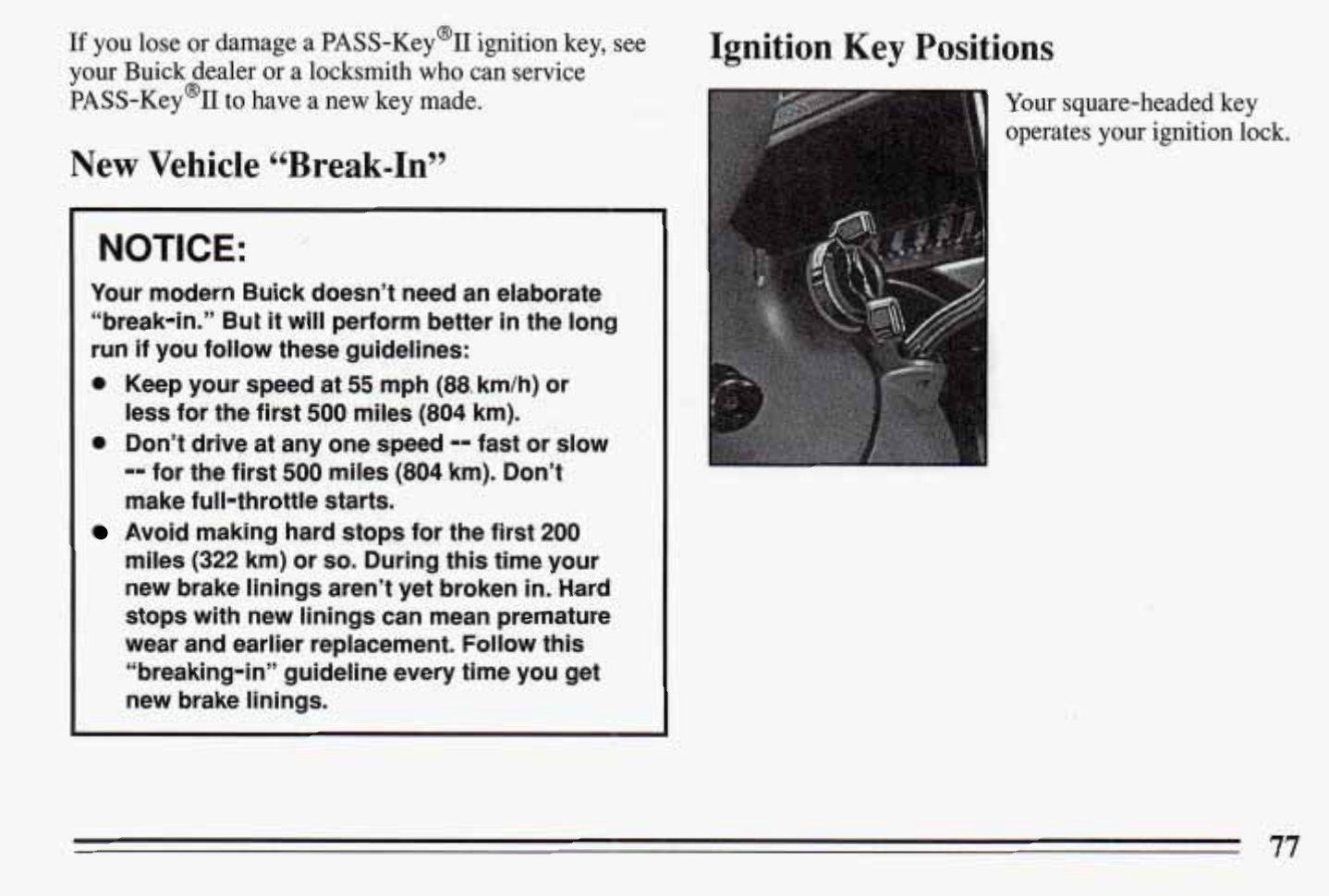
Ignition Key Positions
Your square-headed key
operates your ignition lock.
77
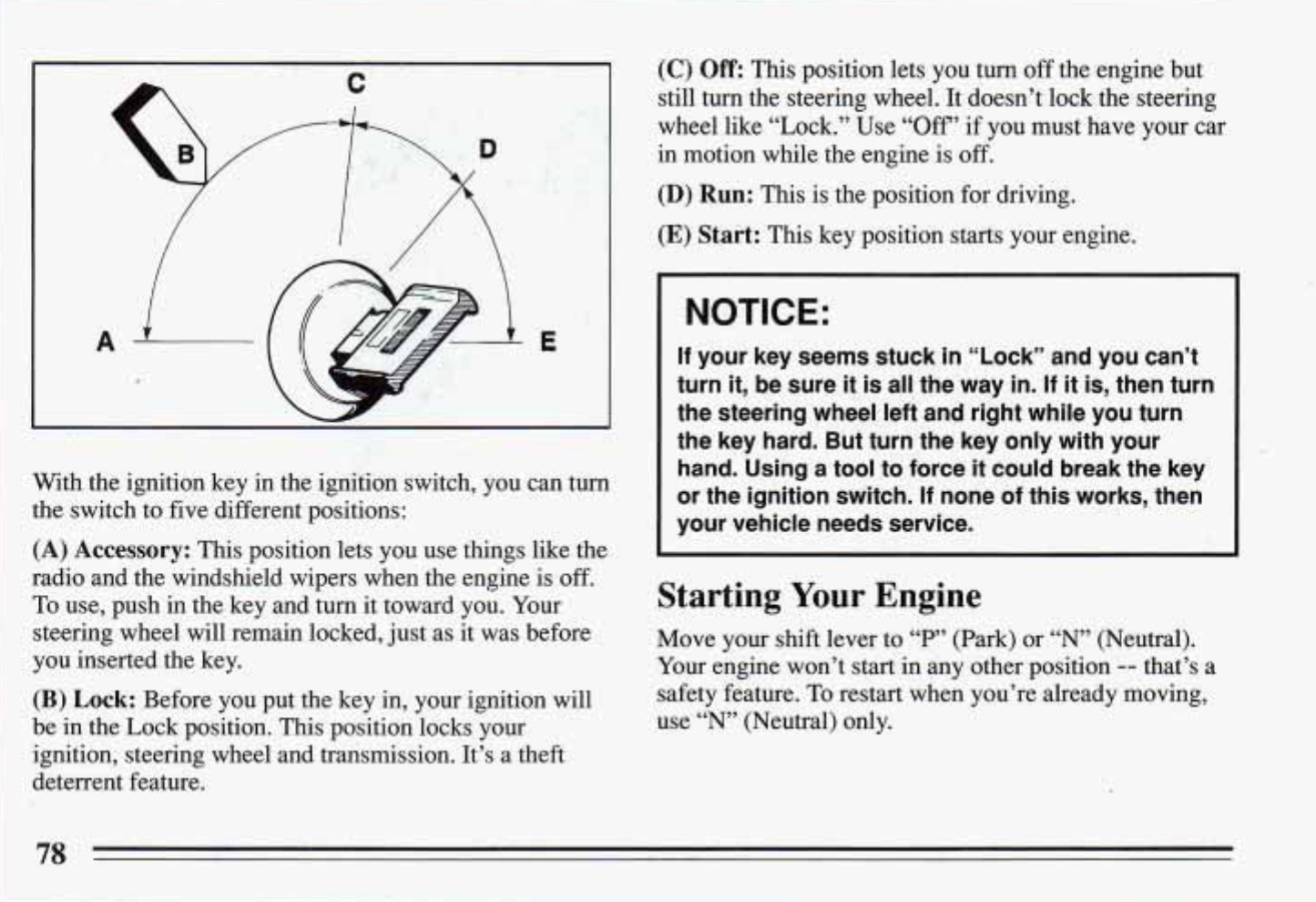
(C)
Off
This position lets you turn off the engine but
still turn the steering wheel. It doesn’t lock the steering
wheel like “Lock.” Use “Off’ if
you
must have
your
car
in motion while the engine is
off.
(D)
Run:
This is the position for driving.
(E)
Start:
This key position starts your engine.
A
E
With. the ignition key in the ignition switch, you can turn
the switch to five different positions:
(A) Accessory:
This position lets you use things like the
radio and the windshield wipers when the engine is
off.
To use, push in the key and
turn
it toward you. Your
steering wheel will remain locked, just as
it
was before
you inserted the key.
(B)
Lock:
Before you put the key in, your ignition will
be in the Lock position. This.position locks your
ignition, steering wheel and transmission. It’s a theft
deterrent feature.
If your key seems stuck in “Loclc” and you can’t
turn it, be sure it is all the way in. If
it
is, then turn
the steering wheel left and right while you
turn
the key hard. But turn the key only with your
hand. Using a
tool
to force
it
could break the key
or the ignition switch. If none of this works, then
your vehicle
needs
service.
Starting
Your
Engine
Move your
s,hift
lever to
“P”
(Park) or “N’ (Neutrai).
Your
engine won’t start in any other position
--
that’s a
safety feature. To restart when you’re already moving,
use “N” (Neutral) only.
NOTICE:
Don’t try to shift to “P” (Park)
if
your Buick is
moving.
If
you
do,
you could damage the
transmission. Shift
to
“PYy (Park) only when your
vehic.le is stopped.
To start your
5.7
Liter LT1 engine:
1.
Without pushing the accelerator pedal, turn the
ignition key to “Start.” When the engine starts, let
go
of
the key. The idle speed will go down as your
engine gets warm.
NOTICE:
Holding your key in “Start” for longer than
15
seconds at a time
will
cause your battery
to
be
drained much sooner. And the excessive heat
can damage your starter motor.
2.
If it doesn’t start within
10
seconds, push the
accelerator pedal all the way to the floor, while you
hold the ignition key in “Start.” When the engine
starts, let
go
of the key and let up on the accelerator
pedal. Wait about 15 seconds between each try to
help avoid draining
your
battery:
When starting your engine in very cold weather (below
1. With your foot
off
the accelerator pedal, turn the
‘
0°F or
-18”C),
do this:
ignition key to “Start” and hold it there. When the
engine starts, let go of the key. Use the accelerator
pedal to maintain engine speed, if you have to, until
your engine has run for a while.
2.
If
your engine still won’t start (or starts but then
stops), it could be flooded with too much gasoline.
Try pushing your accelerator pedal all the way to the
floor and holding it there as you hold the key in
“Start”
for about three seconds.
If
the car starts
briefly but then stops again, do
the
same thing, but
this time keep the pedal down for five
or
six seconds.
This clears the extra gasoline
from
the engine.
79
NOTICE:
Your engine is designed to work with the
electronics
in
your vehicle. If you add electrical
parts or accessories, you could change the way
the fuel injection system operates. Before adding
electrical equipment, check
with
your dealer. If
you don’t, your engine might not perform
properly.
If you ever have to have your vehicle towed, see
the part of this manual that tells how to
do
it
without damaging your vehicle. See “Towing
Your Car”
in
the Index.
Driving Through Deep Standing
Water
NOTICE:
If you drive too quickly through deep puddles or
standing water, water can come in through your
engine’s air intake and badly damage your
engine.
If
you can’t avoid deep puddles or
standing water, drive through them very slowly.
Engine
Coolant
Warmer
(Engine
Block
Heater)
(Canada
Only)
In very cold weather,
0
“F
(-
1
8
O
C)
or
colder, the engine
coolant warmer can help. You’ll get easier starting and
better fuel economy during engine warm-up. Usually,
the coolant warmer should be plugged in a minimum of
four hours prior
to
starting your vehicle.
To use the coolant warmer:
1.
Turn
off
the engine.
2. Open the hood and unwrap the electrical cord.
3.
Plug it into a normal, grounded 110-volt outlet.
80
NOTICE:
Automatic Transmission
After you’ve used the coolant warmer, be sure to
store the cord
as
it was before to keep it away
from moving engine parts. If you don’t, it
could
be damaged.
,
I.
There are several different
positions
for
your shift
lever.
How long should yol-1 keep the coolant warmer plugged
in? The answer depends on the weather, the kind
of
oil
you have, and
some
other things. Instead of trying to list
everything here, we ask that you contact a Buick dealer
in
the area where you’ll be parking your vehicle. The
dealer can give you the best advice for that particular
area.
..
P
(Park)
This
locks
your rear wheels. It’s the best position to
use when you start your engine because your vehicle
can’t move easily.
81
NOTICE:
Damage to your transmission caused by shifting
out of
“P”
(Park)
or
“N” (Neutral) with the engine
rac’ing isn’t covered by your warranty.
@)
Automatic Overdrive
This position is for normal driving.
If
you need more
power for passing, and you’re:
-
Going less than about 35 mph (56
kmh),
push
your accelerator pedal about halfway down.
-
Going about 35 mph (56
km/h)
or more, push the
.
.
.
Y~u’1.l
shift down
to
the next gear and have more
power.
3
(Third
Gear)
accelerator all the way down.
This is like
@,
but you never go-into Overdrive.
Here are some times you might choose
“3”
instead
of
-
When driving on hilly, winding roads
0:
-
When towing a trailer,
so
there is less shifting
-
When going down a steep hill
between gears
2
(Second Gear)
This position gives you more power and lower fuel
economy.
You
can use
“2”
on
hills.
It
can
help
control your speed as you go down steep mountain
roads, but then you would also want to use your
brakes
off
and on.
83
‘I
NOTICE:
Don’t drive
in
“2”
(Second Gear) for more than
5
miles
(8
km), or at speeds over
55
mph
(88
km/h),
or you can damage your transmission. Use
@
or
“3”
as much as possible.
Don’t shift into
“2”
unless you are going slower
than
65
mph
(105
km/h), or you can damage your
engine.
1
(First
Gear)
This position gives you even more power (but lower
fuel economy) than
“2.”
You can use it on very steep
hills, or in deep snow or mud. If the selector lever is
put in
“1,”
the transmission won’t shift into first gear
6
until the vehicle is going slowly enough.
NOTICE:
If your rear wheels can’t rotate, don’t try to drive.
This might happen
if
you were stuck
in
very deep
sand or mud or were
up
against a solid object.
You could damage your transmission.
Also,
if you stop when going
uphill,
don’t hold
your vehicle there with only the accelerator
pedal. This could overheat and damage the
transmission. Use your brakes or shift into “PYy
Park to hold your vehicle
in
position on a
hill.
Limited-Slip
Rear
Axle
If you have this feature, your rear axle can give you
additional traction on snow, mud, ice, sand or gravel. It
works like a standard axle most of the time, but when
one of the rear wheels has no traction and the other
does, the limited-slip feature will allow the wheel with
traction to move the vehicle.
I
84
Parking
Brake
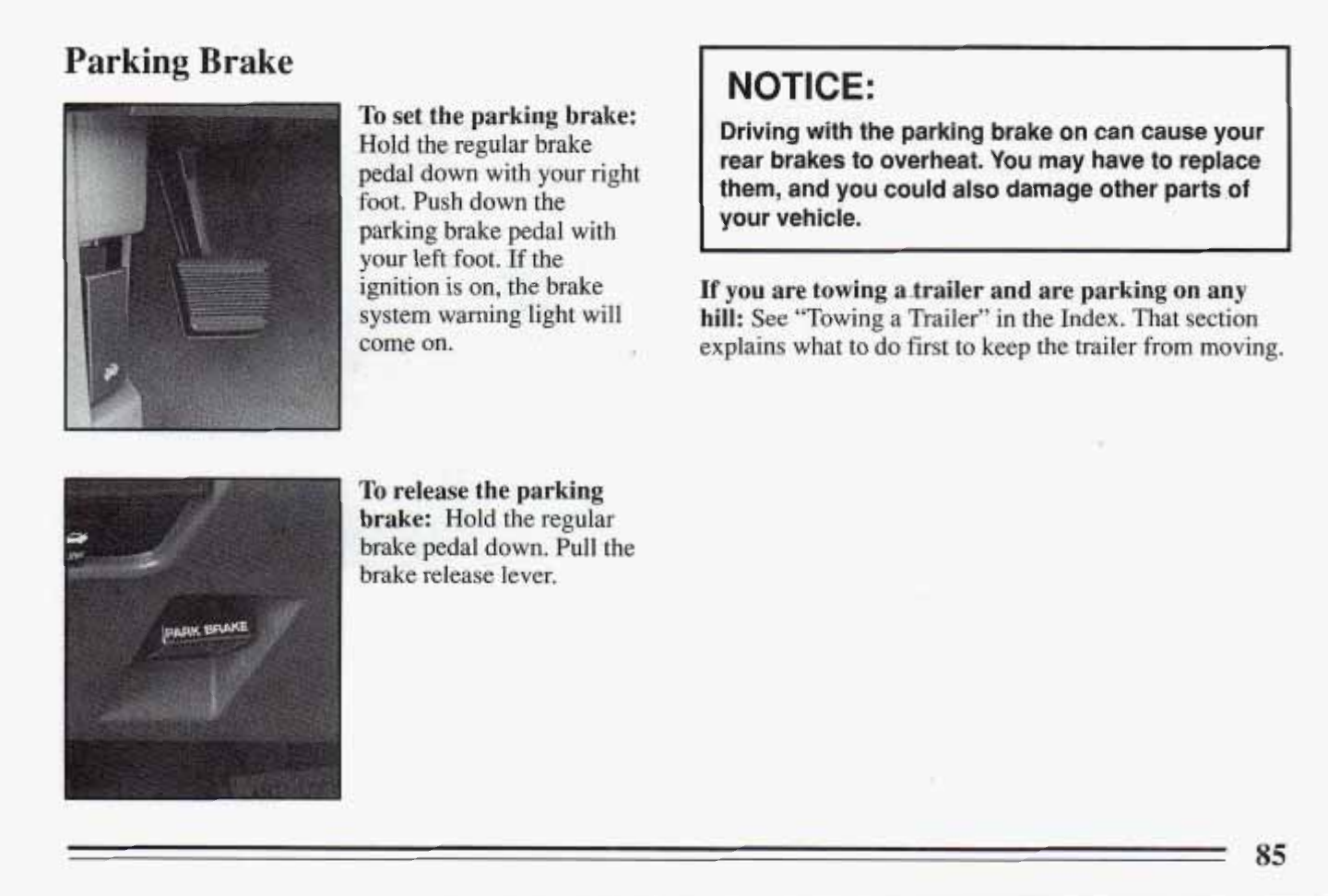
To
set, the parking brake:
Hold
the regular brake
pedal down with your right
foot. Push
down
the
parking brake pedal with
your left foot.
If
the
ignition is
on,
the brake
system’ warning’light will
come on.
To
release the parking
~
brake:
Hold the regular
~ brake.peda1 down. Pull the
brake release lever.
Driving with the parking brake on can cause your
rear brakes to overheat. You may have to replace
them,
and
you could also damage other parts
,of
your vehicle.
I-,
.,
.,
.
~
,
If
you
are towing a.trailer
and
are parking on any
hill:
See “Towing a Trailer” in the Index. That section
explains what to
do
first to keep the trailer from moving.
85
Shifting
Into
64
P
99
(Park)
1.
Hold the brake pedal down with
your
right
foot
and
set
the parking brake.
86
i
I
I
Torque
Lock
If you are parking on a hill and you don’t shift
your
transaxle into
T“
(Park) properly, the weight of the
vehicle may put too much force on the parking pawl in
the transmission. You may find it difficult to pull the
shift lever out of “P” (Park). This is called “torque
lock.” To prevent torque lock,. set the parking brake and
then shift into
7‘“
(Park) properly before you leave the
.driver’s seat. To find out
how,
see “Shifting Into ‘P’
(Park)” in the Index.
When you are ready to drive, move the shift lever out of
“P’,
(Park)
BEFORE
you release the parking brake.
If “torque lock” does occur, you may need to have
another vehicle push yours a little uphill to take some of
the pressure from the transaxle,
so
you can pull the shift
lever out
of
T“
(Park).
Shifting
Out
of
LCP99
(Park)
Your Buick has a brake-transmission shift interlock. You
have to fully
apply
your regular brake
before
you can
shift from
“P”
(Park) when the ignition is in the “Run”
position. See “Automatic Transmission” in the Index.
If you cannot shift out
of
“P”
(Park), ease pressure on
the shift lever
--
push the shift lever all the way into “P”
(Park)
as
you maintain brake application. Then move the
shift lever into the gear you want. If you ever hold the
brake pedal down but still can’t’shift out
of
“P”
(Park),
try this:
1. Turn the key to
“Off.”
2.
Apply and hold the brake until the end
of
Step
‘4.
3.
Shift to
“N”
(Neutral).
4.
Start the vehicle and then shift to the drive gear you
5.
Have the vehicle fixed as soon as you can.
want.
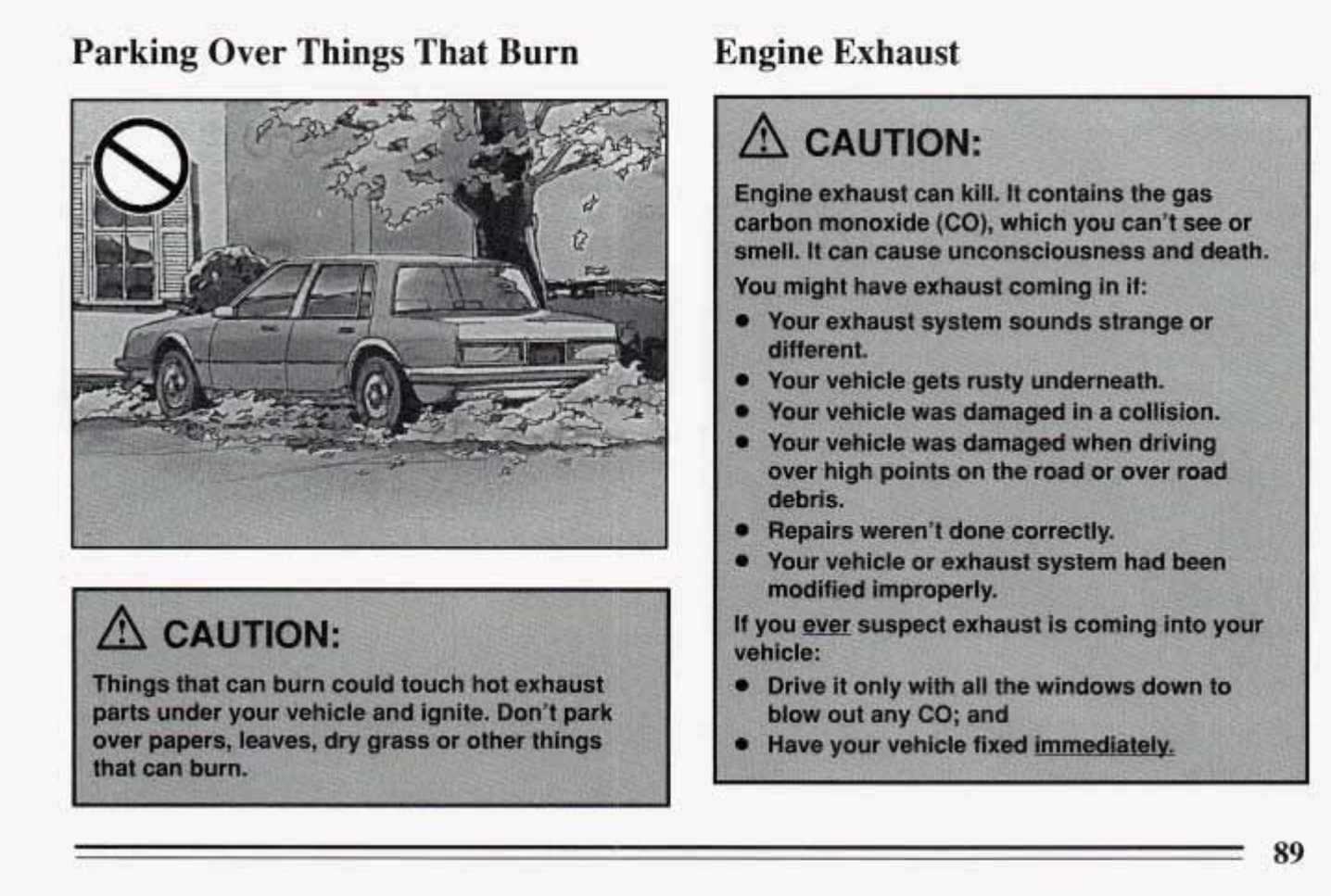
Parking
Over
Things That Burn
.
..
..
,..
::
I..
.
Engine Exhaust
on
Running
Your Engine
While
You’re
Parked
It’s better not to park with the engine running. But
if
you
ever have to,. here are some things to
bow.
Follow the groper steps to be sure your vehicle won’t
move. See “Shifting Into
‘P’
(Park)” in the Index.
If
you are parking on
a
hill
and if you’re pulling
a
trailer, also see “Towing a Trailer’’ in the Index.
90
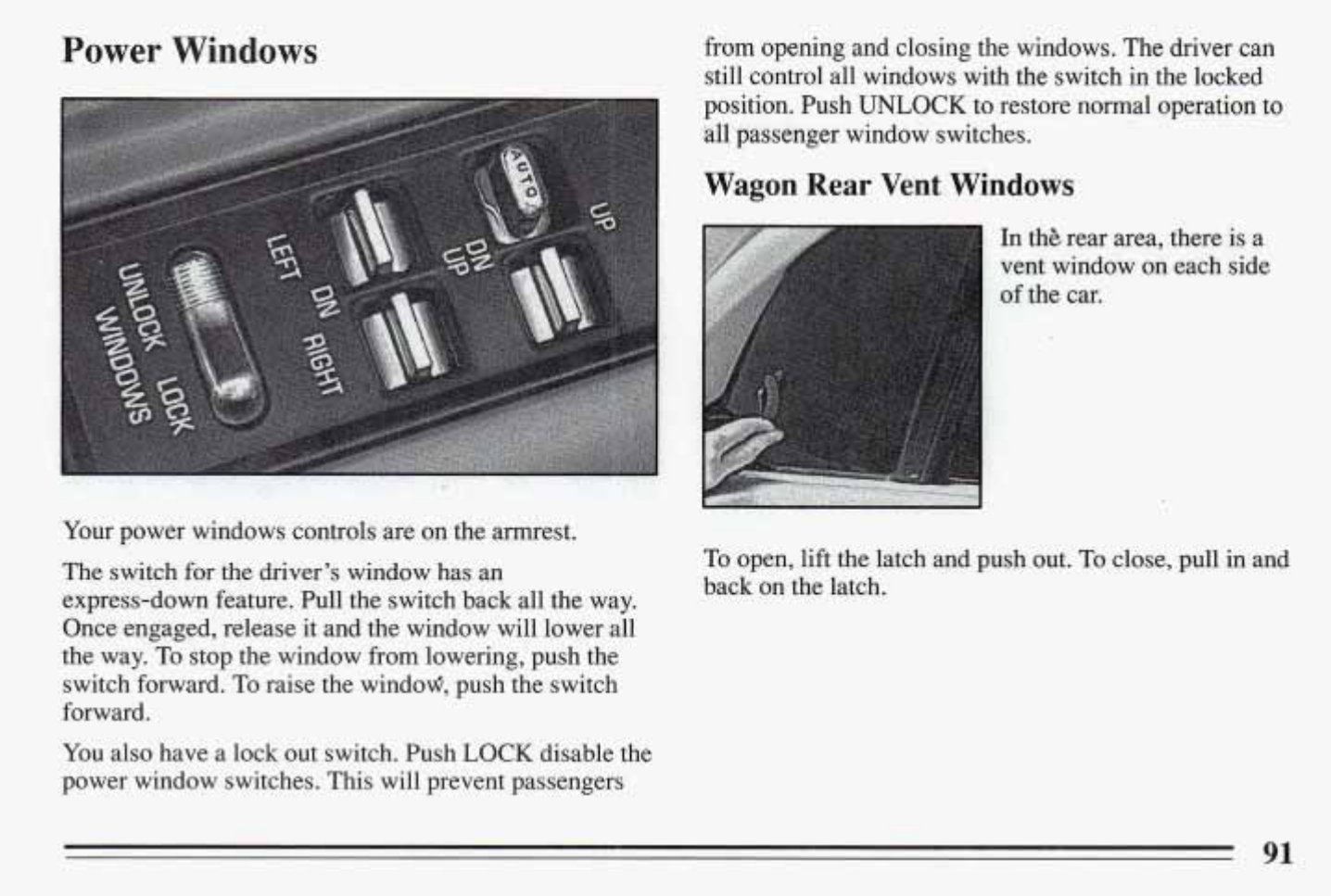
Power
Windows
Your power windows controls are on the armrest.
The switch for the driver's window has an
express-down feature. Pull the switch back all the way.
Once engaged, release it and the window will lower all
the way.
To
stop the window from lowering, push the
switch forward.
To
raise the windo$, push the switch
forward.
You also have a lock out switch. Push
LOCK
disable the
power window switches. This will prevent passengers
from opening and closing the windows. The driver can
still control all windows with the switch in the locked
'position. Push
UNLOCK
to restore normal operation to
,all
passenger .window switches.
Wagon
Rear
Vent
Windows
In th& rear area, there
is
a
vent window
on
each side
of
the car.
To
open, lift the latch and push out. To close, pull
in
and
back on the latch.
91
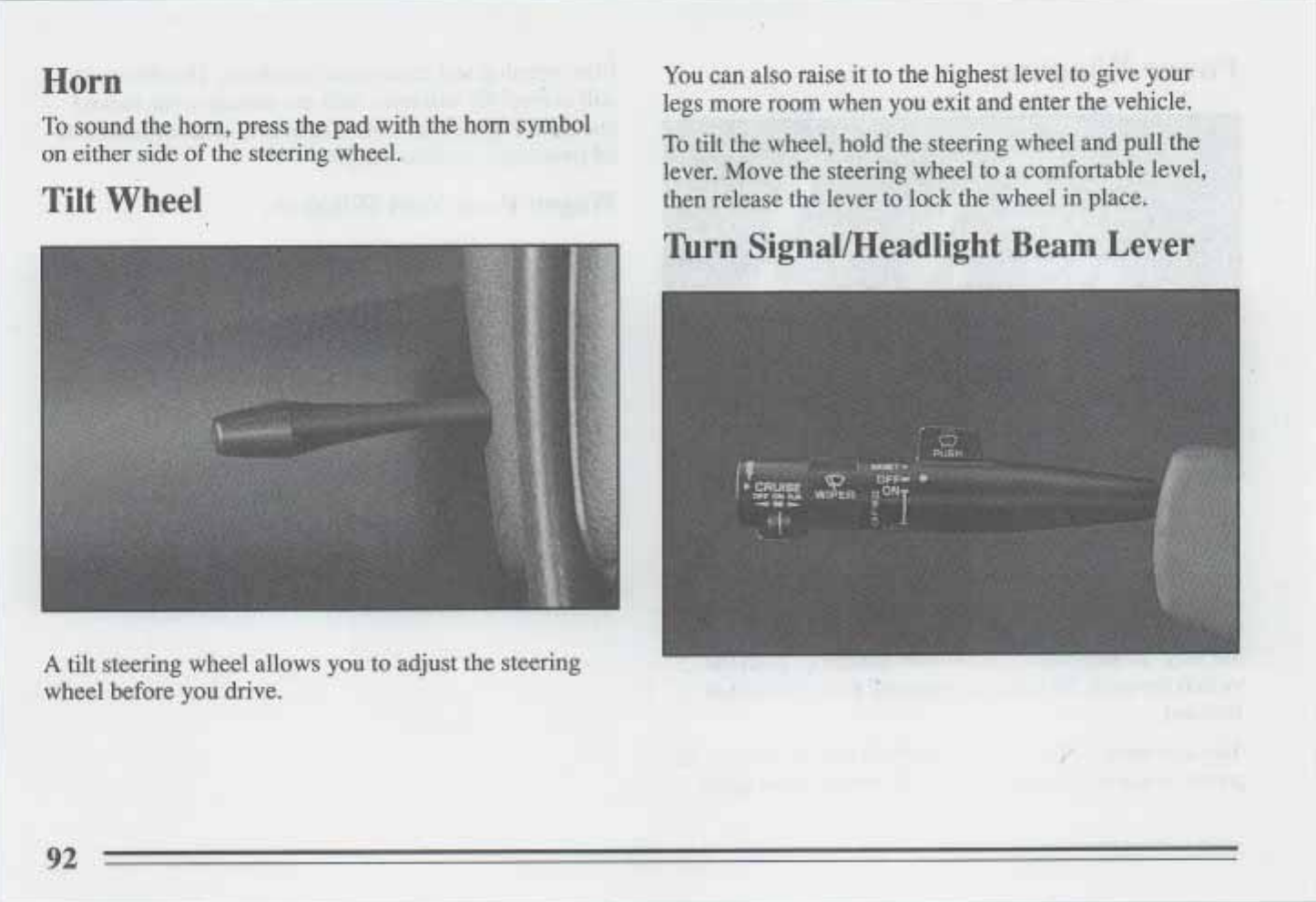
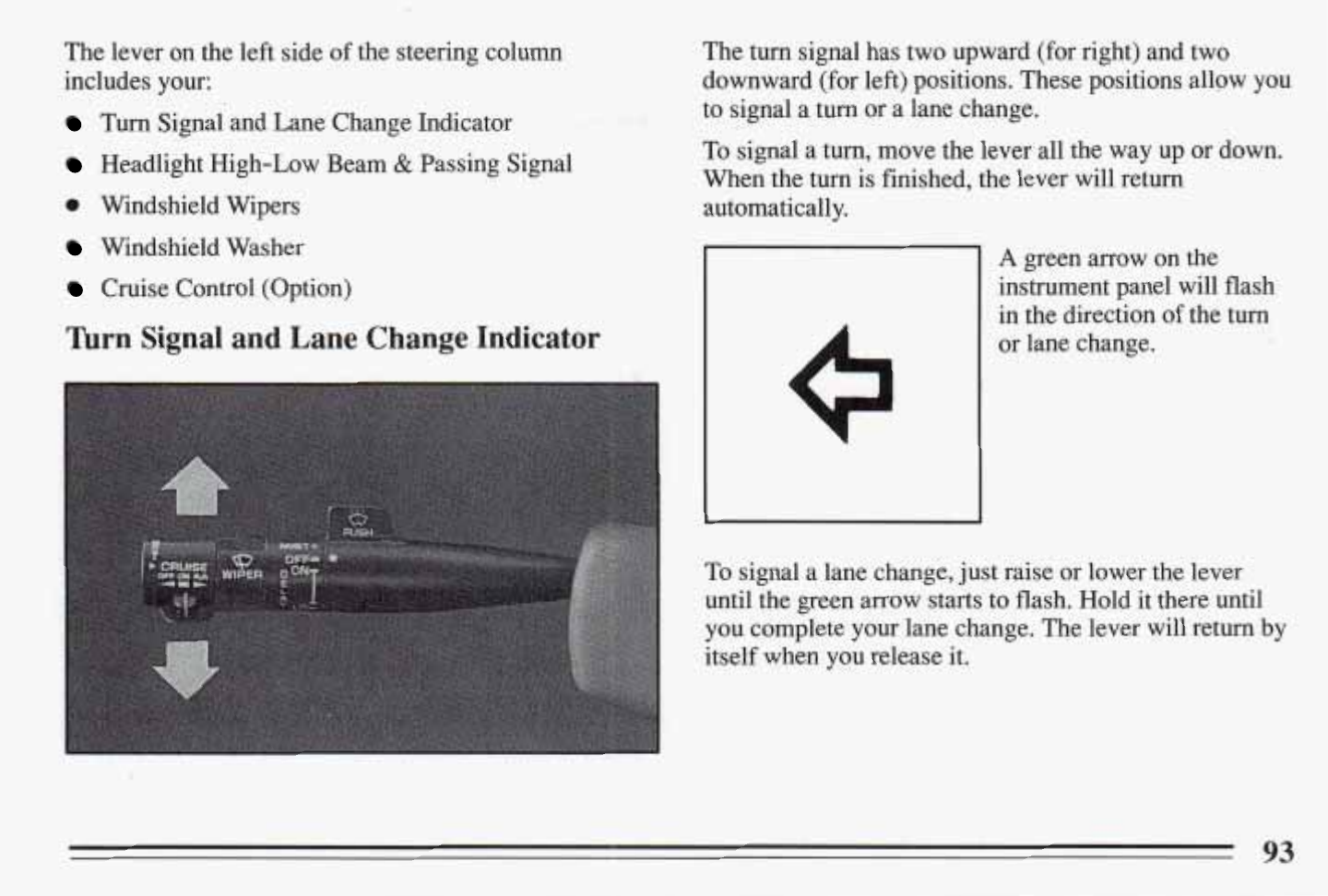
The lever on the left side of the steering column
includes your:
Turn Signal and Lane Change Indicator
Headlight High-Low Beam
&
Passing Signal
0
Windshield Wipers
Windshield Washer
Cruise Control (Option)
Turn Signal and Lane Change. Indicator
The turn signal has two upward (for right) and two
downward (for left) positions. These positions allow you
to signal
a
turn or
a
lane change.
To signal a turn, move the lever all the way
up
or down.
When the turn is finished, the lever will return
automatically.
A
green arrow on the
instrument panel will flash
in the direction of the turn
or lane change.
To
signal a lane change, just raise or lower
the
lever
until the green arrow starts to flash. Hold it there until
you complete your lane change. The lever will return by
itself when you release it.
93
I
As you signal a turn or a lane change, if the arrows don’t
flash but just stay on, a signal bulb may be burned out
and other drivers won’t see your turn signal.
If a bulb is burned out, replace it to help avoid an
accident.
If
the green arrows don’t go on at all when you
signal a turn, check the fuse (see “Fuses” in the Index)
and for burned-out bulbs.
If
you have a trailer towing option with added wiring for
the trailer lights, a different turn signal flasher is used.
With this flasher installed, the signal indicator will flash
even if a turn signal bulb is burned out. Check the front
and rear turn signal lights regularly to make sure they
are working.
Turn Signal Reminder
A chime will sound if your turn signal remains on afier
having driven
1/2
mile, to remind you to turn
off
your
signal.
Operation
of
Lights
Although your vehicle’s lighting system (headlights,
parking lights, fog lamps, side marker lights and
taillights) meets all applicable federal lighting
requiremeilts, certain states and. provinces may apply
their own lighting regulations that may require special
attention before you operate these lights.
For example, some jurisdictions may require that you
operate your fog lamps only when your lower beam
headlights are also on, or that headlights be turned
on
whenever you must use your windshield wipers.
In
addition, most jurisdictions prohibit driving solely with
parking lights, especially at dawn or dusk. It is
recommended that you check with your own state or
provincial highway authority for applicable lighting
regulations.
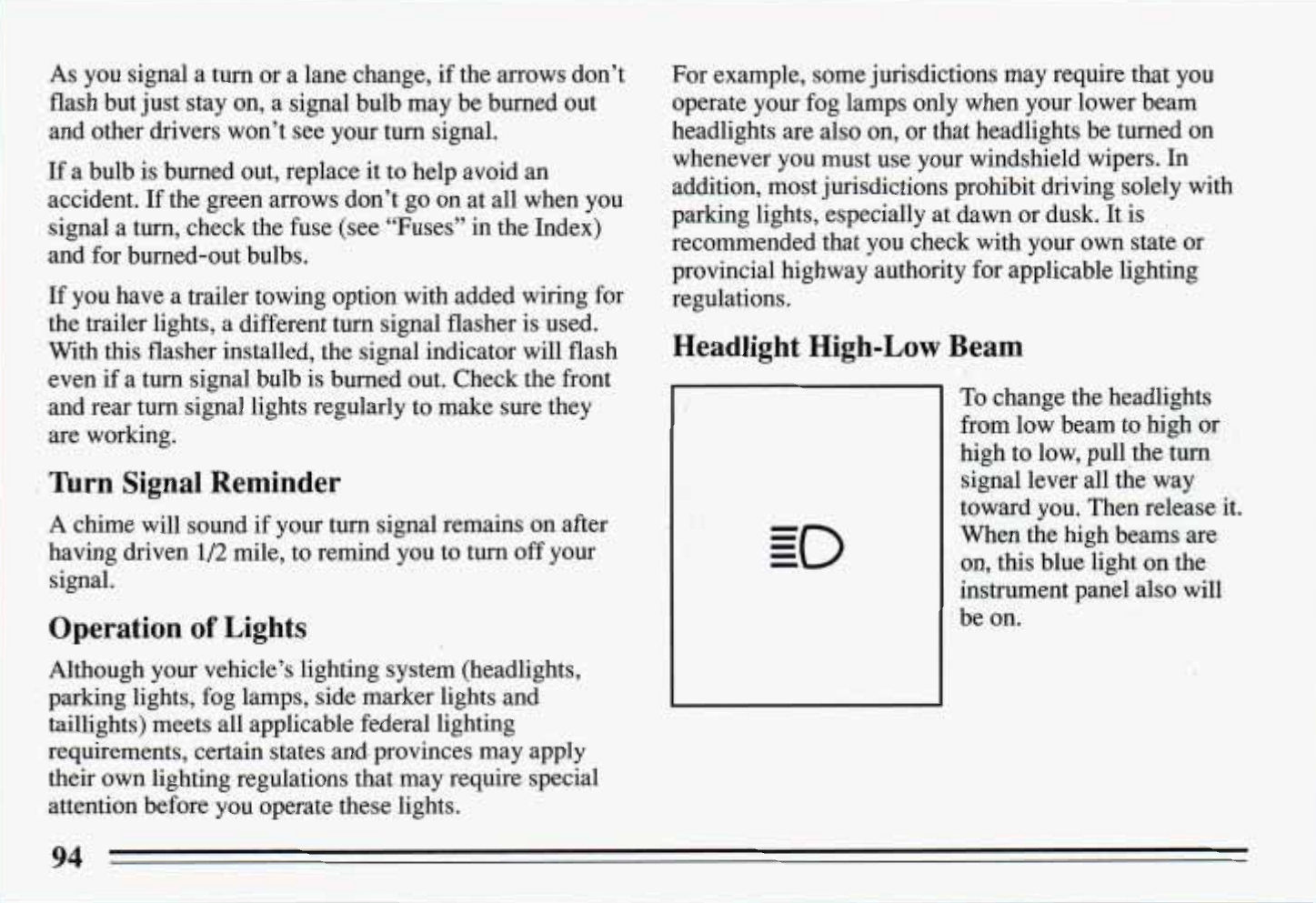
Headlight High-Low Beam
To
change the headlights
from low beam to high ‘or
high to low, pull the turn
signal lever a11 the way
toward you. Then release it.
When the high beams are
on, this blue light on the
instrument panel also will
be
on.
,-
..
94
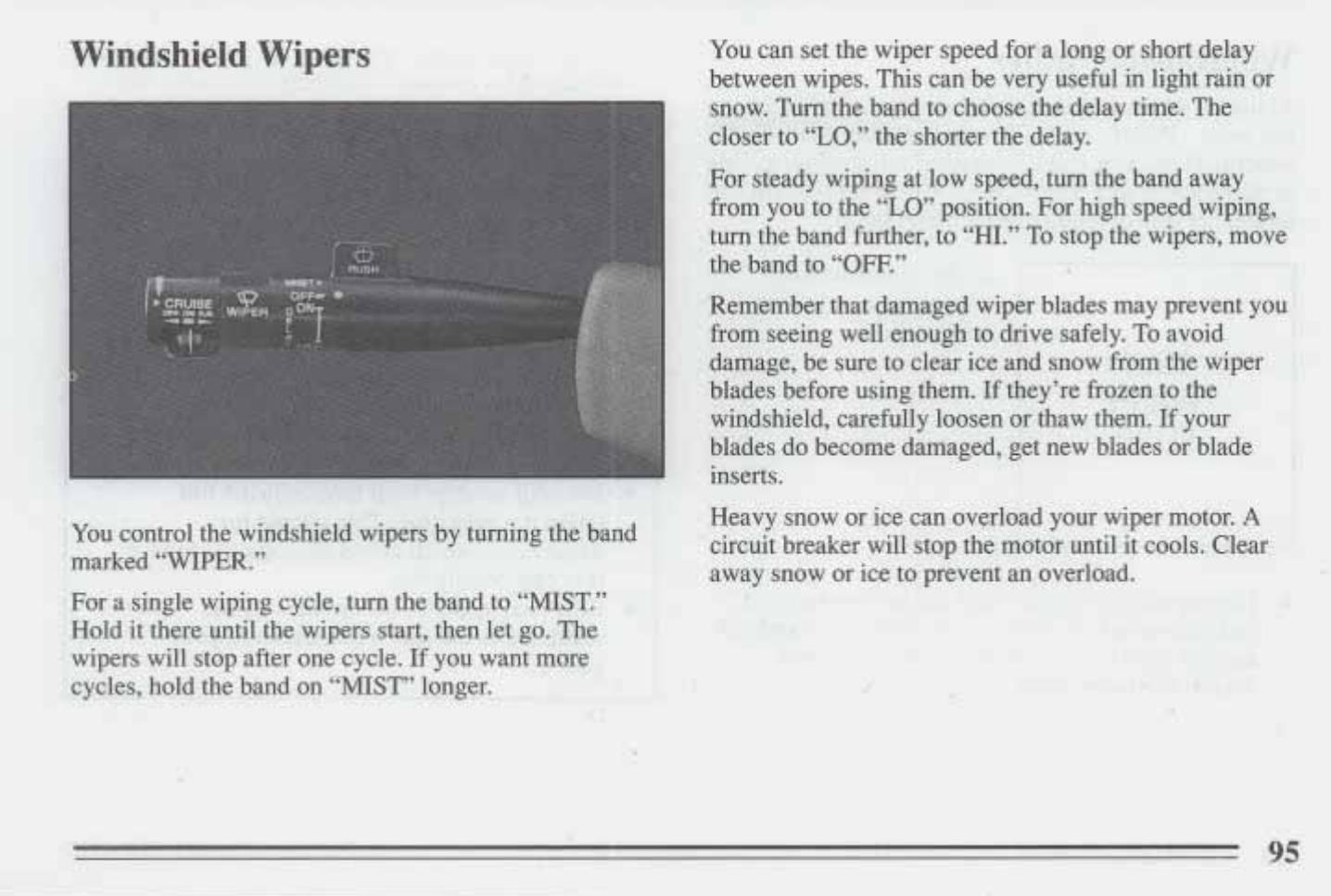
Wagon Rear Window Washedwiper
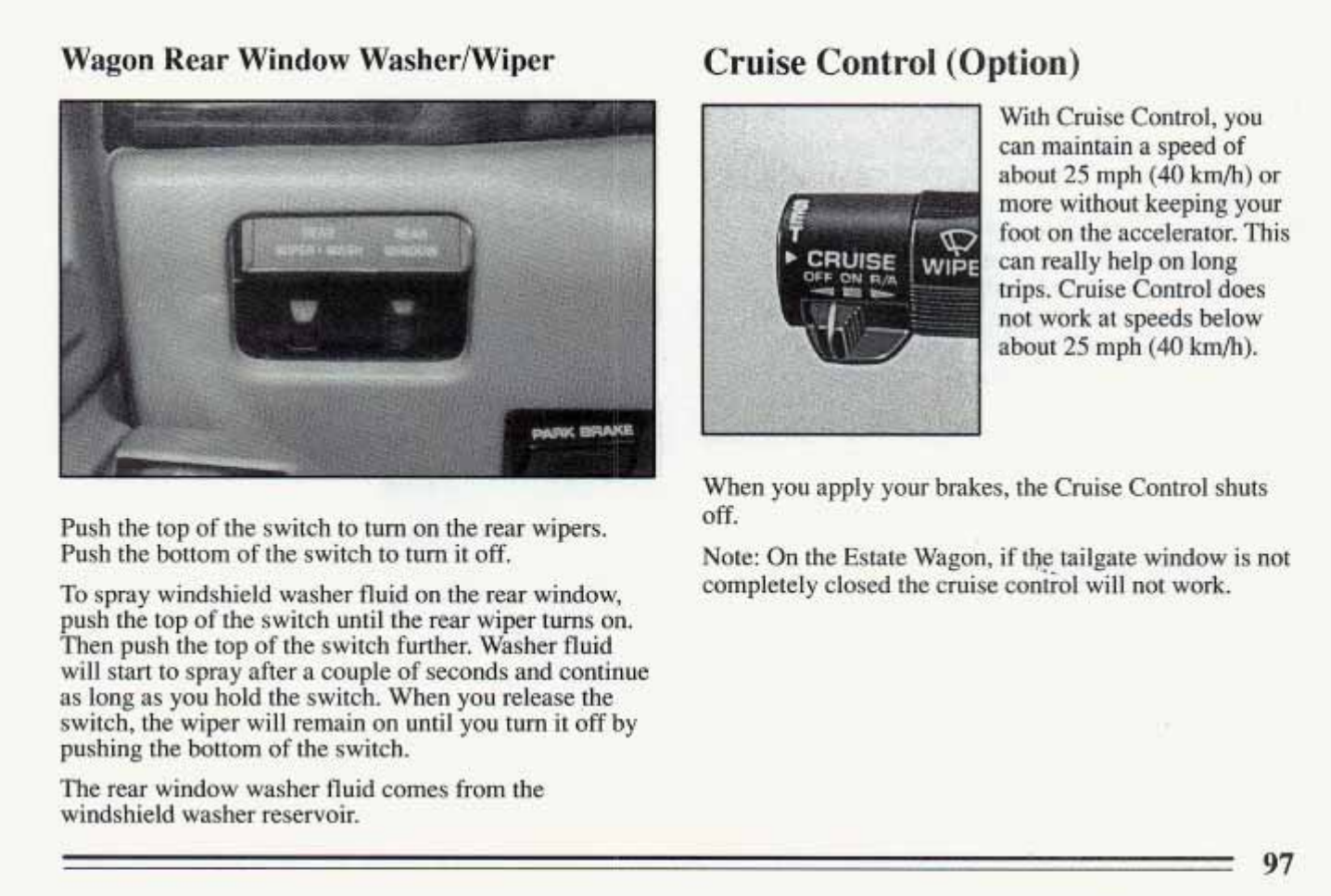
Push the top of the switch to turn on the rear wipers.
Push the bottom of the switch to turn it
off.
To spray windshield washer fluid on the rear window,
push the top of the switch until the rear wiper turns on.
Then push the top of the switch further. Washer fluid
will start to spray after a couple of seconds and continue
as long as you hold the switch. When you release the
switch, the wiper will remain on until you turn it off by
pushing the bottom of the switch.
The rear window washer fluid comes from the
windshield washer reservoir.
Cruise
Control
(Option)
When you apply your brakes, the Cruise Control shuts
Off.
Note: On the Estate Wagon, if the tailgate window is not
completely closed the cruise co&ol will not work.
97
2. Get
up
to the speed you want.
To
Set Cruise Control
1.
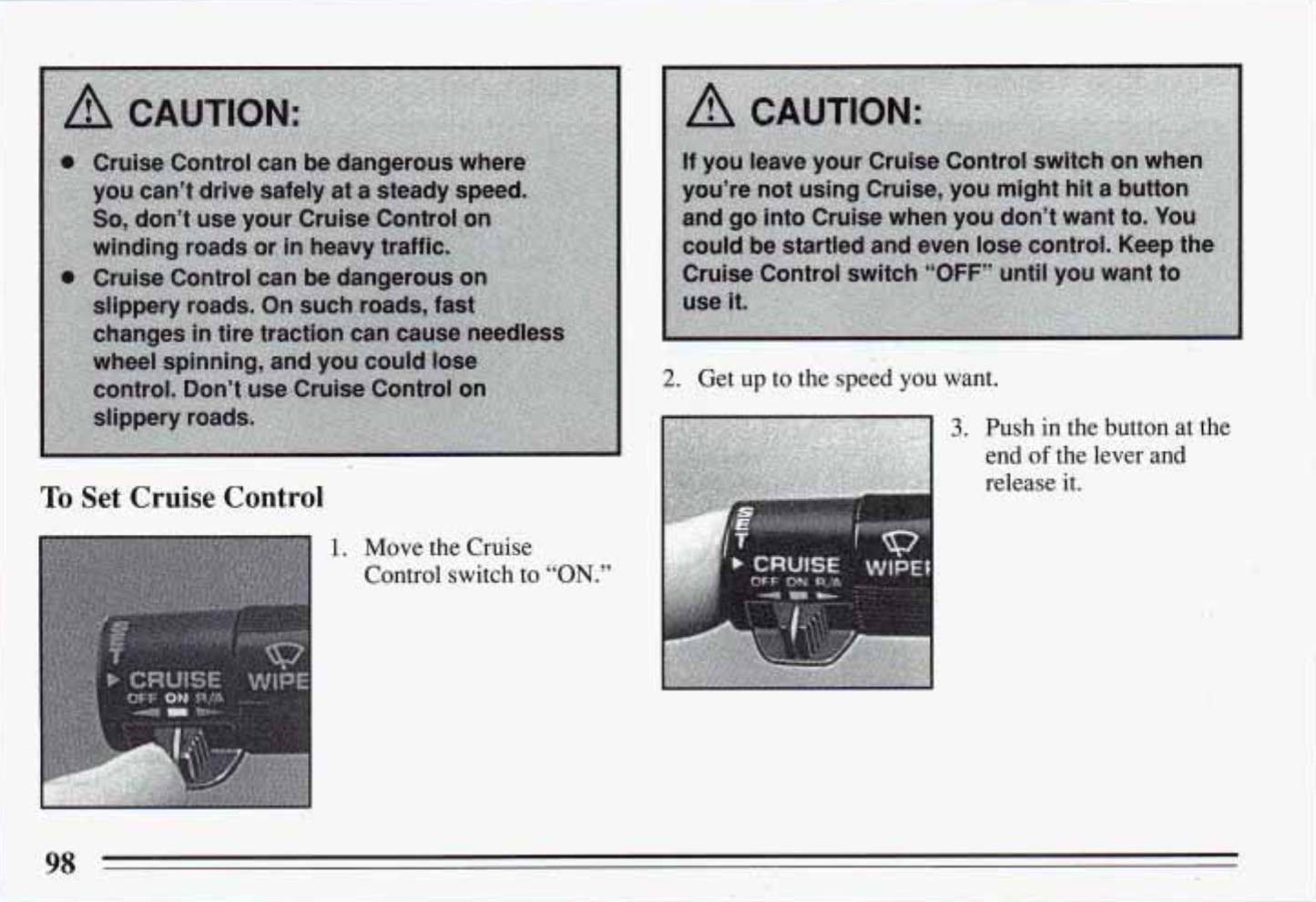
Move the Cruise
Control switch to
“ON.”
3.
Push in the button at the
end
of
the lever
and
release it.
CRUISE
(The “CRUISE’ light on
the instrument panel will
come on.)
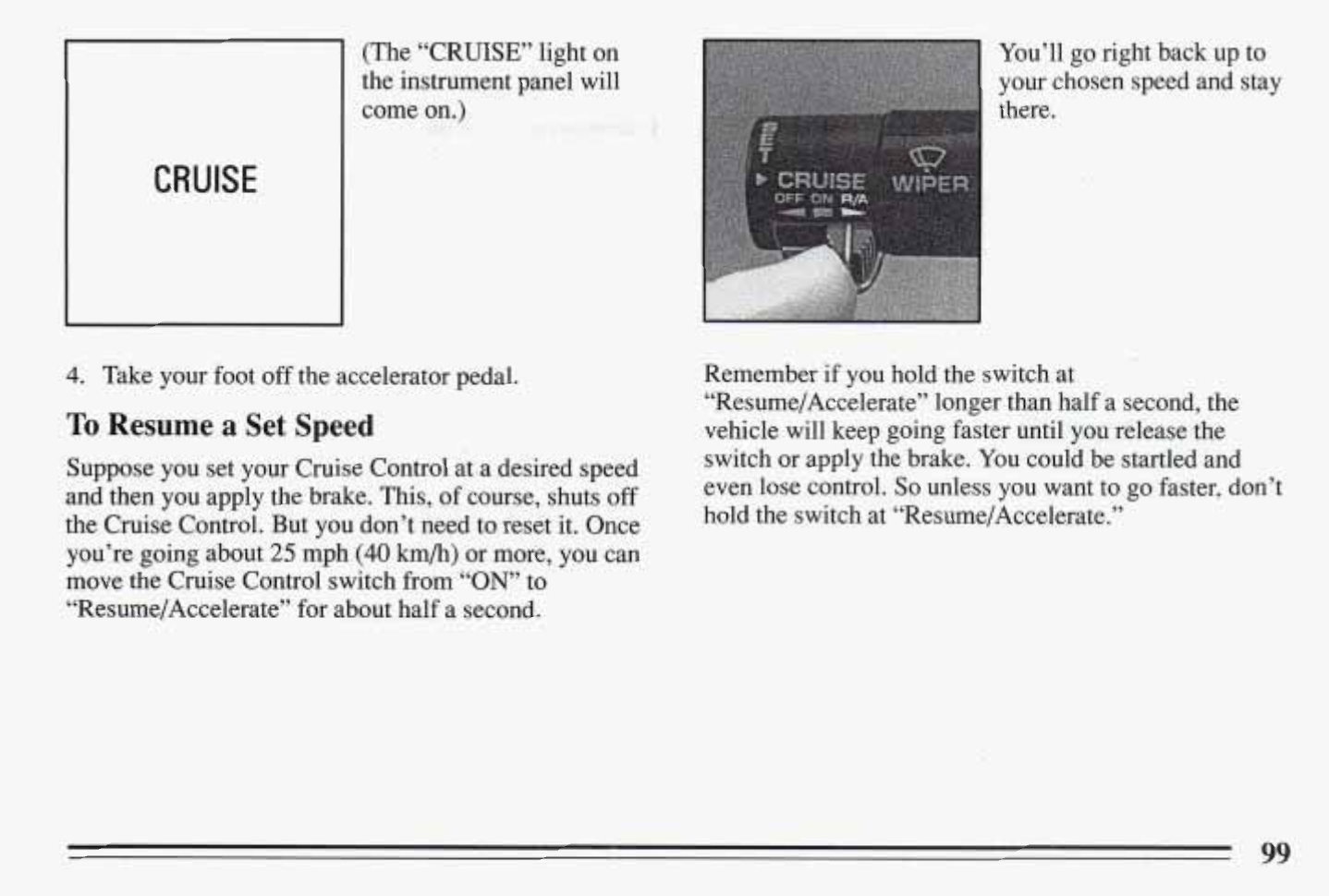
You’ll
go
right back up to
your chosen speed and stay
there.
4.
Take your foot off the accelerator pedal.
To
Resume
a
Set
Speed
Suppose you set your Cruise Control at a desired speed
and then you apply the brake. This, of course, shuts
off
the Cruise Control. But you don’t need to reset it. Once
you’re going about 25 mph
(40
km/h)
or more, you can
move the Cruise Control switch
fiom
“ON’
to
“Resume/Accelerate” for about half a second.
Remember if you hold the switch at
“Resume/Accelerate” longer than half a second, the
vehicle will keep going faster until you release the
switch or apply the brake. You could be startled and
even lose control.
So
unless you want
to
go
faster, don’t
hold the switch at “Resume/Accelerate.”
To
Increase Speed While Using Cruise
Here’s the second way to go to a higher speed:
Control
”
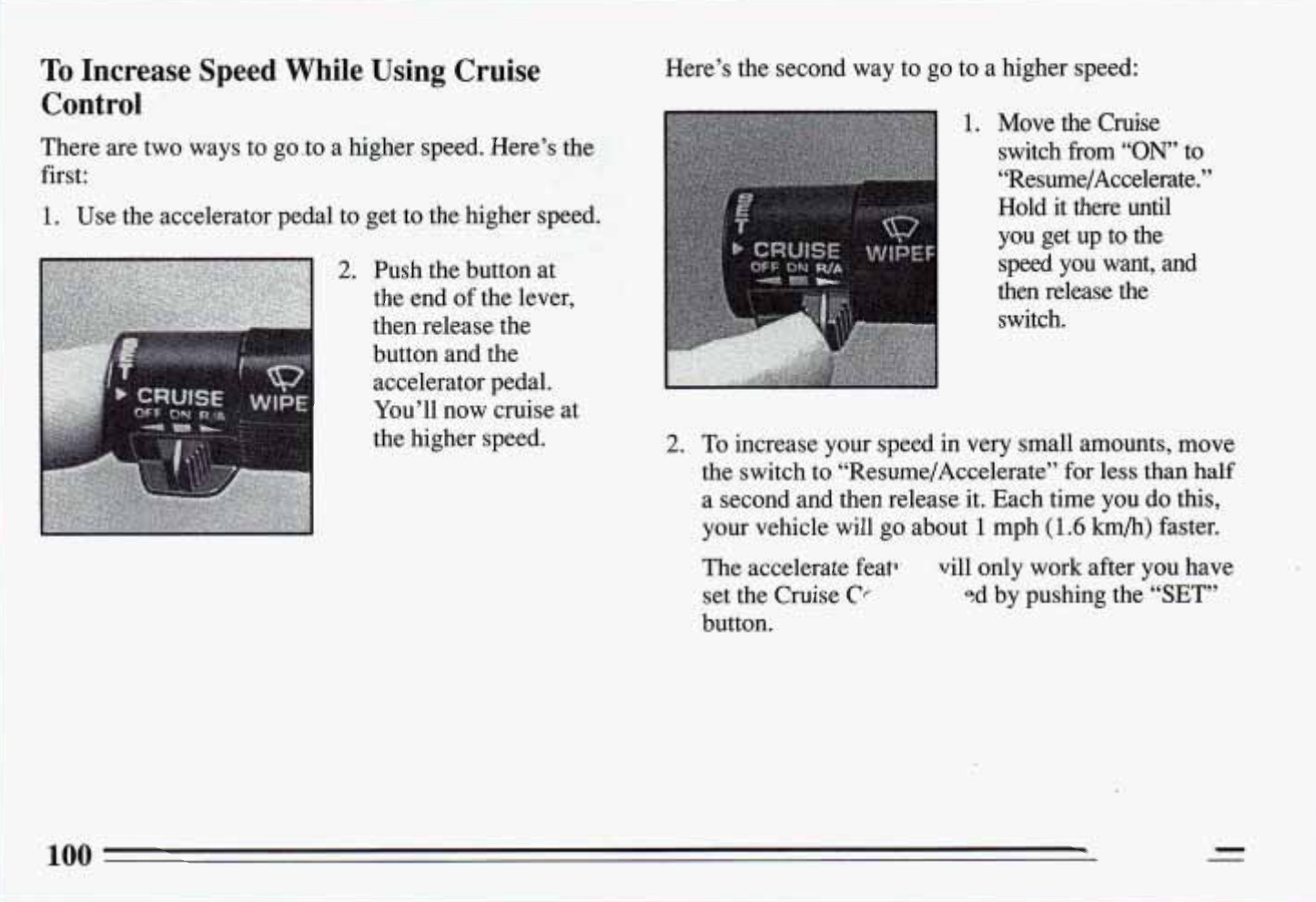
There are two ways to
go
.to a higher speed. Here’s the
first:
1.
Use the accelerator pedal to get to the higher speed,
2.
Push the button at
the end
of the lever,
then release the
button and the
accelerator pedal.
1.
Move the Cruise
switch from
“ON”
to
“Resume/Accelerate.”
Hold it there until
you get up to the
speed
you
want, and
then release the
switch.
You’ll now cruise at
the higher speed.
2.
To
increase your speed in
very
small amounts, move
the switch to “Resume/Accelerate” for less than half
a second and then release it. Each time you
do
this,
your vehicle will go about
1
mph (1.6
h/h)
faster.
The accelerate featl. .vi11 only work after you have
set the Cruise
Cr
sd by pushing the
“SET”
button.
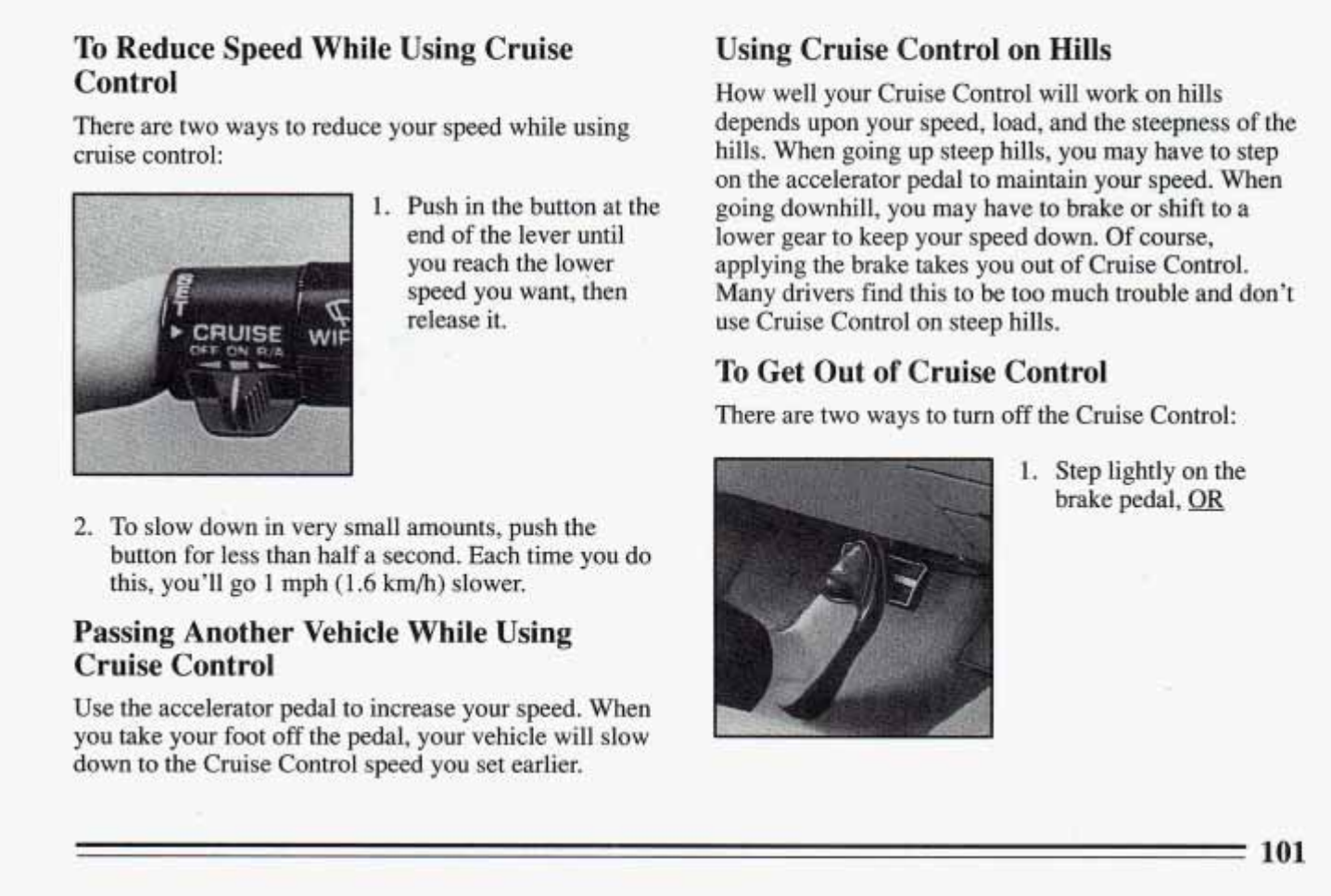
To
Reduce Speed While Using Cruise
Control
There are two ways to reduce your speed while using
cruise control:
Push in the button
at
the
end
of
the lever until
you
reach the lower
speed you want, then
release it.
2.
To slow down in very small amounts, push the
button for less than half a second. Each time you do
this, you’ll go
1
mph
(1.6
h/h)
slower.
Passing Another Vehicle While Using
Cruise Control
Use the accelerator pedal to increase your speed. ,When
you take your foot
off
the pedal, your vehicle will slow
down to the Cruise Control speed you
set
earlier.
Using Cruise Control on Hills
How
well your Cruise Control will work on hills
depends upon your speed, load, and the steepness of the
hills. When going up steep hills, you may have to step
on the accelerator pedal to maintain your speed. When
going downhill, you may have to brake or shift to a
lower gear to keep your speed down. Of course,
applying the brake takes you out of Cruise Control.
Many drivers find this to be too much trouble and don’t
use Cruise Control on steep hills.
To
Get Out
of
Cruise Control
There are two ways to turn off the Cruise Control:
1.
Step lightly on the
brake pedal,
OR
101
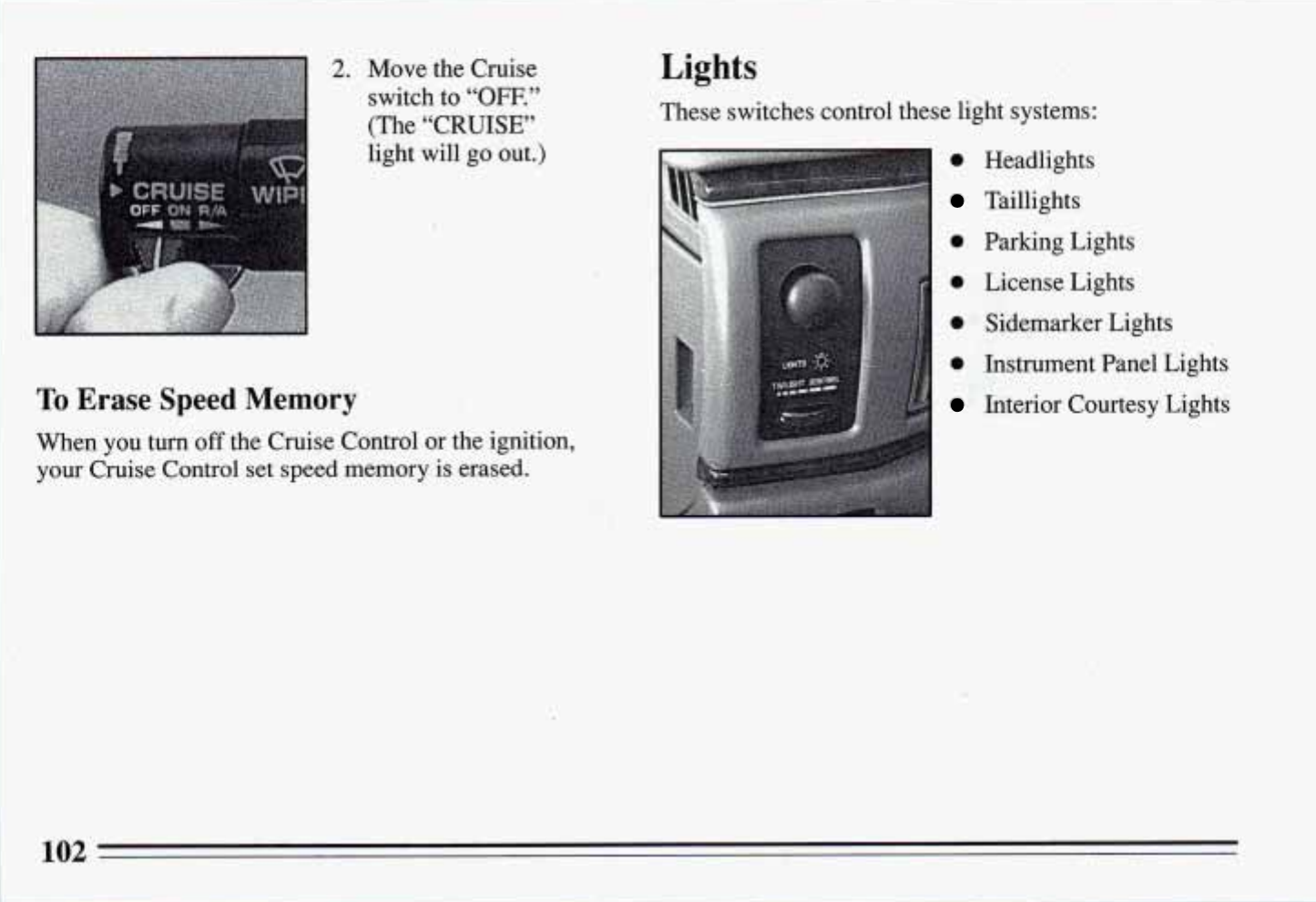
To
Erase
Speed
Memory
When
you
turn
off
the Cruise Control or the ignition,
your Cruise Control set speed memory is erased.
Lights
These switches control these
light systems:
0
Headlights
Taillights
0
Parking Lights
0
License Lights
0
'Sidemarker Lights
0
Instrument Panel Lights
. Interior Courtesy Li.ghts
102
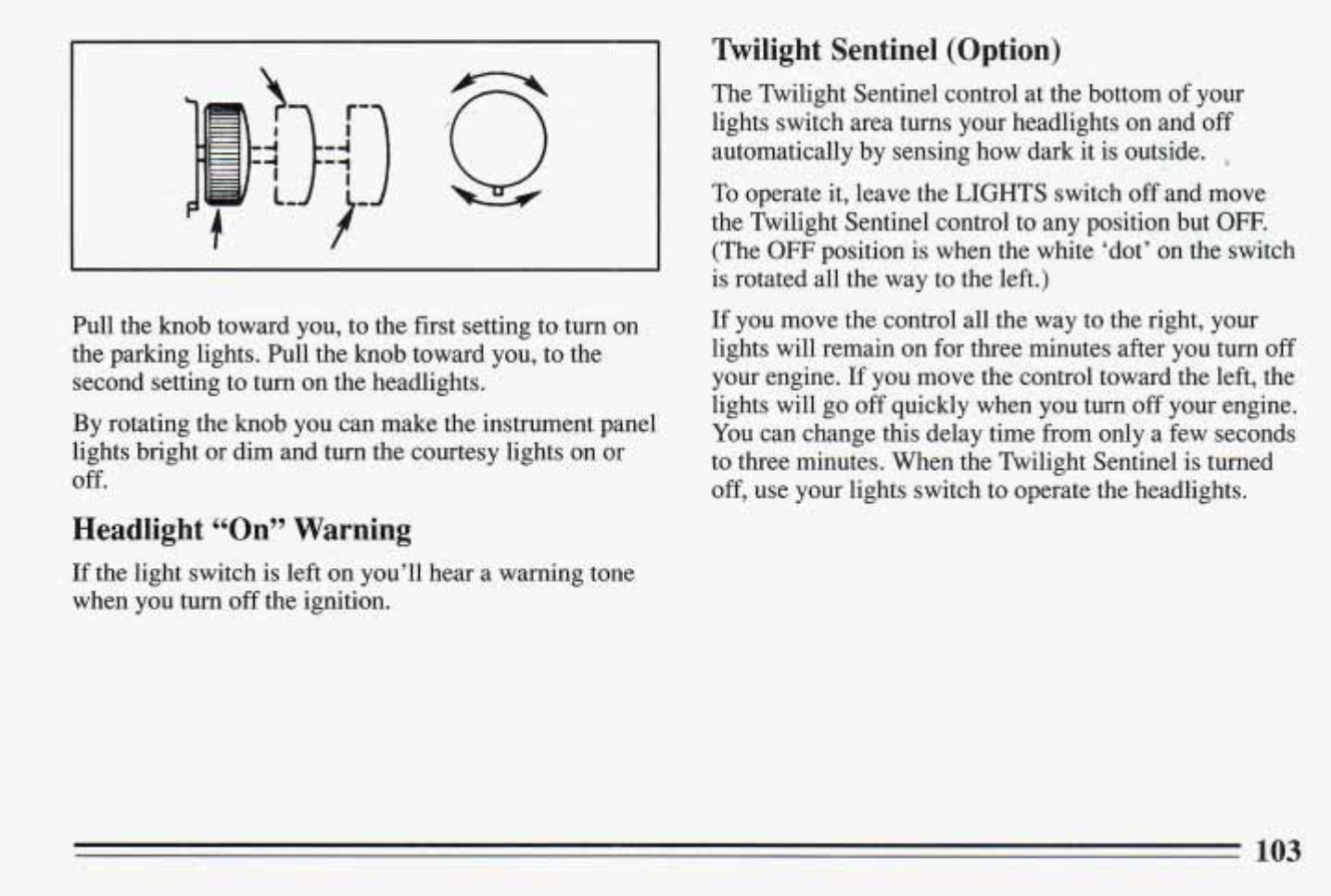
Pull the knob toward you, to the first setting to turn on
the parking lights. Pull the knob toward you, to the
second setting to
turn
on the headlights.
By rotating the knob you can make the instrument panel
lights bright or dim and turn the courtesy lights on or
off.
Headlight “On” Warning
If the light switch
is
left on you’ll hear a warning tone
when you turn
off
the igniti,on.
Twilight Sentinel (Option)
The Twilight Sentinel control at the bottom of your
lights switch area turns your headlights on and
off
automatically by sensing how dark it
is
outside.
To operate it, leave the LIGHTS switch off and move
the Twilight Sentinel control to any position but
OFF.
(The
OFF
position is when the white ‘dot’ on the switch
is rotated all the way to the left.)
If you move the control all the way to the right, your
lights will remain on for three minutes after you turn
off
your engine. If you move the control toward the left, the
lights will go off quickly when you turn
off
your engine.
You can change this delay time from only a few seconds
to three minutes. When the Twilight Sentinel is turned
off,
use your lights switch to operate the headlights.
103
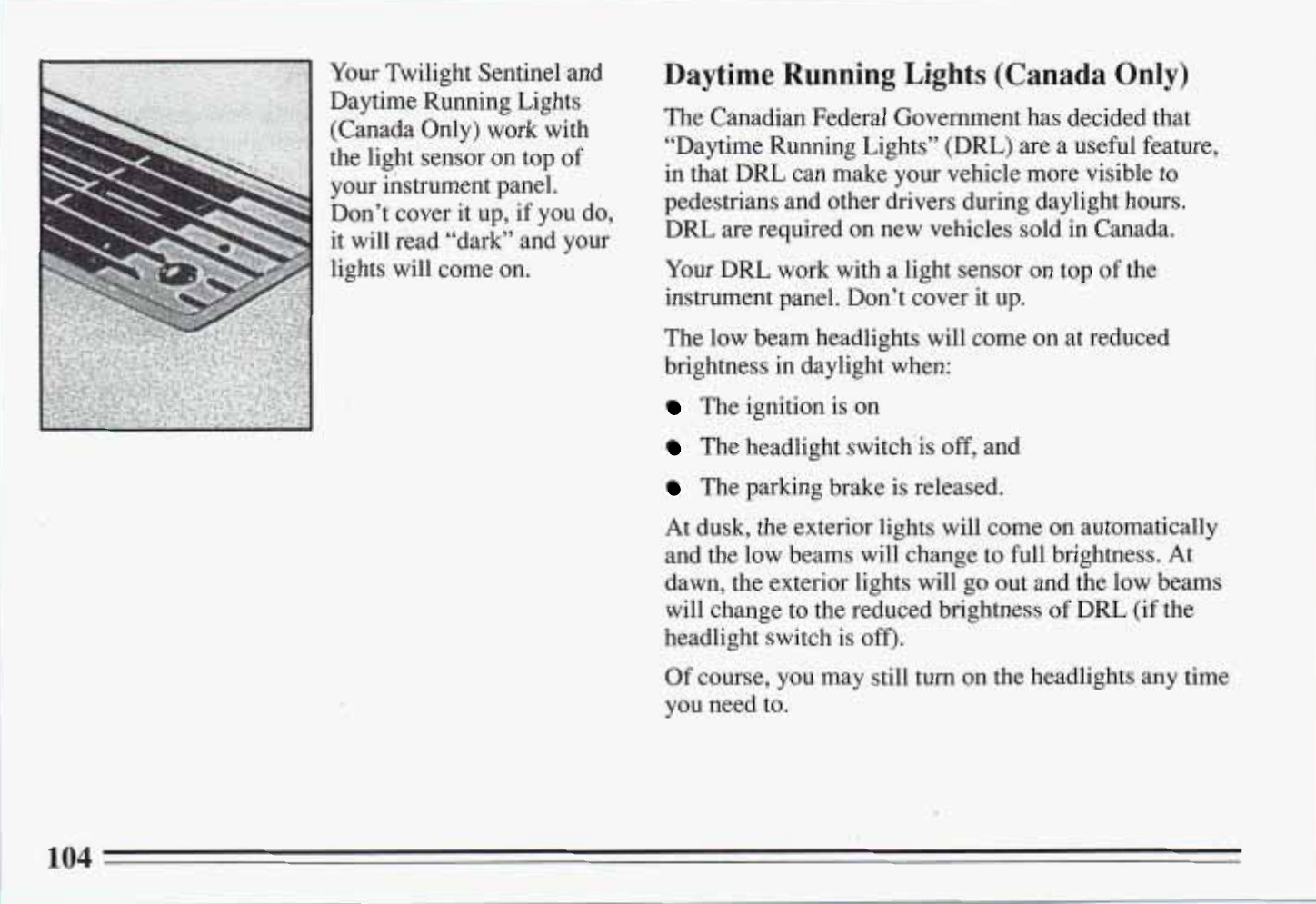
Your Twilight Sentinel.,and
Daytime Running Lights
(Canada Only)
work
with
the light sensor on top
of
your instrument panel.
Don’t cover it up, if you do,
it
will
read ‘‘dark” and your
lights will
come
on.
Daytime Running Lights (Canada Only)
The Canadian Federal Government has decided that
“Daytime Running Lights” (DRL) are a usehl feature,
in that DRL can make your vehicle more visible to
pedestrians and other drivers during daylight hours.
DRL are required on new vehicles sold in Canada.
Your DRL work with a light sensor on top of the
instrument panel. Don’t cover
it
up.
The low beam headlights will come on at reduced
brightness in daylight when:
The ignition is on
The headlight switch’is
off,
and
The parking brake is released.
At dusk, the exterior lights will come on automatically
and the low beams will change to full brightness. At
dawn, the exterior lights will
go out and the low beams
will change to the reduced bdghtness of
DRL
(if the
headlight switch is
off).
Of
course, you may still turn on the headlights any time
you need to.
I
104
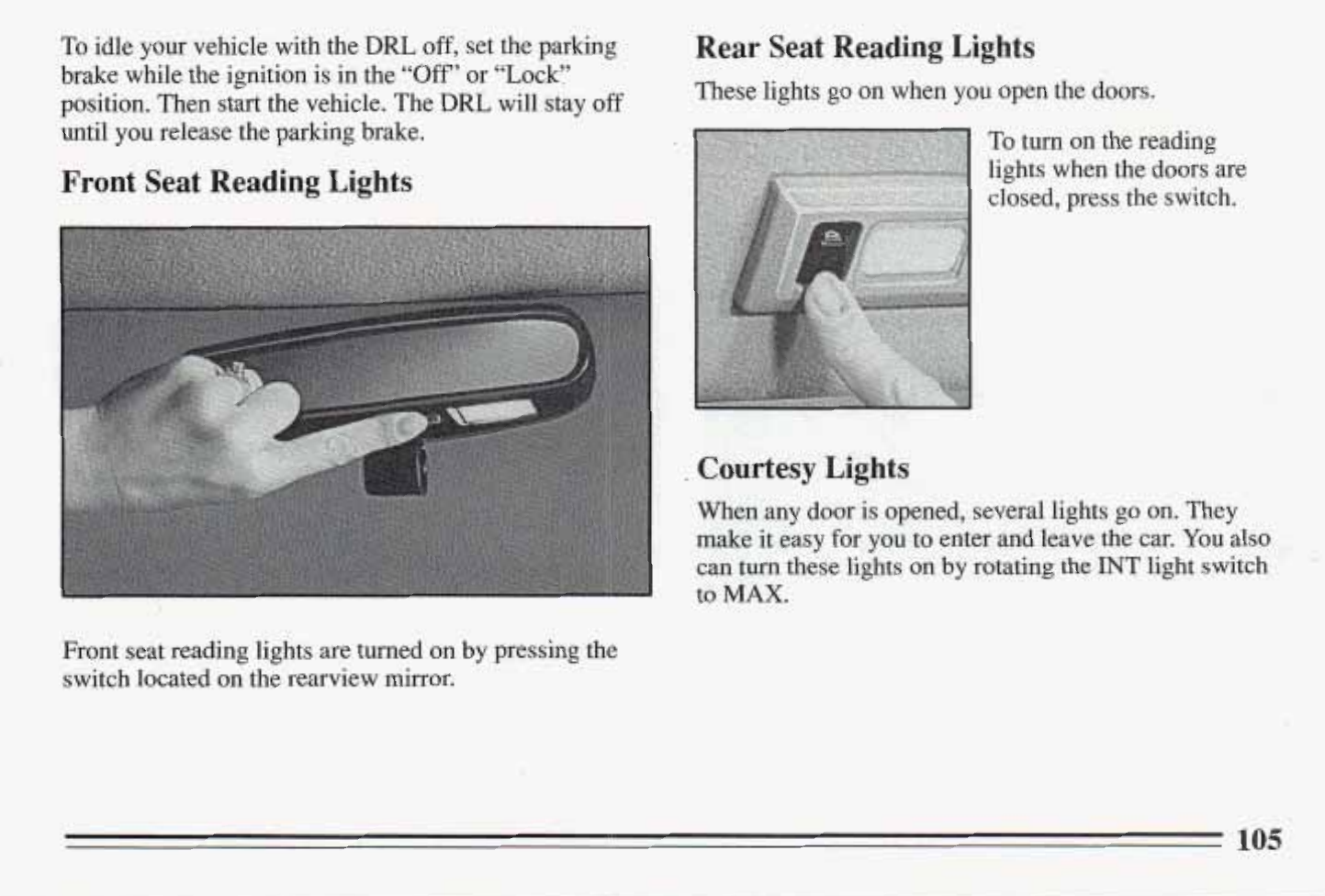
To
idle your vehicle with the
DRL
off,
set the parking
brake while the ignition is in the
“Off”
or “Lock’’
position. Then start the vehicle. The
DRL
will stay
off
until you release the parking brake.
Rear Seat Reading Lights
These lights go on when you open the doors.
Front Seat Reading Lights
Front seat reading lights are turned on by pressing the
switch located on the rearview
mirror.
To
turn on the reading
lights when the doors are
closed, press the switch.
Courtesy Lights
When
any
‘door is opened, several lights go on. They
make it easy for you to enter and leave the car.
You
also
,can turn these lights
on
by
rotating the
INT
light switch
to
MAX.
105
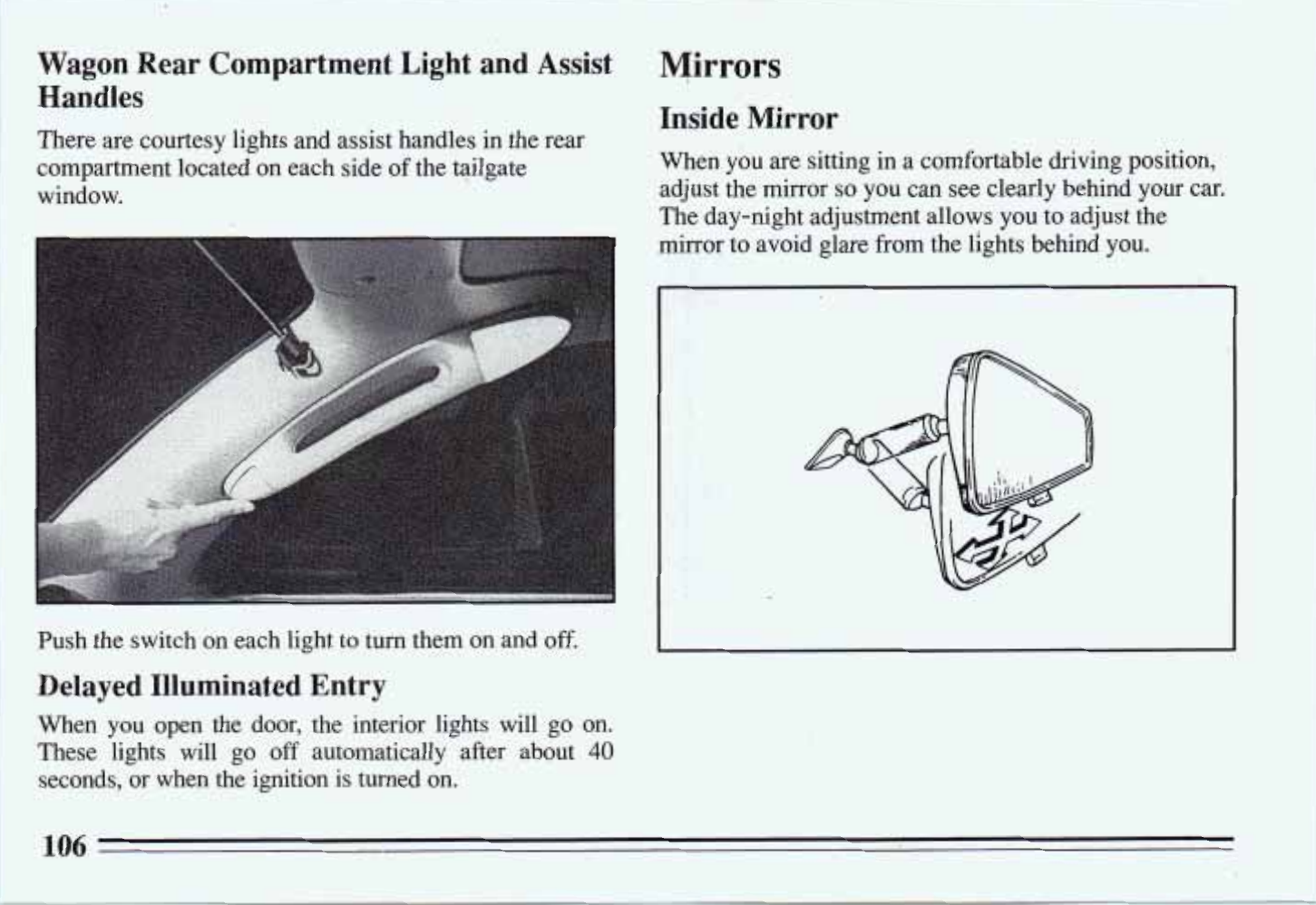
Wagon Rear Compartment
.Light
and Assist
Handles
I.
There are courtesy lights and assist handles in the rear
compartment located on each side
of the tailgate
window.
Push the switch on each light to turn them on and
off.
Delayed Illuminated Entry
When you open the door, the interior lights will go on.
These lights will go
off
automatically after about
40
seconds, or when the ignition is turned on.
Mirrors
Inside
Mirror
When you are sitting in a comfortable driving position,
adjust the mirror
so
you can see clearly behind your car.
The day-night adjustment allows you to adjust the
mirror to avoid glare from the lights behind you.
106
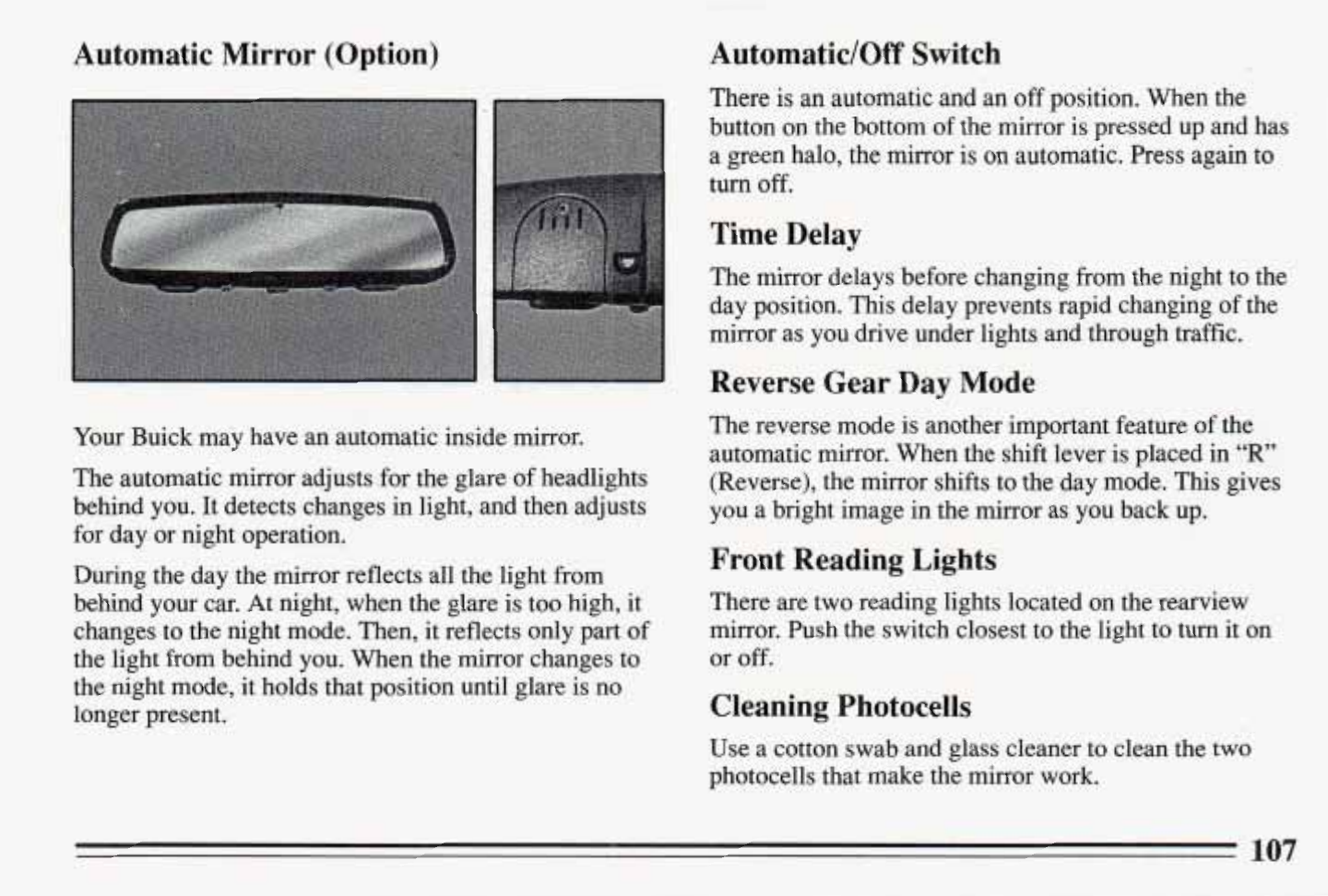
Automatic Mirror (Option)
Your Buick may have an automatic inside mirror.
The automatic mirror adjusts .for the glare of headlights
behind you. It detects changes
in
light, and then adjusts
for day or night operation.
During the day the mirror reflects all the light fkom
behind your car. At night, when the glare is too high, it
changes to the night mode. Then, it reflects only part
of
the light from behind you. When the mirror changes to
the night mode,
it
holds that position until glare is no
longer present.
Automatidoff Switch
There is an automatic and an
off
position. When the
button on the bottom of the mirror is pressed up and has
a
green halo, the mirror is on automatic.
Press
again
to
turn
off.
Time Delay
The mirror delays before changing from the night to the
day position. This delay prevents rapid changing of the
mirror as ,you drive under lights and through traffic.
Reverse Gear Day Mode
The reverse mode is another important feature of the
automatic mirror. When the shift lever is placed in “R”
(Reverse), the mirror shifts
to the day mode. This gives
you
a
bright image in the mirror as you back up.
Front Reading Lights
There are two reading lights located on the rearview
mirror. Push the switch closest to the light to
turn
it on
or off.
Cleaning Photocells
Use a cotton swab and glass cleaner to clean the two
photocells that make the mirror work.
107
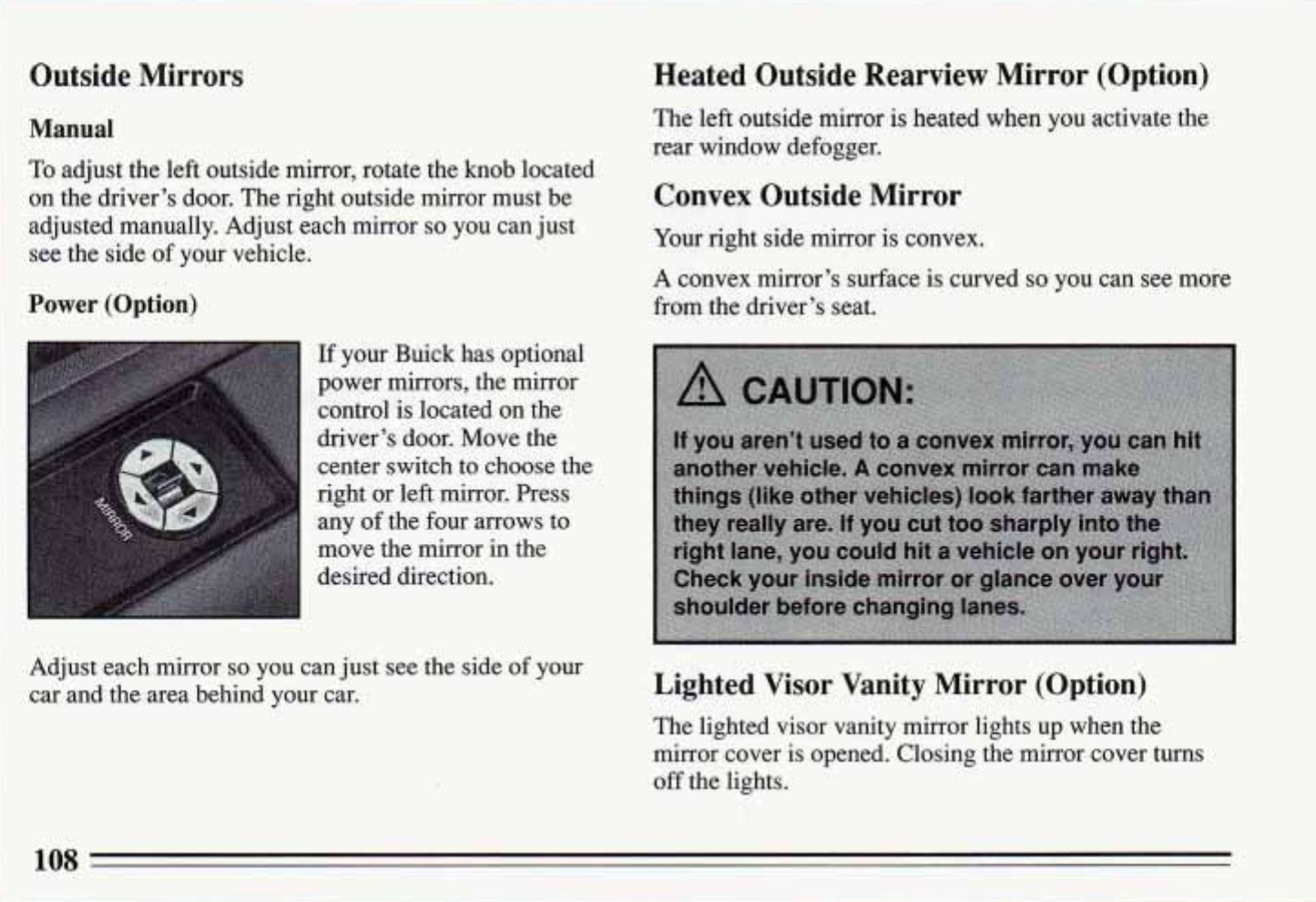
I
Outside Mirrors
!
Manual
To adjust the left outside mirror, rotate the knob located
on the driver’s door. The right outside mirror must be
adjusted manually. Adjust each mirror
so
you can just
see the side of your vehicle.
Power
(Option)
~
If
your Buick has optional
power mirrors, the mirror
control is located on the
driver’s door. Move the
center switch to choose the
right or left mirror. Press
any of the four arrows to
move the mirror in the
I
desired direction.
1
Adjust each mirror
so
you can just see the side of
your
car and the area behind your car.
Heated Outside
Rearview
Mirror (Option)
The left outside mirror is heated
when
you activate the
rear window defogger.
Convex Outside Mirror
Your right side mirror is convex.
A convex mirror’s surface is curved
so
you can see more
from the driver’s seat.
Lighted Visor Vanity Mirror (Option)
The lighted visor vanity mirror lights up when the
mirror cover is opened. Closing the mirror cover turns
off the lights.
10s
I
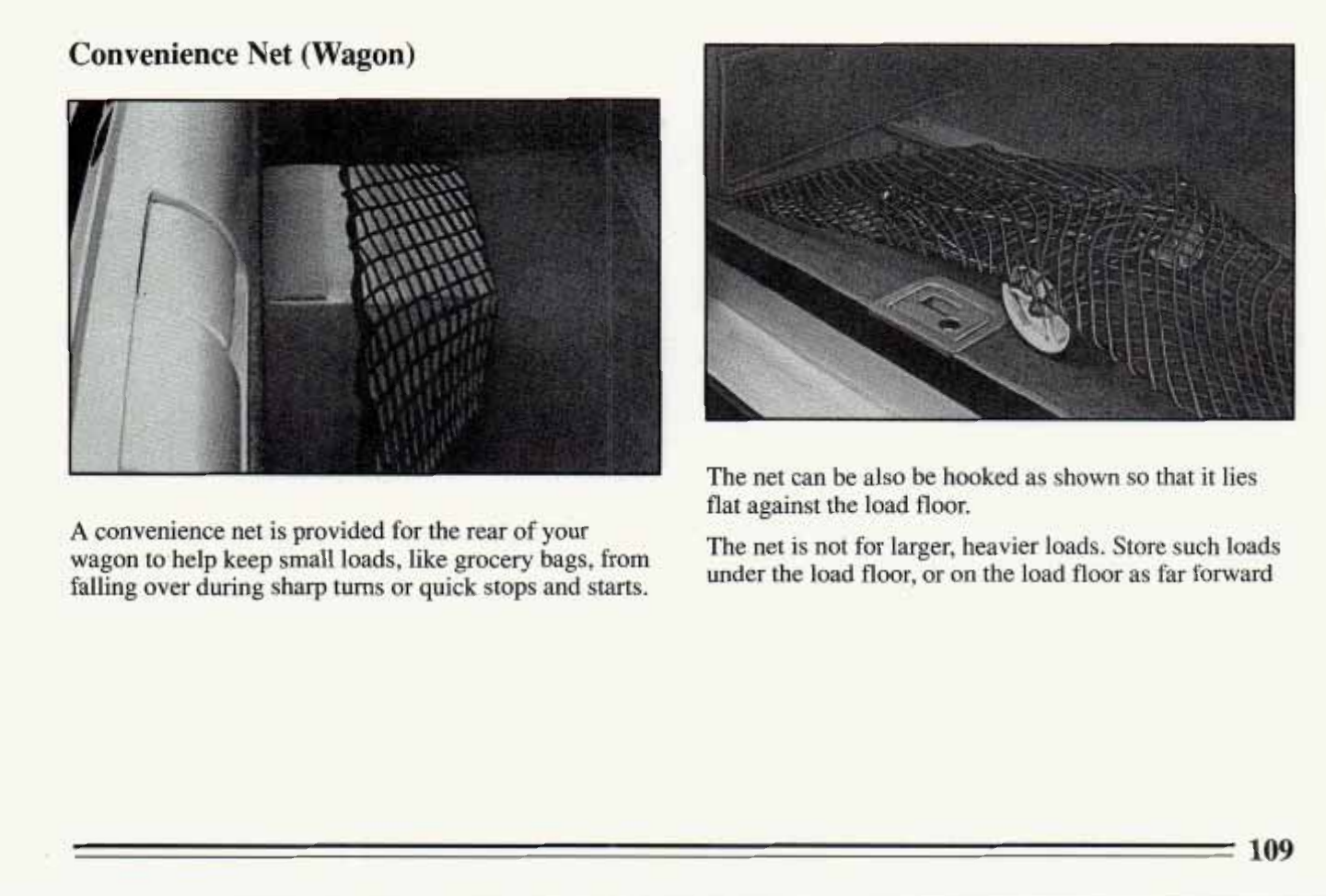
Convenience
Net
(Wagon)
A
convenience net is provided for the rear
of
your
wagon to,help keep small loads, like grocery bags,
from
falling over during sharp turns or quick
stops
and
starts.
r
The net can be also be hooked as shown
so
that it lies
flat against the load floor.
The net
is
not
for larger, heavier loads. Store such loads
under the load floor, or on the load floor as far forward
109
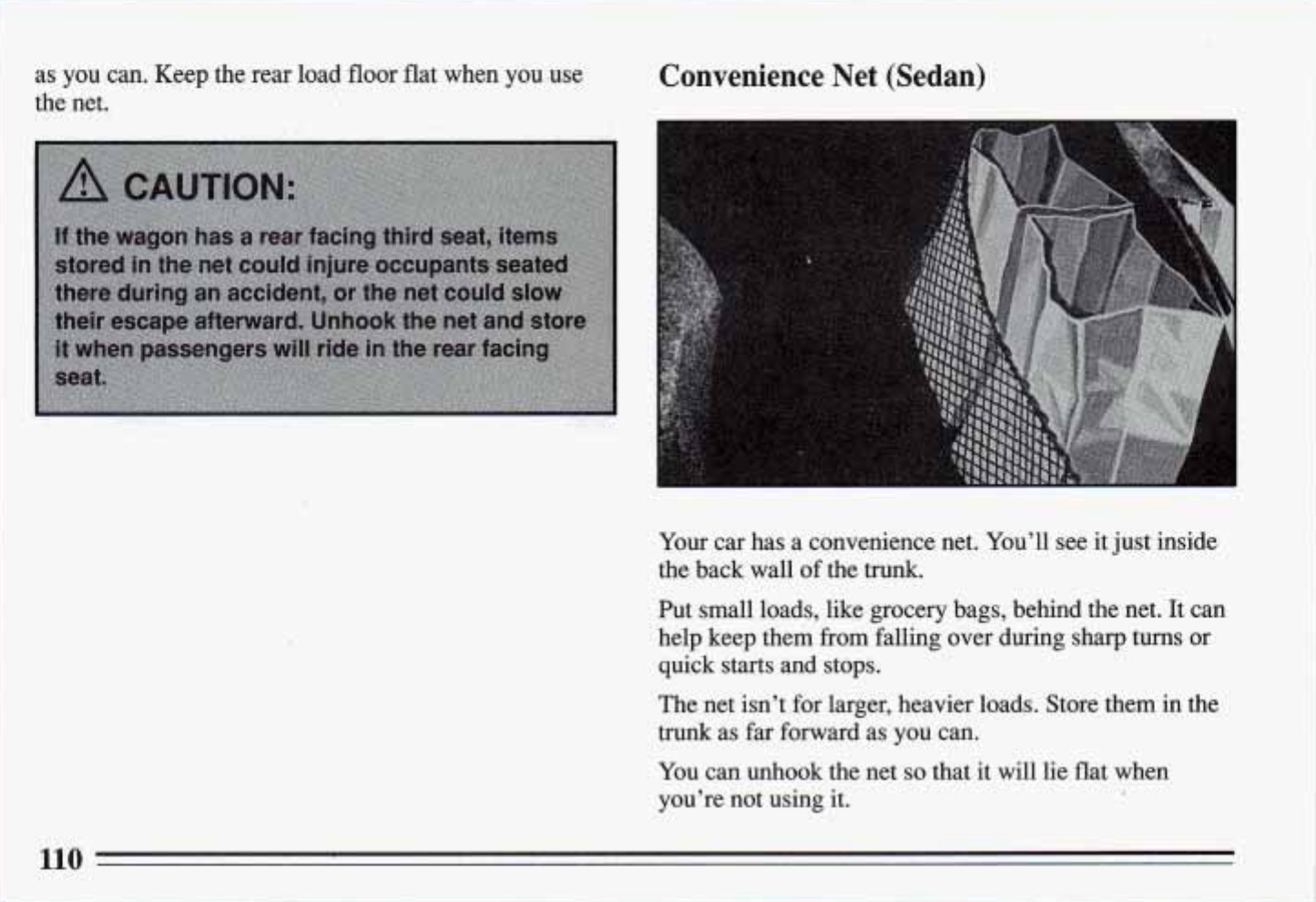
as
you
can. Keep
the
rear
load
floor
flat
when
youme
.
.
:
the
net.
Convenience Net (Sedan)
Your
car has a convenience net.
You’ll
see it just inside
the back wall of the
trunk.
Put
small loads, like grocery bags, behind the net. It can
help keep them from falling over during sharp turns or
quick
starts
and stops.
The net isn’t for larger, heavier loads. Store them in the
trunk
as far forward as you can.
You
can unhook the
net
so
that it will lie flat when
you’re not using it.
110
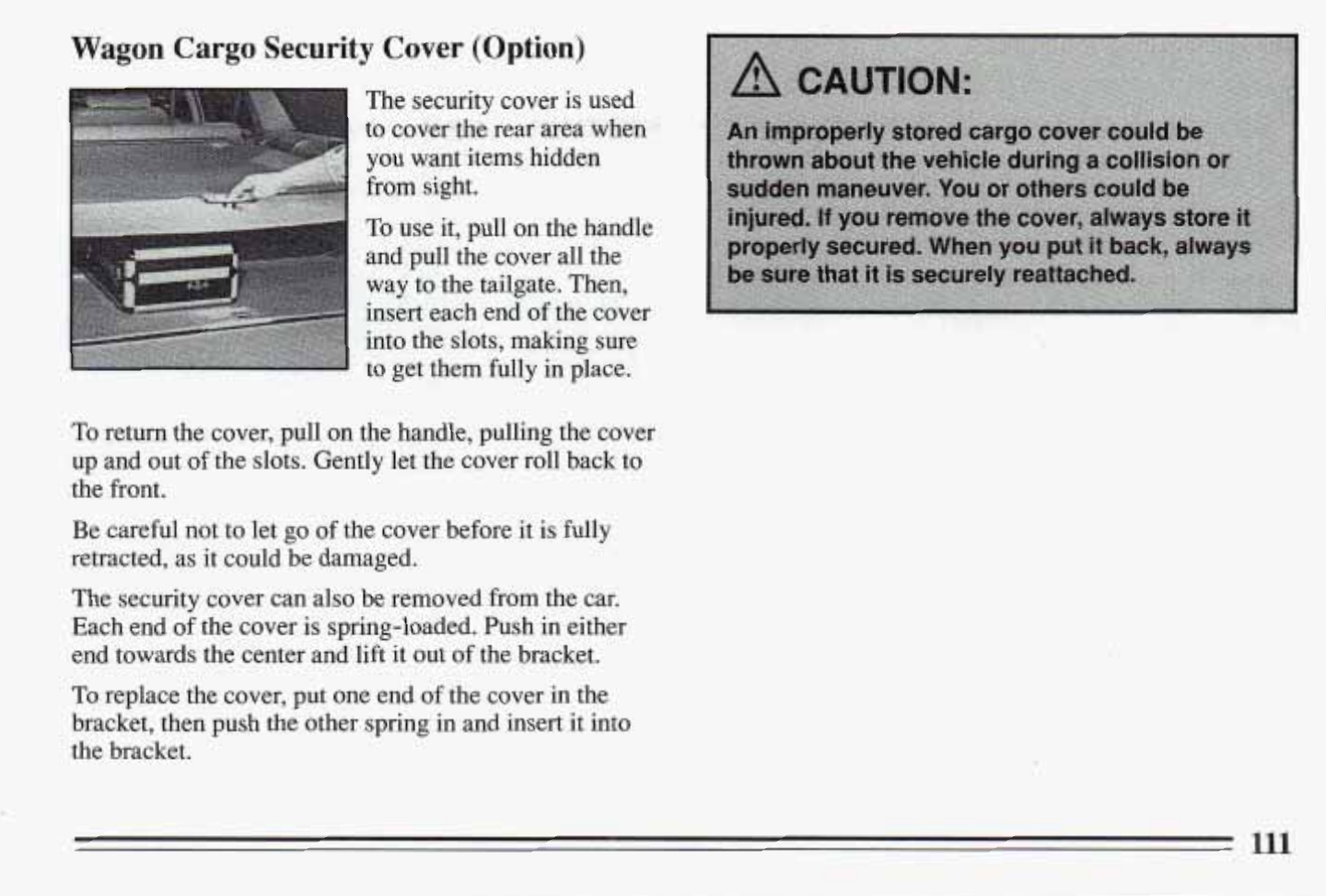
Wagon
Cargo
Security Cover (Option)
The security cover
is
used
to coverthe rear area
when
w%T<y&;
you want items hidden
from
sight.
To
use it, pull on~the handle
and pull the' cover all the
way
to
the tailgate. Then,
insert each end of the cover
into the slots, making sure
to get them fully
in
place.
To return the cover, pull on the handle, pulling the cover
up and out of the slots. Gently let the cover roll back to
.the front.
Be careful not to let go of the cover before
it
is fully
retracted, as it could be damaged.
The security cover can also be removed from the car.
Each end of the cover is spring-loaded. Push in either
end towards the center and lift it out of the bracket.
To replace the cover, put one end of the cover in the
bracket, then push the other spring
in and insert it into
the bracket.
111
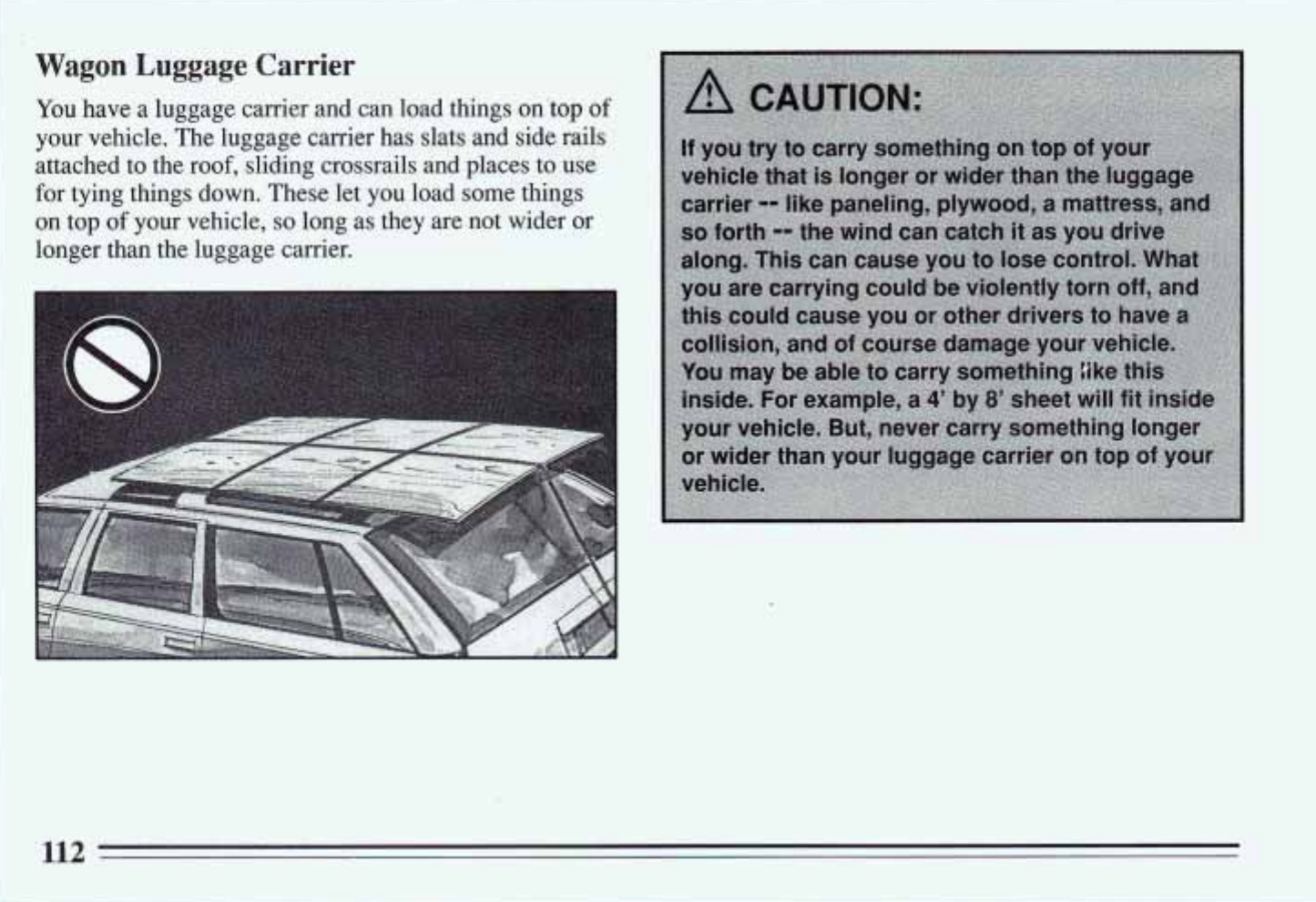
Wagon
Luggage Carrier
You
have a luggage carrier and can load things on’top
of
your
vehicle. The luggage carrier has slats and side rails
attached to the roof, sliding crossrails and places
to
use
for tying things down. These let you load some things
on top
of
your vehicle,
so
long as they are not wider or
longer than the luggage carrier.
I
!
112
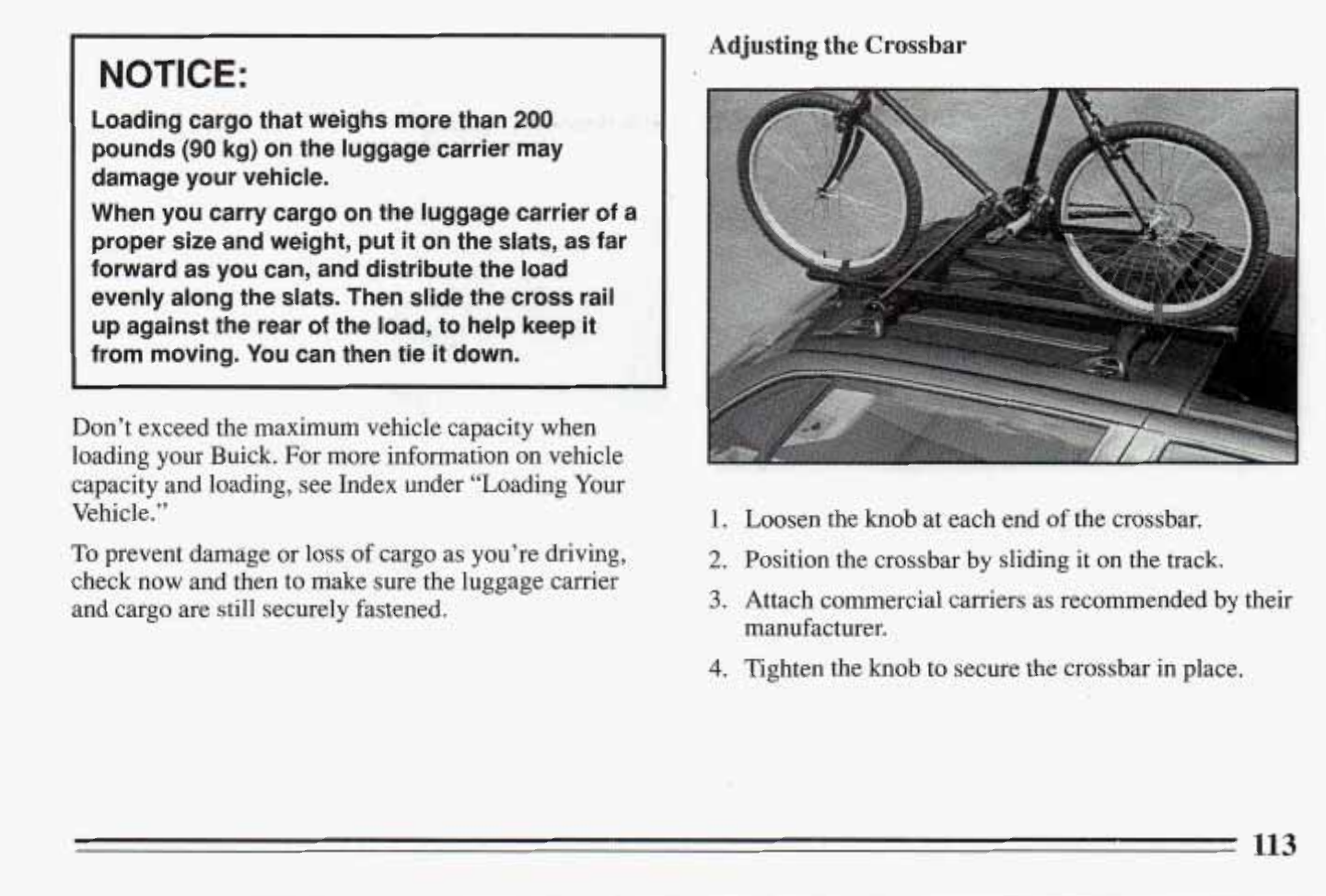
L
NOTICE:
Don’t exceed the maximum vehicle capacity when
loading your Buick. For more information on vehicle
capacity and loading, see Index under “Loading Your
Vehicle.”
To prevent damage or
loss
of cargo as you’re driving,
check now and then to make sure the luggage carrier
and cargo are still securely fastened.
Loading cargo that weighs more than
200.
pounds
(90
kg) on the luggage carrier may
damage your vehicle.,
When you carry cargo on the luggage carrier
of
a
proper size and weight, put it on the slats, as far
forward as you can, and distribute the load
evenly along the slats. Then slide the cross rail
up against the rear
of
the load, to help keep
it
from moving. You can then tie
it
down.
Adjusting
the
Crossbar
1.
Loosen the knob at each end
of
the crossbar.
2.
Position the crossbar by sliding it on the track.
3.
Attach commercial carriers as recommended by their
manufacturer.
4.
Tighten the knob to secure
the
crossbar in place.
113
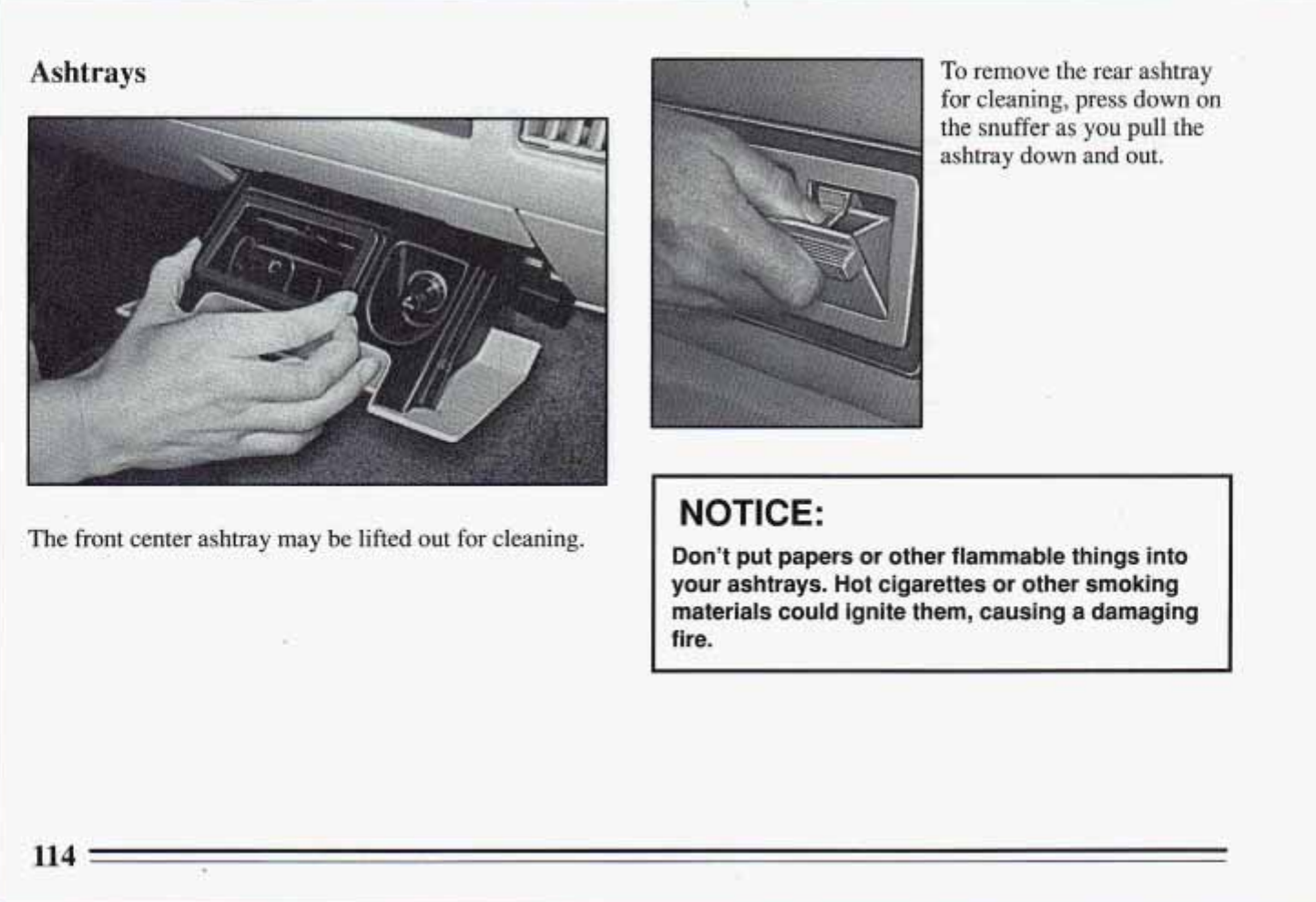
Ashtrays
The front center ashtray may be lifted out for cleaning.
To remove the rear ashtray
for cleaning, press down on
the
snuffer
as
you
puU.
the
ashtray down and out.
NOTICE:
Don’t put papers or other flammable things into
your ashtrays. Hot cigarettes or other smoking
materials could ignite them, causing
a
damaging
fire.
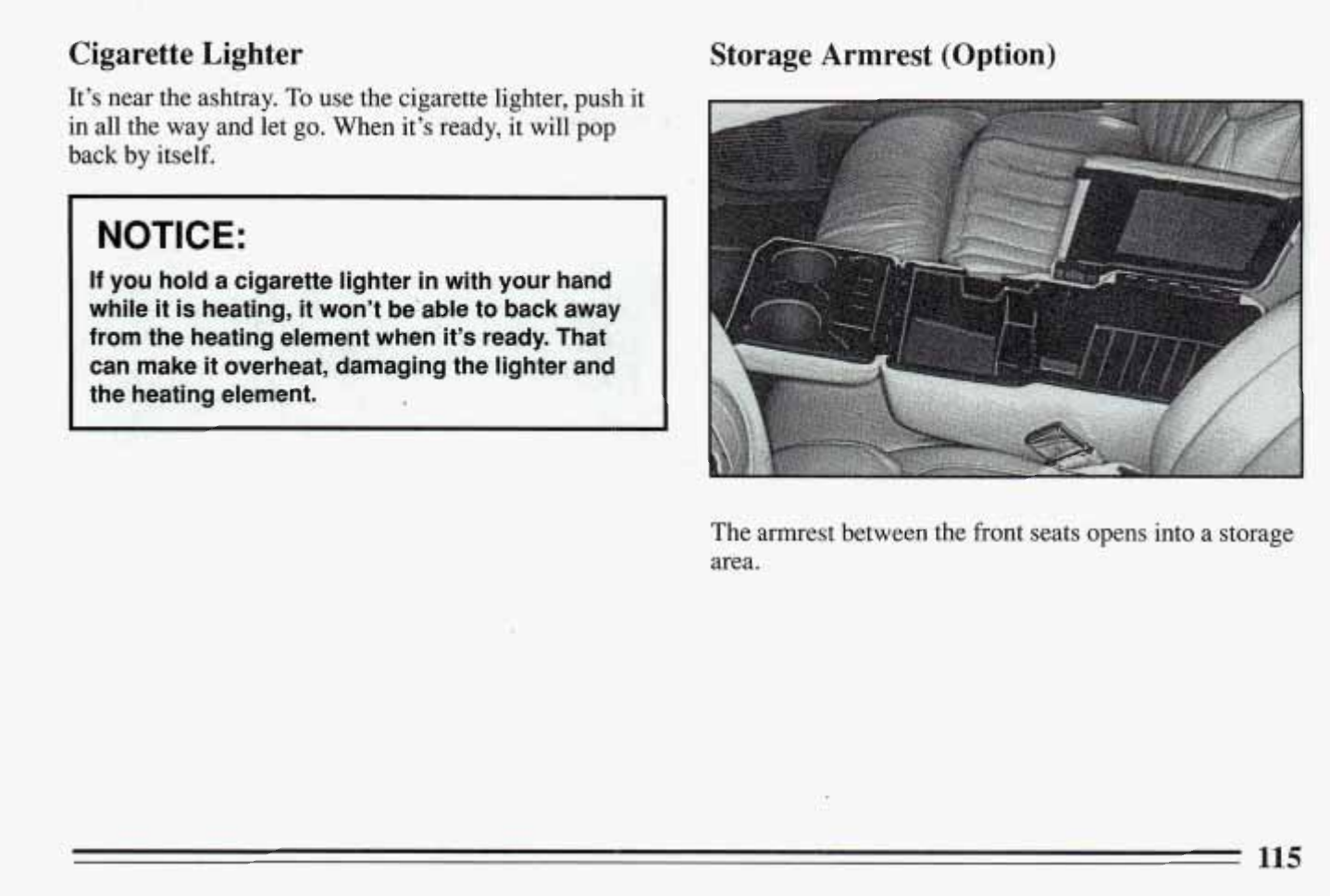
Cigarette Lighter
It’s near the ashtray. To use the cigarette lighter, push it
in
all the way and let go. When it’s ready, it will
pop
back by itself.
..
.k
!*
NOTICE:
If
you
h’old a cigarette lighter in with your hand
while it
is
heating, it won’t beable to back away
from the heating element when it’s ready. That
can make it overheat, damagling the lighter and
the heating element.
..
.r
Storage Armrest (Option)
I
The armrest between the front seats opens into a storage
area.
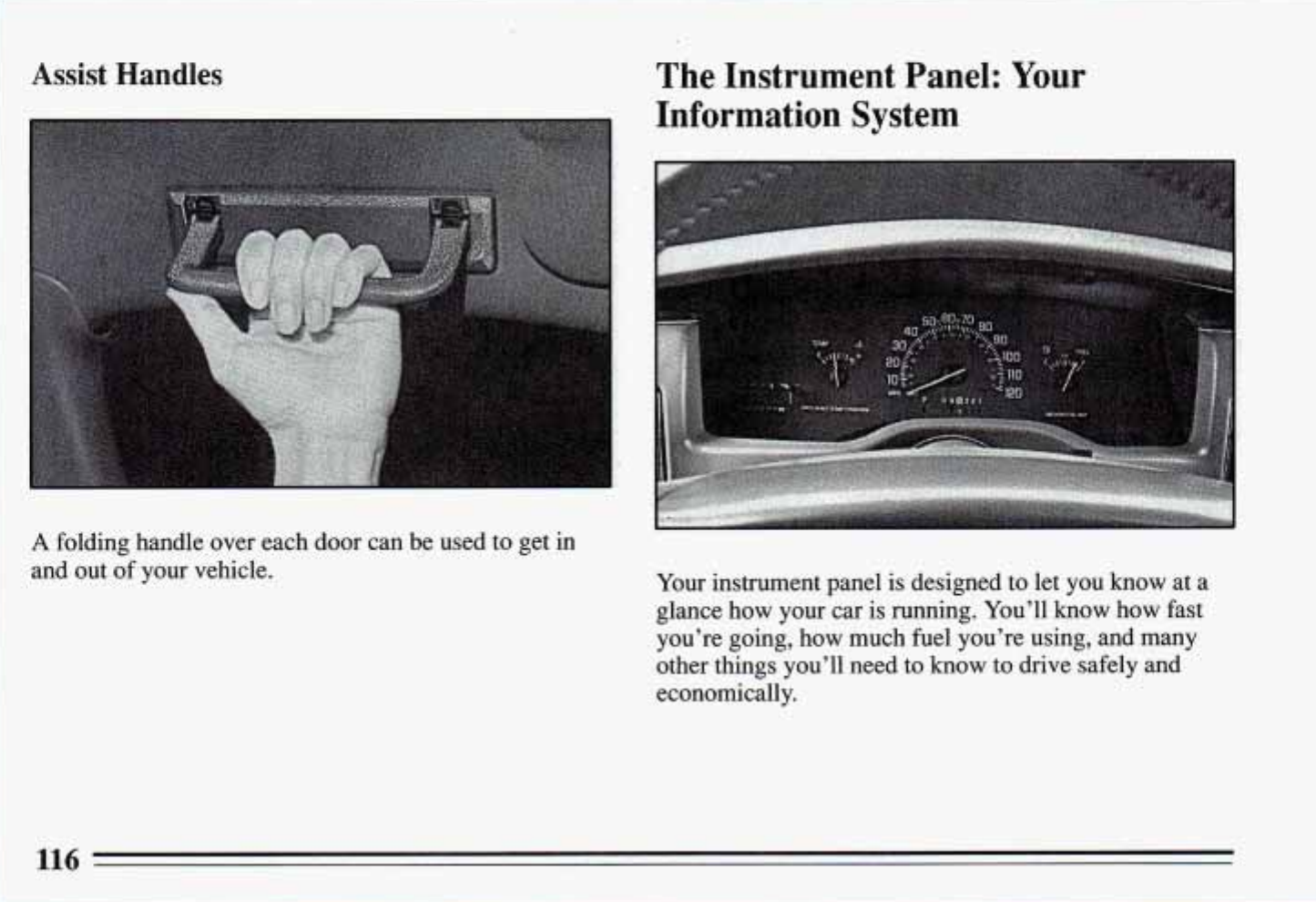
Assist
Handles
The
Instrument Panel: Y0u.r
Enformation
System
A
folding handle over each door can be used to get in
and out
of
your vehicle. Your instrument panel is designed to let you know at a
glance how your car is
running.
You’ll
know
how fast
you’re
going,
how much fuel you’re using, and many
other things you’ll need to know to drive safely and
economically.
116
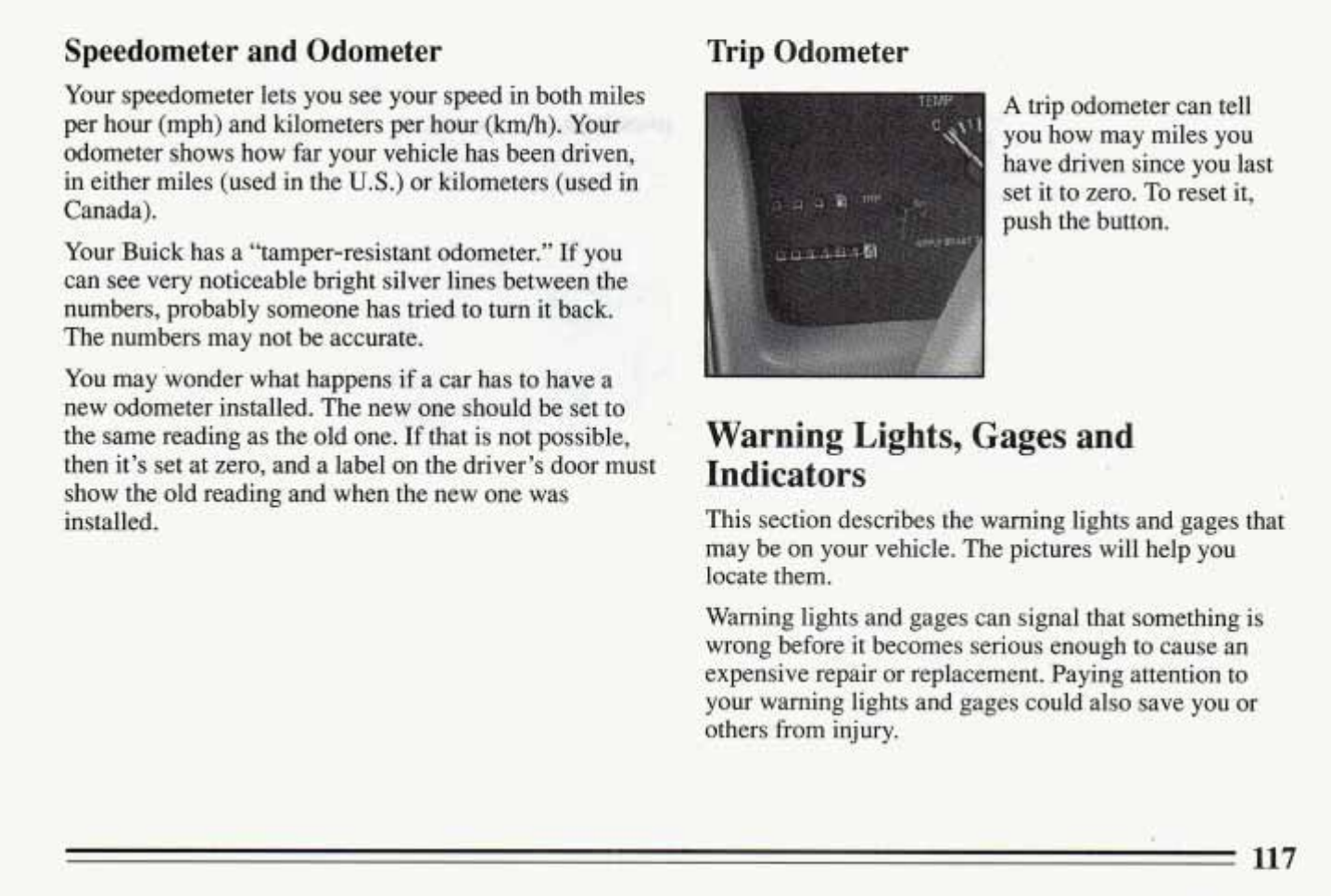
Speedometer and Odometer
Your speedometer lets
you
see your speed in both miles
per hour (mph) and kilometers per. hour..(km/h),
:YQW-~
’:
.
-
’
odometer shows how far your vehicle has been driven,
in either miles (used in the
U.S.)
or
kilometers (used in
Canada).
Your Buick has a “tamper-resistant odometer.” If you
can see very noticeable bright silver lines between the
numbers, probably someone has tried to turn it back.
’
The numbers may not be accurate.
You
may ‘wonder what happens if a car has to have a
new odometer installed. The new one should be set to
the same reading as the old one. If that is not possible,
then .it’s set at zero, and
a
label on the driver’s door must
show the old reading and when the new one was
installed.
Trip Odometer
A
trip odometer can tell
you how may miles
you
have driven since you last
set it to zero. To reset it,
push the button.
Warning Lights, Gages and
Indicators
This section describes the warning lights and gages that
may be on your vehicle. The pictures will help you
locate them.
Warning lights and gages can signal that something is
wrong before it becomes serious enough to cause an
expensive repair
or
replacement. Paying attention to
your warning lights and gages could also save you or
others from injury.
117
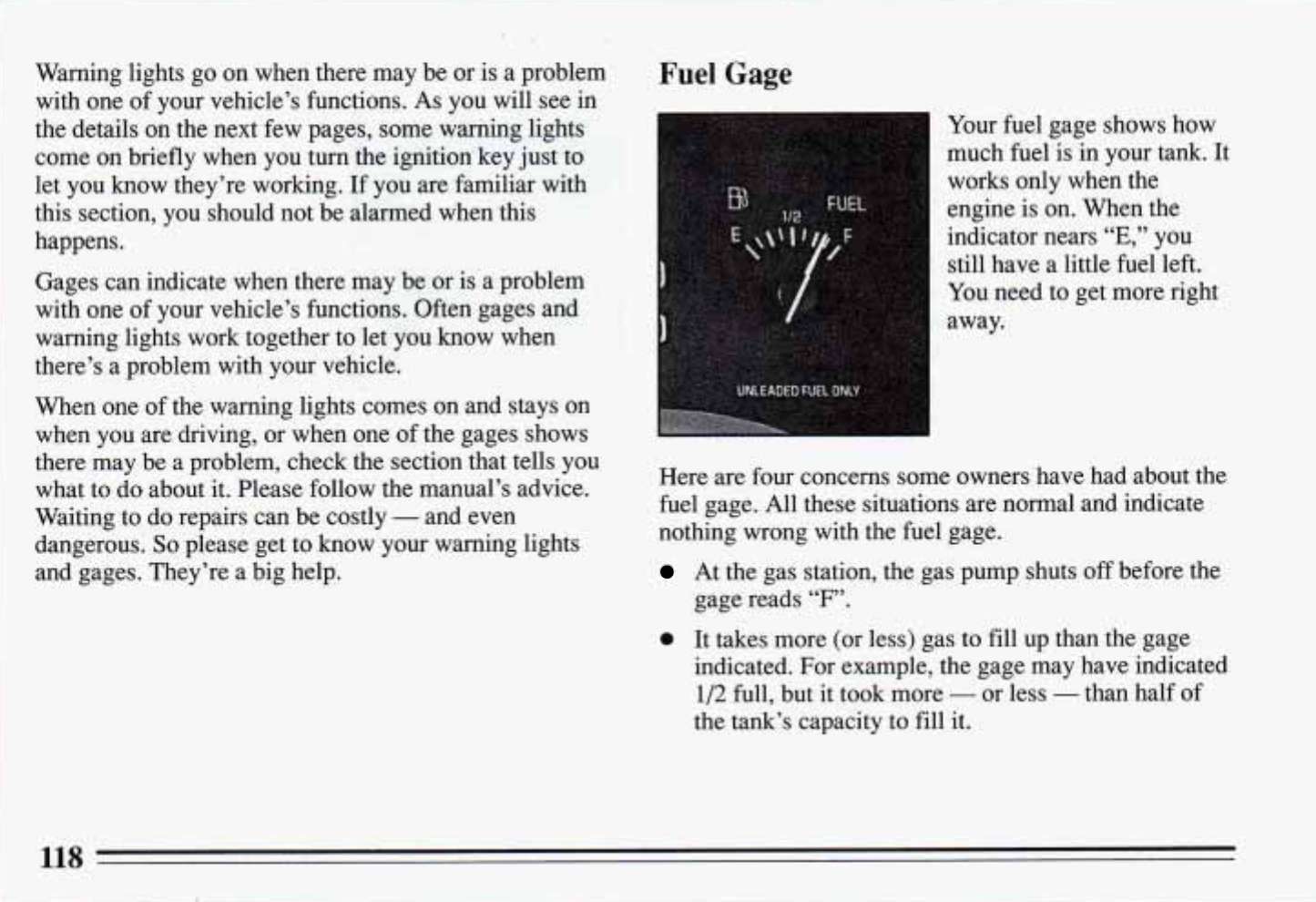
Warning lights go on when there may be or is a problem
with one of your vehicle’s functions.
As
you will see in
the details on the next few pages, some warning lights
come on briefly when you turn the ignition.key just
to
let you know they’re working. If you are familiar with
this section, you should not be alarmed when this
happens.
Gages can indicate when there may be or is a problem
with one of your vehicle’s functions. Often gages and
warning lights work together to let you know when
When one of the warning lights comes on and stays on
when you are driving, or when one of the gages shows
there may be
a
problem, check the section that tells you
what to
do
about it. Please follow the manual’s advice.
Waiting to do repairs can be costly
-
and even
dangerous.
So
please get to know your warning lights
and gages. They’re a big help.
j
there’s a problem with your vehicle.
Fuel Gage
Your fuel gage shows how
much fuel is in your
tank.
It
works only when the
engine is on. When the
indicator nears
“E,”
you
still have a little fuel left.
You need to get more right
away.
Here are four concerns some owners have had about the
fuel gage. All these situations are normal and indicate
nothing wrong with the fuel gage.
At the gas station, the gas pump shuts
off
before the
0
It
takes more (or less) gas to
fill
up than the gage
gage reads
“F”.
indicated. For example, the gage may have indicated
1/2
full, but it took more
-
or less
-
than half of
the tank’s capacity to fill it.
118
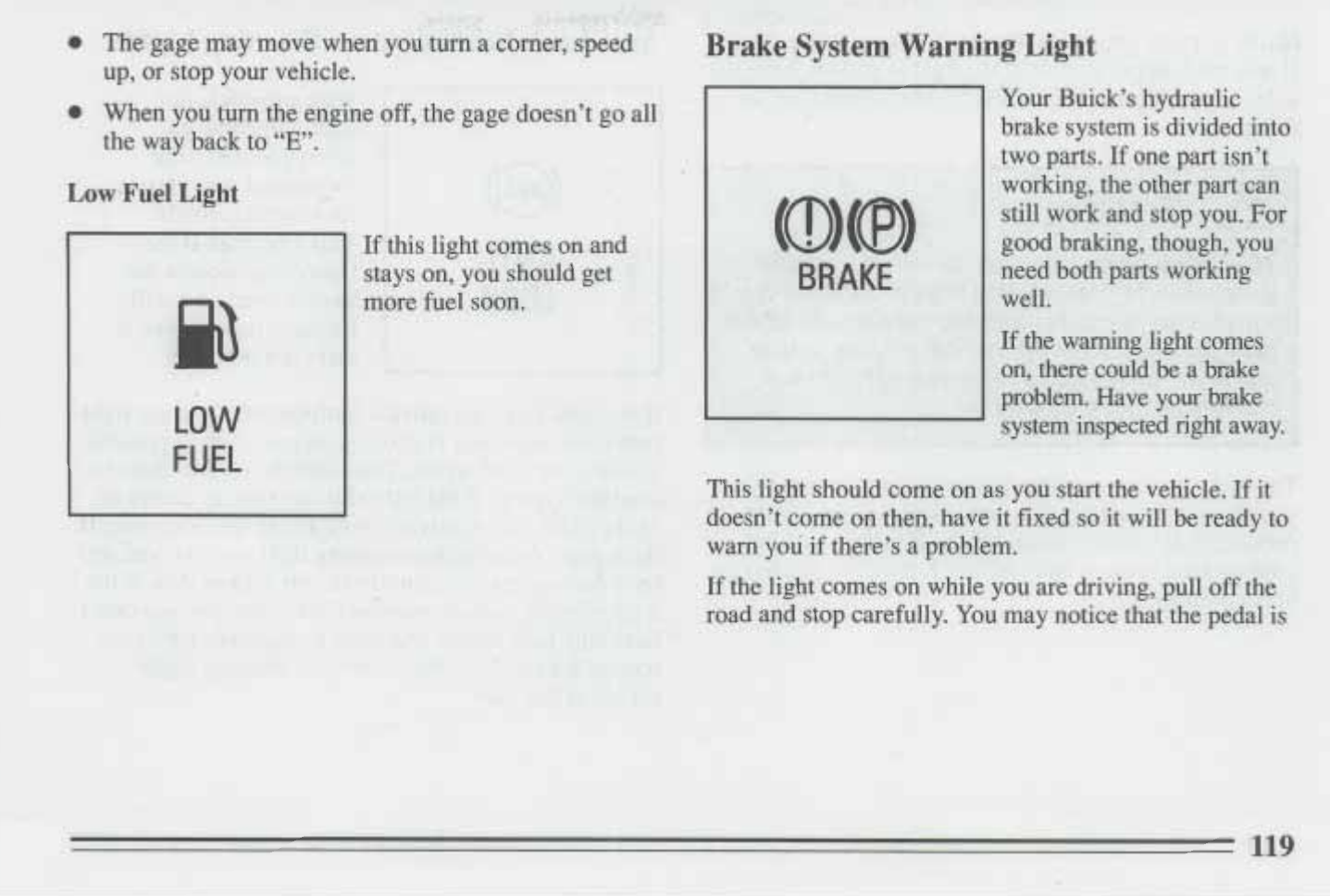
I
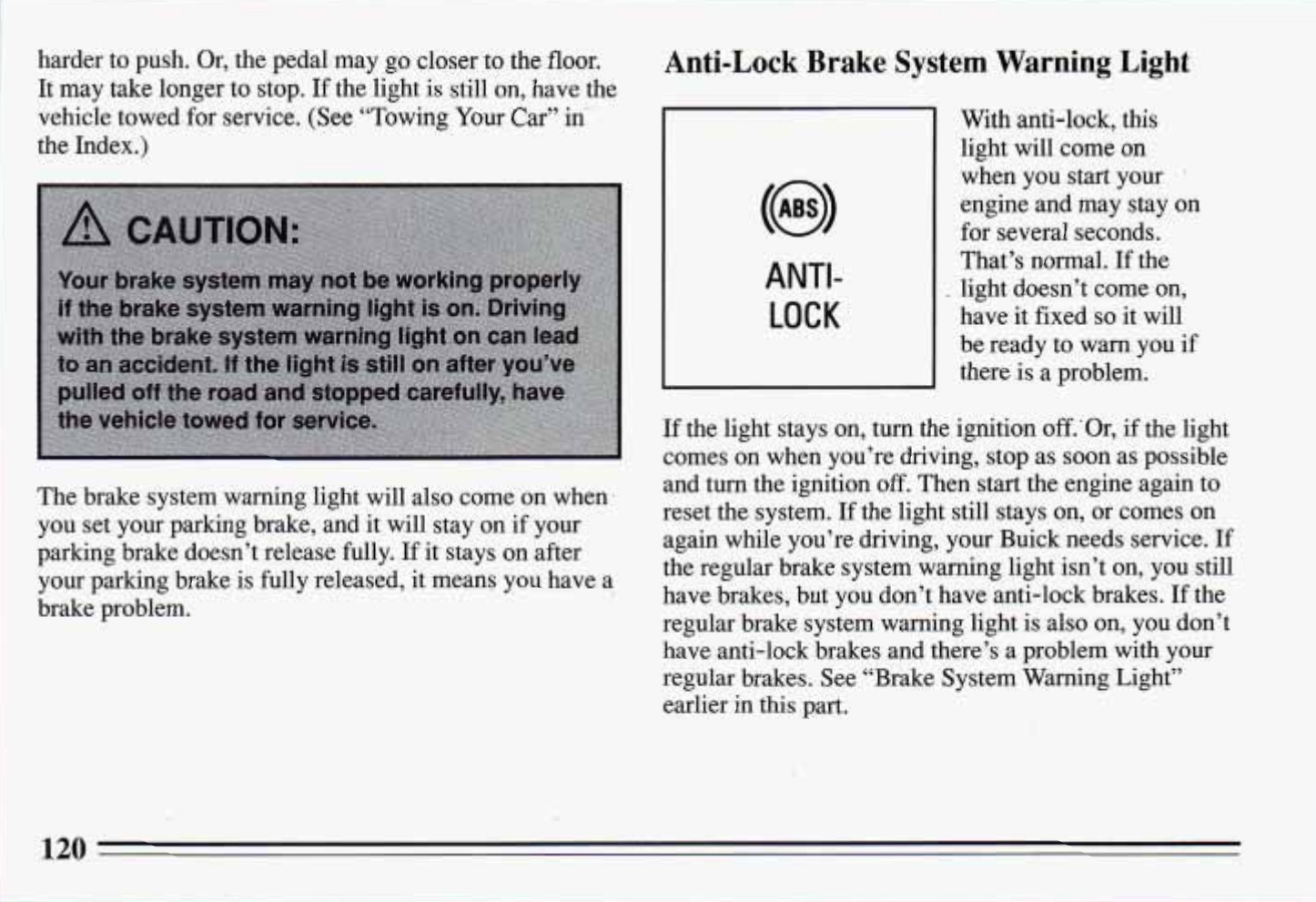
harder to push. Or, the pedal may
go
closer to the
floor.
It
may
take longer to stop. If the light is. still on, have the
vehicle towed for service. (See “Towing
Your
Car”
in-..
the Index.)
The brake system warning light will also come on when.
you set your parking brake, and it will stay on if
your
parking brake doesn’t release fully.
If
it stays on after
your parking brake is fully released, it means you have
a
brake problem.
Anti-Lock
Brake
System
Warning
Light
(@I
ANTI-
L0.C
K
With anti-lock, this
light will come on
when you start your
engine and may stay on
for several seconds.
That’s normal. If the
.
light doesn’t come on,
have it fixed
so
it
will
be ready to warn you if
there is a problem.
If the light stays on, turn the ignition off:Or, if the light
comes on when you’re driving, stop as soon as possible
and turn the ignition
off.
Then
start
the engine again to
reset the system. If the light still stays on, or comes on
again while you’re driving, your Buick needs service. If
the regular brake system warning light isn’t on, you still
have brakes, but you don’t have anti-lock brakes. If the
regular brake system warning light is also
on,
you don’t
have anti-lock brakes and there’s a problem with your
regular brakes. See “Brake System Warning Light”
earlier in this part.
120
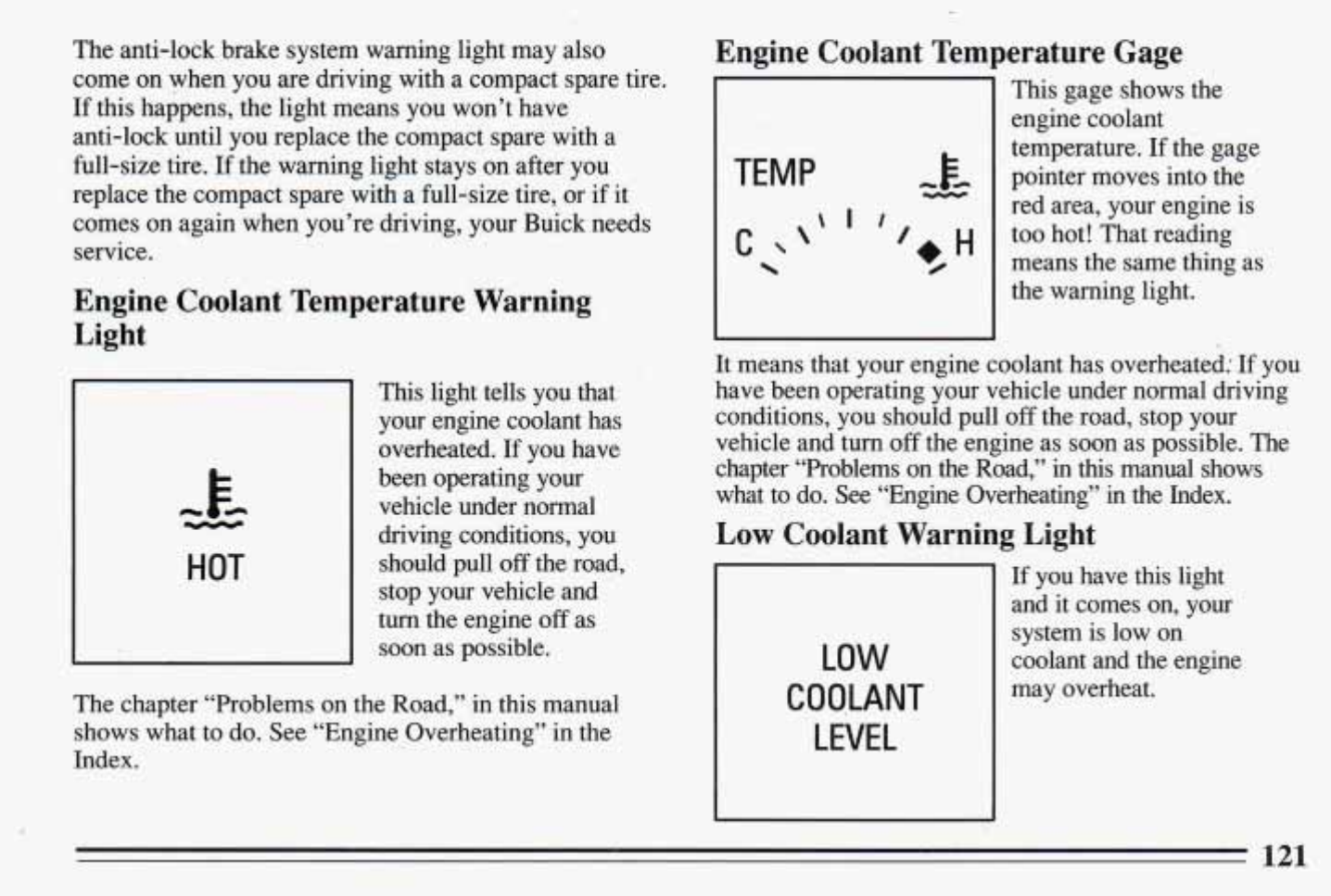
The anti-lock brake system warning light may also
come
on
when you are driving with a compact spare tire.
If
this happens, the light means you won’t have
anti-lock until you replace the compact spare with a
-full-size tire.
If
the warning light stays ‘on after you
replace the compact spare with a full-size tire, or if it
comes on again when you’re driving, your Buick needs
service.
Engine Coolant Temperature Warning
Light
k
F-
-
HOT
This
light tells you that.
your engine coolant has
overheated.
If
you have
been operating your
vehicle under ,normal
driving conditions, you
should pull
off
the road,
stop your vehicle and
turn
the engine
off
as
soon as possible.
The chapter “Problems on the Road,” in this manual
shows what to do. See “Engine Overheating” in the
Index.
Engine Coolant Temperature Gage
This gage shows the
engine coolant
temperature.
If
the gage
red area, your engine
is
TEMP
-Fd
pointer moves into the
ucy
c
\\‘
’
I
too hot! That reading
\
’
*
0
means the same thing as
the warning light.
It means that your engine coolant has overheated: If you
have been operating your vehicle under normal driving
conditions, you should pull
off
the road, stop your
vehicle and turn
off
the engine as soon as possible. The
chapter “Problems on the Road,”
in
this manual shows
what to do.
See
“Engine Overheating”
in
the Index.
Low
Coolant Warning Light
LOW
C
0
0,LANT
LEVEL
If
you have this light
and it comes on, your
system is low on
coolant and the engine
may overheat.
I
121
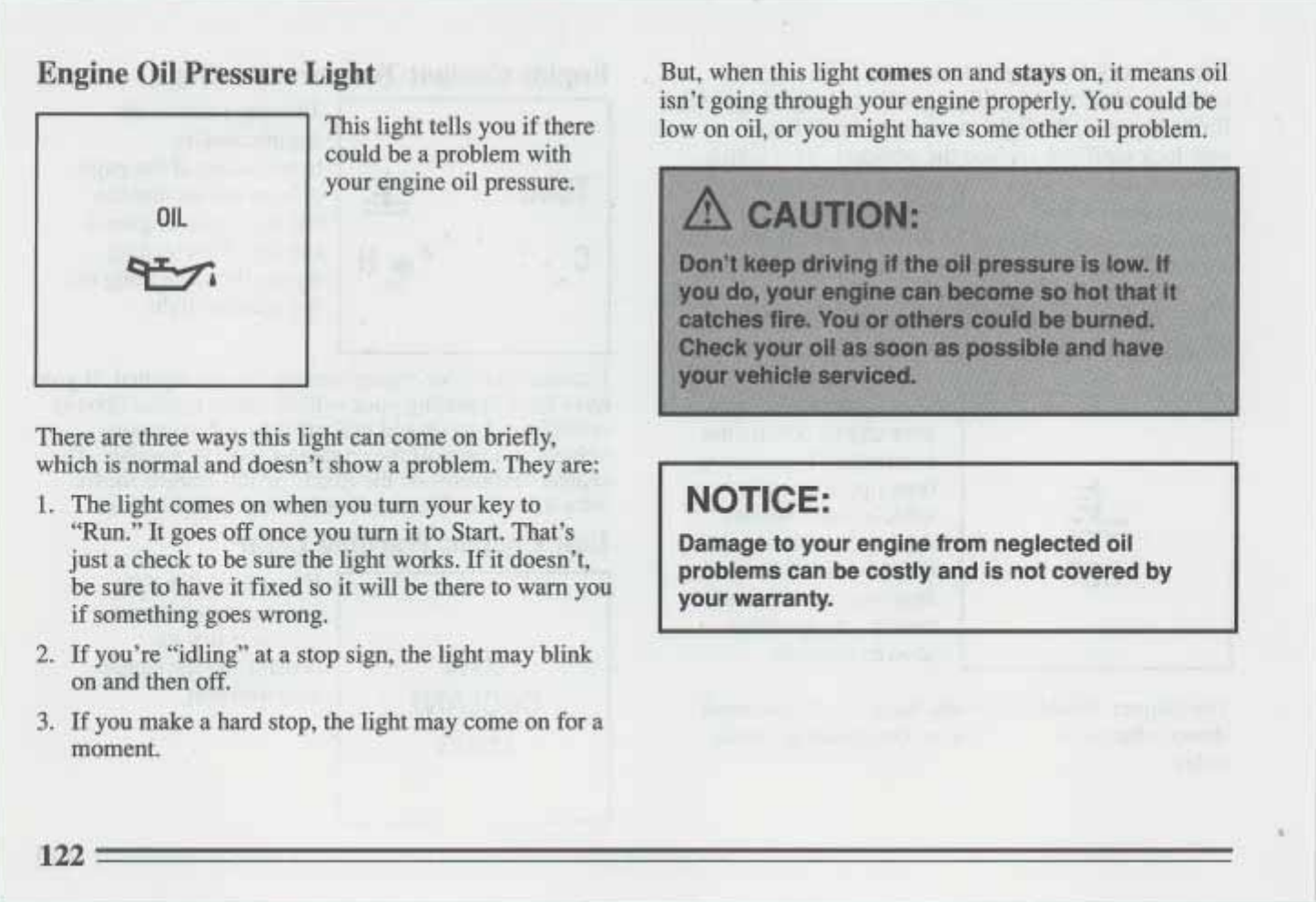
OIL
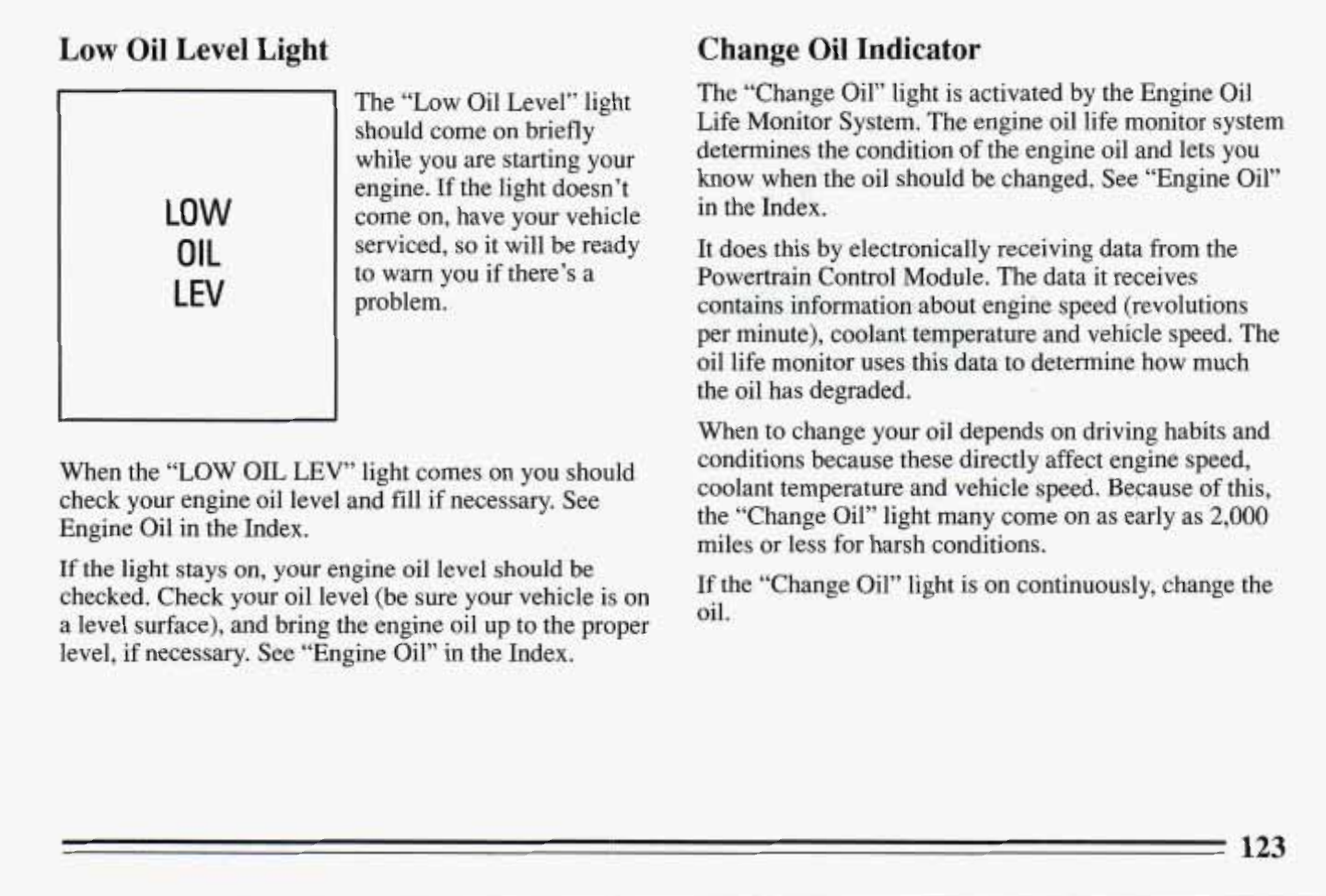
Low Oil Level Light
LOW
0
1.L
LEV
The “Low Oil Level” light
should come on briefly
while you are starting your
engine. If the light doesn’t
come on, have your vehicle
serviced,
so
it will be ready
to warn you if there’s a
problem..
When the “LOW OIL LEV” light comes on you should
check your engine oil level and fill if necessary. See
Engine Oil in the Index.
If
the
light
stays
on, your engine oil level should be
checked. Check your oil level (be sure your vehicle is on
a level surface), and bring the engine oil up to the proper
level, if necessary. See “Engine Oil” in the Index.
Change Oil Indicator
The “Change Oil” light is activated by the Engine Oil
Life Monitor System. The engine oil life monitor system
determines the condition
of
the engine oil and lets you
know when the oil should be changed. See “Engine Oil”
in the Index.
It does this by electronically receiving data from the
Powertrain Control Module. The data it receives
contains information about engine speed (revolutions
per minute), coolant temperature and vehicle speed. The
oil life monitor uses this data to determine how much
the oil has degraded.
When to change
your
oil depends on driving habits and
conditions because these directly affect engine speed,
coolant temperature and vehicle speed. Because of this,
the “Change Oil” light many come on as early as
2,000
miles or less for harsh conditions.
If the “Change Oil” light is on continuously, change the
oil.
123
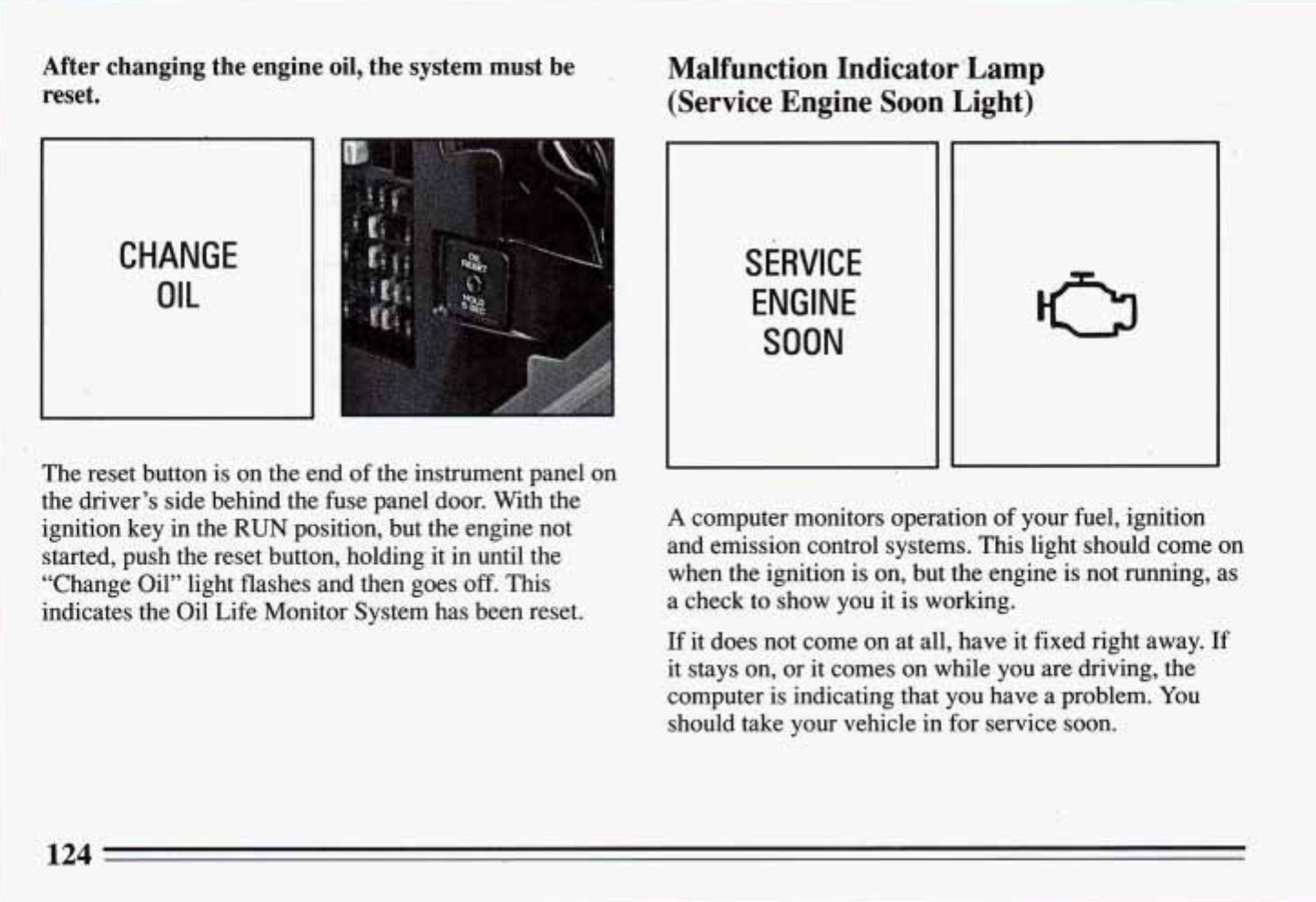
After changing the engine oil, the system
must
be
reset.
Malfunction Indicator ‘Lamp
(Service Engine Soon Light)
1
The reset button is on the end of the instrument panel on
the driver’s side behind the fuse panel
door.
With the
ignition key in the
RUN
position, but the engine not
started, push the reset button, holding it in until the
“Change Oil” light flashes and then goes
off.
This
indicates the Oil Life Monitor System has been reset.
SERVICE
ENGINE
SOON
A
computer monitors operation of your fuel, ignition
and emission control systems. This light should come on
when the ignition is on, but the engine is not running, as
a check to show you it is working.
If it does not come on at all, have it fixed right away.
If
it stays on, or it comes on while you are driving, the
computer is indicating that you have a problem. You
should take your vehicle in for service
soon.
NOTICE:
If
you keep driving your vehicle with this light on,
after a while the emission controls won’t work as
well, your fuel economy won’t be as good and
your engine may not run as smoothly. This could
lead to costly repairs
not
covered by your
warranty.
66Battery99 Light
VOLTS
When you turn the key to
“Run,”
this light will come
on
briefly, to show that
your alternator and battery
charging systems are
working.
If the light stays on, you need service, and you should
take your Buick to the dealer at once.
To
save
your
battery until you get there, turn
off
all accessories. and
set your air system to
“OFF.”
Gate Ajar Light
GATE
AJAR
L
Your wagon has
a
Gate
Ajar warning light. It
should come
on
when the
tailgate is opened as a door.
It
will stay on until the
tailgate has been fully
closed.
It
does not come
on
when the tailgate has been
opened as a gate.
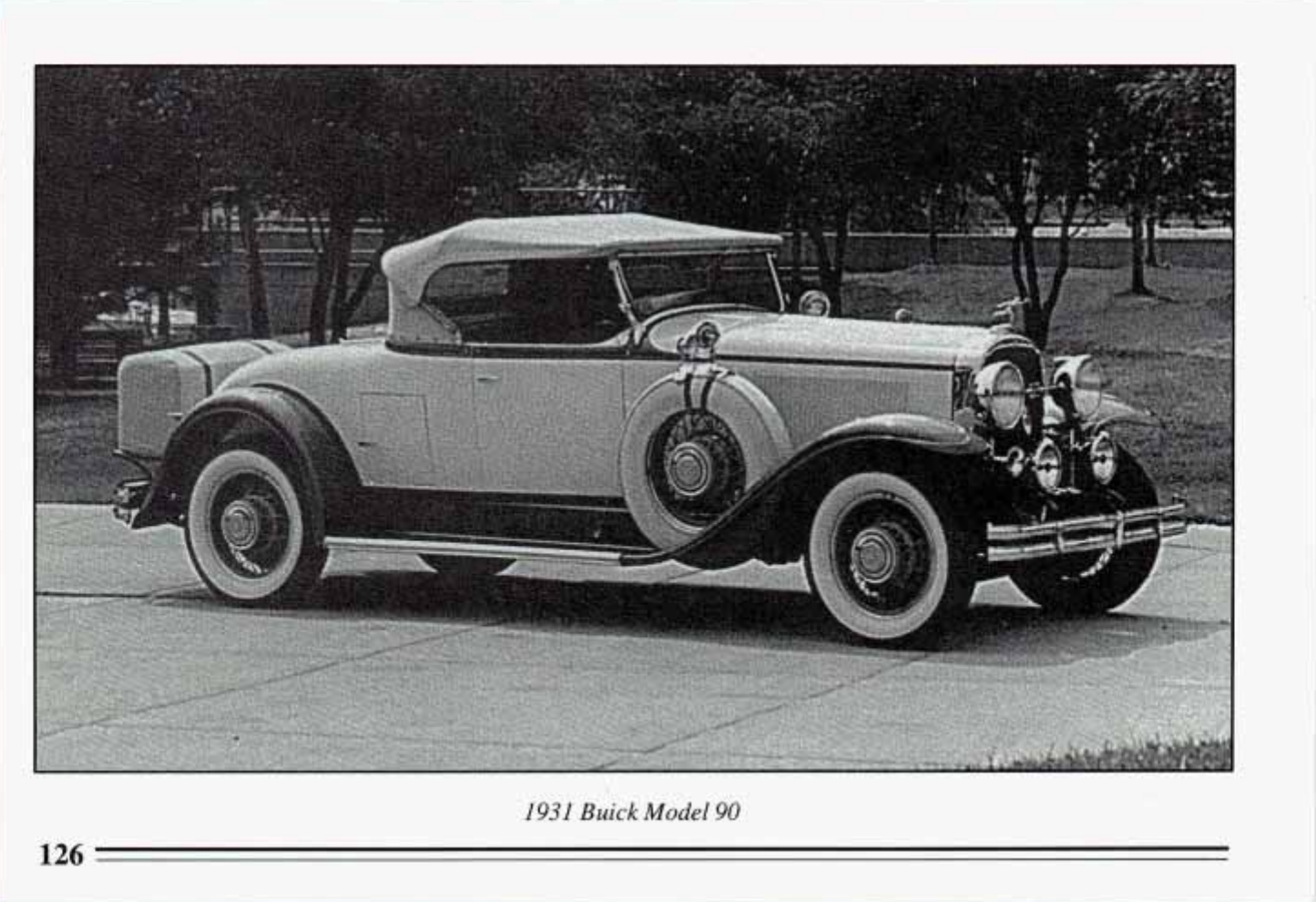
1931
Buick Model
90
126
Part
3
includes:
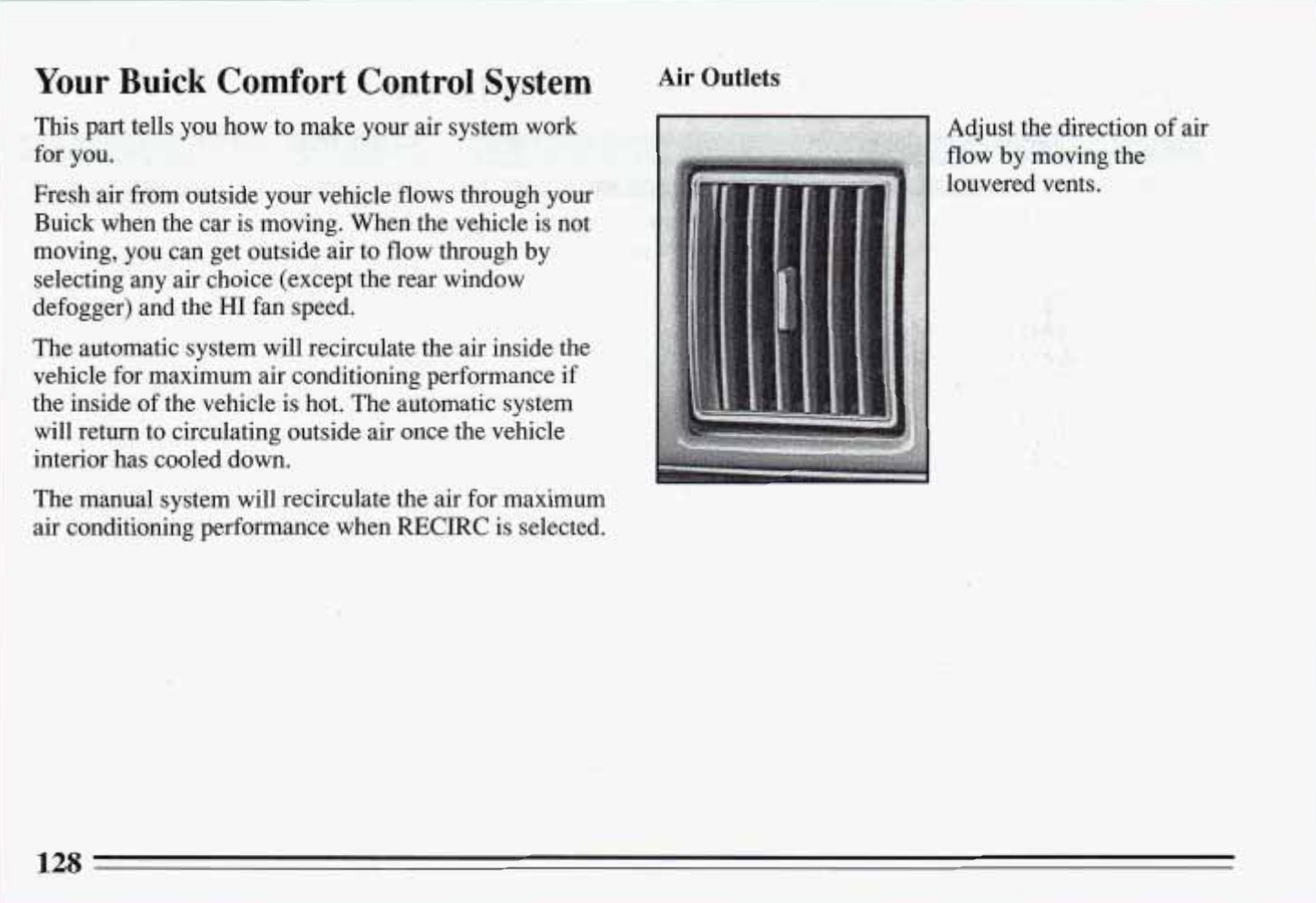
Your Buick Comfort Control System
This
part tells you how to make your air system work
for you.
Fresh air from outside your vehicle flows through your
Buick when the car is moving. When the vehicle is not
moving, you can get outside air to flow through by
selecting any air choice (except the rear window
defogger) and. the
HI
fan speed,.
The automatic system will recirculate the air inside the
vehicle
for
maximum air conditioning performance if
the inside of the vehicle is hot. The automatic system
will return to circulating outside air once the vehicle
interior has cooled down.
The manual system will recirculate the air for maximum
air conditioning performance when
RECIRC
is selected.
Air
Outlets
128
,.
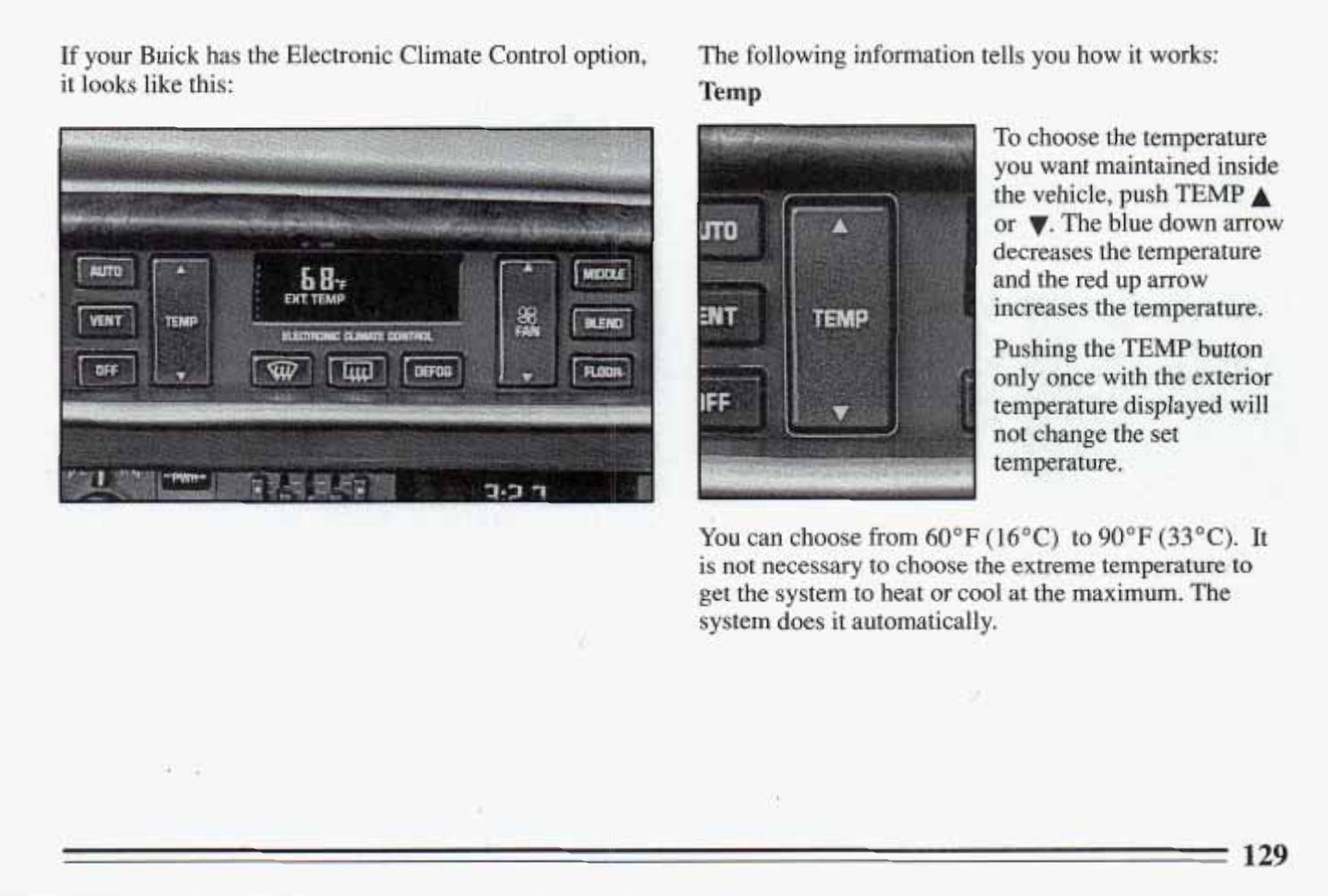
If
your Buick has the Electronic Climate Control option,
it
looks like this: The following information tells you how it works:
Temp
To
choose the temperature
you
want maintained inside
the vehicle, push
TEMP
A
or
v.
The blue down arrow
decreases the temperature
and the red up arrow
inci-eases the temperature.
Pushing the
TEMJ?
button
only once with the exterior
temperature displayed will
not, change the set
temperature.
You can choose from
60°F
(16°C)
to
90°F
(33°C). It
is
not
necessary
to
choose the extreme temperature,to
get the system to heat
or cool at the maximum. The
system does it automatically.
129
From the
AUTO
mode, pushing the temperature to
90°F will automatically allow the system to select the
high blower and floor mode.
From AUTO mode, pushing the temperature to 60°F
will automatically allow the system to select high
blower, MIDDLE mode and recirculate air.
Off
When the system is
off,
the
'
ventilation allows air to
flow 'through the heater
ducts while the vehicle is
moving.
The exterior temperature will show in the display area.
Auto
When the system is set for
automatic, air will come
from the floor outlets, the
instrument panel. outlets or
both. Fan speed will 'vary
(unless a blower LO or
HI
button has been pushed) as
the system gets to and
maintains the temperature
"
setting you have selected.
The display will show the selected temperature and
blower speed.
In cold weather the system will delay turning on the
blower, to avoid blowing cold air. The length
of
the
'
delay depends on engine coolant temperature, outside
temperature and time since the engine was last started.
Pushing a LO or
HI
blower button will override this
.
delay, and
turn
on
the
blower.
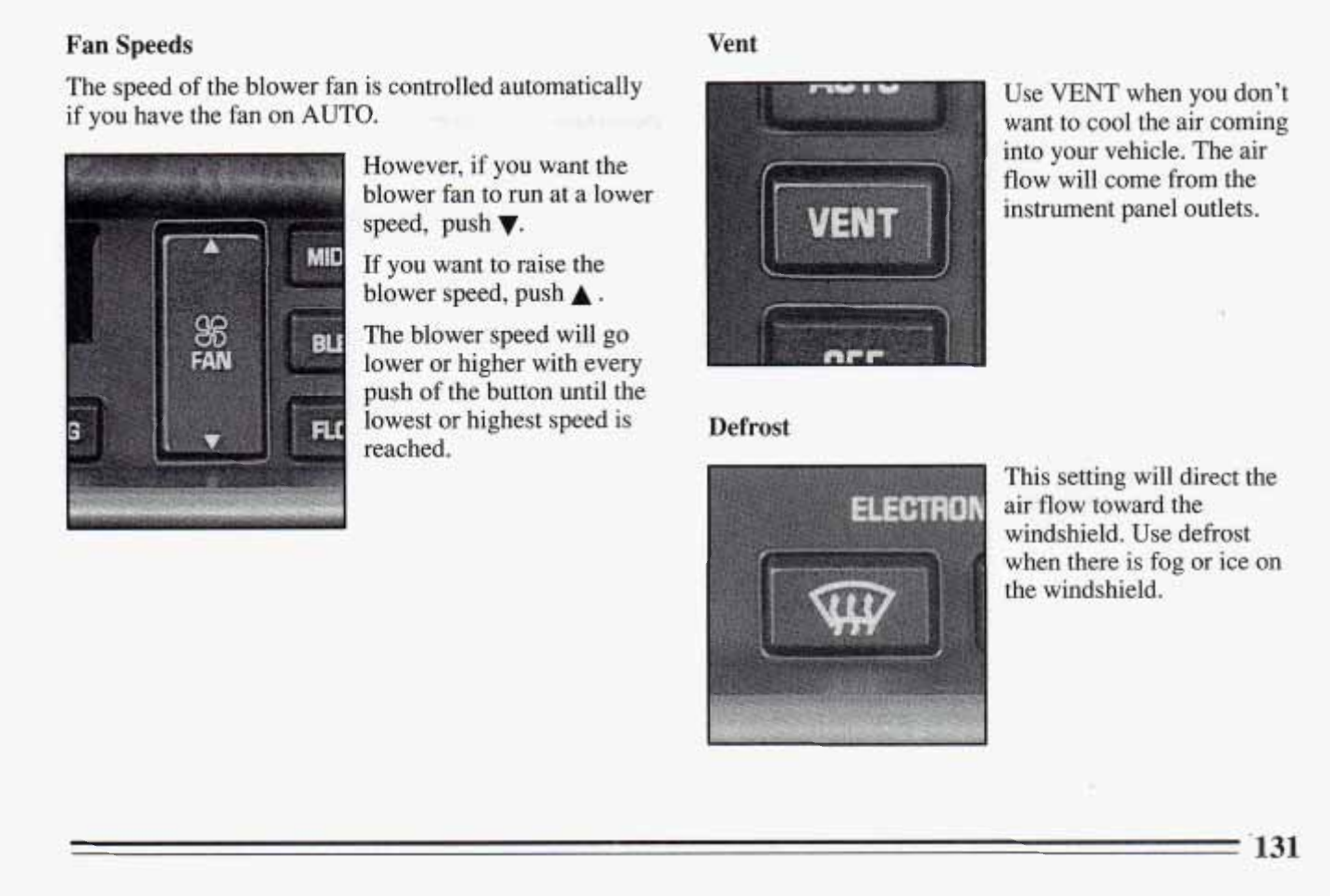
Fan
Speeds Vent
The speed of the blower fan is controlled automatically
if you have the fan on AUTO.
,.
However, if you want
the
blower fan to run at a lower
speed, push
v.
If
you want to raise the
blower speed, push
A
.
Use VENT when you don't
want to cool the air coming
into your vehicle. The air
flow will come from the
instrument panel outlets.
The blower speed will go
lower or higher with every
push of the button until the
1ow.est or highest speed is
Defrost
reached. This setting will direct the
air flow toward the
windshield. Use defrost
when there is
fog
or ice on
the windshield.
'1
21
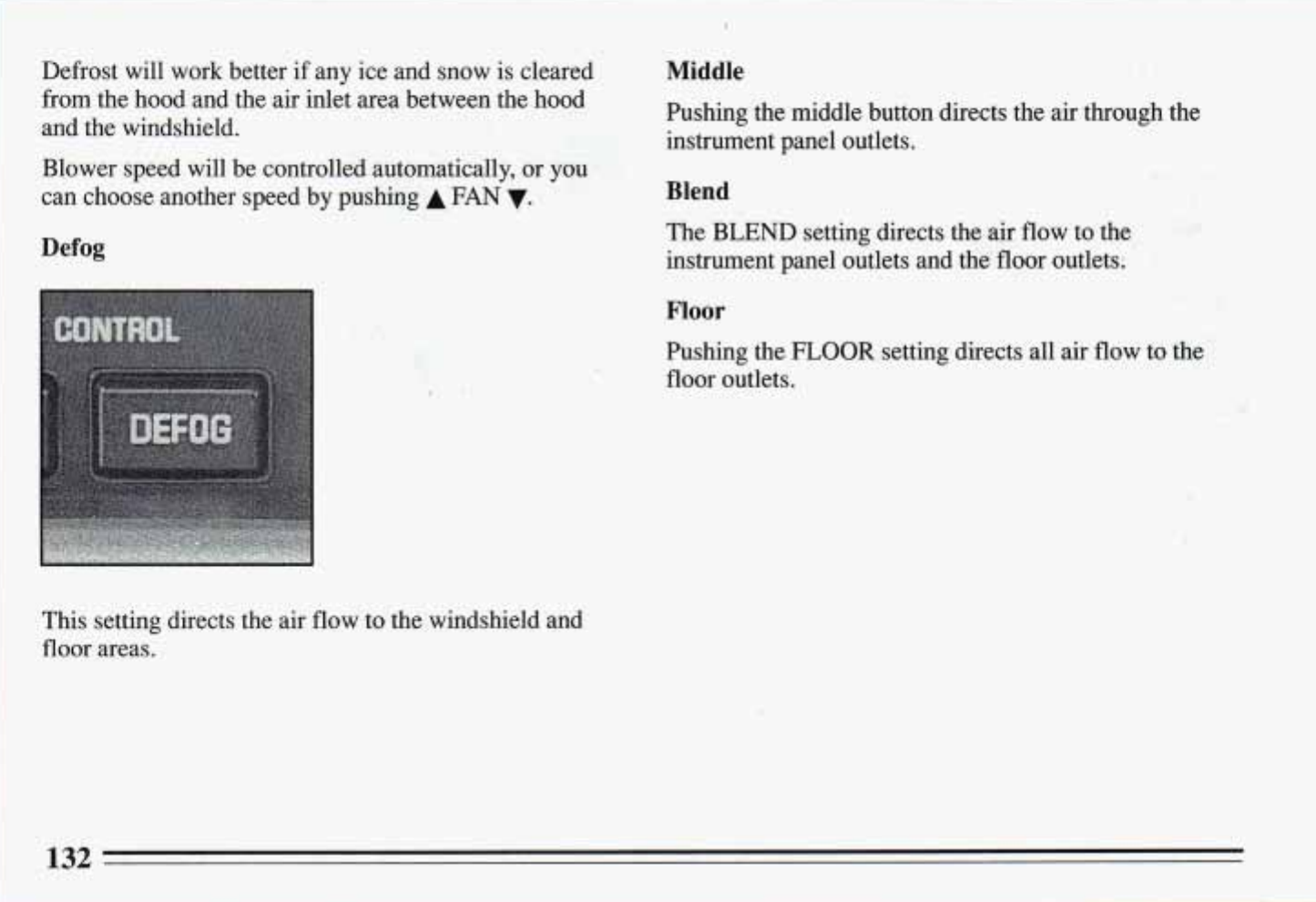
I
Defrost will work better if any ice and snow is cleared
from the hood and the air inlet area between the hood
and the windshield.
Blower speed will be controlled automatically, or you
can choose another speed by pushing
Ir,
FAN
v.
Defog
This
setting directs the air flow to the windshield and
floor
areas.
Middle
Pushing the middle button directs the air through the
instrument panel outlets.
Blend
The BLEND setting directs the air
flow
to the
instrument panel outlets and the floor outlets;
Floor
Pushing the
FLOOR
setting directs all air flow to the
floor outlets. e.,
,
-'
<q
I,
.
..~
_.
,(
:3
."
.~
%
Rear
Window
Defogger
(Option)
J
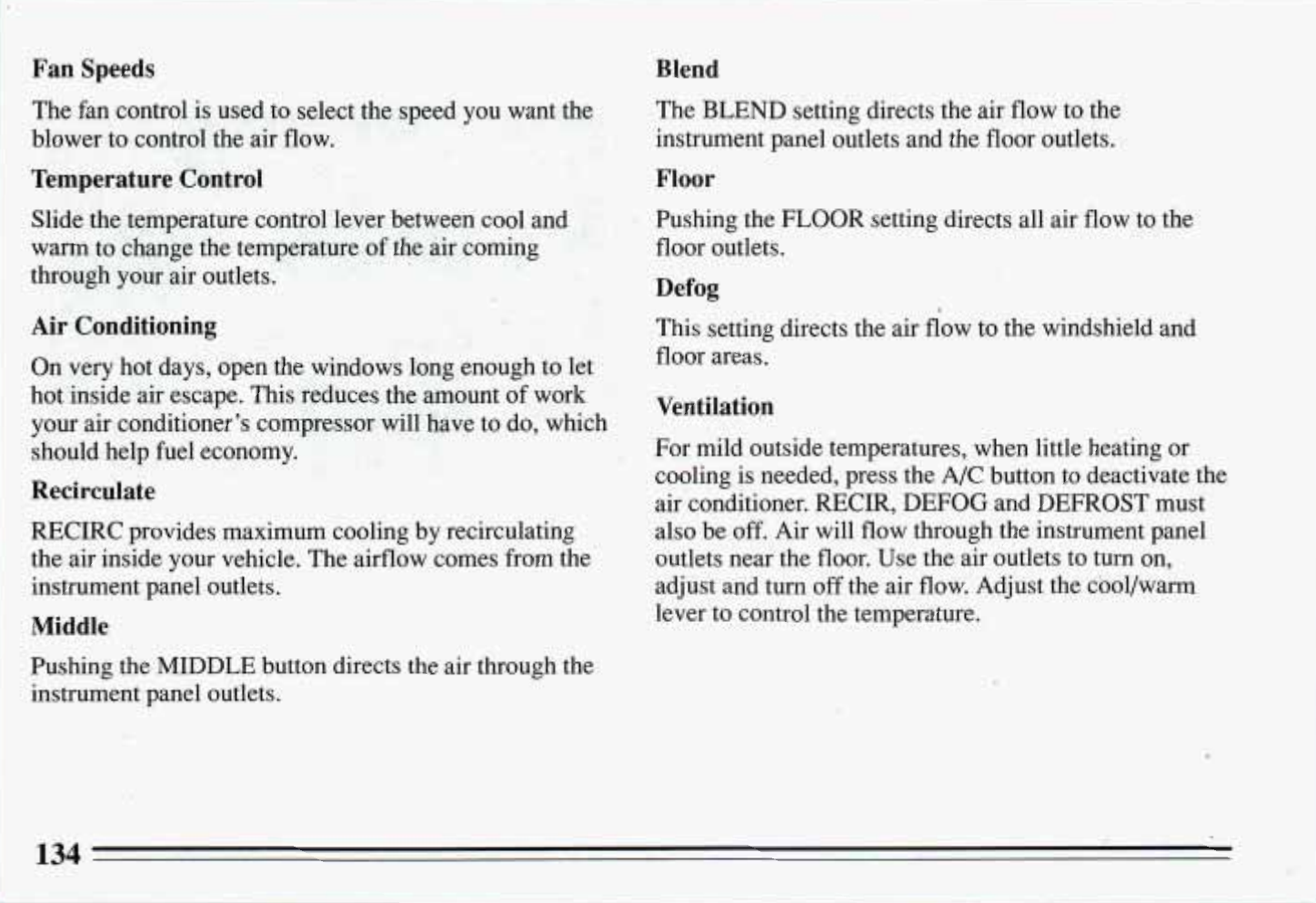
Blend
The BLEND setting directs the air flow to the
instrument panel outlets and the floor outlets.
Floor
Pushing the FLOOR setting directs all air flow to the
floor outlets.
Defog
This setting directs the air flow
to
the windshield and
floor areas.
Venti1atio.n
For
mild outside temperatures, when little heating or
cooling is needed, press the
A/C
button to deactivate the
air'conditioner. RECIR, DEFOG and
DEFROST must
also be
off.
Air will
flow
through the instrument panel
outlets near the floor. Use the air outlets to turn on,
adjust and turn
off
the air flow. Adjust the cool/warm
lever to control the temperature..
B
134
Heating
When outside temperatures are cold, sliding the lever to
Warm will send heated air through the heater outlets,
and some through the defroster vents.
Defrosting
The Defrost setting directs most
of
the air through the
defroster vents, and some through the heater outlets. Use
defrost when you want to remove fog or ice
from
the
windshield.
Rear Window Defogger (Option)
The lines you see on the
rear window warm the
glass. Press the button to
start
warming your
window. After
10
minutes,
it will go
off
by itself or
pressing the button again
during the heating cycle
will shut it off.
If
you
need
additional warming time,
push the button again.
I
NOTICE:
Scraping the inside
of
your rear window could
cut and damage the heater. Your warranty would
not cover this damage. Don’t put decals there,
you might have to scrape them
off.
135
Y
Audio
Systems
Your Delco’ audio system has been designed to operate
easily and give years of listening pleasure. But you will
get the most enjoyment out of your system if you
acquaint yourself with it first. Find out what your
Delco@ system can do and how to operate all its
controls,-to be sure you’re getting the most out of the
advanced engineering that went into it.
FM
Stereo
FM stereo will give you the best sound. But FM signals
will reach only about
10
to 40 miles (16 to 65 km). And,
tall buildings or hills can interfere with FM signals,
causing the sound
to
come and go.
AM
The range for most AM stations is greater than for
FM,
especially at night. The longer range, however, can
’
cause stations to interfere with each other. AM can pick
up noise from things like storms and power lines. Try
reducing the treble to reduce this noise.
AM
Stereo
This means the Delco’ system can receive C-QUAM@
stereo broadcasts. Many AM stations around the country
use C-QUAM@ to produce stereo, though some do not.
(C-QUAM@ is a registered trademark of Motorola, hc.)
If
your Delco’ system can get C-QUAM’, your
“STEREO”
light will come on when you’re receiving it.
Be aware that hearing damage
from
loud noise is almost
undetectable until it is too late. Your hearing can adapt to
higher volumes of sound. Sound that seems normal can
be loud and harmful to your hearing. Take precautions by
adjusting the volume control on your radio to a safe
sound level before your hearing adapts to it.
.TO help avoid hearing loss
or
damage:
0
Adjust the volume control to the lowest setting.
0
Increase volume slowly until you hear comfortably
and clearly.
136
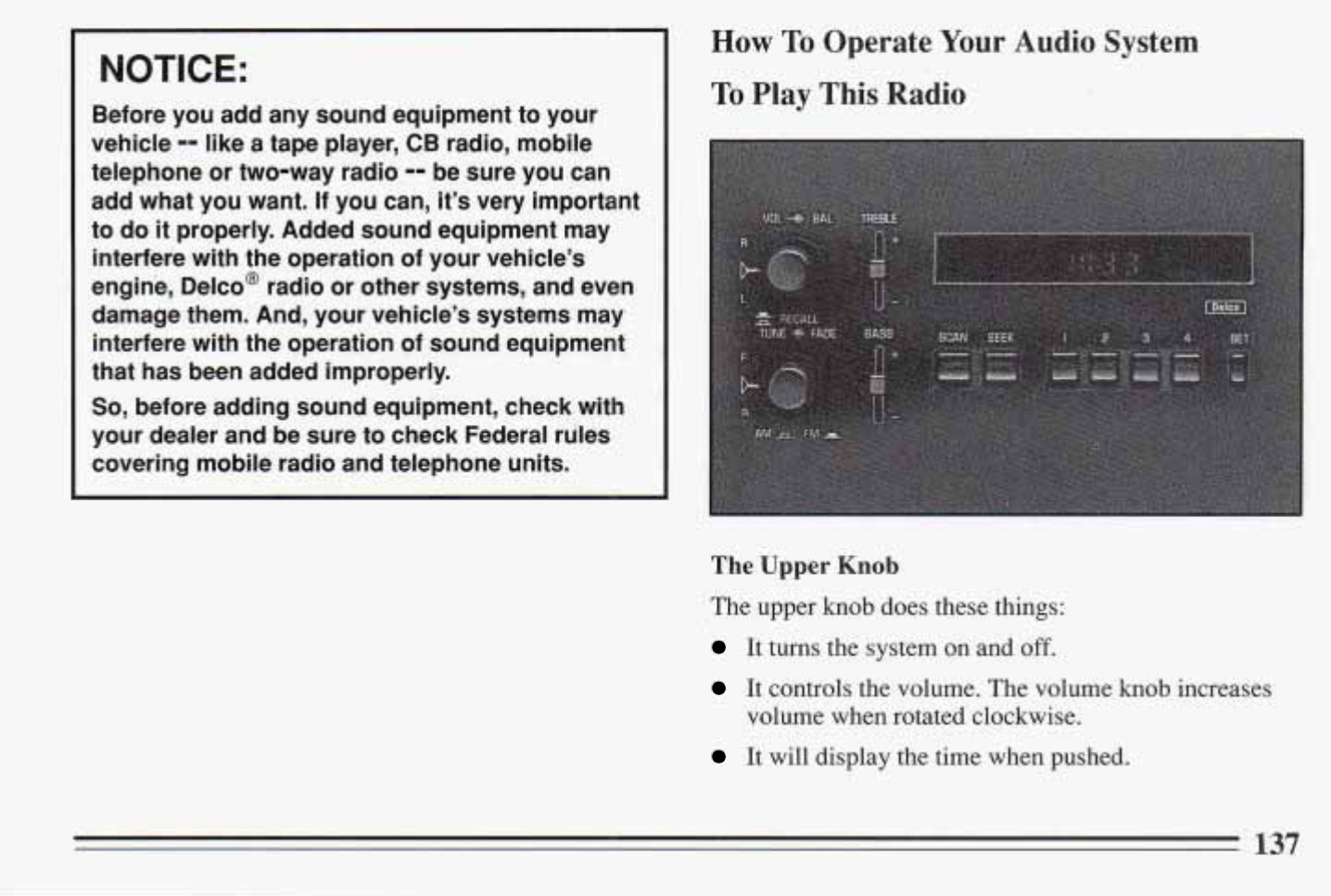
NOTICE:
Before you add any sound equipment to your
vehicle
--
like a tape player,
CB
radio, mobile
telephone or two-way radio
--
be sure you can
add what you want. If you can, it’s very important
to
do
it properly. Added sound equipment may
interfere w’ith the operation of your vehicle’s
engine, Delco@ radio or other systems, and even
damage them. And, your vehicle’s systems may
interfere with the operation
of
sound equipment
that has been added improperly.
So,
before adding sound equipment, check with
your dealer and be sure
to
check Federal rules
covering mobile radio and telephone units.
How
To Operate Your Audio System
To Play This Radio
The Upper
Knob
The upper knob does these things:
It
turns the system
on
and
off.
It
controls the volume. The volume
knob
increases
volume when rotated clockwise.
It
will display the time when pushed.
137
Balance
The
BAL
control behind the upper knob allows you to
balance the sound between the right and left speakers.
The
Lower'Kndb
Turn the lower knob
to
tune in radio stations. Push it to
get
AM
or
FM.
Fade
The FADE control behind the .lower knob moves the
sound bgtween your front and rear speakers.
Seek
Pressing the SEEK button will cause the receiver to seek
the next higher station and stop.
Scan
When you press
SCAN,
the radio will go to the next
station and pause and will keep scanning until you press
scan again.
,;'y.&g&-.-r:T..
Tf
,$-+Le.,-.
j.
d;-
..
.
.
I.
.,
Pushbuttons
The four pushbuttons let you return to favorite stations.
You can set the pushbuttons for up
to
fourteen favorite
stations
(7
AM
and
7
FM).
0
Tune
in
the desired station.
0
Press the
SET
pushbutton. (SET appears in the
display).
0
Within
5
seconds, push one
of
the four pushbuttons
to store the station. Whenever you press that button
again, the preset station will return.
In
addition to the
4
stations set as above, up to three
additional stations may be preset on each band by
pressing two adjoining buttons at the same time.
Tune in the desired station.
0
Press the SET pushbutton. (SET appears in the
0
Within
5
seconds, press any two adjoining
display).
pushbuttons at the same time. The station will return
when the same two pushbuttons are pressed again.
Clock
To
set the clock:
Press the SET pushbutton.
0
Within.
5
seconds, press and hold
SCAN
until the
0
Press and hold
SEEK
until the correct minute
co,nect
J hour appears on the display.
appears on the display.
138
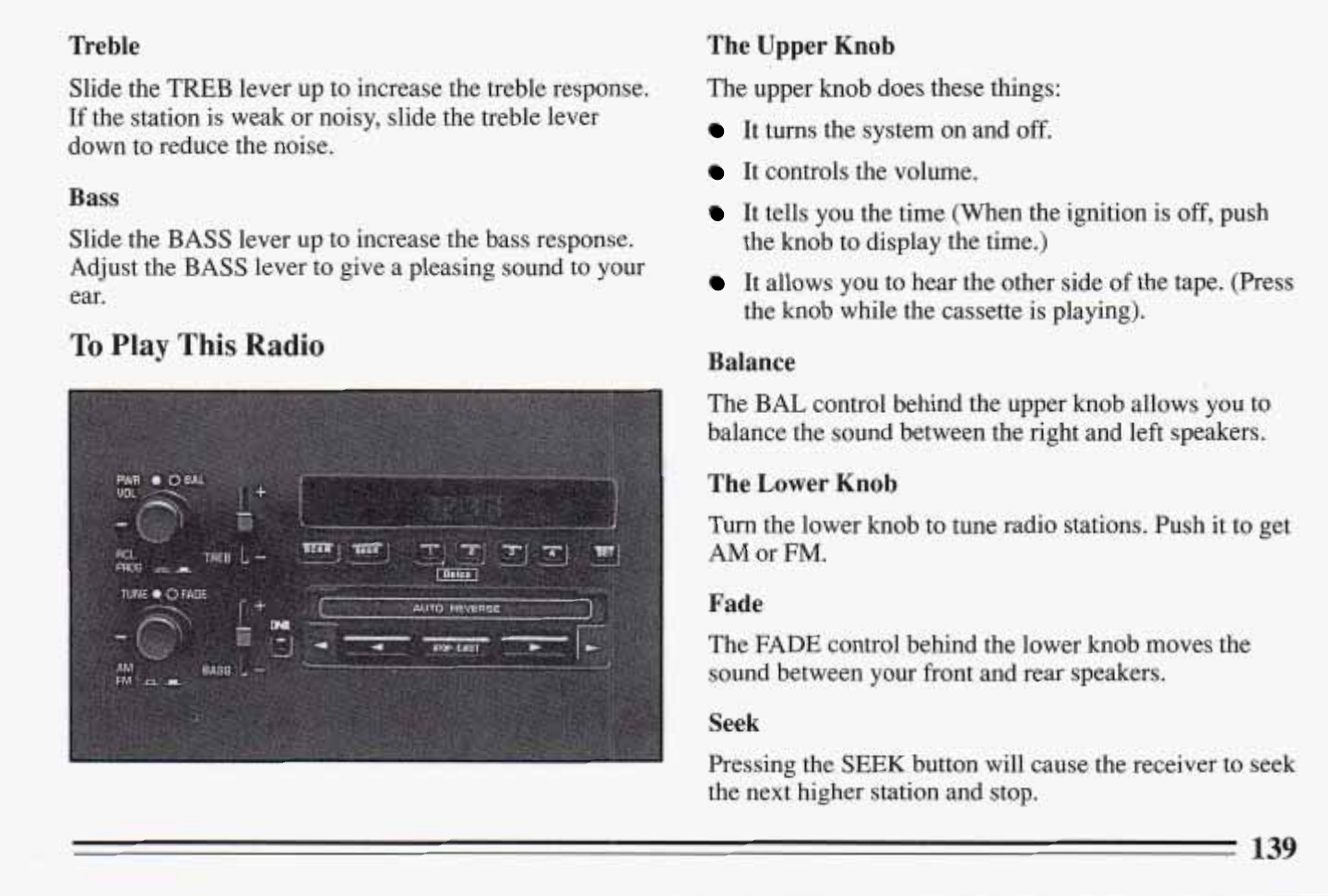
Treble
Slide the
TREB
lever up to increase the treble response.
If
the station is weak
or
noisy, slide the treble lever
down to reduce the noise.
Bass
Slide the BASS lever up to increase the bass response.
Adjust the BASS lever to give a pleasing sound to your
ear.
To Play This Radio
The Upper Knob
The upper knob does these things:
It turns the system
on
and
off.
It controls the volume.
It tells you the time (When the ignition is
off,
push
It allows you to hear the other side
of
the tape. (Press
the knob to display the time.)
the knob while the cassette is playing).
Balance
The BAL control behind the upper knob allows you to
balance the sound between the right and left speakers.
The Lower Knob
Turn the lower knob to tune radio stations. Push it to get
AM or FM.
Fade
The FADE control behind the lower knob moves the
sound between your front and rear speakers.
Seek
Pressing the.
SEEK
button will cause the receiver to seek
the next higher station and stop.
139
Scan
When you press SCAN, the radio will go to the next
station and pause and keep doing that until you press
SCAN
again.
SCAN
appears
in
the graphic display.
Pushbuttons
The
four
pushbuttons let you return to stations. You can
set the pushbuttons for up to fourteen stations
(7
AM
and
7
FM).
0
Tune in the desired station.
0
Press the SET pushbutton. (SET appears in the display).
0
Within
5
seconds, push one,
of
the four pushbuttons.
Whenever you press that button, the preset station will
return.
Up to three additional stations on each band may be
preset, by pressing two adjoining pushbuttons at the
same time.
0
Tune in the desired station.
0
Press SET pushbutton.
~
0
Within the
5
seconds, press any two adjoining
pushbuttons at the same time. The station will return
when the same two pushbuttons are pressed again.
Clock
To set the clock:
0
Press the SET button.
0
Within
5
seconds, press and hold
SCAN
until the
0
Press and hold
SEEK
until the correct minute
correct hour appears on the display.
appears on the display.
Treble
Slide
the
TREB lever up to increase the treble response.
If
the station is weak or noisy, slide the TREB lever
doh to reduce the noise.
Bass
Slide the BASS lever up to increase the bass response.
Adjust the BASS lever'to give a pleasing sound to ,your
ear.
DNR@
This
is
the
Dynamic Noise Reduction button,
DNR'
helps remove backgraund hiss from the.radio or tape
player. You may want to leave it pushed in all the time.
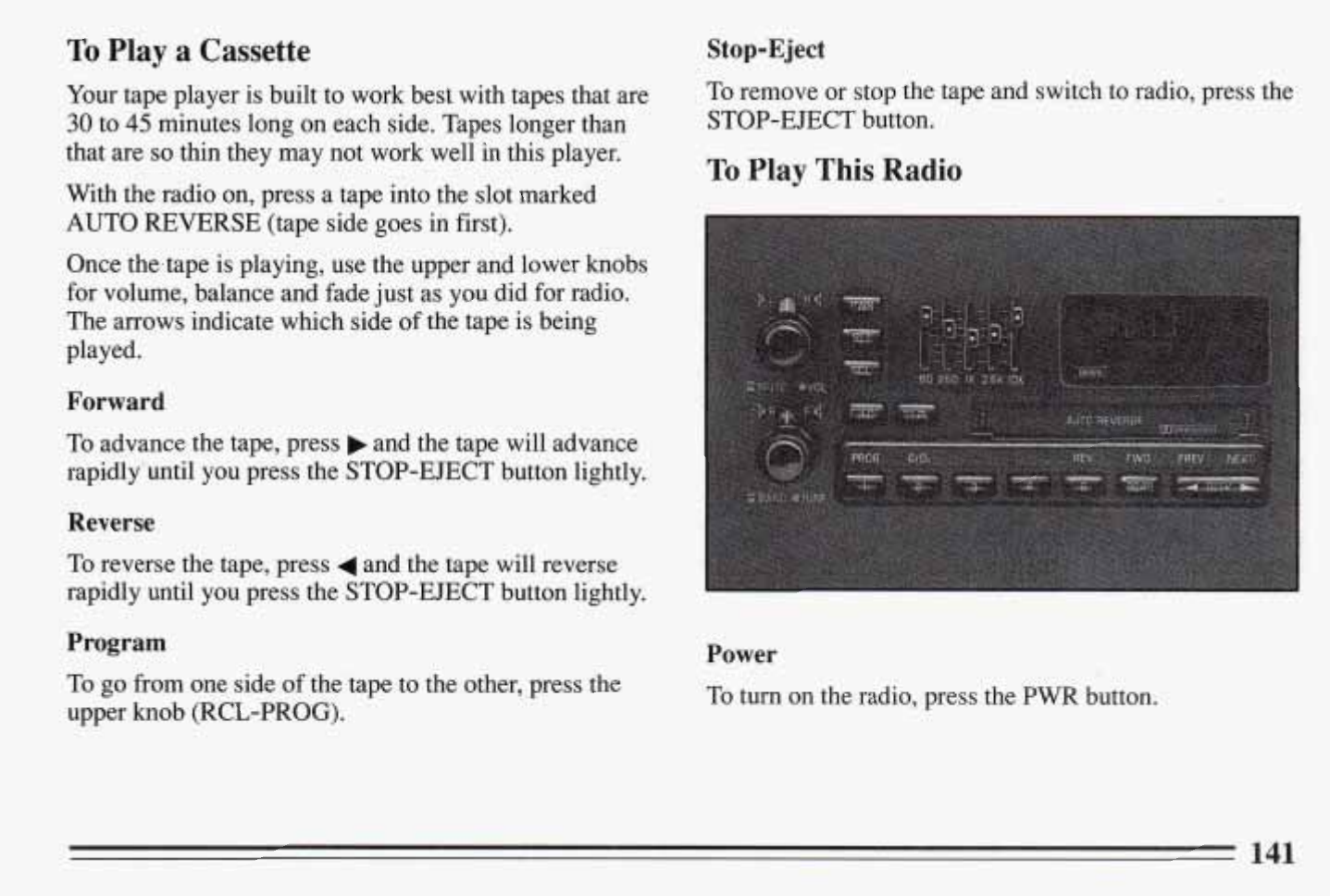
To
Play
a
Cassette
Your tape player is built to work best with tapes that are
30
to
45
minutes long on each side. Tapes longer than
that are
so
thin they may not work well in this player.
With the radio on, press a tape into the slot marked
AUTO
REVERSE (tape side goes in first).
Once the.tape is playing, use the upper and lower knobs
for
volume, balance and fade just as you did for radio.
The arrows indicate which side of the tape is being
played.
Forward
To advance the tape, press and the tape will advance
rapidly'until you press the STOP-EJECT button lightly.
Reverse
To reverse the tape, press
4
and the tape will reverse
rapidly until you press the STOP-EJECT button lightly.
Program
To
go
from
one side of the tape to the other, press the
upper knob (RCL-PROG).
Stop-Eject
To remove or stop the tape and switch to radio, press the
STOP-EJECT button.
To Play
This Radio
Power
To turn on the radio, press the
PWR
button.
141
The Upper Knob
The upper knob does these things:
It controls the volume. The volume increases and
decreases when the knob is held slightly rotated
against the spring load.
0
It allows you to mute the radio or the tape player.
Press to mute; press again
to
listen. 'Du,ring mute,
only volume up will work.
Balance
The control behind the upper knob allows you to
balance the sound between the right and left speakers.
The Lower Knob
Turn the lower knob to tune radio stations. Turn the
knob to tune slowly, if you hold it for more than
3
seconds it will tune rapidly. Push it to get AM or
FM.
Fade
The FADE control behind the lower knob moves the
sound between your front and rear speakers.
Recall
It
tells you the time and the radio frequency. When the
ignition
is
off, push
RCL
to
display the time. With the
radio on, and the time displayed, push it to display the
frequency.
Seek
Pressing the SEEK
4
or button will cause the
receiver to seek the next higher or lower station and
stop.
Scan
When you press SCAN, the radio will go to the next
station and pause and keep doing that until you press
SCAN again.
Pushbuttons
The five pushbuttons let you return to favorite stations.
You can set the pushbuttons for up to ten stations
(5
AM
and
5
FM).
0
Tune in the desired station.
0
Press the SET pushbutton. (The display will show
0
Within
5
seconds, push one of the five pushbuttons.
SET for about
5
seconds.)
SET will disappear from the display when the station
is set.
0
Whenever you press that button, the preset station
will return.
142
Clock
To set the clock:
To
Play
a
Cassette
0
Press the SET button.
0
Within
5
seconds, press and hold SCAN until the
correct hour appears. on the display.
0
Press and hold SEEK
4
or until the correct minute
appears on the display.
To
Adjust the Tone
Use the levers next to the display to set the bass,
midrange, ,and treble until you get the sound you want.
The
60
and
250
levers adjust the bass;
1K
is midrange;
and
3.5K
and
1
OK
control the treble.
We suggest you start with the center lever
(1K)
in the
midpoint position. Then move, the others up or down
until you get the amount of bass and treble you like.
Your tape player is built to work best with tapes that are
30
to
45
minutes long on each side. Tapes longer than
that are
so
thin they may not work well in this player.
With the radio on, press a tape into the slot marked
AUTO REVERSE (tape side goes in first).
Once the tape is playing, adjust the upper and lower
knobs for volume, balance, and fade just as you did for
the radio. The arrow in the graphic display above the
word TAPE indicates which side of the tape is being
played.
Program
To go from one side of the tape to the other, press the
PROG button.
CrO2
This button sets the tape bias. When playing high bias
chrome
or
metal tapes, press the button to turn on the
Cr02. When playing standard bias tapes, press again to
turn
off
the Cr02.
143
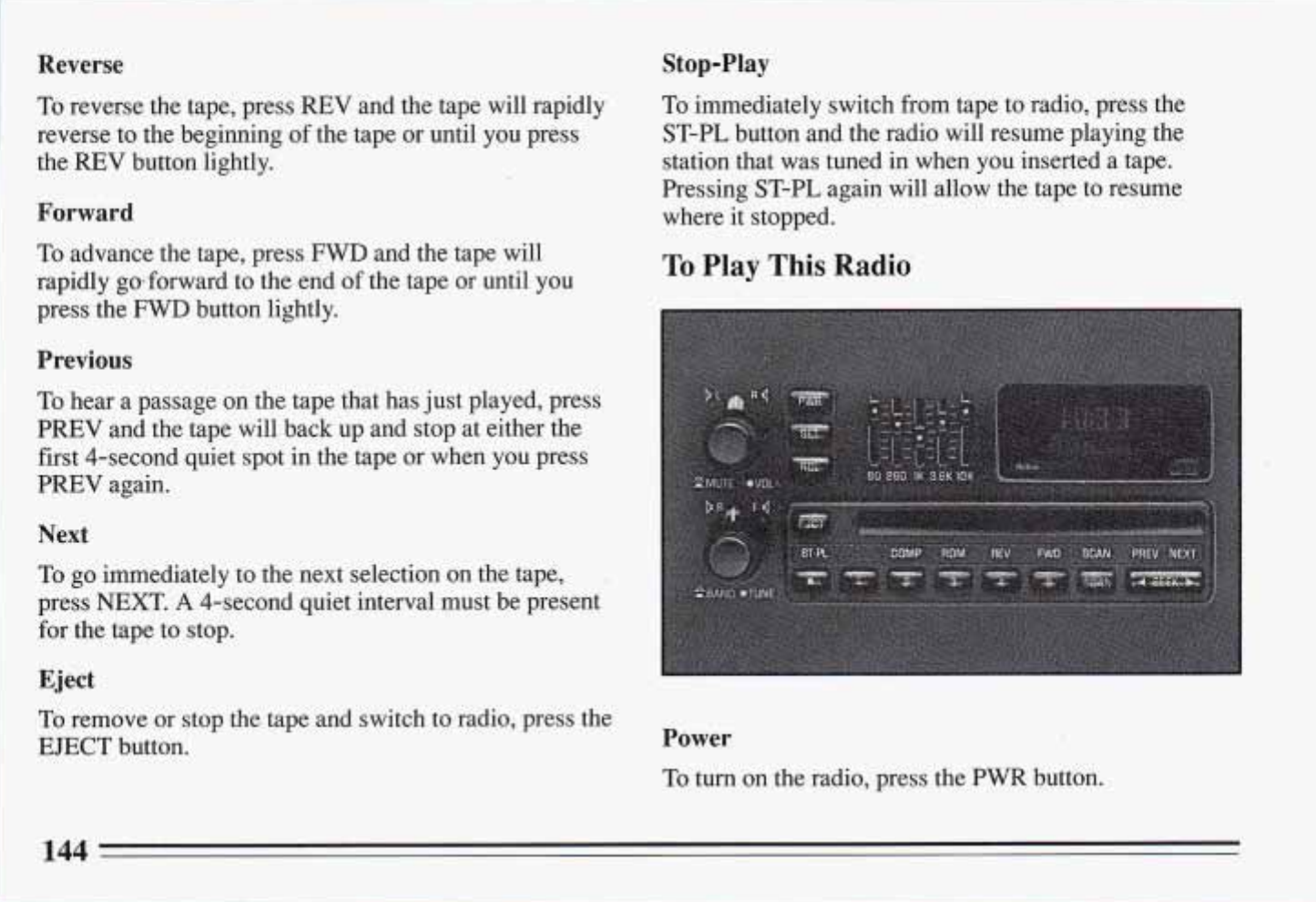
Reverse
To
reverse the tape, press
REV
and the tape will rapidly
reverse to the beginning of the tape or until you press
the REV button lightly.
Forward
To
advance the tape, press
FWD
and the tape will
rapidly go-forward to the end of the tape or until you
press the
FWD
button lightly.
Previous
To hear a passage on the tape that has just played, press
PREV and the tape will back up and stop at either the
first 4-second quiet spot in the tape or when you press
PREV again.
Next
To
go immediately to the next selection on the tape,
press NEXT.
A
4-second quiet interval must be present
for
the tape
to
stop.
Eject
To
remove
or
stop the tape and switch to radio, press the
EJECT
button.
Stop-Play
To
immediately switch from tape to radio, press the
ST-PL
button and the radio will resume playing the
station that was tuned in when you inserted a tape.
Pressing ST-PL again will allow the tape to resume
where it stopped.
To Play This Radio
Power
To
turn
on
the radio,
pr:sS
the PWR button.
144
The
Upper
Knob
The upper knob does these things:
Recall
0
It controls the volume. The volume increases or
decreases volume when the knob is held slightly
rotated against the spring load.
It allows you to mute the radio or tape player. Press
to mute; press again to listen. During mute, only
volume up will work.
Balance
The control behind
the
upper knob allows you to
balance the sound between the right and left speakers.,
The Lower Knob
Turn the lower knob to tune radio stations..The tune
knob
increases and decreases station frequency when it
is held slightly rotated against the spring load.
Turn
the
knob to tune slowly, if you hold it for more than
3
seconds it will tune rapidly. Push it to get AM or FM.
Fade
The FADE control behind the lower knob moves. the
sound between your front and rear speakers.
It tells you the time and the radio frequency. When the
ignition is
off,
push RCL to display the time. With the
radio on, and the time displayed, push RCL to display
the frequency.
Seek
Pressing the SEEK
4
or button will cause the
receiver to seek the next higher or lower station and
stop.
Scan
When you press SCAN, the radio will go to the next
station and pause and keep doing that until you press
SCAN again.
Pushbuttons
The five pushbuttons let you return to favorite stations.
You can set the pushbuttons for up to ten stations
(5
AM
and
5
FM).
0
Tune in the desired station.
Press the SET pushbutton. (The display will show
SET for about
5
seconds).
145
~~~
.
.._
~~~
-~~
-
~ ~ ~~~ ~
,
~ ~~
t
0
Within
5
seconds, push one of the five pushbuttons.
SET will disappear from the display when the station
is set.
Whenever you press that‘button, the preset station will
~ return.
Clock
To set the clock:
0
Press the SET pushbutton.
~
0
Within
5
seconds, press and hold
SCAN
until the
correct hour appears on the display.
0
Press and hold SEEK
4
or until the correct minute
appears on the display.
To Adjust
the
Tone
Use the levers next to the display to set the bass,
midrange and treble until you get the sound you want.
The
60
and
250
levers adjust the bass; 1K is midrange;
’
and 3.5K and 10K control the treble.
~
1
We suggest you start with the center lever (1K) in the
i
midpoint position. Then move the others up until you
get the amount of bass and treble you like.
To
Play a Compact Disc
Before
you
begin, please note:
DO
NOT
use
mini-discs
that
are
called singles. They won’t eject.
Use
full-size
compact discs only.
If the disc player is very hot, or if you’re driving on a
very rough road,
a
disc: may come out or just not play.
If
you
see
the word HOT on the display, the disc player is
too hot to play the disc. Press
RCL
to make the word
HOT disappear from the display.
As
soon as things get back to normal, the disc should
play again.
Press
PWR
to turn the system on.
Insert a disc partway into the slot, label
side
up. The
player will pull it in. Wait a few seconds and the disc
should play.
If the.disc comes back out, check to see if
0
The disc is upside down.
0
It
is dirty, scratched, or wet.
0
There’s too much moisture in the air. (If there is,
wait about an hour and try again.)
Previous
Recall
Press RCL to see what track is playing. Press it again
within
5
seconds to see how long the CD has been
playing.
The track number also appears when you change the
volume or when a new track starts to play.
Compression
Pressing the COMP button makes soft and loud passages
nearly equal in volume.
Random
The RDM button means random and when it is pressed,
it will play the tracks in random order rather than
sequential
1,2,3..
.order.
Reverse
Press and hold REV to return rapidly
to
a favorite
passage. Release it to play the passage.
Forward
Press and hold
FWD
to advance quickly within a track.
Release it to resume playing. Watch the graphic display
to stop at a specific passage.
Press PREV to hear the previous track.
If
you hold this
button, or press it more than once, the disc will return to
previous tracks.
Next
Press
NEXT
to
hear the next track instead of waiting
until the present track is finished.
If
you hold this
button, or press it more than once, the disc will advance
further.
Stop/Play
Press ST/PL and the disc will stop and the radio will
play. Press
ST/PL
again to restart the disc at the point
where it stopped.
Press the
PWR button or turn the ignition key off to stop
the disc player. The disc stays in the player and will
resume playing at the point where it stopped.
Eject
Press EJCT and the disc will eject and the radio will
play. The disc will start at track
1
when you reinsert
it.
147
Anti-Theft Feature
Delco-Loc
I1
is a security feature for the compact disc
player. It can be used or ignored. If ignored, the system
plays normally. If it is activated your player won’t be
usable if it’s ever stolen, because
it
won’t
turn
on.
The instructions below tell you how to enter your
personal secret code into the system. If your vehicle
looses battery power
for
any
reason,
you must unlock
the system with your secret code before the system will
turn on.
Be sure to read through the entire procedure and become
familiar with the appropriate buttons and knobs before
starting.
0
Write down any 6-digit number and keep it in a safe
Turn the ignition to the ACCESSORY or RUN
place.
position.
0
Press
PWR
to
turn
the radio
off.
0
Press preset buttons
1
and
4
together. Hold them
until
“---,,
shows on the display.
0
You are now ready to enter your secret code,
If
you
pause more than
15
seconds between steps you may
have to start 0ve.r.
0
Press
SET
and
“000”
will appear
on
the display.
Press SEEK and hold it until the first digit of your
code appears..
Rotate the TUNE knob right or left to make the last
two numbers agree with your code.
Press the AM-FM knob and
“000”
will appear. Now
you are ready
to
enter the second three digits of your
code by repeating Steps 6 and
7.
Press the AM-FM’knob. The display will show
”rEP” for
5
seconds, and then
“OOO”
will appear
indicating that some steps are to be repeated for
verification.
Repeat steps
6
through
8.
Press the AM-FM knob. It the display shows
“SEC”,
the verification process was successful and the
system is secure.
If
the display shows
“---”,
the
verification steps were not successful and the entire
sequence must be repeated.
To
Unlock
the System After
a
Power
Loss
When battery power is reapplied to a secured radio, the
radio won’t turn on and “LOC” will appear on the
display.
1
AQ
Enter your secret code as follows, pause no more than
15
seconds between steps.
Turn the ignition
ON
and the radio
OFF.
Press the SET button. The display will show
“000”.
Enter the six numbers of the code following steps
6-9
of
the preceding paragraphs. The display will
show the number as entered.
Press the AM-FM button and the time appears
-
indicating that the disabling sequence was
successful. If the display indicates “SEC,” the
numbers did not match and the unit is still secured.
Disabling the Theft System
Press preset buttons
1
and
4,
for
5
seconds with the
ignition
ON
and radio power
OFF.
The display will
show “SEC”, indicating the unit is in the secure
mode.
Press the SET button. The display will show
“000”.
Enter the first three digits of the code following steps
6
and
7
of
the preceding paragraphs. The display will
show the numbers as entered.
Press the AM-FM button. The radio will display
~4000”.
Enter the second three digits of the code. The display
shows the numbers as entered.
Press the AM-FM button. If the display shows
“---”,
the disabling sequence was successful. (The numbers
matched the user-selected code or the factory
back-up code) and the unit is in the UNSECURED
mode. If the display shows “SEC“’, the disabling
sequence was unsuccessful and the numbers did not
match either of the codes and the unit will remain in
the SECURED mode.
Care of
Your
Cass’ette Tape Player
A
tape player that is not cleaned regularly can cause
reduced sound quality, ruined cassettes, or a damaged
mechanism. Cassette tapes should be stored
in
their
cases away from contaminants, direct sunlight, and
extreme heat. If they aren’t, they may not operate
properly or cause failure
of
the tape player.
Your tape player should be cleaned regularly, each
month or after every
15
hours of use. If you notice a
reduction in sound quality, try a known good cassette to
see if the tape or the tape player is at fault.
If
this other
cassette has no improvement in sound quality, clean the
tape player.
149
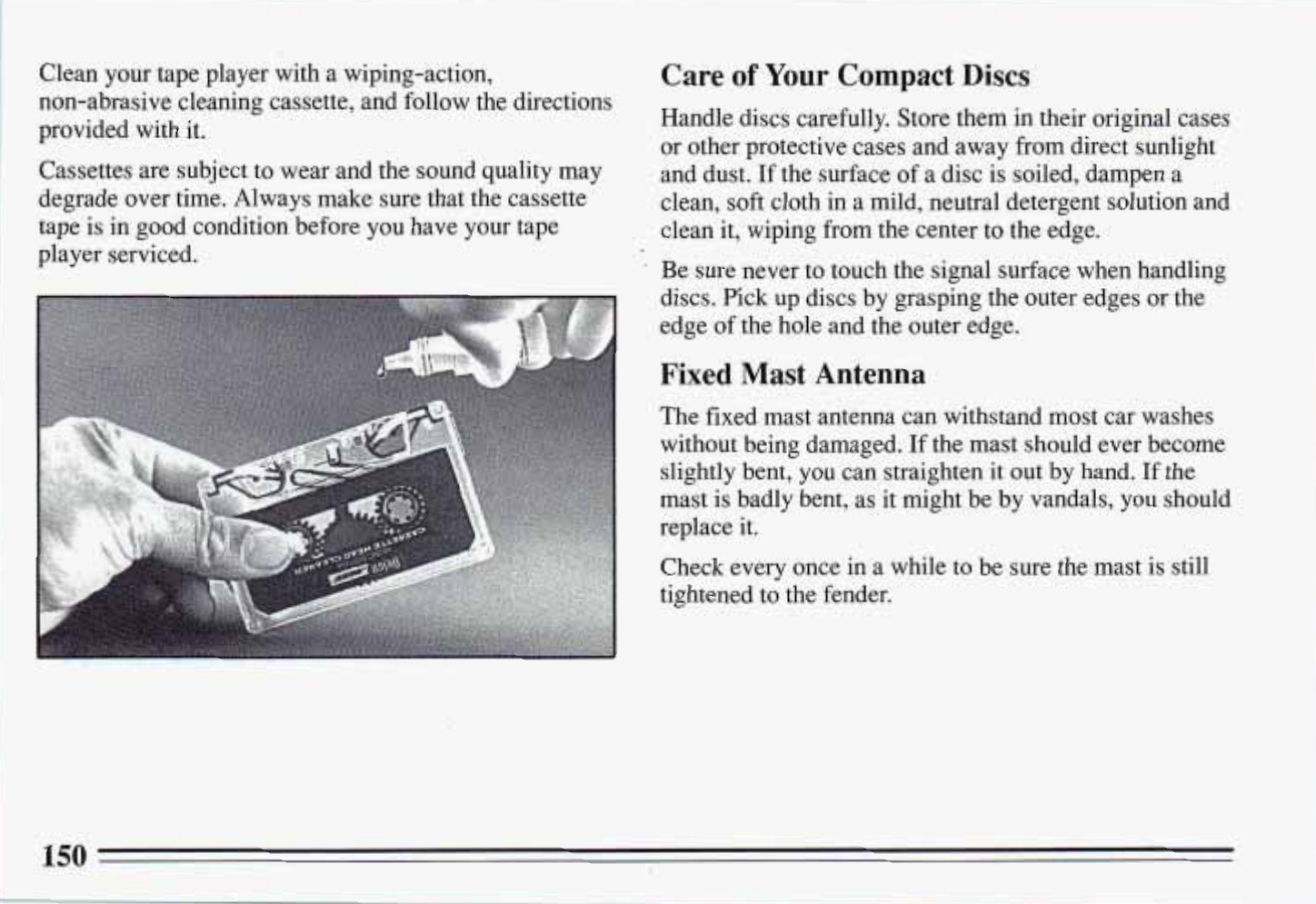
Clean your tape player with .a wiping-action,
non-abrasive cleaning cassette, and follow the directions
provided with it.
Cassettes are subject to wear and the sound quality may
degrade over time, Always make sure that the cassette
tape is in good condition before you have your tape
player serviced.
Care
of
Your Compact
Discs
Handle discs carefully. Store them in their original cases
or other protective cases and away from direct sunlight
and dust.
If
the surface
of
a disc
is
soiled, dampen a
clean, soft cloth in a mild, neutral detergent solution and
clean'it, wiping from the center to the edge.
.
Be sure never to touch the signal surface when handling
discs. Pick up discs by grasping the outer edges or the
edge
of
the hole and the outer edge.
Fixed Mast Antenna
The fixed mast antenna can withstand most car washes
without being damaged.
If
the mast should ever become
slightly bent, you can straighten
it
out
by
hand.
If
the
mast is badly bent, as
it
might be by vandals, you should
replace it.
Check every once in a while to be sure the mast is still
tightened to the fender.
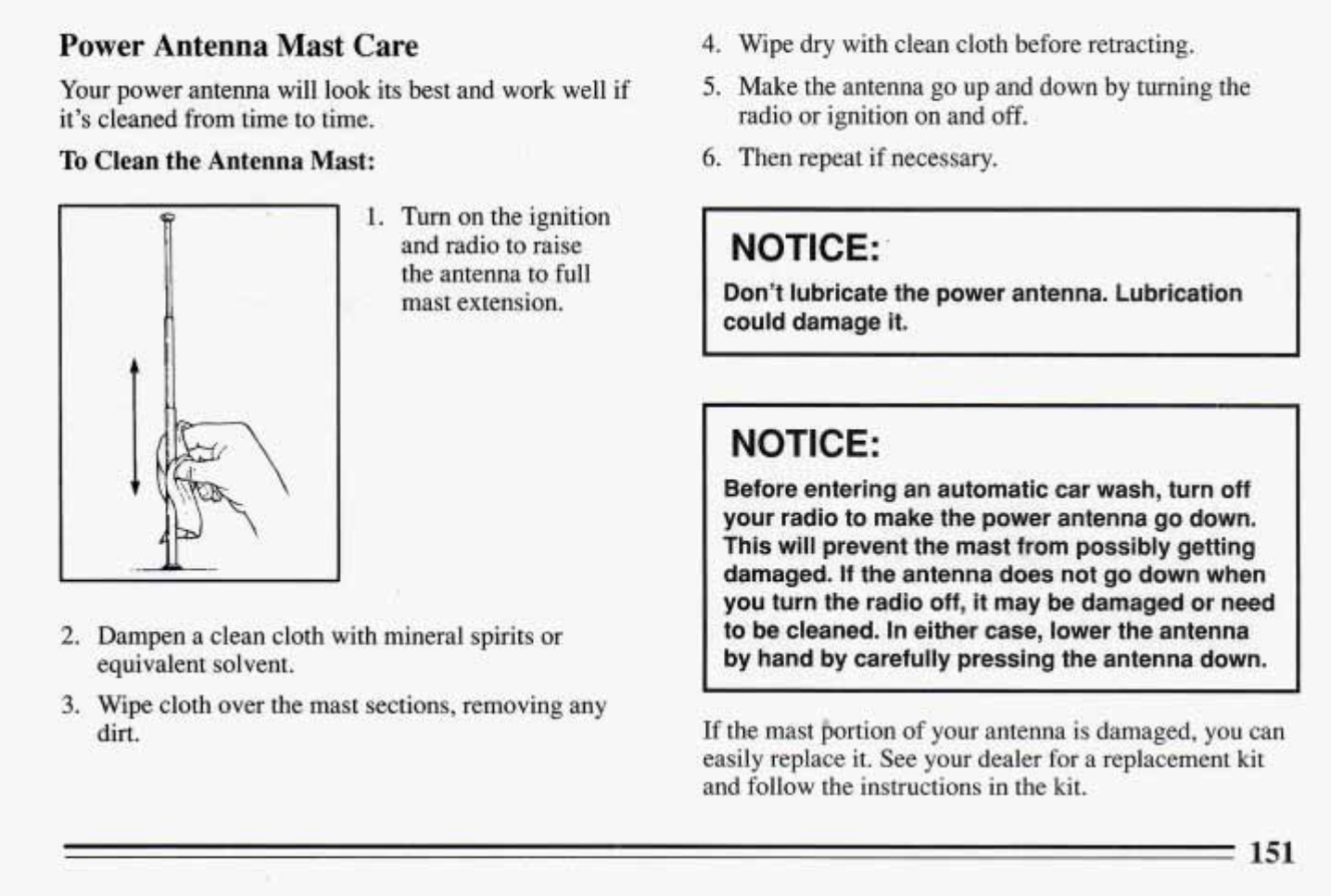
Power
Antenna Mast Care
4.
Wipe dry with clean cloth before retracting.
Your power antenna will look its best and work well
if
5.
Make the antenna go up and down by turning the
it’s cleaned
from
time to
time.
radio or ignition on and
off.
To
Clean
the
Antenna Mast:
6.
Then repeat if necessary.
1.
Turn on the ignition
and radio to raise
the antenna to. full
mast extension.
2. Dampen a clean cloth with mineral spirits or
3.
Wipe cloth over the mast sections, removing any
equivalent solvent.
dirt.
NOTICE:
Don’t lubricate the power antenna. Lubrication
could damage
it.
NOTICE:
Before entering an automatic car wash, turn
off
your radio to make the power antenna go down.
This
will
prevent the mast from possibly getting
damaged.
If
the antenna does not
go
down when
you turn the radio off,
it
may be damaged or need
to
be cleaned. In either case, lower the antenna
by hand by carefully pressing the antenna down.
If
the mast hortion of your antenna is damaged, you can
easily replace it. See your dealer for a replacement kit
and follow the instructions in
the
kit.
151
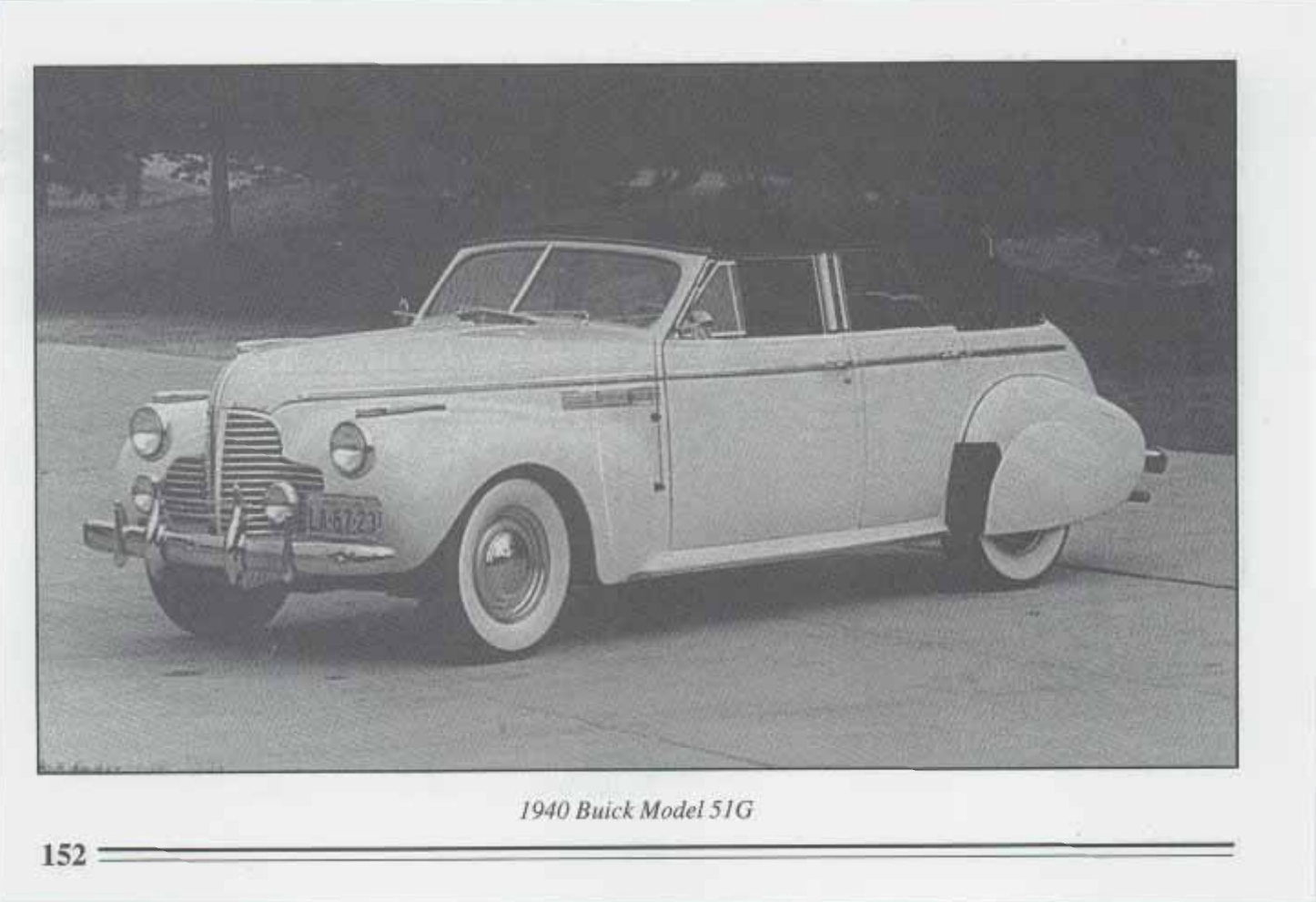
1940
Buick
Model
51
G
152
......
....
Part
4
Your Driving and the Road
. .
..
II
Here you’ll find information about driving on different kinds
of
included.many other useful tips on driving .
Part
4
includes:
Defensive Driving
.............................
’roads and in varying weather conditions
.
We’ve also
......
.............................
.
DrunkenDriving
..................................................................
ControlofaVehicle
................................................................
Braking
.....................................................................
Steering
......................................................................
Passing .....................................................................
LossofControl .....................................................................
Drivingat.Night
...................................................................
DrivingintheRain
.................................................................
CityDriving
......................................................................
FreewayDriving
...................................................................
Hill-andMountainRoads ............................................................
WinterDriving
....................................................................
TowingaTrailer
...................................................................
154
154
157
158
160
163
164
166
167
170
171
174
175
179
153
__
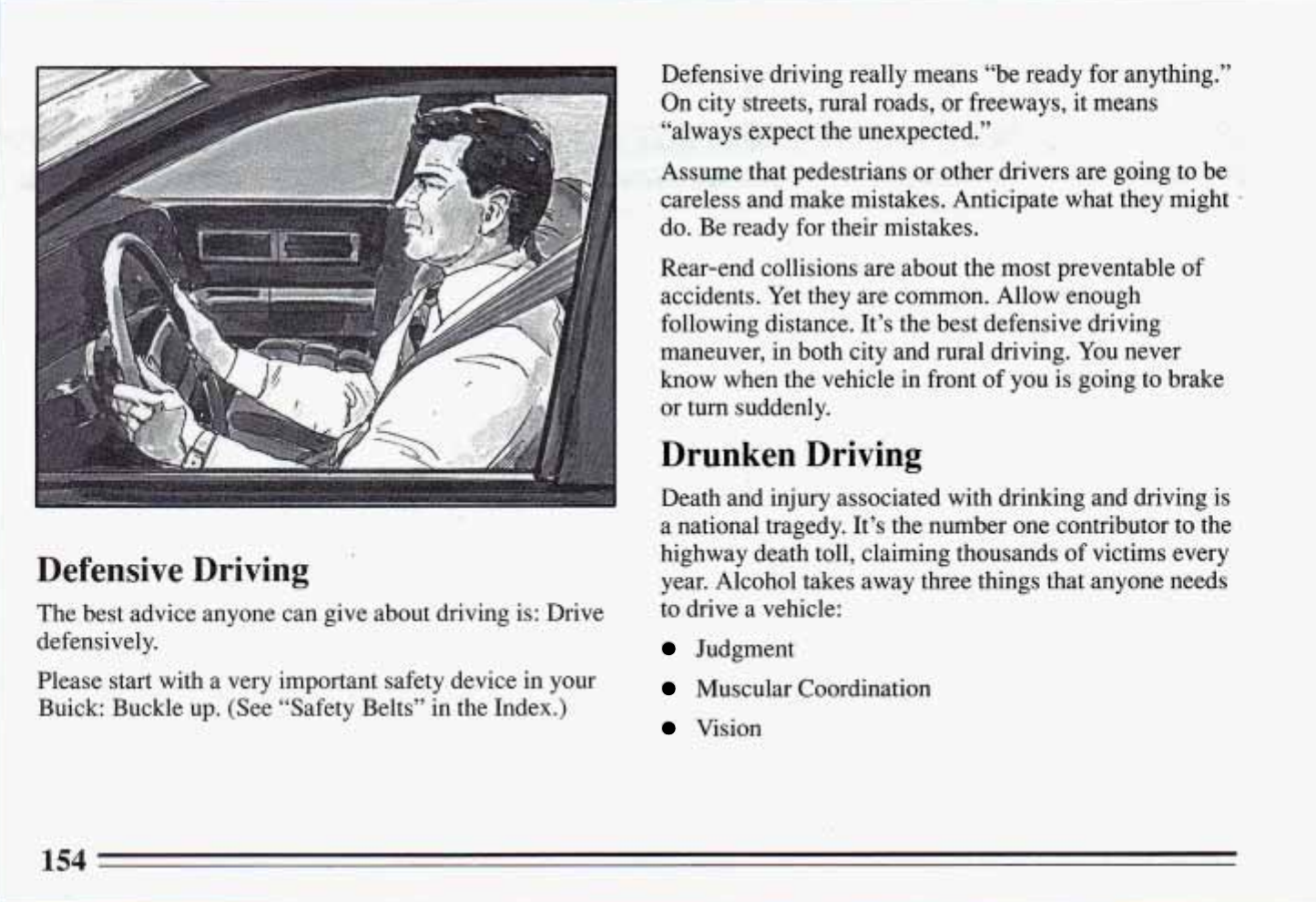
Defensive driving really means “be ready for anything.”
On city streets, rural roads, or freeways, it means
“always expect the unexpected.”
Assume that pedestrians or other drivers are going to be
careless and make mistakes. Anticipate what they might
*
do. Be ready for their mistakes.
Rear-end collisions are about the most preventable
of
accidents. Yet they are common. Allow enough
following distance. It’s the best defensive driving
maneuver, in both city and rural driving. You never
know when the vehicle in front of you is going to brake
or turn suddenly.
Drunken Driving
Death and injury associated with drinking and driving is
a
national tragedy. It’s the number one contributor to the
Defensive Driving
highway death toll, claiming thousands of victims every
year. Alcohol takes away three things that anyone needs
The best advice anyone can give about driving is: Drive to drive a vehicle:
defensively. Judgment
Please start with a very important safety device in your
Buick: Buckle up. (See “Safety Belts” in the Index.) Muscular Coordination
Vision
154

Police records show that almost half of all motor
vehicle-related deaths involve alcohol
-
a driver, a
passenger or someone else, such as a-pedestrian, had
been drinking. In most cases, these deaths are the result
of someone who was drinking and driving. About
20,000
motor vehicle-related deaths occur each year
because of alcohol, and thousands of people are injured.
Just how much alcohol is
too
much if a person plans to
drive? Ideally, no one should drink alcohol and then
drive. But if one does, then what’s “too ‘much”? It can be
a lot less than many might think. Although it depends on
each person and situation, here is some general
information on the problem.
The Blood Alcohol Content (BAC)
of
someone who is
drinking depends upon four things:
How much alcohol is in the drink.
0
The drinker’s body weight.
The amount of food that
is
consumed before and
during drinking.
0
The lengthof time
it
has taken the drinker to
consume the alcohol.
According to the American Medical Association,
a
180-pound (82 kg) person who drinks three 12-ounce
(355
ml) bottles
of
beer in an hour will end up with a
BAC of about
0.06
percent. The person would reach the
same BAC by drinking three 4-ounce
(
120
ml) glasses
of wine or three mixed drinks if each had
1
-
1/2 ounces
(45
ml) of a liquor like whiskey, gin
or
vodka.
1
cc
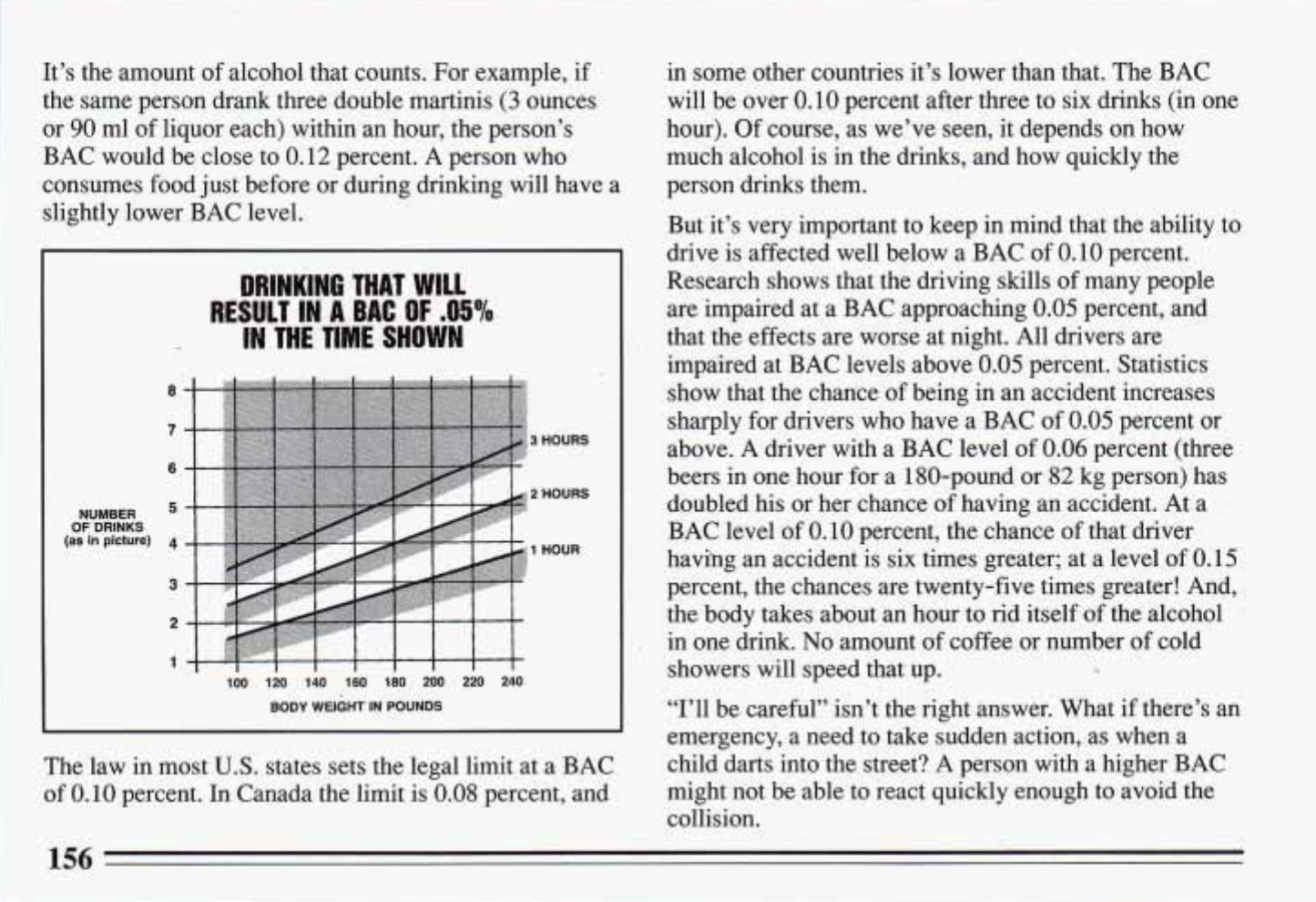
It's the amount
of
alcohol that counts. For example, if
the same person drank three double martinis
(3
ounces
or
90
ml
of
liquor each) within an hour, the person's
BAC would be close to
0.12
percent.
A
person who
consumes food just before or during drinking will have
a
slightly lower BAC level.
OF
DRINKS
NUMBER
(as
in
picture)
100
120
140
160
180
200
220
240
BODY
WEIGHT
IN
POUNDS
'
HOURS
!
HOURS
HOUR
The law
in
most
U.S.
states sets the legal limit at a BAC
of
0.10
percent.
In
Canada the limit is
0.08
percent, and
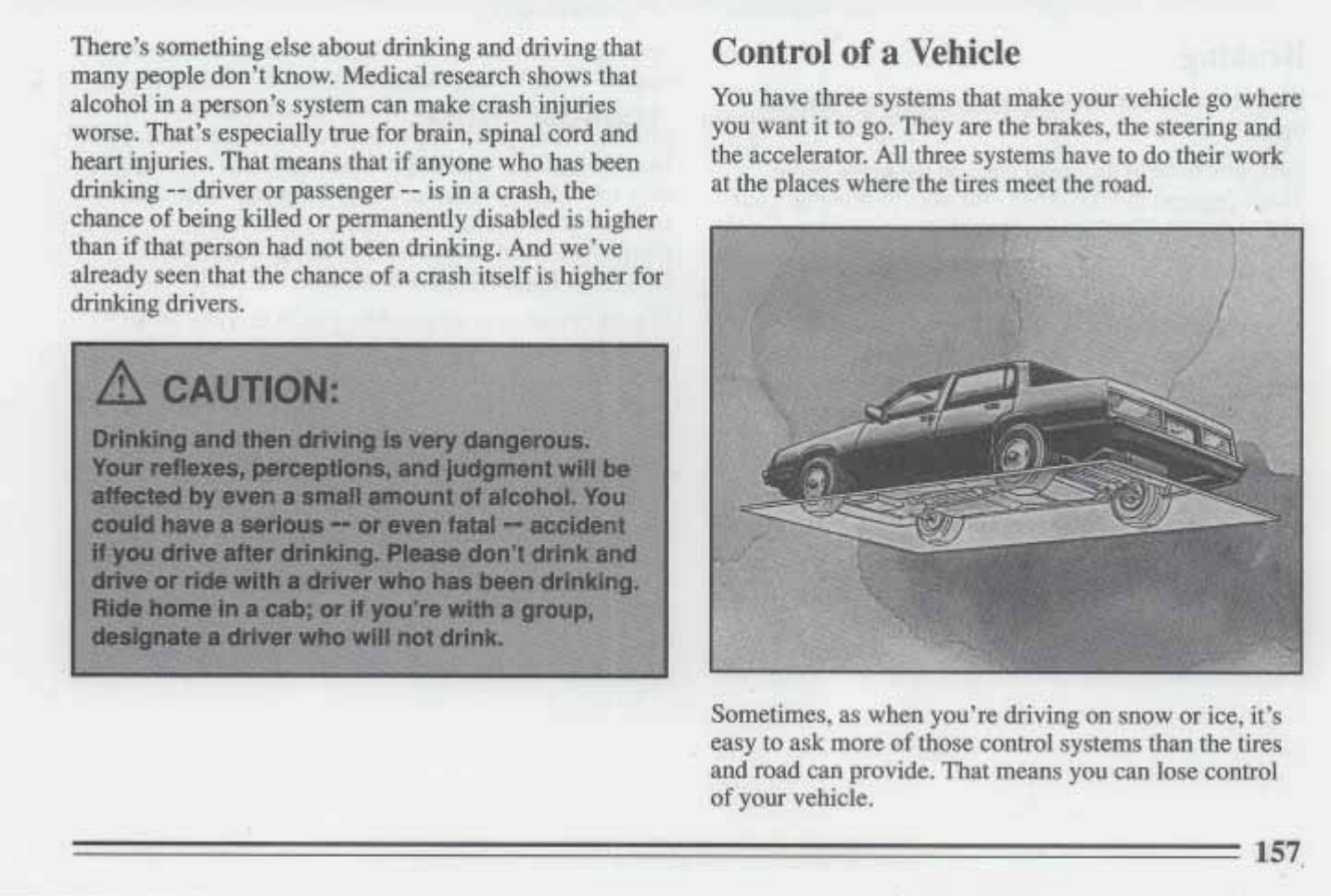
c
Braking
Avoid needless heavy braking. Some people drive in
spurts
--
heavy acceleration followed by heavy braking
--
rather than keeping pace with traffic. This is a
mistake. Your brakes may not have time to cool between
hard stops. Your brakes will wear out much faster if you
do a lot of heavy braking. If you keep pace with the
traffic and allow realistic following distances, you will
eliminate a lot of unnecessary braking. That means
better braking and longer brake life.
If your engine ever stops while you’re driving, brake
normally but don’t pump your brakes.
If
you do, the
pedal may get harder to push,down. If your engine
stops, you will still have some power brake assist. But
you will use it when you brake. Once the power assist is
used up,
it
may take longer
to
stop and
the
brake pedal
will be harder to push.
..:
I
158
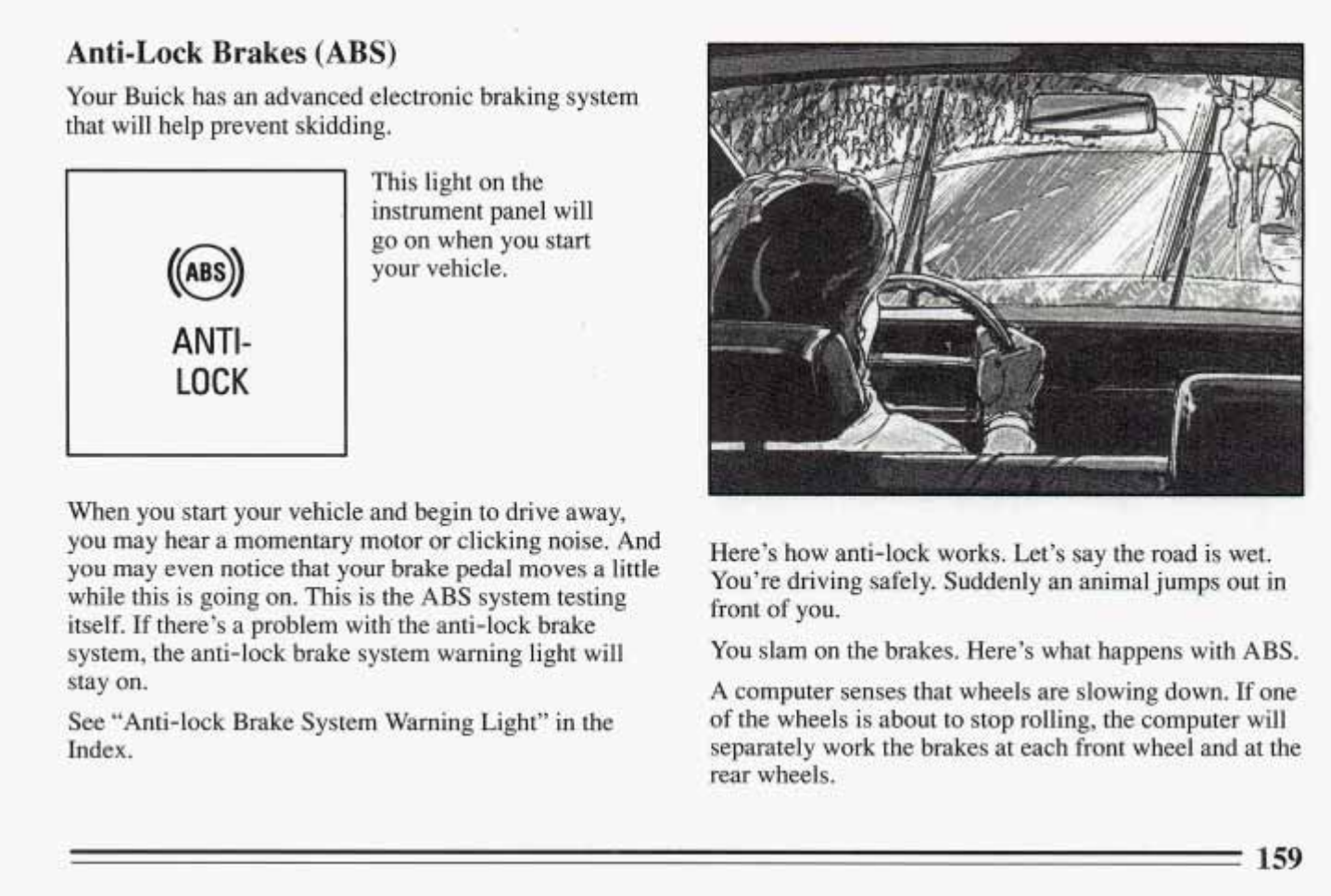
Anti-Lock Brakes (ABS)
Your Buick has an advanced electronic braking system
that will help prevent skidding.
ANTI-
LOCK
This light
on
the
instrument panel will
go on when you start
your vehicle.
When you start your vehicle and begin to drive away,
you may hear a momentary motor or clicking noise. And
you may even notice that your brake pedal moves a little
while this is going on. This is the
ABS
system testing
itself.
If
there’s
a
problem with’ the anti-lock brake
system, the anti-lock brake system warning light will
stay on.
See “Anti-lock Brake System Warning Light” in the
Index.
$:
Here’s how anti-lock works. Let’s say the road is wet.
You’re driving safely. Suddenly an animal jumps out in
front
of
you.
You slam on the brakes. Here’s what happens with ABS.
A computer senses that wheels are slowing down. If one
of the wheels is about to stop rolling, the computer will
separately work the brakes at each front wheel and
at
the
rear wheels.
159
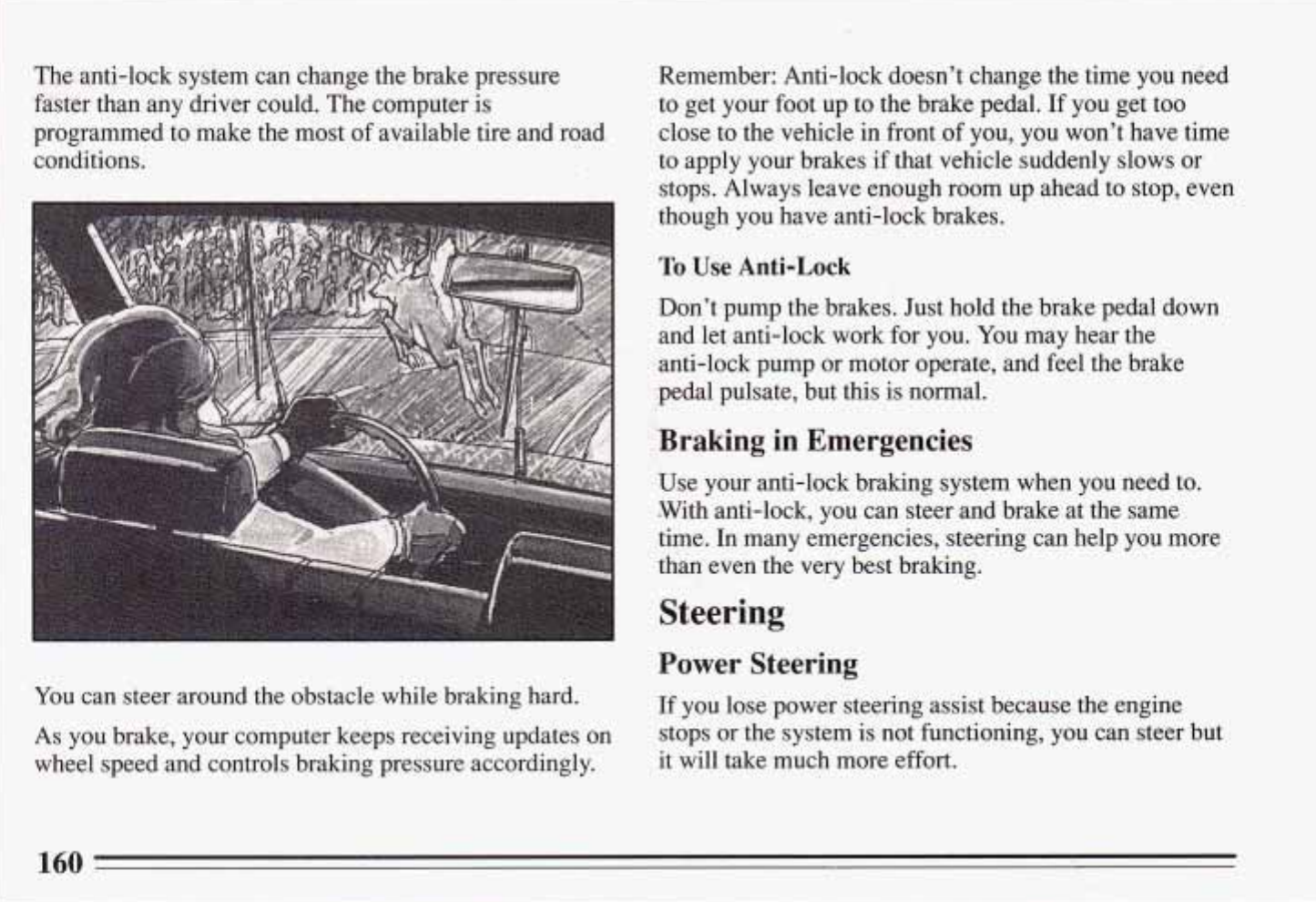
The anti-lock system can change the brake pressure
faster than any driver could. The computer is
programmed to make the most of available tire and road
conditions.
Y
You can steer around the obstacle while braking hard.
As
you brake, your computer keeps receiving updates on
wheel speed and controls braking pressure accordingly.
Remember: Anti-lock doesn’t change the time you need
to get your foot up to the brake pedal. If you get too
close to the vehicle in front of you, you won’t have time
to apply your brakes if that vehicle suddenly slows or
stops. Always leave enough room up ahead
to stop, even
though you have anti-lock brakes.
To
Use
Anti-Lock
Don’t pump the brakes. Just hold the brake pedal down
and let anti-lock work for; you. You may hear the
anti-lock pump or motor operate, and feel the brake
pedal pulsate, but this is normal.
Braking in Emergencies
Use your anti-lock braking system when you need to.
.With anti-lock, you can steer and brake at the same
time. In many emergencies, steering can help you more
than even the very best braking.
Steering
Power Steering
If
you lose power steering assist because
the
engine
stops or
the
system is not functioning, you can steer but
it will take much more effort.
Steering Tips
Driving
on
Curves
It’s importan; to take curves at a reasonable speed.
A
lot of the “driver lost control” accidents mentioned on
the news happen on curves. Here’s why:
Suppose you’re steering through a sharp curve. Then
you suddenly accelerate. Both control systems
--
steering and acceleration -- have to do their work where
the tires meet the road. Adding the sudden acceleration
can demand too much of those places. You can lose
control.
What should you
do
if this ever happens? Ease up
on
the
accelerator pedal, steer th:e vehicle the way
you
want-it
to
go,
and slow down.
Speed limit signs near curves warn that you should
adjust your speed. Of course, the posted speeds are
based
on
good weather and road conditions. Under less
favorable conditions you’ll want to go slower.
If you need to reduce your speed as you approach
a
curve, do it before you enter the curve, while your front
wheels are straight ahead.
Try to adjust your speed
so
you can “drive” through the
curve. Maintain a reasonable, steady speed. Wait to
accelerate until you are out .of the curve, and then
accelerate gently into the straightaway.
Steering in Emergencies
There are times when steering can be more effective
than braking. For example, you come over
a
hill and
find a truck stopped in your lane, or a car suddenly pulls
out
from nowhere, or a child darts out from between
parked cars and stops right in front
of
you. You can
avoid these problems by braking
--
if you can stop in
time. But sometimes you can’t; there isn’t room. That’s
the time for evasive action
--
steering around the
problem.
161
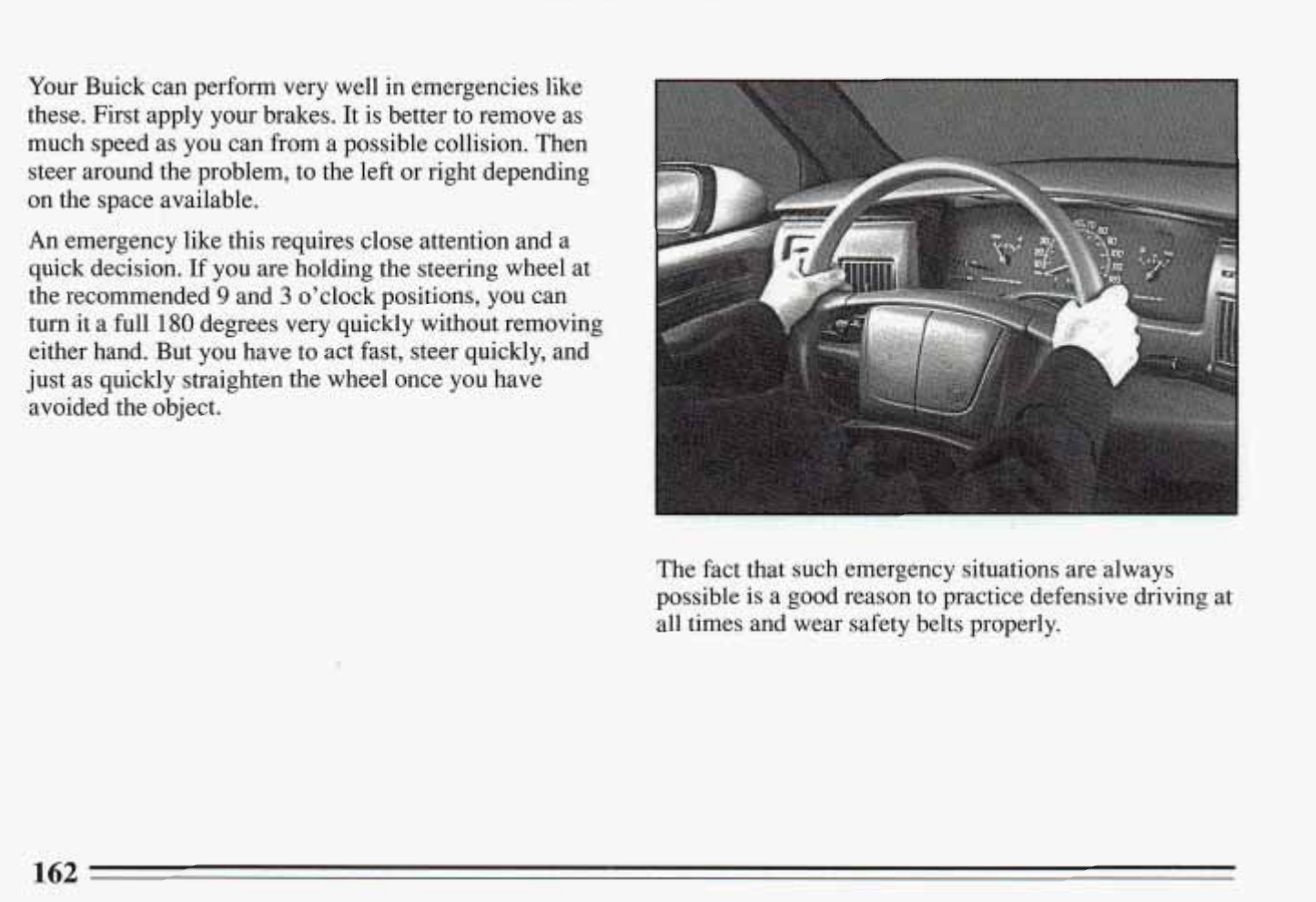
Your Buick can perform very well in emergencies like
these. First apply your brakes. It is better to remove as
much speed as you can from a possible collision. Then
steer around the problem, to the left or right depending
on the space available.
An
emergency like this requires close attention and a
quick decision.
If
you are holding the steering wheel at
the recommended
9
and
3
o'clock positions, you can
turn it a full
180
degrees very quickly without removing
either hand. But you have to act fast, steer quickly, and
just as quickly straighten the wheel once you have
avoided the object.
The fact that such emergency situations are always
possible is a good reason to practice defensive driving at
all times and wear safety belts properly.
162
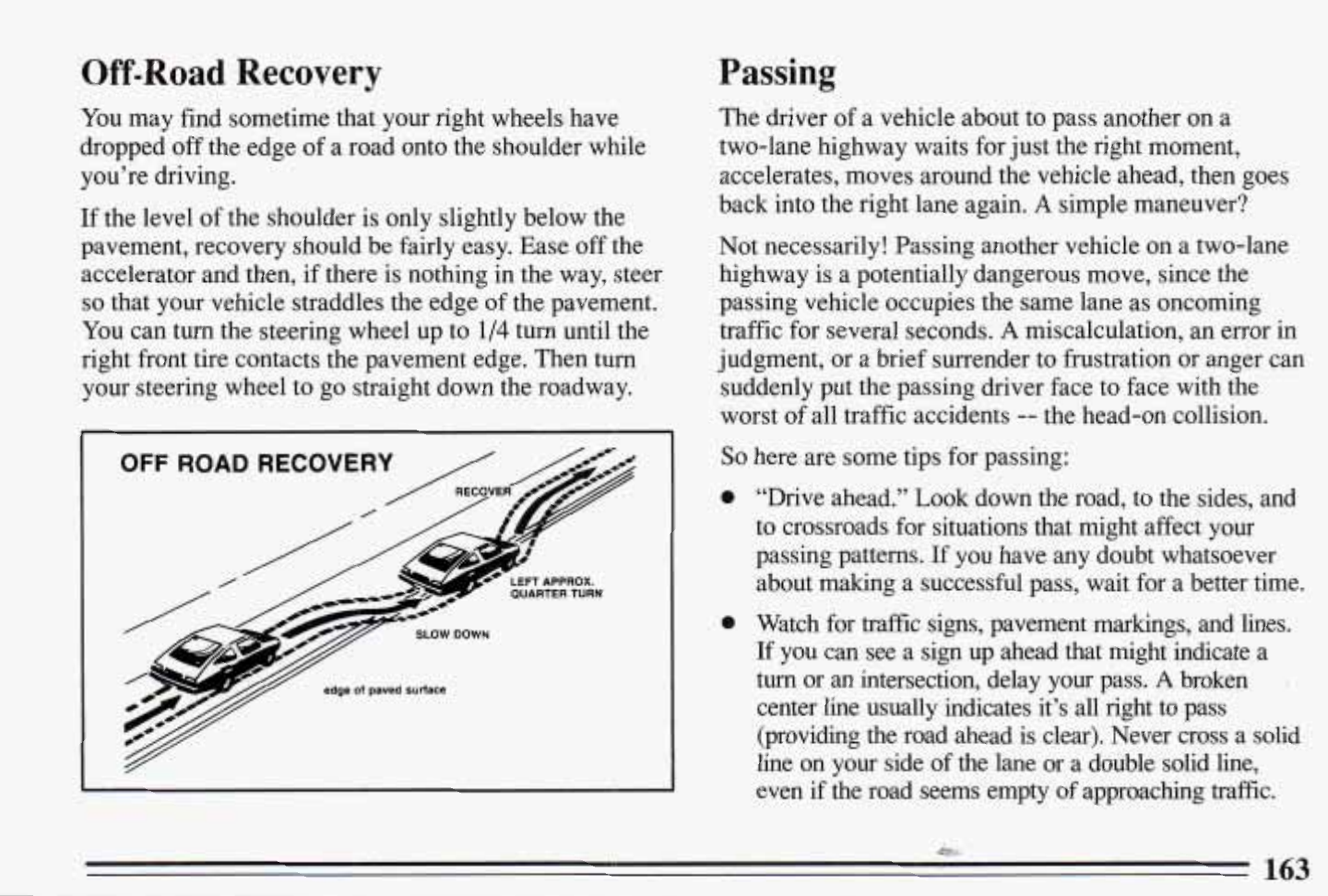
Off-Road
Recovery
You
may find sometime that your right wheels have
dropped off the edge of a road onto the shoulder while
you’re driving.
If the level of the shoulder is only slightly below the
pavement, recovery should be fairly easy. Ease off the
accelerator and then, if there is nothing in the way, steer
so
that your vehicle straddles the edge of the pavement.
You can turn the steering wheel up to 1/4
turn
until the
right front tire contacts the pavement edge. Then turn
your steering wheel to go straight down the roadway.
OFF
ROAD
RECOVERY
LEFT
APPROX.
QUARTER
TURN
Passing
The driver of a vehicle about to pass another on a
two-lane highway waits for just the right moment,
accelerates, moves around the vehicle ahead, then goes
back into the right lane again.
A
simple maneuver?
Not necessarily! Passing another vehicle on a two-lane
highway is a potentially dangerous move, since the
passing vehicle occupies the same lane as oncoming
traffic for several seconds.
A
miscalculation, an error in
judgment, or a brief surrender to frustration or anger can
suddenly put the passing driver face to face with the
worst of all traffic accidents
--
the head-on collision.
So
here are some tips for passing:
0
0
“Drive ahead.’’ Look down the road, to the sides, and
to crossroads for situations that might affect your
passing patterns.
If
you
have any doubt whatsoever
about making a successful pass, wait for a better time.
Watch for traffic signs, pavement markings, and lines.
If
you can
see
a sign up ahead that might indicate a
turn or an intersection, delay your pass.
A
broken
center line usually indicates it’s all right to pass
(providing the road ahead
is
clear). Never cross
a
solid
line on your side
of
the lane or
a
double solid line,
even if the road seems empty of approaching traffic.
&.
163
0
0
0
0
Do not get too close to the vehicle you want to pass
while you’re awaiting an opportunity. For one thing,
following too closely reduces your area of vision,
especially
if
you’re following a larger vehicle. Also,
you won’t have adequate space
if
the vehicle ahead
suddenly slows or stops. Keep back a reasonable
distance.
When it looks like a chance
to
pass is coming up,
start
to
accelerate but stay in the right lane and don’t
get too close. Time your move
so
you will be
increasing speed as, the time comes to move into the
other lane. If the way is clear to pass, you will have a
“running start” that more than makes up for the
distance you would lose by dropping back. And if
something happens to cause you to cancel your pass,
you need only slow down and drop back again and
wait for another opportunity.
If other cars are lined up to pass a slow vehicle, wait
your turn. But take care that someone isn’t trying to
pass you as you pull out to pass the slow vehicle.
Remember to glance over your shoulder and check
the blind spot.
Check your mirrors, glance over your shoulder, and
start your left lane change signal before moving out
of the right lane to pass. When you are far enough
0
0
0
ahead of the passed vehicle to see its front
in
your
inside mirror, activate your right lane change signal
and move back into the right lane. (Remember that
your right outside mirror is convex. The vehicle you
just passed may seem to be farther away from you
than it really is.)
Try not to pass more than one vehicle at a time on
two-lane roads. Reconsider before passing the next
vehicle.
Don’t overtake a slowly moving vehicle too rapidly.
Even though the brake lights are not flashing, it may
be slowing down or starting to turn.
If you’re being passed, make it easy for the
following driver to get ahead
of you. Perhaps you
can ease a little to the right.
Loss
of
Control
Let’s review what driving experts say about what
happens when the three control systems (brakes, steering
and acceleration) don’t have enough friction where the
tires meet the road to do what the driver has asked.
In any emergency, don’t give up. Keep trying to steer
and constantly seek an escape route or area
of
less
danger.
164
!
Skidding
In a skid, a driver can lose control
of
the vehicle.
Defensive drivers avoid most skids by taking reasonable
care suited to existing conditions, and by not
“overdriving” those conditions. But skids are always
possible.
The three types
of
skids correspond to your Buick’s
three control systems. In the braking skid your wheels’
aren’t rolling. In the steering or cornering skid, too
muchspeed or steering in a curve causes tires to slip and
lose cornering force. And in the acceleration skid too
much throttle causes the driving wheels to spin.
A cornering skid and an acceleration skid are best
handled by easing your foot
off
the accelerator pedal.
If your vehicle starts to slide, ease your foot
off
the
accelerator pedal and quickly steer the way you want the
vehicle to
go.
If you start steering quickly enough, your
vehicle may straighten out. Always be ready for a
second skid if it occurs.
165
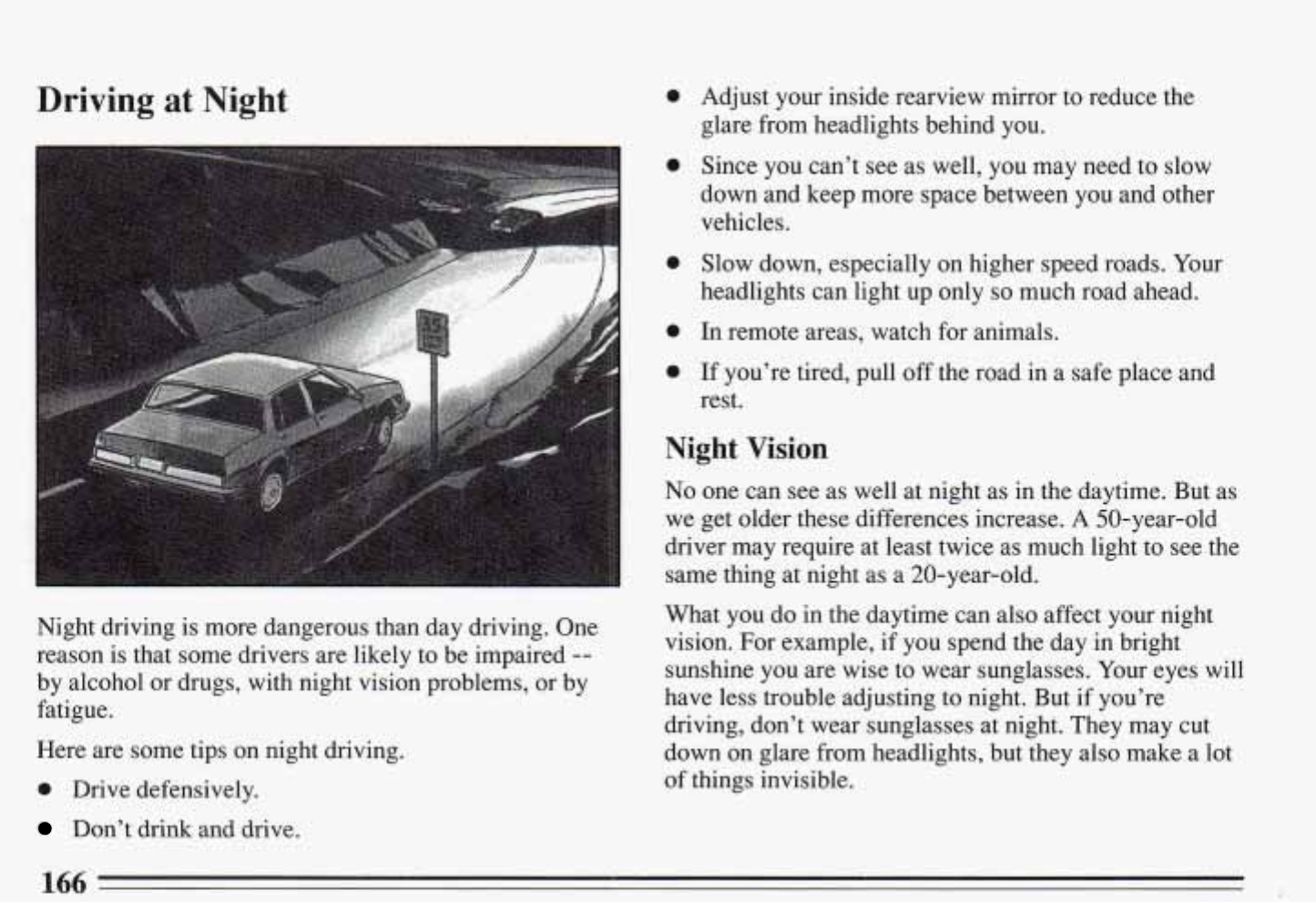
Driving
at
Night
Night driving is more dangerous than day driving. One
reason is that some drivers are likely to be impaired
--
by alcohol
or
drugs, with night vision problems, or by
fatigue.
Here are some tips on night driving.
0
Drive defensively.
Don’t drink and drive.
0
0
0
0
0
Adjust your inside rearview mirror to reduce the
glare from headlights behind you.
Since you can’t see as well, you may need
to
slow
down and keep more space between you and other
vehicles.
Slow down, especially on higher speed roads. Your
headlights can light up only so much road ahead.
In remote areas, watch for animals.
If you’re tired, pull off the road in a safe place and
rest.
Night
Vision
No one can see as well at night as in the daytime. But as
we
get older these differences increase. A 50-year-old
driver may require at least twice as much light to see the
same thing at night as a 20-year-old.
What you do in the daytime can also affect your night
vision. For example,
if
you spend the day in bright
sunshine you are wise to wear sunglasses. Your eyes will
have less trouble adjusting to night. But if you’re
driving, don’t wear sunglasses at night. They may cut
down
on
glare Erom headlights, but they also make
a
lot
of things invisible.
166
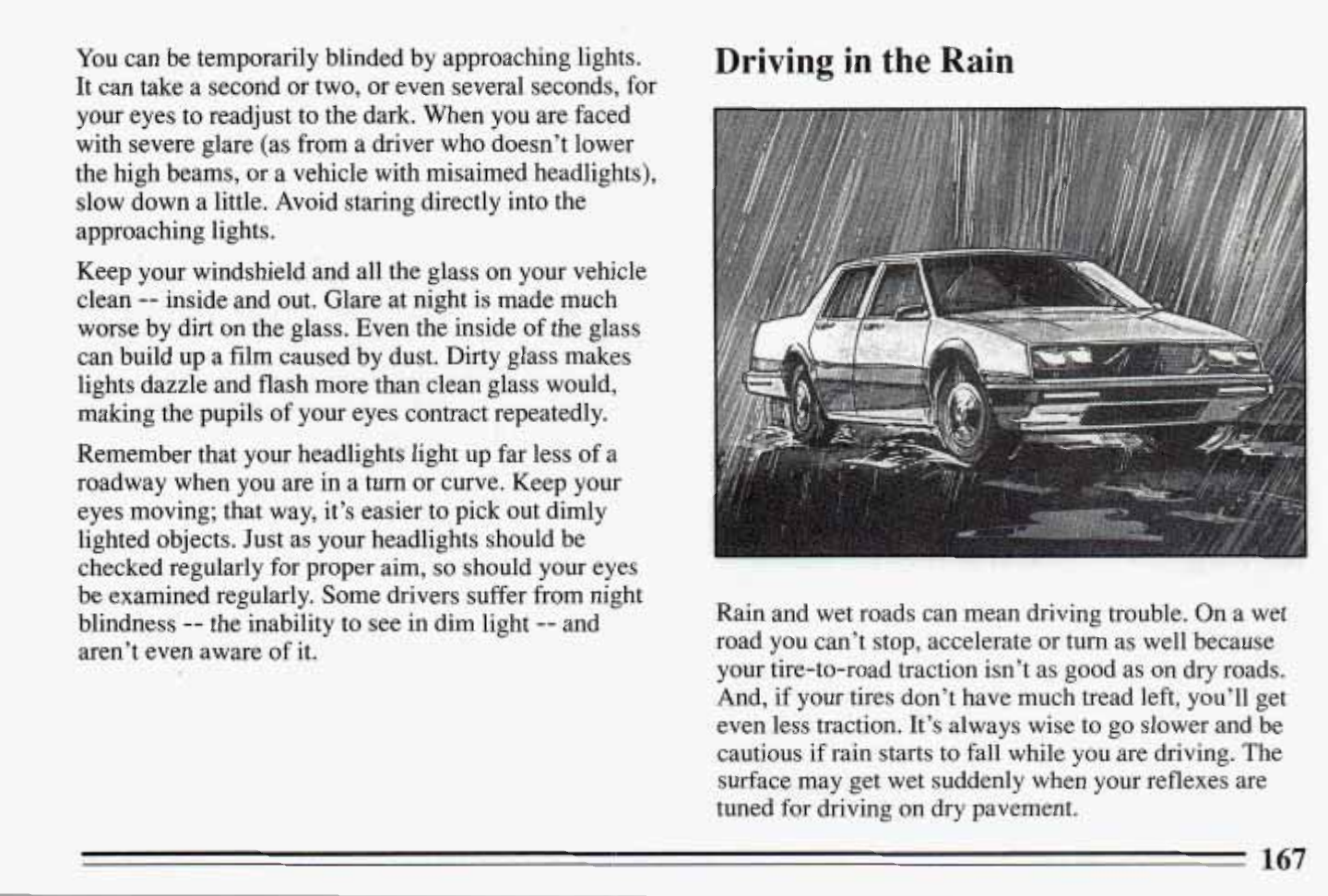
Driving in
the
Rain
Rain and wet roads can mean driving trouble. On
a
wet
road you can’t stop, accelerate or turn as well because
your tire-to-road traction isn’t as
good
as
on
dry roads.
And, if your tires don’t have much tread left, you’ll get
even less traction. It’s always wise to
go
slower and be
cautious if rain starts to fall while you are driving. The
surface may get wet suddenly when your reflexes are
tuned for driving on dry pavement.
167
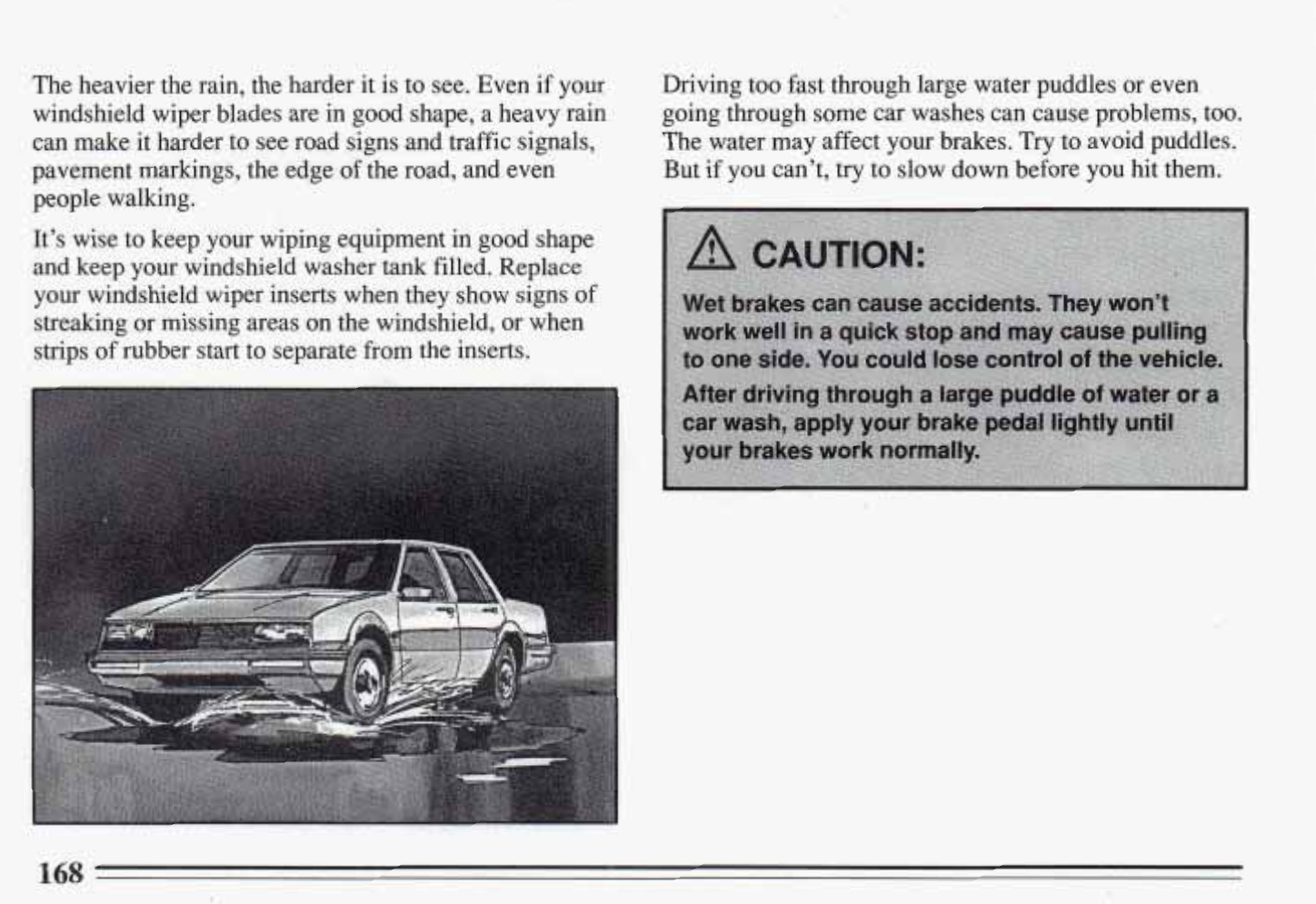
The heavier the rain, the harder it is to see. Even if your
windshield wiper blades are in good shape, a heavy rain
can make it harder to
see
road signs and traffic signals,
pavement markings, the edge of the road, and even
people walking.
It’s wise to keep your wiping equipment in good shape
and keep your windshield washer tank filled. Replace
your windshield wiper inserts when they show signs of
streaking or missing areas
on
the windshield, or when
strips of rubber start to separate from the inserts.
Driving too fast through large water puddles or even
going through some car washes can cause problems, too.
The water may affect your brakes. Try to avoid puddles.
But if you can’t, try to slow down before you hit them.
168
Hydroplaning
Hydroplaning is dangerous.
So
much water can build up
under your tires that they can actually ride on the water.
This can happen if the road is wet enough and you’re
going fast enough. When your vehicle is hydroplaning,
it has little or no contact with the road.
Hydroplaning doesn’t happen often. But it can
if
your tires
haven’t much tread or if the pressure
in
one or more is
low. It can happen if a lot of water is standing on the road.
If you can see reflections from trees, telephone poles, or
other vehicles, and raindrops “dimple” the water’s surface,
there could be hydroplaning.
Hydroplaning usually happens at higher speeds. There
just isn’t a hard and fast rule about hydroplaning. The
best advice is to slow down when it is raining.
Some Other Rainy Weather Tips
Turn on your low-beam headlights -- not just your
parking lights
-- to help make you more visible to others.
Besides slowing down, allow some extra following
distance. And be especially careful when you pass
another vehicle. Allow yourself more clear room ahead,
e
Have good tires with proper tread depth. .
‘’
(See “Tires” in the Index.)
169
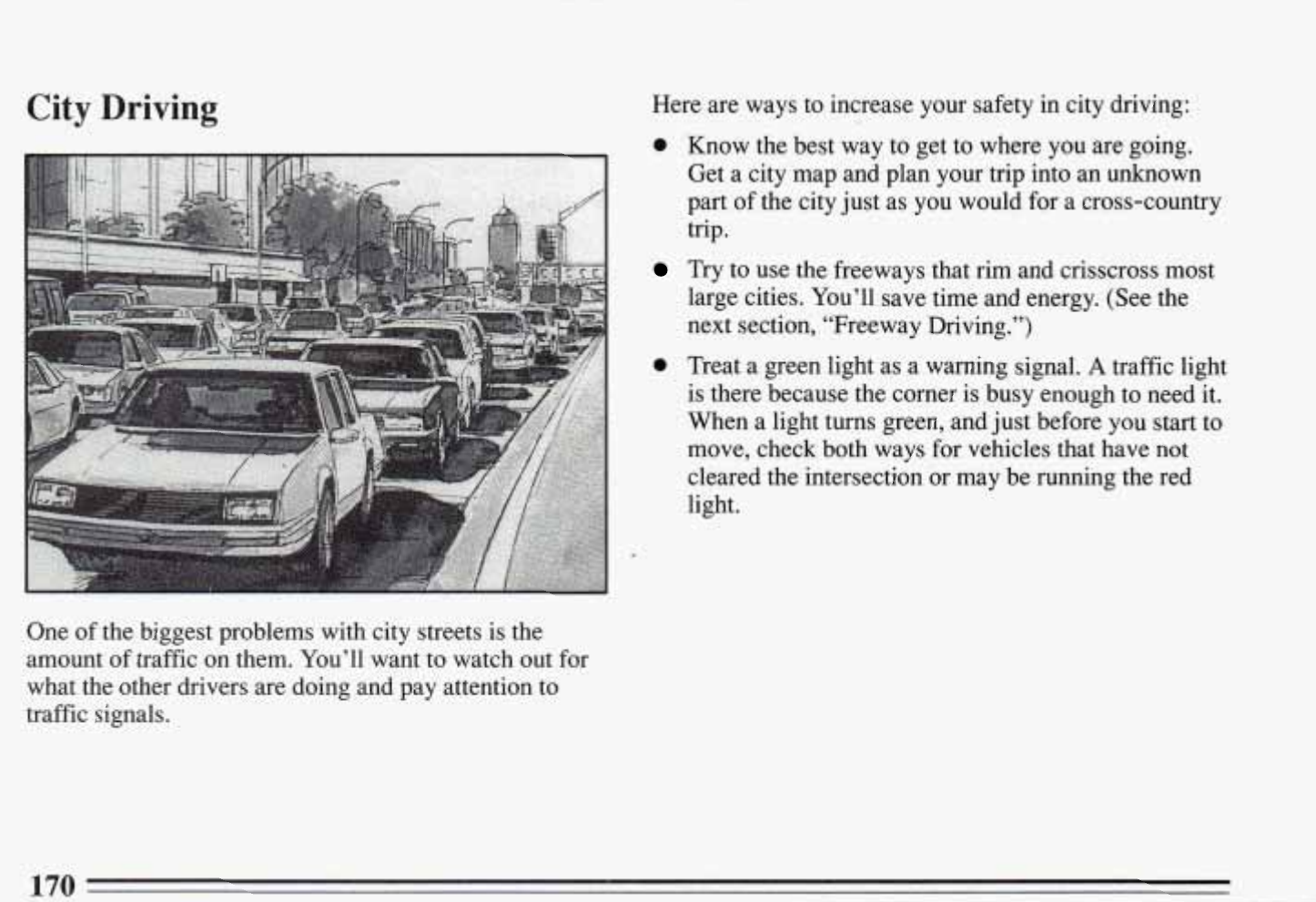
City
Driving
One of the biggest problems with city streets is the
amount of traffic on them. You’ll want to watch out for
what the other drivers are doing and pay attention to
traffic signals.
Here are ways
to
increase your safety
in
city driving:
0
Know the best way to get to where you are going.
Get a city map and plan your trip into an unknown
part of the city just as you would for a cross-country
trip.
Try to use the freeways that rim and crisscross most
large cities. You’ll save time and energy. (See the
next section, “Freeway Driving.”)
0
Treat a green light as a warning signal.
A
traffic light
is there because the corner is busy enough to need it.
When a light turns green, and just before you start to
move, check both ways for vehicles that have not
cleared the intersection or may be running the red
light.
170
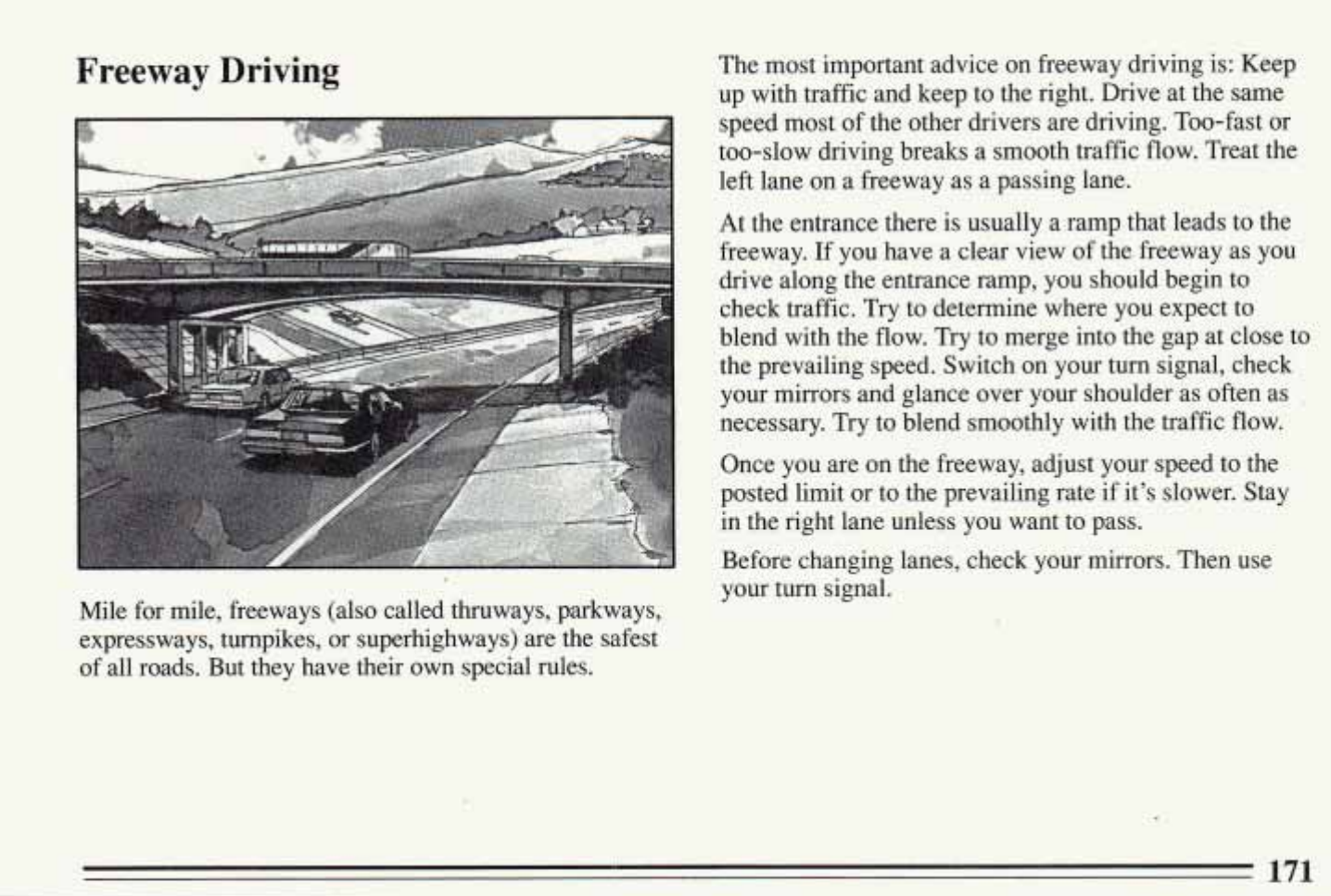
Freeway Driving
The most important advice on freeway driving is: Keep
up with traffic and keep to the right. Drive at the same
speed most of the other drivers are driving. Too-fast or
too-slow driving breaks a smooth traffic
flow.
Treat the
left lane on a freeway .as a passing lane.
At the entrance there
is
usuallv a ramp that leads to the
.I
L
freeway. If you have a clear view of the freeway as you,
drive along the entrance ramp, you should begin
to
Mile for rnile, freeways (also called thruways, parkways,
expressways, turnpikes, or superhighways) are the safest
of all roads. But they have their own special rules.
check traffic. Try to determine where you expect to
blend with the flow. Try to merge into the gap at close to
the prevailing speed. Switch on your turn signal, check
your mirrors and glance over your shoulder as often as
necessary. Try to blend smoothly with the traffic flow.
Once you are on the freeway, adjust your speed to the
posted limit or to the prevailing rate if it’s slower. Stay
in the right lane unless you want to pass.
Before changing lanes, check your mirrors. Then use
your turn signal.
171
Once you are moving on the freeyay, make certain you
allow a reasonable following distance. Expect to move
slightly slower at night.
When you want to leave the freeway, move to the proper
lane well in advance.
If
you miss your exit do not, under
any circumstances, stop and back up. Drive on to the
next exit.
The exit ramp can be curved, sometimes quite sharply.
The exit speed is usually posted.
Reduce your speed according to your speedometer, not
to your sense of motion. After driving for any distance
at higher speeds, you may tend to think you are going
slower than you actually are.
Before Leaving on a Long
Trip
Make sure you’re ready. Try to be well rested. If you
must start when you’re not fresh
--
such as after a day’s
work
--
don’t plan to make too many miles that first part
of the journey. Wear comfortable clothing and shoes you
can easily drive in.
Is yaw vehicle ready for a long trip?
If
you keep it
serviced and maintained, it’s ready to go.
If
it needs
service, have it done before starting out.
Of
course,
you’ll find experienced and able service experts
in
Buick dealerships all across North America. They’ll be
ready and willing to help if you need it.
Here are some things you can check before a trip:
/
-0
Windshield Washer Fluid: Is the reservoir full? Are
all windows clean inside and outside?
Wiper Blades: Are they in good shape?
Fuel. Engine Oil. Other Fluids: Have you checked all
levels?
172
0
Lights: Are they all working? Are the lenses clean?
0
Tires: They are vitally important to a safe,
trouble-free trip.
Is
the tread good enough for
long-distance driving? Are the tires all inflated to the
recommended pressure?
Weather Forecasts: What’s the weather outlook along
your route? Should you delay your trip a short time
to avoid a major storm system?
0
Maps: Do you have up-to-date maps?
Highway Hypnosis
Is
there actually such a condition as “highway hypnosis”?
Or is it just plain falling asleep at the wheel? Call it
highway hypnosis, lack of awareness, or whatever.
There is something about an easy stretch of road with the
same scenery, along- with the hum of the tires on the road,
the drone of the engine, and the rush of the wind against
the vehicle that can make you sleepy. Don’t let it happen
to you! If it does, your vehicle can leave the road in
than a second, and you could crash and be injured.
What can you do about highway hypnosis? First, be
aware that it can happen.
Then here are some tips:
0
Make sure your vehicle is well ventilated, with a
comfortably cool interior.
Keep your eyes moving. Scan the road ahead and to
the sides. Check your rearview mirrors and your
instruments frequently.
If
you get sleepy, pull
off
the road into a rest, service,
or parking area and take a nap, get some exercise, or
both. For safety, treat drowsiness on the highway as
an emergency.
173
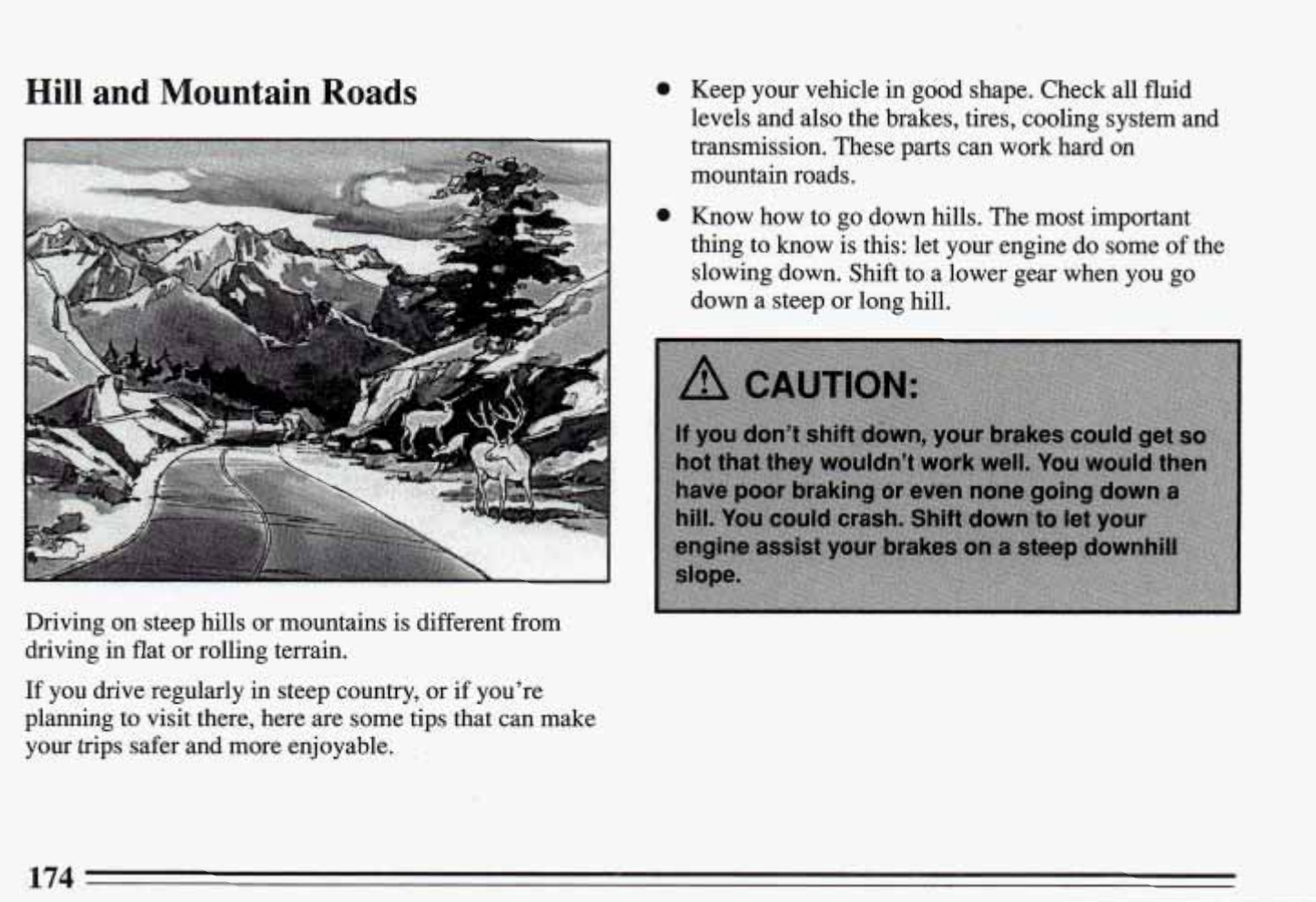
Hill
and Mountain Roads
Keep your vehicle in good shape. Check all fluid
levels and also the brakes, tires, cooling system and
transmission. These parts can work hard on
mountain roads.
Know how to go down hills. The most important
thing to know is this: let your engine do some of the
slowing down. Shift
to
a lower gear when you go
down a steep or long hill.
Driving on steep hills or mountains is different from
driving in flat or rolling terrain.
If you drive regularly in steep country, or if you’re
planning to visit there, here are some tips that can make
your trips safer and more enjoyable.
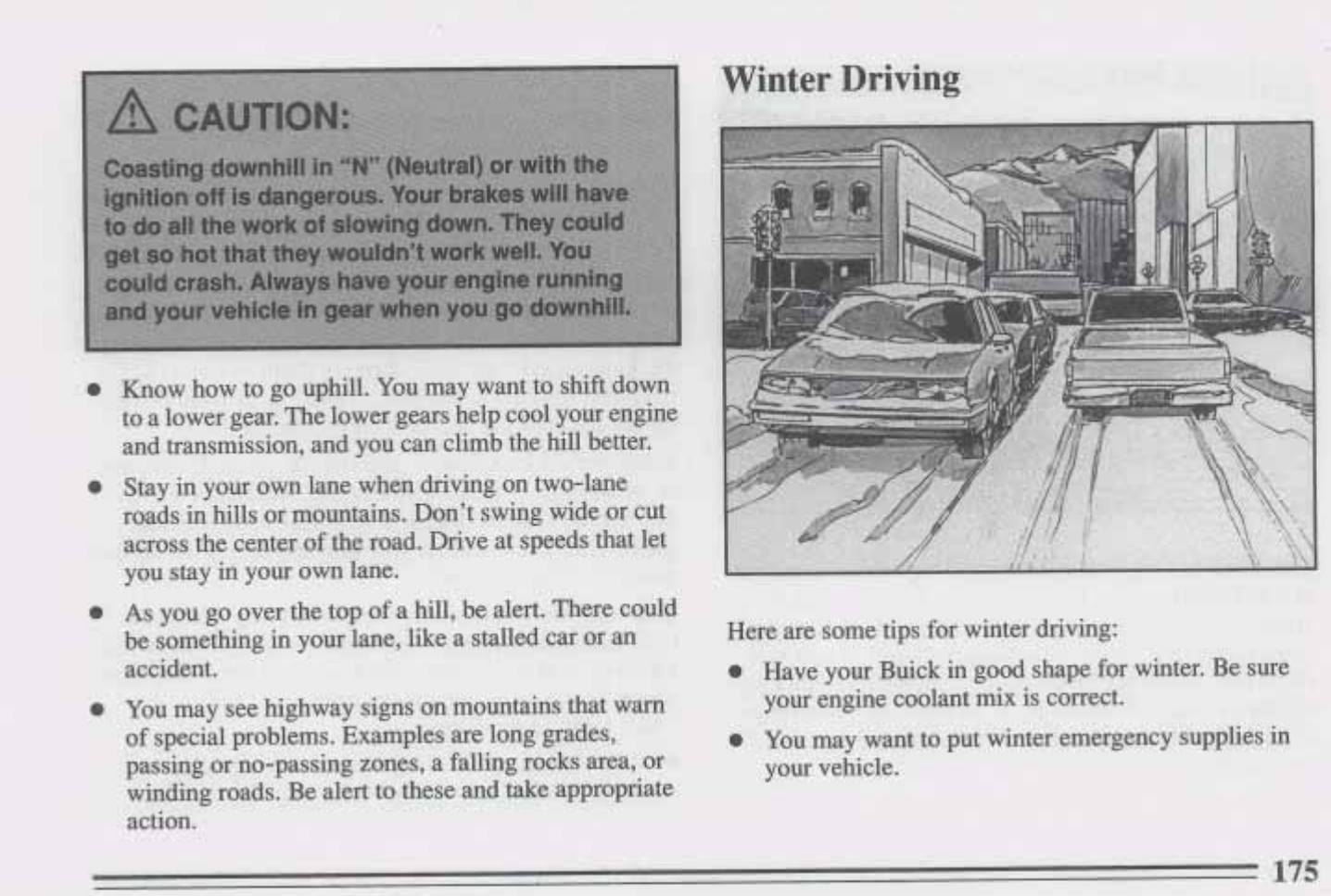
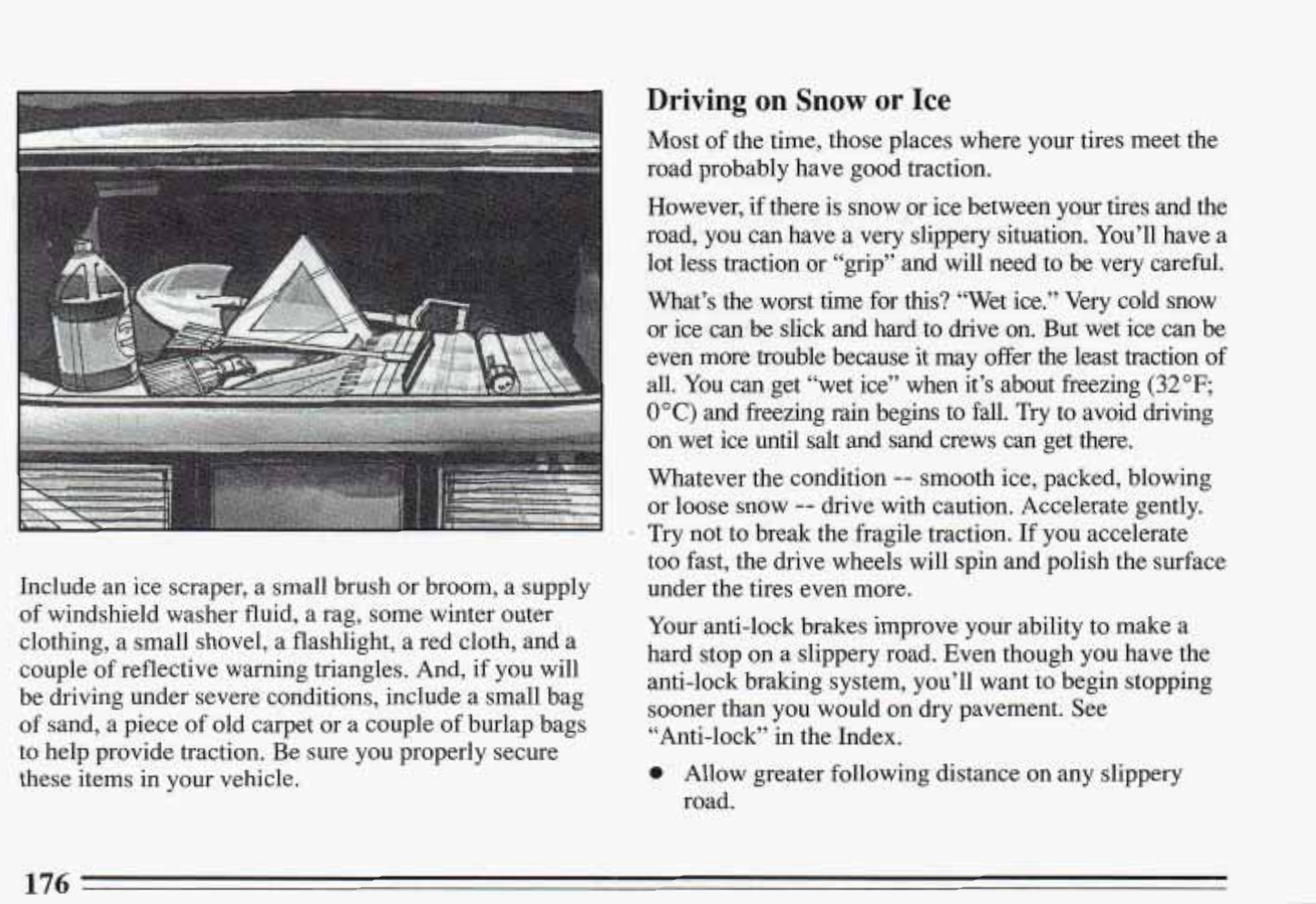
Include an ice scraper, a small brush or broom, a supply
of
windshield washer fluid, a rag, some winter outer
clothing, a small shovel, a flashlight, a red cloth, and a
couple
of
reflective warning triangles. And, if you will
be driving under severe conditions, include a small bag
of
sand, a piece
of
old carpet or a couple
of
burlap bags
to help provide traction. Be sure you properly secure
these items in your vehicle.
176
~
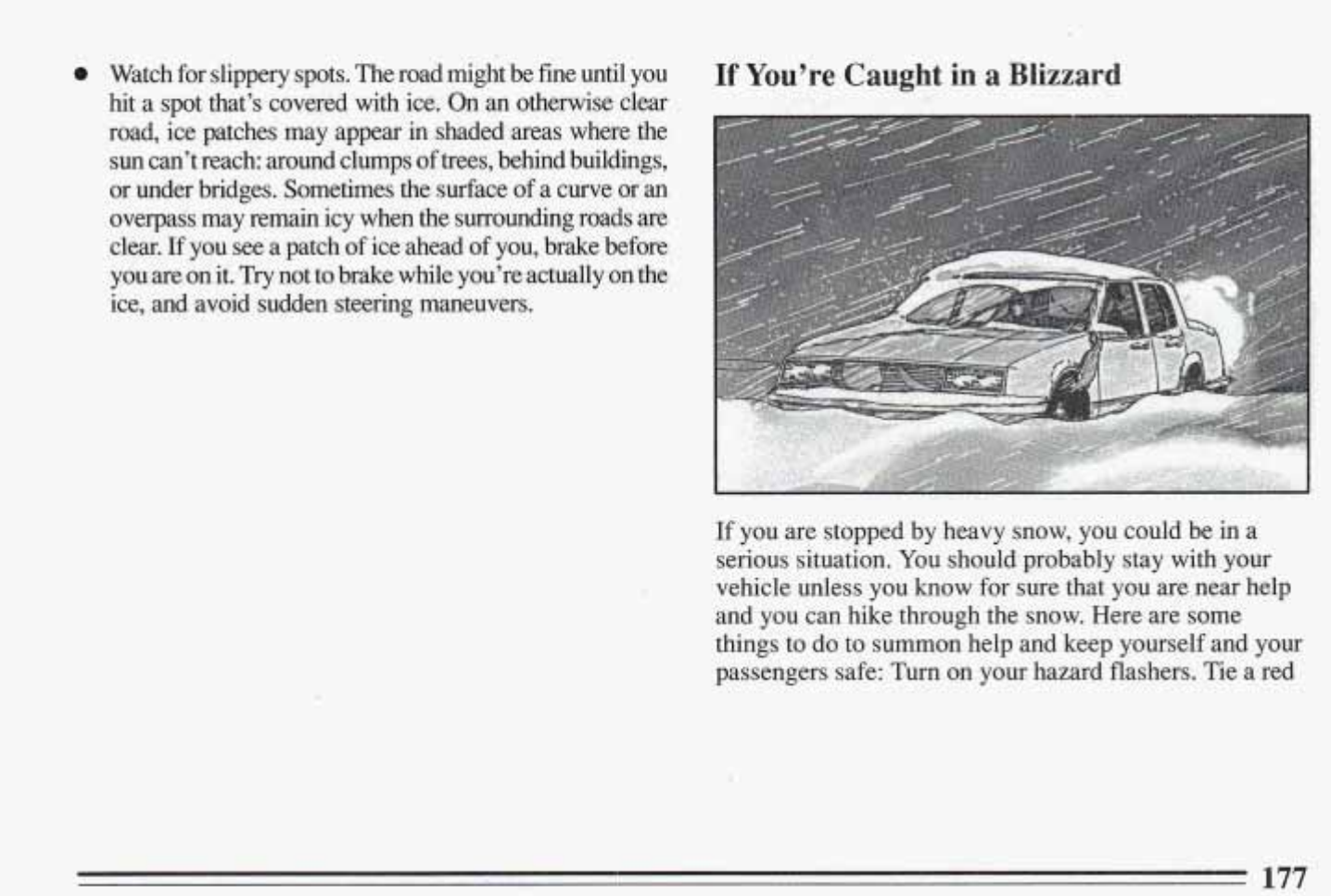
0
Watch for slippery spots. The road might be fine until you
hit a spot that’s covered with ice.
On
an otherwise dear
road, ice patches may appear
in shaded areas where the
sun can’t reach: around clumps of trees, behind buildings,
or under bridges. Sometimes the surface of a curve
or
an
overpass may remain icy when the surrounding roads are
clear.
If
you see a patch of ice ahead of you, brake before
you are on it. Try not to brake while you’re actually on the
ice, and avoid sudden steering maneuvers.
If
You’re
Caught
in
a Blizzard
If you are stopped by heavy snow, you could be in a
serious situation.
You
should probably stay with
your
vehicle unless you know for sure that you are.near help
and you can hike through the snow. Here are some
things to do to summon help and.keep yourself and your
passengers safe: Turn on your hazard flashers. Tie a red
177
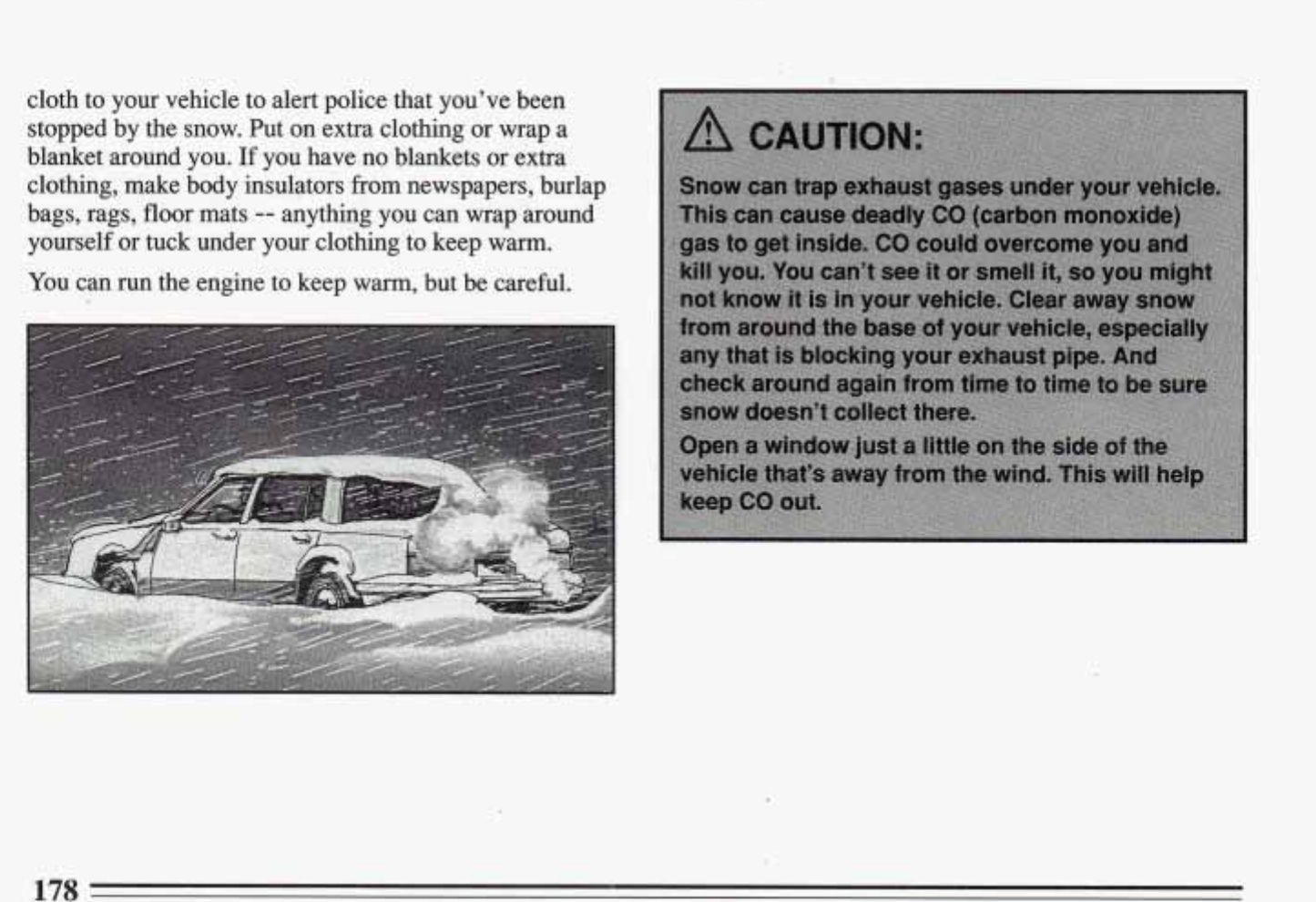
cloth to your vehicle to alert police that you’ve been
stopped by the snow. Put on extra clothing or wrap
a
blanket around you. If you have no blankets or extra
clothing, make body insulators
from
newspapers, burlap
bags, rags, floor mats
--
anything you can wrap around
yourself or tuck under your clothing
to
keep warm.
You can
run
the engine to keep
warm,
but be careful.
:.
1:s
-,I
Run
your
engine only as long as
you
must. This saves
fuel. When
you
run the engine,, make it go
a
little faster
than just idle. That is, push the accelerator slightly. This
uses less fuel for the heat that you get and it keeps the
battery charged. You will need a well-charged battery to
restart the vehicle, and possibly for signaling later on
with
your
headlights. Let the heater run for awhile.
Then, shut the engine
off
and close the window almost
all the way to preserve the heat. Start the engine again
and repeat this only when you feel really uncomfortable
from the cold. But do it as little as possible. Preserve the
fuel as long as you
can.
To help keep warm, you can get
out of the vehicle and do some fairly vigorous exercises
every half hour or
so
until help comes.
Towing a Trailer
NOTICE:
Pulling a trailer improperly can damage your
vehicle and result in costly repairs not covered
by your warranty.
To
pull a trailer correctly, follow
the advice in this section, and see your B4uick
dealer for important information about towing a
trailer with your vehicle.
179
0
your rig will be legal, not only where you live but
also where you’ll be driving.
A
good source for this
information can be state or provincial police.
Consider using a sway control if your trailer will
weigh
2,000
pounds
(900
kg) or less. You should
always
use
a sway control if your trailer will weigh
more than,2,000 pounds
(900
kg).
You can ask a hitch dealer about sway controls.
0
0
0
Don’t tow a trailer at all during the first
1,000
miles
(1600
km)
your new vehicle is driven. Your engine,
axle or other parts could be damaged.
Then, during the first
500
miles
(800
km) that you
tow a trailer, don’t‘drive over
50
mph
(80
km/h)
and
don’t make starts at full throttle.
This
helps your
engine and other parts of your vehicle wear in at the
heavier loads.
Obey speed limit restrictions when towing a trailer.
Don’t drive faster than the maximum posted speed
for trailers (or no more than
55 mph
(90
h/h)
to
save wear on your vehicle’s parts.
Three important considerations have to
do
with weight:
i
180
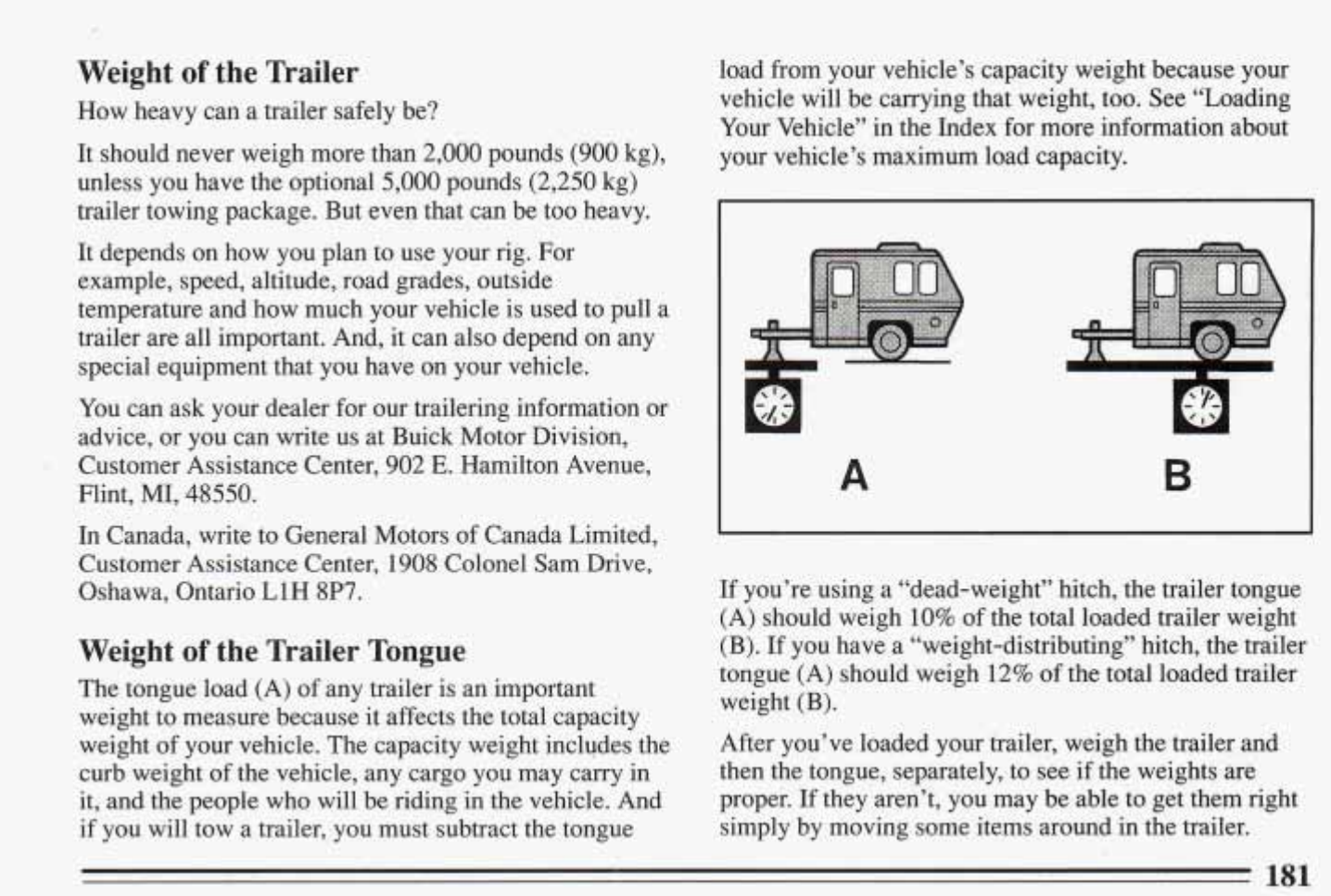
Weight
of
the Trailer
How heavy can a trailer safely be?
It should never weigh more than 2,000 pounds (900 kg),
unless you have the optional
5,000
pounds
(2,250
kg)
trailer towing package. But even that can be too heavy.
It
depends on how you plan to use your rig. For
example, speed, altitude, road grades, outside
temperature and how much your vehicle is used to pull a
trailer are all important. And,
it
can also depend on any
special equipment that you have on your vehicle.
You can ask your dealer for our trailering information or
advice, or you can write
us
at Buick Motor Division,
Customer Assistance Center, 902 E. Hamilton Avenue,
Flint, MI, 48550.
In Canada, write to General Motors
of
Canada Limited,
Customer Assistance Center,
1908
Colonel Sam Drive,.
Oshawa, Ontario L1H
8P7.
Weight
of
the Trailer
Tongue
The tongue load (A) of any trailer is an important
weight to measure because it affects the total capacity
weight
of
your vehicle. The capacity weight includes the
curb weight
of
the vehicle, any cargo you may carry in
it,
and the people who will be riding in the vehicle. And
if you will tow
a
trailer, you must subtract the tongue
load from your vehicle’s capacity weight because your
vehicle will be carrying that weight, too. See “Loading
Your Vehicle” in the Index for more information about
your vehicle’s maximum load capacity.
If
you’re using a “dead-weight” hitch, the trailer tongue
(A) should weigh 10% of the total loaded trailer weight
(B).
If you have a “weight-distributing” hitch, the trailer
tongue (A) should weigh 12% of the total loaded trailer
weight (B).
After you’ve loaded your trailer, weigh the trailer and
then the tongue, separately, to see
if
the weights are
proper. If they aren’t, you may be able to get them right
simply by moving some items around in the trailer.
181
Total Weight
on
Your Vehicle’s Tires
Be sure your vehicle’s tires are inflated to the limit for
cold tires. You’ll find these numbers on the Certification
label at the rear edge of the driver’s door or see
“Loading Your Vehicle” in the Index. Then be sure you
don’t go over the
GVW limit for your vehicle.
Hitches
It’s important to have the correct hitch equipment.
Crosswinds, large trucks going by, and rough roads
are
a
few reasons why you’ll need the right hitch. Here are
some rules to. follow:
If you’ll be pulling a trailer that, when loaded, will
weigh more than
2,000
pounds
(900
kg), be sure to
use a properly mounted, weight-distributing hitch
and sway control of the proper size. This equipment
is very important for proper vehicle loading and
good handling when you’re driving.
Will you have to make any holes in the body of your
vehicle when you install a trailer hitch? If you do,
then be sure to seal the holes later when you remove
the hitch. If you don’t seal them, deadly carbon
monoxide (CO) from your exhaust can get into your
vehicle (see “Carbon Monoxide” in the Index). Dirt
and water can, too.
The bumpers
on
your vehicle are not intended for
hitches.
Do
not attach rental hitches or other
bumper-type hitches to them. Use only a
frame-mounted hitch that does not attach to the
bumper.
Safety Chains
You should always attach chains between your vehicle
and your trailer. Cross the safety chains under the
tongue of the trailer
so
that the tongue will not drop to
the road if it becomes separated from the hitch.
Instructions about safety chains may be provided by the
hitch manufacturer or by the trailer manufacturer.
Follow the manufacturer’s recommendation for
attaching safety chains. Always leave just enough slack
so you can turn with your rig.. And, never allow safety
chains to drag on the ground.
Trailer Brakes
If
your trailer weighs more than
1,000
pounds
(450
kg)
loaded, then it needs its own brakes
-
and they must be
adequate. Be sure to read and follow the instructions for
the trailer brakes
so you’ll be able to install, adjust and
maintain them properly. Because you have anti-lock
,
brakes, do not try to tap into your vehicle’s brake
system. If you do, both brake systems won’t work well,
or at all.
182
Driving with a Trailer
Towing a trailer requires a certain amount of experience.
Before setting out for the open road, you’ll want
to get
to know your rig. Acquaint yourself with the feel
of
handling and braking with the added weight of the
trailer. And always keep in mind that the vehicle you are
driving
is
now a good deal longer and not nearly
so
responsive as your vehicle is by itself.
Before you start, check the trailer hitch and platform,
safety chains, electrical connector, lights, tires and
mirror adjustment.
If
the trailer has electric brakes, start
your vehicle and trailer moving and then apply the
trailer brake controller by hand
to
be sure the brakes are
working. This lets you check your electrical connection
at the same time.
During your trip, check occasionally to be sure that the
load is secure, and that the lights and any trailer brakes
are still working.
Following Distance
Stay at least twice as far behind the vehicle ahead as you
would when driving your vehicle without a trailer. This
can help you avoid situations that require heavy braking
and sudden turns.
Passing
You’ll need more passing distance up ahead when
you’re towing a trailer. And, because you’re a good deal
longer, you’ll need to
go
much farther beyond the
passed vehicle before
you
can return to your lane.
Backing
Up
Hold the bottom of the steering wheel with one hand.
Then, to move the trailer to the left, just move that hand
to the left.
To move the trailer to the right, move your
hand to the right. Always back up slowly and, if
possible, have someone guide you.
Making Turns
When you’re turning with a trailer, make wider turns
than normal. Do this
so
your trailer won’t strike soft
shoulders, curbs, road
signs,
trees, or other objects.
Avoid jerky or sudden maneuvers. Signal well in
advance.
Tbrn Signals When Towing
a
Trailer
When you tow a trailer, your vehicle has to have a
different turn signal flasher and extra wiring. The green
arrows on your instrument panel will flash whenever
you signal a turn or lane change. Properly hooked up,
183
the trailer lights will also flash, telling other drivers
you’re about to turn, change lanes or stop.
When towing a trailer, the green arrows on your
instrument panel
will
flash for turns even if the bulbs on
the trailer are burned out. Thus, you may think drivers
behind you are seeing your signal when they are not.
It%
important to check occasionally to be sure the trailer
bulbs are still working.
Driving
On
Grades
Reduce speed and shift to a lower gear
before
you
start
down a long or steep downgrade.
If
you don’t shift
down, you might have to use your brakes
so
much that
they would get hot and no longer work well.
On a long uphill grade, shift down and reduce your
speed to aronnd
45
mph
(70
h/h)
to reduce the
possibility
of
engine, transmission, and rear axle
overheating,
Parking
on
Hills
You really should not park your vehicle, with a trailer
attached, on a hill. If something goes wrong, your rig
could start to move. People can be injured, and both
your vehicle and the trailer can be damaged.
But,
if
you ever have to park your rig on a hill, here’s
how to do it:
1.
Apply your regular brakes, but don’t shift into
“F)”
(Park) yet.
2.
Have someone place chocks under the trailer wheels.
3.
When the wheel chocks are in place, release the
regular brakes until the chocks absorb the load.
4.
Reapply the regular brakes. Then apply your parking
5.
Release the regular brakes.
brake, and then shift to
“P”
(Park).
When You Are Ready to Leave After
Parking on
a
Hill
1.
Apply your regular brakes and hold the pedal down
while you:
0
Start your engine;
0
Shift into a gear; and
0
Release the parking brake.
2.
Let up on the brake pedal.
3.
Drive slowly until the trailer is clear of the chocks.
4.
Stop and have someone pick up and store the chocks.
Maintenance When Trailer Towing
Your vehicle will need service more often when you’re
pulling a trailer. See the Maintenance Schedule for more
on this. Things that are especially important in trailer
operation are automatic transmission fluid (don’t
overfill), engine oil, axle lubricant, belts, cooling
system, and brake adjustment. Each of these is covered
in this manual, and the Index will help you find them
quickly. If you’re trailering, it’s a good idea to review
these sections before you start your trip.
Check periodically to see that all hitch nuts and bolts are
tight.
Trailer Hitching Procedure Using a Weight
Distributing (Equalizing) Hitch
(Recommended
for
loaded trailers weighing
3,000
lbs.
to
7,000
lbs.)
Your vehicle is equipped with an Electronic Level
Control (ELC) feature.. When hooking
up
a trailer using
a weight distributing hitch, always use the following
procedure:
0
0
0
0
0
Place the vehicle on a level surface without the
trailer hitched. With the ignition off and all doors
closed, allow the vehicle to level automatically.
Disable the Electronic Level Control (ELC) by
pulling MAXI@ fuse LEVEL CNTRL
(30
amp)
from
the underhood electrical center located in the engine
compartment.
Attach the trailer to the vehicle. The trailer tongue
should weigh
12%
of the total loaded. trailer weight.
Level the vehicle with the load leveling spring bars
(equalizers).
Leave the fuse out while towing your trailer.
185
I
NOTICE:
Adjusting an equalizing hitch with the
Electronic Level Control (ELC) system engaged
will defeat the function
of
the load equalizing
hitch and may cause unsatisfactory handling.
Once you have completed towing your trailer, be sure to
;reinstall the Electronic Control (ELC) fuse.
i
In
Addition
Use two friction sway controls if
YOU
trailer
is
over
5,000
lbs.
(2
270
kg) loaded weight, and/or is over
24'
long.
j
Use at least one friction sway control if your trailer
is over
2,000
lbs.
(908
kg) loaded weight, and
consider using one for trailers under
2,000
lbs.
(908
kg).
1
NOTICE:
Do
not use sway control devices on trailers
equipped with surge brakes, Le, boat trailers.
Surge brakes
do
not function properly when
used with most sway control devices.
Trailer brakes of adequate size are recommended on
trailers over
1,000
lbs. loaded weight.
If
a
trailer is over
5,000
lbs.
(2
270
kg), adjust
vehicle rear tire pressure to
35
psi. (cold tire
pressure).
I
Part
5
Problems
on
the
Road
rn
187
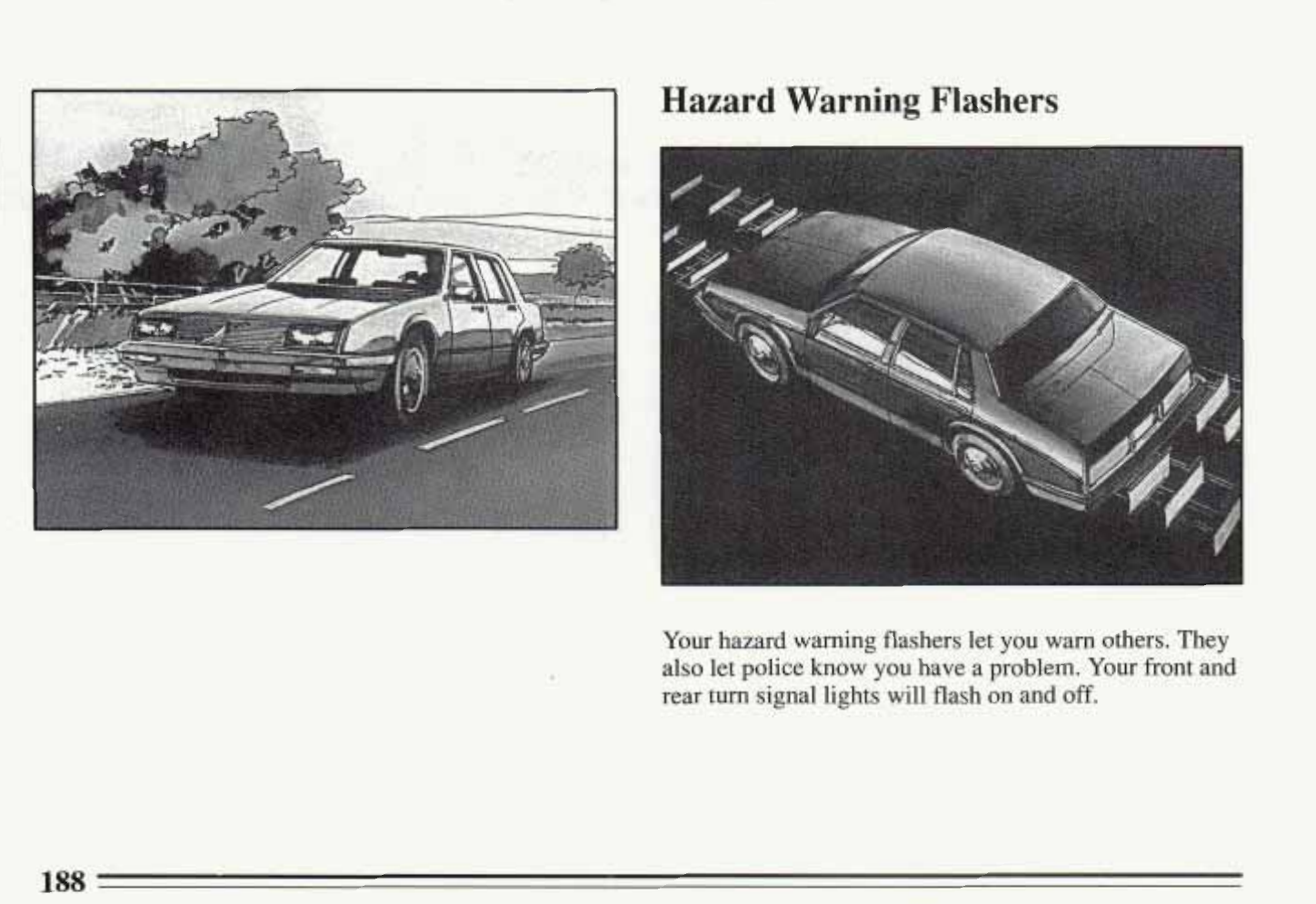
Hazard Warning Flashers
Your hazard warning flashers let you warn others. They
also let police know you have a problem. Your front and
rear turn signal lights will flash on and
off.
188
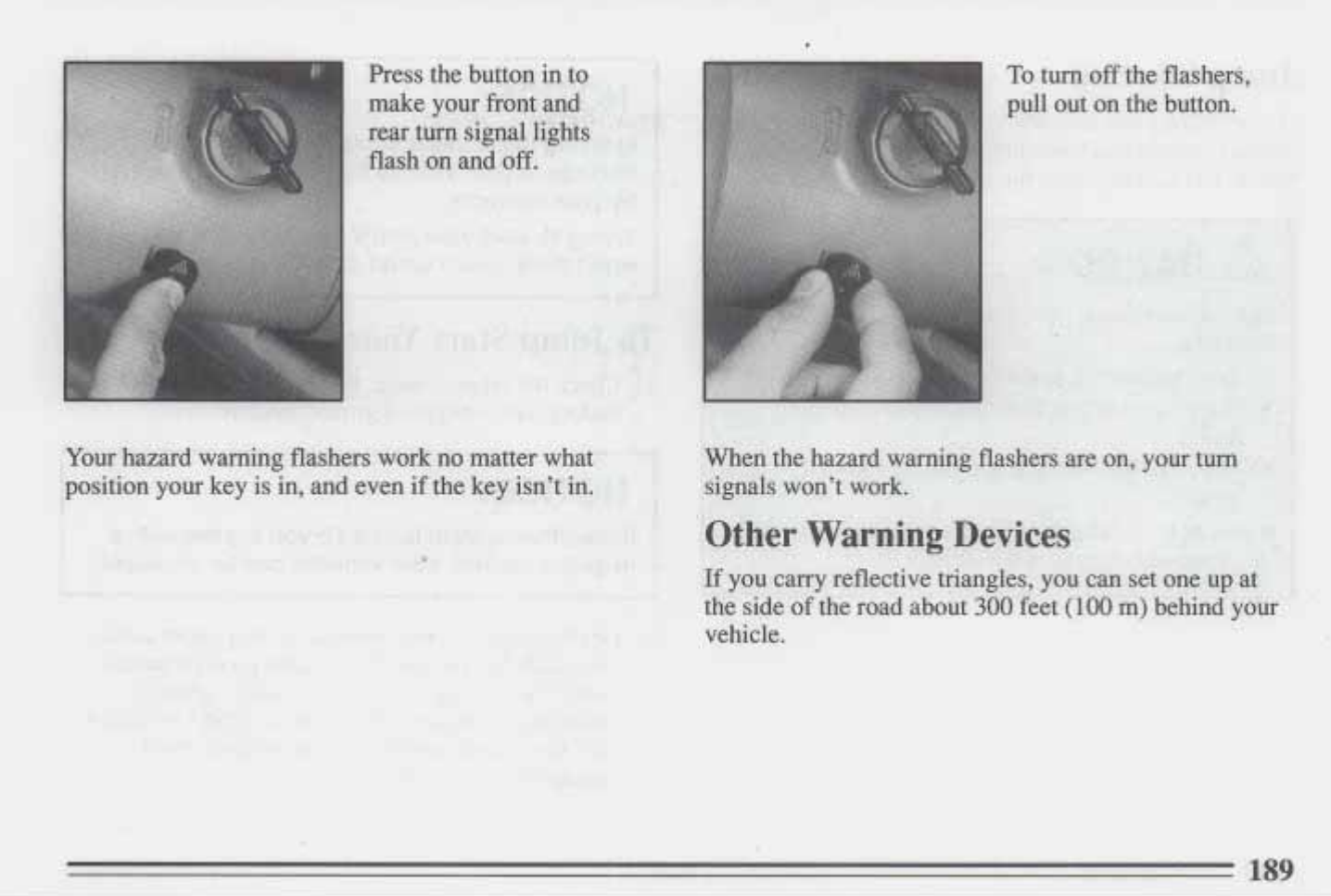
,
;.
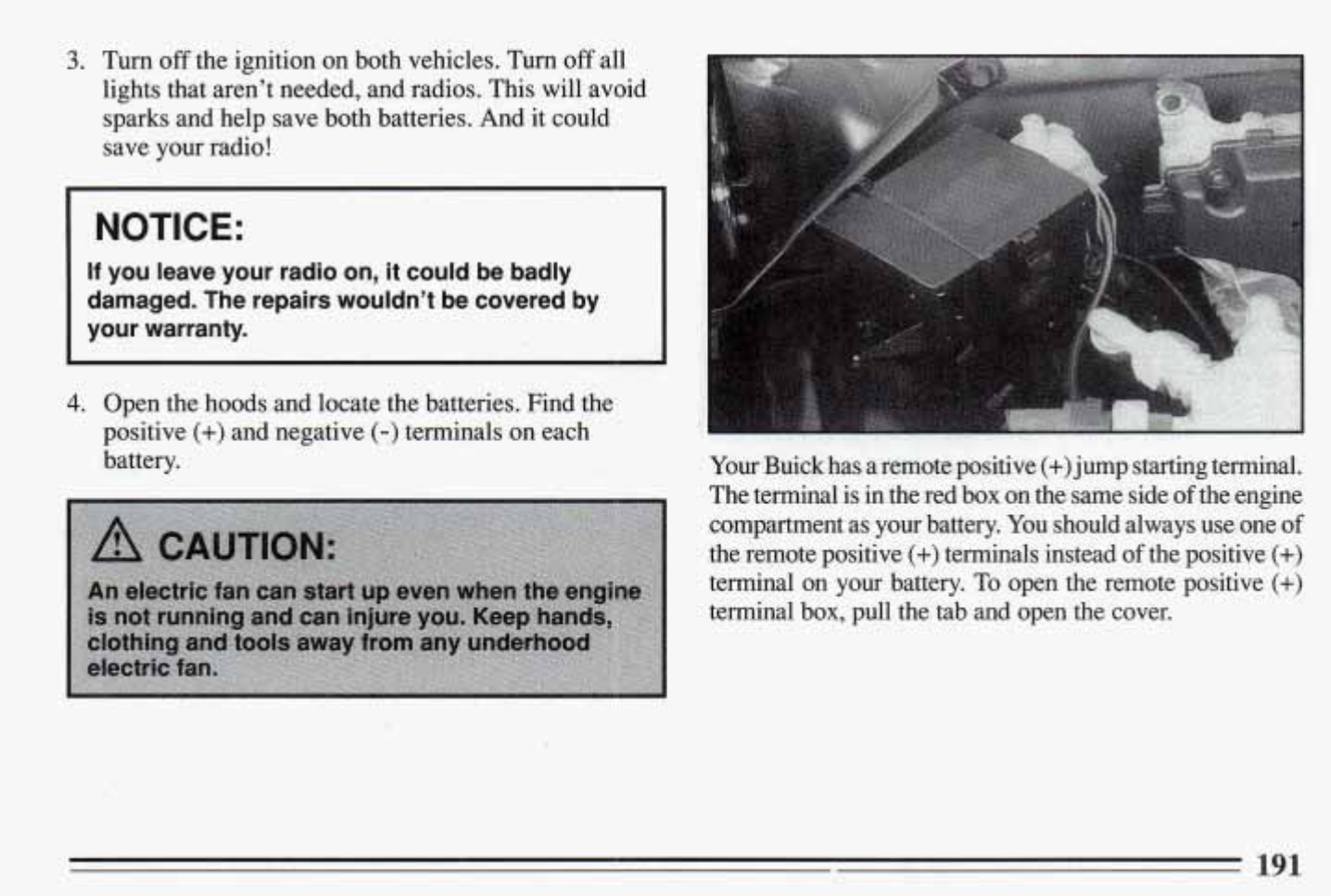
3.
Turn
off
the ignition on both vehicles. Turn
off
all
lights that aren’t needed, and radios. This will avoid
sparks and help save.both batteries. And it could
save your radio!
I
NOTICE:
If
you leave your radio on,
it
could be badly
damaged. The repairs wouldn’t be covered by
your warranty.
4.
Open the hoods and locate the batteries. Find the
positive
(+)
and negative
(-)
terminals on each
battery.
Your
Buick has a remote positive (+)jump starting terminal.
The terminal is in the red box on the same side
of
the engine
compartment as your battery. You should always use one
of
the remote positive
(+)
terminals instead
of
the positive
(+)
terminal on your battery. To open the remote positive
(+)
terminal box, pull the tab and open the cover.
191
5.
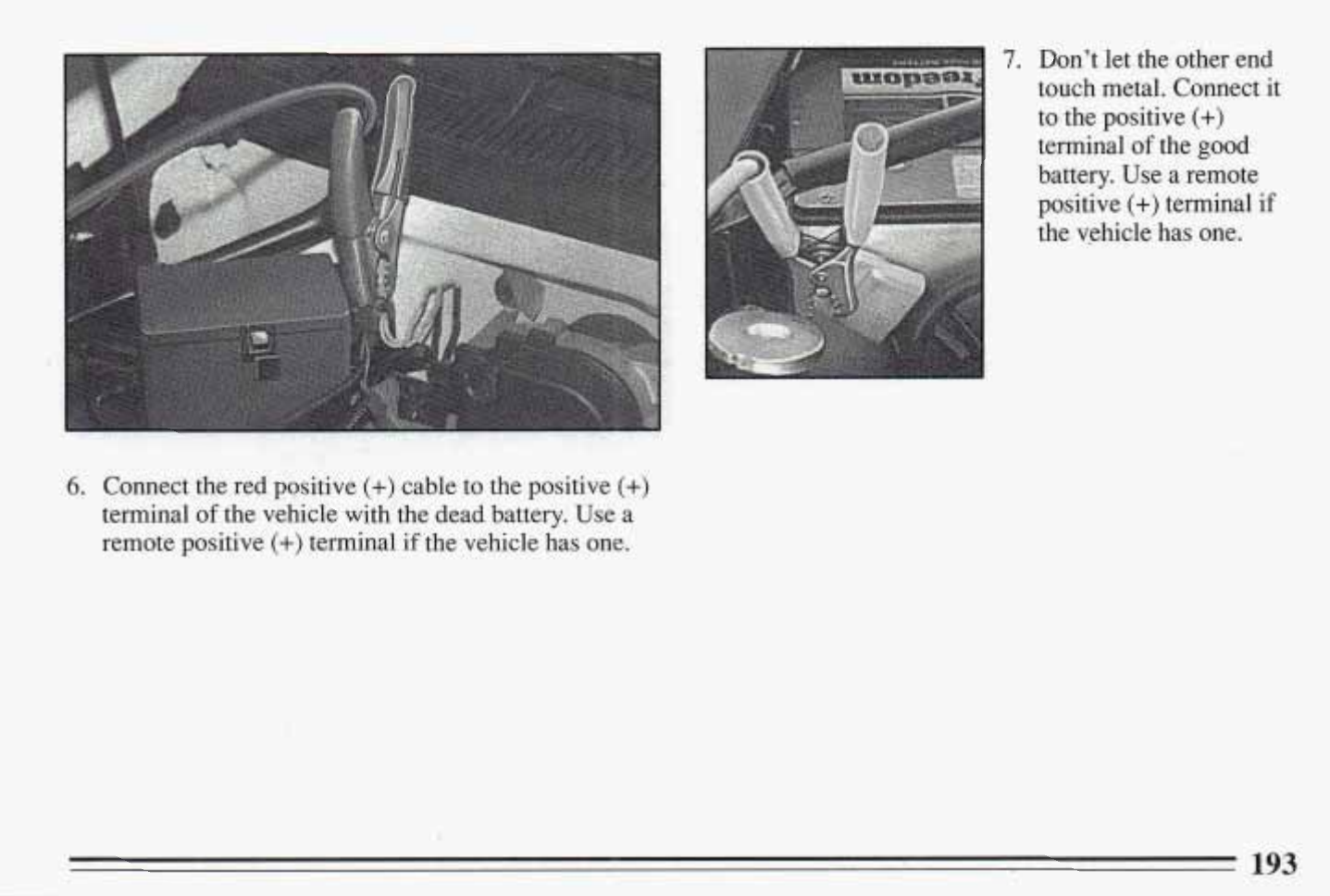
7.
Don’t let the other end
touch metal. Connect it
to the positive
(+)
terminal of the
good
battery. Use a remote
positive
(+)
terminal if
the vehicle has one.
6. Connect the red positive
(+)
cable to the positive
(+)
terminal of the vehicle with the dead battery. Use
a
remote positive
(+)
terminal if the vehicle has one.
193
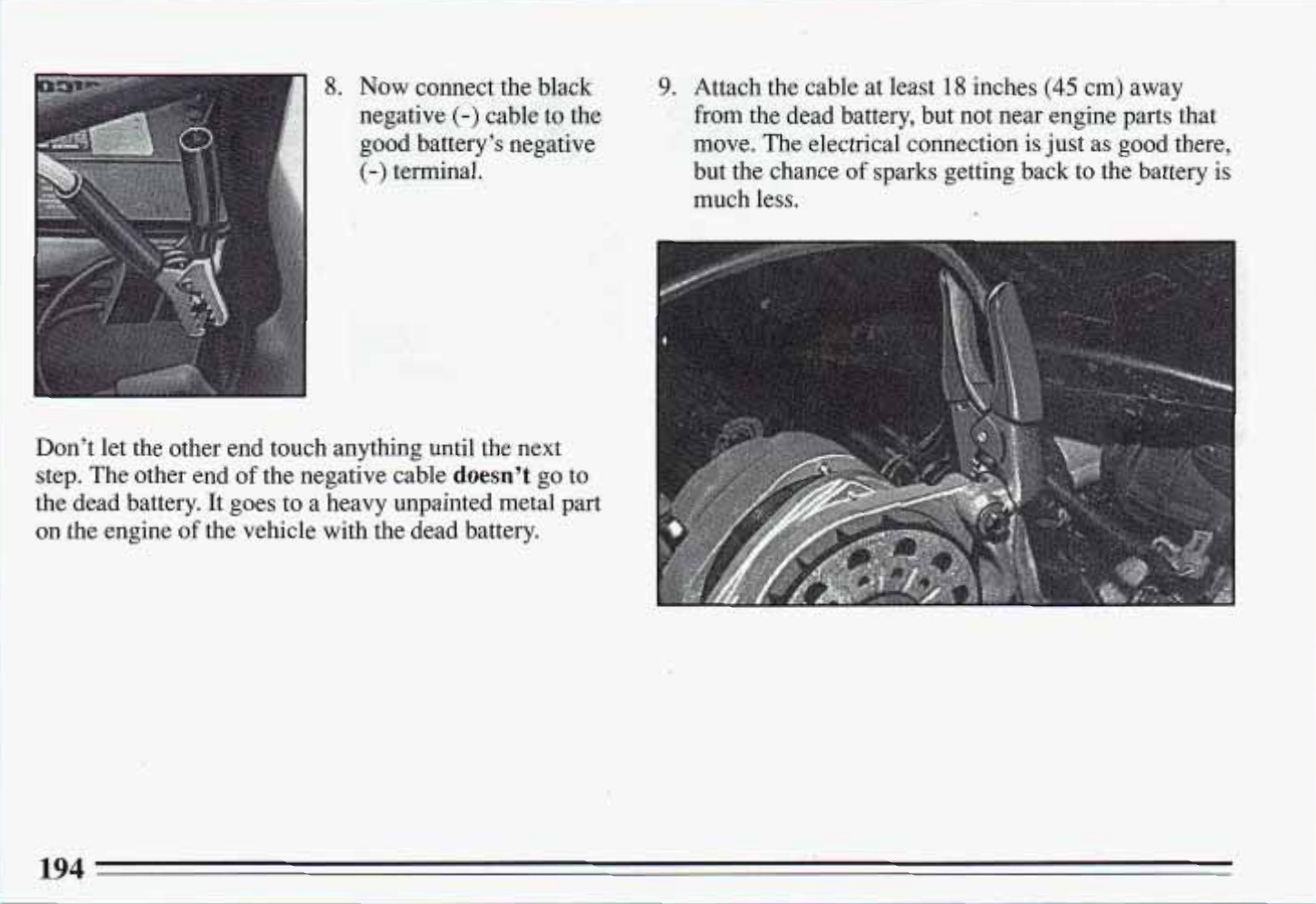
8.
Now connect the black
9.
negative
(-)
cable to the
good battery’s negative
(-)
terminal.
Don’t let the other end touch anything until the next
step. The other end
of
the negative cable
doesn’t
go to
the
dead battery. It goes to a heavy unpainted metal part
on the engine
of
the vehicle with the dead battery.
Attach the cable at least
18
inches
(45
cm) away
from
the .dead battery, but not near engine parts that
move. The electrical connection is just as good
there,
but the chance
of
sparks getting back to the battery is
much less.
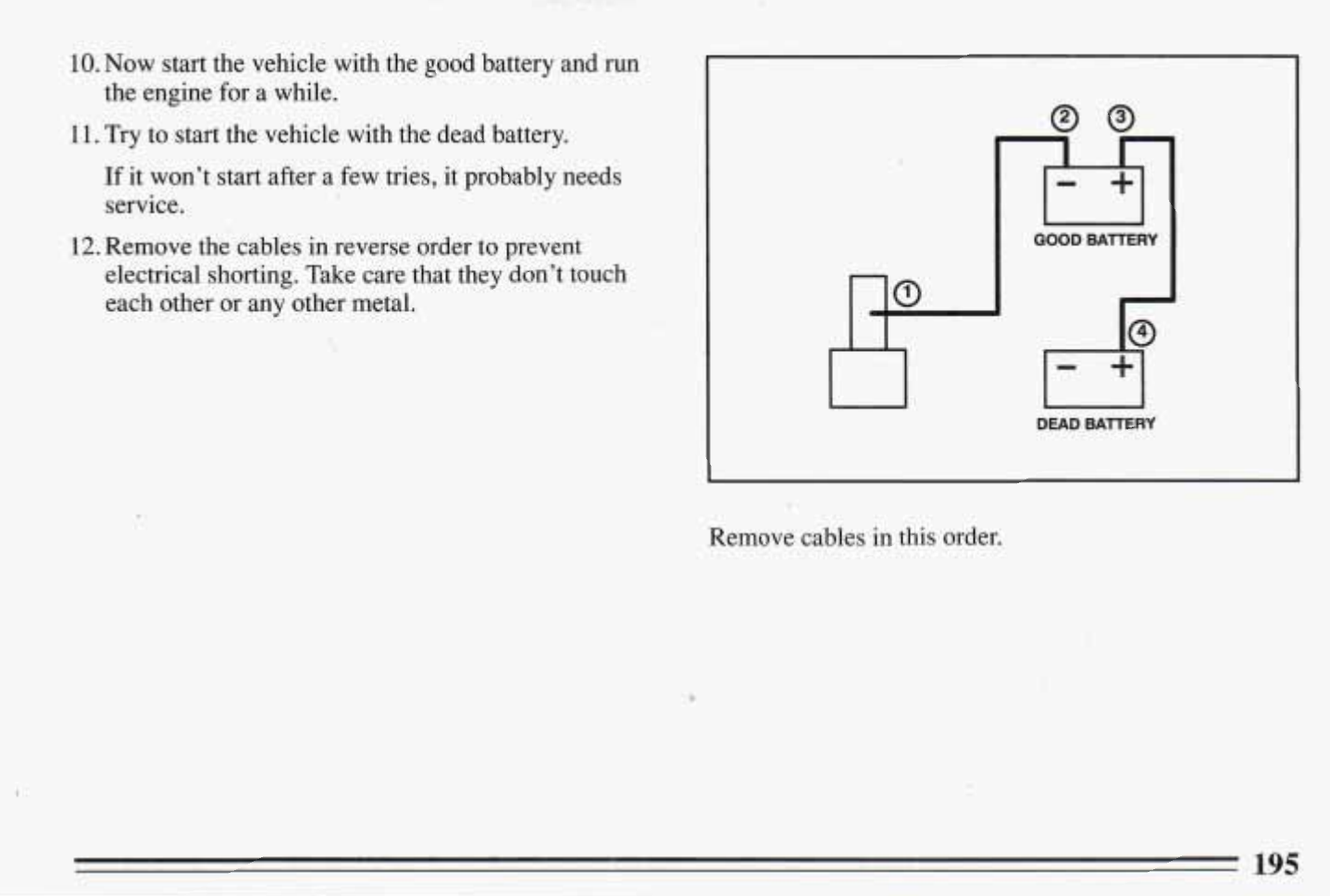
10.
Now start the vehicle with the good battery and run
the engine for a while.
11.
Try to start the vehicle with the dead battery.
If it won't start after a few tries, it probably needs
service.
12.
Remove the cables in reverse order to prevent
electrical shorting. Take care that they don't touch
each other or any other metal.
U
GOOD
BATTERY
DEAD
BATTERY
Remove cables in this order.
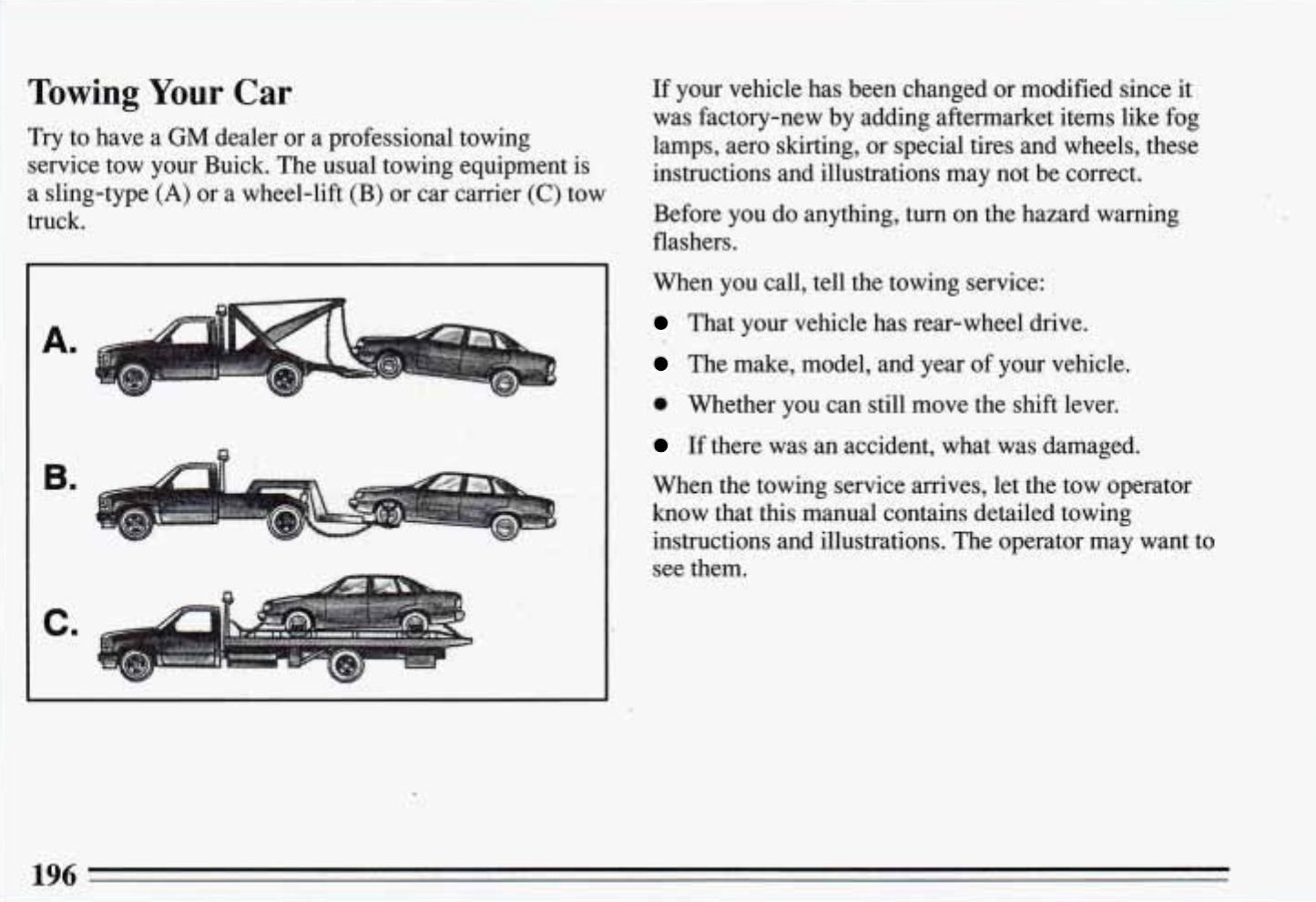
Towing
Your
Car
Try to hav.e a
GM
dealer or
a
professional towing
service tow your Buick. The usual towing equipment is
a sling-type
(A)
or a wheel-lift
(B)
or car carrier
(C)
tow
truck.
If
your vehicle has been changed
or
modified since it
was factory-new by adding aftermarket items like fog
lamps, aero skirting, or special tires and wheels, these
instructions and illustrations may not be correct.
Before you do anything, turn
on
the hazard warning
flashers.
C.
When you call, tell the towing service:
That your vehicle has rear-wheel drive.
The make, model, and year of your vehicle.
0
Whether you can still move the shift lever.
If
there was an accident, what was damaged.
When the towing service arrives, let the tow operator
know that this manual contains detailed towing
instructions and illustrations. The operator may want to
see them.
196
I
1
',
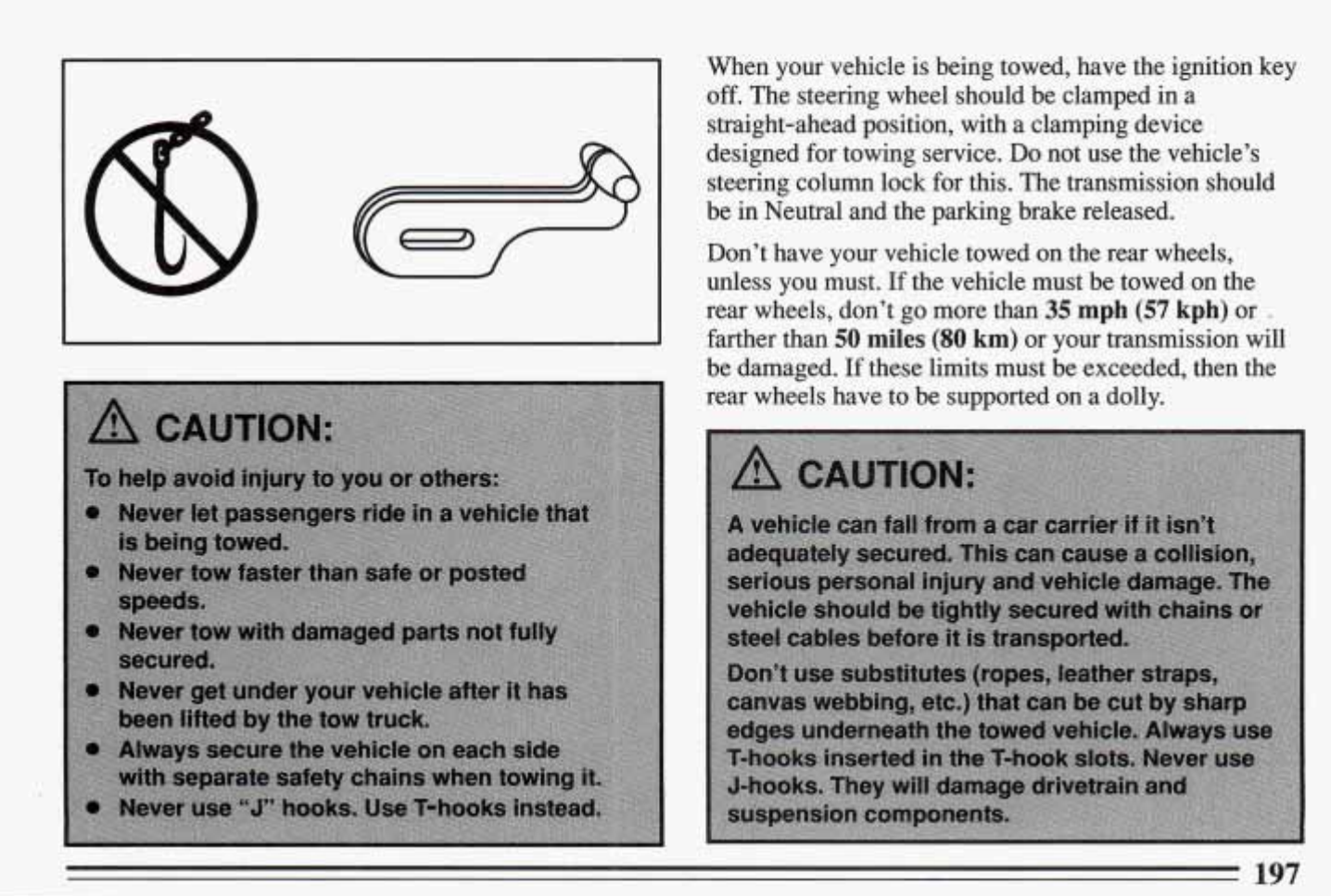
When your vehicle is being towed, have the ignition key
off.
The steering wheel should be clamped in a
straight-ahead position, with a clamping device
designed for towing service. Do not use the vehicle’s
steering column lock for this. The transmission should
be in Neutral and the parking brake released.
Don’t have your vehicle towed on the rear wheels,
unless you must.
If
the vehicle must be towed on the
rear wheels, don’t
go
more than
35
mph
(57
kph)
or .
farther than
50
miles
(80
km)
or your transmission
will
be damaged.
If
these limits must be exceeded, then the
rear wheels have to be supported on a dolly.
197
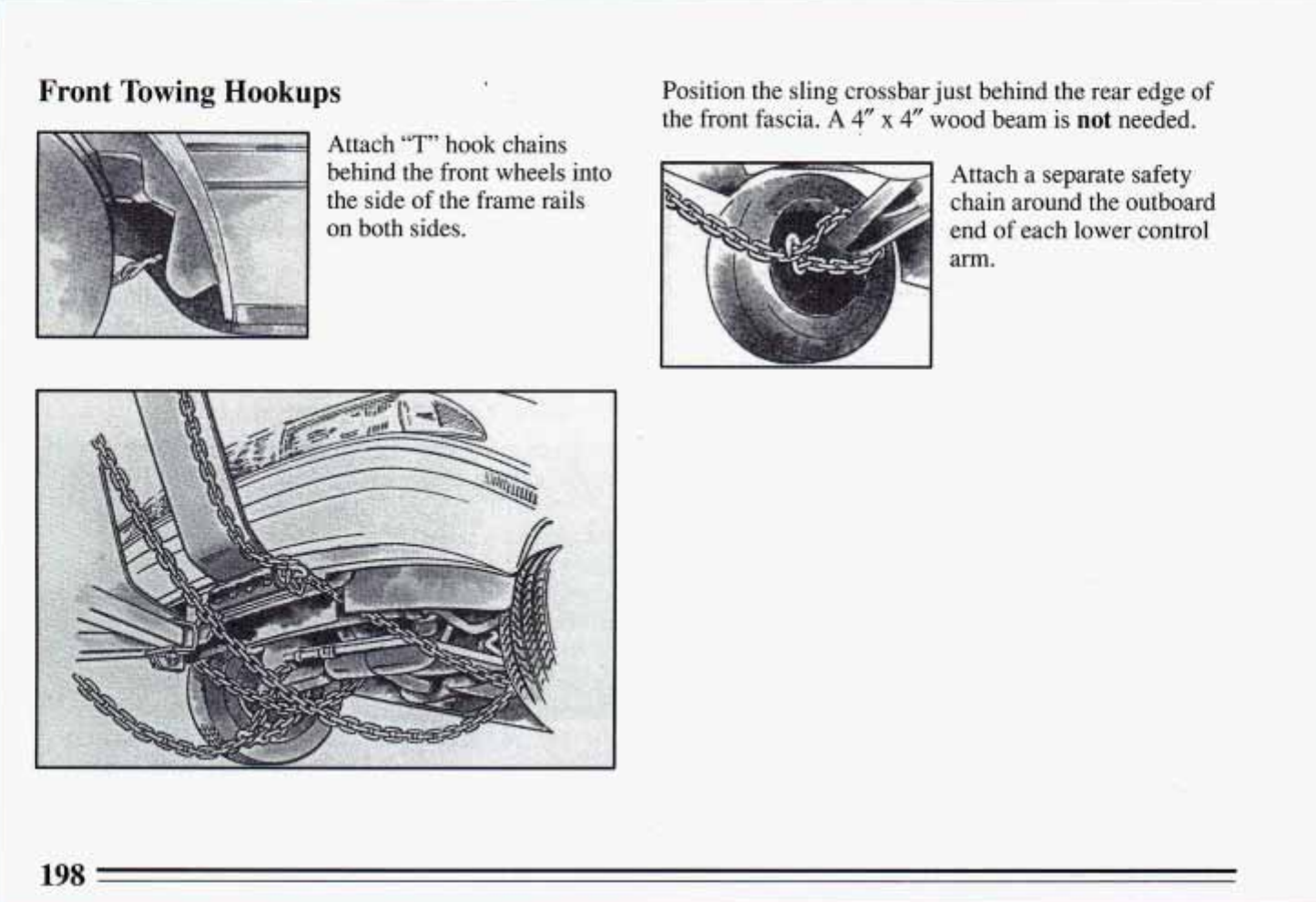
Front
Towing
Hookups
Position the sling crossbar just behind the rear edge
of
the front fascia. A
4”
x
4”
wood beam is
not
needed.
Attach
“T”
hook chains
behind the front wheels into
~ the side of the frame rails
t
on both sides.
Attach a separate safety
chain around the outboard
end
of
each lower control
arm.
I
198
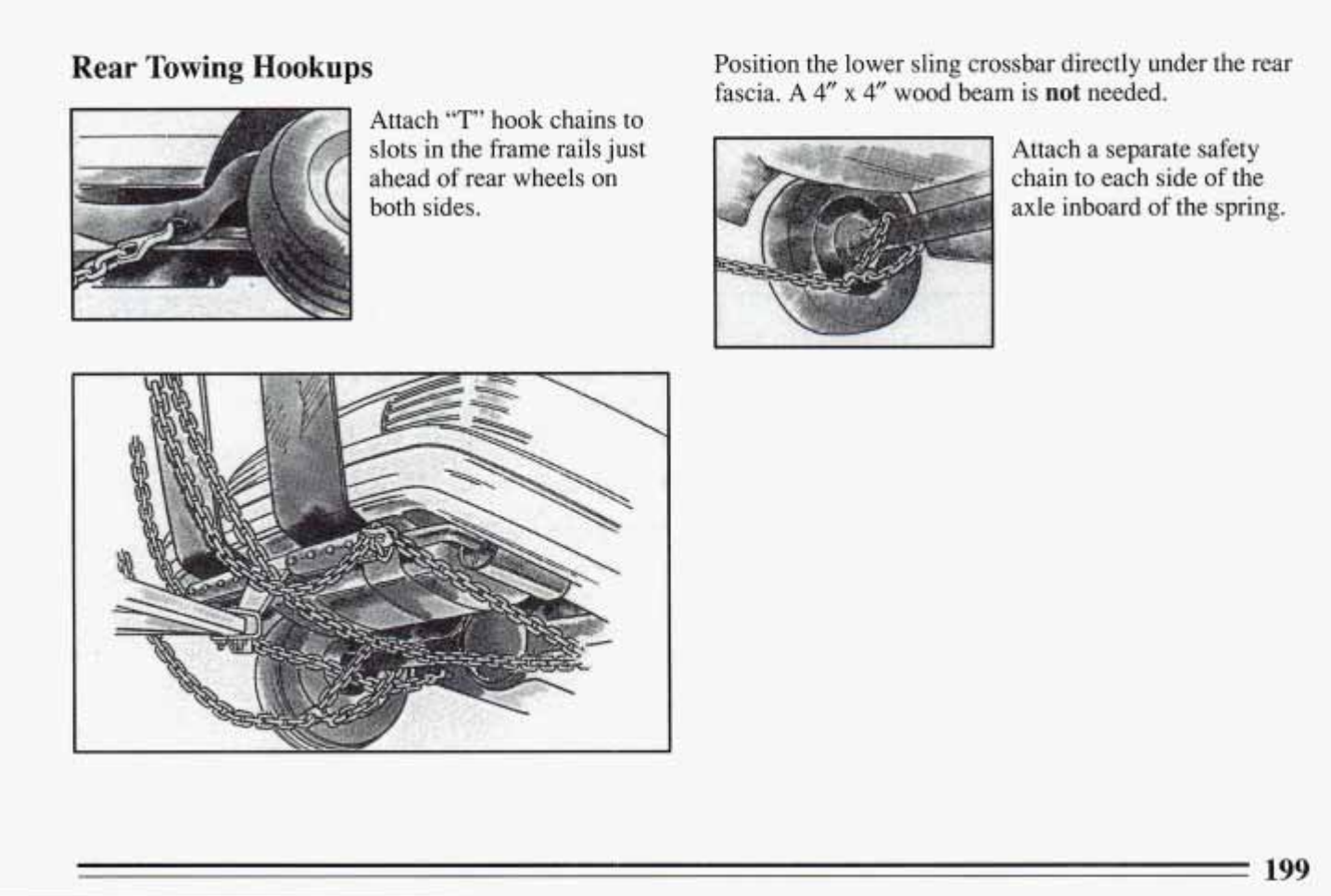
Rear
Towing Hookups
Position the lower sling crossbar directly under the rear
fascia. A
4”
x
4”
wood beam is
not
needed.
Attach a separate safety
chain to each side of the
axle inboard of the spring.
199
,
Engine Overheating
NOTICE:
You
will
find a coolant temperature gage and the
warning light about a hot engine on your instrument
If
your engine catches fire because you keep
:panel. You will also find a low coolant warning light on
driving with no coolant, your vehicle can be
:your instrument panel
badly damaged. The costly repairs would not be
If
Steam
Is
Coming From
Your
Engine
covered by your warranty.
If
No .Steam
Is
Coming From Your Engine
If
you
get the overheat warning but see or hear no
steam, the problem may not be too serious. Sometimes
the engine can get a little too hot when
you:
Climb
a
long hill on a hot day.
Stop after high speed driving.
Idle for long periods in traffic.
Tow
a trailer.
200
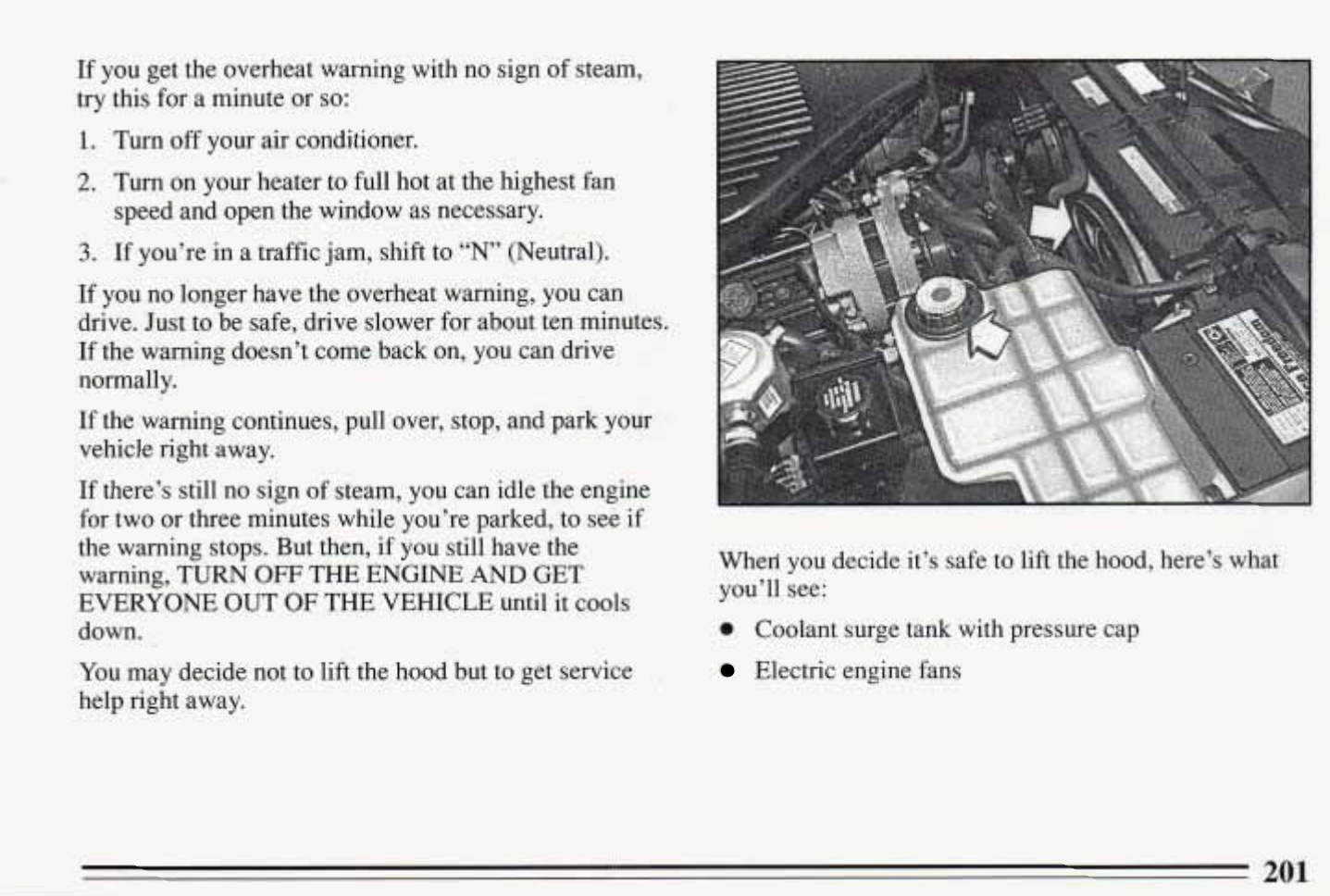
If
you get the overheat warning with no sign
of
steam,
try this for a minute or
so:
1.
Turn
off
your air conditioner.
2.
Turn on your heater to full hot at the highest fan
3.
If you’re in a traffic jam, shift to
“N’
(Neutral).
If
you no longer have the overheat warning, you can
drive. Just to be safe, drive slower for about ten minutes.
If the warning doesn’t come back’on, you can drive
normally.
If
the warning continues, pull over, stop, and park your
vehicle right away.
If there’s still no sign of steam, you can idle the engine
for two or three minutes while you’re parked, to see if
the warning stops. But then, if you still have the
warning, TURN
OFF
THE ENGINE
AND
GET
EVERYONE
OUT
OF THE VEHICLE until it cools
down.
You may decide not to lift the hood but to get service
help right away.
speed and open the window as necessary.
Wheri you decide it’s safe to lift the hood, here’s what
you’ll see:
0
Coolant surge tank with pressure cap
Electric engine fans
201
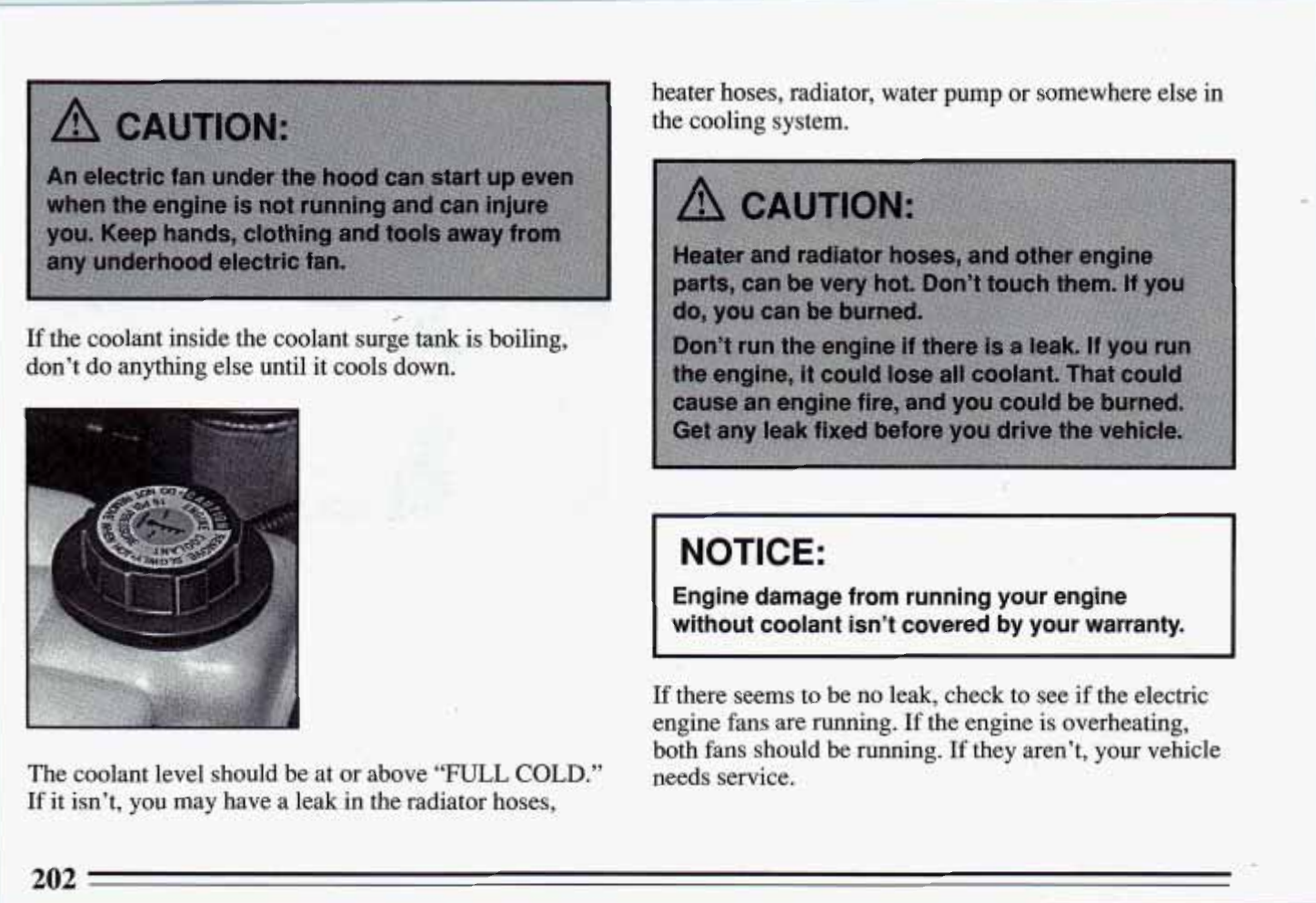
.
If
the coolant inside the coolant surge
tank
is bailing,
don’t do.anything else until it cools down.
c
,.
*
-
.,
k
-
.-
heater hoses, radiator, water
pump
or somewhere else in
the cooling system.
I
NOTICE:
The coolant level should be at
or
above
“FULL
COLD.”
If
it isn’t, you may have a leak in the radiator hoses,
I
Engine damage from running your engine
without coolant
isn’t
covered by your warranty.
If
there seems to be no leak, check to see
if
the electric
engine fans are running.
If
the engine is overheating,
both fans should be running.
If
they aren’t, your vehicle
needs service.
202
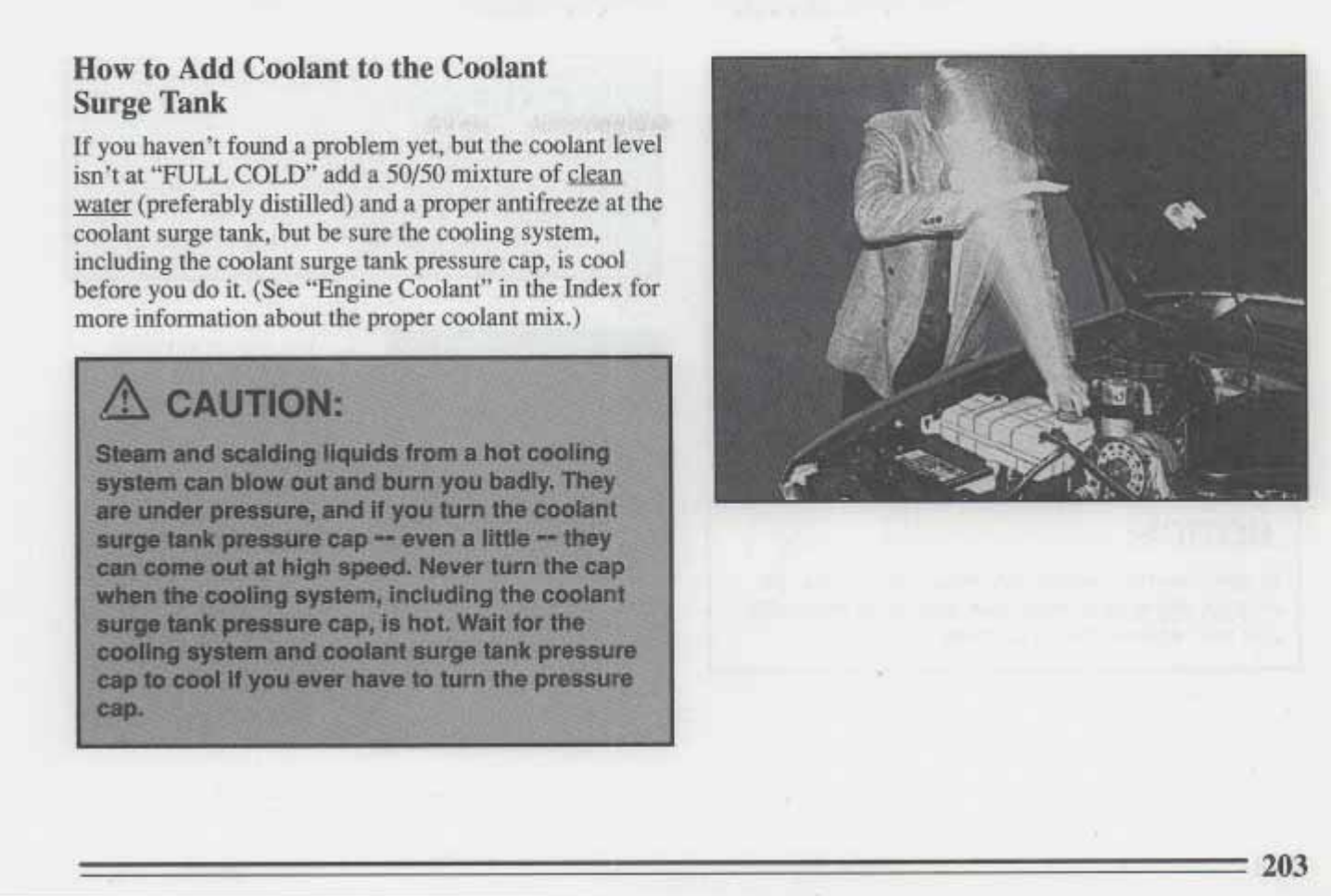
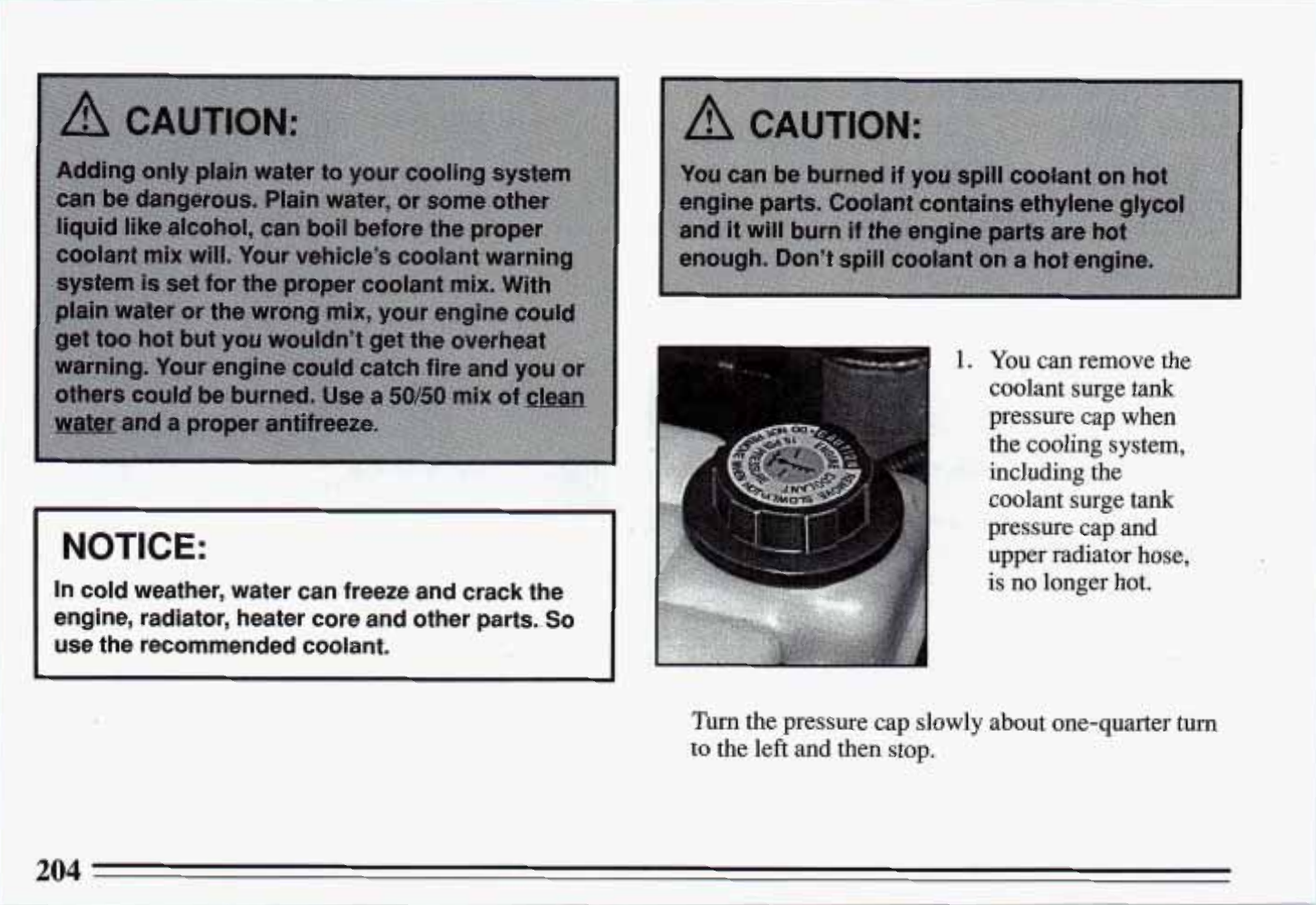
i
NOTICE:
In cold weather, water can freeze and crack the
engine, radiator, heater core and other parts..So
use the recommended coolant.
I
1.
You can remove the
coolant surge tank
pressure cap
when
the cooling system,
including the
coolant surge tank
pressure cap and
upper radiator hose,
is
no longer hot.
Turn the pressure cap slowly about one-quarter
turn
to the left and then stop.
204
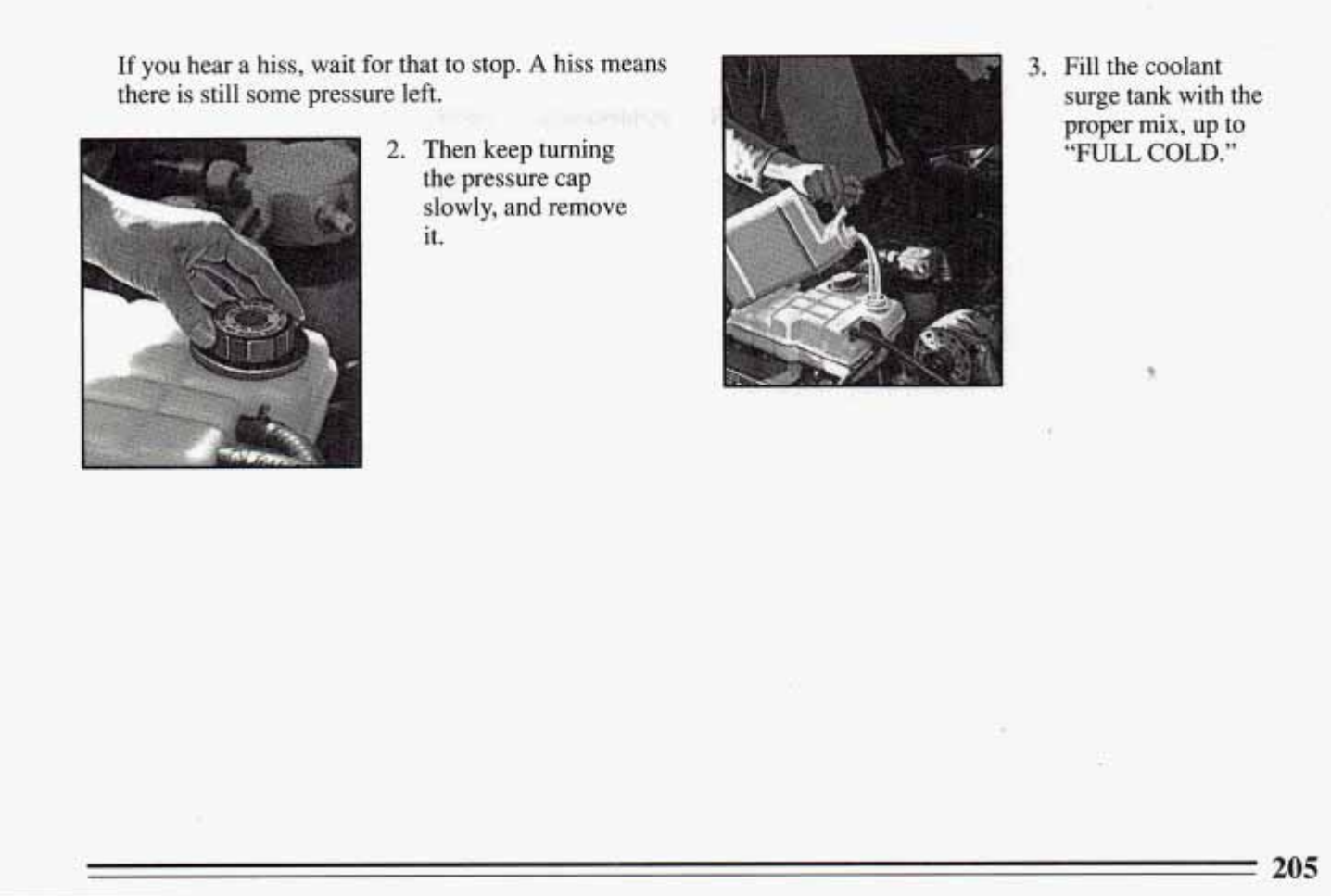
If you hear a hiss, wait for that
to
stop.
A
hiss means
there is still some pressure left.
..
.
,.
2.
Then keep turning
the pressure cap
slowly, and remove
it.
3.
Fill the coolant
surge tank with the
proper mix, up
to
“FULLCOLD.”
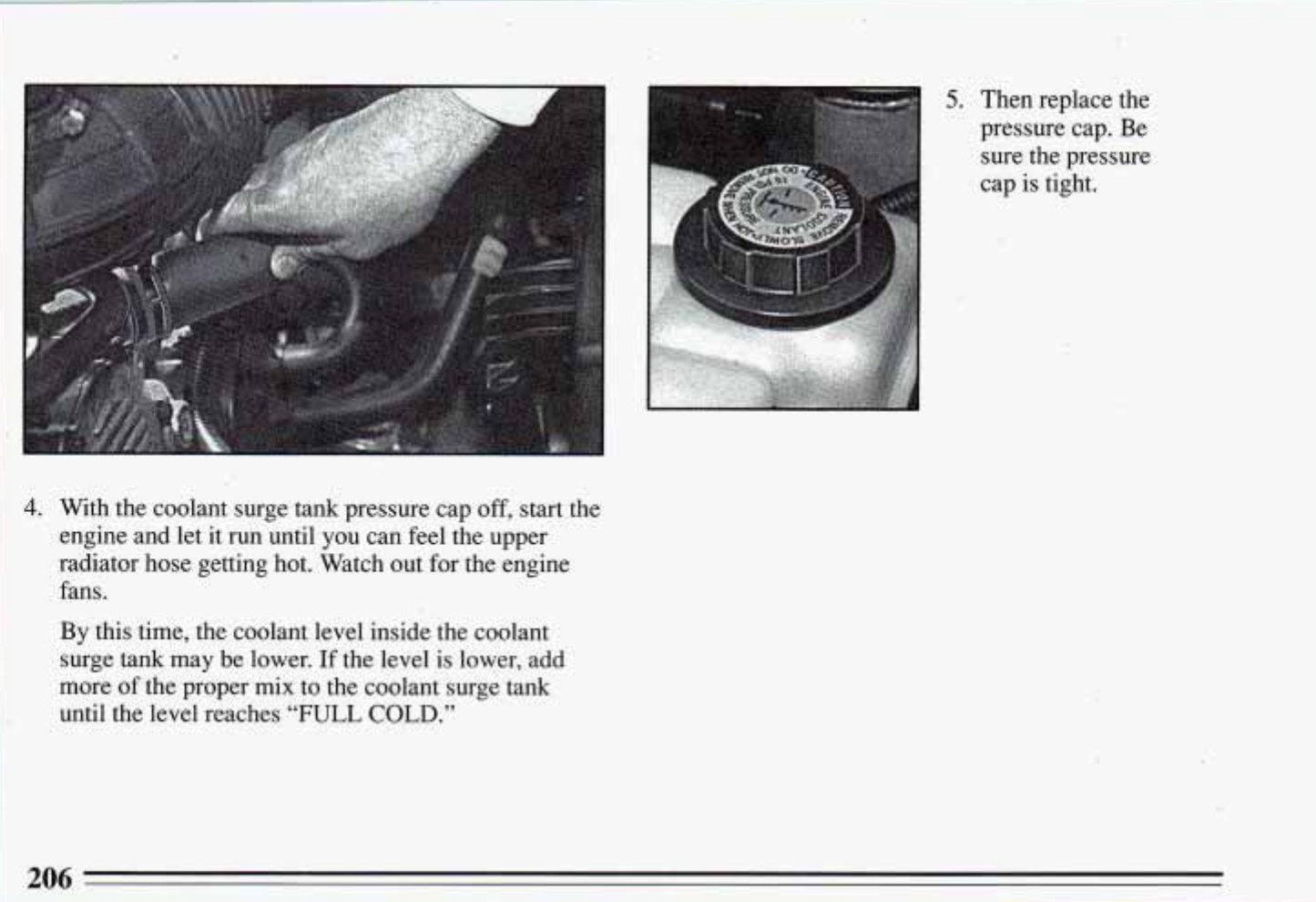
I
4.
With the coolant surge tank pressure cap off, start the
engine and let it run until
you
can feel the upper
radiator hose getting hot. Watch out for the engine
fans.
pressure cap. Be
sure the pressure
cap is tight.
By
this time, the coolant level inside the coolant
surge tank may be lower. If the level
is
lower, add
more
of
the proper mix to the coolant surge tank
until the level reaches
“FULL
COLD.”
206
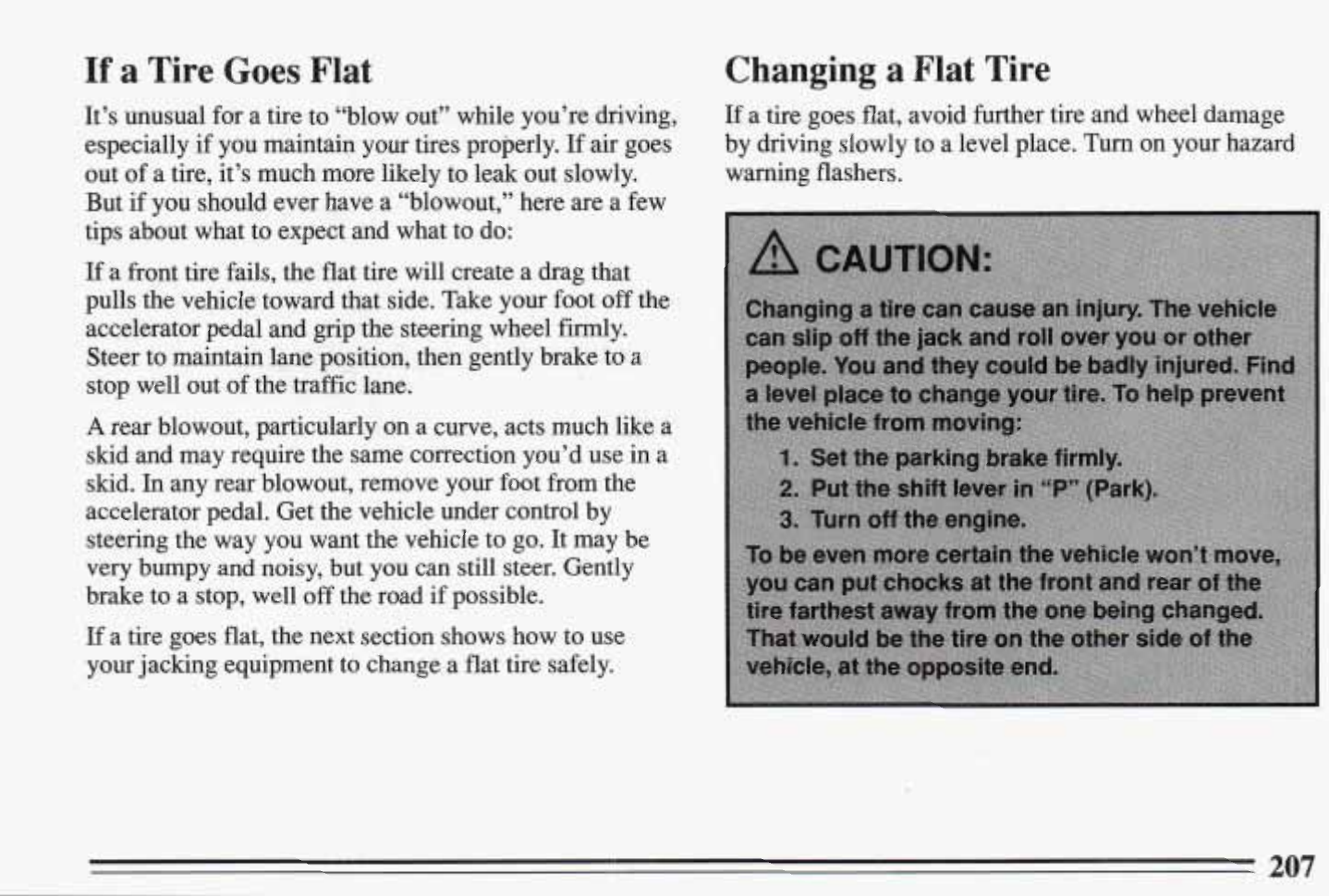
If
a Tire Goes.Flat
It’s unusual for a tire to “blow out” while you’re driving,
especially
if
you maintain your tires properly.
If
air goes
out
of
a tire, it’s much more likely to leak out slowly.
But if
you
should ever have a “blowout,” here are
a
few
tips about what to expect and what to do:
If
a front tire fails, the flat tire will create a drag that
pulls the vehicle toward that side. Take your foot off the
accelerator pedal and
grip
the steering wheel firmly.
Steer to maintain lane position, then gently brake to a
stop well out of the traffic lane.
A
rear blowout, particularly on a curve, acts much like a
skid and may require the same correction you’d use in a
skid.
In
any rear blowout, remove your foot from the
accelerator pedal. Get the vehicle under control by
steering the way you want the vehicle to
go.
It may be
very bumpy and noisy, but you can still steer. Gently
brake
to
a stop, well off the road if possible.
If
a
tire goes flat, the next section shows how to use
your jacking equipment to change a flat tire safely.
Changing
a
Flat Tire
If
a tire goes flat, avoid further tire and wheel damage
by driving slowly to a level place.
Turn
on your hazard
warning flashers.
207
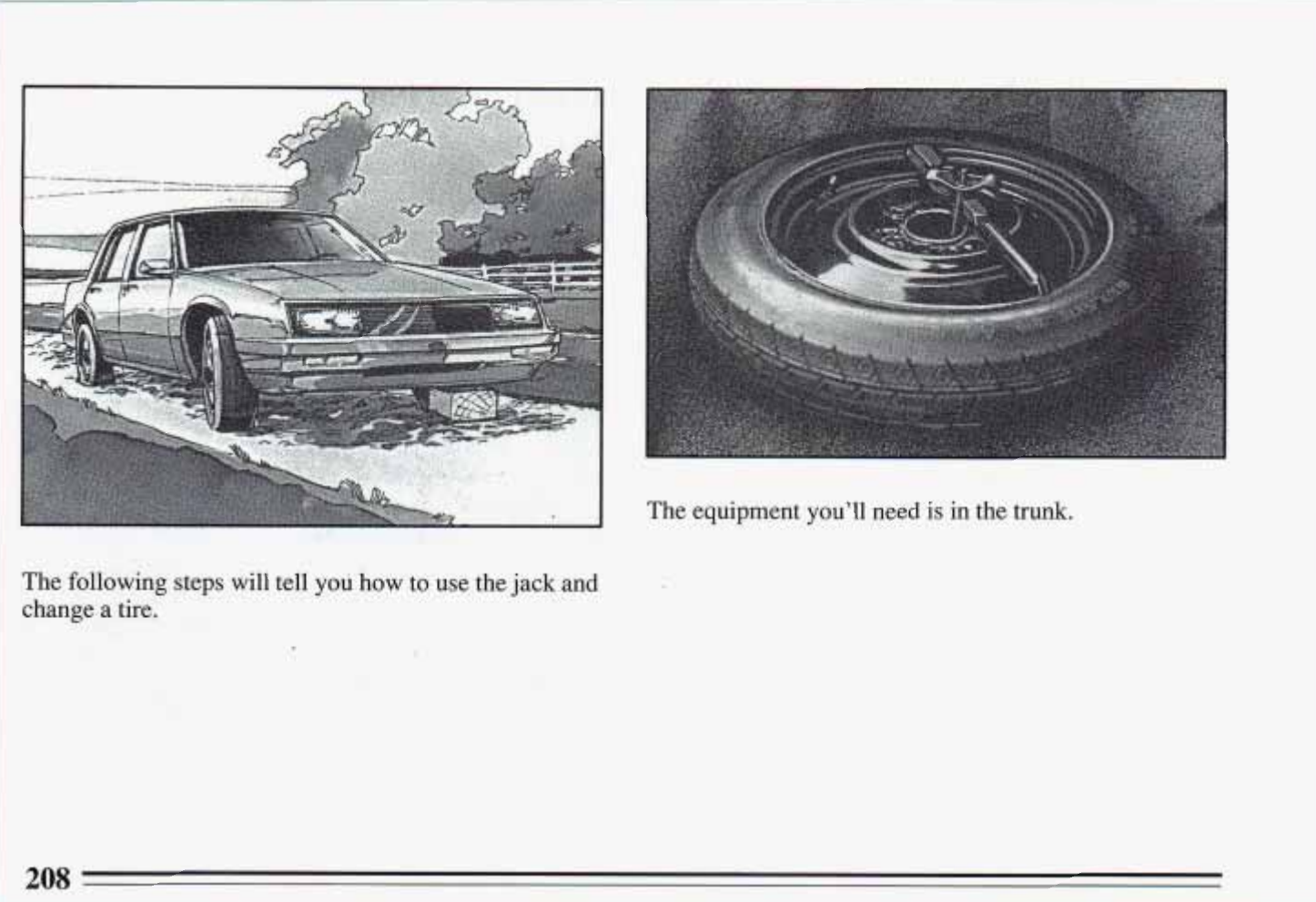
The equipment you’ll need is in the trunk.
,.
The following steps
will
tell you how
to
use the
jack
and
change
a
tire.
208
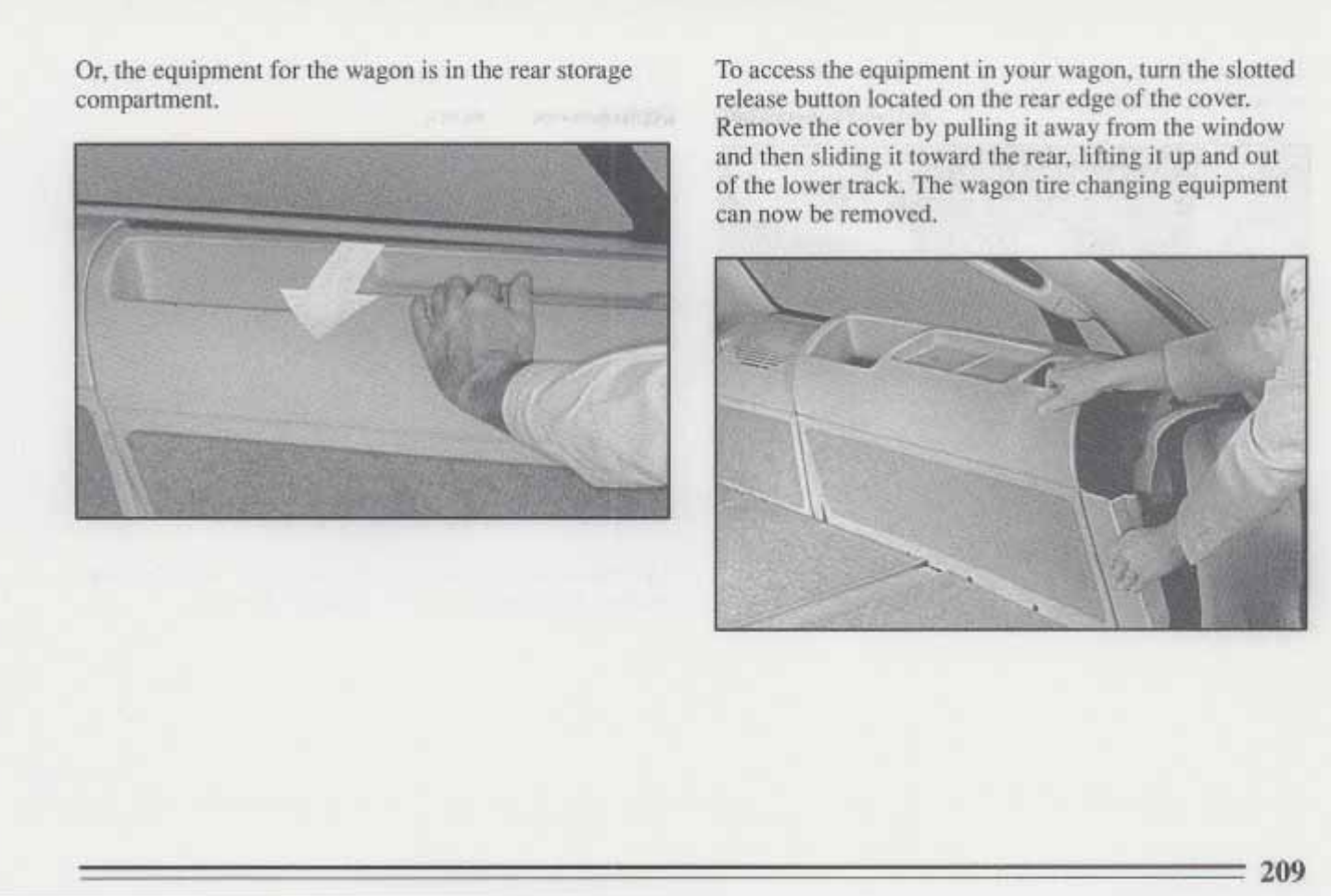
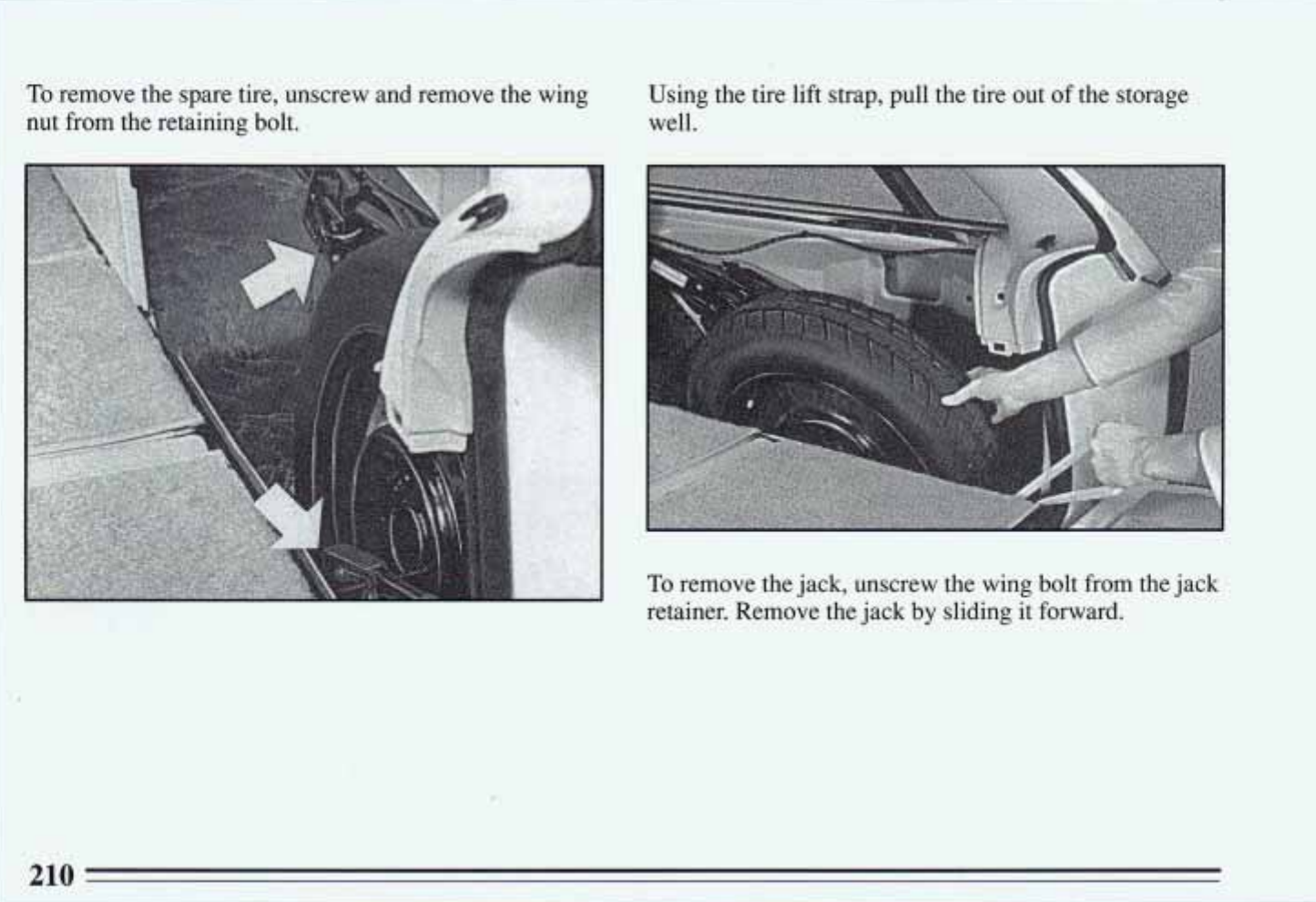
To remove the spare tire, unscrew and remove the wing
nut from the retaining bolt. Using the
tire
lift strap, pull the tire out of the storage
well.
To remove the jack, unscrew the wing bolt from the jack
retainer. Remove the jack by sliding it forward.
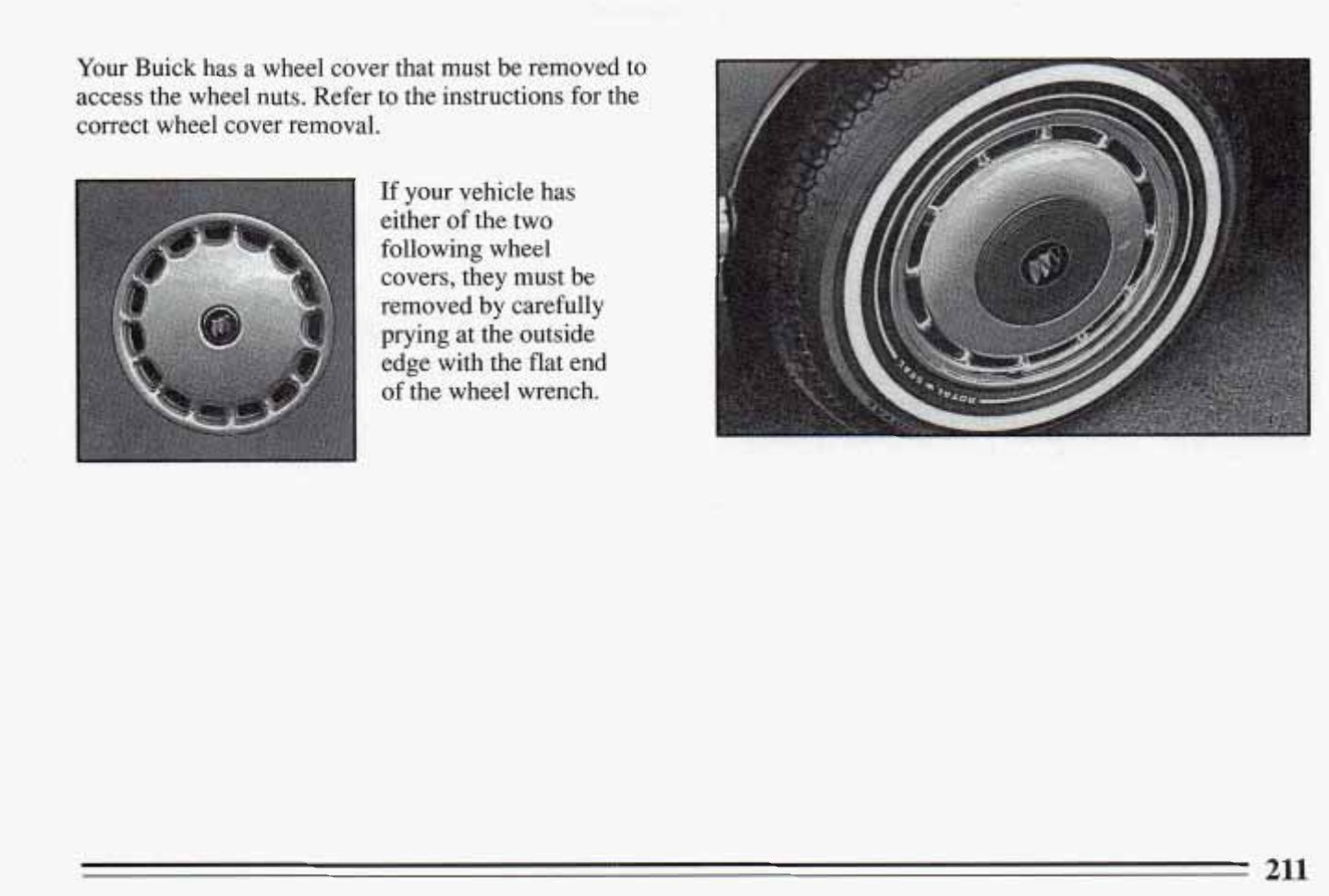
Your Buick has a wheel cover that must be removed to
access the wheel nuts. Refer to the instructions for the
correct wheel cover removal.
If your vehicle has
either of the two
following wheel
covers, they must be
removed by carefully
prying at the outside
edge with the flat end
of the wheel wrench.
211
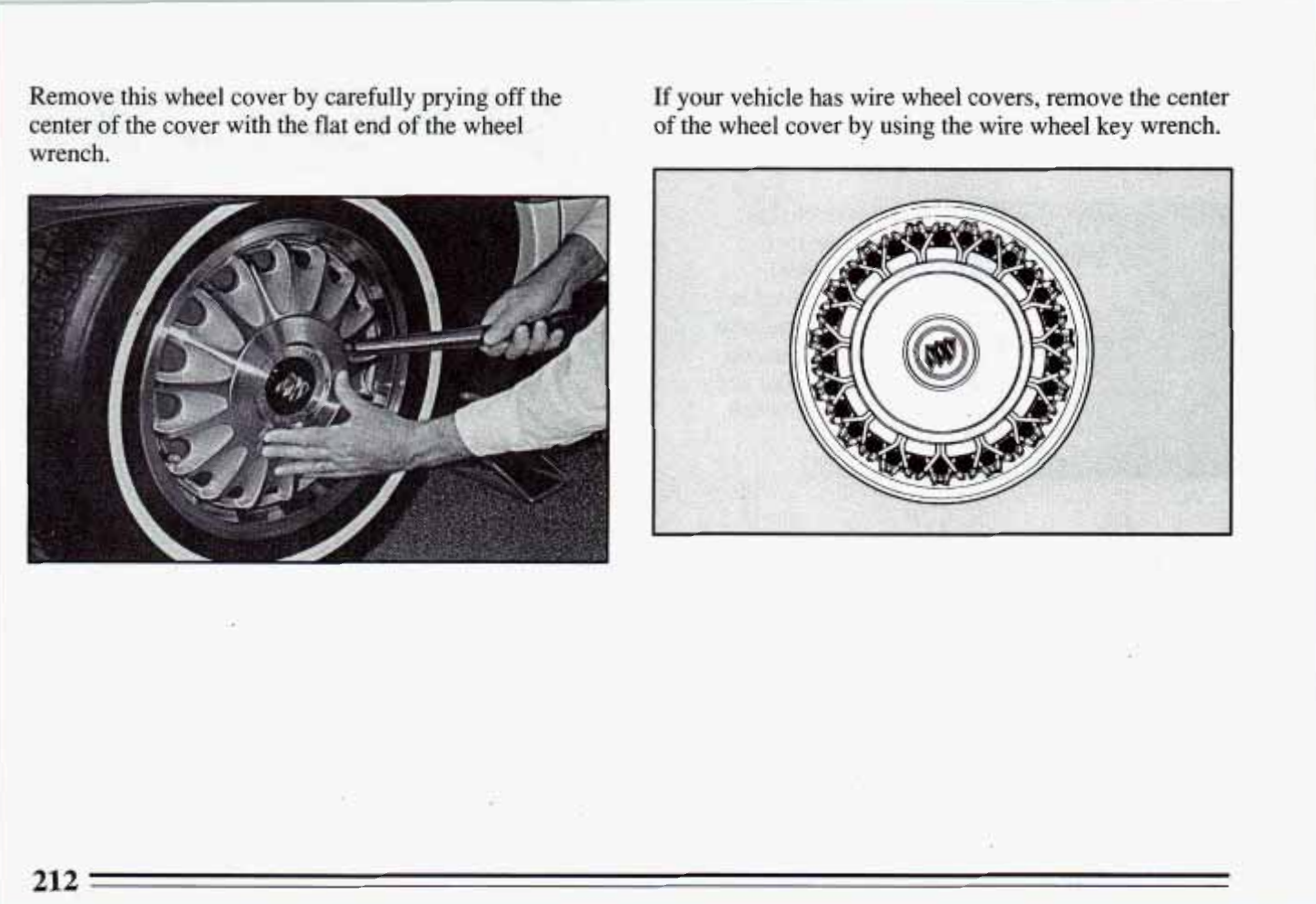
Remove this wheel cover
by
carefully prying
off
the
center
of
the cover with the- flat
end
of
the
wheel
wrench.
___
If
your
vehicle has wire wheel covers, remove the center
of
the wheel cover
by
using the wire wheel key wrench.
212
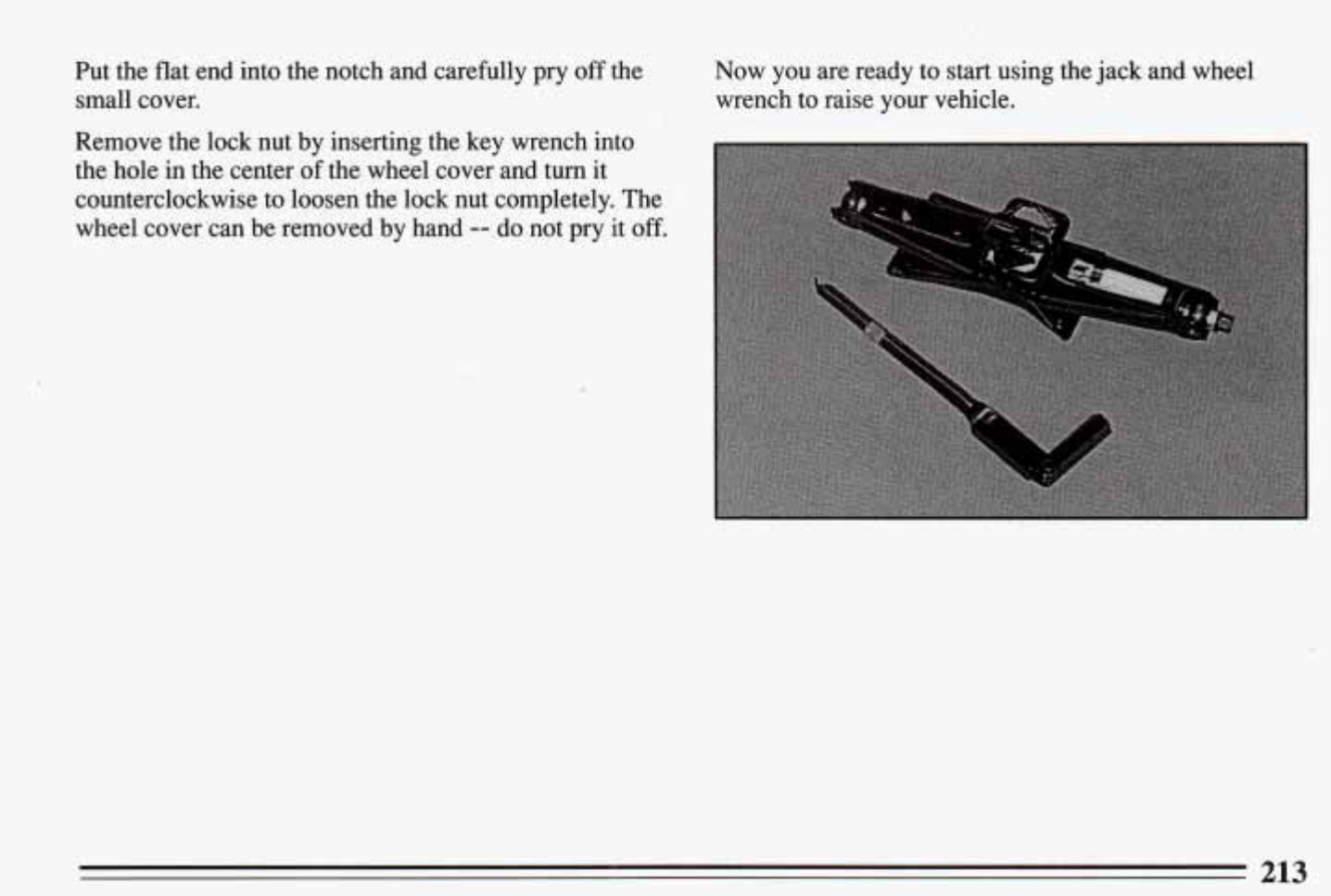
Put the flat end into the notch and carefully pry off the
small cover. Now
you
are ready to
start
using the jack and
wheel
wrench to raise your vehicle.
Remove the lock nut by inserting the key wrench into
the hole in the center
of
the wheel cover and turn it
counterclockwise
to
loosen the lock nut completely. The
wheel cover 'can be removed by hand
--
do
not pry it
off.
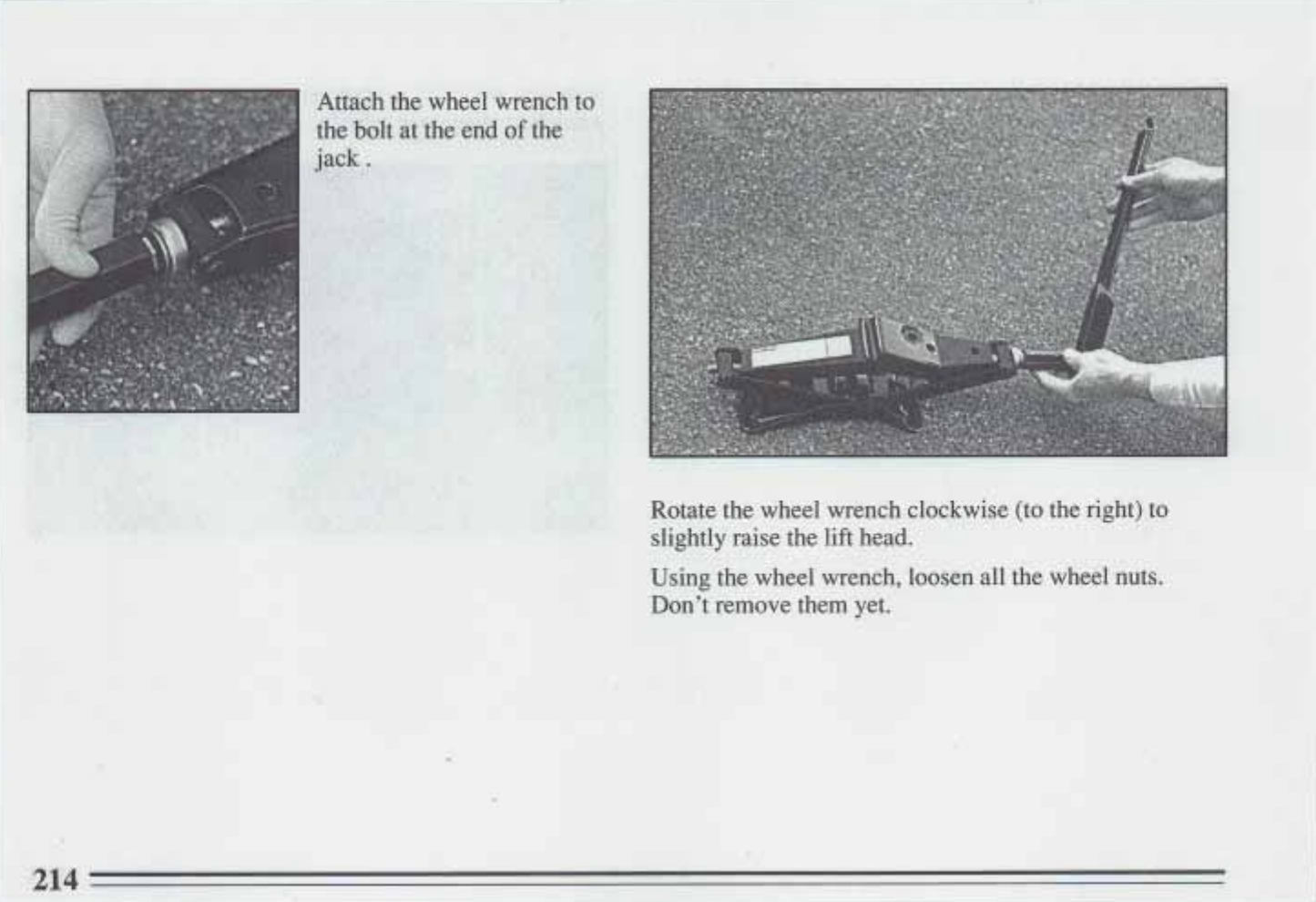
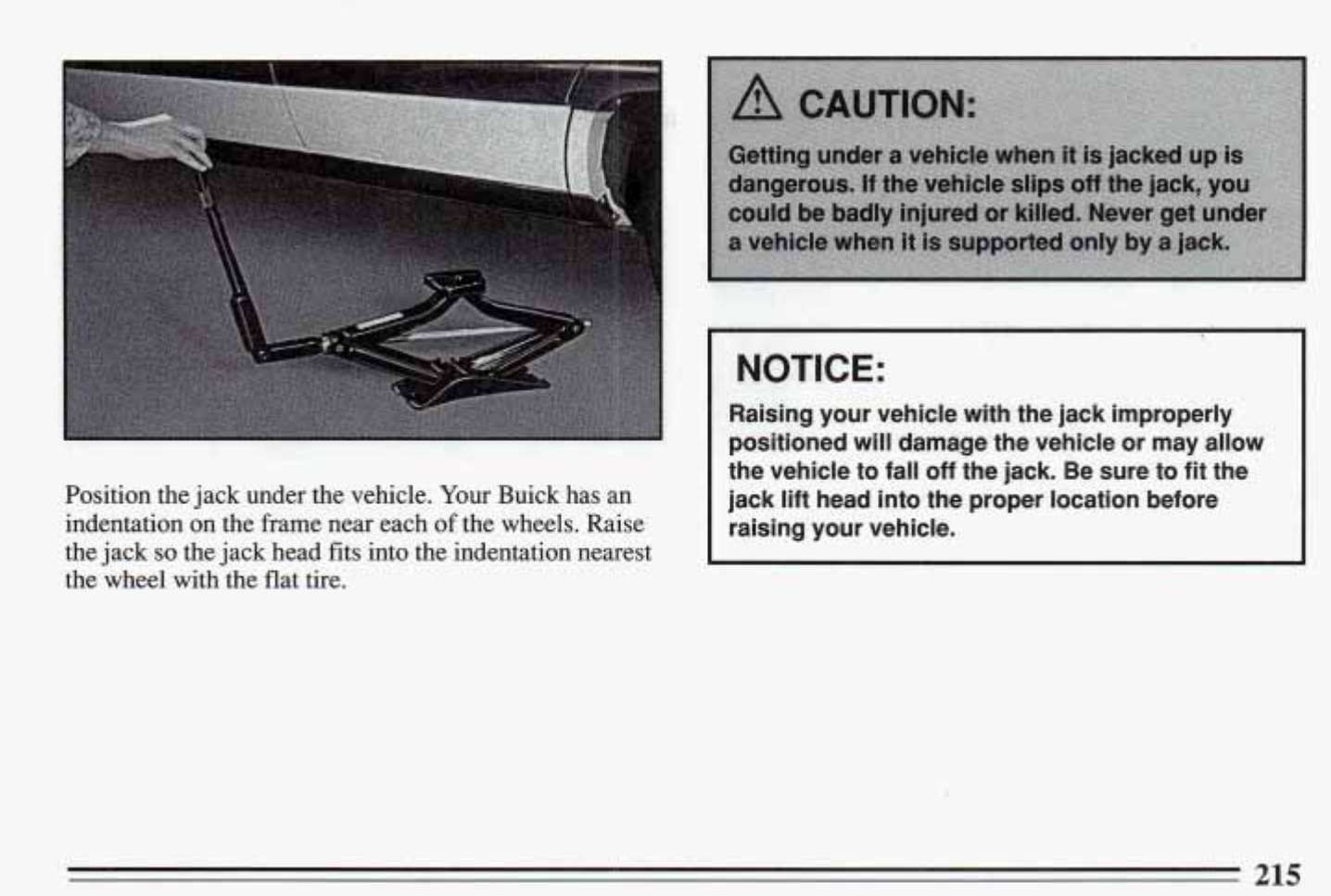
,.
I
.
r
Position the jack under the vehicle. Your Buick has an
indentation on the frame near each of the wheels. Raise
the jack
so
the jack head fits into the indentation nearest
the wheel with the Bat tire.
Raising your vehicle with the jack improperly
positioned
will
damage the vehicle or
may
allow
thme vehicle
to
fall
off
the jack. Be sure to fit the
jack lift head into the proper location before
raising your vehicle.
215
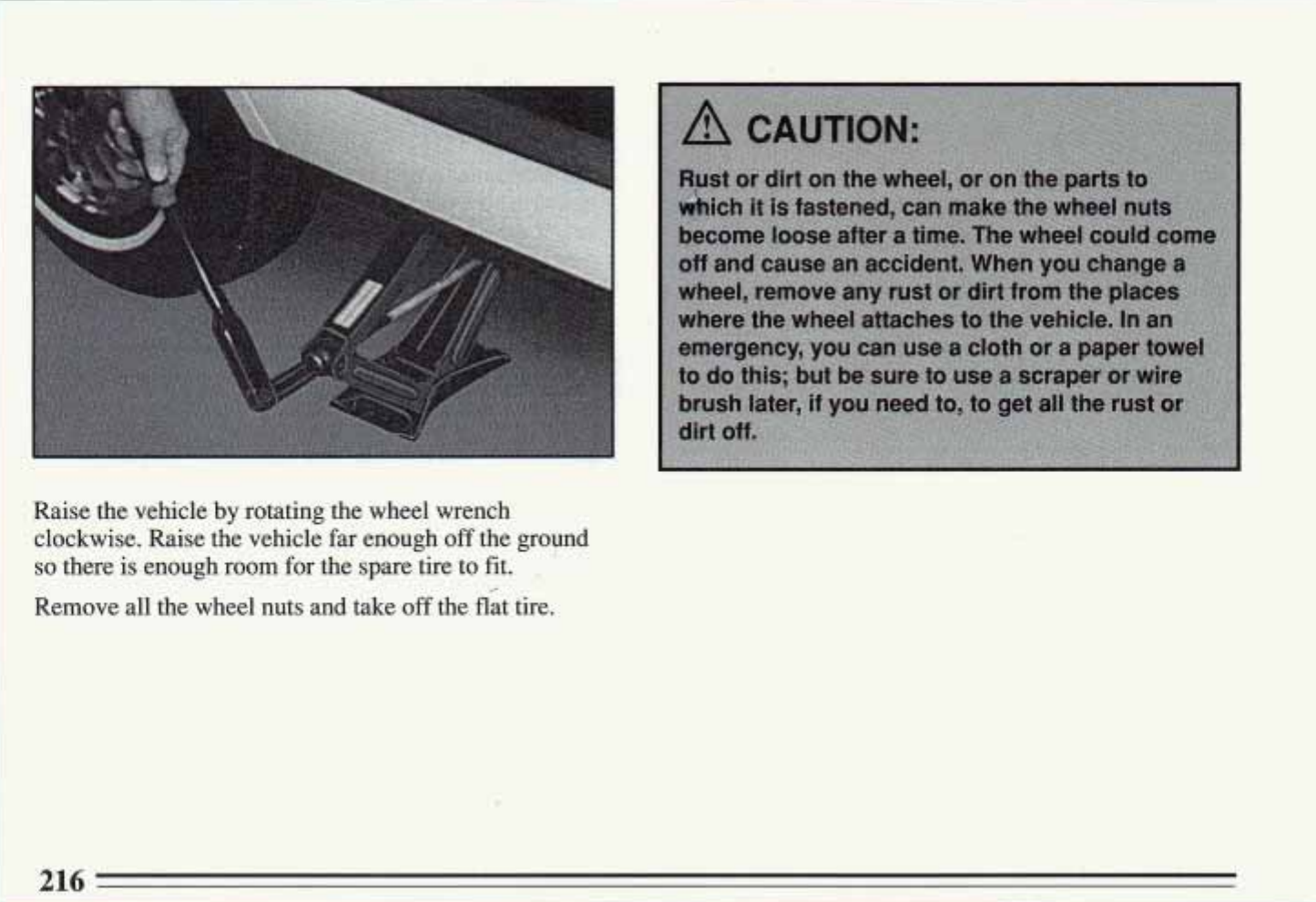
Raise the vehicle by rotating the wheel wrench
clockwise. Raise the vehicle far enough
off
the
gropd
so
there is enough room
for
the spare tire to fit.
Remove all the wheel nuts and take
off
the flat tire.
1
216
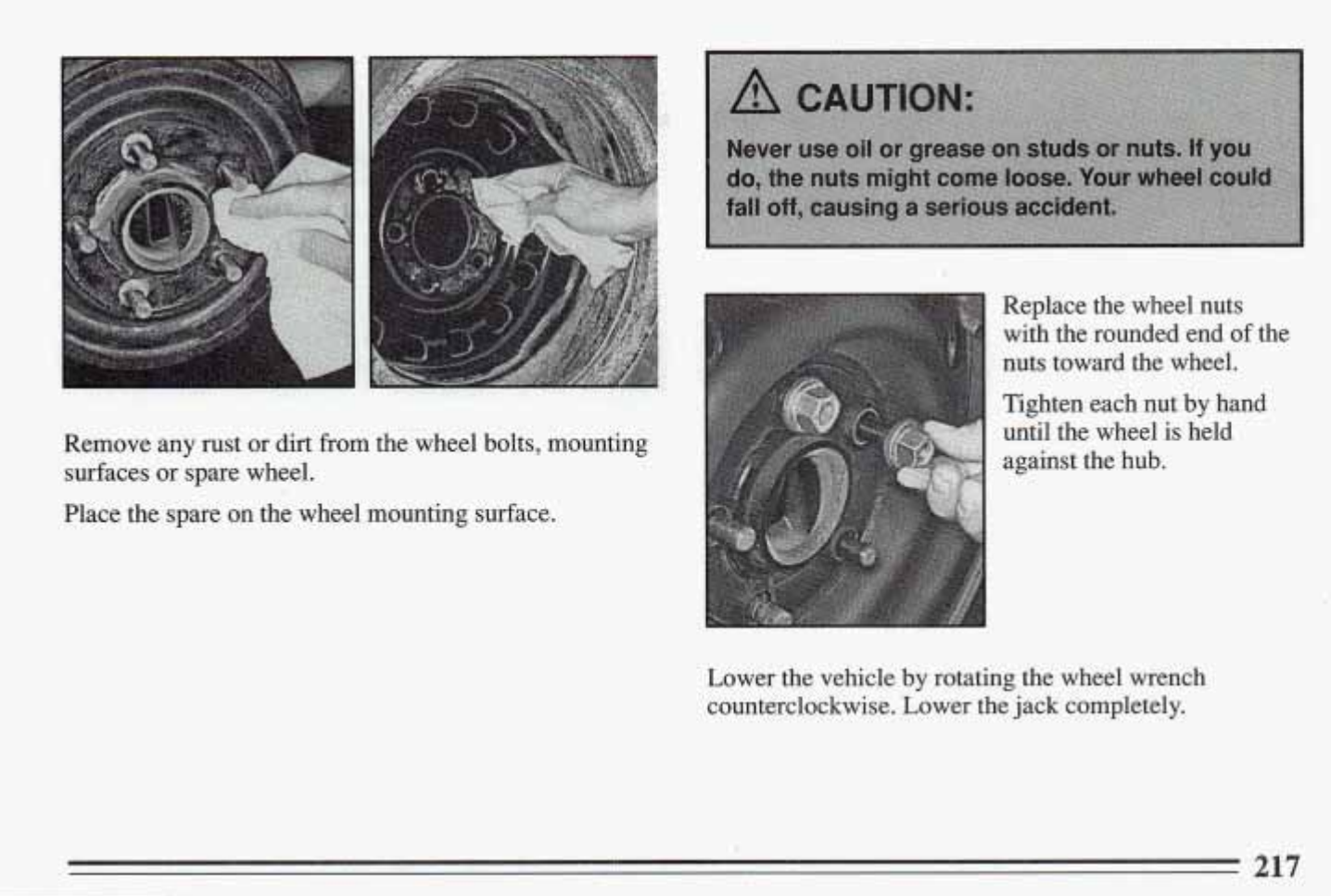
Remove any rust or dirt from the wheel bolts, mounting
surfaces or spare wheel.
Place the spare on the wheel mounting surface.
Replace the wheel nuts
with the rounded end
of
the
nuts toward the wheel.
Tighten each nut by hand
until the wheel is held
against the hub.
Lower the vehicle by rotating the wheel wrench
counterclockwise. Lower the jack completely.
217
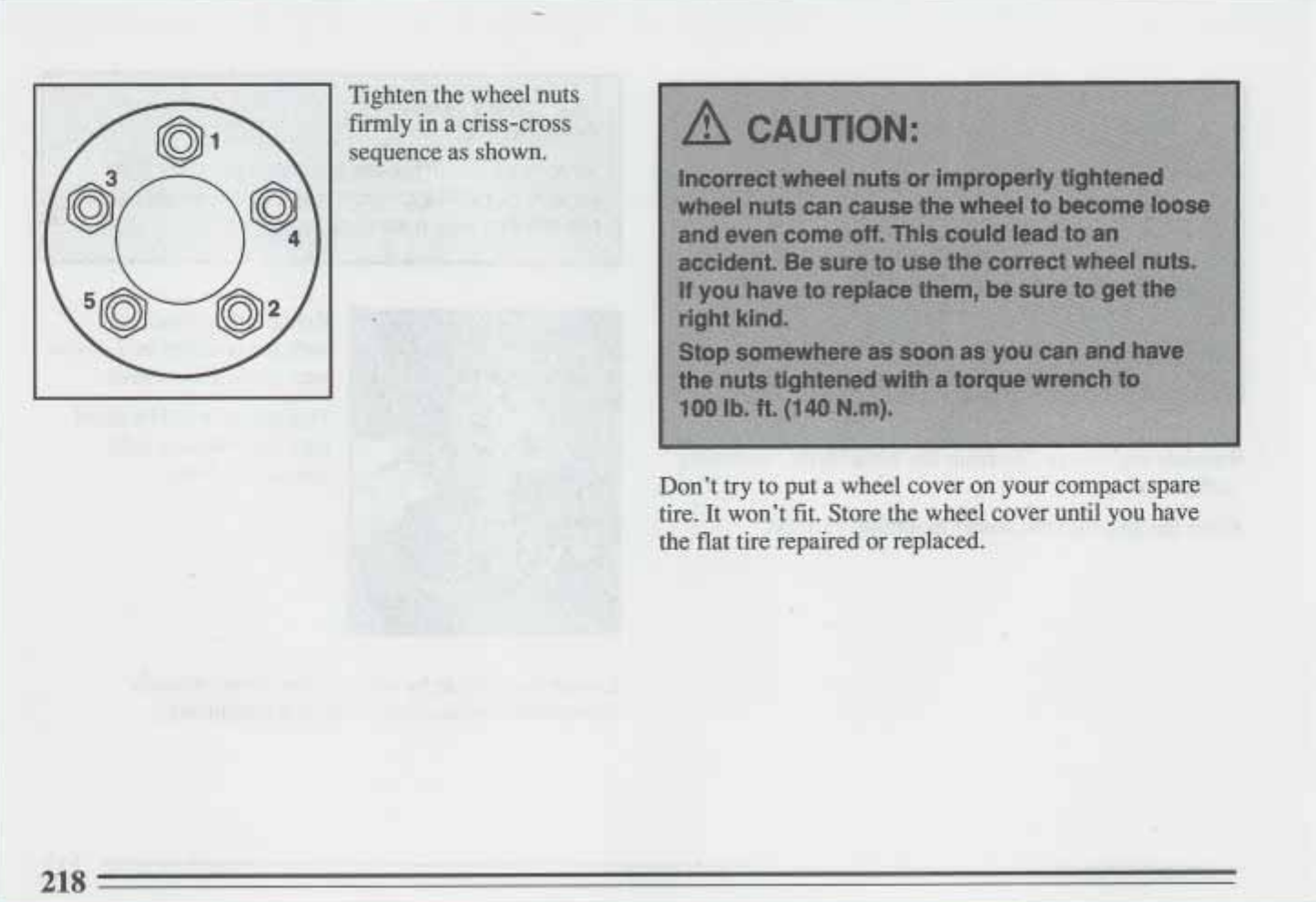
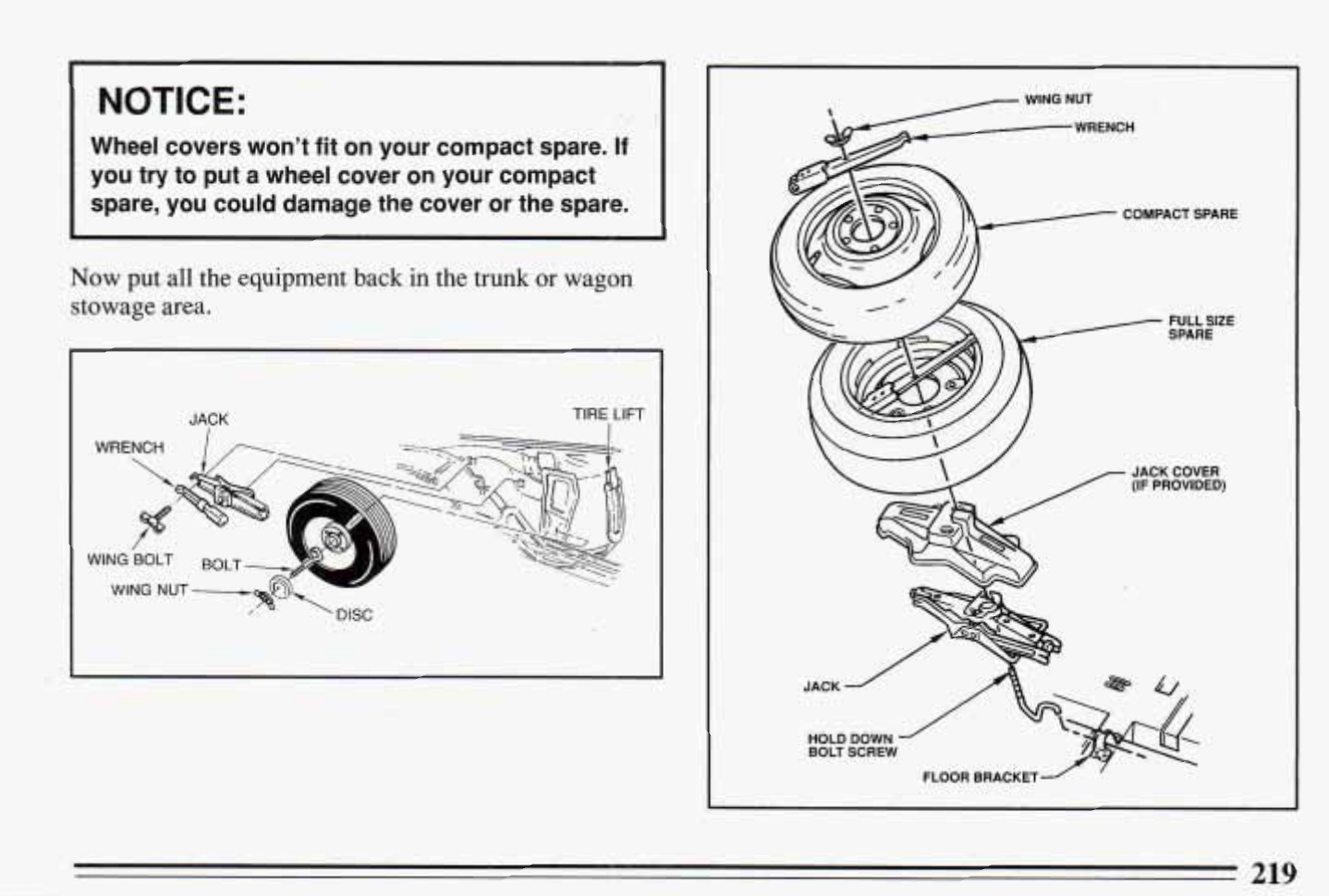
I
NOTICE:
Wheel covers won't fit
on
your compact spare.
If
you try
to
put
a
wheel cover on your compact
spare, you could damage the cover or the spare.
Now
put
all the equipment back in the trunk or wagon
stowage area.
JACK
TIRE
LIFT
I
WING NUT
Y
'"
'
DISC
L
COMPACT
SPARE
BOLT
SCREW
FLOOR
BRACKET
219
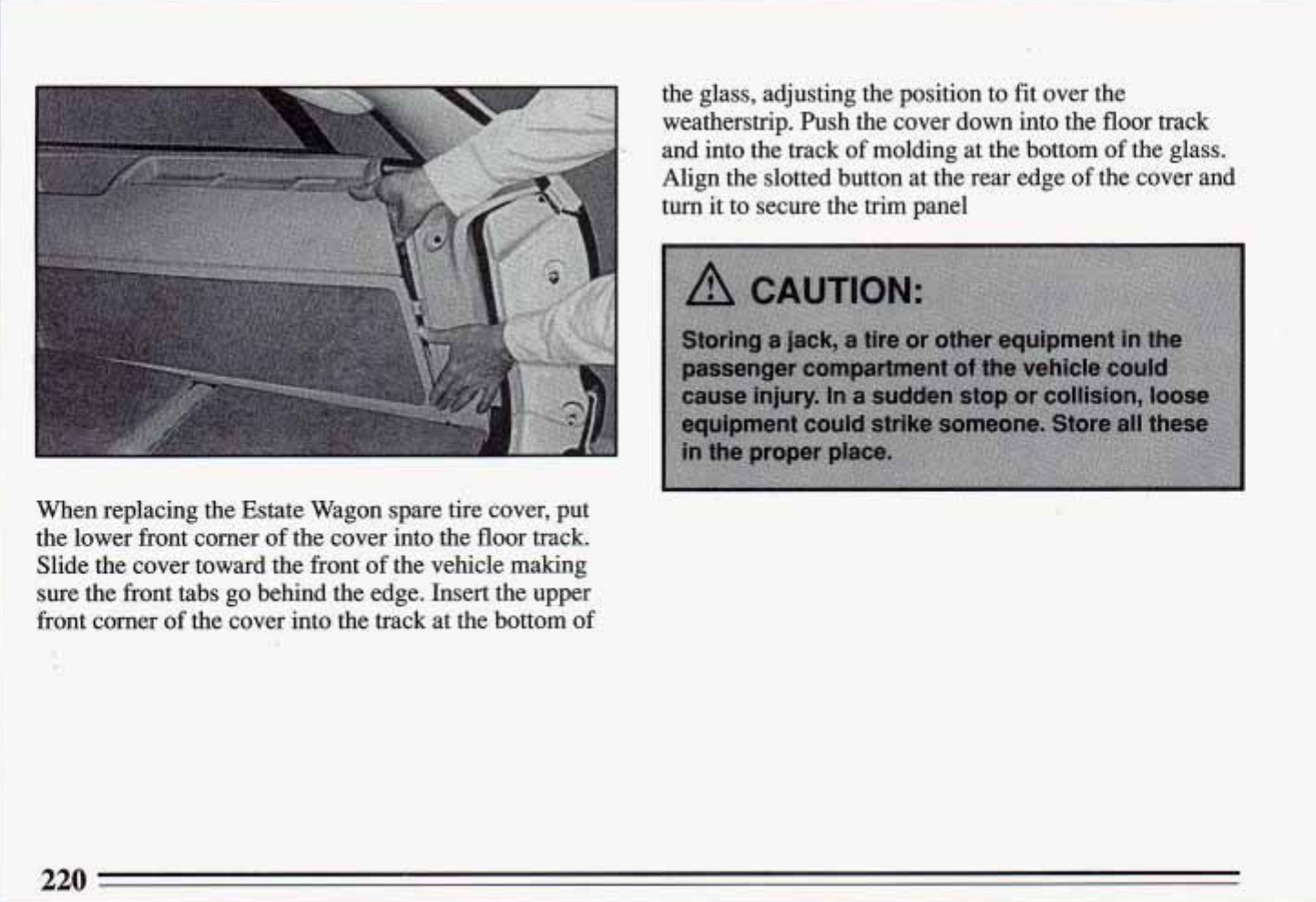
When replacing the Estate Wagon spare tire cover, put
the lower front corner of the cover into the floor track.
Slide the cover toward the €i-ont of the vehicle making
sure the front tabs go behind the edge. Insert the upper
front corner of the cover into the track at the bottom of
the glass, adjusting the position to fit over the
weatherstrip. Push the cover down into the
floor
track
and into the track of molding at the bottom of the glass.
Align the slotted button at the rear edge
of
the cover and
turn it to secure the trim panel
I
I
n
Part
6
Service and Appearance Care
Here
you
will find information about the care of your Buick
.
This part begins with service and fuel information. and
then it shows how to chec.k important fluid and lubricant levels
. There is also technical information about your
vehicle. and a section devoted to its appearance care
.
Part
6
includes:
..
Service
..........................................................................
224
Fuel
.............................................................................
225
Hood Release
.....................................................................
229
Engineoil
.......................................................................
231
Aircleaner
.......................................................................
236
Automatic Transmission Fluid
........................................................
237
Enginecoolant
....................................................................
240
Power Steering Fluid
...............................................................
243
Windshield Washer Fluid
............................................................
244
Brakes
............................................................................
245
Battery
..........................................................................
248
BulbReplacement ............................................................. 249, 279
LoadingYourVehicle
...............................................................
253
Tires
............................................................................
255
Appearance Care
..................................................................
263
Vehicle Identification Number
(VIN)
..................................................
272
. FusesandCircuitBreakers
...........................................................
273
Capacities and Specifications
.........................................................
280
..
I
223
Service
:Your Buick dealer
knows
-your vehicle best and warits
yau to be happy with it. We hope you’ll go to your
dealer for all your service needs, You’ll get genuine
GM
parts and GM-trained and supported service people.
We hope you’ll want to keep your GM vehicle all GM.
Genuine GM parts have one
of
these marks:
..I
Doing
Your
Own
Service
Wofk
If you want
to
do some of your own iervice work, you’ll
want to get the proper Buick Servick.Manua1. It tells you
much more about how to service yow, Buick than this
manual can.
To
order the proper service manual, see
“Service Publications” in the Index.
I.
Your vehicle has an air bag system. Before attempting to
do your own service work, see “Servicing Your Air
Bag-Equipped Buick” in the Index.”,
.
You should keep a record with all parts receipts and list
the mileage and the date. of any service work you
perform. See “Maintenance Record” in the Index.
224
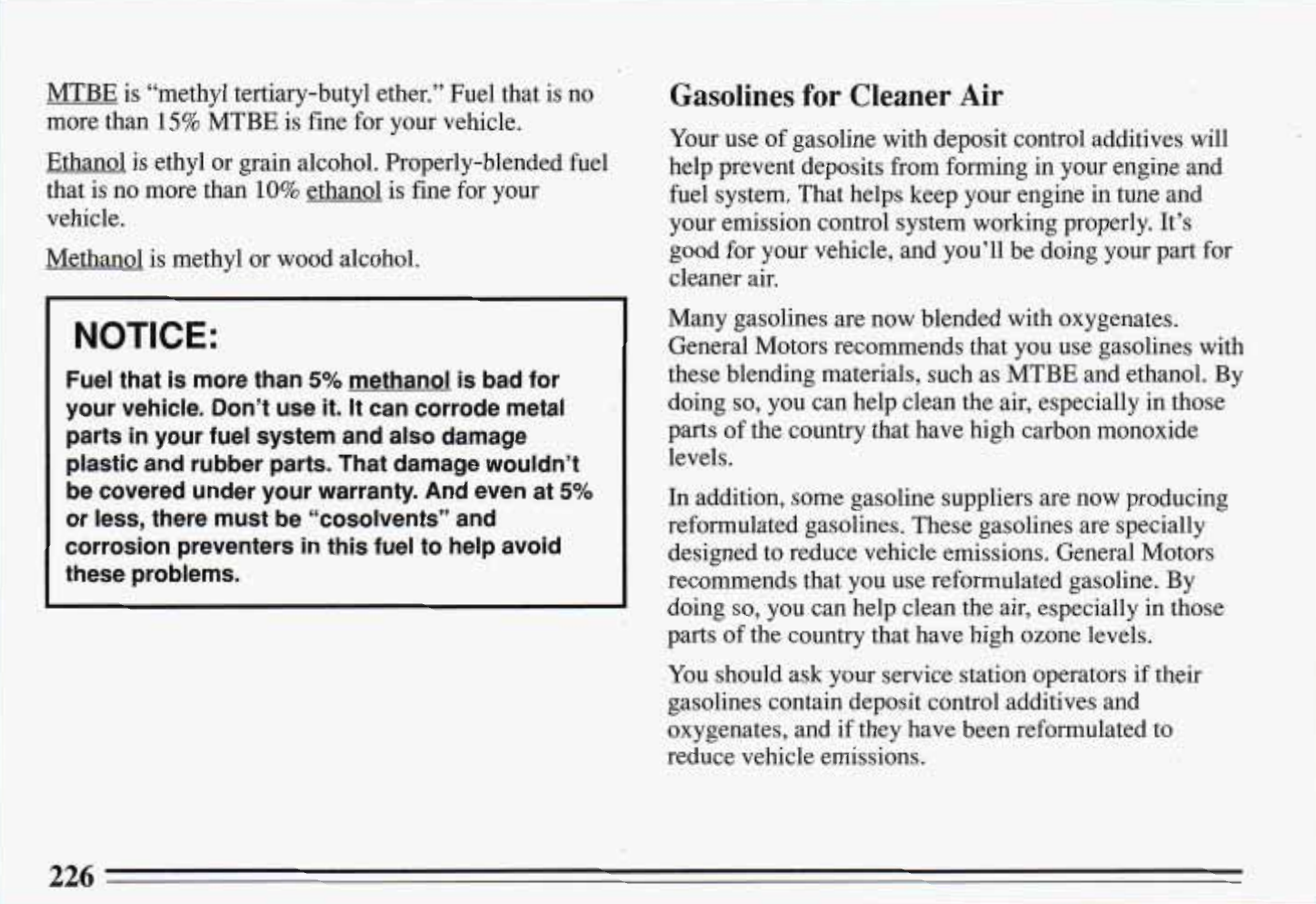
MTBE is “methyl tertiary-butyl ether.” Fuel that is no
more than
15%
MTBE is fine for your vehicle.
Ethanol is ethyl or grain alcohol. Properly-blended fuel
that is no more than
10%
ethanol is fine for your
vehicle.
Methanol is methyl or wood alcohol.
I
NOTICE:
Fuel that is more than
5%
methanol is bad for
your vehicle. Don’t use it. It can corrode metal
parts in your fuel system and
also
damage
plastic and rubber parts. That damage wouldn’t
be covered under your warranty. And even at
5%
or less, there must be “cosolvents” and
corrosion preventers in this fuel to help avoid
these problems.
Gasolines
for
Cleaner
Air
Your use of gasoline with deposit control additives will
help prevent deposits from forming in your engine and
fuel system. That helps keep your engine in tune and
your emission control system working properly. It’s
good for your vehicle, and you’ll be doing your part for
cleaner air.
Many gasolines are now blended with oxygenates.
General Motors recommends that you use,gasolines with
these blending materials, such as MTBE and ethanol. By
doing
so,
you can help clean the air, especially in those
parts
of
the country
that
have high carbon monoxide
levels.
In
addition, some gasoline suppliers are now producing
reformulated gasolines. These gasolines are specially
designed to reduce vehicle emissions. General Motors
recommends that you use reformulated gasoline. By
doing
so,
you can help clean the air, especially in those
parts’of the country that have high ozone levels.
You should ask your service station, operators if their
gasolines contain deposit control additives and
oxygenates, and if they have been reformulated to
reduce vehicle emissions.
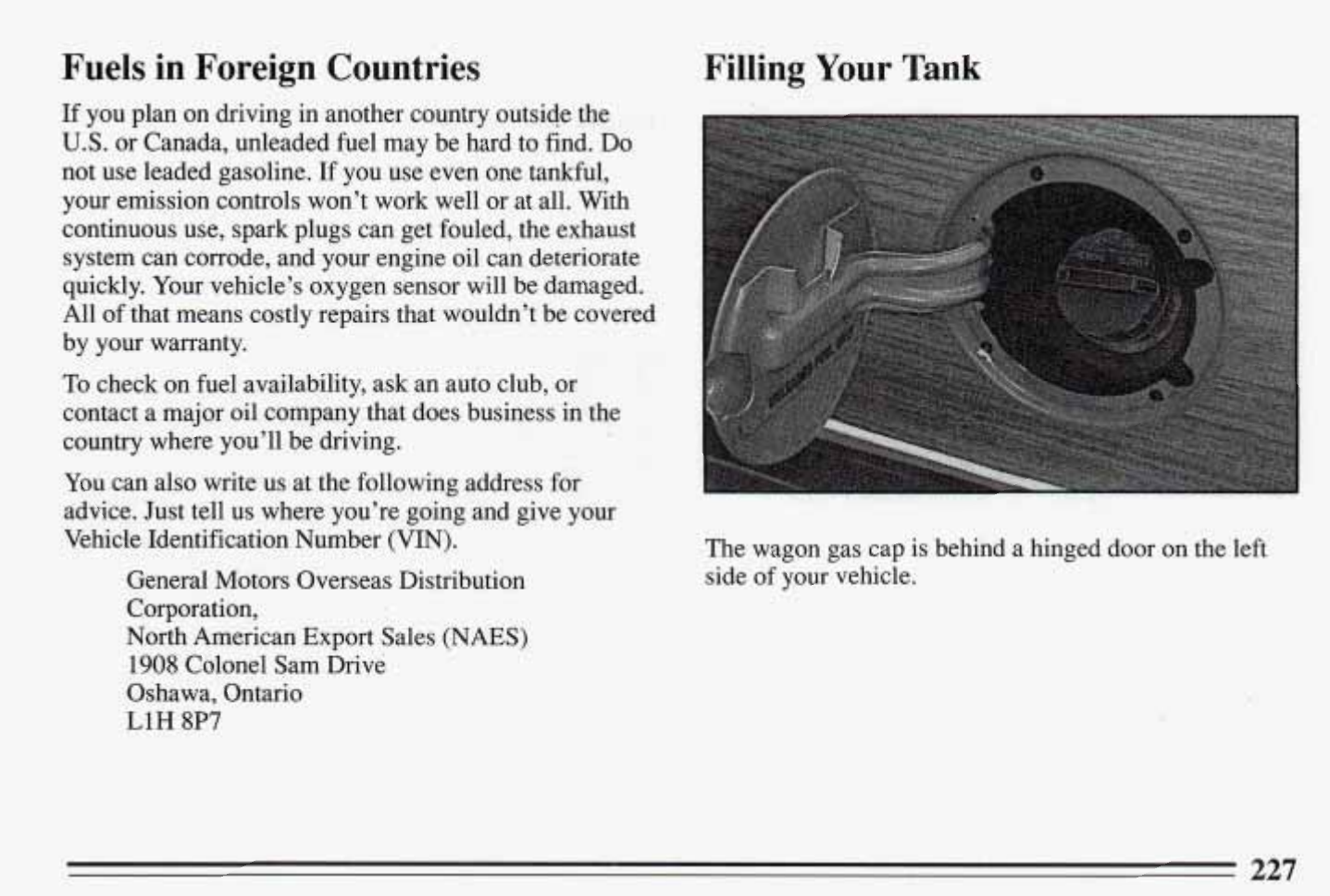
Fuels in Foreign Countries
If you plan
on
driving in another country outside the
U.S.
or Canada, unleaded fuel may be hard to find.
Do
not use leaded gasoline.
If
you use even one tankful,
your emission controls won’t work well or at all. With
continuous use, spark plugs can get fouled, the exhaust
system can corrode, and your engine oil can deteriorate
quickly. Your vehicle’s oxygen sensor will be damaged.
All of that means costly repairs that wouldn’t be covered
by your warranty.
To
check on fuel availability, ask an auto club, or
contact a major oil company that does business in the
country where you’ll be driving.
You
can also write us at the following address for
advice. Just tell us where you’re going and give your
Vehicle Identification Number (VIN).
General Motors Overseas Distribution
Corporation,
North American Export Sales (-NAES)
1908
Colonel Sam Drive
Oshawa, Ontario
L1H
8P7
Filling Your Tank
The wagon gas cap is behind a hinged door on the left
side
of
your vehicle.
227
..
~ ~
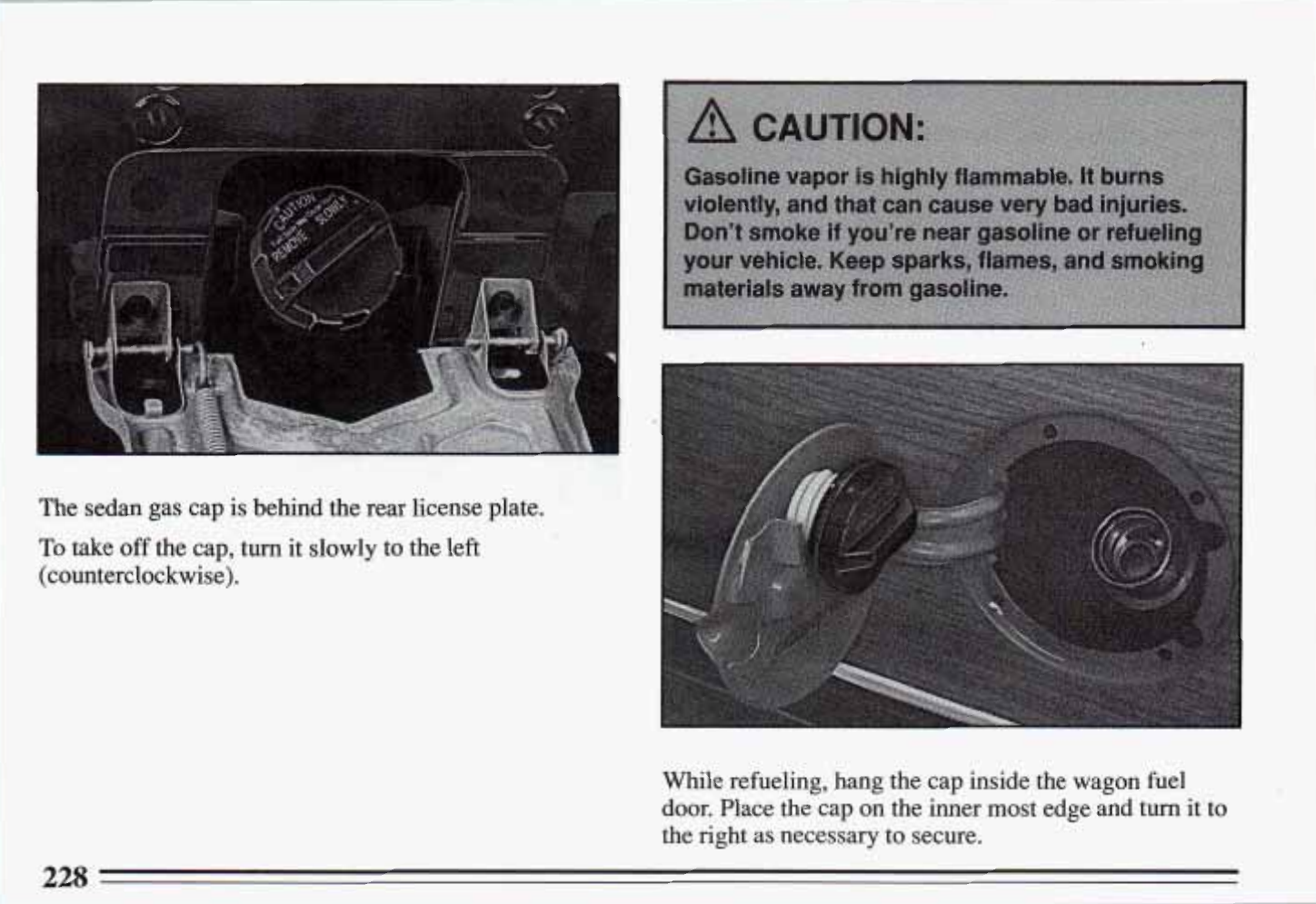
The sedan gas cap
is
behind the rear license plate.
To
take
off
the cap, turn it slowly
to
the
left
(counterclockwise).
While refueling, hang the cap inside the wagon fuel
door. Place the cap on the inner most edge and turn
it
to
the right as necessary to secure.
228
I
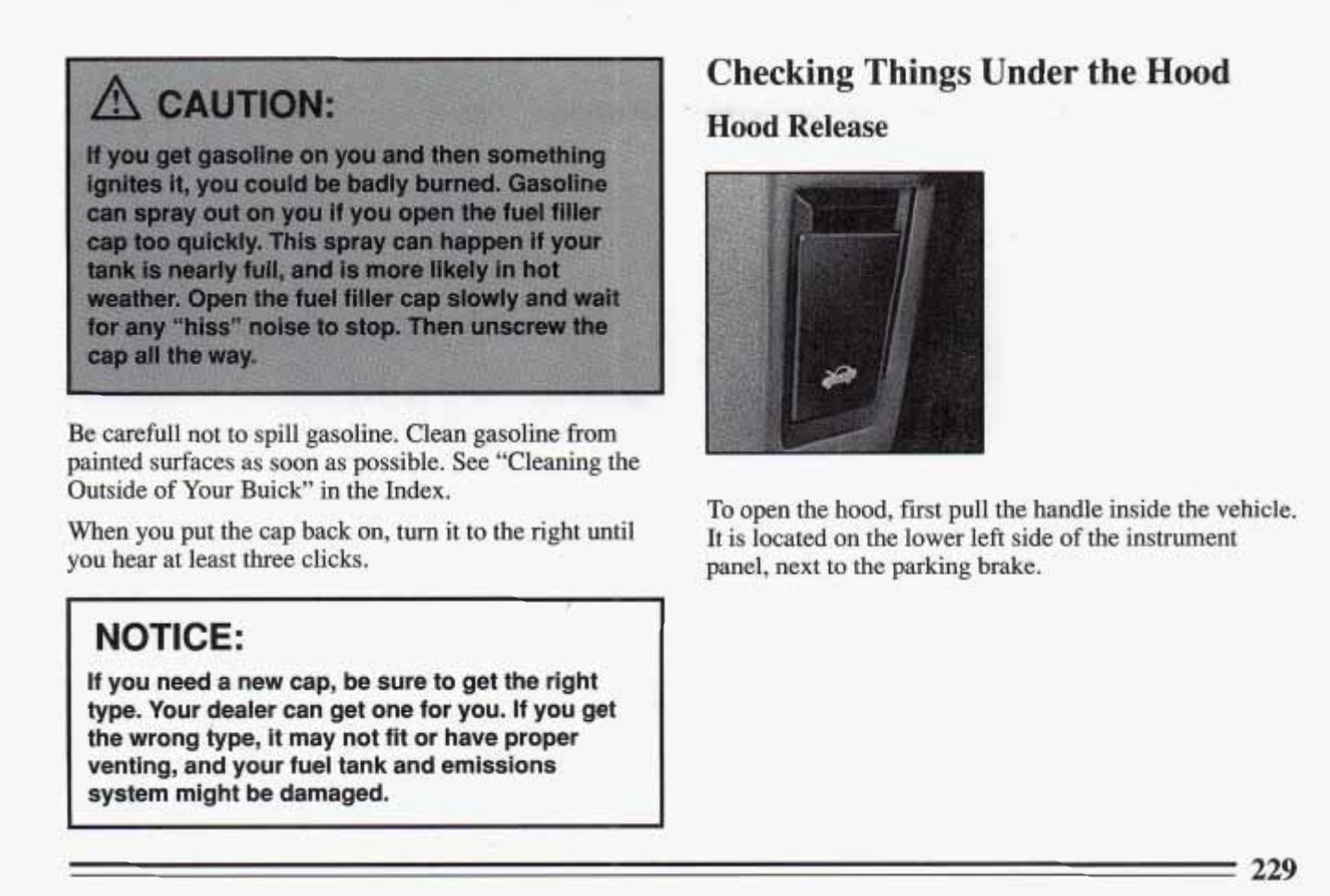
Be careful1 not to spill gasoline. Clean gasoline
from
painted surfaces as soon
as
possible. See “Cleaning the
Outside of Your Buick”
in
the Index.
When you put the cap back on, turn it to the right until
YOU
hear at least
three
clicks.
I
NOTICE:
If you need a new cap, De
sure
to get the right
type. Your dealer can get one for you.
If
you get
the wrong type, it may not fit or have proper
venting,’and your fuel tank and emissions
system might be damaged.
Checking Things Under the
Hood
;Hood
Release
To open the hood, first pull the handle inside the vehicle.
It is located on the lower left side
of
the instrument
panel,
next
to
the
parking
brake.
229
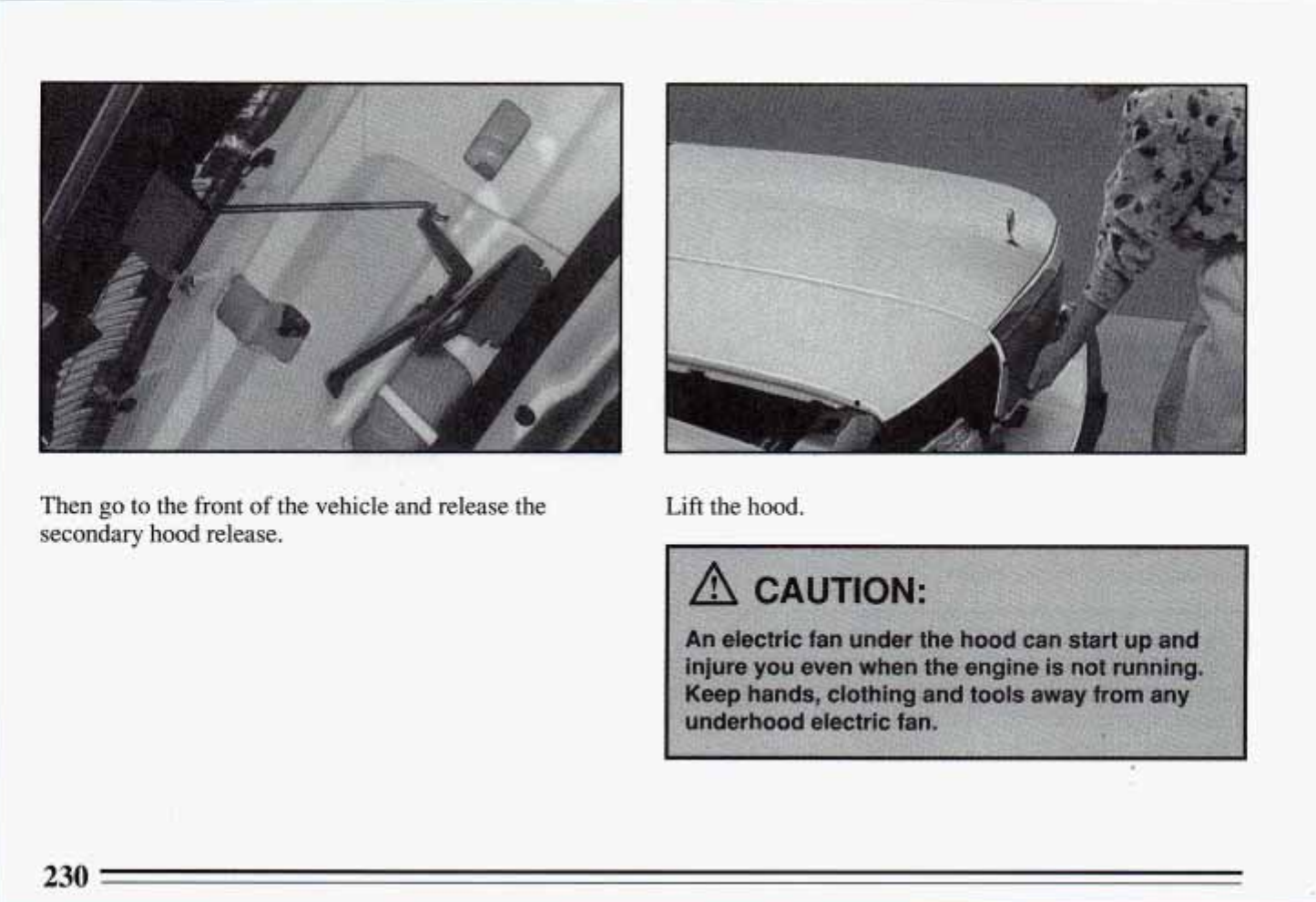
I
Then
go
to the front
of
the vehicle and release the
secondary hood release.
Lift
the hood.
230
Engine Oil
LOW
OIL
LEV
If the “LOW
OIL
LEV”
light on the instrument
panel comes on, it means
”.
,
you need to check your
engine oil level right away.
Before closing the bod, be sure all the filler .caps are on
properly. Then just pull the hood down and close it
fil-dy.
For more information, see “LOW
OIL
LEV” light in the
Index.
You
should check your engine oil level regularly;
this
is
an added reminder.
It’s a good idea to check your engine oil every time you
get fuel.
In
order to get
an
accurate reading, the oil must
be warm and the vehicle must be on level ground.
231
~~
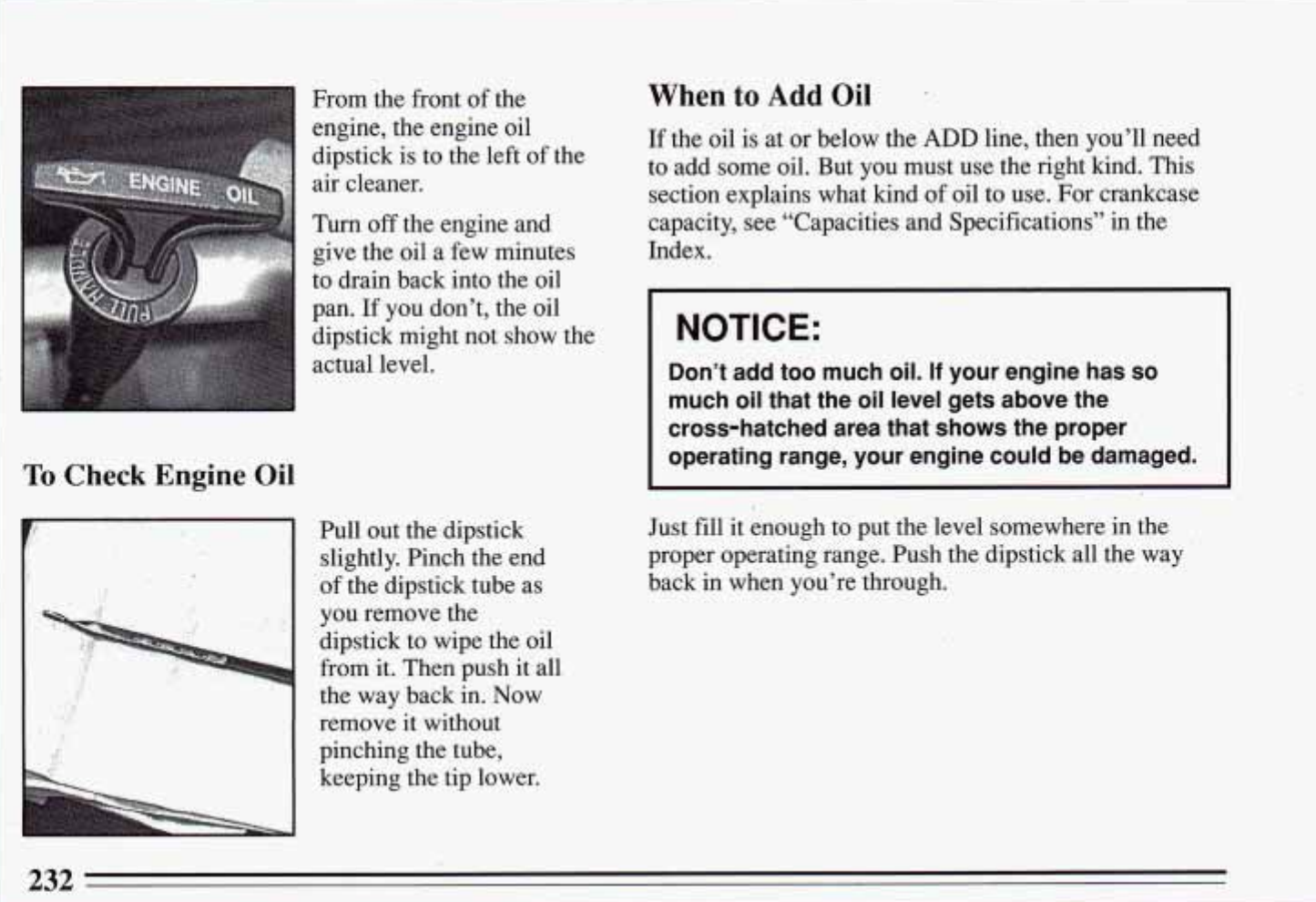
To
Check Engine
Oil
From the front of the
engine, the engine oil
dipstick is to the left of the
air cleaner.
Turn off the engine and
give the oil
a
few minutes
to drain back into the oil
pan. If you don’t, the oil
dipstick might not show the
actual level.
Pull out the dipstick
slightly. Pinch the end
of
the dipstick tube as
you remove the
dipstick to wipe the oil
from it. Then push it all
the way back in. Now
remove it without
pinching the.tube,
keeping the tip lower.
When
to
Add
Oil
If the oil
is
at or below the
ADD
line, then you’ll need
to add some oil. But you must use the right kind. This
section explains what kind of oil to use. For crankcase
capacity, see “Capacities and Specifications” in the
Index.
NOTICE:
Don’t add too much oil.
If
your engine has
so
much oil that the oil level gets above the
cross-hatched area that shows the proper
operating range, your engine could be damaged.
Just
fill
it enough
to
put the level somewhere in the
proper operating range. Push the dipstick all the way
back in when you’re through.
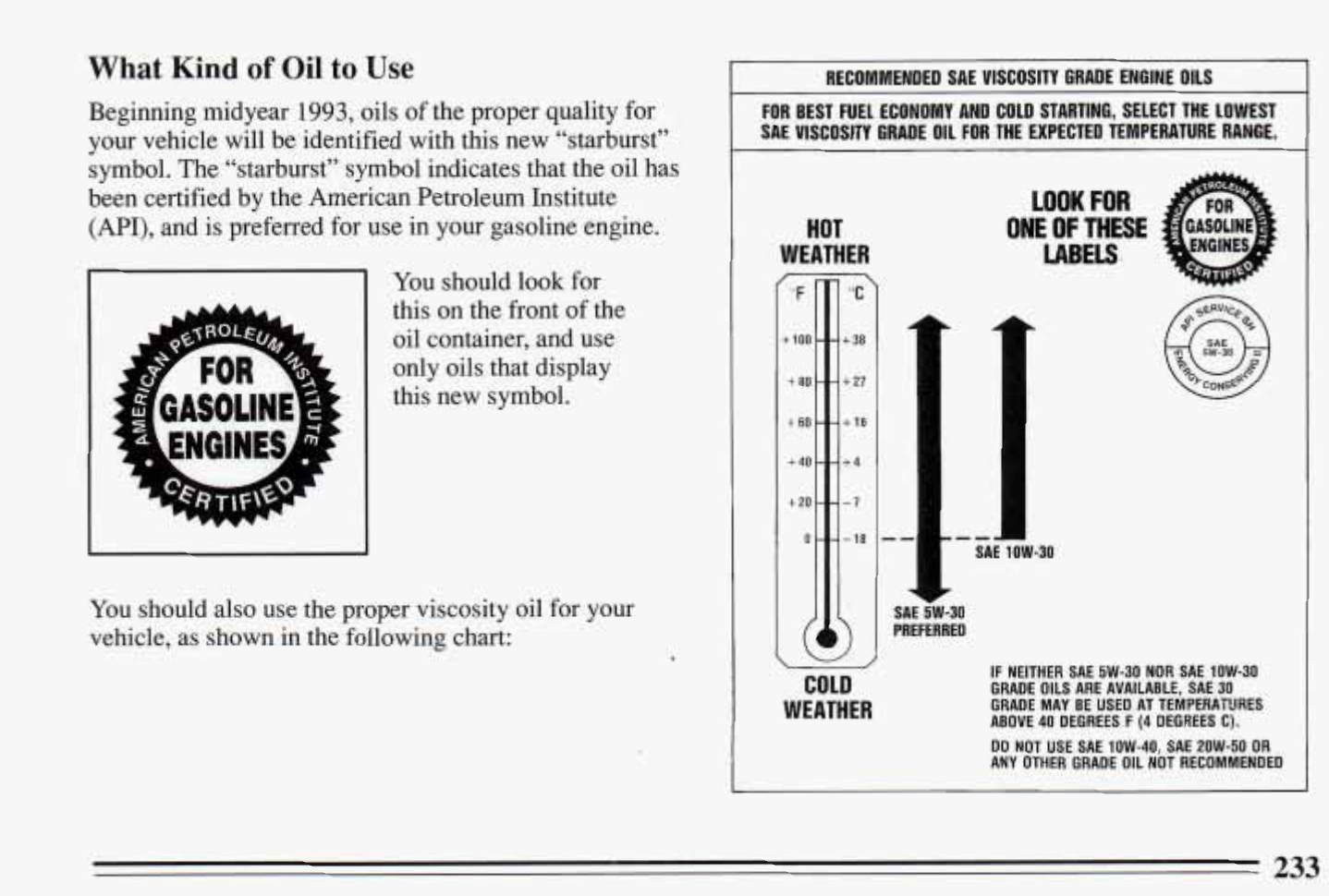
What
Kind
of
Oil
to
Use
Beginning midyear
1993,
oils of the proper quality for
your vehicle will be identified with this new “starburst”
symbol. The “starburst” symbol indicates that the oil has
been certified by the American Petroleum Institute
(API), and is preferred for use in your gasoline engine.
“I
You should look for
‘this
on
the front of the
oil container, and use
only oils that display
this new symbol.
You should also use the proper viscosity oil for your
vehicle, as shown in
the
following chart:
RECOMMENDED SAE VISCOSITY GRADE ENGINE
OILS
FOR
BEST FUEL ECONOMY AND COLD STARTING, SELECT THE LOWEST
SAE VISCOSITY GRADE
OIL
FOR
THE EXPECTED TEMPERATURE RANGE.
HOT
WEATHER
“F
~
100
+
80
+
60
+
40
+
20
0
~
COLD
WEATHER
LOOK
FOR
ONE
OF
THESE
LABELS.
\E 1OW-30
SAE
5W-30
PREFERRED
IF NEITHER SAE 5W-30 NOR SAE 1OW-30
GRADE
OILS
ARE AVAILABLE, SAE 30
GRADE MAY BE
USED
AT TEMFERATURES
ABOVE
40
DEGREES F
(4
DEGREES
C).
ANY OTHER GRADE OIL NOT RECOMMENDED
DO
NOT
USE
SAE 1OW-40, SAE 2OW-50
OR
233
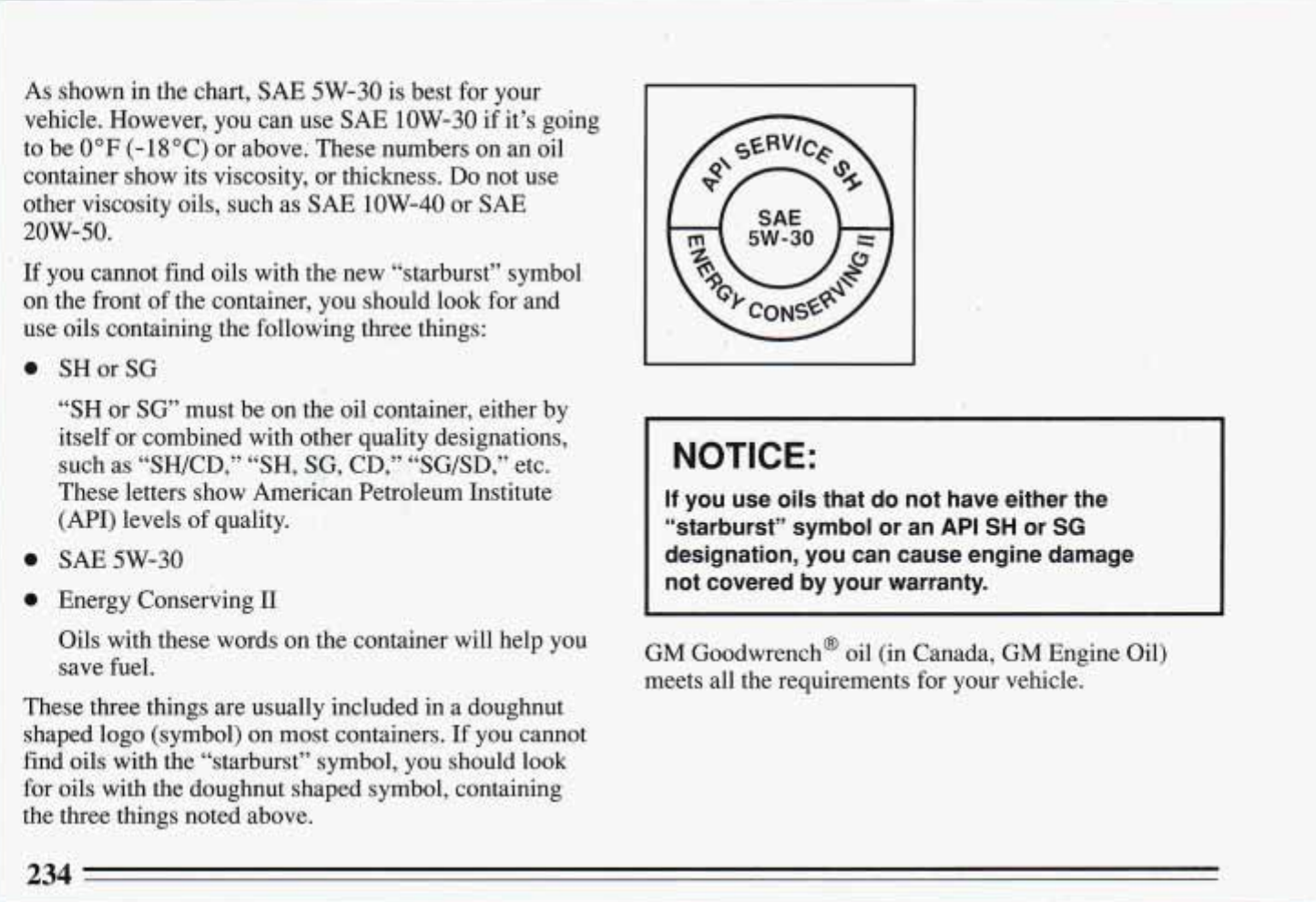
-
As
shown in the char
t,
SAE
5W-30
is best for your
vehicle. However, you can use
SAE
1OW-30
if
it’s going
to be
0
OF
(-
18
O
C)
or above; These numbers on an oil
container show its viscosity, or thickness.
Do
not use
other,viscosity oils, such as SAE 1OW-40 or SAE
If
you cannot find oils with the new “starburst” symbol
on the front
of
the container, you should look for and
use oils containing the following three things:
2OW-50.
a
a
a
SH
or SG
“SH
or SG” must be on the oil ,container, either by
itself or combined with other quality designations,
such as “SH/CD,” “SH, SG, CD,” “SG/SD,” etc.
These letters show American Petroleum Institute
(API)
levels of quality.
SAE
5W-30
Energy Conserving
I1
Oils with these words on the container will help you
save fuel.
These three things are usually included in a doughnut
shaped logo (symbol) on most containers.
If
you cannot
find oils with the “starburst” symbol, you should look
for oils with the doughnut shaped symbol, containing
the three things noted above.
I
I
I
NOTICE:
If
you use oils that do not have either the
“starburst” symbol or an
API
SH
or
SG
designation, you can cause engine damage
not covered by your warranty.
GM Goodwrench@ oil
(in
Canada, GM Engine Oil)
meets all the requirements for your vehicle.
234
Engine Oil Additives Engine .Coolant Warmer
Don’t add anything to your oil. Your Buick dealer is
,
(Engine Block Heater)
ready to advise if you think something should be added. An engine coolant warmer can be a big help if
you
have
When to Change Engine Oil
See if any one of these is true for you: Coolant Warmer” in the Index.
to park outside in very cold weather,
0
OF
(-
18
O C) or
colder.
If
your vehicle’has this option, see “Engine
0
Most trips are less than
4
miles
(6
km).
0
It’s below freezing outside.and most trips are less
than
10
miles
(16
km).
The engine is at low speed most of the time (as in
You tow a trailer often.
door-to-door delivery, or in stop-and-go traffic).
@
Most trips are through dusty places.
If any one of these is true for your vehicle, then’you
need to change your oil and filter every
3,000
miles
‘(5
000
km) or
3
months
--
whichever comes first..
(See “Change Oil Indicator” in the Index.)
If none of them is true, change the
oil
every
7,500
miles
(12
500
km)
or
12
months
--
whichever comes first.
Change the filter at the first oil change and at every
other oil change after that.
(See “Change Oil Indicator’’ in the Index.)
What to
Do
with
Used
Oil
Did
you
know that used engine oil contains certain
elements that may be unhealthy for your skin and could
even cause cancer? Don’t let used oil stay on your skin
for very long. Clean your skin and nails with soap and
water, or a good hand cleaner. Wash or properly throw
away clothing or rags containing used engine oil. (See
the manufacturer’s warnings about the use and disposal
of oil products.)
Used oil can
be
a real threat to the environment.
If
you
change your own oil, be sure to drain all free-flowing
oil from the filter before disposal., Don’t ever dispose of
oil by putting it in the trash, pouring it on the ground,
into sewers, or into streams or bodies of water. Instead,
recycle it by taking it to
a
place that collects used oil.
If
you have a problem properly disposing of your used oil,
ask your dealer, a service station or a local recycling
center for help.
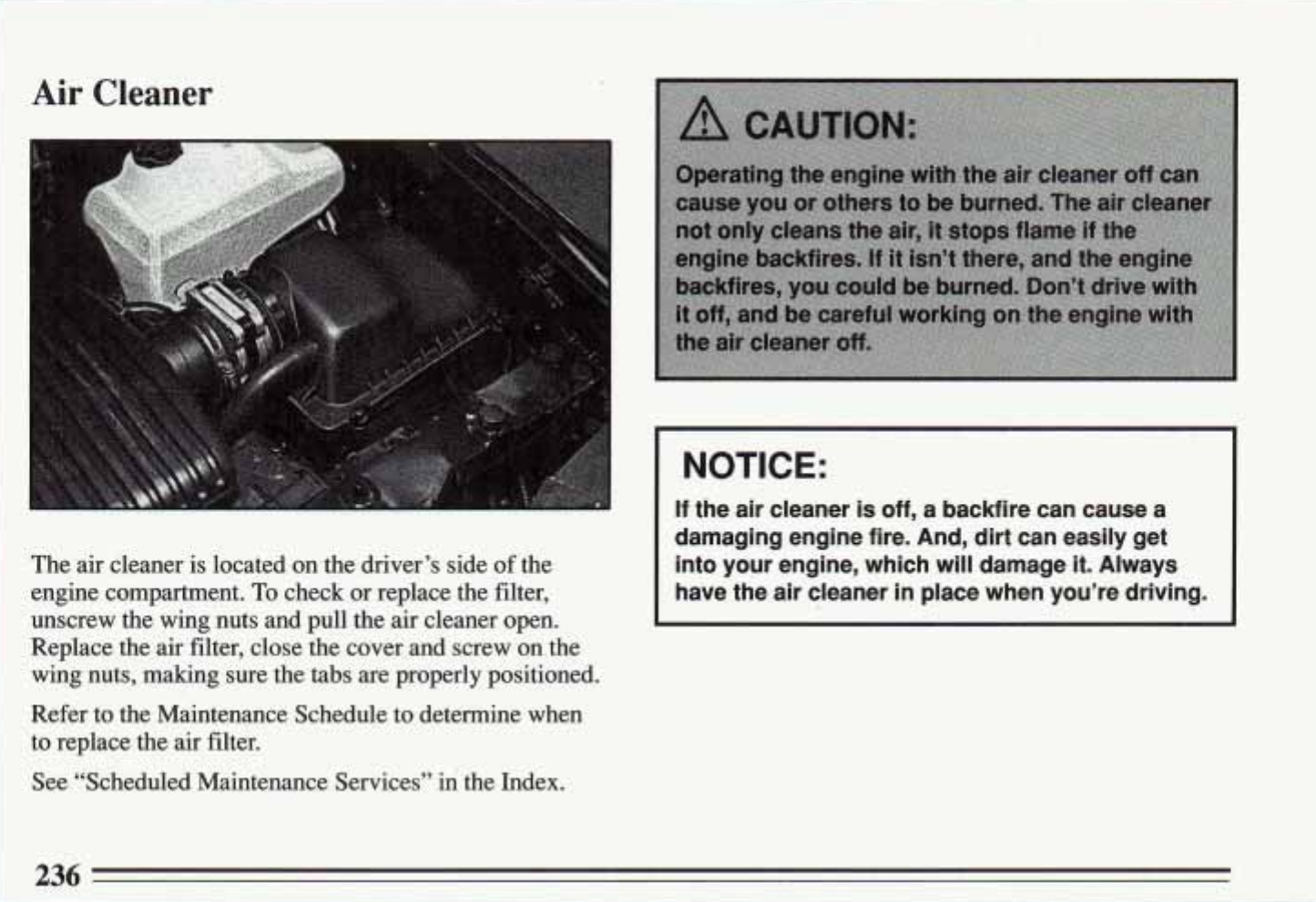
Air
Cleaner
The air cleaner is located on the driver’s side
of
the
engine compartment.
To
check or replace the filter,
unscrew the wing nuts and pull the air cleaner open.
Replace the air filter, close the cover.and screw on the
wing nuts, making sure the
tabs
are properly positioned.
Refer to the Maintenance Schedule to determine when
to replace the air filter.
See “Scheduled Maintenance Services” in the Index.
NOTICE:
If the air cleaner
is
off,
a backfire can cause a
damaging engine fire. And, dirt can easily get
into your engine, which will damage it. Always
have the air cleaner in place when you’re driving.
236
Automatic Transmission Fluid
When
to
Check and Change
A good time to check your automatic transmission fluid
level is when the engine oil is changed. Refer to the
Maintenance Schedule to determine when to change
your fluid. See “Scheduled Maintenance Services” in
the Index.
How
to
Check
Because this operation can be a little difficult, you may
choose to have this done at a Buick dealership Service
Department.
If
you do it yourself, be sure to follow all the
instructions here, or you could get a false reading
on
the
dipstick.
NOTICE:
Too
much or too little fluid can damage your
transmission.
Too
much can mean that some
of
the fluid could come out and fall on hot engine
parts or exhaust system, starting
a
fire. Be sure
to get an accurate reading
if
you check your
transmission fluid.
Wait at least 30 minutes before checking the
transmission fluid level if you have been driving:
0
When outside temperatures are above 90°F (32°C).
0
At high speed for quite a while.
0
In heavy traffic -- especially in hot weather.
0
While pulling a trailer.
To get the right reading, the fluid should be at normal
operating temperature, which is 180°F to 200°F (82°C
to 93°C).
To check transmission fluid
hot:
Get the vehicle warmed
up by driving about
15
miles (24
km)
when outside
temperatures are above 50°F (10°C). If it’s colder than
50
OF
(
10
”
C), drive the vehicle in
“D’
.(
3rd Gear) until
the engine temperature gage moves and then remains
steady for ten minutes. Then follow the hot check
procedures.
237
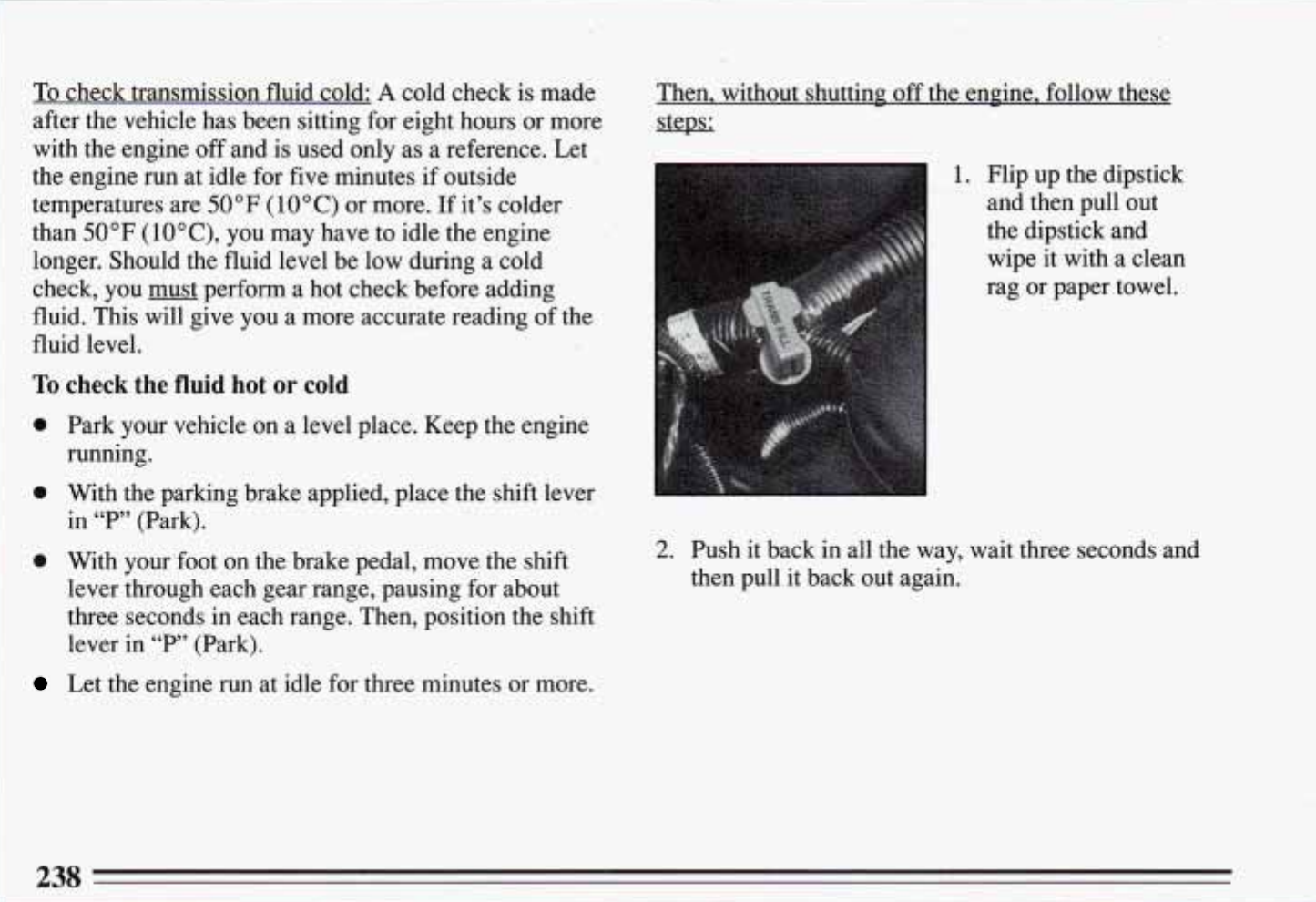
To check transmission fluid cold:
A
cold check is made
after the vehicle has been sitting for eight hours or more
with the engine off and is used only as a reference. Let
the engine
run
at idle for five minutes if outside
temperatures are 50°F (10°C) or more.
If
it’s colder
than 50°F
(
lO”C), you may have to idle the engine
longer. Should the fluid level be low during a cold
check, you must perform a hot check before adding
fluid. This will give you
a
more accurate reading of the
fluid level.
To
check the fluid hot
or
cold
0
Park your vehicle on a level place. Keep the engine
0
With the parking brake. applied, place the shift lever
running.
in
“P’
(Park).
0
With your foot on the brake pedal, move the shift
lever through each gear,range, pausing for about
three seconds in each range. Then, position the shift
lever in
“P”
(Park).
Let
the engine run at idle for three minutes or more.
steps:
1.
Flip up the dipstick
and then pull out
the dipstick and
wipe it with a clean
rag
or
paper towel.
2. Push it back in all the way, wait three seconds and
then pull it back out again.
238
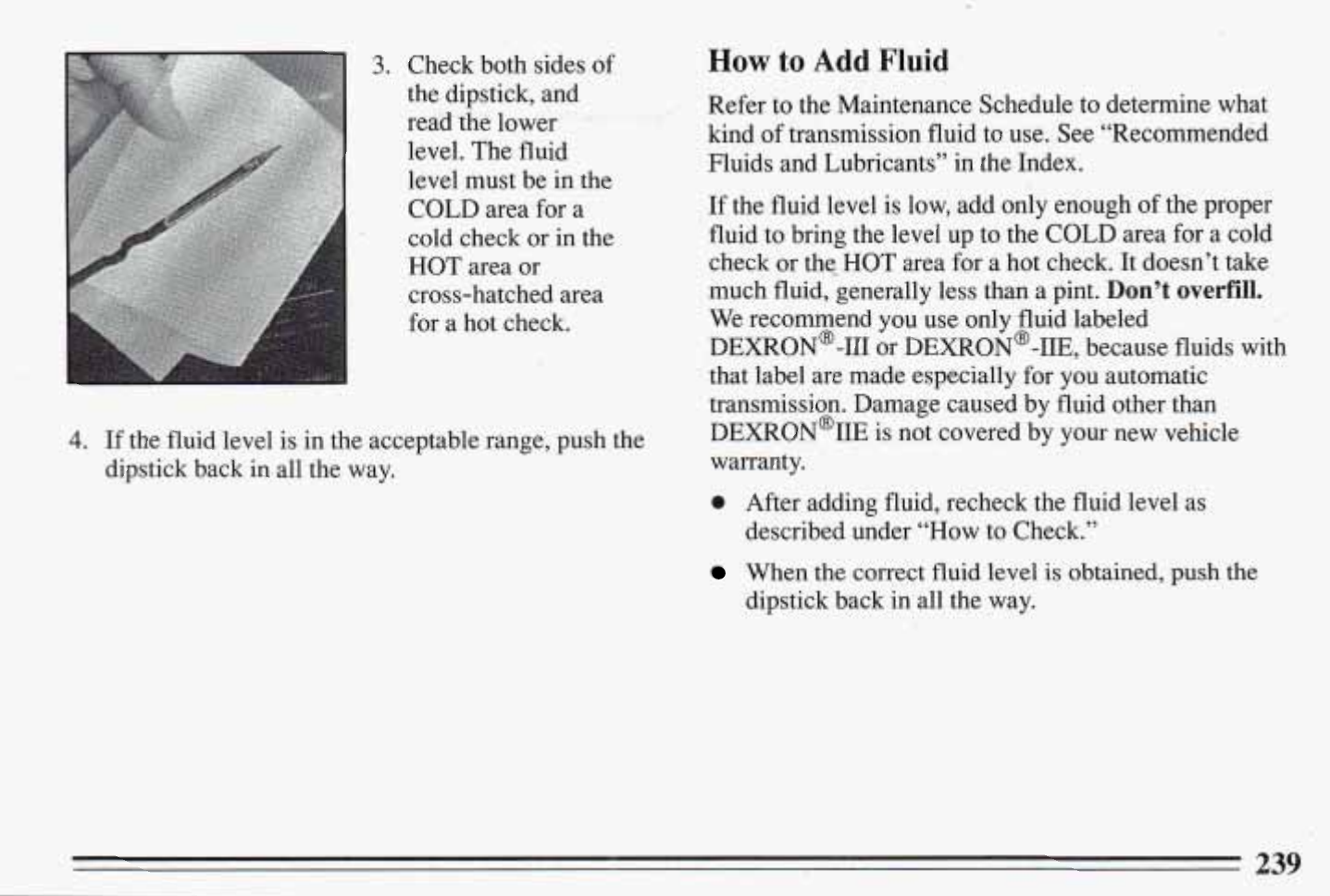
3.
Check both sides
of
the dipstick, and
re%3 ’the? lower’
’
level. The fluid
level must be in the
COLD
area for a
cold check or in the
HOT area or
cross-hatched area
for a hot check.
4.
If the fluid level is in the acceptable range, push the
dipstick back in all the way.
How
to
Add
Fluid
Refer to the Maintenance Schedule
to
determine what
kind of transmission fluid to use. See “Recommended
Fluids and Lubricants” in the Index.
If the fluid level .is low, add only enough of the proper
fluid to bring the level up to the COLD area for a cold
check or the
HOT
area for a hot check.
It
doesn’t take
much fluid, generally less than a pint.
Don’t
overfill.
We recommend you use only fluid labeled
DEXRON@-111 or DEXRON@-IIE, because fluids with
that label are made especially for you automatic
transmission. Damage caused by fluid other than
DEXRON@IIE is not covered by your new vehicle
warranty.
0
After adding fluid, recheck the fluid level as
described under “How to Check.”
When
the correct fluid level
is
obtained, push the
dipstick back in all the way.
Rear Axle
When to Check and Change Lubricant
Refer to the Maintenance Schedule to determine how
often to check the lubricant and when to change it. See
“Periodic Maintenance Inspections” in the Index.
How
to Check Lubricant
If
the level is below the bottom of the filler plug hole,
you’ll need to add some lubricant. Add enough lubricant
to raise the level to the bottom of the filler plug hole.
What to Use
Standard Differential
Use Axle Lubricant (GM Part
No.
1052271) or SAE
8OW-90 GL-5 gear lubricant.
Limited-Slip Differential
To add lubricant when the level is low,
use
Axle
Lubricant
(GM
Part
No.
1052271) or
SAE
8OW-90
GL-5
gear lubricant.
To
completely refill after draining, add
1
4
ounces
(1
18
ml)
of Limited-Slip Differential Lubricant
Additive (GM Part
No.
1052358). Then fill to the bottom
of the filler plug hole
with
Axle Lubricant (GM
Part
No.
1052271) or SAE
8OW-90
GL-5 gear lubricant.
Engine Coolant
The following explains your cooling system and how to
add coolant when it is low. If you have a problem with
engine overheating, see “Engine Overheating” in the
Index.
The proper coolant for your Buick will:
Give freezing protection down to
-34°F
(-37°C)
.
Give boiling protection up to 262
OF
(
128 O C)
.
Protect against rust and corrosion.
0
Help keep the proper engine temperature.
Let the warning lights work as they should.
What to Use
Use a mixture of one-half clean water (preferably
distilled) and one-half antifreeze that meets “GM
Specification 1825-M,” which won’t damage aluminum
parts. You can also use a recycled coolant conforming to
GM Specification 1825-M with a complete coolant flush
and refill. If you use this mixture, you don’t need to add
anything else.
240
1
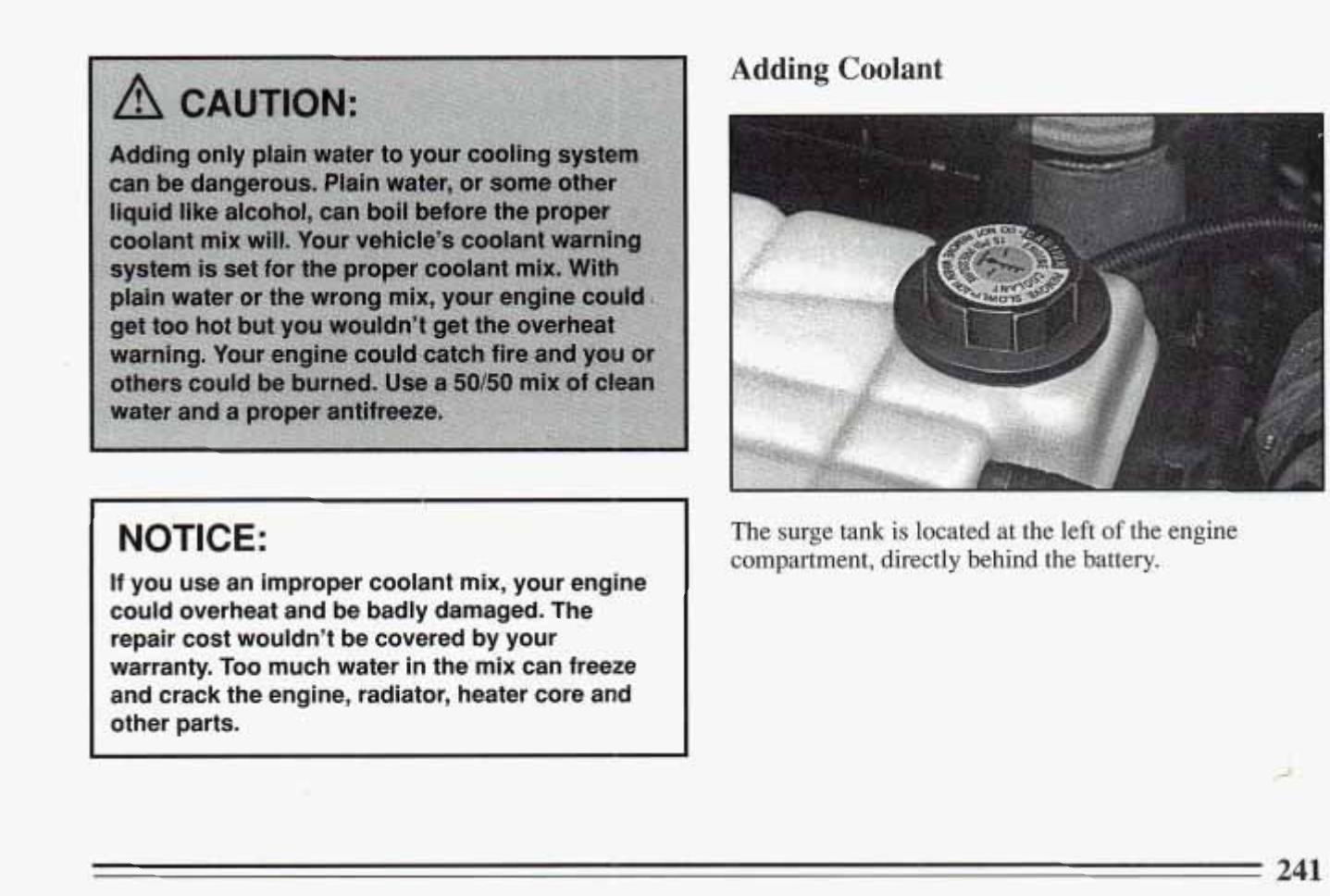
If
you use an improper coolant mix, your engine'
could overheat and be badly damaged. The
repair cost wouldn't be covered by your
warranty. Too much water in the'mix can freeze
and crack the engine, radiator, heater core and
other parts.
Adding Coolant
I
The surge
tank
is
located at the
left
of
the engine
compartment, directly behind the battery.
241
3
To
Check
Coolant
When your engine
is
cold, the coolant level should be at
the
“FULL
COLD.”
I
I
To
Add
Coolant
If
thklight comes on it
means you’re
low
on
engine coolant.
.
‘.i.
.
.. When replacing the pressure’cap, make sure it is tight.
Surge
Tank
Pressure
Cap
NOTICE:
Your radiator cap is
a
15
psi
(1
05
kPa)
pressure-type cap and must be tightly installed
to prevent coolant
loss
and possible engine
damage from overheating.
If
you
need more coolant, add the proper mix
at
the
sm,
but
only when the engine is cool.
When
you
replace your radiator pressure cap, an
AC*
cap is recommended.
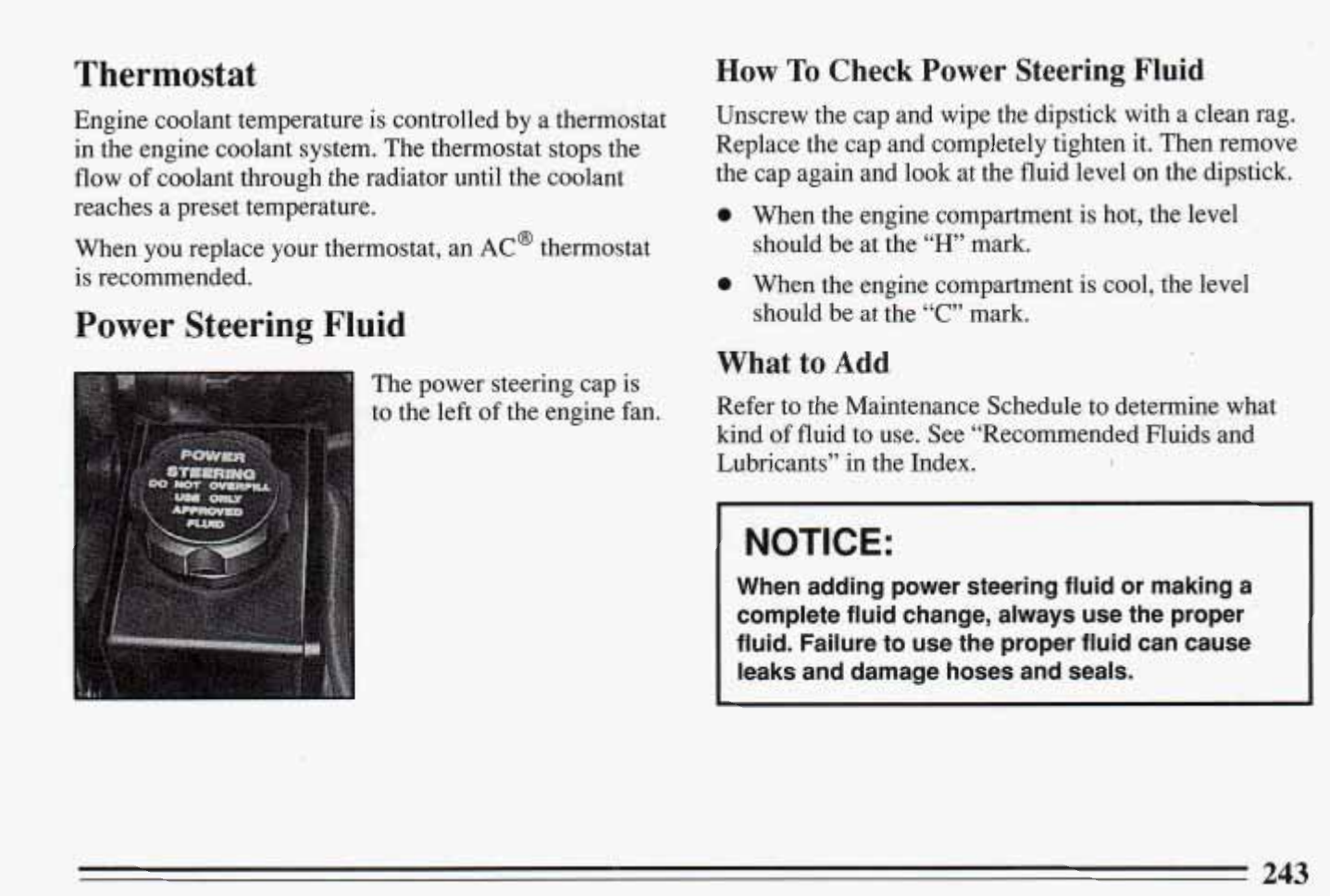
Thermostat
Engine coolant temperature is controlled by a thermbstat
in the engine coolant system. The thermostat stops the
flow of coolant through the radiator until the coolant
reaches a preset temperature.
When you replace your thermostat, an
AC@
thermostat
is
recommended.
Power Steering
Fluid
The power steering cap is
to the left of the engine fan.
How
To
Check Power Steering
Fluid
Unscrew the cap and wipe the dipstick with a clean rag.
Replace the cap and completely tighten it. Then remove
the cap again and look at the fluid level on the dipstick.
0
When the engine compartment is hot, the level
0.
When the engine compartment is cool, the level
should be at the
“H”
mark.
should be at the
“C”
mark.
.What
to
Add
Refer to the Maintenance Schedule to determine what
kind of fluid to use. See “Recommended Fluids and
Lubricants” in the Index.
I
NOTICE:
When adding power steering fluid or making a
complete fluid change, always use the proper
fluid. Failure to use the proper fluid can cause
leaks and damage hoses and seals.
243
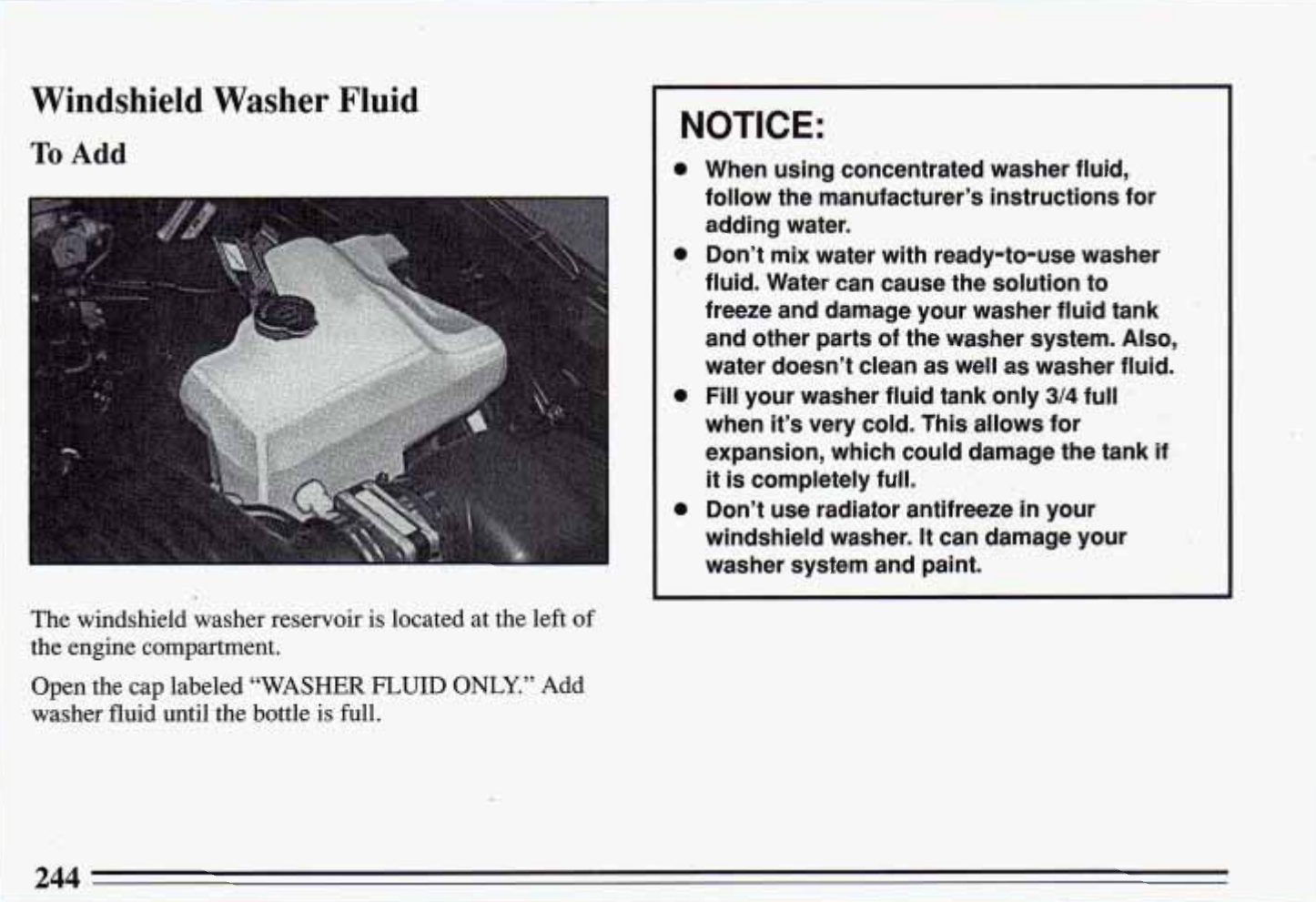
Windshield Washer Fluid
To
Add
The windshield washer reservoir is located at the left of
the engine compartment.
Open the cap labeled “WASHER
FLUID
ONLY.”
Add
washer fluid until the bottle is full.
NOTICE:
0
0
0
0
When using concentrated washer fluid,
follow the manufacturer’s instructions for
adding water.
Don’t mix water with ready-to-use washer
fluid. Water can cause the solution to
freeze and damage your washer fluid tank
and other parts of the’washer system.
Also,
water doesn’t clean as well as washer fluid.
Fill
your washer fluid tank only
3/4
full
when
it’s
very cold. This allows for
expansion, which could damage the tank if
it
is
completely full.
Don’t use radiator antifreeze
in
your
windshield washer.
It
can damage your
washer system and paint.
244
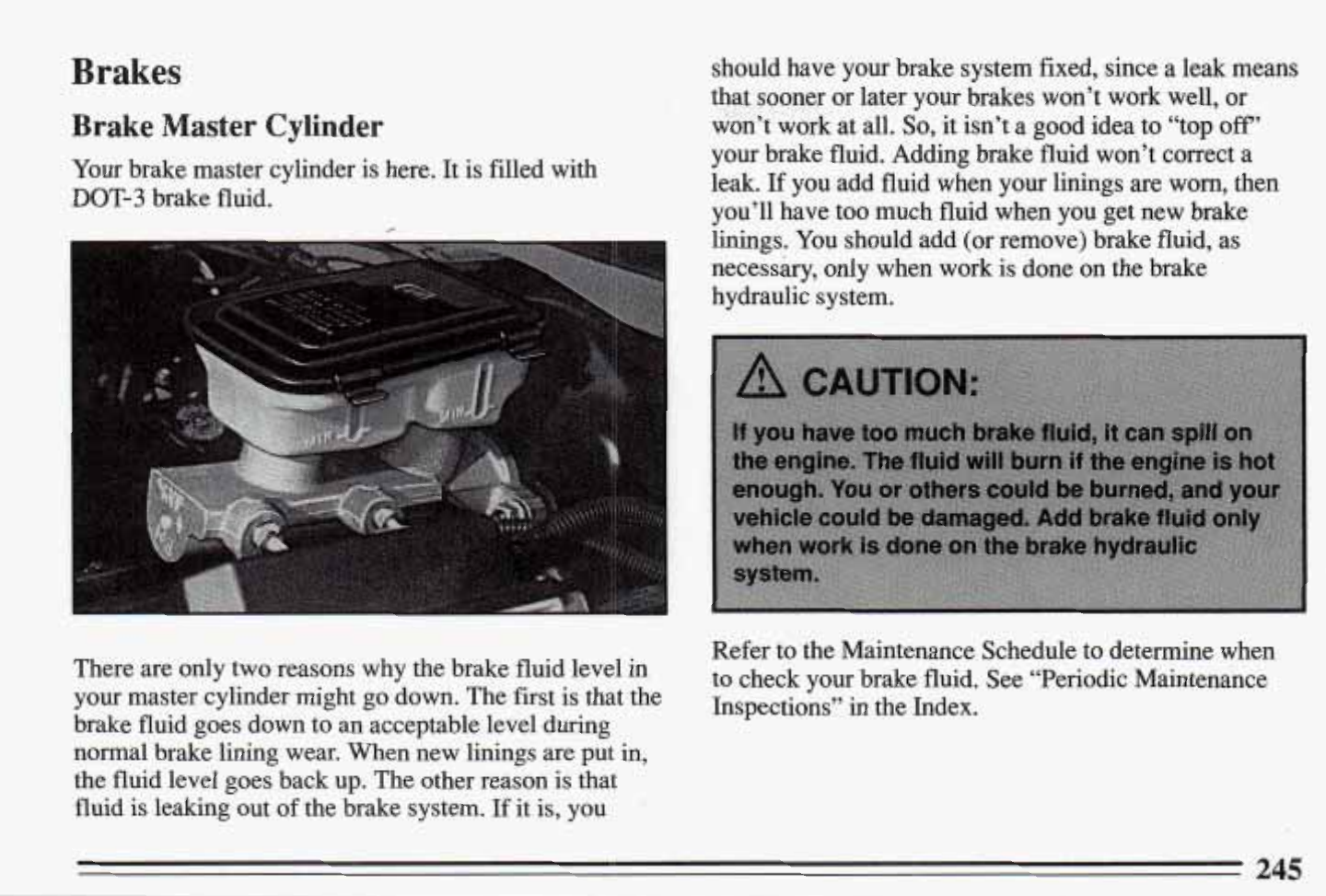
Brakes
Brake Master Cylinder
Your brake master cylinder is here. It
is
filled with
DOT-3 brake fluid,
,
should have your brake system fixed, since
a
leak means
that sooner or later your brakes won’t work well, or
won’t work at all.
So,
it isn’t a good idea to “top
off”
your brake fluid. Adding brake fluid won’t correct a
leak.
If
you add fluid when your linings
are
worn, then
you’ll have too much fluid when
you
get new brake
linings. You should add (or remove) brake fluid,
as
necessky, only when work is done on the brake
hydraulic system.
1
Refer to the Maintenance Schedule to determine when
There are only two reasons why the brake fluid level in
to
check your brake fluid,
See
“periodic Maintenance
your
master cylinder might go down. The first
is
that the hspections,~
in
the Index.
brake fluid goes down to an acceptable level during
normal brake lining wear. When new linings are put in,
the fluid level goes back up. The other reason is that
fluid is leaking out of the brake system.
If
it is, you
245
To
Check B.rake
Fluid
You can check the brake fluid without taking
off
the cap.
The fluid levels should be above
‘“IN.’’
If they aren’t,
have your brake system checked to see if there is a leak.
After ‘work is done on the brake hydraulic system, make
sure the levels are above
“MIN”
and below the top of
each window.
1
Just look at the windows on the brake fluid reservoir.
l
I
What
to
Add
When you do need brake fluid, use only’DOT-3 brake
fluid
--
such
as
Delco Supreme
11
@
(GM
Part
No.1052535). Use new brake fluid
from
a sealed
container only, and always clean the brake fluid
reservoir cap before removing it.
I
NOTICE:
.
1.
:fi’
1.-
,
,
<
j,
.
I.
~~
’=&
,I
.
-
0
Don’t let someone put
in
the wrong kind of
fluid. For example, just
a
few drops of
mineral-based
oil,
such as engine oil, in
your brake system can damage brake
system parts
so
badly that they’ll have to
be
replaced~~~~~~~~~~~~~~~~.’
..:
.
t
;,.~,~~~~~~~~~~~~-~-,~~
-
--
:.
‘
,
.
..
,.
.
,,
.,
+.
,ck.kJ.-~
..-;-.F.c~.&
,,
_’
p
~
’.-
..
’,
,,.
,,..
’“..”
w:’i!?;.,;c.T
Brake fluid can damage paint,
so
be careful
not to spill brake fluid on your vehicle. If
you
do,
wash
it
off immediately. See
“Appearance Care”
in
the Index.
~
.
.
.~
,
’e
-
.4+;;7;
:s$c
7
~..
.:
.
.
.,
,,.
--.-.
%
i
.
4
4,
If your brake pedal goes down farther than normal, your
rear drum brakes may need adjustment. Adjust them by
backing up and firmly applying the brakes a few times.
Replacing Brake System Parts
The braking system on a modern vehicle is complex. Its
many parts have to be of top quality and work well
together if the vehicle is to have really good braking.
Vehicles we design and test have top-quality
GM
brake
parts in them, as your Buick does when it is new. When
you replace parts of your braking system
--
for example,
when your brake linings wear down and you have to
have new ones put in
--
be sure you get new genuine
GM
replacement parts. If
you
don’t, your brakes may no
longer work properly. For example, if someone puts
in
brake linings that are wrong for your vehicle, the
balance between your front and rear brakes can change,
for the worse. The braking performance you’ve come to
expect can change in many other ways
if
someone puts
in the wrong replacement brake parts.
Battery
Every new Buick has a Delco Freedom@ battery.
You
never have to add water to one of these. When it’s time
for a new battery, we recommend a Delco Freedom@
battery. Get one that has the catalog number shown on
the original battery’s label.
Vehicle Storage
If
you’re not going to drive your vehicle for
25
days or
more, take
off
the black, ,negative
(-)
cable
from
the
battery. This will help keep your battery from running
down.
Contact your dealer to learn how to prepare your vehicle
for longer storage periods.
248
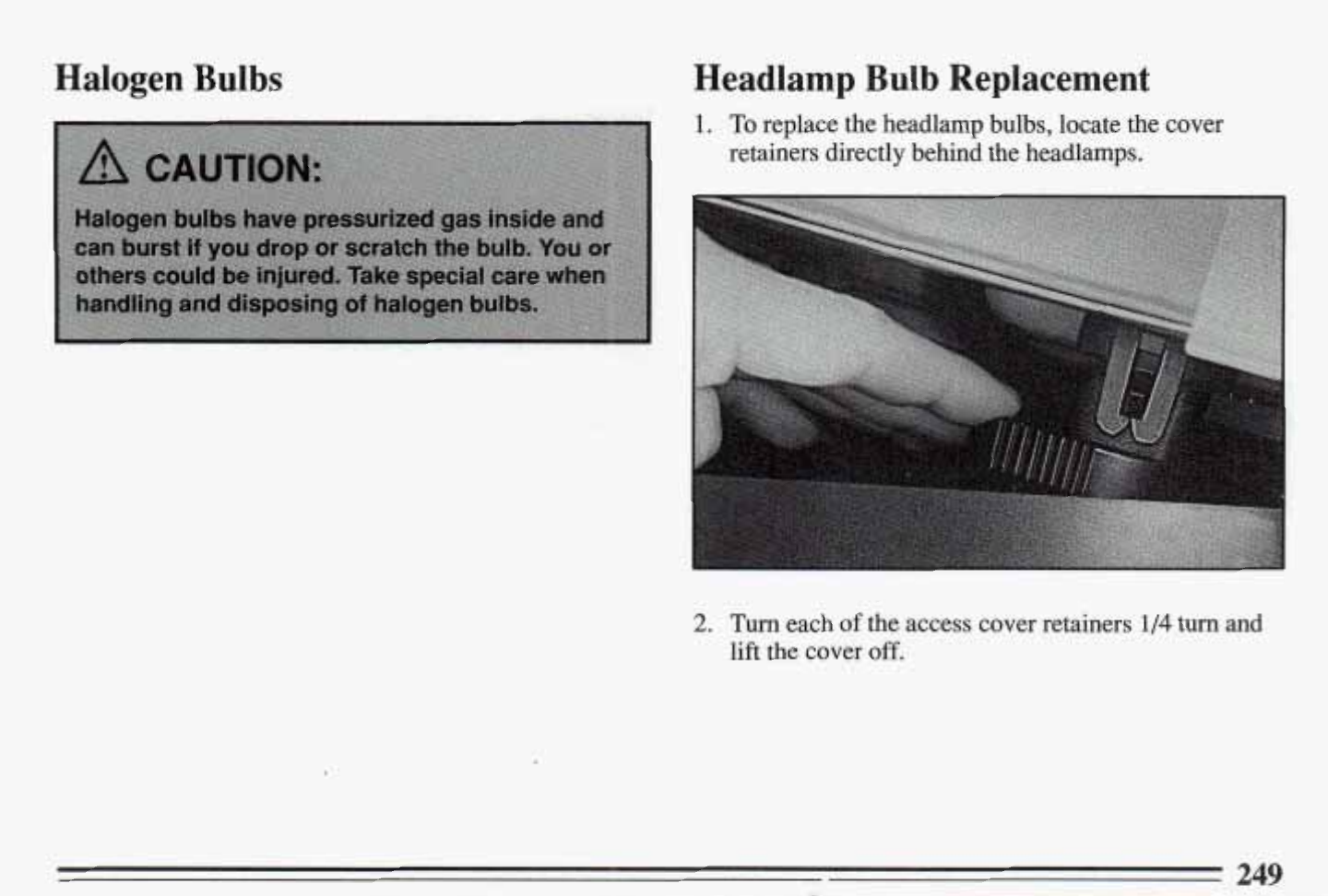
Halogen
Bulbs
Headlamp Bulb Replacement
2.
Turn
each
of
the access cover retainers
1/4
turn
and
lift the cover
off.
t:
249
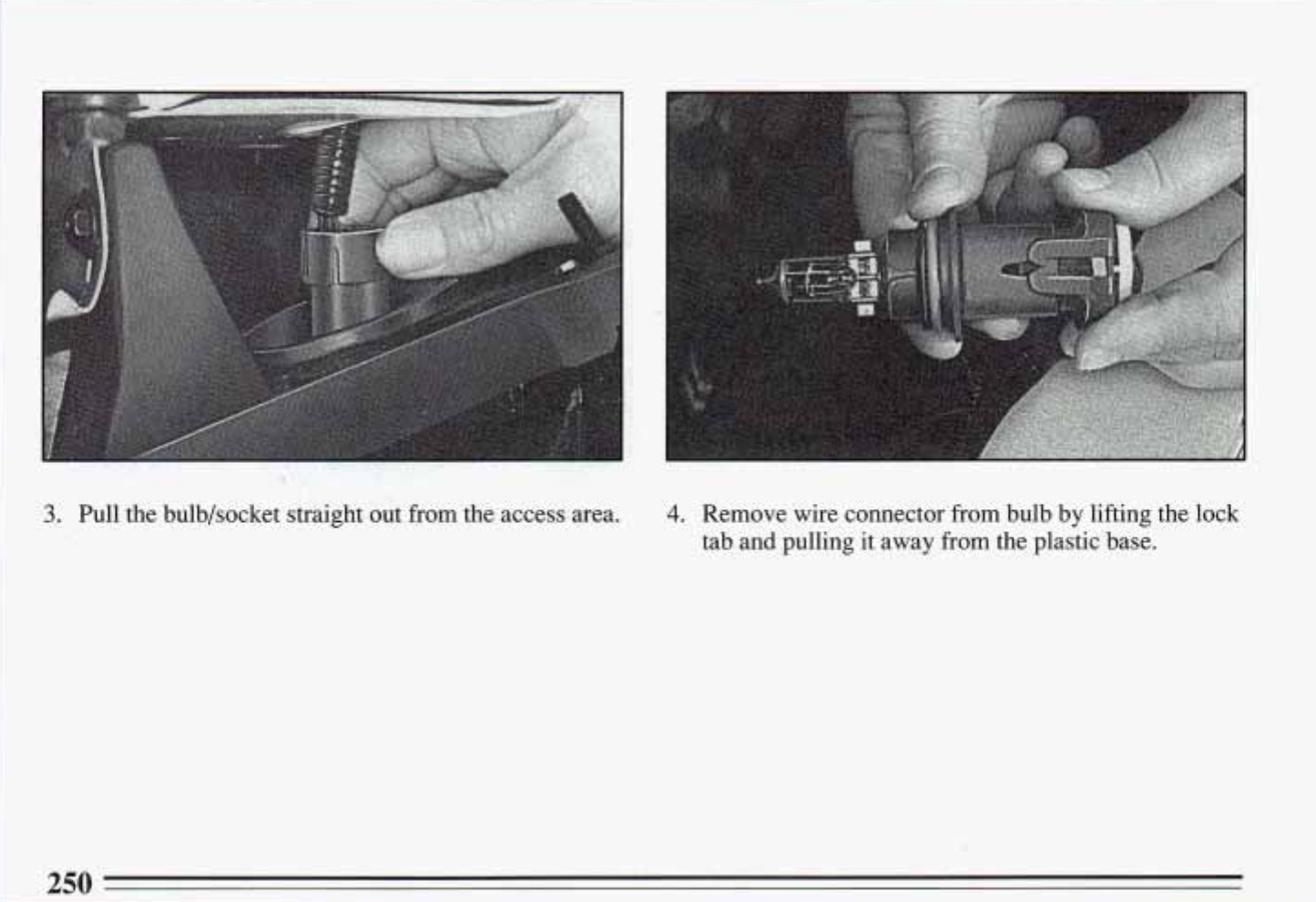
3.
Pull the bulb/socket straight out from the accessarea.
4.
,
Remove wire connector from bulb by lifting the lock
tab and pulling it away from the plastic base.
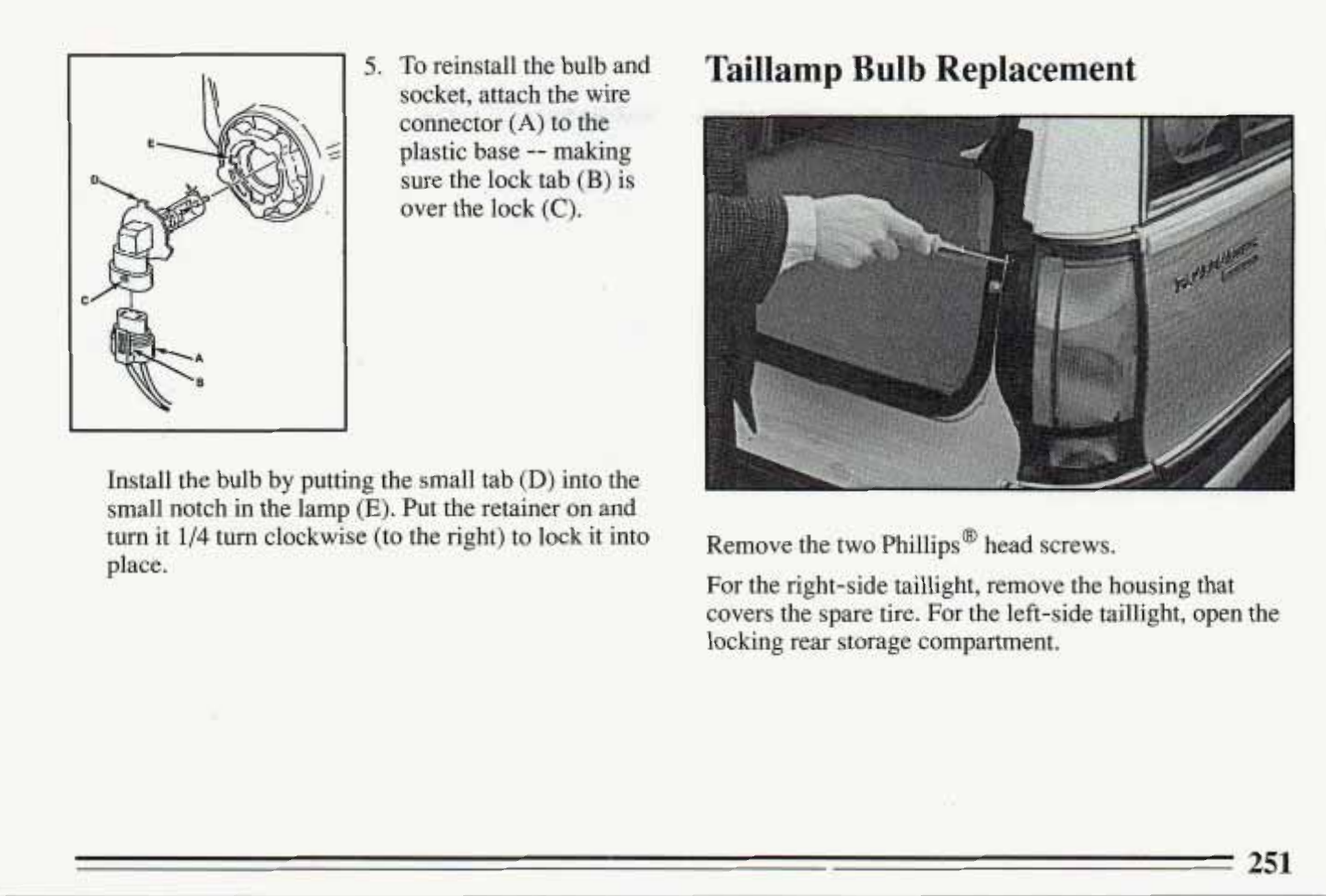
5.
A
B
connector
(A)
to
tlie
plastic base
--
making
sure the lock .tab
(B)
is
over the' lock
(C).
Install the bulb by putting the small tab
(D)
into the
small notch in the lamp
(E).
Put the retainer on and
place.
turn it
1/4
turn clockwise
(to
the right) to lock it into Remove-the two Phillips@ head Screws.
For
the right-side taillight, remove the housing that
covers the spare tire. For the left-side taillight, open the
locking rear storage compartment.
251
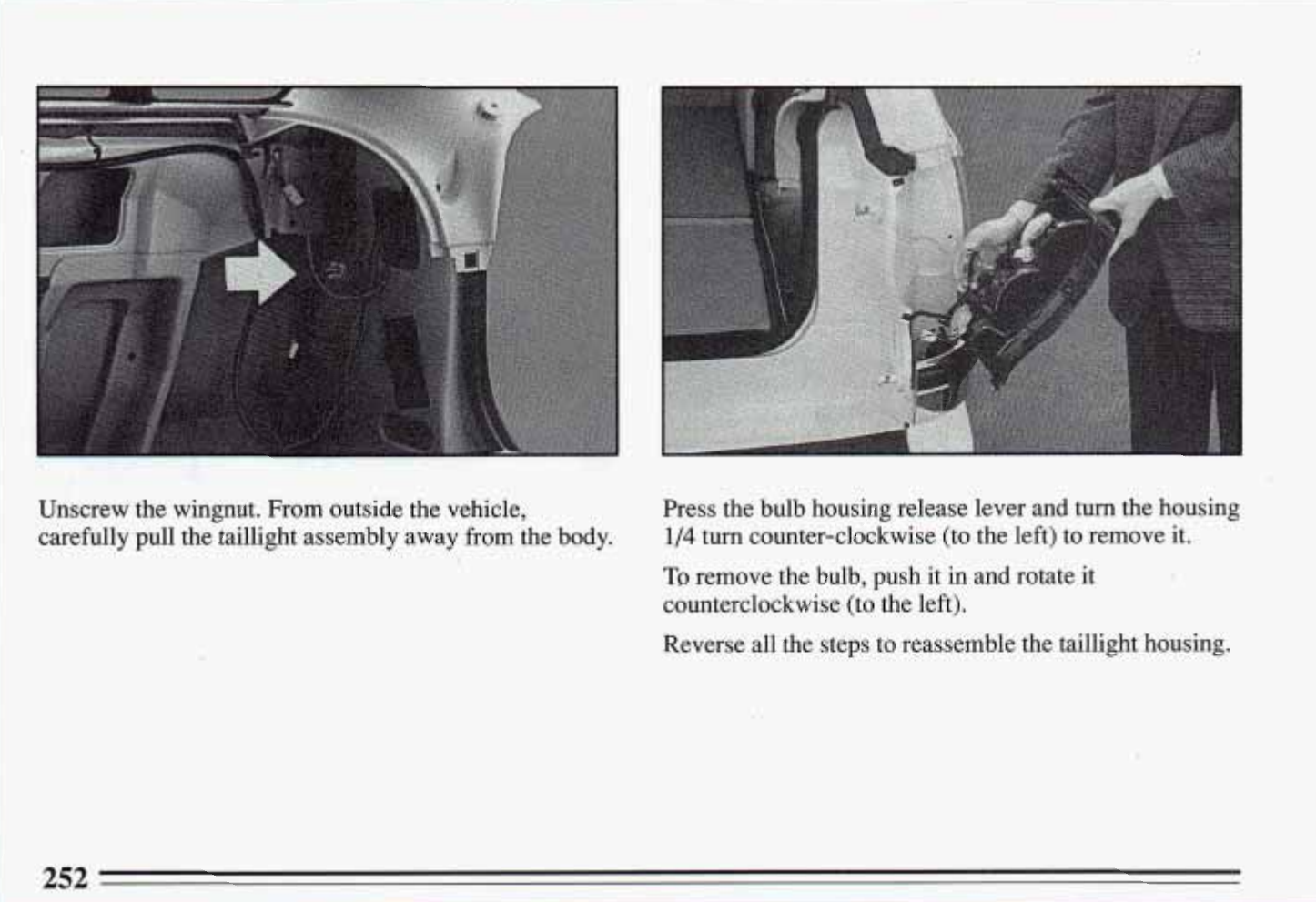
Unscrew the wingnut. From outside the vehicle,
carefully pull the taillight assembly away from the body. Press the bulb housing release lever and turn the housing
1/4
turn counter-clockwise (to the left) to remove it.
To remove the bulb, push it
in
and rotate
it
counterclockwise (to the left).
Reverse all the steps to reassemble the taillight housing.
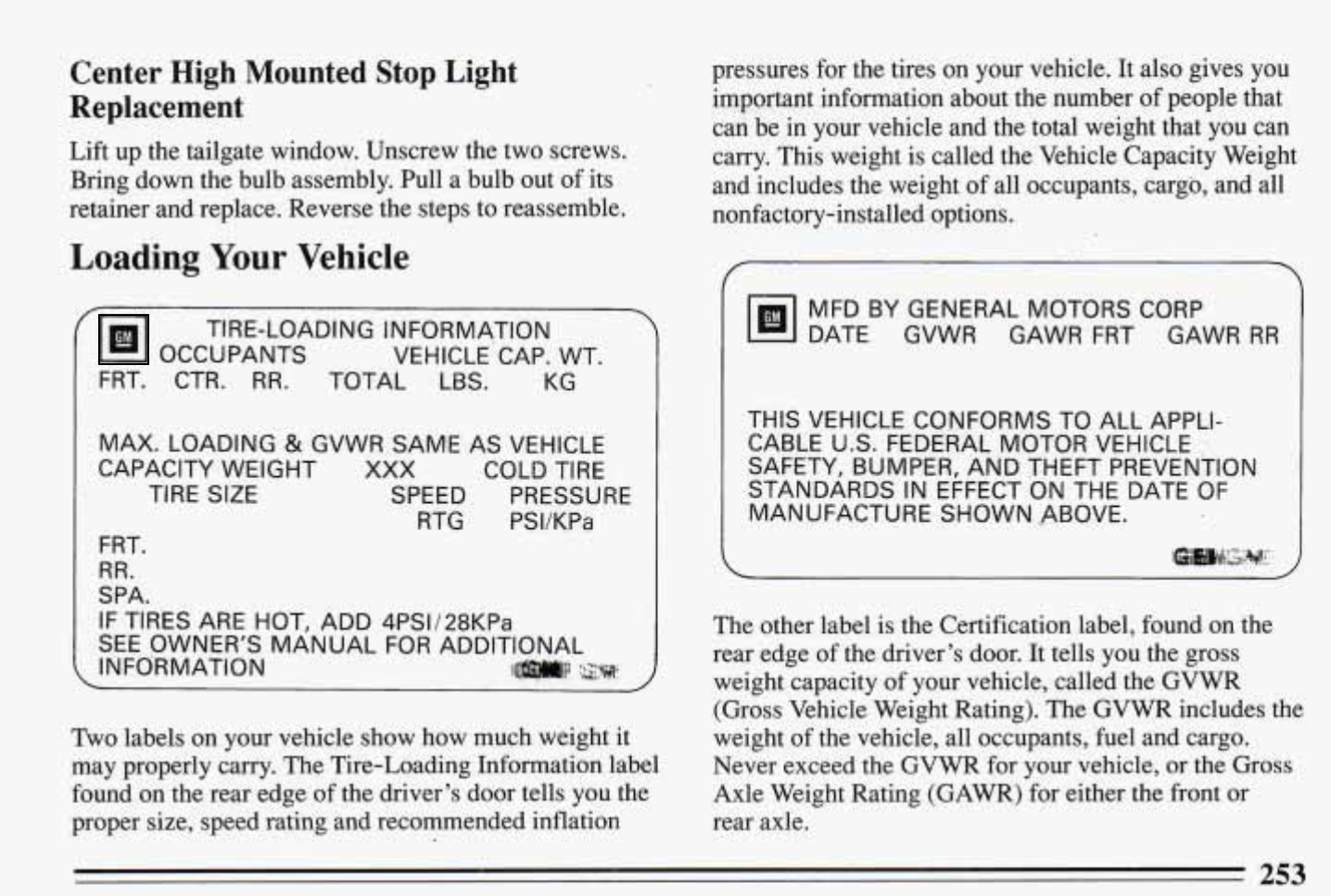
Center High Mounted Stop Light
Replacement
Lift up the tailgate window. Unscrew the two screws.
Bring down the bulb assembly. Pull a bulb out of its
retainer and replace. Reverse the steps to reassemble.
Loading
Your
Vehicle
OCCUPANTS VEHICLE CAP. WT.
FRT. CTR.
RR.
TOTAL LBS. KG
TIRE-LOADING INFORMA,TION
MAX; LOADING
&
GVWR SAME AS VEHICLE
CAPACITY WEIGHT
XXX
COLD TIRE
TIRE
SIZE
SPEED PRESSURE
RTG
PSVKPa
FRT.
RR.
SPA.
IFTIRES ARE HOT, ADD 4PSV28KPa
SEE OWNER‘S MANUAL FOR ADDITIONAL
INFORMATION
ll]~l~:l
:j$:*
pressures for the tires on your vehicle. It also gives
you
.,
important information about the number of people that
can be in your vehicle and the total weight that you can
carry. This weight is called the Vehicle Capacity Weight
and includes the weight of all occupants, cargo, and all
nonfactory-installed options.
Two lahels on your vehicle show how much weight it
may properly carry. The Tire-Loading Information label
found on the rear edge of the driver’s door tells you the
proper size, speed rating and recommended inflation
r
7
MFD BY GENERAL MOTORS CORP
DATE GVWR GAWR FRT GAWR
RR
THIS VEHICLE CONFORMS TO ALL APPLI-
CABLE U.S. FEDERAL MOTOR VEHICLE
SAFETY, BUMPER, AND THEFT PREVENTION
STANDARDS IN EFFECT ON THE DATE
OF
MANUFACTURE SHOWN ABOVE.
rne
other label is the Certification label, found on the
rear edge of the driver’s door. It tells you the gross
weight capacity of your vehicle, called the-GVWR
(Gross Vehicle Weight Rating). The GVWR includes the
weight of the vehicle, all occupants, fuel and cargo.
Never exceed the GVWR for your vehicle, or the
Gross
Axle Weight Rating (GAWR) for either the front or
rear axle.
253
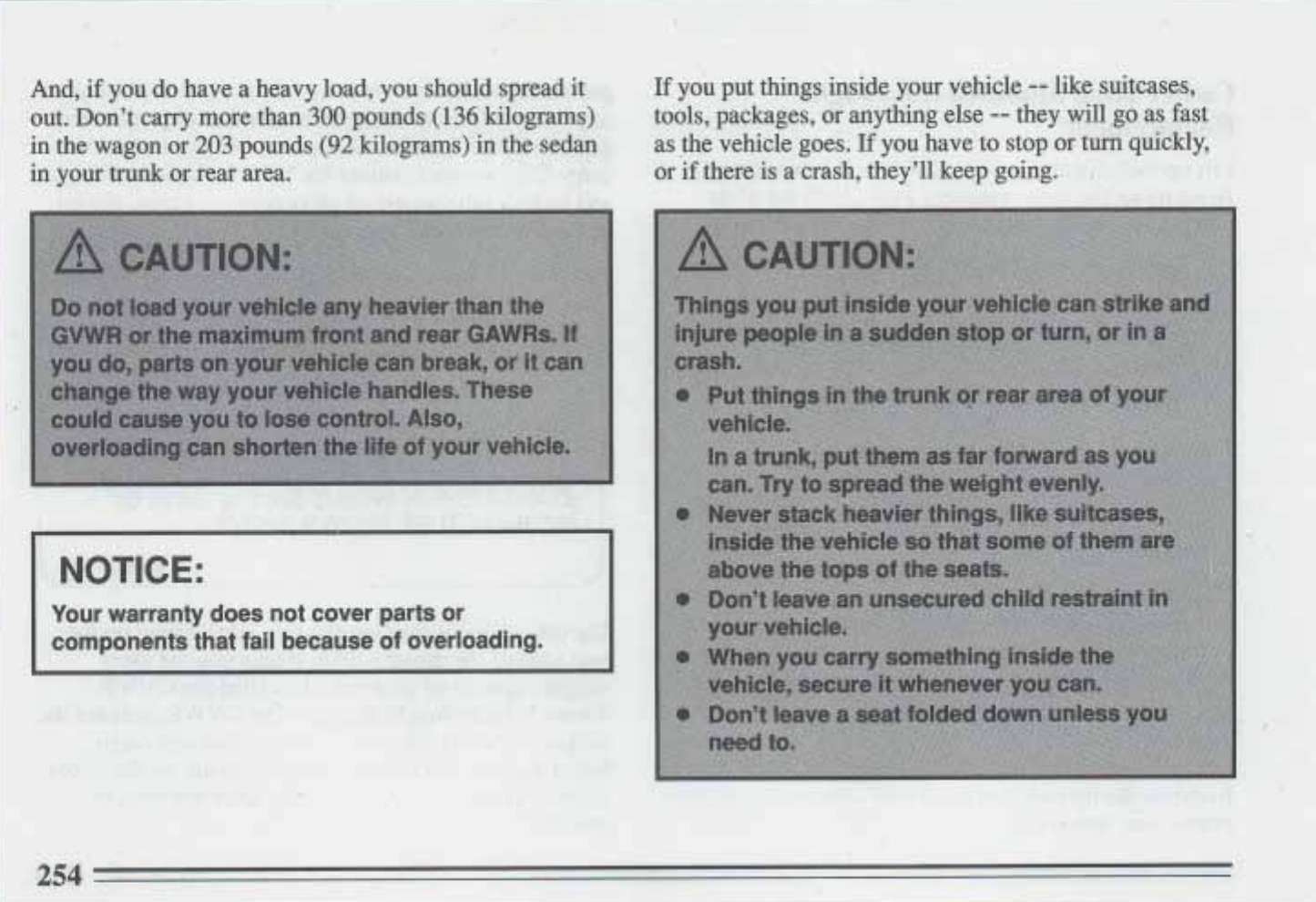
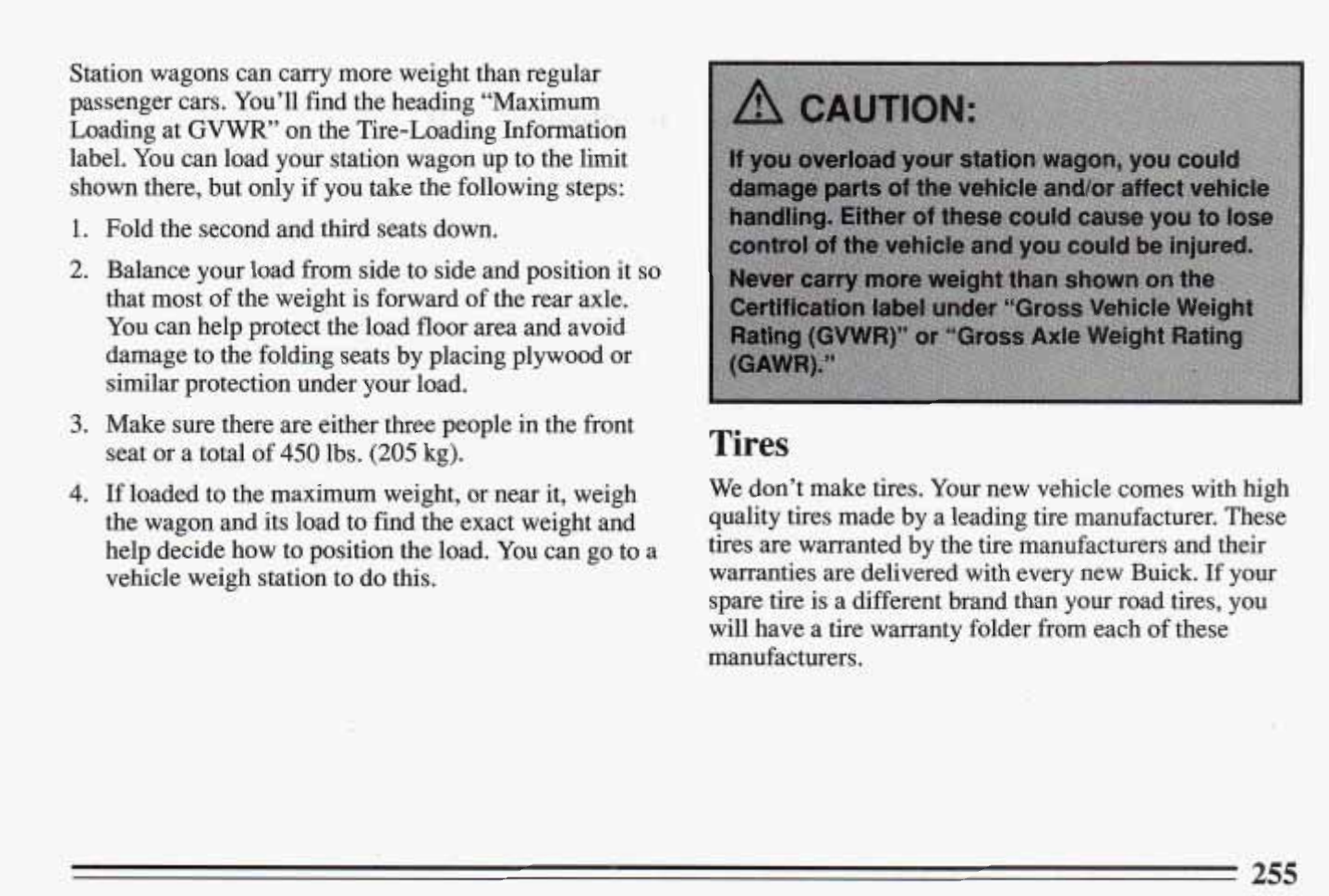
Station wagons can carry more weight than regular
passenger cars. You’ll find the heading “Maximum
Loading at GVWR” on the Tire-Loading Information
label.
You
can load your station wagon up to the limit
shown there, but only if you take the following steps:
1.
Fold the second and third seats down.
2.
Balance your load from side to side and position it
so
that most of the weight is forward of the rear axle.
You can help protect the load floor area and avoid
damage to the folding seats by placing plywood or
similar protection under your load.
3.
Make sure there are either three people in the front
seat or a total
of,450
lbs.
(205
kg).
Tires
4.
1f.loaded to the maximum weight, or near it, weigh
the wagon and its load to find the exact weight and
help decide how to position the load. You can
go
to a
vehicle weigh station to do this.
We don’t make tires. Your new vehicle comes with high
quality tires made by
a
leading tire manufacturer. These
tires are warranted by the tire manufacturers and their
warranties are delivered with
every
new Buick. If your
spare tire
is
a different brand than your road tires,
you
will
have a tire warranty folder
from
each of these
manufacturers.
255
~
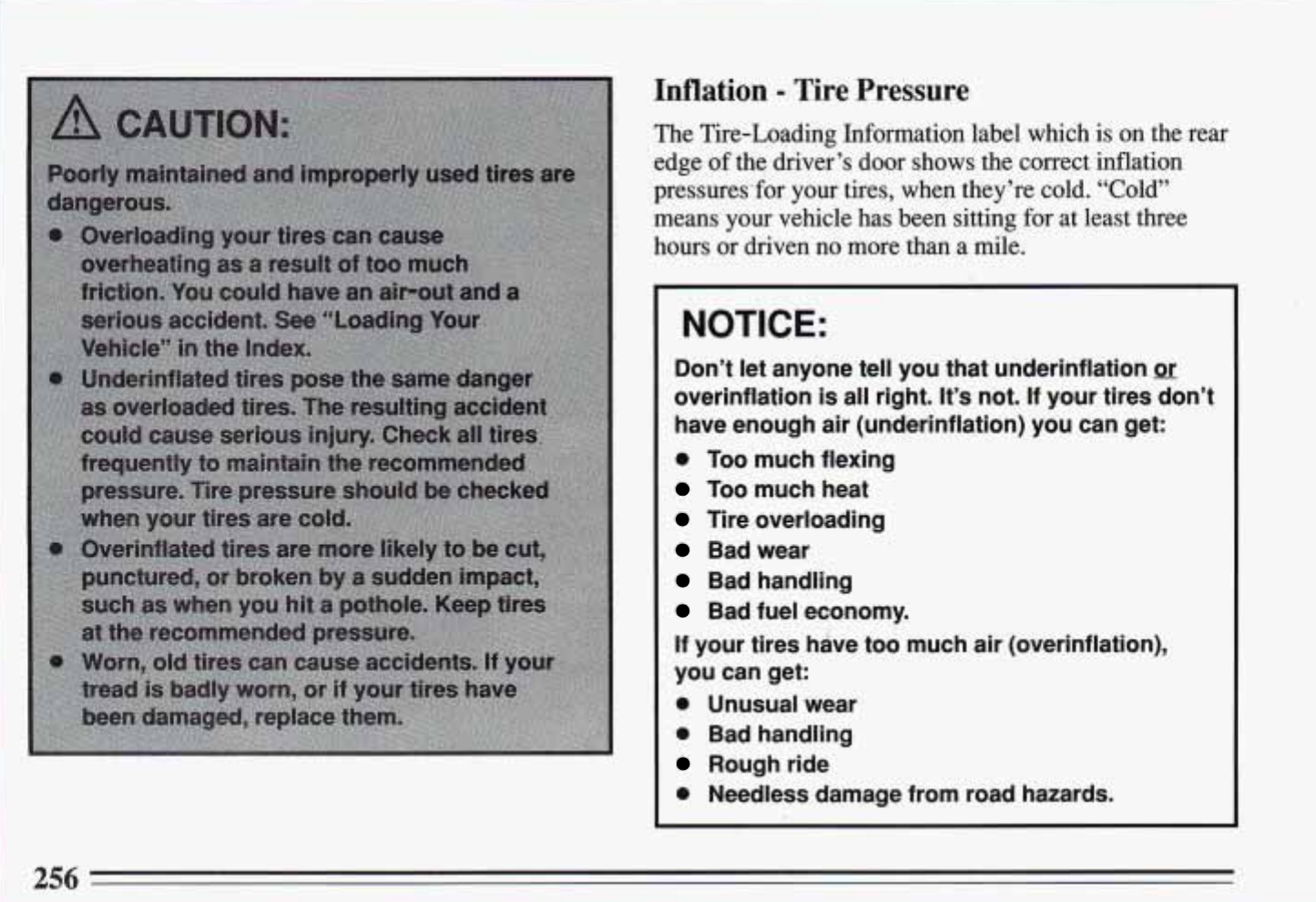
Inflation
-
Tire Pressure
The Tire-Loading Information label
which
is
on the rear
edge
of
the driver’s door shows the correct inflation
pressuresfor your tires, when they’re cold. “Cold”
means your vehicle has been sitting for at least three
hours
or driven no more than a mile.
NOTICE:
Don’t let anyone tell you that underinflation
overinflation is all right.
It’s
not.
If your tires don’t
have enough air (underinflation) you can get:
0
Too
much flexing
Too much heat
Tire overloading
Bad wear
Bad handling
Bad fuel economy.
If your tires have too much air (overinflation),
you can get:
0
Unusual wear
0
Bad handling
Rough ride
0
Needless damage from road hazards.
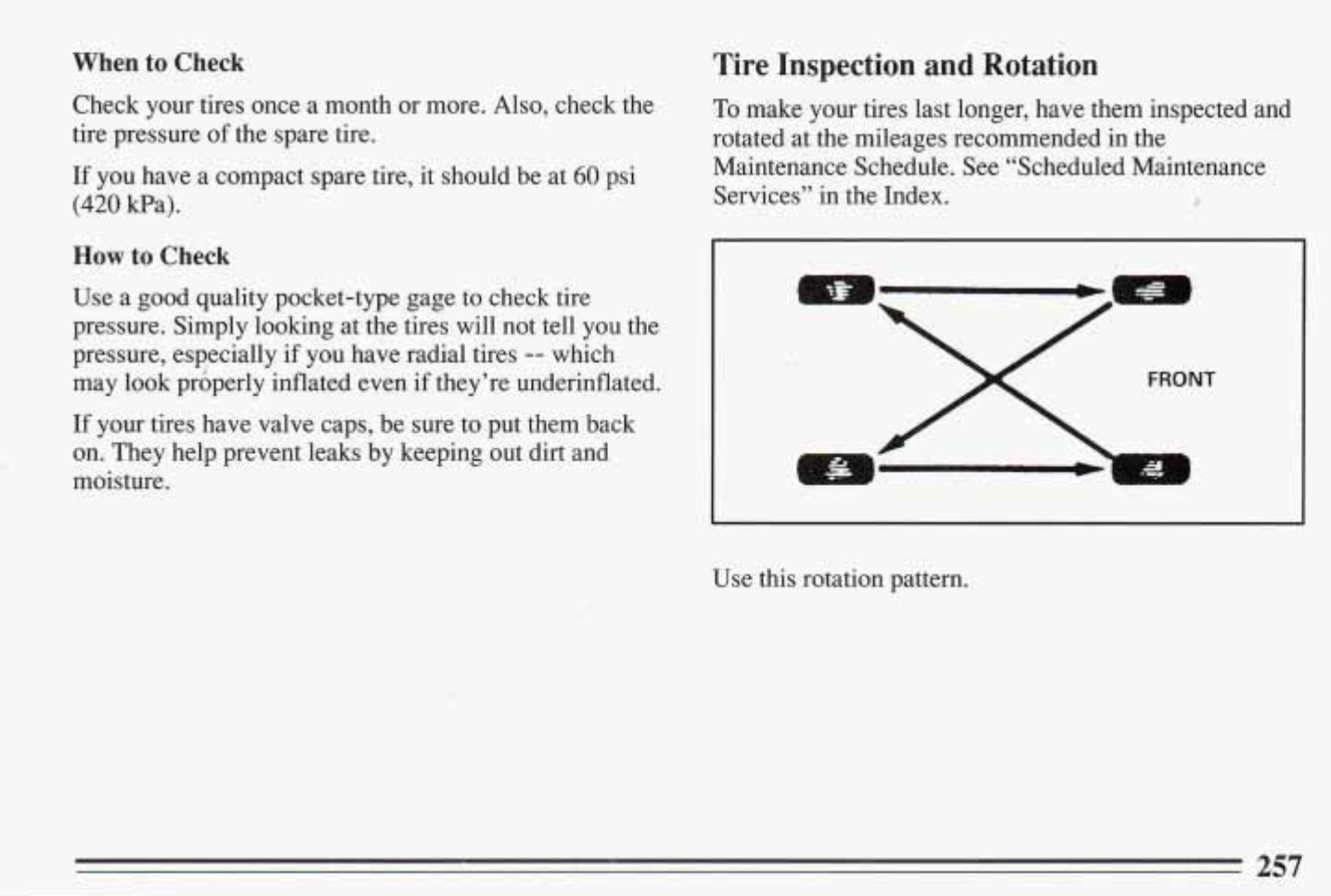
When
to
Check
Check your tires once a month or more. Also, check the
tire pressure
of
the spare tire.
If
you have a compact spare tire, it should be at
60
psi
(420
kPa).
How
to
Check
Use a good quality pocket-type gage to check tire
pressure. Simply looking at the tires will not tell you the
pressure, especially if you have radial tires
-- which
may look properly inflated even if they’re underinflated.
If
your tires have valve caps, be sure to put them back
on. They help prevent leaks by keeping out dirt and
moisture.
Tire Inspection and Rotation
To
make your tires last longer, have them inspected and
rotated at the mileages recommended in the
Maintenance Schedule. See “Scheduled Maintenance
Services” in the Index.
FRONT
Use this rotation pattern.
257
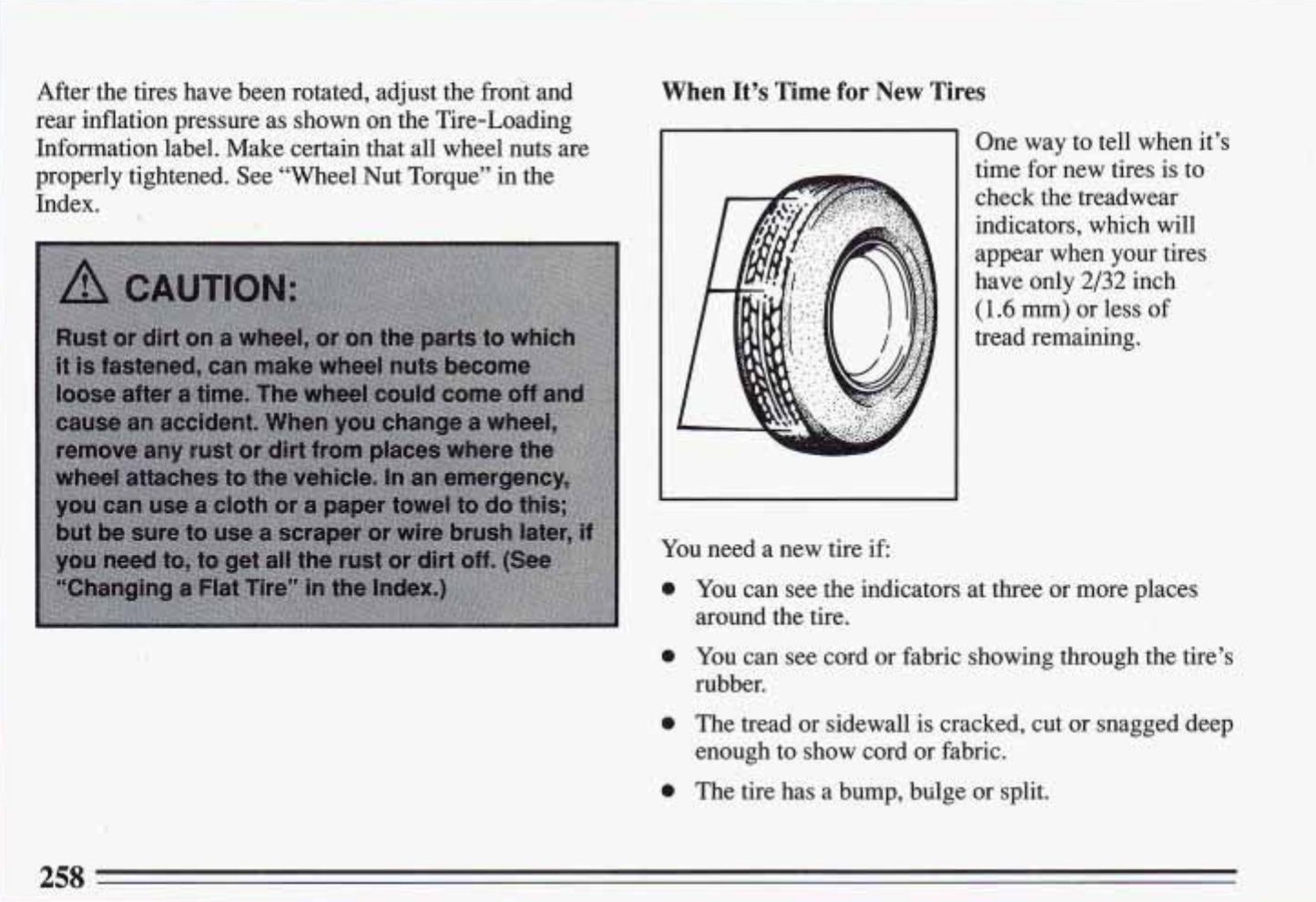
After. the tires have been rotated, adjust the
front
and
rear inflation pressure as shown on the Tire-Loading
Infomation label. Make certain that all wheel nuts are
properly tightened. See “Wheel Nut Torque” in the
Index.
When
It’s
Time for New Tires
You need a new tire
if:
One way to tell when it’s
time for new tires
is
to
check the treadwear
indicators, which .will
appear when your tires
have only
2/32
inch
(1.6
mm)
or less of
tread remaining.
You can see the indicators at three or more places
around the tire.
You
can
see cord or fabric showing through the tire’s
rubber.
The tread
or
sidewall
is
cracked, cut or snagged deep
enough to show cord or fabric.
The tire has a bump, bulge or split.
258
The tire has
a
puncture, cut, or other damage that
can’t be repaired well because of the size or location
of the damage.
Buying New Tires
To find out what kind and size of tires you need, look at
the Tire-Loading Information label.
The tires installed on your vehicle when it was new had
a Tire Performance Criteria Specification (TPC Spec)
number
on
each tire’s sidewall:When you get new tires,
get ones with that same TPC Spec number. That way,
your vehicle will continue to have tires that are designed
to give proper endurance, handling, speed rating,
traction, ride and other things during normal service on
your vehicle.
If
your tires have an all-season tread
design, the TPC number will be followed by a
“MS”
(for mud and snow).
If
you ever replace your tires with those not having a
TPC Spec number, make sure they are the same size,
load range, speed rating and construction type (bias,
bias-belted or radial) as your original tires.
Uniform Tire
Quality
Grading
The
following information relates to the system
developed by the United States National Highway
Traffic Safety Administration which grades tires
by
treadwear, traction and temperature performance. (This
applies only to vehicles sold in the United States.)
Treadwear
The treadwear grade is a comparative rating based on
the wear rate of the tire when tested under controlled
conditions
on
a specified government test course. For
example, a tire graded
150
would wear one and
a
half
J
The grade
C
corresponds to a level
of
performance
which all passenger car tires must meet under the
Federal Motor Vehicle Safety Standard
No.
109.
Grades
B
and
A
represent higher levels of performance on the
laboratory test wheel than the minimum required by law.
Warning: The temperature grade for this tire is
established for a tire that is properly inflated and not
overloaded. Excessive speed, underinflation, or
excessive loading, either separately or in combination,
can cause heat buildup and possible tire failure.
These grades are molded on the sidewalls
of passenger
car tires.
While the tires available ,as standard or optional
equipment on General Motors vehicles may vary with
respect to these grades, all such tires meet General
Motors performance standards and have been approved
for use on General Motors vehicles. All passenger type
(P
Metric) tires must conform to Federal safety
requirements in addition to these grades.
Used Replacement Wheels
Tire
Chains
NOTICE:
Use tire chains only where legal and only when
you must. Use only
SAE
Class
?S”
type chains
that are the proper size for your tires. Install
them on the rear
tires
and tighten them as tightly
as possible with the ends securely.fastened.
.Drive slowly and follow the chain manufacturer’s
instructions. If you can hear the chains
contacting your vehicle, stop and retighten them.
If
the contact continues,
slow
down
until
it
stops.
Driving too’fast with chains on will damage
your
vehicle.
262
Appearance Care
Remember, cleaning products can be hazardous. Some
are toxic. Others can burst into flame
if
you strike a
match
or
get them on a hot part of the vehicle. Some are
dangerous if you breathe their fumes in a closed space.
When you use anything from a container to clean your
Buick, be sure to follow the manufacturer's warnings
and instructions. And always open your doors or
windows when you're cleaning the inside.
Never use these to clean your vehicle:
Gasoline
Benzene
Naphtha
0
Carbon Tetrachloride
0
Acetone
Paint Thinner
'0
Turpentine
Lacquer Thinner
0
Nail Polish Remover
They can all be hazardous
--
some more than others
--
and they can all damage your vehicle, too.
NOTICE:
Don't use any
of
these unless this manual says
you can. In many uses, these will damage your
vehicle:
Alcohol
0
Laundry Soap
Bleach
Reducing Agents
I
263
Cleaning the
Inside
of
Your
Buick
Use a vacuum cleaner often to get rid of dust and loose
dirt. Wipe vinyl or leather with a clean, damp cloth.
Your Buick dealer has two
GM
cleaners, a solvent-type
spot lifter and a foam-type powdered cleaner. They will
clean normal spots and stains very well.
Do
not use
them on vinyl or leather.
Here are some cleaning tips:
0
0
0
'0
0
Always read the instructions on the cleaner label.
Clean up stains as soon as you can
--
before they set.
Use a clean cloth or sponge, and change to a clean
area often. A soft brush may be used if stains are
stubborn.
Use solvent-type cleaners in a well-ventilated area
only. If you use them, don't saturate the stained area.
If
a ring forms after spot cleaning, clean the entire
area immediately or it will set.
Using Foam-Type Cleaner on Fabric
0
0
0
0
0
0
0
0
0
0
Vacuum and brush the area to remove any loose dirt.
Always clean a whole trim panel or section. Mask
surrounding trim along stitch or welt lines.
Mix Multi-Purpose Powdered Cleaner following the
directions on the container label.
Use suds only and apply with a clean sponge.
Don't saturate the material.
Don't rub it roughly.
As soon as you've cleaned the section, use a sponge
to remove the suds.
Rinse the section with a clean, wet sponge.
Wipe
off
what's left with a slightly damp' paper towel
,
'or cloth.
Then dry it immediately with a blow dryer or a heat
lamp.
NOTICE:
Be careful with a hair dryer
or
heat lamp.
You
could scorch the fabric.
0
Wipe with
a
clean cloth.
I
264
Using Solvent-Type Cleaner
on
Fabric
First, see if you have to use solvent-type cleaner at all.
Some spots and stains will clean
off
better with just
water and mild soap.
If
you need to use a solvent:
0
Gently scrape excess soil from the trim material with
a clean, dull knife or scraper. Use very little cleaner,
light pressure and clean cloths (preferably
cheesecloth). Cleaning should start at the outside
or
the stain, “feathering” toward the center. Keep
changing to a clean section of the cloth.
When you clean a stain from fabric, immediately dry
the area with an air hose, hair dryer, or heat lamp to
help prevent a cleaning ring. (See the previous
NOTICE.)
Special Cleaning Problems
Greasy
or
Oily Stains
Such as grease,
oil,
butter, margarine, shoe polish,
coffee with cream, chewing gum, cosmetic creams,
vegetable oils, wax crayon, tar and asphalt.
0
Carefully scrape off excess stain.
Follow the solvent-type instructions described
earlier.
Shoe polish, wax crayon, tar and asphalt will stain if
left on a vehicle seat fabric. They should be removed
as soon
as
possible. Be careful, because the cleaner
will dissolve them and may cause them to spread.
Non-Greasy Stains
Such as catsup, coffee (black), egg, fruit, fruit juice,
milk, soft drinks, wine, vomit, urine and blood.
0
0
0
0
Carefully scrape
off
excess stain, then sponge the
soiled area with cool water.
If a stain remains, follow the foam-type instructions
described earlier.
If an odor lingers after cleaning vomit or urine, treat
the area with a waterbaking soda solution:
1
teaspoon
(5
ml) of baking soda to
1
cup
(250
ml)
of
lukewarm water.
If needed, clean lightly with solvent-type cleaner.
Combination Stains
Such as candy, ice cream, mayonnaise, chili sauce and
unknown stains.
Carefully scrape
off
excess stain, then clean with
cool water and allow to dry.
@
If a stain remains, clean it with solvent-type cleaner.
Cleaning Viiyl
.~
Use warm water and a clean cloth.
?I!
,Rub with
a
clean, damp cloth to remove dirt.
You
:may have to do it more than once.
.Things like-tar, asphalt and shoe polish will stain if
you don’t get them
off
quickly. Use a clean cloth and
a solvent-type vinyl cleaner.
Cleaning Leather
Use a soft cloth with lukewarm water and a mild soap or
saddle soap.
For stubborn stains, use a mild solution
of
10%
isopropyl alcohol (rubbing alcohol) and
90%
water.
0
Never use oils, varnishes, solvent-based or abrasive
cleaners, furniture polish or shoe polish on leather.
Soiled leather should be cleaned immediately.
If
dirt
is allowed to work
into
finish, it can ham the
leather.
Cleaning the
Top
of
the Instrument Panel
Use only mild soap and water to clean the top surfaces
of the instrument panel. Sprays containing silicones
or
waxes may cause annoying reflections in the windshield
and even make it difficult to see through the windshield
under certain conditions.
Cleaning the Outside
of
Your
Buick
The paint finish on your vehicle provides beauty, depth
of color, gloss retention and durability.
Washing Your Vehicle
The best way to preserve your vehicle’s finish is to keep
it clean by washing it often with lukewatm or cold
water.
Don’t wash your vehicle in the direct rays of the sun.
Don’t use strong soaps or chemical detergents. Use
liquid hand, dish or car washing (mild detergent) soaps.
Don’t use cleaning agents that contain acid or abrasives.
All cleaning agents should
be
flushed promptly and not
allowed to dry on the surface,
or
they could stain. Dry
the finish with a soft, clean chamois or a
100%
cotton
towel to avoid surface scratches and water spotting.
High pressure car washes may cause water to enter your
vehicle.
Finish Care
Occasional waxing or mild polishing of your Buick may
be necessary to remove residue from the paint finish.
You
can get
GM
approved cleaning products from your
dealer. (See “Appearance Care and Materials” in the
Index.)
Your Buick has a “basecoat/clearcoat” paint finish. The
clearcoat gives more depth and gloss to the colored
basecoat. Always use waxes and polishes that are
non-abrasive and made for a basecoat/clearcoat paint
finish.
.
,.
.
’
.
&*L.
I
NOTICE:
Machine compounding or aggressive polishing
on a basecoatlclearcoat paint finish .may dull the
finish or leave swirl marks.
Aluminum Wheels
(If
So
Equipped)
Your aluminum wheels have a protective coating similar
to the painted surface of your car. Don’t use strong
soaps, chemicals, chrome polish, abrasive cleaners or
abrasive cleaning brushes on them because you could
damage this coating. After rinsing thoroughly, a wax
may be applied.
If
you have aluminum wheels, don’t use .an
automatic vehicle wash that has hard silicon
carbide cleaning brushes. These brushes can
take
off
the protective coating.
White Sidewall -Tires
Your Buick dealer has a
GM
White Sidewall Tire
Cleaner. You can use a stiff brush with the cleaner.
Weatherstrips
Silicone grease on weatherstrips will make them last
longer, seal better, and not stick or squeak. Apply
silicone grease with a clean cloth at least every six
months. During very cold, damp weather more frequent
application may be required. (See “Recommended
Fluids
&
Lubricants” in the Index.)
Sheet Metal Damage
If your vehicle
is
damaged and requires sheet metal
repair or replacement, make sure the body repair shop
applies anti-corrosion material to the parts repaired or
replaced to restore corrosion protection.
Foreign Material
!
0
I
Calcium chloride and other salts, ice melting agents,
i
road oil and
tar,
tree sap, bird droppings, chemicals from
industrial chimneys, and other foreign matter can
damage your vehicle’s finish
if
they remain on painted
surfaces. Use cleaners that are marked safe for painted
surfaces to remove foreign matter.
Finish Damage
Any stone chips, fractures or deep scratches in the finish
should be repaired right away. Bare metal will corrode
quickly and may develop into a major repair expense.
Minor chips and scratches can be repaired with touch-up
materials available from your dealer or other service
outlets. Larger areas of finish damage can be corrected
in your dealer’s body and paint shop.
1
I
269
1
Underbody Maintenance
1
i
1
Chemicals used for
ice
and snow removal and dust
1
control can collect on the underbody.
If
these are not
1
removed, accelerated corrosion (rust) can occur on the
underbody parts such as fuel lines, frame, floor pan, and
exhaust system even though they have corrosion
protection.
!
i
At least every spring, flush these materials from the
underbody with plain water. Clean any areas where mud
and other debris can collect. Dirt packed in closed areas
of the frame should be loosened before being flushed.
Your dealer or an underbody vehicle washing system
1
can do this for
you.
I
I
I
i
Chemical Paint Spotting
Some weather and atmospheric conditions can create
a
chemical fallout. Airborne pollutants can fall upon and
attack painted surfaces on your vehicle. This damage
can take two forms: blotchy, ringlet-shaped
discolorations, and small irregular dark spots etched into
the paint surface.
Although no defect in the paint
job
causes this, Buick
will repair, at no charge to the owner, the surfaces of
new vehicles damaged
by
this fallout condition within
12
months or
12,000
miles
(20
000
km)
of purchase,
whichever comes first.
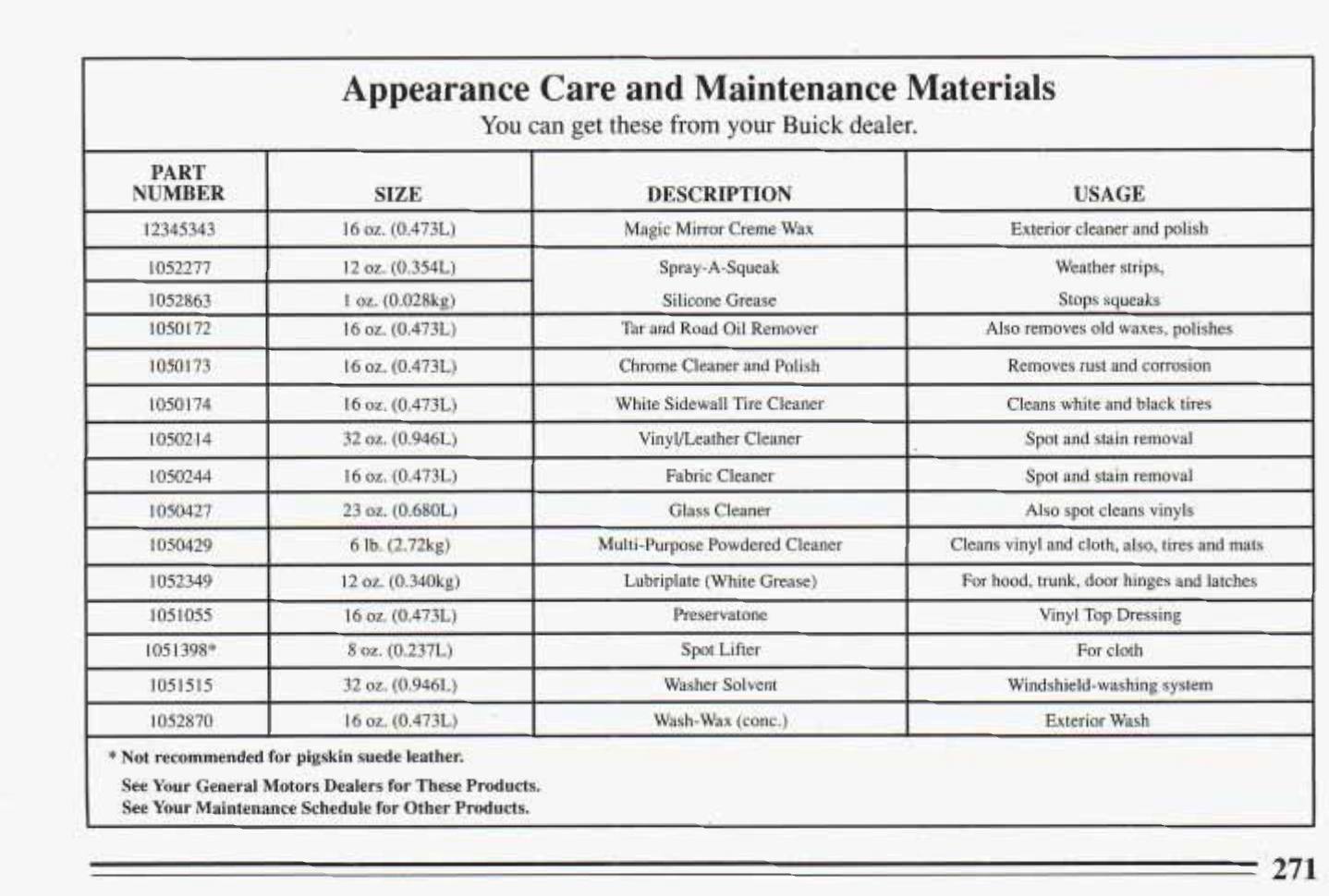
Appearance Care and Maintenance Materials
I
You can get these from your Buick dealer.
271
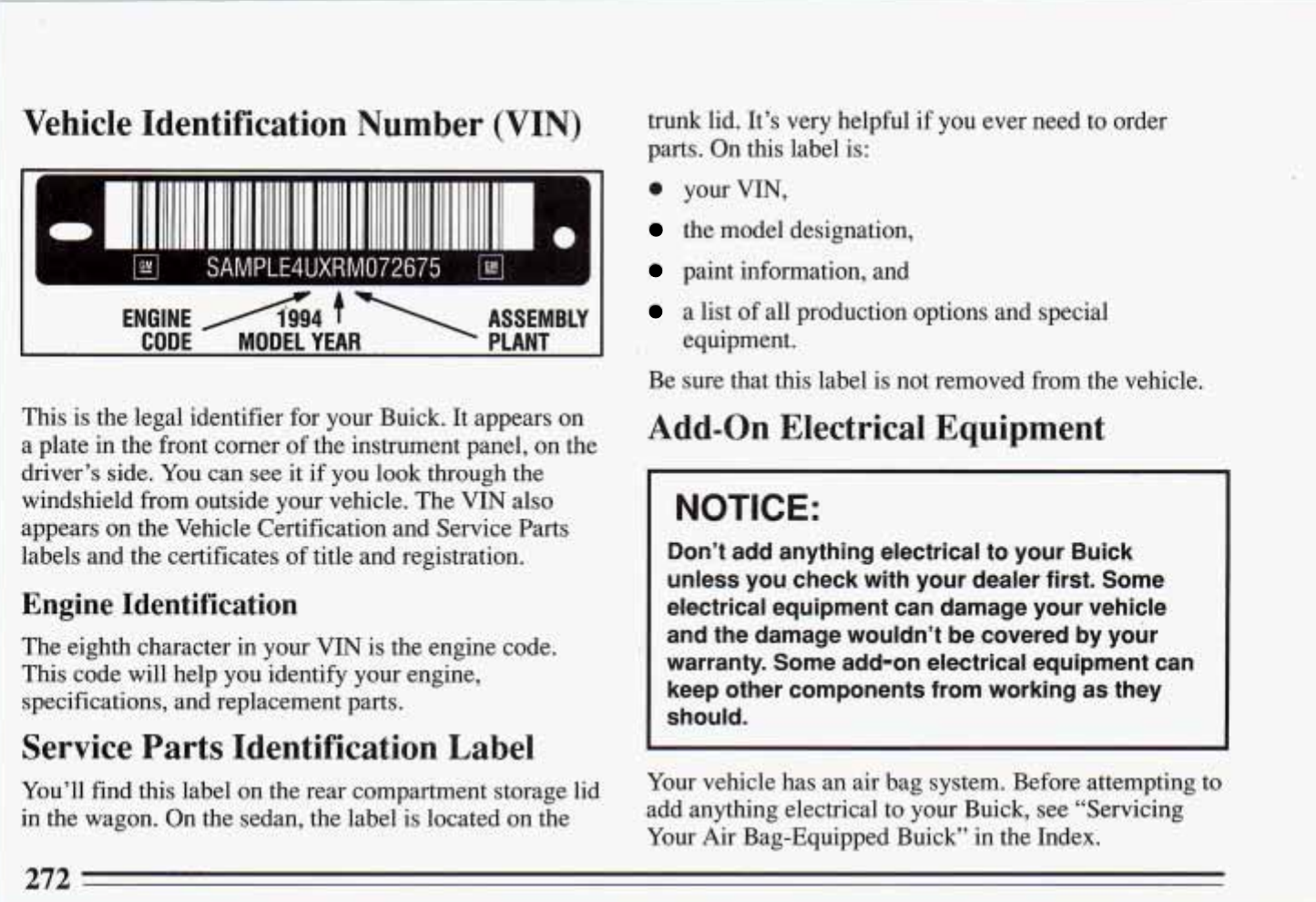
Vehicle Identification Number
(VIN)
ENGINE
A4
f
\
ASSEMBLY
CODE
MODEL YEAR PLANT
This is the legal identifier for your Buick. It appears on
a
plate in the front corner of the instrument panel, on the
driver’s side. You can
see
it if you look through the
windshield from outside your vehicle. The VIN also
appears on the Vehicle Certification and Service Parts
labels and the certificates
of
title and registration.
Engine Identification
The eighth character in your VIN is the engine code.
This code will help
you
identify your engine,
specifications, and replacement parts.
Service Parts Identification Label
You’ll find this label on the rear compartment storage lid
in the wagon. On
the
sedan, the label is located on the
trunk lid. It’s very helpful if
you
ever need to order
~arts.
On this label is:
-
your VIN,
the model designation,
paint information, and
a list of all production options and special
Be sure that this label is not removed from the vehicle.
equipment.
Add-on Electrical Equipment
NOT,ICE:
Don’t add anything electrical to your Buick
unless you. check with your dealer first. Some
electrical equipment can damage your vehicle
and the damage wouldn’t be covered.by your
warranty. Some add-on electrical equipment can
keep other components from working as they
should.
Your vehicle has an air bag system. Before attempting to
add anything electrical to your Buick, see “Servicing
Your Air Bag-Equipped Buick” in the Index.
373
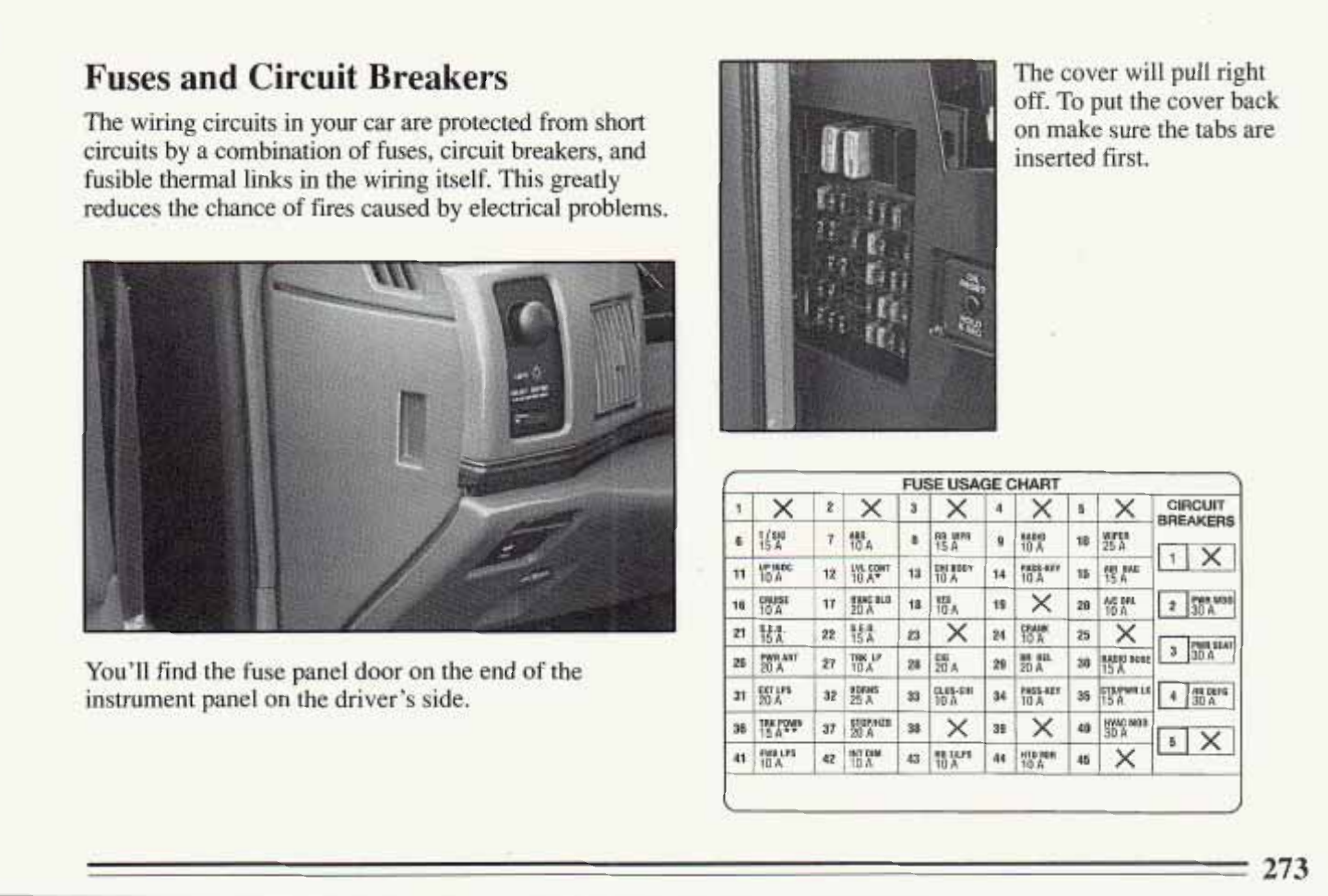
Fuses
and
Circuit Breakers
The wiring circuits in your car are protected from short
circuits by a combination of fuses, circuit breakers, and
fusible thermal links in the wiring itself. This greatly
reduces the chance
of
fires caused by electrical problems.
You'll find the fuse panel door on the end of the
instrument panel
on
the
driver's side.
The cover will pull right
off.
To put the cover back
on make sure the tabs are
inserted fist.
273
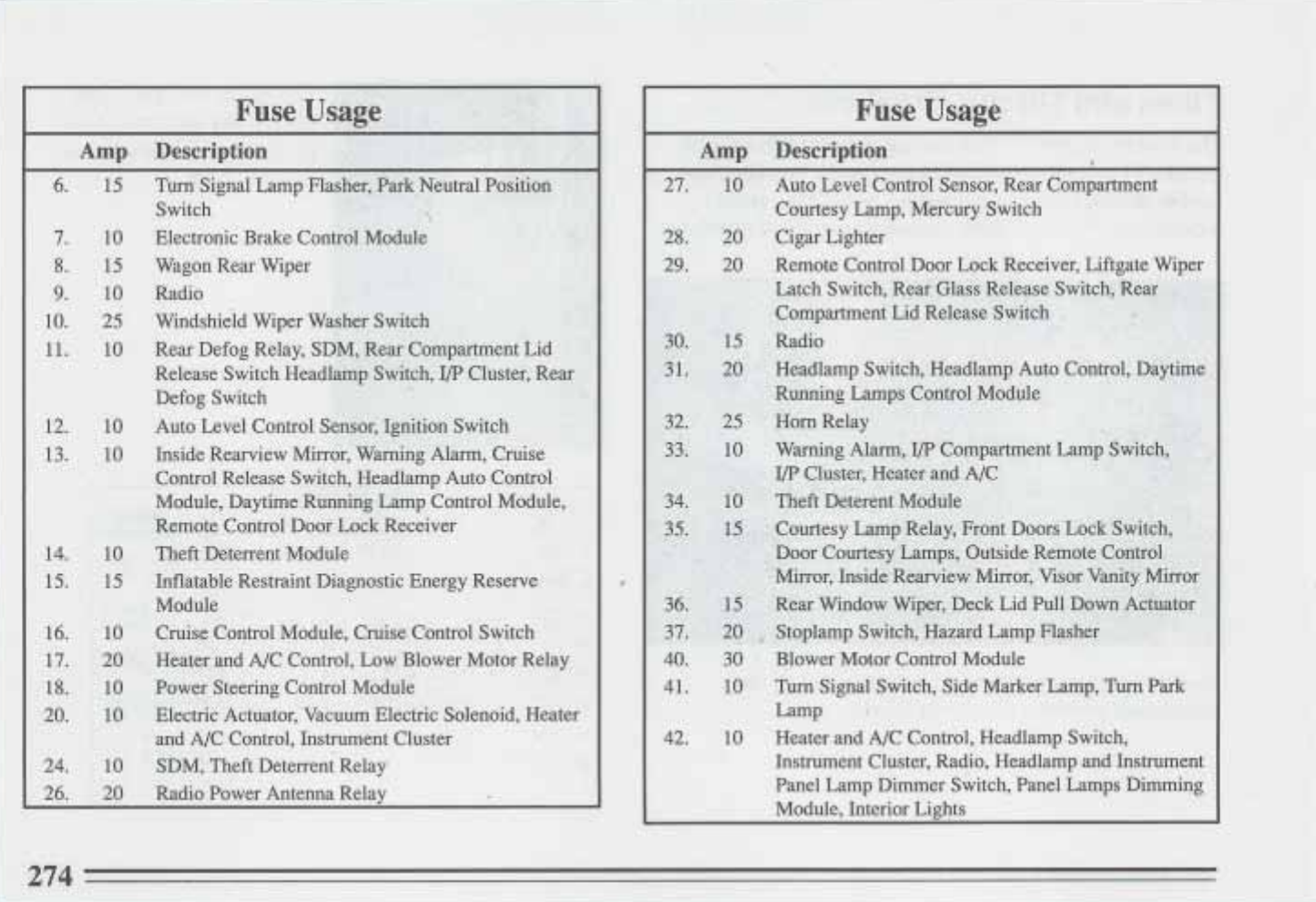
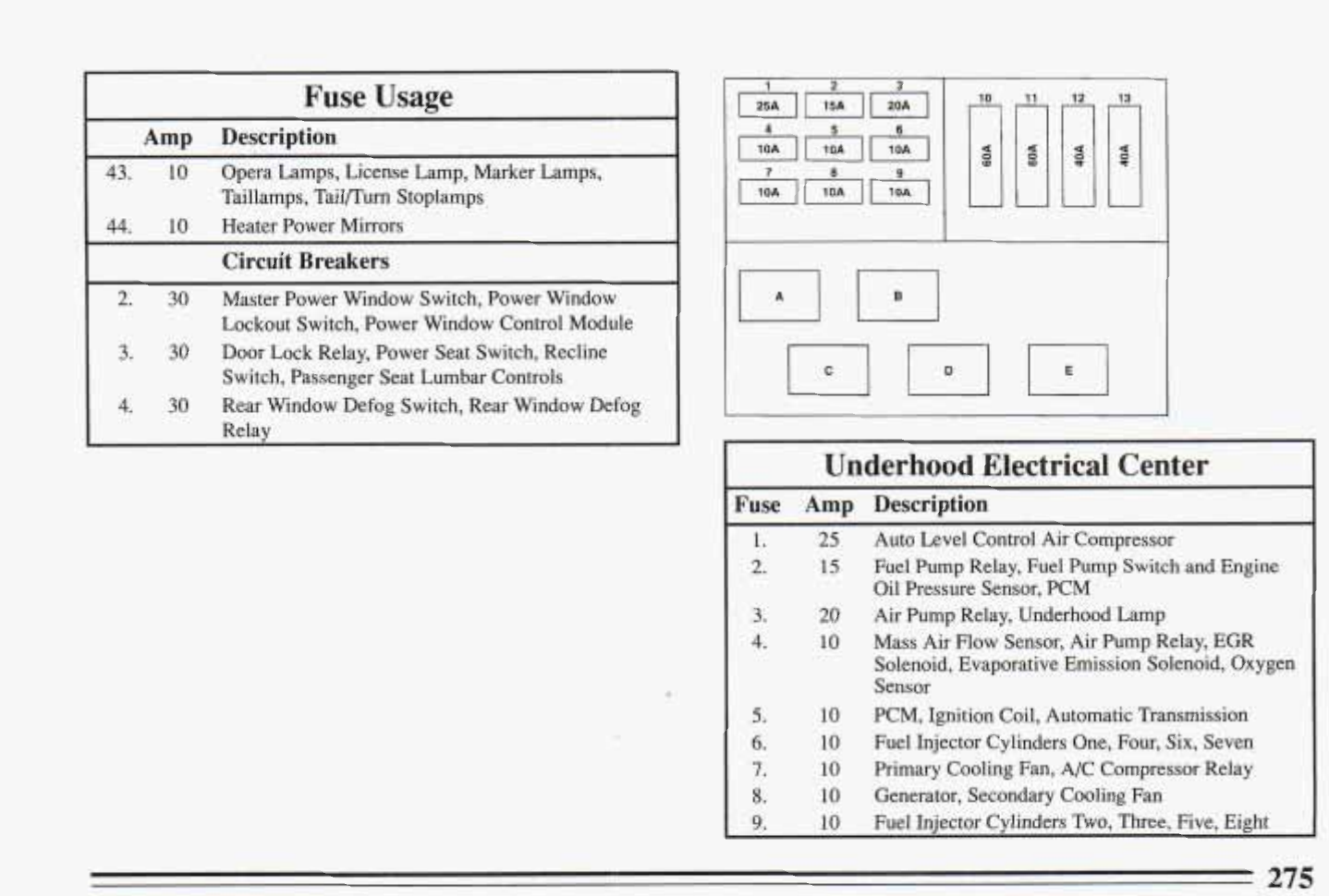
Fuse Usage
Amp Description
43.
10
Opera Lamps, License Lamp, Marker Lamps,
Taillamps, Tail/Turn Stoplamps,
44.
10
Heater Power Mirrors
Circuit Breakers
2.
30
Master Power Window Switch, Power Window
3.
30
Door Lock Relay, Power Seat Switch, Recline
4.
30
Rear Window Defog Switch, Rear Window Defog
Lockout Switch, Power Window Control Module
Switch, Passenger Seat Lumbar Controls
Relay
10
11
12
13
[[[I
JC/D(EI
Underhood Electrical Center
Fuse Amp Description
1.
25
Auto Level Control Air Compressor
2.
15
Fuel Pump Relay, Fuel
Pump
Switch
and Engine
3.
20
Air Pump Relay, Underhood Lamp
4.
10 Mass Air Flow Sensor, Air Pump Relay, EGR
Oil Pressure Sensor, PCM
Solenoid, Evaporative Emission Solenoid, Oxygen
Sensor
5.
10
6.
10
7.
10
PCM, Ignition Coil, Automatic Transmission
Fuel Injector Cylinders One, Four, Six, Seven
Primary Cooling Fan, A/C Compressor Relay
8.
10
Generator, Secondary Cooling Fan
9.
10 Fuel Injector Cylinders Two, Three, Five, Eight
275
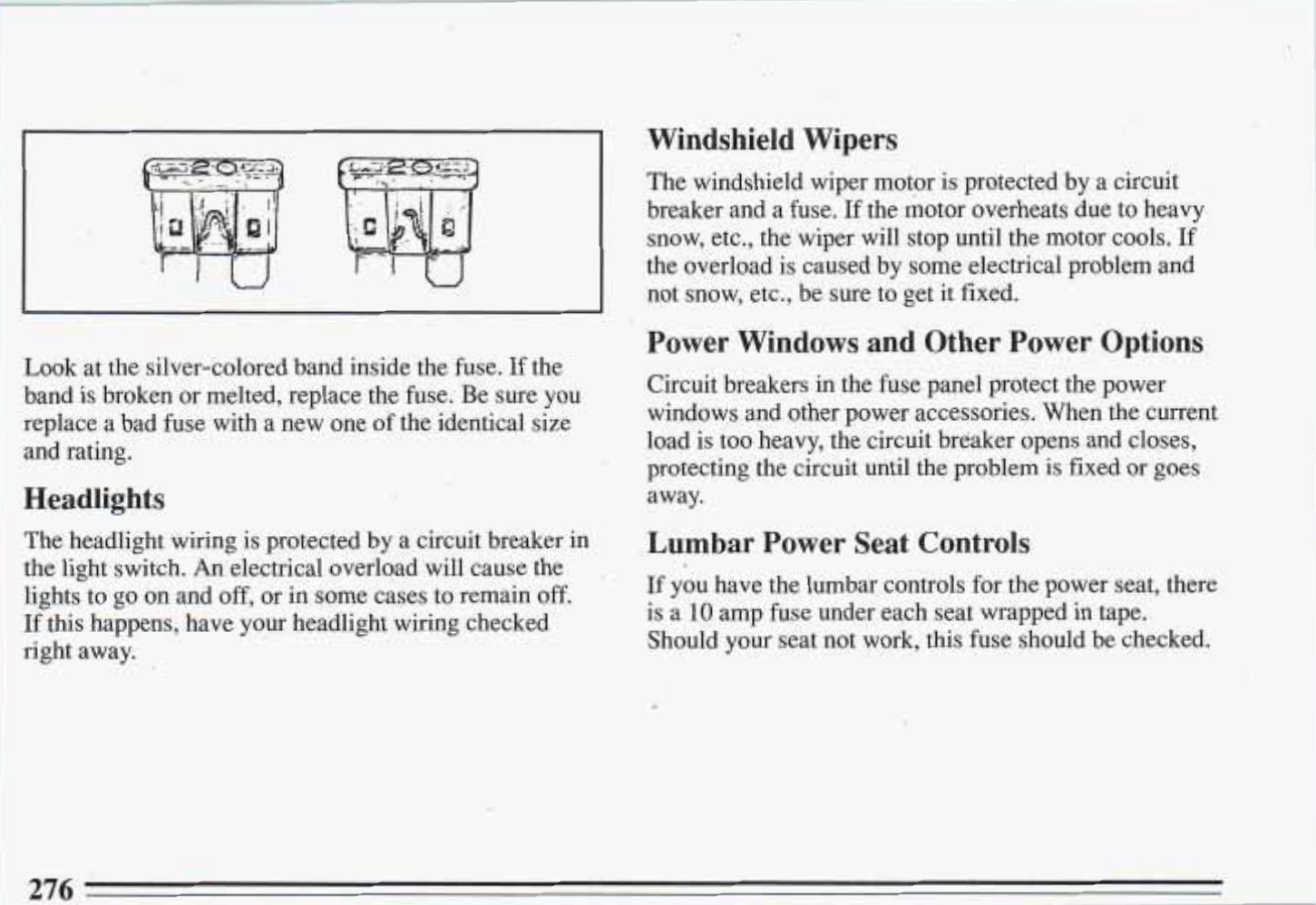
'I
h,
Look at the silver-colored band inside the fuse.
If
the
band is broken or melted, replace the fuse: Be sure you
replace a bad fuse with a new one
of
the identical size
and rating.
Headlights
The headlight wiring is protected by a circuit breaker in
the light switch. Anelectrical overload will cause the
lights to go on and
off,
or in some cases to remain
off.
If this happens, have your headlight wiring checked
right away.
Windshield Wipers
The windshield wiper motor is protected
'by
a circuit
breaker and a fuse. If the motor overheats due to heavy
snow, etc., the wiper will stop until the motor cools. If
the overload is caused by some electrical problem and
not snow, etc., be sure to get it fixed.
Power Windows and Other Power Options
Circuit breakers in the fuse panel protect the power
windows and other power accessories. When the current
load is too heavy, the circuit breaker opens and closes,
protecting the circuit until the problem
is
fixed or
goes
away.
Lumbar Power Seat Controls.
If you have the lumbar controls for the power seat, there
is a
10
amp fuse under each seat wrapped in tape.
Should your seat not work, this fuse should be checked.
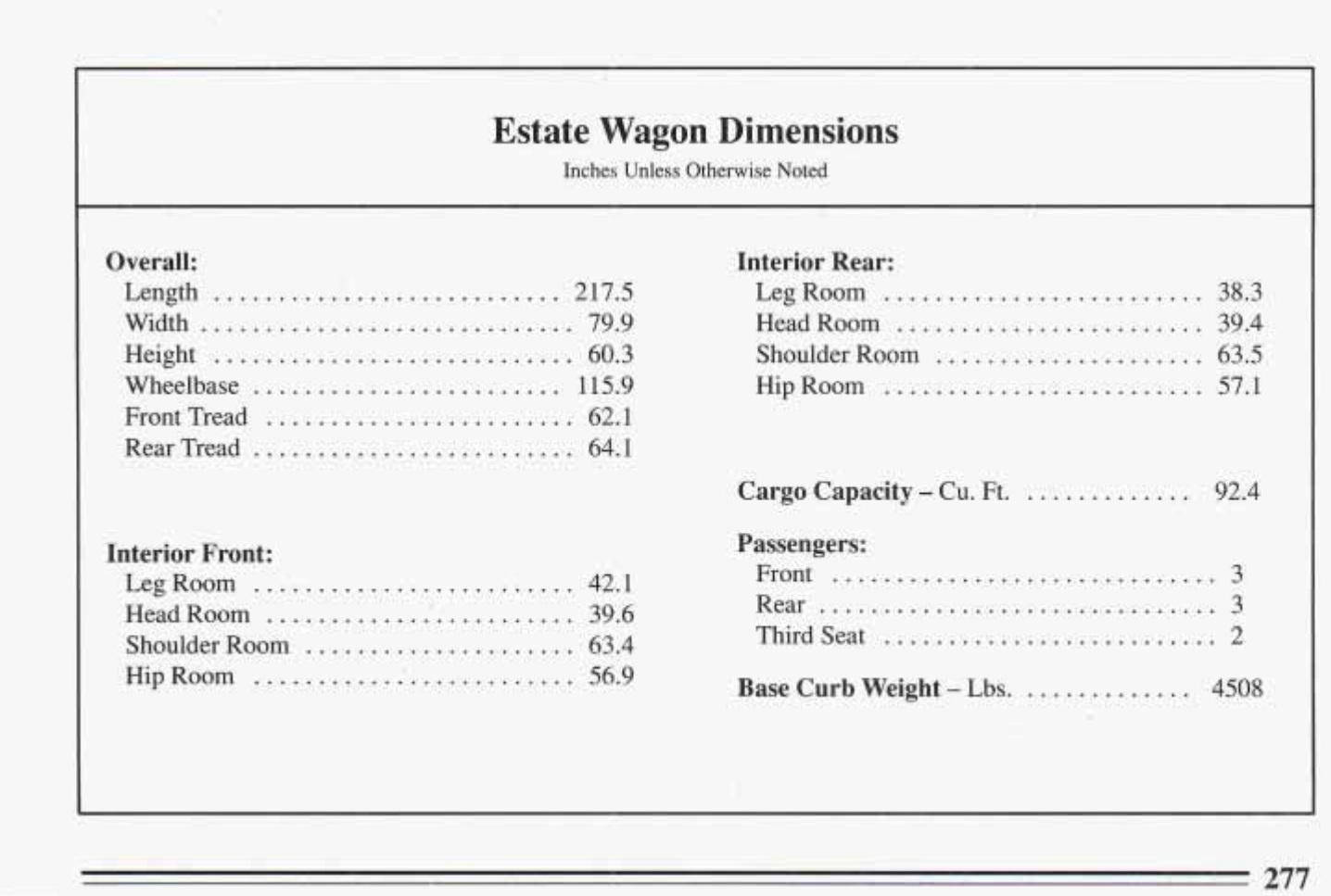
Estate Wagon Dimensions
Inches Unless Otherwise
Noted
Overall:
Length
...........................
21
7.5
Width
.............................
79.9
Height
............................
60.3
Wheelbase
........................
11
5.9
Front Tread
........................
Rear Tread
.........................
Interior Front:
LegRoom .........................
Head Room
........................
Shoulder Room
.....................
Hip
Room
..........................
62.1
64.1
42.1
39.6
63.4
56.9
Interior Rear:
Leg Room
..........................
38.3
Head Room
........................
39.4
Shoulder
Room
.....................
63.5
HipRoom
.........................
57.1
Cargo Capacity-
Cu
.
Ft
..............
92.4
Passengers:
Front
..............................
3
Rear
...............................
3
Third Seat
..........................
2
Base
Curb Weight
.
Lbs
..............
4508
277
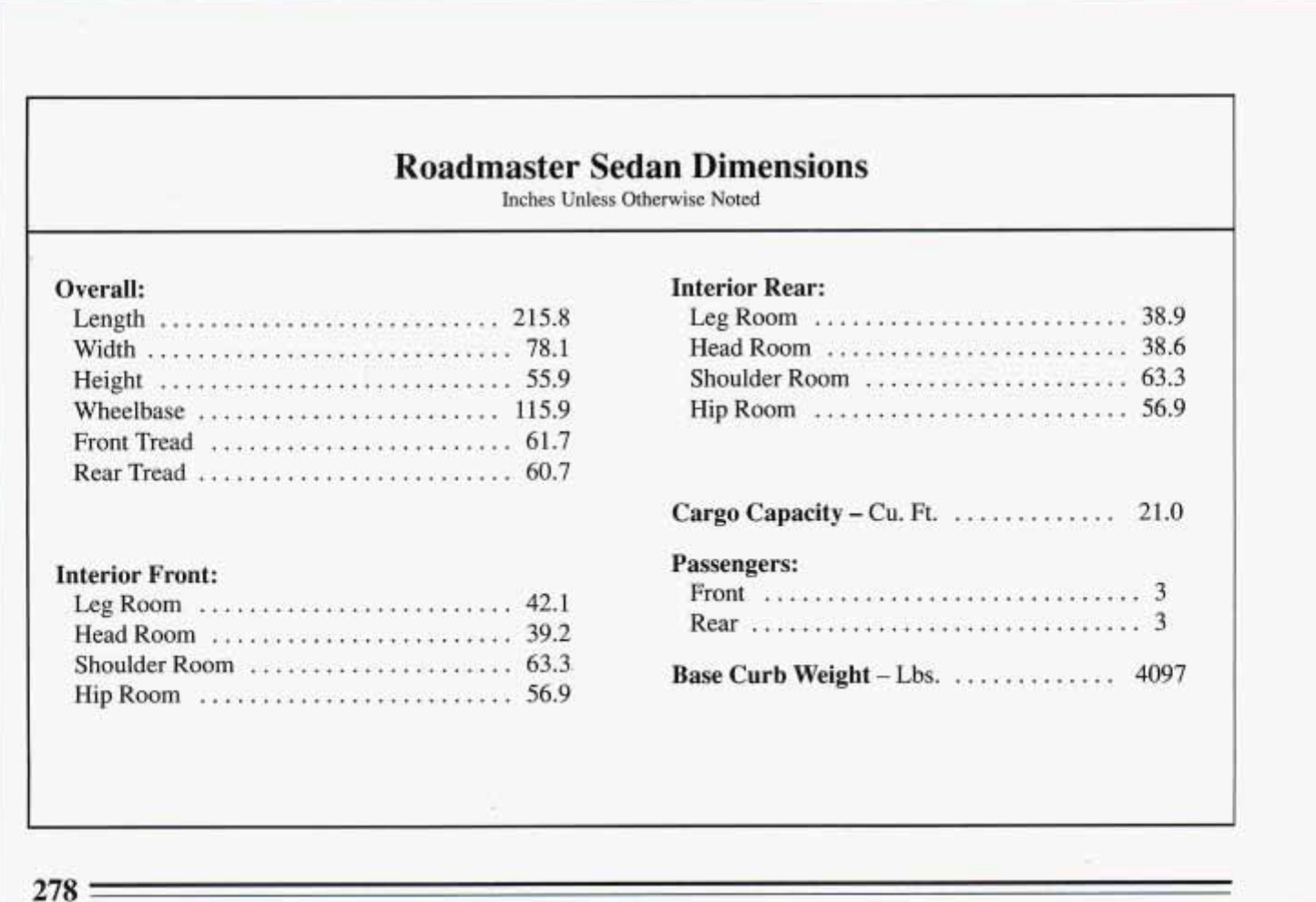
Roadmaster Sedan Dimensions
Inches
Unless
Otherwise Noted
Overall:
Length
.........................
215.8
Width ............................. 78.1
Height
................
1.
..........
55.9
Wheelbase ........................
11
5.9
Front Tread
........................
Rear Tread
.........................
Interior Front:
.
Leg Room .........................
Head Room
........................
Shoulder
Room
.....................
HipRoom
.........................
Interior Rear:
Leg Room
.........................
38.9
Head Room
........................
38.6
Shoulder Room
.....................
63.3
Hip
Room
.........................
56.9
61.7
60.7
Cargo Capacity
.
Cu
.
Ft
..............
21.0
42.1
39.2
63.3.
56.9
Passengers:
Front
..............................
3
Rear
................................
3
Base Curb Weight
.
Lbs
..............
4097
278
.
.
.
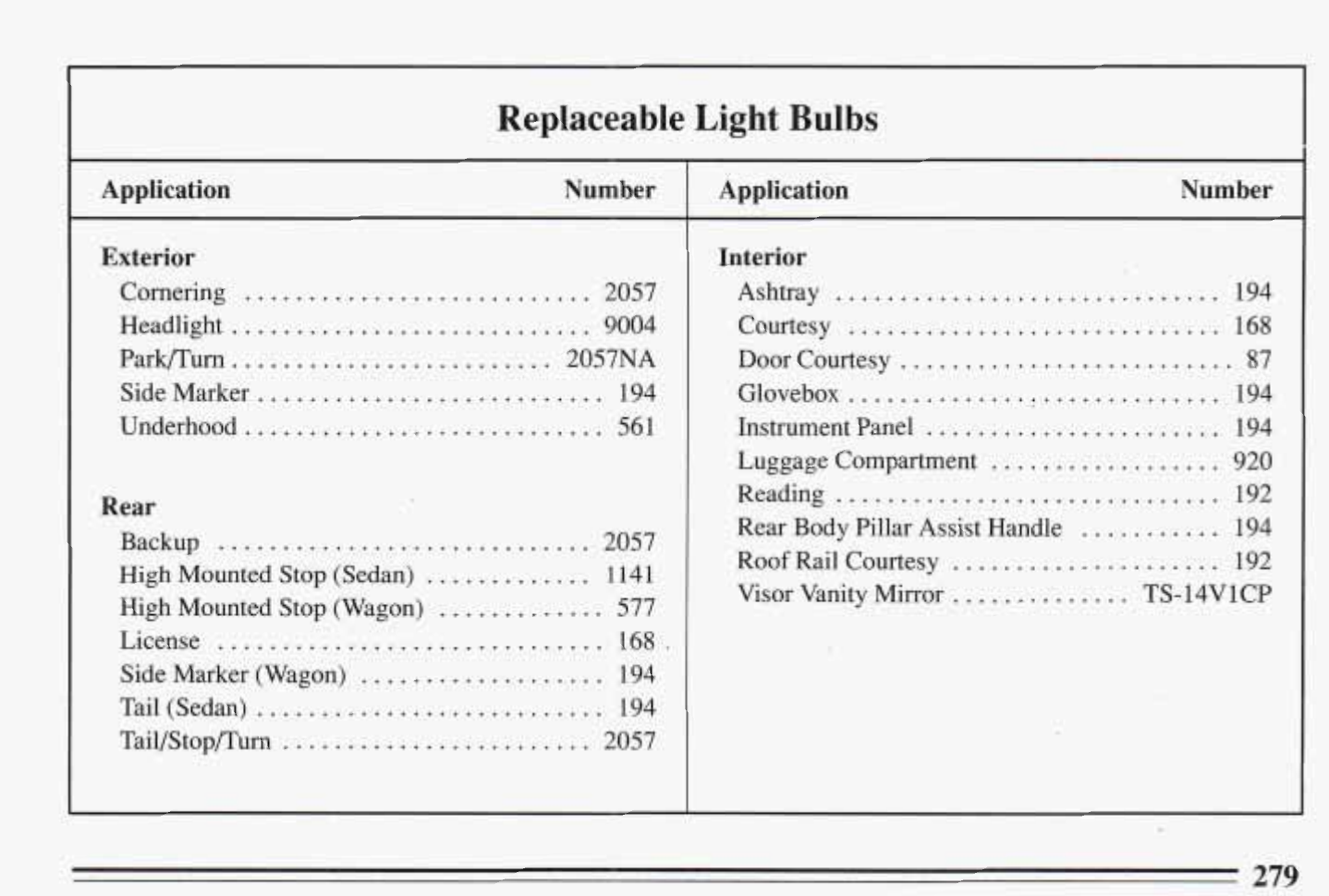
Replaceable
Light
Bulbs
Application Number
Exterior
Cornering
...........................
2057
Headlight
............................
9004
Park/Turn
.........................
2057NA
Side Marker
...........................
194
Underhood
............................
561
Rear
Backup
.............................
2057
High Mounted Stop (Sedan)
.............
1141
High Mounted Stop (Wagon) ............. 577
License
..............................
168
.
Side Marker (Wagon)
...................
194
Tail(Sedan)
...........................
194
Tail/Stop/Turn
........................
2057
Application Number
Interior
Ashtray
...............................
194
Courtesy'
.............................
168
Door Courtesy .......................... 87
Glovebox ............................. 194
Instrument Panel
........................
194
Luggage Compartment
..................
920
Reading
..............................
192
Rear Body Pillar Assist Handle
...........
194
Roof Rail Courtesy
.....................
192
Visor Vanity Mirror
..............
TS-14VlCP
279
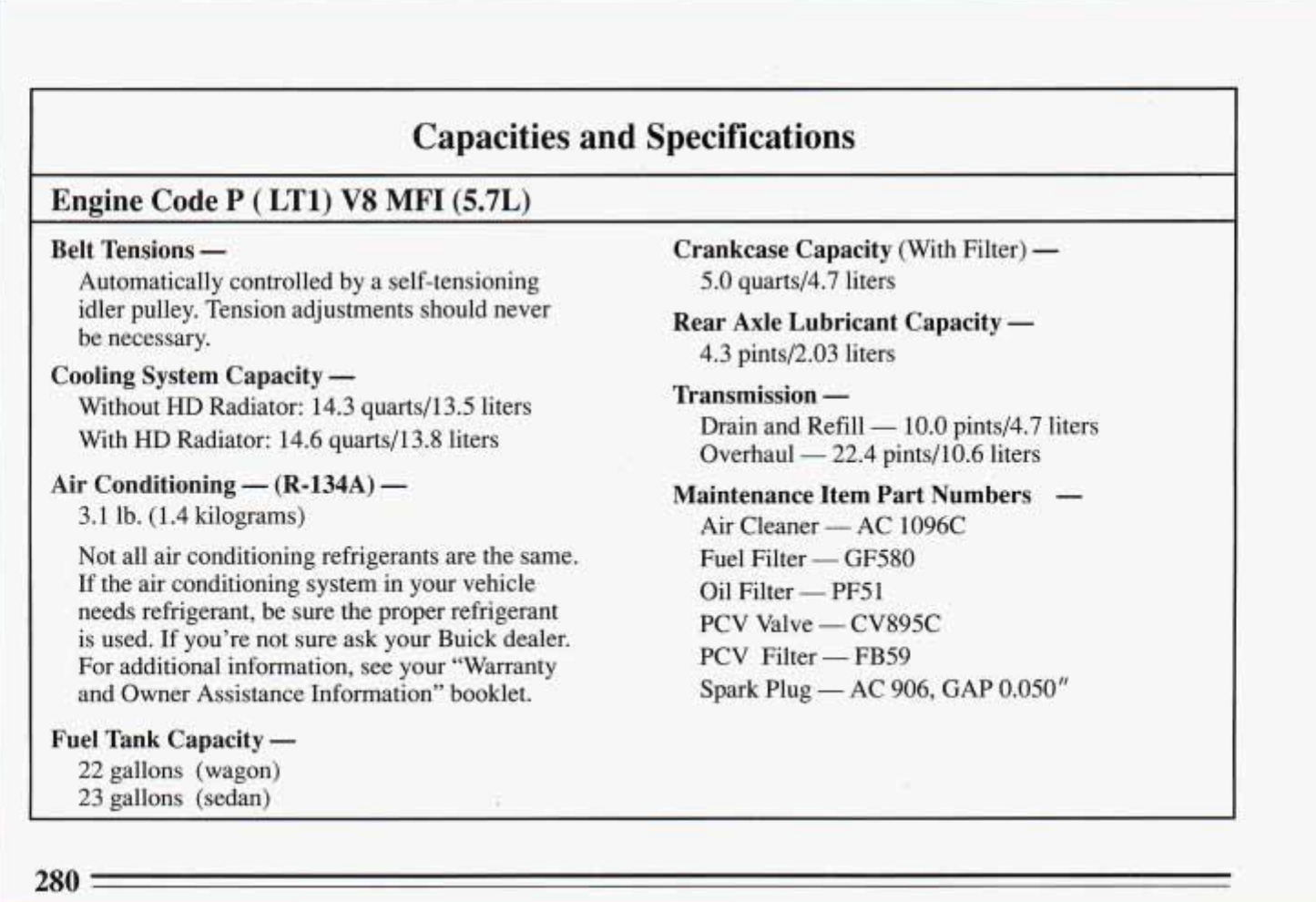
Capacities and Specifications
Engine Code
P
(
LTl)
V8
MFI
(5.7L)
Belt Tensions
-
Automatically controlled by a self-tensioning
idler pulley. Tension adjustments should never
be necessary.
Without HD Radiator: 14.3 quarts/l3.5 liters
With
HD
Radiator: 14.6 quarts/l3.8 liters
Cooling System Capacity
-
Air Conditioning
-
(R-134A)
-
3.1
lb. (1.4 kilograms)
Not all air conditioning refrigerants are the same.
If the air conditioning system in your vehicle
needs refrigerant, be sure the proper refrigerant
is used.
If
you’re not sure ask your Buick dealer.
For additional information, see your “Warranty
and Owner Assistance Information’’ booklet.
Fuel Tank Capacity
-
22
gallons (wagon)
23 gallons (sedan)
Crankcase Capacity
(With Filter)
-
5.0
quarts/4.7 liters
Rear Axle Lubricant Capacity
-
4.3 pints/2.03 liters
Transmission
-
Drain and Refill
-
10.0 pints/4.7 liters
Overhaul
-
22.4 pints/l0.6 liters
Maintenance Item
Part
Numbers
-
Air Cleaner
-
AC
1096C
Fuel Filter
-
GF580
Oil Filter
-
PF5
1
PCV Valve
-
CV895C
PCV Filter
-
FB59
Spark Plug
-
AC 906, GAP
0.050”
Part
7
Maintenance Schedule
This part covers the maintenance required for your Buick
.
Your vehicle needs these services to retain its safety.
dependability and emission control performance
.
Part
7
includes:
Introduction
......................................................................
282
A Word About Maintenance
.....................................................
282
Your Vehicle and the Environment ................................................ 283
How This Part is Organized
.....................................................
283
Section A: Scheduled Maintenance Services
.............................................
285
Using Your Maintenance Schedules
...............................................
285
Schedule1 ................................................................... 286
Schedule11 .................................................................. 288
Explanation
of
Scheduled Maintenance Services
.....................................
290
Section
B:
Owner Checks and Services
.................................................
293
AtEachFuelFill
..............................................................
293
AtLeastOnceaMonth
.........................................................
294
AtLeastOnceaYear .......................................................... 294
Section C: Periodic Maintenance Inspections
............................................
297
Section
D:
Recommended Fluids and Lubricants
.........................................
299
Section E: Maintenance Record
.......................................................
301
Selecting the Right Schedule
....................................................
285
281
I
I
mmmm
Have
you
purchased the
GM
Protection Plan? The
Plan supplements your new vehicle warranties. See
your Buick
c
der for details.
Introduction
A
Word About
Maintenance
We at General Motors want to help you keep your
vehicle in good working condition. But we don't know
exactly how you'll drive it. You may drive very short
distances only a few times a week. Or you may drive
long distances all the time in very hot, dusty weather.
You may use your vehicle in making deliveries. Or you
may
drive it to work, to do errands or in many other
ways.
Because of all the different ways people use their GM
vehicles, maintenance needs, vary. You may even need
more frequent checks and replacements than you will
find in the schedules in this part.
So
please read this part
and note how you drive. If you have any questions on
how to keep your vehicle
in
good condition, see your
Buick dealer, the place many GM owners choose to
have their maintenance work done. Your dealer can be
relied upon to use proper parts and practices.
,
i
282
Your Vehicle and the Environment
Proper vehicle maintenance not only helps to keep your
vehicle
in
good working condition, but also helps the
environment. All recommended maintenance procedures
are important. Improper vehicle maintenance or the
removal of important components can significantly
affect the quality of the
air
we breathe. Improper fluid
levels or even the wrong tire inflation can increase the
level
of
emissions from your vehicle.
To
help protect
our environment, and to help keep your vehicle in good
condition, please maintain your vehicle properly.
How
This Part
is
Organized
The remainder of this part
is
divided into five sections:
“Section
A
Scheduled Maintenance Services” shows
what to have done and how often. Some of these
services can be complex,
so
unless
you
are technically
qualified and have the necessary equipment, you should
let
your
dealer’s service department or another qualified
service center do these
jobs.
If you are skilled enough to do some work on
your
vehicle, you will probably want to get the service
information GM publishes.
You
will find a list of
publications and
how
to get them
in
this manual. See
“Service Publications”
in the Index.
283
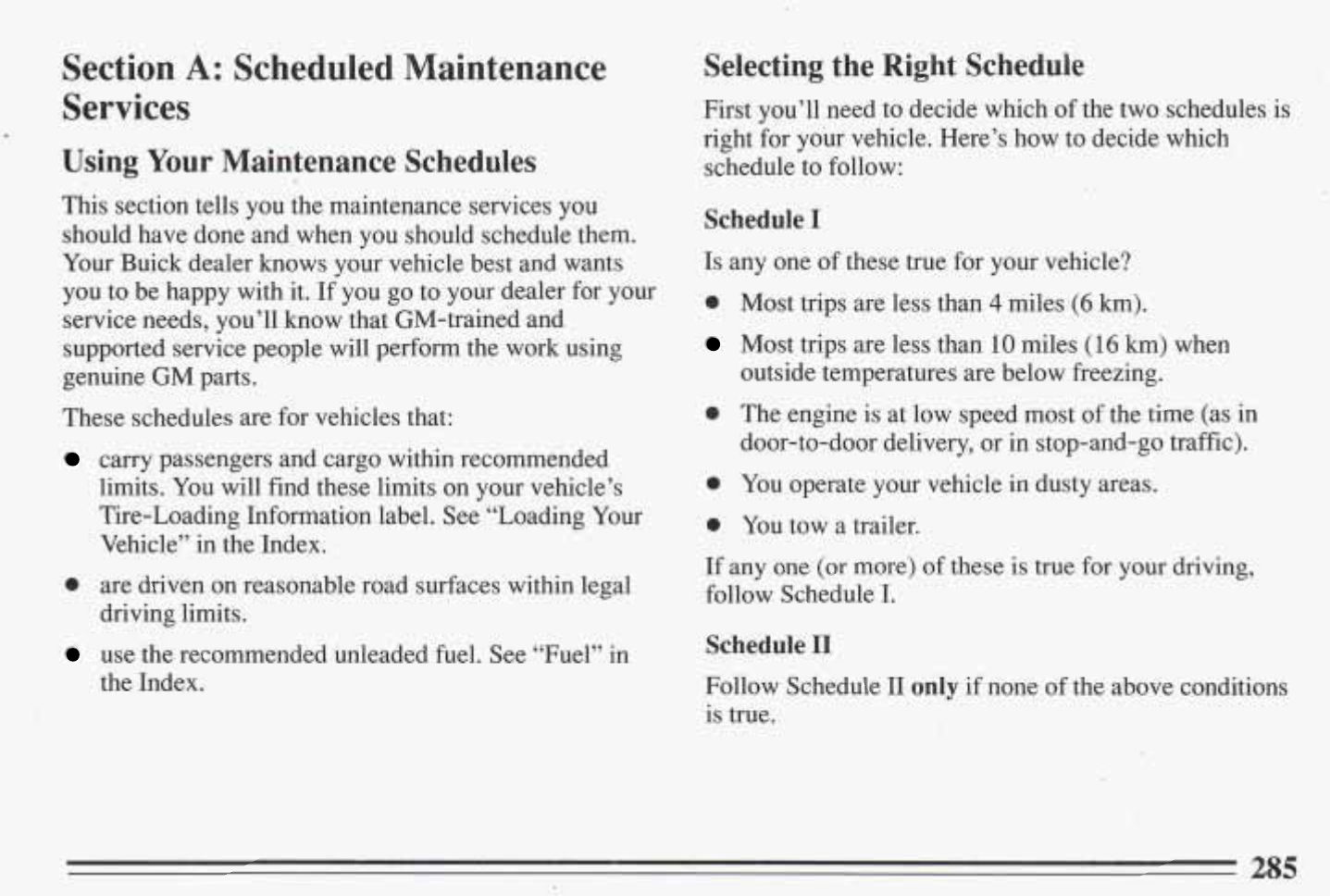
Section
A:
Scheduled Maintenance
Services
Using Your Maintenance Schedules
This section tells you the maintenance services you
should have’done and. when you should schedule.them.
Your Buick dealer
knows~
your vehicle best and wants
you to be happy with, it. If you go to your dealer for your
service needs, you’ll know that GM-trained and
supported service people will perform the work using
genuine
GM
parts.
These schedules are for vehicles that:
carry passengers and cargo within recommended
limits. You will find these limits on your vehicle’s
Tire-Loading Information label. See “Loading Your
Vehicle” in the Index.
0
are driven on reasonable road surfaces within legal
use the recommended unleaded fuel. See. “Fuel’’ in
driving limits.
the Index.
Selecting the Right Schedule
First you’ll need to decide which
of
the two schedules is
right for your vehicle. Here’s how to decide which
schedule to follow:
Schedule
I
Is ‘any one of these true for your vehicle?
0
Most trips are less than
4
miles
(6
km).
Most trips are less than
10
miles
(16
km) when
outside temperatures are below freezing.
0
The engine is at low speed most
of
the time (as in
0,
You operate your vehicle in dusty areas.
0
You tow a trailer.
door-to-door delivery, or in stop-and-go traffic).
If
any one
(or
more) of these
is
true for your driving,
follow Schedule I.
Schedule
11
Follow Schedule
11.
only
if none of the above conditions
is true.
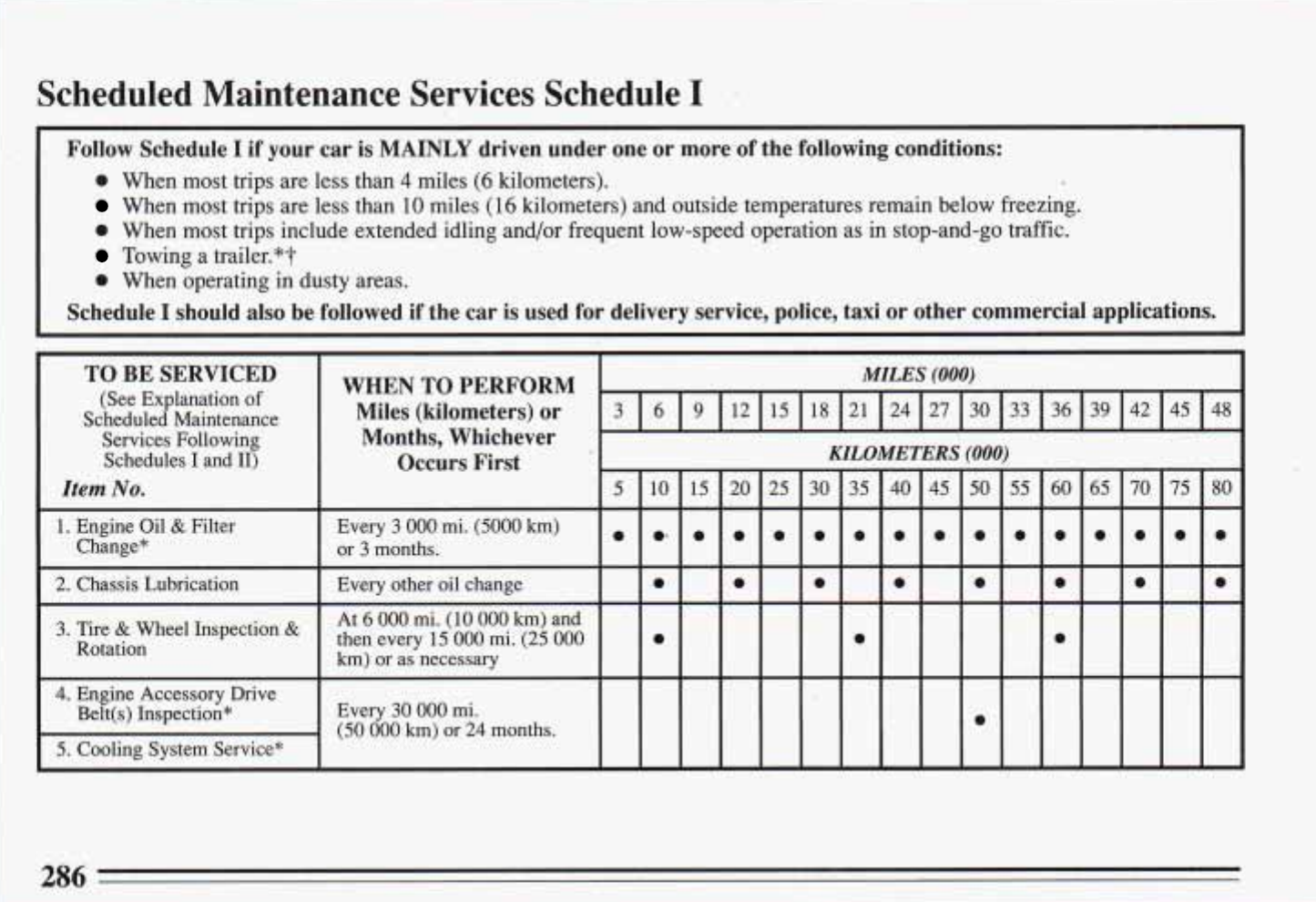
Scheduled Maintenance Services Schedule
I
Follow' Schedule I if your car is MAINLY driven under one or more
of
the following conditions:
___~~
~ ~~ ~~~
0
When most trips are less than
4
miles (6 kilometers).
When most trips are less than
10
miles
(16
kilometers) and outside temperatures remain below freezing.
0
When most trips include extended idling and/or frequent low-speed operation as in stop-and-go traffic.
Towing a trailer.*?
0
When operating in dusty areas.
Schedule I should
also
be followed if the car is used for delivery service, police, taxi or other commercial applications.
TO
BE SERVICED
(See Explanation
of
Scheduled Maintenance
Services Following
Schedules
I
and
11)
Item
No.
1. Engine Oil
&
Filter
Change"
2.
Chassis Lubrication
3.
Tire
&
Wheel Inspection
&
Rotation
4.
Engine Accessory Drive
5.
Cooling System Service*
Belt(s) Inspection*
WHEN
TO
PERFORM
Miles (kilometers) or
3
6
Months, Whichever
MILES
(000)
Occurs First
.
lm
Every
3
000
mi.
(5000
km)
or
3
months.
lo
I+
I.
Every other oil change
I
1.1
Io
At
6
000
mi. (10
000
km) and
then every
15
000
mi.
(25
000
a
km) or as necessary
Every
30
000
mi.
(50
000
km)
or
24
months.
KILOMETERS
(000)
65
70
75
80
0.00
0
0
286
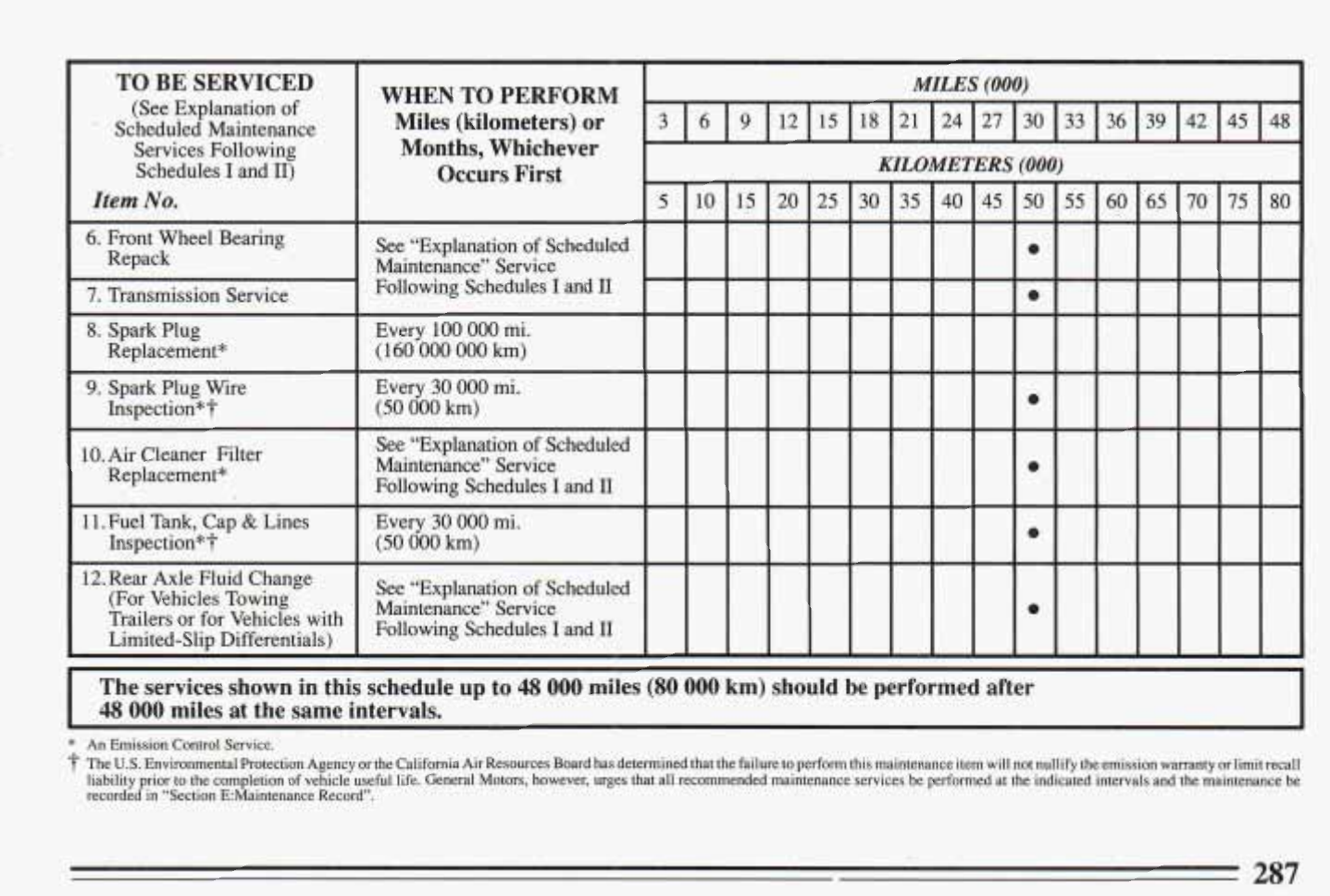
The services shown
in
this schedule up
to
48
000
miles (80
000
km) should be performed after
I
48
000
miles at the same intervals.
*
An Emission Control Service.
The
U.S.
Environmental Protection Agency
or
the California Air Resources Board has determined that the failure to perform this maintenance item will not nullify the emission warranty
or
limitrecall
liability prior to the completion of vehicle useful life. General
Motors,
however, urges that all recommended maintenance services be performed at the indicated intervals and the maintenance be
recorded in "Section EMaintenance Record".
287
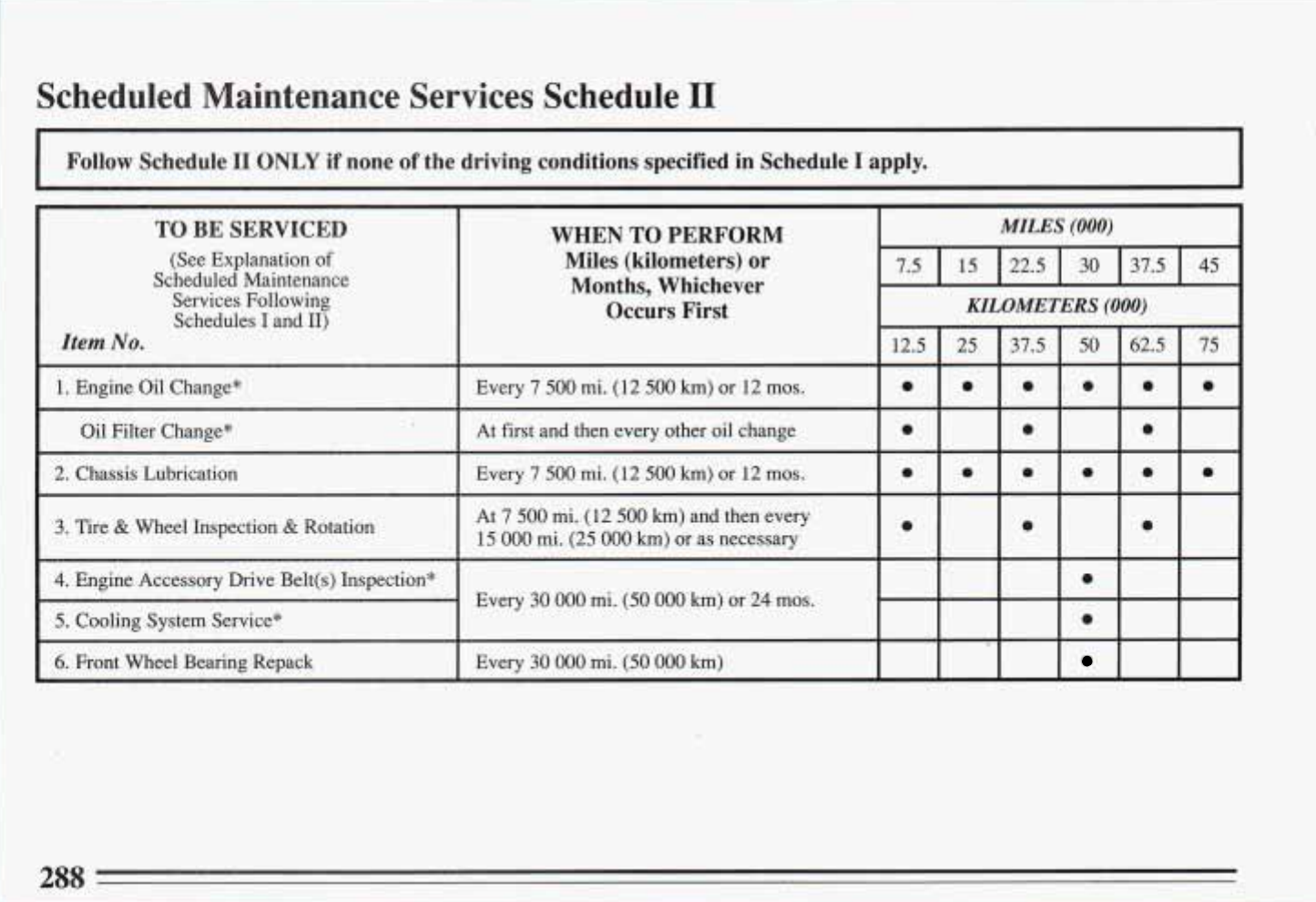
Scheduled Maintenance Services Schedule
I1
I
Follow Schedule
I1
ONLY
if none of the driving conditions specified in Schedule
I
apply.
I
TO
BE SERVICED
(See Explanation
of
Scheduled Maintenance
Services Following
Schedules I and
II)
Item
No.
1.
Engine
Oil
Change*
Oil
Filter Change*
2.
Chassis
Lubrication
3.
Tire
&
Wheel Inspection
&
Rotation
4.
Engine Accessory Drive Belt(s) Inspection*
5.
Cooling System Service*
6.
Front Wheel
Bearing
Repack
WHEN
TO
PERFORM
Miles (kilometers)
or
Months, Whichever
Occurs First
I
MILES
(000)
I
KILOMETERS
(000)
12.5
I
25
I
37.5
I
50
I
62.5
I
75
Every 30
000
mi.
(50
000
km)
or
24
mos.
Every 30
000
mi.
(50
000
km)
288
I
I
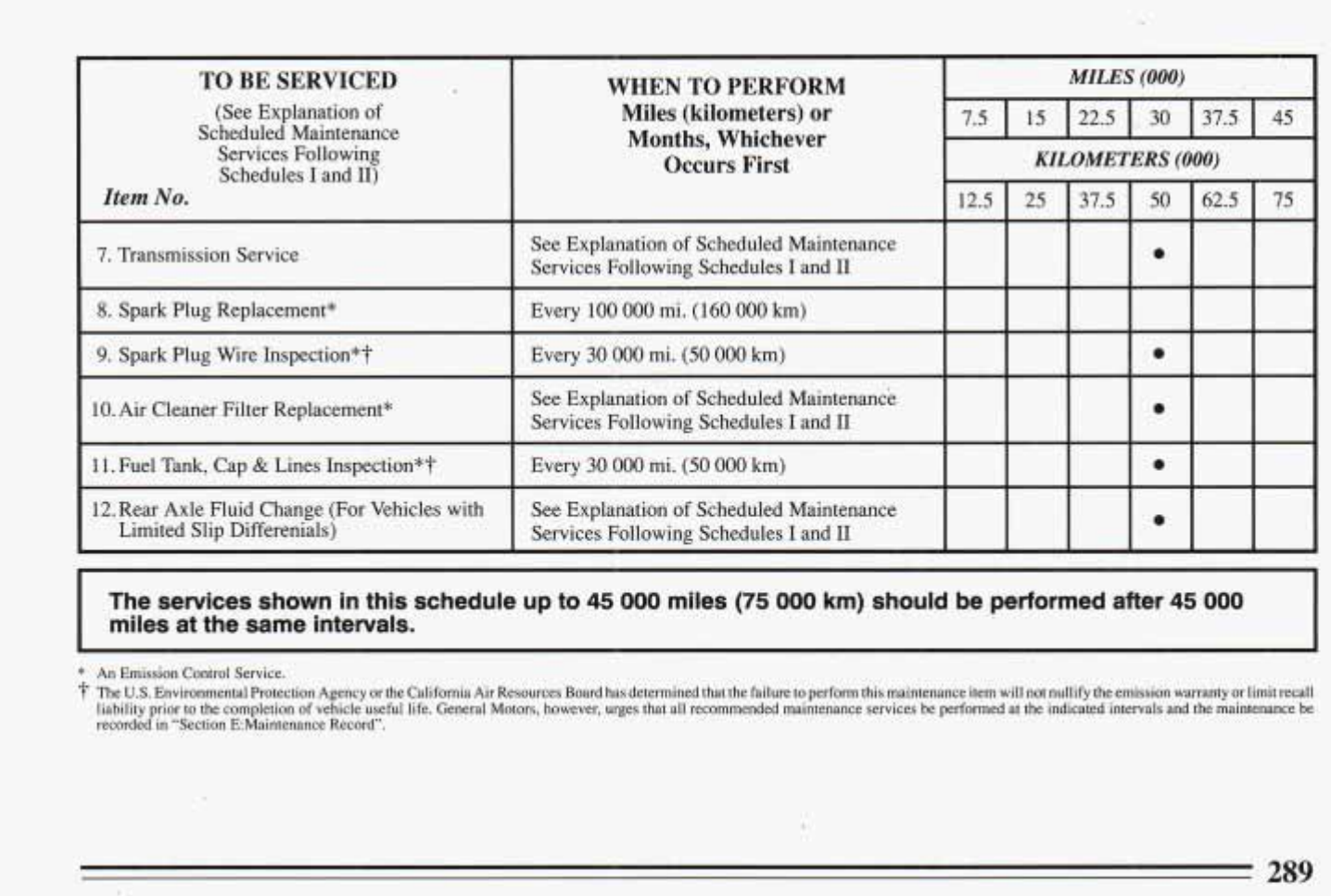
TO
BE SERVICED
(See Explanation
of
Scheduled Maintenance
Services Following
Schedules I and
11)
Item No.
7.
Transmission Service
8.
Spark Plug Replacement*
9.
Spark Plug Wire Inspection"?
10.
Air Cleaner Filter Replacement*
1
1.
Fuel Tank, Cap
&
Lines Inspection*?'
12. Rear Axle Fluid Change (For Vehicles with
Limited Slip Differenials)
r
WHEN
TO
PERFORM
Miles (kilometers) or
Months, Whichever
Occurs First
I
MILES
(000)
I
KILOMETERS
(000)
I
The services shown in this schedule up to
45
000
miles
(75
000
km)
should be performed after
45
000
miles at the same intervals.
*
An Emission Control Service.
?
The
U.S.
Environmental Protection Agency
or
the California Air Resources Board has determined that the failure to perform this maintenance item will not nullify the emission warranty
or
limit recall
liability prior to the completion of vehicle useful life. General Motors, however, urges that all recommended maintenance services be performed at the indicated intervals and the maintenance be
recorded in "Section EMaintenance Record".
289
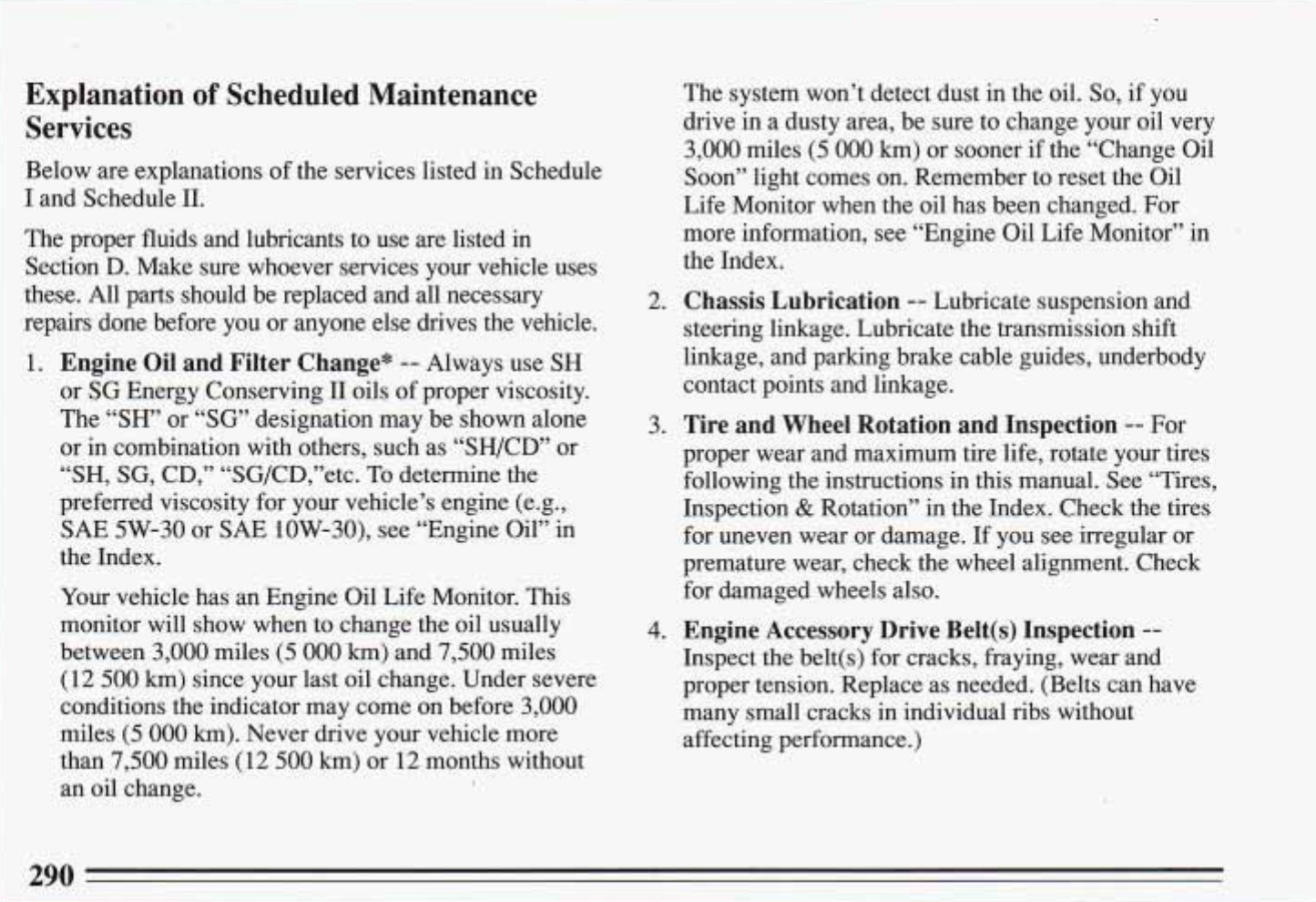
Explanation
of
Scheduled Maintenance
The system won’t detect dust in the
oil.
So,
if
you
drive in a dusty area, be sure to change your oil very
3,000
miles
(5
000
km)
or sooner
if
the “Change
Oil
Soon” light comes on. Remember to reset the Oil
Life Monitor when the oil has been changed. For
more information, see “Engine Oil Life Monitor” in
the Index.
2.
Chassis Lubrication
--
Lubricate suspension and
steering linkage. Lubricate the transmission shift
linkage, and parking brake cable guides, underbody
contact points and linkage.
proper wear and maximum tire life, rotate your tires
following the instructions in this manual. See “Tires,
Inspection
&
Rotation” in the Index. Check the tires
for uneven wear or damage. If you see irregular
or
premature wear, check the wheel alignment. Check
for damaged wheels also.
4.
Engine Accessory Drive Belt(s) Inspection
--
Inspect the belt(s) for cracks, fraying, wear and
proper tension. Replace
as needed. (Belts can have
many small cracks in individual ribs without
affecting performance.)
3.
Tire and Wheel Rotation and Inspection
--
For
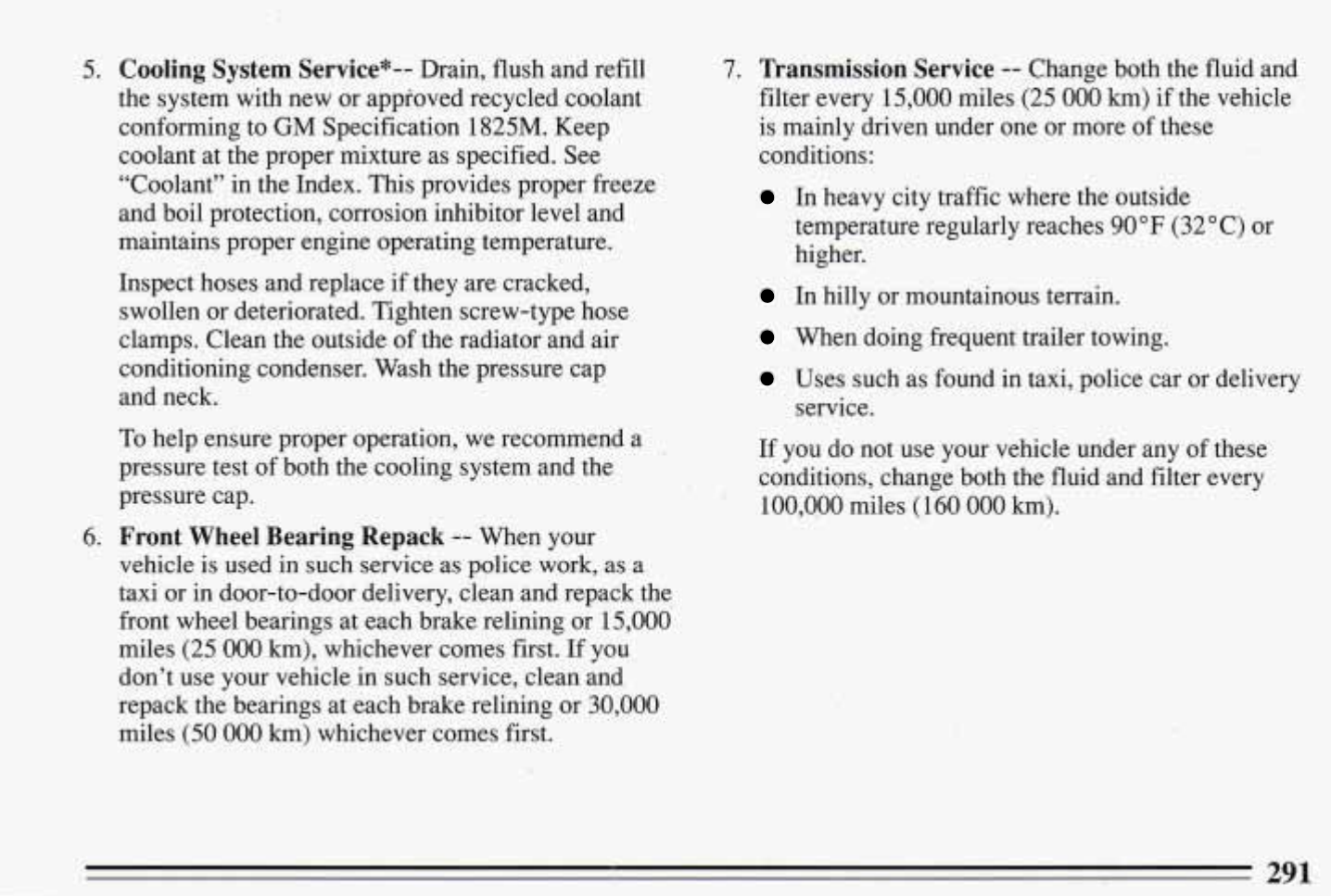
5.
Cooling System Service*--
Drain, flush and refill
the system with new or approved recycled coolant
conforming to
GM
Specification
1825M.
Keep
coolant at the proper mixture as specified. See
“Coolant” in the Index.
This
provides proper freeze
and boil protection, corrosion inhibitor level and
maintains proper engine operating temperature.
Inspect hoses and replace if they are cracked,
swollen or deteriorated. Tighten screw-type hose
clamps. Clean the outside of the radiator and air
conditioning condenser. Wash the pressure cap
and neck.
To
help ensure proper operation, we recommend a
pressure test of both the cooling system and the
pressure cap.
vehicle is used in such service as police work, as a
taxi or in door-to-door delivery, clean and repack the
front wheel bearings at each brake relining or
15,000
miles (25
000
km), whichever comes first. If you
don’t use your vehicle in such service, clean and
repack the bearings at each brake relining or 30,000
miles (50
000
km) whichever comes first.
6.
Front Wheel Bearing Repack
--
When your
7.
Transmission Service
--
Change both the fluid and
filter every
15,000
miles (25
000
km)
if the vehicle
is mainly driven under one or more of these
conditions:
In
heavy city traffic where the outside
temperature regularly reaches
90°F
(32°C) or
higher.
In hilly or mountainous terrain.
When doing frequent trailer towing.
Uses such as found in taxi, police car or delivery
If you do not use your vehicle under any of these
conditions, change both the fluid and filter every
100.000
miles
(160
000
kml
service.
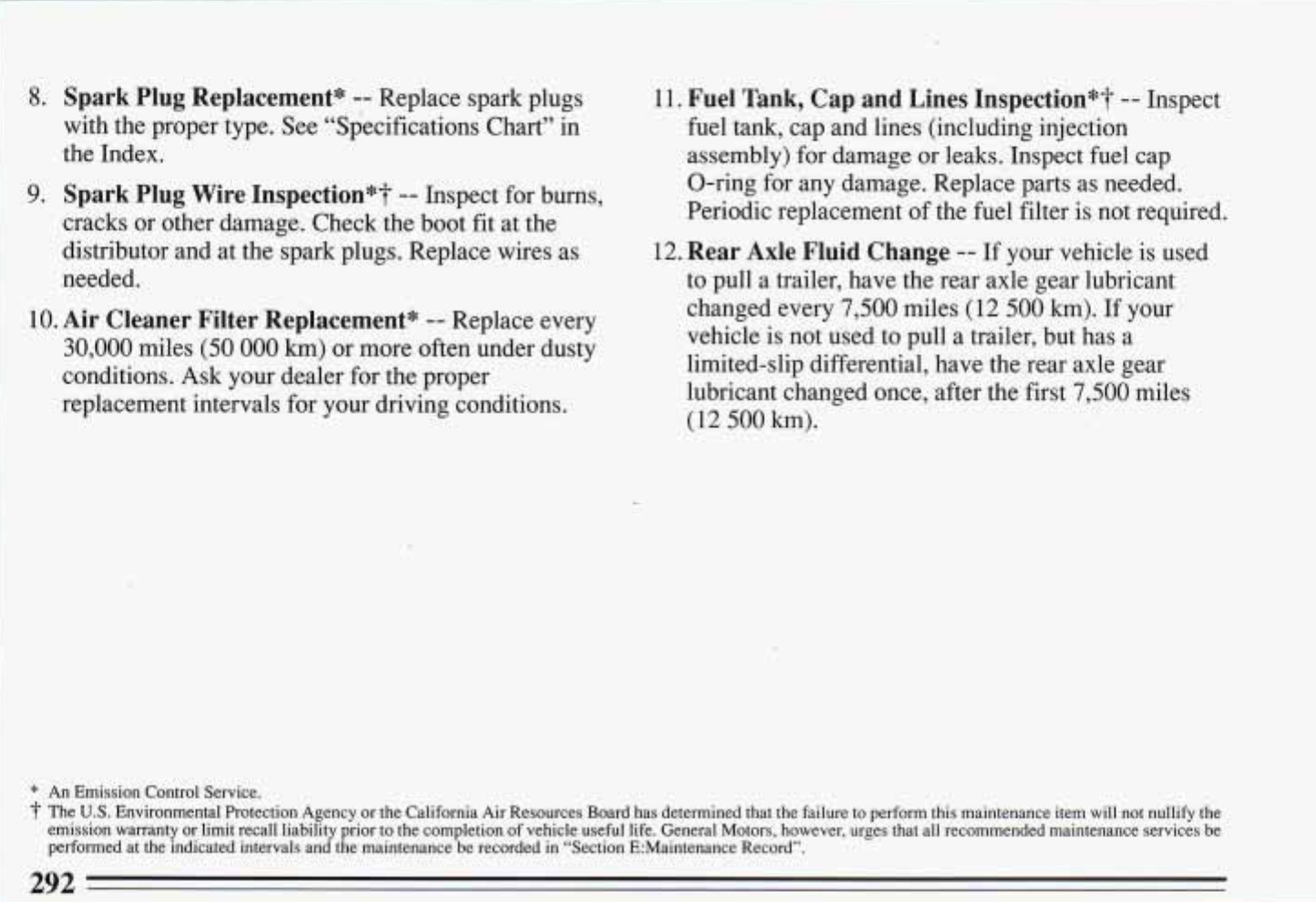
8.
Spark Plug Replacement*
--
Replace spark plugs
11.
Fuel Tank, Cap and Lines Inspection*?
--
Inspect
with the proper type. See “Specifications Chart” in fuel tank, cap and lines (including injection
the Index. assembly) for damage or leaks. Inspect fuel cap
9.
Spark Plug Wire
inspection*^
--
Inspect for burns,
cracks or other damage. Check the boot fit at the
O-ring for any damage. Replace parts as needed.
Periodic replacement of the fuel filter is not required.
distributor and at thespark plugs. Replace wires as
needed.
10.
Air Cleaner Filter Replacement*
--
Replace every
30,000
rniles
(50
000
km)
or more often under dusty
conditions.
Ask
your dealer for the proper
replacement intervals for your driving conditions.
12.
Rear Axle Fluid Change
--
If
your vehicle is used
to pull a trailer, have the rear axle gear lubricant
changed every
7,500
miles
(12
500
km).
If your
vehicle is not used to pull a trailer, but has a
limited-slip differential, have the rear axle gear
lubricant changed once, after the first
7,500 miles
(12
500
km).
*
An Emission Control Service.
t
The
U.S.
Environmental Protection Agency
or
the California Air Resources Board has determined that the failure to perform this maintenance item will not nullify the
emission warranty
or
limit recall liability prior to the completion of vehicle useful life. General Motors, however, urges that all recommended maintenance services
be
performed at the indicated intervals and the maintenance be recorded in “Section E:Maintenance Record”.
292
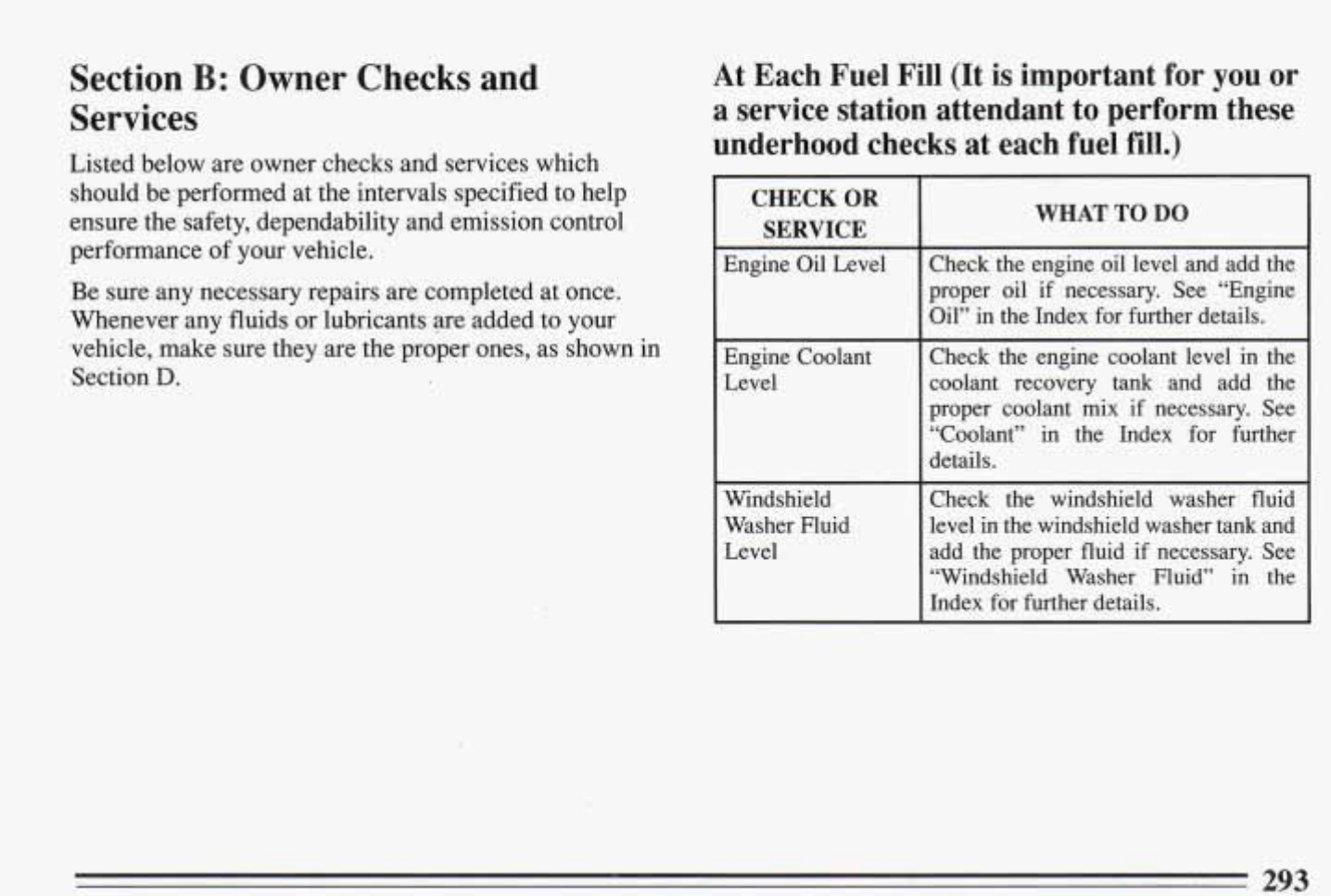
Section
B:
Owner Checks
and
Services
Listed below are owner checks and services which
should be performed at the intervals specified to help
ensure the safety, dependability and emission control
performance of your vehicle.
Be sure any necessary repairs are completed at once.
Whenever any fluids or lubricants are added to your
vehicle, make sure they are the proper ones, as shown in
Section
D.
At Each Fuel Fill (It is important for you or
a service station attendant to perform these
underhood checks at each fuel fill.)
I
cE;2
I
WHAT
TO
DO
Engine Oil Level Check the engine oil level and add the
proper oil
if
necessary. See “Engine
Oil”
in
the Index for further details.
Engine Coolant Check the engitne coolant level in the
Level coolant recovery tank and add the proper coolant
mix
if
necessary. See
“Coolant” in the Index for further
details.
I
Windshield
Washer Fluid
Level
Check the windshield washer fluid
level in the windshield washer tank and
add the proper fluid
if
necessary. See
“Windshield Washer Fluid” in the
Index for further details.
293
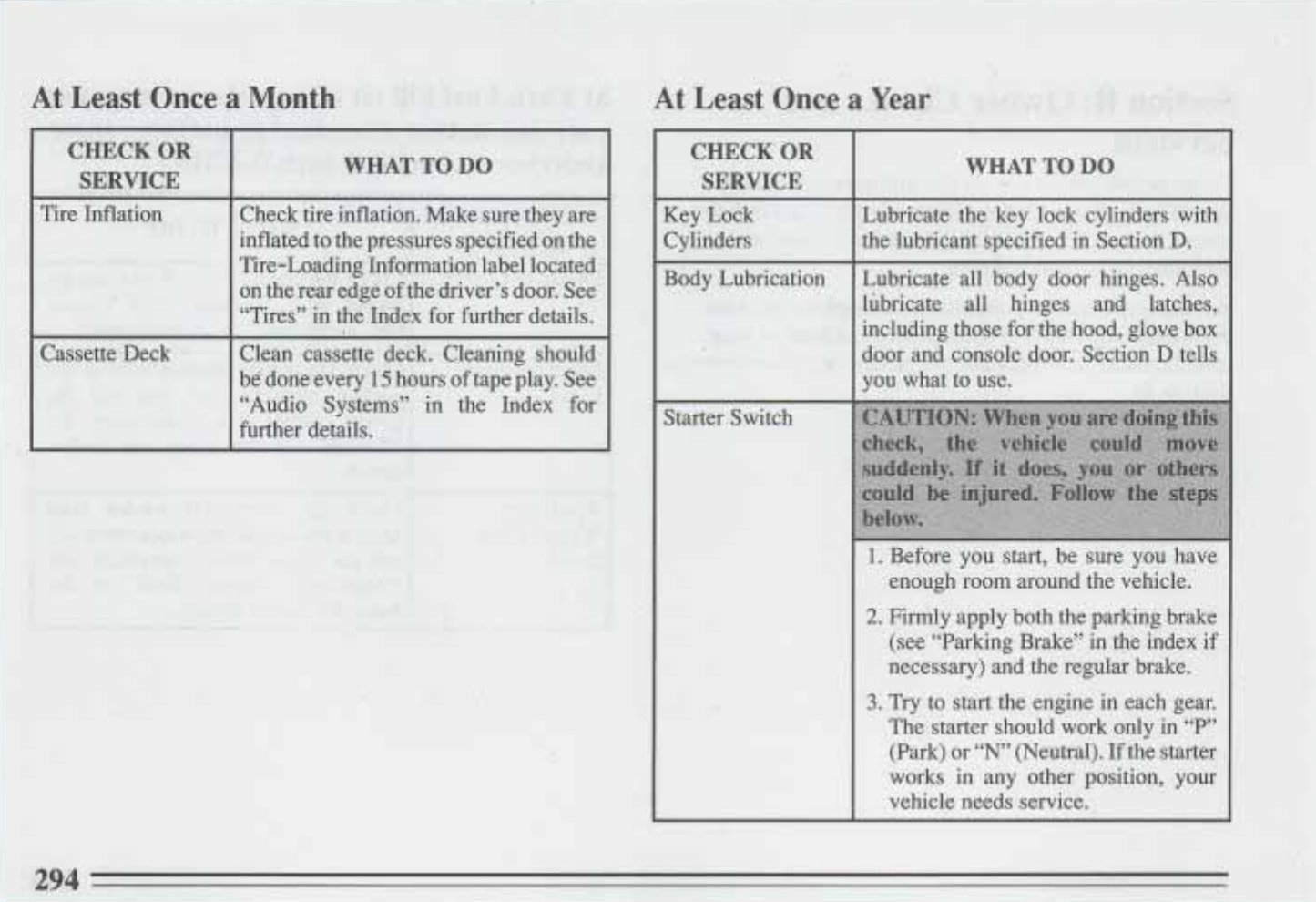
'
'I
Bod$
Lubrication'
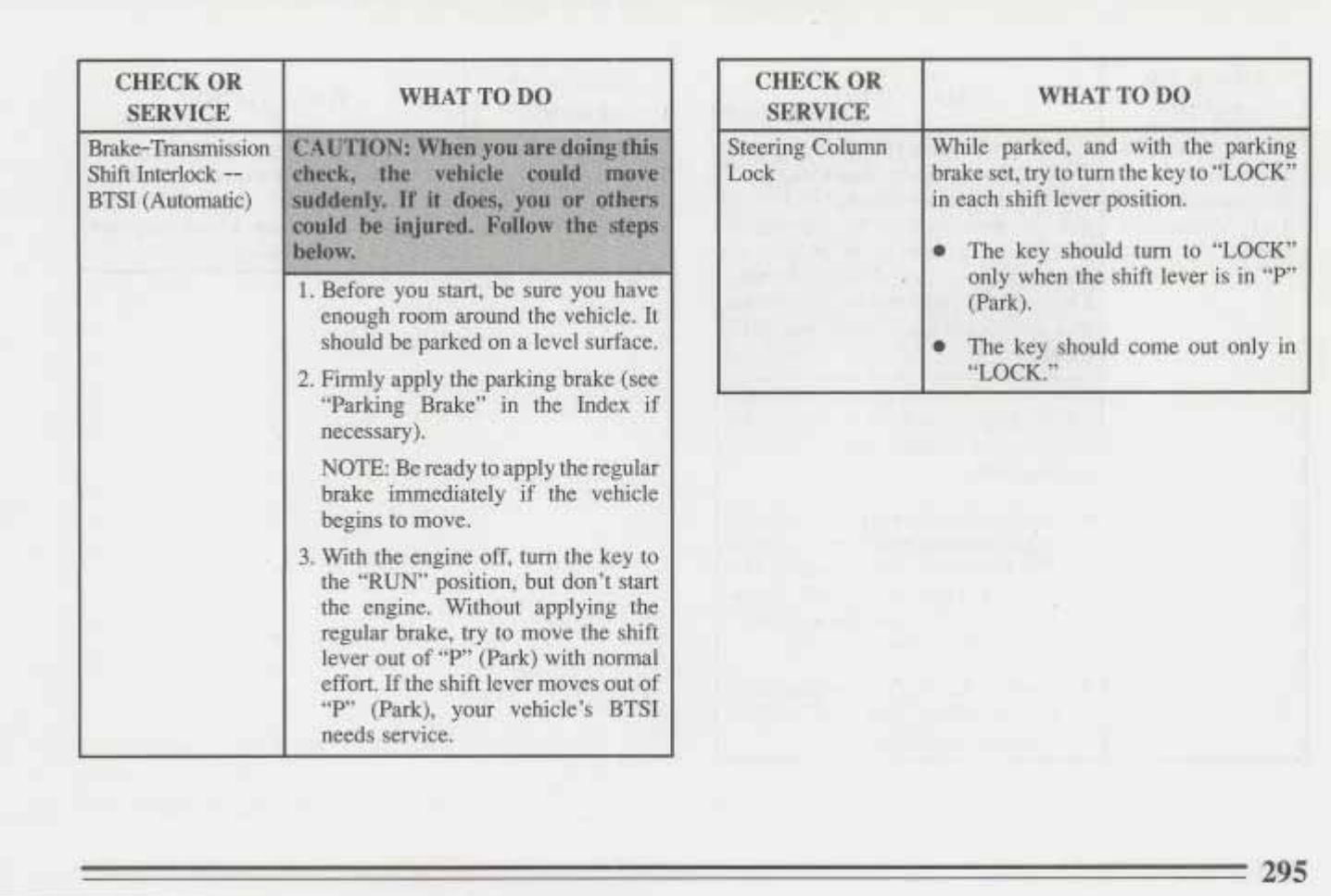
.-
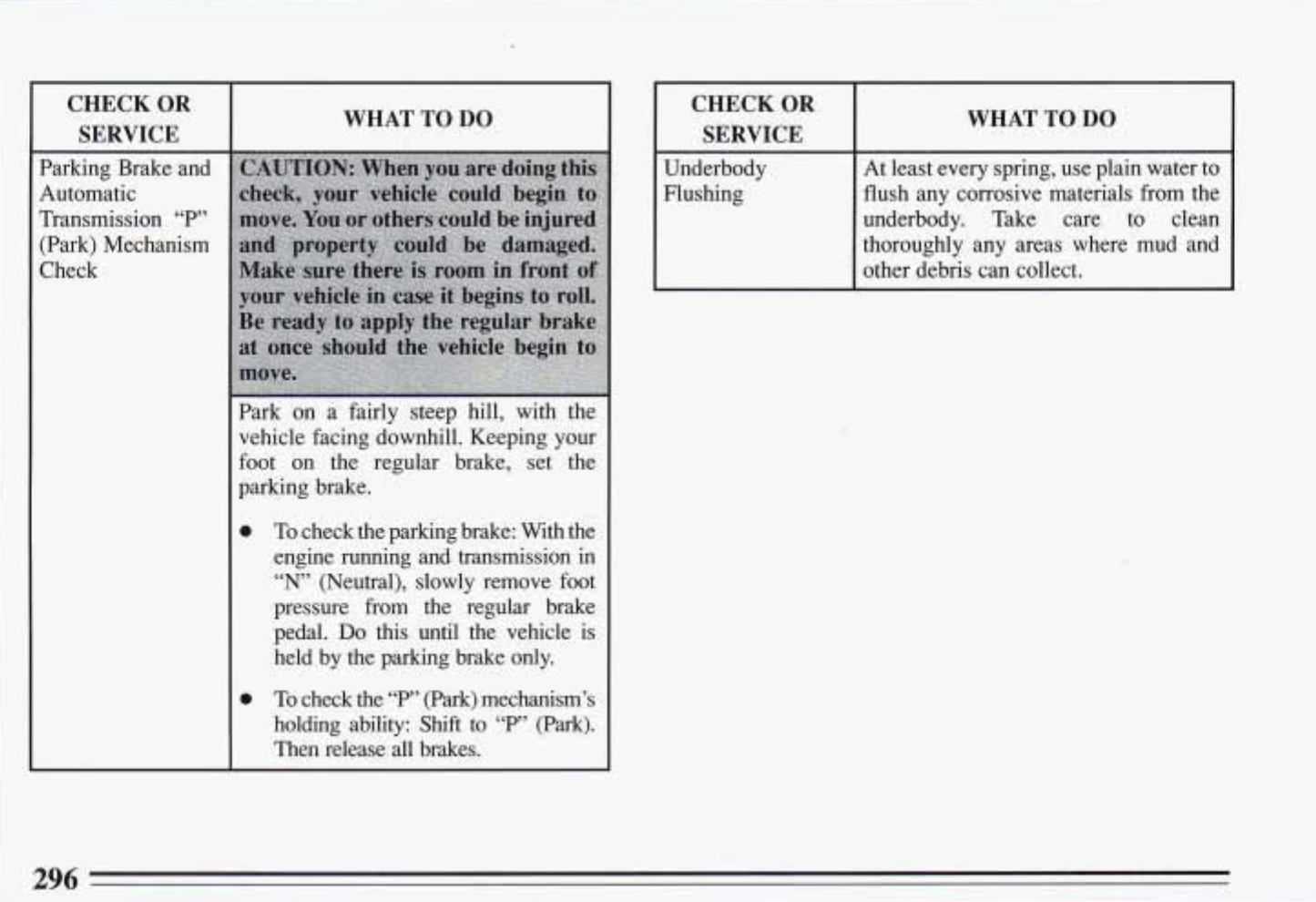
I
CHECK
OR
SERVICE
Parking Brake/and
Automatic
Transmission
“P,’
(Park) Mechanism
Check
WHAT TO
DO
Park
on
a fairly steep hill, with the
vehicle facing downhill. Keeping your
foot on the regular brake, set
the
parking brake.
0
To
check the parking brake: With the
engine running and transmission in
“N’
(Neutral), slowly remove foot
pressure
from
the regular brake
pedal.
Do
this until the vehicle
is
held by the parking brake only.
0
To
check the
“P”
(Park) mechanism’s
holding ability:
Shift
to
“P”
(Park).
Then release all brakes.
I
cE;cF
I
WHAT
TO DO
Underbody
Flushing At least every spring, use plain water to
flush any corrosive materials from the
underbody.
.
Take care to clean
thoroughly any areas where mud and
other debris can collect.
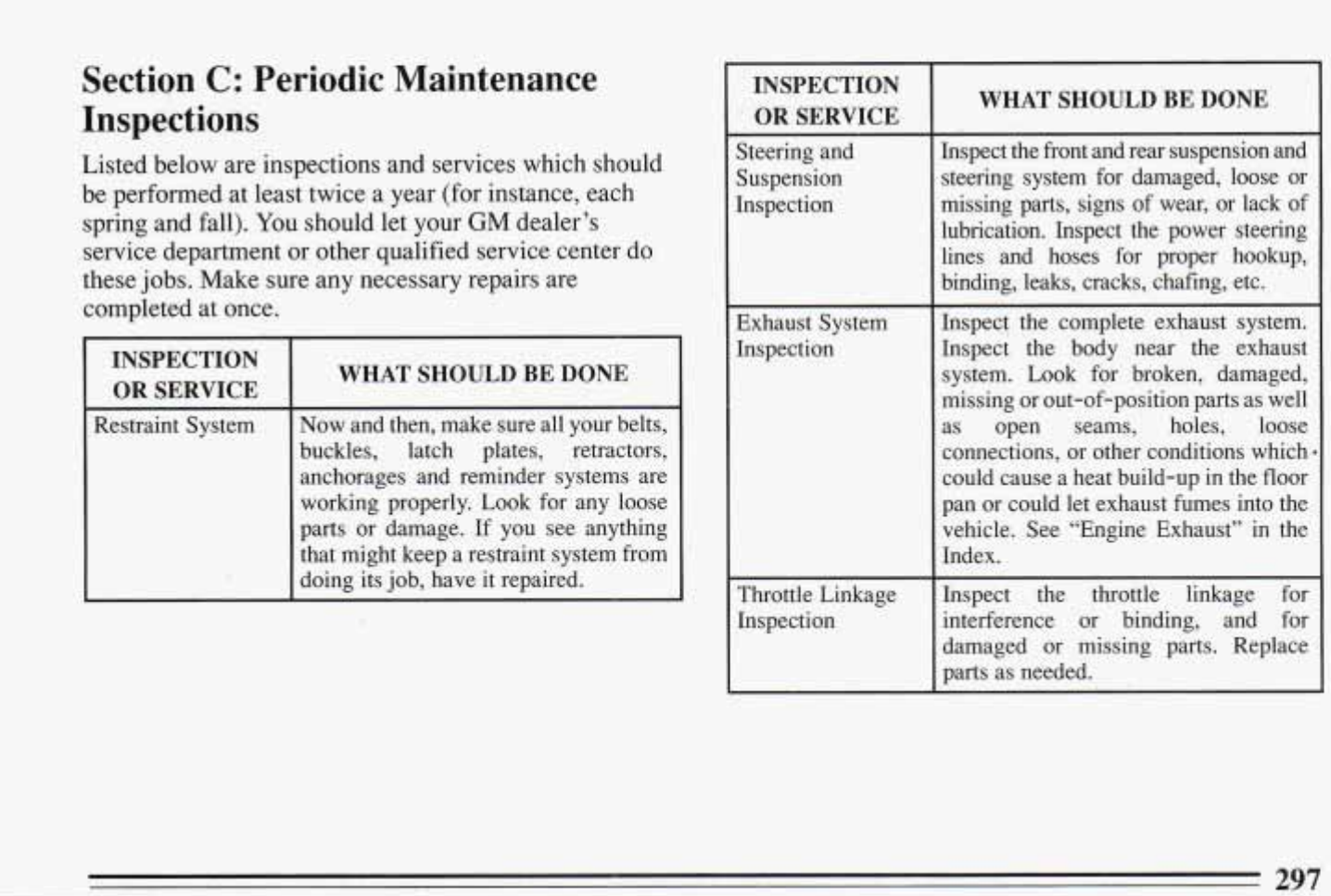
Section
C:
Periodic Maintenance
Inspections
Listed below are inspections and services which should
be performed at least twice a year (for instance, each
spring and fall).
You
should let your
GM
dealer’s
service department or other qualified service center
do
these
jobs.
Make sure any necessary repairs are
completed at once.
INSPECTION
OR
SERVICE
Restraint System
WHAT SHOULD BE DONE
Now and then, make sure all your belts,
buckles, latch plates, retractors,
anchorages and reminder systems are
working properly. Look for any loose
parts or damage.
If
you see anything
that might keep a restraint system from
doing its job, have it repaired.
INSPECTION
OR
SERVICE
Steering and
Suspension
Inspection
Exhaust System
tnspection
Throttle Linkage
Inspection
WHAT SHOULD BE DONE
Inspect the front and rear suspension and
steering system for damaged, loose or
missing parts, signs
of
wear, or lack of
lubrication. Inspect the power steering
lines and hoses for proper hookup,
binding, leaks, cracks, chafing, etc.
Inspect the complete exhaust system.
Inspect the body near the exhaust
system. Look for broken, damaged,
missing or out-of-position parts as well
as open seams, holes, loose
connections, or other conditions which-#
could cause a heat build-up
in
the floor
pan or could let exhaust fumes into the
vehicle. See “Engine Exhaust” in the
Index.
Inspect the throttle linkage for
interference or binding, and for
damaged or missing parts. Replace
parts as needed.
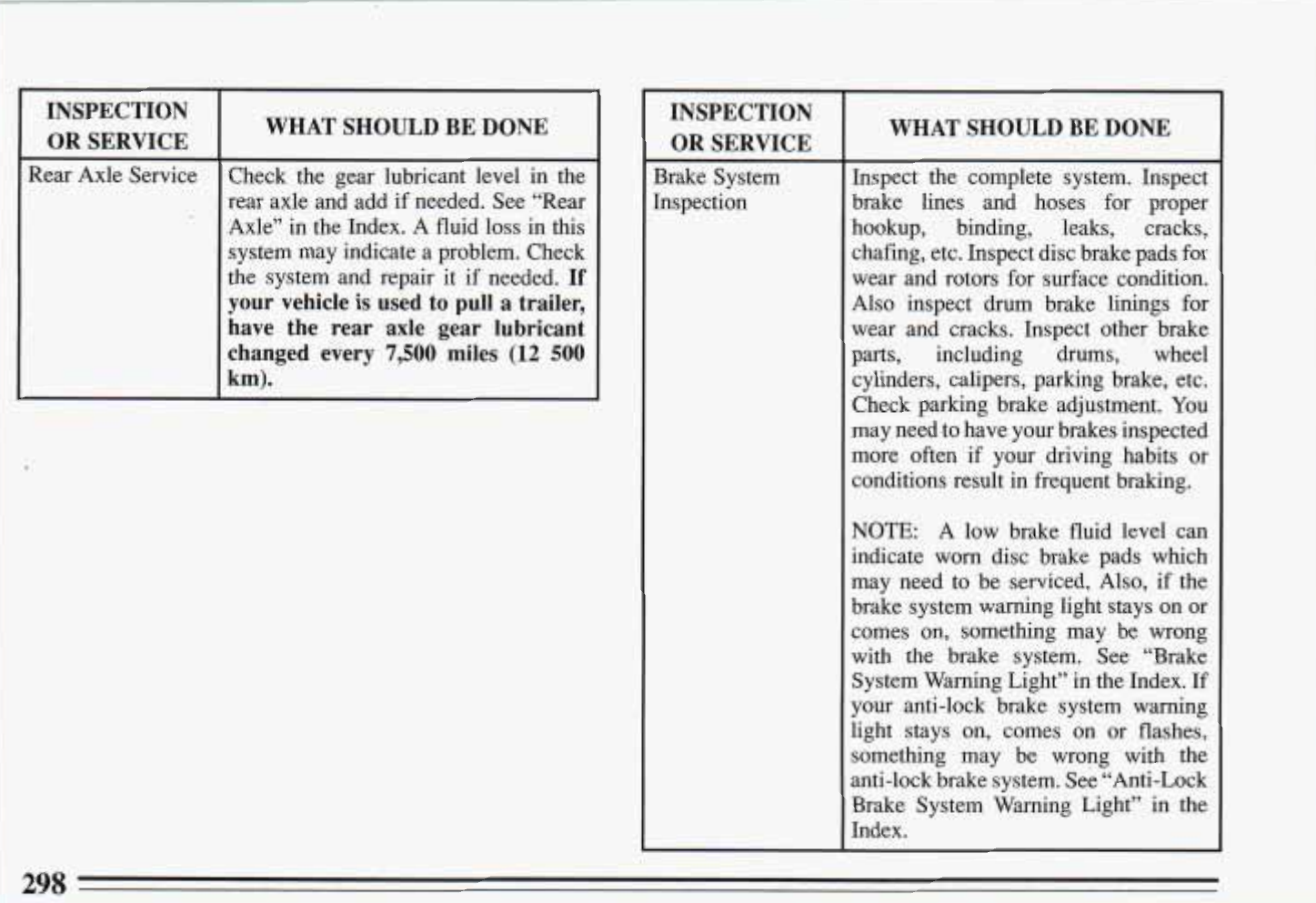
INSPECTION
OR
SERVICE
Rear Axle Service
I
~~
WHAT SHOULD BE DONE
Check the gear lubricant level in the
rear axle and add if needed. See “Rear
Axle” in the Index. A fluid loss in this
system may indicate a problem. Check
the system and repair it if needed.
If
your vehicle
is
used
to
pull
a trailer,
have the rear axle gear lubricant
changed eOery
7,500
miles
(12
500
km).
INSPECTION
OR SERVICE
Brake System
Inspection
WHAT SHOULD BE DONE
Inspect the, complete system. Inspect
brake lines and hoses for proper
hookup, binding, leaks, cracks,
chafing, etc. Inspect disc brake pads for
wear and rotors for surface condition.
Also inspect drum brake linings for
wear and cracks. Inspect other brake
parts, including drums, wheel
cylinders, calipers, parking brake, etc.
Check parking brake adjustment.
You
may need
to
have your brakes inspected
more often if your driving habits or
conditions result in frequent braking.
NOTE: A low brake fluid level can
indicate worn disc brake pads which
may need to be serviced, Also, if the
brake system warning light stays on or
comes on, something may be wrong
with the brake system.
See
“Brake
System Warning Light” in the Index. If
your anti-lock brake system warning
light stays on, comes on or flashes,
something may be wrong with the
anti-lock brake system. See “Anti-Lock
Brake System Warning Light” in the
Index.
298
I
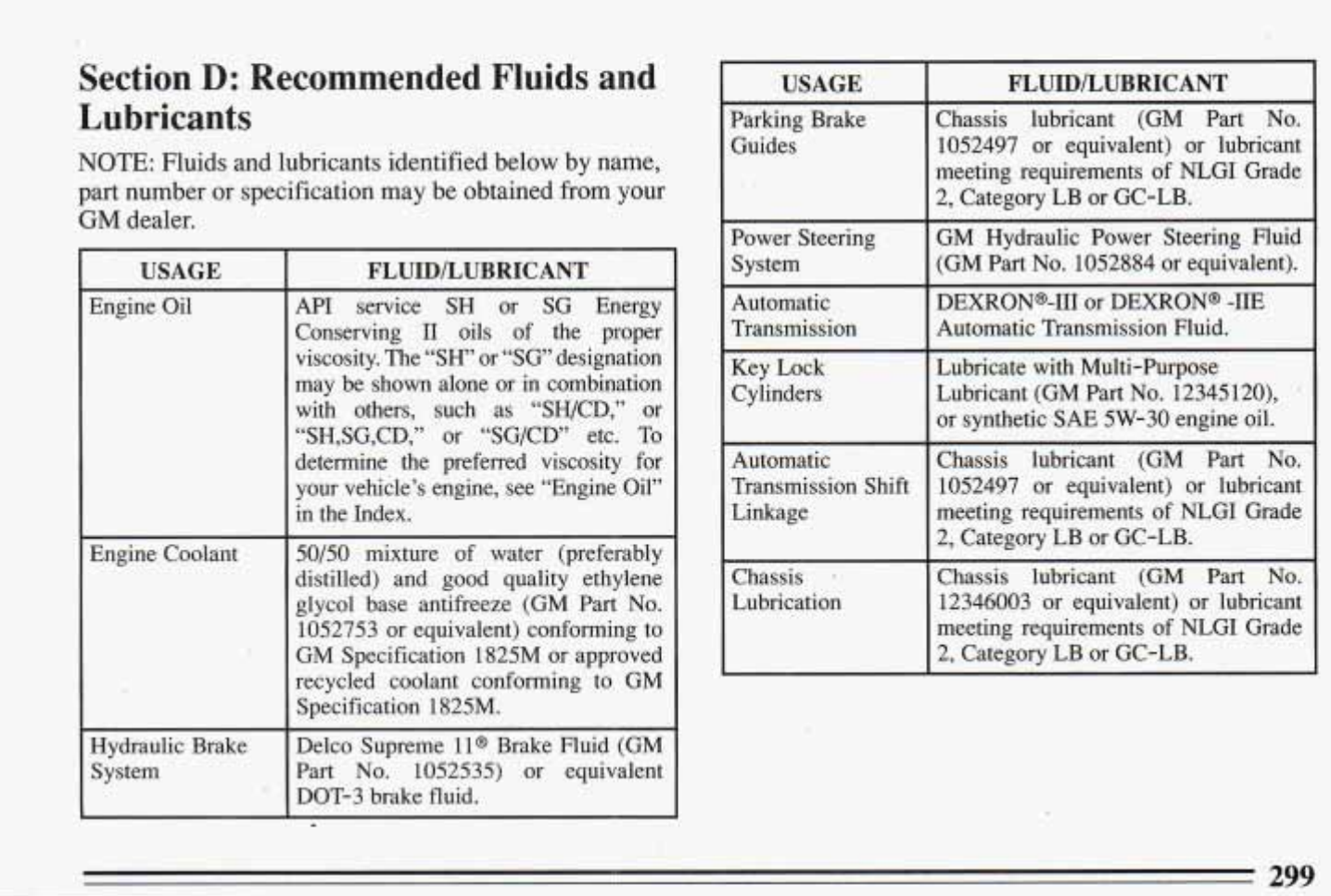
Section
D:
Recommended Fluids and
Lubricants
NOTE:
Fluids and lubricants identified below by name,
part
number or specification may be obtained from your
GM
dealer.
FLUID/LUBRICANT
API service SH or SG Energy
Conserving
II
oils of the proper
viscosity. The
“SH’
or
“SG’
designation
may be shown alone or in combination
with others, such as “SH/,D,” or
“SH,SG,CD,” or “SG/CD’ etc. To
determine the preferred viscosity for
your vehicle’s engine, see “Engine Oil”
in the Index.
50/50
mixture of water (preferably
distilled) and good quality ethylene
glycol base antifreeze (GM Part No.
1052753 or equivalent) conforming to
GM Specification 1825M or approved
recycled coolant conforming to GM
Specification 1825M.
Delco Supreme 11s Brake Fluid (GM
Part No. 1052535) or equivalent
DOT-3 brake fluid.
USAGE
Parking Brake
Guides
Power Steering
System
Automatic
Transmission
Key Lock
Cylinders
Automatic
Transmission Shift
Linkage
Chassis .
Lubrication
FLUID/LUBRICANT
Chassis lubricant (GM Part No.
1052497 or equivalent) or lubricant
meeting requirements
of
NLGI Grade
2, Category LB or GC-LB.
GM Hydraulic Power Steering Fluid
(GM Part No. 1052884
or equivalent).
DEXRONa-111 or DEXRON@ -1IE
Automatic Transmission Fluid.
Lubricate with Multi-Purpose
Lubricant (GM Part No. 12345120)’ .
or synthetic
SAE
5W-30
engine oil.
Chassis lubricant (GM Part No.
1052497
or
equivalent) or lubricant
meeting requirements
of
NLGI Grade
2, Category LB or GC-LB.
Chassis lubricant
(GM
Part No.
12346003 or equivalent) or lubricant
meeting requirements
of
NLGI Grade
2, Category LB or GC-LB.
299
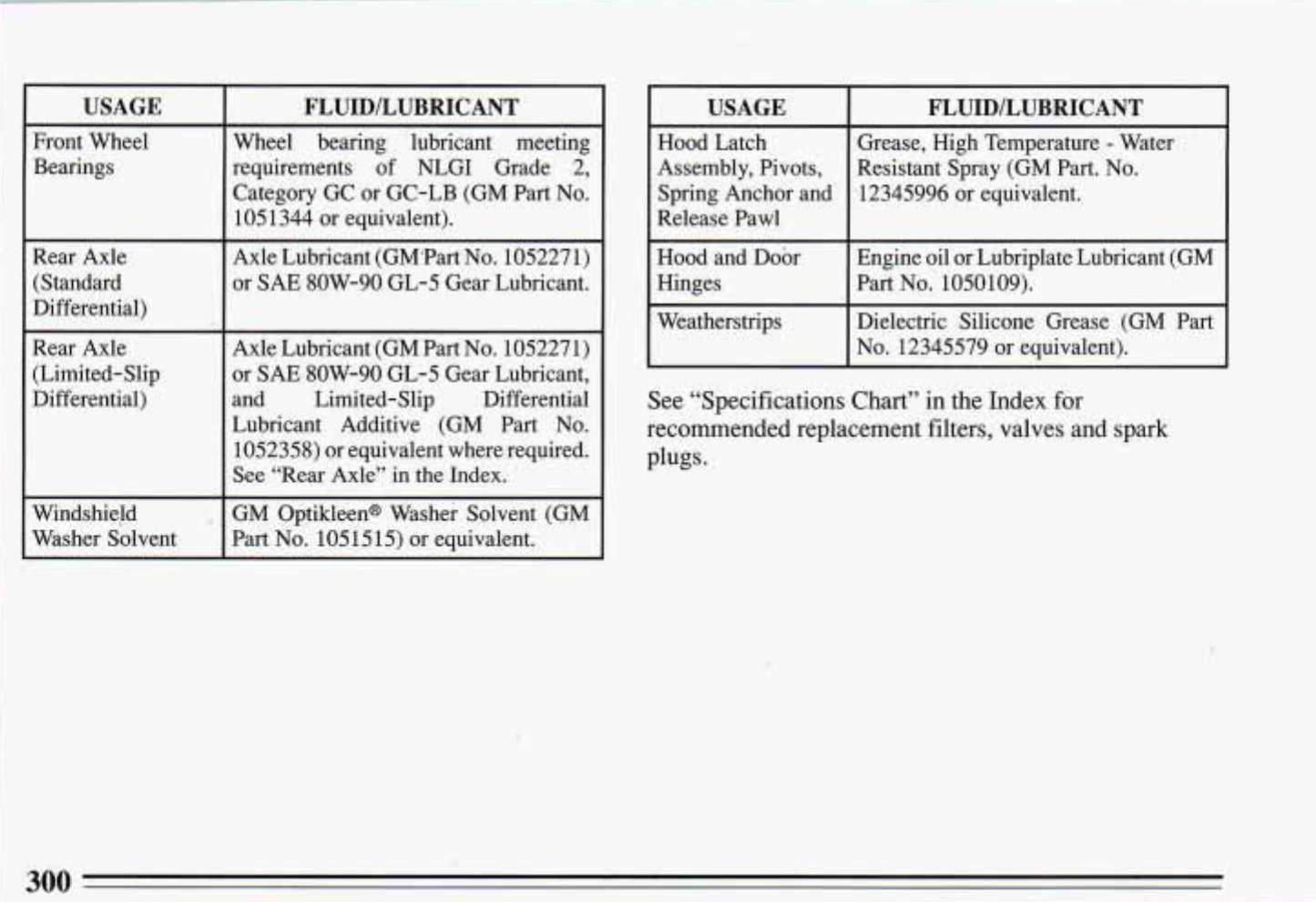
I’
USAGE
Front Wheel
Bearings
Rear Axle
(Standard
Differential)
Rear Axle
(Limited-Slip
Differential)
Windshield
Washer Solvent
FLUID/LUBRICANT
Wheel bearing lubricant meeting
requirements
of
NLGI Grade 2,
Category GC or GC-LB (GM Part
No.
105 1344 or equivalent).
Axle Lubricant (GM‘Part
No.
1052271)
or SAE 80W-90 GL-5 Gear Lubricant.
Axle Lubricant (GM Part
No.
105227 1)
or SAE 80W-90 GL-5 Gear Lubricant,
and Limited-Slip Differential
Lubricant Additive (GM Part
No.
1052358) or equivalent where required.
See “Rear Axle” in the Index.
GM Optikleena Washer Solvent (GM
Part
No.
105 15 15) or equivalent.
USAGE
Hood Latch
Assembly, Pivots,
Spring Anchor and
Release- Pawl
Hood and Door
Hinges
Weatherstrips
FLUID/LUBRICANT
Grease, High Temperature
-
Water
Resistant Spray (GM Part.
No.
-12345996
or
equivalent.
Engine oil or Lubriplate Lubricant (GM
Part
No.
1050109).
Dielectric Silicone Grease (GM Part
No.
12345579 or equivalent).
See “Specifications Chart” in the Index for
recommended replacement filters, valves and spark
plugs.
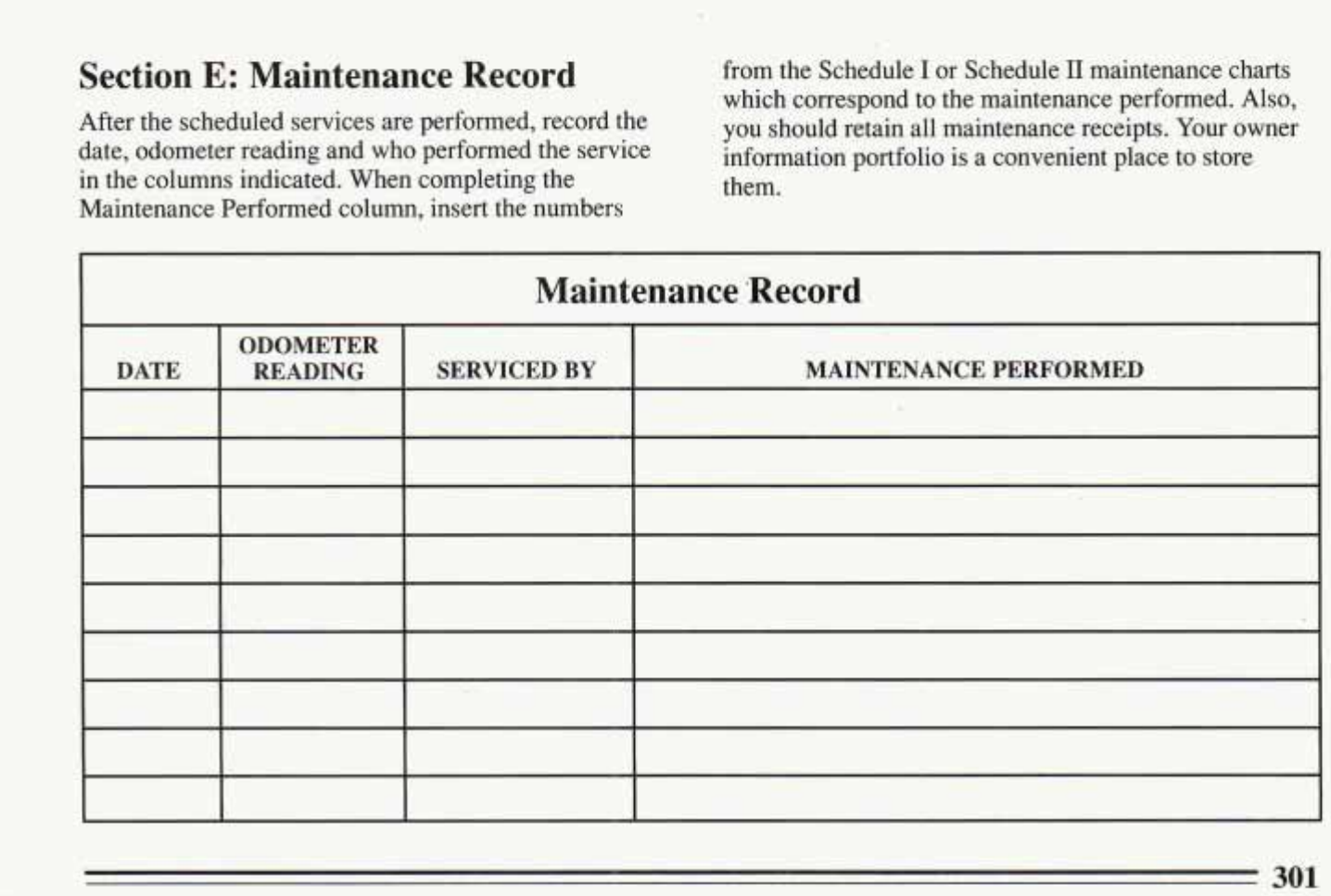
Section
E:
Maintenance Record
After the scheduled services are performed, record the
date, odometer reading and who performed the service
in
the columns indicated. When completing the
Maintenance Performed column, insert the numbers
from the Schedule
I
or Schedule
I1
maintenance charts
which correspond to the maintenance performed. Also,
you should retain all maintenance receipts. Your owner
information portfolio is a convenient place to store
them.
Maintenance 'Record
ODOMETER
DATE READING SERVICED
BY
MAINTENANCE PERFORMED
301
Maintenance Record
ODOMETER
DATE READING SERVICED
BY
MAINTENANCE PERFORMED
.
~
..
I
302
-
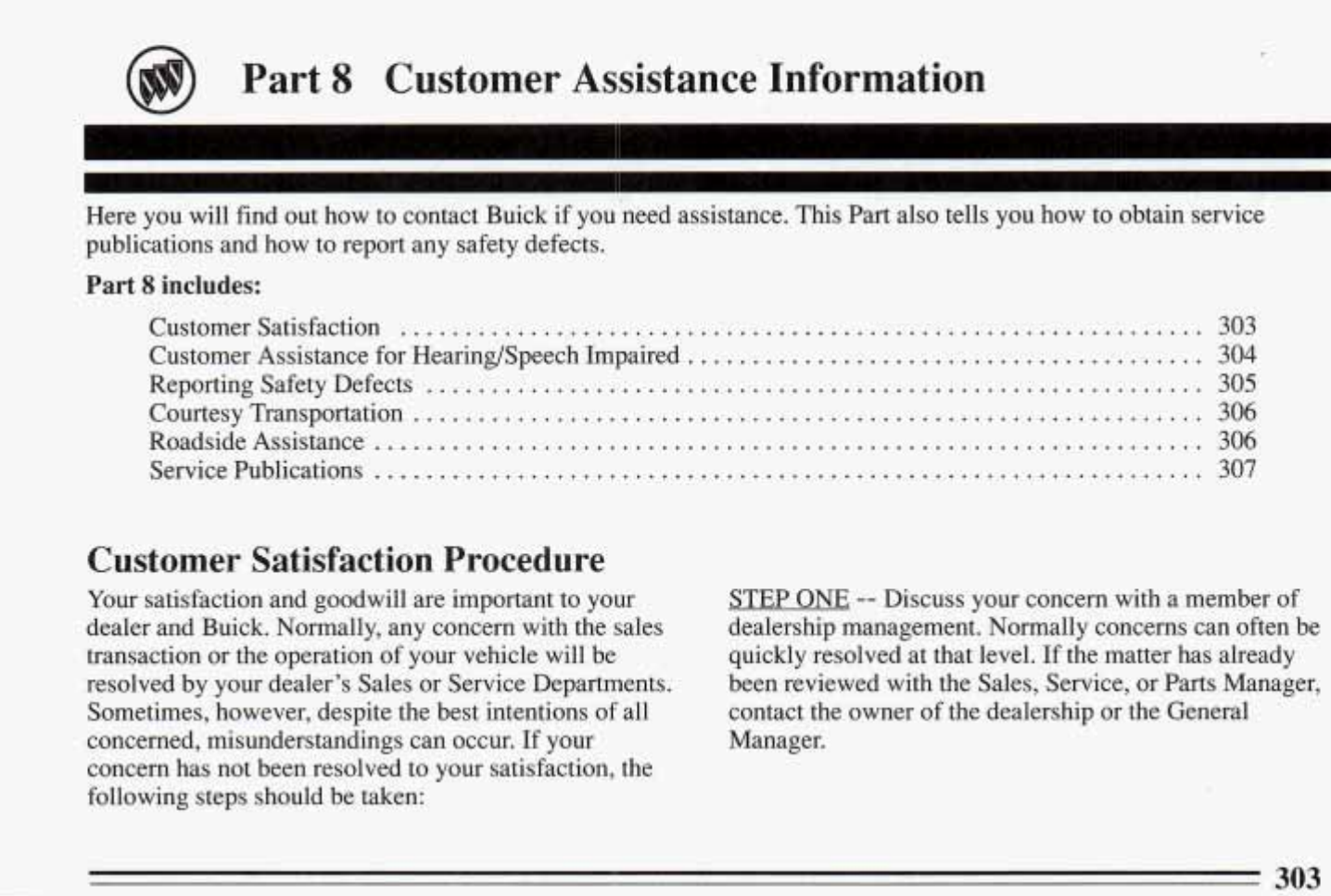
Part
8
Customer Assistance Information
I
Here you will find out how to contact Buick if you need assistance. This Part also tells you how to obtain service
publications and how to report any safety defects.
Part
8
includes:
Customer Satisfaction .............................................................. 303
Customer Assistance for Hearing/Speech Impaired
........................................
304
Reporting Safety Defects
............................................................
305
Courtesy Transportation
.............................................................
306
RoadsideAssistance
................................................................
306
ServicePublications
................................................................
307
Customer Satisfaction Procedure
Your satisfaction and goodwill are important to your
dealer and Buick. Normally, any concern with the sales
transaction or the operation of your vehicle will be
resolved by your dealer’s Sales or Service Departments.
Sometimes, however, despite the best intentions of all
concerned, misunderstandings can occur. If your
concern has not been resolved to your satisfaction, the
following steps should be taken:
STEP
ONE
--
Discuss your concern with a member of
dealership management. Normally concerns can often be
quickly resolved at
that
level. If the matter has already
been reviewed with the Sales, Service, or Parts Manager,
contact the owner of the dealership or the General
Manager.
303
0
0
0
0
0
Your name, address, home and business telephone
numbers
Vehicle Identification Number
(This
is
available
from the vehicle registration or title, or the plate at
the left top
of
the instrument panel and visible
through the windshield.)
Dealership name and location
Vehicle delivery date and present mileage
Nature
of
concern
304
REPORTING SAFETY DEFECTS
TO THE UNITED STATES
GOVERNMENT
If you believe that your vehicle has a defect which could
cause a crash or could cause injury or death, you should
immediately inform the National Highway Traffic
Safety Administration (NHTSA), in addition to
notifying General Motors.
If
NHTSA receives similar complaints, it may open an
investigation, and if it finds that a safety defect exists
in
a group of vehicles, it may order a recall and remedy
campaign. However, NHTSA cannot become involved
in individual problems between you, your dealer, or
General Motors.
To
contact NHTSA, you may either call the Auto Safety
Hotline toll-free at 1-800-424-9393
(or
366-0123 in the
Washington, D.C. area) or write to:
NHTSA,
U.S.
Department of Transportation
Washington, D.C. 20590
You can also obtain other information about motor
vehicle safety from the Hotline.
REPORTING SAFETY DEFECTS
TO THE CANADIAN.
.
GOVERNMENT
If you live in Canada, and you believe that your vehicle
has a safety defect, you should immediately notify
Transport Canada, in addition to notifying General
Motors of Canada Limited. You may write to:
Transport Canada at Box 8880
Ottawa, Ontario
KlG
352.
REPORTING SAFETY DEFECTS
TO GENERAL MOTORS
In
addition to notifying NHTSA (or Transport Canada)
in a situation like this, we certainly hope you’ll notify
us. Please call us at 1-800-521-7300
,
or write:
Buick Motor Division
Customer Assistance Center
902 E. Hamilton Avenue
Flint,
MI
48550.
In
Canada, please call us at 1-800-263-3777 (English)
or 1-800-263-7854 (French). Or, write:
General Motors of Canada Limited
Customer Assistance Center
1908 Colonel Sam Drive
Oshawa, Ontario LlH
8P7
Courtesy Transportation
To Buick Motor Division, Quality Means Service
--
and
service means “keeping you on the road.”
Included with your
1994
Buick new car warranty, (36
months, or 36,000 miles), is Courtesy Transportation, a
program which will provide Buick retail customers with:
-
Reimbursement toward a loaner vehicle, courtesy of
Buick Motor Division, for up to five days for
vehicles requiring overnight warranty repairs. Also,
reimbursement up to $30 a day
(5
days maximum)
may be available for the cost of a rental car, bus or
even a cab.
A free one-way shuttle ride up to
10
miles from the
dealership is available for customers whose vehicles
require same-day warranty repairs.
Courtesy Transportation
is
Buick’s way of extending the
Premium Service you’ve come to expect for Buick and
it’s
3,000
dealers. Please review the Courtesy
Transportation glove-box card contained in your
vehicle, or consult your Buick dealer for details.
In
Canada, please consult your
GM
Dealer for
in€Qgmation on courtesy transportation.
Roadside Assistance
Buick Motor Division is proud to offer Buick Roadside
Assistance to customers for vehicles covered under the
new car warranty during the 36 month/36,000 mile
(whichever comes first).
Our commitment to Buick owners has always included
superior service through our network of 3,000 Buick
dealers. Buick Roadside Assistance provides an extra
measure of convenience and security.
Buick Roadside Assistance:
-
Provides owners with access to minor repairs or
-
Takes the anxiety out of uncertain situations by
towing for disabled vehicles.
providing easy access to service .professionals trained
to work with Buick owners, 24-hour a day, 365 days
a year, including weekends and holidays.
For details of Buick Roadside Assistance
,
please
consult your Buick Roadside Assistance owner booklet
included with your owner’s manual. For needed
assistance, call the Buick Roadside Assistance toll-free
hotline: 1-800-252- 11 12.
Canada Roadside Assistance
Vehicles purchased in Canada have an extensive
Roadside Assistance program accessible from anywhere
in Canada or the United States. Please refer to the
separate brochure provided by the dealer or call
1-800-268-6800 for emergency services.
‘Service Publications
Information on how to obtain Product Service
Publications, Subscriptions and Indexes as described
below is applicable only in the fifty U.S. states (and the
District of Columbia) and only for ears and light trucks
with GVWR less than
10,000
pounds (4 536 kg).
In Canada, information pertaining to Product Service
Bulletins and Indexes can be obtained by writing to:
General Motors of Canada Limited
Service Publications Department
1908 Colonel Sam Dr.
Oshawa, Ontario L1H 8P7
Buick regularly sends its dealers useful service bulletins
about Buick products. Buick monitors product
performance in the field. We then prepare bulletins for
servicing our products better. Now, you can get these
bulletins too.
Bulletins cover various subjects. Some pertain to the
proper use and care
of
your vehicle. Some describe
costly repairs. Others describe inexpensive repairs
which, if done on time with the latest parts, may avoid
future costly repairs. Some bulletins tell a technician
how to repair a new or unexpected condition. Others
I
describe a quicker way to fix your vehicle. They can
help a technician service. your vehicle better.
Most bulletins apply to conditions affecting a small
number of cars or trucks. Your Buick dealer or a
qualified technician may have to determine if,a specific
bulletin applies
to
your vehicle.
You can subscribe to all Buick bulletins.
This
way you’ll
get them as they come out. You can wait a while and get
an
index to.the bulletins. You can also get individual
bulleths. However, you’ll need the index to identify them.
Subscriptions
You can subscribe to all GM Product Service
Publications (PSP’s). This will include bulletins for all
cars sold by GM and will not be limited to PSP’s
applicable to any particular model. When you buy a
subscription, you will receive the PSP’s in periodic
mailings, shortly after they come out.
A
subscription
entitles you to all PSP’s published
by
GM during the
made1 year. You can purchase a subscription and get
pricing information by calling HELM at 1-800-782-4356.
307
I
Individual
PSP’s
If you don’t want to buy all the PSP’s issued by
GM
for
all models in the model year, you can
buy
individual
PSP’s, such as those which may pertain to a particular
model. To do this, you will first need to see our index of
PSP’s. It provides a variety of information. Here’s what
you’ll find in the index and how you can get one:
What You’ll Find in the Index:
A list of all PSP’s published by Buick in a model
year (1990 or later). PSP’s covering all models of
Buick cars are listed in the same index.
Ordering information
so
you can buy
the
specific
Price information for the PSP’s you may want to
How
You
Can Get an Index:
Indexes are published periodically. Most
of
the
PSP’s
which could potentially apply to the most recent
GM
models will be listed in the most recent publication for
that model year. This means you may want to wait until
the end of the model year before ordering an index, if
PSP’s you may want.
buy.
you are interested in buying PSP’s pertaining to a
current model year car or truck.
Some PSP’s pertaining to a particular model year
vehicle may be published in later years, and these would
be listed in the later year’s index. When you order an
index for a model year that is not over yet, we’ll send
you the most recently published issue. Check the
ordering
form
for indexes for earlier model years.
Cut out the ordering form, fill
it
out, and mail it in. We
will then see to it that an index is mailed to you. There is
no
charge for indexes for the 1990- 1994 model years.
Copies at Participating Dealers
Copies of Indexes and individual PSP’s are at your
participating Buick dealer. You can ask to see them.
.
A
VERY IMPORTANT REMINDER: These PSP’s are
meant
for
technicians. They are not meant for the
“do-it-yourselfer.” Technicians have the equipment,
tools, safety instructions, and know-how to do
a
job
quickly and safely.
Buick Service Publications
You
can get these
by
using the order
form:
w
G
n
W
UJd
zn
an
za
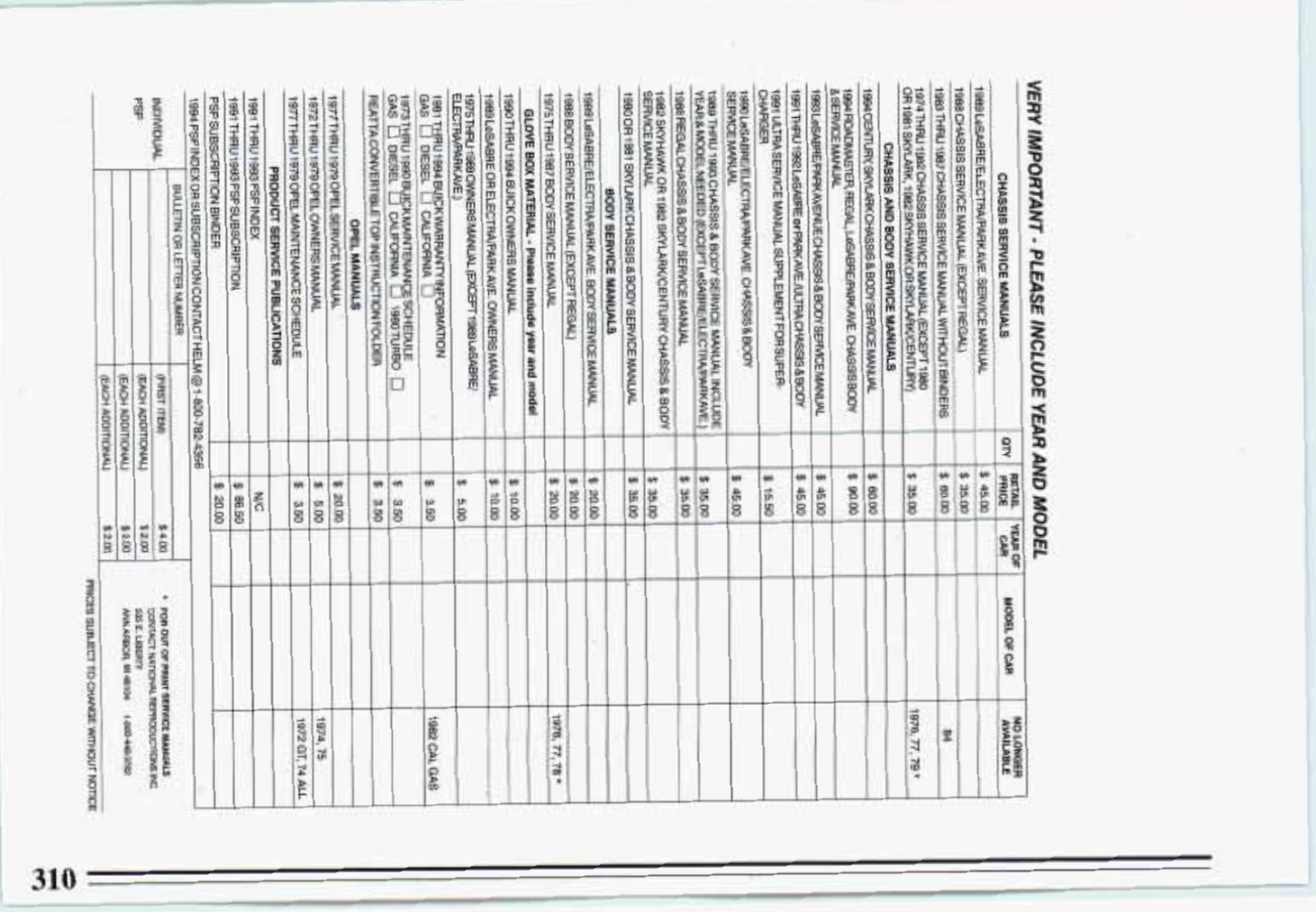
5
C
I
n
1-
t
I
z
3
I
I
3
Y
B.
r
r
-
I
I
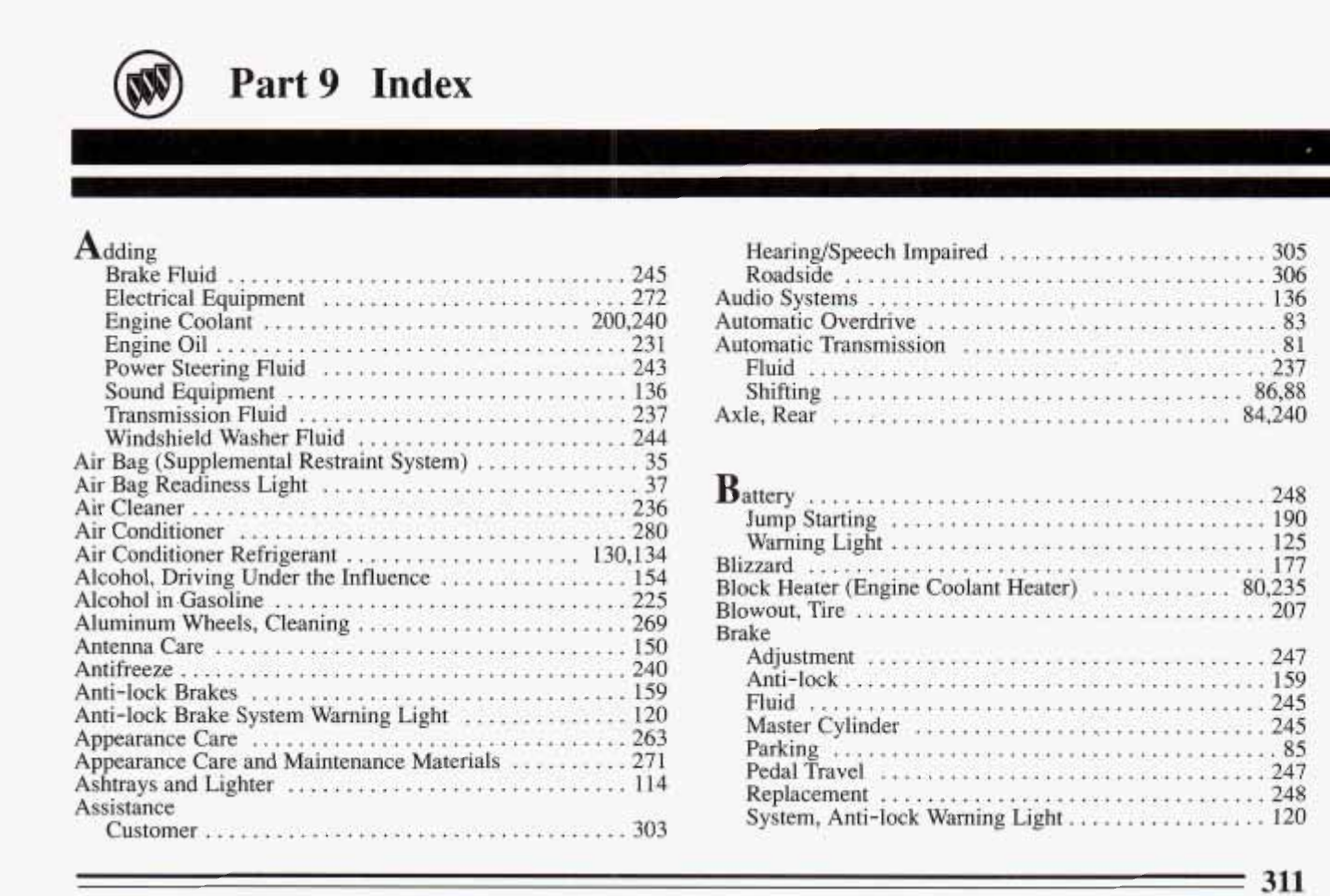
Part
9
Index
Adding
BrakeFluid .................................. 245
Electrical Equipment
..........................
272
Engine Coolant ........................... 200. 240
Engineoil ................................... 231
Power Steering Fluid
..........................
243
Sound Equipment
.............................
136
Transmission Fluid
............................
237
Windshield Washer Fluid
.......................
244
Air Bag Readiness Light
...........................
37
Aircleaner
.....................................
236
Airconditioner
.................................
280
Air Conditioner Refrigerant
....................
130. 134
Alcohol. Driving Under the Influence
................
154
Alcohol in .Gasoline
..............................
225
Aluminum Wheels. Cleaning
.......................
269
Antenna Care ................................... 150
Antifreeze
......................................
240
Anti-lock Brakes
................................
159
Anti-lock Brake System Warning Light
..............
120
Appearance Care
................................
263
Ashtrays and Lighter
.............................
1 14
Assistance
Customer
....................................
303
Air Bag (Supplemental Restraint System)
..............
35
Appearance Care and Maintenance Materials
..........
271
Hearing/Speech Impaired
.......................
305
Roadside
....................................
306
Automatic Overdrive
..............................
83
Automatic Transmission
...........................
81
Audio Systems
.................
~
................
136
Fluid .
.
Shifting
Axle. Rear
Battery . .
......................................
237
................................... 86,
88
.................................. 84, 240
.....................................
248
Jump Starting
................................
190
Warning Light ................................ 125
Blizzard
.......................................
177
Block Heater (Engine Coolant Heater)
............
80.
235
Blowout. Tire ................................... 207
Brake
Adjustment
..................................
247
Anti-lock
....................................
159
Fluid
.......................................
245
Master Cylinder
...............................
245
Parking
......................................
85
PedalTravel
.................................
247
Replacement
.................................
248
System. Anti-lock Warning Light
.................
120
311
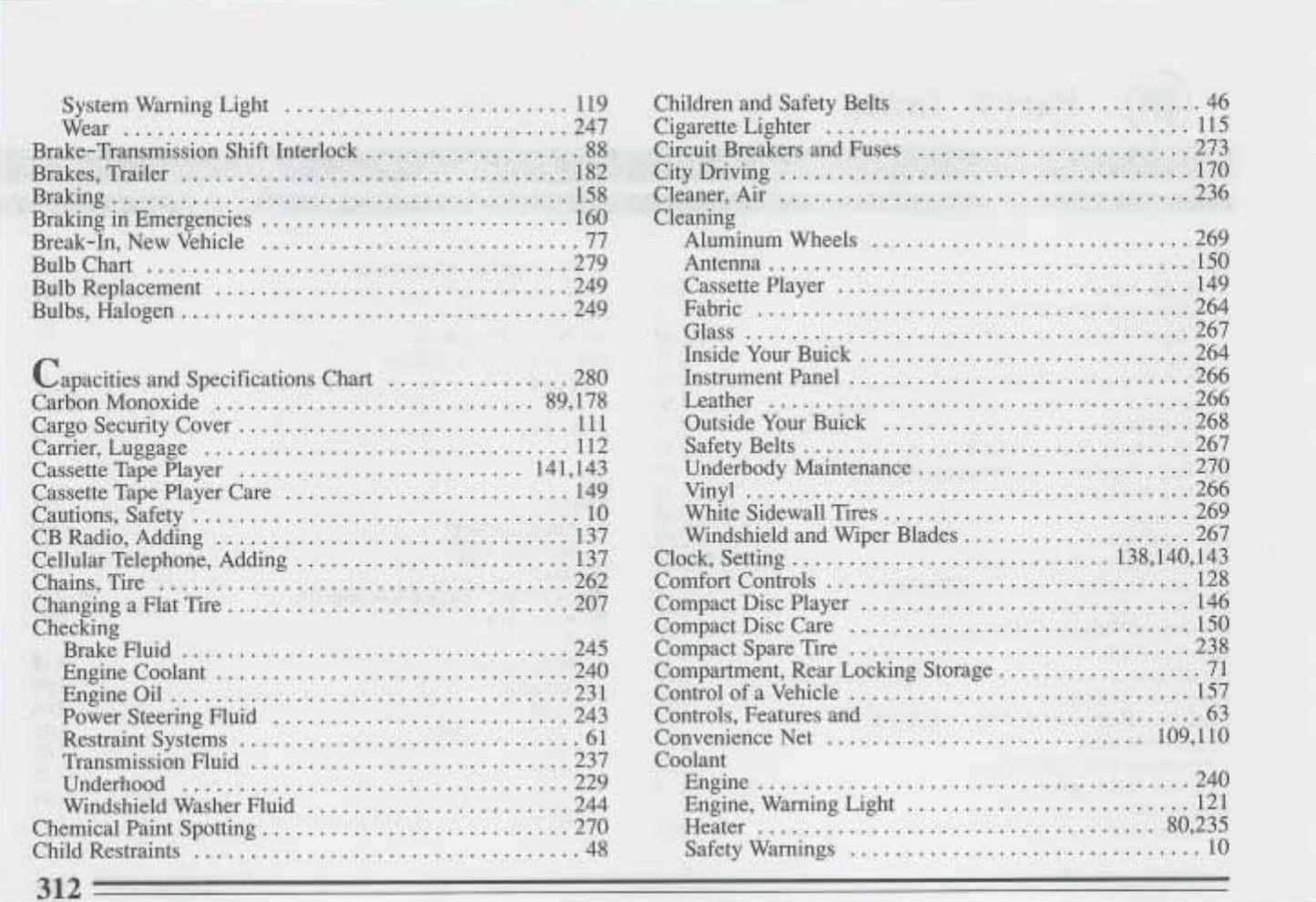
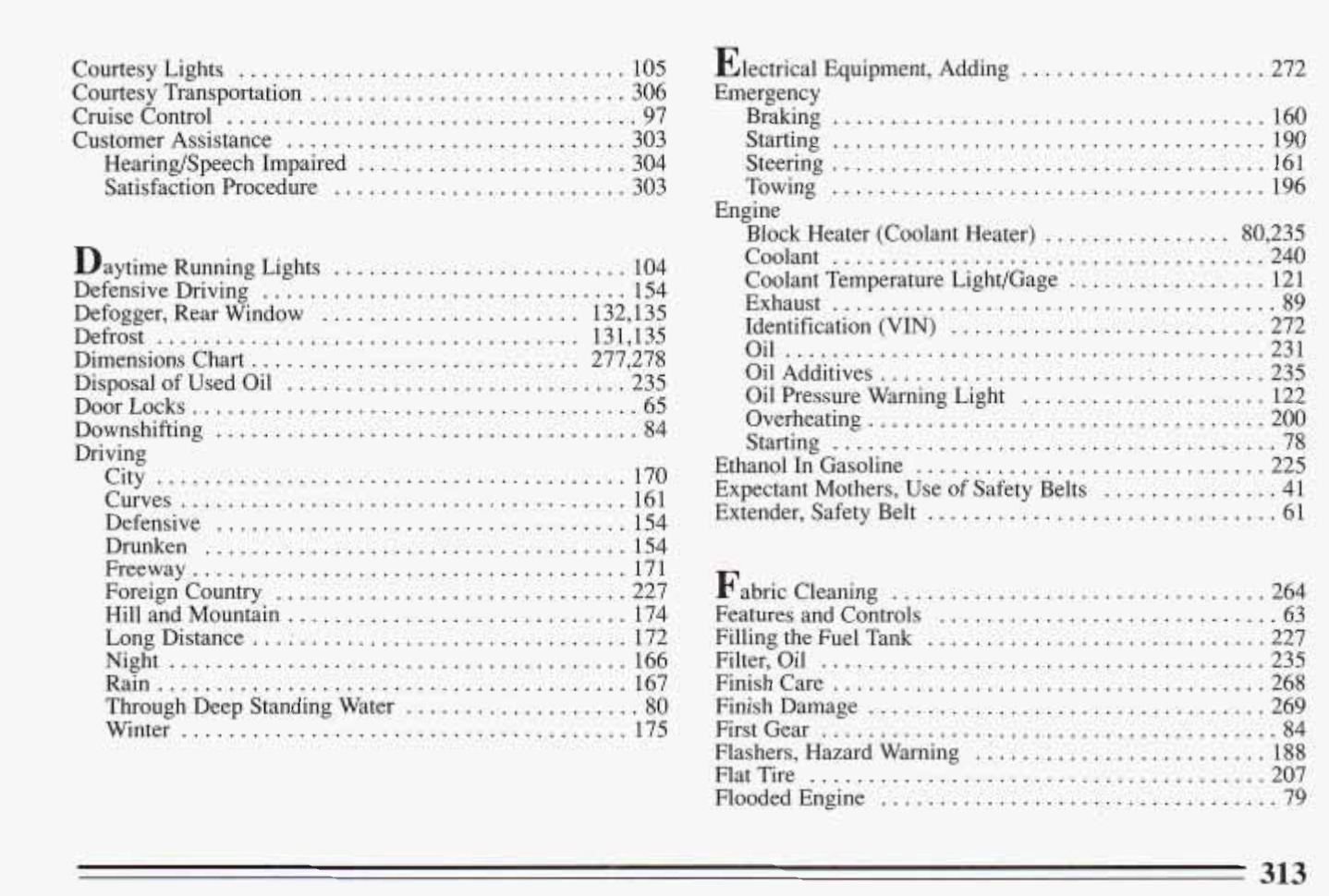
Courtesy Lights
.................................
105
Courtesy Transportation
...........................
306
Cruise Control
...................................
97
Customer Assistance
.............................
303
Hearing/Speech Impaired
.......................
304
Satisfaction Procedure ......................... 303
Daytime Running Lights
.........................
104
Defensive Driving
...............................
154
Defogger. Rear Window
......................
132. 135
Defrost .................................... 13 1. 135
Dimensions Chart
............................
277. 278
Disposal of Used Oil
.............................
235
Door Locks
......................................
65
Downshifting
....................................
84
Driving
City
........................................
170
Curves
......................................
161
Defensive ................................... 154
Drunken
....................................
154
Freeway
.....................................
171
Hill and Mountain
.............................
174
Long Distance
...
:
............................
172
Night
.......................................
166
Rain
........................................
167
Through Deep Standing Water
....................
80
Winter
......................................
175
Foreign Country
..............................
227
Electrical Equipment. Adding
.....................
272
Emergency
Braking
.....................................
160
Starting ..................................... 190
Steering
.....................................
161
Towing
.....................................
196
Engine
Block Heater (Coolant Heater)
................
80.
235
Coolant
.....................................
240
Coolant Temperature Light/Gage
.................
121
Exhaust
......................................
89
Identification (VIN)
...........................
272
Oil ......................................... 231
Oil Additives
..................................
235
Oil Pressure Warning Light
.....................
122
Overheating
..................................
200
Starting
.......................................
78
Ethanol In Gasoline
..............................
225
Expectant Mothers. Use
of
Safety Belts
...............
41
Extender. Safety Belt .............................. 61
Fabric Cleaning
................................
264
Features and Controls
.............................
63
Filling the Fuel Tank
.............................
227
Filter. Oil
......................................
235
Finish Care
.....................................
268
Finish Damage
..................................
269
First Gear
.......................................
84
Flashers. Hazard Warning ......................... 188
FlatTire
.......................................
207
FloodedEngine
..................................
79
313
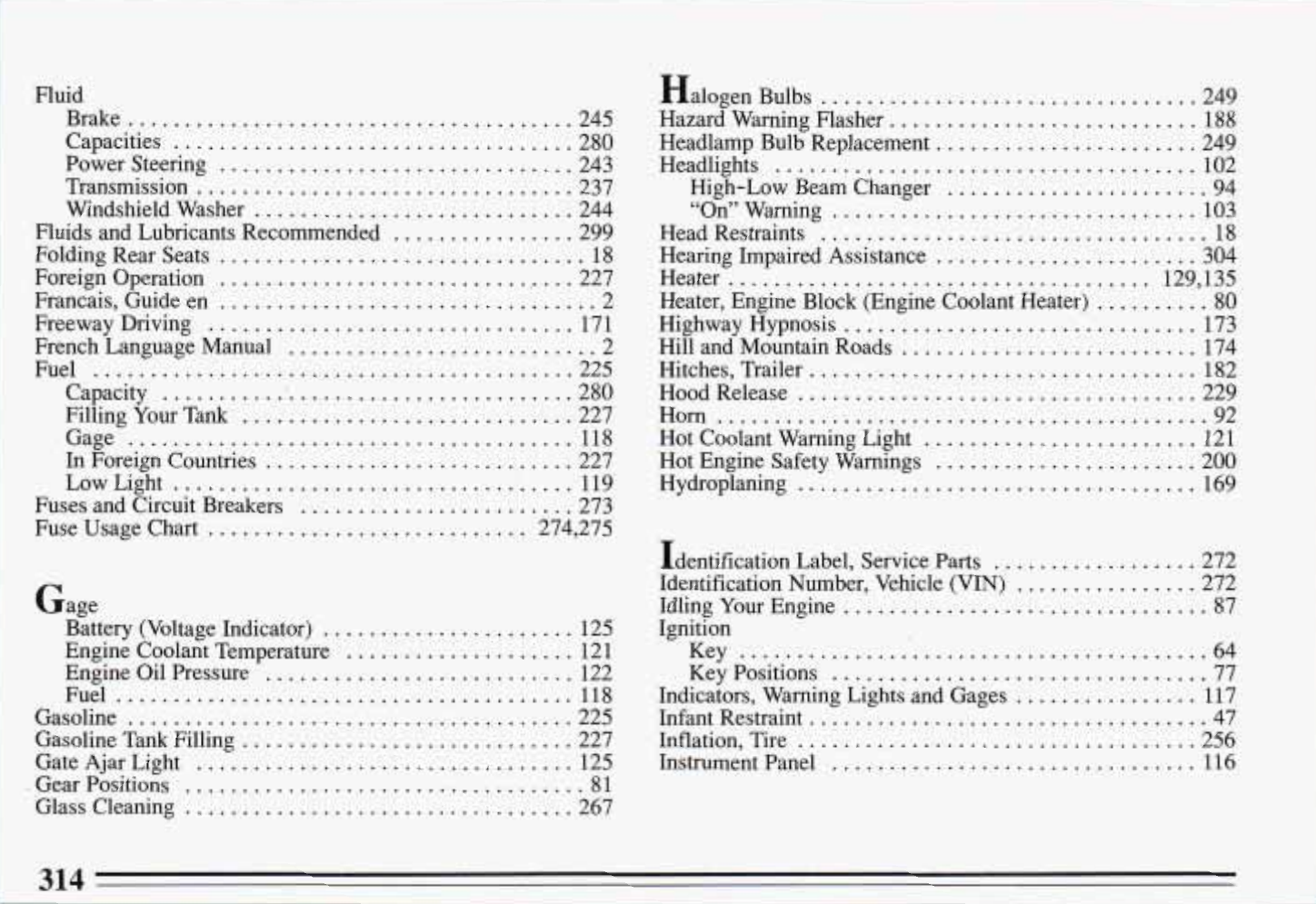
Fluid
Brake
.......................................
245
Capacities
...................................
280
Power Steering
...............................
243
Transmission
.................................
237
Windshield Washer
............................
244
Fluids and Lubricants Recommended
................
299
Folding Rear Seats
................................
18
Francais. Guide en
.................................
2
Freeway Driving
................................
17 1
French Language Manual
...........................
2
Fuel
..........................................
225
Capacity
.....................................
280
.Gage
.......................................
118
In Foreign Countries
...........................
227
Low Light
....................................
119
Fuses and Circuit Breakers
........................
273
Foreign Operation ................................ 227
Filling Your Tank
.............................
227
Fuse Usage Chart ............................ 274, 275
Gage
Battery (Voltage Indicator)
......................
125
Engine Coolant Temperature
....................
12 1
Engine Oil Pressure
...........................
122
Fuel
........................................
118
Gasoline
.......................................
225
Gasoline Tank Filling
.............................
227
Gate Ajar Light
..................................
125
Gear Positions
...................................
81
Glass Cleaning .................................. 267
Halogen Bulbs
.................................
249
lazard Warning Flasher
...........................
188
leadlamp Bulb Replacement
.......................
249
leadlights
.....................................
102
High-Low Beam Changer
.......................
94
“On” Warning
................................
103
lead Restraints
..................................
18
learing Impaired Assistance
.......................
304
leater
.....................................
129. 135
leater. Engine Block (Engine Coolant Heater)
..........
80
gighway Hypnosis
...............................
173
gill and Mountain Roads
..........................
174
litches. Trailer
..................................
182
3ood Release
...................................
229
3orn
...........................................
92
3ot Coolant Warning Light
........................
121
lot Engine Safety Warnings
.......................
200
3ydroplaning
...................................
169
Identification Label. Service Parts
..................
272
Identification Number. Vehicle
(VIN)
................ 272
Idling Your Engine ................................ 87
Key Positions
.................................
77
Indicators. Warning Lights and Gages
.................
117
Infant Restraint
...................................
47
Inflation. Tire ................................... 256
InstrumentPanel
................................
116
Ignition
Key
.........................................
64
I*
314
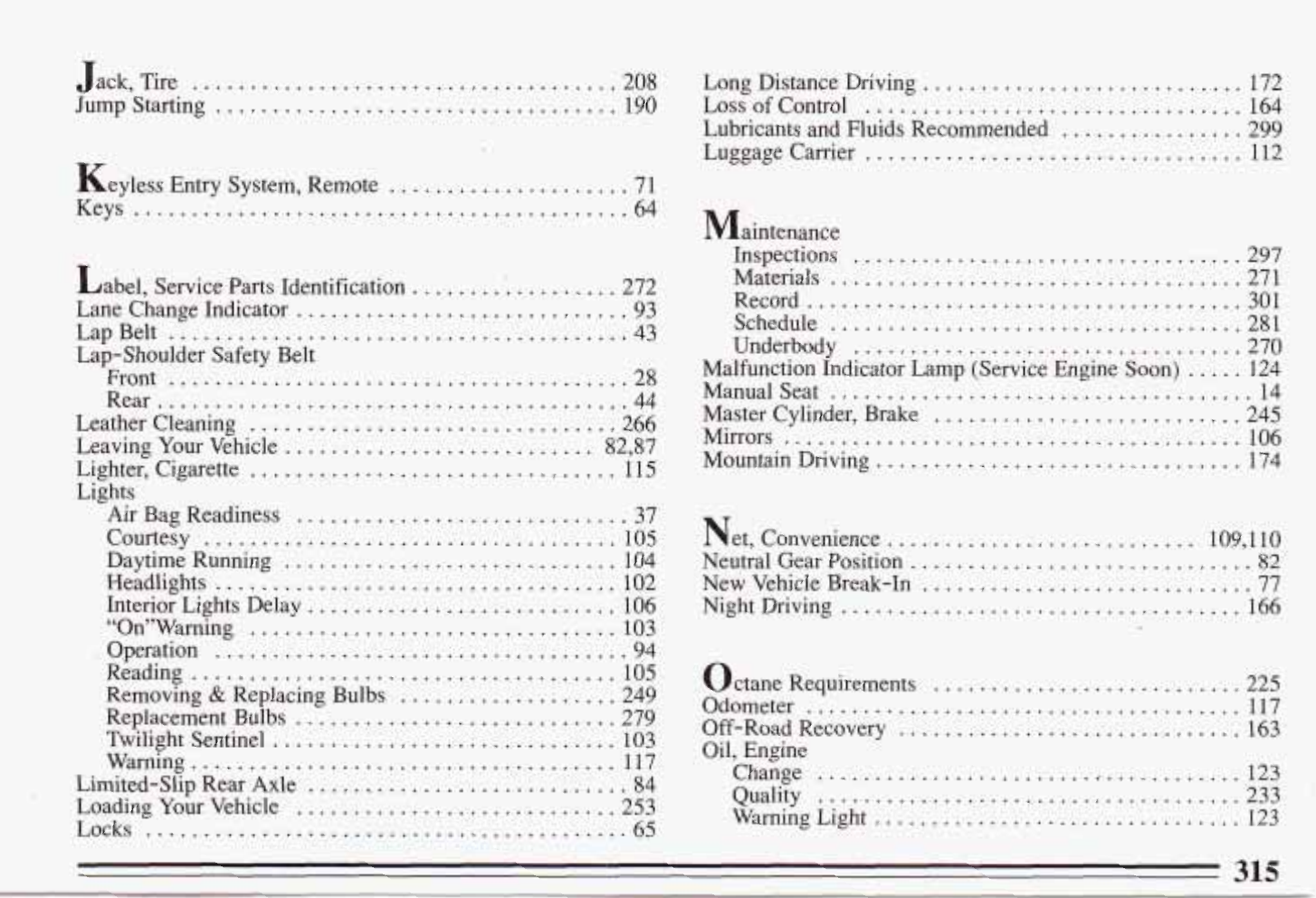
Jack. Tire
.....................................
208
Jump Starting
...................................
190
Keyless Entry System. Remote
.....................
71
Keys
...........................................
64
Label, Service Parts Identification
........
......... 272
LapBelt ........................................ 43
Lap-Shoulder Safety Belt
Front
........................................
28
Rear
.........................................
44
Lane Change Indicator
.............................
93
Leather Cleaning
................................
266
Leaving Your Vehicle
...........................
82, 87
Lighter, Cigarette
................................
1 15
Courtesy
....................................
10
5
Daytime Running ............................. 104
Headlights
...................................
102
Interior Lights Delay
...........................
106
“0n”Warning
................................
103
Operation
....................................
94
Reading
.....................................
105
Removing
&
Replacing Bulbs ................... 249
Twilight Sentinel
..............................
103
Limited-Slip Rear Axle
.............................
84
Loading Your Vehicle
............................
253
Lights
Air Bag Readiness ............................. 37
Replacement .Bulbs
.................
;
..........
279
Warning
.....................................
117
Locks
..........................................
65
Long Distance Driving
............................
172
Loss
of
Control
.................................
164
Lubricants and Fluids Recommended
.................
299
Luggage Carrier
.................................
112
...
Inspections
..................................
ZY‘/
Materials
....................................
271
Record
......................................
301
Schedule
....................................
281
Underbody .................................. 270
Malfunction Indicator Lamp (Service Engine Soon)
.....
124
Manualseat
.....................................
14
Master Cylinder, Brake
...........................
245
Mirrors
........................................
106
Mountain Driving
................................
174
Net. Convenience
...........................
109. 110
Neutral Gear Position
..............................
82
New Vehicle Break-In
.............................
.
77
__
NightDriving
...................................
166
0
ctane Requirements
...........................
225
Odometer ...................................... 117
Off-Road Recovery
.....
i
.........................
163
Oil. Engine
Change
......................................
123
Quality
.....................................
233
Warning Light
................................
123
315
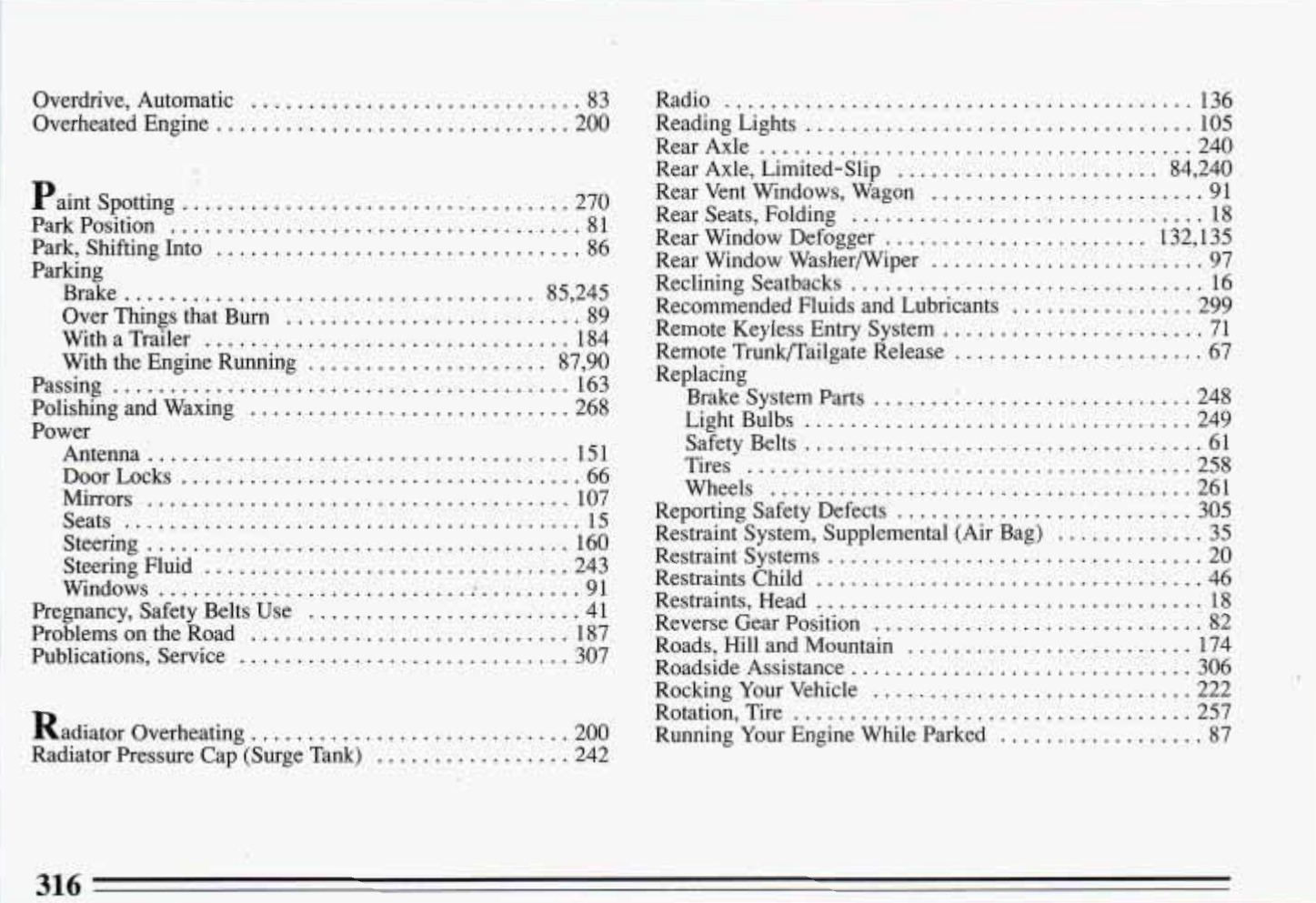
Overdrive. Automatic
.............................
83
Overheated Engine
...............................
200
Paint Spotting
.
-;
................................
270
Park Position
....................................
81
Park. Shifting Into
................................
86
Parking
Brake
.....................................
85. 245
Over Things that Burn
..........................
89
With a Trailer
................................
184
With the Engine Running
.
...................
87. 90
Passing
........................................
163
Polishing and Waxing
............................
268
Power
Antenna ..................................... 151
DoorLocks
...................................
66
Mirrors
.....................................
107
Seats
........................................
15
Steering
.....................................
160
Windows
......................................
91
Pregnancy, Safety Belts Use
........................
41
Problems on the Road
............................
187
Publications. Service
.............................
307
Steering Fluid
................................
243
Radiator Overheating
............................
200
Radiator Pressure Cap (Surge Tank)
.................
242
Radio
.........................................
136
Reading Lights
...................................
105
Rear Axle ...................................... 240
Rear Axle. Limited-Slip
.......................
84. 240
Rear Vent Windows. Wagon
........................
91
Rear Seats. Folding
................................
18
Rear Window Defogger
.......................
132. 135
Rear Window Washermiper
........................
97
Reclining Seatbacks
...............................
16
Recommended Fluids and Lubricants
................
299
Remote Keyless Entry System
.......................
71
Remote Trunk/Tailgate Release
......................
67
Replacing
Brake System Parts
.......
:
....................
248
Light Bulbs .................................. 249
Safety Belts
...................................
61
Tires ....................................... 258
Wheels ...................................... 261
Reporting Safety Defects
..........................
305
Restraint System. Supplemental (Air Bag)
.............
35
Restraint Systems
.................................
20
Restraints Child .................................. 46
Restraints. Head
...................................
18
Reverse Gear Position
.............................
82
Roads. Hill and Mountain
.........................
174
Roadside Assistance
..............................
306
Rocking Your Vehicle
............................
222
Rotation. Tire
...................................
257
Running Your Engine While Parked
..................
87
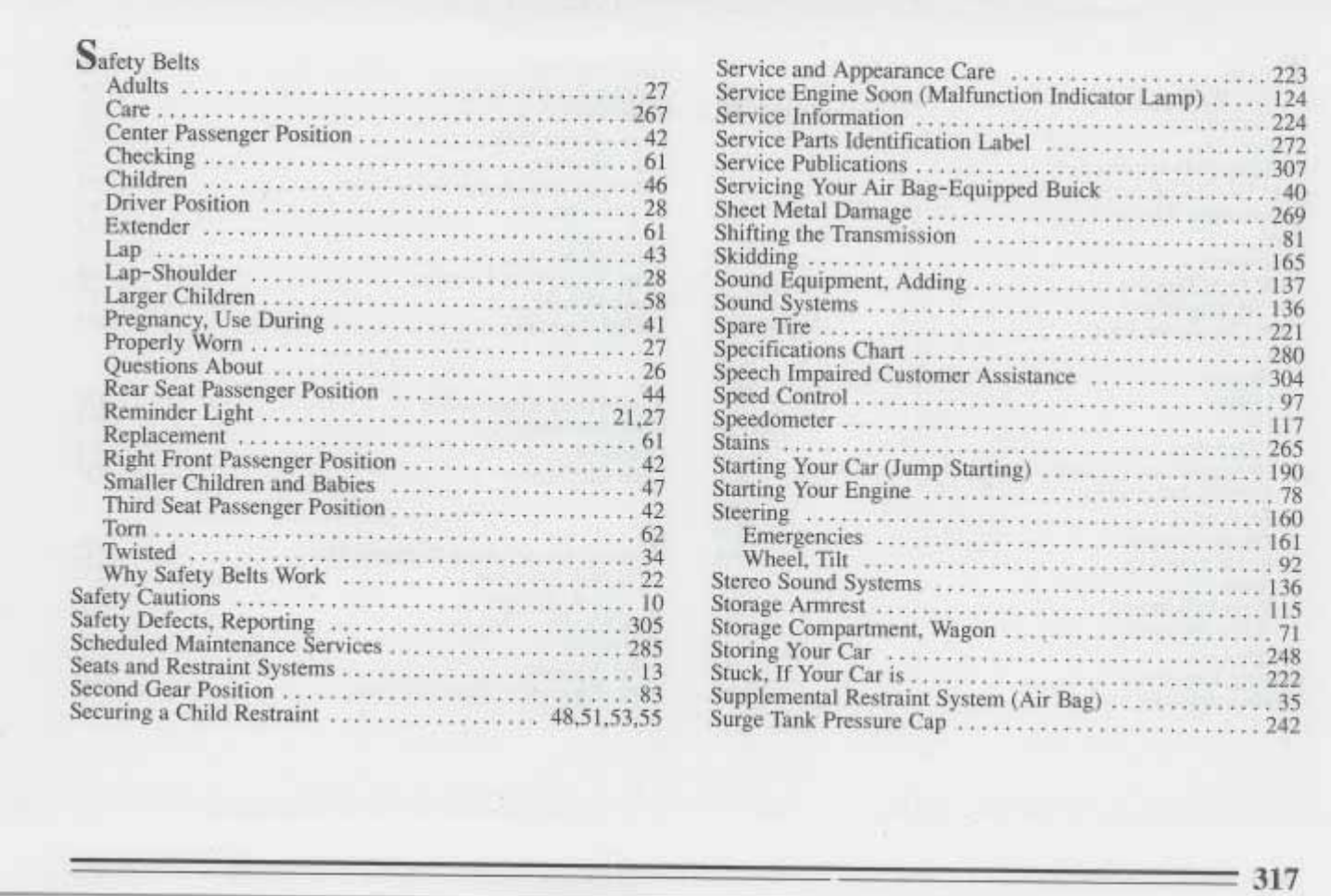
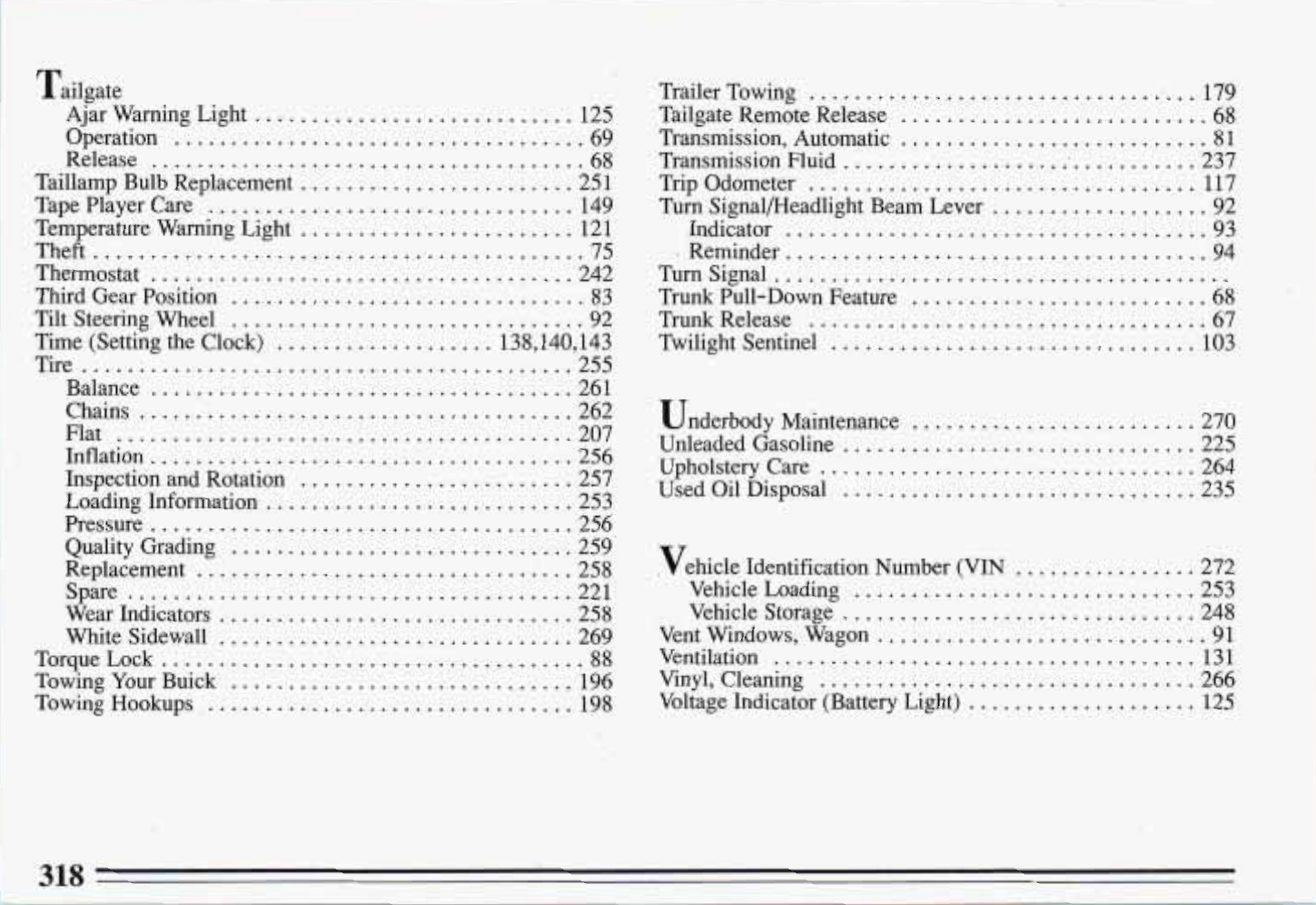
Tailgate
Ajar Warning Light
............................
125
Operation
....................................
69
Release
......................................
68
Taillamp Bulb Replacement ........................ 251
Tape Player Care
................................
149
Temperature Warning Light
........................
121
Theft
...........................................
75
Thermostat
.....................................
242
Third Gear Position
...............................
83
Time (Setting the Clock)
...................
138.140. 143
Tire
...........................................
255
Balance
.......................................
261
Chains
......................................
262
Flat
........................................
207
Inflation
.....................................
256
Inspection and Rotation ........................ 257
Loading Information
...........................
253
Pressure
.......................................
256
Quality Grading
..............................
259
Replacement
.................................
258
Spare
.......................................
221
Wear Indicators
...............................
258
White Sidewall
...............................
269
TorqueLock
.....................................
88
Towing Your Buick
..............................
196
Towing Hookups
..................................
198
Tilt Steering.Whee1 ............................... 92
Trailer Towing
...................................
179
Tailgate Remote Release
...........................
68
Transmission. Automatic
...........................
81
Trip Odometer
..................................
117
Turn Signalmeadlight Beam Lever
...................
92
Transmission Fluid
................................
237
Indicator
.....................................
93
Reminder
.....................................
94
Turnsignal
........................................
Trunk Pull-Down Feature
..........................
68
Trunk Release
...................................
67
Twilight Sentinel
................................
103
Underbody Maintenance
.........................
270
Unleaded Gasoline
...............................
225
Upholstery Care
.................................
264
Used Oil Disposal
...............................
235
.vehicle Identification Number (VIN
................
272
Vehicle Loading
.............................
-253
Vehicle Storage
...............................
248
Vent Windows. Wagon ............................. 91
Ventilation
.....................................
131
Vinyl. Cleaning
.................................
266
Voltage Indicator (Battery Light)
....................
125
...
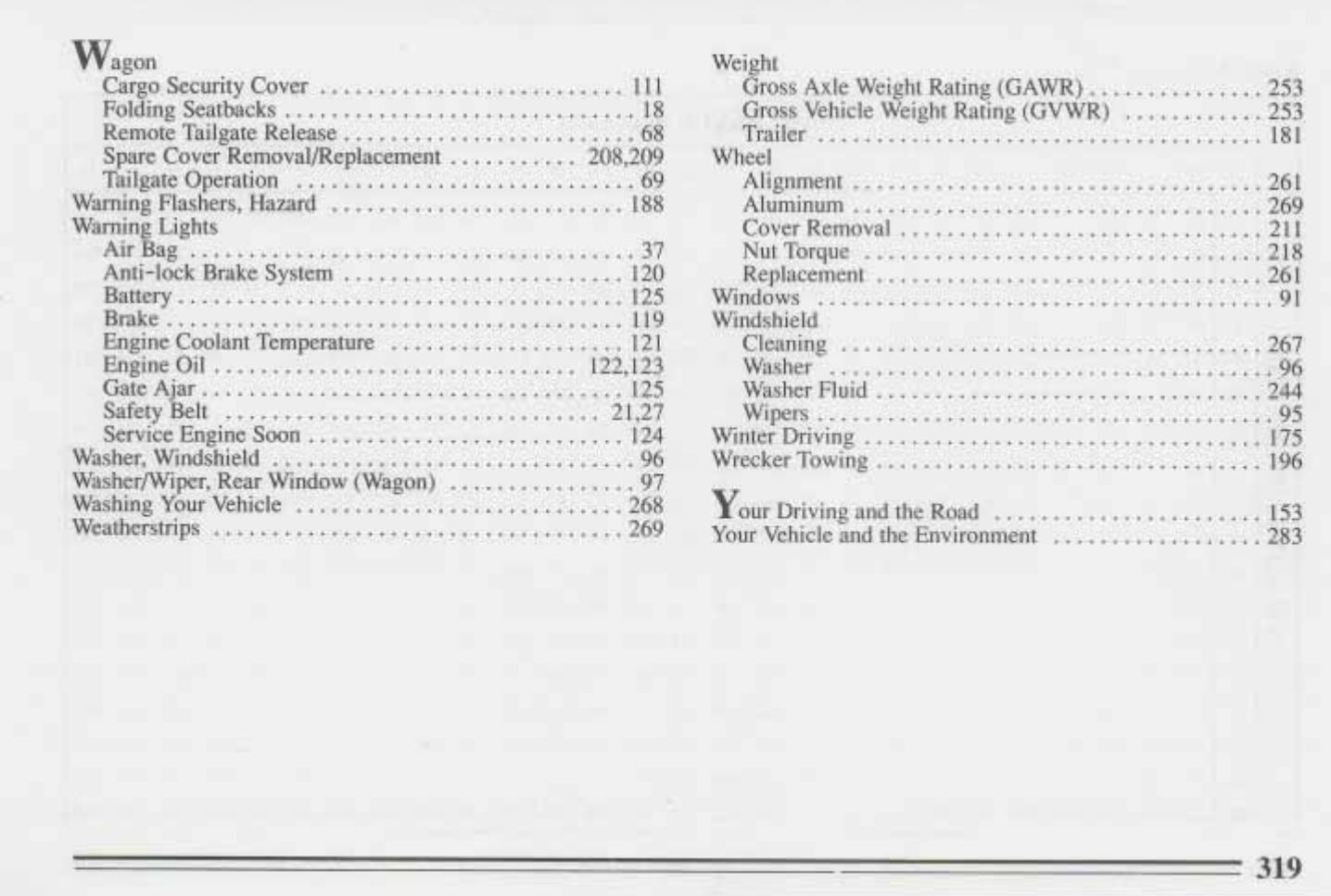
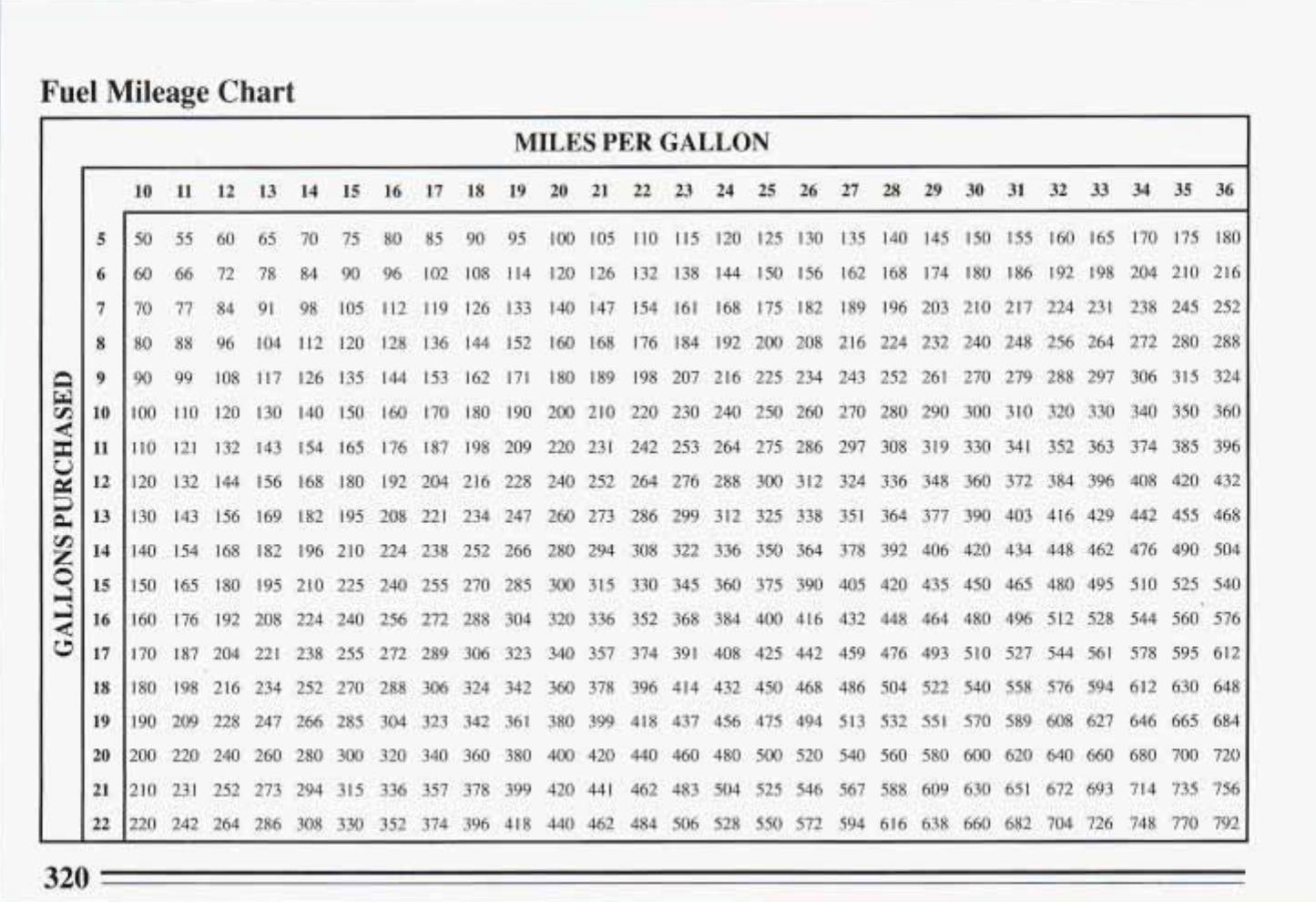
Fuel
Mileage
Chart
MILES
PER
GALLON
5
6
7
8
9
10
11
12
13
14
15
16
17
18
19
20
21
22
-
10 11 12 13 14 15 16 17 18 19
20
21 22 23 24 25 26 27 28 29 30 31 32 33 34 35 36
50 55
60 65 70 75
80
85
90 95 100
105
110
115
120 125 130
135
140 145
150
155 160 165 170 175
180
60 66 72 78 84 90 96 102 108 114 120 126 132
138
144 150
156
162 168 174
180
186 192 198 204 210 216
70 77 84 91 98
105
112
119 126
133
140 I47 154 161 168 175 182 189 196 203 210 217 224 231 238 245 252
80
88 96 104 112 120 128 136 144 152 160 168 176 184 192 200 208 216 224 232 240 248 256 264 272 280 288
90 99
108
I
I7 126
135
144
153
162 171
180
189 198 207 216 225 234 243 252 261 270 279 288 297 306
315
324
100
110
120 130 140
150
160 170
180
190 200 210 220 230 240 250 260 270 280 290 300 310 320 330 340 350 360
110
121 132 143 154
165
176 187 198 209 220 231 242 253 264 275 286 297 308 319 330 341 352 363 374 385 396
120 132 144 156 168
180
192 204 216 228 240 252 264 276 288 300
3
12 324 336 348 360 372 384 396 408 420 432
I30
143 156 169 182 195 208 221 234 247 260 273 286 299
3
12 325 338
351
364 377 390 403 416 429 442 455 468
140 154 168 182 196 210 224 238 252 266 280 294 308 322 336 350 364 378 392 406 420 434 448 462 476 490
504
150
165
180
195 210 225 240 255 270 285 300
31
5
330 345 360 375 390 405 420 435 450 465 480 495
5
10
525 540
160 176 192 208 224 240 256 272 288 304 320 336 352 368 384 400 41 6 432 448 464 480 496 512 528 544 560 576
170 187 204 221 238 255 272 289 306 323 340 357 374 391 408 425 442 459 476 493
5
IO
527 544 561 578 595 612
180
198 216 234 252 270 288 306 324 342 360 378 396 414 432 450 468 486 504 522 540 558 576 594 612 630 648
190 209 228 247 266 285 304 323 342 361 380 399 41
8
437 456 475 494
51
3
532
55
1
570 589 608 627 646 665 684
!OO
220 240 260 280 300 320 340 360 380 400 420 440 460 480 500 520 540 560
580
600 620 640 660 680 700 720
!IO
23
1
252 273 294
315
336 357 378 399 420 441 462 483 504 525 546 567
588
609 630 65
1
672 693 714 735 756
!20 242 264 286 308
330
352 374 396 41
8
440 462 484 506 528 550 572 594 616 638 660 682 704 726 748 770 792
320

THIS
MANUAL
IS
PRINTED
ON
RECYCLED
PAPER
USING
MINIMUM
50%
WASTEPAPER,
10%
POST
CONSUMER
WASTE
