CASIO Cameras, All Manual L0806027
User Manual: CASIO CASIO Cameras, All Manual CASIO Cameras, All Owner's Manual, CASIO Cameras, All installation guides
Open the PDF directly: View PDF  .
.
Page Count: 139 [warning: Documents this large are best viewed by clicking the View PDF Link!]
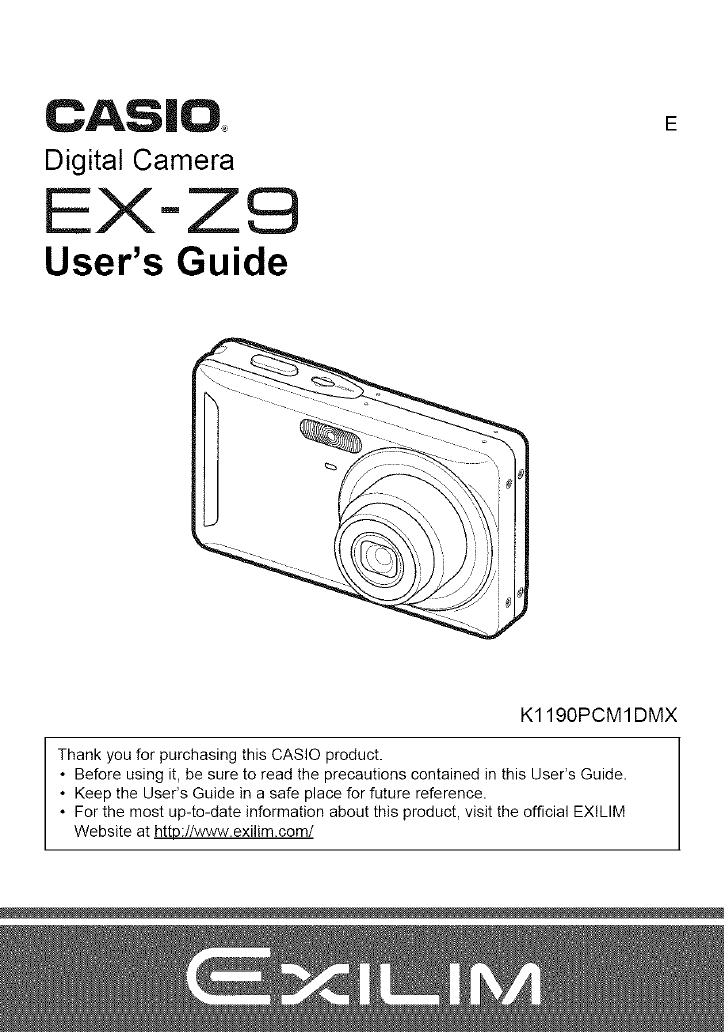
CAS|O
Digital Camera
EX- 9
User's Guide
K1190PCM 1DMX
Thank you for purchasing this CASIO product.
• Before using it, be sure to read the precautions contained in this User's Guide.
• Keep the User's Guide in a safe place for future reference.
• For the most up-to-date information about this product, visit the official EXILIM
Website at httD://www.exilim.com/
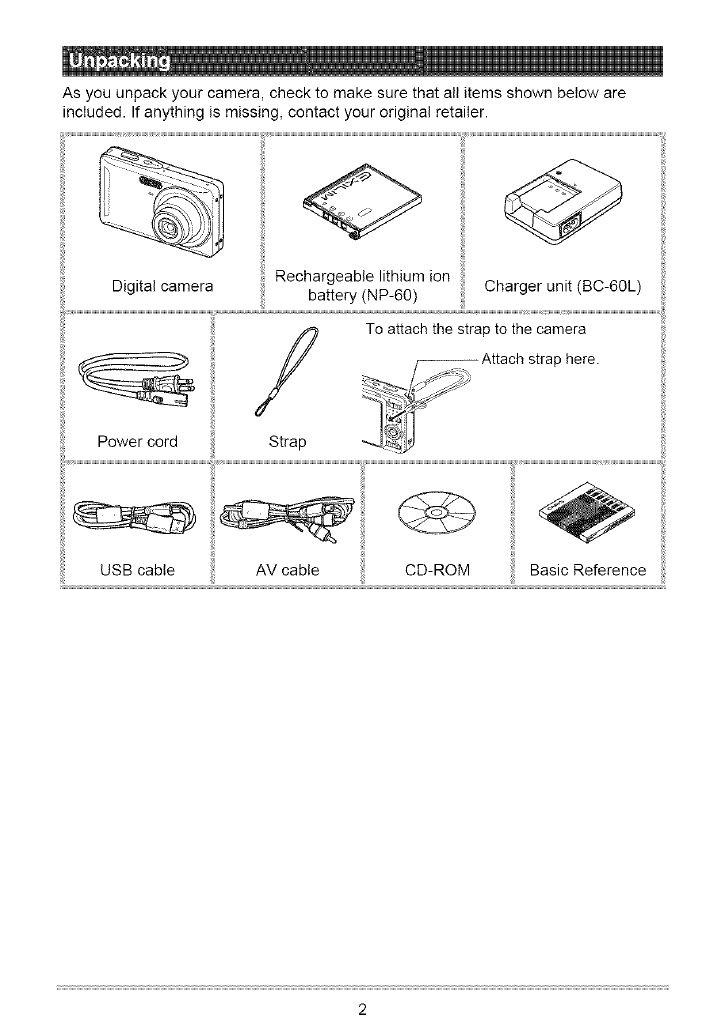
Asyouunpackyourcamera,checktomakesurethatallitemsshownbeloware
included.Ifanything is missing, contact your original retailer.
Rechargeable lithium ion Charger unit (BC-60L)
, ........
USB cable ! AV cable ! CD-ROM Basic Reference
2
•Thecontentsofthismanualaresubjecttochangewithoutnotice.
•Thecontentsofthismanualhavebeencheckedateachstepoftheproduction
process.Feelfreetocontactusifyounoticeanythingthatisquestionable,
erroneous,etc.
•AnycopyingofthecontentsofthisUser'sGuide,eitherinpartoritsentirety,is
forbidden.Exceptforyourownpersonaluse,anyotheruseofthecontentsofthis
manualwithoutthepermissionofCASIOCOMPUTERCO.,LTD.isforbidden
undercopyrightlaws.
• CASlOCOMPUTERCO.,LTD.shallnotbeheldliableforanydamagesorlost
profitssufferedbyyouoranythirdpartyduetotheuseormalfunctionofthis
product.
• CASIOCOMPUTERCO.,LTD.shallnotbeheldliableforanydamages,lost
profits,orclaimsbythirdpartiesarisingoutoftheuseofPhotoLoaderwithHOT
ALBUM,PhotoTransport,orYouTubeUploaderforCASIO.
• CASIOCOMPUTERCO.,LTD.shallnotbeheldliableforanydamagesorlost
profitscausedbylossofmemorycontentsduetomalfunction,repair,oranyother
reason.
• NotethattheexamplescreensandproductillustrationsshowninthisUser'sGuide
maydiffersomewhatfromthescreensandconfigurationoftheactualcamera.
LCD Panel
The liquid crystal panel of the monitor screen uses high-precision technology that
provides a pixel yield in excess of 99.99%. This means that some very small number
of pixels may not light or may remain lit at all times. This is due to the characteristics
of the liquid crystal panel, and does not indicate malfunction.
Take a few test shots
Before shooting your final image, shoot a test shot to ensure that the camera is
recording correctly.
3
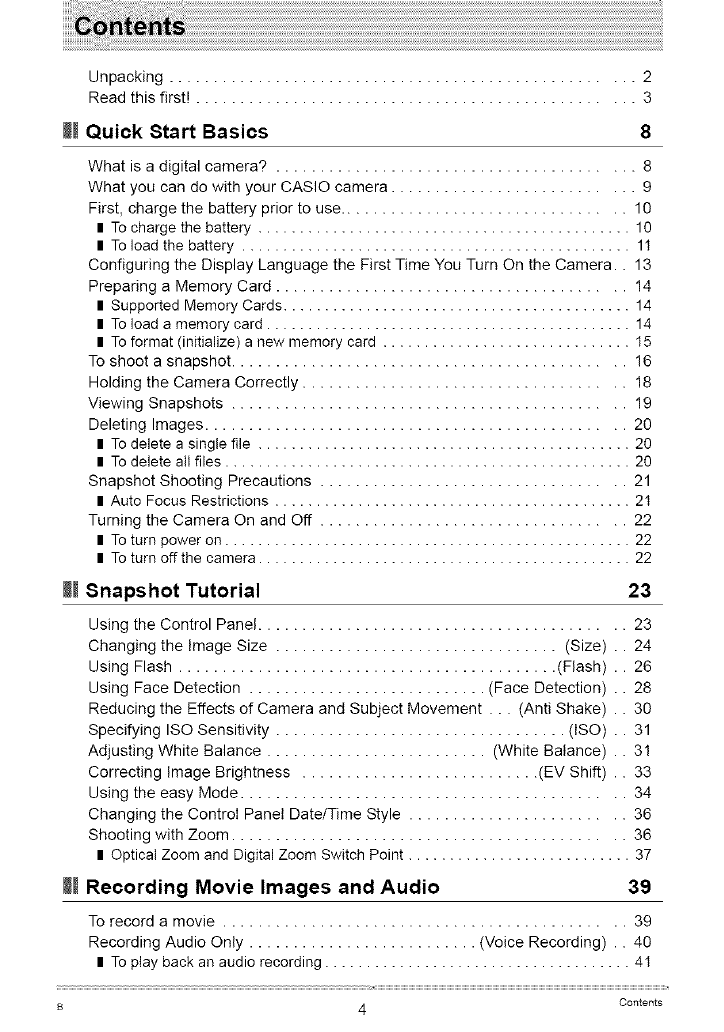
Unpacking.................................................... 2
Readthisfirst!................................................. 3
I_ Quick Start Basics 8
What is a digital camera? ........................................ 8
What you can do with your CASIO camera ........................... 9
First, charge the battery prior to use ................................ 10
lTo charge the battery ............................................. 10
lTo load the battery ............................................... 11
Configuring the Display Language the First Time You Turn On the Camera.. 13
Preparing a Memory Card ....................................... 14
lSupported Memory Cards .......................................... 14
lTo load a memory card ............................................ 14
lTo format (initialize) a new memory card .............................. I5
To shoot a snapshot ............................................ 16
Holding the Camera Correctly .................................... 18
Viewing Snapshots ............................................ 19
Deleting Images ............................................... 20
lTo delete a single file ............................................. 20
lTo delete all files ................................................. 20
Snapshot Shooting Precautions .................................. 21
lAuto Focus Restrictions ........................................... 2t
Turning the Camera On and Off .................................. 22
lTo turn power on ................................................. 22
iTo turn off the camera ............................................. 22
I_ Snapshot Tutorial 23
Using the Control Panel ......................................... 23
Changing the Image Size ................................ (Size) .. 24
Using Flash ........................................... (Flash) .. 26
Using Face Detection ........................... (Face Detection) .. 28
Reducing the Effects of Camera and Subject Movement ... (Anti Shake) 30
Specifying ISO Sensitivity ................................. (ISO) 31
Adjusting White Balance ......................... (White Balance) 31
Correcting Image Brightness ........................... (EV Shift) 33
Using the easy Mode ........................................... 34
Changing the Control Panel Date/Time Style ........................ 36
Shooting with Zoom ............................................ 36
iOptical Zoom and Digital Zoom Switch Point ........................... 37
I_ Recording Movie Images and Audio 39
To record a movie ............................................. 39
Recording Audio Only .......................... (Voice Recording) .. 40
| To play back an audio recording ..................................... 4I
B 4 Contents
I) Using BEST SHOT 42
What is BEST SHOT? .......................................... 42
l Some Sample Scenes ............................................ 42
To shoot an image with BEST SHOT ............................... 42
I) Advanced Settings 46
Using On-screen Menus ........................................ 46
REC Mode Settings .................................... (REC) .. 48
Selecting a Focus Mode ................................. (Focus)... 48
Using Continuous Shutter ............................ (Continuous)... 51
Using the Self-timer .................................. (Self-timer)... 52
Shooting with Face Detection ...................... (Face Detection)... 53
Reducing the Effects of Camera and Subject Movement .... (Anti Shake)... 53
Specifying the Auto Focus Area .......................... (AF Area)... 53
Using the easy Mode ................................ (easy Mode)... 54
Assigning Functions to the [_1] and [I_] Keys ............... (L/R Key)... 54
Displaying the On-screen Grid .............................. (Grid)... 54
Turning Digital Zoom On or Off ....................... (Digital Zoom)... 55
Turning on Image Review ............................... (Review)... 55
Using Icon Help ..................................... (icon Help)... 55
Configuring Power On Default Settings .................... (Memory)... 56
Image Quality Settings ................................ (Quality) .. 57
Specifying Snapshot Size ................................. (Size)... 57
Specifying Snapshot Image Quality ............... (Quality (Snapshot))... 57
Specifying Movie Image Quality ..................... (Quality (Movie))... 58
Correcting image Brightness ............................ (EV Shift)... 58
Controlling White Balance ......................... (White Balance)... 58
Specifying iSO Sensitivity .................................. (iSO)... 58
Specifying the Metering Mode ........................... (Metering)... 59
Using Built-in Color Filters ............................ (Color Filter)... 59
Controlling Image Sharpness .......................... (Sharpness)... 59
Controlling Color Saturation ........................... (Saturation)... 60
Adjusting image Contrast ............................... (Contrast)... 60
Specifying Flash intensity ......................... (Flash intensity)... 60
I) Viewing Snapshots and Movies 61
Viewing Snapshots ............................................ 61
Viewing a Movie ............................................... 61
Zooming an On-screen Image .................................... 62
Displaying !2 Images on the Same Screen .......................... 62
Viewing Snapshots and Movies on a TV Screen ...................... 63
I) Other Playback Functions (PLAY) 65
Playing a Slideshow on the Camera .................... (Slideshow) .. 65
Selecting Images for Printing ..................... (DPOF Printing) .. 66
Protecting a File Against Deletion ........................ (Protect) .. 66
B 5 Contents
Rotating an Image .................................. (Rotation) .. 67
Resizing a Snapshot ................................... (Resize) .. 67
Cropping a Snapshot ................................ (Trimming) .. 68
Adding Audio to a Snapshot ........................... (Dubbing) .. 68
II To play snapshot audio ............................................ 69
Copying Files ......................................... (Copy) .. 70
I_ Printing 71
Printing Snapshots ............................................. 71
Connecting Directly to a PictBridge Compatible Printer ................ 72
Using DPOF to Specify Images to be Printed and the Number of Copies... 74
I_ Using the Camera with a Computer 77
Things you can do using a computer ................................ 77
Using the Camera with a Windows Computer ........................ 78
Viewing and Storing Images on a Computer ............................ 80
Save images to a computer automatically/Manage images ................ 83
Playing Movies .................................................. 84
Uploading Movie Files to YouTube ................................... 84
Transferring Images from Your Computer to Camera Memory .............. 86
Viewing User Documentation .......................... (PDF Files)... 88
User Registration ................................................ 88
Using the Camera with a Macintosh ............................... 89
Connecting the Camera to Your Computer and Saving Files ............... 89
Transferring Images Automatically and Managing Them on Your Macintosh... 91
Playing a Movie .................................................. 92
Viewing User Documentation ........................... (PDF Files)... 92
User Registration ................................................ 92
Files and Folders .............................................. 93
Memory Card Data ............................................ 94
I_ Other Settings (Set Up)
Selecting a REC Mode Screen Layout .................. ([_i_ Panel)
Selecting a PLAY Mode Screen Layout ................ ([] Display)
Configuring Camera Sound Settings ..................... (Sounds)
Specifying the File Name Serial Number Generation Rule ..... (File No.)
Configuring World Time Settings ..................... (World Time)
Time Stamping Snapshots .......................... (Timestamp)
Setting the Camera's Clock ............................. (Adjust)
Specifying the Date Style ............................ (Date Style)
Specifying the Display Language ...................... (Language)
Configuring Sleep State Settings ......................... (Sleep)
Configuring Auto Power Settings .................. (Auto Power Off)
Configuring [1_11]and [I-_q] Settings ................... (RECtPLAY)
Configuring USB Protocol Settings ......................... (USB)
96
96
97
97
98
99
99
100
100
101
101
!02
102
103
s 6 Contents
Selecting the Screen Aspect Ratio and Video Output System (Video Out) . !03
Formatting Built-in Memory or a Memory Card .............. (Format) . 104
Resetting the Camera to Factory Defaults .................. (Reset) . 104
I_ Configuring Monitor Screen Settings 105
Using the On-screen Histogram to Check Exposure ...... (+Histogram) . 105
IHow to Use the Histogram ........................................ I06
I_ Appendix 107
Precautions during Use ........................................ 107
Power Supply ................................................ 116
ICharging ...................................................... I16
ITo replace the battery ............................................ I16
IBattery Precautions .............................................. I17
IUsing the Camera in another Country ............................... t17
Using a Memory Card ......................................... 118
ITo replace the memory card ....................................... t18
Computer System Requirements for Bundled Software ............... 120
General Guide ............................................... 121
Monitor Screen Contents ....................................... 122
Reset Initial Default Settings .................................... !24
When things don_t go right ....................................... 127
ITroubleshooting ................................................ I27
IDisplay Messages ............................................... I3I
Number of Snapshots and Movie Recording Time ................... 133
Specifications ................................................ 135
s 7 Contents
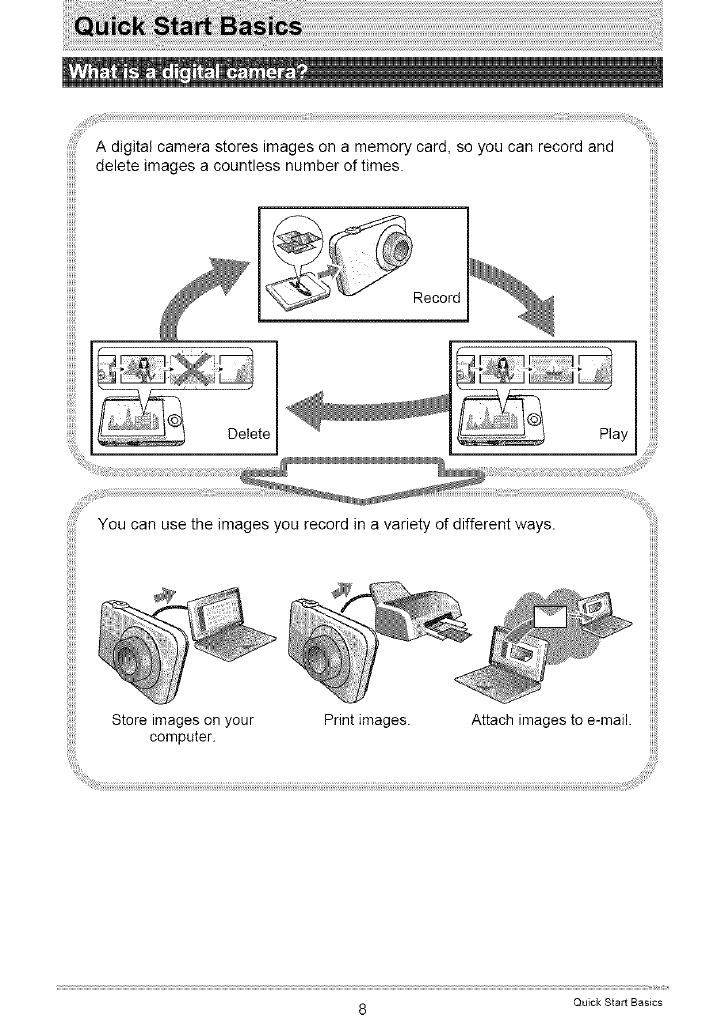
ii_ii_ii_i!i!_i_'_'Ad_g_ta,oomerastoresimagesonamemoryoard,soyouoanrecordand
delete images a countless number of times.
IRecord
Store images on your Print images. Attach images to e-mail.
computer.
8 Quick Start Basics
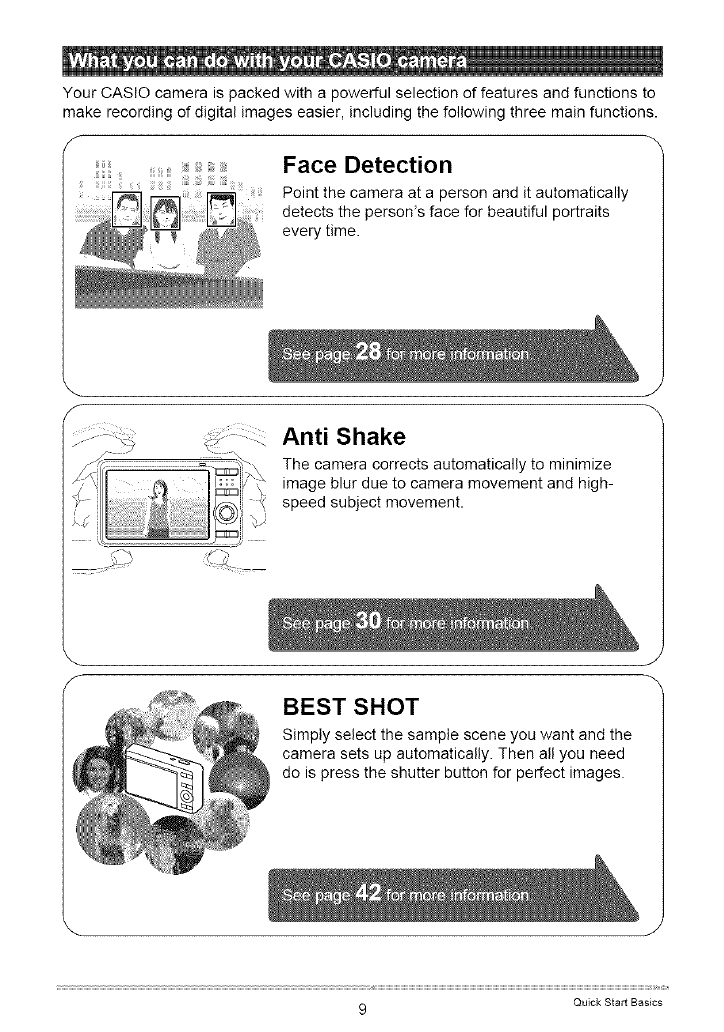
Your CASIO camera is packed with a powerful selection of features and functions to
make recording of digital images easier, including the following three main functions.
Face Detection
Point the camera at a person and it automatically
detects the person_s face for beautiful portraits
every time.
Anti Shake
The camera corrects automatically to minimize
image blur due to camera movement and high-
speed subject movement.
BEST SHOT
Simply select the sample scene you want and the
camera sets up automatically. Then all you need
do is press the shutter button for perfect images.
9Quick Start Basics
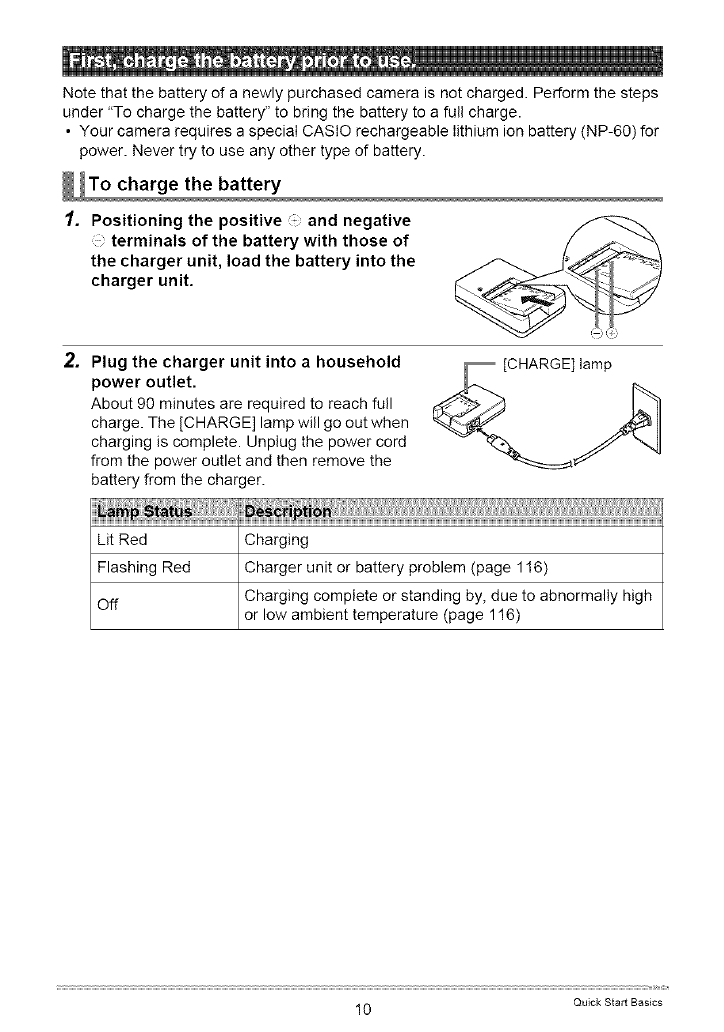
Note that the battery of a newly purchased camera is not charged. Perform the steps
under "To charge the battery" to bring the battery to a full charge.
• Your camera requires a special CASIO rechargeable lithium ion battery (NP-60) for
power. Never try to use any other type of battery.
1. Positioning the positive and negative
terminals of the battery with those of
the charger unit, load the battery into the
charger unit.
2. Plug the charger unit into a household
power outlet.
About 90 minutes are required to reach full
charge. The [CHARGE] lamp will go out when
charging is complete. Unplug the power cord
from the power outlet and then remove the
battery from the charger.
Lit Red
Flashing Red
Off
[CHARGE] lamp
i
Charging
Charger unit or battery problem (page 116)
Charging complete or standing by, due to abnormally high
or low ambient temperature (page 116)
10 Quick Start Basics
Other Charging Precautions
•Use the special charger (BC-60L) to charge the special lithium ion battery (NP-60).
Never use any other type of charger device. Attempting to use a different charger
can result in unexpected accident.
• A battery that is still warm due to normal use may not charge fully. Give the battery
time to cool before charging it.
• A battery discharges slightly even when it is not loaded in the camera. Because of
this, it is recommended that you charge the battery immediately before you need to
use it.
• Charging the camera's battery may cause interference with TV and radio reception.
If this happens, plug the charger into an outlet that is further away from the TV or
radio.
• Actual charging time depends on current battery capacity and charging conditions.
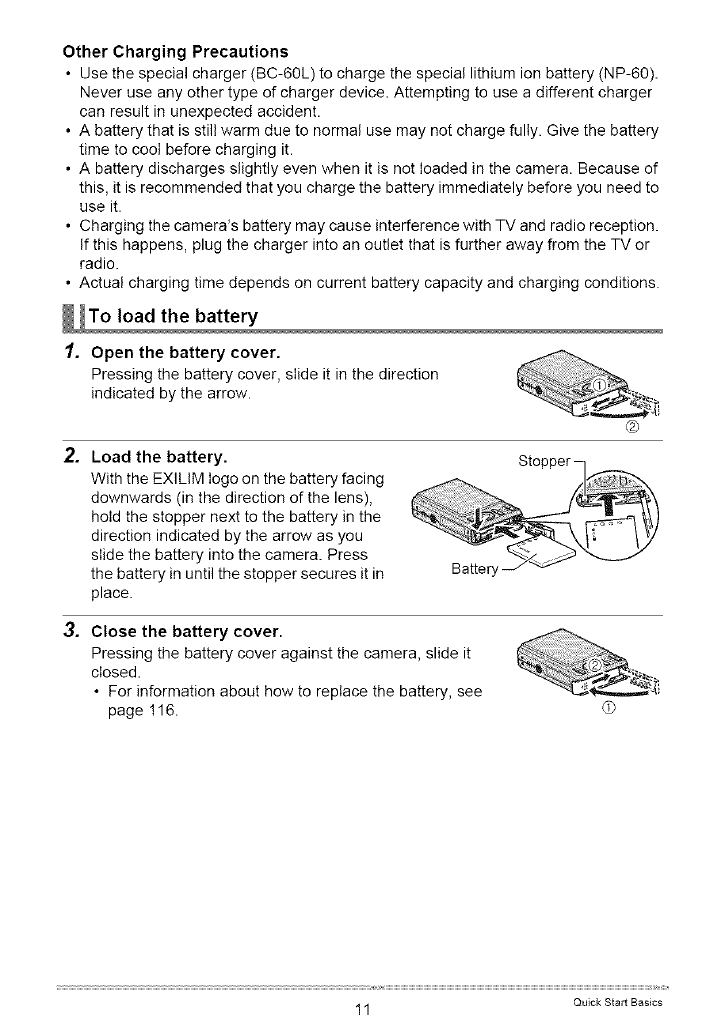
1. Open the battery cover.
Pressing the battery cover, slide it in the direction
indicated by the arrow.
2. Load the battery.
With the EXILIM logo on the battery facing
downwards (in the direction of the lens),
hold the stopper next to the battery in the
direction indicated by the arrow as you
slide the battery into the camera. Press
the battery in until the stopper secures it in
place.
Stopper-
3. Close the battery cover.
Pressing the battery cover against the camera, slide it
closed.
• For information about how to replace the battery, see
page !16.
®
Qb
11 Quick Start Basics
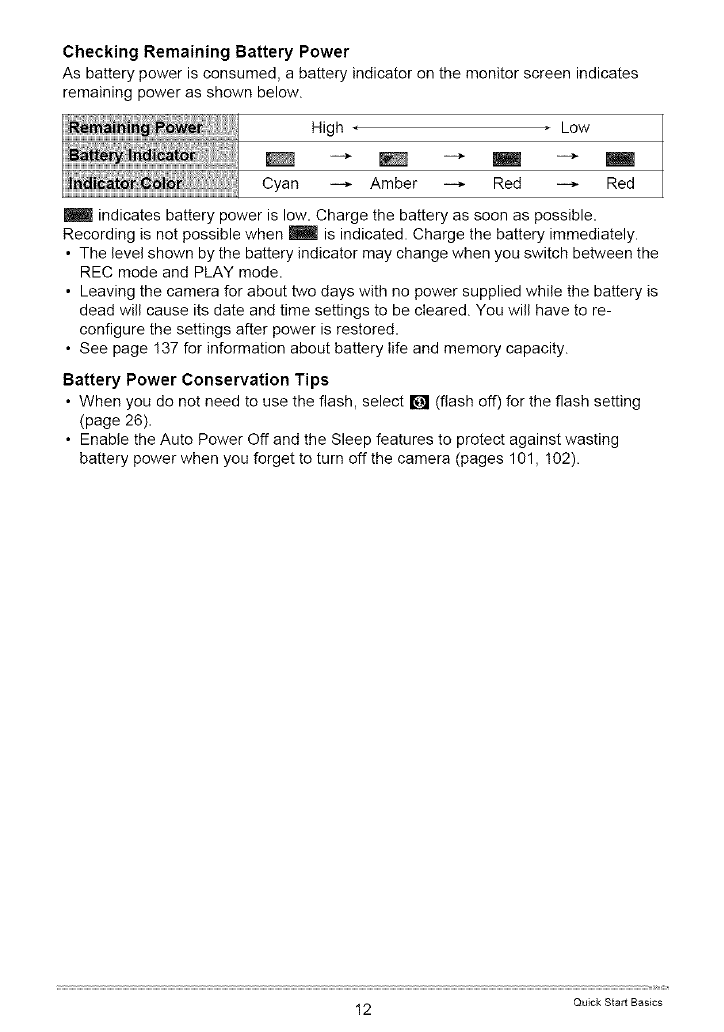
Checking Remaining Battery Power
As battery power is consumed, a battery indicator on the monitor screen indicates
remaining power as shown below.
High * Low
i._i=_ _ior _: Cyan _ Amber _ Red _ Red
indicates battery power is low. Charge the battery as soon as possible.
Recording is not possible when _ is indicated, Charge the battery immediately,
• The level shown by the battery indicator may change when you switch between the
REC mode and PLAY mode.
• Leaving the camera for about two days with no power supplied while the battery is
dead will cause its date and time settings to be cleared. You will have to re-
configure the settings after power is restored.
• See page 137 for information about battery life and memory capacity.
Battery Power Conservation Tips
• When you do not need to use the flash, select [] (flash off) for the flash setting
(page 26).
• Enable the Auto Power Off and the Sleep features to protect against wasting
battery power when you forget to turn off the camera (pages 101, 102).
12 Quick Start Basics
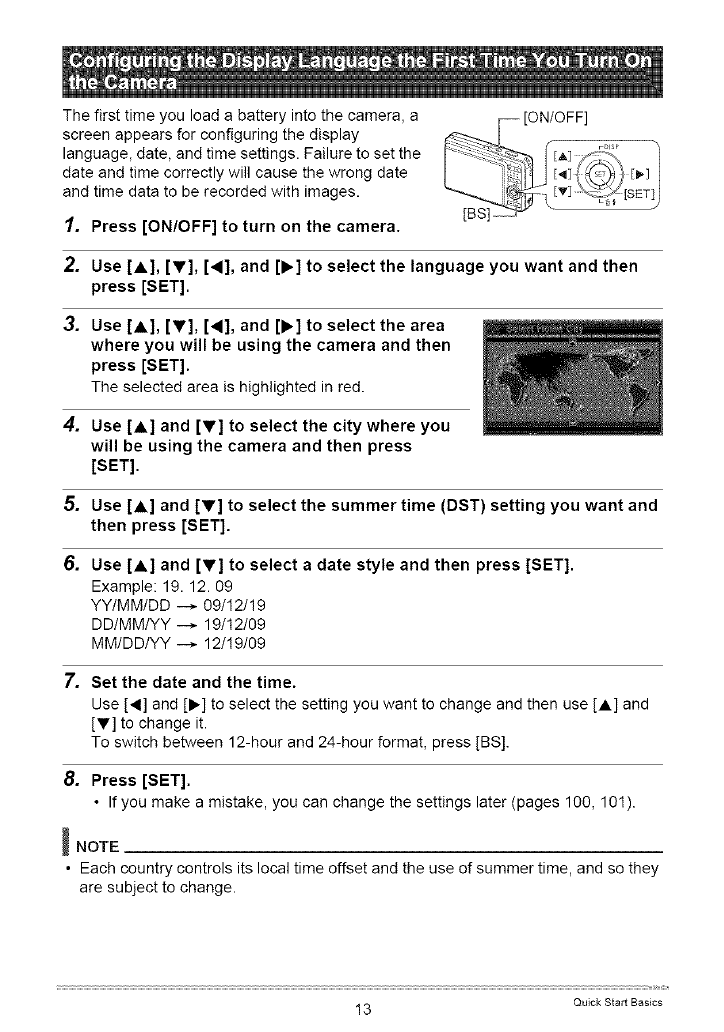
The first time you load a battery into the camera, a
screen appears for configuring the display
language, date, and time settings. Failure to set the
date and time correctly will cause the wrong date
and time data to be recorded with images.
1. Press [ON/OFF] to turn on the camera.
2. use [A], [_'], [<], and [1_] to select the language you want and then
press [SET],
3. Use [A], [_'], [<], and [1_] to select the area
where you will be using the camera and then
press [SET].
The selected area is highlighted in red.
4. use [A] and [V] to select the city where you
will be using the camera and then press
[SET].
5. Use [A] and [V] to select the summer time (DST) setting you want and
then press [SET].
6. use [A] and [V] to select adate style and then press [SET].
Example: 19. 12.09
YY/MM/DD -_ 09/12/19
DD/MM/YY _ 19/12/09
MM/DD/YY --_ 12/!9/09
7. Set the date and the time.
Use [<] and [1_] to select the setting you want to change and then use [A] and
[V] to change it.
To switch between 12-hour and 24-hour format, press [BS].
8. Press [SET].
• If you make a mistake, you can change the settings later (pages 100, 101).
_NOTE
• Each country controls its local time offset and the use of summer time, and so they
are subject to change.
13 Quick Start Basics
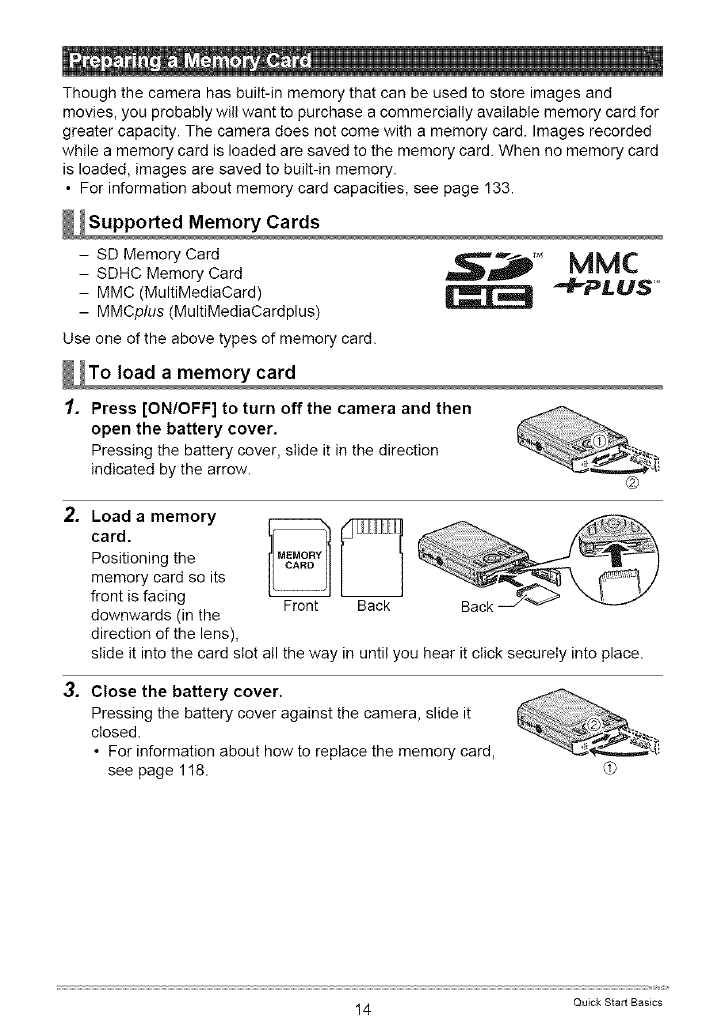
Though the camera has built-in memory that can be used to store images and
movies, you probably will want to purchase a commercially available memory card for
greater capacity. The camera does not come with a memory card. Images recorded
while a memory card is loaded are saved to the memory card. When no memory card
is loaded, images are saved to built-in memory.
• For information about memory card capacities, see page 133.
- SD Memory Card
- SDHC Memory Card
- MMC (MultiMediaCard)
- MMCplus (MultiMediaCardplus)
Use one of the above types of memory card.
_#'PLUS"
1. Press [ON/OFF] to turn off the camera and then
open the battery cover.
Pressingthe battery cover, slide it in the direction
indicated by the arrow.
2. Load a memory
Positioning the
memory card so its
front is facing Front Back
downwards (in the
direction of the lens),
Back
®
slide it into the card slot all the way in until you hear it click securely into place.
3. Close the battery cover.
Pressing the battery cover against the camera, slide it
closed.
• For information about how to replace the memory card,
see page 118.
14 Quick Start Basics
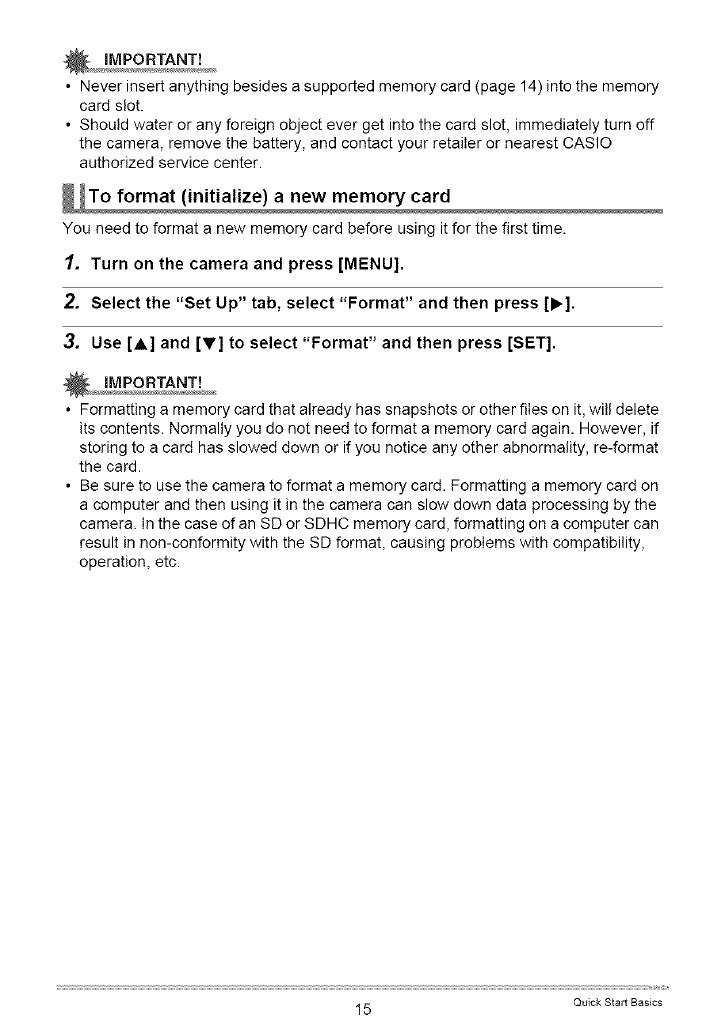
• Never insert anything besides a supported memory card (page 14) into the memory
card slot.
• Should water or any foreign object ever get into the card slot, immediately turn off
the camera, remove the battery, and contact your retailer or nearest CASIO
authorized service center.
You need to format a new memory card before using it for the first time.
1. Turn on the camera and press [MENU].
2. Select the "Set Up" tab, select "Format" and then press [1_].
3. Use [A] and [V] to select "Format" and then press [SET].
• Formatting a memory card that already has snapshots or other files on it, will delete
its contents. Normally you do not need to format a memory card again. However, if
storing to a card has slowed down or if you notice any other abnormality, re-format
the card.
• Be sure to use the camera to format a memory card. Formatting a memory card on
a computer and then using it in the camera can slow down data processing by the
camera. In the case of an SD or SDHC memory card, formatting on a computer can
result in non-conformity with the SD format, causing problems with compatibility,
operation, etc.
15 Quick Start Basics
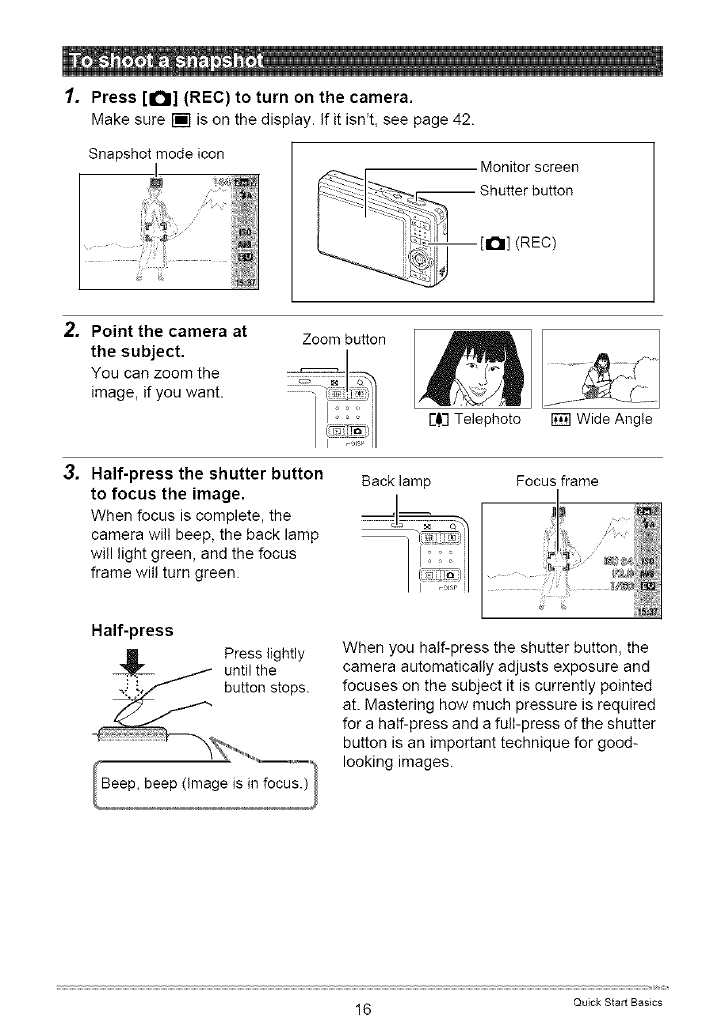
1. Press [O] (REC) to turn on the camera.
Make sure [] is on the display. If it isn't, see page 42.
Snapshot mode icon Monitor screen
'_-_-I__ Shutter button
I -I P4
2. Point the camera at
the subject.
You can zoom the
image, if you want.
Zoom button
3. Half-press the shutter button
to focus the image.
When focus is complete, the
camera will beep, the back lamp
will light green, and the focus
frame will turn green.
Half-press
Back lamp Focus frame
When you half-press the shutter button, the
camera automatically adjusts exposure and
focuses on the subject it is currently pointed
at. Mastering how much pressure is required
for a half-press and a full-press of the shutter
button is an important technique for good-
looking images.
16 Quick Start Basics
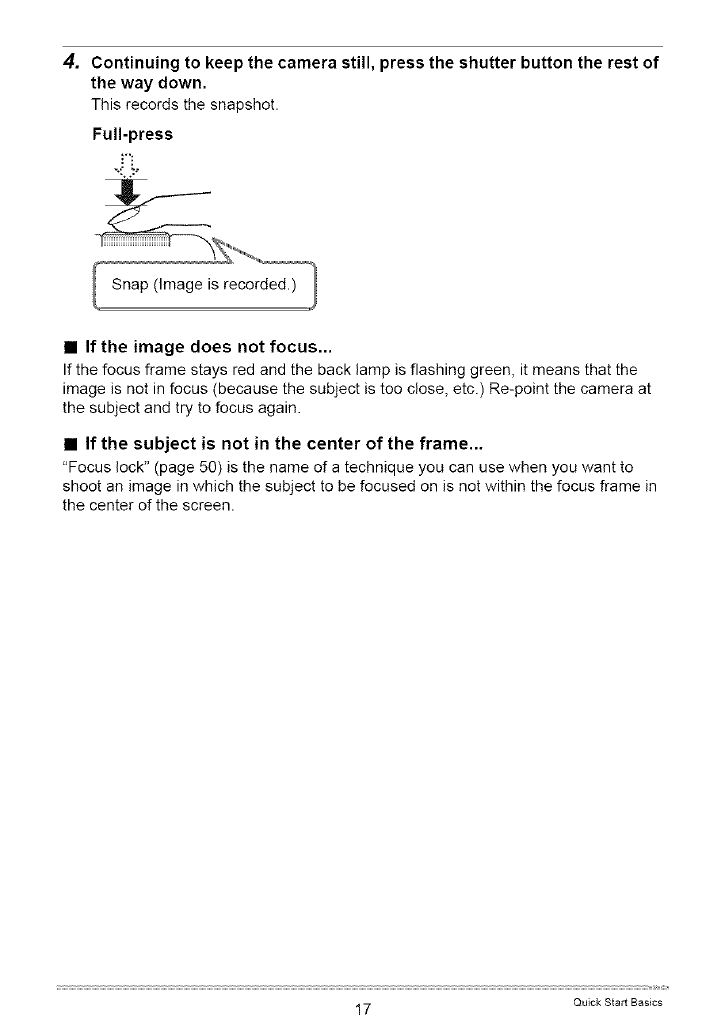
4. Continuing to keep the camera still, press the shutter button the rest of
the way down.
This records the snapshot.
Full-press
K]
• If the image does not focus...
If the focus frame stays red and the back lamp is flashing green, it means that the
image is not in focus (because the subject is too close, etc.) Re-point the camera at
the subject and try to focus again.
•If the subject is not in the center of the frame...
"Focus lock" (page 50) is the name of a technique you can use when you want to
shoot an image in which the subject to be focused on is not within the focus frame in
the center of the screen.
17 Quick Start Basics
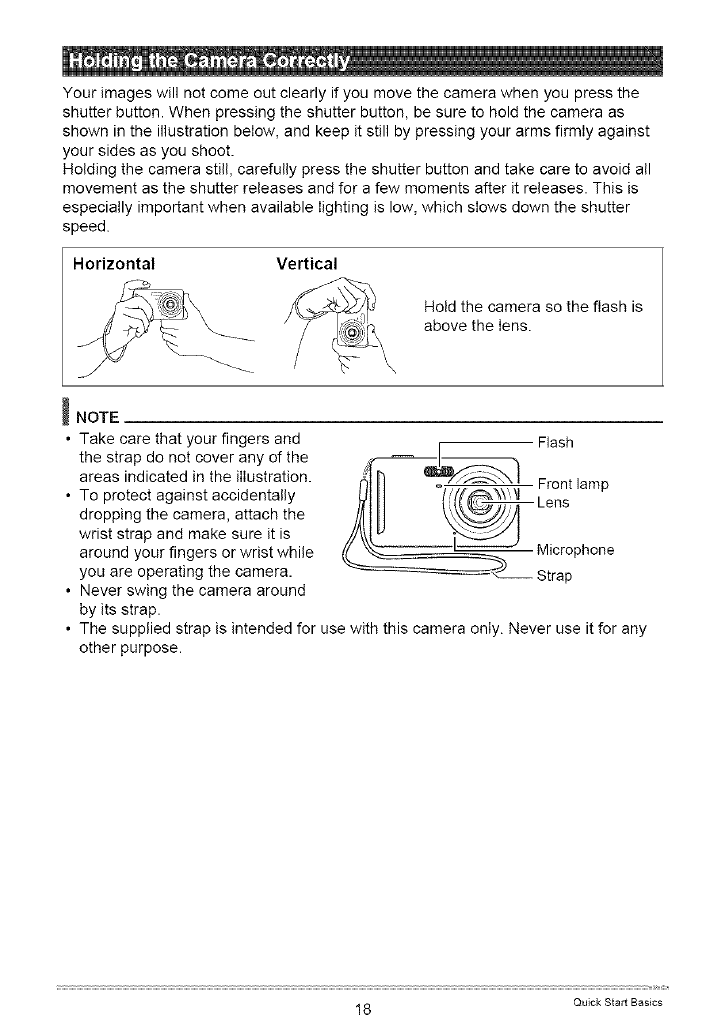
__ _.ljL _ _ _ j_ _ TI_
Your images will not come out clearly if you move the camera when you press the
shutter button. When pressing the shutter button, be sure to hold the camera as
shown in the illustration below, and keep it still by pressing your arms firmly against
your sides as you shoot.
Holding the camera still, carefully press the shutter button and take care to avoid all
movement as the shutter releases and for a few moments after it releases. This is
especially important when available lighting is low, which slows down the shutter
speed.
Horizontal Vertical
Hold the camera so the flash is
above the lens.
NOTE
Take care that your fingers and
the strap do not cover any of the
areas indicated in the illustration.
• To protect against accidentally
dropping the camera, attach the
wrist strap and make sure it is
around your fingers or wrist while
you are operating the camera.
• Never swing the camera around
by its strap.
Flash
Sh__ Front lam
UIll ,ens P
Miorophone
__ Strap
• The supplied strap is intended for use with this camera only. Never use it for any
other purpose.
18 Quick Start Basics
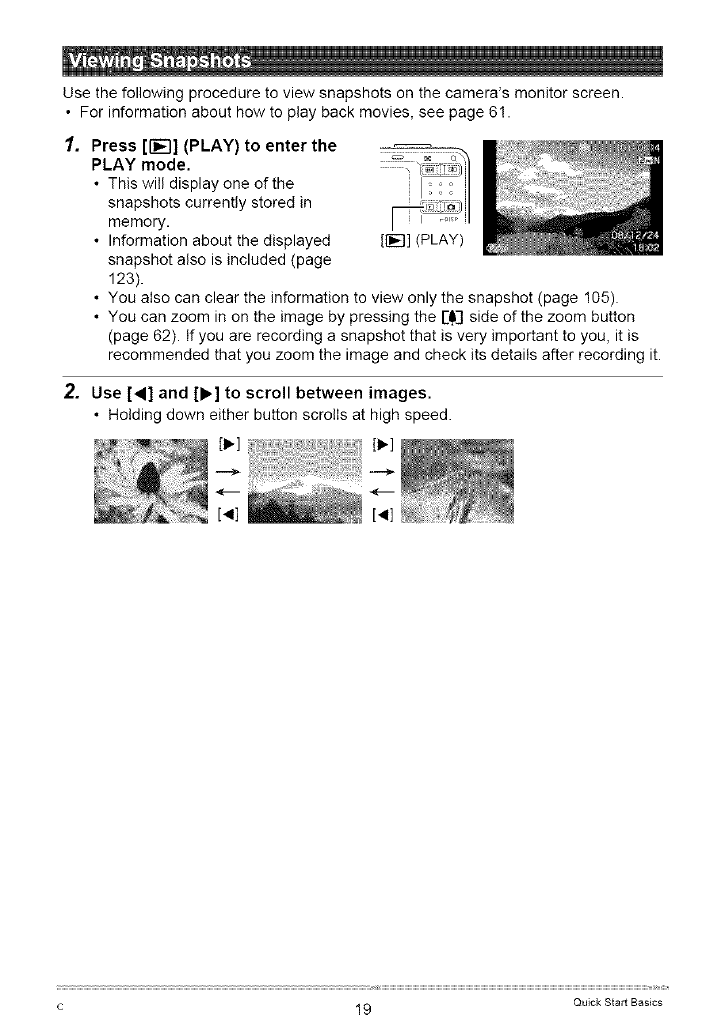
Use the following procedure to view snapshots on the camera's monitor screen.
• For information about how to play back movies, see page 6!.
1. Press [1"_7](PLAY) to enter the
PLAY mode.
• This will display one of the
snapshots currently stored in
memory.
• Information about the displayed [F_q] (PLAY)
snapshot also is included (page
123).
• You also can clear the information to view only the snapshot (page 105).
• You can zoom in on the image by pressing the I-_3 side of the zoom button
(page 62). If you are recording a snapshot that is very important to you, it is
recommended that you zoom the image and check its details after recording it.
2. Use [,] and [1_] to scroll between images.
• Holding down either button scrolls at high speed.
[I,9
c 19 Quick Start Basics
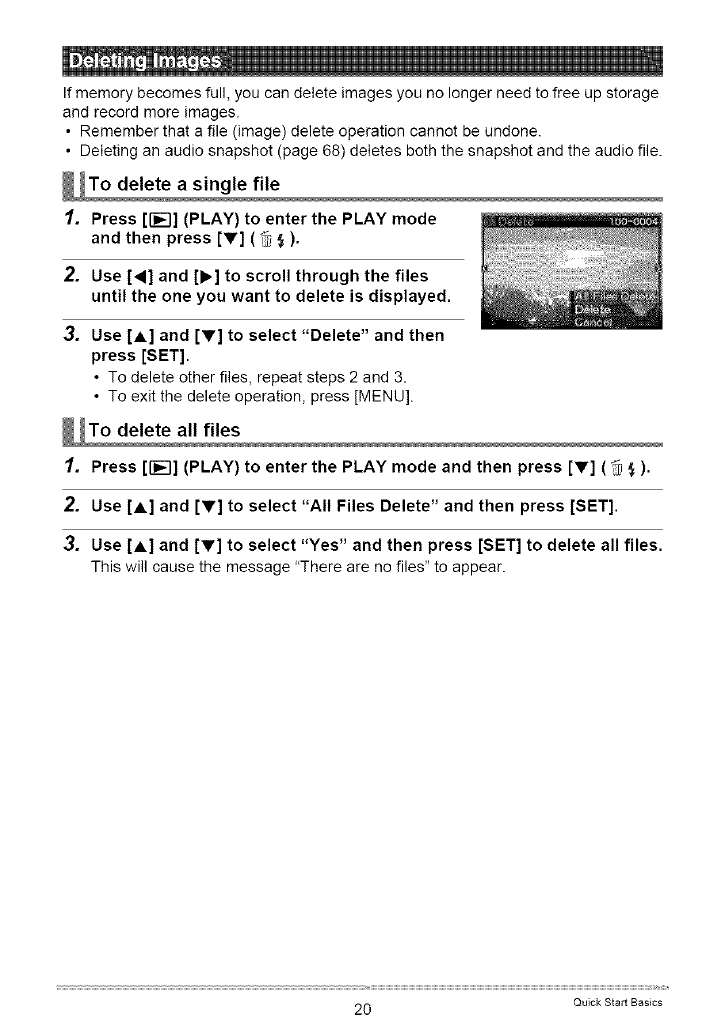
If memory becomes full, you can delete images you no longer need to free up storage
and record more images.
• Remember that a file (image) delete operation cannot be undone.
• Deleting an audio snapshot (page 68) deletes both the snapshot and the audio file.
1. Press [I-_-I] (PLAY) to enter the PLAY mode
and then press [_'] ( _ $ ).
2. Use [,] and [1_]to scroll through the files
until the one you want to delete is displayed.
3. Use[A] and [V] to select "Delete" and then
press [SET].
• To delete other files, repeat steps 2 and 3.
• To exit the delete operation, press [MENU].
1. Press [I-_] (PLAY) to enter the PLAY mode and then press [V] ( _ _ ).
2. Use [A] and [V] to select "All Files Delete" and then press [SET].
3. Use [A] and [V] to select "Yes" and then press [SET] to delete all files.
This will cause the message "There are no files" to appear.
20 Quick Start Basics
Operation
• Never open the battery cover while the back lamp is flashing green. Doing so can
result in the image you just shot being saved incorrectly, damage to other images
stored in memory, malfunction of the camera, etc.
• If unwanted light is shining directly onto the lens, shade the lens with your hand
when shooting an image.
Monitor Screen when Shooting Snapshots
• Subject brightness conditions can cause monitor screen response to slow and can
cause digital noise in the monitor screen image.
• The image that appears on the monitor screen is for image composition. The actual
image will be recorded at the quality set for the image quality setting (page 57).
Shooting Indoors under Fluorescent Lighting
• Minute flickering of fluorescent lighting can affect the brightness or color of an
image.
• Any of the following can make proper focus impossible.
- Solid color wall or other very low contrast subject
- Strongly back lit subject
- Very shiny subject
- Blinds or other subject with a repeating horizontal pattern
- Multiple subjects at varying distances from the camera
- Subject in a dark location
- Camera movement while shooting
- Fast-moving subject
- Subjects outside the focus range of the camera
• If you cannot focus properly, try using focus lock (page 50) or Manual Focus (page
48).
21 Quick Start Basics
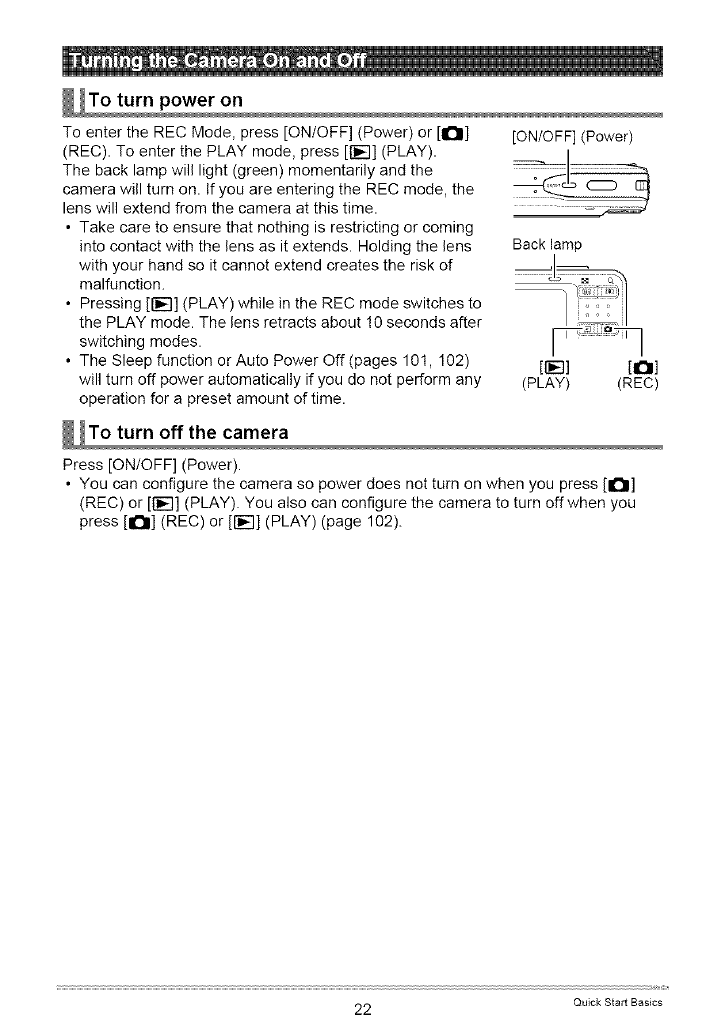
To enter the REC Mode, press [ONIOFF] (Power) or [1_11]
(REC). To enter the PLAY mode, press [t-_q] (PLAY).
The back lamp will light (green) momentarily and the
camera will turn on. If you are entering the REC mode, the
lens will extend from the camera at this time.
• Take care to ensure that nothing is restricting or coming
into contact with the lens as it extends. Holding the lens
with your hand so it cannot extend creates the risk of
malfunction.
• Pressing [I-_q] (PLAY) while in the REC mode switches to
the PLAY mode. The lens retracts about !0 seconds after
switching modes.
• The Sleep function or Auto Power Off (pages 101, 102)
will turn off power automatically if you do not perform any
operation for a preset amount of time.
[ON/OFF] (Power)
Back lamp
[liE]] [O]
(PLAY) (REC)
Press [ON/OFF] (Power).
• You can configure the camera so power does not turn on when you press [1_11]
(REC) or [l-_-I] (PLAY). You also can configure the camera to turn off when you
press [It_] (REC) or [l'_q] (PLAY) (page 102).
22 Quick Start Basics
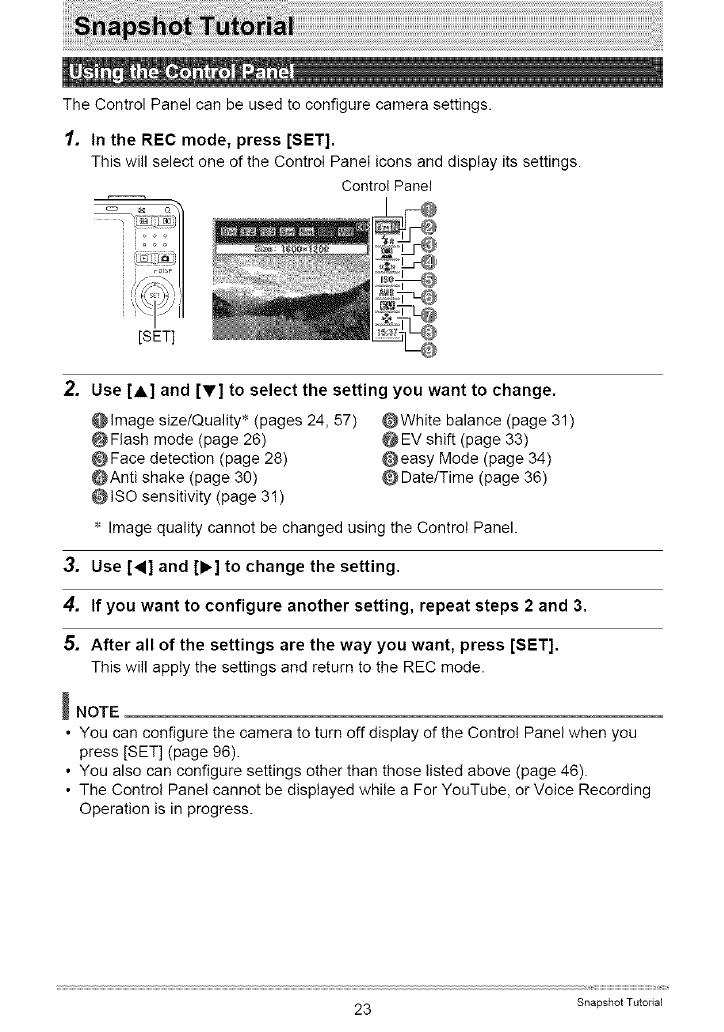
The Control Panel can be used to configure camera settings.
1. In the REC mode, press [SET].
This will select one of the Control Panel icons and display its settings.
Control Panel
[SET]
2. Use [A] and [V] to select the setting you want to change.
@Image size/Quality _ (pages 24, 57)
@Flash mode (page 26)
Face detection (page 28)
_Anti shake (page 30)
ISO sensitivity (page 31)
_White balance (page 31)
@EV shift (page 33)
@easy Mode (page 34)
Date/Time (page 36)
Image quality cannot be changed using the Control Panel.
3. use [,] and [1_]to change the setting.
4. If you want to configure another setting, repeat steps 2 and 3.
5. After all of the settings are the way you want, press [SET].
This will apply the settings and return to the REC mode.
_NOTE
•You can configure the camera to turn off display of the Control Panel when you
press [SET] (page 96).
• You also can configure settings other than those listed above (page 46).
• The Control Panel cannot be displayed while a For YouTube, or Voice Recording
Operation is in progress.
23 Snapshot Tutorial
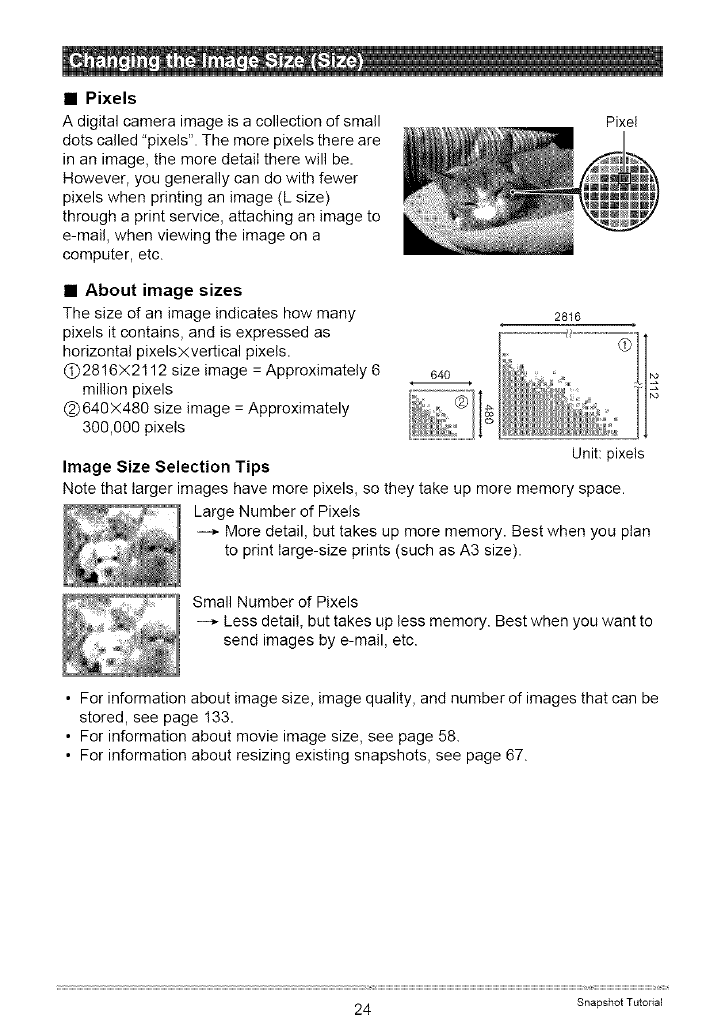
• Pixels
A digital camera image is a collection of small
dots called "pixels". The more pixels there are
in an image, the more detail there will be.
However, you generally can do with fewer
pixels when printing an image (L size)
through a print service, attaching an image to
e-mail, when viewing the image on a
computer, etc.
Pixel
• About image sizes
The size of an image indicates how many 2816
pixels it contains, and is expressed as
horizontal pixelsxvertical pixels.
(_) 28 ! 6 X 2112 size image = Approximately 6 640
million pixels _ ¢_
(_)640X480 size image = Approximately
300,000 pixets
Image Size Selection Tips Unit: pixets
Note that larger images have more pixels, so they take up more memory space.
Large Number of Pixels
-_ More detail, but takes up more memory. Best when you ptan
to print large-size prints (such as A3 size).
Small Number of Pixels
--+ Less detail, but takes up less memory. Best when you want to
send images by e-mail, etc.
• For information about image size, image quality, and number of images that can be
stored, see page 133.
• For information about movie image size, see page 58.
• For information about resizing existing snapshots, see page 67.
24 Snapshot Tutorial
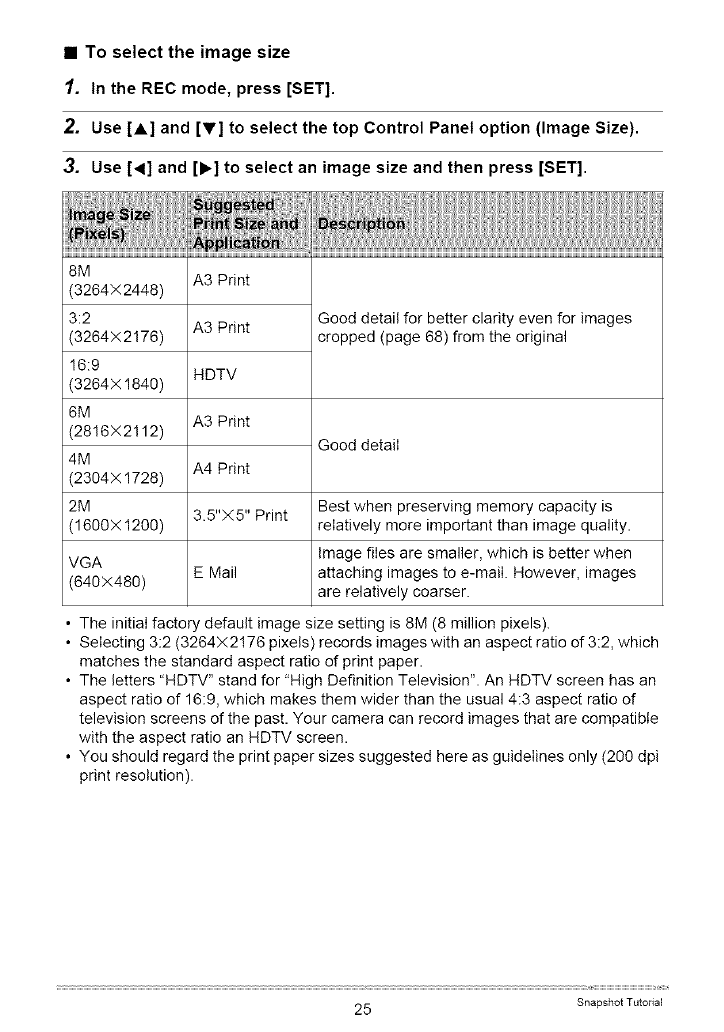
•To select the image size
1. In the REC mode, press [SET].
2. Use [A] and [V] to select the top Control Panel option (Image Size).
3. Use [<] and [1_] to select an image size and then press [SET].
8M
(3264x 2448)
3:2
(3264X2176)
16:9
(3264X 1840)
6M
(2816X2112)
4M
(2304X 1728)
2M
(1600X 1200)
A3 Print
A3 Print
HDTV
A3 Print
A4 Print
3.5"X5" Print
Good detail for better clarity even for images
cropped (page 68) from the original
Good detaii
Best when preserving memory capacity is
relatively more important than image quality.
VGA Image files are smaller, which is better when
E Mail attaching images to e-mail. However, images
(640X480) are relatively coarser.
• The initial factory default image size setting is 8M (8 million pixels).
• Selecting 3:2 (3264X 2!76 pixels) records images with an aspect ratio of 3:2, which
matches the standard aspect ratio of print paper.
• The letters "HDTV" stand for _'High Definition Television". An HDTV screen has an
aspect ratio of 16:9, which makes them wider than the usual 4:3 aspect ratio of
television screens of the past. Your camera can record images that are compatible
with the aspect ratio an HDTV screen.
• You should regard the print paper sizes suggested here as guidelines only (200 dpi
print resolution).
25 Snapshot Tutorial
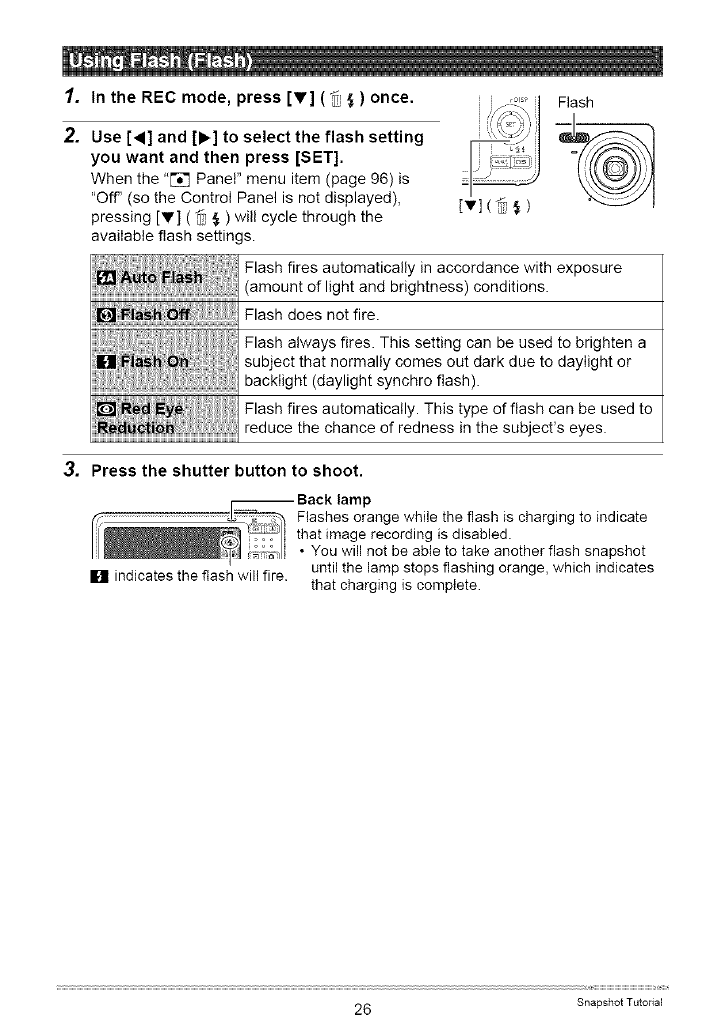
1. In the REC mode, press [V] ( _ _ ) once, Flash
2. use [<] and [1_] to select the flash setting
you want and then press [SET].
When the "[_ Pane!" menu item (page 96) is
"Off' (so the Contro! Panel is not displayed),
pressing [V] ( _ ,_) wi!! cycle through the
avai!ab!e flash settings.
;i i i ;i :
' ''=", Flash fires automatica!!y in accordance with exposure
............................................................................................................................(amount of light and brightness) conditions.
Flash does not fire.
Flash a!ways fires. This setting can be used to brighten a
subject that normal!y comes out dark due to day!ight or
back!ight (daylight synchro flash).
Flash fires automatically. This type off!ash can be used to
_ _ reduce the chance of redness in the subject's eyes.
3. Press the shutter button to shoot.
Back lamp
t? ......................................................J_._,._. Flashes orange while the flash is charging to indicate
I'_ _I that image recording is disabled.
__ ,_ ;_,,/I ° You will not be able to take another flash snapshot
[] indicates the flash wilt fire. until the lamp stops flashing orange, which indicates
that charging is complete.
26 Snapshot Tutorial
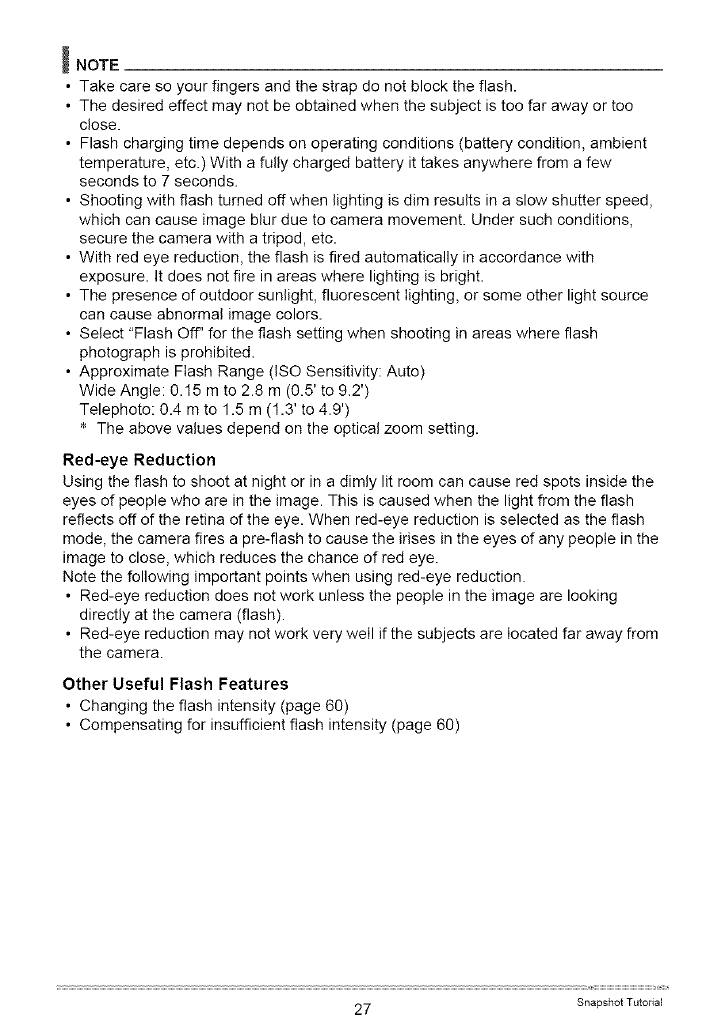
_NOTE
• Take care so your fingers and the strap do not block the flash.
• The desired effect may not be obtained when the subject is too far away or too
close.
• Flash charging time depends on operating conditions (battery condition, ambient
temperature, etc.) With a fully charged battery it takes anywhere from a few
seconds to 7 seconds.
• Shooting with flash turned off when lighting is dim results in a slow shutter speed,
which can cause image blur due to camera movement. Under such conditions,
secure the camera with a tripod, etc.
• With red eye reduction, the flash is fired automatically in accordance with
exposure. It does not fire in areas where lighting is bright.
• The presence of outdoor sunlight, fluorescent lighting, or some other light source
can cause abnormal image colors.
• Select "Flash Off' for the flash setting when shooting in areas where flash
photograph is prohibited.
• Approximate Flash Range (ISO Sensitivity: Auto)
Wide Angle: 0.15 m to 2.8 m (0.5' to 9.2')
Telephoto: 0.4 m to 1.5 m (1.3' to 4.9')
The above values depend on the optical zoom setting.
Red-eye Reduction
Using the flash to shoot at night or in a dimly lit room can cause red spots inside the
eyes of people who are in the image. This is caused when the light from the flash
reflects off of the retina of the eye. When red-eye reduction is selected as the flash
mode, the camera fires a pre-flash to cause the irises in the eyes of any people in the
image to close, which reduces the chance of red eye.
Note the following important points when using red-eye reduction.
• Red-eye reduction does not work unless the people in the image are looking
directly at the camera (flash).
• Red-eye reduction may not work very well if the subjects are located far away from
the camera.
Other Useful Flash Features
• Changing the flash intensity (page 60)
• Compensating for insufficient flash intensity (page 60)
27 Snapshot Tutorial
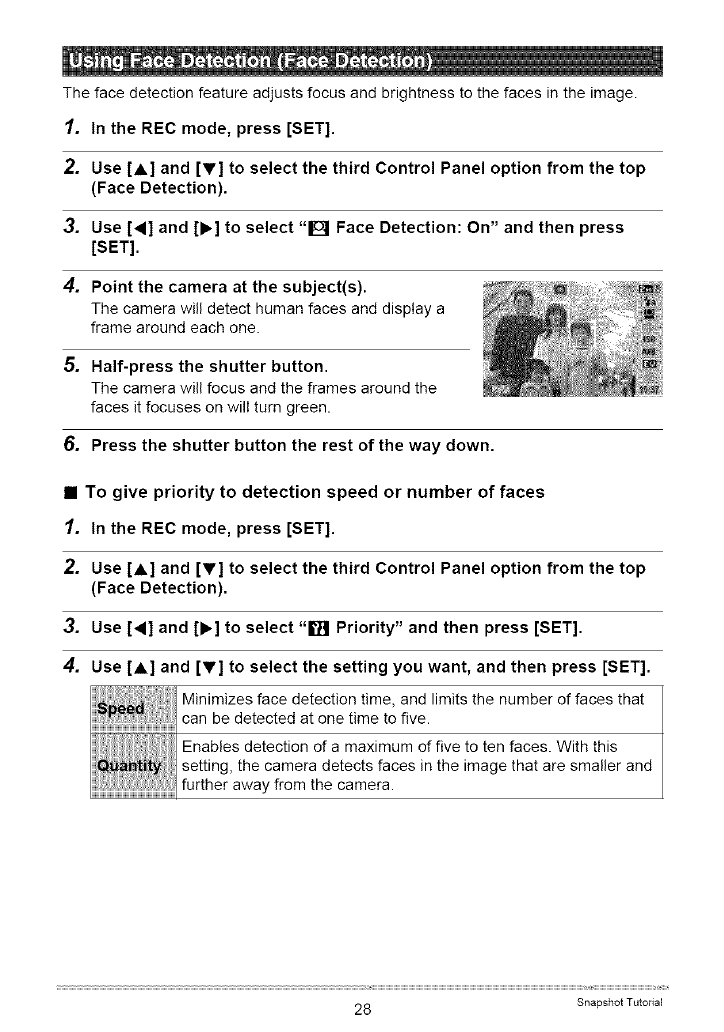
The face detection feature adjusts focus and brightness to the faces in the image.
1. In the REC mode, press [SET].
2. Use [A] and [V] to select the third Control Panel option from the top
(Face Detection).
3. Use [,] and [1_] to select "1_1 Face Detection: On" and then press
[SET].
4. Point the camera at the subject(s).
The camera will detect human faces and display a
frame around each one.
5. Half-press the shutter button.
The camera will focus and the frames around the
faces it focuses on will turn green.
6. Press the shutter button the rest of the way down.
• To give priority to detection speed or number of faces
1. In the REC mode, press [SET].
2. Use [A] and [V] to select the third Control Panel option from the top
(Face Detection).
3. Use [,] and [1_] to select "Fil Priority" and then press [SET].
4. Use [A] and [V] to select the setting you want, and then press [SET].
Minimizesfacedetectiont meand,mitsthenumberoffacesthat
........................................................................can be detected at one time to five.
Enables detection of a maximum of five to ten faces. With this
setting .the camera detects faces in the image that are smaller and
further away from the camera.
28 Snapshot Tutorial
Tips for Best Face Detection Results
• The camera performs center focus if it cannot detect a face.
• Always make sure that Auto Focus (AF) is selected as the focus mode when
shooting with face detection.
• Face detection may take a bit longer when you hold the camera sideways.
• Detection of the following types of faces is not supported.
- Face that is obstructed by hair, sunglasses, a hat, etc., or a face in dark shade
- A profile or a face that is at an angle
- A face that is very far away and small, or very close and large
- A face in an area that is very dark
- The face of a pet or some other non-human subject
• Face detection cannot be used in combination with any of the following features.
- Some BEST SHOT scenes (Movie, For YouTube, Voice Recording)
• The following functions are disabled when shooting with face detection.
- Multi AF
29 Snapshot Tutorial
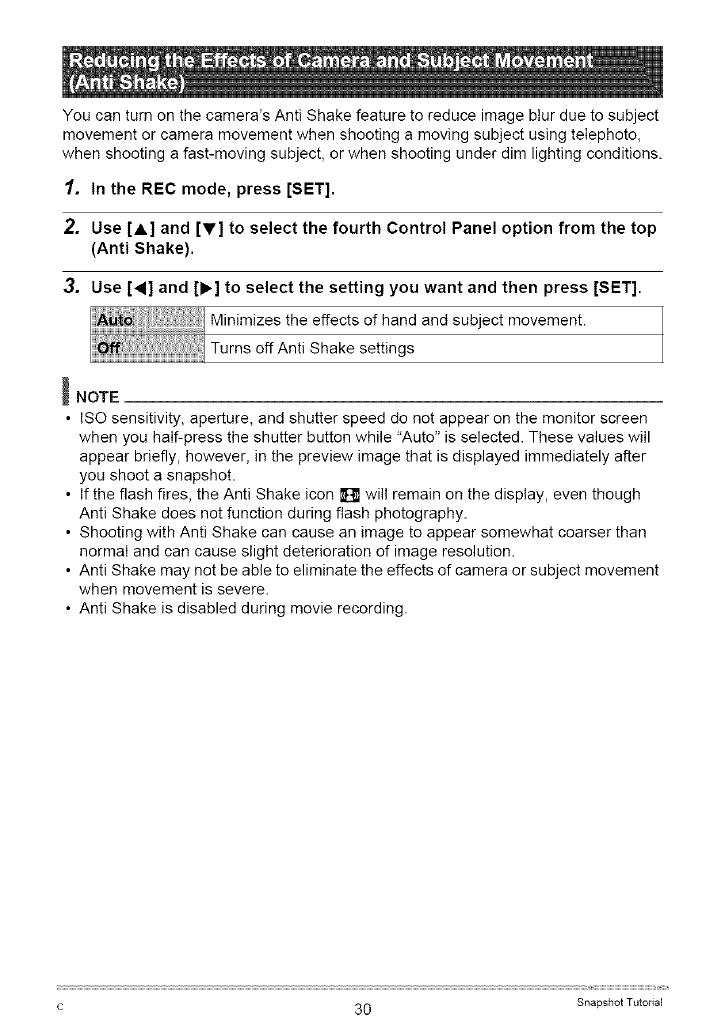
You can turn on the camera's Anti Shake feature to reduce image blur due to subject
movement or camera movement when shooting a moving subject using telephoto,
when shooting a fast-moving subject, or when shooting under dim lighting conditions.
1. In the REC mode, press [SET].
2. Use [A] and [V] to select the fourth Control Panel option from the top
(Anti Shake).
3. Use [,] and [1_]to select the setting you want and then press [SET].
_NOTE
• ISO sensitivity, aperture, and shutter speed do not appear on the monitor screen
when you half-press the shutter button while "Auto" is selected. These values will
appear briefly, however, in the preview image that is displayed immediately after
you shoot a snapshot.
• If the flash fires, the Anti Shake icon [] will remain on the display, even though
Anti Shake does not function during flash photography.
• Shooting with Anti Shake can cause an image to appear somewhat coarser than
normal and can cause slight deterioration of image resolution.
• Anti Shake may not be able to eliminate the effects of camera or subject movement
when movement is severe.
• Anti Shake is disabled during movie recording.
c 30 Snapshot Tutorial
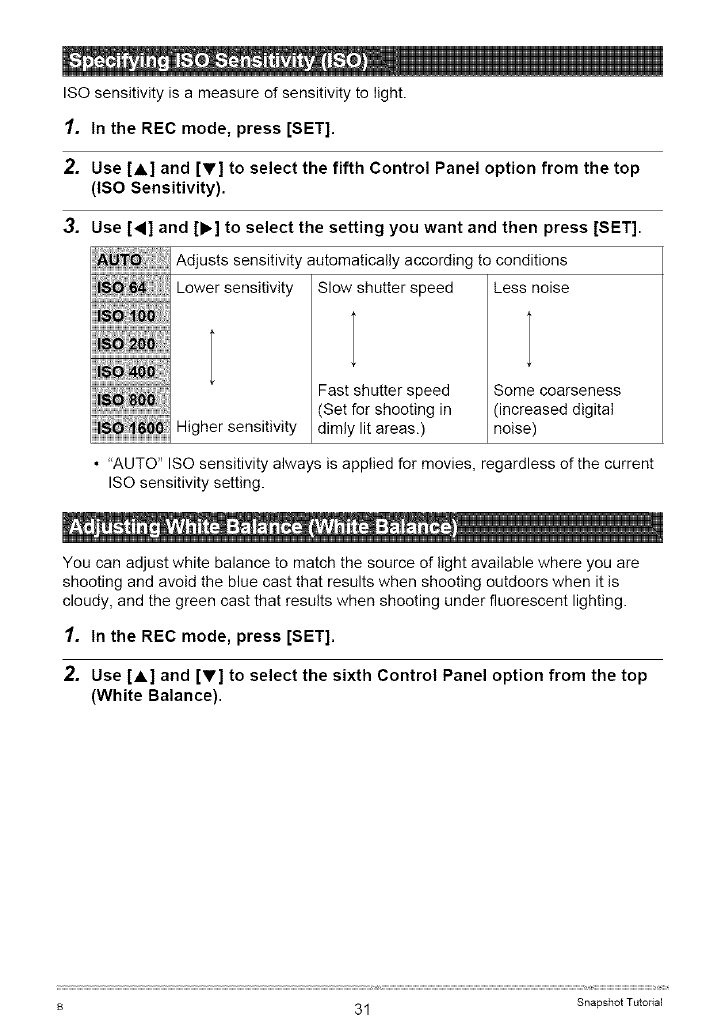
ISO sensitivity is a measure of sensitivity to light.
1. In the REC mode, press [SET].
2. Use [A] and [V] to select the fifth Control Panel option from the top
(ISO Sensitivity).
3. Use [,] and [1_]to select the setting you want and then press [SET].
Adjusts sensitivity automatically according to conditions
Lower sensitivity
Higher sensitivity
Slow shutter speed Less noise
Fast shutter speed
(Set for shooting in
dimly lit areas.)
Some coarseness
(increased digital
noise)
• "AUTO" ISO sensitivity always is applied for movies, regardless of the current
ISO sensitivity setting.
You can adjust white balance to match the source of light available where you are
shooting and avoid the blue cast that results when shooting outdoors when it is
cloudy, and the green cast that results when shooting under fluorescent lighting.
1. In the REC mode, press [SET].
2. Use [A] and [V] to select the sixth Control Panel option from the top
(White Balance).
s 31 Snapshot Tutorial
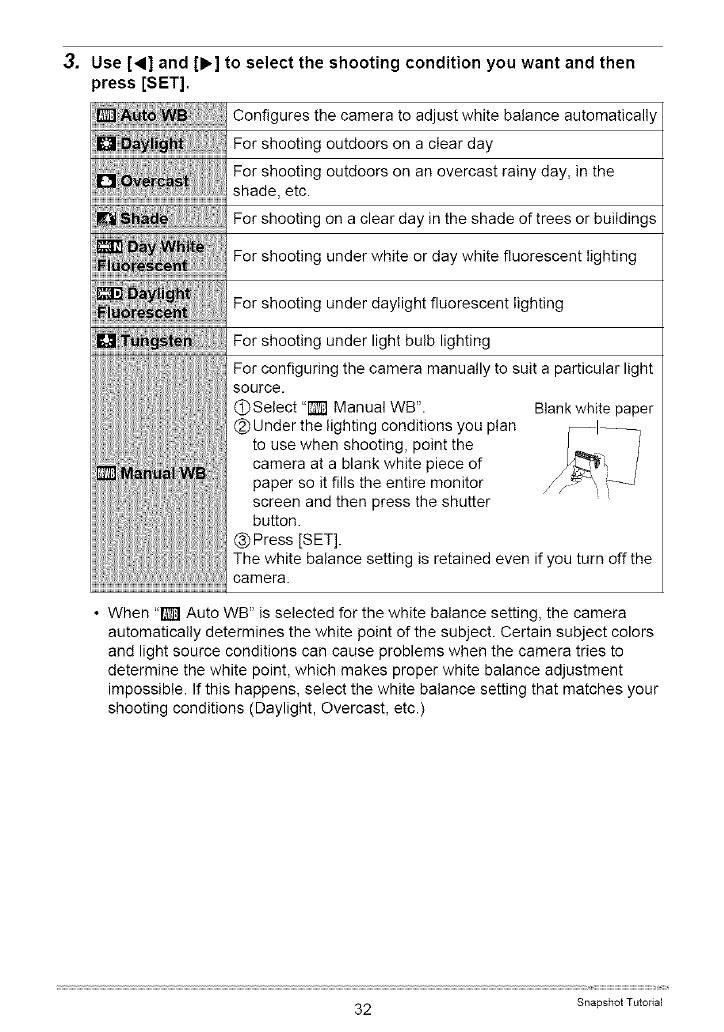
3. Use[,] and [1_] to select the shooting condition you want and then
press [SET].
Configures the camera to adjust white balance automaticall
For shooting outdoors on a clear day
For shooting outdoors on an overcast rainy day, in the
shade, etc.
For shooting on a clear day in the shade of trees or buildings
For shooting under white or day white fluorescent lighting
For shooting under daylight fluorescent lighting
For shooting under light bulb lighting
For configuring the camera manually to suit a particular light
source.
OSelect "_ Manual WB". Blank white paper
(_) Under the lighting conditions you plan
to use when shooting, point the
camera at a blank white piece of
paper so it fills the entire monitor
screen and then press the shutter
button.
(_) Press [SET].
The white balance setting is retained even if you turn off the
camera.
• When "_ Auto WB" is selected for the white balance setting, the camera
automatically determines the white point of the subject. Certain subject colors
and light source conditions can cause problems when the camera tries to
determine the white point, which makes proper white balance adjustment
impossible. If this happens, select the white balance setting that matches your
shooting conditions (Daylight, Overcast, etc.)
32 Snapshot Tutorial
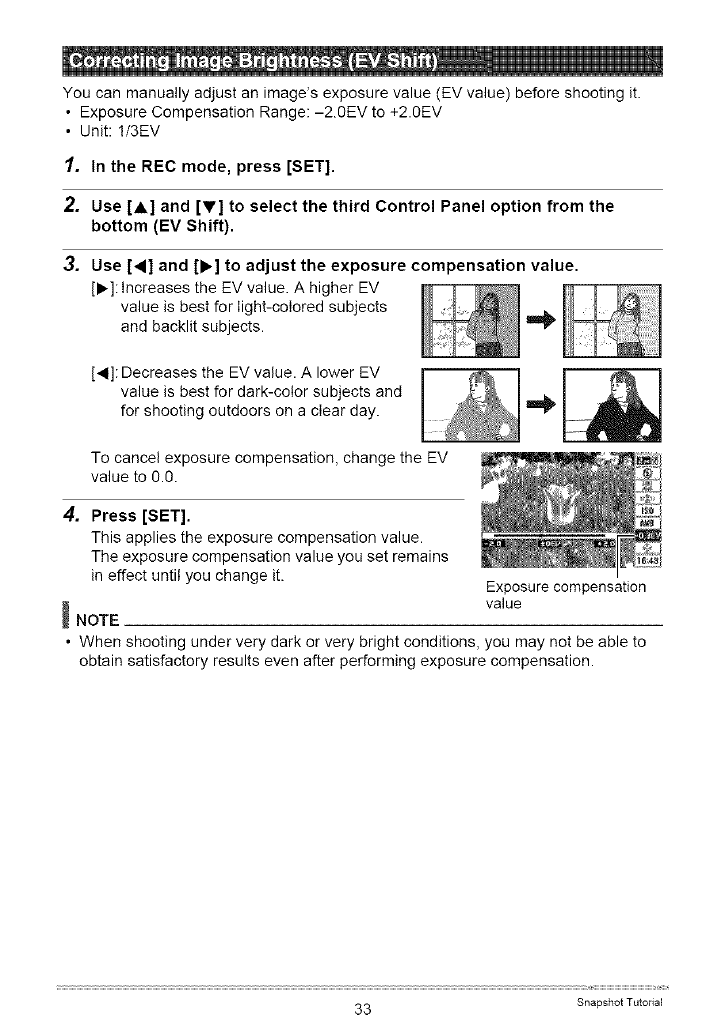
You can manually adjust an image's exposure value (EV value) before shooting it.
• Exposure Compensation Range: -2.0EV to +2.0EV
• Unit: !/3EV
1. In the REC mode, press [SET].
2. Use [A] and [V] to select the third Control Panel option from the
bottom (EV Shift).
3. Use[,] and [1_] to adjust the exposure compensation value.
[1_]: Increases the EV value. A higher EV
value is best for light-colored subjects
and backlit subjects.
[,_]: Decreases the EV value. A lower EV
value is best for dark-color subjects and
for shooting outdoors on a clear day.
To cancel exposure compensation, change the EV
value to 0.0.
4. Press [SET].
This applies the exposure compensation value.
The exposure compensation value you set remains
in effect until you change it.
_NOTE
• When shooting under very dark or very bright conditions, you may not be able to
obtain satisfactory results even after performing exposure compensation.
Exposure compensation
value
33 Snapshot Tutorial
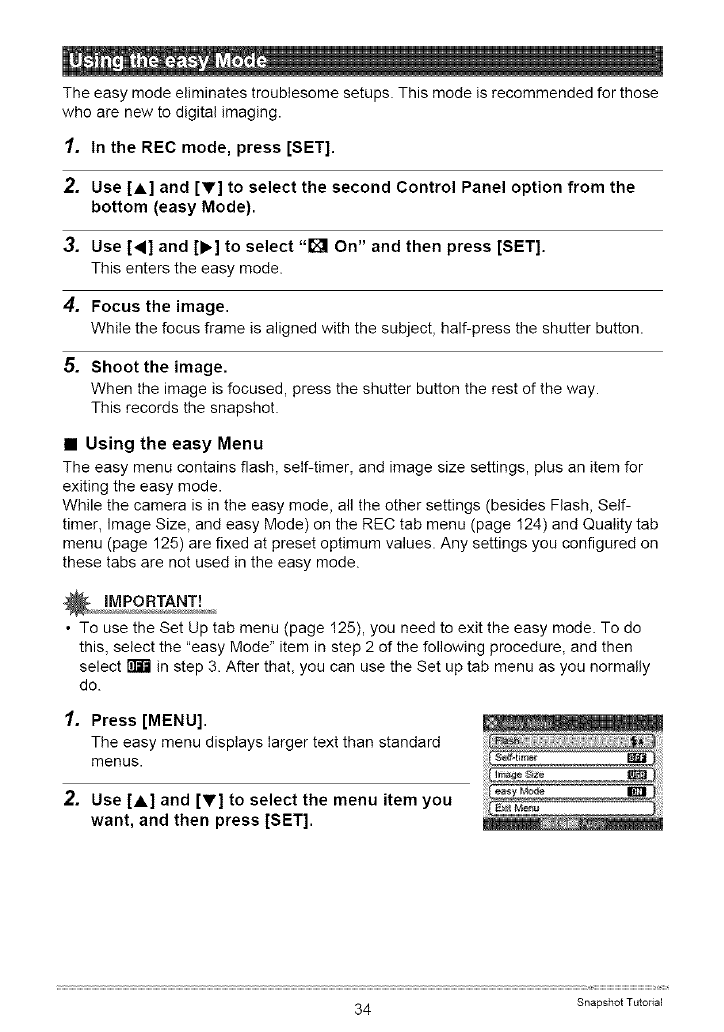
The easy mode eliminates troublesome setups. This mode is recommended for those
who are new to digital imaging.
1. In the REC mode, press [SET].
2. Use [A] and [V] to select the second Control Panel option from the
bottom (easy Mode).
3. Use [,] and [1_]to select "1_1 On" and then press [SET].
This enters the easy mode.
4. Focus the image.
While the focus frame is aligned with the subject, half-press the shutter button.
5. Shoot the image.
When the image is focused, press the shutter button the rest of the way.
This records the snapshot.
• Using the easy Menu
The easy menu contains flash, self-timer, and image size settings, plus an item for
exiting the easy mode.
While the camera is in the easy mode, all the other settings (besides Flash, Self-
timer, Image Size, and easy Mode) on the REC tab menu (page 124) and Quality tab
menu (page 125) are fixed at preset optimum values. Any settings you configured on
these tabs are not used in the easy mode.
• To use the Set Up tab menu (page 125), you need to exit the easy mode. To do
this, select the "easy Mode" item in step 2 of the following procedure, and then
select _ in step 3. After that, you can use the Set up tab menu as you normally
do.
1. Press [MENU].
The easy menu displays larger text than standard
menus.
2. Use [A] and [V] to select the menu item you
want, and then press [SET].
34 Snapshot Tutorial
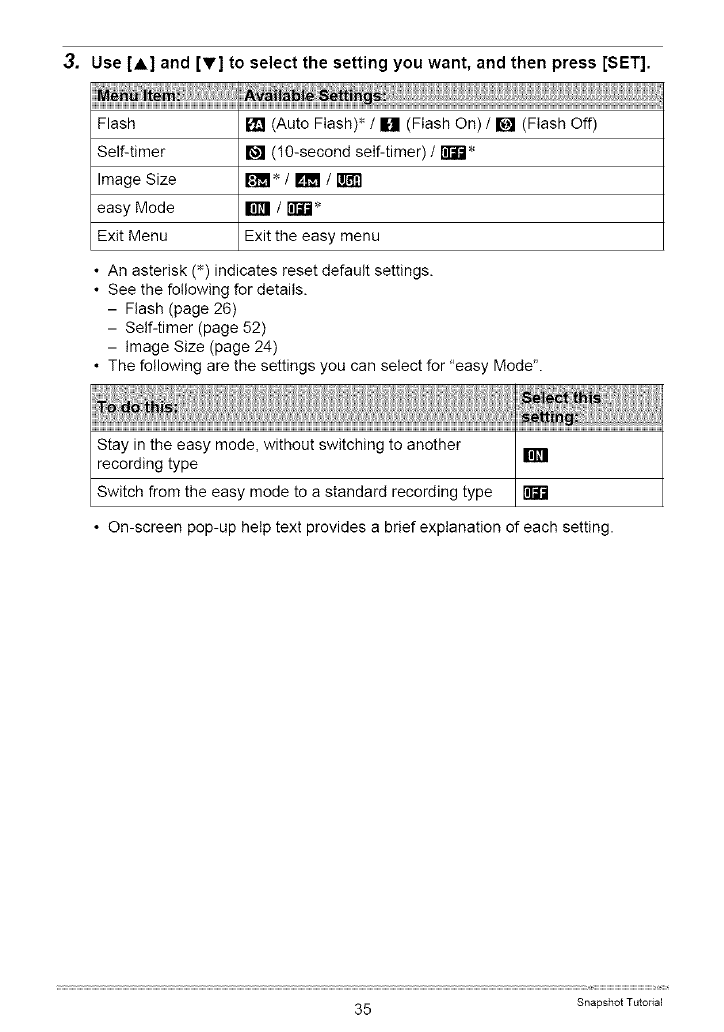
3. Use[A] and [V] to select the setting you want, and then press [SET].
Flash [] (Auto Flash)* /[] (Flash On) /[] (Flash Off)
Self-timer [] (10-second self-timer) /_*
Image Size m* /m/
easy Mode m /ifl-d_*
Exit Menu Exit the easy menu
• An asterisk (3) indicates reset default settings.
• See the following for details.
- Flash (page 26)
- Self-timer (page 52)
- Image Size (page 24)
• The following are the settings you can select for "easy Mode".
Stay in the easy mode, without switching to another
recording type
Switch from the easy mode to a standard recording type
• On-screen pop-up help text provides a brief explanation of each setting.
35 Snapshot Tutorial
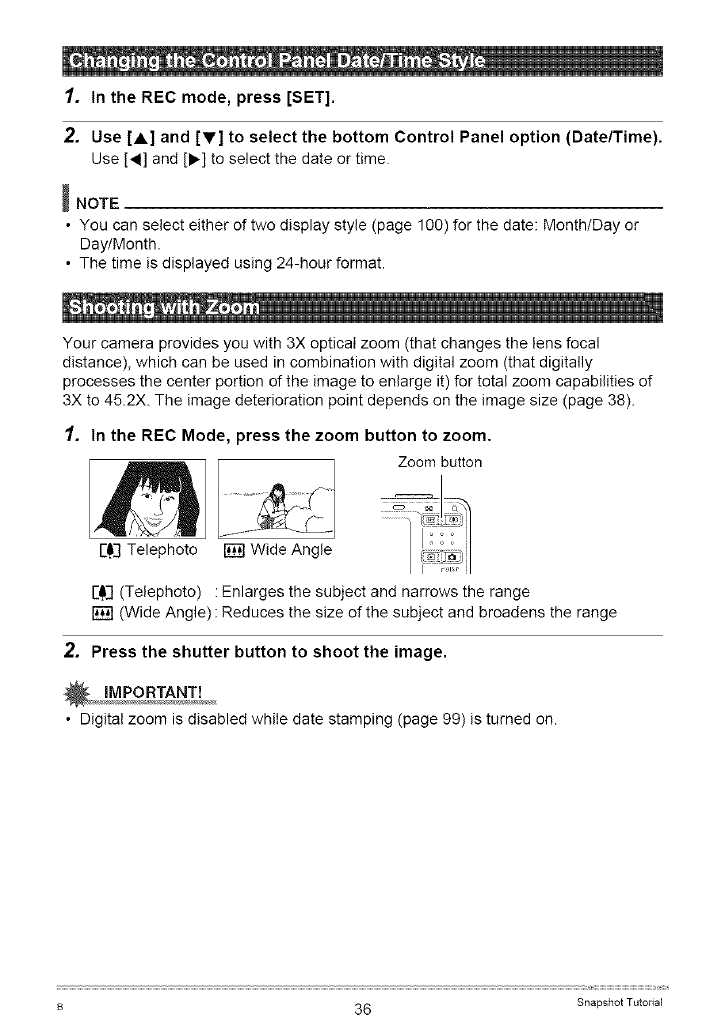
• 1111,!!!
1. In the REC mode, press [SET].
2. use [A] and [V] to select the bottom Control Panel option (Date/Time).
Use [_] and [1_] to select the date or time.
_NOTE
• You can seJect e{ther of two display style (page 100) for the date: Month/Day or
Day/Month.
•The time is displayed using 24-hour format,
Your camera provides you with 3X optical zoom (that changes the lens focal
distance), which can be used in combination with digital zoom (that digitally
processes the center portion of the image to enlarge it) for total zoom capabilities of
3X to 45.2X. The image deterioration point depends on the image size (page 38).
1. In the REC Mode, press the zoom button to zoom.
Zoom button
I-_] Telephoto _ Wide Angle
I-_] (Telephoto) : Enlarges the subject and narrows the range
(Wide Angle) : Reduces the size of the subject and broadens the range
2. Press the shutter button to shoot the image,
• Digital zoom is disabled while date stamping (page 99) is turned on.
s 36 Snapshot Tutorial
_NOTE
• The higher the digital zoom factor, the coarser the recorded image. Note that the
camera also has a function that lets you record using digital zoom without image
deterioration (page 38).
• Use of a tripod is recommended to protect against image blur due to camera
movement when shooting with telephoto.
• Performing a zoom operation changes the lens aperture.
• Digital zoom only is available during movie recording. You can adjust the optical
zoom setting before you press the shutter button to start movie recording.
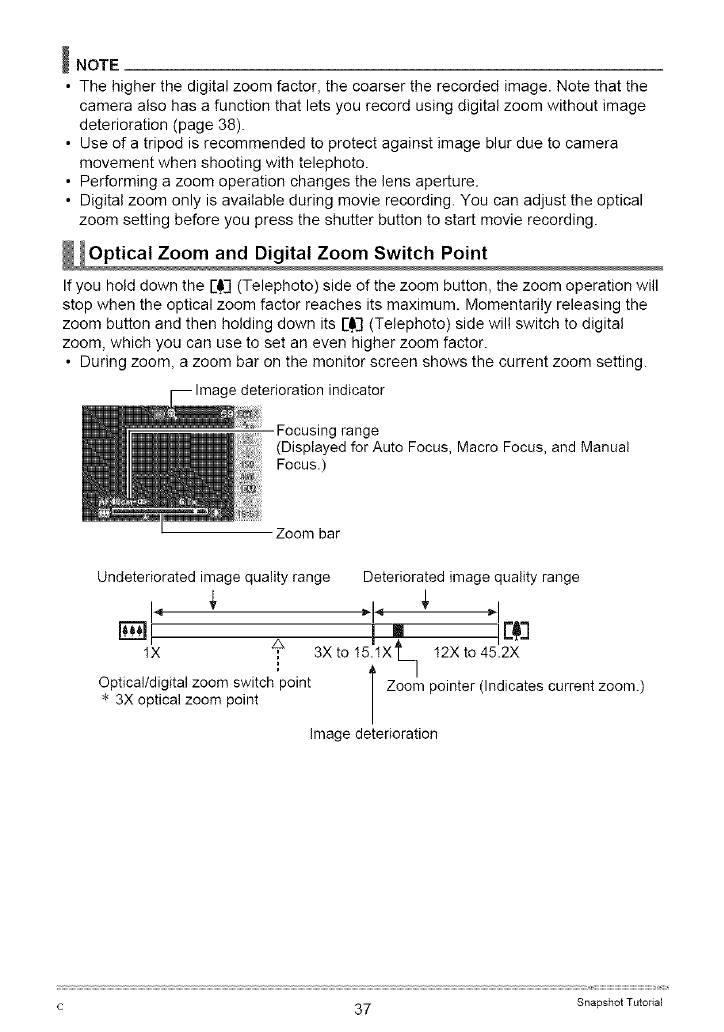
If you hold down the I-_] (Telephoto) side of the zoom button, the zoom operation will
stop when the optical zoom factor reaches its maximum. Momentarily releasing the
zoom button and then holding down its I-_] (Telephoto) side will switch to digital
zoom, which you can use to set an even higher zoom factor.
• During zoom, a zoom bar on the monitor screen shows the current zoom setting.
_=deterioration indicator
Focusing range
(Displayed for Auto Focus, Macro Focus, and Manual
Focus.)
Zoom bar
Undeteriorated image quality range Deteriorated image quality range
I-, € I I lEVI
I_'_llX AI 3Xto I5.IXt_ I2X to 45.2X
Optical/digital zoom switch point Zoom pointer (Indicates current zoom.)
* 3X optical zoom point
image deterioration
c 37 Snapshot Tutorial
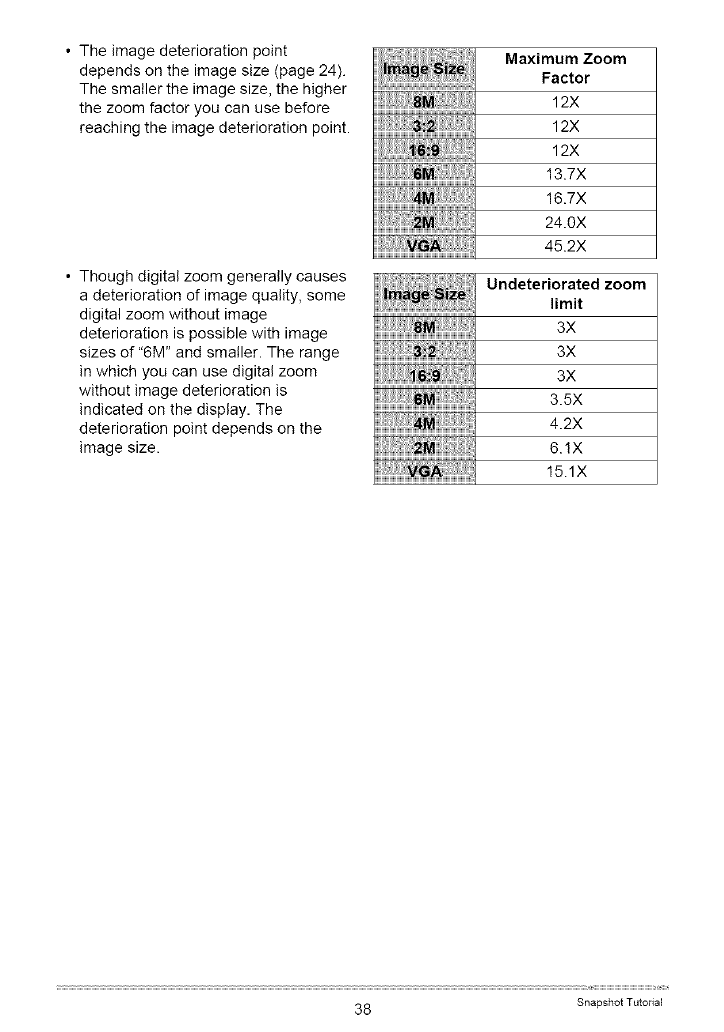
• The image deterioration point
depends on the image size (page 24).
The smaller the image size, the higher
the zoom factor you can use before
reaching the image deterioration point.
• Though digital zoom generally causes
a deterioration of image quality, some
digital zoom without image
deterioration is possible with image
sizes of "6M" and smaller. The range
in which you can use digital zoom
without image deterioration is
indicated on the display. The
deterioration point depends on the
image size.
iI_i_ii MaximumZoom
..... Factor
iiiiliiiiiilililiiiiiiSMi!i:i!;iil;ii!i!;i!iliil 12X
12x
....!!!!!!!!!!!!!!,_!_i_!_9!i_!i:!_/_ii3_!!_!! 12x
iiiiliiiiiiliiiiliiiiiiii_M!iii,i,ii,ii,lili'i,i,i,i13.7X
!!!!!!!!i:!!!!i!!!4M!!!!:!!!;!!!!i:!!!)!(!!i16.7X
!!!;_!!i!_!!i!!=_a!!,!!,!_:!!!!!;!!!:!i24.ox
iiiiiiii,!!,iiii ii!ii!iii!!!i:!i 45.2X
i _ ISi_I Undeteriorated zoom
.... limit
iiiiliiiiiilililili_,il_aiiiiiiiliiiiiii,il3x
sx
3X
iiiiliiiiiiliiiiliiiiiiii_Miiiiiiliiiiii'i;iiiilil3._x
iiiiliii_,iiiiiiii4Miiiiiiliiiiiiiiiil_i4.2x
ii!;_iiii_iiii;2Miiiiiiliiiii!lii!ii6.1x
15.1x
38 Snapshot Tutorial
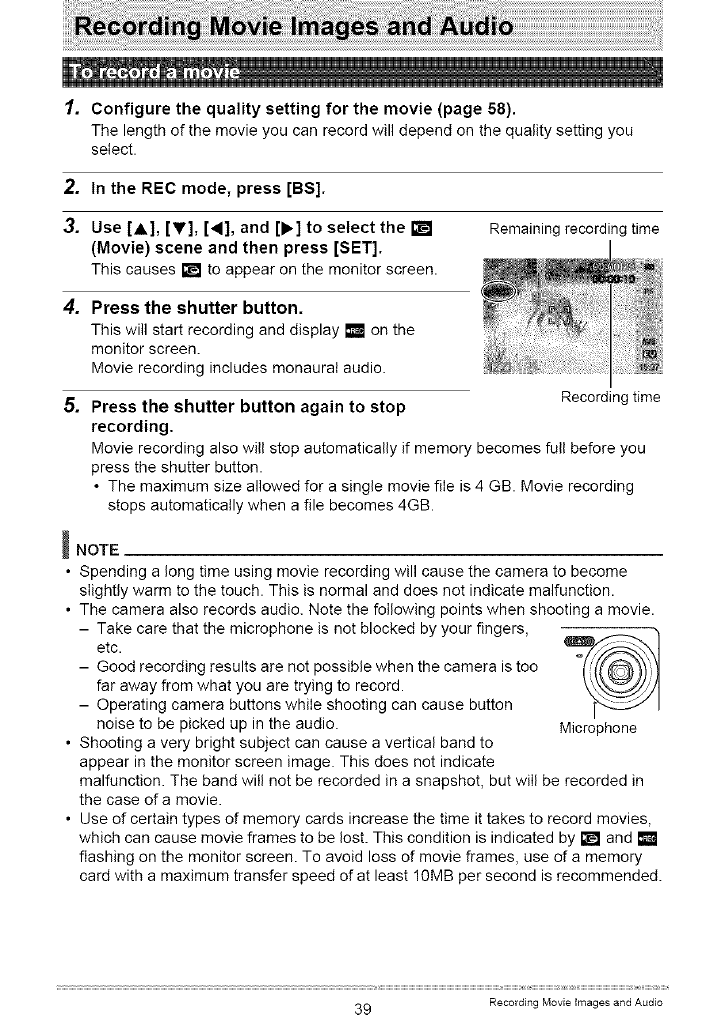
1. Configure the quality setting for the movie (page 58).
The length of the movie you can record will depend on the quality setting you
select.
2. In the REC mode, press [BS].
3. Use [A], [V], [4], and [1_] to select the [] Remaining recording time
(Movie) scene and then press [SET].
This causes [] to appear on the monitor screen.
4. Press the shutter button.
This will start recording and display [] on the
monitor screen.
Movie recording includes monaural audio.
Recording time
5. Press the shutter button again to stop
recording.
Movie recording also will stop automatically if memory becomes full before you
press the shutter button.
• The maximum size allowed for a single movie file is 4 GB. Movie recording
stops automatically when a file becomes 4GB.
_NOTE
• Spending a long time using movie recording will cause the camera to become
slightly warm to the touch. This is normal and does not indicate malfunction.
• The camera also records audio. Note the following points when shooting a movie.
- Take care that the microphone is not blocked by your fingers,
etc. =
- Good recording results are not possible when the camera is too
far away from what you are trying to record.
- Operating camera buttons while shooting can cause button
noise to be picked up in the audio. Microphone
• Shooting a very bright subject can cause a vertical band to
appear in the monitor screen image. This does not indicate
malfunction. The band will not be recorded in a snapshot, but wilI be recorded in
the case of a movie.
• Use of certain types of memory cards increase the time it takes to record movies,
which can cause movie frames to be lost. This condition is indicated by [] and []
flashing on the monitor screen. To avoid loss of movie frames, use of a memory
card with a maximum transfer speed of at least 10MB per second is recommended.
39 Recording Movie images and Audio
• Only digital zoom can be used for zooming during movie recording. Since optical
zoom is not possible while recording a movie, zoom as required before pressing
the shutter button to start recording.
• The effects of camera movement in an image become more pronounced when you
shoot close up or with a large zoom factor. Because of this, use of a tripod is
recommended under these conditions.
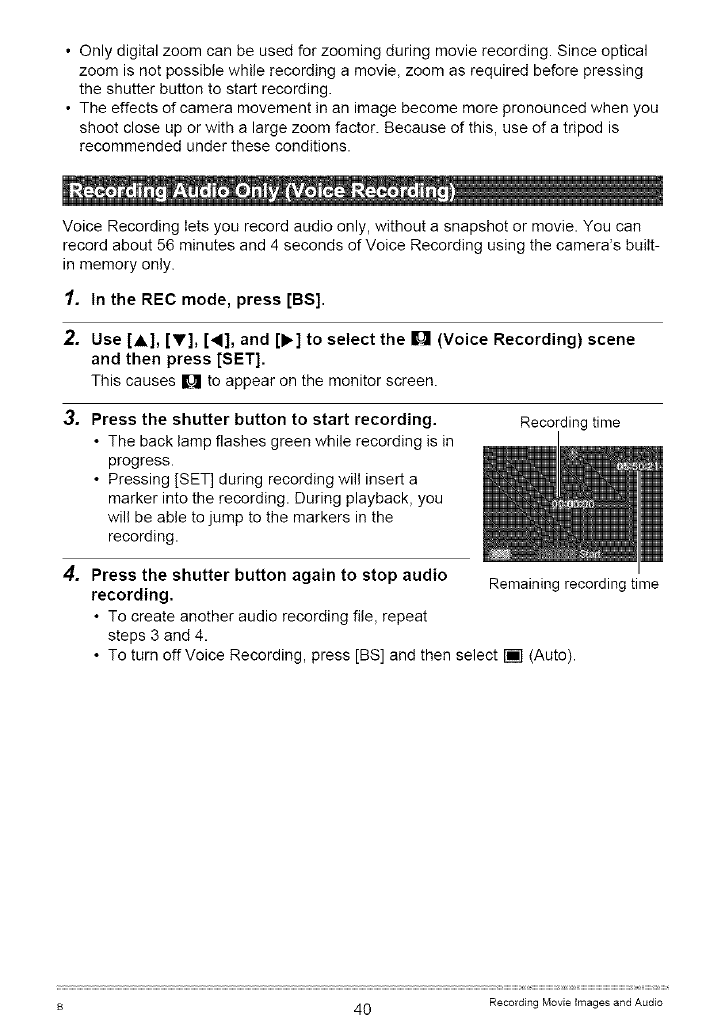
Voice Recording lets you record audio only, without a snapshot or movie. You can
record about 56 minutes and 4 seconds of Voice Recording using the camera's built-
in memory only.
1. In the REC mode, press [BS].
2. Use [A], [V], [,], and [1_] to select the U(Voice Recording) scene
and then press [SET].
This causes IPJ to appear on the monitor screen.
Recording time
3. Press the shutter button to start recording.
• The back lamp flashes green while recording is in
progress.
• Pressing [SET] during recording will insert a
marker into the recording. During playback, you
will be able to jump to the markers in the
recording.
4. Press the shutter button again to stop audio Remaining recording time
recording.
• To create another audio recording file, repeat
steps 3 and 4.
• To turn off Voice Recording, press [BS] and then select [] (Auto).
s40 Recording Movie Images and Audio
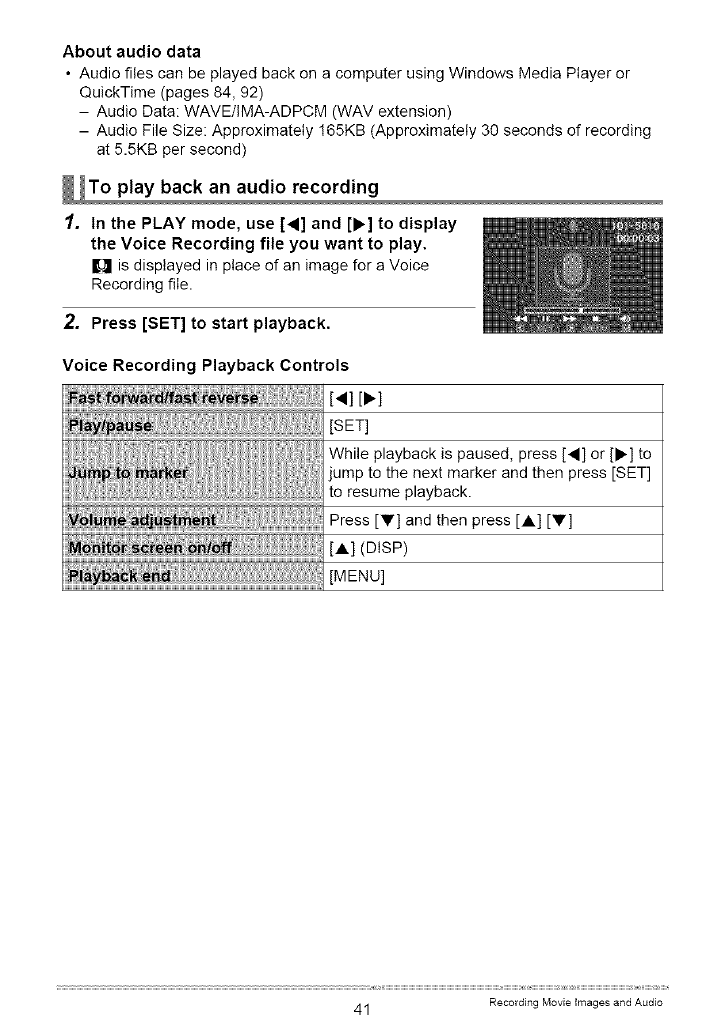
About audio data
• Audio files can be played back on a computer using Windows Media Player or
QuickTime (pages 84, 92)
- Audio Data: WAVE/IMA-ADPCM (WAV extension)
- Audio File Size: Approximately !65KB (Approximately 30 seconds of recording
at 5.5KB per second)
1. In the PLAY mode, use [,] and [1_] to display
the Voice Recording file you want to play.
H is displayed in place of an image for a Voice
Recording file.
2. Press [SET] to start playback,
Voice Recording Playback Controls
[,][,.]
[SET]
to resume playback.
Press [Y]and then press [A ][y]
[A] (DISP)
[ME.U]
41 Recording Movie Images and Audio
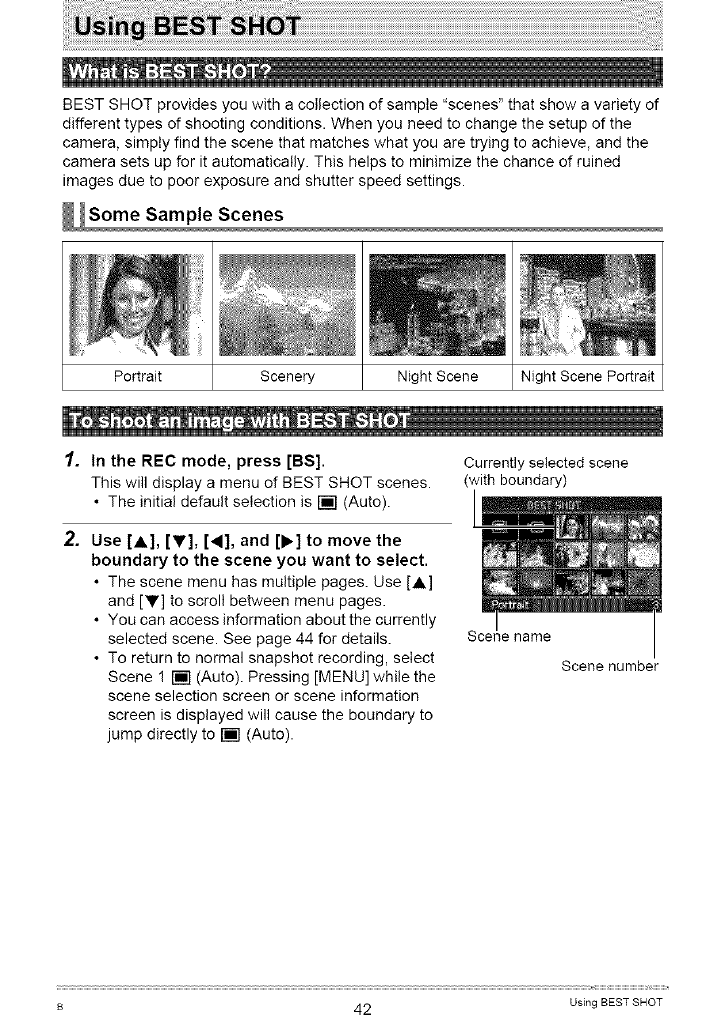
BEST SHOT provides you with a collection of sample "scenes" that show a variety of
different types of shooting conditions. When you need to change the setup of the
camera, simply find the scene that matches what you are trying to achieve, and the
camera sets up for it automatically. This helps to minimize the chance of ruined
images due to poor exposure and shutter speed settings.
Portrait Scenery Night Scene Night Scene Portrait
1. In the REC mode, press [BS]. Currently selected scene
This will display a menu of BEST SHOT scenes. (with boundary)
• The initial default selection is [] (Auto).
2. use [A], [_'], [4], and [1_] to move the
boundary to the scene you want to select.
• The scene menu has multiple pages. Use [A]
and [Y] to scroll between menu pages.
• You can access information about the currently
selected scene. See page 44 for details.
• To return to normal snapshot recording, select
Scene 1 [] (Auto). Pressing [MENU] while the
scene selection screen or scene information
screen is displayed will cause the boundary to
jump directly to [] (Auto).
Scene name
Scene number
s42 Using BEST SHOT
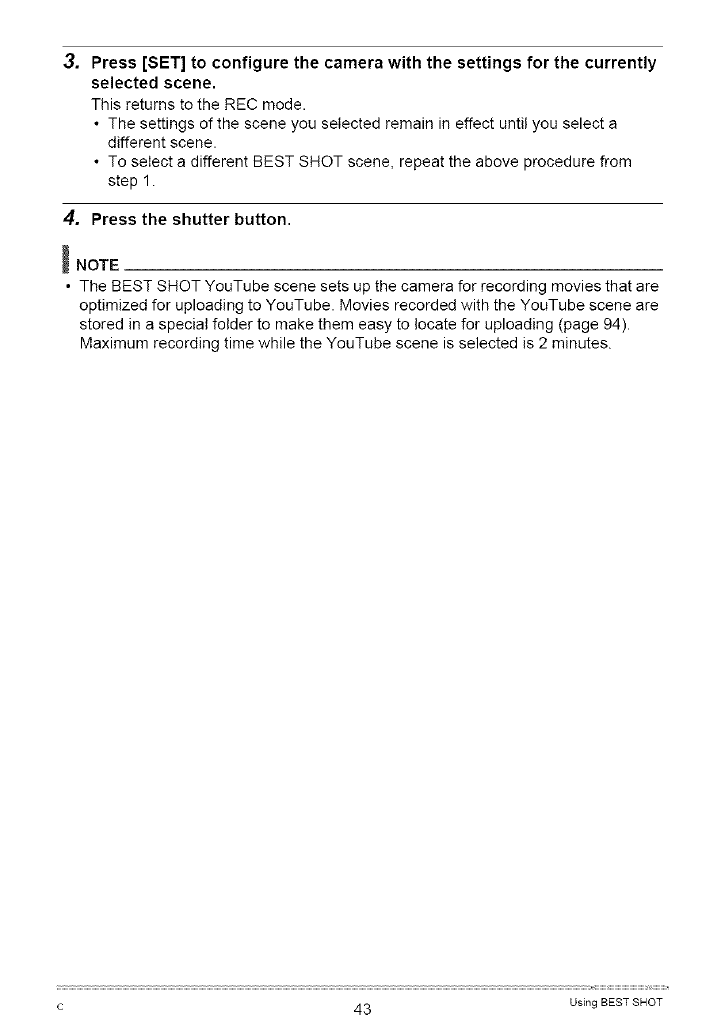
3. Press [SET] to configure the camera with the settings for the currently
selected scene.
This returns to the REC mode.
• The settings of the scene you selected remain in effect until you select a
different scene.
• To select a different BEST SHOT scene, repeat the above procedure from
step 1.
4. Press the shutter button.
_NOTE
• The BEST SHOT YouTube scene sets up the camera for recording movies that are
optimized for uploading to YouTube. Movies recorded with the YouTube scene are
stored in a special folder to make them easy to locate for uploading (page 94).
Maximum recording time while the YouTube scene is selected is 2 minutes.
c43 Using BEST SHOT
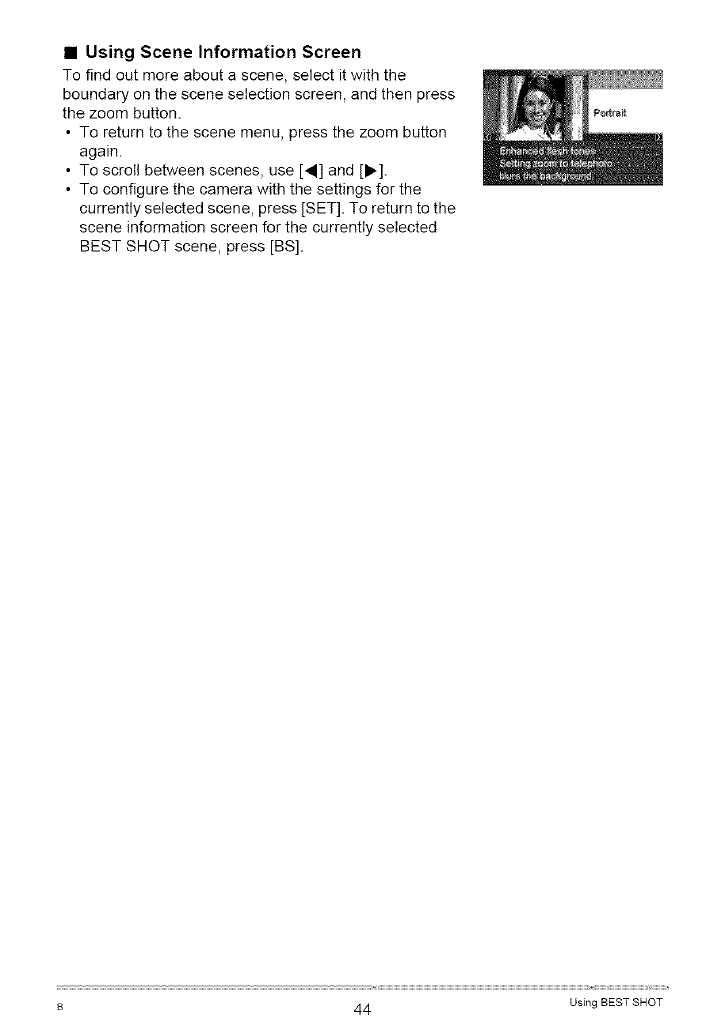
• Using Scene Information Screen
To find out more about a scene, select it with the
boundary on the scene selection screen, and then press
the zoom button.
• To return to the scene menu, press the zoom button
again.
• To scroll between scenes, use [,_] and [1_].
• To configure the camera with the settings for the
currently selected scene, press [SET]. To return to the
scene information screen for the currently selected
BEST SHOT scene, press [BS].
s44 Using BEST SHOT
• BEST SHOT Precautions
• Selecting the Night Scene or Fireworks scene results in a slow shutter speed
setting. Since a slow shutter speed increases the chance of digital noise in the
image, the camera automatically performs a digital noise reduction process when
either of these scenes is selected. This means that it will take a bit longer for the
image to be saved which is indicated by the back lamp flashing green. Do not
perform any key operation during that time. Also, it is a good idea to use a tripod to
avoid image blur due to camera movement when shooting at slow shutter speeds.
• Your camera includes a sample scene that optimizes settings for auction site
images. Depending on your camera model, the sample scene is named either "For
eBay" or "Auction". Images you record using the auction site sample scene are
stored in a special folder so you can easily find them on your computer (page 94).
• High Sensitivity
- The high sensitivity setting is disabled whenever the camera's flash fires.
- High sensitivity may not produce the desired results in very dark conditions.
- When shooting with slow shutter speeds, use a tripod to protect against blurring
due to camera movement.
- Under certain lighting conditions, the camera will perform an automatic noise
filtering operation to reduce digital noise in the image. This operation causes the
camera to take longer than normal to save the image and be ready for the next
shot.
• BEST SHOT scene images were not shot using this camera.
• Images shot using a BEST SHOT scene may not produce the results you expected
due to shooting conditions and other factors.
• You can modify the camera settings that are made after you select a BEST SHOT
scene. Note, however, that the BEST SHOT settings revert to their defaults when
you select another BEST SHOT scene or turn off the camera.
s45 Using BEST SHOT
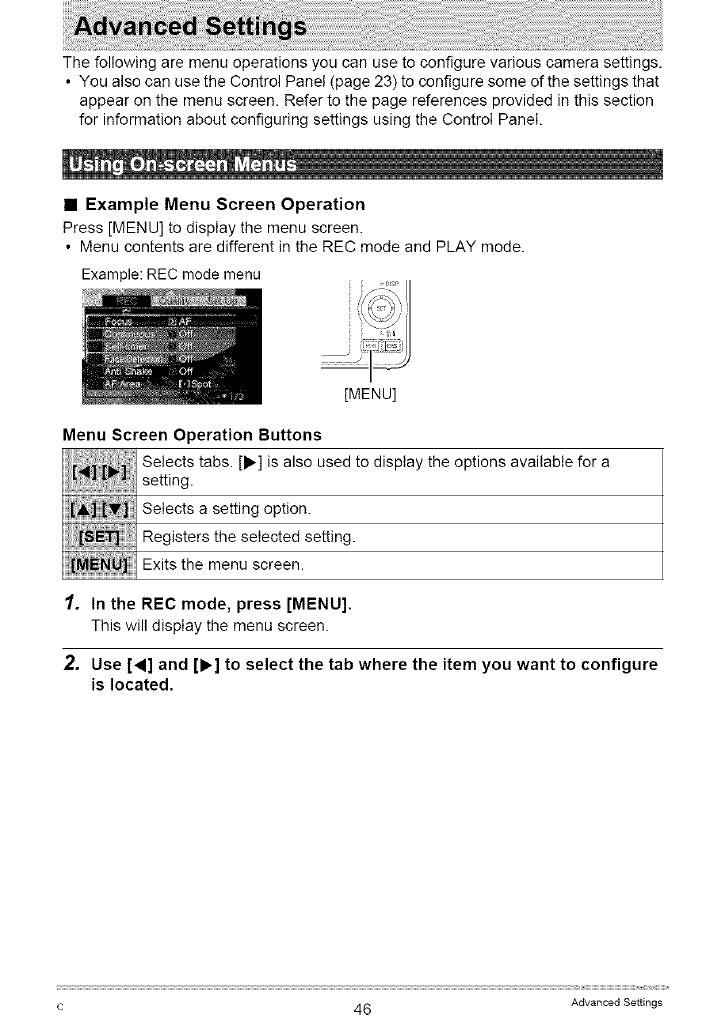
The following are menu operations you can use to configure various camera settings.
• You also can use the Control Panel (page 23) to configure some of the settings that
appear on the menu screen. Refer to the page references provided in this section
for information about configuring settings using the Control Panel.
• Example Menu Screen Operation
Press [MENU] to display the menu screen.
• Menu contents are different in the REC mode and PLAY mode.
Example: REC mode menu
[MENU]
Menu Screen Operation Buttons
Selects tabs. [1_] is also used to display the options available for a
setting.
Selects a setting option.
....[8_ Registers the selected setting.
_i Exits the menu screen.
1. In the REC mode, press [MENU].
This will display the menu screen.
2. Use [,] and [1_]to select the tab where the item you want to configure
is located,
c 46 Advanced Settings
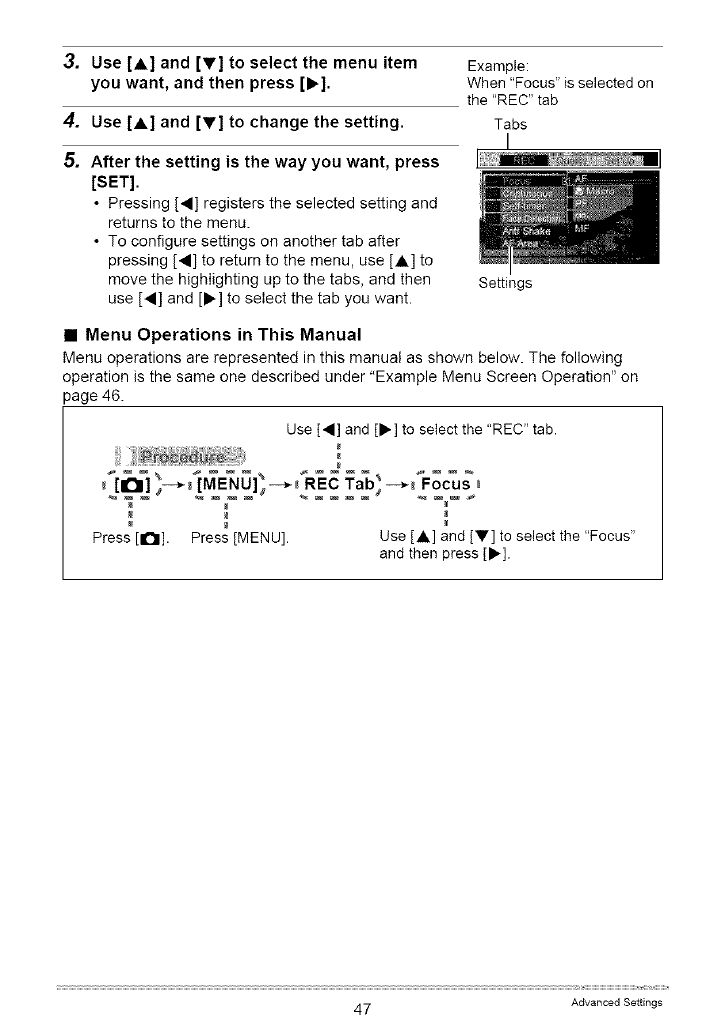
3. Use [A] and [V] to select the menu item Example:
you want, and then press [11_]. When "Focus" is selected on
the "REC" tab
4. Use [A] and [V] to change the setting.
5. After the setting is the way you want, press
[SET].
• Pressing [,_] registers the selected setting and
returns to the menu.
• To configure settings on another tab after
pressing [_1] to return to the menu, use [A] to
move the highlighting up to the tabs, and then
use [,_] and [1_] to select the tab you want.
Tabs
I
Settings
•Menu Operations in This Manual
Menu operations are represented in this manual as shown below. The following
operation is the same one described under "Example Menu Screen Operation" on
page 46.
Use [,_] and [1_] to select the "REC" tab.
,[O) ,--_,[M=ENU],,--_, REC Tab,--_, FOCUS'
Press [1_1]. Press [MENU]. Use [A] and [Y] to select the "Focus"
and then press [1_].
47 Advanced Settings
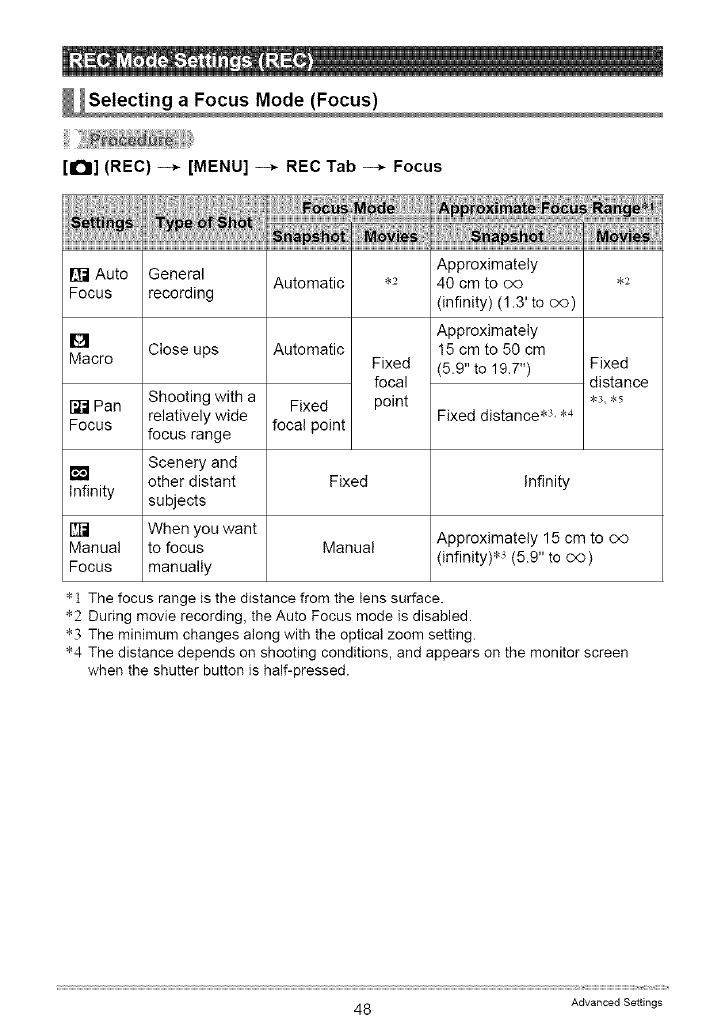
[O] (REC) --_ [MENU] --_ REC Tab --_ Focus
Approximately
[] Auto General Automatic ,2 40 cm to oo
Focus recording (infinity) (! .3' to oo)
Approximately
[] Close ups Automatic 15 cm to 50 cm
Macro Fixed (5.9" to 192") Fixed
focal distance
[] Pan Shooting with a Fixed point ,3. ,5
relatively wide focal point Fixed distance *_, ,4
Focus focus range
Scenery and
[] other distant Fixed Infinity
Infinity subjects
[] When you want Approximately 15 cm to oo
Manual to focus Manual
Focus manually (infinity) .3 (5.9" to oo)
* 1 The focus range is the distance from the lens surface.
*2 During movie recording, the Auto Focus mode is disabled.
*3 The minimum changes along with the optical zoom setting.
*4 The distance depends on shooting conditions, and appears on the monitor screen
when the shutter button is half-pressed.
48 Advanced Settings
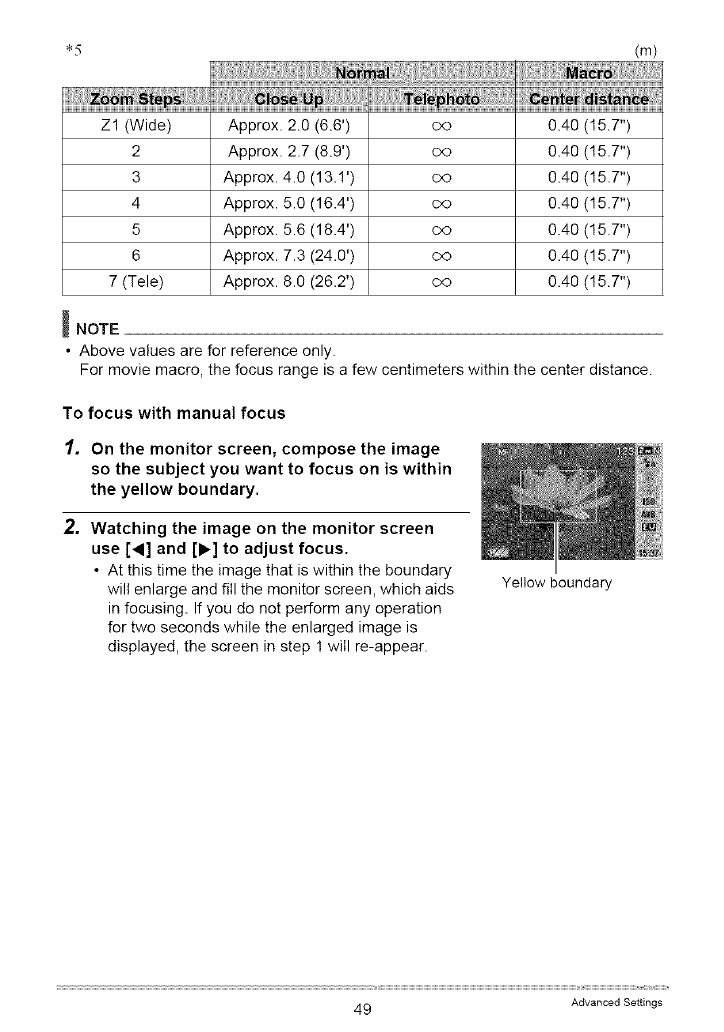
'5 (m)
iii ,Ji iii iiii
Zl (Wide) Approx. 2.0 (6.6') oo 0.40 (15.7")
2 Approx. 2.7 (8.9') oo 0.40 (15.7")
3 Approx. 4.0 (13.!') oo 0.40 (15.7")
4 Approx. 5.0 (16.4') oo 0.40 (15.7")
5 Approx. 5.6 (18.4') oo 0.40 (15.7")
6 Approx. 7.3 (24.0') oo 0.40 (15.7")
7 (Tele) Approx. 8.0 (26.2') oo 0.40 (15.7")
_NOTE
• Above values are for reference only.
For movie macro, the focus range is a few centimeters within the center distance.
To focus with manual focus
1. On the monitor screen, compose the image
so the subject you want to focus on is within
the yellow boundary.
2. Watching the image on the monitor screen
use [,] and [1_] to adjust focus.
• At this time the image that is within the boundary
will enlarge and fill the monitor screen, which aids
in focusing. If you do not perform any operation
for two seconds while the enlarged image is
displayed, the screen in step 1 will re-appear.
Yellow bounda_
49 Advanced Settings
_NOTE
• Auto Focus can be used when recording snapshots only.
• Whenever you perform an optical zoom operation while shooting with Auto Focus,
Macro Focus, or Manual Focus, a value will appear on the monitor screen to tell
you the focus range, as shown below.
Example: ©© cm to co
©© is the actual focusing range value.
• The operations assigned to the [,_] and [1_] keys with the "L/R Key" setting (page
54) are disabled while Manual Focus is selected as the focus mode.
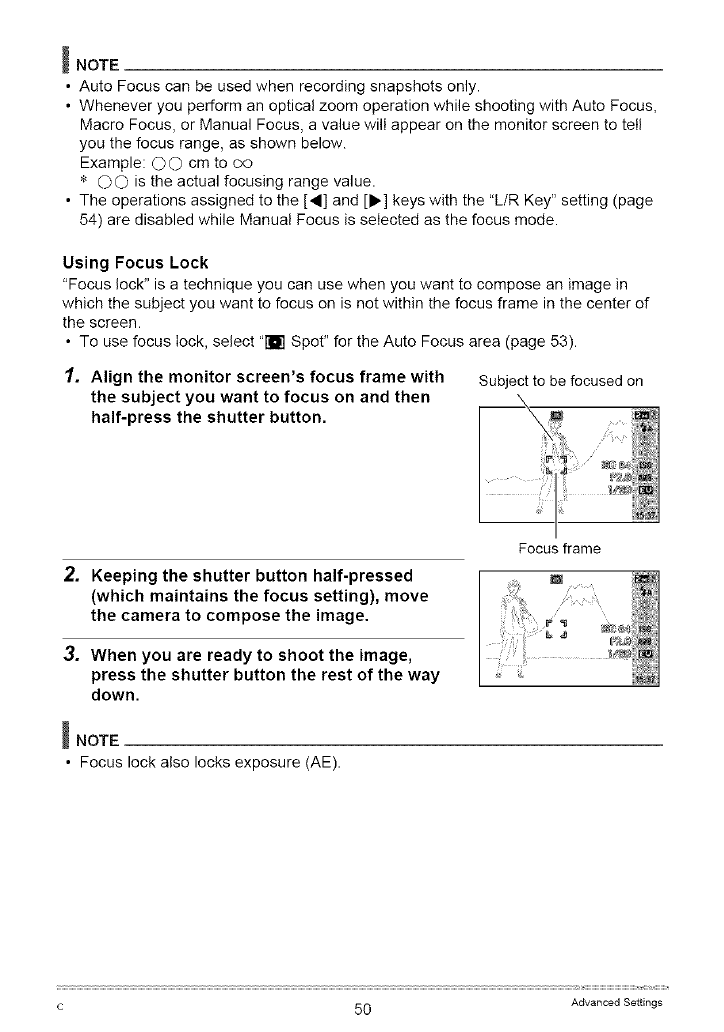
Using Focus Lock
"Focus lock" is a technique you can use when you want to compose an image in
which the subject you want to focus on is not within the focus frame in the center of
the screen.
• To use focus lock, select "lillil Spot" for the Auto Focus area (page 53).
1. Align the monitor screen's focus frame with Subject to be focused on
the subject you want to focus on and then
half-press the shutter button.
Focus frame
2. Keeping the shutter button half-pressed
(which maintains the focus setting), move ....
the camera to compose the image.
3. When you are ready to shoot the image,
press the shutter button the rest of the way
down.
_NOTE
• Focus lock also locks exposure (AE).
C 50 Advanced Settings
[O] (REC) --,- [MENU] --,- REC Tab --_ Continuous
While Continuous Shutter is turned on, images are continually recorded until memory
becomes full, as long as you keep the shutter button depressed.
Releasing the shutter button stops shooting.
_NOTE
• With continuous shutter, exposure and focus for the first image are applied for
successive images as well
• Continuous shutter cannot be used in combination with any of the following
Some BEST SHOT scenes (Movie, For YeuTube, Voice Recording)
• When using a continuous shutter mode, keep the camera still until all recording is
finished.
• The continuous shutter rate depends on the current image size and image quality
settings.
• The speed of Continuous Shutter depends on the type of memory card loaded in
the camera and the amount dfree space available for storage. When shooting to
built-in memory, continuous shutter shooting is relatively slow.
• You cannot use the self-timer in combination with Continuous Shutter.
51 Advanced Settings
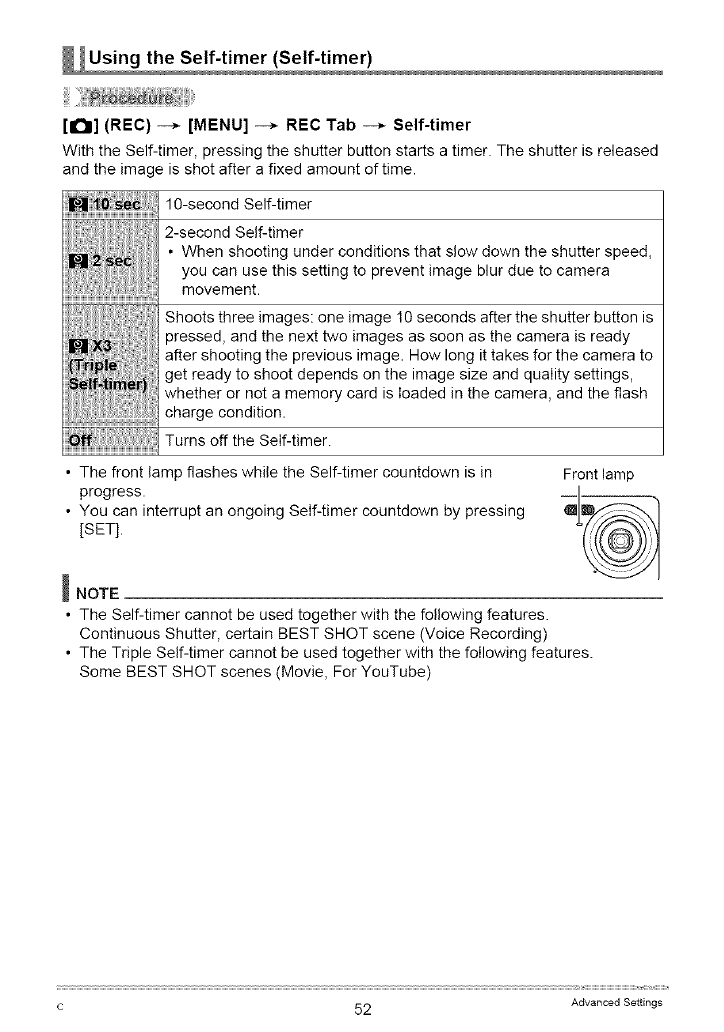
[O] (REC) --_ [MENU] --_ REC Tab --_ Self-timer
With the Self-timer, pressing the shutter button starts a timer. The shutter is released
and the image is shot after a fixed amount of time.
10-second Self-ti m er
2-second Self-timer
|!2:_e * When shooting under conditions that slow down the shutter speed,
you can use this setting to prevent image blur due to camera
movement.
Shoots three images: one image 10 seconds after the shutter button is
iressed, and the next two images as soon as the camera is ready
F_i_le: after shooting the previous image. How long it takes for the camera to
el_fmel get ready to shoot depends on the image size and quality settings,
whether or not a memory card is loaded in the camera, and the flash
................................................................................charge condition.
Turns off the Self-timer.
• The front lamp flashes while the Self-timer countdown is in
progress.
• You can interrupt an ongoing Self-timer countdown by pressing
[SET].
_NOTE
• The Self-timer cannot be used together with the following features.
Continuous Shutter, certain BEST SHOT scene (Voice Recording)
Front lamp
• The Triple Self-timer cannot be used together with the following features.
Some BEST SHOT scenes (Movie, For YouTube)
c 52 Advanced Settings
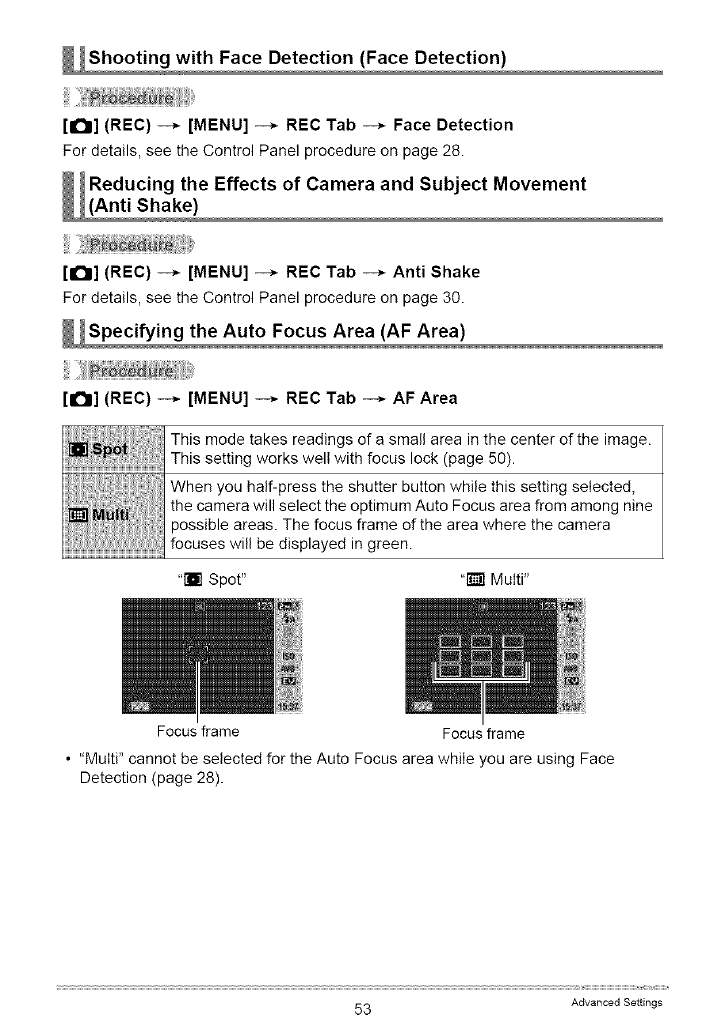
[1_11](REC)-_ [MENU]-_ REC Tab --,- Face Detection
For details, see the Control Panel procedure on page 28.
[O] (REC) -_ [MENU] -_ REC Tab -_ Anti Shake
For details, see the Control Panel procedure on page 30.
[O] (REC) --_ [MENU] --_ REC Tab --_ AF Area
_ J: This mode takes readings of a small area in the center of the image.
This setting works well with focus lock (page 50).
When you half-press the shutter button while this setting selected,
the camera will select the optimum Auto Focus area from among nine
possible areas. The focus frame of the area where the camera
focuses will be displayed in green.
,,ri_ spot .... [] Multi"
Focus frame Focus frame
• "Multi" cannot be selected for the Auto Focus area while you are using Face
Detection (page 28).
53 Advanced Settings
iiiiiilYj@ @@ @iiiiiiiilii ,
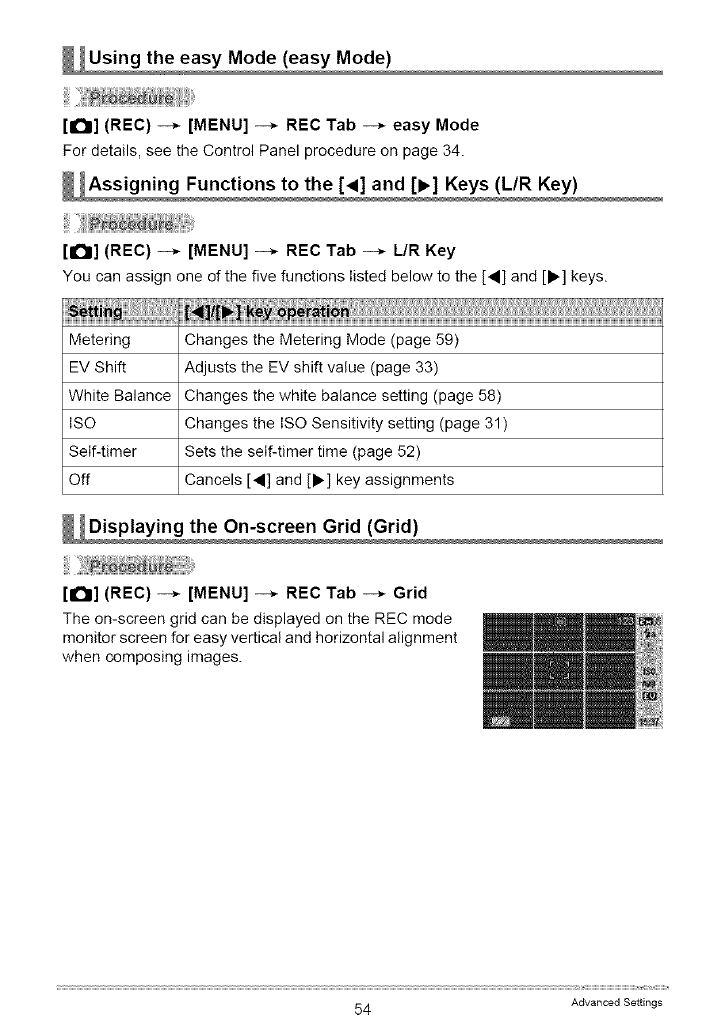
[O] (REC) -_ [MENU] --* REC Tab -_ easy Mode
For details, see the Control Panel procedure on page 34.
[O] (REC) --_ [MENU] --_ REC Tab --_ L/R Key
You can assign one of the five functions listed below to the [<] and [1_] keys.
ii ii!i!iiiiii!iii!!
Metering
EV Shift
White Balance
ISO
Self-timer
Off
Changes the Metering Mode (page 59)
Adjusts the EV shift value (page 33)
Changes the white balance setting (page 58)
Changes the ISO Sensitivity setting (page 31)
Sets the self-timer time (page 52)
Cancels [,_] and [1_] key assignments
[1_11](REC) --,- [MENU] --_ REC Tab --,- Grid
The on-screen grid can be displayed on the REC mode
monitor screen for easy vertical and horizontal alignment
when composing images.
54 Advanced Settings
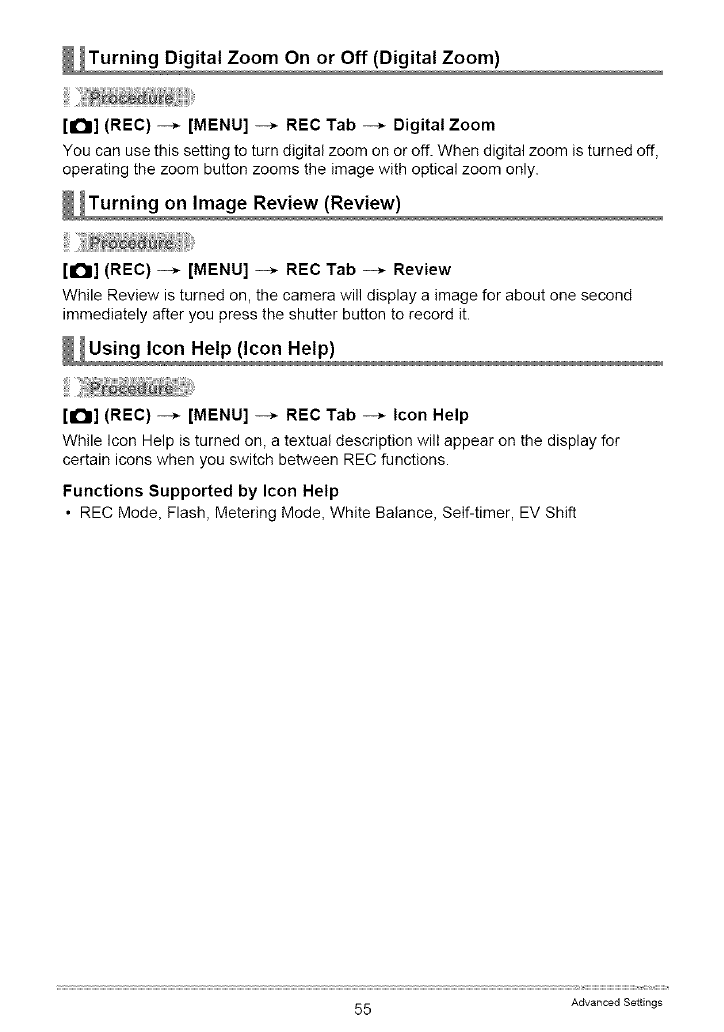
[O] (REC) --* [MENU] --_ REC Tab --_ Digital Zoom
You can use this setting to turn digital zoom on or off. When digital zoom is turned off,
operating the zoom button zooms the image with optical zoom only.
[O] (REC) --_ [MENU] --_ REC Tab --_ Review
While Review is turned on, the camera will display a image for about one second
immediately after you press the shutter button to record it.
[O] (REC) --_ [MENU] --_ REC Tab --_ Icon Help
While Icon Help is turned on, a textual description will appear on the display for
certain icons when you switch between REC functions.
Functions Supported by Icon Help
• REC Mode, Flash, Metering Mode, White Balance, Self-timer, EV Shift
55 Advanced Settings
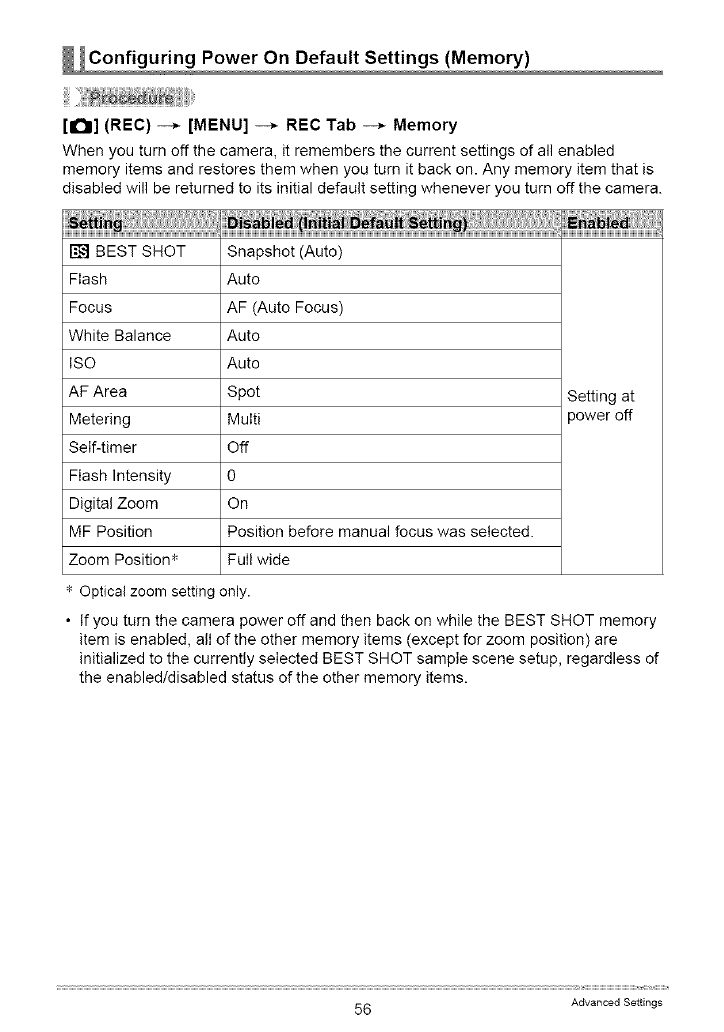
[O] (REC) --_ [MENU] --_ REC Tab --,- Memory
When you turn off the camera, it remembers the current settings of all enabled
memory items and restores them when you turn it back on. Any memory item that is
disabled will be returned to its initial default setting whenever you turn off the camera.
[] BEST SHOT Snapshot (Auto)
Flash Auto
Focus AF (Auto Focus)
White Balance Auto
ISO Auto
AF Area Spot Setting at
Metering Multi power off
Self-timer Off
Flash Intensity 0
Digital Zoom On
MF Position Position before manual focus was selected.
Zoom Position _ Full wide
Optical zoom setting only.
• If you turn the camera power off and then back on while the BEST SHOT memory
item is enabled, all of the other memory items (except for zoom position) are
initialized to the currently selected BEST SHOT sample scene setup, regardless d
the enabled/disabled status of the other memory items.
56 Advanced Settings
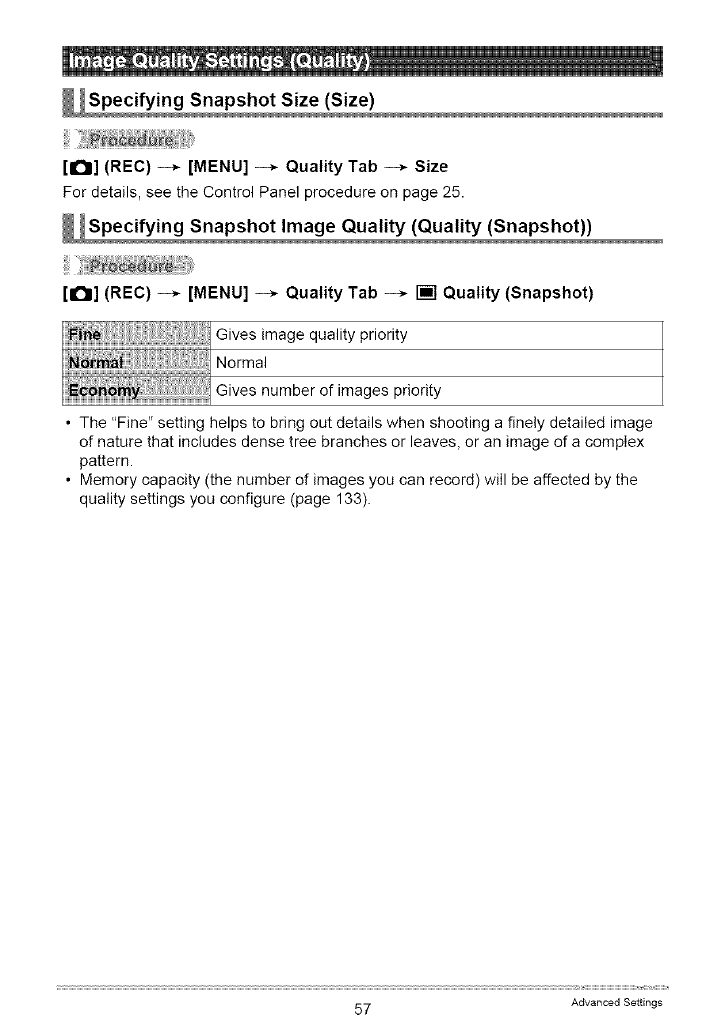
[1_11] (REC) -_ [MENU] --* Quality Tab --* Size
For details, see the Control Panel procedure on page 25.
[It31] (REC) --_ [MENU] --_ Quality Tab --_ [] Quality (Snapshot)
Giveslinagequa,itypriority
Normal
Gives number of images pdority
• The "Fine" setting helps to bring out details when shooting a finely detailed image
of nature that includes dense tree branches or leaves, or an image of a complex
pattern.
• Memory capacity (the number of images you can record) will be affected by the
quality settings you configure (page 133).
57 Advanced Settings
iiiiiilYj@ @@i @iiiliiiiiii
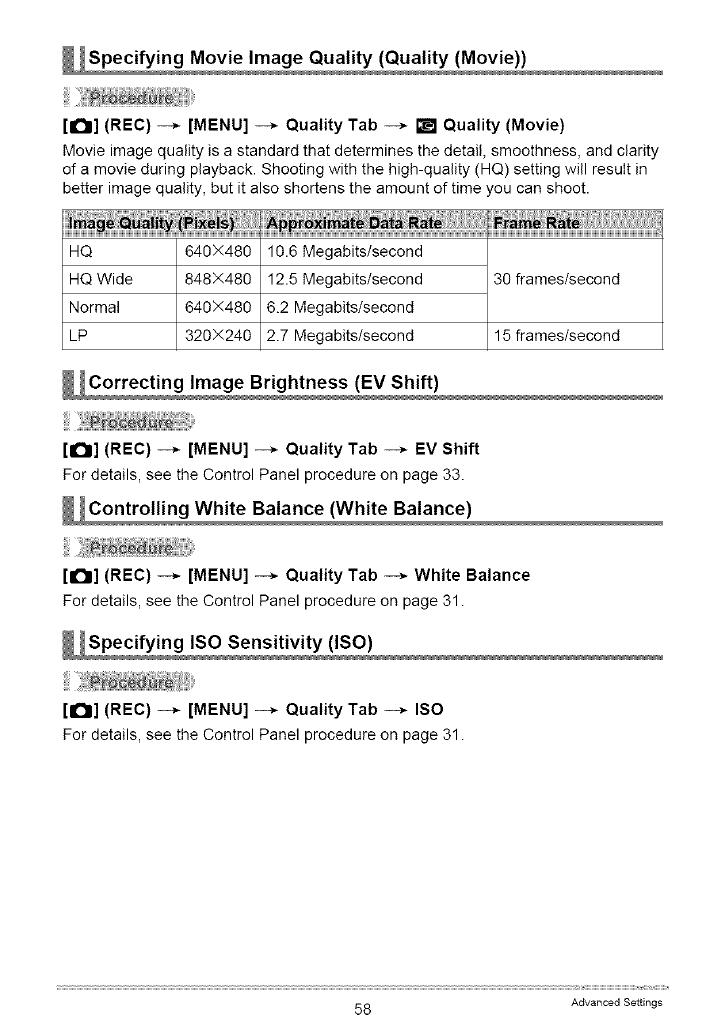
[O] (REC) --* [MENU] --_ Quality Tab --,- [] Quality (Movie)
Movie image quality is a standard that determines the detail, smoothness, and clarity
of a movie during playback. Shooting with the high-quality (HQ) setting will result in
better image quality, but it also shortens the amount of time you can shoot.
HQ
HQ Wide
Normal
LP
640X480 10.6 Megabits/second
848×480 12.5 Megabits/second
640X480 6.2 Megabits/second
320X240 2.7 Megabits/second
30 frames/second
15 frames/second
[O] (REC) --_ [MENU] --* Quality Tab --* EV Shift
For details, see the Control Panel procedure on page 33.
[O] (REC) --_ [MENU] -_ Quality Tab -_ White Balance
For details, see the Control Panel procedure on page 31.
[It31] (REC) --_ [MENU] --,- Quality Tab --,- ISO
For details, see the Control Panel procedure on page 31.
58 Advanced Settings
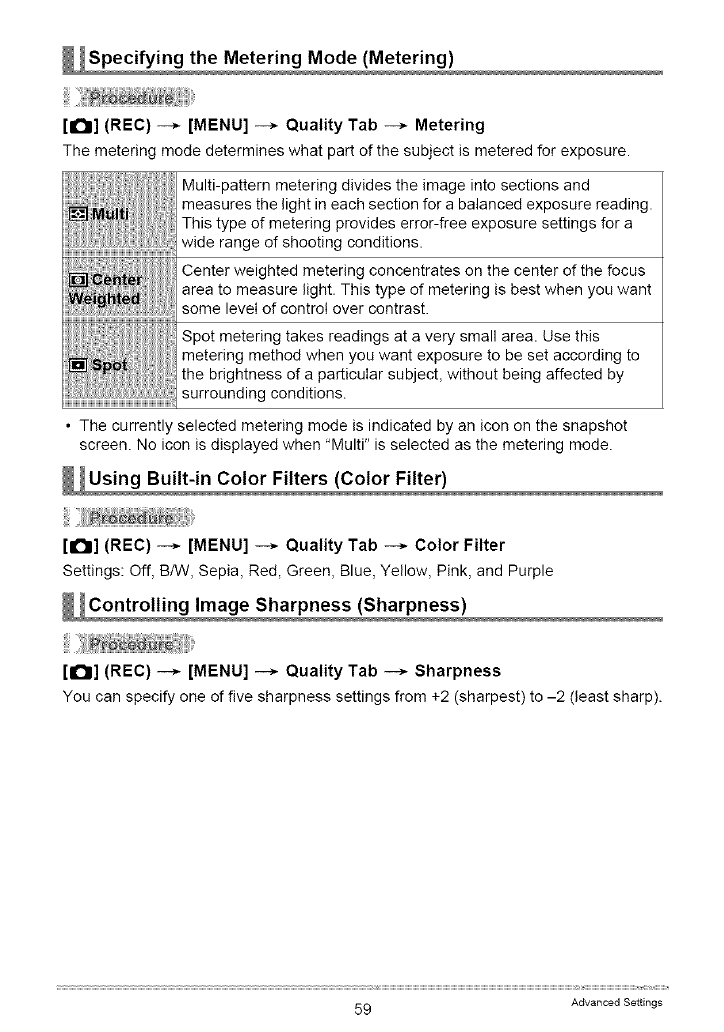
[O] (REC) --,,- [MENU] -_ Quality Tab -_ Metering
The metering mode determines what part of the subject is metered for exposure.
Multi-pattern metering divides the image into sections and
measures the light in each section for a balanced exposure reading.
This type of metering provides error-flee exposure settings for a
wide range of shooting conditions.
[D-l[_:i Center weighted metering concentrates on the center of the focus
Wei_ area to measure light. This type of metering is best when you want
some level of control over contrast.
Spot metering takes readings at a very small area. Use this
metering method when you want exposure to be set according to
the brightness of a particular subject, without being affected by
surrounding conditions.
• The currently selected metering mode is indicated by an icon on the snapshot
screen. No icon is displayed when "Multi" is selected as the metering mode.
[O] (REC) --_ [MENU] --_ Quality Tab --_ Color Filter
Settings: Off, B/W, Sepia, Red, Green, Blue, Yellow, Pink, and Purple
[O] (REC) -_ [MENU] -_ Quality Tab -_ Sharpness
You can specify one of five sharpness settings from +2 (sharpest) to -2 (least sharp).
59 Advanced Settings
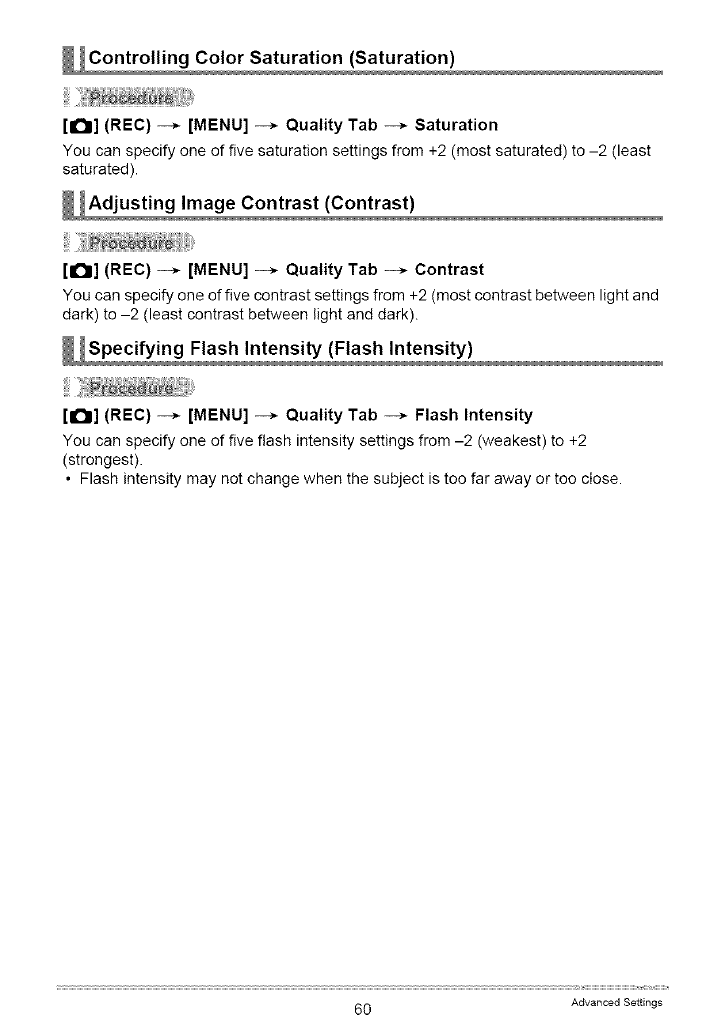
[O] (REC) --,- [MENU] --_ Quality Tab --_ Saturation
You can specify one of five saturation settings from +2 (most saturated) to -2 (least
saturated).
[O] (REC) -_ [MENU] -_ Quality Tab -_ Contrast
You can specify one of five contrast settings from +2 (most contrast between light and
dark) to -2 (least contrast between light and dark).
[O] (REC) --_ [MENU] --_ Quality Tab --_ Flash Intensity
You can specify one of five flash intensity settings from -2 (weakest) to +2
(strongest).
• Flash intensity may not change when the subject is too far away or too close.
60 Advanced Settings
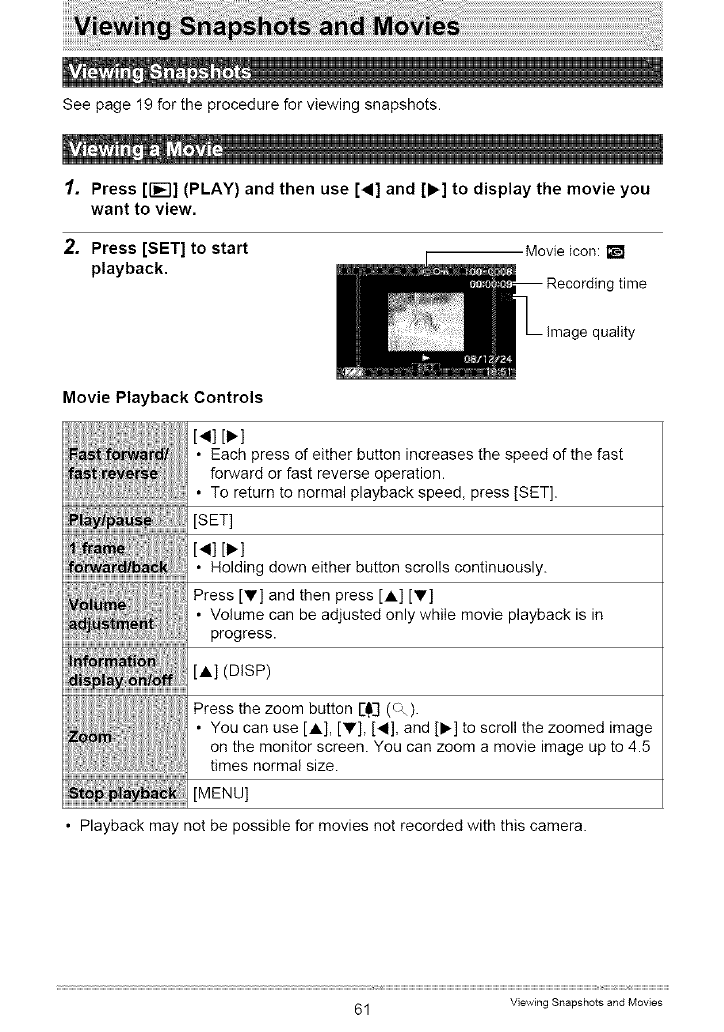
" iiiiiii_....
See page 19 for the procedure for viewing snapshots.
1. Press [I-_-I] (PLAY) and then use [<] and [1_] to display the movie you
want to view,
2. Press [SET] to start Movie icon: []
playback, :g time
Movie Playback Controls
[_][_,]
•Each press of either button increases the speed of the fast
forward or fast reverse operation.
• To return to normal playback speed, press [SET].
[SET]
[_1 [_,1
• Holding down either button scrolls continuously.
Press [V] and then press [A] [V]
• Volume can be adjusted only while movie playback is in
progress.
[A] (DISP)
Press the zoom button I-€3 ((\).
• You can use [A], [V], [_], and [1_] to scroll the zoomed image
on the monitor screen. You can zoom a movie image up to 4.5
times normal size.
[MENU]
• Playback may not be possible for movies not recorded with this camera.
61 Viewing Snapshots and Movies
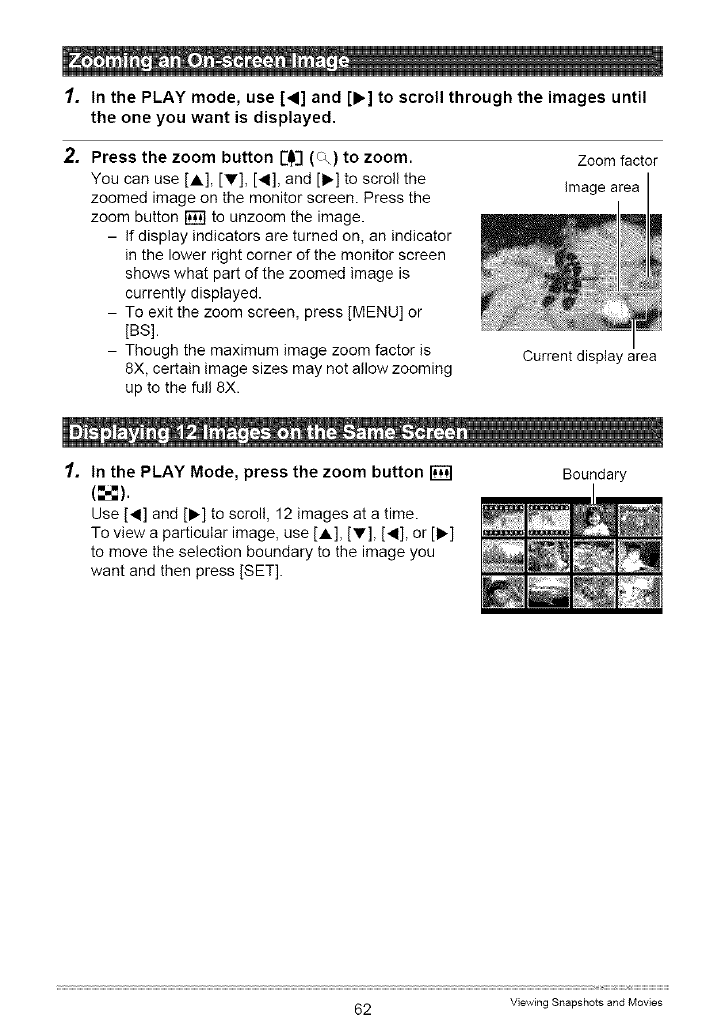
1. In the PLAY mode, use [_1] and [1_] to scroll through the images until
the one you want is displayed,
2. Press the zoom button E$-I (_\) to zoom. zoom factor
You can use [A], [V], ['_], and [11_]to scroll the Image area
zoomed image on the monitor screen. Press the
zoom button E_] to unzoom the image.
- If display indicators are turned on, an indicator
in the lower right corner of the monitor screen
shows what part of the zoomed image is
currently displayed.
- To exit the zoom screen, press [MENU] or
[as].
- Though the maximum image zoom factor is Current display area
8X, certain image sizes may not allow zooming
up to the full 8X.
1. In the PLAY Mode, press the zoom button _ Boundary
(_).
Use [_1] and [1_] to scroll, 12 images at a time.
To view a particular image, use [A], [V], [,_], or [11_]
to move the selection boundary to the image you
want and then press [SET].
62 Viewing Snapshots and Movies
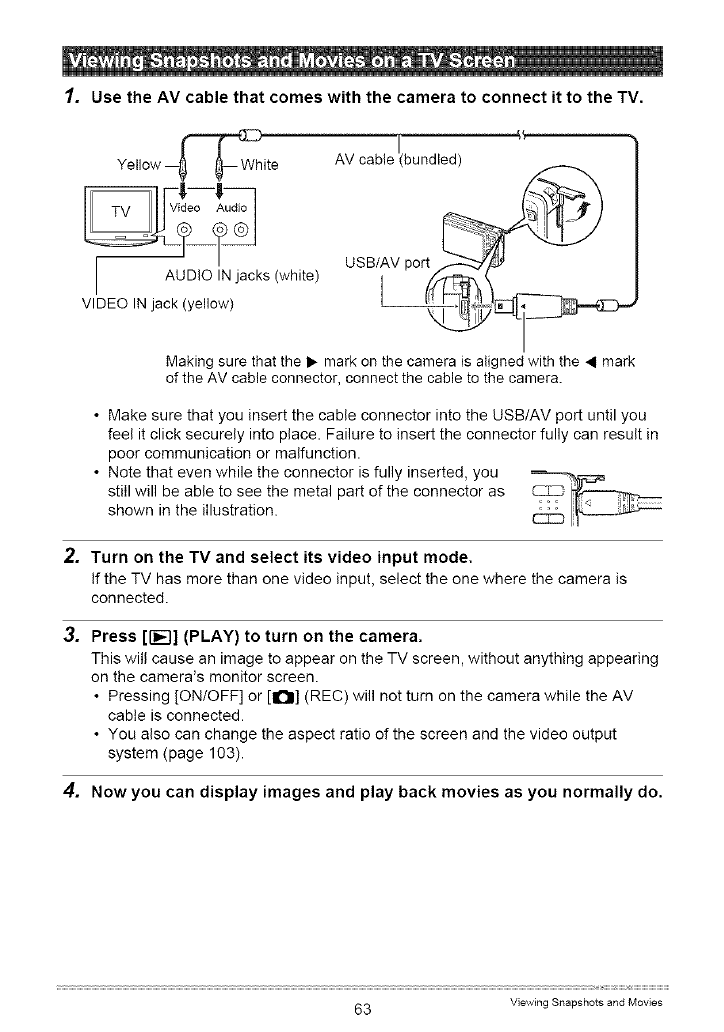
1. Use the AV cable that comes with the camera to connect it to the TV,
Yellow __White
1--!
V{deo Audio
AUDIO INjacks (white)
VIDEO IN jack (yellow)
AV cable I(bundled)
USB/AV port
Making sure that the I_ mark on the camera is aligned with the 41 mark
of the AV cable connector, connect the cable to the camera.
• Make sure that you insert the cable connector into the USB/AV port until you
feel it click securely into place. Failure to insert the connector fully can result in
poor communication or malfunction.
• Note that even while the connector is fully inserted, you
still will be able to see the metal part of the connector as
shown in the illustration.
2. Turn on the TV and select its video input mode,
If the TV has more than one video input, select the one where the camera is
connected.
3. Press [I-_-I] (PLAY) to turn on the camera.
This will cause an image to appear on the TV screen, without anything appearing
on the camera's monitor screen.
• Pressing ION/OFF] or [1_11](REC) will not turn on the camera while the AV
cable is connected.
• You also can change the aspect ratio of the screen and the video output
system (page 103).
4. Now you can display images and play back movies as you normally do.
63 Viewing Snapshots and Movies
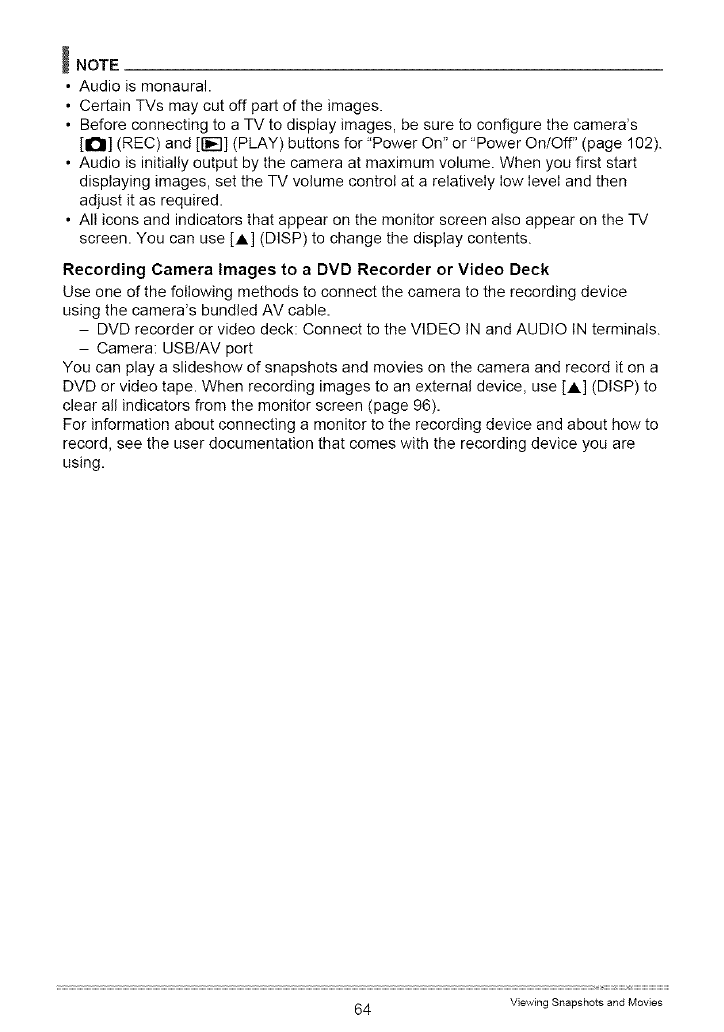
_NOTE
• Audio is monaural.
• Certain TVs may cut off part of the images.
• Before connecting to a TV to display images, be sure to configure the camera's
[1_11](REC) and [I-_"1](PLAY) buttons for "Power On" or "Power On/Off" (page 102).
• Audio is initially output by the camera at maximum volume. When you first start
displaying images, set the TV volume control at a relatively Iow level and then
adjust it as required.
• All icons and indicators that appear on the monitor screen also appear on the TV
screen. You can use [A] (DISP) to change the display contents.
Recording Camera Images to a DVD Recorder or Video Deck
Use one of the following methods to connect the camera to the recording device
using the camera's bundled AV cable.
- DVD recorder or video deck: Connect to the VIDEO IN and AUDIO IN terminals.
- Camera: USB/AV port
You can play a slideshow of snapshots and movies on the camera and record it on a
DVD or video tape. When recording images to an external device, use [A] (DISP) to
clear all indicators from the monitor screen (page 96).
For information about connecting a monitor to the recording device and about how to
record, see the user documentation that comes with the recording device you are
using.
64 Viewing Snapshots and Movies
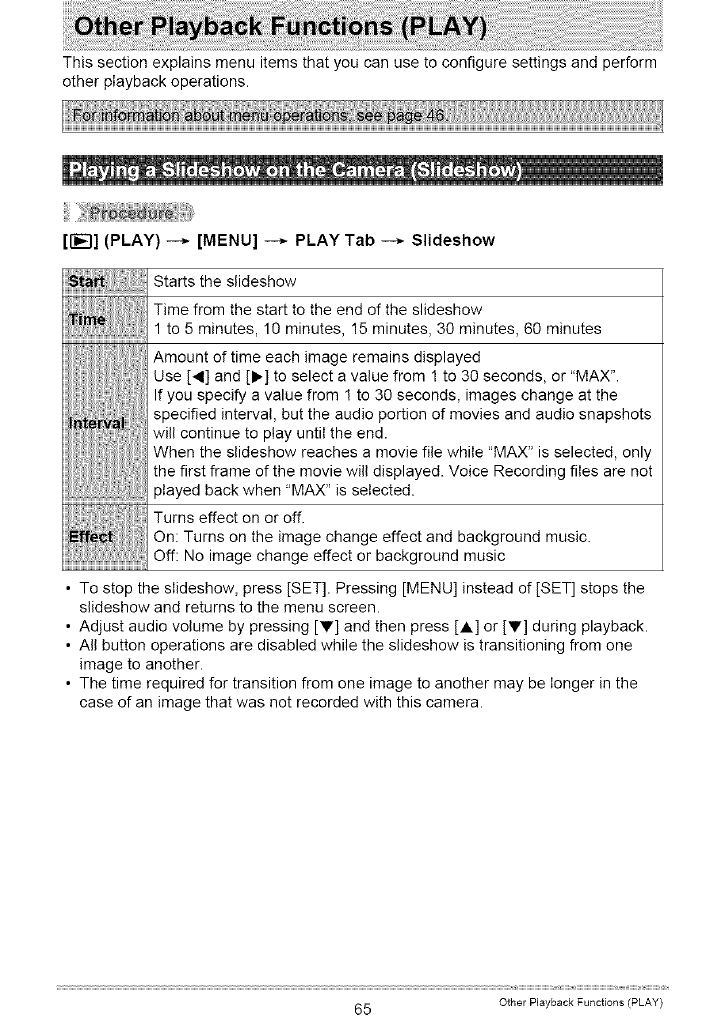
This section explains menu items that you can use to configure settings and perform
other playback operations.
[1"_-I](PLAY) --_ [MENU] --_ PLAY Tab --_ Slideshow
Starts the slideshow
Time from the start to the end of the slideshow
1to 5 minutes, 10 minutes, 15 minutes, 30 minutes_ 60 minutes
HHHHHHHHHHHHHHHHHHHHHHHHHHHHHHHHHH
il I_ Amountoftimeeachimageremainsdisplay ed
Use [_] and [1_] to select a value from 1 to 30 seconds, or "MAX".
If you specify a value from ! to 30 seconds, images change at the
iiiii specified interval, but the audio portion of movies and audio snapshots
will continue to play until the end.
When the slideshow reaches a movie file while "MAX" is selected, only
the first frame of the movie will displayed. Voice Recording files are not
played back when "MAX" is selected.
}ii Turns effect on or off.
On: Turns on the image change effect and background music.
Off: No image change effect or background music
• To stop the sIideshow, press [SET]. Pressing [MENU] instead of [SET] stops the
slideshow and returns to the menu screen.
• Adjust audio volume by pressing [V] and then press [A] or IV] during playback.
• All button operations are disabled while the slideshow is transitioning from one
image to another.
• The time required for transition from one image to another may be longer in the
case of an image that was not recorded with this camera.
65 Other Playback Functions (PLAY)
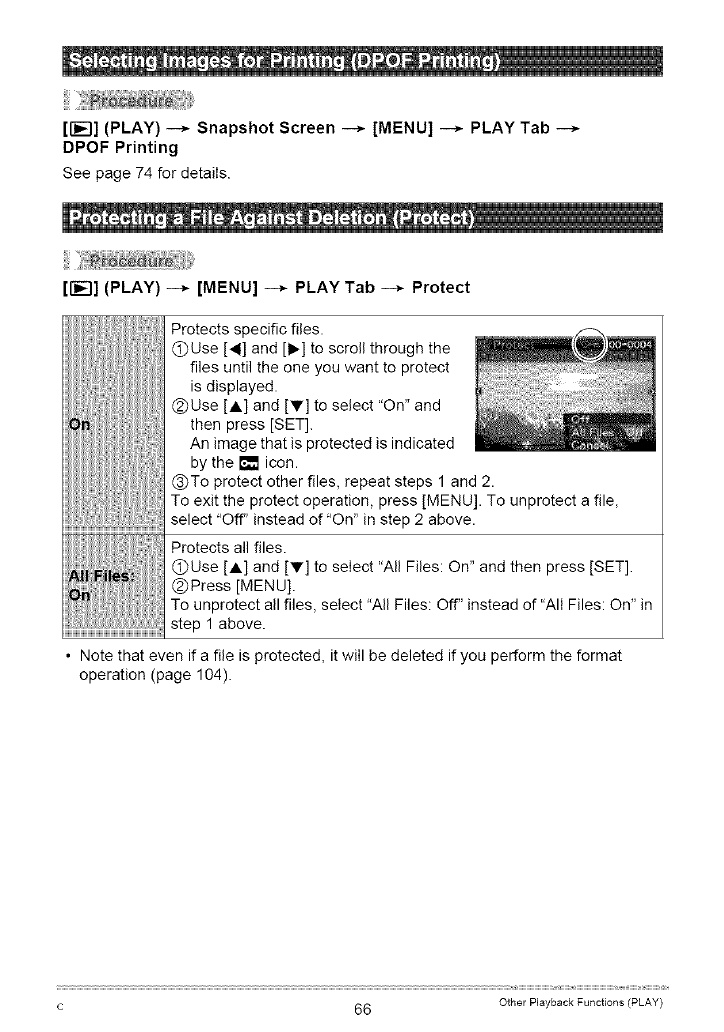
[I-_-I] (PLAY) --,- Snapshot Screen --_ [MENU] --_ PLAY Tab --_
DPOF Printing
See page 74 for detaiis.
[1"_--I](PLAY) --_ [MENU] --_ PLAY Tab --_ Protect
Protects specific files.
OUse [_] and [1_] to scroll through the
files until the one you want to protect
is displayed.
(_)Use [A] and IV] to select "On" and
then press [SET].
An image that is protected is indicated
by the [] icon.
(_)To protect other files, repeat steps 1 and 2.
To exit the protect operation, press [MENU]. To unprotect a file,
select "Off" instead of "On" in step 2 above.
Protects all files.
(_)Use [A] and [V] to select "All Files: On" and then press [SET].
(_)Press [MENU].
To unprotect all files, select "All Files: Off" instead of "All Files: On" in
step 1 above.
• Note that even if a file is protected, it wiil be deleted if you perform the format
operation (page 104).
c66 Other Playback Functions (PLAY)
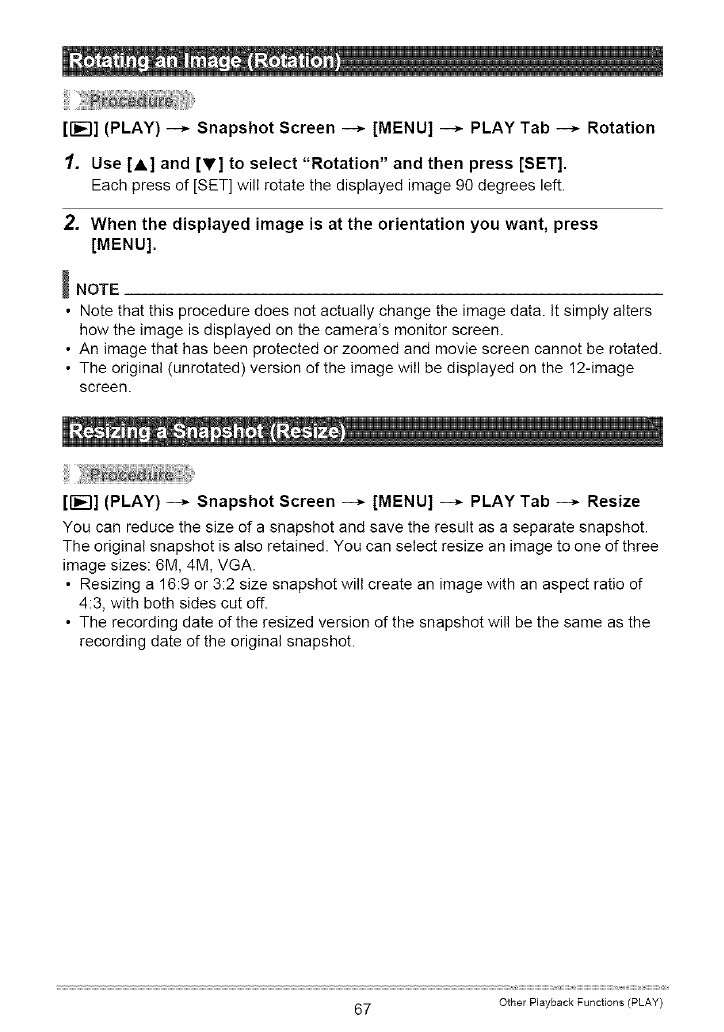
[I-_-I] (PLAY) --_ Snapshot Screen --_ [MENU] --_ PLAY Tab --_ Rotation
1. Use [A] and [V] to select "Rotation" and then press [SET].
Each press of [SET] will rotate the displayed image 90 degrees left.
2. When the displayed image is at the orientation you want, press
[MENU].
_NOTE
• Note that this procedure does not actually change the image data It simply alters
how the image is displayed on the camera's monitor screen
• An image that has been protected or zoomed and movie screen cannot be rotated
• The original (unrotated) version of the image will be displayed on the 12-image
screen.
[I-_-I] (PLAY) --,- Snapshot Screen --,- [MENU] --,- PLAY Tab --_ Resize
You can reduce the size of a snapshot and save the result as a separate snapshot.
The original snapshot is also retained. You can select resize an image to one of three
image sizes: 6M, 4M, VGA.
• Resizing a 16:9 or 3:2 size snapshot will create an image with an aspect ratio of
4:3, with both sides cut off.
• The recording date of the resized version of the snapshot will be the same as the
recording date of the original snapshot.
67 Other Playback Functions (PLAY)
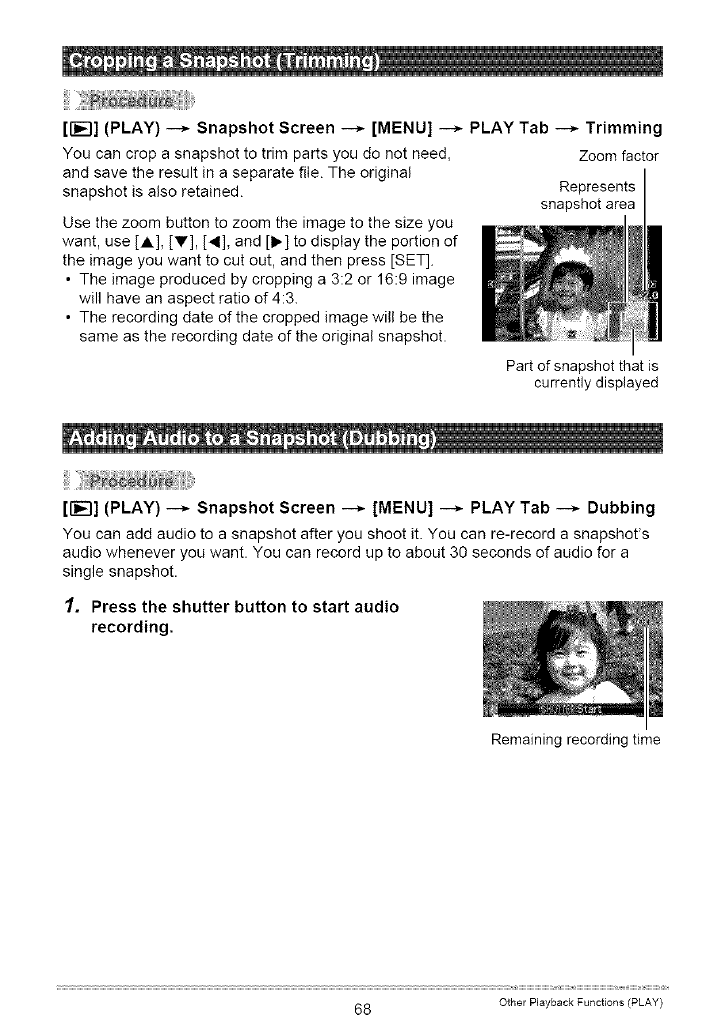
[I-_-I] (PLAY) --* Snapshot Screen --* [MENU] --* PLAY Tab --* Trimming
You can crop a snapshot to trim parts you do not need, Zoom factor
and save the result in a separate file. The original
snapshot is also retained. Represents
snapshot area
Use the zoom button to zoom the image to the size you
want, use [A], IV], [_1], and [1_] to display the portion of
the image you want to cut out, and then press [SET].
• The image produced by cropping a 3:2 or 16:9 image
will have an aspect ratio of 4:3.
• The recording date of the cropped image will be the
same as the recording date of the original snapshot.
Part of snapshot that is
currently displayed
[1"_-I](PLAY) --* Snapshot Screen --* [MENU] --* PLAY Tab --* Dubbing
You can add audio to a snapshot after you shoot it. You can re-record a snapshot's
audio whenever you want. You can record up to about 30 seconds of audio for a
single snapshot.
1. Press the shutter button to start audio
recording,
Remaining recording time
68 Other P]ayback Functions (PLAY)
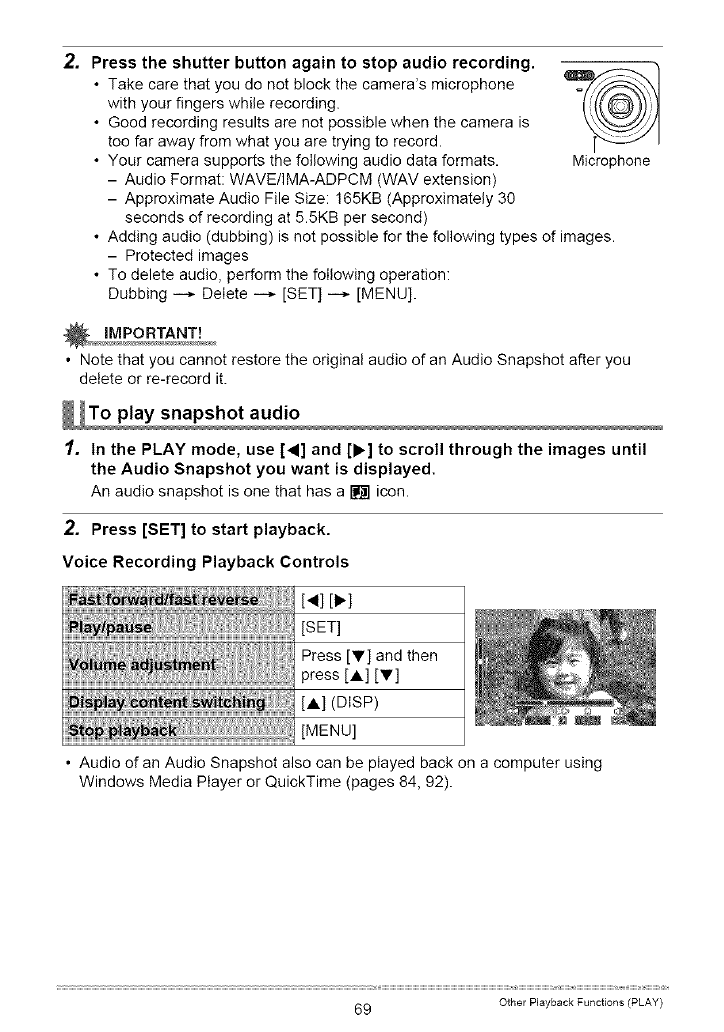
2. Press the shutter button again to stop audio recording.
• Take care that you do not block the camera's microphone
with your fingers while recording.
• Good recording results are not possible when the camera is
too far away from what you are trying to record.
• Your camera supports the following audio data formats.
- Audio Format: WAVE/IMA-ADPCM (WAV extension)
- Approximate Audio File Size: 165KB (Approximately 30
seconds of recording at 5.5KB per second)
=
Microphone
• Adding audio (dubbing) is not possible for the following types of images.
- Protected images
• To delete audio, perform the following operation:
Dubbing --,- Delete --,- [SET] --,- [MENU].
• Note that you cannot restore the original audio of an Audio Snapshot after you
delete or re-record it.
_To play snapshot audio
1. In the PLAY mode, use [,] and [1_] to scroll through the images until
the Audio Snapshot you want is displayed.
An audio snapshot is one that has a [] icon.
2. Press [SET] to start playback.
Voice Recording Playback Controls
[,] It,]
[SET]
Press [V] and then
press [A] IV]
[A] (DISP)
[MENU]
• Audio of an Audio Snapshot also can be played back on a computer using
Windows Media Player or QuickTime (pages 84, 92).
69 Other Playback Functions (PLAY)
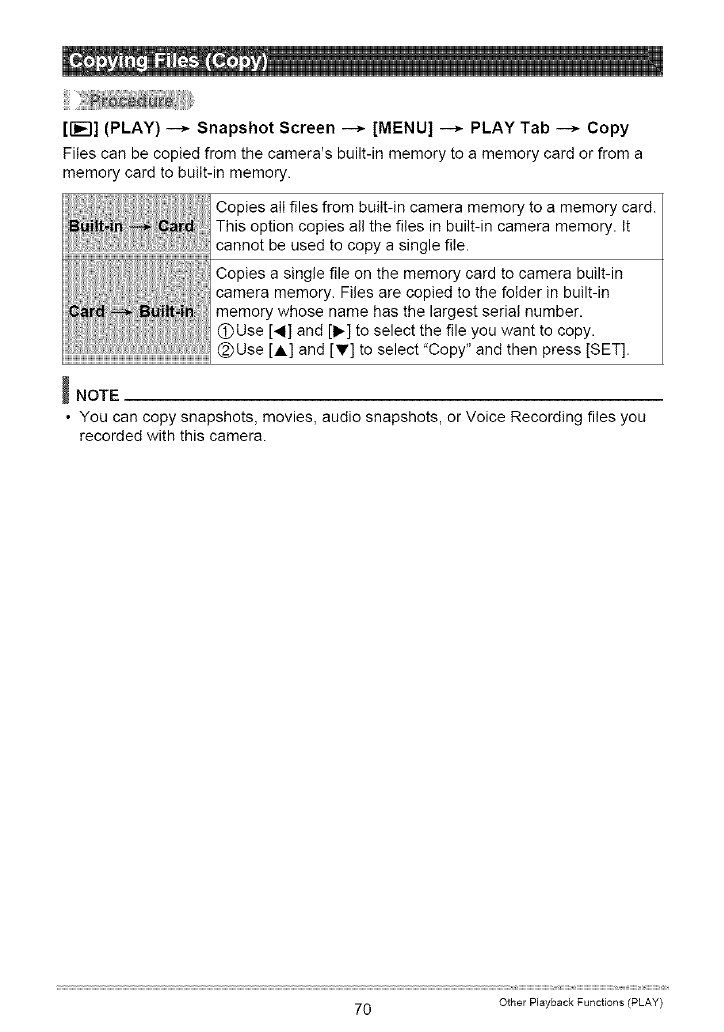
[I-_-I] (PLAY) --_ Snapshot Screen --_ [MENU] --_ PLAY Tab --_ Copy
Files can be copied from the camera's built-in memory to a memory card or from a
memory card to built-in memory.
ii'iiiii ' l!!i lli!i ii¸''¸
_NOTE
• You can copy snapshots movies, audio snapshots or Voice Recording files you
recorded with this camera
Copies all files from built-in camera memory to a memory card.
This option copies all the files in built-in camera memory. It
cannot be used to copy a single file.
Copies a single file on the memory card to camera built-in
camera memory. Files are copied to the folder in built-in
memory whose name has the largest serial number.
OUse [_] and [1_] to select the file you want to copy.
(_)Use [A] and [V] to select "Copy" and then press [SET].
70 Other Playback Functions (PLAY)
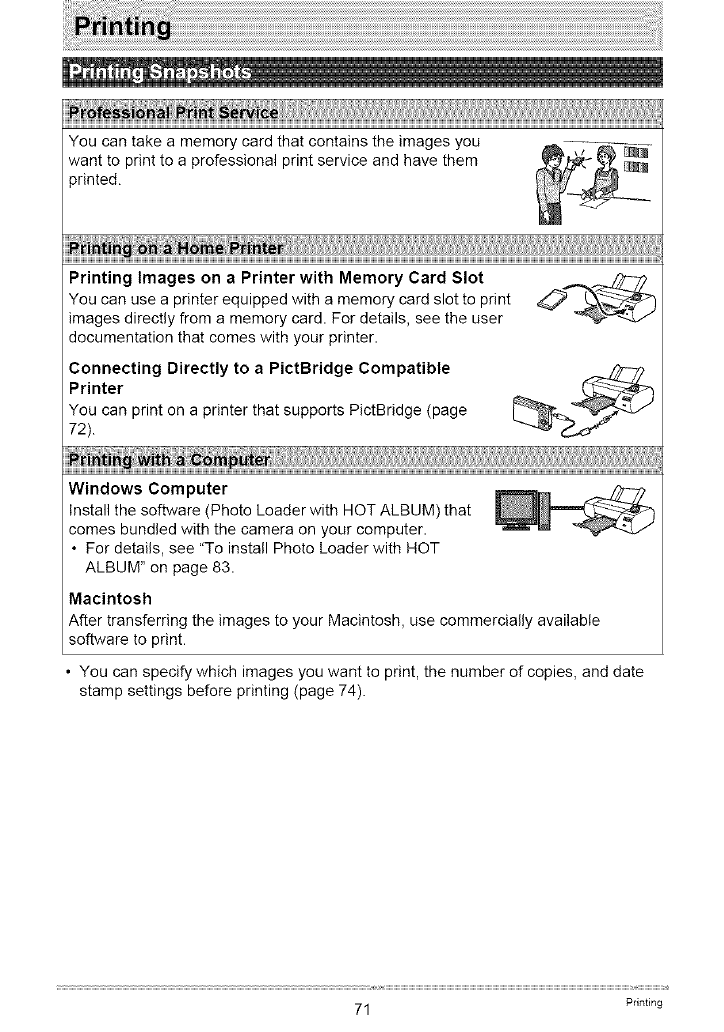
iiii_i _i_`_i_`_ii_i_ii!_i!iiii_`iiiii!ii_!i_!i_!i_!i_!i_!i_!i_!i_!i_!i_!i_!i_!i_!i_!i_!i_!i_!i_!i_!i_!i_!i_!i_!i_!i_!i_!i_!i_!i_!i_!i_!i_!i_!i_!i_!i_!i_!i_!i_!i_!i_!i_!i_!i_!i_!i_!i_!i_ii....
You can take a memory card that contains the images you ,_.-,--_-_
wantmnted.toprint to a professional print service and have them _--_'_
ogo._ ,N. ....
,.nt,n ,.ooe.ono,.n,e,w,t. e.o,,Co,OS,ot
You can use a printer equipped with a memory card slot to print
images directly from a memory card. For details, see the user
documentation that comes with your printer.
ConnectingprinterDirectly to aPictBridge Compatible --.--._L_77__
You can print on a printer that supports PictBridge (page
72).
Windows Computer
Install the software (Photo Loader with HOT ALBUM)that
comes bundled with the camera on your computer.
• For details, see "To install Photo Loader with HOT
ALBUM" on page 83.
Macintosh
After transferring the images to your Macintosh, use commercially available
software to print.
•You can specify which images you want to print, the number of copies, and date
stamp settings before printing (page 74).
71 Printing
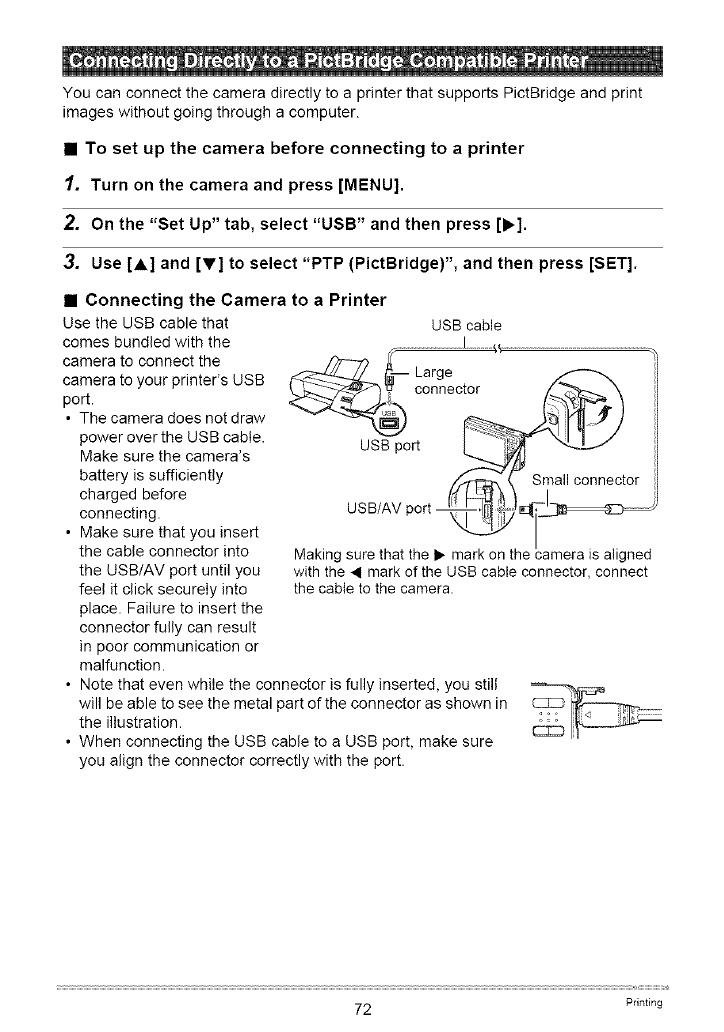
YoucanconnectthecameradirectlytoaprinterthatsupportsPictBridgeandprint
imageswithoutgoingthroughacomputer.
•To set up the camera before connecting to a printer
1. Turn on the camera and press [MENU].
2. On the "Set Up" tab, select "USB" and then press [1_].
3. Use [A] and [V] to select "PTP (PictBridge)", and then press [SET].
• Connecting the Camera to a Printer
Use the USB cable that
comes bundled with the
camera to connect the
camera to your printer's USB
port.
• The camera does not draw
power over the USB cable.
Make sure the camera's
battery is sufficiently
charged before
connecting.
• Make sure that you insert
the cable connector into
the USB/AV port until you
feel it click securely into
place. Failure to insert the
connector fully can result
in poor communication or
malfunction.
USB cable
-- Large
connec
USB port _
_(, S_all connector
USB/AV port _'E_-_
Making sure that the • mark on the camera is aligned
with the 41 mark of the USB cable connector, connect
the cable to the camera.
• Note that even while the connector is fully inserted, you still
will be able to see the metal part of the connector as shown in
the illustration.
• When connecting the USB cable to a USB port, make sure
you align the connector correctly with the port.
72 Printing
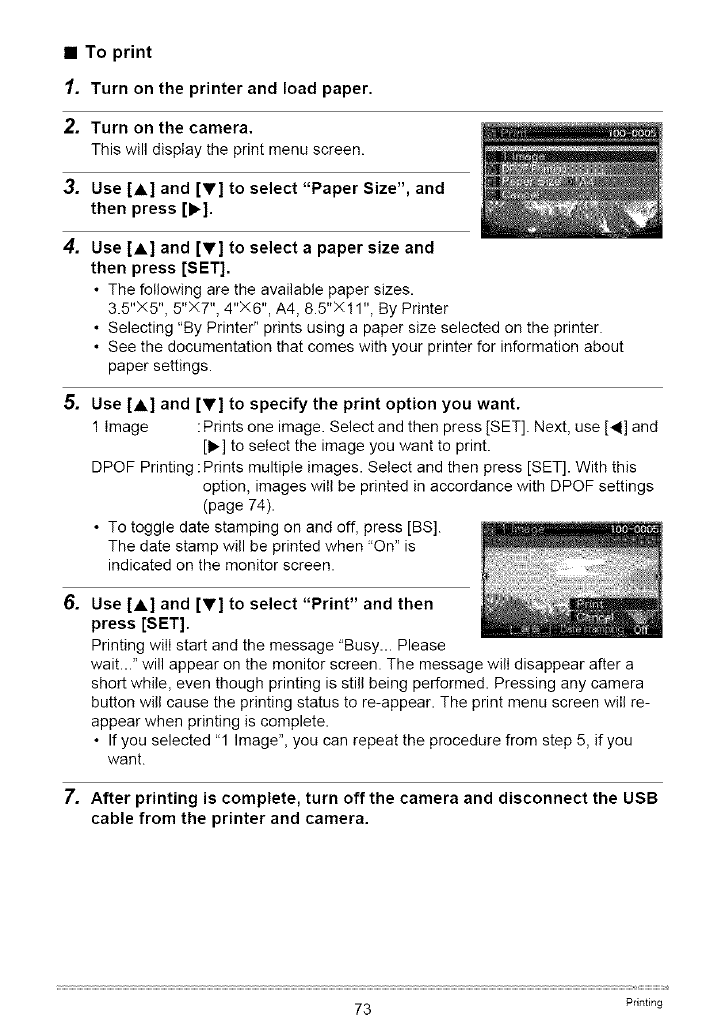
• To print
1. Turn on the printer and load paper.
2. Turn on the camera.
This will display the print menu screen.
3. Use [A] and [V] to select "Paper Size", and
then press [1_].
4. Use [A] and [V] to select a paper size and
then press [SET].
• The following are the available paper sizes.
3.5"X5", 5"X7", 4"X6", A4, 8.5"Xl1", By Printer
• Selecting "By Printer" prints using a paper size selected on the printer.
• See the documentation that comes with your printer for information about
paper settings.
5. Use [A] and [V] to specify the print option you want.
1 Image :Prints one image. Select and then press [SET]. Next, use [_] and
[1_] to select the image you want to print.
DPOF Printing :Prints multiple images. Select and then press [SET]. With this
option, images will be printed in accordance with DPOF settings
(page 74).
• To toggle date stamping on and off, press [BS].
The date stamp will be printed when "On" is
indicated on the monitor screen.
6. Use[A] and [V] to select "Print" and then
press [SET].
Printing wiII start and the message "Busy... Please
wait..." will appear on the monitor screen. The message wilI disappear after a
short while, even though printing is still being performed. Pressing any camera
button will cause the printing status to re-appear. The print menu screen wiII re-
appear when printing is complete.
• If you selected "1 Image", you can repeat the procedure from step 5, if you
want.
7. After printing is complete, turn off the camera and disconnect the USB
cable from the printer and camera.
73 Printing
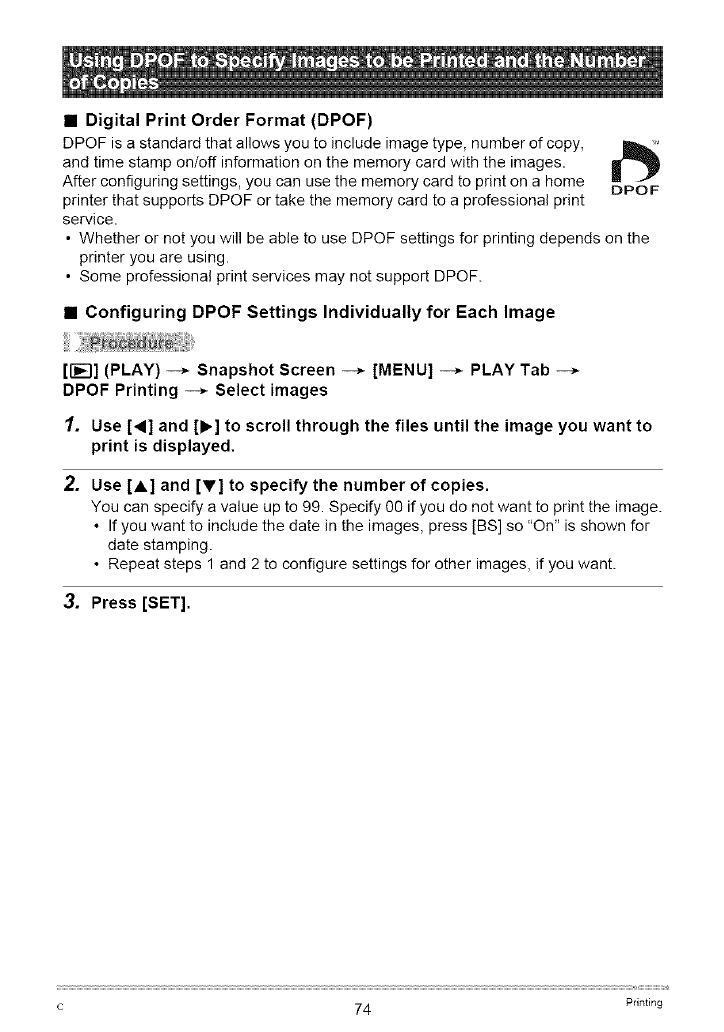
•Digital Print Order Format (DPOF)
DPOF is a standard that allows you to include image type, number of copy, Ii11_"
and time stamp on/off information on the memory card with the images.
After configuring settings, you can use the memory card to print on a home DPOF
printer that supports DPOF or take the memory card to a professional print
service.
• Whether or not you will be able to use DPOF settings for printing depends on the
printer you are using.
• Some professional print services may not support DPOF.
•Configuring DPOF Settings Individually for Each Image
[I-_-I] (PLAY) --_ Snapshot Screen -_ [MENU] -_ PLAY Tab -_
DPOF Printing -_ Select images
1. Use [,] and [1_]to scroll through the files until the image you want to
print is displayed,
2. use [A] and [V] to specify the number of copies.
You can specify a value up to 99. Specify 0O if you do not want to print the image.
• If you want to include the date in the images, press [BS] so "On" is shown for
date stamping.
• Repeat steps 1 and 2 to configure settings for other images, if you want.
3. Press [SET].
c 74 Printing
•Configuring the Same DPOF Settings for All the Images
[1"_-I](PLAY) --* Snapshot Screen --_ [MENU] --_ PLAY Tab --_
DPOF Printing --_ All images
1. Use [A] and [V] to specify the number of copies.
You can specify a value up to 99. Specify 0O ifyou do not want to print the image.
• If you want to include the date in the images, press [BS] so "On" is shown for
date stamping.
2. Press [SET].
DPOF settings are not cleared automatically after printing is complete.
The next DPOF print operation you execute will be performed using the last DPOF
settings you configured for the images. To clear DPOF settings, specify "00" for the
number of copies of all images.
Tell your print service about your DPOF settings!
If you take a memory card to a professional print service, be sure to tell them that it
includes DPOF settings for the images to be printed and the number of copies. If you
don_t, the print service may print all the images without regard to your DPOF settings,
or they may ignore your date stamp setting.
c 75 Printing
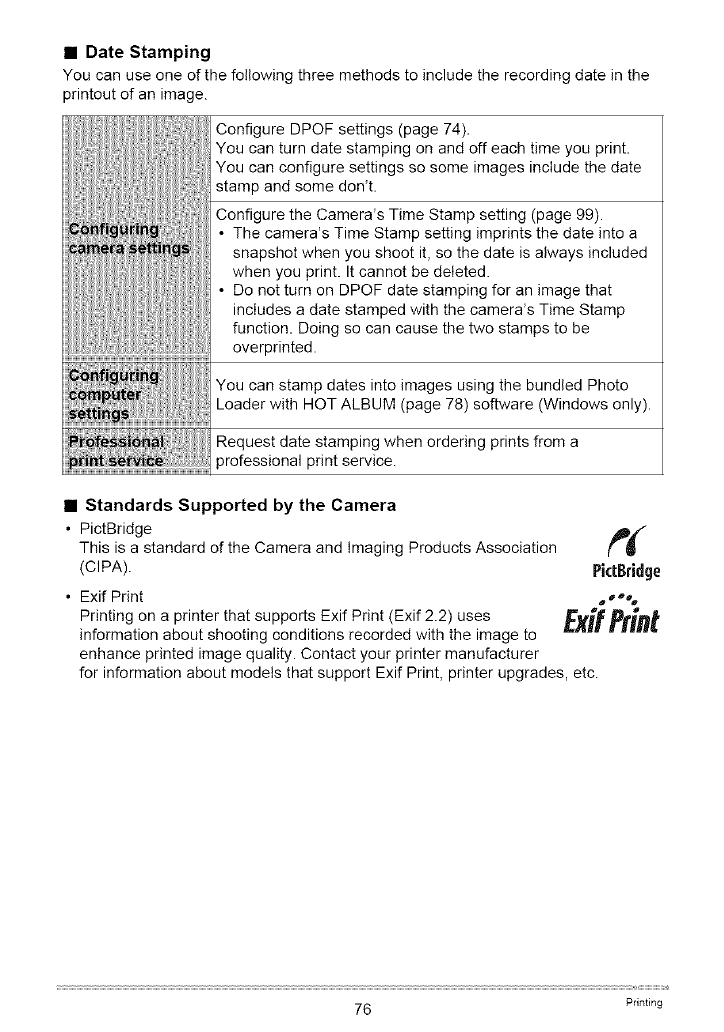
• DateStamping
Youcanuseoneofthefollowingthreemethodstoincludetherecordingdateinthe
3rintoutofanimage.
ConfigureDPOFsettings(page74).
Youcanturndatestampingonandoffeachtimeyouprint.
Youcanconfiguresettingssosomeimagesincludethedate
stampandsomedon't.
ConfiguretheCamera'sTimeStampsetting(page99).
• Thecamera'sTimeStampsettingimprintsthedateintoa
snapshotwhenyoushootit,sothedateisalwaysincluded
whenyouprint.Itcannotbedeleted.
• DonotturnonDPOFdatestampingforanimagethat
includesadatestampedwiththecamera'sTimeStamp
function.Doingsocancausethetwostampstobe
overprinted.
YoucanstampdatesintoimagesusingthebundledPhoto
LoaderwithHOTALBUM(page78)software(Windowsonly).
Requestdatestampingwhenorderingprintsfroma
_rofessionalprintservice.
•Standards Supported by the Camera
• PictBridge /_,_
This is a standard of the Camera and Imaging Products Association
(CIPA). PictBridge
• Exif Print ,,,,,,o,,
Printing on a printer that supports Exif Print (Exif 2.2) uses Exif Print
information about shooting conditions recorded with the image to
enhance printed image quality. Contact your printer manufacturer
for information about models that support Exif Print, printer upgrades, etc.
76 Printing
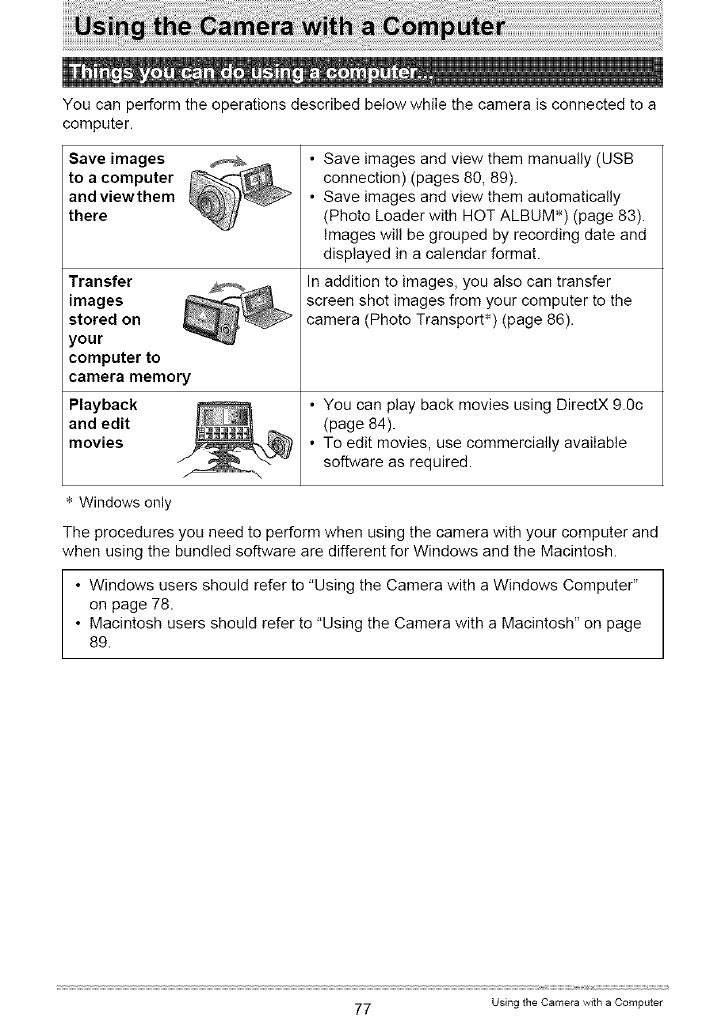
Youcanperformtheoperationsdescribedbelowwhilethecameraisconnectedtoa
computer.
Save images
to a computer
and viewthem
there
Transfer
images
stored on
your
computer to
camera memory
Playback
and edit
movies
• Save images and view them manually (USB
connection) (pages 80, 89).
• Save images and view them automatically
(Photo Loader with HOT ALBUM _) (page 83).
Images will be grouped by recording date and
displayed in a calendar format.
In addition to images, you also can transfer
screen shot images from your computer to the
camera (Photo Transport '_) (page 86).
• You can play back movies using DirectX 9.0c
(page 84).
• To edit movies, use commercially available
software as required.
Windows only
The procedures you need to perform when using the camera with your computer and
when using the bundled software are different for Windows and the Macintosh.
• Windows users should refer to "Using the Camera with a Windows Computer"
on page 78.
• Macintosh users should refer to "Using the Camera with a Macintosh" on page
89.
77 Using the Camera with a Computer
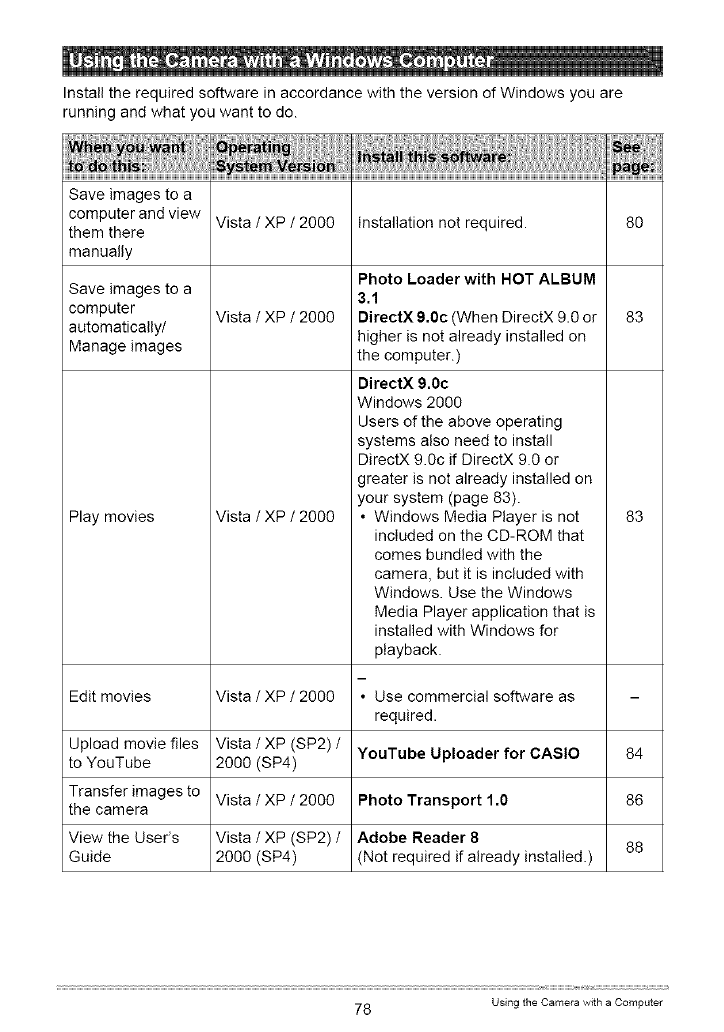
Install the required software in accordance with the version of Windows you are
running and what you want to do.
Save images to a
computer and view Vista /XP /2000 Installation not required. 80
them there
manually
Save images to a
computer Vista /XP /2000 83
automatically/
Manage images
Play movies Vista /XP /2000
Photo Loader with HOT ALBUM
3.1
DirectX 9.0c (When DirectX 9.0 or
higher is not already installed on
the computer.)
DirectX 9,0c
Windows 2000
Users of the above operating
systems also need to install
DirectX 9.0c if DirectX 9.0 or
greater is not already installed on
your system (page 83).
• Windows Media Player is not
included on the CD-ROM that
comes bundled with the
camera, but it is included with
Windows. Use the Windows
Media Player application that is
installed with Windows for
playback.
83
Edit movies Vista /XP /2000 • Use commercial software as -
required.
Upload movie files Vista /XP (SP2) /
to YouTube 2000 (SP4) YouTube Uploader for CASlO 84
Transfer images to Vista /XP /2000 Photo Transport 1.0 86
the camera
View the User's Vista /XP (SP2) /Adobe Reader 888
Guide 2000 (SP4) (Not required if already installed.)
78 Using the Camera with a Computer
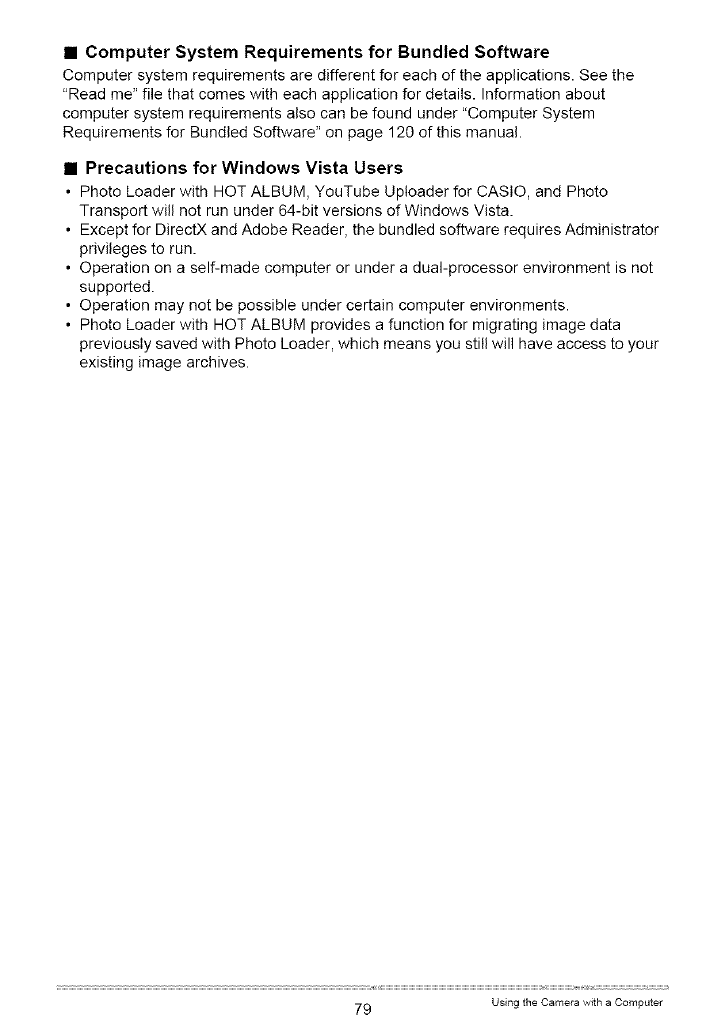
•Computer System Requirements for Bundled Software
Computer system requirements are different for each of the applications. See the
"Read me" file that comes with each application for details. Information about
computer system requirements also can be found under "Computer System
Requirements for Bundled Software" on page 120 of this manual.
•Precautions for Windows Vista Users
•Photo Loader with HOT ALBUM, YouTube Uptoader for CASIO, and Photo
Transport will not run under 64-bit versions of Windows Vista.
• Except for DirectX and Adobe Reader, the bundled software requires Administrator
privileges to run.
• Operation on a self-made computer or under a dual-processor environment is not
supported.
• Operation may not be possible under certain computer environments.
• Photo Loader with HOT ALBUM provides a function for migrating image data
previously saved with Photo Loader, which means you still will have access to your
existing image archives.
79 Using the Camera with a Computer
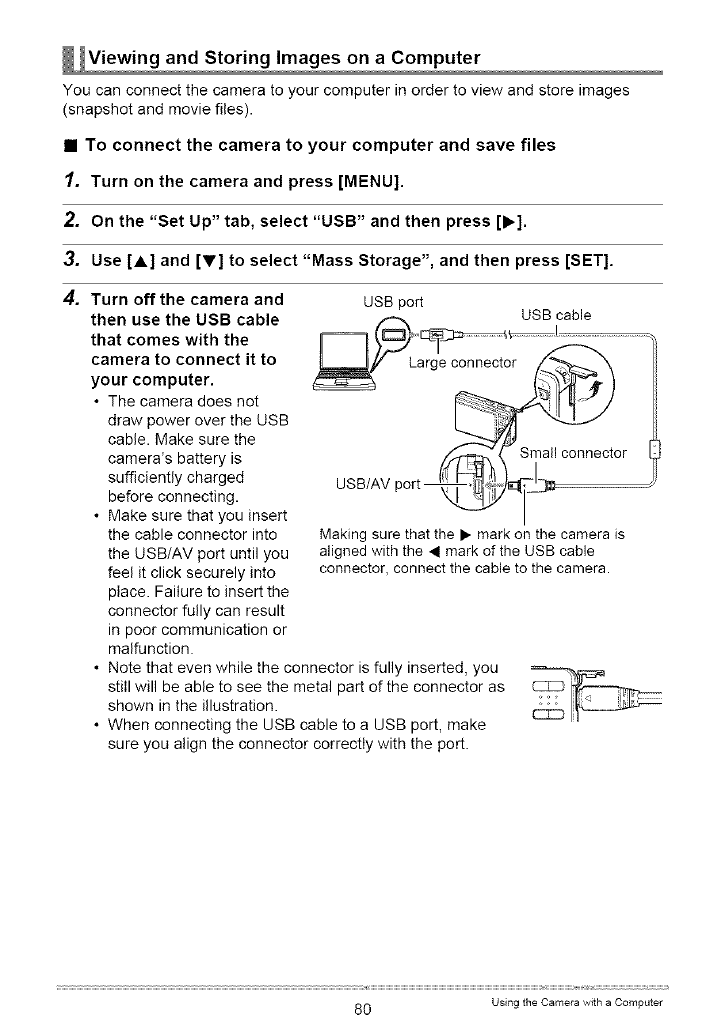
You can connect the camera to your computer in order to view and store images
(snapshot and movie files).
•To connect the camera to your computer and save files
1. Turn on the camera and press [MENU].
2. On the "Set Up" tab, select "USB" and then press [1_].
3. Use [A] and [V] to select "Mass Storage", and then press [SET].
4. Turn off the camera and
then use the USB cable
that comes with the
camera to connect it to
your computer.
• The camera does not
draw power over the USB
cable. Make sure the
camera's battery is
sufficiently charged
before connecting.
• Make sure that you insert
the cable connector into
the USB/AV port until you
feel it click securely into
place. Failure to insert the
connector fully can result
in poor communication or
malfunction.
USB port
__L USB cable
arge
_]ZI connector
0o t
Making sure that the • mark on the camera is
aligned with the 41 mark of the USB cable
connector, connect the cable to the camera.
• Note that even while the connector is fully inserted, you
still will be able to see the metal part of the connector as
shown in the illustration.
• When connecting the USB cable to a USB port, make
sure you align the connector correctly with the port.
80 Using the Camera with a Computer
5. Turn on the camera.
6. Copy images to your computer,
Windows XP
OSelect "Open folder to view files" and then click "OK".
(_Drag the "DClM" folder to your Windows desktop to copy it.
Windows Vista
(_)Select "Open folder to view files".
(_)Drag the "DClM" folder to your Windows desktop to copy it.
Windows 2000
ODouble-click "My Computer".
(_)Double-click "Removable Disk".
(_)Drag the "DClM" folder to your Windows desktop to copy it.
7. After you finish copying images, disconnect the camera from the
computer.
Windows Vista, Windows XP
On the camera, press ION/OFF] to turn offthe camera. After making sure that the
back lamp is unlit, disconnect the camera from the computer.
Windows 2000
Click card services in the task tray on your computer screen, and disable the
drive number assigned to the camera. Next, after making sure that the back lamp
is unlit, press the camera's [ON/OFF] button to turn off the camera and
disconnect the camera from your computer.
81 Using the Camera with a Computer
•To view images you copied to your computer
1. Double-click the copied "DCIM" folder to open it.
2. Double-click the folder that contains the images you want to view,
3. Double-click the image file you want to view.
• For information about file names, see "Memory Folder Structure" on page 94.
• An image that was rotated on the camera will be displayed on your computer
screen in its original (unrotated) orientation.
• Never use your computer to modify, delete, move, or rename any image files that
are in the camera's built-in memory or on its memory card. Doing so can cause
problems with the camerds image management data, which will make it impossible
to play back images on the camera and can drastically alter remaining memory
capacity. Whenever you want to modify, delete, move, or rename an image, do so
only on images that are stored on your computer.
• Never unplug the USB cable, or operate the camera while viewing or storing
images. Doing so can cause data to become corrupted.
82 Using the Camera with a Computer
Installing Photo Loader with HOT ALBUM on your computer makes it possible to
transfer images from the camera to your computer automatically.
•To install Photo Loader with HOT ALBUM
1. Start up your computer, and place the bundled CD-ROM into its CD-
ROM drive.
Normally, this should cause the menu screen to appear automatically. If your
computer does not display the menu screen automatically, navigate to the CD-
ROM on your computer and then double-click the "AutoMenu.exe" file.
2. Click "Photo Loader with HOT ALBUM 3,1" to select it and then click
"Read me,"
The "Read me" file contains important information about installation, including
installation conditions and computer system requirements.
3. Click "Install" for Photo Loader with HOT ALBUM.
4. Follow the instructions that appear on the display to complete
installation.
Checking Your Computer's DirectX Version
In order to manage images using Photo Loader with HOT ALBUM, your computer
also needs to have Microsoft DirectX 9.0 or higher installed. Use the following
procedure to check your computer's DirectX version.
1. Click the following items on your computer to display System Tools:
Start -_ All Programs -_ Accessories -_ System Tools.
2. On the System Tools "Tools" menu, select "DirectX Diagnostic Tool".
On the "System" tab, check to make sure that the "DirectX Version" is 9.0 or
higher.
3. Click "Exit" to exit the DirectX Diagnostic Tool.
• If your computer does not have Microsoft DirectX 90 or higher installed, install
Microsoft DirectX 9.0c from the bundled CD-ROM
83 Using the Camera with a Computer
Windows Media Player, which is already installed on most computers, can be used
for movie playback. To play back a movie, first copy the movie to your computer and
then double-click the movie file.
•Movie Playback Precautions
•Be sure to move the movie data to the hard disk of your computer before trying to
play it. Proper movie playback may not be possible for data accessed over a
network, from a memory card, etc.
• Proper movie playback may not be possible on some computers. If you experience
problems, try the following.
- Try recording movies with a quality setting of "Normal" or "LP".
- Try upgrading Windows Media Player to the latest version.
- Quit any other applications you have running, and stop resident applications.
Even if proper playback is not possible on the computer, you can use the AV cable
that comes bundled with the camera to connect to the video input terminal a TV or
computer and play back movies that way.
Installing YouTube Uploader for CASIO from the CD-ROM that comes with your
camera simplifies uploading of movie files you recorded with the "For YouTube"
BEST SHOT scene to YouTube.
• What is YouTube?
YouTube is a movie sharing site managed by YouTube, LLC where you can upload
movies and view movies upIoaded by others.
• To install YouTube Uploader for CASlO
1. On the CD-ROM menu screen (page 83), select "YouTube Uploader for
CASlO'.
2. After reading the information about installation conditions and system
requirements for installation in the "Read me" file, install YouTube
Uploader for CASlO.
84 Using the Camera with a Computer
• To upload a movie file to YouTube
• Before you can use YouTube Uploader for CASIO, you need to go to the YouTube
website (http://www.youtube.com/) and register as a user there.
• Do not upload any video that is copyrighted (including neighboring copyrights)
unless you yourself own the copyright or you have obtained the permission of the
applicable copyright holder(s).
• The maximum file size for each upload is !00 MB.
1. Record the move you want to upload using the "For YouTube" BEST
SHOT movie scene.
2. If it isn't already, connect your computer to the Internet.
3. Connect the camera to your computer (page 80).
4. Turn on the camera.
YeuTube Uploader for CASIO will start up automatically.
• If this is the first time you are using the application, configure the YeuTube user
ID and network environment settings, and then click the [OK] button.
5. The left side of the display will have an area for inputting a title,
category, and other information required for uploading to YouTube.
Enter the required information.
6. The right side of the display shows a list of movie files in camera
memory. Select the check box next to the movie file you want to
upload.
7. When everything is ready, click the [Upload] button.
This will upload the movie file(s) to YouTube.
• After uploading is complete, click the [Exit] button to exit the application.
85 Using the Camera with a Computer
If you want to transfer images from your computer to the camera, install Photo
Transport on your computer from the CD-ROM that comes with the camera.
•To install Photo Transport
1. On the CD-ROM menu screen (page 83), select "Photo Transport".
2. After reading the information about installation conditions and system
requirements for installation in the "Read me" file, install Photo
Transport.
•To transfer images to the camera
1. On your computer, click the following: Start -_ All Programs -_
Casio -_ Photo Transport.
This starts up Photo Transport
2. Drag the file(s) you want to transfer to the [Transfer] button.
3. Follow the instructions that appear on the display to complete the
transfer.
• The details of the instructions that appear on the display and the transferred
images will depend on your Photo Transport setup. For details, click the
[Settings] button or [Help] button and check the setup.
Transfer Data
• Only image files with the following extensions can be transferred to the camera:
jpg, jpeg, jpe, bmp (bmp images are converted to jpeg image automatically when
transferred.)
• Certain types of images may not be able to be transferred.
• You cannot transfer movies to the camera.
86 Using the Camera with a Computer
•To transfer computer screen captures to the camera
1. Connect the camera to your computer (page 80).
2. On your computer, click the following: Start --_ All Programs --_
Casio --_ Photo Transport.
This starts up Photo Transport.
3. Display the screen whose screen capture you want to transfer.
4. Click the [Capture] button.
5. Draw a boundary around the area you want to capture.
Move your mouse pointer to the upper left corner of the area you want to capture
and then hold down the mouse button. Keeping the mouse button depressed,
drag the pointer down to the lower right corner of the area and then release the
mouse button.
6. Follow the instructions that appear on the display.
This will send an image of the area you selected to the camera.
• The transfer operation converts screen captures to JPEG format.
• The instructions that appear on the display and details about the transferred
images will depend on your Photo Transport setup. For details, click the
[Settings] button or [Help] button and check the setup.
•About settings and help
Click the [Settings] button when you want to change the Photo Transport setup. For
help about operation procedures and troubleshooting, click the Photo Transport
[Help] button.
87 Using the Camera with a Computer
1. Start up your computer, and place the bundled CD-ROM into its CD-
ROM drive.
Normally, this should cause the menu screen to appear automatically. If your
computer does not display the menu screen automatically, navigate to the CD-
ROM on your computer and then double-click the "AutoMenu.exe" file.
2. On the menu screen, click the "Language" down arrow button and then
select the language you want.
3. Click "Manual" to select it and then click "Digital Camera".
• You must have Adobe Reader or Adobe Acrobat Reader installed on your
computer in order to view the contents of a PDF file. If you do not already have
Adobe Reader or Adobe Acrobat Reader installed, install Adobe Reader from the
bundled CD-ROM.
You can perform user registration over the Intemet. To do so, of course, you need to
be able to connect to the Internet with your computer.
1. On the CD-ROM menu screen (page 83), click the "Register" button.
• This starts up your Web browser and accesses the user registration website
Follow the instructions that appear on your computer screen to register.
88 Using the Camera with a Computer
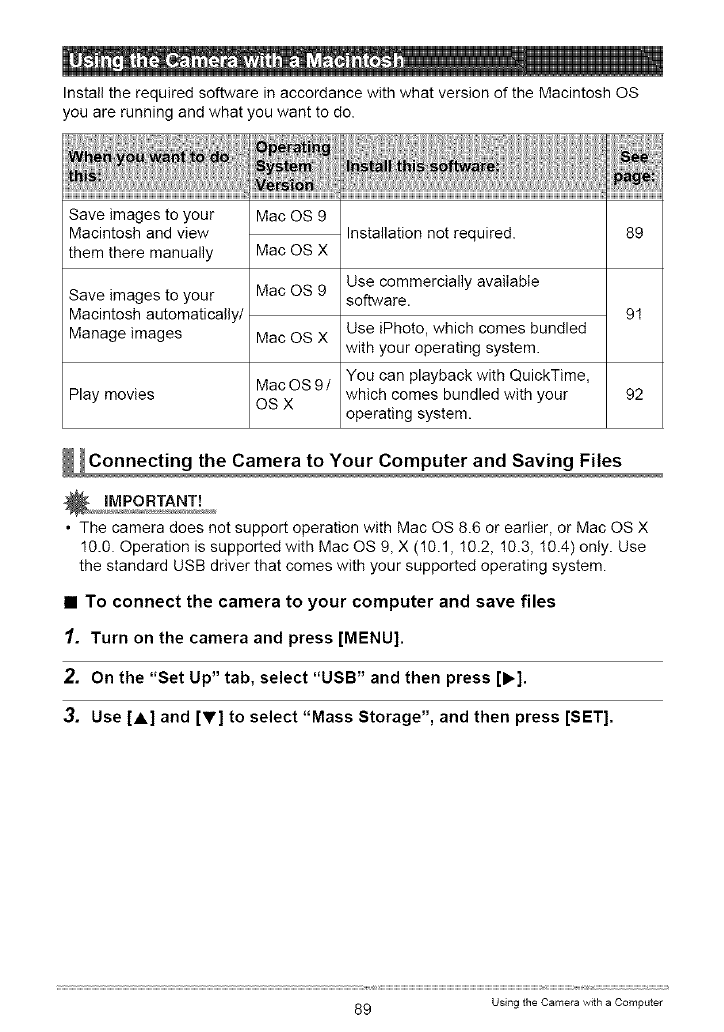
Install the required software in accordance with what version of the Macintosh OS
you are running and what you want to do.
Save images to your
Macintosh and view
them there manually
Save images to your
Macintosh automatically/
Manage images
Installation not required. 89
Mac OS 9
Mac OS X
Mac OS 9
Mac OS X
MacOS9/
OS X
9!
Use commercially available
software.
Use iPhoto, which comes bundled
with your operating system.
You can playback with QuickTime,
which comes bundled with your
operating system.
Play movies 92
• The camera does not support operation with Mac OS 8.6 or earlier, or Mac OS X
10.0. Operation is supported with Mac OS 9, X (10.1, 10.2, !0.3_ 10.4) only. Use
the standard USB driver that comes with your supported operating system.
•To connect the camera to your computer and save files
1. Turn on the camera and press [MENU].
2. On the "Set Up" tab, select "USB" and then press [1_].
3. Use [A] and [V] to select "Mass Storage", and then press [SET].
89 Using the Camera with a Computer
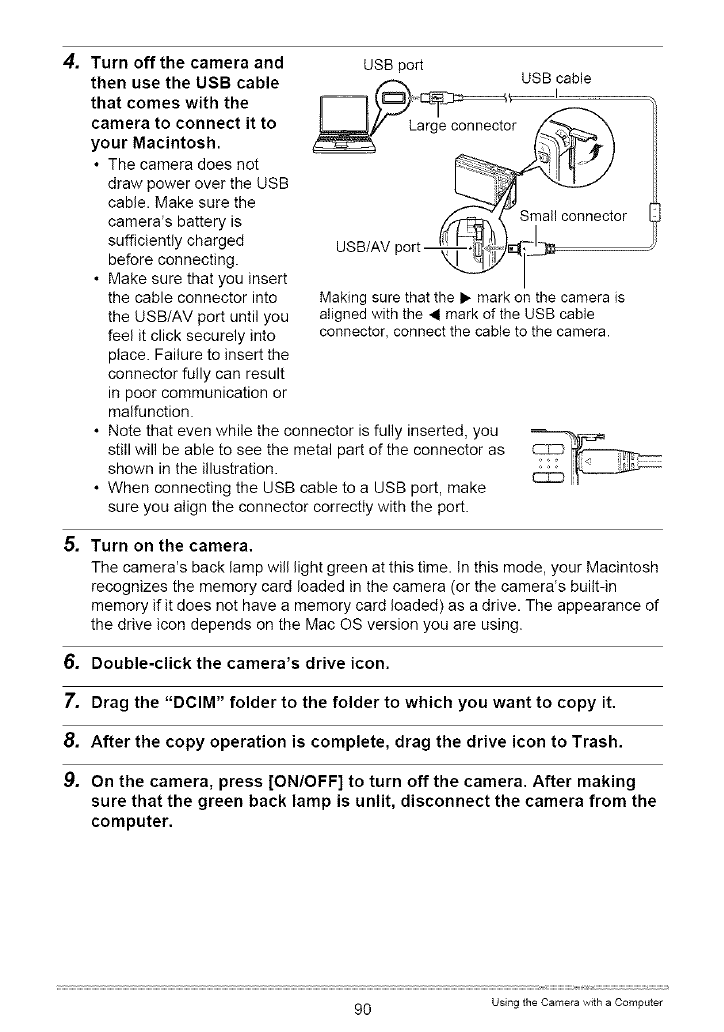
4. Turn off the camera and
then use the USB cable
that comes with the
camera to connect it to
your Macintosh.
• The camera does not
draw power over the USB
cable. Make sure the
camera's battery is
sufficiently charged
before connecting.
• Make sure that you insert
the cable connector into
the USB/AV port until you
feel it click securely into
place. Failure to insert the
connector fully can result
in poor communication or
malfunction.
USB port
__L USB cable
arge _
USB/AV port "_' 'i_E_-_q_
Making sure that the • mark on the camera is
aligned with the 41 mark of the USB cable
connector, connect the cable to the camera.
• Note that even while the connector is fully inserted, you
still will be able to see the metal part of the connector as
shown in the illustration.
• When connecting the USB cable to a USB port, make
sure you align the connector correctly with the port.
5. Turn on the camera,
The camera's back lamp will light green at this time. In this mode, your Macintosh
recognizes the memory card loaded in the camera (or the camera's built-in
memory if it does not have a memory card loaded) as a drive. The appearance of
the drive icon depends on the Mac OS version you are using.
6. Double-click the camera's drive icon.
7. Drag the "DClM" folder to the folder to which you want to copy it.
8. After the copy operation is complete, drag the drive icon to Trash.
9. On the camera, press [ON/OFF] to turn off the camera. After making
sure that the green back lamp is unlit, disconnect the camera from the
computer.
90 Using the Camera with a Computer
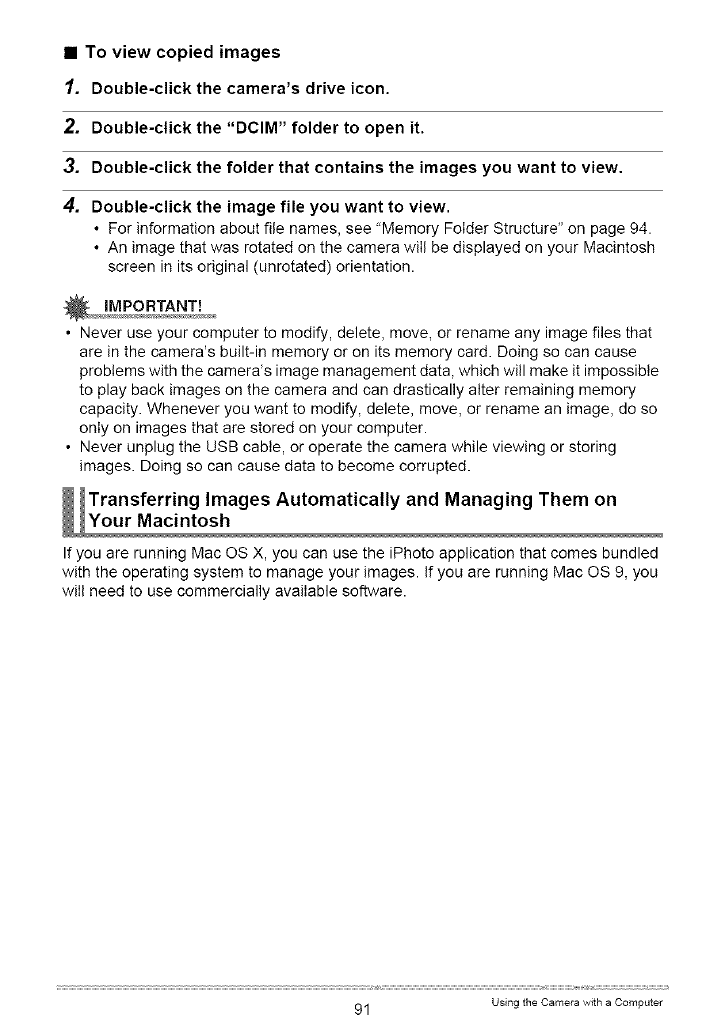
• To view copied images
1. Double-click the camera's drive icon.
2. Double-click the "DCIM" folder to open it.
3. Double=click the folder that contains the images you want to view,
4. Double-click the image file you want to view.
•For information about file names, see "Memory Folder Structure" on page 94.
• An image that was rotated on the camera will be displayed on your Macintosh
screen in its original (unrotated) orientation.
• Never use your computer to modify, delete, move, or rename any image files that
are in the camera's built-in memory or on its memory card. Doing so can cause
problems with the camerds image management data, which will make it impossible
to play back images on the camera and can drastically alter remaining memory
capacity. Whenever you want to modify, delete, move, or rename an image, do so
only on images that are stored on your computer.
• Never unplug the USB cable, or operate the camera while viewing or storing
images. Doing so can cause data to become corrupted.
If you are running Mac OS X, you can use the iPhoto application that comes bundled
with the operating system to manage your images. If you are running Mac OS 9, you
will need to use commercially available software.
91 Using the Camera with a Computer
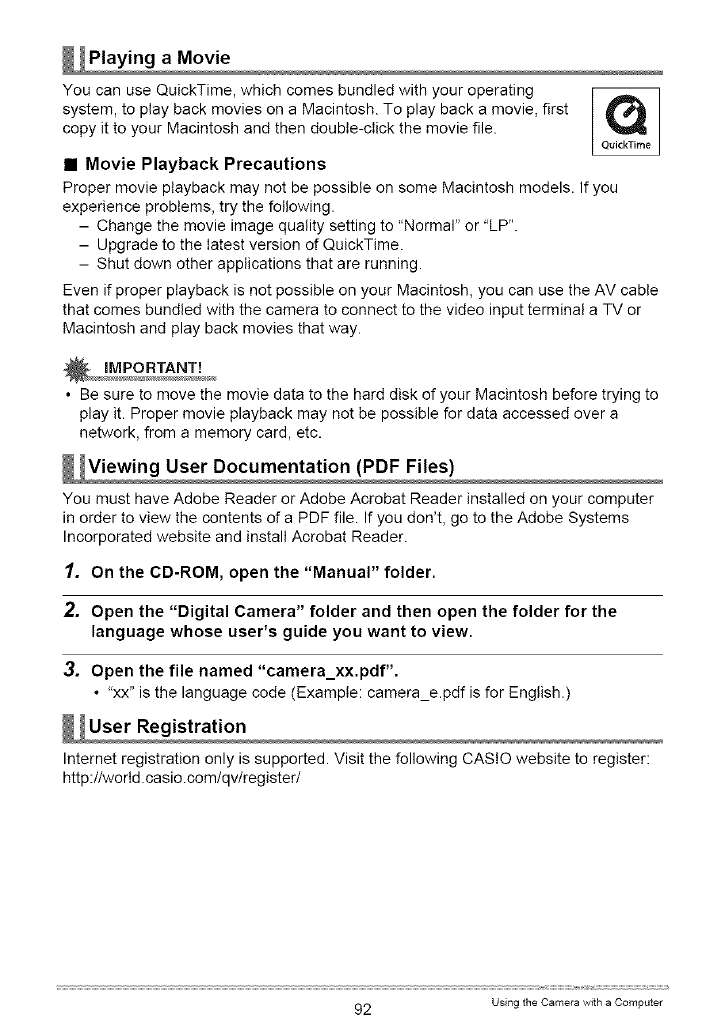
You can use QuickTime, which comes bundled with your operating i_
system, to play back movies on a Macintosh. To play back a movie, first
copy it to your Macintosh and then double-click the movie file.
•Movie Playback Precautions
Proper movie playback may not be possible on some Macintosh models. If you
experience problems, try the following.
- Change the movie image quality setting to "Normal" or "LP".
- Upgrade to the latest version of QuickTime.
- Shut down other applications that are running.
Even if proper playback is not possible on your Macintosh, you can use the AV cable
that comes bundled with the camera to connect to the video input terminal a TV or
Macintosh and play back movies that way.
•Be sure to move the movie data to the hard disk of your Macintosh before trying to
play it. Proper movie playback may not be possible for data accessed over a
network, from a memory card, etc.
You must have Adobe Reader or Adobe Acrobat Reader installed on your computer
in order to view the contents of a PDF file. If you don't, go to the Adobe Systems
Incorporated website and install Acrobat Reader.
1. On the CD-ROM, open the "Manual" folder.
2. Open the "Digital Camera" folder and then open the folder for the
language whose user's guide you want to view.
3. Open the file named "camera_xx.pdf".
•"xx" is the language code (Example: camera_e.pdf is for English.)
Internet registration only is supported. Visit the following CASlO website to register:
http://world.casio.com/qv/register/
92 Using the Camera with a Computer
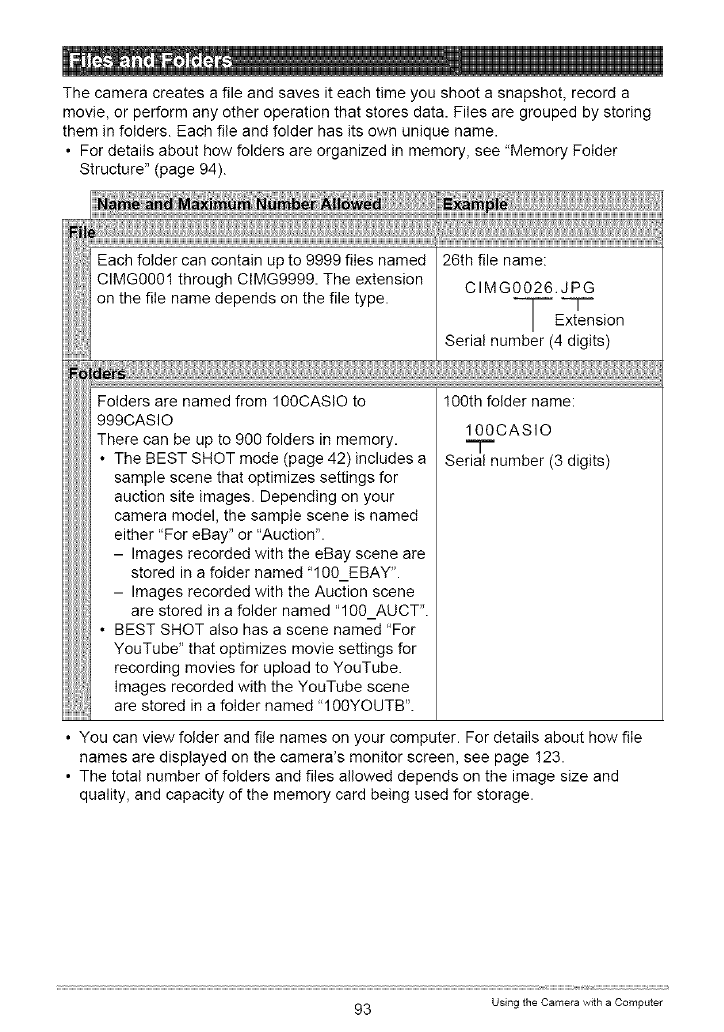
The camera creates a file and saves it each time you shoot a snapshot, record a
movie, or perform any other operation that stores data. Files are grouped by storing
them in folders. Each file and folder has its own unique name.
• For details about how folders are organized in memory, see "Memory Folder
Structure" (page 94).
Each folder can contain up to 9999 files named 26th file name:
CIMG0001 through CIMG9999. The extension CIMG0026.JPG
on the file name depends on the file type. 7-- --T"-
/Extension
Serial number (4 digits)
Folders are named from 100CASIO to
999CASLO
There can be up to 900 folders in memory.
• The BEST SHOT mode (page 42) includes a
sample scene that optimizes settings for
auction site images. Depending on your
camera model, the sample scene is named
either "For eBay" or "Auction".
- Images recorded with the eBay scene are
stored in a folder named "100 EBAY".
- Images recorded with the Au_on scene
are stored in a folder named "100 AUCT".
• BEST SHOT also has a scene named "For
YouTube" that optimizes movie settings for
recording movies for upload to YouTube.
Images recorded with the YouTube scene
are stored in a folder named "100YOUTB".
100thfolder name:
1OOCASIO
"T-
Serial number (3 digits)
• You can view folder and file names on your computer. For details about how file
names are displayed on the camera's monitor screen, see page 123.
• The total number of folders and files allowed depends on the image size and
quality, and capacity of the memory card being used for storage.
93 Using the Camera with a Computer
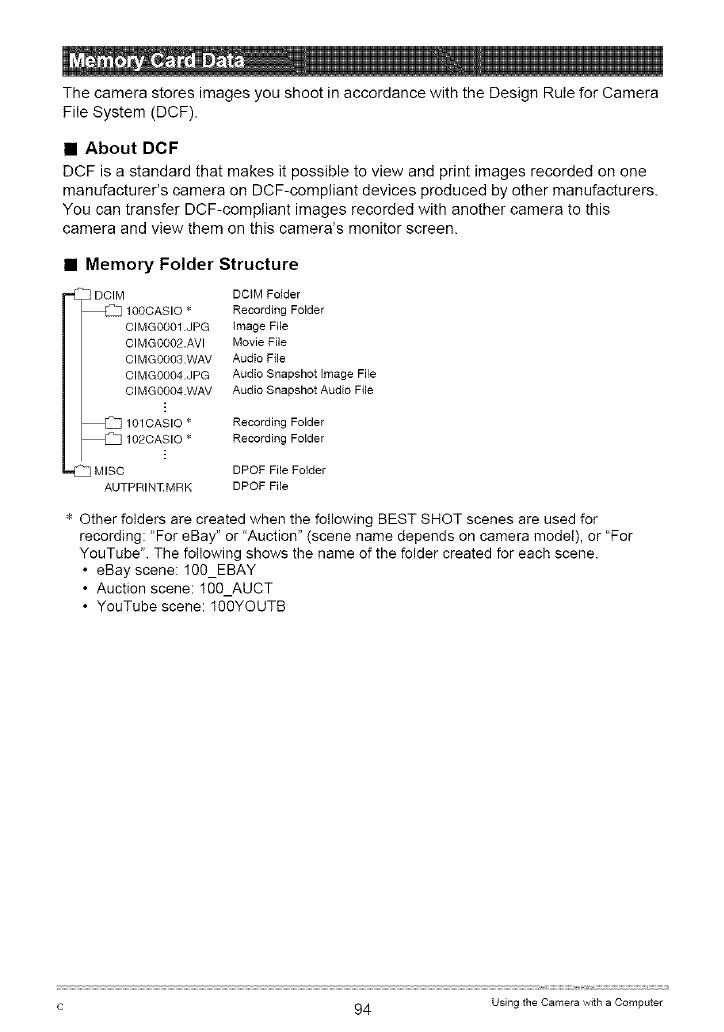
The camera stores images you shoot in accordance with the Design Rule for Camera
File System (DCF).
• About DCF
DCF is a standard that makes it possible to view and print images recorded on one
manufacturer's camera on DCF-compliant devices produced by other manufacturers.
You can transfer DCF-compliant images recorded with another camera to this
camera and view them on this camera's monitor screen.
•Memory Folder Structure
_ DCIM DC_M Folder
100CASIO _ Recording Folder
CIMGO0Ol .JPG Image File
CIMGO002.AVI Movie File
CIMGO003.WAV Audio File
CIMGO004.JPG Audio Snapshot Image File
CIMGO004.WAV Audio Snapshot Audio File
_ 101CASIO _ Recording Folder
_ 102CASIO * Recording Folder
!
=4[_] MISC DPOF File Folder
AUTPRINTMRK DPOF File
Other folders are created when the following BEST SHOT scenes are used for
recording: "For eBay" or "Auction" (scene name depends on camera model), or "For
YouTube". The following shows the name of the folder created for each scene.
• eBay scene: 100_EBAY
• Auction scene: I0O_AUCT
• YouTube scene: I0OYOUTB
c94 Using the Camera with a Computer
• Supported Image Files
•Image flies shot with this camera
• DCF-compliant image flies
This camera may not be able to display an image, even if it is DCF-compliant. When
displaying an image recorded on another camera, it may take a long time for the
image to appear on this camera's monitor screen.
•Built-in Memory and Memory Card Data Handling Precautions
• Whenever copying memory contents to your computer, you should copy the DCIM
folder and all of its contents. A good way to keep track of multiple DCIM copies of
the DCIM folders it to change its name to a date or something similar after you copy
it to your computer. If you later decided to return the folder to the camera, however,
be sure to change its name back to DClM. The camera is designed to recognize
only a root file with the name DClM. Note the camera aiso will not be able to
recognize the folders inside the DCIM folder unless they have the names they
originally had when you copied them from the camera to your computer.
• Folders and files must be stored in accordance with the "Memory Folder Structure"
shown on page 94 in order for the camera to be able to recognize them correctly.
• You also can use a PC card adapter or a memory card reader/writer to access
camera files directly from the camera's memory card.
95 Using the Camera with a Computer
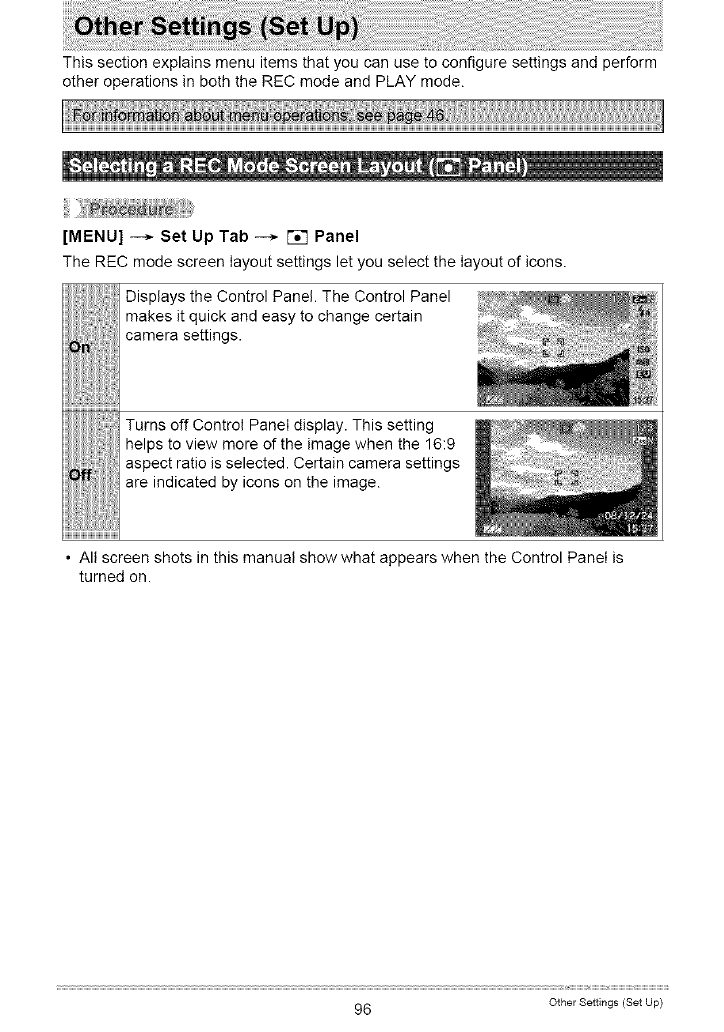
This section explains menu items that you can use to configure settings and perform
other operations in both the REC mode and PLAY mode.
[MENU] -_ Set Up Tab -_ [] Panel
The REC mode screen layout settings let you select the layout of icons.
Displays the Control Panel. The Control Panel
makes it quick and easy to change certain
camera settings.
Turns off Control Panel display. This setting
helps to view more of the image when the 16:9
aspect ratio is selected. Certain camera settings
are indicated by icons on the image.
• All screen shots in this manual show what appears when the Control Panel is
turned on.
96 Other Settings (Set Up)
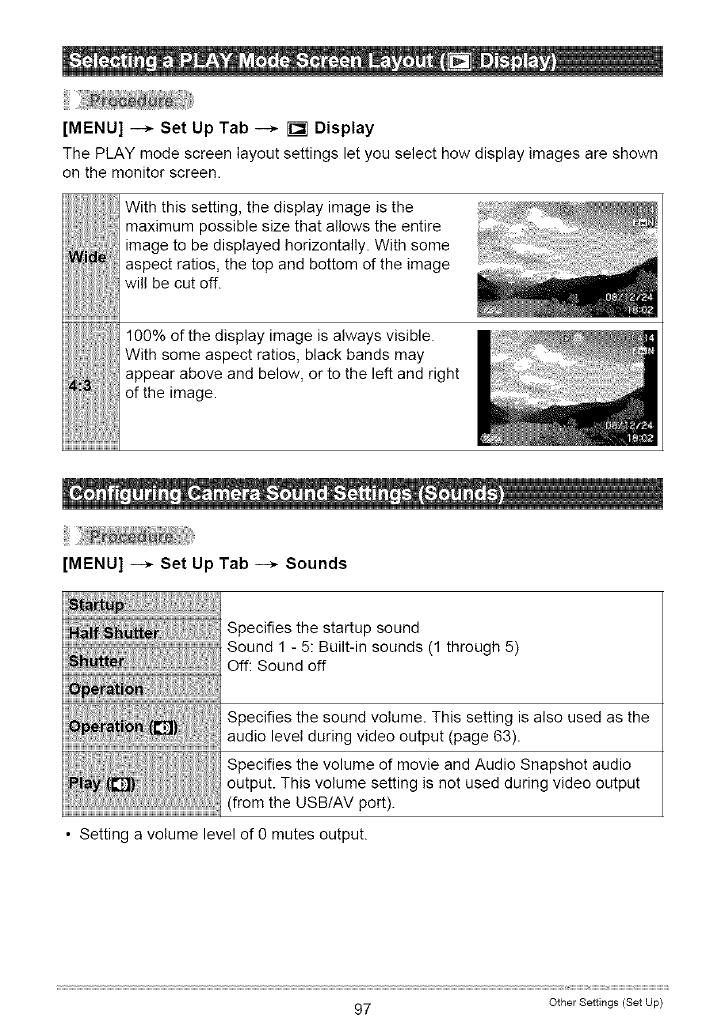
[MENU] --_ Set Up Tab --_ [] Display
The PLAY mode screen layout settings let you select how display images are shown
on the monitor screen.
With this setting, the display image is the
maximum possible size that allows the entire
image to be displayed horizontally. With some
aspect ratios, the top and bottom of the image
will be cut off.
100% of the display image is always visible.
With some aspect ratios, black bands may
appear above and below, or to the left and right
of the image.
[MENU] --_ Set Up Tab --_ Sounds
Specifies the startup sound
Sound 1 - 5: Built-in sounds (1 through 5)
Off: Sound off
Specifies the sound volume. This setting is also used as the
audio level during video output (page 63).
Specifies the volume of movie and Audio Snapshot audio
output. This volume setting is not used during video output
(from the USB/AV port).
• Setting a volume level of 0 mutes output.
97 Other Settings (Set Up)
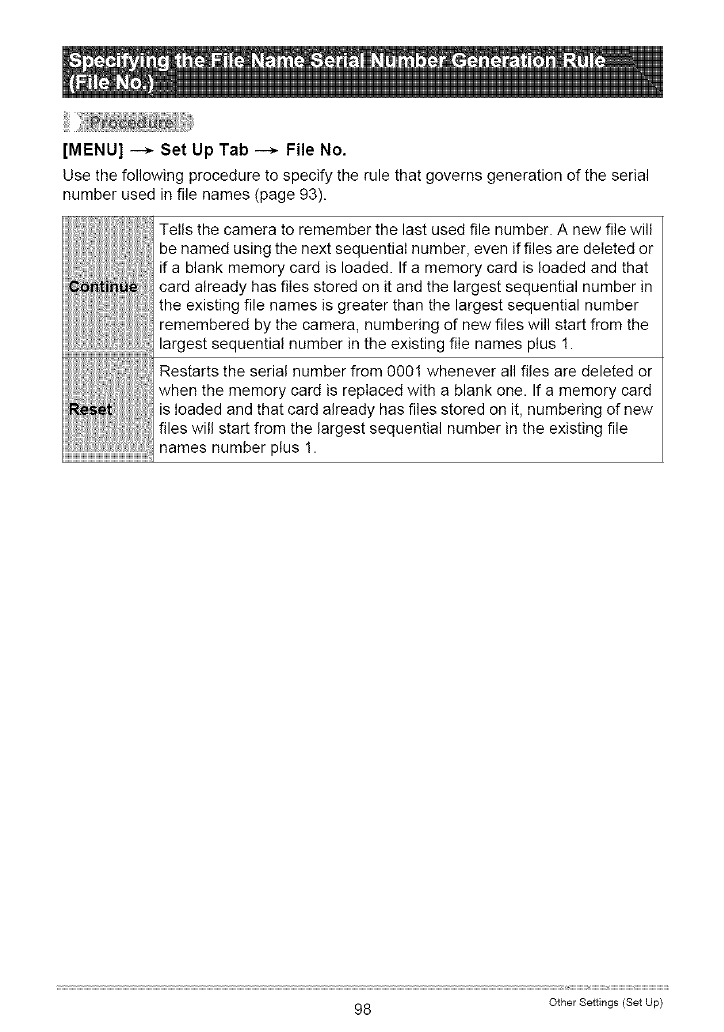
[MENU] -_ Set Up Tab -_ File No.
Use the following procedure to specify the rule that governs generation of the serial
number used in file names (page 93).
Tells the camera to remember the last used file number. A new file will
be named using the next sequential number, even if files are deleted or
if a blank memory card is loaded. If a memory card is loaded and that
card already has files stored on it and the largest sequential number in
the existing file names is greater than the largest sequential number
remembered by the camera, numbering of new files will start from the
largest sequential number in the existing file names plus !.
Restarts the serial number from 0001 whenever all files are deleted or
when the memory card is replaced with a blank one. If a memory card
is loaded and that card already has files stored on it, numbering of new
files will start from the largest sequential number in the existing file
names number plus 1.
98 Other Settings (Set Up)
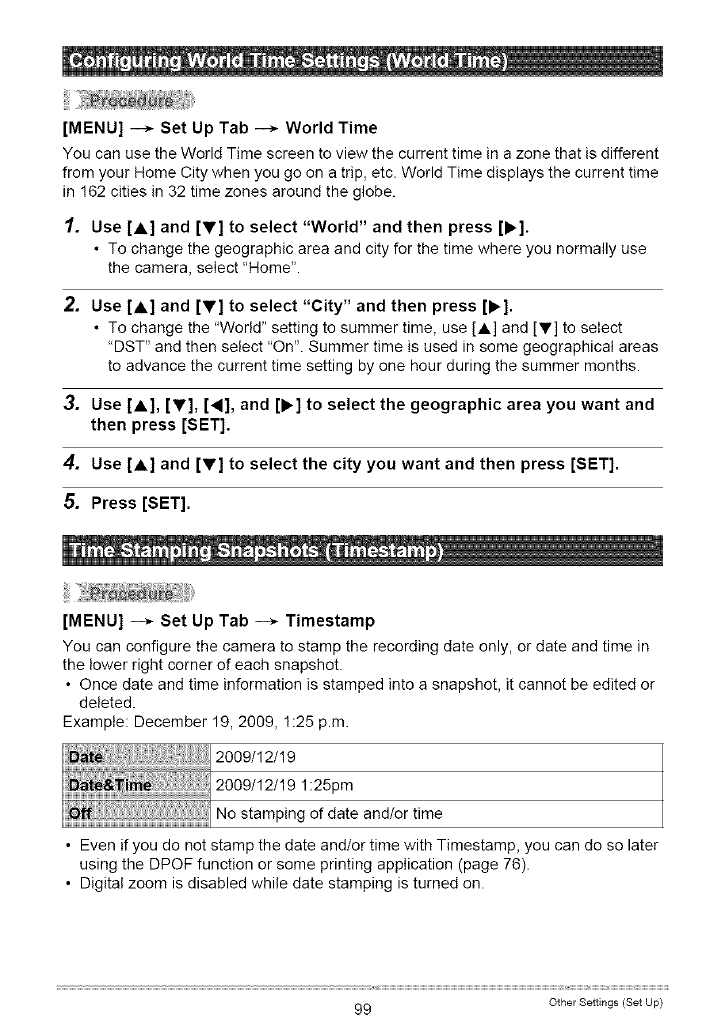
[MENU] --_ Set Up Tab --_ World Time
You can use the World Time screen to view the current time in a zone that is different
from your Home City when you go on a trip, etc. World Time displays the current time
in !62 cities in 32 time zones around the globe.
1. Use [A] and IV] to select "World" and then press [1_].
• To change the geographic area and city for the time where you normally use
the camera, select "Home".
2. use [A] and [V] to select "City" and then press [1_].
• To change the "World" setting to summer time, use [A] and IV] to select
"DST" and then select "On". Summer time is used in some geographical areas
to advance the current time setting by one hour during the summer months.
3. Use[A], [_'], [<], and [1_] to select the geographic area you want and
then press [SET].
4. Use [A] and [V] to select the city you want and then press [SET].
5. Press [SET].
[MENU] --_ Set Up Tab --_ Timestamp
You can configure the camera to stamp the recording date only, or date and time in
the lower right corner of each snapshot.
• Once date and time information is stamped into a snapshot, it cannot be edited or
deleted.
Example: December 19, 2009, ! :25 p.m.
2009/12/19
2009/12/19 1:25pm
No stamping of date and/or time
• Even if you do not stamp the date and/or time with Timestamp, you can do so later
using the DPOF function or some printing application (page 76).
• Digital zoom is disabled while date stamping is turned on.
99 Other Settings (Set Up)
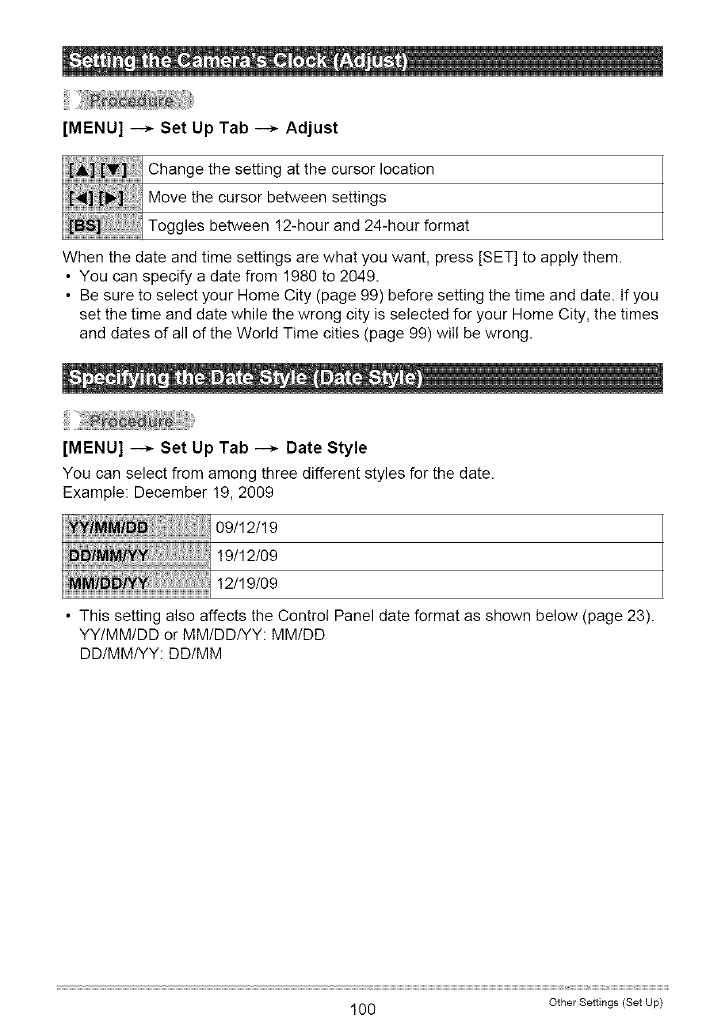
[MENU] --_ Set Up Tab --_ Adjust
Change the setting at the cursor location
Move the cursor between settings
Toggles between !2-hour and 24-hour format
When the date and time settings are what you want, press [SET] to apply them.
• You can specify a date from 1980 to 2049.
• Be sure to select your Home City (page 99) before setting the time and date. If you
set the time and date while the wrong city is selected for your Home City, the times
and dates of all of the World Time cities (page 99) will be wrong.
[MENU] --_ Set Up Tab -_ Date Style
You can select from among three different styles for the date.
Example: December 19, 2009
09,12i!9
I 119/12/09
IN 12,19/09
• This setting also affects the Control Panel date format as shown below (page 23).
YY/MM/DD or MMIDD/YY: MMIDD
DD/MM/YY: DD/MM
100 Other Settings (Set Up)
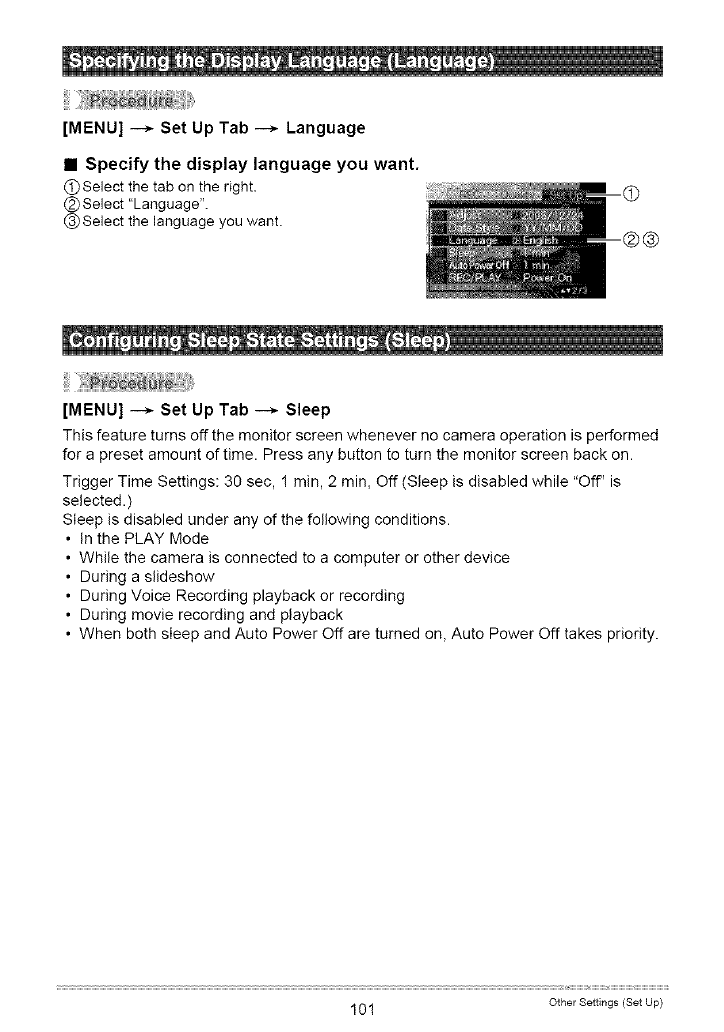
[MENU] --_ Set Up Tab --_ Language
• Specify the display language you want.
(_Select the tab on the right.
(_) Select "Language".
_)Select the language you want.
[MENU] --_ Set Up Tab --_ Sleep
This feature turns off the monitor screen whenever no camera operation is performed
for a preset amount of time. Press any button to turn the monitor screen back on.
Trigger Time Settings: 30 sec, ! min, 2 min, Off (Sleep is disabled while "Off' is
selected.)
Sleep is disabled under any of the following conditions.
In the PLAY Mode
While the camera is connected to a computer or other device
During a slideshow
During Voice Recording playback or recording
During movie recording and playback
When both sleep and Auto Power Off are turned on, Auto Power Off takes priority.
10 ! Other Settings (Set Up)
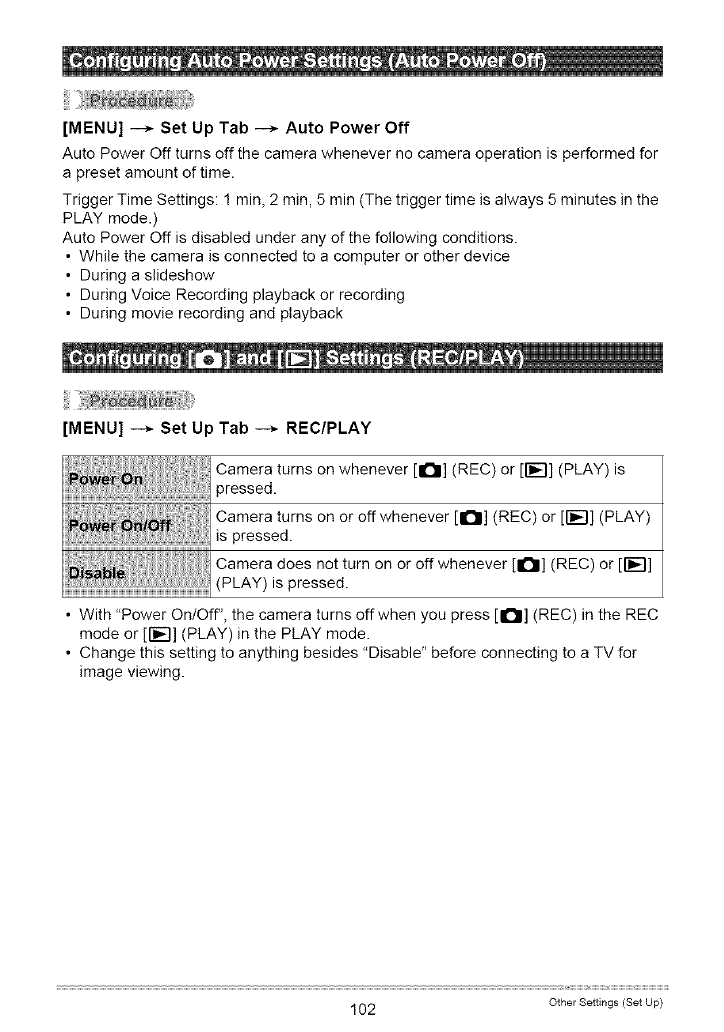
__ ut
[MENU] -_ Set Up Tab -_ Auto Power Off
Auto Power Off turns off the camera whenever no camera operation is performed for
a preset amount of time.
Trigger Time Settings: ! min, 2 min, 5 min (The trigger time is always 5 minutes in the
PLAY mode.)
Auto Power Off is disabled under any of the following conditions.
• While the camera is connected to a computer or other device
• During a slideshow
• During Voice Recording playback or recording
• During movie recording and playback
[MENU] --_ Set Up Tab --_ REC/PLAY
Camera turns on whenever [O] (REC) or [I-_-I] (PLAY) is
pressed.
iii ,i i i
Camera turns on or off whenever [O] (REC)or [1_--I] (PLAY)
............................................................................................................................is pressed.
Dl_ i :i i : :i :i :i: Camera does not turn on or off whenever [O] (REC) or [I-_-I]
(PLAY) is pressed.
• With "Power On/Off', the camera turns off when you press [O] (REC) in the REC
mode or [1_-I] (PLAY) in the PLAY mode.
• Change this setting to anything besides "Disable" before connecting to a TV for
image viewing.
102 Other Settings (Set Up)
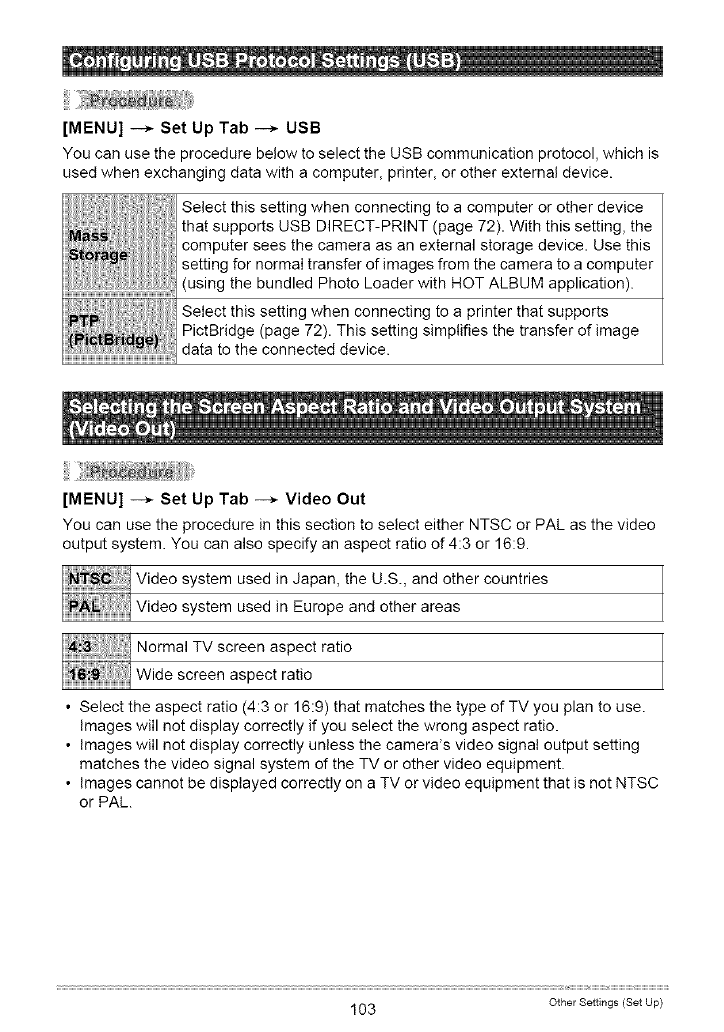
[MENU] -_ Set Up Tab --_ USB
You can use the procedure below to select the USB communication protocol, which is
used when exchanging data with a computer, printer, or other external device.
Select this setting when connecting to a computer or other device
that supports USB DIRECT-PRINT (page 72). With this setting, the
computer sees the camera as an external storage device. Use this
setting for normal transfer of images from the camera to a computer
(using the bundled Photo Loader with HOT ALBUM application).
: :; Select this setting when connecting toe printer that supports
,,,i,,,_,,_ ,, PictBridge (page 72). This setting simplifies the transfer of image
data to the connected device.
[MENU] --_ Set Up Tab --_ Video Out
You can use the procedure in this section to select either NTSC or PAL as the video
output system. You can also specify an aspect ratio of 4:3 or 16:9.
Video system used in Japan, the U.S., and other countries
Video system used in Europe and other areas
Normal TV screen aspect ratio
Wide screen aspect ratio
• Select the aspect ratio (4:3 or 16:9) that matches the type of TV you plan to use.
Images will not display correctly if you select the wrong aspect ratio.
• Images will not display correctly unless the camera's video signal output setting
matches the video signal system of the TV or other video equipment.
• Images cannot be displayed correctly on a TV or video equipment that is not NTSC
or PAL.
103 Other Settings (Set Up)
[MENU] -_ Set Up Tab -_ Format
Ifa memory card is loaded in the camera, this operation will format the memory card.
It will format built-in memory if no memory card is loaded.
• The format operation will delete all contents on the memory card or in built-in
memory. It cannot be undone. Make sure you do not need any data currently on
the card or in built-in memory before you format it.
• Formatting built-in memory will delete the following data.
- Protected images
- Startup screen
• Formatting a memory card will delete the following data.
- Protected images
• Make sure that the battery is charged fully before starting a formatting operation.
Formatting may not be performed correctly and the camera may stop operating
normally if the camera powers down while formatting is in progress.
• Never open the battery cover while formatting is in progress. Doing so can cause
the camera to stop operating normally.
D
[MENU] --* Set Up Tab --* Reset
See page 124 for details about the camera's factory default settings.
The settings below are not reset.
World Time settings, clock settings, date style, screen language, video output
s104 Other Settings (Set Up)
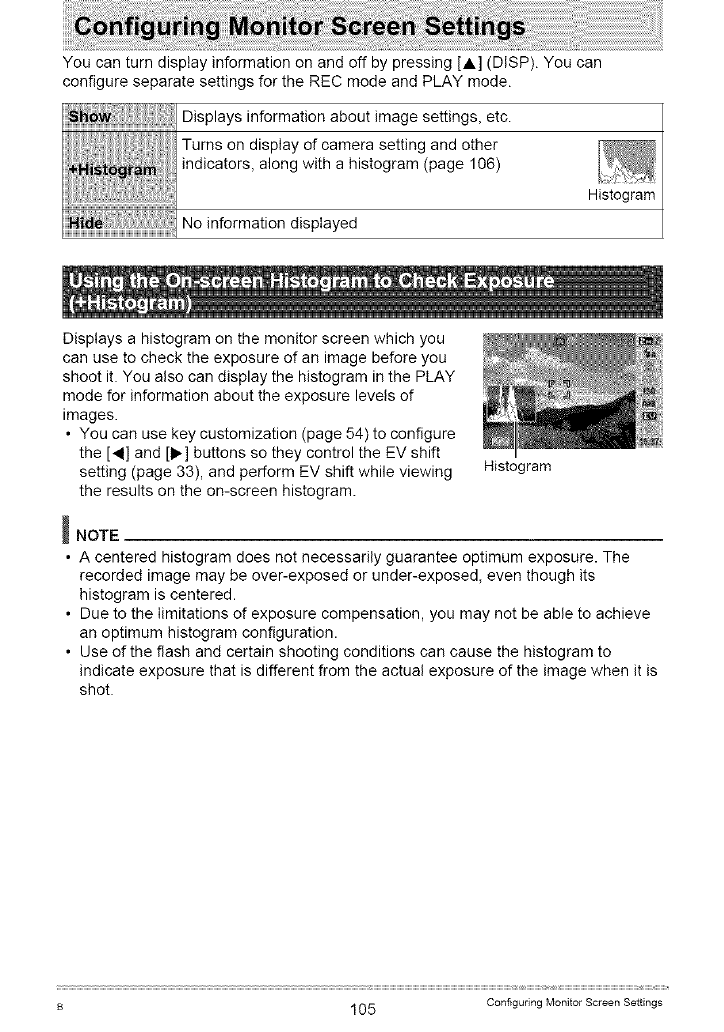
You can turn display information on and off by pressing [A] (DISP). You can
configure separate settings for the REC mode and PLAY mode.
Displays information about image settings, etc.
Turns on display of camera setting and other
indicators, along with a histogram (page 106)
No information displayed
Displays a histogram on the monitor screen which you
can use to check the exposure of an image before you
shoot it. You also can display the histogram in the PLAY
mode for information about the exposure levels of
images.
• You can use key customization (page 54) to configure
the [,_] and [1_] buttons so they control the EV shift
setting (page 33), and perform EV shift while viewing Histogram
the results on the on-screen histogram.
_NOTE
• A centered histogram does not necessarily guarantee optimum exposure. The
recorded image may be over-exposed or under-exposed, even though its
histogram is centered.
• Due to the limitations of exposure compensation, you may net be able to achieve
an optimum histogram configuration.
• Use of the flash and certain shooting conditions can cause the histogram to
indicate exposure that is different from the actual exposure of the image when it is
shot.
B 105 Configuring Monitor Screen Settings
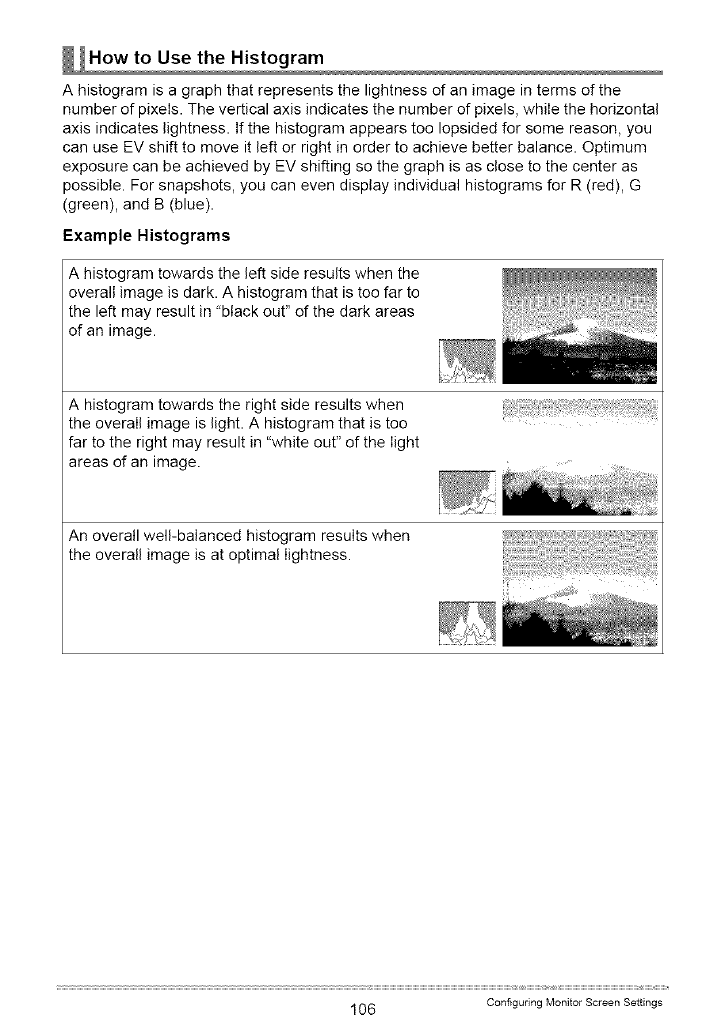
A histogram is a graph that represents the lightness of an image in terms of the
number of pixeIs. The vertical axis indicates the number of pixels, while the horizontal
axis indicates lightness. If the histogram appears too lopsided for some reason, you
can use EV shift to move it left or right in order to achieve better balance. Optimum
exposure can be achieved by EV shifting so the graph is as close to the center as
possible. For snapshots, you can even display individual histograms for R (red), G
(green), and B (blue).
Example Histograms
A histogram towards the left side results when the
overall image is dark. A histogram that is too far to
the left may result in "black out" of the dark areas
of an image.
A histogram towards the right side results when
the overall image is light. A histogram that is too
far to the right may result in "white out" of the light
areas of an image.
An overall well-balanced histogram results when
the overall image is at optimal lightness.
106 Configuring Monitor Screen Settings
• Avoid Use While In Motion
• Never use the camera to record or play back images while operating an automobile
or other vehicle, or while walking. Looking at the monitor while in motion creates
the risk of serious accident.
• Directly Viewing the Sun or Bright Light
• Never look at the sun or any other bright light through the cameras viewfinder.
Doing so can damage your eyesight.
• Flash
• Never use the flash unit in areas where flammable or explosive gas may be
present. Such conditions create the risk of fire and explosion.
• Never fire the flash in the direction of a person operating a motor vehicle. Doing so
can interfere with the driver's vision and creates the risk of accident.
• Never fire the flash too close to the eyes of the subject. Doing so creates the risk of
loss of eyesight.
• Monitor Screen
• Do not apply strong pressure to the monitor screen surface or subject it to strong
impact. Doing so can cause the monitor screen glass to crack.
• Should the monitor screen ever become cracked, never touch any of the liquid
inside the monitor screen. Doing so creates the risk of skin inflammation.
• Should monitor screen liquid ever get into your mouth, immediately rinse your
mouth out and contact your physician.
• Should monitor screen liquid ever get into your eyes or onto your skin, immediately
rinse with clean water for at least 15 minutes and contact your physician.
• Connections
• Never plug any devices that are not specified for use with this camera into
connectors. Connecting a non-specified device creates the risk of fire and electric
shock.
• Transport
• Never operate the camera inside of an aircraft or anywhere else where operation of
such devices is restricted. Improper use creates the risk of serious accident.
107 Appendix
•Smoke, abnormal odor, overheating, and other abnormalities
• Continued use of the camera while it is emitting smoke or strange odor, or while it
is overheating creates the risk of fire and electric shock. Immediately perform the
following steps whenever any of the above symptoms are present.
1. Turn off the camera.
2. Remove the battery from the camera, taking care to protect yourself against burn
injury.
3. Contact your dealer or nearest CASIO authorized service center.
• Water and Foreign Matter
• Water, other liquids, or foreign matter (especially metal) getting inside the camera
creates the risk of fire and electric shock. Immediately perform the following steps
whenever any of the above symptoms are present. Particular care is required when
using the camera where it is raining or snowing, near the ocean or other body of
water, or in a bathroom.
1. Turn off the camera.
2. Remove the battery from the camera.
3. Contact your dealer or nearest CASIO authorized service center.
•Dropping and Rough Treatment
• Continued use of the camera after it is damaged by dropping or other rough
treatment creates the risk of fire and electric shock. Immediately perform the
following steps whenever any of the above symptoms are present.
1. Turn off the camera.
2. Remove the battery from the camera.
3. Contact your dealer or nearest CASIO authorized service center.
•Keep Away From Fire
• Never expose the camera to fire, which can cause it to explode and creates the risk
of fire and electric shock.
•Disassembly and Modification
• Never try to take the camera apart or modify it in any way. Doing so creates the risk
of electric shock, burn injury, and other personal injury. Be sure to leave all internal
inspection, maintenance, and repair up to your dealer or nearest CASIO authorized
service center.
108 Appendix
•Locations To Be Avoided
• Never leave the camera in any of the following types of locations. Doing so creates
the risk of fire and electric shock.
- Areas subject to large amounts of humidity or dust
- Food preparation areas or other locations where oil smoke is present
- Near heaters, on a heated carpet, in areas exposed to direct sunlight, in a closed
vehicle parked in the sun, or other areas subject to very high temperatures
• Never place the camera on an unstable surface, on a high shelf, etc. Doing so can
cause the camera to fall, creating the risk of personal injury.
•Backing Up Important Data
• Always keep backup copies of important data in camera memory by transferring it
to a computer or other storage device. Note that data can be deleted in the case of
camera malfunction, repair, etc.
•Memory Protection
• Whenever replacing the battery, be sure to follow the correct procedure as
described in the documentation that comes with the camera. Incorrectly replacing
the battery can result in corruption or loss of data in camera memory.
•Rechargeable Battery
• Use only the specified charger unit or the specified device to charge the battery.
Attempting to charge the battery by an unauthorized means creates the risk of
battery overheating, fire, and explosion.
• Do not expose or immerse the battery in fresh water or salt water. Doing so can
damage the battery, and cause deterioration of its performance and loss of service
life.
• The battery is intended for use with a CASlO Digital Camera only. Use with any
other device creates the risk of the battery damage, or deterioration of battery
performance and service life.
• Failure to observe any of the following precautions creates the risk of battery
overheating, fire, and explosion.
- Never use or leave the battery near open flame.
- Do not expose the battery to heat or fire.
- Make sure the battery is oriented correctly when it is connected to the charger
unit.
- Never carry or store the battery together with items that can conduct electricity
(necklaces, pencil lead, etc.)
- Never disassemble the battery, pierce it with a needle, or expose it to strong
impact (hit it with a hammer, step on it, etc.), and never apply solder to it. Never
place the battery into a microwave oven, heater, high-pressure generating
device, etc.
109 Appendix
• Shouldyouevernoticeleakage,strangeodor,heatgeneration,discoloration,
deformation,oranyotherabnormalconditionwhileusing,charging,orstoringa
battery,immediatelyremoveitfromthecameraorchargerunitandkeepitaway
fromopenflame.
• Donotuseorleavethebatteryunderdirectsunlight,inanautomobileparkedinthe
sun,orinanyotherareasubjecttohightemperatures.Doingsocandamagethe
battery,andcausedeteriorationofitsperformanceandlossofservicelife.
• Ifbatterychargingdoesnotendnormallywithinthespecifiedchargingtime,stop
charginganywayandcontactyourlocalCASIOauthorizedservicecenter.
Continuedchargingcreatestheriskofbatteryoverheating,fire,andexplosion.
• Batteryfluidcandamageyoureyes.Shouldbatteryfluidgetintoyoureyes
accidentally,immediatelyrinsethemwithcleantapwaterandthenconsulta
physician.
• Besuretoreadtheuserdocumentationthatcomeswiththecameraandspecial
chargerunitbeforeusingorchargingthebattery.
• Ifabatteryistobeusedbyyoungchildren,makesurethataresponsibleadult
makesthemawareoftheprecautionsandproperhandlinginstructions,andmake
surethattheyhandlethebatterycorrectly.
• Shouldfluidfromabatteryaccidentallygetontoclothingoryourskin,immediately
rinseitoffwithcleantapwater.Prolongedcontactwithbatteryfluidcancauseskin
irritation.
• BatteryLife
• Batterycontinuousoperationtimesprovidedinthismanualrepresentthe
approximateamountoftimebeforethecameraturnsoffduetolowbatterypower
whenbeingpoweredbythespecialbatteryundernormaltemperature(23°C
(73°F)).Theydonotguaranteethatyouwillbeabletoachievetheindicatedlevel
ofoperation.Actualbatterylifeisgreatlyaffectedbyambienttemperature,battery
storageconditions,theamountoftimespentinstorage,etc.
• Leavingthecameraoncanrundownthebatteryandcausethelowbattery
warningtoappear.Turnoffthecamerawheneveryouarenotusingit.
•Thelowbatterywarningindicatesthatthecameraisabouttoturnoffduetolow
batterypower.Chargethebatteryassoonaspossible.Leavingalowordead
batteryinthecameracanleadtobatteryleakageanddatacorruption.
110 Appendix
• PowerSupply
• Useonlythespecialrechargeablelithiumionbattery(NP-60)topowerthiscamera.
Useofanyothertypeofbatteryisnotsupported.
•Thecameradoesnothaveaseparatebatteryfortheclock.Thedateandtime
settingsofthecameraareclearedabouttwodaysafterpoweriscutofffromthe
battery.Ifthishappens,besuretoreconfigurethesesettingsafterpoweris
restored(page100).
• DataErrorPrecautions
Yourdigitalcameraismanufacturedusingprecisiondigitalcomponents.Anyofthe
followingcreatestheriskofcorruptionofdataincameramemory.
• Removingthebatteryormemorycardwhilethecameraisperformingsome
operation
• Removingthebatteryormemorycardwhilethebacklampisflashinggreenafter
turningoffthecamera
• DisconnectingtheUSBcablewhilecommunicationisinprogress
• Usingabatterythatislow
• Otherabnormaloperations
Anyoftheaboveconditionscancauseanerrormessagetoappearonthemonitor
screen(page13!).Performtheactionindicatedbythemessagethatappears.
• OperatingEnvironment
• OperatingTemperature:0to40°C(32to104°F)
• OperatingHumidity:10to85%(noncondensation)
• Donotplacethecamerainanyofthefollowinglocations.
- Inanareaexposedtodirectsunlight,orlargeamountsofmoistureordust
- Nearanairconditionerorinotherareassubjectedtoextremetemperatureor
humidity
- Insideofamotorvehicleonahotday,orinanareasubjectedtostrongvibration
• Condensation
Suddenandextremetemperaturechanges,suchaswhenthecameraismovedfrom
theoutdoorsonacoldwinterdayintoawarmroom,cancausewaterdropletscalled
"condensation"toformontheinteriorandtheexteriorofthecamera,whichcreates
theriskofmalfunction.Topreventcondensationfromformingsealthecameraina
plasticbagbeforechanginglocations.Thenleavethebagsealedtoallowtheair
insidetonaturallychangetothesametemperatureastheairinthenewlocation.
Afterthat,removethecamerafromthebagandopenthebatterycoverforafew
hours.
11! Appendix
•Lens
•Never apply too much force when cleaning the surface of the lens. Doing so can
scratch the lens surface and cause malfunction.
• You may sometimes notice some distortion in certain types of images, such as a
slight bend in lines that should be straight. This is due to the characteristics of
lenses, and does not indicate malfunction of the camera.
• Caring for your camera
• Never touch the lens or flash window with your fingers. Finger smudges, dirt, and
other foreign matter on the lens or flash window can interfere with proper operation
of the camera. Use a blower or other means to keep the lens and flash window free
of dirt and dust, and wipe gently with a soft, dry cloth.
• To clean the camera, wipe it with a soft, dry cloth.
•Old Rechargeable Battery Handling Precautions
• Insulate the positive and negative terminals with tape, etc.
• Do not peel the covering off of the battery.
• Do not try to take the battery apart.
112 Appendix
•Charger Unit Handling Precautions
@
• Never plug the power cord into an outlet whose voltage rating is different from
that marked on the power cord. Doing so creates the risk of fire, malfunction,
and electric shock.
• Take care to protect the power cord against damage and breaking. Never place
heavy objects onto the power cord, or expose it to intense heat. Doing so can
damage the power cord, creating the risk of fire and electric shock.
• Never try to modify the power cord, or subject it to severe bending, twisting, or
pulling. Doing so creates the risk of fire, malfunction, and electric shock.
• Never plug in or unplug the power cord while your hands are wet. Doing so
creates the risk of electric shock.
• Do not plug the power cord into an outlet or extension cord that is shared by
other devices. Doing so creates the risk of fire, malfunction, and electric shock.
• Should the power cord ever become damaged (to the point that internal wires
are exposed or cut), immediately contact your original retailer or authorized
CASlO authorized service center to request repair. Continued use of a damaged
power cord creates the risk of fire, malfunction, and electric shock.
• The charger unit becomes slightly warm during charging. This is normal and does
not indicate malfunction.
• Unplug the power cord from the power outlet when you are not using the charger
unit.
• Never use detergent to clean the power cord (especially the plug).
• Never cover the charger unit with a blanket, etc. Doing so creates the risk of fire.
•Other Precautions
The camera becomes slightly warm during use. This is normal and does not indicate
malfunction.
s 113 Appendix
• Copyrights
Exceptforyourownpersonalenjoyment,unauthorizeduseofuseofsnapshotsor
moviesofimageswhoserightsbelongtoothers,withoutthepermissionoftheright
holder,isforbiddenbycopyrightlaws.Insomecases,shootingofpublic
performances,shows,exhibitions,etc.mayberestrictedentirely,evenifitisforyour
ownpersonalenjoyment.Regardlessofwhethersuchfilesarepurchasedbyyouor
obtainedforfree,postingthemonawebsite,afilesharingsite,oranyotherInternet
site,orotherwisedistributingthemtothirdpartieswithoutthepermissionofthe
copyrightholderisstrictlyprohibitedbycopyrightlawsandinternationaltreaties.For
example,uptoadingordistributingontheInternetimagesofTVprograms,live
concerts,musicvideos,etc.thatwerephotographedorrecordedbyyoumayinfringe
upontherightsofothers.NotethatCASlOCOMPUTERCO.,LTD.shallnotbeheld
liableforuseofthisproductinanywaythatinfringesonthecopyrightsofothersor
thatviolatescopyrightlaws.
I The following terms, which are used in this manual, are registered trademarks or /
trademarks of their respective owners. J
Note that trademark TMand registered trademark ®are not use within the text of this
manual.
• The SDHC logo is a trademark.
• Microsoft, Windows, Internet Explorer, Windows Media, Windows Vista, and
DirectX are registered trademarks or trademarks dMicrosoft Corporation in the
United States and other countries.
• Macintosh, Mac OS, QuickTime, the QuickTime logo, and iPhoto are trademarks of
Apple Inc.
• MultiMediaCard is a trademark of Infineon Technologies AG of Germany, and
licensed to the MultiMediaCard Association (MMCA).
• MMCplus is a trademark of the MultiMediaCard Association.
• Adobe and Reader are trademarks or registered trademarks in the United States
and other countries of Adobe Systems Incorporated.
• HOT ALBUM and the HOT ALBUM logo are registered trademarks or trademarks
of Konica Minolta Photo Imaging, Inc.
• YouTube, the YouTube logo, and "Broadcast Yourself' are trademarks or
registered trademarks of YouTube, LLC.
• EXILIM, Photo Loader, Photo Transport, and YouTube Uptoader for CASlO are
registered trademarks or trademarks of CASIO COMPUTER CO., LTD.
• Photo Loader with HOT ALBUM was developed based on HOT ALBUM and Photo
Loader and is copyrighted by CASIO COMPUTER CO., LTD. and HOTALBUM
COM, Inc. Copyright and all other rights revert to them.
• All other company or product names mentioned herein are registered trademarks
or trademarks of their respective companies.
c 114 Appendix
Anyandallunauthorizedcommercialcopying,distribution,andcopyingofthe
bundledsoftwareoveranetworkareprohibited.
ThisproductcontainsthesoftwareofFotoNation,Inc.
FotoNationisaregisteredtrademarkofFotoNation,Inc.
FaceTrackerisatrademarksofFotoNation,Inc.
FaceTracker _
FotoNation _
This product's YouTube upload functionality is included under license from YouTube,
LLC. The presence of YouTube upload functionality in this product is not an
endorsement or recommendation of the product by YouTube, LLC.
c 115 Appendix
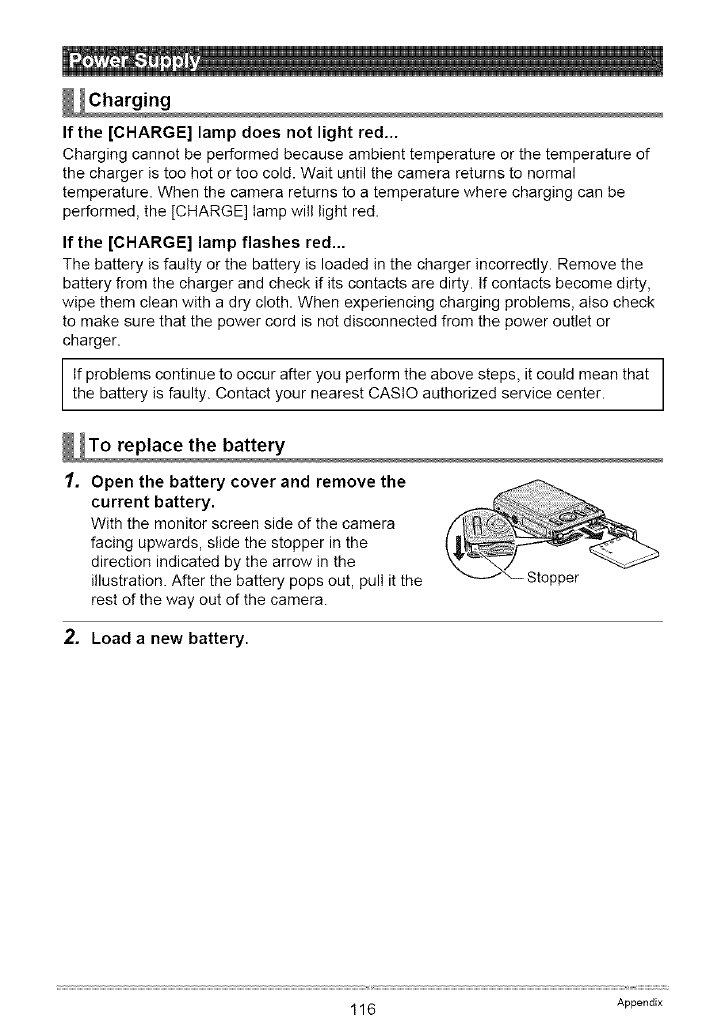
Ifthe[CHARGE]lampdoesnotlightred...
Chargingcannotbeperformedbecauseambienttemperatureorthetemperatureof
thechargeristoohotortoocold.Waituntilthecamerareturnstonormal
temperature.Whenthecamerareturnstoatemperaturewherechargingcanbe
performed,the[CHARGE]lampwilllightred.
Ifthe[CHARGE]lampflashesred...
Thebatteryisfaultyorthebatteryisloadedinthechargerincorrectly.Removethe
batteryfromthechargerandcheckifitscontactsaredirty.Ifcontactsbecomedirty,
wipethemcleanwithadrycloth.Whenexperiencingchargingproblems,alsocheck
tomakesurethatthepowercordisnotdisconnectedfromthepoweroutletor
charger.
l lf problems continue to occur after you perform the above steps, it could mean thatthe battery is faulty. Contact your nearest CASIO authorized service center. J
1. Open the battery cover and remove the
current battery.
With the monitor screen side of the camera
facing upwards, slide the stopper in the
direction indicated by the arrow in the
illustration. After the battery pops out, pull it the
rest of the way out of the camera.
Stopper
2. Load a new battery.
116 Appendix
• PrecautionsduringUse
•Operation provided by a battery under cold conditions is always less than operation
under normal temperatures. This is due to the characteristics of the battery, not the
camera.
• Charge the battery in an area where the temperature is within the range of 5°C to
35°C (41 °F to 95°F). Outside this temperature range charging can take longer than
normal or even fail.
• If abattery provides only very limited operation following a full charge, it probably
means the battery has reached the end of its service life. Reptace the battery with a
new one.
• Storage Precautions
• Storing the battery for a long time while it is charged can cause deterioration of
battery characteristics. If you do not plan to use a battery for some time, fully use
up its charge before storing it.
• Always remove the battery from the camera when you are not using it. A battery left
in the camera can discharge and go dead, which wilI require some time to charge
when you need to use the camera.
• Store batteries in a cool, dry place (2O°C (68°F) or lower).
• Precautions during Use
• The bundled charger is designed for operation with any power supply in the range
of 10OV to 240V AC, 50/6OHz. Note, however, that the shape of the power cord
plug depends on each country or geographic area. Before taking the camera and
charger along on a trip, check with travel agent about the power supply
requirements in your destination(s).
• Do not connect the charger to a power supply through a voltage converter or
similar device. Doing so can lead to malfunction.
• Extra Batteries
• Taking along extra fully charged batteries (NP-60) is recommended while on a trip
in order to avoid not being able to shoot images due to the battery going dead.
117 Appendix
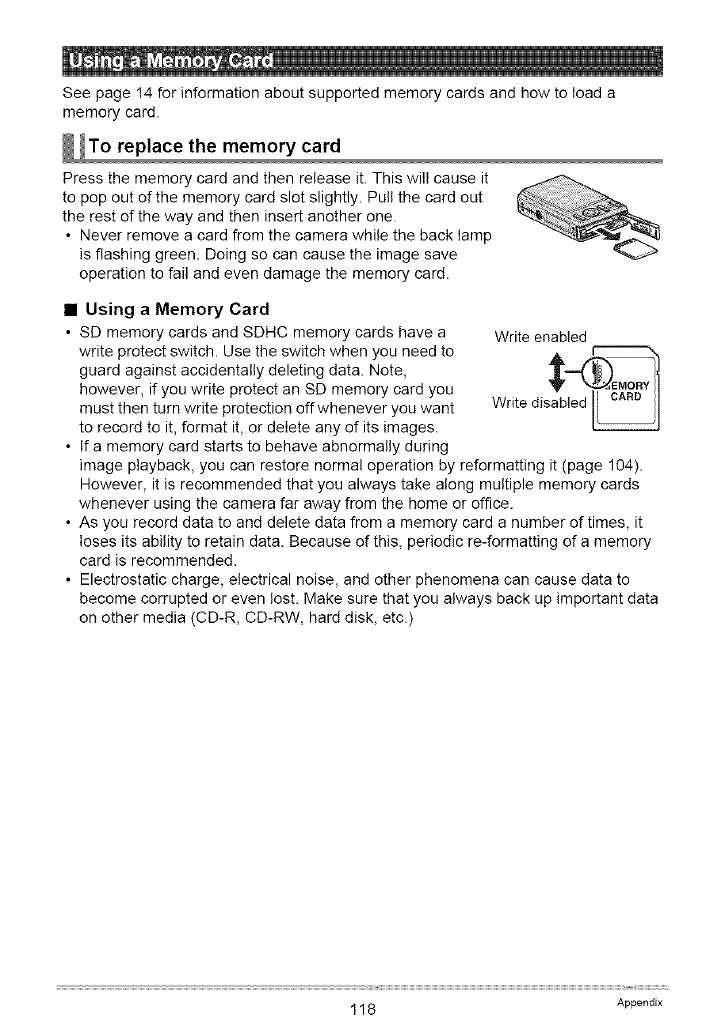
Seepage14forinformationaboutsupportedmemorycardsandhowtoloada
memorycard.
Pressthememorycardandthenreleaseit.Thiswillcauseit
topopoutofthememorycardslotslightly.Pullthecardout
therestofthewayandtheninsertanotherone.
• Neverremoveacardfromthecamerawhilethebacklamp
isflashinggreen.Doingsocancausetheimagesave
operationtofailandevendamagethememorycard.
• Using aMemory Card
• SD memory cards and SDHC memory cards have a
write protect switch. Use the switch when you need to
guard against accidentally deleting data. Note,
however, if you write protect an SD memory card you
must then turn write protection offwhenever you want
to record to it, format it, or delete any of its images.
• If a memory card starts to behave abnormally during
Write enabled
Write disabled
image playback, you can restore normal operation by reformatting it (page 104).
However, it is recommended that you always take along multiple memory cards
whenever using the camera far away from the home or office.
• As you record data to and delete data from a memory card a number of times, it
loses its ability to retain data. Because of this, periodic re-formatting of a memory
card is recommended.
• Electrostatic charge, electrical noise, and other phenomena can cause data to
become corrupted or even lost. Make sure that you always back up important data
on other media (CD-R, CD-RW, hard disk, etc.)
118 Appendix
•Memory Card Handling Precautions
Certain types of cards can slow down processing speeds. In particular, you may
experience problems saving high-quality (HQ, and HQ Wide) movies. Use of certain
types of memory cards increase the time it takes to record movies, which can cause
movie frames to be lost. This condition is indicated by [] and [] flashing on the
monitor screen. Use of a memory card with a maximum transfer speed of at least
10MB per second is recommended.
•Discarding or Transferring Ownership of a Memory Card or the
Camera
The format and delete functions of the camera do not actually delete files from the
memory card. The original data remains on the card. Note that responsibility for the
data on a memory card lies with you. The following procedures are recommended
whenever you discard a memory card or the camera, or if you transfer ownership to
another party.
•When discarding a memory card, either physically destroy the memory card or use
commercially available data delete software to completely delete the data on the
memory card.
• When transferring ownership of a memory card to another party, use commercially
available data deletion software to completely delete the data on it.
• Use the format function (page 104) to completely delete the data in built-in memory
before discarding or transferring ownership of the camera.
119 Appendix
Computersystemrequirementsaredifferentforeachoftheapplications.Besureto
checktherequirementsfortheparticularapplicationyouaretryingtouse.Notethat
thevaluesprovidedhereareminimumrequirementsforrunningeachapplication.
Actualrequirementsaregreater,dependingonthenumberofimagesandthesizesof
theimagesbeinghandled.
OWindows
Photo Loader with HOT ALBUM
Hard Disk Drive Space : At least 2GB
Other : Internet Explorer 5.5 or higher
DirectX 9.0 or higher
Windows Media Player 9 or higher
DirectX 9.0c
Hard Disk Drive Space: 65MB for installation (18MB on hard disk)
YouTube Uploader for CASIO
• Sufficient memory to run the operating system
• Computer configuration that enables playback of movies on the YouTube site
• Computer configuration that enables upload of movies to the YouTube site
Photo Transport 1.0
Memory :At least 64MB
Hard Disk Drive Space : At least 2MB
Adobe Reader 8
CPU : Pentium II! Class
Memory :At least 128MB
Hard Disk Drive Space:At least 180MB
Other : Internet Explorer 6.0 or higher installed
For details about the minimum system requirements for each software application,
see the "Read me" files on the CASlO Digital Camera Software CD-ROM that comes
bundled with the camera.
120 Appendix
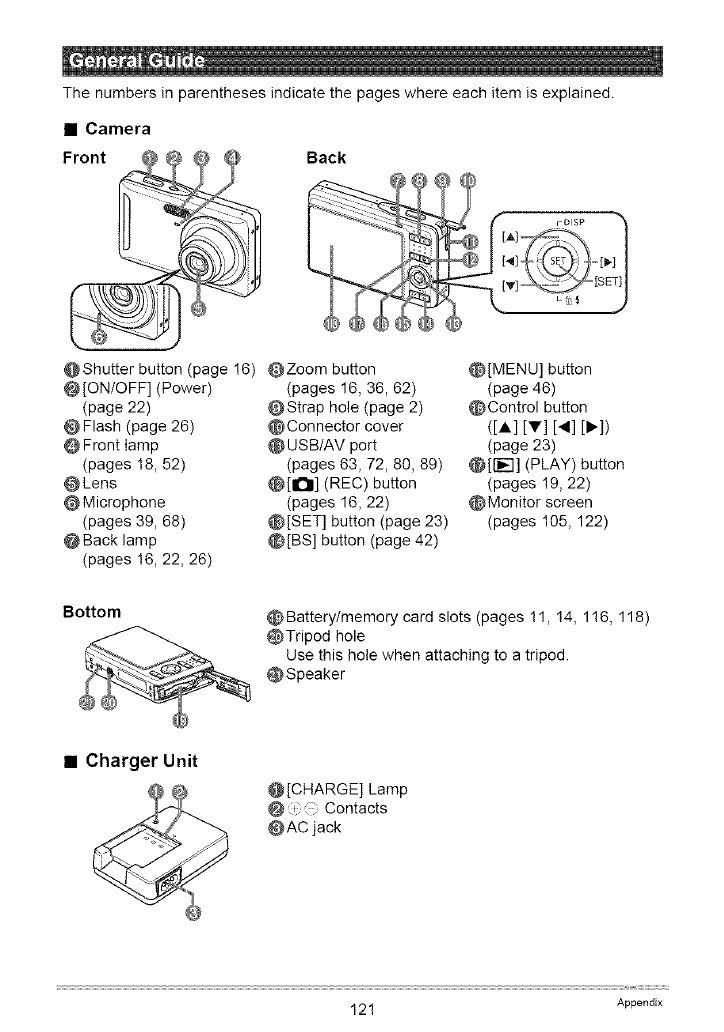
Thenumbersinparenthesesindicatethepageswhereeachitemisexplained.
•Camera
Front _Back
@Shutter button (page !6) @Zoom button @[MENU] button
@[ON/OFF] (Power) (pages 16, 36, 62) (page 46)
(page 22) @Strap hole (page 2) @Control button
@Flash (page 26) @Connector cover ([A] [V] [,_] [1_1)
@ Front Iamp @ USB/AV port (page 23)
(pages 18, 52) (pages 63, 72, 80, 89) @[l'_-q] (PLAY) button
@Lens @[1_11] (REC) button (pages 19, 22)
@ Microphone (pages 16, 22) @ Monitor screen
(pages 39, 68) @[SET] button (page 23) (pages 105, 122)
@Back lamp @[BS] button (page 42)
(pages 16, 22, 26)
Bottom @ Battery/memory card slots (pages 11, !4, 116, 118)
@Tripod hole
Use this hote when attaching to a tripod.
@Speaker
• Charger Unit
@[CHARGE] Lamp
Contacts
@AC jack
12 ! Appendix
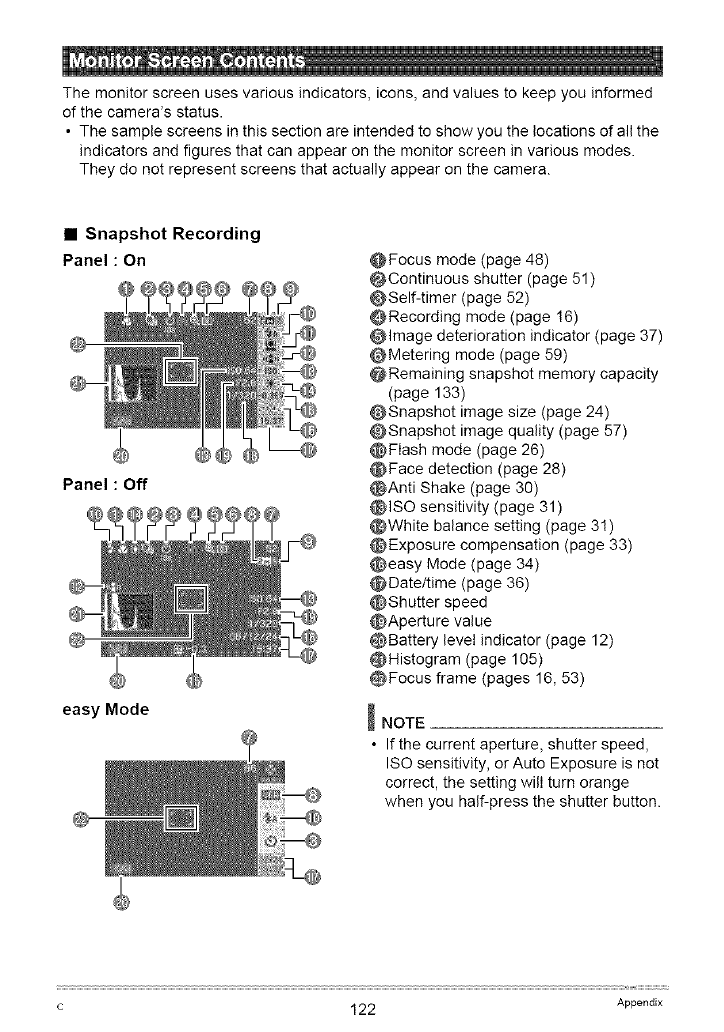
Themonitorscreenusesvariousindicators,icons,andvaluestokeepyouinformed
ofthecamera'sstatus.
•Thesamplescreensinthissectionareintendedtoshowyouthelocationsofallthe
indicatorsandfiguresthatcanappearonthemonitorscreeninvariousmodes.
Theydonotrepresentscreensthatactuallyappearonthecamera.
•Snapshot Recording
Panel: On
@
Panel: Off
@
easy Mode
@Focus mode (page 48)
@Continuous shutter (page 51)
@Self-timer (page 52)
@Recording mode (page !6)
@Image deterioration indicator (page 37)
@Metering mode (page 59)
@Remaining snapshot memory capacity
(page 133)
@Snapshot image size (page 24)
@Snapshot image quality (page 57)
@Flash mode (page 26)
@Face detection (page 28)
@Anti Shake (page 30)
@lSO sensitivity (page 31)
@White balance setting (page 31)
@Exposure compensation (page 33)
@easy Mode (page 34)
@Date/time (page 36)
@Shutter speed
@Aperture value
@ Battery level indicator (page 12)
@Histogram (page 105)
@Focus frame (pages 16, 53)
_NOTE
• If the current aperture, shutter speed,
ISO sensitivity, or Auto Exposure is not
correct, the setting will turn orange
when you half-press the shutter button.
c 122 Appendix
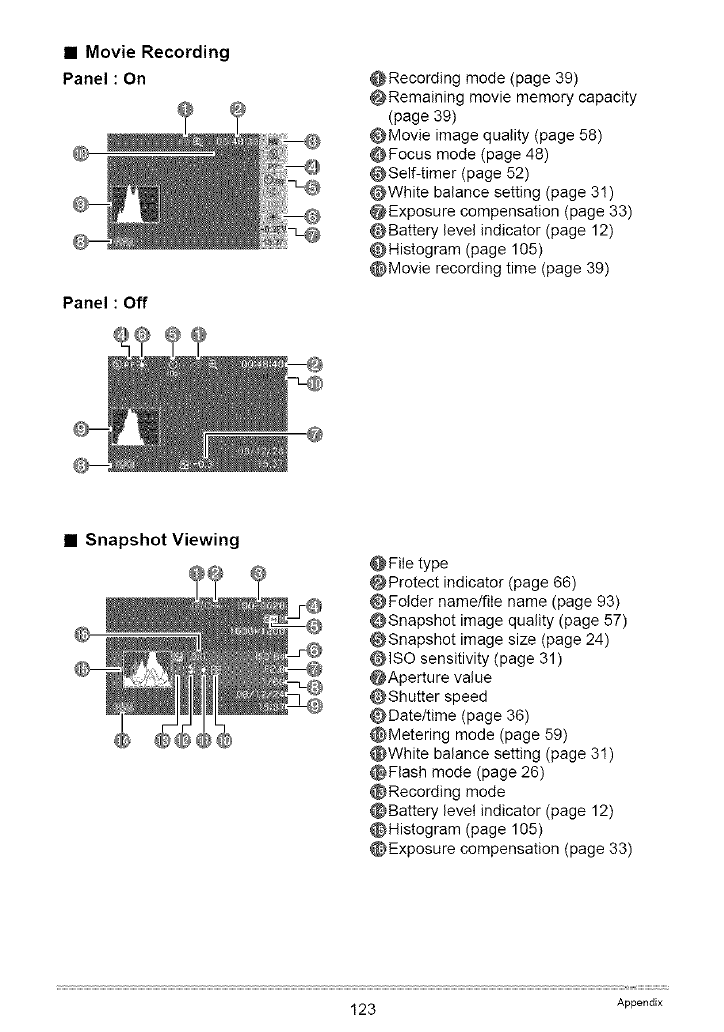
•Movie Recording
Panel: On
@
Panel: Off
@Recording mode (page 39)
@Remaining movie memory capacity
(page 39)
@Movie image quality (page 58)
@Focus mode (page 48)
@Self-timer (page 52)
@White balance setting (page 3!)
@Exposure compensation (page 33)
@ Battery level indicator (page 12)
@Histogram (page 105)
@Movie recording time (page 39)
@
•Snapshot Viewing
@
@File type
@Protect indicator (page 66)
@ Folder name/file name (page 93)
@Snapshot image quality (page 57)
@Snapshot image size (page 24)
@ISO sensitivity (page 31)
@Aperture value
@Shutter speed
@Date/time (page 36)
@Metering mode (page 59)
@White balance setting (page 31)
@Flash mode (page 26)
@Recording mode
@ Battery level indicator (page 12)
@Histogram (page 105)
@Exposure compensation (page 33)
123 Appendix
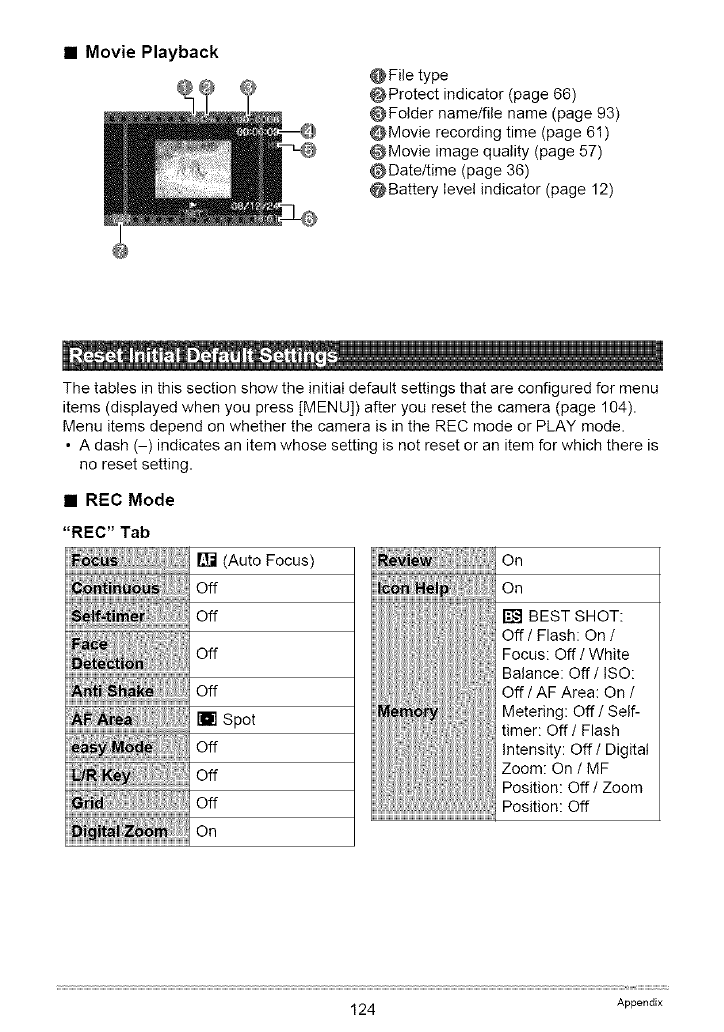
• Movie Playback
@File type
@Protect indicator (page 66)
@Folder name/file name (page 93)
@Movie recording time (page 61)
@Movie image quality (page 57)
@Date/time (page 36)
@ Battery level indicator (page 12)
The tables in this section show the initial default settings that are configured for menu
items (displayed when you press [MENU]) after you reset the camera (page 104).
Menu items depend on whether the camera is in the REC mode or PLAY mode.
• A dash (-) indicates an item whose setting is not reset or an item for which there is
no reset setting.
• REC Mode
"REC" Tab
[](Auto Focus)
Off
i°ff
off
i l i!i iiiii!!l
[] Spot
Off
Off
Off
On
On
On
[] BEST SHOT:
Off/Flash: On /
Focus: Off /White
Balance: Off/ISO:
Off /AF Area: On /
Metering: Off /Self-
timer: Off /Flash
Intensity: Off /Digital
Zoom: On /MF
Position: Off /Zoom
Position: Off
124 Appendix
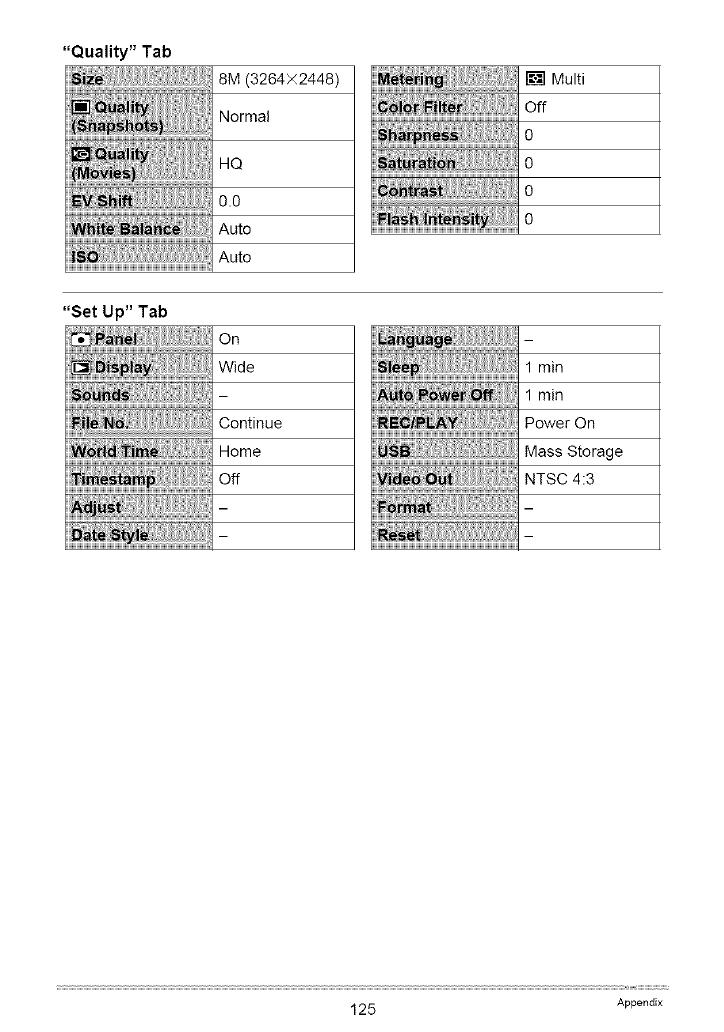
"Quality"Tab 8M_3284×2_48_
_s_ Norma,
HQ
o,o
Auto
Auto
[] Multi
off
0
0
o
o
"Set Up" Tab
On
w,de
so _'::_-
Continue
.ome
o_
_
_
SI_ : lmin
1 min
_owe,on
Mass Storage
._sc4:8
125 Appendix
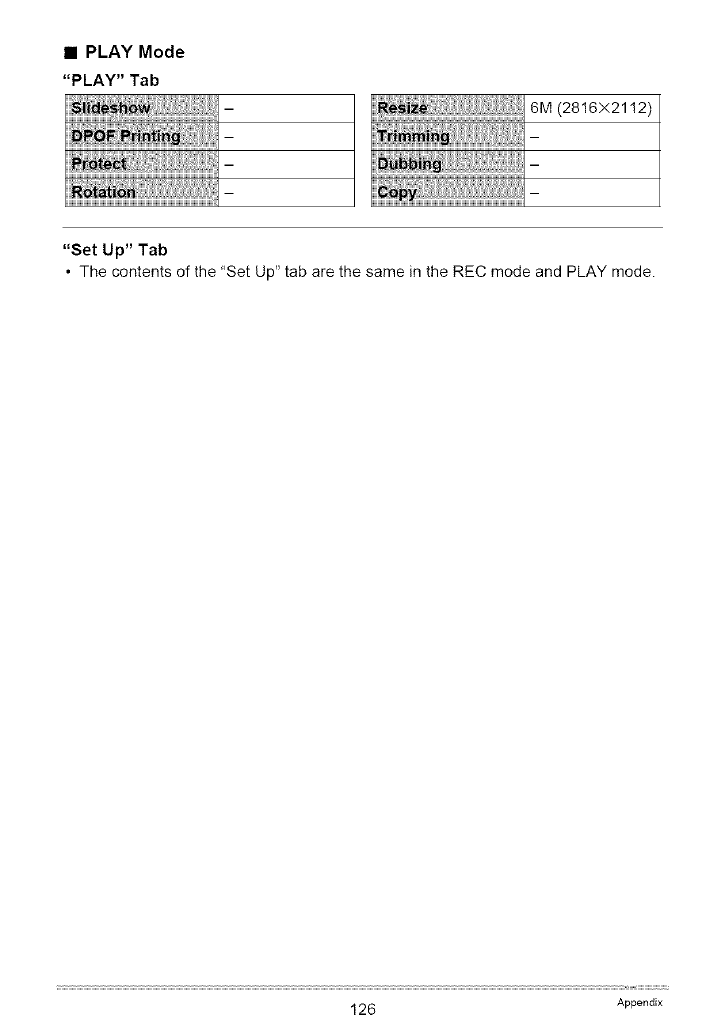
•PLAY Mode
"PLAY" Tab
i -
6M (2816X21 !2)
.... -
_
"Set Up" Tab
• The contents of the "Set Up" tab are the same in the REC mode and PLAY mode.
126 Appendix
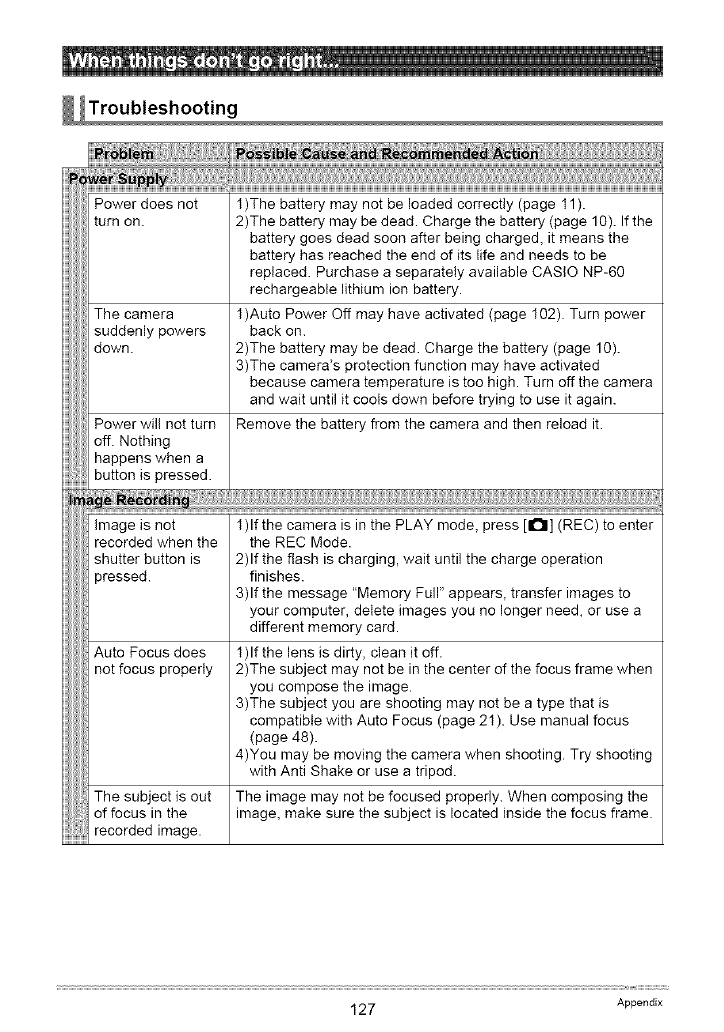
iiiil,
Power does not
turn on.
The camera
suddenly powers
down.
Power will not turn
off. Nothing
happens when a
button is pressed.
I )The battery may not be loaded correctly (page t 1).
2)The battery may be dead. Charge the battery (page 10). If the
battery goes dead soon after being charged, it means the
battery has reached the end of its life and needs to be
replaced. Purchase a separately available CASIO NP-60
rechargeable lithium ion battery.
I )Auto Power Off may have activated (page I02). Turn power
back on.
2)The battery may be dead. Charge the battery (page 10).
3)The camera's protection function may have activated
because camera temperature is too high. Turn off the camera
and wait until it cools down before trying to use it again.
Remove the battery from the camera and then reload it.
Image is not
recorded when the
shutter button is
3ressed.
Auto Focus does
not focus properly
The subject is out
of focus in the
recorded image.
1)If the camera is in the PLAY mode, press [It"_l] (REC) to enter
the REC Mode.
2)If the flash is charging, wait until the charge operation
finishes.
3)If the message "Memory Full" appears, transfer images to
your computer, delete images you no longer need, or use a
different memory card.
1)If the lens is dirty, clean it off.
2)The subject may not be in the center of the focus frame when
you compose the image.
3)The subject you are shooting may not be a type that is
compatible with Auto Focus (page 2I ). Use manual focus
(page 48).
4)You may be moving the camera when shooting. Try shooting
with Anti Shake or use a tripod.
The image may not be focused properly. When composing the
image, make sure the subject is located inside the focus frame.
127 Appendix
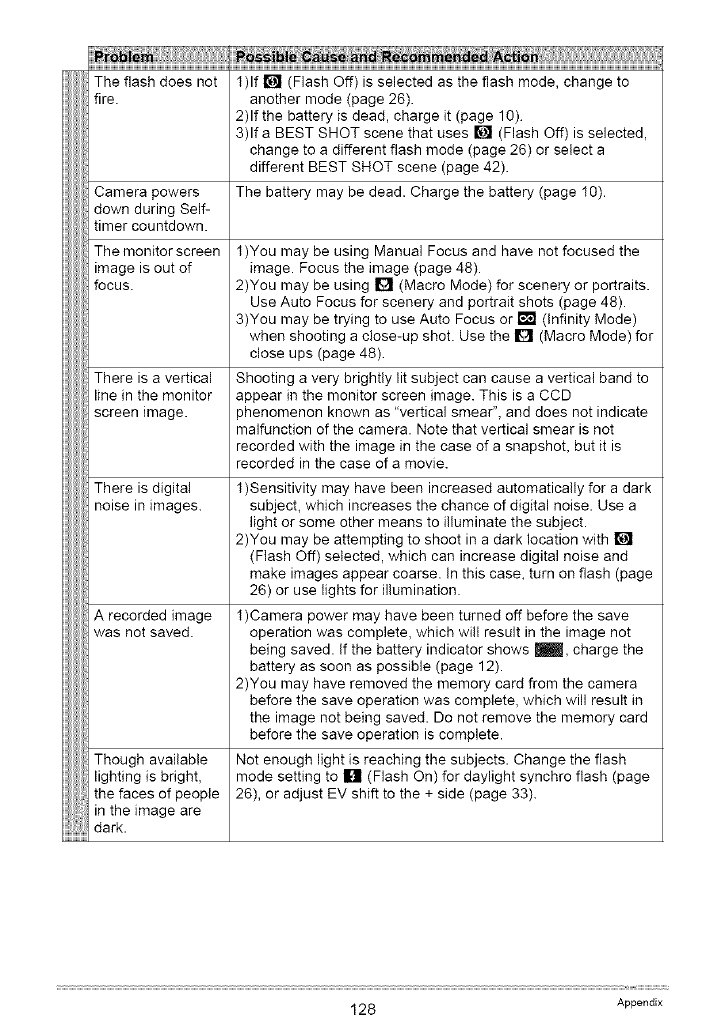
The flash does not
fire.
Camera powers
down during Self-
timer countdown.
The monitor screen
image is out of
focus.
There is a vertical
line in the monitor
screen image.
I )If [] (Flash Off) is selected as the flash mode, change to
another mode (page 26).
2)If the battery is dead, charge it (page 10).
3)lfa BEST SHOT scene that uses [] (Flash Off) is selected,
change to a different flash mode (page 26) or select a
different BEST SHOT scene (page 42).
The battery may be dead. Charge the battery (page I0).
1)You may be using Manual Focus and have not focused the
image. Focus the image (page 48).
2)You may be using [] (Macro Mode) for scenery or portraits.
Use Auto Focus for scenery and portrait shots (page 48).
3)You may be trying to use Auto Focus or _ (infinity Mode)
when shooting a close-up shot. Use the D (Macro Mode) for
close ups (page 48).
Shooting a very brightly lit subject can cause a vertical band to
appear in the monitor screen image. This is a CCD
)henomenon known as "vertical smear", and does not indicate
malfunction of the camera. Note that vertical smear is not
recorded with the image in the case of a snapshot, but it is
recorded in the case of a movie.
I )Sensitivity may have been increased automatically for a dark
subject, which increases the chance of digital noise. Use a
light or some other means to illuminate the subject.
2)You may be attempting to shoot in a dark location with []
(Flash Off) selected, which can increase digital noise and
make images appear coarse. In this case, turn on flash (page
26) or use lights for illumination.
I )Camera power may have been turned off before the save
operation was complete, which will result in the image not
being saved. If the battery indicator shows _, charge the
battery as soon as possible (page 12).
2)You may have removed the memory card from the camera
before the save operation was complete, which will result in
the image not being saved. Do not remove the memory card
before the save operation is complete.
Not enough light is reaching the subjects. Change the flash
mode setting to [] (Flash On) for daylight synchro flash (page
26), or adjust EV shift to the + side (page 33).
128 Appendix
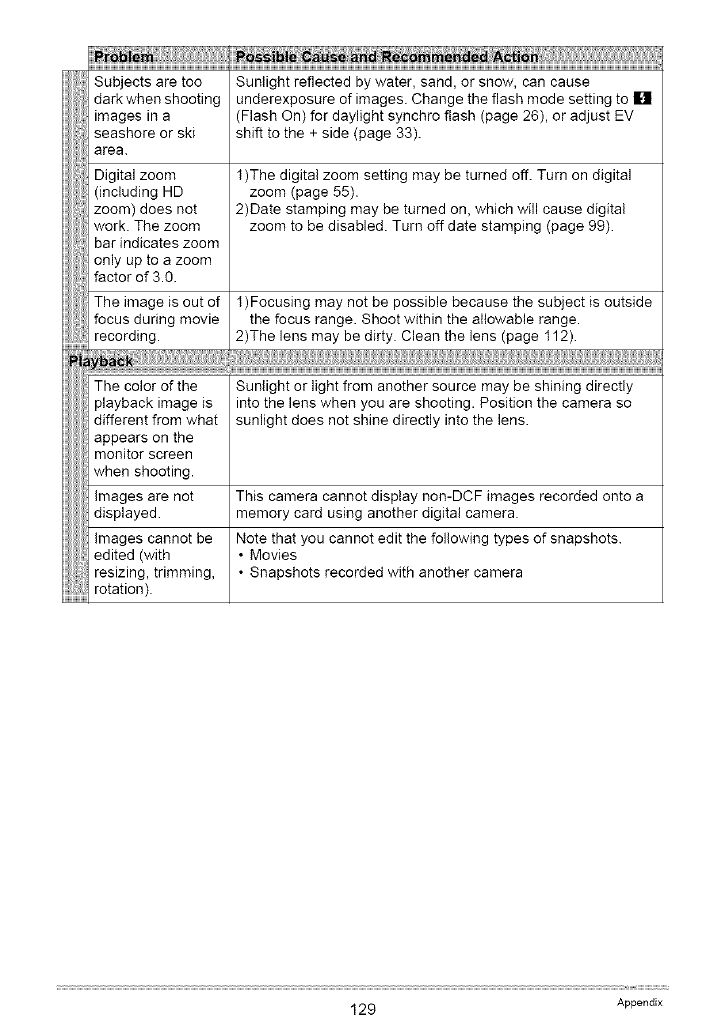
Subjectsaretoo Sunlightreflectedbywater,sand,orsnow,cancause
darkwhenshootingunderexposureofimages.ChangetheflashmodesettingtoU
imagesina (FlashOn)fordaylightsynchroflash(page26),oradjustEV
seashoreorski shifttothe+side(page33).
area.
Digitalzoom I)Thedigitalzoomsettingmaybeturnedoff.Turnondigital
(includingHD zoom(page55).
zoom)doesnot 2)Datestampingmaybeturnedon,whichwillcausedigital
work.Thezoom zoomtobedisabled.Turnoffdatestamping(page99).
barindicateszoom
onlyuptoazoom
factorof3.0.
Theimageisoutof 1)Focusingmaynotbepossiblebecausethesubjectisoutside
focusduringmovie thefocusrange.Shootwithintheallowablerange.
recording. 2)Thelensmaybedirty.Cleanthelens(pageI12).
Thecolorofthe Sunlightorlightfromanothersourcemaybeshiningdirectly
playbackimageis intothelenswhenyouareshooting.Positionthecameraso
differentfromwhatsunlightdoesnotshinedirectlyintothelens.
appearsonthe
monitorscreen
whenshooting.
imagesarenot Thiscameracannotdisplaynon-DCFimagesrecordedontoa
displayed, memorycardusinganotherdigitalcamera.
imagescannotbe Notethatyoucannoteditthefollowingtypesofsnapshots.
edited(with *Movies
resizing, trimming, *Snapshots recorded with another camera
rotation),
129 Appendix
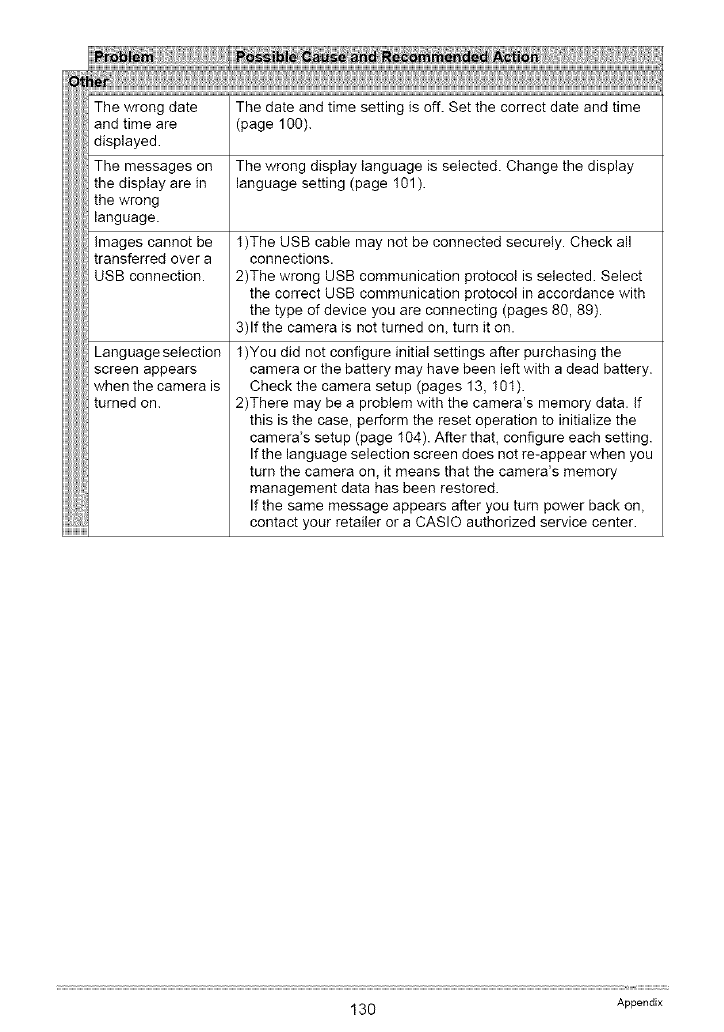
Thewrongdate Thedateandtimesettingisoff.Setthecorrectdateandtime
andtimeare (page100).
displayed.
Themessageson Thewrongdisplaylanguageisselected.Changethedisplay
thedisplayarein languagesetting(pageI01).
thewrong
language.
imagescannotbe
transferredovera
USBconnection.
Languageselection
screenappears
whenthecamerais
turnedon.
1)TheUSBcablemaynotbeconnectedsecurely.Checkall
connections.
2)ThewrongUSBcommunicationprotocolisselected.Select
thecorrectUSBcommunicationprotocolinaccordancewith
thetypeofdeviceyouareconnecting(pages80,89).
3)Ifthecameraisnotturnedon,turniton.
I)Youdidnotconfigureinitialsettingsafterpurchasingthe
cameraorthebatterymayhavebeenleftwithadeadbattery.
Checkthecamerasetup(pages13,I0t).
2)Theremaybeaproblemwiththecamera'smemorydata.If
thisisthecase,performtheresetoperationtoinitializethe
camera'ssetup(pageI04).Afterthat,configureeachsetting.
Ifthelanguageselectionscreendoesnotre-appearwhenyou
turnthecameraon,itmeansthatthecamera'smemory
managementdatahasbeenrestored.
Ifthesamemessageappearsafteryouturnpowerbackon,
contactyourretaileroraCASIOauthorizedservicecenter.
130 Appendix
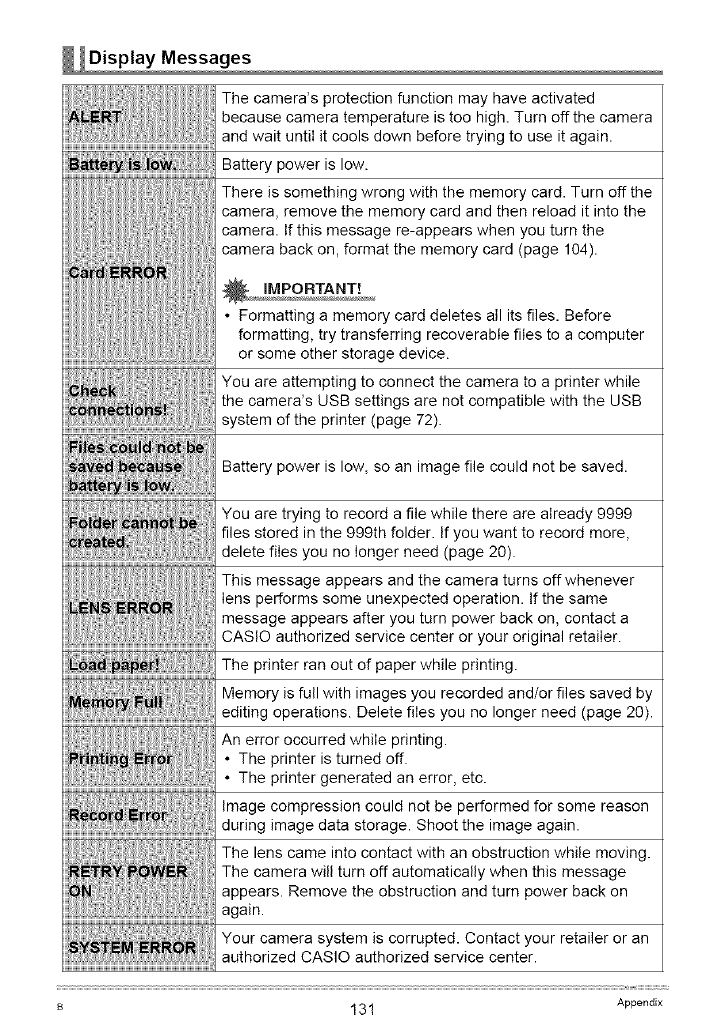
The camera's protection function may have activated
because camera temperature is too high. Turn off the camera
and wait until it cools down before trying to use it again.
Battery power is low.
There is something wrong with the memory card. Turn off the
camera, remove the memory card and then reload it into the
camera. If this message re-appears when you turn the
camera back on, format the memory card (page 104).
• Formatting a memory card deletes all its files. Before
formatting, try transferring recoverable files to a computer
or some other storage device.
You are attempting to connect the camera to a printer while
the camera's USB settings are not compatible with the USB
system of the printer (page 72).
Battery power is low, so an image file could not be saved.
You are trying to record a file while there are already 9999
files stored in the 999th folder. If you want to record more,
delete files you no longer need (page 20).
This message appears and the camera turns off whenever
lens performs some unexpected operation. If the same
message appears after you turn power back on, contact a
CASlO authorized service center or your original retailer.
The printer ran out of paper while printing.
Memory is full with images you recorded and/or files saved by
editing operations. Delete files you no longer need (page 20).
An error occurred while printing.
• The printer is turned off.
• The printer generated an error, etc.
Image compression could not be performed for some reason
during image data storage. Shoot the image again.
The lens came into contact with an obstruction while moving.
The camera will turn off automatically when this message
appears. Remove the obstruction and turn power back on
again.
Your camera system is corrupted. Contact your retailer or an
authorized CASIO authorized service center.
s 13 ! Appendix
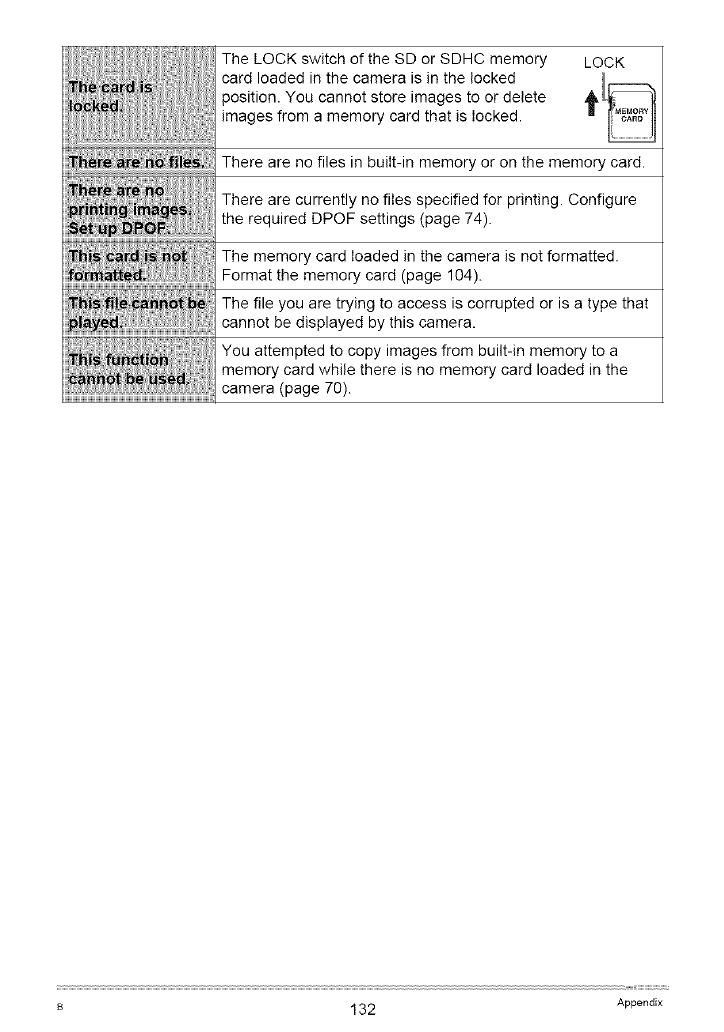
iiiiiiiilN!iiiiiiiiiii!iiiiiiiiiliilliiHiiiiiiiiiiiiiiiiiiii!i!iilltiili/lii!ii
iiiii@_'il i!iiiiiiiiiii!ili,iiiiiiii_i_iiiiiiiiiiiiii!i!!ii:_i
The LOCK switch of the SD or SDHC memory LOCK
card loaded in the camera is in the locked tl _
position. You cannot store images to or delete _ ,
images from a memory card that is locked. "_MORY
There are no files in built-in memory or on the memory card.
There are currently no files specified for printing. Configure
the required DPOF settings (page 74).
_iI _a i$' ot'ii : The memory card loaded in the camera is not formatted.
Format the memory card (page 104).
ib The file you are trying to access is corrupted or is a type that
cannot be displayed by this camera.
: [ ! :: :i i
YOU attempted to copy images from built-in memory to a
memory card while there is no memory card loaded in the
camera (page 70).
s 132 Appendix
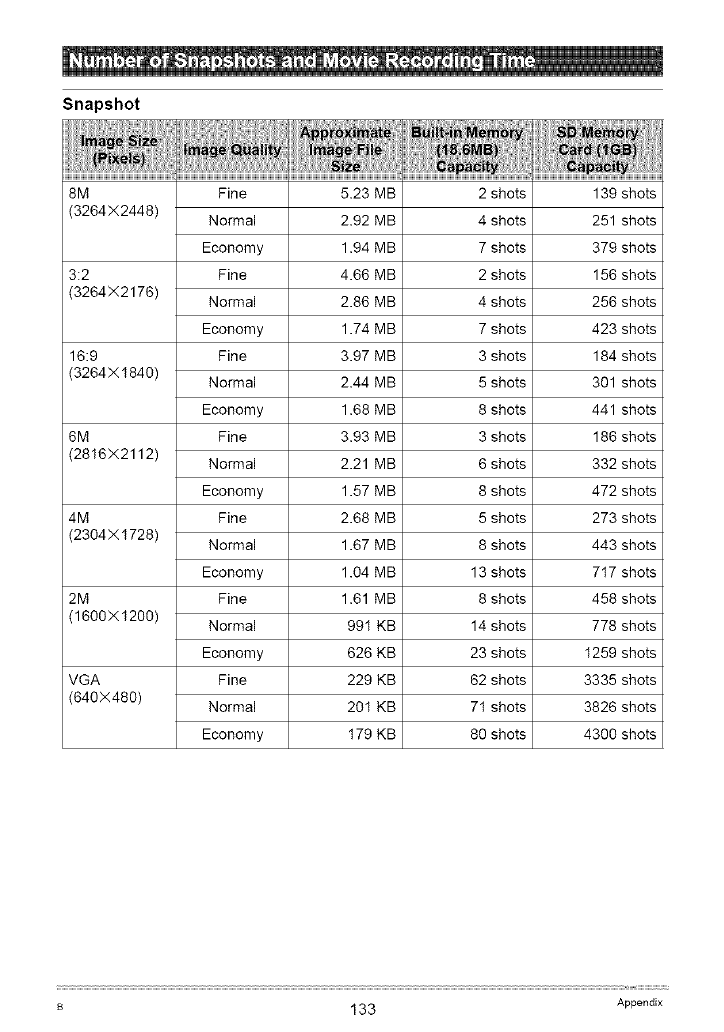
Snapshot
8M Fine 5.23MB 2shots 139shots
(3264×2448)Normal 2.92MB 4shots 251shots
Economy 1.94MB 7shots 379shots
3:2 Fine 4.66MB 2shots 156shots
(3264×2176)Normal 2.86MB 4shots 256shots
Economy 1.74MB 7shots 423shots
16:9 Fine 3.97MB 3shots 184shots
(3264×I840) Normal 2.44MB 5shots 301shots
Economy 1.68MB 8shots 441shots
6M Fine 3.93MB 3shots 186shots
(2816×2112)Normal 2.21MB 6shots 332shots
Economy 1.57MB 8shots 472shots
4M Fine 2.68MB 5shots 273shots
(2304XI728) Normal 1.67MB 8shots 443shots
Economy 1.04MB 13shots 717shots
2M Fine 1.61MB 8shots 458shots
(1600XI200) Normal 99IKB 14shots 778shots
Economy 626KB 23shots I259shots
VGA Fine 229KB 62shots 3335shots
(640X480) Normal 20IKB 7Ishots 3826shots
Economy I79KB 80shots 4300shots
s 133 Appendix
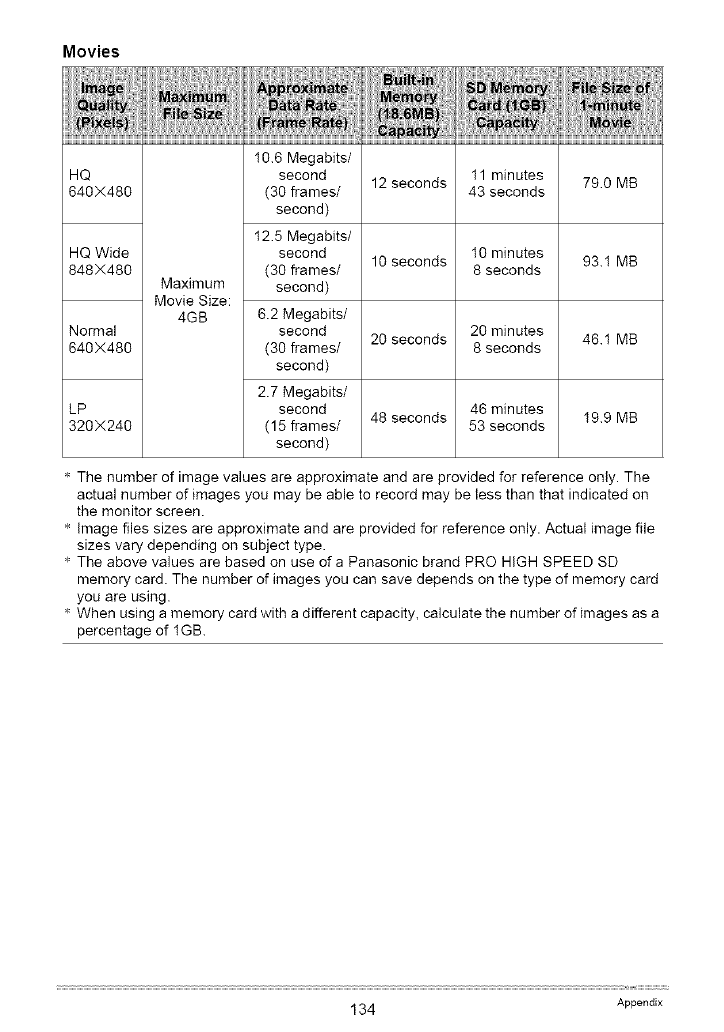
Movies
I0.6 Megabits/
HQ second
640X480 (30 frames/
second)
HQ Wide
848X480 Maximum
Movie Size:
4GB 6.2 Megabits/
Normal second
640X480 (30 frames/
second)
2.7 Megabits/
LP second
320X240 (15 frames/
second)
11 minutes
43 seconds
12 seconds 79.0 MB
I2.5 Megabits/
second I0 minutes
10 seconds 93.I MB
(30 frames/ 8 seconds
second)
20 minutes
20 seconds 46.I MB
8 seconds
46 minutes
48 seconds I9.9 MB
53 seconds
The number of image values are approximate and are provided for reference only. The
actual number of images you may be able to record may be less than that indicated on
the monitor screen.
Image files sizes are approximate and are provided for reference only. Actual image file
sizes vary depending on subject type.
The above values are based on use ofa Panasonic brand PRO HIGH SPEED SD
memory card. The number of images you can save depends on the type of memory card
you are using.
When using a memory card with a different capacity, calculate the number of images as a
percentage of IGB.
134 Appendix
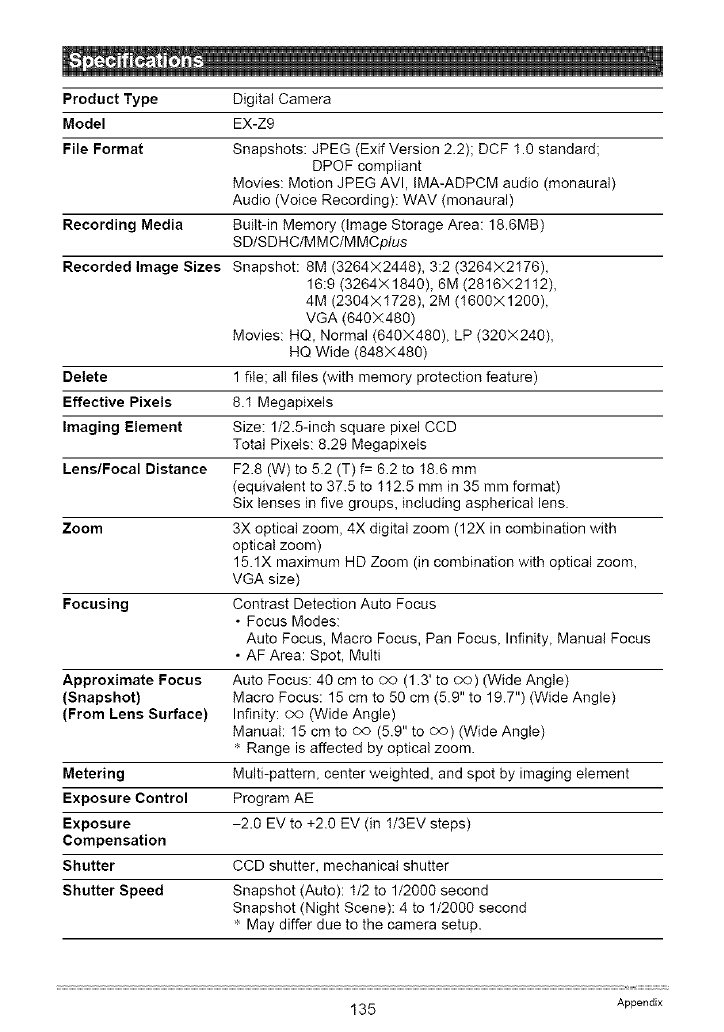
ProductType DigitalCamera
Model EX-Z9
FileFormat Snapshots:JPEG(ExifVersion2.2);DCF1.0standard;
DPOFcompliant
Movies:MotionJPEGAVI,iMA-ADPCMaudio(monaural)
Audio(VoiceRecording):WAV(monaural)
RecordingMedia Built-inMemory(imageStorageArea:18.6MB)
SD/SDHC/MMC/MMCptus
RecordedImageSizesSnapshot:8M(3264X2448),3:2(3264X2176),
16:9(3264X1840),6M(2816×2112),
4M(2304×I728),2M(I600×1200),
VGA(640X480)
Movies:HQ,Normal(640X480),LP(320X240),
HQWide(848X480)
Delete 1file;al!files(withmemoryprotectionfeature)
EffectivePixela 8.IMegapixels
ImagingElement Size:1/2.5-inchsquarepixelCCD
TotalPixets:8.29Megapixets
Lens/FocalDistanceF2.8(W)to5.2(T)f=6.2toI8.6mm
(equivalentto37.5toII2.5mmin35mmformat)
Sixlensesinfivegroups,includingasphericallens.
Zoom 3Xopticalzoom,4Xdigitalzoom(12Xincombinationwith
opticalzoom)
15.1XmaximumHDZoom(incombinationwithopticalzoom,
VGAsize)
Focusing ContrastDetectionAutoFocus
•FocusModes:
AutoFocus,MacroFocus,PanFocus,Infinity,ManualFocus
•AFArea:Spot,Multi
ApproximateFocus AutoFocus:40cmtooo (1.3' to oo) (Wide Angle)
(Snapshot) Macro Focus: 15 cm to 50 cm (5.9" to 19.7") (Wide Angle)
(From Lens Surface) Infinity: oo (Wide Angle)
Manual: 15 cm to oo (5.9" to oo) (Wide Angle)
* Range is affected by optical zoom.
Metering Multi-pattern, center weighted, and spot by imaging element
Exposure Control Program AE
Exposure -2.0 EV to +2.0 EV (in I/3EV steps)
Compensation
Shutter CCD shutter, mechanical shutter
Shutter Speed Snapshot (Auto): t/2 to 1/2000 second
Snapshot (Night Scene): 4 to 1/2000 second
* May differ due to the camera setup.
135 Appendix
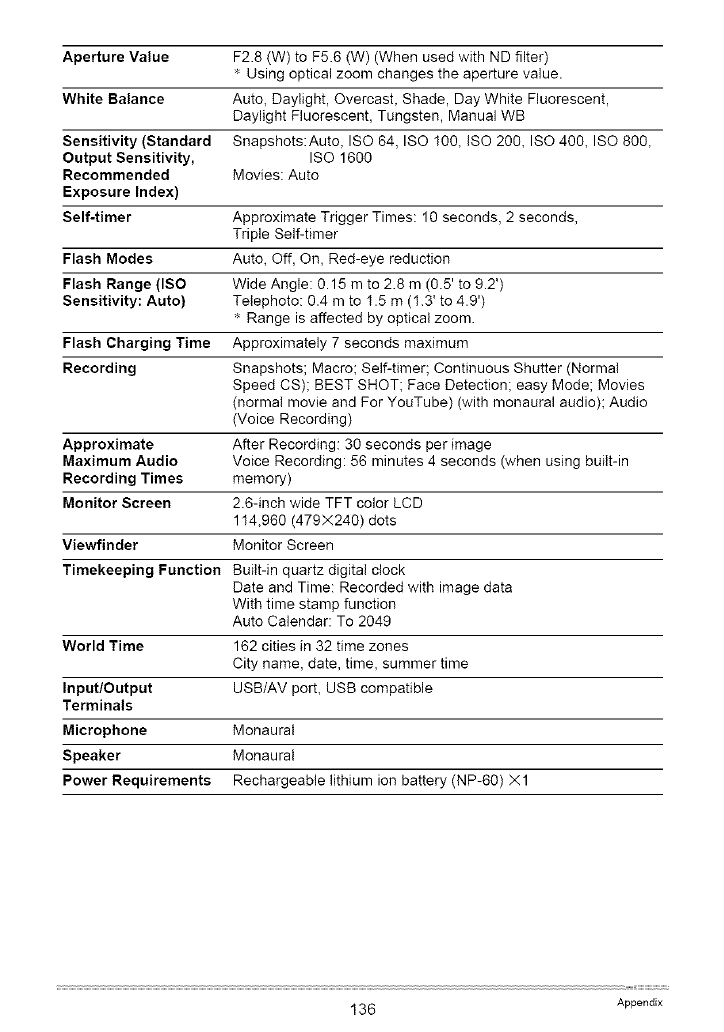
Aperture Value F2.8 (W) to F5.6 (W) (When used with ND filter)
* Using optical zoom changes the aperture value.
White Balance Auto, Daylight, Overcast, Shade, Day White Fluorescent,
Daylight Fluorescent, Tungsten, Manual WB
Sensitivity (Standard Snapshots:Auto, ISO 64, ISO I00, ISO 200, ISO 400, ISO 800,
Output Sensitivity, ISO 1600
Recommended Movies: Auto
Exposure Index)
Self-timer Approximate Trigger Times: 10 seconds, 2 seconds,
Triple Self-timer
Flash Modes Auto, Off, On, Red-eye reduction
Flash Range (ISO Wide Angle: 0.15 m to 2.8 m (0.5' to 9.2')
Sensitivity: Auto) Telephoto: 0.4 m to 1.5 m (I.3' to 4.9')
* Range is affected by optical zoom.
Flash Charging Time Approximately 7 seconds maximum
Recording Snapshots; Macro; Self-timer; Continuous Shutter (Normal
Speed CS); BEST SHOT; Face Detection; easy Mode; Movies
(normal movie and For YouTube) (with monaural audio); Audio
(Voice Recording)
Approximate After Recording: 30 seconds per image
Maximum Audio Voice Recording: 56 minutes 4 seconds (when using built-in
Recording Times memory)
Monitor Screen 2.6-inch wide TFT color LCD
1 I4,960 (479X240) dots
Viewfinder Monitor Screen
Timekeeping Function Built-in quartz digital clock
Date and Time: Recorded with image data
With time stamp function
Auto Calendar: To 2049
World Time 162 cities in 32 time zones
City name, date, time, summer time
Input/Output USB/AV port, USB compatible
Terminals
Microphone Monaural
Speaker Monaural
Power Requirements Rechargeable lithium ion battery (NP-60) ×1
136 Appendix
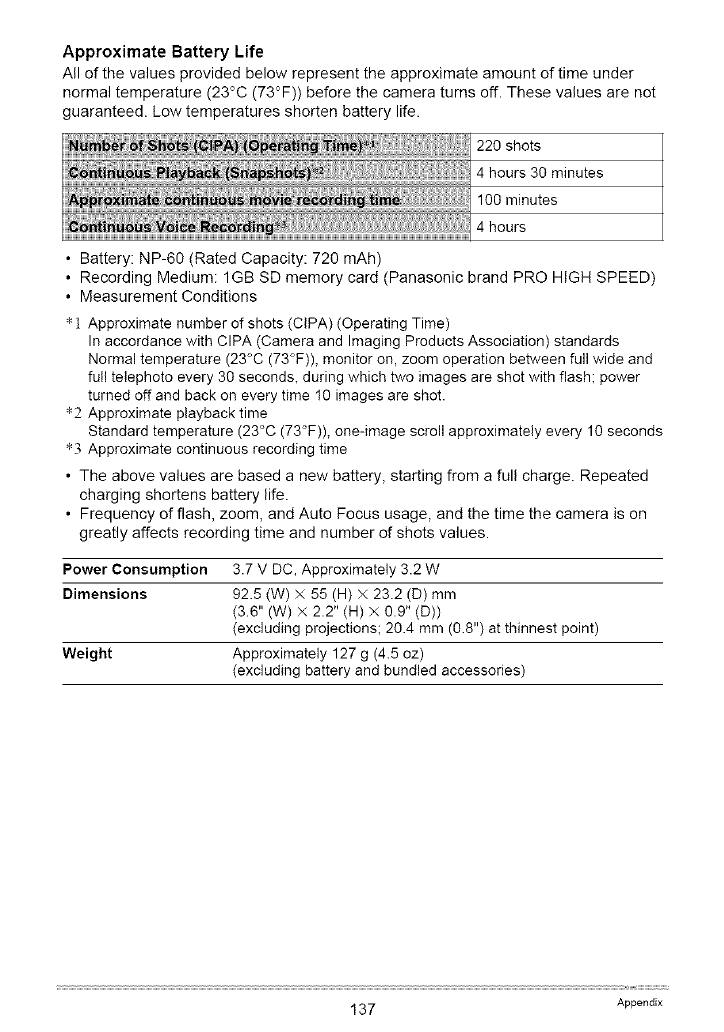
Approximate Battery Life
All of the values provided below represent the approximate amount of time under
normal temperature (23°C (73°F)) before the camera turns off. These values are not
guaranteed. Low temperatures shorten battery life.
• Battery: NP-60 (Rated Capacity: 720 mAh)
• Recording Medium: 1GB SD memory card (Panasonic brand PRO HIGH SPEED)
• Measurement Conditions
I Approximate number of shots (CIPA) (Operating Time)
In accordance with CIPA (Camera and Imaging Products Association) standards
Normal temperature (23°C (73°F)), monitor on, zoom operation be'b,,veenfull wide and
full telephoto every 30 seconds, during which two images are shot with flash; power
turned off and back on every time I0 images are shot.
_2 Approximate playback time
Standard temperature (23°C (73°F)), one-image scroll approximately every 10 seconds
_3 Approximate continuous recording time
• The above values are based a new battery, starting from a full charge, Repeated
charging shortens battery life,
• Frequency of flash, zoom, and Auto Focus usage, and the time the camera is on
greatly affects recording time and number of shots values,
Power Consumption 3.7 V DC, Approximately 3.2 W
Dimensions 92.5 (W) X 55 (H) × 23.2 (D) mm
(3.6" (W) × 2.2" (H) X 0.9" (D))
(excluding projections: 20.4 mm (0.8") at thinnest point)
Weight Approximately 127 g (4.5 oz)
(excluding battery and bundled accessories)
137 Appendix
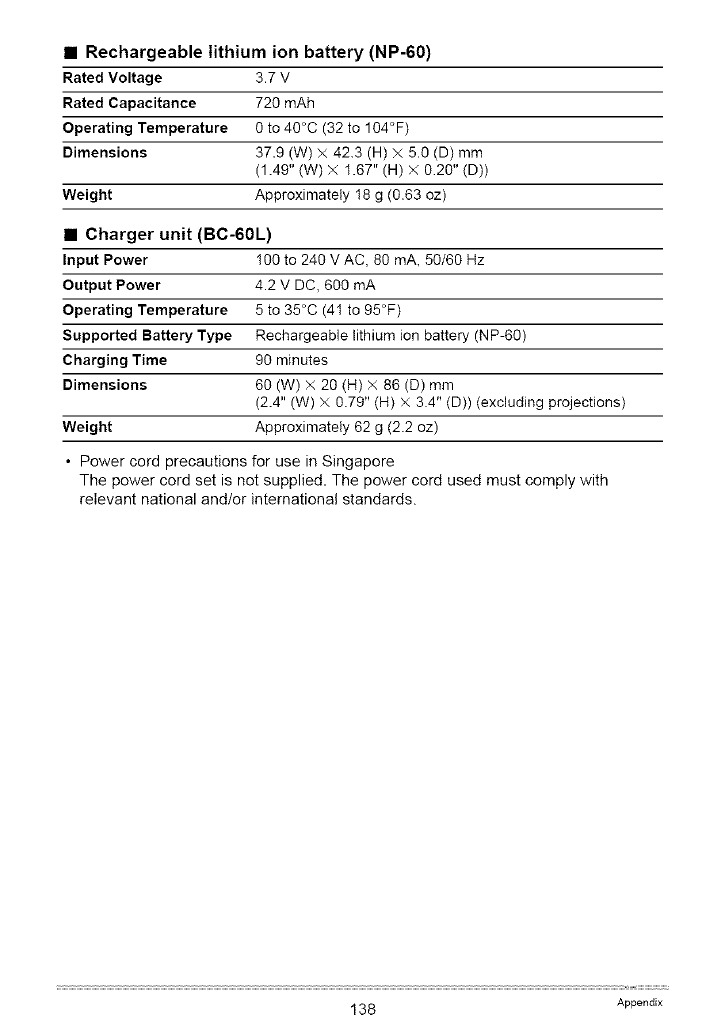
•Rechargeable lithium ion battery (NP-60)
Rated Voltage 3.7 V
Rated Capacitance 720 mAh
Operating Temperature Oto 4O°C (32 to 104°F)
Dimensions 37.9 (W) × 42.3 (H) × 5.0 (D) mm
(1.49" (W) × 1.67" (H) × 0.20" (D))
Weight Approximately I8 g (0.63 oz)
•Charger unit (BC-6OL)
Input Power I00 to 240 V AC, 80 mA, 50/60 Hz
Output Power 4.2 V DC, 600 mA
Operating Temperature 5 to 35°C (4I to 95°F)
Supported Battery Type Rechargeable lithium ion battery (NP-60)
Charging Time 90 minutes
Dimensions 60 (W) X 20 (H) X 86 (D) mm
(2.4" (W) × 0.79" (H) × 3.4" (D)) (exclud)ng projections)
Weight Approximately 62 g (2.2 oz)
• Power cord precautions for use in Singapore
The power cord set is not supplied. The power cord used must comply with
relevant national and/or international standards.
138 Appendix

CASIO COMPUTER CO.,LTD.
6-2, Hon-machi 1-chome
Shibuya-ku, Tokyo 151-6543, Japan
MF MA0805-C
