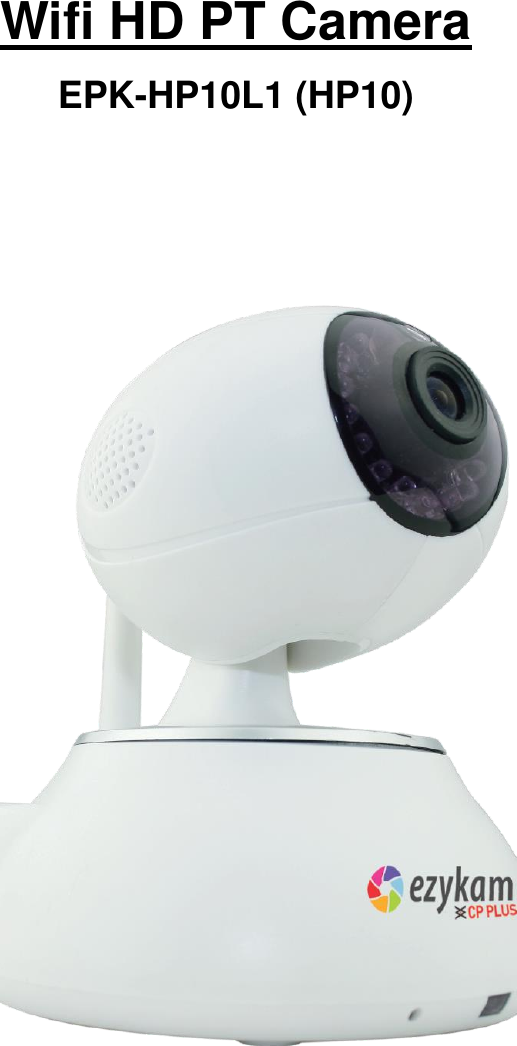
CP PLUS EPK-HP10L1 IP camera User Manual

SHENZHEN CP PLUS INTERNATIONAL LTD. IP camera

User Manual

 Wifi HD PT Camera EPK-HP10L1 (HP10)
 2         Instruction Manual
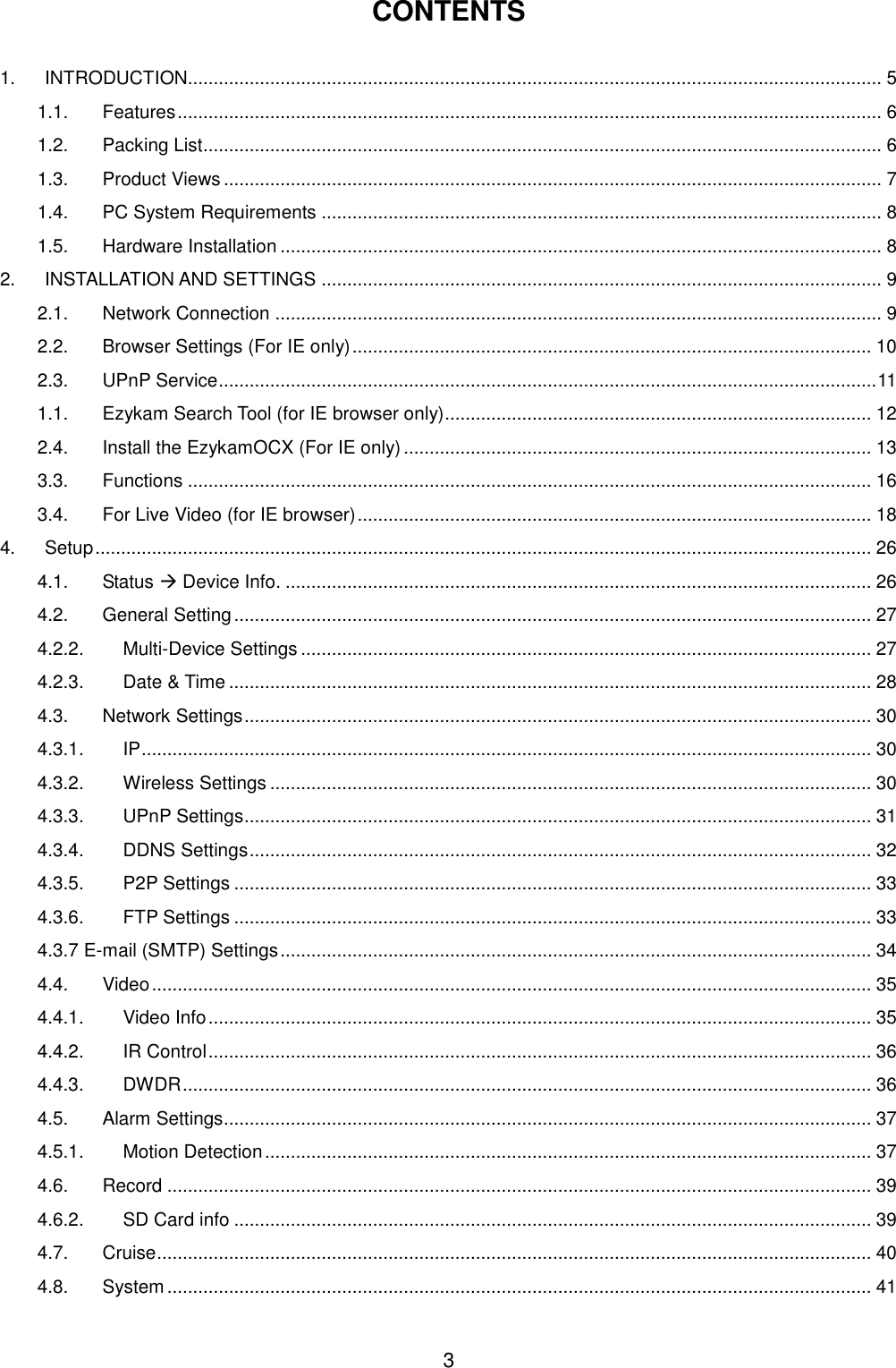
 3  CONTENTS  1. INTRODUCTION....................................................................................................................................... 5 1.1. Features ......................................................................................................................................... 6 1.2. Packing List .................................................................................................................................... 6 1.3. Product Views ................................................................................................................................ 7 1.4. PC System Requirements ............................................................................................................. 8 1.5. Hardware Installation ..................................................................................................................... 8 2. INSTALLATION AND SETTINGS ............................................................................................................. 9 2.1. Network Connection ...................................................................................................................... 9 2.2. Browser Settings (For IE only) ..................................................................................................... 10 2.3. UPnP Service ................................................................................................................................ 11 1.1. Ezykam Search Tool (for IE browser only)................................................................................... 12 2.4. Install the EzykamOCX (For IE only) ........................................................................................... 13 3.3. Functions ..................................................................................................................................... 16 3.4. For Live Video (for IE browser) .................................................................................................... 18 4. Setup ....................................................................................................................................................... 26 4.1. Status  Device Info. .................................................................................................................. 26 4.2. General Setting ............................................................................................................................ 27 4.2.2. Multi-Device Settings ............................................................................................................... 27 4.2.3. Date & Time ............................................................................................................................. 28 4.3. Network Settings .......................................................................................................................... 30 4.3.1. IP .............................................................................................................................................. 30 4.3.2. Wireless Settings ..................................................................................................................... 30 4.3.3. UPnP Settings .......................................................................................................................... 31 4.3.4. DDNS Settings ......................................................................................................................... 32 4.3.5. P2P Settings ............................................................................................................................ 33 4.3.6. FTP Settings ............................................................................................................................ 33 4.3.7 E-mail (SMTP) Settings ................................................................................................................... 34 4.4. Video ............................................................................................................................................ 35 4.4.1. Video Info ................................................................................................................................. 35 4.4.2. IR Control ................................................................................................................................. 36 4.4.3. DWDR ...................................................................................................................................... 36 4.5. Alarm Settings.............................................................................................................................. 37 4.5.1. Motion Detection ...................................................................................................................... 37 4.6. Record ......................................................................................................................................... 39 4.6.2. SD Card info ............................................................................................................................ 39 4.7. Cruise ........................................................................................................................................... 40 4.8. System ......................................................................................................................................... 41
 4 4.8.1. Log ........................................................................................................................................... 41 4.8.2. Import/Export Config ................................................................................................................ 41 4.8.3. Auto Maintain ........................................................................................................................... 42 4.9. System ......................................................................................................................................... 43 5. PLAYBACK for IE browser only .............................................................................................................. 44 6. FREQUENTLY ASKED QUESTIONS ..................................................................................................... 45 7. SPECIFICATIONS .................................................................................................................................. 50 8. OBTAINING TECHNICAL SUPPORT ..................................................................................................... 51
 5 1. INTRODUCTION  This user manual will show the details to set up your camera with your computer; If you are viewing with a Smartphone, please check Quick Start Guide, as it is very easy to set up.  IMPORTANT NOTICE  The various screens throughout this  owner’s  manual will look different depending on the browser you use. Full functionality is available when using Internet Explorer (IE) with EzykamOCX installed. Limited functionality is available with other browsers, such as Safari, Chrome, and Firefox.  Please Read this manual carefully, according to the browser you are using.    This is an integrated wireless IP Camera. It combines a high quality digital Video Camera with network connectivity and a powerful web server to bring clear pictures to your Desktop from anywhere on your local network or over the Internet.  The main function of the camera is to transmit remote video over IP network. The high quality video image can be transmitted with 30fps speed on the LAN/WAN by using H.264, MJPEG compression technology.  It  is  based  on  the  TCP/IP  standard,  build-in  WEB  server  which  supports  Internet  Explorer. Therefore the management and maintenance of  your camera becomes simple by using the network to achieve the remote configuration, start-up and to upgrade firmware. You  can  use  your  IP  Camera  to  monitor  your  home  or  your  office.  Also,  controlling  and managing images are simple by visiting the web site.
 6 1.1.  Features    Powerful high-speed video protocol processor.  High-sensitivity 1/4’’ CMOS sensor   Picture total 1000K pixels (1megapixel)   Supports Pan and Tilt (PT) control, Pan 320°, Tilt 120°   Optimized H.264 MJPEG video compression for transmission   Multi-level user management and passwords definition   Embedded Web Server for users to visit by IE   Supports wireless network (WI-FI/802.11/b/g/n)   Supports Dynamic IP (DDNS) and UPNP LAN and Internet (ADSL, Cable Modem)   Gives an alarm in case of motion detection   Supports image snapshot   Supports multiple protocols:TCP/IP, HTTP, DNS, DHCP, PPPoE, SMTP, FTP, SSL, TFTP, NTP, ARP/RARP, NFS, RTSP, RTP and RTCP.   Supports WEP/WPA/WPA2 encryption   Supports IE, Firefox, Safari, and Google chrome browsers  1.2.  Packing List    IP Camera       Quick Setup Guide   DC Power Supply  CD          Network Cable   Mountings
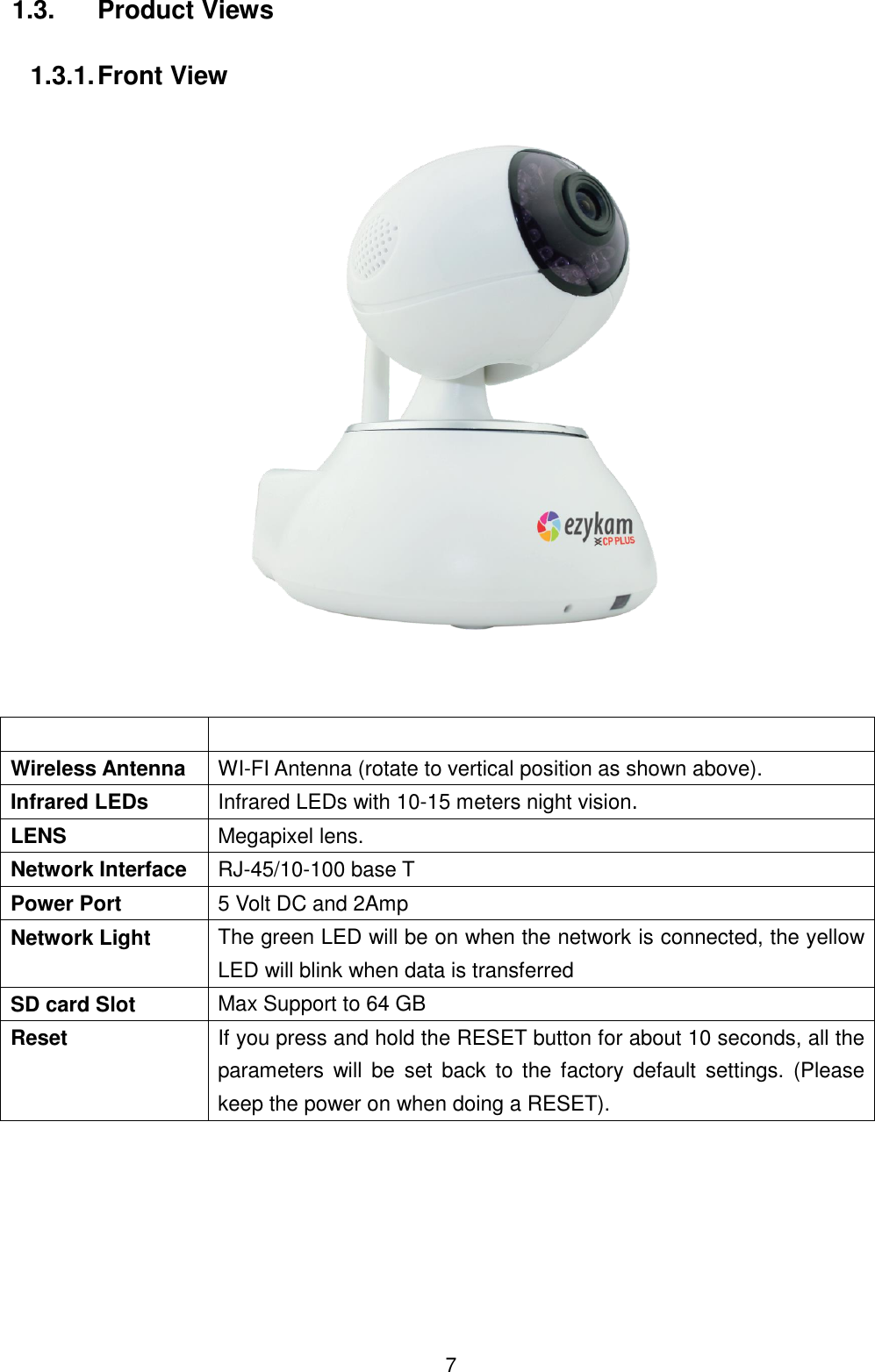
 7 1.3.  Product Views  1.3.1. Front View       Wireless Antenna WI-FI Antenna (rotate to vertical position as shown above). Infrared LEDs Infrared LEDs with 10-15 meters night vision. LENS Megapixel lens. Network Interface RJ-45/10-100 base T Power Port 5 Volt DC and 2Amp Network Light The green LED will be on when the network is connected, the yellow LED will blink when data is transferred SD card Slot Max Support to 64 GB Reset If you press and hold the RESET button for about 10 seconds, all the parameters  will be  set  back  to the factory  default  settings.  (Please keep the power on when doing a RESET).
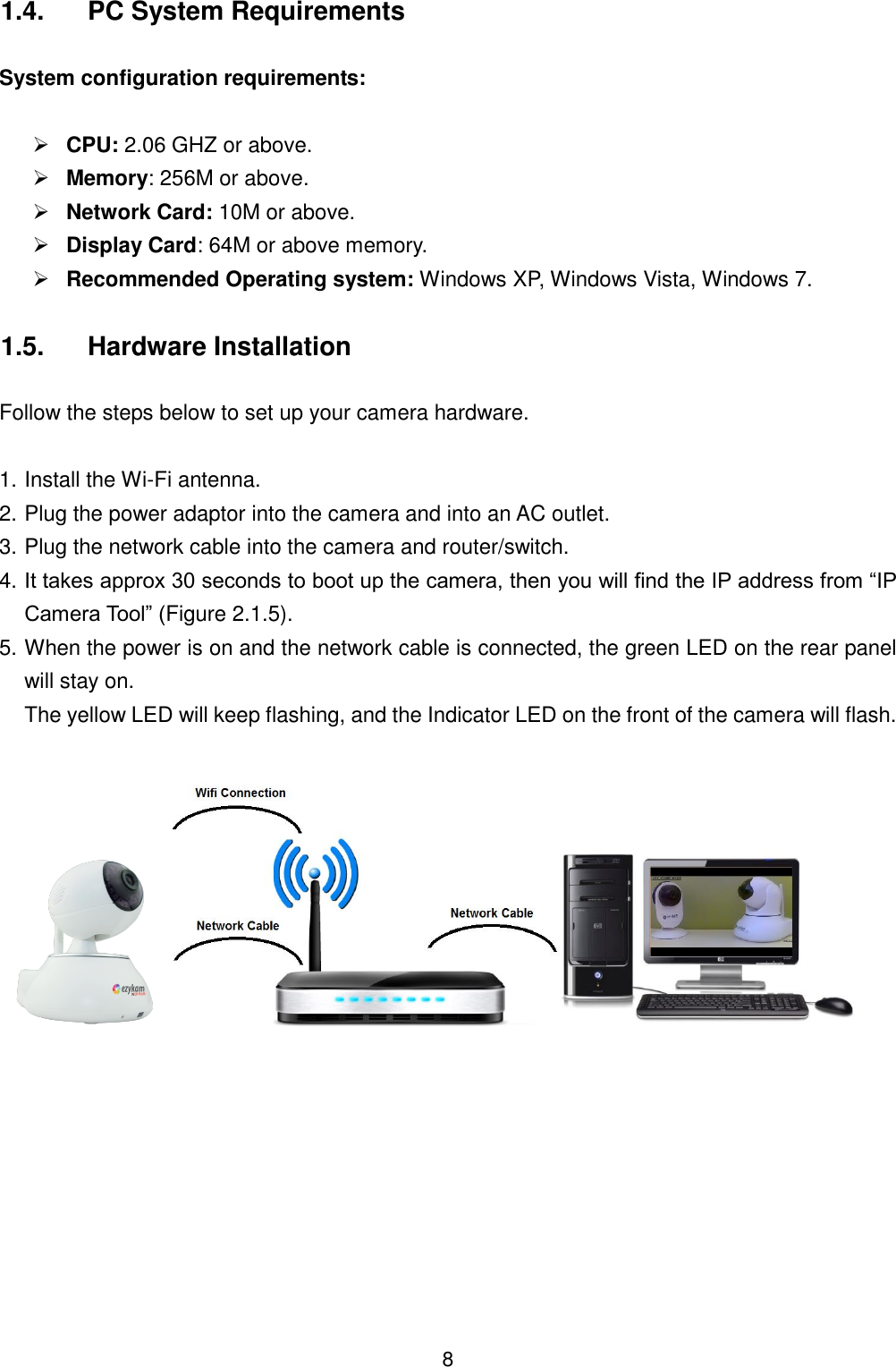
 8 1.4.  PC System Requirements  System configuration requirements:   CPU: 2.06 GHZ or above.  Memory: 256M or above.  Network Card: 10M or above.  Display Card: 64M or above memory.  Recommended Operating system: Windows XP, Windows Vista, Windows 7. 1.5.  Hardware Installation  Follow the steps below to set up your camera hardware.    1. Install the Wi-Fi antenna. 2. Plug the power adaptor into the camera and into an AC outlet. 3. Plug the network cable into the camera and router/switch. 4. It takes approx 30 seconds to boot up the camera, then you will find the IP address from “IP Camera Tool” (Figure 2.1.5). 5. When the power is on and the network cable is connected, the green LED on the rear panel will stay on.   The yellow LED will keep flashing, and the Indicator LED on the front of the camera will flash.
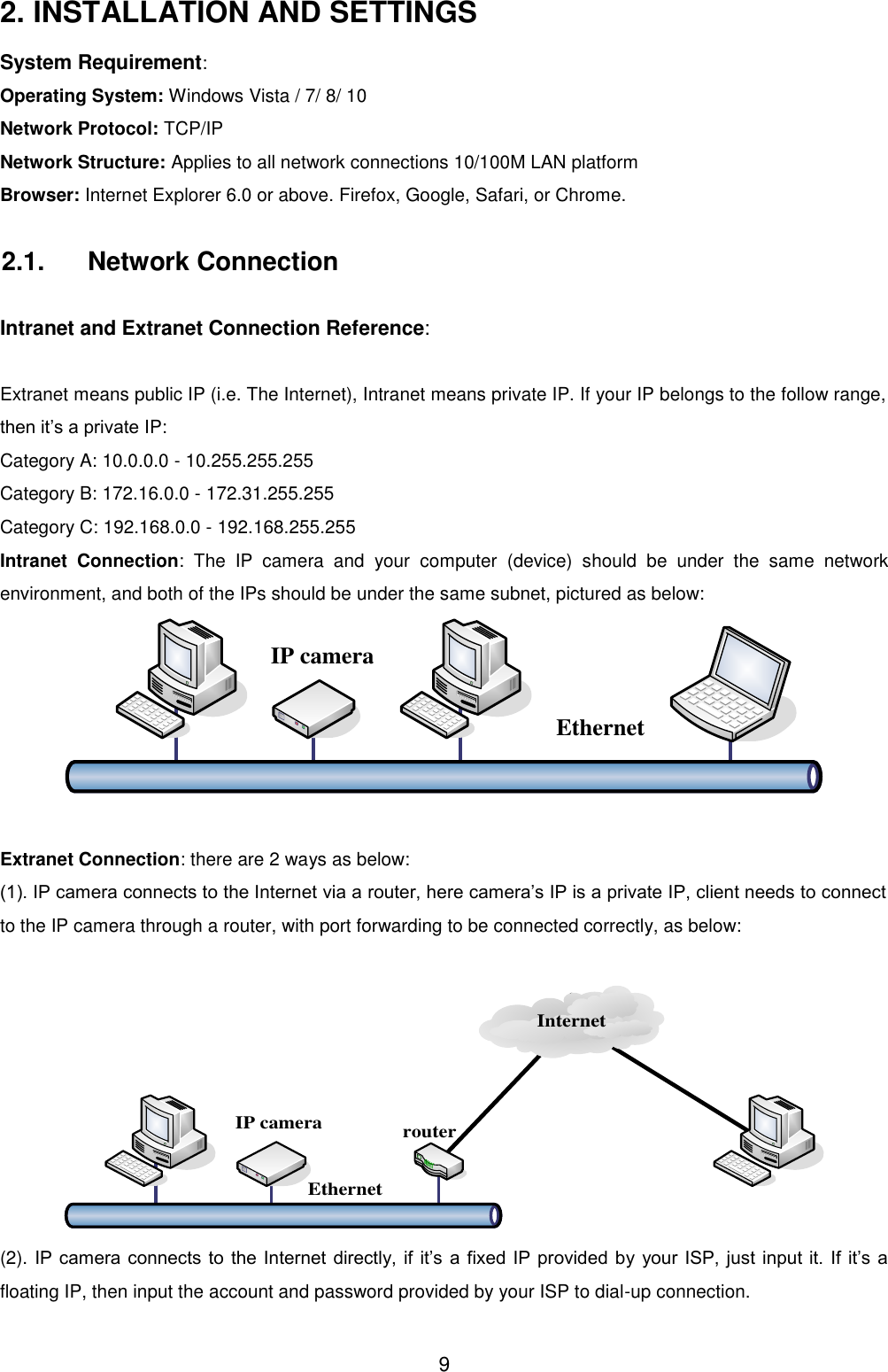
 9 2. INSTALLATION AND SETTINGS System Requirement: Operating System: Windows Vista / 7/ 8/ 10 Network Protocol: TCP/IP Network Structure: Applies to all network connections 10/100M LAN platform Browser: Internet Explorer 6.0 or above. Firefox, Google, Safari, or Chrome. 2.1.  Network Connection  Intranet and Extranet Connection Reference:  Extranet means public IP (i.e. The Internet), Intranet means private IP. If your IP belongs to the follow range, then it’s a private IP: Category A: 10.0.0.0 - 10.255.255.255 Category B: 172.16.0.0 - 172.31.255.255 Category C: 192.168.0.0 - 192.168.255.255 Intranet  Connection:  The  IP  camera  and  your  computer  (device)  should  be  under  the  same  network environment, and both of the IPs should be under the same subnet, pictured as below: IP cameraEthernet  Extranet Connection: there are 2 ways as below: (1). IP camera connects to the Internet via a router, here camera’s IP is a private IP, client needs to connect to the IP camera through a router, with port forwarding to be connected correctly, as below:    InternetIP camera routerEthernet (2). IP  camera  connects to the Internet  directly, if  it’s  a fixed IP provided by your ISP, just input  it. If it’s a floating IP, then input the account and password provided by your ISP to dial-up connection.
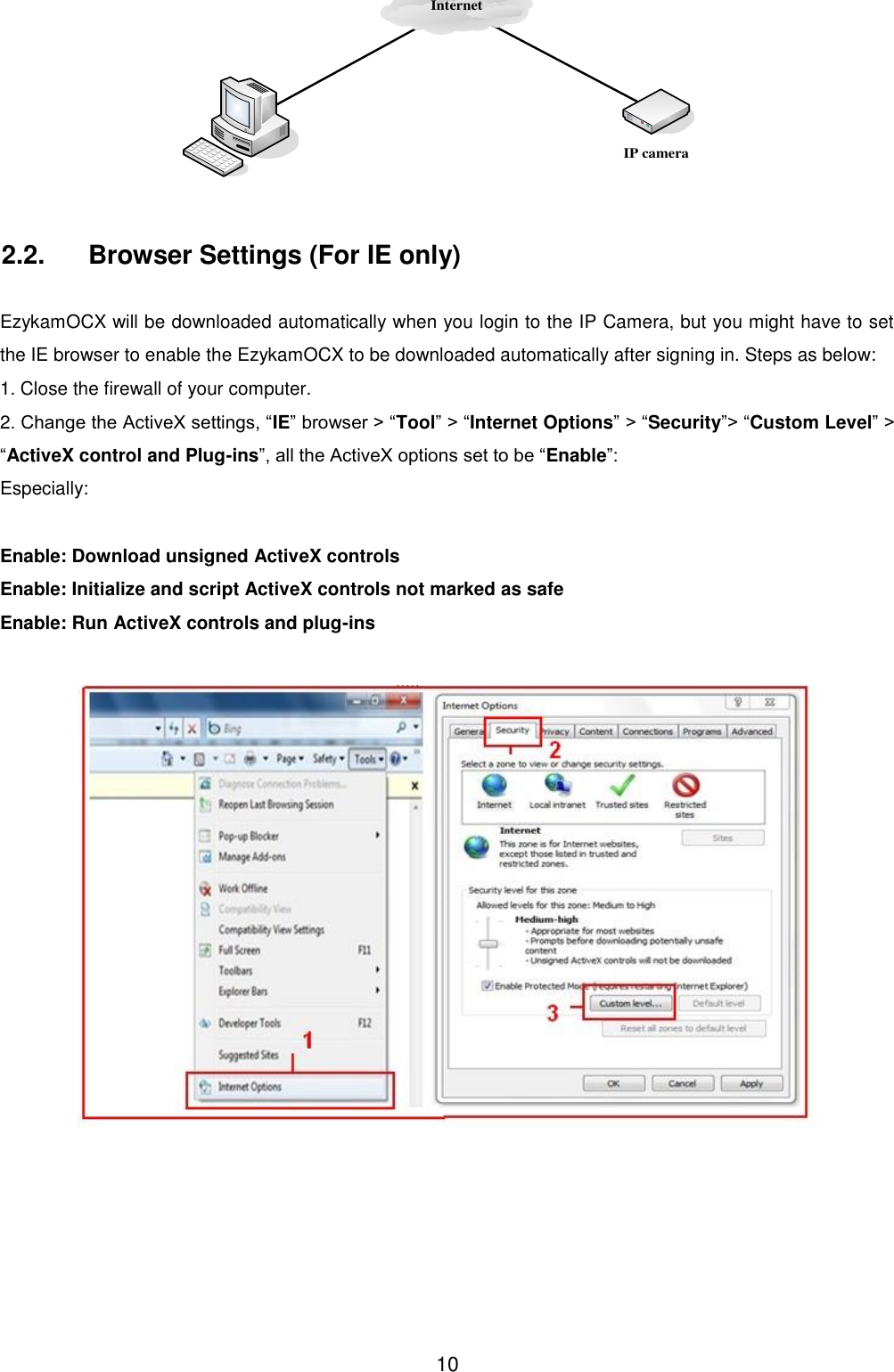
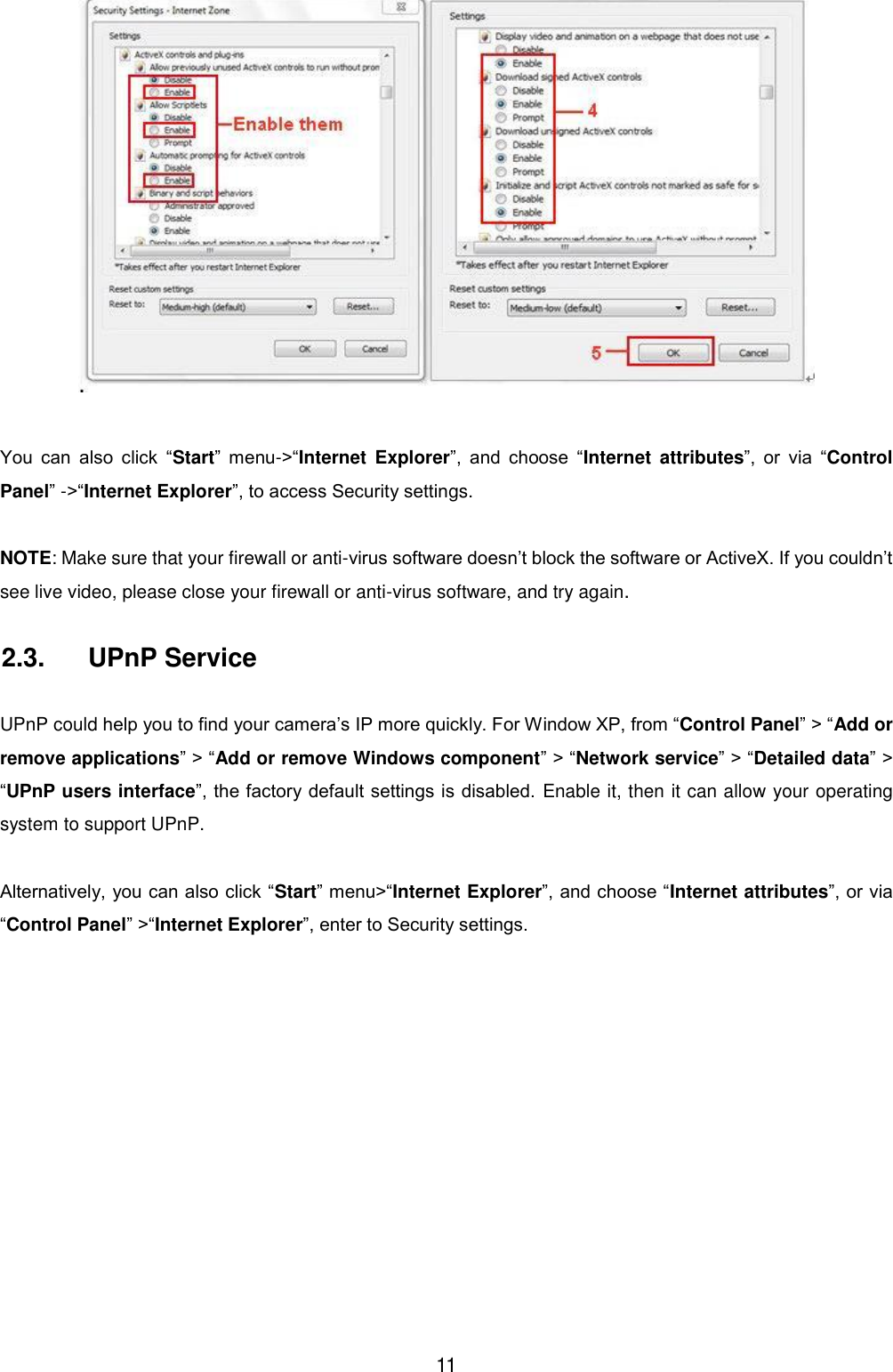
 10 InternetIP camera 2.2.  Browser Settings (For IE only)  EzykamOCX will be downloaded automatically when you login to the IP Camera, but you might have to set the IE browser to enable the EzykamOCX to be downloaded automatically after signing in. Steps as below: 1. Close the firewall of your computer. 2. Change the ActiveX settings, “IE” browser > “Tool” > “Internet Options” > “Security”> “Custom Level” > “ActiveX control and Plug-ins”, all the ActiveX options set to be “Enable”:     Especially:  Enable: Download unsigned ActiveX controls Enable: Initialize and script ActiveX controls not marked as safe Enable: Run ActiveX controls and plug-ins
 11   You  can  also  click  “Start”  menu->“Internet  Explorer”,  and  choose  “Internet  attributes”,  or  via  “Control Panel” ->“Internet Explorer”, to access Security settings.  NOTE: Make sure that your firewall or anti-virus software doesn’t block the software or ActiveX. If you couldn’t see live video, please close your firewall or anti-virus software, and try again. 2.3.  UPnP Service  UPnP could help you to find your camera’s IP more quickly. For Window XP, from “Control Panel” > “Add or remove applications” > “Add or remove Windows component” > “Network service” > “Detailed data” > “UPnP users interface”, the factory default settings is disabled.  Enable it, then it can allow your operating system to support UPnP.  Alternatively, you can also click “Start” menu>“Internet Explorer”, and choose “Internet attributes”, or via “Control Panel” >“Internet Explorer”, enter to Security settings.
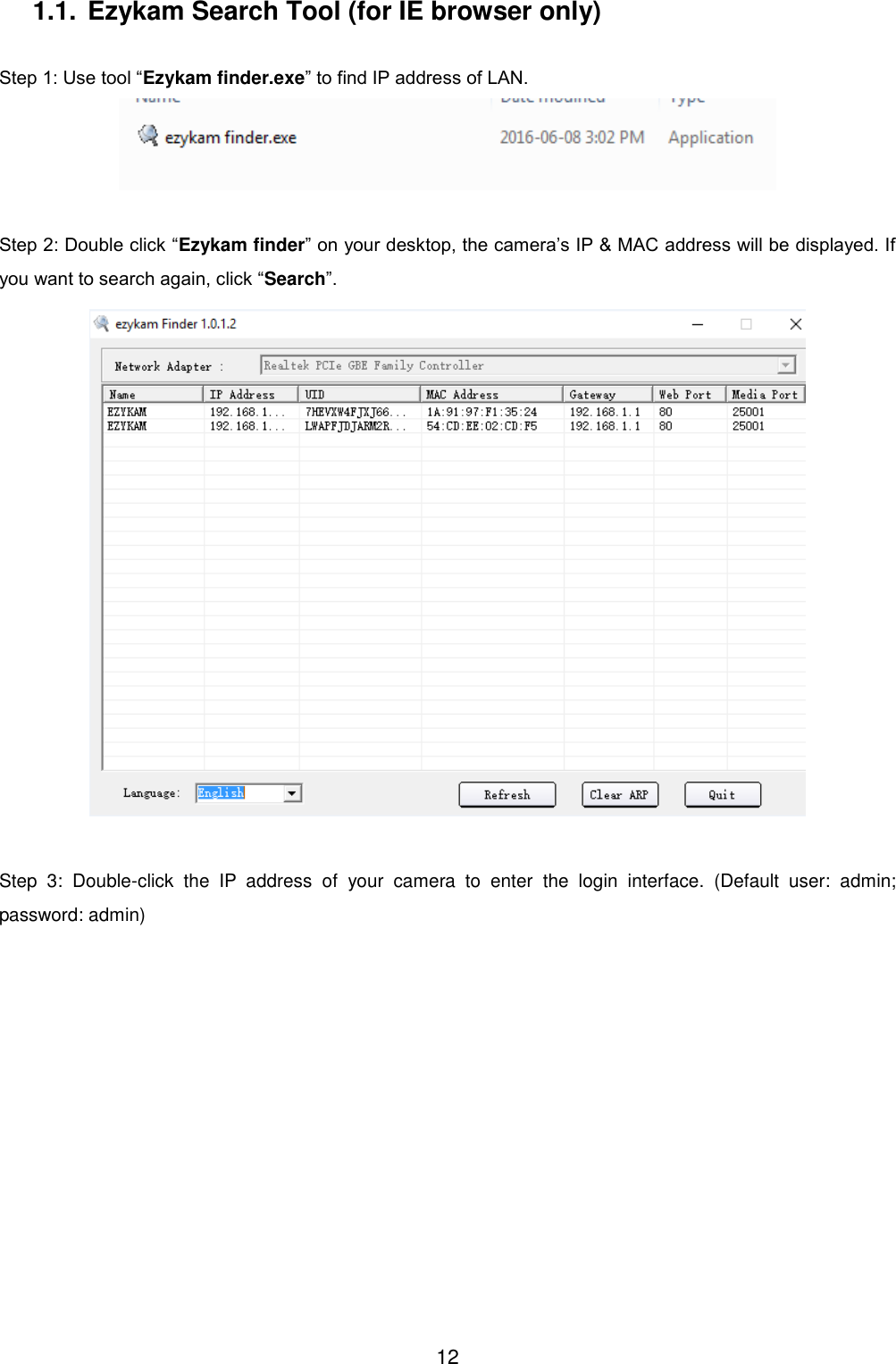
 12 1.1. Ezykam Search Tool (for IE browser only)  Step 1: Use tool “Ezykam finder.exe” to find IP address of LAN.   Step 2: Double click “Ezykam finder” on your desktop, the camera’s IP & MAC address will be displayed. If you want to search again, click “Search”.   Step  3:  Double-click  the  IP  address  of  your  camera  to  enter  the  login  interface.  (Default  user:  admin; password: admin)
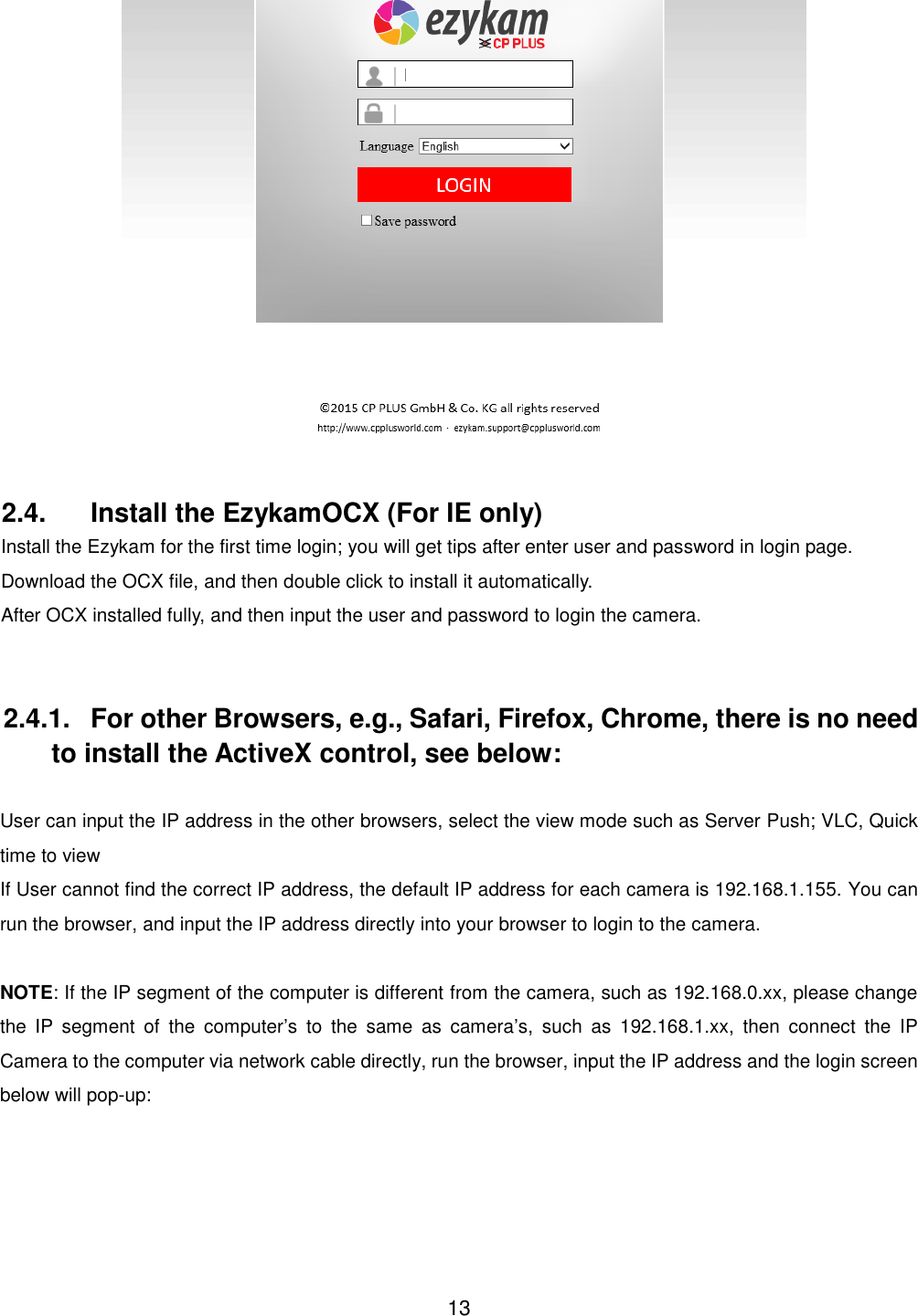
 13  2.4.  Install the EzykamOCX (For IE only) Install the Ezykam for the first time login; you will get tips after enter user and password in login page.   Download the OCX file, and then double click to install it automatically. After OCX installed fully, and then input the user and password to login the camera.   2.4.1.  For other Browsers, e.g., Safari, Firefox, Chrome, there is no need to install the ActiveX control, see below:  User can input the IP address in the other browsers, select the view mode such as Server Push; VLC, Quick time to view If User cannot find the correct IP address, the default IP address for each camera is 192.168.1.155. You can run the browser, and input the IP address directly into your browser to login to the camera.  NOTE: If the IP segment of the computer is different from the camera, such as 192.168.0.xx, please change the  IP  segment  of  the  computer’s  to  the  same  as  camera’s,  such  as  192.168.1.xx,  then  connect  the  IP Camera to the computer via network cable directly, run the browser, input the IP address and the login screen below will pop-up:
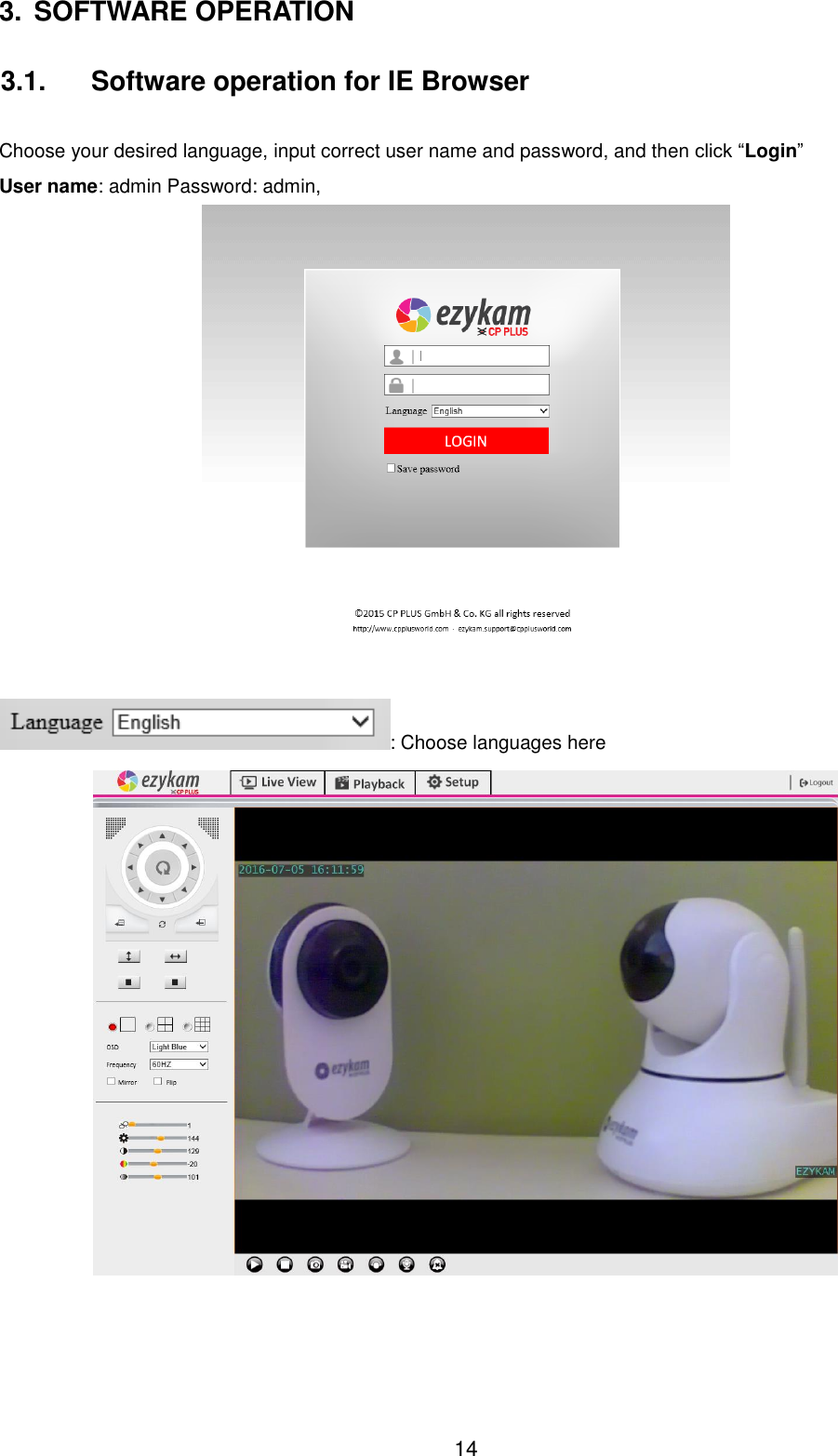
 14 3.  SOFTWARE OPERATION  3.1.  Software operation for IE Browser  Choose your desired language, input correct user name and password, and then click “Login”   User name: admin Password: admin,     : Choose languages here
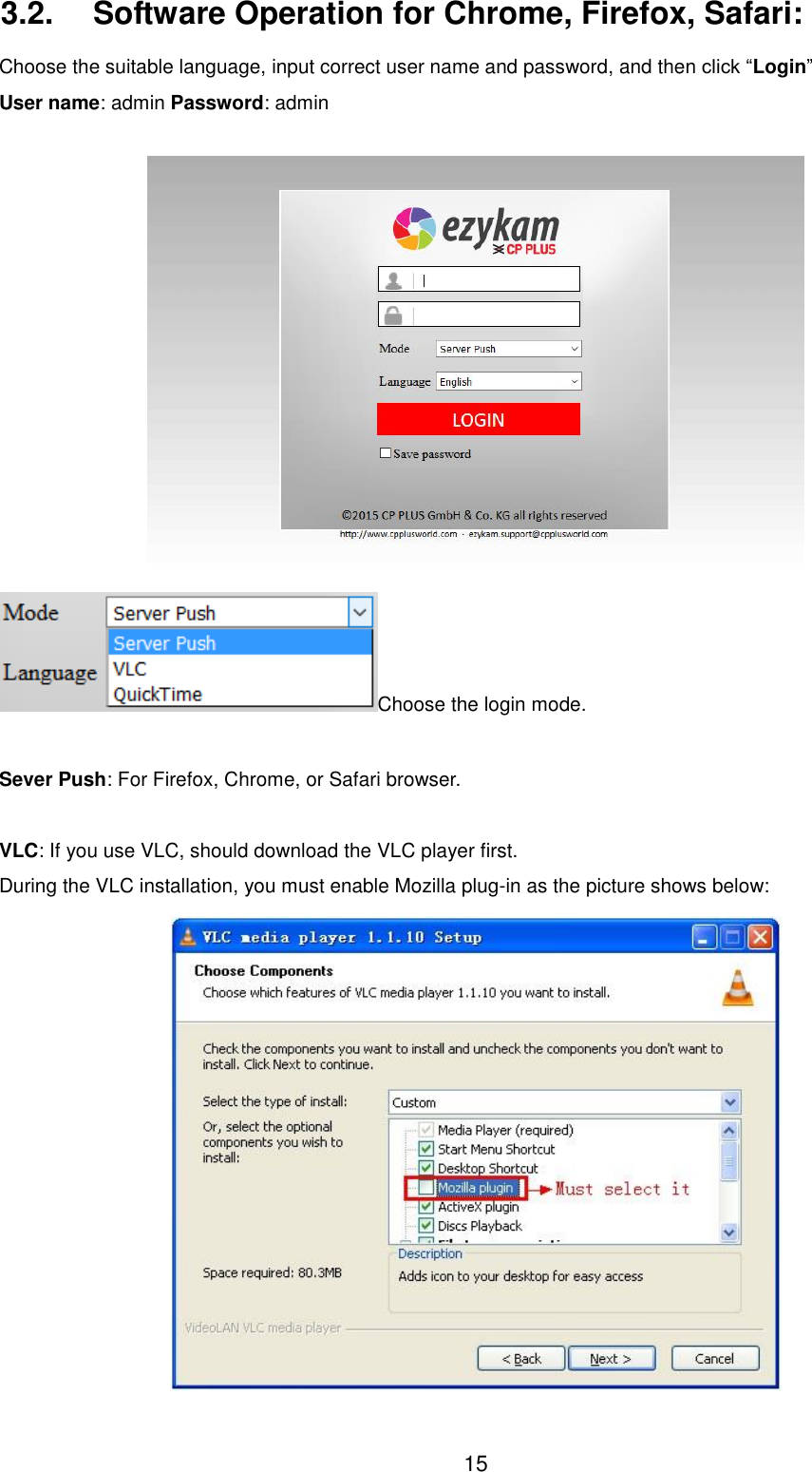
 15 3.2.  Software Operation for Chrome, Firefox, Safari: Choose the suitable language, input correct user name and password, and then click “Login”   User name: admin Password: admin   Choose the login mode.    Sever Push: For Firefox, Chrome, or Safari browser.    VLC: If you use VLC, should download the VLC player first.   During the VLC installation, you must enable Mozilla plug-in as the picture shows below:
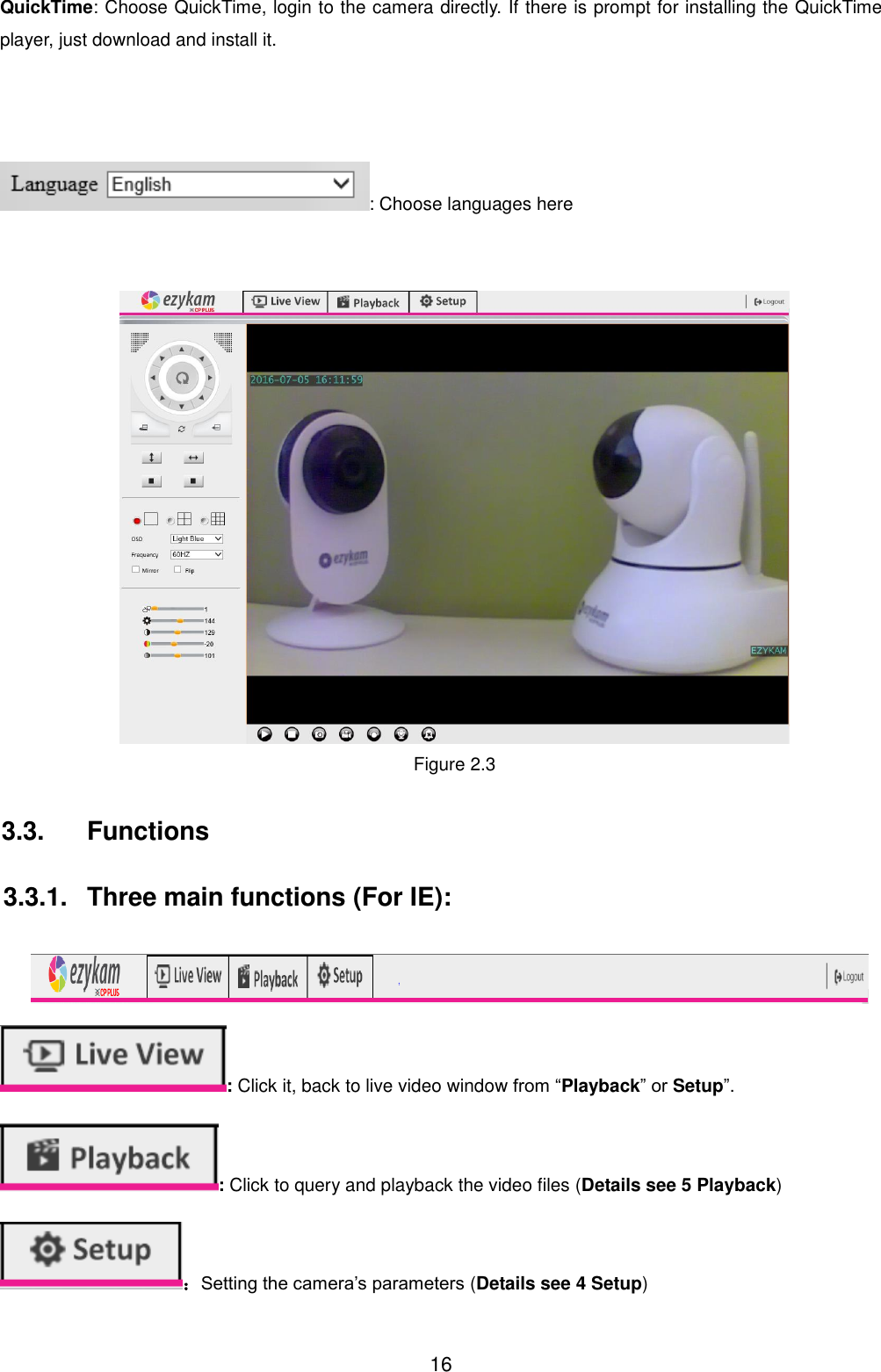
 16 QuickTime: Choose QuickTime, login to the camera directly. If there is prompt for installing the QuickTime player, just download and install it.    : Choose languages here        Figure 2.3    3.3.  Functions    3.3.1.  Three main functions (For IE):   : Click it, back to live video window from “Playback” or Setup”. : Click to query and playback the video files (Details see 5 Playback) :Setting the camera’s parameters (Details see 4 Setup)
 17 : You will back to the login page.
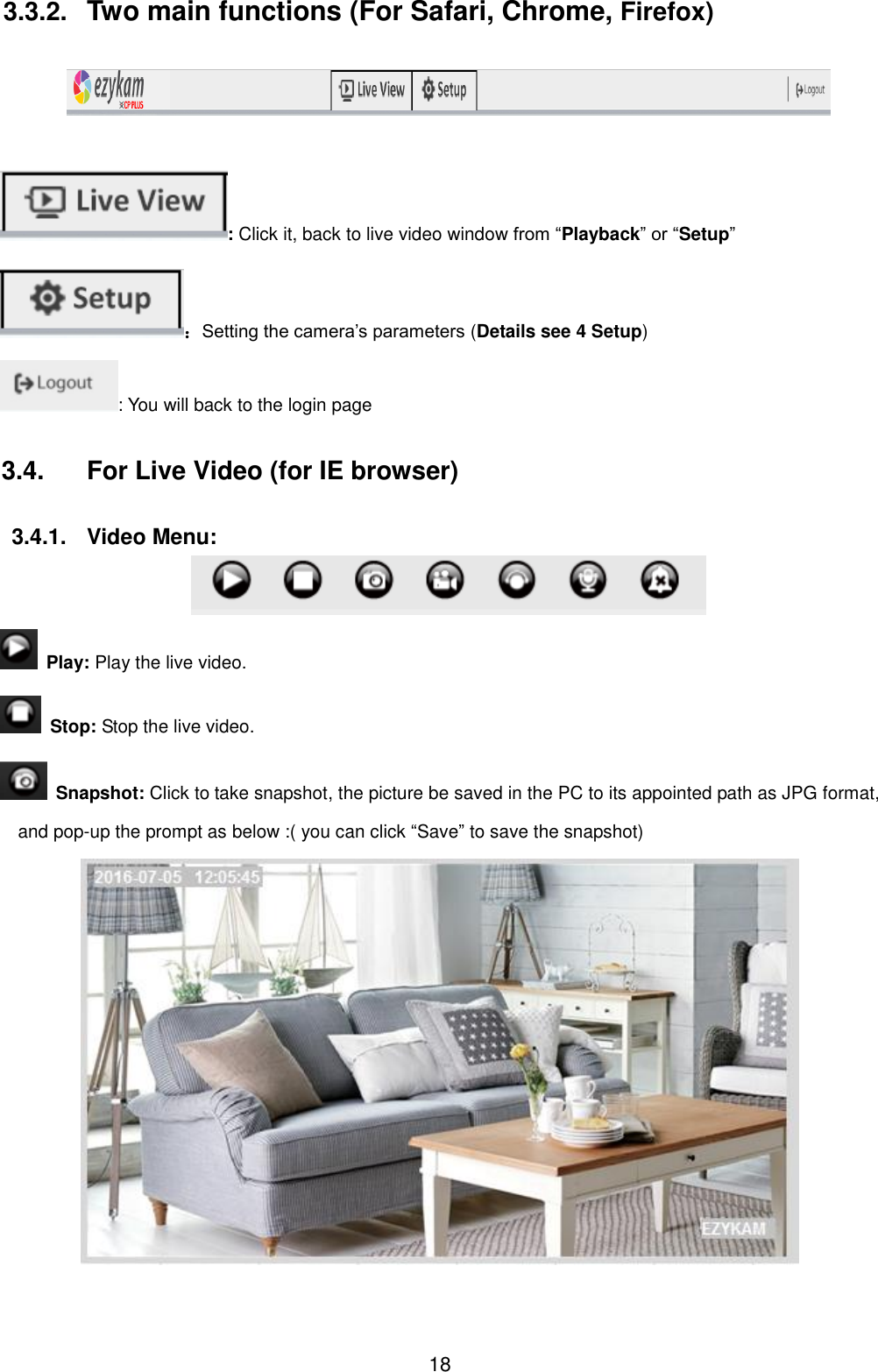
 18 3.3.2.  Two main functions (For Safari, Chrome, Firefox)    : Click it, back to live video window from “Playback” or “Setup” :Setting the camera’s parameters (Details see 4 Setup) : You will back to the login page 3.4.  For Live Video (for IE browser)  3.4.1.  Video Menu:    Play: Play the live video.   Stop: Stop the live video.   Snapshot: Click to take snapshot, the picture be saved in the PC to its appointed path as JPG format, and pop-up the prompt as below :( you can click “Save” to save the snapshot)
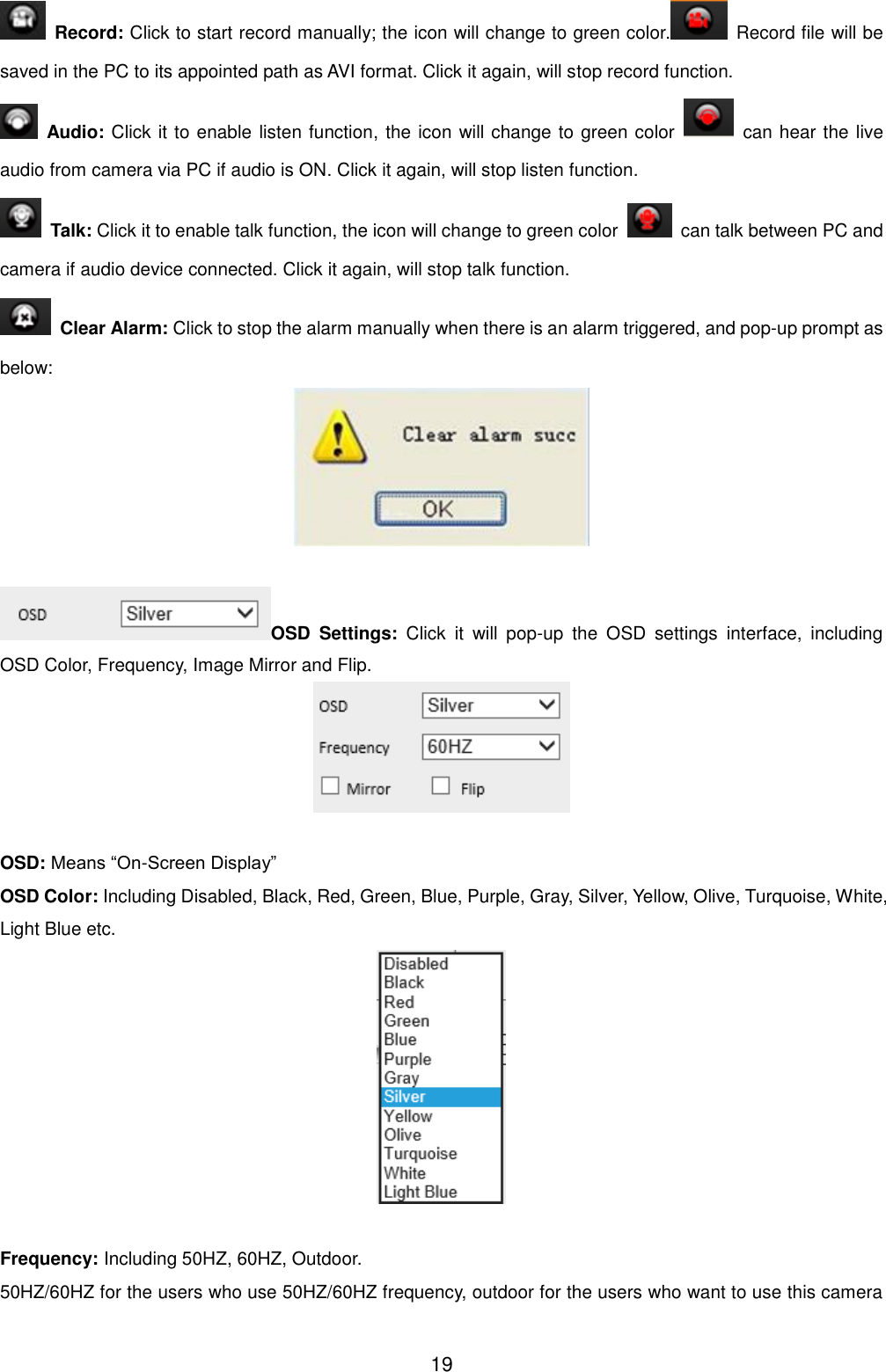
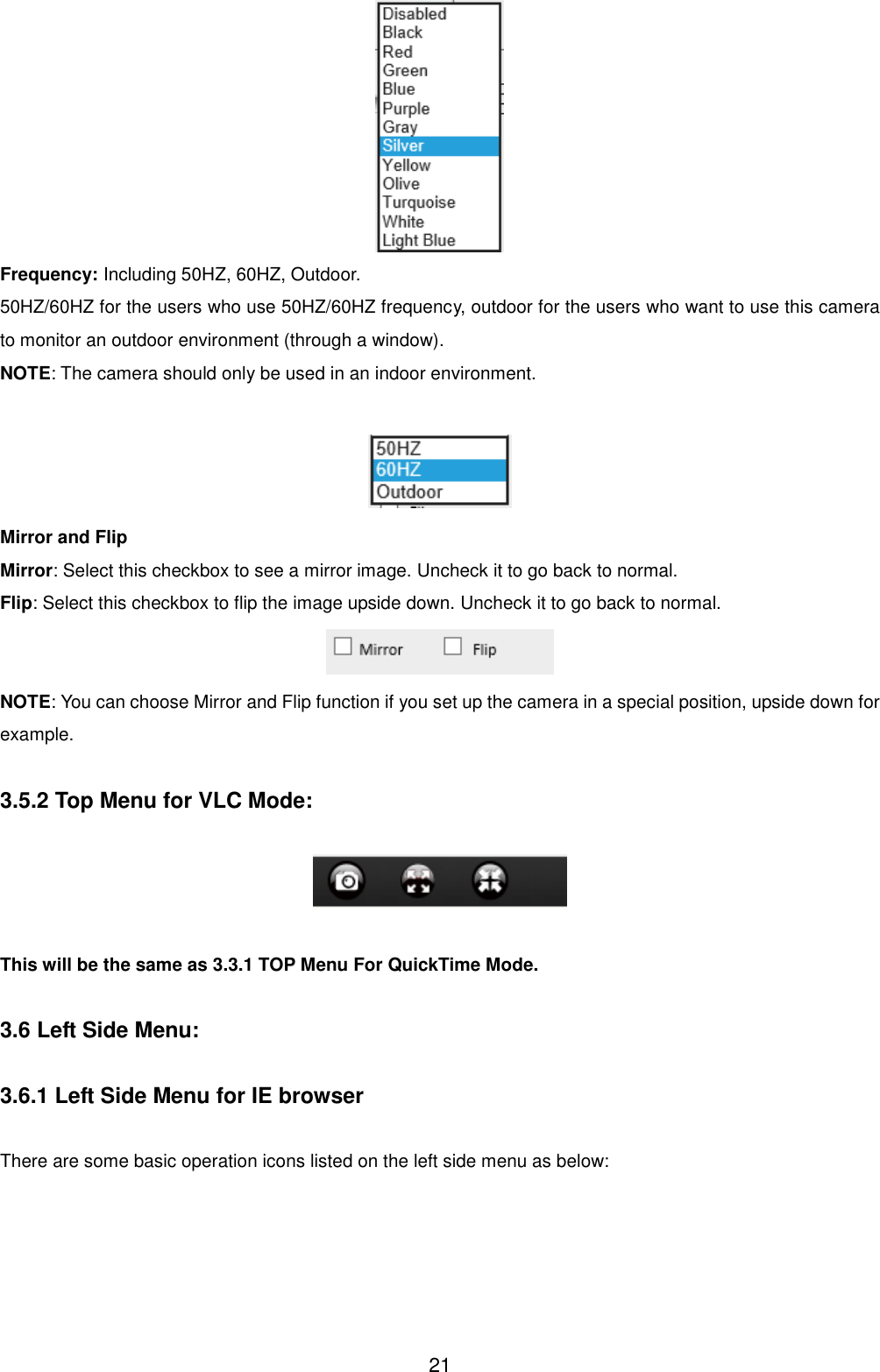
 19   Record: Click to start record manually; the icon will change to green color.   Record file will be saved in the PC to its appointed path as AVI format. Click it again, will stop record function.   Audio: Click it to enable listen function, the icon will change to green color    can hear the live audio from camera via PC if audio is ON. Click it again, will stop listen function.   Talk: Click it to enable talk function, the icon will change to green color    can talk between PC and camera if audio device connected. Click it again, will stop talk function.   Clear Alarm: Click to stop the alarm manually when there is an alarm triggered, and pop-up prompt as below:   OSD  Settings:  Click  it  will  pop-up  the  OSD  settings  interface,  including OSD Color, Frequency, Image Mirror and Flip.   OSD: Means “On-Screen Display” OSD Color: Including Disabled, Black, Red, Green, Blue, Purple, Gray, Silver, Yellow, Olive, Turquoise, White, Light Blue etc.   Frequency: Including 50HZ, 60HZ, Outdoor. 50HZ/60HZ for the users who use 50HZ/60HZ frequency, outdoor for the users who want to use this camera
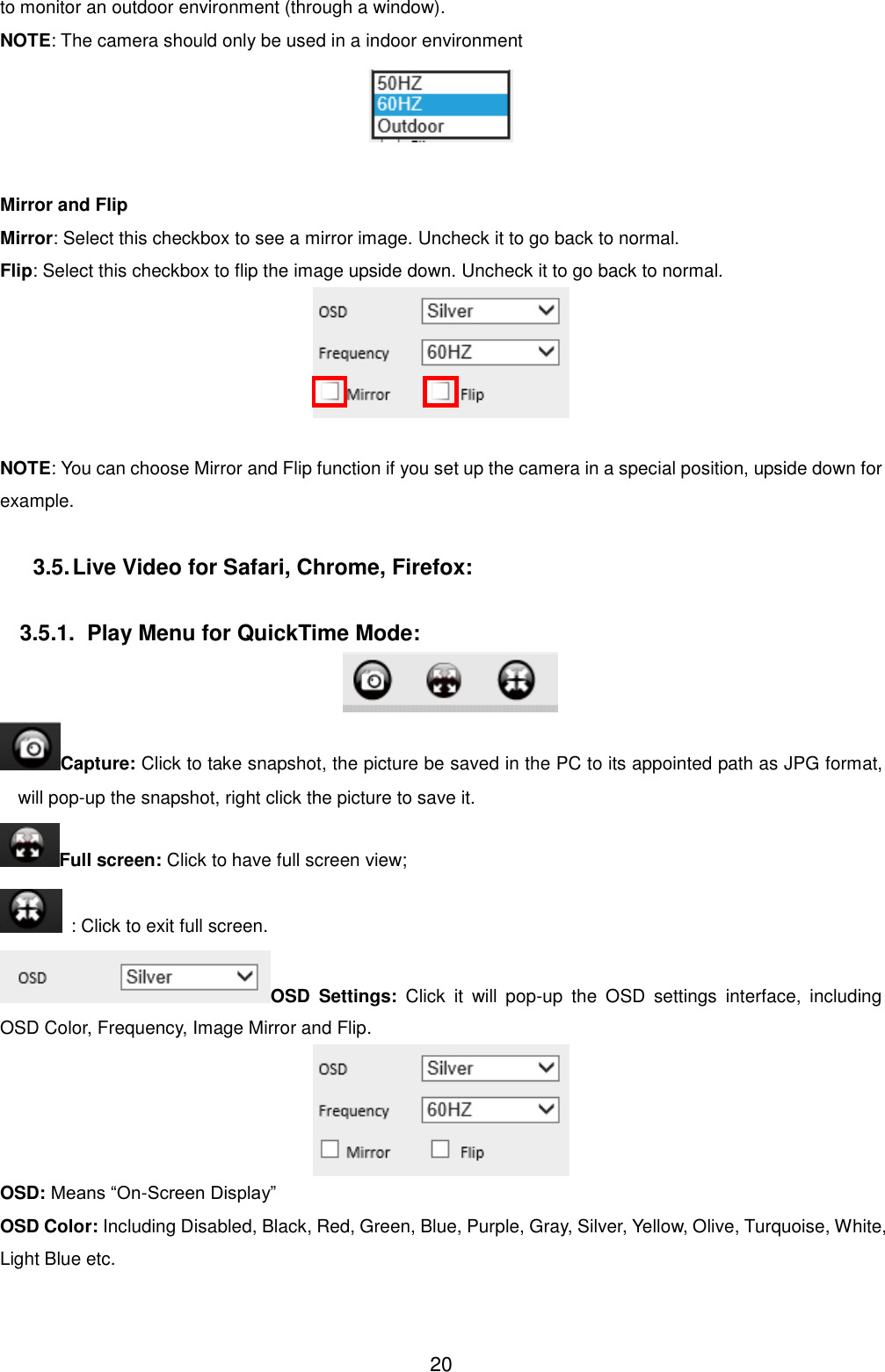
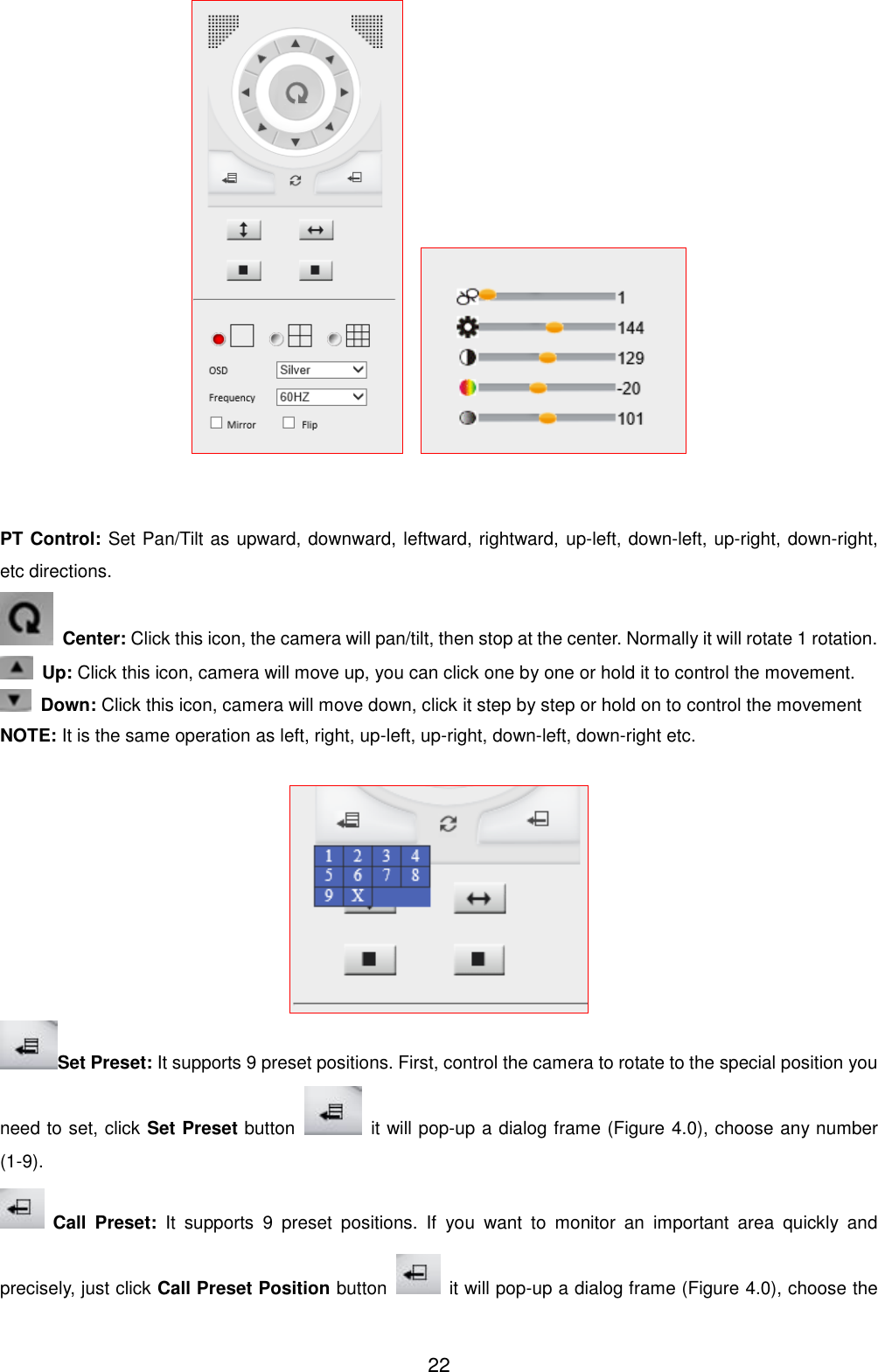
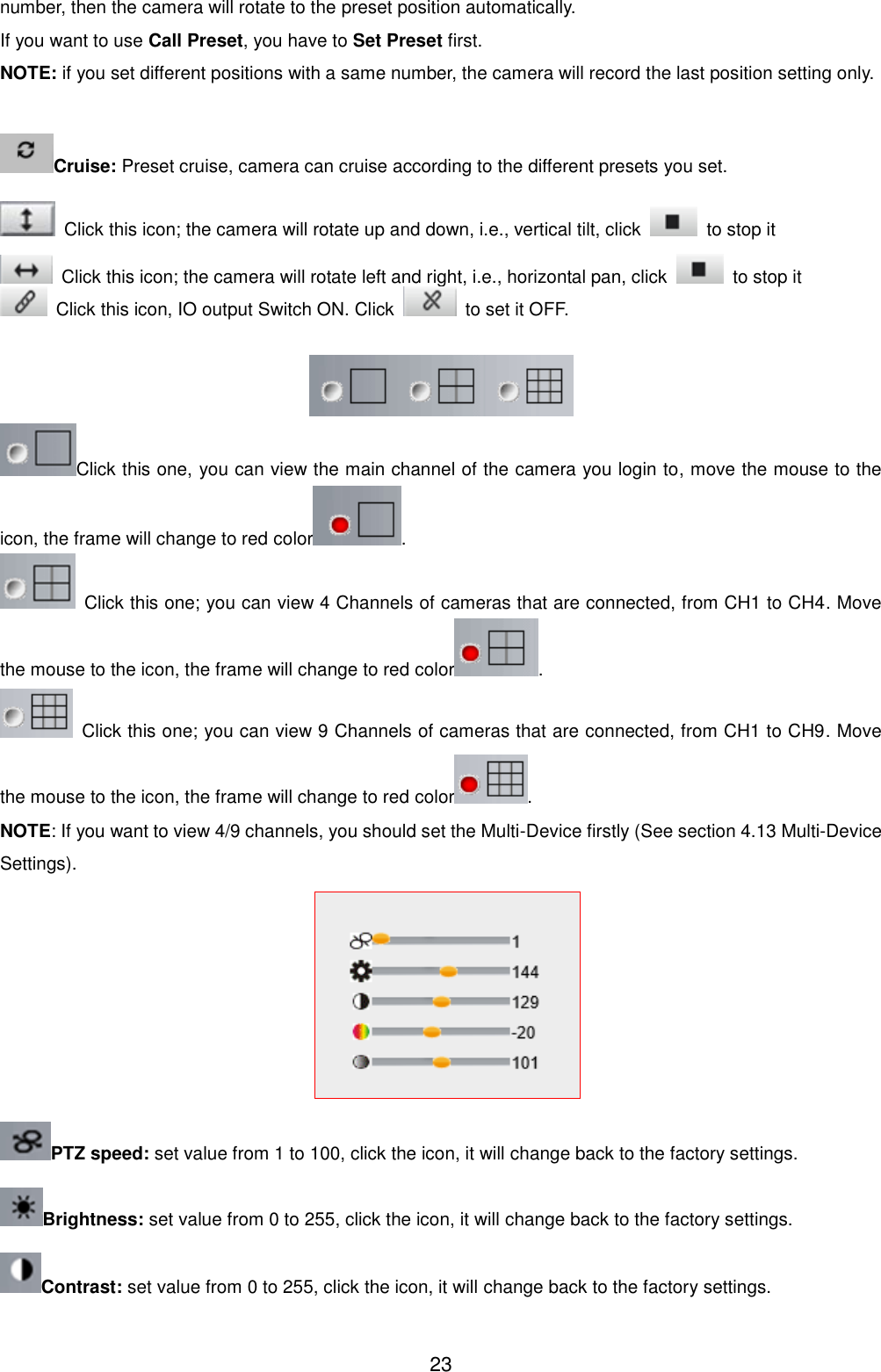
 20 to monitor an outdoor environment (through a window). NOTE: The camera should only be used in a indoor environment   Mirror and Flip Mirror: Select this checkbox to see a mirror image. Uncheck it to go back to normal. Flip: Select this checkbox to flip the image upside down. Uncheck it to go back to normal.   NOTE: You can choose Mirror and Flip function if you set up the camera in a special position, upside down for example.  3.5. Live Video for Safari, Chrome, Firefox:  3.5.1.  Play Menu for QuickTime Mode:  Capture: Click to take snapshot, the picture be saved in the PC to its appointed path as JPG format, will pop-up the snapshot, right click the picture to save it. Full screen: Click to have full screen view;   : Click to exit full screen. OSD  Settings:  Click  it  will  pop-up  the  OSD  settings  interface,  including OSD Color, Frequency, Image Mirror and Flip.  OSD: Means “On-Screen Display” OSD Color: Including Disabled, Black, Red, Green, Blue, Purple, Gray, Silver, Yellow, Olive, Turquoise, White, Light Blue etc.
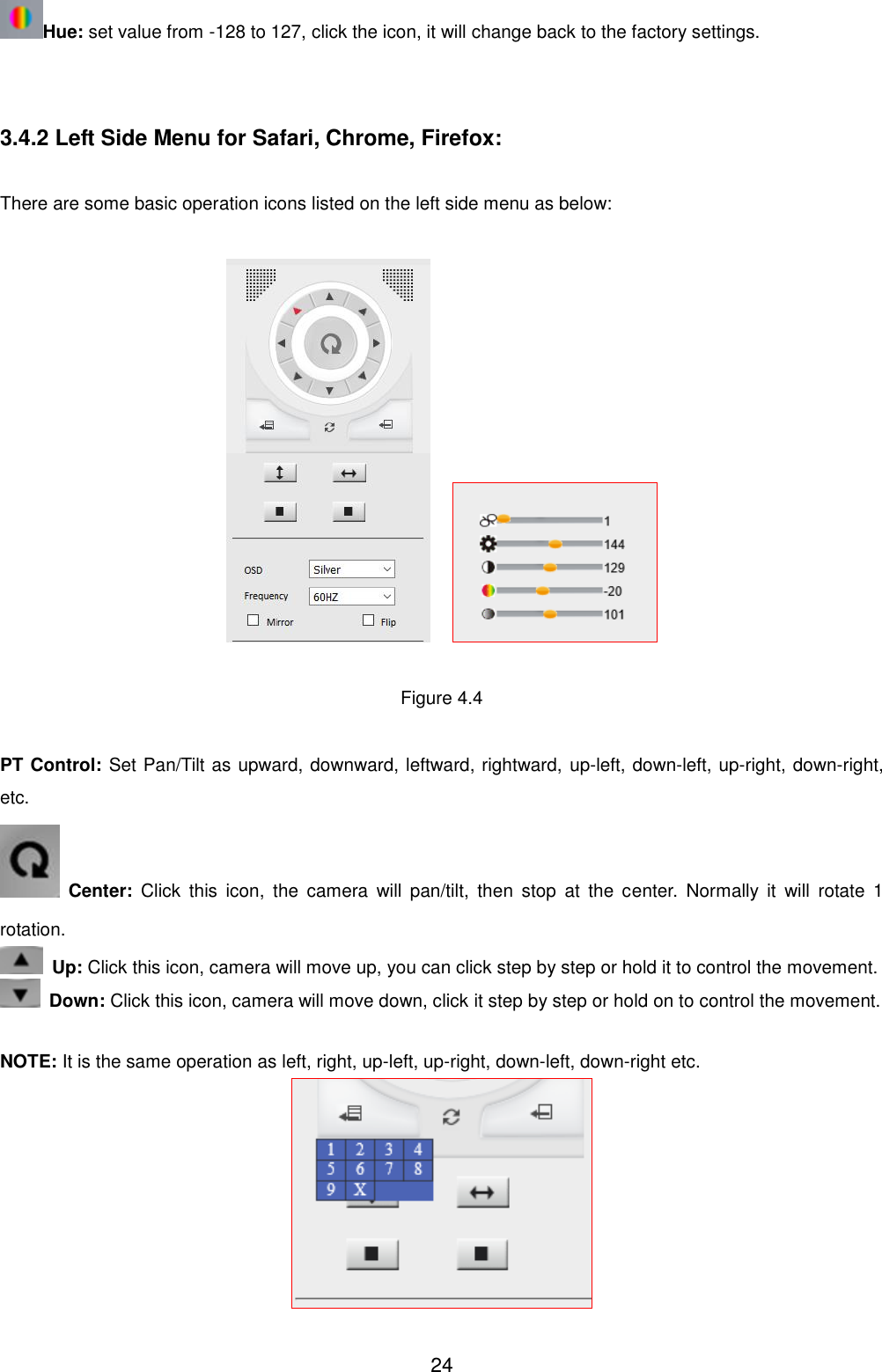
 21  Frequency: Including 50HZ, 60HZ, Outdoor. 50HZ/60HZ for the users who use 50HZ/60HZ frequency, outdoor for the users who want to use this camera to monitor an outdoor environment (through a window). NOTE: The camera should only be used in an indoor environment.   Mirror and Flip Mirror: Select this checkbox to see a mirror image. Uncheck it to go back to normal. Flip: Select this checkbox to flip the image upside down. Uncheck it to go back to normal.  NOTE: You can choose Mirror and Flip function if you set up the camera in a special position, upside down for example.  3.5.2 Top Menu for VLC Mode:    This will be the same as 3.3.1 TOP Menu For QuickTime Mode.  3.6 Left Side Menu:  3.6.1 Left Side Menu for IE browser  There are some basic operation icons listed on the left side menu as below:
 22       PT Control: Set Pan/Tilt as upward, downward, leftward, rightward, up-left, down-left, up-right, down-right, etc directions.  Center: Click this icon, the camera will pan/tilt, then stop at the center. Normally it will rotate 1 rotation.  Up: Click this icon, camera will move up, you can click one by one or hold it to control the movement.  Down: Click this icon, camera will move down, click it step by step or hold on to control the movement NOTE: It is the same operation as left, right, up-left, up-right, down-left, down-right etc.   Set Preset: It supports 9 preset positions. First, control the camera to rotate to the special position you need to set, click Set Preset button    it will pop-up a dialog frame (Figure 4.0), choose any number (1-9).  Call  Preset:  It  supports  9  preset  positions.  If  you  want  to  monitor  an  important  area  quickly  and precisely, just click Call Preset Position button    it will pop-up a dialog frame (Figure 4.0), choose the
 23 number, then the camera will rotate to the preset position automatically. If you want to use Call Preset, you have to Set Preset first. NOTE: if you set different positions with a same number, the camera will record the last position setting only.  Cruise: Preset cruise, camera can cruise according to the different presets you set.     Click this icon; the camera will rotate up and down, i.e., vertical tilt, click    to stop it   Click this icon; the camera will rotate left and right, i.e., horizontal pan, click    to stop it   Click this icon, IO output Switch ON. Click    to set it OFF.   Click this one, you can view the main channel of the camera you login to, move the mouse to the icon, the frame will change to red color .   Click this one; you can view 4 Channels of cameras that are connected, from CH1 to CH4. Move the mouse to the icon, the frame will change to red color .   Click this one; you can view 9 Channels of cameras that are connected, from CH1 to CH9. Move the mouse to the icon, the frame will change to red color . NOTE: If you want to view 4/9 channels, you should set the Multi-Device firstly (See section 4.13 Multi-Device Settings).  PTZ speed: set value from 1 to 100, click the icon, it will change back to the factory settings. Brightness: set value from 0 to 255, click the icon, it will change back to the factory settings. Contrast: set value from 0 to 255, click the icon, it will change back to the factory settings.
 24 Hue: set value from -128 to 127, click the icon, it will change back to the factory settings.   3.4.2 Left Side Menu for Safari, Chrome, Firefox:  There are some basic operation icons listed on the left side menu as below:       Figure 4.4  PT Control: Set Pan/Tilt as upward, downward, leftward, rightward, up-left, down-left, up-right, down-right, etc.    Center:  Click  this  icon,  the  camera  will  pan/tilt,  then  stop  at  the  center.  Normally  it  will  rotate  1 rotation.  Up: Click this icon, camera will move up, you can click step by step or hold it to control the movement.  Down: Click this icon, camera will move down, click it step by step or hold on to control the movement.  NOTE: It is the same operation as left, right, up-left, up-right, down-left, down-right etc.
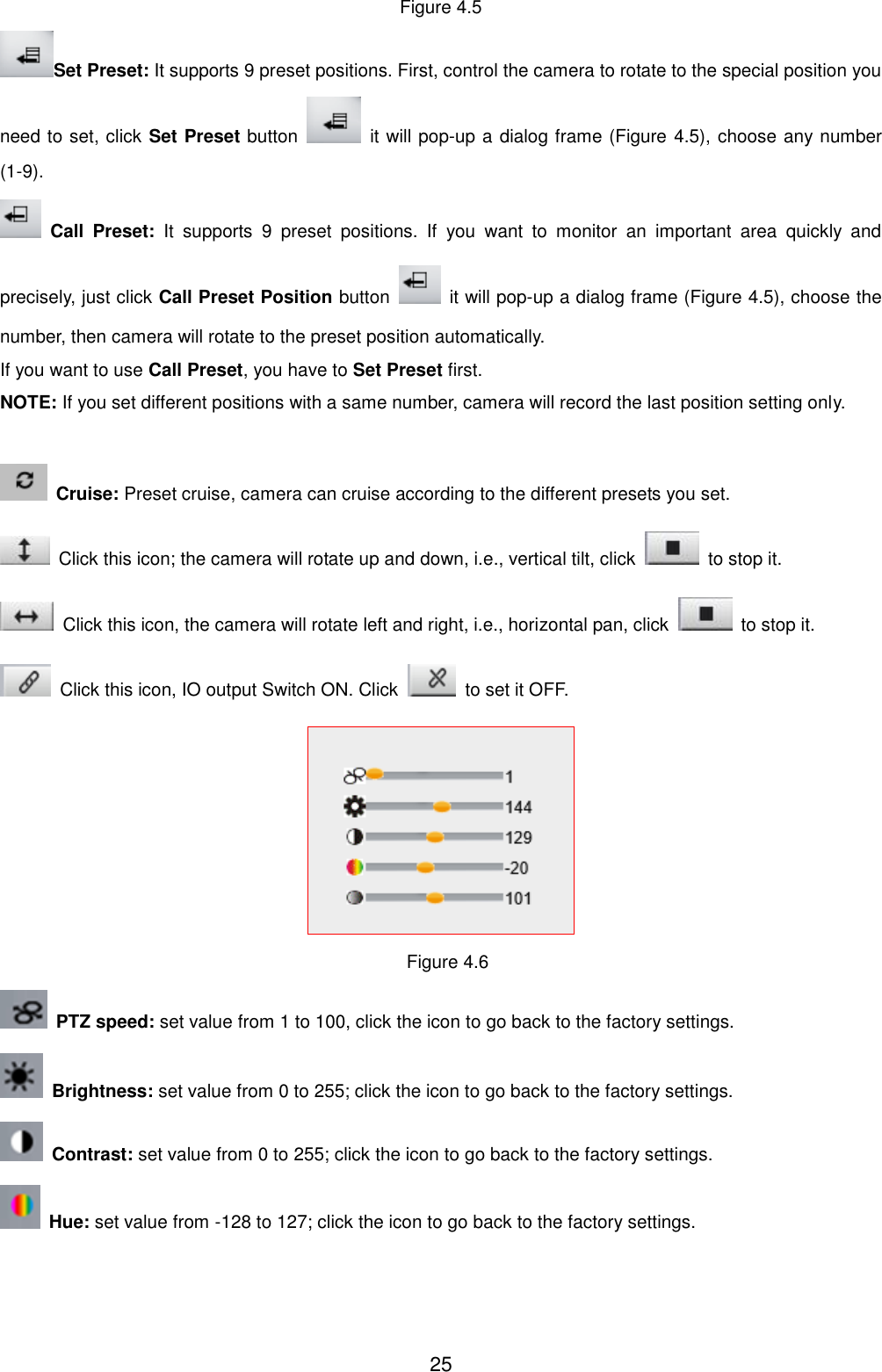
 25 Figure 4.5 Set Preset: It supports 9 preset positions. First, control the camera to rotate to the special position you need to set, click Set Preset button    it will pop-up a dialog frame (Figure 4.5), choose any number (1-9).  Call  Preset:  It  supports  9  preset  positions.  If  you  want  to  monitor  an  important  area  quickly  and precisely, just click Call Preset Position button    it will pop-up a dialog frame (Figure 4.5), choose the number, then camera will rotate to the preset position automatically. If you want to use Call Preset, you have to Set Preset first. NOTE: If you set different positions with a same number, camera will record the last position setting only.    Cruise: Preset cruise, camera can cruise according to the different presets you set.     Click this icon; the camera will rotate up and down, i.e., vertical tilt, click    to stop it.   Click this icon, the camera will rotate left and right, i.e., horizontal pan, click    to stop it.   Click this icon, IO output Switch ON. Click    to set it OFF.  Figure 4.6  PTZ speed: set value from 1 to 100, click the icon to go back to the factory settings.  Brightness: set value from 0 to 255; click the icon to go back to the factory settings.  Contrast: set value from 0 to 255; click the icon to go back to the factory settings.   Hue: set value from -128 to 127; click the icon to go back to the factory settings.
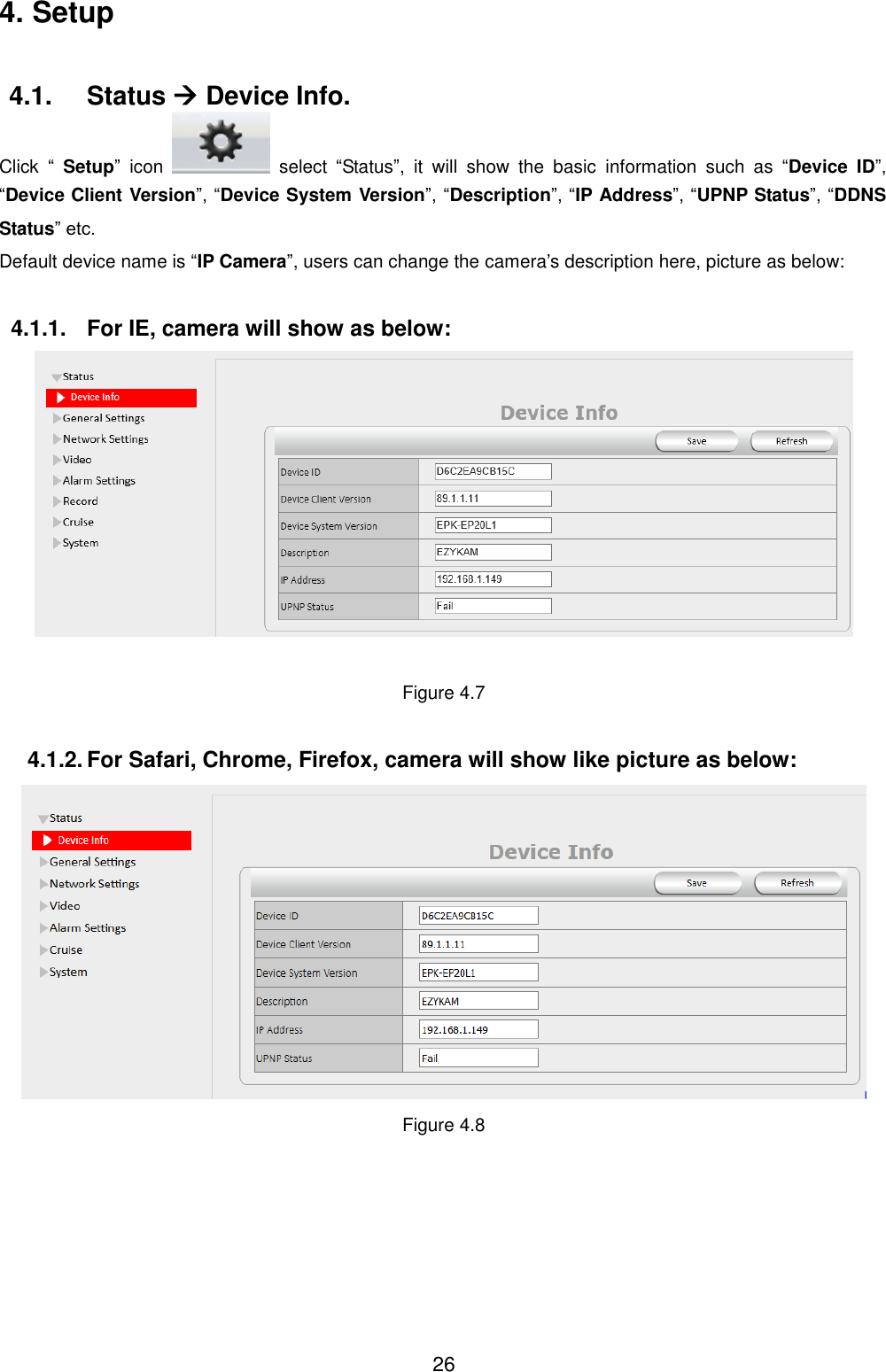
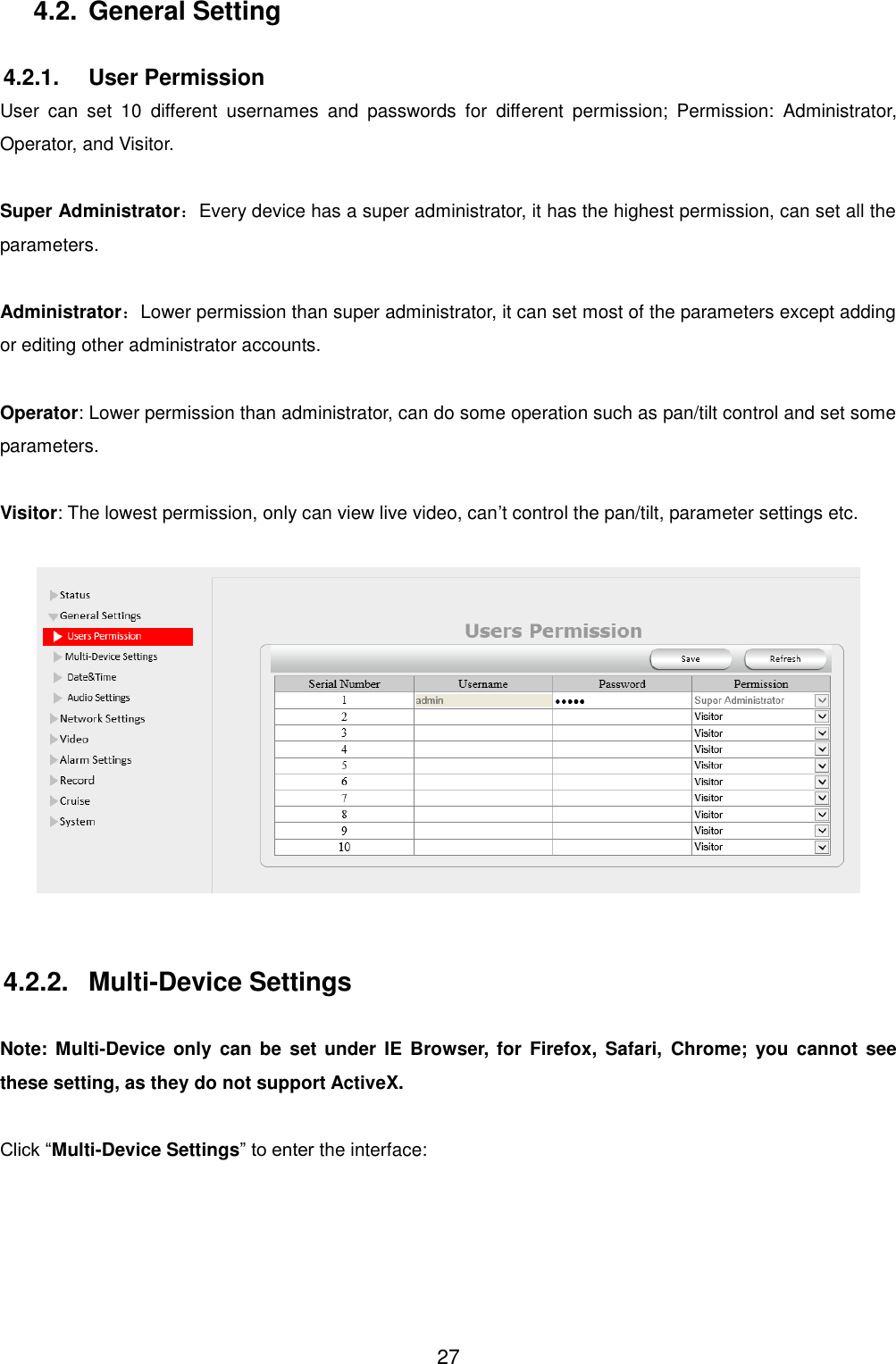
 26 4. Setup 4.1.  Status  Device Info. Click  “  Setup”  icon    select  “Status”,  it  will  show  the  basic  information  such  as  “Device  ID”, “Device Client Version”, “Device System Version”, “Description”, “IP Address”, “UPNP Status”, “DDNS Status” etc. Default device name is “IP Camera”, users can change the camera’s description here, picture as below:  4.1.1.  For IE, camera will show as below:   Figure 4.7  4.1.2. For Safari, Chrome, Firefox, camera will show like picture as below:  Figure 4.8
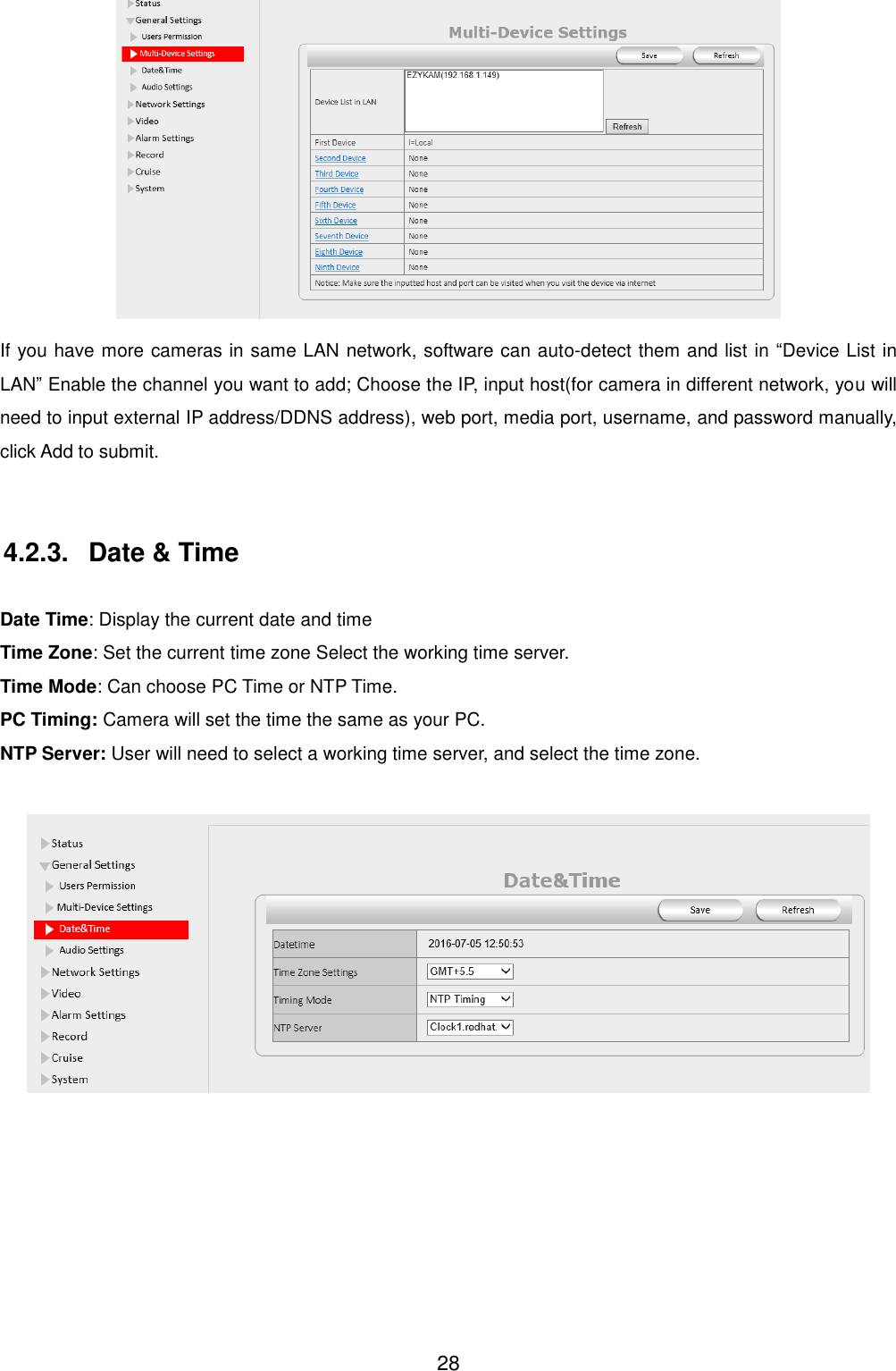
 27 4.2. General Setting  4.2.1.  User Permission User  can  set  10  different  usernames  and  passwords  for  different  permission;  Permission:  Administrator, Operator, and Visitor.  Super Administrator:Every device has a super administrator, it has the highest permission, can set all the parameters.  Administrator:Lower permission than super administrator, it can set most of the parameters except adding or editing other administrator accounts.  Operator: Lower permission than administrator, can do some operation such as pan/tilt control and set some parameters.  Visitor: The lowest permission, only can view live video, can’t control the pan/tilt, parameter settings etc.    4.2.2.  Multi-Device Settings  Note:  Multi-Device only  can be set  under IE  Browser,  for  Firefox,  Safari,  Chrome;  you  cannot  see these setting, as they do not support ActiveX.  Click “Multi-Device Settings” to enter the interface:
 28  If you have more cameras in same LAN network, software can auto-detect them and list in “Device List in LAN” Enable the channel you want to add; Choose the IP, input host(for camera in different network, you will need to input external IP address/DDNS address), web port, media port, username, and password manually, click Add to submit.  4.2.3.  Date & Time  Date Time: Display the current date and time   Time Zone: Set the current time zone Select the working time server. Time Mode: Can choose PC Time or NTP Time. PC Timing: Camera will set the time the same as your PC. NTP Server: User will need to select a working time server, and select the time zone.
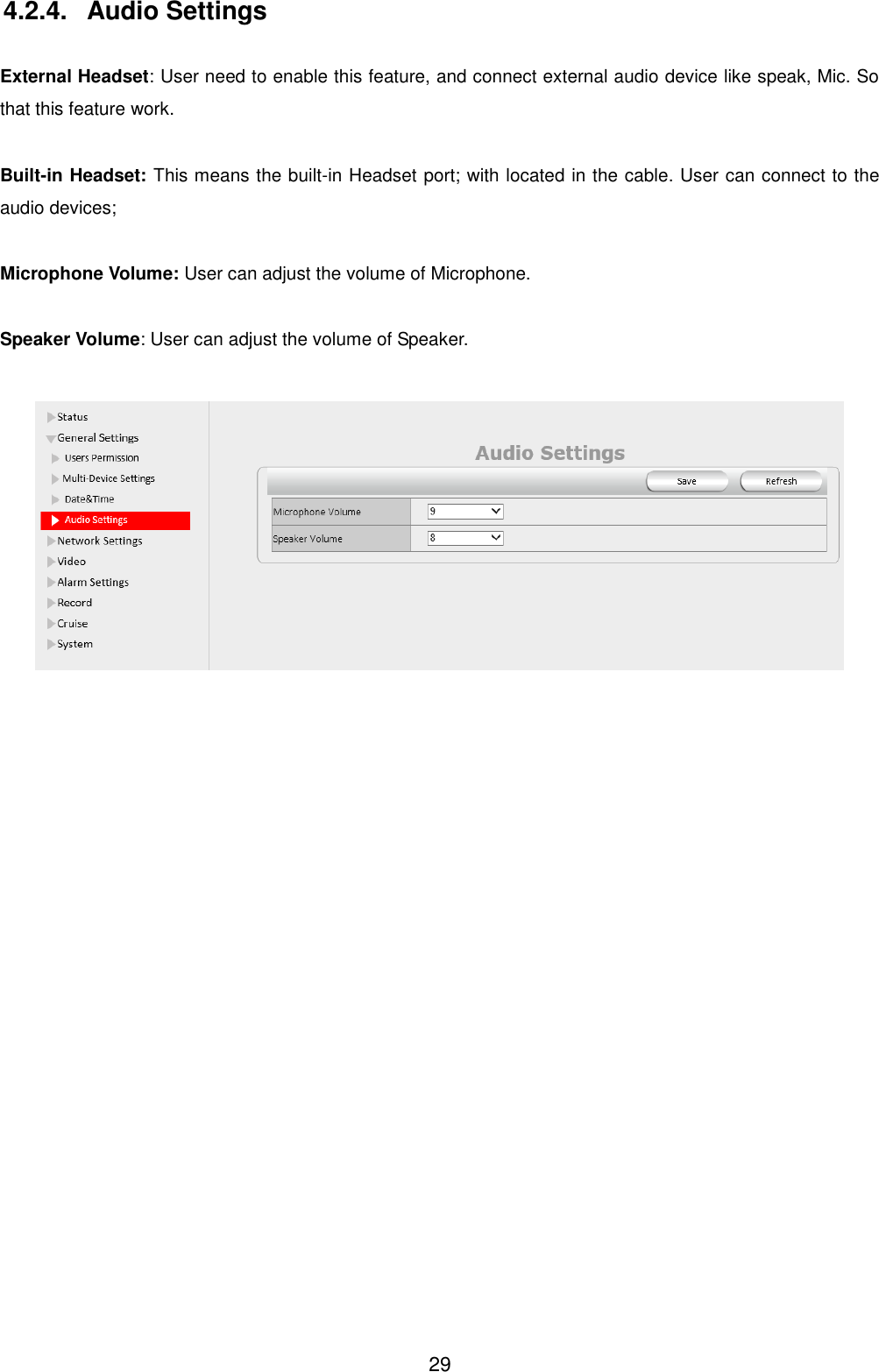
 29 4.2.4.  Audio Settings  External Headset: User need to enable this feature, and connect external audio device like speak, Mic. So that this feature work.  Built-in Headset: This means the built-in Headset port; with located in the cable. User can connect to the audio devices;  Microphone Volume: User can adjust the volume of Microphone.  Speaker Volume: User can adjust the volume of Speaker.
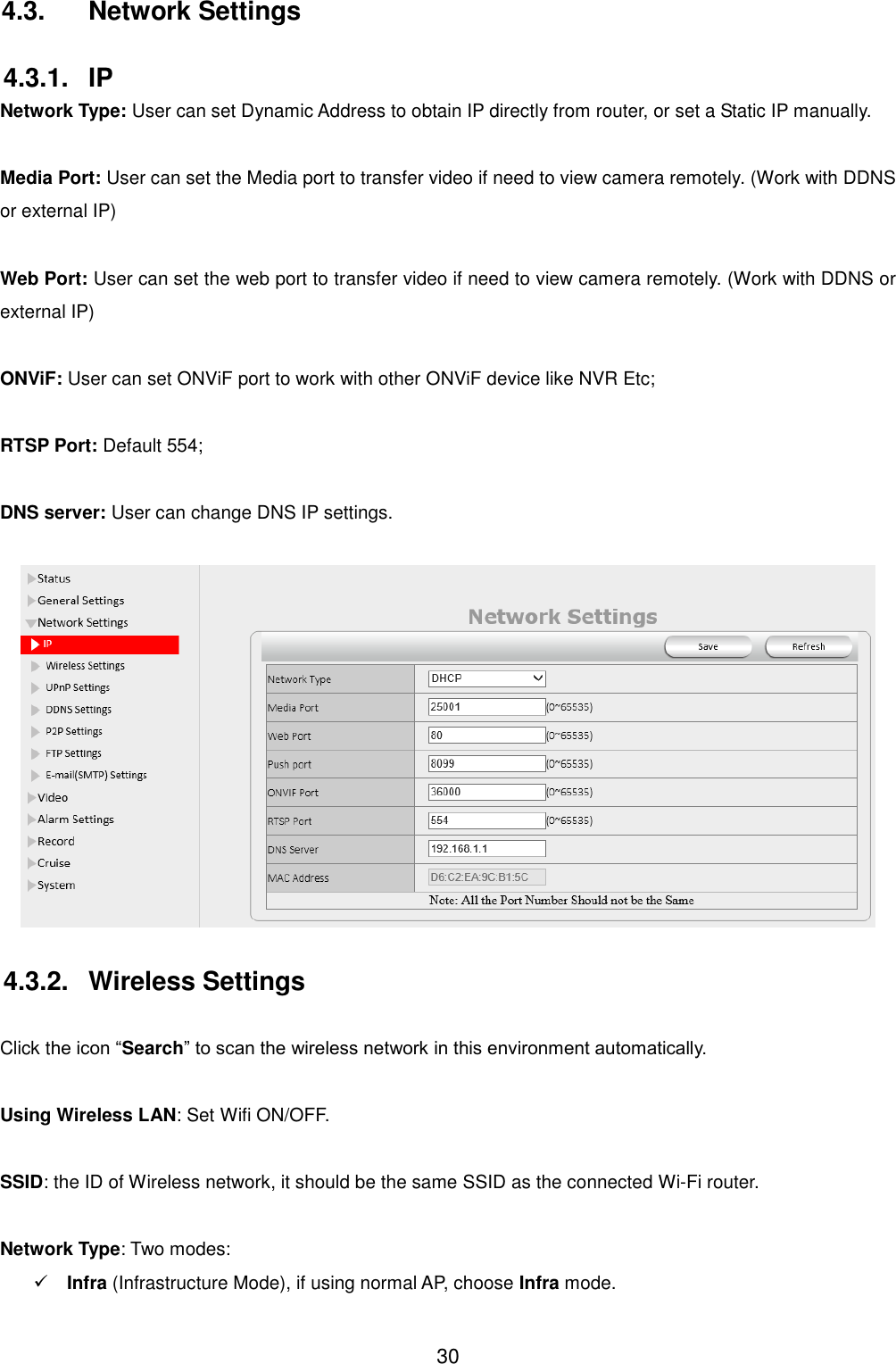
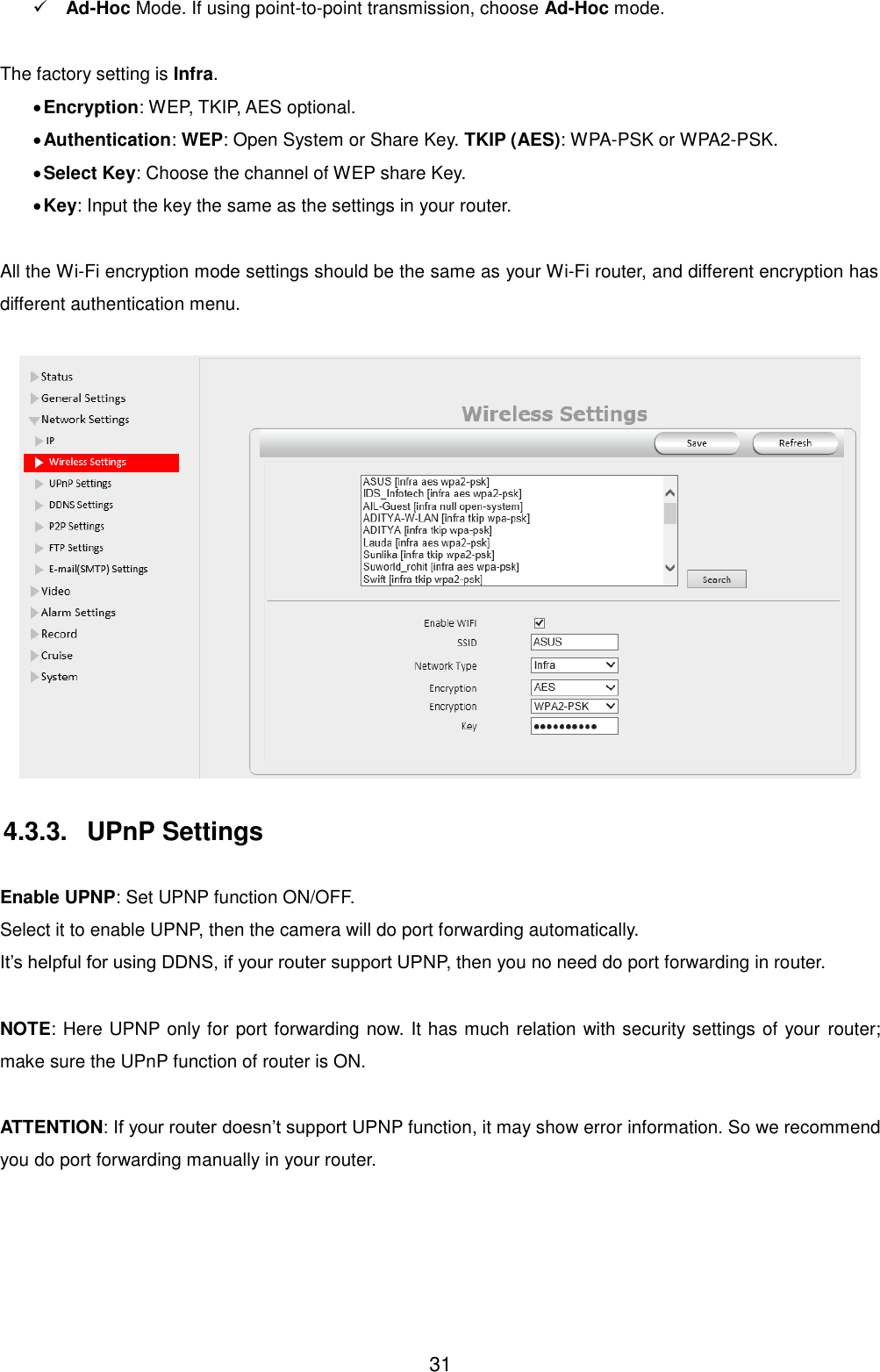
 30 4.3.  Network Settings 4.3.1.  IP Network Type: User can set Dynamic Address to obtain IP directly from router, or set a Static IP manually.  Media Port: User can set the Media port to transfer video if need to view camera remotely. (Work with DDNS or external IP)  Web Port: User can set the web port to transfer video if need to view camera remotely. (Work with DDNS or external IP)  ONViF: User can set ONViF port to work with other ONViF device like NVR Etc;  RTSP Port: Default 554;  DNS server: User can change DNS IP settings.   4.3.2.  Wireless Settings  Click the icon “Search” to scan the wireless network in this environment automatically.  Using Wireless LAN: Set Wifi ON/OFF.  SSID: the ID of Wireless network, it should be the same SSID as the connected Wi-Fi router.  Network Type: Two modes:    Infra (Infrastructure Mode), if using normal AP, choose Infra mode.
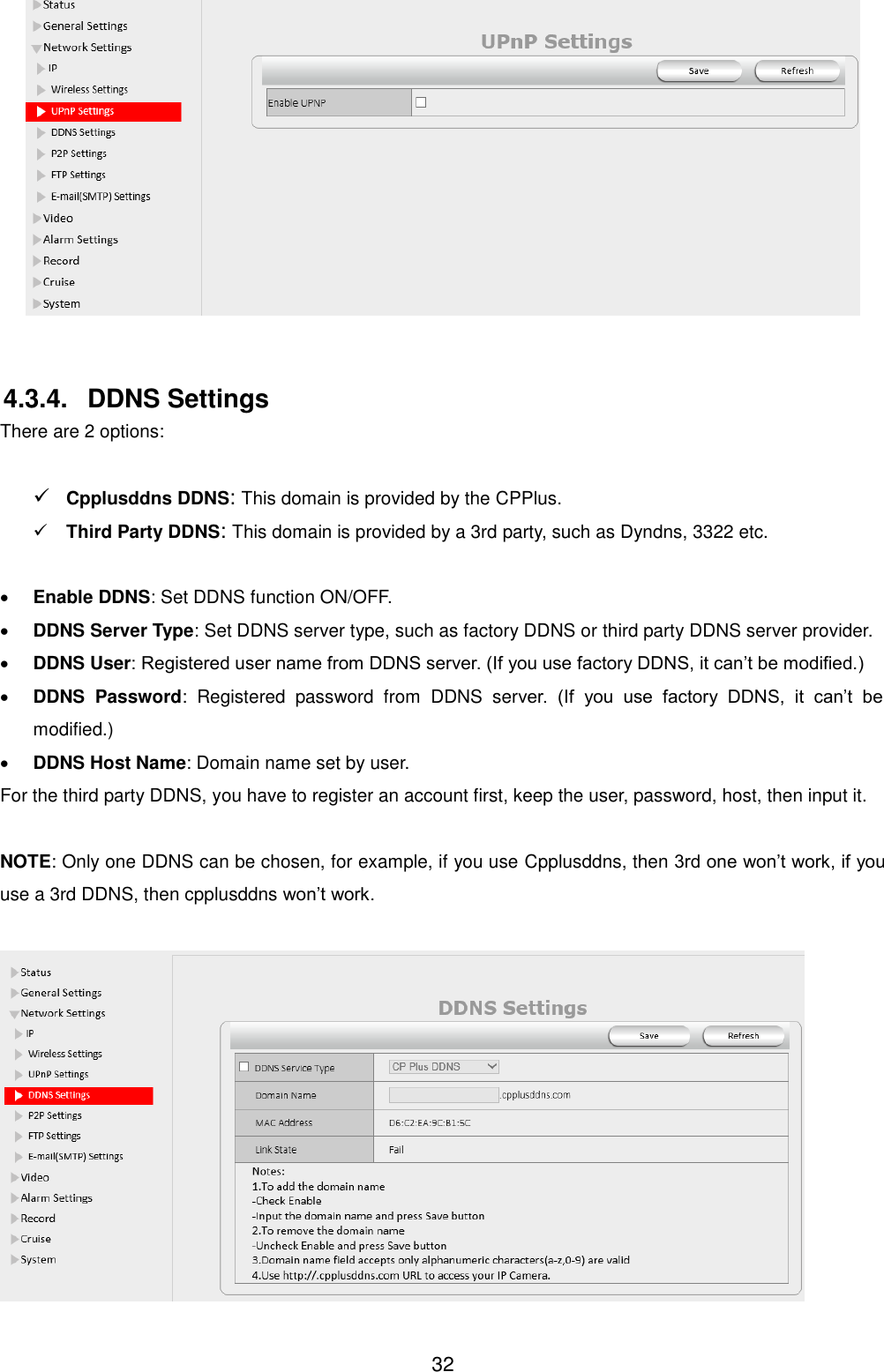
 31  Ad-Hoc Mode. If using point-to-point transmission, choose Ad-Hoc mode.  The factory setting is Infra.  Encryption: WEP, TKIP, AES optional.  Authentication: WEP: Open System or Share Key. TKIP (AES): WPA-PSK or WPA2-PSK.  Select Key: Choose the channel of WEP share Key.  Key: Input the key the same as the settings in your router.  All the Wi-Fi encryption mode settings should be the same as your Wi-Fi router, and different encryption has different authentication menu.   4.3.3.  UPnP Settings  Enable UPNP: Set UPNP function ON/OFF. Select it to enable UPNP, then the camera will do port forwarding automatically. It’s helpful for using DDNS, if your router support UPNP, then you no need do port forwarding in router.  NOTE: Here UPNP only for port forwarding now. It has much relation with security settings of your  router; make sure the UPnP function of router is ON.    ATTENTION: If your router doesn’t support UPNP function, it may show error information. So we recommend you do port forwarding manually in your router.
 32   4.3.4.  DDNS Settings There are 2 options:     Cpplusddns DDNS: This domain is provided by the CPPlus.  Third Party DDNS: This domain is provided by a 3rd party, such as Dyndns, 3322 etc.   Enable DDNS: Set DDNS function ON/OFF.  DDNS Server Type: Set DDNS server type, such as factory DDNS or third party DDNS server provider.  DDNS User: Registered user name from DDNS server. (If you use factory DDNS, it can’t be modified.)  DDNS  Password:  Registered  password  from  DDNS  server.  (If  you  use  factory  DDNS,  it  can’t  be modified.)    DDNS Host Name: Domain name set by user. For the third party DDNS, you have to register an account first, keep the user, password, host, then input it.  NOTE: Only one DDNS can be chosen, for example, if you use Cpplusddns, then 3rd one won’t work, if you use a 3rd DDNS, then cpplusddns won’t work.
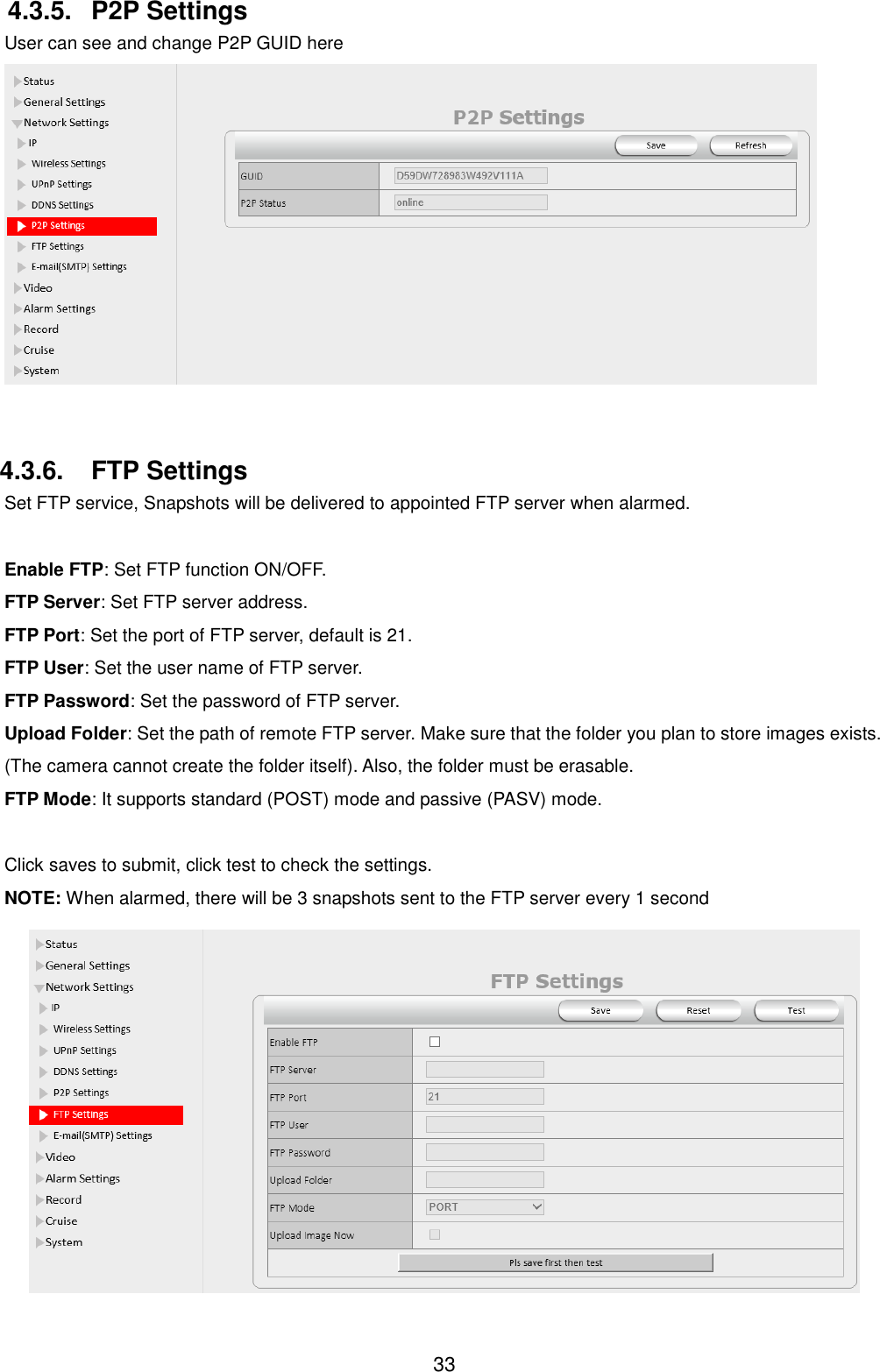
 33 4.3.5.  P2P Settings User can see and change P2P GUID here   4.3.6.  FTP Settings Set FTP service, Snapshots will be delivered to appointed FTP server when alarmed.  Enable FTP: Set FTP function ON/OFF. FTP Server: Set FTP server address. FTP Port: Set the port of FTP server, default is 21. FTP User: Set the user name of FTP server. FTP Password: Set the password of FTP server. Upload Folder: Set the path of remote FTP server. Make sure that the folder you plan to store images exists. (The camera cannot create the folder itself). Also, the folder must be erasable. FTP Mode: It supports standard (POST) mode and passive (PASV) mode.  Click saves to submit, click test to check the settings. NOTE: When alarmed, there will be 3 snapshots sent to the FTP server every 1 second
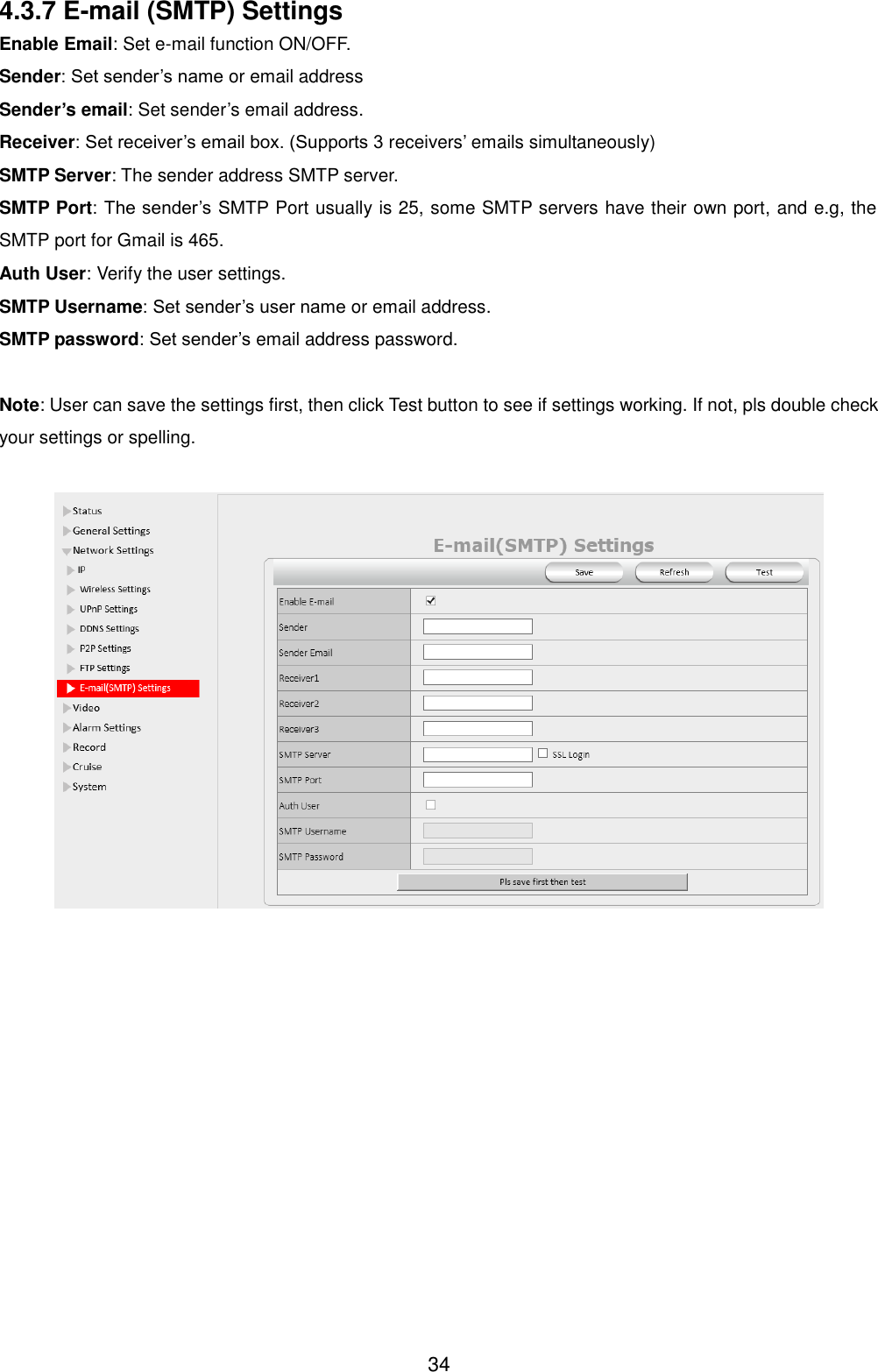
 34 4.3.7 E-mail (SMTP) Settings Enable Email: Set e-mail function ON/OFF. Sender: Set sender’s name or email address Sender’s email: Set sender’s email address. Receiver: Set receiver’s email box. (Supports 3 receivers’ emails simultaneously)   SMTP Server: The sender address SMTP server. SMTP Port: The sender’s SMTP Port usually is 25, some SMTP servers have their own port, and e.g, the SMTP port for Gmail is 465. Auth User: Verify the user settings. SMTP Username: Set sender’s user name or email address. SMTP password: Set sender’s email address password.    Note: User can save the settings first, then click Test button to see if settings working. If not, pls double check your settings or spelling.
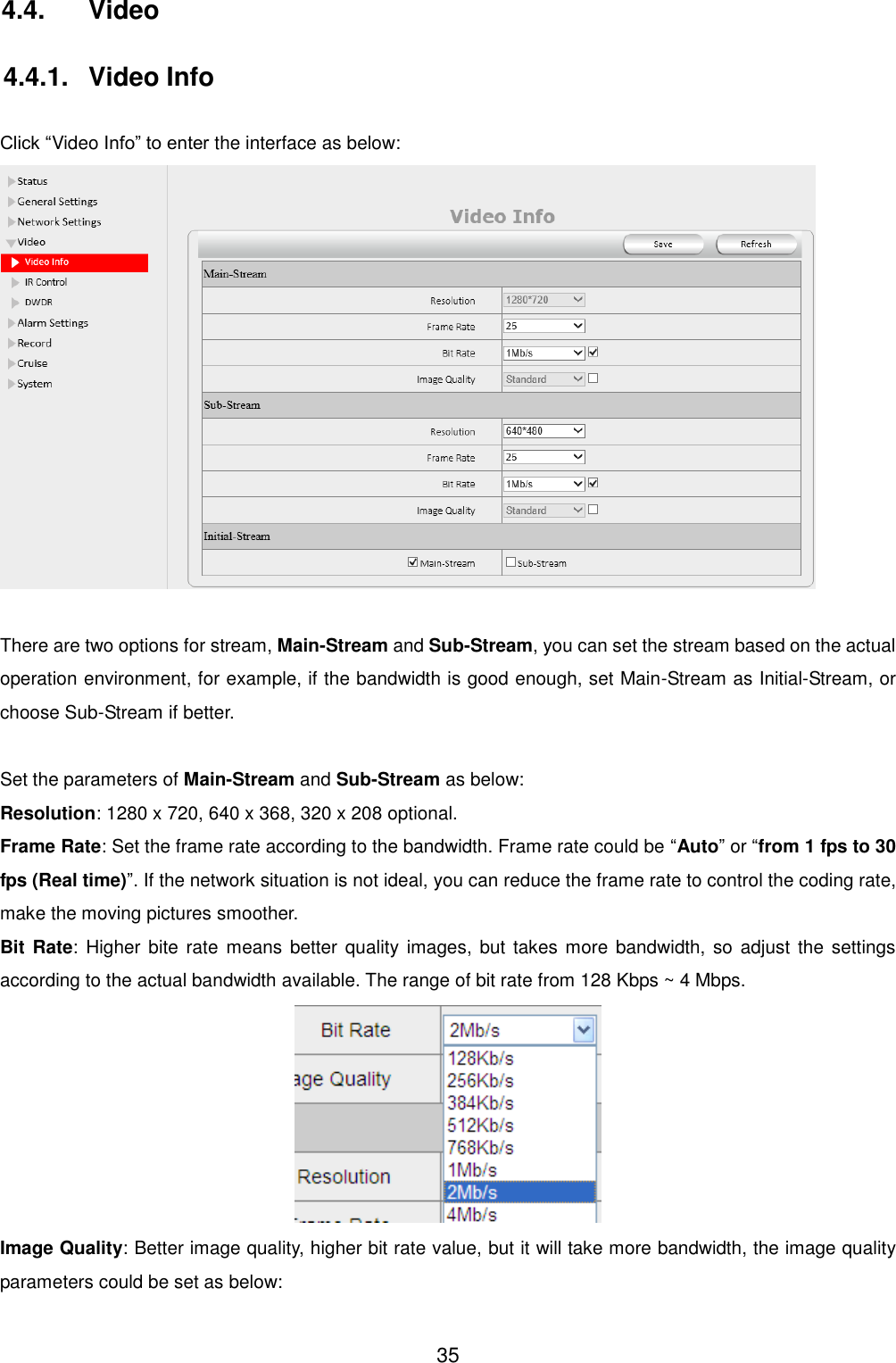
 35 4.4.  Video 4.4.1.  Video Info  Click “Video Info” to enter the interface as below:   There are two options for stream, Main-Stream and Sub-Stream, you can set the stream based on the actual operation environment, for example, if the bandwidth is good enough, set Main-Stream as Initial-Stream, or choose Sub-Stream if better.  Set the parameters of Main-Stream and Sub-Stream as below: Resolution: 1280 x 720, 640 x 368, 320 x 208 optional. Frame Rate: Set the frame rate according to the bandwidth. Frame rate could be “Auto” or “from 1 fps to 30 fps (Real time)”. If the network situation is not ideal, you can reduce the frame rate to control the coding rate, make the moving pictures smoother. Bit Rate:  Higher  bite rate means better quality images, but takes more  bandwidth, so adjust the settings according to the actual bandwidth available. The range of bit rate from 128 Kbps ~ 4 Mbps.  Image Quality: Better image quality, higher bit rate value, but it will take more bandwidth, the image quality parameters could be set as below:
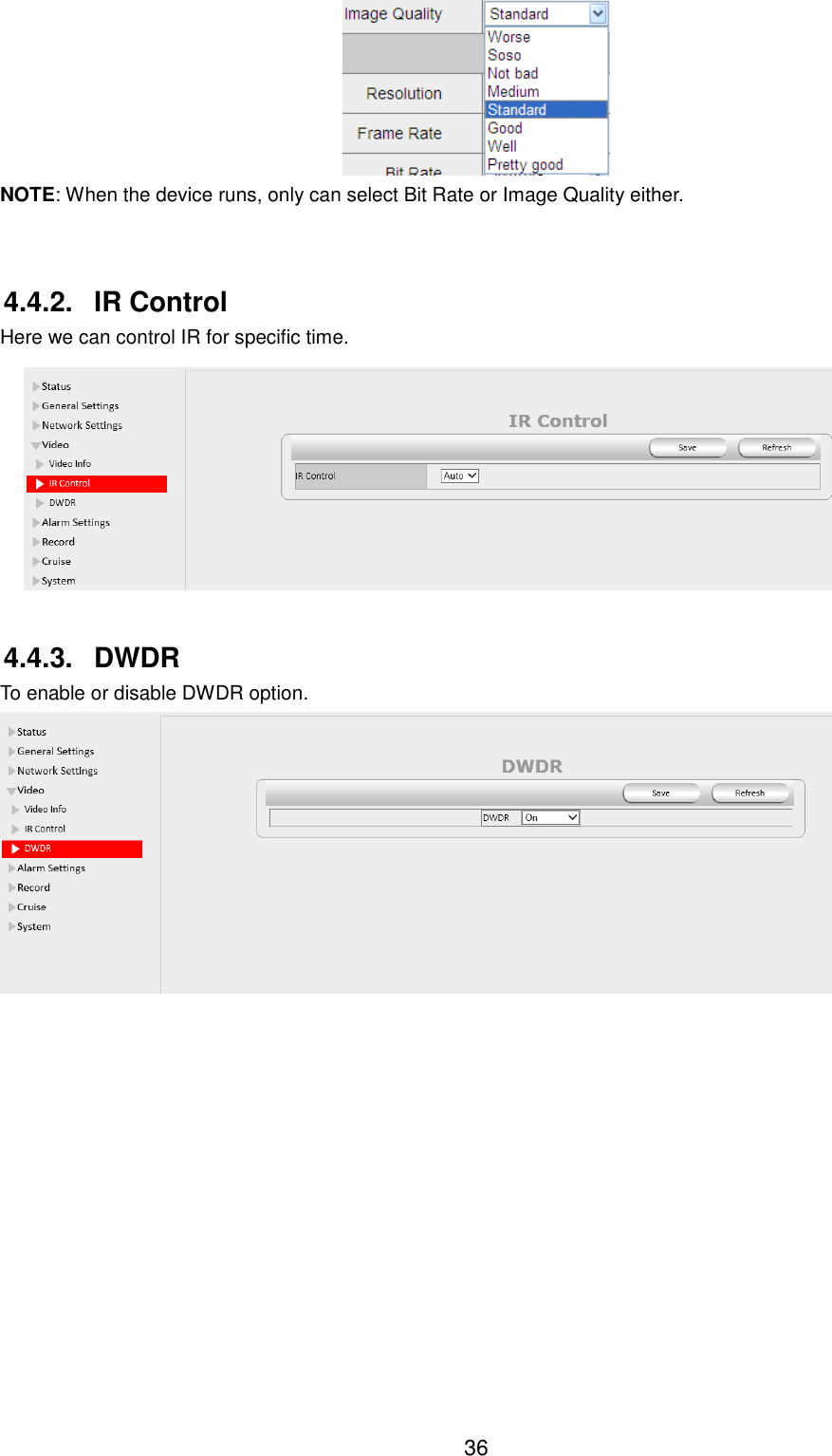
 36   NOTE: When the device runs, only can select Bit Rate or Image Quality either.  4.4.2.  IR Control Here we can control IR for specific time.  4.4.3.  DWDR To enable or disable DWDR option.
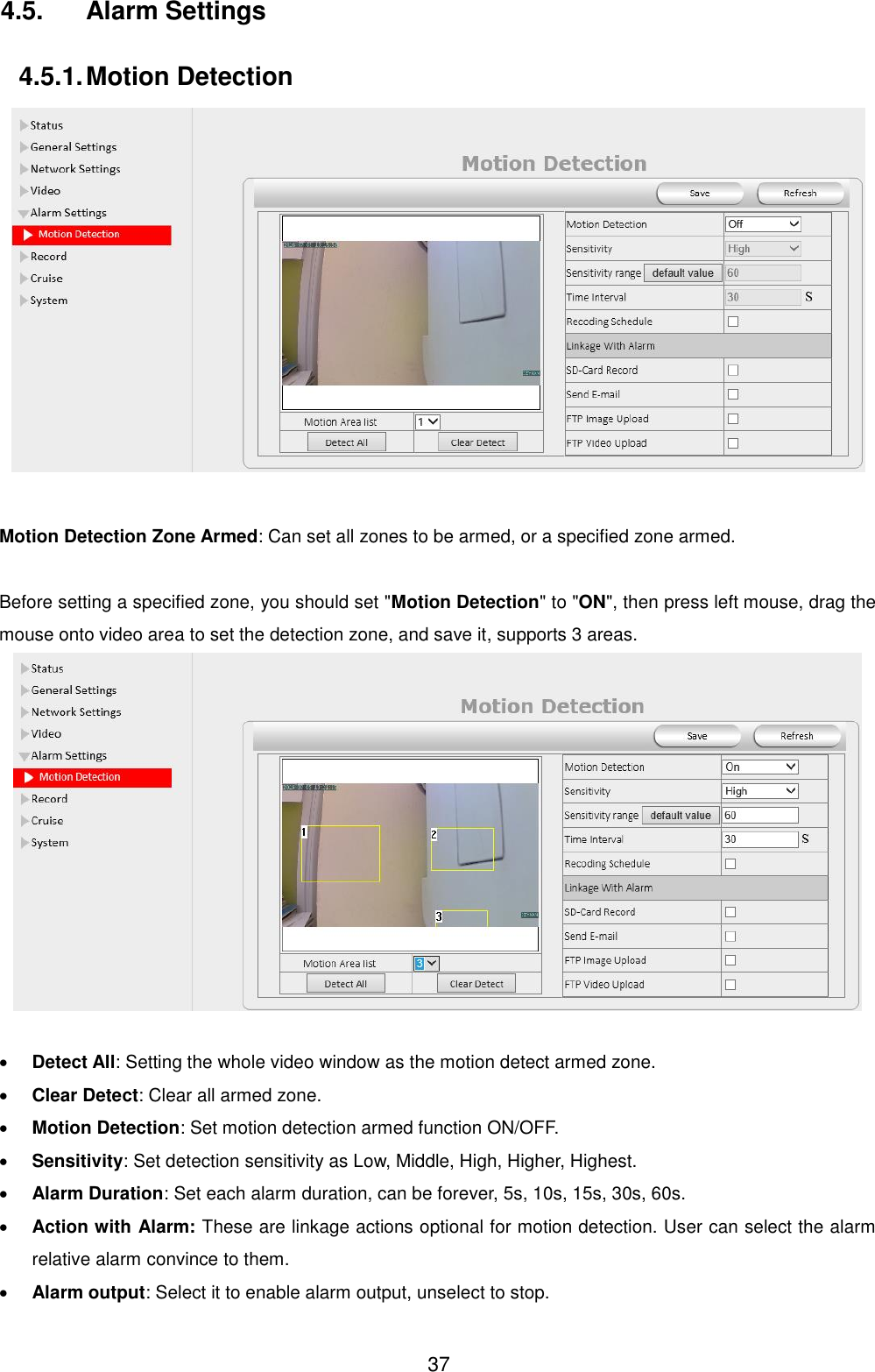
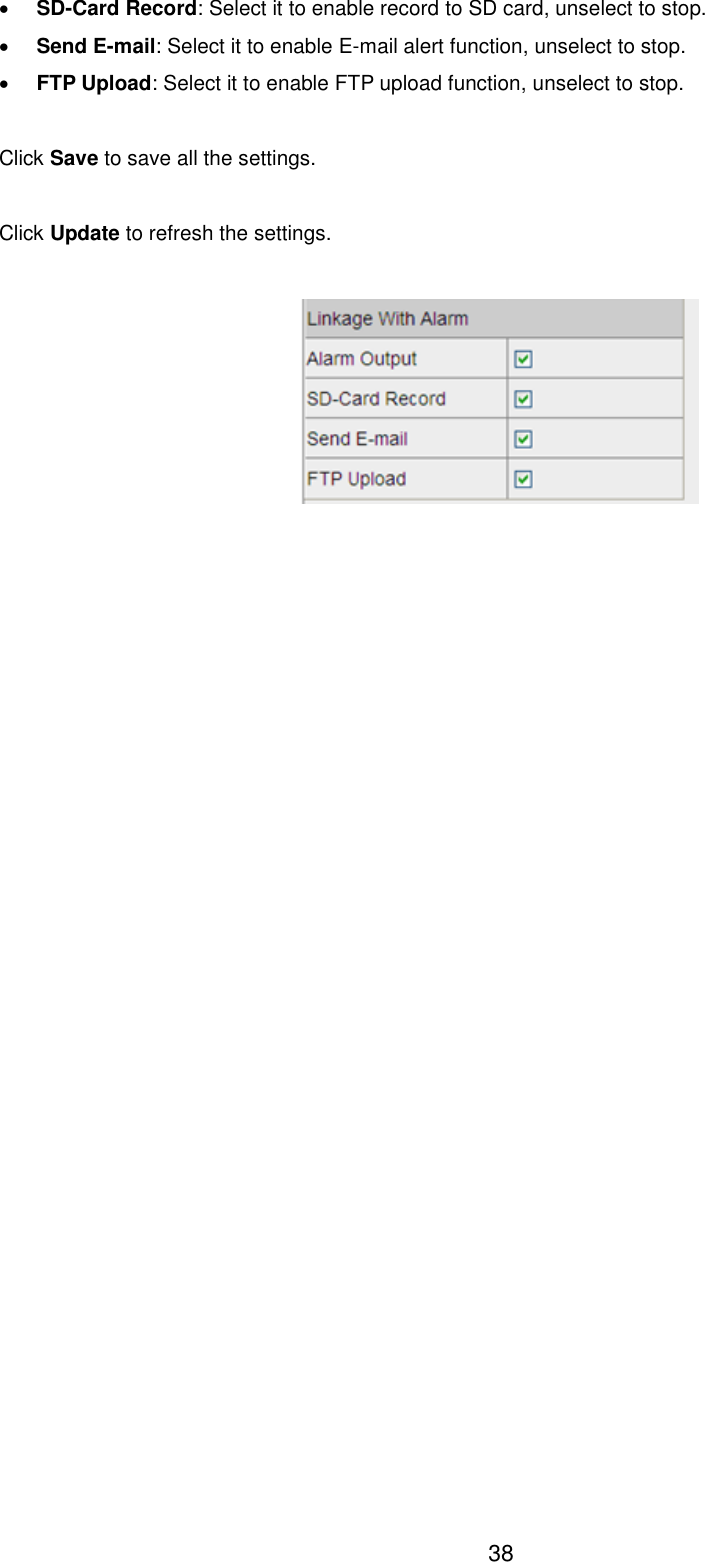
 37 4.5.  Alarm Settings 4.5.1. Motion Detection   Motion Detection Zone Armed: Can set all zones to be armed, or a specified zone armed.  Before setting a specified zone, you should set "Motion Detection" to "ON", then press left mouse, drag the mouse onto video area to set the detection zone, and save it, supports 3 areas.    Detect All: Setting the whole video window as the motion detect armed zone.  Clear Detect: Clear all armed zone.  Motion Detection: Set motion detection armed function ON/OFF.  Sensitivity: Set detection sensitivity as Low, Middle, High, Higher, Highest.  Alarm Duration: Set each alarm duration, can be forever, 5s, 10s, 15s, 30s, 60s.  Action with Alarm: These are linkage actions optional for motion detection. User can select the alarm relative alarm convince to them.  Alarm output: Select it to enable alarm output, unselect to stop.
 38  SD-Card Record: Select it to enable record to SD card, unselect to stop.  Send E-mail: Select it to enable E-mail alert function, unselect to stop.    FTP Upload: Select it to enable FTP upload function, unselect to stop.  Click Save to save all the settings.  Click Update to refresh the settings.
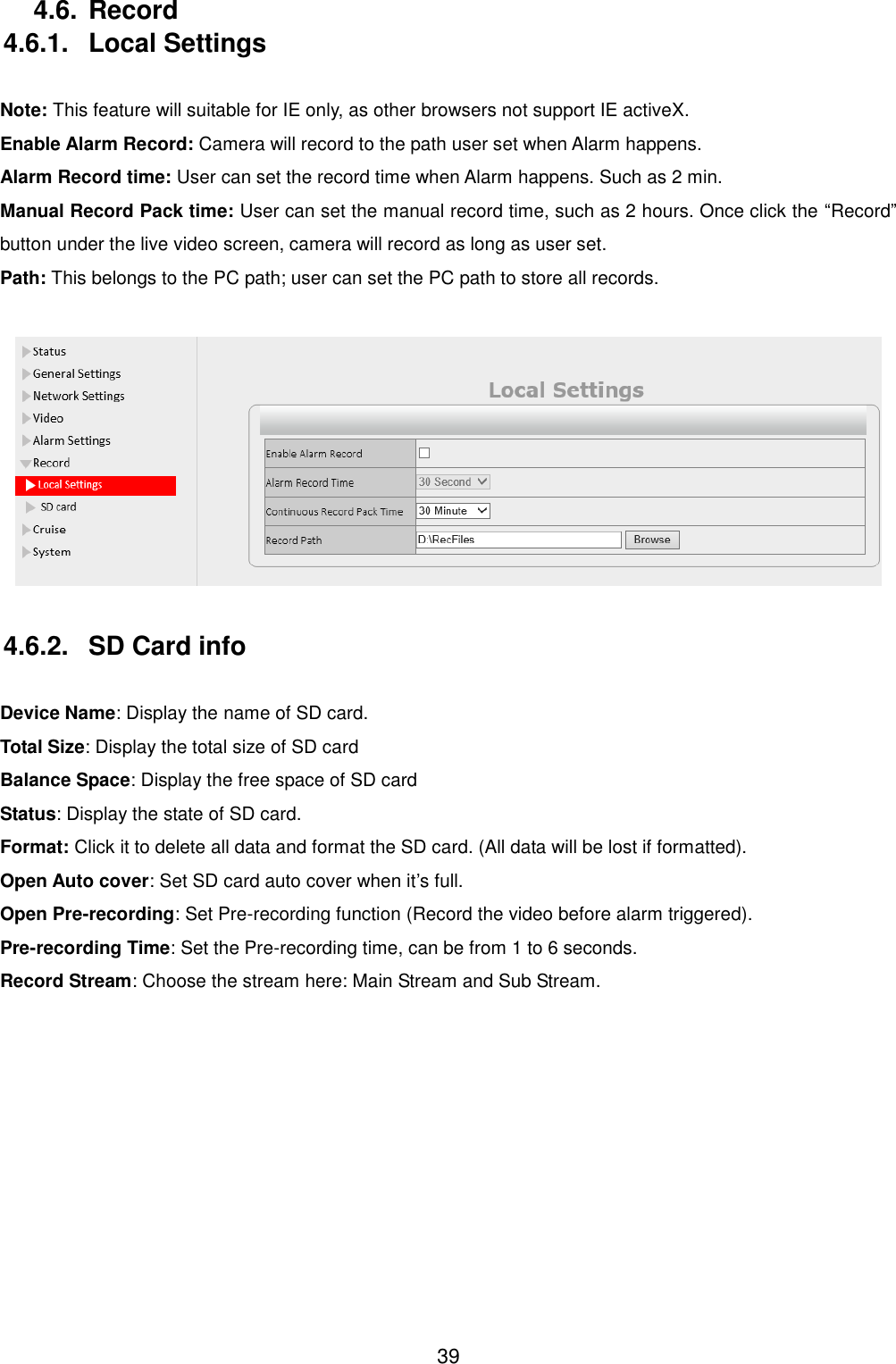
 39 4.6. Record 4.6.1.  Local Settings  Note: This feature will suitable for IE only, as other browsers not support IE activeX. Enable Alarm Record: Camera will record to the path user set when Alarm happens. Alarm Record time: User can set the record time when Alarm happens. Such as 2 min. Manual Record Pack time: User can set the manual record time, such as 2 hours. Once click the “Record” button under the live video screen, camera will record as long as user set. Path: This belongs to the PC path; user can set the PC path to store all records.   4.6.2.  SD Card info  Device Name: Display the name of SD card. Total Size: Display the total size of SD card Balance Space: Display the free space of SD card Status: Display the state of SD card. Format: Click it to delete all data and format the SD card. (All data will be lost if formatted). Open Auto cover: Set SD card auto cover when it’s full.   Open Pre-recording: Set Pre-recording function (Record the video before alarm triggered). Pre-recording Time: Set the Pre-recording time, can be from 1 to 6 seconds. Record Stream: Choose the stream here: Main Stream and Sub Stream.
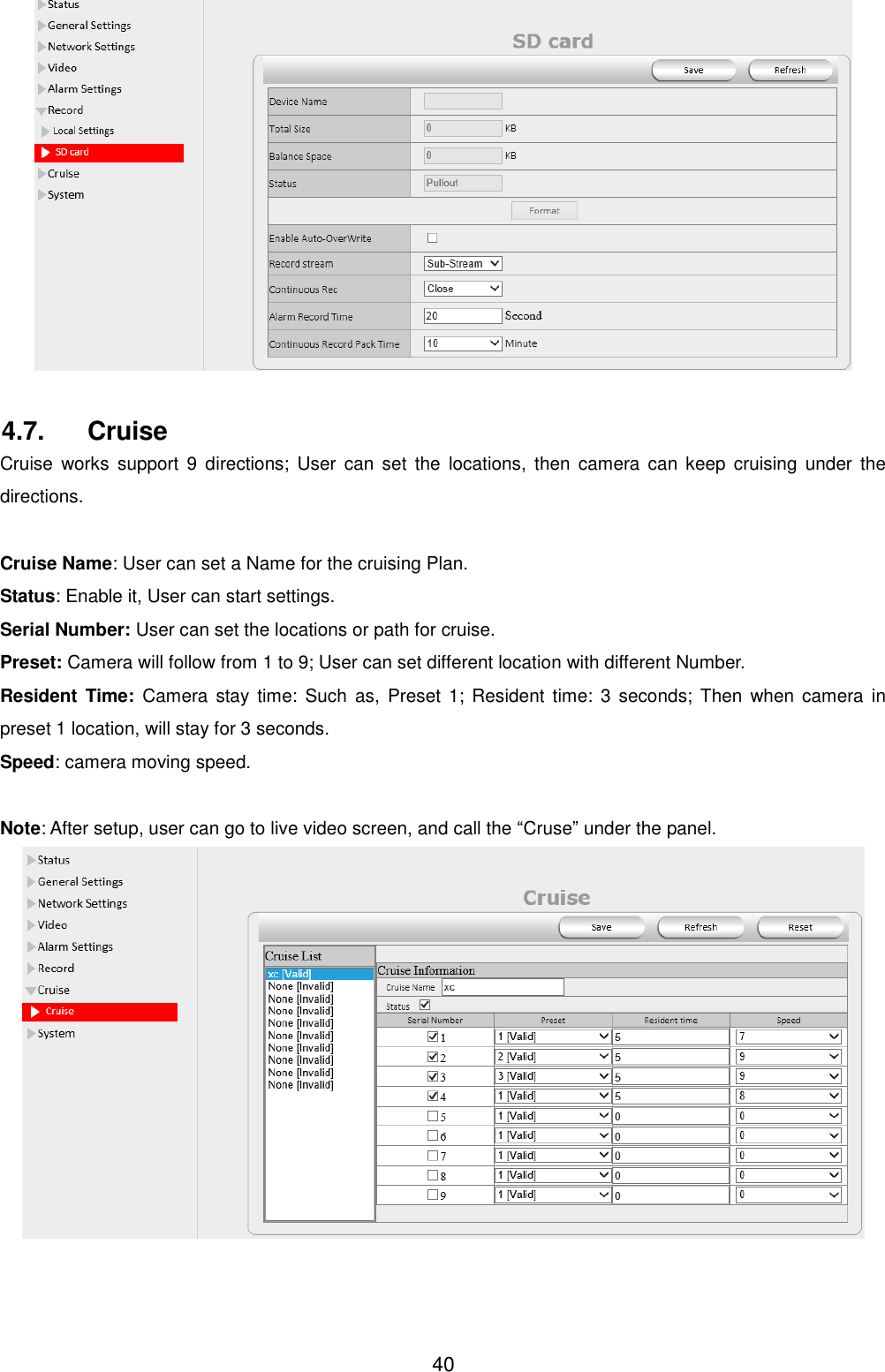
 40  4.7.  Cruise Cruise  works  support  9 directions;  User  can  set  the  locations,  then camera  can  keep  cruising  under  the directions.  Cruise Name: User can set a Name for the cruising Plan. Status: Enable it, User can start settings. Serial Number: User can set the locations or path for cruise. Preset: Camera will follow from 1 to 9; User can set different location with different Number. Resident  Time:  Camera  stay  time: Such  as,  Preset  1;  Resident  time:  3  seconds;  Then  when  camera  in preset 1 location, will stay for 3 seconds. Speed: camera moving speed.  Note: After setup, user can go to live video screen, and call the “Cruse” under the panel.
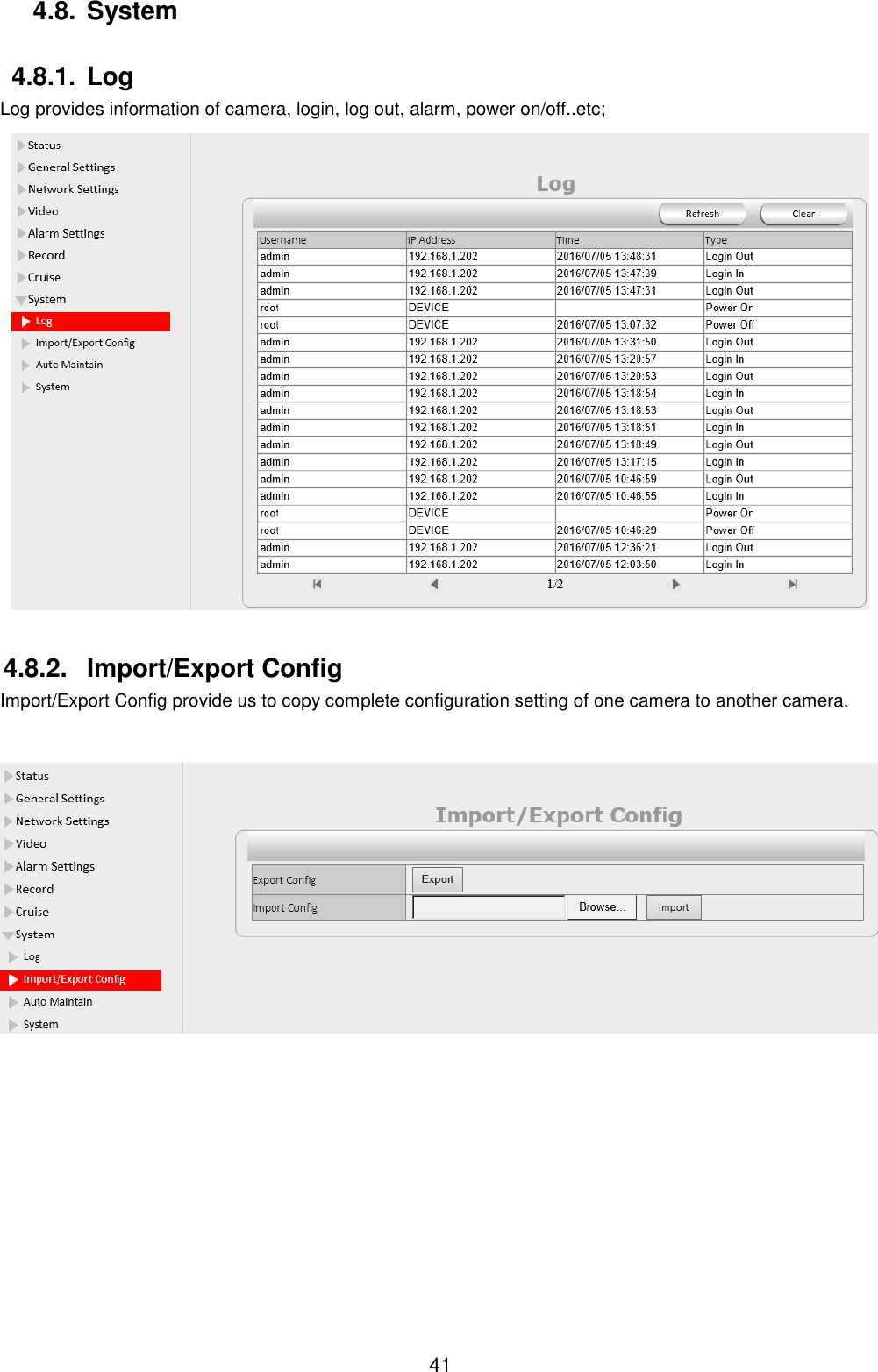
 41 4.8. System 4.8.1. Log Log provides information of camera, login, log out, alarm, power on/off..etc;  4.8.2.  Import/Export Config Import/Export Config provide us to copy complete configuration setting of one camera to another camera.
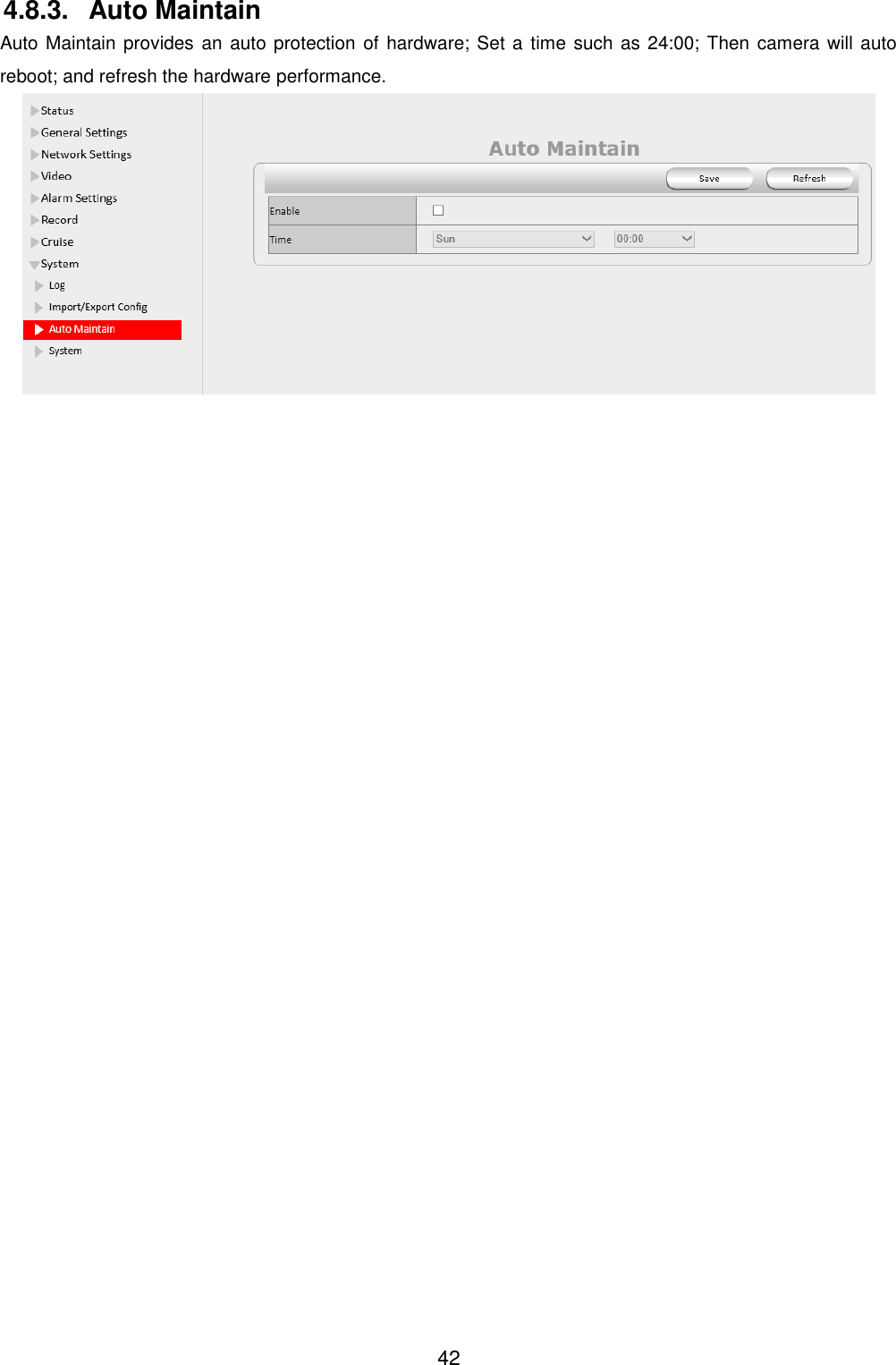
 42 4.8.3.  Auto Maintain Auto Maintain provides an auto protection of hardware; Set a  time such as 24:00; Then camera will auto reboot; and refresh the hardware performance.
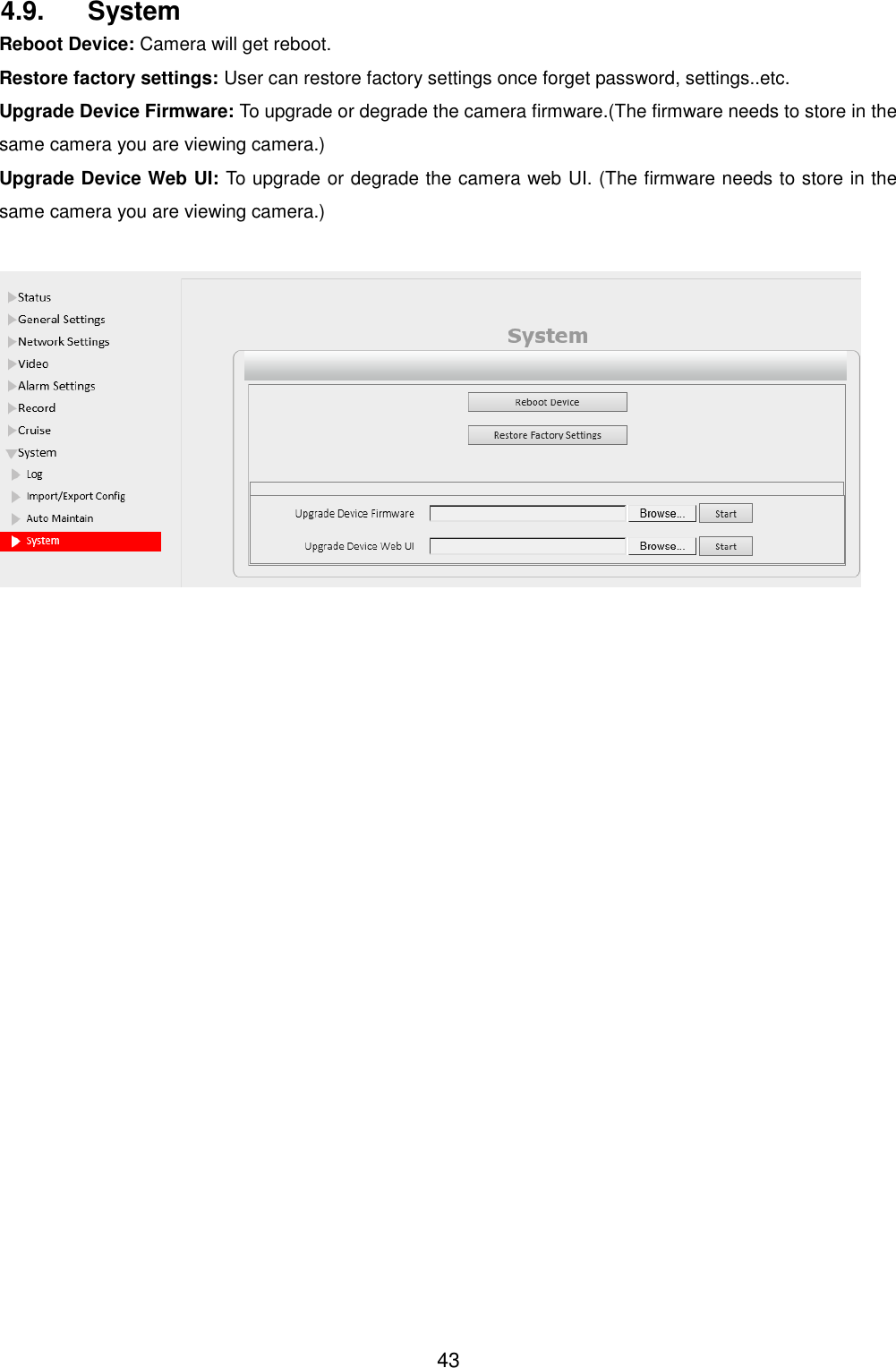
 43 4.9.  System Reboot Device: Camera will get reboot. Restore factory settings: User can restore factory settings once forget password, settings..etc. Upgrade Device Firmware: To upgrade or degrade the camera firmware.(The firmware needs to store in the same camera you are viewing camera.) Upgrade Device Web UI: To upgrade or degrade the camera web UI. (The firmware needs to store in the same camera you are viewing camera.)
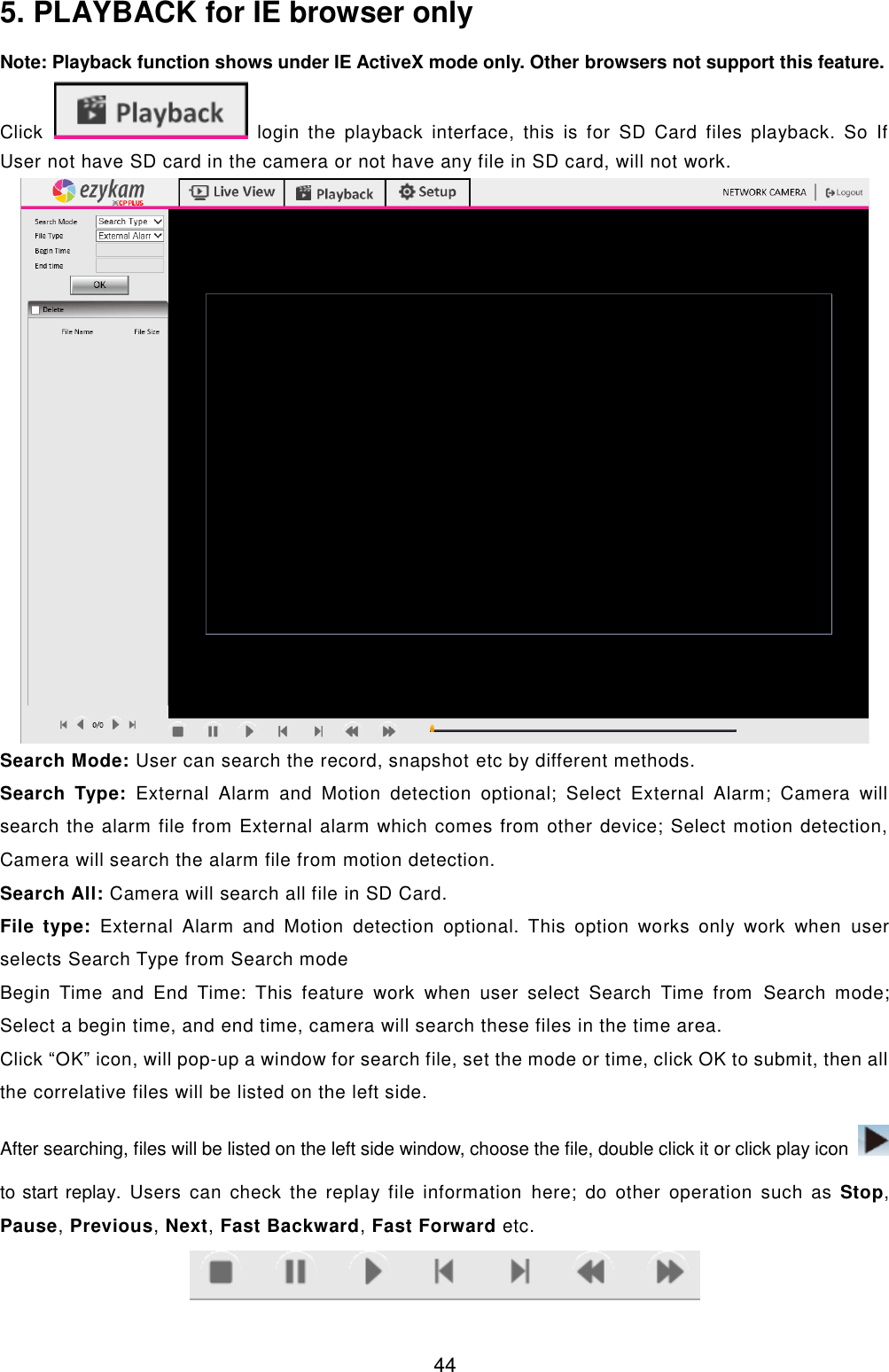
 44 5. PLAYBACK for IE browser only Note: Playback function shows under IE ActiveX mode only. Other browsers not support this feature. Click   login  the  playback  interface,  this  is  for  SD  Card  files  playback.  So  If User not have SD card in the camera or not have any file in SD card, will not work.  Search Mode: User can search the record, snapshot etc by different methods. Search  Type:  External  Alarm  and  Motion  detection  optional;  Select  External  Alarm;  Camera  will search the alarm file from External alarm which comes from other device; Select motion detection, Camera will search the alarm file from motion detection. Search All: Camera will search all file in SD Card. File  type:  External  Alarm  and  Motion  detection  optional.  This  option  works  only  work  when  user selects Search Type from Search mode Begin  Time  and  End  Time:  This  feature  work  when  user  select  Search  Time  from  Search  mode; Select a begin time, and end time, camera will search these files in the time area. Click “OK” icon, will pop-up a window for search file, set the mode or time, click OK to submit, then all the correlative files will be listed on the left side. After searching, files will be listed on the left side window, choose the file, double click it or click play icon   to start replay.  Users can  check  the  replay  file  information  here; do other  operation  such  as  Stop, Pause, Previous, Next, Fast Backward, Fast Forward etc.
 45 6. FREQUENTLY ASKED QUESTIONS  1. I have forgotten the administrator username and/or password There is a [RST] button on the rear panel, keep the power on, hold the reset button for 30 seconds, it will restore back to factory default settings as below: Username: admin Password: admin NOTE: Please don’t press RST button unless you are sure you want to do it.  2. There is no picture displayed in IE browser (For IE only) It maybe the ActiveX problem,   If using the IE browser for the first time, you should install the ActiveX control, details as below: Before login, click the EzykamOCX at the right side of interface to download, save the file, run it to install the ActiveX.  3. Fail to visit IP camera via IE after upgrading (For IE Only) Solution: Clear the browser buffer. Steps: Open IE>click “Tools”> “Internet Options”>“General”>“Delete”> “Internet temporary files”, delete the cookies and temporary files, then click “OK” and re-login.  4. The video is not smooth Possible reason 1: The frame rate value is too small. Solution: Increase the frame rate value. Possible reason 2: Too many users are connecting to the device. Solution: Close some connection or reduce the video frame rate. Possible reason 3: Network bandwidth is too low, lots of lost packets. Solution: Reduce the video frame rate or video compression bit rate.  5.  Fail to visit IP camera via IE browser Possible Reason 1: Network is disconnected. Solution:  Connect  your  PC  to  network,  check  whether  the  network  works  well  or  not. Check  if  there’s  a problem with the cable connection, or network problem caused by PC virus. Possible reason 2: IP Address has been occupied by other devices. Solution: Stop the connection between IP camera and network; connect the IP camera to PC. Directly reset IP address according to the proper operations recommended. Possible reason 3: IP addresses are in different subnets. Solution: Check IP address, Subnet masking and Gateway. Possible reason 4: Physical address of network conflicts with the IP camera. Solution: modify the physical address of IP camera.
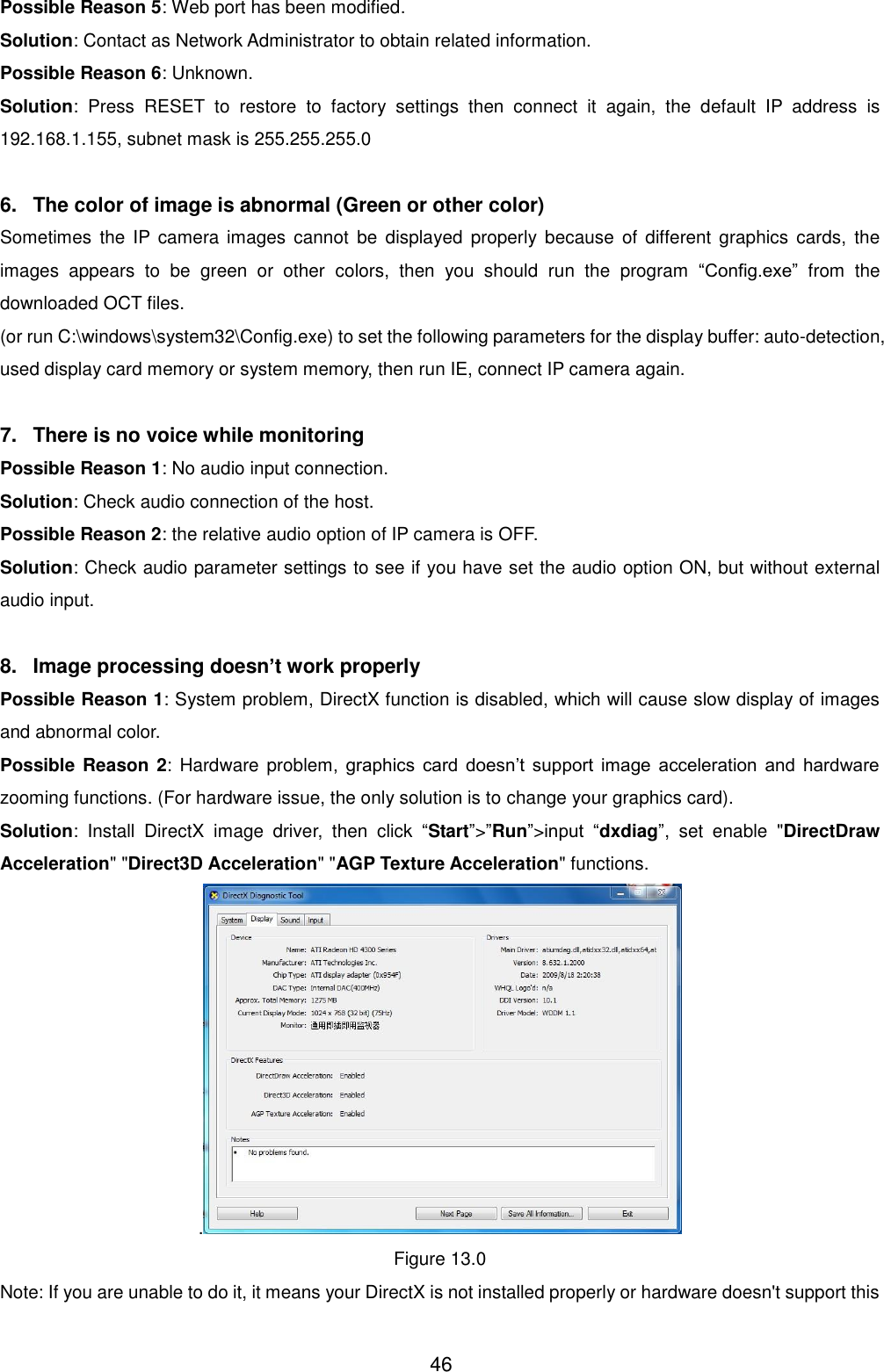
 46 Possible Reason 5: Web port has been modified. Solution: Contact as Network Administrator to obtain related information. Possible Reason 6: Unknown. Solution:  Press  RESET  to  restore  to  factory  settings  then  connect  it  again,  the  default  IP  address  is 192.168.1.155, subnet mask is 255.255.255.0  6.  The color of image is abnormal (Green or other color) Sometimes  the  IP camera  images  cannot  be  displayed  properly  because  of different  graphics  cards,  the images  appears  to  be  green  or  other  colors,  then  you  should  run  the  program  “Config.exe”  from  the downloaded OCT files. (or run C:\windows\system32\Config.exe) to set the following parameters for the display buffer: auto-detection, used display card memory or system memory, then run IE, connect IP camera again.  7.  There is no voice while monitoring Possible Reason 1: No audio input connection. Solution: Check audio connection of the host. Possible Reason 2: the relative audio option of IP camera is OFF. Solution: Check audio parameter settings to see if you have set the audio option ON, but without external audio input.  8.  Image processing doesn’t work properly Possible Reason 1: System problem, DirectX function is disabled, which will cause slow display of images and abnormal color. Possible Reason  2:  Hardware  problem,  graphics  card  doesn’t  support  image  acceleration  and  hardware zooming functions. (For hardware issue, the only solution is to change your graphics card). Solution:  Install  DirectX  image  driver,  then  click  “Start”>”Run”>input  “dxdiag”,  set  enable  "DirectDraw Acceleration" "Direct3D Acceleration" "AGP Texture Acceleration" functions.   . Figure 13.0 Note: If you are unable to do it, it means your DirectX is not installed properly or hardware doesn't support this
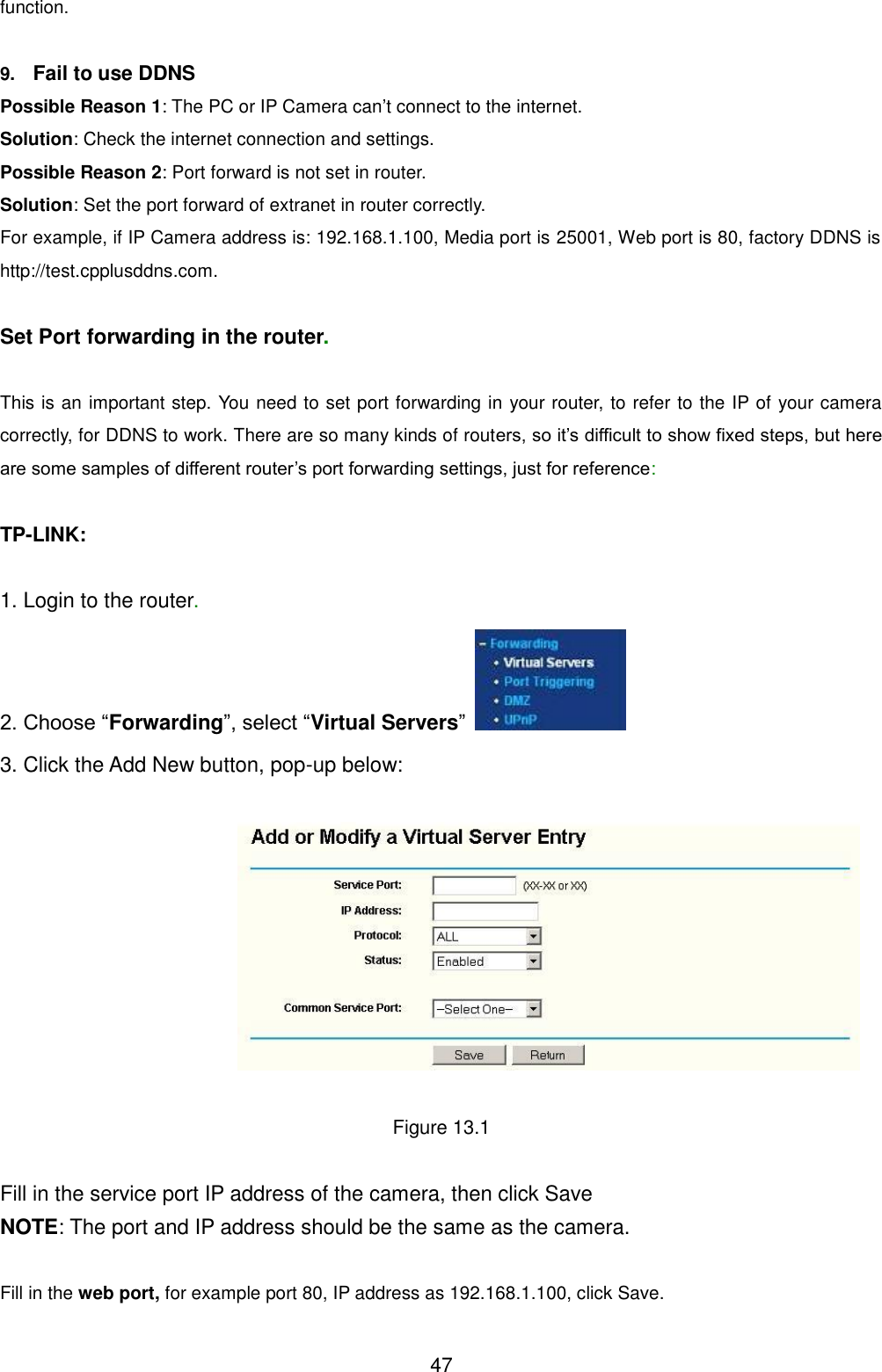
 47 function.  9. Fail to use DDNS Possible Reason 1: The PC or IP Camera can’t connect to the internet. Solution: Check the internet connection and settings. Possible Reason 2: Port forward is not set in router. Solution: Set the port forward of extranet in router correctly. For example, if IP Camera address is: 192.168.1.100, Media port is 25001, Web port is 80, factory DDNS is http://test.cpplusddns.com.    Set Port forwarding in the router.  This is an important step. You need to set port forwarding in your router, to refer to the IP of your camera correctly, for DDNS to work. There are so many kinds of routers, so it’s difficult to show fixed steps, but here are some samples of different router’s port forwarding settings, just for reference:  TP-LINK:  1. Login to the router. 2. Choose “Forwarding”, select “Virtual Servers”   3. Click the Add New button, pop-up below:    Figure 13.1  Fill in the service port IP address of the camera, then click Save NOTE: The port and IP address should be the same as the camera.  Fill in the web port, for example port 80, IP address as 192.168.1.100, click Save.
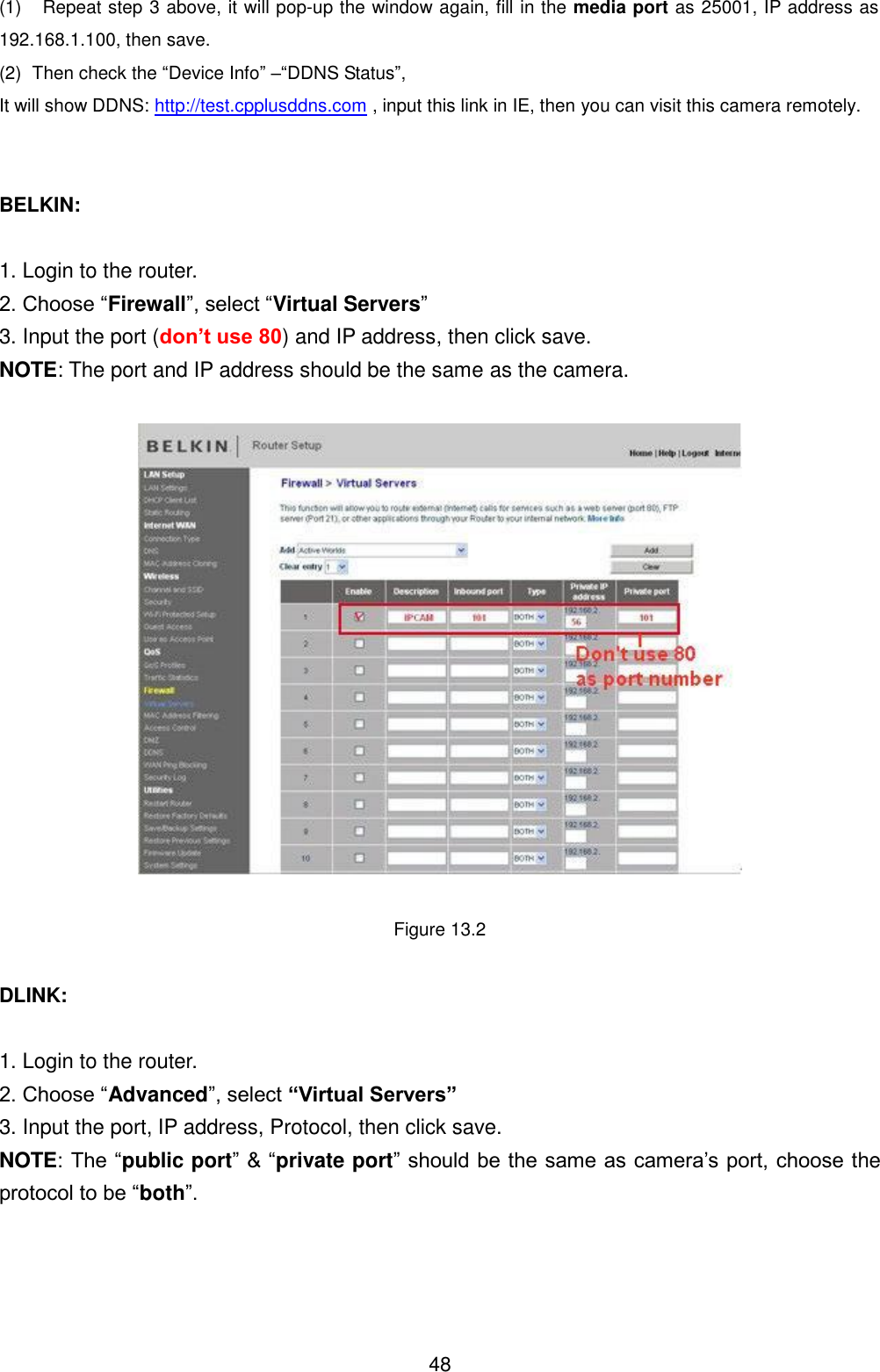
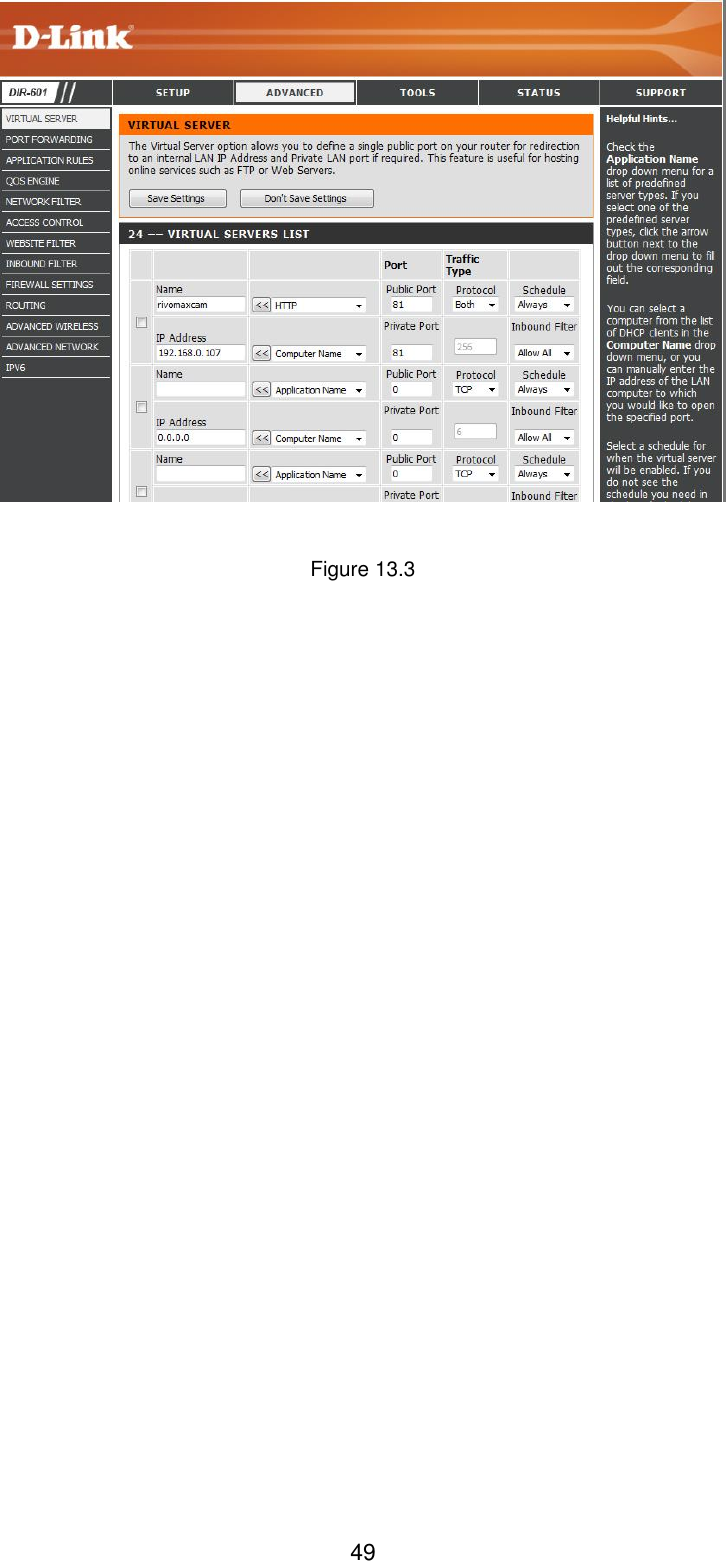
 48 (1)  Repeat step 3 above, it will pop-up the window again, fill in the media port as 25001, IP address as 192.168.1.100, then save. (2)  Then check the “Device Info” –“DDNS Status”,   It will show DDNS: http://test.cpplusddns.com , input this link in IE, then you can visit this camera remotely.   BELKIN:  1. Login to the router. 2. Choose “Firewall”, select “Virtual Servers” 3. Input the port (don’t use 80) and IP address, then click save. NOTE: The port and IP address should be the same as the camera.    Figure 13.2  DLINK:  1. Login to the router. 2. Choose “Advanced”, select “Virtual Servers” 3. Input the port, IP address, Protocol, then click save. NOTE: The “public port” & “private port” should be the same as camera’s port, choose the protocol to be “both”.
 49   Figure 13.3
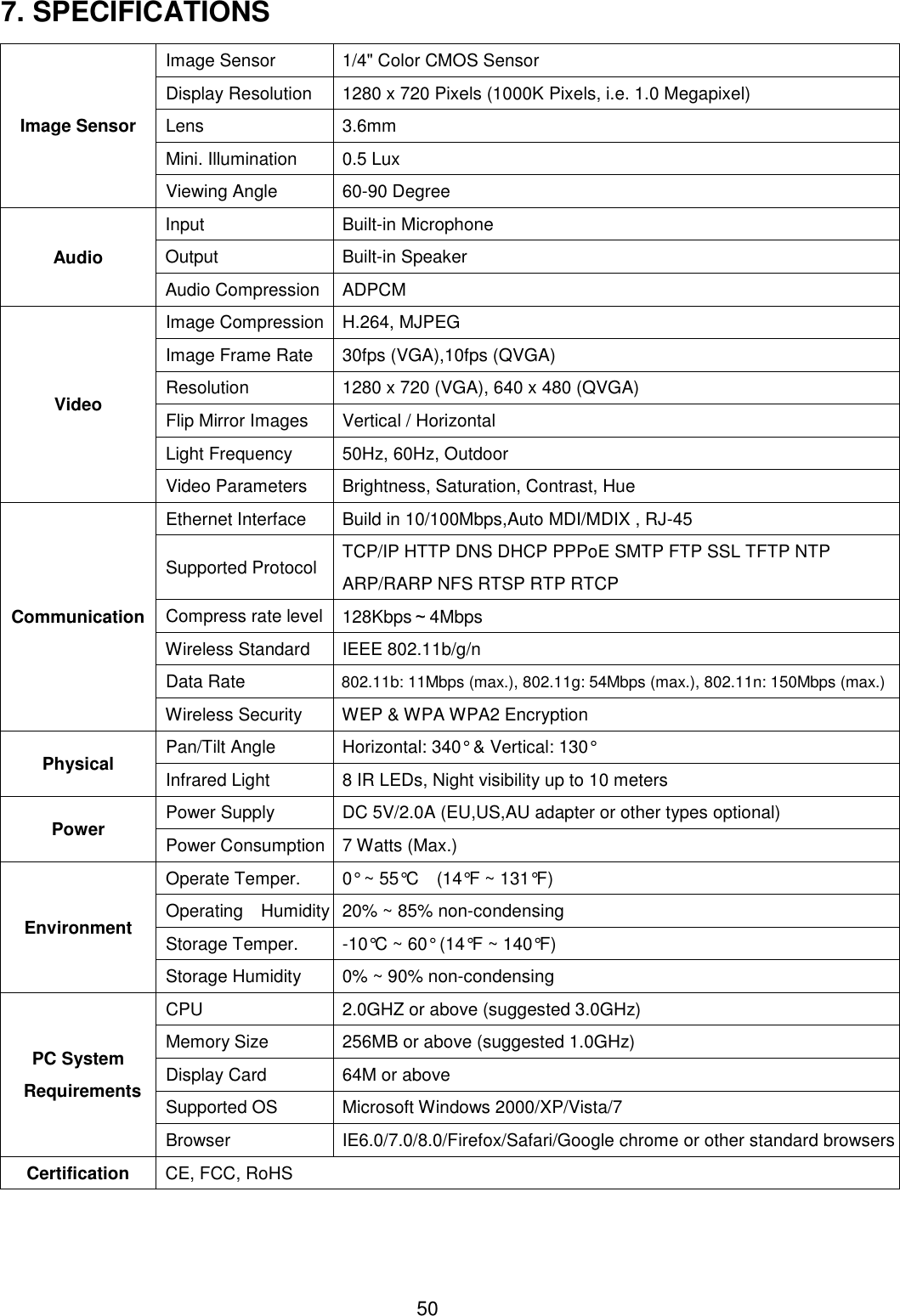
 50 7. SPECIFICATIONS Image Sensor   Image Sensor  1/4" Color CMOS Sensor   Display Resolution     1280 x 720 Pixels (1000K Pixels, i.e. 1.0 Megapixel)   Lens     3.6mm   Mini. Illumination  0.5 Lux   Viewing Angle  60-90 Degree Audio  Input   Built-in Microphone   Output   Built-in Speaker   Audio Compression   ADPCM Video   Image Compression   H.264, MJPEG   Image Frame Rate   30fps (VGA),10fps (QVGA)   Resolution   1280 x 720 (VGA), 640 x 480 (QVGA)   Flip Mirror Images   Vertical / Horizontal   Light Frequency   50Hz, 60Hz, Outdoor   Video Parameters   Brightness, Saturation, Contrast, Hue Communication   Ethernet Interface   Build in 10/100Mbps,Auto MDI/MDIX , RJ-45   Supported Protocol     TCP/IP HTTP DNS DHCP PPPoE SMTP FTP SSL TFTP NTP       ARP/RARP NFS RTSP RTP RTCP   Compress rate level   128Kbps~4Mbps   Wireless Standard   IEEE 802.11b/g/n   Data Rate   802.11b: 11Mbps (max.), 802.11g: 54Mbps (max.), 802.11n: 150Mbps (max.)   Wireless Security   WEP & WPA WPA2 Encryption Physical   Pan/Tilt Angle   Horizontal: 340° & Vertical: 130°   Infrared Light   8 IR LEDs, Night visibility up to 10 meters Power   Power Supply   DC 5V/2.0A (EU,US,AU adapter or other types optional)   Power Consumption   7 Watts (Max.) Environment   Operate Temper.   0° ~ 55°C    (14°F ~ 131°F)   Operating    Humidity   20% ~ 85% non-condensing   Storage Temper.   -10°C ~ 60° (14°F ~ 140°F)   Storage Humidity   0% ~ 90% non-condensing PC System Requirements   CPU   2.0GHZ or above (suggested 3.0GHz)   Memory Size   256MB or above (suggested 1.0GHz)   Display Card   64M or above   Supported OS   Microsoft Windows 2000/XP/Vista/7   Browser   IE6.0/7.0/8.0/Firefox/Safari/Google chrome or other standard browsers Certification   CE, FCC, RoHS
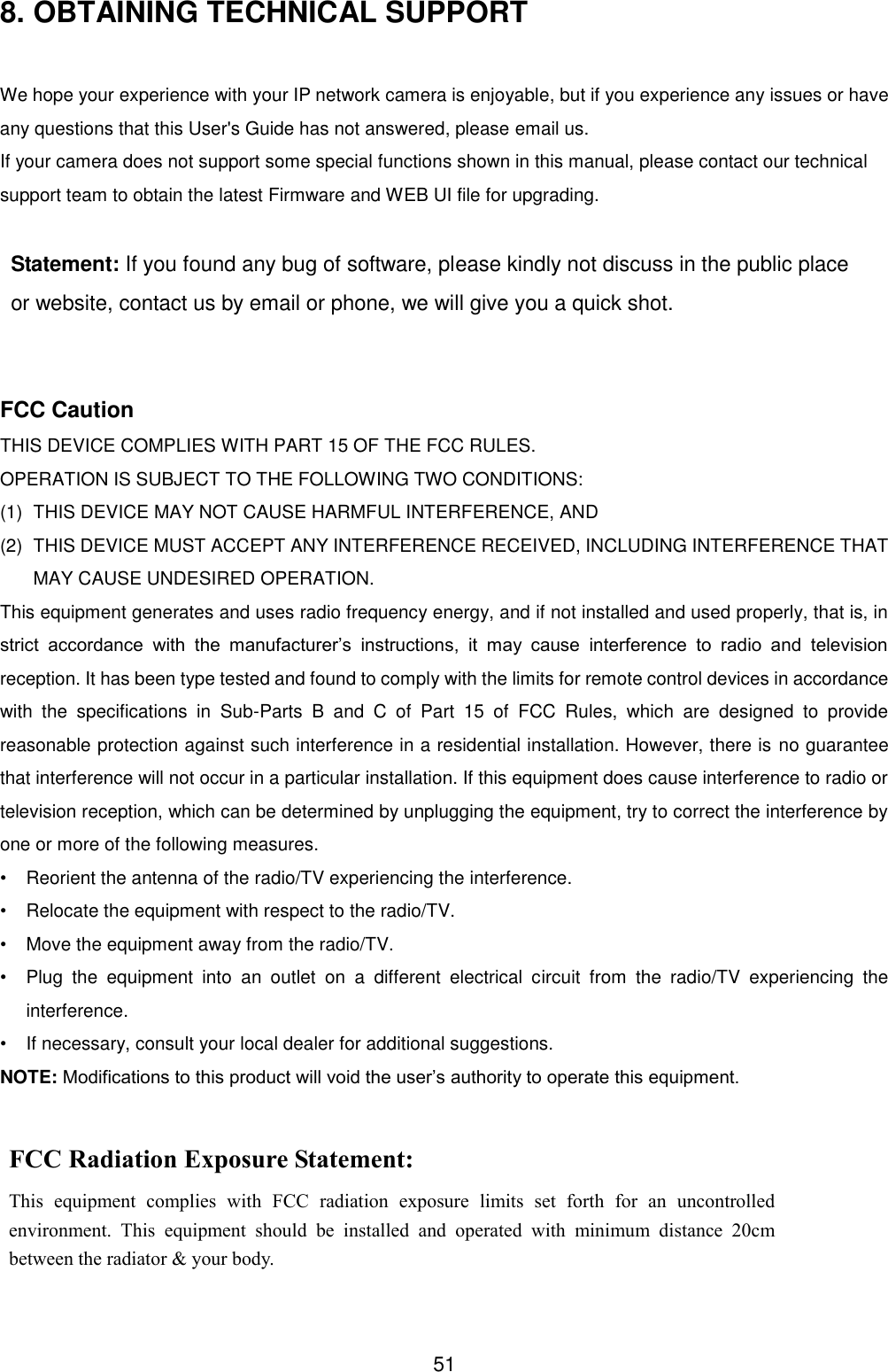
 51 8. OBTAINING TECHNICAL SUPPORT  We hope your experience with your IP network camera is enjoyable, but if you experience any issues or have any questions that this User's Guide has not answered, please email us.   If your camera does not support some special functions shown in this manual, please contact our technical support team to obtain the latest Firmware and WEB UI file for upgrading.  Statement: If you found any bug of software, please kindly not discuss in the public place or website, contact us by email or phone, we will give you a quick shot.   FCC Caution THIS DEVICE COMPLIES WITH PART 15 OF THE FCC RULES. OPERATION IS SUBJECT TO THE FOLLOWING TWO CONDITIONS:   (1)   THIS DEVICE MAY NOT CAUSE HARMFUL INTERFERENCE, AND (2)   THIS DEVICE MUST ACCEPT ANY INTERFERENCE RECEIVED, INCLUDING INTERFERENCE THAT MAY CAUSE UNDESIRED OPERATION. This equipment generates and uses radio frequency energy, and if not installed and used properly, that is, in strict  accordance  with  the  manufacturer’s  instructions,  it  may  cause  interference  to  radio  and  television reception. It has been type tested and found to comply with the limits for remote control devices in accordance with  the  specifications  in  Sub-Parts  B  and  C  of  Part  15  of  FCC  Rules,  which  are  designed  to  provide reasonable protection against such interference in a residential installation. However, there is no guarantee that interference will not occur in a particular installation. If this equipment does cause interference to radio or television reception, which can be determined by unplugging the equipment, try to correct the interference by one or more of the following measures. •  Reorient the antenna of the radio/TV experiencing the interference. •  Relocate the equipment with respect to the radio/TV. •  Move the equipment away from the radio/TV. •  Plug  the  equipment  into  an  outlet  on  a  different  electrical  circuit  from  the  radio/TV  experiencing  the interference. •  If necessary, consult your local dealer for additional suggestions. NOTE: Modifications to this product will void the user’s authority to operate this equipment. FCC Radiation Exposure Statement: This  equipment  complies  with  FCC  radiation  exposure  limits  set  forth  for  an  uncontrolled environment.  This  equipment  should  be  installed  and  operated  with  minimum  distance  20cm between the radiator & your body.

Navigation menu