CUB CADET Lawn, Tractor Manual L0403366
User Manual: CUB CUB CADET Lawn, Tractor Manual CUB CADET Lawn, Tractor Owner's Manual, CUB CADET Lawn, Tractor installation guides
Open the PDF directly: View PDF  .
.
Page Count: 36
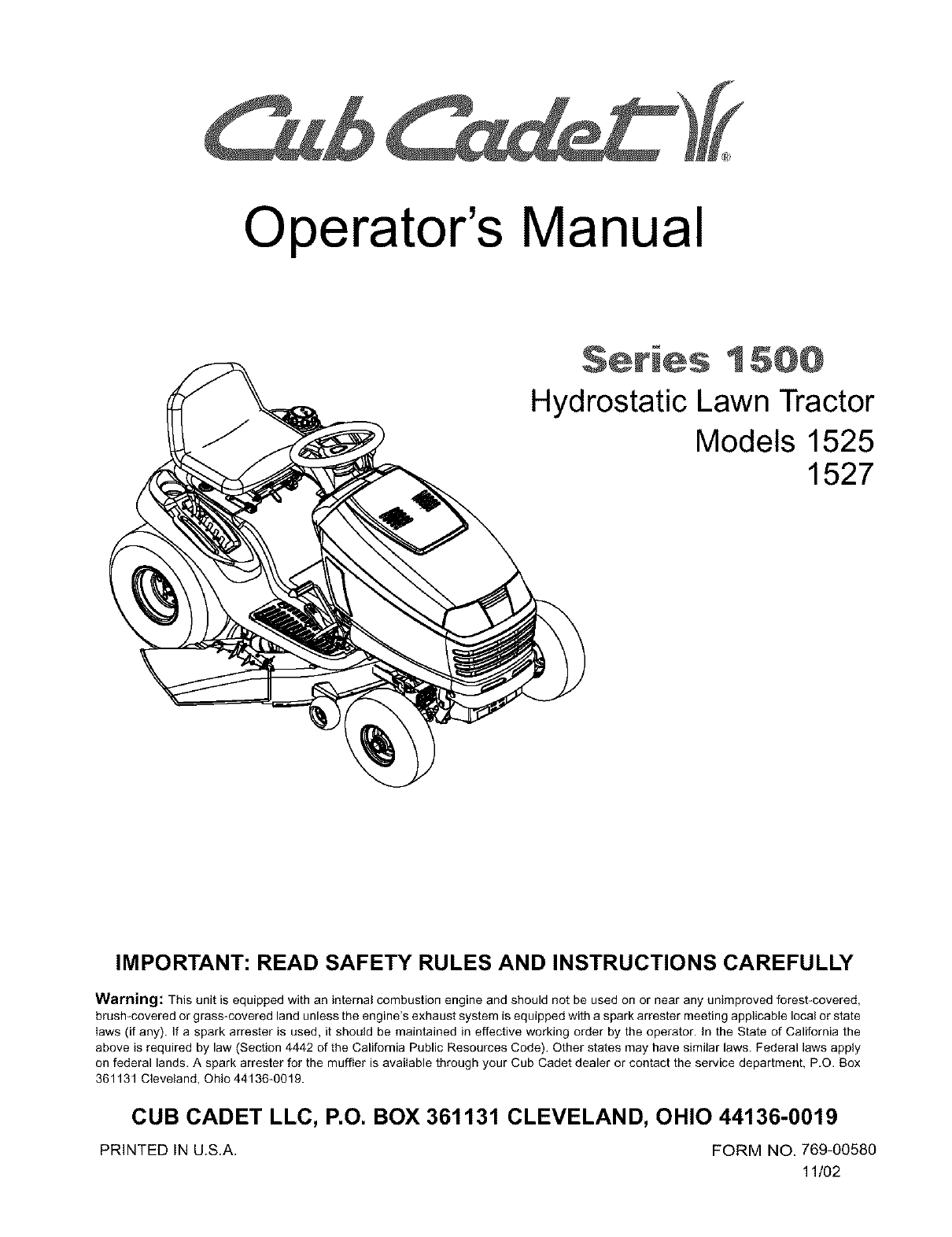
Operator's Manual
1
Hydrostatic Lawn Tractor
Models 1525
1527
IMPORTANT: READ SAFETY RULES AND INSTRUCTIONS CAREFULLY
Warning: This unit is equipped with an internal combustion engine and should not be used on or near any unimproved forest-covered,
brush-covered or grass-covered land unless the engine's exhaust system is equipped with a spark attester meeting applicable local or state
Iaws (if any). If a spark attester is used, it should be maintained in effective working order by the operator. In the State of California the
above is required by law (Section 4442 of the California Public Resources Code). Other states may have similar laws. Federal laws apply
on federal lands. A spark attester for the muffler is avaiIable through your Cub Cadet dealer or contact the service department, P.O. Box
361131 Cleveland, Ohio 44136-0019.
CUB CADET LLC, P.O. BOX 361131 CLEVELAND, OHIO 44136-0019
PRINTED IN U.S.A. FORM NO. 769-00580
11/02
TABLEOFCONTENTS
Content Page
Important Safe Operation Practices ............................................................................... 3
Slope Gauge .................................................................................................................. 7
Tractor Set-up ................................................................................................................ 8
Know Your Lawn Tractor ................................................................................................ 9
Operating Your Lawn Tractor ......................................................................................... 12
Making Adjustments ....................................................................................................... 16
Maintaining Your Lawn Tractor ....................................................................................... 19
Service ........................................................................................................................... 24
Off-Season Storage ....................................................................................................... 29
Maintenance Chart ......................................................................................................... 29
Troubleshooting ............................................................................................................. 30
Specifications ................................................................................................................. 31
Attachments & Accessories ............................................................................................ 32
Warranty Information ...................................................................................................... 33
FINDINGMODELNUMBER
This Operator's Manual is an important part of your new lawn tractor. It will help you assemble, prepare and
maintain the unit for best performance. Please read and understand what it says.
Before you start assembling your new equipment, please locate the model plate on the
equipment and copy the information from it in the space provided below. The information on the
model plate is very important if you need help from your Cub Cadet dealer.
You can locate the model number by looking beneath the seat. A sample model plate is explained below. For
future reference, please copy the model number and the serial number of the equipment in the space below.
Copy the model number here:
I_,_IC_i_R,_, CUB CADET LLC
P. O. BOX 361131
www.cubcadet.com CLEVELAND, OH 44136
•DEALER LOCATOR PHONE NUMBER: 877-282-8684 •
Copy the serial number here:
CALLINGCUSTOMERSUPPORT
If you have difficulty assembling this product or have any questions regarding the controls, operation or
maintenance of this unit, please call the Customer Dealer Referral Line.
Call 1- (877) 282-8684 to reach the Customer Dealer Referral Line. Please have your unit's model
number and serial number ready when you call. See previous section to locate this information.
SECTION1: IMPORTANTSAFEOPERATIONPRACTICES
WARNING: This symbol points out important safety instructions which, if not followed, could endanger
the personal safety and/or property of yourself and others. Read and follow all instructions in this manual
before attempting to operate this machine. Failure to comply with these instructions may result in personal
injury. When you see this symbol--heed its warning.
DANGER: This machine was built to be operated according to the rules for safe operation in this man-
ual. As with any type of power equipment, carelessness or error on the part of the operator can result in
serious injury. This machine is capable of amputating hands and feet and throwing objects. Failure to
observe the following safety instructions could result in serious injury or death.
California Proposition 65 Warning:
,_ WARNING: Engine exhaust, some of its constituents, and certain vehicle components contain
or emit chemicals known to the State of California to cause cancer and birth defects or other
reproductive harm.
GENERAL OPERATION
1. Read, understand, and follow all instructions on the
machine and in the manual(s) before attempting to
assemble and operate. Keep this manual in a safe
place for future and regular reference and for
ordering replacement parts.
2. Be familiar with all controls and their proper
operation. Know how to stop the machine and
disengage them quickly.
3. Never allow children under 14 years old to operate
this machine. Children 14 years old and over
should read and understand the operation
instructions and safety rules in this manual and
should be trained and supervised by a parent.
4. Never allow adults to operate this machine without
proper instruction.
5. To help avoid blade contact or a thrown object
injury, keep bystanders, helpers, children and pets
at least 75 feet from the machine while it is in
operation. Stop machine if anyone enters the area.
6. Thoroughly inspect the area where the equipment
is to be used. Remove all stones, sticks, wire,
bones, toys, and other foreign objects which could
be picked up and thrown by the blade(s). Thrown
objects can cause serious personal injury.
7. Plan your mowing pattern to avoid discharge of
material toward roads, sidewalks, bystanders and
the like. Also, avoid discharging material against a
wall or obstruction which may cause discharged
material to ricochet back toward the operator.
8. Always wear safety glasses or safety goggles
during operation and while performing an
adjustment or repair to protect your eyes. Thrown
objects which ricochet can cause serious injury to
the eyes.
9. Wear sturdy, rough-soled work shoes and close-
fitting slacks and shirts. Loose fitting clothes and
jewelry can be caught in movable parts. Never
operate this machine in bare feet or sandals.
10. Be aware of the mower and attachment discharge
direction and do not point it at anyone. Do not
operate the mower without the discharge cover or
entire grass catcher in its proper place.
11. Do not put hands or feet near rotating parts or
under the cutting deck. Contact with the blade(s)
can amputate hands and feet.
12. A missing or damaged discharge cover can cause
blade contact or thrown object injuries.
13. Stop the blade(s) when crossing gravel drives,
walks, or roads and while not cutting grass.
14. Watch for traffic when operating near or crossing
roadways. This machine is not intended for use on
any public roadway.
15. Do not operate the machine while under the
influence of alcohol or drugs.
16. Mow only in daylight or good artificial light.
17. Never carry passengers.
18. Disengage blade(s) before travelling in reverse.
Back up slowly. Always look down and behind
before and while backing to avoid a back-over
accident.
19. Slow down before turning. Operate the machine
smoothly. Avoid erratic operation and excessive
speed.
20. Disengage blade(s), set parking brake, stop engine
and wait until the blade(s) come to a complete stop
before removing grass catcher, emptying grass,
unclogging chute, removing any grass or debris, or
making any adjustments.
21. Never leave a running machine unattended. Always
turn off blade(s), place transmission in neutral, set
parking brake, stop engine and remove key before
dismounting.
22. Use extra care when loading or unloading the
machine into a trailer or truck. This unit should not
be driven up or down ramp(s), because the unit
could tip over, causing serious personal injury. The
unit must be pushed manually on ramp(s) to load or
unload properly.
23.Mufflerandenginebecomehotandcancausea
burn.Donottouch.
24.Checkoverheadclearancescarefullybeforedriving
underlowhangingtreebranches,wires,door
openingsetc.,wheretheoperatormaybestruckor
pulledfromtheunit,whichcouldresultinserious
injury,
25. Disengageallattachmentclutches,depressthe
brakepedalcompletelybeforeattemptingtostart
engine.
26.Yourmachineisdesignedtocutnormalresidential
grassofa heightnomorethan10".Donotattempt
tomowthroughunusuallytall,drygrass(e.g.,
pasture)orpilesofdryleaves.Drygrassorleaves
maycontacttheengineexhaustand/orbuildupon
themowerdeckpresentingapotentialfirehazard.
27. Useonlyaccessoriesandattachmentsapproved
forthismachinebythemachinemanufacturer.
Read,understandandfollowallinstructions
providedwiththeapprovedaccessoryor
attachment.
28. Dataindicatesthatoperators,age60yearsand
above,areinvolvedina largepercentageofriding
mower-relatedinjuries.Theseoperatorsshould
evaluatetheirabilitytooperatetheridingmower
safelyenoughtoprotectthemselvesandothers
fromseriousinjury.
29. Ifsituationsoccurwhicharenotcoveredinthis
manual,usecareandgoodjudgment.Contactyour
Cub Cadet dealer for assistance.
SLOPE OPERATION
Slopes are a major factor related to loss of control and
tip-over accidents which can result in severe injury or
death. All slopes require extra caution. If you cannot
back up the slope or if you feel uneasy on it, do not mow
it.
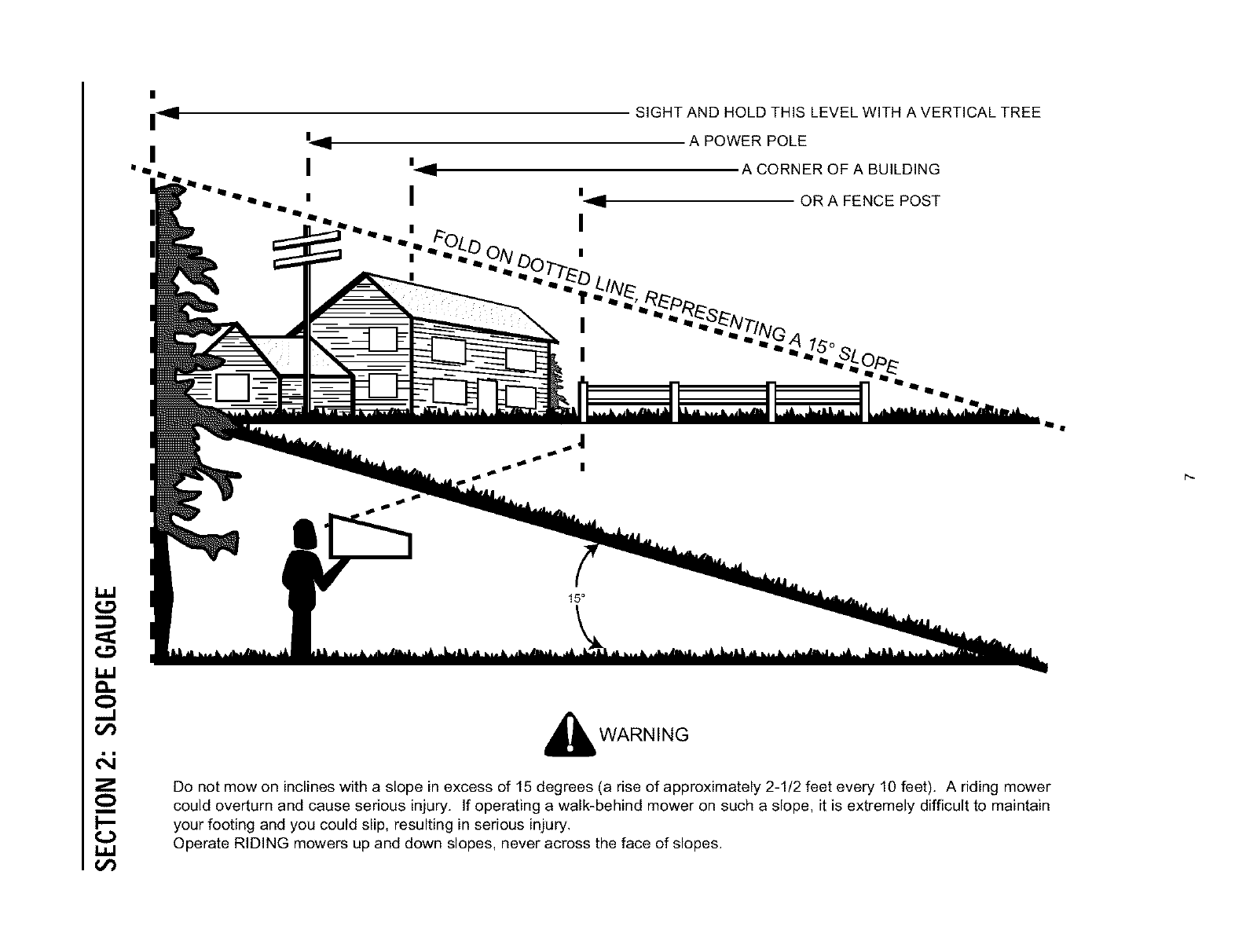
For your safety, use the slope gauge included as part of
this manual to measure slopes before operating this
unit on a sloped or hilly area. If the slope is greater than
15 degrees as shown on the slope gauge, do not
operate this unit on that area or serious injury could
result.
DO:
1. Mow up and down slopes, not across. Exercise
extreme caution when changing direction on
slopes.
2. Watch for holes, ruts, bumps, rocks, or other
hidden objects. Uneven terrain could overturn the
machine. Tall grass can hide obstacles.
3. Use slow speed. Choose a low enough speed
setting so that you will not have to stop while on the
slope. Tires may lose traction on slopes even
though the brakes are functioning properly. Always
keep machine in gear when going down slopes to
take advantage of engine braking action.
4. Follow the manufacturer's recommendations for
wheel weights or counterweights to improve
stability.
5. Use extra care with grass catchers or other
attachments. These can change the stability of the
machine.
6. Keep all movement on the slopes slow and gradual.
Do not make sudden changes in speed or direction.
Rapid engagement or braking could cause the front
of the machine to lift and rapidly flip over backwards
which could cause serious injury.
7. Avoid starting or stopping on a slope. If tires lose
traction, disengage the blade(s) and proceed
slowly straight down the slope.
DO NOT:
1. Do not turn on slopes unless necessary; then, turn
slowly and gradually downhill, if possible.
2. Do not mow near drop-offs, ditches or
embankments. The mower could suddenly turn
over if a wheel is over the edge of a cliff, ditch, or if
an edge caves in.
3. Do not try to stabilize the machine by putting your
foot on the ground.
4. Do not use agrass catcher on steep slopes.
5. Do not mow on wet grass. Reduced traction could
cause sliding.
6. Do not coast downhill. Over-speeding may cause
the operator to lose control of the machine resulting
in serious injury or death.
7. Do not tow heavy pull behind attachments (e.g.
loaded dump cart, lawn roller, etc.) on slopes
greater than 5 degrees. When going down hill, the
extra weight tends to push the tractor and may
cause you to loose control. (e.g. tractor may speed
up, braking and steering ability are reduced,
attachment may jack-knife and cause tractor to
overturn).
CHILDREN
1. Tragic accidents can occur if the operator is not
alert to the presence of children. Children are often
attracted to the machine and the mowing activity.
They do not understand the dangers. Never
assume that children will remain where you last
saw them.
a. Keep children out of the mowing area and in
watchful care of a responsible adult other
than the operator.
b. Be alert and turn machine off if a child enters
the area.
c. Before and while backing, look behind and
down for small children.
d. Never carry children, even with the blade(s)
shut off. They may fall off and be seriously
injured or interfere with safe machine
operation.
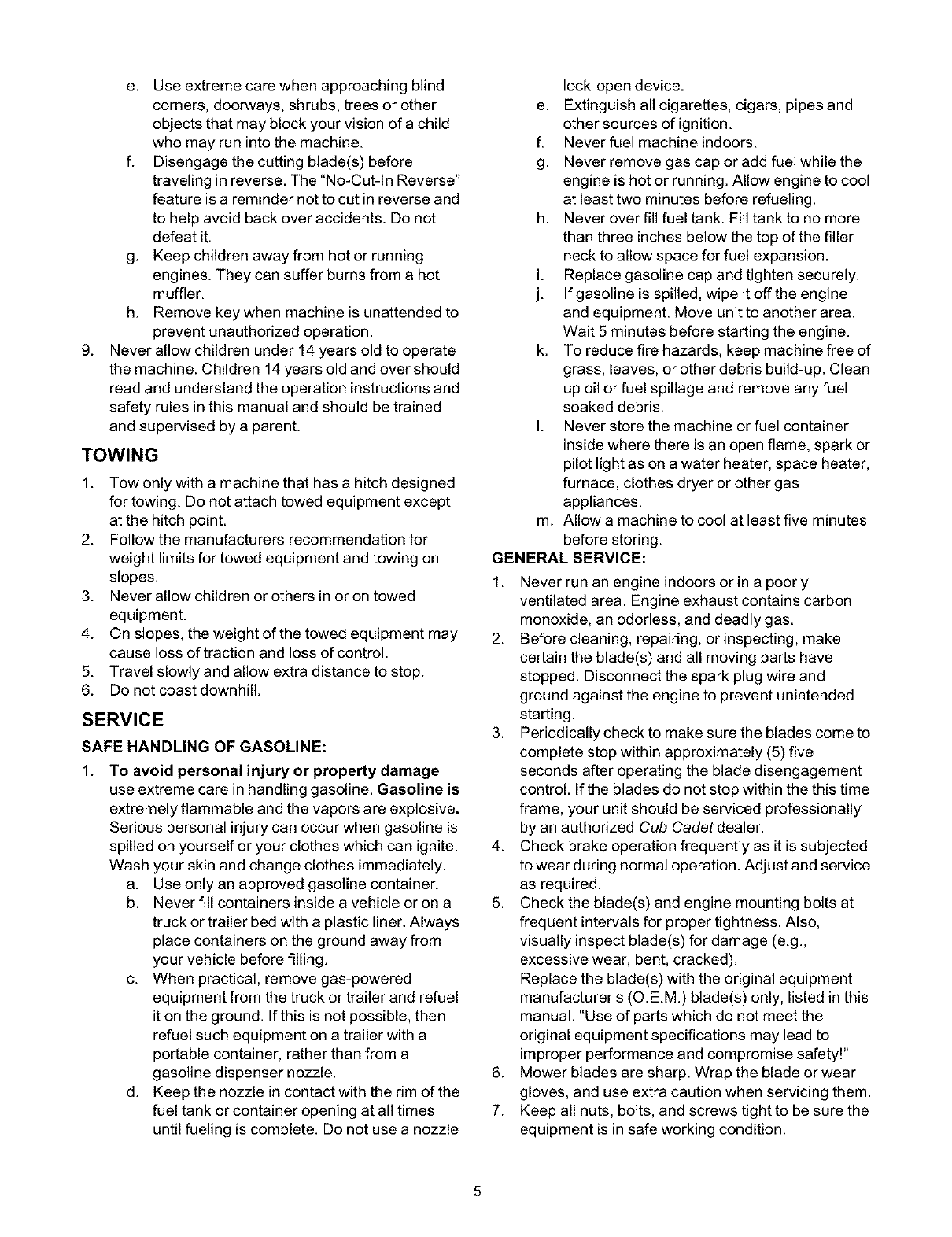
g.
e. Use extreme care when approaching blind
corners, doorways, shrubs, trees or other
objects that may block your vision of a child
who may run into the machine.
f. Disengage the cutting blade(s) before
traveling in reverse. The "No-Cut-In Reverse"
feature is a reminder not to cut in reverse and
to help avoid back over accidents. Do not
defeat it.
g. Keep children away from hot or running
engines. They can suffer bums from a hot
muffler.
h. Remove key when machine is unattended to
prevent unauthorized operation.
Never allow children under 14 years old to operate
the machine. Children 14 years old and over should
read and understand the operation instructions and
safety rules in this manual and should be trained
and supervised by a parent.
TOWING
1. Tow only with a machine that has a hitch designed
for towing. Do not attach towed equipment except
at the hitch point.
2. Follow the manufacturers recommendation for
weight limits for towed equipment and towing on
slopes.
3. Never allow children or others in or on towed
equipment.
4. On slopes, the weight of the towed equipment may
cause loss of traction and loss of control.
5. Travel slowly and allow extra distance to stop.
6. Do not coast downhill.
SERVICE
SAFE HANDLING OF GASOLINE:
1. To avoid personal injury or property damage
use extreme care in handling gasoline. Gasoline is
extremely flammable and the vapors are explosive.
Serious personal injury can occur when gasoline is
spilled on yourself or your clothes which can ignite.
Wash your skin and change clothes immediately.
a. Use only an approved gasoline container.
b. Never fill containers inside a vehicle or on a
truck or trailer bed with a plastic liner. Always
place containers on the ground away from
your vehicle before filling.
c. When practical, remove gas-powered
equipment from the truck or trailer and refuel
it on the ground. If this is not possible, then
refuel such equipment on a trailer with a
portable container, rather than from a
gasoline dispenser nozzle.
d. Keep the nozzle in contact with the rim of the
fuel tank or container opening at all times
until fueling is complete. Do not use a nozzle
lock-open device.
e. Extinguish all cigarettes, cigars, pipes and
other sources of ignition.
f. Never fuel machine indoors.
g. Never remove gas cap oradd fuel while the
engine is hot or running. Allow engine to cool
at least two minutes before refueling.
h. Never over fill fuel tank. Fill tank to no more
than three inches below the top of the filler
neck to allow space for fuel expansion.
i. Replace gasoline cap and tighten securely.
j. If gasoline is spilled, wipe it off the engine
and equipment. Move unit to another area.
Wait 5 minutes before starting the engine.
k. To reduce fire hazards, keep machine free of
grass, leaves, or other debris build-up. Clean
up oil or fuel spillage and remove any fuel
soaked debris.
I. Never store the machine or fuel container
inside where there is an open flame, spark or
pilot light as on a water heater, space heater,
furnace, clothes dryer or other gas
appliances.
m. Allow a machine to cool at least five minutes
before storing.
GENERAL SERVICE:
1. Never run an engine indoors or in a poorly
ventilated area. Engine exhaust contains carbon
monoxide, an odorless, and deadly gas.
2. Before cleaning, repairing, or inspecting, make
certain the blade(s) and all moving parts have
stopped. Disconnect the spark plug wire and
ground against the engine to prevent unintended
starting.
3. Periodically check to make sure the blades come to
complete stop within approximately (5) five
seconds after operating the blade disengagement
control. If the blades do not stop within the this time
frame, your unit should be serviced professionally
by an authorized Cub Cadet dealer.
4. Check brake operation frequently as it is subjected
to wear during normal operation. Adjust and service
as required.
5. Check the blade(s) and engine mounting bolts at
frequent intervals for proper tightness. Also,
visually inspect blade(s) for damage (e.g.,
excessive wear, bent, cracked).
Replace the blade(s) with the original equipment
manufacturer's (O.EM.) blade(s) only, listed in this
manual. "Use of parts which do not meet the
original equipment specifications may lead to
improper performance and compromise safety!"
6. Mower blades are sharp. Wrap the blade or wear
gloves, and use extra caution when servicing them.
7. Keep all nuts, bolts, and screws tight to be sure the
equipment is in safe working condition.
8. Nevertamperwiththesafetyinterlocksystemor
othersafetydevices.Checktheirproperoperation
regularly.
9. Afterstrikingaforeignobject,stoptheengine,
disconnectthesparkplugwire(s)andground
againsttheengine.Thoroughlyinspectthe
machineforanydamage.Repairthedamage
beforestartingandoperating.
10.Neverattemptto makeadjustmentsorrepairsto
themachinewhiletheengineisrunning.
11.Donotchangetheenginegovernorsettingsor
over-speedtheengine.Thegovernorcontrolsthe
maximumsafeoperatingspeedoftheengine.
12.Maintainorreplacesafetyandinstructionlabels,as
necessary.
13.
14.
Observeproperdisposallawsandregulationsfor
gas,oil,etc.to protecttheenvironment.
Grasscatchercomponentsandthedischarge
coveraresubjecttowearanddamagewhichcould
exposemovingpartsorallowobjectstobethrown.
Forsafetyprotection,frequentlycheckcomponents
andreplaceimmediatelywithoriginalequipment
manufacturer's(O.EM.)partsonly,listedinthis
manual."Useofpartswhichdonotmeetthe
originalequipmentspecificationsmayleadto
improperperformanceandcompromisesafety!"
_, WARNING: YOUR RESPONSIBILITY Restrict the use of this power machine to persons who read,
understand and follow the warnings and instructions in this manual and on the machine.
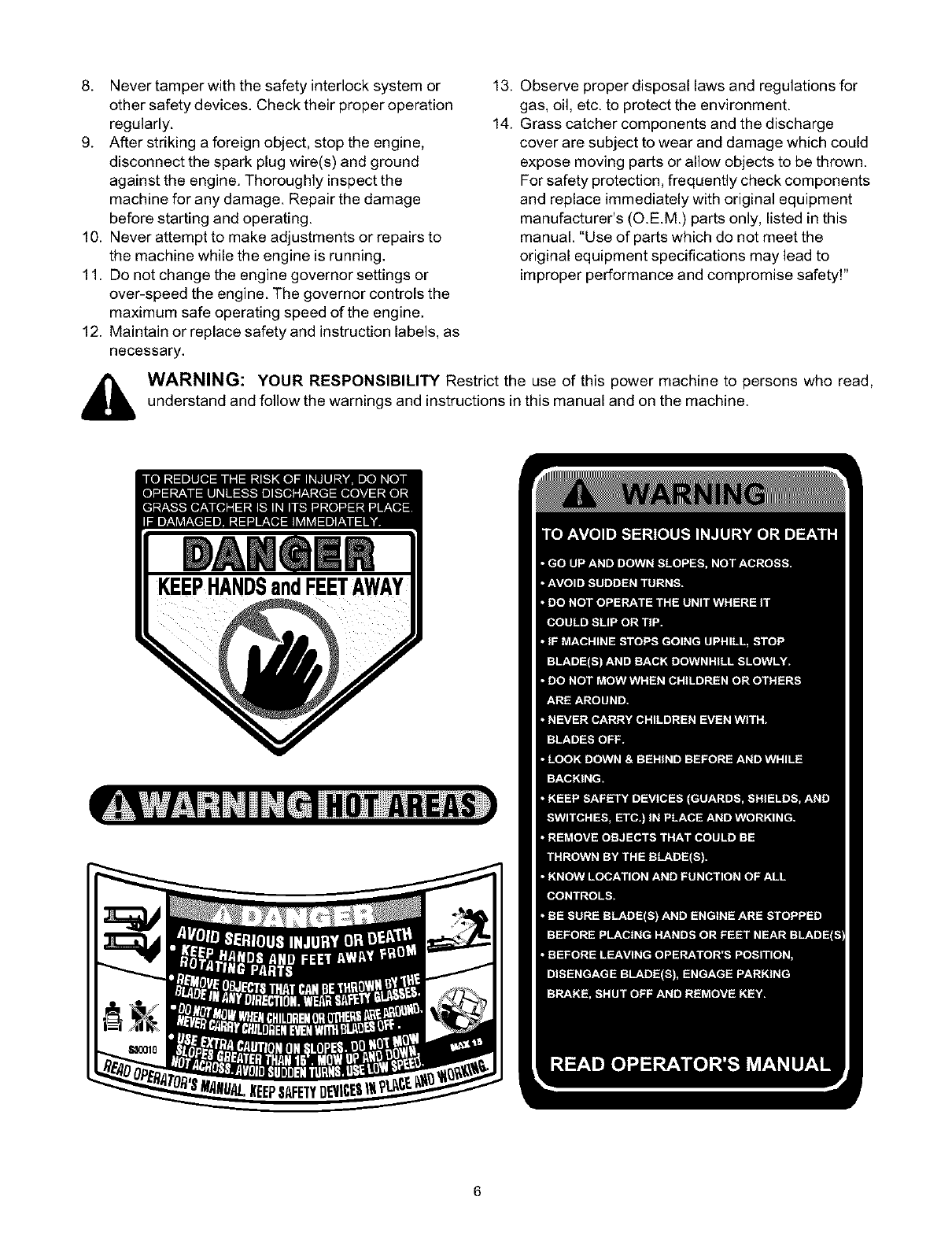
KEEPHANDSandFEETAWAY
o,
SIGHT AND HOLD THIS LEVEL WITH A VERTICAL TREE
I
A POWER POLE
uq A CORNER OF A BUILDING
I'_-- OR A FENCE POST
"'-'._OLo o^, _ ,
, ,, ,,,, ,v/.90-,....
WARNING
Do not mow on inclines with a slope in excess of 15 degrees (a rise of approximately 2-1/2 feet every 10 feet). A riding mower
could overturn and cause serious injury. If operating a walk-behind mower on such a slope, it is extremely difficult to maintain
your footing and you could slip, resulting in serious injury.
Operate RIDING mowers up and down slopes, never across the face of slopes.
SECTION3: TRACTORSET-UP
AttachingtheBatteryCables
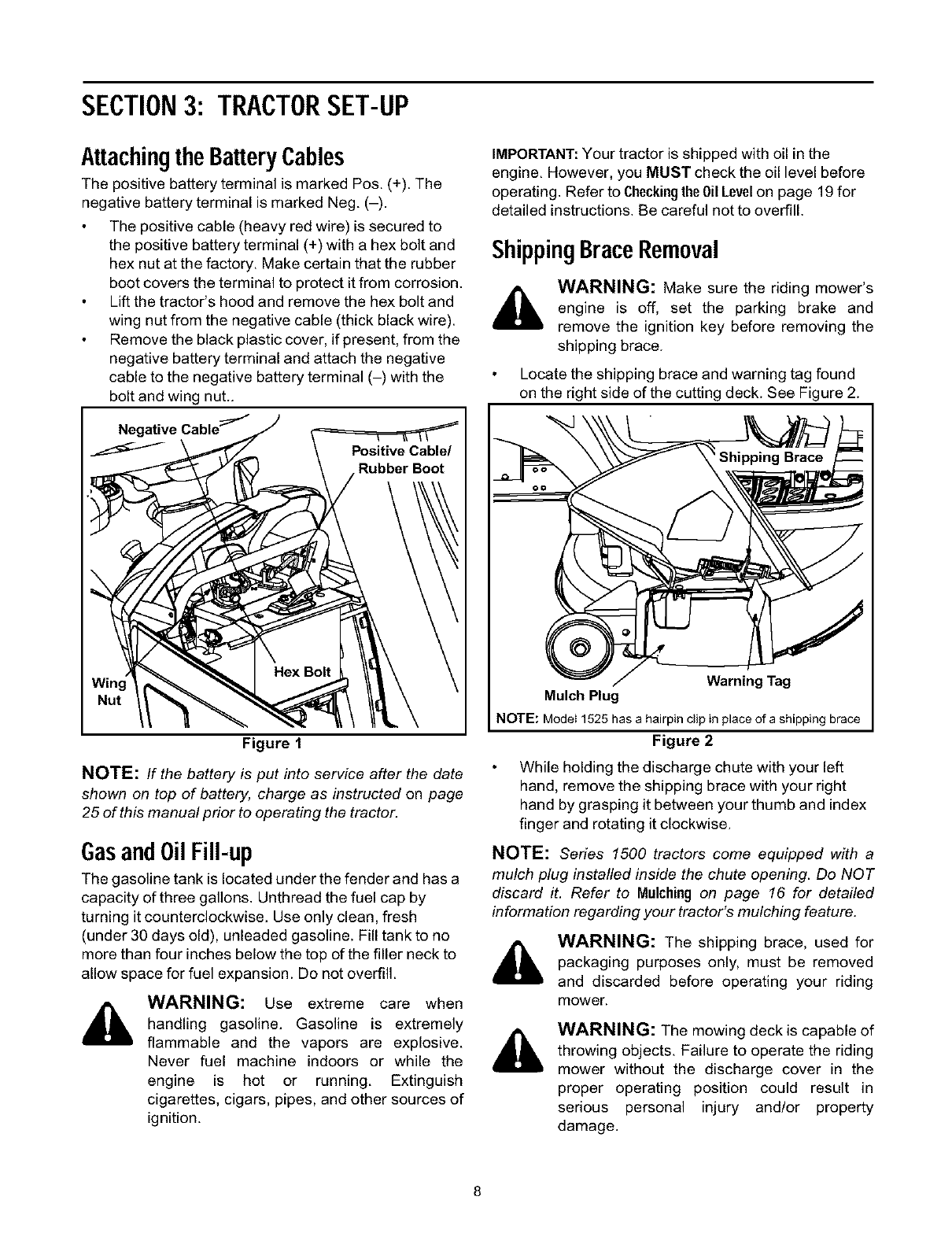
The positive battery terminal is marked Pos. (+). The
negative battery terminal is marked Neg. (-).
The positive cable (heavy red wire) is secured to
the positive battery terminal (+) with a hex bolt and
hex nut at the factory. Make certain that the rubber
boot covers the terminal to protect it from corrosion.
Lift the tractor's hood and remove the hex bolt and
wing nut from the negative cable (thick black wire).
Remove the black plastic cover, if present, from the
negative battery terminal and attach the negative
cable to the negative battery terminal (-) with the
bolt and wing nut..
Negative Cable_/
Positive Cable/
Rubber Boot
Figure 1
NOTE: If the battery is put into service after the date
shown on top of battery, charge as instructed on page
25 of this manual prior to operating the tractor.
GasandOil Fill-up
The gasoline tank is located under the fender and has a
capacity of three gallons. Unthread the fuel cap by
turning it counterclockwise. Use only clean, fresh
(under 30 days old), unleaded gasoline. Fill tank to no
more than four inches below the top of the filler neck to
allow space for fuel expansion. Do not overfill.
WARNING: Use extreme care when
handling gasoline. Gasoline is extremely
flammable and the vapors are explosive.
Never fuel machine indoors or while the
engine is hot or running. Extinguish
cigarettes, cigars, pipes, and other sources of
ignition.
IMPORTANT: Your tractor is shipped with oil in the
engine. However, you MUST check the oil level before
operating. Refer to Checkingthe 0il Levelon page 19 for
detailed instructions. Be careful not to overfill.
ShippingBraceRemoval
WARNING: Make sure the riding mower's
engine is off, set the parking brake and
remove the ignition key before removing the
shipping brace.
Locate the shipping brace and warning tag found
on the right side of the cutting deck. See Figure 2.
Warning Tag
Mulch Plug
NOTE: Model1525hasa hairpin clip in place of a shipping brace
Figure 2
While holding the discharge chute with your left
hand, remove the shipping brace with your right
hand by grasping it between your thumb and index
finger and rotating it clockwise.
NOTE: Series 1500 tractors come equipped with a
mulch plug installed inside the chute opening. Do NOT
discard it. Refer to Mulchingon page 16 for detailed
information regarding your tractor's mulching feature.
kl, WARNING: The shipping brace, used for
packaging purposes only, must be removed
and discarded before operating your riding
mower.
WARNING: The mowing deck is capable of
throwing objects. Failure to operate the riding
mower without the discharge cover in the
proper operating position could result in
serious personal injury and/or property
damage.
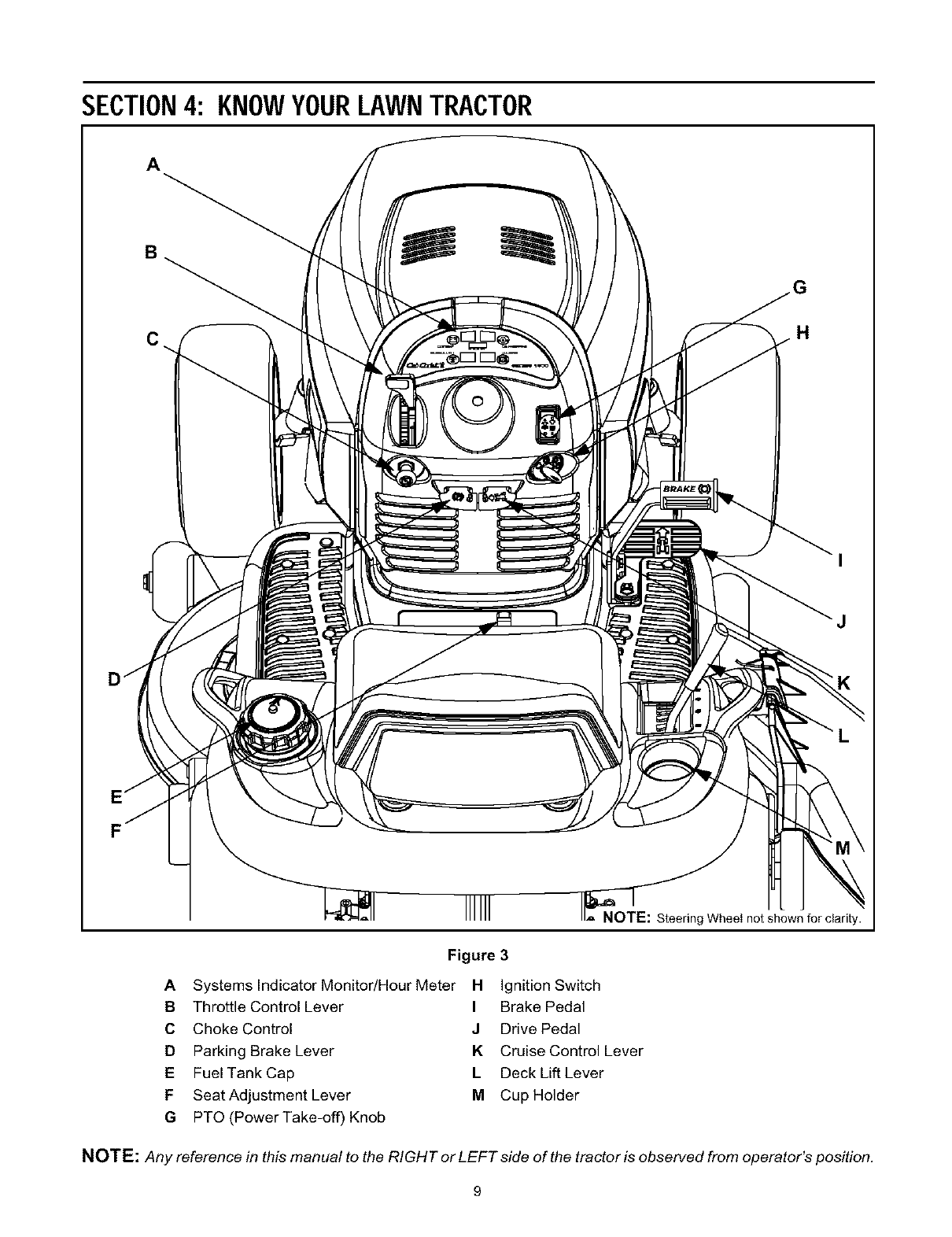
SECTION4: KNOWYOURLAWNTRACTOR
A
B
C
NOTE: Steering Wheel not shown for clarity.
Figure 3
A Systems Indicator Monitor/Hour Meter H Ignition Switch
B Throttle Control Lever
C Choke Control
D Parking Brake Lever
E Fuel Tank Cap
F Seat Adjustment Lever
G PTO (PowerTake-off) Knob
IBrake Pedal
JDrive Pedal
KCruise Control Lever
LDeck Lift Lever
M Cup Holder
NOTE: Any reference in this manual to the RIGHT or LEFT side of the tractor is observed from operator's position.
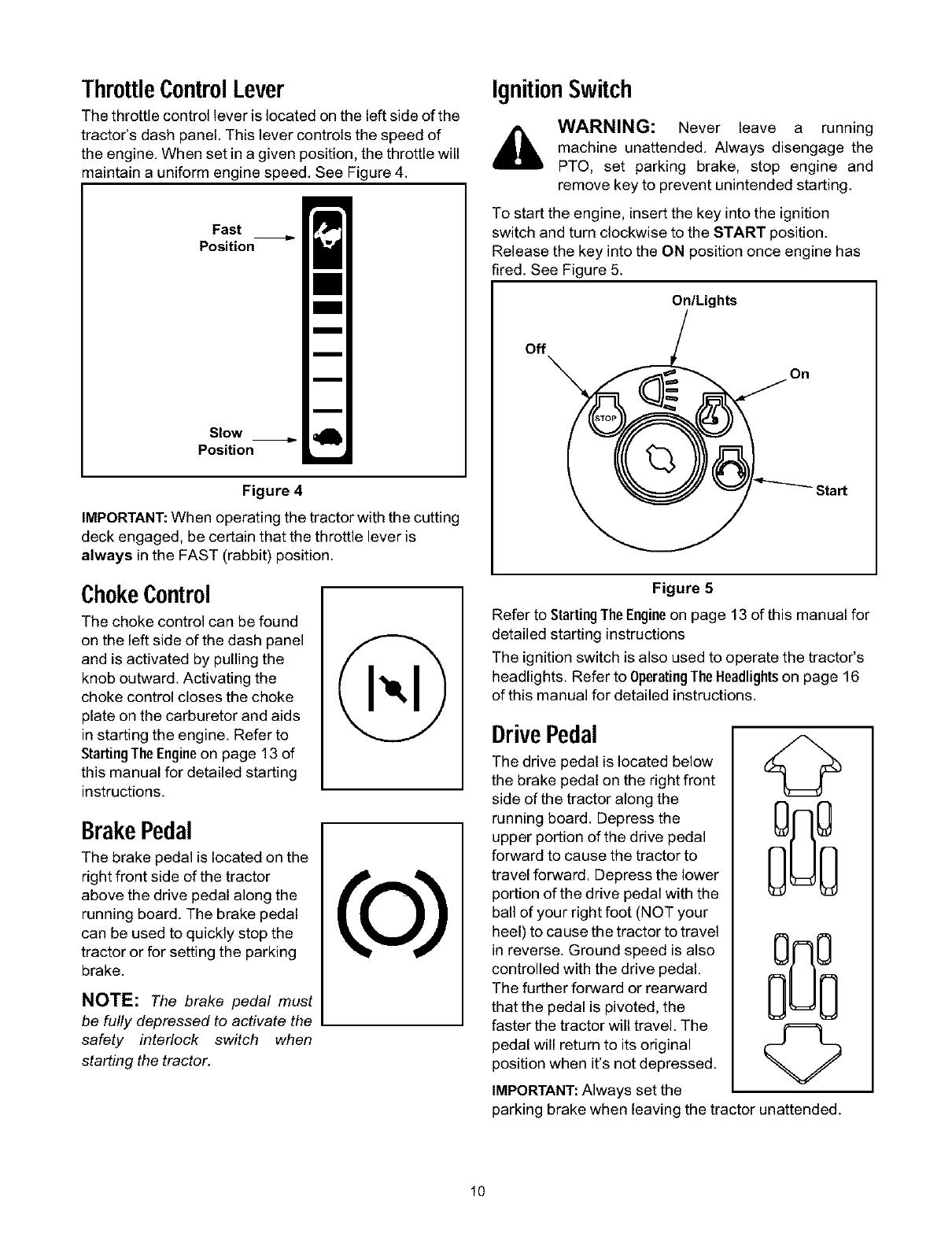
ThrottleControlLever
The throttle control lever is located on the left side of the
tractor's dash panel. This lever controls the speed of
the engine. When set in a given position, the throttle will
maintain a uniform engine speed. See Figure 4.
Fast
Position
Slow
Position
Figure 4
IMPORTANT:When operating the tractor with the cutting
deck engaged, be certain that the throttle lever is
always inthe FAST (rabbit) position.
ChokeControl
The choke control can be found
on the left side of the dash panel
and is activated by pulling the
knob outward. Activating the
choke control closes the choke
plate on the carburetor and aids
in starting the engine. Refer to
StartingTheEngineon page 13 of
this manual for detailed starting
instructions.
BrakePedal
The brake pedal is located on the
right front side of the tractor
above the drive pedal along the
running board. The brake pedal
can be used to quickly stop the
tractor or for setting the parking
brake.
NOTE: The brake pedal must
be fully depressed to activate the
safety interlock switch when
starting the tractor.
IgnitionSwitch
WARNING: Never leave a running
machine unattended. Always disengage the
PTO, set parking brake, stop engine and
remove key to prevent unintended starting.
To start the engine, insert the key into the ignition
switch and turn clockwise to the START position.
Release the key into the ON position once engine has
fired. See Figure 5.
On/Lights
Off
On
/
Start
Figure 5
Refer to StartingTheEngineon page 13 of this manual for
detailed starting instructions
The ignition switch is also used to operate the tractor's
headlights. Refer to OperatingThe Headlightson page 16
of this manual for detailed instructions.
DrivePedal
The drive pedal is located below
the brake pedal on the right front
side of the tractor along the
running board. Depress the
upper portion of the drive pedal
forward to cause the tractor to
travel forward. Depress the lower
portion of the drive pedal with the
ball of your right foot (NOT your
heel) to cause the tractor to travel
in reverse. Ground speed is also
controlled with the drive pedal.
The further forward or rearward
that the pedal is pivoted, the
faster the tractor will travel. The
pedal will return to its original
position when it's not depressed.
IMPORTANT: Always set the
parking brake when leaving the tractor unattended.
10
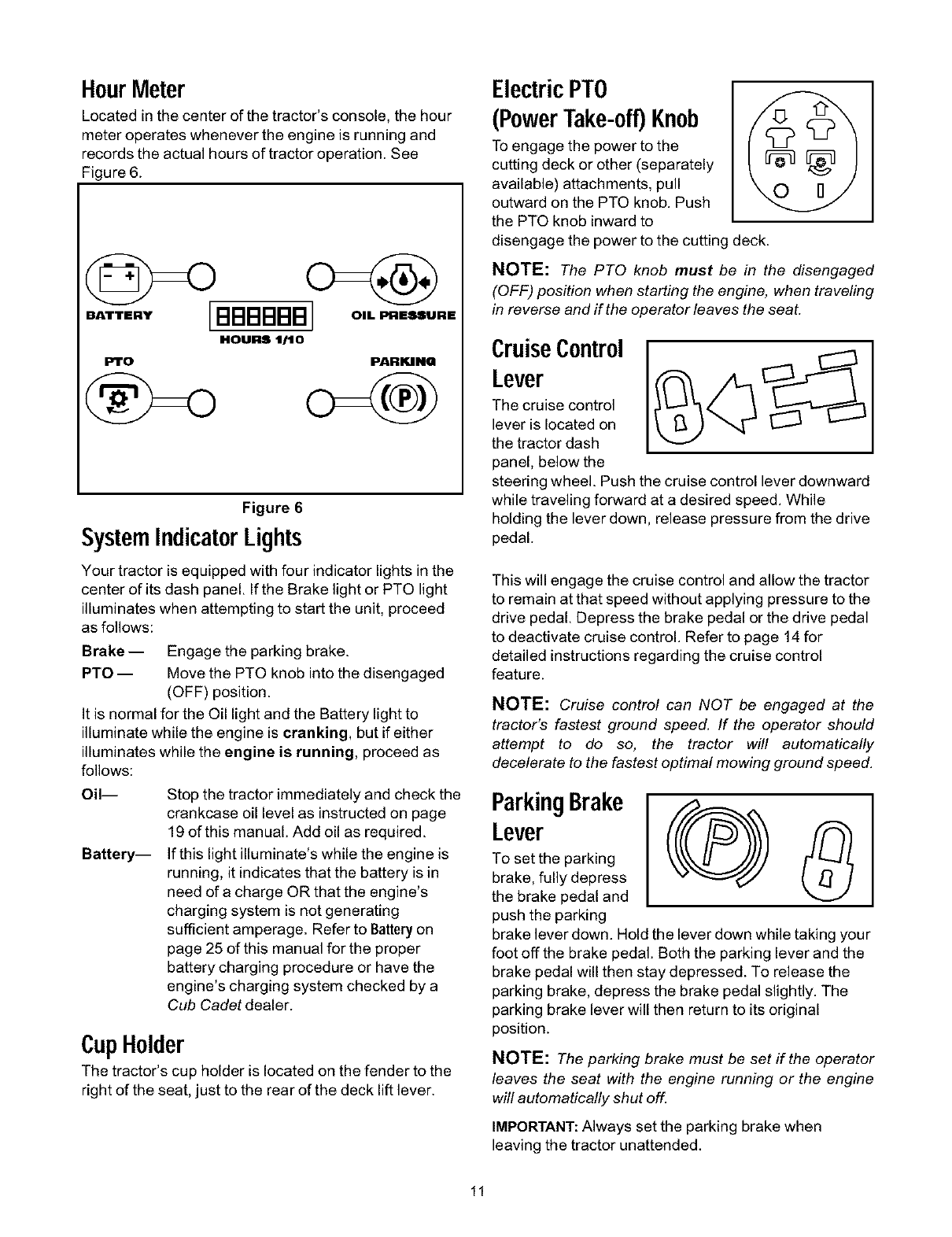
HourMeter
Located in the center of the tractor's console, the hour
meter operates whenever the engine is running and
records the actual hours of tractor operation. See
Figure 6.
----- Isssaasl
HOURS 1/10
1=1'0 PARKING
Figure 6
System IndicatorLights
Your tractor is equipped with four indicator lights in the
center of its dash panel. If the Brake light or PTO light
illuminates when attempting to start the unit, proceed
as follows:
Brake -- Engage the parking brake.
PTO -- Move the PTO knob into the disengaged
(OFF) position.
It is normal for the Oil light and the Battery light to
illuminate while the engine is cranking, but if either
illuminates while the engine is running, proceed as
follows:
Oil-- Stop the tractor immediately and check the
crankcase oil level as instructed on page
19 of this manual. Add oil as required.
Battery-- If this light illuminate's while the engine is
running, it indicates that the battery is in
need of a charge OR that the engine's
charging system is not generating
sufficient amperage. Refer to Batteryon
page 25 of this manual for the proper
battery charging procedure or have the
engine's charging system checked by a
Cub Cadet dealer.
CupHolder
The tractor's cup holder is located on the fender to the
right of the seat, just to the rear of the deck lift lever.
ElectricPTO
(PowerTake-off)Knob
To engage the power to the
cutting deck or other (separately
available) attachments, pull
outward on the PTO knob. Push
the PTO knob inward to
disengage the power to the cutting deck.
NOTE: The PTO knob must be in the disengaged
(OFF) position when starting the engine, when traveling
in reverse and if the operator leaves the seat.
CruiseControl
Lever
The cruise control
lever is located on
the tractor dash
panel, below the
steering wheel. Push the cruise control lever downward
while traveling forward at a desired speed. While
holding the lever down, release pressure from the drive
pedal.
This will engage the cruise control and allow the tractor
to remain at that speed without applying pressure to the
drive pedal. Depress the brake pedal or the drive pedal
to deactivate cruise control. Refer to page 14 for
detailed instructions regarding the cruise control
feature.
NOTE: Cruise control can NOT be engaged at the
tractor's fastest ground speed. If the operator should
attempt to do so, the tractor will automatically
decelerate to the fastest optimal mowing ground speed.
ParkingBrake
Lever
To set the parking
brake, fully depress
the brake pedal and
push the parking
brake lever down. Hold the lever down while taking your
foot off the brake pedal. Both the parking lever and the
brake pedal will then stay depressed. To release the
parking brake, depress the brake pedal slightly. The
parking brake lever will then return to its original
position.
NOTE: The parking brake must be set if the operator
leaves the seat with the engine running or the engine
will automatically shut off.
IMPORTANT: Always set the parking brake when
leaving the tractor unattended.
11
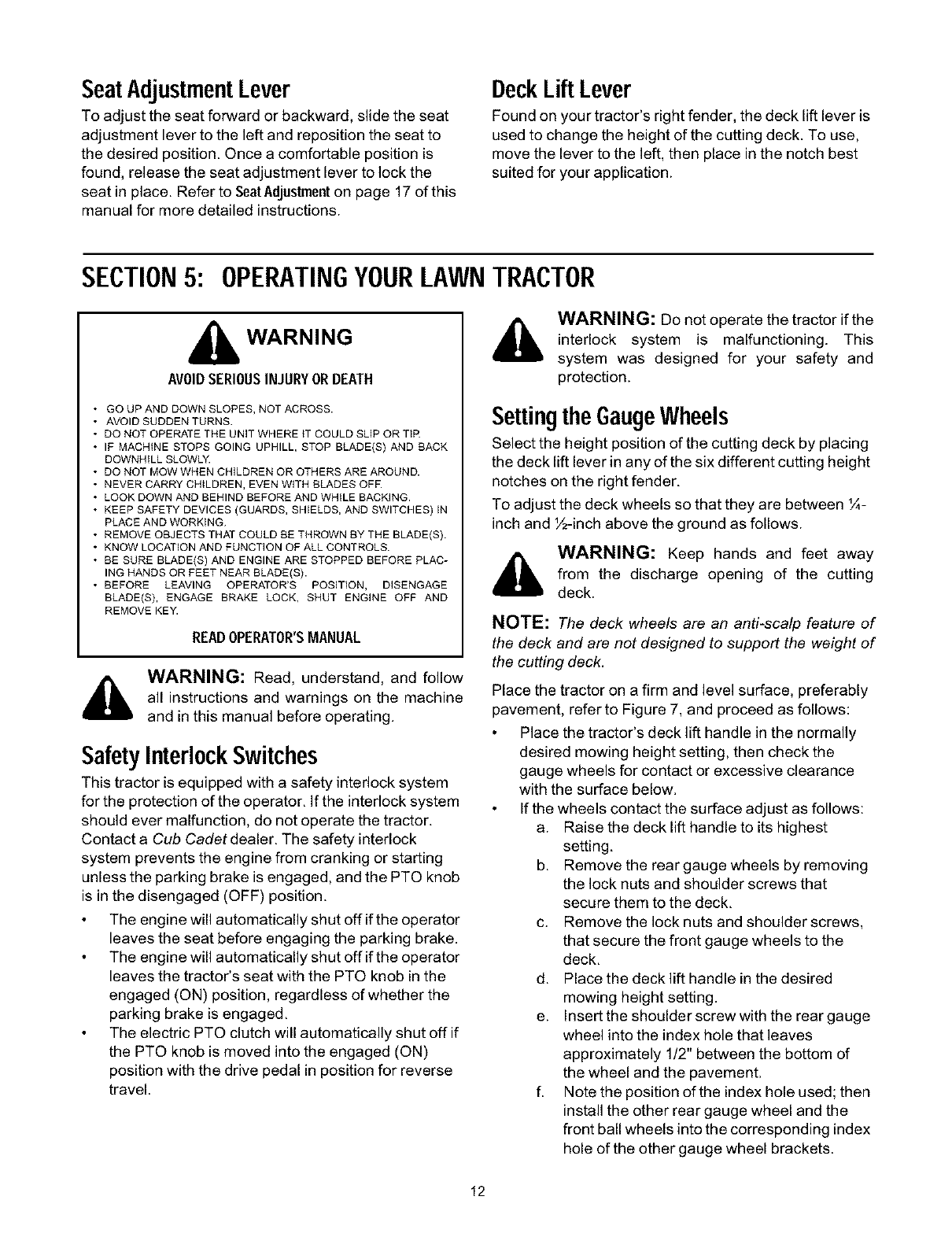
SeatAdJustmentLever
To adjust the seat forward or backward, slide the seat
adjustment lever to the left and reposition the seat to
the desired position. Once a comfortable position is
found, release the seat adjustment lever to lock the
seat in place. Refer to SeatAdjustmenton page 17 of this
manual for more detailed instructions.
DeckLiftLever
Found on your tractor's right fender, the deck lift lever is
used to change the height of the cutting deck. To use,
move the lever to the left, then place in the notch best
suited for your application.
SECTION5: OPERATINGYOURLAWN
WARNING
AVOIDSERIOUSINJURYORDEATH
• GO UP AND DOWN SLOPES, NOT ACROSS.
• AVOID SUDDEN TURNS.
• DO NOT OPERATE THE UNIT WHERE {T COULD SLIP OR TIE
• IF MACHINE STOPS GOING UPHILL, STOP BLADE(S) AND BACK
DOWNHILL SLOWLY.
• DO NOT MOW WHEN CHILDREN OR OTHERS ARE AROUND.
• NEVER CARRY CHILDREN, EVEN WITH BLADES OFP
• LOOK DOWN AND BEHIND BEFORE AND WHILE BACKING.
• KEEP SAFETY DEVICES (GUARDS, SHIELDS, AND SWITCHES) IN
PLACE AND WORKING.
• REMOVE OBJECTS THAT COULD BE THROWN BY THE BLADE(S).
• KNOW LOCATION AND FUNCTION OF ALL CONTROLS.
• BE SURE BLADE(S) AND ENGINE ARE STOPPED BEFORE PLAC-
ING HANDS OR FEET NEAR BLADE(S).
• BEFORE LEAVING OPERATOR'S POSITION, DISENGAGE
BLADE(S), ENGAGE BRAKE LOCK, SHUT ENGINE OFF AND
REMOVE KEY.
READOPERATOR'SMANUAL
,_ WARNING: Read, understand, and follow
all instructions and warnings on the machine
and in this manual before operating.
SafetyInterlockSwitches
This tractor is equipped with a safety interlock system
for the protection of the operator. If the interlock system
should ever malfunction, do not operate the tractor.
Contact a Cub Cadet dealer. The safety interlock
system prevents the engine from cranking or starting
unless the parking brake is engaged, and the PTO knob
is in the disengaged (OFF) position.
The engine will automatically shut off ifthe operator
leaves the seat before engaging the parking brake.
The engine will automatically shut off ifthe operator
leaves the tractor's seat with the PTO knob in the
engaged (ON) position, regardless of whether the
parking brake is engaged.
The electric PTO clutch will automatically shut off if
the PTO knob is moved into the engaged (ON)
position with the drive pedal in position for reverse
travel.
TRACTOR
_, WARNING: Do not operate the tractor if the
interlock system is malfunctioning. This
system was designed for your safety and
protection.
SettingtheGaugeWheels
Select the height position of the cutting deck by placing
the deck lift lever in any of the six different cutting height
notches on the right fender.
To adjust the deck wheels so that they are between ¼-
inch and ½-inch above the ground as follows.
_, ARNING: Keep hands and feet away
from the discharge opening of the cutting
deck.
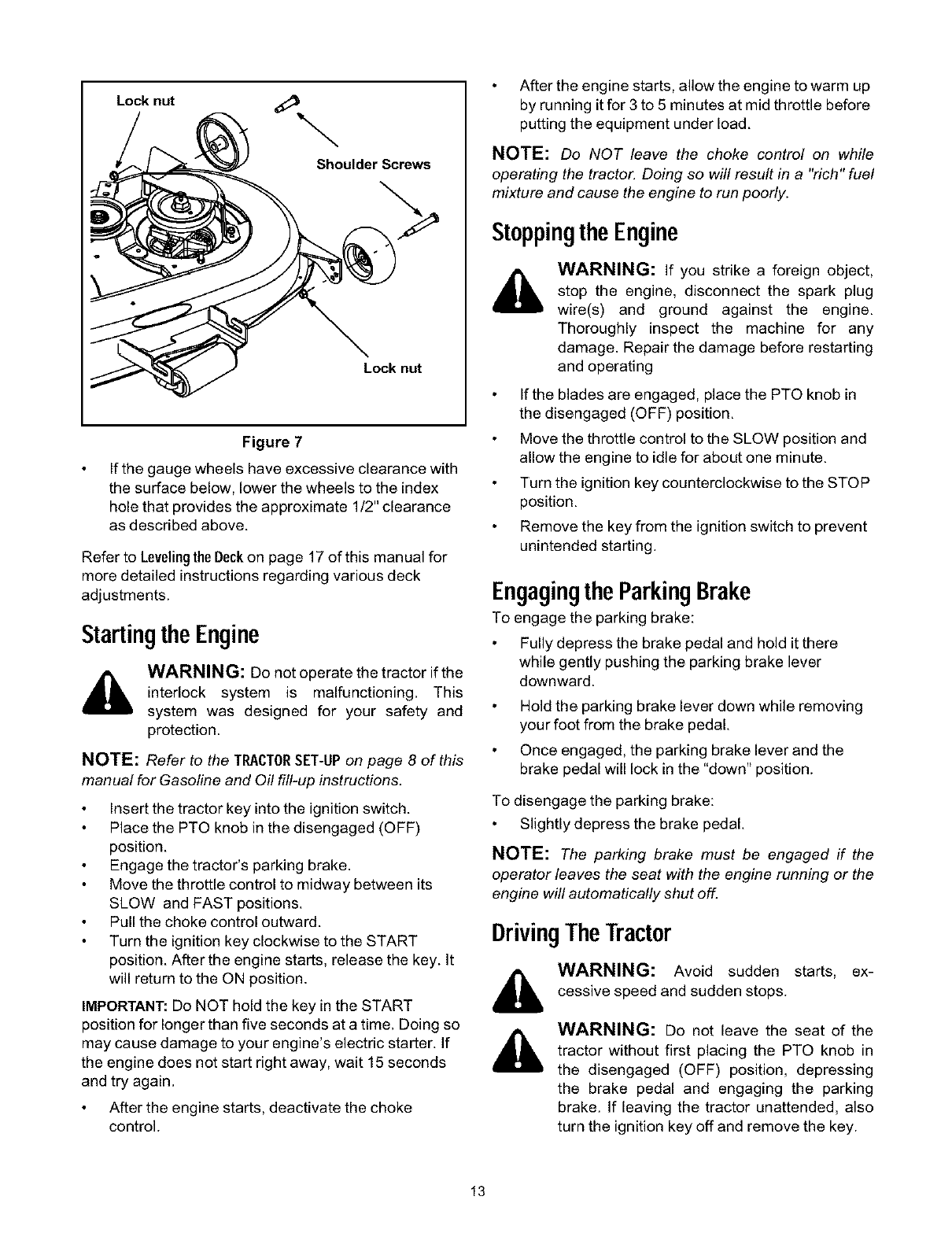
NOTE: The deck wheels are an anti-scalp feature of
the deck and are not designed to support the weight of
the cutting deck.
Place the tractor on a firm and level surface, preferably
pavement, refer to Figure 7, and proceed as follows:
Place the tractor's deck lift handle in the normally
desired mowing height setting, then check the
gauge wheels for contact or excessive clearance
with the surface below.
If the wheels contact the surface adjust as follows:
a. Raise the deck lift handle to its highest
setting.
b. Remove the reargauge wheels by removing
the lock nuts and shoulder screws that
secure them to the deck.
c. Remove the lock nuts and shoulder screws,
that secure the front gauge wheels to the
deck.
d. Place the deck lift handle in the desired
mowing height setting.
e. Insert the shoulder screw with the rear gauge
wheel into the index hole that leaves
approximately 1/2" between the bottom of
the wheel and the pavement.
f. Note the position of the index hole used; then
install the other rear gauge wheel and the
front ball wheels into the corresponding index
hole of the other gauge wheel brackets.
12
Lock nut %
Shoulder Screws
Lock nut
Figure 7
If the gauge wheels have excessive clearance with
the surface below, lower the wheels to the index
hole that provides the approximate 1/2" clearance
as described above.
Refer to LevelingtheDeckon page 17 of this manual for
more detailed instructions regarding various deck
adjustments.
StartingtheEngine
WARNING: Do not operate the tractor if the
interlock system is malfunctioning. This
system was designed for your safety and
protection.
NOTE: Refer to the TRACTORSET-UPon page 8 of this
manual far Gasoline and Oil fill-up instructions.
Insert the tractor key into the ignition switch.
Place the PTO knob in the disengaged (OFF)
position.
Engage the tractor's parking brake.
Move the throttle control to midway between its
SLOW and FAST positions.
Pull the choke control outward.
Turn the ignition key clockwise to the START
position. After the engine starts, release the key. It
will return to the ON position.
IMPORTANT: Do NOT hold the key in the START
position for longer than five seconds at a time. Doing so
may cause damage to your engine's electric starter. If
the engine does not start right away, wait 15 seconds
and try again.
After the engine starts, deactivate the choke
control.
After the engine starts, allow the engine to warm up
by running it for 3 to 5 minutes at mid throttle before
putting the equipment under load.
NOTE: Do NOT leave the choke control on while
operating the tractor. Doing so will result in a "rich" fuel
mixture and cause the engine to run poorly.
Stoppingthe Engine
WARNING: If you strike a foreign object,
stop the engine, disconnect the spark plug
wire(s) and ground against the engine.
Thoroughly inspect the machine for any
damage. Repair the damage before restarting
and operating
If the blades are engaged, place the PTO knob in
the disengaged (OFF) position.
Move the throttle control to the SLOW position and
allow the engine to idle for about one minute.
Turn the ignition key counterclockwise to the STOP
position.
Remove the key from the ignition switch to prevent
unintended starting.
Engagingthe ParkingBrake
To engage the parking brake:
Fully depress the brake pedal and hold it there
while gently pushing the parking brake lever
downward.
Hold the parking brake lever down while removing
your foot from the brake pedal.
Once engaged, the parking brake lever and the
brake pedal will lock in the "down" position.
To disengage the parking brake:
Slightly depress the brake pedal.
NOTE: The parking brake must be engaged if the
operator leaves the seat with the engine running or the
engine will automatically shut off.
DrivingTheTractor
_, WARNING: Avoid sudden starts, ex-
cessive speed and sudden stops.
WARNING: Do not leave the seat of the
tractor without first placing the PTO knob in
the disengaged (OFF) position, depressing
the brake pedal and engaging the parking
brake. If leaving the tractor unattended, also
turn the ignition key off and remove the key.
13
Briefly depress the brake pedal to release the
parking brake. Move the throttle lever into the FAST
(rabbit) position.
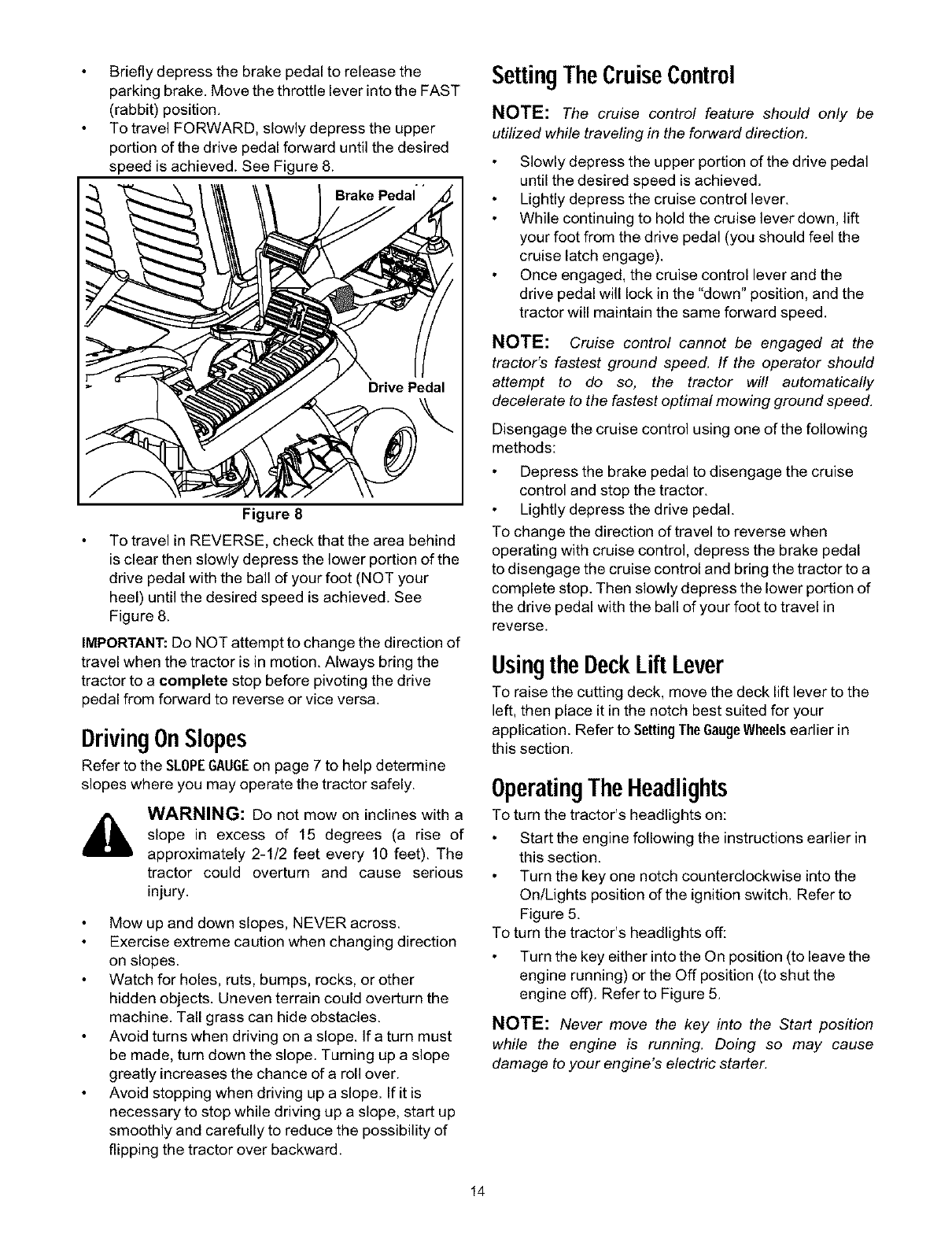
To travel FORWARD, slowly depress the upper
portion of the drive pedal forward until the desired
speed is achieved. See Figure 8.
Figure 8
Drive Pedal
To travel in REVERSE, check that the area behind
is clear then slowly depress the lower portion of the
drive pedal with the ball of your foot (NOT your
heel) until the desired speed is achieved. See
Figure 8.
IMPORTANT: Do NOT attempt to change the direction of
travel when the tractor is in motion. Always bring the
tractor to a complete stop before pivoting the drive
pedal from forward to reverse or vice versa.
DrivingOnSlopes
Refer to the SLOPEGAUGEon page 7 to help determine
slopes where you may operate the tractor safely.
WARNING: Do not mow on inclines with a
slope in excess of 15 degrees (a rise of
approximately 2-1/2 feet every 10 feet). The
tractor could overturn and cause serious
injury.
Mow up and down slopes, NEVER across.
Exercise extreme caution when changing direction
on slopes.
Watch for holes, ruts, bumps, rocks, or other
hidden objects. Uneven terrain could overturn the
machine. Tall grass can hide obstacles.
Avoid turns when driving on a slope. If a turn must
be made, turn down the slope. Turning up a slope
greatly increases the chance of a roll over.
Avoid stopping when driving up a slope. If it is
necessary to stop while driving up a slope, start up
smoothly and carefully to reduce the possibility of
flipping the tractor over backward.
SettingTheCruiseControl
NOTE: The cruise control feature should only be
utilized while traveling in the forward direction.
Slowly depress the upper portion of the drive pedal
until the desired speed is achieved.
Lightly depress the cruise control lever.
While continuing to hold the cruise lever down, lift
your foot from the drive pedal (you should feel the
cruise latch engage).
Once engaged, the cruise control lever and the
drive pedal will lock in the "down" position, and the
tractor will maintain the same forward speed.
NOTE: Cruise control cannot be engaged at the
tractor's fastest ground speed. If the operator should
attempt to do so, the tractor will automatically
decelerate to the fastest optimal mowing ground speed.
Disengage the cruise control using one of the following
methods:
Depress the brake pedal to disengage the cruise
control and stop the tractor.
Lightly depress the drive pedal.
To change the direction of travel to reverse when
operating with cruise control, depress the brake pedal
to disengage the cruise control and bring the tractor to a
complete stop. Then slowly depress the lower portion of
the drive pedal with the ball of your foot to travel in
reverse.
Usingthe DeckLift Lever
To raise the cutting deck, move the deck lift lever to the
left, then place it in the notch best suited for your
application. Refer to SettingThe GaugeWheelsearlier in
this section.
OperatingTheHeadlights
To turn the tractor's headlights on:
Start the engine following the instructions earlier in
this section.
Turn the key one notch counterclockwise into the
On!Lights position of the ignition switch. Refer to
Figure 5.
To turn the tractor's headlights off:
Turn the key either into the On position (to leave the
engine running) or the Off position (to shut the
engine off). Refer to Figure 5.
NOTE: Never move the key into the Start position
while the engine is running. Doing so may cause
damage to your engine's electric starter.
14
MovingTheTractorManually
Your tractor's transmission is equipped with a
hydrostatic relief valve for occasions when it is
necessary to move the tractor manually. Opening this
valve permits the fluid in the transmission to bypass its
normal route, allowing the rear tires to "freewheel." To
engage the hydrostatic relief valve, proceed as follows:
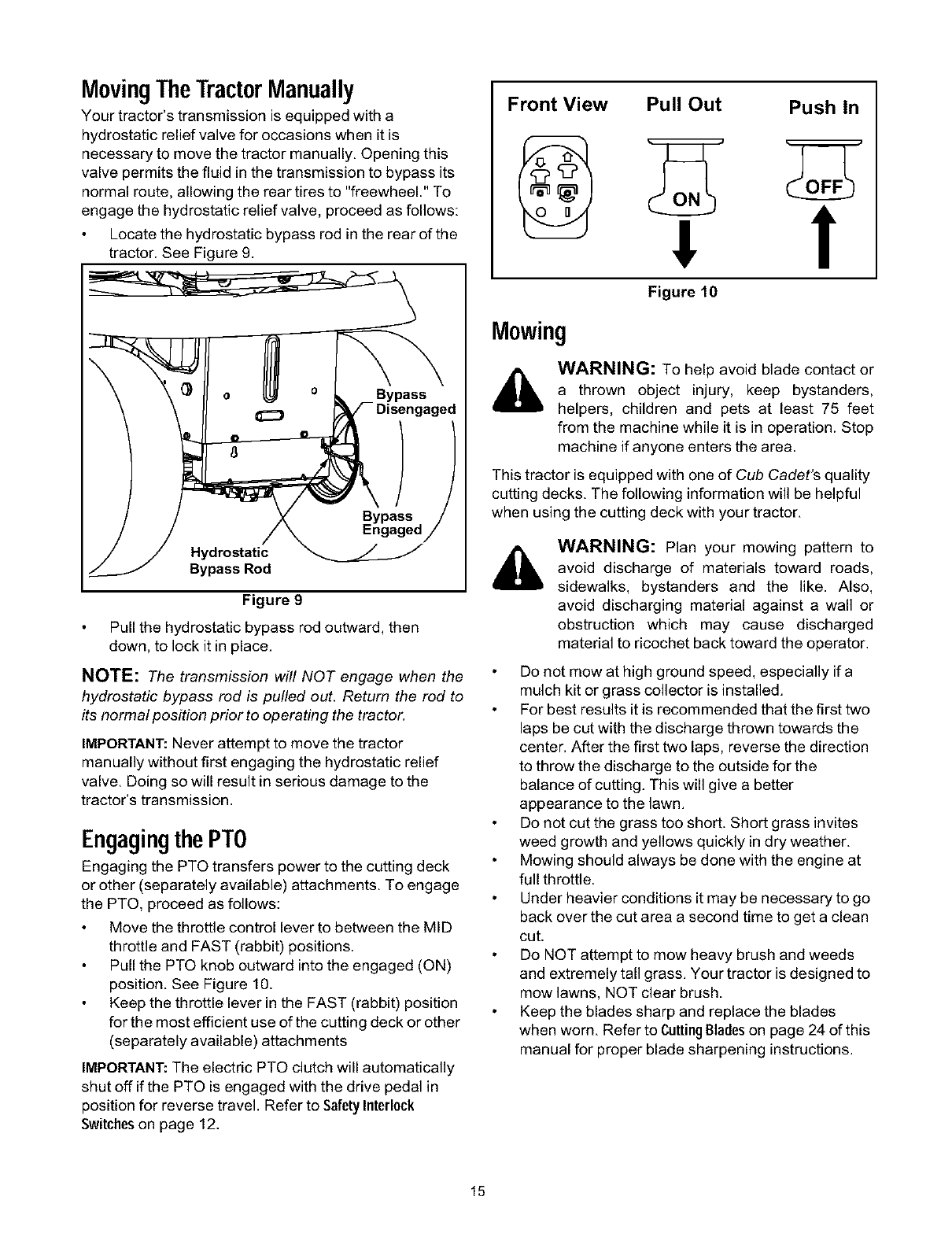
Locate the hydrostatic bypass rod in the rear of the
tractor. See Figure 9.
Bypass
Disengaged
Bypass
Engaged
Hydro_atic
Bypass Rod
Figure 9
Pull the hydrostatic bypass rod outward, then
down, to lock it in place.
NOTE: The transmission will NOT engage when the
hydrostatic bypass rod is pulled out. Return the rod to
its normal position prior to operating the tractor.
IMPORTANT: Never attempt to move the tractor
manually without first engaging the hydrostatic relief
valve. Doing so will result in serious damage to the
tractor's transmission.
Engagingthe PT0
Engaging the PTO transfers power to the cutting deck
or other (separately available) attachments. To engage
the PTO, proceed as follows:
Move the throttle control lever to between the MID
throttle and FAST (rabbit) positions.
Pull the PTO knob outward into the engaged (ON)
position. See Figure 10.
Keep the throttle lever in the FAST (rabbit) position
for the most efficient use of the cutting deck or other
(separately available) attachments
IMPORTANT: The electric PTO clutch will automatically
shut off if the PTO is engaged with the drive pedal in
position for reverse travel. Refer to SafetyInterlock
Switcheson page 12.
Front View Pull Out Push In
Figure 10
Mowing
WARNING: To help avoid blade contact or
a thrown object injury, keep bystanders,
helpers, children and pets at least 75 feet
from the machine while it is in operation. Stop
machine if anyone enters the area.
This tractor is equipped with one of Cub Cadet's quality
cutting decks. The following information will be helpful
when using the cutting deck with your tractor.
WARNING: Plan your mowing pattern to
avoid discharge of materials toward roads,
sidewalks, bystanders and the like. Also,
avoid discharging material against a wall or
obstruction which may cause discharged
material to ricochet back toward the operator.
Do not mow at high ground speed, especially if a
mulch kit or grass collector is installed.
For best results it is recommended that the first two
laps be cut with the discharge thrown towards the
center. After the first two laps, reverse the direction
to throw the discharge to the outside for the
balance of cutting. This will give a better
appearance to the lawn.
Do not cut the grass too short. Short grass invites
weed growth and yellows quickly in dry weather.
Mowing should always be done with the engine at
full throttle.
Under heavier conditions it may be necessary to go
back over the cut area a second time to get a clean
cut.
Do NOT attempt to mow heavy brush and weeds
and extremely tall grass. Your tractor is designed to
mow lawns, NOT clear brush.
Keep the blades sharp and replace the blades
when worn. Refer to CuttingBladeson page 24 of this
manual for proper blade sharpening instructions.
15
Mulching
Model 1525 & 1527 lawn tractors come equipped with a
mulch kit which incorporates special blades, already
standard on your tractor, in a process of recirculating
grass clippings repeatedly beneath the cutting deck.
The ultra-fine clippings are then blown back into the
lawn where they act as a natural fertilizer. Observe the
following points for the best results when mulching.
Never attempt to mulch if the lawn is damp. Wet
grass tends to stick to the underside of the cutting
deck preventing proper mulching of the clippings.
Do NOT attempt to mulch more than 1/3 the total
height of the grass or approximately 1-1/2 inches.
Doing so will cause the clippings to clump up
beneath the deck and not be mulched effectively.
Maintain a slow ground speed to allow the grass
clippings more time to effectively be mulched.
Always position the throttle control lever in the
FAST (rabbit) position and allow it to remain there
while mowing. Failing to keep the engine at full
throttle places strain on the tractor's engine and
does not allow the blades to properly mulch grass.
NOTE: It is not necessary to remove the discharge
chute to operate the mower with the mulch kit installed.
Carriag,
@
Plastic Wing Nut Mulch Plug
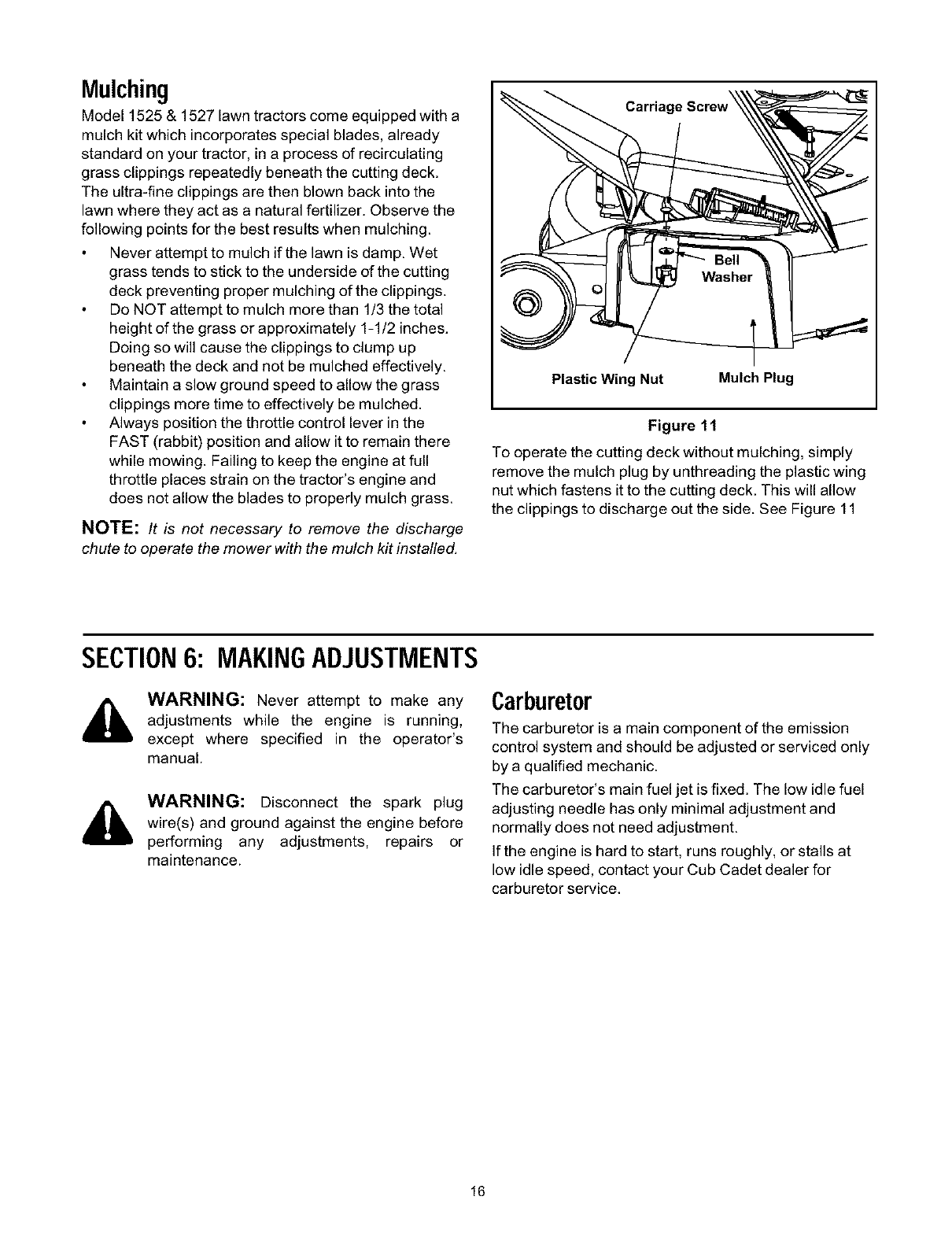
Figure 11
To operate the cutting deck without mulching, simply
remove the mulch plug by unthreading the plastic wing
nut which fastens it to the cutting deck. This will allow
the clippings to discharge out the side. See Figure 11
SECTION6: MAKINGADJUSTMENTS
WARNING: Never attempt to make any
adjustments while the engine is running,
except where specified in the operator's
manual.
_, WARNING: Disconnect the spark plug
wire(s) and ground against the engine before
performing any adjustments, repairs or
maintenance.
Carburetor
The carburetor is a main component of the emission
control system and should be adjusted or serviced only
by a qualified mechanic.
The carburetor's main fuel jet is fixed. The low idle fuel
adjusting needle has only minimal adjustment and
normally does not need adjustment.
If the engine is hard to start, runs roughly, or stalls at
low idle speed, contact your Cub Cadet dealer for
carburetor service.
16
LevelingtheDeck
NOTE: Check the tractor's tire pressure before
performing any deck leveling adjustments. Refer to
Tires on page 24 for informafion regarding tire pressure.
FrontTo Rear
The front of the cutting deck is supported by a stabilizer
bar that can adjusted to level the deck from front to rear.
The front of the deck should be between 1/4-inch and
3/8-inch lower than the rear of the deck. Adjust if
necessary as follows:
With the tractor parked on a firm, level surface,
place the deck lift lever in the top notch (highest
position) and rotate the blade nearest the discharge
chute so that it is parallel with the tractor.
Measure the distance from the front of the blade tip
to the ground and the rear of the blade tip to the
ground.
The first measurement taken should be between
1/4" and 3!8" less than the second measurement.
Determine the approximate distance necessary for
proper adjustment and proceed, if necessary, to the
next step.
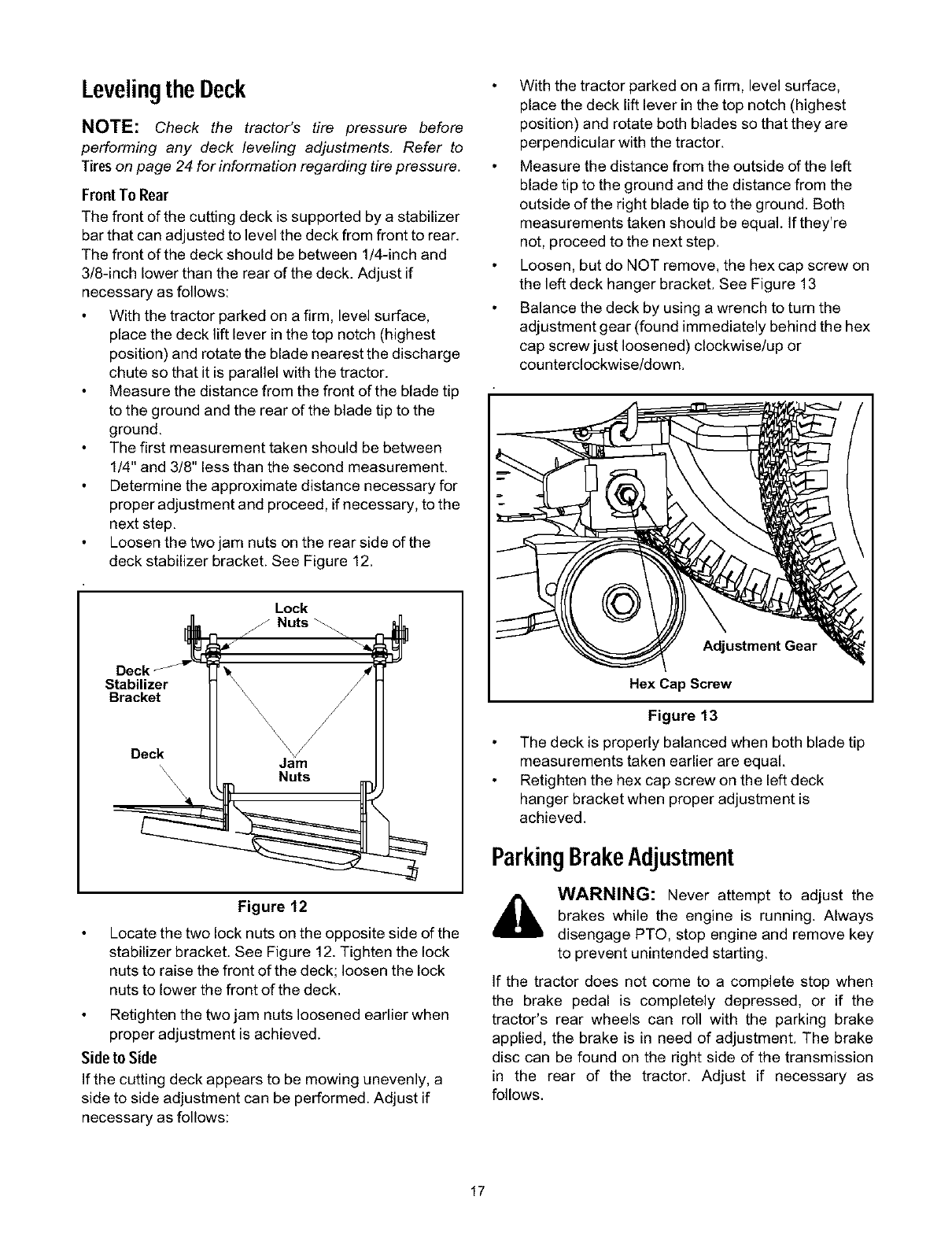
Loosen the two jam nuts on the rear side of the
deck stabilizer bracket. See Figure 12.
Lock
/Nuts
Stabilizer
Bracket
Deck
Figure 12
Locate the two lock nuts on the opposite side of the
stabilizer bracket. See Figure 12. Tighten the lock
nuts to raise the front of the deck; loosen the lock
nuts to lower the front of the deck.
Retighten the two jam nuts loosened earlier when
proper adjustment is achieved.
Sideto Side
If the cutting deck appears to be mowing unevenly, a
side to side adjustment can be performed. Adjust if
necessary as follows:
With the tractor parked on a firm, level surface,
place the deck lift lever in the top notch (highest
position) and rotate both blades so that they are
perpendicular with the tractor.
Measure the distance from the outside of the left
blade tip to the ground and the distance from the
outside of the right blade tip to the ground. Both
measurements taken should be equal. If they're
not, proceed to the next step.
Loosen, but do NOT remove, the hex cap screw on
the left deck hanger bracket. See Figure 13
Balance the deck by using a wrench to turn the
adjustment gear (found immediately behind the hex
cap screw just loosened) clockwise/up or
counterclockwise/down.
Adjustment Gear
Hex Cap Screw
Figure 13
The deck is properly balanced when both blade tip
measurements taken earlier are equal.
Retighten the hex cap screw on the left deck
hanger bracket when proper adjustment is
achieved.
ParkingBrakeAdJustment
WARNING: Never attempt to adjust the
brakes while the engine is running. Always
disengage PTO, stop engine and remove key
to prevent unintended starting.
If the tractor does not come to a complete stop when
the brake pedal is completely depressed, or if the
tractor's rear wheels can roll with the parking brake
applied, the brake is in need of adjustment. The brake
disc can be found on the right side of the transmission
in the rear of the tractor. Adjust if necessary as
follows.
17
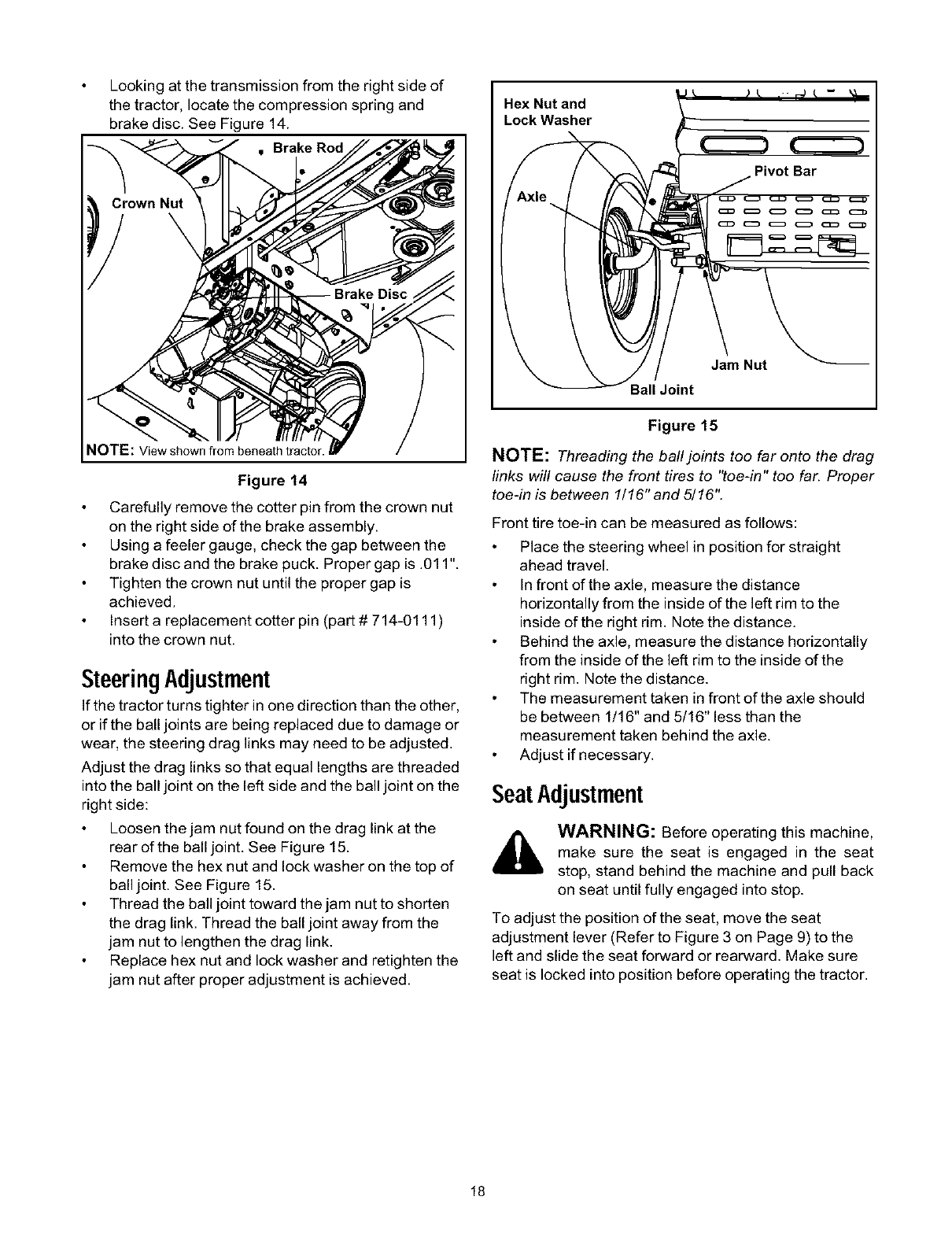
Looking at the transmission from the right side of
the tractor, locate the compression spring and
brake disc. See Figure 14.
Brake Rod
NOTE: View shown from beneath tractor.
Figure 14
Carefully remove the cotter pin from the crown nut
on the right side of the brake assembly.
Using a feeler gauge, check the gap between the
brake disc and the brake puck. Proper gap is .011".
Tighten the crown nut until the proper gap is
achieved.
Insert a replacement cotter pin (part # 714-0111 )
into the crown nut.
SteeringAdJustment
If the tractor turns tighter in one direction than the other,
or if the ball joints are being replaced due to damage or
wear, the steering drag links may need to be adjusted.
AdJust the drag links so that equal lengths are threaded
intothe ball joint on the left side and the ball joint on the
right side:
Loosen the jam nut found on the drag link at the
rear of the ball joint. See Figure 15.
Remove the hex nut and lock washer on the top of
ball joint. See Figure 15.
Thread the ball joint toward the jam nut to shorten
the drag link. Thread the ball joint away from the
jam nut to lengthen the drag link.
Replace hex nut and lock washer and retighten the
jam nut after proper adjustment is achieved.
Hex Nut and
Lock Washer
Pivot Bar
Jam Nut
Ball Joint
Figure 15
NOTE: Threading the ball joints too far onto the drag
links will cause the front fires to "toe-in" too far. Proper
toe-in is between 1/16" and 5/16".
Front tire toe-in can be measured as follows:
Place the steering wheel in position for straight
ahead travel.
In front of the axle, measure the distance
horizontally from the inside of the left rim to the
inside of the right rim. Note the distance.
Behind the axle, measure the distance horizontally
from the inside of the left rim to the inside of the
right rim. Note the distance.
The measurement taken in front of the axle should
be between 1/16" and 5/16" less than the
measurement taken behind the axle.
Adjust if necessary.
SeatAdJustment
WARNING: Before operating this machine,
make sure the seat is engaged in the seat
stop, stand behind the machine and pull back
on seat until fully engaged into stop.
To adjust the position of the seat, move the seat
adjustment lever (Refer to Figure 3 on Page 9) to the
left and slide the seat forward or rearward. Make sure
seat is locked into position before operating the tractor.
18
SECTION7: MAINTAININGYOURLAWNTRACTOR
NOTE: Refer to MaintenanceChart on page 29 for a
reference of recommended maintenance intervals.
WARNING: Before performing any
maintenance or repairs, disengage PTO, set
parking brake, stop engine and remove key to
prevent unintended starting.
Engine
Maintenance, repair, or replacement of the emission
control devices and systems, which are being done at
the customer's expense, may be performed by any
engine repair establishment or individual. Warranty
repairs must be performed by your Cub Cadet
Dealer.
Engine0il
The engine-crankcase is filled with 10W-30 ship-away
oil at the factory. This oil may be used for the first 8
hours of engine operation at temperatures between
O°F and 90°F.
The engine oil must be drained and replaced with new
oil after 8 hours of engine operation and every 100
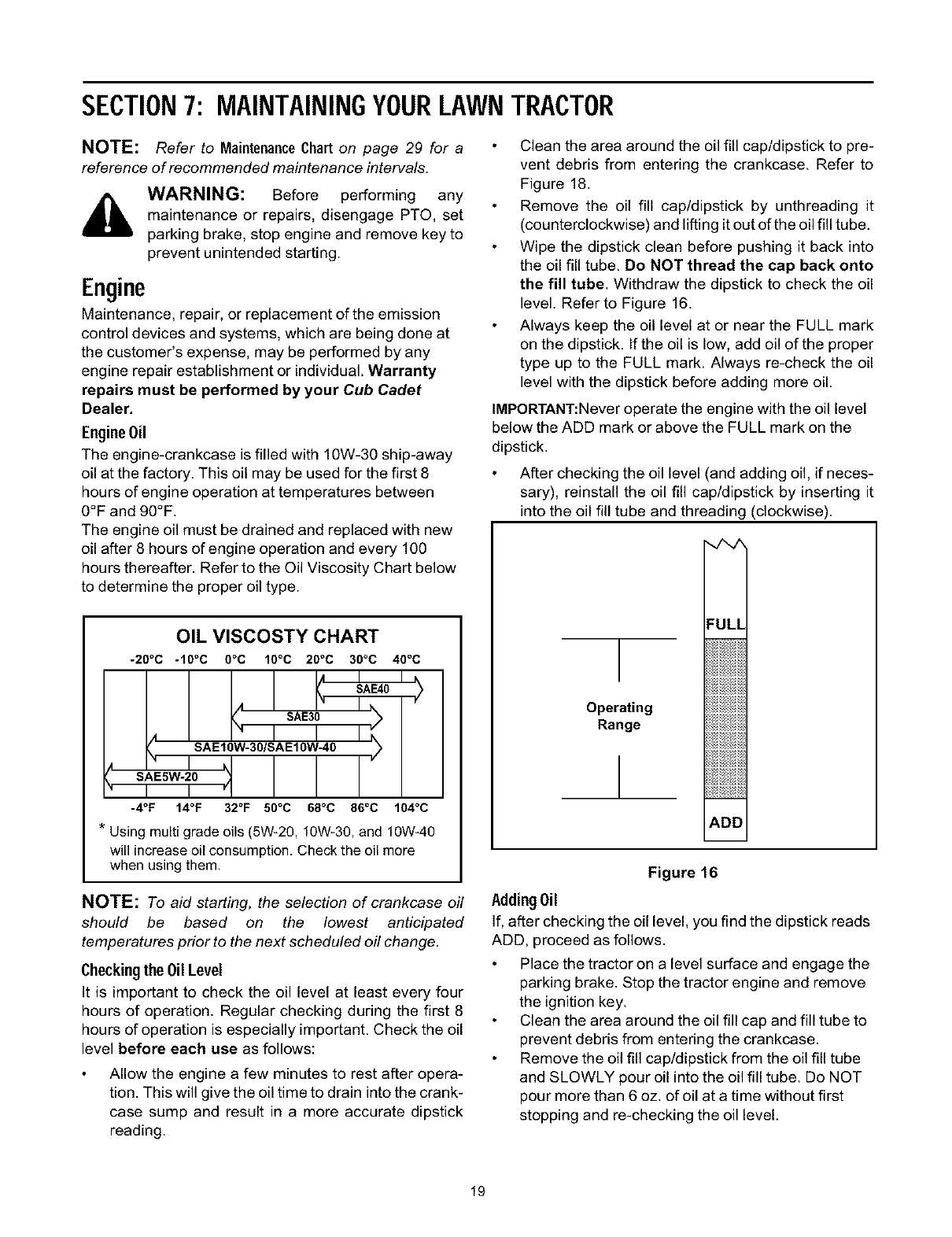
hours thereafter, Refer to the Oil Viscosity Chart below
to determine the proper oil type.
OIL VISCOSTY CHART
.20°C .10°C OoC 100C 20°C 30°C 400C
.4OF 14OF 320F 50°C 68°C 860C 104°C
* Using multi grade oils (5W-20, 10W-30,and 10W-40
will increase oil consumption. Check the oil more
when using them.
NOTE: To aid starting, the selection of crankcase oil
should be based on the lowest anticipated
temperatures prior to the next scheduled oil change.
Checking the Oil Level
It is important to check the oil level at least every four
hours of operation. Regular checking during the first 8
hours of operation is especially important. Check the oil
level before each use as follows:
Allow the engine a few minutes to rest after opera-
tion. This will give the oil time to drain into the crank-
case sump and result in a more accurate dipstick
reading.
Clean the area around the oil fill cap!dipstick to pre-
vent debris from entering the crankcase. Refer to
Figure 18.
Remove the oil fill cap/dipstick by unthreading it
(counterclockwise) and lifting it out of the oil fill tube.
Wipe the dipstick clean before pushing it back into
the oil fill tube. Do NOT thread the cap back onto
the fill tube. Withdraw the dipstick to check the oil
level. Refer to Figure 16.
Always keep the oil level at or near the FULL mark
on the dipstick. If the oil is low, add oil of the proper
type up to the FULL mark. Always re-check the oil
level with the dipstick before adding more oil.
IMPORTANT:Never operate the engine with the oil level
below the ADD mark or above the FULL mark on the
dipstick.
After checking the oil level (and adding oil, if neces-
sary), reinstall the oil fill cap/dipstick by inserting it
into the oil fill tube and threading (clockwise).
FULL
Operating _i_i_i_i_
Range _
ADD
Figure 16
AddingOil
If, after checking the oil level, you find the dipstick reads
ADD, proceed as follows.
Place the tractor on a level surface and engage the
parking brake. Stop the tractor engine and remove
the ignition key.
Clean the area around the oil fill cap and fill tube to
prevent debris from entering the crankcase.
Remove the oil fill cap/dipstick from the oil fill tube
and SLOWLY pour oil into the oil fill tube. Do NOT
pour more than 6 oz. of oil at a time without first
stopping and re-checking the oil level.
19
Fill the crankcase until the oil level reaches the full
(F) mark on the dipstick. Refer to Figure 16. Refer
to the viscosity oil chart earlier in this section for
information regarding the proper type of oil to add
to the crankcase.
IMPORTANT: The oil capacity (with oil filter) is 1.8 U.S.
quarts (57.6 oz.). Never overfill the engine crankcase.
IMPORTANT: The engine may overheat and/or damage
may result if the oil level is below the ADD or over the
FULL on the dipstick.
Reinstall the oil fill cap/dipstick securely onto the oil
fill tube.
IMPORTANT: The oil fill cap/dipstick must be installed
securely onto the tube at all times when the engine
is operating. Severe engine damage could result from
failure to do so.
ChangingtheEngine011
The engine oil and oil filter should be changed after the
first 8 hours of operation, and after every lOg hours of
operation thereafter.
WARNING: If the engine has been recently
run, the engine, muffler and surrounding
metal surfaces will be hot and can cause
burns to the skin. Allow the tractor to cool and
use caution when removing
IMPORTANT: The oil filter should be changed at every
oil change interval.
To complete an oil change, proceed as follows:
Removing the Left-hand Side Panel
Engage the tractor's parking brake and raise the
hood.
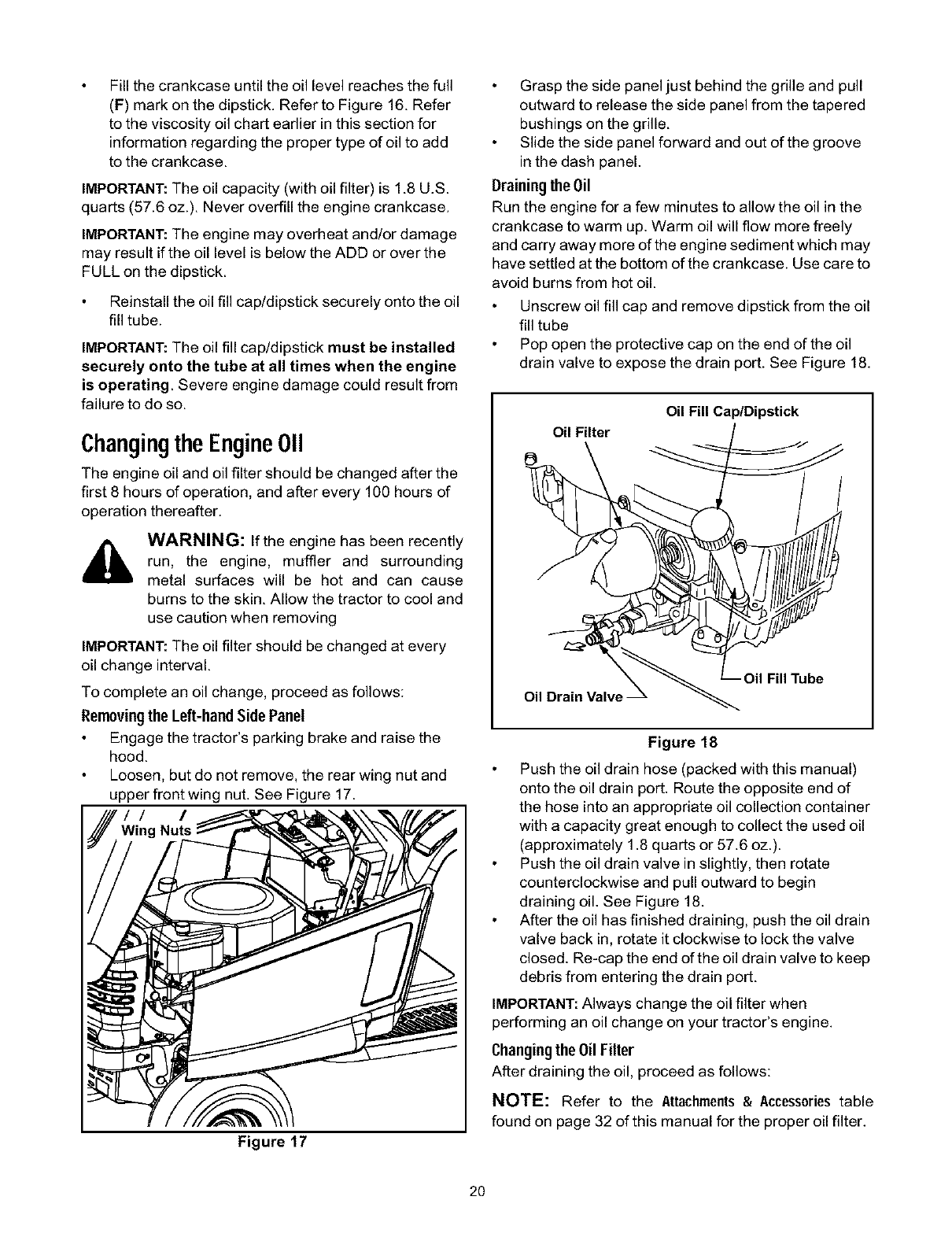
Loosen, but do not remove, the rear wing nut and
upper front wing nut. See Figure 17.
// /
Figure 17
Grasp the side panel just behind the grille and pull
outward to release the side panel from the tapered
bushings on the grille.
Slide the side panel forward and out of the groove
in the dash panel.
Drainingthe 0il
Run the engine for a few minutes to allow the oil in the
crankcase to warm up. Warm oil will flow more freely
and carry away more of the engine sediment which may
have settled at the bottom of the crankcase. Use care to
avoid burns from hot oil.
Unscrew oil fill cap and remove dipstick from the oil
fill tube
Pop open the protective cap on the end of the oil
drain valve to expose the drain port. See Figure 18.
Oil Filter
Oil Fill Cap/Dipstick
Oil Drain Valve
-Oil Fill Tube
Figure 18
Push the oil drain hose (packed with this manual)
onto the oil drain port. Route the opposite end of
the hose into an appropriate oil collection container
with a capacity great enough to collect the used oil
(approximately 1.8 quarts or 57.6 oz.).
Push the oil drain valve in slightly, then rotate
counterclockwise and pull outward to begin
draining oil. See Figure 18.
After the oil has finished draining, push the oil drain
valve back in, rotate it clockwise to lock the valve
closed. Re-cap the end of the oil drain valve to keep
debris from entering the drain port.
IMPORTANT: Always change the oil filter when
performing an oil change on your tractor's engine.
Changing the 0il Filter
After draining the oil, proceed as follows:
NOTE: Refer to the Attachments& Accessoriestable
found on page 32 of this manual for the proper oil filter.
2O
Before removing the old oil filter, clean around its
base to prevent debris from entering the crankcase.
Grasp the oil filter and remove it from the engine by
turning it counterclockwise. Use an oil filter wrench,
if necessary.
Place a new replacement filter in a shallow pan with
the open end up and pour new oil of the proper type
(see chart on page 19), in through the threaded
center hole.
IMPORTANT: Stop pouring when the oil reaches the
bottom of the threads and allow a minute or two for the
oil to be absorbed by the filter material.
Put a drop of oil on your fingertip and apply a light
coating to the gasket of the new oil filter.
Install the replacement oil filter on the engine by
turning it clockwise until the rubber gasket contacts
the mounting surface. Hand tighten the filter an
additional 3/4 turn after the gasket first makes
contact.
Re-filling the Crankcase with 0il
IMPORTANT:The engine (with oil filter) has a capacity of
1.8 quarts (57.6 oz.). Do NOT overfill. Always check the
level on the dipstick as instructed on page 19 before
adding more oil.
NOTE: For the proper oil type, refer to the chart on
page 19 of this manual.
Clean the area around the oil fill tube to prevent
debris from entering the crankcase.
Slowly pour oil into the fill tube. Fill the crankcase
until the oil level reaches the full (F) mark on the
dipstick (Refer to Figure 16).
Reinstall the oil fill cap/dipstick securely into the oil
fill tube.
IMPORTANT: The oil fill cap/dipstick must be installed
securely onto the tube at all times when the engine
is operating. Severe engine damage could result from
a failure to do so.
Start the tractor engine and allow it to run for about
three minutes, then stop the engine and remove the
ignition key.
Check the oil level and add oil if necessary.
Examine the area around the oil filter the oil drain
valve for leaks before operating the tractor.
IMPORTANT: If leaks are present, have your engine
serviced by your Cub Cadet dealer before operating the
tractor.
AirFilter
The engine is equipped with a replaceable foam pre-
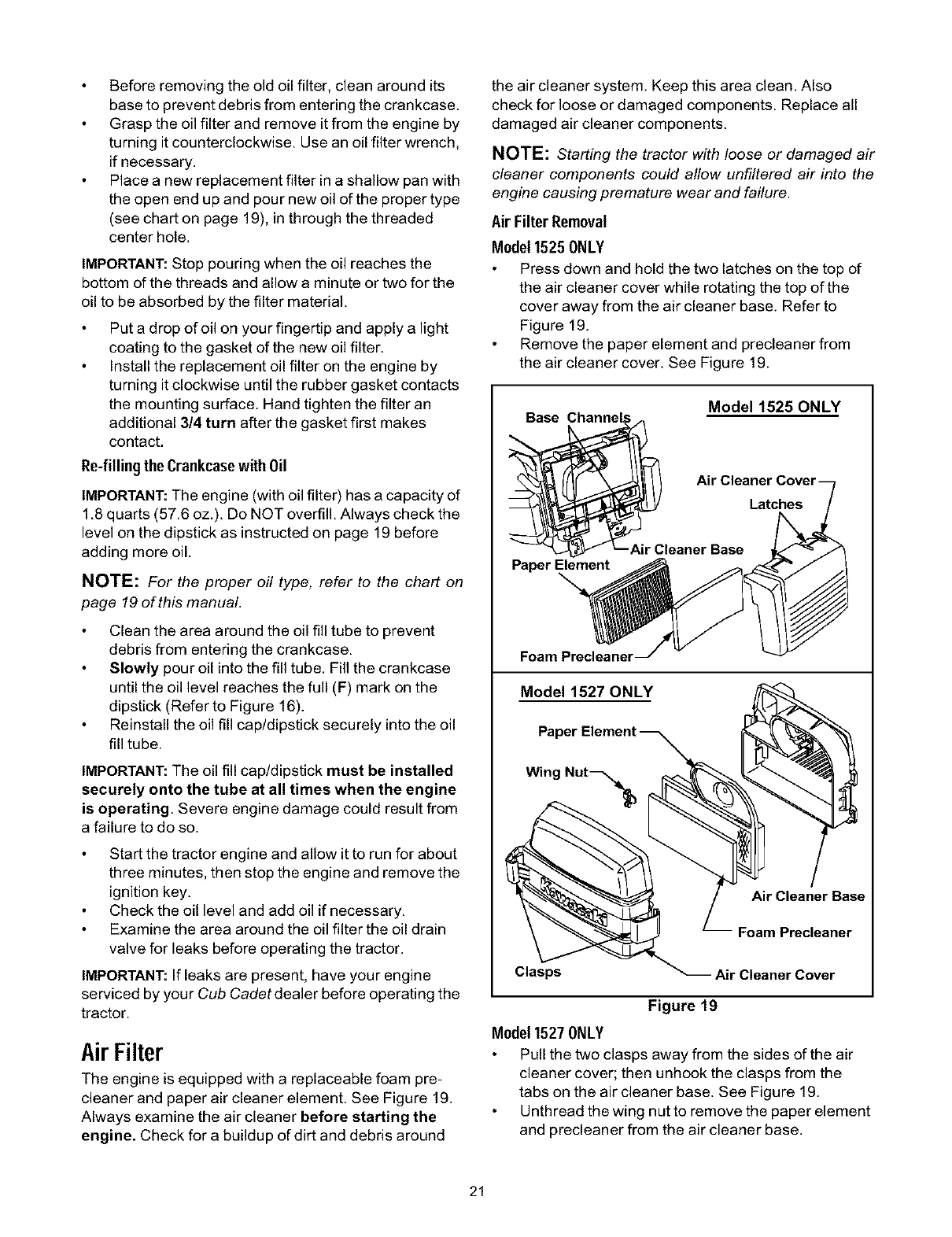
cleaner and paper air cleaner element. See Figure 19.
Always examine the air cleaner before starting the
engine. Check for a buildup of dirt and debris around
the air cleaner system. Keep this area clean. Also
check for loose or damaged components. Replace all
damaged air cleaner components.
NOTE: Starting the tractor with loose or damaged air
cleaner components could allow unfiltered air into the
engine causing premature wear and failure.
Air Filter Removal
Model1525 ONLY
Press down and hold the two latches on the top of
the air cleaner cover while rotating the top of the
cover away from the air cleaner base. Refer to
Figure 19.
Remove the paper element and precleaner from
the air cleaner cover. See Figure 19.
Model 1525 ONLY
Base Channel
_ _ Air Cleane
_ __; Air-Vcleaner Base Latches
Paper Element
Foam Precleanel
Model 1527 ONLY
Wing Nut%
Air Cleaner Base
Foam Precleaner
Clasps Air Cleaner Cover
Figure 19
Model1527 ONLY
Pull the two clasps away from the sides of the air
cleaner cover; then unhook the clasps from the
tabs on the air cleaner base. See Figure 19.
Unthread the wing nut to remove the paper element
and precleaner from the air cleaner base.
21
Servicethe F0amPrecleaner
Clean the precleaner after every 25 hours of
operation. More often if operating under extremely
dusty or dirty conditions.
Wash the precleaner in detergent and water.
Rinse the precleaner thoroughly until all traces of
detergent are eliminated. Squeeze out excess
water-- DO NOT WRING. Allow the foam element
to air dry.
ServicePaperElement
NOTE: Refer to the Attachments& Accessoriestable
found on page 32 of this manual for the proper air filter.
The paper element should be replaced at least every
100 hours of operation. Replace more frequently if the
tractor is operated under extremely dusty conditions.
IMPORTANT:Do not wash the paper element or use
pressurized air, as this will damage the element.
Examine the element and discard if dirt and/or damage
is present.
NOTE: Handle new elements carefully; do not use if
the sealing surfaces are damaged.
Clean any dirt or debris from the air cleaner base
and cover.
Check the air cleaner base. Make sure it is secured
and not damaged. Also check the air cleaner cover
for damage or improper fit. Replace all damaged air
cleaner components.
Air Filter Installation
Model1525 ONLY
Carefully install the paper element and foam
precleaner in the air cleaner cover.
Insert the two hooks on the bottom of the cover into
the two channels of the air cleaner base. Refer to
Figure 19.
Rotate the top of the cover upward and guide the
cover latches through the top slots in the base.
Push the top of the cover rearward until the latches
snap upward and lock the cover in place.
IMPORTANT: Make certain the cover latches are
captured in the base slots. Failure to do so may allow
the cover to loosen and allow unfiltered air to be
ingested by the engine, resulting in premature wear and
failure of the engine.
Model1527 ONLY
Carefully Install the element (with precleaner) on
the base and secure it with the wing nut.
Position the air cleaner cover over the base and
hook the clasps behind the tabs on the base. Refer
to Figure 19.
Push the clasps inward toward the cover to lock
them in the closed position.
SparkPlug
Every 100 hours of operation, remove the spark plug,
check its condition, and reset the gap or replace with a
new plug as necessary.
NOTE: Refer to the Attachments&Accessoriestable
found on page 32 of this manual for the proper spark
plug type.
Lift the tractor's hood and locate the spark plug
wires on each side of the engine.
Carefully pull the spark plug wire boots off of the
spark plugs.
Before removing the spark plug, clean the area
around the base of the plug to keep dirt and debris
out of the engine.
Using a spark plug socket, remove the spark plugs
and check their condition.
Replace a plug if worn or damaged. Clean minor
carbon deposits from the electrode using a soft wire
brush. Check and re-set the gap as instructed in the
following steps.
NOTE: Do not clean the spark plug in a machine
using abrasive grit. Some grit could remain in the spark
plug and enter the engine causing extensive wear and
damage.
Check the gap using a feeler gauge and adjust, if
necessary, by carefully bending the ground
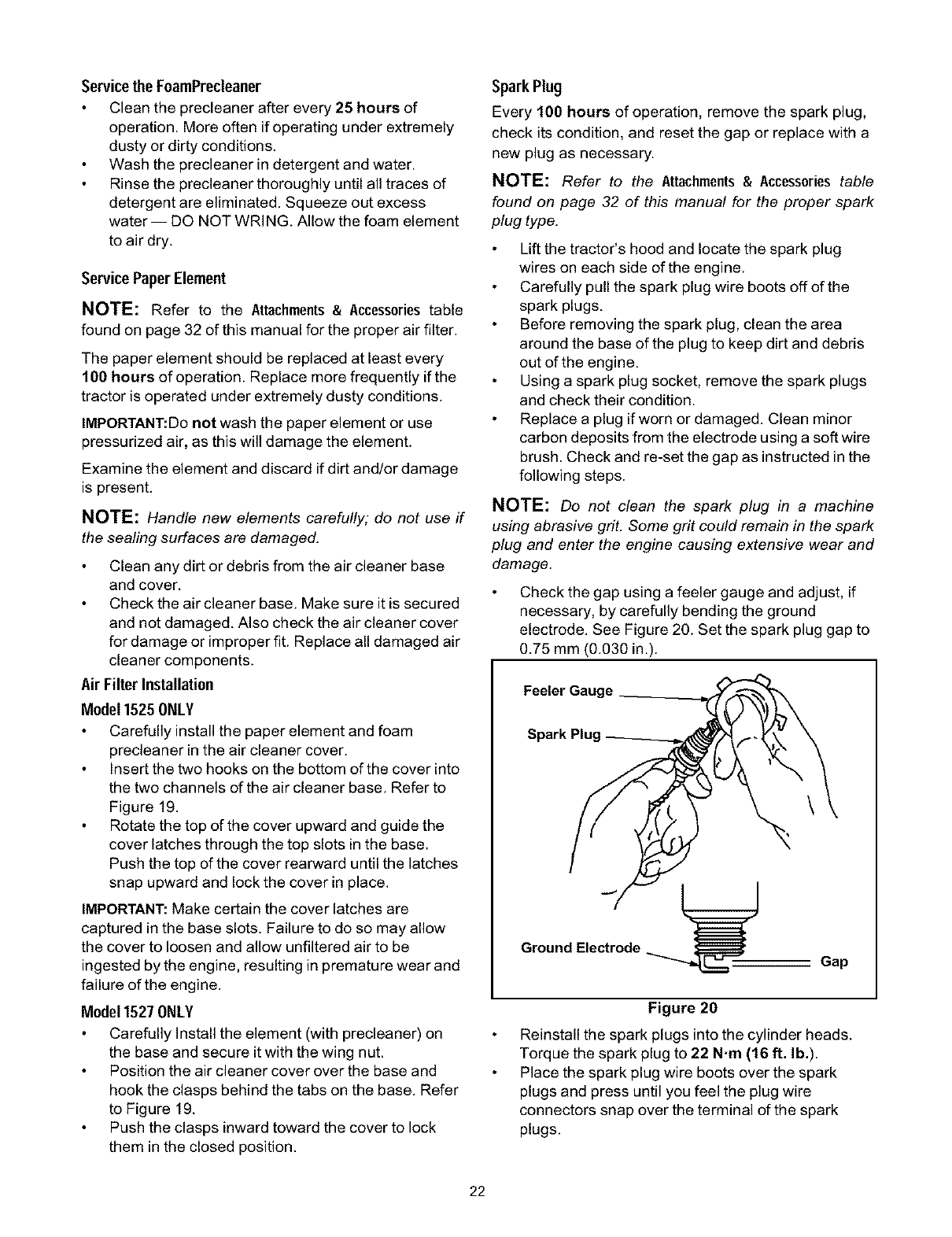
electrode. See Figure 20. Set the spark plug gap to
0.75 mm (0.030 in.).
Feeler Gauge
Spark Plug
Ground Electrode Gap
Figure 20
Reinstall the spark plugs into the cylinder heads.
Torque the spark plug to 22 N,m (16 ft. lb.).
Place the spark plug wire boots over the spark
plugs and press until you feel the plug wire
connectors snap over the terminal of the spark
plugs.
22
Fuel Filterand Pump
_, WARNING: Do not replace the fuel filter or
pump when engine is hot.
The engine is equipped with an inline fuel filter and fuel
pump located on the right side of the engine.
Visually inspect the filter periodically for a build-up of
residue inside the filter body, and for a dirty element
which can be indicated by discoloration. Replace the
fuel filter when dirty.
The fuel pump can not be disassembled. If the fuel
pump fails, replace it with a new one.
NOTE: If necessary, remove the tractor's right-hand
side panel as instructed on page 20 before changing
the engine's fuel filter.
Cleaningthe EngineAndDeck
Any fuel or oil spilled on the machine should be wiped
off promptly.
Do NOT allow debris to accumulate around the engine
air intake screen and cooling fins. Every 100 hours of
operation, check and clean the cooling fins and inside
of engine shrouds to remove grass, chaff of dirt
clogging the cooling system. Remove the fan housing
and intake screen to clean the engine.
Do NOT allow debris to accumulate around or on any
other part of the machine, especially the belts and
pulleys.
IMPORTANT: The use of a pressure washer or garden
hose to clean your tractor is NOT recommended. It may
cause damage to electrical components, spindles,
pulleys, bearings or the engine. The use of water will
result in a shortened life of the tractor and reduce its
serviceability.
Lubrication
Engine
WARNING: Before lubricating, repairing, or
inspecting, always disengage PTO, set
parking brake, stop engine and remove key to
prevent unintended starting.
Refer to Engineon page 19 for instruction regarding all
engine-related lubrication.
Deck Spindles
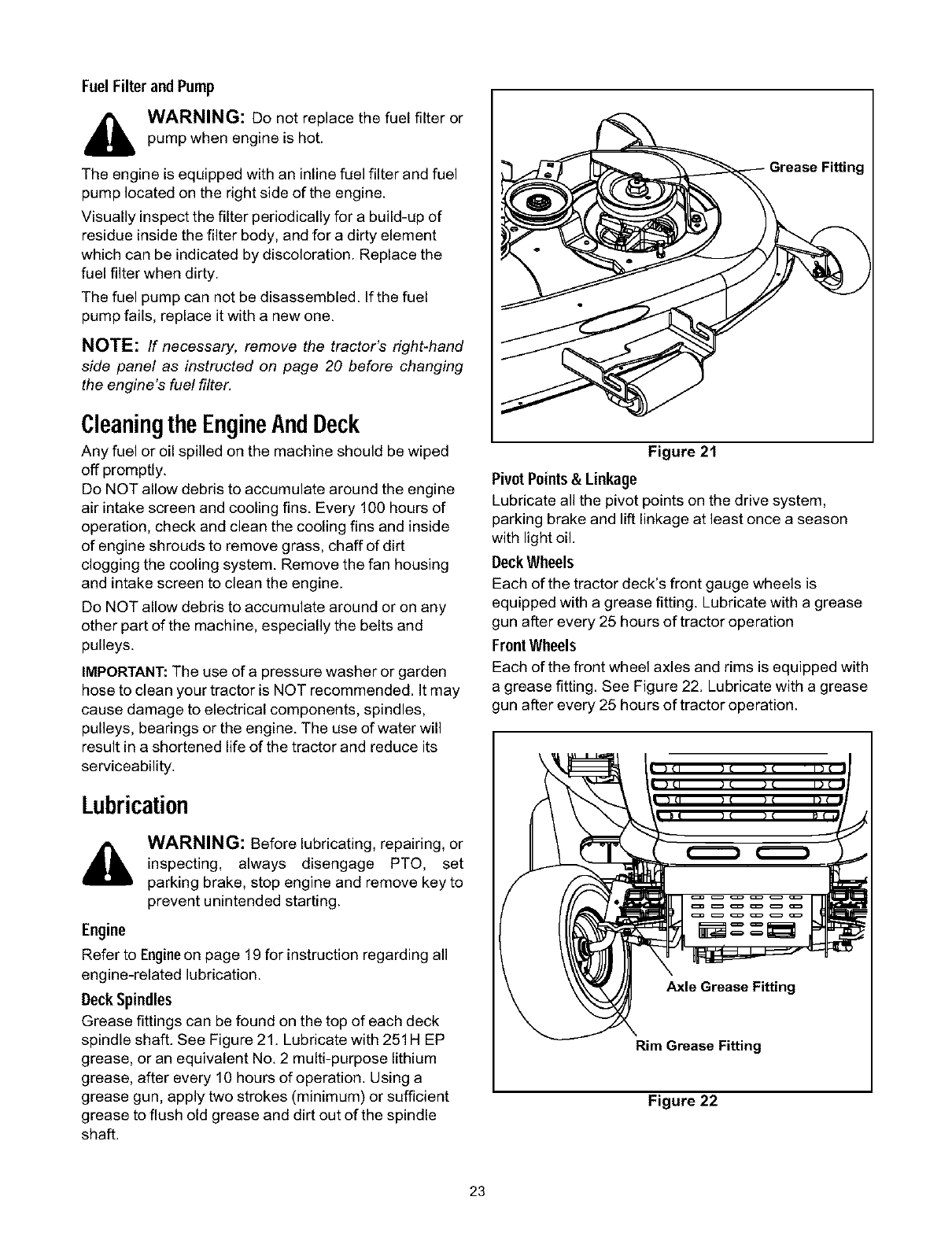
Grease fittings can be found on the top of each deck
spindle shaft. See Figure 21. Lubricate with 251H EP
grease, or an equivalent No. 2 multi-purpose lithium
grease, after every 10 hours of operation. Using a
grease gun, apply two strokes (minimum) or sufficient
grease to flush old grease and dirt out of the spindle
shaft.
Figure 21
Pivot Points &Linkage
Lubricate all the pivot points on the drive system,
parking brake and lift linkage at least once a season
with light oil,
DeckWheels
Each of the tractor deck's front gauge wheels is
equipped with a grease fitting. Lubricate with a grease
gun after every 25 hours of tractor operation
Front Wheels
Each of the front wheel axles and rims is equipped with
a grease fitting. See Figure 22. Lubricate with a grease
gun after every 25 hours of tractor operation.
Axle Grease Fitting
Rim Grease Fitting
Figure 22
23
SECTION8: SERVICE
HeadLamp
WARNING: If the engine has been recently
run, the engine, muffler and surrounding
metal surfaces will be hot and can cause
burns to the skin. Allow the tractor to cool and
use caution when changing the lamp bulbs.
Replace headlight bulbs as follows:
NOTE: Pay attention to which wire connects to each
lamp terminal before disconnecting.
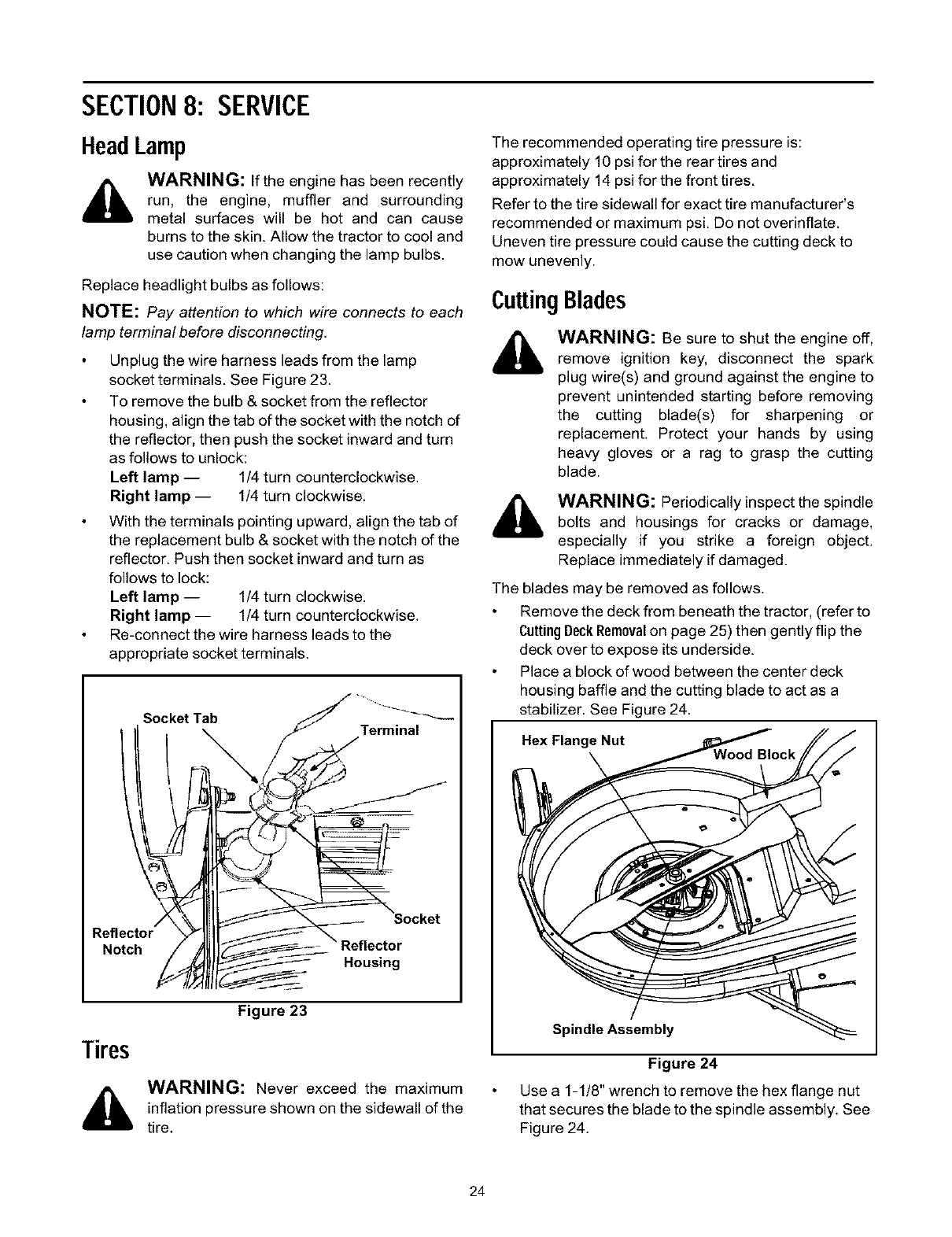
Unplug the wire harness leads from the lamp
socket terminals. See Figure 23.
To remove the bulb & socket from the reflector
housing, align the tab of the socket with the notch of
the reflector, then push the socket inward and turn
as follows to unlock:
Left lamp -- 1/4 turn counterclockwise.
Right lamp -- 1/4 turn clockwise.
With the terminals pointing upward, align the tab of
the replacement bulb & socket with the notch of the
reflector. Push then socket inward and turn as
follows to lock:
Left lamp -- 1/4 turn clockwise.
Right lamp -- 1/4 turn counterclockwise.
Re-connect the wire harness leads to the
appropriate socket terminals.
Socket Tab Terminal
Socket
Reflector
Notch ector
Housing
Figure 23
Tires
_, WARNING: Never exceed the maximum
inflation pressure shown on the sidewall of the
tire.
The recommended operating tire pressure is:
approximately 10 psi for the rear tires and
approximately 14 psi for the front tires.
Refer to the tire sidewall for exact tire manufacturer's
recommended or maximum psi. Do not overinflate.
Uneven tire pressure could cause the cutting deck to
mow unevenly.
CuttingBlades
WARNING: Be sure to shut the engine off,
remove ignition key, disconnect the spark
plug wire(s) and ground against the engine to
prevent unintended starting before removing
the cutting blade(s) for sharpening or
replacement. Protect your hands by using
heavy gloves or a rag to grasp the cutting
blade.
WARNING: Periodically inspect the spindle
bolts and housings for cracks or damage,
especially if you strike a foreign object.
Replace immediately if damaged.
The blades may be removed as follows.
Remove the deck from beneath the tractor, (refer to
CuttingDeckRemovalon page 25) then gently flip the
deck over to expose its underside.
Place a block of wood between the center deck
housing baffle and the cutting blade to act as a
stabilizer. See Figure 24.
Hex Flange Nut
Spindle Assembly
Figure 24
Use a 1-1/8" wrench to remove the hex flange nut
that secures the blade to the spindle assembly. See
Figure 24.
24
To properly sharpen the cutting blades, remove equal
amounts of metal from both ends of the blades along
the cutting edges, parallel to the trailing edge, at a 25°
to 30° angle.IMPORTANT:
IMPORTANT: If the cutting edge of the blade has already
been sharpened, or if any metal separation is present,
replace the blades with new ones.
It is important that each cutting blade edge be ground
equally to maintain proper blade balance. A poorly
balanced blade will cause excessive vibration and may
cause damage to the tractor and result in personal
injury.
The blade can be tested by balancing it on a round
shaft screwdriver. Grind metal from the heavy side until
it balances evenly.
IMPORTANT:When replacing the blade, be sure to
install the blade with the side of the blade marked
"Bottom" (or with a part number stamped in it) facing
the ground when the mower is in the operating position.
IMPORTANT:Use a torque wrench to tighten the blade
spindle hex flange nut to between 70 and 90 ft/Ibs.
Battery
The battery is sealed and is maintenance-free. Acid
levels cannot be checked and fluid can not be added.
Always keep the battery cables and terminals clean
and free of corrosive build-up.
After cleaning the battery and terminals, apply a
light coat of petroleum jelly or grease to both
terminals
Always keep the rubber boot positioned over the
positive terminal to prevent shorting.
IMPORTANT: If removing the battery for any reason,
disconnect the NEGATIVE (Black) wire from it's
terminal first, followed by the POSITIVE (Red) wire.
When re-installing the battery, always connect the
POSITIVE (Red) wire its terminal first, followed by the
NEGATIVE (Black) wire. Be certain that the wires are
connected to the correct terminals; reversing them
could change the polarity and cause damage to your
engine's alternating system.
JumpStarting
_, WARNING: Never jump start a damaged orfrozen battery. Be certain the vehicles do not
touch, and ignitions are off. Do not allow cable
clamps to touch.
Connect positive (+) cable to positive post (+) of
your tractor's discharged battery.
Connect the other end of the cable to the (positive
+) post of the jumper battery.
Connect the second cable (negative -) to the other
post of the jumper battery.
Make the final connection on the engine block of
the stalled tractor, away from the battery. Attach to
a unpainted part to assure a good connection.
IMPORTANT: If the jumper battery is installed on a
vehicle (i.e. car, truck), do NOT start the vehicle's
engine when jump starting your tractor.
Refer to the instructions on page 13 to start the
tractor.
Set the tractor's p[arking brake before removing the
jumper cables, in reverse order of connection.
Allow the tractor's engine to run for 15 minutes
before shutting it off to allow the alternating system
time to charge the discharged battery.
Charging
If the unit has not been put into use for an extended
period of time, charge the battery with an automotive-
type 12-volt charger for a minimum of one hour at six
amps.
WARNING: Batteries give off an explosive
gas while charging. Charge battery in a well
ventilated area and keep away from an open
flame or pilot light as on a water heater, space
heater, furnace, clothes dryer or other gas
appliances.
Fuse
A fuse is installed in your tractor's wiring harness to
protect the tractor's electrical system from damage
caused by excessive amperage.
If the electrical system does not function, or your
tractor's engine will not crank, first check to be certain
that the fuse has not blown.
It can be found under the hood mounted behind the top
of the dash panel on the support bar. Pull the fuse out
and inspect it to determine if it is good or blown.
IMPORTANT: Always use a fuse with the same
amperage capacity for replacement.
WARNING: Before servicing, repairing, or
inspecting, always disengage PTO, set
parking brake, stop engine and remove key to
prevent unintended starting.
CuttingDeckRemoval
To remove the cutting deck, proceed as follows:
Place the PTO knob in the disengaged (OFF)
position and engage the parking brake.
Lower the deck by moving the deck lift lever into the
bottom notch on the right fender.
Remove the PTO belt from around the tractor's
electric PTO clutch. Refer to Figure 26 or Figure 27.
Looking at the cutting deck from the left side of the
tractor, locate the deck support pin on the rear left
side of the deck. Refer to Figure 25.
25
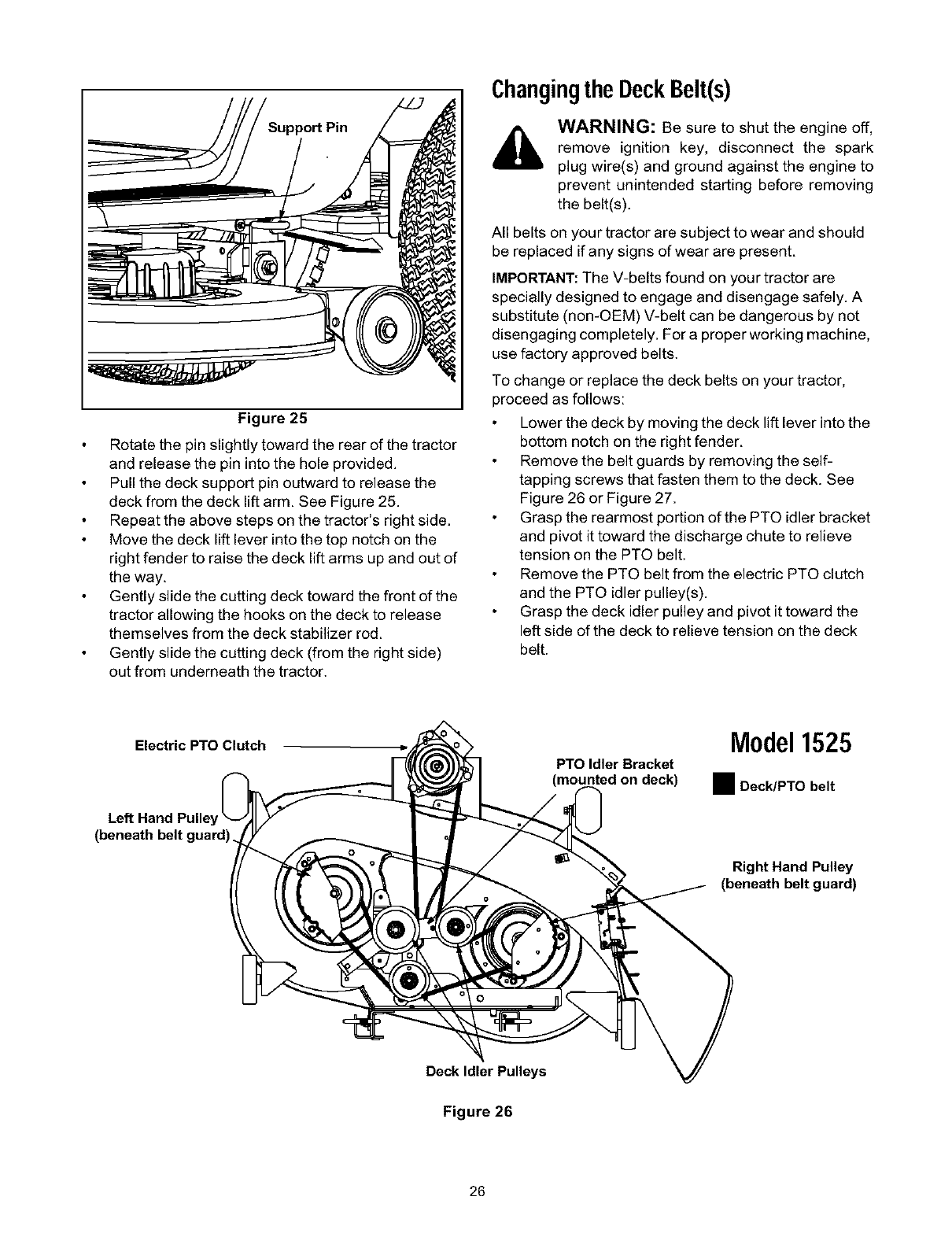
Pin
Figure 25
Rotate the pin slightly toward the rear of the tractor
and release the pin into the hole provided.
Pull the deck support pin outward to release the
deck from the deck lift arm. See Figure 25.
Repeat the above steps on the tractor's right side.
Move the deck lift lever into the top notch on the
right fender to raise the deck lift arms up and out of
the way.
Gently slide the cutting deck toward the front of the
tractor allowing the hooks on the deck to release
themselves from the deck stabilizer rod.
Gently slide the cutting deck (from the right side)
out from underneath the tractor.
ChangingtheDeckBelt(s)
WARNING: Be sure to shut the engine off,
remove ignition key, disconnect the spark
plug wire(s) and ground against the engine to
prevent unintended starting before removing
the belt(s).
All belts on your tractor are subject to wear and should
be replaced if any signs of wear are present.
IMPORTANT: The V-belts found on your tractor are
specially designed to engage and disengage safely. A
substitute (non-OEM) V-belt can be dangerous by not
disengaging completely. For a proper working machine,
use factory approved belts.
To change or replace the deck belts on your tractor,
proceed as follows:
Lower the deck by moving the deck lift lever into the
bottom notch on the right fender.
Remove the belt guards by removing the self-
tapping screws that fasten them to the deck. See
Figure 26 or Figure 27.
Grasp the rearmost portion of the PTO idler bracket
and pivot it toward the discharge chute to relieve
tension on the PTO belt.
Remove the PTO belt from the electric PTO clutch
and the PTO idler pulley(s).
Grasp the deck idler pulley and pivot it toward the
left side of the deck to relieve tension on the deck
belt.
Electric PTO Clutch
Left Hand Pulley
(beneath belt guard).
PTO Idler Bracket
(mounted on deck)
Model1525
mDeck/PTO belt
Right Hand Pulley
(beneath belt guard)
Deck Idler Pulleys
Figure 26
26
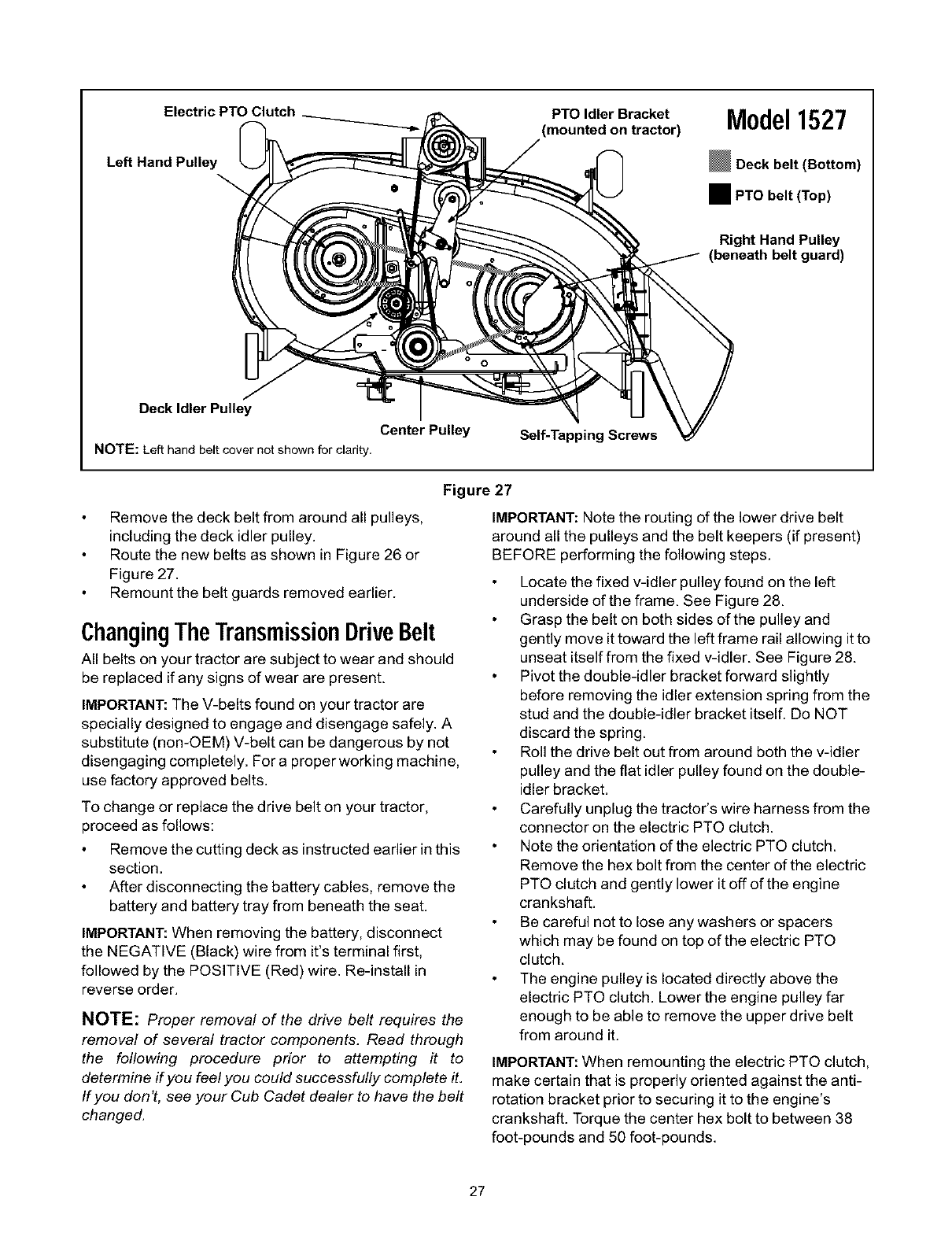
Electric PTO Clutch
Left Hand Pulley
PTO Idler Bracket
(mounted on tractor) Model1527
•Deck belt (Bottom)
•PTO belt (Top)
Right Hand Pulley
(beneath belt guard)
Deck Idler Pulley
Center Pulley
NOTE: Left hand belt cover not shown for clarity. Self-Tapping Screws
Remove the deck belt from around all pulleys,
includingthe deck idler pulley.
Route the new belts as shown in Figure 26 or
Figure 27.
Remount the belt guards removed earlier.
ChangingTheTransmissionDriveBelt
All belts on your tractor are subject to wear and should
be replaced if any signs of wear are present.
IMPORTANT: The V-belts found on your tractor are
specially designed to engage and disengage safely. A
substitute (non-OEM) V-belt can be dangerous by not
disengaging completely. For a proper working machine,
use factory approved belts.
To change or replace the drive belt on your tractor,
proceed as follows:
Remove the cutting deck as instructed earlier in this
section.
After disconnecting the battery cables, remove the
battery and battery tray from beneath the seat.
IMPORTANT: When removing the battery, disconnect
the NEGATIVE (Slack) wire from it's terminal first,
followed by the POSITIVE (Red) wire. Re-install in
reverse order.
NOTE: Proper removal of the drive belt requires the
removal of several tractor components. Read through
the following procedure prior to attempting it to
determine if you feel you could successfully complete it.
If you don't, see your Cub Cadet dealer to have the belt
changed.
Figure 27
IMPORTANT: Note the routing of the lower drive belt
around all the pulleys and the belt keepers (if present)
BEFORE performing the following steps.
Locate the fixed v-idler pulley found on the left
underside of the frame. See Figure 28.
Grasp the belt on both sides of the pulley and
gently move it toward the left frame rail allowing it to
unseat itself from the fixed v-idler. See Figure 28.
Pivot the double-idler bracket forward slightly
before removing the idler extension spring from the
stud and the double-idler bracket itself. Do NOT
discard the spring.
Roll the drive belt out from around both the v-idler
pulley and the flat idler pulley found on the double-
idler bracket.
Carefully unplug the tractor's wire harness from the
connector on the electric PTO clutch.
Note the orientation of the electric PTO clutch.
Remove the bex bolt from the center of the electric
PTO clutch and gently lower it off of the engine
crankshaft.
Se careful not to lose any washers or spacers
which may be found on top of the electric PTO
clutch.
The engine pulley is located directly above the
electric PTO clutch. Lower the engine pulley far
enough to be able to remove the upper drive belt
from around it.
IMPORTANT: When remounting the electric PTO clutch,
make certain that is properly oriented against the anti-
rotation bracket prior to securing it to the engine's
crankshaft. Torque the center hex bolt to between 38
foot-pounds and 50 foot-pounds.
27
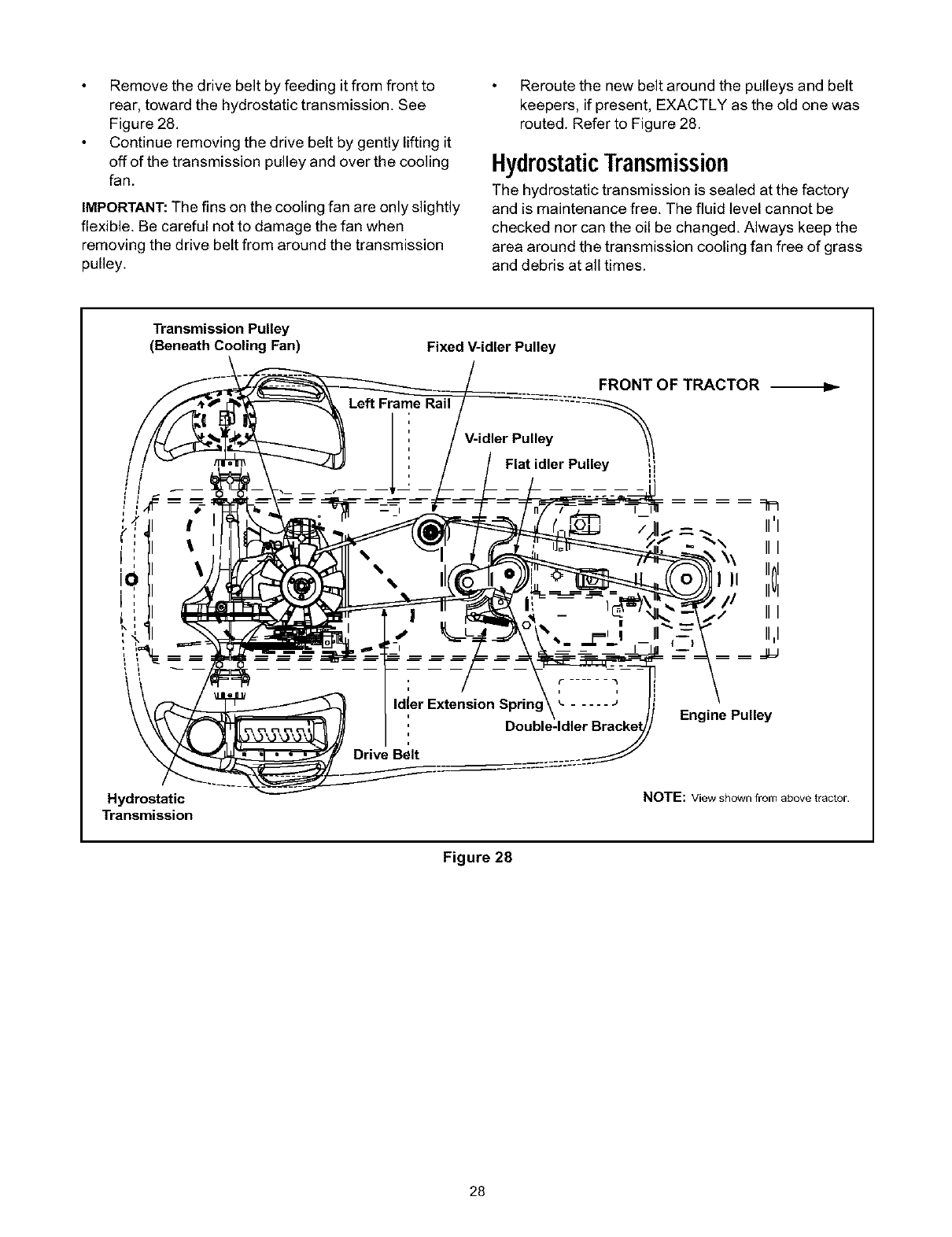
Remove the drive belt by feeding it from front to
rear, toward the hydrostatic transmission. See
Figure 28.
Continue removing the drive belt by gently lifting it
off of the transmission pulley and over the cooling
fan.
IMPORTANT:The fins on the cooling fan are only slightly
flexible. Be careful not to damage the fan when
removing the drive belt from around the transmission
pulley.
Reroute the new belt around the pulleys and belt
keepers, if present, EXACTLY as the old one was
routed. Refer to Figure 28.
HydrostaticTransmission
The hydrostatic transmission is sealed at the factory
and is maintenance free. The fluid level cannot be
checked nor can the oil be changed. Always keep the
area around the transmission cooling fan free of grass
and debris at all times.
Transmission Pulley
(Beneath Cooling Fan) Fixed V-idler Pulley
FRONT OF TRACTOR --_
/
Engine Pulley
Hydrostatic
Transmission
NOTE: View shown from above tractor.
Figure 28
28
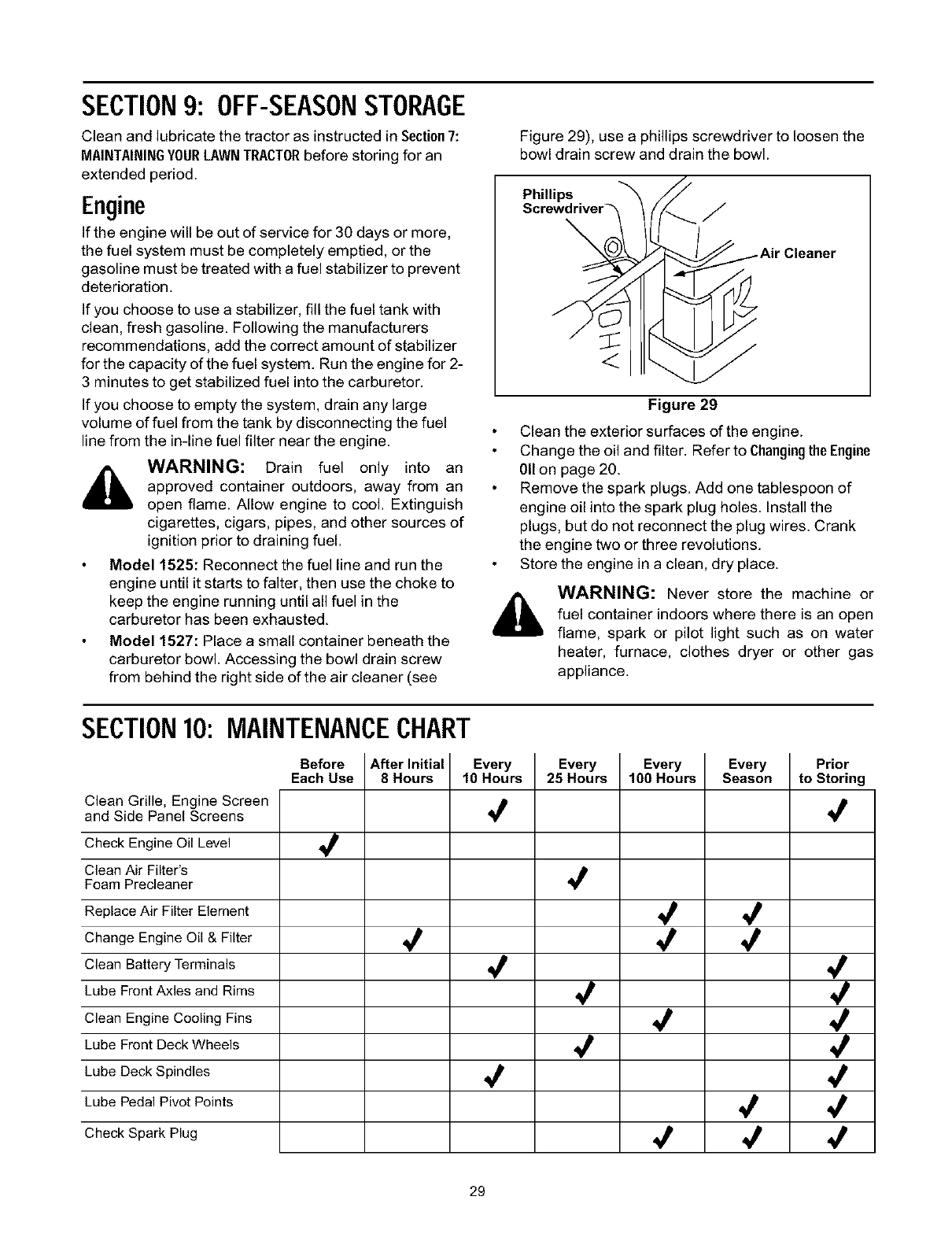
SECTION9: OFFmSEASONSTORAGE
Clean and lubricate the tractor as instructed in Section7:
MAINTAININGYOURLAWNTRACTORbefore storing for an
extended period.
Engine
If the engine will be out of service for 30 days or more,
the fuel system must be completely emptied, or the
gasoline must be treated with a fuel stabilizer to prevent
deterioration.
If you choose to use a stabilizer, fill the fuel tank with
clean, fresh gasoline. Following the manufacturers
recommendations, add the correct amount of stabilizer
for the capacity of the fuel system. Run the engine for 2-
3 minutes to get stabilized fuel into the carburetor.
If you choose to empty the system, drain any large
volume of fuel from the tank by disconnecting the fuel
line from the in-line fuel filter near the engine.
WARNING: Drain fuel only into an
approved container outdoors, away from an
open flame. Allow engine to cool. Extinguish
cigarettes, cigars, pipes, and other sources of
ignition prior to draining fuel.
Model 1525: Reconnect the fuel line and run the
engine until it starts to falter, then use the choke to
keep the engine running until all fuel in the
carburetor has been exhausted.
Model 1527: Place a small container beneath the
carburetor bowl. Accessing the bowl drain screw
from behind the right side of the air cleaner (see
Figure 29), use a phillips screwdriver to loosen the
bowl drain screw and drain the bowl.
Phillips /
Cleaner
Figure 29
Clean the exterior surfaces of the engine.
Change the oil and filter. Refer to Changingthe Engine
011on page 20.
Remove the spark plugs. Add one tablespoon of
engine oil into the spark plug holes. Install the
plugs, but do not reconnect the plug wires. Crank
the engine two or three revolutions.
Store the engine in a clean, dry place.
WARNING: Never store the machine or
fuel container indoors where there is an open
flame, spark or pilot light such as on water
heater, furnace, clothes dryer or other gas
appliance.
SECTION10: MAINTENANCECHART
Clean Grille, Engine Screen
and Side Panel Screens
Check Engine Oil Level
Clean Air Filter's
Foam Precleaner
Replace Air Filter Element
Change Engine Oil & Filter
Clean Battery Terminals
Lube Front Axles and Rims
Clean Engine Cooling Fins
Lube Front Deck Wheels
Lube Deck Spindles
Lube Pedal Pivot Points
Check Spark Plug
Before
Each Use
4
After Initial
8 Hours
,/
Every
10 Hours
4
4
4
Every
25 Hours
,/
4
,/
Every
100 Hours
,/
,/
Every
Season Prior
to Storing
4
4
29
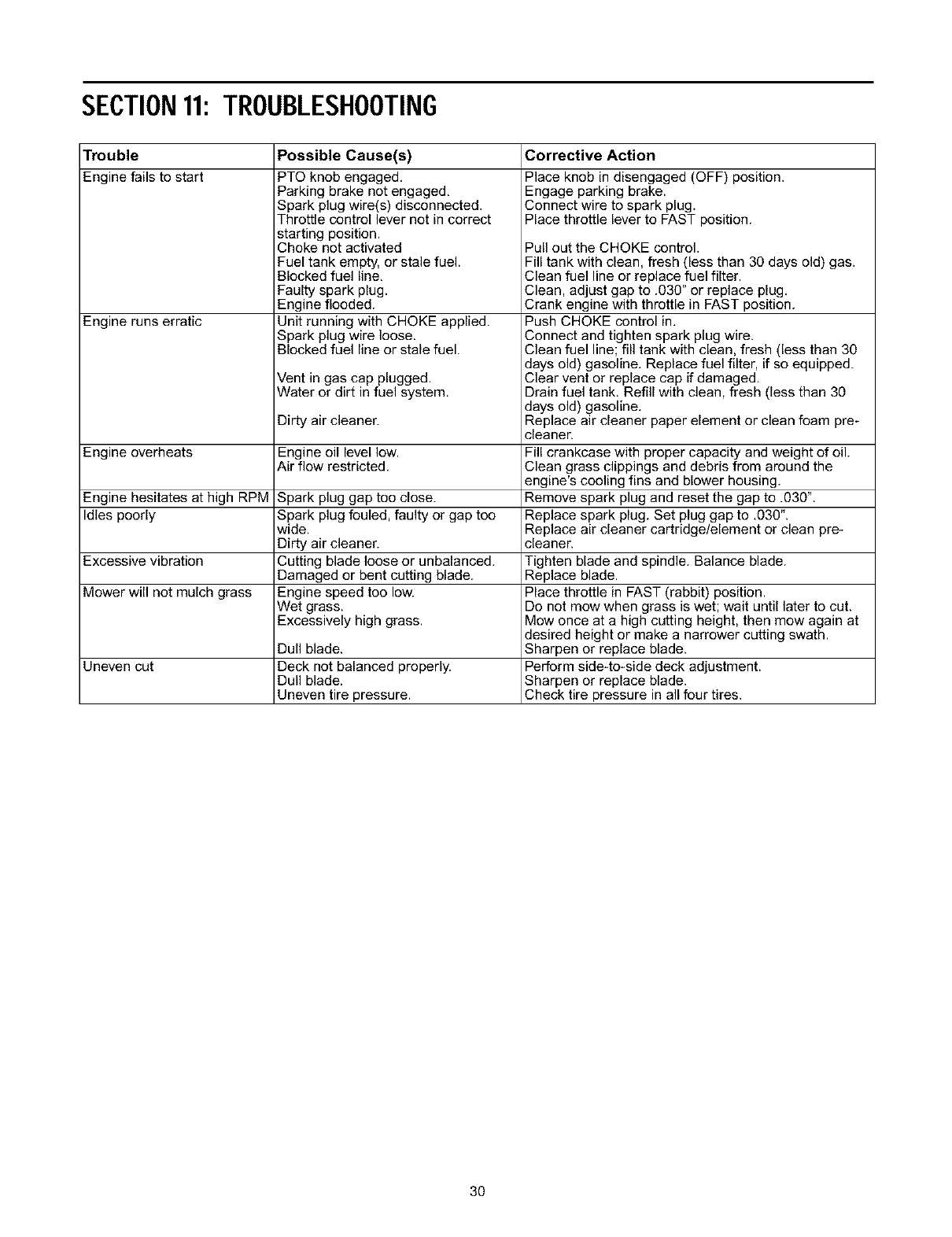
SECTION11: TROUBLESHOOTING
Trouble Corrective Action
Engine fails to start
Engine runs erratic
Possible Cause(s)
PTO knob engaged.
Parking brake not engaged.
Spark plug wire(s) disconnected.
Throttle control lever not in correct
starting position.
Choke not activated
Fuel tank empty, or stale fuel.
Blocked fuel line.
Faulty spark plug.
Engine flooded.
Unit running with CHOKE applied.
Spark plug wire loose.
Blocked fuel line or stale fuel.
Vent in gas cap plugged.
Water or dirt in fuel system.
Dirty air cleaner.
Engine overheats Engine oil level low.
Air flow restricted.
Engine hesitates at high RPM Spark plug gap too close.
Idles poorly Spark plug fouled, faulty or gap too
wide.
Dirty air cleaner.
Excessive vibration Cutting blade loose or unbalanced.
Damaged or bent cutting blade.
Mower will not mulch grass Engine speed too low.
Wet grass.
Excessively high grass.
Dull blade.
Uneven cut Deck not balanced properly.
Dull blade.
Uneven tire pressure.
Place knob in disengaged (OFF) position.
Engage parking brake.
Connect wire to spark plug.
Place throttle lever to FAST position.
Pull out the CHOKE control.
Fill tank with clean, fresh (less than 30 days old) gas.
Clean fuel line or replace fuel filter.
Clean, adjust gap to .030" or replace plug.
Crank engine with throttle in FAST position.
Push CHOKE control in.
Connect and tighten spark plug wire.
Clean fuel line; fill tank with clean, fresh (less than 30
days old) gasoline. Replace fuel filter, if so equipped.
Clear vent or replace cap if damaged.
Drain fuel tank. Refill with clean, fresh (less than 30
days old) gasoline.
Replace air cleaner paper element or clean foam pre-
cleaner.
Fill crankcase with proper capacity and weight of oil.
Clean grass clippings and debris from around the
engine's cooling fins and blower housing.
Remove spark plug and reset the gap to .030".
Replace spark plug. Set plug gap to .030".
Replace air cleaner cartridge/element or clean pre-
cleaner.
Tighten blade and spindle. Balance blade.
Replace blade.
Place throttle in FAST (rabbit) position.
Do not mow when grass is wet; wait until later to cut.
Mow once at a high cutting height, then mow again at
desired height or make a narrower cutting swath.
Sharpen or replace blade.
Perform side-to-side deck adjustment.
Sharpen or replace blade.
Check tire pressure in all four tires.
3O
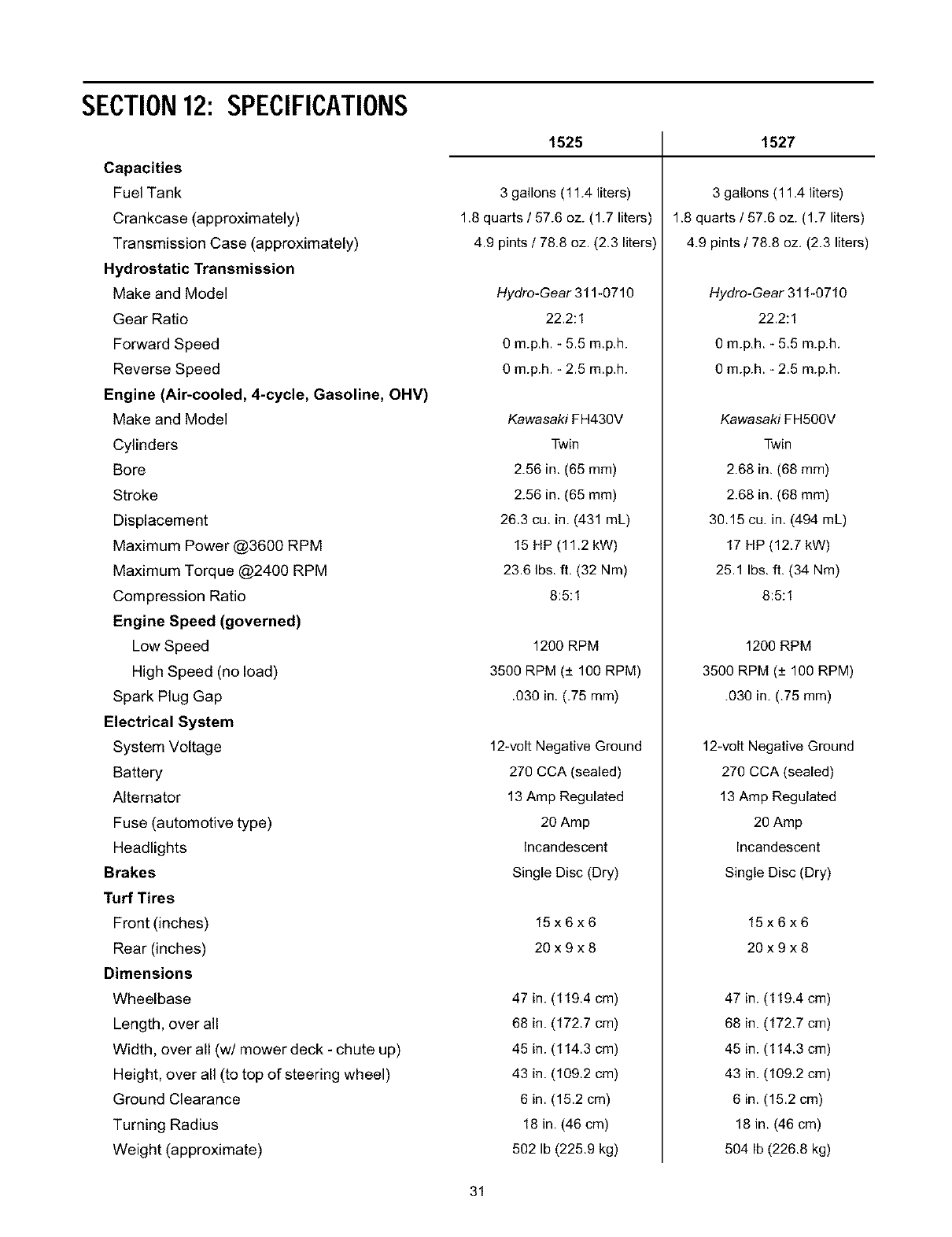
SECTION12: SPECIFICATIONS
Capacities
Fuel Tank
Crankcase (approximately)
Transmission Case (approximately)
Hydrostatic Transmission
Make and Model
Gear Ratio
Forward Speed
Reverse Speed
Engine (Air-cooled, 4-cycle, Gasoline, OHV)
Make and Model
Cylinders
Bore
Stroke
Displacement
Maximum Power @3600 RPM
Maximum Torque @2400 RPM
Compression Ratio
Engine Speed (governed)
Low Speed
High Speed (no load)
Spark Plug Gap
Electrical System
System Voltage
Battery
Alternator
Fuse (automotive type)
Headlights
Brakes
Turf Tires
Front (inches)
Rear (inches)
Dimensions
Wheelbase
Length, over all
Width, over all (w/mower deck - chute up)
Height, over all (to top of steering wheel)
Ground Clearance
Turning Radius
Weight (approximate)
1525
3 gallons (11.4 liters)
1.8 quarts /57.6 oz. (1.7 liters)
4.9 pints /78.8 oz. (2.3 liters)
Hydro-Gear 311-0710
22.2:1
0 m.p,h. - 5.5 m.p.h.
0 m.p.h. - 2.5 m.p.h.
Kawasaki FH430V
Twin
2.56 in. (65 mm)
2.56 in. (65 mm)
26.3 cu. in. (431 mL)
15 HP (11.2 kW)
23.6 Ibs. ft. (32 Nm)
8:5:1
1200 RPM
3500 RPM (+_100 RPM)
.030 in. (.75 mm)
12-volt Negative Ground
270 CCA (sealed)
13 Amp Regulated
20 Amp
Incandescent
Single Disc (Dry)
15x6x6
20xgx8
47 in. (119.4 cm)
68 in. (172.7 cm)
45 in. (114.3 cm)
43 in. (109.2 cm)
6 in. (15.2 cm)
18 in. (46 cm)
502 Ib (225.9 kg)
1527
3 gallons (11.4 liters)
1.8 quarts /57.6 oz. (1.7 liters)
4.9 pints /78.8 oz. (2.3 liters)
Hydro-Gear 311-0710
22.2:1
0 m.p,h. - 5.5 m.p.h.
0 m.p.h. - 2.5 m.p.h.
Kawasaki FH5OOV
Twin
2.68 in. (68 mm)
2.68 in. (68 mm)
30.15 cu. in. (494 mL)
17 HP (12.7 kW)
25.1 Ibs. ft. (34 Nrn)
8:5:1
1200 RPM
3500 RPM (+ 100 RPM)
.030 in. (.75 mm)
12-volt Negative Ground
270 CCA (sealed)
13 Amp Regulated
20 Amp
Incandescent
Single Disc (Dry)
15x6x6
20x9x8
47 in. (119.4 cm)
68 in. (172.7 cm)
45 in. (114.3 cm)
43 in. (109.2 cm)
6 in. (15.2 cm)
18 in. (46 cm)
504 Ib (226.8 kg)
31
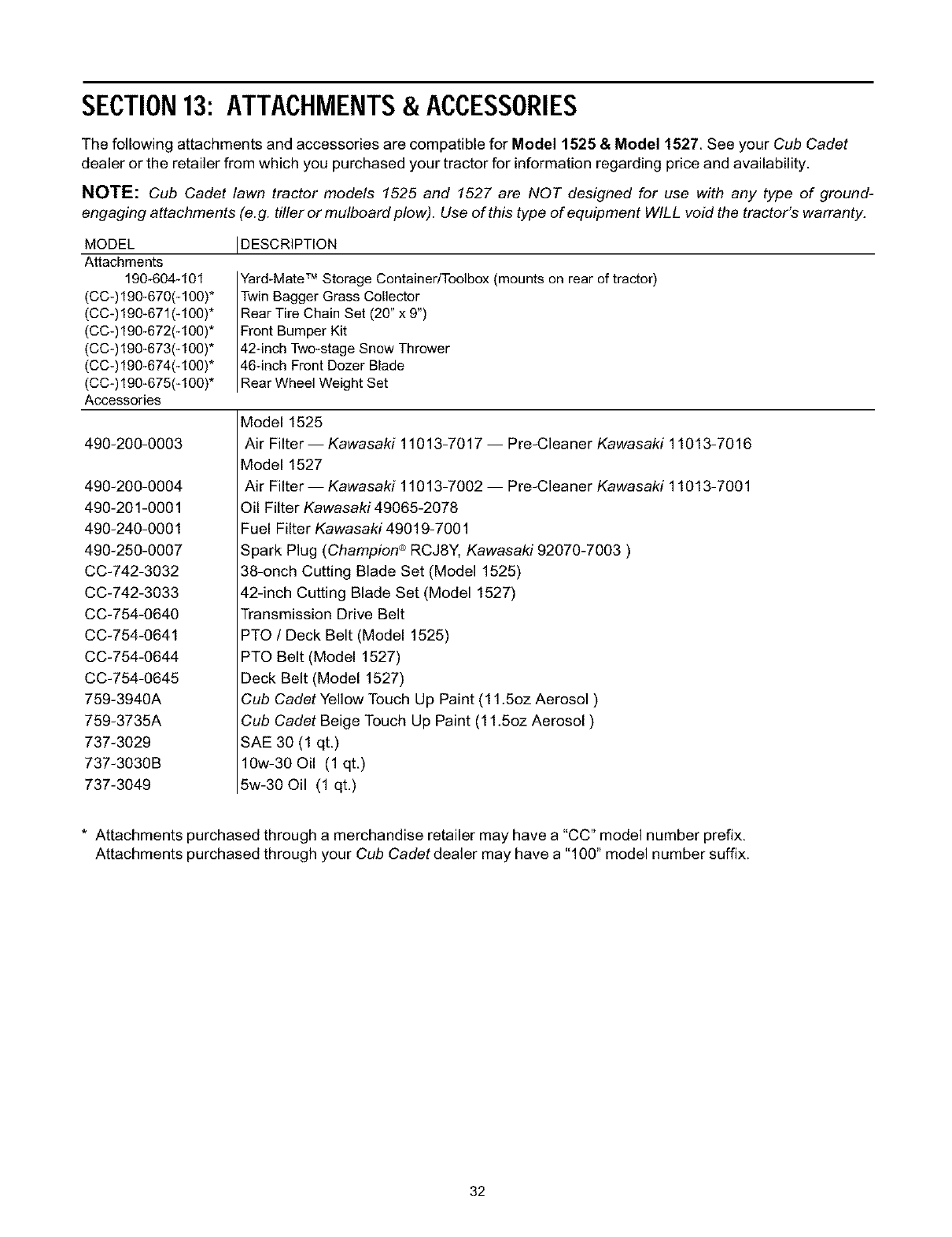
SECTION13: ATTACHMENTS& ACCESSORIES
The following attachments and accessories are compatible for Model 1525 & Model 1527. See your Cub Cadet
dealer or the retailer from which you purchased your tractor for information regarding price and availability.
NOTE: Cub Cadet lawn tractor models 1525 and 1527 are NOT designed for use with any type of ground-
engaging attachments (e.g. tiller or mulboard plow). Use of this type of equipment WILL void the tractor's warranty.
MODEL
Attachments
190-604-101
(CC-)190-670(-100)*
(CC-)190-671(-100)*
(CC-)190-672(-100)*
(CC-)190-673(-100)*
(CC-)190-674(-100)*
(CC-)190-675(-100)*
Accessories
490-200-0003
490-200-0004
490-201-0001
490-240-0001
490-250-0007
CC-742-3032
CC-742-3033
CC-754-0640
CC-754-0641
CC-754-0644
CC-754-0645
759-3940A
759-3735A
737-3029
737-3030B
737-3049
IDESCRIPTION
Yard-Mate TM Storage Container/Toolbox (mounts on rear of tractor)
Twin Bagger Grass Collector
Rear Tire Chain Set (20" x 9")
Front Bumper Kit
42-inch Two-stage Snow Thrower
46-inch Front Dozer Blade
Rear Wheel Weight Set
Model 1525
Air Filter -- Kawasaki 11013-7017 -- Pre-Cleaner Kawasaki 11013-7016
Model 1527
Air Filter -- Kawasaki 11013-7002 -- Pre-Cleaner Kawasaki 11013-7001
Oil Filter Kawasaki 49065-2078
Fuel Filter Kawasaki 49019-7001
Spark Plug (Champion ®RCJ8Y, Kawasaki 92070-7003 )
38-onch Cutting Blade Set (Model 1525)
42-inch Cutting Blade Set (Model 1527)
Transmission Drive Belt
PTO /Deck Belt (Model 1525)
PTO Belt (Model 1527)
Deck Belt (Model 1527)
Cub Cadet Yellow Touch Up Paint (11.5oz Aerosol )
Cub Cadet Beige Touch Up Paint (11.5oz Aerosol )
SAE 30 (1 qt.)
10w-30 Oil (1 qt.)
5w-30 Oil (1 qt.)
*Attachments purchased through a merchandise retailer may have a "CC" model number prefix.
Attachments purchased through your Cub Cadet dealer may have a "100" model number suffix.
32
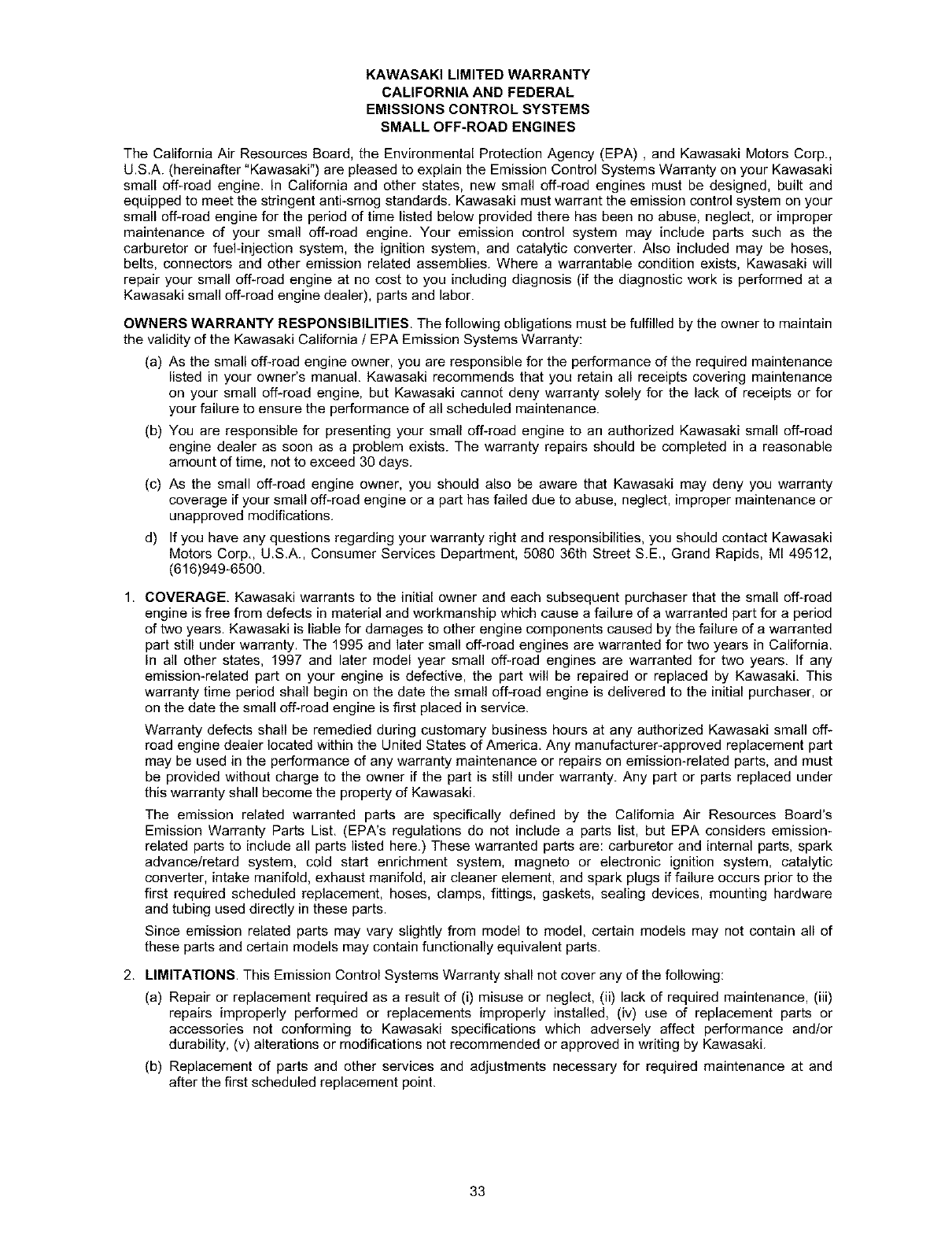
KAWASAKI LIMITED WARRANTY
CALIFORNIA AND FEDERAL
EMISSIONS CONTROL SYSTEMS
SMALL OFF-ROAD ENGINES
The California Air Resources Board, the Environmental Protection Agency (EPA), and Kawasaki Motors Corp.,
U.S.A. (hereinafter "Kawasaki") are pleased to explain the Emission Control Systems Warranty on your Kawasaki
small off-road engine. In California and other states, new small off-road engines must be designed, built and
equipped to meet the stringent anti-smog standards. Kawasaki must warrant the emission control system on your
small off-road engine for the period of time listed below provided there has been no abuse, neglect, or improper
maintenance of your small off-road engine. Your emission control system may include parts such as the
carburetor or fuel-injection system, the ignition system, and catalytic converter. Also included may be hoses,
belts, connectors and other emission related assemblies. Where a warrantable condition exists, Kawasaki will
repair your small off-road engine at no cost to you including diagnosis (if the diagnostic work is performed at a
Kawasaki small off-road engine dealer), parts and labor.
OWNERS WARRANTY RESPONSIBILITIES. The following obligations must be fulfilled by the owner to maintain
the validity of the Kawasaki California /EPA Emission Systems Warranty:
(a) As the small off-road engine owner, you are responsible for the performance of the required maintenance
listed in your owner's manual. Kawasaki recommends that you retain all receipts covering maintenance
on your small off-road engine, but Kawasaki cannot deny warranty solely for the lack of receipts or for
your failure to ensure the performance of all scheduled maintenance.
(b) You are responsible for presenting your small off-road engine to an authorized Kawasaki small off-road
engine dealer as soon as a problem exists. The warranty repairs should be completed in a reasonable
amount of time, not to exceed 30 days.
(c) As the small off-road engine owner, you should also be aware that Kawasaki may deny you warranty
coverage if your small off-road engine or a part has failed due to abuse, neglect, improper maintenance or
unapproved modifications.
d) If you have any questions regarding your warranty right and responsibilities, you should contact Kawasaki
Motors Corp., U.S.A., Consumer Services Department, 5080 36th Street S.E., Grand Rapids, MI 49512,
(616)949-6500.
1. COVERAGE, Kawasaki warrants to the initial owner and each subsequent purchaser that the small off-road
engine is free from defects in material and workmanship which cause a failure of a warranted part for a period
of two years. Kawasaki is liable for damages to other engine components caused by the failure of a warranted
part still under warranty. The 1995 and later small off-road engines are warranted for two years in California.
In all other states, 1997 and later model year small off-road engines are warranted for two years, If any
emission-related part on your engine is defective, the part will be repaired or replaced by KawasakL This
warranty time period shall begin on the date the small off-road engine is delivered to the initial purchaser, or
on the date the small off-road engine is first placed in service.
Warranty defects shall be remedied during customary business hours at any authorized Kawasaki small off-
road engine dealer located within the United States of America. Any manufacturer-approved replacement part
may be used in the performance of any warranty maintenance or repairs on emission-related parts, and must
be provided without charge to the owner if the part is still under warranty. Any part or parts replaced under
this warranty shall become the property of Kawasaki.
The emission related warranted parts are specifically defined by the California Air Resources Board's
Emission Warranty Parts List. (EPA's regulations do not include a parts list, but EPA considers emission-
related parts to include all parts listed here.) These warranted parts are: carburetor and internal parts, spark
advance/retard system, cold start enrichment system, magneto or electronic ignition system, catalytic
converter, intake manifold, exhaust manifold, air cleaner element, and spark plugs if failure occurs prior to the
first required scheduled replacement, hoses, clamps, fittings, gaskets, sealing devices, mounting hardware
and tubing used directly in these parts.
Since emission related parts may vary slightly from model to model, certain models may not contain all of
these parts and certain models may contain functionally equivalent parts.
2. LIMITATIONS This Emission Control Systems Warranty shall not cover any of the following:
(a) Repair or replacement required as a result of (i) misuse or neglect, (ii) lack of required maintenance, (iii)
repairs improperly performed or replacements improperly installed, (iv) use of replacement parts or
accessories not conforming to Kawasaki specifications which adversely affect performance and/or
durability, (v) alterations or modifications not recommended or approved in writing by Kawasaki.
(b) Replacement of parts and other services and adjustments necessary for required maintenance at and
after the first scheduled replacement point.
33
3. LIMITED LIABILITY.
(a) The liability of Kawasaki under this Emission Control Systems Warranty is limited solely to the remedying
of defects in materials or workmanship by any authorized Kawasaki small off-road engine dealer at its
place of business during customary business hours. This warranty does not cover inconvenience or loss
of use of the small off-road engine or transportation of the small off-road engine to or from the Kawasaki
dealer. KAWASAKI SHALL NOT BE LIABLE FOR ANY OTHER EXPENSE, LOSS OR DAMAGE,
WHETHER DIRECT, INCIDENTAL, CONSEQUENTIAL (EXCEPTION LISTED UNDER COVERAGE) OR
EXEMPLARY ARISING IN CONNECTION WITH THE SALE OR USE OF OR INABILITY TO USE THE
KAWASAKI SMALL OFF-ROAD ENGINE FOR ANY PURPOSE.
(b) NO EXPRESS EMISSION CONTROL SYSTEMS WARRANTY IS GIVEN BY KAWASAKI WITH
RESPECT TO THE KAWASAKI SMALL OFF-ROAD ENGINE EXCEPT AS SPECIFICALLY SET FORTH
HEREIN. ANY EMISSION CONTROL SYSTEMS WARRANTY IMPLIED BY LAW, INCLUDING ANY
WARRANTY OF MERCHANTABILITY OR FITNESS FOR A PARTICULAR PURPOSE, IS EXPRESSLY
LIMITED TO THE EMISSION CONTROL SYSTEMS WARRANTY TERMS SET FORTH HEREIN. THE
FOREGOING STATEMENTS OF WARRANTY ARE EXCLUSIVE AND IN LIEU OF ALL OTHER
REMEDIES.
(c) No dealer is authorized to modify this Kawasaki Limited Emission Control System Warranty.
(d) Kawasaki is not liable for parts which are not genuine Kawasaki parts except when genuine Kawasaki
parts cause damage to non-Kawasaki parts.
5. LEGAL RIGHTS, THIS WARRANTY GIVES YOU SPECIFIC LEGAL RIGHTS, AND YOU MAY ALSO HAVE
OTHER RIGHTS.
6. THIS WARRANTY IS IN ADDITION TO THE KAWASAKI LIMITED SMALL OFF-ROAD ENGINE
WARRANTY.
34
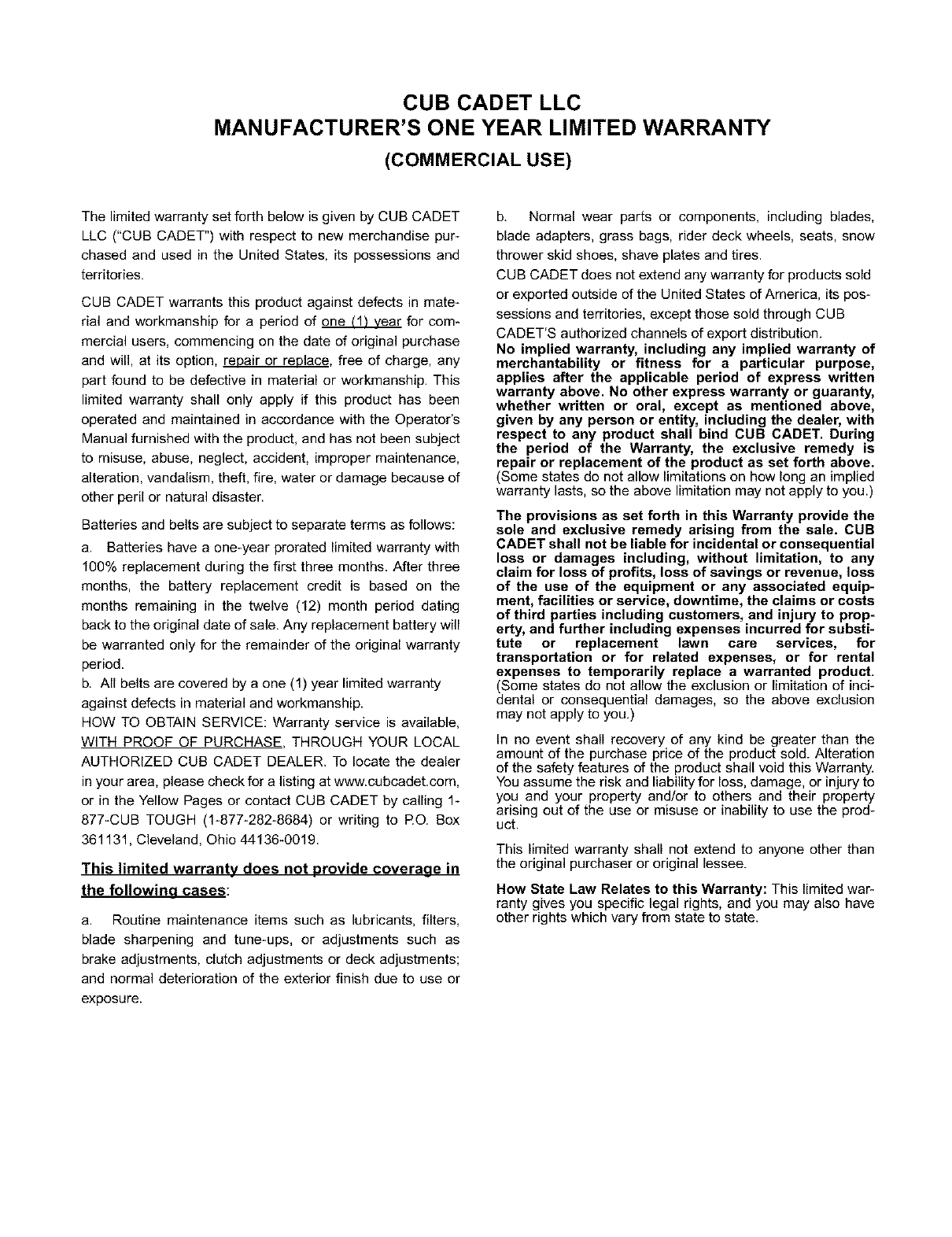
CUB CADET LLC
MANUFACTURER'S ONE YEAR LIMITED WARRANTY
(COMMERCIAL USE)
The limited warranty set forth below is given by CUB CADET
LLC ("CUB CADET") with respect to new merchandise pur-
chased and used in the United States, its possessions and
territories.
CUB CADET warrants this product against defects in mate-
rial and workmanship for a period of _ for com-
mercial users, commencing on the date of original purchase
and will, at its option, repair or replace, free of charge, any
part found to be defective in material or workmanship. This
limited warranty shall only apply if this product has been
operated and maintained in accordance with the Operator's
Manual furnished with the product, and has not been subject
to misuse, abuse, neglect, accident, improper maintenance,
alteration, vandalism, theft, fire, water or damage because of
other peril or natural disaster.
Batteries and belts are subject to separate terms as follows:
a. Batteries have a one-year prorated limited warranty with
100% replacement during the first three months. After three
months, the battery replacement credit is based on the
months remaining in the twelve (12) month period dating
back to the original date of sale. Any replacement battery will
be warranted only for the remainder of the original warranty
period.
b. All belts are covered by a one (1) year limited warranty
against defects in material and workmanship.
HOW TO OBTAIN SERVICE: Warranty service is available,
WITH PROOF OF PURCHASE. THROUGH YOUR LOCAL
AUTHORIZED CUB CADET DEALER. To locate the dealer
in your area, please check for a listing at www.cubcadet.com,
or in the Yellow Pages or contact CUB CADET by calling 1-
877-CUB TOUGH (1-877-282-8684) or writing to RO. Box
361131, Cleveland, Ohio 44136-0019.
This limited warranty does not provide coverage in
the followina cases:
a. Routine maintenance items such as lubricants, filters,
blade sharpening and tune-ups, or adjustments such as
brake adjustments, clutch adjustments or deck adjustments;
and normal deterioration of the exterior finish due to use or
exposure.
b. Normal wear parts or components, including blades,
blade adapters, grass bags, rider deck wheels, seats, snow
thrower skid shoes, shave plates and tires.
CUB CADET does not extend any warranty for products sold
or exported outside of the United States of America, its pos-
sessions and territories, except those sold through CUB
CADET'S authorized channels of export distribution.
No implied warranty, including any implied warranty of
merchantability or fitness for a particular purpose,
applies after the applicable period of express written
warranty above. No other express warranty or guaranty,
whether written or oral, except as mentioned above,
given by any person or entity, including the dealer, with
respect to any product shall bind CUB CADET. During
the period of the Warranty, the exclusive remedy is
repair or replacement of the product as set forth above.
(Some states do not allow limitations on how long an implied
warranty lasts, so the above limitation may not apply to you.)
The provisions as set forth in this Warranty provide the
sole and exclusive remedy arising from the sale. CUB
CADET shall not be liable for incidental or consequential
loss or damages including, without limitation, to any
claim for loss of profits, loss of savings or revenue, loss
of the use of the equipment or any associated equip-
ment, facilities or service, downtime, the claims or costs
of third parties including customers, and injury to prop-
erty, and further including expenses incurred for substi-
tute or replacement lawn care services, for
transportation or for related expenses, or for rental
expenses to temporarily replace a warranted product.
(Some states do not allow the exclusion or limitation of inci-
dental or consequential damages, so the above exclusion
may not apply to you,)
In no event shall recovery of any kind be greater than the
amount of the purchase price of the product sold. Alteration
of the safety features of the product shall void this Warranty.
You assume the risk and liability for loss, damage, or injury to
you and your property and/or to others and their property
arising out of the use or misuse or inability to use the prod-
uct.
This limited warranty shall not extend to anyone other than
the original purchaser or original lessee.
How State Law Relates to this Warranty: This limited war-
ranty gives you specific legal rights, and you may also have
other rights which vary from state to state.
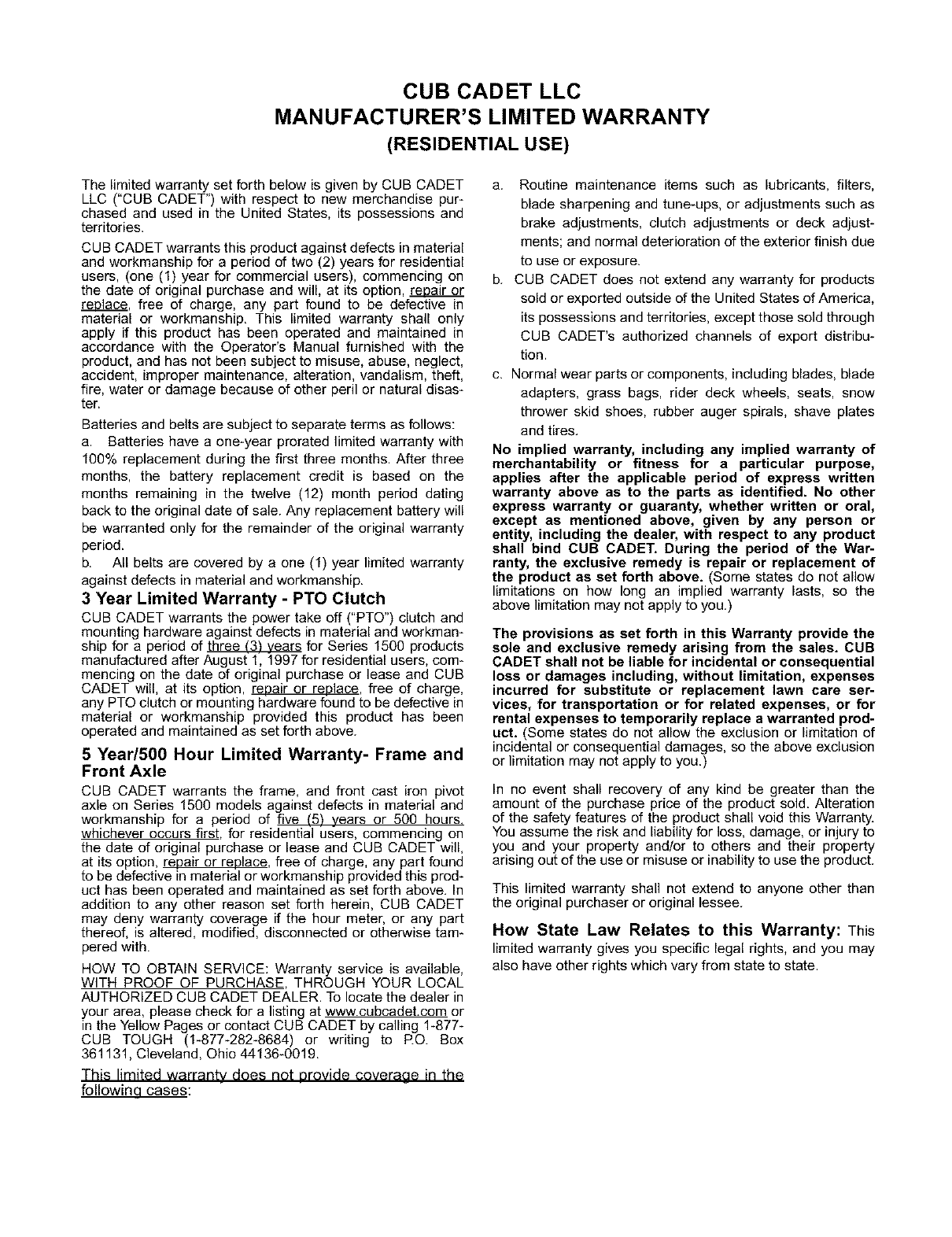
CUB CADET LLC
MANUFACTURER'S LIMITED WARRANTY
(RESIDENTIAL USE)
The limited warranty set forth below is given by CUB CADET
LLC ("CUB CADET") with respect to new merchandise pur-
chased and used in the United States, its possessions and
territories.
CUB CADET warrants this product against defects in material
and workmanship for a period of two (2) years for residential
users, (one (1) year for commercial users), commencing on
the date of original purchase and will, at its option, re_._pairor
_, free of charge, any part found to be defective in
material or workmanship. This limited warranty shall only
apply if this product has been operated and maintained in
accordance with the Operator's Manual furnished with the
product, and has not been subject to misuse, abuse, neglect,
accident, improper maintenance, alteration, vandalism, theft,
fire, water or damage because of other peril or natural disas-
ter.
Batteries and belts are subject to separate terms as follows:
a. Batteries have a one-year prorated limited warranty with
100% replacement during the first three months. After three
months, the battery replacement credit is based on the
months remaining in the twelve (12) month period dating
back to the original date of sale. Any replacement battery will
be warranted only for the remainder of the original warranty
period.
b. All belts are covered by a one (1) year limited warranty
against defects in material and workmanship.
3 Year Limited Warranty - PTO Clutch
CUB CADET warrants the power take off ("PTO") clutch and
mounting hardware against defects in material and workman-
ship for a period of three (3_ vears for Series 1500 products
manufactured after August 1, 1997 for residential users, com-
mencing on the date of original purchase or lease and CUB
CADET will, at its option, reuair or renlace, free of charge,
any PTO clutch or mounting hardware found to be defective in
material or workmanship provided this product has been
operated and maintained as set forth above.
5 Year/S00 Hour Limited Warranty- Frame and
Front Axle
CUB CADET warrants the frame, and front cast iron pivot
axle on Series 1500 models against defects in material and
workmanship for a period of five 1'5_years or 500 hours.
whichever occurs first, for residential users, commencing on
the date of original purchase or lease and CUB CADET will,
at its option, reuair or renlace, free of charge, any part found
to be defective in material or workmanship provided this prod-
uct has been operated and maintained as set forth above. In
addition to any other reason set forth herein, CUB CADET
may deny warranty coverage if the hour meter, or any part
thereof, is altered, modified, disconnected or otherwise tam-
pered with.
HOW TO OBTAIN SERVICE: Warranty service is available,
WITH PROOF OF PURCHASE, THROUGH YOUR LOCAL
AUTHORIZED CUB CADET DEALER. To locate the dealer in
your area, please check for a listing at www.cubcadet.com or
in the Yellow Pages or contact CUB CADET by calling 1-877-
CUB TOUGH (1_877-282-8684) or writing to RO. Box
361131, Cleveland, Ohio 44136-0019.
This limited warranty does not provide coverage in the
followina cases:
a. Routine maintenance items such as lubricants, filters,
blade sharpening and tune-ups, or adjustments such as
brake adjustments, clutch adjustments or deck adjust-
ments; and normal deterioration of the exterior finish due
to use or exposure.
b. CUB CADET does not extend any warranty for products
sold or exported outside of the United States of America,
its possessions and territories, except those sold through
CUB CADET's authorized channels of export distribu-
tion.
c. Normal wear parts or components, including blades, blade
adapters, grass bags, rider deck wheels, seats, snow
thrower skid shoes, rubber auger spirals, shave plates
and tires.
No implied warranty, including any implied warranty of
merchantability or fitness for a particular purpose,
applies after the applicable period of express written
warranty above as to the parts as identified. No other
express warranty or guaranty, whether written or oral,
except as mentioned above, given by any person or
entity, including the dealer, with respect to any product
shall bind CUB CADET. During the period of the War-
ranty, the exclusive remedy is repair or replacement of
the product as set forth above. (Some states do not allow
limitations on how long an implied warranty lasts, so the
above limitation may not apply to you.)
The provisions as set forth in this Warranty provide the
sole and exclusive remedy arising from the sales. CUB
CADET shall not be liable for incidental or consequential
loss or damages including, without limitation, expenses
incurred for substitute or replacement lawn care ser-
vices, for transportation or for related expenses, or for
rental expenses to temporarily replace awarranted prod-
uct. (Some states do not allow the exclusion or limitation of
incidental or consequential damages, so the above exclusion
or limitation may not apply to you.)
In no event shall recovery of any kind be greater than the
amount of the purchase price of the product sold. Alteration
of the safety features of the product shall void this Warranty.
You assume the risk and liability for loss, damage, or injury to
you and your property andlor to others and their property
arising out of the use or misuse or inability to use the product.
This limited warranty shall not extend to anyone other than
the original purchaser or original lessee.
How State Law Relates to this Warranty: This
limited warranty gives you specific legal rights, and you may
also have other rights which vary from state to state.
