Canon 5075 QW 5075OC User Manual To The Ebb4f11e 329d 4c6e 915f 0d9c53269e15
User Manual: Canon 5075 to the manual
Open the PDF directly: View PDF  .
.
Page Count: 5
- About This Manual
- Things to check before using the watch
- Charging the Watch
- Radio Controlled Atomic Timekeeping
- Mode Reference Guide
- Timekeeping
- Configuring Home City Settings
- Configuring Current Time and Date Settings Manually
- Using the Stopwatch
- Checking the Current Time in a Different Time Zone
- Auto Correction of Hand Home Positions
- Adjusting Home Positions Manually
- Troubleshooting
- Specifications
- City Code Table
1
Operation Guide 5075 (OC)
MA0907-EA
Congratulations upon your selection of this CASIO watch.
This watch does not have a city code that corresponds to the UTC offset of –3.5 hours. Because of this, the
radio-controlled atomic timekeeping function will not display the correct time for Newfoundland, Canada.
Note that CASIO COMPUTER CO., LTD. assumes no responsibility for any damage or loss suffered by you
or any third party arising through the use of this product or its malfunction.
About This Manual
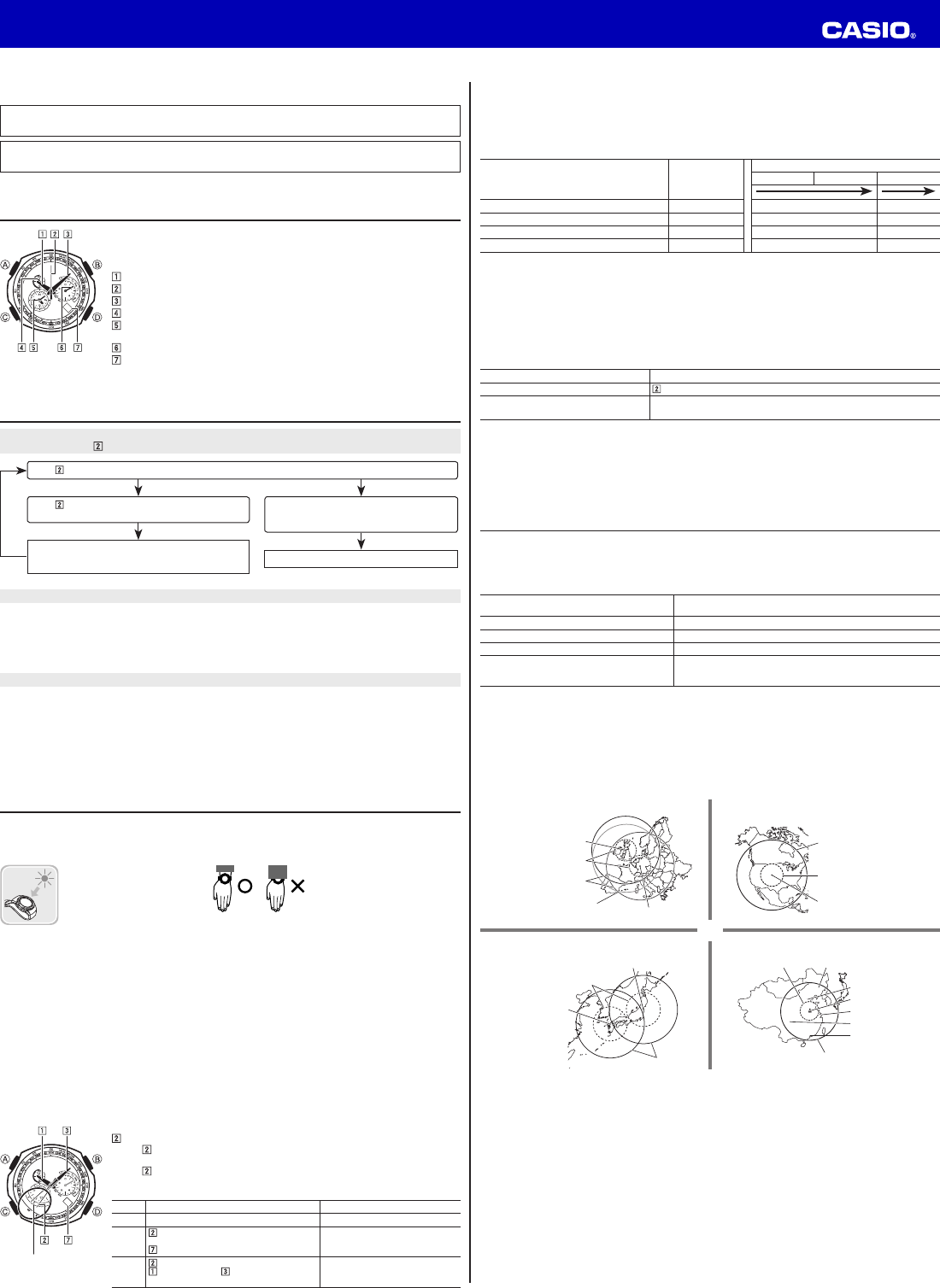
Button operations are indicated using the letters A through D shown in the
illustration.
Hand Functions
z Hour Hand
x Second Hand
c Minute Hand
v 24-hour Hand
b Left Dial Hands: Indicate a time, in 24-hour format, depending on the current
mode.
n Right Dial Hand: Indicates the current day of the week and current mode.
m Day
This User’s Guide uses numbers shown above to identify watch hands and indicators.
Things to check before using the watch
1. Hold down C for about two seconds to enter the Timekeeping Mode, and then observe the
movement of the x Second Hand.
Is the x Second Hand moving smoothly at one-second intervals?
Is the x Second Hand moving at two-second intervals
or is it stopped completely?
Go to step 2.
The watch is charged sufficiently. For details
about charging, see “Charging the Watch”.
Power is low. Charge the watch by placing it in a
location where it is exposed to light. For details, see
“Charging the Watch”.
NO
YES
YES
NEXT
2. Check the Home City and the daylight saving time (DST) setting.
Use the procedure under “To configure Home City settings” to configure your Home City and daylight saving
time settings.
Important!
Proper time calibration signal reception and World Time settings depend on correct Home City, time, and
date settings in the Timekeeping Mode. Make sure you configure these settings correctly.
3. Set the current time.
•To set the time using a time calibration signal
See “To get ready for a receive operation”.
•To set the time manually
See “Configuring Current Time and Date Settings Manually”.
The watch is now ready for use.
For details about the watch’s radio controlled timekeeping feature, see “Radio Controlled Atomic •
Timekeeping”.
Charging the Watch
The face of the watch is a solar cell that generates power from light. The generated power charges a built-in
rechargeable battery, which powers watch operations. The watch charges whenever it is exposed to light.
Charging Guide
Whenever you are not wearing
the watch, leave it in a location
where it is exposed to light.
Best charging performance •
is achieved by exposing
the watch to light that is as
strong as possible.
When wearing the watch, make
sure that its face is not blocked
from light by the sleeve of your
clothing.
The watch may enter a sleep •
state if its face is blocked by your
sleeve even only partially.
Warning!
Leaving the watch in bright light for charging can cause it to become quite hot. Take care when
handling the watch to avoid burn injury. The watch can become particularly hot when exposed to the
following conditions for long periods.
On the dashboard of a car parked in direct sunlight •
Too close to an incandescent lamp •
Under direct sunlight •
Important!
Keep the watch in an area normally exposed to bright light when storing it for long periods. This helps to •
ensure that power does not run down.
Storing the watch for long periods in an area where there is no light or wearing it in such a way that it is •
blocked from exposure to light can cause power to run down. Make sure that the watch is exposed to bright
light whenever possible.
Power Levels
You can get an idea of the watch’s power level by observing the movement of the
x Second Hand in the Timekeeping Mode.
If the •x Second Hand is moving normally at one-second intervals, power is at
Level 1.
If the •x Second Hand is moving at two-second intervals, power is at Level 2,
which is quite low. Expose the watch to light as soon as possible so it can
charge.
Level Hand Movement Function Status
1 Normal. All functions enabled
2
x Second Hand moves at two-second
intervals.
m Day changes to 1 (home position).
Time calibration signal reception
disabled
3
x Second Hand stopped.
z Hour Hand and c Minute Hand stopped
at 12 o’clock.
All functions disabled
B +
* 6> 5
@
Moves at two-second
intervals.
B +
@ 5
When power drops to Level 3, all functions will be disabled but the watch will continue to keep time •
internally for about one week. If you recharge the battery sufficiently during this period, the analog hands
will move automatically to the correct setting and normal timekeeping will resume. After one week, all
settings (including timekeeping) will be cleared. Recharging the battery will reset all settings to their initial
factory defaults.
Charging Times
Exposure Level (Brightness) Daily Operation
*1
Level Change *2
Level 3 Level 2 Level 1
Outdoor sunlight (50,000 lux) 8 minutes 2 hours 24 hours
Window sunlight (10,000 lux) 30 minutes 6 hours 89 hours
Window sunlight on cloudy day (5,000 lux) 48 minutes 9 hours 145 hours
Indoor fluorescent lighting (500 lux) 8 hours 98 hours – – –
1 Approximate exposure each day to generate power for normal daily operation. *
2 Approximate exposure to take power up one level. *
The above times are for reference only. Actual times depend on lighting conditions. •
For details about the operating time and daily operating conditions, see the “Power Supply” section of the •
Specifications.
Power Saving
Power Saving enters a sleep state automatically whenever the watch is left for a certain period in an area
where it is dark. The table below shows how watch functions are affected by Power Saving.
There actually are two sleep state levels: “second hand sleep” and “function sleep”. •
Elapsed Time in Dark Operation
60 to 70 minutes (second hand sleep) x Second Hand only stopped at 12 o’clock, all other functions enabled
6 or 7 days (function sleep) All functions, including analog timekeeping, disabled •
Internal timekeeping maintained •
The watch will not enter a sleep state between 6:00 AM and 9:59 PM. If the watch is already in a sleep state •
when 6:00 AM arrives, however, it will remain in the sleep state.
The watch will not enter a sleep state while it is in the Stopwatch Mode. •
To recover from the sleep state
Move the watch to a well-lit area or press any button.
Radio Controlled Atomic Timekeeping
This watch receives a time calibration signal and updates its time setting accordingly. However, when using
the watch outside of areas covered by time calibration signals, you will have to adjust the settings manually as
required. See “Configuring Current Time and Date Settings Manually” for more information.
This section explains how the watch updates its time settings when the city code selected as the Home City is
in Japan, North America, Europe, or China, and is one that supports time calibration signal reception.
If your Home City Code setting is this: The watch can receive the signal from the transmitter located
here:
LONDON (LON), PARIS (PAR), ATHENS (ATH) Anthorn (England), Mainflingen (Germany)
HONG KONG (HKG) Shangqiu City (China)
TOKYO (TYO) Fukushima (Japan), Fukuoka/Saga (Japan)
HONOLULU (HNL), ANCHORAGE (ANC),
LOS ANGELES (LAX), DENVER (DEN),
CHICAGO (CHI), NEW YORK (NYC)
Fort Collins, Colorado (United States)
Important!
The areas covered by •HONOLULU (HNL) and ANCHORAGE (ANC) are quite far from the calibration signal
transmitters, so certain conditions may cause reception problems.
When •HONOLULU (HNL) or HONG KONG (HKG) is selected as the Home City, only the time and date
are adjusted according to the time calibration signal. You need to switch manually between standard time
and daylight saving time (DST) if required. See “To toggle the Home City time between standard time and
daylight saving time” for information about how to do this.
Approximate Reception Ranges
Japanese Signal Chinese Signal
Fukushima
500 kilometers
1,000 kilometers
Fukuoka/Saga
1,500 kilometers
Changchun500 kilometers
Beijing
Shangqiu
Shanghai
Chengdu
Hong Kong
UK and German Signals North American Signal
Anthorn
500 kilometers
1,500 kilometers
Mainflingen
The Anthorn signal is receivable
within this area.
2,000 miles
(3,000 kilometers)
600 miles
(1,000 kilometers)
Fort Collins
Even when the watch is within range of a transmitter, signal reception may be impossible due to the effects •
of geographic contours, structures, weather, the time of year, the time of day, radio interference, etc. The
signal becomes weaker at distances of approximately 500 kilometers, which means that the influence of the
above conditions becomes even greater.
Signal reception may not be possible at the distances noted below during certain times of the year or day. •
Radio interference may also cause problems with reception.
Mainflingen (Germany) or Anthorn (England) transmitters: 500 kilometers (310 miles) −
Fort Collins (United States) transmitter: 600 miles (1,000 kilometers) −
Fukushima or Fukuoka/Saga (Japan) transmitters: 500 kilometers (310 miles) −
Shangqiu (China) transmitter: 500 kilometers (310 miles) −
As of January 2009, China does not use Daylight Saving Time (DST). If China does go to the Daylight •
Saving Time system in the future, some functions of this watch may no longer operate correctly.
2
Operation Guide 5075 (OC)
To get ready for a receive operation
Confirm that the watch is in the Timekeeping Mode. If it isn’t, hold down 1. C for about two seconds to enter
the Timekeeping Mode.
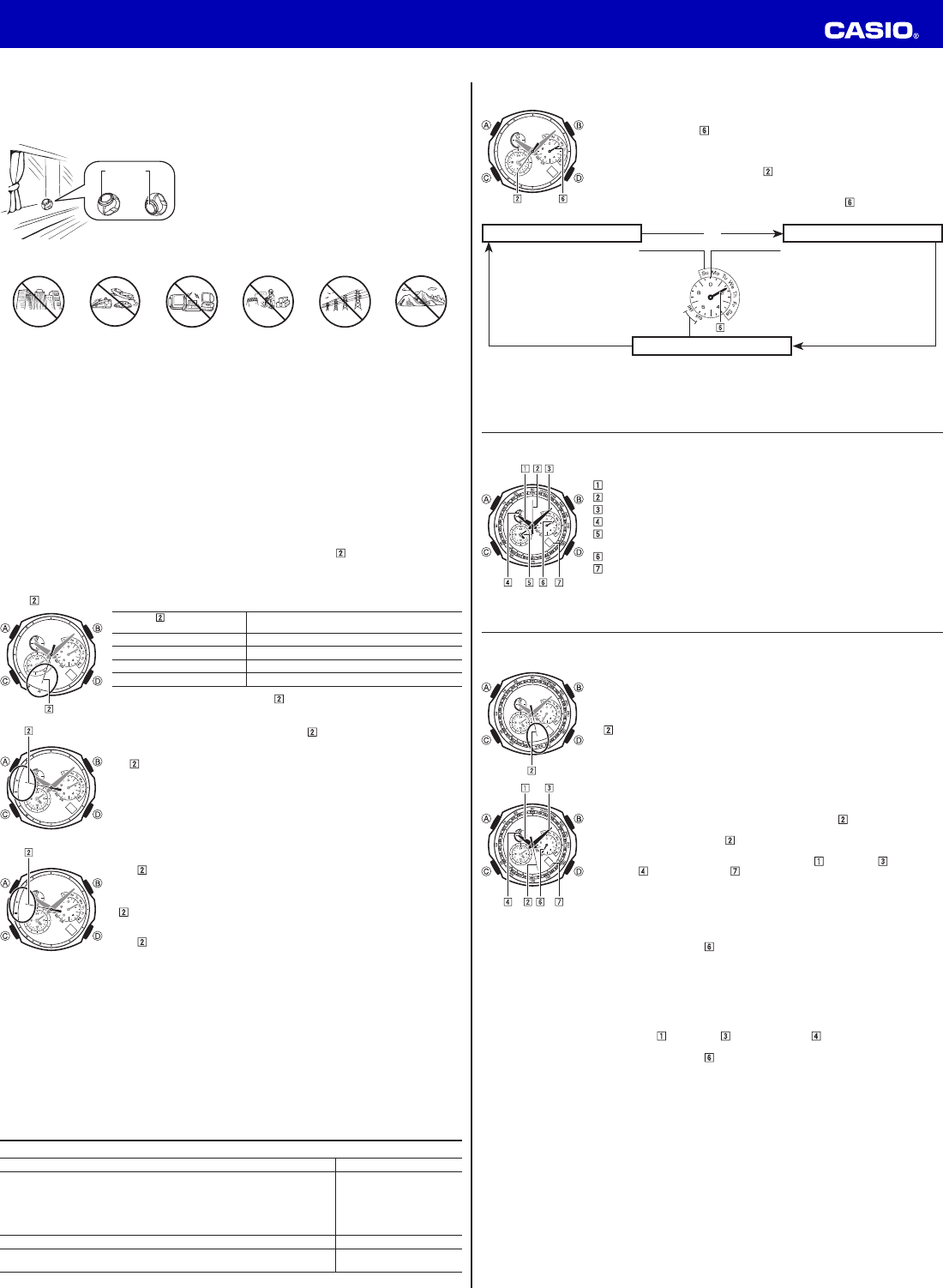
The antenna of this watch is located on its 6 o’clock side. Position the watch with 6 o’clock facing towards a 2.
window as shown in the nearby illustration. Make sure there are no metal objects nearby.
6 o’clock
or
Signal reception normally is better at night. •
The receive operation takes from two to seven minutes, but •
in some cases it can take as long as 14 minutes. Take care
that you do not perform any button operation or move the
watch during this time.
Signal reception may be difficult or even impossible under the conditions described below. •
Inside or among
buildings
Inside a vehicle Near household
appliances,
office equipment,
or a mobile
phone
Near a
construction
site, airport, or
other sources of
electrical noise
Near high-
tension power
lines
Among or behind
mountains
What you should do next depends on whether you are using Auto Receive or Manual Receive.3.
Auto Receive: Leave the watch over night in the location you selected in step 2. See “Auto Receive” for •
details.
Manual Receive: Perform the operation under “To perform manual receive”. •
Auto Receive
With Auto Receive, the watch performs the receive operation each day automatically up to six times (up to •
five times for the Chinese calibration signal) between the hours of midnight and 5 a.m. (according to the
Timekeeping Mode time). When any receive operation is successful, none of the other receive operations
for that day are performed.
When a calibration time is reached, the watch will perform the receive operation only if it is in the •
Timekeeping Mode or World Time Mode. The receive operation is not performed if a calibration time is
reached while you are configuring settings.
To perform manual receive
In the Timekeeping Mode, keep 1. A depressed (for about two seconds) as the x Second Hand goes through
the following sequence.
Moves to •YES (or Y for some models) or NO (N) to indicate the last signal reception result, then to
READY (R).
The 2. x Second Hand indicates the operations the watch is currently performing.
When the x Second Hand is
pointed here: It means this:
READY (R) Watch is setting up for reception.
WORK (W) Reception is in progress.
YES (Y) Reception was completed successfully.
NO (N) Reception failed for some reason.
If signal reception is unstable, the •x Second Hand may move between WORK
(W) and READY (R).
The receive operation is complete when the 3. x Second Hand moves to YES (Y)
or NO (N) for about five seconds, and then resumes normal timekeeping.
You can return to the Timekeeping Mode manually by pressing •A while the
x Second Hand is pointing to YES (Y) or NO (N).
When the receive operation is successful, the watch adjusts the time setting •
accordingly. It does not adjust the setting if the operation failed.
Note
To interrupt a receive operation and return to the Timekeeping Mode, press •
any button.
To check the result of the latest receive operation
In the Timekeeping Mode, press A.
The •x Second Hand will move to YES (Y) for five seconds if the latest receive
operation was successful, or NO (N) if it was not. After that, normal timekeeping
will resume.
You can return to the Timekeeping Mode manually by pressing •A while the
x Second Hand is pointing to YES (Y) or NO (N).
Note
The •x Second Hand will indicate NO (N) if you have adjusted the time or date
setting manually since the latest receive operation.
Radio-controlled Atomic Timekeeping Precautions
Strong electrostatic charge can result in the wrong time setting. •
Even if a receive operation is successful, certain conditions can cause the time setting to be off by up to •
one second.
The watch is designed to update the date and day of the week automatically for the period January 1, 2000 •
to December 31, 2099. Updating of the date by signal reception will no longer be performed starting from
January 1, 2100.
If you are in an area where signal reception is not possible, the watch keeps time with the precision noted •
in “Specifications”.
The receive operation is disabled under any of the following conditions. •
While power is at Level 2 or lower −
When the watch is in the function sleep state (“Power Saving”) −
Mode Reference Guide
Your watch has three “modes”. The mode you should select depends on what you want to do.
To do this: Enter this mode:
View the current time in your Home City and in one of 29 other cities around the •
globe
View the current date in the Home City •
Configure Home City and daylight saving time (DST) settings •
Perform a time calibration receive operation •
Configure time and date settings manually •
Timekeeping Mode
Use the stopwatch to measure elapsed time Stopwatch Mode
Select one of 29 cities (time zones) around the world and view the current time there •
Select daylight saving/summer time (DST) or standard time for a time zone •World Time Mode
@
@
@
Selecting a Mode
With this watch, everything starts from the Timekeeping Mode.
To determine the watch’s current mode
Check the position of the n Right Dial Hand as shown under “To select a mode”.
To return to the Timekeeping Mode from any other mode
Except while the watch is performing auto hand home position correction, hold
down C for about two seconds until the x Second Hand returns to 12 o’clock.
To select a mode
Press C to cycle between the modes as shown below. The n Right Dial Hand
indicates the currently selected mode.
Timekeeping Mode Stopwatch Mode
The hand indicates the day of the
week (Su, Mo, Tu, We, Th, Fr, Sa).
The hand points to 0 (at 12 o’clock).
C
6
The hand points to STD or DST.
World Time Mode
Timekeeping
Use the Timekeeping Mode to view the current time and date. To enter the Timekeeping Mode from any other
mode, hold down C for about two seconds.
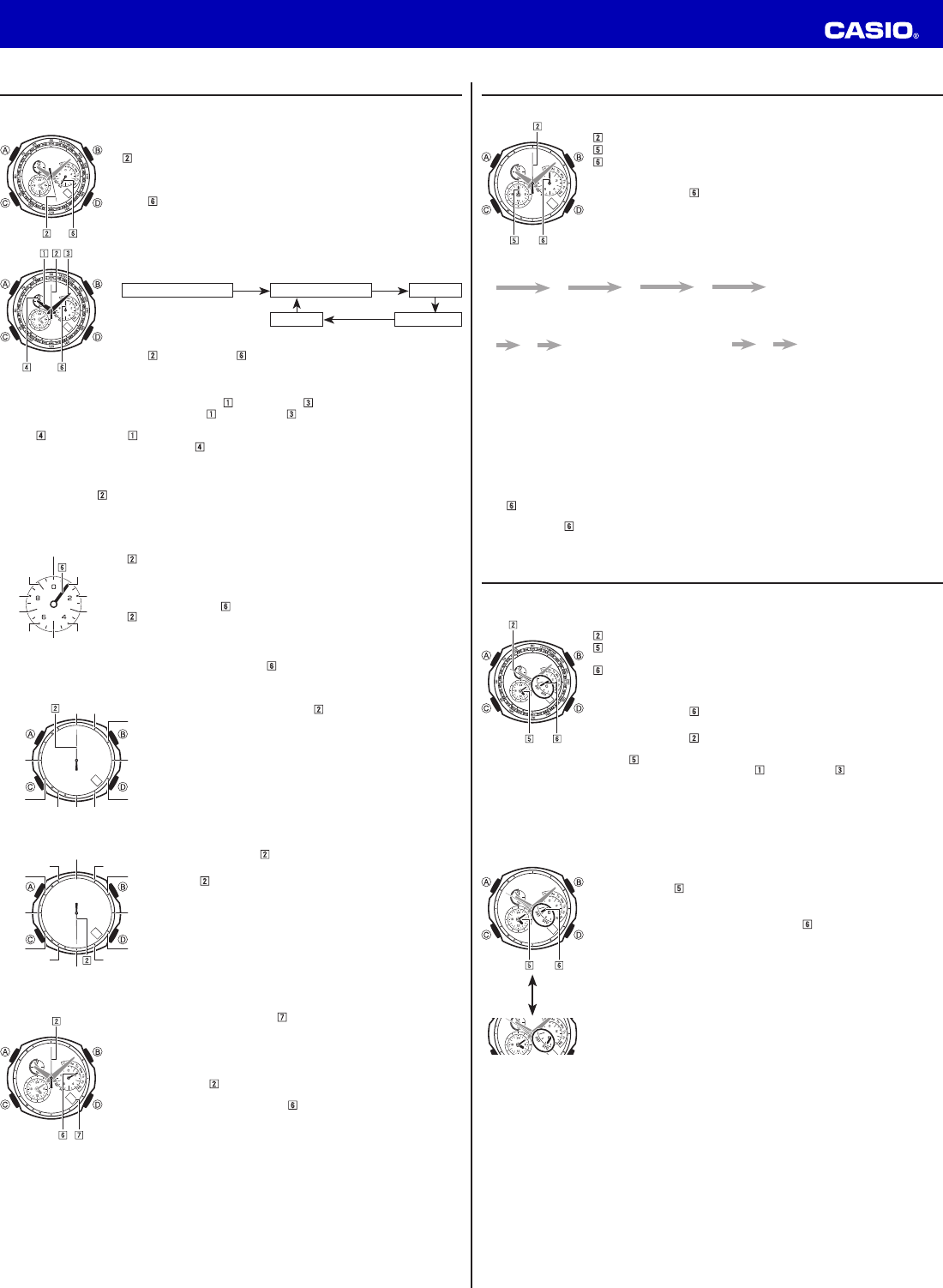
Hand Functions
z Hour Hand
x Second Hand
c Minute Hand
v 24-hour Hand
b Left Dial Hands: Indicate the current time in the World Time City in 24-hour
format.
n Right Dial Hand: Indicates the day of the week.
m Day
Configuring Home City Settings
There are two Home City settings: actually selecting the Home City and selecting either standard time or
daylight saving time (DST).
To configure Home City settings
Note
This watch does not have a city code that corresponds to Newfoundland. •
In the Timekeeping Mode, keep 1. A depressed (for about five seconds) as the
x Second Hand goes through the following sequence.
Moves to •YES (or Y for some models) or NO (N) to indicate the last signal
reception result, then to READY (R), and then to the city code of the currently
selected Home City.
This is the city code setting mode. •
The watch will exit the setting mode automatically if you do not perform any •
operation for about two or three minutes.
For details about city codes, see the “City Code Table”. •
To change the Home City setting, press 2. D to move the x Second Hand
clockwise.
Keep pressing •D until the x Second Hand is pointing at the city code you
want to select as your Home City.
Each time you change the city code setting, the •z Hour Hand, c Minute
Hand, v 24-hour Hand and m Day move to the current time and date for that
city code. Do not perform the next operation until these hands stop moving.
Press 3. B to toggle the time for the currently selected city code between STD (standard time)/DST (daylight
saving time).
While you are selecting the Home City code, the •n Right Dial Hand will indicate whether the currently
selected city code is configured for standard time (STD) or daylight saving/summer time (DST).
Note that you cannot switch between •STD (standard time)/DST (daylight saving time) while UTC is
selected as your Home City.
After all the settings are the way you want, press 4. A to return to the Timekeeping Mode.
To toggle the Home City time between standard time and daylight saving time
Perform the step 1 under “To configure Home City settings”.1.
Each time you select a city code, the •z Hour Hand, c Minute Hand, and v 24-hour Hand move to the
current time for that city code. Do not perform the next operation until these hands stop moving.
While you are selecting the Home City code, the •n Right Dial Hand will indicate whether the currently
selected city code is configured for standard time (STD) or daylight saving/summer time (DST).
Press 2. B to toggle the time for the city code of the currently selected Home City between STD (standard
time)/DST (daylight saving time).
Note that you cannot switch between •STD (standard time)/DST (daylight saving time) while UTC is
selected as your Home City.
After the setting is the way you want, press 3. A to return to the Timekeeping Mode.
Note
After you specify a city code, the watch will use UTC* offsets to calculate the World Time based on the •
current time in your Home City.
Coordinated Universal Time, the world-wide scientific standard of timekeeping. The reference point for *
UTC is Greenwich, England.
Selecting some city codes automatically makes it possible for the watch to receive the time calibration •
signal for the corresponding area. See “Radio Controlled Atomic Timekeeping” for details.
6@
B +
* 6> 5
@
@
B +
6@> 5
3
Operation Guide 5075 (OC)
Configuring Current Time and Date Settings Manually
You can configure current time and date settings manually when the watch is unable to receive a time
calibration signal.
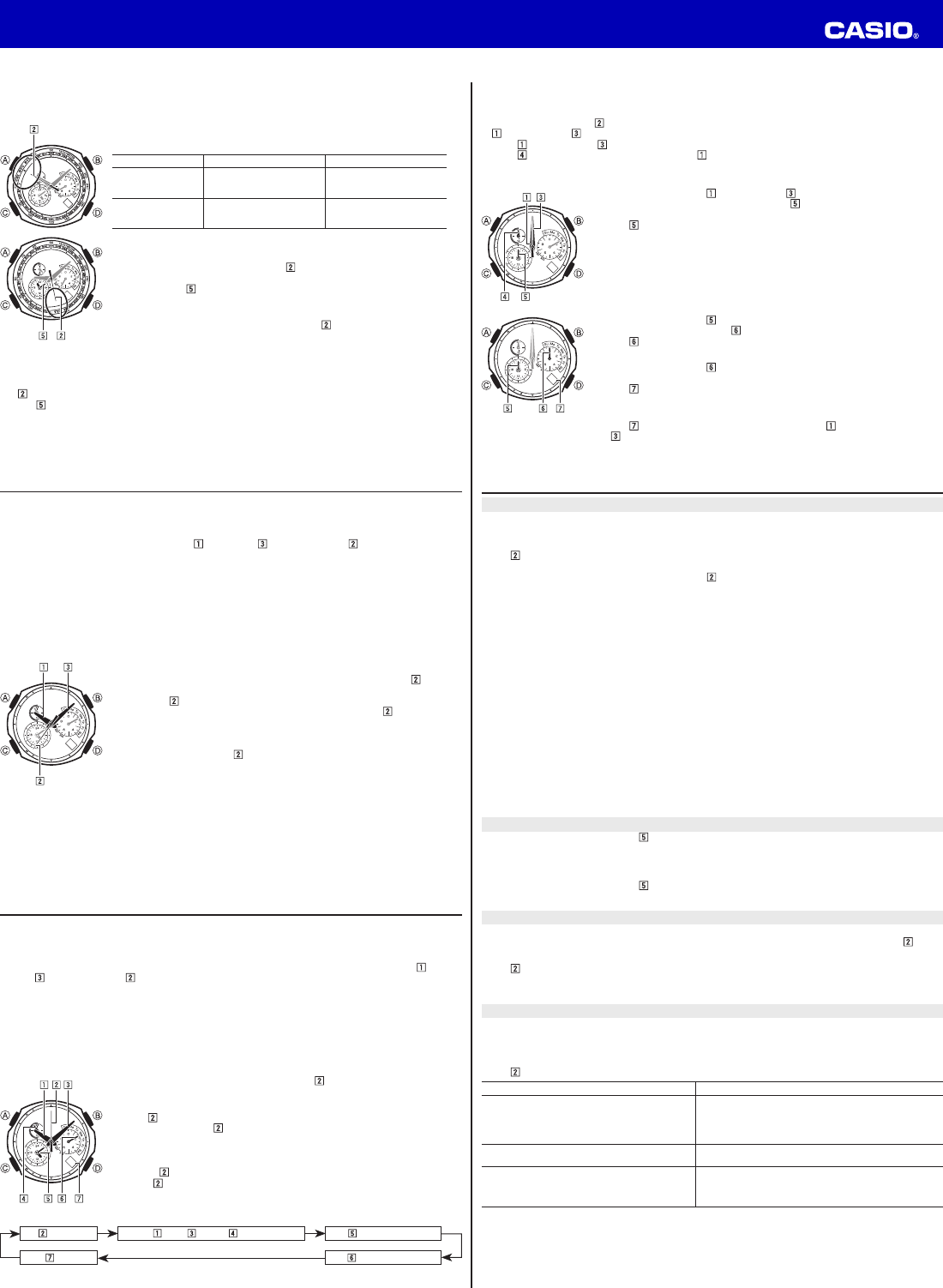
To change the current time setting manually
In the Timekeeping Mode, keep 1. A depressed (for about five seconds) as the
x Second Hand goes through the following sequence.
Moves to •YES (or Y for some models) or NO (N) to indicate the last signal
reception result, then to READY (R), and then to the city code of the currently
selected Home City.
The •n Right Dial Hand will indicate whether the currently selected city code is
configured for standard time (STD) or daylight saving/summer time (DST).
Change the Home City and daylight saving time (DST) settings, if you want.2.
For details about these settings, see steps 2 and 3 under “To configure Home •
City settings”.
In the following steps, each press of •C cycles between settings as shown
below.
Home city/DST Hour/Minute Year
Day Month
Press 3. C.
The •x Second Hand and n Right Dial Hand will move to their 12 o’clock
positions. This is the time setting mode.
Use 4. D (+) and B (–) to change the time (hour and minute) setting.
Each press of either button will move the hands ( •z Hour Hand and c Minute Hand) one minute.
Holding down •D or B will start high-speed z Hour Hand and c Minute Hand movement in the
applicable direction. To stop high-speed hand movement, press any button.
The •v 24-hour Hand and z Hour Hand move in sync with each other.
When setting the time, make sure that the •v 24-hour Hand indicates the proper a.m./p.m. hour.
If you want to change the date setting at this time, press •C and perform the procedure starting from
step 3 under “To change the current date setting manually”.
After the time setting is the way you want, press 5. A to return to the Timekeeping Mode.
This will cause the •x Second Hand to move automatically to 12 o’clock and resume movement from
there.
To change the current date setting manually
In the Timekeeping Mode, keep 1. A depressed (for about five seconds) as the
x Second Hand goes through the following sequence.
Moves to •YES (or Y for some models) or NO (N) to indicate the last signal
reception result, then to READY (R), and then to the city code of the currently
selected Home City.
Press 2. C twice so the n Right Dial Hand moves to the tens digit and the
x Second Hand moves to the ones digit of the current year setting.
This is the year setting mode. •
The year can be set in the range of 2000 to 2099. •
Use 3. D and B to change the year setting.
Each press of •B will move the n Right Dial Hand and change the tens digit
of the year setting.
@
Setting the year (ones digit)
0 1
2
3
4
9
8
6 57
@
Dec
Nov
Feb
Mar
Apr
Oct
Sep
Aug
Jan
Jul May
Jun
Setting the month
Each press of •D will move the x Second Hand and change the
ones digit of the year setting.
After the year setting is the way you want, press 4. C.
This is the month setting mode. •
Use 5. D to move the x Second Hand to the month setting you want.
After the month setting is the way you want, press 6. C.
The •x Second Hand will move to 12 o’lock, and the watch will
enter the day setting mode.
Use 7. D (+) and B (–) to change the m Day setting.
If you want to change the time setting at this time, press •C and then perform
the procedure starting from step 3 under “To change the current time setting
manually”.
After the settings are the way you want, press 8. A to return to the Timekeeping
Mode.
This will cause the •x Second Hand to move automatically to 12 o’clock and
resume movement from there.
The day of the week indicated by the •n Right Dial Hand changes
automatically in accordance with the date (year, month, and day).
Note
The watch’s built-in full automatic calendar makes allowances for different month lengths and leap •
years. Once you set the date, there should be no reason to change it except after you have the watch’s
rechargeable battery replaced or after power drops to Level 3.
6@
B +
6>
@
6
00
50
10
40
20
30
90
60
80
70
Setting the year (tens digit)
6 5
@
Using the Stopwatch
The stopwatch measures elapsed time and split times.
Hand Functions
x Second Hand: Indicates the stopwatch seconds count.
b Left Dial Hands: Indicate the stopwatch hours and minutes.
n Right Dial Hand: Indicates the stopwatch 1/20-second count.
To perform elapsed time measurement
Use 1. C to move the n Right Dial Hand to 0.
This indicates the Stopwatch Mode. •
Now you can perform either of following stopwatch operations.2.
To perform an elapsed time operation
BBB B D
Start Stop (Restart) (Stop) Reset
To pause at a split time
BDNormal stopwatch hand movement will
resume automatically after five seconds.
BD
Start Split Stop Reset
Note
The Stopwatch Mode can indicate elapsed time up to 23 hours, 59 minutes, 59.95 seconds. •
In the following cases, the hands of the watch are moving, so pressing •D will not perform a split or reset
operation.
While the hands are moving to elapsed timekeeping after you enter the Stopwatch Mode −
While the watch is changing dates at midnight −
Once started, stopwatch timing continues until you press •B to stop it, even if you exit the Stopwatch Mode
to another mode or timing reaches the stopwatch limit defined above.
You can press •B to start an elapsed time operation immediately after entering the Stopwatch Mode,
even if the watch’s hands are still moving to their initial Stopwatch Mode positions. Note, however, that if
the stopwatch was not reset after the last elapsed time operation, timing will restart from where it was last
stopped, and not from 0.
The •n Right Dial Hand indicates the 1/20-second count for the first 30 seconds of a stopwatch elapsed
time operation. After that, the hand stops at 0. 1/20-second timing continues internally after the first 30
seconds, and the n Right Dial Hand will jump to the current value whenever B (Stop) or D (Split) is
pressed.
Checking the Current Time in a Different Time Zone
You can use the World Time Mode to view the current time in one of 29 time zones around the globe. The city
that is currently selected in the World Time Mode is called the “World Time City”.
Hand Functions
x Second Hand: Indicates the currently selected World Time City.
b Left Dial Hands: Indicate the current time in the selected World Time City in
24-hour format.
n Right Dial Hand: Indicates the current STD (standard time) or DST (daylight
saving time) setting of the currently selected time zone.
To view the time in another time zone
Use 1. C to move the n Right Dial Hand to STD or DST.
This indicates the World Time Mode. •
Use 2. D to move the x Second Hand to the city code you want to select as the
World Time City.
The •b Left Dial Hands will move to the current time in the time zone of the
current city code. At this time, the z Hour Hand and c Minute Hand will
continue to indicate the current time in the Home City.
For full information on city codes, see the “City Code Table”. •
If you think that the time indicated for the selected time zone is not correct, it •
probably means that there is something wrong with your Home City settings.
Use the procedure under “To configure Home City settings” to correct the
Home City settings.
To specify standard time or daylight saving time (DST) for a city
Hold down
A for two
seconds
* 6
In the World Time Mode, use 1. D to select the city code whose setting you want
to change.
Wait until the •b Left Dial Hands complete their move to the time in the
currently selected World Time City. You will not be able to perform step 2 of
this procedure until the hands stop moving.
Hold down 2. A for about two seconds until the n Right Dial Hand toggles to
STD (standard time) or DST (daylight saving/summer time).
Note that you cannot switch between •STD (standard time)/DST (daylight
saving/summer time) while UTC is selected as the World Time City.
Note that the •STD (standard time)/DST (daylight saving/summer time)
setting affects only the currently selected time zone. Other time zones are
not affected.
* 6
@
* 6
@
4
Operation Guide 5075 (OC)
Swapping your Home City and World Time City
You can use the procedure below to swap your Home City and World Time City. This capability can come in
handy when you frequently travel between two locations in different time zones.
The following example shows what happens when the Home City and World Time
City are swapped while the Home City originally is TOKYO (TYO) and the World
Time City is NEW YORK (NYC).
Home City World Time City
Before swapping
TOKYO
10:08 p.m.
(Standard time)
NEW YORK
9:08 a.m.
(Daylight saving time)
After swapping
NEW YORK
9:08 a.m.
(Daylight saving time)
TOKYO
10:08 p.m.
(Standard time)
To swap your Home City and World Time City
In the World Time Mode, use 1. D to select the World Time City you want.
In this example, you would move the •x Second Hand to NEW YORK (NYC) in
order to select New York as the World Time City.
Wait until the •b Left Dial Hands complete their move to the time in the
currently selected World Time City. You will not be able to perform step 2 of
this procedure until the hands stop moving.
Hold down 2. B for about three seconds until the x Second Hand starts to move.
This will make the World Time City ( •NEW YORK/NYC in this example) your
new Home City. At the same time, it will change the Home City you had
selected prior to step 2 (TOKYO/TYO in this example), to your World Time
City.
After swapping the Home City and World Time City, the watch will stay in the World Time Mode. The •
x Second Hand will point to your new World Time City (TOKYO/TYO in this example).
The •b Left Dial Hands will indicate the current time in your new World Time City.
Note
If your current World Time City supports time calibration signal reception, making it your Home City enables •
calibration signal reception for that city.
Auto Correction of Hand Home Positions
Strong magnetism or impact can cause the hands and/or day setting to be off, even if the watch is able
to perform the signal receive operation. Auto correction of hand home positions correct the hand position
automatically.
Auto correction is performed in the Timekeeping Mode only. •
Auto correction corrects the positions of the •z Hour Hand, c Minute Hand, and x Second Hand. For the
dial hands and day, you must perform the manual adjustment procedure under “Adjusting Home Positions
Manually”.
Each hour, the watch performs automatic correction of the hand positions from –55 minutes to +5 minutes. •
You also can trigger auto correction of hand home positions manually, if you want. See “To trigger auto •
correction of hand home positions” for more information.
Auto correction of hand home positions can take up to three and a half minutes to complete. •
If hand positions are off by one hour or more, correct them using the procedure under “To trigger auto •
correction of hand home positions” or “Adjusting Home Positions Manually”.
To trigger auto correction of hand home positions
Perform the following procedure when the time setting is off. •
In the Timekeeping Mode, hold down D for about six seconds until the x Second
Hand completes one full revolution.
Though the •x Second Hand will stop momentarily about three seconds after
you hold down D, do not release the button yet. Wait until the x Second Hand
completes a full revolution before you release D.
To interrupt an ongoing correction operation and return to the Timekeeping •
Mode, press D again.
If you release •D when the x Second Hand stops the first time (after about
three seconds) in the above operation, the watch will enter the home position
adjustment mode, which is described under “Adjusting Home Positions
Manually”. If this happens, press A to return to the Timekeeping Mode and then
perform the above operation again.
Manually triggered auto correction of hand home positions performs the following •
two steps.
The hands will move automatically in order to determine the home positions of 1.
the watch.
After the hand home positions are determined, the watch will return to normal 2.
timekeeping automatically. This completes the correction operation.
Adjusting Home Positions Manually
Strong magnetism or impact can cause the hands and/or date of the watch to be off, even if the watch is able
to perform the signal receive operation. If this happens, perform the applicable home position adjustment
procedures in this section.
Hand home position adjustment is not required if the time and day settings are correct. •
You also can use auto correction of the hand home positions to correct the home positions of the •z Hour
Hand, c Minute Hand, and x Second Hand.
Note
Any time after you enter the home position adjustment mode in step 1 of the following procedure, you
can return to the Timekeeping Mode by pressing A. The watch also will return to the Timekeeping Mode
automatically if you do not perform any operation for about two or three minutes in the home position
adjustment mode. In either case, any adjustments you made before the watch returned to the Timekeeping
Mode will be applied.
To adjust home positions manually
Hold down 1. C for about two seconds until the x Second Hand stops and then
starts moving again.
Hold down 2. D for about three seconds.
The •x Second Hand will start to move when you first press D. Keep D
depressed until the x Second Hand stops.
The watch is now in the home position adjustment mode. •
The watch will exit the adjustment mode automatically if you do not perform •
any operation for about two or three minutes.
First is •x Second Hand home position adjustment.
If the •x Second Hand moves to 12 o’clock, it is in the correct home position. If
it doesn’t, use D to move it to 12 o’clock.
Each press of •C in the home position adjustment mode will cycle through the
adjustment settings as shown below.
x Second z Hour/ c Minute/ v 24-hour b Left Dial Hands
n Right Dial Handm Day
@
* @
B +
@
B +
* 6> 5
@
When adjusting a hand or the date home position, it is recommended that after you move to a proper •
home position, you press B to move the setting back one step. Next, press D again to return it to the
home position. This helps to ensure better home position adjustment accuracy.
After confirming that the 3. x Second Hand is at the proper home position, press C. This will switch to
z Hour Hand and c Minute Hand home position adjustment.
The •z Hour Hand and c Minute Hand are at their proper home positions if they both move to 12 o’clock.
The v 24-hour Hand also will move along with z Hour Hand movement, and cannot be adjusted
individually. If the hands are not positioned correctly, use D (+) and B (–) to move them to their proper
home positions.
After confirming that the 4. z Hour Hand and c Minute Hand are in their correct
home positions, press C. This will switch to b Left Dial Hand home position
adjustment.
The •b Left Dial Hands are at their proper home positions if they both move to
24. If the hands are not positioned correctly, use D (+) and B (–) to move
them to 24.
After confirming that the 5. b Left Dial Hands are in the correct home position,
press C. This will advance to n Right Dial Hand home position adjustment.
The •n Right Dial Hand is in the correct home position if it is pointing at 0. If it
isn’t, use D (+) and B (–) to move it to 0.
After confirming that the 6. n Right Dial Hand is in the correct home position, press
C. This will advance to day home position adjustment.
The •m Day is in the correct home position if it shows 1. If it doesn’t, use D (+)
and B (–) to change the day to 1.
Press 7. A to return to the Timekeeping Mode.
The •m Day moves to the current day, and then the z Hour Hand and the
c Minute Hand will move to the current time. Wait until everything stops
moving.
Troubleshooting
Hand Movement and Position
I lost track of what mode the watch is in.
Refer to “To select a mode”. To return directly to the Timekeeping Mode from any other mode, hold down C
for about two seconds.
The x Second Hand is moving at two second intervals.
All the watch’s hands are stopped at 12 o’clock and none of the buttons work.
Power may be low. Expose the watch to light until the x Second Hand starts moving normally, at one-second
intervals.
The hands of the watch suddenly start moving at high speed, even when I do not perform any
operation.
This could be due to any one of the following causes. In all cases, the hand movement does not indicate
malfunction, and should stop shortly.
The watch is recovering from a sleep state. •
The time setting is being adjusted following a successful auto time calibration signal receive operation. •
The current time setting is off by hours.
Your Home City setting may be wrong. Check your Home City setting and correct it, if necessary.
The current time setting is off by one hour.
If you are using the watch in an area where time calibration signal reception is possible, see “To configure
Home City settings”.
If you are using the watch in an area where time calibration signal reception is not possible, you may need to
change your Home City’s STD (standard time)/DST (daylight saving/summer time) setting manually. Use the
procedure under “To toggle the Home City time between standard time and daylight saving time” to change the
STD/DST setting.
The hands and/or day indications are off.
This could indicate that the watch has been exposed to magnetism or strong impact, which has caused
problems with proper hand and day alignment. Adjust the watch’s hand and day home position alignment.
World Time Mode
The World Time indicated by the b Left Dial Hands in the World Time Mode is one hour off from the
actual time in the selected time zone.
The STD (standard time)/DST (daylight saving/summer time) setting of the selected World Time City may be
wrong. Select the correct STD (standard time)/DST (daylight saving/summer time) setting.
The World Time indicated by the b Left Dial Hands in the World Time Mode is off.
Your Home City settings may be wrong. Check your Home City settings and correct them, if necessary.
Charging
The watch does not resume operation after I expose it to light.
This can happen after the power level drops to Level 3. Continue exposing the watch to light until the x
Second Hand starts moving normally (at one-second intervals).
The x Second Hand starts to move at one-second intervals, but then suddenly returns to moving at
two-second intervals.
The watch probably is not sufficiently charged yet. Continue keeping it exposed to light.
Time Calibration Signal
The information in this section applies only when LONDON (LON), PARIS (PAR), ATHENS (ATH),
HONOLULU (HNL), ANCHORAGE (ANC), LOS ANGELES (LAX), DENVER (DEN), CHICAGO (CHI), NEW
YORK (NYC), HONG KONG (HKG), or TOKYO (TYO) is selected as the Home City. You need to adjust the
current time manually when any other city is selected as the Home City.
The x Second Hand indicates NO (N) when I check the result of the latest receive operation.
Possible Cause Remedy
You are wearing or moving the watch, or performing •
a button operation during the signal receive
operation.
The watch is in an area with poor reception •
conditions.
Keep the watch in an area where reception conditions are
good while the signal receive operation is being performed.
You are in an area where signal reception is not
possible for some reason. See “Approximate Reception Ranges”.
The calibration signal is not being transmitted for
some reason.
Check the website of the organization that maintains the •
time calibration signal in your area for information about its
down times.
Try again later. •
The current time setting changes after I set it manually.
You may have the watch configured for Auto Receive of the time calibration signal, which will cause the time
to be adjusted automatically according to your currently selected Home City. If this results in the wrong time
setting, check your Home City setting and correct it, if necessary.
*>
+B
* 6 5
5
Operation Guide 5075 (OC)
City Code City UTC Offset/
GMT Differential
PPG Pago Pago –11
HNL Honolulu –10
ANC Anchorage –9
LAX Los Angeles –8
DEN Denver –7
CHI Chicago –6
NYC New York –5
SCL Santiago –4
RIO Rio De Janeiro –3
FEN Fernando de Noronha –2
RAI Praia –1
UTC 0
LON London
PAR Paris +1
ATH Athens +2
City Code City UTC Offset/
GMT Differential
JED Jeddah +3
THR Tehran +3.5
DXB Dubai +4
KBL Kabul +4.5
KHI Karachi +5
DEL Delhi +5.5
DAC Dhaka +6
RGN Yangon +6.5
BKK Bangkok +7
HKG Hong Kong +8
TYO Tokyo +9
ADL Adelaide +9.5
SYD Sydney +10
NOU Noumea +11
WLG Wellington +12
•Based on data as of December 2008.
•The rules governing global times (GMT differential and UTC offset) and summer time are determined by
each individual country.
The current time setting is off by one hour.
Possible Cause Remedy
Signal reception on a day for switching between STD
(standard time)/DST (daylight saving/summer time)
may have failed for some reason.
Perform the operation under “To get ready for a receive
operation”. The time setting will be adjusted automatically as
soon as signal reception is successful.
If you are unable to receive the time calibration signal, change
the STD (standard time)/DST (daylight saving/summer time)
setting manually.
Auto Receive is not performed or I cannot perform Manual Receive.
Possible Cause Remedy
The watch is in the Stopwatch Mode.
Auto Receive is not performed while the watch is in the
Stopwatch Mode. Hold down C for about two seconds to
enter the Timekeeping Mode.
Your Home City setting is wrong. Check your Home City setting and correct it, if necessary.
There is not enough power for signal reception. Expose the watch to light to charge it.
Signal reception is being performed successfully, but the time and/or day is wrong.
Possible Cause Remedy
Your Home City setting is wrong. Check your Home City setting and correct it, if necessary.
The watch may have been exposed to magnetism
or strong impact, which has caused problems with
proper hand and day alignment.
Adjust the watch’s hand and day home positions.
Specifications
Accuracy at normal temperature: ± 15 seconds a month (with no signal calibration)
Timekeeping: Hour, minutes (hand moves every 10 seconds), seconds, 24-hour, day, day of the week
Calendar system: Full Auto-calendar pre-programmed from the year 2000 to 2099
Other: Home City code (can be assigned one of 29 city codes and Coordinated Universal Time); Daylight
Saving Time (summer time) / Standard Time
Time Calibration Signal Reception: Auto receive up to six times a day (5 times a day for the Chinese
calibration signal; Remaining auto receives cancelled as soon as one is successful); Manual
receive
Receivable Time Calibration Signals:
Mainflingen, Germany (Call Sign: DCF77, Frequency: 77.5 kHz); Anthorn, England (Call Sign:
MSF, Frequency: 60.0 kHz); Fukushima, Japan (Call Sign: JJY, Frequency: 40.0 kHz); Fukuoka/
Saga, Japan (Call Sign: JJY, Frequency: 60.0 kHz); Fort Collins, Colorado, the United States
(Call Sign: WWVB, Frequency: 60.0 kHz); Shangqiu City, Henan Province, China (Call Sign:
BPC, Frequency: 68.5 kHz)
Stopwatch: Measuring capacity: 23:59’59.95”
Measuring unit: 1/20 second
Measuring mode: Elapsed time, split time
World Time: 29 cities (29 time zones) and Coordinated Universal Time
Other: Standard Time/Daylight Saving Time (summer time); Home City/World Time City swapping
Other: Power Saving; Auto Correction of Hand Home Positions
Power Supply: Solar cell and one rechargeable battery
Approximate battery operating time: 5 months (no exposure to light after a full charge; one signal reception
of approximately 4 minutes per day)
City Code Table
