Canon Dm Mvx2I Users Manual
MVX2i to the manual 9174e9fe-48e2-46d8-a196-4c0aa8aafd9a
2015-01-23
: Canon Canon-Dm-Mvx2I-Users-Manual-240310 canon-dm-mvx2i-users-manual-240310 canon pdf
Open the PDF directly: View PDF  .
.
Page Count: 188 [warning: Documents this large are best viewed by clicking the View PDF Link!]
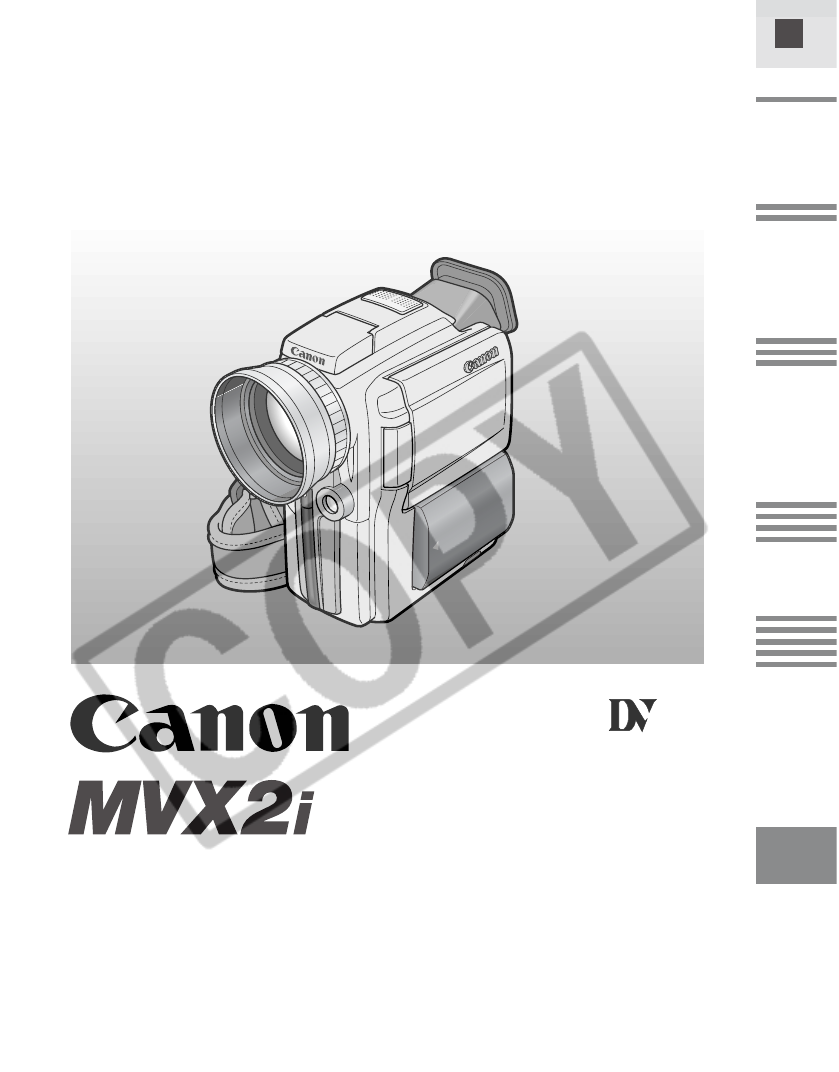
Mini Digital
Video
Cassette
DIGITAL VIDEO CAMCORDER
Instruction Manual
PAL
E
Introduction
Mastering
the Basics
Using the Full
Range of Features
Editing
Using a Memory Card
Additional
Information
PUB.DIE-175
2
E
Introduction
Important Usage Instructions
CAUTION:
CUSTOMERS IN THE U.K. SHOULD READ THIS BEFORE USING THIS PRODUCT.
CHANGING THE FUSE
THE MAINS LEAD ON THIS PRODUCT IS FITTED WITH A NON-REWIREABLE (MOULDED) PLUG,
INCORPORATING A 3 AMP FUSE. SHOULD THE FUSE NEED TO BE REPLACED AN ASTA OR BSI
APPROVED BS1362 FUSE OF THE SAME RATING MUST BE USED.
ALWAYS REFIT THE FUSE COVER AFTER REPLACING THE FUSE. NEVER USE THE PLUG WITH
THE FUSE COVER OMITTED.
CHANGING THE PLUG
IF THE FITTED PLUG IS NOT SUITABLE FOR YOUR SOCKET OUTLETS, IT SHOULD BE CUT OFF
AND AN APPROPRIATE PLUG FITTED IN ITS PLACE. IF POSSIBLE FIT AN APPROPRIATE 3 AMP
FUSE. IF THE NEW PLUG HAS NO FUSE, THEN FIT A 5 AMP FUSE AT THE DISTRIBUTION
BOARD.
AC POWER CORD CONNECTION
The wires in the mains lead of this apparatus are coloured in accordance with the following
cord.
(IMPORTANT)
As the colours of the wires in the mains lead may not correspond with the coloured markings
identifying the terminals in your plug, proceed as follows: The wire which is coloured BLUE
must be connected to the terminal which is marked with the letter N or coloured black. The
wire which is coloured BROWN must be connected to the terminal which is marked with the
letter L or coloured red. Neither Blue wire or Brown wire is to be connected to the Earth pin of
a 3 pin plug.
THE SEVERED PLUG MUST BE DESTROYED IMMEDIATELY TO AVOID ANY POSSIBLE ELECTRIC
SHOCK HAZARD.
Mains Lead BLUE ....................NEUTRAL
BROWN. ..............LIVE
WARNING:
TO REDUCE THE RISK OF ELECTRIC SHOCK, DO NOT REMOVE COVER (OR BACK).
NO USER SERVICEABLE PARTS INSIDE. REFER SERVICING TO QUALIFIED SERVICE
PERSONNEL.
WARNING:
TO REDUCE THE RISK OF FIRE OR ELECTRIC SHOCK, DO NOT EXPOSE THIS
PRODUCT TO RAIN OR MOISTURE.
CAUTION:
TO REDUCE THE RISK OF ELECTRIC SHOCK AND TO REDUCE ANNOYING
INTERFERENCE, USE THE RECOMMENDED ACCESSORIES ONLY.
CAUTION:
DISCONNECT THE MAINS PLUG FROM THE SUPPLY SOCKET WHEN NOT IN USE.
For Users in the UK
When replacing the fuse only a correctly rated approved type should be used and be sure to re-fit
the fuse cover.
• Use of CV-150F/CV-250F DV cable is necessary to comply with the technical requirement of EMC
Directive.
CA-560 identification plate is located on the bottom.

3
E
Introduction
Reference Guide
Three manuals are supplied with your camcorder: the “Digital Video
Camcorder MVX2i Instruction Manual”, “DIGITAL VIDEO SOLUTION DISK
Software Instruction Manual”, and the “DV NETWORK SOLUTION DISK
Software Instruction Manual”.
■Digital Video Camcorder MVX2i Instruction Manual
This manual explains the camcorder operations such as recording and
playing back still images and movies on a tape or a memory card.
■DIGITAL VIDEO SOLUTION DISK Software Instruction Manual
This manual explains how to download still images and movies from the
memory card to a computer by using the supplied USB cable. You can also
add sample images for the card mix function, or the “my camera” settings
to the camcorder.
■DV NETWORK SOLUTION DISK Software Instruction Manual
This manual explains how to download still images and movies from the
memory card to a computer by using the DV (IEEE1394) cable. You can
also perform videoconference and file transfer over the Internet using
Windows XP’s Windows Messenger. There are several requirements for
using this software. For details, please refer to this instruction manual.
Windows XP Only
Trademark Acknowledgements
• Canon is a registered trademark of Canon Inc.
• ArcSoft is a trademark or registered trademarks of ArcSoft, Inc.
• Macintosh is a trademark of Apple Computer Inc., registered in the United
States and other countries.
• Windows®is either a registered trademark or trademark of Microsoft
Corporation in the United States and/or other countries.
• Other names and products not mentioned above may be registered
trademarks or trademarks of their respective companies.

4
E
Introduction
Important Usage Instructions ................2
Reference Guide....................................3
Thank You for Choosing a Canon ........6
Introducing the MVX2i..........................7
Finding Your Way Around the MVX2i....8
Preparations
Powering Your Camcorder ..................11
Loading a Cassette..............................16
Basic Recording
Basic Recording ..................................18
Zooming ............................................23
Using the LCD Screen..........................25
Tips for Making Better Videos ............28
Basic Playback
Playing Back a Tape ............................30
Connections for Playback on a
TV Screen ......................................34
General
Searching and Reviewing
While Recording ............................37
Using the Menus ................................38
Using the Wireless Controller ..............48
Recording
Setting the Date and Time ..................51
Recording Still Images onto a Tape ......54
Using the Built-in Flash........................56
Turning the Image Stabilizer Off ..........58
Using the Various
Recording Programs........................59
Using Digital Effects ............................63
Using the Multi-Image Screen ............69
Audio Recording ................................71
Setting the Self-Timer..........................73
Manual Adjustments
Adjusting Exposure Manually ..............75
Setting the Shutter Speed ..................77
Adjusting Focus Manually....................79
Setting the White Balance ..................81
Playback
Enlarging the Image during Playback ..83
Displaying Date, Time and Camcorder
Data (Data Code) ..........................84
Searching the Tape (Photo Search/
Date Search) ..................................87
Returning to a Pre-Marked Position ....88
Editing to a VCR ................................89
Dubbing to/from a Tape with Digital
Video Equipment............................90
Recording from a VCR, TV or Analog
Camcorder (Analog Line-in) ............93
Digitally Outputting Analog Video
and Audio Signals
(Analog-Digital Converter) ..............95
Recording Over Existing Scenes
(AV Insert Editing) ..........................97
Audio Dubbing ................................100
Setting the Audio Mix ......................103
Connecting to a PC Using a
DV Cable......................................105
Contents
Introduction
Editing
Using the Full Range of
Features
Mastering the Basics

5
E
Introduction
: Reference page numbers
: Functions that can be operated from the body of the camcorder
: Functions that can be operated from the wireless controller
: Supplementary notes for camcorder operation
`: Operation confirmation beeps ( 22)
• Capital letters are used to refer to settings displayed in the menus and
buttons labelled on the camcorder itself, e.g. Press the MENU button.
Memory Card Introduction ................106
Recording Still Images onto
a Memory Card ............................111
Recording Still Images from a Tape....114
Recording Still Images from Other
Devices (VCR, TV or Other Digital
Camcorders) ................................115
Recording Movies onto
a Memory Card ............................116
Recording Movies from a Tape ..........117
Recording Movies from Other Devices
(VCR, TV or Other Digital
Camcorders) ................................118
Recording Panoramic Images
(Stitch Assist) ................................119
Playing Back a Memory Card ............121
Settings of Still Images/Movies ..........124
Preventing Accidental Erasure
(Protect)
........................................127
Marking a Still Image for Printing
(Print Mark) ..................................128
Erasing Still Images/Movies ..........130
Using Printers Supporting the Direct
Print Function (Optional) ..............132
Combining Images (Card Mix) ..........141
Copying Still Images from Tape to
Memory Card ..............................146
Copying Still Images from Memory
Card to Tape ................................147
Formatting a Memory Card ..............148
Connecting to a PC Using a
USB Cable ....................................149
Using the My CAMERA Function ......150
Other Information and Precautions....152
Preparing the Camcorder ..................155
Notes on Using the Batteries ............157
Maintenance ....................................160
Troubleshooting ................................164
The MVX2i System Diagram..............168
Optional Accessories ........................169
Screen Displays..................................171
Specifications ....................................181
Index ................................................183
Menu at a Glance ............................185
Using a Memory Card
Additional Information
Symbols Used in this Instruction Manual
6
E
Introduction
Thank You for Choosing a Canon
Your camcorder is supplied with the
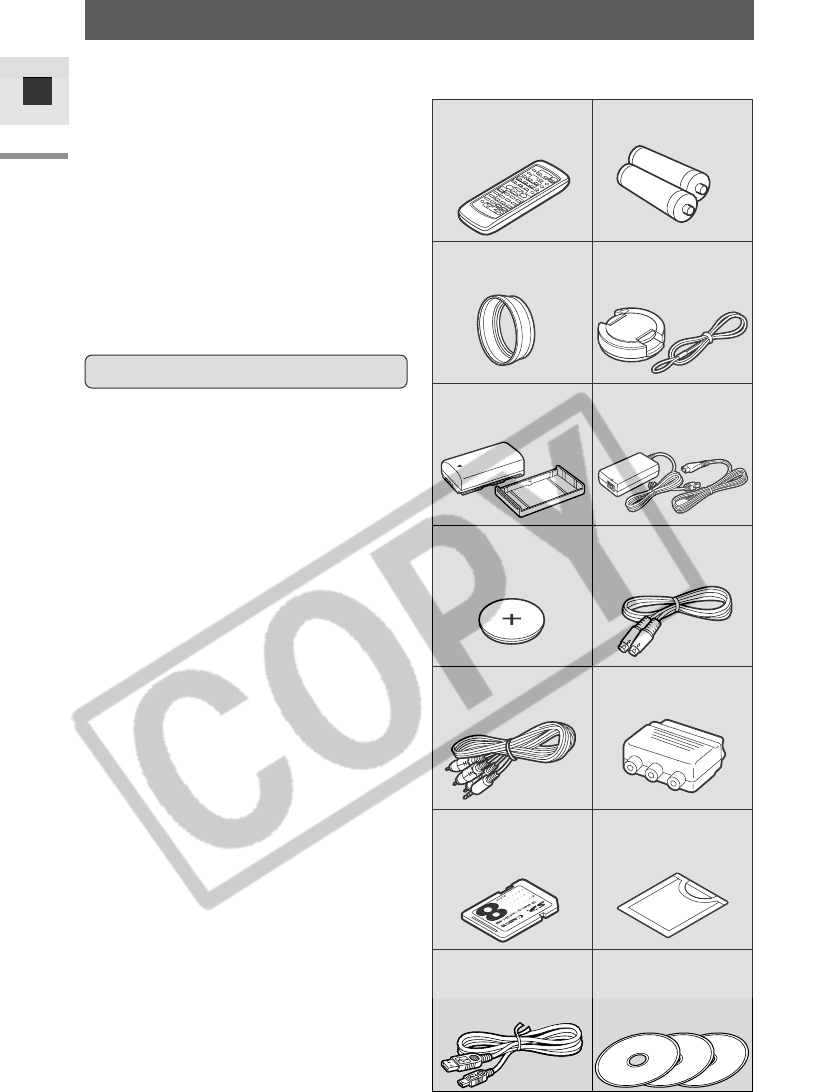
following accessories:
WL-D78 Wireless
Controller
Two AA batteries
Lens hood Lens cap and lens cap
cord
S-150 S-video Cable
STV-250N Stereo Video
Cable
Lithium button battery
CR1616
CA-560 Compact Power
Adapter
(including power cord)
BP-512 Battery Pack
First, we’d like to thank you for
purchasing this Canon camcorder. Its
advanced technology makes it very
easy to use — you will soon be
making high-quality videos which will
give you pleasure for years to come.
To get the most out of your new
camcorder, we recommend that you
read this manual thoroughly — there
are many sophisticated features
which will add to your recording
enjoyment.
Getting Started
To get started we suggest that you
master the basic operations of the
camcorder first, before moving on to
use its full range of features.
• When connecting the camcorder
to your personal computer, use the
optional CV-150F or CV-250F DV
cable.
When connecting the camcorder
to your PC equipped with a USB
terminal, use the supplied
IFC-300PCU USB cable.
Soft case for SD
Memory Card
SDC-8M SD Memory Card
(with pre-recorded
sample images)
PC-A10 SCART Adapter
(Europe, Asia)
IFC-300PCU USB cable DIGITAL VIDEO
SOLUTION DISK
DV NETWORK SOLUTION
DISK
ArcSoft Camera Suite CD
7
E
Introduction
Introducing the MVX2i
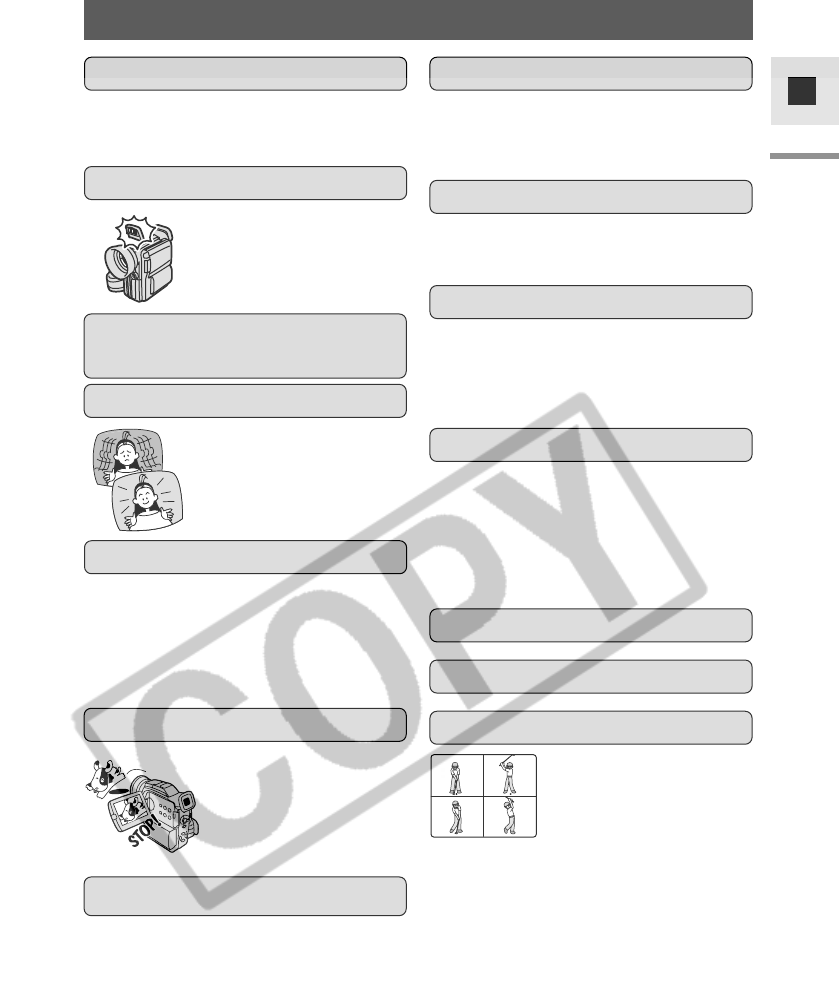
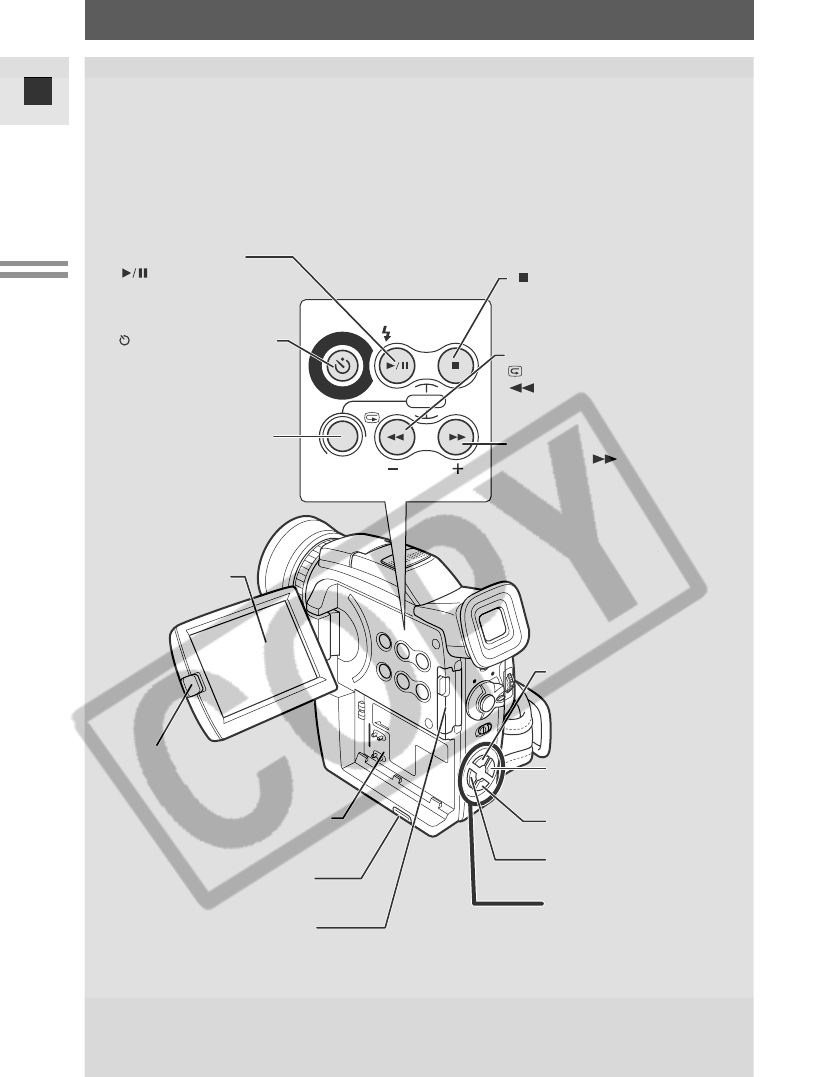
You can record still
images like photographs.
You can also shoot
continuously still images
and record them onto a
memory card.
Still Images
10×Optical Zoom and 200×
(card 40×) Digital Zoom
Memory Card
You can record still images and movies
onto a SD Memory Card or
MultiMediaCard. Transfer still
images/movies to your PC and use the
supplied software to edit or attach
them to your e-mail, or merge
separate still image into one large
panoramic scene.
You can print still images by
connecting the camcorder to a printer
supporting the Direct Print function.
Direct Printing
Allows high-speed transfer of memory card
data to a PC with a built-in USB port. You
can organize and edit still images/movies on
your PC using the supplied software.
USB Terminal
The DV terminal allows high-quality
transfer with virtually no deterioration
in quality of images. You can edit and
process images by connecting the
camcorder to a PC with the IEEE 1394
terminal.
IEEE 1394 DV Terminal
A
nalog Line-in Recording
Show your creativity by
using the special effects
and digital faders. These
digital effects and faders
can add visual appeal
and greater imaging variety. The multi-
image screen captures moving subjects
in 4, 9 or 16 sequences of still images.
Digital Effects
The built-in flash
automatically rises up
and fires according to the
brightness of the
surrounding area.
Built-in Flash
Your camcorder incorporates a mega-
pixel CCD. High-resolution still images
can be recorded onto a memory card.
Mega-pixel CCD
Canon’s optical
technology stabilizes
your recordings even in
long telephoto shots.
Optical Image Stabilizer
Allows you to record even in dark
places. The Night mode adjusts
automatically to the optimum shutter
speed, and the Super Night mode
utilizes the Super Night LED to record
bright colourful pictures.
Super Night Mode & Night Mode
Audio Dubbing/AV Insert Editing
You can customize the start up image
and shutter sound of the camcorder.
My Camera Function
8
E
Mastering
the Basics
Finding Your Way Around the MVX2i
(
L
I
N
E
I
N
)
R
E
C
P
A
U
S
E
INDEX
REC SEARCH
SCREEN
MIX/
CARD
SLIDE SHOW
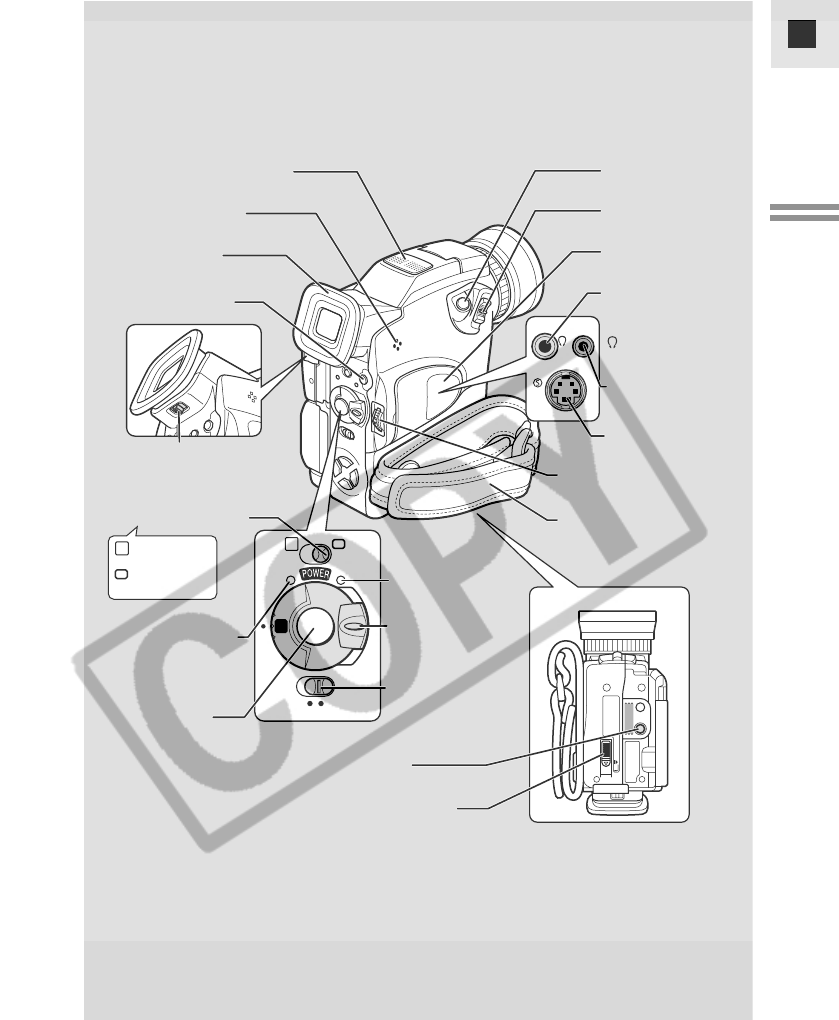
LCD screen (p. 25)
Flash button (p. 56)/
(play/pause) button
(p. 30)
(stop) button (p. 30)/
INDEX SCREEN button
(p. 123)
BATT. (battery) RELEASE
button (p. 13)
Memory card compartment
cover (p. 107)
Battery attachment unit (p. 12)
LCD panel
OPEN button (p. 25)
REC (record) SEARCH +
button (p. 37)/ (fast
forward) button (p. 30)/
CARD +button (p. 119, 122)
REC (record) SEARCH –button(p. 37)/
Record review button (p. 37)/
(rewind) button (p. 30)/
CARD –button (p. 119, 122)
DIGITAL EFFECTS button
(p. 63)
Digital effects ON/OFF
button (p. 63)
FOCUS button(p. 79)/
DATA CODE button (p. 84)
EXP (exposure) button
(p. 75)
Enlarge buttons (p. 83)/
Trimming buttons (for direct
printing) (p.138)
Card MIX button (p. 143)/
SLIDE SHOW button (p. 123)
Self-timer button (p. 73)/
REC PAUSE (Line-in) button
(p. 91, 94)
9
E
Mastering
the Basics
P
CARD TAPE
OPEN/EJECT
AV IN/OUT
MIC
Bottom view
IN/
OUT
(
V
C
R
)
P
L
A
Y
C
A
M
E
R
A
O
F
F
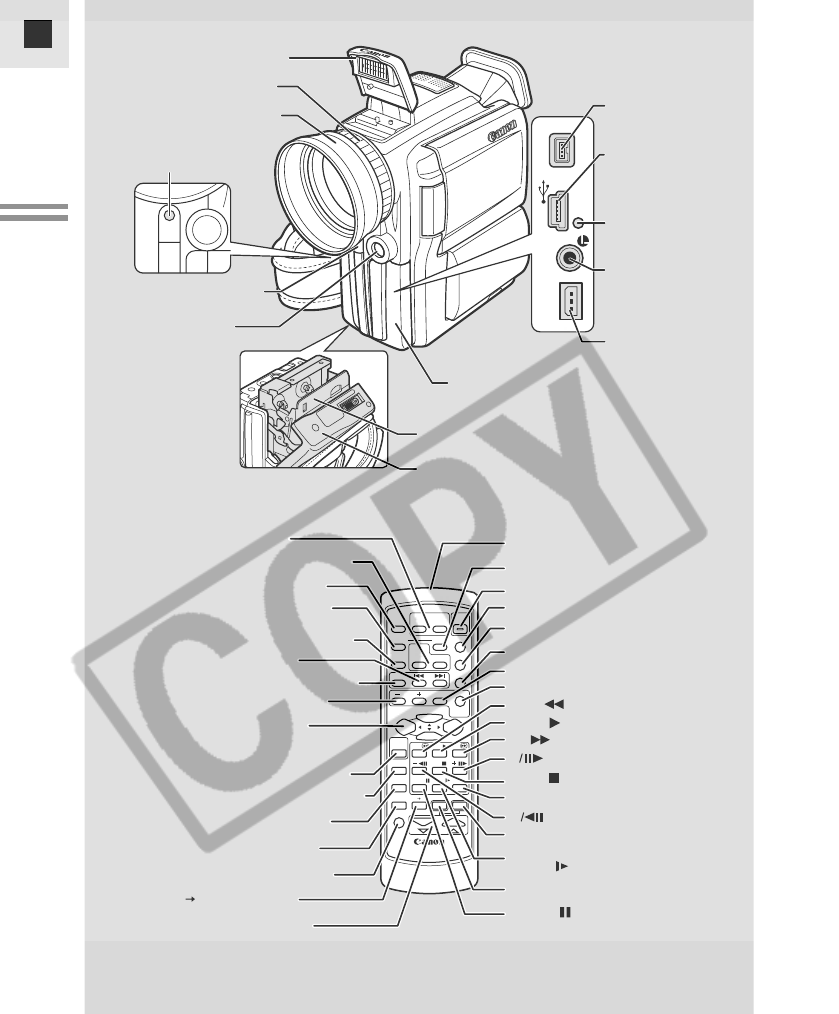
TAPE/CARD switch
(p. 19)
POWER indicator
(p. 18)
Viewfinder (p. 155)
POWER switch
(p. 18)
Viewfinder focusing lever
(p. 155)
Grip belt (p. 156)
Zoom lever (p. 23)
PHOTO button
(p. 54, 111)
Selector dial (p. 33, 39)
MIC terminal
(p. 71, 100)
Program selector (p. 59)
Card access indicator
(p. 111)
Start/Stop button
(p. 19)
Easy
Recording
Program AE
P
Tripod socket (p. 28)
OPEN/EJECT switch (p. 16)
MENU button (p. 39)
Stereo microphone (p. 71, 100)
Built-in speaker (p. 33)
AV (audio/video)
IN/OUT terminal
(p. 34, 93)/
(phones) terminal
(p. 33)
S-video (IN/OUT)
terminal (p. 35, 93)
Backup battery cover
(p. 159)
10
E
Mastering
the Basics
DC IN 9.5V
IN/OUT
CHARGE
DV
WIRELESS CONTROLLER WL-D78
WT
REW
PLAY
FF
START
/STOP
PHOTO
SELF TIMER
MENU
TV SCREEN
DATA CODE
CARD
AUDIO
MONITOR
REC
PAUSE
SEARCH SELECT
SLIDESHOW
ZERO SET
MEMORY
INDEX
SCREEN
AUDIO
DUB.
STOP
MIX
BALANCE
ST-1 ST-2
ON/OFF
D.EFFECTS
SET
ZOOM
AV INSERT
PAUSE
SLOW
REMOTE SET
//
×
2
AV DV
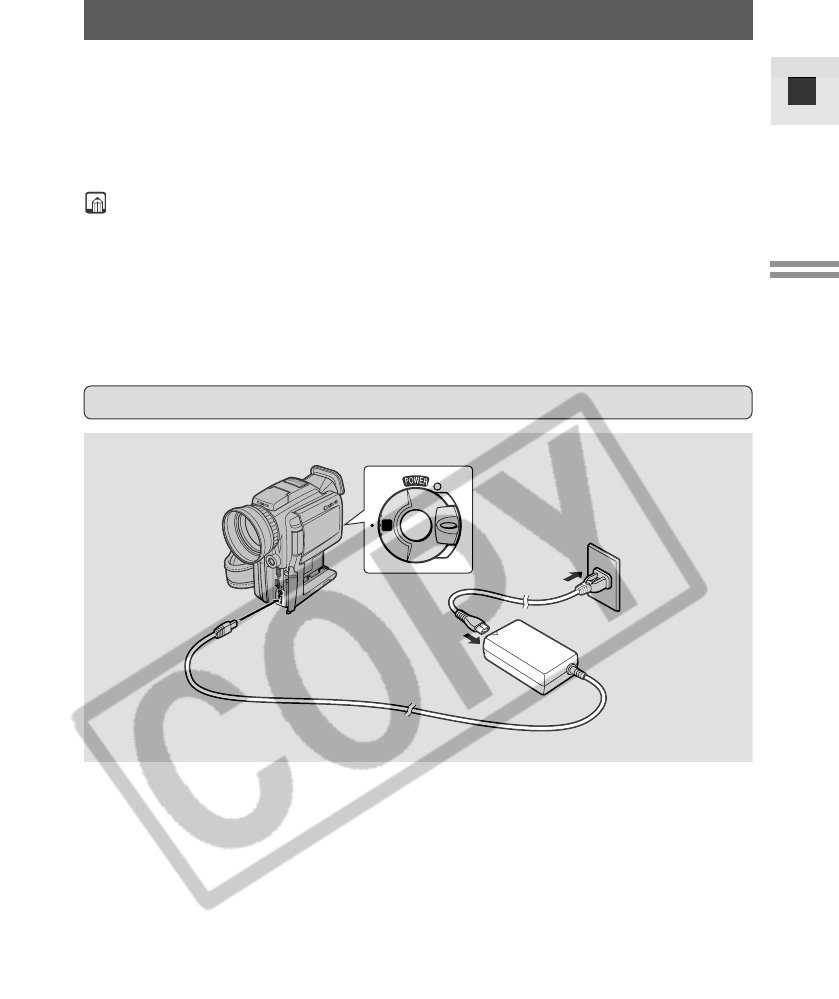
× 2 button (p. 32)
START/STOP button (p. 18)
MENU button (p. 39)
TV SCREEN button (p. 171)
SELF TIMER button (p. 73)
DATA CODE button (p. 84)
D.EFFECTS (Digital effects)
button (p. 63)
REC PAUSE button (p. 91, 94)
CARD –/+ buttons (p. 122)
Transmitter
Zoom buttons (p. 23)
SET button (p. 39)
Digital effects ON/OFF button (p. 63)
MIX BALANCE buttons (p. 103)
Controller buttons (p. 40)
Search buttons (p. 87)
SEARCH SELECT button (p. 87)
AUDIO MONITOR button (p. 103)
AUDIO DUB. button (p. 101)
AV INSERT button (p. 99)
REMOTE SET button (p. 49)
AV DV button (p. 96)
+ button (p. 31)
– button (p. 31)
FF button (p. 30)
PLAY button (p. 30)
STOP button (p. 30)
SLOW button (p. 31)
REW button (p. 30)
PAUSE button (p. 31)
PHOTO button (p. 54, 111)
SLIDE SHOW button (p. 123)
INDEX SCREEN button (p. 123)
Remote sensor (p. 48)
Tally lamp (p. 21)
Terminal cover
Lens hood (p. 155)
Focus ring (p. 79)
u (LANC) terminal
(p. 89)
Cassette compartment (p. 16)
Cassette compartment cover
(p. 16)
DC IN terminal
(p. 11)
DV IN/OUT terminal
(p. 90)
CHARGE indicator
(p. 12)
Built-in Flash (p. 56)
Super Night LED
(White LED)
(p. 56, 62, 80)
USB terminal
(p. 149)
Enlarge buttons (p. 83)/
Trimming buttons (for direct printing)
(p. 138)
ZERO SET MEMORY button (p. 88)
11
E
Mastering
the Basics
Powering Your Camcorder
Before operating your camcorder, you will need to use the power adapter to:
Provide power from a household power socket
or
Charge a battery pack
Notes:
• The power adapter converts current from a household power socket
(100–240 V AC, 50/60 Hz) to the DC current used by your camcorder.
• If the adapter is used next to a TV, it may cause bars to appear on the
TV — move the adapter away from the TV or the aerial cable.
• Do not connect products not expressly recommended to the camcorder’s
DC terminal. Likewise, do not connect products not expressly
recommended to the power adapter.
Connecting the Camcorder to a Household Power Socket
1
2
3
4
(
V
C
R
)
P
L
A
Y
C
A
M
E
R
A
O
F
F
Use the power adapter to provide your camcorder with instant power from a
household power socket. Always turn the camcorder off before
connecting/removing the power source.
1. Set the POWER switch to OFF.
2. Connect the power cord to the power adapter.
3. Plug the power cord into a household power socket.
4. Connect the power adapter to the camcorder’s DC IN
terminal.
5. Disconnect the power adapter from the camcorder after use.
Unplug the power cord from the household power socket,
then disconnect it from the adapter.
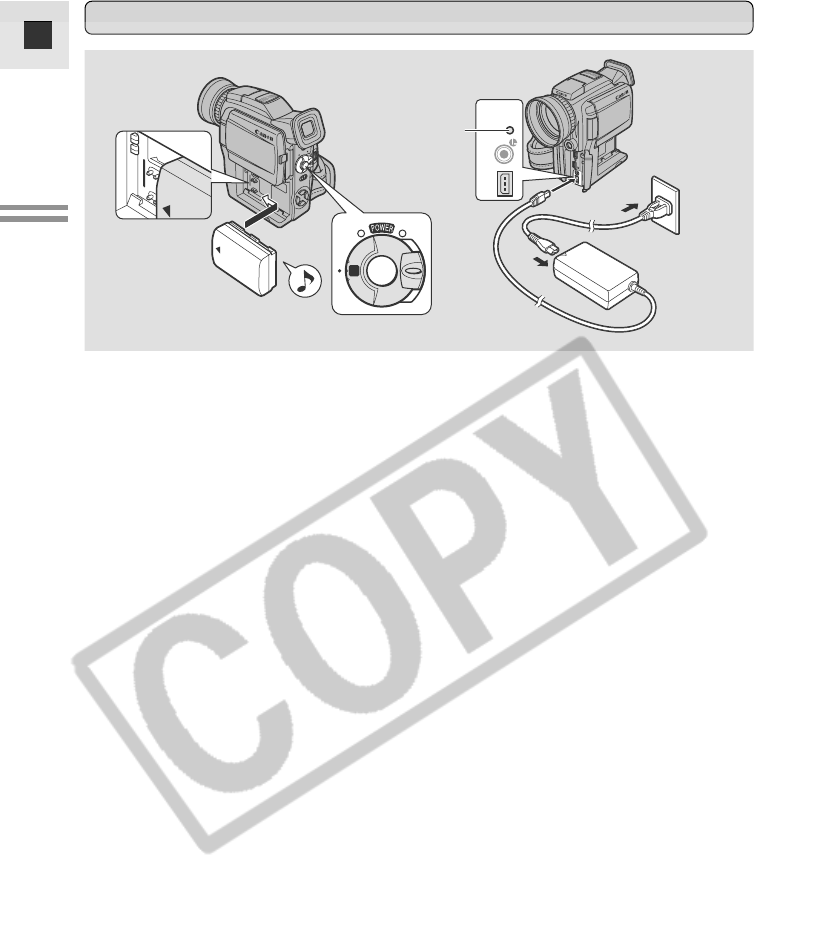
12
E
Mastering
the Basics
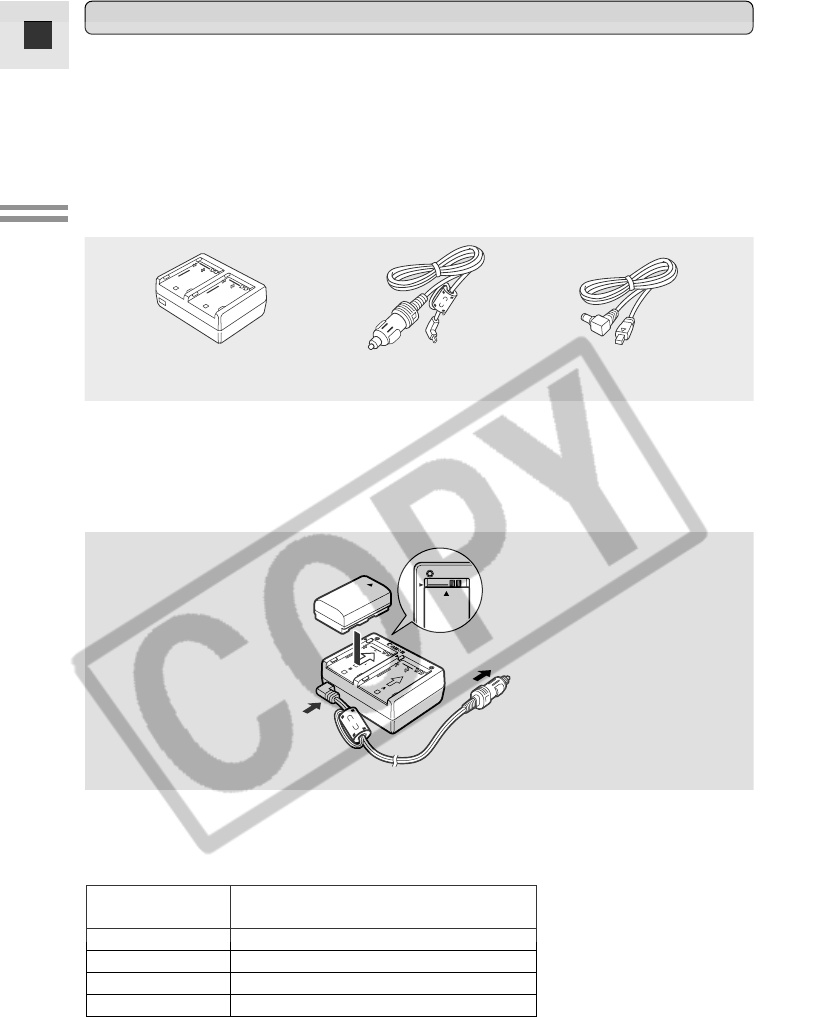
Attaching and Charging the Battery Packs
Your battery pack has been partially charged before it left the factory. It
should have enough power for you to check that your camcorder is working
properly. Charge the battery pack fully if you want it to power the camcorder
for more than a few minutes.
Always turn the camcorder off before connecting/removing the battery.
1. Set the POWER switch to OFF.
2. Attach the battery to the camcorder.
• Remove the battery pack’s terminal cover.
• Align the edge of the battery pack with the line on the camcorder, press
lightly and slide it in the direction of the arrow until it clicks into place.
3. Connect the power cord to the adapter and plug it into a
household power socket.
4. Connect the power adapter to the camcorder.
• The charge indicator flashes red to show that charging is in progress.
Single flashes mean that the battery pack is less than 50% charged.
Double flashes mean that it is more than 50% charged. The indicator
glows steadily when the battery pack is fully charged. If the indicator
blinks rapidly and continuously (twice a second), the battery pack may
be defective.
• When the CHARGE indicator flashes, the battery pack is being charged
even if the POWER switch is set to a position other than OFF.
5. When charging is complete, disconnect the power adapter
from the camcorder, unplug the power cord, and disconnect
the power cord from the adapter.
2
4
3
1
DC IN 9.5V
CHARGE
(
V
C
R
)
P
L
A
Y
C
A
M
E
R
A
O
F
F
CHARGE indicator

13
E
Mastering
the Basics
6. Remove the battery pack after use.
Press the BATT. RELEASE button and remove the battery.
Note:
• You can find details for using the batteries in the “Notes on Using the
Batteries” ( 157). These notes include charging and recording times and
how to install the backup battery.
14
E
Mastering
the Basics
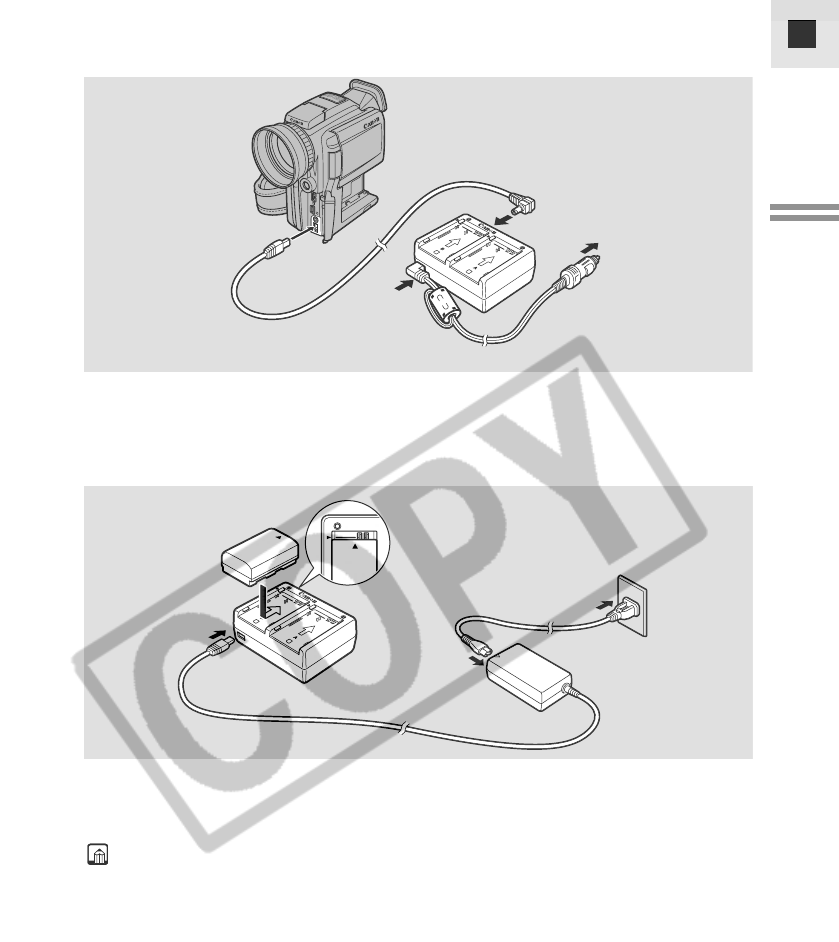
Using the Charge Adapter CR-560 Kit (optional)
CHARGE
The Compact Power Adapter CA-560 supplied with the camcorder can be
used along with the CR-560 Kit for 3 different ways to power the camcorder
or charge battery packs:
1. Charge the BP-500 Series battery packs with power from your car battery.
2. Operate the camcorder with power from your car battery.
3. Charge the BP-500 Series battery packs from a household power socket.
The Charge Adapter/Car Battery Cable Kit CR-560 includes the following:
1. Charge the BP-500 Series battery packs with power from
your car battery.
1 or 2 battery pack(s) + Charge Adapter + Car Battery Cable →car’s
cigarette lighter
• Fast charging for the high-capacity BP-522 and BP-535 (both optional). 15
minutes of charging gives 60 minutes of recording (using the viewfinder).
Charge Adapter Car Battery Cable DC Cable
To car’s
cigarette lighter
Time required for full charge
from car battery or household outlet
BP-512 1 hr. 20 min.
BP-511 (optional) 1 hr. 20 min.
BP-522 (optional) 1 hr. 40 min.
BP-535 (optional) 2 hr. 30 min.
15
E
Mastering
the Basics
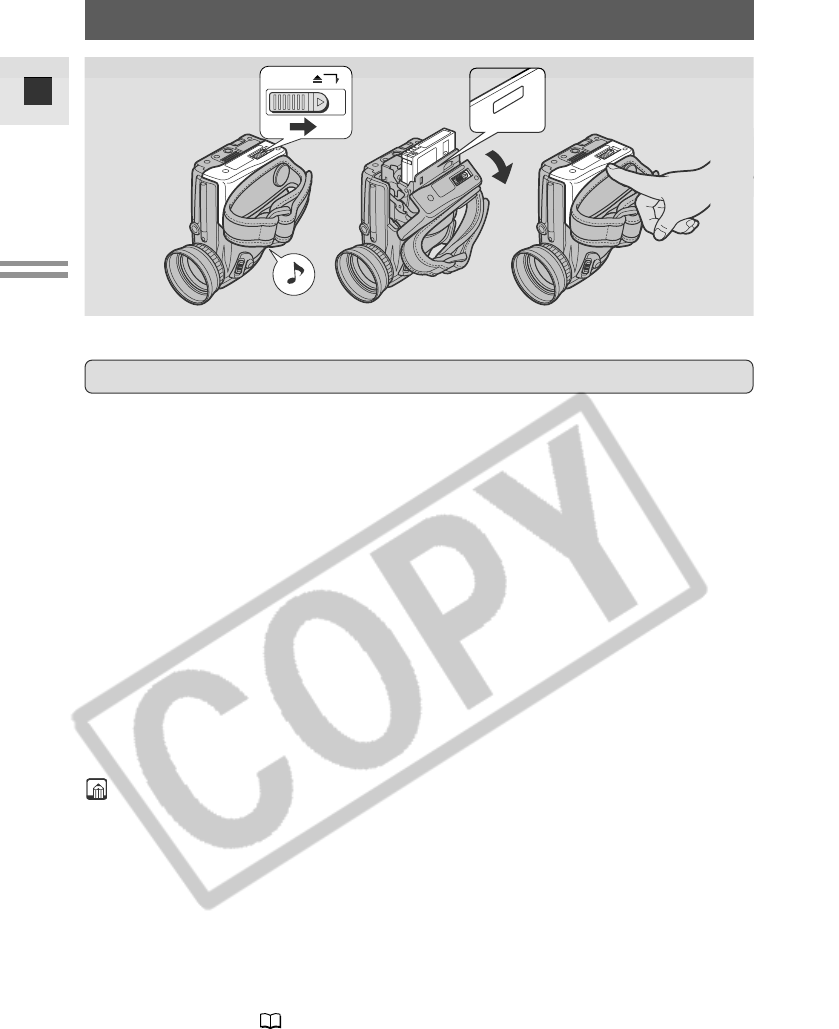
2. Operate the camcorder with power from your car battery.
Camcorder + DC Cable + Charge Adapter + Car Battery Cable →car’s
cigarette lighter
CHARGE
3. Charge the BP-500 Series battery packs from a household
power socket.
1 or 2 battery pack(s) + Charge Adapter + Compact Power Adapter
• Fast charging for the high-capacity BP-522 and BP-535 (both optional). 15
minutes of charging gives 60 minutes of recording (using the viewfinder).
Notes:
• For full details of how to use the CR-560, refer to its instruction manual.
• Charge the battery pack in temperatures between 5°C and 40°C (41°F and
104°F).
• The charging time varies depending on the charging conditions.
To car’s
cigarette lighter
16
E
Mastering
the Basics
Loading a Cassette
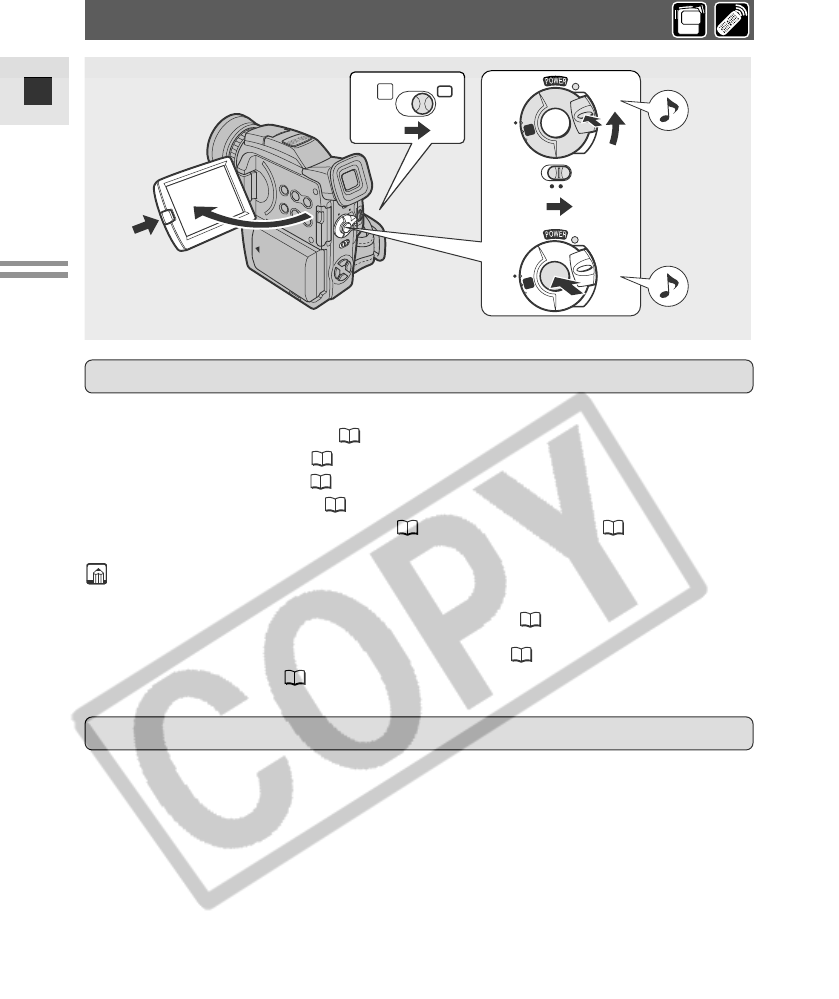
1. Make sure that you have attached a power source.
2. Slide the OPEN/EJECT 5switch (on the bottom of the
camcorder) to release the cassette compartment cover.
• Pull the cover fully open (while holding the button) and wait a couple of
seconds for the cassette compartment to open automatically.
• The confirmation beep sounds when the cassette cover fully opens.
3. Load or unload the cassette.
• Insert the cassette gently with the window facing the grip belt, and the
REC/SAVE tab up.
• Remove the cassette by pulling it straight out.
4. Press the Pmark on the compartment until it clicks, and
wait for the compartment to close.
5. Click the cover back into place.
*Dis a trade mark.
Notes:
• Do not interfere with the cassette compartment while it is opening or
closing automatically, and do not attempt to close the cover until the
cassette compartment has fully retracted.
• Be careful not to get your fingers caught in the cassette compartment cover.
• Do not leave the cassette in the camcorder after use — return it to its case
and store it in a cool, clean, dry place.
• When you turn the camcorder’s power on, vflashes in the display until
you load a cassette.
• With some types of tapes, the remaining tape display may not give an
accurate reading ( 172).
PUSH
OPEN/EJECT
Only use videocassettes marked with the Dlogo.*
Loading and Unloading
17
E
Mastering
the Basics
Protecting Tapes from Accidental Erasure
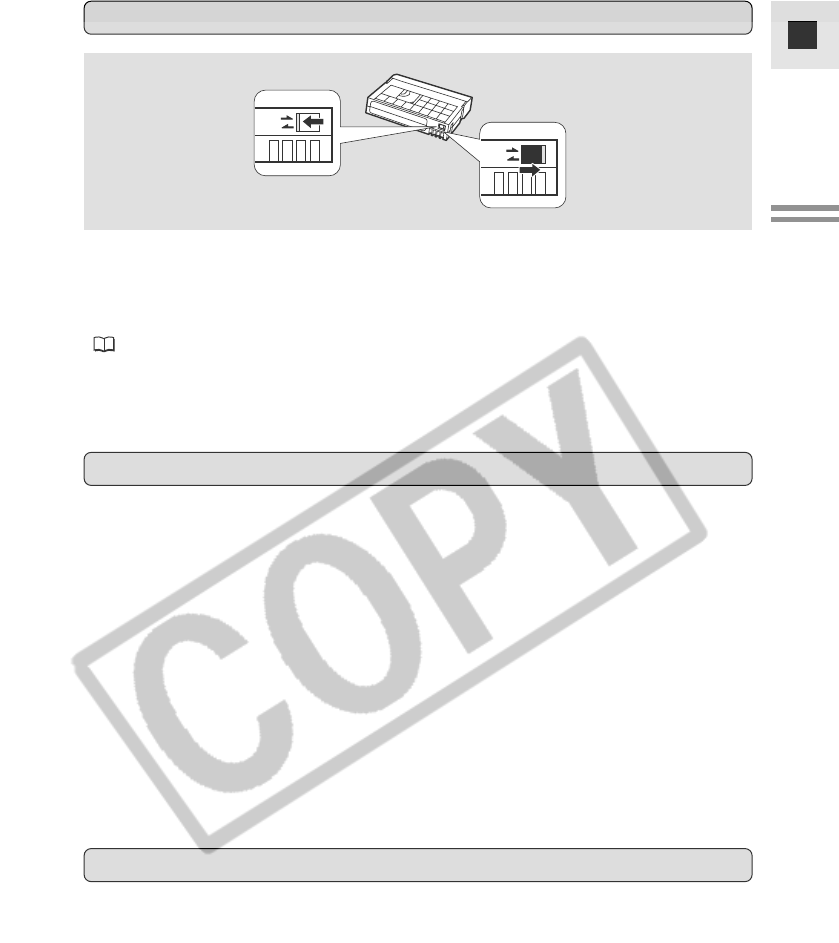
To protect your recording from accidental erasure, slide the tab on the
cassette so that it exposes the hole. (This switch position is usually labelled
SAVE or ERASE OFF.)
If you load this cassette and put the camcorder in record pause mode
( 18), “THE TAPE IS SET FOR ERASURE PREVENTION” is displayed for
approx. 4 seconds and then the vmark flashes in the display.
If you want to record on the cassette again, slide the tab back so that the
hole is closed.
SAVE
REC
SAVE
REC
Cassette Memory Function
You are unable to use the cassette memory function with this camcorder.
• To protect the tape heads, transfer cassettes directly from the tape case to
the camcorder — do not open the tape protect cover or touch the tape
itself.
• Do not use cassettes where the tape has been damaged or spliced — they
may damage the camcorder.
• Do not insert anything into the small holes on the cassette or cover them
with cellophane tape.
• Handle cassettes with care — dropping them or exposing them to external
shocks may cause internal damage.
• Store cassettes in the provided case, first rewinding them to the start of
the tape and then storing them upright.
• A cassette with metal plated terminals may become dirty with use,
affecting information transfer. Therefore, after using a tape about 10
times, be sure to clean the terminals with a cotton bud.
Cassette Handling Precautions
18
E
Mastering
the Basics
Basic Recording
Have you completed the following steps?
• Attaching a power source ( 11).
• Removing the lens cap ( 156).
• Fastening the grip belt ( 156).
• Attaching the lens hood ( 155).
• Choosing the display: viewfinder ( 155) or LCD screen ( 25).
Note:
• When you’re using the viewfinder, fully close the LCD or rotate the LCD so
that it faces into the same direction as the lens ( 25).
You may also want to install the backup battery ( 159) in order to set the
date and time display ( 51).
5, 6
1
2
P
4
CARD TAPE
(
V
C
R
)
P
L
A
Y
C
A
M
E
R
A
O
F
F
(
V
C
R
)
P
L
A
Y
C
A
M
E
R
A
O
F
F
Before You Start Recording
Recording
1. Press and hold the small button on the POWER switch and
turn the POWER switch to CAMERA.
• The camcorder automatically sets to record pause mode. PAUSE appears
in the display.
• If you have not set the date and time display, SET THE TIME ZONE,
DATE AND TIME appears in the display. For setting the time zone, see
p. 51. For setting the date and time, see p. 53.
• The camcorder power indicator lights up.
• The confirmation beep sounds.
• The camcorder will turn itself off if you leave it in record pause mode
for more than about 5 minutes. To return to record pause mode, turn
the POWER switch to OFF and then back to CAMERA.

19
E
Mastering
the Basics
2. Make sure the TAPE/CARD switch is set to TAPE.
• For recording still images onto a memory card, see p. 111. For
recording movies onto a memory card, see p. 116.
3. Load a cassette ( 16).
• Start recording when the tape counter has stopped.
4. Slide the program selector to [.
• This selects the camcorder’s Easy Recording program. It allows you to
simply point and shoot without making any manual adjustments
( 60).
5. Press and release the start/stop button once to begin
recording.
• For still image recording to a cassette, see p. 54.
6. Press and release the start/stop button again to pause
recording.
• The camcorder returns to record pause mode and PAUSE reappears in
the display.
• You can stop and restart recording as often as you like by pressing the
start/stop button.
• Replace the lens cap.
• Return the LCD screen flush to the camcorder body.
• Unload the cassette.
• Turn the POWER switch to OFF.
• Disconnect the power source.
Notes:
• To check that the camcorder is recording correctly, make a test recording
first.
• Before making important recordings, clean the video heads using a Canon
DVM-CL Digital Video Head Cleaning Cassette or a commercially available
digital video head cleaning cassette.
• To close the LCD panel, rotate it vertically until the screen faces you, then
press the LCD panel until it clicks securely closed.
• You cannot monitor the sound from the speaker when recording.
• For tips on how to make better videos, see p. 28.
• For extra recording time, see “Changing the Recording Mode” ( 20).
When You Have Finished Recording
20
E
Mastering
the Basics
+,+,+
PLAY
(VCR)
CARD
PLAY
(VCR)
TAPE
CAMERA
TAPE
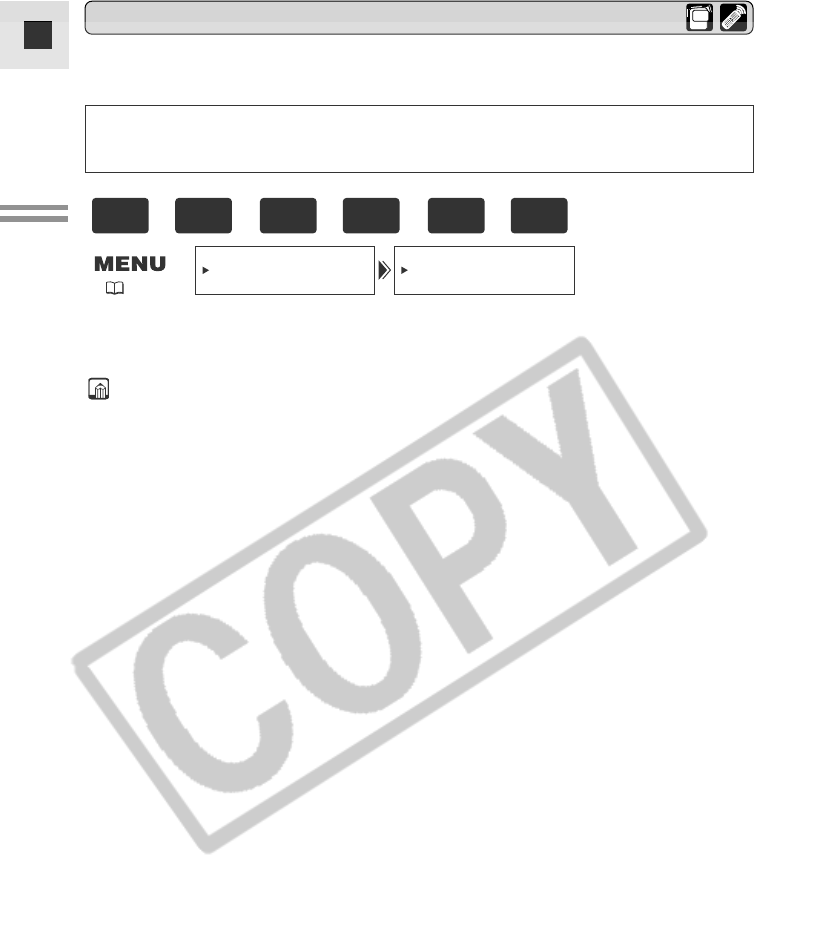
You can select between SP (standard play) and LP (long play). LP extends the
tape usage by 1.5 times.
REC MODE••••SP
VCR SET UP
( 38)
Changing the Recording Mode
To change to LP mode, open the menu and select VCR SET UP.
Then select REC MODE, set it to LP and close the menu.
Notes:
• Depending on the nature and usage condition of the tape,
recording/playback in LP mode may cause image or sound distortion. We
recommend using the SP mode for important recordings.
• We recommend recording in SP mode when you plan to transfer images
taken with the camcorder to your PC.
• If you record in both modes on the same tape, the image may become
distorted during playback and the time code may not be written correctly.
• If you play back a tape recorded on another digital equipment on this
camcorder, or vice versa, image and sound may become distorted.
It is not possible to dub audio or insert images to a tape that has been
recorded in LP mode.
21
E
Mastering
the Basics
+
CAMERA
TAPE
16:9 (Wide Screen TV Recording)
Produces images in the 16:9 format
for playback on wide screen TVs.
To switch 16:9 to ON, open the menu and select CAM.SET UP.
Then select 16:9, set it to ON and close the menu.
Notes:
• “16:9” is shown in the display when you switch the 16:9 mode on.
• You cannot use the 16:9 mode with the Easy Recording program.
• You cannot use the multi-image screen when setting the 16:9 mode on.
• If you play back a recording made for 16:9 on a normal TV screen, the
image will appear to be vertically “squashed” (compressed).
16:9••••••••OFF
CAM.SET UP
( 38)
Turning Off the Tally Lamp
+,+,+
PLAY
(VCR)
CARD
PLAY
(VCR)
TAPE
CAMERA
TAPE
The tally lamp lets you know that the
camcorder is recording, receiving
signals from the wireless controller or
counting down for the self-timer.
However, its flashing may be
reflected into the lens during close-
up recording, or when recording
through glass.
You may therefore decide to turn it
off.
To turn the tally lamp off, open the menu and select SYSTEM. Then
select TALLY LAMP, set it to OFF and close the menu.
• The tally lamp no longer flashes during recording, but it will still light up
when the camcorder receives a signal from the wireless controller and
during the self-timer countdown.
TALLY LAMP••ON
SYSTEM
( 38)
22
E
Mastering
the Basics
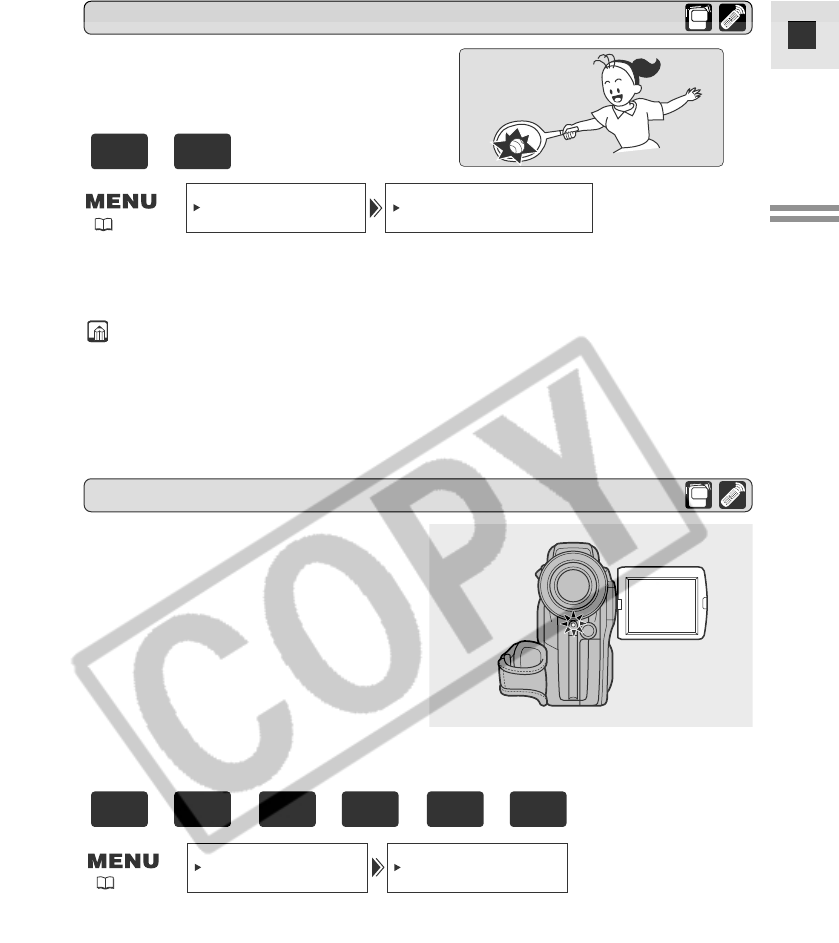
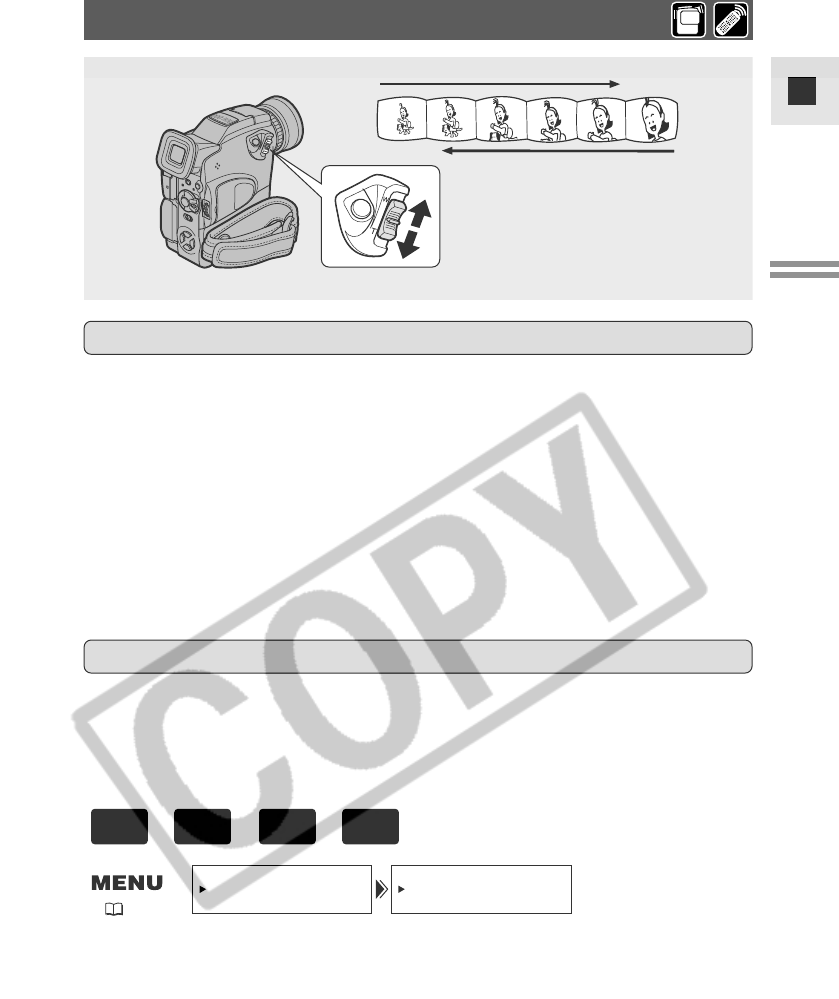
The camcorder’s short operation confirmation beeps are indicated by `in the
illustrations. Beeps sound upon certain camcorder operations such as when
you turn the camcorder on, during the self-timer countdown, right before
the camcorder’s automatic shut-off, and also upon any unusual condition of
the camcorder. Beeps are not recorded on the tape.
BEEP••••••••ON
SYSTEM
( 38)
Confirmation/Warning Beeps
To turn the beep off, open the menu and select SYSTEM. Then
select BEEP, set it to OFF and close the menu.
• All camcorder sounds, including the shutter sound that sounds when
recording a still image onto a memory card will be turned off.
+,+,+,+
PLAY
(VCR)
CARD
CAMERA
CARD
PLAY
(VCR)
TAPE
CAMERA
TAPE
You can see a demonstration of the camcorder’s main features. To see the
demonstration, do either of the following:
• With no cassette or memory card inserted, turn the DEMO MODE on in
the TAPE CAMERA menu or CARD CAMERA menu and close the menu.
• Leave the camcorder with no cassette or memory card inserted for five
minutes after turning it on.
Demonstration Mode
DEMO MODE•••ON
DISP.SET UP
( 38)
+,+
CAMERA
CARD
CAMERA
TAPE
To turn the demonstration mode off, open the menu and select
DISP. SET UP. Then select DEMO MODE, set it to OFF and close
the menu.
Note:
• To cancel the demo mode once it has begun: push any button, turn off the
power, load a cassette or insert a memory card.
23
E
Mastering
the Basics
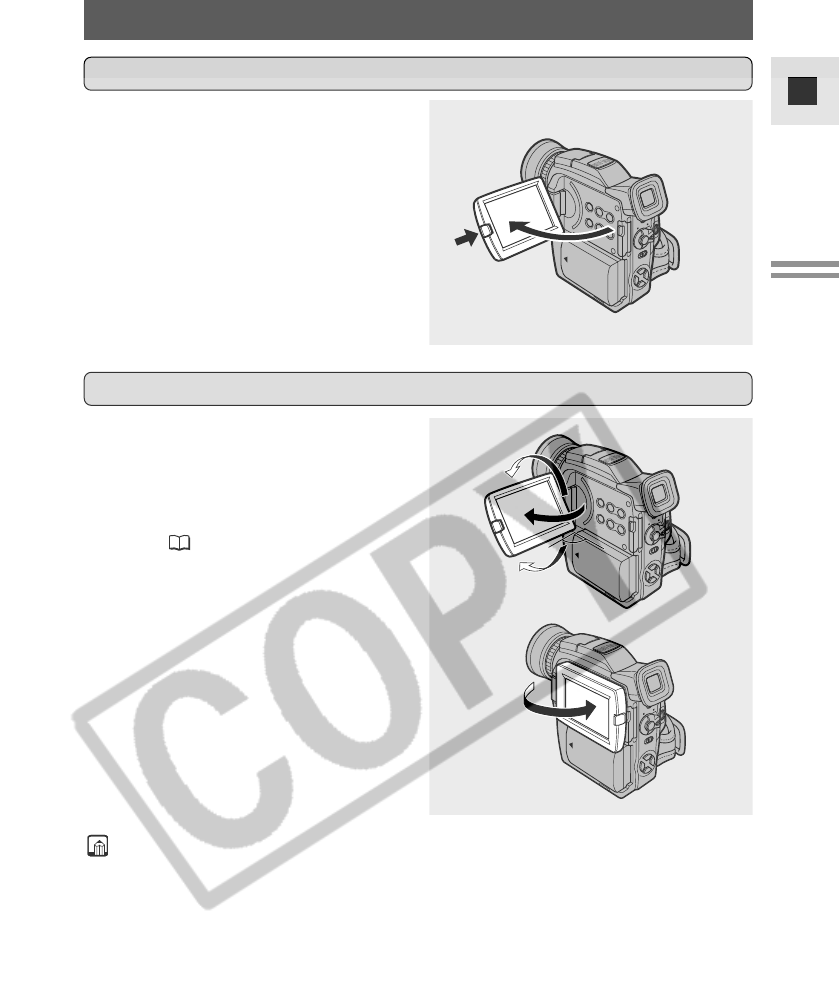
40×/200×Digital Zoom (Card 40×)
Magnifies the camcorder’s zoom range by up to 20× in TAPE CAMERA mode.
The zoom control continues to work as usual. You can freely zoom in and out
between 1×and 200× magnification — the camcorder automatically switches
between optical zooming (up to 10×) and digital zooming (10× to 40×or 10×
to 200×).
Zooming
The camcorder’s zoom lens allows you to choose the best picture angle for
each scene:
• Move the zoom control towards W to zoom out to wide-angle.
• Move it towards T to zoom in to telephoto.
You can also control the speed of zooming:
• Move the control slightly to zoom slowly.
• Move it farther to zoom more quickly. (The farther you move the zoom
control, the faster the zoom speed.)
The T and W buttons on the wireless controller adjust the picture angle, but
not the zoom speed.
10×Optical Zoom
TW
Zoom out
Zoom in
D.ZOOM••••••
40×
CAM.SET UP
( 38)
+,+
CAMERA
CARD
CAMERA
TAPE
To change the digital zoom, open the menu and select CAM.SET
UP. Then select D.ZOOM, set it to OFF or 200×and close the
menu.

24
E
Mastering
the Basics
Notes:
• When zooming, as a rule, keep at least 1 m (3 ft 33/8in) between you and
your subject. However when the zoom is at the wide-angle position, you
can focus on a subject as close as 1 cm (3/8in).
• Image resolution is slightly lower when the magnification is greater than
10×.
• You cannot use digital zoom in the Night and Super Night recording
program.
• You cannot use digital zoom when the multi-image screen is set. The
display becomes “– – –”.
• The zoom indicator appears for 4 seconds. When the digital zoom is set to
40×, the zoom indicator extends (light blue). When the digital zoom is set
to 200×zoom, the zoom indicator extends again (a darker blue).
25
E
Mastering
the Basics
Using the LCD Screen
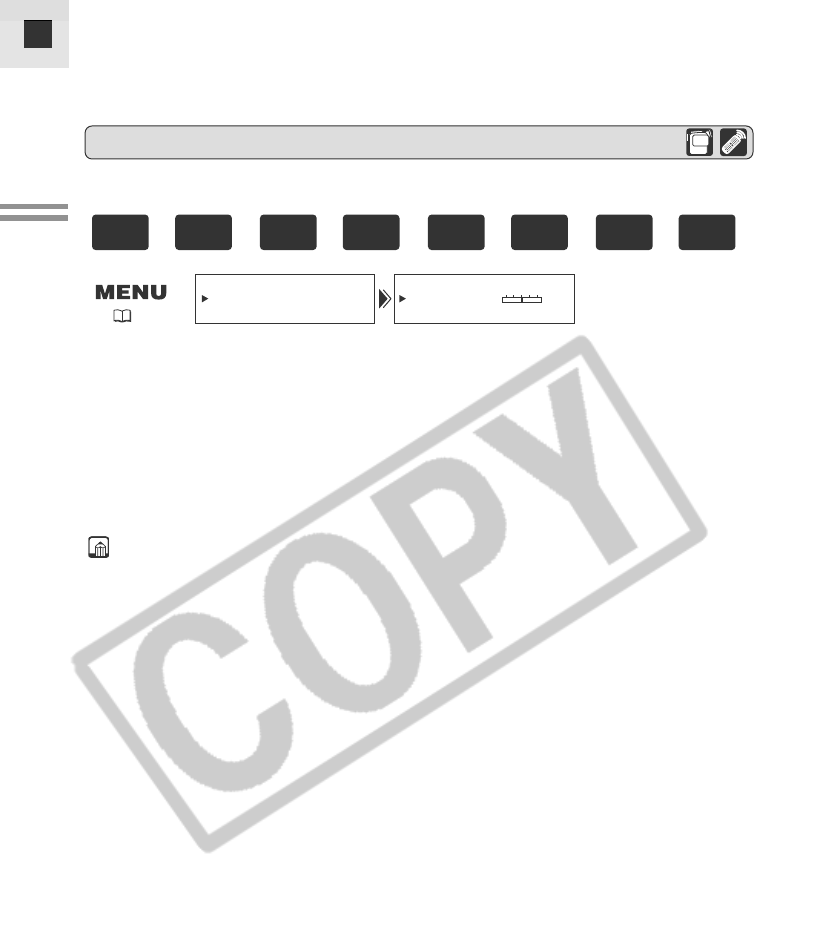
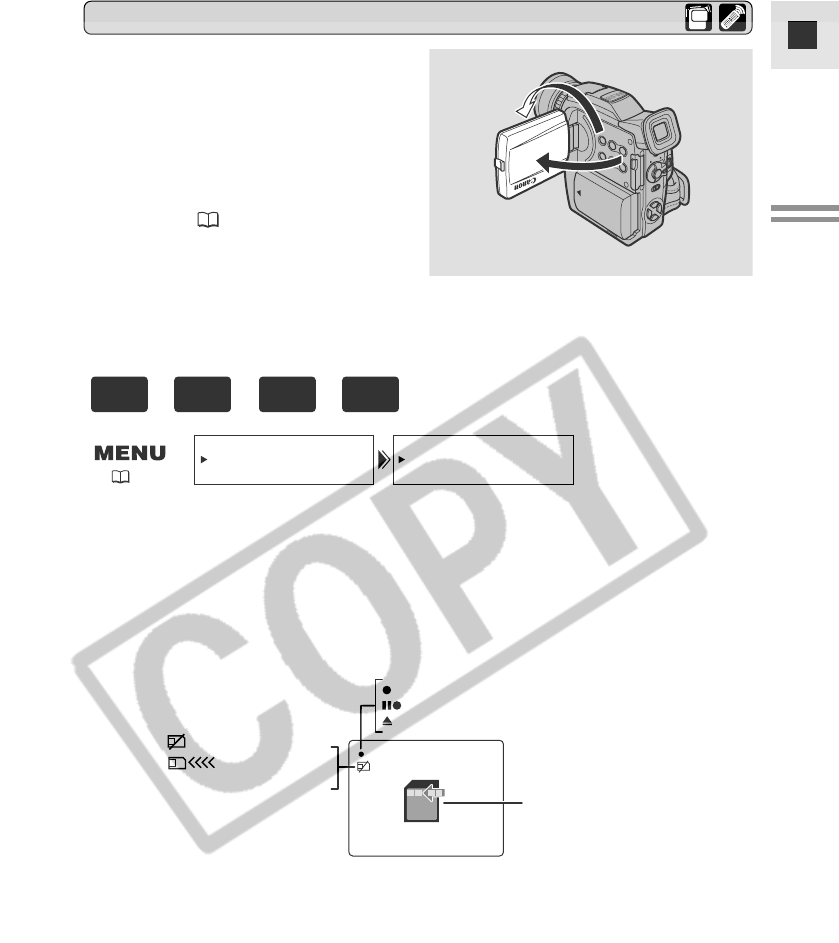
Press the LCD panel OPEN button
and open the panel by pulling it
away from the camcorder. This
automatically switches the LCD
screen on and the viewfinder off.
Close the LCD panel until it clicks
securely closed. When you close the
LCD panel, the LCD screen
automatically switches off and the
viewfinder switches back on.
Opening and Closing the LCD Screen
You can choose the angle of the
screen that suits you best by
opening and rotating the screen.
You can also rotate the LCD screen
so that it faces in the direction of
the lens ( 27).
Changing the Angle of the LCD Screen
You can also push the panel flat
against the camcorder until it is flush
with the side, with the screen facing
outwards.
90°
180°
90°90°
Notes:
• Avoid touching the LCD screen when moving the LCD panel.
• Do not hold the camcorder by the LCD panel or the viewfinder.
• Make sure to open the LCD panel at 90° before attempting to rotate it.
• Always rotate the LCD panel vertically into place before closing it or
pushing it flat against the side of the camcorder.
• Always fully close the LCD panel until it clicks securely.
• Be careful not to leave the LCD, viewfinder or lens exposed to direct
sunlight outdoors or through a window. Doing so could cause damage.
26
E
Mastering
the Basics
Adjusting the LCD Screen
You can adjust the brightness of the LCD screen.
BRIGHTNESS••
DISP.SET UP
–+
( 38)
Open the menu and select DISP.SET UP from the menu. Then
select BRIGHTNESS, adjust the level with the selector dial and
close the menu.
A bar showing the level appears in the display.
• Turn the selector dial up to make the display brighter.
• Turn the selector dial down to make the display darker.
Notes:
• The camcorder retains your brightness setting even after you turn it off.
• The brightness of the LCD does not affect that of the recorded images or
the viewfinder.
About the LCD Screen
The LCD screen built into this camcorder is a high precision product.
However, small black dots or bright points of light (red, blue or green) may
appear constantly on the LCD screen. This is not a malfunction of the LCD
screen and they are not recorded. (Effective dots: more than 99.99%)
+,+,+,+
PLAY
(VCR)
CARD
CAMERA
CARD
PLAY
(VCR)
TAPE
CAMERA
TAPE
• Bright light falling on the LCD screen may cause glare that makes it
difficult for you to view the image. In this case, switch to using the
viewfinder. You can also adjust the brightness of the screen (see “Adjusting
the LCD screen” below).
27
E
Mastering
the Basics
REC
REC PAUSE
EJECT
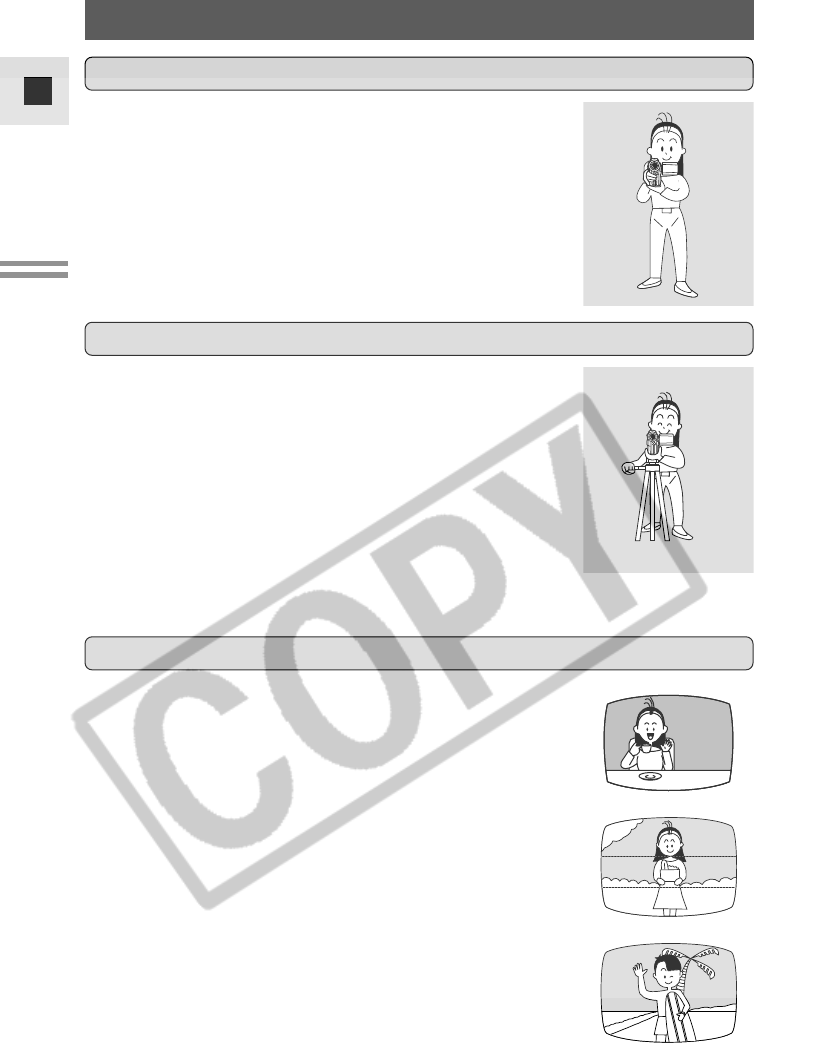
The indicators that appear on the LCD screen when LCD
MIRROR is turned on:
Allowing the Subject to Monitor Recording
When you turn the LCD panel so
that it faces to the same direction as
the lens, you can watch yourself
during recording or let your subject
monitor recording. The viewfinder is
also activated when the panel is in
this position. (“Adjusting the
Viewfinder” 155)
• You can choose the display style,
reversed (mirror on) or not (mirror
off). The recording itself is
unaffected regardless of which one
you choose.
LCD MIRROR••ON
DISP.SET UP
( 38)
To turn the mirror mode off, open the menu and select DISP.SET
UP. Then select LCD MIRROR, set it to OFF and close the menu.
+,+
CAMERA
CARD
CAMERA
TAPE
No card
Recording to a
memory card
CARD CAMERA mode
TAPE CAMERA mode
CARD CAMERA mode
Recording to a memory card
28
E
Mastering
the Basics
Tips for Making Better Videos
Composition
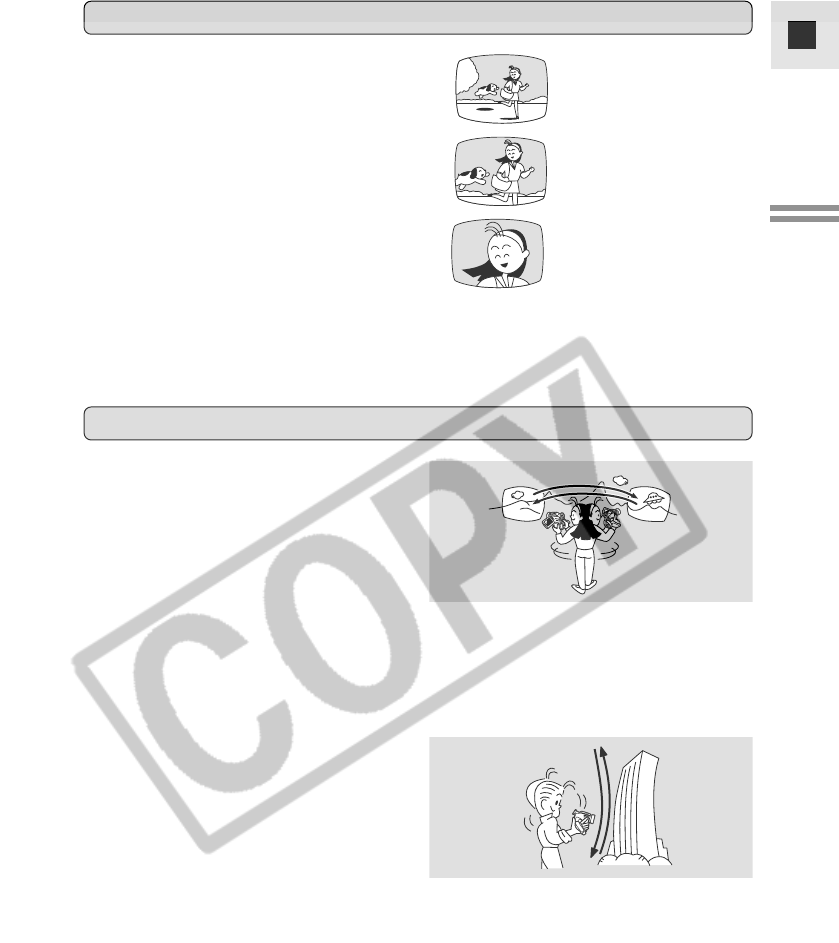
The most important element in the scene does not
have to be in the centre. For a more interesting
picture, try to position your subject slightly to one side.
Leave some space on the side of the frame that the
subject is facing or moving towards.
For maximum stability, grip the camcorder in your right
hand and keep your right elbow pressed against your
body.
If necessary support the camcorder with your left hand.
With practice, you will be able to operate the controls
by touch, without taking your eye off the action.
To prevent any unwanted movement, you can mount
the camcorder on a tripod, (or any flat surface at a
suitable height) and operate it with the wireless
controller.
• When you are using a tripod, be careful not to leave
the viewfinder exposed to bright sunlight as it may
melt. (The light is concentrated by the viewfinder
lens.)
• Make sure that the fastening screw of the tripod is
no longer than 5.5 mm (1/4inch), as it will damage
the camcorder.
Do not cut off the top of the subject’s head, and do
not cut people off at the neck, hips or knees (move a
little bit above or below).
Watch out for distracting objects in the background.
Holding the Camcorder
Using a Tripod
29
E
Mastering
the Basics
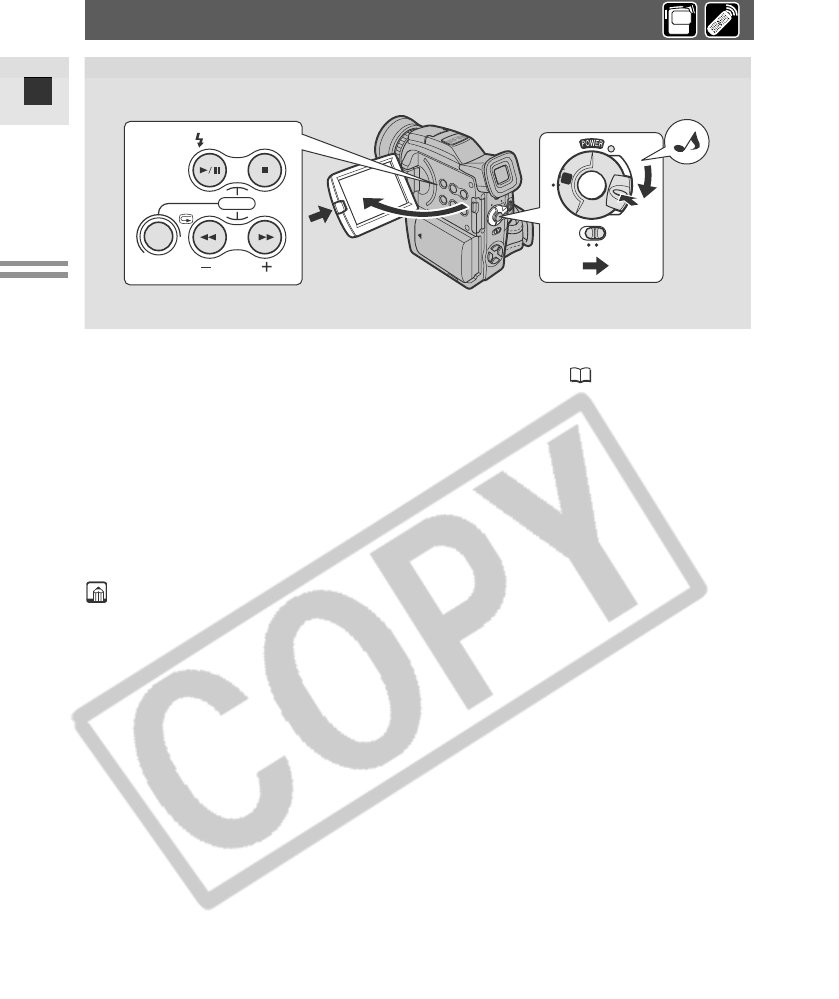
Picture Angle
Camcorder Moves
Close-up
Instead of zooming while recording,
try to choose your picture angle
before you begin. A good way to tell
a story with video is to begin with a
long shot that establishes the
situation, and then move in with
medium shots and close-ups to show
the details. Remember to change
your viewpoint for each shot.
Remember that any camcorder
movement or change in picture angle
should have a definite purpose.
Avoid unnecessary or half-hearted
movements.
Use pans to record a landscape or
follow a moving subject. Decide the
area you want to cover and stand
facing the end of your panning
angle. Without moving your feet,
turn your waist to the starting
position. Start recording, and after a
few seconds begin to turn slowly
from the waist. Hold the final image
for a few seconds before you stop
recording.
Tilt the camcorder up to exaggerate
the height of the subject. Tilt down
from the top of a building, for
example, as an introduction to
subjects at the bottom.
Long shot
Medium shot
Pan
Tilt
30
E
Mastering
the Basics
Playing Back a Tape
You can use the LCD screen for instant, on-the-spot playback. The camcorder
also plays back the sound track via the built-in speaker ( 33).
• When you play back a tape, you can also close the LCD panel with its
screen side facing outward.
• When you wish to use the viewfinder to view playback, close the LCD
panel. The built-in speaker does not sound. Use headphones to monitor the
sound.
For playing back your recordings on a TV, see p. 34.
For using the wireless controller, see p. 48.
Note:
• To avoid accidental recording, slide the tab on the cassette so that it
exposes the hole (the switch position is usually labelled SAVE or ERASE
OFF).
1. Attach a power source and turn the POWER switch to PLAY
(VCR).
• The power indicator lights up.
2. Make sure the TAPE/CARD switch is set to TAPE.
3. Load the cassette.
4. Press the e(play) button to start playback.
• To end playback, press the 3(stop) button.
• To wind the tape forwards, stop playback and press the 1(fast
forward) button.
• To wind the tape backwards, stop playback and press the `(rewind)
button.
• If the playback picture is rough (mosaic-like noise), clean the video
heads using a Canon DVM-CL Digital Video Head Cleaning Cassette or
a commercially available digital video head cleaning cassette.
(
V
C
R
)
P
L
A
Y
C
A
M
E
R
A
O
F
F
CARD TAPE
INDEX
REC SEARCH
SCREEN
MIX/
CARD
SLIDE SHOW
31
E
Mastering
the Basics
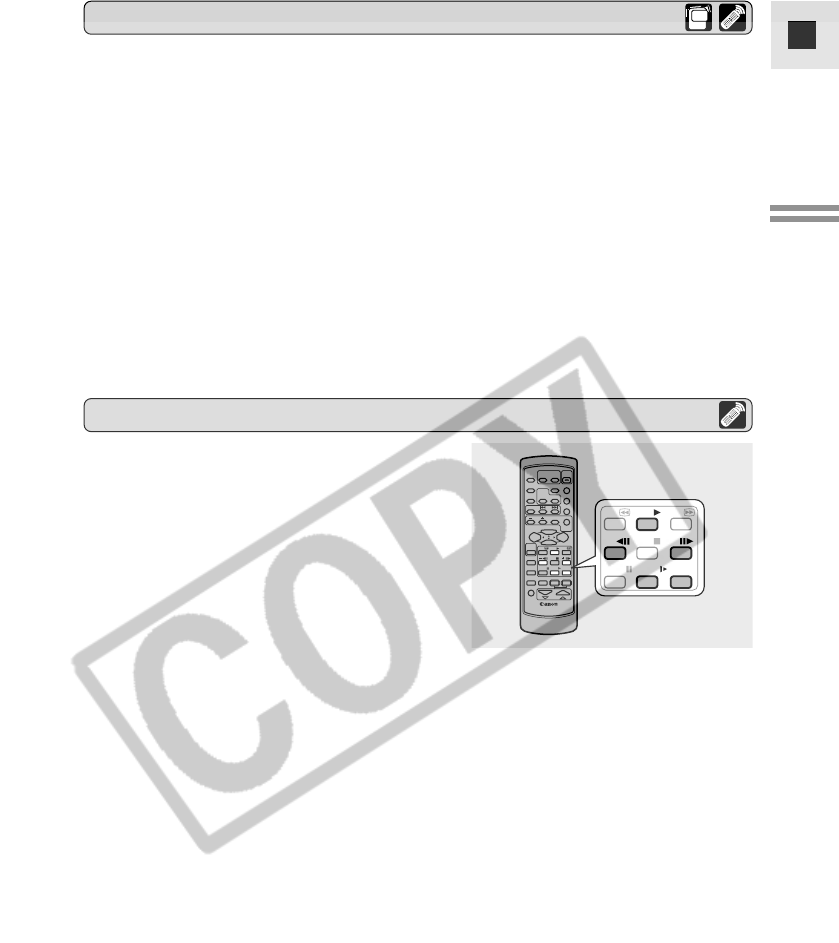
Playback Pause
Press the a(pause) button. To resume normal playback, press it again, or
press the e(play) button. The camcorder automatically goes into stop mode
after about 5 minutes’ playback pause.
Fast Forward Playback
To play back the recording at about 11.5 times normal speed, press and hold
the 1(fast forward) button during normal playback or press and hold the
1(fast forward) button during normal fast forward.
Rewind Playback
For reverse playback at about 11.5 times normal speed, press and hold the
`(rewind) button during normal playback or press and hold the `
(rewind) button during normal rewind.
Other Playback Modes
Special Playback
Frame Advance
To play back frame by frame, press the
+/ ae button repeatedly during playback
pause.
Press and hold to play back continuous
frame advance.
Frame Reverse
To play back in reverse frame by frame,
press the –/4a button repeatedly during
playback pause.
Press and hold to play back continuous frame reverse.
Slow Forward Playback
To play back at about 1/3 normal speed, press the SLOW Mbutton during
normal playback.
Press the PLAY e button to return to normal playback.
Slow Reverse Playback
To play back in reverse at about 1/3 normal speed, press the –/4a button
and then the SLOW Mbutton during normal playback.
Press the PLAY e button to return to normal playback.
//
REW
PLAY
FF
STOP
PAUSE
SLOW
×2
+/
–/

32
E
Mastering
the Basics
Reverse Playback
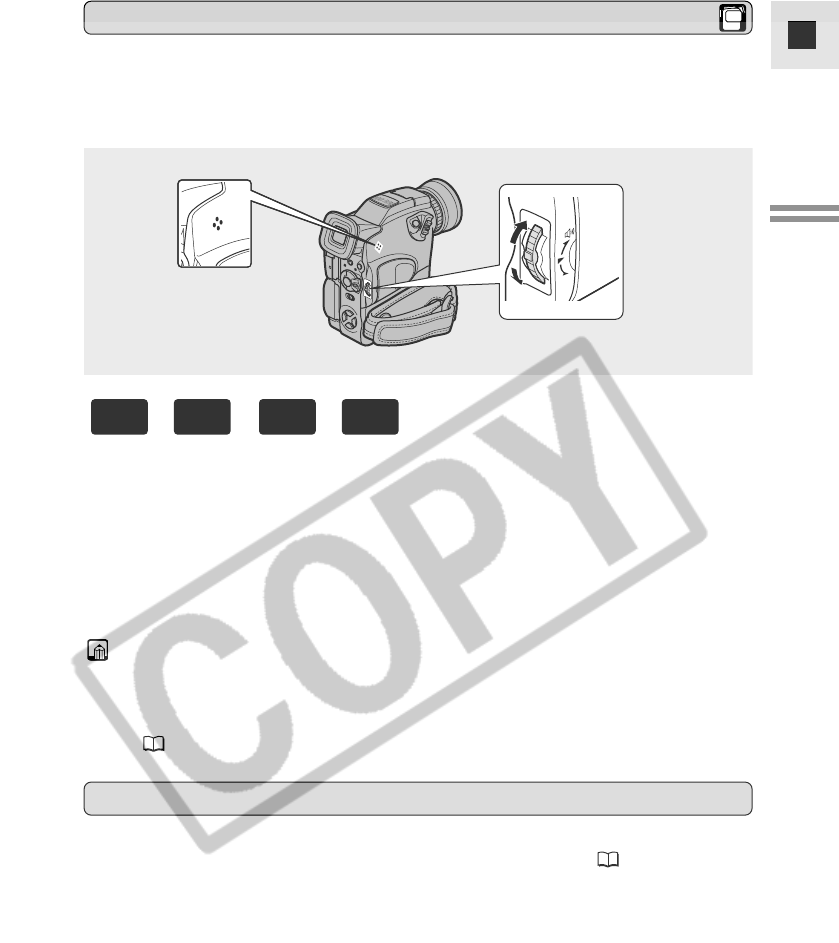
To play back in reverse at normal speed, press the –/4a button during
normal forward playback.
Press the PLAY e button to return to normal forward playback.
• The camcorder automatically goes into stop mode after about 2 minutes of
paused reverse playback.
Forward ×2 Playback
Press the ×2 button during normal playback.
Press the PLAY e button to return to normal playback.
Reverse ×2 Playback
Press the –/4a button and then the ×2 button during normal playback.
Press the PLAY e button to return to normal playback.
Notes:
• Mosaic-like noise appears on the screen during some of the special
playback modes.
• There is no audio during special playback.
33
E
Mastering
the Basics
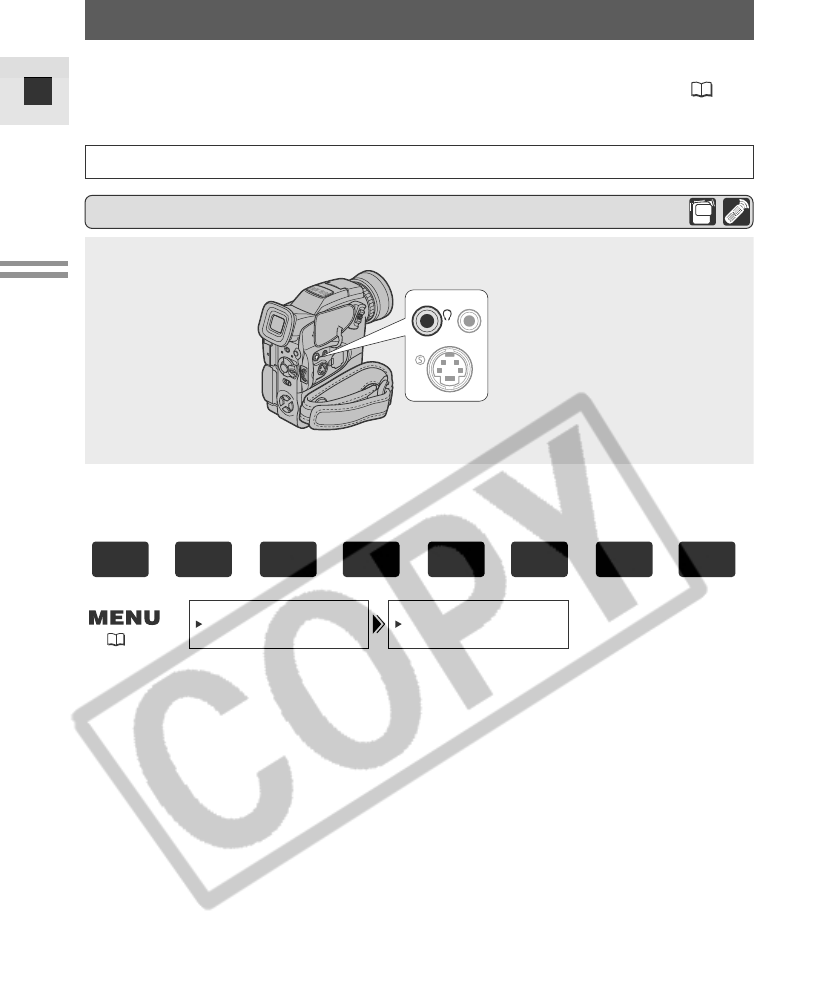
Adjust the speaker volume with the selector dial.
• Pull the selector dial up to increase the volume, and down to lower the
volume.
• A bar appears in the display to indicate the current volume. It disappears in
4 seconds.
• You can turn off the volume completely by pulling the selector dial down
until OFF appears.
Notes:
• Sometimes audio may sound distorted when the volume is turned up high.
If this happens, turn down the volume.
• The speaker does not sound if PHONES is displayed. Set AV/headphones to
AV ( 34).
SELECT
The camcorder has a built-in speaker so you can review the sound track
alongside the picture when you’re using the LCD screen to play back. The
built-in speaker is monaural. If you are using the viewfinder to play back, use
headphones to monitor the sound.
Built-in Speaker
+,+
PLAY
(VCR)
CARD
PLAY
(VCR)
TAPE
Using the Headphones
You can also use the headphones to monitor the sound track. Change the
setting of the AV/headphones terminal through the menu ( 34).
• You can adjust the headphone volume separately from the built-in speaker.
• The levels you adjust for the built-in speaker and headphones are
memorized separately. The camcorder retains your levels even if you turn
the camcorder off and back on again.
• The speaker turns off when you use headphones.
34
E
Mastering
the Basics
Connections for Playback on a TV Screen
You can connect the camcorder to a TV or VCR in order to play back your
recordings. You will need to attach a power source to the camcorder ( 11).
Power off all devices before starting the connections.
See your TV or VCR instruction manual for further details.
IN/
OUT
AV
IN/OUT
MIC
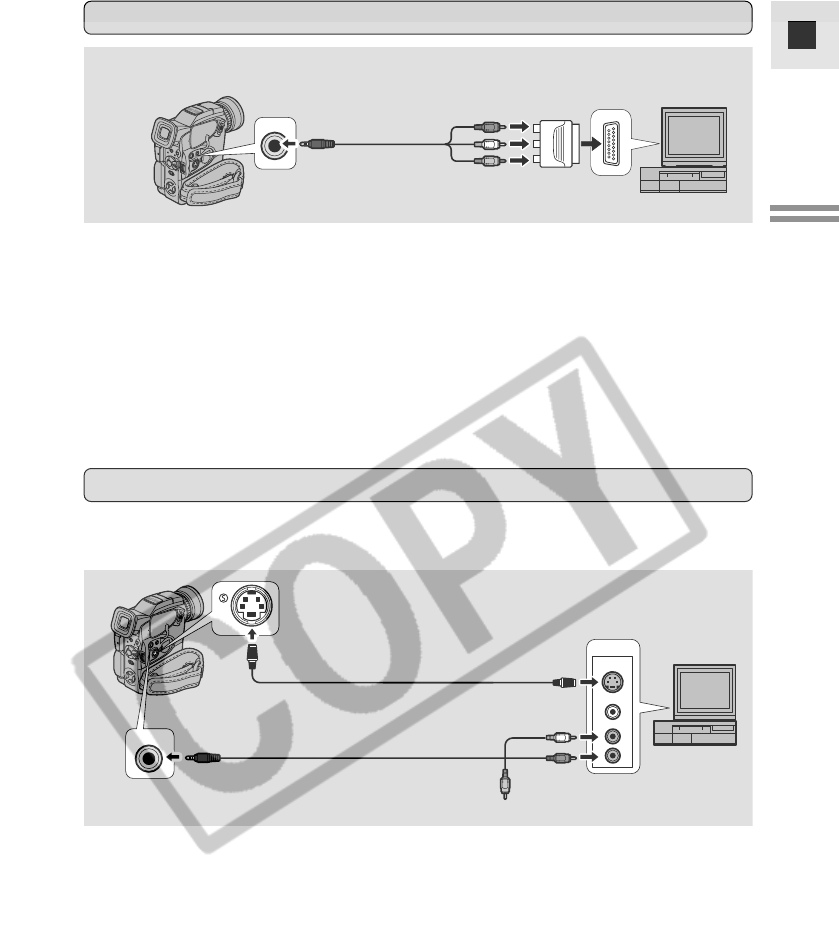
Through the menu, the camcorder’s AV/headphone terminal can be switched
to function as either the AV terminal or the headphone terminal.
Open the menu and select VCR SET UP. Then select AV/PHONES and
set it to AV or PHONES and close the menu.
• When the terminal is switched to PHONES, PHONES appears in the display.
Using the headphones
• Make sure you switch the AV/headphones terminal to PHONES before
using headphones. If the AV/headphones terminal is not switched to
PHONES before you use the headphones, noise will come out from the
headphones.
+,+,+,+
PLAY
(VCR)
CARD
CAMERA
CARD
PLAY
(VCR)
TAPE
CAMERA
TAPE
AV/PHONES•••AV
VCR SET UP
( 38)
Switching the AV/Headphone Terminal
35
E
Mastering
the Basics
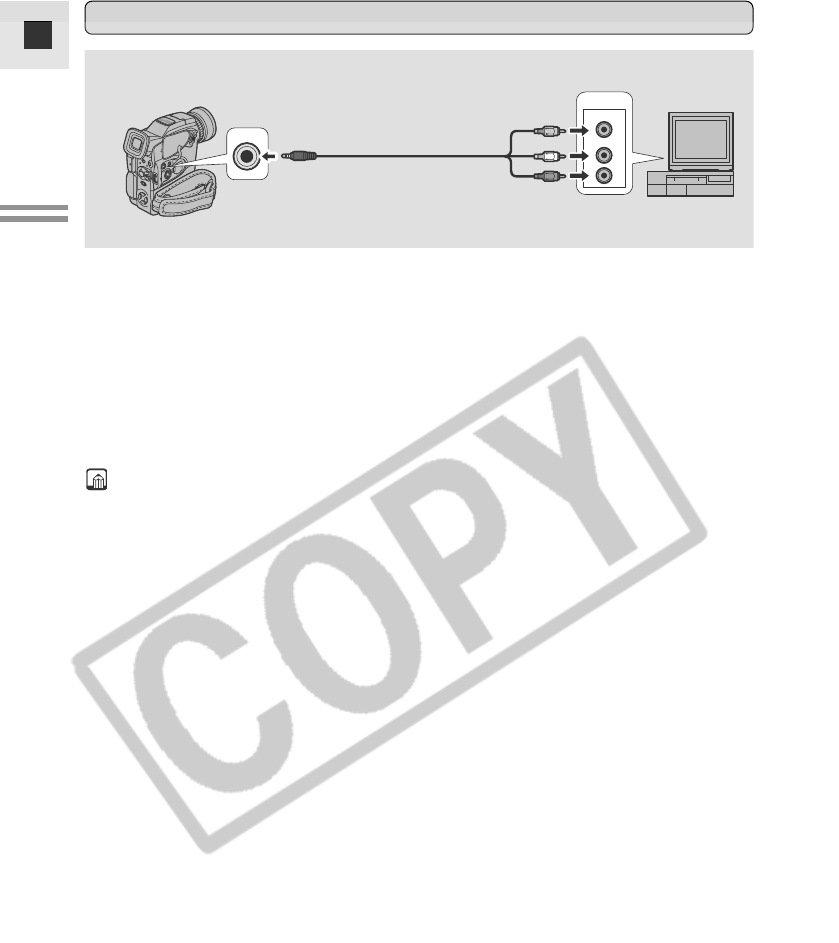
If Your TV (or VCR) Has a SCART Terminal (without S (S1)-video)
AV
IN/OUT
AUDIO
(L/ MONO)
AUDIO
(R)
VIDEO
• Connect the PC-A10 SCART adapter to the TV or VCR’s SCART terminal.
• Connect the camcorder to the adapter. Connect the camcorder using the
STV-250N Stereo Video Cable. Connect the white plug to the white audio
terminal L(left). Connect the red plug to the red audio terminal R(right).
Connect the yellow plug to the yellow video terminal VIDEO.
• If you are connecting the camcorder to a TV, set the TV/VIDEO selector on
the television to VIDEO.
• If you are connecting the camcorder to a VCR, set the input selector on
the VCR to LINE.
PC-A10
SCART Adapter
STV-250N Stereo Video Cable
• Use the S-150 S-video Cable to connect the S-video terminals. Use the
STV-250N Stereo Video Cable to connect the AUDIO terminals. Connect
the white plug to the white AUDIO terminal L(left). Connect the red plug
to the red AUDIO terminal R(right). Do not connect the yellow plug.
• If you are connecting the camcorder to a TV, set the TV/VIDEO selector on
the television to VIDEO.
• If you are connecting the camcorder to a VCR, set the input selector on the
VCR to LINE.
If Your TV (or VCR) Has an S (S1)-video Input Terminal
For higher picture quality, we recommend playing back recordings on a TV
with an S (S1) terminal.
VIDEO
S(S1)-VIDEO
INPUT
AUDIO
L
R
IN/
OUT
AV
IN/OUT
STV-250N Stereo Video Cable
S-150 S-video Cable
36
E
Mastering
the Basics
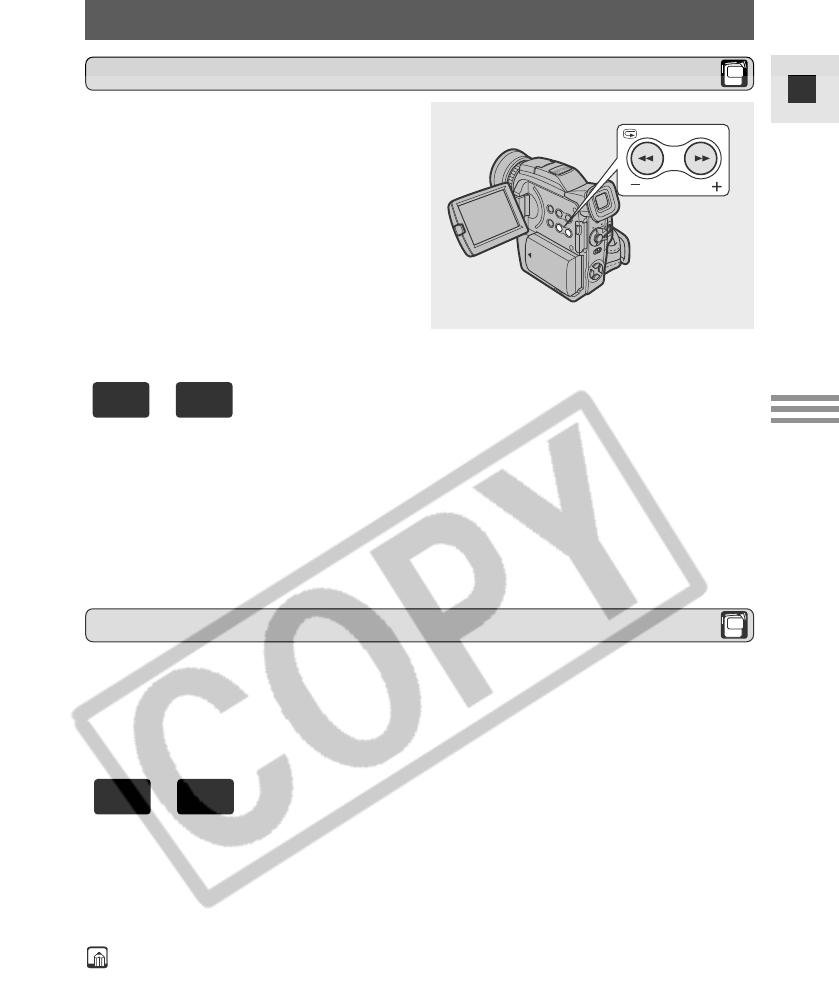
If Your TV (or VCR) Has Audio/Video Input Terminals
• Connect the camcorder using the STV-250N Stereo Video Cable. Connect
the white plug to the white audio terminal L(left). Connect the red plug to
the red audio terminal R(right). Connect the yellow plug to the yellow
video terminal VIDEO.
• If you are connecting the camcorder to a TV, set the TV/VIDEO selector on
the television to VIDEO.
• If you are connecting the camcorder to a VCR, set the input selector on the
VCR to LINE.
Note:
• If you are going to use the TV as a monitor while you are recording,
remember to keep the TV volume turned down as long as the camcorder’s
audio terminals are connected. If the sound from the TV speakers is picked
up by the microphone, an unpleasant high-pitched squeal, called feedback,
may be produced.
AV
IN/OUT
VIDEO
INPUT
AUDIO
L
R
STV-250N Stereo Video Cable
37
E
Using the Full
Range of Features
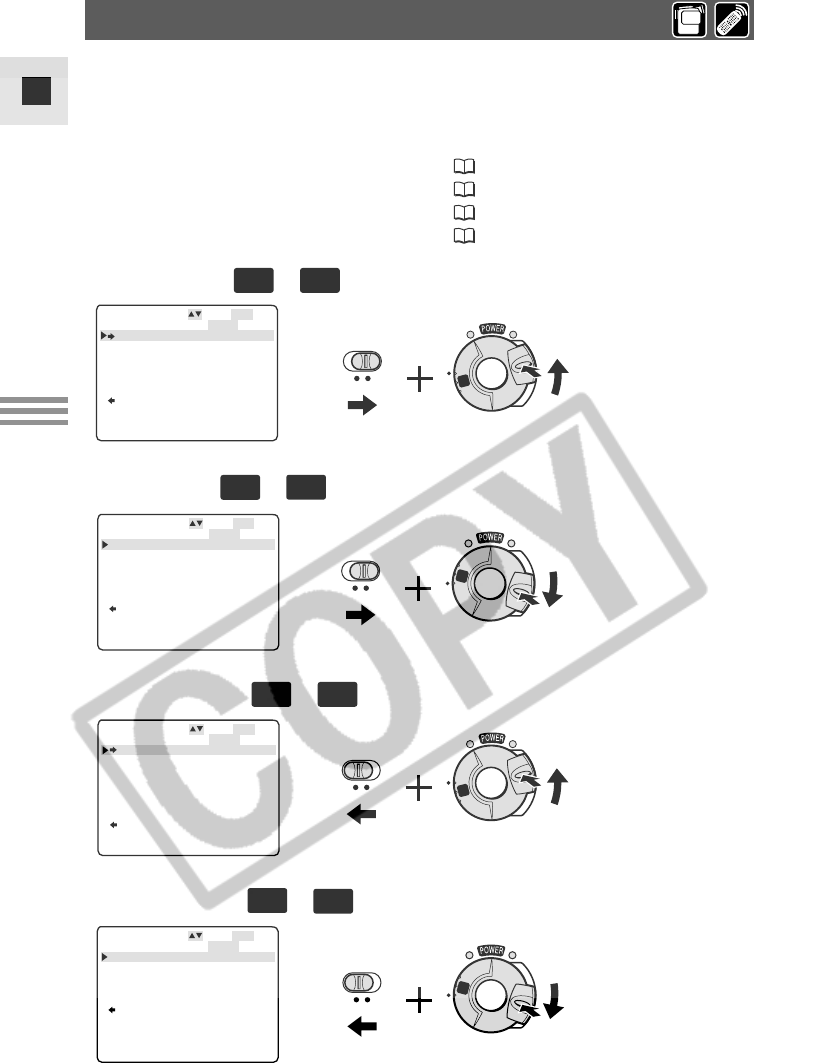
Searching and Reviewing While Recording
When the camcorder is in record pause mode, you can use record review to
play back the last few seconds of your recording and then return
automatically to record pause mode. You can quickly check if a scene has
been recorded properly and then go on to shoot the next scene, without
producing any noise in the picture.
1. Press and release the c (record review) button while you
check the picture in the display.
• The camcorder rewinds the tape, plays back the last few seconds, and
returns to record pause mode.
Note:
• Noise may appear on the screen when you play the tape backwards.
REC SEARCH
When the camcorder is in record
pause mode, you can use record
search to play the tape forwards or
backwards to locate the point where
you wish to start or resume
recording. This is useful when you
wish to add a new scene to a
previously used cassette. By using
record search, you can ensure a
smooth, noise-free join between the
new scene and the old one.
Record Search
Record Review
1. Press and hold the REC SEARCH + or – button on the
camcorder while you check the picture in the display.
• The + button plays the recording forwards and the – button plays it
backwards.
2. Release the button at the point you wish to start recording.
• The camcorder returns to record pause mode.
+
CAMERA
TAPE
+
CAMERA
TAPE
38
E
Using the Full
Range of Features
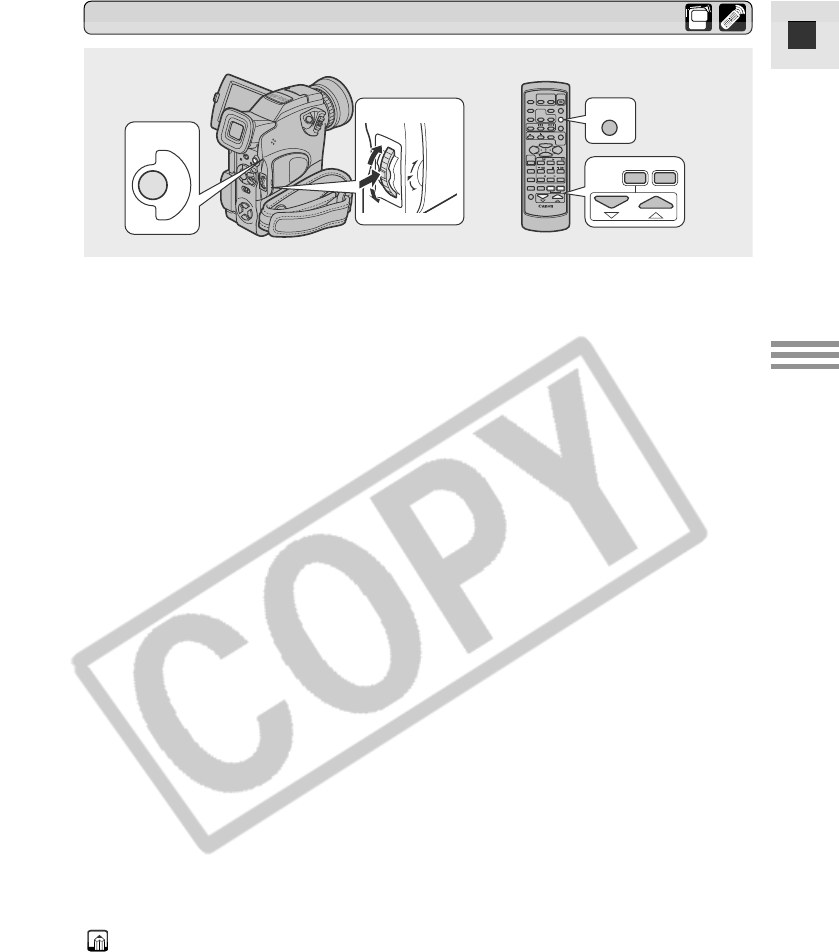
Using the Menus
Many of the camcorder’s advanced functions are selected from menus which
appear in the display.
There are 4 main menus:
CAM. MENU Camera menu ( 40)
VCR MENU ( 42)
C. CAM. MENU Card camera menu ( 43)
C.PLAY MENU Card play menu ( 45)
2CAM. MENU +
2VCR MENU +
2C.CAM. MENU +
2C.PLAY MENU +
CARD TAPE
(
V
C
R
)
P
L
A
Y
C
A
M
E
R
A
O
F
F
C.PLAY MENU SEL.SETSET
MENUCLOSE
CARD OPER.
VCR SET UP
DISP.SET UP
SYSTEM
MY CAMERA
RETURN
PLAY
(VCR)
CARD
CARD TAPE
(
V
C
R
)
P
L
A
Y
C
A
M
E
R
A
O
F
F
C.CAM MENU SEL.SETSET
MENUCLOSE
STITCH AST
CAM.SET UP
CARD SET UP
VCR SET UP
DISP.SET UP
SYSTEM
MY CAMERA
RETURN
CAMERA
CARD
CARD TAPE
(
V
C
R
)
P
L
A
Y
C
A
M
E
R
A
O
F
F
VCR MENU SEL.SETSET
MENUCLOSE
VCR SET UP
CARD SET UP
CARD OPER.
DISP.SET UP
SYSTEM
MY CAMERA
RETURN
PLAY
(VCR)
TAPE
CARD TAPE
(
V
C
R
)
P
L
A
Y
C
A
M
E
R
A
O
F
F
CAM.MENU SEL.SETSET
MENUCLOSE
CARD MIX
CAM.SET UP
VCR SET UP
DISP.SET UP
SYSTEM
MY CAMERA
RETURN
CAMERA
TAPE
39
E
Using the Full
Range of Features
//
TV SCREEN
SET
2, 11
3-10
M
E
N
U
MENU
SELECT
1. Turn the POWER switch and the TAPE/CARD switch to the
desired settings.
2. Press the MENU button to open the menu.
• One of the main menus appears, according to the settings of the
TAPE/CARD switch and the POWER switch.
3. Pull the selector dial up or down and move the arrow to the
desired submenu.
4. Press the selector dial in to select.
• The submenu appears.
5. Pull the selector dial up or down and move the arrow to the
desired function.
6. Press the selector dial in to select.
• The function and its settings only appear.
7. Pull the selector dial up or down and move the arrow to the
desired setting.
• If you are setting a function other than the white balance or shutter
speed, the function will be set if you skip to step 11.
8. Press the selector dial in to select.
• The function is set and you return to the submenu.
9. Pull the selector dial up or down and move the arrow to b
RETURN.
10
.Press the selector dial in to select.
• You return to the main menu.
11
.Press the MENU button.
• The main menu disappears.
Notes:
• Pressing the MENU button at any time closes the menu.
• Selecting bRETURN takes you back one menu, or closes the main menu.
• Items that are unavailable, due to the tape or card situation or the settings
of other menu items, appear in purple.
Selecting from the Menus
40
E
Using the Full
Range of Features
CAM.SET UP SEL.SETSET
MENUCLOSE
SHUTTER•••••AUTO
D.ZOOM••••••40×
IMAGE S.
••ON
16:9••••••••OFF
WHITE BAL.••AUTO
AF AST LAMP•ON
RETURN
r
y
i
t
u
o
CARD MIX 101-0143
43/50
MIX TYPE••••CARD CHROMA
ANIMAT.TYPE•–––
MIX LEVEL•••
q
ew
–+
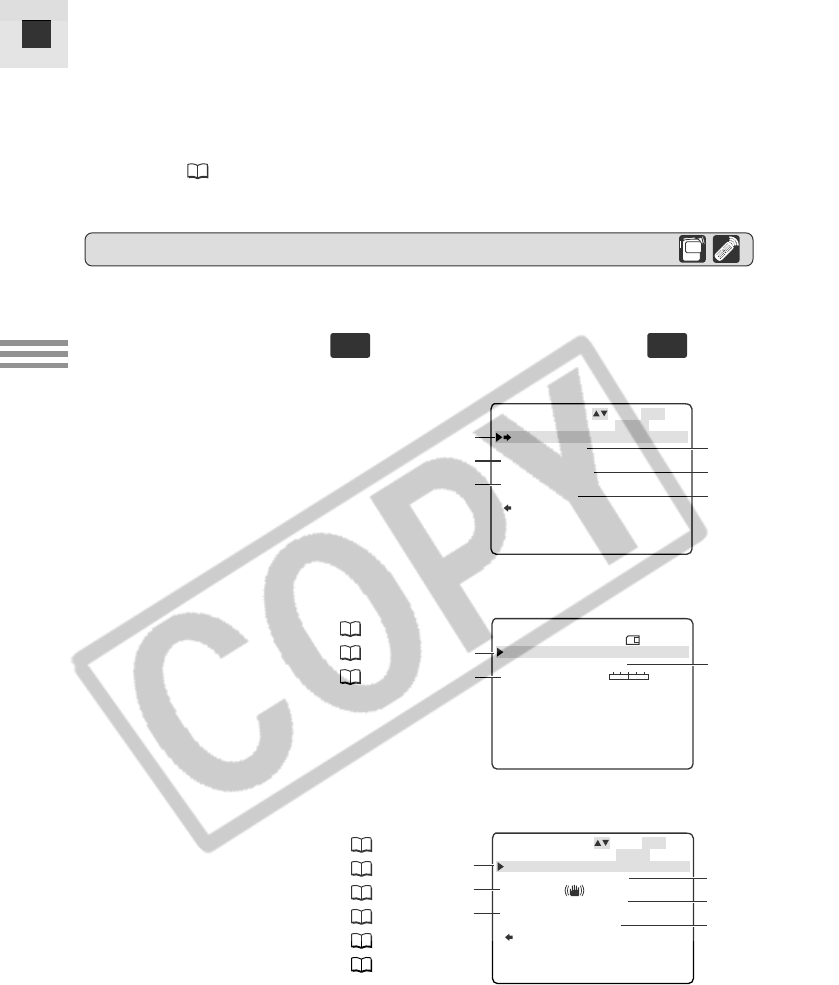
Turn to the referred page for a detailed explanation of each function.
2CAM. MENU
Set the POWER switch to and the TAPE/CARD switch to .
There are 6 submenus within the CAM. MENU.
TAPE
CAMERA
qTo card mix submenu
wTo camera set up submenu
eTo VCR set up submenu
rTo display set up submenu
tTo system submenu
yTo My Camera settings submenu
qCard mix submenu
qMix type.......................... 143
wAnimation type................ 144
eMix level.......................... 143
wCamera set up submenu
rShutter speed.................... 77
tDigital zoom...................... 23
yImage stabilizer ................. 58
u16:9 effect ........................ 21
iWhite balance ................... 81
oAF-Assist Lamp.................. 80
CAM.MENU SEL.SETSET
MENUCLOSE
CARD MIX
CAM.SET UP
VCR SET UP
DISP.SET UP
SYSTEM
MY CAMERA
RETURN
q
e
t
w
r
y
List of Menus
• You may often find it more convenient to use the wireless controller to
move around the menus. Press its MENU button to open/close the menu
and use the arrow keys in place of pulling the selector dial up or down.
Push the SET button to select.
• Pressing the start/stop button or the PHOTO button will close the menu
and start recording.
• You can display the menus on a connected TV screen by turning TV
SCREEN ( 171) on through the menu or using the wireless controller’s TV
SCREEN button. See p. 34 for TV connecting instructions.
41
E
Using the Full
Range of Features
DISP.SET UP SEL.SETSET
MENUCLOSE
BRIGHTNESS••
LCD MIRROR••ON
TV SCREEN•••ON
D/T DISPLAY•OFF
CARD ACCESS•ON
DEMO MODE•••ON
RETURN
–+
!4
!6
!8
!5
!7
!9
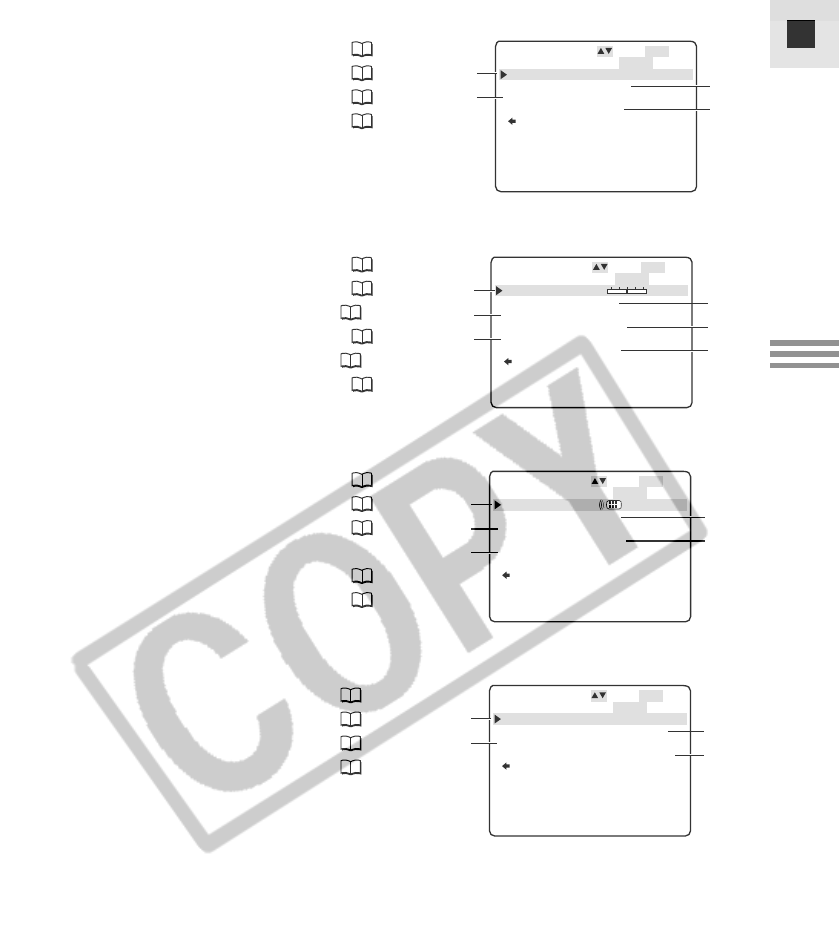
eVCR set up submenu
!0 Recording mode................ 20
!1 Wind screen ...................... 72
!2 Audio mode ...................... 71
!3 AV or headphones............. 34
rDisplay set up submenu
!4 Brightness ......................... 26
!5 LCD Mirror mode .............. 27
!6 TV screen ........................ 171
!7 Date/time display............... 53
!8 Card access display.......... 109
!9 Demo mode ...................... 22
tSystem submenu
@0 Wireless controller............. 49
@1 Tally lamp .......................... 21
@2 Beep.................................. 22
@3 Time zone/
Daylight saving time .......... 51
@4 Date/time set..................... 53
yMy Camera submenu
@5 Shutter sound.................. 150
@6 Start-up sound ................ 150
@7 Start/stop sound.............. 150
@8 Self-timer sound.............. 150
SYSTEM SEL.SETSET
MENUCLOSE
WL.REMOTE••• 1
TALLY LAMP••ON
BEEP••••••••ON
T.ZONE/DST••–––
D/TIME SET••––.–––.––––
––:–– ––
RETURN
@0
@2
@4
@1
@3
VCR SET UP SEL.SETSET
MENUCLOSE
REC MODE•••• SP
WIND SCREEN•OFF
AUDIO MODE••12bit
AV/PHONES•••AV
RETURN
!0
!2 !1
!3
MY CAMERA SEL.SETSET
MENUCLOSE
SHTR SOUND•••PATTERN1
S–UP SOUND•••PATTERN1
S/STOP SOUND•PATTERN1
SELF–T.SOUND•PATTERN1
RETURN
@5
@7 @6
@8
42
E
Using the Full
Range of Features
CARD SET UP SEL.SETSET
MENUCLOSE
SI QUALITY••FINE
MOVIE SIZE••320×240
FILE NOS.•••CONTINUOUS
RETURN
i
!0 o
CARD OPER. SEL.SETSET
MENUCLOSE
COPY
RETURN
[ ]
!1
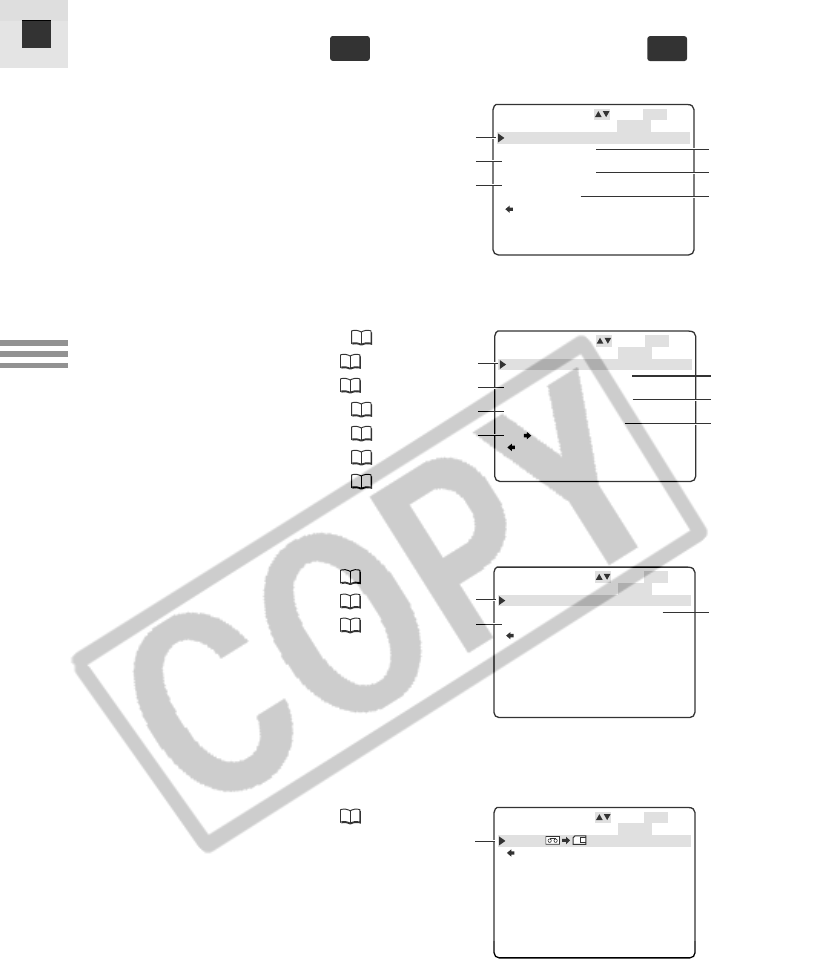
qVCR set up submenu
qRecording mode................ 20
wOutput channel ............... 104
eAudio dubbing ................ 100
rWind screen ...................... 72
tAudio mode ...................... 71
yAV or headphones............. 34
uAnalog-digital converter .... 95
wCard set up submenu
iStill image quality ............ 108
oMovie size ....................... 108
!0 File numbers.................... 110
eCard operations submenu
!1 Copy from tape to card ... 146
VCR SET UP SEL.SETSET
MENUCLOSE
REC MODE•••• SP
OUTPUT CH•••L/R
AUDIO DUB.••AUDIO IN
WIND SCREEN•–––
AUDIO MODE••12bit
AV/PHONES•••AV
AV DV OUT•••OFF
RETURN
q
e
t
u
w
r
y
2VCR MENU
Set the POWER switch to and the TAPE/CARD switch to .
There are 6 submenus within the VCR MENU.
TAPE
PLAY
(VCR)
VCR MENU SEL.SETSET
MENUCLOSE
VCR SET UP
CARD SET UP
CARD OPER.
DISP.SET UP
SYSTEM
MY CAMERA
RETURN
q
e
t
w
r
y
qTo VCR set up submenu
wTo card set up submenu
eTo card operations submenu
rTo display set up submenu
tTo system submenu
yTo My Camera settings submenu
43
E
Using the Full
Range of Features
DISP.SET UP SEL.SETSET
MENUCLOSE
BRIGHTNESS••
DISPLAYS••••ON
6SEC.DATE•••OFF
DATA CODE•••DATE/TIME
D/TIME SEL.•DATE & TIME
CARD ACCESS•ON
RETURN
–+
!2
!4
!6
!3
!5
!7
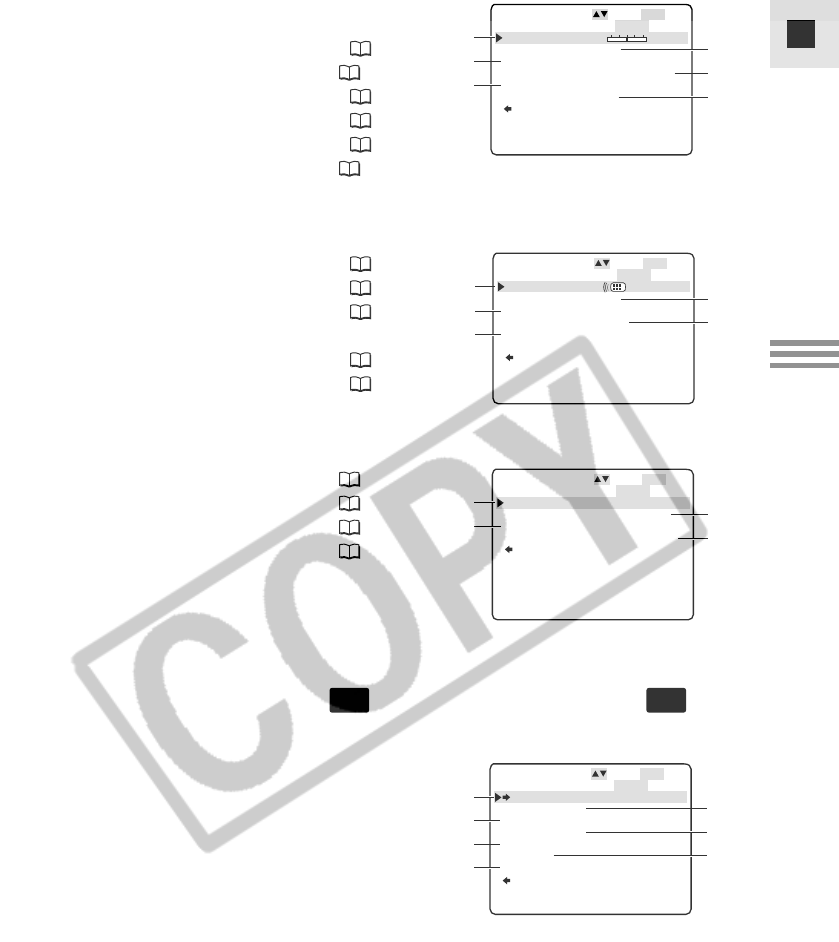
rDisplay set up submenu
!2 Brightness ......................... 26
!3 Displays ........................... 171
!4 6-second auto date ........... 86
!5 Data code.......................... 85
!6 Date/time select................. 84
!7 Card access display.......... 109
tSystem submenu
!8 Wireless controller............. 49
!9 Tally Lamp ......................... 21
@0 Beep.................................. 22
@1 Time zone/
Daylight saving time .......... 51
@2 Date/time set..................... 53
yMy Camera submenu
@3 Shutter sound.................. 150
@4 Start-up sound ................ 150
@5 Start/stop sound.............. 150
@6 Self-timer sound.............. 150
SYSTEM SEL.SETSET
MENUCLOSE
WL.REMOTE••• 1
TALLY LAMP••ON
BEEP••••••••ON
T.ZONE/DST••–––
D/TIME SET••––.–––.––––
––:–– ––
RETURN
!8
@0
@2
!9
@1
MY CAMERA SEL.SETSET
MENUCLOSE
SHTR SOUND•••PATTERN1
S–UP SOUND•••PATTERN1
S/STOP SOUND•PATTERN1
SELF–T.SOUND•PATTERN1
RETURN
@3
@5 @4
@6
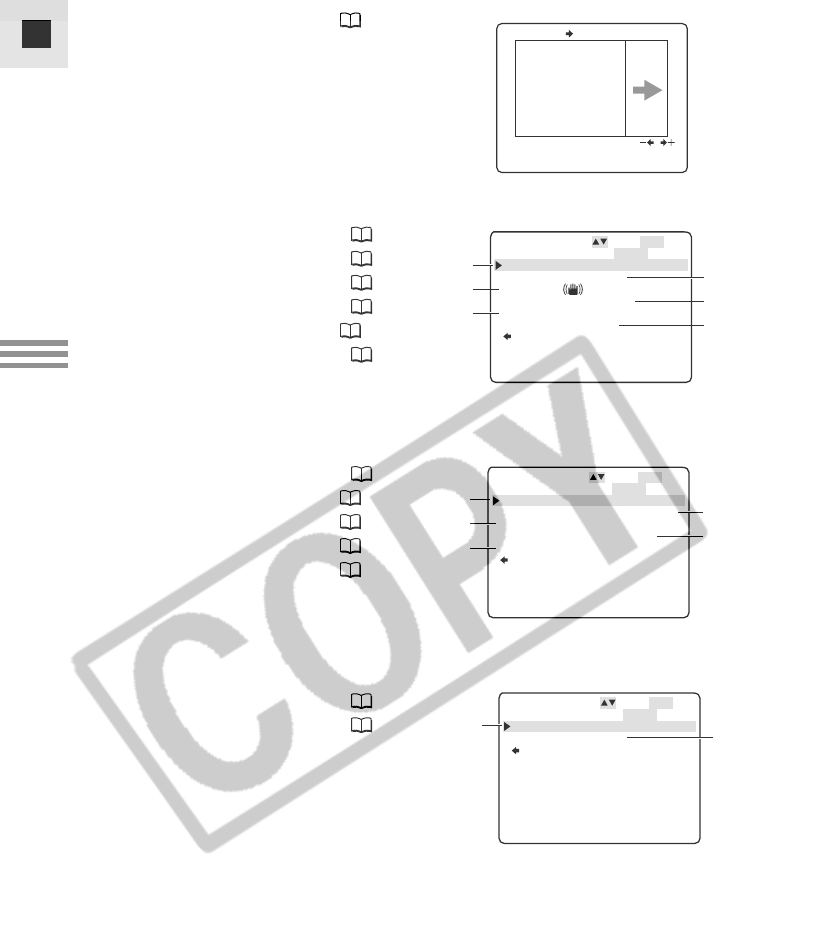
2C. CAM MENU
Set the POWER switch to and the TAPE/CARD switch to .
There are 7 submenus within the C. CAM. MENU.
CARD
CAMERA
qTo stitch assist mode
wTo camera set up submenu
eTo card set up submenu
rTo VCR set up submenu
tTo display set up submenu
yTo system submenu
uTo My Camera settings submenu
C.CAM MENU SEL.SETSET
MENUCLOSE
STITCH AST
CAM.SET UP
CARD SET UP
VCR SET UP
DISP.SET UP
SYSTEM
MY CAMERA
RETURN
q
e
t
w
r
uy
44
E
Using the Full
Range of Features
VCR SET UP SEL.SETSET
MENUCLOSE
WIND SCREEN•OFF
AV/PHONES•••AV
RETURN
!2 !3
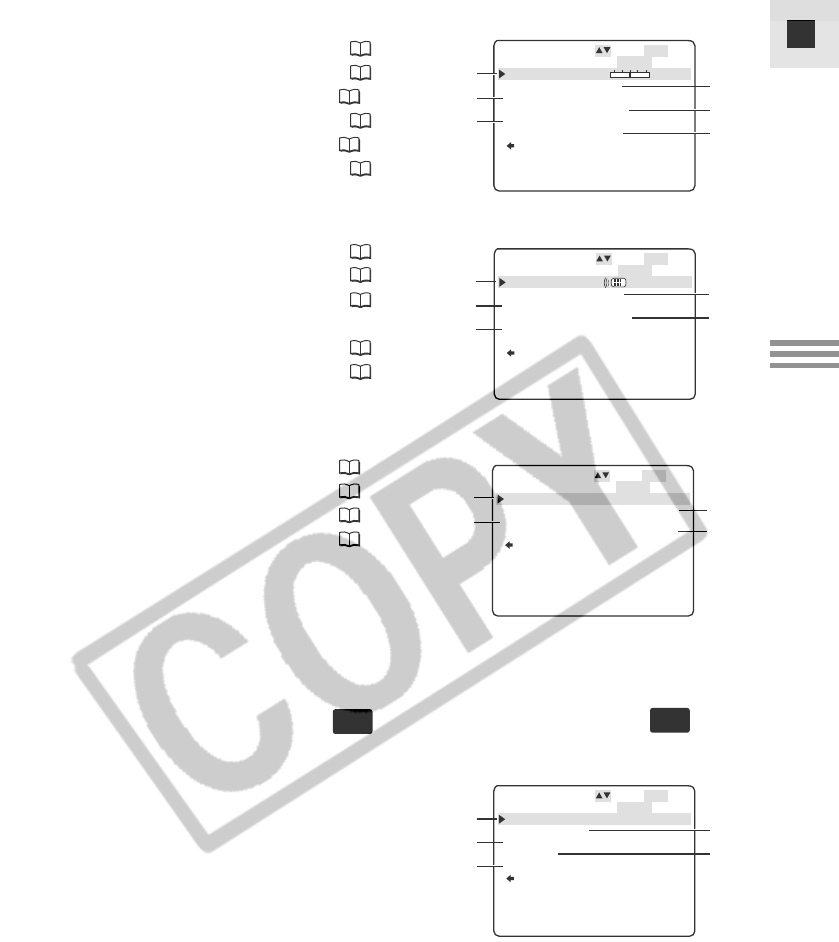
C. CAM MENU, cont.
qStitch assist mode......... 119
wCamera set up submenu
qShutter speed.................... 77
wDigital zoom...................... 23
eImage stabilizer ................. 58
rWhite balance ................... 81
tND filter .......................... 112
yAF-Assist Lamp.................. 80
eCard set up submenu
uContinuous shooting......... 13
iStill image quality ............ 108
oStill image size................. 108
!0 Movie size ....................... 108
!1 File numbers.................... 110
rVCR set up submenu
!2 Wind screen ...................... 72
!3 AV or headphones............. 34
CAM.SET UP SEL.SETSET
MENUCLOSE
SHUTTER•••••AUTO
D.ZOOM••••••40×
IMAGE S.
••ON
WHITE BAL.••AUTO
ND••••••••••AUTO
AF AST LAMP•ON
RETURN
q
e
t
w
r
y
CARD SET UP SEL.SETSET
MENUCLOSE
CONT.SHOOT.•OFF
SI QUALITY••FINE
SI SIZE•••••1280×960
MOVIE SIZE••320×240
FILE NOS.•••CONTINUOUS
RETURN
u
o
!1
i
!0
1 2
MENUCLOSE
45
E
Using the Full
Range of Features
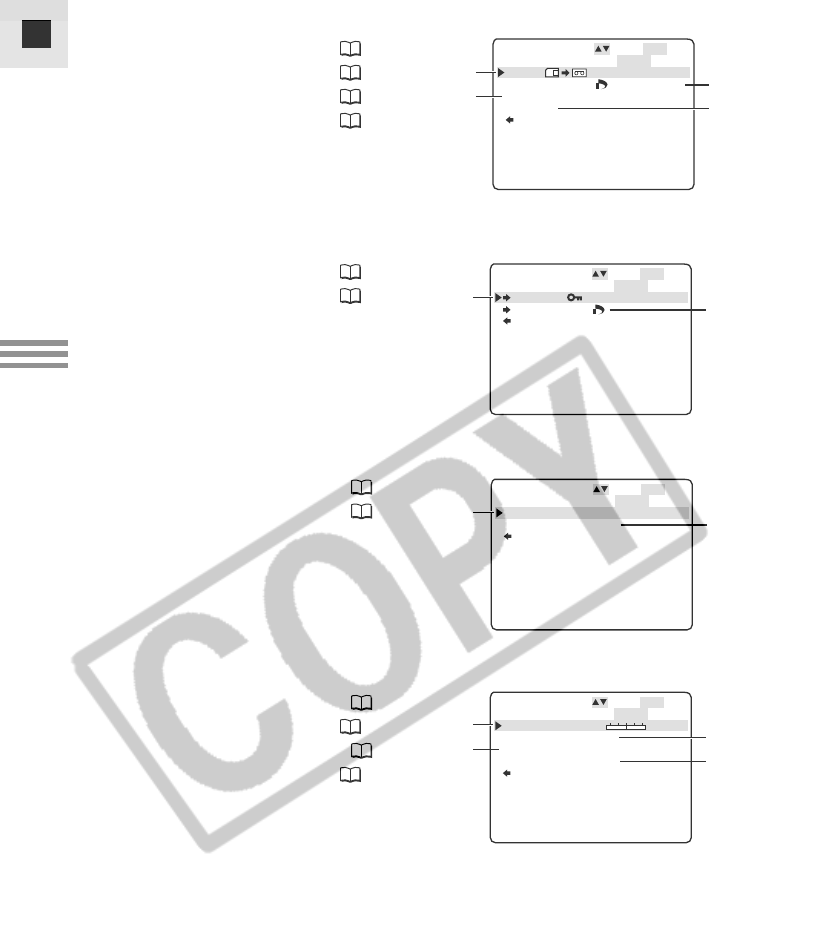
2C. PLAY MENU
Set the POWER switch to and the TAPE/CARD switch to .
There are 5 submenus within the C. PLAY MENU.
CARD
PLAY
(VCR)
tDisplay set up submenu
!4 Brightness ......................... 26
!5 LCD Mirror mode .............. 27
!6 TV screen ........................ 171
!7 Date/time display............... 53
!8 Card access display.......... 109
!9 Demo mode ...................... 22
ySystem submenu
@0 Wireless controller............. 49
@1 Tally lamp .......................... 21
@2 Beep.................................. 22
@3 Time zone/
Daylight saving time .......... 51
@4 Date/time set..................... 53
uMy Camera submenu
@5 Shutter sound.................. 150
@6 Start-up sound ................ 150
@7 Start/stop sound.............. 150
@8 Self-timer sound.............. 150
SYSTEM SEL.SETSET
MENUCLOSE
WL.REMOTE••• 1
TALLY LAMP••ON
BEEP••••••••ON
T.ZONE/DST••–––
D/TIME SET••––.–––.––––
––:–– ––
RETURN
@0
@2
@4
@1
@3
qTo card operations submenu
wTo VCR set up submenu
eTo display set up submenu
rTo system submenu
tTo My Camera settings submenu
DISP.SET UP SEL.SETSET
MENUCLOSE
BRIGHTNESS••
LCD MIRROR••ON
TV SCREEN•••ON
D/T DISPLAY•OFF
CARD ACCESS•ON
DEMO MODE•••ON
RETURN
–+
!4
!6
!8
!5
!7
!9
C.PLAY MENU SEL.SETSET
MENUCLOSE
CARD OPER.
VCR SET UP
DISP.SET UP
SYSTEM
MY CAMERA
RETURN
q
e
t
w
r
MY CAMERA SEL.SETSET
MENUCLOSE
SHTR SOUND•••PATTERN1
S–UP SOUND•••PATTERN1
S/STOP SOUND•PATTERN1
SELF–T.SOUND•PATTERN1
RETURN
@5
@7 @6
@8
46
E
Using the Full
Range of Features
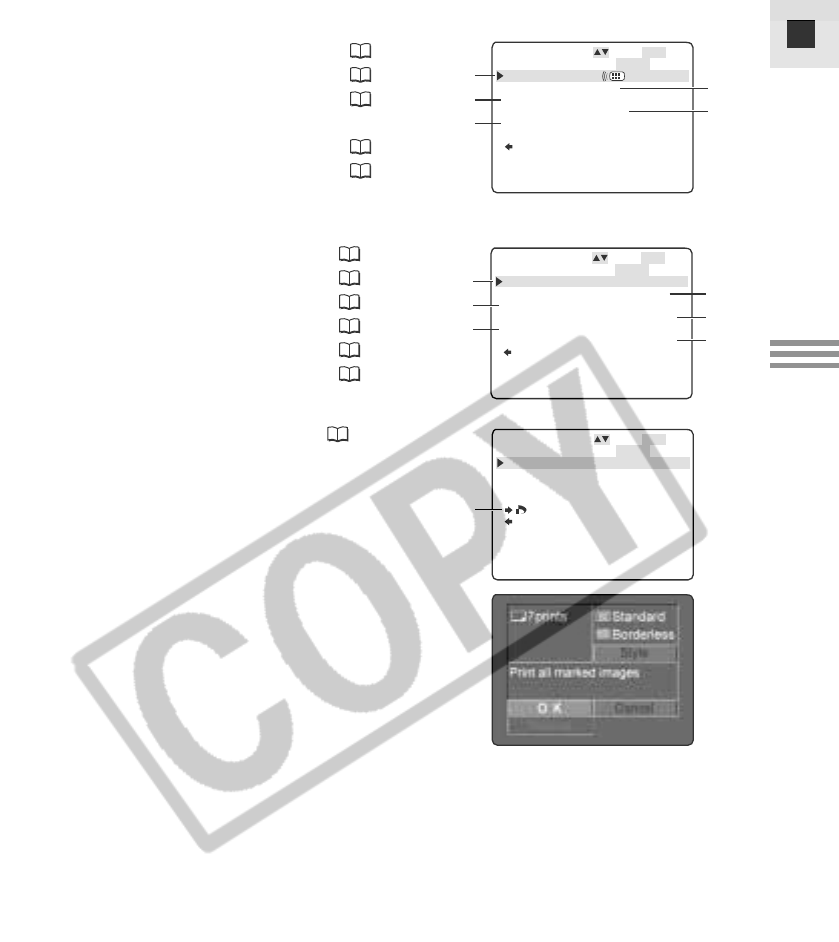
C. PLAY MENU, cont.
q-2 Card operations submenu (when displaying an index screen)
tImage protect.................. 127
yPrint mark ....................... 128
wVCR set up submenu
uRecording mode................ 20
iAV or headphones............. 34
eDisplay set up submenu
oBrightness ......................... 26
!00 Displays ........................... 171
!1 Date/time select................. 84
!2 Card access display.......... 109
DISP.SET UP SEL.SETSET
MENUCLOSE
BRIGHTNESS••
DISPLAYS••••ON
D/TIME SEL.•DATE & TIME
CARD ACCESS•ON
RETURN
–+
o
!1 !0
!2
VCR SET UP SEL.SETSET
MENUCLOSE
REC MODE••••SP
AV/PHONES•••AV
RETURN
ui
CARD OPER. SEL.SETSET
MENUCLOSE
PROTECT
PRINT MARK
RETURN
ty
q-1 Card operations submenu (when playing back a single image)
q
Copy from card to tape .....
147
wErase all print marks ........ 129
eImage erase..................... 130
rFormat ............................ 148
CARD OPER. SEL.SETSET
MENUCLOSE
COPY
PRINT MARKS ALL ERASE
IMAGE ERASE
FORMAT
RETURN
[ ]
q
ew
r
47
E
Using the Full
Range of Features
rSystem submenu
!3 Wireless controller............. 49
!4 Tally Lamp ......................... 21
!5 Beep.................................. 22
!6 Time zone/
Daylight saving time .......... 51
!7 Date/time set..................... 53
tMy Camera submenu
!8 Create start-up image ..... 150
!9 Select start-up image....... 150
@0 Shutter sound.................. 150
@1 Start-up sound ................ 150
@2 Start/stop sound.............. 150
@3 Self-timer sound.............. 150
yDirect Printing Mode ( 132)
(Appears when connecting a
printer supporting the direct
print function)
C.PLAY MENU SEL.SETSET
MENUCLOSE
CARD OPER.
VCR SET UP
DISP.SET UP
SYSTEM
PRINT
RETURN
y
SYSTEM SEL.SETSET
MENUCLOSE
WL.REMOTE••• 1
TALLY LAMP••ON
BEEP••••••••ON
T.ZONE/DST••–––
D/TIME SET••––.–––.––––
––:–– ––
RETURN
!3
!5
!7
!4
!6
MY CAMERA SEL.SETSET
MENUCLOSE
CREATE START–UP IMAGE
SEL.S–UP IMG•DEFAULT
SHTR SOUND•••PATTERN1
S–UP SOUND•••PATTERN1
S/STOP SOUND•PATTERN1
SELF–T.SOUND•PATTERN1
RETURN
!8
@0
@2
!9
@1
@3
48
E
Using the Full
Range of Features
Using the Wireless Controller
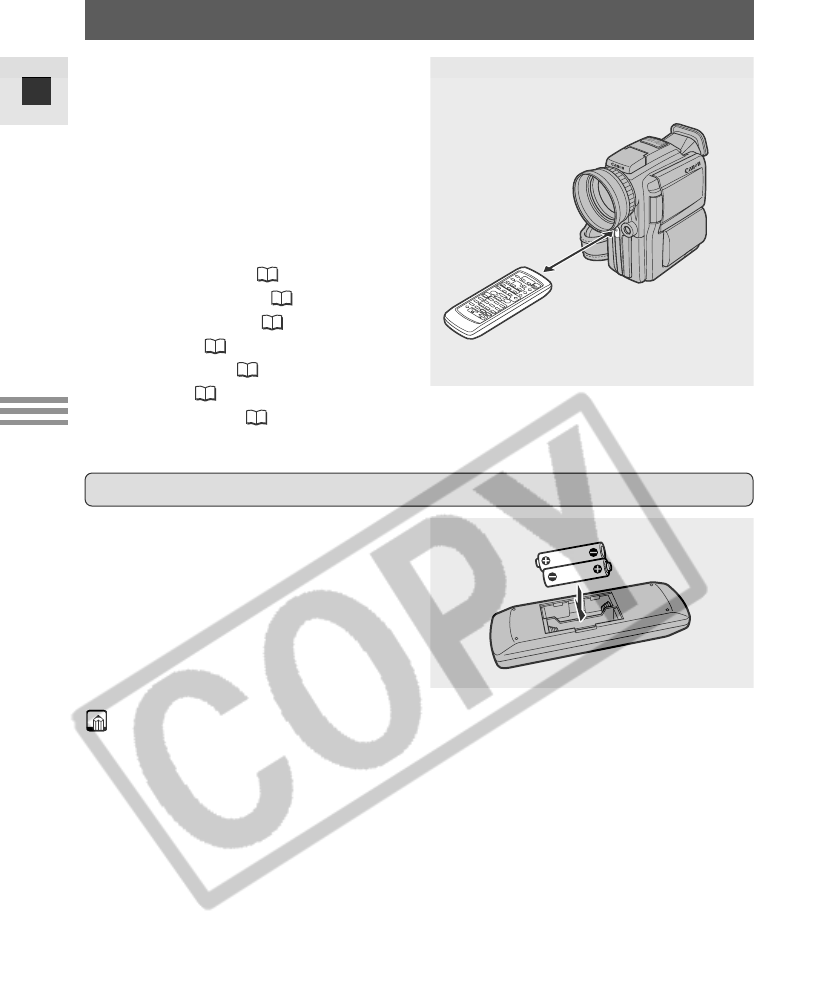
The supplied wireless controller can
operate the camcorder from a
distance of up to 5 m (16 ft). Point it
at the camcorder’s remote sensor
while you press the buttons.
There are some functions that can
only be operated with the wireless
controller:
• Special playback ( 31)
• Photo/date search ( 87)
• Zero set memory ( 88)
• Audio mix ( 103)
• Analog line-in ( 93)
• AV insert ( 97)
• Audio dubbing ( 100)
Insert two AA batteries, following
the = and - markings. Be careful
not to reverse the polarity of the
batteries.
Inserting Batteries
Notes:
• When using the wireless controller in brightly lit places or outdoors, the
effective range decreases.
• The camcorder may have difficulty picking up the remote control signals at
extremely close range.
• Do not leave the controller exposed to direct sunlight, or in hot or humid
places.
• When the batteries run out, replace them both together.
• If the wireless controller does not work, see p. 50.
5m (16ft)
49
E
Using the Full
Range of Features
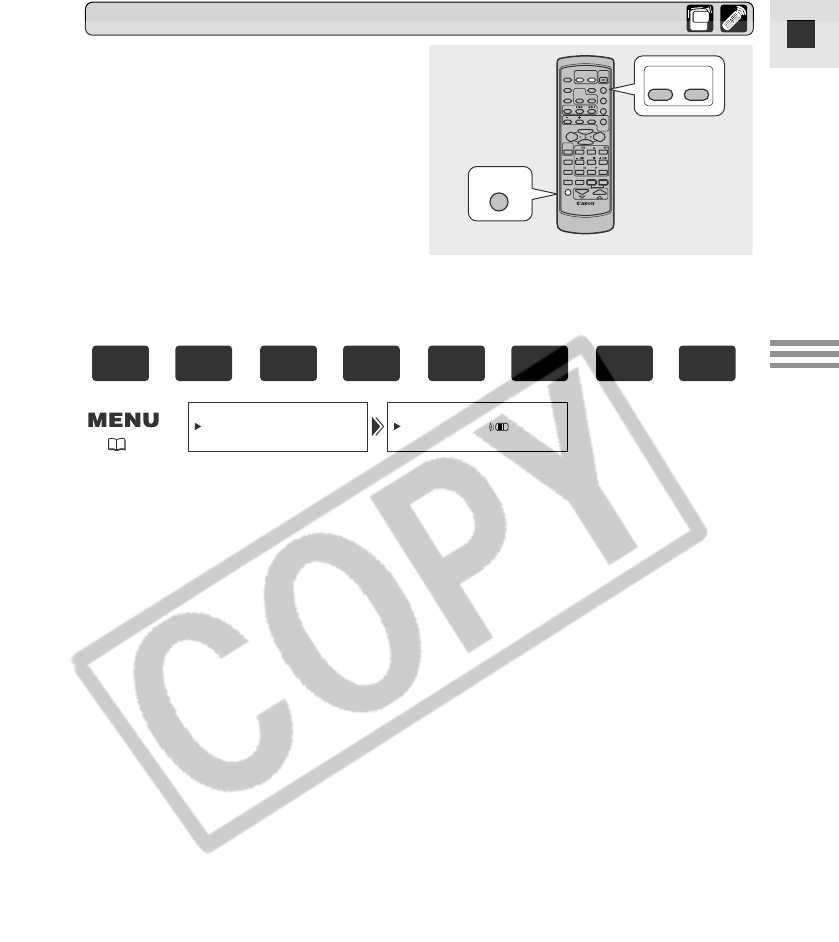
To prevent interference from other
Canon wireless controllers being
used nearby, there are 2 remote
sensor modes and an off setting. The
wireless controller and the camcorder
have to be set to the same mode in
order to be compatible.
To turn the remote sensor off:
Open the menu and select SYSTEM. Then select WL.REMOTE, set it
to OFF
B
and close the menu.
•Bappears in the display.
To change the mode...
...on the camcorder:
Open the menu and select SYSTEM. Then select WL.REMOTE,
set it to A1 or A2 and close the menu.
• The selected mode will appear on the display for 4 seconds.
...on the wireless controller:
Press and hold the REMOTE SET button on the wireless
controller.
Simultaneously press the ZOOM W button for mode 1 or the
ZOOM T button for mode 2. Continue to press simultaneously
for over 2 seconds.
• Be sure to set the wireless controller to the same mode as the
camcorder.
A1: Mode 1
A2: Mode 2
OFFB: Sensor off
WL.REMOTE••• 1
SYSTEM
( 38)
The wireless controller and the camcorder have been preset to mode 1. If
you change the mode on the camcorder, be sure to change the mode on the
wireless controller to the same mode.
//
REMOTE SET
ZOOM
WT
+,+,+,+
PLAY
(VCR)
CARD
CAMERA
CARD
PLAY
(VCR)
TAPE
CAMERA
TAPE
When Operating 2 Canon DV Camcorders (Remote Sensor Mode)

50
E
Using the Full
Range of Features
If your wireless controller is not working:
Make sure the camcorder and the wireless controller are both set to the
same mode. Check the mode the camcorder is set to by pushing any button
other than the REMOTE SET button on the wireless controller. The
camcorder’s mode appears in purple for about 4 seconds. Set the wireless
controller’s mode accordingly by pressing the aforementioned button
combinations. If the wireless controller still does not work, change the
batteries.
Notes:
• The mode of the camcorder also appears for 4 seconds when you turn the
power on.
• When you replace the batteries, the wireless controller returns to mode 1.
Change the mode again if necessary.
51
E
Using the Full
Range of Features
Setting the Date and Time
The date and/or time display forms part of the data code. You can choose to
display or hide it during playback ( 84).
Set the date and time display when you first start using your camcorder.
Install the backup battery before you begin ( 159).
• Before you start setting the date and time, select your home time zone
from the menu.
Setting the Time Zone/Daylight Saving Time
1. Open the menu and select SYSTEM.
2. Select T.ZONE/DST.
• The time zone display appears on the screen.
• Your camcorder’s time zone is factory-preset to Paris. If you are at
another time zone, select your time zone first and daylight saving time
(DST) setting if necessary.
3. Move up or down the list of time zones with the selector
dial. Select the option that represents your time zone.
• If you are now in daylight saving time, select the time zone with the
daylight saving time mark Cnext to the area.
4. Close the menu.
SYSTEM T.ZONE/DST••PARIS
( 38)
M
E
N
U
SELECT
+,+,+,+
PLAY
(VCR)
CARD
CAMERA
CARD
PLAY
(VCR)
TAPE
CAMERA
TAPE
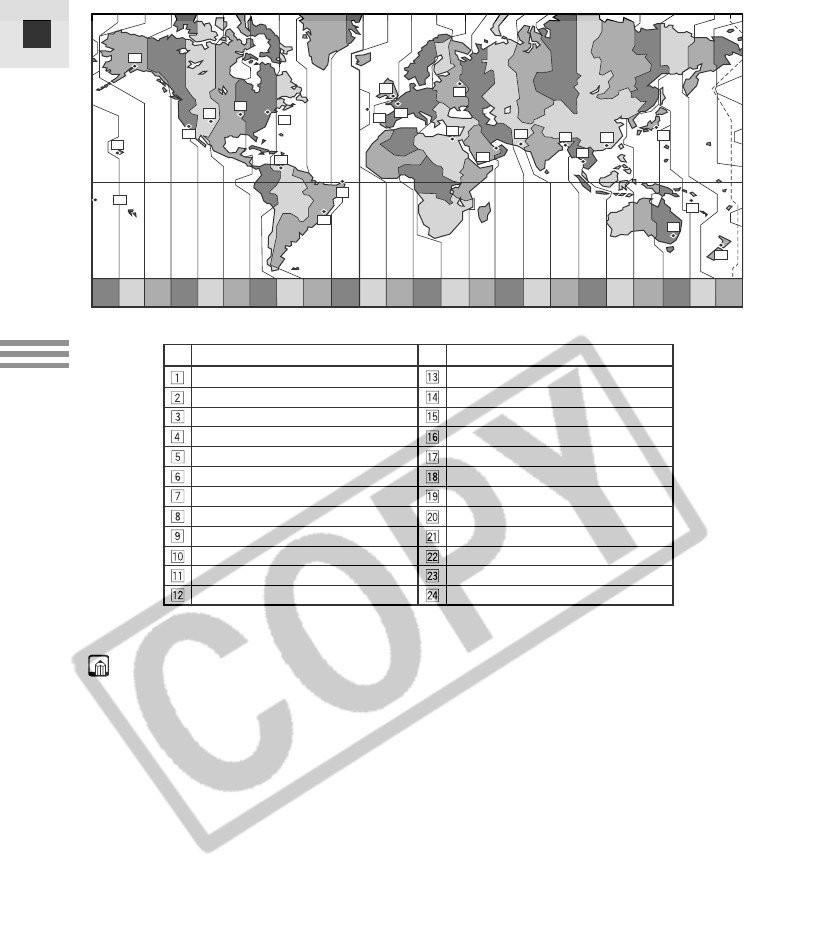
52
E
Using the Full
Range of Features
Time zone
LONDON
PARIS
CAIRO
MOSCOW
DUBAI
KARACHI
DACCA
BANGKOK
H. KONG (Hong Kong)
TOKYO
SYDNEY
SOLOMON
WELLGTN (Wellington)
SAMOA
HONOLU. (Honolulu)
ANCHOR. (Anchorage)
L.A. (Los Angeles)
DENVER
CHICAGO
N.Y. (New York)
CARACAS
RIO (Rio de Janeiro)
FERNAN. (Fernando de Noronha)
AZORES
No. Time zone
No.
Notes:
• Once you have selected your time zone and set the date and time, you do
not need to reset the clock each time you travel to another time zone. Just
set the time zone to the one of your destination and the camcorder
automatically changes the clock.
• The camcorder automatically accounts for the number of days in a month
and leap year.
1
24 1 2 3 4 5 6 7 8 9 10 11 12 1314 15 16 17 18 19 20 21 22 23
2
3
5
679
8
10
4
12
11
13
24
19
20
18
17
21
23
22
15
14
16
53
E
Using the Full
Range of Features
1. Open the menu and select SYSTEM.
2. Select D/TIME SET.
• The year display starts to flash.
3. Pull the selector dial up or down to change the year. Press
the dial in to move to another part of the display.
• Once you move from the year, the next part of the display starts flashing.
4. Set the month, day, hours, and minutes in the same way.
5. Press the MENU button when finished, and to start the clock.
Notes:
• To make a change to part of the date and time, press the selector dial in at
step 3 to move to the part to be changed. Use the dial to make the
change, then close the menu.
• The date can be set to any year between 2002 and 2030.
• If you press the MENU button in the middle of setting the date and time,
you leave the menu, and the clock starts.
• If you press the selector dial in after setting the minutes you can set the
date and time again from the start.
Setting the Clock
D/TIME SET•• 1.JAN.2002
12:00 AM
SYSTEM
( 38)
Date and Time Display
You can choose to display or hide the date and time display during recording.
When the date and time display is set to ON, the date and time appear in the
lower left-hand corner of the display but the time zone disappears in about 4
seconds. The large, 4-second display will no longer appear when you turn on
the power. It is not automatically superimposed on your recordings.
D/T DISPLAY•OFF
DISP.SET UP
( 38)
To turn it on, open the menu and select DISP.SET UP. Then
select D/T DISPLAY, set it to ON and close the menu.
After you set the date and time, the date/time and home time zone will be
displayed for about 4 seconds each time you turn the power on.
+,+
CAMERA
CARD
CAMERA
TAPE
+,+,+,+
PLAY
(VCR)
CARD
CAMERA
CARD
PLAY
(VCR)
TAPE
CAMERA
TAPE
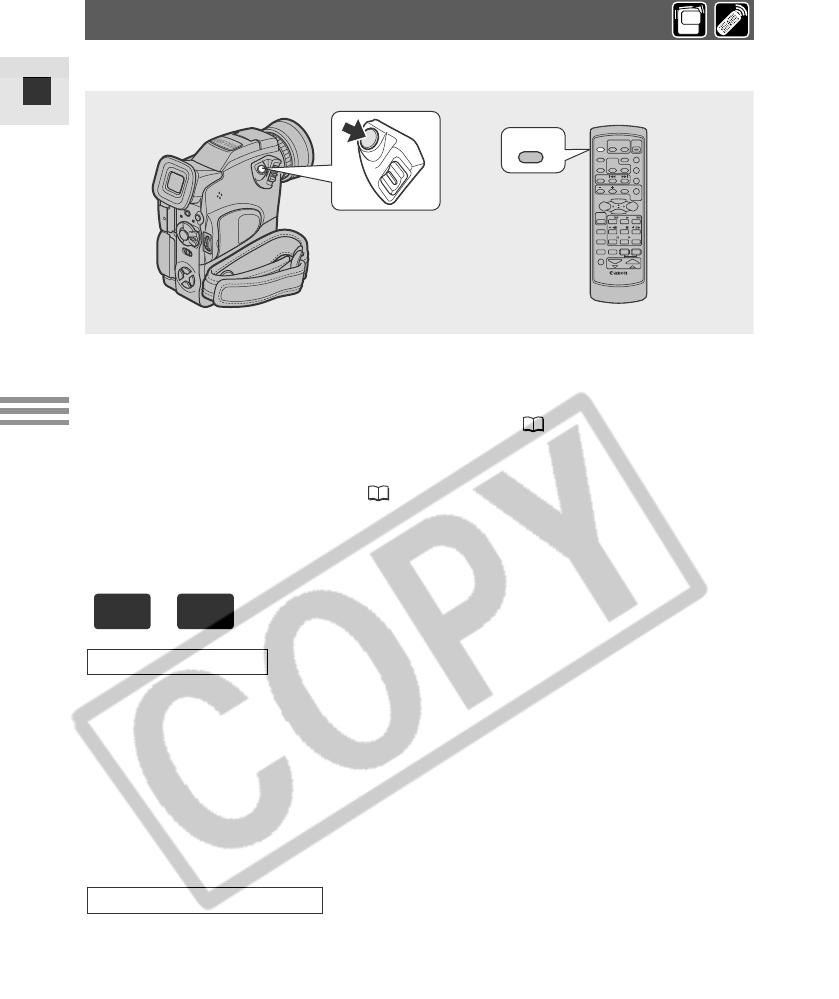
54
E
Using the Full
Range of Features
Recording Still Images onto a Tape
You can record still images like photographs. The camcorder records the
picture and sound to tape for several seconds. The exposure is automatically
adjusted.
Copy still images automatically to a memory card ( 146) for transferring
them to a PC for image enhancement and printout. Also, starting your
shooting with a still image makes it easy to find the beginning again later
with the Photo Search function ( 87).
You can take a still image at any time during regular video recording, or you
can set the camcorder to record pause mode first, before taking a still image.
Press the PHOTO button fully down and the still image will be
recorded immediately.
• The camcorder records the image immediately. It records the “photo” to
the tape for approximately 6 seconds. During this time the camcorder also
records the sound, and the display shows the still image.
• A counter display appears, and counts up as the camcorder records the
image.
• The camcorder returns to record pause mode.
1. Press the
PHOTO
button halfway down and hold it:
• “PHOTO” flashes at the bottom right of display.
• Exposure is locked.
• During autofocus Fflashes white in the display as the camcorder
adjusts the focus and it is displayed continuously as a green mark when
the camcorder is ready to take the still image.
During record pause mode
During record mode
//
PHOTO
PHOTO
For recording still images onto a memory card, see p.111.
+
CAMERA
TAPE

55
E
Using the Full
Range of Features
• If the subject is unsuitable for autofocus ( 165), the camcorder may
not be able to focus, and Fmay continue to flash white in the display.
Continue to hold the PHOTO button halfway down, then adjust the
focus manually with the selector dial.
• If you are using manual focus ( 79), the Fmark starts as a continous
green mark. Focus with the focus ring.
2. Press the PHOTO button fully down to record the still image.
• The camcorder takes the image immediately. It records the “photo” to
the tape for approximately 6 seconds. During this time the camcorder
also records the sound, and the display shows the still image.
• A counter display appears, and counts up as the camcorder records the
picture. Fdisappears from the display.
• The camcorder returns to record pause mode.
Notes:
• The camcorder automatically returns to record pause mode after recording
a still image for approximately 6 seconds. If you turn the POWER switch to
OFF during that time, the camcorder will respond only after recording is
complete.
• The wireless controller’s PHOTO button has no half-way setting. Press the
button fully and the camcorder immediately takes the “photo”.
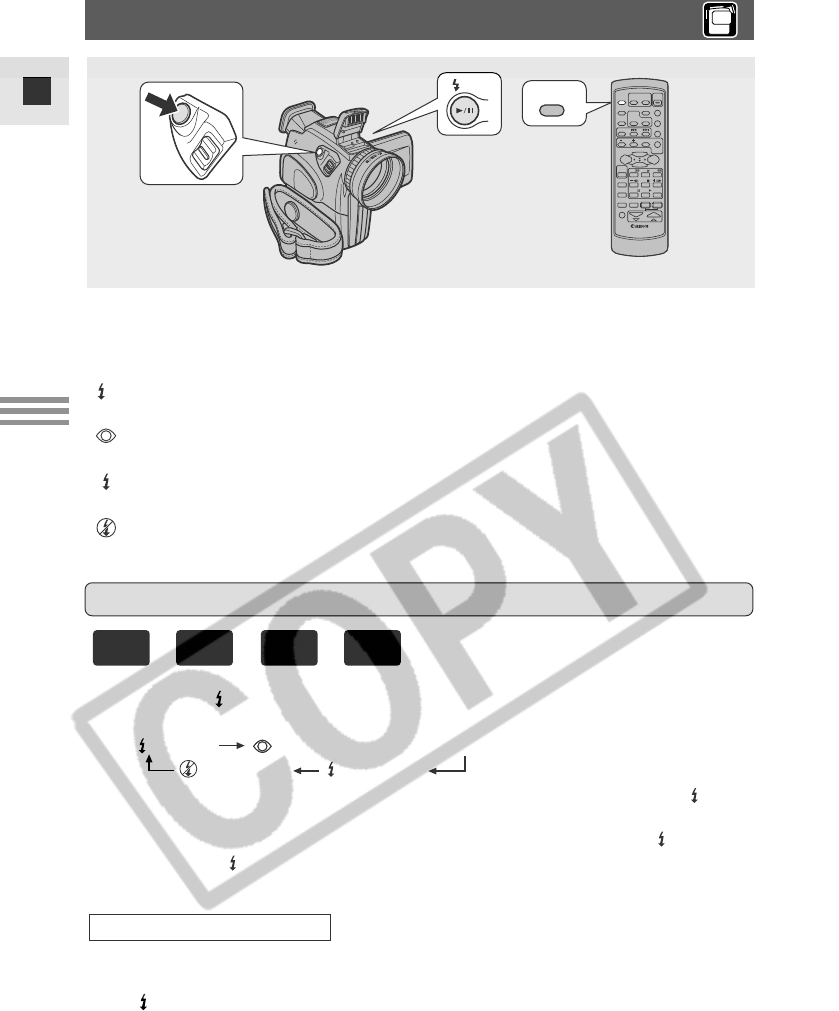
56
E
Using the Full
Range of Features
1. Press the (flash) button.
• The display changes in the following order with each press of the button.
• The selected mode appears in the display, with the exception of
(Auto), which disappears after 4 seconds.
• When you press the flash button while Auto is selected and is not
displayed, appears. Then, when you press the button while it is
displayed, you can change the setting.
2. Press the PHOTO button halfway down and hold it.
• The flash automatically rises.
• appears green in the display.
3. Press the PHOTO button fully down to take the still picture.
• The flash fires.
• During recording, the display shows the still image.
During record pause mode
A
A
A
A
(Auto) (Red-eye reduction auto)
(Flash off) (Flash on)
Using the Built-in Flash
You can take natural-looking flash pictures with appropriate illumination even in
dark places using the built-in flash. It also reduces the red-eye effect when
shooting people at night or in dark indoor places.
(Auto): The flash automatically fires according to the brightness of the
subject.
(Red-eye reduction auto): The Super Night LED lights up automatically
before the flash to reduce the red-eye effect.
(Flash on): The flash is forced to fire regardless of the brightness of the
subject.
(Flash off): The flash does not fire. Use this setting when you are
shooting in places where flash photography is prohibited.
A
Changing The Setting of the Flash
+,+
CAMERA
CARD
CAMERA
TAPE
//
PHOTO
PHOTO

57
E
Using the Full
Range of Features
Returning the flash to the body
Press the flash down with your hand.
• Do not return the flash to the body while it is firing.
Caution:
• Do not fire the flash close to people’s eyes.
• Do not fire the flash at drivers while they are driving.
• Do not fire the flash with the flash bulb covered with your hand.
Notes:
• The practical range of the flash is approximately from 1 m (3 ft 3 3/8in) to
3 m (9 ft 10 1/8in). Depending on the recording conditions, the range
varies.
• Your camcorder automatically adjusts the flash exposure according to the
brightness of the subject (Flash exposure compensation). The flash fires to
perform flash exposure compensation before the main firing for taking
photos. When (Red-eye reduction auto) is set, the flash fires to perform
flash exposure compensation between the Super Night LED for red-eye
reduction and the main firing for taking photos. It takes about 1 second
between the lighting of the Super Night LED for red-eye reduction and the
main firing.
• In “Red-eye reduction auto” mode, the subject needs to look at the Super
Night LED in order to have red-eye reduction effective. The degree of
reduction varies on the distance to the subject and also on each individual.
• If the flash is forced to fire (Flash on) in a bright location, the effect of flash
photography sometimes may not be obtained.
• The flash does not fire in the following cases:
– When expouse is locked in Auto or Red-eye reduction auto mode.
Flash display changes to purple:
– When a shutter speed of 1/2000 or faster is set in the TAPE CAMERA
mode. However, in the case that “Flash on” is selected, the display of
the selected shutter speed flashes (in purple) for four seconds, then
changes to “1/1000” (yellow), and the flash fires.
The flash display flashes in red:
– When an abnormality occurs during charging ( 164).
The flash display disappears:
– When multi-image screen is selected.
– When you are recording movies onto a tape.
• The flash does not fire if does not appear green in the display when
you press the PHOTO button. Set it to “Flash on” mode when necessary.
• The (red-eye reduction auto) cannot be used in stitch assist mode.
• The flash cannot be used in the Night or Super Night recording program.
• When the flash is fired with a lens hood or an optional tele-converter
attached to the camcorder, its shadow may be recorded.
• When a tape recorded using a flash is played back on different equipment,
the image may flicker.
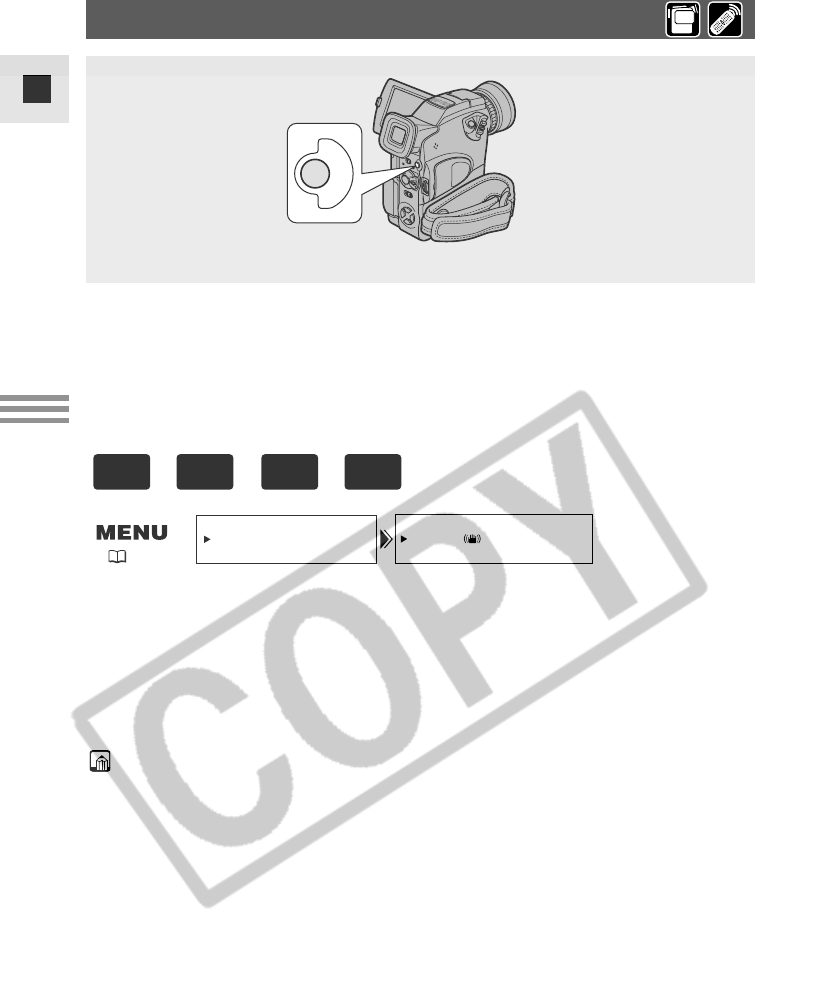
58
E
Using the Full
Range of Features
Turning the Image Stabilizer Off
M
E
N
U
With most camcorders, even the slightest hand movements will be noticeable
during telephoto recording. However, the MVX2i’s Optical Image Stabilizer
allows you to obtain steady recordings even at high magnification. Unlike
electronic image stabilizers, it causes no loss of picture quality. The Optical
Image Stabilizer can compensate for a wide range of camcorder movements
— you can record stable images even if you are shooting from a moving car.
To turn the image stabilizer off, open the menu and select
CAM.SET UP. Then select IMAGE S. i, set it to OFF and close
the menu.
• The imark disappears from the display when the stabilizer is off.
• The image stabilizer cannot be turned off when the program selector is set
to the [(Easy Recording) position.
Notes:
• Keep the image stabilizer turned off when the camcorder is mounted on a
tripod.
• The image stabilizer is designed to deal with a normal degree of camcorder
shake.
• The image stabilizer is not as effective as usual during the Low Light, Night
and Super Night mode.
IMAGE S. ••ON
CAM.SET UP
( 38)
+,+
CAMERA
CARD
CAMERA
TAPE
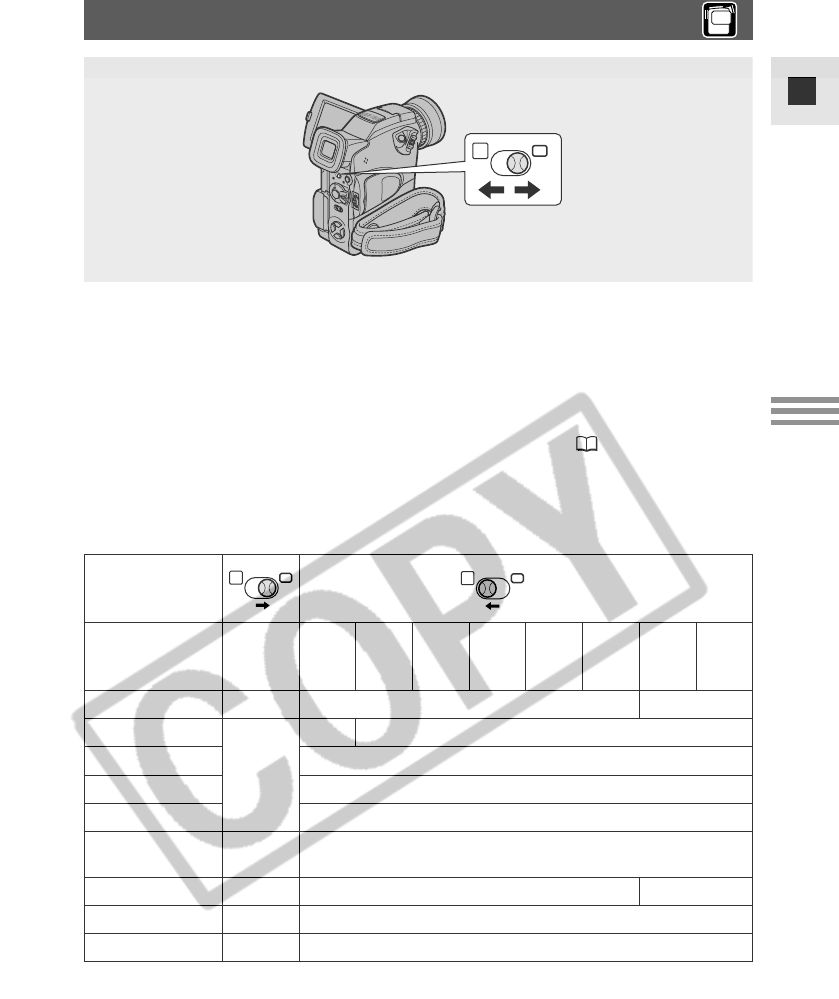
59
E
Using the Full
Range of Features
Using the Various Recording Programs
The camcorder provides you with a choice of 9 recording programs. They use
different combinations of camcorder settings in order to adjust the exposure
and other functions to match the recording situation.
• For simple point-and-shoot operation, select the Easy Recording program.
Slide the program selector to the [ position.
• For normal shooting conditions, slide the program selector to Q(program
AE) mode. Open the program menu and select AUTO ( 60).
• For various other recording conditions, the camcorder has 7 more
specialised AE (auto exposure) programs.
Availability of functions in each recording program
P
h: Available i: Not available A : Automatic function only
* You cannot use the multi-image screen in the Night or Super Night recording
program.
P
Position of
program selector
Recording
Program
Shutter speed
Focus
White balance
Exposure
Image stabilizer
(ON/OFF)
Digital effects
16:9
Card mix
[
(Easy
Recording)
A
ON
i
i
i
Auto Sports
Portrait
Spotlight
Sand &
Snow
Low
Light Night
hA
h
h
h
h
h
h
h
h*
Digital Zoom hh i
P
Super
Night
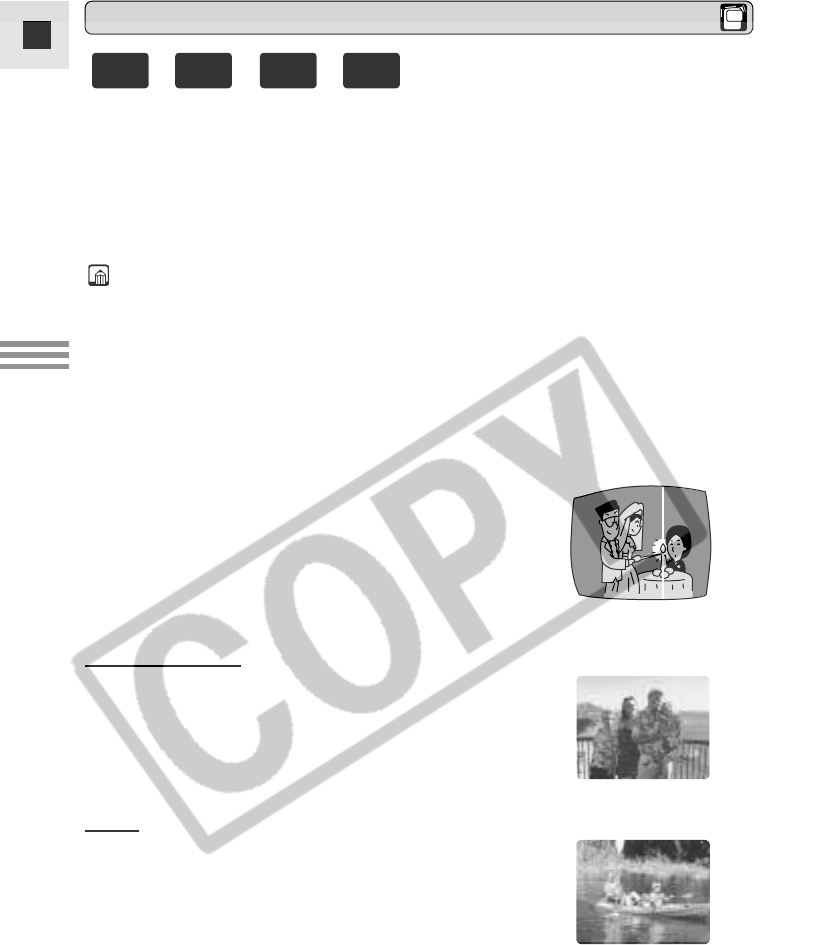
60
E
Using the Full
Range of Features
Easy Recording
The simplest way to use the camcorder is with
the program selector set to the [position.
The camcorder will take care of focus,
exposure and other adjustments, leaving you
free to point and shoot.
[
Auto
This is the same as the Easy Recording
program, except that you now have the option
of using any of the camcorder’s manual
functions.
AUTO
1. Slide the program selector to Q(program AE) mode.
2. Press the selector dial in to display the program menu.
3. Pull the selector dial up or down and select the program.
4. Press the selector dial in to select the desired program.
• The program appears in the display.
Notes:
• The name of your selected recording program appears constantly on the
left of the display, with the exception of Auto, which disappears after 4
seconds.
• Avoid changing programs during recording as the brightness of the image
may change suddenly.
• If you switch the camcorder from the [ program to the Qprogram, the
camcorder returns to the Auto program.
• When recording in dark places, a bright light in the scene may cause a
vertical light bar (“smear”) to appear. This is a
normal feature of camcorders.
Setting the Program AE Mode
+,+
CAMERA
CARD
CAMERA
TAPE
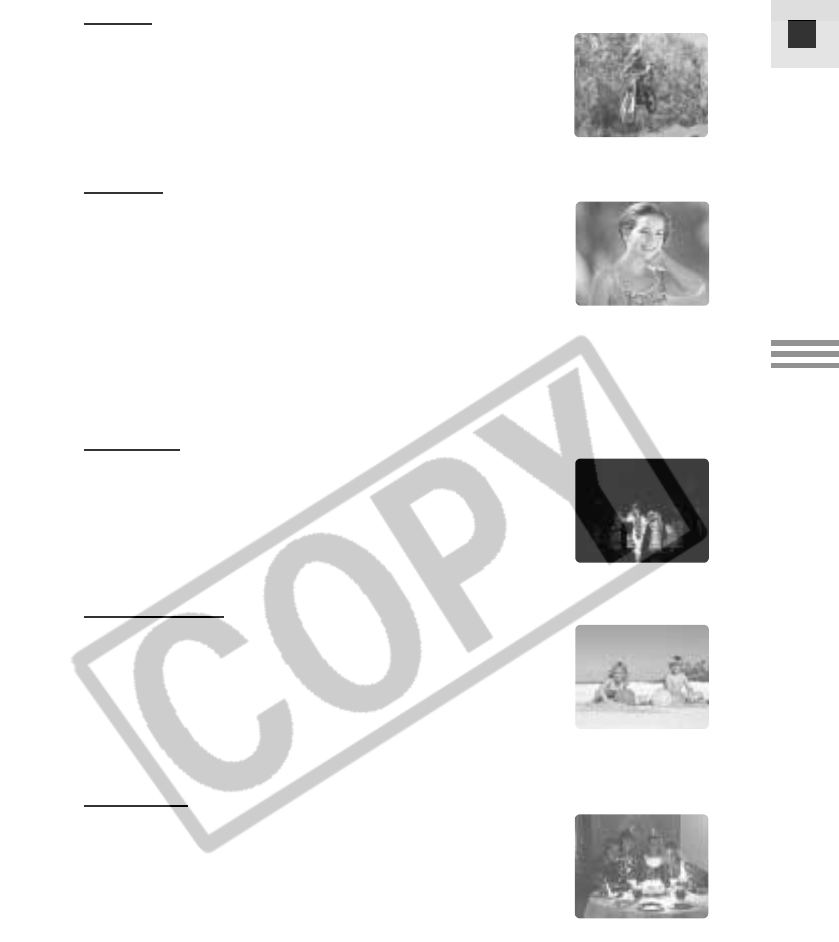
61
E
Using the Full
Range of Features
Sports
This program is useful for recording high-speed
sports scenes in brightly lit conditions. Normal
playback will be slightly jerky, but you will get
clear images which can be analysed frame by
frame during slow or paused playback.
SPORTS
Portrait
Use this program outdoors to make subjects
stand out from a softened foreground and
background. It works well for still lives and
close-ups. The effect is most noticeable when
the zoom position is between the middle range
and the telephoto end. Focus manually for
maximum accuracy, and be careful when
recording action scenes, as this program may
cause fast moving objects to shudder.
PORTRAIT
Spotlight
This program is designed for recording spotlit
scenes, such as on a stage. The exposure is
automatically adjusted for glare-free recordings
of subjects lit by a concentrated light source.
SPOTLIGHT
Sand & Snow
Use this program in places where the
background is so bright that the subject
appears underexposed in the display — a
sunny beach or ski resort, for example. You
may notice some shudder when recording
moving subjects.
SAND&SNOW
Low Light
This program allows you to record in dimly lit
places. The shutter speed is fixed at a slow
speed. It is generally best used for close-ups
of slow or stationary subjects, as moving
subjects may leave a trailing after-image.
However, you can take advantage of this to
create special effects, by rapid zooming or by panning along with a moving
subject. Image quality will not be as good as in normal lighting conditions,
and autofocus may not work as good as in other modes.
LOW LIGHT
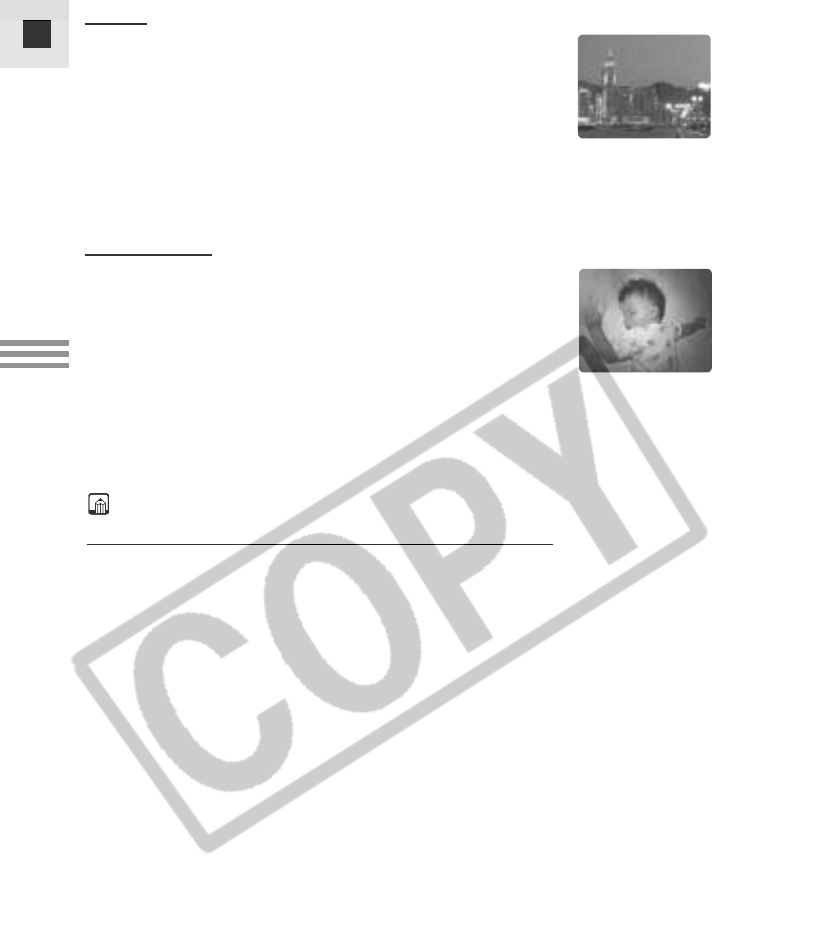
62
E
Using the Full
Range of Features
Night
This program automatically adjusts the shutter
speed according to the brightness of the
subject even in dark places (night time, etc.) to
shoot subjects brightly in colour. It is useful
when you record in locations with dark and
light places (such as in amusement parks).
• You can record subjects without after-image
even in light places.
NIGHT
Super Night
Use this program to shoot in very dark places.
The Super Night LED lights up, allowing you to
shoot subjects in the centre of the display
brightly in colour.
• Use this recording program for recording at
close range (up to 2 m).
• The range of the Super Night LED is limited.
Check the picture on the screen when
recording.
Notes:
Concerning Night and Super Night recording program:
• Night and Super Night cannot be used in CARD CAMERA mode.
• Moving subjects may leave a trailing after-image.
• Though subjects can be shot brightly, the image quality may not be as
good as in normal lighting condition.
• White points etc. may appear in the display.
• Autofocus may not work as well as usual (in such case, adjust the focus
manually).
• The flash does not fire when recording a still image.
SUPER NIGHT
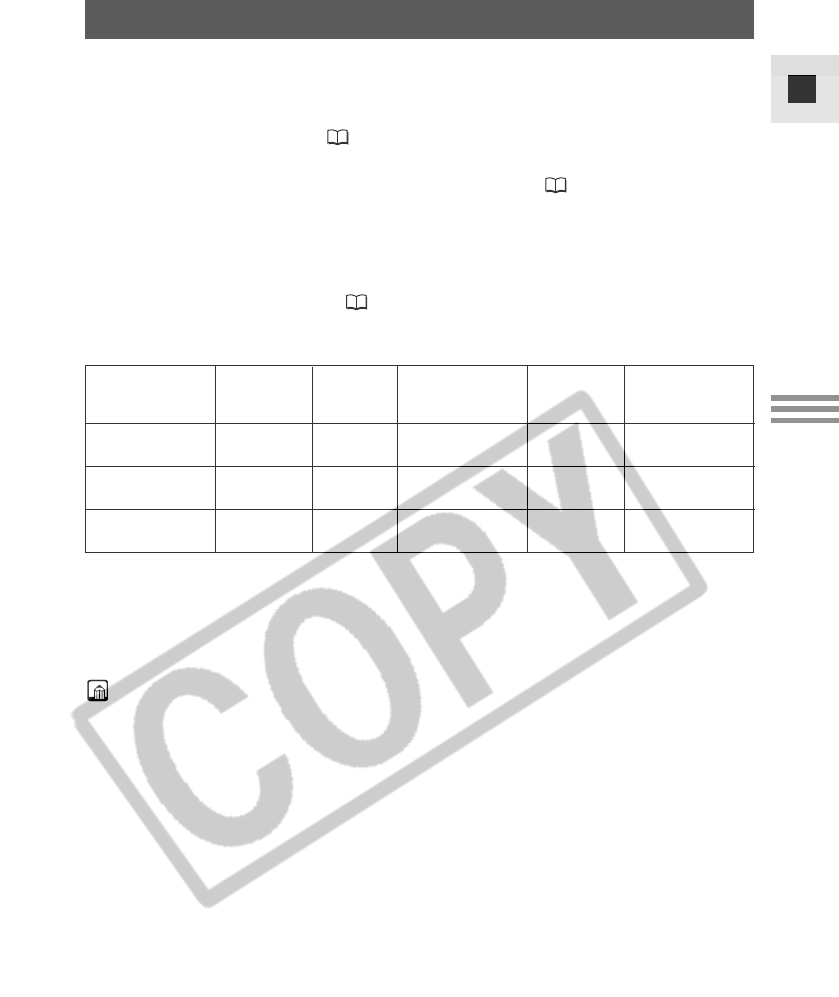
63
E
Using the Full
Range of Features
Using Digital Effects
Use the camcorder’s digital effects for more interesting productions.
• Faders: Start or end scenes on a tape with a fade to or from
black ( 64). Fade Trigger, Wipe, Corner, Jump, Flip,
Puzzle, Zigzag, Beam, Tide
• Effects: Add flavour to your recordings ( 66).
Art, Black and White, Sepia, Mosaic, Ball, Cube, Wave,
Color Mask, Mirror
•
Multi-image Screen:
Divides the display to show 4, 9 or 16 still images. Has 4
transition speed options: fast, moderate, slow and
manual ( 69).
h: Available i: Not available 1) : Black and White only
2) : Cannot be used in Night and Super Night recording
program.
• The types of digital effects you can use depends on the setting of the
TAPE/CARD switch, the POWER switch and the recording program.
Notes:
• When you do not wish to use digital effects, press the DIGITAL EFFECTS
button and select D.EFFECT |from the digital effects menu. Press the
ON/OFF button to close the menu.
• The camcorder retains your chosen digital effect setting until you change
it.
• Digital effects can be selected but not operated on a blank blue screen
(appears in TAPE PLAY (VCR) mode). The display continues to flash.
• Digital effects operated during TAPE PLAY (VCR) mode are not recorded
onto the original tape.
• Digital effects can be added to another tape when dubbing using the AV
out terminal (TAPE PLAY (VCR) mode), but not the DV out terminal.
• You cannot operate digital effects while photo/date searching.
• If you slide the program selector to [(Easy Recording) while the digital
effect display is flashing, it will disappear from the display and reappear
when you return to Q(program AE) mode.
• The digital effect display will flash for 2 seconds after setting, even if
DISPLAYS is set to OFF in the menu.
Availability of digital effects by mode
Faders h
TAPE
CAMERA
CARD PLAY
(VCR)
PHOTO
Effects hh
Multi-image
Screen h2) h2)
ii
TAPE PLAY
(VCR)
h
h
h
CARD
CAMERA
h1)
i
i
i
i
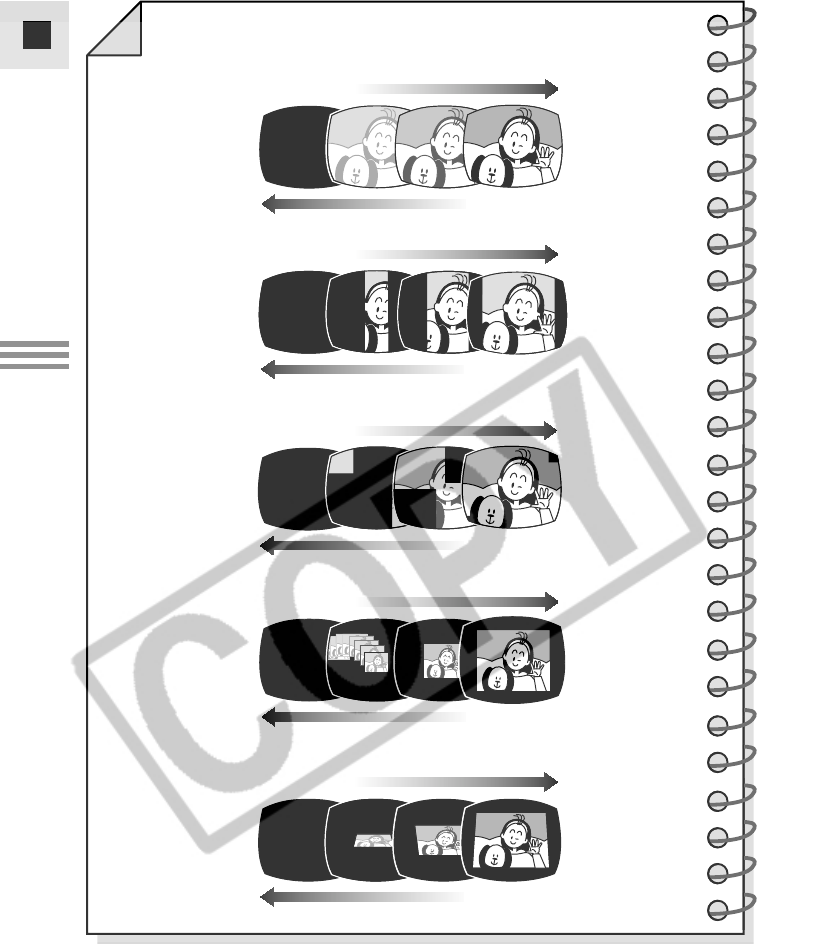
64
E
Using the Full
Range of Features
Fade Trigger (FADE-T)
Wipe (WIPE)
Corner Wipe (CORNER)
The image begins as a thin vertical
line in the centre
of the screen and
expands sideways
until it fills
the whole screen.
The image is
wiped off from both sides
of the screen.
The image
gradually fades in.
The image
gradually fades out.
Faders
The image appears
from the corners
until it fills the
whole screen.
The image is
wiped off from the corners
The image
shrinks, jumps from the
centre to the left and
disappears.
The image
flips out of the screen.
Jump (JUMP)
A small image appears from
the left, jumps into
the centre and
enlarges until it
fills the whole
screen.
Flip (FLIP)
The image flips into the screen.
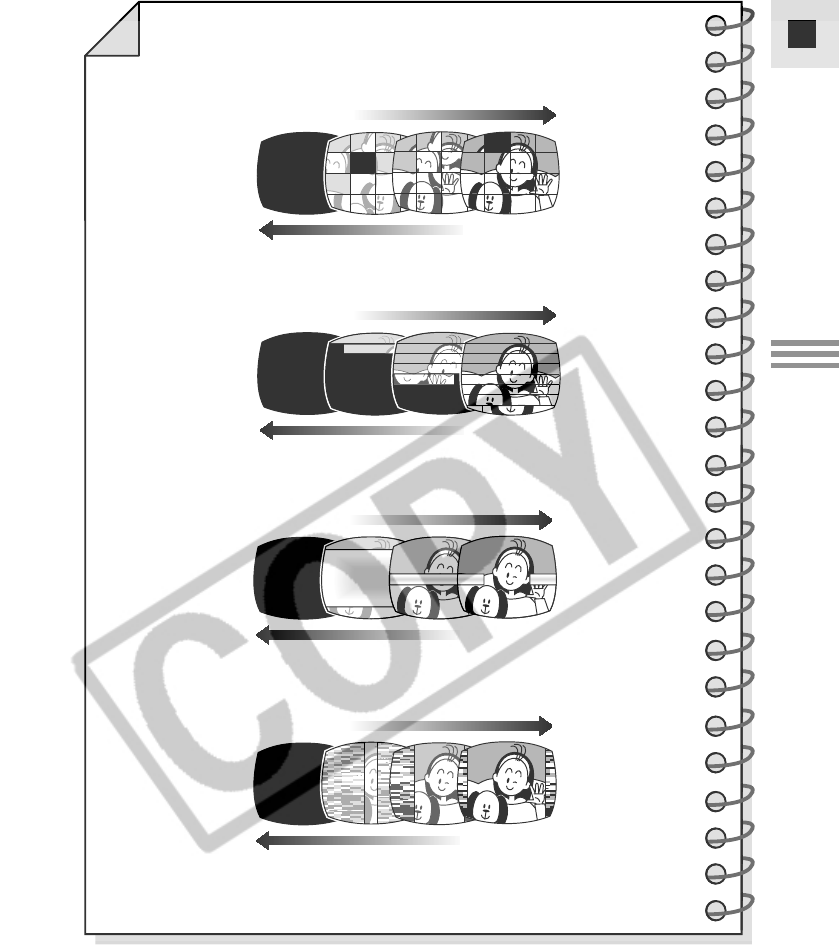
65
E
Using the Full
Range of Features
Puzzle (PUZZLE)
Zigzag (ZIGZAG)
The image appears in 16 pieces.
The pieces move
around until the
puzzle is solved.
The image
divides into 16 pieces. The
pieces move around and
disappear.
Faders
The image appears
in zigzag from
the top of the
screen.
White stripes
appear in zigzag from the
bottom of the screen until
they cover the whole image.
A yellow beam
appears in the middle of the
screen and expands until it
covers the whole image.
The image
disappears from both sides
like tides.
Beam (BEAM)
The screen turns yellow,
forms a beam
and the full
image appears.
Tide (TIDE)
The image appears
from both sides
like tides.
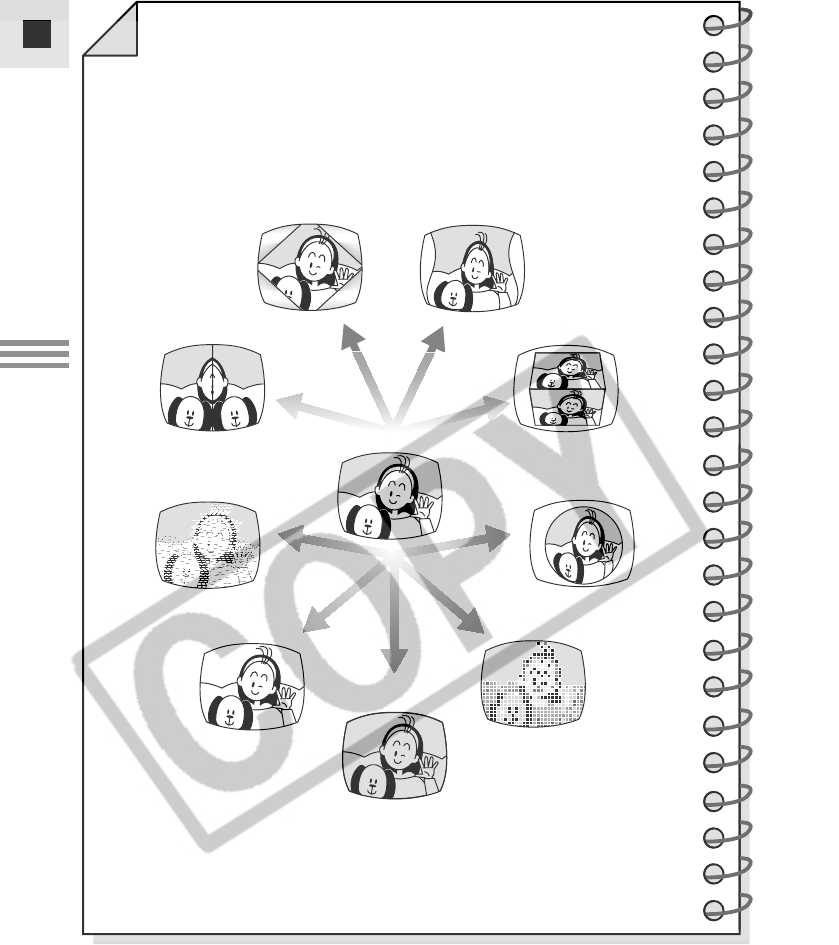
66
E
Using the Full
Range of Features
Effects
Black and White
(BLK & WHT)
The image becomes
black and white.
Art (ART)
The image becomes
like a paint
(solarization).
Ball (BALL)
The image
becomes a ball.
Cube
(CUBE)
The image becomes
a cube and rotates.
Wave (WAVE)
Both ends of the
image sway in waves.
Colour Masking
(COLOR M.)
The image becomes a
rhombus through a
masking frame that
changes the colours.
Sepia (SEPIA)
The image becomes
monochrome with a
brownish tint.
Mosaic (MOSAIC)
The image is blurred
through enlarging the
size of some pixels.
Mirror
Creates a
symmetrical image
as if there would be
a mirror in the
middle of the
screen.
In CARD CAMERA mode, only Black and White can be selected.
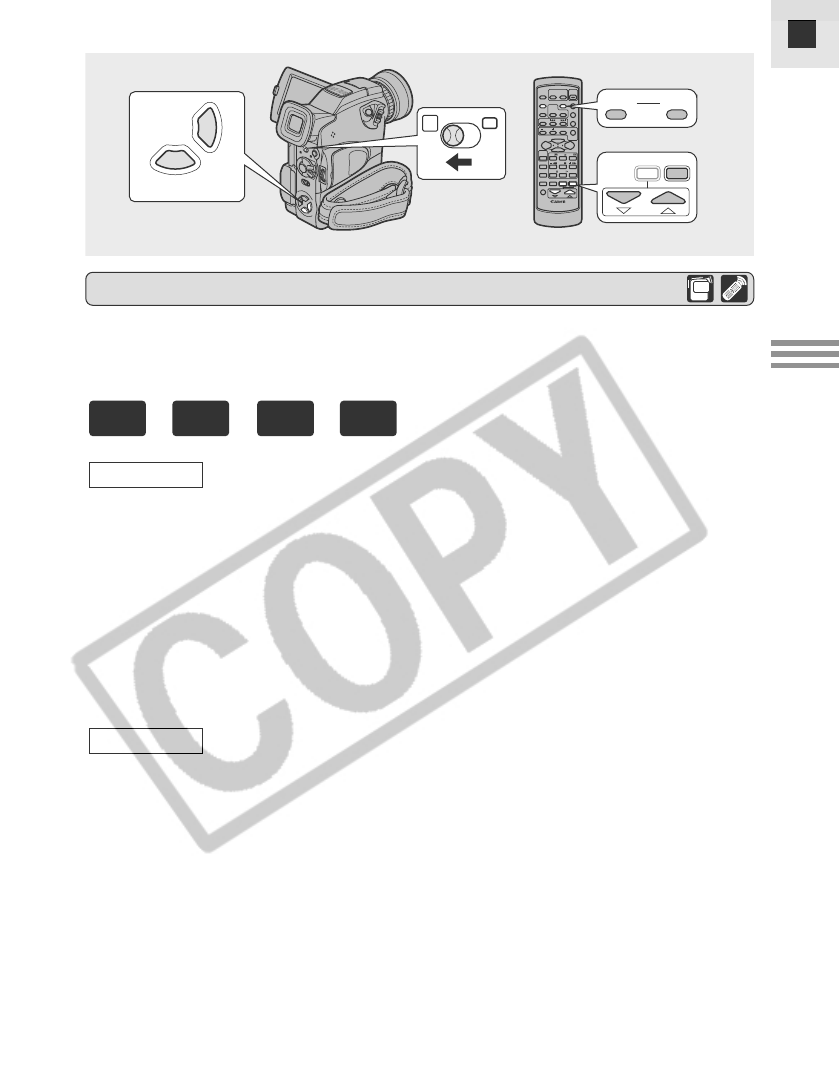
67
E
Using the Full
Range of Features
Digital effects can be set with the controls on the body of the camcorder or
the wireless controller.
P
//
D.EFFECTS ON/OFF
D
I
G
I
T
A
L
E
F
F
E
C
T
S
O
N
/
O
F
F
SETMENU
Operating Faders
Sound and image fade together.
When operating faders in TAPE CAMERA mode, make sure the program
selector is set to Q.
1. Press the DIGITAL EFFECTS button to open the digital effects
menu.
• D.EFFECT |, FADER, EFFECT and MULTI-S appear.
2. Select FADER.
• The settings appear.
3. Select the desired setting.
• You return to the digital effects menu.
4. Press the DIGITAL EFFECTS button to close the menu.
• The name of your selected fader flashes in the display.
5. Press the ON/OFF button.
• The name of your selection stops flashing.
• Each time you press the ON/OFF button, the chosen fader is activated
(display lights continuously) or deactivated (display flashes).
6. In TAPE CAMERA mode:
Fade in- Press the start/stop button.
Fade out- Press the start/stop button.
In TAPE PLAY (VCR) mode:
Fade in- Press the e(play) button.
Fade out- Press the a(pause) button.
Fader on/off
Select fader
+,+
PLAY
(VCR)
TAPE
CAMERA
TAPE
68
E
Using the Full
Range of Features
Operating Effects
Sound records/plays back normally.
When operating effects in TAPE CAMERA or CARD CAMERA mode, make
sure the program selector is set to Q.
1. Press the DIGITAL EFFECTS button to open the digital effects
menu.
• D.EFFECT |, FADER, EFFECT and MULTI-S appear.
2. Select EFFECT.
• The settings appear.
3. Select the desired setting.
• You return to the digital effects menu.
4. Press the DIGITAL EFFECTS button to close the menu.
• The menu disappears and the name of your selected setting flashes in
the display.
5. In TAPE PLAY (VCR) mode, press the e(play) button.
6. Press the ON/OFF button.
• The name of your selection stops flashing and takes effect on the
display.
• Each time you press the ON/OFF button, the chosen effect is activated
or deactivated.
1. Press the DIGITAL EFFECT button.
• BLK&WHT flashes in the display.
2. Press the ON/OFF button.
• The effect is activated and the image appears in black and white.
Effect on/off
Select effect
+,+
PLAY
(VCR)
TAPE
CAMERA
TAPE
+
CAMERA
CARD
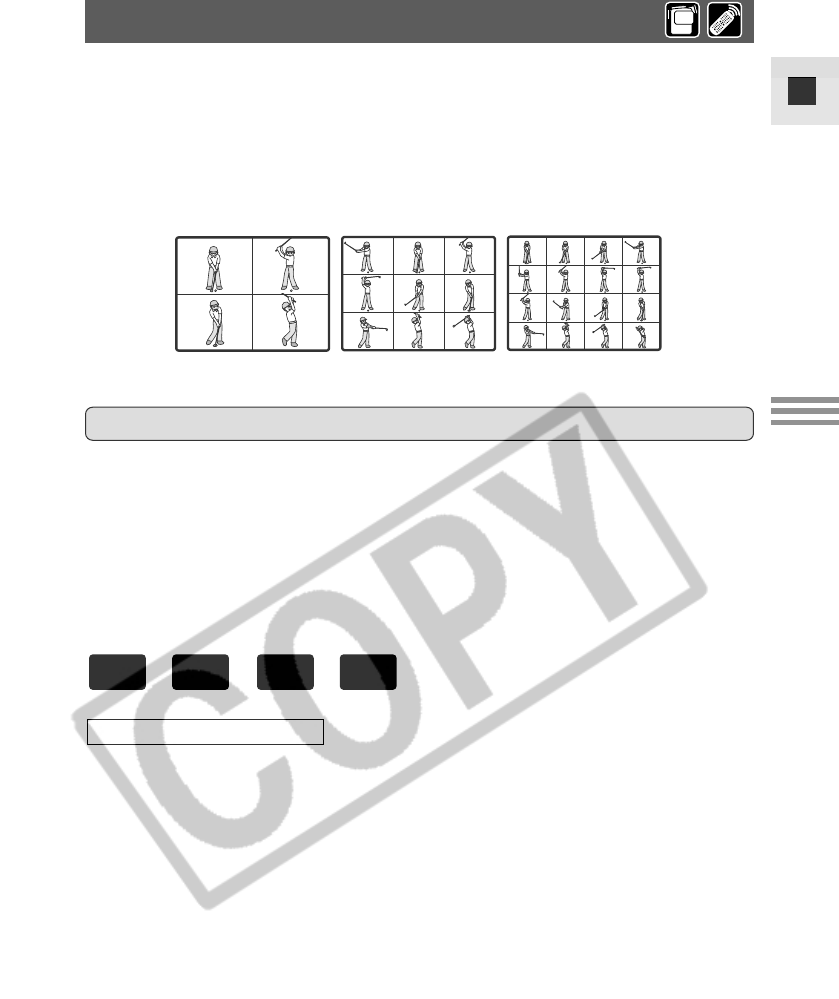
69
E
Using the Full
Range of Features
4 images 9 images 16 images
Divides your display image into 4, 9 or 16 smaller images with the Image
Capture feature. With this feature, the camcorder captures the current scene
being shot or replayed. Choose the transition speed — manual, fast (every 4
frames), moderate (every 6 frames*) or slow (every 8 frames*) — at which to
capture a moving subject, such as a person playing tennis or golf. Sound is
recorded normally.
* In Low Light mode: moderate (every 8 frames), slow (every 12 frames)
Using the Multi-Image Screen
When operating the multi-image screen in TAPE CAMERA mode, make sure
the program selector is set to Qand set to any program other than the Night
or Super Night recording program.
In TAPE PLAY (VCR) mode, you can only operate the multi-image screen in
the following playback modes:
When M.S.SPEED is set to MANUAL: Still picture playback, slow
forward/reverse playback
When M.S.SPEED is set to FAST, MODERATE or SLOW: Still picture playback
1. Press the DIGITAL EFFECTS button to open the digital effects
menu.
• D.EFFECT |, FADER, EFFECT and MULTI-S appear.
2. Select MULTI-S.
• M.S. SPEED and M.S. SPLIT settings appear.
3. Select M.S. SPEED.
• MANUAL, FAST, MODERATE and SLOW settings appear.
4. Select the desired setting.
• You return to the digital effects menu.
5. Select MULTI-S again.
• M.S. SPEED and M.S. SPLIT settings appear.
6. Select M.S.SPLIT.
• 4, 9, 16 settings appear.
Select multi-image screen
Operating the Multi-image Screen
+,+
PLAY
(VCR)
TAPE
CAMERA
TAPE
70
E
Using the Full
Range of Features
7. Select the desired setting.
• You return to the digital effects menu.
8. Press the DIGITAL EFFECTS button to close the menu.
• The digital effects menu disappears.
• MULTI-S flashes in the display.
9. Push the ON/OFF button.
• MULTI-S stops flashing.
• Manual: As you press the ON/OFF button, scenes will be captured one
after another the indicated number of times. If you push and hold the
ON/OFF button for more than a second, the last image captured will be
erased.
• The currently recording image is framed in blue. The frame disappears
after the last image is captured.
• Automatic: The camcorder will capture the indicated number of images
at the indicated speed.
10
.In TAPE CAMERA mode, push the start/stop button or the
PHOTO button to begin recording.
• The multi-image screen is recorded to the tape.
Notes:
• You can operate the multi-image screen from record or record pause
mode.
• After all the images have been captured, press the ON/OFF button quickly
to cancel the multi-image screen.
• If you are operating the multi-image screen in TAPE PLAY (VCR) mode and
you stop or pause the tape, or press any other playback button or the
date/photo search button, the multi-image screen will be cancelled. (This
does not apply with the MANUAL multi-image speed.)
• You cannot use digital zoom or the 16:9 mode when the multi-image
screen is set. The display becomes “– – –”.
Multi-image screen on/off
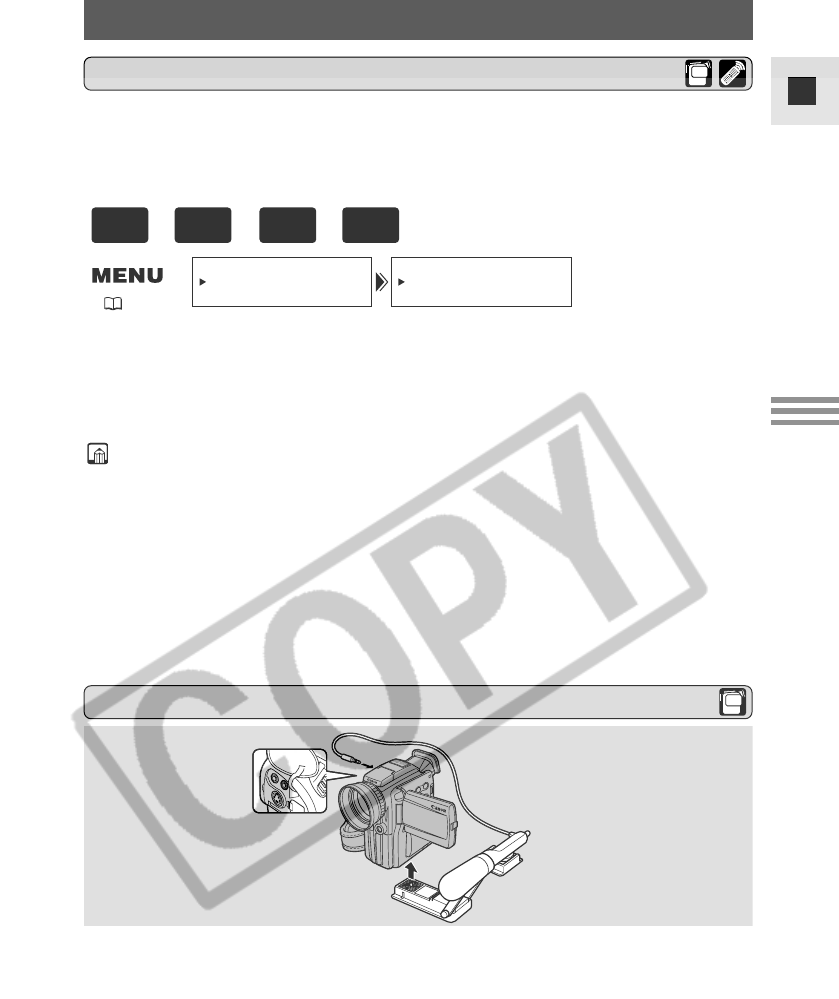
71
E
Using the Full
Range of Features
Audio Recording
To switch to the 16-bit mode, open the menu and select VCR
SET UP. Then select AUDIO MODE, set it to “16 bit” and close
the menu.
• “16 bit” is shown in the display for approximately 4 seconds.
Notes:
• For details on adding new sound, see p. 100.
• For details of playing back a tape that has new sound on stereo 2, see
p. 103.
• When you record to the MVX2i from a camcorder with DV terminal
outputs, the audio mode becomes automatically set to 12 bit.
• In TAPE PLAY (VCR) mode, the audio mode takes effect when doing analog
line-in recording or AV insert. When you do DV in recording, the setting
automatically changes to that of the digital device connected to the
camcorder.
External Microphone
Selecting the Audio Mode
The comcorder can record sound on a tape in two audio modes — 16-bit and
12-bit. The 16-bit mode produces the higher sound quality (slightly superior
to CD) while the 12-bit mode records on two channels (stereo 1), leaving two
channels free (stereo 2) for you to add new sound later.
AUDIO MODE••12bit
VCR SET UP
( 38)
For greater creative control over audio recording, you can connect an external
microphone to the camcorder via the MIC terminal. When using the MIC
terminal, use a microphone with a built-in power supply (condenser
microphone). It is possible to connect almost any stereo microphone with a
plug diameter of 3.5 mm (1/8in), however, their audio levels will be different
from that of the built-in microphone.
Attach the microphone to the optional SA-1 Adapter Bracket.
+,+
PLAY
(VCR)
TAPE
CAMERA
TAPE
72
E
Using the Full
Range of Features
To turn it on, open the menu and select VCR SET UP. Then select
WIND SCREEN, set it to ON and close the menu.
•WSOis shown in the display when you turn the wind screen on.
Notes:
• The wind screen can be used for audio dubbing with the built-in
microphone in TAPE PLAY (VCR) mode as well as recording (when AUDIO
DUB. is set to MIC. IN in VCR SET UP submenu).
• The wind screen does not operate when an external microphone is
connected to the MIC terminal.
Wind Screen
The camcorder has an automatic wind screen to prevent wind noise from
interfering with the sound track. Make sure it’s off when you want the
microphone to be as sensitive as possible. Use the wind screen when
recording in windy places such as the beach or near buildings.
WIND SCREEN•OFF
VCR SET UP
( 38)
Note:
• When using an external microphone, use a microphone cable not longer
than 3 m (9 ft 10 1/8in) to avoid electromagnetic inerference.
+,+,+
CAMERA
CARD
PLAY
(VCR)
TAPE
CAMERA
TAPE
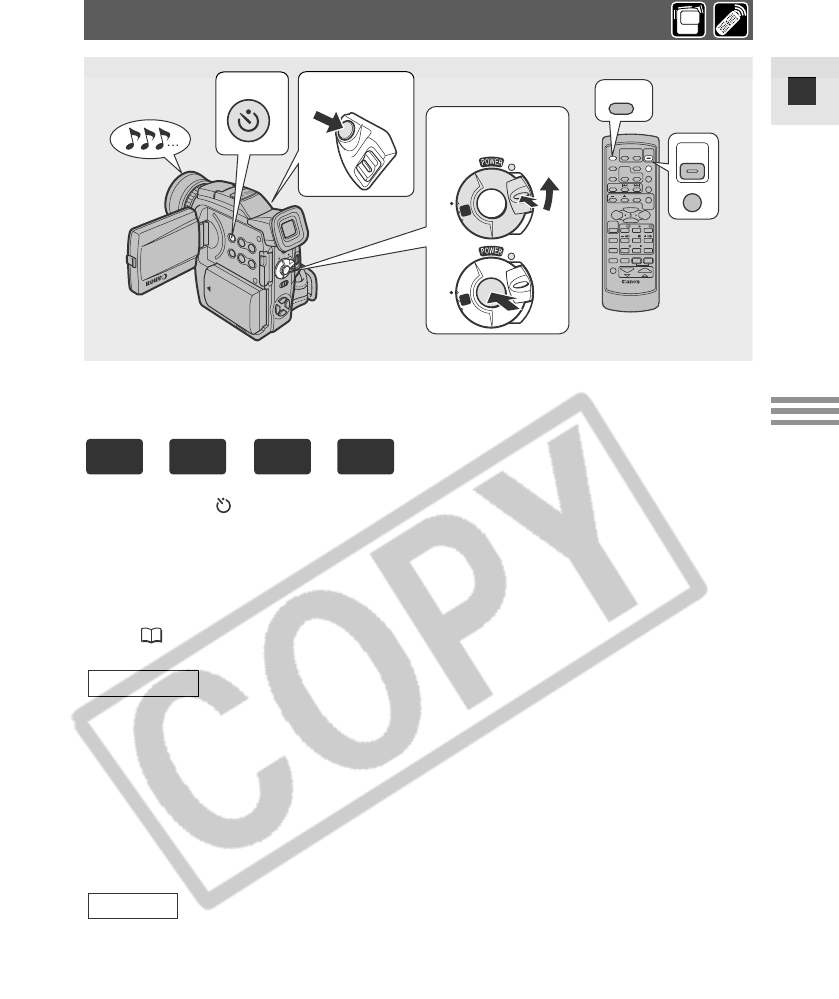
73
E
Using the Full
Range of Features
Setting the Self-Timer
1. Press the self-timer button on the body of the camcorder
or
the SELF TIMER button on the wireless controller.
• SELF T appears in the display.
• To have the subject monitor recording, rotate the LCD panel 180°
( 27).
2. Press the start/stop button.
• The camcorder starts to record after a 10-second countdown period (or
after 2 seconds when you use the wireless controller). The time
remaining counts down in the display (e.g. “5 SEC”).
• SELF T disappears from the display when recording begins.
• The tally lamp starts flashing.
3. Press the start/stop button to end recording.
2. Press the PHOTO button on the camcorder body or the
wireless controller.
• The camcorder automatically adjusts the focus 2 seconds before the
countdown is complete. The Fmark flashes white then turns green
after the focus and exposure are set. If you are using the wireless
controller, the Fmark starts flashing immediately after you press the
PHOTO button.
For stills
For movies
(
V
C
R
)
P
L
A
Y
C
A
M
R
A
O
F
F
1
2, 3
//
PHOTO
(
V
C
R
)
P
L
A
Y
C
A
M
R
A
O
F
F
START
/STOP
SELF TIMER
PHOTO
2
This is useful when you wish to include yourself in the picture when
recording movies or still images to a tape or memory card.
+,+
CAMERA
CARD
CAMERA
TAPE
For stills
For movies

74
E
Using the Full
Range of Features
• The camcorder takes the picture for approximately 6 seconds.
• In TAPE CAMERA mode, the camcorder returns to record pause mode
after recording to a tape. If you’re in CARD CAMERA mode, the
currently recording image appears after recording onto a memory card.
Note:
• To cancel the self-timer, press the self-timer button, start/stop button
(when recording a movie) or PHOTO button (when recording a still image).
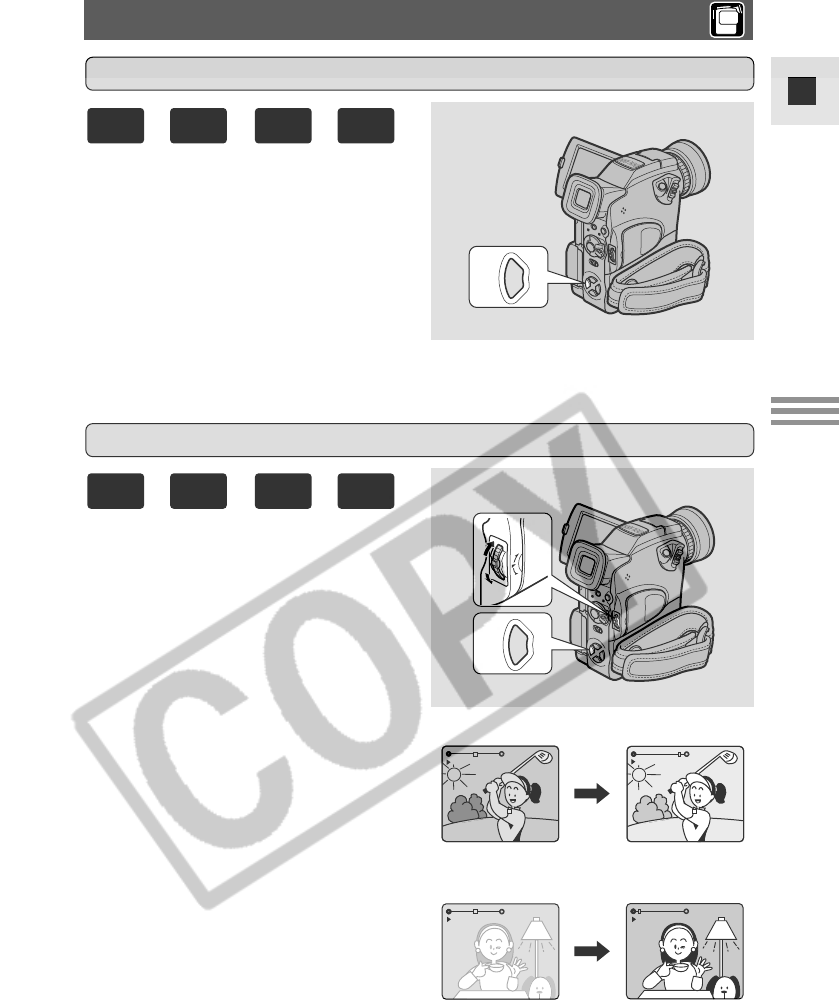
75
E
Using the Full
Range of Features
+,+
CAMERA
CARD
CAMERA
TAPE
+,+
CAMERA
CARD
CAMERA
TAPE
Adjusting Exposure Manually
To make the recorded image brighter,
pull the selector dial up (to a
maximum of +11). This may be
necessary if the background is very
bright, or if the subject is lit from
behind.
To make the recorded image darker,
pull the selector dial down (to a
minimum of –11). This may be
necessary if the background is very
dark, or if the subject is spotlit.
E.LOCK ±0E.LOCK +10
E.LOCK ±0E.LOCK –10
E
X
P
When you are recording in situations
where the lighting may change
suddenly, you can lock the exposure
at the current level in order to
control the brightness of the image.
E
X
P
SELECT
When the exposure is locked, you
can adjust it manually, making the
picture brighter or darker in order to
deal with difficult lighting conditions.
The camera’s iris can be manually set
to any position from fully closed to
fully open.
Exposure Lock
Exposure Adjustment
To lock the exposure, press the EXP button. Press it again to return to auto
exposure.

76
E
Using the Full
Range of Features
Notes:
• The standard exposure level depends on which recording program you have
selected.
• Exposure lock is cancelled if you change recording programs.
• You cannot use exposure lock or adjustment when the program selector is
set to the [ (Easy Recording) position.
• If you zoom while the exposure is locked, the brightness of the scene may
change.
77
E
Using the Full
Range of Features
1. Make sure the camcorder is set to the Q(program AE) mode.
2. Press the selector dial in and choose AUTO from the
program menu.
3. Open the menu and select CAM.SET UP.
4. Select SHUTTER.
5. Press the selector dial in to select the desired shutter speed.
• Only shutter speeds up to 1/250 are available when using a memory
card.
6. Close the menu.
SHUTTER•••••AUTOCAM.SET UP
( 38)
Set the shutter speed manually to take stable shots of quickly moving
subjects.
CARD
AUTO
1/50
1/120
1/250
TAPE
AUTO
1/50
1/120
1/250
1/500
1/1000
1/2000
1/4000
1/8000
slower
faster
+,+
CAMERA
CARD
CAMERA
TAPE
Setting the Shutter Speed
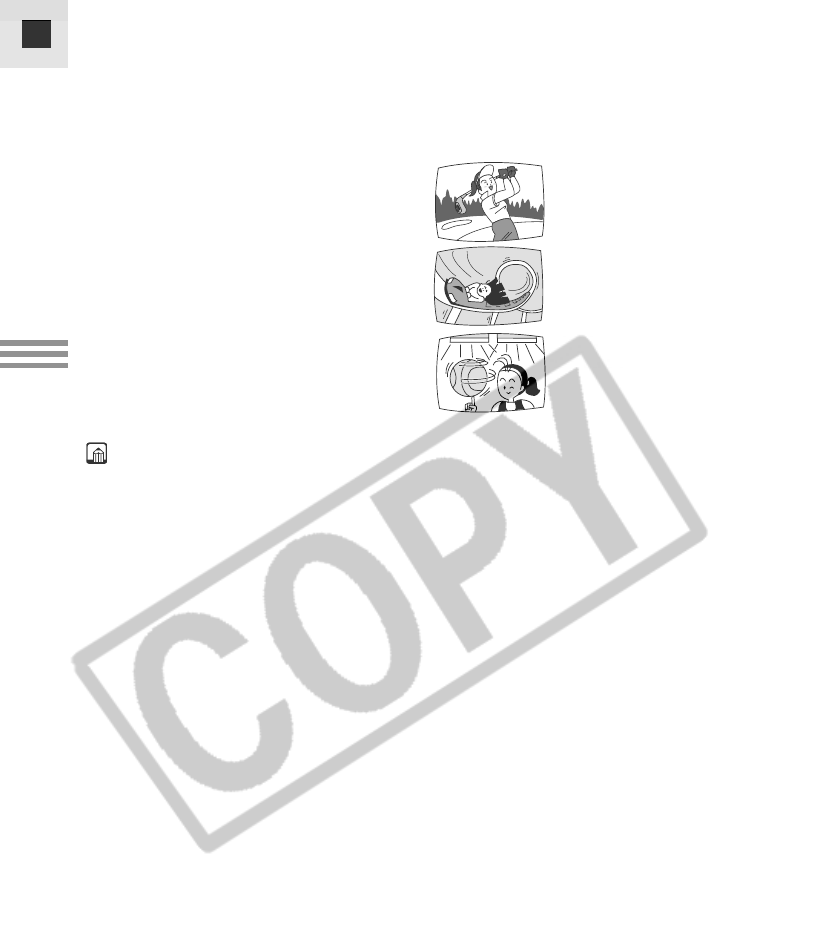
78
E
Using the Full
Range of Features
Guidelines for shooting using high shutter speeds
• When shooting with a shutter speed of 1/1000 or higher, do not shoot the
sun directly.
Recommended shutter speeds when shooting:
• People doing outdoor sports such
as golf or tennis
• Moving cars or trains or other
rapidly moving vehicles such as
roller coasters
• People doing indoor sports such as
basketball
1/1000, 1/500 or
1/250
1/120
Notes:
• You cannot set the shutter speed in any recording program other than
AUTO.
• The image may not appear smooth when a high shutter speed is set.
• The camcorder returns to the auto shutter setting when you slide the
program selector to [(Easy Recording), or change the recording program.
• If you set the shutter speed to 1/500 or above in TAPE CAMERA mode and
then switch the camcorder to CARD CAMERA mode, the shutter speed will
automatically change to 1/250.
1/2000 or 1/4000
(or 1/8000 to freeze
the action even more
clearly)
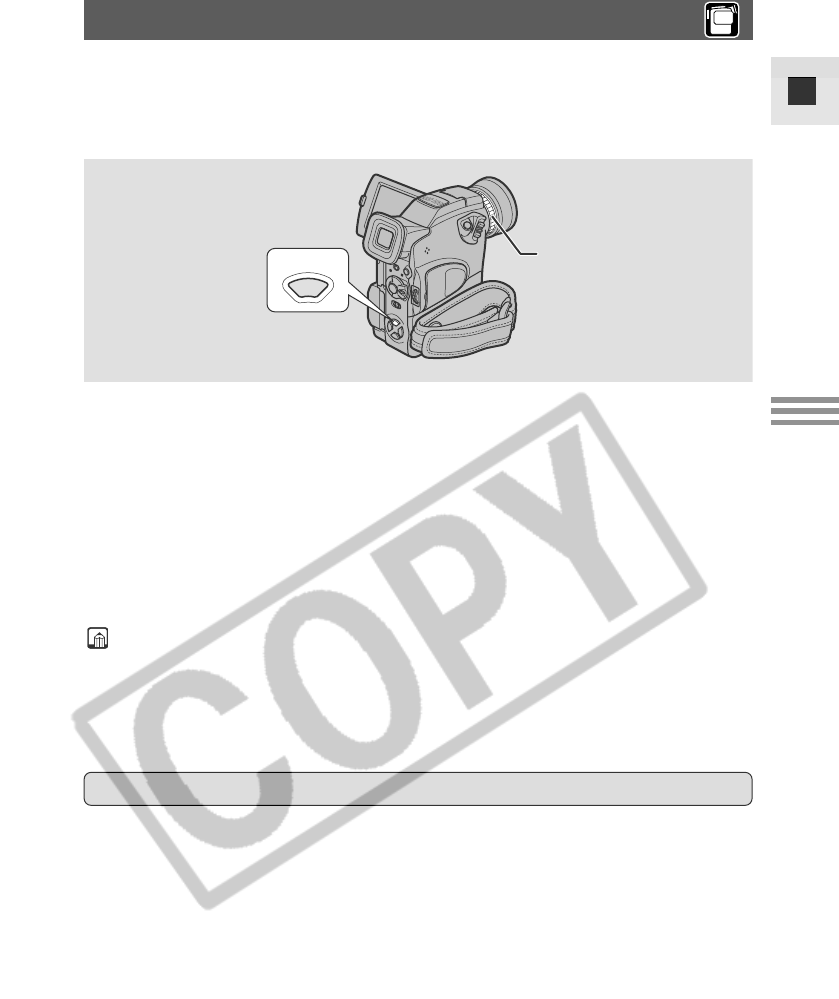
79
E
Using the Full
Range of Features
Adjusting Focus Manually
The camcorder focuses automatically. All you have to do is point and the
subject in the centre of the screen will usually be in sharp focus. It may
happen that a subject is not suitable for autofocus. Use the manual focusing
function to adjust the focus.
F
O
C
U
S
/
D
A
T
A
C
O
D
E
1. Press the FOCUS button to turn the autofocus off.
• MF appears in the display.
• The focus remains locked at the point set by autofocus.
2. Rotate the focus ring to set the focus.
• Rotate the focus ring clockwise to move the focus farther away.
• Rotate the focus ring counterclockwise to bring the focus nearer.
• If you zoom in on your subject after turning off the autofocus, it may
not stay in focus. It is generally best to adjust the zoom first and then
the focus.
Notes:
• The camcorder will return to autofocus when selecting the [(Easy
Recording) program.
• Autofocus can not be turned off in [(Easy Recording) program.
• See “Troubleshooting” on p. 165 for a list of subjects that may not be
suitable for autofocus.
Use this function when you wish to focus on faraway subjects such as
mountains or fireworks.
Press the focus button more than 3 seconds in step 1 above to record in
infinity focus mode. The MF∞icon will appear on the display.
∞will disappear when you operate the zoom or the focus ring and the
camcorder will change to manual focus.
Infinity Focus
Focus ring
80
E
Using the Full
Range of Features
Turning Off the AF-Assist Lamp
The AF-assist lamp (Super Night LED) lights up to illuminate the subject in the
centre of the screen if necessary in order to focus in dark places.
To turn the AF-assist light off, open the menu and select
CAM.SET UP. Then select AF and set it to OFF.
Notes:
• The camcorder may not focus automatically even though the AF-assist
lamp is lighting (in such cases, adjust the focus manually).
• The AF-assist lamp lights brightly. Consider turning off the AF-assist lamp
in public places such as in restaurants or theaters.
• Turn the AF-assist lamp off in places where flash photography is prohibited.
AF AST LAMP•ON
CAM.SET UP
( 38)
+,+
CAMERA
CARD
CAMERA
TAPE
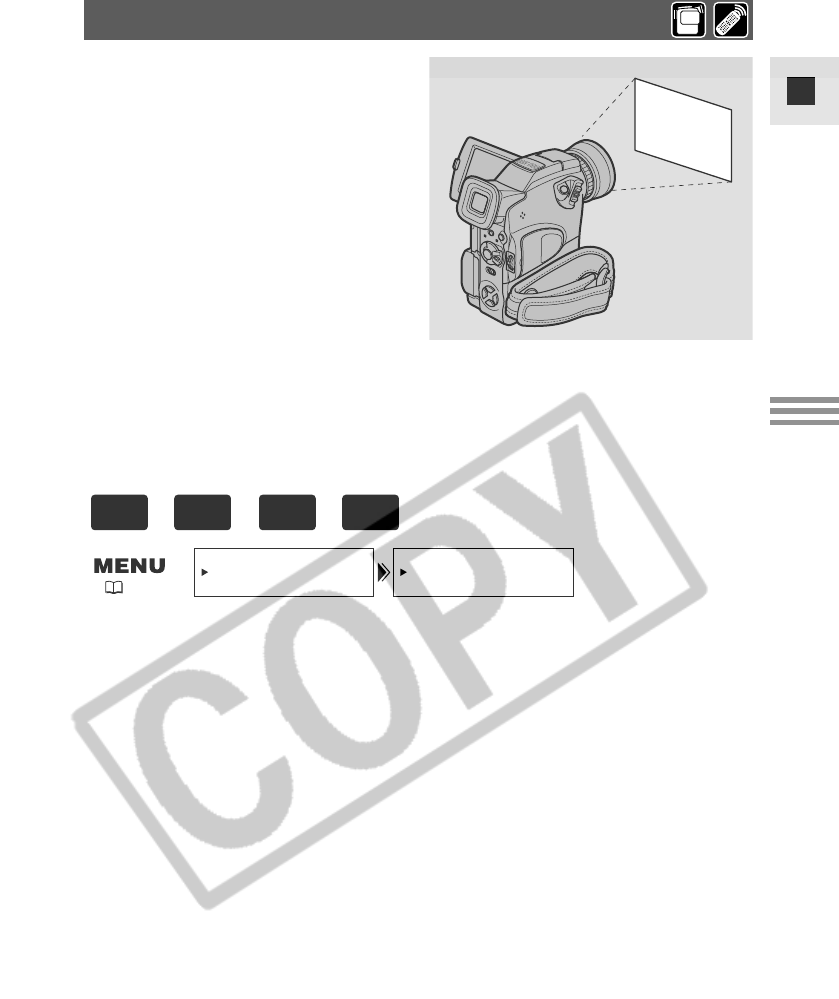
81
E
Using the Full
Range of Features
1. Make sure the camcorder is set to the Q(program AE) mode.
2. Open the menu and select CAM.SET UP.
3. Select WHITE BAL.
4. a) For the indoor, outdoor or auto settings, press the selector
dial in to choose the setting.
•T/Uappears in the display when you set the white balance to
indoor/outdoor mode.
b) To set the white balance yourself, point the camcorder at
a white object (such as a sheet of paper) and zoom in
until it fills the display. Then press the selector dial in to
select SET W.
• Make sure to continue pointing the camcorder at the white object
until you have finished setting the white balance.
• The Wdisplay flashes then remains lit.
• Depending on the light source, the flashing may at times continue.
The result will still be better than with the auto setting and you can
continue recording.
5. Close the menu.
The camcorder’s auto white balance
system compensates for a wide
range of lighting conditions.
Although slight variations are
unavoidable, colours will appear
natural in virtually every situation.
In some cases, you will get better
results by setting the white balance
yourself, or using one of the two
preset modes:
TIndoor Mode
• Under halogen or studio/video
lighting
• Subject is of one dominant colour
• Close ups
UOutdoor mode
• In daylight, especially for close-ups and when the subject is of one
dominant colour
WHITE BAL.••AUTO CAM.SET UP
( 38)
Setting the White Balance
+,+
CAMERA
CARD
CAMERA
TAPE
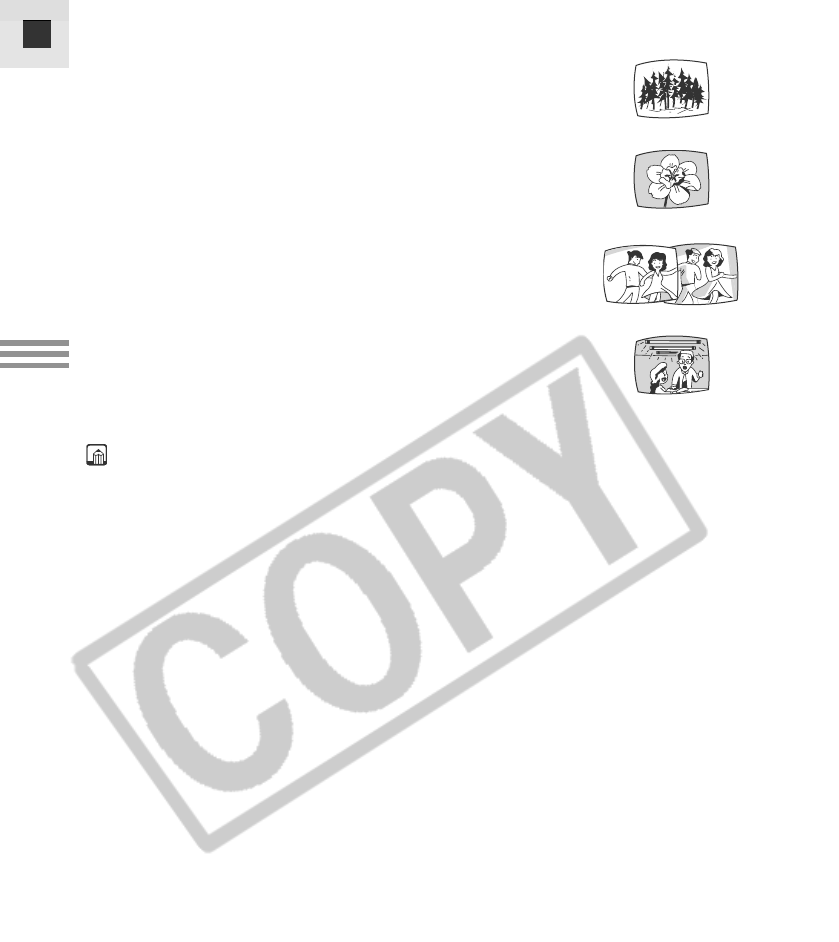
82
E
Using the Full
Range of Features
Setting the white balance manually will probably work
better than auto white balance when shooting:
Subjects with one dominant colour, such as sky, sea or
forest
Close-ups
In rapidly changing lighting conditions
In places lit by certain types of fluorescent or mercury
vapour lights
Notes:
• Turn the digital zoom off (if necessary) to set a more accurate white
balance.
• If you have set the white balance and lighting conditions change, reset the
white balance.
• Try to record with light from a single source. Correct white balance cannot
be obtained for two types of lighting at once.
• You cannot set the white balance or choose the indoor/outdoor mode
when the program selector is set to the [(Easy Recording) program.
• The white balance returns to the AUTO setting when you slide the program
selector to [(Easy Recording).
• The camcorder retains the setting even if you turn the camcorder off.
• During normal outdoor shooting, setting to AUTO may provide better
results.
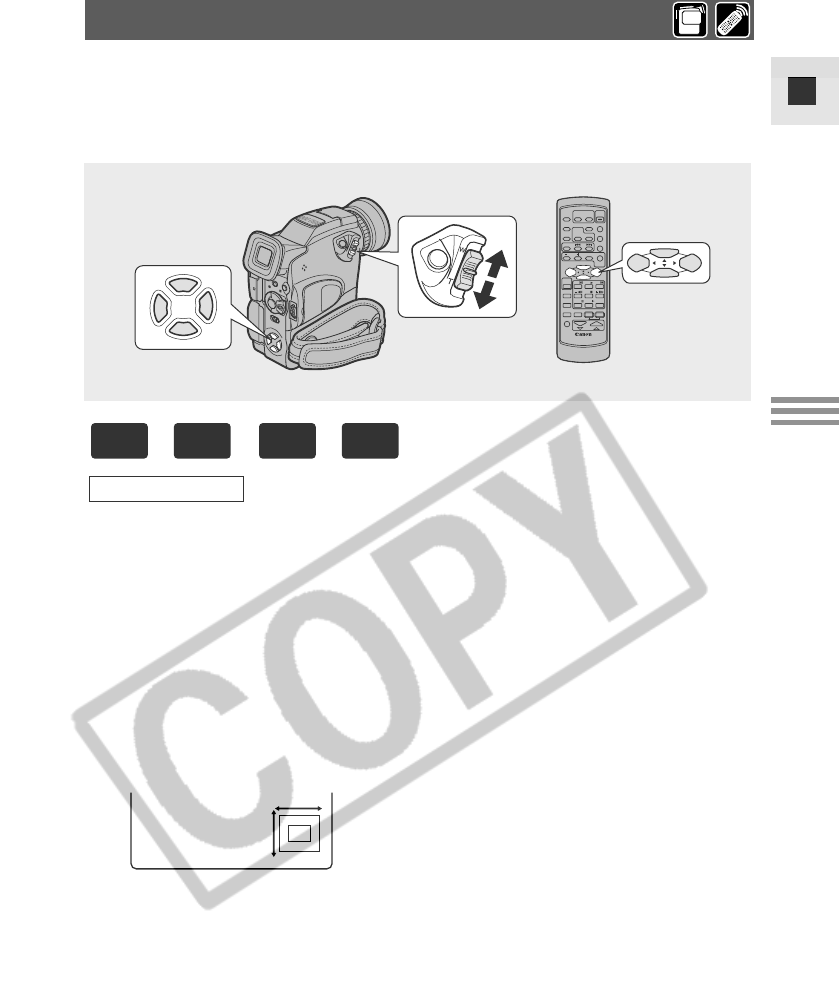
83
E
Using the Full
Range of Features
You can enlarge the image up to 5 times during TAPE PLAY (VCR) and CARD
PLAY (VCR) mode. You can also move the image up, down, to the right or
left.
• Movies played back from a memory card cannot be enlarged.
1. Move the zoom lever toward T.
• The image is magnified by 2 times.
• To further enlarge the image, move the zoom lever toward T. To shrink
the image below 2 times magnification, move the zoom lever toward
W.
• A frame appears, indicating the enlarged portion of the image.
2. Move the image to the right and left by pressing the 4or e
button.
Move the image up and down by pressing the ror t
button.
• The image and the frame indicating the position move.
3. To cancel, move the zoom lever toward W until the frame
disappears.
During Playback
Enlarging the Image during Playback
+,+
PLAY
(VCR)
CARD
PLAY
(VCR)
TAPE
//
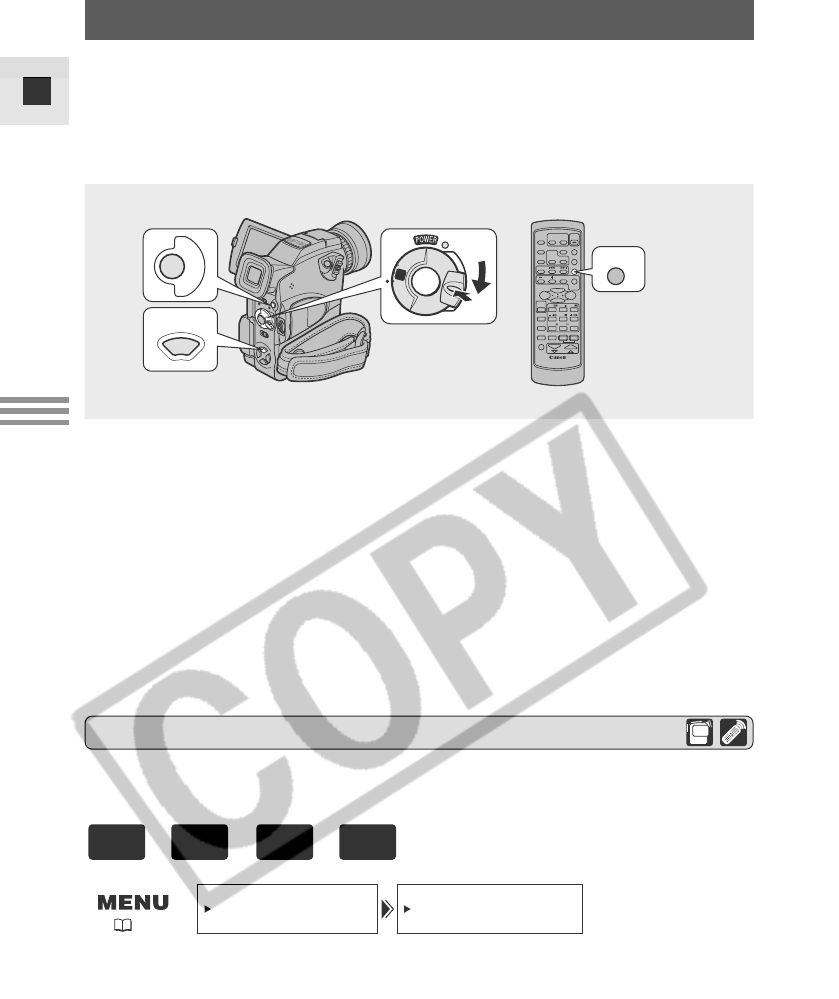
84
E
Using the Full
Range of Features
During TAPE PLAY (VCR) mode, the data code can be displayed or hidden
while the camcorder is in play, slow or still mode.
Camcorder data may be displayed as “– – –” during fast forward, rewind,
reverse playback, forward and reverse ×2 playback.
Press the DATA CODE button. When using a cassette, press it
while the camcorder is in play, slow or still mode.
• Press it once to display, once more to hide it.
• The data code will also be displayed on a TV screen connected to the
camcorder.
Displaying Date, Time and Camcorder Data (Data Code)
(
V
C
R
)
P
L
A
Y
C
A
M
E
R
A
O
F
F
M
E
N
U
F
O
C
U
S
/
D
A
T
A
C
O
D
E
//
DATA C O D E
To change the date and time combination, open the menu and
select DISP.SET UP. Then select D/TIME SEL, set it to DATE, TIME
or DATE & TIME and close the menu.
Selecting Date/Time
Select whether you want the date, the time, or both to show up on your
data code display.
D/TIME SEL.•DATE & TIME
DISP.SET UP
( 38)
+,+
PLAY
(VCR)
CARD
PLAY
(VCR)
TAPE
A data code, containing the date and time the recording was made and
other camcorder data (shutter speed and exposure settings) is automatically
recorded on a special data section of the tape.
• Only the date and time appear in the data code when using a memory
card.
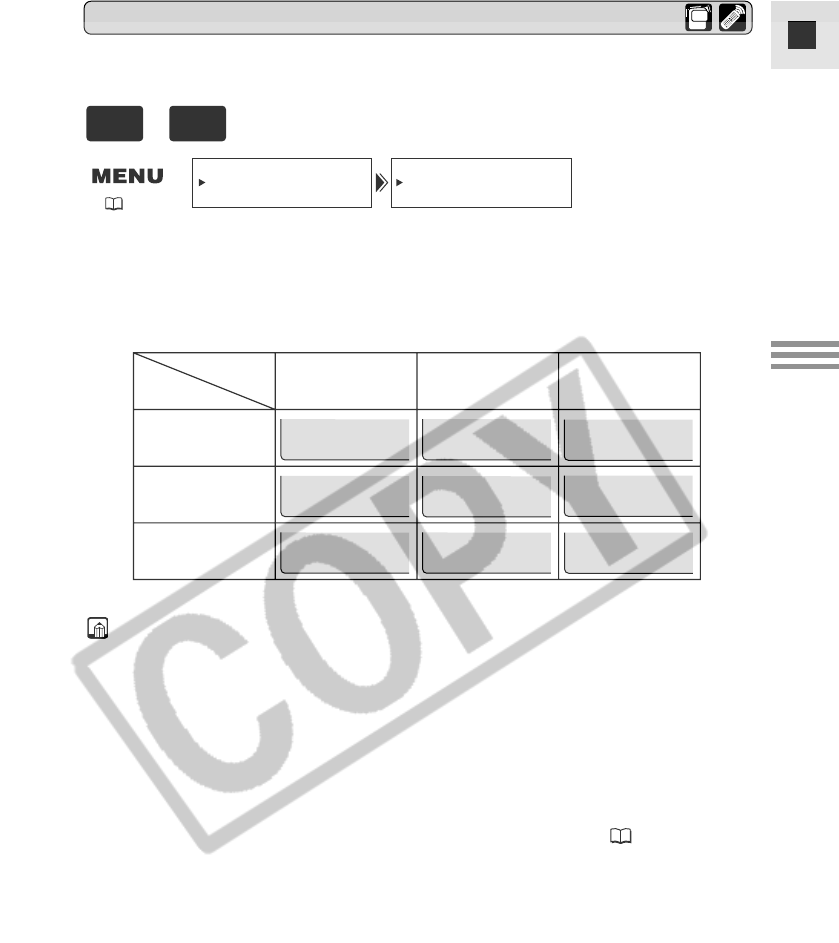
85
E
Using the Full
Range of Features
You can also choose to display camcorder data (shutter speed and exposure
settings) in cassette data codes.
DATA CODE•••DATE/TIME
DISP.SET UP
( 38)
Setting the Data Code
Date/Time Camcoder data Date/Time &
Camcoder data
Time
Date & Time
Date
DATA CODE
(tape only)
D/TIME SEL.
F1.8
1/250
F1.8
1/250
1.JAN.2002
12:00:00 AM
12:00 AM
1.JAN.2002
F1.8
1/250
F1.8
1/250
1.JAN.2002
F1.8
1/250
12:00:00 AM
F1.8
1/250
12:00 AM
1.JAN.2002
Notes:
• The data code will read “– – –” in the following situations:
– During playback of a blank section of tape.
– If the tape was recorded before entering the date and time in the
camcorder’s memory.
– If the tape was recorded on a camcorder without a data code function.
– If noise or tape damage prevents the data code from being read.
• If a recording made on MVX2i is played back on a different DV camcorder,
the data code may not be displayed correctly.
• The data code will appear in the display even if DISPLAYS ( 171) has
been set to OFF through the menu.
Possible data code combinations for cassettes:
To change, open the menu and select DISP.SET UP. Then select
DATA CODE, set it to DATE/TIME, CAMERA DATA or CAM. & D/T
and close the menu.
+
PLAY
(VCR)
TAPE
86
E
Using the Full
Range of Features
Six-second Auto Date
The 6-second auto date appears for 6 seconds to mark the changeover of a
day if the tape was being recorded at 12:00 midnight. It also appears for 6
seconds when you start playback and have the data code turned off. The 6-
second auto date will adjust for any time zone changes you have indicated.
To turn the 6-second auto date on, open the menu and select
DISP.SET UP. Then select 6SEC. DATE, set it to ON and close the
menu.
Note:
• When 6SEC.DATE is turned on but DISPLAYS ( 171) is turned off, the
six-second auto date will still appear for 6 seconds.
6SEC. DATE•••OFF
DISP.SET UP
( 38)
+
PLAY
(VCR)
TAPE
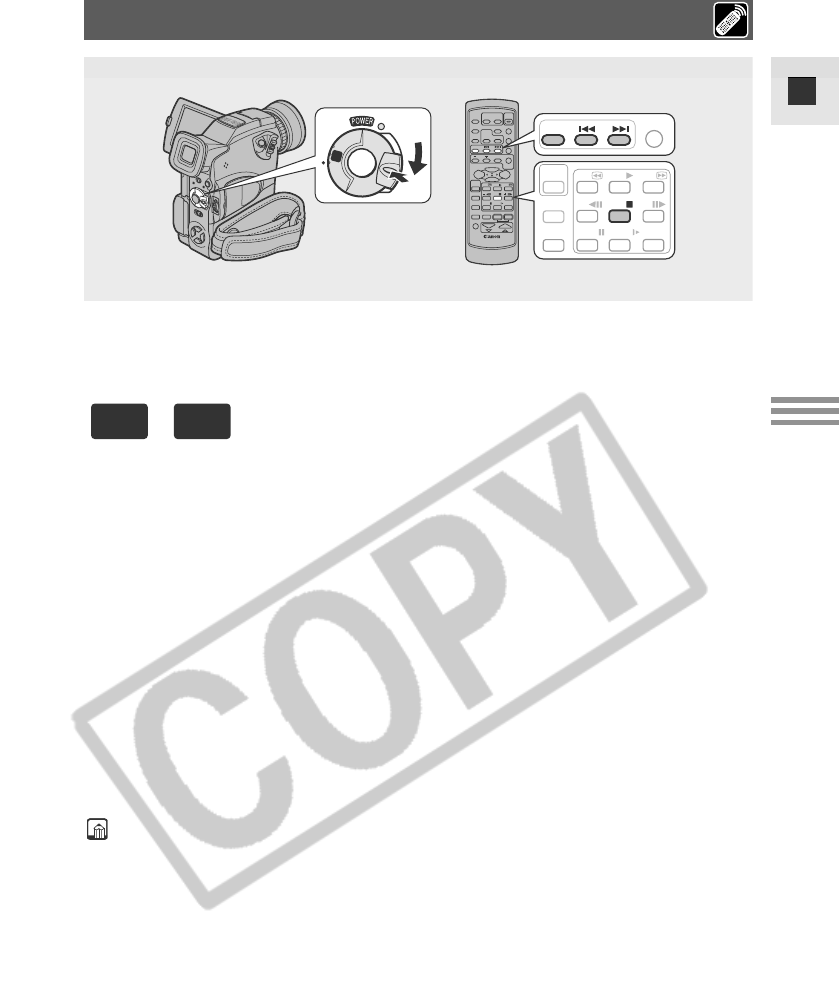
87
E
Using the Full
Range of Features
Searching the Tape (Photo Search/Date Search)
This allows you to move quickly through still pictures recorded anywhere on a
tape (photo search) or between different days or areas of recording (date
search) on a tape.
1. Press the SEARCH SELECT button to choose between
photo/date search.
• PHOTO SEARCH or DATE SEARCH appears in the display for 4 seconds.
2. Press the -and +buttons to move backwards or
forwards through the still images or between different days
of recording.
• Press once to move to the start of the previous/next still image or day
on the tape.
• You can press more than once to move to the corresponding still image
or day (up to a maximum of 10 times), e.g. press the +button 5
times to move forward 5 still images or days.
• PHOTO SEARCH/DATE SEARCH appears in the middle of the display
alongside the -or +mark and number to search through. You can
change direction easily by pressing the button for the opposite
direction.
Notes:
• Press 3(stop) to stop searching.
• If you begin a search very close to the start of a recorded still image during
photo search, the camcorder may skip straight past it.
• When you have set the time zone, date search also looks for the change in
date based on the adjusted time.
• A date/time zone cannot be identified if the total recording time on that
day/time zone was less than 1 minute.
• Date search playback may start just before or after the beginning of the
located section.
• If the data code is not displayed correctly you will not be able to operate
the date search correctly.
(
V
C
R
)
P
L
A
Y
C
A
M
E
R
A
O
F
F
//
REW
PLAY
FF
SEARCH SELECT
DATA CODE
STOP
PAUSE
SLOW
×2
+/
–/
REC
PA U S E
ZERO SET
MEMORY
AUDIO DUB.
+
PLAY
(VCR)
TAPE
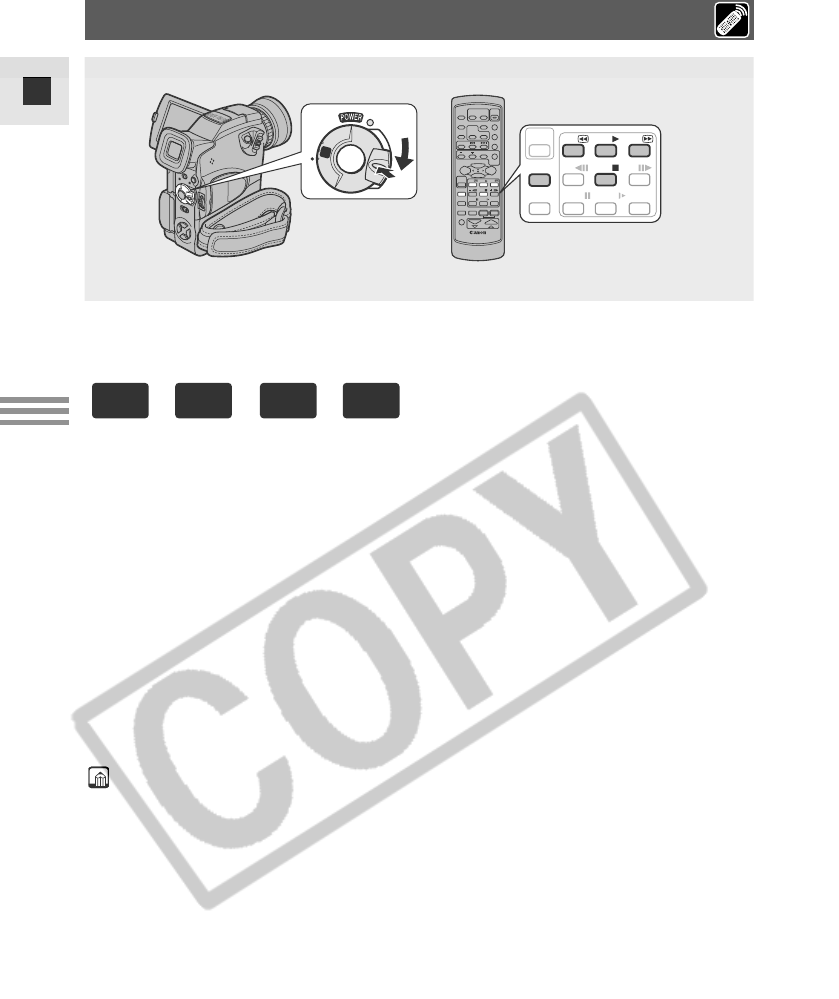
88
E
Using the Full
Range of Features
Returning to a Pre-Marked Position
Use the wireless controller to mark a point on a tape that you want to return
to following playback.
1. Press the ZERO SET MEMORY button on the wireless
controller during playback at a point you want to return to
later.
• The time code is replaced by a tape counter that is set to zero with the
Â
indication.
• Press the ZERO SET MEMORY button once more to cancel the zero set
memory.
2. When you have finished playback, fast forward or rewind
the tape. The tape stops automatically when it reaches the
zero set position.
•RTN1or `RTN appears in the display.
• The tape counter with
Â
indication disappears from the display and the
time code reappears.
Notes:
• The zero set memory may not function correctly where there is a break
between recordings on the tape.
• You can also use zero set memory to mark a position on a tape in TAPE
CAMERA mode. When you then play back the tape, pressing rewind will
take you back to the pre-marked position.
• If you remove the tape while the zero set memory is set, the memory is
cancelled and the tape counter reverts to time code.
• The camcorder remembers your setting even if you turn it off and back on
again or move the program selector.
(
V
C
R
)
P
L
A
Y
C
A
M
E
R
A
O
F
F
//
REW
PLAY
FF
ZERO SET
MEMORY
AUDIO DUB.
STOP
PAUSE
SLOW
×2
+/
–/
REC
PAUSE
+,+
PLAY
(VCR)
TAPE
CAMERA
TAPE
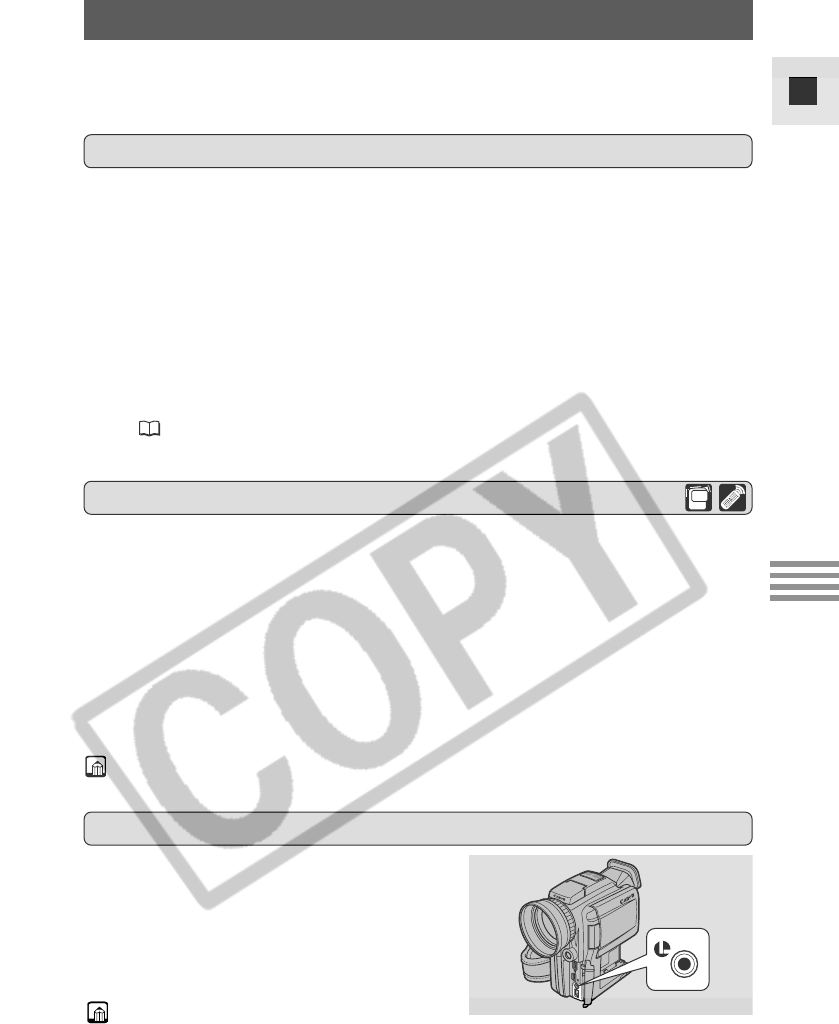
89
E
Editing
1. Connect the camcorder to the VCR.
• See “Connections for Playback on a TV Screen” on p. 34.
2. Prepare the TV and VCR.
• Turn on the TV and set the TV/VIDEO selector to VIDEO.
• Turn on the VCR, and set its input selector to LINE. Load a blank
cassette, and put the VCR in record pause mode.
• See your TV and VCR instruction manuals for details.
3. Turn the camcorder’s POWER switch to PLAY (VCR), and move
the camcorder’s TAPE/CARD switch to TAPE.
• Make sure the AV/headphone terminal is set to AV through the menu
( 34). If PHONES appears in the display, switch the terminal.
4. Load your recorded cassette.
Editing to a VCR
1. Find a point on your recorded cassette slightly before the
section you wish to copy.
2. Start to play it back while you monitor the picture on the TV.
3. Start recording on the VCR as soon as the section you wish
to copy appears on the screen.
4. Pause the VCR at the end of the section you wish to copy,
then stop playback on the camcorder.
5. Repeat steps 1 to 4 until your edited recording is complete.
Note:
• The quality of the edited tape will be slightly lower than that of the original.
By connecting the camcorder to a VCR, you can edit your recordings in order
to remove unwanted scenes — or combine different shots to create your
own video productions.
The mterminal allows you to connect
the camcorder to equipment. Some
buttons on editing equipment may
operate differently from those on the
camcorder.
Preparations
Editing
m(LANC) Terminal
Notes:
•m(LANC) is a trademark. It stands for Local Application Control Bus System.
• We cannot guarantee the results when connecting to equipment not
bearing the LANC msymbol.
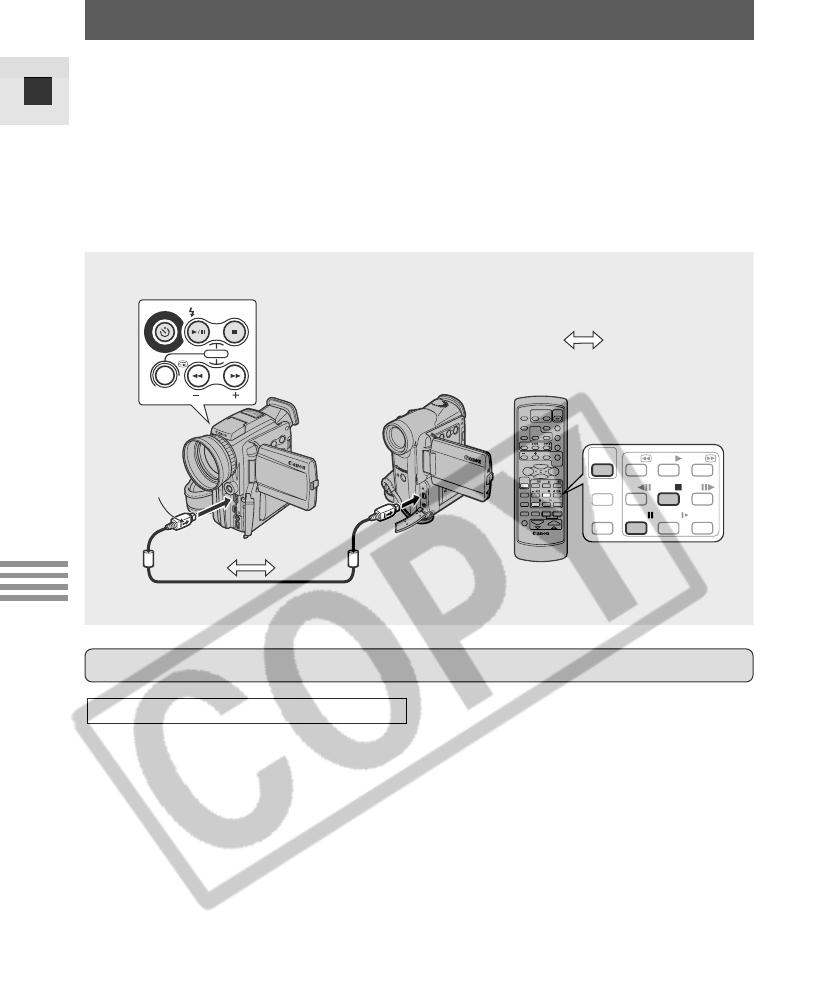
90
E
Editing
//
REW
PLAY
FF
STOP
PAUSE
SLOW
×2
+/
–/
REC
PAUSE
ZERO SET
MEMORY
AUDIO DUB.
(
L
I
N
E
I
N
)
R
E
C
P
A
U
S
E
INDEX
REC SEARCH
SCREEN
MIX/
CARD
SLIDE SHOW
Digital video equipment fitted with the DV terminal lets you edit, copy and
transfer data digitally, with virtually no generation loss in image and sound
quality. The DV terminal is for both line-in and line-out, since a single DV
cable can handle data in both directions.
• If a digital VCR is connected and an anomalous signal is sent from the
VCR, the images recorded on the tape may also be anomalous (although it
may not appear so on the TV image), or not recorded at all.
• You are unable to dub tapes recorded with the copyright protective signal.
Side with arrow
: Signal flow
1. Connect the camcorder and the other digital device.
• Connect the Canon CV-150F DV cable (optional) with the sides of the
plugs marked with the arrows facing as shown above.
2. Prepare the other device.
• Turn on the power and load a recorded cassette.
3. Turn the camcorder’s POWER switch to PLAY (VCR), and move
the camcorder’s TAPE/CARD switch to TAPE.
• DV IN appears in the display.
4. Load a blank cassette.
Example dubbing to the camcorder
Preparations
Dubbing to/from a Tape with Digital Video Equipment
91
E
Editing
1. Find a point on your recorded cassette slightly before the
section you wish to copy and set it to playback pause mode.
2. Press the REC PAUSE button on the wireless controller.
• The camcorder enters record pause mode.
3. Start playback on the other digital device while you monitor
the picture.
4. Press the pause button.
• Recording starts.
5. When you get to the point where you wish to stop
recording, press the stop button or the pause button.
• Recording stops.
6. Stop playback on the other device.
Notes:
• Blanks between recordings on the playback tape are recorded as
anomalous images on the tape that is being recorded to.
• When dubbing to a tape via the DV terminal, make sure that AV \ DV is
not displayed on the screen. If so, set AV \ DV OUT to OFF ( 96).
Dubbing

92
E
Editing
Concerning Copyrighting
Copyright precaution
Certain pre-recorded video tapes, films and other materials, as well as some
television programmes are copyrighted. Unauthorized recording of these
materials may violate copyright protection laws.
Copyright signals
When playing back:
If you try to play back a tape that contains copyright control signals for the
protection of software, “COPYRIGHT PROTECTED PLAYBACK IS
RESTRICTED” appears in the display for a few seconds and then the
camcorder displays a blank blue screen; you cannot view the contents of the
tape.
When recording:
If you try to record from software that contains copyright control signals for
the protection of software, “COPYRIGHT PROTECTED DUBBING
RESTRICTED” appears in the display; you cannot record the contents of the
software.
You cannot record copyright protection signals to a tape using this
camcorder.
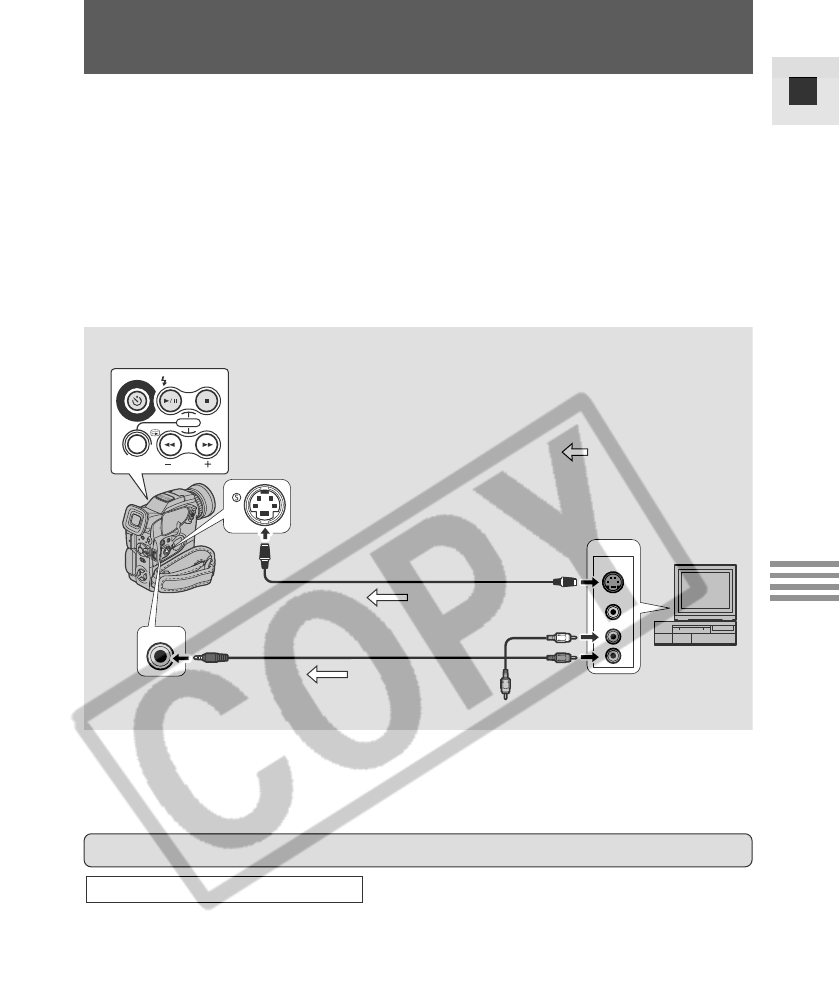
93
E
Editing
OUTPUT
VIDEO
S(S1)-VIDEO
AUDIO
L
R
AV
IN/OUT
(
L
I
N
E
I
N
)
R
E
C
P
A
U
S
E
INDEX
REC SEARCH
SCREEN
MIX/
CARD
SLIDE SHOW
IN/
OUT
1. Connect the camcorder to the VCR.
2. Prepare the device.
• Set the TV/Video selector on the television to Video. For further details,
see “Connections for Playback on a TV Screen” on p. 34.
• Turn on the VCR. Load your recorded cassette, and put the VCR in
playback pause mode.
• See your TV and VCR instruction manuals for details.
Example recording from a VCR
Preparations
S-150 S-video Cable
STV-250N Stereo Video Cable
: Signal flow
Recording from a VCR, TV or Analog Camcorder
(Analog Line-in)
You can record a video played on your VCR or analog camcorder (for digital
camcorders, see p. 90) or a TV program onto a tape in the MVX2i, if the TV
or other device has audio/video outputs.
• If an anomalous signal is sent from the TV or VCR, the images recorded on
the tape may also be anomalous (although it may not appear so on the TV
image), not recorded at all, or COPYRIGHT PROTECTED DUBBING
RESTRICTED may appear in the display.
• You are unable to dub tapes recorded with the copyright protective signal.
• For higher picture quality, we recommend using the S-150 S-video cable
when doing analog line-in recording.
You cannot use headphones while doing analog line-in recording. If you have
the AV/headphones terminal set to headphones, it will automatically switch
to AV for analog line-in recording. PHONES disappears from the display.
94
E
Editing
1. Find a point on your recorded cassette slightly before the
section you wish to copy and set it to playback pause mode.
2. Press the REC PAUSE button on the wireless controller.
• S-video and AV IN/OUT terminals work as input terminals.
• The camcorder enters record pause mode.
3. Start playback on the other device or turn on the TV to see
the desired program while you monitor the picture.
4. Press the pause button.
• Recording starts.
5. When you get to the point where you wish to stop
recording, press the stop button or the pause button.
• Recording stops.
6. Stop playback on the other device.
Note:
• You can monitor the picture in the viewfinder or LCD screen.
Dubbing
3. Turn the camcorder’s POWER switch to to PLAY (VCR), and
move the camcorder’s TAPE/CARD switch to TAPE.
4. Load a blank cassette.
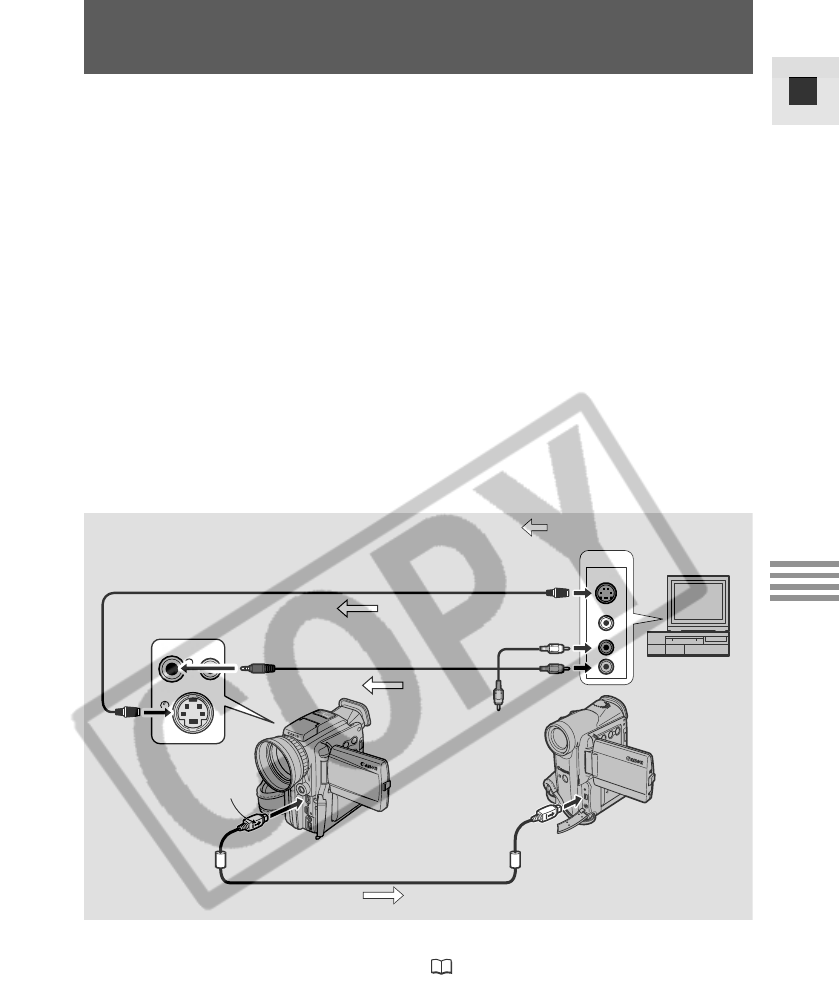
95
E
Editing
Connecting the camcorder to your VCR or 8 mm video camera allows
conversion of recorded analog video and audio signals to digital signals in an
instant. The digital signals can be output to the other equipment with a DV
terminal. The camcorder’s DV terminal works exclusively as an output
terminal.
• There may be cases where analog-digital conversion cannot be done
properly, depending on the signals output from the connected equipment.
For example: Signals that include the copyright protective signal, or
anomalous signals such as ones that include ghost signals, etc.
• You cannot use your headphones during digital conversion. Even if the
AV/headphone terminal is set to “PHONES” through the menu, it will
automatically be set to “AV”, and “PHONES” will disappear from the
display.
• You are recommended to use power from a household power socket with
the power adapter.
• Do not operate with a cassette inserted to the camcorder.
• Turn off the power of all equipment before performing connections.
• Refer also to the instruction manuals of the other equipment connected.
Digitally Outputting Analog Video and Audio
Signals (Analog-Digital Converter)
IN/
OUT
AV IN/OUT
MIC
OUTPUT
VIDEO
S(S1)-VIDEO
AUDIO
L
R
CV-150F DV Cable
S-150 S-Video Cable
STV-250N Stereo Video Cable
: Signal flow
Above illustration shows the connection using a S-video cable. You can also
connect to the VIDEO terminal instead ( 36).
Side with arrow
96
E
Editing
Turning the Analog-Digital Converter On
AV DV OUT•••OFF
VCR SET UP
( 38)
+
PLAY
(VCR)
TAPE
To turn the analog-digital converter on, open the menu and
select VCR SET UP. Then select AV \DV OUT, set it to ON and
close the menu.
OR
Press the AV \DV button on the wireless controller.
Caution:
• For normal use, set AV \DV OUT to OFF (so that AV \DV does not
appear in the display). If it is set to ON, you cannot input digital signals
through the camcorder’s DV terminal.
• When connecting to a PC equipped with a DV terminal, you may not be
able to transfer converted signals to your PC, depending on the software
you are using, and the specifications of your PC and its settings.
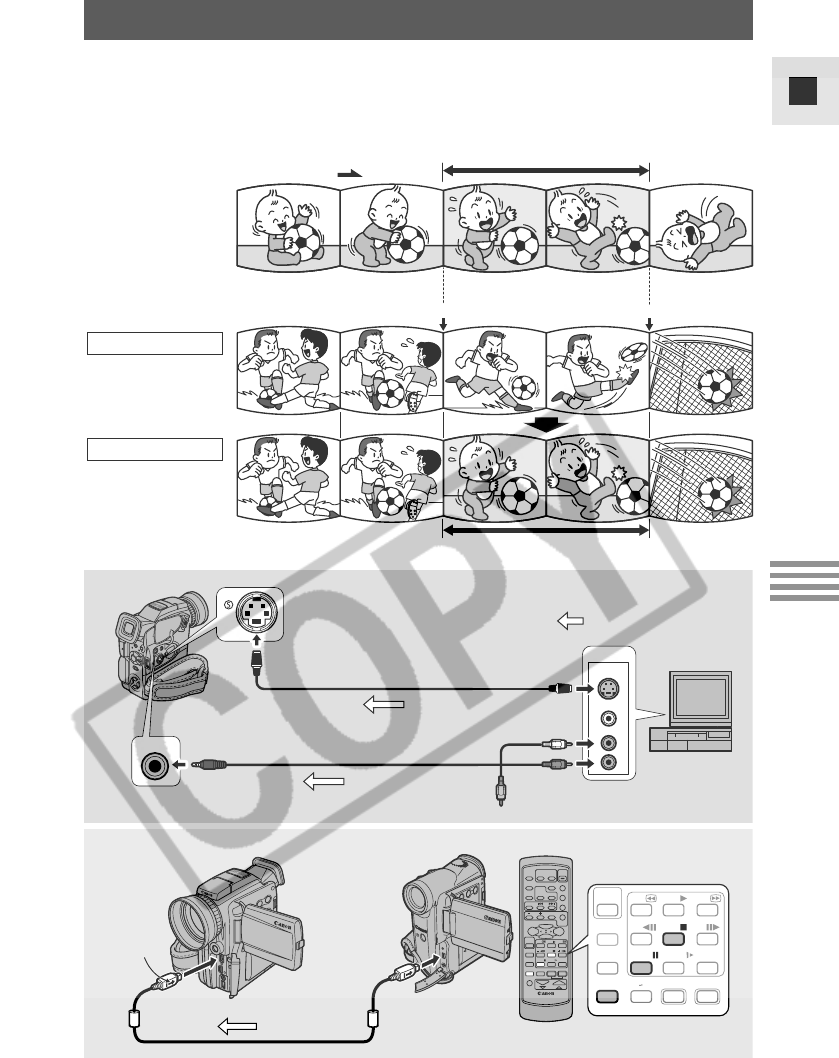
97
E
Editing
Recording Over Existing Scenes (AV Insert Editing)
You can insert and replace images/audio recorded on the camcorder’s tape
with other images/audio recorded with other video equipment using both,
analog line-in or DV in terminals. Original video and audio will be replaced
with the new video and audio.
//
REW
PLAY
FF
STOP
PAUSE
SLOW
×2
+/
–/
REC
PAUSE
ZERO SET
MEMORY
AUDIO DUB.
AV INSERT
SET
MENUAV DV
Scene to be inserted
Insert start point Insert end point
The video and audio of the new scene replace that of the old.
The playback tape
Before inserting
After inserting
The tape in the
camcorder
The tape in the
camcorder
Side with
arrow
OUTPUT
VIDEO
S(S1)-VIDEO
AUDIO
L
R
AV
IN/OUT
IN/
OUT
S-150 S-video Cable
STV-250N Stereo Video Cable
: Signal flow

98
E
Editing
Preparations
The tape in the camcorder:
When using the MVX2i’s AV insert function, only record to tapes recorded in
SP mode.
If there are non-recorded portions or portions recorded in a mode other than
SP mode on the tape, recording will stop.
The playback tape:
Use only tapes without non-recorded portions.
If there are non-recorded portions or changes in the recording mode, you
may not be able to insert AV correctly.
You cannot insert AV in the following cases:
• The playback tape has been poorly recorded.
• During special playback: fast forward playback, rewind playback or slow
playback etc. (analog only).
TV:
You cannot insert AV from a TV program with anomalous synchronized
signals, such as when the program itself received poor signals.
1. Connect the camcorder to the VCR.
2. Prepare the VCR and TV.
• Set the TV/Video selector on the televison to Video. For further details,
see “Connections for Playback on a TV Screen” on p. 34.
• Turn on the VCR and load a recorded cassette.
• See TV and VCR instruction manuals for details.
3. Turn the camcorder’s POWER switch to PLAY (VCR) and load
a recorded cassette.
• Make sure the REC/SAVE tab on the cassette has been slid to REC
(closed position).
4. Move the camcorder’s TAPE/CARD switch to TAPE.
Example recording from a VCR

99
E
Editing
1. On the VCR, locate a point 3 seconds before the scene to be
inserted. Set the VCR to playback pause mode.
2. On the camcorder, press PLAY and locate the recording start
point. Set the camcorder to playback pause mode.
• You can use the playback buttons on the body of the camcorder or the
special playback functions on the wireless controller in the same way as
in playback mode.
3. Press the AV INSERT button.
• AV INSERT and 2a appear in the display.
4. Play back the cassette in the VCR.
5. To start inserting, press the PAUSE button on the camcorder.
•2a changes to 2.
6. To stop inserting, press the STOP button on the camcorder.
• Inserting stops and AV INSERT disappears from the display. The
camcorder returns to stop mode.
• If instead of pressing STOP you press PAUSE, the camcorder returns to
the AV insert pause mode.
• If you set the zero set memory at the position on the tape where you
want to stop inserting, every time you return to that point, the
camcorder will cancel its AV inserting and enter stop mode.
7. Stop playback on the VCR.
Editing
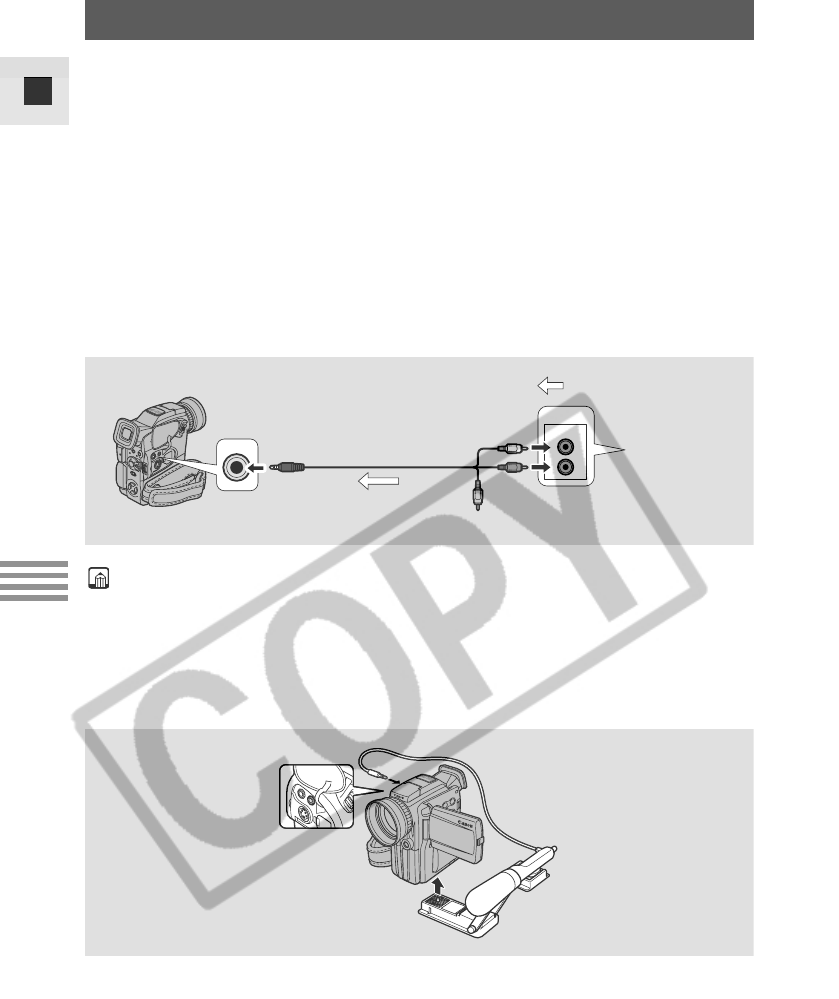
100
E
Editing
AV
IN/OUT
OUTPUT
AUDIO
L
R
You can add sound to the original sound on a pre-recorded tape from audio
devices (AUDIO IN) or with the internal or external microphone (MIC. IN). The
original sound will not be erased. For best results, add sound to tapes that
have been recorded with this camcorder in SP mode with 12-bit sound. If
there are non-recorded portions on the tape, or portions recorded in a mode
other than SP mode, or with 16-bit or 12-bit 4-channel sound, dubbing will
stop. If your tape has not been recorded in SP mode with 12-bit sound, we
recommend dubbing your original tape onto a blank tape using the MVX2i’s
analog line-in function, then dubbing audio onto the new tape. Make
absolutely sure to set the audio mode of the new tape to 12-bit and the
recording mode to SP.
To connect other audio devices:
Notes:
• Do not use the yellow video terminal.
• The AV terminal doesn’t put out any video, so connect the S-video
terminals and check your TV, or check the LCD or the viewfinder as you
add new sound. Always check the new sound with the speaker.
To connect an external microphone:
STV-250N
Stereo Video Cable An audio device
(i. e. CD player)
: Signal flow
Audio Dubbing
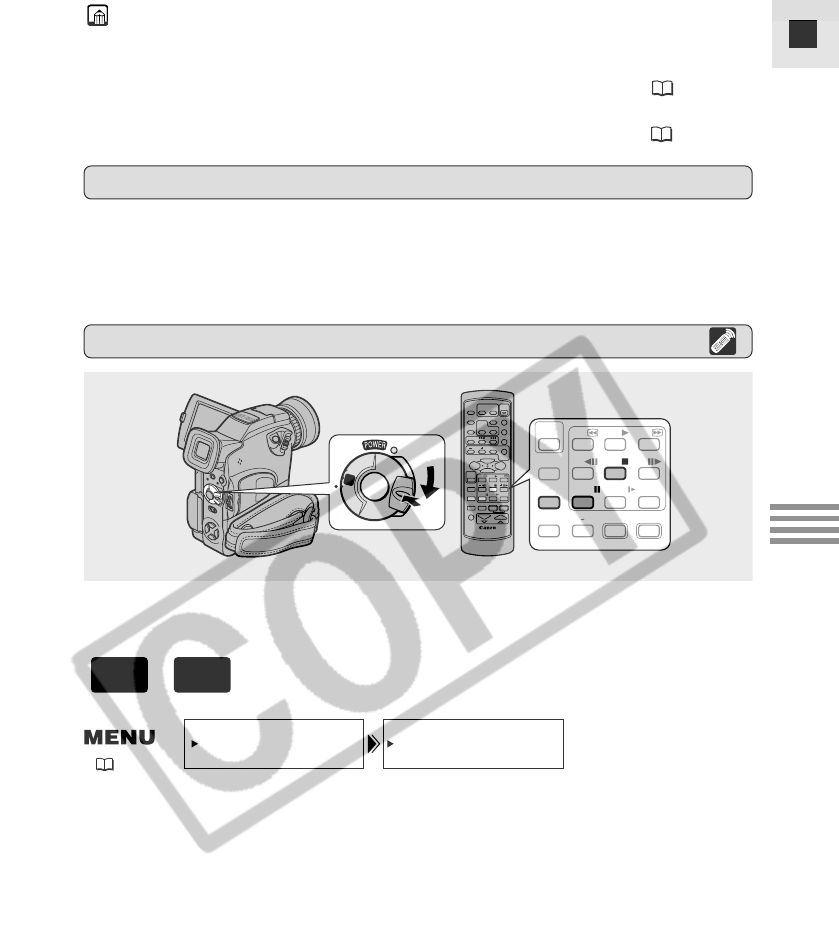
101
E
Editing
AUDIO DUB.••AUDIO IN VCR SET UP
( 38)
//
REW
PLAY
FF
STOP
PAUSE
SLOW
×2
+/
–/
REC
PAUSE
ZERO SET
MEMORY
AUDIO DUB.
AV INSERT
SET
MENUAV DV
(
V
C
R
)
P
L
A
Y
C
A
M
E
R
A
O
F
F
Do not connect/disconnect any cables to/from the camcorder when dubbing
audio or preparing to dub audio.
Preparations
Dubbing
Turn the camcorder’s POWER switch to PLAY (VCR) and move the
camcorder’s TAPE/CARD switch to TAPE. Load a recorded cassette.
• Make sure the REC/SAVE tab on the cassette has been slid to REC (closed
position).
Notes:
• When you add sound using the built-in microphone make sure not to
connect any cables to the MIC terminal.
• To use your TV to monitor video, connect the S-video terminal ( 35) or
the AV terminal (use only the video plug) to your TV. You can monitor the
sound with headphones only when using the S-video terminal ( 33).
+
PLAY
(VCR)
TAPE
1. Open the menu and select VCR SET UP.
2. Select AUDIO DUB.
3. Select AUDIO IN or MIC. IN and close the menu.
4. Locate the point where you wish to start audio dubbing,
then press the PAUSE button.
• You can use the playback buttons on the body of the camcorder or the
special playback functions on the wireless controller in the same way as
in playback mode.
• The camcorder becomes set to playback pause mode.
102
E
Editing
5. Press the AUDIO DUB. button.
• AUDIO DUB. and appear on the display.
6. Press the PAUSE button (and start play on the other audio
device if AUDIO IN).
• Audio dubbing starts.
• Direct your voice into the microphone.
• changes to .
7. When you get to the point where you wish to stop dubbing,
press the STOP button (and then stop play on the other
audio device if AUDIO IN).
• Audio dubbing stops and AUDIO DUB. disappears from the display.
• The camcorder returns to stop mode.
• You can also set zero set memory ( 88) at the place you want to stop
audio dubbing, then every time you return to that position, audio
dubbing will cancel.
• If instead of pressing STOP you press PAUSE, the camcorder will return
to the playback pause mode.
Notes:
• You cannot use the DV terminal while adding sound.
• You might want to adjust the audio mix ( 103) when playing back a
tape with added sound.
• There may be a loss of sound quality if you add sound to a tape recorded
on a camcorder other than the MVX2i.
• After adding sound 3 or more times to the same place on a tape, there
may be some loss in sound quality.
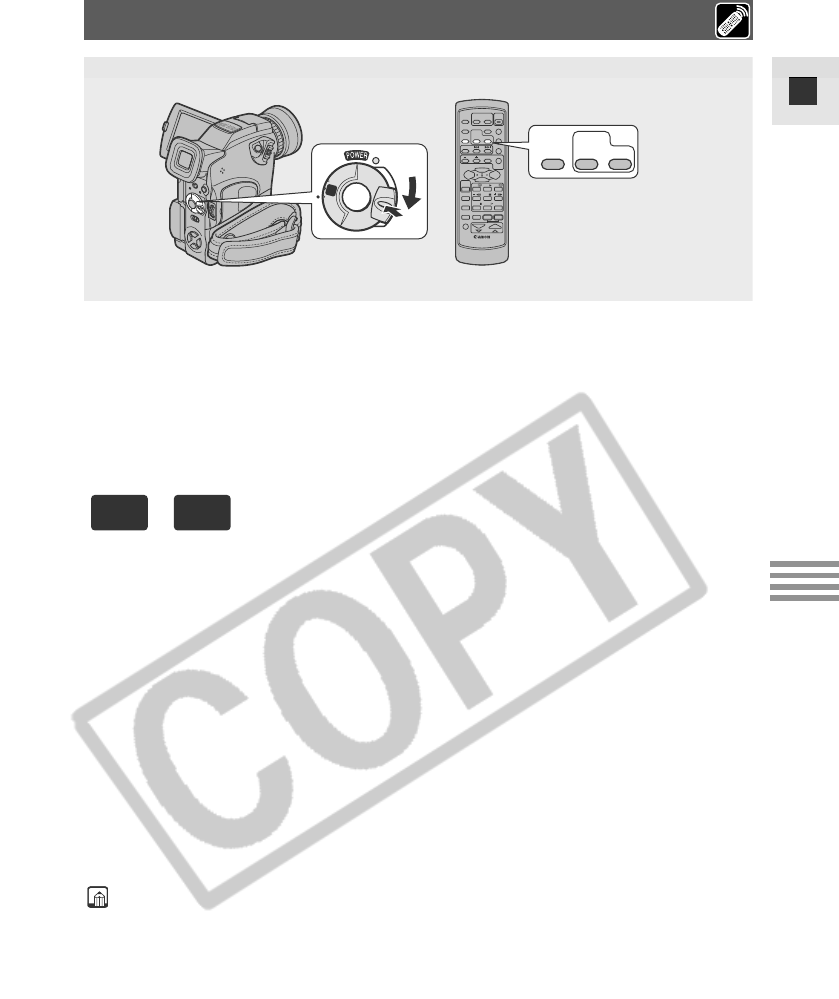
103
E
Editing
Setting the Audio Mix
//
AUDIO
MONITOR
MIX
BALANCE
ST-1 ST-2
(
V
C
R
)
P
L
A
Y
C
A
M
E
R
A
O
F
F
When you play back a tape that was recorded in 12-bit mode, you can set
the audio output to play: stereo 1 (the original sound), stereo 2 (any new
sound, dubbed to the tape after recording), or mix the balance between the
two.
• Audio from the 16-bit mode only contains stereo 1 sound and so you
cannot/do not need to select the audio mix. The same is true for the 12-bit
stereo 1 mode, unless new sound has been added post-recording.
1. Choose the output.
• Press AUDIO MONITOR on the wireless controller.
• Starting with the last selected setting, 4 settings appear as you push
the button:
– STEREO1 for just stereo 1.
– STEREO2 for just stereo 2.
– MIX/FIXED for an equal mix of stereo 1 and 2.
– MIX/VARI. (mix variable) for when you wish to mix the balance
between stereo 1 and 2.
• To simply choose STEREO1, STEREO2 or MIX/FIXED, make sure your
choice appears on the display.
• If you choose MIX/VARI., you can go on to mix the balance.
• Use the ST-1/ST-2 keys to mix the balance. A bar showing the mix
appears on the screen for 4 seconds.
Note:
• When you have chosen the output, STEREO1, STEREO2, MIX/FIXED or
MIX/VARI. is shown in the top left of the display for a few seconds. If you
turn the power off the output is set to STEREO1.
+
PLAY
(VCR)
TAPE
104
E
Editing
When you play back a tape whose audio has been recorded on multiple
channels, you can change the output channels of that sound.
1. Load a tape recorded with multiple-channel audio.
2. Open the menu and select VCR SET UP. Then select OUTPUT
CH, set it to the desired setting and close the menu.
• Refer to the following list.
Selecting Audio Output Channels
Tape recorded on
multiple channels
main + sub
main only
sub only
OUTPUT CH setting
L/R
L/L
R/R
Playback sound
Tape recorded with
stereo sound
L+R channels
L channel only
R channel only
OUTPUT CH•••L/RVCR SET UP
( 38)
+
PLAY
(VCR)
TAPE
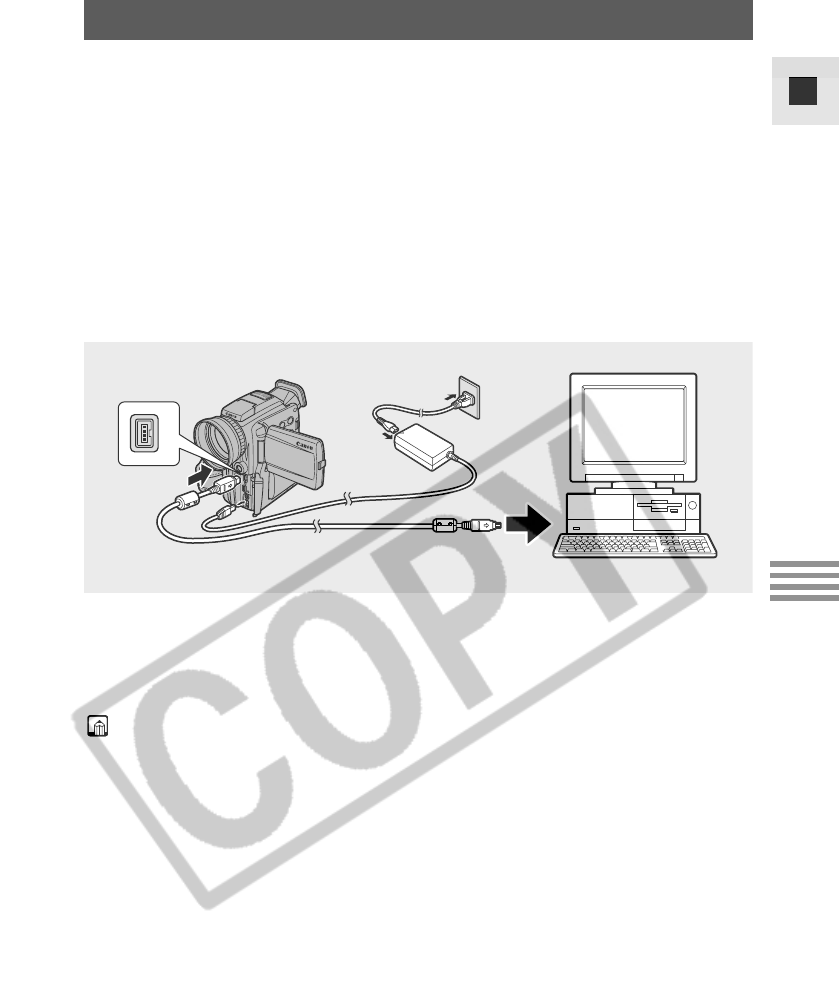
105
E
Editing
You can download still images/movies recorded onto a tape or memory card
with your camcorder to a computer by connecting to a computer equipped
with a DV (IEEE1394) terminal or IEEE1394 capture board. With Windows
XP’s Windows Messenger, you can use the supplied software to perform a
videoconference over the Internet, or upload files from the computer to the
memory card and use the camcorder as a card reader/writer.
• There are several requirements for using this software. For details, please
refer to the DV NETWORK SOLUTION DISK Software Instruction Manual.
• While connected we recommend powering your camcorder from a
household power socket using the power adapter.
• For transferring still images and movies from a memory card to your PC
using a USB cable, see p. 149.
Notes:
• Operation may not work correctly, depending on the software you are
using, and the specifications of your PC and its settings.
• See your PC instruction manual for details.
Cautions:
• Do not disconnect the DV cable, remove the memory card, or turn off the
camcorder or the computer while data is being transferred (while the
camcorder’s card access indicator is flashing). Doing so may damage the
memory card’s data.
• The image files on your memory card and the image files you have stored
(downloaded) to the hard disk drive of your computer are your valuable,
original data files. If you wish to use image files on your computer, be sure
to make copies of them first, and use the copied file, retaining the original.
Connecting to a PC Using a DV Cable
DV IN/OUT
CV-150F or CV-250F (optional)
For details on how to connect the camcorder to a computer,
and install and operate the software, refer to the DV
NETWORK SOLUTION DISK Software Instruction Manual.
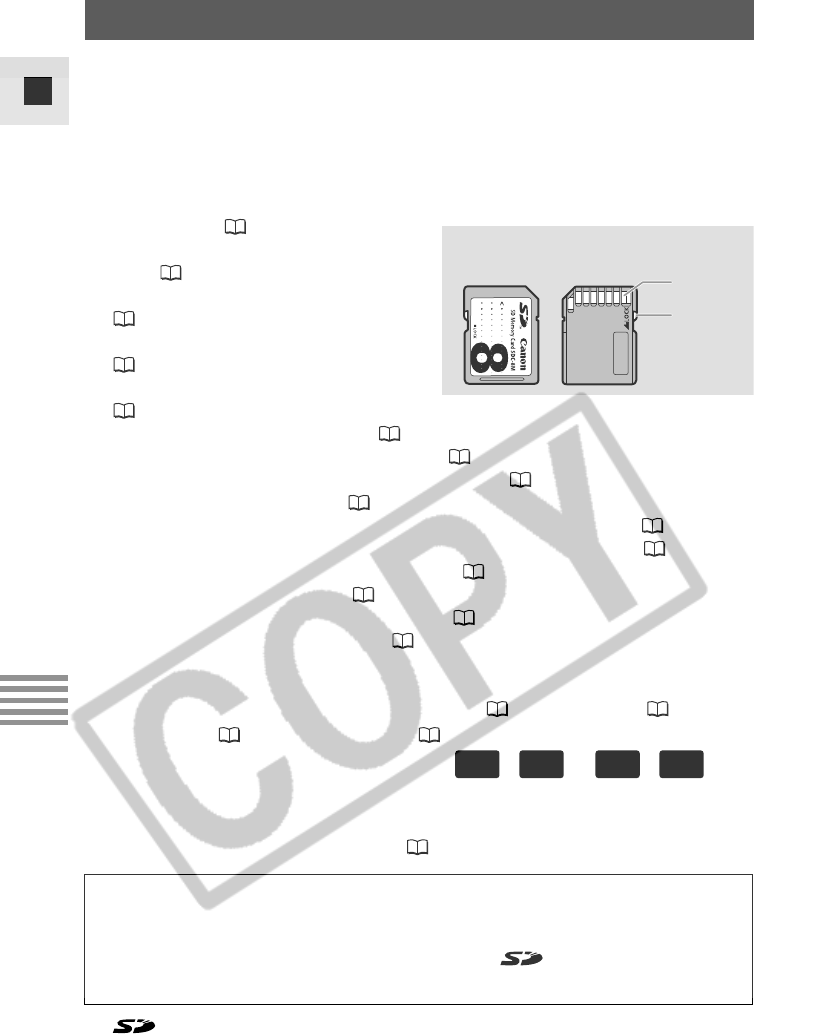
106
E
Using a Memory Card
The camcorder can record, store and manage still images/movies on 2 types
of memory cards: the SD Memory Card (supplied with the camcorder) or the
MultiMediaCard (commercially available). The SD Memory Card has the
protect switch to protect your recordings from accidental erasure. The SD
Memory Card and the MultiMediaCard fit into the same slot.
You can find the explanations in the following order:
• Preparations ( 107-110)
• Recording Still Images to a Memory
Card ( 111-115)
• Recording Movies to a Memory Card
( 116-118)
• Recording panoramic Images
( 119-120)
• Playing Back a Memory Card
( 121-123)
• Settings of Still Images/Movies ( 124-126)
• Preventing Accidental Erasure (Protect) ( 127)
• Marking a Still Image for Printing (Print Mark) ( 128)
• Erasing Still Images/Movies ( 130)
• Using Printers Supporting the Direct Print Function (Optional) ( 132-140)
• Combining Images and Recording Them to a Tape (Card Mix) ( 141-145)
• Copying Still Images to and from a Tape ( 146, 147)
• Formatting a Memory Card ( 148)
• Connecting to a PC Using a USB Cable ( 149)
• Using the My Camera Function ( 150)
You can use most of the camcorder’s functions when recording to a memory
card, such as the various recording programs ( 59), self-timer ( 73),
shutter speed ( 77), white balance ( 81) and other manual adjustments.
Available functions are marked with a the + or +
icons.
●If you use memory cards other than the supplied one, make sure to
format them with the camcorder ( 148).
PLAY
(VCR)
CARD
CAMERA
CARD
Memory Card Introduction
Terminals
Protect
Switch
Front
SD Memory Card SDC-8M
Back
Important
• Inserting or removing the memory card without first setting the POWER
switch to OFF can result in data damage.
• This camcorder uses only SD Memory Cards ( *) or
MultiMediaCards. You cannot use any other types of memory cards.
* logo is a trademark.
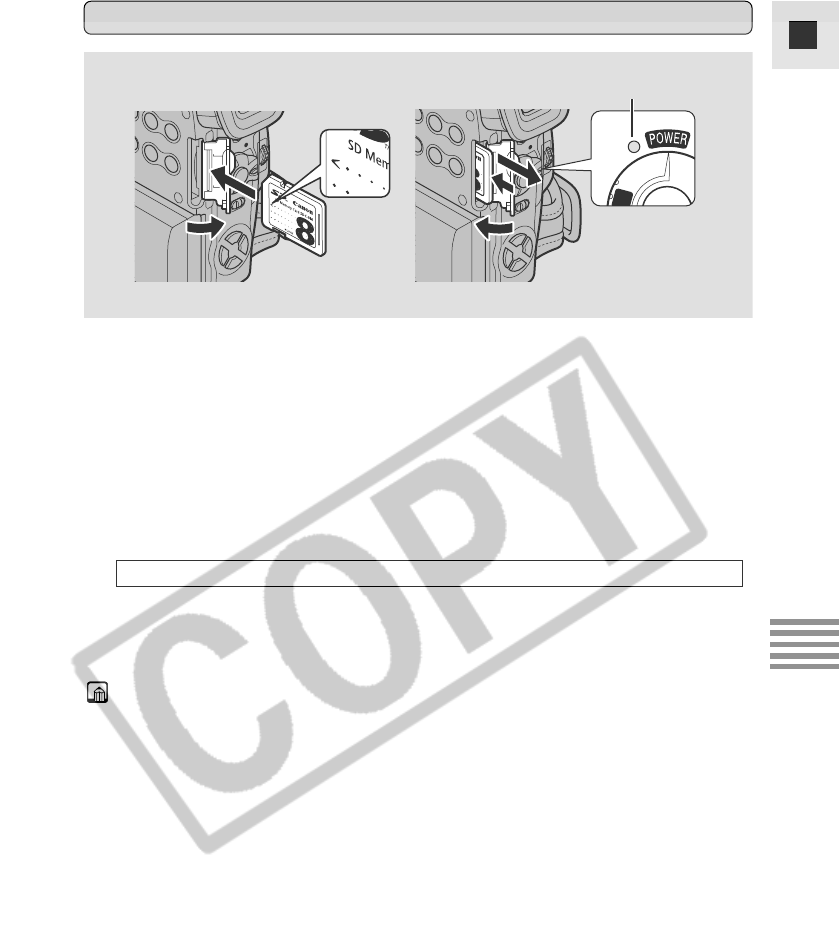
107
E
Using a Memory Card
Inserting and Removing the Memory Card
MultiMediaCardMMC-8M
MR
C
A
M
E
R
A
O
F
F
1. Turn the POWER switch to OFF.
• When removing the memory card, make sure the card access indicator is
off.
2. Open the memory card compartment cover in the direction
of the arrow.
3. Insert or remove the memory card.
• Push the memory card all the way in.
• Remove the memory card by pushing the card in and letting it spring
out.
4. Close the cover.
• When inserting the memory card, do not attempt to close the cover
forcefully without the memory card properly inserted.
Notes:
• When you set the camcorder to CARD PLAY (VCR) mode, the last image
recorded appears. If there are no images recorded on the memory card,
NO IMAGES appears in the display.
• Do not touch the memory card terminals.
Do not attempt to pull the memory card out without first pushing it in.
Card access indicator
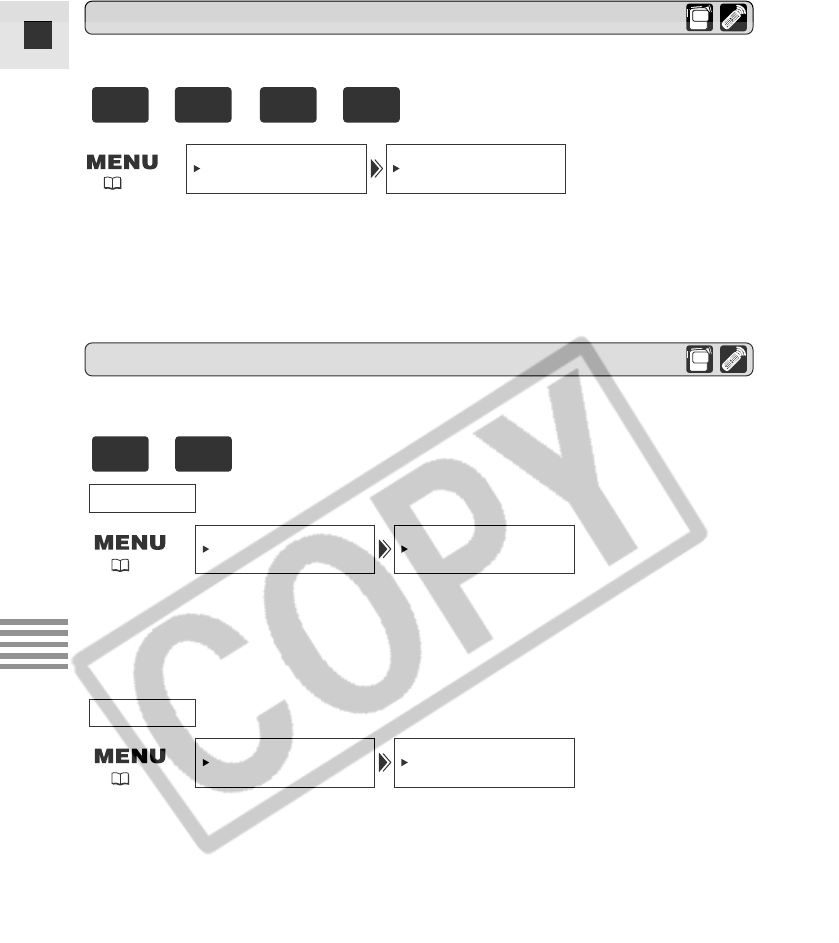
108
E
Using a Memory Card
To change the image quality, open the menu and select CARD SET UP.
Then select SI QUALITY, set it to SUPER FINE or STANDARD, and close
the menu.
• The image quality may not differ between the settings depending on the
subject.
Image Size: Still image: 1280 ×960 pixels/640 ×480 pixels
Movie: 320 ×240 pixels/160 ×120 pixels
To change the image size of a still image, open the menu and select
CARD SET UP. Then select SI SIZE, set it to “640 × 480” and close the
menu.
• “640” appears in the display.
To change the image size of a movie, open the menu and select CARD
SET UP. Then select MOVIE SIZE, set it to “160 × 120” and close the
menu.
• “160” appears in the display.
Movie
Still Image
Selecting the Image Size of Still Images and Movies
SI SIZE•••••
1280×960
CARD.SET UP
( 38)
MOVIE SIZE••
320×240
CARD.SET UP
( 38)
Selecting the Still Image Quality
Still image Quality: Superfine, Fine, Standard
SI QUALITY••FINE
CARD SET UP
( 38)
+,+
CAMERA
CARD
PLAY
(VCR)
TAPE
+
CAMERA
CARD
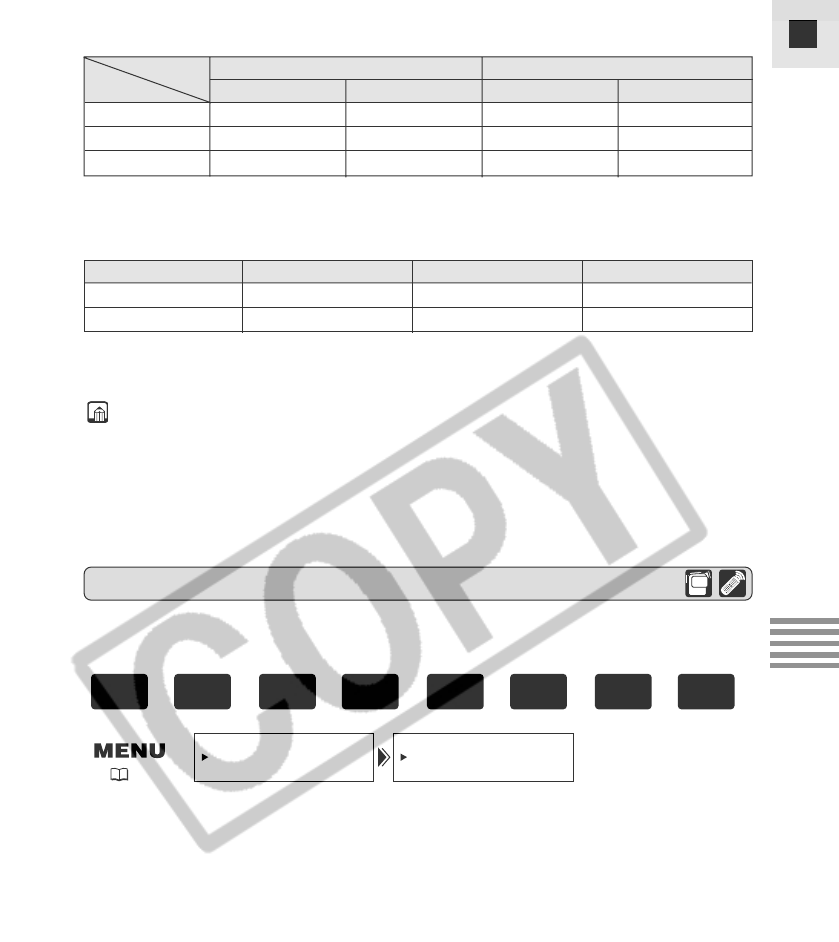
109
E
Using a Memory Card
Maximum Number of Still Images on an 8 MB Memory Card and Their File
Sizes
Maximum Recording Time of Movies on an 8 MB Memory Card and Their
File Sizes
* The actual number varies on the shooting conditions and subjects. Sample images already
recorded on the supplied SD Memory Card are to be included in the total number.
The operating states of the memory card are shown in the middle of the
display.
CARD ACCESS•ON
DISP.SET UP
( 38)
To turn the card access display off, open the menu and select
DISP. SET UP. Then select CARD ACCESS, set it to OFF and close
the menu.
Notes:
• Still images are compressed and recorded in the JPEG (Joint Photographic
Experts Group) format, and movies in the Motion JPEG format.
• Refer to p. 174 for memory card display.
• The remaining number of images that can be recorded on the memory
card may sometimes decrease by 2 images at once.
Card Access Display
Image Size
1280 ×960 640 ×480
Image Quality
No of Images
File Size per Image
No of Images
File Size per Image
Superfine Approx. 6 images 850 KB Approx. 34 images 175 KB
Fine Approx. 10 images 550 KB Approx. 50 images 120 KB
Standard Approx. 18 images 300 KB
Approx. 84 images
65 KB
Image Size Max. Recording Time Total File Size File Size per Second
320 ×240 10 seconds 1.4 MB 140 KB/sec
160 ×120 30 seconds 2.3 MB 77 KB/sec
+,+,+,+
PLAY
(VCR)
CARD
CAMERA
CARD
PLAY
(VCR)
TAPE
CAMERA
TAPE
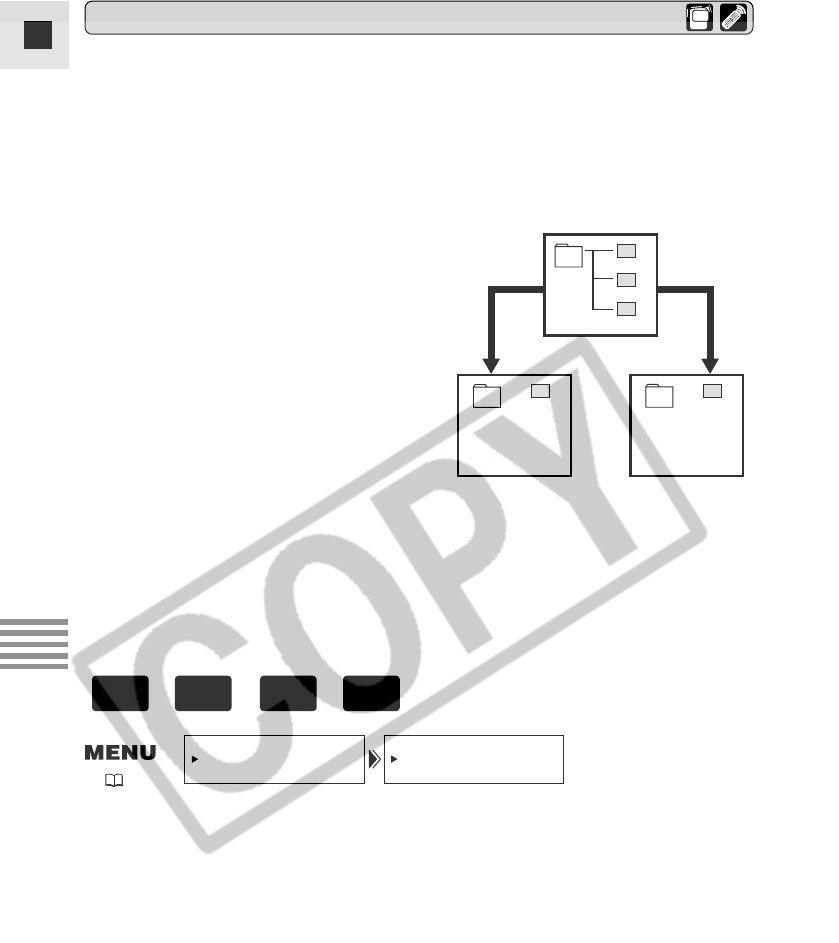
110
E
Using a Memory Card
FILE NOS.•••CONTINUOUS
CARD SET UP
( 38)
To change the file numbering, open the menu and select CARD
SET UP. Then select FILE NOS., set it to RESET and close the
menu.
2RESET
Each time you insert a new memory card, the file number resets to its default
value (101-0101). If the card already contains files, the next available number
is assigned.
File Numbers
The still images/movies are automatically assigned file numbers from 0101-9900
and stored in folders of 100 images each. Each folder is numbered from 101 to
998 and recorded on the memory card. Sample images have been pre-recorded
on the supplied SD Memory Card, entering folder number 100 (folder name is
“100canon”).
Set the image file numbers so that they reset each time a new memory card
is inserted, or so that they count up
continuously.
1CONTINUOUS
Numbering is continuous between cards,
so that the first file number assigned on
a new memory card is 1 more than the
last file number assigned on the previous
memory card. When the file numbers are
set to CONTINUOUS, each image taken
is assigned a different number, avoiding
duplication of numbers. This is
convenient when you want to manage
your images on a PC. We recommend
keeping the file numbers set to CONTINUOUS.
101-0101
101
101-0102
101-0103
101-0104
101 101-0101
101
Three images are recorded on the card.
When you change the
card and take a picture.
12
+,+
CAMERA
CARD
PLAY
(VCR)
TAPE
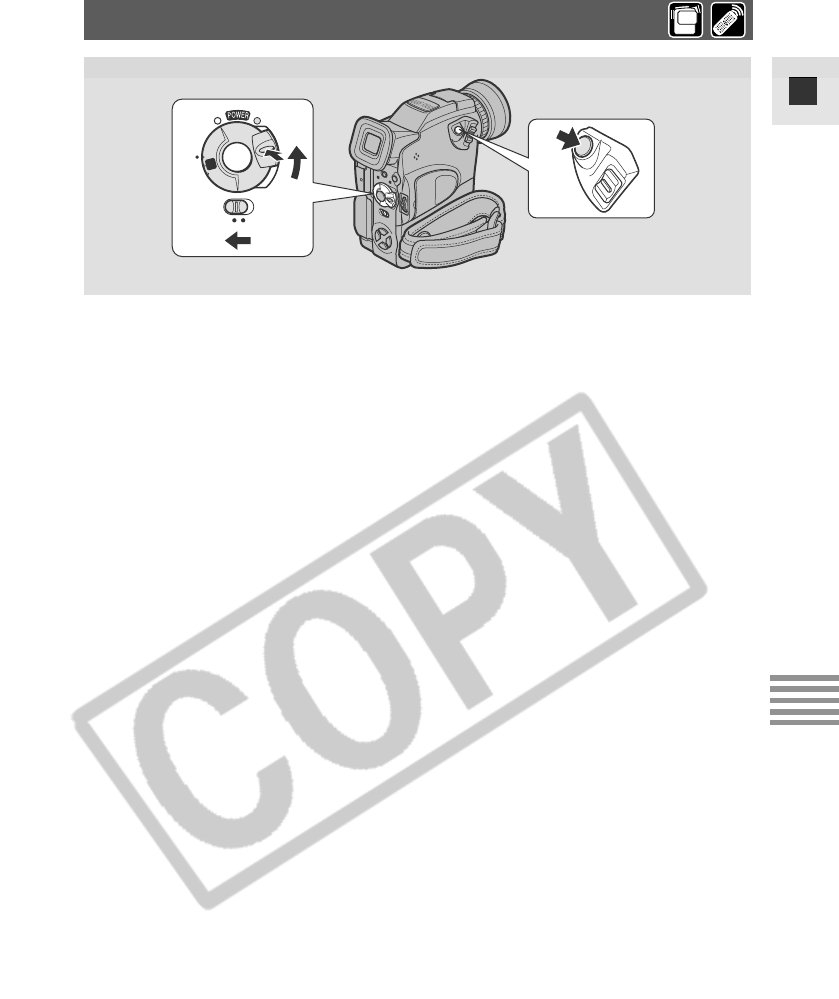
111
E
Using a Memory Card
Recording Still Images onto a Memory Card
3
PHOTO
1
2
CARD TAPE
(
V
C
R
)
P
L
A
Y
C
A
M
E
R
A
O
F
F
You can record still images onto a memory card. In addition to the still
images you record directly onto the memory card, you can record images
from a tape in the camcorder, or images input via the DV terminal or AV
terminal onto the memory card.
• When you are using an SD Memory Card, make sure the protect switch is
set to allow recording.
• Make sure a memory card with enough memory available is inserted into
the camcorder.
• While the card access indicator flashes, do not disconnect the power
source or remove the memory card. Doing so could result in data damage.
1. Press and hold the small button on the POWER switch and
turn the POWER switch to CAMERA.
2. Move the TAPE/CARD switch to CARD.
• The number of images that can still be recorded on the memory card,
and other information appear in the display.
• The camcorder will turn itself off if you are using a battery and do not
operate the camcorder for more than 5 minutes. Set the POWER switch
to OFF and then back to CAMERA.
3. Press the PHOTO button halfway and hold it.
• Exposure is locked.
• During autofocus Fflashes white in the display as the camcorder adjust
the focus and it is displayed continuously as a green mark when the
camcorder is ready to take the still image.
4. Press the PHOTO button fully down to record the still image.
•Fdisappears from the display. The shutter sound sounds and
simultaneously the display appears to close for an instant as if it were a
shutter releasing.
• The card access indicator flashes and the card access display appears in
the display (See
“The indicators that appear in the LCD display when LCD
MIRROR is turned on” on page 27)
.
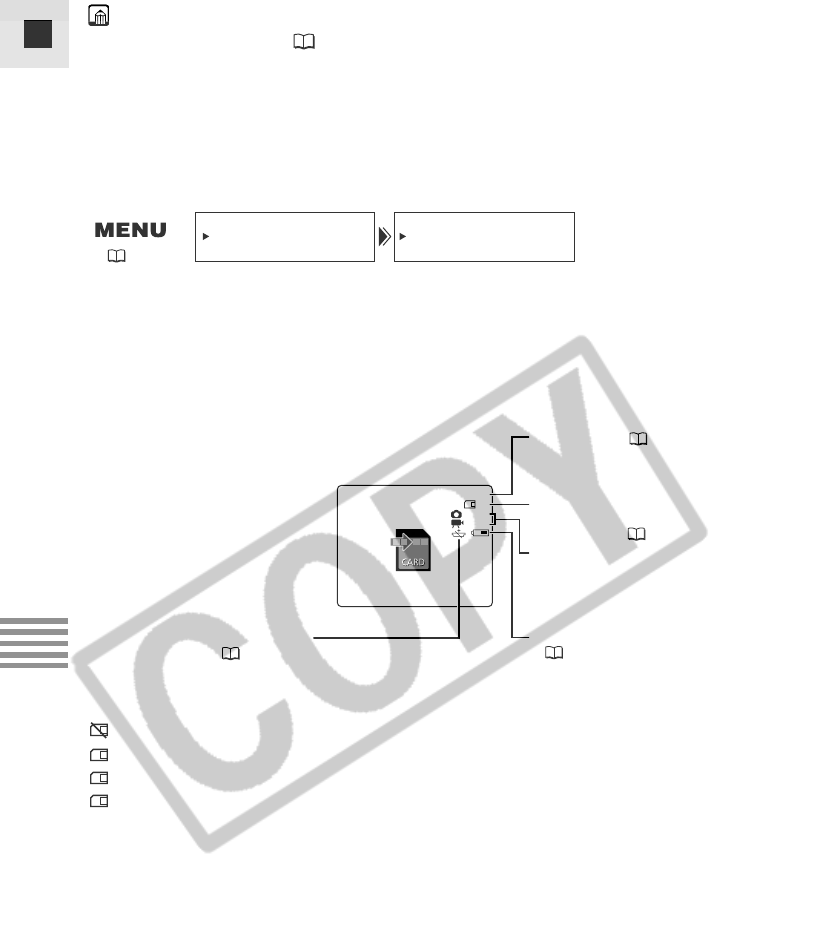
112
E
Using a Memory Card
Notes:
• To use the self-timer ( 73), set the self-timer before step 3, and then
press the PHOTO button fully down.
• The wireless controller’s PHOTO button has no half-way setting. Press the
button fully and the camcorder immediately takes the image.
• When the subject is too bright (overexposure) in CARD CAMERA mode,
OVEREXP. will flash in the display. We recommend that you use the built-in
ND filter to reduce light entering lens.
Open the menu and select CAM. SET UP. Then select ND and set it to
OFF and close the menu.
• When exposure is locked, OVEREXP. does not appear.
The indicators that appear in the display when recording to a
memory card:
>>>> 50
1280
320
FINE
Image quality ( 108)
Backup battery
( 159)
Remaining battery power
( 158)
Number of images that can
still be recorded on the
memory card ( 109)
File size of still images and
movies
ND••••••••••AUTOCAM.SET UP
( 38)
Memory Card Indication:
flashing in red: No card
in green: 6 or more images
in yellow: 1 to 5 images
in red: No more images
• All indicators light in green when a memory card is played back.
• The remaining capacity indication varies depending on the recording
condition. The remaining number may sometimes not decrease or decrease
by 2 images at a time.
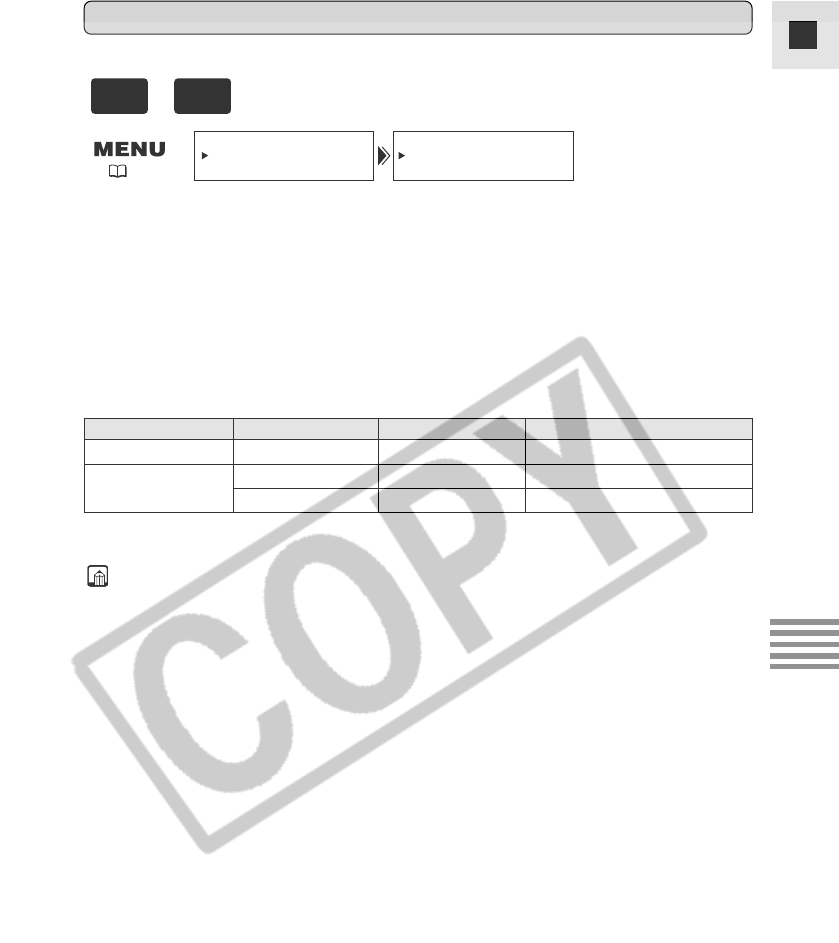
113
E
Using a Memory Card
You can record still images shot continuously to a memory card.
1. Open the menu and select CARD SET UP. Then select
CONT.SHOOT. and set it to ON and close the menu.
2. Press and hold the PHOTO button while you record still
images.
• While you press the PHOTO button, still images are continuously
recorded onto the memory card.
3. Release the PHOTO button to finish recording.
Maximum continuous shots at one time
Continuous Shooting
+
CAMERA
CARD
CONT.SHOOT••OFFCARD SET UP
( 38)
Still Images Size Built-in Flash
Frames per Second
Maximum Continuous Shots
1280 ×960 Flash on/off Approx. 2 frames 10 images
640 ×480 Flash on Approx. 2 frames 10 images
Flash off Approx. 3 frames 30 images
* The actual number varies on the shooting conditions and subjects.
Note:
• The practical range of the flash is approx. from 1 m (3 ft 3 3/8in) to 2.3 m
(7 ft 6 1/2in) when shooting continuously.
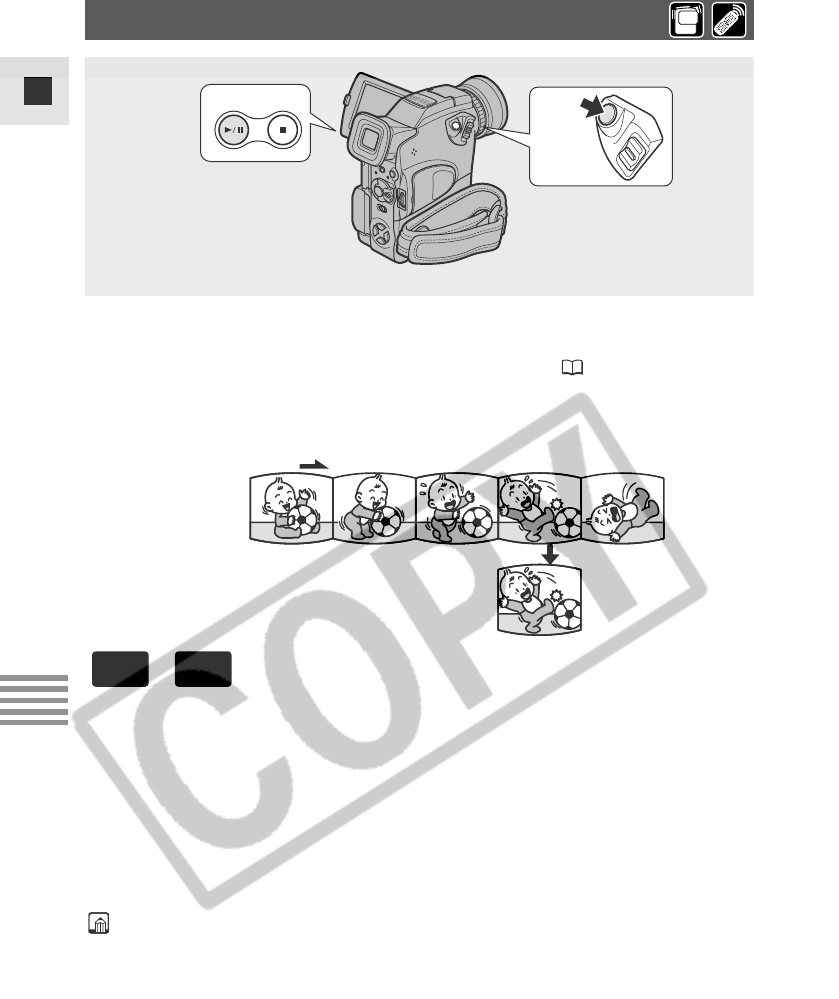
114
E
Using a Memory Card
Recording Still Images from a Tape
2, 3
PHOTO
1
Record an image from a tape onto a memory card as still images. To
automatically record multiple still images from a tape to a memory card, refer
to “Copying Still Images from Tape to Memory Card” ( 146).
• The still image’s data code will reflect the date and time it has been
recorded to the memory card.
• The image size of a still image recorded from tape onto a memory card will
be 640 ×480.
1. Play back the tape.
2. When the image you wish to record appears in the display,
press the PHOTO button halfway down and hold it.
• The tape is set to playback pause mode and the number of images that
can still be recorded on the memory card appears in the display.
3. Press the PHOTO button fully down to record the still image
to the memory card.
• The card access indicator flashes.
Notes:
• You can also set the tape to playback pause mode in step 1 and record the
image with only 1 full press of PHOTO button.
• If you record an image onto a memory card that was originally recorded in
the 16:9 mode for wide screen TV’s, the image will appear to be vertically
“squashed” (compressed).
• The shutter sound doesn’t sound in TAPE PLAY (VCR) mode.
Tape
Memory card
Press the PHOTO
button fully down
+
PLAY
(VCR)
TAPE
115
E
Using a Memory Card
1. Start playback on the other device.
2. When the image you wish to record appears in the display,
press the PHOTO button halfway down and hold it.
• The image appears as a still image in the display.
• The number of images that can still be recorded on the memory card
appears in the display.
3. Press the PHOTO button fully down to record the image to
the memory card.
• The card access indicator flashes.
Notes:
• When dubbing to a tape via the DV terminal, make sure that AVaDV is
not displayed on the screen. If so, set AVaDV OUT to OFF ( 96).
• If you record an image onto a memory card that was originally recorded in
the 16:9 mode for wide screen TV’s, the image will appear to be vertically
“squashed” (compressed).
• The shutter sound doesn’t sound in TAPE PLAY(VCR) mode.
• The wireless controller’s PHOTO button has no half-way setting. Press the
button fully and the camcorder immediately takes the “photo”.
Recording
Recording Still Images from Other Devices
(VCR, TV or Other Digital Camcorders)
1. Connect the camcorder to the other device.
2. Prepare the other device.
3. Load a memory card into the camcorder.
4. Turn the camcorder’s POWER switch to PLAY (VCR) and the
TAPE/CARD switch to TAPE.
• There is no need to load a cassette if you only record still images onto a
memory card. If a cassette is inserted, make sure the cassette is in stop
mode.
You can record images from a VCR or TV connected through the S-terminal
or AV terminal (analog line-in), as well as images from other digital
camcorders connected through the DV terminal onto the memory card as still
images. Refer to p. 34, 90 for connecting instructions.
• The data code of the still image will reflect the date and time it has been
recorded onto the memory card.
• The image size of a still image recorded from analog or digital devices onto
a memory card will be 640 ×480.
Preparations
+
PLAY
(VCR)
TAPE
116
E
Using a Memory Card
Recording Movies onto a Memory Card
You can record movies onto a memory card. Transferring the movie to a PC
allows you to view it on the PC or to attach it to your e-mail (please refer to
the DIGITAL VIDEO SOLUTION DISK Software Instruction Manual for detailed
instructions).
In addition to the movie you record directly onto the memory card, you can
record movies from a tape or input via the AV terminal (analog line-in) or the
DV terminal onto the memory card.
The sound of the movie recorded to a memory card will be monaural.
• Make sure a memory card with enough memory available is inserted into
the camcorder.
• When you are using an SD Memory Card, make sure the protect switch is
set to allow recording.
• While the card access indicator flashes, do not disconnect the power
source. Doing so could result in data damage.
1. Turn the POWER switch to CAMERA.
2. Move the TAPE/CARD switch to CARD.
3. Press the START/STOP button.
• You can record up to 10 seconds in 320 ×240 and 30 seconds in 160 ×
120.
• Press the START/STOP to end recording.
• The camcorder starts to write the movie to the memory card when
recording is finished.
Notes:
• For using the self-timer ( 73), set the self-timer before step 3, and then
press the START/STOP button.
• Do not load/unload a tape during recording. Sound will not be recording
during this operation.
+
CAMERA
CARD
117
E
Using a Memory Card
Recording Movies from a Tape
You can record a movie from a tape to a memory card.
• The data code of the movie will reflect the date and time it has been
recorded to the memory card.
1. Turn the POWER switch to PLAY (VCR).
2. Move the TAPE/CARD switch to TAPE.
3. Play back the cassette.
4. When the image you wish to record appears in the display,
press the START/STOP button.
• You can record up to 10 seconds in 320 ×240 and 30 seconds in 160 ×
120.
• Press the START/STOP to end recording.
• The camcorder starts to write the movie to the memory card when
recording is finished.
• You can also start recording during record pause mode by pressing the
Start/Stop button.
Note:
• If you record a movie to a memory card that was originally recorded in the
16:9 mode for wide screen TVs, the image will appear to be vertically
“squashed” (compressed).
+
PLAY
(VCR)
TAPE
118
E
Using a Memory Card
Recording Movies from Other Devices
(VCR, TV or Other Digital Camcorders)
You can record images from a VCR or TV connected through the S-terminal
or AV terminal (analog line-in), as well as images from other digital
camcorders connected through the DV terminal onto the memory card as
movies. Refer to p. 34, 90 for connecting instructions.
• The data code of the movie will reflect the date and time it has been
recorded onto the memory card.
1. Connect the camcorder to the other device.
2. Prepare the device.
3. Insert a memory card into the camcorder.
4. Turn the camcorder’s POWER switch to PLAY (VCR) and the
TAPE/CARD switch to TAPE.
• There is no need to load a cassette if you only record a movie onto the
memory card. If a cassette is inserted, make sure the cassette is in stop
mode.
1. Start playback on the other device.
2. When the image you wish to record appears in the display,
press the START/STOP button.
• You can record up to 10 seconds in 320 ×240 and 30 seconds in 160 ×
120.
• Press the START/STOP to end recording.
• The camcorder starts to write the movie to the memory card when
recording is finished.
• You can also start recording during record pause mode by pressing the
Start/Stop button.
Notes:
• When dubbing to a tape via the DV terminal, make sure that AV \ DV is
not displayed on the screen. If so, set AV \ DV OUT to OFF ( 96).
• If you record a movie to a memory card that was originally recorded in the
16:9 mode for wide screen TVs, the image will appear to be vertically
“squashed” (compressed).
Preparations
Recording
+
PLAY
(VCR)
TAPE
119
E
Using a Memory Card
Recording Panoramic Images (Stitch Assist)
You can merge separate images into one large panoramic scene using the
supplied software (PhotoStitch) on a PC. You can shoot a subject that won’t
fit into a single frame, such as a landscape, and stitch it together later.
Recording
Photo Stitch detects the overlapping portions of adjoining images and
merges them. When recording, try to include a distinctive item (landmark,
etc.) in the overlapping portions.
1. Turn the POWER switch to CAMERA and the TAPE/CARD
switch to CARD.
2. Open the menu and select aSTITCH AST.
• Select the direction with the CARD +/–button. Press the CARD +
button to move clockwise, press the CARD –button to move counter-
clockwise.
3. Set the recording program and zoom on the subject.
• If necessary, set the focus and exposure manually.
• After the first image, recording program, zoom, exposure and flash
mode cannot be changed.
4. Press the PHOTO button to record the first image.
• Direction and number of recorded images will be shown on the display.
5. Orient the camcorder so that the second frame overlaps a
small portion of the first image and press the PHOTO button
to take the next image.
• Do not worry about minor discrepancies in the overlapped area because
the computer software can compensate for them when the images are
merged.
• You can retake images by pressing the CARD –button to return to the
previous image.
• A maximum of 26 images may be recorded.
• Follow the same steps to shoot subsequent images in the sequence.
6. Finish the sequence by pressing the MENU button after the
last image has been recorded.
• Refer to the DIGITAL VIDEO SOLUTION DISK Software Instruction
Manual for instructions on how to stitch them together.
STITCH AST
( 38)
+
CAMERA
CARD

120
E
Using a Memory Card
Notes:
• The overlapped area should be set between 30 to 50% of the frame.
Discrepancies above and below the frame can be automatically
compensated if within 10%.
• Make sure that no moving subject is included in the overlapping area.
• Do not try to stitch images that include both distant and close items.
Objects may appear warped or doubled up.
• The (red-eye reduction auto) of the flash cannot be used in stitch assist
mode.
• There will be no continuous shooting even if it is set to ON.
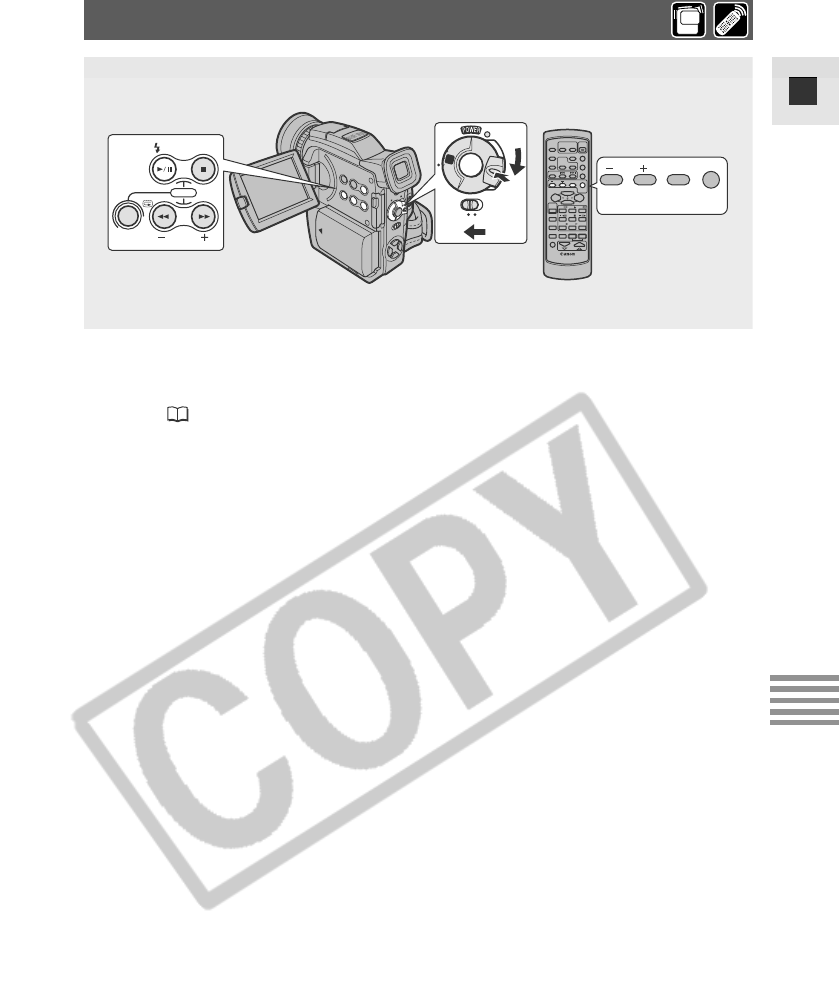
121
E
Using a Memory Card
Playing Back a Memory Card
INDEX
REC SEARCH
SCREEN
MIX/
CARD
SLIDE SHOW
CARD TAPE
//
(
V
C
R
)
P
L
A
Y
C
A
M
E
R
A
O
F
F
CARD
INDEX
SCREEN
SLIDE SHOW
Play back and view still images/movies recorded on a memory card. (For
details on connecting to a TV, see “Connections for Playback on a TV
Screen” on p. 34.) You can also enlarge the still images up to 5 times while
viewing ( 83).
• The camcorder may not be able to copy or play, etc., still images/movies
recorded on a non-Canon camcorder.
Caution:
• You may not be able to play back the following still images/movies on this
camcorder, or the image quality may change when played back with this
camcorder:
−Still images/movies that have not been recorded with this camcorder but
downloaded from a PC (excluding the sample images on p. 153-154)
−Still images/movies that have been recorded with this camcorder but have
subsequently been enhanced on a PC
−Still images/movies whose image file names have been changed on a PC
• You may not be able to play back still images/movies recorded on the
memory card with other camcorders or digital cameras on this camcorder,
and the still images may not be printed correctly with printers supporting
the direct print function.
There are 3 ways to view still images/movies:
• Single still images/movies
• Slide show: One after the other automatically in order of recording
• Index screen: Six still images/movies at once
When the camcorder is in playback pause mode, you can use the card search
function to move quickly through still images/movies recorded anywhere on
a memory card to find a still image/movie you want to view (Card Search
function).
Make sure a memory card that has still images/movies recorded on it is
inserted into the camcorder.
While the card access indicator flashes, do not disconnect the power source.
Doing so could result in data damage.

122
E
Using a Memory Card
●Single Image
1. Turn the POWER switch to PLAY (VCR).
2. Move the TAPE/CARD switch to CARD.
• The last still image/movie recorded appears in the display.
• Movies will be displayed with the first scene as a still image.
3. Search for the desired still image/movie by pressing the CARD
+/– buttons.
• Press + to view the next still image/movie and – to view the previous
still image/movie.
• Pressing + at the last still image/movie will take you to the first still
image/movie. Pressing – at the first still image/movie will take you to
the last still image/movie.
Movies: Pressing e/aplays back the movie and will show the last scene as a
still image when playback ends. Pressing e/aduring playback will stop the
movie and the scene is shown as a still image. Pressing e/aagain will
restart the playback.
●Card Search Function
You can quickly search for still images/movies while viewing thumbnails
(small images).
With a still image/movie in the display, press and hold the
CARD +/– button.
• Press the + button to search forwards and press the – button to search
backwards.
• When you release the button, the thumbnail displays as full size still
image/movie.
• The image size is not displayed during the search.
+
PLAY
(VCR)
CARD
+
PLAY
(VCR)
CARD
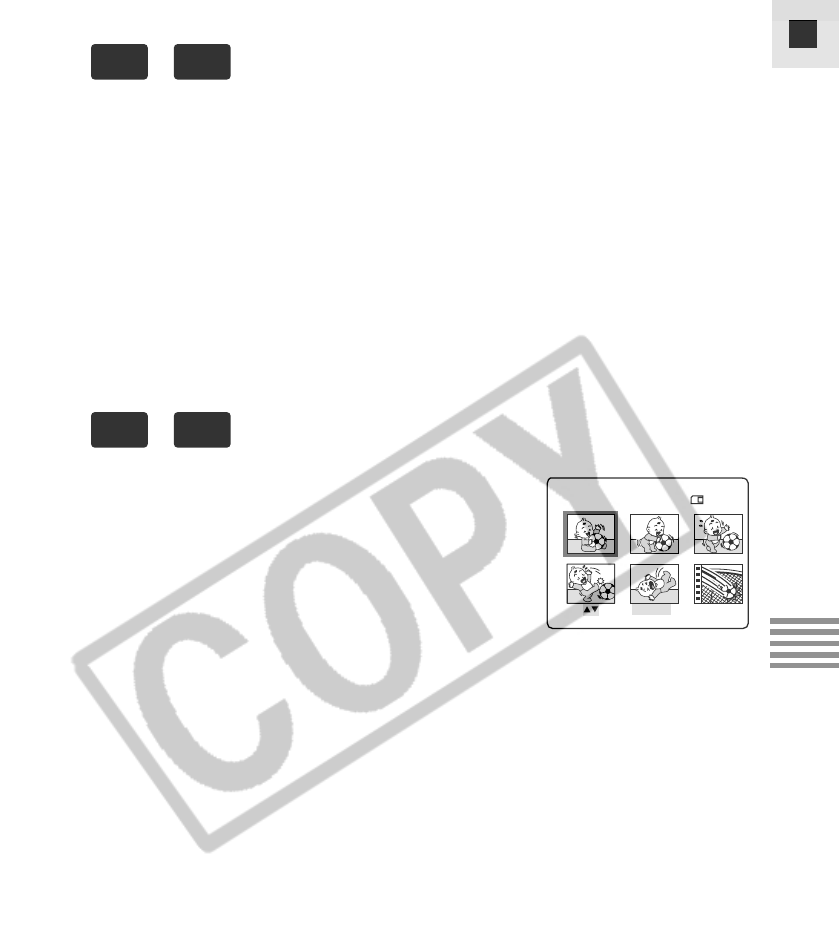
123
E
Using a Memory Card
●Slide Show
With a still image/movie in the display, press the SLIDE SHOW
button.
• Still images are automatically played back one after another.
• Movies are played back normally.
To stop the slide show, press the SLIDE SHOW button.
• The slide show starts or stops each time you press the SLIDE SHOW button.
●Index Screen
Up to 6 still images/movies appear at once, allowing you to search quickly
through the still images/movies. Movies will be displayed with the first scene
as a still image, indicated by a movie frame.
1. With an still image/movie in the
display, press the INDEX SCREEN
button.
• Up to 6 images appear in the display.
2. Move the frame to the still
image/movie you wish to view.
• Turn the selector dial downwards to go to the
previous still image/movie and upwards to go
to the next still image/movie.
• Turning the dial upwards at the last still image/movie will take you to
the next index screen. Turning the dial downwards at the first still
image/movie will take you to the previous index screen.
• Jump to the next/previous index screen with the CARD +/– buttons.
3. Press the INDEX SCREEN button.
• The still image/movie you have marked fills the whole display.
INDEX 101–0143
1/50
SEL. INDEXEND
+
PLAY
(VCR)
CARD
+
PLAY
(VCR)
CARD
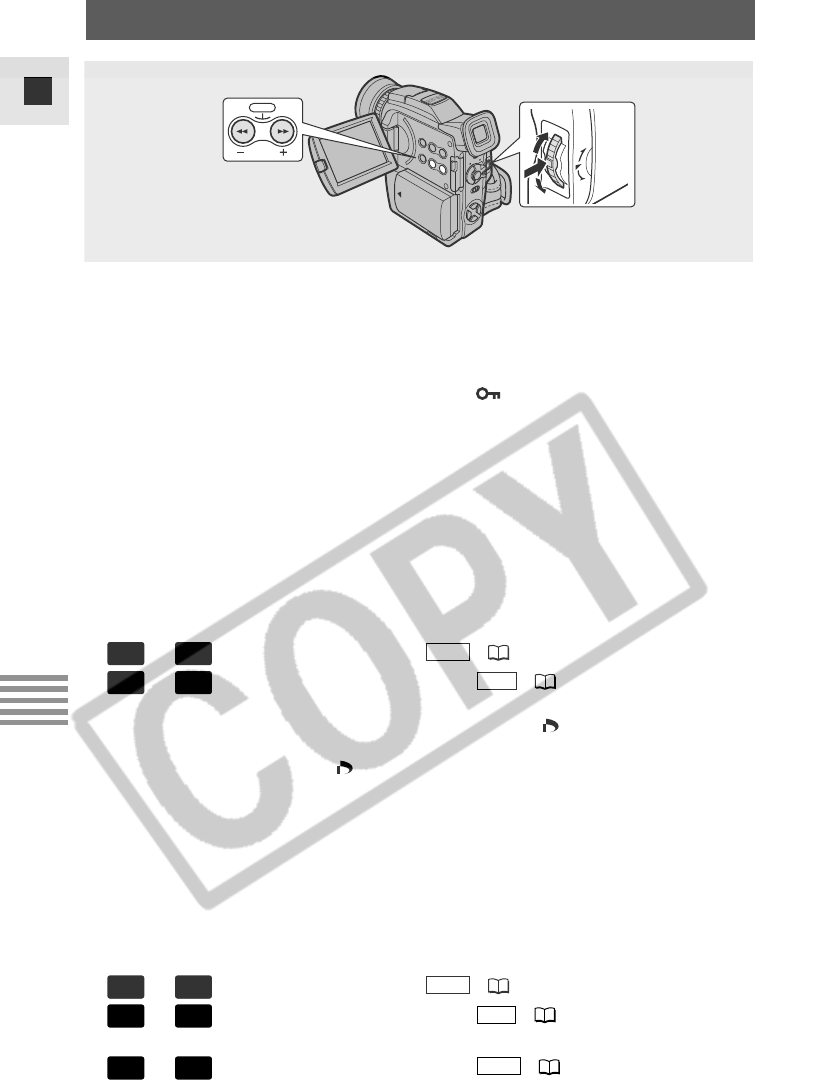
124
E
Using a Memory Card
You can easily erase unwanted still images/movies recorded to the memory
card while viewing them, protect them from accidental erasure, or mark a
still image for printing. (File Operation)
• File Operation is set in CARD PLAY (VCR) mode.
●Preventing accidental erasure (Protect )
Select important still images/movies and protect them from accidental
erasure.
• If a memory card is formatted, however, all still images/movies, including
protected still images/movies, will be permanently erased.
• Movies can only be protected when the first or last scene is displayed as a
still image. They cannot be protected during playback pause.
• The pre-recorded sample images provided on the supplied SD Memory
Card are already protected.
There are 2 ways to protect still images/movies (including the ways to cancel
the setting).
1. + ➡File Operation menu ( 126)
2. + ➡Card Operations submenu ( 127)
●Marking a still image for printing (Print Mark )
A still image on a memory card must be marked before it can be printed.
The camcorder supports the DPOF (Digital Print Order Format) print
format.
Still images can be automatically printed on a DPOF-supporting Canon
Printer.
• Movies cannot be marked for printing.
• The maximum number for print marks on the camcorder is limited to 200.
There are 3 ways to mark a still image for printing (including the ways to
cancel the setting).
To mark a still image for printing or erase print marks one at a time
1. + ➡File Operation menu ( 126)
2. + ➡Card Operations submenu ( 128)
To erase all print marks
3. + ➡Card Operations submenu ( 129)
SINGLE
PLAY
(VCR)
CARD
INDEX
PLAY
(VCR)
CARD
SINGLE
PLAY
(VCR)
CARD
INDEX
PLAY
(VCR)
CARD
SINGLE
PLAY
(VCR)
CARD
Settings of Still Images/Movies
REC SEARCH
CARD
SELECT

125
E
Using a Memory Card
●Erasing still images/movies
Erase still images/movies singly or all at once.
• You cannot erase protected still images/movies. Cancel image protection
first in order to erase an image.
• When movies are displayed with the first and last scene as still images, you
can erase them. When the camcorder sets to playback pause mode by
press pause button during playing back movie, you cannot erase them.
•
Erase still images/movies with caution. Once a still image/movie has been
erased, it cannot be restored.
There are 2 ways to erase a single still image/movie.
To erase still images/movies one at a time
1. + ➡File Operation menu ( 126)
To erase still images/movies one at a time or erase all still images/movies on
the memory card at once
2. + ➡Card Operations submenu ( 130)
: When playing back still images/movies in CARD PLAY (VCR) mode
: When displaying an index screen in CARD PLAY (VCR) mode
INDEX
SINGLE
SINGLE
PLAY
(VCR)
CARD
SINGLE
PLAY
(VCR)
CARD
126
E
Using a Memory Card
1. With a still image/movie in the display, press the selector
dial in to open the FILE OPER. menu.
• PROTECT , PRINT MARK , and IMAGE ERASE settings appear.
• If you select |RETURN, the menu disappears from the display.
2. Select PROTECT and press the selector dial in.
• The protect mark appears on the still image/movie.
• Now you are unable to erase this still image/movie.
• Press the selector dial again to cancel it.
• If you select |RETURN, the menu disappears from the display.
• To cancel image protection, select PROTECT and press the selector
dial in. disappears and now you can erase this still image/movie.
2. Select PRINT MARK , set the number of prints with the
selector dial and press the selector dial in.
• The print mark appears on the still image.
• If you select |RETURN, the menu disappears from the display.
• To cancel a print mark, select PRINT MARK , set the number of prints
to 0 (Zero) with the selector dial and press the selector dial in.
disappears.
2. Select IMAGE ERASE and press the selector dial in.
• ERASE THIS IMAGE? NO YES appears in the display.
• If you select |RETURN, the menu disappears from the display.
3. Select YES and press the selector dial in.
• The still image/movie is erased.
• One still image/movie before the erased still image/movie appears.
To erase a still image/movie
To mark a still image for printing (Print Mark)
To protect a still image/movie
File Operation (FILE OPER.)
+
PLAY
(VCR)
CARD
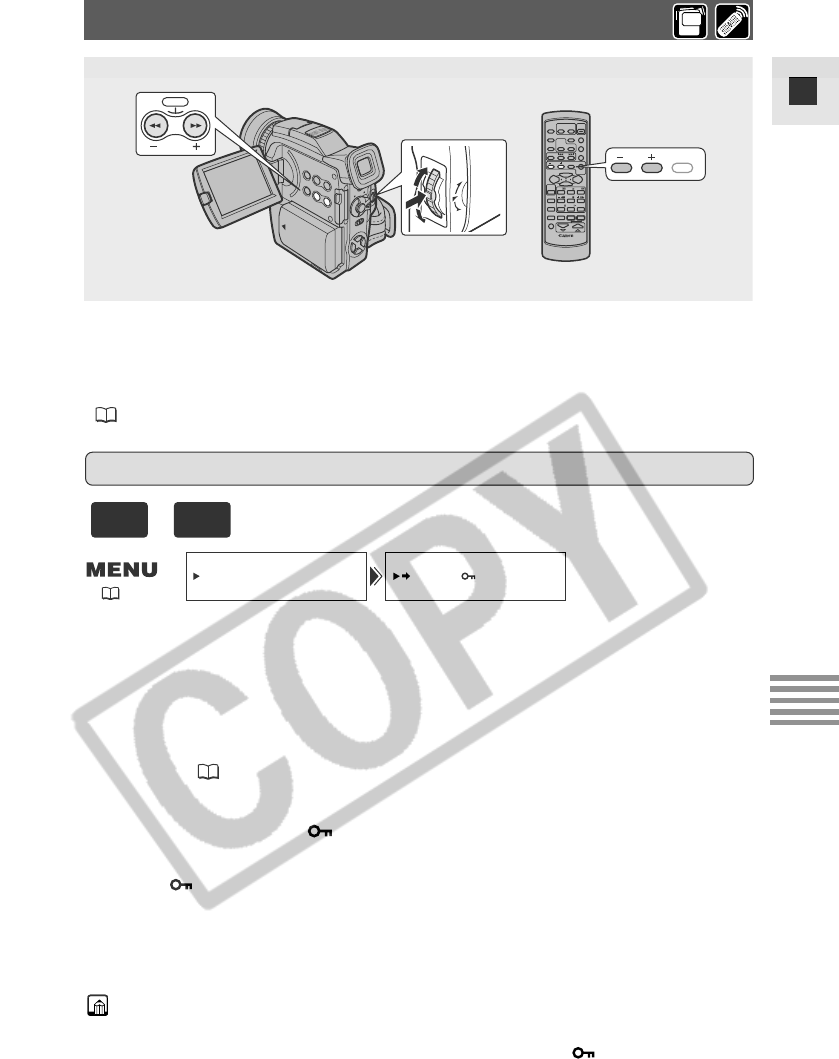
127
E
Using a Memory Card
Preventing Accidental Erasure (Protect)
REC SEARCH
CARD
//
CARD
SLIDE SHOW
SELECT
This section describes how to protect the still image/movie from the Card
Operation submenu when displaying an index screen in CARD PLAY (VCR)
mode (including the way to cancel the setting) .
You can also protect a still image/movie through File Operation menu
( 126).
Protecting a Still Image/Movie While Viewing an Index Screen
Make sure a memory card that has still images/movies recorded on it is
inserted into the camcorder.
1. With a still image/movie in the display, press the INDEX
SCREEN button.
• Up to 6 still images/movies appear in the display.
• Move the frame to the still image/movie that you wish to protect (Index
Screen 123)
2. Open the menu and select CARD OPER.
3. Select \PROTECT .
4. Press the selector dial in.
• The protect mark appears on the still image/movie.
• Now you are unable to erase this still image/movie.
• Press the selector dial again to cancel it.
5. Close the menu.
Note:
• To cancel image protection, move the frame to the protected still
image/movie and press the selector dial in step 3. The protect mark
disappears.
PROTECT
CARD OPER.
( 38)
+
PLAY
(VCR)
CARD
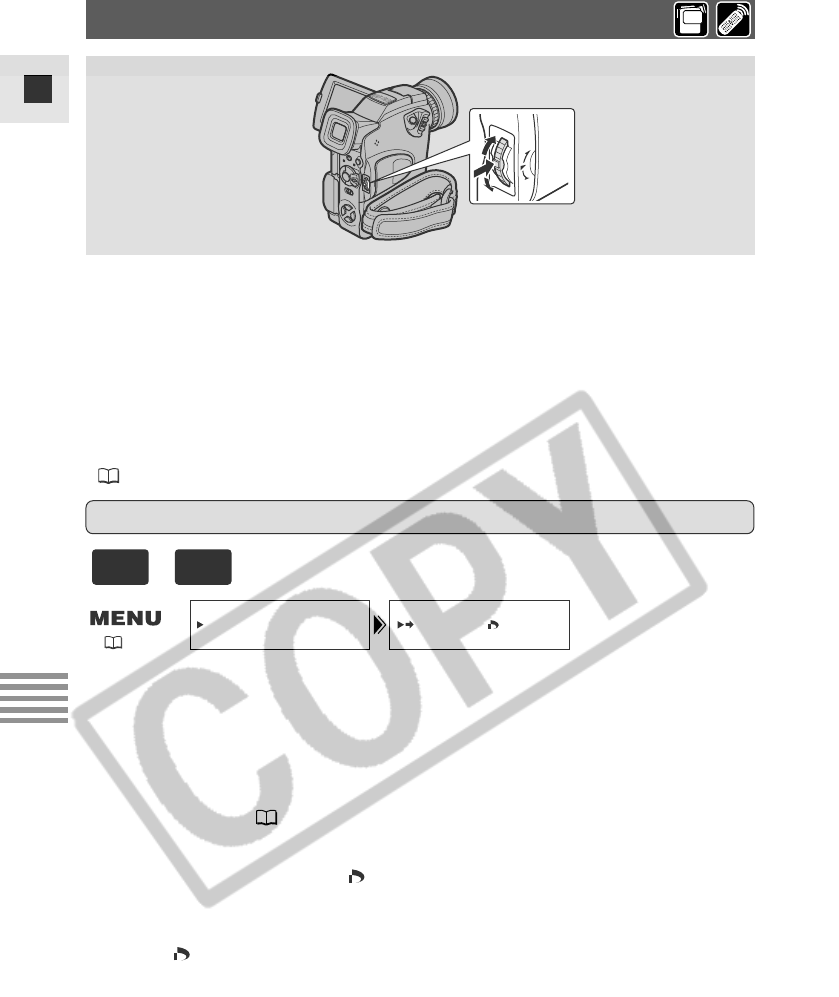
128
E
Using a Memory Card
Marking a Still Image for Printing (Print Mark)
SELECT
This section describes how to mark the still image for printing from Card
operation submenu in CARD PLAY (VCR) mode (including the way to cancel
the setting).
• When displaying an index screen, you can mark the still image for printing.
• When playing back a single still image, you can erase all print marks.
• Movies cannot be marked for printing. The frame on the index screen will
turn purple, indicating that the movie cannot be selected for print mark.
• The maximum number for print marks on the camcorder is limited to 200.
You can also mark a still image for printing through File Operation menu
( 126).
Marking a Still Image for Printing While Viewing an Index Screen
Make sure a memory card that has a still image recorded on it has been
inserted into the camcorder.
1. With a still image in the display, press the INDEX SCREEN
button.
• Up to 6 images appear in the display.
• Move the frame to the still image that you wish to mark for printing
(Index Screen 123).
2. Open the menu and select CARD OPER.
3. Select \PRINT MARK and set the number of prints with
the selector dial.
4. Press the selector dial in.
• The print mark appears next to the still image.
5. Close the menu.
PRINT MARK
CARD OPER.
( 38)
+
PLAY
(VCR)
CARD
129
E
Using a Memory Card
PRINT MARKS ALL ERASE
CARD OPER.
( 38)
Erasing All Print Marks
Make sure a memory card that has a still image recorded on it has been
inserted into the camcorder.
1. With a still image in the display, open the menu and select
CARD OPER.
2. Select PRINT MARKS ALL ERASE.
• ERASE ALL PRINT MARKS ? YES NO appears in the display.
3. Select YES.
• The print mark disappears from the still image.
4. Close the menu.
Notes:
• To cancel a print mark, move the frame to the print-marked a still image,
set the number of prints to 0 (Zero) with the selector dial and press the
selector dial in. The print mark disappears.
• If there are a large number of images recorded on the memory card, it may
take time for a print mark to appear on a still image.
+
PLAY
(VCR)
CARD
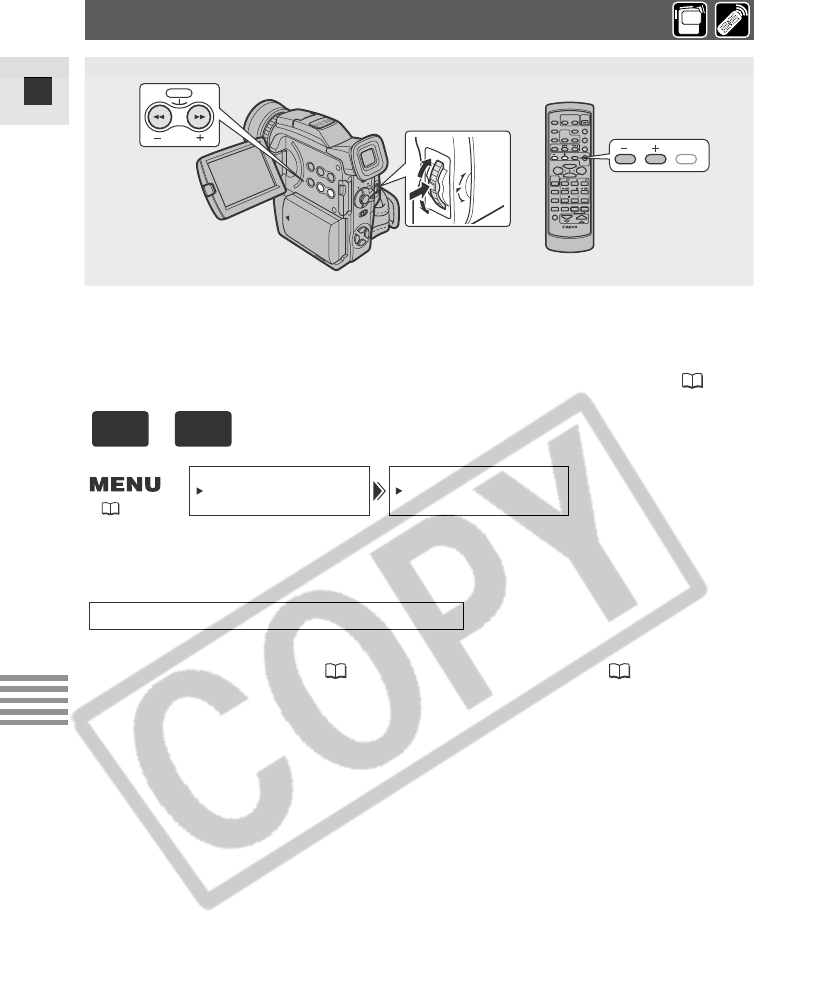
130
E
Using a Memory Card
This section describes how to erase the still image/movie from the Card
Operation submenu when playing back a single still image/movie in CARD
PLAY (VCR) mode. (SINGLE or ALL)
You can also erase a still image/movie through File Operation menu ( 126).
Make sure a memory card that has still images/movies recorded on it is
inserted into the camcorder.
1. Select the still image/movie you wish to erase.
• Use the index screen ( 123) or card search function ( 122) if
necessary and make sure the still image/movie you wish to erase fills
the display.
• If you use the index screen, press the INDEX SCREEN button after
selecting the still image/movie. The still image/movie you selected fills
the whole display.
2. Open the menu and select CARD OPER.
3. Select IMAGE ERASE.
• CANCEL, SINGLE and ALL settings appear.
• To cancel erasing, select CANCEL and close the menu.
4. Select SINGLE.
• ERASE THIS IMAGE? NO YES appears in the display.
To erase still images/movies one at a time
Erasing Still Images/Movies
REC SEARCH
CARD
//
CARD
SLIDE SHOW
SELECT
IMAGE ERASE
CARD OPER.
( 38)
+
PLAY
(VCR)
CARD
131
E
Using a Memory Card
5. Select YES.
• The still image/movie erases and the previous still image/movie appears
for erasing.
• To erase another single still image/movie, move to that still image/movie
with the CARD +/– buttons, and select YES.
• If the still image/movie you are trying to erase is a protected still
image/movie, YES appears in purple and is unselectable.
• If you select NO, you return to step 4.
6. Close the menu.
1. Open the menu and select CARD OPER.
2. Select IMAGE ERASE.
• CANCEL, SINGLE and ALL settings appear.
• To cancel erasing, select CANCEL and close the menu.
3. Select ALL.
• ERASE ALL IMAGES? [EXCEPT FOR IMAGES] NO YES appears in the
display.
4. Select YES.
• All still images/movies except the protected ones are erased.
• If you select NO, you return to step 2.
5. Close the menu.
To erase all still images/movies on the memory card at once
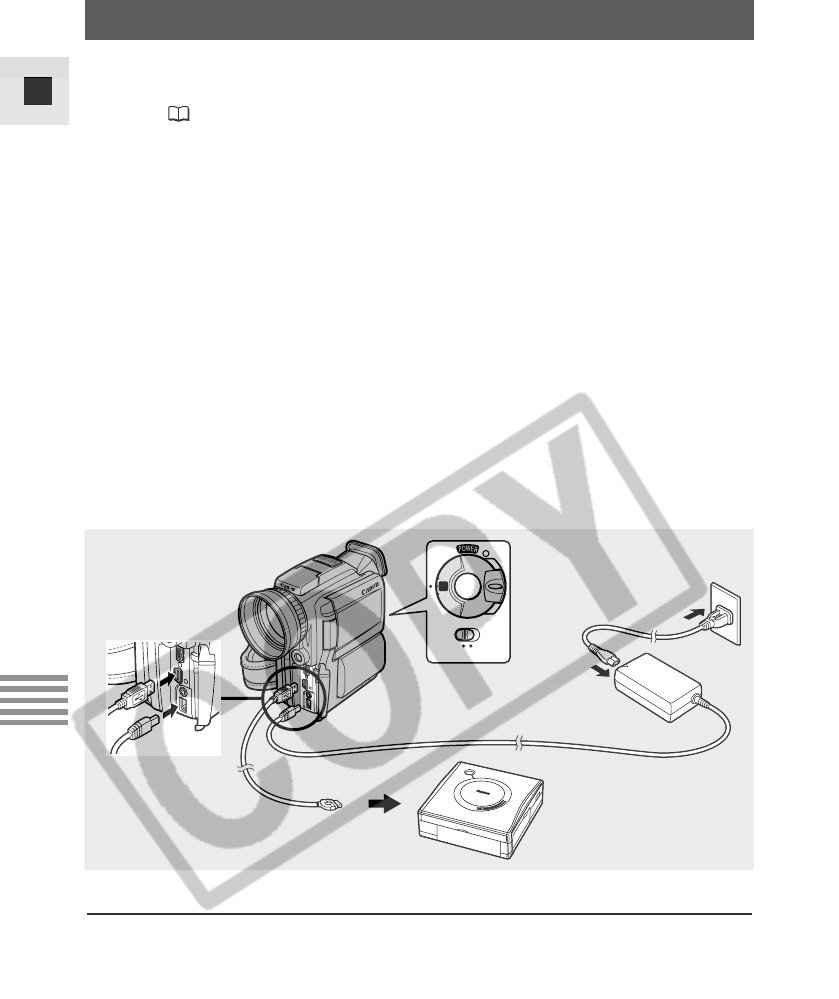
132
E
Using a Memory Card
Using Printers Supporting the Direct Print Function (Optional)
You can print still images by connecting the camcorder directly to a printer
supporting the direct print function. It can also be used with the print mark
settings ( 128).
• Printers supporting the direct print function (As of August 2002): Canon
CP-10/CP-100 Card Photo Printer, Canon Bubble Jet Printer
S820D/S830D/S530D.
• Two direct interface cables are supplied with the Card Photo Printer. Use
the cable with the USB logo on the connector (DIF-100).
• We recommend that you use a household power source to power the
camcorder when it is connected to the printer.
• Also refer to the instruction manual of the respective printer for further
details.
• Observe following precautions during printing, otherwise printing may not
be performed correctly.
– Do not turn off the camcorder or the printer.
– Do not change the position of the TAPE/CARD switch.
– Do not detach the interface cable.
– Do not open the memory card cover.
– Do not remove the memory card.
Connecting the printer to the camcorder
1. Turn the POWER switch of the camcorder to OFF.
2. Attach a power source to the printer.
3. Connect the printer to the camcorder using the interface cable.
4. Turn on the power of the printer.
• If your printer is not equipped with a power switch, it turns on when
attaching a power source. Move on to step 5.
(
V
C
R
)
P
L
A
Y
C
A
M
E
R
A
O
F
F
CARD TAPE
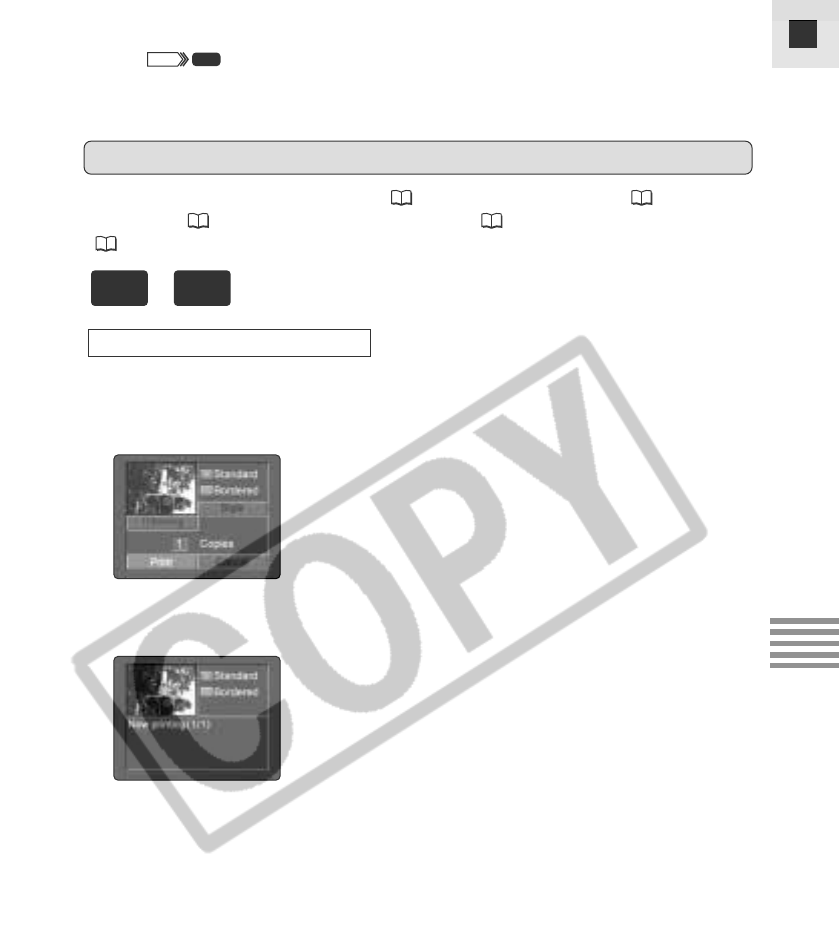
133
E
Using a Memory Card
You can set the number of copies ( 134), standard/multiple ( 135),
paper size ( 135) and bordered/borderless ( 135), or trim the image
( 137).
1. Select the still image you wish to print.
2. Press the selector dial in.
• The print dialog appears.
3. Make sure that [Print] is selected and press the selector dial
in.
• Printing starts and, when it is completely finished, the display will return
to playback mode.
• If you wish to continue printing, select the next still image with the
CARD+ or CARD– button.
Printing Errors
• If an error occurs during printing, error messages such as “NO INK”,
“PAPER JAM” or “NO PAPER” will display. Select [Stop] or [Restart] with
the selector dial and press the selector dial in.
During Playback (Single Image)
Printing
+
PLAY
(VCR)
CARD
5. Turn the POWER switch on the camcorder to PLAY (VCR) and
the TAPE/CARD switch to CARD.
• “ ” appears when the printer is correctly connected to the
camcorder (does not appear with movies, or still images that cannot be
played back with the camcorder).
Print SET
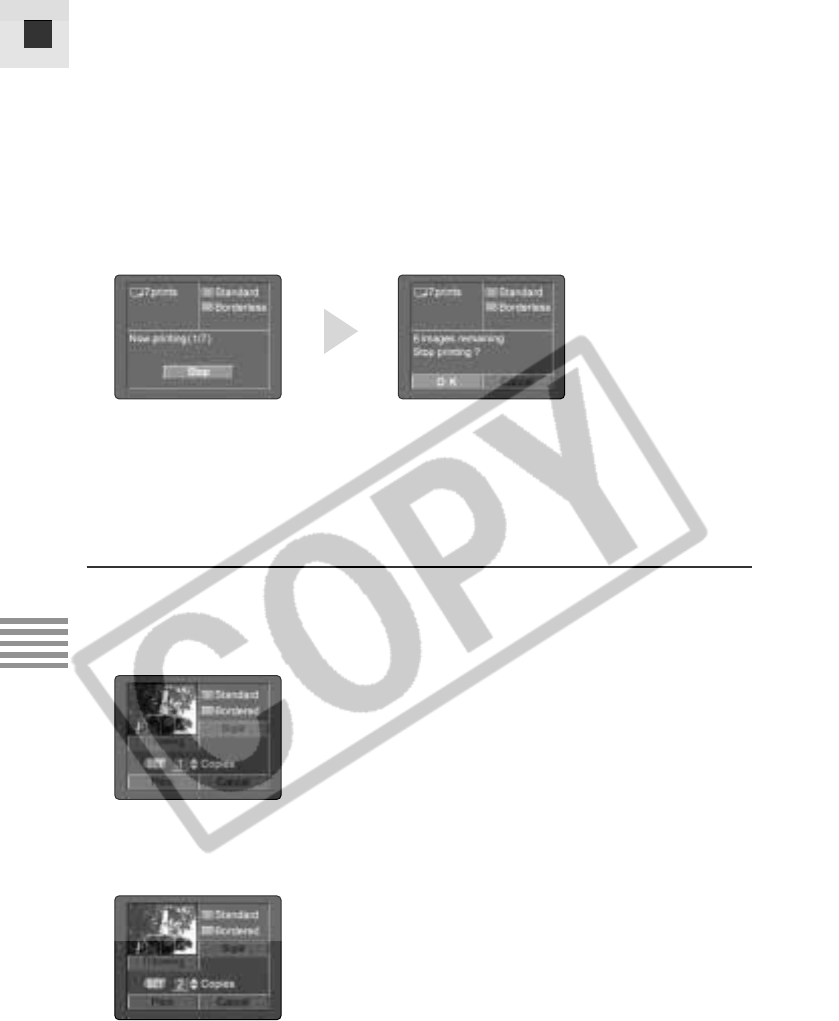
134
E
Using a Memory Card
• With the Card Photo Printer, the [Restart] setting may not appear with
some error messages. In that case, select [STOP].
• With the BJ Printer, the [Continue] and [Stop] options may appear with
some error messages. The error number is displayed on the operation
panel of the Bubble Jet Printer. Please refer to the Bubble Jet Printer Quick
Start Guide for the remedies corresponding to the error numbers.
Cancel Printing
Press the selector dial in while the [Now printing] dialog is displayed. A
confirmation dialog displays. Make sure that [OK] is selected and press the
selector dial in.
• With the Card Photo Printer, a print in progress cannot be stopped.
Printing of the next still images will be cancelled and the display will return
to playback mode. With the BJ Printer, printing stops even if it is
incomplete and the paper is fed through.
Selecting the number of copies
You can set the number of copies to a maximum of 9 prints.
1. Pull the selector dial up or down so that [SET] appears next
to [Copies] and press the selector dial in.
2. Pull the selector dial up or down to specify the number of
copies and press the selector dial in.
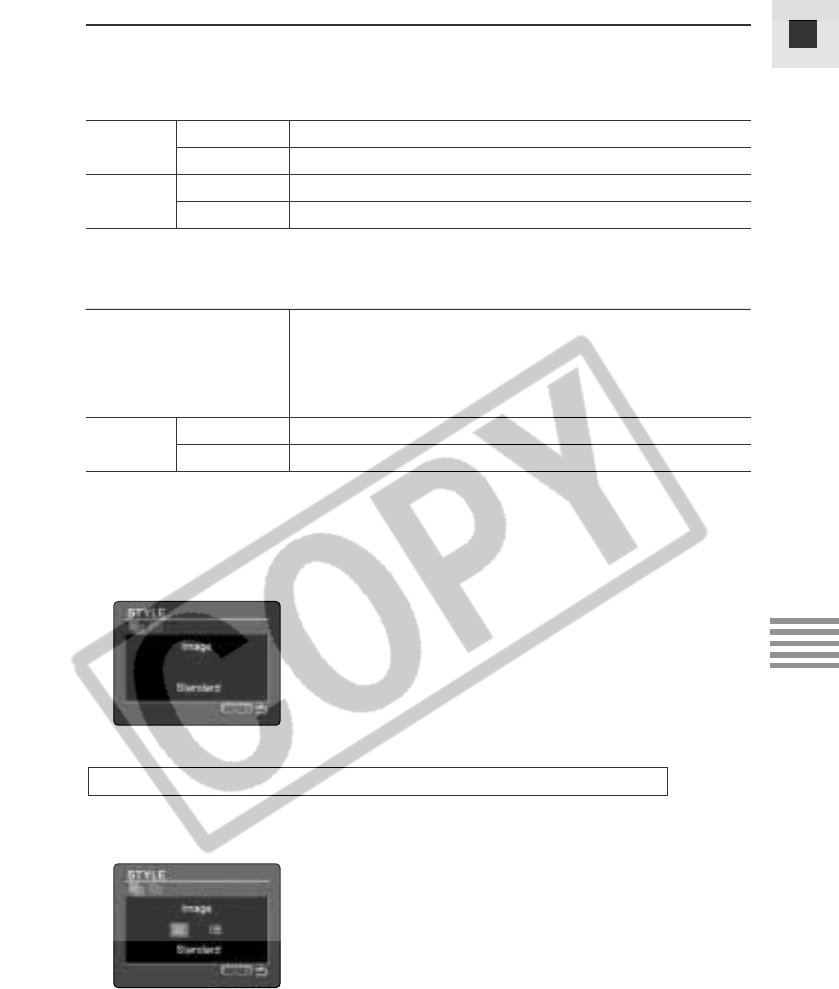
135
E
Using a Memory Card
1. On the print dialog, pull the selector dial up or down to
select [Style] and press the selector dial in.
• The dialog for selecting the style appears.
2. Press the select dial in.
• The dialog for selecting the image style appears.
Card Photo Printer: Selecting the Image Style (Standard/Multiple)
Setting the print style
If you wish to change the print style, change the style settings before
trimming.
Card Photo Printer:
* Can only be selected when printing on card size paper.
• [Borders] cannot be selected when the image style is set to [Multiple].
BJ Printer:
Image Standard Prints 1 still image per page.
Multiple* Prints 8 copies of the same still image on one page.
Borders Borderless Prints right to the edges of the page.
Bordered Prints with a border.
Paper Size* Select the paper size from the following: [Card #1],
[Card #2], [Card #3], [LTR] or [A4] Paper. For the
usable paper type, refer to the Bubble Jet Printer
User Guide.
Borders Borderless Prints right to the edges of the page
Bordered Prints with a border
* Recommended paper size: card size
136
E
Using a Memory Card
3. Pull the selector dial up or down to select [Multiple] and
press the selector dial in.
4. Press the Menu button.
2. Press the selector dial in.
• The dialog for selecting the paper size appears.
3. Pull the selector dial up or down to select the paper size and
press the selector dial in.
4. Press the MENU button.
2. Pull the selector dial down.
• The dialog for selecting the [Borders] appears.
Selecting the Borders (Bordered/Borderless)
BJ Printer: Selecting the Paper Size
137
E
Using a Memory Card
3. Press the selector dial in.
• [Bordered] and [Borderless] settings appear.
4. Select [Borderless] and press the selector dial in.
5. Press the Menu button.
Notes:
• With the [Bordered] option, the area of the printed image is practically the
same as the recorded image.
• If [Borderless] or [Multiple] is selected as the print style, the centre portion
of the recorded image is printed at an enlarged size. As a result, the
image’s top, bottom and sides may be cropped slightly.
• The [Borders] setting cannot be selected when the image style is set to
[Multiple]. The image will be printed with the borders set to [Borderless].
Trimming (Printing a Portion of an Image)
If you wish to change the print style, change the style settings before
trimming.
1. On the print dialog, select [Trimming] and press the selector
dial in.
• The trimming frame appears at the centre of the image.
138
E
Using a Memory Card
2. Trim the image.
Changing the Size of the Trimming Frame:
Move the zoom lever toward T to shrink the frame, and toward W to
enlarge the frame.
You can cancel the trimming setting by moving the zoom lever toward W
when the trimming frame is already set to the maximum size. The
trimming frame disappears. If you press the MENU button, you return to
the print dialog.
Moving the Trimming Frame:
Use the rand tbuttons to move the frame up or down, and the eor
4buttons to move the frame to the right or left.
3. Press the MENU button.
• You return to the print dialog.
• The trimming setting is cancelled when you select another image using
the CARD +/– buttons.
4. Pull the selector dial up or down to select [Print] and press
the selector dial in.
• Printing starts and when it is completely finished, the display will revert
to the playback mode.
About the Color of the Frame:
White: No trimming settings.
Green: Recommended trimming size.
Red: The image is magnified beyond recommended size. The image may
print out coarsely.
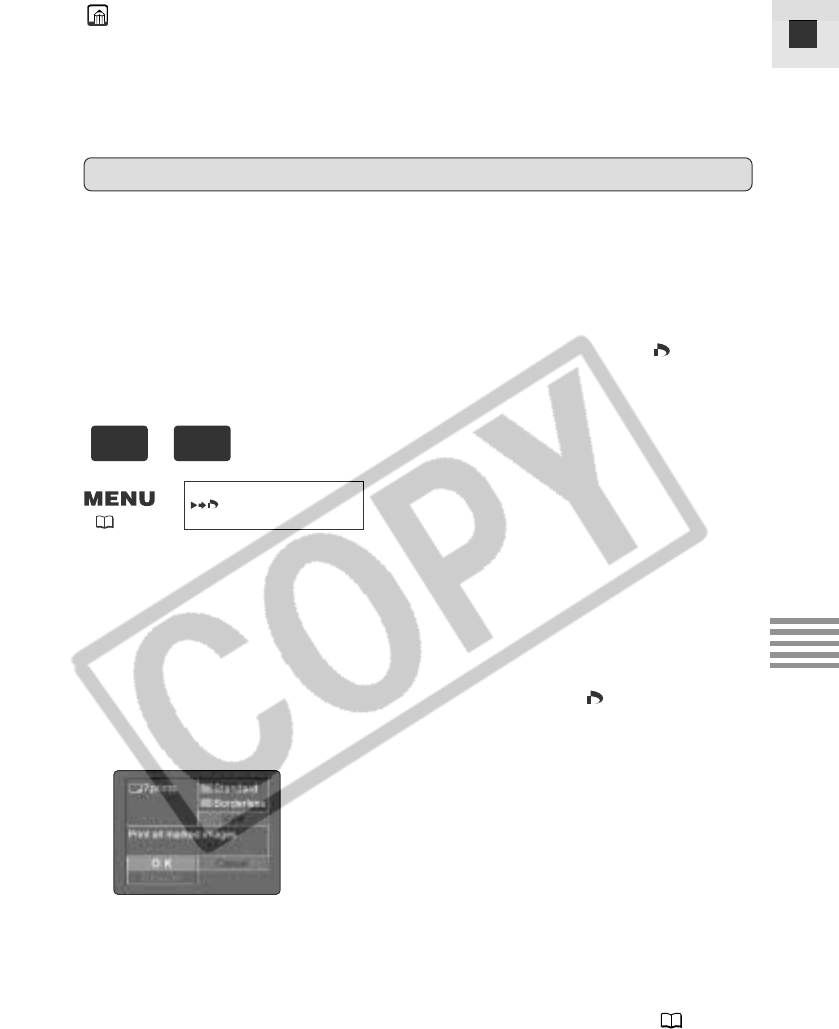
139
E
Using a Memory Card
PRINT
( 38)
+
PLAY
(VCR)
CARD
1. Connect the printer to the camcorder.
2. Turn the POWER dial to PLAY (VCR) and the TAPE/CARD
switch to CARD.
3. Press the MENU button.
• C. PLAY MENU settings appear.
4. Pull the selector dial up or down to select \PRINT and
press the selector dial in.
• The print dialog appears.
5. If you wish to print without changing the style settings,
make sure [OK] is selected and press the selector dial in.
• Printing starts and, when it is completely finished, the display will return
to playback mode.
• For changing the style settings, see “Setting the Print Style” ( 135).
Printing Still Images Marked for Printing
You can print still images marked for printing automatically.
If you wish to print more than 1 copy of a still image, set the number of
copies when you mark it for printing.
• You cannot select the [Trimming] setting with still images marked for
printing. You can select only the style (Standard/Multiple,
Bordered/Borderless).
• If you connect to a direct print supporting printer and select \PRINT
without having marked a still image for printing, [Set print mark] will be
displayed.
Notes:
• Trimming can only be set for one image at a time.
• The trimming setting is cancelled with the following operations.
– When you turn off the camcorder.
– When you detach the interface cable.
– When you expand the trimming frame beyond its maximum size.
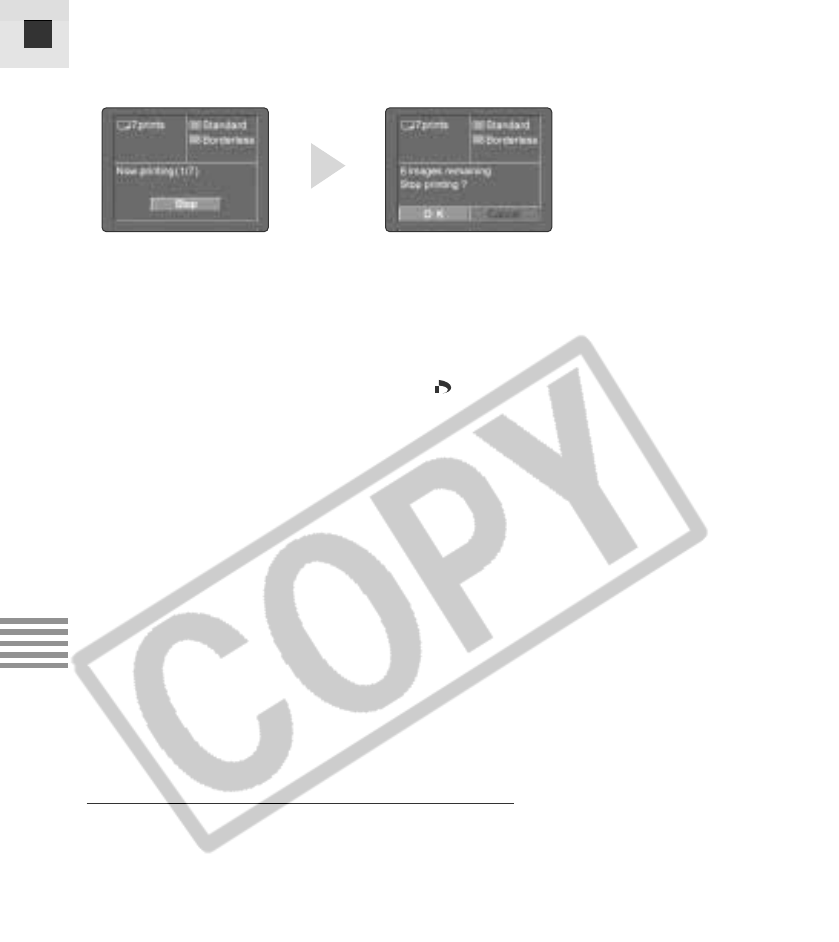
140
E
Using a Memory Card
Cancel Printing
Press the selector dial in while the [Now printing] dialog is displayed.
A confirmation dialog displays. Make sure that [OK] is selected and press the
selector dial in.
• With the Card Photo Printer, a print in progress cannot be stopped.
Printing of the next still images will be cancelled and the display will return
to playback mode. With the BJ Printer, printing stops even if it is
incomplete and the paper is fed through.
Restarting Printing
• Open the C.PLAY menu and select \PRINT. Select [Restart] on the
print dialog and press the selector dial in. The remaining still images will be
printed.
• Printing cannot be restarted in the following circumstances:
- When you have changed the print mark settings.
- If you have deleted a still image marked for printing.
Printing Errors
• If an error occurs during printing, error messages such as “NO INK”,
“PAPER JAM” or “NO PAPER” will display. Select [Stop] or [Continue] with
the selector dial and press the selector dial in.
• With the Card Photo Printer, the [Restart] setting may not appear with
some error messages. In that case, select [STOP].
• With the BJ Printer, the [Continue] and [Stop] options may appear with
some error messages. The error number is displayed on the operation
panel of the Bubble Jet Printer. Please refer to the Bubble Jet Printer Quick
Start Guide for the remedies corresponding to the error numbers.
When Disconnecting the Interface Cable:
Follow below procedure when disconnecting the interface cable.
1. Disconnect the cable from the camcorder and printer.
2. Turn off the camcorder.
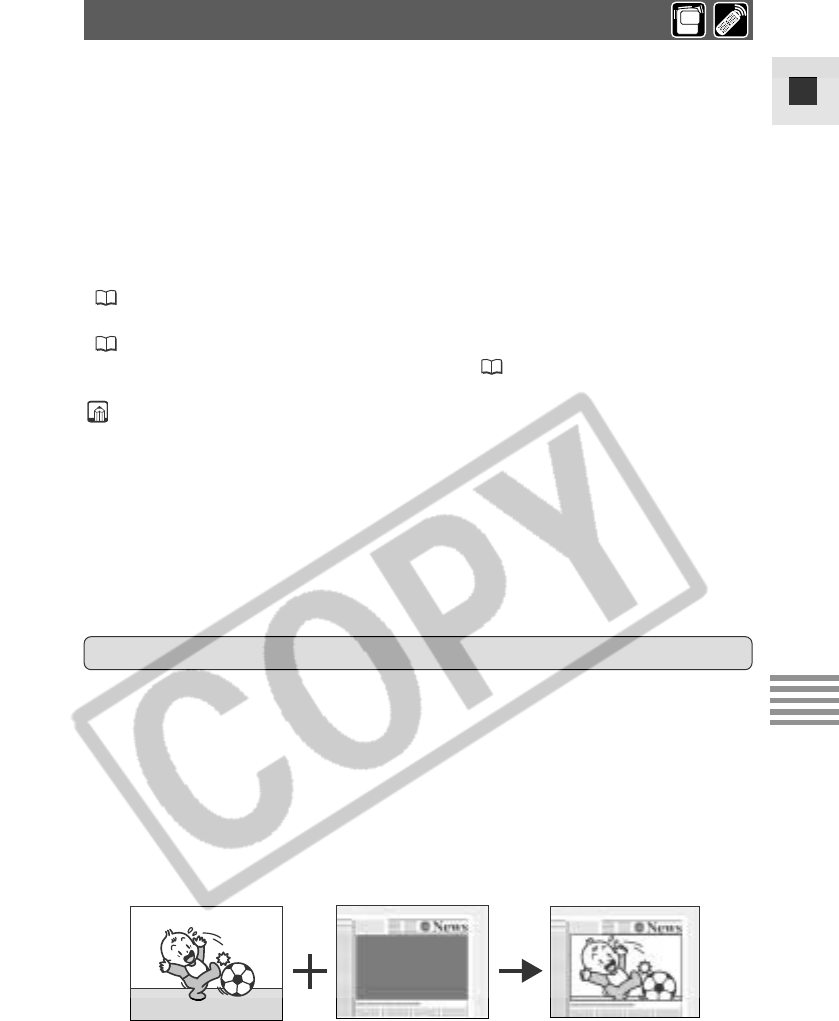
141
E
Using a Memory Card
Combining Images (Card Mix)
Enhance the appearance of your recordings by combining still images from
the memory card with camcorder recordings. You may select from pre-
recorded cartoon-like frames, or create personal frames and titles that can be
layered over movies or still images. In addition, you can combine your
recordings with animations from the memory card.
• You cannot combine movies recorded onto the memory card with the
camcorder recordings.
This section explains following procedures:
Combining Still Images from a Memory Card with Camcorder Recordings
( 141)
Combining Animations from a Memory Card with Camcorder Recordings
( 144)
Recording the Combined Image onto a Tape ( 145)
Notes:
• Some card mix sample images have been pre-recorded onto the supplied
memory card. However, you can add more sample images from the
supplied DIGITAL VIDEO SOLUTION DISK.
Card Chroma Key: 3 Card Luminance: 3
Camera Chroma Key: 2 Card Animation: 4
• For instruction on how to add sample images to the memory card, refer to
“Adding Sill Images from Your Computer to the Memory Card” in the
DIGITAL VIDEO SOLUTION DISK Software Instruction Manual.
Image being recorded
by the camcorder Still image
Select from 3 types of Card Mix effects:
CARD CHROMA (Card chroma key)
Combine the image you are recording with a still image as a frame. The
image will be shown instead of the blue area of the still image. When
recording your own “frame”, make sure that the area you wish the other
image to appear is blue.
Adjustment of the MIX LEVEL: blue area of the still image.
Combining Still Images from a Memory Card with Camcorder Recordings
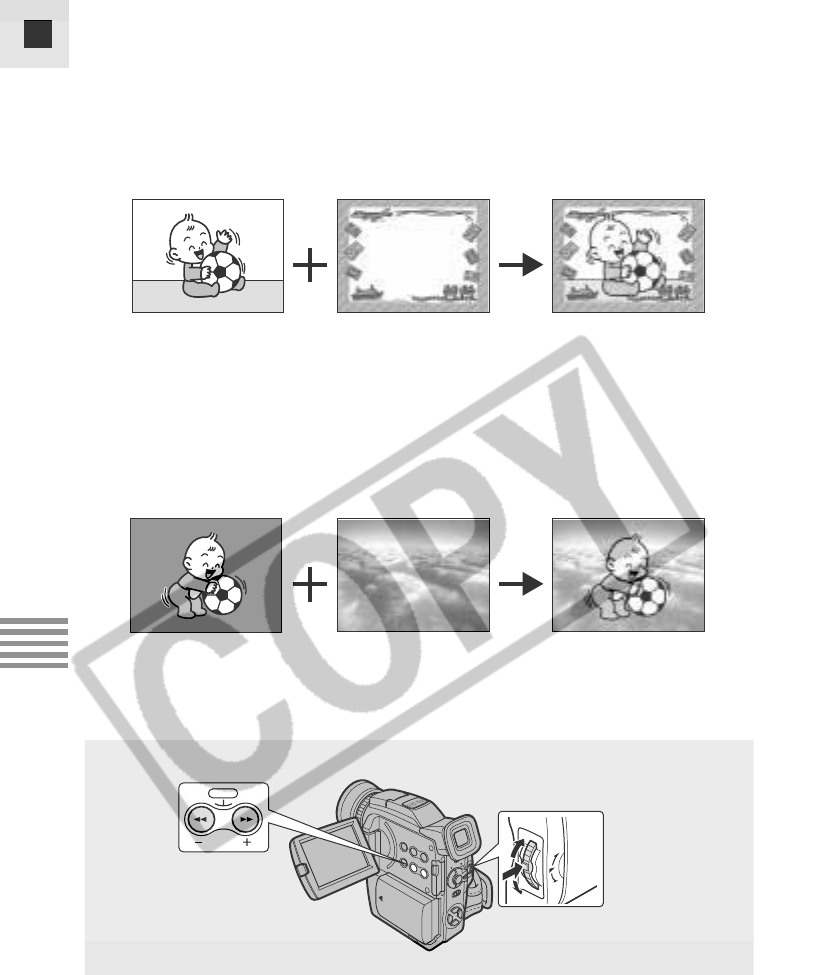
142
E
Using a Memory Card
CARD LUMI. (Card luminance key)
Combine the image you are recording with illustrations or titles. The image
will be shown instead of the light area of the still image. Create your own
title or illustration by drawing or writing on a white paper and recording it
to the memory card.
Adjustment of the MIX LEVEL: light area of the still image
Image being recorded
by the camcorder Still image
Mix level
The mix level bar appears. Adjust the mix level using the – and + at the ends
of the bar as guides.
CAM. CHROMA (Camera chroma key)
Combine the image you are recording with a still image as the background.
Shoot the subject in front of a blue background, such as a blue curtain, and
the subjects not blue will be superimposed on the still image.
Adjustment of the MIX LEVEL: blue area of the image you are recording
Image being recorded
by the camcorder Still image
REC SEARCH
CARD
SELECT
143
E
Using a Memory Card
MIX LEVEL•••
CARD MIX
–+
MIX TYPE••••CARD CHROMA
( 38)
Make sure a memory card that has images recorded on it and a cassette
have been inserted into the camcorder.
1. Make sure the camcorder is set to the Q(program AE) mode.
• You cannot use Card Mix in the Night or Super Night recording
program.
2. Open the menu and select \CARD MIX.
3. Press the CARD +/– buttons to select the still image to be
combined.
4. Select MIX TYPE.
• CARD CHROMA, CARD LUMI., CAM. CHROMA and C.ANIMATION
settings appear.
5. Select the desired setting.
• Your currently recording image is combined with the pre-recorded still
image.
6. Select MIX LEVEL.
7. Adjust the mix level.
• Turning the selector dial upwards adjusts to the right and turning
downwards adjusts to the left.
8. Close the menu.
• CARD MIX flashes in the display.
9. Press the CARD MIX button.
• CARD MIX stops flashing.
• Your currently recording image is combined with the pre-recorded still
image.
• Each time you press the card MIX button, your selection is activated
(display lights continuously) or deactivated (display flashes).
On/Off
Select
+
CAMERA
TAPE
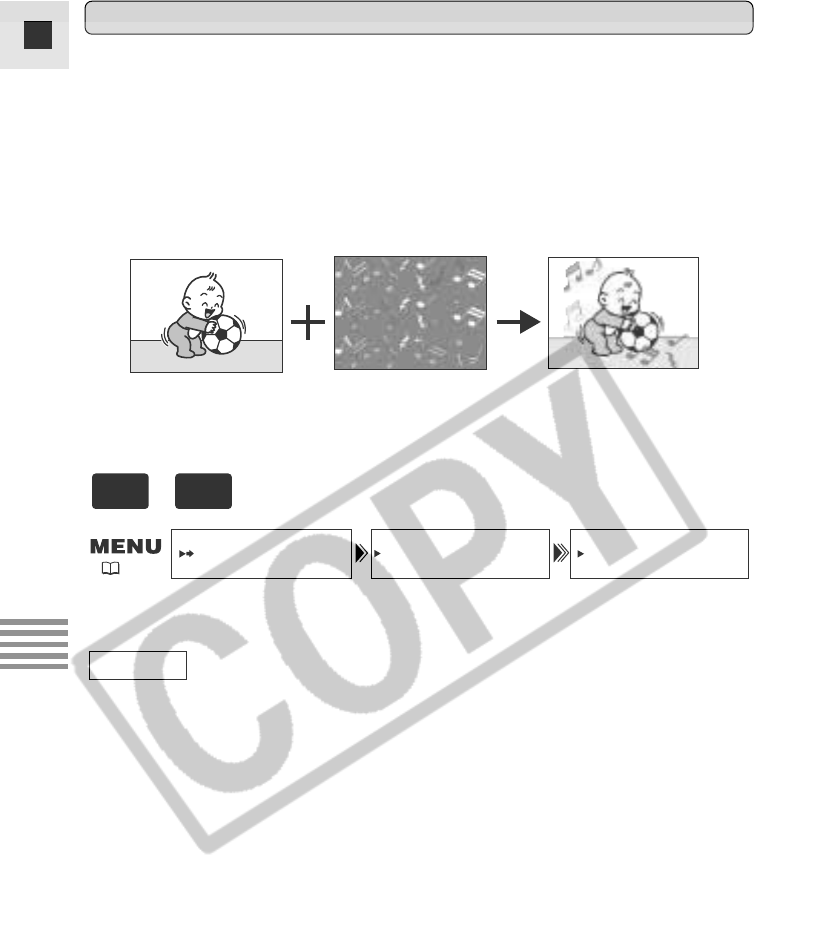
144
E
Using a Memory Card
Combine the image you are recording with animation.
Select from 3 types of Card Animation effects.
Corner: Animation appears on the upper left and the lower right corner in
the display.
Straight: Animation appears on the top and bottom in the display and
moves on the right and left.
Random: Animation moves randomly in the display.
12 animation samples have been pre-recorded on the supplied memory card.
These sample images are protected.
Adjustment of the MIX LEVEL: blue area of the animation image.
+
CAMERA
TAPE
Make sure a memory card that has animations recorded on it and a cassette
have been inserted into the camcorder.
1. Make sure the camcorder is set to the Q(program AE) mode.
• You cannot use Card Mix in the Night or Super Night recording
program.
2. Open the menu and select \CARD MIX.
3. Press the CARD +/- buttons to select the animation to be
combined.
4. Select C.ANIMATION.
5. Select ANIMAT.TYPE.
• CORNER, STRAIGHT and RANDOM settings appear.
6. Select the desired setting.
• Your currently recording images is combined with the pre-recorded
animation.
Select
ANIM TYPE•••CORNER
CARD MIX MIX TYPE••••C.ANIMATION
( 38)
Combining Animations from a Memory Card with Camcorder Recordings
Image being recorded
by the camcorder Animation
145
E
Using a Memory Card
7. Select MIX LEVEL.
8. Adjust the mix level.
9. Close the menu.
• CARD MIX flashes in the display.
10
.Press the card MIX button.
• CARD MIX stops flashing.
• Your currently recording image is combined with the pre-recorded
animation.
• Each time you press the card MIX button, your selection is activated
(display lights continuously) or deactivated (display flashes).
1. Press the start/stop button to start and stop recording.
• The combined images are recorded onto the tape.
1. Press the PHOTO button halfway down and hold it.
•Fflashes white in the display as the camcorder adjusts the focus and it
is displayed continuously as a green mark when the camcorder is ready
to take the image.
2. Press the PHOTO button fully down to record the image to
the tape.
•Fdisappears from the display.
• The combined images are recorded onto the tape for approximately 6
seconds.
Note:
• If you change the position of the POWER switch or TAPE/CARD switch,
select your still image for Card Mix again.
For still images
For movies
On/Off
Recording the Combined Image onto a Tape
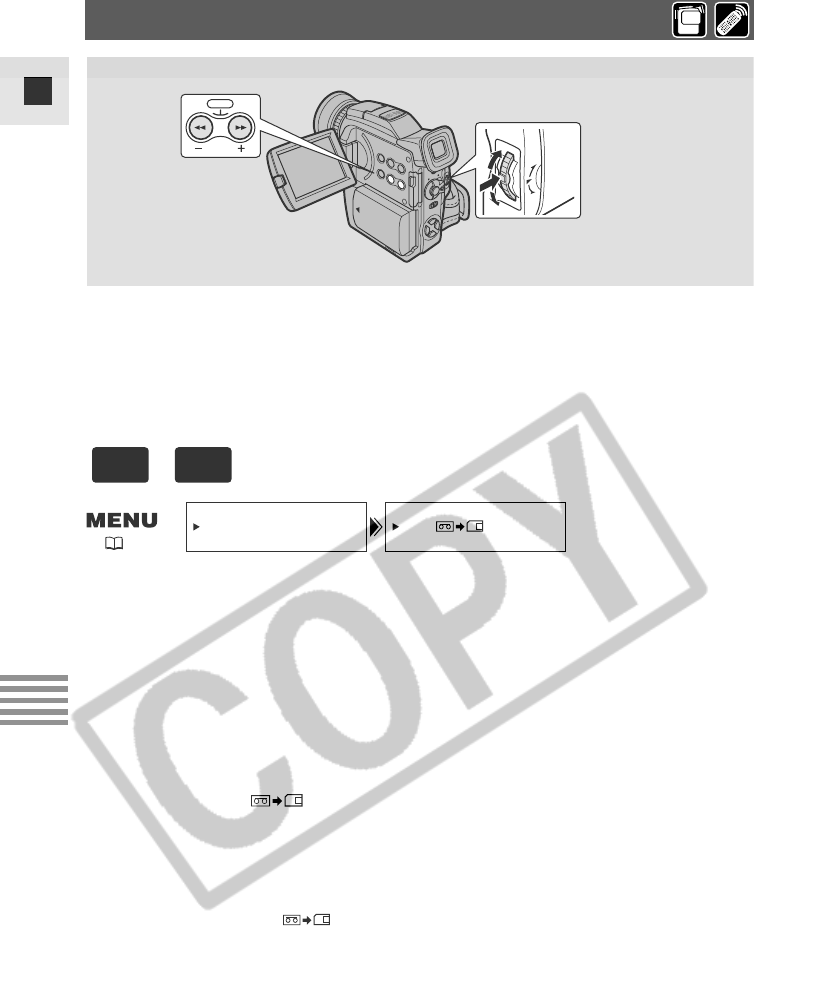
146
E
Using a Memory Card
Copying Still Images from Tape to Memory Card
REC SEARCH
CARD
SELECT
Copies multiple still images from a tape to the memory card, using the Photo
Search function.
• The still images’ data codes will reflect the date and time the copies are
made.
• The image size of a still image copied from tape to memory card will be
640 ×480.
Make sure a memory card that has enough memory available and a recorded
tape have been inserted into the camcorder.
1. Locate the first still image on the tape that you wish to copy
and stop the tape at a point before that image.
• All the still images on the tape after that point will be copied onto the
memory card.
• If you want to copy all the images on a tape, rewind the cassette to the
beginning.
2. Open the menu and select CARD OPER.
3. Select COPY .
• CANCEL and EXECUTE settings appear.
4. Select EXECUTE.
• Select CANCEL to stop copying.
• Tape and card information appear in the display and copying starts.
• NOW COPYING appears in the display.
• The camcorder automatically performs the Photo Search function to
locate still images and copying starts. The currently copying image
appears in the display.
• Copying stops when the tape is finished or the memory card is full.
When the memory card is full, CARD FULL will appear in the display.
5. Press the stop button when your desired images have
finished copying.
[ ]
[ ]
COPY
CARD OPER.
[ ]
( 38)
+
PLAY
(VCR)
TAPE
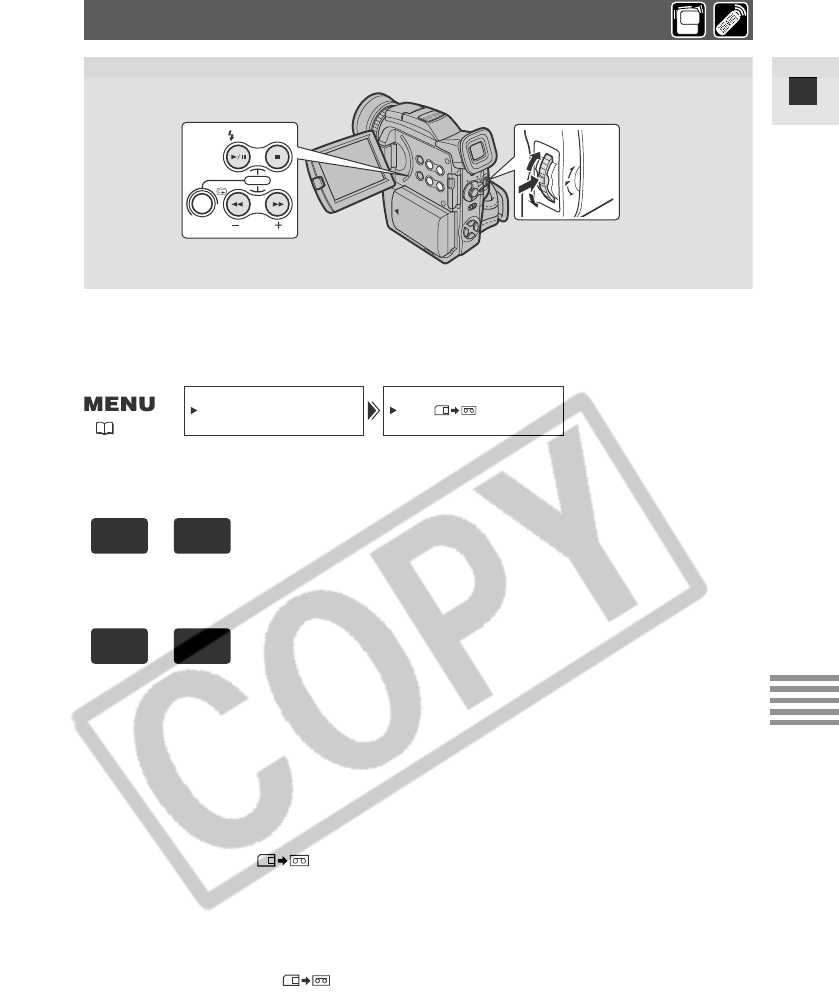
147
E
Using a Memory Card
Copying Still Images from Memory Card to Tape
INDEX
REC SEARCH
SCREEN
MIX/
CARD
SLIDE SHOW
SELECT
Make sure a memory card that has images recorded on it and a cassette that
has enough recordable space have been inserted into the camcorder.
1. Locate the point on the cassette where you want to start
copying and set it to stop.
2. Select the first image you wish to copy by using the CARD
+/– buttons.
• Still images on the memory card including and after that image will be
copied onto the tape.
• If you want to copy all the still images on the memory card, select the
first image.
3. Open the menu and select CARD OPER.
4. Select COPY .
• CANCEL and EXECUTE settings appear.
5. Select EXECUTE.
• Select CANCEL to stop copying.
• Tape and card information appear in the display and copying starts.
• NOW COPYING appears in the display.
• Each image is copied for about 6 seconds on the tape.
• Copying stops when all the images have been copied or the tape is full.
6. Press the 3button when your desired images have finished
copying.
[ ]
[ ]
COPY
CARD OPER. [ ]
( 38)
Copies multiple still images from the memory card to a tape.
• The still images’ data codes will reflect the date and time the copies are
made.
+
PLAY
(VCR)
TAPE
+
PLAY
(VCR)
CARD
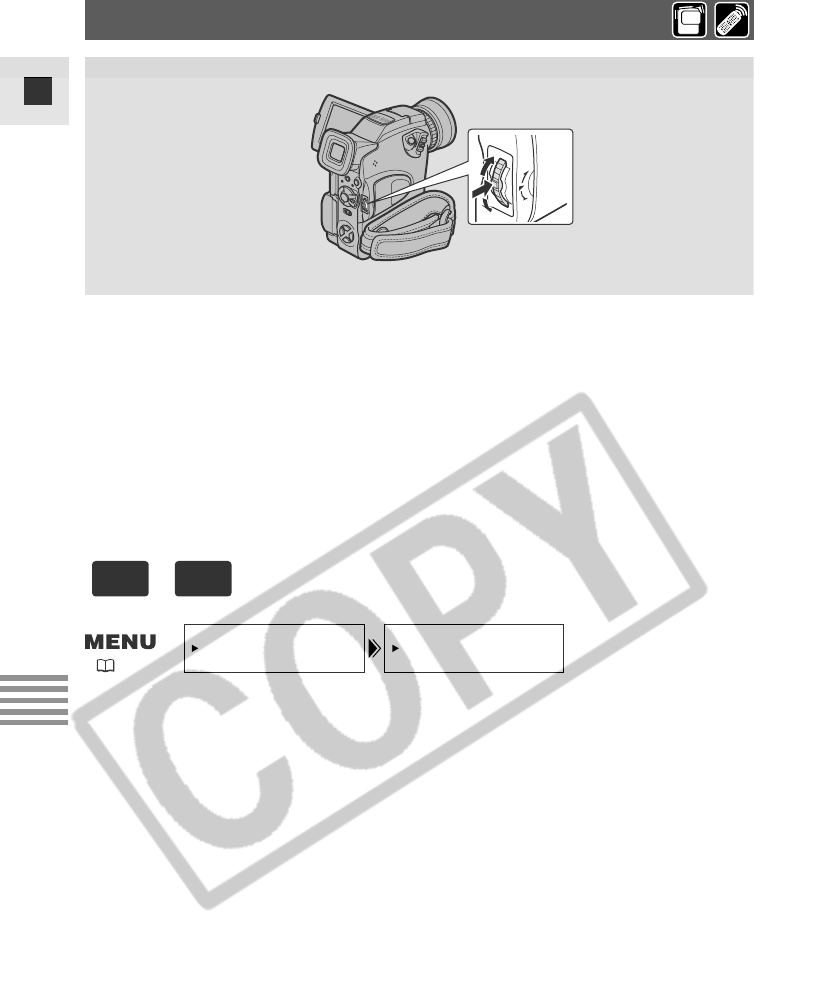
148
E
Using a Memory Card
Formatting a Memory Card
SELECT
Format new memory cards, if you get the message CARD ERROR, or to
permanently and quickly erase all the still images/movies on a memory card,
including protected still images/movies (this includes the pre-recorded card
mix sample images).
The SD Memory Card supplied with this camcorder has already been
formatted for you.
• Be cautious when formatting recorded memory cards. All still
images/movies will be permanently erased.
• If you use memory cards other than the supplied one, make sure to format
them with the camcorder, not a PC or other device.
Make sure a memory card is inserted into the camcorder.
1. Open the menu and select CARD OPER.
2. Select FORMAT.
• CANCEL and EXECUTE settings appear.
3. Select EXECUTE.
• Select CANCEL to cancel formatting.
• FORMAT THIS CARD? NO YES appears to confirm.
4. Select YES.
• Formatting starts.
• If you select NO, you return to step 3.
5. Close the menu.
FORMAT
CARD OPER.
( 38)
+
PLAY
(VCR)
CARD
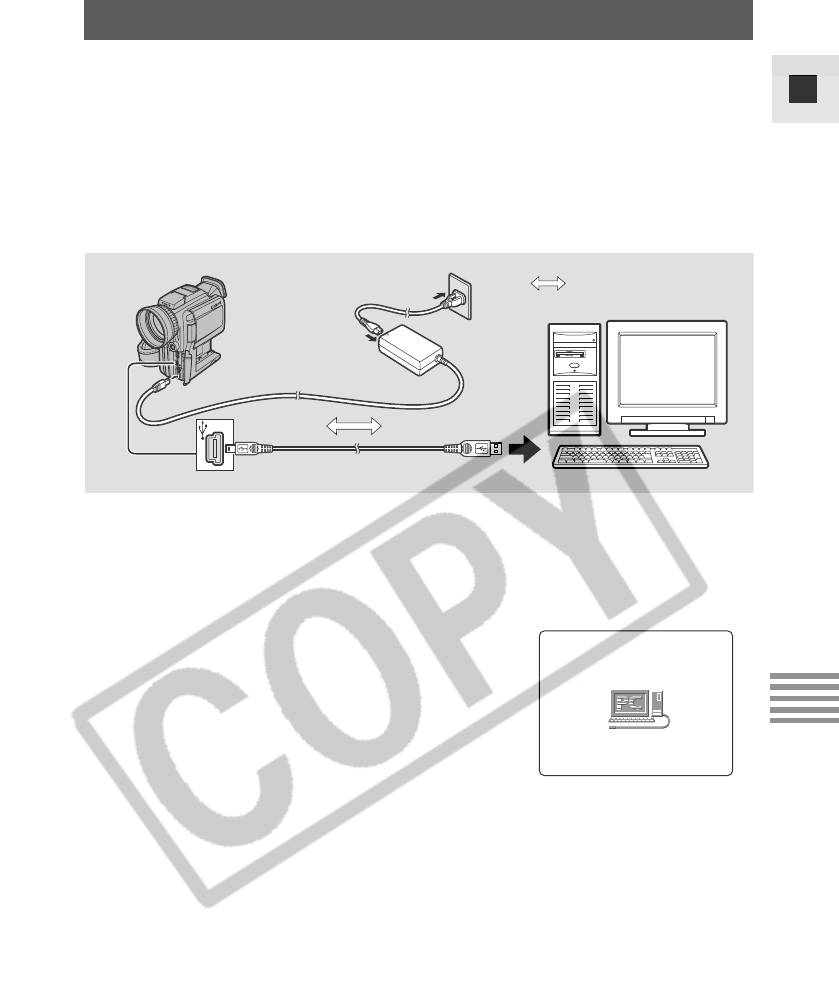
149
E
Using a Memory Card
Connecting to a PC Using a USB Cable
You can download still images/movies from a memory card to a PC
connected via the USB interface. By using the provided software, you can
organize and store still images/movies and print out still images with added
titles or frames.
Use the USB cable and the Canon DIGITAL VIDEO SOLUTION DISK/ArcSoft
Camera Suite CD with the camcorder.
• For transferring still images and movies from tape or memory card to your
PC using a DV cable, see p. 105.
For details on how to connect the camcorder to a PC and install
and operate the software, refer to the Canon DIGITAL VIDEO
SOLUTION DISK Software Instruction Manual.
• Refer also to your PC manual.
“PC CONNECT[USB]” appears to indicate that the
camcorder is connected to the PC with a USB
cable.
Cautions:
• Do not disconnect the USB cable, remove the memory card, or turn off the
camcorder or the computer while data is being transferred (while the
camcorder’s card access indicator is flashing). Doing so may damage the
memory card’s data.
• The connection may not work properly depending on the specifications
and settings of the software and PC.
• The image files on your memory card and the image files you have stored
(downloaded) to the hard disk drive of your computer are your valuable,
original data files. If you wish to use image files on your computer, be sure
to make copies of them first, and use the copied file, retaining the original.
IFC-300PCU USB cable
: Signal flow
PC CONNECT[USB]
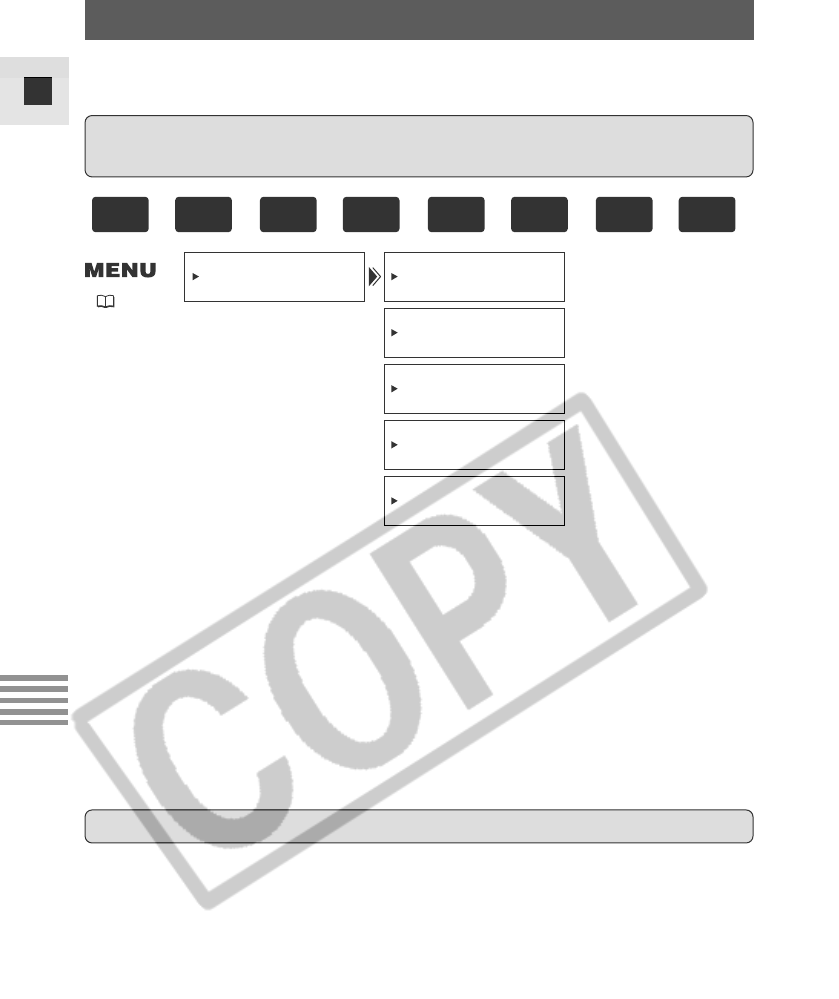
150
E
Using a Memory Card
1. Press the MENU button.
• The main menu appears.
2. Select MY CAMERA.
3. Select the item you wish to set.
• When you select the start-up image, OFF, DEFAULT, PATTERN1 and
PATTERN2 appear. The image saved as DEFAULT cannot be changed.
• When you select an item other than the start-up image, PATTERN1,
PATTERN2 and PATTERN3 appear. Moving the ebefore the setting
allows you to check the sound.
4. Select the setting and close the menu.
You can create a start-up image by using a still image recorded on the
memory card.
Record a still image with your camcorder, or download a still image from the
ZoomBrowser EX (for Windows) or ImageBrowser (for Macintosh) contained
in the DIGITAL VIDEO SOLUTION DISK, and set it as start-up image.
• For instructions on how to download the start-up image, refer to the
DIGITAL VIDEO SOLUTION DISK Software Instruction Manual or the PDF
manual “ZoomBrowser EX Software User Guide” or “ImageBrowser
Software User Guide” contained in the DIGITAL VIDEO SOLUTION DISK.
Using the My CAMERA Function
Changing the Start-up Image, Start-up Sound, Start/Stop
Sound, Shutter Sound or Self-Timer Sound
SEL.S–UP IMG
•
DEFAULT
SHTR SOUND
•••
PATTERN1
S–UP SOUND
•••
PATTERN1
S/STOP SOUND
•
PATTERN1
SELF–T SOUND
•
PATTERN1
MY CAMERA
( 38)
You can change the start-up image and sound, shutter sound, start/stop
sound and self-timer sound.
+,+,+,+
PLAY
(VCR)
CARD
CAMERA
CARD
PLAY
(VCR)
TAPE
CAMERA
TAPE
Creating a Start-up Image
151
E
Using a Memory Card
Make sure a memory card with enough available memory is inserted into the
camcorder.
1. Turn the POWER switch to PLAY (VCR) and the TAPE/CARD
switch to CARD.
2. Open the menu.
3. Select MY CAMERA.
4. Select CREATE START-UP IMAGE.
• SET THIS AS START-UP IMAGE? YES NO appears.
5. Select the image you wish to save as start-up image with
the CARD +/– buttons.
• SAVE AS \ORIGINAL1, \ORIGINAL2, CANCEL appears.
6. Select ORIGINAL1 (ORIGINAL2).
• OVERWRITE ORIGINAL1 (ORIGINAL2)? YES NO appears.
7. Select YES.
• The start-up image will be saved. The start-up image that was saved in
the same location will be erased.
• If you select NO, you return to step 6.
CREATE START–UP IMAGE
MY CAMERA
( 38)
+
PLAY
(VCR)
CARD

152
E
Using a Memory Card
Other Information and Precautions
The camcorder formats memory cards in DCF (Design rule for Camera File
system).
Still images/movies recorded on a memory card with this camcorder can also
be transferred to a PC with the use of the following products made for SD
Memory Cards or MultiMediaCards:
PC Card Adapter: Holds a memory card then inserts into the PC card slot
found on most types of laptop PCs.
FD Adapter: Holds a memory card then inserts into a PC’s floppy disk drive.
Memory Cards confirmed to operate with this camcorder (as of June
2002)
SD Memory Card—
Panasonic: 8 MB, 16 MB, 32 MB, 64 MB
SanDisk: 8 MB, 16 MB, 32 MB, 64 MB
MultiMediaCard—
SanDisk: 8 MB, 16 MB, 32 MB, 64 MB
• However, we cannot guarantee that all of these memory cards work
properly.
If you mistakenly erase the card mix sample images provided on the SD
Memory Card, they can be downloaded from the following home pages:*
http://www.canon-europa.com/products/products.html
http://www.canon-asia.com/
http://www.canon.com.au
*If you are unable to connect the camcorder to a PC using a USB cable, you
will need a PC Card Adapter or USB Card Reader to be able to download to
a memory card.
• If you purchase additional memory cards, format them with the camcorder,
not a PC or other device. There have been cases where memory cards
formatted with a PC or other device do not function properly.
• We recommend saving backups of memory card images on your PC’s hard
drive or other external memory device. Image data may be damaged or
lost due to a defect in a memory card, or if a memory card is exposed to
static electricity. Contents of a memory card cannot be compensated for
should data become damaged or lost.
• Do not remove the power source or the memory card while the card access
indicator flashes.
Memory Card Operating Precautions
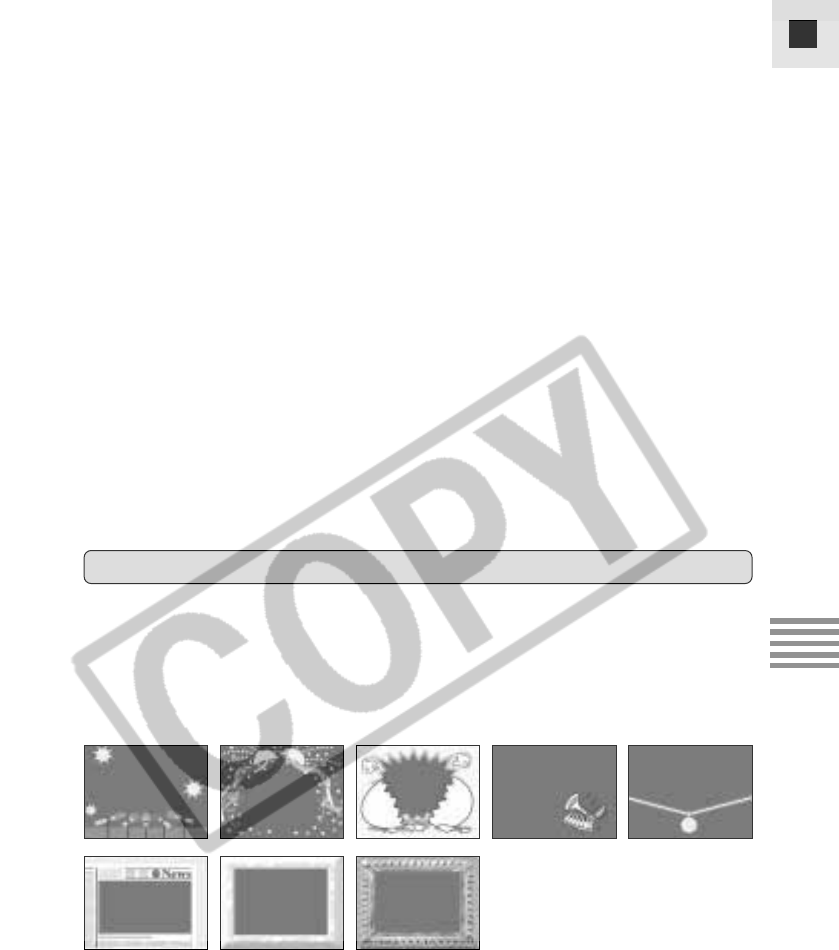
153
E
Using a Memory Card
• Do not use memory cards in places subject to strong magnetic fields.
• Do not disassemble memory cards.
• Do not bend or drop memory cards, or expose them to strong vibrations or
external shocks.
• Do not get memory cards wet.
• Do not remove the memory card’s label or affix other labels. Affix labels to
the memory card’s case.
• Do not leave memory cards in places subject to high temperature or high
humidity.
• Moving a memory card rapidly between hot and cold temperatures may
cause condensation to form on it, leading to malfunctions. Avoid this
problem by placing the memory card in a plastic bag and letting it slowly
adjust to temperature changes before removing it from the bag. If
condensation should occur, maintain the memory card at a constant
temperature and let the moisture evaporate naturally.
• Do not touch the memory card’s terminals or let dust or dirt come in
contact with the terminals. Store and carry memory cards in their case to
protect the terminal area.
• There is only one correct way to insert memory cards into the camcorder.
Do not forcefully insert the memory cards backwards or upside down. This
could damage the memory card or the camcorder.
Sample Images
• The following are the sample images that have been pre-recorded on the
supplied SD Memory Card. There are a total of 27 images: 8 card chroma
key images, 5 card luminance key images, 2 camera chroma key images
and 12 card animation images.
Card chroma key
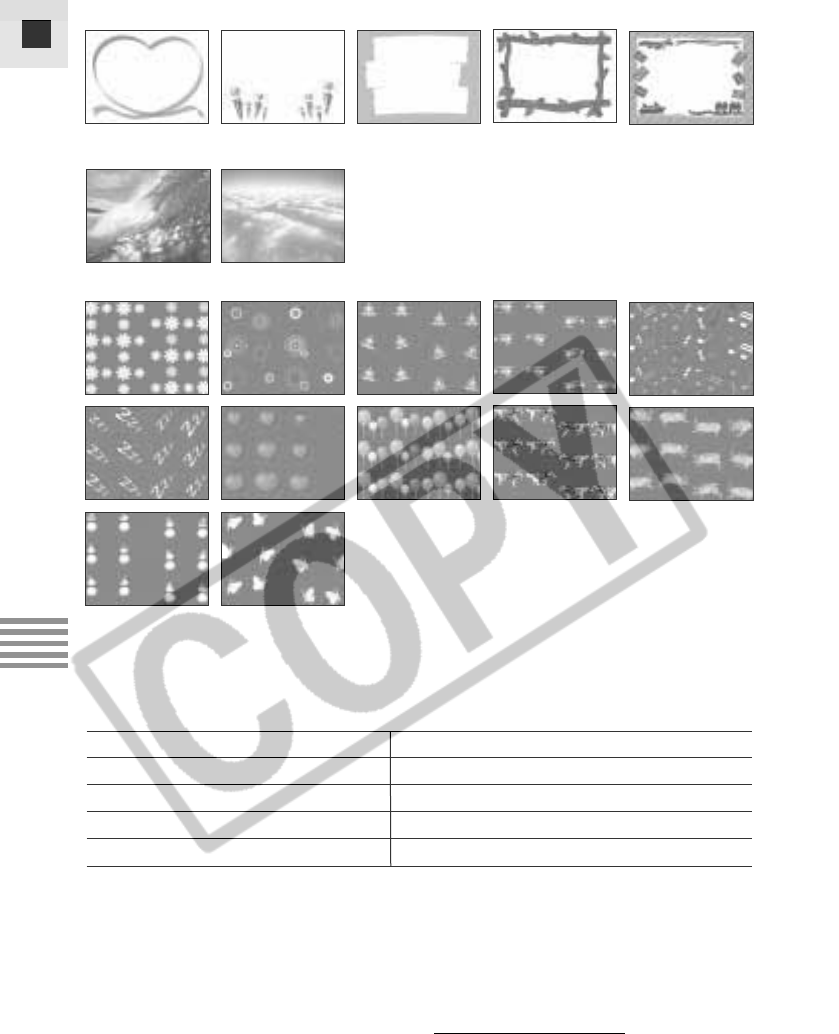
154
E
Using a Memory Card
Card luminance key
SD Memory Card SDC-8M Specifications
Capacity 8 MB
Interface SD Memory Card standard
Operating temperature range 0°C–40°C (32°F–140°F)
Dimensions 32 × 24 × 2.1 mm (11/4×1×11/8)
Weight 2 g (1/8oz)
Weight and dimensions are approximate.
Errors and omissions excepted.
Subject to change without notice.
• The pre-recorded sample images on the supplied SD Memory Card are
intended solely for the personal enjoyment gained from combining them
with personal videos taken with this camcorder. Do not use the pre-
recorded sample images for any other purpose.
PhotoEssentials - Royalty Free Stock Photography
The PhotoEssentials suite of royalty-free images on CD-ROM features premium quality
assignment photography and is ideally suited for use in advertising, brochures, reports,
multimedia, websites, books, packaging and more.
For more information, please visit their website www.photoessentials.com
Camera chroma key
Card animation
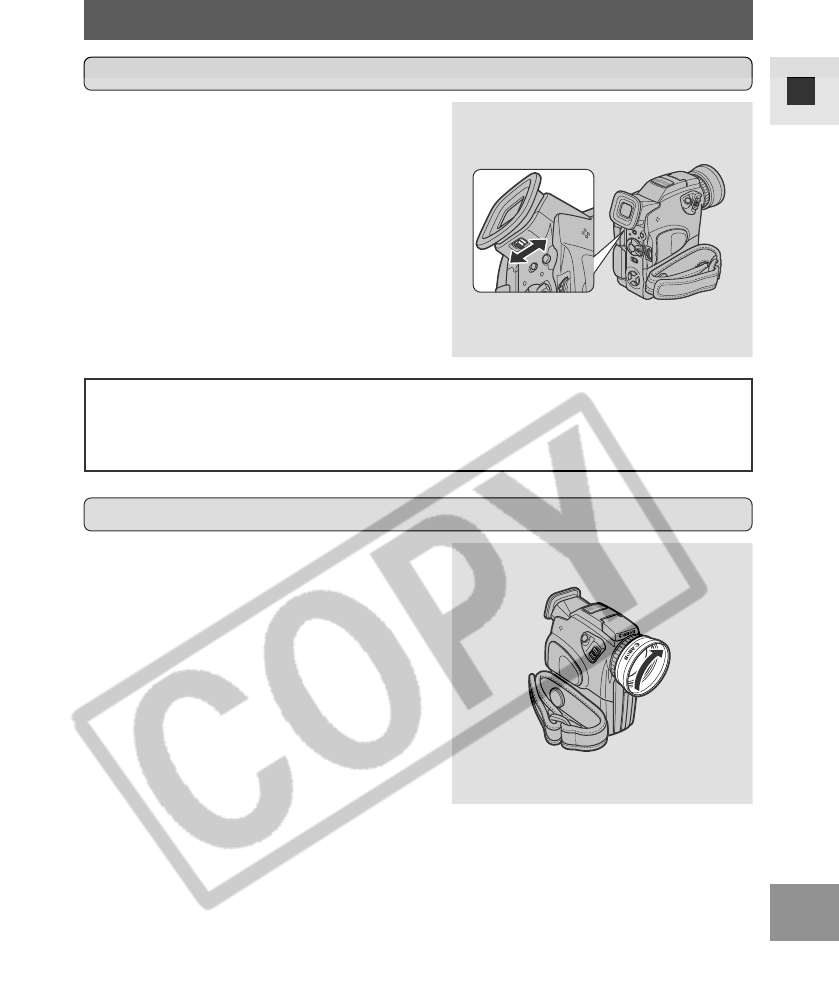
155
E
Additional
Information
Preparing the Camcorder
• Set the camcorder to TAPE CAMERA
mode. Adjust the viewfinder focusing
lever to suit your eyesight.
• To view with the viewfinder, make sure
the LCD panel is either turned so that
the subject can monitor viewing, or
totally closed with the screen facing
inwards.
Adjusting the Viewfinder
Be careful not to leave the viewfinder exposed to bright sunlight, or it
will melt. (The light is concentrated by the viewfinder lens.) Do not direct
the viewfinder to the sun.
Since the lens hood cuts stray light that
may cause flare and ghost images and
protects the lens, be sure to attach the
hood when you are recording.
1. Align the hood to the lens
with the Canon logo facing to
the left.
2. Twist it into position
(clockwise), so that the Canon
logo is to the top.
• Make sure attach the hood to the
camcorder horizontally.
Attaching the Lens Hood
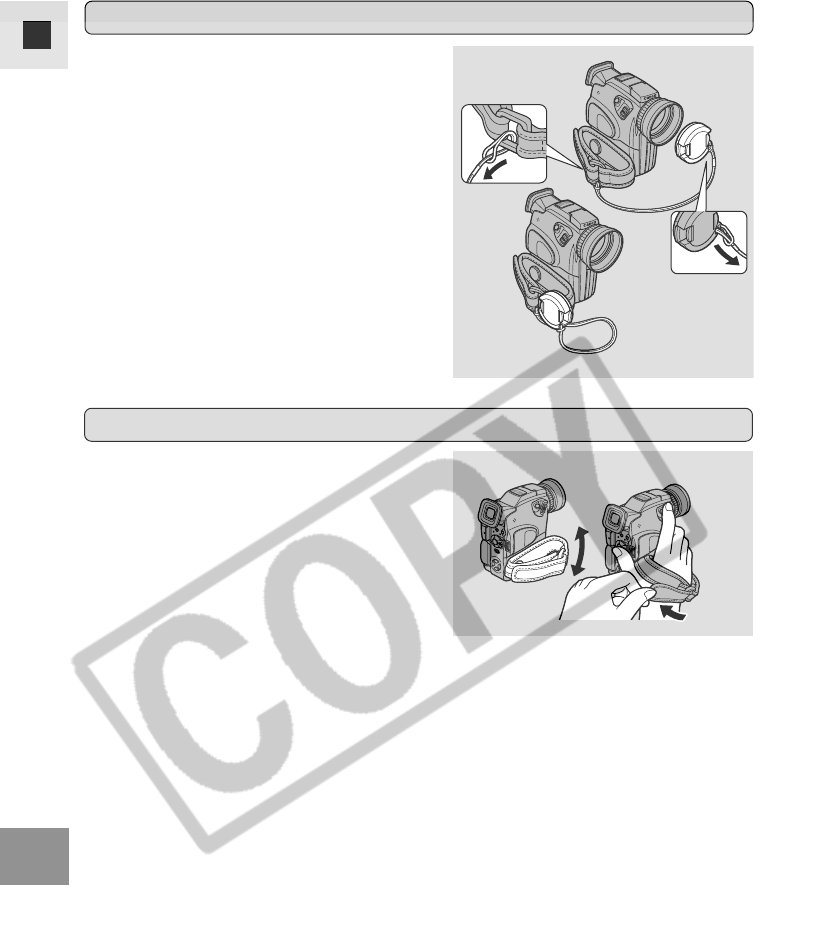
156
E
Additional
Information
Preparing the Lens Cap
Fastening the Grip Belt
• Rotate the viewfinder downwards.
• Release the Velcro fastening and hold
the camcorder with your right hand
while you adjust the belt with your
left.
Your index finger should reach the
zoom control and photo button, and
your thumb should reach the
start/stop button comfortably.
• Attach the cord to the grip belt, and
then to the lens cap, passing the cord
through the hole on the lens cap
from front side.
• Hook the lens cap on to the grip belt
while you are recording, and place it
over the lens when you have
finished.
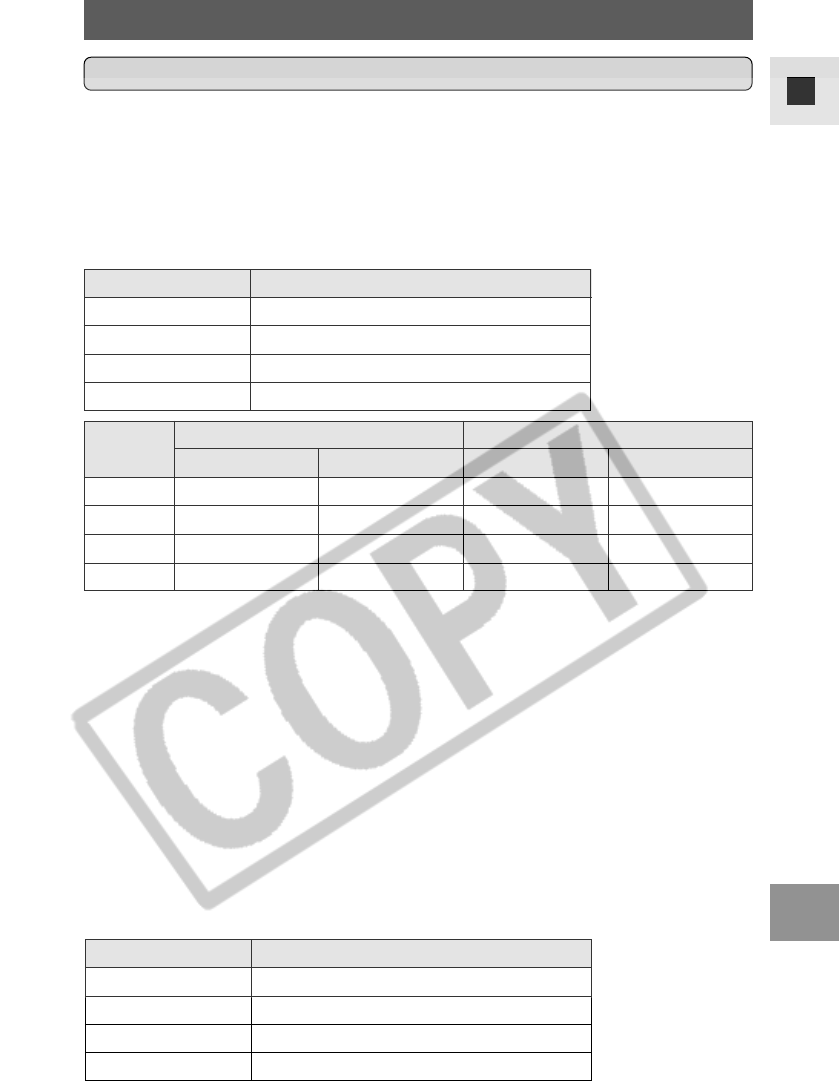
157
E
Additional
Information
Notes on Using the Batteries
Charging and Recording Times
• These times vary — the safest policy is always to have 2 or 3 times as many
battery packs as you think you will need.
• You will get more recording time if you turn the camcorder off between
shots, instead of leaving it in record pause mode.
• Charge the battery pack in temperatures between 5°C and 40°C (41°F and
104°F).
• The charging time varies depending on the charging conditions.
• You can use the battery pack between 0° and 40°C (32° to 104°F), but it
works best between 10° and 30°C (50° to 86°F). Operating time will be
shorter than usual at low temperatures like a ski ground. For better
operating results, the battery pack can be warmed in your pocket or
someplace and then used.
• If the battery pack starts to give you much less operating time than usual
(at normal temperatures), it has reached the end of its life and must be
replaced.
• These figures show how long you can view playback with the LCD, after
attaching a fully-charged battery pack. Playback time will be shortened at
low temperatures.
* Typical Recording Time: Approximate times for recording with repeated
operations such as start/stop, zooming and power on/off. The actual time
may be shorter.
Time needed for full rechargeBattery Pack
BP-512 1 hr. 20 min.
BP-511 (optional)
1 hr. 20 min.
Battery
Pack
BP-512 2 hr. 15 min. 1 hr. 50 min. 1 hr. 15 min. 60 min.
BP-511 2 hr. 15 min. 1 hr. 50 min. 1 hr. 15 min. 60 min.
Max. Recording Time
Using the Viewfinder Using the LCD Screen
Typical Recording Time*
Using the Viewfinder Using the LCD Screen
BP-522 (optional)
2 hr. 15 min.
BP-535 (optional)
3 hr. 15 min.
BP-522 4 hr. 40 min. 3 hr. 50 min. 2 hr. 30 min. 2 hr. 5 min.
BP-535 7 hr. 25 min. 6 hr. 10 min. 4 hr. 3 hr. 25 min.
Playback time (using the LCD screen)
BP-512 1 hr. 50 min.
BP-511 (optional) 1 hr. 50 min.
BP-522 (optional) 3 hr. 50 min.
BP-535 (optional) 6 hr. 10 min.
Battery pack
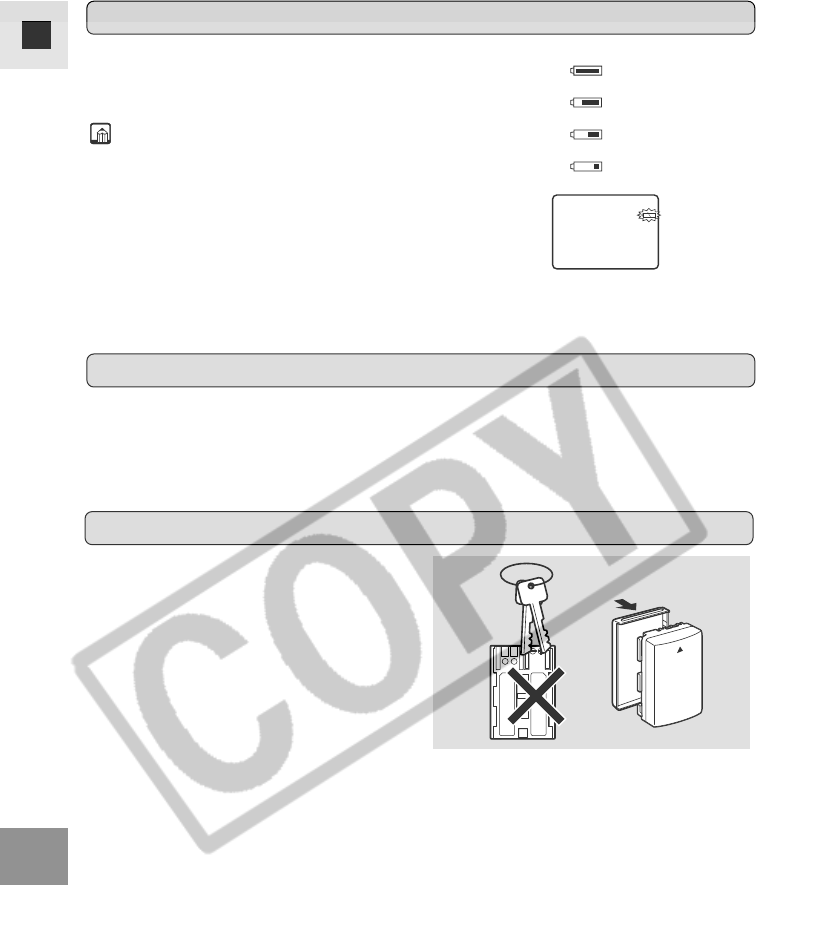
158
E
Additional
Information
When to Recharge
You can recharge a lithium ion battery pack whenever it is convenient. Unlike
a conventional battery pack, it does not have to be fully discharged first.
However, as the battery pack will naturally discharge itself over time, it is
best to charge it the same day you plan to use it, or the day before.
↓
↓
↓
↓
100%
75%
50%
25%
0%
CHANGET
HE BATTERYPAC
K
The indicator in the display shows you
approximately how much charge the battery
pack has left:
Notes:
• When the power is completely exhausted,
“CHANGE THE BATTERY PACK” appears
in the display for 4 seconds and the
empty battery mark starts to flash. The
power indicator light also flashes.
• The indicator is not constant — it varies
with the condition under which battery
pack and camcorder are used.
How Much Power Is Left?
Taking Care of the Battery Pack
BD
Always attach the terminal cover.
• Do not allow any metal objects to
touch the terminals, as this can
cause a short circuit and damage
the battery pack. Attach the
terminal cover whenever the
battery pack is not being used.
Keep the terminals clean.
• The camcorder, adapter or battery pack will not work properly if the
terminals are dirty. Attach the terminal cover whenever the battery pack is
not being used.
Storing the battery pack.
• Storing a charged battery pack for long periods of time (about 1 year) can
shorten its lifecycle or affect performance. We recommend to discharge
the battery pack in the camcorder fully and to store it in a dry place. If you
do not use the battery pack for long periods of time, charge it fully and
discharge it fully in the camcorder at least once a year before returning it
to storage.
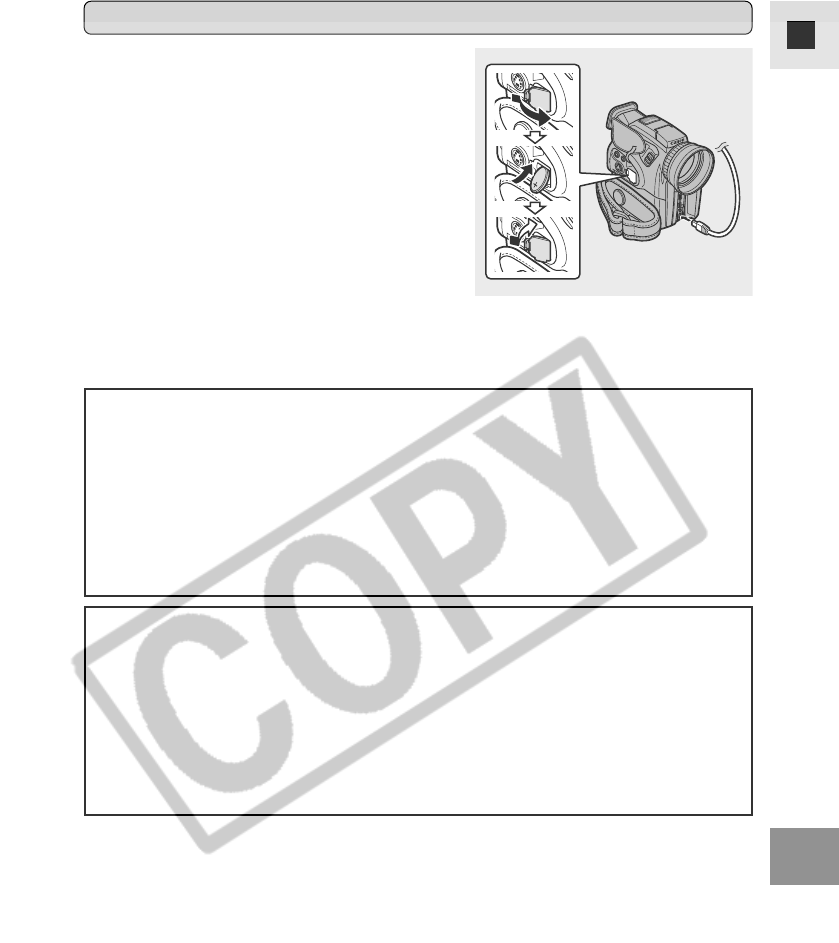
159
E
Additional
Information
DANGER!
Treat the battery pack with care.
• Keep it away from fire (or it might explode).
• Do not expose the battery pack to temperatures higher than 60°C (140°F).
Do not leave it near a heater, or inside a car in hot weather, for example.
• Do not try to disassemble or modify it.
• Do not drop or knock it.
• Do not get it wet.
WARNING!
• The battery used in this device may present a fire or chemical burn hazard
if mistreated. Do not recharge, disassemble, heat above 100°C (212°F) or
incinerate.
• Replace the battery with a CR1616 made by one of the following
companies: Panasonic, Hitachi Maxell, Sony, Toshiba, Varta or Renata. Use
of other batteries may lead to fire or explosions.
• The used battery should be returned to the supplier for safe disposal.
Cautions:
• Do not pick up the battery using tweezers or other metal tools — this will
cause a short circuit.
• Wipe the battery with a clean, dry cloth to ensure proper contact.
• Keep the battery pack out of reach of children — if it is swallowed, contact
a physician immediately, as the battery case may break down and the
battery fluids damage the stomach and intestines.
• Do not disassemble, heat or immerse the battery in water, to avoid the risk
of explosion.
Installing the Backup Battery
Open the backup battery cover and insert
the CR1616 lithium battery with the + side
facing outwards. Click the cover back into
place.
This backup battery allows the camcorder to
retain the date and time and other settings
when the main power source is removed. It
has a life span of about a year.
When it needs replacing (or if it has not
been installed), the ymark flashes in the
display. Remove the old battery by pushing
it up, releasing and lifting it out. Make sure to attach a power source to the
camcorder first, so it will retain your chosen settings when you change the
battery.

160
E
Additional
Information
Maintenance
Avoid high temperatures and high humidity.
• Do not leave the camcorder inside a car in hot weather, for example.
• Be careful of heat radiating from video lighting equipment.
• Do not take the camcorder into a humid room.
Avoid sudden changes in temperature.
• If you take the camcorder from a cold place to a warm place, condensation
may form on the lens and internal parts ( 163).
Do not point the lens or viewfinder at strong light sources.
• Never point it at the sun, and do not leave it aimed at a bright subject.
• Be especially careful when leaving the camcorder on a tripod.
Avoid magnetic or electric fields.
• Do not use the camcorder close to TV transmitters, portable
communication devices or other sources of electric or magnetic radiation.
They may cause picture interference, or permanently damage the
camcorder.
Do not expose the camcorder to water.
• The camcorder is not waterproof. If water, mud or salt (seawater) gets
inside the camcorder or cassette, it may lead to damage.
• Cover the camcorder when you are recording in rain or mist.
• There is a risk of electric shock if water gets inside the camcorder —
contact qualified service personnel as soon as possible.
Do not expose the camcorder to dust or sand.
• Do not use or store the camcorder in dusty or sandy places. If dust or sand
gets inside the camcorder or cassette, it may lead to damage.
• Sand and dust can damage the lens — be especially careful on windy days.
Always attach the lens cap after use.
Handle the camcorder gently.
• Vibration or shock can cause damage.
• Do not use the viewfinder or LCD panel as a carrying handle.
Do not disassemble the camcorder.
• This is very dangerous as there is a risk of electric shock — if the camcorder
does not function properly, take it to qualified service personnel.
Cautions
161
E
Additional
Information
LCD
• Clean the LCD screen using a commercially available cleaning cloth for
glasses.
• Moving the camcorder between hot and cold temperatures may cause
condensation (water droplets) to form on the surface of the screen. Wipe
the screen with a soft, dry cloth.
• At low temperatures, the display may appear to be much darker than
usual. This is not a malfunction. As the screen warms up, the display will
return to normal.
Camcorder body and lens
• Use a soft, dry cloth to clean the camcorder body or lens. Never use
chemically treated cloth or volatile solvents such as paint thinner.
Video heads
• When mosaic-like noise appears on the playback picture,
the video heads may be dirty. When the video heads are
badly contaminated, the camcorder may show a blank
blue screen or a warning.
• For the best picture possible, after using the camcorder
for approximately 20 hours, clean the video heads using
Canon’s DVM-CL Digital Video Head Cleaning Cassette. If the “noise”
remains, repeat the cleaning (up to maximum of 5 times).
• Do not use a wet-type cleaning cassette, as this can cause damage.
Maintenance
If you do not intend to use the camcorder for a longer time, store it in a dry
place free of dust and at temperatures no higher than 30°C (85°F). After
storage, check each part and function of your camcorder to make sure
everything is still working properly.
Note:
• These cautions also apply to accessories such as battery packs and
cassettes.
Storage

162
E
Additional
Information
Power sources
• You can use the compact power adapter to operate your camcorder and
charge battery packs in any country/area where the electricity supply is
between 100 and 240 V AC, 50/60 Hz. Contact your Canon dealer for
information about plug adapters for overseas use.
TV playback
• Although you can always play back your recordings on the LCD screen,
your camcorder can only be connected to TVs which use its PAL system.
This TV system is used in the following countries/areas:
Algeria, Australia, Austria, Bangladesh, Belgium, Brunei, China, Denmark,
Finland, Germany, Hong Kong Special Administrative Region, Iceland, India,
Indonesia, Ireland, Italy, Jordan, Kenya, Kuwait, Liberia, Malaysia, Malta,
Mozambique, the Netherlands, New Zealand, North Korea, Norway, Oman,
Pakistan, Portugal, Qatar, Sierra Leone, Singapore, South Africa, Spain, Sri
Lanka, Swaziland, Sweden, Switzerland, Tanzania, Thailand, Turkey,
Uganda, United Arab Emirates, United Kingdom, Yemen, former
Yugoslavia, Zambia.
Using the Camcorder Abroad
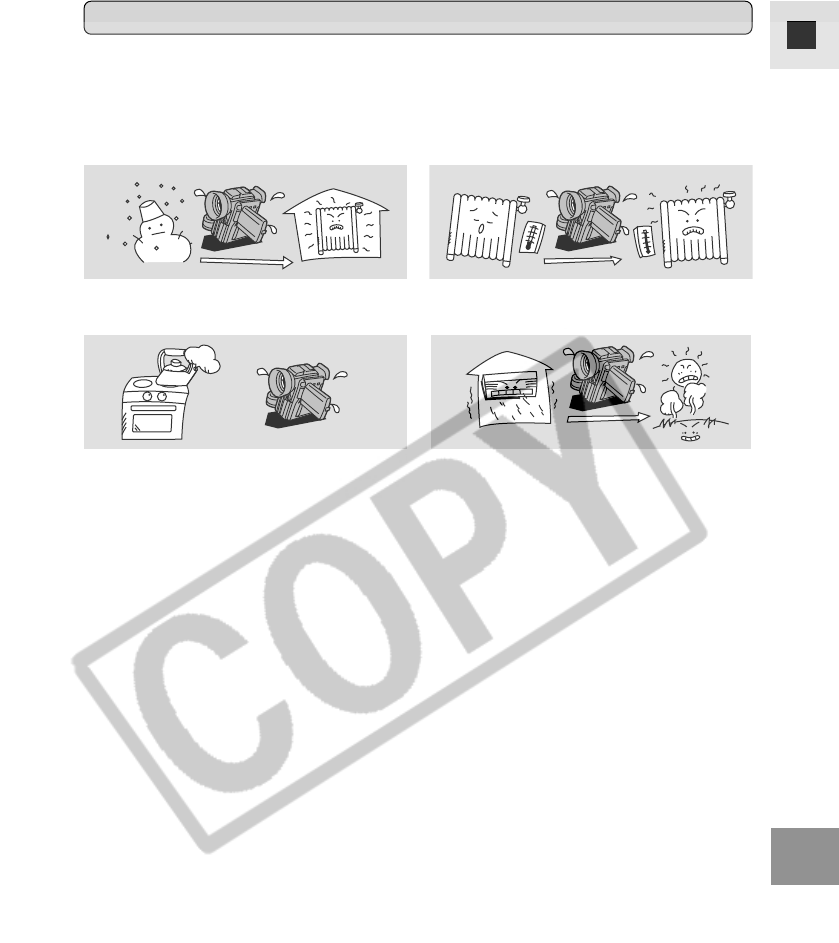
163
E
Additional
Information
Condensation
Condensation may form on the camcorder when it is moved from a cold
place to a warm place. Using the camcorder while condensation is present
can damage both the tape and the camcorder.
Condensation may become a problem:
When the camcorder is taken from an air-
conditioned room to a warm, humid place
Protecting the camcorder from condensation
• Before you take the camcorder to a warm or humid place where
condensation is likely to be a problem, unload the cassette and put the
camcorder in a plastic bag. Wait until the camcorder reaches room
temperature before you take it out of the bag.
What happens when condensation is detected
• “CONDENSATION HAS BEEN DETECTED” is displayed for approximately
four seconds. The power indicator flashes and the hmark flashes in the
display. If there is a cassette in the camcorder, it stops automatically and
“REMOVE THE CASSETTE” is displayed for approximately 4 seconds and v
flashes in the display. If you have the beep turned on, it will sound. Remove
the tape, otherwise it may be damaged.
• The camcorder may not detect the condensation immediately — the
condensation warning may not start flashing for 10 to 15 minutes.
• You cannot load a cassette when condensation is detected.
What you should do
• Remove the cassette, leave the cassette compartment open, and turn the
camcorder off.
• Leave it in a dry place until the condensation evaporates. After the
condensation warning stops flashing, wait at least another hour before
trying to use the camcorder.
When you take the camcorder from a
cold place to a warm room
When the camcorder is left in a humid
room
When a cold room is heated rapidly

164
E
Additional
Information
Troubleshooting
Refer to this checklist first if you have any problems with your camcorder.
Possible explanations are given for each problem on the list — turn to the
page numbers in parentheses for more information.
Make sure that the camcorder is properly connected if you are using it with a
TV or VCR. Consult your dealer or service outlet if problems persist.
Recording/Playback
Cause and/or what to do about it
• The camcorder is not set to the
appropriate mode ( 18, 30).
• The cassette is not loaded or is set
for erasure prevention ( 16-17).
• The cassette has reached the end.
•
The power source is not properly
connected, or the battery pack is
exhausted or not properly attached
( 11-15, 158).
• The function cannot be used in
that recording program ( 59).
• The camcorder was in record pause
mode for more than about 5
minutes ( 18, 111, 175).
• The battery pack is exhausted
( 12-15, 158).
• The battery pack’s power is
exhausted. Recharge or change to
a new battery pack ( 12-15).
• The cassette is not loaded or is set
for erasure prevention ( 16-17).
• The cassette has reached the end.
• The camcorder is malfunctioning.
Remove and then replace power
source.
• The camcorder is not set to the
appropriate mode ( 18, 30).
• You are attempting to play back or
record copyright protected material
( 92).
• The video heads are badly
contaminated ( 161).
Problem
?Nothing happens when I press
the buttons.
?The camcorder turned itself off.
?The cassette compartment
stopped mid-operation while
loading/unloading a cassette.
?The start/stop button does not
work.
?The mark flashes red in the
display during charging the
flash.
?There is no picture in the
display.
?There is a blank blue screen in
the display.
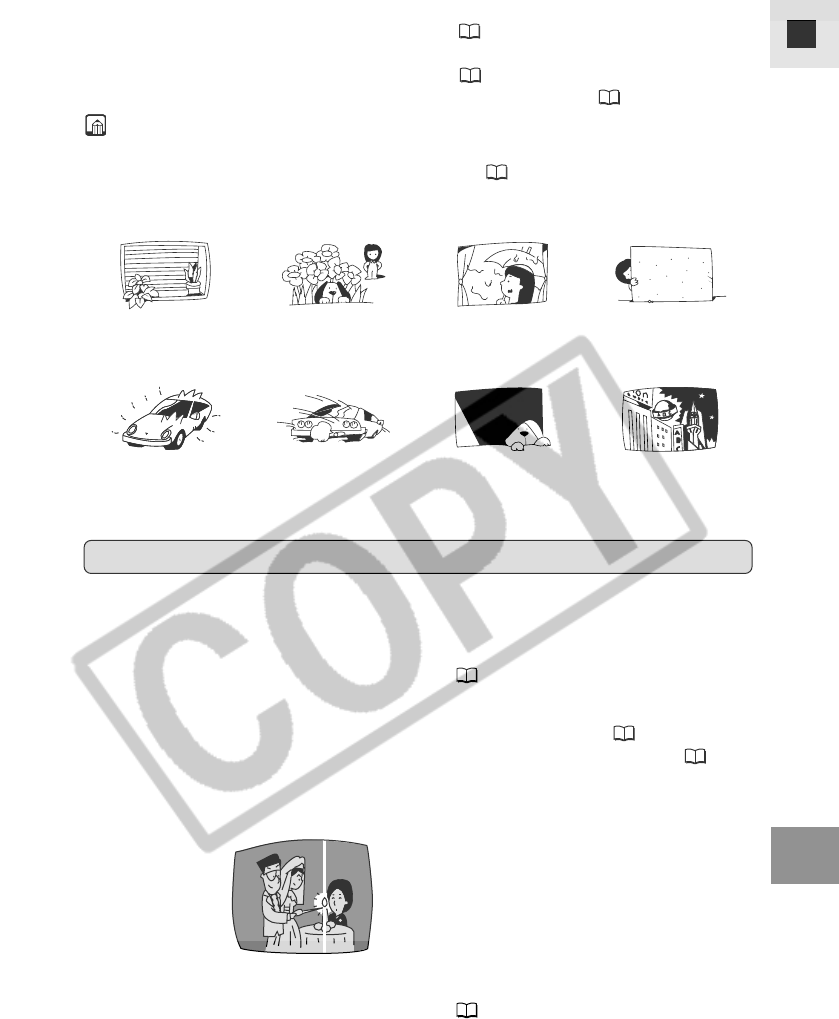
165
E
Additional
Information
Problem
?Some/all of the digital effects
do not work.
?The e (play) button does not
work.
?There is a bright stripe on the
screen.
?The playback picture is rough
(with mosaic-like noise).
Note:
• Some subjects are not suitable for autofocus. In these situations, you will
often get better results using manual focus ( 79). Focus on something
which is about the same distance away, lock the focus, and then point the
camcorder at your original, hard-to-focus subject.
Horizontal stripes Many subjects at
different distances
Behind glass Without much
contrast (e.g. a
white wall)
Reflective surfaces
(e.g. shiny car
surfaces)
Fast moving
objects
Dark subjects Night scenes
Recording/Playback (Cont.)
Cause and/or what to do about it
• There are a number of restrictions
on using the digital effects
( 63-68).
• The camcorder is not set to TAPE
PLAY (VCR) mode ( 30).
• The cassette is not loaded ( 16).
• The cassette has reached the end.
• When recording in dark places a
bright light in the scene may cause
a vertical light bar (“smear”) to
appear. This is a normal feature of
camcorders.
• The video heads need cleaning
( 161).
?The camcorder does not focus. • The camcorder is on manual focus
( 79).
• The viewfinder lens needs adjusting
( 155).
• The lens is dirty ( 161).

166
E
Additional
Information
• AV/PHONES is not set to AV in the
menu.
•AV \DV OUT (Analog-digital
converter) is not set to OFF.
• The video heads need cleaning
( 161).
• The TV/VIDEO selector on the TV
isn’t set to VIDEO ( 35-36).
• The speaker has been turned off
with the selector dial ( 33).
• Headphones are being used.
?There is no picture on the TV
screen.
?There is no picture on the TV
screen, even though the tape is
moving.
?There is no sound coming from
the speaker during playback.
Memory card operations
Cause and/or what to do about it
• It is not turned the right way
( 107). Turn it the right way and
try inserting again.
• Turn the camcorder's power off
and back on again and remove and
reinsert the card. If the mark
continues to flash, format the
memory card.
• The camcorder is not set to CARD
CAMERA or CARD PLAY (VCR)
( 111, 122) mode.
• The memory card is not inserted
( 107).
• You are using an SD Memory Card
and it is set for erasure prevention.
Change the position of the protect
switch.
• The memory card is full. Erase
images ( 130) or insert a new
memory card.
• The power source is not properly
connected, or the battery pack is
exhausted or not properly attached
( 11-15, 158).
• The function cannot be used in
that recording program ( 59).
• The memory card is not loaded
( 107).
Problem
?The memory card will not
insert.
?The mark flashes red in the
display even though a memory
card has been inserted.
?Nothing happens when I press
the buttons.
?The PHOTO button does not
work.

167
E
Additional
Information
Miscellaneous
Cause and/or what to do about it
• The remote sensor mode is set to
OFFBin the menu ( 49).
• The remote sensor modes of the
wireless controller and the
camcorder itself are different
( 49).
• The batteries are dead or not
inserted.
• Check the screen displays ( 171).
• External interference may cause the
camcorder’s microprocessor to
malfunction temporarily. If random
letters appear in the display or if
normal operation is interrupted,
remove and then replace the
power source.
• Remove the cable and then
reconnect it or turn the power off
and back on again.
• This is not a malfunction.
Problem
?The wireless controller does
not work.
?The power indicator is flashing.
?The camcorder malfunctions.
?The DV cable is connected
correctly, but there’s nothing in
the display.
?The camcorder becomes warm
during use.
?The image cannot be erased.
• You are using an SD Memory Card
and it is set for erasure prevention.
Change the position of the protect
switch.
• The memory card is full. Erase
images ( 130) or insert a new
memory card.
• You have reached the maximum file
number. Set the file numbering to
RESET through the menu ( 110)
and insert a new memory card.
• You are using an unformatted
memory card. Format the card
( 148).
• The image is protected ( 127).
• You are using an SD Memory Card
and it is set for erasure prevention.
Change the position of the protect
switch.
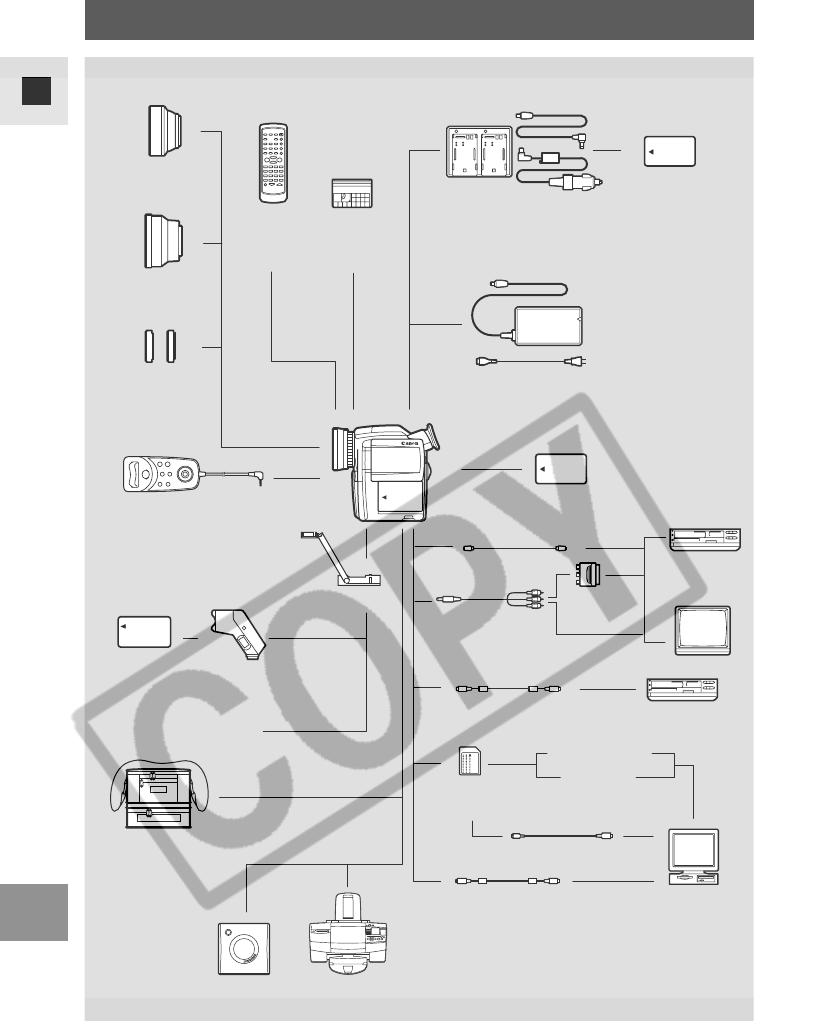
168
E
Additional
Information
The MVX2i System Diagram (Availability differs from area to area)
TV
WL-D78
Wireless
Controller
MiniDV
Video
Cassette
CR-560 Charge Adapter/
Car Battery Cable Kit
CA-560 Compact
Power Adapter
FS-34U
Filter Set
ZR-1000 Zoom
Remote Controller
SC-1000 Soft
Carrying Case
Digital Device
BP-500 Series
Battery Pack
CV-150F DV Cable
CV-150F/CV-250F DV Cable
BP-500 Series
Battery Pack
STV-250N
Stereo Video Cable
S-150 S-video Cable
PC-A10
SCART
Adapter
VCR
TL-34 Tele-
converter
WD-34 Wide-
converter
MultiMediaCard
or
SD Memory Card
PC Card Adapter
FD Adapter
Personal Computer
SA-1 Adapter Bracket
BP-900 Series
Battery Pack*
VL-10Li
Battery Video Light
Stereo Microphone
(commercially available)
IFC-300PCU USB Cable
Bubble Jet
Printer
CP-100 Card
Photo Printer
* Charging with the CA-920 Compact Power Adapter or CH-910 Dual
Battery Charger/Holder (optional)
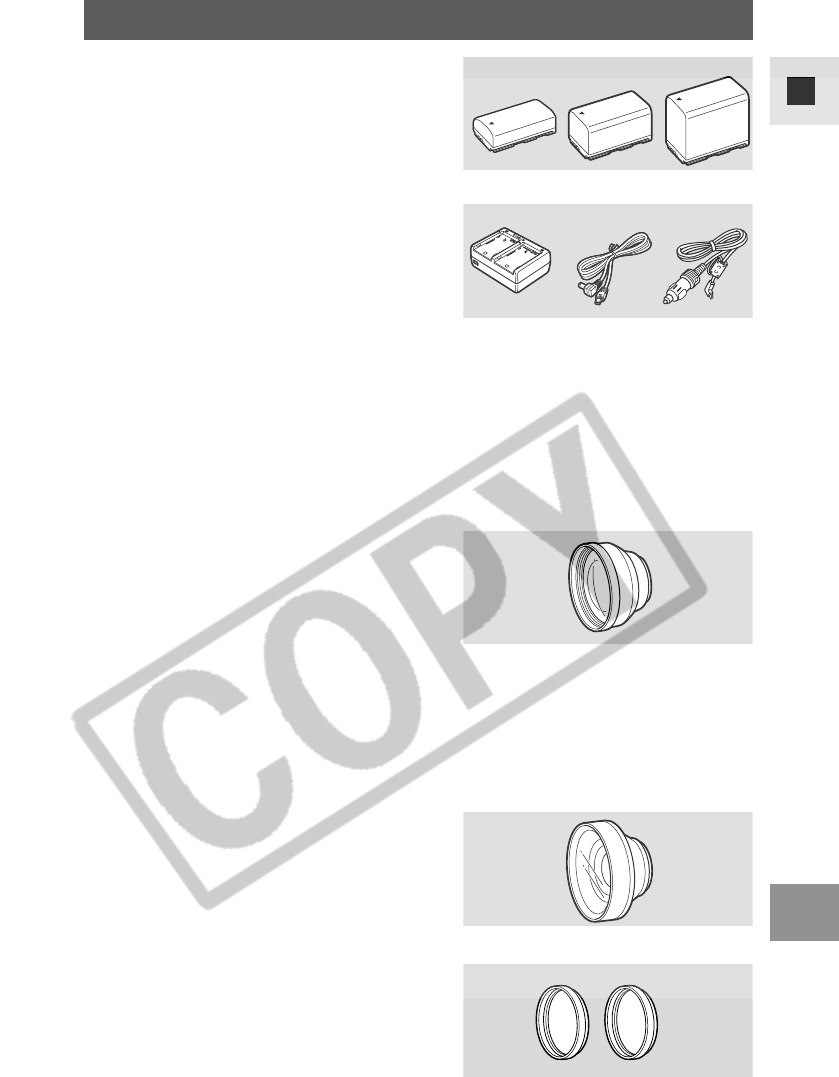
169
E
Additional
Information
FS-34U Filter Set
Neutral density and MC protector filters
to help you take control of difficult
lighting conditions.
Optional Accessories
CR-560 Charge Adapter/Car Battery
Cable Kit
Connect the car battery cable to power
your camcorder or recharge battery
packs on the move. The car battery
cable plugs into your car’s cigarette
lighter socket and runs off a 12-24 V DC
negative ground battery.
Also, when used with the CA-560
Compact Power Adapter, this charge
adapter can charge the BP-500 series
lithium ion battery packs from a mains
outlet.
BP-500 Series Battery Packs
When you need extra battery packs,
select from the following: BP-511,
BP-512, BP-522 and BP-535.
WD-34 Wide-converter
This lens decreases focal length by a
factor of 0.7, giving you a wide
perspective for indoor shots or
panoramic views.
TL-34 Tele-converter
This tele-converter lens increases the
focal length of the camcorder lens by a
factor of 1.7.
• The image stabilizer is not as effective
as usual when the tele-converter is
attached.
• The minimum focusing distance with
the Tele-converter is 3 m (9 ft 10 1/8
in); 3 cm (11 3/4in) on maximum
wide angle.
BP-512 BP-522 BP-535
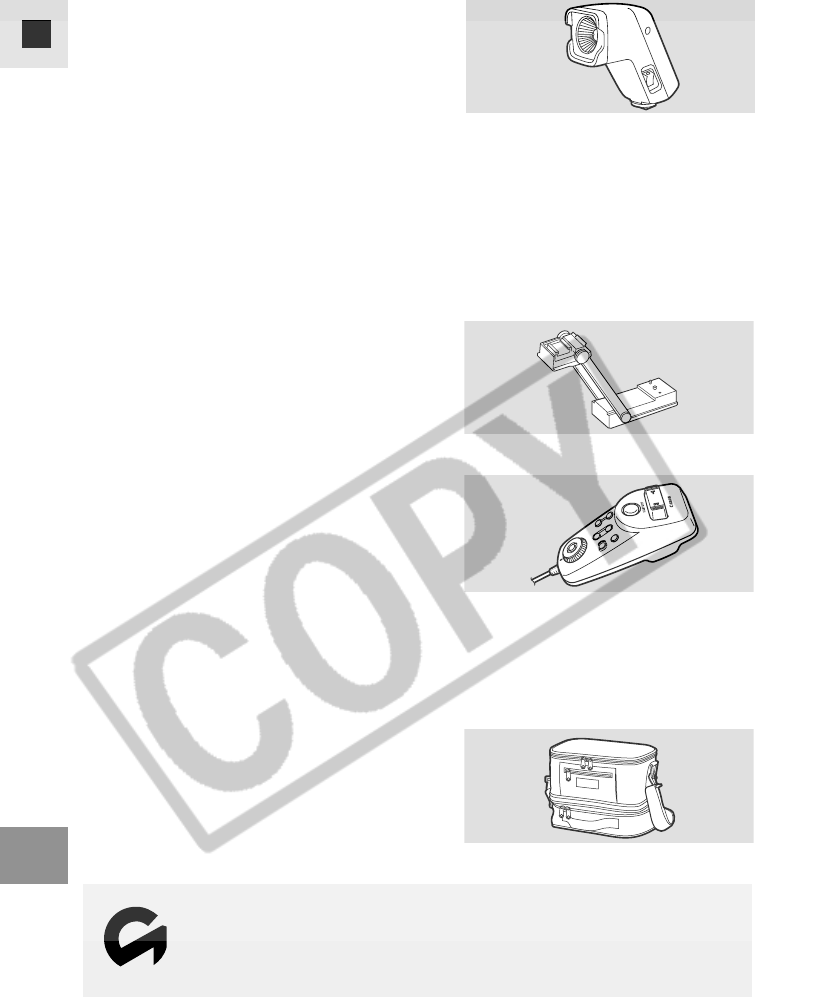
170
E
Additional
Information
VL-10Li Battery Video Light
This compact yet powerful video light
can be used for both indoor and outdoor
shooting.
• Use the BP-900 Series battery packs to
power the light. Approximate usage
times are as follows:
BP-915 60 min. BP-930 120 min.
BP-945 170 min.
• Charge the BP-900 Series battery packs
with the CA-920 Compact Power
Adapter (optional).
SA-1 Adapter Bracket
Attaches a video light or microphone
securely to the camera.
This mark identifies genuine Canon video accessories. When
you use Canon video equipment, we recommend Canon-brand
accessories or products bearing the same mark.
C
A
N
O
N
G
E
N
U
I
N
E
V
I
D
E
O
A
C
C
E
S
S
O
R
Y
SC-1000 Soft Carrying Case
A handy camcorder bag with padded
compartments and plenty of space for
accessories.
Zoom Remote Controller ZR-1000
When this product is plugged into the
LANC mterminal of a Canon camcorder,
it is possible to control functions such as
the start and stop of recording and the
zoom and focusing functions while the
camcorder is mounted on a tripod,
without touching the camcorder body
itself.
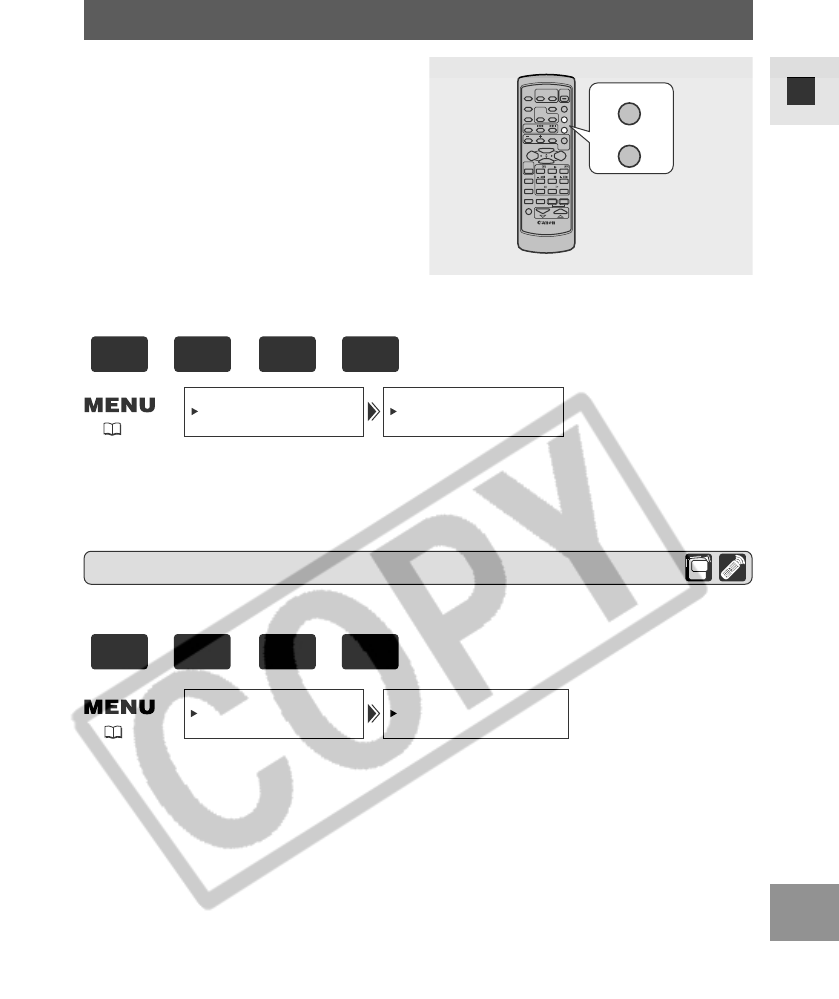
171
E
Additional
Information
Screen Displays
To display the date and time, press
the DATA CODE button. See also
p. 84.
Press the wireless controller’s TV
SCREEN button or turn TV SCREEN
on through the menu to see the
other displays on the TV screen. (The
displays appear white on-screen.)
They will not be added to any
recordings you make with the
camcorder.
//
TV SCREEN
DATA CODE
To turn the display off, open the menu and select DISP. SET UP.
Then select DISPLAYS, set it to OFF <PLAYBK> and close the
menu.
• If you turn the displays off, the LCD screen will be completely blank
(including connected TV screen), but the camcorder will continue to show
warning/caution displays when necessary, and the data code appears in
the display if it is set to ON.
• When operating the camcorder, the displays appear for 2 seconds.
However, the displays do not disappear when displaying an index screen.
TV SCREEN•••ON
DISP.SET UP
DISPLAYS••••ON
DISP.SET UP
To turn TV SCREEN off, open the menu and select DISP. SET UP.
Then select TV SCREEN, set it to OFF and close the menu.
For instructions on how to hook the camcorder up to your TV, see p. 34.
You can turn off the displays to give you a clear screen for playback.
( 38)
( 38)
+,+
CAMERA
CARD
CAMERA
TAPE
+,+
PLAY
(VCR)
CARD
PLAY
(VCR)
TAPE
Turning Off the LCD Screen Displays
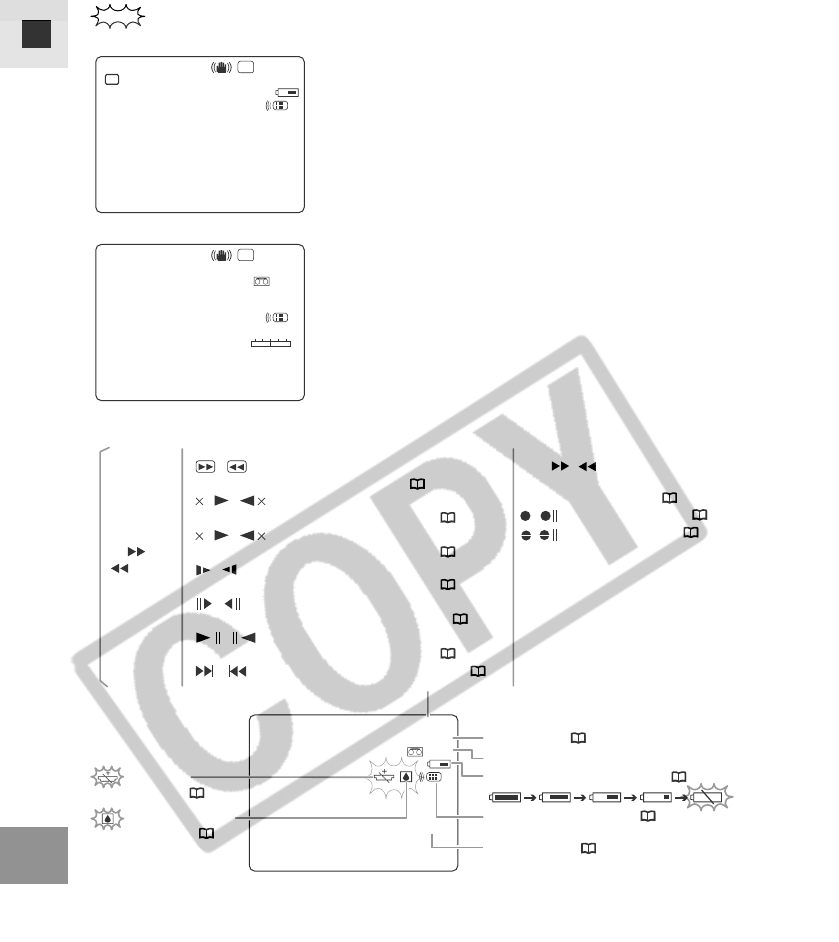
172
E
Additional
Information
indicates a flashing display.
PS
PAUSE
0:00:00
12bit
1
PS
STOPSTEREO1
0:00:00
5min
1
SPEAKER
+–
When inserting a tape in TAPE CAMERA mode
(battery pack attached)
• The displays of remote sensor mode and
audio mode disappear after 4 seconds.
When inserting a tape in TAPE PLAY (VCR)
mode
• The displays of remote sensor mode and
volume level disappear after 4 seconds.
END
STEREO1
1:23:45
1
16bit
PAUSE
/
/
2 2
/
1 1
/
/
/
/
/
/
/
REC
PAUSE
STOP
EJECT
PLAY
FF
REW
: Fast forward playback/
Rewind playback ( 31)
:×2 playback
(forward and reverse) ( 32)
:×1 playback
(forward and reverse) ( 30, 32)
: Slow playback
(forward and reverse) ( 31)
: Frame advance playback/
Frame reverse playback ( 31)
: Playback pause
(forward and reverse) ( 31)
: Date Search/Photo Search ( 87)
: Zero set memory (forward
and reverse) ( 88)
: AV Insert Editing ( 97)
: Audio Dubbing ( 100)
: Backup
battery ( 159)
: Condensation
warning ( 163)
RTN RTN
Time Code ( 175)
Remaining tape
Remaining battery charge ( 158)
Remote sensor mode ( 48)
Audio mode ( 71)
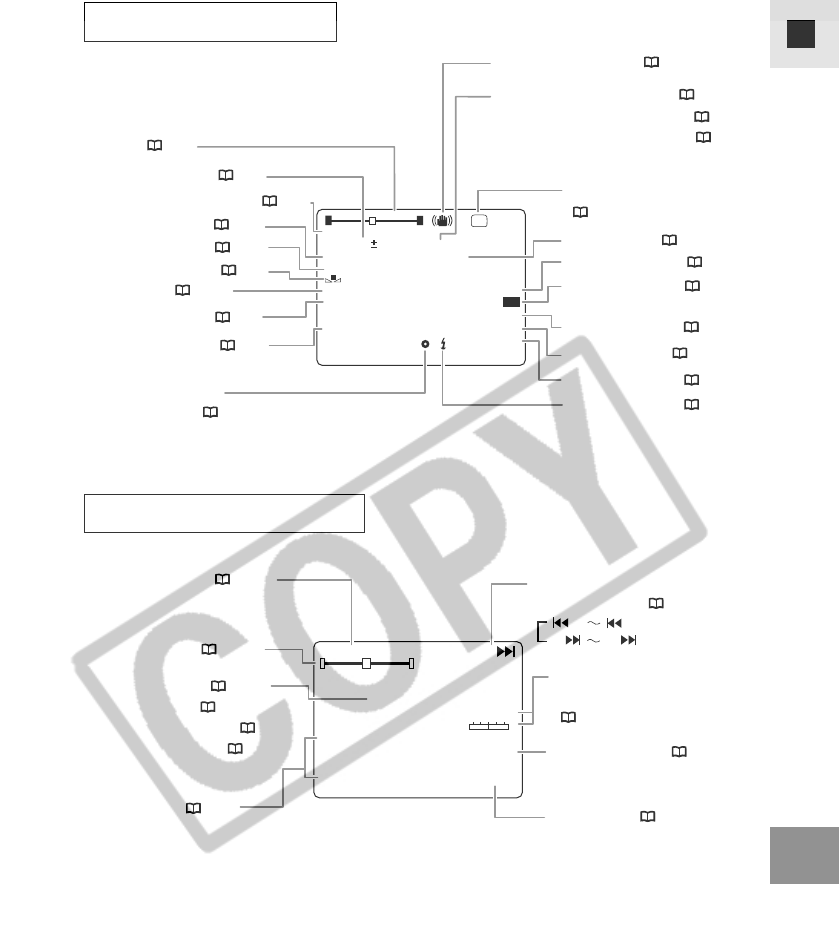
173
E
Additional
Information
1/100
CARD MIX
FADE–T
PHONES
SELF T
1 2 bit
16:9
1 sec
PHOTO
WSON
12:00 AM
1.JAN.2002
E.LOCK 0
AUTO
MF
T
W
PS
Zoom ( 23)
Recording mode
( 20)
Self-timer ( 73)
Headphones ( 34)
Wind screen ( 72)
16:9 mode ( 21)
Built-in flash ( 56)
Photo mode ( 54)
Audio mode ( 71)
Recording reminder ( 175)/
Self-timer countdown ( 73)
Photo recording timer ( 54)
Image stabilizer ( 58)
Exposure level ( 75)
Recording program ( 59)
Manual focus ( 79)
Shutter speed ( 77)
White balance ( 81)
Card mix ( 141)
Digital effects ( 63)
Date and time ( 51)
AF/AE locked in
Photo mode ( 54)
SPEAKER
PHOTO SEARCH
+–
1/1000
DV IN
F1.8
MIX/VARI.
ST–1 ST–2
1
110
110
1 2 bit
12:00 AM
1.JAN.2002
Audio output ( 103) Photo Search/
Date Search ( 87)
Volume level of built-in
speaker or headphones
( 33)
Audio mode ( 71)
DV input ( 90)
Mix balance ( 103)
Photo Search ( 87)/
Date Search ( 87)/
AV Insert Editing ( 97)/
Audio Dubbing ( 100)
Data code ( 84)
TAPE CAMERA mode
TAPE PLAY (VCR) mode
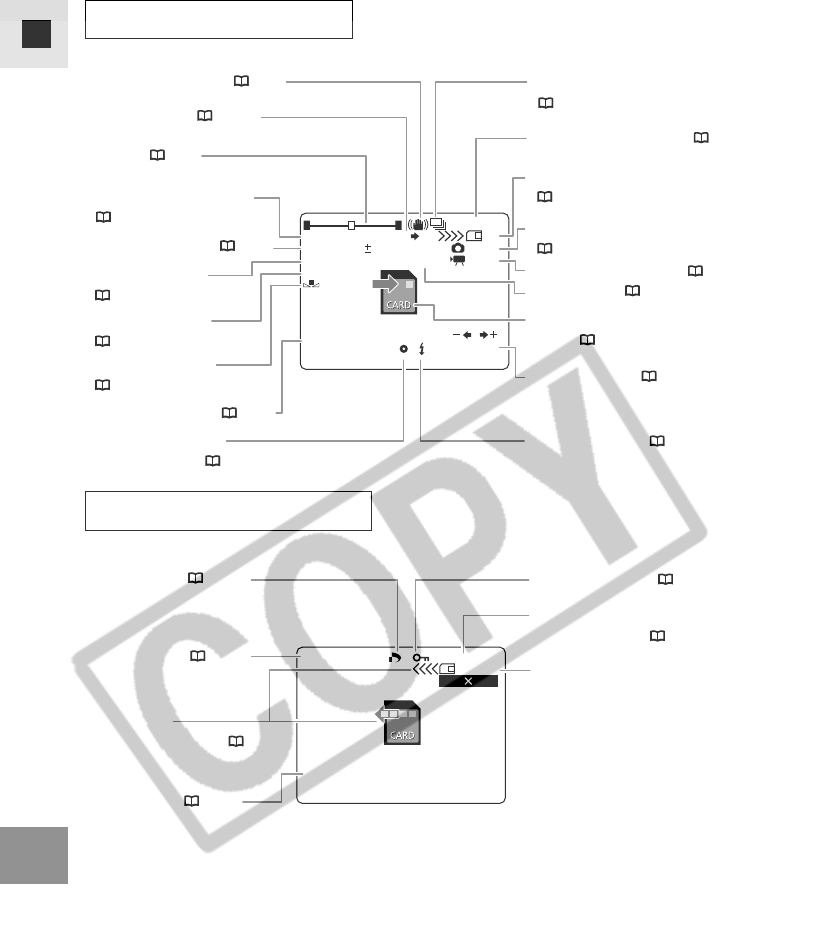
174
E
Additional
Information
S.FINE
50
1280
320
1/100
0
12
SELF T
MENUEND
12:00 AM
1.JAN.2002
E.LOCK
SPOTLIGHT
MF
T
W
Image stabilizer ( 58)
Still image quality ( 108)
File size of movie ( 108)
File size of still image
( 108)
Self-timer ( 73)
Recording to a memory
card ( 111)
Stitch assist ( 119)
Built-in flash ( 56)
Remaining card capacity
( 109)
Stitch assist ( 119)
Zoom ( 23)
Recording program
( 59)
Exposure level ( 75)
Manual focus
( 79)
Shutter speed
( 77)
White balance
( 81)
Date and time ( 51)
AF/AE locked in
Photo mode ( 111)
Continuous shooting
( 113)
SLIDE SHOW 101–0143
43/50
640 480
12:00 AM
1.JAN.2002
Print mark ( 128) Protect mark ( 127)
Folder number-
File number ( 110)
Current still image/
Total still images
Slide show ( 123)
Accessing
a memory card ( 109)
Data code ( 84)
CARD CAMERA mode
CARD PLAY (VCR) mode
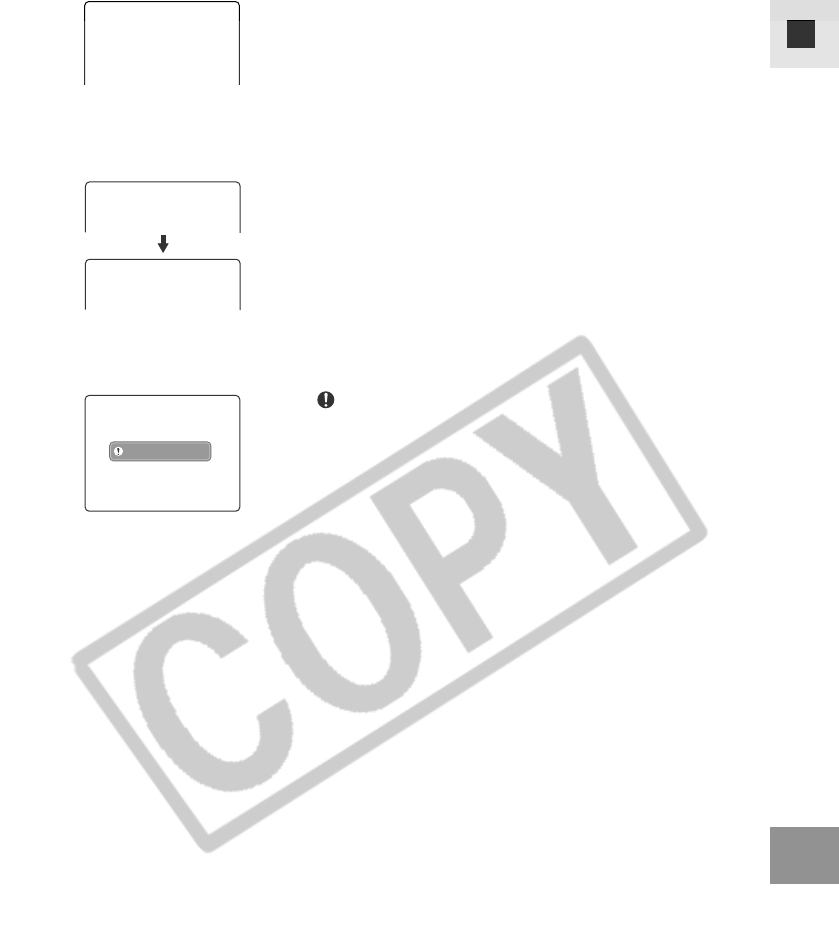
175
E
Additional
Information
Time Code
This records counter information, including hour,
minute, second, and frame number on a special
data code area on the tape itself. It is reset
automatically when a new tape is loaded. In TAPE
CAMERA mode, the frame number doesn’t appear
in the display.
Recording reminder
When you start recording, the camcorder counts
from 0SEC to 10SEC. Shots which are shorter than
ten seconds may be difficult to edit later. On the
other hand, if you are not planning to edit the
recording, remember that a shot which does not
contain action should generally last no longer than
10 seconds.
“ AUTO POWER OFF”
The camcorder will turn itself off if you leave it in
record pause mode for more than about 5 minutes.
This display appears 20 seconds (approx.) before
the camcorder turns off.
0sec
10sec
0:12:34:12
AUTO POWER OFF
AUTO POWER OFF
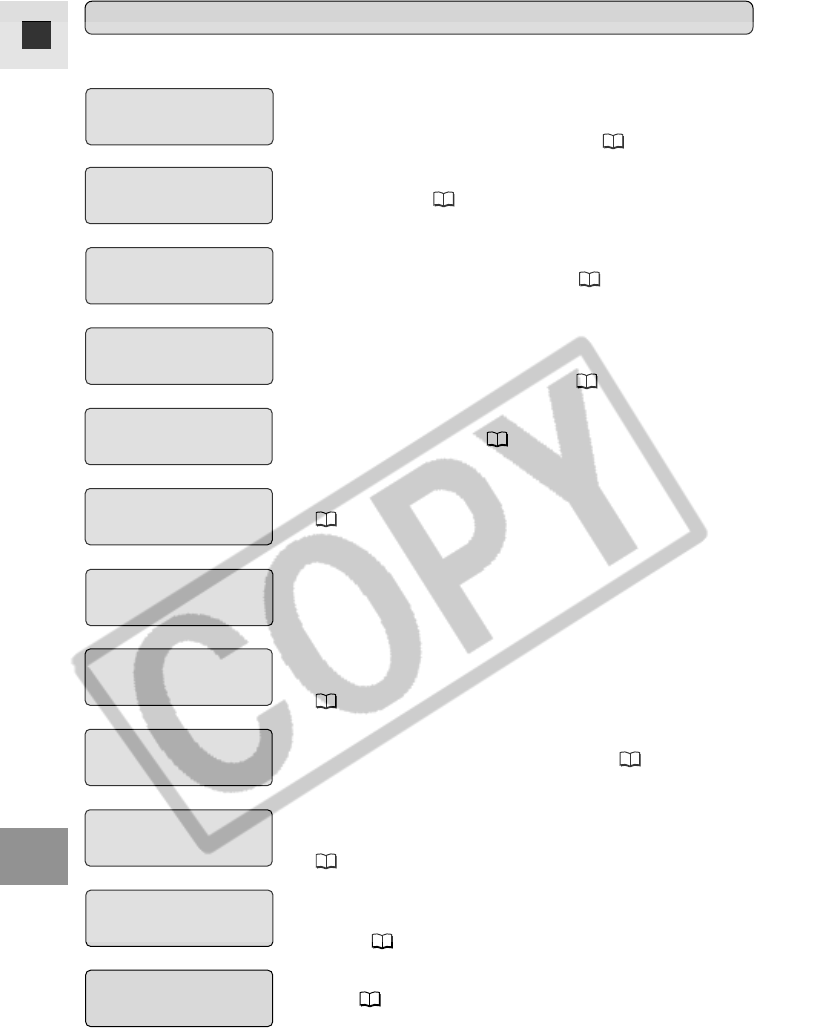
176
E
Additional
Information
Time zone, date and time are not set. This message
appears each time you turn the power on until you
set the time zone, date and time ( 51).
Battery pack is exhausted. Replace or charge the
battery pack. ( 158).
Replace the tape or change the position of the
protect switch on the cassette ( 17).
The camcorder stopped operating to protect the
cassette. Remove the cassette and retry the
operation from the beginning ( 163).
DV cable is not connected, or the connected digital
device is turned off ( 90).
Condensation has been detected in the camcorder
( 163).
Tape reached the end. Rewind or remove the tape.
Recording is made in a mode other than the SP
mode. Audio dubbing or AV insert not possible
( 98, 100).
Recording is made in 16-bit or 12-bit 4-channel
mode. Audio dubbing not possible ( 100).
Camcorder detected a blank section on the tape.
Audio dubbing or AV insert not possible
( 98, 100).
Displayed immediately after you start recording
when the video heads are dirty. Clean the video
heads ( 161).
You attempted to playback a copyright protected
tape ( 92).
SET THE TIME ZONE,
DATE AND TIME
CHANGE THE BATTERY PACK
CHECK THE DV INPUT
THE TAPE IS SET FOR
ERASURE PREVENTION
REMOVE THE CASSETTE
The camcorder displays various caution phrases for approx. 4 seconds.
Caution Phrases
CONDENSATION
HAS BEEN DETECTED
TAPE END
CHECK THE CASSETTE
[
REC MODE]
CHECK THE CASSETTE
[
AUDIO MODE]
CHECK THE CASSETTE
[
BLANK]
HEADS DIRTY,
USE CLEANING CASSETTE
COPYRIGHT PROTECTED
PLAYBACK IS RESTRICTED
177
E
Additional
Information
Memory card caution phrases
You attempted to copy a copyright protected tape.
May also be displayed when an anomalous signal is
sent during Analog Line-in recording ( 92, 93).
Memory card not inserted into the camcorder
( 107).
The SD Memory Card is set for erasure prevention.
Replace the card or change the position of the
protect switch ( 106).
No images are recorded on the memory card
( 107).
A memory card error occurred. The camcorder
cannot record/play back. The error may be
temporary. If CARD ERROR disappears after 4
seconds and flashes red, turn the camcorderís
power off, remove the card and reinsert the card. If
changes to green, you can continue
recording/playback ( 112).
No free space remaining on the memory card.
Replace with another memory card or erase images
( 130).
File or folder numbers have already reached the
maximum value ( 110).
The image is recorded in a JPEG format or any
format that is not compatible with the camcorder,
or the image contains corrupted data ( 121).
The marked file cannot be edited ( 128).
Depending on the signal, some analog images
cannot be recorded on the memory card as still
image ( 115).
The cover or the memory card compartment is
open.
COPYRIGHT PROTECTED
DUBBING RESTRICTED
NO IMAGES
NO CARD
THE CARD IS SET FOR
ERASURE PREVENTION
CARD ERROR
CARD FULL
NAMING ERROR
UNIDENTIFIABLE
IMAGE
PRINT MARK ERROR
THIS IMAGE CANNOT
BE RECORDED
MEMORY CARD COVER
IS OPEN
178
E
Additional
Information
Paper cassette is not correctly inserted or out of
paper.
The paper jammed during printing.
The ink cartridge has not been inserted or has run
out of ink.
The ink cassette is experiencing a problem.
The printer battery is depleted.
The printer is experiencing a data transmission
error.
You attempted to use the DPOF print settings to
print X images that are from another camcorder,
that have a different format, or that have been
edited on a computer.
You attempted to print an image from another
camcorder, one recorded in a different format, or
one that has been edited on a computer.
You attempted to print an unmarked still image
from the CARD PLAY menu [ ➡PRINT].
No Paper
Paper Jam
Recharge the printer battery
No Ink
Ink Cassette Error
Below caution phrases may be displayed when the camcorder is connected
to a printer supporting the direct print function. Please refer to the manual
of each printer for remedies.
With the BJ Printer, the error number is displayed on the operation panel.
Please refer to the BJ Printer Quick Start Guide for the remedies
corresponding to the error numbers.
Communication Error
Could not print X images
Cannot Print!
Messages that may appear when connecting to a printer
supporting the direct print function
Set print mark
179
E
Additional
Information
Printer Cover Open
You attempted to trim an image with an image size
of 160 ×120.
The style has been changed after the trimming
settings were set.
The paper size has been changed between print
setting from the print dialog and the start of
printing.
You attempted to print on paper that cannot be
used with the camcorder.
The ink cannot be used with the selected paper
type.
The printer is printing the data from a memory card
inserted into the computer or printer. The printer
automatically starts printing the images from the
camcorder after completing the current printing.
Printer is warming up. When it is ready, the printer
starts printing automatically.
The ink tank needs to be replaced soon. Prepare a
new ink tank. If you select [Continue] in the error
screen, you can restart printing.
Adjust the paper selection lever to the proper
position.
You can restart printing by pressing the
RESUME/CANCEL button on the BJ Printer. Please
request replacement of the waste tank to the shop
where you purchased the printer or the nearest
Canon customer support center listed in the Bubble
Jet Quick Start Guide.
Close the front cover of the printer.
Cannot trim
Readjust trimming
Paper and ink do not match
Paper has been changed
Incompatble paper size
Printer In Use
Printer Warming Up
Low Ink Level
Paper Level Error
Waste Tank Full

180
E
Additional
Information
Install a print head in the printer.
Turn off the printer, then turn it on again. If the
error persists, please consult the nearest Canon
customer support center listed in the Bubble Jet
Quick Start Guide.
Set the paper option in the style setting to a paper
size that can be used with the printer.
No Printhead
Printer Error
Media Type Error

181
E
Additional
Information
Specifications
MVX2i
Power Supply (rated):
Power Consumption
(while recording with the
AF turned on):
Television system:
Video recording system:
Audio recording system:
Image sensor:
Tape format:
Tape speed:
Maximum recording time
(with an 80 min. cassette):
Fast forward/ rewind time:
Lens:
Focusing system:
Minimum focusing distance:
Maximum shutter speed:
Minimum illumination:
Recommended illumination:
Filter diameter:
Viewfinder:
LCD screen:
Microphone:
Recording media:
Number of recording
pixels:
Image format:
7.4 V DC
3.9 W (Using viewfinder), 4.8 W (Using LCD screen)
CCIR standard (625 lines, 50 fields) PAL colour signal
2 rotary heads, helical scanning DV system (Consumer
digital VCR SD system)
Digital component recording
Tape: PCM digital sound 16 bit (48kHz/2ch),
12 bit (32kHz/4ch)
Card: PCM digital sound 16 bit (16 kHz/1ch)
1/4” CCD (charge coupled device),
approx. 1,330,000 pixels (card: approx. 1,230,000
effective pixels, tape: approx. 1,000,000 effective
pixels)
Videocassettes bearing the Dmark.
SP: 3/4 ips (18.83 mm/s), LP: 1/2 ips (12.57 mm/s)
SP: 80 min., LP: 120 min.
Approx. 2 min. 20 sec. (with a 60 min. cassette)
F/1.8–2.1, 10×power zoom, f=4.1-41 mm
TTL autofocus, manual focusing possible
1 m (3ft 33/8in) 1 cm (3/8in) on maximum wide angle)
1/8,000 sec. (1/250 sec. when using a memory card)
0.5 lx (using the Night program in TAPE CAMERA mode)
More than 100 lx
34 mm
0.5 in, TFT colour LCD, approx. 113,000 pixels
2.5 in measured diagonally, TFT colour, approx.
200,000 pixels
Stereo electret condenser microphone
SD Memory Card, MultiMediaCard
Still image: 1280 ×960, 640 ×480 pixels
Movie: 320 ×240 pixels (approx. 10 sec.)*,
160 ×120 pixels (approx. 30 sec.)*, 12.5 frames/sec.
* The figures in brackets represent the maximum length of one movie clip.
Design rule for Camera File system (DCF), Exif 2.2
compliant*
Digital Print Order Format (DPOF) compliant (only
images marked for printing)
* This camcorder supports Exif 2.2 (also called “Exif Print”). Exif Print is a standard for enhancing
the communication between camcorders and printers. By connecting to an Exif Print-compliant
printer, the camcorder's image data at the time of shooting is used and optimized, yielding
extremely high quality prints.

182
E
Additional
Information
File format:
Estimated SD Memory
Card SDC-8M capacities
(approx.)*:
Maximum continuous
shots:
USB terminal:
DV Terminal:
AV/headphones terminal:
S-video terminal:
MIC terminal input:
LANC uterminal:
Operating temperature:
Dimensions:
Weight:
Battery type:
Rated voltage:
Operating temperature:
Battery capacity:
Dimensions:
Weight:
Power supply:
Power consumption:
Rated output:
Operating temperature:
Dimensions:
Weight:
CA-560 Compact Power Adapter
BP-512 Battery Pack
Still Image: JPEG (compression mode: Superfine, Fine,
Standard), Movie: Motion JPEG
1280 ×960: Superfine 6 images/Fine 10
images/Standard 18 images
640 ×480: Superfine 34 images/Fine 50 images/
Standard 84 images
* The actual number you can record varies depending on the images. Remember that the sample
images recorded on the supplied SD Memory Card are included in the total number.
1280 ×960: 10 images (2 frames/sec.)
640 ×480: Flash on: 10 images (2 frames/sec.),
Flash off: 30 images (3 frames/sec.)
mini-B
Special 4-pin connector (conforms to IEEE1394)
ø 3.5 mm minijack
Audio input: –10 dBV/at least 40 kohms, (L, R),
unbalanced
output: –10 dBV (47 kohm load)/ less than 3 kohms,
unbalanced
Video: 1 Vp-p/75 ohms unbalanced
1 Vp-p (Y signal), 0.3 Vp-p (C signal)
ø 3.5 mm stereo minijack, – 57 dBV (with 600 ohm
mic)/ at least 5 kohms
ø 2.5 mm mini minijack
0°–40°C (32°–104°F)
60 ×119 ×118 mm (2 3/8×45/8×45/8in)
530 g (1lb 2 3/4oz)
Rechargeable lithium ion battery
7.4 V DC
0°–40°C (32°–104°F)
1100 mAh
38 ×21 ×55 mm (1 1/2×7/8×25/8in)
70 g (2 1/2oz)
100–240 V AC, 50/60 Hz
34 W
9.5 V, 2.7 A DC
0°C–40°C (32°F–104°F)
57 ×28 ×104 mm (2 1/4×11/8×41/8in)
180 g (6 3/8oz) (without power cable)
Weight and dimensions are approximate.
Errors and omissions excepted.
Subject to change without notice.

183
E
Additional
Information
Index
16:9 Wide Screen....................21
6-Second Auto Date................86
Abroad, Using the Camcorder
162
Accessories........................6, 169
AF-assist lamp ........................80
Analog Line-in ........................93
Analog-Digital Converter ........95
Audio Dubbing......................100
Audio Mix ............................103
Audio Mode............................71
Auto ......................................60
Autofocus ..............................79
AV Insert ................................97
Backup Battery......................159
Battery Charger ................12, 14
Battery Pack ....................12, 157
Beep ......................................22
Brightness ..............................26
Built-in Flash............................56
Card Animation ....................144
Card Mix ..............................141
Caution Phrases ....................176
Condensation........................163
Connections
PC..............................105, 149
TV or VCR ............................34
Continuous Shooting ............113
Copying Still Images......146, 147
Data Code ..............................84
Date and Time ........................51
Date Search ............................87
Demo mode............................22
Digital Effects..........................63
Digital Zoom ..........................23
Direct Printing ......................132
DV Dubbing ............................90
Easy Recording........................60
Editing to a VCR......................89
Effects ....................................66
Enlarging Still Images ..............83
Erasing Still Images................130
Exposure ................................75
Faders ....................................64
Fast Forward ..........................30
File Numbers ........................110
Focusing..................................79
Formatting ............................148
Grip Belt................................156
Headphones............................33
Image Quality........................108
Image Stabilizer ......................58
Index Screen..........................123
LANC ......................................89
LCD Mirror Mode....................27
LCD Screen ............................25
Lens Cap ..............................156
Lens Hood ............................155
Low Light................................61
LP Mode..................................20
Maintenance ........................160
Manual Focus..........................79
Memory Card........................106
Menus ....................................38
Microphone ....................71, 100
Movie Size ............................108
Multi-Image Screen ................69
My Camera Settings..............150
M
L
I
H
G
F
E
D
C
B
A

184
E
Additional
Information
ND Filter................................112
Night ......................................61
Output Channel ....................104
Photo Search ..........................87
Playback
Memory Card ....................121
Tape ....................................30
Playback Pause........................31
Portrait....................................61
Power Adapter........................11
Print Mark ............................128
Protect ..................................127
Record Pause Mode ................18
Record Review ........................37
Record Search ........................37
Recording
Movies (Memory Card) ......116
Movies (Tape) ......................18
Still Images (Memory Card) 111
Still Images (Tape) ................54
Recording Programs ................59
Remote Sensor........................48
Rewind....................................30
S1 video terminal ....................35
Sample images......................153
Sand & Snow ..........................61
Screen Displays......................171
SD Memory Card ..................106
Self-Timer................................73
Shutter Sound ......................150
Shutter Speed ........................77
Slide Show ............................123
SP Mode ................................20
Speaker ..................................33
Sports ....................................61
Spotlight ................................61
Still Image Quality ................108
Still Image Size ......................108
Stitch Assist Mode ................119
Super Night ............................61
S-video/S1-video......................35
Tally Lamp ..............................21
Tape Protection ......................17
Telephoto ................................23
Time Code ............................175
Time Zone ..............................51
Tripod......................................28
Troubleshooting ....................164
Video Head ..........................161
Videocassettes ........................16
Viewfinder ............................155
White Balance ........................81
Wide-Angle ............................23
Wide Screen............................21
Wireless Controller..................48
Zero Set Memory ....................88
Zooming ................................23
Z
W
V
T
S
R
P
O
N
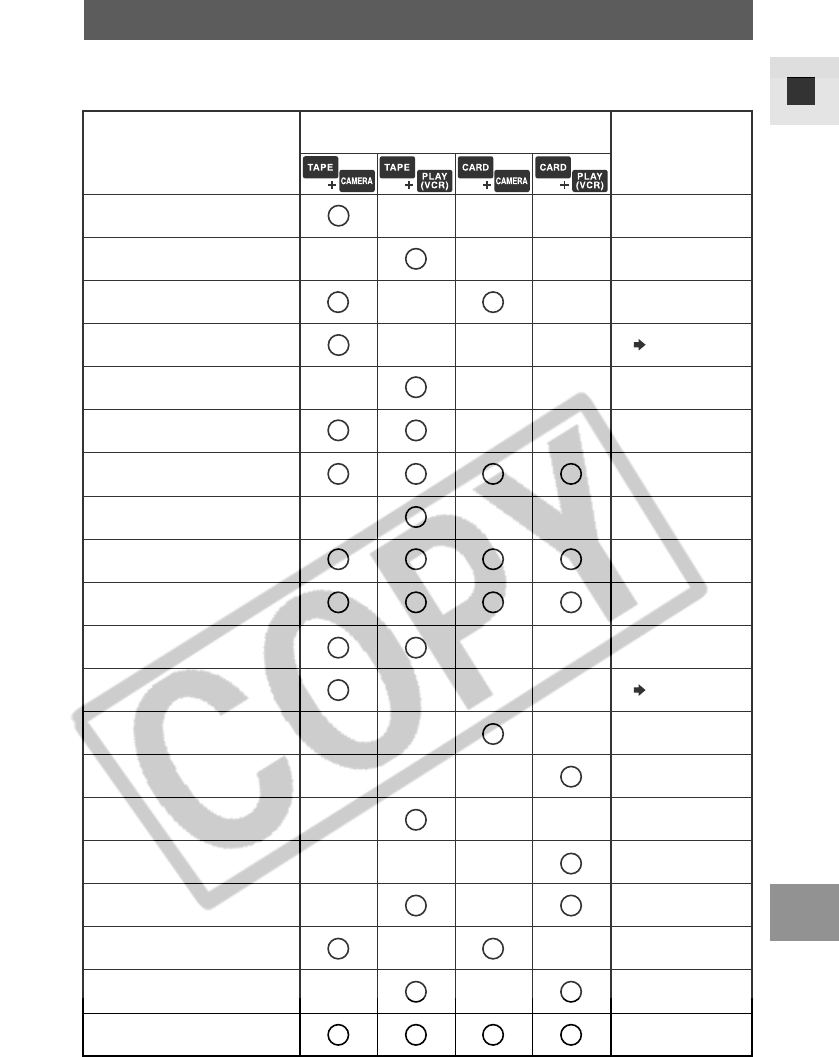
185
E
Additional
Information
Menu at a Glance
Use the list below to quickly navigate the camcorder’s menu. Functions are
listed alphabetically.
Function
First make sure the
camera is set to...
16:9 effect CAM.SET UP
6-sec. Date DISP.SET UP
Audio dubbing VCR SET UP
Audio mode VCR SET UP
Beep SYSTEM
Brightness DISP.SET UP
DISP.SET UP
Copy - card to tape CARD OPER.
Copy - tape to card CARD OPER.
Data code DISP.SET UP
DISP.SET UP
Date/time set SYSTEM
Date/time display
Date/time select
Animation type
CARD SET UP
Continuous shooting
Card access display DISP.SET UP
AV/headphones VCR SET UP
AV → DV out VCR SET UP
Create start-up image MY CAMERA
AF-assist lamp CAM.SET UP
*
Card mix CARD MIX
CARD MIX
Then select it
from this
submenu and set.
* Only the date and time appear in the data code when using a memory card.
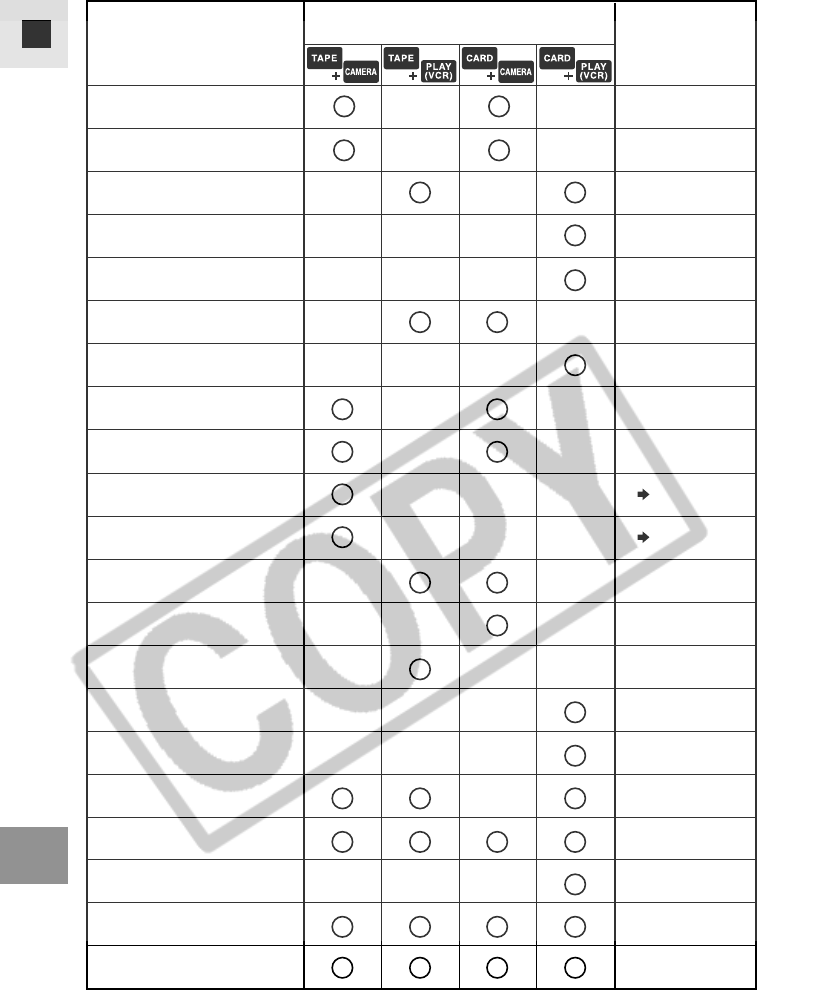
186
E
Additional
Information
Function
First make sure the
camera is set to...
LCD Mirror mode
Movie Size
Print mark
Recording mode
Remote sensor mode
Self-timer sound
DISP.SET UP
CARD SET UP
CARD OPER.
Protect CARD OPER.
MY CAMERA
VCR SET UP
SYSTEM
Output channel VCR SET UP
ND filter CAM.SET UP
Select start-up image MY CAMERA
Erase CARD OPER.
File numbers CARD SET UP
Format CARD OPER.
Erase all print marks CARD OPER.
Image stabilizer CAM.SET UP
Displays DISP.SET UP
Then select it
from this
submenu and set.
Demo mode DISP.SET UP
Digital zoom CAM.SET UP
Shutter sound MY CAMERA
Mix level
Mix type
CARD MIX
CARD MIX
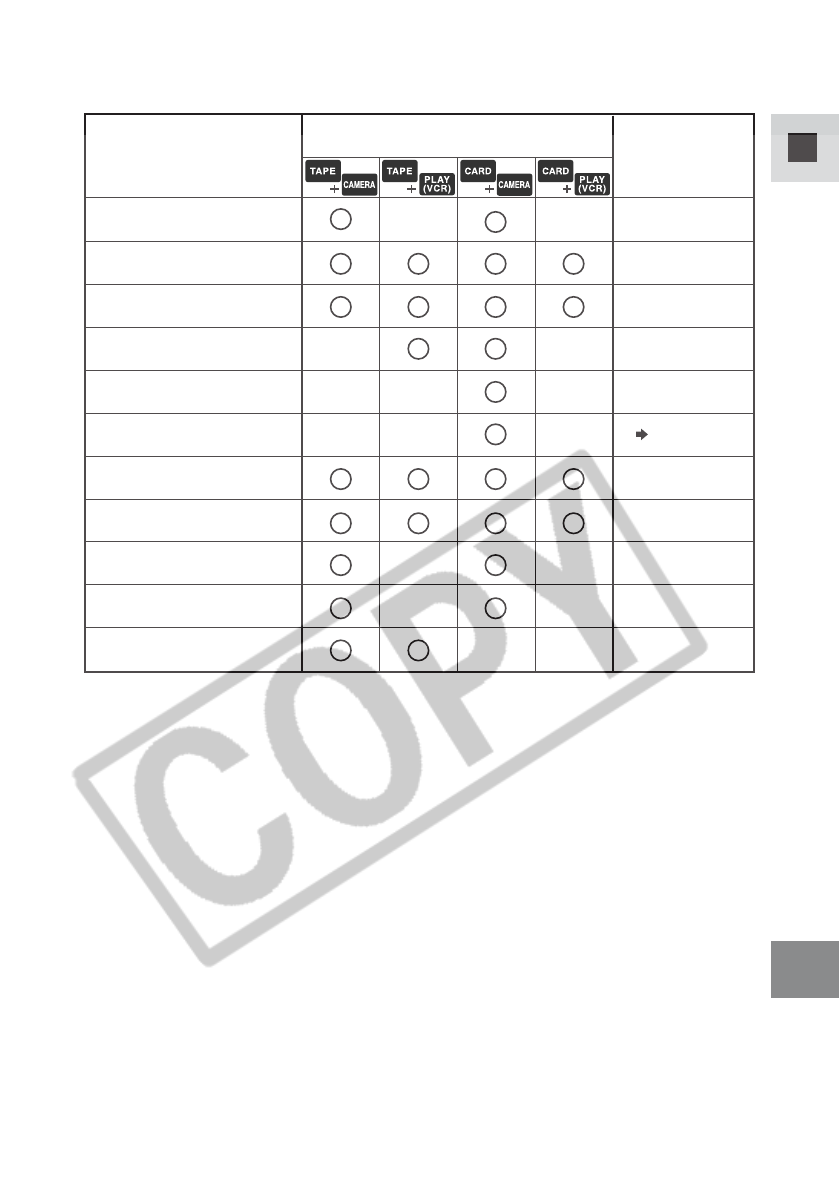
187
E
Additional
Information
Function
First make sure the
camera is set to...
Then select it
from this
submenu and set.
Time zone/DST
TV screen
White balance
Wind screen
SYSTEM
DISP.SET UP
CAM.SET UP
VCR SET UP
Tally lamp SYSTEM
Stitch assist STITCH AST
Still image size CARD SET UP
Start-up sound MY CAMERA
Still image quality CARD SET UP
Start/stop sound MY CAMERA
Shutter speed CAM.SET UP

PUB.DIE-175 © CANON INC. 2002 PRINTED IN JAPAN
0201A/Ni9.5 DY8-9020-108-000 IMPRIME AU JAPON
CANON INC.
Canon Europa N.V.
P.O. Box 2262, 1180 EG Amstelveen, the Netherlands
Canon UK Ltd.
Ribcon Way
Luton Bedfordshire LU4 9UR
Telephone 0870-241-2161
Canon Australia Pty. Ltd
1 Thomas Holt Drive, North Ryde, N.S.W. 2113, Australia
Telephone 805-2000, Fax 887-4484
Canon New Zealand Ltd
Fred Thomas Drive, Takapuna, P.O. Box 33-336, Auckland, New Zealand
Telephone 486-1570, Fax 486-6420
Canon Singapore Pte. Ltd
79 Anson Road #09-01/06, Singapore 079906
Telephone (65)-532-4400, Fax (65)-221-2939
Canon Hongkong Company Ltd
9/F, The Hong Kong Club Building, 3A Chater Road, Central, Hong Kong
Canon Latin America, Inc.
Sales & Enquiries: 703 Waterford Way Suite 400 Miami, FL 33126 USA
Printed on 100% reused paper.
0027W378
