Canon Zr950 A Users Manual
Canon-Zr-950-Instruction-Manual-783560 canon-zr-950-instruction-manual-783560
Canon-Zr950-Instruction-Manual-585802 canon-zr950-instruction-manual-585802
Manual zr950nim-en Canon ZR950 Instruction Manual | Manual Device
ZR950 A to the manual c13b5dc9-aaed-425b-9fcd-063d179e4053
ZR-950 - Instruction Manual zr950nim-en Free User Guide for Canon Camcorder, Manual - page5
2015-01-23
: Canon Canon-Zr950-A-Users-Manual-240677 canon-zr950-a-users-manual-240677 canon pdf
Open the PDF directly: View PDF  .
.
Page Count: 104 [warning: Documents this large are best viewed by clicking the View PDF Link!]
- Cleaning the Video Heads
- Important Usage Instructions
- Digital Video Camcorder, ZR950 A systems
- This device complies with Part 15 of the FCC Rules. Operation is subject to the following two conditions: (1) This device may no...
- Note: This equipment has been tested and found to comply with the limits for class B digital device, pursuant to Part 15 of the ...
- Use of shielded cable is required to comply with class B limits in Subpart B of Part 15 of FCC Rules.
- Do not make any changes or modifications to the equipment unless otherwise specified in the manual.
- If such changes or modifications should be made, you could be required to stop operation of the equipment.
- Canon U.S.A. Inc.
- One Canon Plaza, Lake Success, NY 11042, U.S.A.
- Tel No. (516)328-5600
- Important Safety InstructIons
- 1 Read Instructions - All the safety and operating instructions should be read before the product is operated.
- 2 Retain Instructions - The safety and operating instructions should be retained for future reference.
- 3 Heed Warnings - All warnings on the product and in the operating instructions should be adhered to.
- 4 Follow Instructions - All operating and maintenance instructions should be followed.
- 5 Cleaning - Unplug this product from the wall outlet before cleaning. Do not use liquid or aerosol cleaners. The product should be cleaned only as recommended in this manual.
- 6 Accessories - Do not use accessories not recommended in this manual as they may be hazardous.
- 7 Avoid magnetic or electric fields - Do not use the camera close to TV transmitters, portable communication devices or other sources of electric or magnetic radiation. They may cause picture interference, or permanently damage the camera.
- 8 Water and Moisture - Hazard of electric shock - Do not use this product near water or in rainy/moist situations.
- 9 Placing or Moving - Do not place on an unstable cart, stand, tripod, bracket or table. The product may fall, causing serious injury to a child or adult, and serious damage to the product.
- 10 Power Sources - The CA-590 Compact Power Adapter should be operated only from the type of power source indicated on the marki...
- 11 Power Cord Protection - Power cords should be routed so that they are not likely to be walked on or pinched by items placed upon or against them. Pay particular attention to plugs and the point from which the cords exit the product.
- 12 Outdoor Antenna Grounding - If an outside antenna is connected to the product, be sure the antenna is grounded so as to provi...
- 13 Lightning - For added protection of this product during a lightning storm, or when it is left unattended and unused for long ...
- 14 Overloading - Do not overload wall outlets and extension cords as this can result in a risk of fire or electric shock.
- 15 Objects and Liquid Entry - Never push objects of any kind into this product through openings as they may touch dangerous volt...
- 16 Servicing - Do not attempt to service this product yourself as opening or removing covers may expose you to dangerous voltage or other hazards. Refer all servicing to qualified service personnel.
- 17 Damage Requiring Service - Disconnect this product from the wall outlet and all power sources including battery, and refer servicing to qualified service personnel under the following conditions:
- 18 Replacement Parts - When replacement parts are required, be sure the service technician has used replacement parts that are s...
- 19 Safety Check - Upon completion of any service or repairs to this product, ask the service technician to perform safety checks to determine that the product is in safe operating order.
- Important Safety InstructIons
- When replacement of the power supply is required, please return it to the responsible nearest Canon Service Center and please replace it with the same type number CA-590.
- The adapter can be used with a power supply between 100 and 240 V AC. For areas where 120 V AC power is not used, you will need a special plug adapter. Contact your nearest Canon Service Center for further information.
- The adapter is not intended to be serviced. Should the product cease to function in its intended manner, it should be returned to the manufacturer or be discarded.
- This Class B digital apparatus complies with Canadian ICES-003.
- The Mains plug is used as the disconnect device. The Mains plug shall remain readily operable to disconnect the plug in case of an accident.
- We will keep the model number and date of purchase of your new Canon product on file to help you refer to this information in the event of an insurance claim such as loss or theft.
- Upon your request, we will send you information on Canon new products and promotions.
- The serial number of this product can be found at the battery attachment unit of the camcorder. Write down the number and other information here and retain this book as a permanent record of your purchase to aid identification in case of theft.
- Date of Purchase: Model Name: ZR950 A
- Purchased From: Serial No.:
- Dealer Address:
- Dealer Phone No.:
- Note that some playback and search modes are only available when using the wireless controller.
- Record, Record pause, Stop, Eject, Fast forward, Rewind, Playback, Playback pause, Reverse playback pause, x1 Playback (normal s...
- Indicates the remaining time of the tape in minutes. moves during recording. When the tape reaches its end, the display changes to “END”.
- The camcorder counts from 1 to 10 seconds when you start recording. This is helpful to avoid scenes that are too short.
- flashing in red: No card
- in green: 6 or more images
- in yellow: 1 to 5 images
- in red: No more images can be recorded
- is displayed next to the number of images available while the camcorder is writing on the memory card.
- The image number indicates the name and location of the file on the memory card. For example, the file name of image 101-0107 is “IMG_0107.JPG”, stored under the folder “DCIM\101CANON”.
- Recording movies on a tape
- Recording still images on a memory card
- Playing movies from a tape
- Playing back still images from a memory card
- 52
- Operating Modes
- Joystick and Joystick Guide
- Using the Menus
- Changing the Language
- Changing the Time Zone
- Setting the Date and Time
- Opening the Lens Cover and Adjusting the LCD Screen
- Inserting and Removing a Tape
- Inserting and Removing a Memory Card
- To remove the memory card
- Shooting Video
- When you have finished recording
- Zooming: Optical, Advanced and Digital Zoom
- 52
- [OPTICAL] (37x)
- The zoom range is limited to the optical magnification ratio of the lens.
- [ADVANCED]t (Advanced Zoom)
- In addition to the optical zoom range, the camcorder processes the image digitally to obtain a larger zoom range without any det...
- [DIGITAL] (2000x)
- When this option is selected, the camcorder will switch to digital zoom (light blue area on the zoom indicator) when you zoom in...
- [WIDESCREEN] set to [ ON] (16:9)
- 48x*
- [WIDESCREEN] set to [ OFF] (4:3)
- 55x
- [ VARIABLE]t
- The variable zoom speed depends on how you operate the zoom lever: Press gently for slower zooms; press harder for faster zooms. With this option, the zoom speed will be faster in record pause mode.
- [ SPEED 1], [ SPEED 2], [ SPEED 3]
- Constant zoom speeds. [ SPEED 3] is the fastest, and [ SPEED 1] is the slowest.
- Fast playback
- : Push the joystick () toward or () toward and hold it down.
- Reverse playback
- 1 frame reverse/advance
- Frame-by-frame playback
- Slow playback
- Double speed playback
- Return to normal playback
- : Push the joystick () toward /.
- [ OFF]t
- No data code display.
- [ DATE], [ TIME]
- Displays the date or time when the scene or still image was recorded.
- [ DATE & TIME]
- Displays both the date and time of the recording.
- 1/60
- To record under most ordinary conditions.
- 1/100
- To record indoor sports scenes.
- 1/250, 1/500*, 1/1000*
- To record from within a moving car or train or to shoot fast-moving subjects such as roller coasters.
- 1/2000*
- To record outdoor sports scenes on sunny days.
- [ 16bit]
- Records audio at the highest quality.
- [ 12bit]t
- Records audio on 2 channels (Stereo 1) leaving 2 free channels (Stereo 2) you can use for audio dubbing.
- With this camcorder you can dub audio only using the microphone ( 66).
- [ L/R]t
- Left and right channels (stereo) / Main and sub signals (bilingual).
- [ L/L]
- Left channel only (stereo) / Main signal only (bilingual).
- [ R/R]
- Right channel only (stereo) / Sub signal only (bilingual).
- [ STEREO1]t
- Original sound only.
- [ STEREO2]
- Dubbed audio only.
- [ MIX/FIXED]
- Mixed audio with the original sound and the dubbed audio at the same level.
- [ MIX/VAR.]
- Mixed audio where the balance between the original sound () and the dubbed audio () can be adjusted.
- Manual Focus Adjustment
- Manual Exposure Adjustment
- White Balance
- [AUTO]t
- Settings are automatically set by the camcorder. Use this setting for outdoor scenes.
- [DAYLIGHT]
- For recording outdoors on a bright day.
- [TUNGSTEN]
- For recording under tungsten and tungsten type (3-wavelength) fluorescent lighting.
- [SET]
- Use the custom white balance setting to make white objects appear white under colored lighting.
- [IMAGE EFFECT OFF]t
- Records with no image enhancing effects.
- [VIVID]
- Emphasizes the contrast and color saturation.
- [NEUTRAL]
- Tones down the contrast and color saturation.
- [SOFT SKIN DETAIL]
- Softens the details in the skin tone area for a more complimentary appearance. To obtain the best effect, use this setting when recording a close-up of a person. Note that areas similar to the skin color may lack in detail.
- [ D.EFFECT OFF]t
- Select this setting when you do not intend to use the digital effects.
- [ FADE-T] (fade trigger), [ WIPE]
- Select one of the faders to begin or end a scene with a fade from or to a black screen.
- [ BLK&WHT]
- Records images in black and white.
- [ SEPIA]
- Records images in sepia tones for an “old” look.
- [ ART], [ MOSAIC]
- Select one of these digital effects to add “flavor” to your recordings.
- Memory card
- Image quality* Æ
- Image size Ø
- L 1152x864 t
- S 640x480
- L 1152x864
- To print photos up to L size (9 x 13 cm, 3.5 x 5 in.) or postcard size (10 x 14.8 cm, 4 x 6 in.).
- S 640x480
- To send images as e-mail attachments or to post on the Web.
- Erasing or Protecting a Photo Right After Recording It
- To erase the photo
- To protect the photo
- Viewing Photos
- Magnifying Photos during Playback
- Erasing Photos
- Automatic Focus Priority
- [ ON:AiAF]t
- (Mode switch: *,)
- Depending on the shooting conditions, one or more AF frames out of the nine frames available are automatically selected and the focus is fixed on them.
- [ ON:CENTER] (Mode switch: *)
- A single focusing frame appears in the center of the screen and the focus is automatically fixed on it. This is convenient for making sure the focus is exactly where you want it.
- [ OFF] (Mode switch: )
- Select this option if you wish to record a still image as soon as you press .
- . Quick Start ( 34)
- . Zoom ( 33)
- . Special Scene recording programs ( 40)
- . Flexible recording ( 42)
- . LCD video light ( 43)
- . Self timer ( 43)
- . Manual focus ( 45)
- . Manual exposure adjustment ( 46)
- . White balance ( 47)
- . Image effects ( 48)
- . Digital effects ( 48)
- [PAPER]
- [PAPER SIZE]: Available paper sizes vary depending on the printer model.
- [PAPER TYPE]: Select [PHOTO], [FAST PHOTO], [PLAIN] or [DEFAULT].
- [PAGE LAYOUT]: Select [DEFAULT] or one of the following available page layouts.
- [BORDERED]: Prints the whole image area almost exactly as the recorded still image.
- [BORDERLESS]: Enlarges the center portion of the still image to fit the width/height ratio of the selected paper size. The top, bottom and sides of the still image may be slightly trimmed out.
- [2-UP], [4-UP], [8-UP], [9-UP], [16-UP]: Refer to the sidebar on page 58.
- [] Date print
- Select [ON], [OFF] or [DEFAULT].
- [] Print Effect
- The print effect can be used with printers compatible with the Image Optimize function to achieve higher quality prints. Select [ON], [OFF] or [DEFAULT].
- Canon PIXMA/SELPHY DS printers: You can also select [VIVID], [NR] and [VIVID+NR].
- [] Number of Copies
- Select 1-99 copies.
- PIXMA SELPHY DS
- SELPHY CP
- SELPHY ES
- AV Terminal
- Sound from the built-in speaker will be muted while the STV-250N Stereo Video Cable is connected to the camcorder.
- DV Terminal
- Check the type and orientation of the terminal and make sure you connect the DV cable properly.
- Output connection (signal flow ) to a TV or VCR with AV Terminals.
- Output connection (signal flow ) to a high-definition TV with a DV (IEEE1394) terminal.
- Input connection (signal flow ) from a TV or other digital video source with a DV (IEEE1394) output.
- Playback on a TV Screen
- Copying your Recordings to an External Video Recorder
- Connecting
- Recording
- 1 This camcorder: Load the recorded cassette.
- 2 Connected device: Load a blank cassette or disc and set the device to record pause mode.
- 3 This camcorder: Locate the scene you wish to copy and pause the playback shortly before the scene.
- 4 This camcorder: Resume the movie playback.
- 5 Connected device: Begin recording when the scene you wish to copy appears. Stop recording when copying is complete.
- 6 This camcorder: Stop playback.
- Digital Video Dubbing
- Connecting
- Dubbing
- 1 Load a blank tape in the camcorder and load the recorded (source) tape or disc in the connected device.
- 2 Set the camcorder in record pause mode.
- 3 Connected device: Start the playback.
- 4 When the scene you wish to record appears, push the joystick () toward / to begin recording.
- 5 While recording, push the joystick () toward / to record pause.
- 6 Push the joystick () toward to stop recording.
- 7 Connected device: Stop the playback.
- Copyright Signal
- Audio Dubbing
- To select the audio track for playback
- DV Terminal
- Check the type and orientation of the terminal and make sure you connect the DV cable properly.
- USB Terminal
- Use the USB connection to print still images and transfer them to a computer.
- Output connection (signal flow ) to a computer with a DV (IEEE1394) terminal or a DV capture board.
- Output connection (signal flow ) to a PC or PictBridge compatible printer with a USB port.
- [ALL IMAGES]
- Transfers all still images.
- [NEW IMAGES]
- Transfers only those still images that have not yet been transferred to the computer.
- [TRANSFER ORDERS]
- Transfers still images marked with transfer orders ( 71).
- [SELECT & TRANSFER]
- Select the still image(s) to transfer.
- [WALLPAPER]
- Select a still image still image and set it as your computer’s desktop background.
- Recording programs1
- [PROGRAM AE],[PORTRAIT], [SPORTS], [NIGHT], [SNOW], [BEACH], [SUNSET], [SPOTLIGHT], [FIREWORKS]
- White balance1
- [AUTO], [DAYLIGHT], [TUNGSTEN], [SET]
- Image effects1
- [IMAGE EFFECT OFF], [VIVID], [NEUTRAL], [SOFT SKIN DETAIL]
- LCD video light
- [ LCD LIGHT OFF], [ LCD LIGHT ON]
- Digital effects
- [ D.EFFECT OFF], [ FADE-T], [ WIPE], [ BLK&WHT], [ SEPIA], [ ART], [ MOSAIC]
- [ D.EFFECT OFF], [ BLK&WHT]
- Still image size/quality
- Size: [L 1152x864], [S 640x480]
- Quality: [SUPER FINE], [FINE], [NORMAL]
- [SPEAKER VOLUME]
- [REC PAUSE]
- Press () to enter the record pause mode.
- [END SEARCH]
- Press () to search.
- [SLIDESHOW]
- Press () to start.
- [IMAGE ERASE]
- [CANCEL], [ERASE]
- Still image protection
- [ PROTECT OFF], [ PROTECT ON]
- [PRINT ORDER]
- [0] - [99] COPIES
- Transfer order
- [ TRANS.ORDER OFF], [ TRANS.ORDER ON]
- [SHUTTER]1
- [ AUTO], [1/60], [1/100], [1/250], [1/500], [1/1000], [1/2000]
- [ AUTO], [1/60], [1/100], [1/250]
- [A.SL SHUTTER]2
- [ ON], [ OFF]
- [ZOOM TYPE]
- [ OPTICAL], [ ADVANCED]4, [ DIGITAL]
- [ZOOM SPEED]
- [ VARIABLE], [ SPEED 3], [ SPEED 2], [ SPEED 1]
- [FOCUS PRI.]3
- [ ON:AiAF], [ ON:CENTER], [ OFF]
- [REVIEW]
- [ OFF], [ 2sec], [ 4sec], [ 6sec], [ 8sec], [ 10sec]
- [IMG STAB]3
- [ ON], [ OFF]
- [WIDESCREEN]
- [ ON], [ OFF]
- [SELF TIMER]
- [ ON], [ OFF]
- [REC MODE]
- [ STD PLAY], [ LONG PLAY]
- [TV TYPE]
- [ NORMAL TV], [ WIDE TV]
- [OUTPUT CH]
- [ L/R], [ L/L], [ R/R]
- [WIND SCREEN]
- [ AUTO], [ OFF]
- [12bit AUDIO]
- [ STEREO1], [ STEREO2], [ MIX/FIXED], [ MIX/VAR.]
- [MIX BALANCE]
- [AUDIO MODE]
- [16bit], [12bit]
- [ERASE ALL PRINT ORD]
- [NO], [YES]
- [ERASE ALL TRANS.ORD]
- [NO], [YES]
- [ERASE ALL IMAGES]
- [NO], [YES]
- [INITIALIZE]
- [NO], [YES]
- [BRIGHTNESS]
- [BACKLIGHT]
- [ NORMAL]1, [ BRIGHT]
- [TV SCREEN]
- [ON], [OFF]
- [ON], [OFF]
- [MARKERS]
- [ OFF], [ LEVEL], [ GRID]
- [DISPLAYS]
- [ON], [OFF<PLAYBK>]
- [6SEC.DATE]
- [ON], [OFF]
- [DATA CODE]
- [OFF], [DATE], [TIME], [DATE & TIME]
- [LANGUAGE]2
- Language Set A:
- [], [ENGLISH], [], [], [], [], [], [], []
- Language Set B:
- [ENGLISH], [], [], []
- [DEMO MODE]
- [ON], [OFF]
- [WL.REMOTE]
- [ON], [OFF ]
- [BEEP]
- [HIGH VOLUME], [LOW VOLUME], [OFF]
- [POWER SAVE]
- [ON], [OFF]
- [FILE NOS.]
- [ RESET], [ CONTINUOUS]
- [FIRMWARE]
- -
- [T.ZONE DST]
- List of world time zones.
- [DATE/TIME]
- -
- [DATE FORMAT]
- [Y.M.D (2008.1.1 AM 12:00)], [M.D,Y (JAN. 1, 2008 12:00 AM)], [D.M.Y (1.JAN.2008 12:00 AM)]
- l
- l
- l
- l
- -
- Power Source
- Recording/Playback
- Recording
- Playback
- Memory Card Operation
- Printing
- Editing
- List of Messages (in alphabetical order)
- Direct Print Related Messages
- Camcorder
- Battery Pack
- Cassette
- Memory Card
- Lithium Button Battery
- Storage
- Cleaning
- Condensation
- To avoid condensation
- When condensation is detected
- Resuming use
- Using the Camcorder Abroad
- Trademark Acknowledgements
- Battery Pack Æ
- BP-2L5
- NB-2LH
- BP-2L14
- Charging Conditions Ø
- Using the camcorder
- Using the CB-2LW Battery Charger
- Battery Pack
- BP-2L14
- Maximum Recording Time
- Typical Recording Time*
- Playback Time
PUB. DIM-841
Digital Video Camcorder
Instruction Manual
Caméscope numérique
Manuel d'instruction
English
Français
Español
Videocámara digital
Manual de Instrucciones
NTSC
Please read also the Digital Video
Software instruction manual (on
PDF file). Refer to the installation
guide for further details.
Veuillez lire aussi le manuel
d'instruction Digital Video
Software (sur fichier PDF). Pour
d'autres détails, référez-vous au
guide d'installation.
Lea también el manual de
instrucciones Digital Video
Software (en archivo PDF). Para
mayores detalles, refiérase a la
guía de instalación.
Mini Digital
Video
Cassette
COPY
2
Introduction
Cleaning the Video Heads
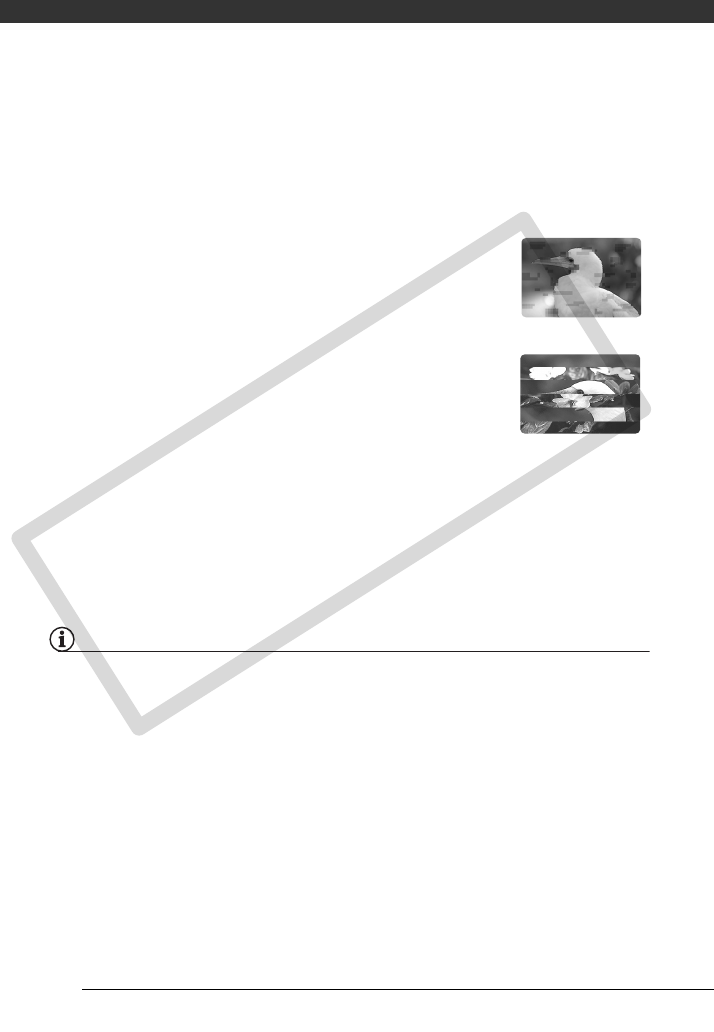
Digital video camcorders record video signals onto the tape in very thin lines (as thin
as 1/8 the width of a hair). The following anomalies may appear if the video heads
become dirty even a little.
• Mosaic or other blocky video artifacts (Fig. 1) or banding
(Fig. 2) appear on the picture during playback.
• Sound becomes distorted, or there is no sound during
playback.
• The message “HEADS DIRTY, USE CLEANING CASSETTE”
appears.
If such symptoms appear, clean the video heads with the
Canon DVM-CL Digital Video Head Cleaning Cassette* or a
commercially available dry cleaning cassette.
If the symptoms reappear shortly after the cleaning, the
videocassette may be defective. Stop using it.
* Availability differs from area to area.
Video heads may become dirty under the following conditions:
• When using the camcorder in humid or hot places.
• When using cassettes with damaged or dirty tapes.
• When using the camcorder in dusty places.
• When using the video heads for a long time without cleaning them.
NOTES
• Before you make important recordings, clean the video heads and make a test recording
first. We also recommend cleaning the video heads after use, before storing the
camcorder.
• Do not use wet type cleaning cassettes as this may damage the camcorder.
• Even after cleaning the video heads you may not be able to play back correctly tapes
that were recorded with dirty video heads.
Fig. 1
Fig. 2
COPY
3
Important Usage Instructions
WARNING!
TO REDUCE THE RISK OF FIRE OR ELECTRIC SHOCK, DO NOT EXPOSE THIS
APPARATUS TO RAIN OR MOISTURE.
For Canada only:
TO REDUCE THE RISK OF ELECTRIC SHOCK, DO NOT EXPOSE THIS
PRODUCT TO DRIPPING OR SPLASHING.
WARNING!
TO REDUCE THE RISK OF ELECTRIC SHOCK AND TO REDUCE ANNOYING
INTERFERENCE, USE THE RECOMMENDED ACCESSORIES ONLY.
COPYRIGHT WARNING:
Unauthorized recording of copyrighted materials may infringe on the rights of copyright
owners and be contrary to copyright laws.
Digital Video Camcorder, ZR950 A systems
This device complies with Part 15 of the FCC Rules. Operation is subject to the following two conditions: (1) This device may not cause
harmful interference, and (2) this device must accept any interference received, including interference that may cause undesired
operation.
Note: This equipment has been tested and found to comply with the limits for class B digital device, pursuant to Part 15 of the FCC
Rules. These limits are designed to provide reasonable protection against harmful interference in a residential installation. This
equipment generates, uses and can radiate radio frequency energy and, if not installed and use in accordance with the instructions,
may cause harmful interference to radio communications. However, there is no guarantee that interference will not occur in a particular
installation. If this equipment does cause harmful interference to radio or television reception, which can be determined by turning the
equipment off and on, the user is encouraged to try to correct the interference by one or more of the following measures:
• Reorient or relocate the receiving antenna.
• Increase the separation between the equipment and receiver.
• Connect the equipment into an outlet on a circuit different from that to which the receiver is connected.
• Consult the dealer or an experienced radio/TV technician for help.
Use of shielded cable is required to comply with class B limits in Subpart B of Part 15 of FCC Rules.
Do not make any changes or modifications to the equipment unless otherwise specified in the manual.
If such changes or modifications should be made, you could be required to stop operation of the equipment.
Canon U.S.A. Inc.
One Canon Plaza, Lake Success, NY 11042, U.S.A.
Tel No. (516)328-5600
I
mpor
t
an
t
W
arn
i
ng
CAUTION:
TO REDUCE THE RISK OF ELECTRIC
SHOCK, DO NOT REMOVE COVER (OR
BACK). NO USER-SERVICEABLE PARTS
INSIDE. REFER SERVICING TO QUALIFIED
SERVICE PERSONNEL.
CAUTION
RISK OF ELECTRIC SHOCK
DO NOT OPEN
The lightning flash with arrowhead symbol,
within an equilateral triangle, is intended to
alert the user to the presence of uninsulated
“dangerous voltage” within the product’s
enclosure, that may be of sufficient magnitude
to constitute a risk of electric shock to
persons.
The exclamation point, within an equilateral
triangle, is intended to alert the user to the
presence of important operating and
maintenance (servicing) instructions in the
literature accompanying the product.
COPY
4
In these safety instructions the word
“apparatus” or “product” refers to the Canon
Digital Video Camcorder ZR950 A and all its
accessories.
1Read Instructions — All the safety and
operating instructions should be read
before the product is operated.
2Retain Instructions — The safety and
operating instructions should be retained
for future reference.
3Heed Warnings — All warnings on the
product and in the operating instructions
should be adhered to.
4Follow Instructions — All operating and
maintenance instructions should be
followed.
5Cleaning — Unplug this product from the
wall outlet before cleaning. Do not use
liquid or aerosol cleaners. The product
should be cleaned only as
recommended in this manual.
6Accessories — Do not use accessories
not recommended in this manual as they
may be hazardous.
7Avoid magnetic or electric fields — Do
not use the camera close to TV
transmitters, portable communication
devices or other sources of electric or
magnetic radiation. They may cause
picture interference, or permanently
damage the camera.
8Water and Moisture — Hazard of electric
shock — Do not use this product near
water or in rainy/moist situations.
9Placing or Moving — Do not place on an
unstable cart, stand, tripod, bracket or
table. The product may fall, causing
serious injury to a child or adult, and
serious damage to the product.
A product and cart
combination should be
moved with care. Quick
stops, excessive force,
and uneven surfaces
may cause the product
and cart combination to
overturn.
10 Power Sources — The CA-590 Compact
Power Adapter should be operated only
from the type of power source indicated
on the marking label. If you are not sure
of the type of power supply to your
home, consult your product dealer or
local power company. Regarding other
power sources such as battery power,
refer to instructions in this manual.
11 Power Cord Protection — Power cords
should be routed so that they are not
likely to be walked on or pinched by
items placed upon or against them. Pay
particular attention to plugs and the
point from which the cords exit the
product.
12 Outdoor Antenna Grounding — If an
outside antenna is connected to the
product, be sure the antenna is
grounded so as to provide some
protection against voltage surges and
built-up static charges. Section 810 of
the National Electrical Code, ANSI /
NFPA No. 70—1984, provides
information with respect to proper
grounding of the mast and supporting
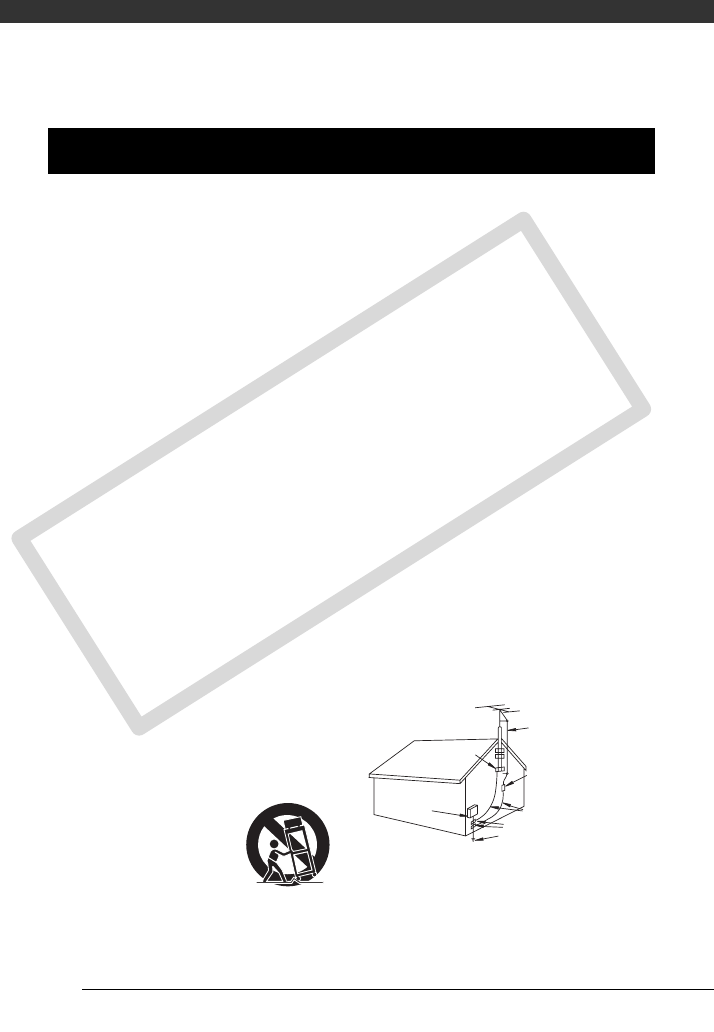
structure, grounding of the lead-in wire
to an antenna discharge unit, size of
grounding conductors, location of
antenna discharge unit, connection to
grounding electrodes, and requirements
for the grounding electrode. See figure 1.
IMPORTANT SAFETY INSTRUCTIONS
EXAMPLE OF ANTENNA GROUNDING AS PER
NATIONAL ELECTRICAL CODE
ANTENNA
LEAD IN
WIRE
ANTENNA DISCHARGE UNIT
(NEC SECTION 810-20)
GROUNDING CONDUCTORS
(NEC SECTION 810-21)
GROUND CLAMPS
POWER SERVICE GROUNDING
ELECTRODE SYSTEM
(NEC ART 250. PART H)
NEC - NATIONAL
ELECTRICAL CODE
ELECTRIC
SERVICE
EQUIPMENT
GROUND
CLAMP
Fig. 1
COPY

5
13 Lightning — For added protection of this
product during a lightning storm, or
when it is left unattended and unused for
long periods of time, disconnect it from
the wall outlet and disconnect the
antenna. This will prevent damage to the
product due to lightning and power-line
surges.
14 Overloading — Do not overload wall
outlets and extension cords as this can
result in a risk of fire or electric shock.
15 Objects and Liquid Entry — Never push
objects of any kind into this product
through openings as they may touch
dangerous voltage points or short out
parts that could result in a fire or electric
shock. Be careful not to spill liquid of any
kind onto the product.
16 Servicing — Do not attempt to service
this product yourself as opening or
removing covers may expose you to
dangerous voltage or other hazards.
Refer all servicing to qualified service
personnel.
17 Damage Requiring Service —
Disconnect this product from the wall
outlet and all power sources including
battery, and refer servicing to qualified
service personnel under the following
conditions:
a. When the power-supply cord or plug
is damaged.
b. If any liquid has been spilled onto, or
objects have fallen into, the product.
c. If the product has been exposed to
rain or water.
d. If the product does not operate
normally even if you follow the
operating instructions. Adjust only
those controls that are covered by the
operation instructions. Improper
adjustment of other controls may
result in damage and will often require
extensive work by a qualified
technician to restore the product to its
normal operation.
e. If the product has been dropped or
the cabinet has been damaged.
f. When the product exhibits a distinct
change in performance. This indicates
a need for service.
18 Replacement Parts — When
replacement parts are required, be sure
the service technician has used
replacement parts that are specified by
Canon or that have the same
characteristics as the original part.
Unauthorized substitutions may result in
fire, electric shock or other hazards.
19 Safety Check — Upon completion of any
service or repairs to this product, ask the
service technician to perform safety
checks to determine that the product is
in safe operating order.
When replacement of the power supply is required, please return it to the responsible nearest Canon Service Center
and please replace it with the same type number CA-590.
The adapter can be used with a power supply between 100 and 240 V AC. For areas where 120 V AC power is not
used, you will need a special plug adapter. Contact your nearest Canon Service Center for further information.
The adapter is not intended to be serviced. Should the product cease to function in its intended manner, it should be
returned to the manufacturer or be discarded.
This Class B digital apparatus complies with Canadian ICES-003.
The Mains plug is used as the disconnect device. The Mains plug shall remain readily operable to disconnect the
plug in case of an accident.
COPY

6
Table of contents
Introduction ______________________________
10 About this Manual
11 Getting to Know the Camcorder
11 Supplied Accessories
13 Components Guide
16 Screen Displays
Preparations _____________________________
19 Getting Started
19 Charging the Battery Pack
21 Installing the Backup Battery
21 Preparing the Wireless Controller and Accessories
23 Basic Operation of the Camcorder
23 Operating Modes
23 Joystick and Joystick Guide
24 Using the Menus
26 First Time Settings
26 Changing the Language
26 Changing the Time Zone
27 Setting the Date and Time
27 Getting Ready to Start Recording
27 Opening the Lens Cover and Adjusting the LCD Screen
29 Inserting and Removing a Tape
30 Inserting and Removing a Memory Card
COPY
7
Table of contents
Video ____________________________________
31 Basic Recording
31 Shooting Video
33 Zooming: Optical, Advanced and Digital Zoom
34 Quick Start Function
35 Reviewing the Last Scene Recorded
36 Basic Playback
36 Playing Back Video
37 Returning to a Pre-marked Position
38 Locating the Beginning of a Recording Date
38 Locating the End of the Last Scene
39 On-Screen Displays (Data Code)
40 Advanced Function
40 : Special Scene Recording Programs
42 Flexible Recording: Changing the Shutter Speed
43 LCD Video Light
43 Self Timer
44 Audio Recording Mode
44 Audio Playback Modes
45 Manual Focus Adjustment
46 Manual Exposure Adjustment
47 White Balance
48 Image Effects
48 Digital Effects
COPY

8
Photos __________________________________
50 Basic Recording
50 Taking Photos
51 Selecting Photo Size and Quality
52 Erasing or Protecting a Photo Right After Recording It
52 Basic Playback
52 Viewing Photos
53 Magnifying Photos during Playback
54 Erasing Photos
55 Additional Functions
55 Automatic Focus Priority
55 Protecting Photos
56 Initializing the Memory Card
57 Printing Photos
57 Printing Photos – Direct Print
57 Selecting the Print Settings
59 Print Orders
External Connections _______________________
61 Connecting to a TV or VCR
62 Connection Diagrams
63 Playback on a TV Screen
63 Copying your Recordings to an External Video Recorder
64 Digital Video Dubbing
66 Audio Dubbing
67 Connecting to a Computer
67 PC Connection Diagrams
68 Transferring Video Recordings
69 Transferring Photos – Direct Transfer
71 Transfer Orders
COPY

9
Table of contents
Additional Information ______________________
72 Appendix: Menu Options Lists
72 FUNC. Menu
73 Setup menus
73 Camera Setup (Advanced Zoom, Image Stabilizer, etc.)
74 VCR Setup (Recording Mode, TV Type, etc.)
75 Audio Setup (Audio Mode, Wind Screen, etc.)
76 Card Operations (Card Initialization, etc.)
76 Display Setup (LCD Brightness, Language, etc.)
77 System Setup (Beep, Power Save, etc.)
78 Date/Time Setup
79 Trouble?
79 Troubleshooting
82 List of Messages
86 Do’s and Don’ts
86 Handling Precautions
89 Maintenance/Others
90 Using the Camcorder Abroad
91 General Information
91 System Diagram
92 Optional Accessories
95 Product Codes
96 Specifications
99 Index
COPY
Introduction
10
Thank you for purchasing the Canon ZR950. Please read this manual carefully before
you use the camcorder and retain it for future reference. Should your camcorder fail
to operate correctly, refer to Troubleshoo ting ( 79).
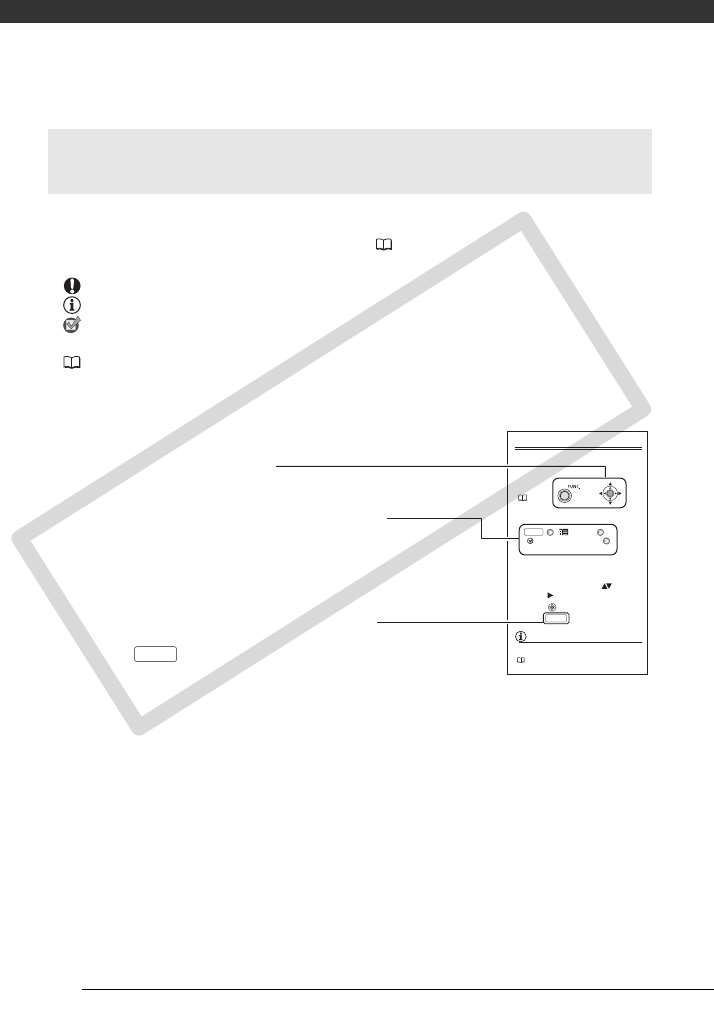
Conventions Used in this Manual
• IMPORTANT: Precautions related to the camcorder’s operation.
• NOTES: Additional topics that complement the basic operating procedures.
• POINTS TO CHECK: Restrictions or requirements regarding the function
described.
• : Reference page number.
• “Screen” refers to the LCD and the viewfinder screen.
• The photos included in the manual are simulated pictures taken with a still camera.
About this Manual
Setting the Date and Time
1Open the date and time setup
screen.
[ MENU]
[ DATE/TIME SETUP]
[DATE/TIME]
Blinking arrows will be displayed
around the first field of the date.
2Change each field of the date and
time with the joystick ( ) and
move ( ) to the next field.
3Press ( ) to start the clock.
4Press to close the menu.
NOTES
You can also change the date format
( 93).
FUNC.
( 30)
FUNC.
FUNC.
Brackets [ ] and capital letters are used to refer to menu
options as they are displayed on screen. In tables in this
manual the default value is shown in boldface.
For example [ON], [OFF].
Buttons and switches to be operated
Names of buttons and switches other than the joystick
are indicated within a “button” frame.
For example .
FUNC.
COPY
11
Getting to Know the Camcorder
* Includes the electronic version of the Digital Video Software instruction manual on PDF file.
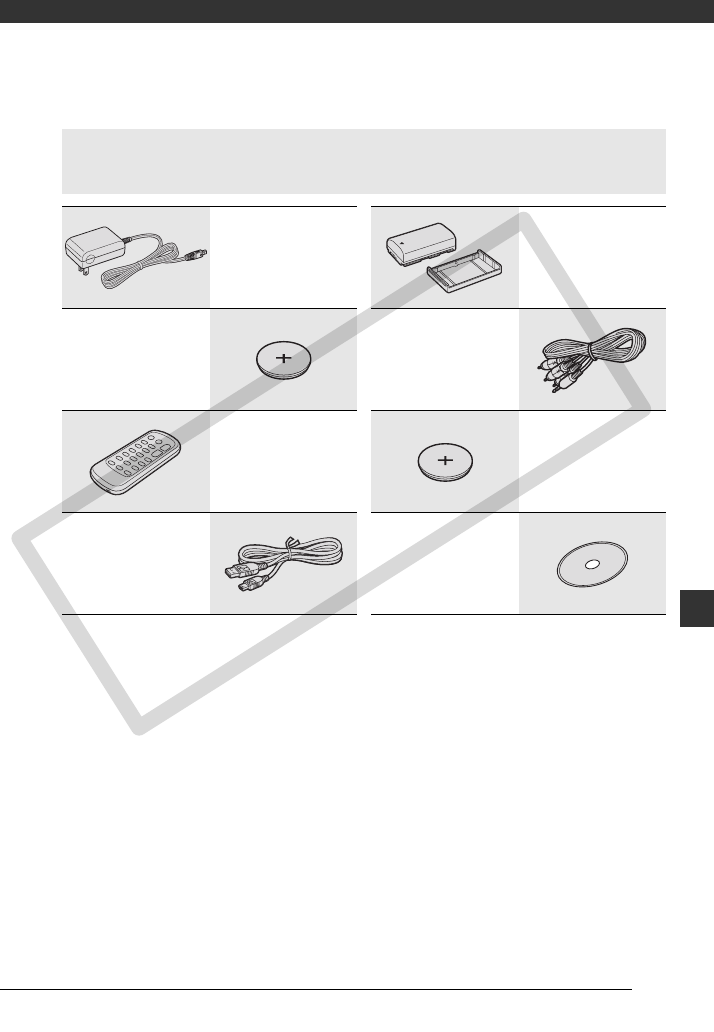
Supplied Accessories
CA-590 Compact Power
Adapter BP-2L5 Battery Pack
Lithium Button Battery
(CR1616)
STV-250N Stereo Video
Cable
WL-D85 Wireless Controller
Lithium Button Battery
(CR2025) for Wireless
Controller
IFC-300PCU USB Cable
Software CD-ROM*
DIGITAL VIDEO
Solution Disk
COPY

Introduction
12
Online product registration for U.S.A. Customers only.
Register your product online at www.registercanon.com
9 Protect your product
We will keep the model number and date of purchase of your new Canon product on file to help you
refer to this information in the event of an insurance claim such as loss or theft.
9 Receive information on new products and promotions
Upon your request, we will send you information on Canon new products and promotions.
The serial number of this product can be found at the battery attachment unit of the camcorder. Write down
the number and other information here and retain this book as a permanent record of your purchase to aid
identification in case of theft.
Date of Purchase: Model Name: ZR950 A
Purchased From: Serial No.:
Dealer Address:
Dealer Phone No.:
COPY
13
Names of buttons and switches other than the
joystick are indicated within a “button” frame
(for example ).
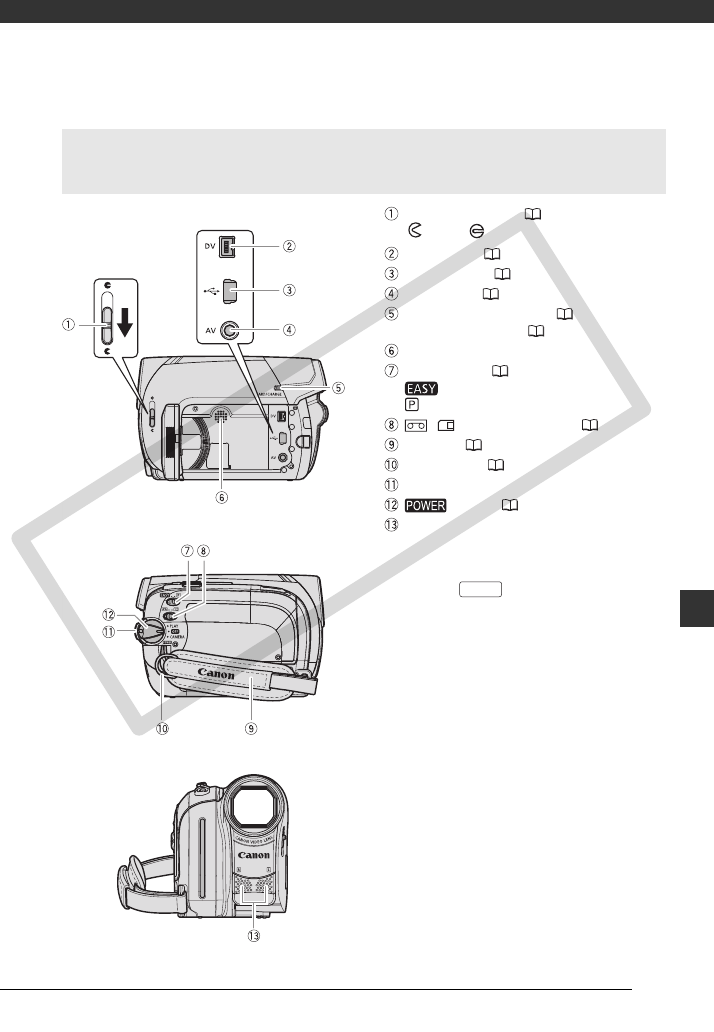
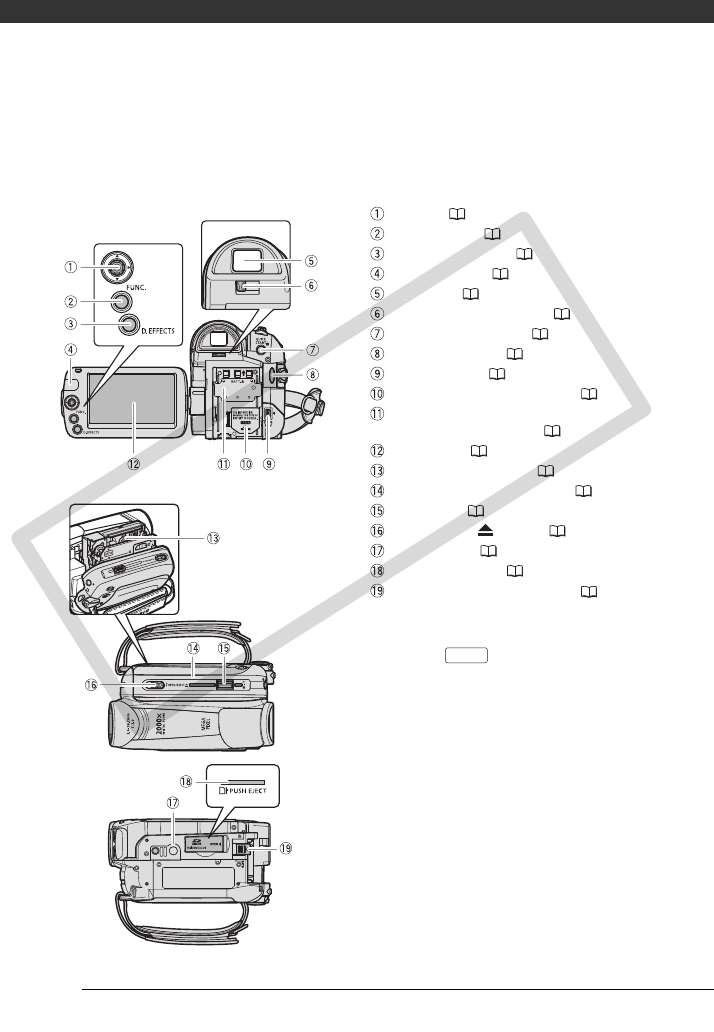
Components Guide
Left side view
Front view
Right side view
Lens cover switch ( 31, 50)
( open, closed)
DV terminal ( 62, 67)
USB terminal ( 67)
AV terminal ( 62)
CARD access indicator ( 50)/
CHARGE indicator ( 19)
Speaker
Mode switch ( 32)
Easy recording
Recording programs
/
(tape/card) switch ( 23)
Grip belt ( 22)
Strap mount
(93)
Lock button
switch ( 23)
Stereo microphone
FUNC.
COPY
Introduction
14
Names of buttons and switches other than the
joystick are indicated within a “button” frame
(for example ).
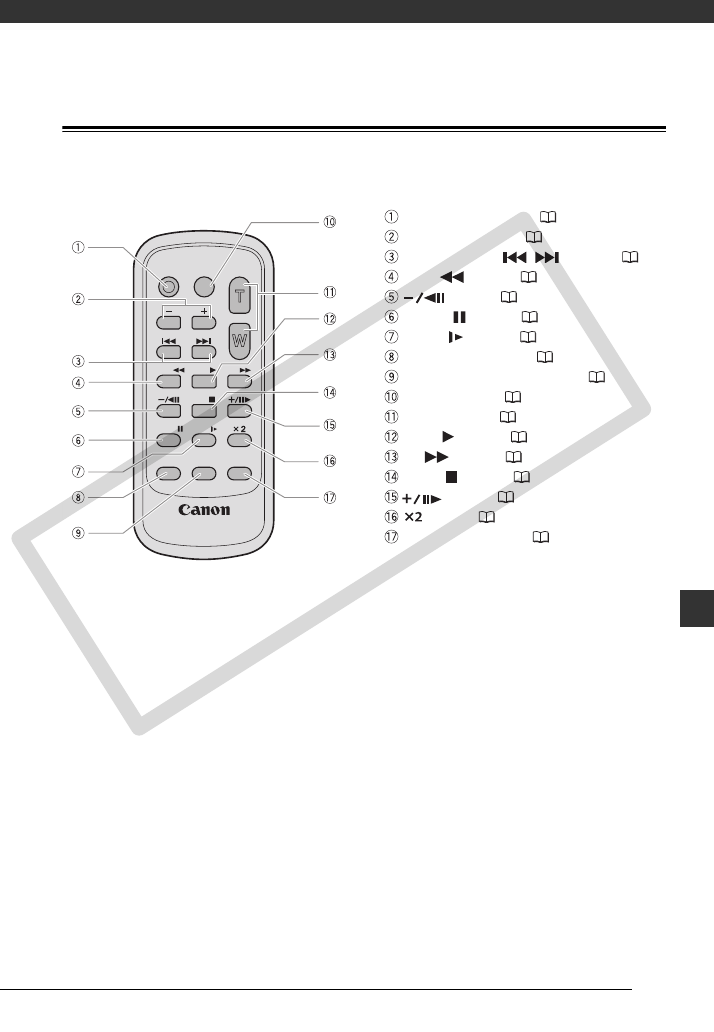
Back view
Top view
Bottom view
Joystick ( 23)
FUNC. button ( 24, 72)
D.EFFECTS button ( 48)
Remote sensor ( 22)
Viewfinder ( 32)
Dioptric adjustment lever ( 32)
QUICK START button ( 34)
Start/Stop button ( 31, 50)
DC IN terminal ( 19)
Backup battery compartment ( 21)
Serial number/
Battery attachment unit ( 19)
LCD screen ( 27)
Cassette compartment
( 29)
Cassette compartment cover
( 29)
Zoom lever ( 33)
OPEN/EJECT switch
(29)
Tripod socket
( 22)
Memory card slot ( 30)
BATT. (battery release) switch ( 19)
FUNC.
COPY
15
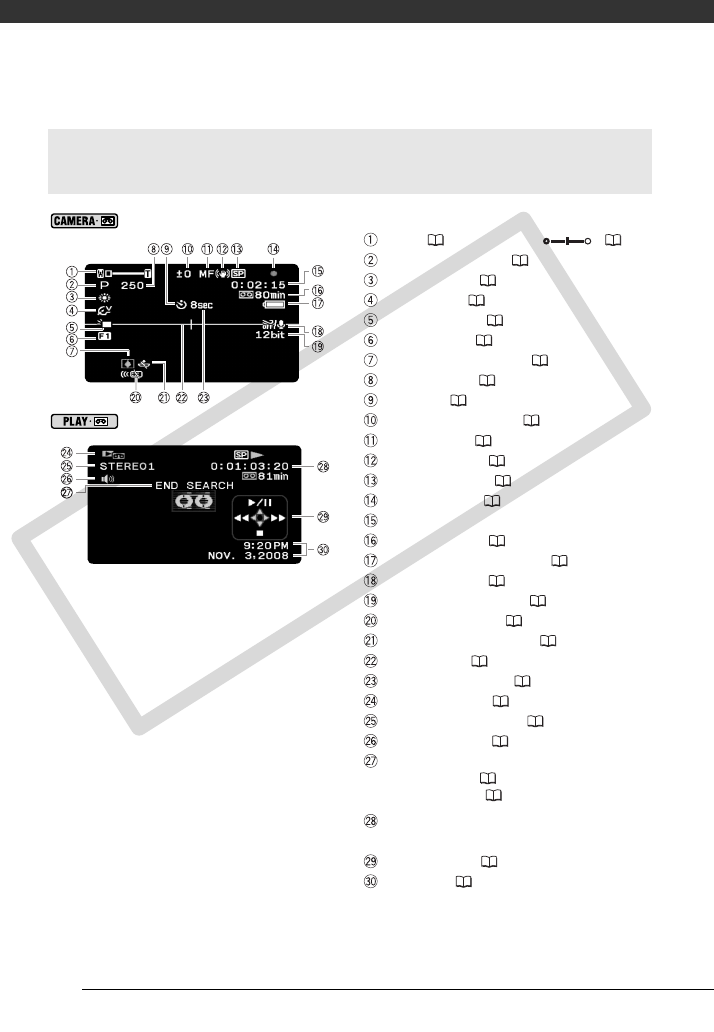
Wireless Controller WL-D85
WIRELESS CONTROLLER WL-D85
START/
STOP PHOTO ZOOM
CARD
DATE SEARCH
REW PLAY FF
STOP
PAUSE SLOW
AUDIO DUB. ZERO SET
MEMORY TV SCREEN
START/STOP button ( 31)
CARD –/+ buttons ( 52)
DATE SEARCH / buttons ( 38)
REW button ( 36)
button ( 36)
PAUSE button ( 36)
SLOW button ( 36)
AUDIO DUB. button ( 66)
ZERO SET MEMORY button ( 37)
PHOTO button ( 50)
Zoom buttons ( 33)
PLAY button ( 36)
FF button ( 36)
STOP button ( 36)
button ( 36)
button ( 36)
TV SCREEN button ( 77)
COPY
Introduction
16
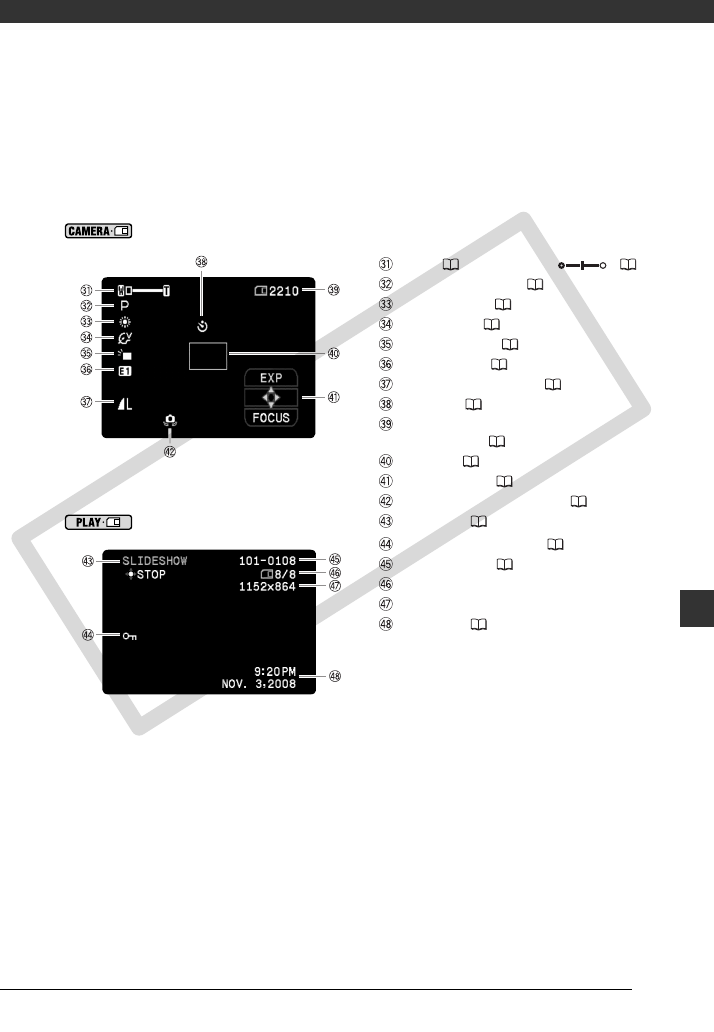
Screen Displays
Recording Movies
Zoom ( 33), Exposure ( 46)
Recording program ( 40)
White balance ( 47)
Image effect ( 48)
LCD video light ( 43)
Digital effects ( 48)
Condensation warning ( 89)
Shutter speed ( 42)
Self timer ( 43)
Playing Movies Exposure adjustment ( 46)
Manual focus ( 45)
Image stabilizer ( 74)
Recording mode ( 75)
Tape operation ( 18)
Time code (hours : minutes : seconds)
Remaining tape ( 18)
Remaining battery charge ( 18)
Wind screen off ( 75)
Audio recording mode ( 44)
Remote sensor off ( 77)
Backup battery warning ( 21)
Level marker ( 77)
Recording reminder ( 18)
Operating mode ( 23)
Audio playback mode ( 45)
Speaker volume ( 36)
Search function display
END SEARCH ( 38)/
DATE SEARCH ( 38)
Playback time
(hours : minutes : seconds : frames)
Joystick guide ( 23)
Data code ( 39)
COPY
17
Recording Still Images
Zoom ( 33), Exposure ( 46)
Recording program ( 40)
White balance ( 47)
Image effect ( 48)
LCD video light ( 43)
Digital effects ( 48)
Still image quality/size ( 51)
Self timer ( 43)
Number of still images available on the
memory card ( 18)
AF frame ( 55)
Joystick guide ( 23)
Camcorder shake warning ( 74)
Viewing Still Images Slideshow ( 53)
Image protection mark ( 55)
Image number ( 18, 78)
Current image /Total number of images
Still image size
Data code ( 39)
COPY
Introduction
18
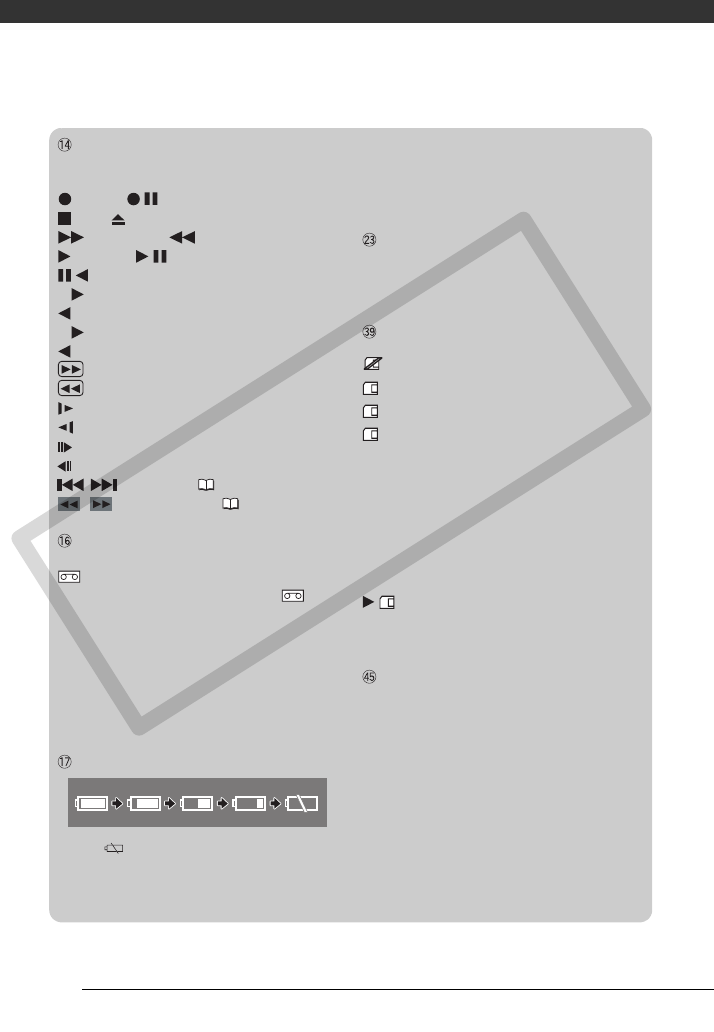
Tape operation
Note that some playback and search modes are
only available when using the wireless controller.
Record, Record pause,
Stop, Eject,
Fast forward, Rewind,
Playback, Playback pause,
Reverse playback pause,
x1 Playback (normal speed),
x1 Reverse playback (normal speed),
x2 Playback (double speed),
x2 Reverse playback (double speed),
Fast forward playback,
Rewind playback,
Slow playback,
Slow reverse playback,
Frame advance,
Frame reverse,
/ Date search ( 38),
/ Zero set memory ( 37)
Remaining tape
Indicates the remaining time of the tape in minutes.
moves during recording. When the tape
reaches its end, the display changes to “ END”.
• When the time left is less than 15 seconds, the
remaining tape time may not appear.
• Depending on the type of tape, the remaining
time displayed may not be correct. In any case,
you will be able to record on the tape the number
of minutes that appears on the cassette’s label
(for example, 85 minutes).
Remaining battery charge
• When starts flashing in red replace the
battery pack with a fully charged one.
• When you attach an empty battery pack, the
power may turn off without displaying the icon.
• Depending on the conditions under which the
camcorder and the battery pack are used, the
actual battery charge may not be indicated
accurately.
Recording reminder
The camcorder counts from 1 to 10 seconds when
you start recording. This is helpful to avoid scenes
that are too short.
Number of still images available on the memory
card
flashing in red: No card
in green: 6 or more images
in yellow: 1 to 5 images
in red: No more images can be recorded
• When viewing the still images, the display will
always be in green.
• Depending on the recording conditions, the
number of available still images displayed may
not decrease even after a recording has been
made, or may decrease by 2 still images at once.
Card Access Display
is displayed next to the number of images
available while the camcorder is writing on the
memory card.
Image number
The image number indicates the name and location
of the file on the memory card. For example, the file
name of image 101-0107 is “IMG_0107.JPG”,
stored under the folder “DCIM\101CANON”.
COPY
19
Preparations
This chapter describes basic operations, such as navigating the
menus, and first time settings to help you learn more about your
camcorder.
Getting Started
Charging the Battery Pack
The camcorder can be powered with a
battery pack or directly using the
compact power adapter. Charge the
battery pack before use.
For approximate charging times and
recording/playback times with a full
battery pack, refer to the tables on
page 93.
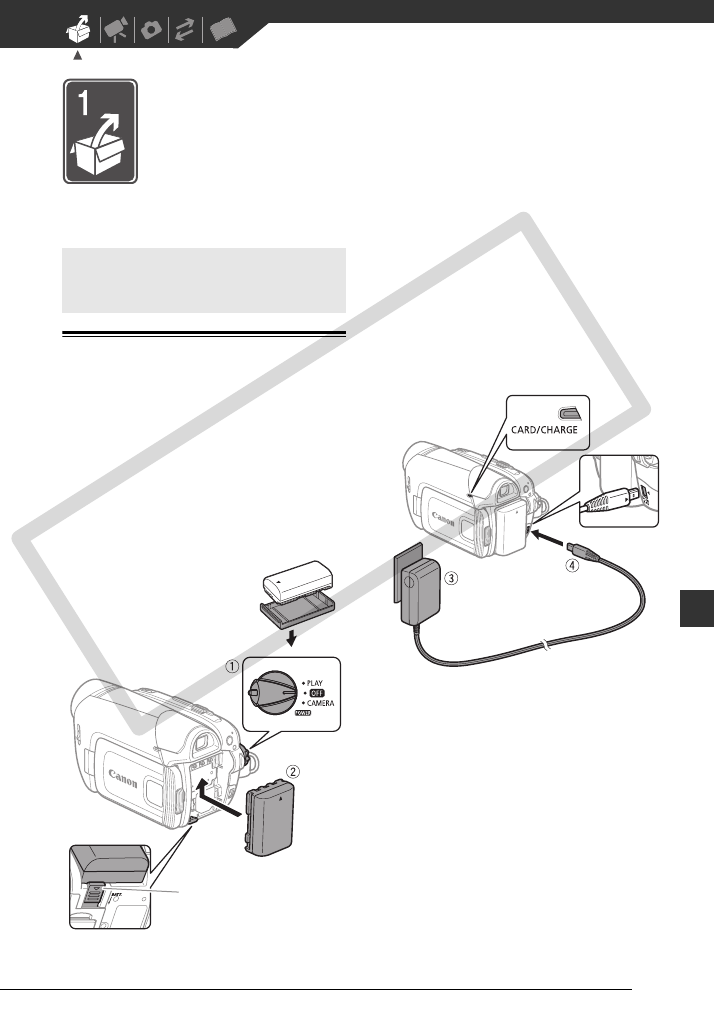
1Turn off the camcorder.
2Attach the battery pack to the
camcorder.
Press the battery pack lightly and
slide it up until it clicks.
3Plug the compact power adapter
into a power outlet.
4Connect the compact power
adapter to the camcorder’s DC IN
terminal.
• The CHARGE indicator starts
flashing. The indicator will stay on
when the charging is completed.
• You can also use the compact
power adapter without attaching a
battery pack.
• When the compact power adapter
is connected, even if a battery is
Getting Started
Remove the battery
terminal cover before
attaching the battery
BATT. switch
CHARGE
indicator
DC IN
terminal
COPY
Preparations
20
attached its power will not be
consumed.
1 Disconnect the compact power
adapter from the camcorder.
2 Unplug the compact power
adapter from the power outlet.
Press to release the battery
pack. Slide the battery pack down
and then pull it out.
IMPORTANT
• You may hear some noise from the
compact power adapter during use.
This is not a malfunction.
• We recommend charging the battery
pack in temperatures between 10 °C
and 30 °C (50 °F and 86 °F). Outside the
temperature range of 0 °C to 40 °C
(32 °F to 104 °F), charging will not start.
• Do not connect to the camcorder’s DC
IN terminal or to the compact power
adapter any electrical equipment that is
not expressly recommended for use
with this camcorder.
• To prevent equipment breakdowns and
excessive heating, do not connect the
supplied compact power adapter to
voltage converters for overseas travels
or special power sources such as those
on aircraft and ships, DC-AC inverters,
etc.
NOTES
• The CHARGE indicator also serves as a
rough estimate of the battery charge
status.
Continuously on: Battery pack fully
charged.
Two quick flashes at 1-second intervals:
Battery pack at least 50% charged. If
the indicator flashes quickly but not
exactly in this pattern, refer to
Troubleshooting (79).
One flash at 1-second intervals: Battery
pack less than 50% charged.
• We recommend that you prepare battery
packs 2 to 3 times longer than you think
you might need.
•U.S.A. and Canada only: The
lithium ion/polymer battery
that powers this product is
recyclable. Please call
1-800-8-BATTERY for information on
how to recycle this battery.
ONCE THE BATTERY IS FULLY CHARGED
TO REMOVE THE BATTERY PACK
BATT.
COPY
21
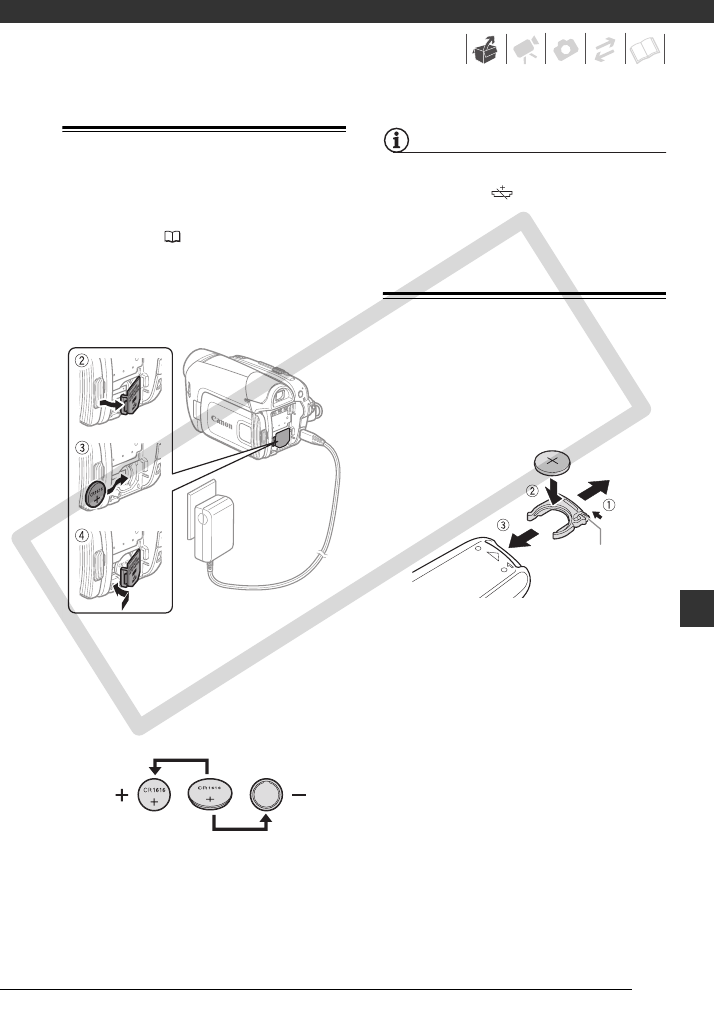
Installing the Backup Battery
The backup battery (lithium button battery
CR1616) allows the camcorder to retain
the date, time ( 27) and other
camcorder settings while the power
source is disconnected. Connect a power
source to the camcorder when replacing
the backup battery to retain the settings.
1If a battery pack is attached,
remove it first.
2Open the backup battery cover.
3Insert the backup battery with the
+ side facing out.
4Close the cover.
NOTES
The battery life of the backup battery is
about one year. flashes in red when
the lithium button battery is not installed,
or when it needs to be replaced.
Preparing the Wireless Controller and
Accessories
First, insert the supplied lithium button
battery (CR2025) into the wireless
controller.
1Press the tab in the direction of
the arrow and pull out the battery
holder.
2Place the lithium button battery
with the + side facing up.
3Insert the battery holder.
Tab
COPY
Preparations
22
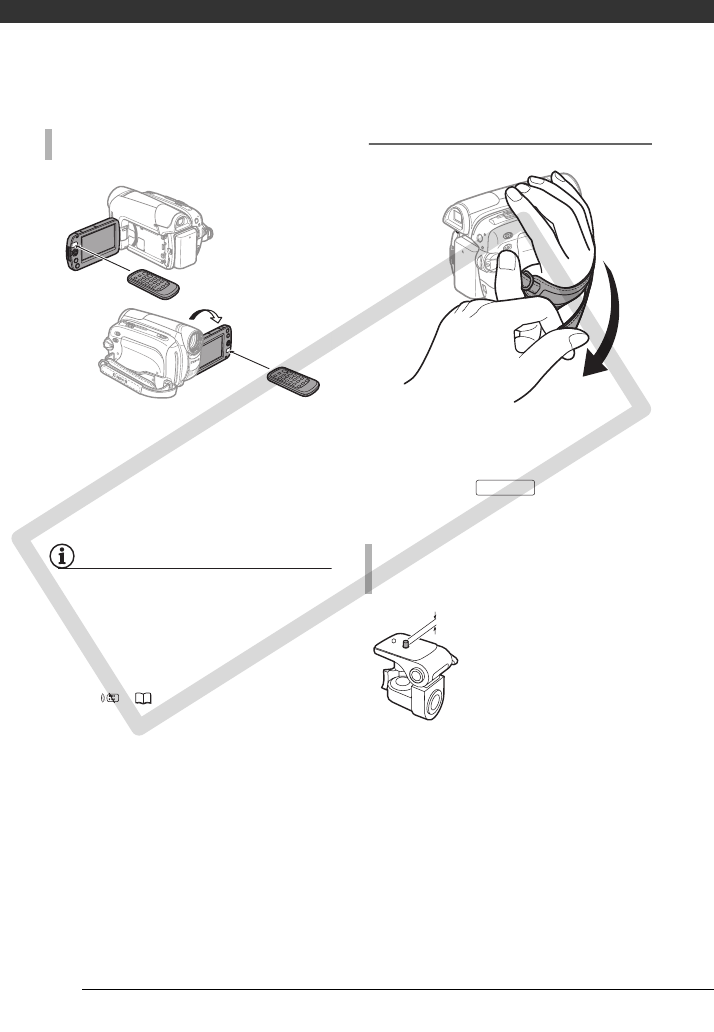
Point the controller at the
camcorder’s remote sensor when
you press the buttons.
You can rotate the LCD panel 180
degrees to use the wireless controller
from the front of the camcorder.
NOTES
• The wireless controller may not work
properly when the remote sensor is
situated under strong light sources or
direct sunlight.
• If the wireless controller does not work,
check that [WL.REMOTE] is not set to
[OFF ] ( 77). Otherwise, replace
the battery.
Accessories
Fasten the grip belt.
Adjust the grip belt so that you can
reach the zoom lever with your index
finger, and the button with
your thumb.
Do not leave the viewfinder
exposed to direct sunlight
as it may melt (due to
concentration of the light by
the lens). Do not use tripods
with fastening screws
longer than 5.5 mm (0.2 in.).
Doing so may damage the camcorder.
TO USE THE WIRELESS CONTROLLER
WHEN YOU MOUNT THE CAMCORDER ON A
TRIPOD
Start/Stop
COPY
23
Basic Operation of the Camcorder
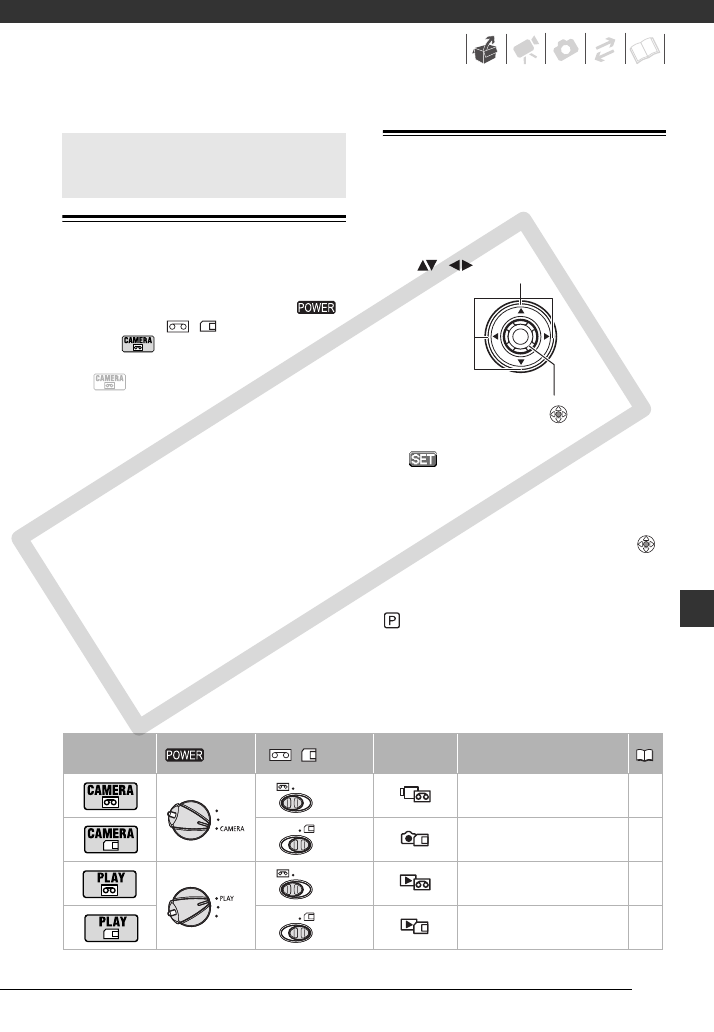
Operating Modes
The camcorder’s operating mode is
determined by the positions of the
switch and the / switch. In the
manual, indicates that a function is
available in the operating mode shown
and indicates that the function is not
available. When no operating mode icons
are given, the function is available in all
operating modes.
Joystick and Joystick Guide
Use the joystick to operate the
camcorder's menus.
The joystick can also be used in
combination with the joystick guide to
operate additional functions. Press ( )
to display/hide the joystick guide (when
recording, the joystick guide will appear
only when the mode switch is set to
). The functions that appear on the
joystick guide will change depending
on the operating mode.
Operating
mode switch / switch Icon display Operation
Recording movies
on a tape 31
Recording still images
on a memory card 50
Playing movies
from a tape 36
Playing back still images
from a memory card 52
(Tape)
(Card)
(Tape)
(Card)
Basic Operation of the
Camcorder
Press the joystick itself ( ) to save the
settings or confirm an action. On menu
screens, this is indicated by the icon
.
Push the joystick up, down, left or right
( , ) to select an item or change
settings.
COPY
Preparations
24
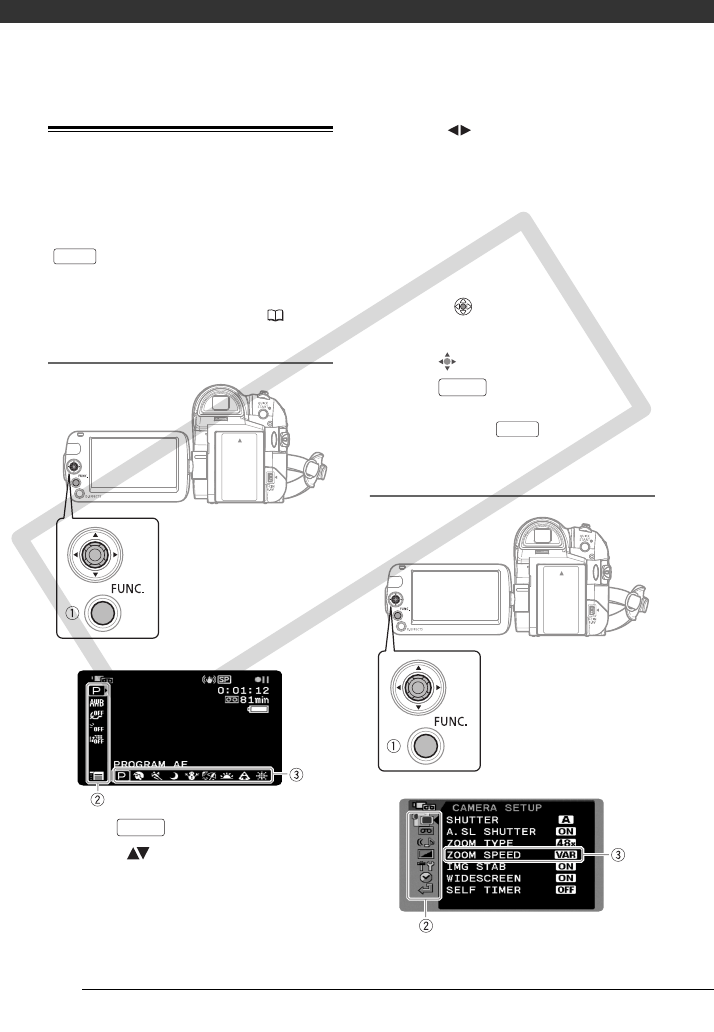
Using the Menus
Many of the camcorder’s functions can
be adjusted from the menus that open
after pressing the FUNC. button
().
For details about the available menu
options and settings, refer to the
appendix Menu Options Lists ( 72).
Selecting a FUNC. Menu Option
1Press .
2Select ( ) the icon of the
function you want to change from
the left side column.
Menu items not available will appear
grayed out.
3Select ( ) the desired setting
from the available options at the
bottom bar.
• The selected option will be
highlighted in light blue. Menu
items not available will appear
grayed out.
• With some settings you will need to
make further selections and/or
press ( ). Follow the additional
operation guides that will appear
on the screen (such as the joystick
icon , small arrows, etc.).
4Press to save the settings
and close the menu.
You can press to close the
menu at any time.
Selecting an Option from the Setup Menus
FUNC.
FUNC.
FUNC.
FUNC.
COPY
25
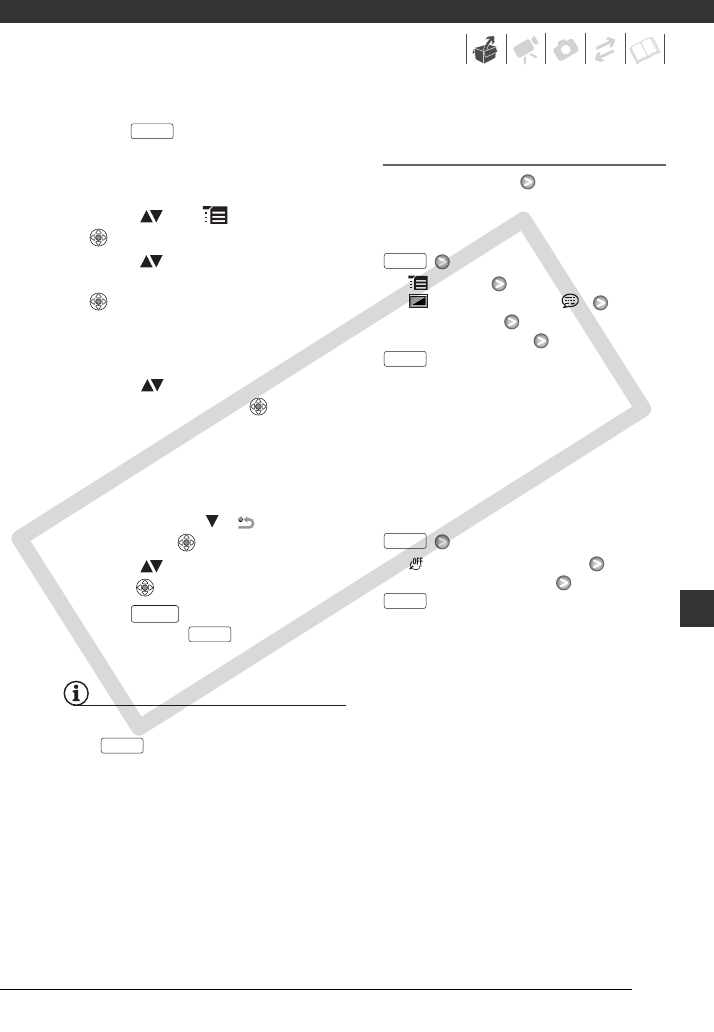
1Press .
In the still image index screen, the
setup menus will open. Skip to
step 3.
2Select ( ) the icon and press
( ) to open the setup menus.
3Select ( ) the desired menu from
the left side column and press
().
The title of the selected menu
appears on top of the screen and
under it the list of settings.
4Select ( ) the setting you want
to change and press ( ).
• An orange frame will indicate the
menu item currently selected.
Menu items not available will
appear grayed out.
• To return to the menu selection
screen, select ( ) [ RETURN]
and press ().
5Select ( ) the desired option and
press ( ) to save the setting.
6Press .
You can press to close the
menu at any time.
NOTES
Instead of steps 1 and 2, you can also
keep pressed down for more than
1 second to open the setup menus screen
directly.
Abbreviation of Menu Selections in this
Manual
In this manual, the arrow is used to
abbreviate menu selections. Below is
an example of changing a setting using
the setup menus.
[ MENU]
[ DISPLAY SETUP/ ]
[LANGUAGE]
Desired language
For selections in the FUNC. menu, the
abbreviated form will always show the
initial default value. In recording mode,
its icon will appear on the left side
column when you first open the menu.
If the setting was changed, the icon of
the currently selected option will appear
instead.
[ IMAGE EFFECT OFF]
Desired image effect
FUNC.
FUNC.
FUNC.
FUNC.
FUNC.
FUNC.
FUNC.
FUNC.
COPY
Preparations
26
First Time Settings
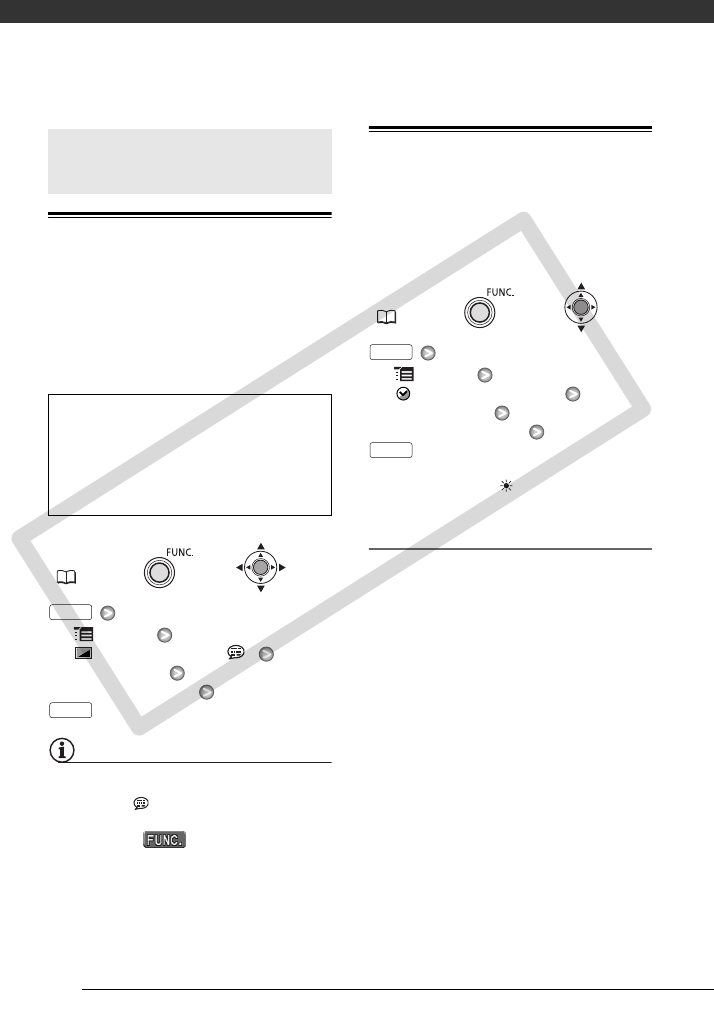
Changing the Language
The language for on-screen and menu
displays can be changed. The list of
available languages depends on the
region where you purchased the
camcorder.
Default value
[ MENU]
[ DISPLAY SETUP/ ]
[LANGUAGE]
Desired language
NOTES
• If you changed the language by mistake,
follow the mark next to the menu
item to change the setting.
• The display that appears in some
menu screens refers to the name of the
button on the camcorder and will not
change, regardless of the language
selected.
Changing the Time Zone
Change the time zone to match your
location. The default setting is New
York or Singapore, depending on the
region of purchase.
[ MENU]
[ DATE/TIME SETUP]
[T.ZONE/DST]
Desired time zone*
* To adjust for daylight saving time, select the
time zone with the mark next to the
area.
World Time Zones
Once you have set the time zone, date
and time, you do not need to reset the
clock every time you travel to another
time zone. Select the time zone to
match the local time at your
destination, referring to the date and
time displayed on the screen.
First Time Settings
FUNC.
( 24)
Language Set A
German, English, Spanish, French, Italian,
Polish, Russian, Simplified Chinese and
Japanese.
Language Set B
English, Simplified Chinese, Traditional
Chinese and Korean.
FUNC.
FUNC.
FUNC.
( 24)
FUNC.
FUNC.
COPY
27
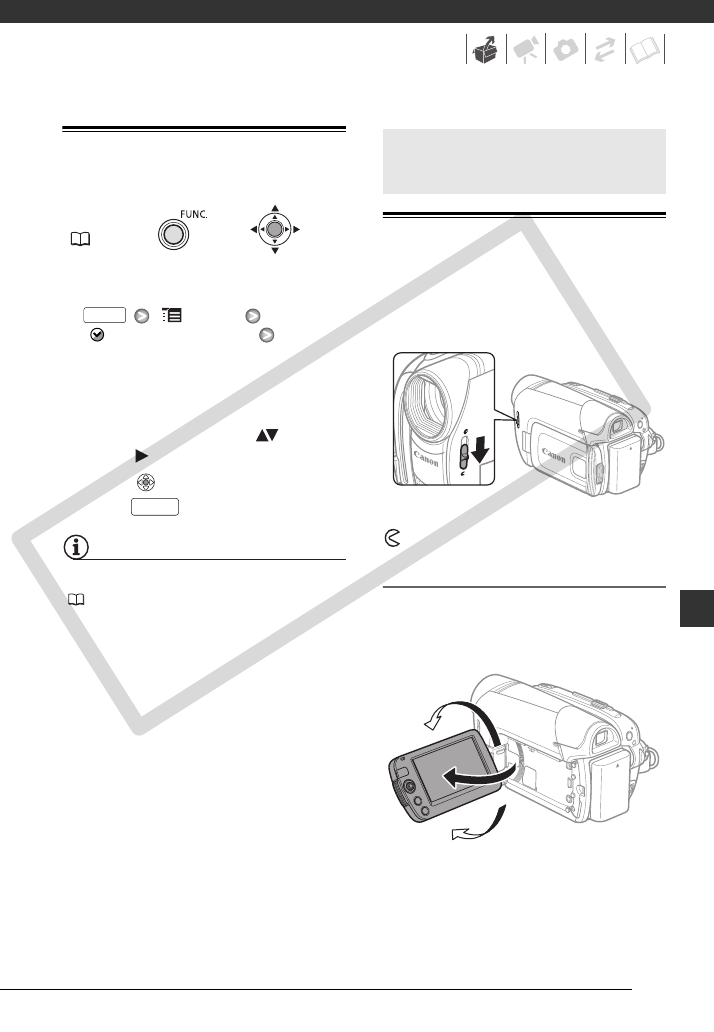
Setting the Date and Time
1Open the date and time setup
screen.
[ MENU]
[ DATE/TIME SETUP]
[DATE/TIME]
Blinking arrows will be displayed
around the first field of the date.
2Change each field of the date and
time with the joystick ( ) and
move ( ) to the next field.
3Press ( ) to start the clock.
4Press to close the menu.
NOTES
You can also change the date format
(78).
Getting Ready to Start Recording
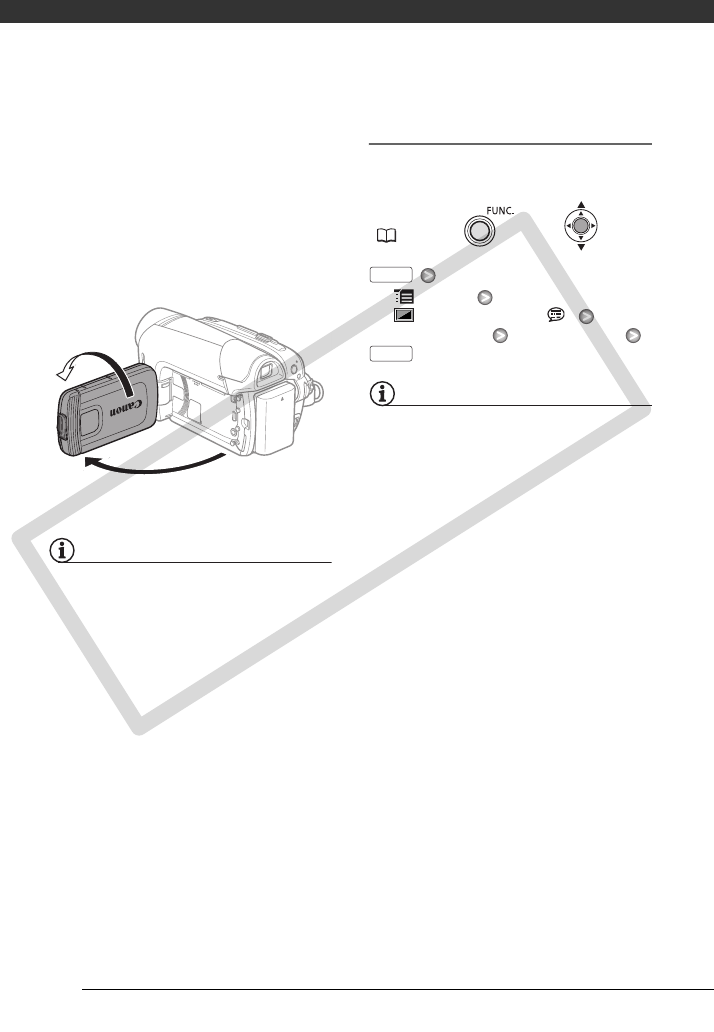
Opening the Lens Cover and Adjusting
the LCD Screen
Before you start recording, open the
lens cover.
Move the lens cover switch down to
to open the lens cover.
Rotating the LCD Panel
Open the LCD panel 90 degrees.
You can rotate the panel 90 degrees
downward.
You can rotate the panel 180 degrees
toward the lens (allowing the subject to
monitor the LCD screen while you use
the viewfinder). This is the only case
where you can use the viewfinder and
FUNC.
( 24)
FUNC.
FUNC.
Getting Ready to Start
Recording
180°
90°
COPY
Preparations
28
the LCD screen simultaneously.
Rotating the LCD panel 180 degrees
can be useful in the following cases:
• When you wish to include yourself in
the picture when recording with the
self timer.
• To allow the camcorder to be
operated with the wireless controller
from the front.
NOTES
About the LCD and viewfinder screen: The
screens are produced using extremely
high-precision manufacturing techniques,
with more than 99.99% of the pixels
operating to specification. Less than
0.01% of the pixels may occasionally
misfire or appear as black, red, blue or
green dots. This has no effect on the
recorded image and does not constitute a
malfunction.
LCD Backlight
You can set the brightness of the LCD
screen to normal or bright.
[ MENU]
[ DISPLAY SETUP/ ]
[BACKLIGHT] Desired option
NOTES
• This setting does not affect the
brightness of the recording or the
viewfinder screen.
• Using the [BRIGHT] setting will shorten
the effective usage time of the battery
pack.
Subject can monitor the
LCD screen
FUNC.
( 24)
FUNC.
FUNC.
COPY
29
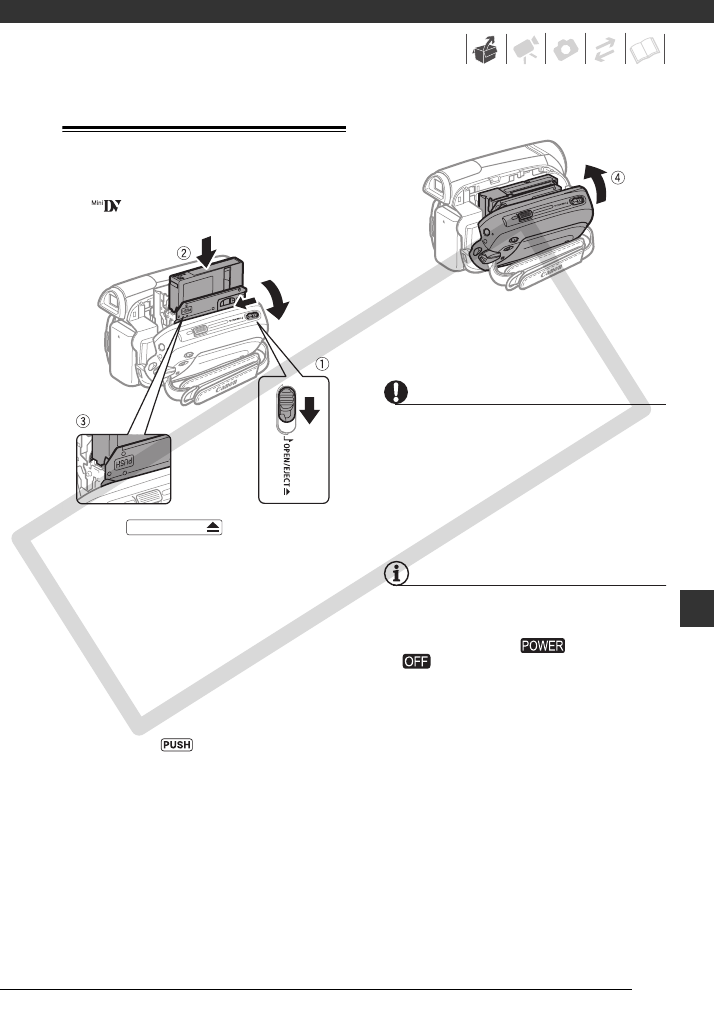
Inserting and Removing a Tape
Use only videocassettes marked with
the logo.
1Slide fully in the
direction of the arrow and open
the cassette compartment cover.
The cassette compartment opens
automatically.
2Insert the cassette.
• Insert the cassette with the window
facing the grip belt.
• To remove a cassette pull it straight
out.
3Press the mark on the
cassette compartment until it
clicks.
4Wait for the cassette compartment
to retract automatically and close
the cassette compartment cover.
IMPORTANT
• Do not interfere with the cassette
compartment while it is opening or
closing automatically, or attempt to
close the cover before the cassette
compartment has fully retracted.
• Be careful not to get your fingers caught
in the cassette compartment cover.
NOTES
If the camcorder is connected to a power
source, cassettes can be inserted/
removed even if the switch is set
to .
OPEN/EJECT
COPY
Preparations
30
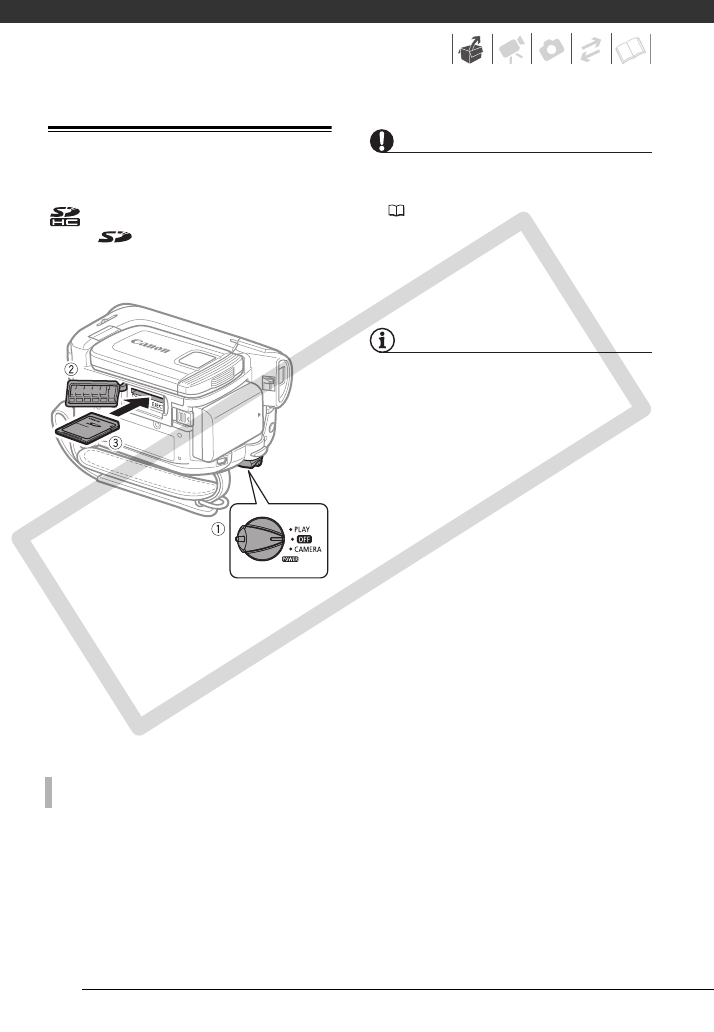
Inserting and Removing a Memory Card
You can use commercially available
SDHC (SD High Capacity) memory
cards, SD memory cards or
MultiMedia cards (MMC) with this
camcorder.
1Turn off the camcorder.
2Open the memory card slot cover.
3Insert the memory card straight all
the way into the memory card slot.
4Close the cover.
Do not force the cover closed if the
memory card is not correctly inserted.
First push the memory card once
to release it, and then pull the card
out.
IMPORTANT
• Make sure to initialize all memory cards
before using them with this camcorder
(56).
• Memory cards have front and back
sides that are not interchangeable.
Inserting a memory card facing the
wrong direction can cause a malfunction
of the camcorder.
NOTES
• Compatibility with all SD, SDHC or
MMC memory cards cannot be
guaranteed.
•About SDHC Memory Cards: SDHC is the
new type of SD memory card with
capacities over 2 GB. Please note that
the specifications of SDHC memory
cards are different from those of regular
SD memory cards and you will not be
able to use memory cards of over 2 GB
with devices that do not support SDHC.
However, SDHC devices (including this
camcorder) are backward compatible
and support regular SD memory cards.
TO REMOVE THE MEMORY CARD
COPY
31
Video
This chapter covers functions related to shooting and playing back
movies – from basic recording and zooming to more advanced manual
picture adjustments.
Basic Recording
Shooting Video
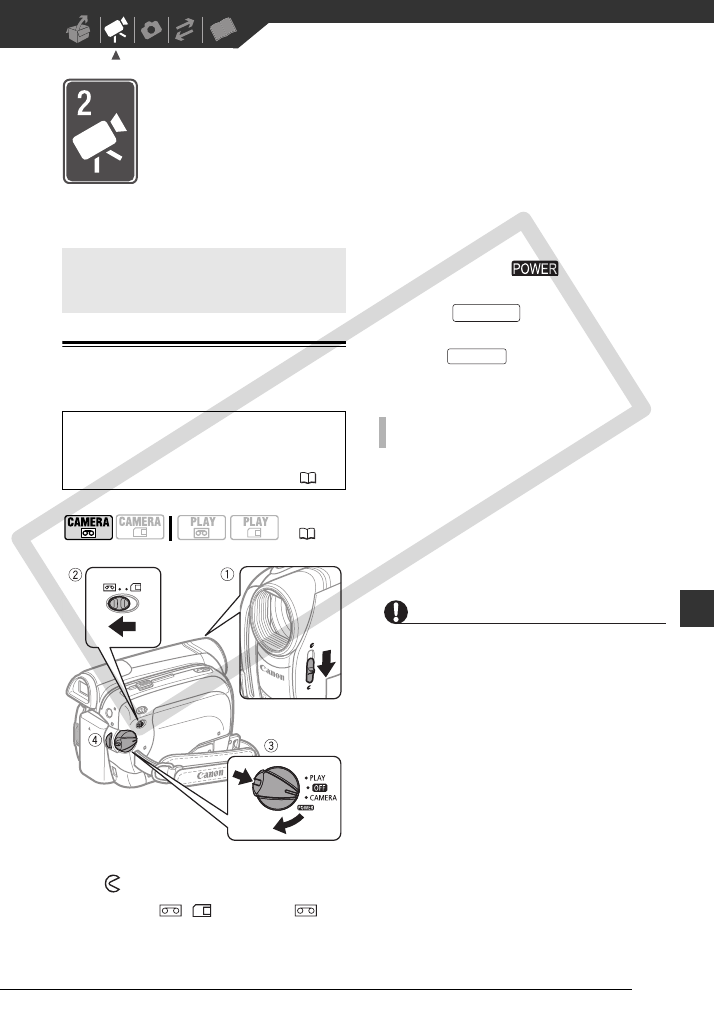
1Move the lens cover switch down
to to open the lens cover.
2Move the / switch to
(tape).
3Holding the lock button pressed
down, set the switch to
CAMERA.
4Press to begin
recording.
Press again to pause the
recording.
1
Close th
e lens cover and the
LCD
panel
.
2 Turn off the camcorder.
3 Remove the tape.
4 Disconnect the power source and
remove the battery pack.
IMPORTANT
When recording movies, try to get a calm,
stable picture.
Excessive camcorder movement while
shooting and extensive use of fast zooms
and panning can result in jittery scenes. In
extreme cases, the playback of such
scenes may result in visually induced
motion sickness. If you experience such a
reaction, immediately stop the playback
and take a rest break as necessary.
Basic Recording
Before You Begin Recording
Make a test recording first to check if the
camcorder operates correctly. If
necessary, clean the video heads ( 2).
( 23)
WHEN YOU HAVE FINISHED RECORDING
Start/Stop
Start/Stop
COPY
Video
32
NOTES
•About the recording time: By changing the
recording mode you can change the
video quality and as a result, also the
available recording time ( 75).
• Previous recordings overwritten by a
new recording cannot be recovered.
Before you start recording, search for
the end of the last recording ( 38).
• To protect the tape and video heads, the
camcorder will enter the stop mode ( )
if left in record pause ( ) mode for
4 minutes 30 seconds. To resume
recording press .
•About the Power Save mode: To save
power when the camcorder is powered
by a battery pack, the camcorder will
automatically shut off if left without any
operations for 5 minutes ( 78). To
restore the power, turn the camcorder
off and then on again.
• When recording in very loud places
(such as fireworks shows or concerts),
sound may become distorted or it may
not be recorded at the actual levels. This
is not a malfunction.
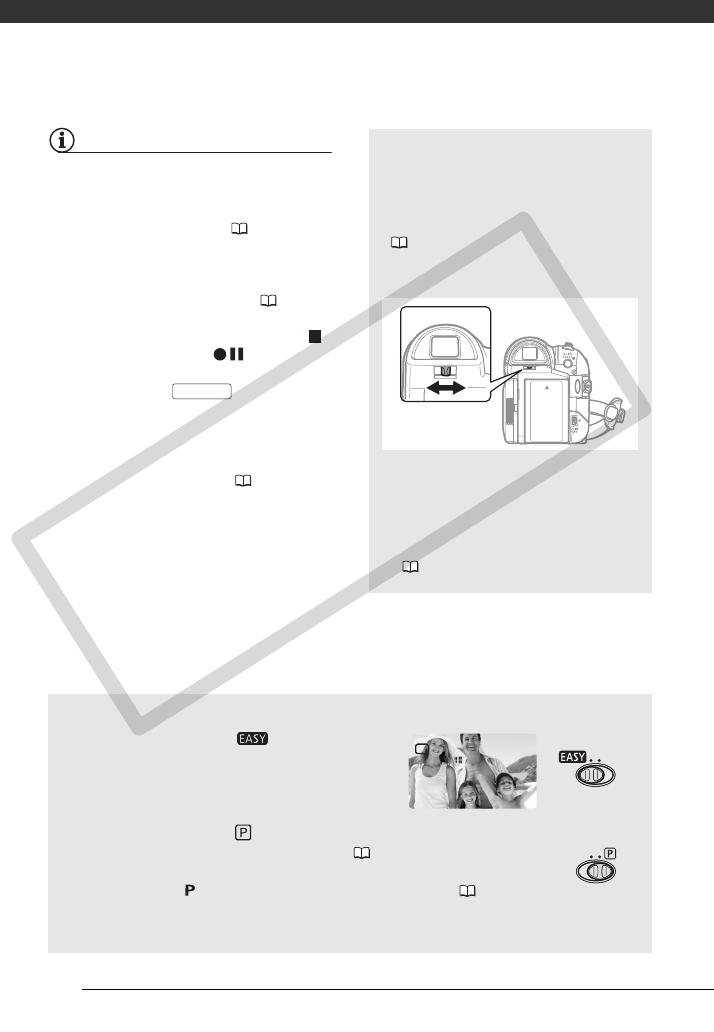
About the Mode Switch and Recording Programs
Set the mode switch to to let the
camcorder adjust all the settings for you,
allowing you to just point the camcorder and
start shooting.
Set the mode switch to to select one of the recording programs.
The Special Scene recording programs ( 40) offer a convenient
way to select the optimal settings to match special recording
conditions. The [ PROGRAM AE] recording program ( 42), on
the other hand, allows you to set the shutter speed you want, or
enjoy the flexibility to change other settings.
Start/Stop
Using the Viewfinder
When recording in bright places it
may be difficult to use the LCD
screen. In such case, change the
brightness of the LCD screen
( 28, 76) or use the viewfinder
instead. To use the viewfinder, keep
the LCD panel closed*.
Adjust the viewfinder as necessary
with the dioptric adjustment lever.
* The LCD screen and the viewfinder
can be used simultaneously only
when the LCD panel is turned
180 degrees to face the subject
( 27).
COPY
33
Zooming: Optical, Advanced and Digital
Zoom
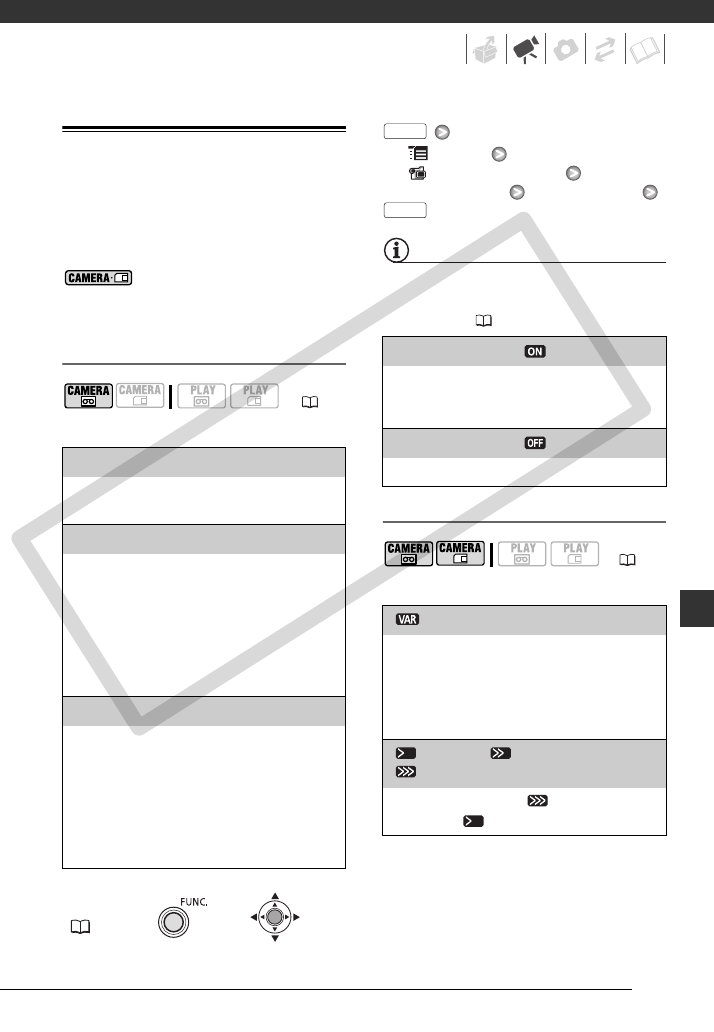
The camcorder offers three types of
zoom: optical, advanced and digital
zoom when recording movies. (In
mode only the optical zoom
is available.) You can also change the
zoom speed.
Selecting the Zoom Type
Options Default value
[ MENU]
[ CAMERA SETUP]
[ZOOM TYPE] Desired option
NOTES
The zoom range of the advanced zoom
will change depending on the aspect ratio
of the scene ( 74).
Selecting the Zoom Speed
Options Default value
(23)
[OPTICAL] (37x)
The zoom range is limited to the optical
magnification ratio of the lens.
[ADVANCED] (Advanced Zoom)
In addition to the optical zoom range, the
camcorder processes the image digitally to
obtain a larger zoom range without any
deterioration in image quality. When recording
movies with a 16:9 aspect ratio, the field of view
(picture angle) will change. Refer to the table in
the NOTES section.
[DIGITAL] (2000x)
When this option is selected, the camcorder will
switch to digital zoom (light blue area on the
zoom indicator) when you zoom in beyond the
optical zoom range (white area on the zoom
indicator). With the digital zoom the image is
processed digitally so image quality will
deteriorate the more you zoom in.
FUNC.
( 24)
[WIDESCREEN] set to [ ON] (16:9)
48x*
* The picture angle will be wider at both full
telephoto and full wide-angle.
[WIDESCREEN] set to [ OFF] (4:3)
55x
( 23)
[ VARIABLE]
The variable zoom speed depends on how you
operate the zoom lever: Press gently for slower
zooms; press harder for faster zooms. With this
option, the zoom speed will be faster in record
pause mode.
[ SPEED 1], [ SPEED 2],
[ SPEED 3]
Constant zoom speeds. [ SPEED 3] is the
fastest, and [ SPEED 1] is the slowest.
FUNC.
FUNC.
COPY
Video
34
[ MENU]
[ CAMERA SETUP]
[ZOOM SPEED]
Desired option
NOTES
The fastest zoom speed can be achieved
with the [ VARIABLE] setting.
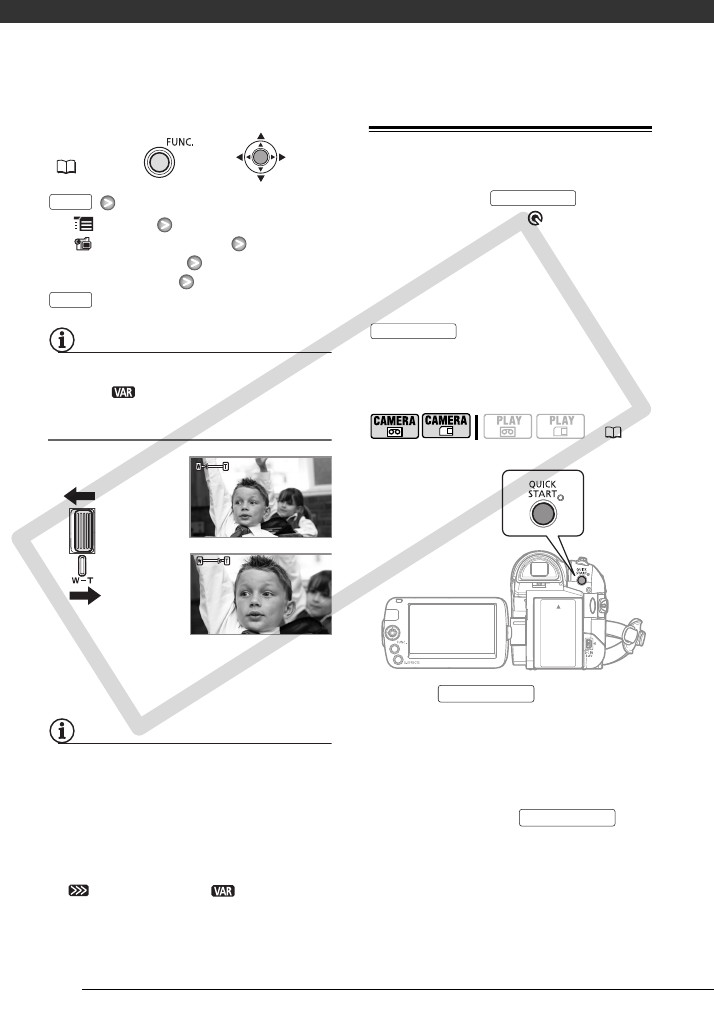
Using the Zoom
Move the zoom lever toward W to
zoom out (wide-angle). Move it
toward T to zoom in (telephoto).
NOTES
• Keep at least 1 m (3.3 ft.) to the subject.
At full wide-angle, you can focus on a
subject as close as 1 cm (0.39 in.).
• You can also use the
T
and
W
buttons on
the wireless controller. The zoom speed
with the wireless controller will be the
same as with the camcorder or fixed at
[
SPEED 3] (when [
VARIABLE] is
selected).
Quick Start Function
When you press the
camcorder enters the standby
mode. In standby mode the camcorder
consumes only about half the power
used when recording, saving energy
when you are using a battery pack.
Additionally, when you press
again the camcorder is
ready to start recording within approx.
1 second, ensuring you do not miss
important shooting opportunities.
1Press firmly.
The standby lamp flashes at first
while the camcorder is preparing and
then stays on when it enters the
standby mode.
2When you wish to resume
recording, press
again.
Within approx. 1 second, the
camcorder is ready to record.
FUNC.
( 24)
FUNC.
FUNC.
W
Zoom out
Zoom in
T
( 23)
QUICK START
QUICK START
QUICK START
QUICK START
COPY
35
NOTES
• When you wake up the camcorder from
standby mode, the following settings
will be changed automatically:
- Manual focus returns to automatic
focus (AF).
- Manual exposure adjustment returns
to automatic exposure.
- Zoom position returns to full wide-
angle W.
• The camcorder will shut off if left in
standby mode for 10 minutes,
regardless of the [POWER SAVE] setting
( 78). To restore the power if the
camcorder shut off, turn the camcorder
off and then on again.
• The camcorder will be woken up from
standby mode if you open the cassette
compartment cover or change the
position of the / switch while the
camcorder is in standby mode (standby
lamp is on).
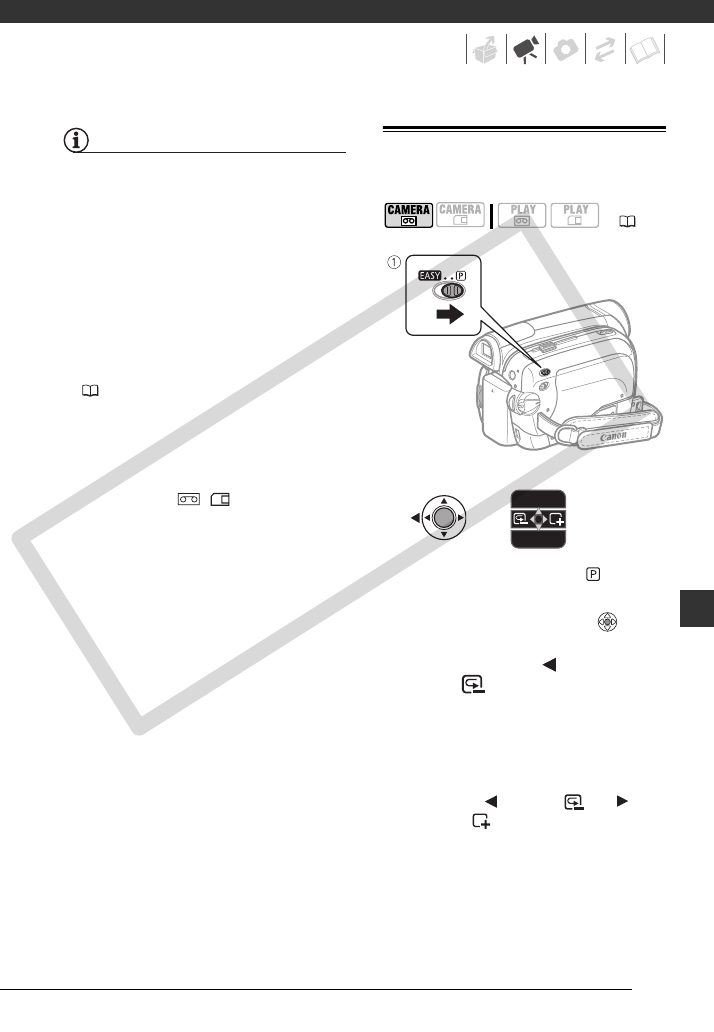
Reviewing the Last Scene Recorded
1Set the mode switch to .
2If the joystick guide does not
appear on screen, press ( ) to
display it.
3Push the joystick ( ) momentarily
toward and release it.
• The camcorder will play back a few
seconds of the last recording
made and return to record pause
mode.
• You can also hold the joystick
pressed ( ) toward or ( )
toward to play back the tape
(reverse or forward respectively) in
order to locate the point where you
want to start recording.
( 23)
EXP
FOCUS
COPY
Video
36
Basic Playback
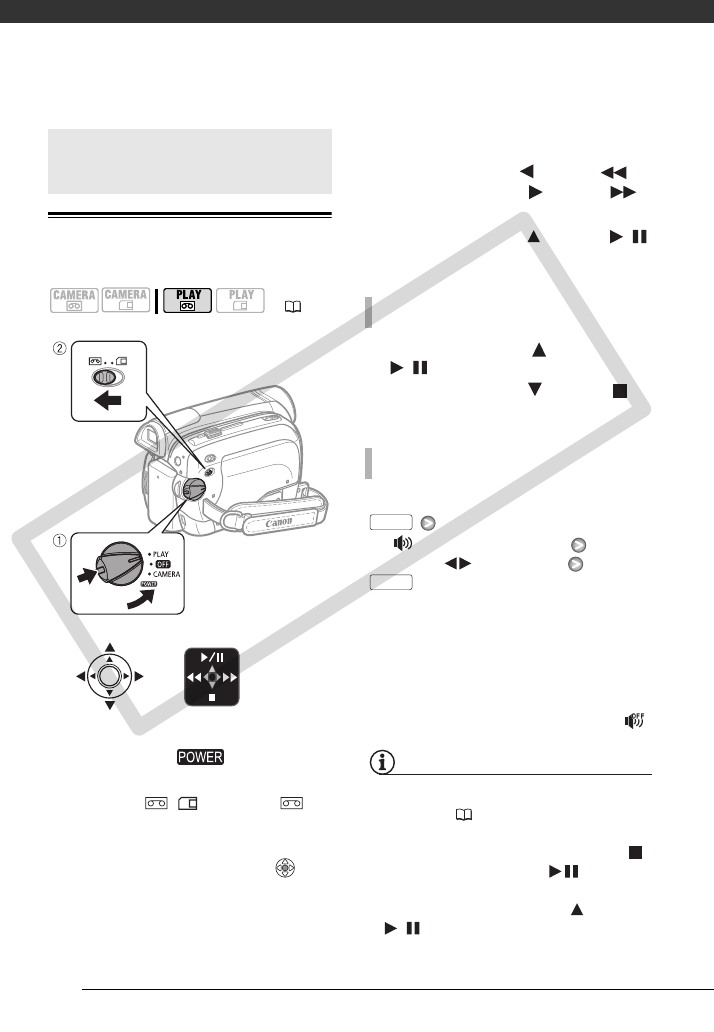
Playing Back Video
1Holding the lock button pressed
down, set the switch to
PLAY.
2Move the / switch to
(tape).
3If the joystick guide does not
appear on screen, press ( ) to
display it.
4Locate the point where you want
to begin the playback.
Push the joystick ( ) toward to
rewind the tape or ( ) toward
to fast forward.
5Push the joystick ( ) toward /
to begin the playback.
6 Push the joystick ( ) toward
/ again to pause the playback.
7 Push the joystick ( ) toward to
stop the playback.
During the playback of a scene:
[ SPEAKER VOLUME]
Adjust ( ) the volume
• The sound from the built-in speaker
will be muted when you close the
LCD panel or while the STV-250N
Stereo Video Cable is connected to
the AV terminal.
•
If you turn down the volume
completely, the icon will change to
.
NOTES
• You can display the date and time of the
recording ( 39).
•To protect the tape and video heads, the
camcorder will enter the stop mode ( )
if left in playback pause ( ) mode for
4 minutes 30 seconds. To resume the
playback push the joystick ( ) toward
/.
Basic Playback
( 23) DURING PLAYBACK
TO ADJUST THE VOLUME
FUNC.
FUNC.
COPY
37
Returning to a Pre-marked Position
If you wish to return to a particular
scene later, mark the point with the zero
set memory and the tape will stop at
that point when you rewind/fast forward
the tape. This function is operated with
the wireless controller.
1While recording or during
playback, press
at the point you wish to return to
later.
• The time code changes to
“0:00:00 ”.
• Press again to
cancel the memory.
2If you marked the zero memory
while recording, set the
camcorder to mode. If
you marked the zero memory
during playback, press .
3Press to locate the zero mark.
• If the tape counter shows a
negative number, press
instead.
• appears and the camcorder
rewinds/fast forwards the tape.
• The tape stops at or near the zero
mark, disappears and the
correct time code will be displayed
again.
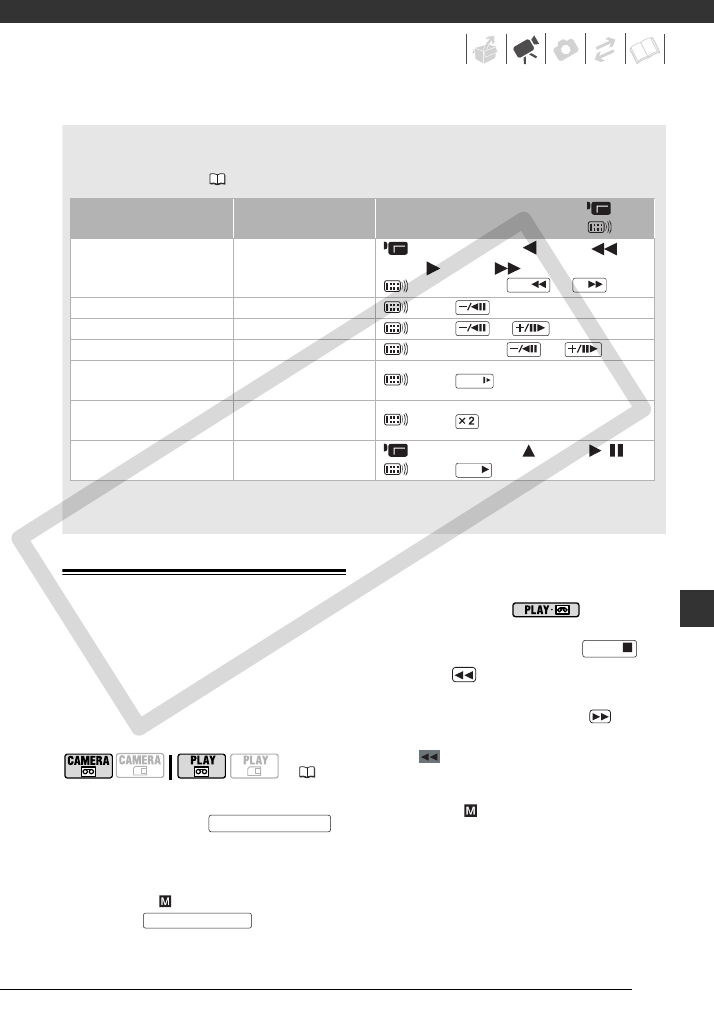
Special Playback Modes1
To enter most special playback modes you need to operate the buttons on the
wireless controller ( 15). There is no sound during the special playback modes.
1During some special playback modes you may notice some anomalies (blocky video
artifacts, banding, etc.) in the playback picture.
Special playback mode Initial mode Operation on the camcorder
or on the wireless controller
Fast playback Normal playback : Push the joystick ( ) toward or
( ) toward and hold it down.
: Press and hold or
Reverse playback Normal playback : Press
1 frame reverse/advance Playback pause : Press or
Frame-by-frame playback Playback pause : Press and hold or
Slow playback Normal or reverse
playback : Press
Double speed playback Normal or reverse
playback : Press
Return to normal playback Special playback mode : Push the joystick ( ) toward /.
: Press
REW FF
SLOW
PLAY
( 23)
ZERO SET MEMORY
ZERO SET MEMORY
STOP
COPY
Video
38
NOTES
If there are blank sections between
recordings, the zero set memory may not
work correctly.
Locating the Beginning of a Recording
Date
You can locate the change of the date/
time zone with the date search function.
Press or on the wireless
controller.
• Press more than once to search for
further date changes (up to 10 times).
• To cancel the search press .
NOTES
• The date search function will not detect
recordings shorter than 1 minute per
date/time zone.
• Date search may not function if the data
code is not displayed correctly.
Locating the End of the Last Scene
After playing back a tape, use this
function to locate the end of the last
scene recorded in order to continue
recording from that point.
POINTS TO CHECK
Stop the playback before using this
function.
[ END SEARCH] [EXECUTE]
• “END SEARCH” appears.
•The camcorder rewinds/fast forwards
the tape, plays back the last few
seconds of the recording and stops
the tape.
• To cancel the end search push the
joystick ( ) toward .
NOTES
• End search cannot be used once you
remove the cassette.
• If there are blank sections between
recordings, the end search may not
work correctly.
• You cannot use the end search to locate
the end of a scene that was audio
dubbed.
( 23)
STOP
( 23)
FUNC.
( 24)
FUNC.
COPY
39
On-Screen Displays (Data Code)
The camcorder keeps a data code
containing the date and time of
recording. You can select the data to be
displayed.
Options Default value
[ MENU]
[ DISPLAY SETUP/ ]
[DATA CODE] Desired option
( 23)
[ OFF]
No data code display.
[ DATE], [ TIME]
Displays the date or time when the scene or still
image was recorded.
[ DATE & TIME]
Displays both the date and time of the recording.
FUNC.
( 24)
FUNC.
FUNC.
COPY
Video
40
Advanced Function
: Special Scene Recording Programs
Recording in a very bright ski resort or
capturing the full colors of a sunset or a
fireworks display becomes as easy as
selecting a Special Scene recording
program. For details about the available
options, refer to the sidebar on
page 41.
POINTS TO CHECK
Mode switch:
[ PROGRAM AE]
Desired recording program
NOTES
• Do not set the mode switch to
during the actual recording of a scene;
the brightness of the picture may
change abruptly.
• [ PORTRAIT]/[ SPORTS]/
[ BEACH]/[ SNOW]
- The picture may not appear smooth
during playback.
• [ PORTRAIT]
- The blur effect of the background
increases the more you zoom in (
T
).
• [ NIGHT]
- Moving subjects may leave a trailing
afterimage.
- Picture quality may not be as good as
in other modes.
- White points may appear on the
screen.
- Autofocus may not work as well as in
other modes. In such case, adjust the
focus manually.
• [ SNOW]/[ BEACH]
- The subject may become
overexposed on cloudy days or in
shaded places. Check the image on
the screen.
• [ FIREWORKS]
- To avoid camcorder shake, we
recommend using a tripod. Make sure
to use a tripod especially in
mode, as the shutter speed slows
down.
Advanced Functions
( 23)
FUNC.
( 24)
FUNC.
FUNC.
COPY
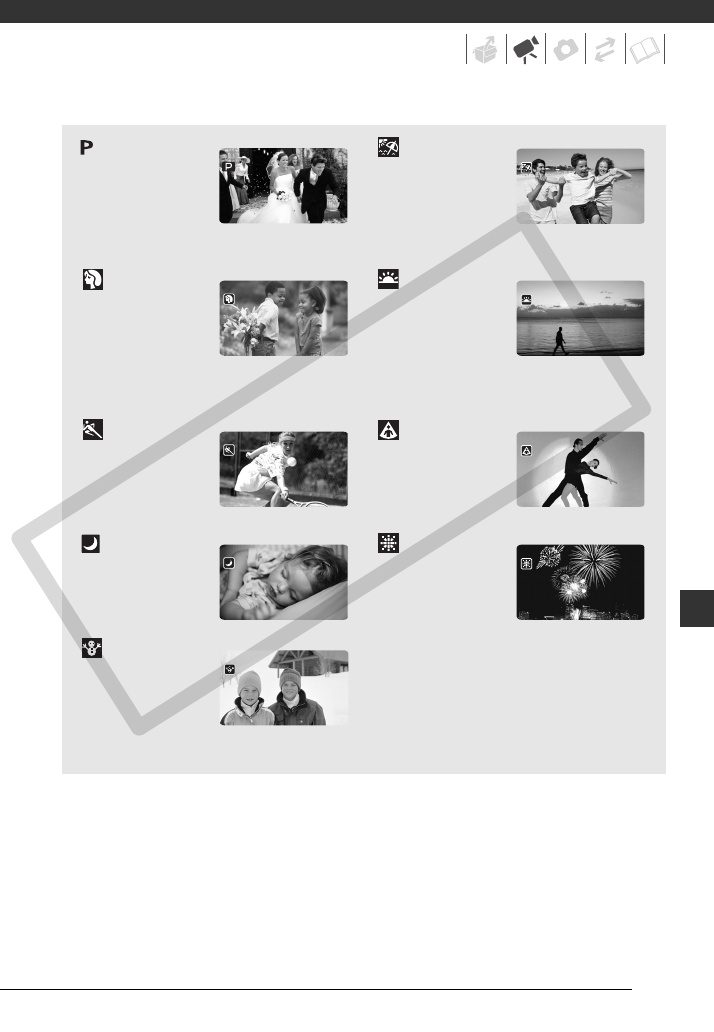
41
[ PROGRAM AE]
The camcorder
sets the aperture
and shutter
speed.
[ BEACH]
Use this mode to
record on a sunny
beach. It prevents
the subject from
being underexposed.
[ PORTRAIT]
The camcorder
uses a large
aperture, achieving
a focus on the
subject while blurring other distracting
details.
[SUNSET]
Use this mode to
record sunsets in
vibrant colors.
[ SPORTS]
Use this mode to
record sports
scenes such as
tennis or golf.
[ SPOTLIGHT]
Use this mode to
record spotlit
scenes.
[ NIGHT]
Use this mode to
record in low-light
conditions.
[FIREWORKS]
Use this mode to
record fireworks.
[SNOW]
Use this mode to
record in bright ski
resorts. It prevents
the subject from
being underexposed.
COPY
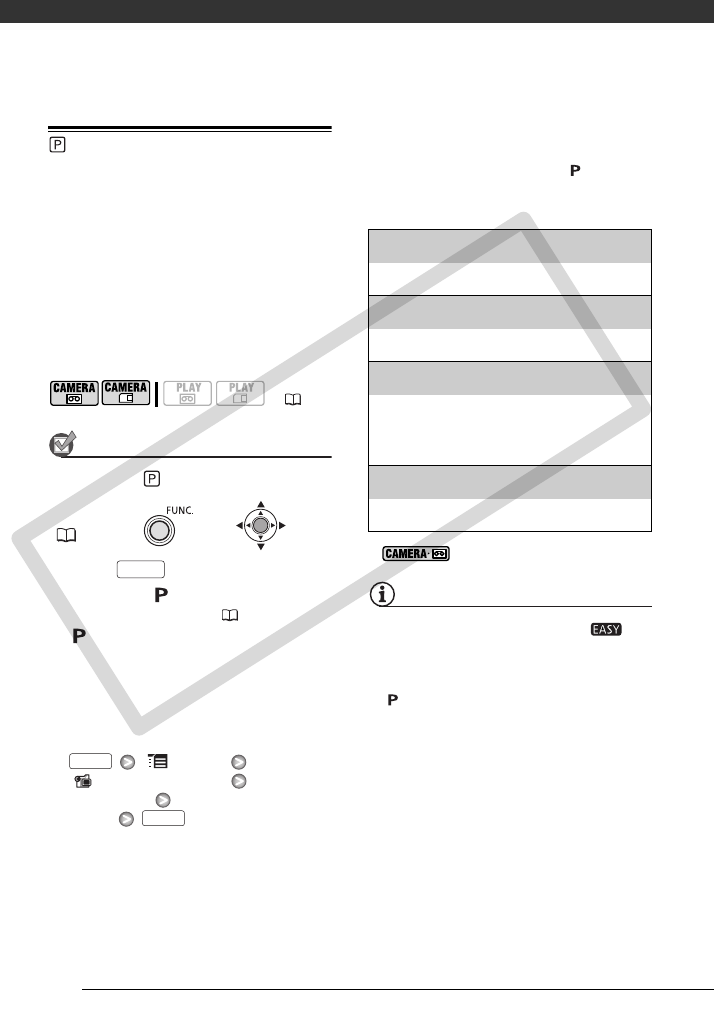
Video
42
Flexible Recording: Changing the
Shutter Speed
Use the automatic exposure (AE)
program to use functions like the white
balance or image effects, or to select
the shutter speed.
Use faster shutter speeds to record
subjects moving quickly. Use slower
shutter speeds to add motion blur,
emphasizing the feel of movement.
POINTS TO CHECK
Mode switch:
1Press .
2Select the [ PROGRAM AE]
recording program ( 40).
[ PROGRAM AE] is the default
value; proceed directly to step 3 if
you have not changed the recording
program.
3Select the shutter speed from the
setup menus.
[ MENU]
[ CAMERA SETUP]
[SHUTTER] Desired shutter
speed
Shutter speed guidelines
Note that on screen only the
denominator is displayed – [ 250]
indicates a shutter speed of 1/250
second, etc.
* mode only.
NOTES
• Do not set the mode switch to
during the actual recording of a scene;
the brightness of the picture may
change abruptly.
• [ PROGRAM AE]
- When setting the shutter speed, the
number displayed will flash if the value
selected is not appropriate for the
recording conditions. In such case,
select a different value.
- If you use a slow shutter speed in dark
places, you can obtain a brighter
image, but the image quality may be
lower, and the autofocus may not work
well.
- The image may flicker when recording
with high shutter speeds.
( 23)
FUNC.
( 24)
FUNC.
FUNC.
FUNC.
1/60
To record under most ordinary conditions.
1/100
To record indoor sports scenes.
1/250, 1/500*, 1/1000*
To record from within a moving car or train or to
shoot fast-moving subjects such as roller
coasters.
1/2000*
To record outdoor sports scenes on sunny days.
COPY
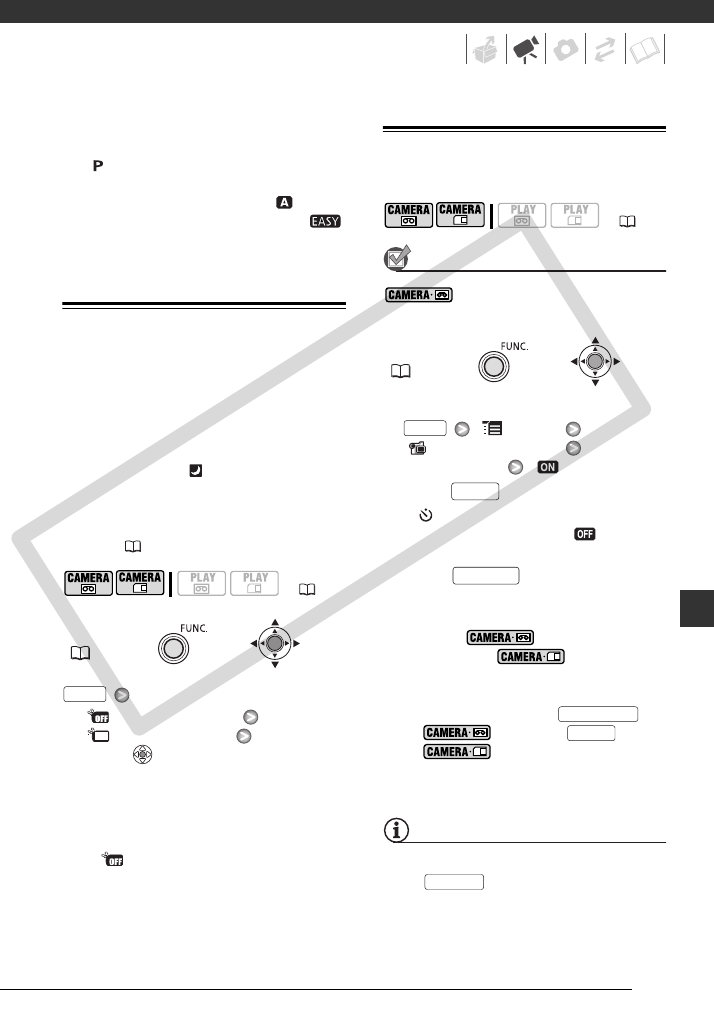
43
-Recording movies under fluorescent lights:
If the screen starts to flicker, select
[ PROGRAM AE] and set the shutter
speed to 1/100.
- The shutter speed resets to [ AUTO]
when you set the mode switch to
or change the recording program.
LCD Video Light
You can use the LCD video light to
record in completely dark places. For a
brighter picture, we recommend
keeping a distance of about 20 cm -
60 cm (8 in. - 2 ft.) from the subject
and/or using the [ NIGHT] recording
program. When you activate the LCD
video light, rotate the LCD panel to face
the subject and use the viewfinder
instead ( 32).
[ LCD LIGHT OFF]
[ LCD LIGHT ON]
Press ( )
• The LCD display turns entirely
white when used as the video light.
Use the viewfinder instead.
• Using the viewfinder, select
[ LCD LIGHT OFF] to turn the
LCD video light off.
Self Timer
POINTS TO CHECK
: Set the camcorder to record
pause mode.
1Activate the self timer.
[ MENU]
[ CAMERA SETUP]
[SELF TIMER] [ ON]
2Press to close the menu.
• appears.
• Set [SELF TIMER] to [ OFF] to
cancel the self timer.
3Press on the camcorder
to start recording.
• The camcorder starts recording
video ( mode) or takes a
still image ( mode) after a
10-second countdown. The
countdown appears on the screen.
• You can also press
( mode) or
( mode) on the wireless
controller. In that case, the
countdown will be only 2 seconds.
NOTES
Once the countdown has begun, you can
press again or turn off the
camcorder to cancel the self timer.
( 23)
FUNC.
( 24)
FUNC.
( 23)
FUNC.
(24)
FUNC.
FUNC.
Start/Stop
START/STOP
PHOTO
Start/Stop
COPY
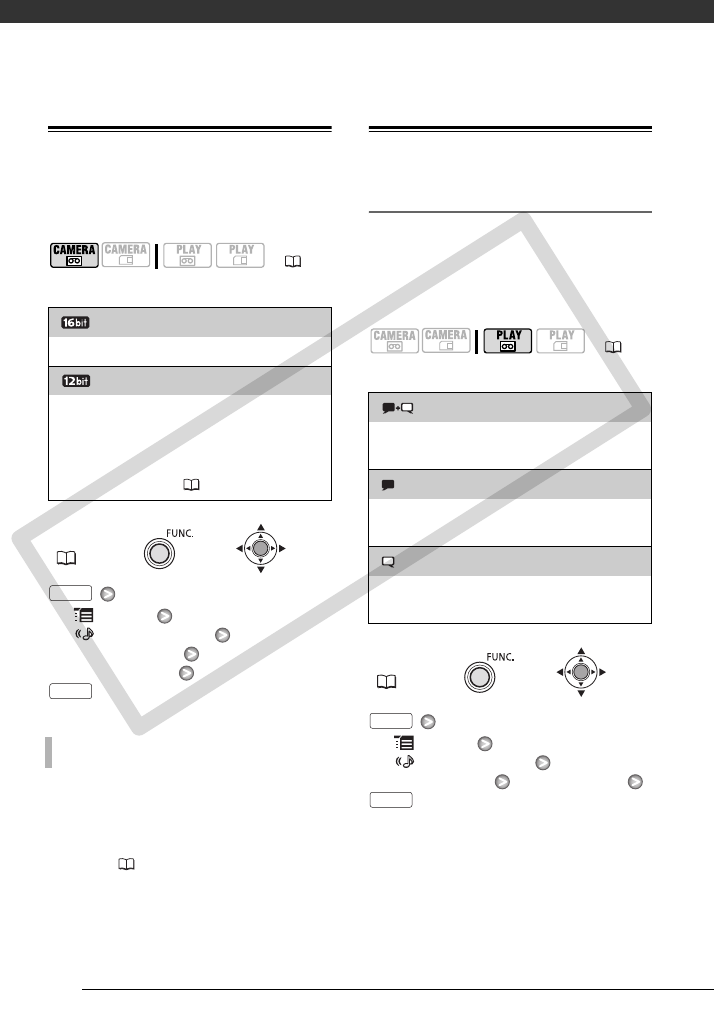
Video
44
Audio Recording Mode
You can change the quality of the audio
recording.
Options Default value
[ MENU]
[ AUDIO SETUP]
[AUDIO MODE]
Desired option
The camcorder automatically reduces
the background sound of wind. You can
turn the wind screen off when you want
the microphone to be as sensitive as
possible ( 75).
Audio Playback Modes
Selecting the Audio Channel
You can select the audio channel to
play back when playing back a tape
with audio recorded on two channels
(either stereo sound or bilingual audio
signals).
Options Default value
[ MENU]
[ AUDIO SETUP]
[OUTPUT CH] Desired option
( 23)
[ 16bit]
Records audio at the highest quality.
[ 12bit]
Records audio on 2 channels (Stereo 1) leaving 2
free channels (Stereo 2) you can use for audio
dubbing.
With this camcorder you can dub audio only
using the microphone ( 66).
FUNC.
( 24)
ABOUT THE WIND SCREEN
FUNC.
FUNC.
( 23)
[ L/R]
Left and right channels (stereo) / Main and sub
signals (bilingual).
[L/L]
Left channel only (stereo) / Main signal only
(bilingual).
[R/R]
Right channel only (stereo) / Sub signal only
(bilingual).
FUNC.
( 24)
FUNC.
FUNC.
COPY
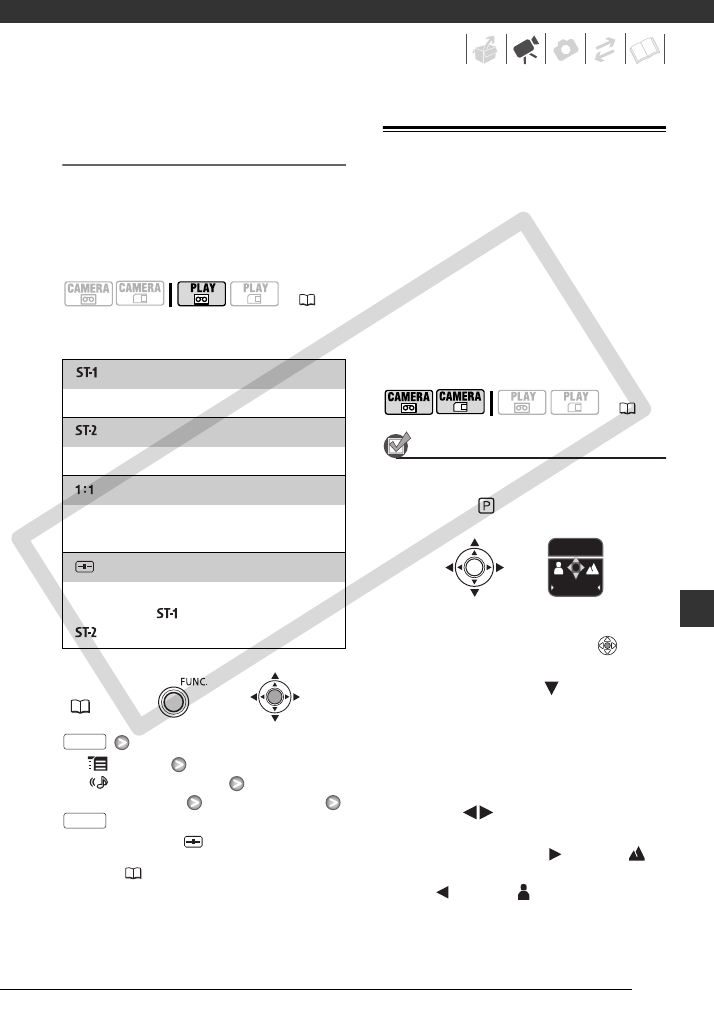
45
Selecting the Audio Track on a Tape with
Dubbed Audio
You can select the audio track to play
back when playing back a tape that has
a dubbed audio track (Stereo 2) in
addition to the original recorded audio
(Stereo 1).
Options Default value
[ MENU]
[ AUDIO SETUP]
[12bit AUDIO] Desired option*
* When you select [ MIX/VAR.], adjust the
mix balance with the [MIX BALANCE]
setting ( 75).
Manual Focus Adjustment
Autofocus may not work well on the
following subjects. In such case, focus
manually.
• Reflective surfaces
• Subjects with low contrast or without
vertical lines
• Fast moving subjects
• Through wet windows
•Night scenes
POINTS TO CHECK
Adjust the zoom before you start the
procedure.
Mode switch:
1If the joystick guide does not
appear on screen, press ( ) to
display it.
2Push the joystick ( ) toward
[FOCUS] to activate the manual
focus.
[FOCUS] on the joystick guide will be
displayed in light blue and “MF”
appears on the screen.
3Adjust ( ) the focus as
necessary.
• Push the joystick ( ) toward
for a farther focal distance or push
it ( ) toward for a closer focal
distance.
( 23)
[ STEREO1]
Original sound only.
[ STEREO2]
Dubbed audio only.
[MIX/FIXED]
Mixed audio with the original sound and the
dubbed audio at the same level.
[MIX/VAR.]
Mixed audio where the balance between the
original sound ( ) and the dubbed audio
( ) can be adjusted.
FUNC.
( 24)
FUNC.
FUNC.
( 23)
BACK
FOCUS
COPY
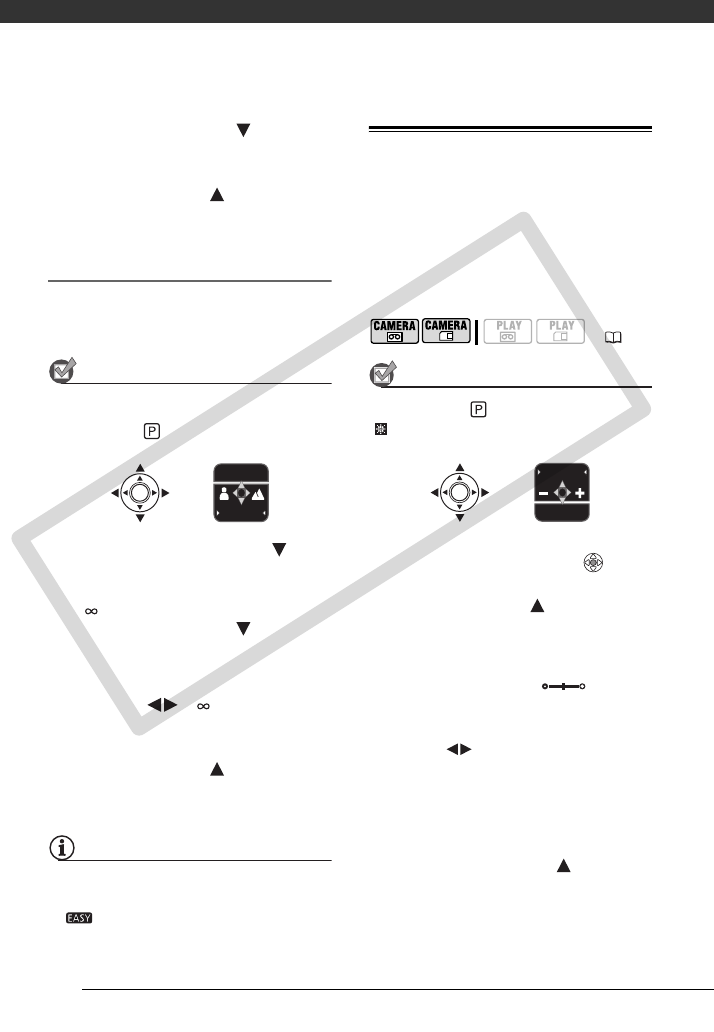
Video
46
• Pushing the joystick ( ) toward
[FOCUS] again will return the
camcorder to autofocus.
4Push the joystick ( ) toward
[BACK] to save the focus
adjustment.
Infinity Focus
Use this function when you wish to
focus on faraway subjects such as
mountains or fireworks.
POINTS TO CHECK
Adjust the zoom before you start the
procedure.
Mode switch:
1Keep the joystick pushed ( )
toward [FOCUS] for more than
2seconds.
• appears.
• Pushing the joystick ( ) toward
[FOCUS] again will return the
camcorder to autofocus.
• If you operate the zoom or the
joystick ( ), changes to
"MF" and the camcorder returns to
manual focusing mode.
2Push the joystick ( ) toward
[BACK] to save the focus
adjustment.
NOTES
The camcorder will automatically return to
autofocus when you set the mode switch
to .
Manual Exposure Adjustment
At times, backlit subjects may appear
too dark (underexposed) or subjects
under very strong lights may appear too
bright or glaring (overexposed). To
correct this, you can manually adjust
the exposure.
POINTS TO CHECK
Mode switch: (except for the
[ FIREWORKS] recording program).
1If the joystick guide does not
appear on screen, press ( ) to
display it.
2Push the joystick ( ) toward
[EXP].
[EXP] on the joystick guide changes
to light blue and the exposure
adjustment indicator and the
neutral value “±0” appear on the
screen.
3Adjust ( ) the brightness of the
image as required.
• The adjustment range and the
length of the exposure adjustment
indicator will vary depending on
the initial brightness of the picture.
• Pushing the joystick ( ) toward
[EXP] again will return the
camcorder to automatic exposure.
BACK
FOCUS
( 23)
EXP
BACK
COPY
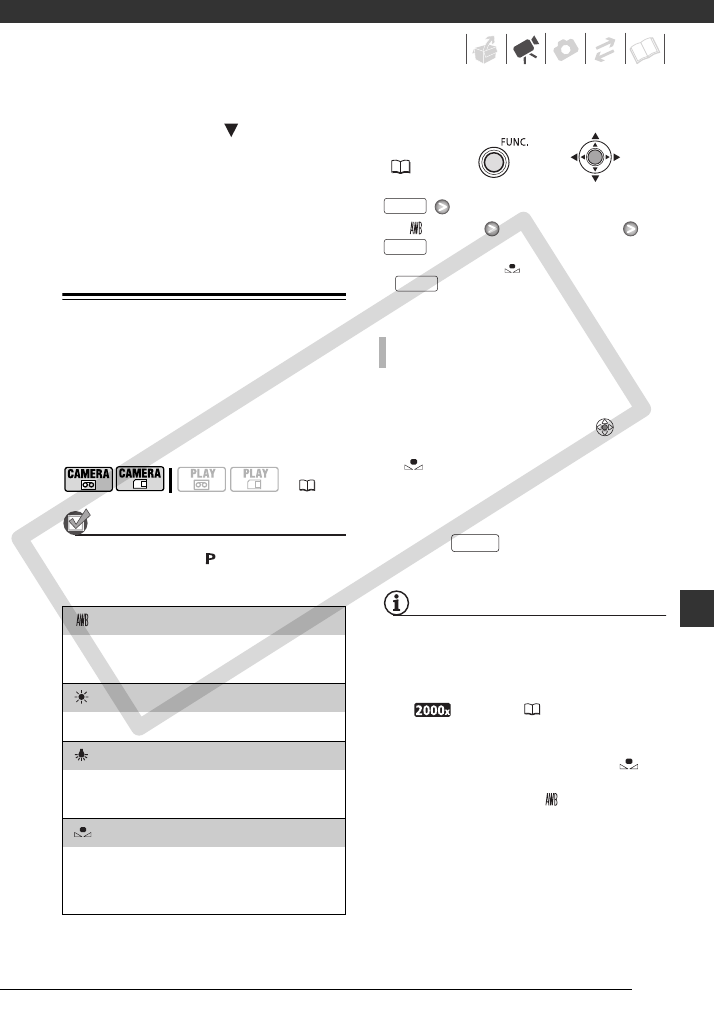
47
4Push the joystick ( ) toward
[BACK] to lock and save the
exposure setting.
If you operate the zoom during
exposure lock, the brightness of the
image may change.
White Balance
The white balance function helps you
accurately reproduce colors under
different lighting conditions so that
white objects will always look truly
white in your recordings.
POINTS TO CHECK
Recording program: [ PROGRAM AE]
Options Default value
[ AUTO] Desired option*
* When you select [ SET], do not press
and continue instead with the
procedure below.
1 Point the camcorder at a white
object, zoom in until it fills the
whole screen and press ( ).
When the adjustment is completed,
stops flashing and stays on. The
camcorder retains the custom
setting even if you turn off the
camcorder.
2 Press to save the setting
and close the menu.
NOTES
• When you select the custom white balance:
- Set the custom white balance in a
sufficiently illuminated place.
- Select a zoom type other than
[ DIGITAL] ( 33).
- Reset the white balance when the
lighting conditions change.
- Depending on the light source,
may keep flashing. The result will still
be better than with [ AUTO].
• Custom white balance may provide
better results in the following cases:
- Changing lighting conditions
-Close-ups
- Subjects in a single color (sky, sea or
forest)
( 23)
[AUTO]
Settings are automatically set by the camcorder.
Use this setting for outdoor scenes.
[ DAYLIGHT]
For recording outdoors on a bright day.
[ TUNGSTEN]
For recording under tungsten and tungsten type
(3-wavelength) fluorescent lighting.
[ SET]
Use the custom white balance setting to make
white objects appear white under colored
lighting.
FUNC.
(24)
TO SET THE CUSTOM WHITE BALANCE
FUNC.
FUNC.
FUNC.
FUNC.
COPY
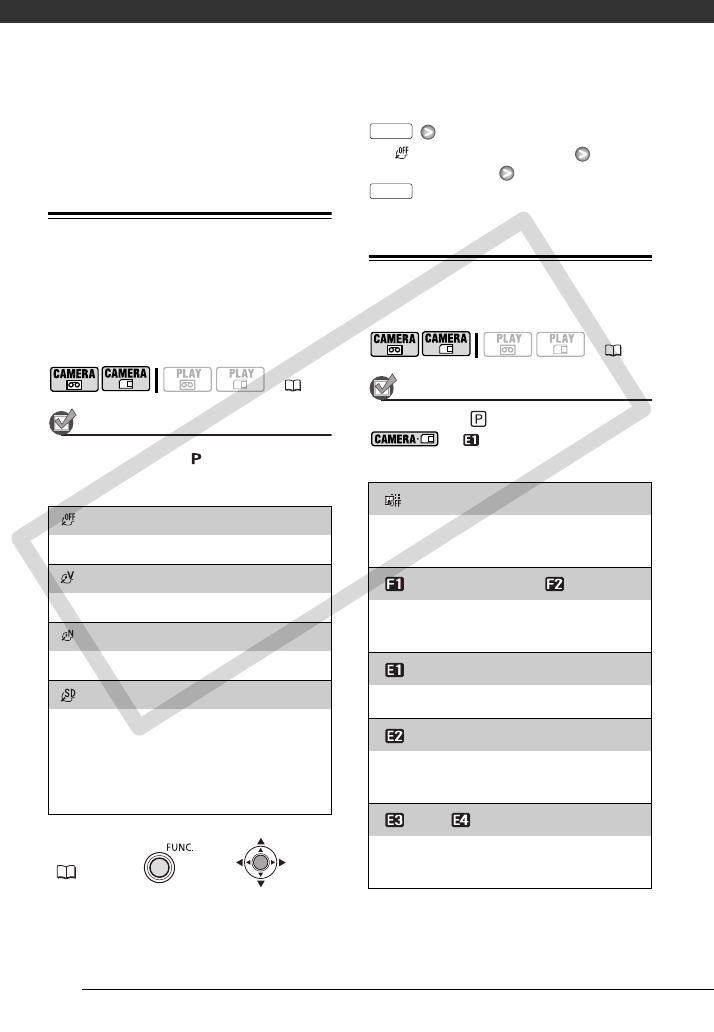
Video
48
- Under mercury lamps and certain
types of fluorescent lights
Image Effects
You can use the image effects to
change the color saturation and
contrast to record images with special
color effects.
POINTS TO CHECK
Recording program: [ PROGRAM AE]
Options Default value
[ IMAGE EFFECT OFF]
Desired option
Digital Effects
POINTS TO CHECK
Mode switch:
: [ BLK&WHT] only.
Options Default value
( 23)
[ IMAGE EFFECT OFF]
Records with no image enhancing effects.
[VIVID]
Emphasizes the contrast and color saturation.
[ NEUTRAL]
Tones down the contrast and color saturation.
[ SOFT SKIN DETAIL]
Softens the details in the skin tone area for a
more complimentary appearance. To obtain the
best effect, use this setting when recording a
close-up of a person. Note that areas similar to
the skin color may lack in detail.
FUNC.
( 24)
( 23)
[ D.EFFECT OFF]
Select this setting when you do not intend to
use the digital effects.
[ FADE-T] (fade trigger), [ WIPE]
Select one of the faders to begin or end a scene
with a fade from or to a black screen.
[ BLK&WHT]
Records images in black and white.
[ SEPIA]
Records images in sepia tones for an “old”
look.
[ ART], [ MOSAIC]
Select one of these digital effects to add
“flavor” to your recordings.
FUNC.
FUNC.
COPY
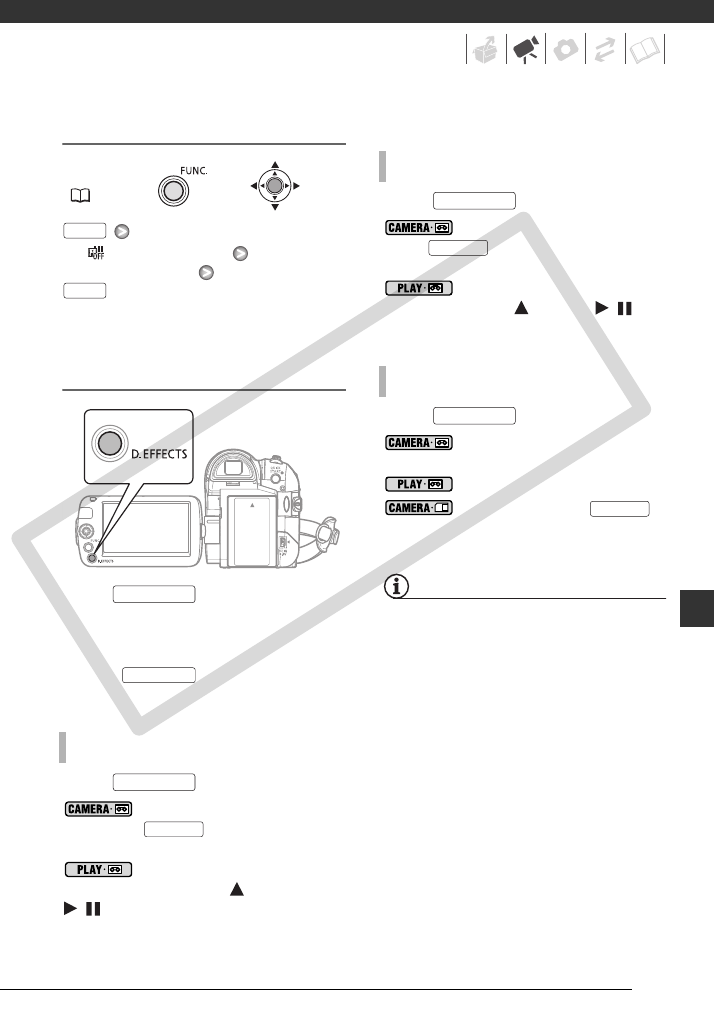
49
Setting
[ D.EFFECT OFF]
Desired option*
**
* While making the selection, you can
preview the effect on the screen.
** The icon of the selected effect appears.
Applying
Press to activate the
fader/effect.
• The icon of the selected effect turns
green.
• Press again to deactivate
the fader/effect.
Press ...
: ...in record pause mode,
then press to start recording
with a fade in.
: ...in playback pause mode,
then push the joystick ( ) toward
/ to fade in and start the playback.
Press ...
: ...while recording, then
press to fade out and pause
the recording.
: ...during playback, then
push the joystick ( ) toward / to
fade out and pause the playback.
Press ...
: ...while recording or in
record pause mode.
: ...during playback.
: ...and then press
to record the still image in black and
white.
NOTES
• When you apply a fader, not only the
picture but also the sound will fade in or
out. When you apply an effect, the
sound will be recorded normally.
• The camcorder retains the last setting
used even if you turn off the digital
effects or change the recording
program.
• The digital effects are not available
when [TV TYPE] is set to [NORMAL TV]
and the stereo video cable is connected
to the AV terminal.
FUNC.
( 24)
TO FADE IN
FUNC.
FUNC.
D.EFFECTS
D.EFFECTS
D.EFFECTS
Start/Stop
TO FADE OUT
TO ACTIVATE AN EFFECT
D.EFFECTS
Start/Stop
D.EFFECTS
Start/Stop
COPY
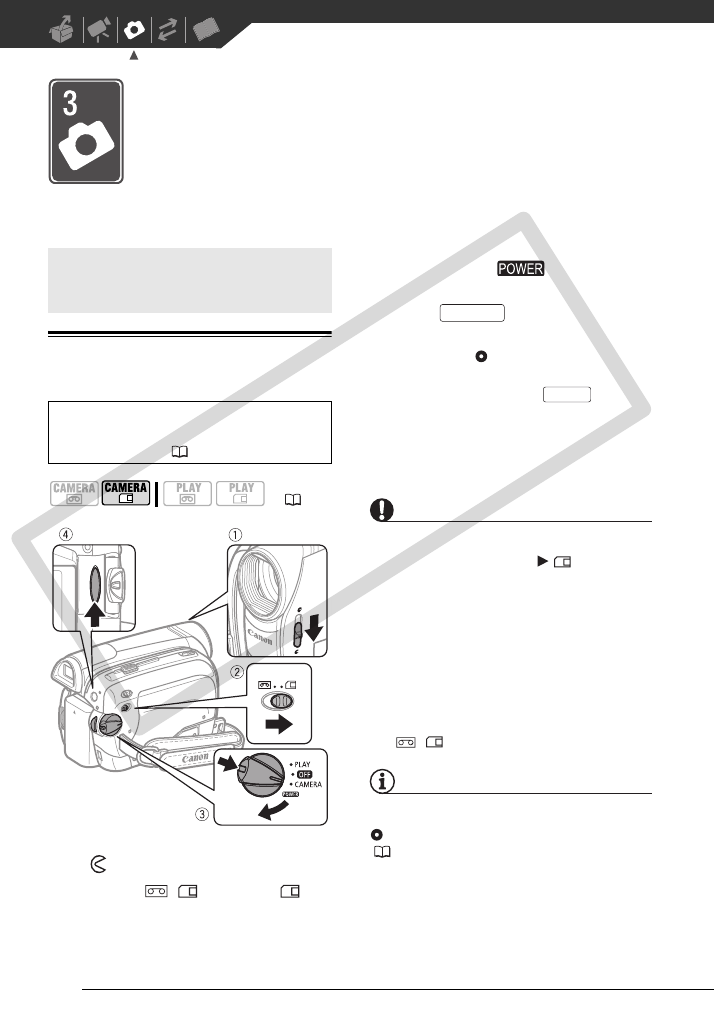
50
Photos
Refer to this chapter for details on shooting photos – from capturing
and playing back images to printing them.
Basic Recording
Taking Photos
1Move the lens cover switch down
to to open the lens cover.
2Move the / switch to
(memory card).
3Holding the lock button pressed
down, set the switch to
CAMERA.
4Press .
• Once the focus is automatically
adjusted, will turn green and
one or more AF frames will appear.
• You can also press on the
wireless controller.
• The CARD access indicator will
flash as the image is being
recorded.
IMPORTANT
Observe the following precautions while
the card access display ( ) appears
on screen, and when the CARD access
indicator is on or flashing. Failing to do so
may result in permanent data loss.
- Do not open the memory card slot
cover and do not remove the memory
card.
- Do not disconnect the power source
or turn off the camcorder.
- Do not change the position of the
/ switch or the operating mode.
NOTES
If the subject is not suitable for autofocus,
turns yellow. Adjust the focus manually
( 45).
Basic Recording
Before using a memory card for the
first time, be sure to initialize it with
this camcorder ( 56).
( 23)
Start/Stop
PHOTO
COPY
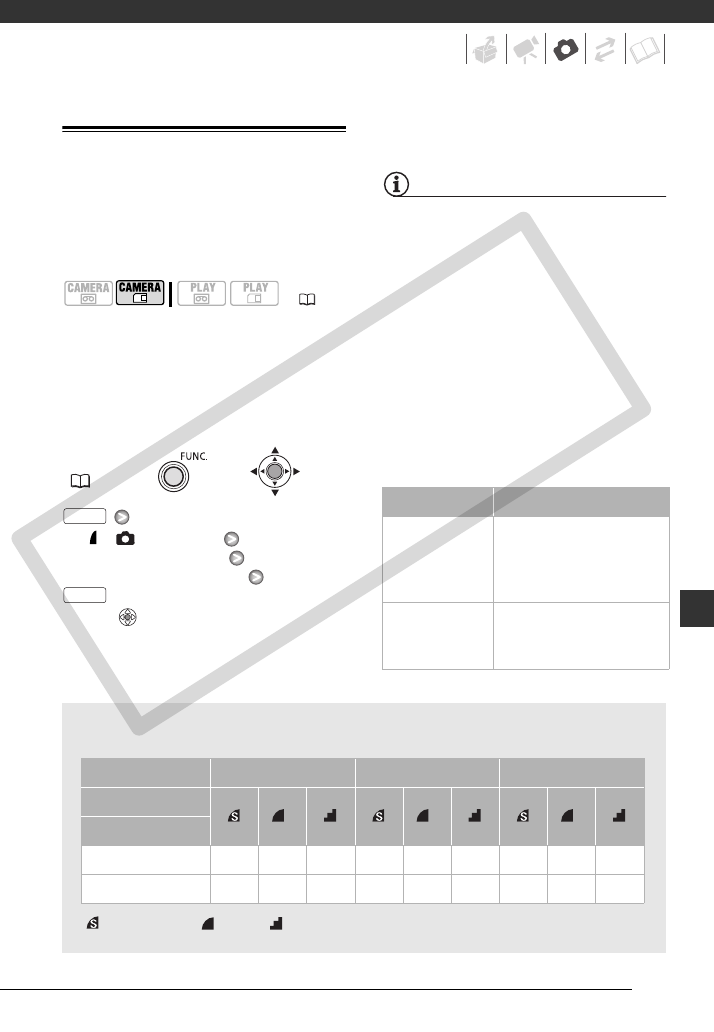
51
Selecting Photo Size and Quality
Still images are recorded on the
memory card using JPEG compression.
As a general rule select a larger image
size for higher quality.
Options
Image size options and the
approximate number of still images that
can be recorded on memory cards of
various sizes are given in the table
below.
[L 1152x864]
Desired image size*
Desired image quality*
* Press ( ) to move back and forth
between size and quality selection. The
number displayed on the right corner
indicates the approximate number of
images that can be recorded with the
current quality/size setting.
NOTES
• Depending on the number of images on
the memory card (Windows: 1,800
images or more; Macintosh: 1,000
images or more), you may not be able to
transfer images to a computer. Try using
a card reader.
• Connection to a PictBridge-compatible
printer will not work when the memory
card contains 1,800 images or more. For
best performance, we recommend
keeping the number of images on the
memory card under 100.
• When printing still images, use the
following guidelines as a reference for
selecting the print size.
( 23)
FUNC.
( 24)
Approximate number of still images on a memory card
Default value
*: [SUPER FINE], : [FINE], : [NORMAL]
Memory card 32 MB 128 MB 512 MB
Image quality* →
Image size ↓
L 1152x864 40 65 130 185 280 545 735 1,115 2,155
S 640x480 140 200 365 585 850 1,530 2,320 3,355 6,040
FUNC.
FUNC.
Image size Recommended use
L 1152x864 To print photos up to L size
(9 x 13 cm, 3.5 x 5 in.) or
postcard size
(10 x 14.8 cm, 4 x 6 in.).
S 640x480 To send images as e-mail
attachments or to post on
the Web.
COPY
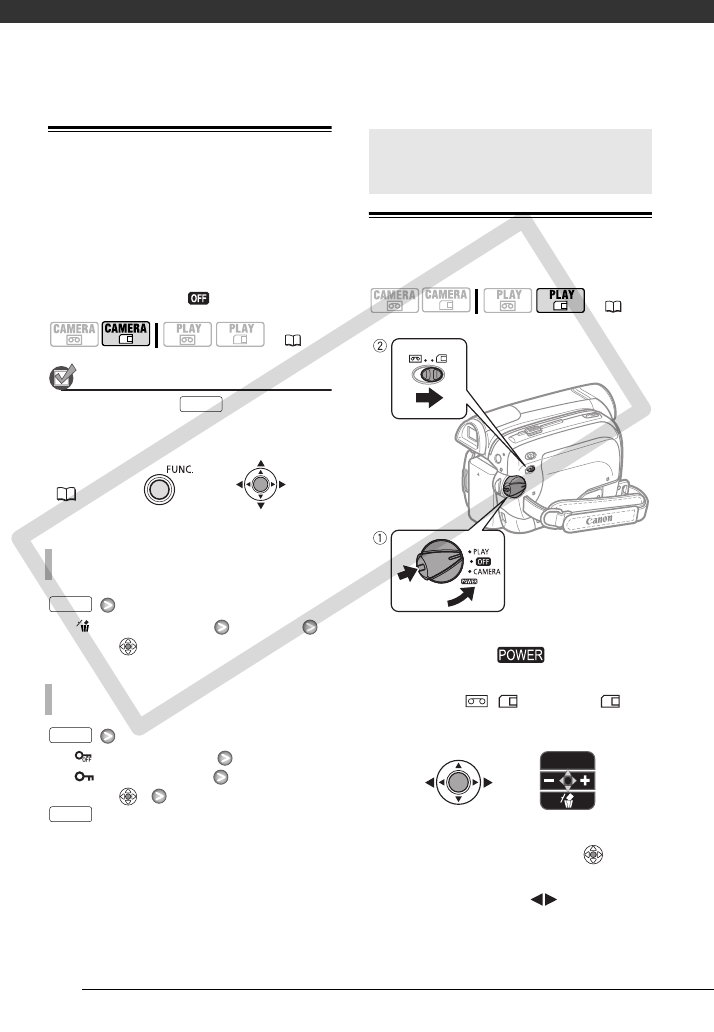
Photos
52
Erasing or Protecting a Photo Right
After Recording It
You can erase or protect the still image
recorded last while reviewing it within
the time set for the [REVIEW] option (or
immediately after recording it, if
[REVIEW] is set to [ OFF]).
POINTS TO CHECK
Make sure to press while reviewing
the still image immediately after recording
it.
[ IMAGE ERASE] [ERASE]
Press ( )
[PROTECT OFF]
[PROTECT ON]
Press ( )
Basic Playback
Viewing Photos
1Holding the lock button pressed
down, set the switch to
PLAY.
2Move the / switch to
(memory card).
3If the joystick guide does not
appear on screen, press ( ) to
display it.
4Push the joystick ( ) to move
between the images.
( 23)
FUNC.
( 24)
TO ERASE THE PHOTO
TO PROTECT THE PHOTO
FUNC.
FUNC.
FUNC.
FUNC.
Basic Playback
( 23)
COPY
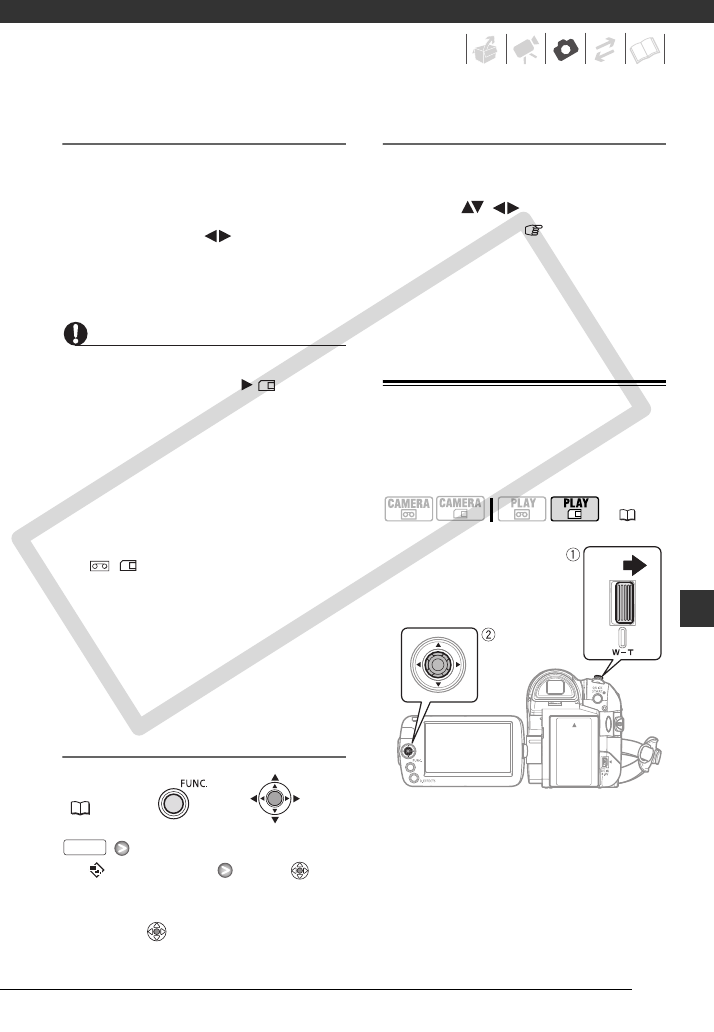
53
Image Jump
You can jump to a specific image
without having to browse all of them
one by one.
Push the joystick ( ) and hold it
pressed down. Release the joystick
when the image number gets to the
image you want to display.
IMPORTANT
• Observe the following precautions while
the card access display appears
on screen, and when the CARD access
indicator is on or flashing. Failing to do
so may result in permanent data loss.
- Do not open the memory card slot
cover and do not remove the memory
card.
- Do not disconnect the power source
or turn off the camcorder.
- Do not change the position of the
/ switch or the operating mode.
• The following may not be displayed
correctly.
- Images not recorded with this
camcorder.
- Images edited on or transferred from a
computer.
- Images whose file names have been
changed.
Slideshow
[ SLIDESHOW] Press ()
• Images are played back one after
another.
• Press ( ) to stop the slideshow.
Index Screen
1Move the zoom lever toward W.
The index screen appears.
2Select ( , ) an image.
Move the cursor to the image
you want to view.
3Move the zoom lever toward T.
The index screen closes and the
selected image is displayed.
Magnifying Photos during Playback
During playback, still images can be
magnified up to 5 times.
1Move the zoom lever toward T.
• The image is magnified by 2 times
and a frame appears indicating the
position of the magnified area.
FUNC.
( 24)
FUNC.
( 23)
COPY
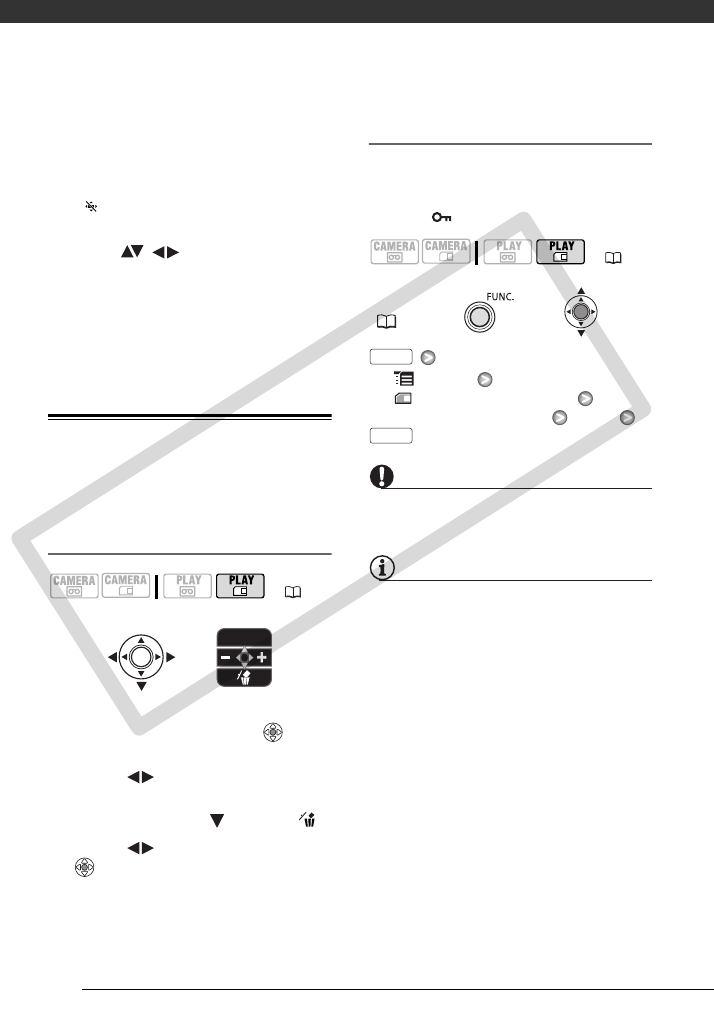
Photos
54
• To further enlarge the image, move
the zoom lever toward T. To
reduce the magnification, move
the zoom lever toward W.
• will appear for images that
cannot be enlarged.
2Move ( , ) the frame to the
part of the image you want to see
enlarged.
To cancel the magnification, move
the zoom lever toward W until the
frame disappears.
Erasing Photos
You can erase still images recorded on
the memory card.
Erasing a Single Image
1If the joystick guide does not
appear on screen, press ( ) to
display it.
2Select ( ) the image you want
to erase.
3Push the joystick ( ) toward .
4Select ( ) [ERASE] and press
().
Erasing All Images
The following procedure will erase all
the non-protected still images from the
memory card (all images except those
with the mark).
[ MENU]
[ CARD OPERATIONS]
[ERASE ALL IMAGES] [YES]
IMPORTANT
Be careful when erasing images. Erased
images cannot be recovered.
NOTES
Protected images on the memory card
cannot be erased.
( 23)
( 23)
FUNC.
( 24)
FUNC.
FUNC.
COPY
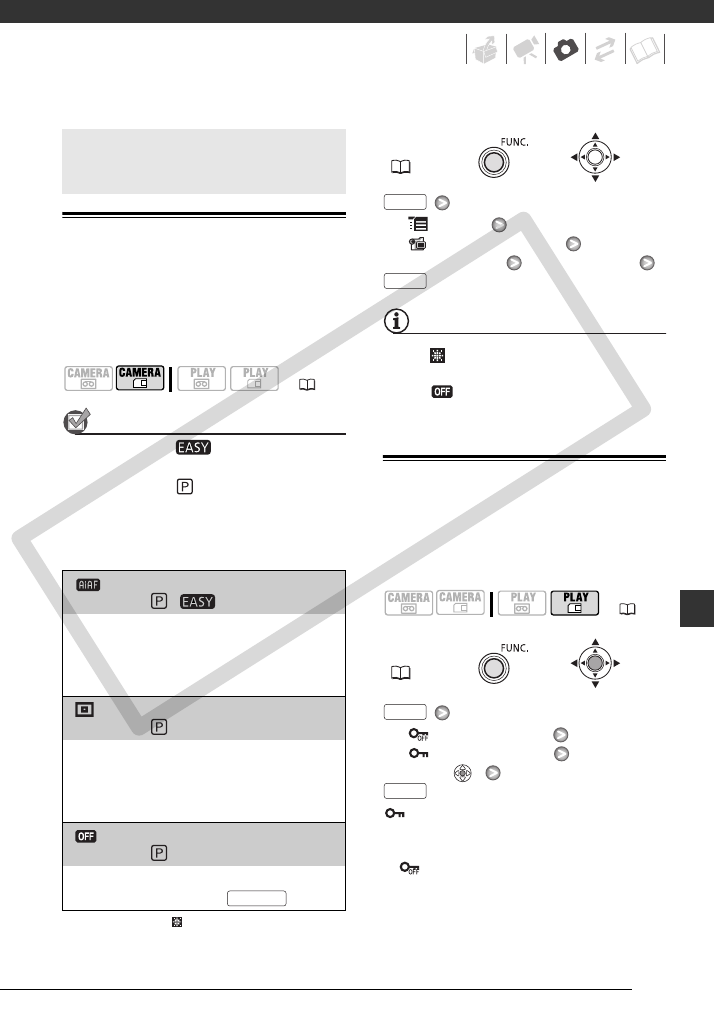
55
Additional Functions
Automatic Focus Priority
When the focus priority is activated, the
camcorder records a still image only
after the focus has been adjusted
automatically.
.
POINTS TO CHECK
Mode switch at : The focus priority
cannot be turned off.
Mode switch at : You can turn off the
focus priority and you can also select
the AF (autofocus) frame to be used.
Options Default value
* Except for the [ FIREWORKS] recording
program.
[ MENU]
[ CAMERA SETUP]
[FOCUS PRI.] Desired option
NOTES
In the [ FIREWORKS] recording
program the focus priority is automatically
set to [ OFF].
Protecting Photos
You can protect still images recorded
on the memory card from accidental
erasure.
[ PROTECT OFF]
[ PROTECT ON]*
Press ( )
appears and the image cannot be
erased.
* To cancel the image protection, select
[ PROTECT OFF] instead.
Additional Functions
( 23)
[ ON:AiAF]
(Mode switch: *, )
Depending on the shooting conditions, one or
more AF frames out of the nine frames available
are automatically selected and the focus is fixed
on them.
[ ON:CENTER]
(Mode switch: *)
A single focusing frame appears in the center of
the screen and the focus is automatically fixed
on it. This is convenient for making sure the
focus is exactly where you want it.
[ OFF]
(Mode switch: )
Select this option if you wish to record a still
image as soon as you press .
Start/Stop
FUNC.
(24)
( 23)
FUNC.
(24)
FUNC.
FUNC.
FUNC.
FUNC.
COPY
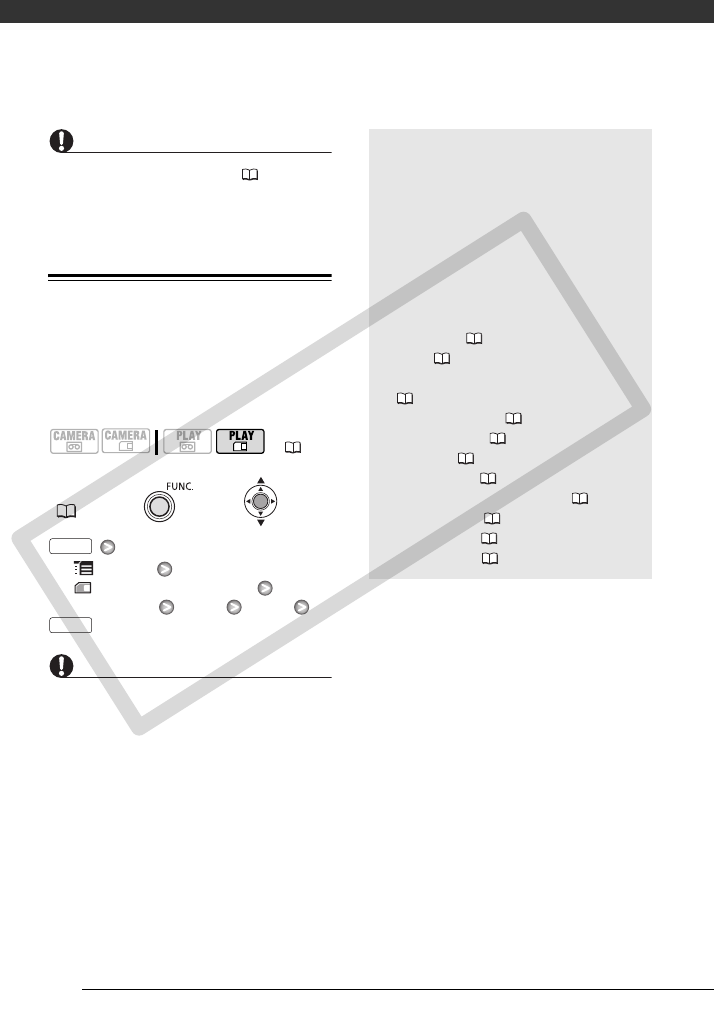
Photos
56
IMPORTANT
Initializing the memory card ( 56) will
permanently erase all still images, even
the protected ones.
Initializing the Memory Card
Initialize memory cards when you use
them with this camcorder for the first
time, or to erase all the still images on
them.
[ MENU]
[ CARD OPERATIONS]
[INITIALIZE] [YES] [YES]
IMPORTANT
Initializing the memory card will erase all
still images, even the protected ones. The
original still images cannot be recovered.
( 23)
FUNC.
( 24)
FUNC.
FUNC.
You can also use the following
functions...
The following functions and features
of the camcorder can be used either
for shooting video or for taking
photos. The way to set and use
them was already explained in
detail, so we refer you to the relevant
page in the “Video” section.
• Quick Start ( 34)
• Zoom ( 33)
• Special Scene recording programs
( 40)
• Flexible recording ( 42)
• LCD video light ( 43)
• Self timer ( 43)
• Manual focus ( 45)
• Manual exposure adjustment ( 46)
• White balance ( 47)
• Image effects ( 48)
• Digital effects ( 48)
COPY
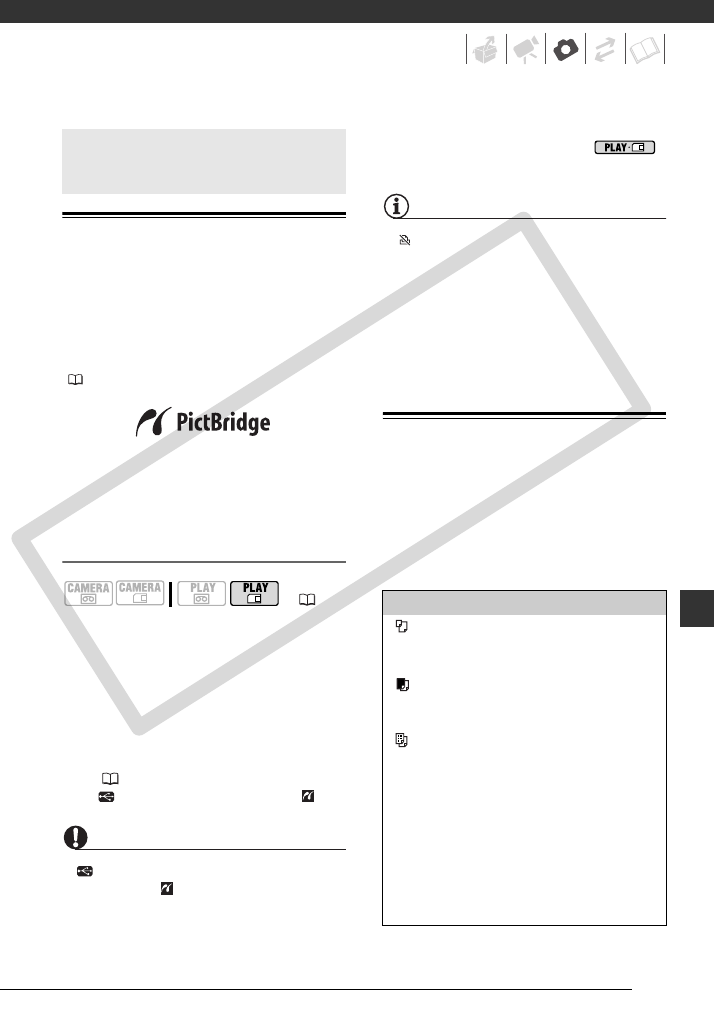
57
Printing Photos
Printing Photos – Direct Print
The camcorder can be connected to
any PictBridge-compatible printer. You
can mark in advance the still images
you want to print and set the desired
number of copies as a print order
( 59).
Canon printers: SELPHY printers of the
CP, DS and ES series and PIXMA
printers marked with the PictBridge
logo.
Connecting the Camcorder to the Printer
1Insert the memory card containing
the still images you want to print.
2Turn on the printer.
3Connect the camcorder to the
printer using the supplied USB
cable.
• Refer to PC Connection Diagrams
( 67).
• appears and changes to .
IMPORTANT
If continues to flash (for more than
1 minute) or if does not appear, the
camcorder is not correctly connected to
the printer. In such case, disconnect the
USB cable and turn off the camcorder and
the printer. After a short while, turn them
on again, set the camcorder to
mode and restore the connection.
NOTES
• will appear for images that cannot be
printed.
• We recommend powering the
camcorder using the compact power
adapter.
• Refer also to the printer’s instruction
manual.
Selecting the Print Settings
You can select the number of copies
and other settings for printing. The
setting options vary depending on your
printer model.
Options
Printing Photos
( 23) [PAPER]
[ PAPER SIZE]: Available paper sizes vary
depending on the printer model.
[ PAPER TYPE]: Select [PHOTO],
[FAST PHOTO], [PLAIN] or [DEFAULT].
[ PAGE LAYOUT]: Select [DEFAULT] or one of
the following available page layouts.
[BORDERED]: Prints the whole image area almost
exactly as the recorded still image.
[BORDERLESS]: Enlarges the center portion of
the still image to fit the width/height ratio of the
selected paper size. The top, bottom and sides of
the still image may be slightly trimmed out.
[2-UP], [4-UP], [8-UP], [9-UP], [16-UP]: Refer to
the sidebar on page 58.
COPY
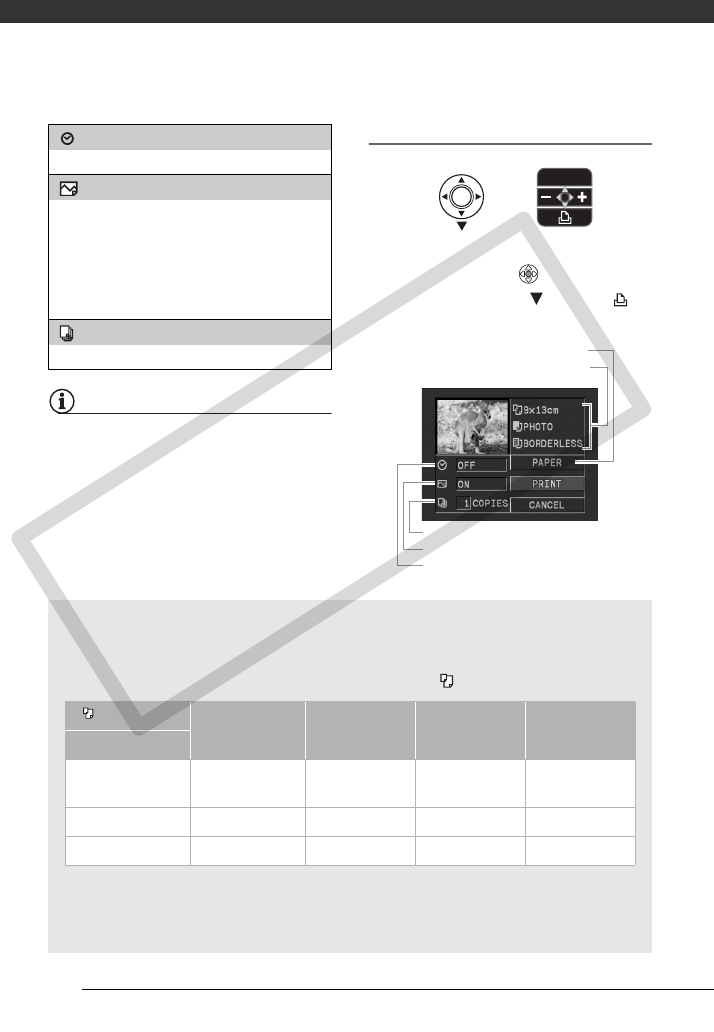
Photos
58
NOTES
Print setting options and [DEFAULT]
settings vary depending on the printer
model. For details, refer to the printer’s
instruction manual.
Printing after Changing the Print Settings
1
If the joystick guide does not appear
on screen, press ( ) to display it.
2Push the joystick ( ) toward .
The print settings menu appears.
[ ] Date print
Select [ON], [OFF] or [DEFAULT].
[] Print Effect
The print effect can be used with printers
compatible with the Image Optimize function to
achieve higher quality prints. Select [ON], [OFF]
or [DEFAULT].
Canon PIXMA/SELPHY DS printers: You can
also select [VIVID], [NR] and [VIVID+NR].
[ ] Number of Copies
Select 1-99 copies. Current paper settings (paper size,
paper type and page layout)
Date printing
Print effect
Number of copies
Paper settings
Printing Multiple Images on the Same Sheet [2-UP], [4-UP], etc.
When using Canon printers you can print the same still image multiple times on
the same sheet of paper. Use the following table as a guideline for the
recommended number of copies depending on the [ PAPER SIZE] setting.
1You can also use the special sticker sheets.
2When you use the wide-sized photo paper with the [DEFAULT] setting, you can also use
[2-UP] or [4-UP].
3With the [8-UP] setting, you can also use the special sticker sheets.
[ PAPER SIZE]→[CREDITCARD] [9 x 13 cm] [10 x 14.8 cm] [A4]
Canon printer ↓
PIXMA
SELPHY DS – – 2, 4, 9 or 1614
SELPHY CP 2, 4 or 822 or 4 2 or 4 –
SELPHY ES 2, 4 or 832 or 4 2 or 4 –
COPY
59
3In the print settings menu, select
( , ) the setting you want to
change and press ( ).
4Select ( ) the desired setting
option and press ( ).
5Select ( ) [PRINT] and press
().
• Printing starts. The print settings
menu disappears when printing is
completed.
• To continue printing, select ( )
another still image.
1 Press ( ) while printing.
2 Select ( ) [OK] and press ( ).
If an error occurs during the printing
process, an error message appears
(84).
- Canon’s PictBridge-compatible
printers: Resolve the error. When
printing does not resume
automatically, select [CONTINUE] and
press ( ). If [CONTINUE] cannot be
selected, select [STOP], press ( )
and retry printing. Refer also to the
printer’s instruction manual for details.
- If the error still persists and printing
does not restart, disconnect the USB
cable and turn off the camcorder and
the printer. After a short while, turn
them on again, set the camcorder to
mode and restore the
connection.
Disconnect the cable from the camcorder
and printer and turn off the camcorder.
IMPORTANT
• The following still images may not be
correctly printed with a PictBridge-
compatible printer.
- Images created or changed on a
computer and transferred to the
memory card.
- Images recorded with the camcorder
but edited on a computer.
- Images whose file names were changed.
- Images not recorded with this
camcorder.
• Observe the following precautions
during printing:
- Do not turn off the camcorder or the
printer.
- Do not change the position of the
/ switch.
- Do not disconnect the USB cable.
- Do not remove the memory card.
• If the message “BUSY” does not
disappear, disconnect the USB cable and
restore the connection after a short while.
Print Orders
You can mark in advance the still
images you want to print and set the
desired number of copies as a print
order. Later, you can easily print out the
print orders by connecting the
camcorder to a PictBridge-compatible
printer ( 57). You can set print orders
for up to 998 still images.
TO CANCEL THE PRINTING
PRINTING ERRORS
WHEN YOU HAVE FINISHED PRINTING
COPY
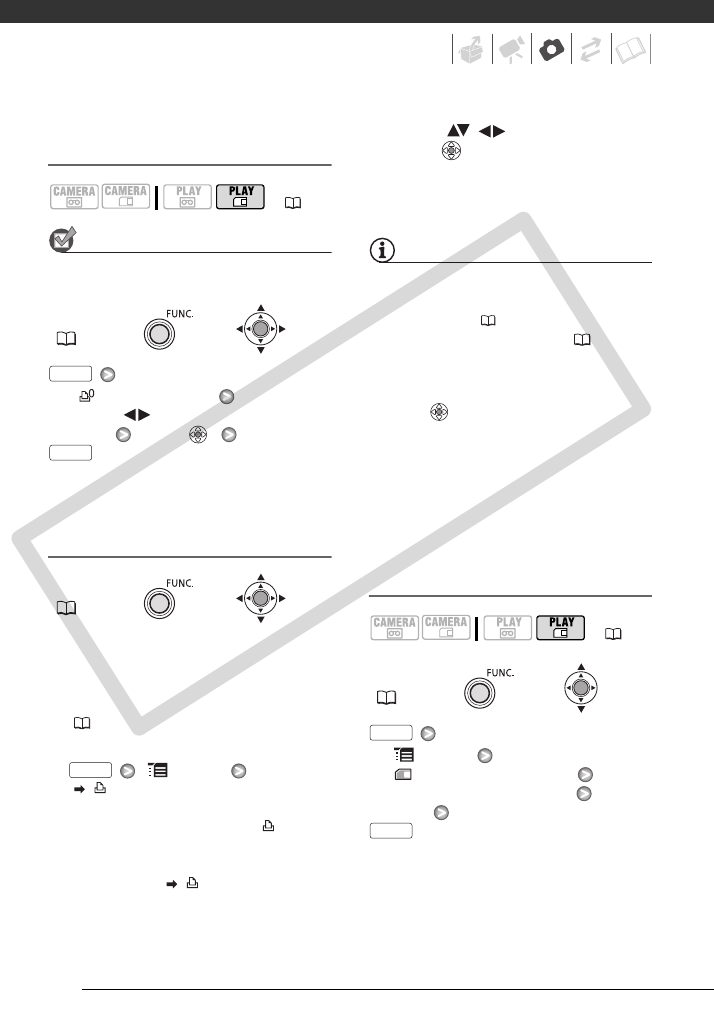
Photos
60
Selecting Still Images for Printing
(Print Order)
POINTS TO CHECK
Set the print orders before connecting the
USB cable to the camcorder.
[ PRINT ORDER]
Select ( ) the number of copies*
(0-99) Press ( )
* To cancel the print order, set the number of
copies to 0.
Printing Still Images Marked with Print
Orders
1Connect the camcorder to the
printer using the supplied USB
cable.
Refer to PC Connection Diagrams
( 67).
2Open the print settings menu.
[ MENU]
[ PRINT]
• The print settings menu appears.
• The error message “SET PRINT
ORDER” appears if you connect a
printer with direct print function
and select [ PRINT] without
having set any print orders
beforehand.
3Select ( , ) [PRINT] and
press ( ).
Printing starts. The print settings
menu disappears when printing is
completed.
NOTES
• Depending on the connected printer,
you can change some print settings
before step 3 ( 57).
•Cancel Printing/Printing Errors (59).
•Restarting Printing: Open the print menu
as explained in step 2 above. In the print
settings menu, select [RESUME]* and
press (). The remaining images will
be printed.
Printing cannot be restarted when the
print order settings have been changed
or if you deleted a still image with print
order settings.
* If the print order was interrupted after the
first still image, this menu option will appear
as [PRINT] instead.
Erasing All Print Orders
[ MENU]
[ CARD OPERATIONS]
[ERASE ALL PRINT ORD]
[YES]
( 23)
FUNC.
( 24)
FUNC.
( 24)
FUNC.
FUNC.
FUNC.
( 23)
FUNC.
( 24)
FUNC.
FUNC.
COPY
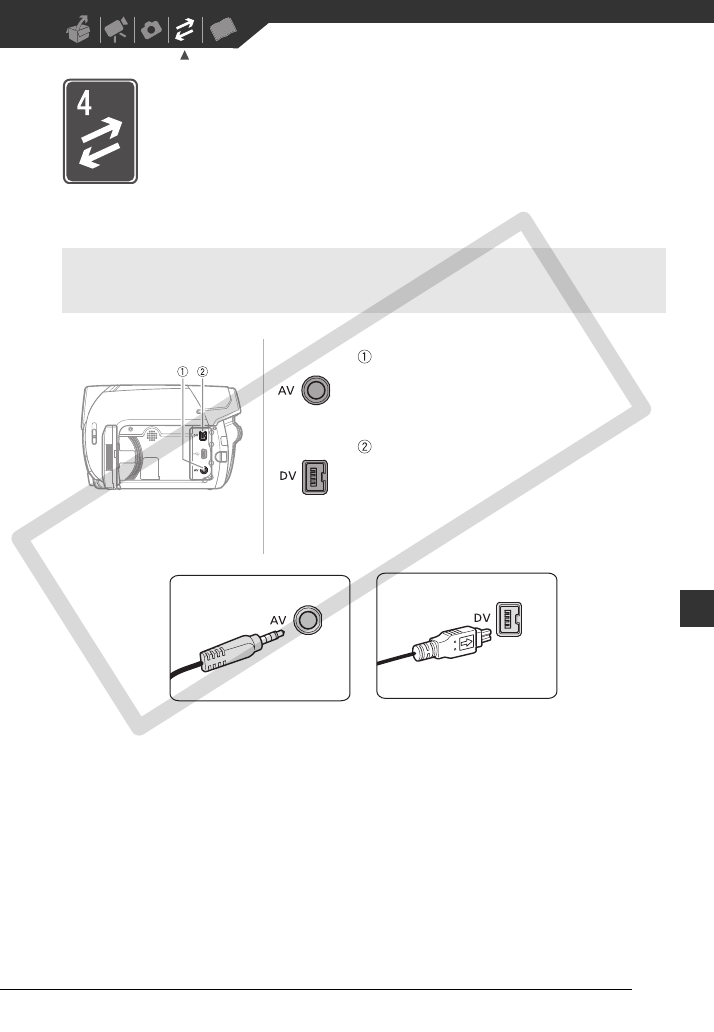
61
External Connections
This chapter explains step-by-step how to connect your camcorder to
an external device such as a TV, VCR, or computer.
Connecting to a TV or VCR
Connecting to a TV or VCR
AV Terminal
Sound from the built-in speaker will be muted while
the STV-250N Stereo Video Cable is connected to the
camcorder.
DV Terminal
Check the type and orientation of the terminal and
make sure you connect the DV cable properly.
Open the LCD panel to
access.
COPY
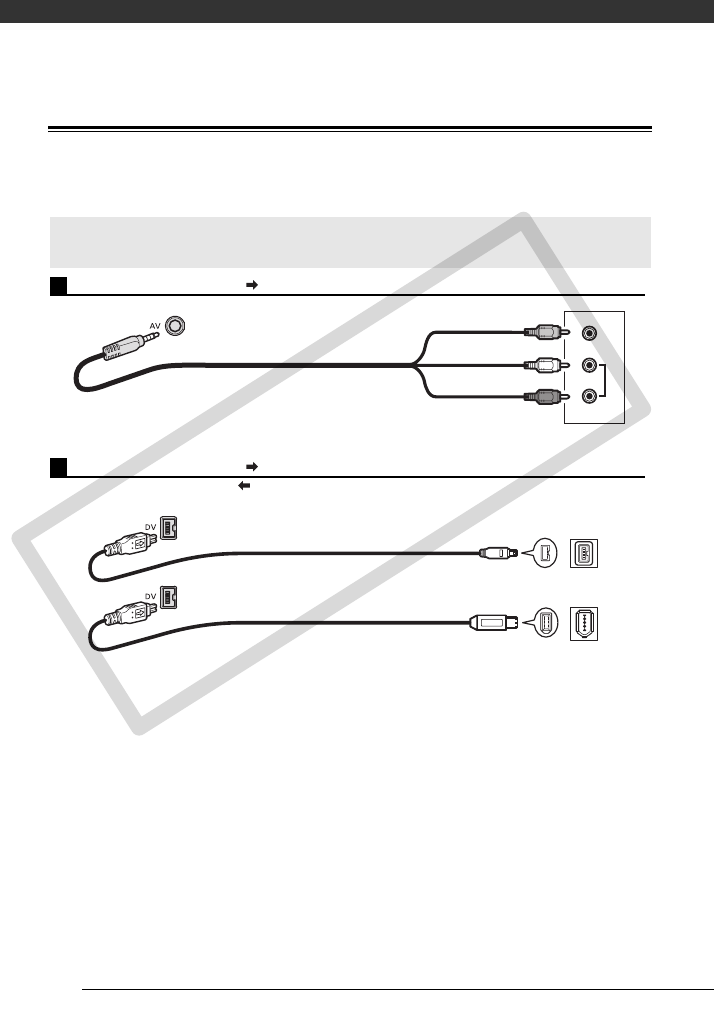
External Connections
62
Connection Diagrams
Turn off all the devices when making the connections and refer also to the instruction
manual of the connected device.
Terminal on the
Camcorder Connecting Cable Terminal on the
Connected Device
1Output connection (signal flow ) to a TV or VCR with AV Terminals.
VIDEO
AUDIO
R
L
STV-250N Stereo Video Cable
(Supplied)
Yellow
White
Red
2Output connection (signal flow ) to a high-definition TV with a DV (IEEE1394) terminal.
Input connection (signal flow ) from a TV or other digital video source with a DV (IEEE1394) output.
DV cable
(commercially available)
4-pin
6-pin*
* Be careful to correctly insert the 6-pin plug into the DV terminal. Inserting it in the wrong direction
can result in damage to the camcorder.
COPY
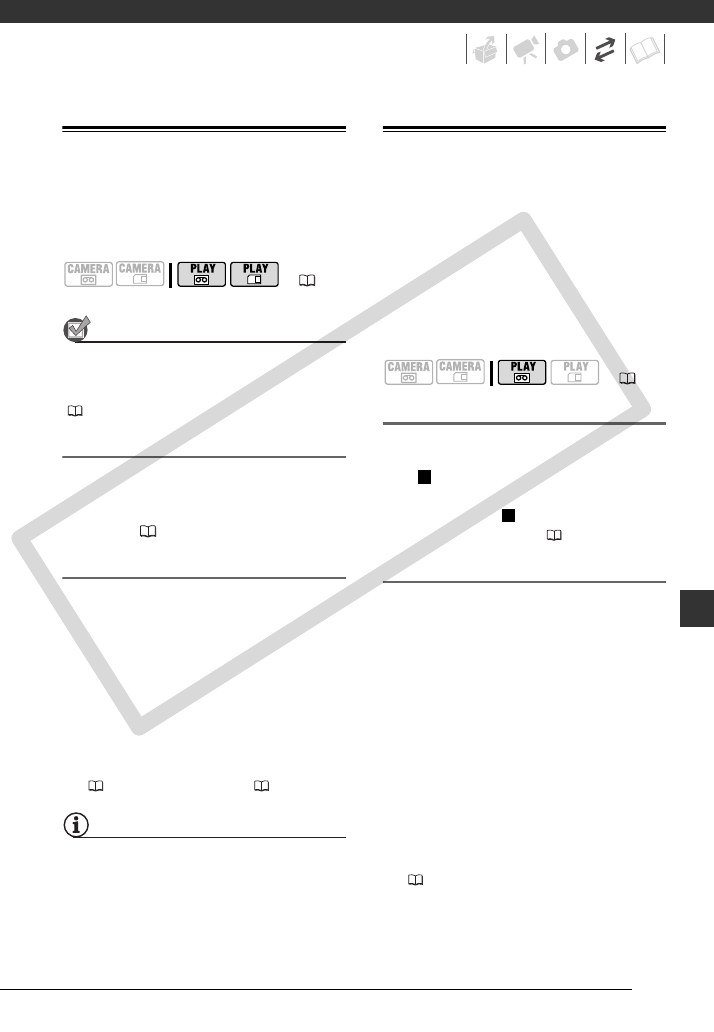
63
Playback on a TV Screen
The quality of the playback picture will
vary depending on the connected TV
and the type of connection used.
POINTS TO CHECK
Before making the connections, select the
[TV TYPE] setting according to the TV set
to which you will connect the camcorder
(75).
Connecting
Connect the camcorder to the TV
following one of the connection
diagrams shown in Connection
Diagrams ( 62).
Playback
1Turn on the camcorder and the
connected TV or VCR.
On a TV: Select as the video input
the same terminal to which you
connected the camcorder.
On a VCR: Set the input selector to
the external video input (usually
labeled LINE IN).
2Start the playback of the movies
( 36) or still images ( 52).
NOTES
• Turn off all the devices before starting
the connections.
• We recommend powering the
camcorder using the compact power
adapter.
Copying your Recordings to an External
Video Recorder
You can copy your recordings by
connecting the camcorder to a VCR or
a digital video device. When recording
to a digital video recorder using the DV
terminal, you can copy recordings with
virtually no generation loss in video and
sound quality.
Connecting
Connect the camcorder to a VCR or
other analog device using connection
type , or to a DVD recorder or other
digital recording device using
connection type , as shown in
Connection Diagrams ( 62).
Recording
1This camcorder: Load the
recorded cassette.
2Connected device: Load a blank
cassette or disc and set the device
to record pause mode.
3This camcorder: Locate the scene
you wish to copy and pause the
playback shortly before the scene.
4This camcorder: Resume the
movie playback.
When using an analog connection
you can include in the copy also the
date/time of the original recording
( 39).
5Connected device: Begin
recording when the scene you
wish to copy appears. Stop
( 23)
( 23)
1
2
COPY
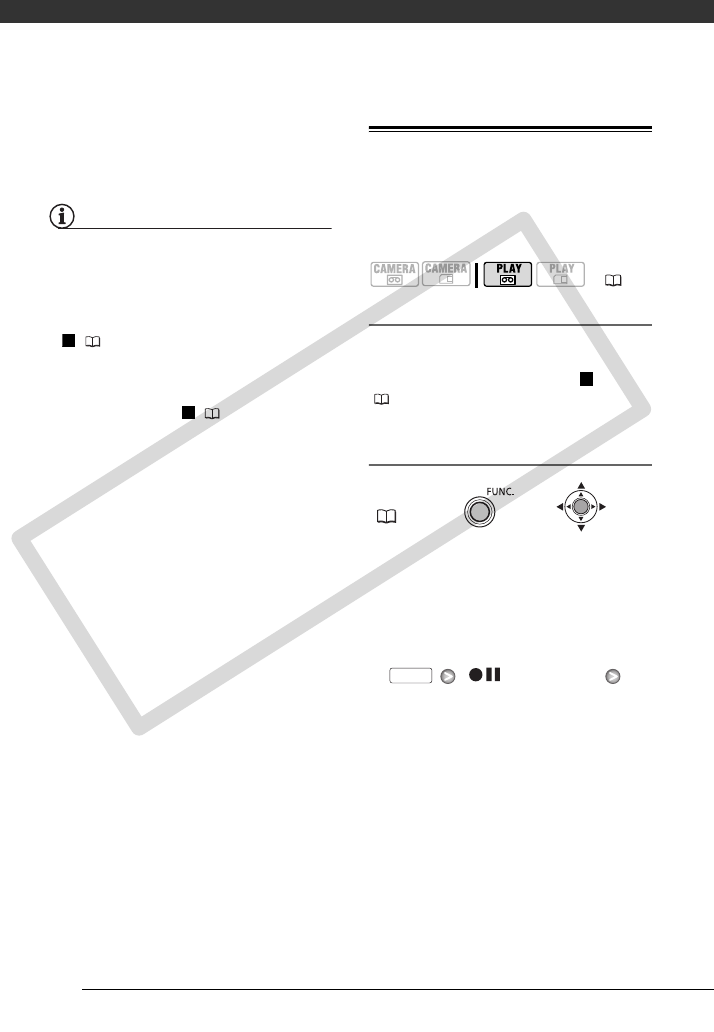
External Connections
64
recording when copying is
complete.
6This camcorder: Stop playback.
NOTES
• We recommend powering the
camcorder using the compact power
adapter.
• When recording to a VCR using an
analog connection –connection type
( 62)–, the quality of the edited tape
will be lower than the original.
• When recording to a digital video
recorder using the DV terminal
–connection type ( 62)–:
- If the picture does not appear,
disconnect the DV cable and restore
the connection after a short while or
turn the camcorder off and then on
again.
- Proper operation cannot be
guaranteed for all digital devices
equipped with a DV terminal. If the
operation does not work, use the AV
terminal.
Digital Video Dubbing
You can input video from other digital
video devices and record the input
video on the tape in the camcorder.
Connecting
Connect the camcorder to the video
input source using the digital
connection –connection type
( 62)– shown in Connection
Diagrams.
Dubbing
1Load a blank tape in the
camcorder and load the recorded
(source) tape or disc in the
connected device.
2Set the camcorder in record pause
mode.
[ REC PAUSE]
[EXECUTE]
3Connected device: Start the
playback.
In record pause mode and while
recording you can check the picture
on the camcorder’s screen.
1
2
( 23)
FUNC.
( 24)
2
FUNC.
COPY
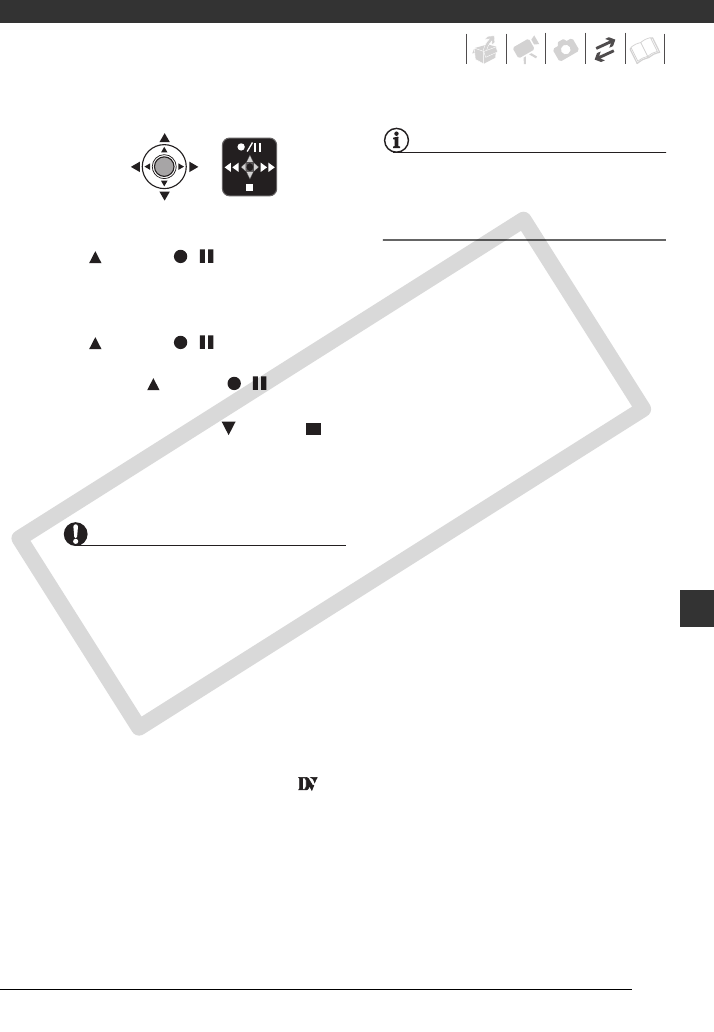
65
4When the scene you wish to
record appears, push the joystick
( ) toward / to begin
recording.
Recording starts.
5While recording, push the joystick
( ) toward / to record pause.
In record pause mode, push the
joystick ( ) toward / again to
resume recording.
6Push the joystick ( ) toward to
stop recording.
7Connected device: Stop the
playback.
IMPORTANT
• Blank sections may be recorded as
anomalous picture.
• If the picture does not appear,
disconnect the DV cable and restore the
connection after a short while or turn the
camcorder off and then on again.
• Do not connect any devices to the
camcorder’s USB terminal while an
external device is connected to the DV
terminal.
• You can only record video signals in DV
standard (standard definition, SP or LP
mode) from devices carrying the
logo. Note that signals from identically
shaped DV (IEEE1394) terminals may be
in different video standards.
NOTES
We recommend powering the camcorder
using the compact power adapter.
Copyright Signal
Certain software tapes are copyright
protected. If you attempt to play back
such tape, “COPYRIGHT PROTECTED
PLAYBACK IS RESTRICTED” appears and
you will not be able to view the contents of
the tape. If you attempt to record from
such tape via the DV terminal,
“COPYRIGHT PROTECTED DUBBING
RESTRICTED” appears and you will not
be able to record the contents of the tape.
COPY
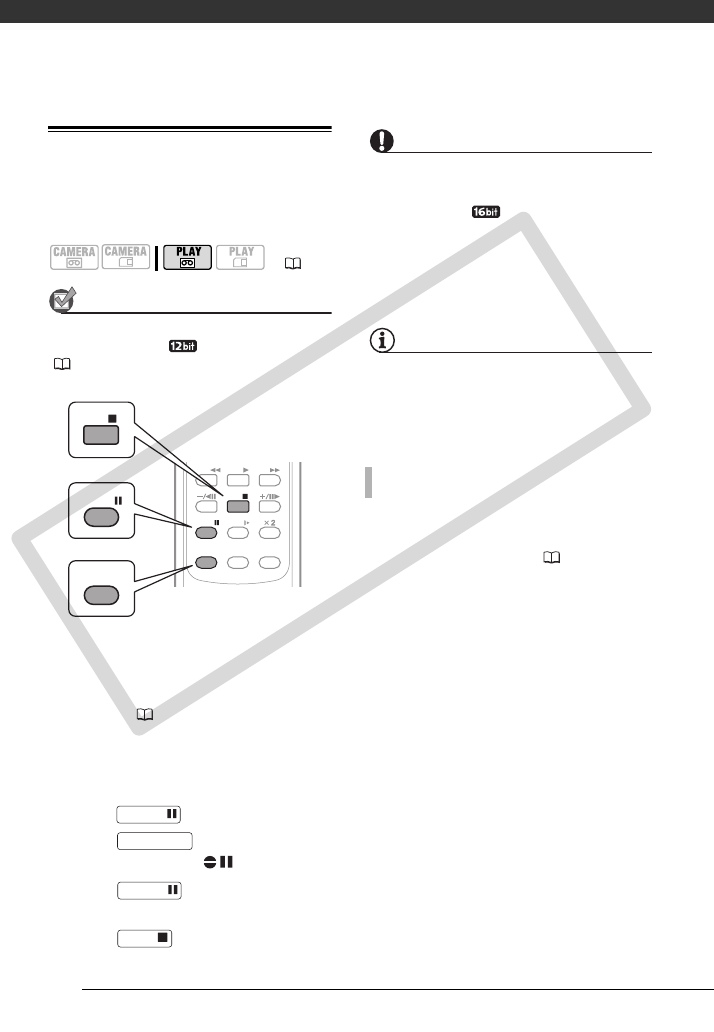
External Connections
66
Audio Dubbing
You can add sound to a recording using
the built-in microphone.
POINTS TO CHECK
You can only dub audio on tapes recorded
in SP mode with [ 12bit] audio
( 44). This function is operated with the
wireless controller.
1Locate the point where you want
to start dubbing audio.
Before locating the starting point,
you can also set the zero set
memory ( 37) at the point where
you want the audio dubbing to end.
The camcorder will automatically
stop audio dubbing at that point.
2Start playback and immediately
press .
3Press .
“AUDIO DUB.” and appear.
4Press to begin dubbing.
Speak into the microphone.
5Press to stop dubbing.
IMPORTANT
• Audio dubbing will stop if the tape has a
blank section or a section recorded in
LP mode or [ 16bit] audio.
• The quality of the dubbed sound will not
be as good when dubbing audio to a
tape that was not recorded with this
camcorder or after having dubbed audio
over the same scene more than 3 times.
NOTES
You can connect the camcorder to a TV to
check the picture on the TV screen and
check the sound through headphones
connected to the TV.
You can select the audio track that will
be played when playing back a tape
that was audio dubbed ( 45).
( 23)
REW PLAY FF
STOP
PAUSE SLOW
AUDIO DUB.
ZERO SET
MEMORY
TV SCREEN
STOP
PAUSE
AUDIO DUB.
PAUSE
AUDIO DUB.
PAUSE
STOP
TO SELECT THE AUDIO TRACK FOR PLAYBACK
COPY
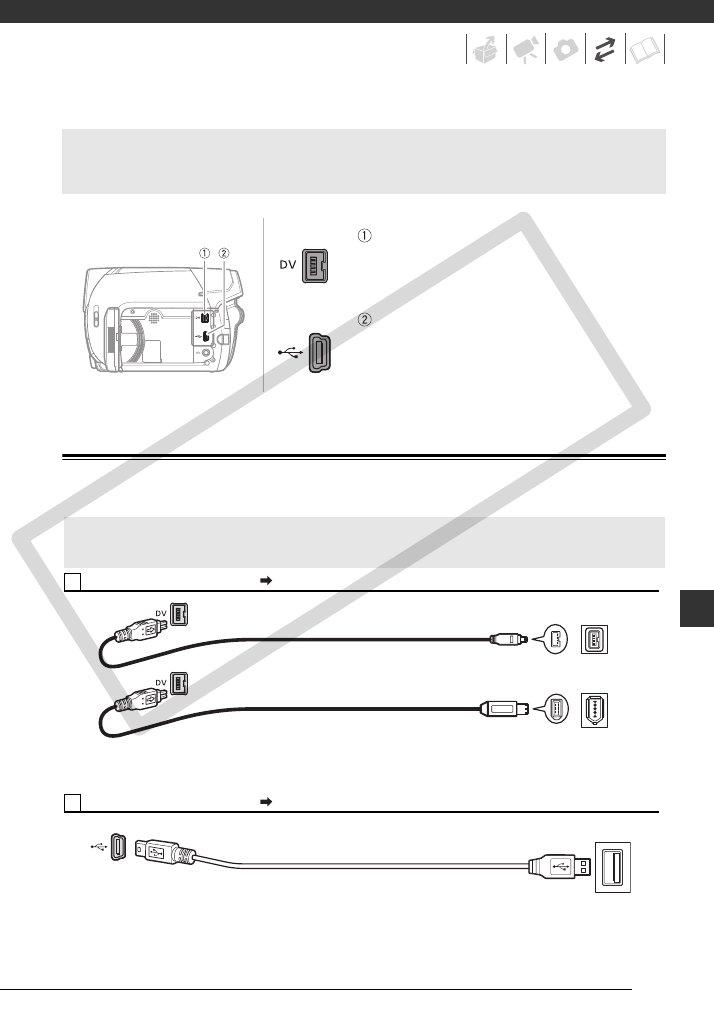
67
Connecting to a Computer
PC Connection Diagrams
Connecting to a Computer
DV Terminal
Check the type and orientation of the terminal and
make sure you connect the DV cable properly.
USB Terminal
Use the USB connection to print still images and
transfer them to a computer.
Open the LCD panel to
access.
Terminal on the
Camcorder Connecting Cable Terminal on the
Connected Device
Output connection (signal flow ) to a computer with a DV (IEEE1394) terminal or a DV capture board.
DV cable
(commercially available)
4-pin
6-pin*
* Be careful to correctly insert the 6-pin plug into the DV terminal. Inserting it in the wrong direction
can result in damage to the camcorder.
1
Output connection (signal flow ) to a PC or PictBridge compatible printer with a USB port.
2
USB cable (supplied)
COPY
External Connections
68
Transferring Video Recordings
You can transfer recordings to a
computer using the DV terminal.
Equipment and System Requirements
• A computer equipped with an
IEEE1394 (DV) terminal or an
IEEE1394 (DV) capturing board.
• A DV cable (commercially available).
• Video editing software.
• The appropriate driver.
A driver is preinstalled on Windows
operating systems later than Windows
98 Second Edition and Mac operating
systems later than Mac OS 9, and will
be installed automatically.
Connecting
1Start the computer.
2Connect the camcorder to the
computer using the DV connection
–connection type ( 67)–
shown in PC Connection
Diagrams.
3Set the camcorder to
mode.
4Start the video editing software.
Refer to the instruction manual of the
editing software.
IMPORTANT
• The video transfer may not work
correctly depending on the software and
the specifications/settings of your
computer.
• If the computer freezes while the
camcorder is connected to it,
disconnect the DV cable and turn off the
camcorder and the computer. After a
short while, turn them on again, set the
camcorder to mode and
restore the connection.
• Before connecting the camcorder to the
computer using a DV cable, make sure
that the camcorder and computer are
not connected with a USB cable, and
that no other IEEE1394 device is
connected to the computer.
• Depending on the video editing
software, you may need to set the
switch on the camcorder to a
mode other than PLAY. Refer to the
instruction manual of the editing
software.
NOTES
• We recommend powering the
camcorder using the compact power
adapter.
• Refer also to the instruction manual of
the computer.
• The programs ZoomBrowser EX and
Image Browser included with the
supplied CD-ROM can only be used to
transfer still images recorded on the
memory card. Video recordings on the
tape cannot be transferred to the
computer using the software included
with the supplied CD-ROM.
1
COPY
69
Transferring Photos – Direct Transfer
With the supplied USB cable and
software (on the DIGITAL VIDEO
Solution Disk CD-ROM) you can easily
transfer still images to a computer.
Preparations
The first time you connect the
camcorder to the computer, you need
to install the software and set the auto-
launch setting. From the second time
on, just connect the camcorder to the
computer using the USB cable to
transfer images.
1Install the supplied Digital Video
Software.
Refer to the installation guide
(separate leaflet included with the
CD-ROM).
2Set the camcorder to
mode.
3Connect the camcorder to the
computer using the USB cable.
Refer to PC Connection Diagrams
( 67).
4Set the auto-launch setting.
•See When Connecting the
Camcorder to a Computer
(Windows) or Auto-downloading
(Macintosh) in the Digital Video
Software instruction manual
(electronic version on PDF file).
• The direct transfer menu appears
on the camcorder’s screen.
IMPORTANT
• Observe the following precautions when
the CARD access indicator is on or
flashing. Failing to do so may result in
permanent data loss.
- Do not open the memory card slot
cover and do not remove the memory
card.
- Do not disconnect the USB cable.
- Do not turn off the camcorder or the
computer.
- Do not change the position of the
/ switch or the operating mode.
• Operation may not work correctly
depending on the software and the
specifications/settings of your
computer.
• If you wish to use the image files you
transferred from the memory card on
your computer, make copies of them
first. Use the copied files, retaining the
originals.
NOTES
• We recommend powering the
camcorder using the compact power
adapter.
• Refer also to the computer’s instruction
manual.
• Users of Windows Vista, Windows XP
and Mac OS X:
Your camcorder is equipped with the
standard Picture Transfer Protocol (PTP)
allowing you to download still images
(JPEG only) simply by connecting the
camcorder to a computer using the USB
cable, without having to install the
supplied software.
COPY
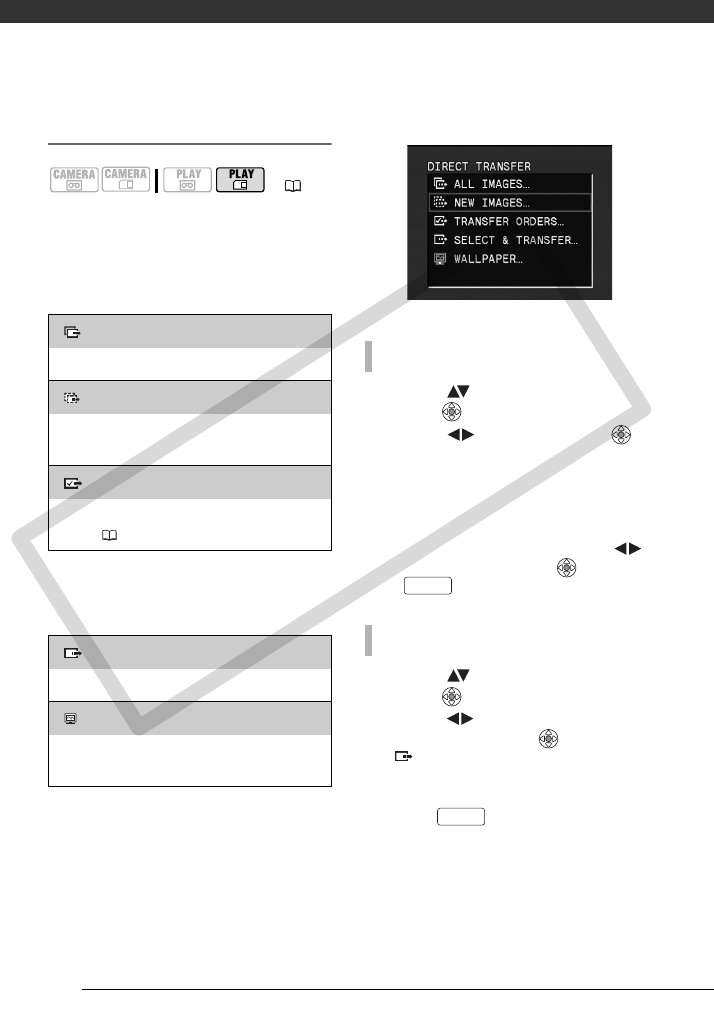
External Connections
70
Transferring Images
Automatic Transfer Options
All the relevant still images will be
transferred to the computer in one
batch and their thumbnails will be
displayed on the computer.
Manual Transfer Options
You can select the still image(s) to
transfer.
1 Select ( ) a transfer option and
press ( ).
2 Select ( ) [OK] and press ( ).
• The images are transferred and
displayed on the computer.
• The camcorder returns to the
transfer menu once the transfer is
completed.
• To cancel the transfer, select ( )
[CANCEL] and press ( ), or press
.
1 Select ( ) a transfer option and
press ( ).
2 Select ( ) the image you wish to
transfer and press ( ).
[ SELECT & TRANSFER]: Repeat
this step to select other still images
to transfer.
3 Press to return to the
transfer menu.
( 23)
[ ALL IMAGES]
Transfers all still images.
[ NEW IMAGES]
Transfers only those still images that have not
yet been transferred to the computer.
[ TRANSFER ORDERS]
Transfers still images marked with transfer
orders ( 71).
[ SELECT & TRANSFER]
Select the still image(s) to transfer.
[ WALLPAPER]
Select a still image still image and set it as your
computer’s desktop background.
AUTOMATIC TRANSFER OPTIONS
MANUAL TRANSFER OPTIONS
FUNC.
FUNC.
COPY
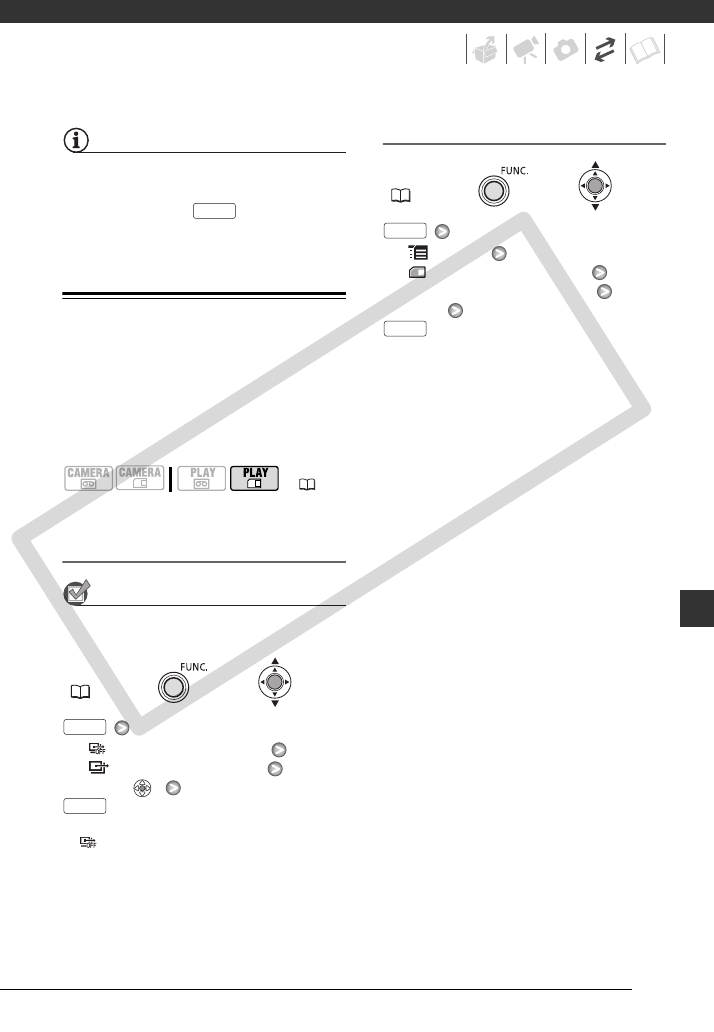
71
NOTES
When the camcorder is connected to the
computer and the image selection screen
is displayed, press to return to the
transfer menu.
Transfer Orders
You can mark in advance the still
images you want to transfer to the
computer as transfer orders. You can
set transfer orders for up to 998 still
images.
Selecting Still Images to Transfer
(Transfer Order)
POINTS TO CHECK
Set the transfer orders before connecting
the camcorder to the computer.
[ TRANS.ORDER OFF]
[ TRANS.ORDER ON]
Press ( )
* To cancel a transfer order, select
[ TRANS. ORDER OFF] instead.
Erasing All Transfer Orders
[ MENU]
[ CARD OPERATIONS]
[ERASE ALL TRANS.ORD]
[YES]
( 23)
FUNC.
( 24)
FUNC.
FUNC.
FUNC.
FUNC.
(24)
FUNC.
FUNC.
COPY
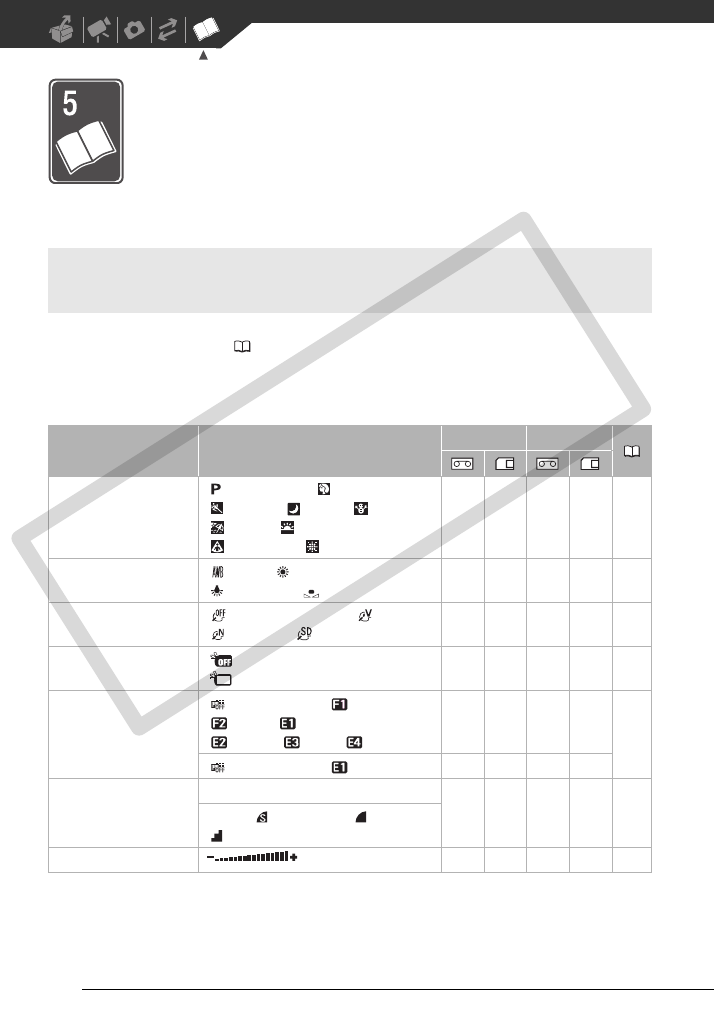
72
Additional Information
This chapter contains troubleshooting advice, screen messages,
handling and maintenance tips, and other information.
Appendix: Menu Option s Lists
Menu items not available appear grayed out. For details about how to select an item,
refer to Using the Menus ( 24). For details about each function, see the reference
page. Menu options without a reference page are explained below the tables.
FUNC. Menu
FUNC. Menu
Appendix: Menu Options Lists
Menu item Setting options CAMERA PLAY
Recording programs1[ PROGRAM AE],[ PORTRAIT],
[ SPORTS], [ NIGHT], [ SNOW],
[ BEACH], [ SUNSET],
[ SPOTLIGHT], [ FIREWORKS]
zz ––40
White balance1[AUTO], [ DAYLIGHT],
[ TUNGSTEN], [ SET]
zz ––47
Image effects1[ IMAGE EFFECT OFF], [ VIVID],
[ NEUTRAL], [ SOFT SKIN DETAIL]
zz ––48
LCD video light [ LCD LIGHT OFF],
[ LCD LIGHT ON]
zz ––43
Digital effects [ D.EFFECT OFF], [ FADE-T],
[ WIPE], [ BLK&WHT],
[ SEPIA], [ ART], [ MOSAIC]
z1–z–48
[ D.EFFECT OFF], [ BLK&WHT] – z1––
Still image size/quality Size: [L 1152x864], [S 640x480] – z––51
Quality: [ SUPER FINE], [FINE],
[NORMAL]
[SPEAKER VOLUME] – – z–36
COPY
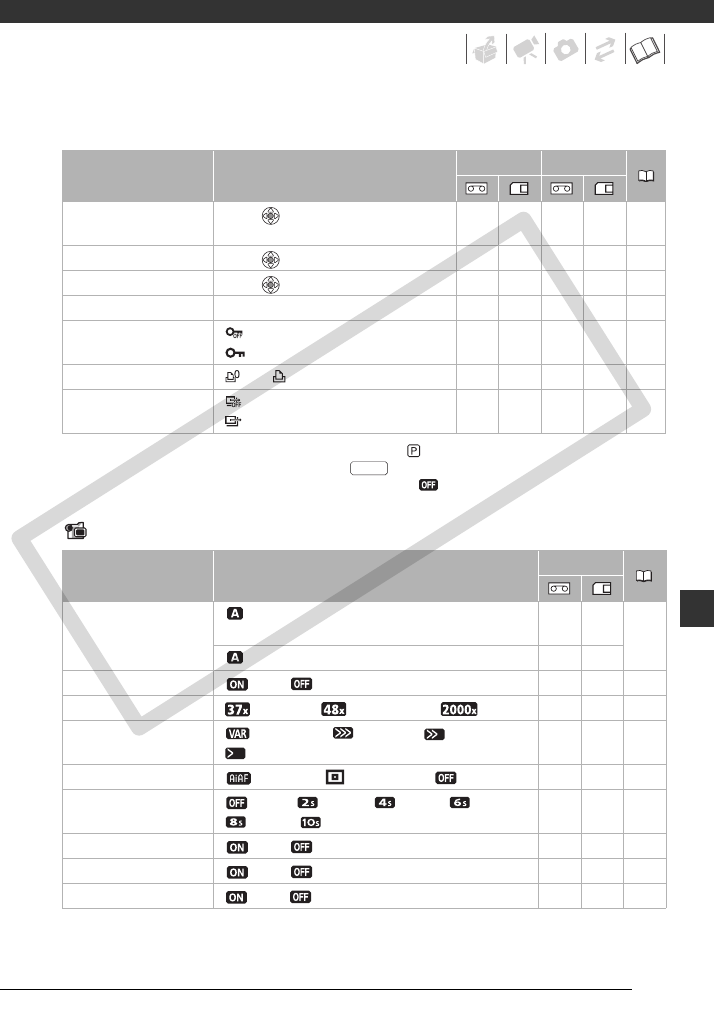
73
FUNC. Menu (cont.)
1 Option available only when the mode switch is set to .
2 This option will appear only when you press within the time set for the [REVIEW] option
(or immediately after recording the still image, if set to [ OFF]).
Setup menus
Camera Setup (Advanced Zoom, Image Stabilizer, etc.)
CAMERA SETUP
Menu item Setting options CAMERA PLAY
[REC PAUSE] Press ( ) to enter the record pause
mode.
––z–64
[END SEARCH] Press ( ) to search. ––z–38
[SLIDESHOW] Press ( ) to start. –––z53
[IMAGE ERASE] [CANCEL], [ERASE] – z2––54
Still image protection [ PROTECT OFF],
[ PROTECT ON]
–z2–z55
[PRINT ORDER] [ 0] - [ 99] COPIES – – – z59
Transfer order [ TRANS.ORDER OFF],
[ TRANS.ORDER ON]
–––z71
Menu item Setting options CAMERA
[SHUTTER]1[ AUTO], [1/60], [1/100], [1/250],
[1/500], [1/1000], [1/2000]
z–42
[ AUTO], [1/60], [1/100], [1/250] – z
[A.SL SHUTTER]2[ON], [ OFF] zz –
[ZOOM TYPE] [ OPTICAL], [ ADVANCED]4, [ DIGITAL] zz33
[ZOOM SPEED] [VARIABLE], [ SPEED 3], [ SPEED 2],
[ SPEED 1]
zz33
[FOCUS PRI.]3[ ON:AiAF], [ ON:CENTER], [ OFF] – z55
[REVIEW] [OFF], [ 2sec], [ 4sec], [ 6sec],
[8sec], [10sec]
–z–
[IMG STAB]3[ON], [ OFF] z––
[WIDESCREEN] [ON], [ OFF] z––
[SELF TIMER] [ ON], [ OFF] zz43
FUNC.
COPY
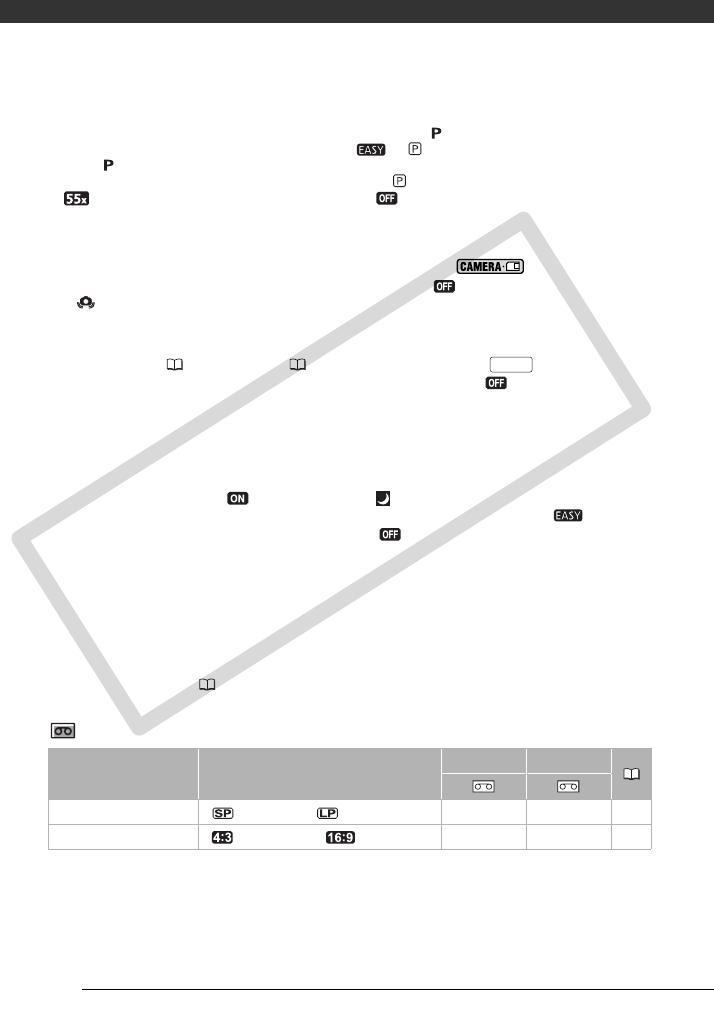
Additional Information
74
1 Option available only when the recording program is set to [ PROGRAM AE].
2 Option available when the mode switch is set to or (only when the recording program is
set to [ PROGRAM AE]).
3 Option available only when the mode switch is set to .
4 [ ADVANCED] when [WIDESCREEN] is set to [ OFF].
[A.SL SHUTTER]: The camcorder automatically uses slow shutter speeds to obtain
brighter recordings in places with insufficient lighting.
• The camcorder uses shutter speeds down to 1/30 (1/15 in mode).
• If a trailing afterimage appears, set the slow shutter to [ OFF].
• If (camcorder shake warning) appears, we recommend stabilizing the camcorder, for
example, by mounting it on a tripod.
[REVIEW]: Selects the time to display a still image after it has been recorded.
• You can erase ( 54) or protect ( 55) the image if you press while you are
reviewing the image (or immediately after recording it, if set to [ OFF]).
[IMG STAB]: The image stabilizer compensates for camcorder shake even at full
telephoto.
• The image stabilizer is designed to compensate for a normal degree of camcorder
shake.
• The image stabilizer may not be effective when recording in dark places with
[A.SL SHUTTER] set to [ ON] or using the [ NIGHT] recording program.
• The image stabilizer cannot be turned off when the mode switch is set to .
• We recommend setting the image stabilizer to [ OFF] when using a tripod.
[WIDESCREEN]: The camcorder uses the full width of the image sensor providing high-
resolution 16:9 recordings.
• Since the screens on the camcorder have an aspect ratio of 16:9, recordings with a 4:3
aspect ratio will appear in the center of the screen with black sidebars.
•
Playing back a widescreen recording:
TV sets compatible with the Video ID-1 system will
automatically switch to wide (16:9) mode. Otherwise, change the aspect ratio of the TV
manually. To play back on a TV with normal aspect ratio (4:3) change the [TV TYPE]
setting accordingly ( 75).
VCR Setup (Recording Mode, TV Type, etc.)
VCR SETUP
Menu item Setting options CAMERA PLAY
[REC MODE] [ STD PLAY], [ LONG PLAY] zz–
[TV TYPE] [ NORMAL TV], [ WIDE TV] zz–
FUNC.
COPY
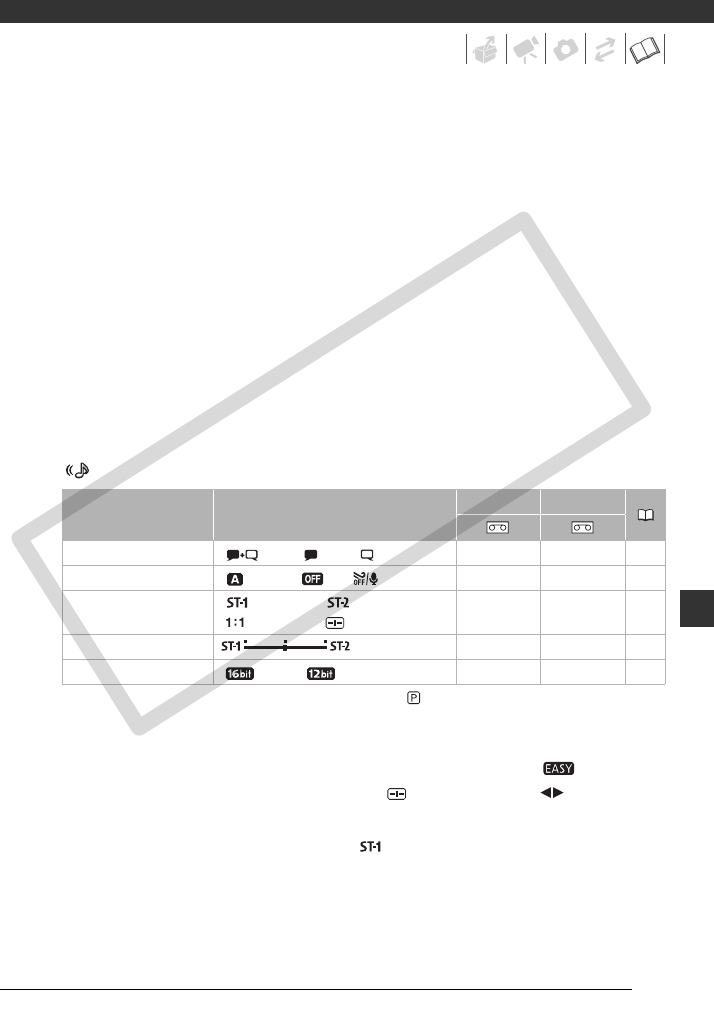
75
[REC MODE]: Select the video recording mode.
• Recording in LP mode extends the available recording time on the tape 1.5 times.
• Depending on the condition of the tape (long usage, imperfections, etc.) you may notice
some video anomalies (blocky video artifacts, banding, etc.) in the playback picture
when playing back recordings made in LP mode. We recommend using the SP mode for
important recordings.
• Audio cannot be dubbed on tapes recorded in LP mode.
• If you make recordings in both SP and LP modes on the same tape, during playback you
may notice some video anomalies in the picture at the point where the recording mode
changes.
• When playing back in this camcorder tapes recorded in LP mode with other devices or
vice versa, you may notice some anomalies in the playback picture or the sound may
stop briefly.
[TV TYPE]: In order to display the picture in full and in the correct aspect ratio, select the
setting according to the type of television to which you will connect the camcorder.
[NORMAL TV]: TV sets with 4:3 aspect ratio.
[WIDE TV]: TV sets with 16:9 aspect ratio.
Audio Setup (Audio Mode, Wind Screen, etc.)
AUDIO SETUP
1 Option available only when the mode switch is set to .
[WIND SCREEN]: The camcorder automatically reduces the background sound of wind
when recording outdoors.
• The wind screen cannot be turned off when the mode switch is set to .
[MIX BALANCE]: When [12bit AUDIO] is set to [ MIX/VAR.], adjust ( ) the sound
balance with the joystick.
• The camcorder will retain the audio balance adjustment, however if you turn off the
camcorder, [12bit AUDIO] will be reset to [ STEREO1].
Menu item Setting options CAMERA PLAY
[OUTPUT CH] [ L/R], [ L/L], [ R/R] – z44
[WIND SCREEN] [AUTO], [ OFF ] z1z–
[12bit AUDIO] [ STEREO1], [ STEREO2],
[ MIX/FIXED], [ MIX/VAR.]
–z45
[MIX BALANCE] – z–
[AUDIO MODE] [ 16bit], [ 12bit] z–44
COPY
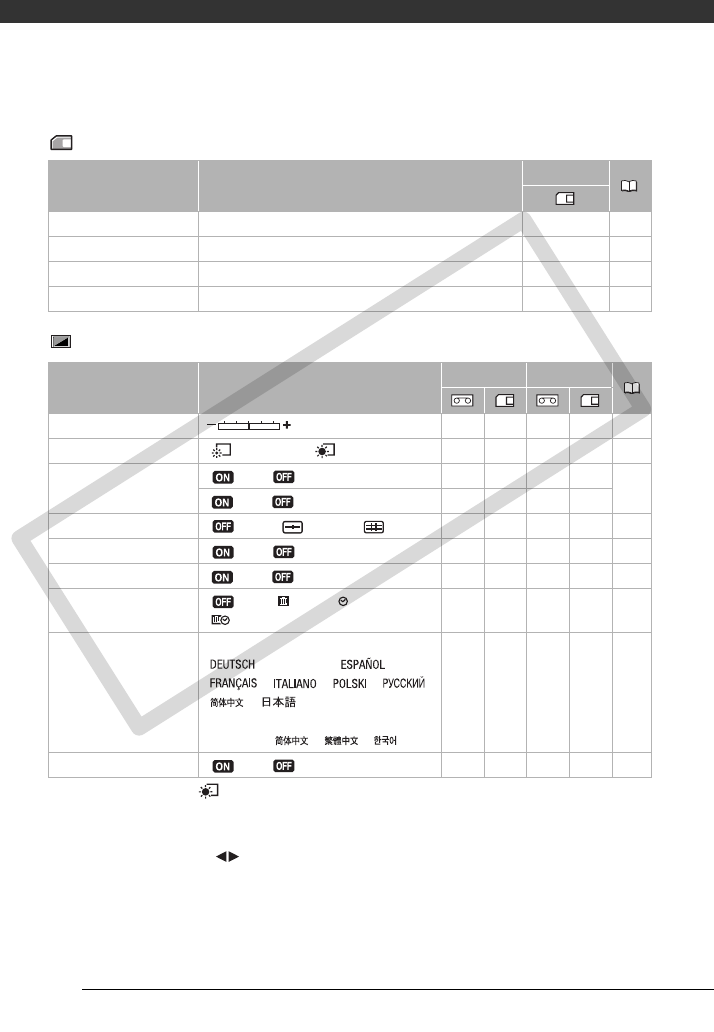
Additional Information
76
Card Operations (Card Initialization, etc.)
CARD OPERATIONS
Display Setup (LCD Brightness, Language, etc.)
DISPLAY SETUP
1 The default setting is [ BRIGHT] when you power the camcorder using the compact power
adapter.
2 The list of languages available depends on the region of purchase.
[BRIGHTNESS]: Adjust ( ) the brightness of the LCD display with the joystick.
• Changing the brightness of the LCD display does not affect that of the viewfinder or the
recordings.
Menu item Setting options PLAY
[ERASE ALL PRINT ORD] [NO], [YES] z60
[ERASE ALL TRANS.ORD] [NO], [YES] z71
[ERASE ALL IMAGES] [NO], [YES] z54
[INITIALIZE] [NO], [YES] z56
Menu item Setting options CAMERA PLAY
[BRIGHTNESS] zzzz–
[BACKLIGHT] [ NORMAL]1, [ BRIGHT] zzzz28
[TV SCREEN] [ON], [ OFF] zz –––
[ON], [ OFF] ––zz
[MARKERS] [ OFF], [ LEVEL], [ GRID] z––––
[DISPLAYS] [ON], [ OFF<PLAYBK>] – – zz–
[6SEC.DATE] [ ON], [ OFF] ––z––
[DATA CODE] [ OFF], [ DATE], [ TIME],
[ DATE & TIME]
––zz39
[LANGUAGE]2Language Set A:
[], [ENGLISH], [ ],
[ ], [ ], [ ], [ ],
[], []
Language Set B:
[ENGLISH], [ ] , [ ] , [ ]
zzzz26
[DEMO MODE] [ON], [ OFF] zz –––
COPY
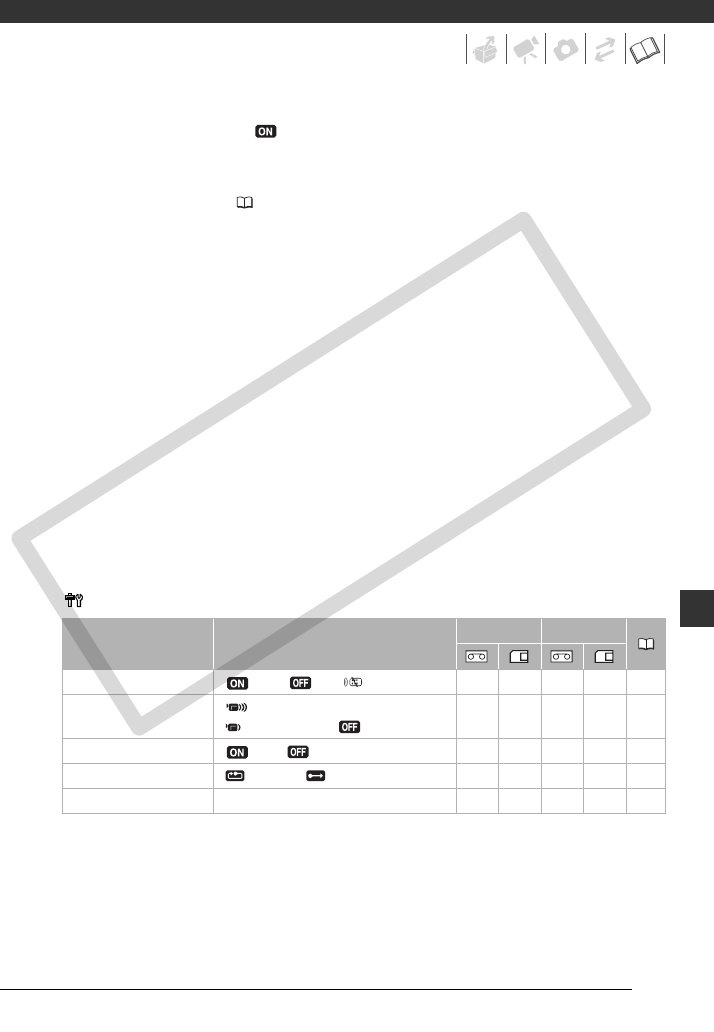
77
[TV SCREEN]: When set to [ ON], the camcorder’s on-screen displays will appear also
on the screen of a connected TV or monitor.
When the date and time are displayed on the camcorder’s screen they will also appear on
a connected TV regardless of the [TV SCREEN] setting. Turn off the date/time display with
the [DATA CODE] setting ( 39).
[MARKERS]: You can display a grid or a horizontal line at the center of the screen. Use the
markers as a reference to make sure your subject is framed correctly (vertically and/or
horizontally).
• Using the markers will not affect the recordings on the tape.
[DISPLAYS]: You can hide the on-screen displays to show only the playback picture on the
full screen.
• Tape operation displays appear for 2 seconds.
• Warning messages, the data code (if activated), and displays on the index screen will
appear regardless of the setting.
• All on-screen displays will appear while the playback image is magnified or a digital
effect is activated.
[6SEC.DATE]: When you start playing back a tape or when the date of the recording
changes, the date and time will be displayed for 6 seconds.
[DEMO MODE]: The demonstration mode displays the camcorder’s main features. It starts
automatically when the camcorder is powered with the power adapter if you leave it turned
on without loading a recording media for more than 5 minutes.
• To cancel the demo mode once it started, press any button, turn off the camcorder or
insert a videocassette.
System Setup (Beep, Power Save, etc.)
SYSTEM SETUP
[WL. REMOTE]: Allows the camcorder to be operated with the wireless controller.
[BEEP]: A beep will accompany some operations like turning on the camcorder, the self-
timer countdown, etc. It also serves as a warning beep under unusual conditions.
Menu item Setting options CAMERA PLAY
[WL.REMOTE] [ON], [ OFF ] zzzz–
[BEEP] [ HIGH VOLUME],
[ LOW VOLUME], [ OFF]
zzzz–
[POWER SAVE] [ON], [ OFF] zz –––
[FILE NOS.] [ RESET], [ CONTINUOUS] –z–––
[FIRMWARE] – – – – z–
COPY
Additional Information
78
[POWER SAVE]: In order to save power when the camcorder is powered by a battery
pack, it will automatically shut off if left without any operation for 5 minutes. Approximately
30 seconds before the camcorder shuts off, the message “ AUTO POWER OFF” will
appear.
[FILE NOS.]: Select the image numbering method to be used when you insert a new
memory card.
Images are automatically assigned consecutive image numbers from 0101 to 9900, and
stored in folders containing up to 100 images. Folders are numbered from 101 to 998.
[ RESET]: Image numbers will restart from 101-0101 every time you insert a new
memory card.
[ CONTINUOUS]: Image numbers will continue from the number following that of the
last image recorded with the camcorder.
• If the memory card you insert already contains an image with a larger number, a new
image will be assigned a number one higher than that of the last image on the memory
card.
• We recommend using the [ CONTINUOUS] setting.
[FIRMWARE]: You can verify the current version of the camcorder’s firmware. This menu
option is usually grayed out.
Date/Time Setup
DATE/TIME SETUP
[DATE FORMAT]: Changes the date format for on-screen displays and for date printing.
Menu item Setting options CAMERA PLAY
[T.ZONE DST] List of world time zones. zzzz26
[DATE/TIME] – zzzz27
[DATE FORMAT] [Y.M.D (2008.1.1 AM 12:00)],
[M.D,Y (JAN. 1, 2008 12:00 AM)],
[D.M.Y (1.JAN.2008 12:00 AM)]
zzzz–
COPY
79
Trou ble ?
If you have a problem with your camcorder, refer to this section. Consult your dealer
or a Canon Service Center if the problem persists.
Power Source
The camcorder will not turn on or it turns off by itself.
The cassette compartment cover will not open or it stops halfway while you insert or remove a tape.
The LCD/viewfinder switches on and off.
- Battery pack is exhausted. Replace or charge the battery pack ( 19).
- Attach the battery pack correctly.
- Use the compact power adapter.
The charge indicator flashes rapidly.
- (one flash at 0.5-second intervals)
Charging has stopped because the compact power adapter or the battery pack is faulty. Consult a Canon
Service Center.
- (two quick flashes at 1-second intervals)
Battery pack at least 50% charged ( 20). This is not a malfunction.
Battery pack will not charge.
- Charge the battery pack in temperatures between 0 °C and 40 °C (32 °F and 104 °F).
- Battery packs become hot with use and may not charge. When the battery pack is outside the charging
temperature range, the CHARGE indicator will flash irregularly. The charging will start once the battery pack
temperature is below 40 °C (104 °F).
- The battery pack is damaged. Use a different battery pack.
- If you connect a faulty power adapter or battery pack, the CHARGE indicator flashes approx. twice per second
and the charging stops.
- Check that the compact power adapter is correctly connected to the camcorder.
Recording/Playback
Buttons will not work.
- Turn on the camcorder.
- Load a cassette ( 29).
Abnormal characters appear on the screen. The camcorder does not operate properly.
- Disconnect the power source and reconnect it after a short time. If the problem still persists, disconnect all
power sources (including the battery pack and the backup battery). This will reset all the camcorder's
settings.
flashes on the screen.
- Load a cassette ( 29).
Troubleshooting
COPY
Additional Information
80
flashes on the screen.
- Battery pack is exhausted. Replace or charge the battery pack ( 19).
flashes on the screen.
- Condensation is detected. Refer to Condensation ( 89).
“REMOVE THE CASSETTE” appears on the screen.
- Remove the cassette and reinsert it ( 29).
The wireless controller will not work.
- Set [WL.REMOTE] to [ON] ( 77).
- The battery of the wireless controller is exhausted. Replace the battery ( 21).
Video noise appears on screen.
- When using the camcorder in a room where a plasma TV is located, keep a distance between the camcorder
and the plasma TV.
Video noise appears on the TV screen.
- When using the camcorder in a room where a TV is located, keep a distance between the compact power
adapter and the power or antenna cables of the TV.
The tape stops during record pause or playback pause.
- To protect the tape and video heads, the camcorder will enter the stop mode ( ) if left in playback pause
( ) or record pause ( ) mode for 4 minutes 30 seconds. To resume the operation press
(when recording) or push the joystick ( ) toward / (during playback).
Recording
Image will not appear on the screen.
- Set the camcorder to ( 31).
“SET THE TIME ZONE, DATE AND TIME” appears on the screen.
- Set the time zone, date and time ( 26).
- Replace the backup lithium battery and set the time zone, date and time ( 21).
Pressing will not start recording.
- Set the camcorder to ( 31).
- Load a cassette ( 29).
- Tape reached the end (“ END” appears on the screen). Rewind the tape or replace the cassette ( 29).
- Cassette is protected ( flashes on the screen). Change the position of the protect switch ( 87).
Camcorder will not focus.
- Autofocus does not work on that subject. Focus manually ( 45).
- If you are using the viewfinder, adjust it with the dioptric adjustment lever ( 32).
- Lens is dirty. Clean the lens with a soft lens-cleaning cloth ( 89). Never use tissue paper to clean the lens.
Sound is distorted.
- When recording near loud sounds (such as fireworks or concerts), sound may become distorted.
Viewfinder picture is blurred.
- Adjust the viewfinder with the dioptric adjustment lever ( 32).
Start/Stop
Start/Stop
COPY
81
Playback
During playback there is video noise.
- Video heads are dirty. Clean the video heads ( 2).
Playback does not start.
- Load a cassette ( 29).
- Set the camcorder to ( 36).
- Tape reached the end (“ END” appears on the screen). Rewind the tape ( 29).
No sound from the built-in speaker.
- Open the LCD panel.
- Speaker volume is turned off. Adjust the volume with the [SPEAKER VOLUME] setting ( 36).
Image will not appear on the TV screen.
- Check again that the camcorder is properly connected to the TV ( 62).
Tape is running, but image will not appear on the TV screen.
- TV/VIDEO selector on the TV is not set to VIDEO. Set the selector to VIDEO ( 63).
- Video heads are dirty. Clean the video heads ( 2).
- You attempted to play back or dub a copyright protected tape ( 65). Stop playback/dubbing.
Memory Card Operation
Memory card cannot be inserted.
- Memory card is not facing the correct direction. Turn the memory card over and reinsert it ( 30).
Cannot record on the memory card.
- Memory card is full. Erase still images ( 54) to free some space or replace the memory card.
- Memory card was not initialized. Initialize the memory card ( 56).
- The folder and file numbers have reached their maximum value. Set [FILE NOS.] to [RESET] ( 78) and
insert a new memory card.
Memory card cannot be played back.
- Set the camcorder to ( 52).
Image cannot be erased.
- Image is protected. Cancel the protection ( 55).
- The write-protect switch on an SD or SDHC memory card is set to prevent accidental erasure. Change the
position of the write-protect switch.
flashes in red.
- A memory card error occurred. Turn off the camcorder. Remove and reinsert the memory card. Initialize the
memory card ( 56) if flashing persists.
Printing
The printer is not operating even though the camcorder and printer are correctly connected.
- Disconnect the USB cable and turn off the camcorder and the printer. After a short while, turn them on again,
set the camcorder to mode and restore the connection.
COPY
Additional Information
82
Editing
Cannot record with this camcorder video input from an external video device connected using a DV cable.
- Wrong signal standard. Refer also to the instruction manual of the connected device.
List of Messages (in alphabetical order)
CANNOT TRANSFER!
- You attempted to transfer a still image that cannot be displayed with this camcorder.
CARD ERROR
- A memory card error occurred. The camcorder cannot record or display the image.
The error may be temporary. If the message disappears after 4 seconds and flashes red, turn the
camcorder off, remove the card and reinsert the card. If changes to green, you can continue recording/
playback.
CARD FULL
- Memory card is full. Erase some images ( 54) to free some space or replace the memory card.
CHANGE THE BATTERY PACK
- Battery pack is exhausted. Replace or charge the battery pack ( 19).
CHECK THE CASSETTE [AUDIO MODE]
- You attempted to dub audio ( 66) on a tape recorded with an audio mode other than [ 12bit].
CHECK THE CASSETTE [BLANK]
- You attempted to dub audio ( 66) on a tape with a blank section.
CHECK THE CASSETTE [INCORRECT TAPE SPECIFICATION]
- You attempted to dub audio ( 66) on a tape recorded in HD (high definition) standard.
CHECK THE CASSETTE [REC MODE]
- You attempted to dub audio ( 66) on a tape recorded in a recording mode other than SP.
CHECK THE INPUT
- The DV cable is not correctly connected to the DV terminal ( 62), or the connected digital device is turned
off.
- The video input signal is in a different television system (PAL or SECAM).
CONDENSATION HAS BEEN DETECTED
- Condensation has been detected in the camcorder ( 89).
CONDENSATION HAS BEEN DETECTED REMOVE THE CASSETTE
- Condensation has been detected in the camcorder ( 89). Remove the cassette.
COPYRIGHT PROTECTED DUBBING RESTRICTED
- You attempted to dub a copyright protected tape ( 65).
COPY
83
COPYRIGHT PROTECTED PLAYBACK IS RESTRICTED
- You attempted to play back a copyright protected tape ( 65).
HEADS DIRTY, USE CLEANING CASSETTE
- Video heads are dirty. Clean the video heads ( 2).
INCORRECT TAPE SPECIFICATION PLAYBACK IS RESTRICTED
- You attempted to play back a tape recorded in a different television system (PAL or SECAM) or in a recording
standard not supported by this camcorder.
INPUT SIGNAL NOT SUPPORTED
- The digital device connected with the DV cable is incompatible with the camcorder.
NAMING ERROR
- The folder and file numbers have reached their maximum value. Set the [FILE NOS.] option to [RESET] and
erase all the images on the memory card ( 54) or initialize it ( 56).
NO CARD
- There is no memory card in the camcorder ( 30).
NO IMAGES
- No images are recorded on the memory card.
REMOVE THE CASSETTE
- Camcorder stopped operating to protect the tape. Remove the cassette and reinsert it ( 29).
SET THE TIME ZONE, DATE AND TIME
- You have not set the time zone, date and time. This message appears each time you turn the power on until
you set the time zone, date and time ( 26).
TAPE END
- Tape reached the end. Rewind the tape or replace the cassette.
THE CARD IS SET FOR ERASURE PREVENTION
- The write-protect switch on an SD or SDHC memory card is set to prevent accidental erasure. Change the
position of the write-protect switch.
THE TAPE IS SET FOR ERASURE PREVENTION
- Cassette is protected. Replace the cassette or change the position of the protect switch ( 87).
THIS IMAGE CANNOT BE RECORDED
- Some analog images cannot be recorded on the memory card depending on the signal.
TOO MANY STILL IMAGES DISCONNECT USB CABLE
- Disconnect the USB cable and decrease the number of still images on the memory card to less than 1,800. If
a dialog appeared on the computer screen, close it and then restore the connection.
TRANSFER ORDER ERROR
- You attempted to set more than 998 transfer orders ( 71).
UNIDENTIFIABLE IMAGE
- The image file is corrupted or it was saved using a compression method other than that compatible with this
camcorder (JPEG).
COPY
Additional Information
84
Direct Print Related Messages
About Canon PIXMA/SELPHY DS Printers: If the printer’s error indicator flashes or an
error message appears on the printer’s operation panel, refer to the printer’s
instruction manual.
CANNOT PRINT!
- You attempted to print an image that was recorded with another camcorder, with a different compression, or
was edited on a computer.
COMMUNICATION ERROR
- The printer is experiencing a data transfer error. Cancel printing. Disconnect the USB cable and turn off the
camcorder and the printer. After a short while, turn them on again, set the camcorder to mode and
restore the connection. If you attempted to print from a memory card that contains a large number of images,
reduce the number of images.
COULD NOT PRINT X IMAGES
- You attempted to use the print order settings to print X images that were recorded with another camcorder,
with a different compression or were edited on a computer.
FILE ERROR
- You attempted to print an image that was recorded with another camcorder, with a different compression, or
was edited on a computer.
HARDWARE ERROR
- Cancel printing. Turn off the printer and turn it back on. Check the printer status. If the printer is equipped with
a battery, it might be exhausted. In such case, turn off the printer, replace the battery and turn it back on.
INCOMPATIBLE PAPER SIZE
- The paper settings of the camcorder conflict with the printer's settings.
INK ABSORBER FULL
- Select [CONTINUE] to resume printing. Contact a Canon Service Center (refer to the list included with the
printer) to replace the ink absorber.
INK ERROR
- There is a problem with the ink.
LOW INK LEVEL
- The ink cartridge needs to be replaced soon. Select [CONTINUE] to restart printing.
NO INK
- The ink cartridge is not inserted or is out of ink.
NO PAPER
- Paper is not correctly inserted or there is no paper.
NO PRINTHEAD
- No print head is installed in the printer or the print head is defective.
COPY
85
PAPER ERROR
- There is a problem with the paper. The paper is not correctly loaded or the paper size is wrong.
- If the paper output tray is closed, open it to print.
PAPER JAM
- The paper jammed during printing. Select [STOP] to cancel printing. After removing the paper, set some paper
again and retry printing.
PAPER LEVER ERROR
- Paper lever error occurred. Adjust the paper selection lever to the proper position.
PRINT ERROR
- Cancel printing, disconnect the USB cable and turn off the printer. After a while, turn the printer back on and
reconnect the USB cable. Check the printer status.
PRINT ORDER ERROR
- You attempted to set more than 998 still images in the print order ( 59).
PRINTER COVER OPEN
- Close the printer cover securely.
PRINTER ERROR
- Cancel printing. Turn the printer off and then on again. Check the printer status. If the error still persists, refer
to the printer’s instruction manual and contact the appropriate customer support center or service center.
PRINTER IN USE
- The printer is in use. Check the printer status.
SET PRINT ORDER
- No still image on the memory card has been marked with a print order.
COPY

Additional Information
86
Do’s and Don’ts
Camcorder
• Do not carry the camcorder by the
LCD panel. Be careful when closing
the LCD panel.
• Do not leave the camcorder in places
subject to high temperatures (like the
inside of a car under direct sunlight),
or high humidity.
• Do not use the camcorder near strong
electromagnetic fields such as above
TVs, near plasma TVs or mobile
phones.
• Do not point the lens or viewfinder at
strong light sources. Do not leave the
camcorder pointed at a bright
subject.
• Do not use or store the camcorder in
dusty or sandy places. The
camcorder is not waterproof – avoid
also water, mud or salt. If any of the
above should get into the camcorder
it may damage the camcorder and/or
the lens.
• Be careful of heat generated by
lighting equipment.
• Do not disassemble the camcorder. If
the camcorder does not function
properly, consult qualified service
personnel.
• Handle the camcorder with care. Do
not subject the camcorder to shocks
or vibration as this may cause
damage.
Battery Pack
• Charged battery packs continue to
discharge naturally. Therefore, charge
them on the day of use, or the day
before, to ensure a full charge.
• Attach the terminal cover whenever a
battery pack is not in use. Contact
with metallic objects may cause a
short circuit and damage the battery
pack.
• Dirty terminals may cause a poor
contact between the battery pack
and the camcorder. Wipe the
terminals with a soft cloth.
• Since storing a charged battery pack
for a long time (about 1 year) can
shorten its lifecycle or affect
performance, we recommend to
discharge the battery pack fully and
to store it in a dry place at
temperatures no higher than 30 °C
(86 °F). If you do not use the battery
pack for long periods, charge and
discharge it fully at least once a year.
If you have more than one battery
pack, perform these precautions at
the same time for all battery packs.
Handling Precautions
DANGER!
Treat the battery pack with care.
• Keep it away from fire (or it might
explode).
• Do not expose the battery pack to
temperature higher than 60 °C
(140 °F). Do not leave it near a
heater or inside a car in hot weather.
• Do not try to disassemble or modify
it.
• Do not drop or knock it.
• Do not get it wet.
COPY
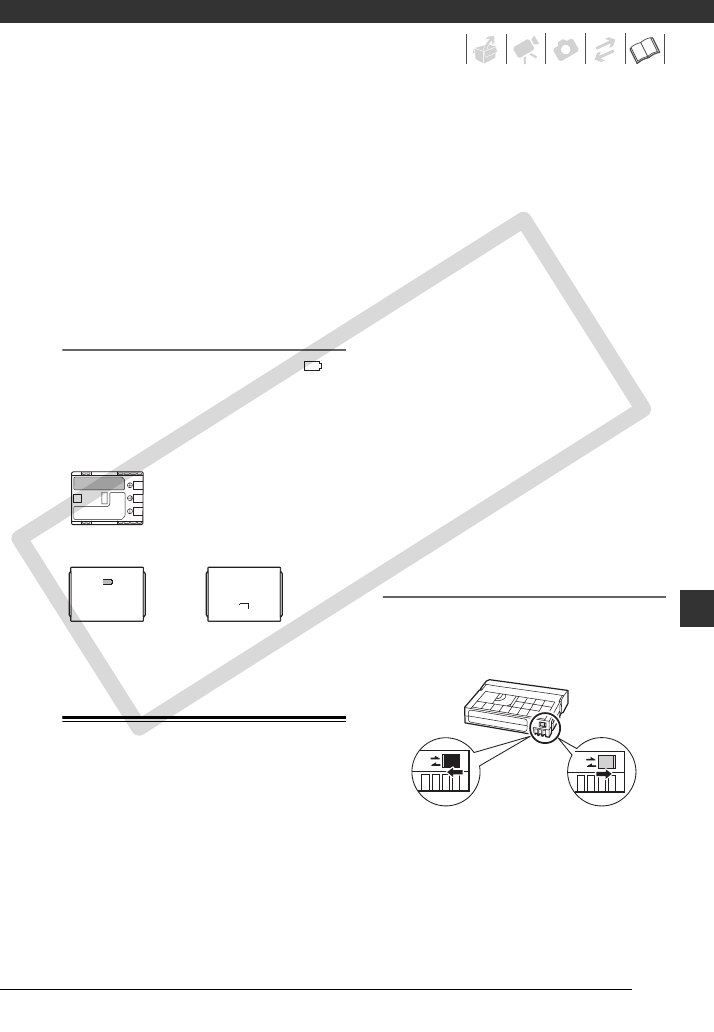
87
• Although the battery pack’s operating
temperature range is from 0 °C to
40 °C (32 °F to 104 °F), the optimal
range is from 10 °C to 30 °C (50 °F to
86 °F). At cold temperatures,
performance will temporarily decline.
Warm it in your pocket before use.
• Replace the battery pack if the usable
time after full charge diminishes
substantially at normal temperatures.
About the battery terminal cover
The battery terminal cover has a [ ]-
shaped hole. This is useful when you
wish to differentiate between charged
and uncharged battery packs.
Back side of the battery pack
Terminal cover attached
Cassette
• Rewind tapes after use. A slack or
damaged tape may cause video
problems and/or audio distortions
during playback.
• Return cassettes to the case and
store them upright. Rewind tapes
from time to time if they are stored for
a long time.
• Do not leave the cassette in the
camcorder after use.
• Do not use spliced tapes or
nonstandard cassettes as they may
damage the camcorder.
• Do not use tapes that have been
jammed as video heads may become
dirty.
• Do not insert anything into the small
holes of the cassette, or cover them
with cellophane tape.
• Handle cassettes with care. Do not
drop or subject them to severe
impact as this may damage the
cassettes.
• With cassettes equipped with a
memory function, metal plated
terminals may become dirty with use.
Clean the terminals with a cotton
swab after about 10 times of
removing and reinserting the
cassette. The memory function is not
supported by the camcorder.
Protecting Tapes from Accidental Erasure
To protect your recordings from accidental
erasure, slide the tab on the cassette to
SAVE or ERASE OFF.
Charged Uncharged
SAVE
REC
SAVE
REC
COPY

Additional Information
88
Memory Card
• We recommend saving backups of
memory card images on your
computer. Image data may be
corrupted or lost due to memory card
defects or exposure to static
electricity. Canon makes no
warranties for corrupted or lost data.
• Do not turn off the camcorder,
disconnect the power source or
remove the memory card while the
CARD access indicator is flashing.
• Do not use memory cards in places
subject to strong magnetic fields.
• Do not leave memory cards in places
subject to high humidity and high
temperature.
• Do not disassemble, bend, drop, or
subject memory cards to shocks and
do not expose them to water.
• Do not touch or expose the terminals
to dust or dirt.
• Check the direction before inserting
the memory card. Forcing a memory
card into the slot if it is not correctly
oriented may damage the memory
card or the camcorder.
• Do not attach any labels or stickers
on the memory card.
• When you erase image files or
initialize the memory card, only the
file allocation table is altered and the
data itself is not actually deleted. Take
the necessary precautions when you
dispose of the memory card, for
example by physically damaging it to
prevent the leakage of private data.
Lithium Button Battery
• Do not pick up the battery using
tweezers or other metal tools, as this
will cause a short circuit.
• Wipe the battery with a clean dry
cloth to ensure proper contact.
•For California, USA only: Included
lithium battery contains Perchlorate
Material – special handling may apply.
For details see www.dtsc.ca.gov/
hazardouswaste/perchlorate.
WARNING!
• The battery used in this device may
present a fire or chemical burn hazard
if mishandled.
• Do not disassemble, modify, immerse
in water, heat above 100 °C (212 °F) or
incinerate the battery.
• Backup battery: Replace with a
CR1616 battery made by Panasonic,
Hitachi Maxell, Sony, Toshiba, Varta or
Renata. Use of other batteries may
present a risk of fire or explosion.
• Lithium battery for the wireless controller:
Replace with a CR2025 battery made by
Panasonic, Hitachi Maxell, Sony, Sanyo, or
with Duracell2025. Use of other batteries
may present a risk of fire or explosion.
• Do not insert the battery into the
mouth. If swallowed, seek medical
assistance immediately. The battery
case may break and the battery fluids
may cause internal damage.
• Keep the battery out of the reach of
children.
•
Do not recharge, short-circuit or insert
the battery in the wrong direction.
• Dispose of the used battery according
to applicable recycling regulations.
COPY
89
Storage
If you do not intend to use the
camcorder for a long time, store it in a
place free of dust, in low humidity, and
at temperatures not higher than 30 °C
(86 °F).
Cleaning
Camcorder Body
• Use a soft, dry cloth to clean the
camcorder body. Never use
chemically treated cloth or volatile
solvents such as paint thinner.
Lens and Viewfinder
• If the lens surface is dirty, the
autofocus may not work properly.
• Remove any dust or dirt particles
using a non-aerosol type blower
brush.
• Use a clean, soft lens-cleaning cloth
to gently wipe the lens or viewfinder.
Never use tissue paper.
LCD Screen
• Clean the LCD screen using a clean,
soft lens-cleaning cloth.
• Condensation may form on the
surface of the screen when the
temperature changes suddenly. Wipe
it with a soft dry cloth.
Condensation
Moving the camcorder rapidly between
hot and cold temperatures may cause
condensation (water droplets) to form
on its internal surfaces. Stop using the
camcorder if condensation is detected.
Continued use may damage the
camcorder.
Condensation may form in the following
cases:
• When the camcorder is moved from
an air-conditioned room to a warm,
humid place
• When the camcorder is moved from a
cold place to a warm room
• When the camcorder is left in a humid
room
• When a cold room is heated rapidly
• Do not expose the camcorder to
sudden or extreme changes in
temperature.
• Remove the cassette, place the
camcorder in an airtight plastic bag
and let it adjust to temperature
changes slowly before removing it
from the bag.
Maintenance/Others
TO AVOID CONDENSATION
COPY
Additional Information
90
• The camcorder automatically shuts
off, the warning message
“CONDENSATION HAS BEEN
DETECTED” appears for approx.
4 seconds and starts flashing.
• If a cassette is loaded, the warning
message “REMOVE THE CASSETTE”
appears and starts flashing.
Remove the cassette immediately
and leave the cassette compartment
open. Leaving the cassette in the
camcorder may damage the tape.
• A cassette cannot be loaded when
condensation is detected.
The precise time required for water
droplets to evaporate will vary
depending on the location and weather
conditions. After the condensation
warning stops flashing, wait for 1 more
hour before resuming use.
Using the Camcorder Abroad
Power Sources
You can use the compact power
adapter to operate the camcorder and
to charge battery packs in any country
with power supply between 100 and
240 V AC, 50/60 Hz. Consult the Canon
Service Center for information on plug
adapters for overseas use.
Playback on a TV Screen
You can only play back your recordings
on TVs compatible with the NTSC
system. The NTSC system is used in
the following countries/areas:
American Samoa, Antigua, Aruba,
Bahamas, Barbados, Bermuda, Bolivia,
Canada, Chile, Colombia, Costa Rica,
Cuba, Ecuador, El Salvador, Greenland,
Guam, Guatemala, Haiti, Honduras,
Jamaica, Japan, Korea, Mexico,
Micronesia, Myanmar, Nicaragua,
Panama, Peru, Philippines, Puerto Rico,
Saint Kitts and Nevis, Saint Lucia, Saint
Vincent and the Grenadines, Surinam,
Taiwan, Trinidad and Tobago, USA,
Venezuela, Virgin Islands.
WHEN CONDENSATION IS DETECTED
RESUMING USE
T
ra
d
emar
k
A
c
k
now
l
e
d
gemen
t
s
• is a trademark.
• The SD logo is a trademark. The SDHC logo is a trademark.
• Microsoft, Windows and Windows Vista are trademarks or registered trademarks of Microsoft Corporation in the United States and/or
other countries.
• Macintosh and Mac OS are trademarks of Apple Inc., registered in the United States and other countries.
• Other names and products not mentioned above may be trademarks or registered trademarks of their respective companies.
COPY
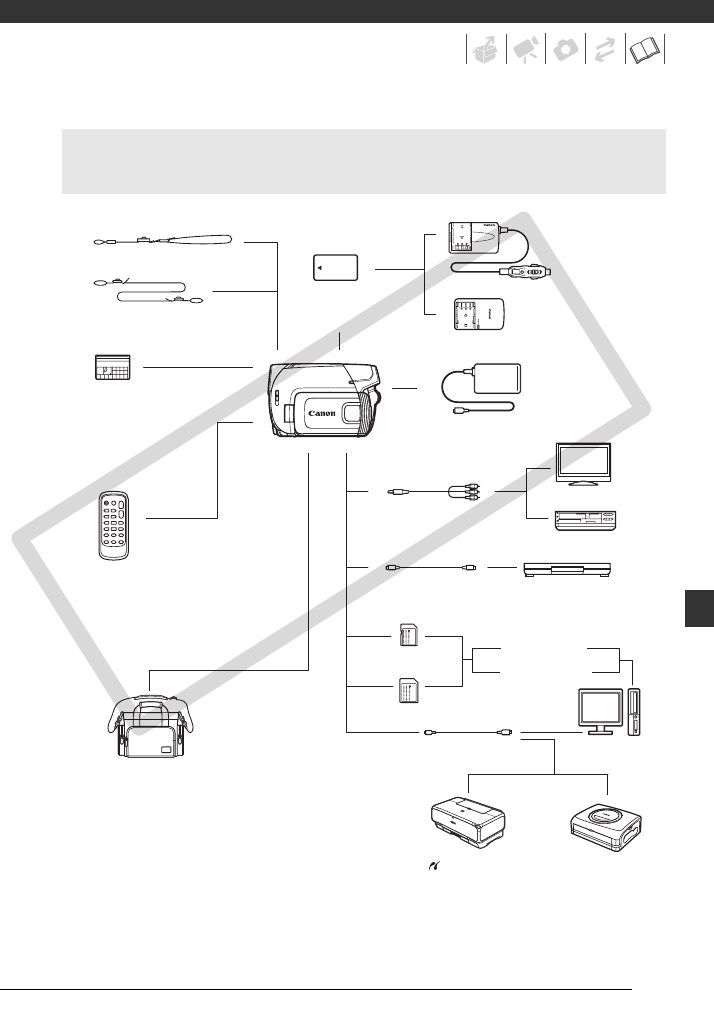
91
General Information
* The BP-2L5 is not available as a separate optional accessory.
System Diagram (Availability differs from area to area)
CBC-NB2
Car Battery Charger
STV-250N
Stereo Video Cable
CA-590 Compact
Power Adapter
Commercially available
DV Cable
SC-2000 Soft Carrying Case
WS-20 Wrist Strap
SS-600/SS-650
Shoulder Strap
SD/SDHC
memory card
MultiMediaCard
NB-2LH, BP-2L5*,
BP-2L14 Battery Pack
TV
Computer
VCR
DVD recorder/digital device
with DV terminal
MiniDV
videocassette
WL-D85
Wireless Controller
Card adapter
Reader/Writer
PictBridge compatible printers
IFC-300PCU
USB Cable
CB-2LW
Battery Charger
COPY
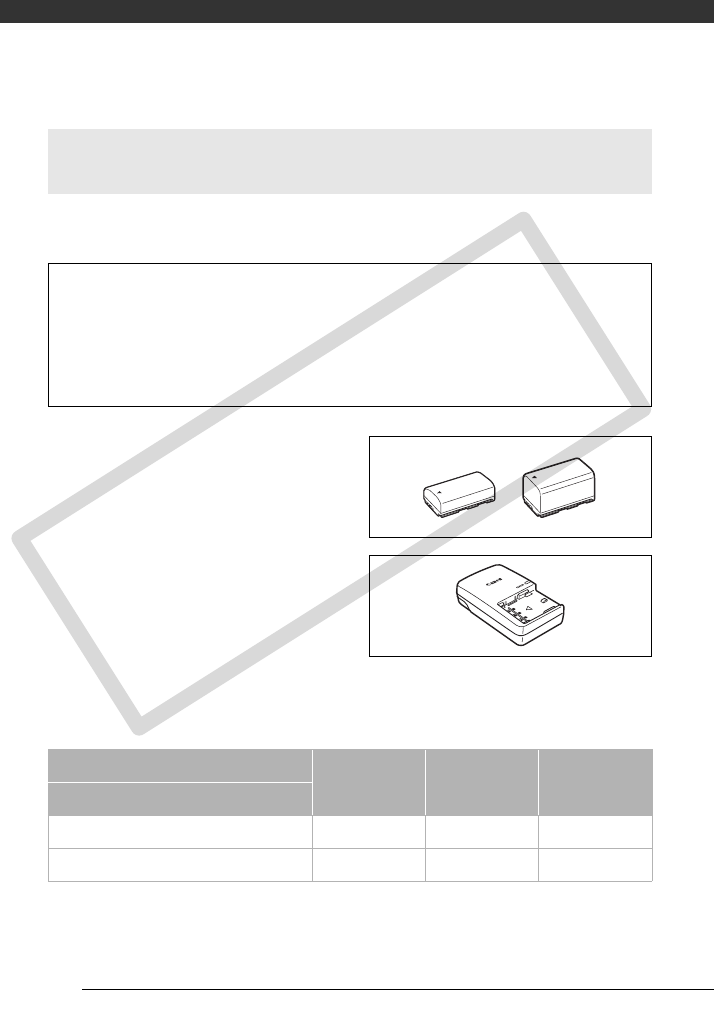
Additional Information
92
Call or visit your local retailer/dealer for genuine Canon video accessories. You can
also obtain genuine accessories for your Canon camcorder by calling:
1-800-828-4040, Canon U.S.A. Information Center.
Battery Packs
When you need extra battery packs, select
either the NB-2LH or the BP-2L14.
CB-2LW Battery Charger
Use the battery charger to charge battery
packs. It plugs directly into a power outlet
without a cable.
Charging Times
The charging times given in the following table are approximate and vary according
to charging conditions and initial charge of the battery pack.
Optional Accessories
Use of genuine Canon accessories is recommended.
This product is designed to achieve excellent performance when used with genuine
Canon accessories. Canon shall not be liable for any damage to this product and/or
accidents such as fire, etc., caused by the malfunction of non-genuine Canon
accessories (e.g., a leakage and/or explosion of a battery pack). Please note that this
warranty does not apply to repairs arising out of the malfunction of non-genuine Canon
accessories, although you may request such repairs on a chargeable basis.
Battery Pack →
BP-2L5 NB-2LH BP-2L14
Charging Conditions ↓
Using the camcorder 145 min. 155 min. 285 min.
Using the CB-2LW Battery Charger 105 min. 160 min. 205 min.
COPY
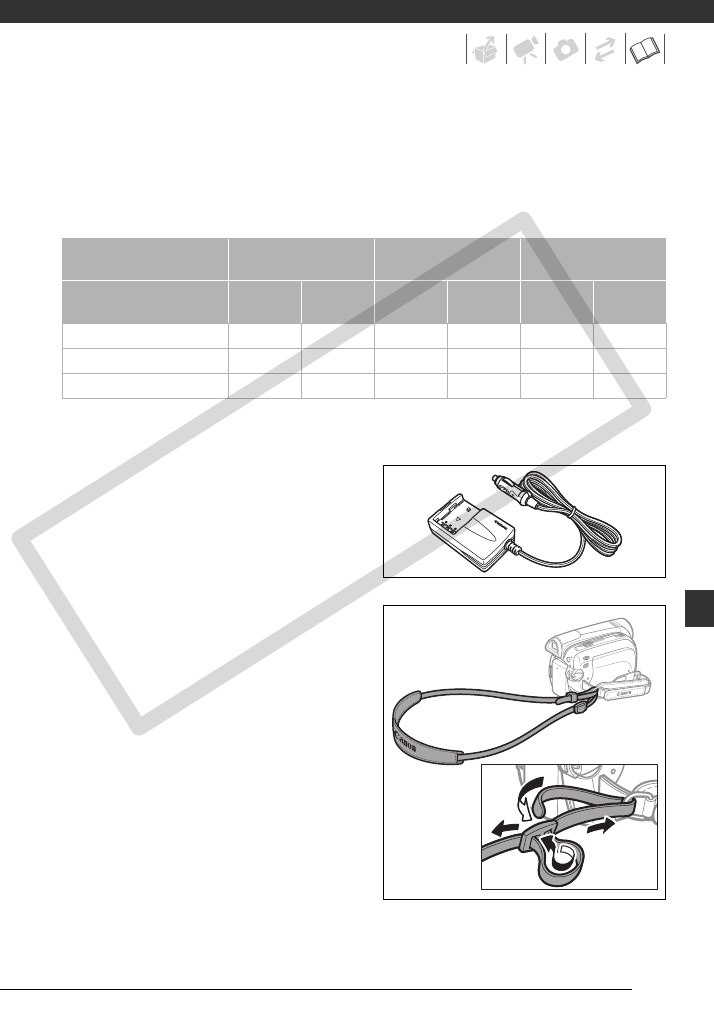
93
Recording and Playback Times
The recording and playback times given in the following table are approximate and
vary according to recording mode and charging, recording or playback conditions.
The effective usage time of the battery pack may decrease when recording in cold
surroundings, when using the brighter screen settings, etc.
* Approximate times for recording with repeated operations such as start/stop, zooming, and
power on/off.
CBC-NB2 Car Battery Charger
Use the car battery charger to charge battery
packs on the move. The car battery cable plugs
into your car’s cigarette lighter and runs off a
12-24 V DC negative ground battery.
Shoulder Strap
You can attach a shoulder strap for more
security and portability.
Pass the ends through the strap mount and
adjust the length of the strap.
Battery Pack BP-2L5 NB-2LH BP-2L14
Screen Used
Viewfinder
LCD
Viewfinder
LCD
Viewfinder
LCD
Maximum Recording Time 90 min. 85 min. 125 min. 120 min. 270 min. 260 min.
Typical Recording Time* 45 min. 45 min. 65 min. 60 min. 145 min. 140 min.
Playback Time –110 min. –145 min. –315 min.
COPY
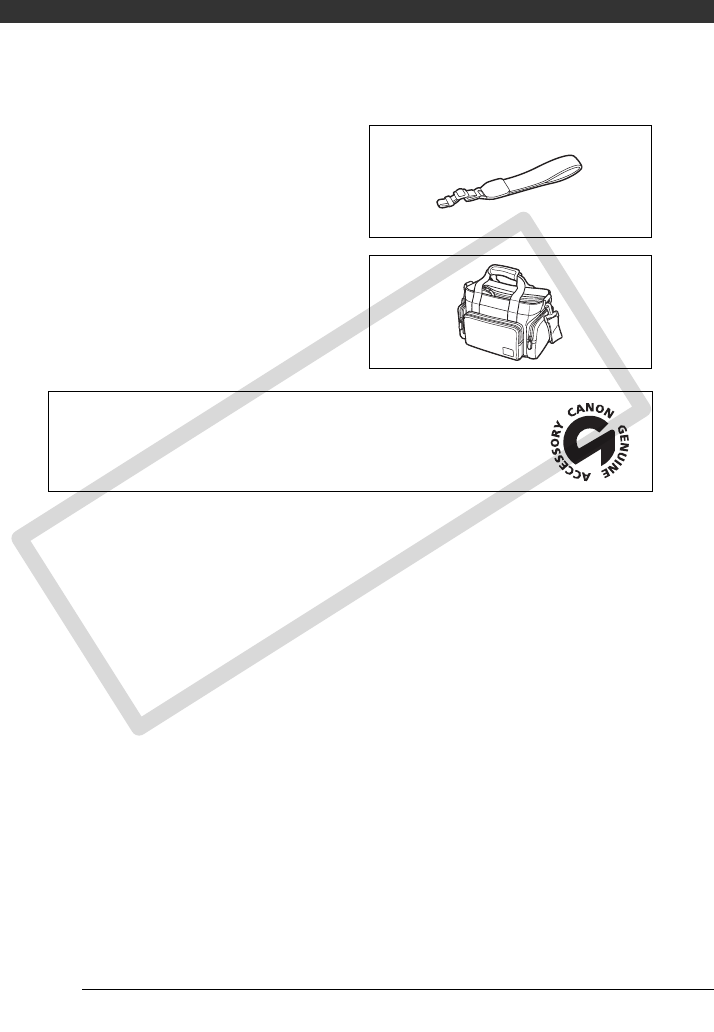
Additional Information
94
WS-20 Wrist Strap
Use this for extra additional protection for
active shooting.
SC-2000 Soft Carrying Case
A handy camcorder bag with padded
compartments and plenty of space for
accessories.
This mark identifies genuine Canon video accessories. When you
use Canon video equipment, we recommend Canon-brand
accessories or products bearing the same mark.
COPY
95
Product Codes
Provided Accessories
CA-590 Compact Power Adapter D85-1671-000
BP-2L5 Battery Pack D85-1632-000
WL-D85 Wireless Controller D83-0712-000
STV-250N Stereo Video Cable 3067A002BA (D82-0590-001)
IFC-300PCU USB Cable 6906A001AA (D82-0590-001)
Optional Accessories
NB-2LH Battery Pack 9612A001AA
BP-2L14 Battery Pack 9582A002AA
CB-2LW Battery Charger 0763B001AA
CBC-NB2 Car Battery Charger 7873A002AA
WS-20 Wrist Strap 3118A002AA (D81-0190-202)
SC-2000 Soft Carrying Case 9389A001AA
DVM-CL DV Cleaning Cassette 3134A002AA (D36-0032-201)
COPY
Additional Information
96
ZR950
1 When two values are given, the first indicates the value at full telephoto (T) and the second indicates the value at full wide-angle (W).
Specifications
System
Video Recording System 2 rotary heads, helical scanning DV system (consumer digital VCR SD system), digital
component recording
Audio Recording System PCM digital sound: 16 bit (48 kHz/2 channels); 12 bit (32 kHz)
Television System EIA standard (525 lines, 60 fields) NTSC color signal
Image Sensor 1/6-inch CCD, approx. 1,070,000 pixels
Effective pixels1 (all figures are approximate values)
16:9 Movies (advanced zoom) 410,000 (T) / 710,000 (W) pixels
(other zoom types) 550,000 pixels
4:3 Movies (advanced zoom) 310,000 (T) / 690,000 (W) pixels
(other zoom types) 690,000 pixels
Still images 800,000 pixels
Compatible Tapes Videocassettes bearing the mark
Tape Speed SP: 18.81 mm/s (0.74 ips); LP: 12.56 mm/s (0.49 ips)
Maximum Recording Time
(60 min. tape)
SP: 60 minutes; LP: 90 minutes
LCD Screen 2.7 in., wide, TFT color, approx. 112,000 pixels
Viewfinder 0.35 in., wide, TFT color, approx. 114,000 pixels
Microphone Stereo electret condenser microphone
Lens f=2.6–96.2 mm, F/2.0–5.2, 37x power zoom
35 mm equivalent (all figures are approximate values)
16:9 Movies (advanced zoom) 41.7–2,002 mm
(other zoom types) 47.1–1,743 mm
4:3 Movies (advanced zoom) 44.6–2,453 mm
(other zoom types) 44.6–1,650 mm
Still images 41.5–1,536 mm
Lens Configuration 10 elements in 8 groups (1 double-sided, aspheric element)
AF system TTL autofocus, manual focus available
Minimum Focusing Distance 1 m (3.3 ft.); 1 cm (0.39 in.) on maximum wide angle
White Balance
Auto white balance, preset white balance (DAYLIGHT, TUNGSTEN) or custom white balance
COPY
97
Minimum Illumination 2.1 lx ([NIGHT] recording program, Shutter speed at 1/8)
8 lx ( mode, Auto slow shutter [ON], Shutter speed at 1/30)
Recommended Illumination More than 100 lx
Image Stabilization Electronic
Memory Card
Recording Media SDHC (SD High Capacity) memory card, SD memory card, MultiMedia Card (MMC)*
Size of Still Images 1,152 x 864, 640 x 480 pixels
File Format Design rule for Camera File system (DCF), Exif 2.2** compliant, DPOF compliant
Image Compression Method JPEG (compression: Super Fine, Fine, Normal)
* This camcorder has been tested with SD memory cards up to 2 GB. Performance cannot be guaranteed for all memory cards.
** This camcorder supports Exif 2.2 (also called “Exif Print”). Exif Print is a standard for enhancing the communication between
camcorders and printers. By connecting to an Exif Print-compliant printer, the camcorder’s image data at the time of shooting is
used and optimized, yielding extremely high quality prints.
Input/Output Terminals
AV Terminal ∅ 3.5 mm minijack, output only
Video: 1 Vp-p/75 ohms unbalanced
Audio: -10 dBV (47 kohms load/3 kohms or less)
DV Terminal 4 pin (IEEE1394 standard), input/output
USB Terminal mini-B
Power/Others
Power supply (rated) 7.4 V DC (battery pack), 8.4 V DC (compact power adapter)
Power consumption 2.4 W (viewfinder), 2.5 W (LCD screen, normal brightness)
Operating temperature 0 – 40 °C (32 – 104 °F)
Dimensions (W x H x D) 68 x 82 x 127 mm (2.7 x 3.2 x 5.0 in.) excluding the grip belt
Weight (camcorder body only) 390 g (13.8 oz.)
COPY

Additional Information
98
CA-590 Compact Power Adapter
BP-2L5 Battery Pack
Weight and dimensions are approximate. Errors and omissions excepted. Subject to
change without notice.
Power input 100 – 240 V AC, 50/60 Hz, 0.14 – 0.08 A
Rated output 8.4 V DC, 0.6 A
Operating temperature 0 – 40 °C (32 – 104 °F)
Dimensions 46 x 26 x 70 mm (1.8 x 1.0 x 2.8 in.)
Weight 95 g (3.4 oz.)
Battery type Rechargeable Lithium Ion Battery
Rated voltage 7.4 V DC
Operating temperature 0 – 40 °C (32 – 104 °F)
Battery capacity 530 mAh
Dimensions 33.3 x 16.2 x 45.2 mm (1.3 x 0.64 x 1.8 in.)
Weight 40 g (1.4 oz.)
COPY
99
6-second auto date . . . . . . . . . . . . . . . .77
A
Abroad, using the camcorder . . . . . . . .90
Aspect ratio
of a connected TV (TV type) . . . . . .75
of movies (Widescreen) . . . . . . . . .74
Audio dubbing . . . . . . . . . . . . . . . . . . . .66
Audio mode . . . . . . . . . . . . . . . . . . . . . .44
Audio output channel . . . . . . . . . . . . . .44
Auto slow shutter . . . . . . . . . . . . . . . . .74
Autofocus (AF): AF frame
(9-point AiAF/Center point) . . . . . . . . .55
AV terminal . . . . . . . . . . . . . . . . . . . . . .61
B
Backup battery . . . . . . . . . . . . . . . . . . .21
Battery pack
Charging . . . . . . . . . . . . . . . . . . . . .19
Remaining charge indicator . . . . . .18
Beach (recording program) . . . . . . . . . .41
Beep . . . . . . . . . . . . . . . . . . . . . . . . . . .77
C
Compact power adapter . . . . . . . . . . . .19
Condensation . . . . . . . . . . . . . . . . . . . .89
Connections
to a computer . . . . . . . . . . . . . . . . .67
to a TV/VCR . . . . . . . . . . . . . . . . . .61
D
Data code . . . . . . . . . . . . . . . . . . . . . . .39
Date and time
Date format . . . . . . . . . . . . . . . . . . .78
Daylight saving time . . . . . . . . . . . .26
Time zone . . . . . . . . . . . . . . . . . . . .26
Date search . . . . . . . . . . . . . . . . . . . . . .38
Digital effects . . . . . . . . . . . . . . . . . . . . .48
Digital video input (DV dubbing) . . . . . . 64
Direct print . . . . . . . . . . . . . . . . . . . . . . 57
Direct transfer . . . . . . . . . . . . . . . . . . . . 69
DV terminal . . . . . . . . . . . . . . . . . . . 62, 67
E
EASY (recording program) . . . . . . . . . . 32
End search . . . . . . . . . . . . . . . . . . . . . . 38
Erasing still images . . . . . . . . . . . . . . . . 54
Error messages . . . . . . . . . . . . . . . . . . . 82
Exposure . . . . . . . . . . . . . . . . . . . . . . . . 46
F
File numbers . . . . . . . . . . . . . . . . . . . . . 78
Fireworks (recording program) . . . . . . . 41
Focus priority . . . . . . . . . . . . . . . . . . . . 55
FUNC. menu . . . . . . . . . . . . . . . . . . 24, 72
G
Grip belt . . . . . . . . . . . . . . . . . . . . . . . . 22
I
Image effects . . . . . . . . . . . . . . . . . . . . 48
Image jump . . . . . . . . . . . . . . . . . . . . . . 53
Image stabilizer . . . . . . . . . . . . . . . . . . 74
Index screen . . . . . . . . . . . . . . . . . . . . . 53
Initializing memory cards . . . . . . . . . . . 56
J
Joystick . . . . . . . . . . . . . . . . . . . . . . . . 23
Joystick guide . . . . . . . . . . . . . . . . . . . 23
L
Language . . . . . . . . . . . . . . . . . . . . . . . 26
LCD screen . . . . . . . . . . . . . . . . . . . . . . 27
LCD video light . . . . . . . . . . . . . . . . . . . 43
LP mode . . . . . . . . . . . . . . . . . . . . . . . . 75
Index
COPY
Additional Information
100
M
Magnifying a still image . . . . . . . . . . . . 53
Maintenance . . . . . . . . . . . . . . . . . . . . . 89
Manual exposure adjustment . . . . . . . . 46
Manual focus . . . . . . . . . . . . . . . . . . . . 45
Markers . . . . . . . . . . . . . . . . . . . . . . . . . 77
Memory card . . . . . . . . . . . . . . . . . . 30, 88
Mode switch . . . . . . . . . . . . . . . . . . . . . 32
N
Night (recording program) . . . . . . . . . . .41
O
Onscreen display selection . . . . . . . . . . 39
P
P (recording program) . . . . . . . . . . . . . .42
Playback
Movies . . . . . . . . . . . . . . . . . . . . . .36
Still images . . . . . . . . . . . . . . . . . . .52
Portrait (recording program) . . . . . . . . . 41
Power save . . . . . . . . . . . . . . . . . . . . . . 78
Print order . . . . . . . . . . . . . . . . . . . . . . . 59
Printing still images . . . . . . . . . . . . . . . . 57
Protecting still images . . . . . . . . . . . . . 55
Q
Quick Start function . . . . . . . . . . . . . . . 34
R
Recording
Movies . . . . . . . . . . . . . . . . . . . . . .31
Still images . . . . . . . . . . . . . . . . . . .50
Recording mode . . . . . . . . . . . . . . . . . . 75
Recording programs . . . . . . . . . . . . . . . 40
Recording reminder . . . . . . . . . . . . . . . 18
Remaining tape indicator . . . . . . . . . . . 18
Remote sensor . . . . . . . . . . . . . . . . . . . 22
Reviewing
Movies (Record review) . . . . . . . . . 35
Still images (Review) . . . . . . . . . . . 74
S
Screen icons . . . . . . . . . . . . . . . . . . . . 16
SD/SDHC card . . . . . . . . . . . . . . . . 30, 88
Self timer . . . . . . . . . . . . . . . . . . . . . . . 43
Serial number . . . . . . . . . . . . . . . . . . . . 13
Setup menus . . . . . . . . . . . . . . . . . 24, 73
Shutter speed . . . . . . . . . . . . . . . . . . . 42
Slideshow . . . . . . . . . . . . . . . . . . . . . . 53
Snow (recording program) . . . . . . . . . . 41
SP mode . . . . . . . . . . . . . . . . . . . . . . . 75
Special scene (recording programs) . . 40
Sports (recording program) . . . . . . . . . 41
Spotlight (recording program) . . . . . . . 41
Still image quality . . . . . . . . . . . . . . . . . 51
Still image size . . . . . . . . . . . . . . . . . . . 51
Sunset (recording program) . . . . . . . . . 41
T
Telephoto . . . . . . . . . . . . . . . . . . . . . . . 33
Transfer order . . . . . . . . . . . . . . . . . . . . 71
Transferring to a computer
Movies . . . . . . . . . . . . . . . . . . . . . . 68
Still images . . . . . . . . . . . . . . . . . . 69
Tripod . . . . . . . . . . . . . . . . . . . . . . . . . . 22
Troubleshooting . . . . . . . . . . . . . . . . . . 79
U
USB terminal . . . . . . . . . . . . . . . . . . . . 67
V
Video heads, cleaning . . . . . . . . . . . . . . 2
Videocassettes . . . . . . . . . . . . . . . . 29, 87
Viewfinder . . . . . . . . . . . . . . . . . . . . . . 32
Volume . . . . . . . . . . . . . . . . . . . . . . . . . 36
W
White balance . . . . . . . . . . . . . . . . . . . 47
Wide angle . . . . . . . . . . . . . . . . . . . . . . 33
Widescreen 16:9 . . . . . . . . . . . . . . . . . 74
Wind screen . . . . . . . . . . . . . . . . . . . . . 75
Wireless controller . . . . . . . . . . . . . . . . 22
COPY

102
CANON CONSUMER DIGITAL VIDEO EQUIPMENT LIMITED WARRANTY FOR
THE UNITED STATES
The limited warranty set forth below is given by Canon U.S.A., Inc. (“Canon USA”) with respect to Canon Consumer Digital Video
Equipment (the “Equipment”) purchased in the United States. This limited warranty is only effective upon presentation of your Bill of Sale
or other proof of purchase.
The Equipment is warranted under normal, non-commercial, personal use, against defective materials or workmanship as follows:
Parts: Defective parts will be exchanged for new parts or comparable rebuilt parts for a period of ONE YEAR from the date of original
purchase, except for a defective Video Head, which will be exchanged for a period of three months from the date of purchase.
Labor: For a period of ONE YEAR from the date of original purchase, labor will be provided free of charge by our factory service centers or
designated service facilities located in the United States.
When returning Equipment under this warranty, you must pre-pay the shipping charges, and you must enclose the Bill of Sale or other
proof of purchase with a complete explanation of the problem. During the ONE-YEAR warranty period, repairs will be made and the
Equipment will be return-shipped to you free of charge. For repairs after the warranty period is over, you will be given an estimate of the
cost of repair and an opportunity to approve or disapprove of the repair expense before it is incurred. If you approve, repairs will be made
and the Equipment will be return-shipped to you. (shipping charges apply). If you disapprove, we will return-ship the equipment at no
charge to you.
Non-Canon brand peripheral equipment and software which may be distributed with, or factory loaded on, the Equipment, are
sold “AS IS” without warranty of any kind by Canon USA, including any implied warranty regarding merchantability or fitness
for a particular purpose. The sole warranty with respect to such non-Canon brand items is given by the manufacturer or
producer thereof. If the Equipment contains a hard disk drive, Canon USA recommends that data stored on that drive be
duplicated or backed up to prevent its loss in the event of failure or other malfunction of such drive.
Canon USA shall have no responsibility under this limited warranty for use of the Equipment in conjunction with incompatible peripheral
equipment and incompatible software.
In order to obtain warranty service, contact the authorized Canon retail dealer from whom you purchased the Equipment or call the
CANON INFORMATION CENTER AT 1-800-OK-CANON). You will be directed to the nearest service facility for your Equipment.
This Limited Warranty covers all defects encountered in normal use of the Equipment and does not apply in the following cases:
A) Loss or damage to the Equipment due to abuse, mishandling, accident, improper maintenance, or failure to follow operating
instructions;
B) If the Equipment is defective as a result of leaking batteries, sand, dirt or water damage;
C) If defects or damages are caused by the use of unauthorized parts or by service other than by Canon USA's factory service
centers or authorized service facilities;
D) If the Equipment is used for commercial or industrial use.
This Limited Warranty does not cover cabinet (exterior finish), video cassette tape, head cleanings, nor does it apply to Equipment
purchased outside the United States. This warranty does not cover units sold to rental firms, military operations, hotels, schools,
hospitals or for other commercial, industrial, or institutional applications. These uses are covered only by such specific warranty as
Canon may issue with such sales.
This Limited Warranty does not apply to accessories or consumables for the Equipment, which are sold “AS IS”, without warranty of any
kind by Canon USA.
Please retain this warranty card and your Bill of Sale as a permanent record of your purchase. This card is most important in order to be
sure you are contacted right away should there be a safety inspection, modification or product recall under applicable laws or
regulations.
NO IMPLIED WARRANTY, INCLUDING MERCHANTABILITY AND FITNESS FOR A PARTICULAR PURPOSE APPLIES TO THIS EQUIPMENT
AFTER THE APPLICABLE PERIOD OF EXPRESS WARRANTY OR GUARANTY, EXCEPT AS MENTIONED ABOVE, GIVEN BY ANY PERSON, FIRM
OR CORPORATION WITH RESPECT TO THIS EQUIPMENT SHALL BIND THE UNDERSIGNED (SOME STATES DO NOT ALLOW LIMITATIONS ON
HOW LONG AN IMPLIED WARRANTY LASTS, SO THE ABOVE LIMITATION OR EXCLUSION MAY NOT APPLY TO YOU). CANON USA SHALL
NOT BE LIABLE FOR LOSS OF REVENUES OR PROFITS, EXPENSE FOR SUBSTITUTE EQUIPMENT OR SERVICE, STORAGE CHARGES, LOSS
OR CORRUPTION OF DATA, INCLUDING WITHOUT LIMITATION, LOSS OR CORRUPTION OF DATA STORED ON THE EQUIPMENT’S HARD
DRIVE, OR ANY OTHER SPECIAL, INCIDENTAL OR CONSEQUENTIAL DAMAGES CAUSED BY THE USE, MISUSE OR INABILITY TO USE THE
EQUIPMENT, REGARDLESS OF THE LEGAL THEORY ON WHICH THE CLAIM IS BASED, AND EVEN IF CANON USA HAS BEEN ADVISED OF
THE POSSIBILITY OF SUCH DAMAGES. NOR SHALL RECOVERY OF ANY KIND AGAINST CANON USA BE GREATER THAN THE PURCHASE
PRICE OF THE EQUIPMENT SOLD BY CANON USA AND CAUSING THE ALLEGED DAMAGE. WITHOUT LIMITING THE FOREGOING, YOU
ASSUME ALL RISK AND LIABILITY FOR LOSS, DAMAGE OR INJURY TO YOU AND YOUR PROPERTY AND TO OTHERS AND THEIR PROPERTY
ARISING OUT OF USE, MISUSE OR INABILITY TO USE THE EQUIPMENT NOT CAUSED DIRECTLY BY THE NEGLIGENCE OF CANON USA.
(SOME STATES DO NOT ALLOW THE EXCLUSION OR LIMITATION OF INCIDENTAL OR CONSEQUENTIAL DAMAGES, SO THE ABOVE
LIMITATION MAY NOT APPLY TO YOU).THIS WARRANTY SHALL NOT EXTEND TO ANYONE OTHER THAN THE ORIGINAL PURCHASER OF
THIS EQUIPMENT OR THE PERSON FOR WHOM IT WAS PURCHASED AS A GIFT.
This warranty gives you specific legal rights, and you may also have other rights which vary from state to state.
CANON U.S.A., INC.
U.S.A.
COPY

103
CANON CONSUMER DIGITAL VIDEO EQUIPMENT LIMITED WARRANTY
The limited warranty set forth below is given by Canon Canada Inc. (“Canon Canada”) with respect to Canon Consumer Digital Video Equipment (the
"Equipment") purchased in Canada. This limited warranty is only effective upon presentation of a bill of sale or other proof of purchase for this
Equipment to a Canon Service Facility when repairs are required.
The Equipment is warranted under normal, non-commercial, personal use, against defective materials or workmanship as follows:
Parts: Defective parts will be exchanged for new parts or, at Canon Canada’s option, comparable rebuilt parts for a period of one year from the date of
original purchase, except Video Heads which will be exchanged for a period of 3 months from the date of purchase.
Labour: For a period of one year from the date of original purchase, labour will be provided free of charge by our Canon Service Facilities in Canada.
This limited warranty covers all defects except where:
(a) The loss or damage to the product results from:
i) accident, natural disaster, mishandling, abuse, neglect, unauthorized product modification or failure to follow instructions contained in the
instruction manual;
ii) the use of accessories, attachments, products, supplies, parts or devices with the Equipment that do not conform to Canon specifications
or that cause abnormally frequent service problems;
iii) repairs or services performed by any party other than a Canon Service Facility;
iv) defective batteries or any exposure to water, sand or dirt;
v) shipping (claim must be presented to the shipper);
(b) Any serial number on the video Equipment is altered or removed.
(c) The Equipment is used for commercial, professional or industrial purposes.
This limited warranty does not cover the cabinet (exterior finish) of the Equipment, media, nor does it apply to Equipment purchased outside Canada.
If the Equipment contains a hard disk drive, Canon Canada recommends that data stored on that drive be duplicated or backed up to prevent its loss
in the event of a failure or other malfunction of such drive.
TO OBTAIN WARRANTY SERVICE
Ship your Equipment in its original carton, box or equivalent, properly packed, fully insured with shipping charges prepaid, together with a copy of
your bill of sale or other proof of purchase and a description of the problem to any of the Canon Service Facilities in Canada.
LIMITATIONS
Except as otherwise required by applicable legislation, this warranty is in lieu of all other warranties, conditions, guarantees or representations,
express or implied, statutory or otherwise, relative to the Equipment, including implied warranties or conditions of merchantability or fitness for a
particular purpose.
Canon Canada assumes no liability for special, consequential or incidental damages, loss or corruption of data including, without limitation, data
stored on the hard disk drive of the Equipment or loss that may arise, whether on account of negligence or otherwise, from the use, misuse or inability
to use the Equipment (including loss of profit, revenue, media or enjoyment) or from failure to conform to any express or implied warranties,
conditions, guarantees or representations. Any recovery under this limited warranty shall not exceed the purchase price of the equipment. Canon
Canada does not assume or authorize any other person to assume for Canon Canada any other liability with respect to this equipment.
This warranty does not extend to any person other than the original purchaser of the Equipment or the person for whom it was purchased as a gift and
states your exclusive remedy.
NOTICE TO CONSUMER
If you plan to take important videos or if the product has not been used for some time, please check all functions with the instruction book before
using it.
CANADA
COPY
U.S.A. CANON U.S.A., INC. NEW JERSEY OFFICE
100 Jamesburg Road, Jamesburg, NJ 08831 USA
CANON U.S.A., INC. CHICAGO OFFICE
100 Park Blvd., Itasca, IL 60143 USA
CANON U.S.A., INC. LOS ANGELES OFFICE
15955 Alton Parkway, Irvine, CA 92618 USA
CANON U.S.A., INC. HONOLULU OFFICE
210 Ward Avenue, Suite 200, Honolulu, Hl 96814 USA
❖ If you have any questions, call the Canon U.S.A. Information
Center toll-free at 1-800-828-4040 (U.S.A. only).
CANADA CANON CANADA INC. NATIONAL HEADQUARTERS
6390 Dixie Road, Mississauga, Ontario L5T 1P7
CANON CANADA INC. CALGARY
2828, 16th Street, N.E. Calgary, Alberta T2E 7K7
CANON CANADA INC. MONTREAL
5990 Côte de Liesse, Quebec H4T 1V7
❖ If you have any questions, call the Canon Canada Information
Center toll-free at 1-800-828-4040 (CANADA only).
❖ Si vous avez des questions, veuillez téléphoner sand frais au
Canada 1-800-828-4040 (CANADA seulement).
MEXICO CANON MEXICANA, S. DE R.L. DE C.V.
Periférico Sur No. 4124, Col. Ex-Rancho de Anzaldo,
C.P. 01900 México, D.F., México
CANON U.S.A., INC. NEW JERSEY OFFICE
100 Jamesburg Road, Jamesburg, NJ 08831 USA
CENTRO Y CANON LATIN AMERICA, INC.
SURAMÉRICA 703 Waterford Way, Suite 400, Miami, FL 33126 USA
ASIA CANON HONGKONG COMPANY LTD.
19/F, The Metropolis Tower, 10 Metropolis Drive,
Hunghom, Kowloon, Hong Kong
The information in this manual is verified as of 1 January 2008.
Les informations contenues dans ce manuel ont été vérifiées le 1er janvier 2008.
La información de este manual fué verificada el 1 de enero de 2008.
Printed on 70% reused paper.
Document réalisé avec du papier recyclé à 70%.
Impreso en papel reciclado al 70%.
PUB. DIM-841 © CANON INC. 2008
COPY
