Cardin Elettronica T-S435 Automatic alarm opening system User Manual 1

Cardin Elettronica spa Automatic alarm opening system 1

Contents

User Manual 1

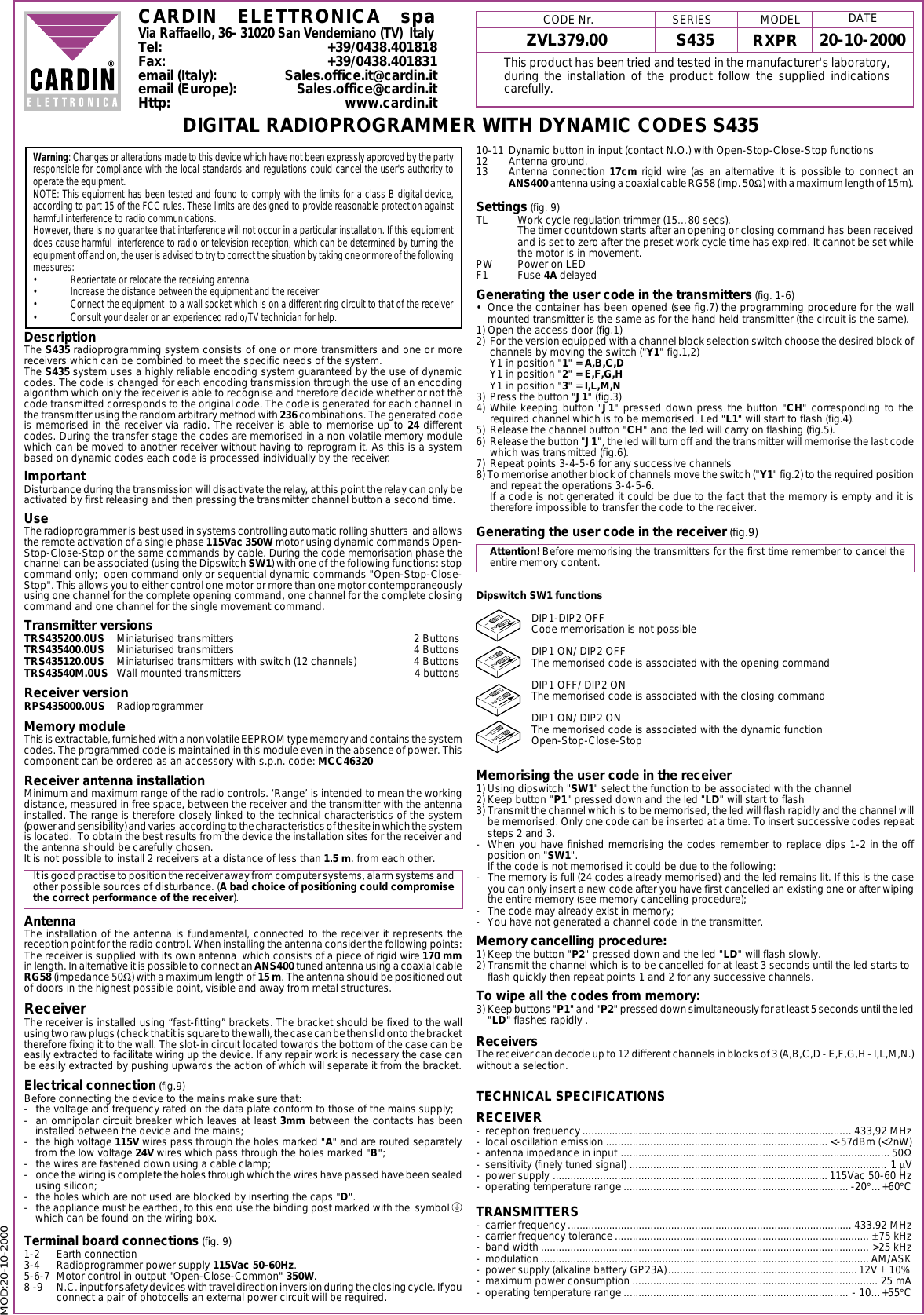
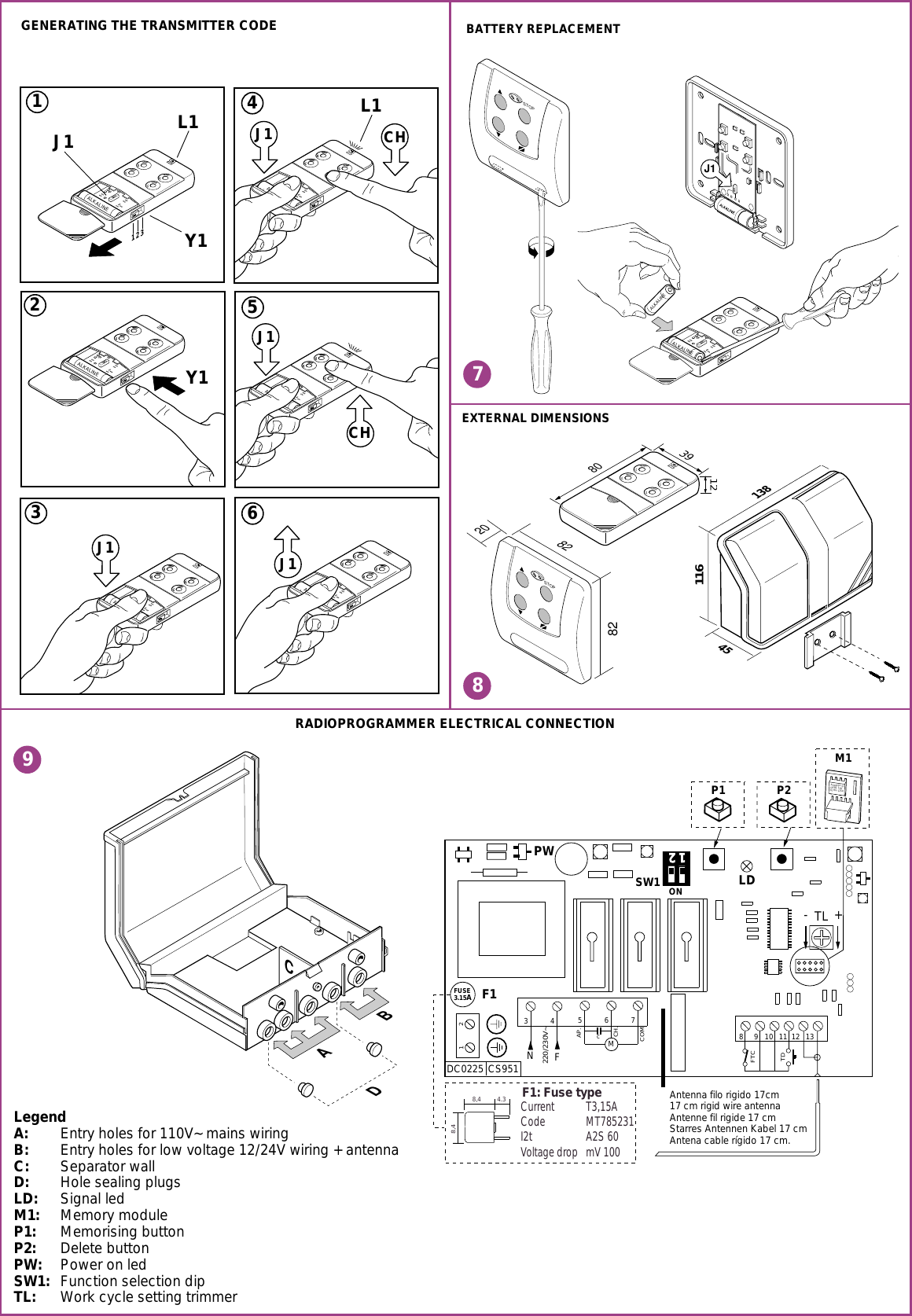
MOD:20-10-2000ZVL379.00 S435 20-10-2000RXPRCARDIN ELETTRONICA spaVia Raffaello, 36- 31020 San Vendemiano (TV)  ItalyTel: +39/0438.401818Fax: +39/0438.401831email (Italy): Sales.office.it@cardin.itemail (Europe): Sales.office@cardin.itHttp: www.cardin.itWarning: Changes or alterations made to this device which have not been expressly approved by the partyresponsible for compliance with the local standards and regulations could cancel the user's authority tooperate the equipment.NOTE: This equipment has been tested and found to comply with the limits for a class B digital device,according to part 15 of the FCC rules. These limits are designed to provide reasonable protection againstharmful interference to radio communications.However, there is no guarantee that interference will not occur in a particular installation. If this equipmentdoes cause harmful  interference to radio or television reception, which can be determined by turning theequipment off and on, the user is advised to try to correct the situation by taking one or more of the followingmeasures:• Reorientate or relocate the receiving antenna• Increase the distance between the equipment and the receiver• Connect the equipment  to a wall socket which is on a different ring circuit to that of the receiver• Consult your dealer or an experienced radio/TV technician for help.DescriptionThe S435 radioprogramming system consists of one or more transmitters and one or morereceivers which can be combined to meet the specific needs of the system.The S435 system uses a highly reliable encoding system guaranteed by the use of dynamiccodes. The code is changed for each encoding transmission through the use of an encodingalgorithm which only the receiver is able to recognise and therefore decide whether or not thecode transmitted corresponds to the original code. The code is generated for each channel inthe transmitter using the random arbitrary method with 236 combinations. The generated codeis memorised in the receiver via radio. The receiver is able to memorise up to 24 differentcodes. During the transfer stage the codes are memorised in a non volatile memory modulewhich can be moved to another receiver without having to reprogram it. As this is a systembased on dynamic codes each code is processed individually by the receiver.ImportantDisturbance during the transmission will disactivate the relay, at this point the relay can only beactivated by first releasing and then pressing the transmitter channel button a second time.UseThe radioprogrammer is best used in systems controlling automatic rolling shutters  and allowsthe remote activation of a single phase 115Vac 350W motor using dynamic commands Open-Stop-Close-Stop or the same commands by cable. During the code memorisation phase thechannel can be associated (using the Dipswitch SW1) with one of the following functions: stopcommand only;  open command only or sequential dynamic commands "Open-Stop-Close-Stop". This allows you to either control one motor or more than one motor contemporaneouslyusing one channel for the complete opening command, one channel for the complete closingcommand and one channel for the single movement command.Transmitter versionsTRS435200.0US Miniaturised transmitters 2 ButtonsTRS435400.0US Miniaturised transmitters 4 ButtonsTRS435120.0US Miniaturised transmitters with switch (12 channels) 4 ButtonsTRS43540M.0US Wall mounted transmitters 4 buttonsReceiver versionRPS435000.0US RadioprogrammerMemory moduleThis is extractable, furnished with a non volatile EEPROM type memory and contains the systemcodes. The programmed code is maintained in this module even in the absence of power. Thiscomponent can be ordered as an accessory with s.p.n. code: MCC46320Receiver antenna installationMinimum and maximum range of the radio controls. ‘Range’ is intended to mean the workingdistance, measured in free space, between the receiver and the transmitter with the antennainstalled. The range is therefore closely linked to the technical characteristics of the system(power and sensibility) and varies  according to the characteristics of the site in which the systemis located.  To obtain the best results from the device the installation sites for the receiver andthe antenna should be carefully chosen.It is not possible to install 2 receivers at a distance of less than 1.5 m. from each other.It is good practise to position the receiver away from computer systems, alarm systems andother possible sources of disturbance. (A bad choice of positioning could compromisethe correct performance of the receiver).AntennaThe installation of the antenna is fundamental, connected to the receiver it represents thereception point for the radio control. When installing the antenna consider the following points:The receiver is supplied with its own antenna  which consists of a piece of rigid wire 170 mmin length. In alternative it is possible to connect an ANS400 tuned antenna using a coaxial cableRG58 (impedance 50Ω) with a maximum length of 15 m. The antenna should be positioned outof doors in the highest possible point, visible and away from metal structures.ReceiverThe receiver is installed using “fast-fitting” brackets. The bracket should be fixed to the wallusing two raw plugs ( check that it is square to the wall), the case can be then slid onto the brackettherefore fixing it to the wall. The slot-in circuit located towards the bottom of the case can beeasily extracted to facilitate wiring up the device. If any repair work is necessary the case canbe easily extracted by pushing upwards the action of which will separate it from the bracket.Electrical connection (fig.9)Before connecting the device to the mains make sure that:- the voltage and frequency rated on the data plate conform to those of the mains supply;- an omnipolar circuit breaker which leaves at least 3mm between the contacts has beeninstalled between the device and the mains;- the high voltage 115V wires pass through the holes marked "A" and are routed separatelyfrom the low voltage 24V wires which pass through the holes marked "B";- the wires are fastened down using a cable clamp;- once the wiring is complete the holes through which the wires have passed have been sealedusing silicon;- the holes which are not used are blocked by inserting the caps "D".- the appliance must be earthed, to this end use the binding post marked with the  symbol which can be found on the wiring box.Terminal board connections (fig. 9)1-2 Earth connection3-4 Radioprogrammer power supply 115Vac 50-60Hz.5-6-7 Motor control in output "Open-Close-Common" 350W.8 -9 N.C. input for safety devices with travel direction inversion during the closing cycle. If youconnect a pair of photocells an external power circuit will be required. DIGITAL RADIOPROGRAMMER WITH DYNAMIC CODES S43510-11 Dynamic button in input (contact N.O.) with Open-Stop-Close-Stop functions12 Antenna ground.13 Antenna connection 17cm rigid wire (as an alternative it is possible to connect anANS400 antenna using a coaxial cable RG58 (imp. 50Ω) with a maximum length of 15m).Settings (fig. 9)TL Work cycle regulation trimmer (15…80 secs).The timer countdown starts after an opening or closing command has been receivedand is set to zero after the preset work cycle time has expired. It cannot be set whilethe motor is in movement.PW Power on LEDF1 Fuse 4A delayedGenerating the user code in the transmitters (fig. 1-6)• Once the container has been opened (see fig.7) the programming procedure for the wallmounted transmitter is the same as for the hand held transmitter (the circuit is the same).1) Open the access door (fig.1)2) For the version equipped with a channel block selection switch choose the desired block ofchannels by moving the switch ("Y1" fig.1,2)Y1 in position "1" = A,B,C,DY1 in position "2" = E,F,G,HY1 in position "3" = I,L,M,N3) Press the button "J1" (fig.3)4) While keeping button "J1" pressed down press the button "CH" corresponding to therequired channel which is to be memorised. Led "L1" will start to flash (fig.4).5) Release the channel button "CH" and the led will carry on flashing (fig.5).6) Release the button "J1", the led will turn off and the transmitter will memorise the last codewhich was transmitted (fig.6).7) Repeat points 3-4-5-6 for any successive channels8) To memorise another block of channels move the switch ("Y1" fig.2) to the required positionand repeat the operations 3-4-5-6.If a code is not generated it could be due to the fact that the memory is empty and it istherefore impossible to transfer the code to the receiver.Generating the user code in the receiver (fig.9)Attention! Before memorising the transmitters for the first time remember to cancel theentire memory content.Dipswitch SW1 functionsDIP1-DIP2 OFFCode memorisation is not possibleDIP1 ON/ DIP2 OFFThe memorised code is associated with the opening commandDIP1 OFF/ DIP2 ONThe memorised code is associated with the closing commandDIP1 ON/ DIP2 ONThe memorised code is associated with the dynamic functionOpen-Stop-Close-StopMemorising the user code in the receiver1) Using dipswitch "SW1" select the function to be associated with the channel2) Keep button "P1" pressed down and the led "LD" will start to flash3) Transmit the channel which is to be memorised, the led will flash rapidly and the channel willbe memorised. Only one code can be inserted at a time. To insert successive codes repeatsteps 2 and 3.- When you have finished memorising the codes remember to replace dips 1-2 in the offposition on "SW1".If the code is not memorised it could be due to the following:- The memory is full (24 codes already memorised) and the led remains lit. If this is the caseyou can only insert a new code after you have first cancelled an existing one or after wipingthe entire memory (see memory cancelling procedure);- The code may already exist in memory;- You have not generated a channel code in the transmitter.Memory cancelling procedure:1) Keep the button "P2" pressed down and the led "LD" will flash slowly.2) Transmit the channel which is to be cancelled for at least 3 seconds until the led starts toflash quickly then repeat points 1 and 2 for any successive channels.To wipe all the codes from memory:3) Keep buttons "P1" and "P2" pressed down simultaneously for at least 5 seconds until the led"LD" flashes rapidly .ReceiversThe receiver can decode up to 12 different channels in blocks of 3 (A,B,C,D - E,F,G,H - I,L,M,N.)without a selection.TECHNICAL SPECIFICATIONSRECEIVER- reception frequency........................................................................................... 433,92 MHz- local oscillation emission ........................................................................... <-57dBm (<2nW)- antenna impedance in input ........................................................................................... 50Ω- sensitivity (finely tuned signal) ....................................................................................... 1 µV- power supply ............................................................................................. 115Vac 50-60 Hz- operating temperature range ............................................................................ -20°…+60°CTRANSMITTERS- carrier frequency................................................................................................ 433.92 MHz- carrier frequency tolerance...................................................................................... ±75 kHz- band width ............................................................................................................... >25 kHz- modulation ............................................................................................................... AM/ASK- power supply (alkaline battery GP23A)................................................................12V ± 10%- maximum power consumption ................................................................................... 25 mA- operating temperature range ............................................................................ - 10…+55°CMODEL DATECODE Nr. SERIESThis product has been tried and tested in the manufacturer's laboratory,during the installation of the product follow the supplied indicationscarefully.21212121
GENERATING THE TRANSMITTER CODEALKALINE3J1ALKALINE123J1Y11L14ALKALINEJ1 CHL1ALKALINE6J1ALKALINE2Y1ALKALINE5J1CHRADIOPROGRAMMER ELECTRICAL CONNECTIONLegendA: Entry holes for 110V~ mains wiringB: Entry holes for low voltage 12/24V wiring + antennaC: Separator wallD: Hole sealing plugsLD: Signal ledM1: Memory moduleP1: Memorising buttonP2: Delete buttonPW: Power on ledSW1: Function selection dipTL: Work cycle setting trimmer+-TL34567M8 9 10 11 12 13PWFUSE3.15AFTCTDAP.COMCH.8,48,44.3P1 P2DC0225 CS951M1ASAGSH QDFER 139KJHG 125412FN220/230V~c 1 2  ONSW1Antenna filo rigido 17cm17 cm rigid wire antennaAntenne fil rigide 17 cmStarres Antennen Kabel 17 cmAntena cable rígido 17 cm.LDF1F1: Fuse typeCurrent T3,15A Code MT785231 I2t A2S 60 Voltage drop  mV 100123980ALKALINEALKALINEEXTERNAL DIMENSIONSBATTERY REPLACEMENT 116 13845ALKALINESTOPJ1 82 2082STOP78BACD9

Navigation menu