Conexant Systems 3163B1 WLAN PCMCIA NETWORK Adapter User Manual Data sheet

Conexant Systems Inc. WLAN PCMCIA NETWORK Adapter Data sheet

Data sheet

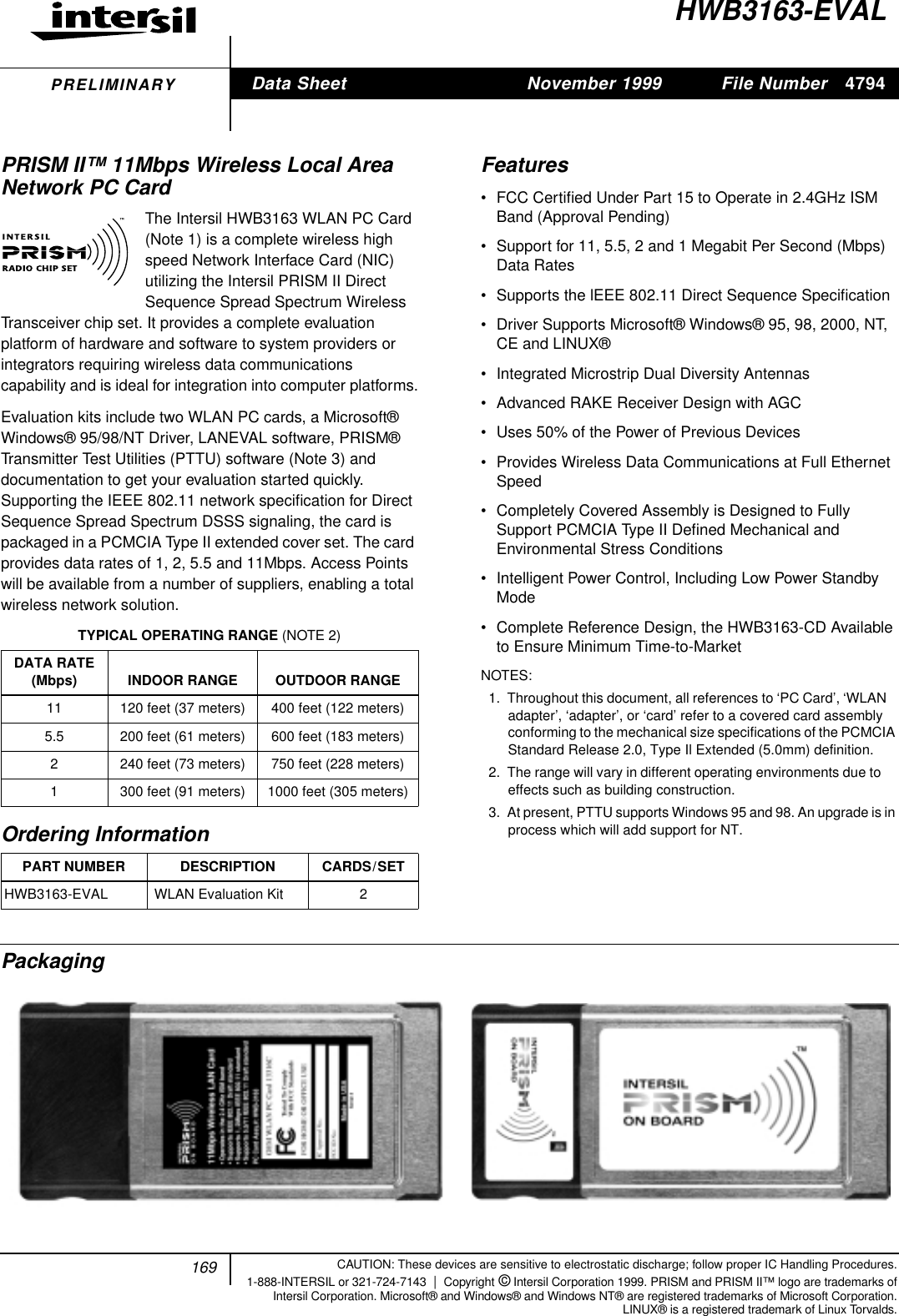
169File Number 4794CAUTION: These devices are sensitive to electrostatic discharge; follow proper IC Handling Procedures.1-888-INTERSIL or 321-724-7143 |Copyright © Intersil Corporation 1999. PRISM and PRISM II™ logo are trademarks ofIntersil Corporation. Microsoft® and Windows® and Windows NT® are registered trademarks of Microsoft Corporation.LINUX® is a registered trademark of Linux Torvalds.PRELIMINARYHWB3163-EVALPRISM II™ 11Mbps Wireless Local AreaNetwork PC CardThe Intersil HWB3163 WLAN PC Card(Note 1) is a complete wireless highspeed Network Interface Card (NIC)utilizing the Intersil PRISM II DirectSequence Spread Spectrum WirelessTransceiver chip set. It provides a complete evaluationplatform of hardware and software to system providers orintegrators requiring wireless data communicationscapability and is ideal for integration into computer platforms.Evaluation kits include two WLAN PC cards, a Microsoft®Windows® 95/98/NT Driver, LANEVAL software, PRISM®Transmitter Test Utilities (PTTU) software (Note 3) anddocumentation to get your evaluation started quickly.Supporting the IEEE 802.11 network specification for DirectSequence Spread Spectrum DSSS signaling, the card ispackaged in a PCMCIA Type II extended cover set. The cardprovides data rates of 1, 2, 5.5 and 11Mbps. Access Pointswill be available from a number of suppliers, enabling a totalwireless network solution.Features• FCC Certified Under Part 15 to Operate in 2.4GHz ISMBand (Approval Pending)• Support for 11, 5.5, 2 and 1 Megabit Per Second (Mbps)Data Rates• Supports the lEEE 802.11 Direct Sequence Specification• Driver Supports Microsoft® Windows® 95, 98, 2000, NT,CE and LINUX®• Integrated Microstrip Dual Diversity Antennas• Advanced RAKE Receiver Design with AGC• Uses 50% of the Power of Previous Devices• Provides Wireless Data Communications at Full EthernetSpeed• Completely Covered Assembly is Designed to FullySupport PCMCIA Type II Defined Mechanical andEnvironmental Stress Conditions• Intelligent Power Control, Including Low Power StandbyMode• Complete Reference Design, the HWB3163-CD Availableto Ensure Minimum Time-to-MarketNOTES:1. Throughout this document, all references to ‘PC Card’, ‘WLANadapter’, ‘adapter’, or ‘card’ refer to a covered card assemblyconforming to the mechanical size specifications of the PCMCIAStandard Release 2.0, Type Il Extended (5.0mm) definition.2. The range will vary in different operating environments due toeffects such as building construction.3. At present, PTTU supports Windows 95 and 98. An upgrade is inprocess which will add support for NT.PackagingTYPICAL OPERATING RANGE (NOTE 2)DATA RATE(Mbps) INDOOR RANGE OUTDOOR RANGE11 120 feet (37 meters) 400 feet (122 meters)5.5 200 feet (61 meters) 600 feet (183 meters)2 240 feet (73 meters) 750 feet (228 meters)1 300 feet (91 meters) 1000 feet (305 meters)Ordering InformationPART NUMBER DESCRIPTION CARDS/SETHWB3163-EVAL  WLAN Evaluation Kit 2™Data Sheet November 1999[ /Title(HWB3163-EVAL)/Sub-ject(PRISM II11Mbps Wire-lessLocalAreaNet-workPCCard)/Author ()/Key-words(Inter-silCorpo-ration,semi-con-ductor,Wire-lessCom-muni-cations, RF,RadioFre-quency
170Functional OverviewThe WLAN PC Card is designed to operate in the 2.4GHz ISMfrequency band, channels 1 to 11, as specified by the FCC inthe USA. The Card will also operate on channels 12 through14, where permitted by local regulatory authorities (refer toTable 2). Radio equipment must be certified in a country prior touse. Refer to Table 3 for a list of countries and agencies thathave approved the HWB3163-EVAL for operation.The Intersil PRISM Chip Set allows for high level integrationfor reduced size, increased throughput, improved radioperformance and faster time to market. The WLAN PC cardimplements Direct Sequence Spread Spectrum DSSStechnology providing superior noise and signal jammingimmunity including less severe impact from unintentionalradiators such as microwave ovens. The user can connectthe PC Card in an ad-hoc peer to peer networking scheme,allowing for instant network setup in any office environment.By using an access point, the wireless LAN can be set up toallow for a greater number of users to interconnect, and toincrease the coverage area. With a portal (i.e., Access Point),the wireless LAN can be easily connected into an existingwired LAN, allowing for easy expansion of the service.Compared to the first generation PRISM I chip set, thePRISM II generation offers:• 3.3V operation for reduced power dissipation• 50% reduction in current drain for extended battery life• Transmitter Automatic Level Control (ALC/AGC) toprovide constant RF power output• Sophisticated RAKE receiver and Automatic GainControl (AGC) for improved multipath performance• Higher level of chip integration and less peripheralcomponents to yield 30% reduction in material cost• Support of optional IEEE 802.11 Short Preamble forsignificantly increased data throughputA complete Reference Design CD, the HWB3163-CD isavailable to ensure minimum time-to-market. This CDcontains detailed information for manufacturing a PCMCIAWLAN assembly, including Gerber PC board files, anaccurate Bill of Material with component sourcing andcomplete mechanical drawings.Related LiteratureTo learn more about what the IEEE 802.11 is, refer to:• Tech Brief TB337, Intersil Corporation, “A Brief Tutorialon Spread Spectrum and Packet Radio” [1].For a more detailed description of radio operation, pleaserefer to:• Application Note AN9864, Intersil Corporation,“HWB3163-EVAL PRISM II 11Mbps WLAN PCMCIACard User’s Guide” [2]The HFA3841 Media Access Controller(MAC) Protocol HandlerThe HFA3841 MAC and its firmware are responsible forrunning the IEEE 802.11 protocol in the WLAN card. Thissection describes the features of IEEE 802.11 that areimplemented.The functions supported by the STA (station) Firmware are:• CSMA/CA (Carrier Sense Multiple Access withCollision Avoidance) with Random Backoff• WEP Security• Short/Long Preamble with multirate• RTS/CTS Handshake (Ready To Send/Clear To Send)and NAV Management (Network Allocation Vector)• MAC Level Acknowledgments (Media Access Control)• Re-Transmission of Unacknowledged Frames• Duplicate Detection and Rejection• Broadcast and Multicast Frames• Fragmentation and Re-Assembly• Power Management (Planned)• Timestamp Synchronization• DCF (Distributed Coordination Function)• PCF (Point Coordination Function)• Beacon Generation in an Ad-Hoc Network• Probe Response Generation in an Ad-Hoc NetworkCard Information StructureThe standard Intersil WLAN PC Card will be supplied withthe following information embedded in the CIS. It should benoted that in most systems this information is displayedwhen the card is inserted. Customization of the CIS forspecific customer requirements is available upon request, toenable customer information to be displayed when the cardis inserted.TABLE 1.FUNCTION NAME CONTENTManufacturer’s ID 00Function ID Network AdapterProduct Revision 1Manufacturer Intersil CorporationProduct HFA3841PROGLOTHWB3163-EVAL
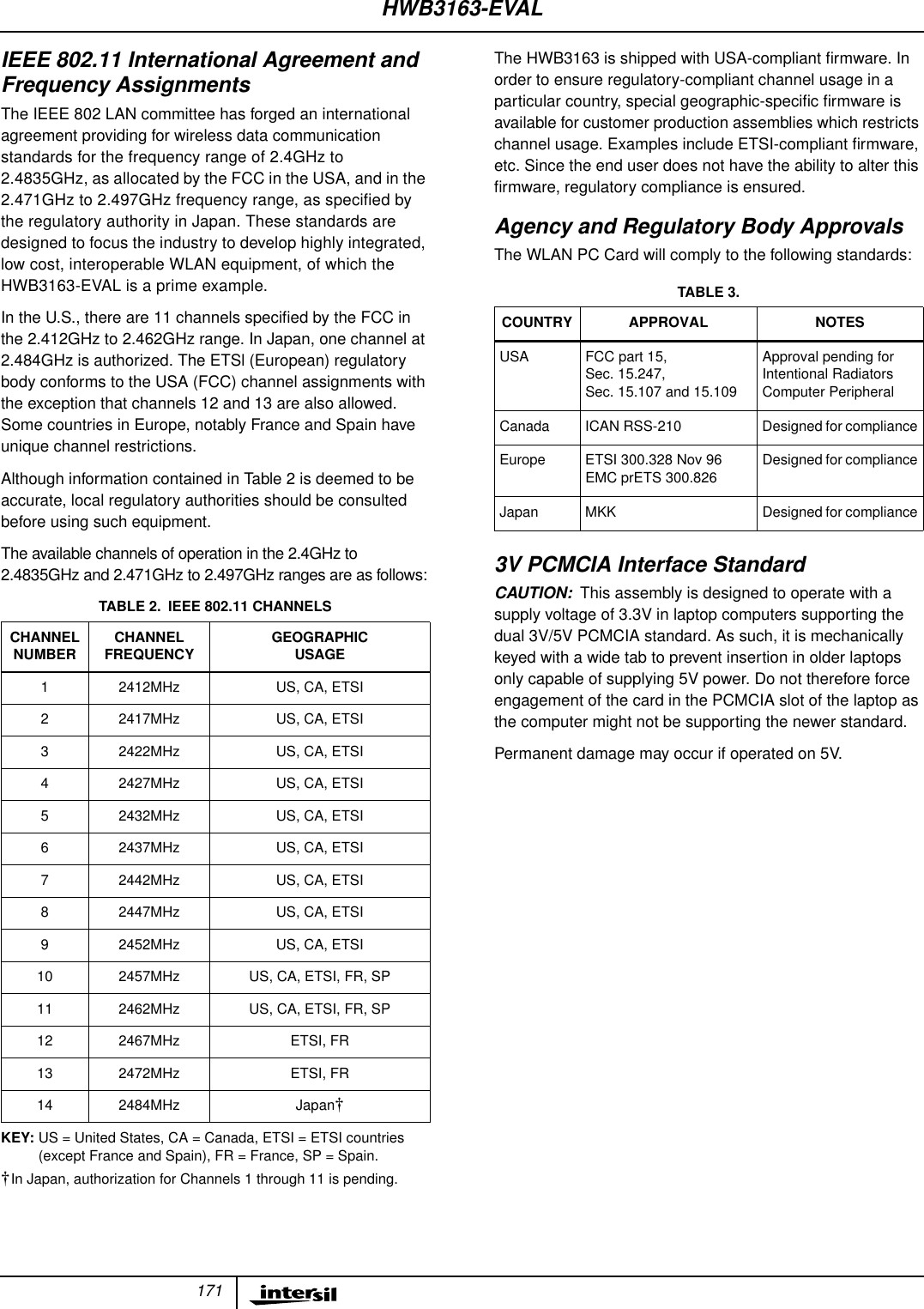
171IEEE 802.11 International Agreement andFrequency AssignmentsThe IEEE 802 LAN committee has forged an internationalagreement providing for wireless data communicationstandards for the frequency range of 2.4GHz to2.4835GHz, as allocated by the FCC in the USA, and in the2.471GHz to 2.497GHz frequency range, as specified bythe regulatory authority in Japan. These standards aredesigned to focus the industry to develop highly integrated,low cost, interoperable WLAN equipment, of which theHWB3163-EVAL is a prime example.In the U.S., there are 11 channels specified by the FCC inthe 2.412GHz to 2.462GHz range. In Japan, one channel at2.484GHz is authorized. The ETSl (European) regulatorybody conforms to the USA (FCC) channel assignments withthe exception that channels 12 and 13 are also allowed.Some countries in Europe, notably France and Spain haveunique channel restrictions.Although information contained in Table 2 is deemed to beaccurate, local regulatory authorities should be consultedbefore using such equipment.The available channels of operation in the 2.4GHz to2.4835GHz and 2.471GHz to 2.497GHz ranges are as follows:The HWB3163 is shipped with USA-compliant firmware. Inorder to ensure regulatory-compliant channel usage in aparticular country, special geographic-specific firmware isavailable for customer production assemblies which restrictschannel usage. Examples include ETSI-compliant firmware,etc. Since the end user does not have the ability to alter thisfirmware, regulatory compliance is ensured.Agency and Regulatory Body ApprovalsThe WLAN PC Card will comply to the following standards:3V PCMCIA Interface StandardCAUTION: This assembly is designed to operate with asupply voltage of 3.3V in laptop computers supporting thedual 3V/5V PCMCIA standard. As such, it is mechanicallykeyed with a wide tab to prevent insertion in older laptopsonly capable of supplying 5V power. Do not therefore forceengagement of the card in the PCMCIA slot of the laptop asthe computer might not be supporting the newer standard.Permanent damage may occur if operated on 5V.TABLE 2. IEEE 802.11 CHANNELSCHANNELNUMBER CHANNELFREQUENCY GEOGRAPHICUSAGE1 2412MHz US, CA, ETSI2 2417MHz US, CA, ETSI3 2422MHz US, CA, ETSI4 2427MHz US, CA, ETSI5 2432MHz US, CA, ETSI6 2437MHz US, CA, ETSI7 2442MHz US, CA, ETSI8 2447MHz US, CA, ETSI9 2452MHz US, CA, ETSI10 2457MHz US, CA, ETSI, FR, SP11 2462MHz US, CA, ETSI, FR, SP12 2467MHz ETSI, FR13 2472MHz ETSI, FR14 2484MHz Japan†KEY: US = United States, CA = Canada, ETSI = ETSI countries(except France and Spain), FR = France, SP = Spain.†In Japan, authorization for Channels 1 through 11 is pending.TABLE 3.COUNTRY APPROVAL NOTESUSA FCC part 15,Sec. 15.247,Sec. 15.107 and 15.109Approval pending forIntentional RadiatorsComputer PeripheralCanada ICAN RSS-210 Designed for complianceEurope ETSI 300.328 Nov 96EMC prETS 300.826Designed for complianceJapan MKK Designed for complianceHWB3163-EVAL
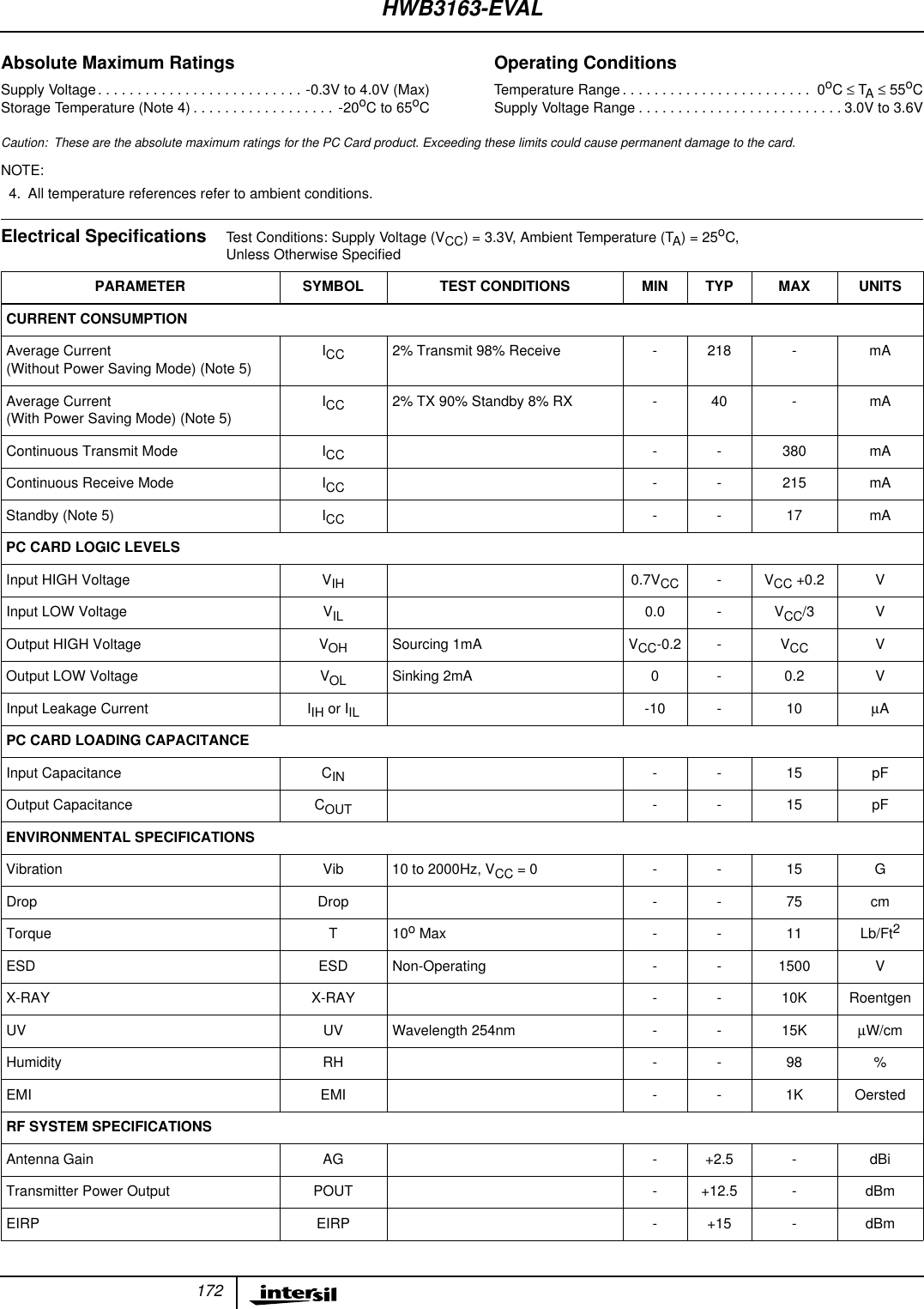
172Absolute Maximum Ratings Operating ConditionsSupply Voltage . . . . . . . . . . . . . . . . . . . . . . . . . . -0.3V to 4.0V (Max)Storage Temperature (Note 4) . . . . . . . . . . . . . . . . . . -20oC to 65oCTemperature Range. . . . . . . . . . . . . . . . . . . . . . . . 0oC≤TA≤ 55oCSupply Voltage Range . . . . . . . . . . . . . . . . . . . . . . . . . . 3.0V to 3.6VCaution: These are the absolute maximum ratings for the PC Card product. Exceeding these limits could cause permanent damage to the card.NOTE:4. All temperature references refer to ambient conditions.Electrical Specifications Test Conditions: Supply Voltage (VCC) = 3.3V, Ambient Temperature (TA) = 25oC,Unless Otherwise SpecifiedPARAMETER SYMBOL TEST CONDITIONS MIN TYP MAX UNITSCURRENT CONSUMPTIONAverage Current(Without Power Saving Mode) (Note 5)ICC 2% Transmit 98% Receive - 218 - mAAverage Current(With Power Saving Mode) (Note 5)ICC 2% TX 90% Standby 8% RX - 40 - mAContinuous Transmit Mode ICC - - 380 mAContinuous Receive Mode ICC - - 215 mAStandby (Note 5) ICC - - 17 mAPC CARD LOGIC LEVELSInput HIGH Voltage VIH 0.7VCC -VCC +0.2 VInput LOW Voltage VIL 0.0 - VCC/3 VOutput HIGH Voltage VOH Sourcing 1mA VCC-0.2 - VCC VOutput LOW Voltage VOL Sinking 2mA 0 - 0.2 VInput Leakage Current IIH or IIL -10 - 10 µAPC CARD LOADING CAPACITANCEInput Capacitance CIN - - 15 pFOutput Capacitance COUT - - 15 pFENVIRONMENTAL SPECIFICATIONSVibration Vib 10 to 2000Hz, VCC = 0 - - 15 GDrop Drop - - 75 cmTorque T 10o Max - - 11 Lb/Ft2ESD ESD Non-Operating - - 1500 VX-RAY X-RAY - - 10K RoentgenUV UV Wavelength 254nm - - 15K µW/cmHumidity RH - - 98 %EMI EMI - - 1K OerstedRF SYSTEM SPECIFICATIONSAntenna Gain AG - +2.5 - dBiTransmitter Power Output POUT - +12.5 - dBmEIRP EIRP - +15 - dBmHWB3163-EVAL
173Back PC Card LabelReferencesFor Intersil documents available on the internet, see web sitehttp://www.intersil.com/Intersil AnswerFAX (321) 724-7800.[1] TB337 Tech Brief, Intersil Corporation, “A Brief Tutorialon Spread Spectrum and Packet Radio”, AnswerFAXdocument No. 82337.[2] AN9864 Application Note, Intersil Corporation,“HWB3163-EVAL PRISM II 11Mbps WLAN PCMCIACard User’s Guide”Further information can be found in the following:• Intersil PRISM II datasheets, web home page,http://www.intersil.com/prism/prism.asp• IEEE 802.11 Standards Project (available from theIEEE, New York, USA).• PC Card V2.1 Standard.Receive Sensitivity RX_S  5.5Mbps, 8% PER or 1E-5 BER - -87 - dBm11Mbps, 8% PER or 1E-5 BER - -84 - dBmMaximum Receive Level RX_MAX PER <8% -4 - - dBmThird Order Intercept Point (Input) IIP3_90 -90 dBm input -16 -3 - dBmIIP3_25 -25 dBm input +10 +20 - dBmImage Rejection IR PER <8% - 60 - dBIF Rejection IFR PER <8% 60 100 - dBAdjacent Channel Rejection ACR PER <8% (Note 6) - 46 - dBData Rate (Physical Layer) Rate - 1, 2, 5.5and 11- MbpsNOTES:5. Refer to Application Note “PRISM Power Management Modes” AN9665 [5].6. The adjacent channel measurement is carried out on two channels separated by 25MHz (5 channels).Electrical Specifications Test Conditions: Supply Voltage (VCC) = 3.3V, Ambient Temperature (TA) = 25oC,Unless Otherwise Specified  (Continued)PARAMETER SYMBOL TEST CONDITIONS MIN TYP MAX UNITSPIN 1PIN 35PIN 34PIN 68TOP (LED, THIS SIDE)BOTTOMVIEW, LOOKING INTO 68 PIN FEMALE CONNECTOR3V KEYFIGURE 1. EDGE VIEW, PCMCIA CARDHWB3163-EVAL
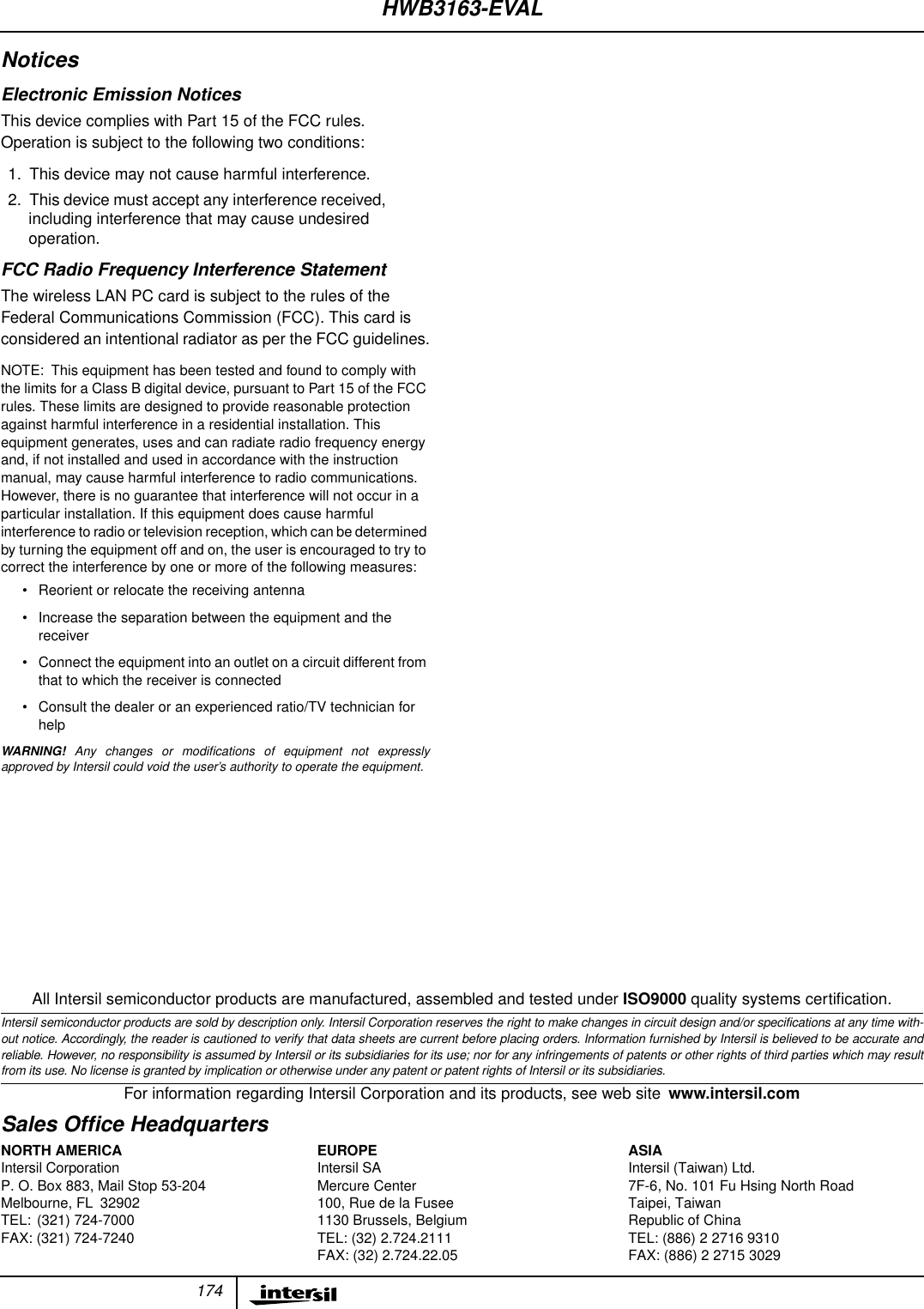
174All Intersil semiconductor products are manufactured, assembled and tested under ISO9000 quality systems certification.Intersil semiconductor products are sold by description only. Intersil Corporation reserves the right to make changes in circuit design and/or specifications at any time with-out notice. Accordingly, the reader is cautioned to verify that data sheets are current before placing orders. Information furnished by Intersil is believed to be accurate andreliable. However, no responsibility is assumed by Intersil or its subsidiaries for its use; nor for any infringements of patents or other rights of third parties which may resultfrom its use. No license is granted by implication or otherwise under any patent or patent rights of Intersil or its subsidiaries.For information regarding Intersil Corporation and its products, see web site www.intersil.comSales Office HeadquartersNORTH AMERICAIntersil CorporationP. O. Box 883, Mail Stop 53-204Melbourne, FL 32902TEL: (321) 724-7000FAX: (321) 724-7240EUROPEIntersil SAMercure Center100, Rue de la Fusee1130 Brussels, BelgiumTEL: (32) 2.724.2111FAX: (32) 2.724.22.05ASIAIntersil (Taiwan) Ltd.7F-6, No. 101 Fu Hsing North RoadTaipei, TaiwanRepublic of ChinaTEL: (886) 2 2716 9310FAX: (886) 2 2715 3029NoticesElectronic Emission NoticesThis device complies with Part 15 of the FCC rules.Operation is subject to the following two conditions:1. This device may not cause harmful interference.2. This device must accept any interference received,including interference that may cause undesiredoperation.FCC Radio Frequency Interference StatementThe wireless LAN PC card is subject to the rules of theFederal Communications Commission (FCC). This card isconsidered an intentional radiator as per the FCC guidelines.NOTE: This equipment has been tested and found to comply withthe limits for a Class B digital device, pursuant to Part 15 of the FCCrules. These limits are designed to provide reasonable protectionagainst harmful interference in a residential installation. Thisequipment generates, uses and can radiate radio frequency energyand, if not installed and used in accordance with the instructionmanual, may cause harmful interference to radio communications.However, there is no guarantee that interference will not occur in aparticular installation. If this equipment does cause harmfulinterference to radio or television reception, which can be determinedby turning the equipment off and on, the user is encouraged to try tocorrect the interference by one or more of the following measures:• Reorient or relocate the receiving antenna• Increase the separation between the equipment and thereceiver• Connect the equipment into an outlet on a circuit different fromthat to which the receiver is connected• Consult the dealer or an experienced ratio/TV technician forhelpWARNING! Any changes or modifications of equipment not expresslyapproved by Intersil could void the user’s authority to operate the equipment.HWB3163-EVAL

Navigation menu