Conexant Systems 37300XU Wireless LAN transmitter User Manual

Conexant Systems Inc. Wireless LAN transmitter

Manual

1TMFile Number FNXXXXCAUTION: These devices are sensitive to electrostatic discharge; follow proper IC Handling Procedures.1-888-INTERSIL or 321-724-7143 |Intersil and Design is a trademark of Intersil Americas Inc.Copyright © Intersil Americas Inc. 2001, All Rights ReservedPRELIMINARYISL37300XU-EVALPRISM 2.5 11Mbps Wireless Local Area Network USB CardThe Intersil ISL37300XU WLAN USB-card is a complete wireless high speedNetwork Interface Card (NIC) utilizing theIntersil PRISM® 2.5 Direct SequenceSpread Spectrum Wireless Transceiver chip set. It provides acomplete PRISM 2.5 reference design evaluation platform ofhardware and software to system providers or integrators requiringwireless data communications capability and is ideal forintegration into computer platforms.The Evaluation kit (ISL37300XU-EVAL) includes two WLANUSB-cards designed to Intersil’s Prism reference design, MicrosoftWindows® Driver, Local Area Network evaluation software,Prism Test Utilities (PTU) (note 1) software and documentation tocomplete the evaluation. It supports the IEEE 802.11b networkspecification for Direct Sequence Spread spectrum DSSSsignaling, providing data rates of 1, 2, 5.5, and 11 Mbps.Evaluation kit software updates are available on the Intersil WebSite.In addition to the evaluation kit, a complete PRISM chipsetWLAN reference design package (ISL37300XU-CD) is available.It contains all the documentation needed for manufacturing of thePrism 2.5 USB wireless network card including: Cadence/AllegroLayout, Gerber files, Concept schematic, Bill of Materials,assembly and mechanical drawings, test plan, and even a copy ofthe application for FCC equipment authorization. Customers wholicense the reference design also receive password access to FCCIntersil’s Premier Web site for up to the minute updates onhardware and software.Features• Certified Under Part 15 to Operate in 2.4GHz ISM Band (Approval Pending)• Support for 11, 5.5, 2 and 1 Megabit Per Second (Mbps) Data Rates• Supports the lEEE 802.11 Direct Sequence Specification• Driver Supports Microsoft® Windows® 95, 98, 98SE, 2000, NT and ME• Supports Dual Diversity Antennas• Advanced RAKE Receiver Design with Decision Feedback Equalizer combats multipath fading• Provides Wireless Data Communications at Full Ethernet Speed• Designed to Fully Support USB specification 1.1 Defined Mechanical and Environmental Stress Conditions• Intelligent Power Control, Including IEEE 802.11 Power Save Mode• Complete Reference Design, the ISL37300XU CD is available to ensure Minimum Time-to-MarketNOTES:1. At present, PTU supports Windows 95, 98 and 98SE. An upgrade is in process which will add support for NT.2. The range will vary in different operating environments due to effects such as building construction PackagingOrdering InformationPART NUMBER DESCRIPTION CARDS/SETISL37300XU-EVAL  WLAN Evaluation Kit 2Data Sheet September 2001tle jechow ()atoCI aree OesCW ar
2Access Points will be available from a number of suppliers,enabling a totally wireless network solution. Typical operatingranges are shown in Table 1..Functional OverviewThe WLAN USB-Card is designed to operate in the 2.4GHz ISMfrequency band, channels 1 to 11, as specified by the FCC in the USA.The card will also operate on channels 12 through 14, where permittedby local regulatory authorities. Radio equipment must be certified in acountry prior to use. Refer to Table 4 for a list of countries andagencies that have approved the ISL37300XU-EVAL for operation.The Intersil PRISM Chip Set allows for high level integration forreduced size, increased throughput, improved radio performanceand faster time to market. The WLAN USB-card implementsDirect Sequence Spread Spectrum DSSS technology providingsuperior noise and signal jamming immunity including less severeimpact from unintentional radiators such as microwave ovens. Theuser can connect the USB-card in an ad-hoc peer to peernetworking scheme, allowing for instant network setup in anyoffice environment. By using an access point, the wireless LANcan be set up to allow for a greater number of users to interconnect,and to increase the coverage area. With a portal (i.e. Access Point),the wireless LAN can be easily connected into an existing wiredLAN, allowing for easy expansion of the service.Compared to the PRISM II chip set, the PRISM 2.5 generationoffers:•Low loss front end designed for maximum range•Higher level of chip integration and less peripheral components to reduce material costs•Support of optional IEEE 802.11 Short Preamble for significantly increased data throughputA complete Reference Design for the ISL37300XU is available toensure minimum time-to-market. This information contains detailsfor manufacturing a USB-card WLAN assembly, including GerberPC board files, a Bill of Material with component sourcing,mechanical drawings, a detailed Radio Description with debugdirections and a test plan. The ISL3873 Media Access Controller (MAC) Protocol HandlerThe ISL3873 MAC/Baseband Processor and its firmware areresponsible for running the IEEE 802.11 protocol in the WLANcard. This section describes the features of IEEE 802.11 that areimplemented.The functions supported by the STA (station) Firmware are:•CSMA/CA (Carrier Sense Multiple Access with Collision Avoidance) with Random Backoff•WEP Security•Short/Long Preamble with multirate•RTS/CTS Handshake (Ready To Send/Clear To Send) and NAV Management (Network Allocation Vector)•MAC Level Acknowledgments (Media Access Control)•Re-Transmission of Unacknowledged Frames•Duplicate Detection and Rejection•Broadcast and Multicast Frames•Fragmentation and Re-Assembly•Power Management (Planned)•Timestamp Synchronization•DCF (Distributed Coordination Function)•Beacon Generation in an Ad-Hoc Network•Probe Response Generation in an Ad-Hoc NetworkCard Information StructureThe standard Intersil WLAN USB-card will be supplied withinformation embedded in the PDA for use in enumeration. Table 2shows the Plug Record and the default information. Customizationof the enumeration values can be performed by modifying thePDA plug records and reflashing the PDA, Primary, andSecondary. Please refer to the Prism Driver Programmers Manualfor more information.TABLE 1. TYPICAL OPERATING RANGE (NOTE 2 )DATA RATE (Mbps) INDOOR RANGE  OUTDOOR RANGE11 120 feet (37 meters) 500 feet (152 meters)5.5 200 feet (61 meters) 800 feet (243 meters)2 240 feet (73 meters) 1300 feet (396 meters)1 300 feet (91 meters) 1750 feet (533 meters)TABLE 2.Plug Record Contents Usage Default401 Vendor/Product IDXXXX XXXX407 Bus/Self Powered Bus Powered (value XXXX)FNXXXX
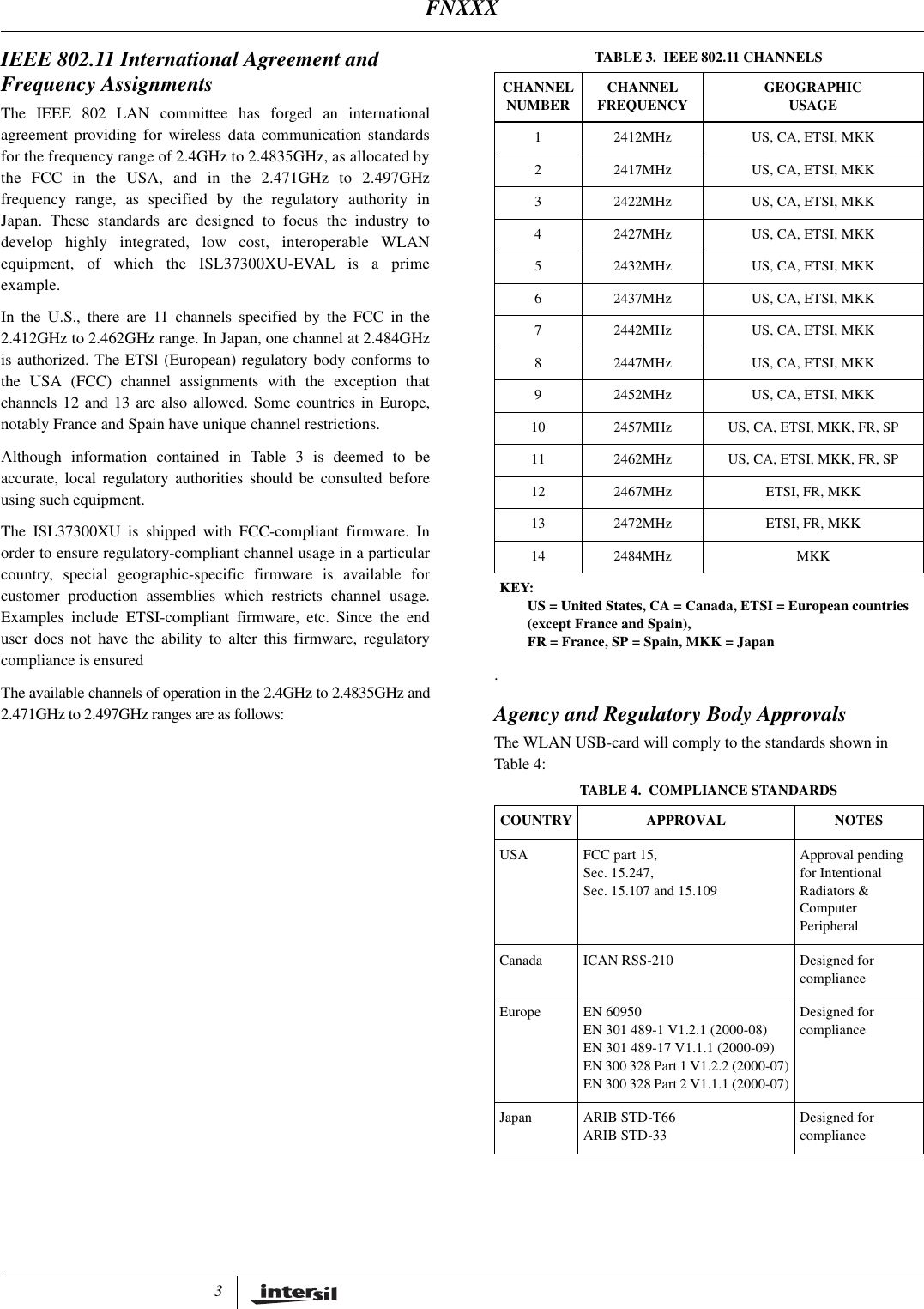
3IEEE 802.11 International Agreement and Frequency AssignmentsThe IEEE 802 LAN committee has forged an internationalagreement providing for wireless data communication standardsfor the frequency range of 2.4GHz to 2.4835GHz, as allocated bythe FCC in the USA, and in the 2.471GHz to 2.497GHzfrequency range, as specified by the regulatory authority inJapan. These standards are designed to focus the industry todevelop highly integrated, low cost, interoperable WLANequipment, of which the ISL37300XU-EVAL is a primeexample.In the U.S., there are 11 channels specified by the FCC in the2.412GHz to 2.462GHz range. In Japan, one channel at 2.484GHzis authorized. The ETSl (European) regulatory body conforms tothe USA (FCC) channel assignments with the exception thatchannels 12 and 13 are also allowed. Some countries in Europe,notably France and Spain have unique channel restrictions.Although information contained in Table 3 is deemed to beaccurate, local regulatory authorities should be consulted beforeusing such equipment. The ISL37300XU is shipped with FCC-compliant firmware. Inorder to ensure regulatory-compliant channel usage in a particularcountry, special geographic-specific firmware is available forcustomer production assemblies which restricts channel usage.Examples include ETSI-compliant firmware, etc. Since the enduser does not have the ability to alter this firmware, regulatorycompliance is ensuredThe available channels of operation in the 2.4GHz to 2.4835GHz and2.471GHz to 2.497GHz ranges are as follows: .Agency and Regulatory Body ApprovalsThe WLAN USB-card will comply to the standards shown inTable 4:TABLE 3. IEEE 802.11 CHANNELSCHANNELNUMBER CHANNELFREQUENCY GEOGRAPHICUSAGE1 2412MHz US, CA, ETSI, MKK2 2417MHz US, CA, ETSI, MKK3 2422MHz US, CA, ETSI, MKK4 2427MHz US, CA, ETSI, MKK5 2432MHz US, CA, ETSI, MKK6 2437MHz US, CA, ETSI, MKK7 2442MHz US, CA, ETSI, MKK8 2447MHz US, CA, ETSI, MKK9 2452MHz US, CA, ETSI, MKK10 2457MHz US, CA, ETSI, MKK, FR, SP11 2462MHz US, CA, ETSI, MKK, FR, SP12 2467MHz ETSI, FR, MKK13 2472MHz ETSI, FR, MKK14 2484MHz MKKKEY:US = United States, CA = Canada, ETSI = European countries (except France and Spain), FR = France, SP = Spain, MKK = JapanTABLE 4. COMPLIANCE STANDARDSCOUNTRY APPROVAL NOTESUSA FCC part 15,Sec. 15.247,Sec. 15.107 and 15.109Approval pending for Intentional Radiators & Computer PeripheralCanada ICAN RSS-210 Designed for complianceEurope EN 60950EN 301 489-1 V1.2.1 (2000-08)EN 301 489-17 V1.1.1 (2000-09)EN 300 328 Part 1 V1.2.2 (2000-07)EN 300 328 Part 2 V1.1.1 (2000-07)Designed for complianceJapan ARIB STD-T66ARIB STD-33Designed for complianceFNXXX
4FCC Information to userThis product does not contain any user serviceable componentsand is to be used with approved antennas only. Any productchanges or modifications will invalidate all applicable regulatorycertifications and approvals.FCC Electronic Emission NoticesThis device complies with part 15 of the FCC Rules. Operation issubject to the following two conditions:1. This device may not cause harmful interference2. This device must accept any interference received, including interference that may cause undesired operation.FCC Radio Frequency Interference statementThis equipment has been tested and found to comply with thelimits for a class B digital device, pursuant to Part 15 of the FCCRules. These limits are designed to provide reasonable protectionagainst harmful interference when the equipment is operated in acommercial environment. This equipment generates, uses and canradiate radio frequency energy and, if not installed and used inaccordance with the instructions, may cause harmful interferenceto radio communications.Operation of this equipment in a residential area may causeharmful interference in which case the user will be required tocorrect the interference at his own expense.If this equipment does cause harmful interference to radio ortelevision reception, which can be determined by turning theequipment off and on, the user is encouraged to try to correct theinterference by one or more of the following measures•Reorient or relocate the receiving antenna.•Increase the separation between the equipment and receiver.•Connect the equipment into an outlet on a circuit different from that to which the receiver is connected.•Consult the dealer or an experienced radio/TV technician for help.ReferencesFor Intersil documents available on the internet, see web sitehttp://www.intersil.com or Intersil AnswerFAX (321) 724-7800.[1] TB337 Tech Brief, Intersil Corporation, “A Brief Tutorial on Spread Spectrum and Packet Radio”, AnswerFAX document No. 82337.[2] TB382 Tech Brief, Intersil Corporation, “Measurement of WLAN Receiver Sensitivity”[3] AN9850 Application Note, Intersil Corporation, “Complementary Code Keying Made Simple”[4] TB395, Tech Brief, Intersil Corporation, “RF Probing of the ISL37300P and the ISL37300XU”[5] AN9829 Application Note, Intersil Corporation, “Brief Tutorial on IEEE 802.11 Wireless LANs”[6] AN9820 Application Note, Intersil Corporation, “A Condensed Review of Spread Spectrum Techniques for ISM Band Systems”Further information can be found in the following:•Intersil PRISM 2.5 data sheets, web home page, http://www.intersil.com/design/prism/ser-p25-11mbps.asp•IEEE 802.11 Standards Project (available from the IEEE, New York, USA).FNXXXX
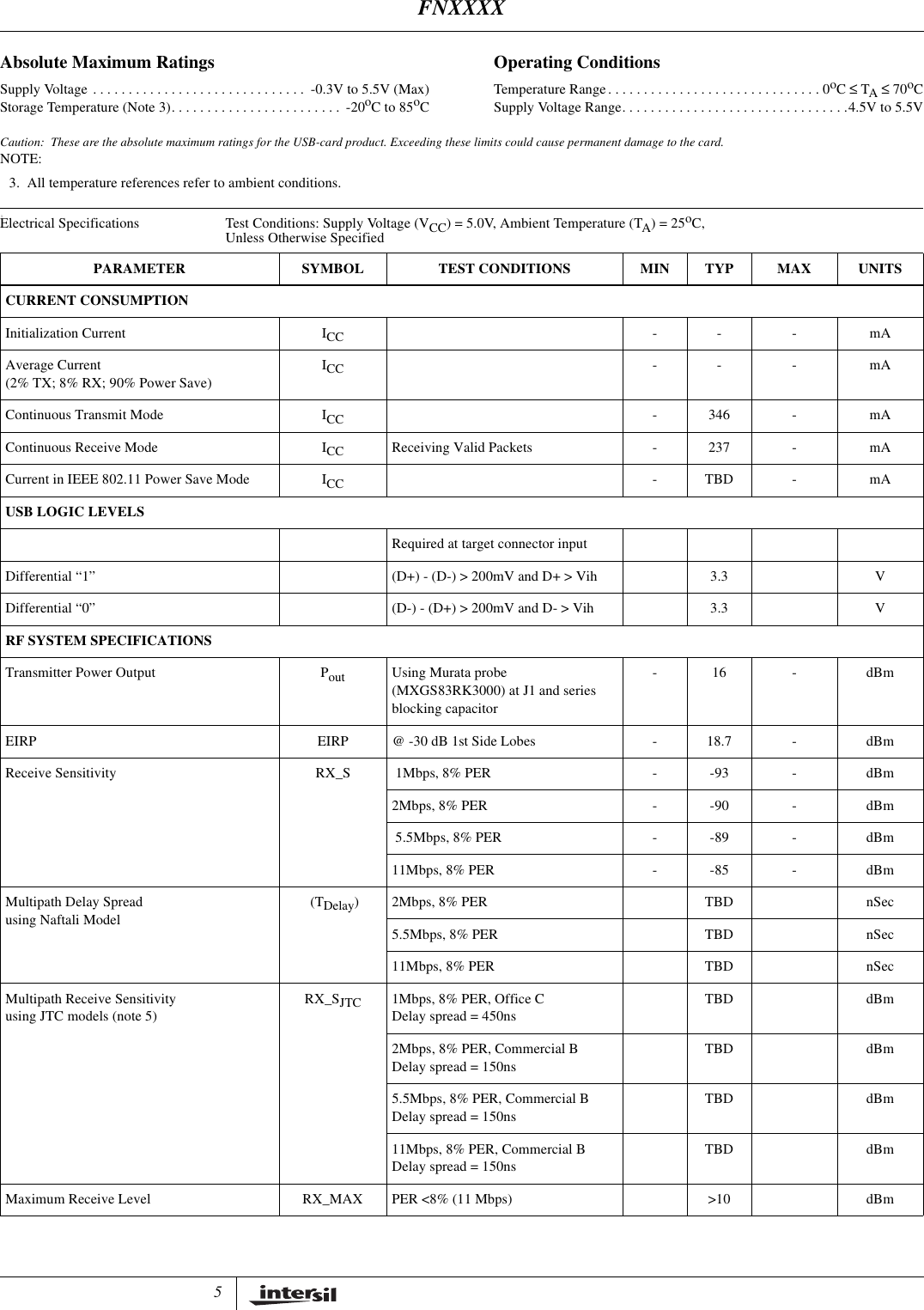
5 1Absolute Maximum Ratings Operating ConditionsSupply Voltage . . . . . . . . . . . . . . . . . . . . . . . . . . . . . .  -0.3V to 5.5V (Max)Storage Temperature (Note 3). . . . . . . . . . . . . . . . . . . . . . . .  -20oC to 85oCTemperature Range. . . . . . . . . . . . . . . . . . . . . . . . . . . . . . 0oC ≤ TA ≤ 70oCSupply Voltage Range. . . . . . . . . . . . . . . . . . . . . . . . . . . . . . . .4.5V to 5.5VCaution: These are the absolute maximum ratings for the USB-card product. Exceeding these limits could cause permanent damage to the card.NOTE:3. All temperature references refer to ambient conditions.Electrical Specifications Test Conditions: Supply Voltage (VCC) = 5.0V, Ambient Temperature (TA) = 25oC,Unless Otherwise Specified PARAMETER SYMBOL TEST CONDITIONS MIN TYP MAX UNITSCURRENT CONSUMPTIONInitialization Current ICC -- - mAAverage Current(2% TX; 8% RX; 90% Power Save)ICC -- - mAContinuous Transmit Mode ICC -346 - mAContinuous Receive Mode ICC Receiving Valid Packets - 237 - mACurrent in IEEE 802.11 Power Save Mode ICC -TBD - mAUSB LOGIC LEVELSRequired at target connector inputDifferential “1”(D+) - (D-) > 200mV and D+ > Vih 3.3 VDifferential “0”(D-) - (D+) > 200mV and D- > Vih 3.3 VRF SYSTEM SPECIFICATIONSTransmitter Power Output Pout Using Murata probe (MXGS83RK3000) at J1 and series blocking capacitor- 16 - dBmEIRP EIRP @ -30 dB 1st Side Lobes - 18.7 - dBmReceive Sensitivity RX_S  1Mbps, 8% PER - -93 - dBm2Mbps, 8% PER - -90 - dBm 5.5Mbps, 8% PER - -89 - dBm11Mbps, 8% PER - -85 - dBmMultipath Delay Spreadusing Naftali Model (TDelay) 2Mbps, 8% PER TBD nSec5.5Mbps, 8% PER TBD nSec11Mbps, 8% PER TBD nSecMultipath Receive Sensitivityusing JTC models (note 5)RX_SJTC 1Mbps, 8% PER, Office CDelay spread = 450nsTBD dBm2Mbps, 8% PER, Commercial BDelay spread = 150nsTBD dBm5.5Mbps, 8% PER, Commercial BDelay spread = 150nsTBD dBm11Mbps, 8% PER, Commercial BDelay spread = 150nsTBD dBmMaximum Receive Level RX_MAX PER <8% (11 Mbps) >10 dBmFNXXXX
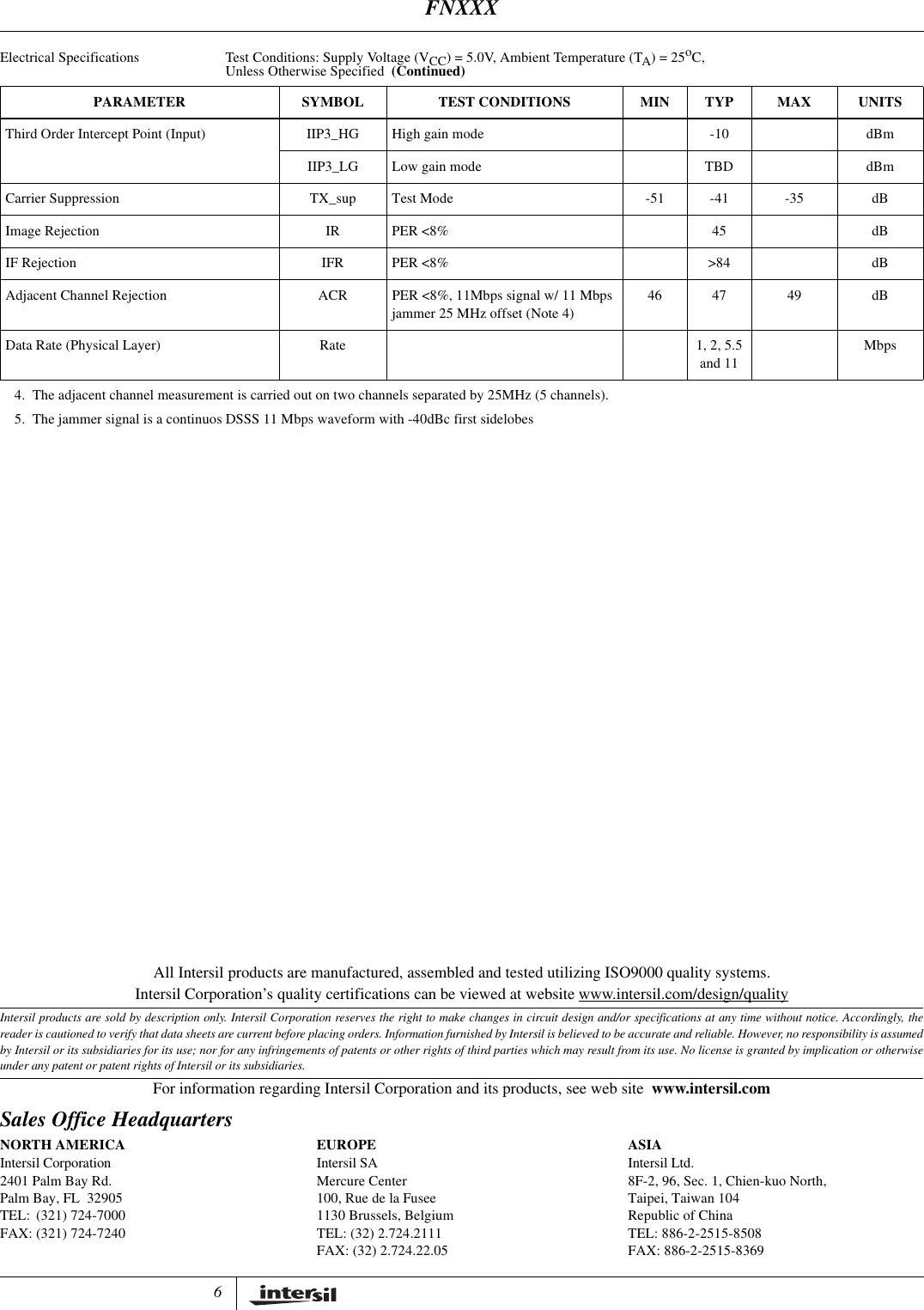
6All Intersil products are manufactured, assembled and tested utilizing ISO9000 quality systems.Intersil Corporation’s quality certifications can be viewed at website www.intersil.com/design/qualityIntersil products are sold by description only. Intersil Corporation reserves the right to make changes in circuit design and/or specifications at any time without notice. Accordingly, thereader is cautioned to verify that data sheets are current before placing orders. Information furnished by Intersil is believed to be accurate and reliable. However, no responsibility is assumedby Intersil or its subsidiaries for its use; nor for any infringements of patents or other rights of third parties which may result from its use. No license is granted by implication or otherwiseunder any patent or patent rights of Intersil or its subsidiaries.For information regarding Intersil Corporation and its products, see web site www.intersil.comSales Office HeadquartersNORTH AMERICAIntersil Corporation2401 Palm Bay Rd.Palm Bay, FL 32905TEL: (321) 724-7000FAX: (321) 724-7240EUROPEIntersil SAMercure Center100, Rue de la Fusee1130 Brussels, BelgiumTEL: (32) 2.724.2111FAX: (32) 2.724.22.05ASIAIntersil Ltd.8F-2, 96, Sec. 1, Chien-kuo North,Taipei, Taiwan 104Republic of ChinaTEL: 886-2-2515-8508FAX: 886-2-2515-8369Third Order Intercept Point (Input) IIP3_HG High gain mode -10 dBmIIP3_LG Low gain mode TBD dBmCarrier Suppression TX_sup Test Mode -51 -41 -35 dBImage Rejection IR PER <8% 45 dBIF Rejection IFR PER <8% >84 dBAdjacent Channel Rejection ACR PER <8%, 11Mbps signal w/ 11 Mbps jammer 25 MHz offset (Note 4)46 47 49 dBData Rate (Physical Layer) Rate 1, 2, 5.5 and 11Mbps4. The adjacent channel measurement is carried out on two channels separated by 25MHz (5 channels).5. The jammer signal is a continuos DSSS 11 Mbps waveform with -40dBc first sidelobesElectrical Specifications Test Conditions: Supply Voltage (VCC) = 5.0V, Ambient Temperature (TA) = 25oC,Unless Otherwise Specified  (Continued)PARAMETER SYMBOL TEST CONDITIONS MIN TYP MAX UNITSFNXXX
  Addendum 1 to ISL37300XU-eval datasheet  CAUTION:  To comply with FCC RF exposure compliance requirements, a separation distance of at least 20 cm must be maintained between the antenna of this device and all persons.

Navigation menu