Conexant Systems 37704C 5GHz Low Power Cardbus WLAN Card User Manual Regulatory text for Indigo ref designs
Conexant Systems Inc. 5GHz Low Power Cardbus WLAN Card Regulatory text for Indigo ref designs
Contents
- 1. Users Manual
- 2. Revised users manual
- 3. Revised User Manual
Users Manual
ISL37704C Indigo Cardbus manual (preliminary)
Page1of3
Section xx: Regulatory notes
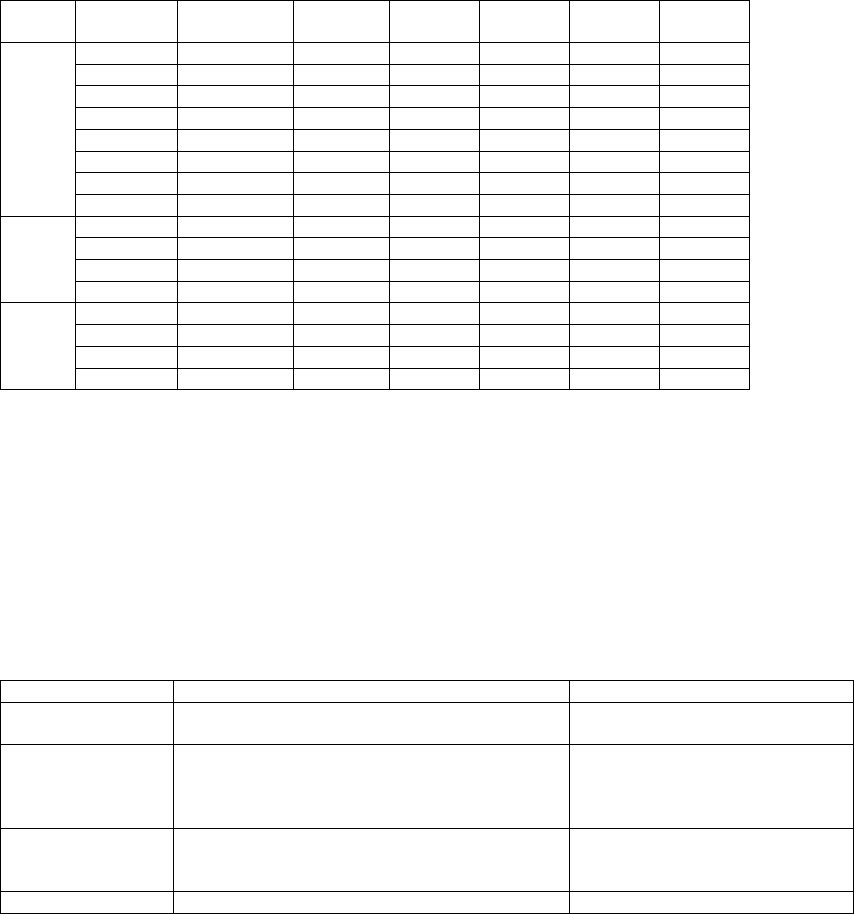
IEEE802.11 frequency assignments
UNII
band RF
channel Frequency FCC
USA ETSI
EU MKK
Japan Singa-
pore Tai-
wan
34 5170 X
36 5180 X X X
38 5190 X
40 5200 X X X
42 5210 X
44 5220 X X X
46 5230 X
1
5150
5250
48 5240 X X X
52 5260 X X X X
56 5280 X X X X
60 5300 X X X X
2
5250
5350 64 5320 X X X X
149 5745 X X X
153 5765 X X X
157 5785 X X X
3
5725
5850 161 5805 X X X
Table xx: IEEE802.11a channels
Caution: Within 5.15 to 5.25 MHz bands, UNII devices are restricted to indoor operations to reduce
any potential harmfull interference to co-channel Mobile Satelite Systems (MSS) operations.
This Indigo device is shipped with FCC-compliant firmware. In order to ensure regulatory-compliant
channel usage in a particular country, special geographic-specific firmware is available for customer
production assemblies which restricts channel usage. Examples include ETSI-compliant firmware, MKK
-compliant firmware etc. Since the end user does not have the ability to alter this firmware, regulatory
compliance is ensured.
Agency and Regulatory Body Approvals
This Indigo device complies with the standards as shown in table below:
country Approval specification notes
USA FCC part 15, sections 15.107, 15.109, 15.207,
15.209, 15.407 Tested at accredited laboratories
and filed for FCC certification.
European Union EN 301 893 V1.1.1 (2001-01)
ETSI EN 301 489-1 V1.3.1 (2001-07)
ETSI EN 301 489-17 V1.1.1 (2000-09)
EN60950 incl A1, A2, A3, A4
Tested at accredited laboratories
and Notified according to article
6.4 of the RTTE directive
Japan ARIB STD T71 v.1.0, 14 december 2000 Tested at TELEC laboratories
and filed for MPT Japan
certification.
Table xx: Compliance specifications
USA-FCC (Federal Communications Commission) statement
This device complies with Part 15 of FCC Rules.
Operation is subject to the following two conditions:
1. This device may not cause interference, and
2. this device must accept any interference, including interference that may cause
undesired operation of this device.
ISL37704C Indigo Cardbus manual (preliminary)
Page2of3
FCC Interference Statement
This equipment has been tested and found to comply with the limits for a Class B digital device,
pursuant to Part 15 of the FCC Rules. These limits are designed to provide reasonable protection
against harmful interference in a residential installation.
This equipment generates, uses, and can radiate radio frequency energy. If not installed and used in
accordance with the instructions, it may cause harmful interference to radio communications. However,
there is no guarantee that interference will not occur in a particular installation.
If this equipment does cause harmful interference to radio or television reception, which can be
determined by turning the equipment off and on, the user is encouraged to try and correct the
interference by one or more of the following measures:
1. Reorient or relocate the receiving antenna.
2. Increase the distance between the equipment and the receiver.
3. Connect the equipment to an outlet on a circuit different from that to which the receiver is
connected.
4. Consult the dealer or an experienced radio/TV technician for help.
Export restrictions:
This product or software contains encryption code which may not be exported or transferred from the
US or Canada without an approved US Department of Commerce export license.
FCC Guidelines for Human Exposure
The EIRP was measured for the lower, middle and highest frequencies used by the transmitter. The
results in Table xx below are based on a safe distance between antenna and operator of 8 inches (20
centimeters).The equipment therefore fulfills the requirements on power density for general population /
uncontrolled exposure of 1.0 mW/cm² and therefore complies with the requirements of FCC OET
Bulletin 65 including supplements A, B and C.
Channel 36 Channel 48 Channel 64
Measured EIRP (mW) 70.8 67.6 69.2
Specific absorption
Ratio SAR ( mW/cm²) 0.06 0.05 0.06
Table xx: Compliance specifications
Caution: To comply with FCC RF exposure compliance requirements, a separation distance of at least
20 cm must be maintained between the antenna of this device and all persons.
Europe - EU R&TTE Declaration of Conformity
This Wireless LAN Radio device is tested to and conforms with the essential radio test suites included in
following standards:
Standard Description and Explanation
LVD specification
EN 60950 EN 60950,ed. (1992), incl. A1(1993), A2(1993), A3(1995) and
A4(1997)
Safety of information technology equipment, including electrical
business
equipment.
Meets R&TTE directive art. 3.1.a of essential requirements on
protection
of the health and safety of the user.
ETSI EMC specification
ETSI EN 301 489 Electromagnetic compatibility and Radio spectrum Matters (ERM);
Electromagnetic Compatibility (EMC) standard for radio equipment
ISL37704C Indigo Cardbus manual (preliminary)
Page3of3
Standard Description and Explanation
Part 1 V1.2.1 (2000-08)
Part 17 V1.1.1 (2000-09)
and services;
Part 1: Common technical requirements
Part 17: Specific conditions for Wideband data and HIPERLAN
equipment
ETSI RF specification
EN 301 893
V1.1.1 (2001-01)
Broadband Radio Access Networks (BRAN), HIPERLAN Type 2
Harmonised EN covering essential requirements of article 3.2 of
the R&TTE Directive
Table xx: EU RTTE Compliance specifications
and therefore complies with the essential requirements and provisions of the Directive 1999/5/EC of the
European Parliament and of the council of 9 march 1999 on Radio equipment and Telecommunications
Terminal Equipment and the mutual recognition of their conformity and Annex IV (Conformity
Assessment procedure referred to in article 10(4)).
Important Notice :
This device is a 5 GHz low power RF device
intended for home and office use in EU and EFTA
member states. In some EU / EFTA member states
some restrictions may apply. Please contact local
spectrum management authorithies for further
details before putting this device into operation
Wireless LAN installation guide lines and Authorization for use
Installation and use of this Wireless LAN device must be in strict accordance with the instructions
included in the user documentation provided with the product. Any changes or modifications made to
this device that are not expressly approved by Intersil may void the user’s authority to operate the
equipment. Intersil is not responsible for any radio or television interference caused by unauthorized
modification of this device, or the substitution or attachment of connecting cables and equipment other
than specified. It is the responsibility of the user to correct any interference caused by such
unauthorized modification, substitution or attachment. Intersil and its authorized resellers or distributors
will assume no liability for any damage or violation of government regulations arising from failing to
comply with these guidelines.
The use of Wireless LAN devices may be restricted in some situations or environments for example:
* On board of airplanes, or
* In an explosive environment, or
* In case the interference risk to other devices or services is perceived or identified as harmful.
In case the policy regarding the use of Wireless LAN devices in specific organizations or environments
(e.g. airports, hospitals, chemical/oil/gas industrial plants, private buildings etc.) is not clear, please first
verify authorization to use these devices prior to operating the equipment.