Conexant Systems 9207U Dell Wireless 1450 dual-band USB 2.0 adaptor User Manual

Conexant Systems B.V. Dell Wireless 1450 dual-band USB 2.0 adaptor

User Manual

                      Version: 0.1, August 16, 2004      Model D1450U 2.4 GHz / 5 GHz Dual Band USB 2.0 WLAN card  User’s Guide     Conexant Proprietary Information
USB 2.0 WLAN card User’s Guide ii  Conexant 0xxxxxx  Revision Notice  Revision  Date  Comments 0.1  16 august 2004  Initial draft
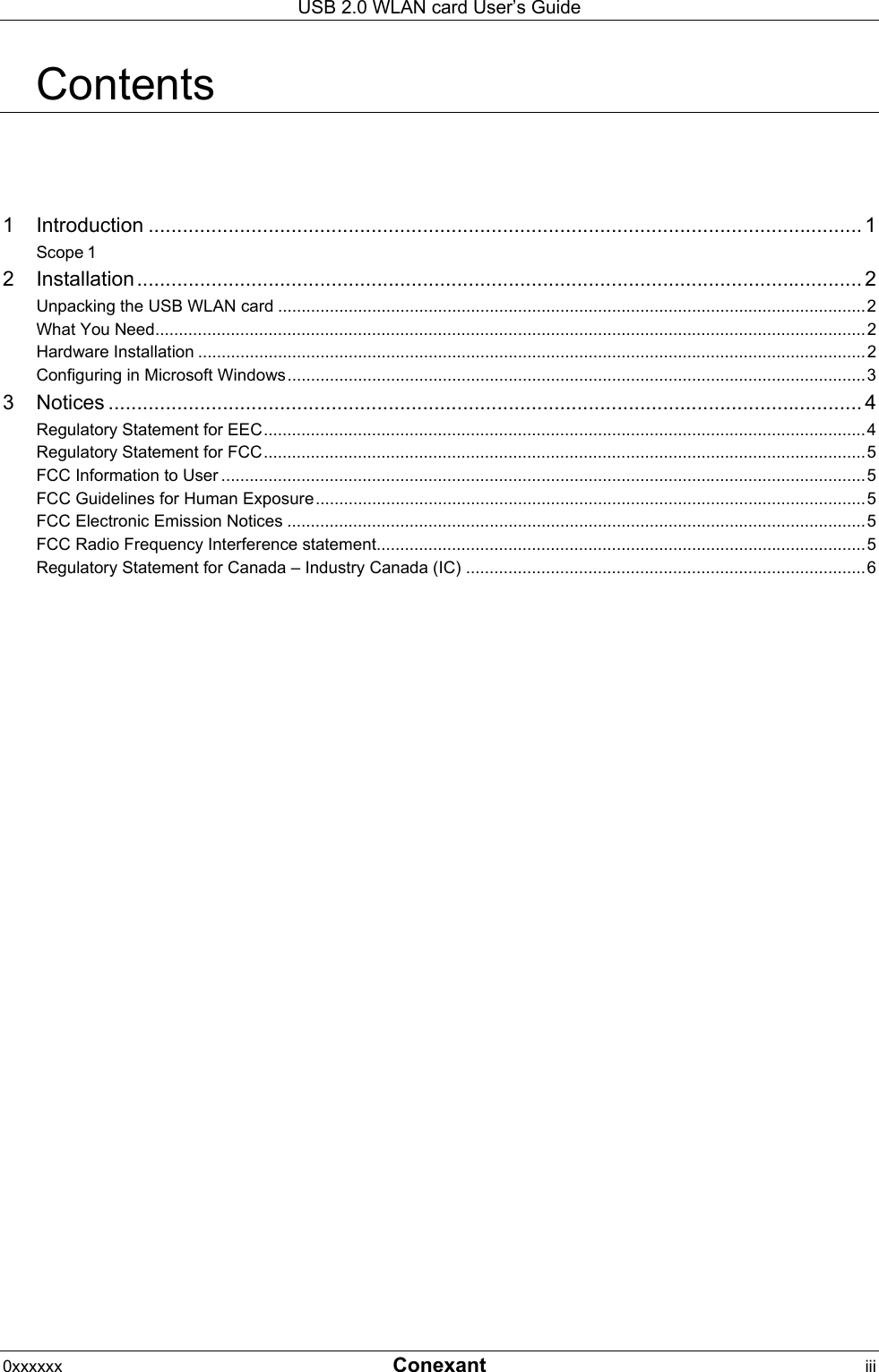
USB 2.0 WLAN card User’s Guide 0xxxxxx  Conexant iii  Contents 1 Introduction ............................................................................................................................. 1 Scope 1 2 Installation ............................................................................................................................... 2 Unpacking the USB WLAN card .............................................................................................................................2 What You Need.......................................................................................................................................................2 Hardware Installation ..............................................................................................................................................2 Configuring in Microsoft Windows...........................................................................................................................3 3 Notices .................................................................................................................................... 4 Regulatory Statement for EEC................................................................................................................................4 Regulatory Statement for FCC................................................................................................................................5 FCC Information to User .........................................................................................................................................5 FCC Guidelines for Human Exposure.....................................................................................................................5 FCC Electronic Emission Notices ...........................................................................................................................5 FCC Radio Frequency Interference statement........................................................................................................5 Regulatory Statement for Canada – Industry Canada (IC) .....................................................................................6
USB 2.0 WLAN card User’s Guide iv  Conexant 0xxxxxx   This page is left intentionally blank.
USB 2.0 WLAN card User’s Guide 0xxxxxx  Conexant 1  1 Introduction This USB 2.0 WLAN client card connects your computer to all popular high speed IEEE802.11a, 802.11b and 802.11g wireless networks available today. Scope This guide describes the hardware installation procedures for your USB 2.0 WLAN card into a computer running Microsoft Windows Operating System.
USB 2.0 WLAN card User’s Guide 2  Conexant 0xxxxxx  2 Installation Installation of this WLAN product is a simple two-step process consisting of: 1.  Hardware installation 2.  Configuring in Microsoft Windows.  Unpacking the USB WLAN card  Be certain that you have all the items listed below. This package contains: •  A USB WLAN card •  A USB cable •  User's manual •  Software for the modem   What You Need You will need: •  A USB host PC system with Plug and Play enabled Windows Operating System  Hardware Installation Exercise caution at all times when working with AC powered and static-sensitive equipment. Discharge any static electricity from your body by touching any bare metal surface of the PC system, such as its power supply cover. This USB WLAN card needs to be used with the USB cable provided in the package.   1.  Plug the small connector of the USB cable into the USB WLAN card 2.  Plug the large connector of the USB cable into an available USB port of the host PC. 3.  Now follow the steps outlined in the next section, Configuring Microsoft Windows.
USB 2.0 WLAN card User’s Guide 0xxxxxx  Conexant 3  Configuring Microsoft Windows  Follow these steps to install the drivers for Microsoft Windows, provided with the USB WLAN card. 1.  When started for the first time after card installation, Microsoft Windows detects the wlan card and displays the Found New Hardware Wizard dialog box. Click Next to continue. 2.  In the newly displayed window, select Search for a suitable driver for my device (recommended) and click Next. 3.  In the displayed window, select Specify a location and click Next. 4.  In the displayed window, click on Browse, select the folder in which the modem drivers are located, click OK, then click Next. (If you have not selected the correct folder, the Next button will be greyed out and you will not be able to continue.) 5.  If the Digital Signature Not Found window is displayed, click Yes to continue.  6.  Click Finish to complete the installation of your wlan card.
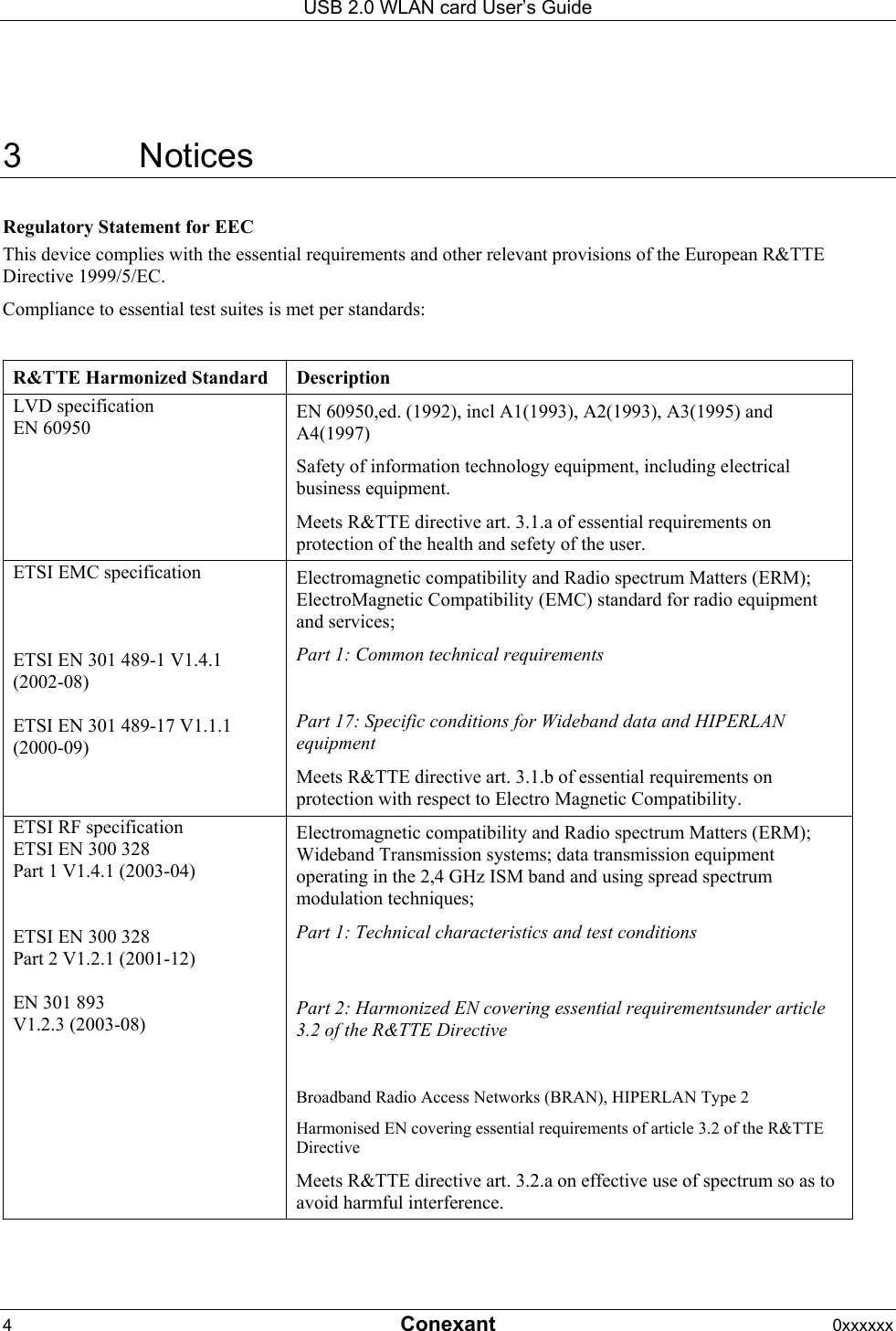
USB 2.0 WLAN card User’s Guide 4  Conexant 0xxxxxx  3 Notices Regulatory Statement for EEC This device complies with the essential requirements and other relevant provisions of the European R&TTE Directive 1999/5/EC.  Compliance to essential test suites is met per standards:  R&TTE Harmonized Standard  Description LVD specification EN 60950  EN 60950,ed. (1992), incl A1(1993), A2(1993), A3(1995) and A4(1997) Safety of information technology equipment, including electrical business equipment. Meets R&TTE directive art. 3.1.a of essential requirements on protection of the health and sefety of the user. ETSI EMC specification    ETSI EN 301 489-1 V1.4.1 (2002-08)  ETSI EN 301 489-17 V1.1.1 (2000-09)  Electromagnetic compatibility and Radio spectrum Matters (ERM); ElectroMagnetic Compatibility (EMC) standard for radio equipment and services; Part 1: Common technical requirements  Part 17: Specific conditions for Wideband data and HIPERLAN equipment Meets R&TTE directive art. 3.1.b of essential requirements on protection with respect to Electro Magnetic Compatibility. ETSI RF specification ETSI EN 300 328 Part 1 V1.4.1 (2003-04)   ETSI EN 300 328 Part 2 V1.2.1 (2001-12)  EN 301 893  V1.2.3 (2003-08)   Electromagnetic compatibility and Radio spectrum Matters (ERM); Wideband Transmission systems; data transmission equipment operating in the 2,4 GHz ISM band and using spread spectrum modulation techniques; Part 1: Technical characteristics and test conditions  Part 2: Harmonized EN covering essential requirementsunder article 3.2 of the R&TTE Directive  Broadband Radio Access Networks (BRAN), HIPERLAN Type 2 Harmonised EN covering essential requirements of article 3.2 of the R&TTE Directive Meets R&TTE directive art. 3.2.a on effective use of spectrum so as to avoid harmful interference.
USB 2.0 WLAN card User’s Guide 0xxxxxx  Conexant 5      Important Notice : This device is a dual band 2.4 GHz / 5 GHz low power RF device intended for home and office use in EU and EFTA member states. In some EU / EFTA member states some restrictions may apply. Please contact local spectrum management authorithies for further details before putting this device into operation.  Regulatory Statement for FCC FCC Information to User This product does not contain any user serviceable components and is to be used with approved antennas only. Any product changes or modifications will invalidate all applicable regulatory certifications and approvals  FCC Guidelines for Human Exposure In order to comply with RF exposure limits, the user is advised to maintain a distance of at least 20 cm from the antenna of this device while it is in use. The antenna is integrated within the plastic part of the enclosure.  FCC Electronic Emission Notices This device complies with part 15 of the FCC Rules. Operation is subject to the following two conditions: 1. This device may not cause harmful interference 2. This device must accept any interference received, including interference that may cause undesired operation.  Caution:  1--Within 5.15 to 5.25 MHz bands, UNII devices are restricted to indoor operations to reduce any potential harmfull interference to co-channel Mobile Satelite Systems (MSS) operations.  2--High power radars are allocated as primary users in the 5.25 to 5.35GHz and 5.65 to 5.85GHz bands. These high power radar stations can cause interference with and/or damage to this device.  FCC Radio Frequency Interference statement    This equipment has been tested and found to comply with the limits for a class B digital device, pursuant to Part 15 of the FCC Rules. These limits are designed to provide reasonable protection against harmful interference when the equipment is operated in a commercial environment. This equipment generates, uses and can radiate radio frequency energy and, if not installed and used in accordance with the instructions, may cause harmful interference to radio communications. Operation of this equipment in a residential area may cause harmful interference, in which case the user will be required to correct the interference at his own expense.
USB 2.0 WLAN card User’s Guide 6  Conexant 0xxxxxx  If this equipment does cause harmful interference to radio or television reception, which can be determined by turning the equipment off and on, the user is encouraged to try to correct the interference by one or more of the following measures: • Reorient or relocate the receiving antenna • Increase the separation between the equipment and receiver • Connect the equipment into an outlet on a circuit different from that to which the receiver is connected • Consult the dealer or an experienced radio/TV technician for help   Regulatory Statement for Canada – Industry Canada (IC)  This device complies with RSS 210 of Industry Canada.  Operation is subject to the following two conditions:  (1)  this device may not cause interference , and (2)  this device must accept any interference, including interference that may cause undesired operation of this device.”  L ‘ utilisation de ce dispositif est autorisée seulement aux conditions suivantes : (1)  il ne doit pas produire de brouillage et  (2)  l’ utilisateur du dispositif doit étre prét à accepter tout brouillage radioélectrique reçu, même si ce brouillage est susceptible de compromettre le fonctionnement du dispositif.  WARRANTY AND REPAIR SERVICE CENTER: Company Name: Conexant Systems, Inc. 146 Colonnade Road South Ottawa, Ontario, K2E 7Y1  Ph: 613-274-0922

Navigation menu