CowChips HW2-TAG SPREAD SPECTRUM TRANSCEIVER User Manual USERS MANUAL

CowChips, LLC SPREAD SPECTRUM TRANSCEIVER USERS MANUAL

USERS MANUAL

                         User’s Manual
NOTICE  The manufacturer reserves the right to make any changes and improvements in the product described in this manual at any time and without prior notice.  This manual and the HeatWatch®II software are trademarked and copyrighted.  All rights are reserved.  This document may not, in whole or part, be copied, photocopied, reproduced, translated or reduced to any electronic medium or machine readable form without prior written consent from CowChips, LLC.  Copyright © 2007 CowChips, LLC  TRADEMARKS  HeatWatch®II and HeatWatch® are registered trademarks of CowChips, LLC. All other trademarks are the property of their respective owners.  PATENTS  U.S. Patent 5,542,431  FCC APPROVAL  This device complies with Part 15 of the FCC Rules. Operation is subject to the following two conditions: (1) this device may not cause harmful interference, and (2) this device must accept any interference received, including interference that may cause undesired operation.  The user is cautioned that changes or modifications not expressly approved by the party responsible for compliance could void the user's authority to operate the equipment.  FCC ID U8QHW2 - TAG FCC ID U8QHW2 - CM
 HEATWATCH II ESTRUS DETECTION SYSTEM  HeatWatch II takes advantage of the fact that standing heat is the most accurate visible indicator for detecting cows and heifers in estrus.  To monitor standing heat, HeatWatch uses a small radio frequency (RF) monitor and pressure sensor attached to the tailhead of the cow.  The monitor sends information to a receiving/transmitting device called a base station each time a cow is mounted.  The information is stored in the base station and is wirelessly transferred to another device called an access point which is connected to a computer by way of a USB port.  The stored data is automatically uploaded to the computer when the HeatWatch II software is started.  Using sophisticated algorithms developed over the past 10 years, the HeatWatch II software, running on a Windows based computer, analyzes the specific information received from each cow and gives accurate information for cows displaying mounting activity relating to estrus status and time to insemination.
 HEATWATCH II EQUIPMENT  Monitors  Monitors, the heart of the HeatWatch II system are small, transferable battery-powered digital radio frequency units containing a pressure sensor for detecting mounting activity and transmitting this data to the base station.  The base station will send a return message to the monitor acknowledging its receipt of the data.  If the monitor does not receive this acknowledgment message, it stores that mounting data and re-sends it on a periodic basis until the base station receives it.  This would happen if a cow wanders out of range or is behind a obstacle that would prevent a signal from being received by the base station.  Upon use, each monitor is enclosed in or attached on top of a patch that is glued to the tailhead of a cow.  A monitor can transmit a mounting activity signal over a third of a mile in a line-of-sight to the base station or repeater.  Transmission occurs multiple times on multiple frequencies over a 10 second period to ensure signal reception of mount data.  Periodically, a supervisory signal is sent from the monitor as confirmation that the monitor is working properly.  Should a monitor be in an active mode and not send a supervisory signal, as in the case of a dead battery, you will be alerted by the software.  Each monitor has its own unique numerical identification code.  No two monitors have the same ID.  Monitor cases are constructed of hardened plastic designed to withstand mounting activity forces.  The battery that powers the monitor is a 3.6 volt lithium battery.  The device operates in a temperature range of -40 to +140 F.  FCC site licensing is not required.  Base Station  The base station is a sophisticated electronic device that receives and stores mounting activity information from the cow monitors in the form of RF signals.  The information is wirelessly transferred to the access point and into the HeatWatch II software. The base station also sends signals back to the monitors acknowledging the receipt of mounts and/or giving it certain instructions.  The base station is encased in a weather-resistant enclosure and is positioned in a line of sight proximity to the cows.  The maximum distance between the base station and the access point is a function of the types of antennas used on both devices.  The standard configuration will allow for 1000 ft.  The base station can be powered by either 110V outlet or 12V DC power.
 Access Point  The access point receives mounting information from the base stations and passes that information to the computer.  The access point is connected to the computer and powered by way of a high speed USB 2.0 cable.  Patches and Glue  A polyester patch has 3 functional components:  1. the base material used to affix the patch to the tailhead of the cow with Ruscoe glue.  2. the nylon pouch that encloses the monitor, and  3. the tail strap that can provide retention of the patch and monitor to the cow if the patch comes loose from intensive mounting.  The Ruscoe glue is a contact-type cement that has been used in the cattle industry for years and is best known as Cattle Tag Cement.  It is available in 10.5 oz caulking tubes.  Repeater  The repeater is a sophisticated transceiver which identifies signals from HeatWatch II monitors and re-broadcasts those signals at full power.  The repeater is used to relay mounting information to the base station on large farms and ranches, or from area with hidden mounting or heat detection locations.  This effectively increases the range by several miles in line-of-sight to the base station.
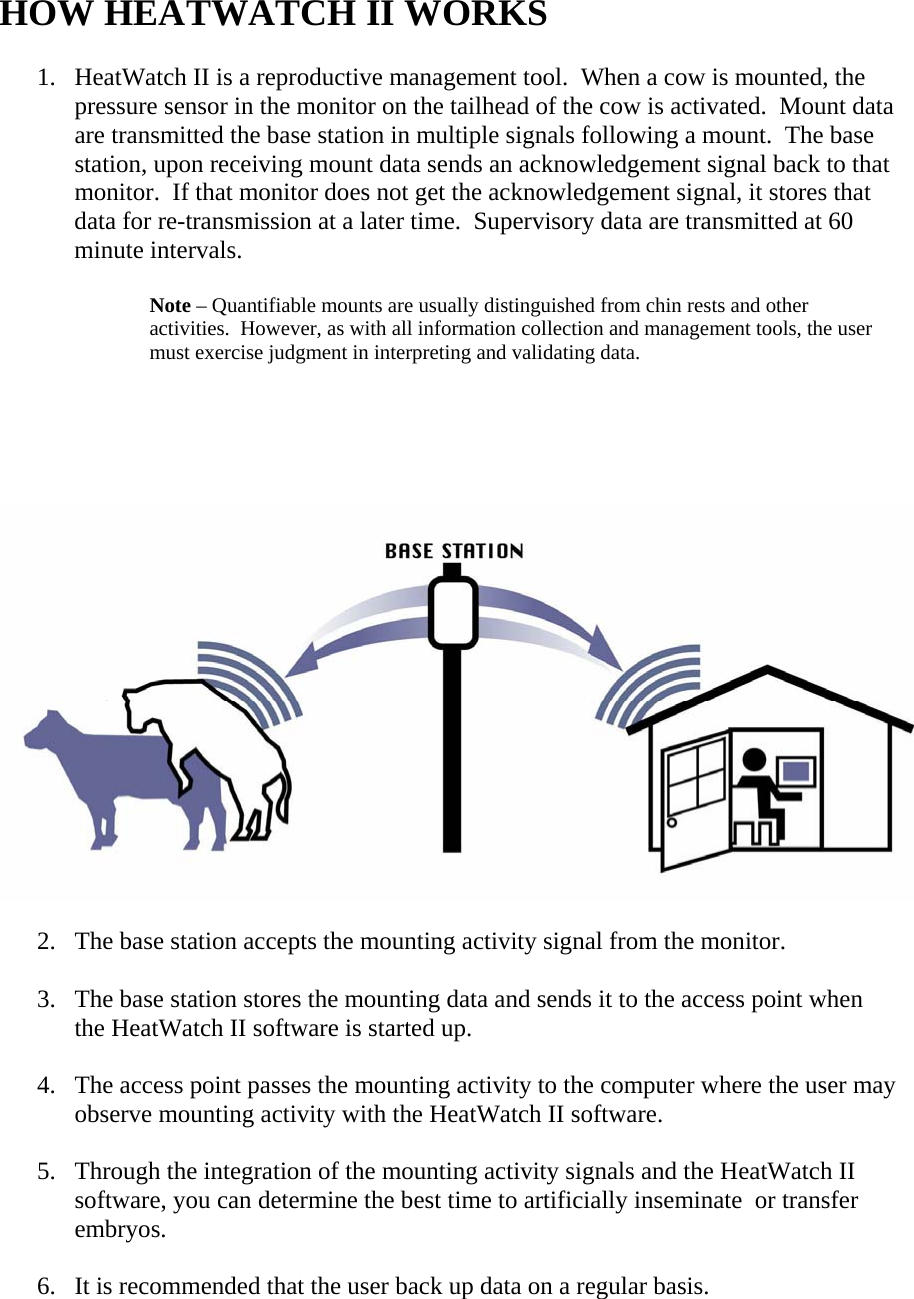
HOW HEATWATCH II WORKS  1. HeatWatch II is a reproductive management tool.  When a cow is mounted, the pressure sensor in the monitor on the tailhead of the cow is activated.  Mount data are transmitted the base station in multiple signals following a mount.  The base station, upon receiving mount data sends an acknowledgement signal back to that monitor.  If that monitor does not get the acknowledgement signal, it stores that data for re-transmission at a later time.  Supervisory data are transmitted at 60 minute intervals.  Note – Quantifiable mounts are usually distinguished from chin rests and other    activities.  However, as with all information collection and management tools, the user must exercise judgment in interpreting and validating data.        2. The base station accepts the mounting activity signal from the monitor.  3. The base station stores the mounting data and sends it to the access point when the HeatWatch II software is started up.  4. The access point passes the mounting activity to the computer where the user may observe mounting activity with the HeatWatch II software.  5. Through the integration of the mounting activity signals and the HeatWatch II software, you can determine the best time to artificially inseminate  or transfer embryos.  6. It is recommended that the user back up data on a regular basis.
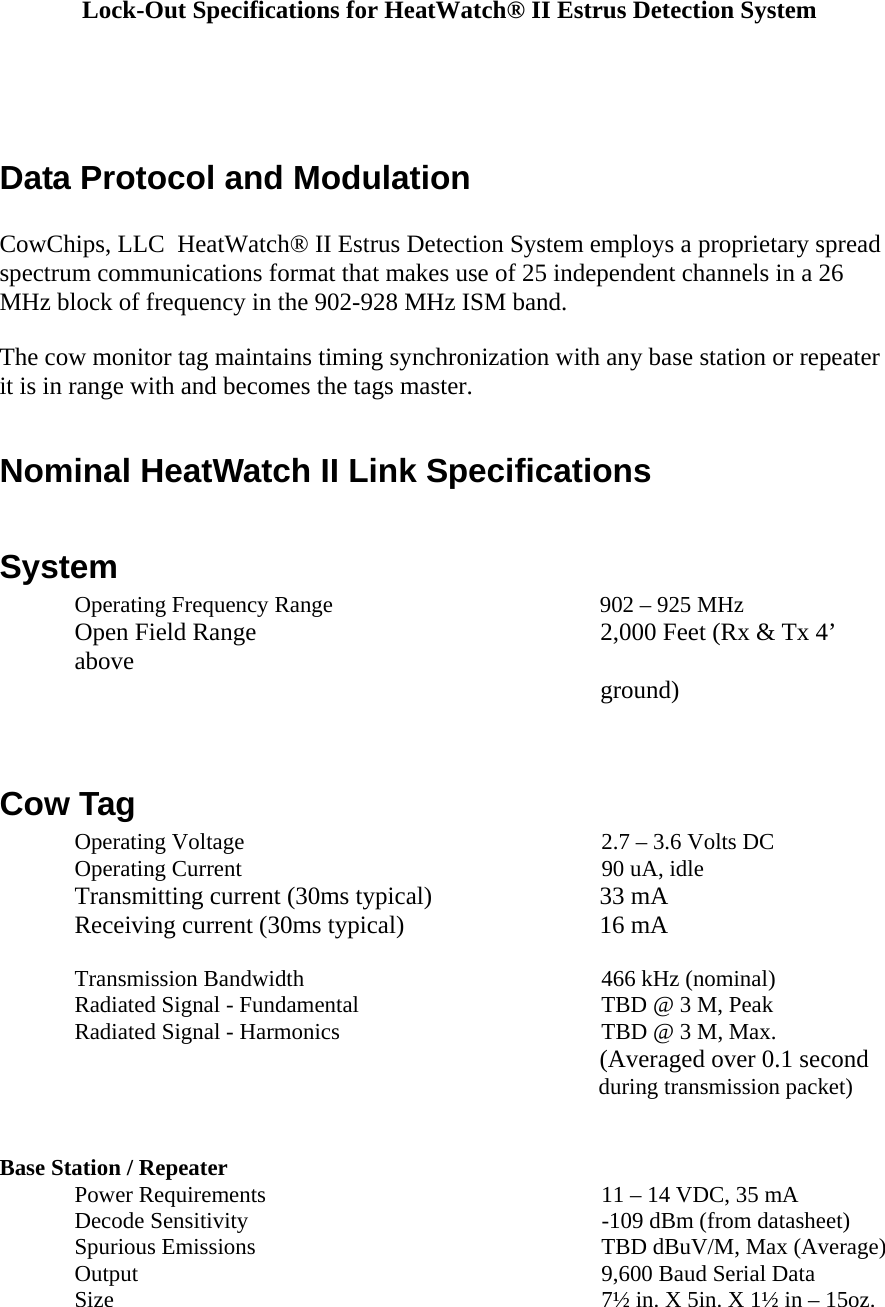
 Lock-Out Specifications for HeatWatch® II Estrus Detection System     Data Protocol and Modulation  CowChips, LLC  HeatWatch® II Estrus Detection System employs a proprietary spread spectrum communications format that makes use of 25 independent channels in a 26 MHz block of frequency in the 902-928 MHz ISM band.  The cow monitor tag maintains timing synchronization with any base station or repeater it is in range with and becomes the tags master.  Nominal HeatWatch II Link Specifications  System Operating Frequency Range  902 – 925 MHz Open Field Range  2,000 Feet (Rx & Tx 4’ above  ground)      Cow Tag Operating Voltage  2.7 – 3.6 Volts DC Operating Current  90 uA, idle   Transmitting current (30ms typical)      33 mA  Receiving current (30ms typical)   16 mA   Transmission Bandwidth  466 kHz (nominal)  Radiated Signal - Fundamental  TBD @ 3 M, Peak Radiated Signal - Harmonics  TBD @ 3 M, Max.         (Averaged over 0.1 second     during transmission packet)      Base Station / Repeater Power Requirements  11 – 14 VDC, 35 mA Decode Sensitivity  -109 dBm (from datasheet) Spurious Emissions  TBD dBuV/M, Max (Average)  Output  9,600 Baud Serial Data Size   7½ in. X 5in. X 1½ in – 15oz.
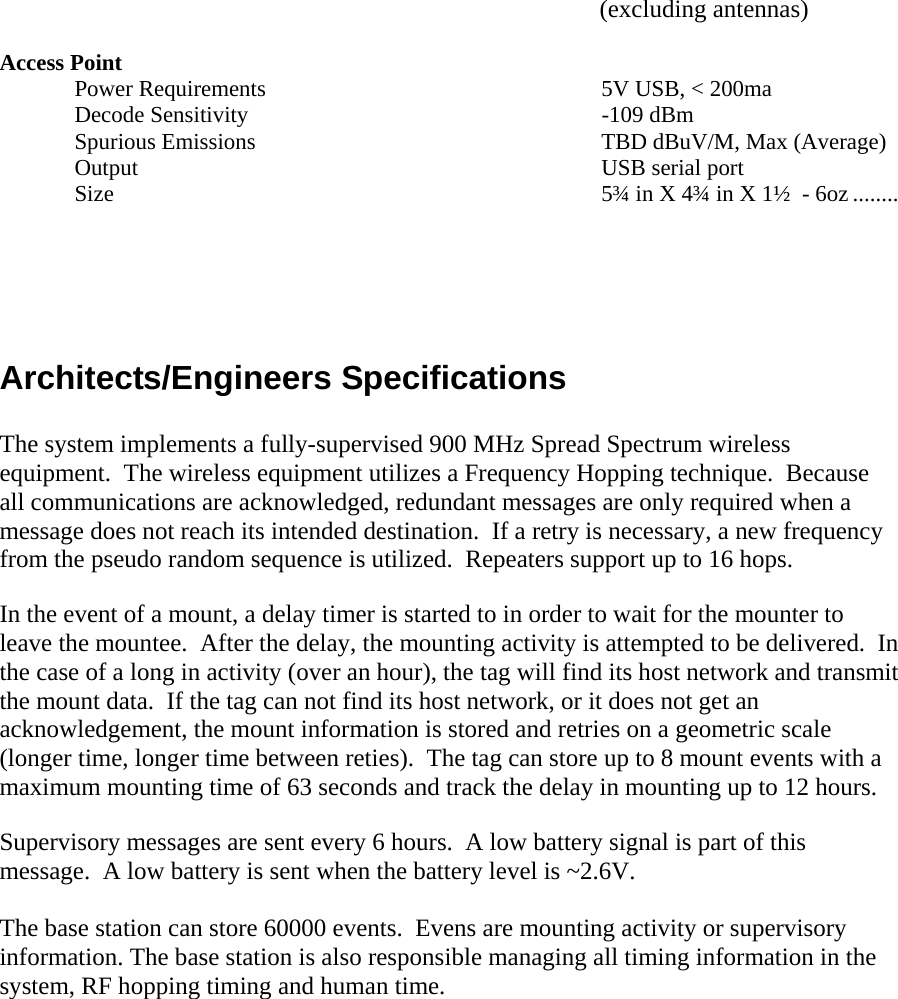
        (excluding antennas)  Access Point Power Requirements  5V USB, < 200ma Decode Sensitivity  -109 dBm  Spurious Emissions  TBD dBuV/M, Max (Average)  Output  USB serial port Size   5¾ in X 4¾ in X 1½  - 6oz ........   Architects/Engineers Specifications  The system implements a fully-supervised 900 MHz Spread Spectrum wireless equipment.  The wireless equipment utilizes a Frequency Hopping technique.  Because all communications are acknowledged, redundant messages are only required when a message does not reach its intended destination.  If a retry is necessary, a new frequency from the pseudo random sequence is utilized.  Repeaters support up to 16 hops.  In the event of a mount, a delay timer is started to in order to wait for the mounter to leave the mountee.  After the delay, the mounting activity is attempted to be delivered.  In the case of a long in activity (over an hour), the tag will find its host network and transmit the mount data.  If the tag can not find its host network, or it does not get an acknowledgement, the mount information is stored and retries on a geometric scale (longer time, longer time between reties).  The tag can store up to 8 mount events with a maximum mounting time of 63 seconds and track the delay in mounting up to 12 hours.  Supervisory messages are sent every 6 hours.  A low battery signal is part of this message.  A low battery is sent when the battery level is ~2.6V.  The base station can store 60000 events.  Evens are mounting activity or supervisory information. The base station is also responsible managing all timing information in the system, RF hopping timing and human time.

Navigation menu