Craftsman 137228210 User Manual TABLE SAW Manuals And Guides L0810027
CRAFTSMAN Saw Table Manual L0810027 CRAFTSMAN Saw Table Owner's Manual, CRAFTSMAN Saw Table installation guides
User Manual: Craftsman 137228210 137228210 CRAFTSMAN TABLE SAW - Manuals and Guides View the owners manual for your CRAFTSMAN TABLE SAW #137228210. Home:Tool Parts:Craftsman Parts:Craftsman TABLE SAW Manual
Open the PDF directly: View PDF  .
.
Page Count: 13
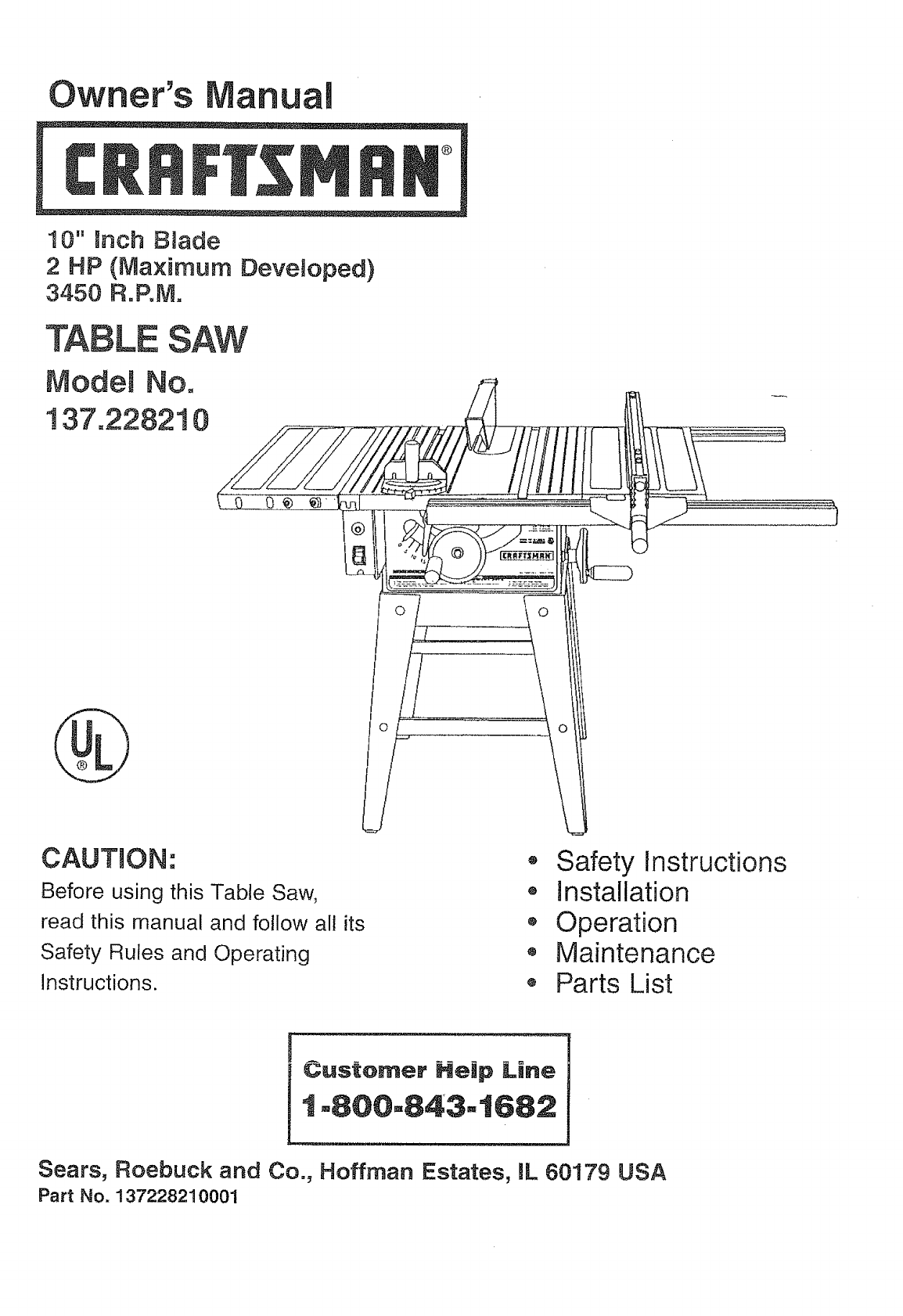
TABLE SAW
ModeJ No.
137o228210
CAUTmON:
Before using this Table Saw,
read this manual and follow all its
Safety Rules and Operating
Instructions.
,, Safety Instructions
,, installation
o Operation
• Maintenance
Parts List
Customer He_p Line
t =800-843-t682
Sears, Roebuck and Co., Hoffman Estates, IL 60179 USA
Part No. 137228210001
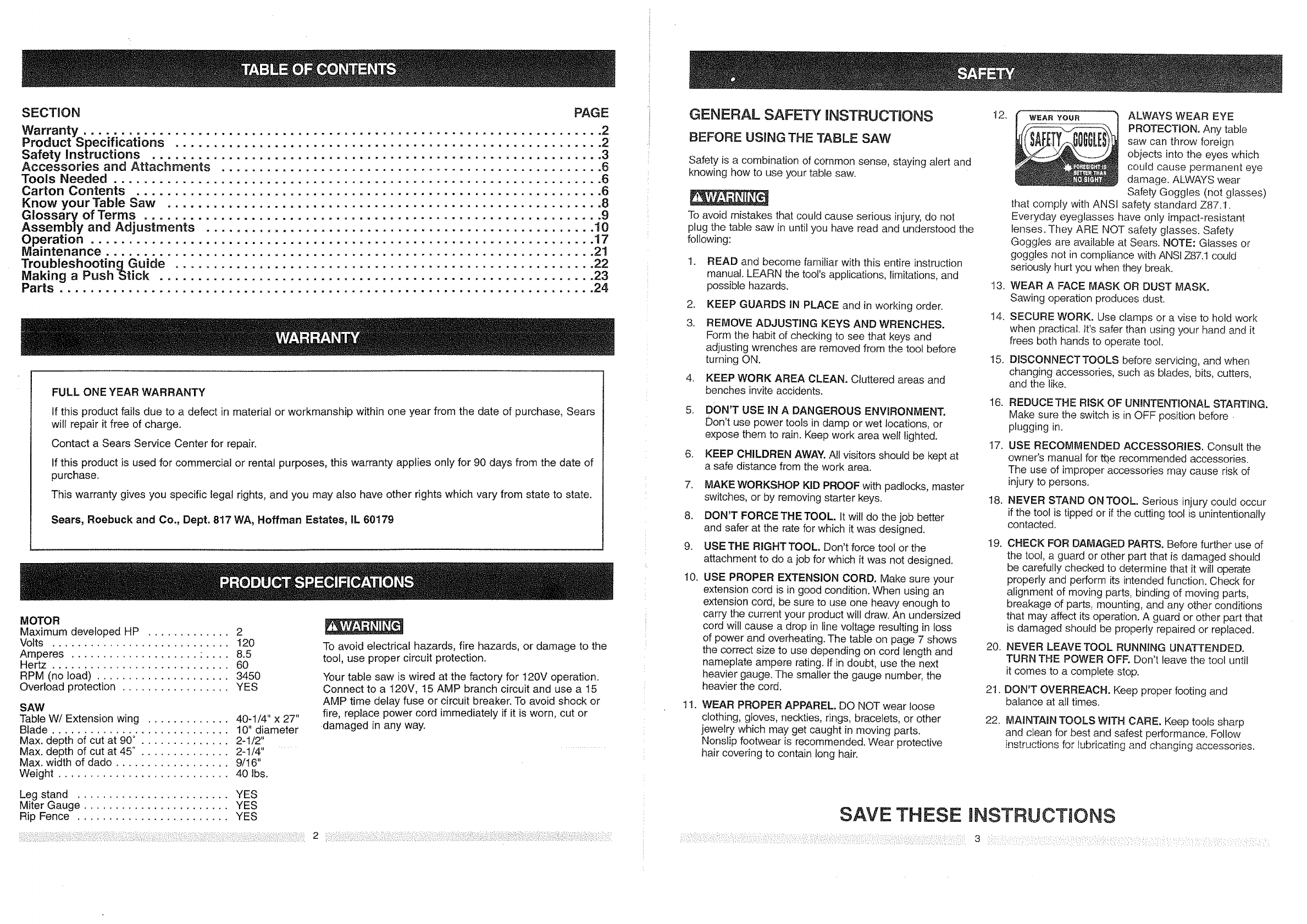
SECTION PAGE
Warranty .................................................................... 2
Product Specifications ........................................................ 2
Safety Instructions ........................................................... 3
Accessories and Attachments .................................................. {_
Tools Needed ................................................................ 6
Carton Contents ............................................................. 6
Know your Table Saw ......................................................... 8
Glossary of Terms ............................................................ 9
Assembly and Adjustments ................................................... 10
Operation .................................................................. 17
Maintenance ................................................................ 21
Troubleshootin_Guide ....................................................... 22
Making aPush atick ......................................................... 23
Parts ...................................................................... 24
FULL ONE YEAR WARRANTY
If this product fails due to a defect in material or workmanship within one year from the date of purchase, Sears
will repair it free of charge.
Contact a Sears Service Center for repair,
If this product is used for commercial or rental purposes, this warranty applies only for 90 days from the date of
purchase.
This warranty gives you specific legal rights, and you may also have other rights which vary from state to state.
Sears, Roebuck and Co., Dept. 817 WA, Hoffman Estates, iL 60179
MOTOR
Maximum developed HP ............. 2
Volts ............................ 120
Amperes .................... : .... 8.5
Hertz ............................ 60
RPM (no load) ..................... 3450
Overload protection ................. YES
SAW
Table Wi Extension wing ............. 40-1/4" x 27"
Blade ............................ 10" diameter
Max. depth of cut at 90° . ............. 2-1/2"
Max. depth of cut at 45 ° . ............. 2-1/4"
Max. width of dado .................. 9/16"
Weight ........................... 40 Ibs.
Leg stand ........................ YES
Miter Gauge ....................... YES
Rip Fence . .. ; .................... YES
To avoid electrical hazards, fire hazards, or damage to the
tool, use proper circuit protection.
Your table saw is wired at the factory for 120V operation.
Connect to a I20V, 15 AMP branch circuit and use a 15
AMP time delay fuse or circuit breaker. To avoid shock or
fire, replace power cord immediately if it is worn, cut or
damaged in any way.
2
k_ GENERAL SAFETY INSTRUCTIONS
BEFORE USING THE TABLE SAW
Safety is a combination of common sense, staying alert and
knowing how to use your table saw.
To avoid mistakes that could cause serious injury, do not
plug the table saw in until you have read and understood the
following:
1.
,
3.
.
.
,
7.
,
.
10.
11.
READ and become familiar with this entire instruction
manual. LEARN the tool's applications, limitations, and
possible hazards.
KEEP GUARDS IN PLACE and in working order.
REMOVE ADJUSTING KEYS AND WRENCHES.
Form the habit of checking to see that keys and
adjusting wrenches are removed from the tool before
turning ON.
KEEP WORK AREA CLEAN. Cluttered areas and
benches invite accidents.
DON'T USE iN ADANGEROUS ENVIRONMENT.
Don't use power tools in damp or wet locations, or
expose them to rain. Keep work area well lighted.
KEEP CHILDREN AWAY. All visitors should be kept at
a safe distance from the work area.
MAKE WORKSHOP KID PROOF with padlocks, master
switches, or by removing starter keys.
DON'T FORCE THE TOOL. It will do the job better
and safer at the rate for which it was designed.
USE THE RIGHT TOOL. Don't force tool or the
attachment to do a job for which it was not designed.
USE PROPER EXTENSION CORD, Make sure your
extension cord is in good condition. When using an
extension cord, be sure to use one heavy enough to
carry the current your product will draw. An undersized
cord wil! cause a drop in line voltage resulting in loss
of power and overheating. The table on page 7 shows
the correct size to use depending on cord length and
nameplate ampere rating. If in doubt, use the next
heavier gauge. The smaller the gauge number, the
heavier the cord.
WEAR PROPER APPAREL. DO NOT wear loose
clothing, gloves, neckties, rings, bracelets, or other
jewelry which may get caught in moving parts.
Nonslip footwear is recommended. Wear protective
hair covering to contain long hair.
SAVE THESE
12.
13.
!4.
15.
16.
17_
t8.
19.
20.
WEARYOUR ALWAYS WEAR EYE
PROTECTION. Any table
saw can throw foreign
objects into the eyes which
could cause permanent eye
damage. ALWAYS wear
Safety Goggles (not glasses)
that comply with ANSI safety standard Z87.1.
Everyday eyeglasses have only impact-resistant
lenses. They ARE NOT safety glasses. Safety
GoggJes are available at Sears. NOTE: Glasses or
goggles not in compliance with ANSI Z87.1 could
seriously hurt you when they break.
WEAR A FACE MASK OR DUST MASK,
Sawing operation produces dust.
SECURE WORK. Use clamps or a vise to hold work
when practical, tt's safer than using your hand and it
frees both hands to operate too!.
DISCONNECTTOOLS before servicing, and when
changing accessories, such as blades, bits, cutters,
and the like.
REDUCE THE RISK OF UNtNTENTmONALSTARTING.
Make sure the switch is in OFF position before
plugging in.
USE RECOMMENDED ACCESSORIES. Consult the
owner's manual for the recommended accessories.
The use of improper accessories may cause risk of
injury to persons.
NEVER STAND ON TOOL. Serious injury could occur
if the tool is tipped or if the cutting tool is unintentionally
contacted.
CHECK FOR DAMAGED PARTS. Before further use of
the toot, a guard or other part that is damaged should
be carefully checked to determine that it will operate
properly and perform its intended function. Check for
alignment of moving parts, binding of moving parts,
breakage of parts, mounting, and any other conditions
that may affect its operation. A guard or other part that
is damaged should be properly repaired or replaced.
NEVER LEAVE TOOL RUNNING UNATTENDED.
TURN THE POWER OFF. Don't leave the tool until
it comes to a complete stop.
DON'T OVERREACH, Keep proper footing and
balance at all times.
MAINTAIN TOOLS WITH CARE. Keep tools sharp
and clean for best and safest performance. Follow
instructions for lubricating aqd changing accessories.
INSTRUCTIONS
3
"\
23. DIRECTmON OF FEED. Feed work into a blade or cutter
against the direction of rotation of the blade or cutter
only.
24. WARNING: Dust generated from certain materials can
be injurious to your heal[h. Always operate saw in welt
ventilated areas and provide for proper dust removal.
SPEC RC SAFETY mNSTRUCTmONS
FOR THE TABLE SAW
,ALWAYS USE SAW BLADE GUARD spreader and
anti-kickback pawls for every operation for which
they can be used, including through-sawing.
Through-sawing operations are those in which the
blade cuts completely through the workpiece
when ripping or cross-cutting.
2. ALWAYS HOLDTHE WORK FIRMLY against the
miter gauge or rip fence.
.USE A PUSH STICK when required. Always use a
push stick for ripping narrow stock. Refer to ripping
applications in the instruction manual where the
push stick is covered in detail. See the push stick
pattern included in this Owner's Manual.
.NEVER PERFORM ANY OPERATION
"FREE HAND", which means using only your hands
to support or guide the workpiece. Always use either
the fence or the miter gauge to position and guide the
work.
5. NEVER STAND or have any part of your body in line
with the path of the saw blade. Keep your hands out
of the line of the saw blade.
6. NEVER REACH behind or over the cutting tool
for any reason.
7. REMOVE the rip fence when cross-cutting.
8. DO NOT USE molding head set with this saw.
9. FEED WORK INTO THE BLADE against the
direction of rotation only.
I0. NEVER use the fence as a cut-off gauge when
cross-cutting.
11. NEVER ATTEMPTTO FREE A STALLED SAW
BLADE without first turning the saw OFR Turn
power switch OFF immediately to prevent motor
damage.
12. PROVIDE ADEQUATE SUPPORT to the rear and
sides of the saw table for wide or long workpieces.
SAVE THESE
13.
14.
!5.
16.
17.
AVOID KICKBACKS (work thrown back towards you)
by keeping the blade sharp, keeping the rip fence
parallel to the saw blade, and by keeping the spreader,
anti-kickback pawls, and guard in place
and functioning. Do not release work before it is
pushed all the way past the saw blade. Do not rip
work that is twisted, warped, or does not have a
straight edge to guide along the fence.
AVOID AWKWARD OPERATIONS and hand positions
where a sudden slip could cause your hand to move
into the cutting tool.
NEVER USE SOLVENTS to clean plastic parts.
Solvents could possibly dissolve or otherwise damage
the material. Only a soft damp cloth should be used to
clean plastic parts.
MOUNT your table saw before performing any cutting
operations. Refer to installation instructions.
NEVER CUT METALS or materials which may make
hazardous dust.
18.
19,
ALWAYS USE IN A WELL VENTILATED AREA.
Remove saw dust frequently. Clean out sawdust from
the interior of the saw to prevent a potential fire hazard.
NEVER LEAVE THE TOOL running unattended.
Don't leave the tool until it comes to a complete stop.
20. For proper operation follow the instructions of this
owner's manual titled *'SAW MOUNTED TO WORK
SURFACES." Failure to provide sawdust fall4hrough
and removal hole will allow sawdust to build up in the
motor area, which may result in a fire hazard or cause
motor damage.
ELECTRmCAL REQUIREMENTS
POWER SUPPLY AND MOTOR SPEC_F]CATaONS
To avoid electrical hazards, fire hazards, or damage to the
tool, use proper circuit protection. Use a separate electrica!
circuit for your tools.Your saw is wired at the factory for t20V
operation. Connect to a 120V, 15 Amp circuit and use a 15
Amp time delay fuse or circuit breaker. To avoid shock or fire,
if power cord is worn or cut, or damaged in any way, have it
replaced immediately.
!NSTRUCTMONS
4
,]
]
GROUNDING INSTRUCTIONS
This tool must be grounded while in use to protect the
operator from electrical shock.
IN THE EVENT OF A MALFUNCTmON OR BREAKDOWN,
grounding provides a path of least resistance for electric
current and reduces the risk of electric shock. This tool is
equipped with an electric cord that has an equipment
grounding conductor and a grounding plug. The plug
MUST be plugged into a matching receptacle that is
properly installed and grounded in accordance with ALL
local codes and ordinances.
DO NOT MODIFY THE PLUG PROVIDED. If it will not fit
the receptacle, have the proper receptacle installed by a
qualified electrician.
iMPROPER CONNECTION of the equipment grounding
conductor can result in risk of electric shock. The
conductor with the green insulation (with or without yellow
stripes) is the equipment grounding conductor. If repair
or replacement of the etectric cord or plug is necessary,
DO NOT connect the equipment grounding conductor
to a live terminal.
CHECK with a qualified electrician or service person if you
do not completely understand the grounding instructions, or if
you are not sure the tool is properly grounded.
USE 'ONLY 3-wire extension cords that have 3_prong
grounding plugs and 3-pole receptacles that accept
the tool's plug. Repair or replace damaged or worn
cord immediately.
Use a separate electrical circuit for your tools. This circuit
must not be less than #12 wire and should be protected
with a 15 Amp time tag fuse. Before connecting the motor
to the power line, make sure the switch is in the OFF
position and the electric current is rated the same as the
current stamped on the motor nameplate. Running at a
lower voltage will damage the motor.
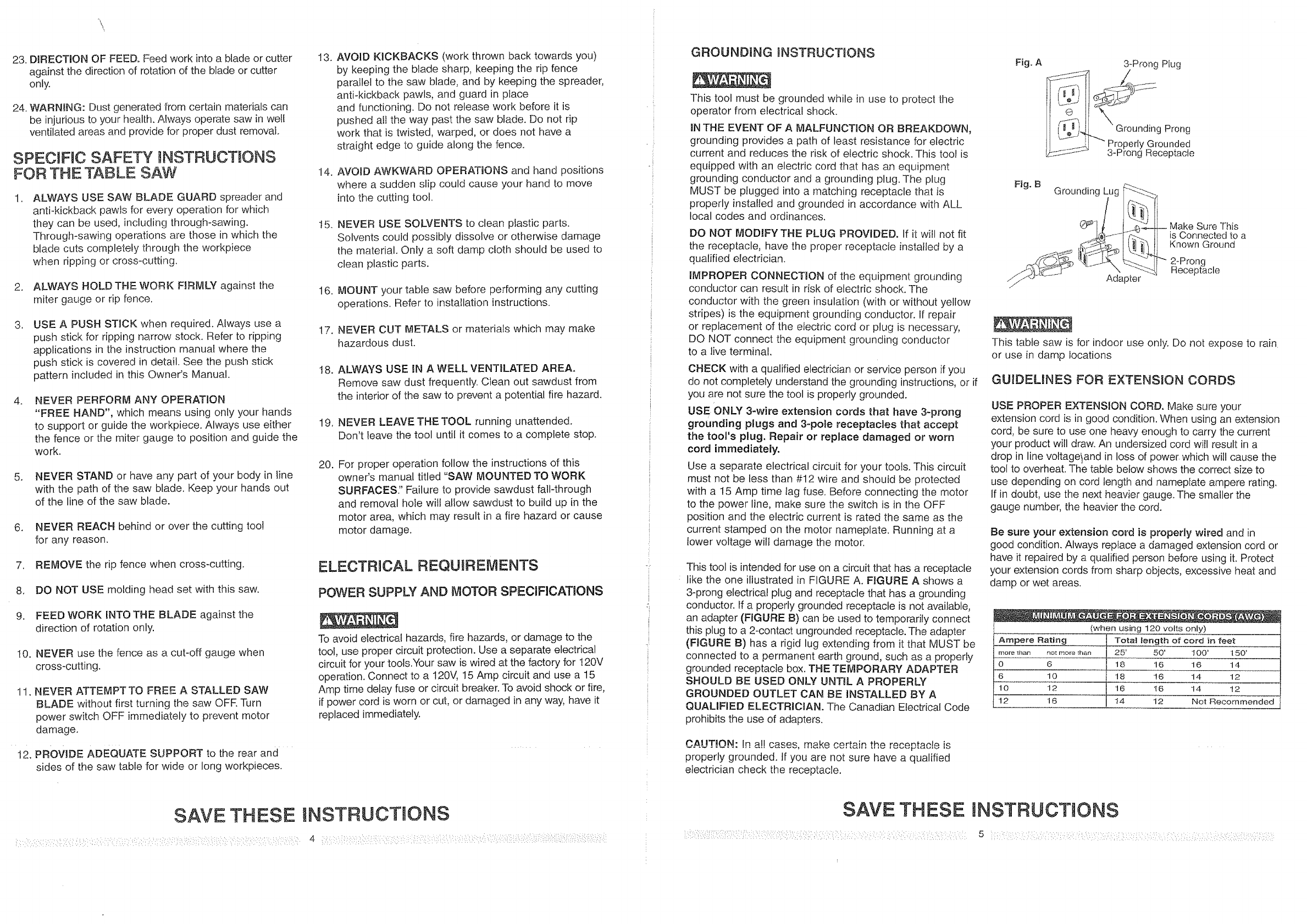
This tool is intended for use on a circuit that has a receptacle
like the one illustrated in FIGURE A. FIGURE A shows a
3-prong electrical plug and receptacle that has a grounding
conductor. If a properly grounded receptacle is not available,
an adapter (FIGURE B) can be used to temporarily connect
this plug to a 2-contact ungrounded receptacle. The adapter
(FIGURE B) has a rigid lug extending from it that MUST be
connected to a permanent earth ground, such as a properly
grounded receptacle box. THE TEMPORARY ADAPTER
SHOULD BE USED ONLY UNTIL A PROPERLY
GROUNDED OUTLET CAN BE INSTALLED BY A
QUALIFIED ELECTRICBAN. The Canadian Electrical Code
prohibits the use of adapters.
CAUT!ON: In a!! cases, make certain the receptac!e is
properly grounded. If you are not sure have a qualified
electrician check the receptacle.
SAVE THESE
Fig. A 3-Prong Plug
Grounding Prong
Properly Grounded
3-Prong Receptacle
Fig. BGrounding Lug _-_
Make Sure This
is Connected to a
Known Ground
2*Prong
Receptacle
This table saw is for indoor use only. Do not expose to rain
or use in damp locations
GUIDELINES FOR EXTENSION CORDS
USE PROPER EXTENSION CORD. Make sure your
extension cord ts in good condition. When using an extension
cord, be sure to use one heavy enough to carry the current
your product will draw. An undersized cord witl result in a
drop in line voltage!and in loss of power which will cause the
tool to overheat. The tabIe below shows the correct size to
use depending on cord length and nameplate ampere rating.
If in doubt, use the next heavier gauge. The smaller the
gauge number, the heavier the cord.
Be sure your extension cord is properly wired and in
good condition. Always replace a damaged extension cord or
have it repaired by a qualified person before using it. Protect
your extension cords from sharp objects, excessive heat and
damp or wet areas.
(when using 120 volts only)
Ampere Rating
more 1ban not more th_n
o 6
6 10
10 12
12 16
Total !,e,n,,gth of cord in feet
25' 50' 100' 150'
18 16 16 14
18 16 14 12
16 16 14 12
14 12 Not Recommended
mNSTRUCT ONS
RECOMMENDED ACCESSORIES
Visit your Sears Hardware Department or see the Craftsman
Power and Hand tools Catalog to purchase recommended
accessories for this power toot.
To avoid the risk of personal injury, do not modify this power
tool or use accessories net recommended by Sears.
Do not use adjustable (wobble) type dadoes or carbide
tipped dado blades on this saw. Maximum dado width is i/2".
Do not use a dado with a diameter larger than 6". Also do
not use molding head set with this saw.
Do not use any accessory unless you have completely read
the instruction or owner's rnanual for that accessory.
TOOLS NEEDED
Medium screwdriver
#2 Phillips screwdriver
ii I I ili II i I!
Straight edge
Adjustable wrench
Combination square
UNPACKING AND CHECKING CONTENTS
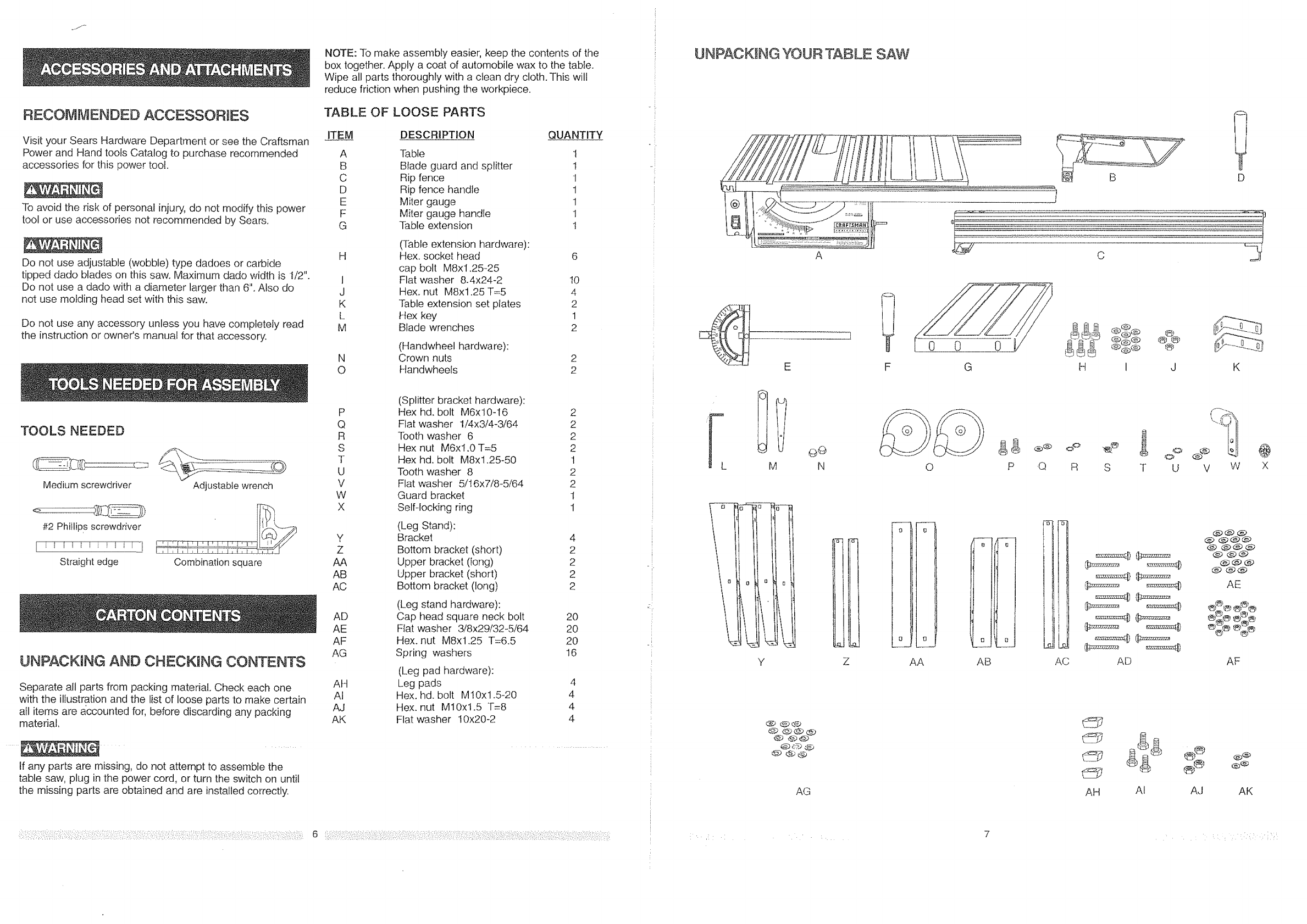
Separate all parts from packing material. Check each one
with the illustration and the list of loose parts to make certain
all items are a_ccountedfor, before discarding any packing
material,
If any parts are missing, do not attempt to assemble the
table saw, plug in the power cord, or turn the switch on until
the missing parts are obtained and are installed correctly.
NOTE: To make assembly easier, keep the contents of the
box together. Apply a coat of automobile wax to the table.
Wipe all parts thoroughly with a clean dry cloth. This will
reduce friction when pushing the workpiece.
TABLE OF LOOSE PARTS
ITEM DESCRIPTION QUANTITY
A Table
B Btade guard and splitter
C Rip fence
D Rip fence handle
E Miter gauge
F Miter gauge handle
G Table extension
(Table extension hardware):
H Hex. socket head
cap bolt M8x1.25-25
1 Flat washer 8.4x24-2
J Hex. nut M8x1.25 T=5
K Table extension set plates
L Hex key
M Blade wrenches
(Handwheel hardware):
N Crown nuts
O Handwheels
t
I
1
1
1
1
!
10
4
2
1
2
2
2
(Splitter bracket hardware):
P Hex hd. bolt M6x10-16
Q Flat washer 1/4x3/4-3/64
R Tooth washer 6
S Hex nut Mdxl.0 T=5
T Hex hd. bolt M8x1.25-50
U Tooth washer 8
V Flat washer 5/16x7/8_5/64
W Guard bracket
X Self-locking ring
(Leg Stand):
Y Bracket
Z Bottom bracket (short)
AA Upper bracket (tong)
AB Upper bracket (short)
AC Bottom bracket (long)
(Leg stand hardware):
AD Cap head square neck bolt
AE Flat washer 3/8x29/32-5/64
AF Hex. nut M8x1.25 T=6.5
AG Spring washers
(Leg pad hardware):
AH Leg pads
AI Hex. hd. bolt M10x1.5-20
AJ Hex. nut M10xl.5 T=8
AK Flat washer 10x20-2
2
2
2
2
1
2
2
1
1
4
2
2
2
2
2O
2O
2O
16
4
4
4
4
6 ::::::::::::::::::::::::::::::::::::::::::::::::::::::::::::::::::::::::::::::::::::::::::::::::::::::::::::::::::::::::::::::::::::::::::::::::::::::::::::::::::::::::::::::::::::::::::::::::::::::::::::::::::::::::::
UNPACKING YOUR TABLE SAW
A
qE F G H I J K
M
©©
N0 P Q R S T U V W
®
X
-= T-
o i3
I .
Y
i
!
ZAA
i
AB
J_
AC
_==@ (p==_=
AD
@@¢__
AE
AF
%%%®
@_s,@
AG AH AI AJ AK
• ,{:
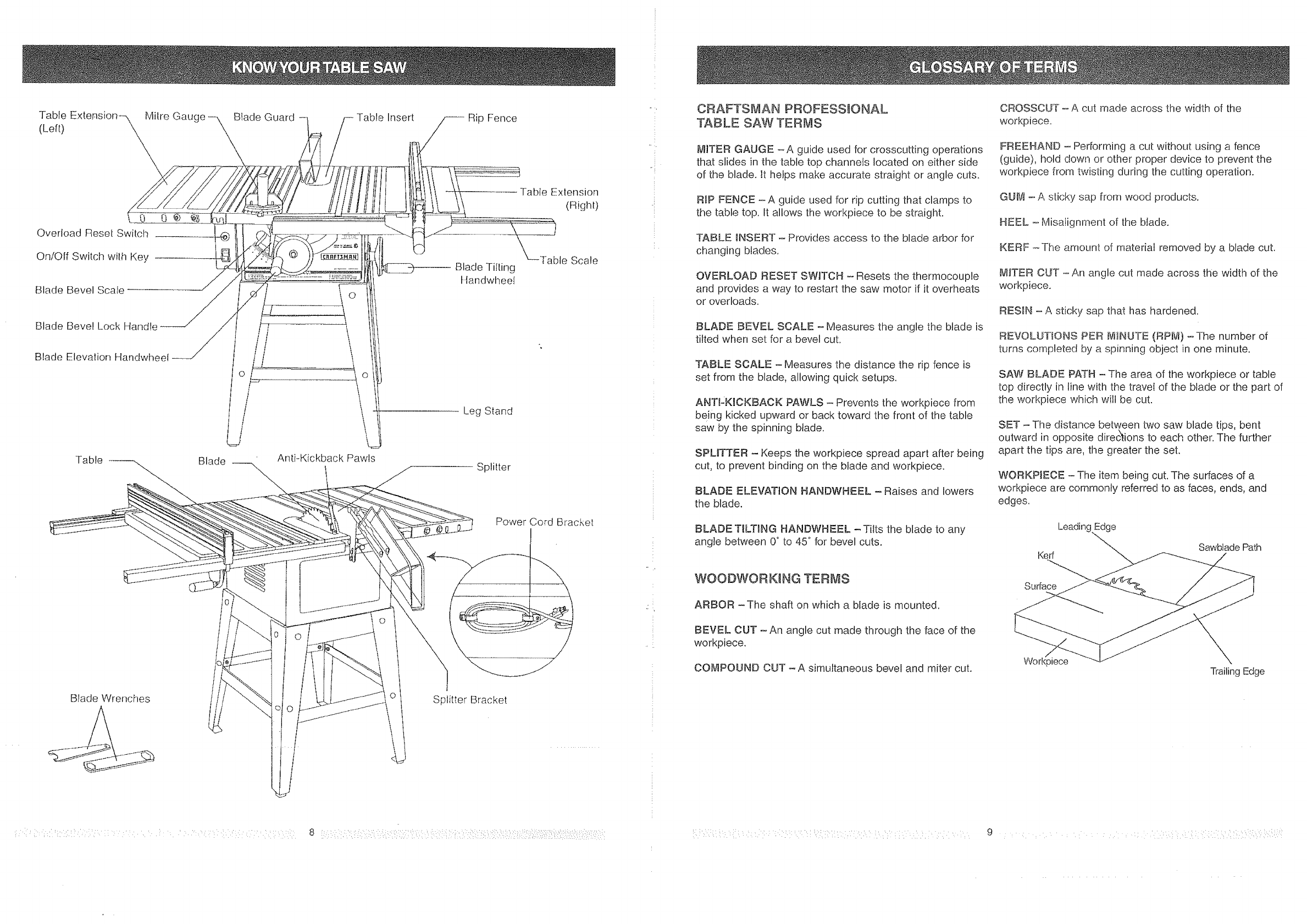
Table(Left)Extensi°n-x? re Gau,
_9 0¢ _
Overload Resei Switch
On/Off Switch wilh Key
Blade Bevel Scale
Blade Bevel Lock Handle
Blade Elevation Handwheei
Table Blade
Blade Wrenches
Blade Guard Table Insert Rip Fence
-- Blade Tilting
Handwheel
Table Extension
(Right)
Table Scale
Anti-Kickback Pawls
Leg Stand
Splitter
Power Cord Bracket
\
Splitter Bracket
Z
z
CRAFTS_AN PROFESSHONAL
TABLE SAW TERMS
MITER GAUGE -A guide used For"crosscutting operations
that slides in the table top channels located on either side
of the blade. It helps make accurate straight or angle cuts.
RIP FENCE -A guide used for rip cutting that clamps to
the table top. It allows the workpiece to be straight.
TABLE INSERT - Provides access to the blade arbor for
changing blades.
OVERLOAD RESET SWITCH - Resets the thermocouple
and provides a way to restart the saw motor if it overheats
or overloads.
BLADE BEVEL SCALE - Measures the angle the blade is
tilted when set for a bevel cut.
TABLE SCALE - Measures the distance the rip fence is
set from the blade, allowing quick setups.
ANTI:KICKBACK PAWLS - Prevents the workpiece from
being kicked upward or back toward the front of the table
saw by the spinning blade.
SPUTTER - Keeps the workpiece spread apart after being
cut, to prevent binding on the blade and workpiece.
BLADE ELEVATION HANDWHEEL -Raises and lowers
the blade.
BLADE TILTING HANDWHEEL - Tilts the blade to any
angle between 0° to 45" for bevel cuts.
WOODWORKMNG TERMS
ARBOR -The shaft on which a blade is mounted.
BEVEL CUT - An angle cut made through the face of the
workpiece.
COMPOUND CUT - A simultaneous bevel and miter cut.
CROSSCUT-A cut made across the width of the
workpiece.
FREEHAND - Performing a cut without using a fence
(guide), hold down or other proper device to prevent the
workpiece from twisting during the cutting operation.
GUltfd-A sticky sap from wood proclucts.
HEEL - Misaiignment of the blade.
KERF o-oThe amount of material removed by a blade cut.
_/HTER CUT ._An angle cut made across the width el: the
workpiece.
RESIN - A sticky sap that has hardened.
REVOLUTIONS PER M_NUTE (RPM) - The number of
turns completed by a spinning object in one minute.
SAW BLADE PATH - The area of the workpiece or table
top directly in line with the travel of the blade or the part of
the workpiece which will be cut.
SET -The distance between two saw blade tips, bent
outward in opposite directions to each other. The further
apart the tips are, the greater the set.
WORKPIECE - The item being cut. The surfaces of a
workpiece are commonly referred to as faces, ends, and
edges.
LeadingEdge
SawbladePath
Kerr
Sudace
Workpiece Trailing Edge
: : : 8 !:!-::/::!:::ii::: ¸:::: ?::::::- :_,:::/!::::/ ::::: _)L::: /:/: : 9 :: : • • • : : ••: • /•:vi•i :/:•:•/:: ::• /::i•::::i/:?::::::!: ¸
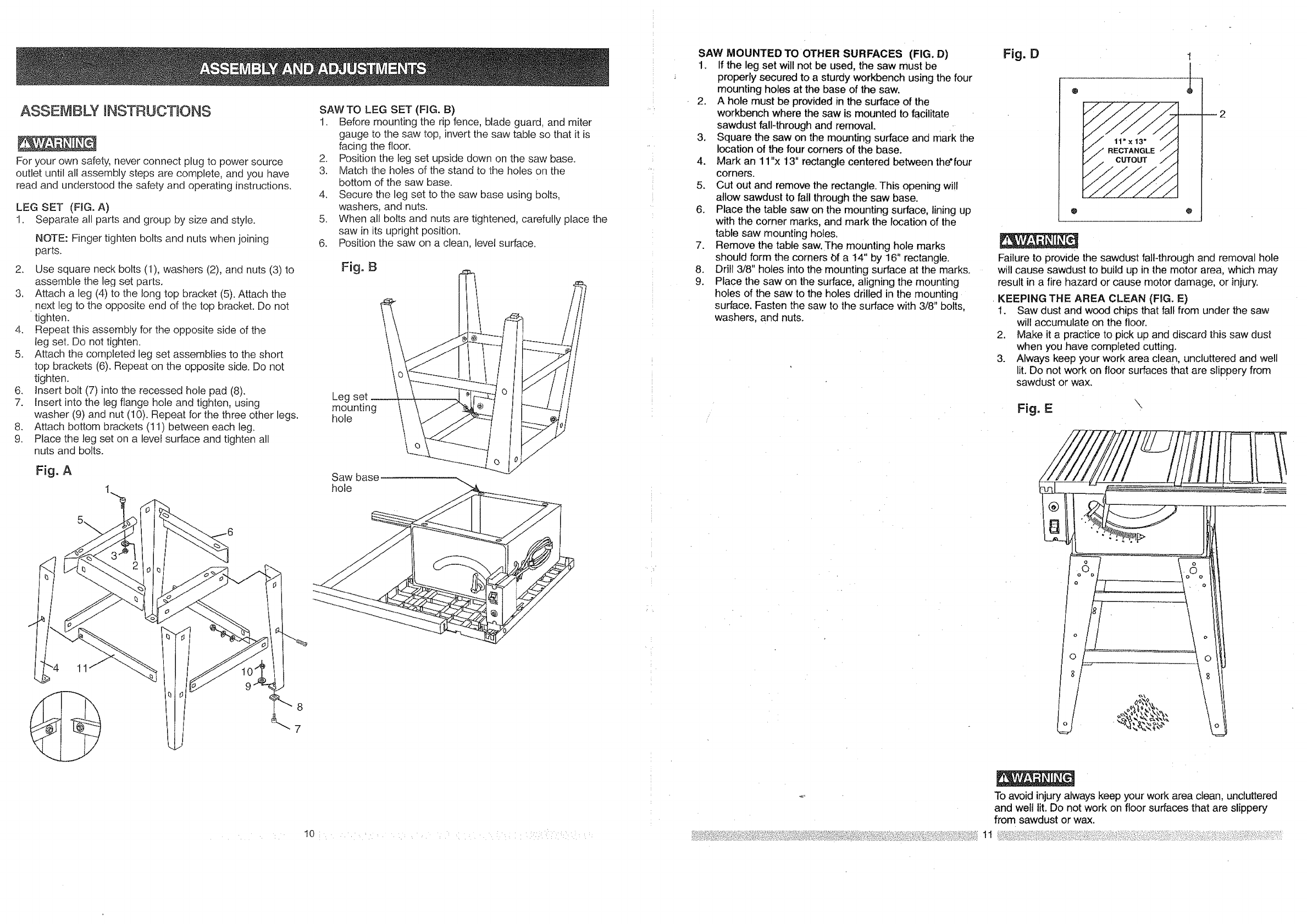
ASSEMBLY nNSTRUCTtONS
For your own safety, never connect plug to power source
ou[let until all assembly steps are complete, and you have
read and understood the safety and operating instructions.
LEG SET (FIG.A)
1. Separate all parts and group by size and style.
NOTE: Finger tighten bolts and nuts when joining
parts.
2. Use square neck bolts (1), washers (2), and nuts (3) to
assemble the leg set parts.
3. Attach a leg (4) to the long top bracket (5). Attach the
next leg to the opposite end of the top bracket. Do not
tighten.
4. Repeat this assembly for the opposite side of the
leg set. Do not tighten.
5. Attach the completed leg set assemblies to the short
top brackets (6). Repeat on the opposite side. Do not
tighten.
6. Insert bolt (7) into the recessed hole pad (8).
7. Insert into the leg flange hole and tighten, using
washer (9) and nut (10). Repeat for the three other legs.
8. Attach bottom brackets (11) between each leg.
9. Place the leg set on a level surface and tighten all
nuts and bolts.
Fig.A
11
SAW TO LEG SET (FIG. B)
1. Before mounting the rip fence, blade guard, and miter
gauge to the saw top, invert the saw table so that it is
facing the floor.
2. Position the leg set upside down on the saw base.
3. Match the holes of the stand to the holes on the
bottom of the saw base.
4. Secure the leg set to the saw base using bolts,
washers, and nuts.
5. When all bolts and nuts are tightened, carefully place the
saw in its upright position.
6. Position the saw on a clean, level surface.
Fig. B
Leg
mounting
hole
Saw base
hole
10: • ' .... : , _: ..... : : :: :i::: i: :':i¸¸ :'
SAW MOUNTED TO OTHER SURFACES (FIG. D)
1. if the leg set will not be used, the saw must be
properly secured to a sturdy workbench using the four
mounting holes at the base of the saw.
2. A hole must be provided in the surface of the
workbench where the saw is mounted to facilitate
sawdust fall-through and removal.
3. Square the saw on the mounting surface and mark the
location of the four corners of the base.
4. Mark an 11"x t3" rectangle centered between the'four
corners.
5. Cut out and remove the rectangle. This opening will
allow sawdust to fail through the saw base.
6. Place the table saw on the mounting surface, lining up
with the corner marks, and mark the location of the
table saw mounting holes.
7. Remove the table saw. The mounting hole marks
should form the corners bf a 14" by 16" rectangle.
8. Drill 3/8" holes into the mounting surface at the marks.
9. Place the saw on the surface, aligning the mounting
holes of the sawto the holes drilled in the mounting
surface. Fasten the saw to the surface with 3/8" bolts,
washers, and nuts.
Fig, D
o
1
2
Failure to provide the sawdust fatl4hrough and removal hole
will cause sawdust to build up in the motor area, which may
result in a fire hazard or cause motor damage, or injury.
KEEPING THE AREA CLEAN (FIG. E)
1. Saw dust and wood chips that fall from under the saw
will accumulate on the floor.
2. Make it a practice to pick up and discard this saw dust
when you have completed cutting.
3. Always keep your work area clean, uncluttered and well
lit. Do not work on floor surfaces that are slippery from
sawdust or wax.
Fig. E \
To avoid injury always keep your work area clean, uncluttered
and well lit. Do not work on floor surfaces that are slippery
from sawdust or wax.
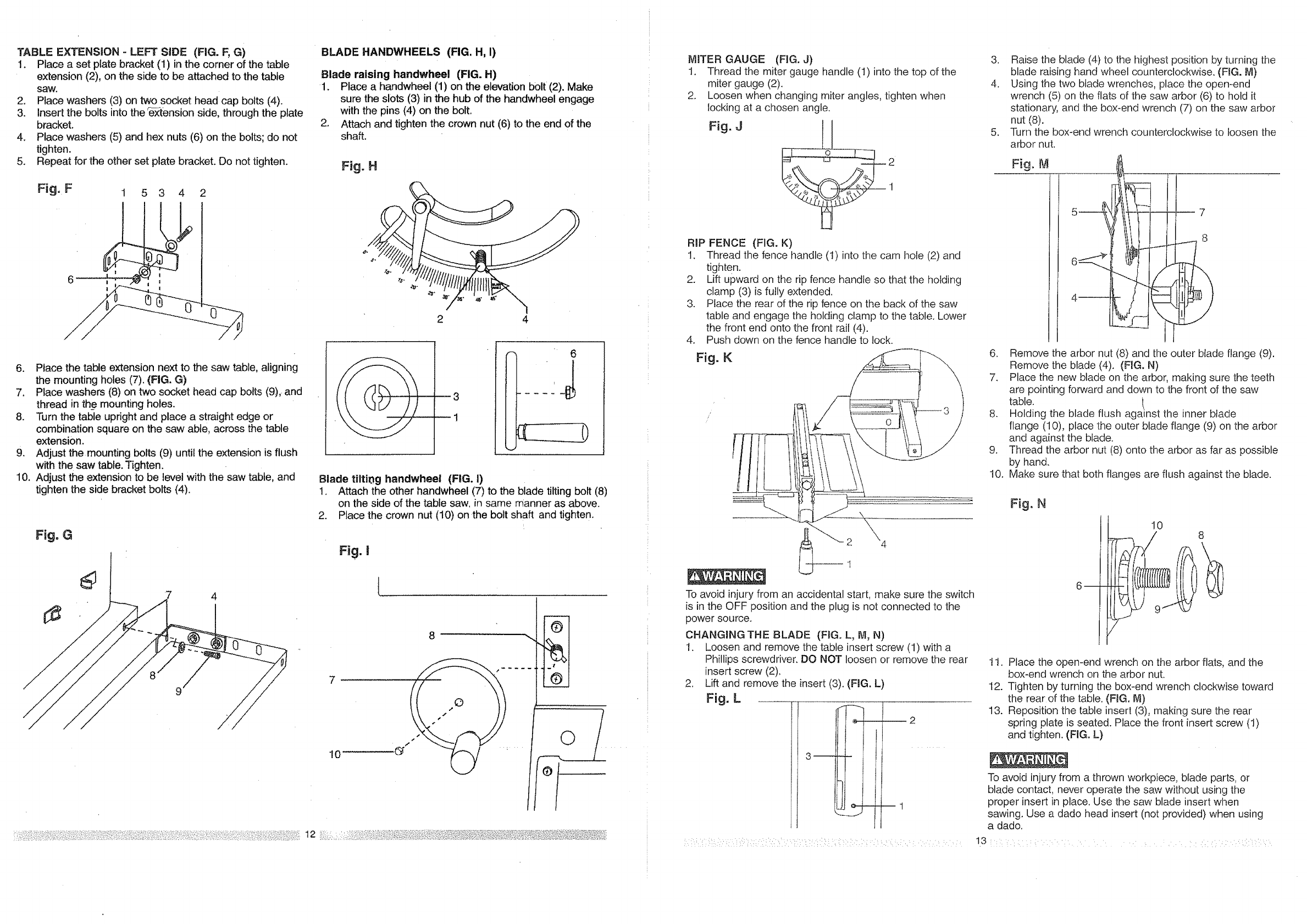
TABLE EXTENSION -LEFT SiDE (FIG. F, G)
1. Place a set plate bracket (1) in the corner of the table
extension (2), on the side to be attached to the table
saw,
2. Place washers (3) on two socket head cap bolts (4).
3. insert the bolts into the _ension side, through the plate
bracket.
4. Place washers (5) and hex nuts (6) on the bolts; do not
tighten.
5. Repeat for the other set plate bracket. Do not tighten.
Fig. F t 5 3 4 2
BLADE HANDWHEELS (FIG. H, I)
Blade raising handwheel (FIG. H)
1. Place a handwheel (1) on the elevation bolt (2). Make
sure the slots (3) in the hub of the handwheel engage
with the pins (4) on the bolt.
2. Attach and tighten the crown nut (6) to the end of the
shaft.
Fig. H
2 4
6. Place the table extension next to the saw table, aligning
the mounting holes (7). (FIG. G)
7. Place washers (8) on two socket head cap bolts (9),.and
thread in the mounting holes.
8. Turn the table upright and place a straight edge or
combination square on the saw able, across the table
extension.
9. Adjust the mounting bolts (9) untiI the extension is flush
with the saw table. Tighten.
10. Adjust the extension to be level with the saw table, and
tighten the side bracket bolts (4).
Fig. G
3
t
r-" 6
i
Blade tiltit!g handwheei (FIG. i)
t. Attach the other handwheel (7) to the blade tilting bolt (8)
on the side of the table saw, in same manner as above.
2. Place the crown nut (10) on the bolt shaft and tighten.
10
8
t
/
o/
.-,,,,.--,,_.
MITER GAUGE (FIG. J)
1. Thread the miter gauge handle (1) into the top of the
miter gauge (2).
2. Loosen when changing miter angles, tighten when
locking at a chosen angle.
Fig. J
2
1
RiP FENCE (FIG. K)
1. Thread the fence handle (t) into the cam hole (2) and
tighten.
2. Lift upward on the rip fence handle so that the holding
clamp (3) is futly extended.
3. Place the rear of the rip fence on the back of the saw
table and engage the holding clamp to the table. Lower
the front end onto the front rail (4).
4. Push down on the fence handle to lock.
Fig. K
2
--1
To avoid injury from an accidental start, make sure the switch
is in the OFF position and the plug is not connected to the
power source.
CHANGING THE BLADE (FIG. L, M, N)
1. Loosen and remove the table insert screw (t) with a
Phillips screwdriver. DO NOT loosen or remove the rear
insert screw (2).
2. Lift and remove the insert (3). (FIG. L)
Fig. L
3_
m 1
d
i:: _::i:::::::: :::::i/: ;:: i:::i:(:::::/i:::i:::'L::i_,::i! ::/:i¸:: !:: ::: :.: : :::: -:/, :
3. Raise the blade (4) to the highest position by turning the
blade raising hand wheel counterclockwise. (F_G. M)
4. Using the two blade wrenches, place the open-end
wrench (5) on the flats of the saw arbor (6) to hold it
stationary, and the box-end wrench (7) on the saw arbor
nut (8).
5. Turn the box-end wrench counterclockwise to loosen the
arbor nut.
Fig. w
7
8
6. Remove the arbor nut (8) and the outer btade flange (9).
Remove the blade (4). (FIG. N)
7. Place the new blade on the arbor, making sure the teeth
are pointing forward and down to the front of the saw
table. [
8. Holding the blade flush against the inner blade
flange (10), place the outer blade flange (9) on the arbor
and against the blade.
9. Thread the arbor nut (8) onto the arbor as far as possible
by hand.
!0. Make sure that both flanges are flush against the blade.
Fig. N
t t. Place the open-end wrench on the arbor flats, and the
box-end wrench on the arbor nut.
12. Tighten by turning the box-end wrench clockwise toward
the rear of the table, (FIG. _)
13. Reposition the table insert (3), making sure the rear
spring plate is seated. Place the front insert screw (1)
and tighten. (FIG. L)
To avoid injury from a thrown workpiece, blade parts, or
blade contact, never operate the saw without using the
proper insert in place. Use the saw blade insert when
sawing. Use a dado head insert (not provided) when using
a dado.
13:: ....
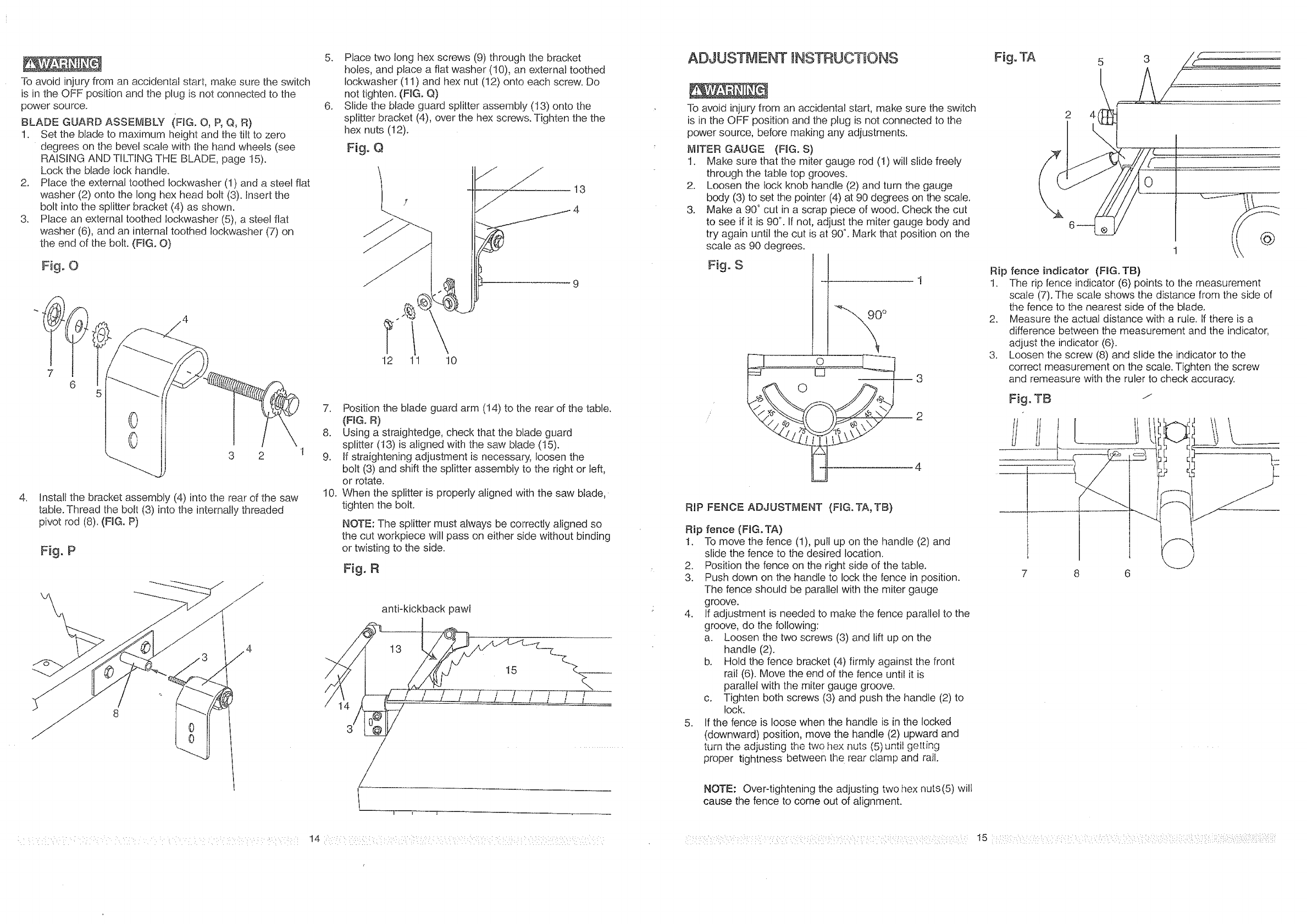
To avoid injury from an accidental start, make sure the switch
is in the OFF position and the plug is not connected to the
power source.
BLADE GUARD ASSEMBLY (FIG. O, P_Q.,R)
1. Set the blade to maximum height and the tilt to zero
degrees on the bevel scale with the hand wheels (see
RAISING AND TILTING THE BLADE, page 15).
Lock the blade lock handle.
2. Place the external toothed lockwasher (1) and a steel flat
washer (2) onto the long hex head bolt (3). Insert the
bolt into the splitter bracket (4) as shown.
3. Place an external toothed Iockwasher (5), a steel flat
washer (6), and an internal toothed lockwasher (7) on
the end of the bolt. (FIG..O)
Fig. 0
6
,Install the bracket assembly (4) into the rear of the saw
table. Thread the bolt (3) into the internally threaded
pivot rod (8). (FIG. P)
Fig.P
: ::: ::i ¸_:Y : :L:<::I : : (:: /: Y _ LL : ?::L: ¸::/f:V:: ¸¸ ::¸_::';: i
5. Place two long hex screws (9) through the bracket
holes, and place a flat washer (t0), an external toothed
iockwasher (11) and hex nut (12) onto each screw. Do
not tighten. (FIG. Q)
6. Slide the blade guard splitter assembly (13) onto the
splitter bracket (4), over the hex screws. Tighten the the
hex nuts (I2).
Fig. Q
13
9
12 11 10
7. Position the blade guard arm (14) to the rear of the table.
(FIG. R)
8. Using a straightedge, check that the blade guard
splitter (t 3) is aligned with the saw blade (15).
9. If straightening adjustment is necessary, loosen the
bolt (3) and shift the splitter assembly to the right or left,
or rotate.
10. When the spli_er is properly aligned with the saw blade, -
tighten the bolt.
NOTE: The splitter must always be correctly aligned so
the cut workpiece will pass on either side without binding
or twisting to the side.
Fig. R
anti-kickback pawt
13
15 \!
1
14 ;:::: :::/: :<:::::,::i !)>>i::?i::::T,:::: ?: ::J :/:: <::::!::': ILL¸:! ::'::::¸i¸7:¸:¸:) ::::::?::?::?i <;:/
ADJUSTMENT INSTRUCTIONS
To avoid injury from an accidental start, make sure the switch
is in the OFF position and the plug is not connected to the
power source, before making any adjustments.
MITER GAUGE (RG. S)
1. Make sure that the miter gauge rod (t) will slide freely
through the table top grooves.
2. Loosen the lock knob handle (2) and turn the gauge
body (3) to set the pointer (4) at 90 degrees on the scale,
3. Make a 90° cut in a scrap piece dwood. Check the cut
to see if it is 90°. If not, adjust the miter gauge body and
try again until the cut is at 90 °.Mark that position on the
scale as 90 degrees.
Fig° S
u
t
)0 °
o//7.-.t
J 2
J :AJ"TtO!
RIP FENCE ADJUSTMENT (FIG. TA, TEl)
Rip fence (FIG. TA)
1. To move the fence (1), pull up on the handle (2) and
slide the fence to the desired location.
2. Position the fence on the right side of the table.
3. Push down on the handle to lock the fence in position.
The fence should be parallel with the miter gauge
groove.
4. If adjustment is needed to make the fence parallel to the
groove, do the following:
a. Loosen the two screws (3) and lift up on the
handle (2).
b. Hold the fence bracket (4) firmly against the front
rail (6). Move the end of the fence until it is
parallel with the miter gauge groove.
c. Tighten both screws (3) and push the handle (2) to
lock.
5. If the fence is loose when the handle is in the locked
(downward) position, move the handle (2) upward and
turn the adjusting the two hex nuts (5) until getting
proper tightness between the rear clamp and rail.
NOTE: Over-tightening the adjusting twohex nuts(5) will
cause the fence to come out of alignment.
FigoTA
2 4
L
Rip fence indicator (F!G.TB)
1.
2.
,
@
1
The rip fence indicator (6} points to the measurement
scale (7). The scale shows the distance from the side of
the fence to the nearest side of the blade.
Measure the actual distance with a rule. If there is a
difference between the measurement and the indicator,
adjust the indicator (6).
Loosen the screw (8) and slide the indicator to the
correct measurement on the scale. Tighten the screw
and remeasure with the ruler to check accuracy.
Fig. TB _f
t5 :: :, [ : ::: :: :::::::::::::::::::::::::::::::::::::
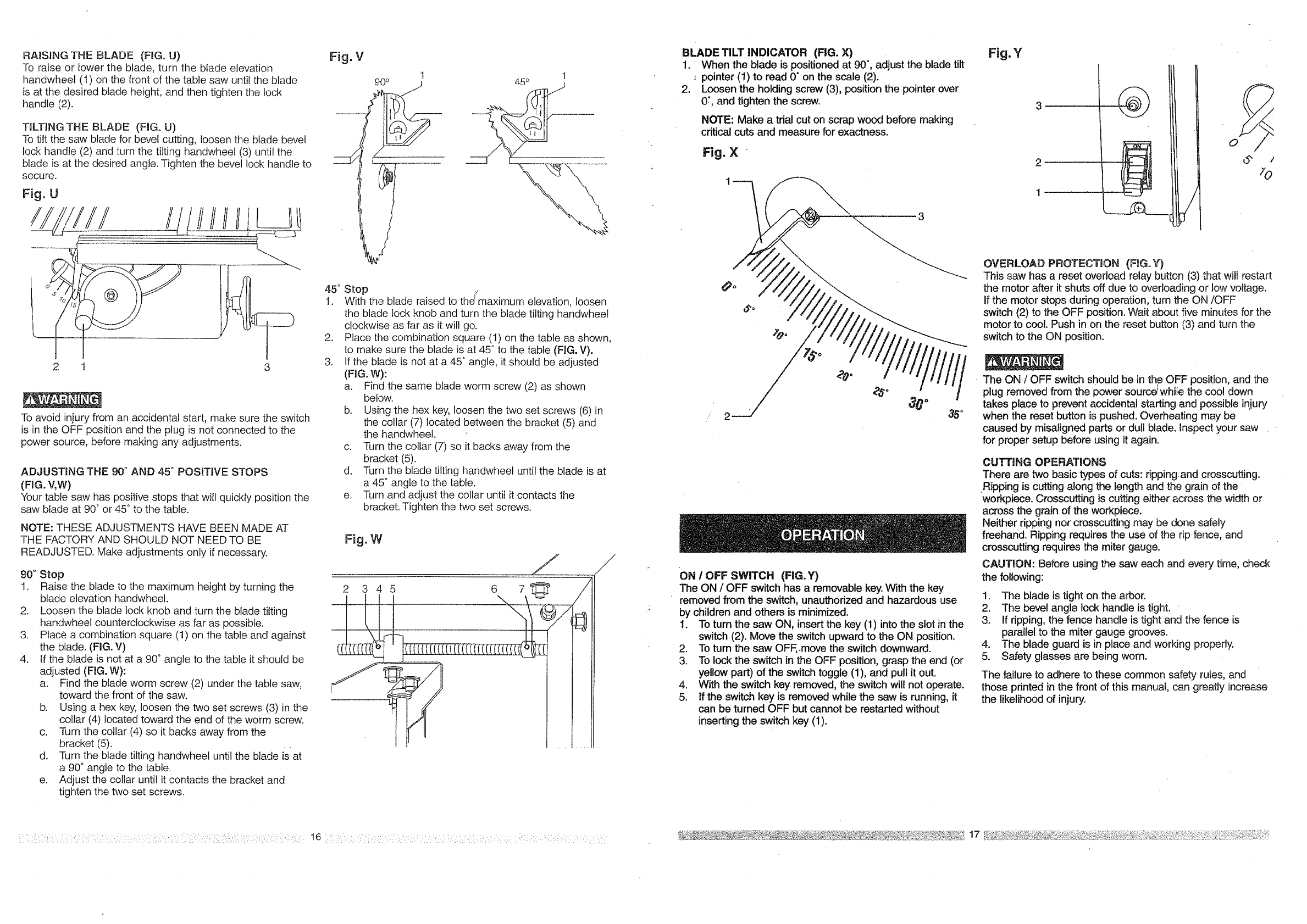
RAmSINGTHE BLADE (FIG, U)
To raise or lower the blade, turn the blade elevation
handwheel (1) on the front of the table saw until the blade
is at the desired blade height, and then tighten the lock
handle (2).
TILTING THE BLADE (FIG. U)
To tilt the saw blade for bevel cutting, loosen the blade bevel
lock handle (2) and turn the tilting handwheel (3) until the
blade is at the desired angle. Tighten the bevel lock handle to
secure.
Fig. U
!lUill
f
7O
3
To avoid injury from an accidental start, make sure the switch
is in the OFF position and the plug is not connected to the
power source, before making any adjustments.
ADJUSTING THE 90=AND 45° POSITIVE STOPS
(FIG. V,W)
Your table saw has positive stops that will quickly position the
saw blade at 90° or 45° to the table.
NOTE: THESE ADJUSTMENTS HAVE BEEN MADE AT
THE FACTORY AND SHOULD NOT NEED TO BE
READJUSTED, Make adjustments only if necessary.
90 ° Stop
1. Raise the blade to the maximum height by turning the
blade elevation handwheel.
2. Loosen the blade lock knob and turn the blade tilting
handwheel counterclockwise as far as possible.
3. Place a combination square (1) on the table and against
the blade. (FIG. V)
4. If the blade is not at a 90 ° angle to the table it should be
adjusted (FIG. W):
a. Find the blade worm screw (2) under the table saw,
toward the front of the saw.
b. Using a hex key, loosen the two set screws (3) in the
collar (4) located toward the end of the worm screw.
c. Turn the collar (4) so it backs away from the
bracket (5).
d. Turn the blade tilting handwheel until the blade is at
a 90°angle to the table.
e. Adjust the collar until it contacts the bracket and
tighten the two set screws.
::::;:.: : [ ::: ::: :
Fig. V
l
t
1
900 1
45 ° Stop
1. With the blade raised to the(maximum elevation, loosen
the blade lock knob and turn the blade tilting handwheet
clockwise as far as it will go.
2. Place the combination square (1) on the table as shown,
to make sure the blade is at 45° to the table (FIG. V).
3. If the blade is not at a 45° angle, it should be adjusted
(FIG. W):
a. Find the same blade worm screw (2) as shown
below.
b. Using the hex key, loosen the two set screws (6) in
the collar (7) located between the bracket (5) and
the handwheel.
c. Turn the collar (7) so it backs away from the
bracket (5).
d. Turn the blade tilting handwheel until the blade is at
a 45 ° angle to the table.
e. Turn and adjust the collar until it contacts the
bracket. Tighten the two set screws.
Fig. W
16 :::;
BLADE TILT INDICATOR (FIG. X)
1. When the blade is positioned at 90°, adjust the blade tilt
:pointer (1) to read 0° on the scale (2).
2, Loosen the holding screw (3), position the pointer over
0t, and tighten the screw.
NOTE: Make a trial cut on scrap wood before making
critical cuts and measure for exactness.
Fig. X "
1
3
@°
2-.--/ _: 35"
ON /OFF SWITCH (FIG.Y)
The ON /OFF switch has a removable key. With the key
removed from the switch, unauthorized and hazardous use
by children and others is minimized.
1. To turn the saw ON, insert the key (1) into the slot in the
switch (2). Move the switch upward to the ON position.
2. To turn the saw OFF,.move the switch downward.
3. To lock the switch in the OFF position, grasp the end (or
yellow part) of the switch toggle (1), and pull it out.
4. With the switch key removed, the switch will not operate.
5. tf the switch key is removed while the saw is running,it
can be turned OFF but cannot be restarted without
inserting the switch key (1).
Fig.Y
2
d
d" J
7O
OVERLOAD PROTECTION (FIG. Y)
This saw has a reset overload relay button (3) that will restart
the motor after it shuts off due to overloading or low voltage.
if the motor stops during operation, turn the ON/OFF
switch (2) to the OFF position. Wait about five minutes for the
motor to cool. Push in on the reset button (3) and turn the
switch to the ON position.
The ON tOFF switch should be in th# OFF position, and the
plug removed from the power sourcd while the coo! down
takes place to prevent accidental starting and possible injury
when the reset button is pushed. Overheating may be
caused by misaligned parts or dull blade, Inspect your saw
for proper setup before using it again.
CUTTING OPERATIONS
There are two basic types of cuts: rippingand crosscutting.
.Ripping is cutting along the length and the grain of the
workqpiece.Crosscutting is cutting either across the width or
across the grain of the workplace.
Neither ripping nor crosscutting may be done safely
freehand. Ripping requires the use of the rip fence, and
crosscutting requires the miter gauge.
CAUTION: Before using the saw each and every time, check
the following:
1. The blade is tight on the arbor.
2, The bevel angle lock handle is tight.
3. If ripping, the fence handle is tight and the fence is
parallel to the miter gauge grooves.
4. The blade guard is in place and working properly.
5. Safety glasses are being worn,
The failure to adhere to these common safety rules, and
those printed in the front of this manual, can greatly increase
the likelihood dinjury.
17 _;:_i:i!_!i: !:!:
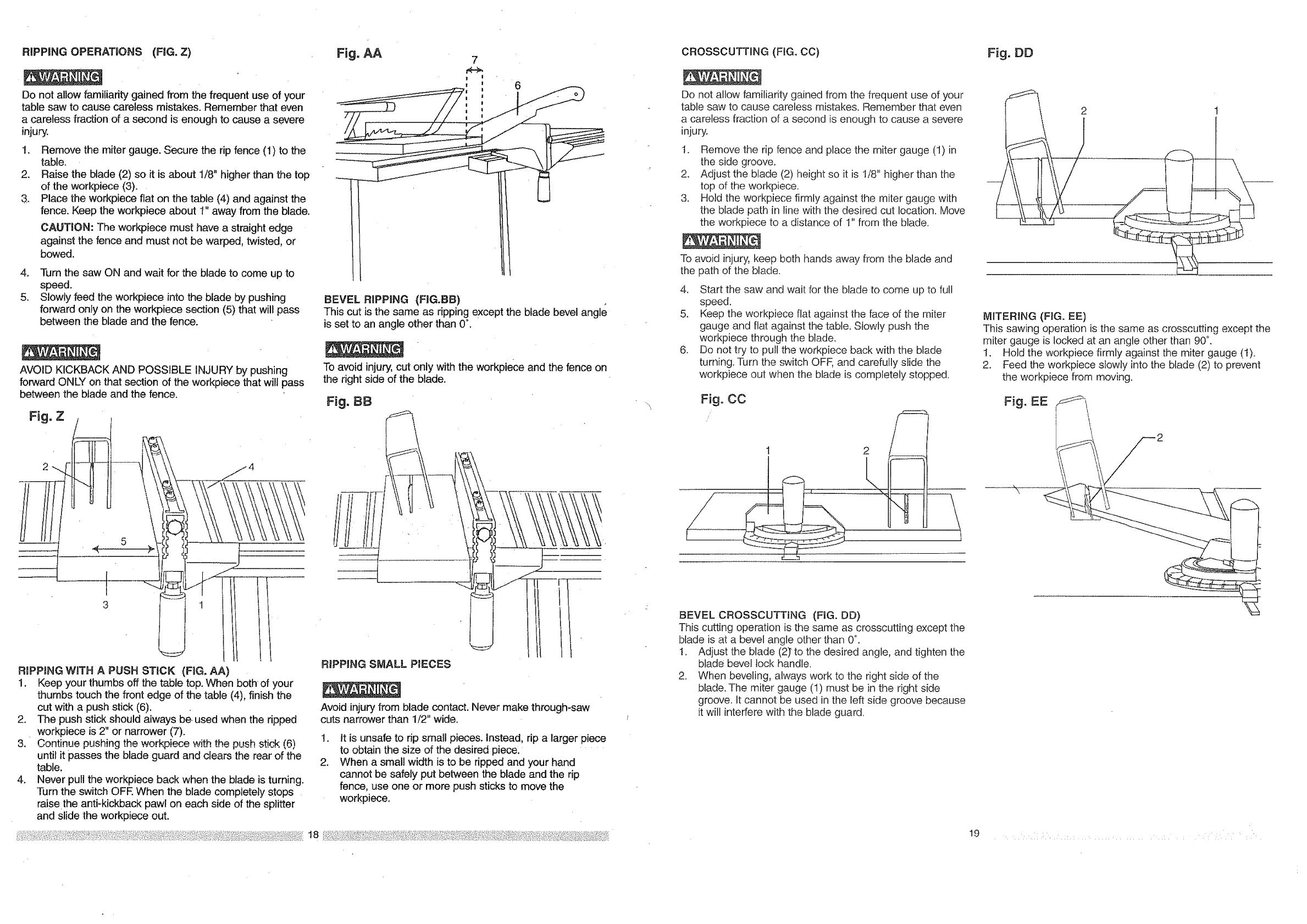
RIPPING OPERATIONS (FaG.Z)
Do not allow familiarity gained from the frequent use of your
table saw to cause careless mistakes. Remember that even
acareless fraction of a second is enough to cause a severe
injury.
1. Remove the miter gauge. Secure the rip fence (1) to the
table,
2. Raise the blade (2) so it is about 1/8" higher than the top
of the workpiece (3).
3. Place the workpiece flat on the table (4) and against the
fence. Keep the workpiece about I" away from the blade.
CAUT!ON: The workpiece must have a straight edge
against the fence and must not be warped, twisted, or
bowed.
4. -!urn the saw ON and wait for the blade to come up to
speed.
5. Slowly feed the workpiece into the blade by pushing
forward only on the workpiece section (5) that will pass
between the blade and the fence.
Fig. AA 7
!
!6
BEVEL RIPPING (FIG.BB)
This cut is the same as ripping except the blade bevel angle
is set to an angle other than 0°.
AVOID KICKBACK AND POSSIBLE INJURY by pushing
forward ONLY on that section of the workpiece that wilt pass
between the blade and the fence.
2
3
RIPPING WITH A PUSH STICK (FIG. AA
1. Keep your thumbs off the table top. When bothof your
thumbs touch the front edge of the table (4), finish the
cut with a push stick (6).
2. The push stick should always be. used when the ripped
workpiece is 2" or narrower (7).
3. Continue pushing the workpiece with the push stick (6)
until it passes the blade guard and clears the rear of the
table.
4.. Never pull the workpiece back when the blade is turning.
Turn the switch OFE When the blade completely stops
raise the anti-kickback pawl on each side of the splitter
and slide the workpiece out.
To avoid injury, cut only with the workpiece and the fence on
the right side of the blade.
Fig.BB
RIPPING SMALL PIECES
Avoid injuryfrom blade contact. Never make through-saw
cuts narrower than 1/2" wide.
.
2.
tt is unsafe to rip small pieces. Instead, rip a larger piece
to obtain the size of the desired piece,
When a small width is to be ripped and your hand
cannot be safely put between the blade and the rip
fence, use one or more push sticks to move the
workpiece.
CROSSCUTTING (FIG. CC)
Do not allow familiarity gained from the frequent use of your
table saw to cause careless mistake& Remember that even
a careless fraction of a second is enough to cause a severe
injury.
1. Remove the rip fence and place the miter gauge (1) in
the side groove.
2. Adjust the blade (2) height so it is 1/8" higher than the
top of the workpiece.
3. Hold the workpiece firmly against the miter gauge with
the blade path in line with the desired cut location. Move
the workpiece to a distance of t" from the blade.
To avoid injury, keep both hands away from the blade and
the path of the blade.
4, Start the saw and wait for the blade to come up to full
speed.
5. Keep the workpiece flat against the face of the miter
gauge and flat against the table. Slowly push the
workpiece through the blade.
6. Do not try to pull the workpiece back with the blade
turning. Turn the switch OFF, and carefully slide the
workpiece out when the blade is completely stopped.
Fig. CC
/
2/=
"4
BEVEL CROSSCUTTING (FIG. DD)
This cutting operation is the same as crosscutting except the
blade is at a bevel angle other than 0°.
1. Adjust the blade (2_fto the desired angle, and tighten the
blade bevel lock handle.
2. When beveling, always work to the right side of the
blade. The miter gauge (1) must be in the right side
groove. It cannot be used in the left side groove because
it will interfere with the blade guard,
Fig. DD
MITERING (FIG. EE)
This sawing operation is the same as crosscutting except the
miter gauge is locked at an angle other than 90 °.
I. Hold the workpiece firmly against the miter gauge {!).
2. Feed the workpiece stowly into the blade (2) to prevent
the workpiece from moving.
Fig. EE
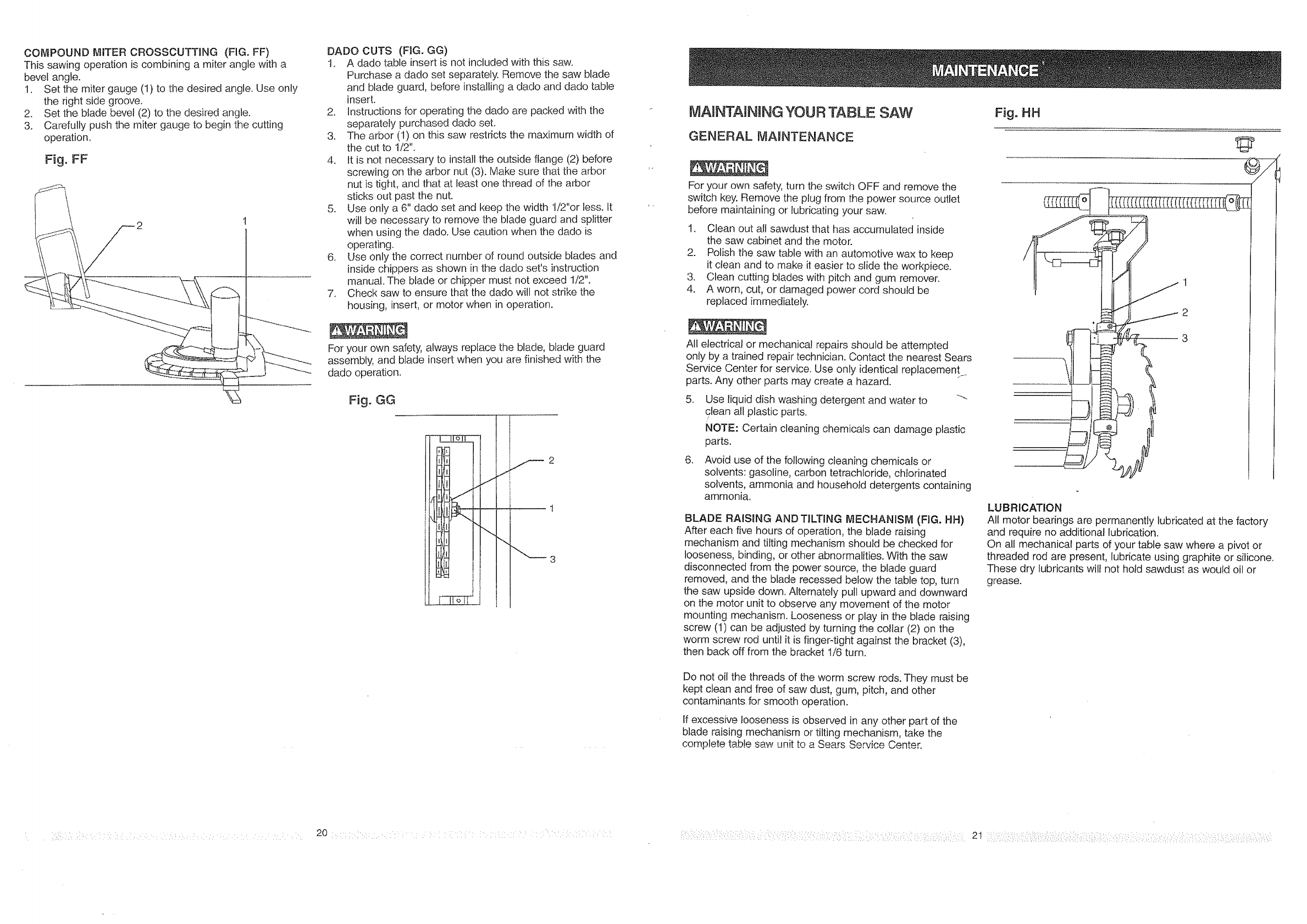
COMPOUND MITER CROSSCUTTING (FIG. FF)
This sawing operation is combining a miter angle with a
bevel angle.
1. Set the miter gauge (1) to the desired angle, Use only
the right side groove.
2. Set the blade bevel (2) to the desired angle.
3. Carefully push the miter gauge to begin the cutting
operation.
Fig. FF
DADO CUTS (FIG. GG)
1. A dado table insert is not included with this saw.
Purchase a dado set separately. Remove the saw blade
and blade guard, before installing a dado and dado table
insert.
2, Instructions for operating the dado are packed with the
separately purchased dado set.
3. The arbor (1) on this saw restricts the maximum width of
the cut to 1/2".
4. tt is not necessary to install the outside flange (2) before
screwing on the arbor nut (3). Make sure that the arbor
nut is tight, and that at least one thread of the arbor
sticks out past the nut.
5. Use only a 6" dado set and keep the width !/2"or less. tt
will be necessary to remove the blade guard and splitter
when using the dado. Use caution when the dado is
operating.
6. Use only the correct number of round outside blades and
inside chippers as shown in the dado set's instruction
manual. The blade or chipper must not exceed 1/2".
7. Check saw to ensure that the dado will not strike the
housing, insert, or motor when in operation.
For your own safety, always replace the blade, blade guard
assembly, and blade insert when you are finished with the
dado operation.
Fig. GG
J
J
F 2
/IAUNTAINING YOUR TABLE SAW
GENERAL MABNTENANCE
For your own safety, turn the switch OFF and remove the
switch key. Remove the plug from the power source outlet
before maintaining or lubricating your saw.
1. Clean out all sawdust that has accumulated inside
the saw cabinet and the motor.
2. Polish the saw table with an automotive wax to keep
it clean and to make it easier to slide the workpiece.
3. Clean cutting blades with pitch and gum remover.
4. A worn, cut, or damaged power cord should be
replaced immediately.
All electrical or mechanical repairs should be attempted
only by a trained repair technician. Contact the nearest Sears
Service Center for service. Use only identical replacement
parts. Any other parts may create a hazard.
.Use liquid dish washing detergent and water to -"
clean all plastic parts.
NOTE: Certain cleaning chemicals can damage plastic
parts.
.Avoid use of the following cleaning chemicals or
solvents: gasoline, carbon tetrachloride, chlorinated
solvents, ammonia and household detergents containing
ammonia.
BLADE RAISING AND TILTING MECHANISM (FIG. HH)
After each five hours of operation, the blade raising
mechanism and tilting mechanism should be checked for
looseness, binding, or other abnormalities. With the saw
disconnected from the power source, the blade guard
removed, and the blade recessed below the table top, turn
the saw upside down. Alternately pull upward and downward
on the motor unit to observe any movement of the motor
mounting mechanism. Looseness or play in the blade raising
screw (1) can be adjusted by turning the collar (2) on the
worm screw rod until it is finger-tight against the bracket (3),
then back off from the bracket 1/6 turn.
Do not oil the threads of the worm screw rods. They must be
kept clean and free of saw dust, gum, pitch, and other
contaminants for smooth operation.
If excessive looseness is observed in any other part of the
blade raising mechanism or tilting mechanism, take the
complete table saw unit to a Sears Service Center.
Fig. HH
LUBRICATION
All motor bearings are permanently lubricated at the factory
and require no additional lubrication,
On all mechanical parts of your table saw where a pivot or
threaded rod are present, lubricate using graphite or silicone.
These dry lubricants wilt not hold sawdust as would oil or
grease.
i::: : : ........ ;: : ...... ..... 20: :;: : :: : : ;: ...... :: ::::: :::::: 21 : : ::::: : :::::::::::: :::::: : ::: ::: ::[:;: :: :: :; :: :: :: [ [=:::
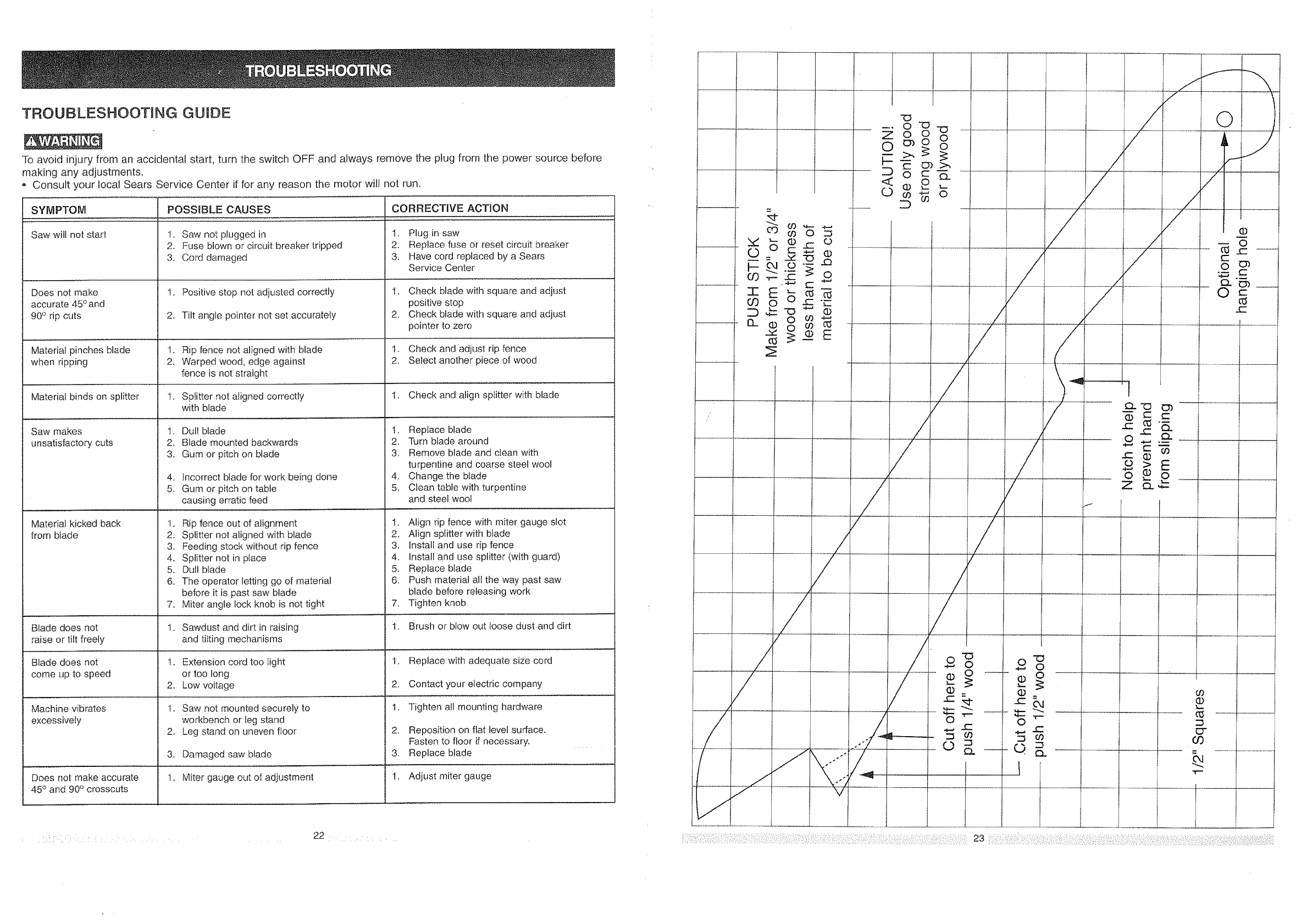
TROUBLESHOOTHNG GUIDE
To avoid injury from an accidental start, turn the switch OFF and always remove the plug from the power source before
making any adjustments.
o Consult your local Sears Service Center if for any reason the motor will not run,
SYMPTOM POSSIBLE CAUSES CORRECTIVE ACTION
; ; Z:;, :;..... ; ,, ,_,,;:,_,Z%,,,
Saw will not stare
............ L,,,
Does not make
accurate 45° and
90° rip cuts
Material pinches blade
when ripping
1. Plug in saw
2. Replace fuse or reset circuit breaker
3, Have cord replaced by a Sears
Service Center
1. Check blade with square and adjust
positive stop
2. Check blade with square and adjust
pointer to zero
1. Check and adjust rip fence
2. Select another piece of wood
Material binds on splitter 1. Check and align splitter with blade
Saw makes
unsatisfactory cuts
Material kicked back
from btade
1. Saw not plugged in
2. Fuse blown or circuit breaker tripped
3. Cord damaged
1. Positive stop not adjusted correctly
2. Tilt angle pointer not set accurately
1. Rip fence not aligned with blade
2. Warped wood, edge against
fence is not straight
1. Splitter not aligned correctly
with blade
1. Dull blade
2. Blade mounted backwards
3. Gum or pitch on blade
4. Incorrect blade for work being done
5. Gum or pitch on table
causing erratic feed
1, Rip fence out of alignment
2. Splitter not aligned with blade
3. Feeding stock without rip fence
4. Splitter not in place
5. Dull blade
6. The operator letting go of material
before it is past saw blade
7. Miter angle lock knob is not tight
1. Sawdust and dirt in raising
and tilting mechanisms
1, Extension cord too light
or too long
2. Low voltage
1, Saw not mounted securely to
workbench or leg stand
2. Leg stand on uneven floor
3. Damaged saw blade
Blade does not
raise or tilt freely
Blade does not
come up to speed
Machine vibrates
excessively
1. Miter gauge out of adjustment
Does not make accurate
45° and 90° crosscuts
!. Replace blade
2, Turn blade around
3, Remove blade and clean with
turpentine and coarse steel wool
4. Change the blade
5. Clean table with turpentine
and steel wool
1. Align rip fence with miter gauge slot
2, Align splitter with biade
3, Install and use rip fence
4. Install and use splitter (with guard)
5, Replace blade
6. Push material all the way past saw
blade before releasing work
7, Tighten knob
1. Brush or blow out Ioose dust and dirt
1, Replace with adequate size cord
2. Contact your electric company
1. Tighten all mounting hardware
2. Reposition on flat level surface.
Fasten to floor if necessary.
3. Replace blade
1. Adjust miter gauge
22
/
/
/
/
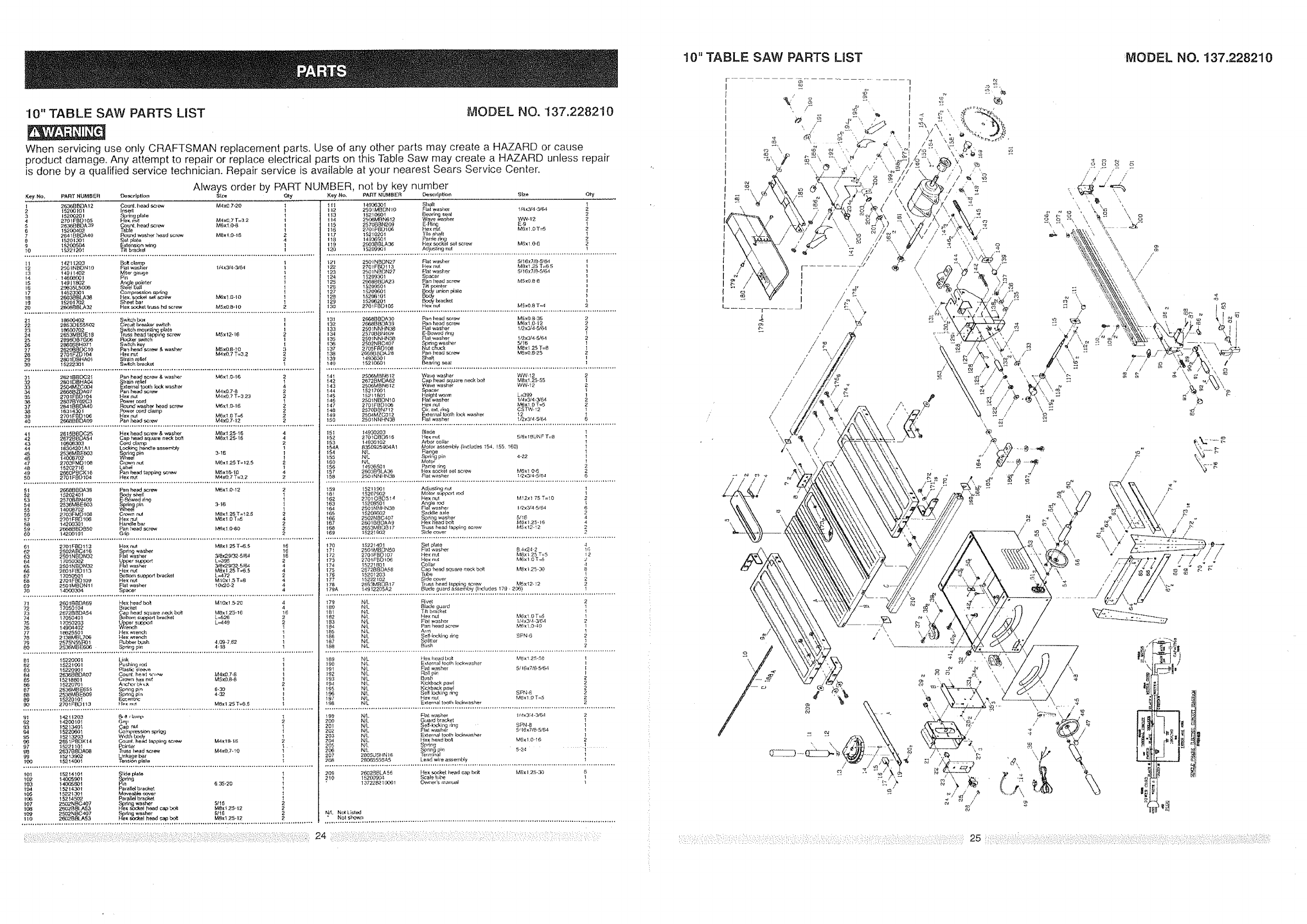
10" TABLE SAW PARTS LIST MODEL NO. 137.228210
10" TABLE SAW PARTS LIST MODEL NO. 137.228210
When servicing use only CRAFTSMAN replacement parts. Use of any other parts may create a HAZARD or cause
product damage. Any attempt to repair or replace electrical parts on this Table Saw may create a HAZARD unless repair
is done by a qualified service technician. Repair service is available at your nearest Sears Service Center.
Always order by PART NUMBER, not by key number
Key NO. PAR'_ NUMBER _,ctlpl_ort SiZe Oly }(ey No_ PART NUMBER De.,_rtpt_n Size QI_
12636850A12 Couel. I,.ead _.ctew M4x0 7-20 ! 1 t1 14936301 Sholt
t 5200 t01 Insefl 1 I 12 2501M_DH I0 Flal washer 1/4 _4 ._J_'_4 _
4ng plale 1_ 3152 _060 _ 8em4rcj _eat
3 1520_201 _ex. nut M4×0.7 T=32 l It4 WW-12 2225t)RMI3N612 W_ve washer
42701F90_05
2636850A 39 CounL head screw M0x1,0-6 I t5 257055N209 E- f_ing E-9 1
15_00402 Table 1 t16 270_F80106 He× nut MGX1.0 T_
7 264155OA40 Reund w'asher head sc_e_ Mgx! .0-1_ 2t 17 ,52t020_ "l'il_ shall
81520130 t Set p_ate 4 116 14936501 PBfrle fb N ?
.a015200504 ENensbn wp:'_j 1 119 26031_gLA36 Nex sockel sel screw M6x1 04_ ,_
,20 t 52_190 f Adi[_5ti_g n_t15221201 T_ b¢&c_4
,I 142t 1203 B_R c'.mp ,_ 121 250,NBDN27 _z,atwasher 5116*7t8._,_4 11
12 2501NB0'N10 Flal washe¢ 1i4x_d4 -3_64 270 }FRO113 Ne_ nut MBx1.25 T=55
I3 !4911402 Miler gaL_e I 123 2501NRDN27 F_at washer 5€16x7/8-5f64 _
t 4 146£000 tPiP _ 124 152093,01 Sp m:et
I5 149118432 A_g!e lx3]_ter .125 2_8850A23 Pan head scrr_v MS*'O 88 t
Slew 5all TR nler t
16 2_:35L500_ 125 152_09501
17 1452330t Co_We_s_ s_rg I 127 _mlon p4ale
18 26038BLA38 Hex. f.0d_e! ._t ,_ew ivl,Sxl 0-10 1 12(I 15205151
19 152 g 1702 Sh Let bat M5xO B- I 01 129 2701FB0t051520_201 [_x_t_H_g _ulNuc_el
20 260aRRLA32 Hex so(:._et lru'ss h<l scre*.v _ I 130 M_x08 TM =
21 18,_00402 Sw_tch be, 1 13_ 265858DA30 pan head sc,ew Mdxg 8-35 222666550A 39 P_r, head *_:r_'_ M6x 1.0-12
22 2&530 E55S02 C?muit Neake< switch
23 18600702 Sw_tch mo_ir_lJr-_ pla_o I133 2501NNHN38 glal washer 1F2x;3;4.5/54 2
24 2553MROE18 Truss head ta_p_ng s_;;ew Mdxt2-16 134 257055N409 I-Bowed ring 1
25 28980_7G06 Redder sw_eh 1 i 35 25011NNHN38 Flat waaher 1/2xRJ1.5/54 2
26 21360_8H071 SwBch key I 136 2502N8C407 _inc_ washer MRxl51tg25 T=8 ]
_7 2520{_BOC10 Pan hei_d _z:r_-W& washer M5xOB-lO 3 137 2705Fi_0108 _k
28 2701FZD104 Hex nut M4xO.7 T=3._ _ 1;38 _6'58_BDA28 Pa_ head _e_ M5xO.8-25
29 2801DBHA01 £1_ein _e_Jef _ 139 1493630t Shaft
Rearir_ sea_
30 _5_I Sw{{Ch brac_,e{ I I 140 15210501 I
31 26218_OC2_ Pa_, head screw &washer _x1,0-16 2 141 2506M8_.}6 _2 Wave washer WWq2
32 28010RHA04 Soa_n te_el 1 14_ 2672661DA62 Cap he_d squar_ ne,ak bob MBx1.25-55 1
33 2504MZC004 Ex_rnat tc_lh lock wP,sh_ 4143 250_MRN612 Wave washer WW-12 2
34 266_BZ[)Ag7 Pa_ head s_re_ M4×0.7-8 2 144 1521700t £4_=a_er 1
35 2701/=_,D104 Nex nut M4 xO.7T_3 23 _ 145 152_ t80l ,,_i_t worm L_-399
36 28078Y0203 P_,wef ::_rd 1 _45 2501NRONlg Fbt w_sher !t4x3/4-3/64
37 2641BBOA40 Round washer head screw M5×t ,0- _6 2 _ 47 _70 t FB D 106 Hex _u_ ,M._xl 0T--5 2
38 16314301 Powe_ co_d cfamp 2 t48 257058N712 Cir, ext, _g CSTW- 12 1
39 2701FBD'_06 Hex n_fl M6K1 0 T_ 2 _49 2504MZC0t2 Exlemal lcolh lock w_sher 12 1
40 2668BBDA09 Pan head screw M4x.9.7-12 2150 2501NNHN38 F_al washer W2x_4 ,_64
4! 2615880C25 He_ head screw &,,_her MRx1.25d6 4 151 14930203 B_ade ]
4 152 270108D615 5/RxtBUNP T=8
42 2672880A54 Cap head square neck boll M8×1.25.16
43 10606303 Ce_5 cb-p_ 2 153 14930102 A_b_ col_ar ]
44 16304201A1 Lo<:_iog l_.at_le as._em_y I154A 8350925904A1 Melee assemb4y (b_clLtdes 154. _55160) ]
45 2538MRER03 _ pm 3-16 11 154 ,'L Flange I
t55 _L S dng pen 4.22 ,
4_ $ 40C_702 _'_OIO_ I
47 2703FM0108 C_'owr_t_ut MOx1.25 T_12.5 2 t6{) I'L_L
! t56 f 493550f pattie rir_ 2
48 15202716 Label
49 2_0PRCK16 Pan head tapping s.w_ Mdxt_10 4 157 2"6038 _3LA3_ Hex ._ocke_ set screw M6x10-5 2
50 2701FB{)104 He_ _ M4XO.7 T=3,2 2 158 250_NN_N38 F_a; wasI'_r.t_ 1_2_4.5/C_1 5
51 2_5858OA39 Pan head scre_ MdixI Dd2 2 159 152t 1901 Ad ust b_2 n_ ]
5_ 1520240_ _ shell 1 16_ 15207902 Meier s_r _-_2. 1
53 257068N409 E-P_wed dng 1 152 2701 O80514 Flex nu_ M12x175 T=t0 2
5,1 2536MBEdO3 #_e_ pi_ 3-1_ 1 163 15205501 An le rod
Ft_a_washer U2X_4,5/_4
55 14008702 1 164 2501f4NHN38 26
5{_ 2703FM0108 Crown n_ MRxl.25 T_12._ 15208r_32 8acHle axle
S nng washer 5/16 4
57 2701 F_D/06 Hex nu! Mdx1 OTr.5 4 165 2502N_C407 _ex h'ead [',__t M_,x1,25" 16 4
58 14200301 Ha_J_e bar 2 167 2601{_8DAA9
59 2_dBBBDB50 Pan head screw M6x1,0-50 2 168 _653/d50817 Truss head la_Jng screw M5K12-12 22
6g 1420010_ Grip 2 169 _5221 -_'2 S£b rover
61 2701 FBD 113 Hex r,t ,'t MRx ! 25 T_,5 16 170 15221 "! 01 Sel pfate _0
62 2502A8C416 Spdt_g wa _,het 16 17_ 2501MBDNd0 FIB{washer B 4x2.1-2
5.3 2501NBDN32 Fialwashe_ _8K29/32-5/64 15 172 2701gB0107 He_t nt4 MgXt 25 T:5 12
£>4 t 70503_2 U r support L _-_-3_ 2 173 2701 FREd* C_3 He_ n_I M6xl 0T_
65 2501 N_tDN32 F_;_Nhe_f 328X2gf32-5/64 4 174 15221501 Collar 2
66 2601F80113 kbx m.,_ MBX1.25 T_.5 175 2572_DA56 Cap head square neck bol_ Mdxt 25.30 18
_7 17050551 _rlom SL.t;_._dbracke_ L--.-472 4 175 _5201203 T_e
55 2701FB0109 Hex nut M I 0_:1.5 T=8 4 1 ?'7 15222102 Side ¢_ver 2
89 2501MRON1 t F_I washer 10:{20.2 ._ _78 2_3M_DJ_17 T_Lt_ he_d la,_ir_j _ew M,5xt 2-12 2
70 14000304 Space_ 4, 17£% 14912205A2 Dad_ guard a.'_emL4y {tr_bdes 179 - 206) I
71 25018BDAdg Hex h e_d bo_ M1 gxl 5-20 4 t 79 gVt Rive{
72 17050 _04 Bf_ ke! e 1BO b_'L R_ade guard 1
73 257258OA54 Ca head square {reck bo_l MBx $.25.16 16 181 N.4_ Titlb*'_cket 1
BOttOm m._C1_d L_a¢.kel L=52'6 2 182 NiL Rex n_l N'_Sxl 0 T_-_5 174 I 7050401
75 17050203 U _ s L_p_d L-'_449 2 I B3 NZL Fial washer W4x3_4-3JT.I 12
76 14904402 _ch 1 IB,t N_L Pan head s-_r_ Mt3"d .0-,t9
77 10525501 t-tex wrench 1 155 t',VL Ar m 1
78 2138MBL706 }4ex wre_ch I 186 _'L 8eGbcki_ ring SPN_
70 2575N55RO 1 Rubber LXJ-_h 4,09-7,62 I 18.7 N/L Sglilt e_
4-18
8g 253G{',_ _7_06 Spd_ _in I 188 _L _Ltsh
51 _5220001 Li_k ] 169 N/L Hex head t_ MRxl 25-50 1
82 15221001 pu,_l'l_g_od _ 19"0 N_L Extera_i Ioc4h k_k, washer
Plaslk: st_we t t91 N_L Fl_l washer 5/16x7/8-5_£_1 !
83 15221390 f
54 253"5580A07 Cour_ he_d '_:_."-_ M4xO.7-8 I192 N/L Roll pin I
85 15218801 G:ewn hBX n;r_ MdX0.8-8 I193 i"_/L _t_sh 22
86 _522070t At_clx_r b_x_ 2 19,I _L Kickback pawl
87 253._'48E655 Spnng pin 6,30 I _95 t,_L Kickback pawI 2
58 253_MR:E509 S_o_f_gpin "1-32 I 1£6 _L Serf bc_ir'.g ring SPN4"_ 2
89 15220101 Ecc_flt_; t97 N_L Hex nu_ M_x1 .O T=5 2
2701FBD112 H_x nI_ MRxl 25 T_55 1 198 5#__ External Ioolh Iockwa _.he_ Z
gl _421 t203 _ r _lnp 199 N!L _F_atw_shez 1/4x3.',t=_14 I2
92 14200101 Gni_ 21 200 _L Guard bracket
93 15213401 Cap nbl 120t N._ SeGk_&ir_g rin_. SPN-8 !
£'4 $$22060l Coprl lf_,SlOr_ _:_ri_ 3I 202 NiL _tat washer 5/16_7;8-5/£>4 I
95 t 5213203 Wdt _'_t_ 203 t'UL _xlemat 1oolhIo_k'wasber
£'5 2651PBDK14 Cou_t. he_d l_ping _<crew M4x18-15 12 204 NJL Hex he_d bo_1 M6_hO 16 2_
97 I522110_ P_int e_" 1 205 b_L _dng I
95 2837850A58 T_-'t_ head s.c_ew M4xg.7M0 t 20_ NJL _hn9 pin 5-2.1 ........ I .........
99 15213902 Linkage bar 1 207 28OdUdHN _6 Terrain al I
100 15214001 Ten_._ p_lB I 208 25065558A5 Lead wire assem_y 1
101 I52t"110t Slide _ale l 209 2_.0285Lf155 Hex .'_>:;kel head cap bok MR_I 25-30 15
102 14005901 _t, dng 1 210 15200904 Scale IUN
103 t40Q5801 Ptn 035.20 1 137228210OO1 Owns% mant_._J ]
104 15214301 Parallelb_d_et I
105 152213Ot Movea]_e o_ver 1
{;'5 15214502 Pa_aBei bmc_el I
107 2502NRO407 S_hng WBSher ,5/16 2
108 2_0288LA53 Hex ._2<el head cap bo_ MBxt .25.12 2
109 2502NBC407 _pdng washer 5/16 2 NZL N_ Lisle_
110 260258LA53 HeX _:_el head ca_ _ MRx125-12 2 " No! Sb,OWt_
24
I
I
I
I
I
I
I
I
I
\
I
I
I
I
J
/
/
\
/
/
/
/
ii
I
