Craftsman 315172300 User Manual SABRE SAW Manuals And Guides L0010533
CRAFTSMAN Saw Sabre Manual L0010533 CRAFTSMAN Saw Sabre Owner's Manual, CRAFTSMAN Saw Sabre installation guides
User Manual: Craftsman 315172300 315172300 CRAFTSMAN SABRE SAW - Manuals and Guides View the owners manual for your CRAFTSMAN SABRE SAW #315172300. Home:Tool Parts:Craftsman Parts:Craftsman SABRE SAW Manual
Open the PDF directly: View PDF  .
.
Page Count: 18
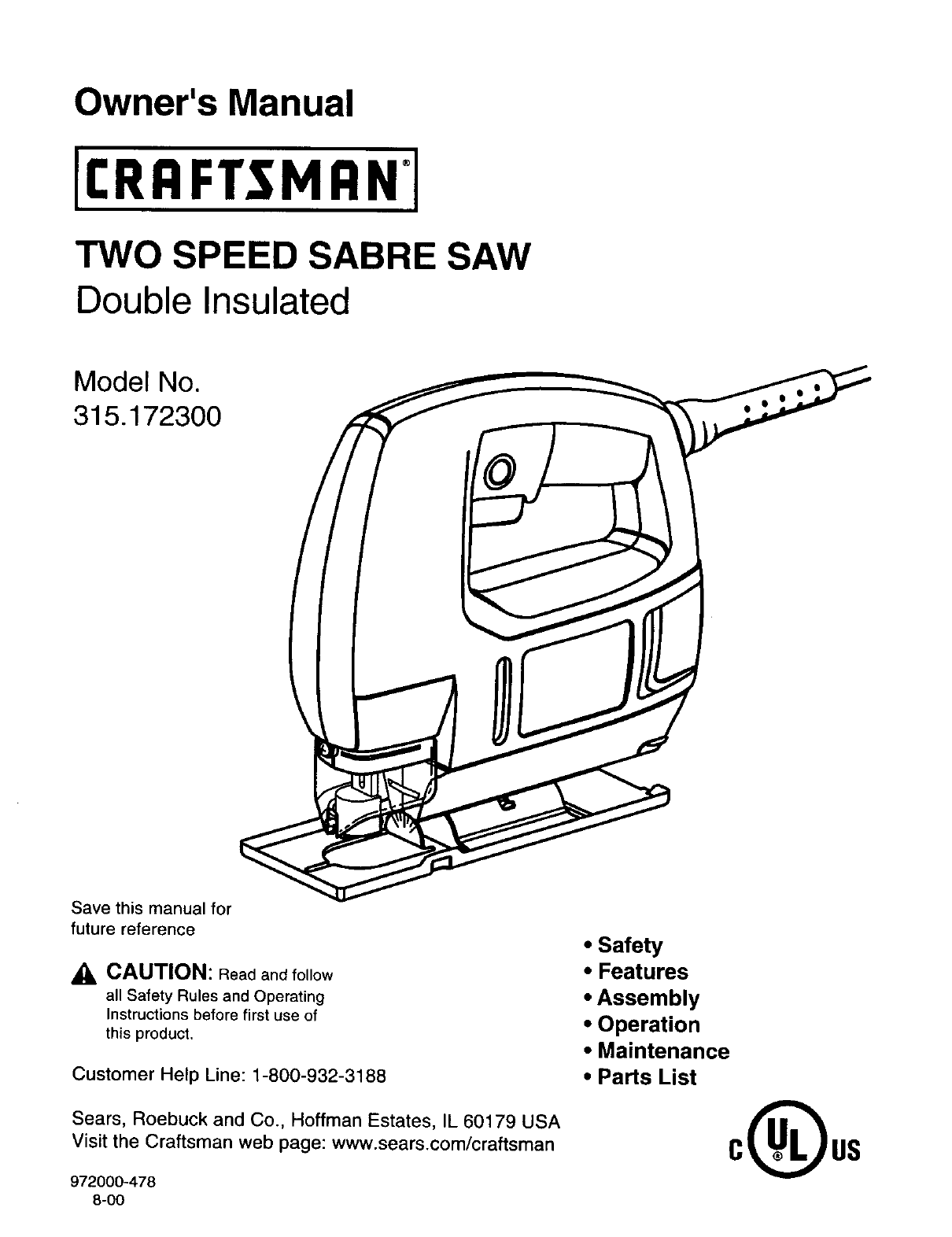
Owner's Manual
ICRRFTSMRN'I
TWO SPEED SABRE SAW
Double Insulated
Model No.
315.172300
Save this manual for
future reference
"_ CAUTION: Read and follow
all Safety Rules and Operating
Instructions before first use of
this product.
Customer Help Line: 1-800-932-3188
Sears, Roebuck and Co., Hoffman Estates, IL 60179 USA
Visit the Craftsman web page: www.sears.com/craftsman
972000-478
8-00
• Safety
•Features
•Assembly
•Operation
•Maintenance
•Parts List
0( )os
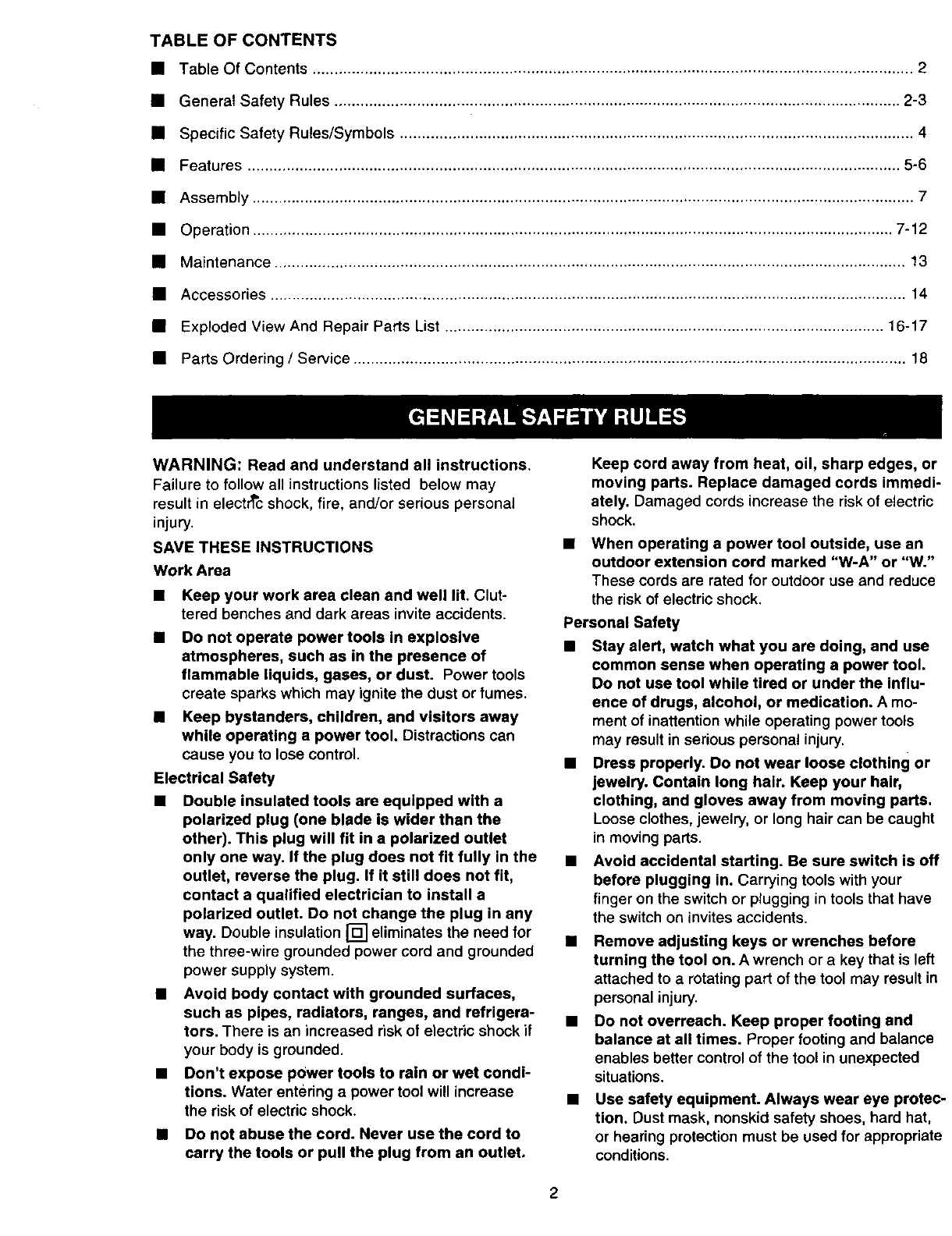
TABLE OF CONTENTS
• Table Of Contents .......................................................................................................................................... 2
•General Safety Rules .................................................................................................................................. 2-3
• Specific Safety Rules/Symbols ...................................................................................................................... 4
• Features ...................................................................................................................................................... 5-6
• Assembly ........................................................................................................................................................ 7
• Operation ................................................................................................................................................... 7-12
• Maintenance ................................................................................................................................................. 13
• Accessories .................................................................................................................................................. 14
• Exploded View And Repair Parts List ..................................................................................................... 16-17
• Parts Ordering / Service ............................................................................................................................... 18
WARNING: Read and understand all instructions.
Failure to follow all instructions listed below may
result in elect_c shock, fire, and/or serious personal
injury.
SAVE THESE INSTRUCTIONS
Work Area
•Keep your work area clean and well lit. Clut-
tered benches and dark areas invite accidents.
Do not operate power tools In explosive
atmospheres, such as in the presence of
flammable liquids, gases, or dust. Power tools
create sparks which may ignite the dust or fumes.
•Keep bystanders, children, and visitors away
while operating a power tool. Distractions can
cause you to lose control.
Electrical Safety
•Double insulated tools are equipped with a
polarized plug (one blade is wider than the
other). This plug will fit in a polarized outlet
only one way. If the plug does not fit fully in the
outlet, reverse the plug. If it still does not fit,
contact a qualified electrician to install a
polarized outlet. Do not change the plug in any
way. Double insulation [] eliminates the need for
the three-wire grounded power cord and grounded
power supply system.
•Avoid body contact with grounded surfaces,
such as pipes, radiators, ranges, and refrigera-
tors. There is an increased risk of electric shock if
your body is grounded.
•Don't expose power tools to rain or wet condi-
tions. Water entering a power tool will increase
the risk of electric shock.
•Do not abuse the cord. Never use the cord to
carry the tools or pull the plug from an outlet.
Keep cord away from heat, oil, sharp edges, or
moving pads. Replace damaged cords immedi-
ately. Damaged cords increase the risk of electric
shock.
When operating a power tool outside, use an
outdoor extension cord marked "W-A" or "W."
These cords are rated for outdoor use and reduce
the risk of electric shock.
Personal Safety
•Stay alert, watch what you are doing, and use
common sense when operating a power tool.
Do not use tool while tired or under the influ-
ence of drugs, alcohol, or medication. A mo-
ment of inattention while operating power tools
may result in serious personal injury.
•Dress properly. Do not wear loose clothing or
jewelry. Contain long hair. Keep your hair,
clothing, and gloves away from moving parts.
Loose clothes, jewelry, or long hair can be caught
in moving parts.
•Avoid accidental starting. Be sure switch is off
before plugging in. Carrying tools with your
finger on the switch or plugging in tools that have
the switch on invites accidents.
•Remove adjusting keys or wrenches before
turning the tool on. A wrench or a key that is left
attached to a rotating part of the tool may result in
personal injury.
•Do not overreach. Keep proper footing and
balance at all times. Proper footing and balance
enables better control of the tool in unexpected
situations.
Use safety equipment. Always wear eye protec-
tion. Dust mask, nonskid safety shoes, hard hat,
or hearing protection must be used for appropriate
conditions.
2
ToolUseandCare
• Useclampsor anotherpracticalwayto secure
andsupporttheworkpieceto astable plat-
form. Holding the work by hand or against your
body is unstable and may lead to loss of control.
•Do not force tool. Use the correct tool for your
application. The correct tool will do the job better
and safer at the rate for which it is designed.
•Do not use tool if switch does not turn it on or
off. Any tool that cannot be controlled with the
switch is dangerous and must be repaired.
•Disconnect the plug from the power source
before making any adjustments, changing
accessories, or storing the tool. Such preven-
tive safety measures reduce the risk of starting the
tool accidentally.
• Store idle tools out of the reach of children and
other untrained persons. Tools are dangerous in
the hands of untrained users.
Maintain tools with care. Keep cutting tools
sharp and clean. Properly maintained tools with
sharp cutting edges are less likely to bind and are
easier to control.
Check for misalignment or binding of moving
parts, breakage of parts, and any other condi-
tion that may affect the tool's operation. If
damaged, have the tool serviced before using.
Many accidents are caused by poorly maintained
tools.
Use only accessories that are recommended
by the manufacturer for your model. Accesso-
ries that may be suitable for one tool may become
hazardous when used on another tool.
Service
Tool service must be performed only by quali-
fied repair personnel. Service or maintenance
performed by unqualified personnel could result in
a risk of injury.
When servicing a tool, use only identical
replacement parts. Follow instructions in the
Maintenance section of this manual. Use of
unauthorized parts or failure to follow Maintenance
Instructions may create a risk of electric shock or
injury.
Hold tool by insulated gripping surfaces when performing an operation where the cutting tool may
contact hidden wiring or its cord. Contact with a "live" wire will make exposed metal parts of the tool "live" and
shock the operator.
Additional Rules for Safe Operation
• Know your power tool. Read operator's
manual carefully. Learn its applications and
limitations, as well as the specific potential
hazards related to this tool. Following this rule
will reduce the risk of electric shock, fire, or
serious injury.
•Always wear safety glasses. Everyday eye-
glasses have only impact-resistant lenses;
they are NOT safety glasses. Following this rule
will reduce the risk of serious personal injury.
•Protect your lungs. Wear aface or dust mask
if the operation is dusty. Following this rule will
reduce the risk of serious personal injury.
•Protect your hearing. Wear hearing protection
during extended periods of operation. Follow-
ing this rule will reduce the risk of serious per-
sonal injury.
• Inspect tool cords periodically and, if dam-
aged, have repaired at your nearest Factory
Service Center or other Authorized Service
Organization. Constantly stay aware of cord
location. Following this rule will reduce the risk of
electric shock or fire.
•Check damaged parts. Before further use of
the tool, a guard or other part that is damaged
should be carefully checked to determine that it
will operate properly and perform its intended
function. Check for alignment of moving parts,
binding of moving parts, breakage of parts,
mounting, and any other conditions that may
affect its operation. A guard or other part that is
damaged should be properly repaired or
replaced by an authorized service center.
Following this rule will reduce the risk of electric
shock, fire, or serious injury.
•Don't abuse cord. Never carry the tool by the
cord or yank it to disconnect it from the
receptacle. Keep cord away from heat, oil, and
sharp edges. Following this rule will reduce the
risk of electric shock or fire.
•Make sure your extension cord is in good
condition. When using an extension cord, be
sure to use one heavy enough to carry the
current your product will draw. A wire gage
size (A.W.G.) of at least 16 is recommended
for an extension cord 100 feet or less in
length. A cord exceeding 100 feet is not
recommended. If in doubt, use the next
heavier gage. The smaller the gage number,
the heavier the cord. An undersized cord will
cause a drop in line voltage resulting in loss of
power and overheating.
• Inspect for and remove all nails from lumber
before cutting. Following this rule will reduce the
risk of serious personal injury.
•Drugs, alcohol, medication. Do not operate
tool while under the influence of drugs, alco-
hol, or any medication. Following this rule will
reduce the risk of electric shock, fire, or serious
personal injury.
•Save these instructions. Refer to them fre-
quently and use them to instruct others who
may use this tool. If you loan someone this
tool, loan them these instructions also.
_WARNING: Some dust created by power sanding,
sawing, grinding, drilling, and other construction
activities contains chemicals known to cause
cancer, birth defects or other reproductive harm.
Some examples of these chemicals are:
•lead from lead-based paints,
• crystalline silica from bricks and cement and
other masonry products, and
• arsenic and chromium from chemically-treated
lumber.
Your risk from these exposures varies, depending
on how often you do this type of work. To reduce
your exposure to these chemicals: work in a well
ventilated area, and work with approved safety
equipment, such as those dust masks that are
specially designed to filter out microscopic particles.
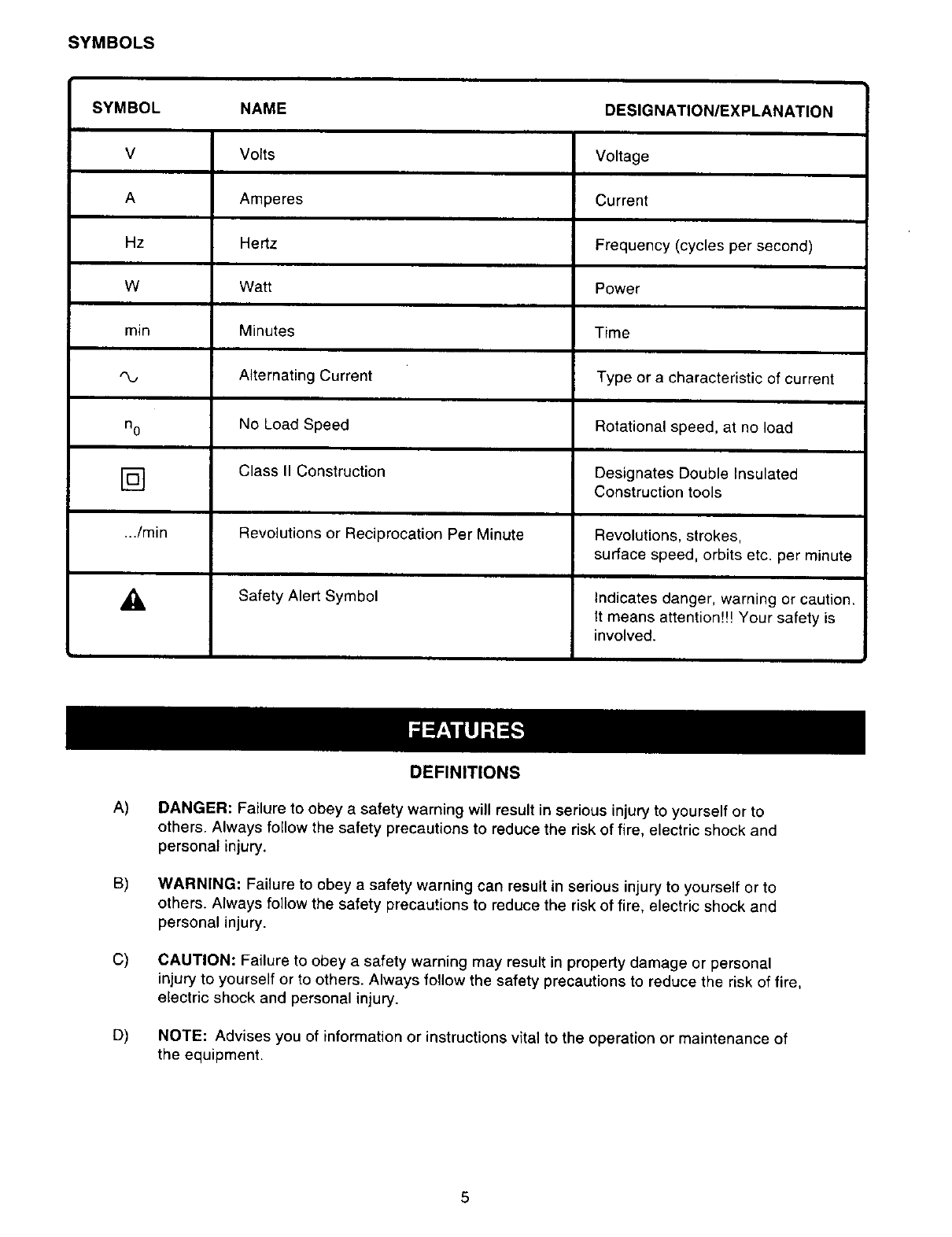
SYMBOLS
SYMBOL NAME DESIGNATION/EXPLANATION
V Volts Voltage
A Amperes Current
Hz Hertz Frequency (cycles per second)
W Watt Power
min Minutes Time
•%, Alternating Current Type or a characteristic of current
no No Load Speed Rotational speed, at no load
] Class II Construction Designates Double Insulated
Construction tools
.../min Revolutions or Reciprocation Per Minute Revolutions, strokes,
surface speed, orbits etc. per minute
_IL Safety Alert Symbol Indicates danger, warning or caution.
It means attention!!! Your safety is
involved.
DEFINITIONS
A)
B)
C)
D)
DANGER: Failure to obey a safety warning will result in serious injury to yourself or to
others. Always follow the safety precautions to reduce the risk of fire, electric shock and
personal injury.
WARNING: Failure to obey asafety warning can result in serious injury to yourself or to
others. Always follow the safety precautions to reduce the risk of fire, electric shock and
personal injury.
CAUTION: Failure to obey a safety warning may result in property damage or personal
injury to yourself or to others. Always follow the safety precautions to reduce the risk of fire,
electric shock and personal injury.
NOTE: Advises you of information or instructions vital to the operation or maintenance of
the equipment.
5
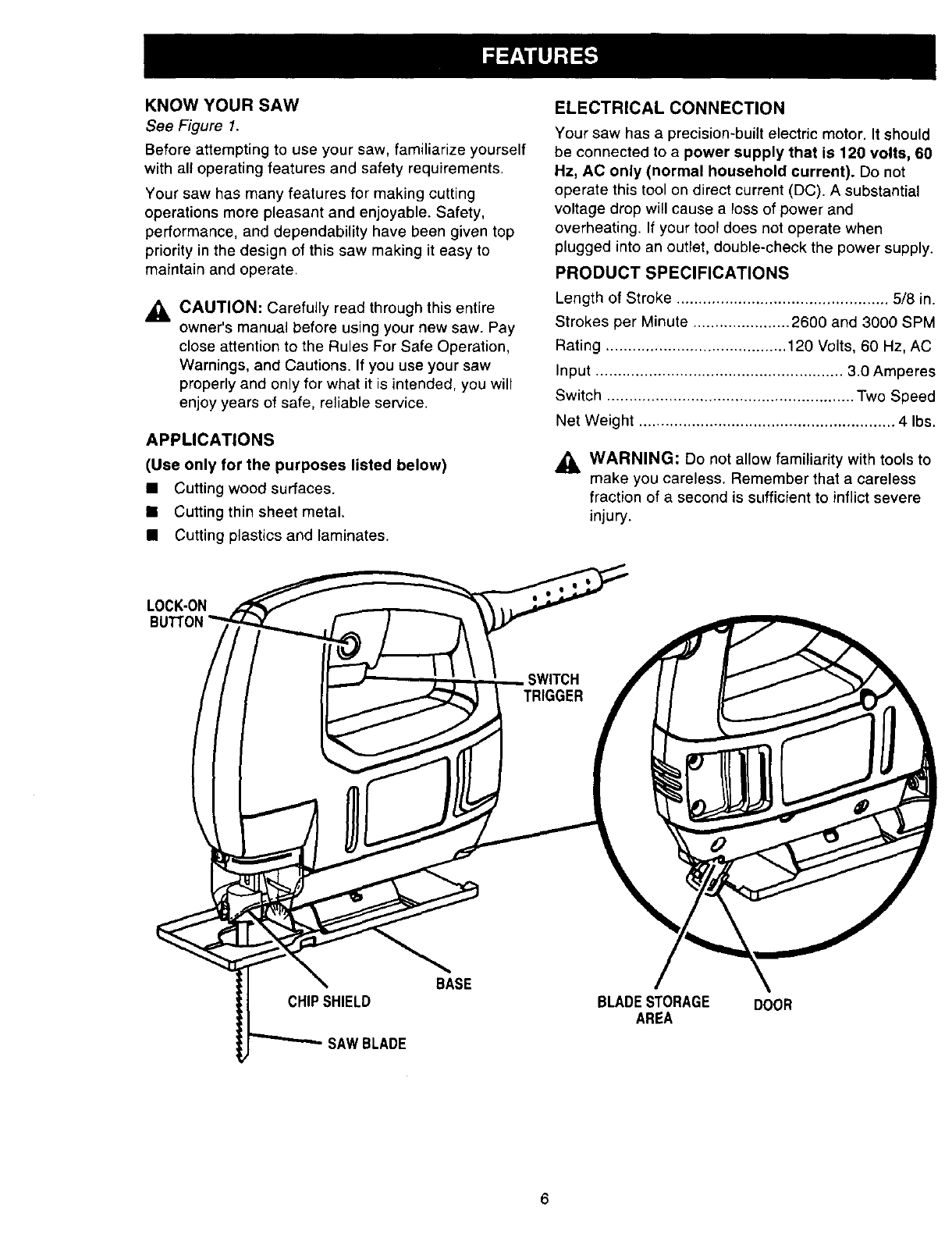
KNOW YOUR SAW
See Figure 1.
Before attempting to use your saw, familiarize yourself
with all operating features and safety requirements.
Your saw has many features for making cutting
operations more pleasant and enjoyable. Safety,
performance, and dependability have been given top
priority in the design of this saw making it easy to
maintain and operate.
_k CAUTION: CarefuJly read through this entire
owner's manual before using your new saw. Pay
close attention to the Rules For Safe Operation,
Warnings, and Cautions. If you use your saw
properly and only for what it is intended, you will
enjoy years of safe, reliable service.
APPLICATIONS
(Use only for the purposes listed below)
•Cutting wood surfaces.
• Cutting thin sheet metal.
•Cutting plastics and laminates.
ELECTRICAL CONNECTION
Your saw has a precision-built electric motor. It should
be connected to apower supply that is 120 volts, 60
Hz, AC only (normal household current). Do not
operate this tool on direct current (DC). A substantial
voltage drop will cause a loss of power and
overheating. If your tool does not operate when
plugged into an outlet, double-check the power supply.
PRODUCT SPECIFICATIONS
Length of Stroke ................................................ 5/8 in.
Strokes per Minute ...................... 2600 and 3000 SPM
Rating ......................................... 120 Volts, 60 Hz, AC
Input ........................................................ 3.0 Amperes
Switch ........................................................ Two Speed
Net Weight .......................................................... 4 Ibs.
_lk WARNING: Do not allow familiarity with tools to
make you careless. Remember that a careless
fraction of a second is sufficient to inflict severe
injury.
LOCK-ON
CHIP SHIELD
SAWBLADE
BASE
BLADESTORAGE DOOR
AREA
6
Your saw has been shipped completely assembled
except for the blade. Inspect it carefully to make sure
no breakage or damage has occurred during shipping.
If any parts are damaged or missing, contact your
nearest Sears retail store to obtain replacement parts
before attempting to operate saw. A blade and this
owner's manual are also included.
_, WARNING: If any parts are missing, do not
operate this tool until the missing parts are
replaced. Failure to do so could result in possible
serious personal injury.
CHIP SHIELD
See Figure 2.
A clear plastic chip shield has been provided on the
front of your saw for protection against flying dust and
chips. It is designed to fit the front opening of your
saw. For your protection, do not use saw without
chip shield properly in place.
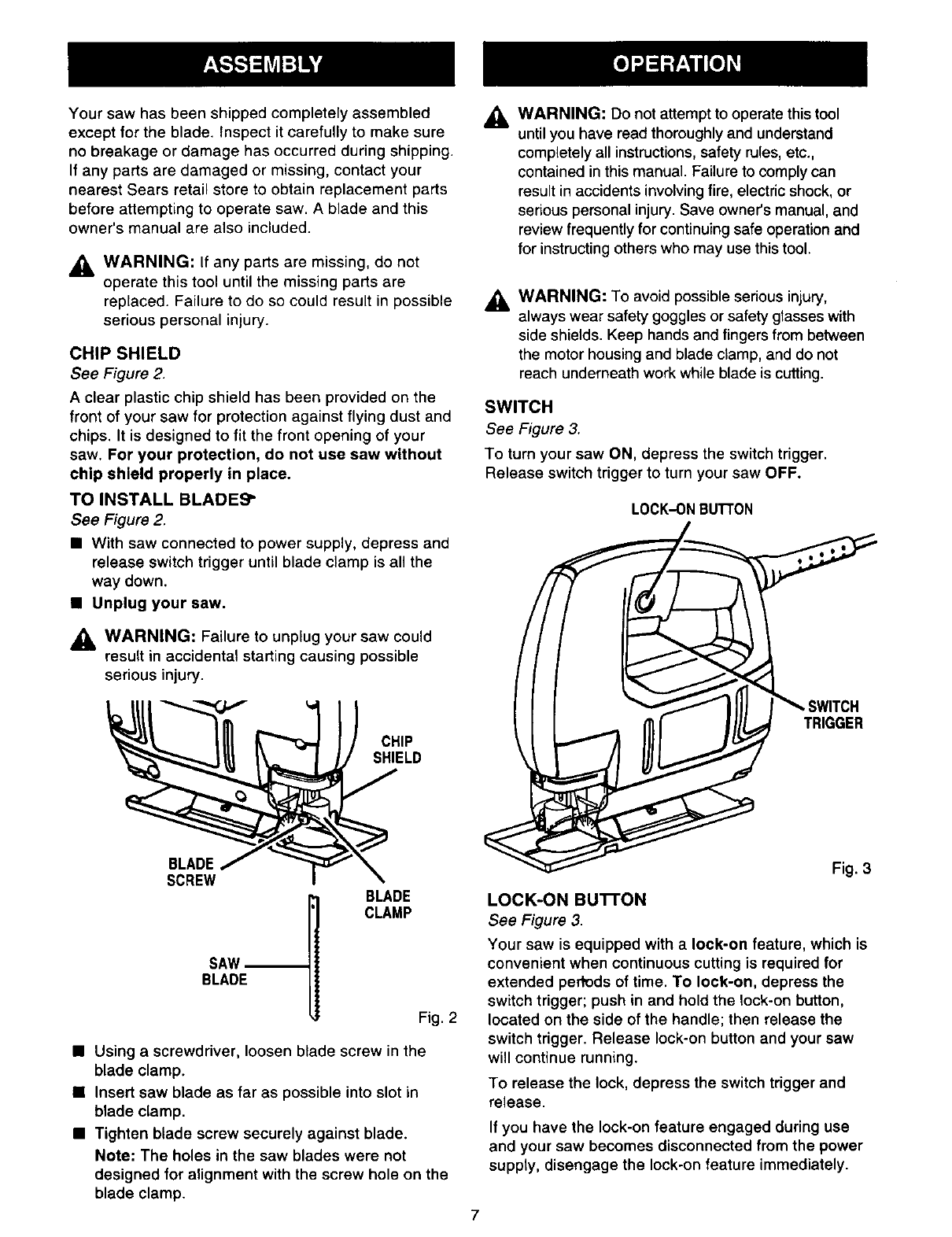
TO INSTALL BLADE9 =
See Figure 2.
•With saw connected to power supply, depress and
release switch trigger until blade clamp is all the
way down.
•Unplug your saw.
_k WARNING: Failure to unplug your saw could
result in accidental starting causing possible
serious injury.
CHIP
SHIELD
BLADE
SCREW
SAW
BLADE
BLADE
CLAMP
Fig. 2
• Using a screwdriver, loosen blade screw in the
blade clamp.
• Insert saw blade as far as possible into slot in
blade clamp.
• Tighten blade screw securely against blade.
Note: The holes in the saw blades were not
designed for alignment with the screw hole on the
blade clamp.
,_ WARNING: Do not attempt to operate thistool
until you have read thoroughly and understand
completely all instructions,safety rules, etc.,
contained in this manual. Failure to comply can
result in accidents involvingfire, electric shock, or
sedous personal injury. Save owner's manual, and
review frequently for continuingsafe operationand
for instructingothers who may use this tool.
AWARNING: To avoid possible serious injury,
always wear safety goggles or safety glasses with
side shields. Keep hands and fingers from between
the motor housing and blade clamp, and do not
reach underneath work while blade is cutting.
SWITCH
See Figure 3.
To turn your saw ON, depress the switch trigger.
Release switch trigger to turn your saw OFF.
LOCK.-ONBU'n'ON
LOCK-ON Bu'n'ON
See Figure 3.
Your saw is equipped with alock-on feature, which is
convenient when continuous cutting is required for
extended periods of time. To lock-on, depress the
switch trigger; push in and hold the lock-on button,
located on the side of the handle; then release the
switch trigger. Release lock-on button and your saw
will continue running.
To release the lock, depress the switch trigger and
release.
If you have the lock-on feature engaged during use
and your saw becomes disconnected from the power
supply, disengage the lock-on feature immediately.
7
_. WARNING: Before connecting your saw to
the power supply source, always check to be
sure it is not in lock-on position (depress and
release switch trigger). Failure to do so could
result in accidental starting of your saw, resulting
in possible serious injury. Also, do not lock the
trigger on jobs where your saw may need to be
stopped suddenly.
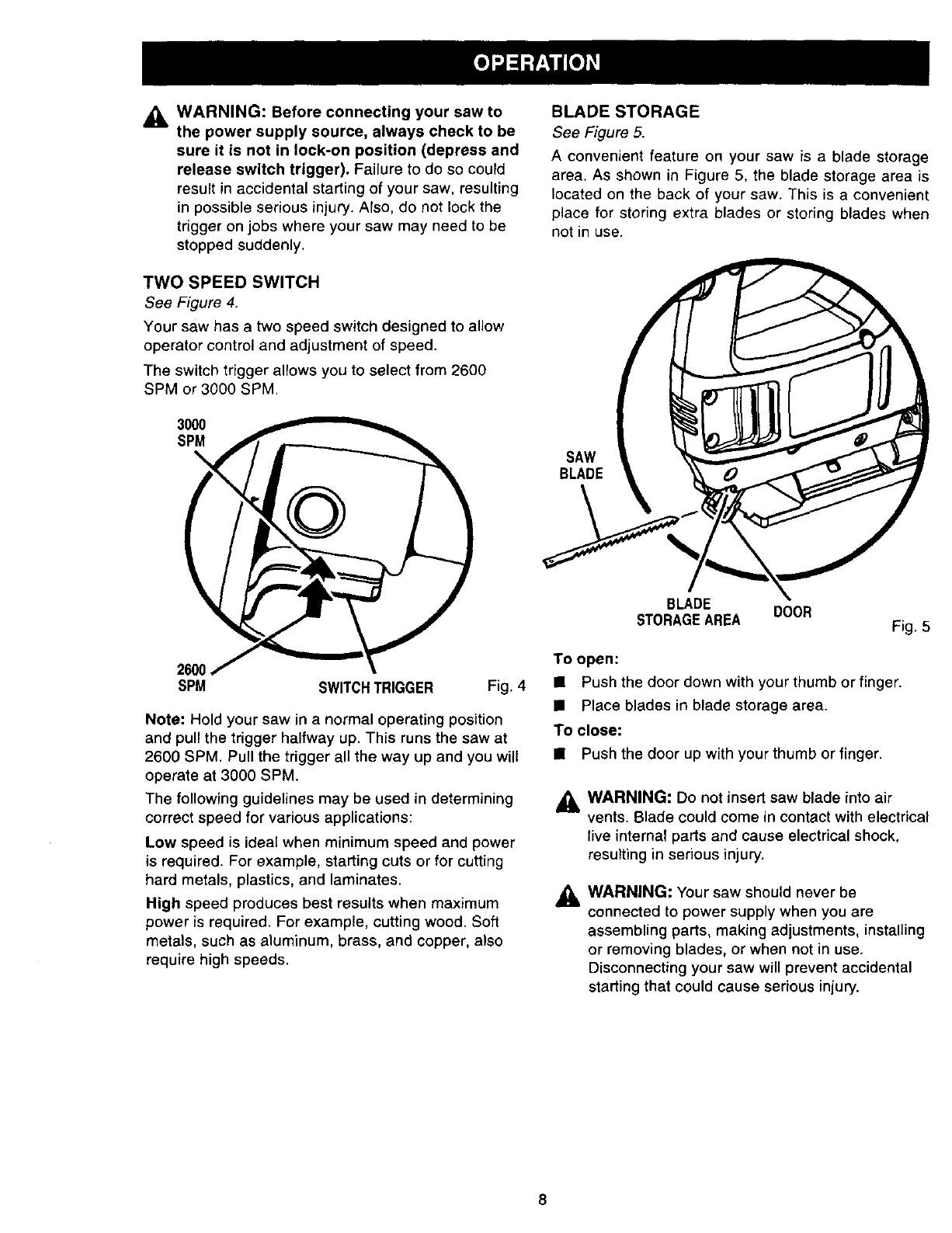
TWO SPEED SWITCH
See Figure 4.
Your saw has a two speed switch designed to allow
operator control and adjustment of speed.
The switch trigger allows you to select from 2600
SPM or 3000 SPM.
3000
SPM
BLADE STORAGE
See Figure 5.
A convenient feature on your saw is a blade storage
area. As shown in Figure 5, the blade storage area is
located on the back of your saw. This is a convenient
place for storing extra blades or storing blades when
not in use.
SAW
BLADE
2600
SPM SWITCHTRIGGER Fig. 4
Note: Hold your saw in anormal operating position
and pull the trigger halfway up. This runs the saw at
2600 SPM. Pull the trigger all the way up and you will
operate at 3000 SPM.
The following guidelines may be used in determining
correct speed for various applications:
Low speed is ideal when minimum speed and power
is required. For example, starting cuts or for cutting
hard metals, plastics, and laminates.
High speed produces best results when maximum
power is required. For example, cutting wood. Soft
metals, such as aluminum, brass, and copper, also
require high speeds.
BLADE DOOR
STORAGEAREA Fig. 5
To open:
•Push the door down with your thumb or finger,
• Place blades in blade storage area.
To close:
•Push the door up with your thumb or finger.
A
A
WARNING: Do not insert saw blade into air
vents. Blade could come in contact with electrical
live internal parts and cause electrical shock,
resulting in serious injury.
WARNING: Your saw should never be
connected to power supply when you are
assembling parts, making adjustments, installing
or removing blades, or when not in use.
Disconnecting your saw will prevent accidental
starting that could cause serious injury.
8
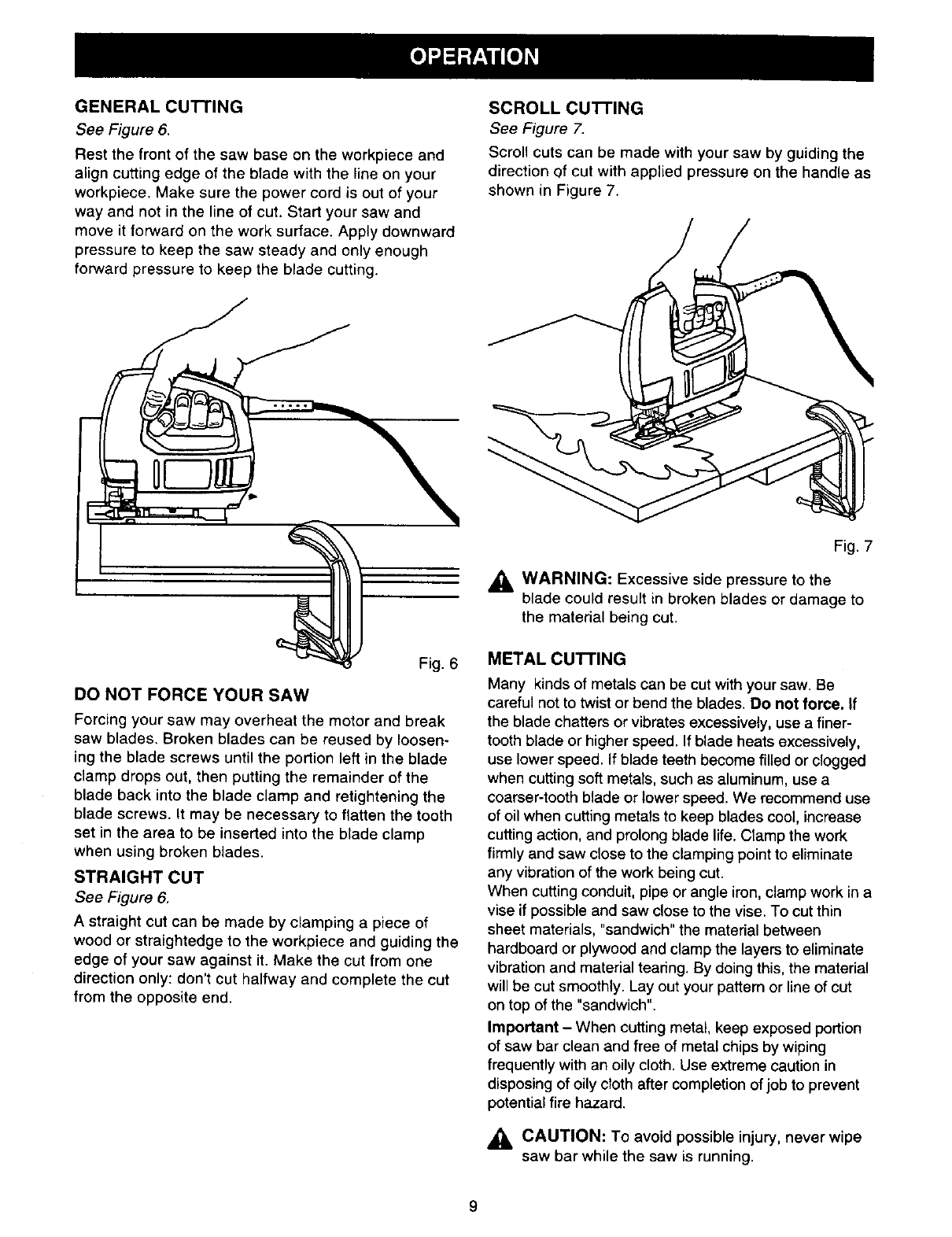
GENERAL CU'n'ING
See Figure 6.
Rest the front of the saw base on the workpiece and
align cutting edge of the blade with the line on your
workpiece. Make sure the power cord is out of your
way and not in the line of cut. Start your saw and
move it forward on the work surface. Apply downward
pressure to keep the saw steady and only enough
forward pressure to keep the blade cutting.
SCROLL CUTTING
See Figure 7.
Scroll cuts can be made with your saw by guiding the
direction of cut with applied pressure on the handle as
shown in Figure 7.
Fig. 6
DO NOT FORCE YOUR SAW
Forcing your saw may overheat the motor and break
saw blades. Broken blades can be reused by loosen-
ing the blade screws until the portion left in the blade
clamp drops out, then putting the remainder of the
blade back into the blade clamp and retightening the
blade screws. It may be necessary to flatten the tooth
set in the area to be inserted into the blade clamp
when using broken blades.
STRAIGHT CUT
See Figure 6.
A straight cut can be made by clamping a piece of
wood or straightedge to the workpiece and guiding the
edge of your saw against it. Make the cut from one
direction only: don't cut halfway and complete the cut
from the opposite end.
Fig. 7
_1, WARNING: Excessive side pressure to the
blade could result in broken blades or damage to
the material being cut,
METALCU'n'ING
Many kinds of metals can be cut with your saw. Be
careful not to twist or bend the blades. Do not force. If
the blade chatters or vibrates excessively, use a finer-
tooth blade or higher speed. If blade heats excessively,
use lower speed. If blade teeth become filled or clogged
when cutting soft metals, such as aluminum, use a
coarser-tooth blade or lower speed. We recommend use
of oil when cutting metals to keep blades cool, increase
cutting action, and prolong blade life. Clamp the work
firmly and saw close to the clamping point to eliminate
any vibration of the work being cut.
When cutting conduit, pipe or angle iron, clamp work in a
vise if possible and saw close to the vise. To cut thin
sheet materials, "sandwich" the material between
hardboard or plywood and clamp the layers to eliminate
vibration and material teadng. By doing this, the material
will be cut smoothly. Lay out your pattern or line of cut
on top of the "sandwich".
Important - When cutting metal, keep exposed portion
of saw bar clean and free of metal chips by wiping
frequently with an oily cloth. Use extreme caution in
disposing of oily cloth after completion of job to prevent
potential fire hazard.
_, CAUTION: To avoid possible injury, never wipe
saw bar while the saw is running.
9
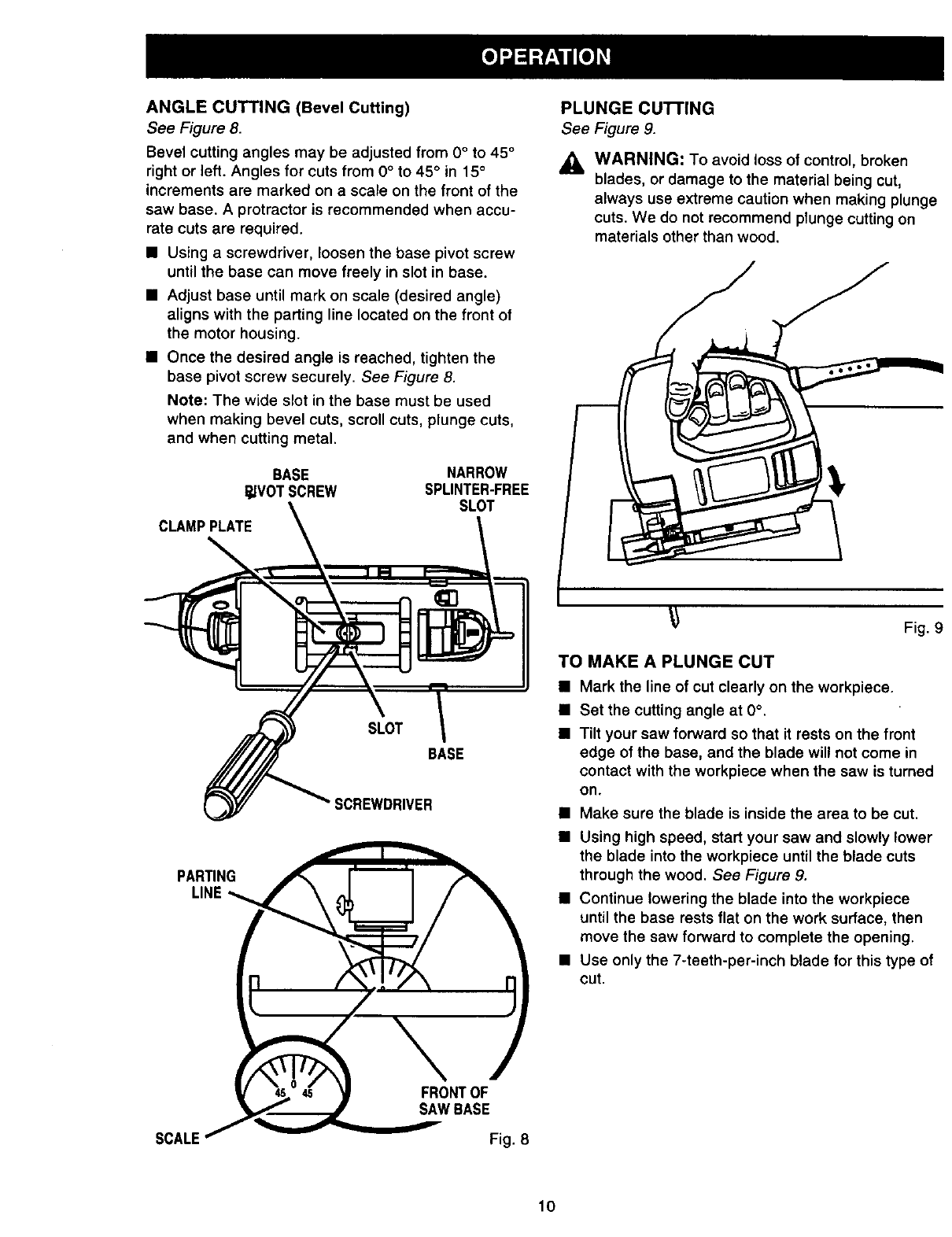
ANGLE CUTTING (Bevel Cutting)
See Figure 8.
Bevel cutting angles may be adjusted from 0° to 45 °
right or left. Angles for cuts from 0° to 45° in 15°
increments are marked on a scale on the front of the
saw base. A protractor is recommended when accu-
rate cuts are required.
•Using a screwdriver, loosen the base pivot screw
until the base can move freely in slot in base.
•Adjust base until mark on scale (desired angle)
aligns with the parting line located on the front of
the motor housing.
•Once the desired angle is reached, tighten the
base pivot screw securely. See Figure 8.
Note: The wide slot in the base must be used
when making bevel cuts, scroll cuts, plunge cuts,
and when cutting metal.
BASE NARROW
_IVOT SCREW SPLINTER-FREE
SLOT
CLAMPPLATE
SLOT
BASE
SCREWDRIVER
PARTING
LINE
PLUNGE CUTTING
See Figure9.
_lb WARNING: To avoid loss of control, broken
blades, or damage to the material being cut,
always use extreme caution when making plunge
cuts. We do not recommend plunge cutting on
materials other than wood.
Fig. 9
TO MAKE A PLUNGE CUT
•Mark the line of cut clearly on the workpiece.
•Set the cutting angle at 0°,
•Tilt your saw forward so that it rests on the front
edge of the base, and the blade will not come in
contact with the workpiece when the saw is turned
on.
•Make sure the blade is inside the area to be cut,
•Using high speed, start your saw and slowly lower
the blade into the workpiece until the blade cuts
through the wood. See Figure 9.
•Continue lowering the blade into the workpiece
until the base rests flat on the work surface, then
move the saw forward to complete the opening.
•Use only the 7-teeth-per-inch blade for this type of
cut.
FRONTOF
SAWBASE
SCALE Fig. 8
10
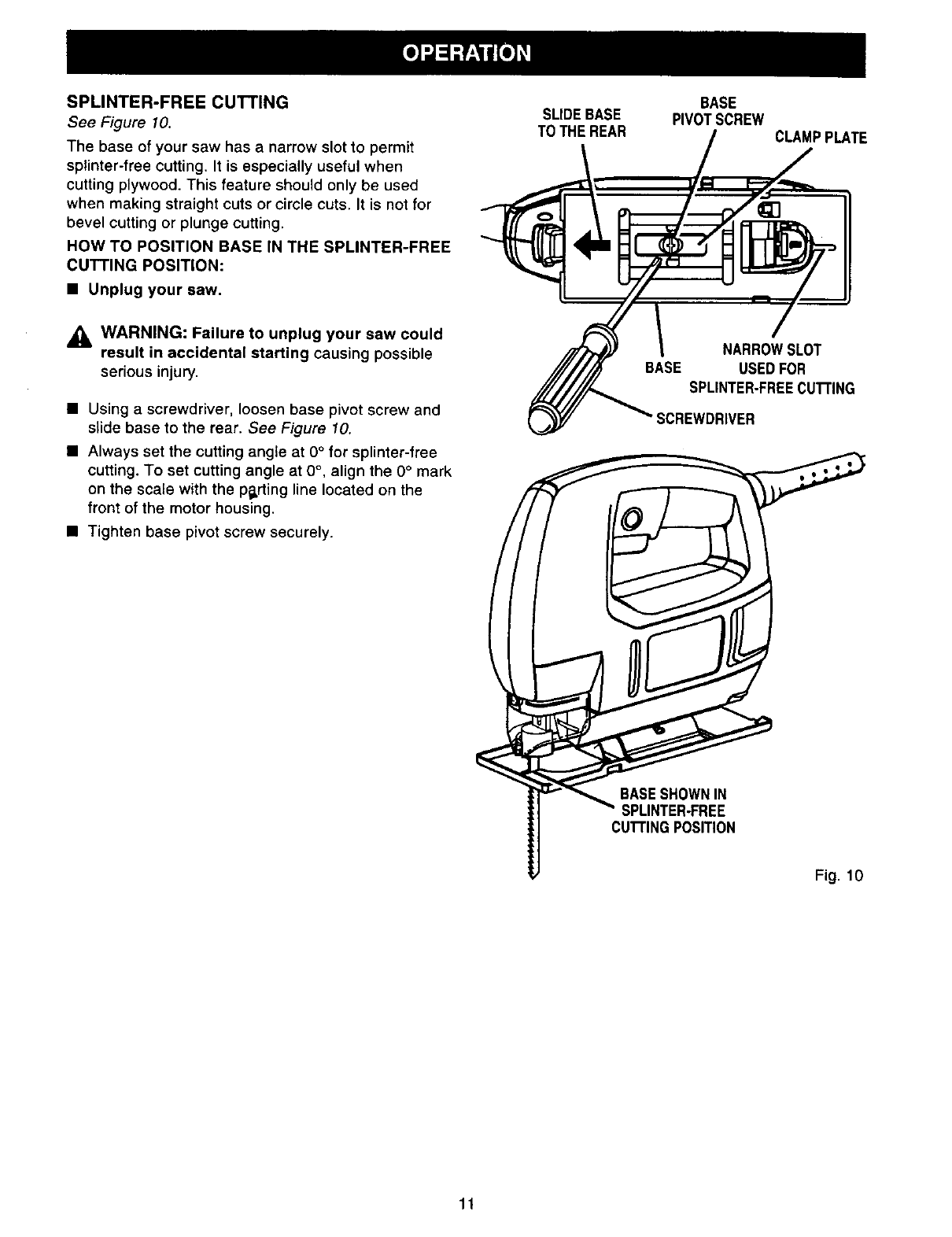
SPLINTER-FREECUTTING
See Figure 10.
The base of your saw has a narrow slot to permit
splinter-free cutting. It is especially useful when
cutting plywood. This feature should only be used
when making straight cuts or circle cuts. It is not for
bevel cutting or plunge cutting.
HOW TO POSITION BASE IN THE SPLINTER-FREE
CUTTING POSITION:
•Unplug your saw.
SLIDEBASE
TO THEREAR
BASE
PIVOTSCREW CLAMPPLATE
_, WARNING: Failure to unplug your saw could
result in accidental starting causing possible
serious injury.
•Using a screwdriver, loosen base pivot screw and
slide base to the rear. See Figure 10.
• Always set the cutting angle at O° for splinter-free
cutting. To set cutting angle at O°, align the 0°mark
on the scale with the p_,rting line located on the
front of the motor housing.
• Tighten base pivot screw securely.
NARROWSLOT
BASE USEDFOR
SPLINTER-FREECU'I-rlNG
SCREWDRIVER
lcSPUNTER'FREE o
UTrlNG POSITION
11
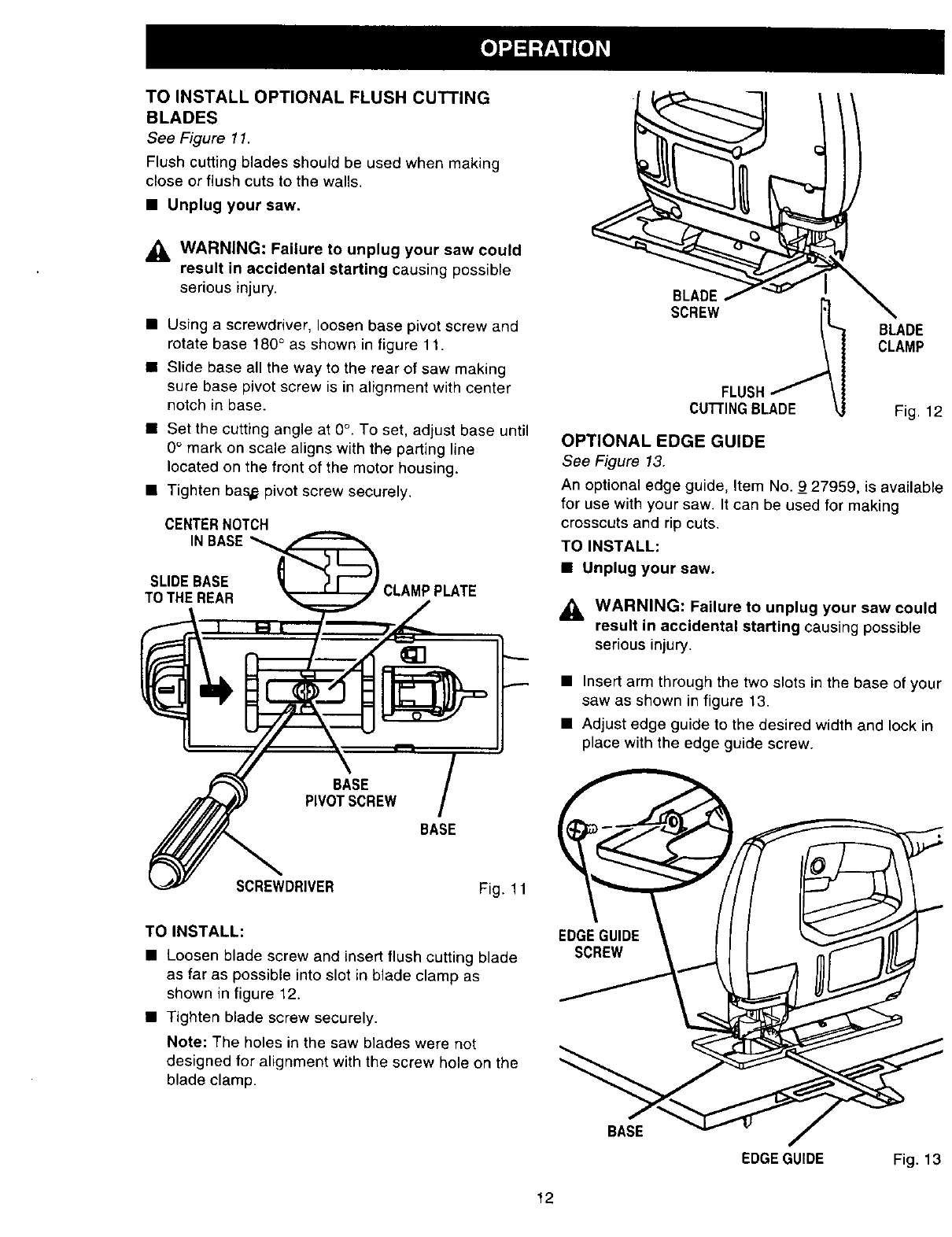
TO INSTALL OPTIONAL FLUSH CUTTING
BLADES
See Figure 11.
Flush cutting blades should be used when making
close or flush cuts to the walls.
•Unplug your saw.
_i, WARNING: Failure to unplug your saw could
result in accidental starting causing possible
serious injury.
• Using a screwdriver, loosen base pivot screw and
rotate base 180 ° as shown in figure 11.
• Slide base all the way to the rear of saw making
sure base pivot screw is in alignment with center
notch in base.
• Set the cutting angle at 0°. To set, adjust base until
0° mark on scale aligns with the parting line
located on the front of the motor housing.
• Tighten basi# pivot screw securely.
CENTERNOTCH
IN BASE
SLIDEBASE
TO THE REAR
BASE /
PIVOTSCREW
BASE
SCREWDRIVER Fig. 11
TO INSTALL:
• Loosen blade screw and insert flush cutting blade
as far as possible into slot in blade clamp as
shown in figure 12.
• Tighten blade screw securely.
Note: The holes in the saw blades were not
designed for alignment with the screw hole on the
blade clamp.
BLADE
SCREW ._ BLADE
CLAMP
FLUSH/ \t
cUTrlNG BLADE _Fig. 12
OPTIONAL EDGE GUIDE
See Figure 13.
An optional edge guide, Item No. _927959, is available
for use with your saw. It can be used for making
crosscuts and rip cuts.
TO INSTALL:
•Unplug your saw.
_, WARNING: Failure to unplug your saw could
result in accidental starting causing possible
serious injury.
• Insert arm through the two slots in the base of your
saw as shown in figure 13.
• Adjust edge guide to the desired width and lock in
place with the edge guide screw.
EDGEGUIDE
SCREW
BASE
EDGEGUIDE Fig. 13
12
GENERAL
All parts represent an important part of the double
insulation system and should be serviced only by a
qualified Sears service technician.
Avoid using solvents when cleaning plastic parts.
Most plastics are susceptible to damage from various
types of commercial solvents and may be damaged
by their use. Use clean cloths to remove dirt, carbon
dust, etc.
_L WARNING: Do not at any time let brake fluids,
gasoline, petroleum-based products, penetrating
oils, etc. come in contact with plastic parts. They
contain chemicals that can damage, weaken or
destroy plastic.
It has been found that electric tools are subject to
accelerated wear and possible premature failure when
they are used on fiberglass boats, sports cars,
wallboard, spackling compounds, or plaster. The
chips and grindings from.these materials are highly
abrasive to electric tool parts, such as bearings,
brushes, commutators, etc. Consequently, it is not
recommended that this tool be used for extended
work on any fiberglass material, wallboard, spackling
compounds, or piaster. During any use on these
materials, it is extremely important that the tool is
cleaned frequently by blowing with an air jet.
LUBRICATION
All of the bearings in this tool are lubricated with a
sufficient amount of high-grade lubricant for the life of
the unit under normal operating conditions. Therefore,
no further lubrication is required.
_1, WARNING: Always wear safety goggles or
safety glasses with side shields during power tool
operation or when blowing dust. If operation is
dusty, also wear a dust mask.
DOUBLE INSULATION
Double insulation is a concept in safety in electric
power tools, which eliminates the need for the usual
three-wire grounded power cord. All exposed metal
parts are isolated from the internal metal motor
components with protecting insulation. Double
insulated tools do not need to be grounded.
IMPORTANT
Servicing of a tool with double insulation requires
extreme care and knowledge of the system and
should be performed only by a qualified service
technician. For service, we suggest you return the tool
to your nearest Sears store for repair. Always use
original factory replacement parts when servicing.
EXTENSION CORDS
The use of any extension cord will cause some loss of
power. To keep the loss to a minimum and to prevent
tool overheating, use an extension cord that is heavy
enough to carry the current the tool will draw,
A wire gage size (A.W.G.) of at least 16 is
recommended for an extension cord 100 feet or less
in length. When working outdoors, use an extension
cord that is suitable for outdoor use. The cord's jacket
will be marked WA.
ACAUTION: Keep extension cords away from the
cutting area and position the cord so that it will
not get caught on lumber, tools, etc., during
cutting operation.
WARNING: Check extension cords before each
use. If damaged replace immediately. Never use
tool with a damaged cord since touching the
damaged area could cause electrical shock
resulting in serious injury.
Extension cords suitable for use with your saw are
available at your nearest Sears Retail Store.
13
Thefollowingrecommendedaccessoriesarecurrentlyavailableat Searsretailstores.
• Bi-MetalBlades • MetalCuttingBlades
• BladeAssortmentSets • WoodCuttingBlades
• FineScrollingBlades • EdgeGuide(ItemNo.9-27959)
• General Purpose Blades
_i, WARNING: The use of attachments or accessories not listed might be hazardous.
,_ WARNING:
The operation of any saw can result in foreign objects being thrown into your eyes, which can
result in severe eye damage. Before beginning power tool operation, always wear safety
goggles or safety glasses with side shields and a full face shield when needed. We recom-
mend Wide Vision Safety Mask for use over eyeglasses or standard safety glasses with side
shields, available at Sears retail stores.
WARRANTY
FULL ONE YEAR WARRANTY ON CRAFTSMAN SABRE SAW
If this CRRFTSMRN Sabre Saw fails to give complete satisfaction within one year from the date of purchase,
RETURN IT TO THE NEAREST SEARS STORE IN THE UNITED STATES, and Sears will repair it, free of
charge.
If this CRRFTSMRN Sabre Saw is used for commercial or rental purposes, this warranty applies for only 90 days
from the date of purchase.
This warranty gives you specific legal rights, and you may also have other rights which vary from state to state.
Sears, Roebuck and Co.; Dept. 817WA; Hoffman Estates, IL 60179
SAVE THESE INSTRUCTIONS
14

NOTES:
15
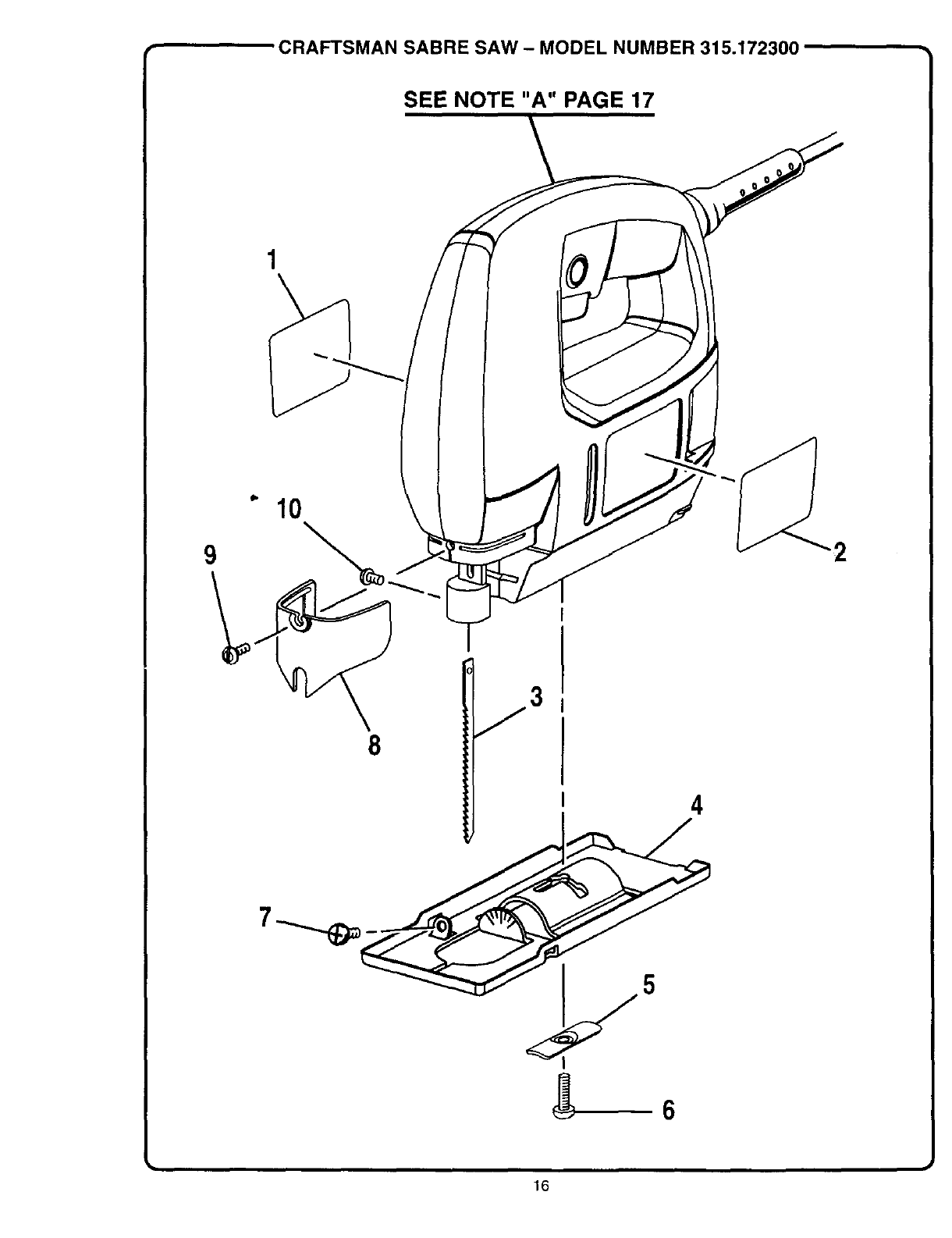
CRAFTSMAN SABRE SAW - MODEL NUMBER 315.172300
SEE NOTE "A °' PAGE 17
1
9
10
8
16
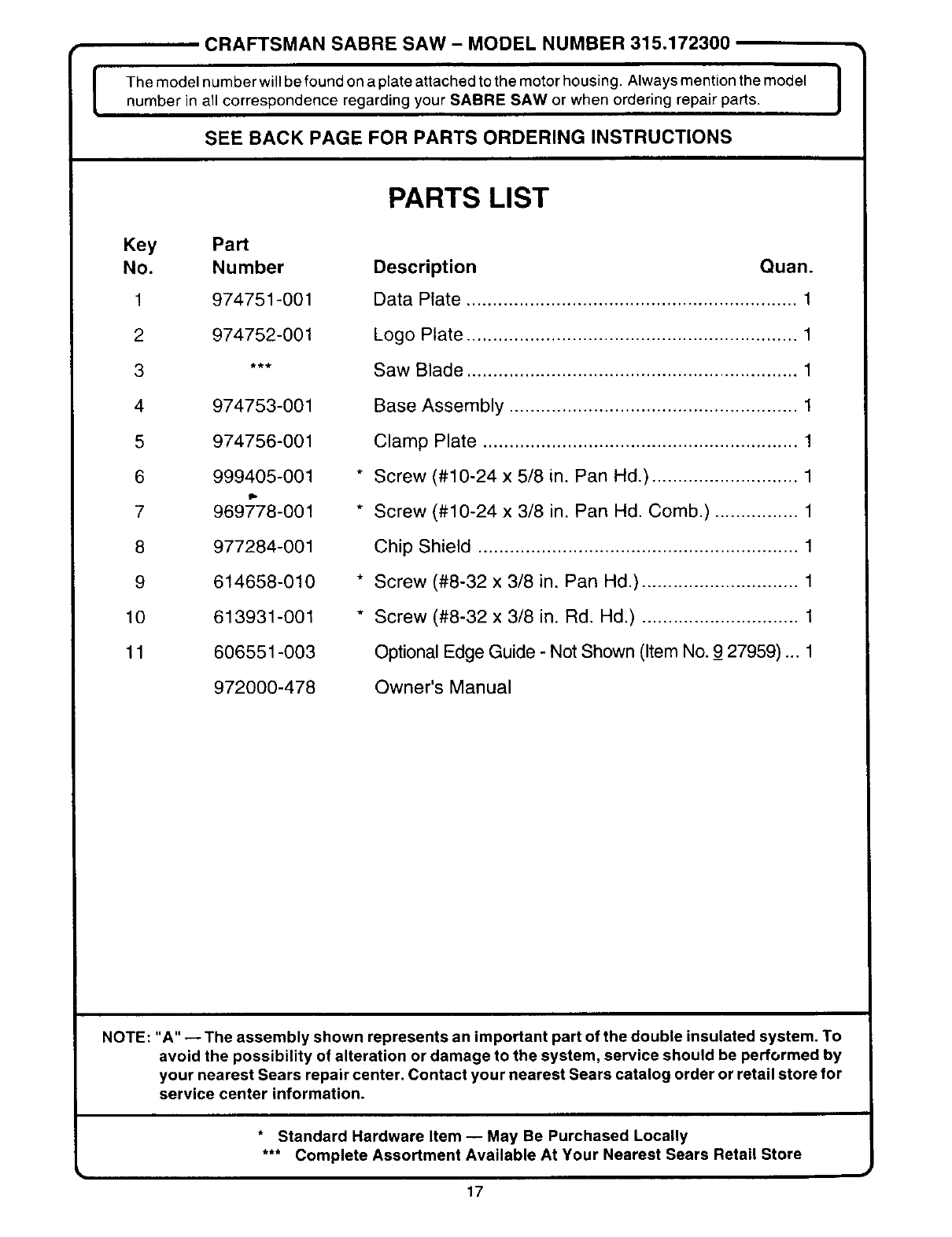
[CRAFTSMAN SABRE SAW - MODEL NUMBER 315.172300
The model number will be found on a plate attached to the motor housing. Always mention the model
number in all correspondence regarding your SABRE SAW or when ordering repair parts.
SEE BACK PAGE FOR PARTS ORDERING INSTRUCTIONS
I
Key PaN
No. Number
1 974751-001
2 974752-001
_
4 974753-001
5 974756-001
6 999405-001
7 969778-001
8 977284-001
9 614658-010
10 613931-001
11 606551-003
972000-478
t
t
PARTS LIST
Description Quan.
Data Plate ............................................................... 1
Logo Plate ............................................................... 1
Saw Blade ............................................................... 1
Base Assembly ....................................................... 1
Clamp Plate ............................................................ 1
Screw (#10-24 x 5/8 in. Pan Hd.) ............................ 1
Screw (#10-24 x 3/8 in. Pan Hd. Comb.) ................ 1
Chip Shield ............................................................. 1
Screw (#8-32 x 3/8 in. Pan Hd.) .............................. 1
Screw (#8-32 x 3/8 in. Rd. Hd.) .............................. 1
Optional Edge Guide - Not Shown (Item No. 9 27959) ... 1
Owner's Manual
NOTE: "A" --The assembly shown represents an important part of the double insulated system. To
avoid the possibility of alteration or damage to the system, service should be performed by
your nearest Sears repair center. Contact your nearest Sears catalog order or retail store for
service center information.
* Standard Hardware Item -- May Be Purchased Locally
*** Complete Assortment Available At Your Nearest Sears Retail Store
17

at your
For repair of major brand appliances in your own home...
no matter who made it, no matter who sold it!
1-800-4-MY-HOME sMAnytime, day or night
(1-800-469-4663)
www.sears.com
To bring in products such as vacuums, lawn equipment and electronics
for repair, call for the location of your nearest Sears Parts & Repair Center.
1-800-488-1222 Anytime, day or night
www.sears.com
For the replacement parts, accessories and owner's manuals
that you need to do-it-yourself, call Sears PartsDirect SM!
1-800-366-PART 6 a.m. - 11 p.m. CST,
(1-800-366-7278) 7 days a week
www.sears.com/partsdirect
To purchase or inquire about a Sears Service Agreement:
1-800-827-6655
7 a.m. - 5 p.m. CST, Mon. - Sat.
Para pedir servicio de reparaci6n a domicilio,
y para ordenar piezas con entrega a domicilio:
1-888"SU-HOGAR s_
(1-888-784-6427)
Au Canada pour service en fran£ais:
1-877-LE-FOYERS_
SEARS 1
H°meCentral° J
(1-877-533-6937)
®Registered Trademark tTM Trademark of Sears, Roebuck and Co.
TM n
©Sears, Roebuck and Co. ®Mama Registrada /Marca de F&brica de Sears, Roebuck a d Co.
