Craftsman 315175010 User Manual PLATE JOINER Manuals And Guides L0011170
CRAFTSMAN Plate Joiner Manual L0011170 CRAFTSMAN Plate Joiner Owner's Manual, CRAFTSMAN Plate Joiner installation guides
User Manual: Craftsman 315175010 315175010 CRAFTSMAN PLATE JOINER - Manuals and Guides View the owners manual for your CRAFTSMAN PLATE JOINER #315175010. Home:Tool Parts:Craftsman Parts:Craftsman PLATE JOINER Manual
Open the PDF directly: View PDF  .
.
Page Count: 24

OWNER'S
MANUAL
MODEL NO.
315.175010
CAUTION:
Read Rules for
Safe Operation
and All Instruc-
tions Carefully
CRRFTgMRN +
DUSTLESS
PLATE JOINER
DOUBLE INSULATED
Thank You for Buying
Craftsman Tools
972000-339
Designed exclusively for and sold only by
SEARS, ROEBUCK AND CO., Hoffman Estates, IL 60179
®
Printed in U.S.A.
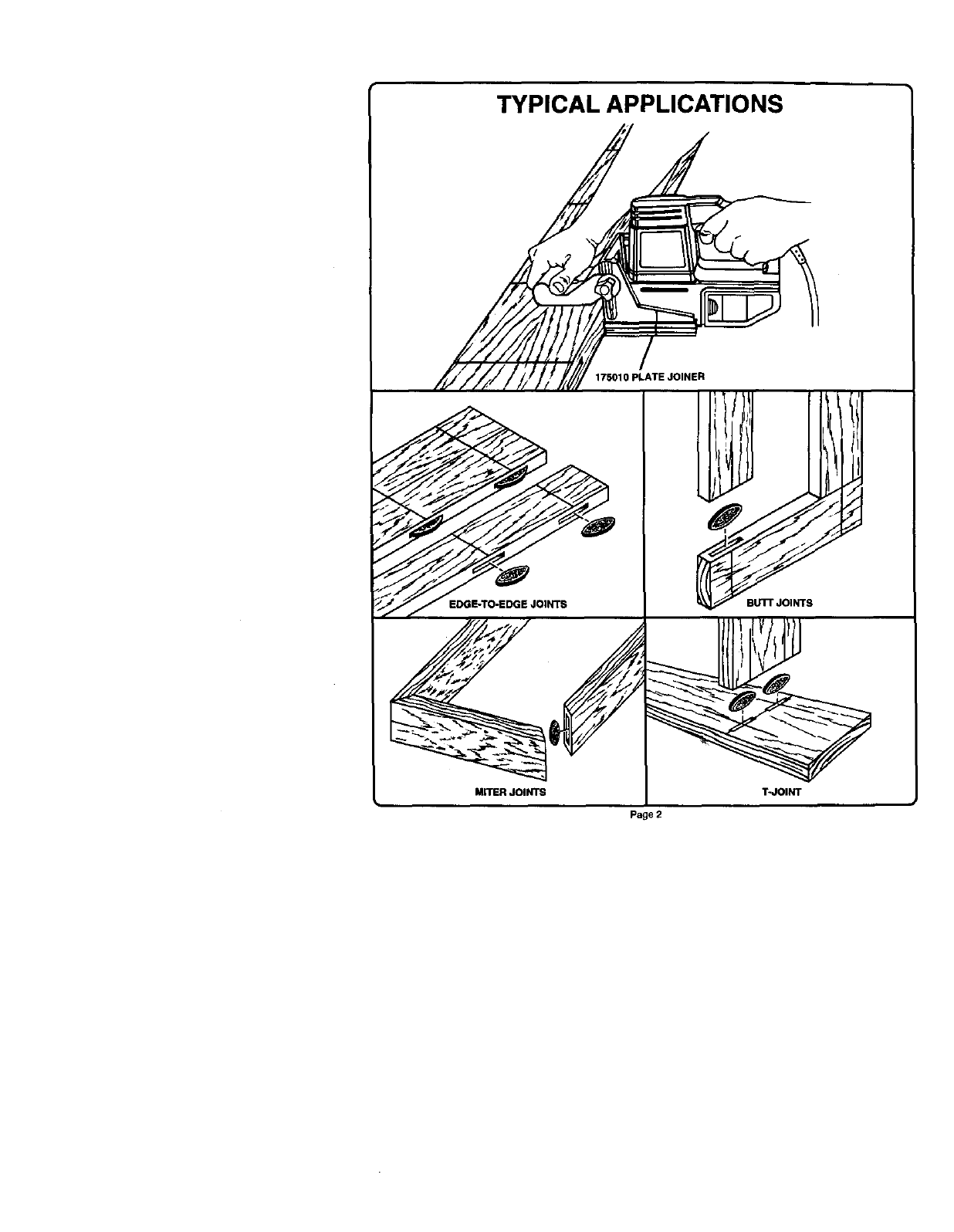
TYPICAL APPLICATIONS
175010 PLATE JOINER
Page 2
Table of Contents
I. Warranty and Introduction ....................................................................... 3
2. Rules For Safe Operation ..................................................................... 4-5
3. Features ................................................................................................ 6-7
4. Adjustments .......................................................................................... 8-9
5. Operation .......................................................................................... 10-16
6. Maintenance ..................................................................................... 17-19
7. Accessories ............................................................................................. 19
8. Troubleshooting ..................................................................................... 20
9, Exploded View and Parts List .......................................................... 22-23
FULL ONE YEAR WARRANTY ON CRAFTSMAN PLATE JOINER
Ifthis CraftsmanPlate Joiner fails to perform propedydue to adefect inmate dal or workmanship withinoneyear from
the dateof purchase RETURN IT TO (OR CONTACT) THE NEAREST SEARS SERVICE CENTER IDEPARTMENT
IN THE UNITED STATES and Sears will repair it,free of charge.
It this plate joiner is used for commercial or rental purpueas this warranty applies for only 90 days from the date of
purchase.
This warranty gives you specific legal dghts, and you may also have other dghts which vary from state to state.
SEARS, ROEBUCK AND CO.
DEPT. 817 WA
HOFFMAN ESTATES, IL 60179
INTRODUCTION
Spitne Joiner'/iso_e of the strongest methods of joinery used inwoodworking, When glue is properly applied to a spline and
to the jointarea of the wood pieces being connected, a large surface area receives the adhesion propertiesof the glue. This
forms a very strong joint.
Traditional spline Joiner'/requires cutting slots with a muter or table saw. Smafl, thin stripsof wood must then he cut to fit
insidethe slots and act as splines.
Newer methods of spitne jokiery use aplate or biscuitjoiner to cut precise mating oval slots inadjoining beards. Your new
plate joiner is a fast, simple, and accurate plunge cuttingtool that can be used for this purpose. If can be used to cut slots in
hard wood, soft wood, plywood, particia board, and other pressed woods.
Football shap4_l wafers, called biscuits, are then placed Inside the slots with"glue and used to help line up adjoining
surtames.When a water based glue is used, the biscuitsswell in the joint making an extrem*dy strong and firm bond, White
glue, yellow glue. carpenters glue, hide glue, and kiiphatic resin glue are examples of water based glues.
This bonding technique has trediflo_tallybeen limited to making edge-to-edge joints, However, with the use of your new
plate joiner, biscuitscan now be easily used to connect butt, miter,and T-joints. Biscuit joining can be as stronglu_mortise
and tenon, tongue and groova, standard8pllne, and doweled joints. In mostcases the material around the biacuit will break
before the biscuitItaeit will break. A greater Igrtge area Ill 8xpoI4rd to glue in a bl_uit joint, rnaidng the seams stronger.
Page 3
RULES FOR SAFE OPERATION
READ ALL INSTRUCTIONS
1, KNOW YOUR POWER TOOL -Read owner's
manualcarefully,Learnitsapplications and limi-
tationsas wellas the specificpotentialhazards
relatedto thistool.
2. GUARD AGAINST ELECTRICAL SHOCK BY
PREVENTING BODY CONTACT WITH
GROUNDED SURFACES. For example: Pipes,
radiators,ranges, refrigerator enclosures.
3. KEEP WORK AREA CLEAN. Cluttered areas
and benchesinviteaccidents.
4. AVOID DANGEROUS ENVIRONMENT. Don't
use power tools in damp or wet locations or
expose to rain. Keep workarea well lit
5. KEEP CHILDREN AND VISITORS AWAY. A{I
visitorsshouldwear safetyglassesand bekepta
safe distancefrom workarea. Do notletvisitors
contact tool or extensioncord.
6. STORE IDLE TOOLS. When not in use tools
shouldbe storedina dry, highorlocked-upplace
- outof the reach of children.
7. DON'T FORCE TOOL Itwiltdothejobbetterand
safer at the rate for whichit wasdesigned.
8. USE RIGHT TOOL. Don't force small tool or
attachment to do the job of a heavy duty tool.
Don't use tool for purpose not intended - for
example- Don'tuseacircularsawforcuttingtree
limbsor logs.
9. DRESS PROPERLY. Do notwear looseclothing
orjewelry. They can be caught in movingparts.
Rubberglovesandnon-skidfootwearare recom-
mended when workingoutdoors.Also,wear pro-
tactive hair coveringto containlonghairandkeep
itfrom being drawn intoair vents.
10. ALWAYS WEAR SAFETY GLASSES WITH
SIDE SHIELDS. Everydayeyeglasseshaveonly
impact resJstsntlenses; they are NOT safety
glasses.
11. PROTECT YOUR LUNGS. Wear a face or dust
mask ifoperationis dusty.
12. PROTECT YOUR HEARING. Wear hearingpro-
taction during extendedpedodsof operation.
13. DON'T ABUSE CORD. Never carry tool by cord
or yank it to disconnect from receptacle. Keep
cord from heat, oil, and sharp edges.
14. SECURE WORK. Use clamps or a vise to hold
work. It's safer than using your hand and it frees
both hands to operate tool.
15, DON'T OVERREACH. Keep proper footing and
balance at all times. Do not use on a ladder or
unstable support
16. MAINTAIN TOOLS WITH CARE. Keep tools
sharp at all times, and clean for best and safest
performance. Follow instructions for lubricating
and changing accessories.
17. DISCONNECTTOOLS. When not in use, before
servicing, or when changing attachments, blades,
bits, cutters, etc., all tools should be discon-
nected.
18, REMOVE ADJUSTING KEYS AND
WRENCHES. Form habit of checking to see that
keys and adjusting wrenches are removed from
tool before turning it on.
19. AVOID ACCIDENTAL STARTING. Don't carry
plugged-in tool with finger on switch. Be sure
switch is off when plugging in.
20. MAKE SURE YOUR EXTENSION CORD IS IN
GOOD CONDITION. When using an extension
cord, be su re to use one heavy enough to carry the
currentyour product willdraw. An undersized cord
will cause a drop in line voltage resulting in loss of
power and overheating. A wire gage size (A.W.G.)
of at least 16 is recommended for an extension
cord 100 feet or less in length. A cord exceeding
1GOfeet is not recommended. If in doubt, use the
next heavier gage. The smaller the gage number,
the heavier the cord.
21. OUTDOOR USE EXTENSION CORDS. When
tool is used outdoors, use only extension cords
intended for use outdoors. Outdoor approved
cords are marked with the suffix W-A, for example
- SJTW-A or SJOW-A.
22. KEEP BLADES CLEAN AND SHARP. Sharp
blades minimize stalling and kickback.
Page 4
RULES FOR SAFE OPERATION (Continued)
23 KEEP HANDS AWAY FROM CUTTING AREA.
Keep hands away from blades. Do not reach
underneath work while blade is rotating, WARN-
ING: BLADES COAST AFTER TURN OFF.
24, NEVER USE IN AN EXPLOSIVE ATMOSPHERE.
Normal sparking of the motor couid ignite flam-
mable liquids, gases, or fumes.
25. INSPECT TOOL CORDS PERIODICALLY and if
damaged, have repaired by an authodzed service
facility. Stay constantly aware of cord location
and keep it well away from the rotating blade.
26, INSPECT EXTENSION CORDS PERIODICALLY
and replace if damaged.
27. KEEP HANDLES DRY, CLEAN, AND FREE
FROM OIL AND GREASE. Always use a clean
cloth when cleaning. Never use brake fluids,
gasoline, petroleum-based products, or any strong
solvents to clean your tool.
28 STAY ALERT AND EXERCISE CONTROL.
Watch what you are doing and use common
sense. Do not operate tool when you are tired, Do
not rush,
29. CHECK DAMAGED PARTS. Before further use
of the tool, a guard or other part that is damaged
should be carefully checked to determine that it
will operate propedy and perform its intended
function. Check for alignment of moving parts,
binding of moving parts, breakage of parts, mount-
ing, and any other conditions that may affect its
operation. A guard or other part that is damaged
should be propady repaired or replaced by an
authorized service center.
30. DO NOT USE TOOL IF SWITCH DOES NOT
TURN IT ON AND OFF. Have defective switches
replaced by an authorized service center.
31, DO NOT OPERATE THIS TOOL WHILE UNDER
THE INFLUENCE OF DRUGS, ALCOHOL, OR
ANY MEDICATION.
32. GUARD AGAINST KICKBACK. Kickback oc-
curs when the blade stalls rapidly and the plate
joiner is ddven in the direction opposite blade
rotation. Release switch immediately ifblade binds
or joiner stalls.
33. USE ONLY 4 INCH DIAMETER SPECIRED
BLADES. Do not use blades with incorrect size
holes. Never use b;ade washers or bolts that are
defective, incorrect, or not specified.
34. AVOID cUTnNG NAILS. Inspect for and remove
all nails from lumber before cutting,
35. NEVER touch the blade or other moving parts
dudng use,
36. NEVER start a tool when the blade is in contact
with the workpiece,
37, NEVER lay a tool down before the blade has
come to acompiota stop.
38. POLARIZED PLUGS. To reduce the dsk of elec-
tric shock, this equipment has a polarized plug
(one blade is wider than the other). This plug will
fit in a polarized outlet only one way. If the plug
does not fit fully in the outlet, reverse the plug. If
it stilldoes not fit, contact a qualified eioctdcian to
install the proper outlet. Do not change the plug in
any way.
39. When servicing use only Identlcst Craftsman
replacement parts.
40. SAVE THESE INSTRUCTIONS. Refer to them
freqLlently and use them to instruct others who
may use this tool. If you loan someone this tool,
loan them these instructions also.
m
[_ The operation of any power tool can result in-foreign objects bstng thrOWn Into your eyes,
which can result In imvere eye damage. Before beginning power fool opefat tan, stways wear |
safety goggles of msfotygllmsee with side shields and a full face shield when needed. We |
roeommend Wide Vision Safety MaSk for use over eyeglasses or standard safety glm I
with elde shields, avelloble at Sears Retell Stores. )
Page 5
FEATURES
Your Plata Joiner has been designed for making fast, accurate, and simple plunge cutsin wood, etc. so that biscuitscan be
used to join twoor more boards together. When used pmpedy and onlyfor whet it is intended, thisversatge tool will give you
yearn of troubta-tree berforrnance, it isprofesslenallyengleeered, but its ease of operaiton allewsthe amateur ta preducework
that is beautiful and precise.
DOUBLE INSULATED
This toot is double insulated. Double Insulationis a concept
insafely, inelectric powertools, which elhelnatasthe need for
the usual three wire grounded power cord end grounded
supply system. Wherever there is electric cutTent inthe tool
there are two complete sets of insulationto protectthe user.
All exposed metal partsare isolatedfrominternal metalmotor
components with protecting insulation.
IMPORTANT - Servicing of atool with double insulation
requires extreme care and knowledge of the system and
should be performed only by a quaJifiedsePAceteChniCian.
For service we suggest you return the tool to your nearest
Searsstorefor repair. Always useodgtsalfactoryredlacement
parts when servicing,
SWITCH
TO turn your plate joiner "ON", depress the switch trigger,
Release switch trigger to turn your plate joiner "OFF =,
5/8 HORSEPOWER MOTOR
Your plate joiner has a powerful 5/8 horsepower motor with
sutticient powerto handle toughcutting jobe. Itdevelops a no
load speed of 10,000 RPM,
CARBIDE TIPPED BLADE
Your plate joiner has an 8 tooth carbide tipped blade for
cutting biscuitstets,
BISCUITS
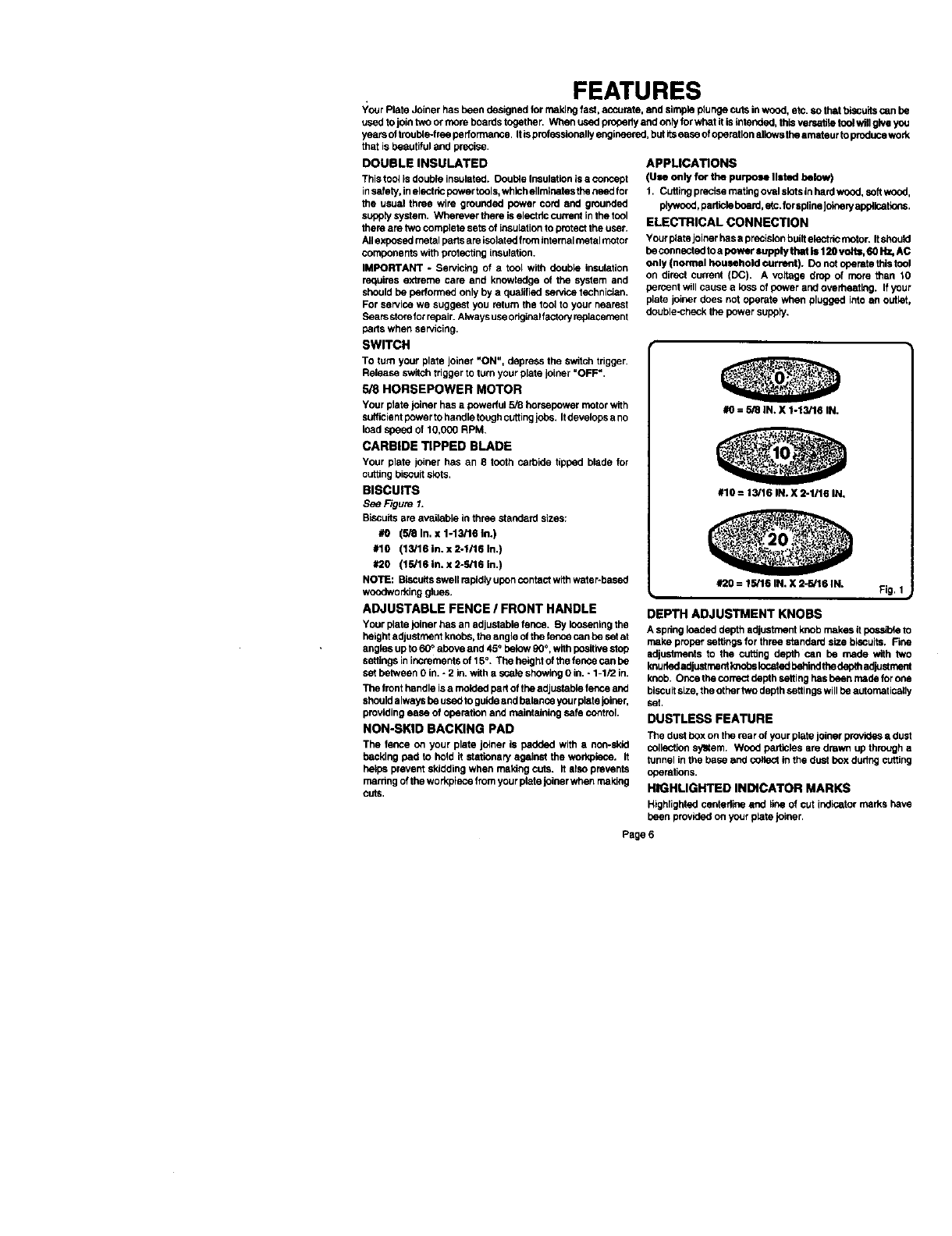
S_ Figure 1.
Biscuitsare available in three standard sizes:
#O (5/8 In. x 1-13/16 th.)
#10 (13/16 In. x 2-1116 In.)
#20 (15/16 In. x 2-S/16 in.)
NOTE: Biscuitsswell rapidly uponcontact with watar-based
woodworking glues•
ADJUSTABLEFENCE /FRONT HANDLE
Your plate joiner has an adjustable fence. By looseningthe
height adjustment knobs,the angle ofthe fence can be set at
angles upto 60_above and 45° belew 90°, with positivestab
settings in increments of 15°. The heightof the fence can be
set between 0 in. -2 in. with a scale showing 0 in, - 1-1/2 in.
The front handle is a rnokled part of the adjustable fence and
shouldalways be used to guide and balanceyour plate joiner,
provlding ease of operation and maintaining safe control.
NON-SKID BACKING PAD
The fence on your plate joiner is padded with a non-skid
backing pad to hold it stationa_ against the workpisce. It
he_ps prever_ skidding when making cuts. it also prevents
marring ofthe workplece fromyour plate joiner when making
CutS.
APPLICATIONS
(Use only for the purpose listed below)
1. Cuttingprecise matleg oval slots in hard wood,soft wood,
plywood,pattislaboard, ets.for spllee Jok_eP/edplisatlens.
ELECTRICAL CONNECTION
Yourplate joiner hasa precisionbuilhelactdcmotan Itshould
beconneuted to a p<>wersupply that ts 120 vofts, tt0 Hz, AC
only {normal household current). Do nut operate this taol
on direct current (DC). A voltage drop of more than 10
percent will cause a less of power and overheating. If your
plate joiner does not operate when plugged into an outlet,
double-check the power supply.
#O : 5/8 tN. X 1-13/16 IN.
#10 = 13/16 IN. X 2-1116 IN,
#20 : 15/16 IN. X 2-rd16 IN. Fig. I
DEPTH ADJUSTMENT KNOBS
A springloaded depth adjustment knob makes it eds_ble to
make proper settit;gs for three standard size biscuits. Fine
adjustments to the cutting depth can be made with two
knuhededjust mentknobskicated behindthe depthacrlustment
knob, Once the correct depthsetting has been made for one
biscuitsize, the othertwo depth settingswill be automatically
set.
DUSTLESS FEATURE
The dust box on the rear of your plate joiner provides a dust
collection sylttem. Wood particles are drawn up through a
tunnel in the base and collect inthe dust box duitng cutting
operations.
HIQHLIGHTED INDICATOR MARKS
Highlighted centadine and line of cut indicatormarks have
been providedon your plate joiner.
Page 6
FEATURES
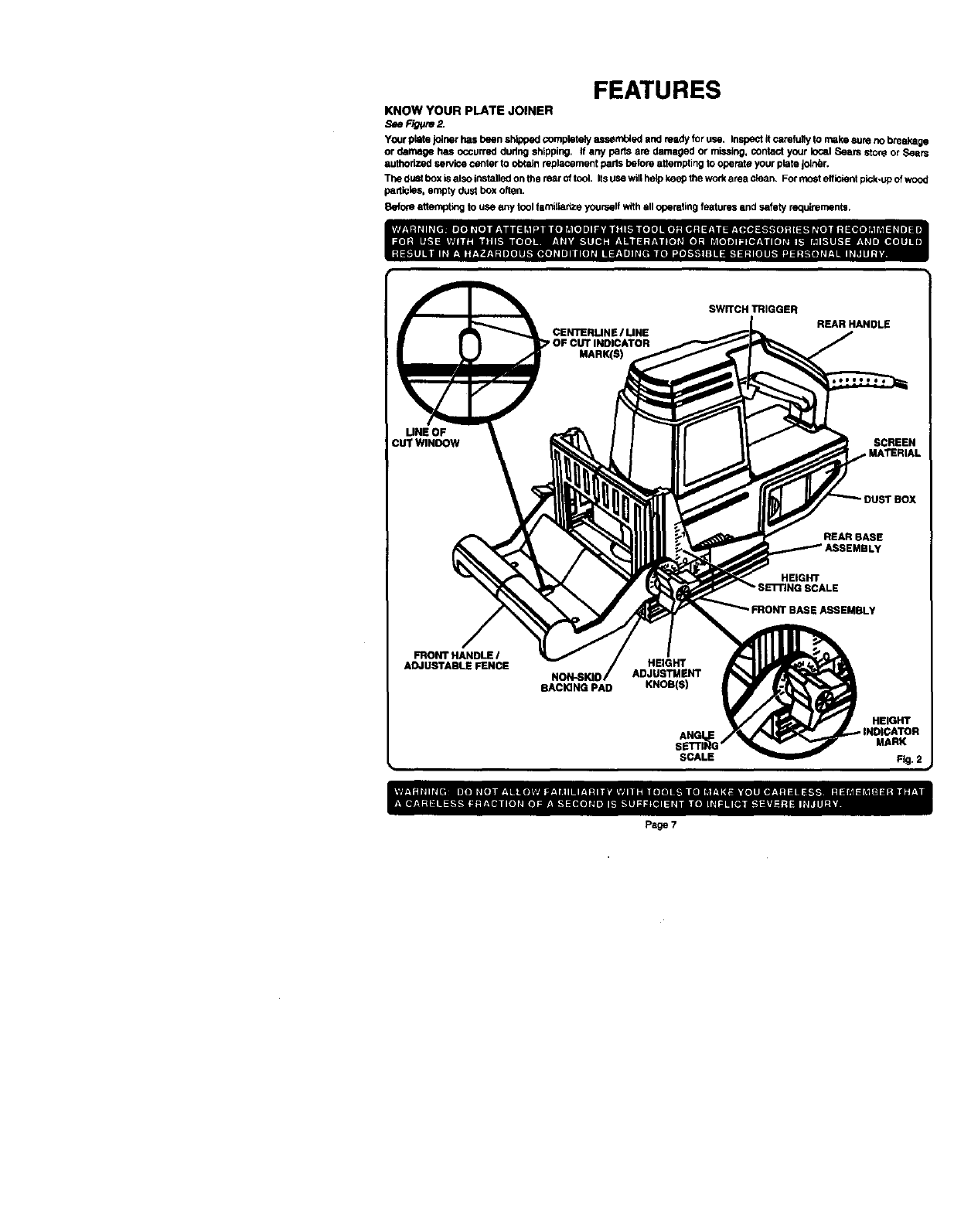
KNOW YOUR PLATE JOINER
,_e Fibre 2.
Your plate Joinerhas been shipped €ompletely as_mbled end ready for use. Inspect it carefully to make sure no breakage
or damage has occurred dudng shipping, ff any parts are damsged or missing, contact your local Seam store or Sears
authorized service center to ob(aln replacement parts before attempting to operate your plate J_r_n
ThedU6tboxisalsolnstall6dontherearoftooL Its usewillhelpkeeptheworkareaclean. For most efficient pick.upof wood
particles, empty dust box often.
8efo_m8ttempt_g to use eny tool familiarize yourself with all operating features and safety requirements.
_r_l_ CENTERUNE IUNE SWITCH TRIGGER REAR HANDLE
Page 7
ADJUSTMENTS
DEPTH OF CUT ADJUSTMENTS
Your plate joiner can be adjusted to three standard cutting
depths to accommodate three standard size biscuits-- #0,
#10, and #20. Adjustments are made by engaging slots o_
depth adjustment knobwith tabs onrear base assembly. For
exsmpta, when using a #0 size biscuit, rotate the depth
adjustment knobto the slot marked 0. When usinga #10 size
biscuit, rotate the depth adjustment knobto the slot marked
10, and when using a #20 size biSCUitrotate the depth
adjustment knob to the slot marked 20,
TO SET DEPTH ADJUSTMENT KNOB
1. Unplug your plata joiner.
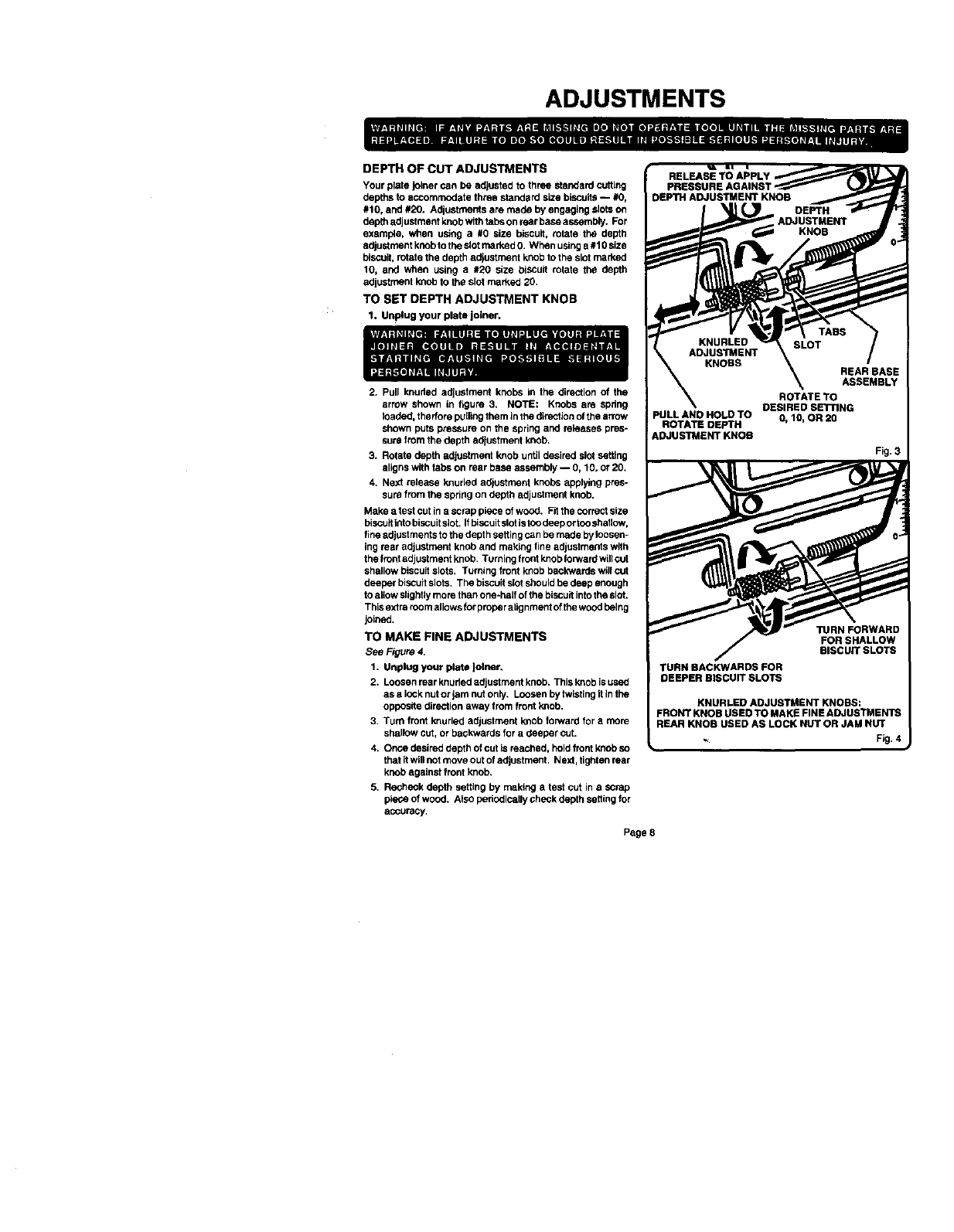
2. Pull knuhad adjustment knobs in the direction of the
arrow shown in figure 3. NOTE: Knobs are spdng
loaded, therfore puIllogthem in the directionof the arrow
shown puts pressure on the spring and reloases pres-
sure from the depth adjustment knob.
3. Rotate depth adjustment knob until desired slot setting
aligns with tabs on rear base assembly -- 0, 10, or 20.
4. Next release knurled adjustment knob_ applying pres-
sure from the sprthg on depth adjustment knob.
Make a test cut ina scrap piece of wo_d. Fit the correct size
biscuitloto biscuitslot. Ifbiscuitslnt istoodeep ortooshallow,
fine adjustmentsto the depth setting can be made by loosen-
ing rear adjustment knob and making fine adjustments with
the frontadjustment knob, Turningtrent knobforward wiltcut
shallow biscuitslots, Turning front knob backwards will cut
deeper biscuitslots. The biscuitslot should be deep enough
to allow slightly more than one-half ofthe biscuitintothe slot.
This extraroom allowsfor proper alignmentofthe woodbslng
joined.
TO MAKE FINE ADJUSTMENTS
See Figure 4.
1. Unplug your plate Joiner.
2. Loosenrear knuded adjustment knob. This knob isused
as a lock nutor jam nut only, Loosenby twistingit Inthe
opposite directionaway from front knob.
3. Turn front knurled adjustment knob forward for a more
shallow cot, or backwards for a deeper cut.
4. Once desired depth ofcut is reached, held frontknobso
that itwill not move out of adjustment, Next, tighten rear
knobagainst front knob,
5. Re_heck depth setting by making a test cut in a scrap
piece of wood. Also periodicallycheck depth settingfor
acouracy,
KNOBS
PULL AND HOLD TO
ROTATE OEPTH
ADJUSTMENT KNOB
Page 8
DEPTH
_,_ ADJUSTMENT
KNOB
TABS
REAR BASE
ASSEMBLY
ROTATETO
DESIRED sE'nlNG
IO, OR 20
Fig. 3
TURN FORWARD
FOR SHALLOW
BISCUIT SLOTS
Fig. 4
ADJUSTMENTS
FENCE HEIGHT ADJUSTMENT
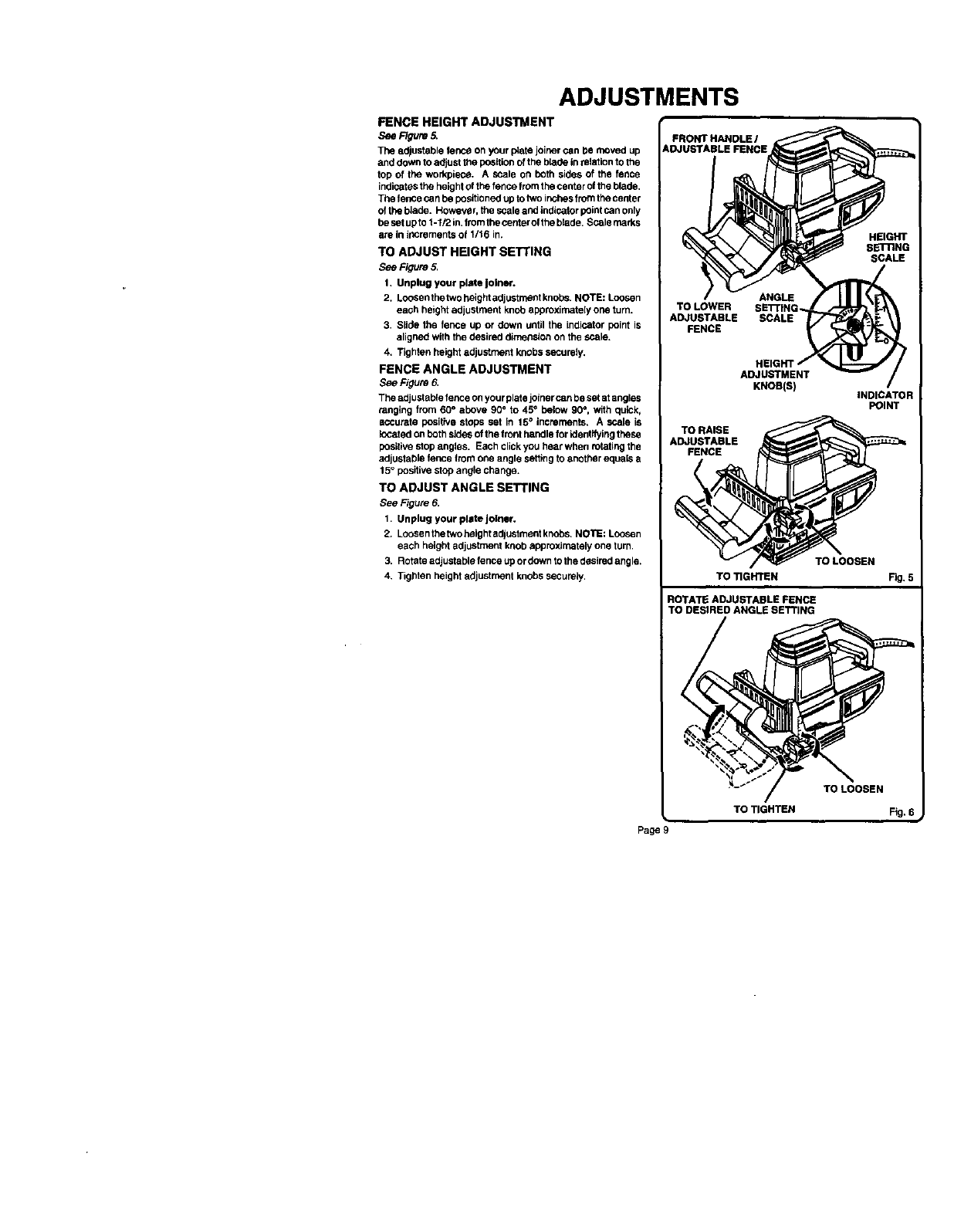
S_e Figure
The adjustable fence on your plate joiner can be moved up
and down to adjust the positionof the blade in relation to the
top of the workpiece. A scale on both sides of the fence
indicatesthe height of the fence from the center of the blade.
The fence can be positionedup totwo inches from the center
of the blade. However. the scale and indicator pointcan only
be setupto 1-1/2 in.fromthe center of the blade. Scale marks
are in iilcrements of 1/16 in.
TO ADJUST HEIGHT SETTING
See Figure 5.
1. Unplug your plate joiner.
2. LooSenthetwoheightedjustmentknohe. NOTE: Loosen
each height adjustment knob approximately one turn.
3. Slide the fence up or down until the indicator point is
aligned with the desired dimension on the scale.
4. Tighten height adjustment knobs securely.
FENCE ANGLE ADJUSTMENT
See Figure
The adjustable fence onyour plate joinercan be set at angles
ranging from 60 ° above 90 °to 45° below 90o, with quick,
accurate positive stops set in 15°increments. A scale is
located on both sides ofthe front handlefor identifyingthese
positive stop angles. Each clickyou hear when rotatingthe
adjustable fence from one angle setting to another equals a
15° positive stop angle change.
TO ADJUST ANGLE SETTING
See Figure 6.
1. Unplug your plete Joiner.
2. Loosenthetwoheightadjustment knops. NO'RE: Loosen
each height adjustment knob approximately one turn,
3. Rotste edjustable fence upor down to the desiredangle.
4. Tighten height adjustment knobs securely.
FRONT HANDLE I
_DJUSTABLE FENCE
TO LOWER SE'i-rlNG ,
ADJUSTABLE SCALE
FENCE
ADJUSTMENT
KNOB(S)
TO RAISE
ADJUSTABLE
FENCE
TO LOOSEN
TO _GHTEN
ROTATEADJMSTABLEFENCE
TO DESIRED ANGLE SETTING
INDICATOR
POINT
Fig. 5
Fig. 6
Page 9
OPERATION
A varietyof spllne joints can be made usingyour plate joiner.
The number and size biscuitsneeded for each jointdepends
on the thickness of the wood and the length of the joint, in
general, tbe small #0 b_cuits ehouM be used for mitercuts in
314in. matshels. The larger bizcultsshouldbe used for edge-
to-edge jolnery.
When joining 1-1/2 in, thick materials, stacktwo biscuits,one
above the other. For example, joining 2 in. x 4 in. dressed
lumber. See Figure 9. When joining even thicker materials,
use eddltional biscuits, stacked above each other.
When making edge-to_dge jointsfor tab_etsps,wortCenches,
cutting boards, etc. the more biacultsyou use, the stronger
the Jointwill be.
The followingsections illustratehow to make vadous spline
joints uelog your plate joiner.
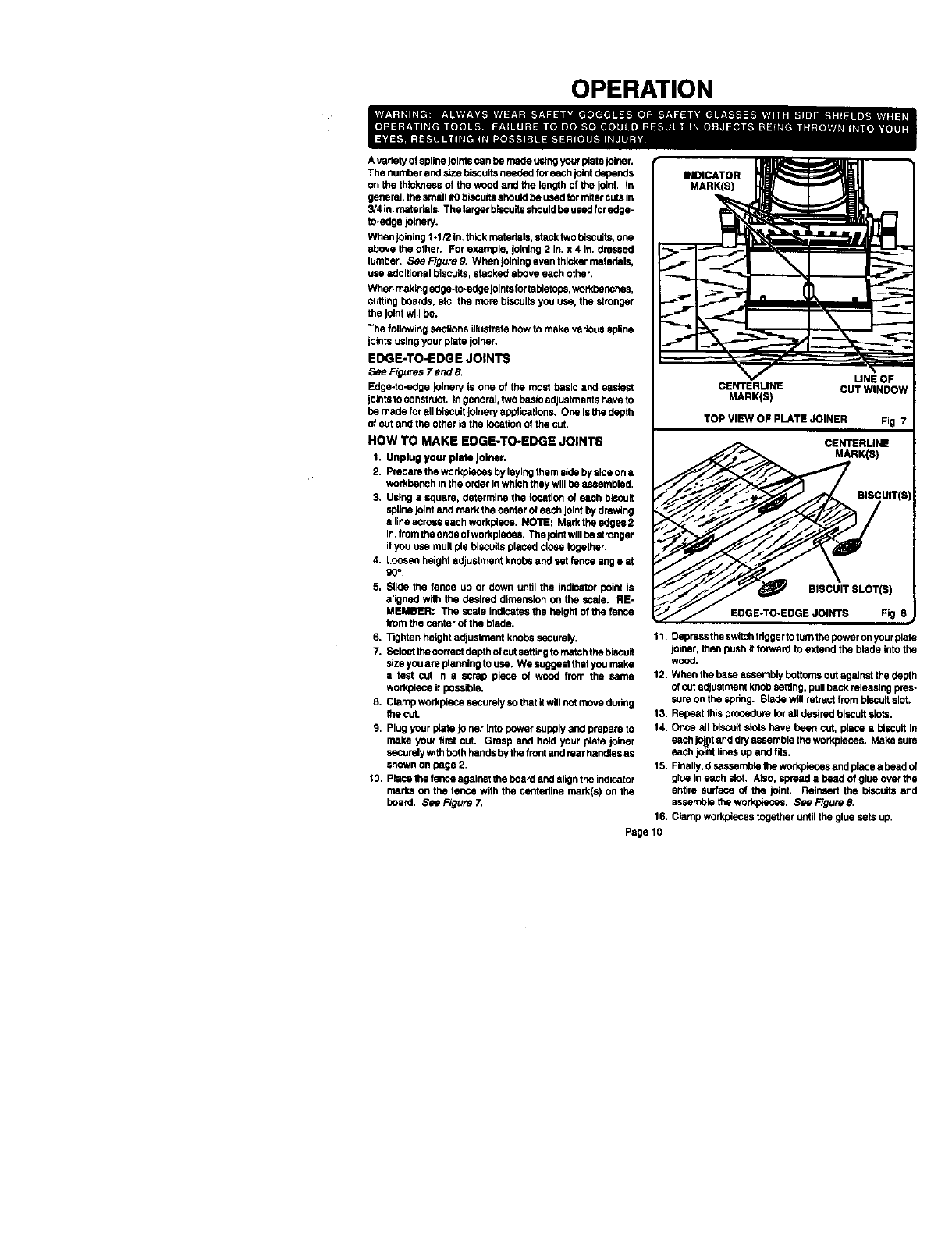
EDGE-TO-EDGE JOINTS
See Figures 7 and 8.
Edge-to-edge joine_J is one of the most basic and easiest
joints toconstruct. Ingeneral, two basicadjustments have to
be made for all biscuitjolnery apptications. One is the depth
of cut and the other is the location of the cut.
HOW TO MAKE EDGE-TO-EDGE JOINTS
1. Unplug your plate Joiner.
2. Prepare the workplecea by layingthem slbe by side on a
workber_h in the order inwhich they will be assembled,
3, Using a square, determine the location of each bizcult
splinejoint and mark the ceofer of each Jointby drawing
alineacross each workplace. NOTE: Mark the edges 2
In. fromthe ends ofworkplacee. The jointwill be stronger
if you use multiple biscuits placed close together.
4. Loosen height adjustment knobsand set fence angle at
gO_.
5, Slide the fence up or down until the indicator point is
aIignnd with the destted dimar,_slonon the scale. RE-
MEMBER: The scale indicates the height of the fence
from the center of the blade.
6. Tighten height adjustment knobs securely.
7. Select the correct depthof cut settingto rnatshtbe bizcuit
size you are planning to use. We suggest that you make
atest cut in ascrap piece of wood from the same
workplace it possible.
8. Clamp workplace securelyso that it will not move during
the cut.
9. Plug your plate joiner into power supplyand prepare to
make your first cut. Grasp and hold your plate joiner
securelywtth both handsby the froof and rearhandles as
shown on page 2.
10. Place the fence against the board and align the indicator
marks on the fence with the cerderllne mark(e) on the
beard. See Figure
UNE OF
CENTERLINE CUT WINDOW
MARK(S)
TOP VIEW OF PLATE JOINER Fig. 7
CENTERLINE
RKIE)
_./'_// _ BISCUIT SLOT{S)
;iF/ EBOE-' EBOEJO,'EF,g8
11. Depress the switchtdggerto turnthe power onyour plats
joiner, then pushit forward to extend the blade Ints the
wood.
12. When the base assembly bottoms outagainst the depth
of cut adjustment knobeattlng, pullback releasing pres-
sure on the spdng. Blade will retract from biscuitslot.
13. Repeat this procedure for all desped biscuit slots.
14. Once all blscutt slots have been cut, place a biscuitin
each jo_ofand dry assemble the workpteces. Make sure
each joint lines up and fits.
15. Finally.disassemble the workpkscesand placea bead of
glue in each slot. Also, spread a bead of glue over the
entire surface of the joint. Reinsert the b_scuitsand
assemble the wottq3k_es. See Figure 8.
16. Clamp workpieces together until the glue sets up.
Page 10
OPERATION
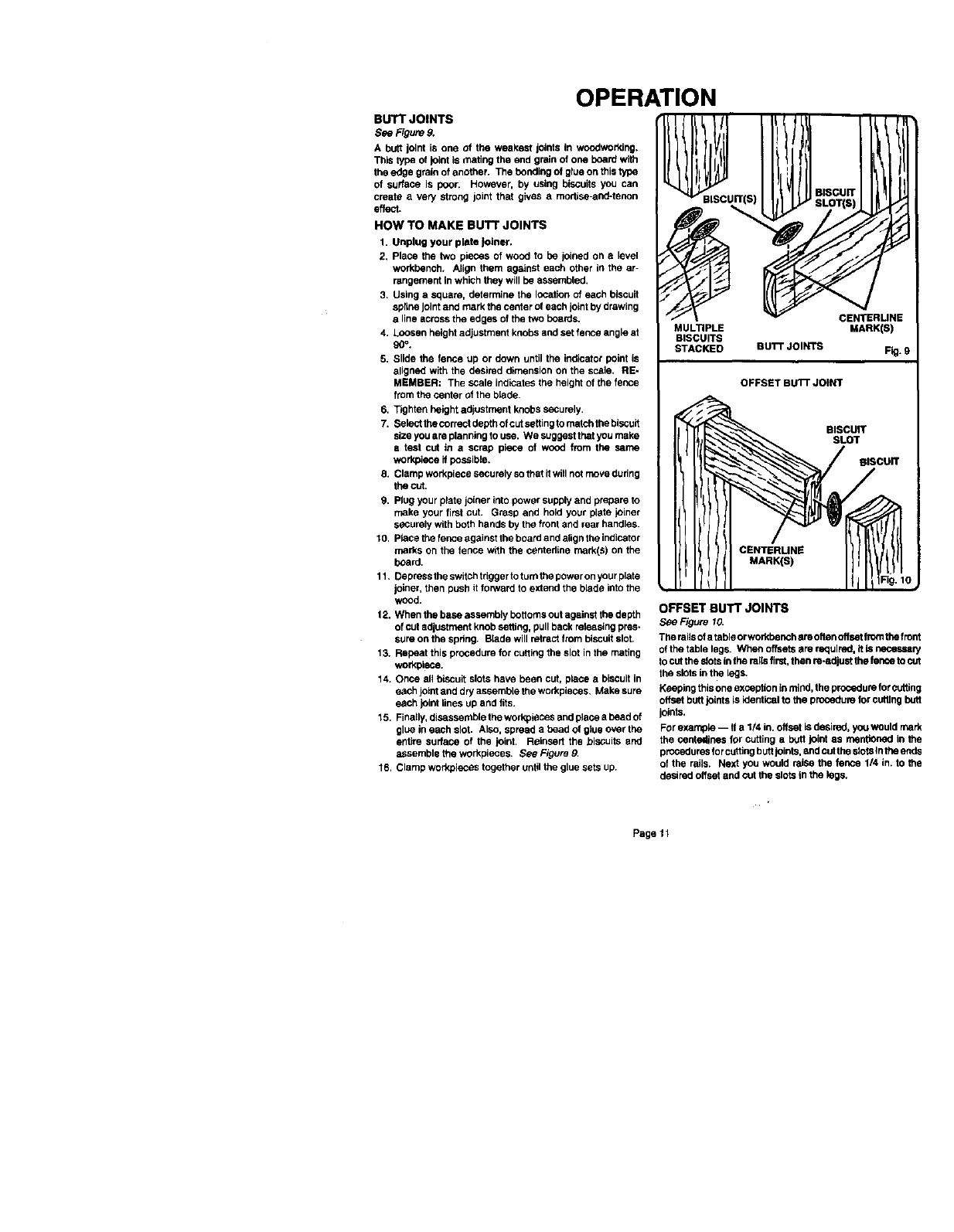
BUTT JOINTS
See Figure 9.
A butt joint is one of the weakest joints in woodworking.
This type of joint is mating the end grain of one board with
the edge grain of another. The Pendingof glee on thistype
of surface Is poor. However, by using biscuits you can
create a very strong joint that gives a modise-and-tonon
effect.
HOW TO MAKE BUT[ JOINTS
1. Unplug your plate joiner.
2. Place the two pieces of wood to be joined on a level
workbench. Align them against each other in the ar-
rangement inwhich they will be assembled,
3. Using a square, determine the location of each biscuit
sptine Jointand mark the center of each joint by drawing
aline across the edges of the two boards.
4. Loosen heightadjustment knobs and set fence angle at
g0°.
5. Slide the fence up or down until the indicator point is
aligned with the desired dimension on the scale, RE-
MEMBER: The scale indicates the height of the fence
from the center of the blede,
6. Tighten height adjustment knobs securely,
7. Select the correct depthof cut settingto matobthe biscuit
size you are planning to use. We suggest that you make
atest cut in a scrap piece of wood from the same
work_ece if possible.
8. Clamp workpiece securelyso that if will not move duhng
the cut.
g. Plug your plate joiner into power supply and prepare to
make your first cut. Grasp and hold your plate joiner
securely with both hands by the trent and rear handles.
t 0. Place the fence egainst the board and align the indicator
marks on the fence with the centedine mark(s) on the
board.
11. Depress the switchtdgger to turnthe power onyour plate
joiner, then push it forward to extend the blade into the
wood.
12. When the base assembly bottoms out against the depth
of outadjustment knobsetting, pull back rsteasing pres-
sure on the spring. Blede will retractfrom biscuitslot.
13. Repeat this procedure for cutting the slot in the mating
workptsce.
14. Once aft biscuit slots have been cut, place a biscuitin
each joint and dryassemble the workpleces, Make sure
each joint lines up and tits.
15, Finatly, disessemb[e the workpleces andplace a bead of
glue in each slot, Also, spread a head of glue over the
entire surface of the joint. Releserl the biscuits and
assemble the workpieces, See Figure 9.
16, Clamp workpteces together until the glue sets up.
MULTIPLE
BISCUITS
STACKED BUTT JOINTS
CENTERUNE
MARK(S)
Fig. 9
OFFSET BU1"i"JOINT
BISCUIT
SLOT
BISCUIT
CENTERUNE
MARK(E)
OFFSET BUTT JOINTS
see F'tgure10.
The railsof a table or workbenchare oEen oEsetfromthe front
of the table legs. When offsetsare rsqulred, it ISneces|mry
to cut the slots inthe ragsfirst, then re-adjustthe fence to cut
the slots inthe legs.
Keeping this one exception inmind, the procedurefor cutting
offsetbutt joints is identical to the procedure for cuffing butt
joints.
For example -- It a 1/4 in. offset Is desired, yo_ would mark
the centol_nes for cutting abutt joint as mentioned in the
procedures for coblegbuttjoiofs, and cut the sfotsInthe ends
of the rails. Next you would raise the fence 114in. to the
desired offset and cut the slots in the legs.
Page 11
OPERATION
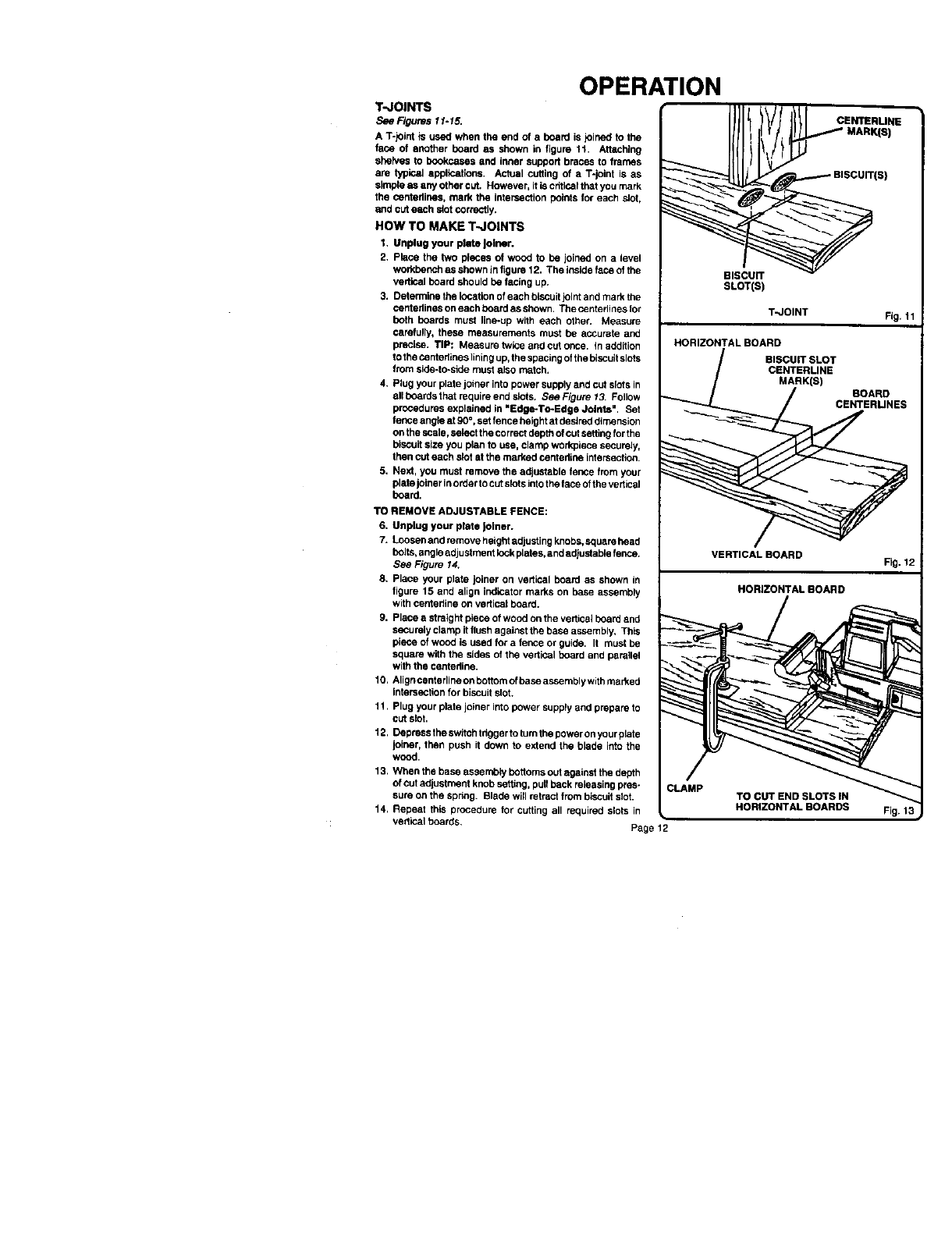
T-JOINTS
See Figures 11-15.
A T-jolot is used when the end of a board is joined to the
face of another board as shown in figure 11. Attaching
shelves to bookcases and inner support braces to frames
are typical applications, Actual cutting of a T-jofnt is as
slmpla as any other cut. However, itis cdtlcetthat you mark
the centedloes, mark the intersection points for each slot,
and cut each slot correctly.
HOW TO MAKE T-JOINTS
1. Unplug your plate Joiner.
2. Piece the two places of wood to he joined on a level
workheqx:has shown in figure 12, The inside face of the
vertical board should he facing up.
3. Determine the location of each biscuitjointand mark the
centedloeson each board as shown. The centedines for
both boards must line-up with each other. Measure
carefully, these measurements must he accurate and
precise. TIP: Measure twice and cut once, in addition
to the centedinaslining up, the spacingofthe biscuitslots
from side-to-side must also match.
4. Plug your plate joiner into power supplyand cut slots in
etl boards that requireendsiots. SeeFigure 13 Follow
procedures explained in "Edge-To-Edge Joints", Set
fence angle at 90°, setfence heightat desireddimension
on the SCale,select the correctdepth ofcut settingfor the
biscuitsize you plan to use, clamp workpiece securely,
then cut each slot at the marked centedioe intersection,
5. Next, you must remove the adjustable fence from your
plate joiner inorderto cut slots intothe face ofthe vertical
board.
TO REMOVE ADJUSTABLE PENCE:
6. Unplug your plate Joiner.
7. Loosenand remove halghtedjusting knobs,square heed
bolts, angle edj ustmeet lockplates, and adjuStablefence.
See Figure 14.
8. Place your plate joiner on vedical board as shown in
figure 15 and align indicator marks on base assembly
with cerdedine on verticet board.
9. Place a straight piece of wood on the vedical board and
securaly clamp itflushagainst the base assembly, This
piece of wood is used for afence or guide, It must he
square with the sides of the vertical board and parallel
with the centedine.
10, Align cantsrlineon bottomofhese assembly with marked
intersectionfor biscuit slot.
11, Plug your plate joiner into power supply and prepare to
cut slot,
12, Depress the switchtdgger to turnthe power onyour plate
joiner, then push it down to extend the blade into the
wood
13. When the base assembly bottoms out against the depth
of cut adjustment knob setting, pullback releasing pres-
sure on the spring. Blade win retract from biSCuitslot,
14, Repeat this procedure for cutting all required slots in
vertical boards, Page 12
l ti/f
It I|f! |1/1-._MARK(S)
_/_ BISCUITlS)
BISCUIT
SLOT(S)
CLAMP
T-JOINT Fig. 11
HORIZONTAL BOARD
BISCUIT SLOT
CBNTERLINE
MARK(S)
BOARD
CENTERUNES
VERTICAL BOARD Fig. 12
HORIZONTAL BOARD
TO CUT END SLOTS IN
HORIZONTAL BOARDS Fig. 1
OPERATION
T-JOINTS (Continued)
15. Once.aUslots have been cut, place a biscuitineach joint
and dPJassembts the worlds. Make sum each joint
lines up and fits.
16, Rnally, dlaassembfethe workpleces end ptsce abendof
glue In each slot. Also, spread a bead of glue over the
entire sudace of the joint. Reinsert the biscuits and
assembla thawo_s, S6eFigure 11.
17, Clamp workplaces together untUthe glue sets up.
Upon complatio_ of T-joint cutting operation, reassemble
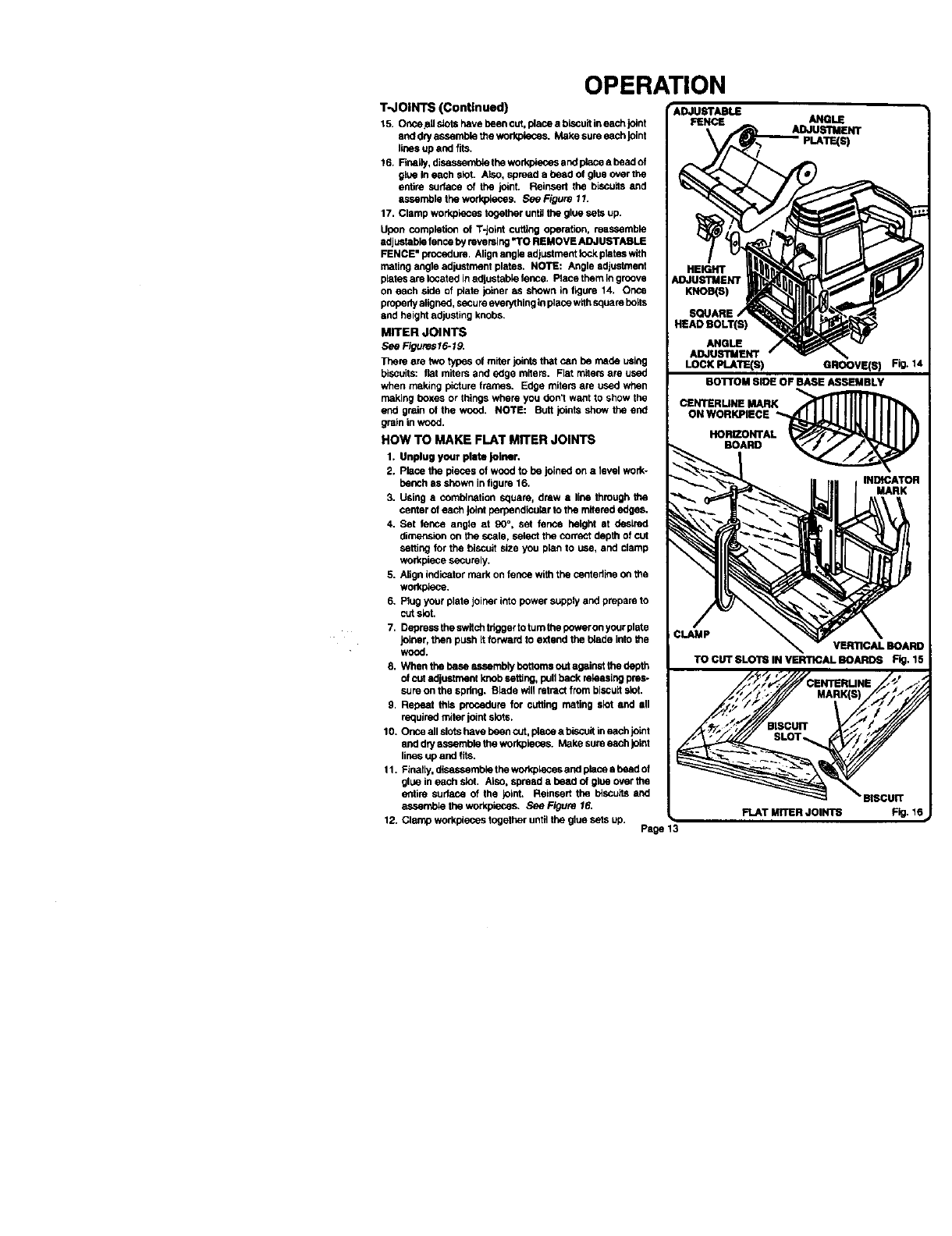
edjustable fence by reversirlg"TO REMOVE ADJUSTABLE
FENCE" procedure, Align angle adjustment lock plates with
matingangle adjustment plates. NOTE: Angle adjustment
platesare located inadjustable fence, Place them ingroove
on each side of plate joiner as shown in figure 14, Once
properlyaligned, secure ever/thing inplace with square bolts
and height adjusting knobs.
MITER JOINTS
SeeFigures16-19.
There ere two types of miter joints that can be made using
biscuits: flat miters and edge miters, Flat mite_ ate used
when making picture frames, Edge miters are used when
making boxes or things where you don't want to show the
end grain of the wood, NOTE: Bug joints show the end
gndn in wood.
HOW TO MAKE FLAT MITER JOINTS
1. Unplug your plate Joiner.
2. Place the pieces of wood to be joined on a lavel work-
bench as shown in figure 16.
3. Using a combination square, draw aline through the
center of each Jointperpendlaular to the mitered edges,
4, Set fence angle at 90°, set fence height at desired
dimensidn on the scale, select the correct depth of cut
setting for the biscuit size you plan to use, end clamp
workplace securely.
5. Align indicator mark on fence with the centedine on the
workplace.
6, Plug your plate joiner into power supplyand prepare to
cut sint.
7, Depress the switchtdgger to turnthe power on yourplate
Joiner,then push It fefwald to extend the blade into the
wood.
8, When the bese assembly bottoms o_ against the depth
ofcut edjuetment knob setting, puffback releasing pies-
sure on the spdng. Blade will retract from biscuitsidt.
9, Repeat this procedure for cutting mating slot and all
required m_ferjoint slots,
10. Once all slots have been cut, place a biscuitineach joint
and dry assemble the workpleces. Make sureeach joint
lines up and fits,
11, Finatty,disassemble the wodq)laces and place a bead of
glue in each sint, Also, spmed abead of glue over the
entire surface of the Joint. Roinsett the biscuits and
assemble the workpleces, SeeFigure 16.
12. Clamp workpleces together untilthe glue sets up, Page 13
HEIGHT
ADJUSTMENT
KNOB(S)
HEADBOLT(S)
ANGLE
ADJUSTMENT
CLAMP VERTICAL BOARD
TO CUT $LO'I_ IN VERTICAL BOARD6 Fig, 15
FLAT Mn'ER JOINTS F_.
ANGLE
ADJUSTMENT
LOCKPL.ATE(B) GROOVE(S) Fig. 14
BOTTOM SIDE OF BASE ASSEMBLY
CENI_RLINE MARl _
ON WORVd_ECE
HORIZONTAL
BOARD
INDICATOR
MARK
OPERATION
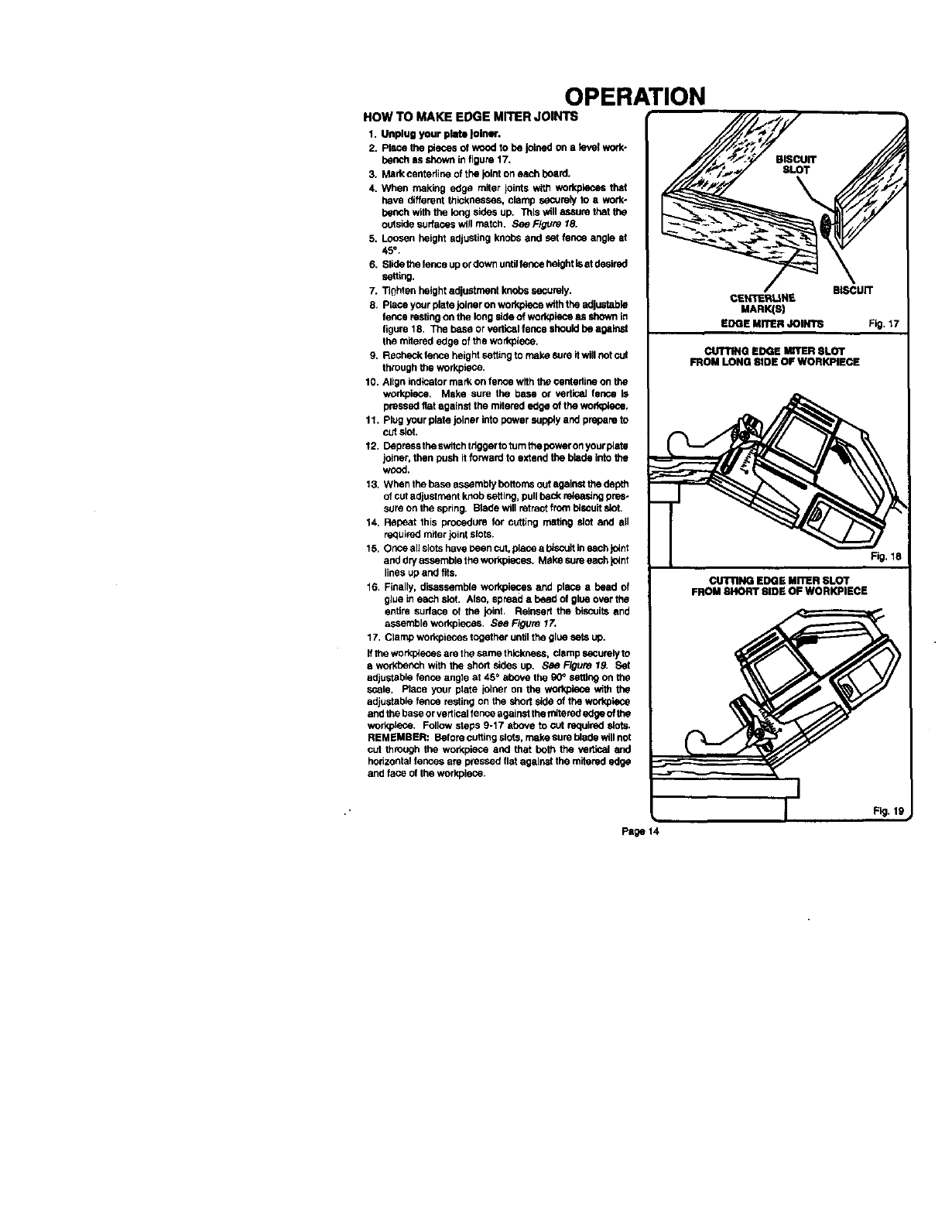
HOW TO MAKE EDGE MITER JOINTS
1. Unplug your plate Joiner.
2. place the pleces of wood to be joined on a level work*
bench as shown in figure 17.
3. Mark centedine of the joint on each board.
4. When making edge miter joints _workpleces that
have different thicknesses, clamp securely to awork-
bench with the long sides up. This will assure that the
outside surfaces will match, See F/gum 18.
5. Loosen height edjusttng knobs and set fence angle at
45 °,
6. Slidethe fence ug or down untilfence beight I$at deslrnd
setting,
7, Tighten height adjustment knobs securely,
8. place your plate joiner on workplece with the adjustable
fence resting on the long side of workplece as shown in
figure 18, The base or vertical fence should be agak_st
the mitered edge of the wod_ece.
9. Recheck fence height seffing to make sure it will not cut
through the workplece.
10. Align indicator mark on fence with the centedlne on the
workpiece. Make sure the base or vettk:_d fence is
pressed fiat against the mitered edge of the work_ece,
11. Plug your plate joiner into power supplyand prepare to
cut slot.
t2, Depressthe switohtdgger toturn the power onyour plato
joiner, then push tt forward to extend the blade into the
wood.
13. When the base assembly bottoms outagainst the depth
ofcut adjustment knob setting, pullhack releas_ugpre_
sure on the spring. Blade will retract from blecultslot.
14, Repeat this procedure for cutting mating slot and a_l
required miter joint slots.
15, Once all slots have been cut, place a biscuitin each Jclnf
and dryassemble the workpieces, Make sure each joint
lines up and fits.
16, Finally, disassemble workpieces and place a bead of
glue in each slot, ALSO,spread abead of glue over the
entire surface of the joint. Reinsed the biscuits end
assembleworkpieces, See FIgure 17.
17, Clamp workpleces together untilthe glue sets up.
if the woricplecesare the same thlokeass, clamp securelyto
a workbench with the short sides up, S6e Figure 19. Set
adjustable fence angle at 45 ° above the gO° setting on the
scale. Place your plate joiner on the workplece wtth the
adjustable fence resting on the short side of the workplace
and the base or vertical fence against the rtdtered edge of the
workplece, Follow steps 9-17 above to cut required slots,
REMEMBER: Before cuttJn9 slots, make sure blade will not
cut thrOughthe workpiece and that both the vertical and
horizontal fences are pressed flat agalmd the mitered edge
and face of the workplace.
l'/_'_'/-'P" e_scurr ///F/
-s T
_" BISCUIT
C_NTERL_N I=
MARK(S)
EDGE MITER JOINTS Fig. 17
CUTTING EDGE I_'rER 8LOT
FROM LONG 81DE OF WORKPIECE
CuTIrlNG EDGE MITER SLOT
FROM SHORT SIDE OF WORKPIECE
I
J Fig. 19,
Page 14
OPERATION
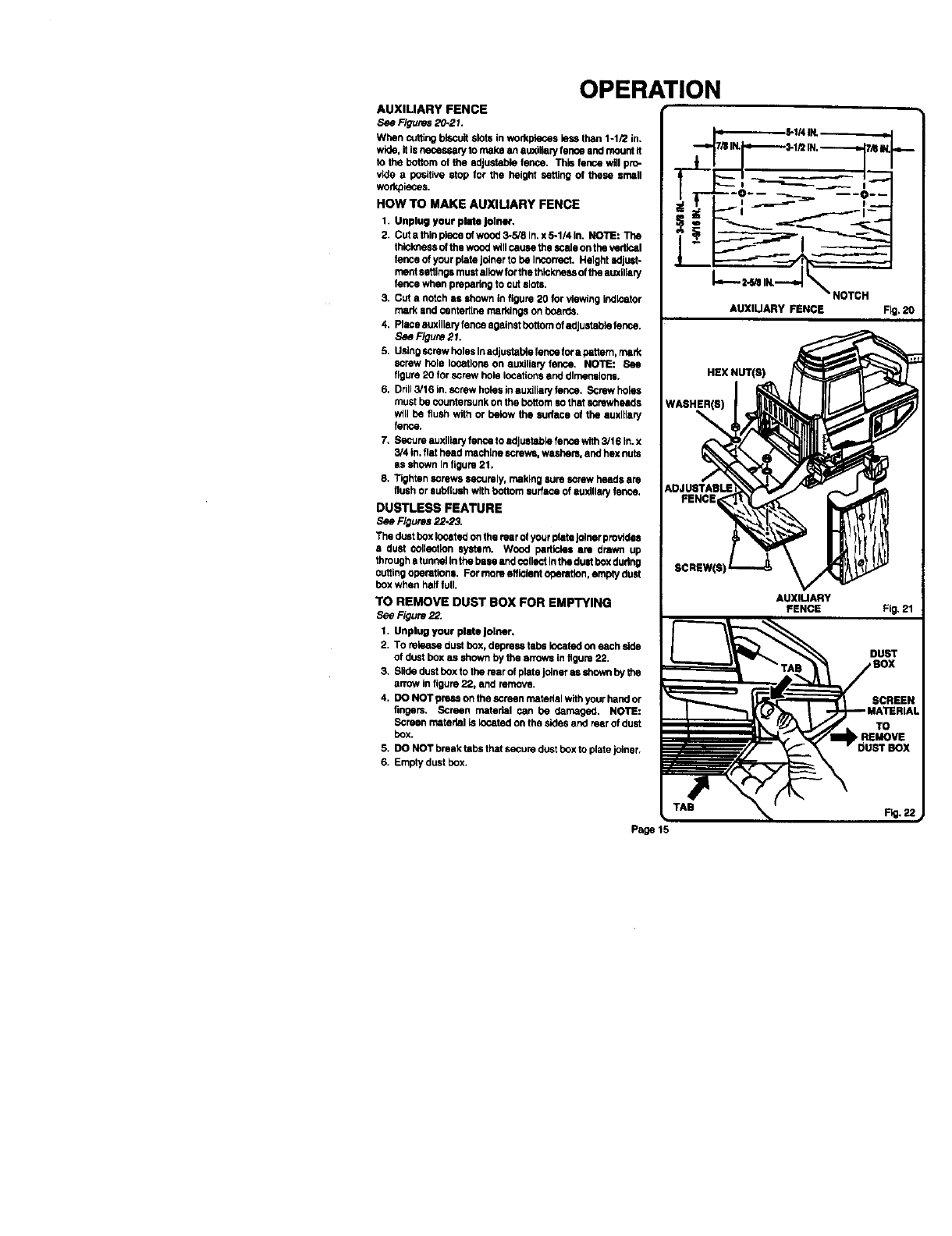
AUXILIARY FENCE
Sse Figures 20.21.
When cutting biscuit slots in workptaces lass than 1-1/2 in.
wide. it is necessary to make an 8_iliew fenoe end mount it
to the bottom of the adjustable fence. Thb fence will pro-
vide a positive stop for the height setting of these small
workpieces.
HOW TO MAKE AUXlUARY FENCE
1. Unplug your plate Joth_r.
2. Cofathlnpieceofwood3.5/81n.xS-1/4in. NOTE: The
thickness ofthe wood will0ause the scale onthe vertical
fence of your p_ate_*,0rte Ir_oneof. He_t _-
mant settinge mustalk>wforthe thicknessofthe suxlliefy
fence when preparing to oof slots.
3. Cut a notch as shown in figure 20 for "Alwing indk'.ator
mark and canted(he markings on boards,
4. Place euxllleP/1ante against boEom ofadJustat_efence.
SGe Figure 21.
5. Ustngscrewholes Inadjustable fence for aptatem, math
screw boie Iocatlor,s on auxilier/fence, NOTE: See
figure 20 for screw hole lOCationsand dimensions.
6. Drill 3/16 In. screw hotas ineux_lta_yter_e. Screw holes
must be countersunk on the bottom so that sorewheeds
will he flush with or below the surface of the auxiliary
fence.
7. Secure auxilierj fence ta adjuetabie tanoe with3/16 In. x
3/4 in. fiat heart machine _Tews. washen_, and hex nuts
as shown Infigure 21.
8. Tighten screws securely, making sure screw heads are
flush or subfiush with bottom surface of auxiliary fence.
DUSTLESS FEATURE
see Figures 22.23.
The dust box Io_tad ¢n the rstu of your pintaJoinerprovides
s duet ¢olieoflon system. Wood particiel are drawn up
throughs tunne_inthe base and collectInthe rtustbox dudng
cuttingoheratione. For more efficient operation, empty dust
box when half full,
TO REMOVE DUST BOX FOR EMPTYING
see Figure 22.
1. Unplug your plate joiner.
2. TO reiease rtust box. depress tshe _ocatod on each side
of dust box as shown by the CHOWSin figure 22.
3. Slide dust box to the rear of plate joiner is shown by the
arrow in figure 22. and remove.
4. DO NOT press on the screen matadel withyour hand or
fingers. Screen rnatadel can be damaged. NOTE:
Screen matedal is located on the sides end reel of dust
box.
5. DO NOT break tabs that secure dust box to plate joiner.
6. Empty dust box.
.
1
HEX NUT(E)
WASHER(E)
SCREW(S)
AUXlUARY
FENCE Fig. 21
DUST
BOX
SCREEN
TO
_.REMOVE
DUST BOX
OPERATION
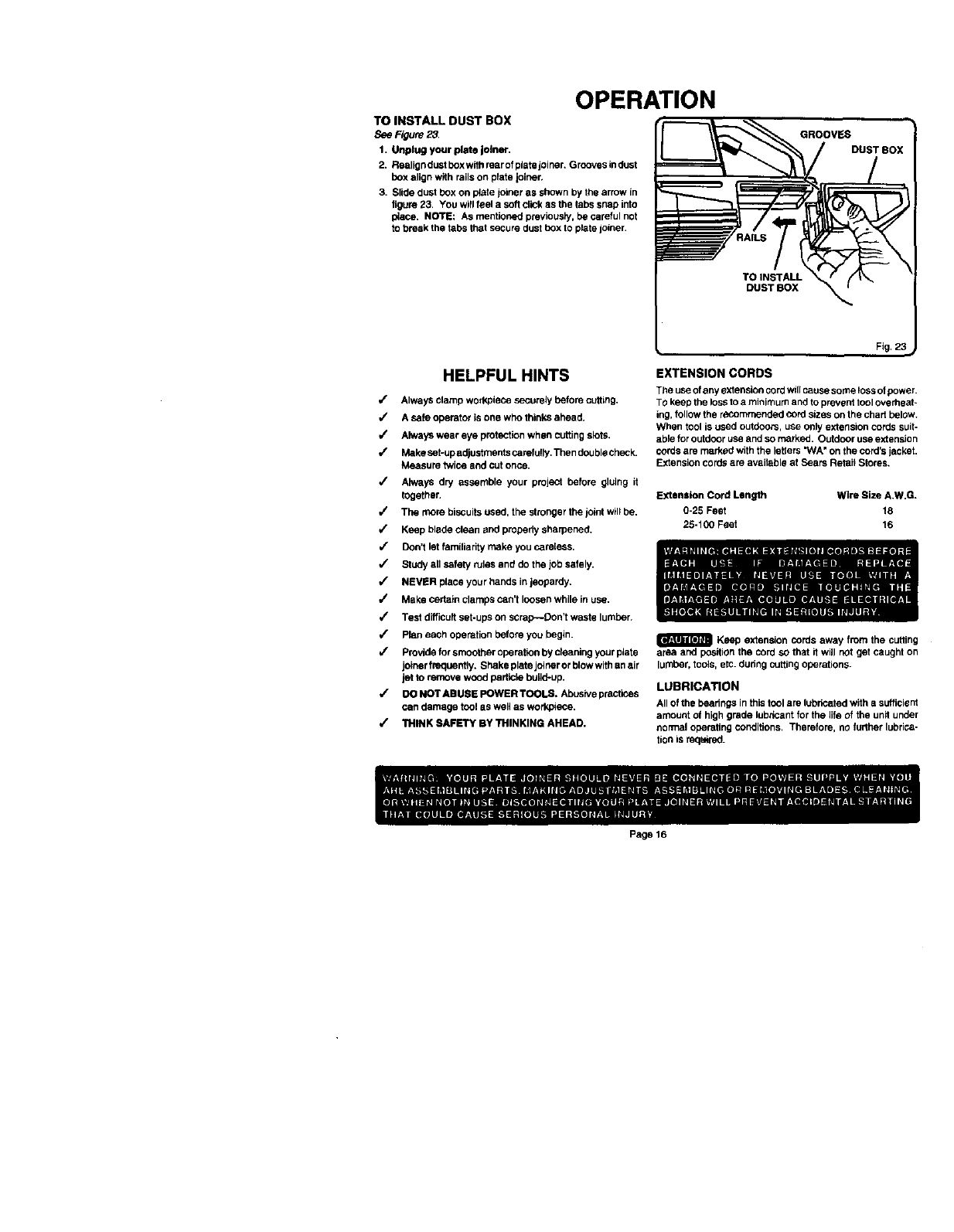
TO INSTALL DUST BOX
See Figure 23,
1. Unplug your plate joiner.
2. Realigrldust poxwithmarof plate joiner, Groovesladust
box align with railson plate joiner.
3. Slide dust box on plate joiner as shown by the arrow in
figure 23, YOUwill feel a soft clickas the tabssnap into
place, NOTE: As mentioned previously, be careful not
to break the tabs that secure dust box to plate joiner,
GROOVES DOS .°ox
Fig. 23
HELPFUL HINTS
/Always clamp workplace securely before cutting.
/A safe operator Is one who thinks ahead.
/Always wear eye protectionwhen cutting slots.
/Make set-upadjustments carefully.Then doublecheck.
Measure twice and cut once.
JAlways dry assemble your project before gluing it
together.
,/ The more biscuits used, the strongerthe joint will be.
/Keep blade clean and properly sharpened.
/Don't let familiarity make you careless.
,/ Study all safety nJlasand do the job safely.
/ NEVER place your hands injeopardy.
/Make certain clamps can't loosen while in use.
/Test dlfficuff set-ups on scrap--Don't waste lumber.
/Plan each operation before you begin.
/Provide for smoother operation by cleaning your plate
jolaer frsquendy. Sheke plete joiner or blowwith an air
Jetto remove wood particle build*up.
,/ dO NOT ABUSE POWER TOOLS. Abusive practioes
can damage tool as well as workpiece.
/ "n,IINK SAFETY BY THINKING AHEAD,
EXTENSION CORDS
The useofany extension cord willcause some loss of power,
TOkeep the loss to a minimumand to prevent tool overheat-
ing, followthe recommended cord sizes on the chart below.
When tool is used outdoo,'s,use only extension cords suit-
able for outdooruse and so marked. Outdoor useextension
cords are marked with the letters 'WA" on the cord'sjacket,
Extension cords are available at Sears Retail Stores,
Extension Cord Length Wire Size A.W.G.
0-25 Feet 18
25-100Feet 16
t_rr_J_l Keep extension cords away from the cutting
area and positionthe cord so that it will not get caught on
lumber, tools, etc. dudngcutting operations.
LUBRICATION
All of the bearings inthis tool are lubricated with a sufficient
amount of high grade lubricant for the life of the unit under
normal operating conditions. Therefore, no further lubrica-
tion is required.
Page 16
MAINTENANCE
CLEANING BASE ASSEMBLY IDUST BOX
TUNNEL
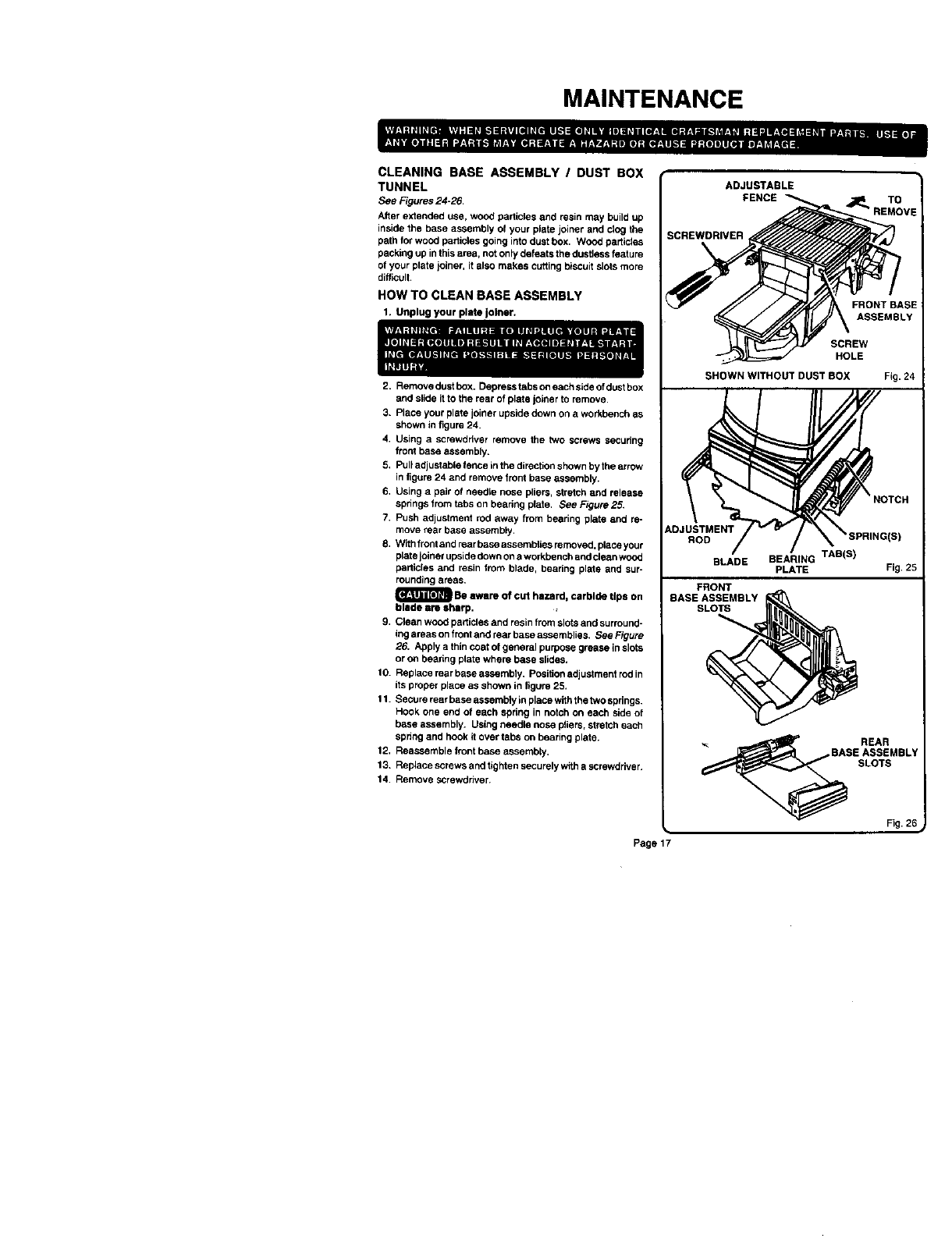
See Figures 24-26.
After extended use, wood particles and resin may build up
inside the base assembly of your plate joiner and clog the
path for wood particles going into dust box. Wood particles
packing up inthisarea, notonly defeats the dustless feature
of your plate joiner, it also makes cutting biscuit slots more
difficult.
HOW TO CLEAN BASE ASSEMBLY
1, Unplugyour platejoiner.
2. Remove dustbox. Depress tabs oneach sideof dustbox
and slide it to the rear of plate joiner to remove.
3. Place your plate joiner upside down on a workbench as
shown in figure 24.
4. Using a screwdriver remove the two screws securing
front base assembly,
5, Pull adjustable fence inthe directionshown by the arrow
in figure 24 and remove front base assembly.
6, Using a pair of neodle nose pliers, stretch and release
springs from tabs on bearing plate. See Figure25+
7. Push adjustment rod away from bearing plate and re-
move rear base assembly.
g. With front and rear base assembfies removed, placeyour
plate joinerupside downona workbench andclean wood
particles and resin from blade, bearing plate and sur-
rounding areas,
_Bo aware of cut hazard, carbide tips on
blade =re sharp.
9. Clean wood particlesand resinfrom slotsand surround-
ing areas on frontand rearbase assemblies. See Figure
26. Apply a thin coat of general purpose grease inslots
or on beadng plate where base slides.
10. Replace rear base assembly. Position adjustment red in
its proper place as shown in figure 25.
11. Secure rear base assembly inplace withthe twosprings.
Hook one end of each spring in notch on each side of
base assembly. Using needle nose priers,stretch each
springand hook it over tabs on bearing plata.
12. Reassemble front base assembly.
t 3, Replace screws and tighten securely with a screwdriver.
14 Remove screwdriver.
Page 17
ADJUSTABLE
FENCE
CREWDRIVER
FRONTBASE
ASSEMBLY
SCREW
HOLE
SHOWN WITHOUT DUST BOX Fig. 24
ROD
BLADE BEARING TAB(S)
PLATE Fig 25
FRONT
Fig. 26
MAINTENANCE
BLADE REPLACEMENT
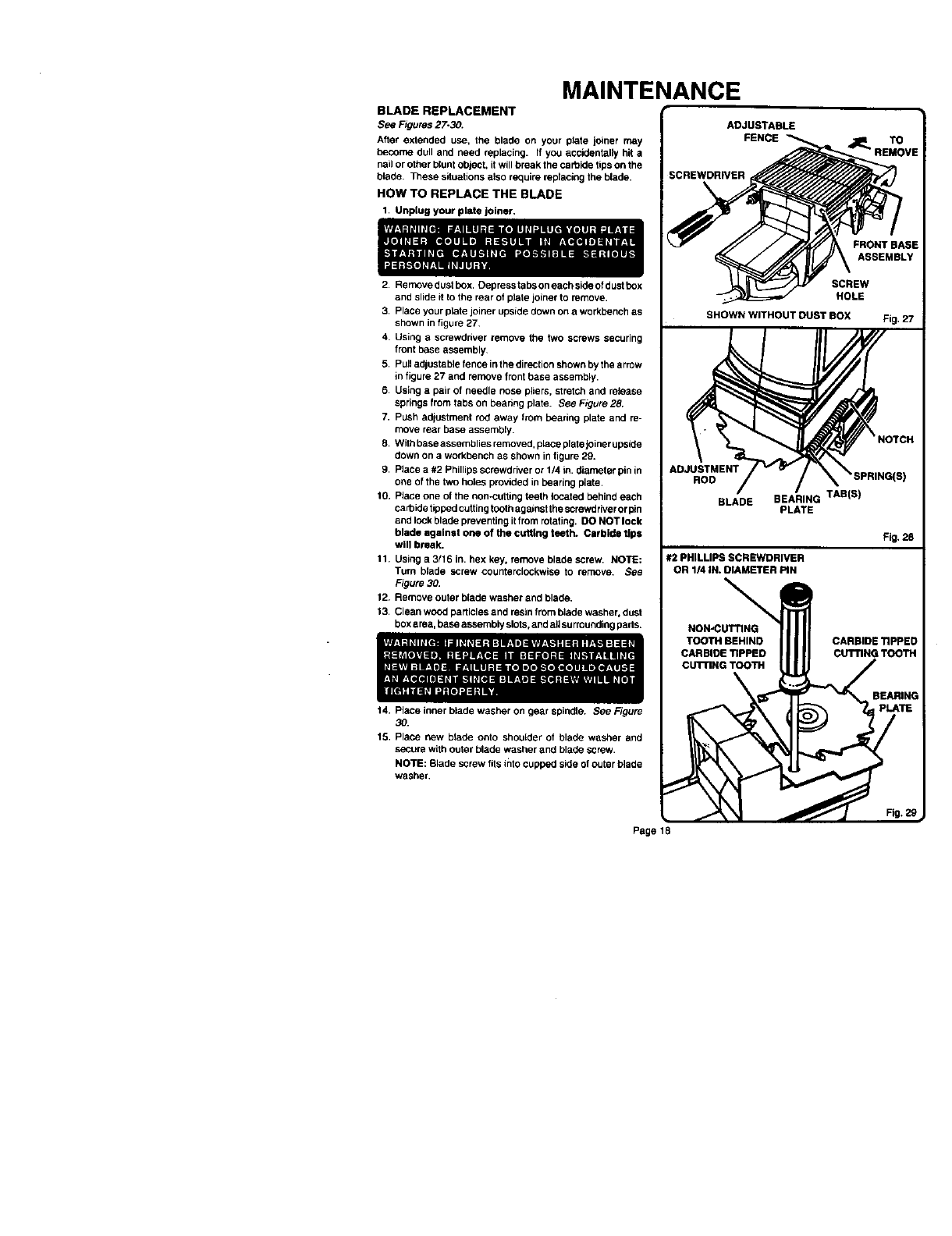
See Figures 27-30,
After extended use, the blade on your plate joiner may
become dull and need replacing. If yOUaccidentally hit a
nail or other blunt object, it willbreak the carbide tips on the
blade. These situations also require replacing the blade.
HOW TO REPLACE THE BLADE
1. Unplug your plate joiner,
2. Removedust bex, Depresstabsoneachsideofdustbox
end slide it to the rear of plate joinerto remove.
3, Place your plate joiner upside down on aworkberlch as
sho_n in figtJ_e 27.
4. Using a screwdriver remove the two screws securing
front base assembly¸
5, Pull adjustable fence inthe directioflshown by the arrow
in figure 27 and remove front base assembly,
6, Using apair of needle nose pliers, stretch and re_ease
springsfrom tabs on bearing plate. See Figure 28.
7. Push adjustment rod away from bearing plate end re-
move fear base assembly,
8. Withbaseassembliesremoved, placeplatejoinerupsxte
down Ona workbench as shown in figure 29.
9. Pidce a #2 Phillipsscrewdriver or 1/4 in, diameter pin in
one of the two holes provided inbearing plate,
10. Place one of the non-cutting teeth located behind each
carbidetipped cuftingtoote against the screwdriveror pin
end lock blade preventing itfrom rotating. DO NOT lock
blade against one of the cutting teeth. Carbide Bps
will break,
11. Using a 3/16 in, hex key, remove blade screw, NOTE:
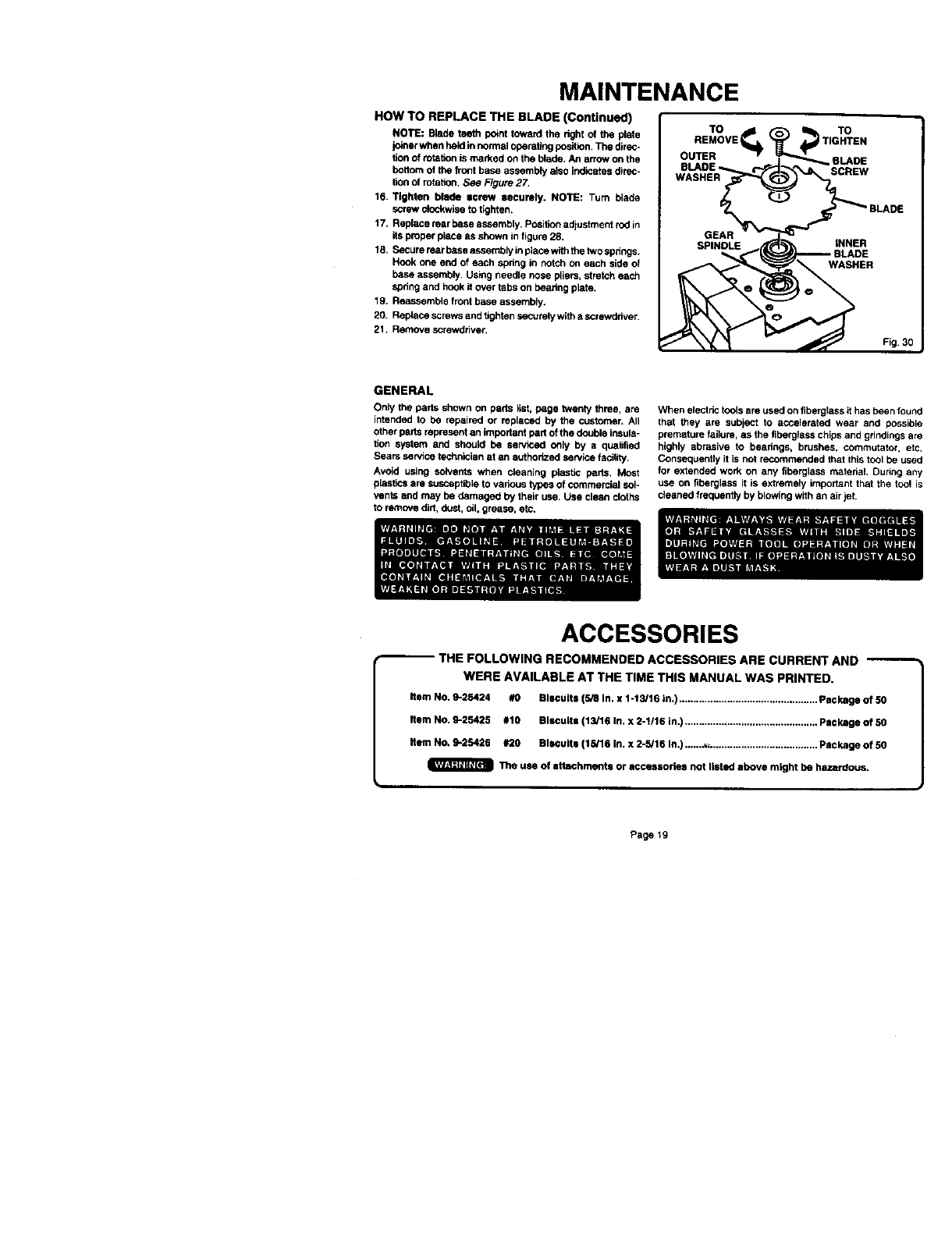
Turn idade screw counterclOCkwiseto remove, See
Figure 30.
12. Remove outer blade washer and blade,
13, Clean wood particles and resinfrom blade washer, dust
boxarea, base assembly slots,and all surroundingparts.
14. Place inner blade washer on gear spln_e. See Figure
30.
15, Place new blade ot_to shoulder of blade washer and
secure with outer blade washer and blade screw,
NOTE: Blade screw fits into cupped side of outer blade
washor.
ADJUSTABLE TO
FRONT BA_
ASSEMBL
SCREW
HOLE
SHOWN WITHOUT DUST BOX Fig, 2
ROD
NOTC
BLADE BEARING TAB(S)
PLATE
Fig.:
#2 PHILLIPS SCREWDRIVER
OR 1/4 IN. DIAMETER PIN
NON'CUTTING
TOOTH BEHIND CARBIDE TIPP
CARBIDE TIPPED CUTTING TOO'
cLn-nNG TOOTH
• BEARI
Page 18
MAINTENANCE
HOW TO REPLACE THE BLADE (Continued)
NOTE: Bade teeth point toward the dght of the plate
joinerwhen hem in normal operatingposition, The direc-
tion of €of•donis marked on the blade, An arrow on the
bottom of the front base assembly also indicates direc-
tion of rotation, See Figure 2Z
16, Tighten blade screw securely. NOTE: "rum blade
screw clockwiseto tighten,
17, Replace rear base assembly, Positionadjustment rod in
its proper place _zsshown in figure 28,
18. Secure rearhese assembly inplacewith the two spdngs.
Hook one end of each spring in notch on each side of
base assembly, Using needle nose pliers, stretch each
springand hook it over tabs on bearing plate,
19. Reassemble front base assembly.
20. Replace screws andtighten securelywith a screwdriver.
21. Remove screwdriver.
RIt;OvE T,&O.
ooTEo
_BLADE
Fig. 30
GENERAL
Only the parts shown on pads list, page twenty three, ere
intended to be repaired or replaced by the customer. All
other parts representan important part of the double insuia-
tion system and should be serviced only by a qualified
Sears service technician at an authorized service facility,
Avoid using solvents when cleaning plastic parts. Most
plastic_=are susceptible to vadous types of commercial sot-
vents and may be damaged by their use. Use clean cloths
to remove dirt,dust, oil, grease, etc.
When electric toolsare used on fiberglassit has been found
that they are subject to accelerated wear and possible
premature failure, as the fiberglass chips and gtindingsare
highly abrasive to hearings, brushes, commutator, etc,
Consequently it is not recommended that this tool be used
for extended work on any fiberglass material, During any
use on fiberglass it is extremely important that the tool is
cleaned frequently by blowing with an air jet.
ACCESSORIES
THE FOLLOWING RECOMMENDED ACCESSORIES ARE CURRENT AND
WERE AVAILABLE AT THE TIME THIS MANUAL WAS PRINTED.
Item No, 9-25424 #O Blscults (5/8 in. • 1-13/16 in.) ................................................. Package of 50
Item NO. 9-25425 #10 Biscuits (13/16 In, x 2-1116 in.) ............................................... Package of 50
Item No. 9.25426 #20 Bllcuite (15/16 in. • 2-5/16 in,) ......;_ ...................................... Package of 50
_The use of attachments or accessories not listed above might be hazarrtous.
Page 19
TROUBLESHOOTING
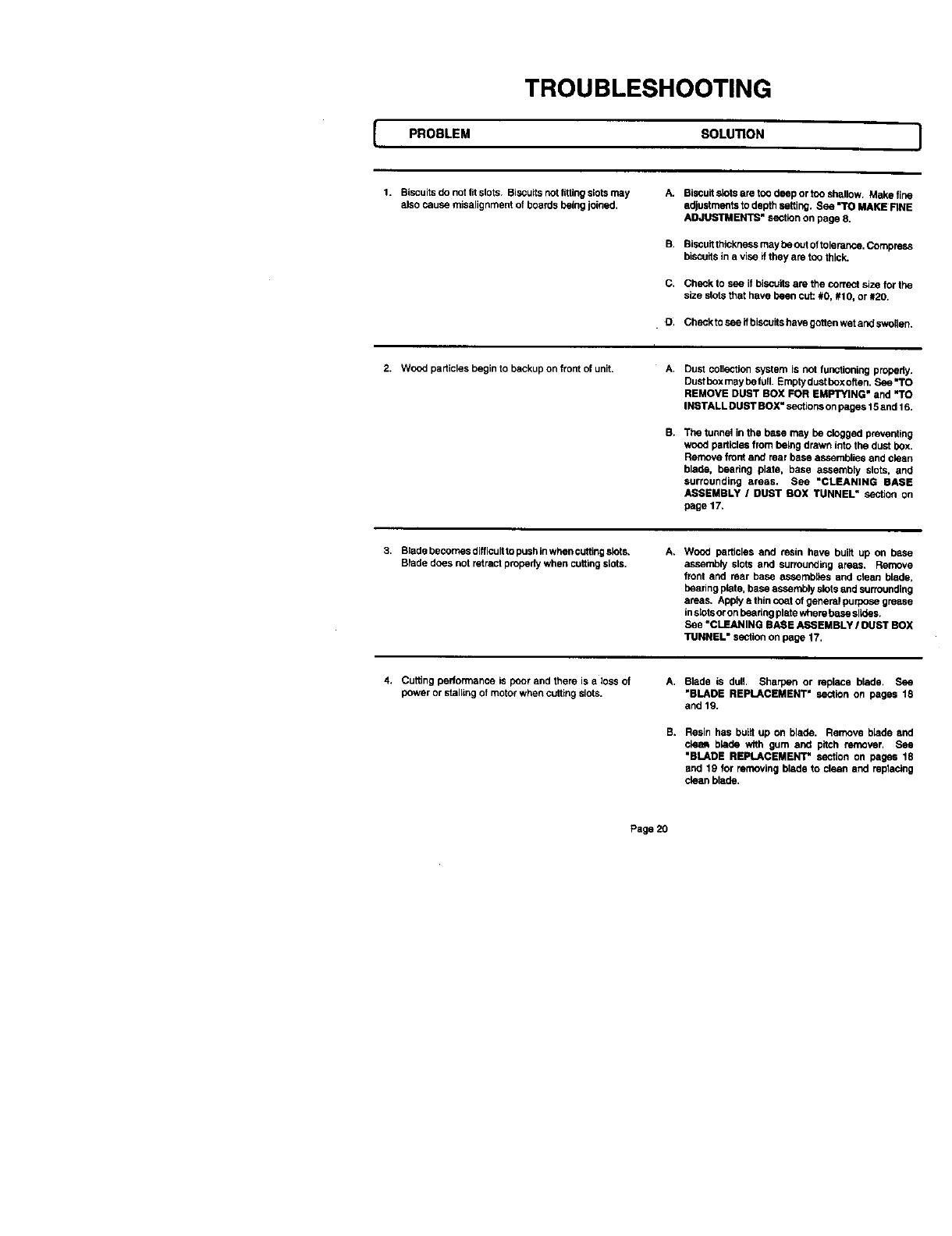
tPROBLEM SOLUTION J
1. Biscuitsdo not fit slots. Biscuits notfittingslots may
also cause misalignment of boards being joined.
B+
C.
Biscuit slots are too deep or too shallow. Make fine
edjustments to depth setting. Bee "TO MAKE FINE
ADJUSTMENTS" seoflen on page 8.
Biscuitthickness may be out oftolerance. Compress
biscuitsin a vise if they are toothick.
Check to see if biscuitsare the correct size for the
size slots that have been cut: #0, #10, or #20.
Check to see it biscuitshave gotten wet and swollen.
2. Wood particles begin to backup on front of unit.
B.
Dust collection system is not functioning probedy+
Dustboxmay he full. Emptydustbox often. See"TO
REMOVE DUST BOX FOR EMPTYING" and "TO
INSTALL DUST BOX" sectionson pages 15 and 16.
The tunnel in the base may he clogged preventing
wood particles from being drawn into the dust box.
Remove front and rear base assemblies and clean
blade, beadng plate, base assembly slots, and
surrounding areas. See "CLEANING BASE
ASSEMBLY /DUST BOX TUNNEL" section on
page 17.
3. Blade becomes difficulttopush inwhen cuttingslats.
Blade does not retract propedy when cottleg slots.
A. WOOd particles and resin have built up on base
assembly slots and surrounding areas, Remove
front and rear base assemblies and clean blade,
bearing plate, base assembly slots and surrounding
areas, Apply athin coat of general purpose grease
ins!otsoron beadng plste where base slk_es,
See "CLL6J_IING BASE ASSEMBLY /BUST BOX
TUNNEL" section on page 17,
4. Cutting performance is poor and there is a loss of
power or stalling of motor when cuffing slots.
A. Blade is dull. Sharpen or replace blade. See
"BLADE REPLACEMENT" section on pages 18
and 19.
B, Resin has buiif up on blade. Remove b_adeand
ck_m bkldo with gum and pitch remover, See
"BLADE REPLACEMENT' section on pages 18
and 19 for removing blade to clean and replacing
clean blade.
Page20

NOTES
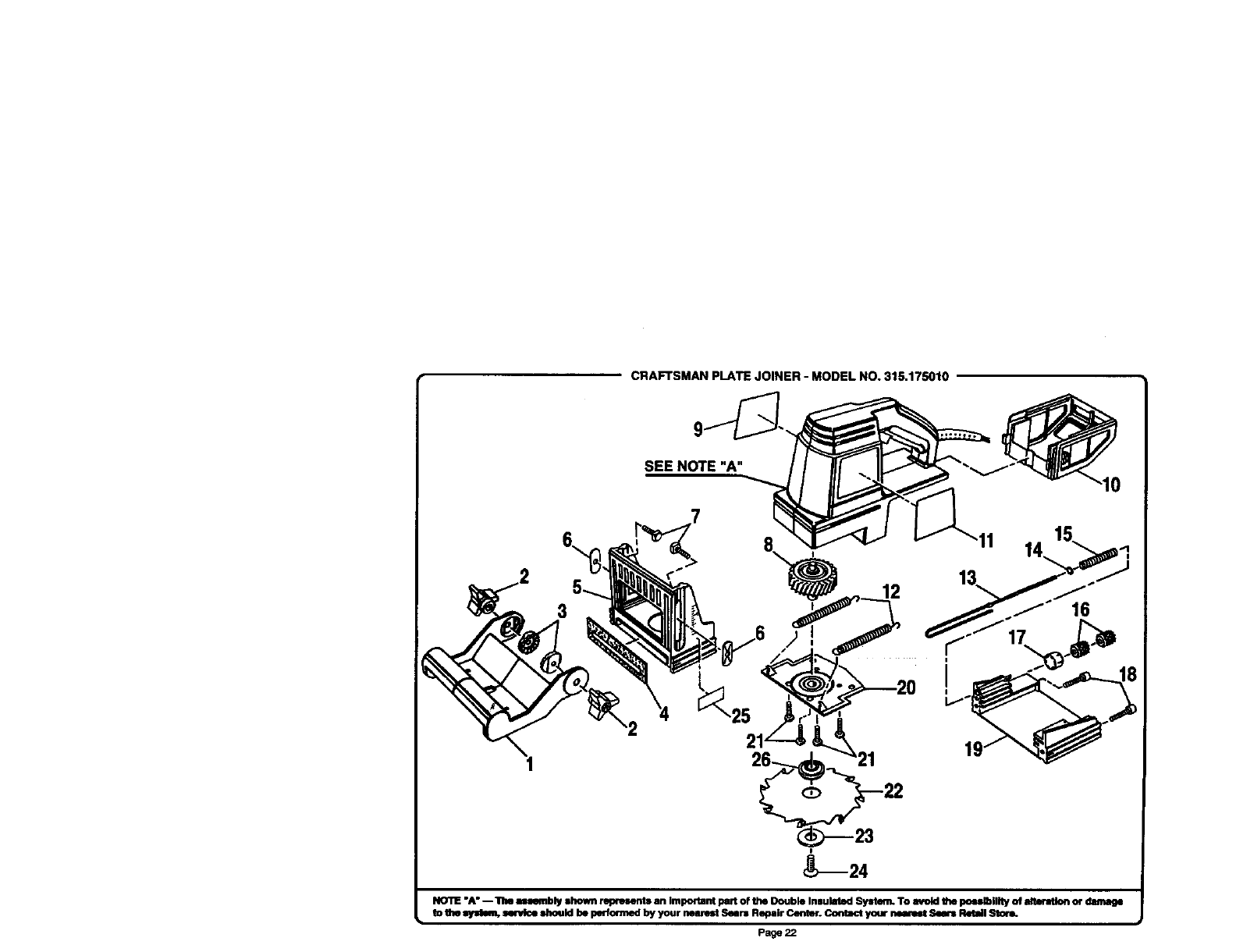
CRAFTSMAN PLATE JOINER - MODEL NO. 315.175010
SEE NOTE "A"
8\
NOTE "A" -- The ammmbly shown represents an important pert of the Double Insulated System. To avoid I_e poiIIbillty of a_wi_m or damage
to _e syntm_ /sl_mld be parfonned by your nearent Smri Reflalr Cer,ter. Contant your nmrest Slers Rntall _
Page 22
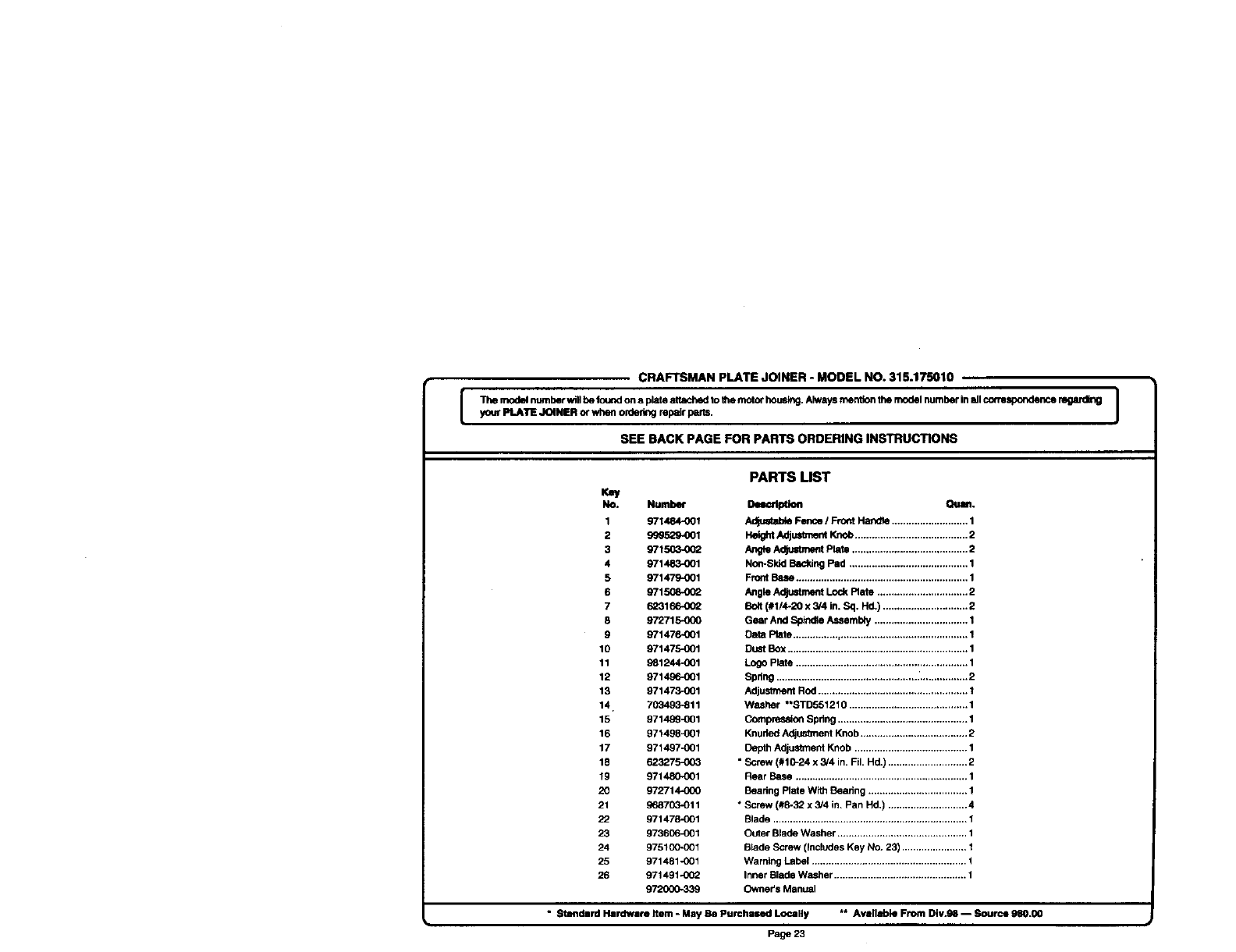
CRAFTSMAN PLATE JOINER - MODEL NO. 315.175010
I Themodelnumberwillbefoundonaplateattachedtothemotorbe,JSl_g,Alwaysmer_ionthemodelnumberinJl cofl_spondenceregardlng
yourPLATEJOINERorwhenonderi_lrepabparts.
SEE BACK PAGE FOR PARTS ORDERING INSTRUCTIONS
I
PARTS LIST
Key
No. Number De_ Quart.
1 971484001 Adjusleble Fence IFront Handte........................... 1
2 999529oo1 H_g_tAdjus_nentKnob........................................2
3 971503-002 Ang_Ad_stnlentP_ ......................................... 2
4 971483-001 Non-Skid BacldngPad .......................................... 1
5 9714_1 FrontBase ............................................................. 1
6 971 _Angle Adjustment Lock Plate ................................ 2
7 623166-002 Eo_t(#1/4-20 x 3/4 in. Sq. Hd.) .............................. 2
8 972715-000 Gear And Spindle Assembly ................................. 1
9 971476001 Data Plate................ ,............................................. 1
10 971475-001 Dust Box................................................................ 1
11 961244-001 Logo Plate ............................................................. 1
12 971490-(_1 Spdng .................................................................... 2
13 971473-(_1 Adjustment Rod ..................................................... 1
14 703493-811 Washer -STD551210 .......................................... 1
15 971499-001 CompressionSpdng .............................................. 1
16 971498-001 Knuded Adjustment Knob ...................................... 2
17 971497-001 Depth Adjustment Knob ........................................ 1
18 623275003 " Screw (#10-24 x 3/4 in. Fil. Hd.) ............................ 2
19 971480001 Rear Base ............................................................. 1
20 972714-000 Bearing PlateWith Beadng ................................... 1
21 968703011 * Screw (#8-32 x 3/4 in, Pan Hd.) ............................ 4
22 971478-001 Blade ..................................................................... 1
23 973606-001 Outer Blade Washer .............................................. 1
24 975100-001 Blade Screw (Includes Key No. 23) ....................... 1
25 971481-001 Warning Label ....................................................... 1
26 971491-002 Inner Blade Washer ............................................... 1
972000-339 Owner's Manual /
• Standard Hardware item -May Be Purchased Locally ** Available From DIv,96 -- Source g_O.00 J
Page 23
For repair of major brand appliances In your own home...
no matter who made it, no matter who sold it!
1-800-4-MY-HOME sMA.ytime,dayornight
(1-1100-469-4663)
www,sesrs,com
To bringin productssuchas vacuums,lawnequipmentandelectronics
for repair,callfor the locationof your nearestSears Parts & Repair Center,
1-800-488-1222 An_ime,dayornight
www.sears.com
For the replacement parts, accessories and owner's manuals
that you need to do-it-yourself, call Sears PartsDIrectS'_
1-800-366-PART 6am- 11p.m.CST,
(1-800-366-7278) 7daysaweek
www.sears.congpartsdlrect
To purchase or inquire about a Sears Service Agreement:
1-800-827-6655
7 a.m. - 5 p.m. CST, Mon. - Sat.
Parapedirserviciodereparaci_._a domici]io,
yparaordenarpiezasconentregaa domlcilio:
1-888-SU-HOGAR=_
(1-888-784-6427) [H r]
AuCanada pour serviceen fran_ais:
1-877-LE-FOYER _
(1-877-533-6937)
ORe_ T,_rk /_Tr_ o( Sears, RO_ and Co
@ Sea_, _and Co. •Mama _/_MI.Cx de Fttbrtca de _r_ P,oeboQk and CO
