Craftsman 320552330 User Manual IMPACT/DRILL DRIVER AND BATTERY KIT Manuals Guides 1703260L
User Manual: Craftsman 320552330 320552330 CRAFTSMAN IMPACT/DRILL DRIVER AND BATTERY KIT - Manuals and Guides View the owners manual for your CRAFTSMAN IMPACT/DRILL DRIVER AND BATTERY KIT #320552330. Home:Tool Parts:Craftsman Parts:Craftsman IMPACT/DRILL DRIVER AND BATTERY KIT Manual
Open the PDF directly: View PDF  .
.
Page Count: 36
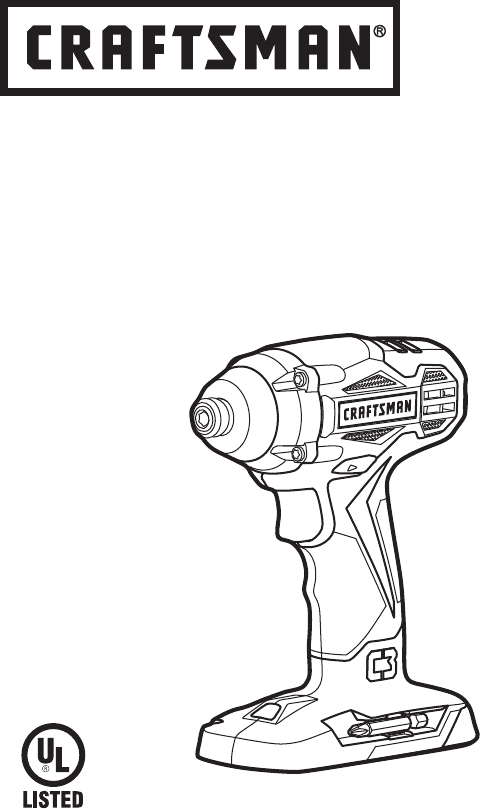
Operator’s Manual
C3 1/4" IMPACT DRIVER
Model No. 5727.1
Sears Brands Management Corporation, Hoffman Estates,
IL 60179 U.S.A.
www.craftsman.com
•WARRANTY
•SAFETY
•DESCRIPTION
•ASSEMBLY
•OPERATION
•MAINTENANCE
•ESPAÑOL
ѥWARNING: To reduce the risk of injury,
the user must read and understand the
Operator’s Manual before using this product.

2
TABLE OF CONTENTS
Warranty Page 2
Safety Symbols Pages 4-5
Safety Instructions Pages 6-8
Description Pages 9-10
Assembly Page 10
Operation Pages 11-14
Maintenance Page 15
Troubleshooting Page 15
Parts List Pages 16-17
CRAFTSMAN LIMITED WARRANTY
FOR ONE YEAR from the date of sale, this product is warranted against any
defects in material or workmanship.
WITH PROOF OF SALE, a defective product will be replaced free of charge.
For warranty coverage details to obtain free replacement, visit the web
page: www.craftsman.com/warranty
This warranty does not cover the bit, which is an expendable part that can
wear out from normal use within the warranty period.
This ONE YEAR warranty is void if this product is ever used while providing
commercial services or if rented to another person. For 90 DAY commercial
and rental use terms, see the Craftsman warranty web page.
This warranty gives you specic legal rights, and you may also have other
rights which vary from state to state.
Sears Brands Management Corporation, Hoffman Estates, IL 60179.
SAVE THESE INSTRUCTIONS!
READ ALL INSTRUCTIONS!
This impact driver has many features for making its use more pleasant and
enjoyable. Safety, performance, and dependability have been given top priority
in the design of this product making it easy to maintain and operate.
© Sears Brands, LLC

3
ѥDANGER: People with electronic devices, such as pacemakers, should
consult their physician(s) before using this product. Operation of electrical
equipment in close proximity to a heart pacemaker could cause interference or
failure of the pacemaker.
ѥWARNING: Some dust created by power sanding, sawing, grinding, drilling
and other construction activities contains chemicals known to the state of
California to cause cancer, birth defects or other reproductive harm. Some
examples of these chemicals are:
• Lead from lead-based paints
• Crystalline silica from bricks and cement and other masonry products, and
• Arsenic and chromium from chemically-treated lumber.
Your risk from these exposures varies, depending on how often you do this type
of work. To reduce your exposure to these chemical: work in a well ventilated
area, and work with approved safety equipment, such as those dust masks that
are specially designed to lter out microscopic particles.

4
SAFETY SYMBOLS
The purpose of safety symbols is to attract your attention to possible dangers.
The safety symbols and the explanations with them deserve your careful
attention and understanding. The symbol warnings do not, by themselves,
eliminate any danger. The instructions and warnings they give are no substitutes
for proper accident prevention measures.
ѥWARNING: Be sure to read and understand all safety instructions in this
manual, including all safety alert symbols such as “DANGER,” ”WARNING,” and
“CAUTION” before using this tool. Failure to follow all instructions listed in this
manual may result in electric shock, fire, and/or serious personal injury.
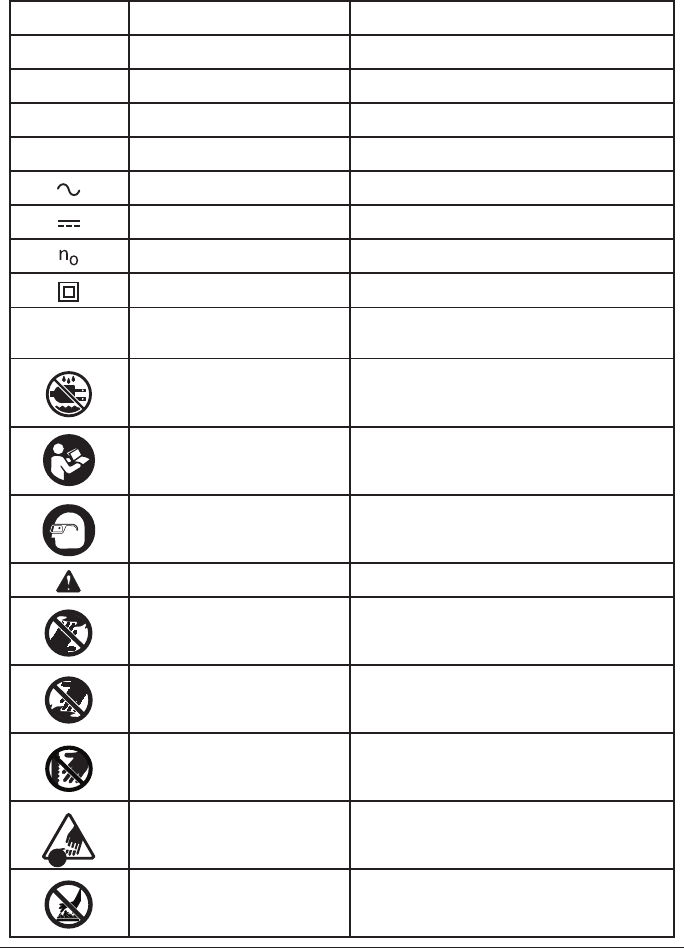
SYMBOL SIGNAL MEANING
SAFETY ALERT SYMBOL: Indicates DANGER, WARNING, or CAUTION; may
be used in conjunction with other symbols or pictographs.
ѥDANGER: Indicates a hazardous situation which, if not avoided, will result in
death or serious injury.
ѥWARNING: Indicates a hazardous situation which, if not avoided, could
result in death or serious injury.
ѥCAUTION: Indicates a hazardous situation which, if not avoided, could
result in minor or moderate injury.
Damage prevention and Information Messages
These inform the user of important information and/or instructions that could
lead to equipment or other property damage if they are not followed. Each
message is preceded by the word “NOTICE”, as in the example below.
NOTICE: Equipment and/or property damage may result if these instructions are
not followed.
ѥWARNING: To ensure safety and reliability, all repairs should be performed
by a qualified service technician.
VVolts Voltage
A Amperes Current
Hz Hertz Frequency (cycles per second)
W Watt Power
min Minutes Time
Alternating Current Type of current
Direct Current Type or a characteristic of current
Rotational speed, at no load
Class II Construction Double-insulated construction
.../min Per Minute Revolutions, strokes, surface speed,
orbits, etc., per minute
Wet Conditions Alert Do not expose to rain or use in damp
locations.
Read The Operator’s Manual
To reduce the risk of injury, user must
read and understand operator’s manual
before using this product.
Eye Protection
Always wear safety goggles or safety
glasses with side shields and a full face
shield when operating this product.
Safety Alert Precautions that involve your safety.
No-Hands Symbol Failure to keep your hands away from the
blade will result in serious personal injury.
No-Hands Symbol Failure to keep your hands away from the
blade will result in serious personal injury.
No-Hands Symbol Failure to keep your hands away from the
blade will result in serious personal injury.
No-Hands Symbol Failure to keep your hands away from the
blade will result in serious personal injury.
Hot Surface To reduce the risk of injury or damage,
avoid contact with any hot surface.
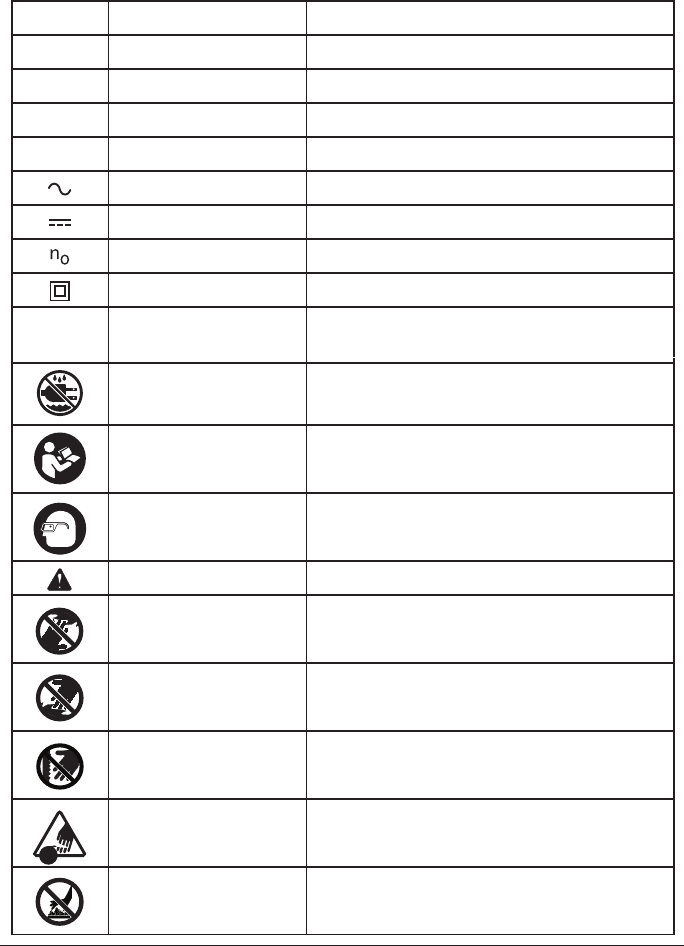
SYMBOL NAME DESIGNATION/EXPLANATION
No-load Speed
WARNING: The operation of any power tools can result in
foreign objects being thrown into your eyes, which can result
in severe eye damage. Before beginning power tool operation,
always wear safety goggles or safety glasses with side shield
and a full face shield when needed. We recommend a Wide
Vision Safety Mask for use over eyeglasses or standard safety
glasses with side shields. Always use eye protection which is
marked to comply with ANSI Z87.1.
5
SAVE THESE INSTRUCTIONS
Some of these following symbols may be used on this tool. Please study them
and learn their meaning. Proper interpretation of these symbols will allow you to
operate the tool better and more safely.
VVolts Voltage
A Amperes Current
Hz Hertz Frequency (cycles per second)
W Watt Power
min Minutes Time
Alternating Current Type of current
Direct Current Type or a characteristic of current
Rotational speed, at no load
Class II Construction Double-insulated construction
.../min Per Minute Revolutions, strokes, surface speed,
orbits, etc., per minute
Wet Conditions Alert Do not expose to rain or use in damp
locations.
Read The Operator’s Manual
To reduce the risk of injury, user must
read and understand operator’s manual
before using this product.
Eye Protection
Always wear safety goggles or safety
glasses with side shields and a full face
shield when operating this product.
Safety Alert Precautions that involve your safety.
No-Hands Symbol Failure to keep your hands away from the
blade will result in serious personal injury.
No-Hands Symbol Failure to keep your hands away from the
blade will result in serious personal injury.
No-Hands Symbol Failure to keep your hands away from the
blade will result in serious personal injury.
No-Hands Symbol Failure to keep your hands away from the
blade will result in serious personal injury.
Hot Surface To reduce the risk of injury or damage,
avoid contact with any hot surface.
SYMBOL NAME DESIGNATION/EXPLANATION
No-load Speed

6
SAFETY INSTRUCTIONS
GENERAL POWER TOOL SAFETY WARNINGS
ѥWARNING: Read all safety warnings and instructions. Failure to follow the
warnings and instructions may result in electric shock, fire and/or serious injury.
Save all warnings and instructions for future reference.
The term “power tool” in the warnings refers to your mains-operated (corded)
power tool or battery-operated (cordless) power tool.
WORK AREA SAFETY
• Keep work area clean and well lit. Cluttered or dark areas invite accidents.
• Do not operate power tools in explosive atmospheres, such as in the
presence of flammable liquids, gases or dust. Power tools create sparks
which may ignite the dust or fumes.
• Keep children and bystanders away while operating a power tool.
Distractions can cause you to lose control.
ELECTRICAL SAFETY
• Power tool plugs must match the outlet. Never modify the plug in any
way. Do not use any adaptor plugs with earthed (grounded) power tools.
Unmodified plugs and matching outlets will reduce risk of electric shock
• Avoid body contact with earthed or grounded surfaces such as pipes,
radiators, ranges and refrigerators. There is an increased risk of electric
shock if your body is earthed or grounded.
• Do not expose power tools to rain or wet conditions. Water entering a
power tool will increase the risk of electric shock.
• Do not abuse the cord. Never use the cord for carrying, pulling or
unplugging the power tool. Keep cord away from heat, oil, sharp edges or
moving parts. Damaged or entangled cords increase the risk of electric shock.
• When operating a power tool outdoors, use an extension cord suitable
for outdoor use. Use of a cord suitable for outdoor use reduces the risk of
electric shock.
• If operating a power tool in a damp location is unavoidable, use a
ground fault circuit interrupter (GFCI) protected supply. Use of a GFCI
reduces the risk of electric shock.

7
PERSONAL SAFETY
• Stay alert, watch what you are doing and use common sense when
operating a power tool. Do not use tool while tired or under the
influence of drugs, alcohol, or medication. A moment of inattention while
operating power tools may result in serious personal injury.
• Use personal protective equipment. Always wear eye protection. Protective
equipment such as dust mask, non-skid safety shoes, hard hat, or hearing
protection used for appropriate conditions will reduce personal injuries.
• Prevent unintentional starting. Ensure the switch is in the off-position
before connecting to power source and/or battery pack, picking up or
carrying the tool. Carrying power tools with your finger on the switch or
energizing in power tools that have the switch on invites accidents.
• Remove any adjusting key or wrench before turning the power tool
on. A wrench or a key left attached to a rotating part of the power tool may
result in personal injury.
• Do not overreach. Keep proper footing and balance at all times. This
enables better control of the power tool in unexpected situations.
• Dress properly. Do not wear loose clothing or jewelry. Keep your hair,
clothing and gloves away from moving parts. Loose clothes, jewelry or
long hair can be caught in moving parts.
• If devices are provided for the connection of dust extraction and
collection facilities, ensure these are connected and properly used. Use
of these devices can reduce dust-related hazards.
POWER TOOL USE AND CARE
• Do not force the power tool. Use the correct power tool for your
application. The correct power tool will do the job better and more safely at
the rate for which it was designed.
• Do not use the power tool if the switch does not turn it on and off. Any
power tool that cannot be controlled with the switch is dangerous and must
be repaired.
• Disconnect the plug from the power source andlor the battery pack
from the power tool before making any adjustments, changing
accessories, or storing power tools. Such preventive safety measures
reduce the risk of starting the power tool accidentally.
• Store idle power tools out of the reach of children and do not allow
persons unfamiliar with the power tool or these instructions to operate
the power tool. Power tools are dangerous in the hands of untrained users.
• Maintain power tools. Check for misalignment or binding of moving
parts, breakage of parts and any other condition that may affect the
power tool’s operation. If damaged, have the power tool repaired
before use. Many accidents are caused by poorly maintained power tools.

8
• Keep cutting tools sharp and clean. Properly maintained cutting tools with
sharp cutting edges are less likely to bind and are easier to control.
• Use the power tool, accessories, tool bits, etc. in accordance with
these instructions, taking into account the working conditions and the
work to be performed. Use of the power tool for operations different from
those intended could result in a hazardous situation.
BATTERY TOOL USE AND CARE
• Recharge only with the charger specified by the manufacturer. A
charger that is suitable for one type of battery pack may create a risk of fire
when used with another battery pack.
• Use power tools only with specifically designated battery packs. Use of
any other battery packs may create a risk of injury and fire.
• When battery pack is not in use, keep it away from other metal objects,
like paper clips, coins, keys, nails, screws or other small metal objects
that can make a connection from one terminal to another. Shorting the
battery terminals together may cause burns or a fire.
• Under abusive conditions, liquid may be ejected from the battery;
avoid contact. If contact accidentally occurs, flush with water. If liquid
contacts eyes, additionally seek medical help. Liquid ejected from the
battery may cause irritation or burns.
SERVICE
• Have your power tool serviced by a qualified repair person using only
identical replacement parts. This will ensure that the safety of the power
tool is maintained.
• Follow instructions in the Maintenance section of this manual. Use of
unauthorized parts or failure to follow Maintenance instructions may create
a risk of shock or injury.
SPECIFIC SAFETY RULES FOR IMPACT DRIVER
• Hold power tools by their insulated gripping surfaces when performing
an operation where the cutting tool may contact hidden wiring. If a
cutting accessory contacts a “live” wire, it may make exposed metal parts
of the power tool “live” and could give the operator an electric shock.
9
DESCRIPTION
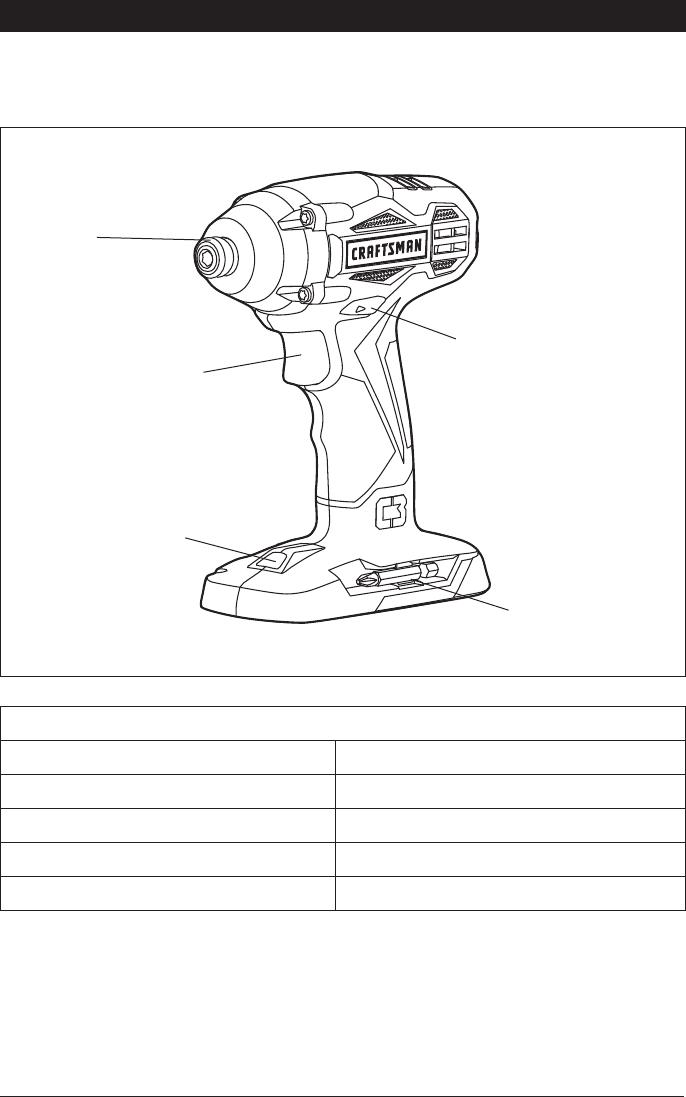
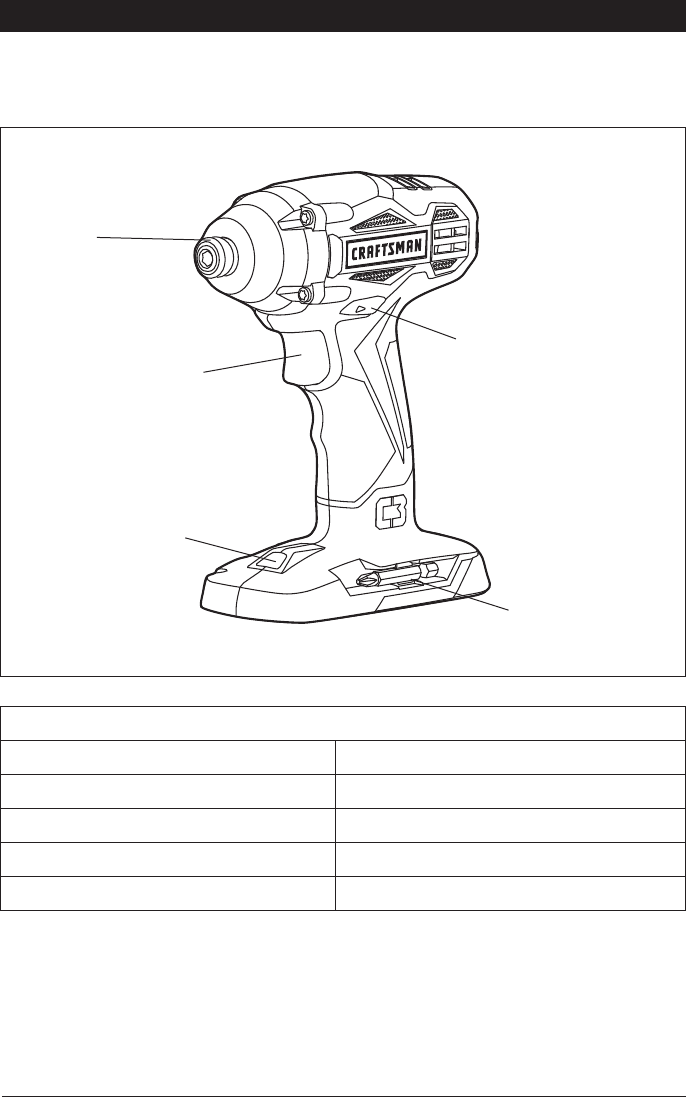
KNOW YOUR IMPACT DRIVER (Fig. 1)
PRODUCT SPECIFICATIONS
Motor 19.2 Volt DC
Coupler 1/4 in. (6.35mm)
No-load Speed 0-2500/min (RPM)
Impacts per minute 0-3500 BPM
Torque 1600 in.lbs
ѥWARNING: The safe use of this product requires an understanding of the
information on the tool and in this operator’s manual, as well as knowledge of
the project you are attempting. Before use of this product, familiarize yourself
with all operating features and safety rules.
Coupler
Variable-Speed
Trigger Switch
Direction-of-Rotation
Selector (Forward/
Center-Lock/Reverse)
Bit Storage
LED Worklight
Fig. 1

10
VARIABLE SPEED
The variable-speed trigger switch delivers higher speed with increased trigger
pressure and lower speed with decreased trigger pressure.
FORWARD/CENTER-LOCK/REVERSE SELECTOR
The impact driver has a direction-of-rotation selector located above the trigger
switch for changing the direction of bit rotation. Setting the trigger switch in the
OFF (center-lock) position helps reduce the possibility of accidental starting
when not in use.
LED WORKLIGHT
The LED worklight, located on the base of the impact driver, illuminates
when the trigger switch is depressed. This feature provides extra light for
increased visibility.
ASSEMBLY
ѥWARNING: If any parts are broken or missing, do not attempt to attach the
battery pack or operate the impact driver until the broken or missing parts are
replaced. Failure to do so could result in possible serious injury.
ѥWARNING: Do not attempt to modify this impact driver or create
accessories not recommended for use with this impact driver. Any such
alteration or modification is misuse and could result in a hazardous condition
leading to possible serious injury.
ѥWARNING: To prevent accidental starting that could cause serious personal
injury, always remove the battery pack from the impact driver when changing bits.
UNPACKING
This product has been shipped completely assembled.
• Carefully remove the tool and any accessories from the carton. Make sure
that all items listed in the packing list are included.
• Inspect the tool carefully to make sure that no breakage or damage
occurred during shipping.
• Do not discard the packing material until you have carefully inspected and
satisfactorily operated the tool.
• If any parts are damaged or missing, please return the tool to the place
of purchase.
PACKING LIST
Impact driver, bit (installed on the impact driver) and operator’s manual
11
OPERATION
This product will accept Craftsman C3 19.2V lithium-ion battery packs. For
complete charging instructions, refer to the Operator’s Manual for the battery
packs and chargers.
ѥWARNING: To prevent accidental starting that could cause serious personal
injury, always remove the battery pack from the tool when assembling parts,
making adjustments, installing or removing bit, cleaning, or when it is not in use.
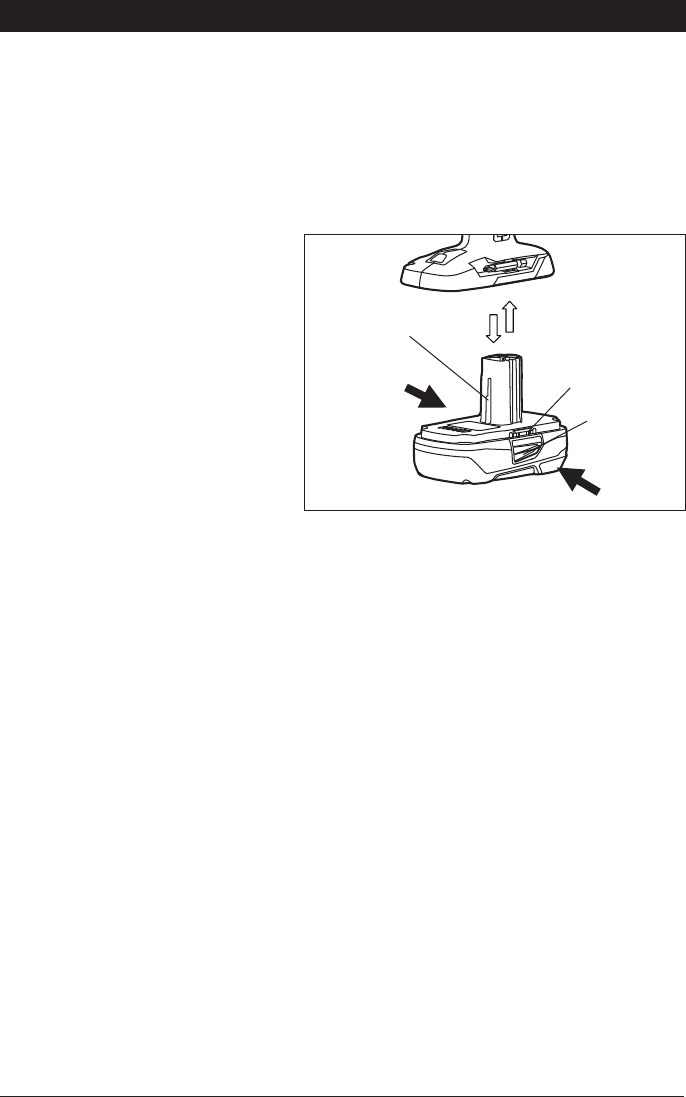
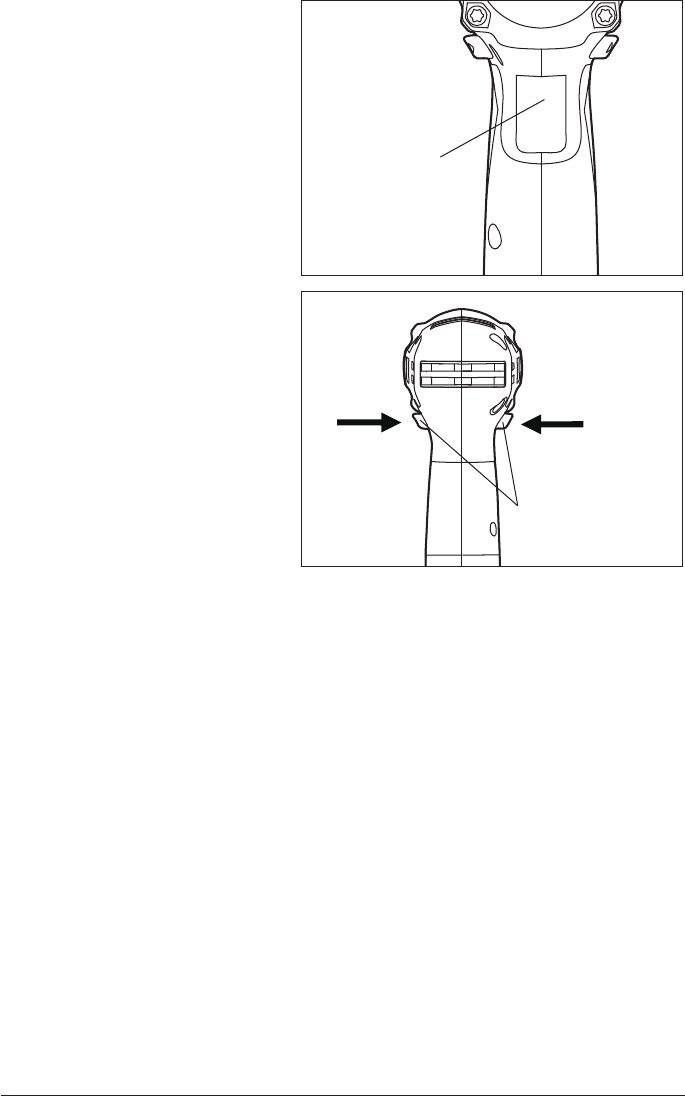
TO ATTACH BATTERY
PACK (Fig. 2)
1. Lock the trigger switch on the
impact driver by placing the
direction-of-rotation (forward/
center-lock/reverse) selector
in the center position.
2. Align the raised rib on the
battery pack with the groove
inside the impact driver, and
then insert the battery pack
into the tool.
NOTICE: Make sure that the latch on the battery pack snaps into place and
the battery pack is secured to the tool before beginning operation. Improper
assembly of the battery pack can cause damage to internal components.
TO DETACH BATTERY PACK (Fig. 2)
1. Lock the trigger switch on the impact driver by placing the direction-of-
rotation (forward/center-lock/reverse) selector in the center position.
2. Depress both battery-release buttons, located on the sides of the battery
pack, to release the battery pack.
3. Pull the battery pack out and remove it from the tool.
ѥWARNING: Battery tools are always in operating condition. Therefore, the
direction-of-rotation selector should always be locked when the tool is not in use
or when carrying the tool at your side.
Rib
Fig. 2
Latch
Battery-
Release
Button
12
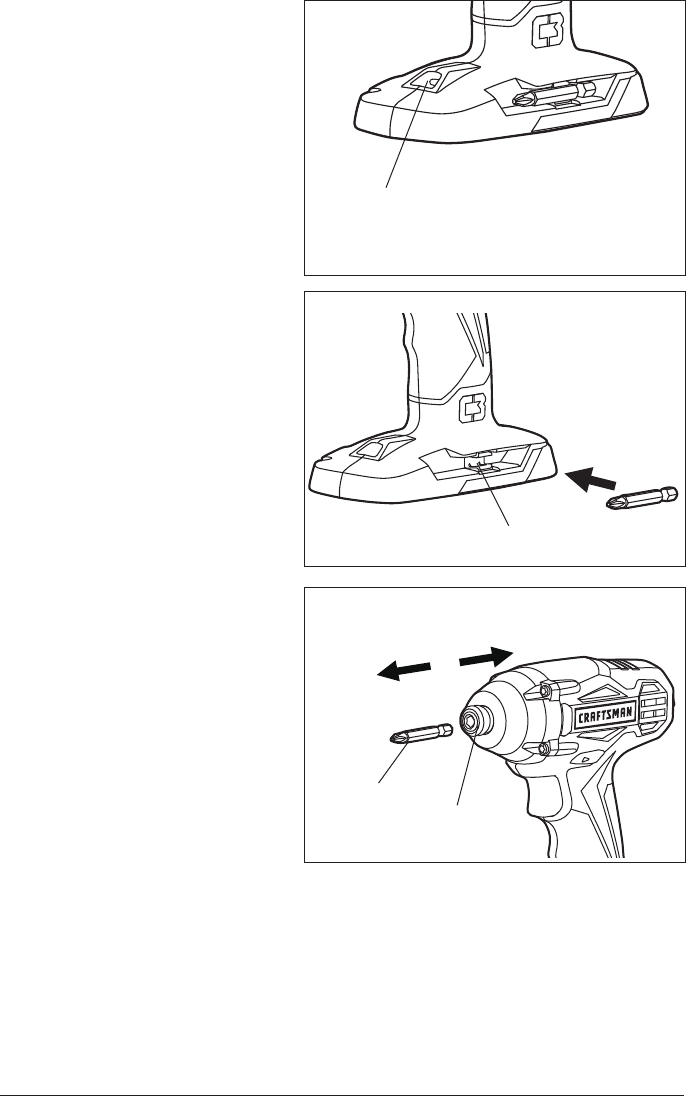
TRIGGER SWITCH (Fig. 3)
To turn the impact driver ON,
depress the trigger switch.
To turn it OFF, release the
trigger switch.
VARIABLE SPEED (Fig. 3)
The variable-speed trigger
switch delivers higher speed
with increased trigger pressure
and lower speed with decreased
trigger pressure.
DIRECTION-OF-
ROTATION SELECTOR
(FORWARD/CENTER-LOCK/
REVERSE) (Fig. 4)
The direction of bit rotation is
reversible and is controlled by
a selector located above the
trigger switch.
With the impact driver held in
normal operating position, as
shown in Fig. 4:
1. Position the direction-of-rotation selector to the left of the tool for
forward rotation.
2. Position the direction-of-rotation selector to the right of the tool for reverse.
3. Setting the switch in the OFF (center-lock) position helps reduce the
possibility of accidental starting when not in use.
NOTICE: To prevent gear damage, always allow the impact driver to come to a
complete stop before changing the direction of rotation.
NOTICE: The impact driver will not run unless the direction-of-rotation selector
is engaged fully to the left or right.
ELECTRIC BRAKE
To stop the impact driver, release the trigger switch and allow the tool to come
to a complete stop. The electric brake quickly stops the coupler from rotating.
This feature engages automatically when you release the trigger switch.
Variable-Speed
Trigger Switch
Fig. 3
Reverse
Fig. 4
Forward
Direction-of-
Rotation Selector
13
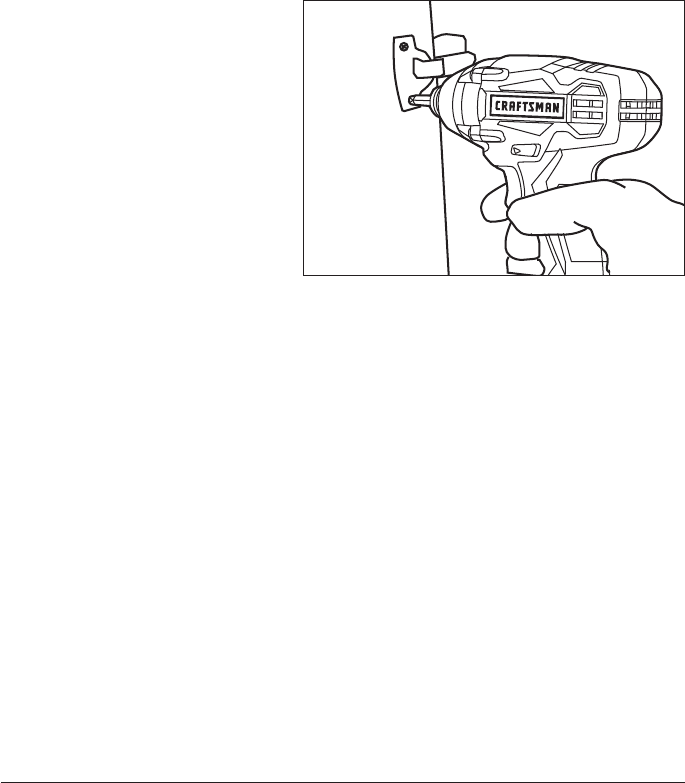
LED WORKLIGHT (Fig. 5)
The LED worklight, located on
the base of the impact driver,
will illuminate when the trigger
switch is depressed. This provides
additional light on the surface of
the workpiece. The LED worklight
will turn off when the trigger
switch is released.
BIT STORAGE (Fig. 6)
When not in use, the bit can be
placed in the storage area located
on the base of the impact driver.
Store the bit on the base of the
driver by snapping it into place in
the bit clip.
INSTALLING BITS (Fig. 7)
1. Remove the battery pack
from the impact driver when
installing the bit.
2. Lock the trigger switch on the
impact driver by placing the
direction-of-rotation (forward/
center-lock/reverse) selector
in the center position.
3. Pull the coupler away from
the driver.
4. Insert the driver bit into
the coupler.
5. Release the coupler.
6. Pull on the bit to make sure
it is secured in the coupler.
There may be some play in
the installed bit; this is normal.
ѥWARNING: Make sure the bit is secured in the coupler before using the
impact driver. If the coupler does not return to its original position, the bit is not
correctly installed. Retry until the bit is properly installed and the coupler returns
to its original position. Failure to do so could result in serious personal injury.
LED Worklight
Fig. 5
Bit Clip
Fig. 6
Coupler
Fig. 7
Pull
Bit
Release
14
REMOVING BITS (Fig. 7)
1. Remove the battery pack from the impact driver when removing the bit.
2. Lock the trigger switch on the impact driver by placing the direction-of-
rotation (forward/center-lock/reverse) selector in the center position.
3. Pull the coupler away from the driver.
4. Remove the driver bit from the coupler. .
ѥWARNING: Use protective gloves when removing the bit from the tool, or
first allow the bit to cool down. The bit may be hot after prolonged use.
ѥCAUTION: The impact driver is not designed to be used as a drill.
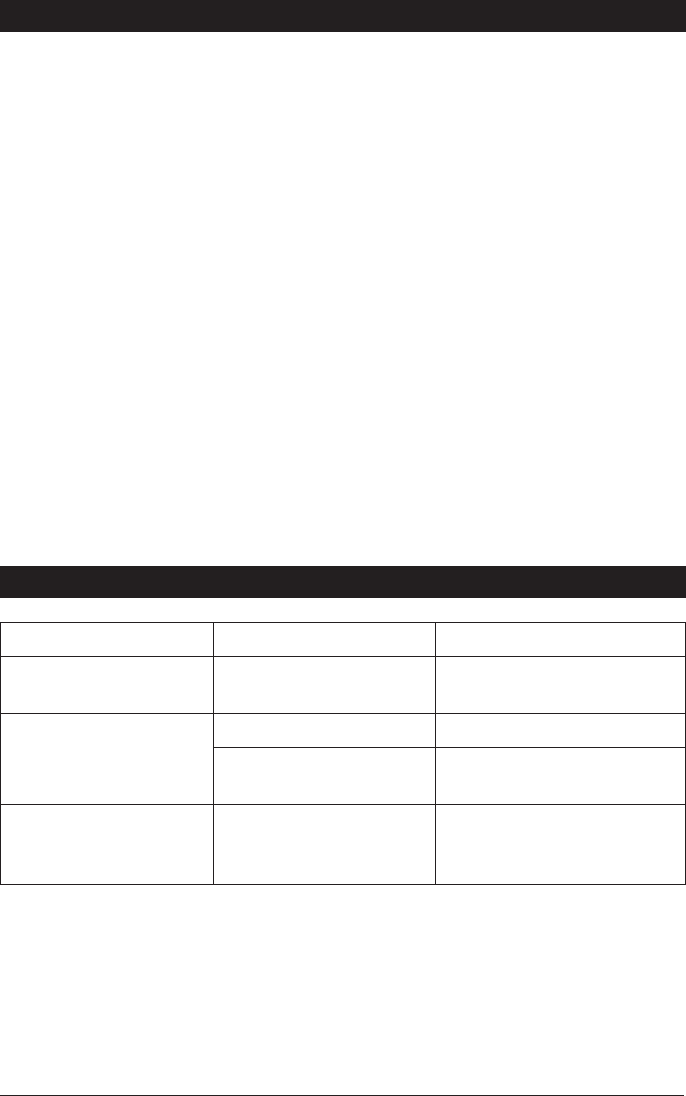
TIGHTENING AND
LOOSENING SCREWS
AND NUTS (Fig. 8)
1. Install the correct bit.
2. Place the direction-of-rotation
(forward/center-lock/reverse)
selector in the correct
position for the operation.
3. Apply just enough pressure to
keep the bit engaged on the
screw or nut.
4. Apply minimal pressure to the
trigger switch initially. Increase the speed only when full control can
be maintained.
ѥWARNING: Do not over-tighten, as the force of the impact driver can break
the fastener. Keep the driver at a right angle to the fastener to avoid damaging
the fastener head.
Fig. 8
15
MAINTENANCE
ѥWARNING: To avoid serious personal injury, always remove the battery
pack from the tool when cleaning or performing any maintenance.
ѥWARNING: Always wear safety goggles or safety glasses with side shields
when using compressed air to clean the tool. If the operation is dusty, also wear
a dust mask.
GENERAL MAINTENANCE
Avoid using solvents when cleaning plastic parts. Most plastics are susceptible
to damage from various types of commercial solvents and may be damaged by
their use. Use clean clothes to remove dirt, dust, oil, grease, etc.
ѥWARNING: Do not at any time let brake fluids, gasoline, petroleum-based
products, penetrating oils, etc. come in contact with plastic parts. Chemicals
can damage, weaken or destroy plastic which may result in serious
personal injury.
ѥWARNING: When servicing, use only identical craftsman replacement parts.
Use of any other parts may create a hazard or cause product damage. To
ensure safety and reliability, all repairs should be performed by a qualified
service technician.
TROUBLESHOOTING
PROBLEM CAUSE SOLUTION
The impact driver does
not work Battery is depleted Charge the battery
Bit cannot be installed
Coupler is not released Release the coupler
Bit does not t
the coupler Use suitable bit
Motor overheating
Be sure cooling vents
are free from saw dust
and obstacles
Clean, clear vents. Do not
cover vents with hand
during operation

16
PARTS LIST
1/4" IMPACT DRIVER MODEL NUMBER 5727.1
The Model Number will be found on the nameplate attached to the tool. Always
mention the Model Number when ordering parts for this tool.
To order parts, call 1-888-331-4569.
17
PARTS LIST
1/4" IMPACT DRIVER MODEL NUMBER 5727.1
The Model Number will be found on the nameplate of the tool. Always mention
the Model Number when ordering parts for this tool.
To order parts, call 1-888-331-4569.
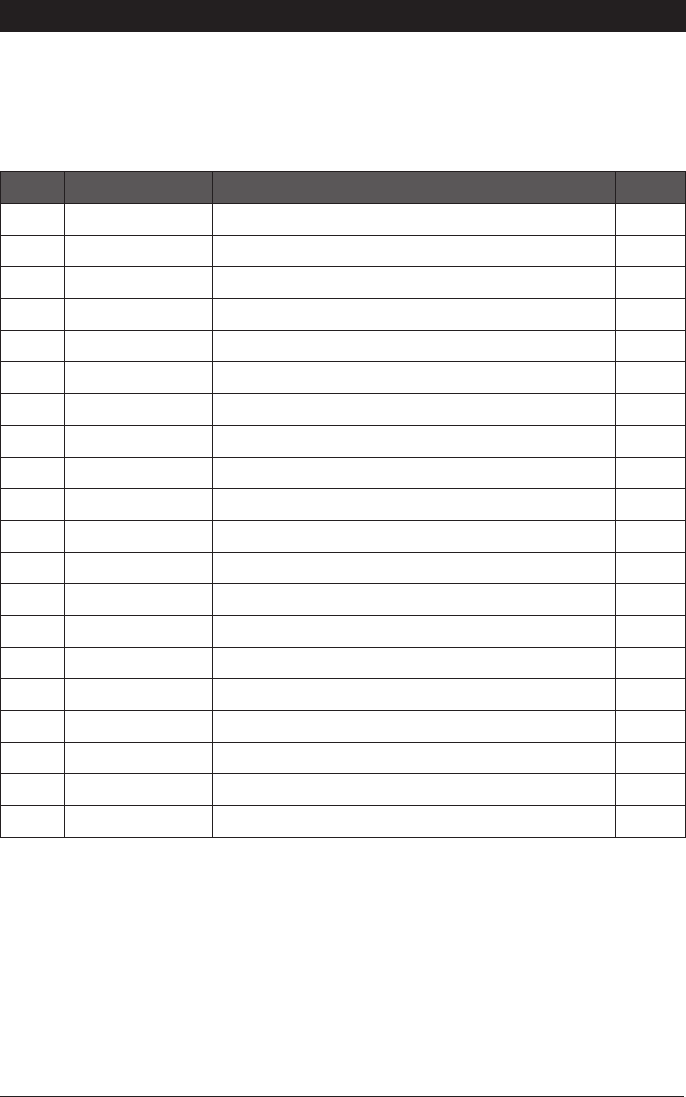
No Part No Part Name QTY
1 5610248000 Tapping Screw 4
2 2823871000 Front Gear Housing Assembly 1
3 2823683000 Impact Block Assembly 1
4 3520745000 Planet Gear 3
5 3550147000 Needle Pin 3
6 5650223000 Washer 1
7 3520744000 Ring Gear 1
201 2823983000 L R Housing Set 1
8 3127553000 Support 2
9 3321803000 Left Housing 1
10 3703673000 Bits Holder 2
11 3810017000 Screw Bit 1
202 2823984000 Control Assembly 1
12 2790376000 Motor and Gear Case Assembly 1
13 3680140000 Magnet Ring 1
14 2823966000 Contact Receptacle Assembly 1
15 3126501000 F/R Button 1
16 3126500000 LED Cover 1
17 3321802000 Right Housing 1
18 5610241000 Screw 9

18
Manual del Propietario
ATORNILLADOR DE IMPACTO
DE ¼ PULG. C3
Modelo Nº. 5727.1
Sears Brands Management Corporation, Hoffman Estates,
IL 60179 U.S.A.
www.craftsman.com
•GARANTÍA
•SEGURIDAD
•DESCRIPCIÓN
•MONTA JE
•OPERACIÓN
•MANTENIMIENTO
•ESPAÑOL
ѥADVERTENCIA: Para reducir el
riesgo de lesiones, el usuario debe leer
y comprender el Manual del Propietario
antes de usar este producto.

20
TABLE OF CONTENTS
Garantía Página 20
Símbolos de Seguridad Páginas 22-23
Instrucciones de Seguridad Páginas 24-26
Descripción Páginas 28-29
Montaje Páginas 29-30
Operación Páginas 30-34
Mantenimiento Página 34
Identicación y Solución de Problemas Página 34
GARANTÍA LIMITADA DE CRAFTSMAN
DURANTE UN AÑO desde la fecha de vender, este producto cuenta con
garantía contra cualquier clase de defectos de material o de mano de obra.
MEDIANTE UNA PRUEBA DE VENDER, el producto defectuoso se
reemplazará sin costo alguno.
Si desea obtener detalles sobre la cobertura de garantía para obtener un
reemplazo sin costo, visite la página web: www.craftsman.com/warranty
Esta garantía no cubre la broca, porque es una pieza prescindible que
pueden desgastarse debido al uso normal dentro del período de garantía.
La presente garantía de UN AÑO quedará anulada si este producto se usa
para brindar servicios comerciales o si se alquila a terceros. Para consultar
los términos de uso comercial y de alquiler de 90 DÍAS, visite la página web
sobre garantía de Craftsman.
Esta garantía le otorga derechos legales especícos y usted puede contar
con otros derechos, que pueden variar de estado a estado.
Sears Brands Management Corporation, Hoffman Estates, IL 60179.
¡GUARDE ESTAS INSTRUCCIONES!
¡LEA TODAS LAS INSTRUCCIONES!
Este atornillador de impacto inalámbrico cuenta con varias características
para hacer su uso más agradable y placentero. Durante el diseño de esta
herramienta, la seguridad, el rendimiento y la conabilidad han sido las
prioridades principales, además de la sencillez de mantenimiento y de
operación.
© Sears Brands, LLC

21
ѥPELIGRO: La gente con los accesorios electrónicos, como los
estimuladores cardíacos, deben consultar sus médicos antes de usar esto
producto. La operación de los equipos eléctricos cerca de un estimulador
cardiaco puede causar la interferencia o la avería del estimulador cardíaco.
ѥADVERTENCIA: Unos polvos creado por lijadoras mecánicas, las sierras
mecánicas, las amoladoras electrícas, los taladros y otras actividades de la
construcción contienen los elementos químicos que son conocidos para el
estado de California de causar el cancer, los defectos de nacimientos o otros
daños reproductores. Unos ejemplos de estos elementos químicos estan:
• Plomo de la pintura con base de plomo
• El sílice cristalino de los ladrillos y cemento y otras productas de la
albañilería, y
• El arsenic y el cromo de la madera tratada químicamente
Su riesgo de éstas exposiciónes varía, dependiente con qué frecuencia haga
esto typo de trabajo. Para reducer su exposición a estos elementos químicos:
trabaje en un lugar bien ventilada, y trabaje con el equipo de seguridad, como
las máscaras antipolvo que han diseñado especícamente para ltrar las
partículas microscópicas.

22
SÍMBOLOS DE SEGURIDAD
El objeto de los símbolos de seguridad es atraer su atención sobre posibles peligros.
Los símbolos de seguridad y las explicaciones junto a ellas ameritan su
cuidadosa atención y comprensión. Los símbolos de advertencia no eliminan
los peligros por sí solos. Las instrucciones y advertencias que ofrecen no
reemplazan las medidas adecuadas de prevención de accidentes.
ѥADVERTENCIA: Asegúrese de leer y comprender todas las instrucciones de
seguridad de este manual, incluyendo todos los símbolos de alerta de seguridad,
tales como “PELIGRO”, “ADVERTENCIA” y “PRECAUCIÓN” antes de utilizar esta
perforadora/atornilladora. No seguir todas las instrucciones listadas a continuación
puede generar una descarga eléctrica, un incendio y/o graves lesiones corporales.
SIGNIFICADO DE LOS SÍMBOLOS
ѥPELIGRO: Indica una situación peligrosa que, si no se evita, puede provocar
la muerte o una lesión grave. Esta palabra debe limitarse a las stiuaciones
más extremas.
ѥADVERTENCIA: Indica una situación peligrosa que, si no se evita, puede
provocar la muerte o una lesión grave.
ѥPRECAUCIÓN: Indica una situación peligrosa que, si no se evita, puede
provocar una lesión menor o moderada.
Mensajes de información y de prevención de daños
Estos informan al usuario sobre informaciones y/o instrucciones importantes que
podrían provocar daños al equipamiento o a la propiedad si no se siguen. Cada
mensaje está precedido por la palabra “AVISO”, como en el ejemplo siguiente:
AVISO: Pueden provocarse daños al equipamiento y/o a la propiedad si no se
cumplen estas instrucciones.
ѥADVERTENCIA: Para garantizar la seguridad y la confiabilidad, todas las
reparaciones deben ser efectuadas por un técnico calificado.
VVolts Voltage
A Amperes Current
Hz Hertz Frequency (cycles per second)
W Watt Power
min Minutes Time
Alternating Current Type of current
Direct Current Type or a characteristic of current
No Load Speed Rotational speed, at no load
Class II Construction Double-insulated construction
.../min Per Minute Revolutions, strokes, surface speed,
orbits, etc., per minute
Wet Conditions Alert Do not expose to rain or use in damp
locations.
Read The Operator’s Manual
To reduce the risk of injury, user must
read and understand operator’s manual
before using this product.
Eye Protection
Always wear safety goggles or safety
glasses with side shields and a full face
shield when operating this product.
Safety Alert Precautions that involve your safety.
No Hands Symbol Failure to keep your hands away from the
blade will result in serious personal injury.
No Hands Symbol Failure to keep your hands away from the
blade will result in serious personal injury.
No Hands Symbol Failure to keep your hands away from the
blade will result in serious personal injury.
No Hands Symbol Failure to keep your hands away from the
blade will result in serious personal injury.
Hot Surface To reduce the risk of injury or damage,
avoid contact with any hot surface.
SYMBOL NAME DESIGNATION/EXPLANATION
ADVERTENCIA: El funcionamiento de cualquier herramienta
eléctrica puede provocar el lanzamiento de objetos en dirección
de su rostro, y los consecuentes graves daños oculares. Antes
de comenzar a utilizar la herramienta eléctrica, siempre use gafas
o lentes de seguridad con protección lateral y una protección
completa de rostro cuando sea necesario. Recomendamos el
uso de una máscara de seguridad de visión amplia sobre los
anteojos o gafas de seguridad estándar con protección lateral.
Siempre utilice protección ocular con certicación de
cumplimiento con ANSI Z87.1.
23
GUARDE ESTAS INSTRUCCIONES
Algunos de los siguientes símbolos pueden utilizarse en esta herramienta. Tenga a
bien estudiarlos y aprender su signicado. Una interpretación adecuada de estos
símbolos le permitirá operar la herramienta de una manera mejor y más segura.
Voltaje
Corriente
Frecuencia (ciclos por segundo)
Energía
Tiempo
Tipo de corriente
Tipo o una característica de la corriente
Velocidad giratoria, sin carga
Construcción de doble aislación
Revoluciones, carreras, velocidad de
superficie, órbitas, etc., por minuto.
No exponga a la lluvia u otras
locaciones húmedas.
Para reducir el riesgo de lesiones, el usuario
debe leer y comprender este manual de
operación antes de usar este producto.
Siempre use gafas o lentes de seguridad
con protecciones laterales y una protección
de todo el rostro cuando utilice este producto.
Precauciones que involucran su seguridad.
No mantener sus manos alejadas de la
sierra provocará lesiones personales graves.
No mantener sus manos alejadas de la
sierra provocará lesiones personales graves.
No mantener sus manos alejadas de la
sierra provocará lesiones personales graves.
No mantener sus manos alejadas de la
sierra provocará lesiones personales graves.
Para reducir el riesgo de lesiones o daños,
evite el contacto con cualquier superficie caliente.
SÍMBOLO
Voltios
Amperios
Hercios
Vatios
Minutos
Corriente alterna
Corriente continua
Velocidad sin carga
Construcción Clase II
Por minuto
Protección ocular
Alerta de seguridad
Alerta de condiciones
húmedas
Lea el manual de
operación
Símbolo de no tocar
con las manos
Símbolo de no tocar
con las manos
Símbolo de no tocar
con las manos
Símbolo de no tocar
con las manos
Superficie caliente
NOMBRE DESIGNACIÓN / EXPLICACIÓN
V
A
Hz
W
min
.../min

24
INSTRUCCIONES DE SEGURIDAD
ADVERTENCIAS GENERALES DE SEGURIDAD DE LAS
HERRAMIENTAS ELÉCTRICAS
ѥADVERTENCIA: Lea y comprenda todas las instrucciones. No seguir todas
las instrucciones listadas a continuación puede generar una descarga eléctrica, un
incendio y/o graves lesiones corporales. El término “herramienta eléctrica” de todas
las advertencias listadas a continuación hacen referencia a herramientas eléctricas
con cable o herramientas eléctricas operadas a batería (inalámbricas).
CONSERVE TODAS LAS ADVERTENCIAS E INSTRUCCIONES PARA
REFERENCIA FUTURA
SEGURIDAD EN EL ÁREA DE TRABAJO
• Mantenga el área de trabajo limpia y bien iluminada. Las áreas
desordenadas u oscuras son propicias para los accidentes.
• No utilice herramientas eléctricas en atmósferas explosivas, como en
la presencia de líquidos inflamables, gases o polvillo. Las herramientas
eléctricas crean chispas, que pueden encender el polvillo o el humo.
• Mantenga a los niños y a los transeúntes alejados mientras maneja esta
herramienta eléctrica. Las distracciones pueden provocar la pérdida de control.
SEGURIDAD ELÉCTRICA
• Evite el contacto corporal con superficies con conexión a tierra, tales
como cañerías, radiadores, cocinas y refrigeradores. Existe un riesgo
mayor de descarga eléctrica si su cuerpo tiene conexión a tierra.
• Los enchufes de las herramientas eléctricas deben poder insertarse en
los tomacorrientes. Nunca modifique el enchufe de ninguna manera.
No utilice enchufes adaptadores con herramientas eléctricas con
conexión a tierra. No modificar los enchufes y contar con el tomacorriente
adecuado reducirán el riesgo de una descarga eléctrica.
• No exponga las herramientas eléctricas a la lluvia o a condiciones de
humedad. El agua que ingresa a la herramienta eléctrica incrementará el
riesgo de una descarga eléctrica.
• No maltrate el cable. Nunca utilice el cable para trasladar o
desenchufar la herramienta eléctrica ni tire del mismo. Mantenga
el cable alejado del calor, aceite, extremos afilados o piezas en
movimiento. Los cables dañados o enredados incrementan el riesgo de
una descarga eléctrica.

25
• Cuando utilice una herramienta eléctrica al aire libre, use un cable de
extensión especial para uso al exterior. El uso de un cable adecuado
para el aire libre reduce el riesgo de una descarga eléctrica.
• Si no puede evitar el uso de una herramienta eléctrica en un lugar
húmedo, utilice un suministro de energía protegido por un interruptor
de circuito con descarga a tierra (GFCI, por sus siglas en inglés). El uso
de un GFCI reduce el riesgo de una descarga eléctrica.
SEGURIDAD PERSONAL
• Manténgase alerta, preste atención a lo que hace y tenga sentido
común cuando utilice una herramienta eléctrica. No utilice una
herramienta eléctrica si está cansado o bajo la influencia de drogas,
alcohol o alguna medicación. Un momento de distracción mientras utiliza
herramientas eléctricas puede provocar lesiones personales graves.
• Utilice equipamiento de protección personal. Siempre use protección
ocular. El equipamiento de seguridad como las máscaras antipolvillo,
zapatos antideslizantes, cascos o protección auditiva utilizados para
condiciones apropiadas reducirán las lesiones personales.
• Evite el encendido involuntario. Verifique que el interruptor se
encuentre en la posición OFF (apagado) antes de conectar a la fuente
de energía y/o a la batería, levantar la herramienta o trasladarla.
Llevar herramientas eléctricas con el dedo sobre el interruptor o enchufar
herramientas que tienen el interruptor en la posición “ON” (encendido) es
una invitación a sufrir un accidente.
• Quite las llaves ajustables antes de encender la herramienta eléctrica.
Una llave de tuercas que se deja conectada a una pieza giratoria de la
herramienta puede provocar lesiones personales.
• No se estire de más. Mantenga una postura equilibrada y segura en
todo momento. Esto permite un mejor control de la herramienta eléctrica
en situaciones inesperadas.
• Vístase adecuadamente. No use vestimenta suelta o joyas. Mantenga su
cabello, ropa y guantes alejados de las piezas en movimiento. La ropa
suelta, joyas o cabello largo pueden engancharse en las piezas en movimiento.
• Si los dispositivos pueden conectarse a instalaciones de extracción
y recolección de polvillo, asegúrese de que se encuentren bien
conectados y se usen adecuadamente. El uso de estos dispositivos
puede reducir los riesgos relacionados con el polvillo.

26
USO Y CUIDADO DE LA HERRAMIENTA ELÉCTRICA
• No fuerce la herramienta eléctrica. Use la herramienta eléctrica correcta
para su aplicación. La herramienta eléctrica correcta hará mejor el trabajo y de
manera más segura cuando se usa en la clasificación para la cual fue diseñada.
• No use la herramienta eléctrica si el interruptor no puede encenderla
(ON) o apagarla (OFF). Cualquier herramienta que no puede controlarse
mediante el interruptor es peligrosa y debe repararse.
• Desconecte el enchufe de la fuente de energía y/o el paquete de
baterías desde la herramienta eléctrica antes de realizar ajustes,
cambiar accesorios o almacenar herramientas eléctricas. Dichas
medidas de seguridad preventivas reducen el riesgo de encender la
herramienta eléctrica de manera accidental.
• Guarde las herramientas eléctricas fuera del alcance de los niños y no
permita que personas que no saben usar la herramienta eléctrica o que
no conocen las instrucciones la operen. Las herramientas eléctricas son
peligrosas en manos de usuarios faltos de capacitación.
• Realice mantenimiento de las herramientas eléctricas. Controle que las
piezas en movimiento no estén mal alineadas y que no se traben, la rotura
de piezas y cualquier otra condición que pueda afectar el funcionamiento
de la herramienta eléctrica. Si está dañada, haga reparar la herramienta
antes de usarla. Muchos accidentes son provocados por herramientas que no
han recibido el mantenimiento adecuado.
• Mantenga las herramientas de corte afiladas y limpias. Las herramientas
de corte bien mantenidas con extremos de corte afilados tienen menos
probabilidades de trabarse y son más fáciles de controlar.
• Utilice la herramienta eléctrica, accesorios, hojas de corte, etc. de
acuerdo con estas instrucciones y del modo concebido para este tipo
particular de herramienta eléctrica, teniendo en cuenta las condiciones
de trabajo y el trabajo a realizar. El uso de la herramienta eléctrica para
operaciones diferentes de las previstas puede generar una situación peligrosa.
USO Y CUIDADO DE LA HERRAMIENTA A BATERÍA
• Recargue la herramienta sólo con el cargador especificado por el
fabricante. Un cargador adecuado para un tipo de paquete de baterías
puede crear un riesgo de incendio cuando se utiliza un paquete diferente.
• Utilice herramientas eléctricas sólo con los paquetes de baterías
designados específicamente. El uso de otra clase de paquetes de baterías
puede generar un riesgo de lesiones o incendio.
• Cuando el paquete de baterías no se encuentra en uso, manténgalo
alejado de otros objetos metálicos, como ganchitos para papel,
monedas, llaves, clavos, tornillos u otros objetos pequeños de metal que
pueden hacer una conexión de una terminal a otra. Si las terminales de la
batería hacen un corto, pueden provocarse quemaduras o un incendio.

27
• Si se la somete a malas condiciones, puede salir líquido de la batería;
evite el contacto. Si ocurre un contacto accidental, enjuague con agua.
Si el líquido ingresa a sus ojos, busque ayuda médica. El líquido que sale
de la batería puede provocar irritación o quemaduras.
SERVICIO
• Solicite a personal de reparación calificado que realice el
mantenimiento y arreglos utilizando sólo las piezas de repuesto
idénticas. Esto asegurará el mantenimiento de la seguridad de la
herramienta eléctrica.
• Siga las instrucciones de la Sección de Mantenimiento de este
manual. El uso de piezas no autorizadas o no seguir las instrucciones de
Mantenimiento pueden crear un riesgo de descarga eléctrica o lesiones.
NORMAS ESPECÍFICAS DE SEGURIDAD PARA LA ATORNILLADOR
DE IMPACTO
• Sostenga las herramientas eléctricas de sus superficies de agarre
aisladas cuando realice una operación en la que la herramienta de
corte pueda hacer contacto con cableado oculto o con su propio cable.
El contacto con un cable “cargado” provocará que las piezas expuestas de
piezas de metal también se “carguen” y ejerzan una descarga eléctrica en
el operador.
28
DESCRIPCIÓN
CONOZCA SU ATORNILLADOR DE IMPACTO (Fig. 1)
ESPECIFICACIÓN DE PRODUCTO
Motor 19.2 voltios CC
Acoplador 1/4 plug. (6.35mm).
Velocidad sin carga 0-2500/min (RPM)
Impactos por minuto 0-3500 GPM
Torque 1600 pulg. lbs
ѥADVERTENCIA: El uso seguro de este producto requiere una comprensión
de la información incluida en la herramienta y en este manual del propietario,
además del conocimiento del proyecto que está iniciando. Antes de usar este
producto, familiarícese con todas las características de operación y normas
de seguridad.
Acoplador
Interruptor de gatillo de
velocidad variable
Selector de la
dirección de rotación
(adelante/bloqueo
centro/reversa)
Almacenamiento
Luz de trabajo
Fig. 1

29
VELOCIDAD VARIABLE
El gatillo de velocidad variable ofrece una velocidad mayor con una presión
de gatillo mayor y una velocidad menor cuando se presiona el gatillo con
menos fuerza.
ADELANTE/REVERSA/CENTRO BLOQUEO
La atornillador de impacto cuenta con un selector de dirección de rotación
ubicado sobre el interruptor de gatillo que se utiliza para cambiar la dirección de
rotación de la broca. Colocar el interruptor de gatillo en la posición OFF (centro
bloqueo) ayuda a reducir la posibilidad de un arranque accidental cuando no se
encuentra en uso.
LUZ DE TRABAJO LED
La luz de trabajo LED, ubicada en el base de la atornillador de impacto, se
ilumina cuando se presiona el interruptor de gatillo. Esta característica ofrece luz
extra para lograr una visibilidad mayor.
MONTAJE
ѥADVERTENCIA: Si falta alguna pieza o si alguna pieza está rota, no trate de
enchufar el cable de energía u operar la perforadora/atornilladora hasta que se
reemplacen las piezas faltantes o rotas. No hacerlo puede provocar una lesión
personal grave.
ѥADVERTENCIA: No trate de modificar esta perforadora/atornilladora o
crear accesorios no recomendados para usar con esta herramienta. Cualquier
alteración o modificación constituye un uso indebido y podría provocar una
condición peligrosa y posibles lesiones graves.
ѥADVERTENCIA: Para prevenir un arranque accidental que podría provocar
lesiones personales graves, siempre desconecte el paquete de baterías de la
perforadora/atornilladora cuando cambie las brocas.
DESEMPAQUE
Este producto se ha enviado completamente montado.
• Con cuidado, quite la herramienta y los accesorios de la caja. Asegúrese de
que todos los elementos listados en el paquete estén incluidos.
• Inspeccione la herramienta con detenimiento para constatar que no hayan
ocurrido roturas o daños durante el envío.
• No descarte el material de empaque hasta que haya inspeccionado la
herramienta con cuidado y la haya utilizado satisfactoriamente.
• Si falta alguna pieza o alguna pieza se encuentra rota, devuelva la
herramienta al lugar de compra.
30
LISTA DE EMPAQUE
Atornillador de impacto, broca (instalada del atornillador de impacto) y manual
del propietario
OPERACIÓN
Este producto acepta paquetes de baterías de ion de litio Craftsman C3 de
19.2V. Para las instrucciones de carga completas, consulte los Manuales del
Operador correspondientes a los paquetes de baterías y cargadores.
ѥADVERTENCIA: Para evitar un arranque accidental que podría provocar
lesiones personales graves, siempre desconecte el paquete de baterías de
la herramienta cuando coloque piezas, realice ajustes, instale o quite brocas,
efectúe la limpieza o cuando no lo esté utilizando.
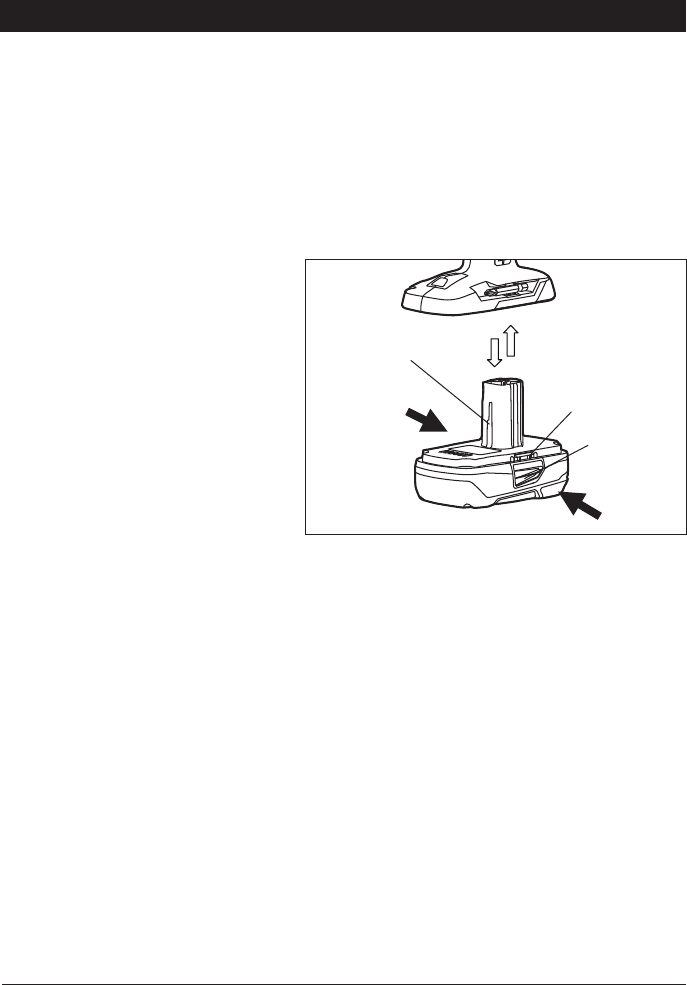
CÓMO COLOCAR EL
PAQUETE DE
BATERÍAS (FIG. 2)
1. Bloquee el interruptor de gatillo
de la atornillador de impacto
colocando el selector de
dirección de rotación (adelante/
centro bloqueo/reversa) en la
posición central.
2. Alinee los rebordes elevados
del paquete de baterías con
las ranuras de la atornillador de
impacto y luego coloque el paquete de baterías en la atornillador de impacto.
AVISO: Constate que la traba de la parte superior del paquete de baterías se
jeen su lugar y que el paquete de baterías esté bien sujeto a la herramienta
antesde comenzar el funcionamiento. Un montaje inadecuado del paquete de
baterías puede provocar daños a los componentes internos.
CÓMO QUITAR EL PAQUETE DE BATERÍAS (FIG. 2)
1. Bloquee el interruptor de gatillo de la atornillador de impacto colocando el
selector de dirección de rotación (adelante/centro bloqueo/reversa) en la
posición central.
2. Baje los botones de liberación de la batería ubicados sobre ambos
costados del paquete de baterías para liberarlo.
3. Tire del paquete de baterías hacia afuera para quitarlo de la herramienta.
Rebord
Fig. 2
Traba
Botón de
liberación
de la
batería
31
ѥADVERTENCIA: Las herramientas a batería siempre se encuentran en
condiciones operativas. Por lo tanto, el selector de dirección de rotación
siempre debe estar bloqueado cuando la herramienta no esté en uso o cuando
la lleve a su lado.
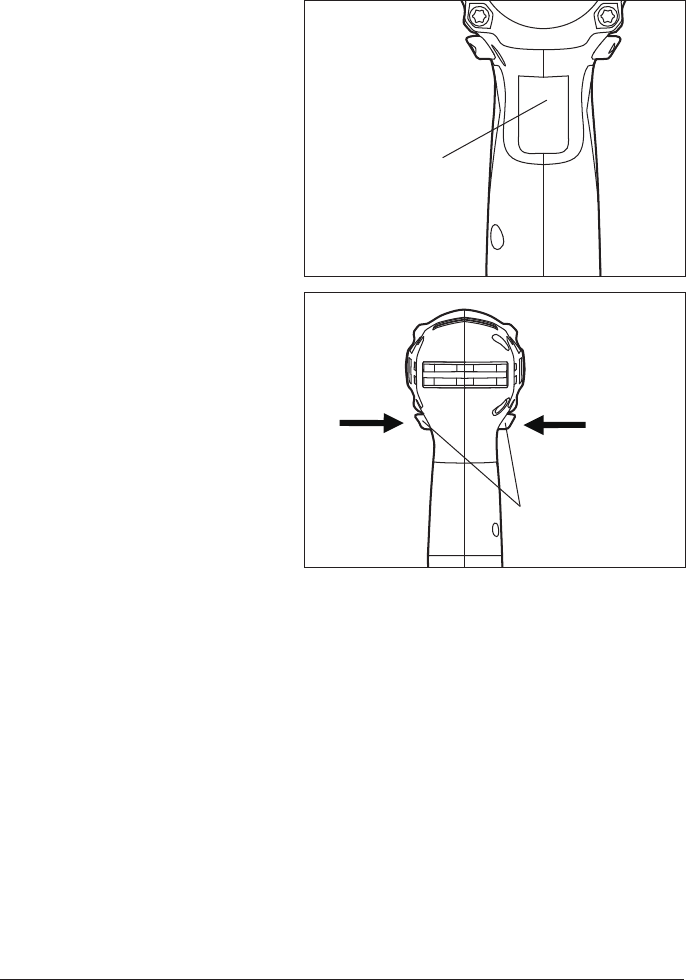
INTERRUPTOR DE
GATILLO (FIG. 3)
Para encender (ON) la atornillador
de impacto, presione el interruptor
de gatillo. Para apagarla (OFF),
suelte el interruptor de gatillo.
VELOCIDAD
VARIABLE (FIG. 3)
El gatillo de velocidad variable
ofrece una velocidad mayor con
una presión de gatillo mayor y
una velocidad menor cuando
se presiona el gatillo con
menos fuerza.
SELECTOR DE DIRECCIÓN
DE ROTACIÓN (ADELANTE/
CENTRO BLOQUEO/
REVERSA) (FIG. 4)
La dirección de rotación de la
broca es reversible y se controla
mediante un selector ubicado
encima del interruptor de gatillo.
Con el atornillador de impacto en una posición de funcionamiento normal y el
selector de dirección de rotación en la posición OFF (bloqueo centro) como
puede verse en la Fig. 4:
1. Coloque el selector de dirección de rotación hacia la izquierda de la
herramienta para perforar.
2. Coloque el selector de dirección de rotación hacia la derecha de la
herramienta para ir en reversa.
3. Colocar el interruptor en la posición OFF (bloqueo centro) ayuda a reducir la
posibilidad de un arranque accidental cuando no se encuentra en uso.
AVISO: Para evitar daños a los engranajes, siempre espere a que el portabrocas
se detenga por completo antes de cambiar la dirección de rotación.
AVISO: La perforadora/atornilladora no funciona a menos que el selector de
dirección de rotación se encuentre desplazado hacia la izquierda o derecha.
Interruptor
de gatillo de
velocidad
Fig. 3
Fig. 4
Selector de
dirección de
rotación
32
FRENO ELÉCTRICO
Para detener la perforadora/atornilladora, libere el interruptor de gatillo y permita
que el portabrocas se detenga por completo. El freno eléctrico rápidamente
detiene la rotación del portabrocas. Esta función se activa automáticamente
cuando se libera el interruptor de gatillo.
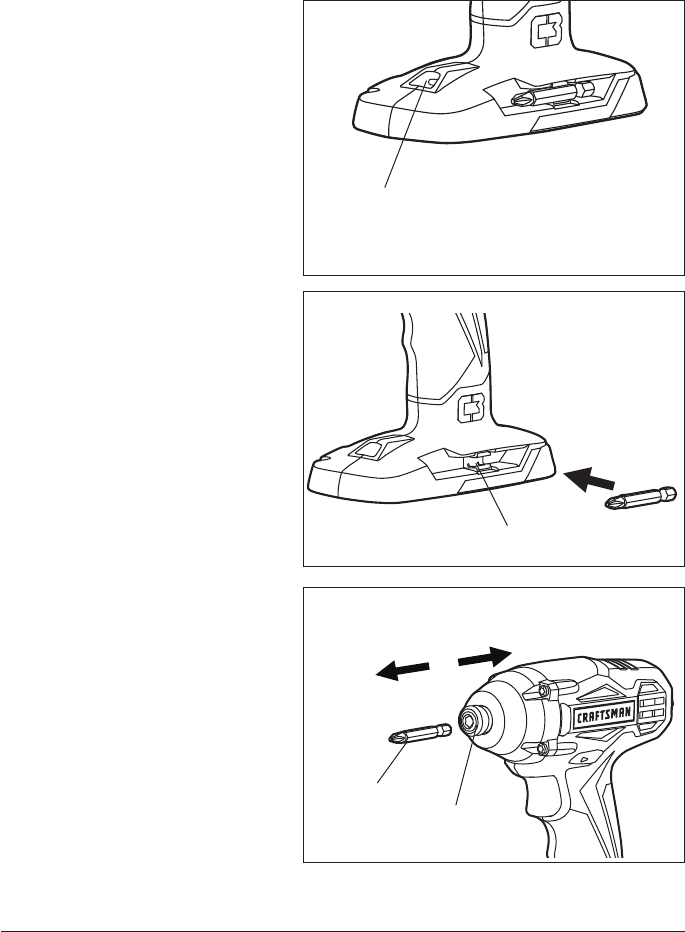
LUZ DE TRABAJO
LED (FIG. 5)
La luz de trabajo LED, ubicada
en el base del atornillador de
impacto, se ilumina cuando se
presiona el interruptor de gatillo.
Esto brinda iluminación adicional
sobre la supercie de la pieza de
trabajo para poder trabajar en
áreas de baja iluminación.
La luz de trabajo LED se apaga
cuando se suelta el interruptor
de gatillo.
ALMACENAMIENTO DE LA
BROCA (FIG. 6)
Cuando no se encuentra en uso,
la broca puede colocarse en el
area de almacenamiento ubicada
en la base de la atornillador de
impacto. Almacene la broca en la
base de la atornillador de impacto
trabándola en su lugar con el
gancho de la broca.
CÓMO INSTALAR
BROCAS (FIG. 7)
1. Quite el paquete de baterías
del atornillador de impacto
cuando instale la broca.
2. Bloquee el interruptor
de gatillo del atornillador
de impacto colocando el
selector de dirección de
rotación (adelante/bloqueo
centro/reversa) en la
posición central.
La luz de trabajo LED
Fig. 5
Gancho de la broca
Fig. 6
Acoplador
Fig. 7
Quite
Broca
Libere
33
3. Quite el acoplador del atornillador.
4. Introduzca la broca del atornillador dentro del acoplador.
5. Libere el acoplador.
6. Tire de la broca para asegurar que se halle rme en el acoplador. Puede
haber algo de juego en la broca instalada; esto es normal.
ѥADVERTENCIA: Asegúrese de que la broca esté firme en el acoplador antes
de utilizar el atornillador de impacto. Si el acoplador no vuelve a su posición
original, la broca no está bien instalada. Vuelva a intentar hasta que la broca
quede bien instalada y el acoplador retorne a su posición original. No hacerlo
puede provocar una lesión personal grave.
CÓMO QUITAR LAS BROCAS (FIG. 7)
1. Quite el paquete de baterías del atornillador de impacto cuando instale
la broca.
2. Bloquee el interruptor de gatillo del atornillador de impacto colocando el
selector de dirección de rotación (adelante/bloqueo centro/reversa) en la
posición central.
3. Quite el acoplador del atornillador.
4. Retire la broca.
ѥADVERTENCIA: Utilice guantes protectores cuando quite la broca de la
herramienta, o antes deje que la broca se enfríe. La broca puede estar caliente
después de un uso prolongado.
ѥPRECAUCIÓN: El atornillador de impacto no está diseñado para utilizarse
como un taladro.
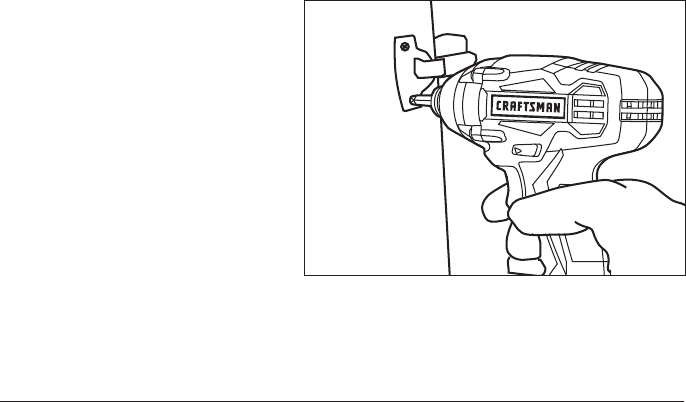
AJUSTE Y AFLOJAR
TORNILLO O
TUERCA (FIG. 8)
1. Instale la broca correcta.
2. Bloquee el interruptor
de gatillo del atornillador
de impacto colocando el
selector de dirección de
rotación (adelante/bloqueo
centro/reversa) en la
posición correcto.
3 Aplique sólo la presión
suciente para mantener la broca sujeta al tornillo o tuerca.
4. Inicialmente, aplique una presión mínima sobre el interruptor de gatillo.
Aumente la velocidad sólo cuando pueda mantenerse un control total.
Fig. 8
34
ѥADVERTENCIA: No ajuste de más, ya que la fuerza del atornillador de
impacto puede romper la sujeción. Mantenga el atornillador de impacto en
ángulo recto respecto de la sujeción para no dañar la cabeza de la misma.
MANTENIMIENTO
ѥADVERTENCIA: Para evitar una lesión personal grave, siempre quite el
paquete de baterías de la herramienta cuando la limpie o realice alguna clase
de mantenimiento.
ѥADVERTENCIA: Siempre utilice gafas de seguridad con protecciones
laterales cuando utilice aire comprimido para limpiar la herramienta. Si durante
la operación se genera mucho polvillo, también use una máscara antipolvillo.
MANTENIMIENTO GENERAL
Evite usar solventes cuando limpie piezas plásticas. La mayoría de los plásticos
son susceptibles a daños por parte de varios tipos de solventes comerciales y
pueden dañarse por su uso. Utilice paños para quitar suciedad, polvillo, aceite,
grasa, etc.
ѥADVERTENCIA: No permita bajo ninguna circunstancia que líquido de
frenos, gasolina, productos a base de petróleo, aceites penetrantes, etc. entren
en contacto con las piezas plásticas. Los químicos pueden dañar, debilitar o
destruir el plástico, lo que puede provocar una lesión personal grave.
ѥADVERTENCIA: Cuando realice un mantenimiento, sólo utilice piezas de
repuesto idénticas. El uso de otras piezas puede generar un riesgo o provocar
daños al producto. Para garantizar la seguridad y la confiabilidad, todas las
reparaciones deben ser efectuadas por un técnico calificado.
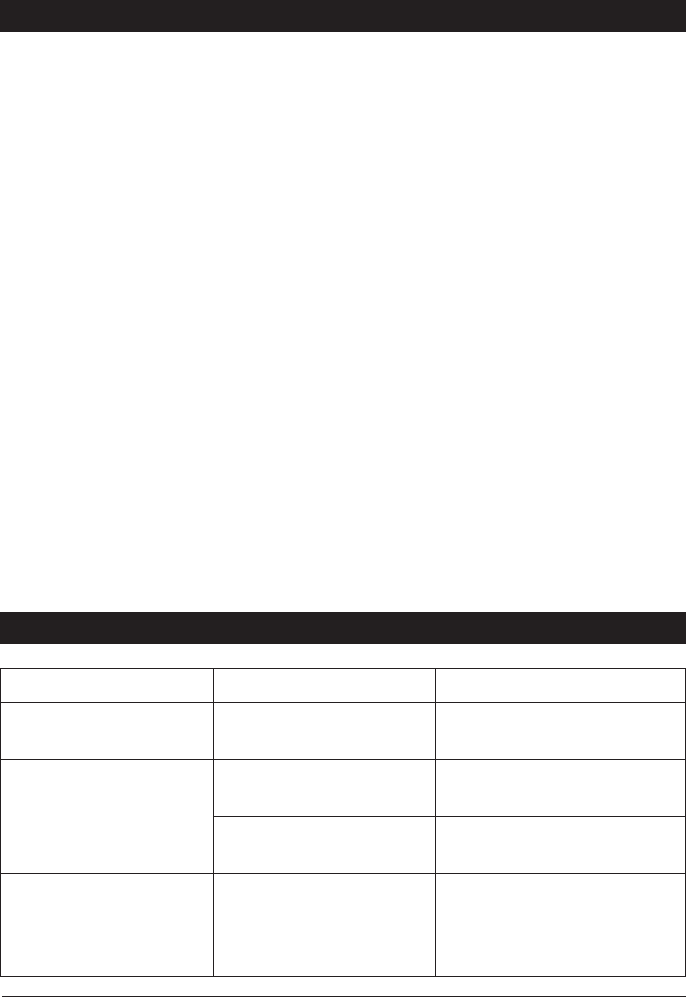
IDENTIFICACIÓN Y SOLUCIÓN DE PROBLEMAS
PROBLEMA CAUSA SOLUCIÓN
El atornillador no
funciona La batería está gastada Cargue la batería
La broca no puede
instalarse
La manga no se ha
liberado Libere la manga
La broca no entra en
la manga
Utilice una adaptador
adecuado
Sobrecalentamiento
del motor
Asegúrese de que las
ventilaciones estén
libres de polvillo
y obstáculos
Limpie las ventilaciones.
No las cubra con las
manos durante el
funcionamiento

NOTICE