Craftsman 358351580 User Manual GAS CHAINSAW Manuals And Guides 98110063
CRAFTSMAN Chainsaw, Gas Manual 98110063 CRAFTSMAN Chainsaw, Gas Owner's Manual, CRAFTSMAN Chainsaw, Gas installation guides
User Manual: Craftsman 358351580 358351580 CRAFTSMAN GAS CHAINSAW - Manuals and Guides View the owners manual for your CRAFTSMAN GAS CHAINSAW #358351580. Home:Lawn & Garden Parts:Craftsman Parts:Craftsman GAS CHAINSAW Manual
Open the PDF directly: View PDF  .
.
Page Count: 24
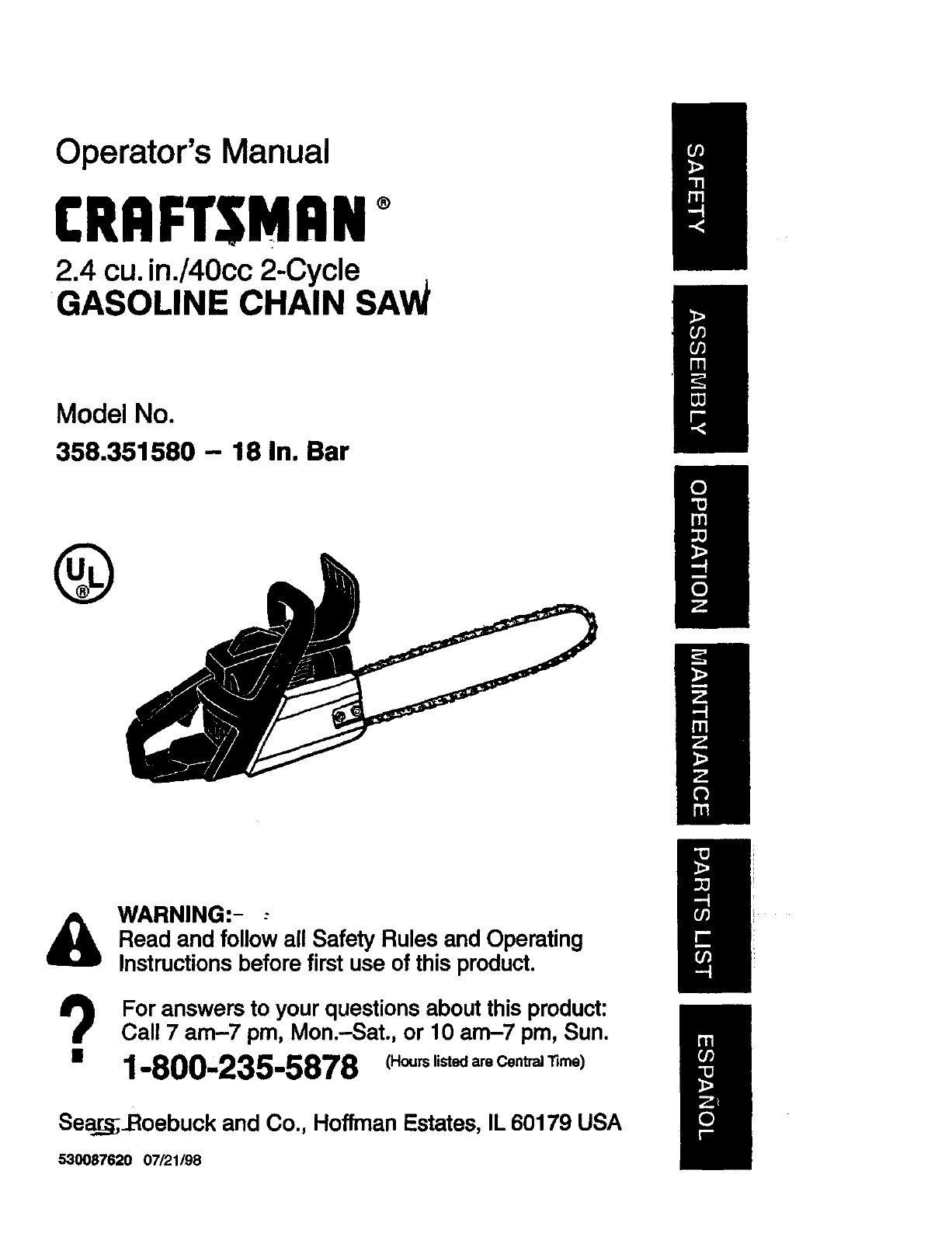
Operator's Manual
CRRFTSHRN
2.4 cu. in./40cc 2-Cycle _
GASOLINE CHAIN SAW
Model No.
358.351580 - 18 In. Bar
@
WARNING:- ;
Read and follow all Safety Rules and Operating
Instructionsbefore first use of this product.
For answers to your questions about this product:
Call 7am-7 pm, Mon.--Sat., or 10 am-7 pm, Sun.
•1-800-235-5878 (Hours listedare CentraITime)
Sear_r_r__Roebuckand Co., Hoffman Estates, IL 60179 USA
530087620 07/21/98
Warranty 2 Storage 16
Safety Rules 2 Trouble Shooting Chart 17
Assembly 5 Repair Parts List 21
Operation - _ .... •_ - 6 Spanish 24
Maintenance 11 Parts & Ordering Back
Sewice and Adjustments 14
FULL ONE YEAR WARRANTY ON CRAFTSMAN ®GAS
CHAIN SAW : i
For one year from _e date Ofpurchese, when this CraftsmanGas Chain Saw is
maintained, lubdcated and tuned-up accordingto the owner's manual, Sears will
repair,;:free_ofcharge, any defectin material or workmanship.
This warranty dxcludes the bar, chain, spark plug and air filter,which are
expendable parts, and become wom during normal use.
If this Gas Chain Saw is used for commercial or rental purposes,this warranty
appliesfor 30 days from the date of purchase.
WARRANTY SERVICE iS AVAILABLE BY RETURNING THIS CHAIN SAW TO
THE NEAREST SEARS SERVICE CENTER IN THE UNITED STATES.
This warranty gives you specific legal rights,and you may also have other rights
which vary from state to state.
Sears, Roebuck and Co., D/817 WA, Hoffman Estat_s,;IL 60179
WARNING: Always disconnect spark
plug wire when making repairs except
for carburetor adjustments. Because a
chain saw is a high-speed woodcutting
tool, careless or improper use of this
tool can cause serious injury.
PLAN AHEAD
•Restrict the use of your sew to adult
users who understand and can follow
the safety rules, precautions, and op-
""_e_atinginstructions found in this
manual.
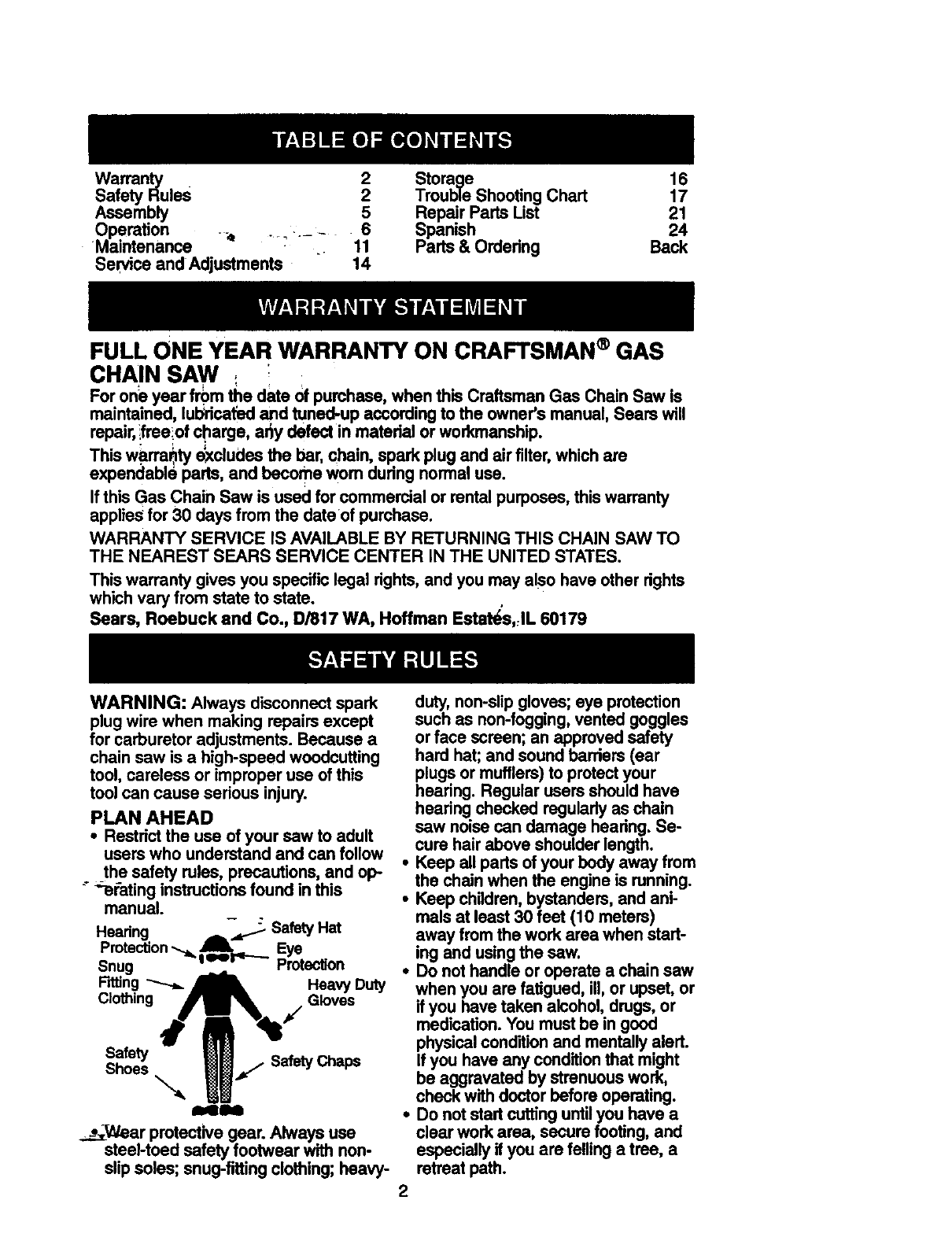
Hearing A.=_ Safety Hat
Protection_ ___ Eye
Snug i_r,_-- Protection
Fitting _Heavy Duty
Clothing Gloves
ShoesSafety jSafety Chaps
__ T_Jearprotectivegear. Always use
steel-toed safety footwear with non-
slip soles; snug-fittingclothing;heavy-
duty, non-slipgloves;eye protection
such as non-fogging,vented goggles
or face screen;an approved safety
hard hat; and sound barriers(ear
plugs or mufflers)to protectyour
hearing. Regular users shouldhave
hearing checked regularlyas chain
saw noise can damage hearing. Se-
cure hair above shoulder length.
•Keep all partsof your body away from
the chain when the engine is running.
•Keep children,bystanders, and ani-
mals at least 30 feet (10 meters)
away from the work area when start-
ing and usingthe saw.
•Do not handle or operate a chain saw
when you are fatigued, ill, or upset, or
if you have taken alcohol, drugs,or
medication.You must be in good
physicalconditionand mentally aiert.
If you have any conditionthat might
be aggravated by strenuouswork,
check with doctor before operating.
°Do not start cuttinguntilyou have a
clear work area, secure footing, and
especially if you are felling a tree, a
retreat path.
2
OPERATE YOUR SAW SAFELY
• Donotoperatewithonehand.Sed-
ousinjuryto the operator,helpers,or
bystandersmayresult from one-
handed operation. A chain saw is in-
tended for two-handed use.
•Operate the chain sa3vonly in.a wail-
ventilated outdoorarea.
•Do not operate saw from a ladder or
in a tree, unless you are specifically
trained to do so.
•Make sure the chain will not make
contact with any object while starting
the engine. Never try to startthe saw
when the guide bar is in a cut.
•Do not put pressure on the saw, es-
peciallyat the and of the cut. Doing
so san cause you to lose control
when the cut is completed.
• Stop engine before setting sew down.
•Hand carry saw only when engine is
stopped. Carry with muffler away from
body; guide bar & chain projecting be-
hind you; guide bar preferably cov-
ered with a scabbard.
MAINTAIN YOUR SAW IN GOOD
WORKING ORDER
•Have all chain saw service performed
by a qualified service dealer except
the items listed in the maintenance
section of this manual.
•Make certain the saw chain stops
moving when the throttle tdgger is re-
leased. For correction, refer to =Car-
buretor Adjustments."
•Keep the handles dry, clean, and free
from oil or fuel mixture.
•Keep caps and fasteners securely
tightened.
•Use only Craftsman accessodes and
replacement parts as recommended.
Nev_e_r_modifyyour saw.
HANDLE FUEL WIT.[-I CAUTION
• Do not smoke while handling fuel or
while operating the saw.
•Eliminme_I sourcasofspsrksortiame
in areas where fuel is mixed or poured.
•Mix and pour fuel in an outdoor area
and use an approved, marked con-
tainer for all fuel purposes. Wipe up
all fuel spills before starting saw.
•Move at least 10 feet (3 meters) from
fueling site before starting.
•Turn the engine off and let sew cool in
a non-combustible area, not on dry
"le,a_e_, straw, paper, etc. Slowly re-
move fuel cap and refuel unit.
• Store the unit and fuel in a cool, dry
well ventilated space where fuel va-
pors cannot reach sparks or open
flames from water heaters, electric
motors or switches, furnaces, etc.
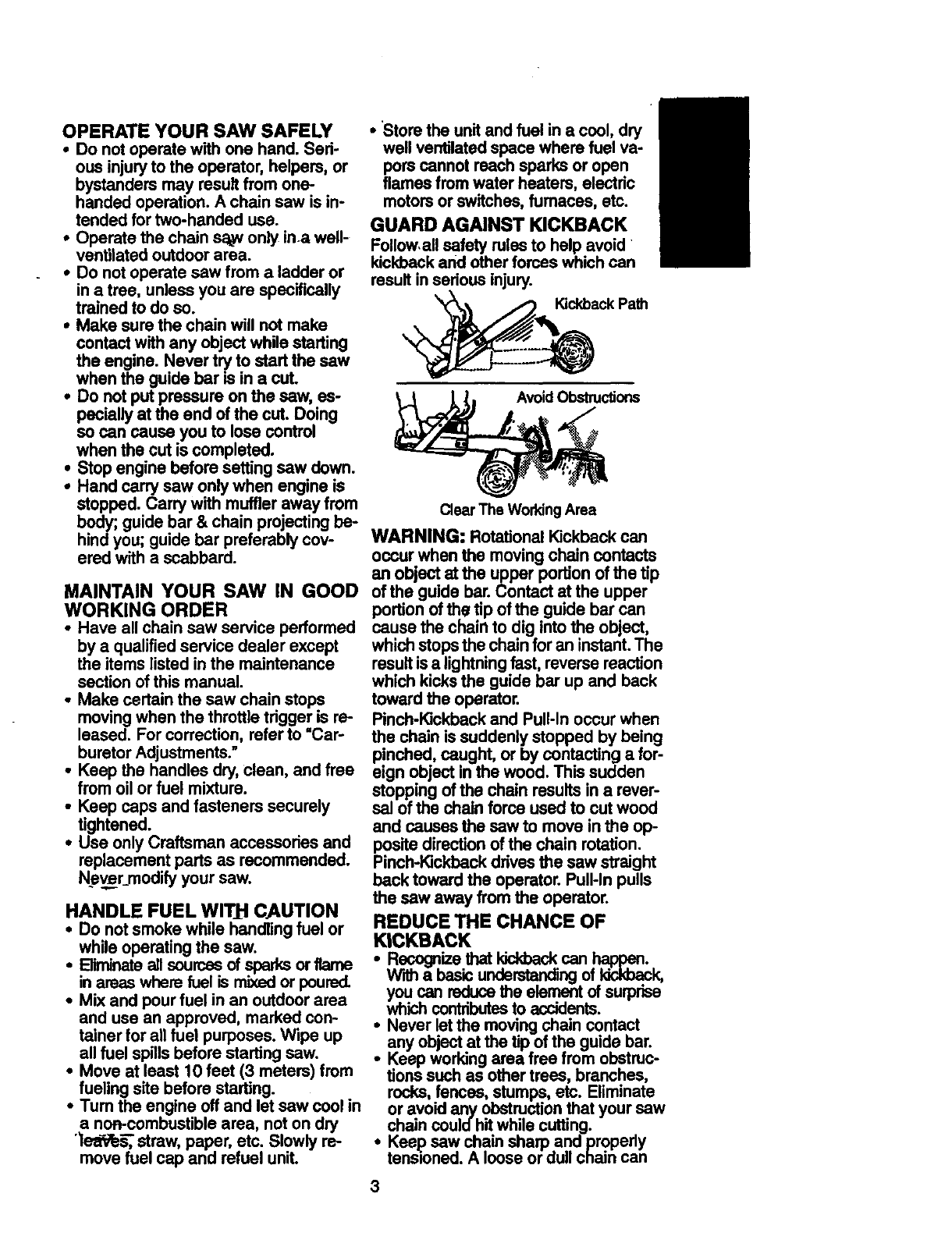
GUARD AGAINST KICKBACK
Follow.all safety rules to help avoid
Idcld0ack and other forces which can
result in sedous injury.
_ _ KickbackPath
AvoidObstructions
Clear The Worldng Area
WARNING: Rotational Kickbackcan
occur when the moving chain contacts
an object atthe upper portionof the tip
ofthe guide bar. Contact at the upper
portion ofthe tiP of the guide bar can
cause the chain to dig into the object,
which stops the chain for an instant.The
resultisa lightningfast, reverse reaction
which kicksthe guide bar up and back
toward the operator.
Pinch-Kickbeckand Pull-Inoccur when
the chain is suddenly stopped by being
pinched, caught, or by contacting afor-
eign object inthe wood. This sudden
stopping ofthe chain resultsin a rever-
sal of the chain force used to cut wood
and causes the saw to move in the op-
posite direction ofthe chain rotation.
Pinch-Kickbackdrivesthe saw straight
back toward the operator. Pull-In pulls
the saw away from the operator.
REDUCE THE CHANCE OF
KICKBACK
•Recognize that kJdd:_ck can happen.
With a basis understanding of k_k,
you can reduce the element of surprise
which contributes to accidents.
Never let the moving chain contact
any object at the tip of the guide bar.
Keep working area free from obstruc-
tions such as other trees, branches,
rocks, fences, stumps, etc. Eliminate
or avoid any obstruction that your saw
chain could hit while cutting.
•Keep saw chain sharp and propedy
tensioned. Aloose or dull chain can
3
increase the chance of kickback. Fol-
low manufacturer's chain sharpening
and maintenance instructions. Check
tension at regular intervals, but never
with engine running. Make sure bar
clamp nuts are escurely tightened.
•Be(] n and continue cuffing at lull
sp_ed. If the chalh is movin_ at a
slower speed, there is greater chance
of kickback occurring.
• Use extreme caution when reentering
a cut.
Do not attempt cuts startLngwith the
itip.ofthe cuts).
bar._lunge
Watch for sh=ftinglogs or other forces
that could close a cut and pinchor fall
into chain.
•Use the specified Reduced-Kickback
Guide Bar and Low-Kickback Chain.
Avoid Pinch-Kickback:
•Be extremely aware of situations or
obstructionsthat can cause matenau
to pinch the top of or otherwise stop
the chain.
•Do not cut more than one log at a
time.
•Do not twist saw as bar is withdrawn
from an undercut when bucking.
Avoid Pull-In:
•Always begin cutting with the engine
at fullspeed and the saw housing
against wood.
•Use wedges made of plastic or wood.
Never use metal to hold the cut open.
MAINTAIN CONTROL
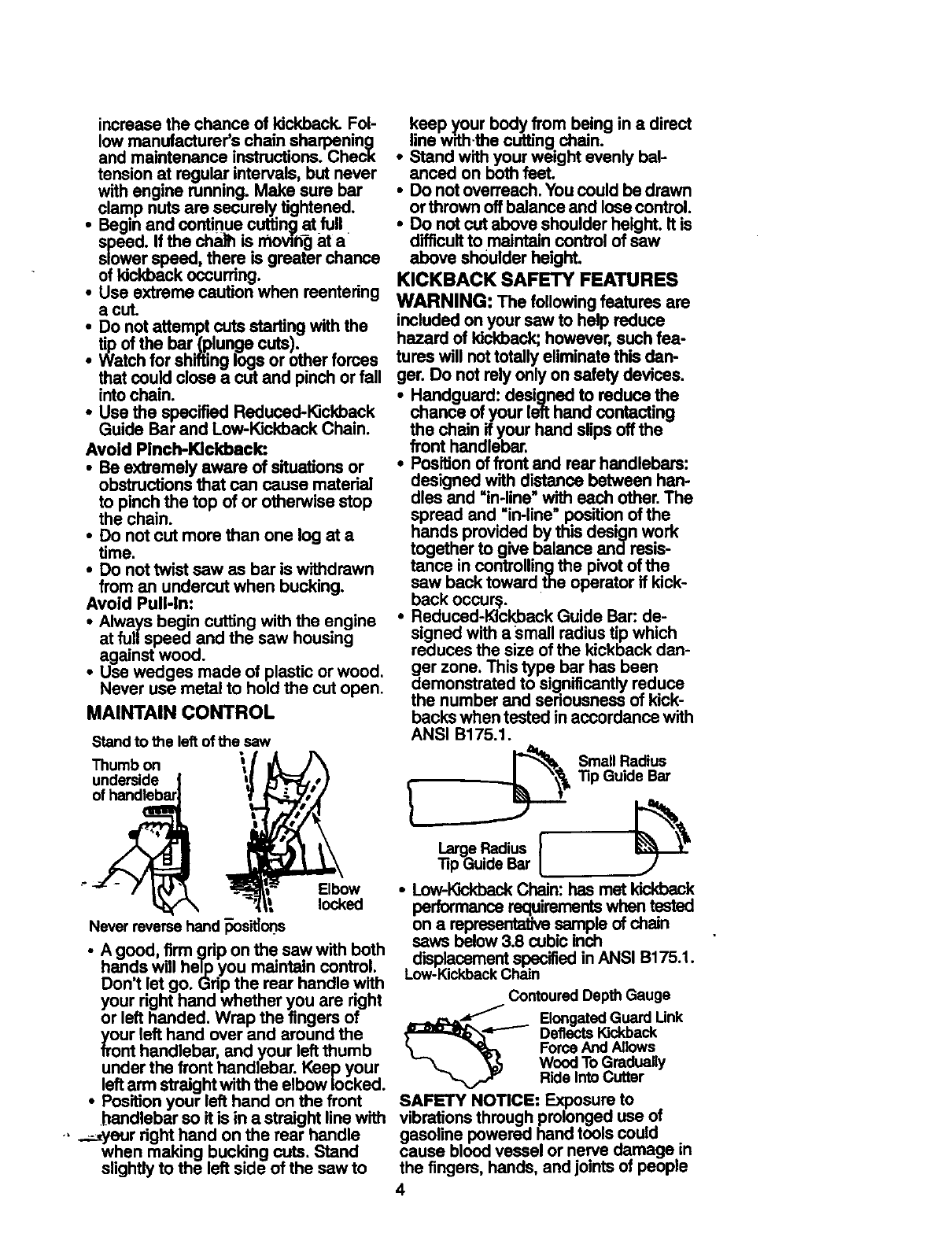
Stand to the left of the saw
Thumb on \_
_Elbow
locked
Never reversehand _)osit]or)s
•A good, firm grip on the saw with both
hands will he|p you maintain control.
Don t let go. Grip the rear handle with
your dght hand whether you are dght
or left handed. Wrap the fingers of
your left hand over and around the
front handlebar, and your left thumb
under the front handlebar. Keep your
left arm straight with the elbow locked.
•Position your left hand on the front
,handlebar so it is in a straight line with
• _--yeur dght hand on the rear handle
when making bucking cuts. Stand
slightly to the left side of the saw to
keep y.our body from being in adirect
line with-the cutting chain.
•Stand with your weight evenly bal-
anced on bothfeet.
•Do notoverreach.You could be drawn
or thrown offbalance and lose control.
•Do not cut above.shoulderheight, it is
difficultto maintain control of saw
above shoulder height.
KICKBACK SAFETY FEATURES
WARNING: The followingfeatures are
included on your saw to help reduce
hazard of kickback;however, such fea-
tures will not totallyeliminate this dan-
ger. Do not relyonly on safety devices.
•Handguard: designed to reduce the
chance of your left hand contacting
the chain ifyour hand slips offthe
front handlebar.
•Positionoffront and rear handlebars:
designed with distance between han-
dles and "in-line"with each other.The
spread and "in-line"position of the
hands provided by this design work
together to give balance and resis-
tance in controllingthe pivotof the
saw back toward the operator if kick-
back occurs.
•Reduced-Kickback Guide Bar: de-
signed with a _;mall radius tip which
reduces the size of the kickback dan-
ger zone. Thistype bar has been
demonstrated to significantlyreduce
the number and seriousness of kick-
backs when tested in accordance with
ANSI B175.1.
Smell Radius
Tip Guide Bar
•Low-KickbackChain: has met kickback
performance.mq..uirarnantswhen tested
on a representativesampleof chain
saws below 3.8 cubic inch
displacementspecifiedinANSI B175.1.
Low-Kickback Chain
Contoured Depth Gauge
_._.... Elon_tsd Guard Unk
DeflectsKickback
ForceAndAllows
WoodToGradually
RideIntoCutter
SAFETY NOTICE: Exposure to
vibrationsthroughprolongeduse of
gasoline powered hand toolscould .
cause blood vessel or nerve oamagelm
the fingers, hands, andjoints of peop e
4
prone to circulation disorders or
abnormal swelling. Prolonged usa in
cold weather has been linked to blood
vessel damage in otherwise healthy
people• if symptoms occur such as
numbness, pain, loss of strength,
change in skin color or _exturs, orJoss
of feeling in the fingers, hands, or joints,
discontinue the use of this tool and
seek medical attention. An
anti-vibration system does not
guarantee the avoidance of these
problems. Users who operate power
tools on a continual and regular basis
must closely monitor their physical
condition and the condition of this tool•
CHAIN BRAKE If this saw is to be used
for commercial logging, you must order
and install a chain brake to comply with
Federal OSHA Regulations for Com-
mercial Logging• Contact your Sears
Service Center or call 1-800-235-5878.
SPARK ARRESTOR: Your saw is
equipped with a temperature limiting
mufflerand sparkarrestingscreen
which meets the requirements of
Califomia Codes4442 and 4443. All
U•S. forest land and the states of
Califomia, Idaho, Maine, Minnesota,
New Jersey, Oregon, and Washington
requirebY law that many intemal
combustionengines be equippedwith a
spark arrestorscreen. If you operate a
chain saw in a state or locale where
such regulationsexist, you are legally
responsiblefor maintainingthe
operating conditionofthese parts.
Failureto do so is a violationof the law.
Refer to Customer Responsibilities
chart in the MAINTENANCEsection.
STANDARDS: This chain saw is listed
by UnderwritersLaborstodes, Inc. in
accordance withAmerican National
Standards for Gasolins-Powersd Chain
Saws Safety Requirements (ANSI
B175.1-1991).
CARTON CONTENTS
Check carton contents against the fol-
lowing list.
Model: 358.351580
•Chain Saw (fully assembled)
•Chain adjustment tool
•2-cycle engine oil
•Examine parts for damage. Do not
use damaged parts.
•If you need assistance or find that
parts are missing or damaged, please
call 1-800-235-5878.
NOTE: It is normal to hear the fuel filter
rattle Jn an empty fuel tank.
Your unit has been factory tested and
the carburetor precisely adjusted. As a
result you may smell gasoline or find a
drop of oil/fuel residue on the muffler
when you unpack the unit.
ASSEMBLY
Yoursaw is fully assembled, and no
assembly is necessary.
5
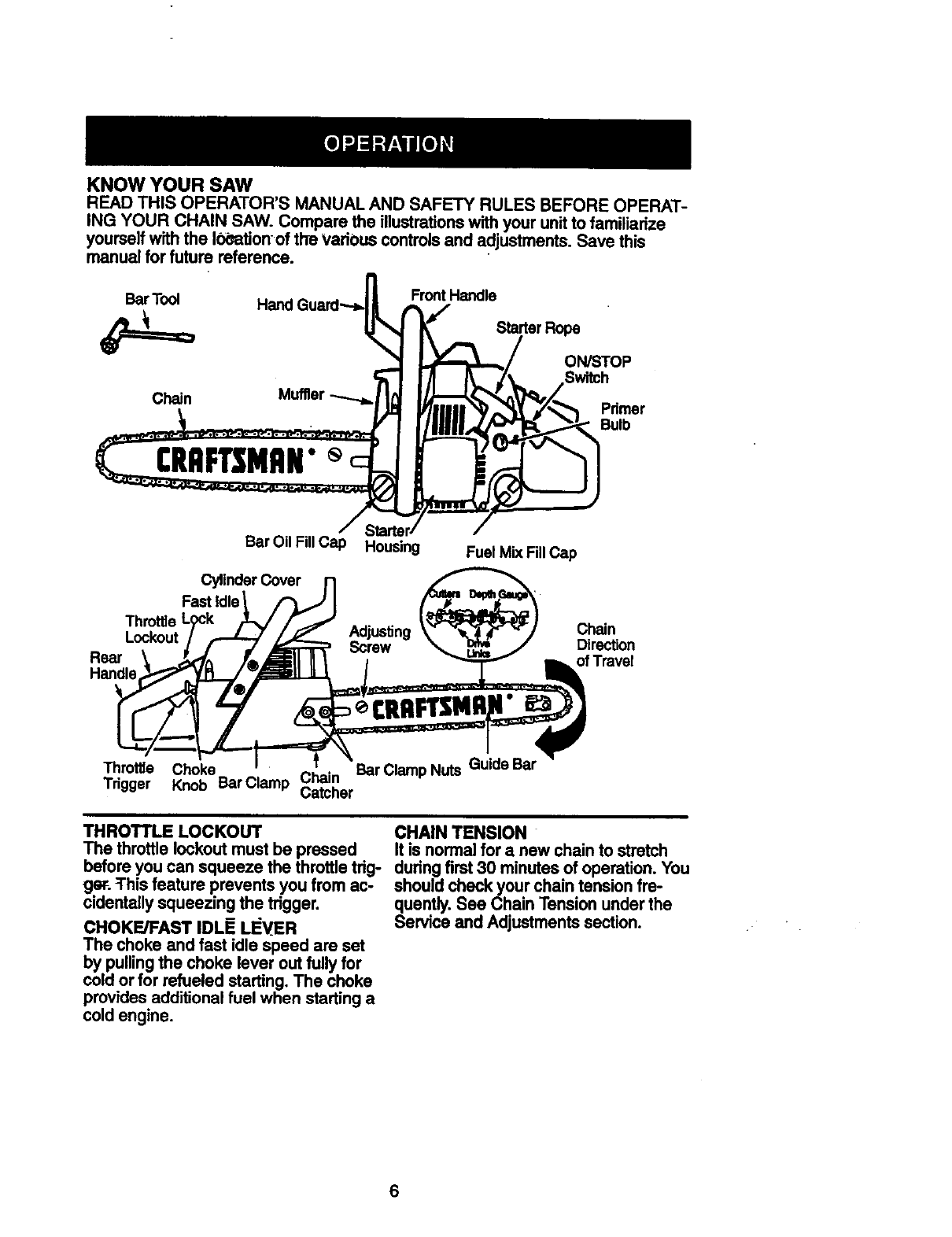
KNOW YOUR SAW
READ THIS OPERATOR'S MANUAL AND SAFETY RULES BEFORE OPERAT-
ING YOUR CHAIN SAW. Compare the illustrationswith your unitto familiarize
yourselfwith the 10eationof the various controlsand adjustments.Save this
manual for future reference.
.... ;_zM__tler_""'_ _ __B_I er
/Starter//
Bar Oil Fill Cap Housing Fuel Mix FillCap
Cylinder Cover
Fast Idle
Rsar
Handle
Adjusting Chain
Screw Direction
of Travel
Throffie Choke _Bar Clamp Nuts Guide Bar
Trigger Knob Bar Clamp Chain
Catcher
THROTTLE LOCKOUT
The throttle lockout must be pressed
before you can squeeze the throttle trig-
ge_. This feature prevents you from ac-
cidentally squeezing the trigger.
CHOKE/FAST IDLE LI_VER
The choke and fast idle speed are set
by pulling the choke lever out fully for
cold or for refueled starting. The choke
provides additional fuel when starting a
cold engine.
CHAIN TENSION
It is normalfor a new chain to stretch
duringfirst30 minutes of operation. You
shouldcheck your chain tensionfre-
quently.See Chain Tension underthe
Service and Adjustmentssection.
6
BEFORE STARTING ENGINE
WARNING: Besureto readthefuel
handlinginformationinthesafetyrules
sectionof thismanualbeforeyoubegin.
Ifyoudo notunderstandthefuelhan-
dlinginformationdonotattempttofuel
yourunit.Seekhelpfr0_ someone that
does understand the informationor call
the customer assistance help line at
1-800-235-5878.
GUIDE BAR AND CHAIN OIL
The chain oiler provides continuous lu-
brication to the chain and guide bar. Be
sure to fill the bar oil tank when you fill
the fuel tank (Capacity = 6.8 ft. oz.)
For maximum guide bar and chain life,
we recommend you use Craftsman
chain saw bar oil. If Craftsman bar oil is
not available, you may use a good
grade SAE 30 oil until you are able to
obtain Craftsman brand. The oil output
is automatically metered during opera-
tion. Your saw will use approximately
one tank of bar oil for every tank of fuel
mix. Always fill the bar oil tank when
you fill the fuel tank.
FUELING ENGINE
This engine is certified to operate on
unleaded gasoline. Before operation,
gasoline must be mixed with a good
quality 2-cycle air-cooled engine oil. We
recommend Craftsman brand oil. Mix
gasoline and oil at a ratio of 40:1 (A
40:1 ratio is obtained by mixing 3.2
ounces of oil with 1 gallon of unleaded
gasoline). DO NOT USE automotive oil
or boat oil. These oils will cause engine
damage. When mixing fuel follow the
instructions printed on the container.
Once oil is added to the gasoline,
shake container momentarily to assure
that_LIl_ fuel is thoroughly mixed.
Always read and follow the safety rules
relating to fuel before fue.ling your unit.
IMPORTANT
Experience indicates that alcohol
blended fuels (called gasohol or using
ethanol or methanol) can attract mois-
ture which leads to separation and
formation of acids during storage. Acid-
ic gas can damage the fuel system of
an engine while in storage.
To avoid engine problems, the fuel sys-
tem should be emptied before storage
for _)._lays or longer. Drain the gas
tank, start the engine and let it run until
the fuel lines and carburetor are empty.
Use fresh fuel next season. See STOR-
AGE instructions for additional informa-
tion.
Never use engine or carburetor cleaner
products in the fuel tank or permanent
damage may occur.
See the STORAGE section for additional
information..
STOPPING YOUR ENGINE
•Move On/Stop switch to the STOP
position.
•If engine does not stop, pull choke
knob out fully.
STARTING YOUR ENGINE
COLD ENGINE OR WARM ENGINE
AFTER RUNNING OUT OF FUEL
•Fuel engine following instructions un-
der FUELING ENGINE.
•Fill bar oil tank with bar oil. Your saw
will use approximately one tank of bar
oil for each tank of fuel mix.
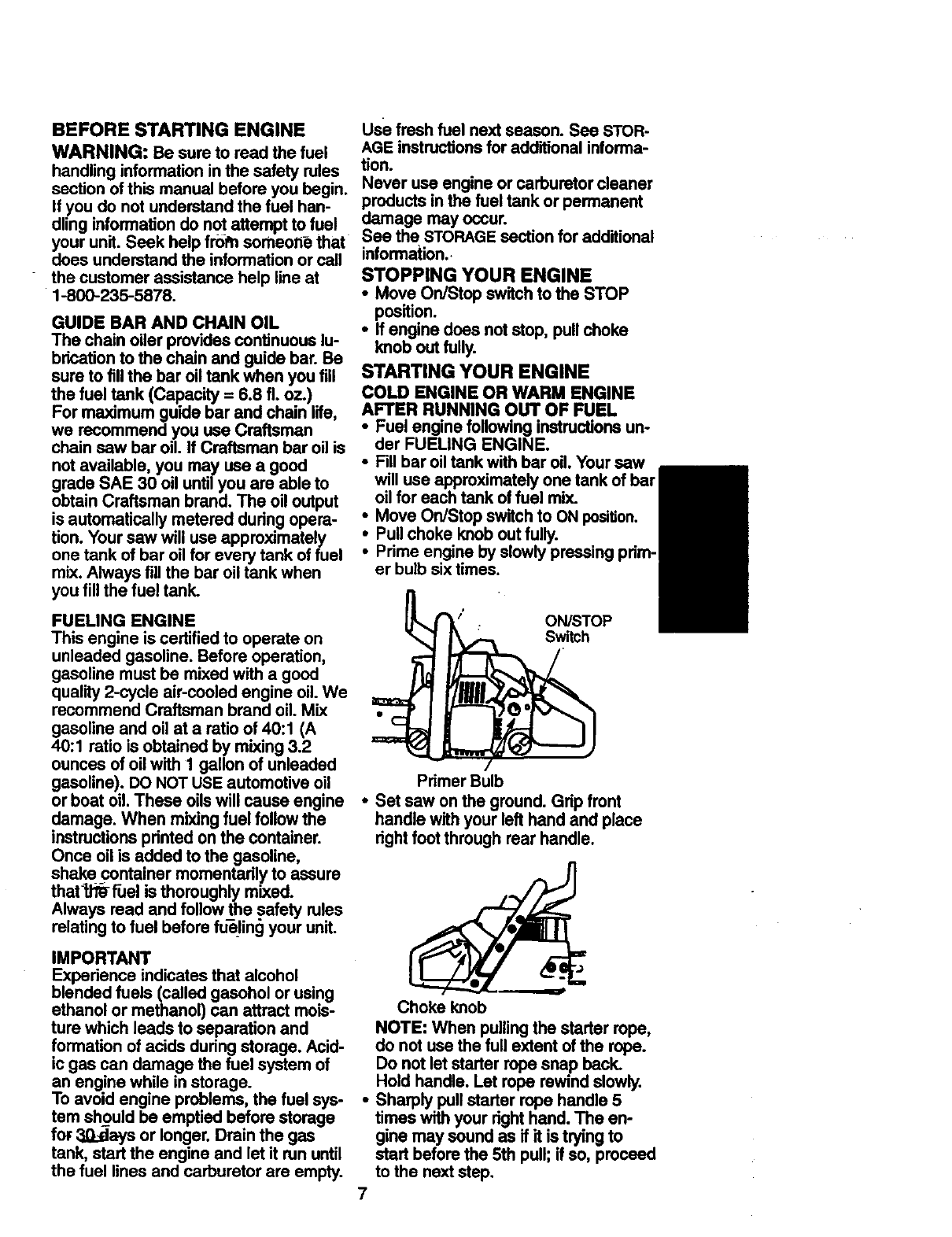
•Move On/Stop switch to ON position.
•Pull choke knob out fully.
°Prime engine by slowly pressing prim-
er bulb six times.
ON/STOP
Switch
PrimerBulb
•Set saw on the ground. Gripfront
handle with your left hand and place
rightfootthrough rear handle.
Choke knob
NOTE: When pulling the starter rope,
do not use the full extent of the rope.
Do not let starter rope snap back.
Hold handle. Let rope rewind slowly.
•Sharply pull starter rope handle 5
times with your right hand. The en-
gine may sound as if it is trying to
start before the 5th pull; if so, proceed
to the next step.
7
• Fullypush-inchokeleverandcontin-
ueto pullstarterropehandleuntilen-
ginestarts.
•Then, squeeze and release the
throttle trigger to retum engine to idle
speed.
•To stop engine, move _Q+_Stop switch
to the STOP position.
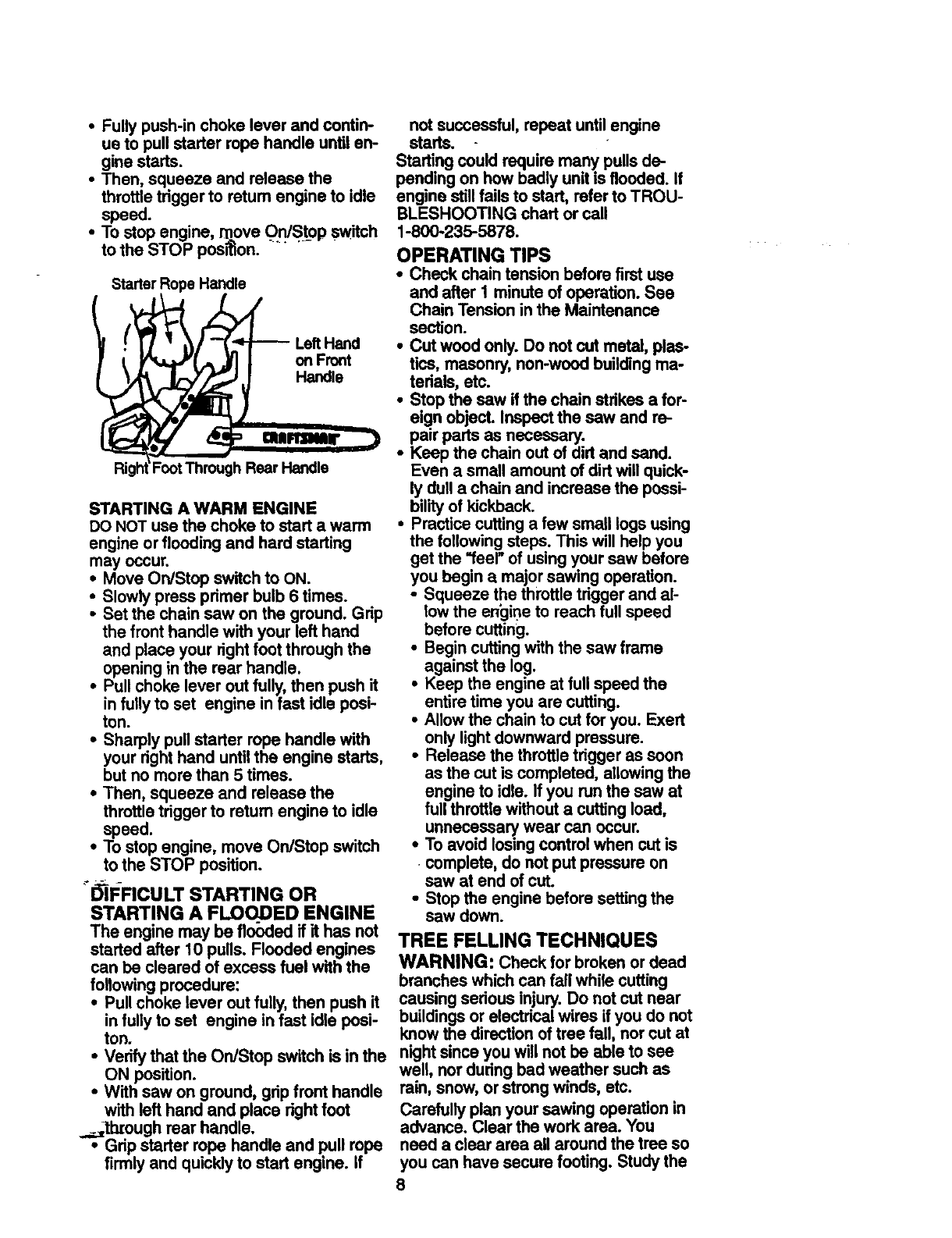
Starter Rope Handle
r
Righi_:FootThrough Rear Handle
STARTING A WARM ENGINE
DO NOT use the choke to start a warm
engine or flooding and hard starting
mayoccur,
•Move On/Stop switch to ON.
•Slowly press primer bulb 6 times.
• Set the chain saw on the ground. Grip
the front handle with your left hand
and place your right foot through the
opening in the rear handle.
•Pull choke lever out fully, then push it
in fully to set engine in fast idle posi-
ton.
•Sharply pull starter rope handle with
your right hand until the engine starts,
but no more than 5 times.
•Then, squeeze and release the
throttle triggsr to retum engine to idle
speed.
•To stop engine, move On/Stop switch
to the STOP position.
'I_I=FICULT STARTING OR
STARTING A FLOODED ENGINE
The engine may be flooded if it has not
started after 10 pulls. Flooded engines
can be cleared of excess fuel with the
following procedure:
•Pull choke lever out fully, then push it
in fully to set engine in fast idle posi-
ton.
•Verify that the On/Stop switch is in the
ON position.
•With saw on ground, grip front handle
with left hand and place right foot
__through rear handle.
•Grip starter rope handle and pull rope
firmly and quickly to start engine. If
not successful,repeat untilengine
starts.
Startingcould require many pullsde-
pendingon how badly unit is flooded. If
engine stillfails to start,refer to TROU-
BLESHOOTING chart or call
1-800-235-5878.
OPERATING TIPS
•Check chain tensionbefore first use
and after 1 minute of operation. See
Chain Tension inthe Maintenance
section.
•Cut wood only. Do notcut metal, plas-
tics, masonry,non-woodbuildingma-
terials, etc.
•Stop the saw if the chain strikes a for-
eign object. Inspectthe saw and re-
pair parts as necessary.
•Keep the chain out of dirt and sand.
Even a smallamount of dirtwill quick-
ly dull a chain and increase the possi-
bilityof kickback.
•Practice cutting a few smalllogs using
the followingsteps. This will help you
get the =feel" of usingyoursaw before
you begin a major sawing operation.
•Squeeze the throttletriggerand al-
low the engine to reach full speed
beforecutting.
•Begin cuttingwiththe saw frame
against the log.
•Keep the engine at full speed the
entire time you are cutting.
•Allowthe chain to cut for you. Exert
only lightdownward pressure.
•Release the throttletrigger as soon
as the cut is completed, allowingthe
engine to idle. Ifyou run the saw at
fullthrottle withouta cuttingload,
unnecessary wear can occur.
•To avoid losingcontrolwhen cut is
complete, do not putpressure on
saw at end of cut.
•Stop the engine before settingthe
saw down.
TREE FELLING TECHNIQUES
WARNING: Check for broken or dead
branches which can fall while cutting
causing serious injury. Do not cut near
buildings or electrical wires if you do not
know the direction of tree fall, nor cut at
night since you will not be able to see
well, nor during bad weather such as
rain, snow, or strong winds, etc.
Carefully plan your sawing operation in
advance. Clear the work area. You
need a clear area all around the tree so
you can have secure footing. Study the
8
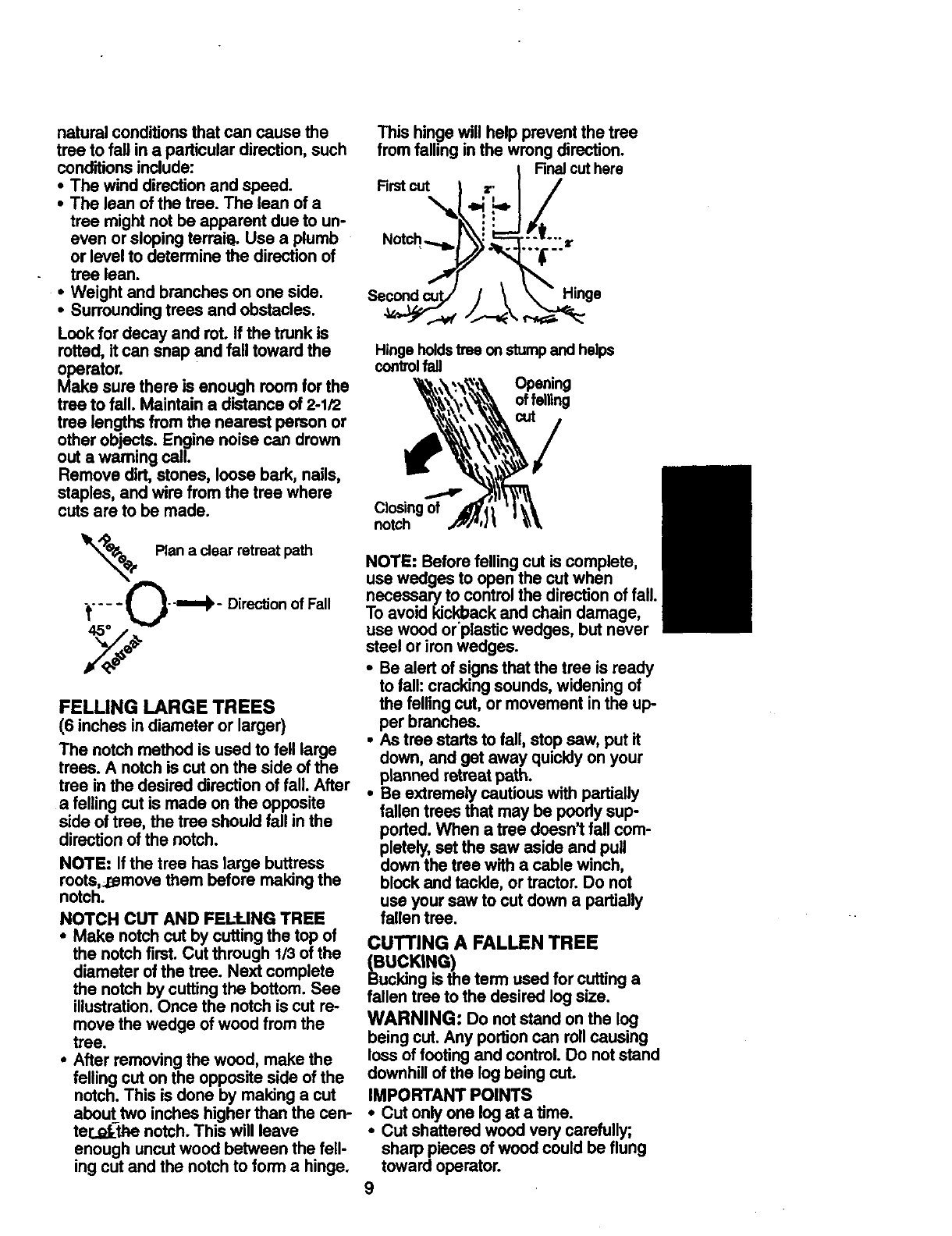
naturalconditionsthatcancausethe
tree to fall in a particular direction, such
conditions include:
•The wind direction and speed.
•The lean of the tree. The lean of a
tree might not be apparent due to un-
even or sloping terraiB. Use a plumb
or level to determine the direction of
tree lean.
•Weight and branches on one side.
•Surrounding trees and obstacles.
Look for decay and rot. If the trunk is
rotted, it can snap and fall toward the
operator.
Make sure there is enough room for the
tree to fall. Maintain a distance of 2-1/2
tree lengths from the nearest person or
other objects. Engine noise can drown
out a warning call.
Remove dirt, stones, loose bark, nails,
staples, and wire from the tree where
cuts are to be made.
Plan a clear retreat path
.... (]--,,,=-_- Directionof Fall
FELLING LARGE TREES
(6 inches in diameter or larger)
The notch method is used to fell large
trees. A notchis cut on the side of the
tree in the desired directionof fall. After
a felling cut is made on the opposite
side of tree, the tree should fall in the
direction of the notch.
NOTE: If the tree has large buttress
roots,_move them before making the
notch.
NOTCH CUT AND FELt.ING TREE
•Make notch cut by cutting the top of
the notch first. Cut through 1/3 of the
diameter of the tree. Next complete
the notch by cutting the bottom. See
illustration. Once the notch is cut re-
move the wedge of wood from the
tree.
•After removing the wood, make the
felling cut on the opposite side of the
notch. This is done by making a cut
abouttwo inches higher than the can-
ter..e._the notch. This will leave
enough uncut wood between the fell-
ing cut and the notch to form a hinge.
This hingewill help prevent the tree
from falling inthe wrong direction.
Rrst cut |Rnal cut here
Notch,_ _'.': r
Hinge holdstree on stumpand helps
controlfell
Opening
of telling
Closingof
notch
NOTE: Before felling cut is complete,
use wedges to open the cut when
necessary to control the direction of fall.
To avoid kickback and chain damage,
use wood or'plastic wedges, but never
steel or iron wedges.
•Be alert of signs that the tree is ready
to fall: cracking sounds, widening of
the felling cut, or movement in the up-
per branches.
•As tree starts to fall, stop sew, put it
down, and get away quickly on your
planned retreat path.
•Be extremely cautious with partially
fallen trees that may be poody sup-
ported. When a tree doesn't fall com-
pletely, set the saw aside and pull
down the tree with a cable winch,
block and tackle, or tractor. Do not
use your saw to cut down a partially
fallen tree.
CUTTING A FALLEN TREE
(BUCKING)
Bucking is the term used for cutting a
fallen tree to the desired log size.
WARNING: Do not stand on the log
being cut. Any portion can roll causing
loss of footing and control. Do not stand
downhill of the log being cut.
IMPORTANT POINTS
•Cut only one log at a time.
•CUt shattered wood very carefully;
sharp pieces of wood could be flung
toward operator.
9
• Use a sawhorse to cut small logs.
Never allow another person to hold
the log while cutting and never hold
the log with your leg or foot.
•Do not cut in an area where logs,
limbs, and roots are tangled. Drag the
logs into a clear _,rea before cutting
them.
BUCKING TECHNIQUES
WARNING: If saw becomes pinched
or hung in alog, don't try to force it out.
You can losecontrol ofthe saw result-
ing in injury and/or damage to the saw.
Stop the saw, ddve a wedge of plastic
or wood into the cut untilthe saw can
be removed easily. Restart the saw and
carefully reenter the cut. Do not use a
metal wedge. Do not attempt to restart
your saw when it is pinched or hung in
a log.
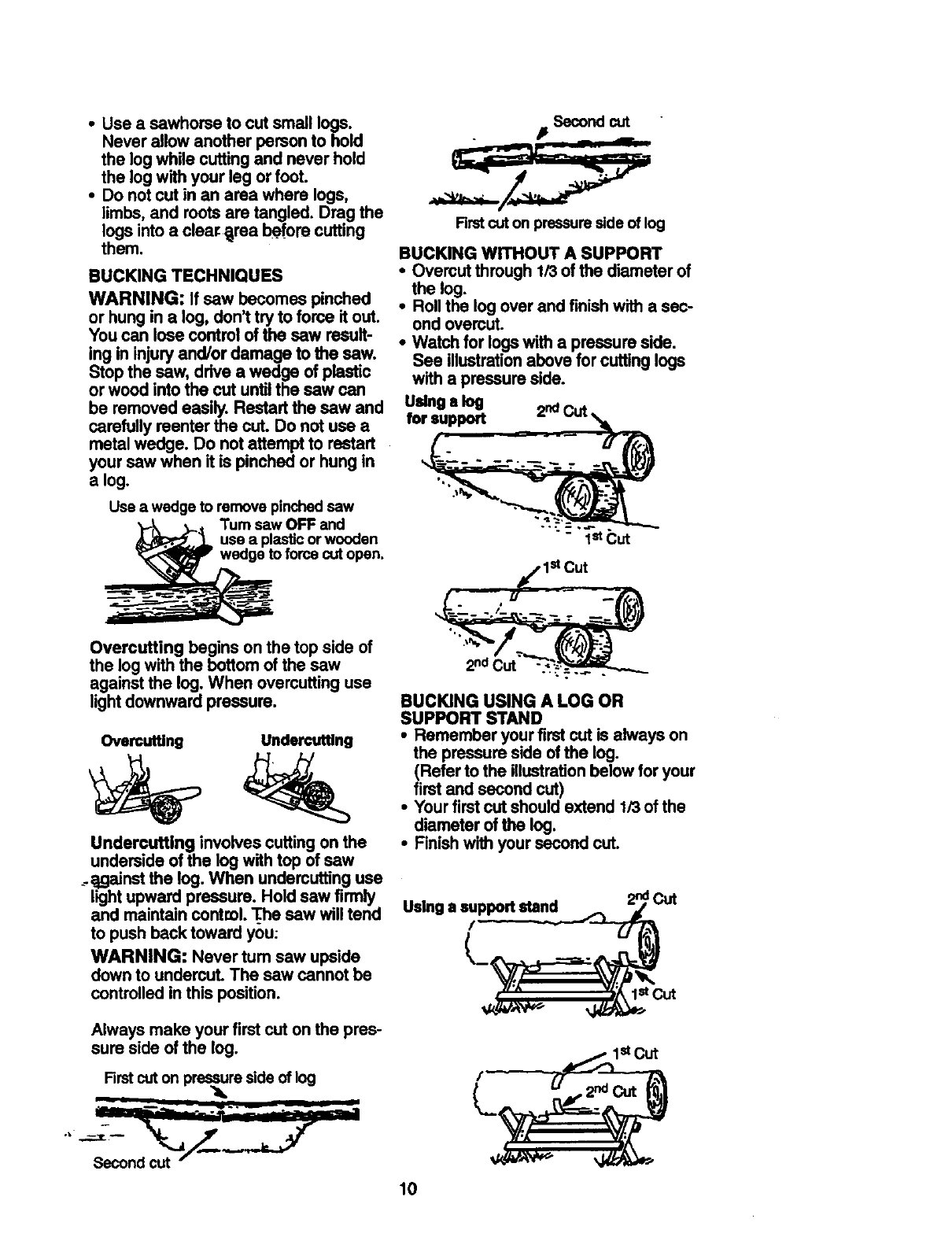
Use a wedge to remove pinchedsaw
_. Turn saw OFF and
A_.'_ use a plastic orwooden
to force cut open.
Overcutting begins on the top side of
the log with the bottom of the saw
against the log. When overcutting use
light downward pressure.
Overcutting Undercutting
Undercutting involves cutting on the
underside of the log with top of saw
. a_galnstthe log. When undemutting use
light upward pressure. Hold saw firmly
and maintain control. "l:'hesaw will tend
to push back toward you:
WARNING: Never tum saw upside
down to undercuL The saw cannot be
controlled in this position.
Always make your first cut on the pres-
sure side of the log.
Rrst cut on pressure side of log
Rrst cut on pressureside of log
BUCKING WITHOUT A SUPPORT
•Ovemut through 1/3of the diameter of
the log.
•Rollthe log over and finishwith a sec-
ond overcut.
• Watch for logswith a pressure side.
See illustrationabove for cuttinglogs
with a pressure side.
Using s log nd
for support 2 Cut,_k
-- 1stcut
stCut
2ndCut
BUCKING USING A LOG OR
SUPPORT STAND
• Remember your first cut is always on
the pressure side of the log.
(Refer to the illustration below for your
first and second cut)
•Your first cut should extend 1/3 of the
diameter of the log.
•Finish with your second cut.
Using s su_ Cut
1stCut
/
10
LIMBING AND PRUNING
WARNING: Neverclimbintoatreeto
limborprune.Donotstandonladders,
platforms,a log,or inanyposition
whichcancauseyouto loseyourbal-
anceor controlofthesaw.
IMPORTANTPOINTS_ .....
• Watch out for springpoles.
Springpolesare small size limbs
which can whip toward you, or pull
with the 1/3,2/3 cuttingtechniques de-
scdbed inthe bucking section.
•Always usa an overcut to cut small
and freely hanging limbs. Undercut-
ting could cause limbstofall and
pinchthe saw.
PRUNING
WARNING: Limit pruningto limbs
shoulder height or below. Do not cut if
branches are higher than your shoul-
you off balance. Use extreme caution der. Get a professional to do the job.
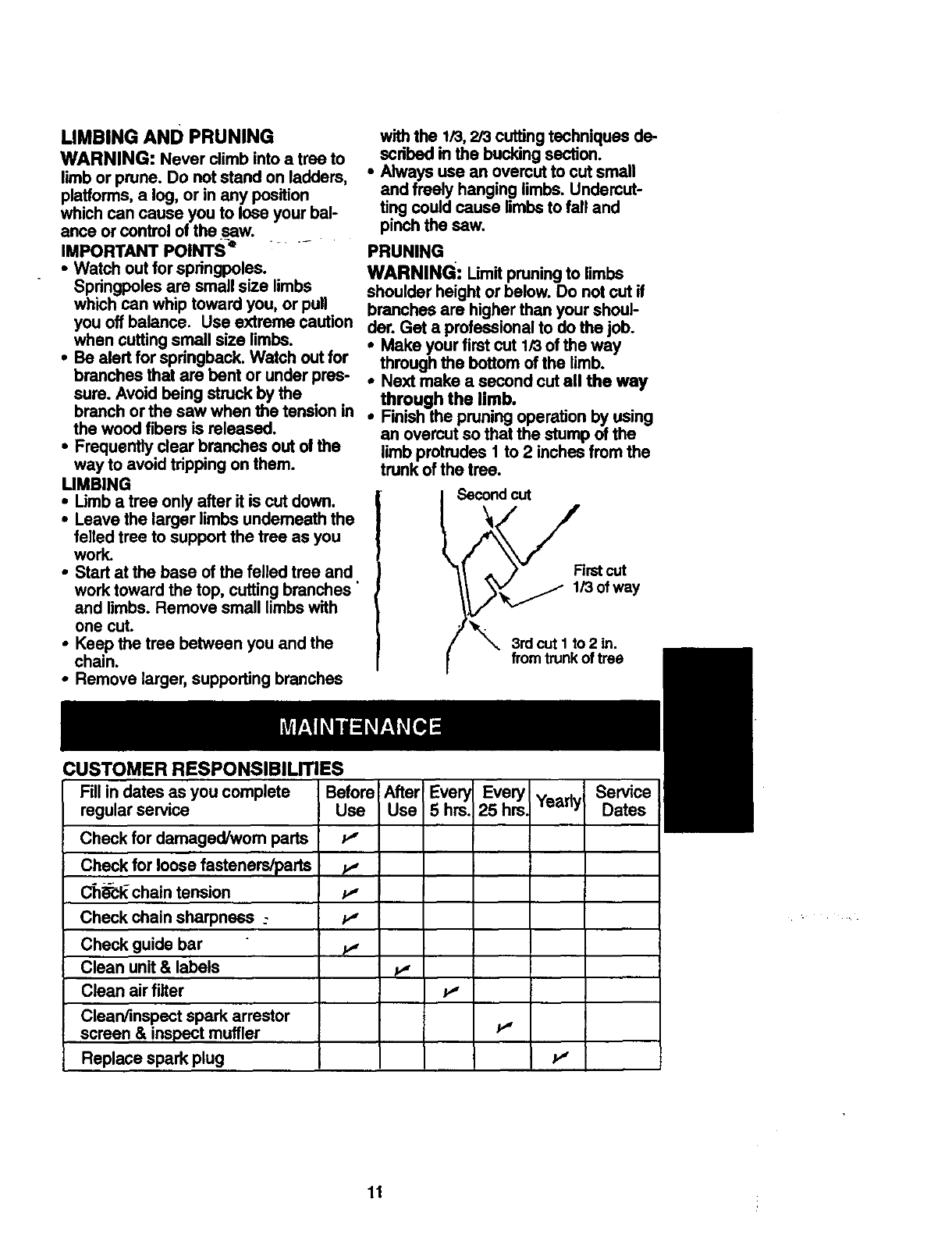
when cutting small size limbs. • Make your first cut 1/3 of the way
•Be alert for springback. Watch out for through the bottom of the limb.
branches that are bent or under pres- • Next make a second cut all the way
sure. Avoid being struck by the
branch or the saw when the tension in •
the wood fibers is released.
•Frequently clear branches out of the
way to avoid tdpping on them.
LIMBING
•Limb a tree only after it is cut down.
• Leave the larger limbs underneath the
felled tree to support the tree as you
work.
• Start at the base of the felled tree and
work toward the top, cutting branches'
and limbs. Remove small limbs with
one cut.
•Keep the tree between you and the
chain.
•Remove larger, supporting branches
through the limb.
Finish the pruning operation by using
an overcut so that the stump of the
limb protrudes 1 to 2 inches from the
trunk of the tree.
Second cut
First cut
1/3 of way
3rd cut 1 to2 in.
CUSTOMER RESPONSIBILITIES
Fill in dates as you complete
regular service
Check for damaged/worn parts
Check for loose fasteners/parts
Chi_l_ chain tension
Check chain sharpness :
Check guide bar
Clean unit & labels
Clean air filter
Clean/inspect spark arrestor
screen & inspect muffler
Replace spark plug
Every
25 hrs
y-
Service
Dates
11
GENERAL RECOMMENDATIONS
The warranty on this unit does not cov-
er items that have been subjected to
operatorabuse or negligence. To re-
ceive fullvalue from the warranty,the
operator must maintain unit as instruct-
ed inthis manual. _arious adjustments
will need to be made periodically to
properlymaintain your unit.
• Once ayear, replace the spark plug,
air filterelement, and check guide bar
and chain for wear. A new spark plug
and air filter element assures proper
air-fuel mixture and helps your engine
run better and last longer.
WARNING: Disconnect the spark plug
before performing maintenance except
for carburetor adjustments.
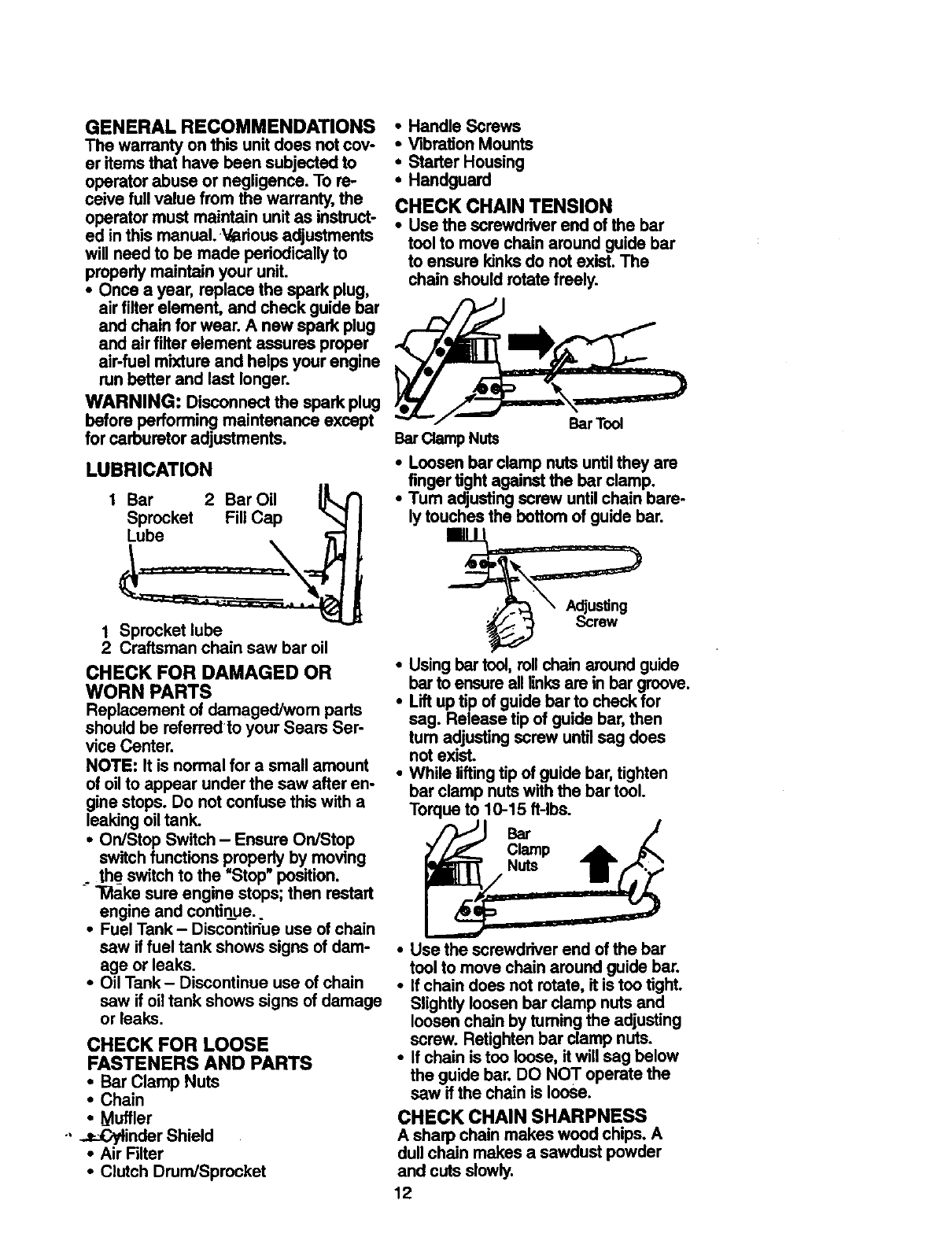
LUBRICATION
II _
1 Bar 2 Bar Oil
Sprocket FillCap _
Lube . _ f
1 Sprocket lube
2 Craftsman chain saw bar oil
CHECK FOR DAMAGED OR
WORN PARTS
Replacement of damaged/wom parts
shouldbe referred to your Sears Ser-
vice Center.
NOTE: It is normal for a small amount
of oilto appear under the saw after en-
gine stops. Do notconfuse thiswith a
leakingoiltank.
•On/Stop Switch - Ensure On/Stop
switchfunctions properly by moving
.the switch to the "Stop"position.
" "Make sure engine stops;then restart
engine and continue.
•Fuel Tank - Discontidue use of chain
saw if fuel tank shows signs of dam-
age or leaks.
•Oil Tank - Discontinue use of chain
saw if oiltank shows signs of damage
or leaks.
CHECK FOR LOOSE
FASTENERS AND PARTS
•Bar Clamp Nuts
•Chain
•Muffler
-, .._Cylinder Shield
•Air Filter
•Clutch Drum/Sprocket
• Handle Screws
•VibrationMounts
•Starter Housing
• Handguard
CHECK CHAIN TENSION
•Use the screwdriver end of the bar
tool to move chain around guide bar
to ensure kinks do not exist.The
chain should rotatefreely.
BarClampNuts
•Loosen bar clamp nuts untilthey are
fingertight againstthe bar clamp.
•Turn adjustingscrew untilchain bare-
ly touchesthe bottom of guidebar.
_ _'_r_n_
•Using bartool,rollchainaroundguide
bar to ensureall linksare in bargroove.
•Lift up tip of guide bar to check for
sag. Release tip of guide bar, then
rum adjustingscrew untilsag does
notexist.
• While liftingtip ofguide bar, tighten
bar clamp nuts withthe bar tool.
Torque to 10-15 ft-lbs.
•Use the screwdriver end of the bar
tool to move chain around guide bar.
•If chain does not rotate, it is too tight.
Slightly loosen bar clamp nuts and
loosen chain by turning the adjusting
screw. Retightan bar clamp nuts.
•If chain is too loose, it will sag below
the guide bar. DO NOT operate the
saw if the chain is loose.
CHECK CHAIN SHARPNESS
A sharp chain makes wood chips. A
dull chain makes a sawdust powder
and cuts slowly.
12
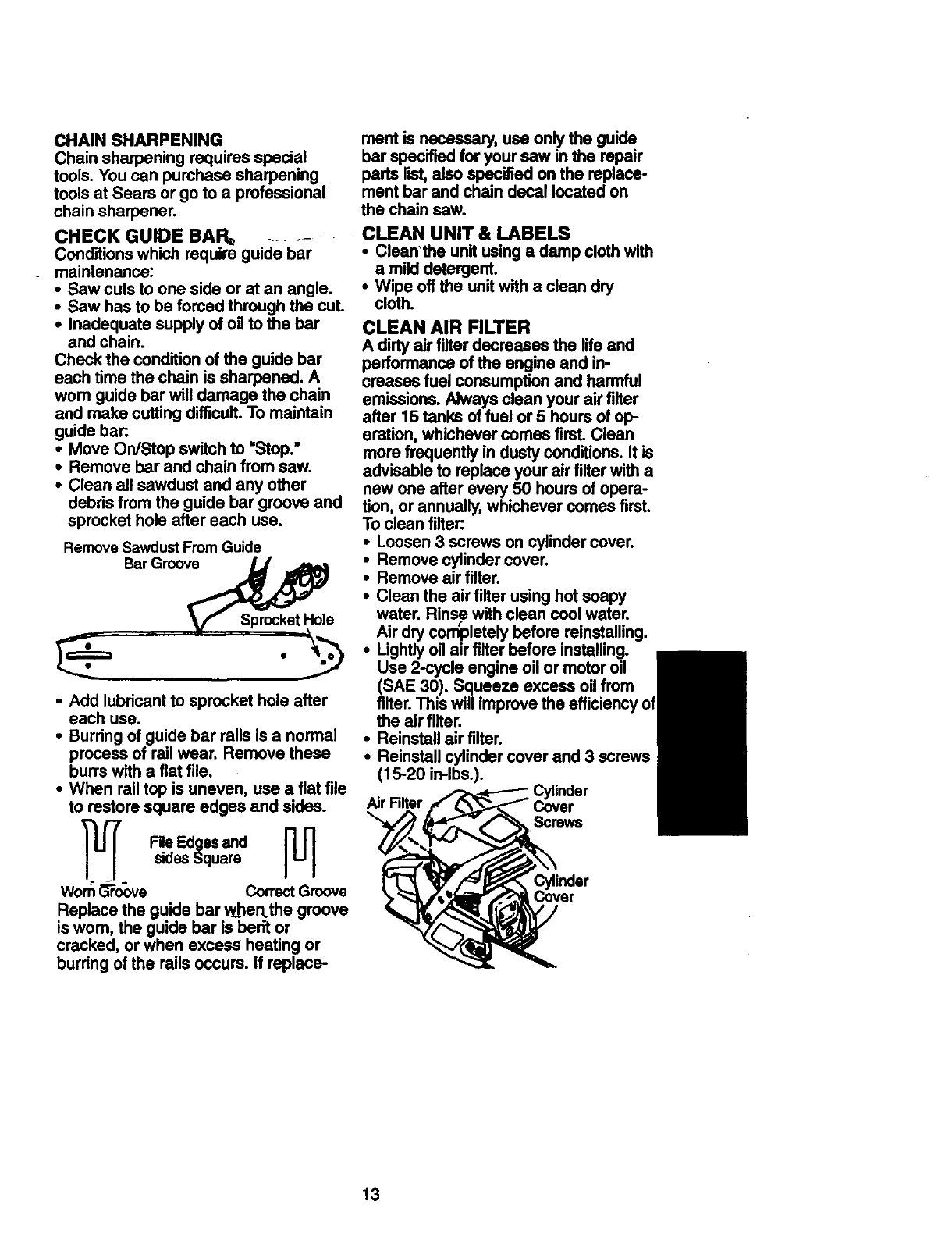
CHAINSHARPENING
Chainsharpeningrequiresspecial
tools.Youcanpurchasesharpening
toolsat Searsor goto a professional
chainsharpener.
CHECK GUIDE BAR_ .......
Conditions which require guide bar
maintenance:
• Saw cuts to one side or at an angle.
•Saw has to be forced through the cut.
• Inadequate supply of oil to the bar
and chain.
Check the condition of the guide bar
each time the chain is sharpened. A
wom guide bar will damage the chain
and make cuffing difficult. To maintain
guide bar:.
•Move On/Stop switch to =Stop."
• Remove bar and chain from saw.
•Clean all sawdust and any other
debris from the guide bar groove and
sprocket hole after each use.
Remove Sawdust From Guide
Bar Groov_
•Add lubricant to sprocket hole after
each use.
•Burring of guide bar rails is a normal
process of rail wear. Remove these
burrs with a fiat file.
•When rail top is uneven, use a fiat file
to restore square edges and sides.
File Edges and
sidesSquare
Worn G-roove Correct Groove
Replace the guide bar w_hen.the groove
is wom, the guide bar is berit or
cracked, or when excess- heating or
burring of the rails occurs• If replace-
ment is necessary, use only the guide
bar specif'md for your saw in the repair
pads list, also specified on the replace-
ment bar and chain decal located on
the chain saw.
CLEAN UNIT & LABELS
•Clean'the unit using a damp cloth with
a mild detergent.
•Wipe off the unit with a clean dry
cloth.
CLEAN AIR FILTER
A dirty air filter decreases the life and
performance of the engine and in-
creases fuel consumption and harmful
emissions. Always clean your air filter
after 15 tanks of fuel or 5 hours of op-
eration, whichever comes first. Clean
more frequently in dusty conditions. It is
advisable to replace your air filter with a
new one after every 50 hours of opera-
tion, or annually, whichever comes firsL
To clean filter:.
•Loosen 3 screws on cylinder cover.
•Remove cylinder cover.
•Remove air filter.
•Clean the air filter using hot soapy
water. Rinse with clean cool water.
Air dry completely before remstalhng.
•Lightly oil air filter before installing.
Use 2-cycle engine oil or motor oil
(SAE 30). Squeeze excess oil from
filter."
the air filter.
•Reinstall air filter•
•Reinstall cylinder cover and 3screws
(15-20 in-lbs.).
Air Filter Cover
Screws
13
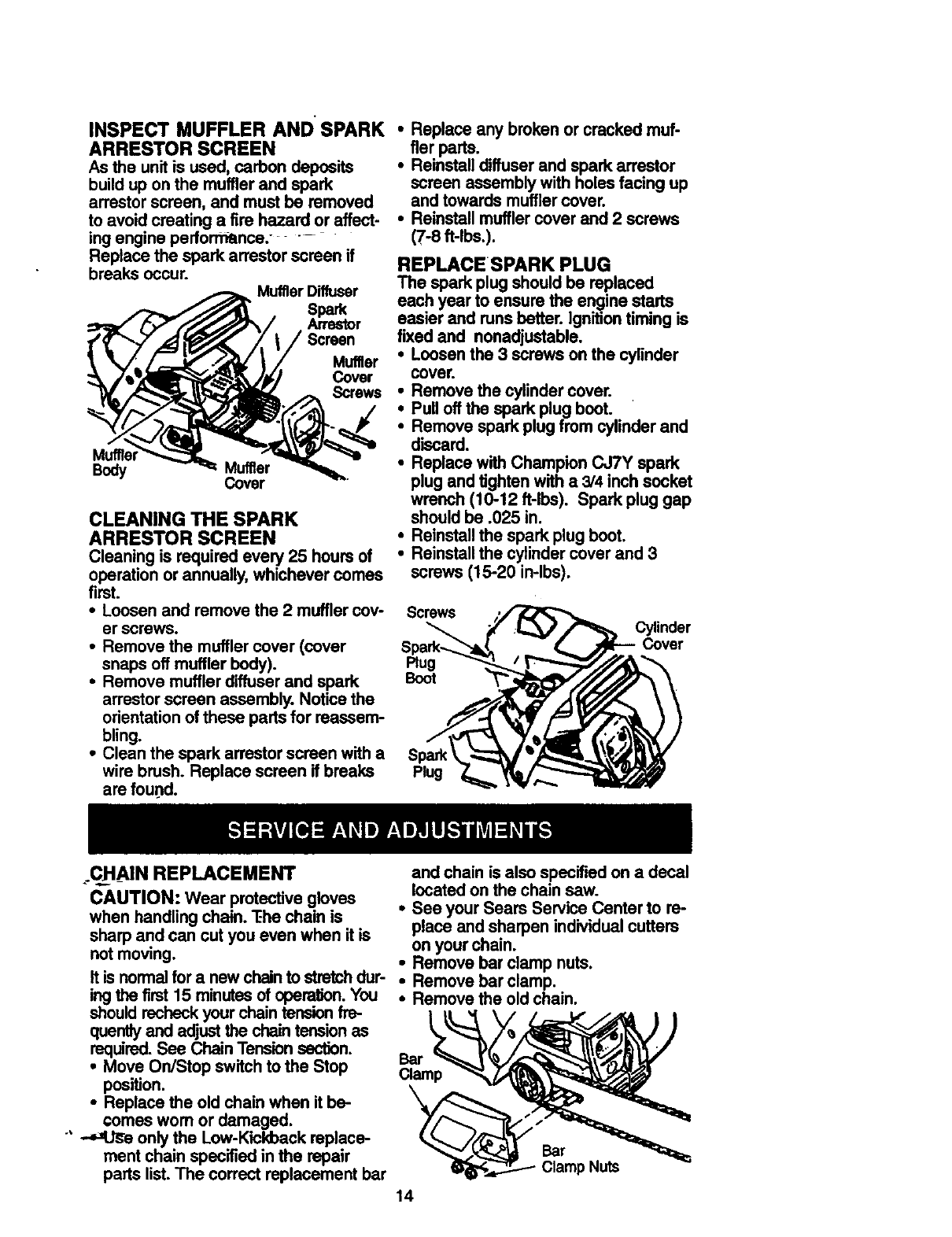
INSPECT MUFFLER AND SPARK • Replaceany broken or cracked muf-
ARRESTOR SCREEN
As the unit is used, carbon deposits
build up on the muffler and spark
arrestor screen, and must be removed
to avoid creating a fire hazard or affect-
ing engine performance. ....
Replace the spark arrestor screen if
breaks occur. Muffler Diffuser
Muffler
Cover
Screws
Body Muffler
Cover
CLEANING THE SPARK
ARRESTOR SCREEN
Cleaning is required evew 25 hoursof
operation or annually, whichever comes
first.
•Loosenand remove the 2 mufflercov- Screws
er screws.
• Remove the mufflercover (cover
snaps offmuffler body). Plug
•Remove mufflerdiffuserand spark Boot
arrestorscreen assembly. Noticethe
orientationofthese pads for reassem-
bling.
•Clean the spark arrestorscreen with a Spark
wire brush. Replace screen if breaks Plug
are found.
fler parts.
•Reinstall diffuser and spark arrestor
screen assembly with holes facing up
and towards muffler cover.
•Reinstall muffler cover and 2 screws
(-/-8 ft-lbs.).
REPLACE SPARK PLUG
The spark plug shouldbe replaced
each year to ensure the engine starts
easier and runsbetter. Ignitiontiming is
fixed and nonadjustable.
•Loosenthe 3 screws on the cylinder
cover.
•Remove the cylinder cover.
•Pull offthe spark plug boot.
•Remove spark plugfrom cylinder and
discard.
•Replace with Champion CJ7Y spark
plug and tightenwith a 3/4 inch socket
wrench (10-12 ft-lbs). Spark plug gap
shouldbe .025 in.
•Reinstallthe spark plug boot.
•Reinstallthe cylindercover and 3
screws (15-20 in-lbs).
Cylinder
.CH_AIN REPLACEMENT
CAUTION: Wear protective gloves
when handling chain. "l_hechain is
sharp and can cut you even when it is
not moving.
It is normal for a new chain to stretch dur-
ing the first 15 minutes of oparation. You
should recheck your chain tension fre-
quenify and adjust the chain tension as
required. See Chain Tension section.
•Move On/Stop switch to the Stop
position.
•Replace the old chain when it be-
comes worn or damaged.
"--_U_e only the Low-Kickback replace-
ment chain specified in the repair
parts list. The correct replacement bar
and chain is also specified on a decal
located on the chain saw.
•See your Sears Service Center to re-
place and sharpen individualcutters
on yourchain.
•Remove bar clamp nuts.
•Remove bar clamp.
•Remove the old chain.
Bar
Clamp
14
Bar
Clamp Nuts
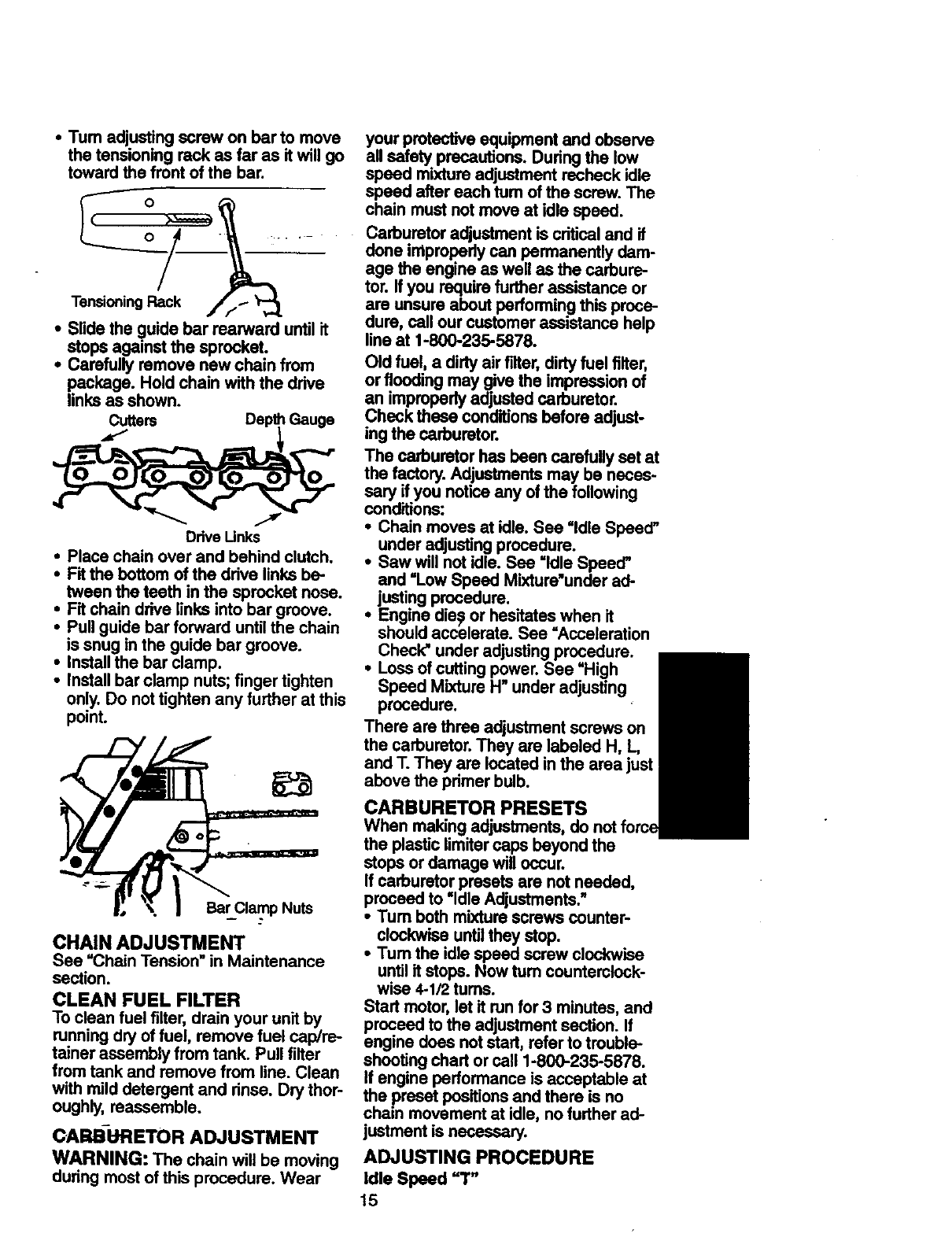
•Tum adjusting screw on bar to move
the tensioning rack as far as it will go
toward the front of the bar.
(_'-0 _.-
Tensioning Rack /
•Slide the guide bar rearward until it
stops against the sprocket.
•Carefully remove new chain from
package. Hold chain with the drive
links as shown.
Cutters Dep_ Gauge
Drive Links
•Place chain over and behind clutch.
•Fit the bottom of the drive links be-
tween the teeth in the sprocket nose.
•Fit chain drive links into bar groove.
•Pull guide bar forward until the chain
is snug in the guide bar groove.
•Install the bar clamp.
• Install bar clamp nuts; finger tighten
only. Do not tighten any further at this
point.
Bar Clamp Nuts
2
CHAIN ADJUSTMENT
See "Chain Tension" in Maintenance
section.
CLEAN FUEL FILTER
To clean fuel filter, drain your unit by
running dry of fuel, remove fuel cap/re-
tainer assembly from tank. Pull filter
from tank end remove from line. Clean
with mild detergent and rinse. Dry thor-
oughly, reassemble.
CARB-BRETOR ADJUSTMENT
WARNING: Thechainwillbe moving
during most of this procedure. Wear
yourprotsctiveequipment and observe
all safety precautions.Dudng the low
speed mixtureadjustment recheck idle
speed after each turn of the screw. The
chain must notmove at idle speed.
Carburetoradjustment is cdtical and if
done impropedycan permanently dam-
age the engine as well as the carbure-
tor. If you require furtherassistance or
are unsure about performing this proce-
dure, call our customer assistance help
line at 1-800-235-5878.
Old fuel, a dirtyair filter,dirtyfuel filter,
or floodingmay give the impression of
an improperlyadjusted carburetor.
Check these conditionsbefore adjust-
Ing the carburetor.
The carburetorhas been carefully set at
the factory. Adjustmentsmay be neces-
sary if you noticeany ofthe following
conditions:
•Chain moves at idle. See =IdleSpeed"
under adjustingprocedure.
•Saw will not idle. See =IdleSpeed"
and "Low Speed Mixture'under ad-
justing procedure.
•Engine die._or hesitates when it
shouldaccelerate. See =Acceleration
ChecW'under adjustingprocedure.
•Lose of cutting power. See =High
Speed Mixture H" under adjusting
procedure.
There are three adjustment screws on
the carburetor.They are labeled H, L,
and T. They are located in the area just
above the pdmer bulb.
CARBURETOR PRESETS
When making adjustments,
the plasticlimitercaps beyond the
stops or damage will occur.
If carburetor presets are notneeded,
proceed to "Idle Adjustments."
•Turn both mixture screws counter-
clockwise untilthey stop.
•Turn the idle speed screw clockwise
untilit stops.Now turn countemlock-
wise 4-1/2turns.
Start motor,let it run for 3 minutes, and
proceed to the adjustment section. If
engine does notstart, refer to trouble-
shootingchart or call 1-800-235-5878.
If engine performance is acceptable at
the preset positionsand there is no
chain movement at idle, no further ad-
justment is necessary.
ADJUSTING PROCEDURE
Idle Speed "T"
15
Allowengineto idle.Adjustspeeduntil
enginerunswithoutchainmovementor
stalling.
•Tum clockwise to increase engine
speed if engine stalls or dies.
°Tum counterclockwise to decrease
speed. _ ......
No furtheradjustmentsare necessary if
chain does not move atidlespeed and
ifperformance issatisfactory.
Low Speed Mixture "L"
Allow engine to idle. Then accelerate
the engine and note performance. If en-
gine hesitates, bogs down, or smokes
during acceleration, turn mixture screw
clockwise in 1/16-turn increments until
performance is satisfactory. Repeat this
procedure as necessary for proper ad-
justment. After completing adjustments,
check for acceleration and chain move-
ment at idle. Reset if necessary.
High Speed Mixture "H"
DO NOT operate engine at full throttle
for prolonged pedods while making ad-
justments. Damage to the engine can
occur. Make a test cut. Based on per-
formance ofthe sew while cutting,ad-
just the highspeed mixturesetting in
1/16-turnincrementsas follows:
•Clockwise untilthe sew has good
power in the cutwith no hesitation.
Do not adjustby sound or speed, but
judge by how well the saw performs in
the cut.
• Counterclockwiseif the saw has
speed, but dies in the cut or lacks
powerin the cut.
After completingadjustments, check for
acceleration and chain movement at
idle. Reset if necessary.
Acceleration Check
If the engine dies or hesitates instead of
accelerating,tum the low speed mixture
adjustmentcountemlock'wise untilyou
have smoothacceleration with no chain
movement at idle. Recheck and adjust
as necessary for acceptable perfor-
mance.
Prepare your unit for storage at the end
ofthe season or if itwill not be used for
30 days or more.
WARNING:
•Allowthe engine to cool, and secure
the unit before stodng or transporting.
• Store chain saw and fuel in a well
ventilated area where fuel vapors
cannot reach sparks or open flames
from water heaters, electric motors or
switches, fumacas, etc.
•Store chain sew with all guards in
place and positionchain saw so that
-.anysharp object cannot accidentally
cause injury.
•Store chain saw well.out of the reach
ofchildren.
EXTERNAL SURFACES
If your chain sew is to be stored for a
period of time, clean it thoroughly be-
fore storage. Store in a clean dry area.
•Lightly oil external metal surfaces and
guide bar.
•Oil the chain and wrap it in heavy pa-
per or cloth.
'-FUEL SYSTEM
Under Fueling Engine in the Operating
Section of this manual, see message
labeled IMPORTANTregardingthe use
of gasohol in your chain saw.
Fuel stabilizer is an acceptable alterna-
tive in minimizingthe formation offuel
gum depositsduring storage. Add stabi-
lizer to the gasoline in the fuel tank or
fuel storage container.Followthe mix
instructionsfound on stabilizer contain-
ers. Run engine at least 5 minutes after
adding stabilizer.
CRAFTSMAN 40:1, 2-cycle engine oil
(air cooled)is especiallyblended with
fuel stabilizer. If you do not use this
Sears oil,you can add afuel stabilizer
to your fuel tank.
INTERNAL ENGINE
•Remove spark plug and pour I tea-
spoon of 40:1, 2-cycle engine oil (air
cooled) through the spark plug open-
ing. Slowly pull the starter rope 8 to
10 times to distribute oil.
•Replace spark plug with new one of
recommended type and heat range.
•Clean air filter.
•Check entire unit for loose screws,
nuts, and bolts. Replace any dam-
aged, broken, or worn parts.
•At the beginning of the next season,
use only fresh fuel having the proper
gasoline to oil ratio.
16
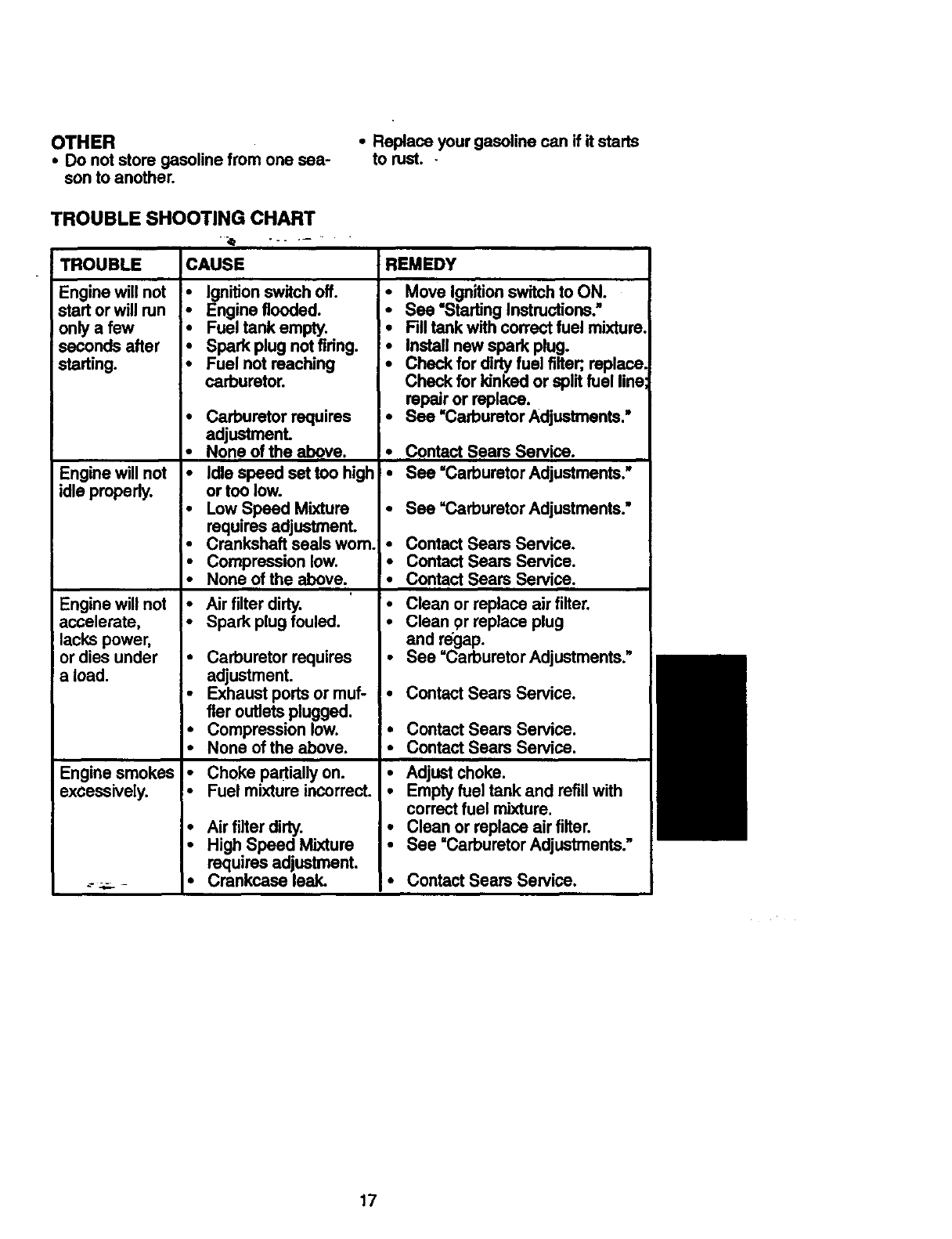
OTHER • Replace your gasoline can if it starts
• Do not store gasoline from one sea- to rust..
son to another.
TROUBLESHOOTING CHART
TROUBLE CAUSE REMEDY
Engine will not
start or will run
only a few
seconds after
starting.
Engine will not
idle properly.
•Ignitionswitch off.
• Engine flooded.
•Fuel tank empty.
•Spark plug notfiring.
• Fuel not reaching
carburetor.
Engine will not
accelerate,
lacks power,
or dies under
a load.
•Carburetor requires
adjustmenL
•None of the above.
• Idle speed set too high
or too low.
•Low Speed Mixture
requires adjustment.
• Crankshaft seals worn.
•Compression low.
•None of the above.
•Air filter dirty.
•Spark plug fouled.
•Carburetor requires
adjustment.
•Exhaust ports or muf-
fler outletsplugged.
•Compression low.
•None of the above.
Enginesmokes •
excessively. •
•Move Ignition switch to ON.
•See "Starting Instructions."
•Fill tank with correct fuel mixture,
•Install new spark plug.
•Check for dirty fuel filter;, replace
Check for kinked or split fuel line;
repair or replace.
• See •Carburetor Adjustments."
•Contact Sears Service.
•See "CarburetorAdjustments."
•See =Carburetor Adjustments. •
•Contact Sears Service.
•Contact Sears Service.
•Contact Sears Service.
•Clean or replace air filter.
• Clean or replace plug
and regap.
•See "Carburetor Adjustments?
•Contact Sears Service.
• Contact Sears Service.
•Contact Sears Service.
Choke pa[tiallyon. •
Fuel mixture incorrect. •
•Airfilter dirty.
•High Speed Mixture •
requiresadjustment.
•Crankcase leak. •
Adjustchoke.
Empty fuel tank and refillwith
correctfuel mixture.
Clean or replace air filter.
See "CarburetorAdjustments."
Contact Sears Service.
17
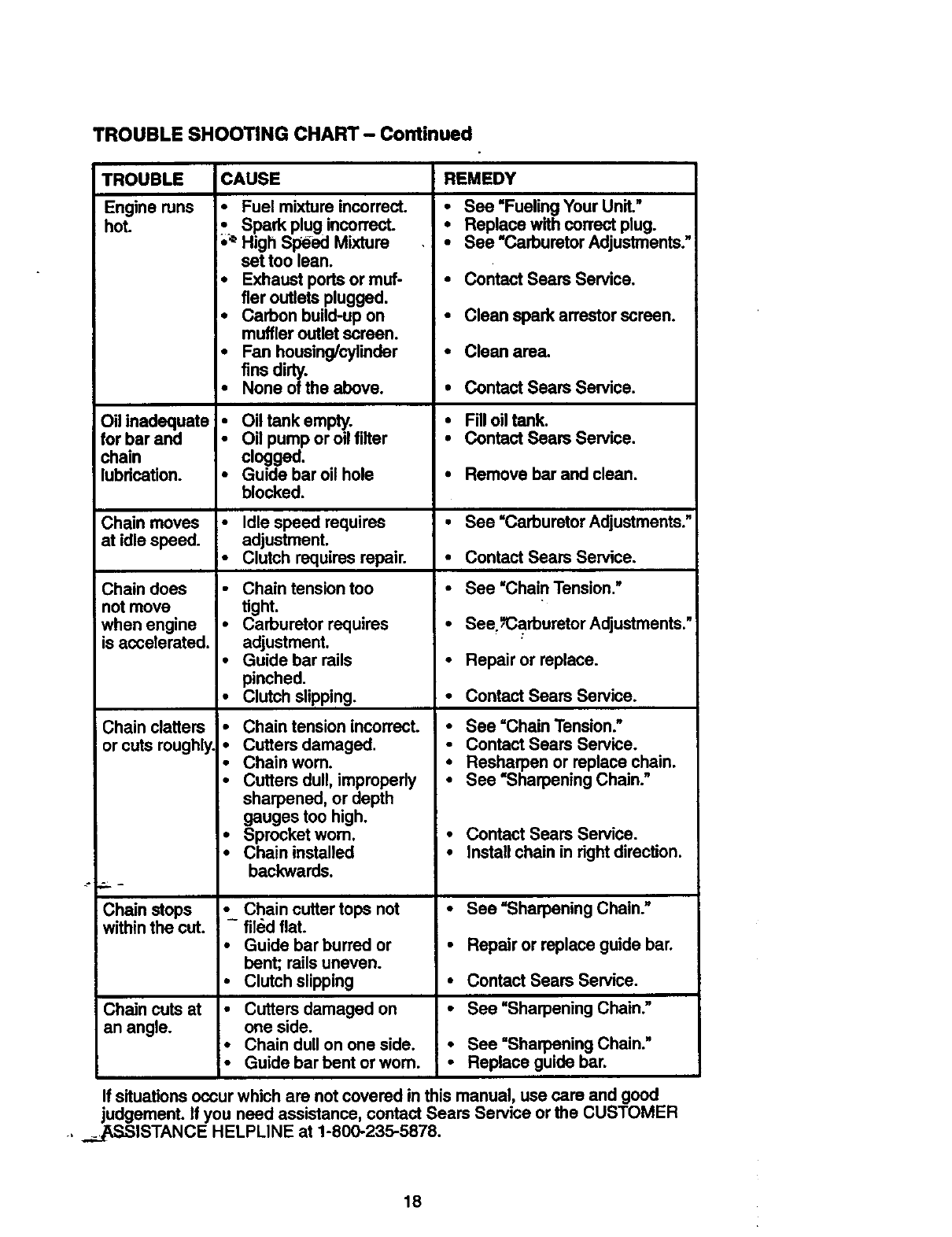
TROUBLE SHOOTING CHART - Continued
TROUBLE
Engine runs
hot.
Oil inadequate
for bar and
chain
lubrication.
Chain moves
at idle speed.
Chain does
not move
iwhen engine
Is accelerated.
Chain clatters
or cuts roughly,
Chain stops
within the cut.
Chain cuts at
an angle.
CAUSE
•Fuel mixture incorrect.
_, Spark plug incorrect.
o4 High spe-ed Mixture
set too lean.
•Exhaust ports or muf-
fler outlets plugged.
•Carbon build-up on
muffler outlet screen.
•Fan housing/cylinder
fins dirty.
•None of the above.
•Oil tank empty.
•Oil pump or oil filter
clogged.
•Guide bar oil hole
blocked.
•Idle speed requires
adjustment.
•Clutch requires repair.
•Chain tension too
tight.
•Carburetor requires
adjustment.
•Guide bar rails
pinched.
•Clutch slipping.
•Chain tension incorrect.
•Cutters damaged.
•Chain wom.
•Cutters dull, improperly
sharpened, or depth
gauges too high.
•Sprocket worn.
•Chain installed
backwards.
•Chain cuttertops not
- fil_d flat.
•Guide bar burred or
bent; rails uneven.
•Clutch slipping
•Cutters damaged on
one side.
• Chain dull on one side.
•Guide bar bent or wom.
REMEDY
•See "Fueling Your Unit."
•Replace with correct plug.
•See "Carburetor Adjustments."
•Contact Sears Service.
•Clean spark arrestor screen.
•Clean area.
•Contact Sears Service.
•Fill oil tank.
•Contact Sears Service.
•Remove bar and clean.
•See "Carburetor Adjustments."
•Contact Sears Service.
•See "Chain Tension."
•See!_Carburetor Adjustments."
•Repair or replace.
•Contact Sears Service.
•See =Chain Tension."
•Contact Sears Service.
•Resharpen or replace chain.
•See "Sharpening Chain."
•Contact Sears Service.
•Install chain in fightdirection.
• See "Sharpening Chain."
•Repair or replace guide bar.
•Contact Sears Service.
•See "Sharpening Chain."
• See "Sharpening Chain."
•Replace guide bar.
If situations occur which are not covered in this manual, use cars and good
judgement. If you need assistance, contact Sears Service or the CUSTOMER
,__=SISTANCE HELPLINE at 1-800-235-5878.
18
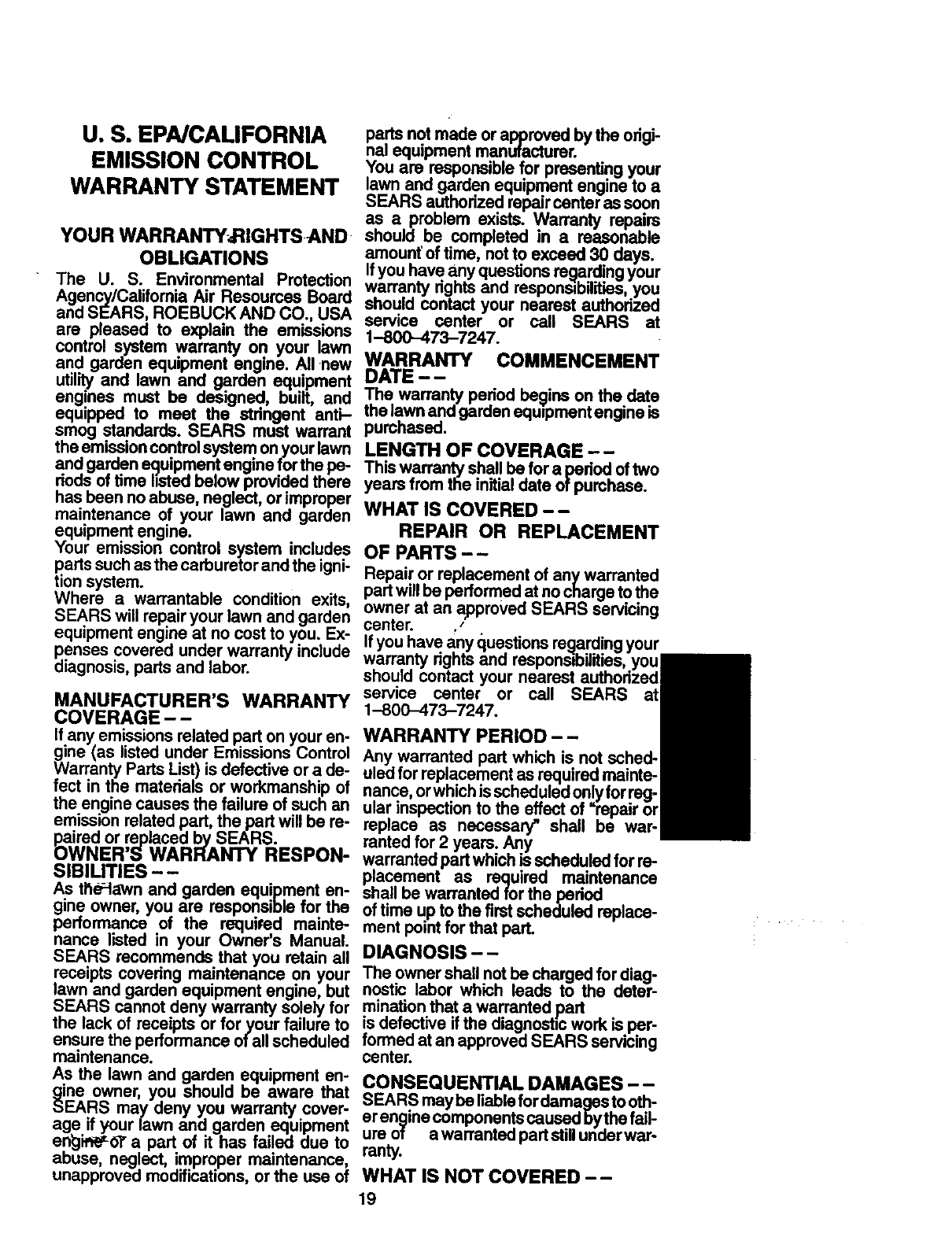
U. S. EPA/CALIFORNIA parts not made or approved by the origi-
naJ equipment manutacturer.
EMISSION CONTROL You are responsible for presenting your
WARRANTY STATEMENT lawn and garden equipment engine to a
SEARS authorized repair center as soon
as a problem exists. Warranty repairs
YOUR WARRANTY, RIGHTS AND snould be completed in a reasonable
OBLIGATIONS amount' of time, not to exceed 30 days.
The U. S. Environmental Protection
Agency/Califomia Air Resources Board
and SEARS, ROEBUCK AND CO., USA
are pleased to explain the emissions
control system warranty on your lawn
ano garden equipment engine. All new
utility and lawn and garden equipment
engines must be designed, built, and
equipped to meet the stringent anti-
Ifyou have any questions re_lard!ng your
warranty rightsand responsJbditias,you
should contact your nearest authorized
service center or call SEARS at
1-800-473-7247.
WARRANTY COMMENCEMENT
DATE - -
The warranty period begins on the date
the lawnand garden equipmentengine is
smog standards. SEARS must warrant purchased.
the emissioncontrolsystem onyourlawn LENGTH OF COVERAGE --
and garden ec.].uipmentengine forthe pe- Thiswarranty shallhe for a pedod of two
riods oftime listedbelow provided there years from the initialdate of purchase.
has been no abuse, neglect, or improper
maintenance of your lawn and garden WHAT IS COVERED --
equipment engine. REPAIR OR REPLACEMENT
Your emission control system includes
parts such as the carburetor and the igni-
tion system.
Where awarrantable condition exits,
SEARS will repair your lawn and garden
equipment engine at no cost to you. Ex-
penses covered under warranty include
diagnosis, parts and labor.
MANUFACTURER'S WARRANTY
COVERAGE - -
If any emissionsrelated part on your en-
gine (as listed under Emissions Control
Warranty Parts List) is defective or a de-
fect in the materials or workmanship of
the engine causes the failure of such an
emission relatedpart, the part will be re-
paired or replaced by SEARS.
OWNER SWARRANTY RESPON-
SIBILITIES --
As the-lawn and garden equipment en-
gine owner, you are responsible for the
performance of the required mainte-
nance listed in your Owner's Manual.
SEARS recommends that you retain all
receipts covering maintenance on your
lawn and garden equipment engine, but
SEARS cannot deny warranty solely for
the lack of receipts or foryour failure to
ensure the performance of all scheduled
maintenance.
OF PARTS--
Repair or replacement of any warranted
partwillbe performed at no charge to the
owner at an approved SEARS servicing
center. .,
If youhave any questions r
warranty rightsand
should contact your nearest
service center or call SEARS at
1-800-473-7247.
WARRANTY PERIOD --
Any warranted part which is not sched-
uled for replacement, uired mainte-
nance, or which i.'
ular inspection to the effect of
replace as necessary" shall be war-
ranted for 2 years. Any
warranted part which is scheduled for re-
placement as required maintenance
shall be warranted for thepenod
of time up to the first scheduled replace-
ment point for that part.
DIAGNOSIS - -
The owner shall not be charged for diag-
nostic labor which leads to the deter-
mination that a warranted part
is defective if the diagnostic work is per-
rormed at an approved SEARS servicing
center.
As the lawn and garden equipment en- CONSEQUENTIAL DAMAGES - -
gine owner, you should be aware that SEARS may beliablefordamagestooth-
SEARS may deny you warranty cover- eren_linecomponentscausedbythefail-
age if your lawn and garden equipment ure ot awarranted partstill undarwar-
en_jit'te=0Ta part of it has failed due to ranty.
abuse, neglect, improper maintenance,
unapproved modifications, or the use of WHAT IS NOT COVERED -
19
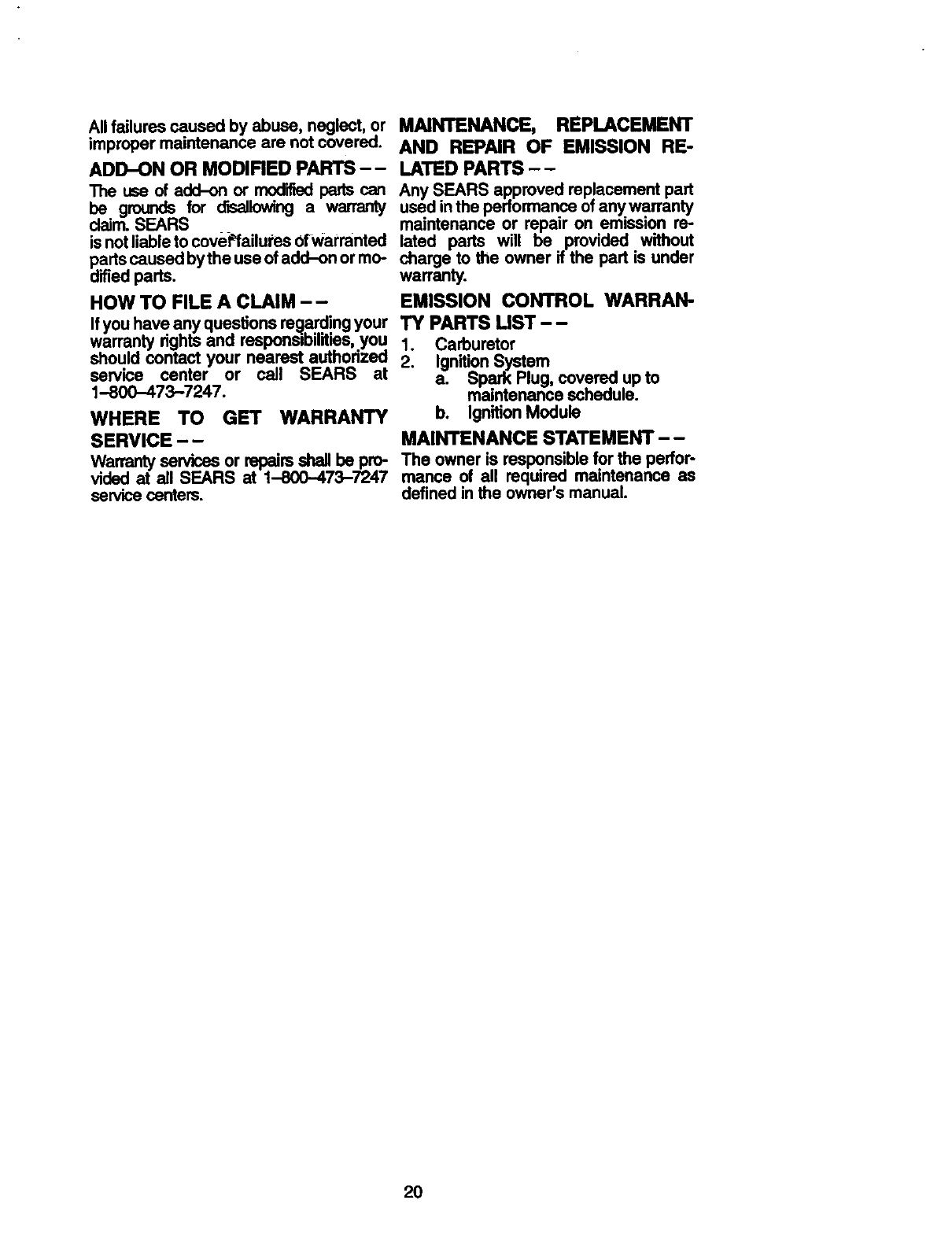
Allfailurescausedby abuse,neglect,or MAINTENANCE, REPLACEMENT
impropermaintenance are notcovered. AND REPAIR OF EMISSION RE-
ADD-ON OR MODIRED PARTS -- LATED PARTS - -
The use of add-on or mod_d partscan
be grounds for disallowing a warranty
claim.SEARS
isnot liableto covePfailures0f-warranted
partscaused bythe use of add-on ormo-
difiedparts.
HOW TO FILE A CLAIM - -
If youhave any questions regardingyour
warranty rights and responsibilities,you
should contact your nearest authorized
service center or call SEARS at
1-800-473-7247.
WHERE TO GET WARRANTY
SERVICE - -
Any SEARS approved replacement part
used inthe performance of any warranty
maintenance or repair on emission re-
lated parts will be provided without
charge to the owner if the part is under
warranty.
EMISSION CONTROL WARRAN-
TY PARTS LIST--
1. Carburetor
2. IgnitionSystem
a. Spark Plug, covered up to
maintenance schedule.
b. IgnitionModule
MAINTENANCE STATEMENT--
Warrantyservicesor repairsshallbe pro- The owner is responsiblefor the perfor-
vided at all SEARS at 1-800-473-7247 mance of all required maintenance as
servicecenters, definedin the owner's manual.
2O
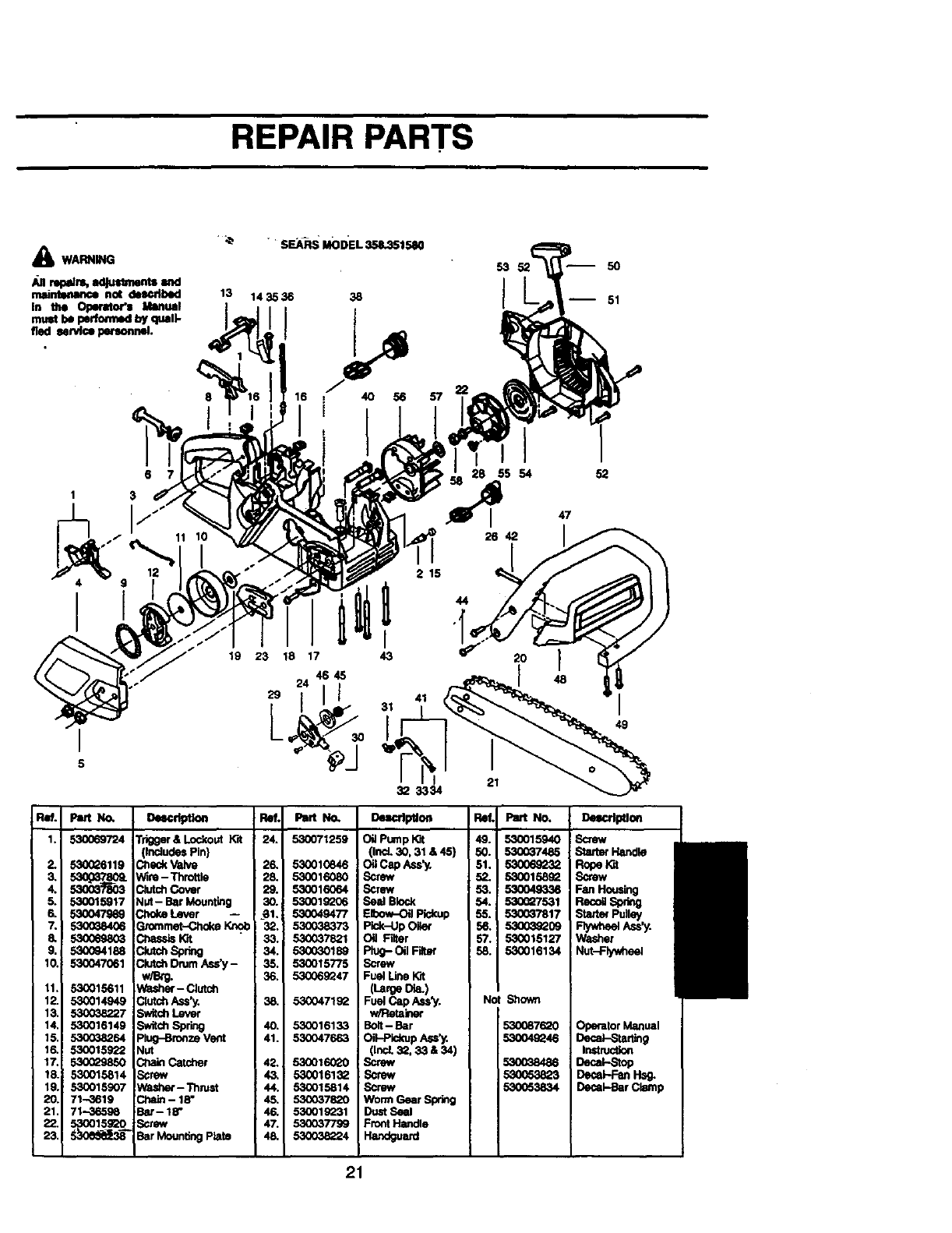
REPAIR PARTS
._ WARNING
6 7
13
i
28 55 54
2642
19 23 I
18 17 43
4645
2 15
44
2O
I
21
5O
51
52
47
I
I
49
2. 530_6119
3.
5. 530015917
6. 5_7_t0
7. _
8, 53OO69803
9, r_41B8
11. 530015611
12. 530014949
13. 5300_227
14. 530016149
15. 530038264
16. 530015922
17. 530_9850
18, 530015814
19. ; 530015907
20. 71-3619
21, 71-36596
22.
23. _
Trigger& Lo_out Kit 24. 530071259
(Indudes Pin}
Clleck Valve 26. 530010846
Wire - Throttle 28. 530016080
ClutchCover 29. 530016(_4
Nut- Bar Mount_g 30. 530019206
Choke Lever -- 61. 530049477
_ommet--ChOke _ 32. 530038373
ChassisKit 33. 530037821
CJu_Sprino 34. ,S300301_
ClutchDrumAss'y- 35. 530015775
W/Beg. 36. 53006gQ47
Washer- Clutch
Clutch Ass'y. 38. 5300471_
Sw_chI.ever
Switdl Spring 40. 53GO16133
plug-Bronze Vent 41. 530047663
Nut Catcher 42- 5300160_0
IScmw I43. 530016132
!V_sh_-'_rust : 44, 530015814
:C_in-18" ; 45, 530037820
Bat- 18" 46, 530019231
Screw 47. 530037799
Bar MountingPlate 48. 53003_24
Oil Pump Kit
0ne. 30, 31 &45)
o, Cap Ass_.
Saew
Screw
Seal Block
Eeoow-O_p_kup
Pick-Up Oiler
Oil Filter
Phi- OUF_r
Screw
Fuel LineKit
(LargeD_)
Fuel Cap ASS"/.
w/Retainer
Bolt-Bar
O,-Pk_upASS_/.
(IncL32, 33 &34)
,Screw
Screw
Screw
Worm Gear Sprig
Dust Seal
FrontHandle
Handguard
Rid. I_rt No.
49. 530015940
50. 5300374_
51. 53006_
52. 5300158_
53. 530048336
54. 5300Q7531
55. 5300_7817
56. 530_09
57. 530015127
58. 530016134
Not Shown
53OO87620
53004_46
53O038486
5300_
530_
Screw
StarterHandle
Rope I_t
Screw
Fan Housing
Reco_Spring
StarterPulley
_.
Washer
Nut-Flywheel
OperatorManual
De.-Starting
Instruction
Deca_._op
Deca_.-anH_
Dec_l-_r C_np
21
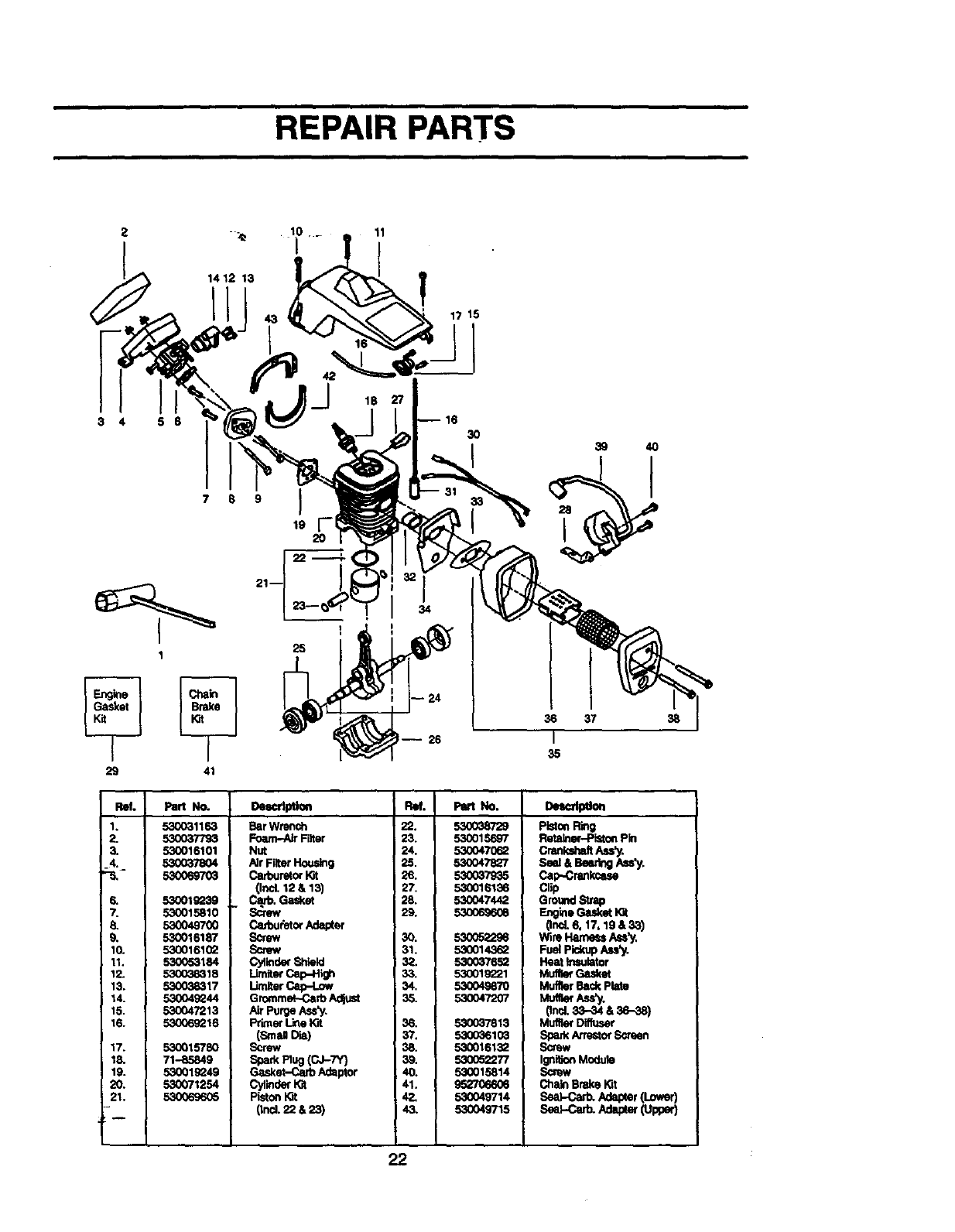
REPAIR PARTS
14 12 13
IL 17 15
3 4 5 8
8 9
18 27
39
29 41
25
34
36 37
I
35
Fief. Part No.
1. 530031163
2. 53(X)377_
3. 530016101
_4, 530037804
"5,- 530069703
53001gL_9
7. 530015810
8, 53OO497O0
9. 530016187
10. 530016102
11. 530053184
12. 530038318
13. 530038317
14. 53004g_44
15. 530047213
16. 530069216
17. 53O015780
18. 71-85849
19. 530019249
20. 530071254
21. 5300696_S
Dem-l_o.
_rWrench
Foarn-Ait Rlter
Nut
Air FilterHousing
CarburetorK_
(Ind, 12 & 13)
Air purgeAss'y.
PrimerUrmlot
(SmallD_,)
Sa'ew
SparkP_.g{cJ.--r_
C,ask_ Adaptor
C,_d_ K_
Piston_t
(Incl.22 & 23)
R_.
22.
23.
24.
25.
26.
27.
28.
29.
30.
31,
32.
33.
34.
35.
36.
37.
38.
39.
40.
41.
42,
43,
Part No.
530O38729
530015697
530047O62
530047827
53O037935
530016136
530O47442
53006_6_
53005,_g6
53OO14362
53003765_
53001_E_21
530O4987O
5300472O7
530037813
530036103
530016132
53OO52277
530015814
S52706606
530049714
530049715
De_lpUo.
pistonRing
Retainer-PistonPkt
Cranks_lt As=_
Cap-Cr_kcase
Clip
GroundStrap
_o Gasle_t_
Ond, 6, 17, 'n9& _}
Wire Harness Ass'y,
Fuel pickupAss'y.
Heat Insulator
MuftlerGasket
MulflerBack P_te
Mu_WAss_.
0r_._,._--34&3S-3S)
MufflerDilfuser
Spark/vrestor Screen
Screw
IgnitionModule
Screw
Ch_ Brake I_
Sea_3arb. Adaper (Lower)
See-C,lrb./Ueper (Upper)
22
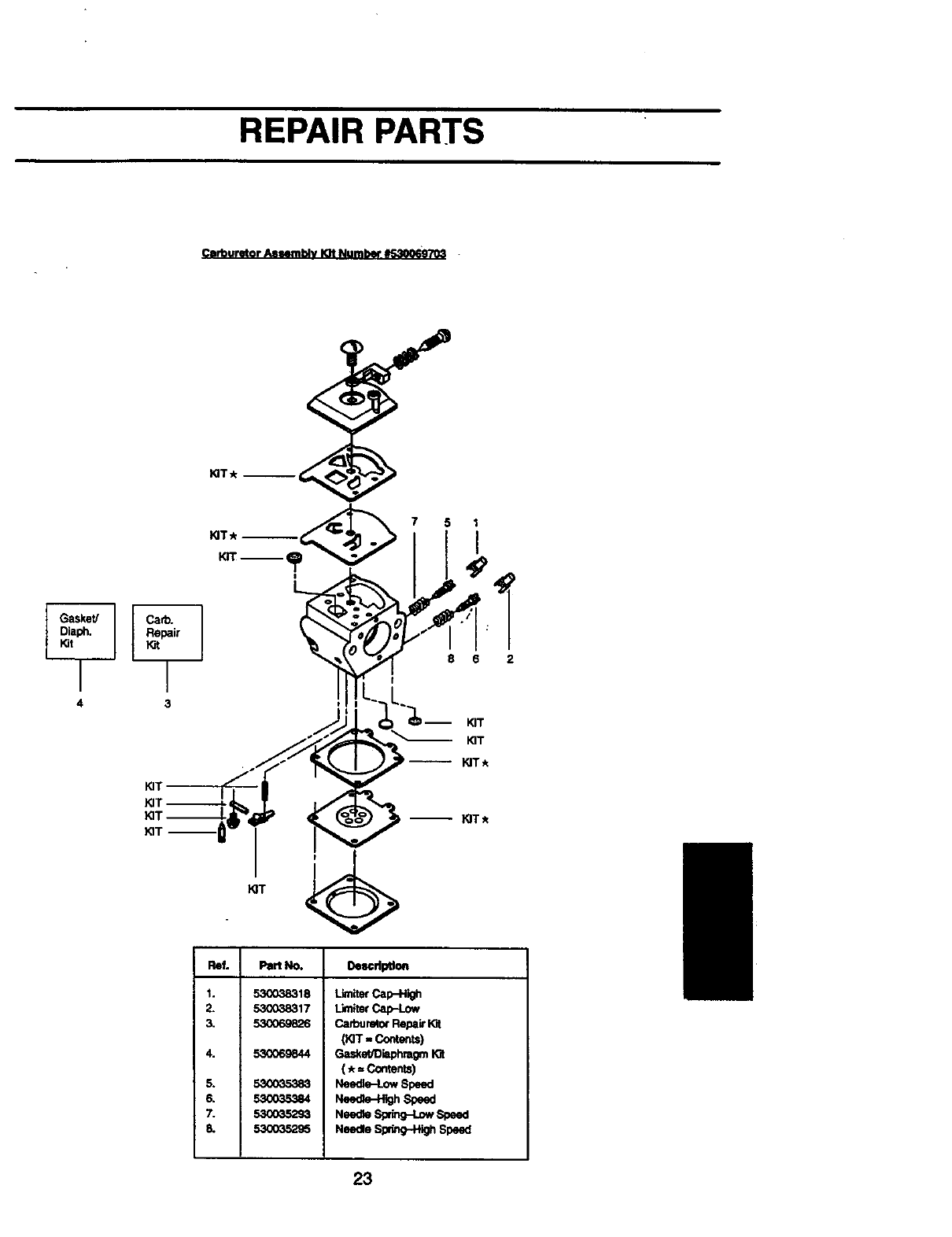
REPAIR PARTS
Carburetor Asmmblv Kit Number #S,30069"/_J .
KIT* --
Gasket/ Carb.
Diaph. Repair
Kit WJt
] ]
4 3
8 6 2
KIT
KIT
)-- KIT*
KIT
KI1
KIT--
KIT
Ref. Part No.
1. 530038318
2. 530038317
3. 53006g826
4. 53OO6,9644
5. 5300_5383
6. 53OO35384
7. 5300_5293
6. 5300352S5
UmberCap-H_h
LimiterCap-Low
Carbureto¢RepaY"_
(lOT ,, Contems)
Gasket/DiaphragmI_t
( * =,Contents)
Needle-Low Speed
Nee_,_,ghSpaed
NeedleSpdng-Low Speed
NeedleSW;ng,--HighSpeed
23
For the repair ff_replacement parts you need
delivered directly to your home
Call 7 am - 7 pm, 7 days a week
1-800-366-PART
(1-800-366-7278)
Para orden_r piezas con entrega a
domicilio -"1-800-659-7.084
For in-house major brand repair service
Call 24 hours a day, 7 days a week
1-800-4-REPAIR
(1-800-473-7247)
Para pedir servicio de reparaci6n a
domicilio - 1-800-676-5811
For the location of a Sears Parts and
Repair Center in your area
Call 24 hours a day, 7 days a week
1-800-488-1222
For information on purchasing a Sears
Maintenance Agreement or to inquire
about an existing Agreement
Call 9 am - 5 pm, Monday-Saturday
1-800-827-6655
When requesting service or ordering
parts, always provide the following
information:,
•Product Type • Part Number
•Model Number •Part Description
SEAR8
America's Repair Specialists
