Craftsman 358797560 User Manual BLOWER Manuals And Guides L0212106
CRAFTSMAN Blower, Gas Manual L0212106 CRAFTSMAN Blower, Gas Owner's Manual, CRAFTSMAN Blower, Gas installation guides
User Manual: Craftsman 358797560 358797560 CRAFTSMAN BLOWER - Manuals and Guides View the owners manual for your CRAFTSMAN BLOWER #358797560. Home:Lawn & Garden Parts:Craftsman Parts:Craftsman BLOWER Manual
Open the PDF directly: View PDF  .
.
Page Count: 29
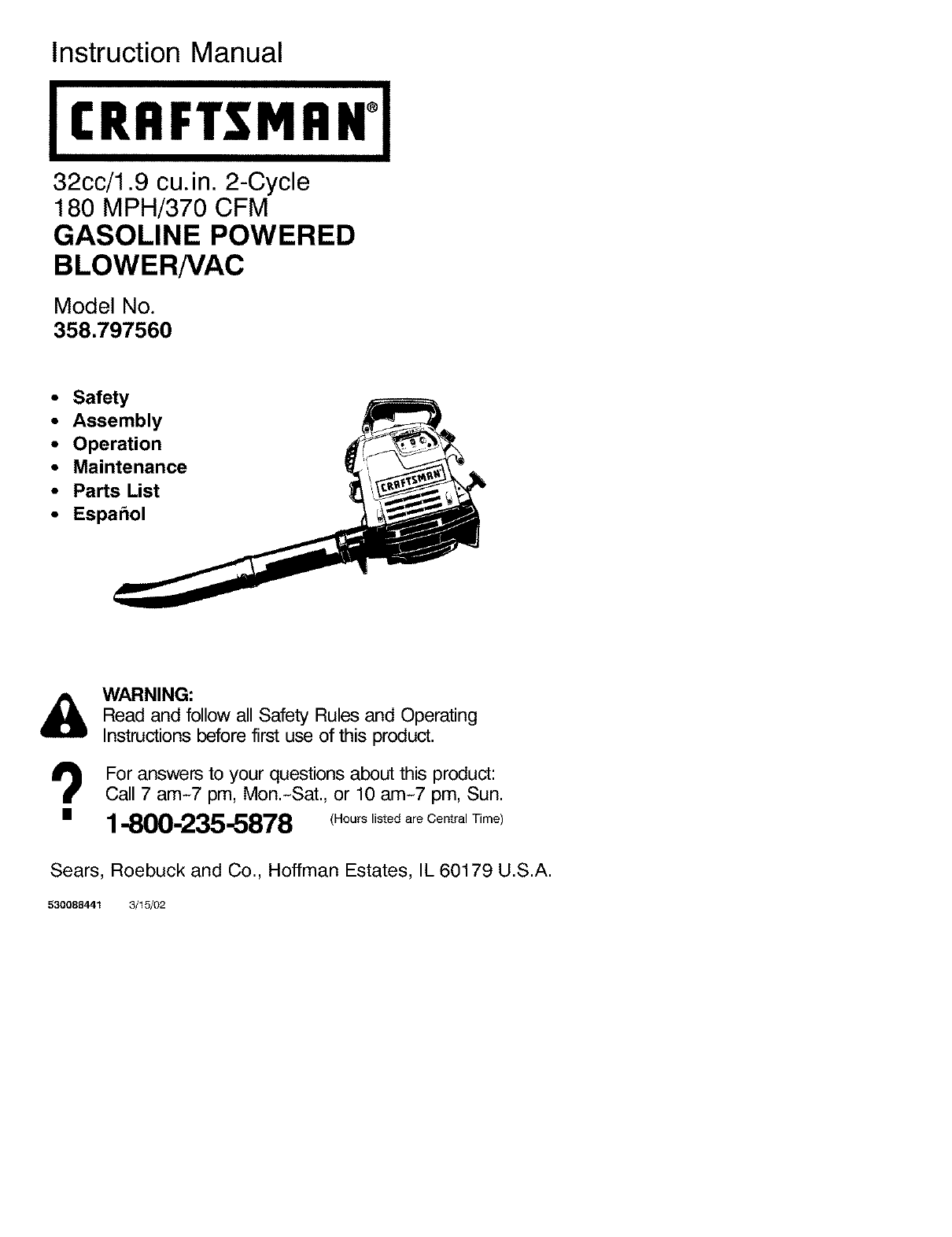
Instruction Manual
32cc/1.9 cu.in. 2-Cycle
180 MPH/370 CFM
GASOLINE POWERED
BLOWERNAC
Model No.
358.797560
•Safety
•Assembly
•Operation
•Maintenance
•Parts List
•Espahol
WARNING:
Read and follow all Safety Rules and Operating
Instructions before first use of this product.
For answers to your questions about this product:
Call 7 am-7 pm, Mon.-Sat., or 10 am-7 pm, Sun.
1-800-235-5878 {.ou,s listed are Central Time)
Sears, Roebuck and Co., Hoffman Estates, IL 60179 U.S.A.
530088441 3/15/02
Warranty Statement 2 Storage 11
Safety Rules 2 Troubleshooting Table 12
Assembly 4 Emissions Statement 13
Operation 6 Parts List 15
Maintenance 9 Spanish 18
Service & Adjustments 10 Parts and Ordering Back
FULL ONE YEAR WARRANTY ON CRAFTSMAN ®GAS BLOWER
For one (1) year from date of purchase, when this Gas Blower is maintained, lu-
bricated, and tuned up according to the instructions in this manual, Sears will re-
pair, free of charge, any defects in material or workmanship.
This warranty excludes blower tubes, spark plug, and air cleaner, which are ex-
pendable parts and become worn during normal use.
If this blower is used for commercial purposes, this warranty applies for 90 days from
the date of purchase. If this Blower is used for rental purposes, this warranty applies
for 30 days from the date of purchase. This warranty applies only while this product
is in use in the United States.
WARRANTY SERVICE IS AVAILABLE BY RETURNING THE BLOWER TO THE NEAREST
SEARS STORE OR SERVICE CENTER IN THE UNITED STATES.
This warranty gives you specific legal rights, and you may also have other rights
which vary from state to state.
Sears, Roebuck and Co., D/817WA, Hoffman Estates, IL 60179
_IkWARNING: Failure to follow all
Safety Rules and Precautions can re-
sult in serious injury.
KNOW YOUR UNIT
• Read your instruction manual care-
fully until you completely understand
and can follow all warnings and
safety rules before operating the unit.
•Restrict unit to users who under-
stand and will follow all warnings and
safety rules in this manual.
_IkWARNING: Inspect area before
starting unit. Remove all debris and
hard objects such as rocks, glass,
wire, etc. that can ricochet, be thrown,
or otherwise cause injury or damage
during operation.
Use your unit as a blower for:
• Sweeping debris or grass clippings
from driveways, sidewalks, patios, etc.
• Blowing grass clippings, straw, or
leaves into piles, around joints, or be-
tween bricks.
Use your unit as a vacuum for:
• Picking up dry material such as
leaves, grass, small twigs, and bits of
paper.
• For best results during vacuum use,
operate your unit at high speed.
• Move slowly back and forth over the
material as you vacuum. Avoid forc-
ing the unit into a pile of debris as
this can clog the unit.
• Keep the vacuum tube about an inch
above the ground for best results.
PLAN AHEAD
• Always wear eye protection when op-
erating, servicing, or performing main-
tenance on unit. Wearing eye protec-
tion will help to prevent rocks or debris
from being blown or ricocheting into
eyes and face which can result in
blindness and/or serious injury. Eye
protection should be marked Z87.
• Always wear foot protection. Do not
go barefoot or wear sandals.
• Always wear respirator or face mask
when working with unit in dusty envi-
ronments.
• Secure hair above shoulder length.
Secure or remove jewelry, loose
clothing, or clothing with loosely
hanging straps, ties, tassels, etc.
They can be caught in moving parts.
-2-
• Do not operate unit when you are
tired, ill, upset, or if you are under the
influence of alcohol, drugs, or medica-
tion.
• Keep children, bystanders, and ani-
mals away from work area a mini-
mum of 30 feet (10 meters) when
starting or operating unit. Do not
point the blower nozzle in the direc-
tion of people or pets.
HANDLE FUEL WITH CAUTION,
IT IS HIGHLY FLAMMABLE
• Eliminate all sources of sparks or
flame (including smoking, open
flames, or work that can cause sparks)
in the areas where fuel is mixed,
poured, or stored.
• Mix and pour fuel in an outdoor area;
store fuel in a cool, dry, well ventilated
place; use an approved, marked con-
tainer for all fuel purposes.
• Do not smoke while handling fuel or
while operating the unit.
• Make sure the unit is properly as-
sembled and in good operating con-
dition.
• Do not fill fuel tank while engine is
hot or running.
• Avoid spilling fuel or oil. Wipe up fuel
spills before starting engine.
• Move at least 10 feet (3 meters)
away from fuel and fueling site be-
fore starting engine.
• Always store gasoline in a container
approved for flammable liquids.
OPERATE YOUR UNIT SAFELY
_I*WARNING: Stop the engine be-
fore opening the vacuum inlet door.
The engine must be stopped and the
impeller blades no longer turning to
avoid serious injury from the rotating
blades.
• Inspect unit before each use for
worn, loose, missing, or damaged
parts. Do not use until unit is in
proper working order.
• Keep outside surfaces free from oil
and fuel.
• Never start or run engine inside a
closed room, building or other un-
ventilated area. Breathing exhaust
fumes can kill.
• To avoid static electricity shock, do
not wear rubber gloves or any other
insulated gloves while operating unit.
• Do not set unit on any surface ex-
cept a clean, hard area while engine
is running. Debris such as gravel,
sand, dust, grass, etc. could be
picked up by the air intake and
thrown out through discharge open-
ing, damaging unit, property, or caus-
ing serious injury to bystanders or
operator.
• Avoid dangerous environments. Do
not use in unventilated areas or
where explosive vapors or carbon
monoxide build up could be present.
• Do not overreach or use from unsta-
ble surfaces such as ladders, trees,
steep slopes, rooftops, etc. Keep firm
footing and balance at all times.
• Never place objects inside blower
tubes; always direct blowing debris
away from people, animals, glass, and
solid objects such as trees, automo-
biles, walls, etc. The force of air can
cause rocks, dirt, or sticks to be
thrown or to ricochet which can hurt
people or animals, break glass, or
cause other damage.
• Never run unit without the proper
equipment attached. When using your
unit as a blower, always install blower
tubes. When using your unit as a vac-
uum, always install vacuum tubes and
vacuum bag assembly. Make sure
vacuum bag assembly is completely
zipped.
• Check air intake opening, blower
tubes, vacuum tubes, and elbow
tube frequently, always with engine
stopped and spark plug discon-
nected. Keep vents and discharge
tubes free of debris which can accu-
mulate and restrict proper air flow.
• Never place any object in air intake
opening as this could restrict proper
air flow and cause damage to unit.
• Never use for spreading chemicals,
fertilizers, or other substances which
may contain toxic materials.
• To avoid spreading fire, do not use
near leaf or brush fires, fireplaces,
barbecue pits, ashtrays, etc.
• Use only for jobs explained in man-
ual.
MAINTAIN YOUR UNIT PROPERLY
• Have all maintenance other than the
recommended procedures described
in the instruction manual performed
by a Sears Service Center.
• Disconnect spark plug before per-
forming maintenance except for car-
buretor adjustments.
• Use only recommended Craftsman ®
replacement parts; use of any other
parts may void your warranty and
cause damage to your unit.
-3-
• Empty fuel tank before storing the unit.
Use up fuel left in carburetor by start-
ing engine and letting it run until it
stops.
• Be not use any accessory or attach-
ment other than those recommended
by manufacturer for use with your unit.
• Do not store the unit or fuel in a
closed area where fuel vapors can
reach sparks or an open flame from
hot water heaters, electric motors or
switches, furnaces, etc.
• Store in dry area out of reach of chil-
dren.
SAFETY NOTICE: Exposure to vibra-
tions through prolonged use of gasoline
powered hand tools could cause blood
vessel or nerve damage in fingers,
hands, and joints of people prone to cir-
culation disorders or abnormal swelling.
Prolonged use in cold weather has been
linked to blood vessel damage in other-
wise healthy people. If symptoms occur
such as numbness, pain, loss of
strength, change in skin color or texture,
or loss of feeling in fingers, hands, or
joints, discontinue use of this tool and
seek medical attention. An antivibration
system does not guarantee the avoid-
ance of these problems. Users who op-
erate power tools on a continual and
regular basis must monitor closely their
physical condition and the condition of
this tool.
SPECIAL NOTICE: For users on U.S.
Forest Land and in some states, includ-
ing California (Public Resources Codes
4442 and 4443), Idaho, Maine, Minne-
sota, New Jersey, Oregon, and Wash-
ington: Certain internal combustion en-
gines operated on forest, brush, and/or
grass covered land in the above areas
are required to be equipped with a spark
arresting screen, maintained in effective
working order, or the engine must be
constructed, equipped, and maintained
for the prevention of fire. Check with
your state or local authorities for regula-
tions pertaining to these requirements.
Failure to follow these requirements is a
violation of the law. This unit is not facto-
ry equipped with a spark arresting
screen; however, a spark arresting
screen is available as an optional part. If
a spark arresting screen is required in
your area, contact Sears Service for the
correct kit. The spark arresting screen,
blower tubes, and nozzles must be as-
sembled to unit to be in full compliance
with regulations.
CARTON CONTENTS
Check carton contents against the fol-
lowing list.
Model 358.797560
Blower
Blower tube
Nozzle
Upper vacuum tube
Lower vacuum tube
Elbow tube
Vacuum bag
Shoulder Strap
2-Cycle Engine Oil
NOTE: It is normal for the fuel filter to
rattle in the empty fuel tank.
ASSEMBLY
_IkWARNING: Stop engine and be
sure the impeller blades have stopped
turning before opening the vacuum in-
let door or attempting to insert or re-
move the vacuum tubes. The rotating
blades can cause serious injury. Al-
ways disconnect the spark plug before
-4-
performing maintenance or accessing
movable parts.
_]kWARNING: If you receive your
unit assembled, repeat all steps to en-
sure your unit is properly assembled
and all fasteners are secure.
• Astandard screwdriver is required
for assembly.
BLOWER ASSEMBLY
BLOWER TUBE ASSEMBLY
If you have already assembled your
unit for use as a vacuum, remove the
vacuum tubes and collection bag.
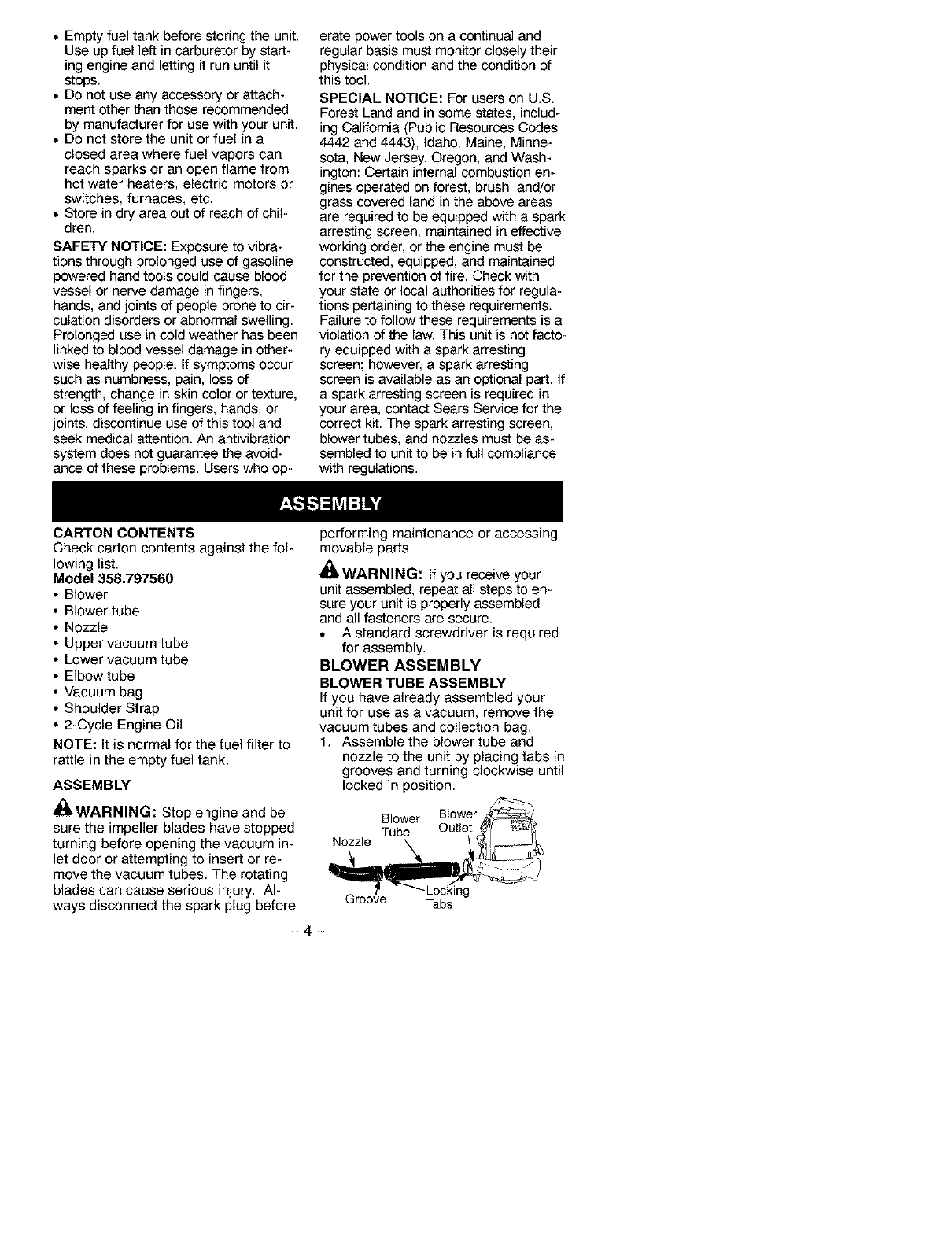
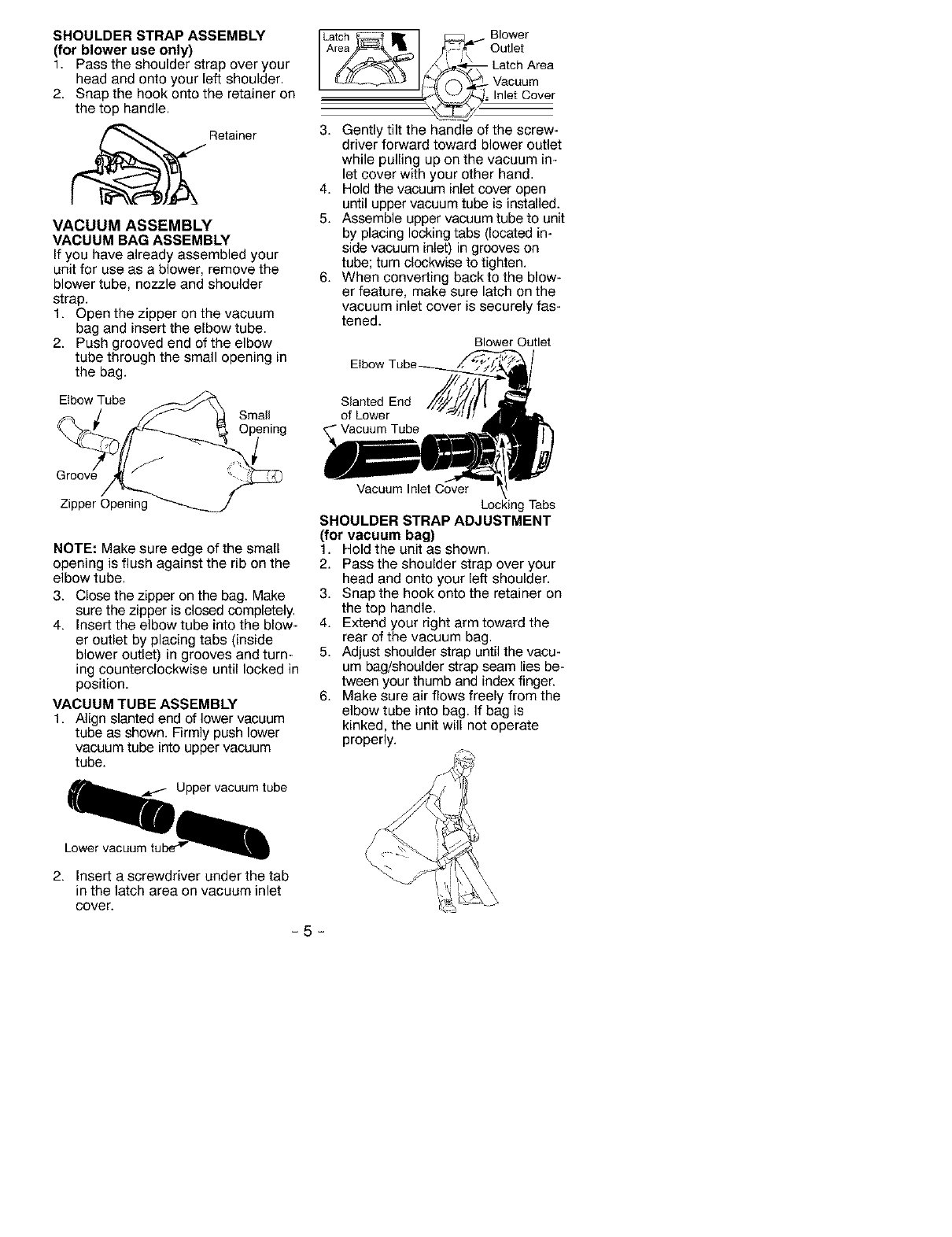
1. Assemble the blower tube and
nozzle to the unit by placing tabs in
grooves and turning clockwise until
locked in position.
Blower Blower
Tube Outlet ,
Nozzle
g
Groove Tabs
SHOULDER STRAP ASSEMBLY
(for blower use only)
1. Pass the shoulder strap over your
head and onto your left shoulder.
2. Snap the hook onto the retainer on
the top handle.
_ Retainer
VACUUM ASSEMBLY
VACUUM BAG ASSEMBLY
If you have already assembled your
unit for use as a blower, remove the
blower tube, nozzle and shoulder
strap.
1. Open the zipper on the vacuum
bag and insert the elbow tube.
2. Push grooved end of the elbow
tube through the small opening in
the bag.
Elbow Tube
Small
Opening
Zipper Opening
NOTE: Make sure edge of the small
opening is flush against the rib on the
elbow tube.
3. Close the zipper on the bag. Make
sure the zipper is closed completely.
4. Insert the elbow tube into the blow-
er outlet by placing tabs (inside
blower outlet) in grooves and turn-
ing counterclockwise until locked in
position.
VACUUM TUBE ASSEMBLY
1. Align slanted end of lower vacuum
tube as shown. Firmly push lower
vacuum tube into upper vacuum
tube.
Upper vacuum tube
2. Insert a screwdriver under the tab
in the latch area on vacuum inlet
cover.
-5-
Latch _---_ _ ] _ _Blower
Area "l Out et
/_ Latch Area
Vacuum
[_= Inlet Cover
3. Gently tilt the handle of the screw-
driver forward toward blower outlet
while pulling up on the vacuum in-
let cover with your other hand.
4. Hold the vacuum inlet cover open
until upper vacuum tube is installed.
5. Assemble upper vacuum tube to unit
by placing locking tabs (located in-
side vacuum inlet) in grooves on
tube; turn clockwise to tighten.
6. When converting back to the blow-
er feature, make sure latch on the
vacuum inlet cover is securely fas-
tened.
Blower Outlet
Slanted End
of Lower
Vacuum Inlet Cover
Locking Tabs
SHOULDER STRAP ADJUSTMENT
(for vacuum bag)
1. Hold the unit as shown.
2. Pass the shoulder strap over your
head and onto your left shoulder.
3. Snap the hook onto the retainer on
the top handle.
4. Extend your right arm toward the
rear of the vacuum bag.
5. Adjust shoulder strap until the vacu-
um bag/shoulder strap seam lies be-
tween your thumb and index finger.
6. Make sure air flows freely from the
elbow tube into bag. If bag is
kinked, the unit will not operate
properly.
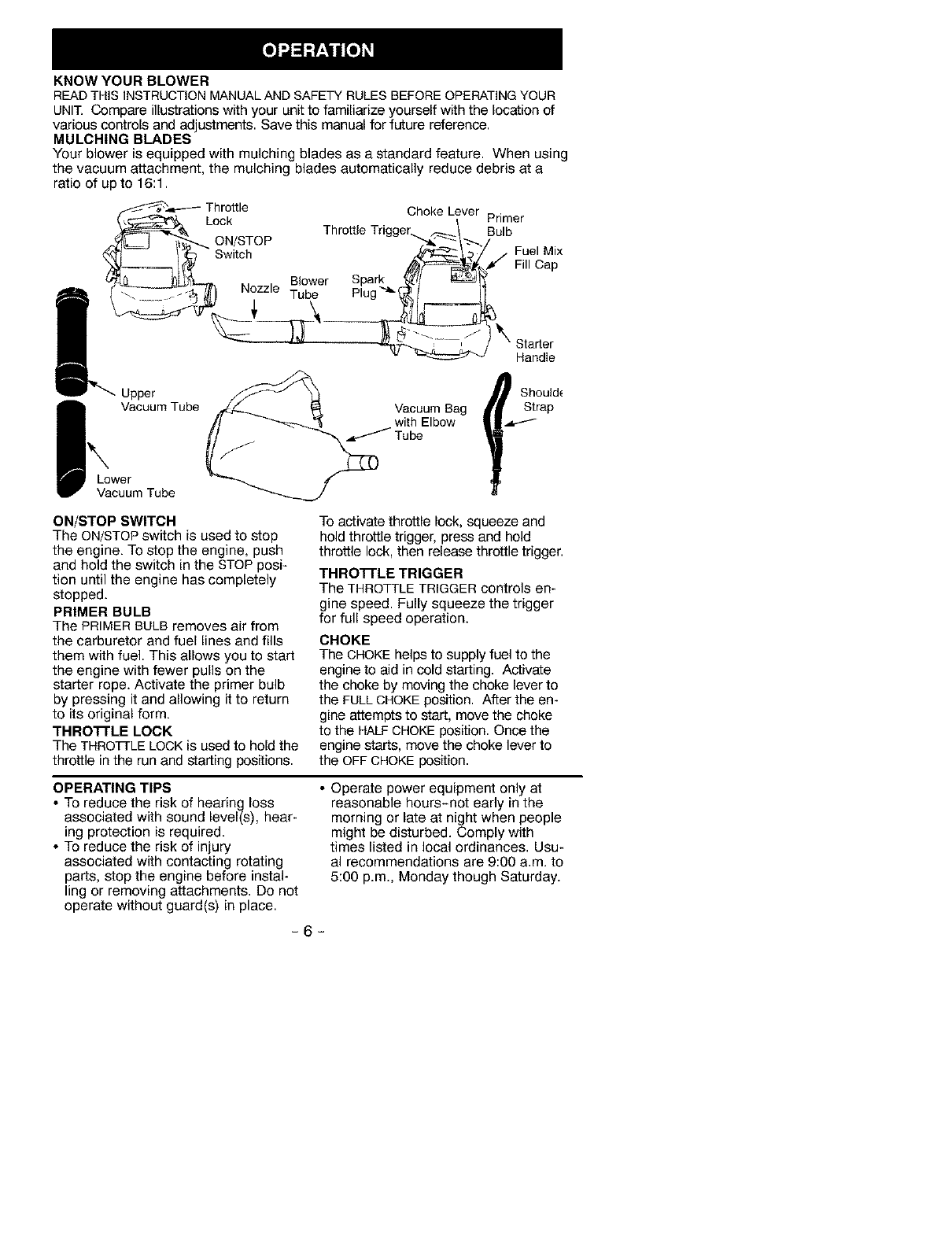
KNOW YOUR BLOWER
READTHIS INSTRUCTIONMANUALAND SAFETY RULES BEFORE OPERATINGYOUR
UNIT. Compare illustrations with your unit to familiarize yourself with the location of
various controls and adjustments. Save this manual for future reference.
MULCHING BLADES
Your blower is equipped with mulching blades as a standard feature. When using
the vacuum attachment, the mulching blades automatically reduce debris at a
ratio of upto 16:1.
Choke Lever Primer
Throttle Trigger. Bulb
Fuel Mix
Fill Cap
IUpper
X Vacuum Tube
Lower
_ Vacuum Tube
Blower Spark
Vacuum Bag
with Elbow
ON/STOP SWITCH
The ON/STOP switch is used to stop
the engine. To stop the engine, push
and hold the switch in the STOP posi-
tion until the engine has completety
stopped.
PRIMER BULB
The PRIMER BULB removes air from
the carburetor and fuel lines and fills
them with fuel. This allows you to start
the engine with fewer pulls on the
starter rope. Activate the primer bulb
by pressing it and at}owing it to return
to its original form.
TRRO'rFLE LOCK
The THROTTLE LOCKis used to hold the
throttle in the run and starting positions.
Handle
Should_
Strap
To activate throttle lock, squeeze and
hold throttle trigger, press and hold
throttle lock, then release throttle trigger.
OPERATING TIPS
• TOreduce the risk of hearing loss
associated with sound lever(s), hear-
ing protection is required.
• To reduce the risk of injury
associated with contacting rotating
parts, stop the engine before instal-
ling or removing attachments. Do not
operate without guard(s) in place.
THRO'I-rLE TRIGGER
The THROTTLE TRIGGER controls en-
gine speed. Fully squeeze the trigger
for full speed operation.
CHOKE
The CHOKE helps to supply fuel to the
engine to aid in cold starting. Activate
the choke by moving the choke lever to
the FULL CHOKE position. After the em
gine attempts to start, move the choke
to the HALF CHOKE position. Once the
engine starts, move the choke lever to
the OFF CHOKE position.
• Operate power equipment only at
reasonable hours-not early in the
morning or late at night when peeple
might be disturbed. Comply with
times listed in local ordinances. Usu-
al recommendations are 9:00 a.m. to
5:00 p.m., Monday though Saturday.
-6-
•To reduce noise levels, limit the num-
ber of pieces of equipment used at
any one time.
• To reduce noise levels, operate pow-
er blowers at the lowest possible
throttle speed to do the job.
• Use rakes and brooms to loosen
debris before blowing.
• In dusty conditions, slightly dampen
surfaces or use a mister attachment
when water is available.
• Conserve water by using power
blowers instead of hoses for many
lawn and garden applications, includ-
ing areas such as gutters, screens,
patios, grills, porches, and gardens.
• Watch out for children, pets, open
windows, or freshly washed cars.
Blow debris away safely.
• Use full blower nozzle extension so
air stream can work close to the
ground.
• After using blowers and other equip-
ment, CLEAN UP! Dispose of debris
in trash receptacles.
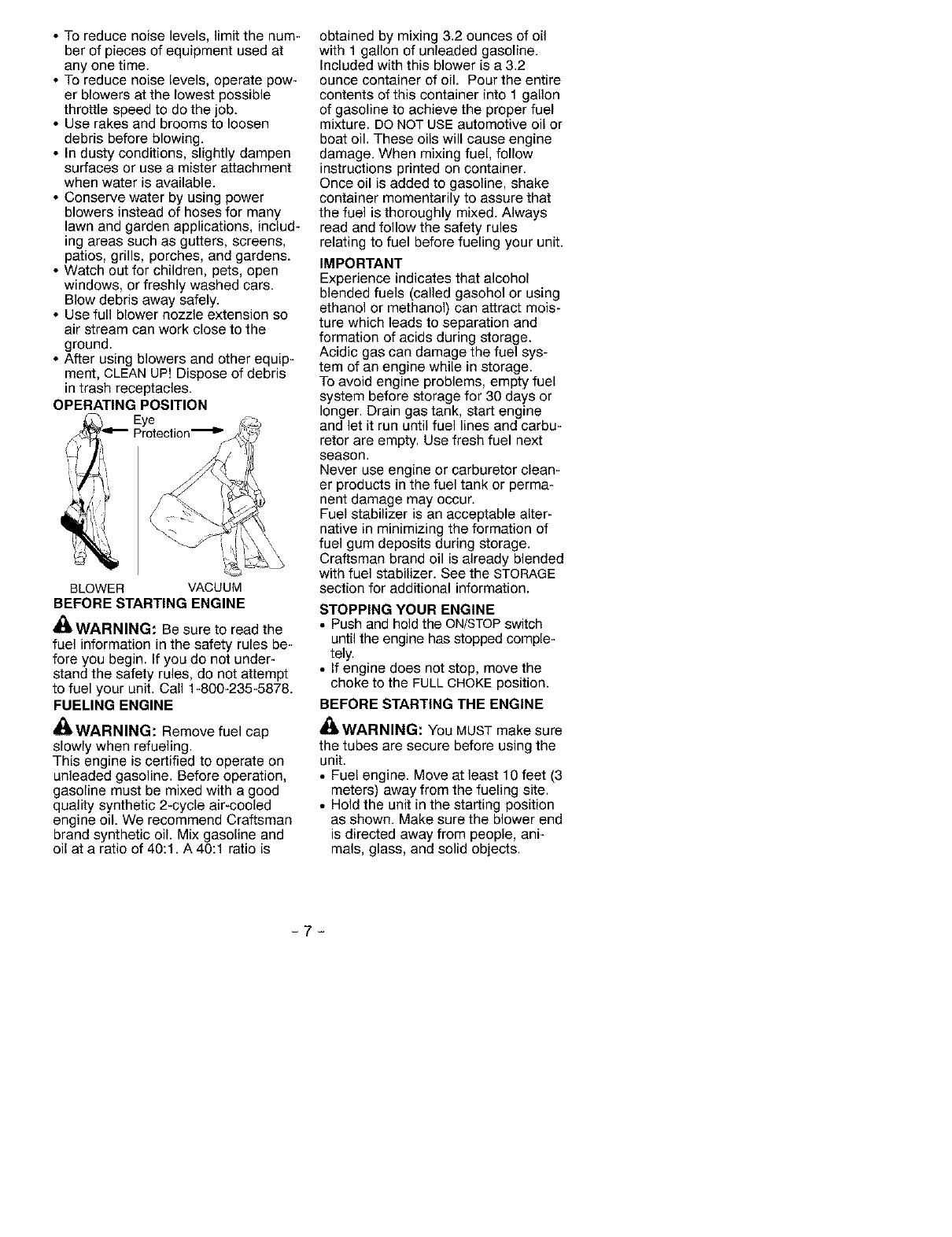
OPERATING POSITION
BLOWER VACUUM
BEFORE STARTING ENGINE
_I!bWARNING: Be sure to read the
fuel information in the safety rules be-
fore you begin. If you do not under-
stand the safety rules, do not attempt
to fuel your unit. Call 1-800-235-5878.
FUELING ENGINE
_IkWARNING: Remove fuel cap
slowly when refueling.
This engine is certified to operate on
unleaded gasoline. Before operation,
gasoline must be mixed with a good
quality synthetic 2-cycle air-cooled
engine oil. We recommend Craftsman
brand synthetic oil. Mix gasoline and
oil at a ratio of 40:1. A 40:1 ratio is
obtained by mixing 3.2 ounces of oil
with 1 gallon of unleaded gasoline.
Included with this blower is a 3.2
ounce container of oil. Pour the entire
contents of this container into 1 gallon
of gasoline to achieve the proper fuel
mixture. DO NOT USE automotive oil or
boat oil. These oils will cause engine
damage. When mixing fuel, follow
instructions printed on container.
Once oil is added to gasoline, shake
container momentarily to assure that
the fuel is thoroughly mixed. Always
read and follow the safety rules
relating to fuel before fueling your unit.
IMPORTANT
Experience indicates that alcohol
blended fuels (called gasohol or using
ethanol or methanol) can attract mois-
ture which leads to separation and
formation of acids during storage.
Acidic gas can damage the fuel sys-
tem of an engine while in storage.
To avoid engine problems, empty fuel
system before storage for 30 days or
longer. Drain gas tank, start engine
and let it run until fuel lines and carbu-
retor are empty. Use fresh fuel next
season.
Never use engine or carburetor clean-
er products in the fuel tank or perma-
nent damage may occur.
Fuel stabilizer is an acceptable alter-
native in minimizing the formation of
fuel gum deposits during storage.
Craftsman brand oil is already blended
with fuel stabilizer. See the STORAGE
section for additional information.
STOPPING YOUR ENGINE
• Push and hold the ON/STOPswitch
until the engine has stopped comple-
tely.
• If engine does not stop, move the
choke to the FULL CHOKE position.
BEFORE STARTING THE ENGINE
_llbWARNING: You MUST make sure
the tubes are secure before using the
unit.
• Fuel engine. Move at least 10 feet (3
meters) away from the fueling site.
• Hold the unit in the starting position
as shown. Make sure the blower end
is directed away from people, ani-
mals, glass, and solid objects.
-7-
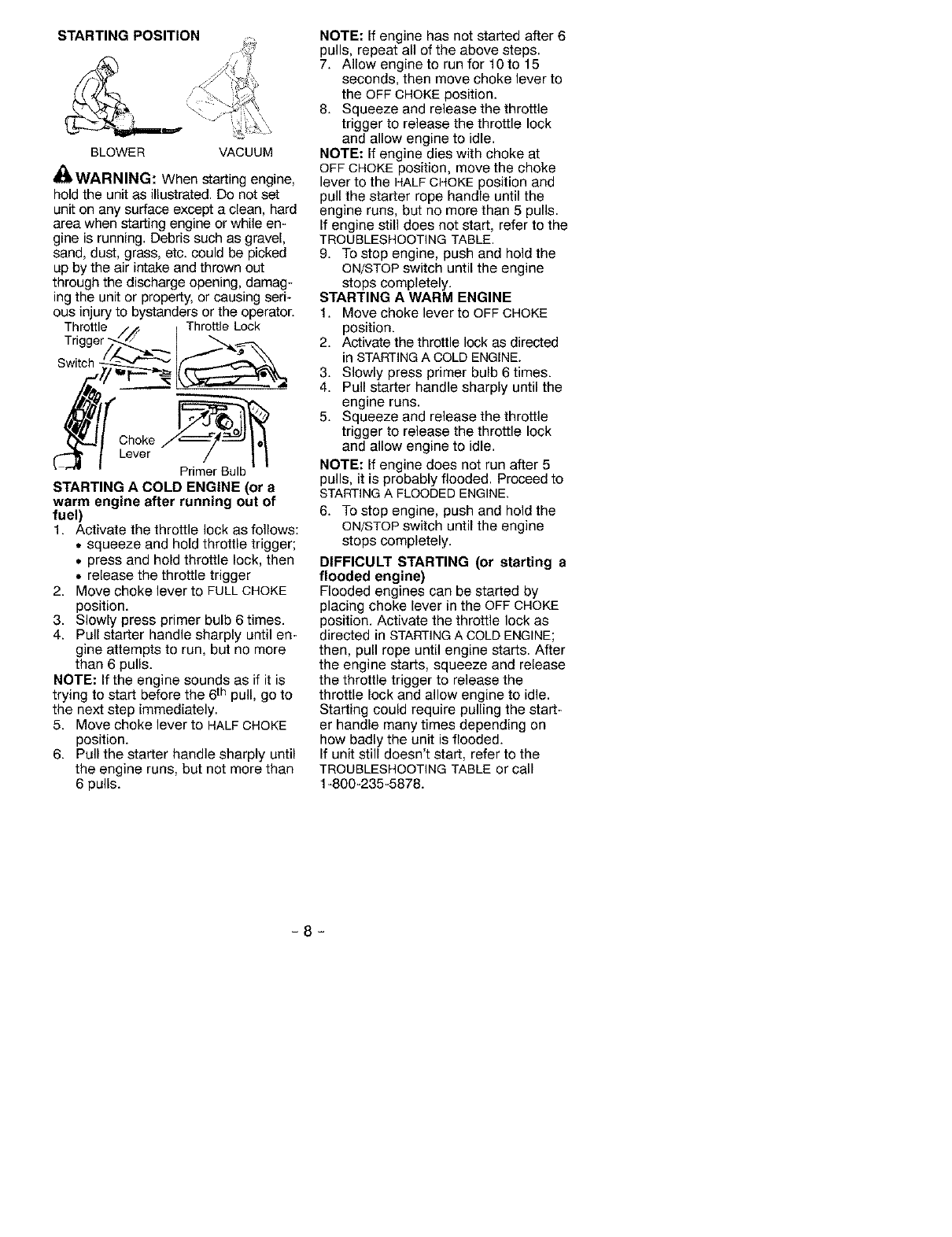
STARTING POSITION
BLOWER VACUUM
_IkWARNING: When starting engine,
hold the unit as illustrated. Do not set
unit on any surface except a clean, hard
area when starting engine or while en-
gine is running. Debris such as gravel,
sand, dust, grass, etc. could be picked
up by the air intake and thrown out
through the discharge opening, damag-
ing the unit or property, or causing seri-
ous injury to bystanders or the operator.
Throttle Throttle Lock
Trigger
Switch
Choke
Lever _
Pnmer Bulb
STARTING A COLD ENGINE (or a
warm engine after running out of
fuel)
1. Activate the throttle lock as follows:
• squeeze and hold throttle trigger;
• press and hold throttle lock, then
• release the throttle trigger
2. Move choke lever to FULL CHOKE
position.
3. Slowly press primer bulb 6 times.
4. Pull starter handle sharply until en-
gine attempts to run, but no more
than 6 pulls.
NOTE: If the engine sounds as if it is
trying to start before the 6th pull, go to
the next step immediately.
5. Move choke lever to HALF CHOKE
position.
6. Pull the starter handle sharply until
the engine runs, but not more than
6 pulls.
NOTE: If engine has not started after 6
pulls, repeat all of the above steps.
7. Allow engine to run for 10 to 15
seconds, then move choke lever to
the OFF CHOKE position.
8. Squeeze and release the throttle
trigger to release the throttle lock
and allow engine to idle.
NOTE: If engine dies with choke at
OFF CHOKE position, move the choke
lever to the HALF CHOKE position and
pull the starter rope handle until the
engine runs, but no more than 5 pulls.
If engine still does not start, refer to the
TROUBLESHOOTING TABLE.
9. TOstop engine, push and hold the
ON/STOP switch until the engine
stops completely.
STARTING A WARM ENGINE
1. Move choke lever to OFF CHOKE
position.
2. Activate the throttle lock as directed
in STARTINGA COLD ENGINE.
3. Slowly press primer bulb 6 times.
4. Pull starter handle sharply until the
engine runs.
5. Squeeze and release the throttle
trigger to release the throttle lock
and allow engine to idle.
NOTE: If engine does not run after 5
pulls, it is probably flooded. Proceed to
STARTINGA FLOODEDENGINE.
6. TOstop engine, push and hold the
ON/STOP switch until the engine
stops completely.
DIFFICULT STARTING (or starting a
flooded engine)
Flooded engines can be started by
placing choke lever in the OFF CHOKE
position. Activate the throttle lock as
directed in STARTINGA COLD ENGINE;
then, pull rope until engine starts. After
the engine starts, squeeze and release
the throttle trigger to release the
throttle lock and allow engine to idle.
Starting could require pulling the start-
er handle many times depending on
how badly the unit is flooded.
If unit still doesn't start, refer to the
TROUBLESHOOTING TABLE or call
1-800-235-5878.
-8-
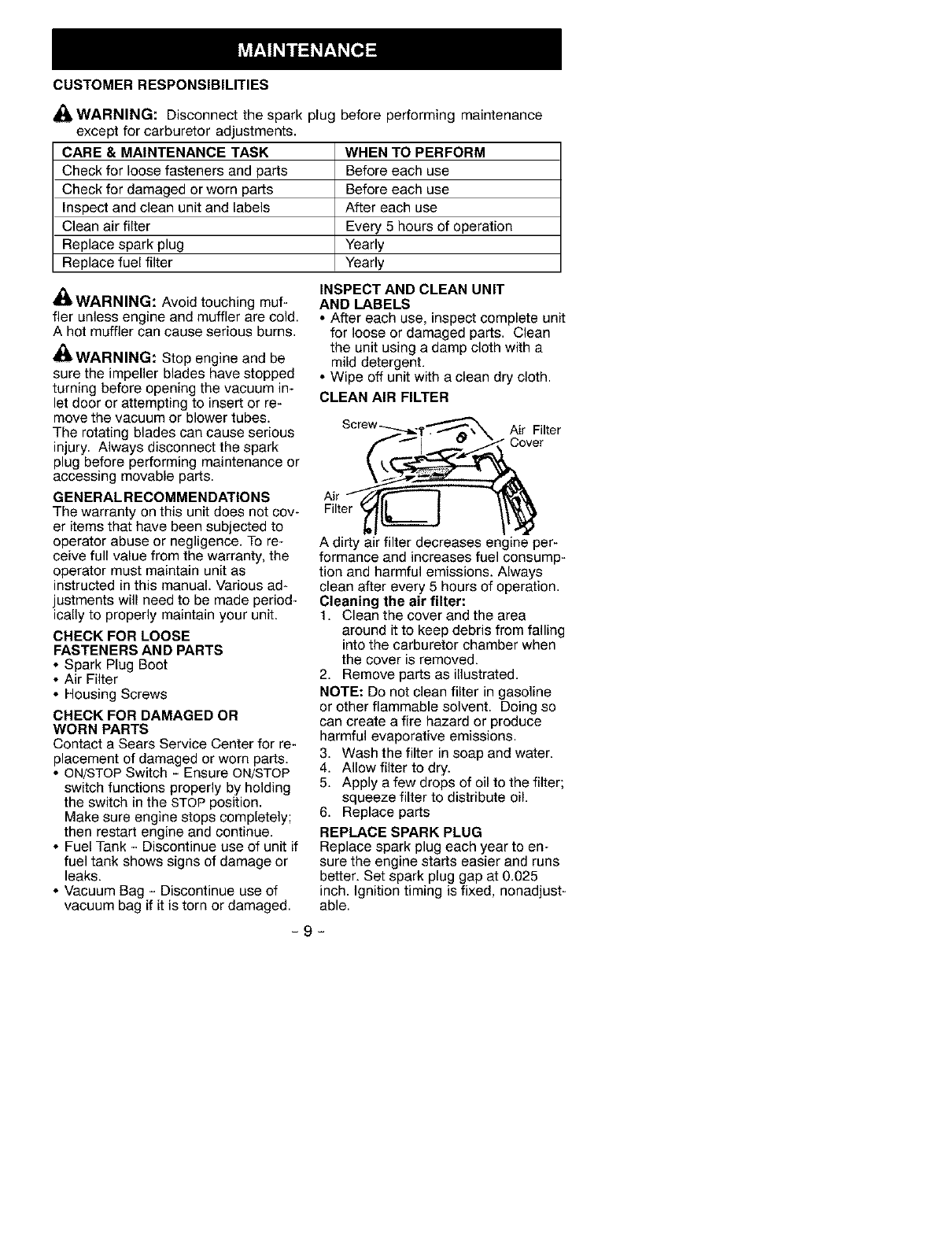
CUSTOMER RESPONSIBILITIES
WARNING: Disconnect the spark plug before performing maintenance
except for carburetor adjustments.
CARE & MAINTENANCE TASK
Check for loose fasteners and parts
Check for damaged or worn parts
Inspect and clean unit and labels
Clean air filter
Replace spark plug
Replace fuel filter
WHEN TO PERFORM
Before each use
Before each use
After each use
Every 5 hours of operation
Yearly
Yearly
z}, _
Ill.WARNING: Avoid touching muf-
fler unless engine and muffler are cold.
A hot muffler can cause serious burns.
_IkWARNING: Stop engine and be
sure the impeller blades have stopped
turning before opening the vacuum in-
let door or attempting to insert or re-
move the vacuum or blower tubes.
The rotating blades can cause serious
injury. Always disconnect the spark
plug before performing maintenance or
accessing movable parts.
GENERAL RECOMMENDATIONS
The warranty on this unit does not cov-
er items that have been subjected to
operator abuse or negligence. To re-
ceive full value from the warranty, the
operator must maintain unit as
instructed in this manual. Various ad-
justments will need to be made period-
ically to properly maintain your unit.
CHECK FOR LOOSE
FASTENERS AND PARTS
• Spark Plug Boot
• Air Filter
• Housing Screws
CHECK FOR DAMAGED OR
WORN PARTS
Contact a Sears Service Center for re-
placement of damaged or worn parts.
• ON/STOP Switch - Ensure ON/STOP
switch functions properly by holding
the switch in the STOP position.
Make sure engine stops completely;
then restart engine and continue.
• Fuel Tank - Discontinue use of unit if
fuel tank shows signs of damage or
leaks.
• Vacuum Bag - Discontinue use of
vacuum bag if it is torn or damaged.
INSPECT AND CLEAN UNIT
AND LABELS
• After each use, inspect complete unit
for loose or damaged parts. Clean
the unit using a damp cloth with a
mild detergent.
• Wipe off unit with a clean dry cloth.
CLEAN AIR FILTER
Air Filter
Cover
Air
Filter
A dirty air filter decreases engine per-
formance and increases fuel consump-
tion and harmful emissions. Always
clean after every 5 hours of operation.
Cleaning the air filter:
1. Clean the cover and the area
around it to keep debris from falling
into the carburetor chamber when
the cover is removed.
2. Remove parts as illustrated.
NOTE: Do not clean filter in gasoline
or other flammable solvent. Doing so
can create a fire hazard or produce
harmful evaporative emissions.
3. Wash the filter in soap and water.
4. Allow filter to dry.
5. Apply a few drops of oil to the filter;
squeeze filter to distribute oil.
6. Replace parts
REPLACE SPARK PLUG
Replace spark plug each year to en-
sure the engine starts easier and runs
better. Set spark plug gap at 0.025
inch. Ignition timing is fixed, nonadjust-
able.
-9-
1. Twist, then pull off spark plug boot.
2. Remove spark plug from cylinder
and discard.
3. Replace with Champion RCJ-6Y
spark plug and tighten with a 3/4
inch socket wrench.
4. Reinstall the spark plug boot.
REPLACE FUEL FILTER
To replace fuel filter, drain unit by run-
ning it dry of fuel, then remove fuel
cap/retainer assembly from tank. Pull
filter from tank and remove it from the
fuel line. Install new fuel filter on fuel
line; reinstall parts.
We recommend all service and adjust-
ments not listed in this manual be per-
formed by your Sears Service Center.
CARBURETOR ADJUSTMENT
Carburetor adjustment is critical and if
done improperly can permanently
damage the engine as well as the car-
buretor. If you require further assis-
tance or are unsure about performing
this procedure, call our customer as-
sistance help line at 1-800-235-5878.
Old fuel, a dirty air or fuel filter, or
flooding may give the impression of an
improperly adjusted carburetor. Check
these conditions before adjusting the
carburetor.
The carburetor has been carefully set
at the factory. Adjustments may be
necessary if you notice any of the fol-
lowing conditions:
• Engine will not idle. See IDLE SPEED
and MIXTURE under adjusting
procedure.
• Engine dies or hesitates instead of
accelerating. See ACCELERATION
CHECK under adjusting procedure.
• Loss of power. See MIXTURE under
adjusting procedure.
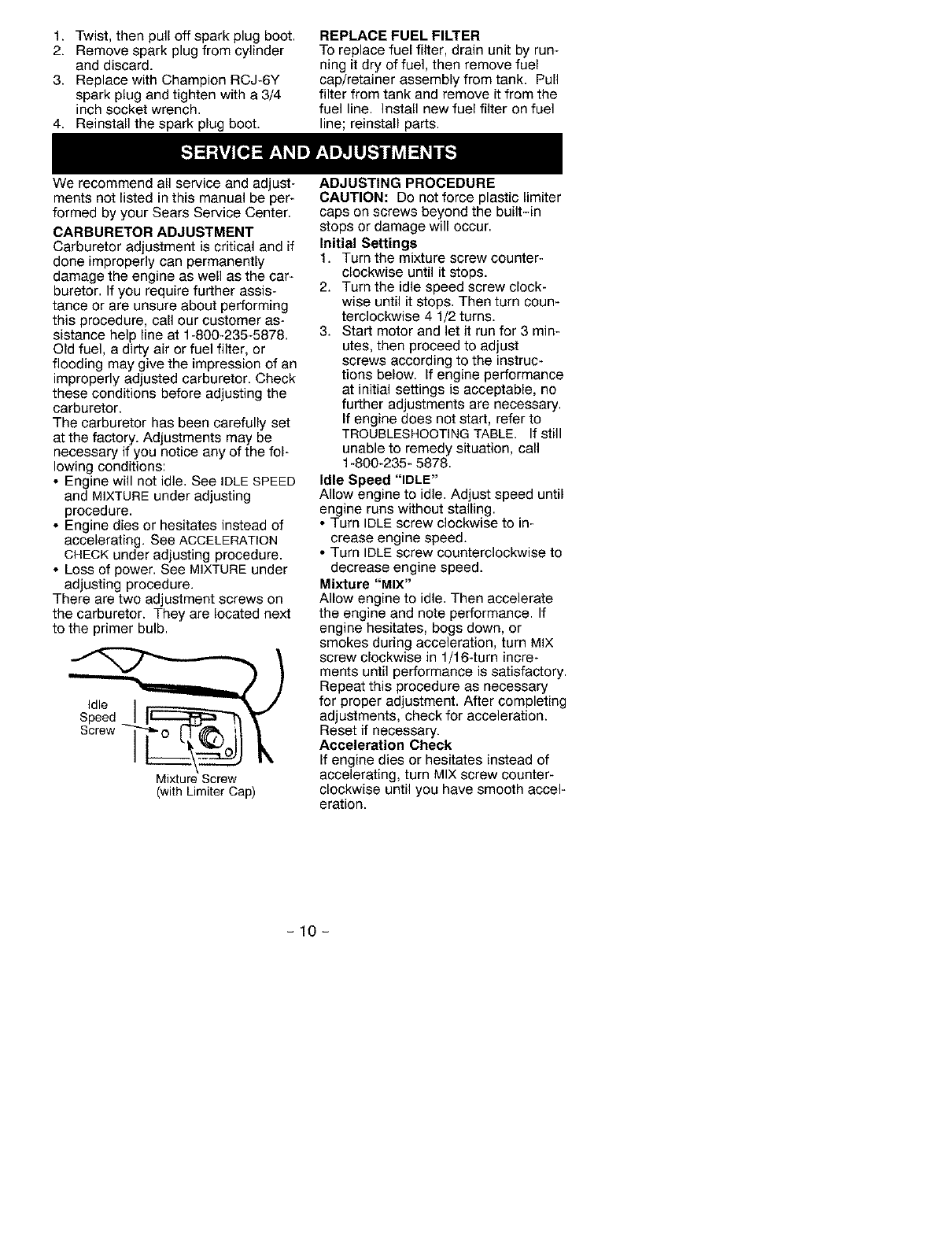
There are two adjustment screws on
the carburetor. They are located next
to the primer bulb.
Idle
Speed
Mixture Screw
(with Limiter Cap)
ADJUSTING PROCEDURE
CAUTION: DO not force plastic limiter
caps on screws beyond the built-in
stops or damage will occur.
Initial Settings
1. Turn the mixture screw counter-
clockwise until it stops.
2. Turn the idle speed screw clock-
wise until it stops. Then turn coun-
terclockwise 4 1/2 turns.
3. Start motor and let it run for 3 min-
utes, then proceed to adjust
screws according to the instruc-
tions below. If engine performance
at initial settings is acceptable, no
further adjustments are necessary.
If engine does not start, refer to
TROUBLESHOOTING TABLE. If still
unable to remedy situation, call
1-800-235- 5878.
Idle Speed "IDLE"
Allow engine to idle. Adjust speed until
engine runs without stalling.
• Turn IDLE screw clockwise to in-
crease engine speed.
• Turn IDLE screw counterclockwise to
decrease engine speed.
Mixture "MIX"
Allow engine to idle. Then accelerate
the engine and note performance. If
engine hesitates, bogs down, or
smokes during acceleration, turn MIX
screw clockwise in 1/16-turn incre-
ments until performance is satisfactory.
Repeat this procedure as necessary
for proper adjustment. After completing
adjustments, check for acceleration.
Reset if necessary.
Acceleration Check
If engine dies or hesitates instead of
accelerating, turn MIX screw counter-
clockwise until you have smooth accel-
eration.
-10-
• _II_WARNING: Perform the following
steps after each use:
• Allow engine to cool, and secure the
unit before storing or transporting.
• Store unit and fuel in a well venti-
lated area where fuel vapors cannot
reach sparks or open flames from
water heaters, electric motors or
switches, furnaces, etc.
• Store unit with all guards in place.
Position unit so that any sharp object
cannot accidentally cause injury.
• Store unit and fuel well out of the
reach of children.
SEASONAL STORAGE
Prepare unit for storage at end of sea-
son or if it will not be used for 30 days
or more.
If your unit is to be stored for a period
of time:
• Clean the entire unit before lengthy
storage.
• Store in a clean dry area.
• Lightly oil external metal surfaces.
FUEL SYSTEM
Under FUELING ENGINE in the OPERA-
TION section of this manual, see mes-
sage labeled IMPORTANT regarding
the use of gasohol in your engine.
Fuel stabilizer is an acceptable alter-
native in minimizing the formation of
fuel gum deposits during storage. Add
stabilizer to the gasoline in the fuel
tank or fuel storage container. Follow
the mix instructions found on stabilizer
container. Run engine at least 5 min-
utes after adding stabilizer.
Craftsman 40:1,2-cycle engine oil (air
cooled) is already blended with fuel
stabilizer. If you do not use this Sears
oil, you can add a fuel stabilizer to your
fuel tank.
INTERNAL ENGINE
• Remove spark plug and pour 1 tea-
spoon of 40:1,2-cycle engine oil (air
cooled) through the spark plug open-
ing. Slowly pull the starter rope 8 to
10 times to distribute oil.
• Replace spark plug with new one of
recommended type and heat range.
• Clean air filter.
• Check entire unit for loose screws,
nuts, and bolts. Replace any dam-
aged, broken, or worn parts.
• At the beginning of the next season,
use only fresh fuel having the proper
gasoline to oil ratio.
OTHER
• Do not store gasoline from one sea-
son to another.
• Replace your gasoline can if it starts
to rust.
-11 -
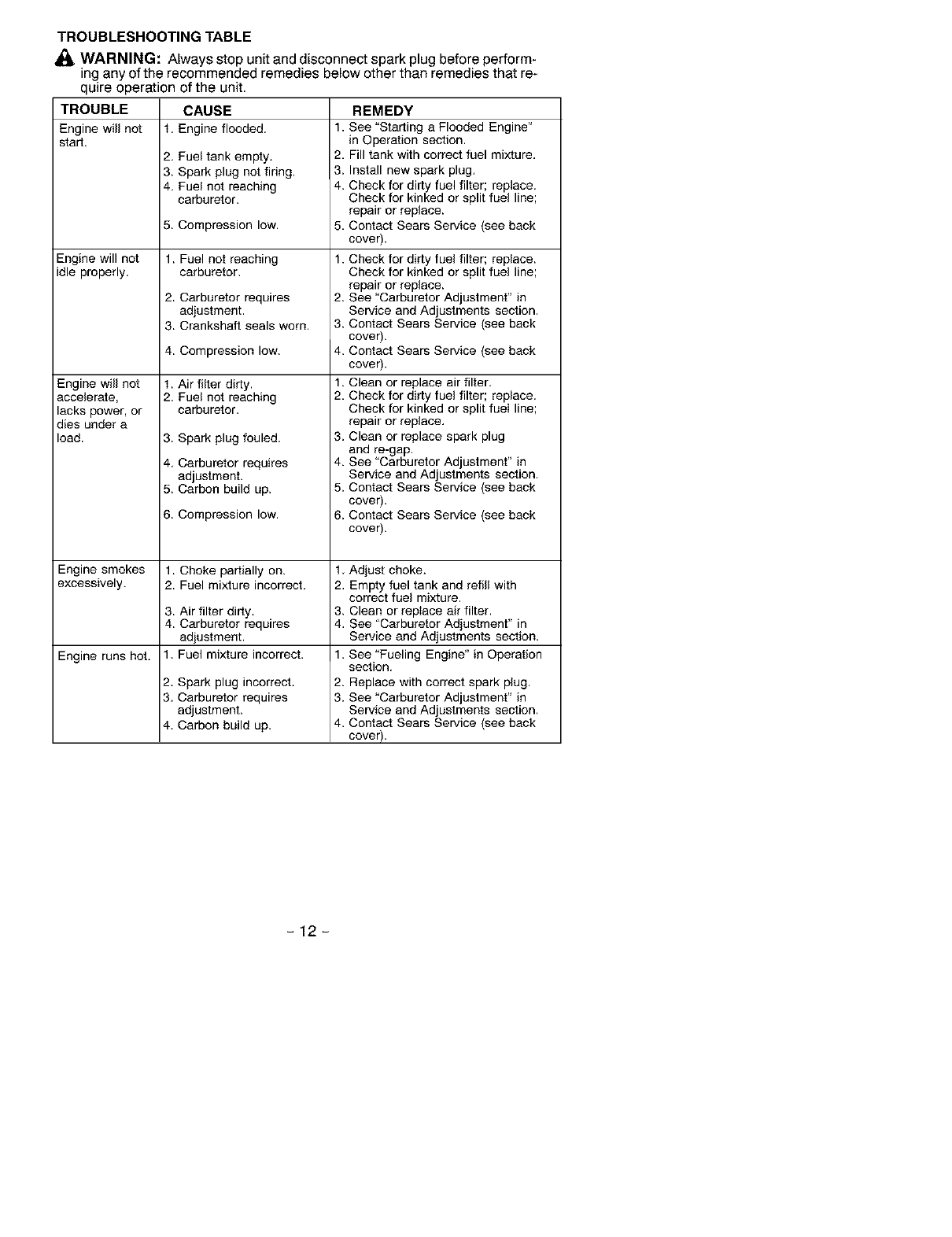
TROUBLESHOOTING TABLE
WARNING: Always stop unit and disconnect spark plug before perform-
ing any of the recommended remedies below other than remedies that re-
TROUBLE
Engine will not
start.
quire operation of the unit.
CAUSE
1. Engine flooded,
Engine will not
idle properly,
Engine will not
accelerate,
lacks power, or
dies under a
load.
Engine smokes
excessively.
Engine runs hot.
2. Fuel tank empty.
3. Spark plug not firing.
4. Fuel not reaching
carburetor.
5. Compression low. 5,
1. Fuel not reaching 1.
carburetor.
2. Carburetor requires 2,
adjustment.
3. Crankshaft seals worn. 3,
4. Compression low. 4.
1. Air filter dirty. 1.
2, Fuel not reaching 2.
carburetor.
3. Spark plug fouled. 3.
4. Carburetor requires 4,
adjustment.
5. Carbon build up. 5,
6. Compression low. 6,
1. Choke partially on. 1.
2. Fuel mixture incorrect. 2.
3. Air filter dirty. 3.
4. Carburetor requires 4.
adjustment.
1. Fuel mixture incorrect. 1.
2, Spark plug incorrect. 2,
3, Carburetor requires 3,
adjustment.
4. Carbon build up. 4.
REMEDY
1. See "Starting a Flooded Engine"
in Operation section,
2, Fill tank with correct fuel mixture,
3, Install new spark plug.
4. Check for dirty fuel filter; replace.
Check for kinked or split fuel line;
repair or replace.
Contact Sears Service (see back
cover).
Check for dirty fuel filter; replace.
Check for kinked or split fuel line;
repair or replace.
See "Carburetor Adjustment" in
Service and Adjustments section.
Contact Sears Service (see back
cover).
Contact Sears Service (see back
cover).
Clean or replace air filter.
Check for dirty fuel filter; replace.
Check for kinked or split fuel line;
repair or replace.
Clean or replace spark plug
and re-gap.
See "Carburetor Adjustment" in
Service and Adjustments section.
Contact Sears Service (see back
cover).
Contact Sears Service (see back
cover).
Adjust choke.
Empty fuel tank and refill with
correct fuel mixture.
Clean or replace air filter.
See "Carburetor Adjustment" in
Service and Adjustments section.
See "Fueling Engine" in Operation
section.
Replace with correct spark plug.
See "Carburetor Adjustment" in
Service and Adjustments section.
Contact Sears Service (see back
cover).
-12-
YOUR WARRANTY RIGHTS AND
OBLIGATIONS: The U. S. Environ-
mental Protection Agency and Sears,
Roebuck and Co., U.S.A., are pleased
to explain the emissions control system
warranty on your year 2001-2004 small
off-road engine. Sears must warrant
the emission control system on your
small off-road engine for the periods of
time listed below provided there has
been no abuse, neglect, or improper
maintenance of your small off-road en-
gine. Your emission control system in-
cludes parts such as the carburetor and
the ignition system. Where a warrant-
able condition exists, Sears will repair
your small off-road engine at no cost to
you. Expenses covered under warranty
include diagnosis, parts and labor.
MANUFACTURER'S WARRANTY
COVERAGE: If any emissions related
part on your engine (as listed under
Emissions Control Warranty Parts List) is
defective or a defect in the materials or
workmanship of the engine causes the
failure of such an emission related part,
the part will be repaired or replaced by
Sears. OWNER'S WARRANTY RE-
SPONSIBILITIES: As the small off-road
engine owner, you are responsible for
the performance of the required mainte-
nance listed in your instruction manual.
Sears recommends that you retain all
receipts covering maintenance on your
small off-road engine, but Sears cannot
deny warranty solely for the lack of re-
ceipts or for your failure to ensure the
performance of all scheduled mainte-
nance. As the small off-road engine
owner, you should be aware that Sears
may deny you warranty coverage if your
small off-road engine or a part of it has
failed due to abuse, neglect, improper
maintenance, unapproved modifications,
or the use of parts not made or ap-
proved by the original equipment
manufacturer. You are responsible for
presenting your small off-road engine to
a Sears authorized repair center as
soon as a problem exists. Warranty re-
pairs should be completed in a reason-
able amount of time, not to exceed 30
days. If you have any questions regard-
ing your warranty rights and responsibili-
ties, you should contact your nearest
authorized service center or call Sears
at 1-800-469-4663. WARRANTY
COMMENCEMENT DATE: The warran-
ty period begins on the date the small
off-road engine is purchased. LENGTH
OF COVERAGE: This warranty shall be
for a period of two years from the initial
date of purchase. WHAT IS COV-
ERED: REPAIR OR REPLACEMENT
OF PARTS. Repair or replacement of
any warranted part will be performed at
no charge to the owner at an approved
Sears servicing center. If you have any
questions regarding your warranty rights
and responsibilities, you should contact
your nearest authorized service center
or call Sears at 1-800-469-4663.
WARRANTY PERIOD: Any warranted
part which is not scheduled for replace-
ment as required maintenance, or which
is scheduled only for regular inspection
to the effect of "repair or replace as nec-
essary" shall be warranted for 2 years.
Any warranted part which is scheduled
for replacement as required mainte-
nance shall be warranted for the period
of time up to the first scheduled replace-
ment point for that part. DIAGNOSIS:
The owner shall not be charged for
diagnostic labor which leads to the de-
termination that a warranted part is de-
fective if the diagnostic work is per-
formed at an approved Sears servicing
center. CONSEQUENTIAL DAMAGES:
Sears may be liable for damages to oth-
er engine components caused by the
failure of a warranted part still under
warranty. WHAT IS NOT COVERED:
All failures caused by abuse, neglect, or
improper maintenance are not covered.
ADD-ON OR MODIFIED PARTS: The
use of add-on or modified parts can be
grounds for disallowing a warranty claim.
Sears is not liable to cover failures of
warranted parts caused by the use of
add-on or modified parts. HOW TO
FILE A CLAIM: If you have any ques-
tions regarding your warranty rights and
responsibilities, you should contact your
nearest authorized service center or call
Sears at 1-800-469-4663. WHERE TO
GET WARRANTY SERVICE: Warranty
services or repairs shall be provided at
all Sears service centers. Call
1-800-469-4663. MAINTENANCE,
REPLACEMENT AND REPAIR OF
EMISSION RELATED PARTS: Any
-13-

Sears approved replacement part used
in the performance of any warranty
maintenance or repair on emission re-
lated parts will be provided without
charge to the owner if the part is under
warranty. EMISSION CONTROL WAR-
RANTY PARTS LIST: Carburetor, lqni-
tion System: Spark Plug (covered up to
maintenance schedule), Ignition Module.
MAINTENANCE STATEMENT: The
owner is responsible for the perfor-
manse of all required maintenance as
defined in the instruction manual.
This engine is certified to be emissions compliant for the following use:
[] Moderate (50 hours)
[] Intermediate (125 hours)
[] Extended (300 hours)
-14-
Declaraci6n de Garantia 18 AImacenamiento 29
Reglas de Seguridad 18 Tabla Diagn6stica 30
Montaje 21 Declaraci6n de Emision 31
Uso 23
Mantenimiento 26 Lista de Piezas 15
Servicio y Ajustes 28 Repuestos y Encargos Contratapa
GARANTIA DE UN ANO COMPLETOS PARA EL PROPULSOR DE AIRE A GA-
SOLINA DE LA MARCA CRAFTSMAN ®
Durante un (1) a_o a partir de la fecha de compra, siempre que se haga el man-
tenimiento, la lubricaci6n y los ajustes en este Propulsor de Aire a Gasolina
segQn las instrucciones de use y mantenimiento en el manual, Sears reparar&
cualquier defecto de material o mane de obra granturaitamente.
Esta garantia excluye los tubos del propulsor de aire, la bujia y el filtro de aire,
que son piezas prescindibles que se pueden gastar con el use normal.
Si este propulsor de aire es usado con fines de use comercial, esta garantia aplicar&
solamente por 90 dias despu_s de la fecha original de compra. Siesta propulsor es
usado con fines de alquiler, esta garantia aplicar& por solo 30 dias despu_s de la
fecha original de compra. Esta garantia tiene validez exclusivamente cuando el apa-
rato es utilizado dentro de los Estados Unidos.
SE OBTEDRA SERVlCIO BAJO GARANTIA DEVOLVlENDO EL APARATO AL AL TIENDA
DE SEARS O CENTRO DE SERVlCIO MAS CERCANO EN LOS ESTADOS UNIDOS.
Esta garantia confiere derechos legales especificos al propietario, que tal vez
tenga asimismo otros derechos que varian entre estados.
Sears, Roebuck and Co., D/817WA, Hoffman Estates, IL 60179
4_I_ADVERTENCIA: De no cumplir
con todas las Reglas y Precauciones
de Seguridad, correr& el riesgo de ac-
cidentes muy graves
CONOZCA SU APARATO
• Lea el manual de instrucciones cui-
dadosamente hasta que comprenda
perfectamente todas las advertem
cias e instrucciones de seguridad y
las pueda cumplir, antes de poner el
aparato en funcionamiento
•Limite el use del aparato a aquellas
personas que comprendan todas las
advertencias e instrucciones de se-
guridad en este manual y vayan a
cumplir con elias
_ADVERTENCIA: Inspeccione el
firea antes de poner en matodos los es-
combros y objetos s61idos tales como
piedras, vidrio, alambre, etc., que el apa-
rate pueda arrojar al aire o hacer rebotar
causando heridas de este o cualquier
otro modo durante el use del mismo.
Utilice su aparato come propulsor de
aire para:
• Barrer escombros o recortes de
hierba de caminos de entrada,
aceras, patios, etc.
• Soplar recortes de hierba, para u
hojas en montones, o para remover
escombros de esquinas, alrededor
de uniones o entre ladrillos.
Utilice su aparato como aspiradora para:
• Recoger material seco como hojas,
hierba, ramas pequeSas y pedazos
pequefios de papel.
• Para obtener rnejores resultados al
usar la aspiradora, ponga el motor a
alta velocidad.
• Muevase lentamente de un lado a
otto sobre el material que de sea
aspirar. Evite el forzar el aparato a
recoger rnontones de desechos
pues esto podria obstruir el aparato.
• Para obtener rnejores resultados,
mantenga el tubo de aspiraci6n unos
3 cm (uno pulgada) m&s arriba del
suelo.
-18-
PIENSE ANTES DE PROCEDER
•Use siempre protecci6n para los ojos
al hacer use, servicio o mantenimi-
ento del aparato. El uso de proteci6n
de ojos ayudar& a prevenir la perdi-
da de la vista y/u otras heridas
graves, provocadas per piedras o
escombros que reboten en los ojos y
en la cara al ser propulsados per el
aparato. La protecci6n para los ojos
debe ser marcada Z87.
• Use siempre protecci6n en los pies.
No use el aparato descalzo ni con
sandalias.
• Use siempre mascarilla de filtraci6n
o de protecci6n para la cara al traba-
jar en ambientes polvorientos.
• Mantenga el cabello por encima de
los hombros, at&ndolo para tal efecto
si es necesario. No use joyas, ropa
suelta, ni ropa con tiras, corbatas, bor-
las, etc. que cuelgen libremente, por-
que podrfan quedar enredadas en las
piezas en movimiento del aparato.
• No use el aparato estando cansado,
enfero, ansioso, ni bajo la infuencia
del alcohol, las drogas u otros medi-
camentos.
• Mantenga a nifios, espectadores y
animales a una distancia minima de
10 metros (30 pies) al poner en mar-
cha o al usar el aparato. No seSale
la boquilla en la direcci6n de la per-
sonas o de animales domesticos.
MANEJE EL COMBUSTIBLE CON
EXTREMO CUIDADO, ES ALTA-
MENTE INFLAMABLE
• Elimine todas las posibles fuentes de
chispan o llamas (inclusive los cigar-
rillos, las llamas abertas, y cualquier
trabajo que cause chispas) en las
&reas donde se mezcla, vierte o al-
macena el combustible.
• Mezcle y vierta el combustible al aire
libre, almacene el combustible en un
lugar fresco, seco y bien ventilado;
sue un recipiente aprobado para
combustible y marcado para todo
manejo de combustible.
• No fume mientras trabaja con el
combustible ni cuando est_ hacien-
do uso del aparato.
• AsegQrese que el aparato este cor-
rectamente armado yen buena con-
dici6n de funcionamiento.
• No Ilene el tanque de combustible
mientras el motor se encuentre en
marcha.
• Evita derramar el combustible o el
aceite. Limpie todos los derrames
de combustible antes de poner el
aparato en marcha.
• Al_jese pot Io menos 3 metros (10
pies) del combustible y del lugar de
abastecimineto antes de poner el
motor en marcha.
• Almacene siempre combustible en
un recipiente aprobado para los
liquidos inflamables.
HAGA USO SEGURO DE SU
APARATO
_IkADVERTENCIA: Detenga el mo-
tor antes de abrir la compuerta de en-
trada de aire del aspirador. El motor
deber& encontrarse detenido y las cu-
chillas del impulsor no deber&n estar
girando para evitar serios accidentes
provocados per las cuchillas girantes.
• Verifique por inspecci6n, antes de
cada uso, que no haya piezas gasta-
das, sueltas, ni da6adas o piezas
que falten. No use el aparato hasta
que este se encuentre en perfectas
condiciones de funcionamiento.
• Mantenga las superficies externs
libres de aceite y de combustible.
• Nunca ponga el motor en marcha ni
Io deje en marcha dentro de un re-
cinto cerrado o en una &rea sin ven-
tilaci6n. Respirar los vapores del
combustible le podria causar la
muerte.
• Para evitar el choque per electrici-
dad est&tica, no use guantes de
goma ni ningQn otro guante aislado
al usar el aparato.
• No apoye el aparato con el motor en
marcha en ninguna superficie que
no est_ limpia o que no sea s61ida.
El aparato podria aspirar escombros
tales como gavilla, arena, polvo,
c_sped, etc. por la entrada de aspi-
raci6n y arrojarlos por la salida de
propulsion, da_ando el aparato y/u
otros objetos, o causando graves
heridas a espectadores o al usuario.
• Evite ambientes peligrosos, No use
el aparato en lugares sin ventilaci6n
ni donde puda haber vapores explo-
sivos o mon6xido de carbono.
• No se extienda excesivamente ni use
el aparato en superficies inestables
tales come escaleras, arboles, de-
clives acentuadas, techos, etc. Man-
tenga el equilibrio, con los pies en una
superficie estable en todo momento.
• Nunca coloque objetos dentro de los
tubos de propulsi6n; siempre dirija
los escombros en direcci6n contraria
-19-
a donde personas, animales, vidrier-
asu otros objetos s61idos tales como
&rboles, autom6viles, paredes, etc.
se encuentran. La fuerza del aire
puede arrojar o hacer rebotar pie-
dras, tierra o ramas, hiriendo a per-
sonas o animales, rompiendo vidrier-
as o causando otros daSos.
• Nunca ponga el aparato en marcha
sin toner todo el equipo correspon-
diente instalado. AI usar el aparato
como propulsor de aire, sirmpre
instale los tubos de propulsi6n. AI usar
el equipo opcional de aspiraci6n,
siempre instale los tubos y la bolsa de
aspiraci6n. Asegt_rese que la cremal-
lera de la bolsa de aspiraci6n se en-
cuentre completamente cerrada.
• Inspeccione frecuentemente la aber-
tara de entrada de aire, los tubos de
propulsion, los tubos de aspiraci6n y
el tubo en forma de codo siempre
con el motor detenido y la bujia des-
conectada. Mantenga las aberturas
de ventilaci6n y los tubos de descar-
ga libres de escombros que se pue-
den acumular y limitar la circulaci6n
debida de aire.
• Nunca coloque objeto alguno dentro
de la entrada de aire ya que de hacer-
Io podria limitar la circulaci6n d'aire y
daSar el aparato.
• Nunca use el aparato para esparcir
substancias quimicas, fertilizantes u
otras substancias que puedan con-
tener materiales t6xicos.
• Para evitar la propagaci6n de incen-
dios, no use el aparato cerca de ho-
gueras de hogassecas o de mator-
rales, de hogares de leSa, de parril-
las, barbacoas, ceniceros, etc.
• Use el aparato exclusivamente para
los fines descritos en este manual.
HAGA EL MANTENIMIENTO DEL
APARATO EN LA FORMA DEBIDA
• Permita que todo mantenimiento
aparte de los procedimientos recom-
endados descritos en este manual
de instrucciones, sean efectuados
por un Centre de Servicio Sears.
• Desconecte la bujia antes de hacer
cualquier mantenimiento, con la ex-
cepci6n de los ajustes al carburador.
• Use exclusivamente los repuestos
recomendados de la marca Crafts-
man®; el use de cualquier otto re-
puesto podr& invalidar la garantia o
da6ar el aparato.
• Vacfa el tanque de combustible
antes de almacenar el aparato. Con-
suma el combustible restante en el
carburador poniendo el motor en
marcha y dej&ndolo en marhca has-
ta que se este se detenga.
• No use ningQn accesorio ni pieza adi-
cional aparte de los recomendados
per el fabricante para usar con su
aparato.
• No almacene el aparato ni el combus-
tible en un recinto cerrado deride los
vapores el combustible puedan entrar
en contacto con chispas o llamas
abiertas procedentes de calentadores
de agua, motores o interruptores el_c-
tricos, calefactores centrales, etc.
• AImacene el aparato en un lugar
seco, fuera del alcance de los niSos.
AVISO DE SEGURIDAD: El estar ex-
puesto alas vibraciones a trav_s del
use prolongado de herramientas de
fuerza a gasolina, ,puede causar daSos
a los vasos sanguJneos o a los nervios
de los dedos, las manos y las coyuntu-
ras a aquellas personal propensas a los
trastornos de la circulaci6n o alas hin-
chazones anormales. El uso prolongado
en climas frios ha sido asociado con
daSos a los vases sanguineos a perso-
nas que por otra parte se encuentran en
perfecto estado de salud. Si ocurriera
sintomas tales como el entumecimiento,
el color, la falta de sentido en los dedos,
las manos o en las coyunturas, pare de
usar esta m&quina de inmediato y pro-
cure atenci6n medic& Los sistemas de
anti-vibraci6n no garantizan que se evi-
tan tales problemas. Los usuarios que
hacen uso continuo y prolongado de las
herramientas de fuerza deben fiscalizar
atnetamente su estado fisico y el estado
del aparato.
AVISO ESPECIAL: Para los usuarios
en Tierras Forestadas en los Estados
Unidos yen algunos estados, incluyen-
do California (C6digos de Recursos
P_blicos 4442 y 4443), Idaho, Maine,
Minnesota, Nueva Jersey, Qreg6n y
Washington: Se requiere a ciertos mo-
tores de combusti6n intema operados
en tierras cubiertas por bosques, mater-
rales y/o pasto, en las &rea anterior-
mente mencionadas, que vengan equi-
pados con rejilla anti-chispas, manten-
ida en perfecto estado de funcionamien-
to, o que el motor este construido y
equipado para la prevenci6n de incen-
dios y mantenido correctamente. Con-
suite con las autoridades estatales o lo-
cales acerca de los reglamente que se
relacionene con estos requisitos. De no
cumplir con estos requisitos, usted es-
tar& en violaci6n de la ley. Este aparato
no viene equipo de f&brica con rejilla
-20 -
anti-chispa; sin embargo la rejilla anti-
chispa viene disponible como pieza op-
cional. Si se requiere re ilia anti-chispa
en a oca dad donde usted se encuen-
tra, entre en contacto con el Servicio de
Sears para obtener el equipo de re-
puestos correspondiente. La rejilla anti-
chispa, los tubos de propulsi6n y las bo-
quillas deber&n estar instalados en el
aparato para estar en total cumplimiento
con el reglamento.
CONTENIDO DE LA CAJA
Verifique que todos los articulos de la
siguiente lista esten incluidos:
Modelo 358.797560
Propulsor de aire
Tubo de propulsi6n
Boquilla
Tubo de aspiraci6n superior
Tubo de aspiraci6n inferior
Tube en forma de code
Bolsa de aspiraci6n
Banda del hombro
Aceite de Motor a 2 Tiempos
AVISO: Es normal que el filtro de com-
bustible golpetee en el tanque vacio.
MONTAJE
_!kADVERTENCIA: Detenga el mo-
tor y asegQrese de que las cuchillas
del impulsor no se encuentren girando
antes de abrir la compuerta de entrada
de aire del aspirador o de intentar
introducir o remover los tubes de aspi-
raci6n o los tubos de propulsi6n. Las
cuchillas girantes podrian causar ser-
ios accidentes. Siempre desconecte
la bujia antes de hacer cualquier man-
tenimiento o de tener acceso a piezas
movibles.
_I!_ADVERTENCIA: Si recibi6 el
aparato ya armado, repita todos los pa-
sos para asegurarse que el aparato
haya sido armado correctamente y que
todos los fijafores se encuentren bien
fijos.
• Un destornillador es requiere para el
montaje.
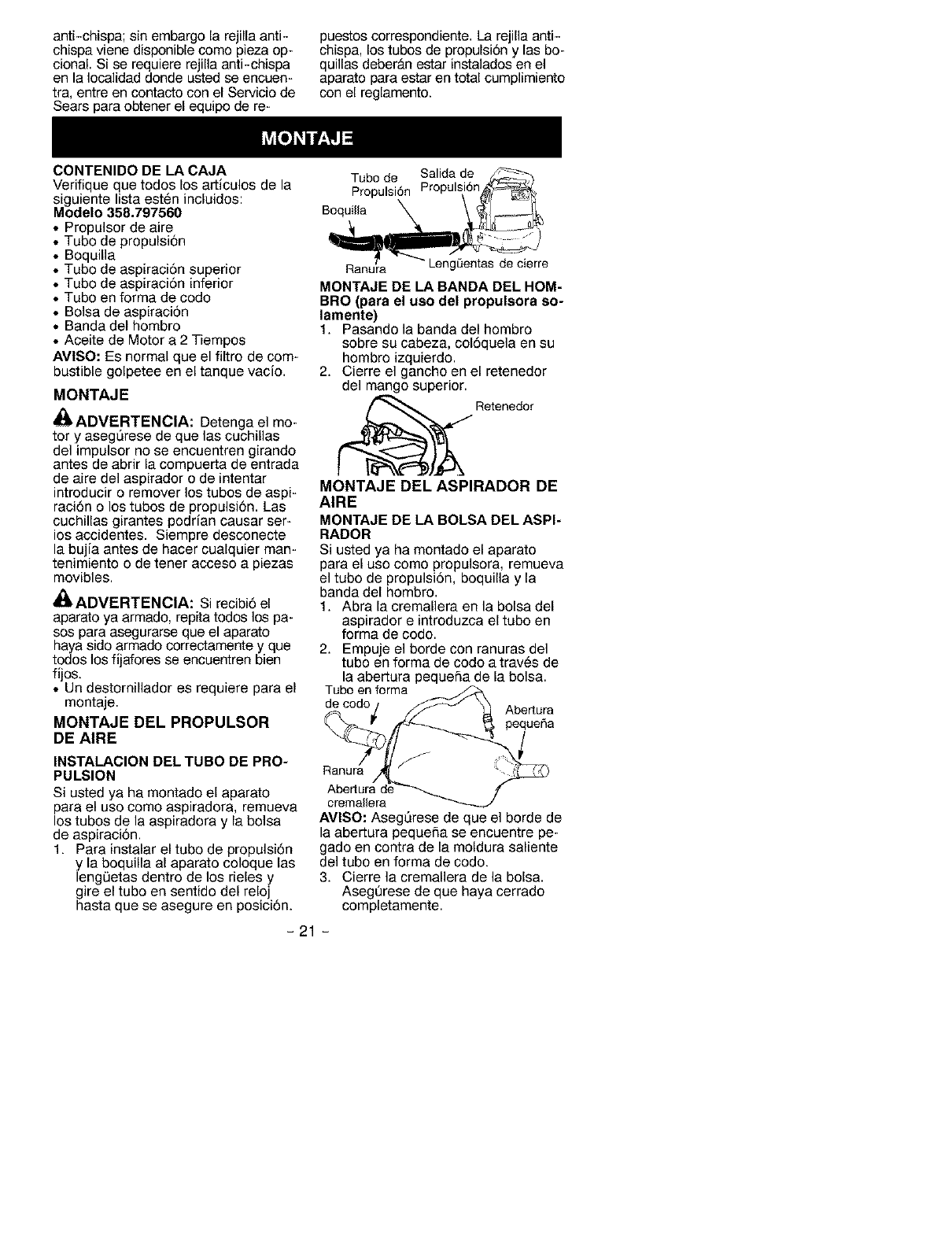
MONTAJE DEL PROPULSOR
DE AIRE
Tubo de Salida de
Propulsi6n Propul_
Boquilla
Ranura Leng_entas de cierre
MONTAJE DE LA BANDA DEL HOM-
BRO (para el aso del propulsora so-
lamente)
1. Pasando la banda del hombro
sobre su cabeza, col6quela en su
hombro izquierdo.
2. Cierre el gancho en el retenedor
del mango superior.
_ Retenedor
MONTAJE DEL ASPIRADOR DE
AIRE
MONTAJE DE LA BOLSA DEL ASPI-
RADOR
Si usted ya ha montado el aparato
para el uso como propulsora, remueva
el tubo de propulsi6n, boquilla y la
banda del hombro.
1. Abra la cremallera en la bolsa del
aspirador e introduzca el tubo en
forma de code.
2. Empuje el borde con ranuras del
tubo en forma de code a trav_s de
la abertura pequefia de la bolsa.
Tubo en forma
de codo Abertura
pequeSa
INSTALAClON DEL TUBO DE PRO-
PULSION
Si usted ya ha montado el aparato
para el uso come aspiradora, remueva
los tubes de la aspiradora y la bolsa
de aspiraci6n.
1. Para instalar el tubo de propulsi6n
y la boquilla al aparato coloque las
lengOetas dentro de los rieles y
gire el tubo en sentido del reloj
hasta que se asegure en posici6n.
Abertura C
cremallera
AVlSO: AsegQrese de que el borde de
la abertura pequefia se encuentre pe-
gado en contra de la moldura saliente
del tube en forma de codo.
3. Cierre la cremallera de la bolsa.
AsegOrese de que haya cerrado
completamente.
- 21 -
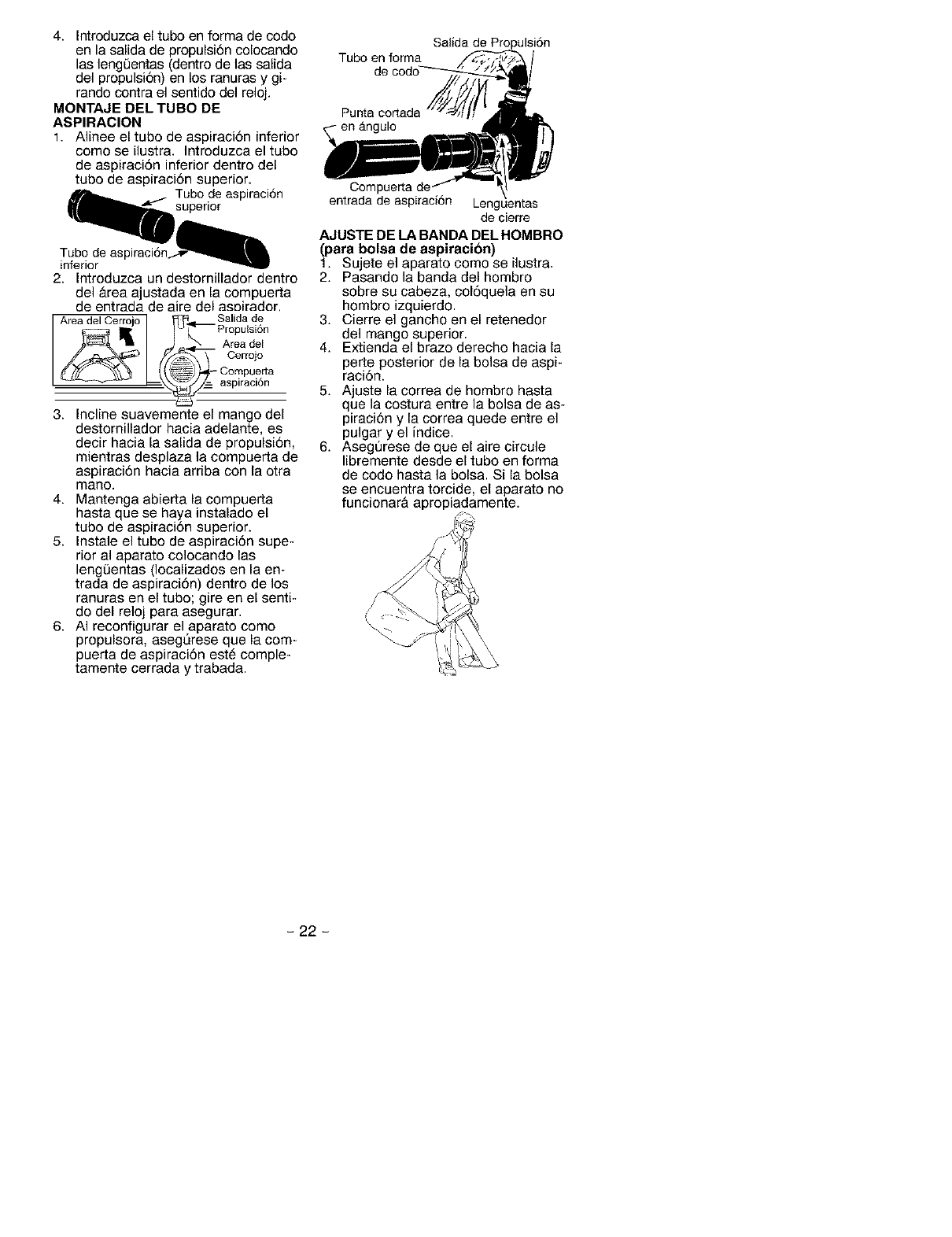
4. Introduzca el tubo en forma de codo
en la salida de propulsi6n colocando
las lengQentas (dentro de las salida
del propulsi6n) en los ranuras y gi-
rando contra el sentido del reloj.
MONTAJE DEL TUBO DE
ASPIRACION
1. Alinee el tube de aspiraci6n inferior
como se ilustra. Introduzca el tubo
de aspiraci6n inferior dentro del
tubo de aspiraci6n superior.
Tubo de aspiraci6n
superior
Tubo de as_
inferior
2. Introduzca un destornillador dentro
del &rea ajustada en la compuerta
de entrada de aire del a£nirador.
_Salida de
F_ Proputsidn
Area del
Cerrojo
Compuert8
aspiraci6n
3. Incline suavemente el mango del
destornillador hacia adelante, es
decir hacia la salida de propulsi6n,
mientrae desplaza la compuerta de
aspiraci6n hacia arriba con la otra
mane.
4. Mantenga abierta la compuerta
hasta que se hay,a instalado el
tube de aspirac_on superior.
5. Instale el tubo de aspiraci6n supe-
rior al aparato colocando las
lengQentas (Iocalizados en la en-
trada de aspiraci6n) dentro de los
ranuras en el tube; gire en el senti-
do del reloj para asegurar.
6. AI reconfigurar el aparato como
propulsora, asegurese que la com-
puerta de aspiraci6n est_ comple-
tamente cerrada y trabada.
Tubo en forma
Punta cortada
Com
entrada de aspiraci6n Leng
de cierre
AJUSTE DE LA BANDA DEL HOMBRO
(pare bolsa de aepireci6n)
1. Sujete el aparato como se ilustra.
2. Pasando la banda del hombro
sobre su cabeza, col6quela en su
hombro izquierdo.
3. Cierre el gancho en el retenedor
del mango superior.
4. Extienda el brazo derecho hacia la
perte posterior de la bolsa de aspi-
raclon.
5. Ajuste la correa de hombro hasta
que la costura entre la bolsa de as-
piraci6n y la correa quede entre el
pulgar y el indice.
6. AsegQrese de que el aire circule
libremente desde el tubo en forma
de codo hasta la bolsa. Si la bolsa
se encuentra torcide, el aparato no
funcionar& apropiadamente.
22
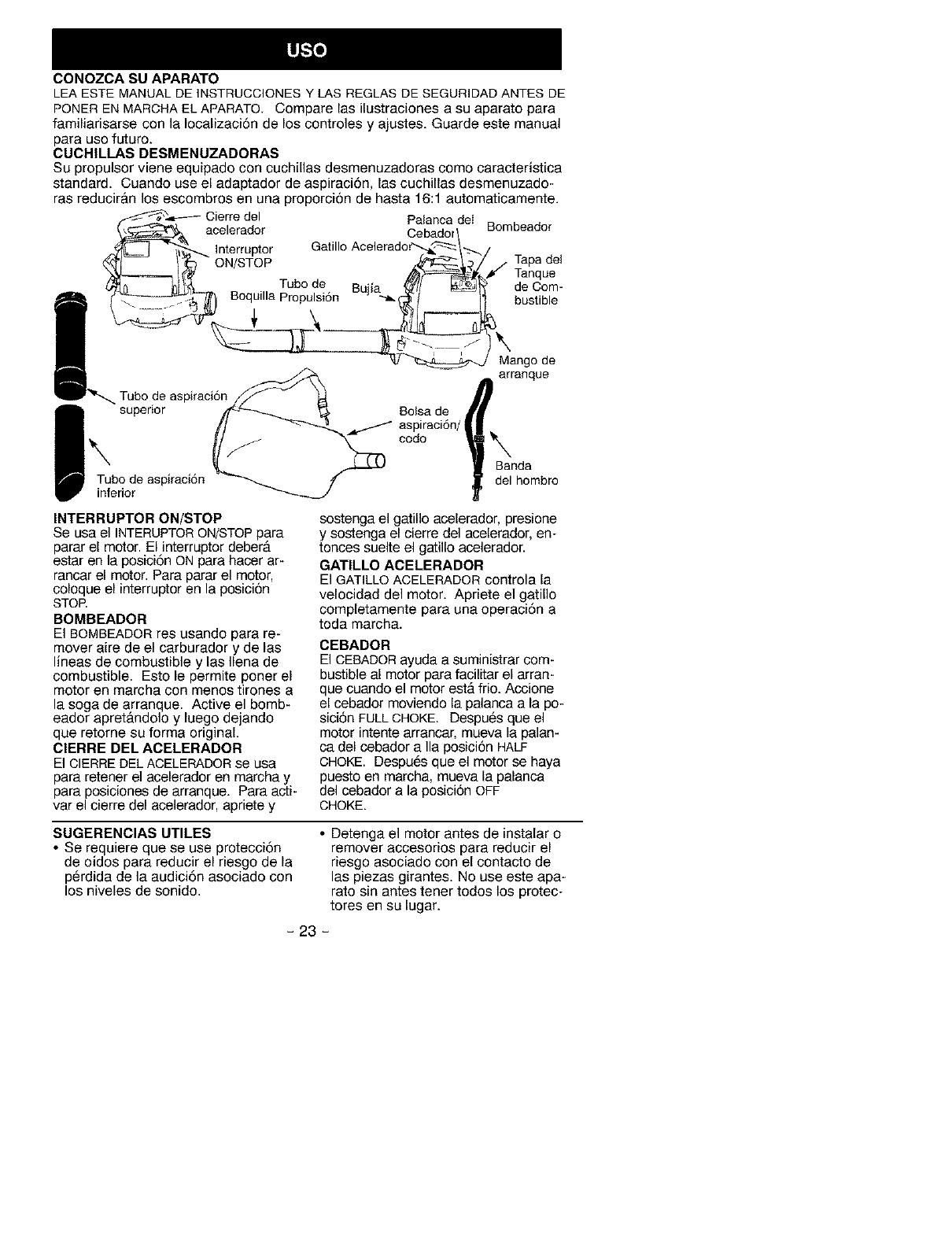
CONOZCASUAPARATO
LEA ESTE MANUAL DE INSTRUCCIONES Y LAS REGLAS DE SEGURIDAD ANTES DE
PONER EN MARCHA EL APARATO. Compare las ilustraciones a su aparato para
familiarisarse con la Iocalizaci6n de los controles y ajustes. Guarde este manual
para uso futuro.
CUCHILLAS DESMENUZADORAS
Su propulsor viene equipado con cuchillas desmenuzadoras como caracteristica
standard. Cuando use el adaptador de aspiraci6n, las cuchillas desmenuzado-
ras reducir&n los escombros en una proporci6n de hasta 16:1 automaticamente.
Palanca deI Bombeador
Tubo tie aspiraci6n// _
Ixsupen°r _
Tr_ebOdeaspiraci6n
INTERRUPTOR ON/STOP
Se usa el INTERUPTORON/STOPpara
parar el motor. El interruptor deber&
estar en la posici6n ON para hacer ar-
rancar el motor. Para parar el motor,
coloque el interruptor en la posici6n
STOP.
BOMBEADOR
El BOMBEADOR res usando para re-
mover aire de el carburador y de las
lineas de combustible y las Ilena de
combustible. Esto le permite poner el
motor en marcha con menos tirones a
la soga de arranque. Active el bomb-
eador apret&ndolo y luego dejando
que retorne su forma original.
ClERRE DEL ACELERADOR
El CIERREDEL ACELERADORse usa
para retener el acelerador en marcha y
para posiciones de arranque. Para acti-
var el cierre del acelerador, apriete y
Tapa del
Tanque
de Com-
bustible
Mango de
arranque
Bolsa de
aspiraciSn/
codo X
Banda
del hombro
sostenga el gatillo acelerador, presione
y sostenga el cierre del acelerador, en-
tonces suelte el gatillo acelerador.
GATILLO ACELERADOR
El GATILLO ACELERADOR controla la
velocidad del motor. Apriete el gatillo
completamente para una operaci6n a
toda marcha.
CEBADOR
El CEBADOR ayuda a suministrar com-
bustible al motor para facilitar el arran-
que cuando el motor est& frio. Accione
el cebador moviendo la palanca a la po-
sici6n FULL CHOKE. Despu_s que el
motor intente arrancar, mueva la palan-
ca del cebador a Ila posici6n HALF
CHOKE. Despu_s que el motor se haya
puesto en march& mueva la palanca
del cebador a la posici6n OFF
CHOKE.
SUGERENCIAS UTILES
•Se requiere que se use protecci6n
de oidos para reducir el riesgo de la
perdida de la audici6n asociado con
los niveles de sonido.
• Detenga el motor antes de instalar o
remover accesorios para reducir el
riesgo asociado con el contacto de
las piezas girantes. No use este apa-
rato sin antes tener todos los protec-
tores en su lugar.
23
• Use el equipo de fuerza Qnicamente
en horas razonables - no muy tem-
prano en la mafiana o muy tarde en
la noche cuando otras personas
podrian ser perturbadas. Cumpla
con el horario enlistado por los esta-
tutos locales. Usualmente se recom-
ienda un horario normal de 9:00 a.m.
a 5:00 p.m., de lunes a s&bado.
• Limite el uso de nQmero de piezas
de equipo al mismo tiempo para re-
ducir los niveles de ruido.
• Para efectuar el trabajo, use los pro-
pulsores de fuerza a la menor veloci-
dad de aceleraci6n posible para re-
ducir los niveles de sonido.
• Use rastrillos y escobas para aflojar
escombros antes de soplarlos con el
porpulsor de aire.
• En condiciones de mucho polvo,
moje ligeramente las superficies del
suelo o use el accesorio "mister"
donde haya agua disponible.
• Conserve agua usando el propulsor
en lugar de mangueras de agua para
las tantas aplicaciones del c_sped y
de jardineria, incluyendo &reas como
Io son canales de agua en los techos,
protecci6n de tela met_.lica en las ven-
tanas y puertas, patios, asadores a la
parrilla, balcones y jardines.
• Tenga cuidado con los niSos, ani-
males domesticos, ventanas abier-
tas y carros recien lavados. Sople
los escombros con precauci6n.
• Use la extensi6n completa de la bo-
quilla del propulsor para que la cor-
riente de aire pueda traajar cerca del
suelo.
• Despu_s de usar los propulsores de
aire y otro tipo de equipo, iLIMPIE!
Deseche los escombros en re-
cept&culos de basura.
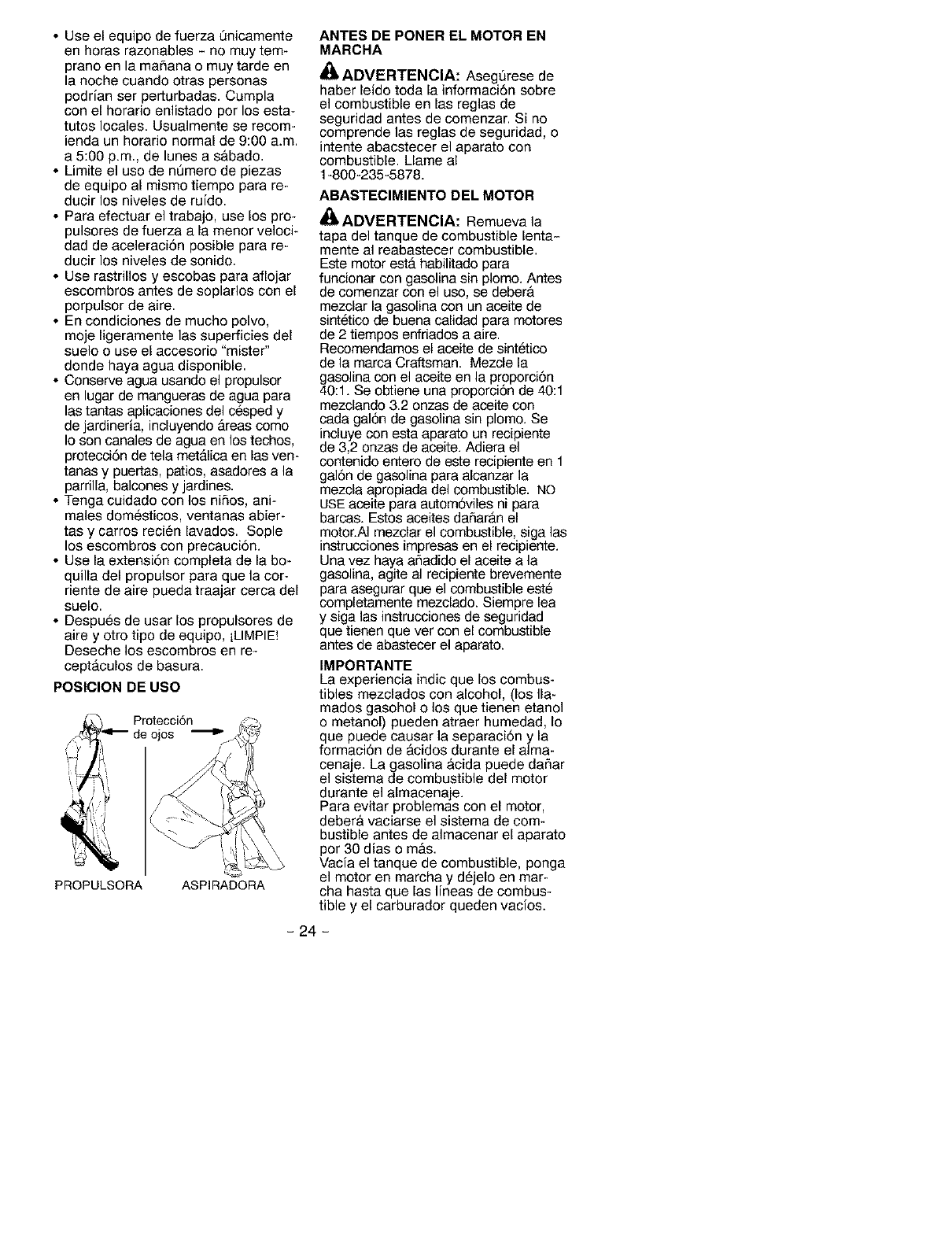
POSICION DE USO
Protecci6n
de ojos
!
PROPULSORA ASPIRADORA
ANTES DE PONER EL MOTOR EN
MARCHA
,_ADVERTENCIA: Asegt_rese de
haber leido toda la informaci6n sobre
el combustible en las reglas de
seguridad antes de comenzar. Si no
comprende las reglas de seguridad, o
intente abacstecer el aparato con
combustible. Llame al
1-800-235-5878.
ABASTECIMIENTO DEL MOTOR
,_ADVERTENCIA: Remueva la
tapa del tanque de combustible lenta-
mente al reabastecer combustible.
Este motor est,. habilitado para
funcionar con gasolina sin plomo. Antes
de comenzar con el uso, se deber&
mezclar la gasolina con un aceite de
sint_tico de buena calidad para motores
de 2 tiempos enfriados a aire.
Recomendamos el aceite de sint_tico
de la marca Craftsman. Mezcle la
gasolina con el aceite en la proporci6n
40:1. Se obtiene una proporci6n de 40:1
mezclando 3.2 onzas de aceite con
cada gal6n de gasolina sin plomo. Se
incluye con esta aparato un recipiente
de 3,2 onzas de aceite. Adiera el
contenido entero de este recipiente en 1
gal6n de gasolina para alcanzar la
mezcla apropiada del combustible. NO
USE aceite para autom6viles ni para
barcas. Estos aceites dafiar&n el
motor.AI mezclar el combustible, siga las
instrucoiones impresas en el recipiente.
Una vez haya afiadido el aceite a la
gasolina, agite al recipiente brevemente
para asegurar que el combustible este
completamente mezclado. Siempre lea
y siga las instrucoiones de seguridad
que tienen que vet con el combustible
antes de abastecer el aparato.
IMPORTANTE
La experiencia indic que los combus-
tibles mezclados con alcohol, (los Ila-
mados gasohol o los que tienen etanol
o metanol) pueden atraer humedad, Io
que puede causar la separaci6n y la
formaci6n de &cidos durante el alma-
cenaie. La gasolina acida puede dafiar
el sistema de combustible del motor
durante el almacenaje.
Para evitar problemas con el motor,
debera vaciarse el sistema de com-
bustible antes de almacenar el aparato
por 30 dias o m&s.
Vacfa el tanque de combustible, ponga
el motor en marcha y dejelo en mar-
cha hasta que las lineas de combus-
tible y el carburador queden vacfos.
24
Use combustible fresco en la pr6xima
temporada.
Nunca use productos de limpieza de
motor o carburador en el tanque de
combustible ya que de hacerlo puede
provocar daflos permanentes.
Un estabilizador de cojmbustible es
una alternativa aceptable para minimi-
zar la formaci6n de dep6sitos de goma
en el combustible durante el almace-
naje. El aceite de la marcha Craftsman
viene ya mezclado con estabilizador
de combustible. Yea la secci6n de AL-
MACENAJE para m&s informaci6n.
PARA PARAR EL MOTOR
•Presione y sostenga el interrupter
hasta que el motor se detenga total-
mente.
• Si el motor no se detiene, mueva el
cebador a la posici6n FULL CHOKE.
PARA PONER EL MOTOR EN
MARCHA
_Jk ADVERTENCIA: ES OBLIGATO-
RIO asegurarse que los tubos est_n
bien fijos antes de usar el aparato.
• Abastezca el motor. Apartese por Io
menos 3 metros (10 pies) del lugar
de abastecimiento.
• Sostenga el aparato en la posici6n
de arranque elustrada. Aseg_rese
de que la boquilla de propulsi6n no
este direccionada hacia personas,
animales, vidrieras y otros objetos
s61idos.
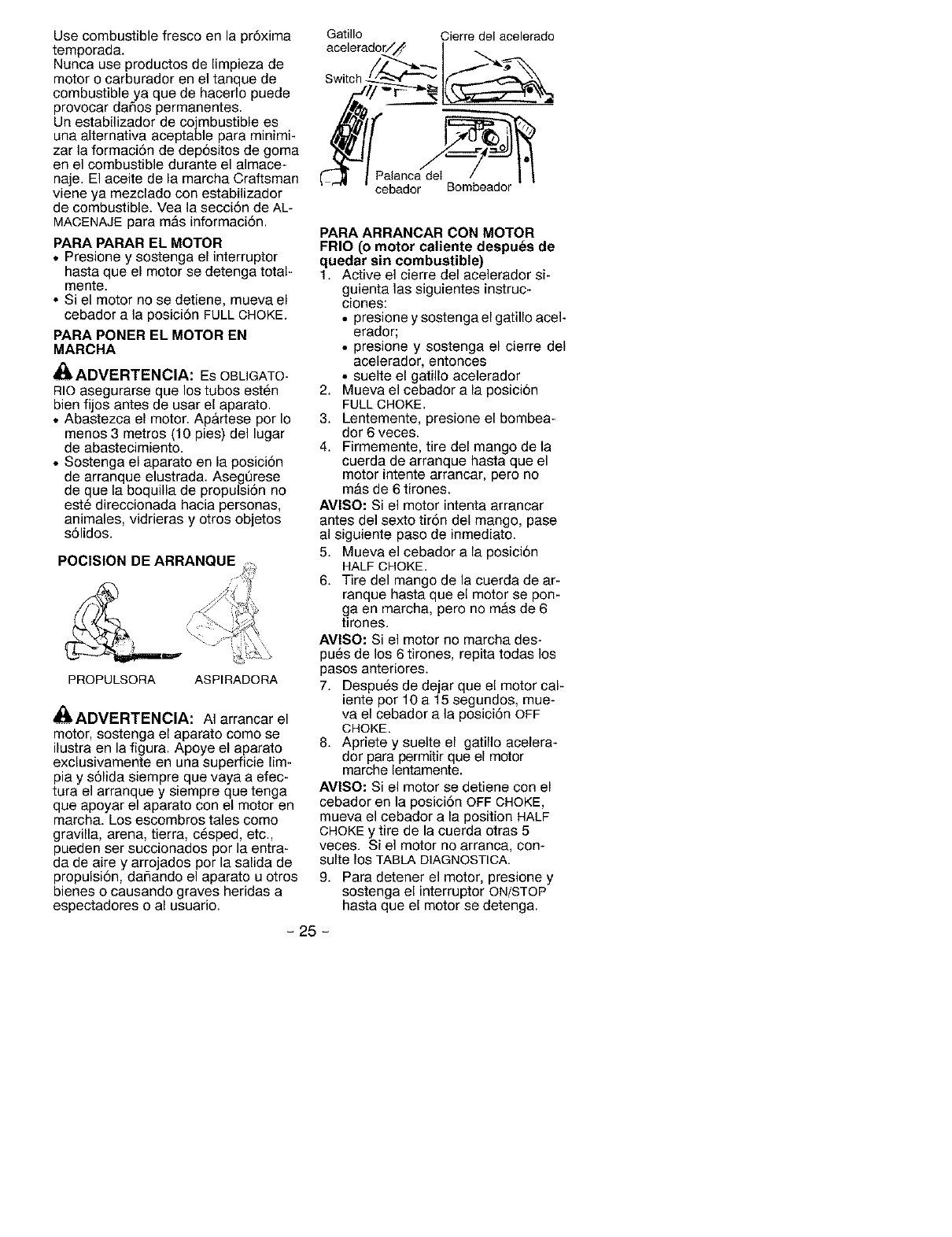
POCISION DE ARRANQUE
PROPULSORA ASPIRADORA
4_!_ADVERTENCIA: AI arrancar el
motor, sostenga el aparato come se
ilustra en la figura. Apoye el aparato
exclusivamente en una superficie lim-
pia y s61ida siempre que vaya a efec-
tura el arranque y siempre que tenga
que apoyar el aparato con el motor en
marcha. Los escombros tales come
gravilla, arena, tierra, c_sped, etc.,
pueden ser succionados por la entra-
da de aire y arrojados por la salida de
propulsi6n, daSando el aparato u otros
bienes o causando graves heridas a
espectadores o al usuario.
Gatillo Cierre del acelerado
Palanca dei__
cebador Bombeador
PARA ARRANCAR CON MOTOR
FRIO (o motor caliente despues de
quedar sin combustible)
1. Active el cierre del acelerador si-
guienta las siguientes instruc-
clones:
• presione y sostenga el gatillo acel-
erador;
• presione y sostenga el cierre del
acelerador, entonces
• suelte el gatillo acelerador
2. Mueva el cebador a la posici6n
FULL CHOKE.
3. Lentemente, presione el bombea-
dor 6 veces.
4. Firmemente, tire del mango de la
cuerda de arranque hasta que el
motor intente arrancar, pero no
m&s de 6 tirones.
AVISO: Si el motor intenta arrancar
antes del sexto tir6n del mango, pase
al siguiente paso de inmediato.
5. Mueva el cebador a la posici6n
HALF CHOKE.
6. Tire del mango de la cuerda de ar-
ranque hasta que el motor se pon-
ga en marcha, pero no m&s de 6
tirones.
AVISO: Si el motor no marcha des-
pues de los 6 tirones, repita todas los
pasos anteriores.
7. Despu_s de dejar que el motor cal-
iente por 10 a 15 segundos, mue-
va el cebador a la posici6n OFF
CHOKE.
8. Apriete y suelte el gatillo acelera-
dor para permitir que el motor
marche lentamente.
AVISO: Si el motor se detiene con el
cebador en la posici6n OFF CHOKE,
mueva el cebador a la position HALF
CHOKE y tire de la cuerda otras 5
veces. Si el motor no arranca, con-
suite los TABLA DIAGNOSTICA.
9. Para detener el motor, presione y
sostenga el interrupter ON/STOP
hasta que el motor se detenga.
- 25 -
ARRANQUE CON EL MOTOR
CALIENTE
1. Mueva el cebador a la posici6n
OFF CHOKE.
2. Active el cierre del acelerador
como se instruye el la secci6n
PARA ARRANCAR CON MOTOR
FRIO.
3. Lentemente, presione el bombea-
dor 6 veces.
4. Tire del mango de la cuerda de ar-
ranque hasta que el motor se pon-
ga en marcha.
5. Apriete y suelte el gatillo acelera-
dor para permitir que el motor
marche lentamente.
AVISO: Si el motor no arranca des-
pues de 5 tirones, es probable que
est_ ahogado. Proceda con la secci6n
ARRANQUE DE MOTOR AHOGADO.
6. Para detener el motor, presione y
sostenga el interruptor ON/STOP
hasta que el motor se detenga.
ARRANQUE DIFIClL (o arranque de
motor ahogado)
Se pueden poner en marcha los mo-
totes ahogados, colocando la palanca
del cebador en la posici6n OFF CHOKE.
Active el cierre del acelerador como se
instruye el la secci6n PARAARRANCAR
CON MOTOR FRIO; iuego, tire de la
cuerda hasta que el motor arranque.
Despu_s que el motor haya arrancado,
apriete y suelte el gatillo acelerador para
permitir que el motor marche lenta-
mente. Que el motor arranque puede
requerir que se tire de la cuerda de ar-
ranque muchas feces, esto dependera
de la cantidad de combuStible que est_
ahogado el aparato. Si el motor con-
tinOa sin arrancar, refierase a ia TABLA
DIAGNOSTICAOIlame al
1-800-235-5878.
RESPONSABILIDAD DEL USUARIO
_lb ADVERTENCIA: Descenecte la bujia antes de hacer cualquier man-
tenimiento, con la excepci6n de ice ajustes al carburador.
TAREA DE CUlDADO Y MANTENIMIENTO
Verifique que no haya piezas ni fijadores sueltos
Verifiaue aue no haya uiezas dafladas o gastadas
Inspeccione y limpie el aparato y las placas
Limpie el fiitro de aire
Cambie la bujia
Cambie el filtro de combustible
CUANDO HACER
Antes de cada uso
Antes de cada uso
Despu_s de cada uso
Cada 5 horas de uso
Anualmente
Anualmente
ADVERTENCIA: Evite hacer
contacto con el silenciador a no ser
que el motor yel silenciador se en-
cuentre frio. El contacto con un silen-
ciador caliente puede causar quema-
duras muy graves.
_ADVERTENCIA: Detenga el mo-
tor y asegQrese de que las cuchiilas
del impulsor no se encuentren girando
antes de abrir ia compuerta de entrada
de aire del aspirador o de intentar
introducir o remover los tubes de aspi-
raci6n o los tubos de propulsi6n. Las
cuchillas girantes podrian causar ser-
ios accidentes. Siempre descenecte
la bujia antes de hacer cualquier man-
tenimiento o de tener acceso a piezas
movibles.
RECOM ENDACIONES GENERALES
La garantia de este aparato no se apii-
ca a los articulos sometidos al abuso o
a la negligencia del usuario, Para reci-
bir el valor completo de la garantia, el
usuario deber& mantener el aparato
segun las instrucctiones en este
manual. Sera necessario hacer varios
ajustes peri6dicamente para mantener
el aparato debidamente.
VERIFICAR QUE NO HAYA PIEZAS
SUELTAS NI FIJADORES FLOJOS
• Capucha de la Bujia
• Filtro de Aire
• Tornillos de la Caja
-26 -
VERIFICAR QUE NO HAYA PIEZAS
DANADAS NI GASTADAS
Entre en contacto con el Centro de
Servicio Sears para el reemplazo de
piezas dafiadas o desgastadas.
• Interrupter ON/STOP- AsegQrese que
el interruptor funcione de una forma
aprodiada. Para detener el motor,
presione y sostenga el interruptor en
la posici6n STOP hasta que el motor
se detenga completamente.
Asegt_rese de que el motor se deten-
ga; luego vuelva a arrancar el motor
ycontin_e.
• Tanque de Combustible - Para de
usar el aparato si hay indicios de
daSos o perdidas en el tanque de
combustible.
• Bolsa de Aspiraci6n - Pare de usar
la bolsa si est& rota o daSada.
LIMPIE EL APARATO Y LAS PLA-
CAS
• Despu_s de que cada uso, inspec-
clone la aparato completa para saber
si hay piezas flojas o daSadas. Limpie
el aparato y las placas usando un tra-
po ht_medo con un detergente suave.
• Seque el aparato usando un trapo
seco y limpio.
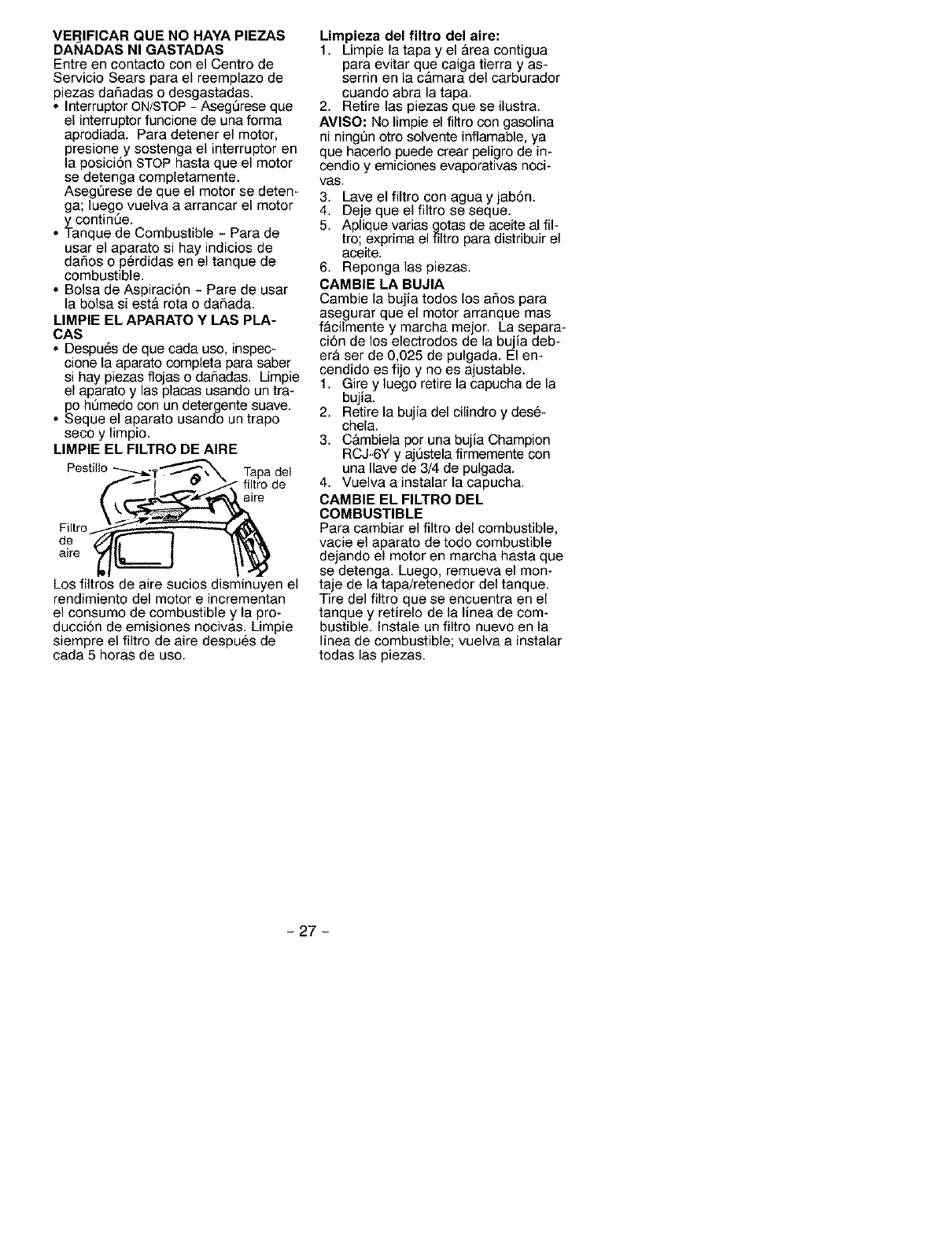
LIMPIE EL FILTRO DE AIRE
Tapa del
• filtro de
aire
Filtro
de
aire
Los filtros de aire sucios disminuyen el
rendimiento del motor e incrementan
el consume de combustible y la pro-
ducci6n de emisiones nocivas. Limpie
siempre el filtro de aire despues de
cada 5 horas de uso.
Limpieza del filtro del aire:
1. Limpie la tapa y el &rea contigua
para evitar que caiga tierra y as-
serrin en la c&mara del carburador
cuando abra la tapa.
2. Retire las piezas que se ilustra.
AVISO: No limpie el filtro con gasolina
ni ningt)n otro solvente inflamable, ya
que hacerlo puede crear peligro de in-
cendio y emiciones evaporativas noci-
vas.
3. Lave el filtro con agua y jab6n.
4. Deje que el filtro se seque.
5. Aplique varias gotas de aceite al fil-
tro; exprima el filtro para distribuir el
aceite.
6. Repongalas piezas.
CAMBIE LA BUJIA
Cambie la bujia todos los aSos para
asegurar que el motor arranque mas
f&cilmente y marcha mejor. La separa-
ci6n de los electrodos de la bujia deb-
er& ser de 0,025 de pulgada. El en-
cendido es fijo y no es ajustable.
1. Gire y luego retire la capucha de la
bujia.
2. Retire la bujia del cilindro y desk-
chela.
3. C&mbiela por una bujia Champion
RCJ-6Y y ajQstela firmemente con
una Ilave de 3/4 de pulgada.
4. Vuelva a instalar la capucha.
CAMBIE EL FILTRO DEL
COMBUSTIBLE
Para cambiar el filtro del combustible,
vacie el aparato de todo combustible
dejando el motor en marcha hasta que
se detenga. Luego, remueva el morn
taje de la tapa/retenedor del tanque.
Tire del filtro que se encuentra en el
tanque y retirelo de la linea de com-
bustible. Instale un filtro nuevo en la
linea de combustible; vuelva a instalar
todas las piezas.
27
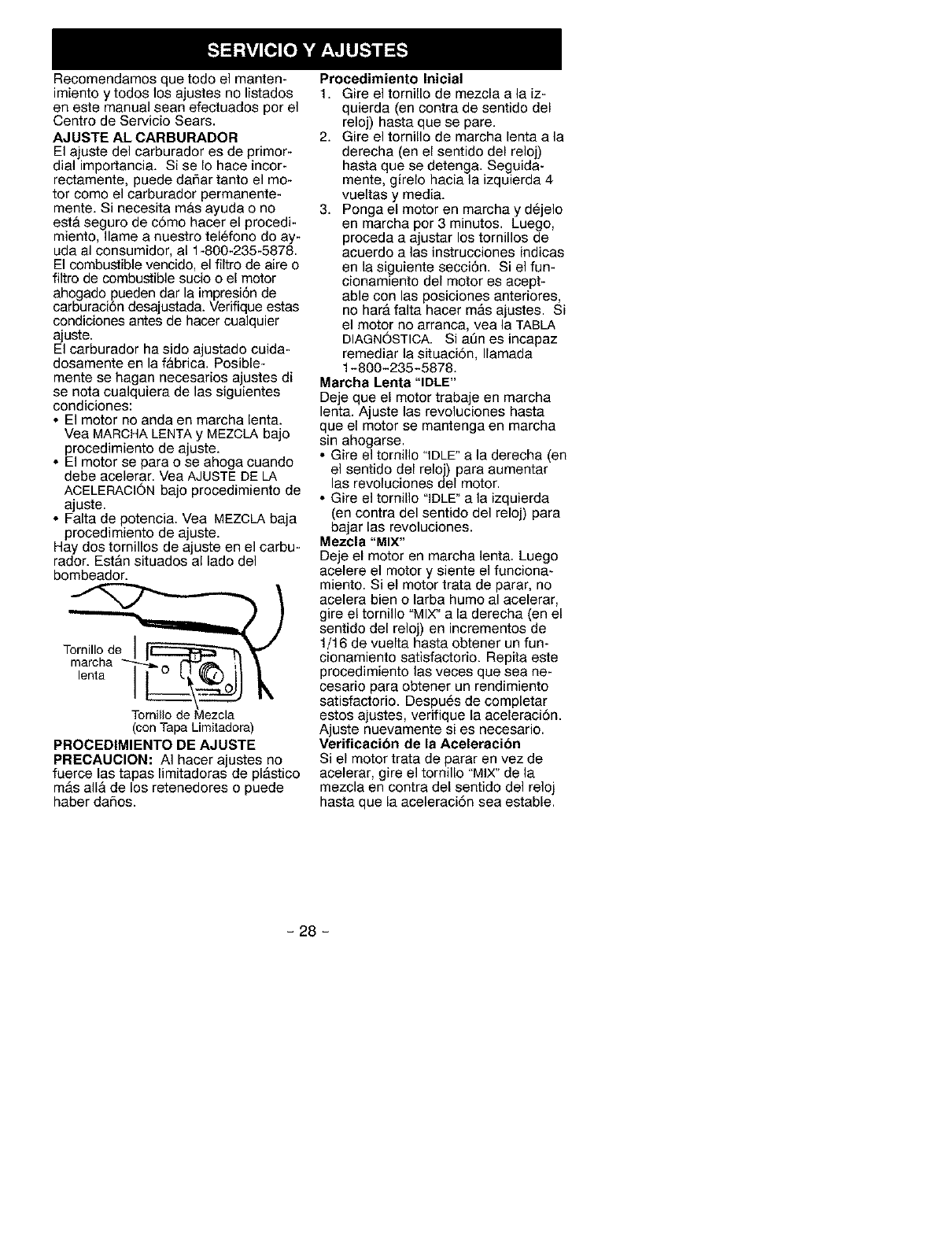
Recomendamos que todo el manten-
imiento y todos los ajustes no listados
en este manual sean efectuados per el
Centre de Servicio Sears.
AJUSTE AL CARBURADOR
El ajuste del carburador es de primor-
dial importancia. Si se Io hace incor-
rectamente, puede daflar tanto el mo-
tor como el carburador permanente-
mente. Si necesita m&s ayuda o no
est& seguro de c6mo hacer el procedi-
miento, Ilame a nuestro telefono do ay-
uda al consumidor, al 1-800-235-5878.
El combustible vencido, el filtro de aire o
filtro de combustible sucio o el motor
ahogado pueden dar la impresi6n de
carburaci6n desajustada. Verifique estas
condiciones antes de hacer cualquier
ajuste.
El carburador ha sido ajustado cuida-
dosamente en la f&brica. Posible-
mente se hagan necesarios ajustes di
se nora cualquiera de las siguientes
condiciones:
• El motor no anda en marcha lenta.
Vea MARCHA LENTA y MEZCLA bajo
procedimiento de ajuste.
• El motor se para o se ahoga cuando
debe acelerar. Vea AJUSTE DE LA
ACELERAClON bajo procedimiento de
ajuste.
• Falta de potencia. Vea MEZCLA baja
procedimiento de ajuste.
Hay dos tornillos de ajuste en el carbu-
rador. Est&n situados al lado del
bombeador.
Tornillo de
marcha
lenta
Tornillo de Mezcla
(con Tapa Limitadora)
PROCEDIMIENTO DE AJUSTE
PRECAUClON: AI hacer a ustes no
fuerce las tapas m tadoras de p &st co
m&s all& de los retenedores o puede
haber daflos.
Procedimiento Inicial
1. Gire el tornillo de mezcla a la iz-
quierda (en contra de sentido del
reloj) hasta que se pare.
2. Gire el tornillo de marcha lenta a la
derecha (en el sentido del reloj)
hasta que se detenga. Seguida-
mente, girelo hacia la izquierda 4
vueltas y media.
3. Ponga el motor en marcha y dejelo
en marcha per 3 minutos. Luego,
proceda a ajustar los tornillos de
acuerdo alas instrucciones indicas
en la siguiente secci6n. Si el fun-
cionamiento del motor es acept-
able con las posiciones anteriores,
no hat& falta hacer m&s ajustes. Si
el motor no arranca, vea la TABLA
DIAGNOSTICA. Si aQn es incapaz
remediar la situaci6n, Ilamada
1-800-235-5878.
Mareha Lenta "IDLE"
Deje que el motor trabaje en marcha
lenta. Ajuste las revoluciones hasta
que el motor se mantenga en marcha
sin ahogarse.
• Gire el tornillo "IDLE" a la derecha (en
el sentido del reloj) para aumentar
las revoluciones del motor.
• Gire el tomillo "IDLE" a la izquierda
(en contra del sentido del reloj) para
bajar las revoluciones.
Mezcla "MIX"
Deje el motor en marcha lent& Luego
acelere el motor y siente el funciona-
miento. Si el motor trata de parar, no
acelera bien o larba humo al acelerar,
gire el tornillo "MIX" a la derecha (en el
sentido del reloj) en incrementos de
1/16 de vuelta hasta obtener un fun-
cionamiento satisfactorio. Repita este
procedimiento las veces que sea ne-
cesario para obtener un rendimiento
satisfactorio. Despu_s de completar
estos ajustes, verifique la aceleraci6n.
Ajuste nuevamente si es necesario.
Verificacion de la Aceleracion
Si el motor trata de parar en vez de
acelerar, gire el tornillo "MIX" de la
mezcla en contra del sentido del reloj
hasta que la aceleraci6n sea estable.
28
_IbADVERTENCIA: Realice los si-
guientes pasos despu_s de cada uso:
• Deje que el motor se enfrie y fije
bien el aparato antes de guardarlo o
transportarlo.
• Guarde el aparato y el combustible
en un lugar bien ventilado donde los
vapores de combustible no puedan
entrar en contacto con chispas o lla-
mas abiertas provenientes de termo-
tanques, motores o interruptores
electricos, calefactores centrales,
etc.
• Guarde el aparato con todos los pro-
tectores en su lugar y coloque el
aparato de modo que las piezas filo-
sas no puedan causar heridas por
accidente.
• Guarde el aparato y el combustible
completamente fuera del alcance de
los ni_os.
ESTACIONAL ALMACENAJ E
Prepare el aparato para el almacenaje
al final de la temporada o si ca a estar
sin usar por mas de 30 dias.
Siva a almacenar el aparato durante
un periodo largo de tiempo:
• Limpie el aparato por completo antes
del almacenaje.
• Almacene en un &rea limpia y seca.
• Aplique una pequeSa cantidad de
aceite a las superficies externas
met&licas.
SISTEMA DE COMBUSTIBLE
Bajo ABASTECIMIENTO DEL MOTOR, en
la seccion de Uso de este manual, vea
el mensa e marchado IMPORTANTE
acerca de uso de combust b es mezc a-
dos con alcohol en el motor su aparato.
Los estabilizadores de combustible
son una alternativa aceptable para
minimizar la formaci6n de depositos
de goma durante el almacenamiento.
Afiada estabilizador a la gasolina en el
tanque de combustible o en el recipiente
de alacenamiento de combustible. Siga
las instrucciones de mezcla que se en-
cuentran en los envases de estabiliza-
dor. Ponga el motor en marcha y d_jelo
en marcha por Io menos 5 minutos des-
pues de ponerle estabilizador.
El aceite de la marca Craftsman 40:1
para motores de 2 tiempos (enfriados
a aire) ya viene mezclado con estabili-
zador de combustible. Si no usa este
aceite de Sears, entonces puede aSa-
dir un estabilizador al tanque de com-
bustible.
INTERIOR DEL MOTOR
• Retire la bu lay vierta una cucharad-
a de as de t_ de ace te 40:1 para
motores de 2 tiempos (enfriados a
aire) por la abertura de la bujia. Tiro-
nee lentamente de la soga de arran-
que 8 a 10 veces para distribuir el
aceite.
• Reemplace la bujia con otra del tipo
y de la gama de calor recomenda-
dos.
• Limpie el filtro de aire.
• Examine todo el aparato para verifi-
car que no haya tornillos, tuercas ni
pernos sueltos. Cambie todas las
piezas daSadas, quebradas o gasta-
das.
• AI principio de la pr6xima temporada,
use exclusivamente combustible
nuevo con la proporci6n correcta de
gasolina o aceite.
OTROS
• No guarde la gasolina de una tempo-
rada a la siguiente.
• Cambie el recipiente de gasolina si
se empieza a oxidar.
29
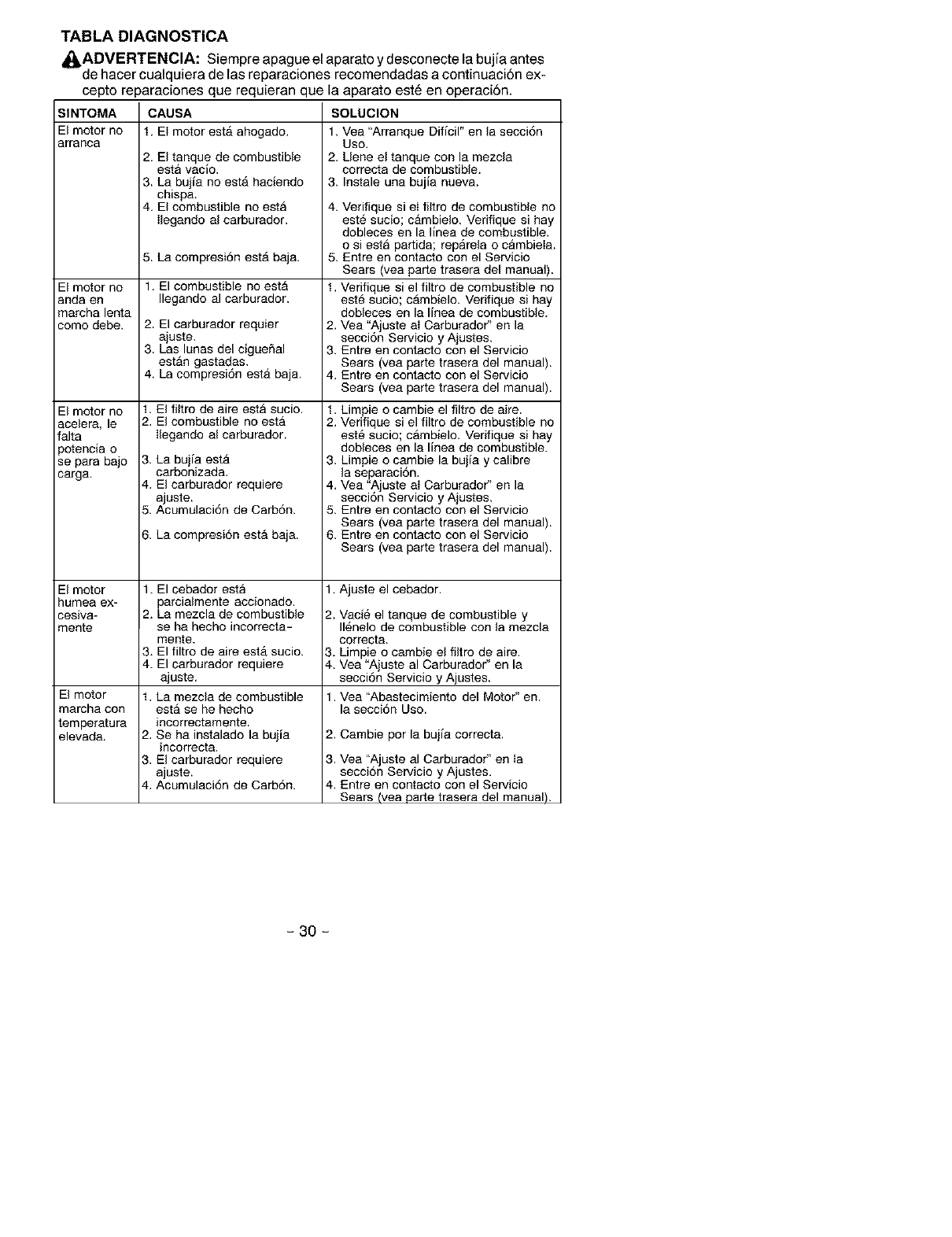
TABLA DIAGNOSTICA
,_ADVERTENCIA: Siempre apague el aparato y desconecte la bujia antes
de hacer cualquiera de las reparaciones recomendadas a continuaci6n ex-
cepto reparaciones que requieran que la aparato est_ en operaci6n.
SINTOMA
El motor no
arranca
El motor no
anda en
marcha lenta
como debe.
El motor no
acelera, le
falta
potencia o
se para baio
carga.
El motor
humea ex-
cesiva-
mente
El motor
marcha con
temperatura
elevada.
CAUSA
1. EI motor est_ ahogado.
2. El tanque de combustible
esta vacio.
3. La bujia no est_ haciendo
chispa.
4, El combustible no esta
ilegando al carburador.
5. La compresi6n est_ baja.
1. El combustible no est_
Ilegando al carburador.
2. El carburador requier
ajuste.
3. Las lunas del cigue_al
est#m gastadas.
4. La compresi6n est#_baja.
1. El filtro de aire esta sucio.
2. El combustible no esta
Ilegando al carburador.
3. La bujia est#l
carbonizada.
4. El carburador requiere
ajuste.
k Acumulaci6n de CarbSn.
6. La compresi6n est_ baja.
1. El cebador esta
parcialmente accionado.
2. La mezcla de combustible
se ha hecho incorrecta-
mente.
3. El filtro de aire esta sucio.
4. El carburador requiere
ajuste.
1. La mezcla de combustible
esta se he hecho
incorrectamente.
2, Se ha instalado la bujia
incorrectx_.
3. El carburador requiere
ajuste.
4. Acumulaci6n de CarbSn.
SOLUCION
1. Vea "Arranque Dificil" en la secci6n
Uso.
2. Llene el tanque con la mezcla
correcta de combustible.
3. Instale una bujia nueva.
4. Verifique si el filtro de combustible no
este sucio; c#_mbielo. Verifique si hay
dobleces en la linea de combustible.
o siesta partida; reparela o c#_mbieia.
5. Entre en contacto con el Servicio
Sears (yea parte trasera del manual).
1. Verifique si el filtro de combustible no
este sucio; cAmbielo. Verifique si hay
dobleces en la linea de combustible.
2, Vea "Ajuste aI Carburador" en la
secci6n Servicio y Ajustes.
3. Entre en contacto con el Servicio
Sears (yea parte trasera del manual).
4, Entre en contacto con el Servicio
Sears (yea parte trasera del manual).
1. Limpie o cambie el filtro de aire.
2, Verifique si el filtro de combustible no
este sucio; c_mbielo. Verifique si hay
dobleces en la linea de combustible.
3. Limpie o cambie la bujia y calibre
la separaci6n.
4. Vea "Ajuste ai Carburador" en la
secci6n Servicio y Ajustes.
5. Entre en contacto con el Servicio
Sears (vea parte trasera del manual).
6. Entre en contacto con el Servicio
Sears (vea parte trasera del manual).
1. Ajuste el cebador.
2. Vacie el tanque de combustible y
116nelode combustible con la mezcla
correcta.
3. Limpie o cambie el filtro de aire.
4. Vea "Aiuste al Carburador" en la
secci6n Servicio y Ajustes.
1. Vea "Abastecimiento del Motor" en.
la secci6n Uso.
2. Cambie por la bujia correcta.
3. Vea "Ajuste al Carburador" en Ia
secci6n Servicio y Ajustes.
4. Entre en contacto con el Servicio
Sears (yea parte trasera del manual).
- 30 -
SUS DERECHOS Y OBLIGACIONES
DE GARANTIA: La Ageneia de Pro_
tecci6n Ambiental de los Estados Uni-
dos y Sears, Roebuck and Co.,
U.S.A., se complacen en explicar la
garantia con la que cuenta el sistema
de control de emisi6n en su motor pe-
quefio, modelo 2001-2004, para uso
fuera de carretera. Sears deber_ ga*
rantizar el sistema de control de emi-
si6n en su m_quina de motor pequeflo
para uso fuera de carretera por los
periodos de tiempo que explicamos a
continuaci6n y con la condici6n de que
su m_quina de motor pequeflo para
uso fuera de carretera no haya sufrido
ning6n tipo de abuso, negligencia o
mantenimiento inapropiado. Su siste-
ma de control de emisi6n incluye pie-
zas tales como el carburador y el sis-
tema de ignici6n. Donde exista una
condici6n que requiera reparaci6n
bajo garantia, Sears reparar_ gratis su
motor pequeflo para uso fuera de car-
retera. Los gatos cubiertos ba o la ga-
rantia incluyen el diagn6stico, as pie-
zas ylabor. CUBIERTA DE GARAN-
TIA DEL FABRICANTE: Si cualquier
pieza relacionada con el sistema de
emisi6n de su motor (como hemos en-
umerado en la lista de piezas de con-
trol de emisi6n bajo garantia) se en-
contrara defectuosa o defectos en el
material o en la labor del motor causa*
ran que tal pieza comenzara a fallar, la
pieza sera reparada o reemplazada
por Sears. GARANTIA DE RE-
SPONSABILIDAD DE DEL DUENO:
Como dueflo de una m_quina de mo-
tor pequeflo para uso fuera de carret-
era, usted ser& responsable por el
mantenimiento adecuado en los perio-
dos previamente programados y en-
umerados en su manual de instruc-
clones. Sears recomienda que guarde
todos los recibos que indiquen que se
ha desempefiado mantenimiento en
su m&quina de motor pequeflo para
uso fuera de carretera, pero Sears no
podra negar el servicio bajo garantia
_nicamente a causa de la falta de reci-
bos o pot el incumplimiento de su
parte en asegurarse que el mantenimi-
ento programado haya sido de-
sempeflado. Como dueflo de una
m&quina de motor pequeflo para use
fuera de carretera, usted debera con-
tar con el conocimiento de que Sears
puede negar la cubierta bajo garantia
si su m&quina de motor pequefio para
uso fuera de carretera o alguna pieza
de la misma ha dejado de funcionar
debido al abuso, negligencia, manten-
imiento inapropiado, modificaciones
no aprobadas o el uso de piezas que
no hayan sido fabricadas o aprobadas
por el fabricante original del equipo.
Es responsabilidad suya el Ilevar su
m&quina de motor pequeflo para uso
fuera de carretera a un centro de repa-
raci6n autorizado Sears tan pronto
como se presente el problema. Las
reparaciones bajo garantia deber&n
ser completadas en un periodo de
tiempo razonable, que no exceda los
30 dias. Si cuenta usted con alguna
pregunta en relaci6n a sus derechos y
responsabilidades de garantia, usted
debera comunicarse con su distribui-
dor autorizado del servicio mas cerca-
no o Ilamar a Sears al
1-800-469-4663. FECHA DEL
COMIENZA DE LA GARANTIA: El
periodo de garantia comienza en la
fecha de compra de la m_.quina de
motor pequeflo para uso fuera de car-
retera. DURACION DE LA GARAN-
TIA: Esta garantia cuenta con un per-
iodo de duraci6n de dos afios comen-
zando en la fecha inicial de compra.
QUE CUBRE LA GARANTIA: REPA-
RACION O REEMPLAZO DE PIE-
ZAS. La reparaci6n o el reemplazo de
cualquier pieza garantizada seran de-
sempeflados y ofrecidos al duefio sin
costo alguno en un distribuidor autori-
zado del servicio Sears. Si cuenta
usted con alguna pregunta en relaci6n
a sus derechos y responsabilidades
de garantia, usted deber& comuni-
carse con su distribuidor autorizado
del servicio m&s cercano o Ilamar a
Sears al 1-800-469-4663. PERIODO
BE GARANTIA: Cualquier pieza ga*
rantizada que no est_ programada
para ser reemplazada como parte del
mantenimiento requerido, o que este
programada t_nicamente para inspec-
cton regular para efectos de "repara-
ci6n o reemplazo si fuera necesario"
debera garantizarse por un periodo de
dos aflos. Cualquier pieza garantiza*
da que este programada para ser re-
emplazada como parte del mantenimi-
ento requerido debera estar garantiza-
da por el periodo de tiempo que com-
ienza en la fecha de compra inicial
basra la fecha del primer reemplazo
- 31 -
programado para dicha pieza. DIAG-
NOSTICO: No se deber& cobrar al
duefio ning_n tipo de cargos por la la-
bor de diagn6stico la cual determine
que una pieza garantizada se encuen-
tra defectuosa si el trabajo de
diagn6stico ha side desempeflado por
un distribuidor autorizado del servicio
Sears. DANOS POR CONSECUEClA:
Sears podr& ser responsable de
dafios ocurridos a otras piezas del mo-
tor causados por la falla de una pieza
garantizada que se encuentre bajo el
(_eriodo de garantia. QUE NO
UBRE LA GARANTIA: Todas las faF
las causadas por el abuse, negligen-
cia o mantenimiento inapropjado no
est&n cubiertas. PIEZAS ANADIDAS
OMODIFICADAS: El uso de piezas
afiadidas o la modificaci6n de piezas
podr&n servir como base para que se
anule la reclamaci6n de garantia. La
garantia de Sears no se responsabili-
za por el mal funcionamiento debido al
use de piezas afiadidas o de piezas
modificadas. COMO ENTABLAR
UNA RECLAMAClON: Si cuenta
usted con alguna pregunta relaciona-
da con sus derechos y responsabili-
dades de garantia, usted deber& en-
trar en contacto con su distribuidor au-
torizado del servicio Sears m&s cerca-
no o Ilamar a Sears al
1-800-469-4663. DONDE OBTEN-
ER SERVIClO DE GARANTIA: Servi-
cio o reparaciones bajo garantia deb-
er&n ser provistas en todos los distri-
buidors autorizado del servicio Sears.
Por favor comuniquese al
1-800-469-4663. MANTENIMIENTO,
REEMPLAZO Y REPARACION DE
PIEZAS RELACIONADAS CON LA
EMISION: Cualquier pieza de repues_
to Sears aprobada y utilizada en el de-
sempeSo de cualquier servicio de
mantenimiento o servicio de repara-
ci6n bajo garantia de piezas relaciona-
das con la emisi6n ser& provisto sin
costo alguno al duefio si la pieza se
encuentra bajo garantia. LISTA SE
PIEZAS DE CONTROL DE EMISION
GARANTIZADAS: Carburador, Siste-
ma de Ignici6n: Bujia (cubierta hasta la
fecha de mantenimiento programada),
M6dulo de Ignici6n. DECLARACION
DE MANTENIMIENTO: El duefio es
responsable de adquirir todo el man-
tenimiento requerido come Io define en
el manual de instrucciones.
Se certifica este motor para satisfacer los requisites de emisi6n para los uso
siguientes:
[] Moderado (50 horas)
[] Intermedio (125 horas)
[] Extendido (300 horas)
32
