Craftsman 113 244513 Owners Manual
113244513 7b1c0a74-9794-4991-b887-61c3b3ea96be Craftsman Saw 113.244513 User Guide |
2015-01-05
: Craftsman Craftsman-113-244513-Owners-Manual-161131 craftsman-113-244513-owners-manual-161131 craftsman pdf
Open the PDF directly: View PDF  .
.
Page Count: 20

SAVE THIS MANUAL
FOR FUTURE
REFERENCE
SEARS
owners
manual
MODEL NO.
113.244513
CAUTION:
Read GENERAL and
ADDITIONAL SAFETY
IN ST R UCTIO N S
caref ully
Serial
Number
Model and serial
number may be found
at the right-hand side
of the frame.
You should record both
model and serial
number in a safe place
for future use.
CRRFTSMf,]I
7O-rNcH
BAND SAW
o assem bly
o operating
o repait parts
Sold by SEARS, ROEBUCK AND CO., Chicago, IL. 60684 U.S.A.
Part No. SP5100

FULL ONE YEAR WARRANTY ON CRAFTSMAN BAND SAW
lf within one year lrom the date of purchase, this Craftsman Band Saw fails due to a defect in
material or workmanship, Sears will repair it, free of charge.
WARRANTY SERVICE IS AVAILABLE BY SIMPLY CONTACTING THE NEAREST SEARS SERVICE
CENTER/DEPARTMENT THROUGHOUT THE UNITED STATES.
THIS WARRANTY APPLIES ONLY WHILE THIS PRODUCT IS USED IN THE UNITED STATES.
This warranty gives you specilic legal rights, and you may also have other rights which vary from
state to state.
SEARS, ROEBUCK AND CO.,698/731A, Sears Tower, Chicago, lL 60684
1.
general safety instructions for power tools
KNOW YOUR POWER TOOL
Read and understand the owner's manual and
labels aff ixed to the tool. Learn its application
and limitations as well as the specif ic potential
hazards peculiar to this tool.
GROUND ALL TOOLS
This tool is equipped with an approved 3-
conductor cord and a 3-prong grounding type
plug to f it the proper grounding type receptacle.
The green conductor in the cord is the ground-
ing wire. Never connect the green wire to a llve
terminal.
KEEP GUARDS IN PLACE
- in working order, and in proper adlustment
and alignment.
REMOVE ADJUSTING KEYS AND WRENCHES
Form a habit of checking to see that keys and
adjusting wrenches are removed from tool
before turning it on.
KEEP WORK AREA CLEAN
Cluttered areas and benches invite accidents.
Floor must not be slippery due to wax or saw-
d ust.
AVOID DANGEROUS ENVIRONMENT
Don'l use power tools in damp or wet locations
or expose them to rain. Keep work area well
lighted. Provide adequate surrounding work
soace.
KEEP CHILDREN AWAY
All visitors should be kept a safe distance f rom
worK area.
8. MAKE WORKSHOP CHILD.PROOF
- with oadlocks, master switches, or by re-
moving starter keYs.
9. DON'T FORCE TOOL
It will do the job better and safer at the rate for
which it was designed.
10. USE RIGHT TOOL
Don't force tool or attachment to do a job it was
not designed for.
11. WEAR PROPER APPAREL
Do not wear loose clothing, gloves, neckties or
jewelry (rings, wristwatches) to get caught in
moving parts. NONSLIP footwear is recom-
mended. Wear protective hair covering to con'
tain long hair. Roll long sleeves above the
elbow.
12. USE SAFETY GOGGLES (Head Protection)
Wear safety goggles (must comply with ANSI
287.1) at all times. Everyday eyeglasses only
have impact resistant lenses, they are NOT
safety glasses. Also, use face or dust mask if
cutting operation is dusty, and ear protectors
(plugs or muffs) during extended periods of
ooeratlon.
13. SECURE WORK
Use clamps or a vise to hold work when practi-
cal. lt's safer than using your hand, f rees both
hands to operate tool.
14. DON'T OVERREACH
Keep proper footing and balance at all times.
15. MAINTAIN TOOLS WITH CARE
Keep tools sharp and clean for best and safest
oerformance. Follow instructions for lubricating
and changing accessories.
16. DISCONNECT TOOLS
before servicing; when changing accessories
such as blades, bits, cutters, etc.
17. AVOID ACCIDENTAL STARTING
Make sure switch is in "OFF" position before
plugging in.
USE RECOMMEN DED ACCESSORIES
Consult the owner's manual for recommended
accessories. Follow the instructions that
accompany the accessories. The use of im-
proper accessories may cause hazards.
NEVER STAND ON TOOL
Serious injury could occur if the tool is tipped
or if the cutting tool is accidentally contacted.
Do not store materials above or near the tool
such that it is necessary to stand on the tool to
reach them.
6.
7.
't8.
19.
20. CHECK DAMAGED PARTS
Before further use of the tool, a guard or other
part that is damaged should be caref ully check-
ed to ensure that it will operate properly and
perform its intended f unction. Check for align'
ment of moving parts, binding of moving parts'
breakage of parts, mounting' and any other con'
ditions that may affect its operation' A guard or
other part that is damaged should be properly
repaired or rePlaced.
21. NEVER LEAVETOOL RUNNING UNATTENDED
Turn oower off . Don't leave tool until it comes to a
complete stoP.

additional safety instructions for band saw
Safety is a combination of common sense, staying alert,
and knowing how your band saw works.
BEFORE USING THE SAW:
WARNING: TO AVOID MISTAKES THAT COULD
RESULT IN SERIOUS, PERMANENT INJURY
DO NOT PLUG THE SAW IN UNTIL THE FOLLOW.
ING STEPS HAVE BEEN SATTSFACTORILY
COMPLETED:
1. Assembly and alignment.
2. l-earn the function and proper use of the on-off
switch. upper blade guide locx knob lower blade
guide tension adlusting knob table iock knobs,
bevel scale, guide. bar lock knob and blade thrust
bearing adjustment
3. Read and undersiand a sa{et; nstructions and
oneratino nrncedr rres tniO!ChOUi tfte manUal.
4. Fead the followrng iaoe s ,,,i..n appear on the front
of the band say,1 anc o ace c.ra:o
f-oANGER I FoF youR owN sAFEry:
READ ANO UNDERSTAND OWNER S MANUAL EEFONE OPERANTJG THls MACTIINE:
r ALWAYSTRSfE-a6G,E5r€p^\SJ. ^'^-- 1 a.[€ lUFvffim^!*Cm€rffiaL&
n*3 wi melirc Hs r^G,N€ 3 ' rrEA6 nsE6 l SgE FlrcE AWA!
2 l€Mlqt9l*lL^* s s.^--€:e{4.,' ! r!f!rcffntrftEtrtFCcaltAuruL
r€frrcruffirac-cilra-iE-rt.E ia!F9&yA6!6rruraf,€
a€Ffff ffiN^nrc r&{r 3€ l-EfrE ro jE CW-F ECCtS |lmrc €rc 6
! la $Rf trc r|i* !!rx 5J:rs ^r: aF,s- aa- ri r*f, 6 Jffi ti stot ALLd ttl* rc
1ffi3 AA! pq iLr ^1!s'E: 3E r:e E a.€. riE s-e t€Frt aEtfrs Jl|*o Ftc!
. ALrlYslA6r JE. 5J* Sa r-r. - ,_S- :-E^6
ltAr'!G E Rl
Y .1e$:
3EFCFE
i]JUST NG
WHEN INSTALLING OR MOVING THE
SAW
1. To avoid in,ur',' i':m unexpected saw movement:
a. Bolt or c amp:l'e sarv to a sturdy level workbench
or stand r','he"e :nere is pienty of room for feeding
the workcreae
b. Adjust the sa,'. =r the table is level and the saw
ooes nol roc(
c. Bolt the bench or stand to the floor if it tends to
slip. slide o't p c'.,er lurrng operations like cutting
rong, neavy D0arcs
d. Turn saw off and unp ug electric cord before mov-
Ing the sa\ry to a new area.
2. Store and use the band saw indoors.
BEFORE EACH USE
1, lnspect your saw. lf any part of this band saw is
missing, or bent, or failed in any way, or any electrical
components do not work properly, turn the saw off ,
_ 'emove switch key. and unplug the saw. Replace
Y :amaged, missing. or farled parts before using the
:a,'. again.
2 = .- . )J" work to protect your eyes. hands. face,
€3 : : ttodV.
d.
h
Do not do layout, assemble, or set up work on
the table while the saw is running.
Wear safety goggles (not glasses) that comply
with ANSI 287.1 (shown on package). Using any
power tool can result in foreign objects berng
thrown into the eyes, which can result in perma-
nent eye damage. Safety goggles are available
at Sears retail or catalog stores. Use of glasses
or use of goggles not in compliance with ANSI
287.1 could result in severe injury f rom breakaqe
of the eve orotection.
U-
For dusty operaticns, wear a face shreld alonq
with safety goggles
Use extra caution with larqe, verv small, or awk-
ward workpieces
1. Use extra supports (tables. saw horses. etc.)
for any workpieces large enough to tip when
not held down to the table top.
2. Do not feed small pieces that require your
finger holding the workpiece to go under the
guard area Use jigs or fixtures to hold the
work and keep yours l-rands away from the
blade.
3. When cutting rrregularly shaped workpieces.
plan your work so it will not pinch the blade.
A piece of molding, for example, must lay flat
or be held by a fixture or jig that will not let rt
twist. rock or slip while being cut.
4. Properly support round material such as
dowel rods. or tubing. They have a tendency
to roll while being cut, causing the blade to
"bite. To avoid this, always use a "V" block,
or clamp the workpiece to a miter gauge.
To avoid risk of hearing damage. wear ear plugs
or muffs during extended periods of operation.
f . To avoid being suddenly caught in the blade
1. Do not wear gloves.
2. Remove all jewelry and loose clothing
3. Tre back long hair.
4. Roll long sleeves above the elbow.
g. To avoid injury from accidental starting. always
rrnolLro saw trrrn switch off and remove switch
""t ''Y
key before removing the guard. installing or re-
moving any blade, accessory or attachment, or
making any adjustments
h. To avoid slips and jams causing rnjury:
1. Choose the right size and style blade for the
material and the type of cutting you plan to
do. Use this band saw to cut only wood, wood-
like products and plastic.

h
-
2. Make sure the blade teeth point downward
toward the table.
3. Make sure the blade tracking guides and
thrust bearings are properly adjusted.
4. Always check and correctly adjust blade
tension.
i. To avoid accidental blade contact, minimize blade
breakage and provide maximum blade support.
1. Always adjust the upper blade guide and blade
guard to just clear the workpiece.
2. Plan your hand placement so your fingers will
not be where a sudden slip could cause them
to hit the blade.
j. Make sure all clamps and knobs are tight and
there is no excessive play in any parts.
k. To avoid an electrical shock, make sure your fin-
gers do not touch the metal prongs on the plug
when installing or removing the plug to or from
a live outlet.
l. Never turn your band saw "ON" before clearing
everything except the workpiece and related feed
or support devices off the table.
WHENEVER SAW IS RUNNING
WARNING: DO NOT ALLOW FAMILIARITY (GAINED
FROM FREQUENT USE OF YOUR BAND SAW) TO
CAUSE A CARELESS MISTAKE. ALWAYS RE-
MEMBER THAT A CARELESS FRACTION OF A SEC-
OND IS SUFFICIENT TO INFLICT SEVERE INJURY.
lf your saw makes an unfamiliar noise or if it
vibrates excessively, stop immediately. Turn the
saw off . Remove switch key and unplug the saw.
Do not restart until finding and correcting the
problem.
Avoid awkward hand oositions where a sudden
slip could cause a hand to move into the blade.
Feed the workpiece only fast enough to let the
blade cut without bogging down or binding.
Before freeing jammed material. turn saw off . Re-
move switch key Remove plug from power
source outlet. Wait for all moving parts to stop.
When backing up the workpiece, the blade may
bind in the kerf (cut) Thrs is usually caused by
sawdust clogging up the kerf or because the
blade comes out of the gurdes lf this happens:
1. Turn saw off.
2. Unplug saw.
3. Remove switch key.
4. Wait for all moving parts to stoo
5. Remove band saw cover.
6. Stick a flat blade screwdriver or wedqe into
the kerf.
7. Iurn the upper wheel by hand using your palm
while backing up the workpiece.
Before removing loose pieces f rom the table. turn
saw off and wait for all moving parts to stop.
To avoid injury from untested or improper acces-
sories, use only Recommended Accessories
listed on the Accessory page of this manual.
Push Stick
A device used to feed the workpiece through the saw
during narrow ripping type operations so the operator's
hands are kept well away from the blade.
Resaw
A cutting operation to reduce the thickness of the work-
piece to make thinner pieces.
Resin
A sticky, sap-based substance that has dried.
Ripping
A cutting operation along the length of the workpiece.
Sawblade Path
The area of the worktable or workpiece directly in line
with the saw blade.
Set
The distance the tio of the saw blade tooth is bent
outward from the face of the blade.
Trailing End
The workpiece end last cut by the saw blade
Workpiece
The item on which the cutting operation is being per-
formed. The surfaces of a workpiece are commonly y/
referred to as faces, ends, and edges
Worktable
The surface on which the workpiece rests while perform-
ing a cutting operation.
glossary of terms for woodworking
Beveling
An angle cutting operation through the face of the board.
Crosscut
A cutting operation made across the width of the
workpiece.
Compound Cutting
A simultaneous bevel and miter cutting operation.
FPM
Feet per minute. Used in reference to surface speed
of blade.
Freehand (as used for band saw)
Performing a cut without the workpiece properly sup-
oorted on the work table.
Gum
A sticky, sap-based residue from wood products.
Kerf
The material removed by the blade in a through cut or
the slot produced by the blade in a non-through or
partial cut.
Leading End
The end of the workpiece which is pushed into the
cutting tool first.
Mitering
An angle cutting operation made across the width of
the workpiece.

motor specifications and electrical
requirements
This machine is designed to use, and is equipped with,
a1725 RPM motor. lt is wired for operation on 120 volts,
60 Hz., alternating current. (TOOL MUST NOT BE CON-
VERTED TO OPERATE ON 230 VOLT).
For replacement motor refer to oarts list in this
manual.
CONNECTING TO POWER SUPPLY OUTLET
This machine must be grounded while in use to
protect the operator from electric shock.
Plug power cord into a 120V properly grounded type
outlet protected by a 15-amp fuse or circuit breaker.
lf you are not sure that your outlet is properly
grounded, have it checked by a qualif ied electri-
cian.
WARNING: DO NOT PERMIT FINGERS TO
TOUCH THE TERMINALS OF PLUGS WHEN
INSTALLING OR REMOVING THE PLUG TO OR
FROM THE OUTLET.
WARNING: IF NOT PROPERLY GROUNDED
THIS POWER TOOL CAN CAUSE AN ELECTRI.
CAL SHOCK PARTICULARLY WHEN USED IN
DAMP LOCATIONS CLOSE TO PLUMBING. IF
AN ELECTRICAL SHOCK OCCURS THERE IS
THE POTENTIAL OF A SECONDARY HAZARD
SUCH AS YOUR HANDS CONTACTING THE
SAW BLADE.
lf power cord is worn or cut, or damaged in any
way, have it replaced immediately.
Your unit is for use on 120 volts, and has a plug that
looks like below
This plug requires a mating 3-conductor ground-
ed type outlet as shown.
lf the outlet you are planning to use for this
power tool is of the two prong type, DO NOT
REMOVE OR ALTER THE GROUNDING PRONG
lN ANY MANNER. Use an adapter as shown
below and always connect the grounding lug to a
known ground.
It is recommended that you have a qualif ied elec-
trician replace the TWO prong outlet with a pro-
perly grounded THREE prong outlet.
GROUNDING LUG
SCREW
\
3-PRONG \
PLUG
MAKE SURE THIS IS
CONNECTED TO A
KNOWN GROUND
2-PRONG
RECEPTACLE
An adapter as illustrated is available for connect-
ing plugs to 2-prong receptacles. The green
grounding lug extending from the adapter must
be connected to a permanent ground such as to
a properly grounded outlet box.
NOTE: The adapter illustrated is for use only if
you already have a properly grounded 2-prong
receptacle. Adapter is not allowed in Canada by
the Canadian Electrical Code.
The use of any extension cord will cause some
loss of power. To keep this to a minimum and to
prevent overheating and motor burn-out, use the
table below to determine the minimum wire size
(A.W.G.) extension cord.
Use only 3 wire extension cords which have 3-
prong grounding type plugs and 3-prong recep-
tacles which accept the tools plug.
\Y
r-<t
qi'r"
PRONG
PROPERLY
GRO U N DED
3.PRONG OUTLET
This power tool is equipped with a 3-conductor
cord and grounding type plug which has a
grounding prong, approved by Underwriters'
Laboratories and the Canadian Standards Associ-
atlon. The ground conductor has a green jacket
and is attached to the tool housing at one end
and to the ground prong in the attachment plug
at the other end.
ADAPTER
Lenglh of the
Conductor Wire Sizes Required
(American Wire Gage Number)
120V Lines
0 - 25 Feet
26 - 50 Feet
51 - 100 Feet
No. 16
No.'14
No. 12

a-
contents
CONTENTS
powERTooLWARRANTY.... ..........2
GENERAL SAFETY INSTRUCTIONS FOR
POWER TOOLS ......2
ADDITIONAL SAFETY INSTRUCTIONS
FOR BAND SAW. ..........3
MOTOR SPECIFICATIONS AND ELECTRICAL
REQUIREMENTS ..... 5
UNPACKING AND CHECKING CONTEN S..... 6
ASSEMBLY
Mounting Band Saw to Workbench.... .. . .... '7
Clamping Band Saw to Workbench..... . ..... .8
Installing the Table. ........8
lnstalling the Blade ........9
Tensioning the Blade. . '. . .10
Tracking the Blade .'......11
Adjusting the Table Square to Blade ......... 11
Adjusting Upper Blade Guide
Assembfy. "'....--.12
Adjusting Upper Blade Guides --....".12
Adjusting UpperThrust Bearing --..' '.12
Adjusting Lower Blade Guide
Alsembfy. .--.'."'12
Adjusting Lower Blade Guides. ........12
Drive Belt Tension ........13
AdjustingTable .....13
GETTING TO KNOW YOUR BAND SAW
TensionAdjustment Knob .......14
Cover Knobs ........14
Blade Guides .......14
Tension Lock Knob .......14
Guide Bar Lock Knob . ....14
Table Lock Knobs..... ....14
Bevel Scale .........14
On-OffSwitch ......14
BASIC BAND SAW OPERATION
Sawing .......15
MAINTENANCE.. ....16
Lubrication .........16
RECOMMENDEDACCESSORIES.. ..... 16
TROUBLESHOOTING ..,...17
REPAIR PARTS ......18
unpacking and checking contents
#2 PHILLIPS SCREWDRIVEB
tFrm--
:
+g*t
HEX WFENCH
1/8 & 3/16
COt\,lBlNAT|ON S0UAFE l\,4UST BE TFUE
WARNING: FOR YOUR OWN SAFETY, NEVER
CONNECT PLUG TO POWER SOURCE OUTLET
UNTIL ALL ASSEMBLY STEPS ARE COMPLETE,
AND YOU HAVE READ AND UNDERSTAND THE
SAFETY AN D OPERATIONAL INSTRUCTIOI''IS.
Model 113.244513 Band Saw is shipped complete
rn one carton.
Separate all parts from packing materials and
check each item with illustration and "Table of
Loose Parts". Make certain all items are account-
ed for, before discarding any packing material.
WARNING: IF ANY PARTS ARE MISSING, DO NOT
TRY TO ASSEMBLE THE BAND SAW PLUG IN THE
POWER CORD, OR TURN THE SWITCH ON UNTIL
THE MISSING PARTS ARE OBTAINED AND IN-
STALLED CORRECTLY.
v
t\,4EDlUt'/ SCREWDRIVEB
tu
\-)-.
+::@
1/2 INCH WRENCH
STFAIGHT EDGE OF
BOARD 314'THICK
THIS EDGE |\4UST BE
PEFFECTLY STRAIGHT
DRAW TIGHI
LINE ON BOAFD
ALONG THIS EDGE
SHOULD BE NO GAP OF OVEBLAP HERE WHEN
SQUAFF IS FLIPPED OVEF IN DOTTED POSITION
az
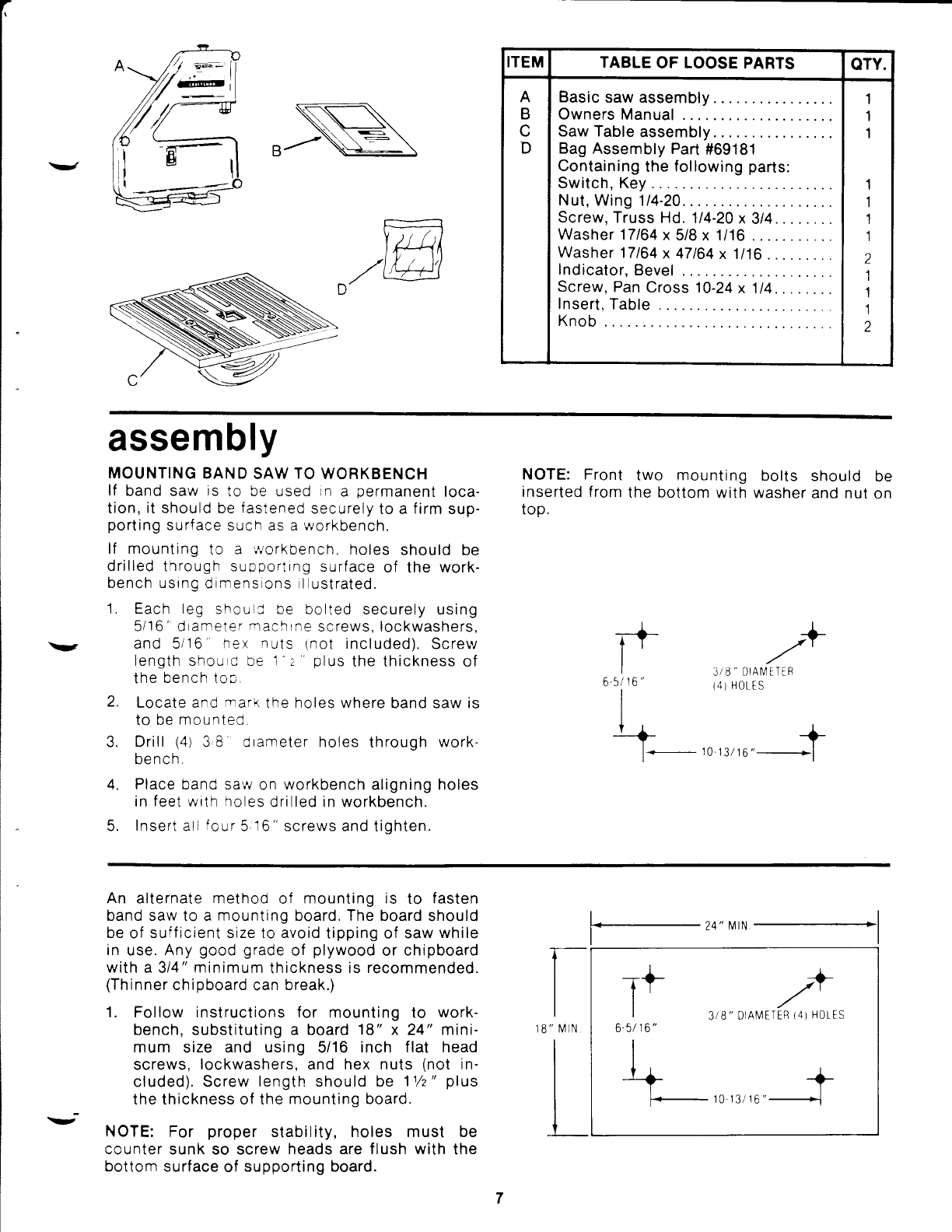
ITEM TABLE OF LOOSE PARTS OTY.
A
B
c
D
Basic saw assembly
Owners Manual
Saw Table assembly
Bag Assembly Part #69181
Containing the following parts:
Switch, Key ..
Nut, Wing 114-20.
Screw, Truss Hd. 114-20 x 314. .
Washer 17164 x5/8 x 1/16 . ....
Washer 17164 x 47164 x 1/16 . . .
Indicator, Bevel .
Screw, Pan Cross 10-24 x 114. .
Insert, Table
Knob .
1
1
1
I
1
't
1
2
1
1
1
a
\t --a12=
assembly
MOUNTING BAND SAW TO WORKBENCH
lf band saw is to be used in a permanent loca-
tion, it should be f astened securely to a f irm sup-
porting surface such as a workbench.
lf mounting to a',^',orkbench. holes should be
drilled tirougf'sucJorrr"r g surface of the work-
bench usino dimenstons lustrated.
Each leg shou I be bolted securely using
5/16 " drameter machlne screws, lockwashers,
and 5/16' hex n uts lnot included). Screl.r
length shou C be l': " plus the thickness of
the bench toc
Locate and r',arK the holes where band saw is
to be mounted.
3. Drill (4) 3,8 drameter holes through work-
oencn.
Place band saw on workbench aligning holes
in feet with holes drilled in workbench.
Insert ali four 5'l6" screws and tiohten.
NOTE: Front two mounting bolts
inserted from the bottom with washer
rop.
shou ld
and nut oe
on
6-5/16"
I
I
+
I.-
3/8" DIA[IETER
(4)HOLES
f
10-r3/16"+l
4.
An alternate method of mounting is to fasten
band saw to a mounting board. The board should
be of suff icient size to avoid tipping of saw while
in use. Any good grade of plywood or chipboard
with a 3/4" minimum thickness is recommended.
(Thinner chipboard can break.)
1. Follow instructions for mounting to work-
bench, substituting a board 18" x 24" mini-
mum size and using 5/16 inch flat head
screws, lockwashers, and hex nuts (not in-
cluded). Screw length should be 11/2 " plus
the thickness of the mountino board.
NOTE: For proper stability, holes must
counter sunk so screw heads are flush with
bottom surface of supporting board.
24 " iIlN
-t be
the
Tf
I
6-5i16" //+
3/8" D]AN4EIER (4) HOTES
I
++
l..-to-r3/ro"+l
18" N4IN

:
assembly
2. Securely clamp board to workbench using
"C" clamps.
NOTE: Supporting surface where band saw is
mounted should be examined carefully after
mounting to insure that no movement during use
can result. lf any tipping or walking is noted,
secure workbench or supporting surface before
operating band saw.
CLAMPING BANDSAW TO WORKBENCH
The Band Saw can be clamped direcily to a
workbench using two (2) or more "C" clamps on
base of unit. WORKBENCH
INSTALLING THE TABLE
Apply a coat of automobile wax to the table too
and inside surfaces of trunnion that slide on
frame.
1. Loosen the guide bar lock knob and position
the upper guide assembly all of the way up.
Tighten lock knob.
UPPER
GUIDE
ASSE I\4 BLY
\12
2.
3.
Locate two (2) knobs and two (2\ 17164 x
47164 x 1/16 washers in loose parts bag, and
the table assembly in loose parts.
Place table assembly onto band saw frame
with thd trunnion against mounting rib in
frame.
TRUNNION
-
STOTS
4. Hold table
install two
as shown
tighten.
assembly against the frame and
(2) taOle lock knobs and washers
through the trunnion slots and
2

o.
Locate bevel indicator and 10-24x114 pan
cross hd. screw in loose parts bag.
Install bevel indicator and screw as shown
using a phillips screwdriver.
NOTE: This unit comes with the Band Saw blade
installed, assembly continues on p. '10, "Tension-
ing the Blade."
v
REPLACING THE BLADE
Loosen the guide bar lock knob and position
the upper guide assembly approximately one
inch above the tab e and tighten lock knob.
Loosen the two blade guard mounting screws
and remove the blade ouard.
1.
2.
GUIDE BAR
tOCK KNOB
UPPER GUIDE
ASSEMBLY
3. Loosen the gurde bar lock knob and position
the upper guide assembly approximately two
inches above the table as shown and tighten
the lock knob
4. Remove table rnsert, truss head screw, wash-
er and wing nut f rom the table (See Assem'
bly, p. 13 - Adjusting the Table"). Replace
these parts after the blade is installed, ten-
sioned and tracked.
UPPER GU DE
ASSEI\4 BLY
5
6.
7.
Loosen the two screws in the front of the
upper blade guide assembly that secure the
blade guides and separate them about'1/8".
Loosen the two screws in the side of the
upper guide assembly and slide guides and
thrust bearing all of the way back.
Tighten all screws.
8. Loosen the three (3) cover knobs by turning
counterclockwise and remove cover.
NOTE: Replace the bandsaw cover after blade is
properly installed, tensioned and tracked.
Y
assembly
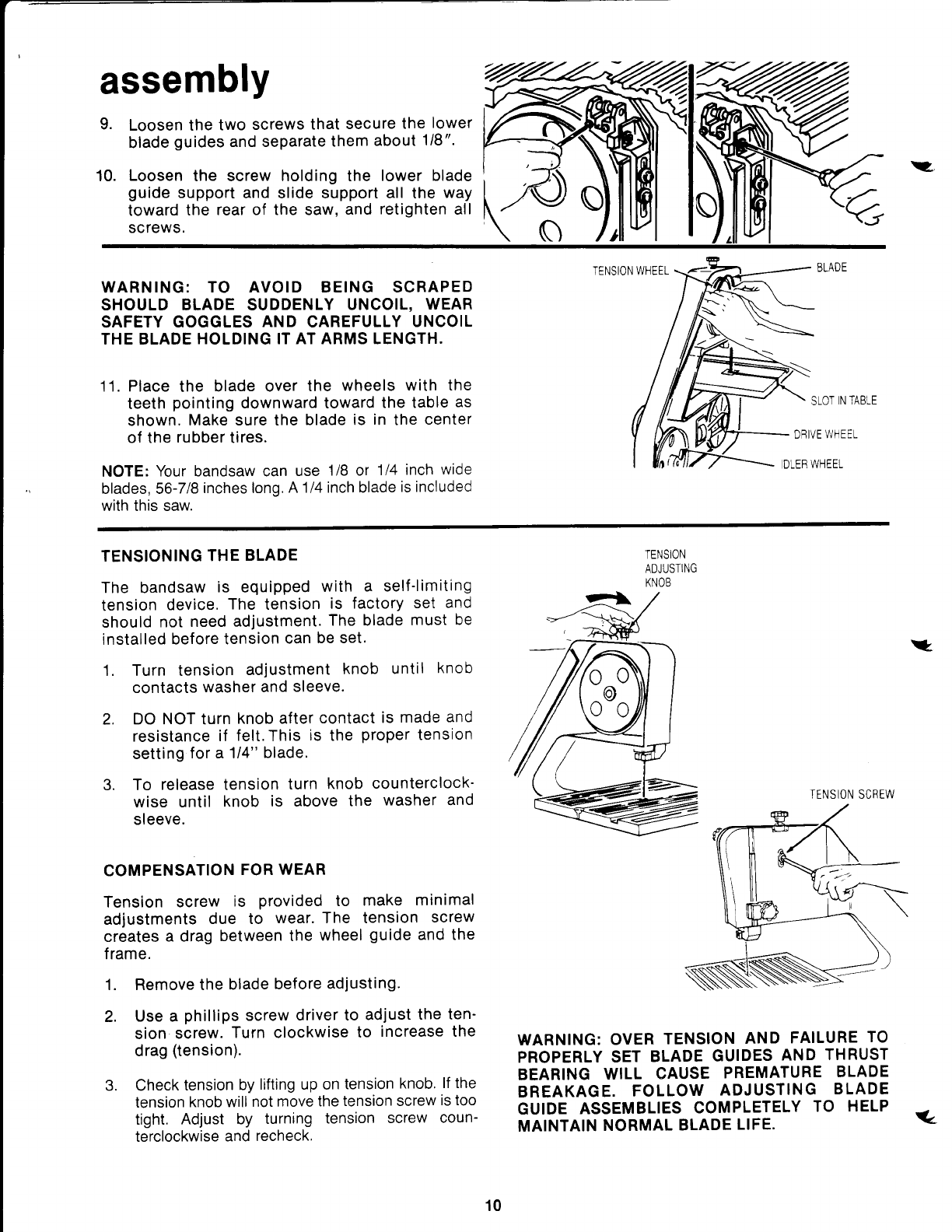
9. Loosen the two screws that secure the lower
blade guides and separate them about 1/8".
10. Loosen the screw holding the lower blade
guide support and slide support all the way
toward the rear of the saw, and retighten all
screws.
WARNING: TO AVOID BEING SCRAPED
SHOULD BLADE SUDDENLY UNCOIL, WEAR
SAFETY GOGGLES AND CAREFULLY UNCOIL
THE BLADE HOLDING IT AT ARMS LENGTH.
11. Place the blade over the wheels with the
teeth pointing downward toward the table as
shown. Make sure the blade is in the center
of the rubber tires.
NOTE: Your bandsaw can use 1/8 or 114 inch wide
blades, 56-718 inches long. A l14inch blade is included
with this saw.
ry
:.
IENSION WHEEL
SIOT IN TABLE
DRIVE V/IEEt
DLER WHEET
TENSIONING THE BLADE
The bandsaw is equipped with a self-limiting
tension device. The tension is factory set and
should not need adjustment. The blade must be
installed before tension can be set.
1. Turn tension adjustment knob until knob
contacts washer and sleeve.
2. DO NOT turn knob after contact is made and
resistance if felt. This is the proper tension
setting tor a114" blade.
3. To release tension turn knob counterclock-
wise until knob is above the washer and
sleeve.
COMPENSATION FOR WEAR
Tension screw is provided to make minimal
adjustments due to wear. The tension screw
creates a drag between the wheel guide and the
frame.
1. Remove the blade before adiusting.
2. Use a phillips screw driver to adjust the ten'
sion screw. Turn clockwise to increase the
drag (tension).
3. Check tension by lifting up on tension knob. lf the
tension knob will not move the tension screw is too
tight. Adjust by turntng tension screw coun-
terclockwise and recheck,
WARNING: OVER TENSION AND FAILURE TO
PROPERLY SET BLADE GUIDES AND THRUST
BEARING WILL CAUSE PREMATURE BLADE
BREAKAGE. FOLLOW ADJUSTING BLADE
GUIDE ASSEMBLIES COMPLETELY TO HELP
MAINTAIN NORMAL BLADE LIFE.
TENSION SCREW
10
Q

tII
T
TRACKING THE BLADE
Tension knob must be tightened before tracking
blade.
1. Turn the upper wheel by hand (clockwise)
and check if the blade remains in the approx-
imate center of the tires. lf the blade moves
away from the center of the tires, while you
are turning the wheels, adjust as follows:
A. Turn the tracking adjustment set screw
slightly with a 1/8" hex wrench. (Turning
the set screw moves the tension wheel back
and forth.)
B. lf the blade moves toward the front of the
band saw:
Turn the tracking adjustment screw clock-
wise about 114 ol a turn. as thougn you
were tightening it
lf the blade moves tor^,'ard the back of the
band saw:
Turn the tracking adJUstment screw
counterclocki',' se about 114 of a turn as
though yo- .'.e'e toosening it.
Turn the scre,^, just enough to cause the
blade to run in the approximate center of
all tires.
C. After adjusting, turn upper wheel by hand
clockwise a few turns and notice if the
blade remains in the approximate center of
the tires, readjust if necessary, until blade
is tracking Properly.
ALIGNING THE TABI-E SOUARE TO BLADE
LL' - >:
Place a
UIdUU d)
Tilt table -: -'
A^^.^^r
utrgrucJ ru , a-=
tighten lock r-::s
--.)
:^e table in front of the
-'.-r t.r alinn table 90
do1roo nnqrlinnl anrl
Sl-a': ,-
u). a:-
4. Adlust zero sio: sel screw using a 1/8" hex
wrench untrl sei screv/ iust touches frame
Check soUareness c'blade to table. Make
readjustments,' -?,essary
Set bevel indtcatc':: ^e up vrtth zero.
I
I
iIOTE: When table is tilted to a bevel angle, the
lower blade guide support should be lowered to
clear the table. After bevel cutting and returning
table to zero position, always raise the lower
blade guide up to provide maximum support for
ii-re blade.
11
assembly
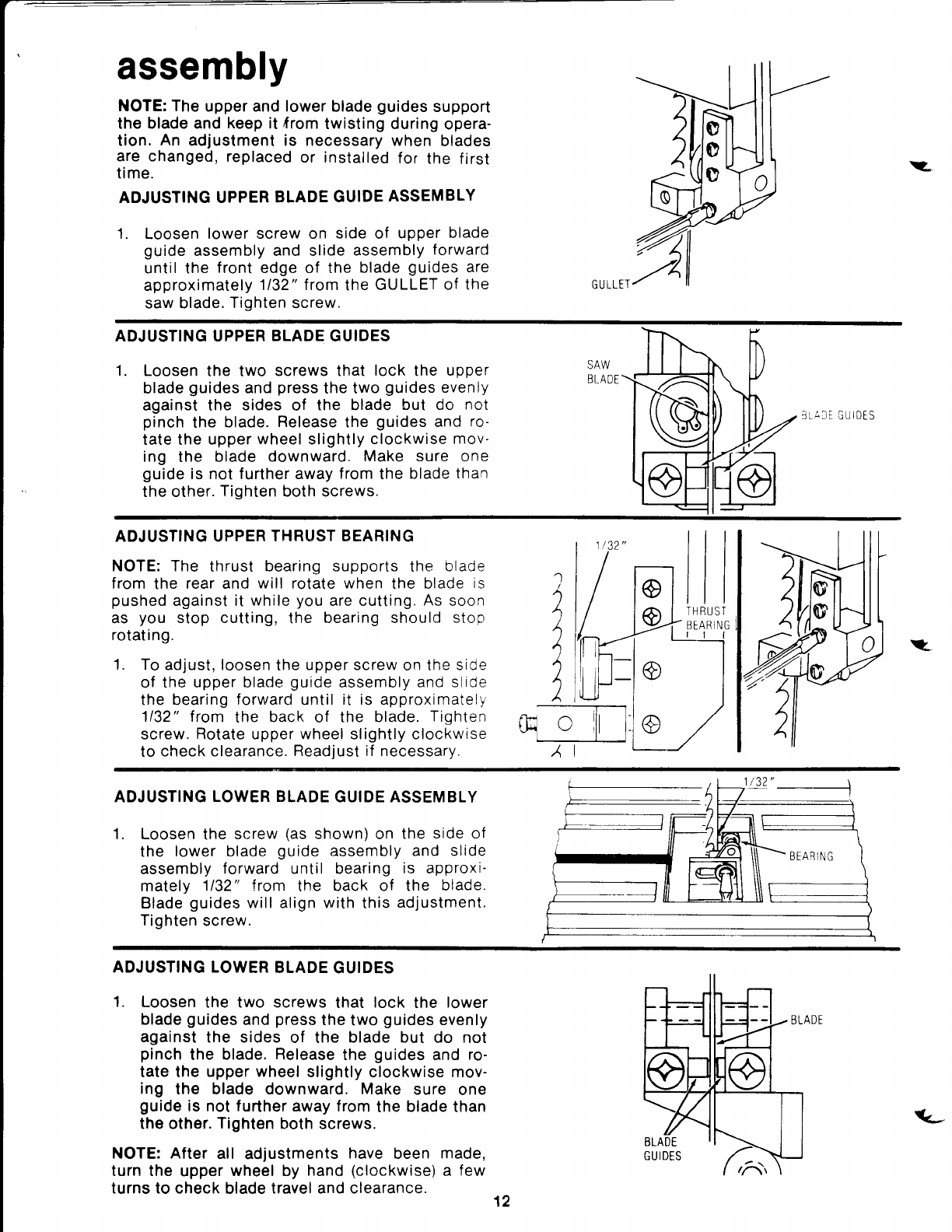
NOTE: The upper and lower blade guides support
the blade and keep it from twisting during opera-
tion. An adjustment is necessary when blades
are changed, replaced or installed for the first
time.
ADJUSTING UPPER BLADE GUIDE ASSEMBLY
1. Loosen lower screw on side of upper blade
guide assembly and slide assembly forward
until the front edge of the blade guides are
approximately 1/32" from the GULLET of the
saw blade. Tighten screw.
:.
GULLEI
ADJUSTING UPPER BLADE GUIDES
1. Loosen the two screws that lock the upper
blade guides and press the two guides evenly
against the sides of the blade but do not
pinch the blade. Release the guides and ro-
tate the upper wheel slightly clockwise mov-
ing the blade downward. Make sure one
guide is not further away from the blade than
the other. Tighten both screws.
SAW
BLADE
ADJUSTING UPPER THRUST BEARING
NOTE: The thrust bearing supports the blade
from the rear and will rotate when the blade is
pushed against it while you are cutting. As soon
as you stop cutting, the bearing should stop
rotating.
1. To ad.iust, loosen the upper screw on the side
of the upper blade guide assembly and slide
the bearing forward until it is approximately
1132" trom the back of the blade. Tighten
screw. Rotate upper wheel slightly clockwise
to check clearance. Readiust if necessarv.
I
I
I
I
ST
NG v
lo
L:
ADJUSTING LOWER BLADE GUIDE ASSEMBLY
1. Loosen the screw (as shown) on the side of
the lower blade guide assembly and slide
assembly forward until bearing is approxi'
mately 1132" trom the back of the blade.
Blade guides will align with this adjustment.
Tighten screw.
ADJUSTING LOWER BLADE GUIDES
1. Loosen the two screws that lock the lower
blade guides and press the two guides evenly
against the sides of the blade but do not
pinch the blade. Release the guides and ro-
tate the upper wheel slightly clockwise mov-
ing the blade downward. Make sure one
guide is not further away from the blade than
the other. Tighten both screws.
NOTE: After all adjustments have been made,
turn the upper wheel by hand (clockwise) a few
turns to check blade travel and clearance. 12
(L
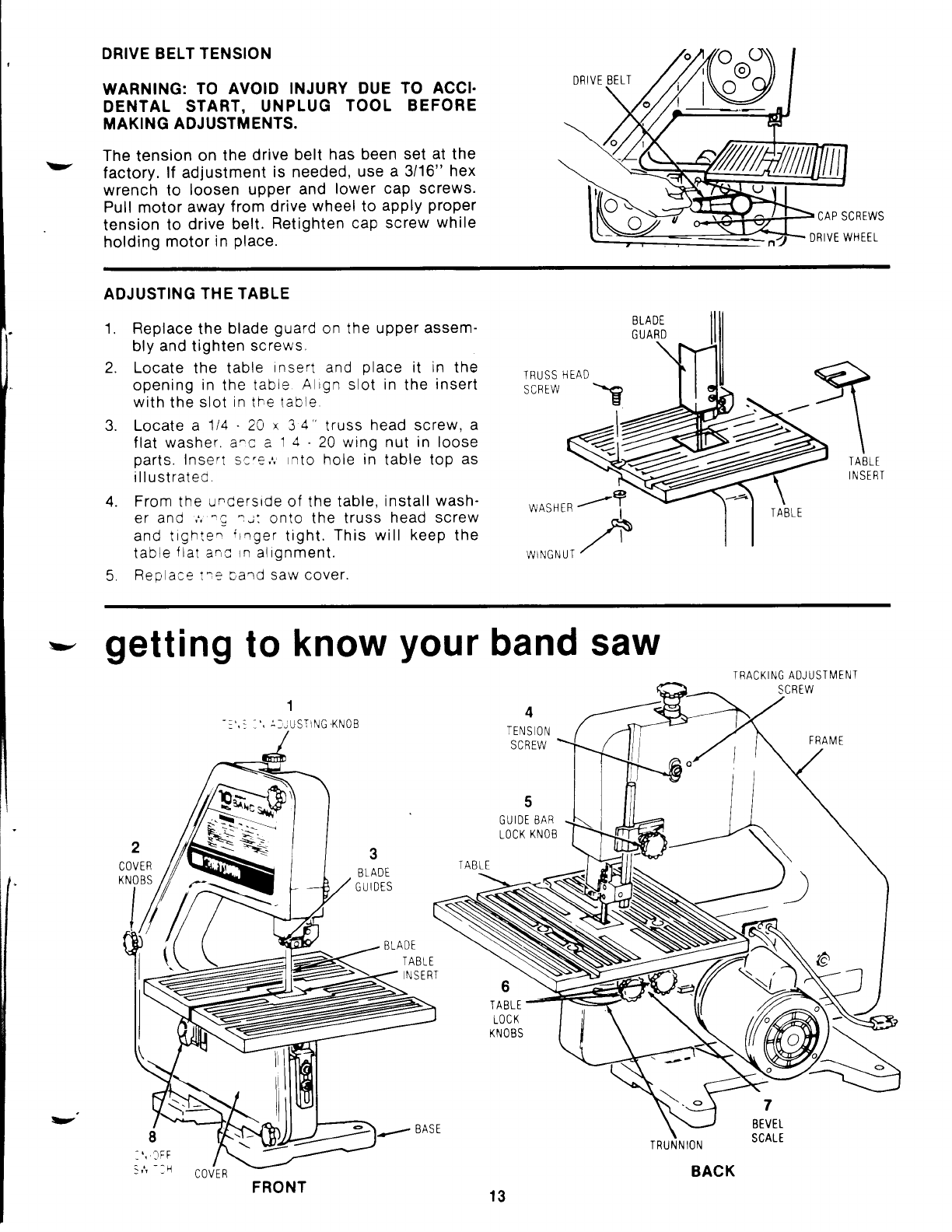
DRIVE BELT TENSION
WARNING: TO AVOID INJURY DUE TO ACCI.
DENTAL START, UNPLUG TOOL BEFORE
MAKING ADJUSTMENTS.
The tension on the drive belt has been set at the
factory. lf adjustment is needed, use a 3/16" hex
wrench to loosen upper and lower cap screws.
Pull motor away f rom drive wheel to apply proper
tension to drive belt. Retighten cap screw while
holding motor in place.
DRIVE BELT
I
i
I
l-
ADJUSTING THE TABLE
1. Replace the blade guard on the upper assem-
bly and tighten screws,
2. Locate the table insert and place it in the
opening in the table A rgn slot in the insert
with the slot in the table
3. Locate a 114 -20 x 3 4" truss head screw, a
flat washer. a^c a 1 4 - 20 wing nut in loose
parts. Insert s..e..' nto hole in table top as
illustrated
4. From the undersrde of the table, install wash-
er and ,^, "_c ^;: onto the truss head screw
and trghte" rrrger tight. This will keep the
table f lat ano rn alignment.
5 Reo ace 1^e card saw cover.
TRUSS HEAD
SCREW
WASHER
WI NGN U]
TAEtE
INSERI
---7
^
getting to know your band saw
1
1]JUS-IING'KNOB
5
GUIDE BAR
LOCK KNOB
TABTE
IRACKING ADJUST[/ENT
BTADE
TABL E
FRONT 13

getting to know Your band saw
Tension adjusting knob . . . Tightening the
knob (clockwise) will increase the tension on
the blade. Loosening it (counter clockwise)
will decrease the tension. (Tension lock knob
must be released).
Cover knobs . . . Secure cover to frame by
tightening all three (3) cover knobs.
Blade Guides . . . Supports the blade and
keeps it from twisting during operation. An
adjustment is necessary when blades are
changed or replaced.
Tension screw maintains tension be-
tween upper wheel guide and f rame.
5. Guide bar lock knob . . . The upper blade
guide assembly should just clear the work-
piece while cutting. Always adjust the upper
guide assembly and lock the guide bar by
tightening the blade guide lock knob before
turning on the band saw
6. Table lock knobs . . . Loosening knobs allows
the table to be tilted and tightening knobs
locks the table in Place,
7. Tilt (bevel) scale... Shows degree table is
tilted for bevel cutting.
'1.
2.
4.
B. ON-OFF SWITCH. The On-Off Switch has a
locking feature. THIS FEATURE lS INTEND-
ED TO HELP PREVENT UNAUTHORIZED
AND POSSIBLY HAZARDOUS USE BY
CHILDREN AND OTHERS.
1. To turn machine on insert key into
switch.
NOTE: Key is made of yellow plastic; locate in
loose parts bag.
_
--
2. Insert
end of f inger under switch lever and Puil
switch out.
3. To turn machine OFF . . . PUSH lever in.
NEVER LEAVE THE MACHINE UNATTENDED
UNT|L IT HAS COME TO A COMPLETE STOP.
4. To lock switch in OFF position . . . hold
switch lN with one hand . . . REMOVE key
with other hand.
WARNING: FOR YOUR OWN SAFETY, ALWAYS
LOCK THE SWITCH "OFF'' WHEN MACHINE IS
NOT IN USE.. . REMOVE KEY AND KEEP IT IN A
SAFE PLACE. . . ALSO . . . IN THE EVENT OF A
POWER FAILURE (ALL OF YOUR LIGHTS GO
OUT) TURN SWITCH OFF . . . REMOVE THE KEY
AND STORE IT REMOTE FROM BAND SAW.
THIS IYILL PREVENT THE MACHINE FROM
ITARTING UP AGAIN WHEN THE POWER
cotEs BAGK oN. 14
trt

I
I
I
basic band saw operation
A band saw is basically a 'curve cutting" mach-
ine lt is also used for straight-line cutting opera-
tions such as cross cutting. rpptng, mitering,
beveling, compound cutting. and resawing. lt is
not capable of doing inside cutting.
This band saw is designed to cut wood and
wood like products only.
For general type scroll cutting. follow the pattern
lines by pushing and turning the workpiece at
the same time. Do not try to turn the workpiece
while engaged in the blade ','.rthout pushing it,
the workpiece could bind o'l'!^,'st the blade.
A curve cut iS beSt pe.to.n ed by keeprng the
pattern line in line v,'rt. t^e btade while turning
the workpiece before:^:'al rs of the curve is
cut. The blade si.! r : -1 r the middle of the
pattern line (sav, .r=" s -:e wood cutting band
saw blades are l^ -
PATTEBN tINE
RIGHT Planning ahead
{^- ^.,+rl^^
tL/t uuttilrtl d uurvu.
SA\/i
KERI:
BLADE
by turning workpiece
NOTE: B ace
for claritv :' :-
a sec and right hand removed
WRONG Not
curve could bind
forced.
/JCBKPIECE
planning ahead for cutting a
or twist blade tf workpiece is
PATTEBN t NE
L/
WARNING: ADJUST THE UPPER GUIDE ASSEM-
BLYTO JUST CLEAR THE WORKPIECE.
Use bot' -=-:. ',- e feeding the work into the
blade l: :. '- = .', ,". ece f rrmly against the table.
Use ge':: :-:::-': Do not force the work. but
allo\,v tbe : ?.t: :, --.:
The sma
;Ja+a'm n ^
UEIE =
blade'.',
1-1 2
.c e that can be cut out is
cf the blade. A 1/4" wtde
r a^1eter of approximately
Be lef cris a'a - zaa .'. 'en an tntrtcate curve (too
small a r3c uS '.. z' .1.nch blade) is to be cut. A
relref cut s -dr::. --rtrrg through scrap sec-
tion of workprece ro curve in pattern line, then
carefully backrng biade out. Several reltef cuts
should be made for rntricate curves. then follow
naticrn line as secttonS are cut off of curve
"rel ieving" blade pressure.
NOTE: Blade guard is raised and right hand removed
15

-
maintenance
WARNING: FOR YOUR OWN SAFETY, TURN
SWITCH "OFF'' AND REMOVE PLUG FROM
POWER OUTLET BEFORE MAINTAINING OR
LUBRICATING YOUR BAND SAW.
TIRES
Pitch and sawdust that accumulate on the tires
should be removed with a stiff brush or scraped
off with a piece of wood. Do not use a sharp
knife or any kind of solvent.
When the tires become worn they should be re-
placed. When replacing the tires, put a thin layer
of rubber cement on the outside of the wheels
and inside of the tires. Allow to dry, then slide
tires onto wheels aligning tires inside wheel
edges.
GENERAL
Keep your Band Saw clean.
Remove sawdust from the inside frequently.
Do not allow pitch to accumulate on the table.
blade insert, blade guides, or thrust bearings.
Clean them with Craftsman Gum and Pitch
Remover.
Apply a thin coat of automobile-type wax to the
table so the wood slides easily while cutting.
Also apply wax to the inside surfaces of the
trun n ion.
MOTOR/ELECTRICAL
Frequently vacuum or blow out any sawdust f rom
the motor.
lf the power cord is worn, cut, or damaged in any
way, have it replaced immediately.
LUBRICATION
All of the BALL BEARINGS are permanently
lubricated. They require no f urther lubrication.
-
!t
RECOMMEN DED ACCESSORIES
Item Cal. No.
Miter Gauge..... .....9'24214
Blades (56-7/8" length). . See Catalog
Leg Set... 922244
The above recommended accessories are current
and were available at the time this manual was
printed.
16
1,

troubleshooting
WARNING: FOR YOUR OWN SAFETY' TURN
SWITCH "OFF'' AND REMOVE PLUG FROM
POWER OUTLET BEFORE READJUSTING OR
ALIGNING YOUR BAND SAW.
REMEDY
PROBABLE CAUSE
TROUBLE
1. Replace defective parts before using
Band Saw again.
2. Consult Sears Service. Any attempt to repatr
this motor may create a HAZARD unless
repair is done by a qualif ied service techni-
cian. Repair service is available at your near-
est Sears Store.
'1 Defective On-Off switch.
Def ective Power or motor cord.
2 t"4otor Defective.
Motor will not run.
1. Adjust tracking, see Assembly Section,
"Trackino the Blade."
1. Not tracking ProPerlY
Blade does not run in the
approximate center of the
upper wheel.
1. Stop feeding, and back up the material
slightly, until the band saw speeds up.
2. Replace blade.
1. Cutting too small a radius
2. Dull blade.
Band Saw slows down
when cutting.
1. Adjust tension. See Assembly section
"Tensioning The Blade."
2. Use correct cutting technique. See Basic
Band Saw Operation Section.
1. Too much tension.
2. Krnk in blade caused bY cut-
ting too small a radius or turn-
ing the material too fast when
c utt ing.
Blades breakinq.
Adjust blade tension. See Assembly
section "Tensioning The Blade'"
Adjust belt tension. See Assembly Section
"Drive Belt Tension."
.1. Too much blade tension.
2. Too much belt tension.
Motor sounds under
load when not cutting.
1. Adjust upper and lower blade guides and
bearings. See Assembly section "Adjusting
Upper Blade Guide AssemblY."
2. Reolace blade.
Blade guides and bearings
not properly adjusted.
Defective blade.
Blade will not allow for
general straight cutting.
17

@r
repair parts
-)-;
\c\
r.it,:_g
A s-.fQ)- + \
16 i1\ ; :-3 \
v ,- :i ;.-g _ ,<q
Sn
I
h
'-0
=
a
o
z
o
o
uI
N
E
o
F
o9
=lr,
-$
<-l c\
zco
OF
-o
tz
=d
v, ?l
[5
<=
E
O
E
o
II
F
o
J
U)
F
t,
o.
-
ol
oo
\
\ro
E
3
o
,dg
ol
7/.-\ :
( I=
\_-i=
fr
i\
.// t'
-ol
F,'
\g*t
tcq f-
r \9 -x
l5
-to N
(\l
-\;
E
o
=
tr
=
U
o
z
Y
18

tr
.9
CL
I
o
o
o
+-)
N+ IO FS G
>'c) y <
x;r R ile 9=
o ;NI o s ;R: =b
E g X+: : E Pi S*; t=;
d o :83 4=-.o Fd H^b., = b =F
A q€5.9.q e*Rex u"., I?iI $Fe^ '_ 5+
E! i;;FF,*gsEi#ein+c:i Hi5FEgEr*i$
A; *+ -0-0-
H =Ee a+; a a =+:-e F *H* 6T a a#F*EIhtE*t6'H p-g
.F$# E;;s.! ;E :EE5;'3# ;ergg:€#u535#sFEEF
8:
ornN tO rn
=-O N N
c-Lo o ^@
;=! 5 a r ^.^K5 sr .^P
S:!'IS5EEF3FF8FUPgFHfi38FS fiSdPJPEFE
.::::3'n663b33333b33883b33 33e;SEEBbB
>:
22 N € - O .- N c') $ tO@f-- @O)OF NCD(of'-@O)Or (\cD sf tO(olt-@O)O | |
:a:'. - = = s s I I <t $ $$ LoLoLoLolf)Lotolr)(o(o(o(o (o@(o(o(o(of.- | |
c
Q
-
o
q)
't
q)
o
.g
=
-
o
o
c
.a
.=
(g
o_
o
a
U)
0)
c
=g_>
(!.n ()
N-'C)
(g(/)_J
(5(D (D
^,4 a
H- F
b;up
O(!:J
>9 *
(EL o)
F'rn
!O >
(-)>o
6= E
.9=n I
!dL :v
_=6=
q= o
(Drn (s
L._
=
o-> T
o(/j Y
>,o-:
<tr a
o*
r=
'=
o
6
o
o
.ne=
=- E a? Ie ;
? - s q$! ffr[EE;!
= s, - 3 FS.o + ? .e: =T
Lc I - O $--E (om r-j cD :< '"1 Lo@.
c- = x = X s'idd p =f ,X ; npa -;S.&
=z ?o 3b 3 fseES=* n "j0-t r*€i,j;",==!9
E; :nC -F * ;atrF=i €0#;Fe F:;EFtHSFg;
E: =-.-i ;t t 6At:dq +YTri^ f' *^-o?-+ay*ro-,,
Ei.:+t€;EpF p *FeP * ?:EEi+ii at 6! EEt a ai a
; $ = = ;; e gS,i,rF.fi:$s.H5e;;!:e g ssE gsEF;;:,;
<O****
F:
(o I Rg EE 3 3 3 PER
vi K ph :o N
6oeq51-sccvpS soES .^65 6 ?*-_E-pSEF*
EU\FNKEHPN=Ns i83SF$R88SB b::septtrppe
= I = Lo LO LOct X lt- q/ '\ q/t- */r-F;* 5 ^', X=t- X= l;-;* ^\F ^\ -,FFl
3i3;6E53aEaab a6-,.l.33336636 63336386668
9: -NcD$ro(or-coo)P=SP :II>PIRnNRN RNRR3aS3S33
=
a
o
z
trl
o
UJ
N
Ir
o
F
9P
=lo
-<f
49 ^
oo{
Z<rl :
TF -
^F
,v ,1
-o :
-=ru
t'44 F
sJ o
;uJ z
tro I
LO z
<= I
trF
oo-
rrfi
o6
ILH
F:
a= -
J
lt) o
F7
Cf-
ra n_
c0
(r
t "rJ
o
t
\J
(n
-
19

ffi
owners
manual
SERVICE
MODEL NO.
113.244513
HOW TO ORDER
REPAIR PARTS
r
70.'NCH BAND SAW
Now that you have purchased your 10-lnch Band
Saw should a need ever exist for repair parts or
service, simply contact any Sears Service Center
and most Sears, Roebuck and Co. stores. Be sure
to provide all pertinent facts when you call or
visit.
The model number of your
be found on a plate at the
SAW.
1O-lnch Band Saw will
right-hand side of the
WHEN ORDERING REPAIR PARTS, ALWAYS
GIVE THE FOLLOWING INFORMATION:
PART NUMBER
MODEL NUMBER
113.244513
PART DESCRIPTION
NAME OF ITEM
10-lnch Band Saw
All parts listed may be ordered from any Sears
Service Center and most Sears stores. lf the
parts you need are not stocked locally, your
order will be electronically transmitted to a Sears
Repair Parts Distribution Center for handling.
Sold by SEARS, ROEBUCK AND CO., Chicago, IL. 60684 U.S.A.
Part No. SP5100 Form No. SP5100-1 Printed in Taiwan. 4/89
