Craftsman 247 27022 Users Manual
247270220 247270220 CRAFTSMAN RIDING MOWER - Manuals and Guides L0305312 View the owners manual for your CRAFTSMAN RIDING MOWER #247270220. Home:Lawn & Garden Parts:Craftsman Parts:Craftsman RIDING MOWER Manual
CRAFTSMAN Lawn, Riding Mower Rear Engine Manual L0305312 CRAFTSMAN Lawn, Riding Mower Rear Engine Owner's Manual, CRAFTSMAN Lawn, Riding Mower Rear Engine installation guides
247.27022 L0305312
24727022 d8912df6-eec8-4d54-a758-6329a11ec9e3 Craftsman Lawn Mower 247.27022 User Guide |
2015-01-05
: Craftsman Craftsman-247-27022-Users-Manual-160877 craftsman-247-27022-users-manual-160877 craftsman pdf
Open the PDF directly: View PDF  .
.
Page Count: 72
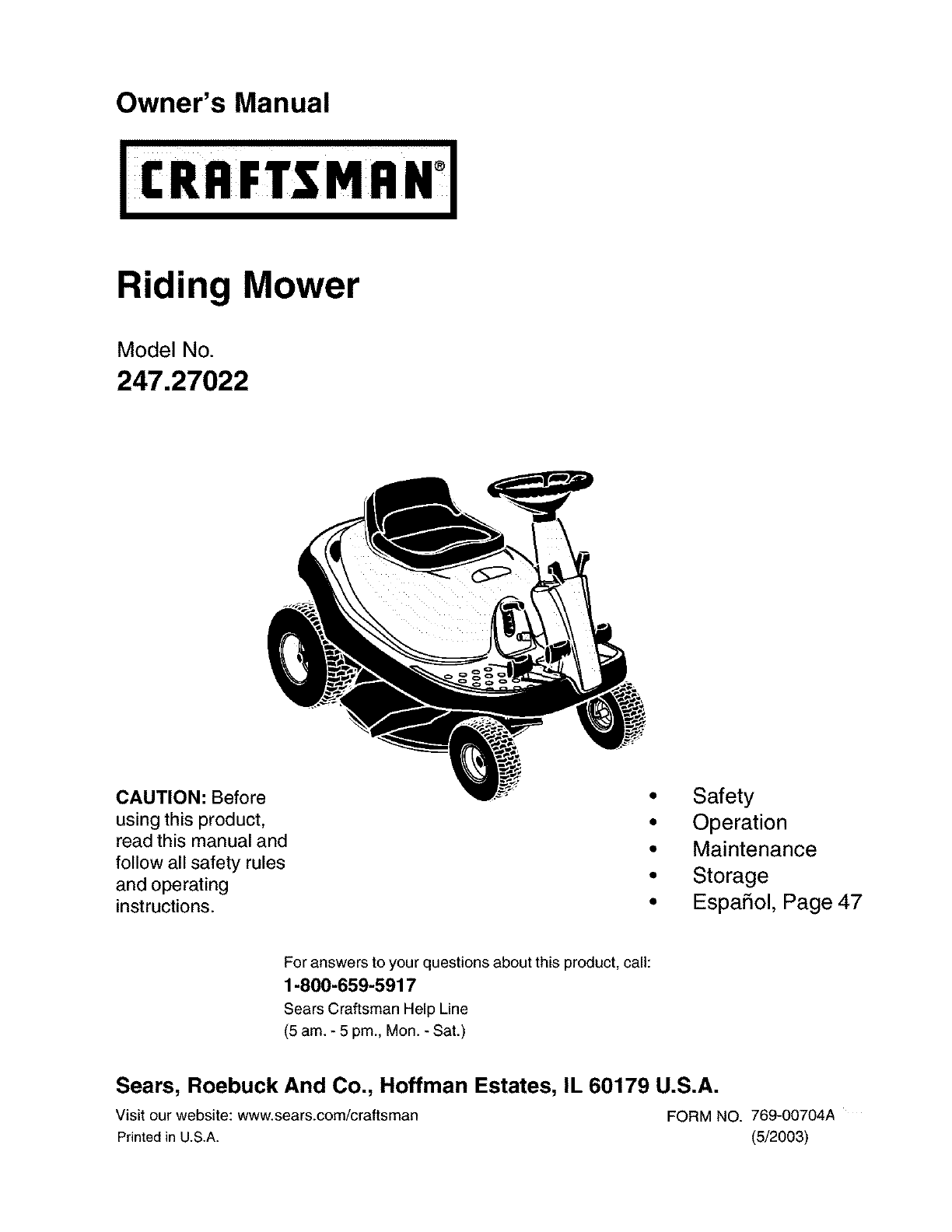
Owner's Manual
Riding Mower
Model No.
247.27022
CAUTION: Before
using this product,
read this manual and
follow all safety rules
and operating
instructions.
• Safety
• Operation
• Maintenance
• Storage
• EspaSol, Page 47
For answers to your questions about this product, call:
1-800-659-5917
Sears Craftsman Help Line
(5 am. - 5 pm., Mon. - Sat.)
Sears, Roebuck And Co., Hoffman Estates, IL 60179 U.S.A.
Visit our website: www.sears.com/craftsman FORM NO. 769-00704A
Printed in U.S.A. (5/2003)
Content Page
Warranty Information ................................ 2
Safe Operation Practices .......................... 3
Assembly ................................................. 6
Operation ................................................. 8
Maintenance ............................................. 13
Service & Adjustment ............................... 16
Content Page
Off-Season Storage ................................... 23
Trouble-Shooting ....................................... 23
Parts List ................................................... 25
Slope Guide .............................................. 45
EspaSol ..................................................... 47
Service Phone Numbers ............................ Back Cover
LIMITED WARRANTY ON RIDING MOWER: For two (2) years from the date of purchase, if this Craftsman Riding Equipment is
maintained, lubricated and tuned up according to the instructions in the owner's manual, Sears will repair or replace free of
charge any parts that are found to be defective in material or workmanship according to the guidelines of coverage listed below.
Sears will also provide free labor for these applicable warranted parts for the two full years. During first 30 clays of purchase,
there will be no charges to service the product at your home for issues covered by this warranty. (See exclusions below).
For your convenience, IN HOME warranty service will still be available after the first 30 days of purchase, but a trip charge will
apply. This charge will be waived ifthe product is dropped off at an authorized Sears location. For the nearest authorized Sears
location, please call 1-800-4-MY-HOME®. This warranty applies only while this product is within the United States.
EXCLUSIONS
This Warranty does not cover:
Expendable items which become worn during normal use, including but not limited to blades, spark plugs, air cleaners,
belts, and oil filters.
Standard Maintenance Servicing, oil changes or tune-ups
Tire replacement or repair caused by punctures from outside objects, such as nails, thorns, stumps, or glass.
Repairs necessary because of operator abuse, including but not limited to, damage caused by towing objects beyond the
capability of the riding equipment, impacting objects that bend the frame or crankshaft, or over-speeding the engine.
Repairs necessary because of operator negligence, including but not limited to, electrical and mechanical damage caused
by improper storage, failure to use the proper grade and amount of engine oil, failure to keep the deck clear of flammable
debris, or failure to maintain the equipment according to the instructions contained inthe owner's manual.
Engine (fuel system) cleaning or repairs caused by fuel determined to be contaminated or oxidized (stale). In general, fuel
should be used within 30 days of its purchase date.
Normal deterioration and wear of the exterior finishes, or product label replacement.
Riding equipment used for commercial or rental purposes.
LIMITED WARRANTY ON BATTERY
For ninety (90) clays from date of purchase, if any battery included with this riding equipment proves defective in material or
workmanship and our testing determines the battery will not hold charge, Sears will replace the battery at no charge. During the
first 30 days of purchase, there will be no charges to replace the battery at your home. After the first 30 days, for your
convenience, IN-HOME warranty service will still be available but a trip charge will apply. This charge will be waived if the
Craftsman product is dropped of at an authorized Sears location. For the nearest authorized Sears location, please call 1-800-4-
MY-HOME®. This battery warranty applies only while this product is within the United States. This warranty gives you specific
legal rights, and you may also have other rights, which vary, from state to state.
Sears, Roebuck and Co.,Dept.817WA, Hoffman Estates, IL 60179
Horsepower: ............................... 10.0
Engine Oil ................................... 48 oz. or 1.4 liters
Fuel ............................................ Unleaded Regular
Spark Plug: ................................. P/N 491055
Engine: ........................................ 212907-0272
Ignition Key (Std.) ........................ P/N 725-0201
Model Number ........................... 247.27022
Serial Number ...........................................................
Date of Purchase ......................................................
Record both sedal number and date of purchase and keep
in a safe place for future reference.
Congratulationsonmakingasmartpurchase.Yournew
Craftsman_productisdesignedandmanufacturedforyears
ofdependableoperation.Butlikeallproducts,itmayrequire
repairfromtimetotime.That'swhenhavingaRepair
ProtectionAgreementcansaveyoumoneyandaggravation.
Here'swhat'sincludedintheAgreement:
Expert service by our 12,000 professional repair
specialists
Unlimited service and no charge for parts and
labor on all covered repairs
Product replacement if your covered product can't
be fixed
,t
4
Discount of 10% from regular price of service and
service-related parts not covered by the agreement;
also, 10% off regular price of preventive maintenance
check
Fast help by phone - phone support from a Sears
technician on products requiring in-home repair, plus
convenient repair scheduling
Purchase a Repair Protection Agreement now and protect
yourself from unexpected hassle and expense.
Once you purchase the Agreement, a simple phone call is all
that it takes for you to schedule service. You can call anytime
day or nighL or schedule a service appointment online. Sears
has over 12,000 professional repair specialists, who have
access to over 4.5 million quality parts and accessories.
That's the kind of professionalism you can count on to help
prolong the life of your new purchase for years to come.
Purchase your Repair Protection Agreement today!
Some limitations and exclusions apply. For prices and
additional information call 1-800-827-6655. Sears Installation
Service
For Sears professional installation of home appliances,
garage door openers, water heaters, and other major home
items, in the U.S.A. call 1-800-4-MY-HOME®
,i_ WARNING: This symbol points out important safety instructions which, if not followed, could endanger
the personal safety and/or property of yourself and others. Read and follow all instructions in this manual
before attempting to operate this machine. Failure to comply with these instructions may result in personal
injury. When you see this symbol--heed its warning.
WARNING: The Battery and Engine Exhaust contains chemicals known to the State of California
to cause cancer, birth defects or other reproductive harm. The battery and posts contain lead;
wash hands after handling.
_lb WARNING: This machine was built to be operated according to the rules for safe operation in this
manual. As with any type of power equipment, carelessness or error on the part of the operator can result in
serious injury. This machine is capable of amputating hands and feet and throwing objects. Failure to
observe the following safety instructions could result in serious injury or death.
General Operation
1. Read, understand, and follow all instructions on the
machine and in the manual(s) before attempting to
assemble and operate. Save this manual for future and
regular reference and for ordering replacement parts.
2. Be familiar with all controls and their proper operation.
Know how to stop machine and disengage them quickly.
3. Never allow children under 14 years old to operate this
machine. Children 14 years old and over should read and
understand operation instructions and safety rules in this
manual and should be trained and supervised by parent.
4. Never allow adults to operate this machine without
proper instruction.
5. To help avoid blade contact or a thrown object injury,
keep bystanders, helpers, children and pets at least 75
feet from the machine while it is in operation. Stop
machine if anyone enters the area.
6. Thoroughly inspect the area where the equipment is to
be used. Remove all stones, sticks, wire, bones, toys,
and other foreign objects which could be picked up and
thrown by the blade(s). Thrown objects can cause
serious personal injury.
7. Plan your mowing pattern to avoid discharge of material
toward roads, sidewalks, bystanders and the like. Also,
avoid discharging material against a wall or obstruction
which may cause discharged material to ricochet back
toward the operator.
8. Always wear safety glasses or safety goggles during
operation and while performing an adjustment or repair to
protect your eyes. Thrown objects which ricochet can
cause serious injury to the eyes.
9. Wear sturdy, rough-soled work shoes and close-fitting
slacks and shirts. Loose fitting clothes and jewelry can be
caught in movable parts. Never operate this machine in
bare feet or sandals.

10.Beawareofthemowerandattachmentdischarge
directionanddonotpointitatanyone.Donotoperatethe
mowerwithoutthedischargecoverorentiregrass
catcherinitsproperplace.
11.Donotputhandsorfeetnearrotatingpartsorunderthe
cuttingdeck.Contactwiththeblade(s)canamputate
handsandfeet.
12.Amissingordamageddischargecovercancauseblade
contactorthrownobjectinjuries.
13.Stoptheblade(s)whencrossinggravelddves,walks,or
roadsandwhilenotcuttinggrass.
14.Watchfortrafficwhenoperatingnearorcrossing
roadways.Thismachineisnotforuseonpublicroadway.
15.Donotoperatethemachinewhileundertheinfluenceof
alcoholordrugs.
16.Mowonlyindaylightorgoodartificiallight.Nevercarry
passengers.
17.Disengageblade(s)beforeshiftingintoreverse.Backup
slowly.Alwayslookdownandbehindbeforeandwhile
backingtoavoidaback-overaccident.
18.Slowdownbeforeturning.Operatethemachine
smoothly.Avoiderraticoperationandexcessivespeed.
19.Disengageblade(s),setparkingbrake,stopengineand
waituntiltheblade(s)cometoacompletestopbefore
removinggrasscatcher,emptyinggrass,unclogging
chute,removinganygrassordebris,ormakingany
adjustments.
20.Neverleavearunningmachineunattended.Alwaysturn
offblade(s),placetransmissioninneutral,setparking
brake,stopengineandremovekeybeforedismounting.
21.Useextracarewhenloadingorunloadingthemachine
intoatrailerortruck.Thisunitshouldnotbedrivenupor
downramp(s),becausetheunitcouldtipover,causing
seriouspersonalinjury.Theunitmustbepushed
manuallyonramp(s)toloadorunloadproperly.
22.Mufflerandenginebecomehotandcancauseaburn.Do
nottouch.
23.Checkoverheadclearancescarefullybeforedriving
underlowtreebranches,wires,dooropeningsetc.,
wheretheoperatormaybestruckorpulledfromtheunit,
whichcouldresultinseriousinjury.
24.Disengageallattachmentclutches,depressthebrake
pedalcompletelyandshiftintoneutralbeforeattempting
tostartengine.
25.Yourmachineisdesignedtocutnormalresidentialgrass
ofaheightnomorethan10".Donotattempttomow
throughunusuallytall,drygrass(e.g.,pasture)orpilesof
dryleaves.Drygrassorleavesmaycontacttheengine
exhaustand/orbuilduponthemowerdeckpresentinga
potentialfirehazard.
26.Useonlyaccessoriesandattachmentsapprovedforthis
machinebythemachinemanufacturer.Read,
understandandfollowallinstructionsprovidedwiththe
accessoryorattachment.
27.Dataindicatesthatoperators,age60yearsandabove,
areinvolvedinalargepercentageoftractor-related
injuries.Theseoperatorsshouldevaluatetheirabilityto
operatethetractorsafelyenoughtoprotectthemselves
andothersfromseriousinjury.
28.Ifsituationsoccurwhicharenotcoveredinthismanual,
usecareandgoodjudgment.ContactSearsservice
centerforassistance.
Slope Operation
Slopes are a major factor related to loss of control and tip-
over accidents which can result in severe injury or death. All
slopes require extra caution. If you cannot back up the slope
or if you feel uneasy, do not mow it.
For safety, use the slope guide on page 45 to measure
slopes before operating this unit on a sloped or hilly area. If
the slope is greater than 15 degrees as shown on the slope
gauge, do not operate this unit there.
Do:
1. Mow up and down slopes, not across. Exercise extreme
caution when changing direction on slopes.
2. Watch for holes, ruts, bumps, rocks, or other hidden
objects. Uneven terrain could overturn the machine. Tall
grass can hide obstacles.
3. Use slow speed. Choose a low enough speed setting so
that you will not have to stop or shift while on the slope.
Tires may lose traction on slopes even though the brakes
are functioning properly. Always keep machine in gear
when going down slopes to take advantage of engine
braking action.
4. Follow the manufacturer's recommendations for wheel
weights or counterweights to improve stability of the
machine. Use extra care with grass catchers or other
attachments. These can change stability of the machine.
5. Keep all movement on the slopes slow and gradual. Do
not make sudden changes in speed or direction. Rapid
engagement or braking could cause the front of the
machine to lift and rapidly flip over backwards which
could cause serious injury.
6. Avoid starting or stopping on a slope. If tires lose traction,
disengage the blade(s) and proceed slowly straight down
the slope.
Do Not:
1. Do not turn on slopes unless necessary; then, turn slowly
and gradually downhill, if possible.
2. Do not mow near drop-off sites, ditches or embankments.
The mower could suddenly turn over if a wheel is over the
edge of a cliff, ditch, or if an edge caves in.
3. Do not try to stabilize the machine by putting your foot on
the ground.
4. Do not use a grass catcher on steep slopes.
5. Do not mow on wet grass. Reduced traction could cause
sliding.
6. Do not shift to neutral and coast downhill. Over-speeding
may cause the operator to lose control of the machine
resulting in serious injury or death.
Children
1, Tragic accidents can occur if the operator is not alert to
the presence of children. Children are often attracted to
the machine and the mowing activity. They do not
understand the dangers. Never assume that children will
remain where you last saw them.
a. Keep children out of the mowing area and in
watchful care of a responsible adult other than the
operator.
b. Be alert and turn machine off if a child enters the
area.
c. Before and while backing, look behind and down
for small children.
2.
d. Never carry children, even with the blade(s) shut
off. They may fall off and be sedously injured or
interfere with safe machine operation.
e. Use extreme carewhen approaching blind
corners, doorways, shrubs, trees or other objects
that may block your vision of a child who may run
into the machine.
f. Disengage the cutting blade(s) before shifting in
reverse. The "No-Cut-In Reverse" feature
emphasizes not to cut in reverse and to avoid
back-over accidents; do not defeat it.
g. Keep children away from hot or running engines.
They can suffer burns from a hot muffler.
h. Remove key when machine is unattended to
prevent unauthorized operation.
Never allow children under 14 years old to operate the
machine. Children 14 years old and over should read and
understand the operation instructions and safety rules in
this manual and should be trained and supervised by a
parent.
Safe Handling Of Gasoline
1. To avoid personal injury or property damage use extreme
care in handling gasoline. Gasoline is extremely
flammable and the vapors are explosive. Serious
personal injury can occur when gasoline is spilled on
yourself or your clothes which can ignite. Wash your skin
and change clothes immediately.
a. Use only an approved gasoline container.
b. Never fill containers inside a vehicle or on a truck
or trailer bed with a plastic liner. Always place
containers away from your vehicle before filling.
c. When practical, remove gas-powered equipment
from the truck or trailer and refuel it on the ground.
If this is not possible, then refuel such equipment
on a trailer with a portable container, rather than
from a gasoline dispenser nozzle.
d. Keep the nozzle in contact with the rim of the fuel
tank or container opening at all times until fueling
is complete. Do not use a nozzle lock-open
device.
e. Extinguish all cigarettes, cigars, pipes and other
sources of ignition.
f. Neverfuelmachineindoors.
g. Never remove gas cap or add fuel while the
engine is hot or running. Allow engine to cool at
least two minutes before refueling.
h. Never over fill fuel tank. Fill tank to no more than
Y_inch below bottom of filler neck to allow space
for fuel expansion.
i. Replace gasoline cap and tighten securely.
j. If gasoline is spilled, wipe it off the engine and
equipment. Move unit to another area. Wait 5
minutes before starting the engine.
k. To reduce fire hazards, keep machine free of
grass, leaves, or other debris build-up. Clean up
oil or fuel spillage and remove any fuel soaked
debris.
L Never store the machine or fuel container inside
where there is an open flame, spark or pilot light
as on a water heater, space heater, furnace,
clothes dryer or other gas appliances.
m. Allow a machine to cool at least 5 minutes before
storing.
General Service
1. Never run an engine indoors or in a poorly ventilated
area. Engine exhaust contains carbon monoxide, an
odorless, and deadly gas.
2. Before cleaning, repairing, or inspecting, make certain
the blade(s) and all moving parts have stopped.
Disconnect the spark plug wire and ground against the
engine to prevent unintended starting.
3. Periodically check to make sure the blades come to
complete stop within approximately (5) five seconds after
operating the blade disengagement control. If the blades
do not stop within the this time frame, your unit should be
serviced professionally by an authorized dealer.
4. Check brake operation frequently as it is subjected to
wear during normal operation. Adjust/service as required.
5. Check the blade(s) and engine mounting bolts at
frequent intervals for proper tightness. Also, visually
inspect blade(s) for damage (e.g., excessive wear, bent,
cracked).
Replace the blade(s) with the original equipment
manufacturer's (O.E.M.) blade(s) only, listed in this
manual. "Use of parts which do not meet the original
equipment specifications may lead to improper
performance and compromise safety!"
6. Mower blades are sharp. Wrap the blade or wear gloves,
and use extra caution when servicing them.
7. Keep all nuts, bolts, and screws tight to be sure the
equipment is in safe working condition.
8. Never tamper with the safety interlock system or other
safety devices. Check their proper operation regularly.
9. After striking a foreign object, stop the engine, disconnect
the spark plug wire(s) and ground against the engine.
Thoroughly inspect the machine for any damage. Repair
the damage before starting and operating.
10. Never attempt to make adjustments or repairs to the
machine while the engine is running.
11. Grass catcher components and the discharge cover are
subject to wear and damage which could expose moving
parts or allow objects to be thrown. For safety protection,
frequently check components and replace immediately
with original equipment manufacturer's (O.E.M.) parts
only, listed in this manual. "Use of parts which do not
meet the original equipment specifications may lead to
improper performance and compromise safety!"
12. Do not change the engine governor settings or over-
speed the engine. The governor controls the maximum
safe operating speed of the engine.
13. Maintain or replace safety and instruction labels, as
necessary.
14. Observe proper disposal laws and regulations for gas,
oil, etc. to protect the environment.
Your Responsibility
Restrict the use of this power machine to persons who
read, understand and follow the warnings and instructions
in this manual and on the machine.
Unpacking
1. Remove all screws and staples from the crate.
2. Holding sides of the crate firmly, lift top of the crate
up and set it aside. Avoid tire punctures.
3. Remove and discard plastic bag covering the unit.
4. Lift the rear of the mower past the bottom of the
crate. Repeat for the front.
5. Be sure the parking brake is disengaged. See
Figure 4 for location of the parking brake.
6. Roll unit out of the crate.
Loose Parts
Remove loose parts from the grass catcher and/or the
crate very carefully. Compare with list below.
• Mulching plug & side-discharge chute
• Oil drain hose
• Ignition keys
• Operator's manual
NOTE: Reference to RIGHT or LEFT side of the tractor
in this manual is observed from operator's position.
• Your riding mower is shipped with motor oil in the
engine. However, you must check the oil level
before operating. Be careful not to overfill.
Attaching Side-Discharge Chute
Your riding mower is shipped to you with the grass
catcher fully assembled on the unit. A side-discharge
chute and a mulching plug are included as loose parts.
Follow the instructionsbelow to attach the side-
discharge chute.
j_ WARNING: Do not operate the mower if the
grass catcher, discharge chute or mulching
plug is not firmly installed on the mower.
1.
2.
Lower the cutting height adjustment lever to the
lowest position.
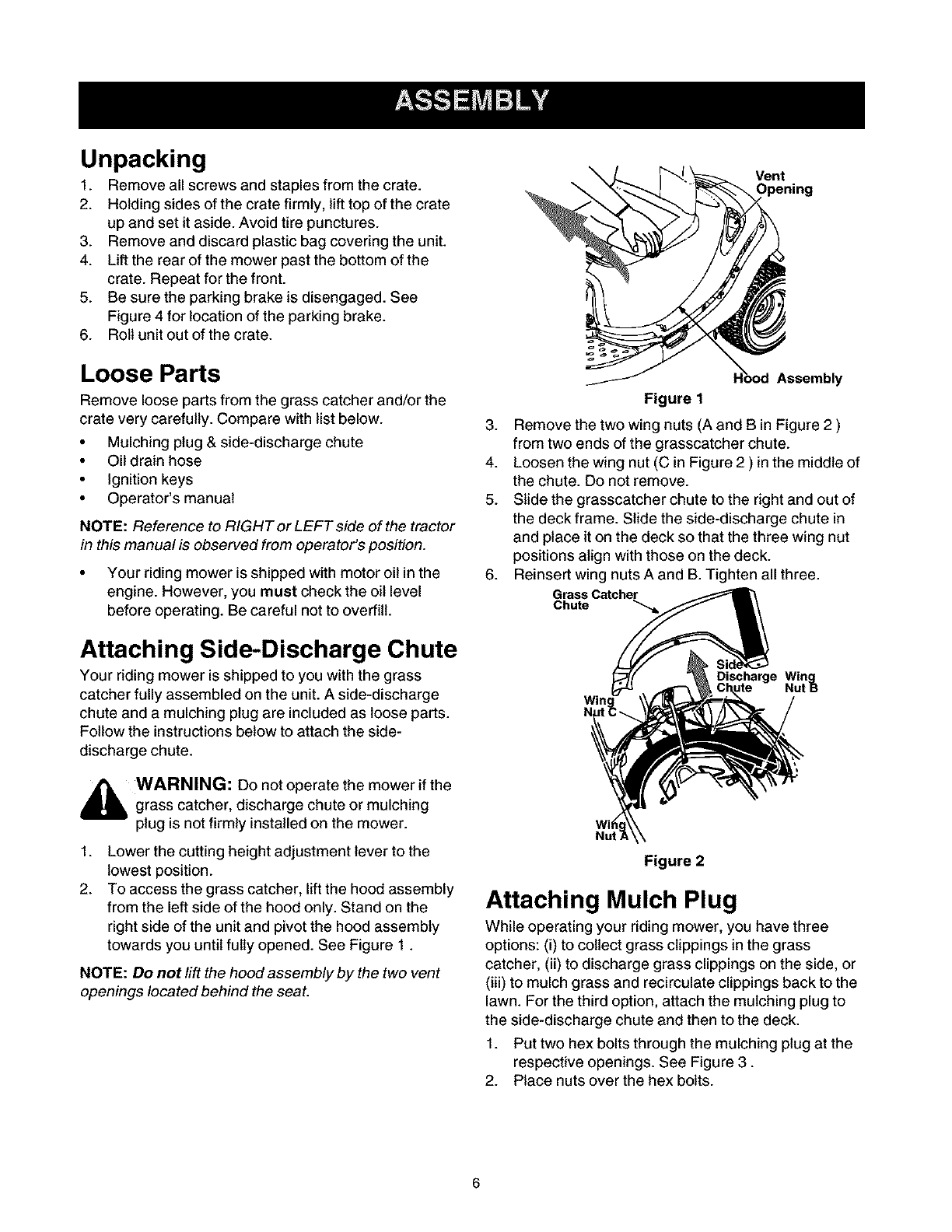
To access the grass catcher, lift the hood assembly
from the left side of the hood only. Stand on the
right side of the unit and pivot the hood assembly
towards you until fully opened. See Figure 1.
NOTE: Do not lift the hood assembly by the two vent
openings located behind the seat.
Vent
Assembly
Figure 1
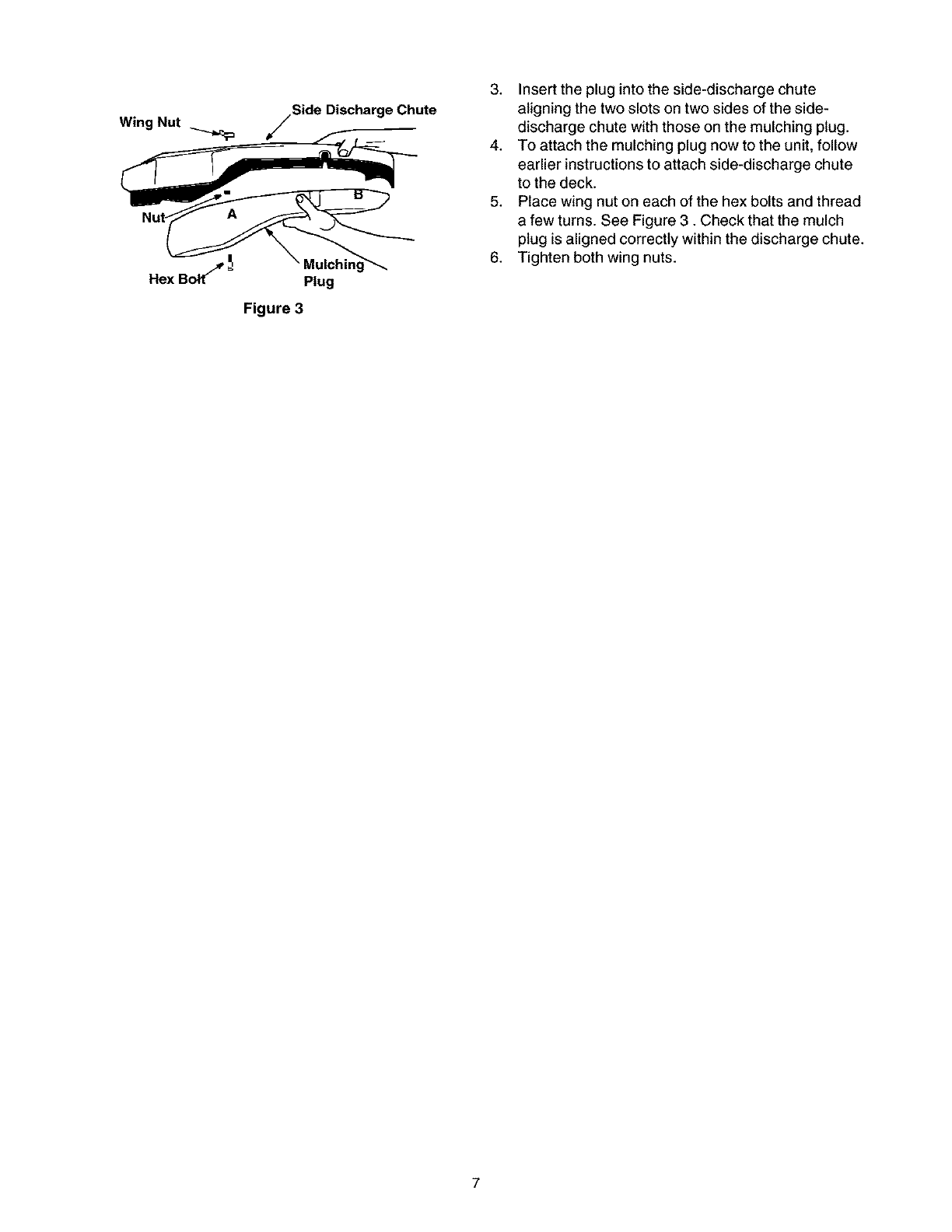
3. Remove the two wing nuts (A and B in Figure 2 )
from two ends of the grasscatcher chute.
4. Loosen the wing nut (C in Figure 2 ) in the middle of
the chute. Do not remove.
5. Slide the grasscatcher chute to the right and out of
the deck frame. Slide the side-discharge chute in
and place it on the deck so that the three wing nut
positions align with those on the deck.
6. Reinsert wing nuts A and B. Tighten all three.
GrassCatcher
Chute
Win
Nut_l
Nut
Figure 2
Attaching Mulch Plug
While operating your riding mower, you have three
options: (i) to collect grass clippings in the grass
catcher, (ii) to discharge grass clippings on the side, or
(iii) to mulch grass and recirculate clippings back to the
lawn. For the third option, attach the mulching plug to
the side-discharge chute and then to the deck.
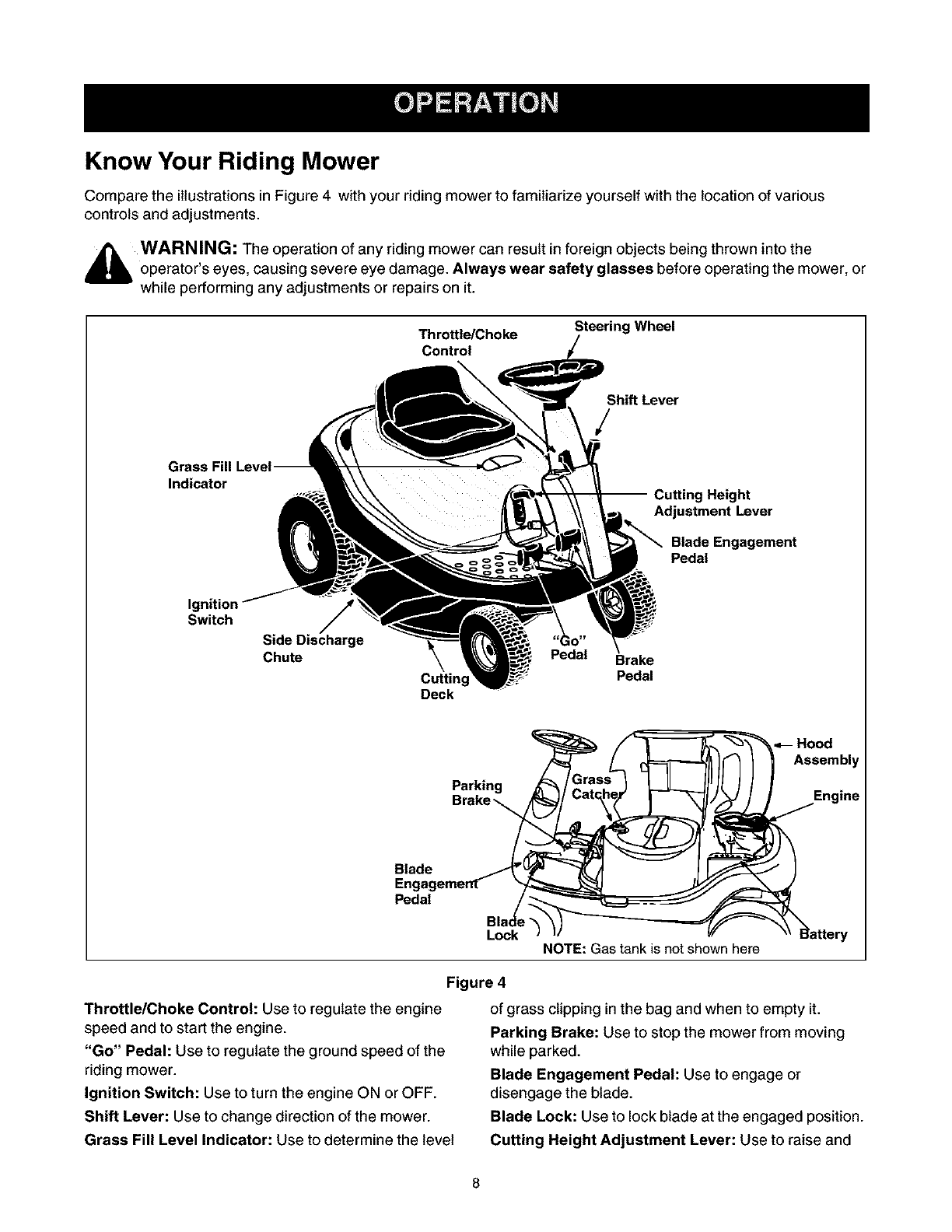
1. Put two hex bolts through the mulching plug at the
respective openings. See Figure 3.
2. Place nuts over the hex bolts.
Wing Nut
A
Side Discharge Chute
ulchin
Plug
Figure 3
3. Insert the plug into the side-discharge chute
aligning the two slots on two sides of the side-
discharge chute with those on the mulching plug.
4. To attach the mulching plug now to the unit, follow
earlier instructions to attach side-discharge chute
to the deck.
5. Place wing nut on each of the hex bolts and thread
a few turns. See Figure 3. Check that the mulch
plug is aligned correctly within the discharge chute.
6. Tighten both wing nuts.
Know Your Riding Mower
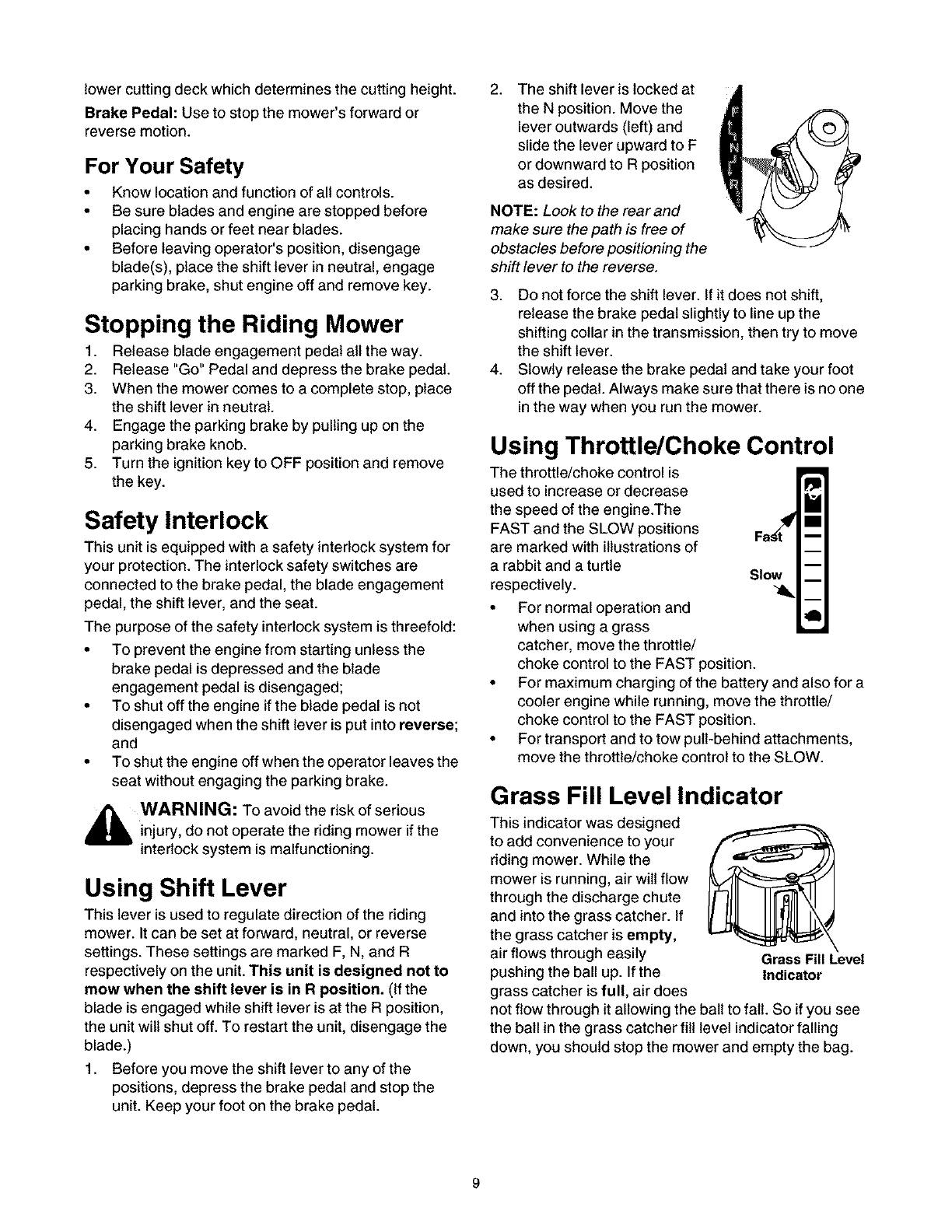
Compare the illustrations in Figure 4 with your riding mower to familiarize yourself with the location of various
controls and adjustments.
,_ WARNING: The operation of any riding mower can result in foreign objects being thrown into the
operator's eyes, causing severe eye damage. Always wear safety glasses before operating the mower, or
while performing any adjustments or repairs on it.
Throttle/Choke
Control
Steering Wheel
Shift Lever
Indicator g Height
Adjustment Lever
Blade Engagement
Pedal
Ignition
Switch
Side Discharge
Chute
Cutting
Deck
Pedal Brake
Pedal
Blade
Pedal
Parking
Lock NOTE: Gas tank is not shown here
Figure 4
Throttle/Choke Control: Use to regulate the engine
speed and to start the engine.
"Go" Pedal: Use to regulate the ground speed of the
riding mower.
Ignition Switch: Use to turn the engine ON or OFF.
Shift Lever: Use to change direction of the mower.
Grass Fill Level Indicator: Use to determine the level
of grass clipping in the bag and when to empty it.
Parking Brake: Use to stop the mower from moving
while parked.
Blade Engagement Pedal: Use to engage or
disengage the blade.
Blade Lock: Use to lock blade at the engaged position.
Cutting Height Adjustment Lever: Use to raise and
lowercuttingdeckwhichdeterminesthecuttingheight.
BrakePedal:Usetostopthemower'sforwardor
reversemotion.
For Your Safety
• Know location and function of all controls.
• Be sure blades and engine are stopped before
placing hands or feet near blades.
• Before leaving operator's position, disengage
blade(s), place the shift lever in neutral, engage
parking brake, shut engine off and remove key.
Stopping the Riding Mower
1. Release blade engagement pedal all the way.
2. Release "Go" Pedal and depress the brake pedal.
3. When the mower comes to a complete stop, place
the shift lever in neutral.
4. Engage the parking brake by pulling up on the
parking brake knob.
5. Turn the ignition key to OFF position and remove
the key.
Safety Interlock
This unit is equipped with a safety interlock system for
your protection. The interlock safety switches are
connected to the brake pedal, the blade engagement
pedal, the shift lever, and the seat.
The purpose of the safety interlock system is threefold:
• To prevent the engine from starting unless the
brake pedal is depressed and the blade
engagement pedal is disengaged;
• To shut off the engine if the blade pedal is not
disengaged when the shift lever is put into reverse;
and
• To shut the engine off when the operator leaves the
seat without engaging the parking brake.
,_ WARNING: TO avoid the risk of serious
injury, do not operate the riding mower if the
interlock system is malfunctioning.
Using Shift Lever
This lever is used to regulate direction of the riding
mower. It can be set at forward, neutral, or reverse
settings. These settings are marked F, N, and R
respectively on the unit. This unit is designed not to
mow when the shift lever is in B position. (If the
blade is engaged while shift lever is at the R position,
the unit wilt shut off. To restart the unit, disengage the
blade.)
1. Before you move the shift lever to any of the
positions, depress the brake pedal and stop the
unit. Keep your foot on the brake pedal.
2. The shift lever is locked at
the N position. Move the
lever outwards (left) and
slide the lever upward to F
or downward to R position
as desired.
NOTE: Look to the rear and
make sure the path is free of
obstacles before positioning the
shift/ever to the reverse.
3. Do not force the shift lever. If it does not shift,
release the brake pedal slightly to line up the
shifting collar in the transmission, then try to move
the shift lever.
4. Slowly release the brake pedal and take your foot
off the pedal. Always make sure that there is no one
in the way when you run the mower.
Using Throttle/Choke Control
The throttle/choke control is I___
used to increase or decrease
the speed of the engine.The
FAST and the SLOW positions
are marked with illustrations of
a rabbit and a turtle
respectively.
• For normal operation and
when using a grass
catcher, move the throttle/
choke control to the FAST position.
• For maximum charging of the battery and also for a
cooler engine while running, move the throttle/
choke control to the FAST position.
• For transport and to tow pull-behind attachments,
move the throttle/choke control to the SLOW.
Grass Fill Level Indicator
This indicator was designed
to add convenience to your
riding mower. While the
mower is running, air will flow
through the discharge chute
and into the grass catcher. If
the grass catcher is empty,
air flows through easily
pushing the ball up. If the
grass catcher is full, air does
Grass Fill Level
Indicator
not flow through it allowing the ball to fall. So if you see
the ball in the grass catcher fill level indicator falling
down, you should stop the mower and empty the bag.
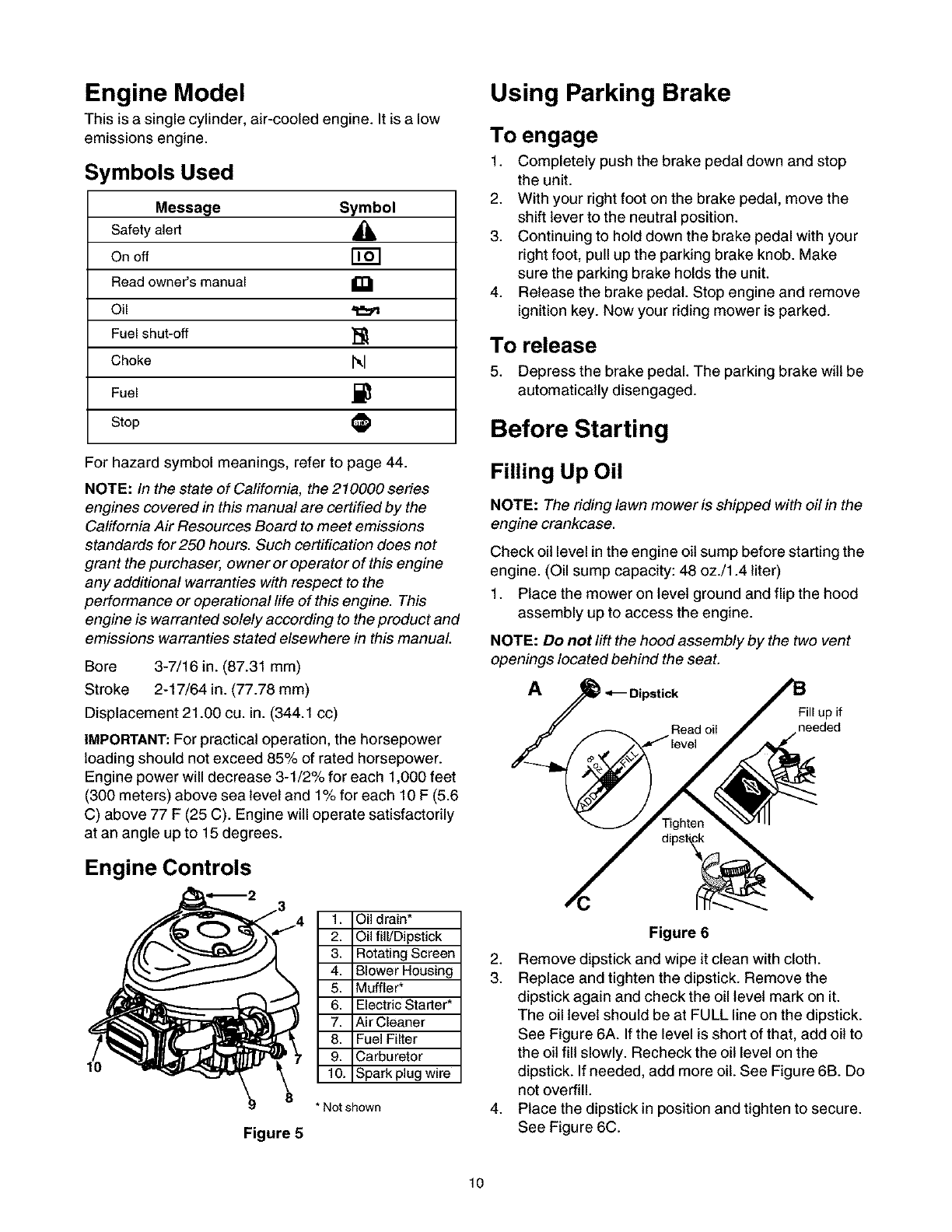
Engine Model
This is a single cylinder, air-cooled engine. It is a low
emissions engine.
Symbols Used
Message Symbol
Safety alert _,
On off
Read owner's manual
Oil
Fuel shut-off ]_
Choke I",l
Fuel ._
Stop I_1
For hazard symbol meanings, refer to page 44.
NOTE: In the state of California, the 210000 series
engines covered in this manual are certified by the
California Air Resources Board to meet emissions
standards for250 hours. Such certification does not
grant the purchaser, owner or operator of this engine
any additional warranties with respect to the
performance or operational life of this engine. This
engine is warranted solely according to the product and
emissions warranties stated elsewhere in this manual
Bore 3-7/16 in. (87.31 mm)
Stroke 2-17/64 in. (77.78 mm)
Displacement 21.00 cu. in. (344.1 cc)
IMPORTANT: For practical operation, the horsepower
loading should not exceed 85% of rated horsepower.
Engine power will decrease 3-1/2% for each 1,000 feet
(300 meters) above sea level and 1% for each 10 F (5.6
C) above 77 F (25 C). Engine will operate satisfactorily
at an angle up to 15 degrees.
Engine Controls
_2
1. Oil drain*
2. Oil fill/Dipstick
3. Rotating Screen
4. Blower Housing
5. Muffler*
6. Electric Starter*
7. Air Cleaner
8. Fuel Filter
9. Carburetor
10. Spark plug wire
* Not shown
Figure 5
Using Parking Brake
To engage
1. Completely push the brake pedal down and stop
the unit.
2. With your right foot on the brake pedal, move the
shift lever to the neutral position.
3. Continuing to hold down the brake pedal with your
right foot, pull up the parking brake knob. Make
sure the parking brake holds the unit.
4. Release the brake pedal. Stop engine and remove
ignition key. Now your riding mower is parked.
To release
5. Depress the brake pedal. The parking brake will be
automatically disengaged.
Before Starting
Filling Up Oil
NOTE: The riding lawn mower is shipped with oil in the
engine crankcase.
Check oil level in the engine oil sump before starting the
engine. (Oil sump capacity: 48 oz./1.4 liter)
1. Place the mower on level ground and flip the hood
assembly up to access the engine.
NOTE: Do not lift the hood assembly by the two vent
openings located behind the seat.
ADipstick
Fill up if
Read oil needed
Figure 6
2. Remove dipstick and wipe it clean with cloth.
3. Replace and tighten the dipstick. Remove the
dipstick again and check the oil level mark on it.
The oil level should be at FULL line on the dipstick.
See Figure 6A. If the level is short of that, add oil to
the oil fill slowly. Recheck the oil level on the
dipstick. If needed, add more oil. See Figure 6B. Do
not overfill.
4. Place the dipstick in position and tighten to secure.
See Figure 6C.
10
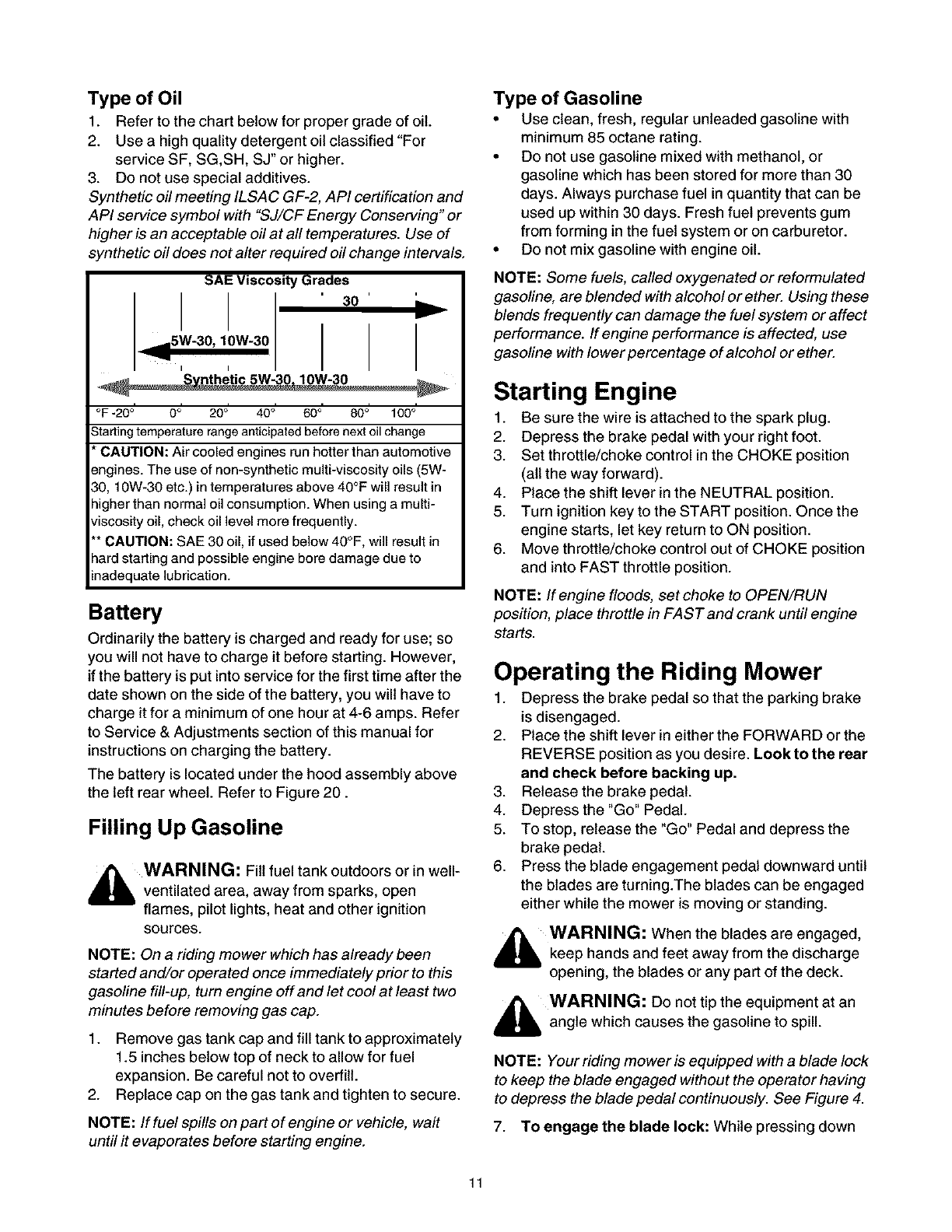
Type of Oil
1. Refer to the chart below for proper grade of oil.
2. Use a high quality detergent oil classified "For
service SF, SG,SH, SJ" or higher.
3. Do not use special additives.
Synthetic oil meeting ILSAC GF-2, API certification and
API service symbol with "SJ/CF Energy Conserving" or
higher is an acceptable oil at all temperatures. Use of
synthetic oil does not alter required oil change intervals.
SAE Viscosity Grades
30
_5W-30, 10W-30
L
°F -20°' 0°' 20°' 40°' 60°' 80°' 100°'
Starting temperature range anticipated before next oilchange
*CAUTION: Air cooled engines run hotter than automotive
engines. The use of non-synthetic multi-viscosity oils (5W-
30, 10W-30 etc.) in temperatures above 40°F will result in
higher than normal oil consumption. When using a multi-
viscosity oil, check oil level more frequently.
** CAUTION: SAE 30 oil, if used below 40°F, will result in
hard starting and possible engine bore damage due to
inadequate lubrication.
Battery
Ordinarily the battery is charged and ready for use; so
you will not have to charge it before starting. However,
if the battery is put into service for the first time after the
date shown on the side of the battery, you will have to
charge it for a minimum of one hour at 4-6 amps. Refer
to Service & Adjustments section of this manual for
instructions on charging the battery.
The battery is located under the hood assembly above
the left rear wheel. Refer to Figure 20.
Filling Up Gasoline
,_ WARNING: Fill fuel tank outdoors or in well-
ventilated area, away from sparks, open
flames, pilot lights, heat and other ignition
SOUrCeS.
NOTE: On a riding mower which has already been
started and/or operated once immediately prior to this
gasoline fill-up, turn engine off and let cool at least two
minutes before removing gas cap.
1. Remove gas tank cap and fill tank to approximately
1.5 inches below top of neck to allow for fuel
expansion. Be careful not to overfill.
2. Replace cap on the gas tank and tighten to secure.
NOTE: If fuel spills on part of engine or vehicle, wait
until it evaporates before starting engine.
Type of Gasoline
•Use clean, fresh, regular unleaded gasoline with
minimum 85 octane rating.
• Do not use gasoline mixed with methanol, or
gasoline which has been stored for more than 30
days. Always purchase fuel in quantity that can be
used up within 30 days. Fresh fuel prevents gum
from forming in the fuel system or on carburetor.
• Do not mix gasoline with engine oil.
NOTE: Some fuels, called oxygenated or reformulated
gasoline, are blended with alcohol or ether. Using these
blends frequently can damage the fuel system or affect
performance. If engine performance is affected, use
gasoline with Iower percentage of alcohol or ether.
Starting Engine
1. Be sure the wire is attached to the spark plug.
2. Depress the brake pedal with your right foot.
3. Set throttle/choke control in the CHOKE position
(all the way forward).
4. Place the shift lever in the NEUTRAL position.
5. Turn ignition key to the START position. Once the
engine starts, let key return to ON position.
6. Move throttle/choke control out of CHOKE position
and into FAST throttle position.
NOTE: If engine floods, set choke to OPEN/RUN
position, place throttle in FAST and crank until engine
starts.
Operating the Riding Mower
1. Depress the brake pedal so that the parking brake
is disengaged.
2. Place the shift lever in either the FORWARD or the
REVERSE position as you desire. Look to the rear
and check before backing up.
3. Release the brake pedal.
4. Depress the "Go" Pedal.
5. To stop, release the "Go" Pedal and depress the
brake pedal.
6. Press the blade engagement pedal downward until
the blades are turning.The blades can be engaged
either while the mower is moving or standing.
,_ WARNING: When the blades are engaged,
keep hands and feet away from the discharge
opening, the blades or any part of the deck.
_WARNING: Do not tip the equipment at an
angle which causes the gasoline to spill.
NOTE: Your riding mower is equipped with a blade lock
to keep the blade engaged without the operator having
to depress the blade pedal continuously. See Figure 4.
7. To engage the blade lock: While pressing down
11
on the blade pedal, push the blade lock down with
your heel. It should click into the "blade engaged"
position. To disengage the blade lock, simply push
down on the blade pedal and release the lock.
Stopping the Riding Mower
See page 9 for detailed instruction.
NOTE: Do not leave the key in the ON position when
you are not operating the mower. Such action will drain
the battery dead.
NOTE: Do not choke carburetor to stop engine.
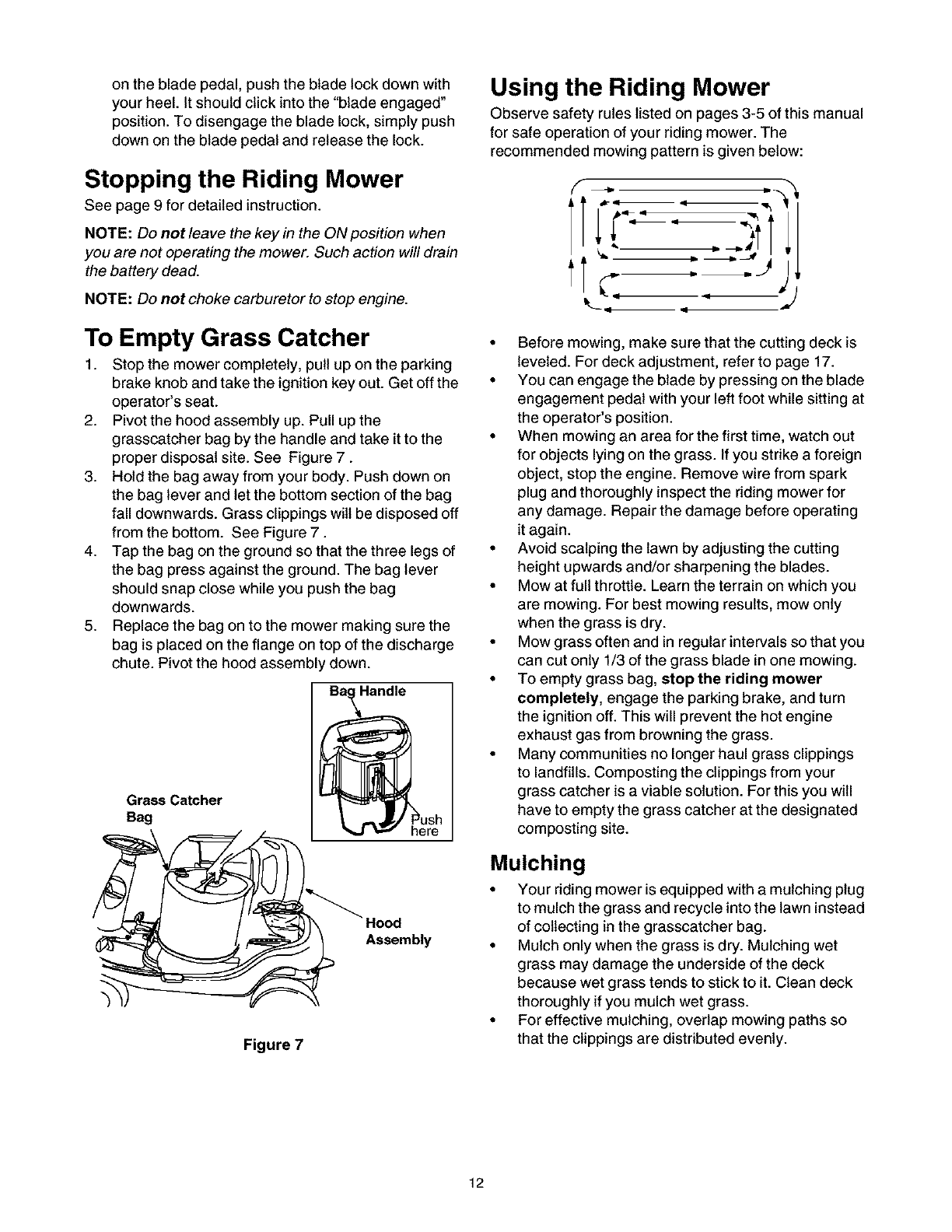
To Empty Grass Catcher
1. Stop the mower completely, pult up on the parking
brake knob and take the ignition key out. Get off the
operator's seat.
2. Pivot the hood assembly up. Pull up the
grasscatcher bag by the handle and take it to the
proper disposal site. See Figure 7.
3. Hold the bag away from your body. Push down on
the bag lever and let the bottom section of the bag
fall downwards. Grass clippings witl be disposed off
from the bottom. See Figure 7.
4. Tap the bag on the ground so that the three legs of
the bag press against the ground. The bag lever
should snap close while you push the bag
downwards.
5. Replace the bag on to the mower making sure the
bag is placed on the flange on top of the discharge
chute. Pivot the hood assembly down.
Grass Catcher
Bag
BakHandle
Assembly
Figure 7
Using the Riding Mower
Observe safety rules listed on pages 3-5 of this manual
for safe operation of your riding mower. The
recommended mowing pattern is given below:
tTc. .'JJ
•Before mowing, make sure that the cutting deck is
leveled. For deck adjustment, refer to page 17.
• You can engage the blade by pressing on the blade
engagement pedal with your left foot while sitting at
the operator's position.
• When mowing an area for the first time, watch out
for objects lying on the grass. If you strike a foreign
object, stop the engine. Remove wire from spark
plug and thoroughly inspect the riding mower for
any damage. Repair the damage before operating
it again.
• Avoid scalping the lawn by adjusting the cutting
height upwards and/or sharpening the blades.
• Mow at full throttle. Learn the terrain on which you
are mowing. For best mowing results, mow only
when the grass is dry.
• Mow grass often and in regular intervals so that you
can cut only 1/3 of the grass blade in one mowing.
• To empty grass bag, stop the riding mower
completely, engage the parking brake, and turn
the ignition off. This will prevent the hot engine
exhaust gas from browning the grass.
• Many communities no longer haul grass clippings
to landfills. Composting the clippings from your
grass catcher is a viable solution. For this you witl
have to empty the grass catcher at the designated
composting site.
Mulching
• Your riding mower is equipped with a mulching plug
to mulch the grass and recycle into the lawn instead
of collecting in the grasscatcher bag.
• Mulch only when the grass is dry. Mulching wet
grass may damage the underside of the deck
because wet grass tends to stick to it. Clean deck
thoroughly if you mulch wet grass.
• For effective mulching, overlap mowing paths so
that the clippings are distributed evenly.
12
General Recommendations
_lb WARNING: Always stop engine and disconnect spark plug wire before any maintenance or adjustments.
Always maintain safety and follow instructions given below closely for smooth completion of job.
The warranty on this riding mower does not cover items that have been subjected to operator abuse or
negligence. To receive full value from the warranty, operator must maintain the riding mower as instructed in
this manual. Refer to the Maintenance Schedule below.
We do not recommend the use of pressure washers or garden hose to clean your unit. These may cause
damage to electrical components, spindles, pulleys, bearings or the engine. The use of water may shorten life
of your riding mower and reduce its serviceability
To ensure safe operation, all nuts and bolts must be checked periodically for correct tightness.
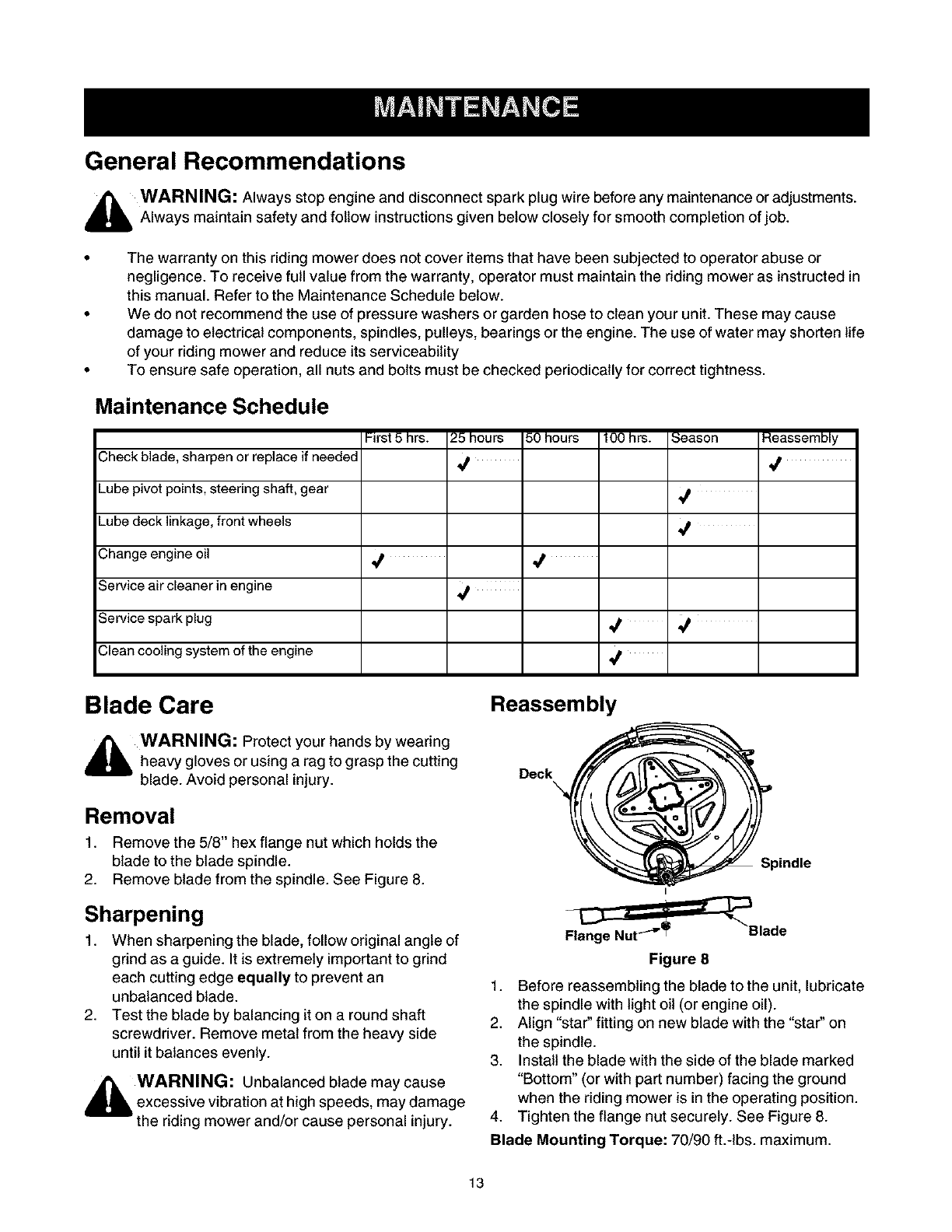
Maintenance Schedule
First 5 hrs. 25 hours 50 hours 100 hrs. Season Reassembly
Check blade, sharpen or replace if needed _
Lube pivot points, steering shaft, gear
Lube deck linkage, front wheels
Change engine oil _
Service air cleaner in engine
Service spark plug ,_
Clean cooling system of the engine
Blade Care
_WARNING: Protect your hands by wearing
heavy gloves or using a rag to grasp the cutting
blade. Avoid personal injury.
Removal
1. Remove the 5/8" hex flange nut which holds the
blade to the blade spindle.
2. Remove blade from the spindle. See Figure 8.
Sharpening
1. When sharpening the blade, follow original angle of
grind as a guide. It is extremely important to grind
each cutting edge equally to prevent an
unbalanced blade.
2. Test the blade by balancing it on a round shaft
screwdriver. Remove metal from the heavy side
until it balances evenly.
i_ WARNING: Unbalanced blade may cause
excessive vibration at high speeds, may damage
the riding mower and/or cause personal injury.
Reassembly
Spindle
I
_Blade
Figure 8
1. Before reassembling the blade to the unit, lubricate
the spindle with light oil (or engine oil).
2. Align "star" fitting on new blade with the "star" on
the spindle.
3. Install the blade with the side of the blade marked
"Bottom" (or with part number) facing the ground
when the riding mower is inthe operating position.
4. Tighten the flange nut securely. See Figure 8.
Blade Mounting Torque: 70/90 ft.-tbs, maximum.
13
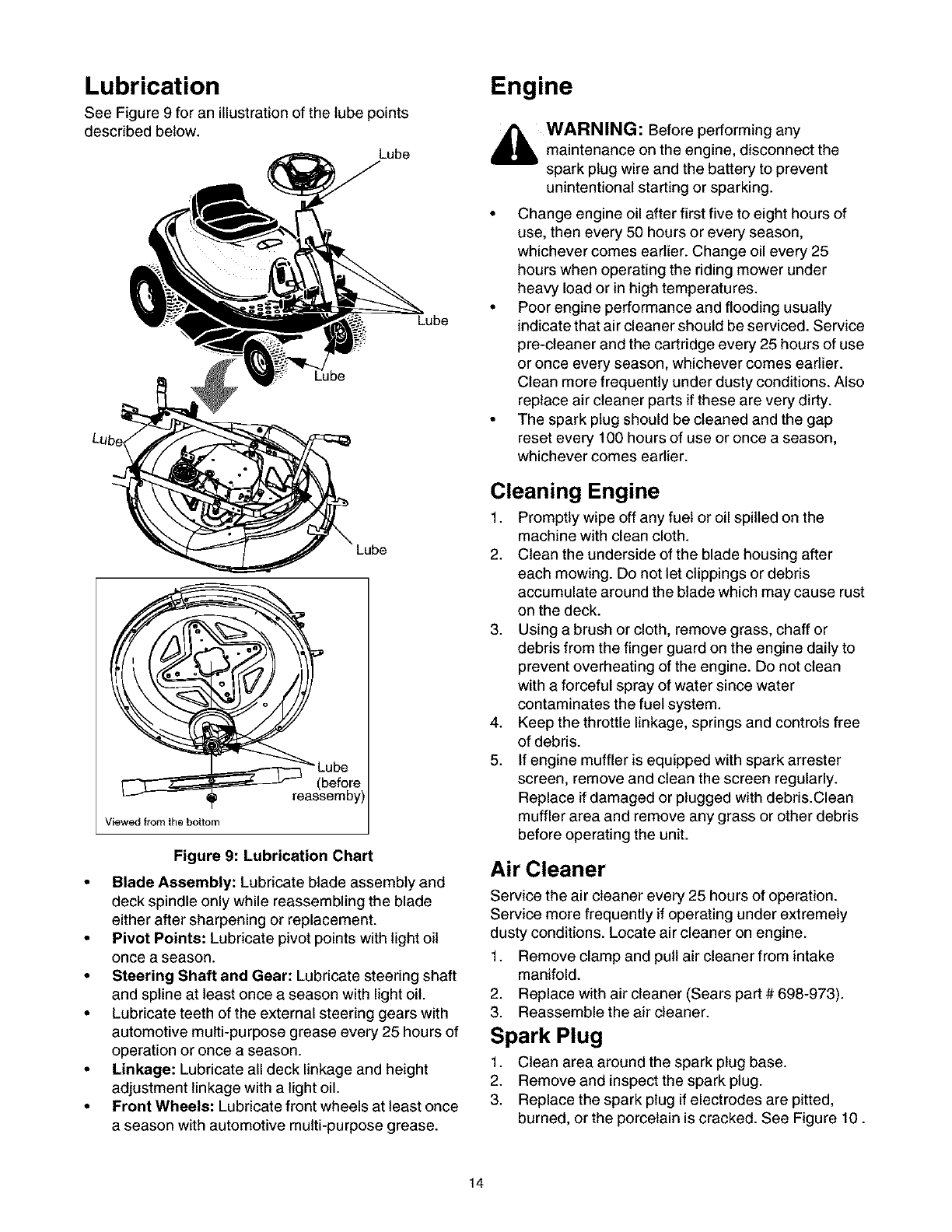
Lubrication
See Figure 9 for an illustration of the lube points
described below.
Lube
Lube
ube
_ube
before
semby)
Viewed from the bottom
Figure 9: Lubrication Chart
•Blade Assembly: Lubricate blade assembly and
deck spindle only while reassembling the blade
either after sharpening or replacement.
• Pivot Points: Lubricate pivot points with light oil
once a season.
•Steering Shaft and Gear: Lubricate steering shaft
and spline at least once a season with light oil.
• Lubricate teeth of the external steering gears with
automotive multi-purpose grease every 25 hours of
operation or once a season.
•Linkage: Lubricate all deck linkage and height
adjustment linkage with a light oil.
• Front Wheels: Lubricate front wheels at least once
a season with automotive multi-purpose grease.
Engine
_1= WARNING: Before performing any
maintenance on the engine, disconnect the
spark plug wire and the battery to prevent
unintentional starting or sparking.
• Change engine oil after first five to eight hours of
use, then every 50 hours or every season,
whichever comes earlier. Change oil every 25
hours when operating the riding mower under
heavy load or in high temperatures.
• Poor engine performance and flooding usually
indicate that air cleaner should be serviced. Service
pre-cleaner and the cartridge every 25 hours of use
or once every season, whichever comes earlier.
Clean more frequently under dusty conditions. Also
replace air cleaner parts if these are very dirty.
• The spark plug should be cleaned and the gap
reset every 100 hours of use or once a season,
whichever comes earlier.
Cleaning Engine
1. Promptly wipe off any fuel or oil spilled on the
machine with clean cloth.
2. Clean the underside of the blade housing after
each mowing. Do not let clippings or debris
accumulate around the blade which may cause rust
on the deck.
3. Using a brush or cloth, remove grass, chaff or
debris from the finger guard on the engine daily to
prevent overheating of the engine. Do not clean
with a forceful spray of water since water
contaminates the fuel system.
4. Keep the throttle linkage, springs and controls free
of debris.
5. If engine muffler is equipped with spark arrester
screen, remove and clean the screen regularly.
Replace if damaged or plugged with debris.Clean
muffler area and remove any grass or other debris
before operating the unit.
Air Cleaner
Service the air cleaner every 25 hours of operation.
Service more frequently if operating under extremely
dusty conditions. Locate air cleaner on engine.
1. Remove clamp and pull air cleaner from intake
manifold.
2. Replace with air cleaner (Sears part # 698-973).
3. Reassemble the air cleaner.
Spark Plug
1. Clean area around the spark plug base.
2. Remove and inspect the spark plug.
3. Replace the spark plug if electrodes are pitted,
burned, or the porcelain is cracked. See Figure 10.
14
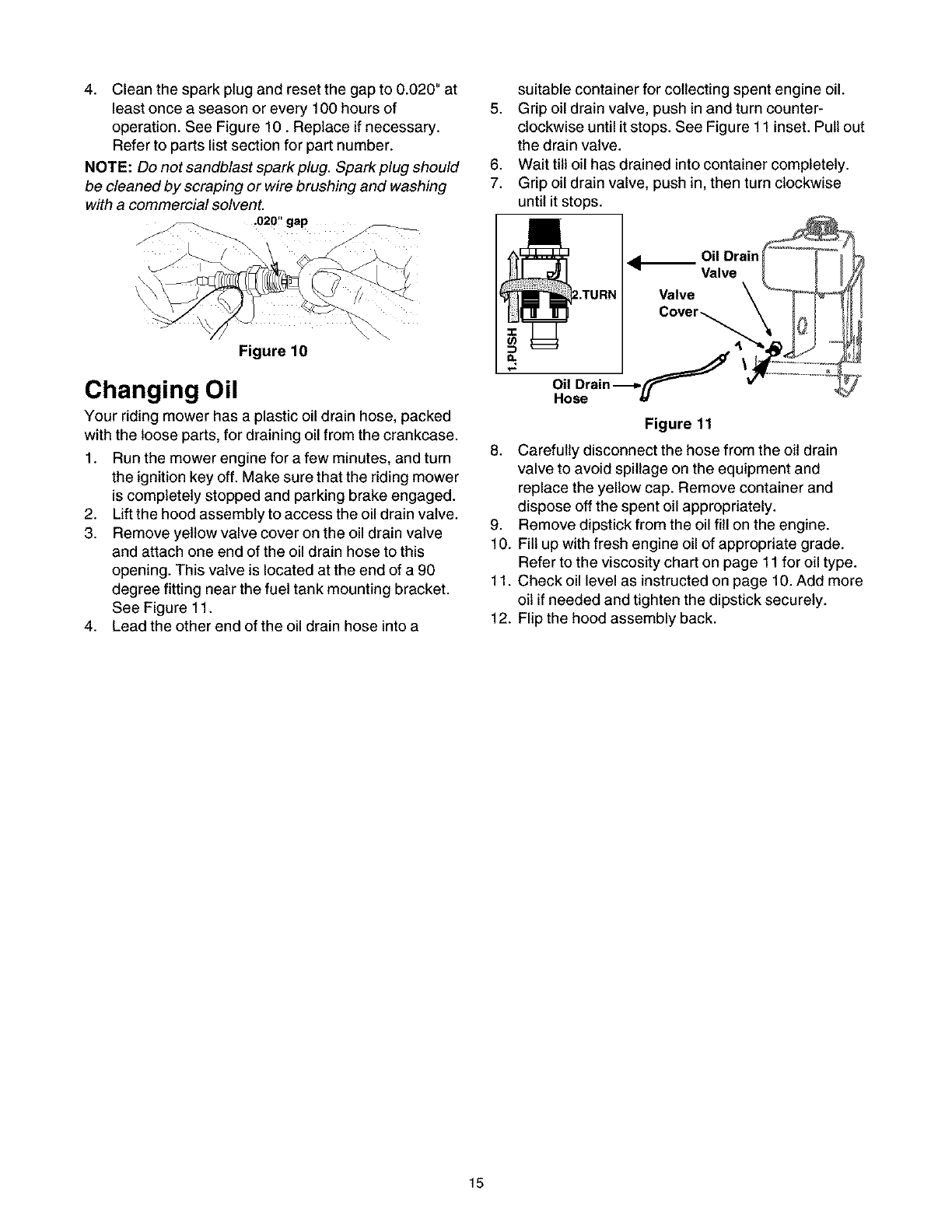
4. Clean the spark plug and reset the gap to 0.020" at
least once a season or every 100 hours of
operation. See Figure 10. Replace if necessary.
Refer to parts list section for part number.
NOTE: Do not sandblast spark plug. Spark plug should
be cleaned by scraping or wire brushing and washing
with a commercial solvent.
_.020, gap _
Figure 10
Changing Oil
Your riding mower has a plastic oil drain hose, packed
with the loose parts, for draining oil from the crankcase.
1. Run the mower engine for a few minutes, and turn
the ignition key off. Make sure that the riding mower
is completely stopped and parking brake engaged.
2. Lift the hood assembly to access the oil drain valve.
3. Remove yellow valve cover on the oil drain valve
and attach one end of the oil drain hose to this
opening. This valve is located at the end of a 90
degree fitting near the fuel tank mounting bracket.
See Figure 11.
4. Lead the other end of the oil drain hose into a
suitable container for collecting spent engine oil.
5. Grip oil drain valve, push in and turn counter-
clockwise until it stops. See Figure 11 inset. Pull out
the drain valve.
6. Wait till oil has drained into container completely.
7. Grip oil drain valve, push in, then turn clockwise
until it stops.
• Oil Drain
Valve
Valve \
Cover -_
Drain-_'J[f \"
Oil
Hose _,_
...... L
Figure 11
8. Carefully disconnect the hose from the oil drain
valve to avoid spillage on the equipment and
replace the yellow cap. Remove container and
dispose off the spent oil appropriately.
9. Remove dipstick from the oil fill on the engine.
10. Fill up with fresh engine oil of appropriate grade.
Refer to the viscosity chart on page 11 for oil type.
11. Check oil level as instructed on page 10. Add more
oil if needed and tighten the dipstick securely.
12. Flip the hood assembly back.
15
Adjustments
Brake Pedal
The brake pedal needs to contact the PTO (power take
off) switch for the engine to start. During normal
operation of the riding mower, the brake is subject to
wear and tear. Periodically check the brake by carrying
out the following test:
1. Release the parking brake and place the riding
mower in neutral.
2. Depress the brake pedal and try to roll the riding
mower. The tractor should not move. If the tractor
moves, adjust the brake.
_ill ARNING: Do not adjust the brake while
the engine is running. Be sure to block the
wheels of the riding mower before making any
adjustments on the brake cable.
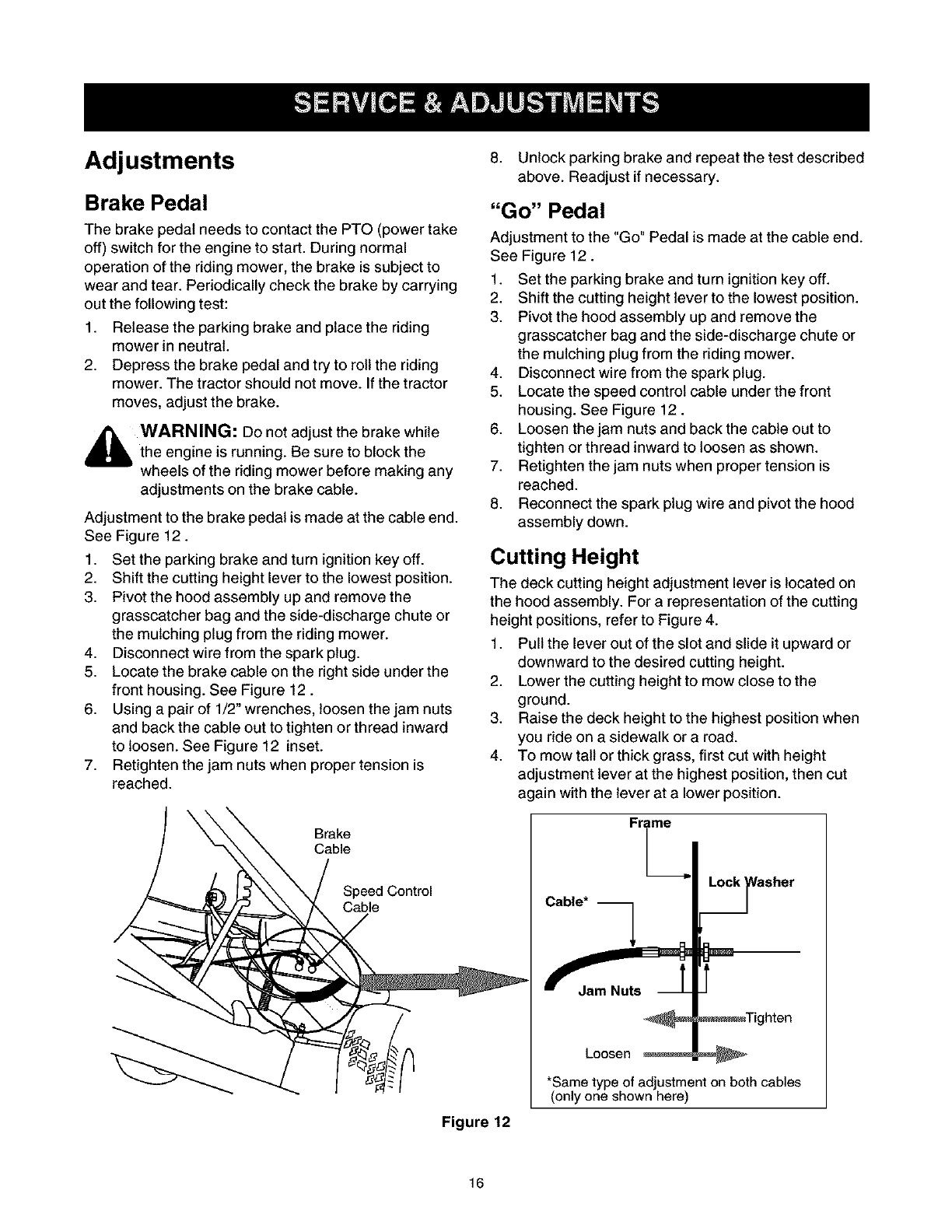
Adjustment to the brake pedal is made at the cable end.
See Figure 12.
1. Set the parking brake and turn ignition key off.
2. Shift the cutting height lever to the lowest position.
3. Pivot the hood assembly up and remove the
grasscatcher bag and the side-discharge chute or
the mulching plug from the riding mower.
4. Disconnect wire from the spark plug.
5. Locate the brake cable on the right side under the
front housing. See Figure 12.
6. Using a pair of 1/2' wrenches, loosen the jam nuts
and back the cable out to tighten or thread inward
to loosen. See Figure 12 inset.
7. Retighten the jam nuts when proper tension is
reached.
Brake
Cable
;ontrol
Figure 12
8. Unlock parking brake and repeat the test described
above. Readjust if necessary.
"Go" Pedal
Adjustment to the "Go" Pedal is made at the cable end.
See Figure 12.
1. Set the parking brake and turn ignition key off.
2. Shift the cutting height lever to the lowest position.
3. Pivot the hood assembly up and remove the
grasscatcher bag and the side-discharge chute or
the mulching plug from the riding mower.
4. Disconnect wire from the spark plug.
5. Locate the speed control cable under the front
housing. See Figure 12.
6. Loosen the jam nuts and back the cable out to
tighten or thread inward to loosen as shown.
7. Retighten the jam nuts when proper tension is
reached.
8. Reconnect the spark plug wire and pivot the hood
assembly down.
Cutting Height
The deck cutting height adjustment lever is located on
the hood assembly. For a representation of the cutting
height positions, refer to Figure 4.
1. Pull the lever out of the slot and slide it upward or
downward to the desired cutting height.
2. Lower the cutting height to mow close to the
ground.
3. Raise the deck height to the highest position when
you ride on a sidewalk or a road.
4. To mow tall or thick grass, first cut with height
adjustment lever at the highest position, then cut
again with the lever at a lower position.
Cable* 1
Loosen
asher
_Tighten
*Same type of adjustment on both cables
(only one shown here)
16
Seat Position
The seat position on the riding mower can be adjusted
to maximize the operator's convenience.
1. Stop the mower completely and engage the parking
brake. Turn ignition off.
2. Pivot the hood assembly up.
3. Loosen the four self-tapping screws on the bottom
of the seat.
4. Slide the seat forward or backward in the slot, and
position it as desired. Retighten the four screws.
Blade Engagement Pedal
The blade engagement pedal should be adjusted so
that if you depress it about 3/4" from the front of the
blade brake slot, it will contact the PTO switch and
cause it to engage the deck belt.
Under normal operation, the blade engagement pedal
should not require frequent adjustment. However,
perform the following test periodically and make sure
that it is in fine working condition.
1. Pivot the hood assembly up and check if there is
enough slack on the deck engagement cable.
2. Depress the blade engagement pedal (about 3/4
inch) and check if the belt is engaging.
3. If the cable is tight or too loose or the belt is not
engaging, adjust the deck engagement cable.
NOTE: The deck engagement cable will be correctly
adjusted when the cable moves approximately 1/2" off
center line in both directions.
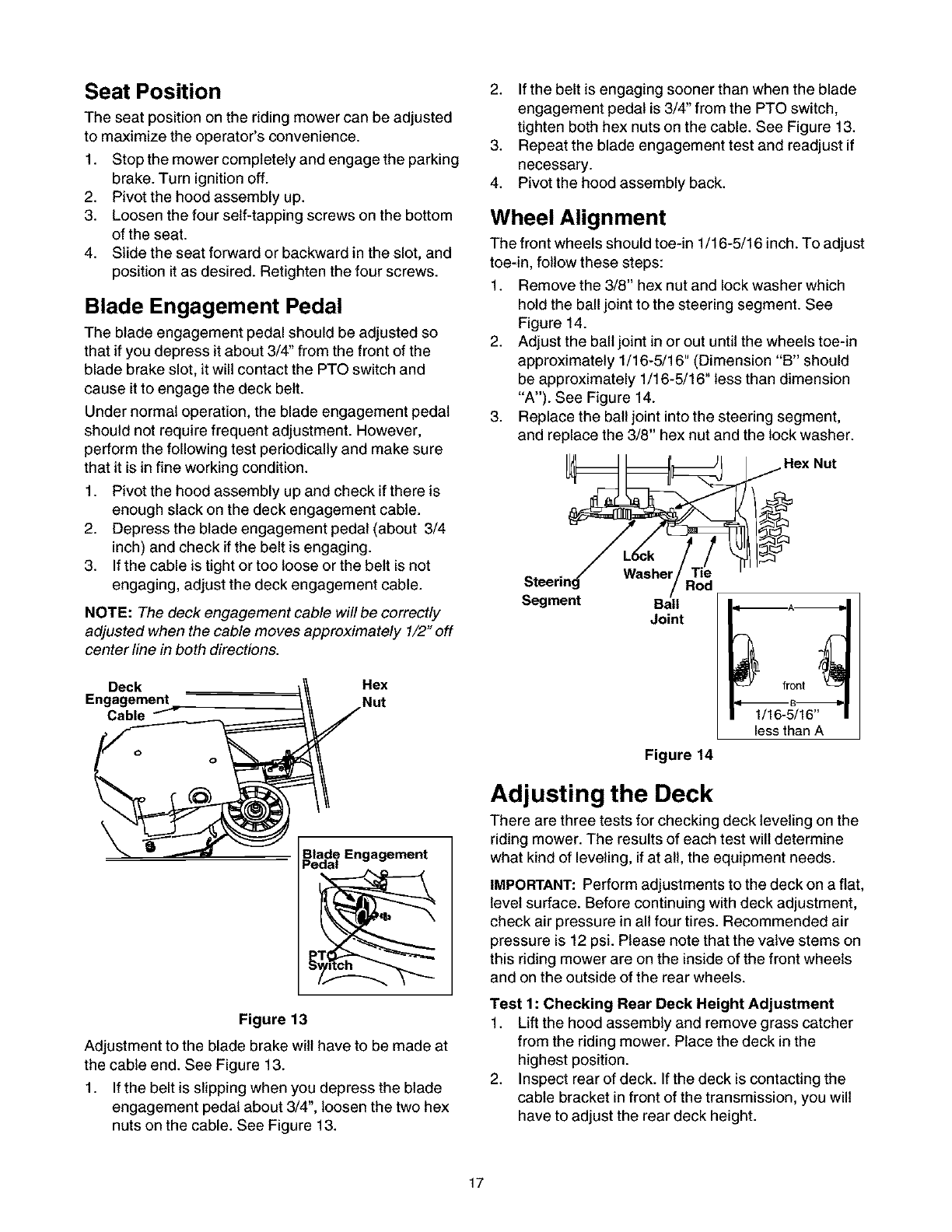
Deck _/\ Hex
Engagement \\\ Nut
Figure 13
Adjustment to the blade brake will have to be made at
the cable end. See Figure 13.
1. If the belt is slipping when you depress the blade
engagement pedal about 3/4 ", loosen the two hex
nuts on the cable. See Figure 13.
2. If the belt is engaging sooner than when the blade
engagement pedal is 3/4" from the PTO switch,
tighten both hex nuts on the cable. See Figure 13.
3. Repeat the blade engagement test and readjust if
necessary.
4. Pivot the hood assembly back.
Wheel Alignment
The front wheels should toe-in 1/t 6-5/16 inch. To adjust
toe-in, follow these steps:
1. Remove the 3/8" hex nutand lock washer which
hold the ball joint to the steering segment. See
Figure 14.
2. Adjust the ball joint in or out untilthe wheels toe-in
approximately t/16-5/16" (Dimension "B" should
be approximately 1/16-5/16" less than dimension
"A'). See Figure 14.
3. Replace the ball joint into the steering segment,
and replace the 3/8" hex nut and the lock washer.
Hex Nut
Steerin_ Washer Rod
Segment Ball
Joint
Figure 14
1/16-5/16"
lessthan A
Adjusting the Deck
There are three tests for checking deck leveling on the
riding mower. The results of each test will determine
what kind of leveling, if at all, the equipment needs.
IMPORTANT: Perform adjustments to the deck on a flat,
level surface. Before continuing with deck adjustment,
check air pressure in all four tires. Recommended air
pressure is 12 psL Please note that the valve stems on
this riding mower are on the inside of the front wheels
and on the outside of the rear wheels.
Test 1: Checking Rear Deck Height Adjustment
1. Lift the hood assembly and remove grass catcher
from the riding mower. Place the deck in the
highest position.
2. Inspect rear of deck. If the deck is contacting the
cable bracket infront of the transmission, you will
have to adjust the rear deck height.
17
Test 2: Checking Front to Rear Leveling
1. Place the deck in the highest position.
2. Wearing a pair of heavy work gloves to prevent
injury, rotate the cutting blade so that it is pointed
front to back and parallel to the rider. Depress and
lock the deck engagement pedal.
3. Measure the distance from the front and the rear
tips of the blade to the ground.The front should be
approximately 1/4_to 3/8" lower than the rear.
4. If the distance is higher, level the deck front to rear.
Test 3: Checking Side to Side Leveling
1. Place the deck in the highest position.
2. Wearing a pair of heavy work gloves to prevent
injury, rotate the cutting blade so that it is pointed
side to side and perpendicular to the rider. Depress
and lock the deck engagement pedal.
3. Measure the distance from the tips of the blade to
the ground.
4. If the two distances are unequal, level the deck
side to side.
Adjusting Rear Deck Height
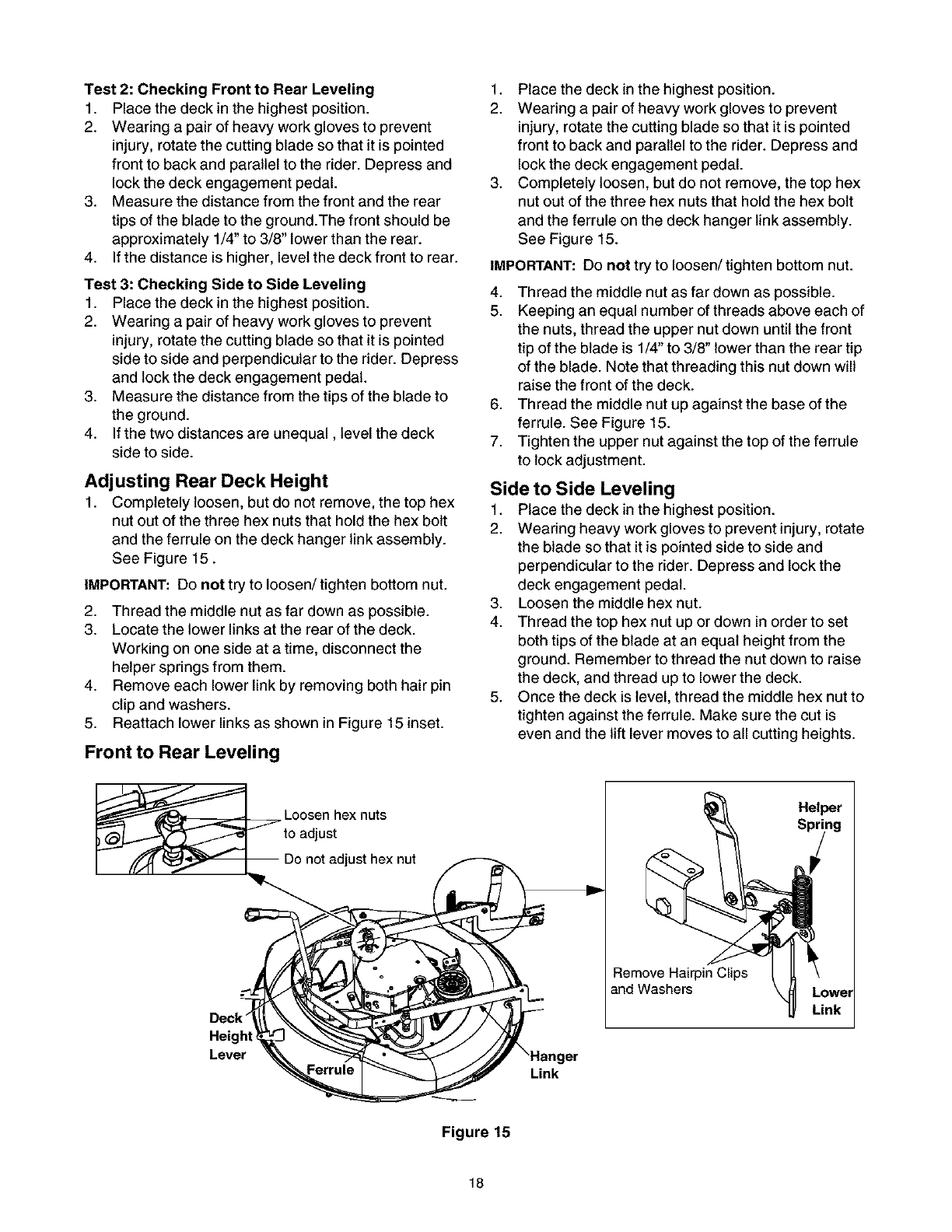
1. Completely loosen, but do not remove, the top hex
nut out of the three hex nuts that hold the hex bolt
and the ferrule on the deck hanger link assembly.
See Figure 15.
IMPORTANT: Do not try to loosen/tighten bottom nut.
2. Thread the middle nut as far down as possible.
3. Locate the lower links at the rear of the deck.
Working on one side at a time, disconnect the
helper springs from them.
4. Remove each lower link by removing both hair pin
clip and washers.
5. Reattach lower links as shown in Figure 15 inset.
Front to Rear Leveling
1. Place the deck in the highest position.
2. Wearing a pair of heavy work gloves to prevent
injury, rotate the cutting blade so that it is pointed
front to back and parallel to the rider. Depress and
lock the deck engagement pedal.
3. Completely loosen, but do not remove, the top hex
nut out of the three hex nuts that hold the hex bolt
and the ferrule on the deck hanger link assembly.
See Figure 15.
IMPORTANT: Do not try to loosen/tighten bottom nut.
4. Thread the middle nut as far down as possible.
5. Keeping an equal number of threads above each of
the nuts, thread the upper nut down until the front
tip of the blade is 1/4" to 3/8" lower than the rear tip
of the blade. Note that threading this nut down will
raise the front of the deck.
6. Thread the middle nut up against the base of the
ferrule. See Figure 15.
7. Tighten the upper nut against the top of the ferrule
to lock adjustment.
Side to Side Leveling
1. Place the deck in the highest position.
2. Wearing heavy work gloves to prevent injury, rotate
the blade so that it is pointed side to side and
perpendicular to the rider. Depress and lock the
deck engagement pedal.
3. Loosen the middle hex nut.
4. Thread the top hex nut up or down in order to set
both tips of the blade at an equal height from the
ground. Remember to thread the nut down to raise
the deck, and thread up to lower the deck.
5. Once the deck is level, thread the middle hex nut to
tighten against the ferrule. Make sure the cut is
even and the lift lever moves to all cutting heights.
Deck "
Height
Lever
Loosen hex nuts
Link
Remove Hairpin Clips
and Washers
Helper
Spring
Figure 15
18
Adjusting the Carburetor
Differences in fuel, temperature, altitude or load may
require minor carburetor adjustments. The carburetor
on this engine is equipped with an idle mixture valve
with a limiter which allows some adjustment, and an
idle speed adjustment screw. Remember that the air
cleaner must be assembled to the carburetor before re-
starting the engine. Refer to page 14 for details.
NOTE: Engines, operated at approximately 3000 to
5000 feet above sea level, may require a high altitude
carburetor nozzle. If your riding mower performs
erratically, contact Sears service center for the nozzle.
To adjust the carburetor, follow the steps below:
1. Start the engine and run it for at least 5 minutes to
warm up.
2. With the engine running, place throttle control in
SLOW position.
3. Lift the hood assembly up as instructed on page 7.
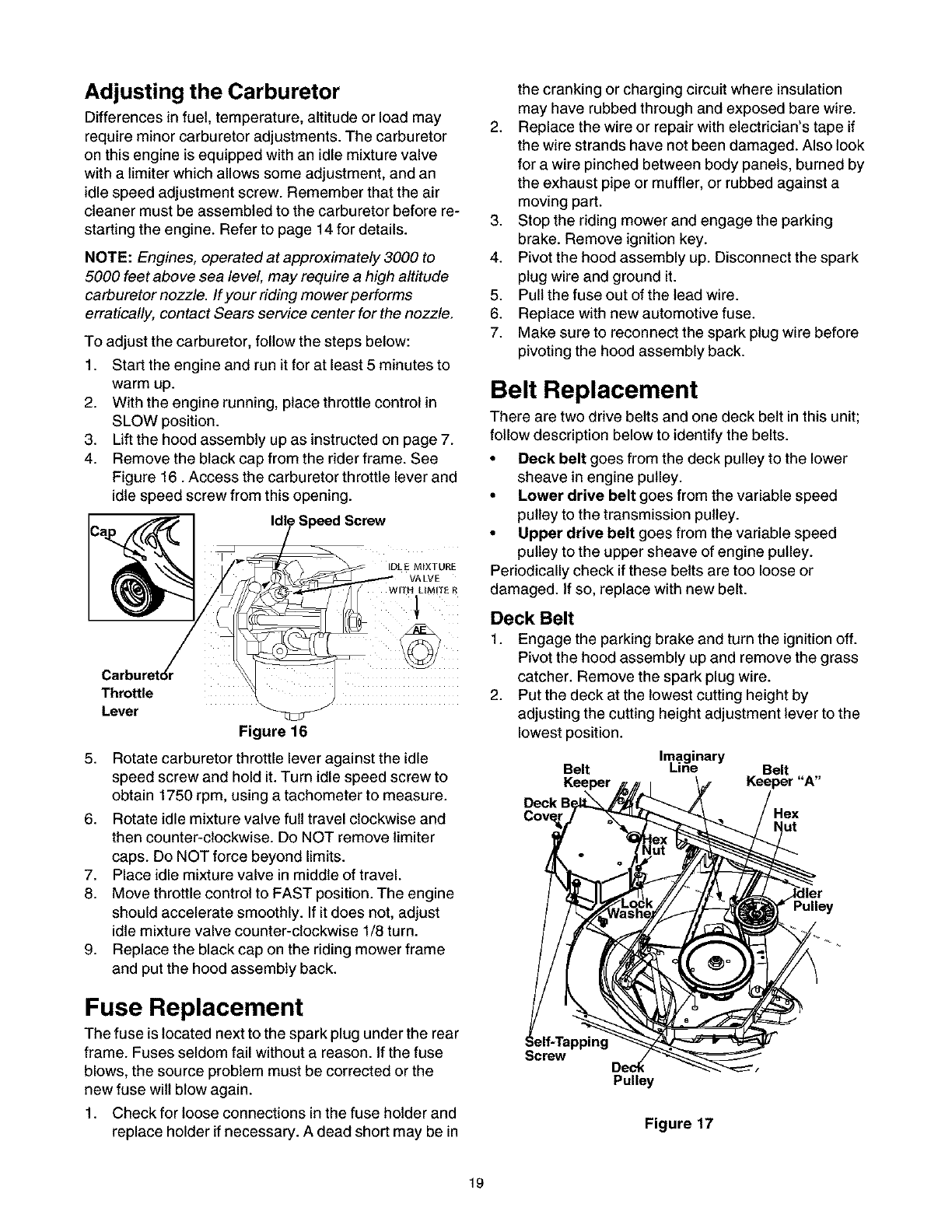
4. Remove the black cap from the rider frame. See
Figure 16. Access the carburetor throttle lever and
idle speed screw from this opening.
IDLE MIXTURE
VALVE
WITH LIMITE R
Carbureto/r
Throttle
Lever
Figure 16
5. Rotate carburetor throttle lever against the idle
speed screw and hold it. Turn idle speed screw to
obtain 1750 rpm, using a tachometer to measure.
6. Rotate idle mixture valve full travel clockwise and
then counter-clockwise. Do NOT remove limiter
caps. Do NOT force beyond limits.
7. Place idle mixture valve in middle of travel.
8. Move throttle control to FAST position. The engine
should accelerate smoothly. If it does not, adjust
idle mixture valve counter-clockwise 1/8 turn.
9. Replace the black cap on the riding mower frame
and put the hood assembly back.
Fuse Replacement
The fuse is located next to the spark plug under the rear
frame. Fuses seldom fail without a reason. If the fuse
blows, the source problem must be corrected or the
new fuse wilt blow again.
1. Check for loose connections in the fuse holder and
replace holder if necessary. A dead short may be in
the cranking or charging circuit where insulation
may have rubbed through and exposed bare wire.
2. Replace the wire or repair with electrician's tape if
the wire strands have not been damaged. Also look
for a wire pinched between body panels, burned by
the exhaust pipe or muffler, or rubbed against a
moving part.
3. Stop the riding mower and engage the parking
brake. Remove ignition key.
4. Pivot the hood assembly up. Disconnect the spark
plug wire and ground it.
5. Pull the fuse out of the lead wire.
6. Replace with new automotive fuse.
7. Make sure to reconnect the spark plug wire before
pivoting the hood assembly back.
Belt Replacement
There are two drive belts and one deck belt in this unit;
follow description below to identify the belts.
• Deck belt goes from the deck pulley to the lower
sheave in engine pulley.
• Lower drive belt goes from the variable speed
pulley to the transmission pulley.
• Upper drive belt goes from the variable speed
pulley to the upper sheave of engine pulley.
Periodically check if these belts are too loose or
damaged. If so, replace with new belt.
Deck Belt
1. Engage the parking brake and turn the ignition off.
Pivot the hood assembly up and remove the grass
catcher. Remove the spark plug wire.
2. Put the deck at the lowest cutting height by
adjusting the cutting height adjustment lever to the
lowest position.
Imaginary
Belt Line Belt
Keeper "A"
ut
Pulley
Screw
Pulley
Figure 17
19
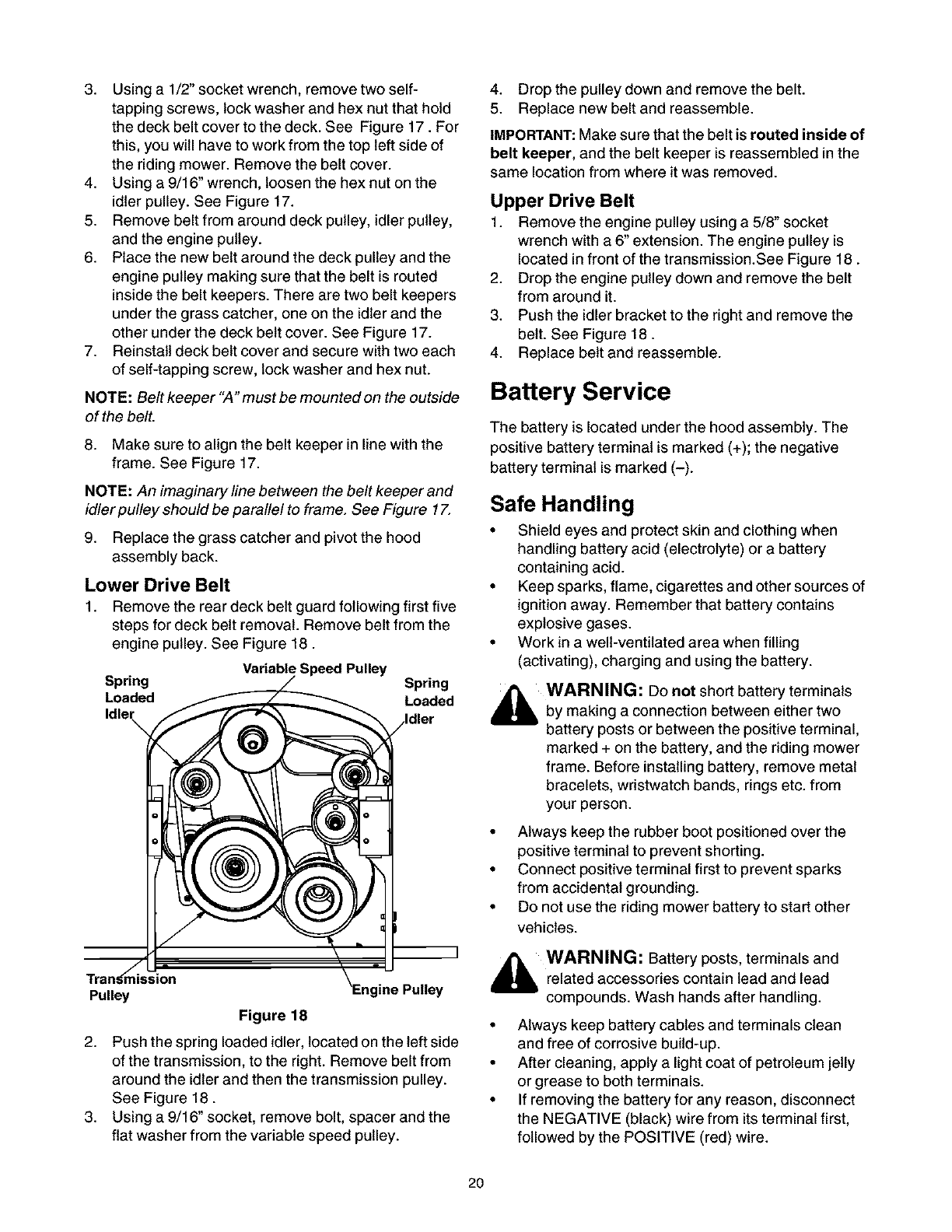
3. Usinga1/2"socketwrench,removetwoself-
tappingscrews,lockwasherandhexnutthathold
thedeckbeltcovertothedeck.SeeFigure17.For
this,youwillhavetoworkfromthetopleftsideof
theridingmower.Removethebeltcover.
4. Usinga9/16"wrench,loosenthehexnutonthe
idlerpulley.SeeFigure17.
5. Removebeltfromarounddeckpulley,idlerpulley,
andtheenginepulley.
6. Placethenewbeltaroundthedeckpulleyandthe
enginepulleymakingsurethatthebeltisrouted
insidethebeltkeepers.Therearetwobeltkeepers
underthegrasscatcher,oneontheidlerandthe
otherunderthedeckbeltcover.SeeFigure17.
7. Reinstalldeckbeltcoverandsecurewithtwoeach
ofself-tappingscrew,lockwasherandhexnut.
NOTE:Belt keeper "A" must be mounted on the outside
of the belt.
8. Make sure to align the belt keeper in line with the
frame. See Figure 17.
NOTE: An imaginary line between the belt keeper and
idler pulley should be parallel to frame. See Figure 17.
9. Replace the grass catcher and pivot the hood
assembly back.
Lower Drive Belt
1. Remove the rear deck belt guard following first five
steps for deck belt removal. Remove belt from the
engine pulley. See Figure 18.
Variable Speed Pulley
Spring Spring
Loaded Loaded
Idler
Pulley
2.
.
Figure 18
Push the spring loaded idler, located on the left side
of the transmission, to the right. Remove belt from
around the idler and then the transmission pulley.
See Figure 18.
Using a 9/16" socket, remove bolt, spacer and the
flat washer from the variable speed pulley.
4. Drop the pulley down and remove the belt.
5. Replace new belt and reassemble.
IMPORTANT: Make sure that the belt is routed inside of
belt keeper, and the belt keeper is reassembled in the
same location from where it was removed.
Upper Drive Belt
1. Remove the engine pulley using a 5/8" socket
wrench with a 6" extension. The engine pulley is
located in front of the transmission.See Figure 18.
2. Drop the engine pulley down and remove the belt
from around it.
3. Push the idler bracket to the right and remove the
belt. See Figure 18.
4. Replace belt and reassemble.
Battery Service
The battery is located under the hood assembly. The
positive battery terminal is marked (+); the negative
battery terminal is marked (-).
Safe Handling
•Shield eyes and protect skin and clothing when
handling battery acid (electrolyte) or a battery
containing acid.
• Keep sparks, flame, cigarettes and other sources of
ignition away. Remember that battery contains
explosive gases.
• Work in a well-ventilated area when filling
(activating), charging and using the battery.
_WARNING: Do not short battery terminals
by making a connection between either two
battery posts or between the positive terminal,
marked + on the battery, and the riding mower
frame. Before installing battery, remove metal
bracelets, wristwatch bands, rings etc. from
your person.
• Always keep the rubber boot positioned over the
positive terminal to prevent shorting.
• Connect positive terminal first to prevent sparks
from accidental grounding.
• Do not use the riding mower battery to start other
vehicles.
,l_ WARNING: Battery posts, terminals and
related accessories contain lead and lead
compounds. Wash hands after handling.
• Always keep battery cables and terminals clean
and free of corrosive build-up.
• After cleaning, apply a light coat of petroleum jelly
or grease to both terminals.
• If removing the battery for any reason, disconnect
the NEGATIVE (black) wire from its terminal first,
followed by the POSITIVE (red) wire.
2O
• Whenre-installingbattery,alwaysconnectthe
POSITIVE(red)wiretoitsterminalfirst,followedby
theNEGATIVE(black)wire.
IMPORTANT:Becertainthatwiresareconnectedtothe
correctterminals;reversingthemcouldchangepolarity
andcausedamagetotheengine'salternatingsystem.
To jump-start the battery
NOTE: This riding moweris equipped with a remote
battery charging terminal on the solenoid on the right
side of the frame under the hood. Follow the
instructions below to use this terminal
• Do not jump-start directly at the battery.
• Do not allow positive and negative cable clamps to
touch each other.
• Do not jump-start a damaged or frozen battery.
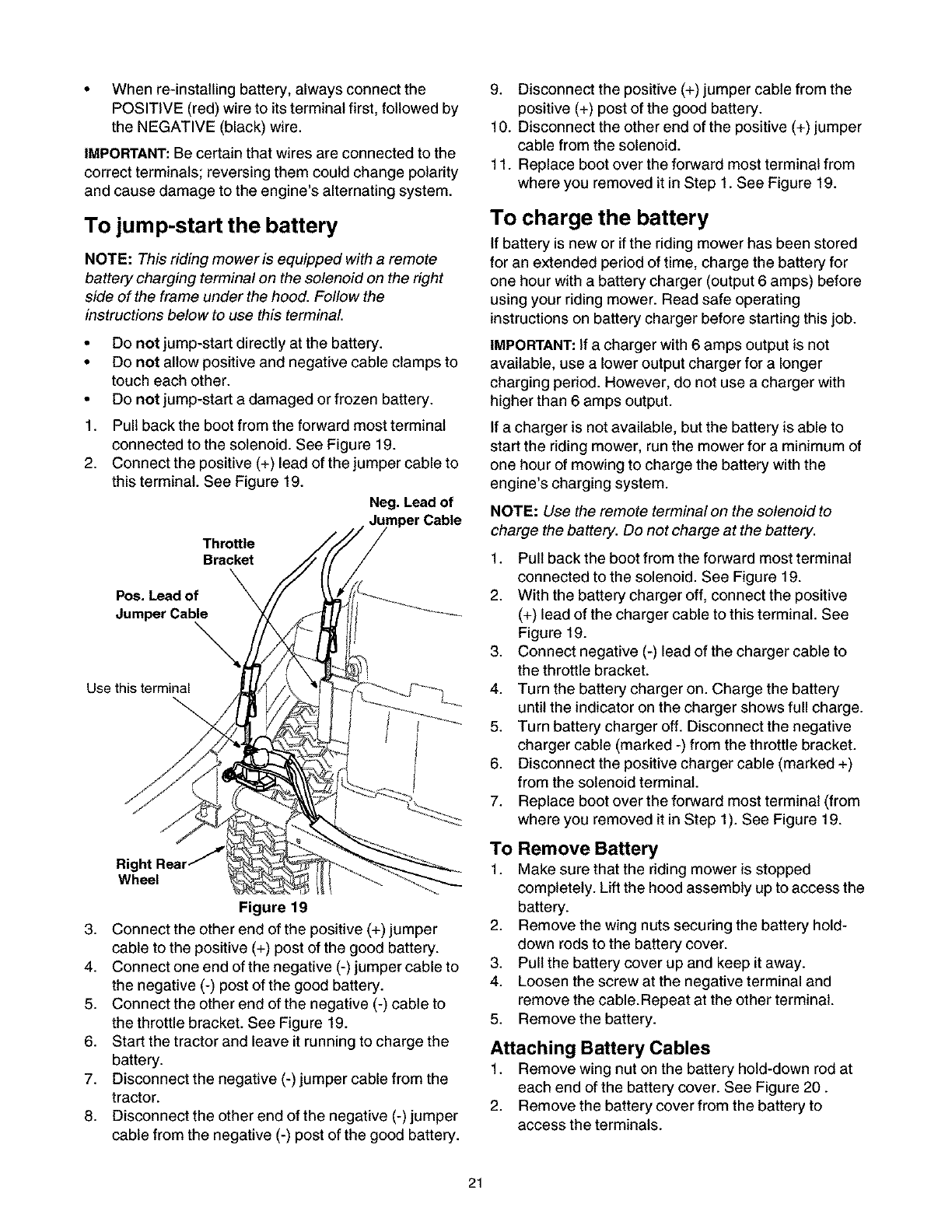
1. Pull back the boot from the forward most terminal
connected to the solenoid. See Figure 19.
2. Connect the positive (+) lead of the jumper cable to
this terminal. See Figure 19.
Neg. Lead of
Jumper Cable
Throttle
Bracket
Pos. Lead of
Jumper Cable
\
Use this terminal
Rig
Wheel
Figure 19
3. Connect the other end of the positive (+) jumper
cable to the positive (+) post of the good battery.
4. Connect one end of the negative (-) jumper cable to
the negative (-) post of the good battery.
5. Connect the other end of the negative (-) cable to
the throttle bracket. See Figure 19.
6. Start the tractor and leave it running to charge the
battery.
7. Disconnect the negative (-) jumper cable from the
tractor.
8. Disconnect the other end of the negative (-) jumper
cable from the negative (-) post of the good battery.
9. Disconnect the positive (+) jumper cable from the
positive (+) post of the good battery.
10. Disconnect the other end of the positive (+) jumper
cable from the solenoid.
11. Replace boot over the forward most terminal from
where you removed it in Step 1. See Figure 19.
To charge the battery
If battery is new or it the riding mower has been stored
for an extended period of time, charge the battery for
one hour with a battery charger (output 6 amps) before
using your riding mower. Read safe operating
instructions on battery charger before starting this job.
IMPORTANT: If a charger with 6 amps output is not
available, use a lower output charger for a longer
charging period. However, do not use a charger with
higher than 6 amps output.
If a charger is not available, but the battery is able to
start the riding mower, run the mower for a minimum of
one hour of mowing to charge the battery with the
engine's charging system.
NOTE: Use the remote terminal on the solenoid to
charge the battery. Do not charge at the battery.
1. Pull back the boot from the forward most terminal
connected to the solenoid. See Figure 19.
2. With the battery charger off, connect the positive
(+) lead of the charger cable to this terminal. See
Figure 19.
3. Connect negative (-) lead of the charger cable to
the throttle bracket.
4. Turn the battery charger on. Charge the battery
until the indicator on the charger shows full charge.
5. Turn battery charger off. Disconnect the negative
charger cable (marked -) from the throttle bracket.
6. Disconnect the positive charger cable (marked +)
from the solenoid terminal.
7. Replace boot over the forward most terminal (from
where you removed it in Step 1). See Figure 19.
To Remove Battery
1. Make sure that the riding mower is stopped
completely. Lift the hood assembly up to access the
battery.
2. Remove the wing nuts securing the battery hold-
down rods to the battery cover.
3. Pull the battery cover up and keep it away.
4. Loosen the screw at the negative terminal and
remove the cable.Repeat at the other terminal.
5. Remove the battery.
Attaching Battery Cables
1. Remove wing nut on the battery hold-down rod at
each end of the battery cover. See Figure 20.
2. Remove the battery cover from the battery to
access the terminals.
21
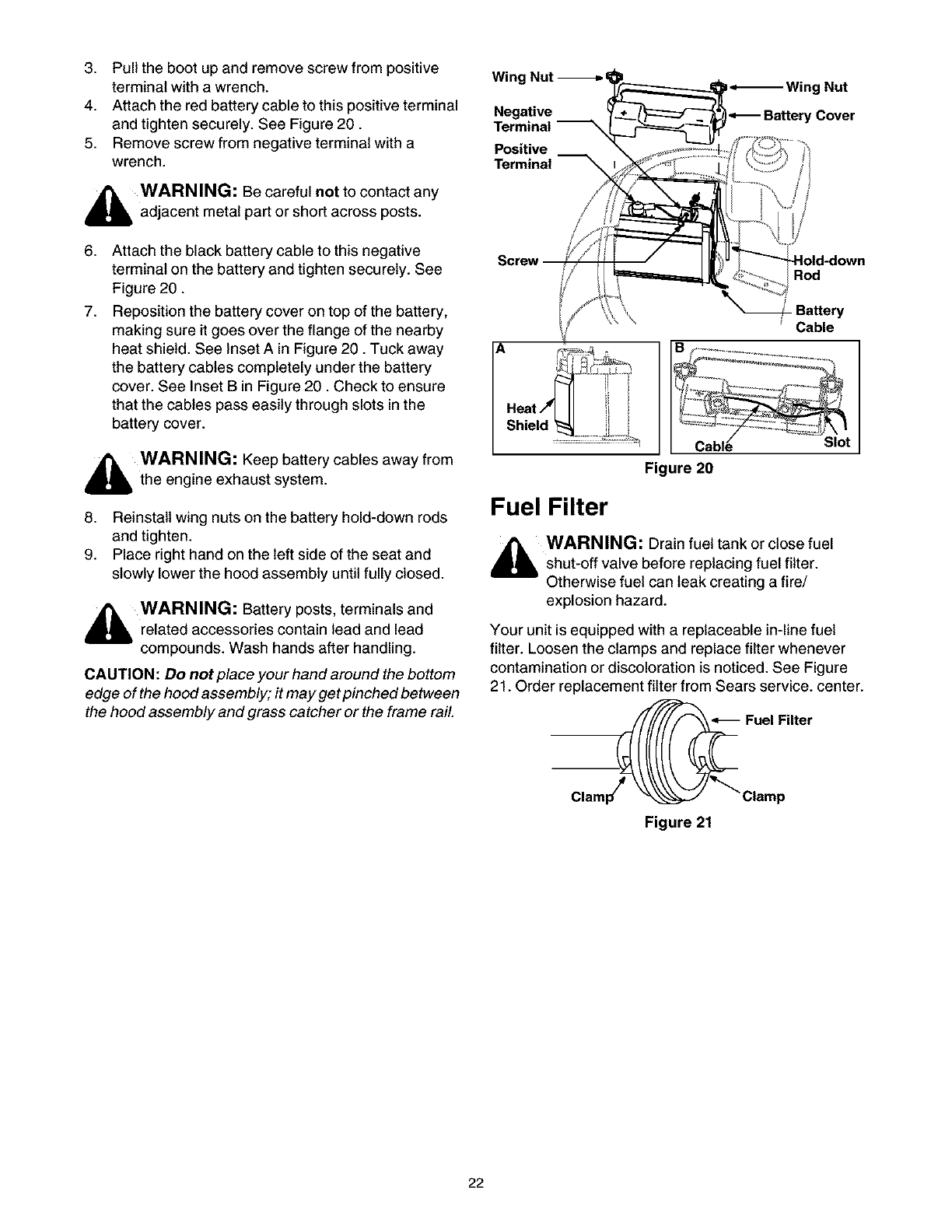
3. Pull the boot up and remove screw from positive
terminal with a wrench.
4. Attach the red battery cable to this positive terminal
and tighten securely. See Figure 20.
5. Remove screw from negative terminal with a
wrench.
_WARNING: Be careful not to contact any
adjacent metal part or short across posts.
.
7.
Attach the black battery cable to this negative
terminal on the battery and tighten securely. See
Figure 20.
Reposition the battery cover on top of the battery,
making sure it goes over the flange of the nearby
heat shield. See Inset A in Figure 20. Tuck away
the battery cables completely under the battery
cover. See Inset B in Figure 20. Check to ensure
that the cables pass easily through slots in the
battery cover.
_ARNING: Keep battery cables away from
the engine exhaust system.
8. Reinstall wing nuts on the battery hold-down rods
and tighten.
9. Place right hand on the left side of the seat and
slowly lower the hood assembly until fully closed.
,_ WARNING: Battery posts, terminals and
related accessories contain lead and lead
compounds. Wash hands after handling.
CAUTION: Do not place your hand around the bottom
edge of the hood assembly; it may get pinched between
the hood assembly and grass catcher or the frame rail.
Wing Nut -_b !_
Negative
Terminal _
Positive
Terminal
Screw
A
Cable
Figure 20
Fuel Filter
,_ WARNING: Drain fuel tank or close fuel
shut-off valve before replacing fuel filter.
Otherwise fuel can leak creating a fire/
explosion hazard.
Your unit is equipped with a replaceable in-line fuel
filter. Loosen the clamps and replace filter whenever
contamination or discoloration is noticed. See Figure
21. Order replacement filter from Sears service, center.
2_Fuel Filter
Clam Clamp
Figure 21
22
If the machine is to be inoperative for a period longer
than 30 days, prepare for storage as follows.
Battery
1. Charge battery fully. The battery loses some of its
charge each day when the unit is not used. NEVER
store battery without a full charge. Recharge
battery before returning to service or every two
months, whichever occurs first.
2. When storing unit for extended periods, disconnect
battery cables and remove the battery from the unit.
3. Clean dirt and chaff from cylinder, cylinder head
fins, blower housing, rotating screen and muffler.
Engine
Engines, stored over 30 days, need special attention to
prevent gum formation in the fuel system or on the
carburetor.
1. If fuel tank contains oxygenated or reformulated
gasoline, that is gasoline blended with alcohol or
ether, run engine until dry.
2. If fuel tank contains gasoline, either run engine till
dry or add an additive to the gas. If you are using
additive, run the engine for several minutes to
circulate the additive through the carburetor.
3. Change oil on a warm engine.
4. Remove spark plug and pour about one ounce of
engine oil into cylinder. Replace the spark plug and
crank engine slowly to distribute the oil.
5. Clean engine of debris, chaff or grass clippings.
6. Store engine and riding mower in a clean, dry area
far away from stove, furnace, water heater or
similar appliances using a pilot light or any other
sparking device.
Riding Mower
1. Clean the engine and the entire unit thoroughly.
2. Lubricate all pivot points. Wipe the entire machine
with an oiled rag to protect the surfaces.
3. Transport the mower with fuel tank empty. Store
unit in a clean, dry area. Do not store next to
corrosive materials, such as fertilizer.
4. When storing any type of power equipment in an
unventilated or metal storage shed, care should be
taken to rustproof the equipment. Using a light oil or
silicone, coat the equipment, especially any chains,
springs, bearings and cables.
Trouble
Excessivevibration
Mower willnot
discharge grass or
leaves uncut strips
Broken Belt
1.
Possible Cause
Bent or damaged blade
2. Bent blade.
1. Engine speed low.
2. Speed selection.
3. Cutting height set too low.
4. Blades short or dull.
1. Sudden stop or shock load to belt
2. incorrect belt used
3. Belt engaged abruptly
4. Defective or damaged belt
Remedy
1. Stop engine immediately. Check all
pulleys, blade adapters, keys and bolts for
tightness and spindle damage. Tighten or
replace any damaged parts.
2. Stop engine immediately. Replace
damaged blade. Only use original
equipment blades.
1. Throttle must be set at FULL.
2. Use lower ground speed. Slower the
ground speed, better the quality of cut.
3. Raise the deck.
4. Sharpen or replace blades (uncut strip
problem only).
1. Inspect rider for cause such as foreign
objects stuck in between deck and frame or
belt path. Remove obstruction and check
for damage. Replace belt if needed.
2. Replace with proper belt. Check Parts list
in this manual for correct part number.
3. Engage belt slowly by depressing the
blade engagement pedal slowly.
4. Replace with proper belt.
23
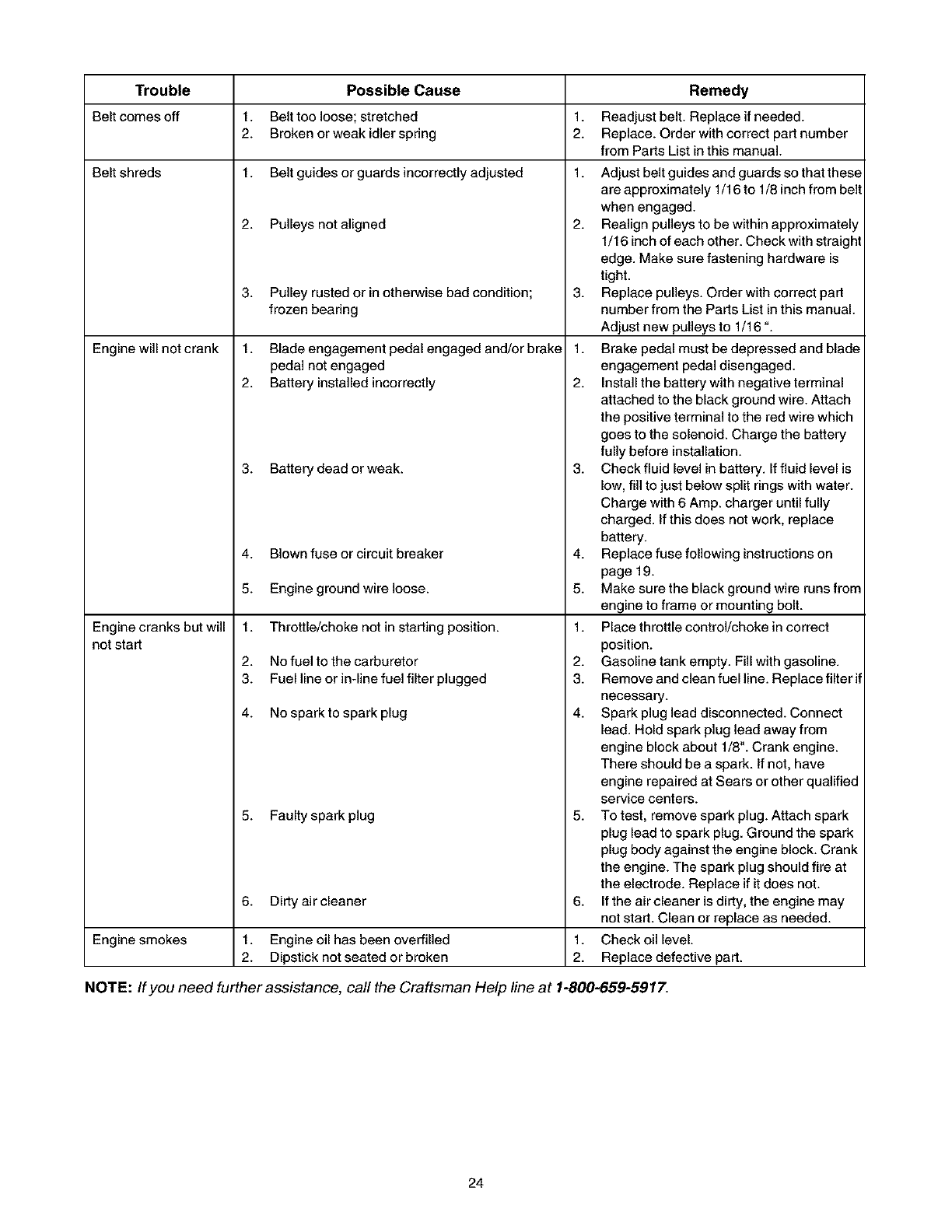
Trouble Possible Cause Remedy
Belt comes off 1. Belt too loose; stretched 1. Readjust belt. Replace if needed.
2. Broken or weak idler spring 2. Replace. Order with correct part number
from Parts List in this manual.
Belt shreds 1. Belt guides or guards incorrectly adjusted 1.
2. Pulleys not aligned
3. Pulley rusted or in otherwise bad condition;
frozen bearing
Engine will not crank 1.
2.
3.
4.
5.
Engine cranks but will 1.
not start
2.
3.
4.
5.
6.
Engine smokes 1.
2.
Blade engagement pedal engaged and/or brake
pedal not engaged
Battery installed incorrectly
Battery dead or weak.
Blown fuse or circuit breaker
Engine ground wire loose.
Throttle/choke not in starting position.
No fuel to the carburetor
Fuel line or in-line fuel filter plugged
No spark to spark plug
Faulty spark plug
Dirty air cleaner
Engine oil has been overfilled
Dipstick not seated or broken
2.
3.
1.
2.
3.
4.
5.
1.
2.
3.
4.
5.
6.
1.
2.
Adjust belt guides and guards so that these
are approximately 1/16 to 1/8 inch from belt
when engaged.
Realign pulleys to be within approximately
1/16 inch of each other. Check with straight
edge. Make sure fastening hardware is
tight.
Replace pulleys. Order with correct part
number from the Parts List in this manual.
Adjust new pulleys to 1/16 ".
Brake pedal must be depressed and blade
engagement pedal disengaged.
Install the battery with negative terminal
attached to the black ground wire. Attach
the positive terminal to the red wire which
goes to the solenoid. Charge the battery
fully before installation.
Check fluid level in battery. If fluid level is
low, fill to just below split rings with water.
Charge with 6 Amp. charger until fully
charged. If this does not work, replace
battery.
Replace fuse following instructions on
page 19.
Make sure the black ground wire runs from
engine to frame or mounting bolt.
Place throttle control/choke in correct
position.
Gasoline tank empty. Fill with gasoline.
Remove and clean fuel line. Replace filter if
necessary.
Spark plug lead disconnected. Connect
lead. Hold spark plug lead away from
engine block about 1/8". Crank engine.
There should be a spark. If not, have
engine repaired at Sears or other qualified
service centers.
To test, remove spark plug. Attach spark
plug lead to spark plug. Ground the spark
plug body against the engine block. Crank
the engine. The spark plug should fire at
the electrode. Replace if it does not.
If the air cleaner is dirty, the engine may
not start. Clean or replace as needed.
Check oil level.
Replace defective part.
NOTE: If you need further assistance, call the Craftsman Help line at 1-800-659-5917.
24
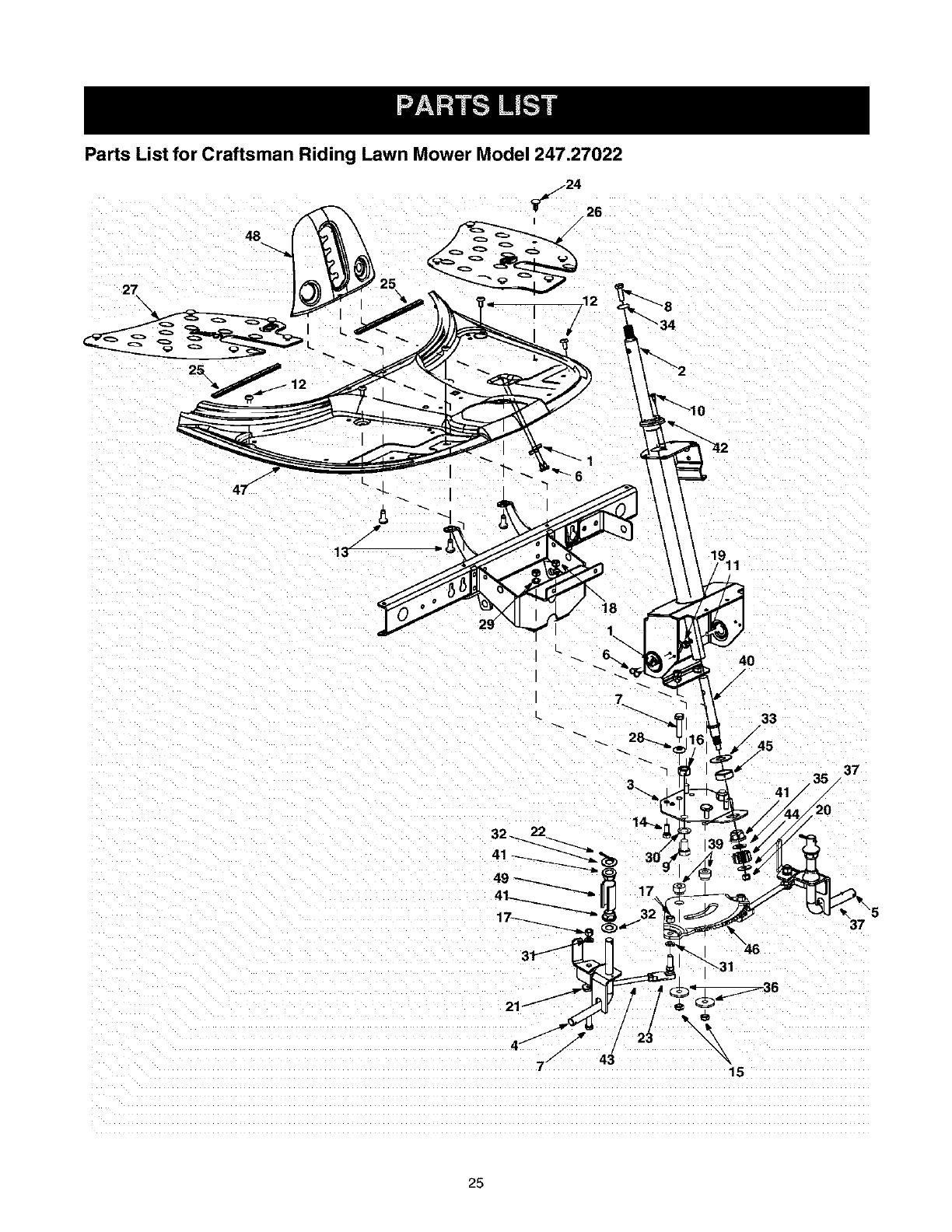
Parts List for Craftsman Riding Lawn Mower Model 247.27022
48
27
18
1.
4O
#
/
33
/
41
37
37
\46
15
25
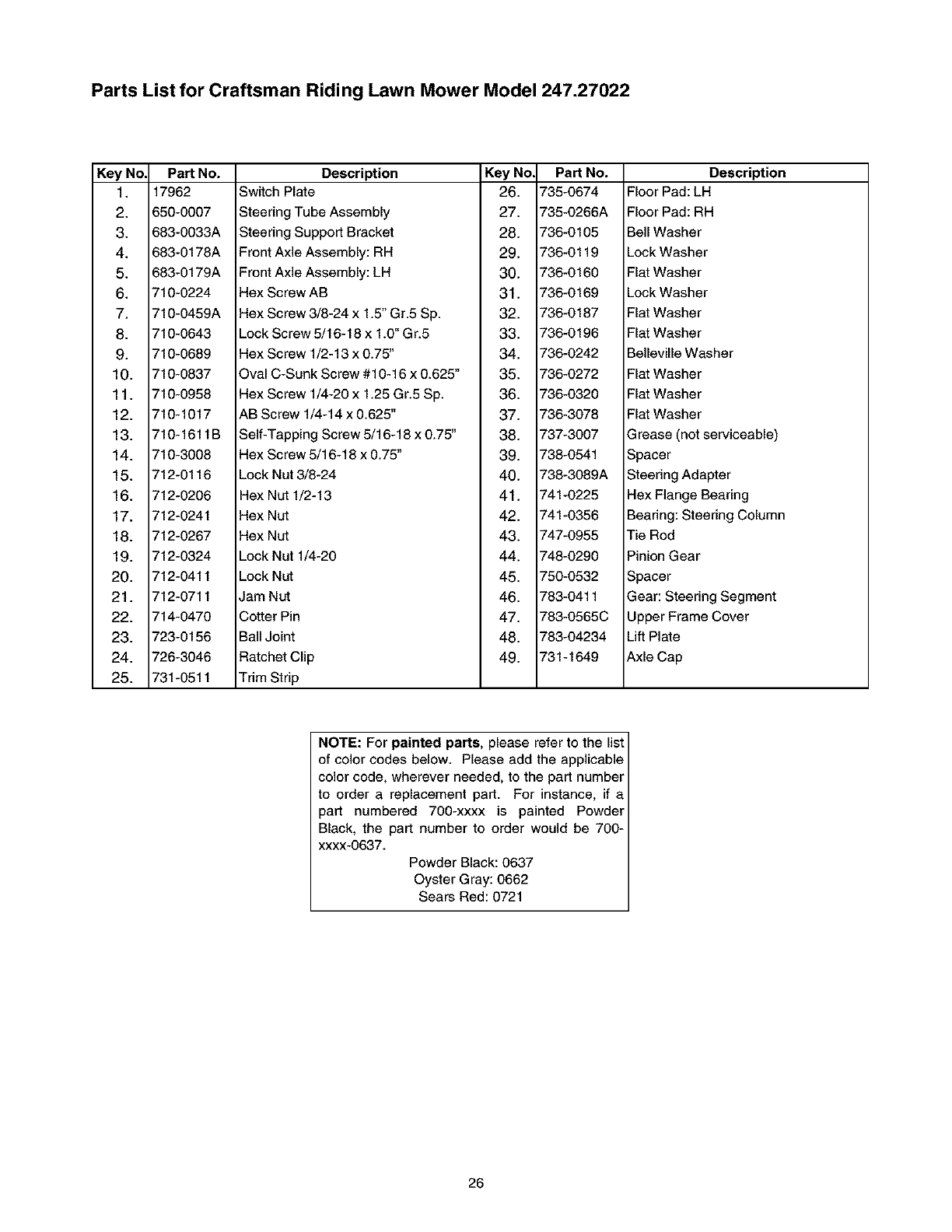
Parts List for Craftsman Riding Lawn Mower Model 247.27022
Key No. Part No.
1. 17962
2. 650-0007
3. 683-0033A
4. 683-0178A
5. 683-0179A
6. 710-0224
7. 710-0459A
8. 710-0643
9. 710-0689
10. 710-0837
11. 71O-O958
12. 710-1017
13. 710-1611B
14. 710-3008
15. 712-0116
16. 712-0206
17. 712-0241
18. 712-0267
19. 712-0324
20.
21.
22.
23.
24.
25.
Description Key No, Part No.
Switch Plate 26. 735-0674
Steering Tube Assembly 27. 735-0266A
Steering Support Bracket 28. 736-0105
Front Axle Assembly: RH 29. 736-0119
Front Axle Assembly: LH 30. 736-0160
HexScrewAB 31. 736-0169
Hex Screw 3/8-24 x 1.5" Gr.5 Sp. 32. 736-0187
Lock Screw 5/16-18 x 1.0" Gr.5 33. 736-0196
Hex Screw 1/2-13 x 0.75" 34. 736-0242
Oval C-Sunk Screw #10-16 x 0.625" 35. 736-0272
Hex Screw 1/4-20 x 1.25 Gr.5 Sp. 36. 736-0320
AB Screw 1/4-14 x 0.625" 37. 736-3078
Self-Tapping Screw 5/16-18 x 0.75" 38. 737-3007
Hex Screw 5/16-18 x 0.75" 39. 738-0541
Lock Nut 3/8-24 40. 738-3089A
Hex Nut 1/2-13 41. 741-0225
Hex Nut 42. 741-0356
Hex Nut 43. 747-0955
Lock Nut 1/4-20 44. 748-0290
Description
Floor Pad: LH
Floor Pad: RH
Bell Washer
Lock Washer
Flat Washer
Lock Washer
Flat Washer
Flat Washer
Belleville Washer
Flat Washer
Flat Washer
Flat Washer
Grease (not serviceable)
Spacer
Steering Adapter
Hex Flange Bearing
Bearing: Steering Column
Tie Rod
Pinion Gear
712-0411 Lock Nut
712-0711 Jam Nut
714-0470 Cotter Pin
723-0156 Ball Joint
726-3046 Ratchet Clip
731-0511 Trim Strip
45. 750-0532
46. 783-0411
47. 783-0565C
48. 783-04234
49. 731-1649
Spacer
Gear: Steering Segment
Upper Frame Cover
Lift Plate
Axle Cap
NOTE: For painted parts, please refer to the list
of color codes below. Please add the applicable
color code, wherever needed, to the part number
to order a replacement part. For instance, if a
part numbered 700-xxxx is painted Powder
Black, the part number to order would be 700-
xxxx-0637.
Powder Black: 0637
Oyster Gray: 0662
Sears Red: 0721
26
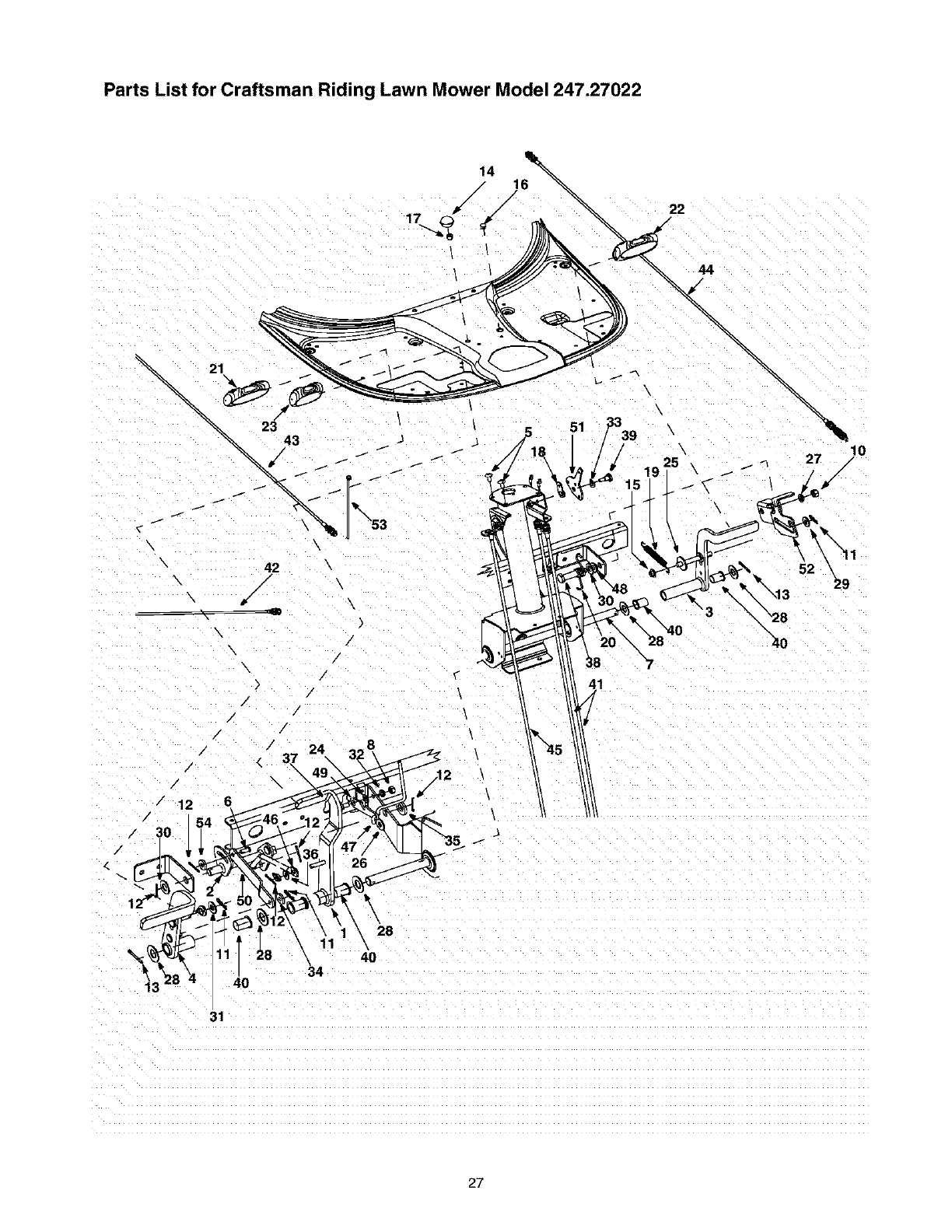
Parts List for Craftsman Riding Lawn Mower Model 247.27022
14
/
/
21
23 43
/
/
\42
\/
/
\./
\
\
\
//
/
/
/12 6
/
51
22
44
/
\10
27 /
/
41
13
\
\ 28
4O
34
40
31
27
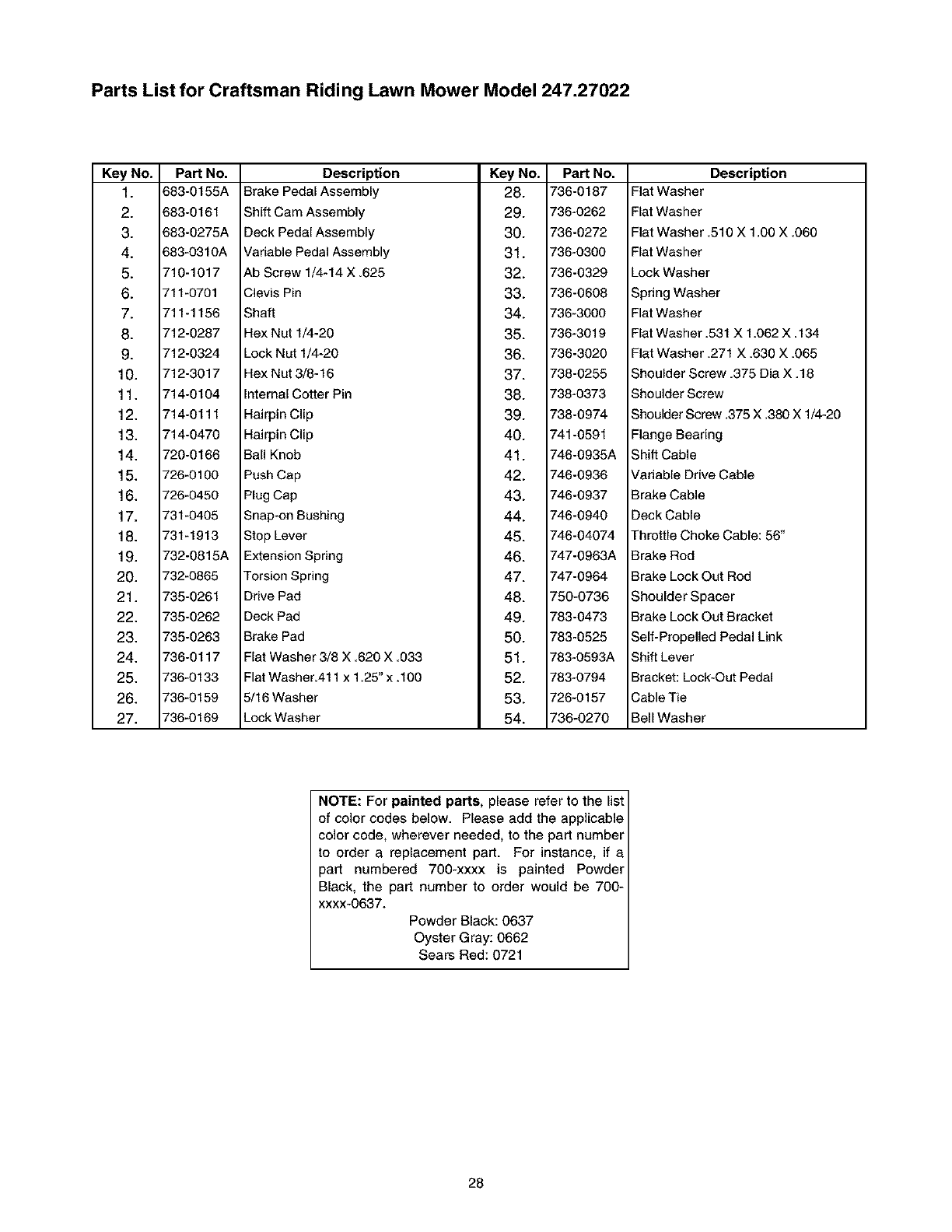
Parts List for Craftsman Riding Lawn Mower Model 247.27022
Key No.
1.
2.
3.
4.
5.
6.
7.
8.
9.
10.
11.
12.
13.
14.
15.
16.
17.
18.
19.
20.
21.
22.
23.
24.
25.
26.
27.
Part No.
683-0155A
683-0161
683-0275A
683-0310A
710-1017
711-0701
711-1156
712-0287
712-0324
712-3017
714-0104
714-0111
714-0470
720-0166
726-0100
726-0450
731-0405
731-1913
732-0815A
732-0865
735-0261
735-0262
735-0263
736-0117
736-0133
736-0159
736-0169
Description Key No. Part No.
Brake Pedal Assembly 28. 736-0187
Shift Cam Assembly 29. 736-0262
Deck Pedal Assembly 30. 736-0272
Variable Pedal Assembly 31. 736-0300
Ab Screw 1/4-14 X .625 32. 736-0329
Clevis Pin 33. 736-0608
Shaft 34. 736-3000
Hex Nut 1/4-20 35. 736-3019
Lock Nut 1/4-20 36. 736-3020
Hex Nut 3/8-16 37. 738-0255
Internal Cotter Pin 38. 738-0373
Hairpin Clip 39. 738-0974
Hairpin Clip 40. 741-0591
Ball Knob 41. 746-0935A
Push Cap 42. 746-0936
Plug Cap 43. 746-0937
Snap-on Bushing 44. 746-0940
Stop Lever 45. 746-04074
Extension Spring 46. 747-0963A
Torsion Spring 47. 747-0964
Drive Pad 48. 750-0736
Deck Pad 49. 783-0473
Brake Pad 50. 783-0525
Flat Washer 3/8 X .620 X .033 51. 783-0593A
Flat WasherA11 x 1.25" x .100 52. 783-0794
5/16 Washer 53. 726-0157
Lock Washer 54. 736-0270
Description
Flat Washer
Flat Washer
Flat Washer 510 X 1.00 X 060
Flat Washer
Lock Washer
Spring Washer
Flat Washer
Flat Washer .531 X 1.062 X .134
Flat Washer .271 X .630 X .065
Shoulder Screw .375 Dia X .18
Shoulder Screw
Shoulder Screw .375 X.380 X 1/4-20
Flange Bearing
Shift Cable
Variable Drive Cable
Brake Cable
Deck Cable
ThrottleChoke Cable: 56"
Brake Rod
Brake Lock Out Rod
Shoulder Spacer
Brake Lock Out Bracket
Self-Propelled Pedal Link
Shift Lever
Bracket: Lock-Out Pedal
Cable Tie
Bell Washer
NOTE: For painted parts, please refer to the list
of color codes below. Please add the applicable
color code, wherever needed, to the part number
to order a replacement part. For instance, if a
part numbered 700-xxxx is painted Powder
Black, the part number 1o order would be 700-
xxxx-0637.
Powder Black: 0637
Oyster Gray: 0662
Sears Red: 0721
28
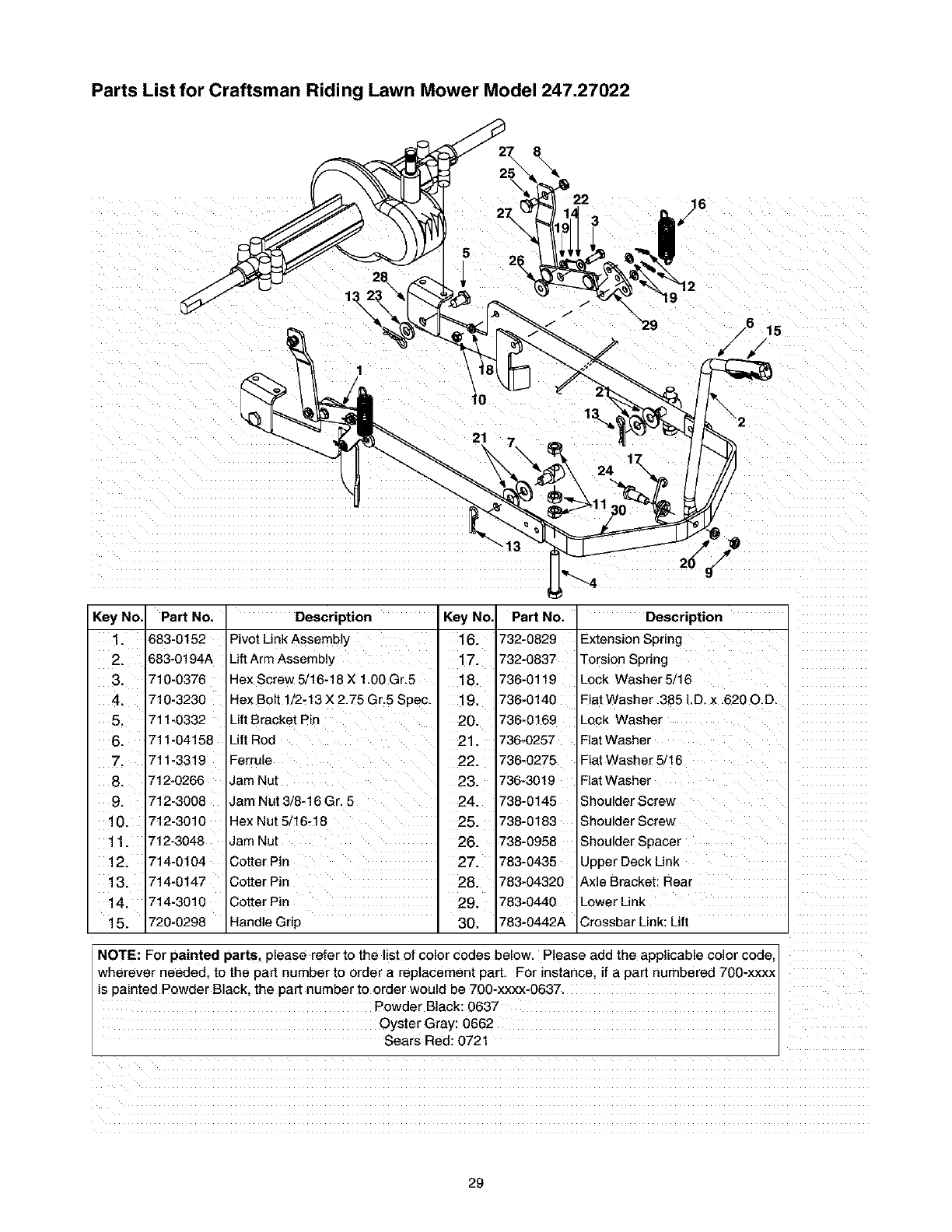
Parts List for Craftsman Riding Lawn Mower Model 247.27022
Key No. Part No.
1. 683-0152
2. 683-0194A
3. 710-0376
4. 710-3230
5. 711-0332
6. 711-04158
7. 711-3319
8. 712-0266
9. 712-3008
10. 712-3010
11. 712-3048
12. 714-0104
13. 714-0147
14. 714-3010
15. 720-0298
Description Key No. Part No.
Pivot Link Assembly 16. 732-0829
Lift Arm Assembly 17. 732-0837
Hex Screw 5/16-18 X 1.00 Gr.5 18. 736-0119
Hex Bolt 1/2-13 X 2.75 Gr.5 Spec. 19. 736-0140
I
Lift Bracket Pin 20. 736-0169
Description
Extension Spring
Torsion Spring
Lock Washer 5/16
Flat Washer .385 LD, x .620 O.D.
Lock Washer
Lift Rod 21. 736-0257
Ferrule 22. 736-0275
Jam Nut 23. 736-3019
Jam Nut 3/8-16 Gr. 5 24. 738-0145
Hex Nut 5/16-18 25. 738-0183
Jam Nut 26. 738-0958
Cotter Pin 27. 783-0435
Cotter Pin 28. 783-04320
Cotter Pin 29. 783-0440
Handle Grip 30. 783-0442A
Flat Washer
Flat Washer 5/16
Flat Washer
Shoulder Screw
Shoulder Screw
Shoulder Spacer
Upper Deck Link
Axle Bracket: Rear
Lower Link
Crossbar Link: Lift
NOTE: For painted parts, please refer to the list of color codes below. Please add the applicable color code,
wherever needed, to the part number to Order a replacement part. For instance, if a part numbered 700-xxxx
is painted Powder Black, the Part number to order would be 700-xxxx"0637. I
Powder Black: 0637
Oyster Gray: 0662
Sears Red: 0721
29
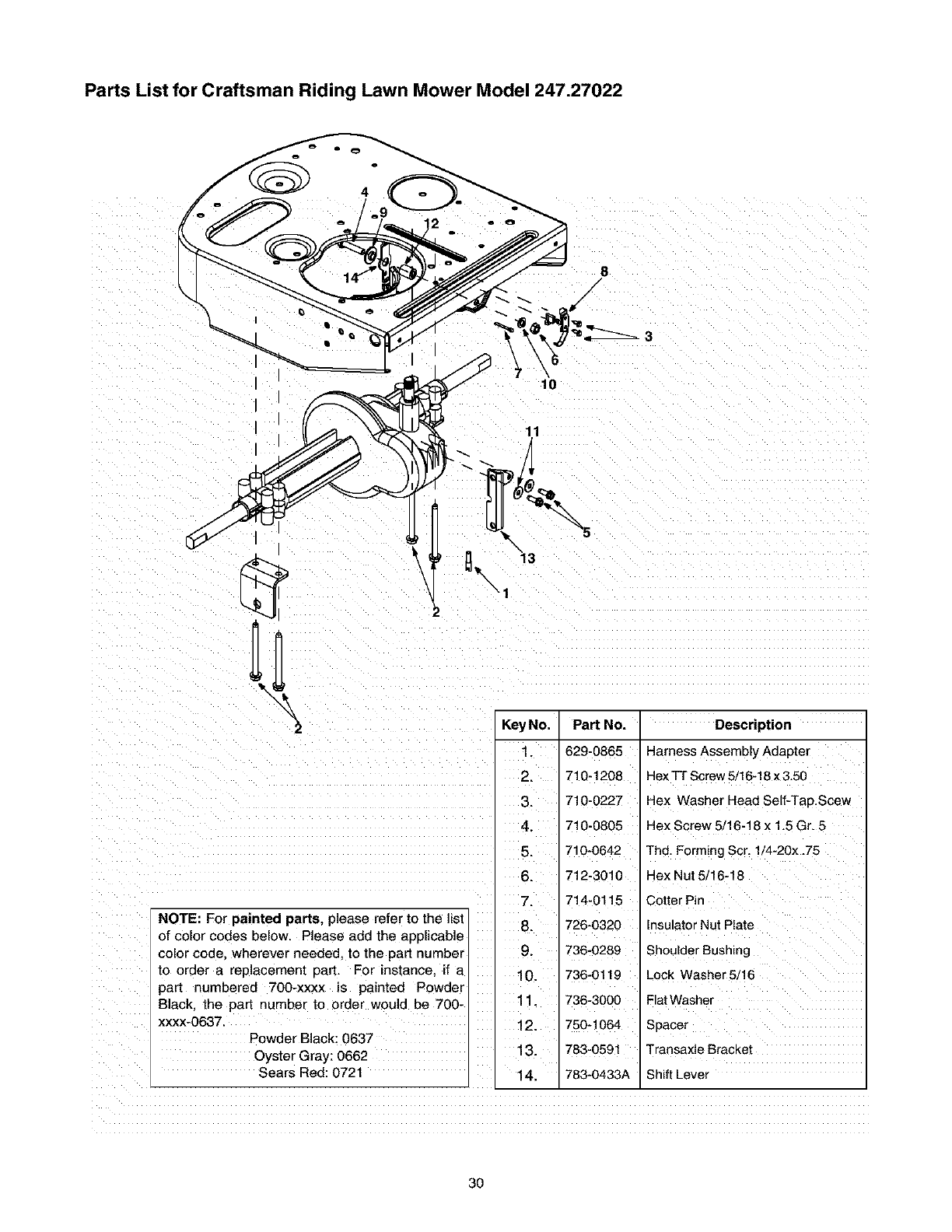
Parts List for Craftsman Riding Lawn Mower Model 247.27022
8
/
/
10
11
#
\
NOTE: For painted parts, please refer to the list
of color codes below. Please add the applicable
color code. wherever needed, to the part number
to order a replacemenl part. For instance, if a
part numbered 700-xxxx is painted Powder
Black. the part number to order would be 700-
xxxx-0637.
_owder Black: 0637
Oyster Gray: 0662
Sears Red: 0721
KsyNo. Part No.
1. 629-0865
2. 710-1208
3. 710-0227
4. 710-0805
.
7.
8.
Description
Harness Assembly Adapter
Hex TT Screw 5/16-18 x 3.50
Hex Washer Head Self-Tap.Scew
Hex Screw 5/16-18 x 1.5 Gr. 5
710-0642 ,Thd. Forming Scr. 1/4-20x .75
712-3010 Hex Nut 5/16-18
714-0115 Cotter Pin
726-0320 Insulator Nut Plate
9. ,736-0289
10. 736-0119
11. 736-3000
12. 750-1064
13. 783-0591
14. 783-0433A
Shoulder Bushing
Lock Washer 5/16
Flat Washer
Spacer
Traesaxle Bracket
Shift Lever
3O
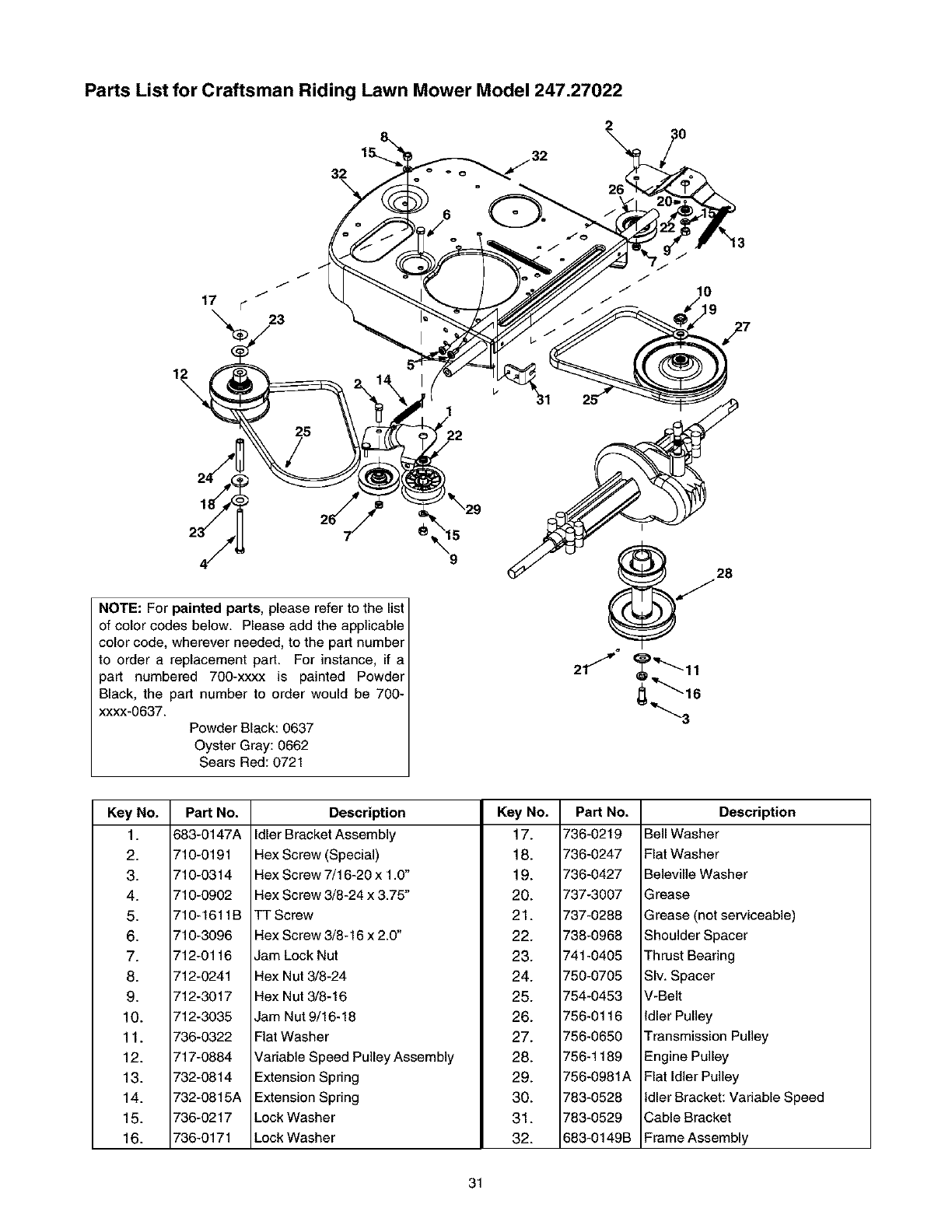
Parts List for Craftsman Riding Lawn Mower Model 247.27022
2
ts_
17
J
J
23
J
10
19 7 7
NOTE: For painted parts, please refer to the list
of color codes below. Please add the applicable
color code, wherever needed, to the part number
to order a replacement part. For instance, if a
part numbered 700-xxxx is painted Powder
Black, the part number to order would be 700-
xxxx-0637.
Powder Black: 0637
Oyster Gray: 0662
Sears Red: 0721
28
,J
Key No.
1.
2.
3.
4.
5.
6.
7.
8.
9.
10.
11.
12.
13.
14.
15.
16.
Part No.
683-0147A
710-0191
710-0314
710-0902
710-1611B
710-3096
712-0116
712-0241
712-3017
712-3035
736-0322
717-0884
732-0814
732-0815A
736-0217
736-0171
Description
Idler Bracket Assembly
Hex Screw (Special)
Hex Screw 7/16-20 x 1.0"
Hex Screw 3/8-24 x 3.75"
TT Screw
Hex Screw 3/8-16 x 2.0"
Jam Lock Nut
Hex Nut 3/8-24
Hex Nut 3/8-16
Jam Nut 9/16-18
Flat Washer
Variable Speed Pulley Assembly
Extension Spdng
Extension Spring
Lock Washer
Lock Washer
Key No.
17.
18.
19.
20.
21.
22.
23.
24.
25.
26.
27.
28.
29.
30.
31.
32.
Part No.
736-0219
736-0247
736-0427
737-3007
737-0288
736-0966
741-0405
760-0706
764-0463
766-0116
766-0660
766-1169
766-0981A
763-0526
763-0529
683-0149B
Description
Bell Washer
Flat Washer
Beleville Washer
Grease
Grease (not serviceable)
Shoulder Spacer
Thrust Bearing
SIv. Spacer
V-Belt
Idler Pulley
Transmission Pulley
Engine Pulley
Flat Idler Pulley
Idler Bracket: Vadable Speed
Cable Bracket
Frame Assembly
31
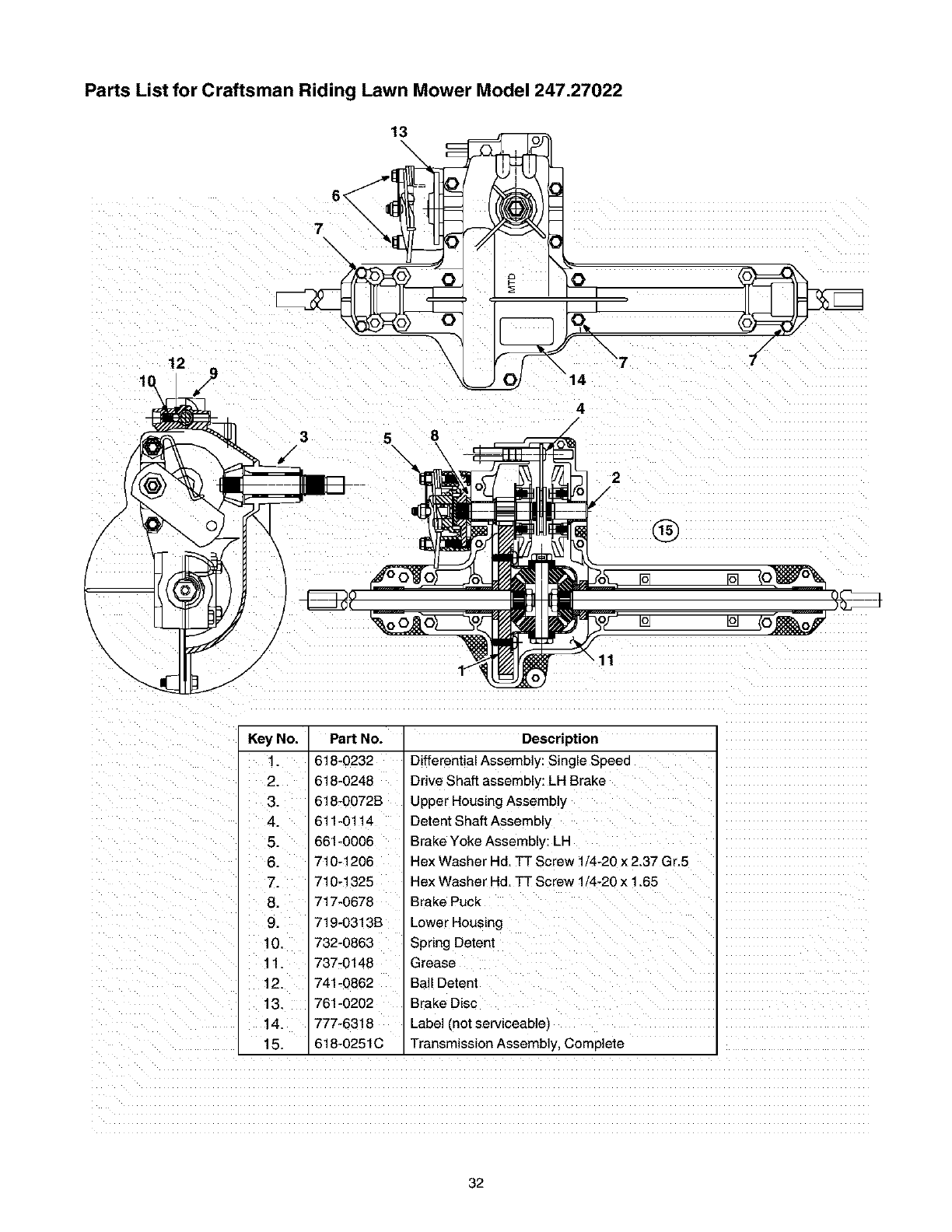
Parts List for Craftsman Riding Lawn Mower Model 247.27022
13
12
7\\
/3 5\
\14
4
/
/
/
/
1
2
\\\
,o,
Key No.
1.
2.
3.
4.
5.
6.
7.
8.
9.
10.
11.
12.
13.
14.
15.
Part No.
618-0232
618-0248
618-0072B
611-0114
661-0006
710-1206
710-1325
717-0678
719-0313B
732-0863
737-0148
741-0862
761-0202
777-6318
618-0251C
Description
Differential Assembly: Single Speed
Drive Shaft assembly: LH Brake
Upper Housing Assembly
Detent Shaft Assembly
Brake Yoke Assembly: LH
Hex Washer Hd. TT Screw 1/4-20 x 2.37 Gr.5
Hex Washer Hd. TT Screw 1/4-20 x 1.65
Brake Puck
Lower Housing
Spring Detent
Grease
Ball Detent
Brake Disc
Label (not serviceable)
Transmission Assembly, Complete
32
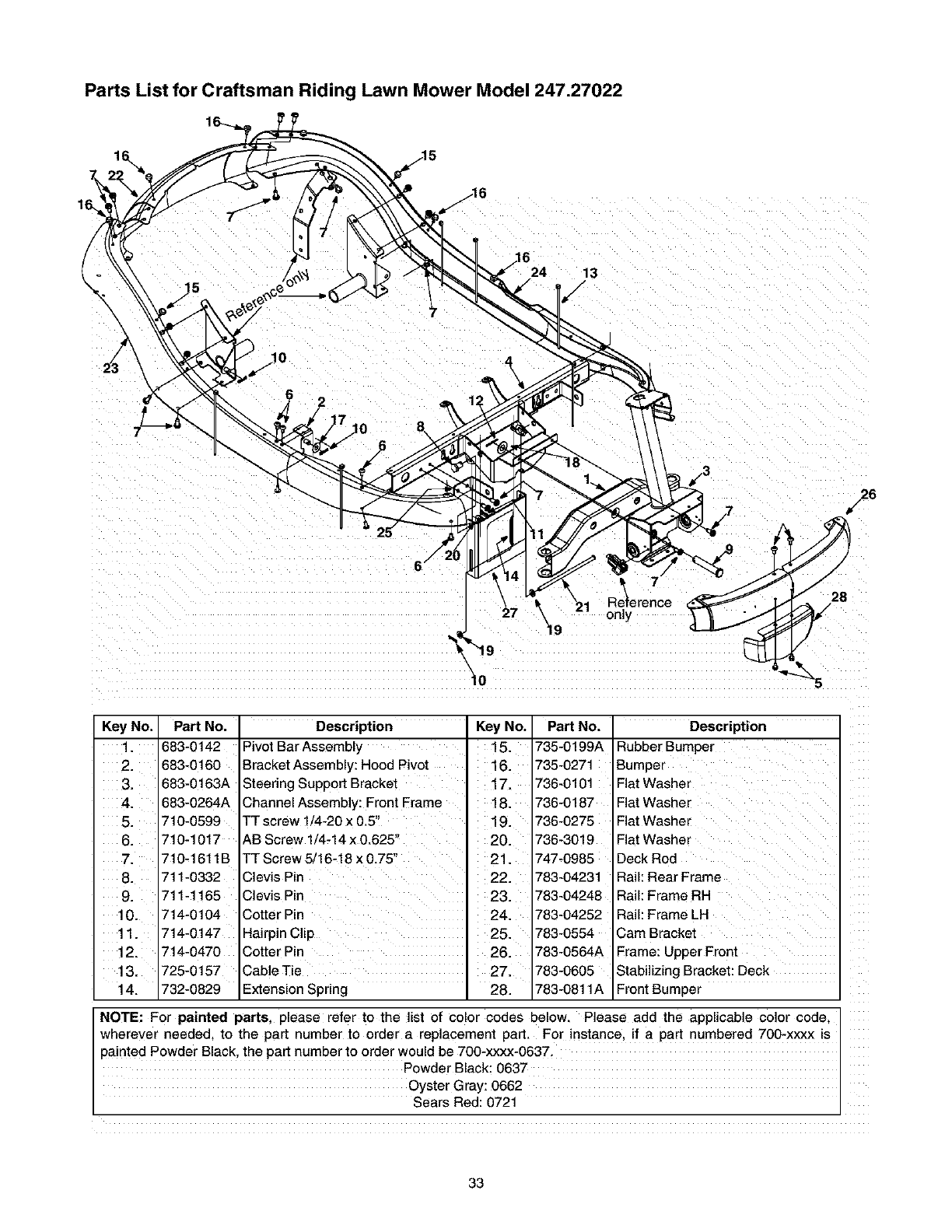
Parts List for Craftsman Riding Lawn Mower Model 247.27022
13
26
/
\-' only
19
28
/
Key No.
1.
2.
3.
4.
5.
6.
7.
8.
9.
10.
11.
12.
13.
14.
Part No.
683-0142
683-0160
683-0163A
683-0264A
710-0599
710-1017
710-1611B
711-0332
711-1165
714-0104
714-0147
714-0470
725-0157
732-0829
Description Key No. Part No.
Pivot Bar Assembly 15. 735-0199A
Bracket Assembly: Hood Pivot 16. 735-0271
Steering Support Bracket ' 17. 736-0101
Channel Assembly: Front Frame 18. 736-0187
TT screw 1/4-20 x 0.5" ' 19. 736-0275
Description
Rubber Bumper
Bumper
Flat Washer
Flat Washer
Flat Washer
AB Screw 1/4-14 x 0.625" 20.
TT Screw 5/16-18 x 0.75" 21.
Clevis Pin 22.
Clevis Pin 23.
Cotter Pin 24.
Hairpin Clip 25.
Cotter Pin 26.
Cable Tie 27.
Extension Spring 28.
736-3019
747-0985
783-04231
783-04248
783-04252
783-0554
783-0564A
783-0605
783-0811A
Flat Washer
Deck Rod
Rail: Rear Frame
Rail: Frame RH
Rail: Frame LH
Cam Bracket
Frame: Upper Front
Stabilizing Bracket: Deck
Front Bumper
NOTE: For painted parts, please refer to the list of color codes below. Please add the applicable color code, ]
wherever needed, to the part number to order a replacement part. For instance, if a part numbered 700-xxxx is
painted Powder Black the part number to order would be 700-xxxx-0637. I
Powder Black: 0637 I
Oyster Gray: 0662
Sears Red: 0721
33
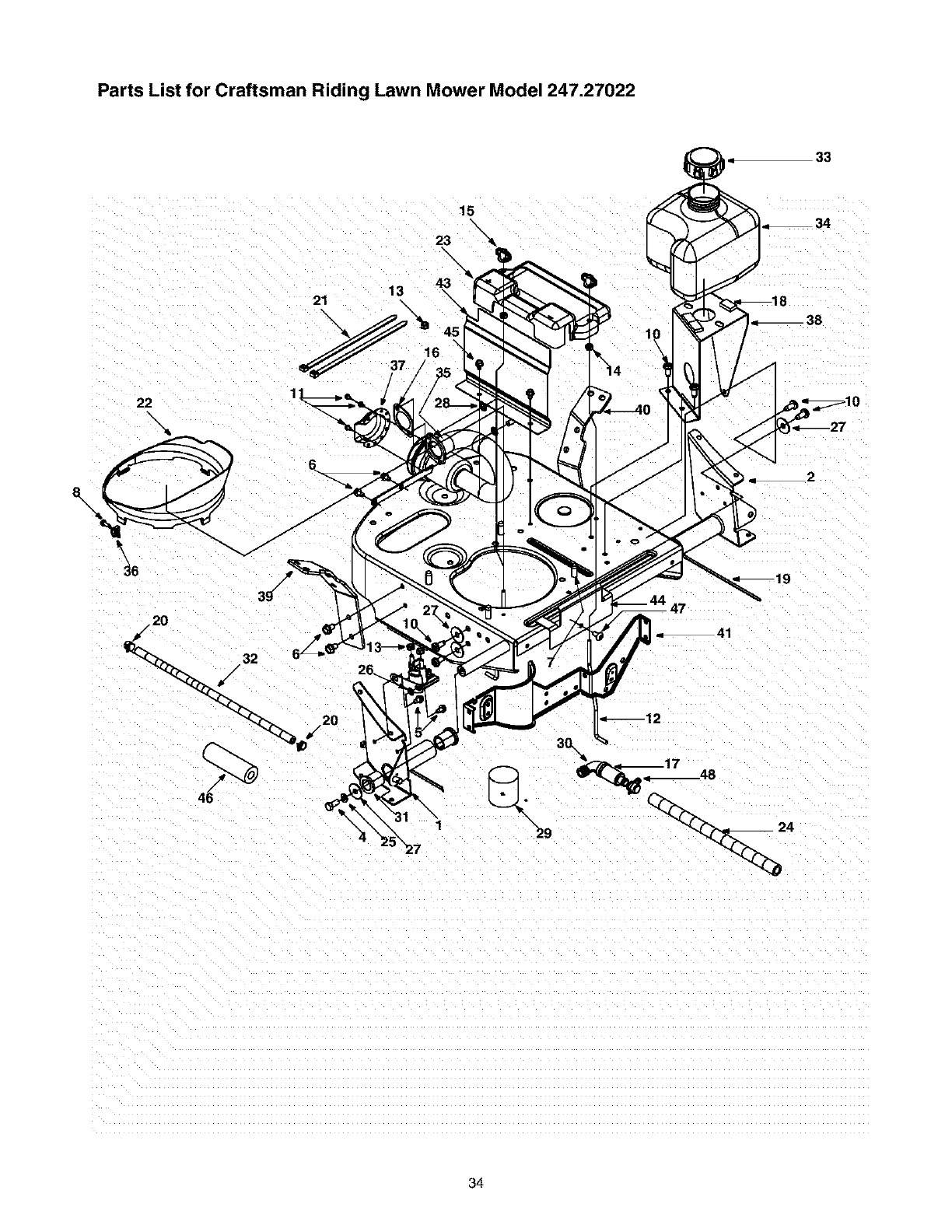
Parts List for Craftsman Riding Lawn Mower Model 247.27022
I" 33
21
-\
15
23
\\
43
1
1"
22
\
36
.2O 41
4_
34
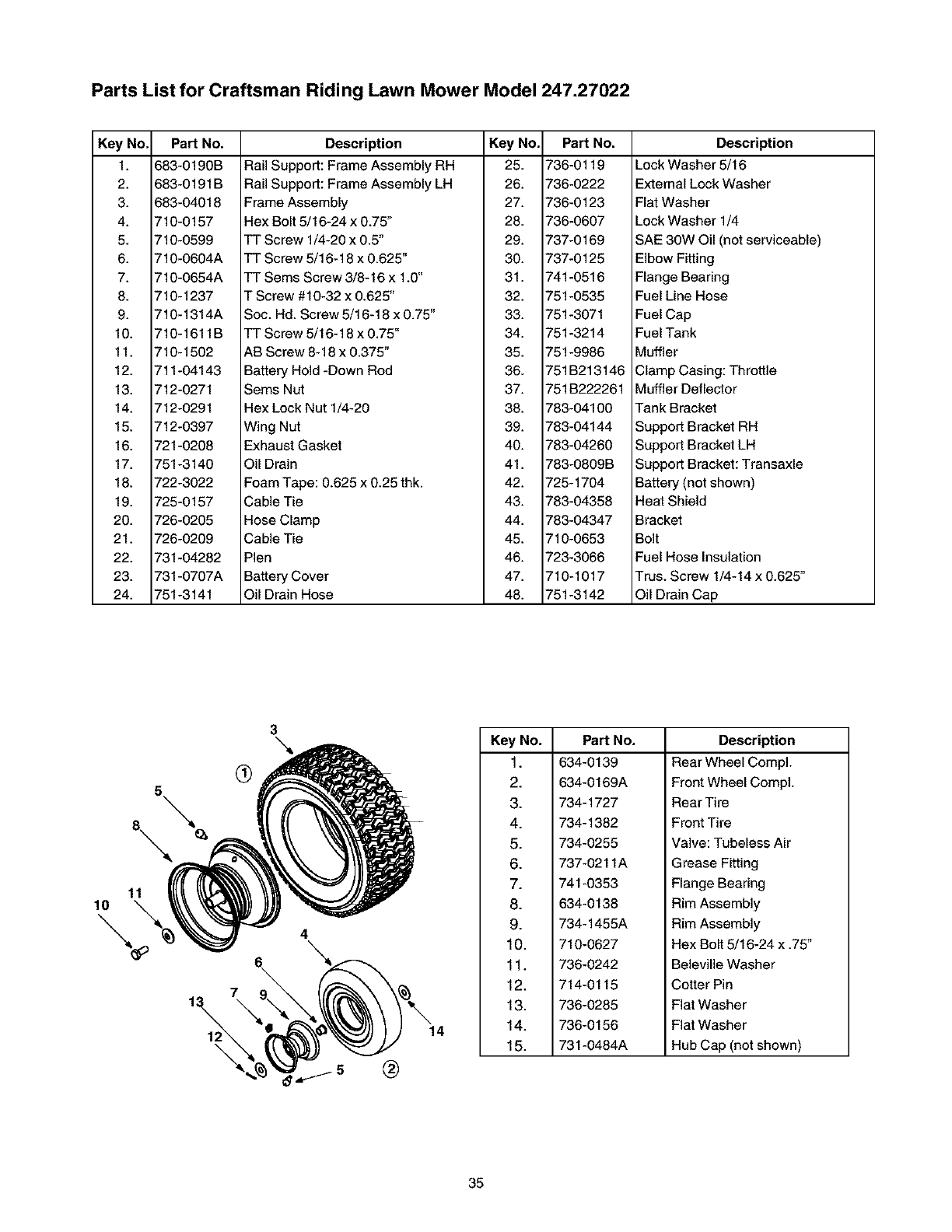
Parts List for Craftsman Riding Lawn Mower Model 247.27022
Key No. Pad No.
1. 683-0190B
2. 683-0191B
3. 683-04018
4. 710-0157
5. 710-0599
6. 710-0604A
7. 710-0654A
8. 710-1237
9. 710-1314A
10. 710-1611B
11. 710-1502
12. 711-04143
13. 712-0271
14. 712-0291
15. 712-0397
16. 721-0208
17. 751-3140
18. 722-3022
19. 725-0157
20. 726-0205
21. 726-0209
22. 731-04282
23. 731-0707A
24. 751-3141
Description
Rail Support: Frame Assembly RH
Rail Support: Frame Assembly LH
Frame Assembly
Hex Bolt 5/16-24 x 0.75"
TT Screw 1/4-20 x 0.5"
TT Screw 5/16-18 x 0.625"
TT Sems Screw 3/8-16 x 1.0"
T Screw #10-32 x 0.625"
Soc. Hd. Screw 5/16-18 x 0.75"
TT Screw 5/16-18 x 0.75"
AB Screw 8-18 x 0.375"
Battery Hold -Down Rod
Sems Nut
Hex Lock Nut 1/4-20
Wing Nut
Exhaust Gasket
Oil Drain
Foam Tape: 0.625 x 0.25 thk.
Key No, Pad NO.
25. 736-0119
26. 736-0222
27. 736-0123
28. 736-0607
29. 737-0169
30. 737-0125
31. 741-0516
32. 751-0535
33. 751-3071
34. 751-3214
35. 751-9986
36. 751B213146
37. 751B222261
38. 783-04100
39. 783-04144
40. 783-04260
41. 783-0809B
42. 725-1704
Description
Lock Washer 5/16
External Lock Washer
Flat Washer
Lock Washer 1/4
SAE 30W Oil (not serviceable)
Elbow Fitting
Flange Bearing
Fuel Line Hose
Fuel Cap
Fuel Tank
Muffler
Clamp Casing: Throttle
Muffler Deflector
Tank Bracket
Support Bracket RH
Support Bracket LH
Support Bracket: Transaxle
Battery (not shown)
Cable Tie
Hose Clamp
Cable Tie
Plen
Battery Cover
Oil Drain Hose
43. 783-04358
44. 783-04347
45. 710-0653
46. 723-3066
47. 710-1017
48. 751-3142
Heat Shield
Bracket
Bolt
Fuel Hose Insulation
Trus. Screw 1/4-14 x 0.625"
Oil Drain Cap
5
11
10
3
®
\
4\
5 ®
Part No.
634-0139
634-0169A
734-1727
734-1382
734-0255
737-0211A
741-0353
634-0138
734-1455A
710-0627
736-0242
714-0115
736-0285
736-0156
731-0484A
Description
Rear Wheel CompL
Front Wheel CompL
Rear Tire
Front Tire
Valve: Tubeless Air
Grease Fitting
Flange Bearing
Rim Assembly
Rim Assembly
Hex Bolt 5/16-24 x .75"
Beleville Washer
Cotter Pin
Flat Washer
Flat Washer
Hub Cap (not shown)
35
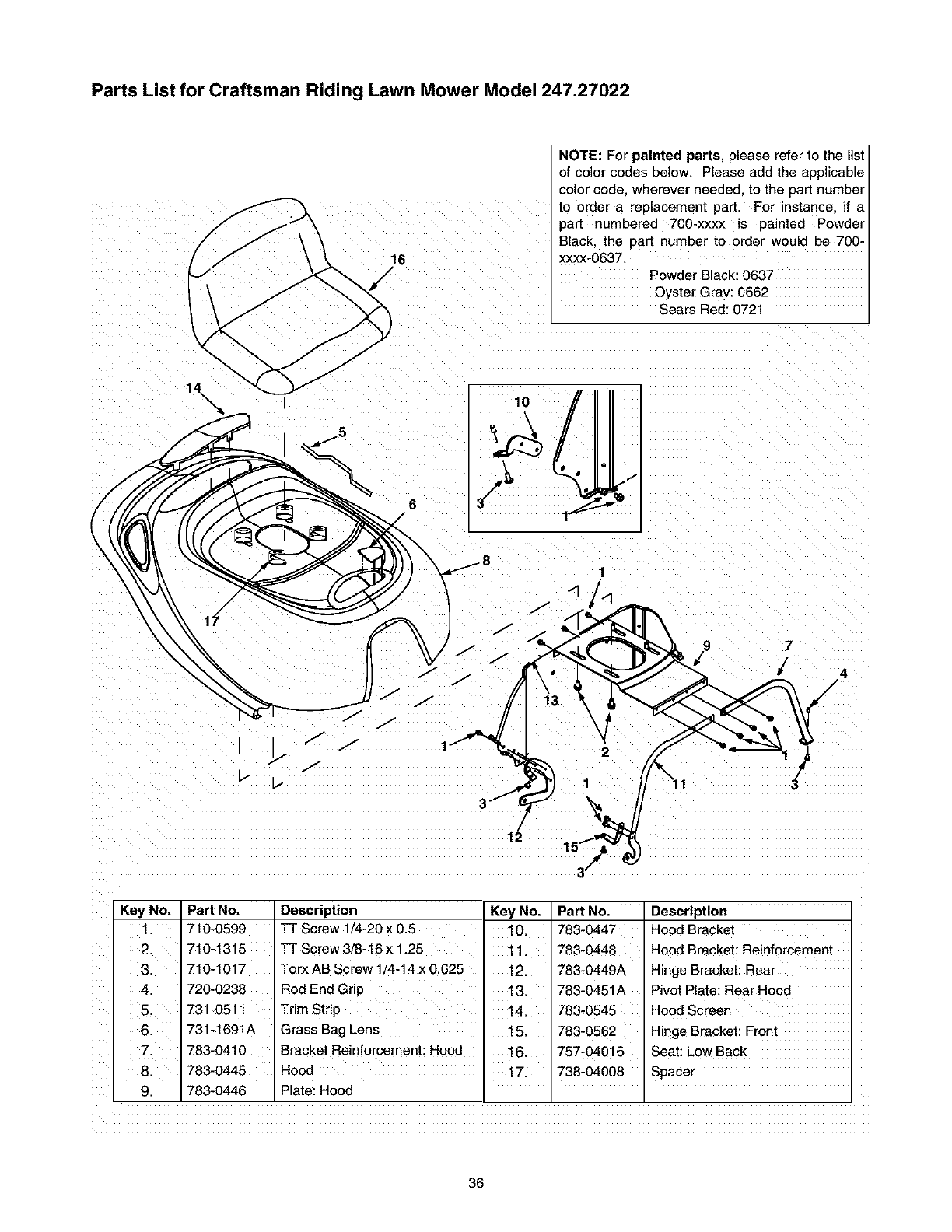
Parts List for Craftsman Riding Lawn Mower Model 247.27022
15
NOTE: For painted parts, please refer to the list
of color codes below. Please add the applicable
color code, wherever needed, to the part number
to order a replacement part. For instance, if a
part numbered 700-xxxx is painted Powder
Black. the part number to order would be 700-
xxxx-0637.
Powder Black: 0637
Oyster Gray: 0662
Sears Red: 0721
.f
Key No.
1.
2.
3.
4.
5.
6.
7.
8.
9.
v
3"
Part No.
710-0599
710-1315
710-1017
720-0238
731-0511
731-1691A
783-0410
783-0445
783-0446
Description Key No.
TT Screw 1/4-20 x 0.5 10.
TT Screw 3/8-16 x 1.25 11.
Torx AB Screw 1/4-14 x 0.625 12.
Rod End Grip 13.
Trim Strip 14.
Grass Bag Lens 15.
Bracket Reinforcement: Hood 16.
Hood 17.
Plate: Hood
Part No.
783-0447
783-0448
783-0449A
783-0451A
783-0545
783-0562
757-04016
738-04008
Description
Hood Bracket
Hood Bracket: Reinforcement
Hinge Bracket: Rear
Pivot Plate: Rear Hood
Hood Screen
Hinge Bracket: Front
Seat: Low Back
Spacer
36
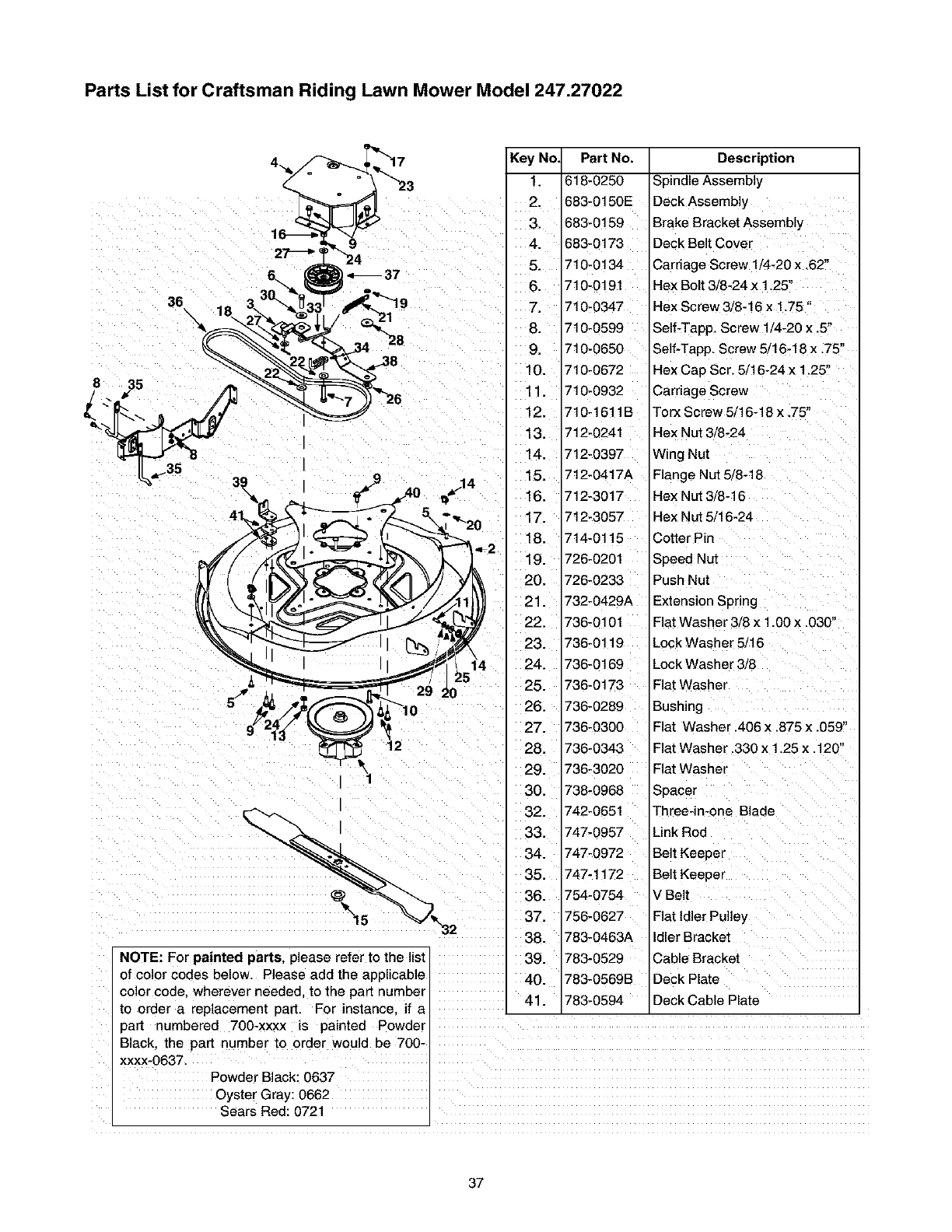
Parts List for Craftsman Riding Lawn Mower Model 247.27022
835
\
NOTE: For painted parts, please refer to the list
of color codes below. Please add the applicable
color code. wherever needed, to the part number
to order a replacement part. For instance, if a
part numbered 7O0-xxxx is painted Powder
Black. the part number to order would be 700-
xxxx-0637.
Powder Black: 0637
Oyster Gray: 0662
Sears Red: 0721
Key No. Part No.
1. 618-0250
2. 683-0150E
3. 683-0159
4. 683-0173
5. 710-0134
6. 710-0191
7. 710-0347
8. 710-0599
9. 710-0650
10. 710-0672
11. 710-0932
12. 710-1611B
13. 712-0241
14. 712-0397
15. 712-0417A
16. 712-3017
17. 712-3057
18. 714-0115
19. 726-0201
20. 726-0233
21. 732-0429A
22. 736-0101
23. 736-0119
24. 736-0169
25. 736-0173
26. 736-0289
27. 736-0300
28. 736-0343
29. 736-3020
30. 738-0968
32. 742-0651
33. 747-0957
34. 747-0972
35. 747-1172
36. 754-0754
37. 756-0627
38. 783-0463A
39. 783-0529
40. 783-0569B
41. 783-0594
Description
Spindle Assembly
Deck Assembly
Brake Bracket Assembly
Deck Belt Cover
Cardage Screw 1/4-20 x .62"
Hex Bolt 3/8-24 x 1.25"
Hex Screw 3/8-16 x 1.75"
Self-Tapp. Screw 1/4-20 x .5_
Self-Tapp. Screw 5/16-18 x .75"
Hex Cap Scr. 5/16-24 x 1.25"
Carriage Screw
Torx Screw 5/16-18 x .75"
Hex Nut 3/8-24
Wing Nut
Flange Nut 5/8-18
Hex Nut 3/8-16
Hex Nut 5/16-24
Cotter Pin
Speed Nut
Push Nut
Extension Spring
Flat Washer 3/8 x 1.00 x .030"
Lock Washer 5/16
Lock Washer 3/8
Flat Washer
Bushing
Flat Washer .406 x .875 x .059"
Flat Washer .330 x 1.25 x .120"
Flat Washer
Spacer
Three-in-one Blade
Link Rod
Belt Keeper
Belt Keeper
V Belt
Flat Idler Pulley
Idler Bracket
Cable Bracket
Deck Plate
Deck Cable Plate
37
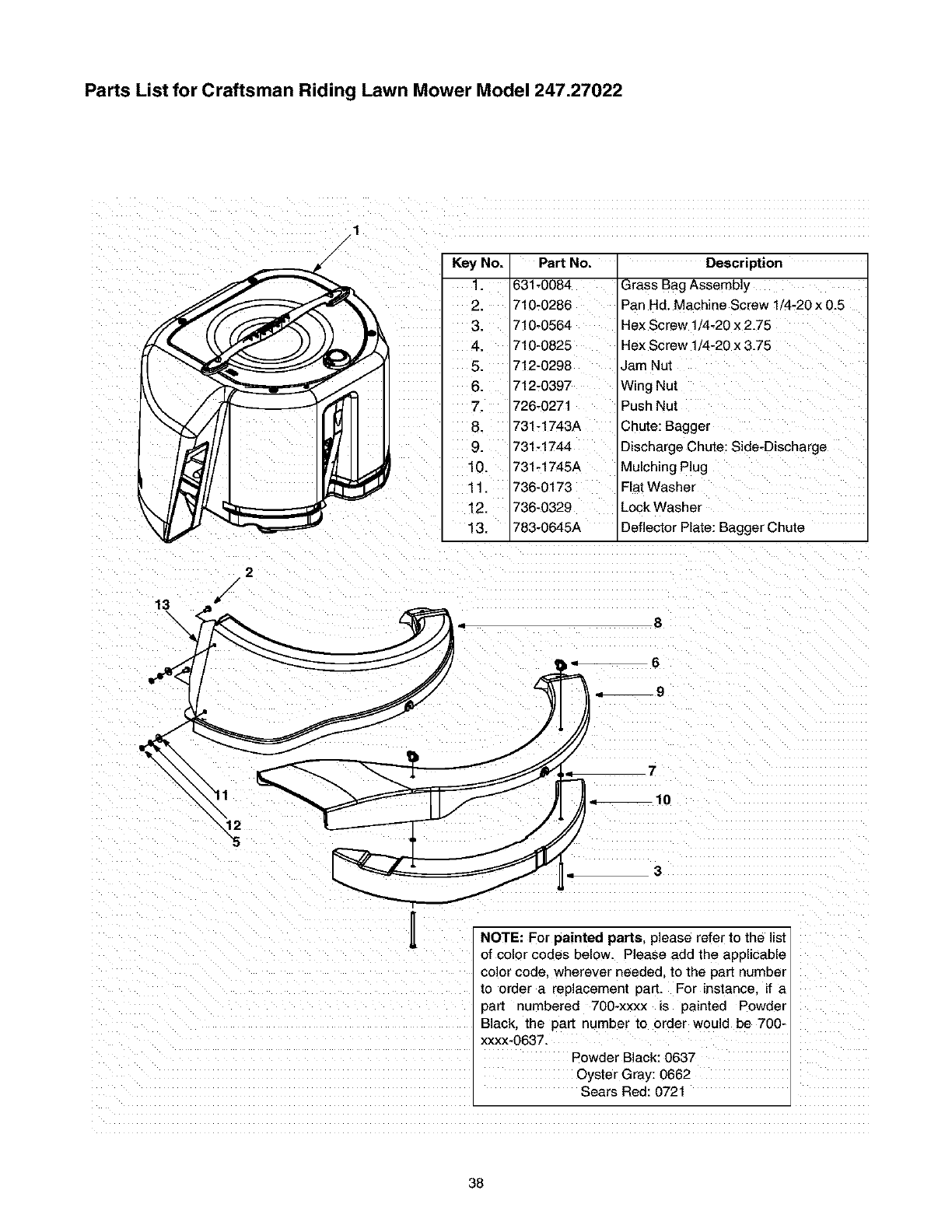
Parts List for Craftsman Riding Lawn Mower Model 247.27022
2
/
13 _/
Key No.
1.
2.
3.
4.
5.
6.
7.
8.
9.
10.
11.
12.
13.
Part No. Description
631-0084
710-0286
710-0564
710-0825
712-0298
712-0397
726-0271
731-1743A
731-1744
731-1745A
736-0173
736-0329
783-0645A
Grass Bag Assembly
Pan Hd. Machine Screw 1/4-20 x 0.5
Hex Screw 1/4-20 x 2.75
Hex Screw 1/4-20 x 3.75
Jam Nut
Wing Nut
Push Nut
Chute: Bagger
Discharge Chute: Side-Discharge
Mulching Plug
Flat Washer
Lock Washer
Deflector Plate: Bagger Chute
7
i4 10
,, 3
NOTE: For painted parts, please refer to the list
of color codes below. Please add the applicable
color code wherever needed, to the part number
to order a replacement oart. For instance if a
part numbered 700-xxxx is painted Powder
Black. the part number to order would be 700-
xxxx-0637.
Powder Black: 0637
Oyster Gray: 0662
Sears Red: 0721
38
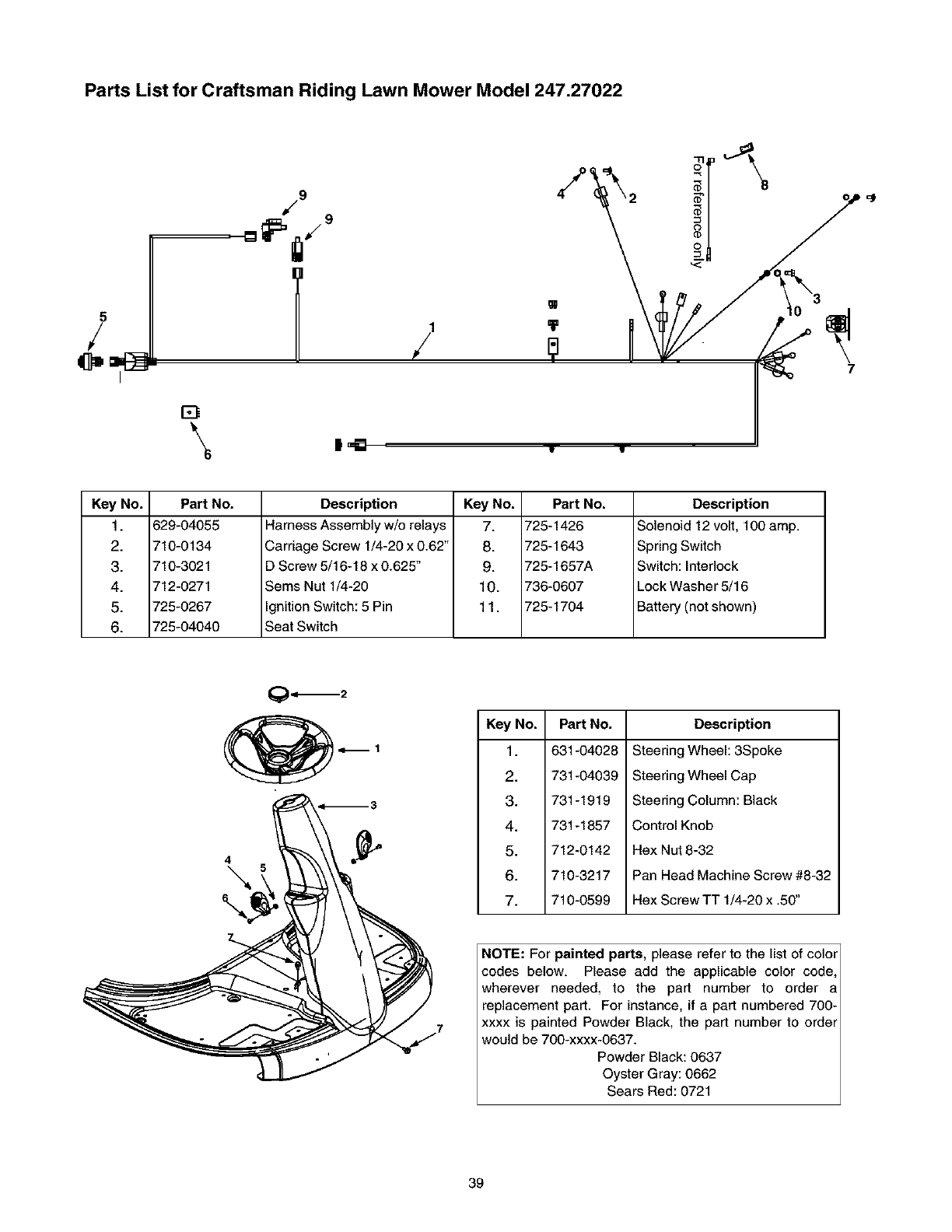
Parts List for Craftsman Riding Lawn Mower Model 247.27022
=j
/
E_
\
7
Key No. Part No. Description Key No. Part No. Description
1. 629-04055 Harness Assembly w/o relays 7. 725-1426 Solenoid 12 volt, 100 amp.
2. 710-0134 Carriage Screw 1/4-20 x 0.62" 8. 725-1643 Spring Switch
3. 710-3021 D Screw 5/16-18 x 0.625" 9. 725-1657A Switch:Interlock
4. 712-0271 Sems Nut 1/4-20 10. 736-0607 Lock Washer 5/16
5. 725-0267 Ignition Switch: 5 Pin 11. 725-1704 Battery (not shown)
6. 725-04040 Seat Switch
Q .r,_2
4
\
\
Key No.
1.
2.
3.
4.
5.
6.
7.
Part No.
631-04028
731-04039
731-1919
731 -1857
712-0142
710-3217
710-0599
Description
Steering Wheel: 3Spoke
Steering Wheel Cap
Steering Column: Black
Control Knob
Hex Nut 8-32
Pan Head Machine Screw #8-32
Hex Screw TT 1/4-20 x .50"
NOTE: For painted parts, please refer to the list of color
codes below. Please add the applicable color code,
wherever needed, 1o the part number 1o order a
replacement part. For instance, if a part numbered 700-
xxxx is painted Powder Black, the part number to order
would be 700-xxxx-0637.
Powder Black: 0637
Oyster Gray: 0662
Sears Red: 0721
39
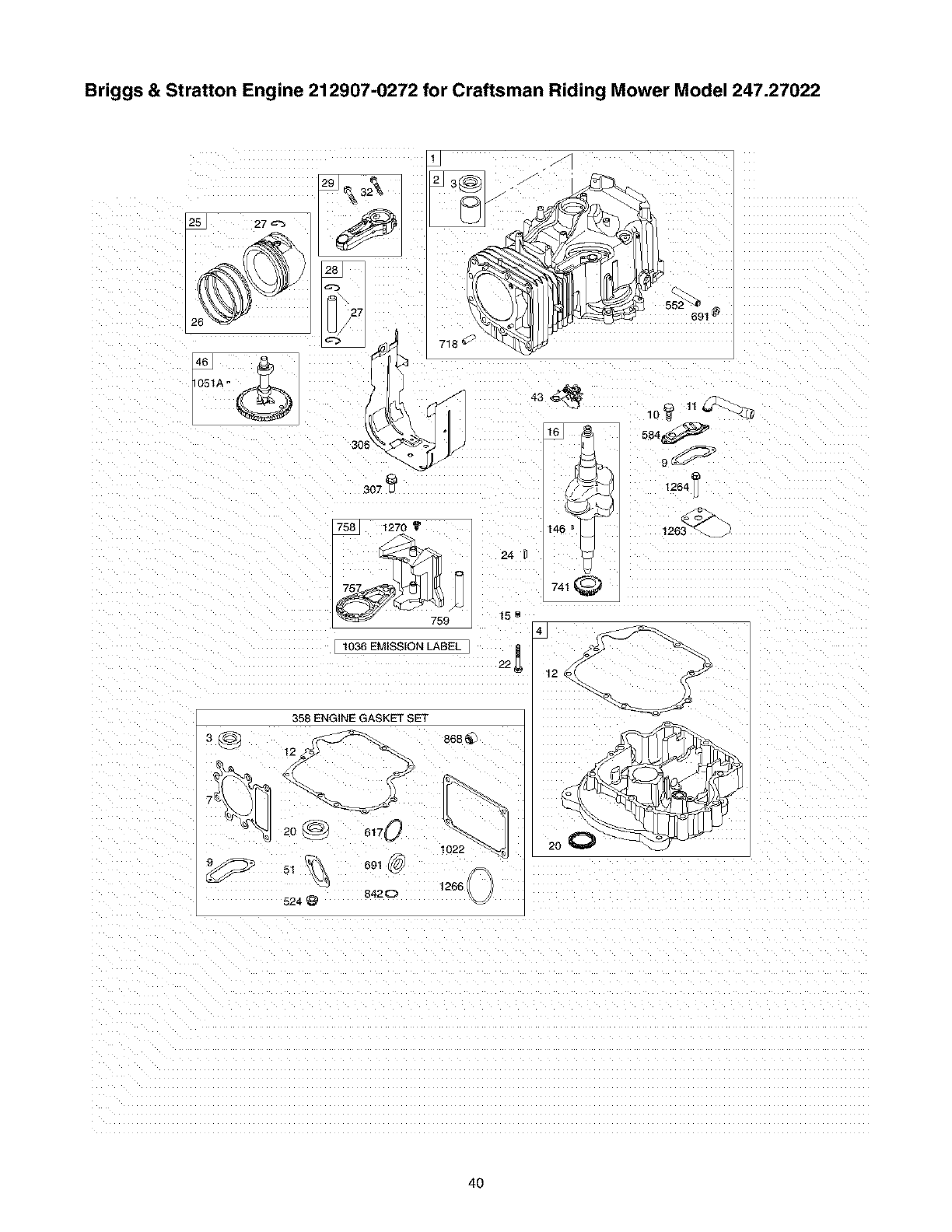
Briggs & Stratton Engine 212907-0272 for Craftsman Riding Mower Model 247.27022
358 ENGINE GASKET SET
8@ 12
8°@ OlZC
51 _ 691
524 _ 8420
868
1022 "_'_ 4
1266
40
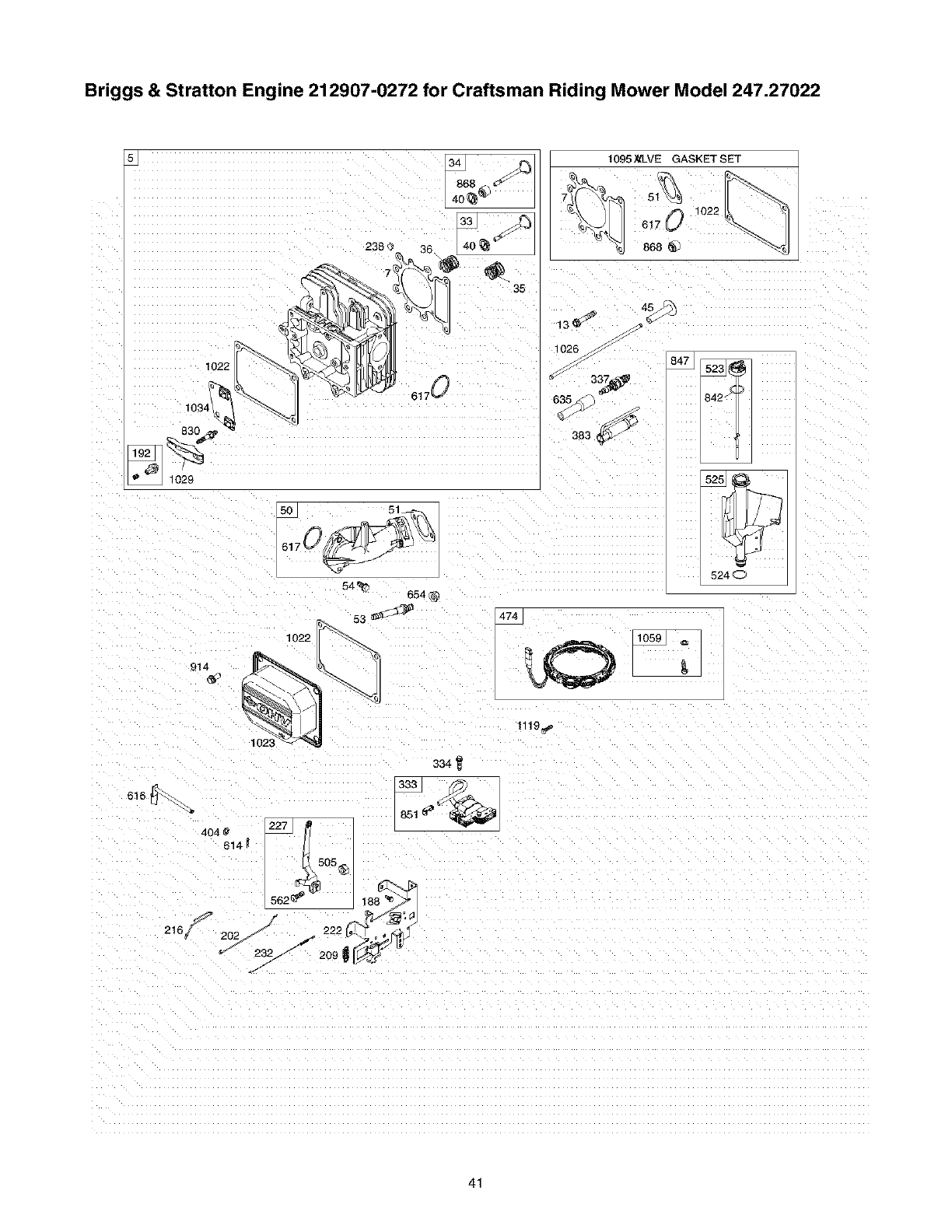
Briggs & Stratton Engine 212907-0272 for Craftsman Riding Mower Model 247.27022
5J
238 (3
1022
6170
1029
54_ 654_
1095 _'LVE GASKET SET
7 51_
f_ 1022
868
13@
842 f_i _
5240
914
1023
]022
1119_
334
4%4,_ °_1_>_1
21o/2o2i222_Yj_'
i
41
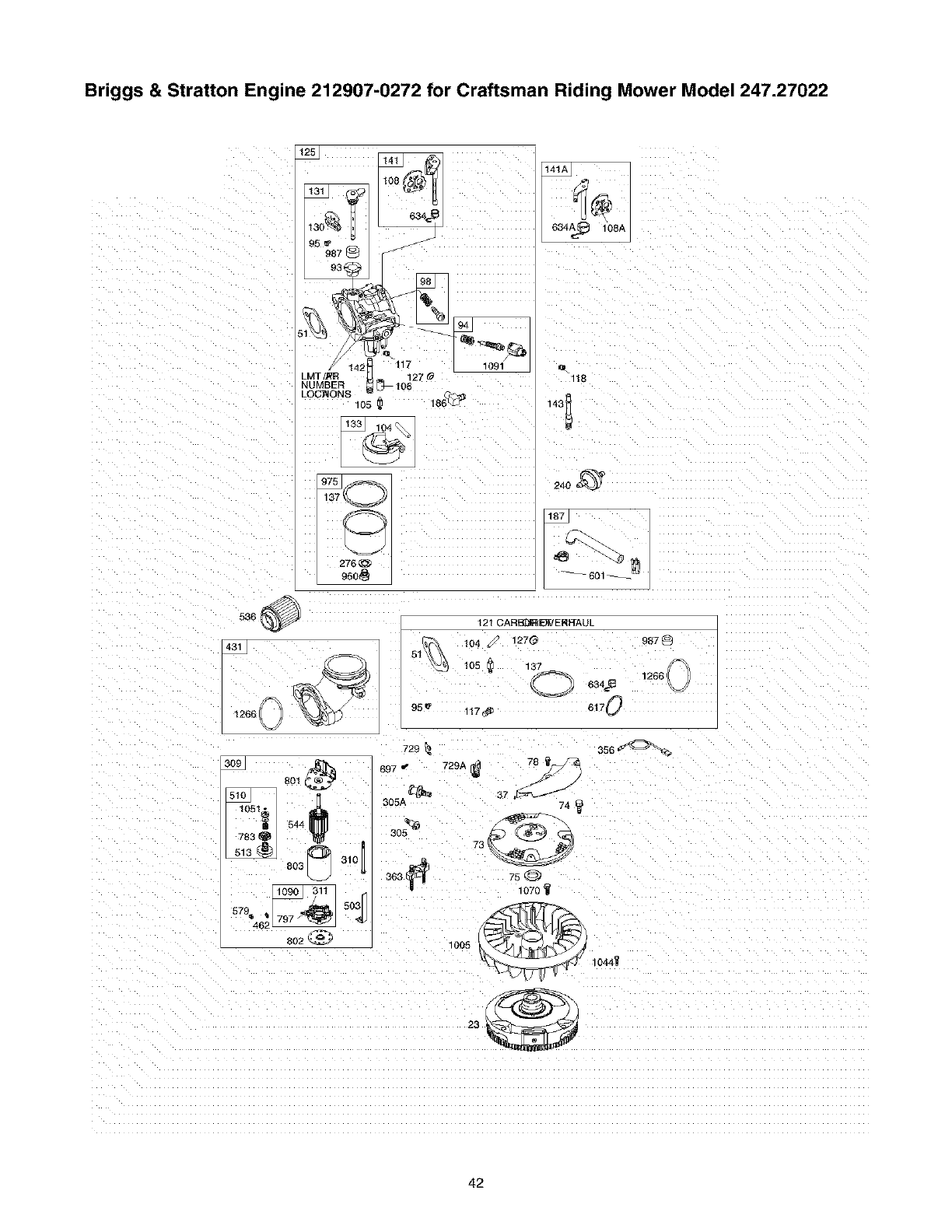
Briggs & Stratton Engine 212907-0272 for Craftsman Riding Mower Model 247.27022
536_
431
LMT/,I_IR 127 0
NUMBER [_106
LOC_ONS105 _ !86_
634A_
975
276@
118
143_
246
_87J
601 _
424 CAR_E_rCERPTAUL
404 , 127_ 9870
1266
95 _ 117_ 617_._
309J 801_
_ _ 305A
544 305_
802_
729
697 _
729A [_ 78_
37
74
75 @
1070 _
1005 1044_
23
42
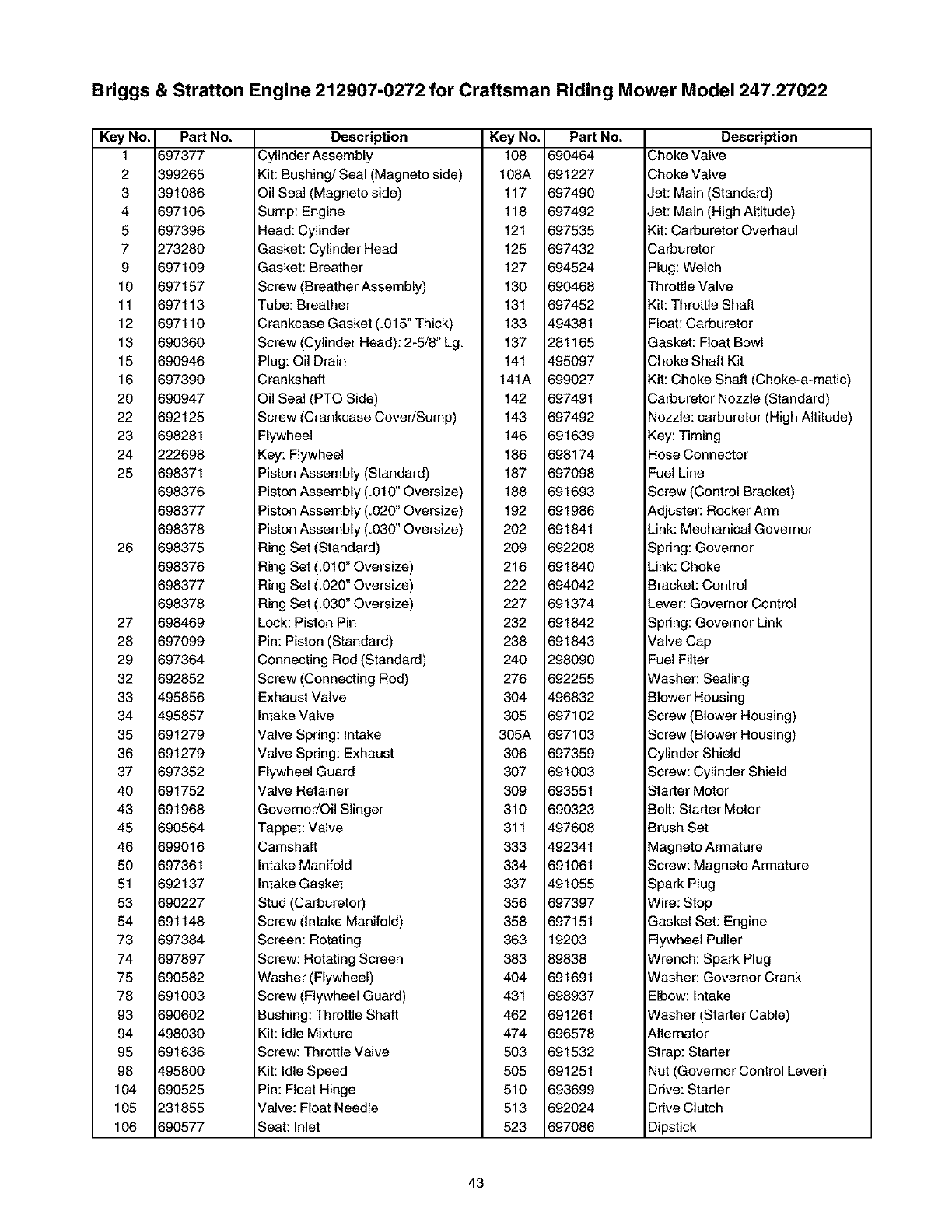
Briggs & Stratton Engine 212907-0272 for Craftsman Riding Mower Model 247.27022
Key No. Part No.
1 697377
2 399265
3 391086
4 697106
5 697396
7 273280
9 697109
10 697157
11 697113
12 697110
13 690360
15 690946
16 697390
20 690947
22 692125
23 698281
24 222698
25 698371
698376
698377
698378
26 698375
698376
698377
698378
27 698469
28 697099
29 697364
32 692852
33 495856
34 495857
35 691279
36 691279
37 697352
40 691752
43 691968
45 690564
46 699016
50 697361
51 692137
53 690227
54 691148
73 697384
74 697897
75 690582
78 691003
93 690602
94 498030
95 691636
98 495800
104 690525
105 231855
106 690577
Description Key No. Part
Cylinder Assembly 108 690464
Kit: Bushing/Seal (Magneto side) 108A 691227
Oil Seal (Magneto side) 117 697490
Sump: Engine 118 697492
Head: Cylinder 121 697535
Gasket: Cylinder Head 125 697432
Gasket: Breather 127 694524
Screw (Breather Assembly) 130 690468
Tube: Breather 131 697452
Crankcase Gasket (.015" Thick) 133 494381
Screw (Cylinder Head): 2-5/8" Lg. 137 281165
Plug: Oil Drain 141 495097
Crankshaft 141A 699027
Oil Seal (PTO Side) 142 697491
Screw (Crankcase Cover/Sump) 143 697492
Flywheel 146 691639
Key: Flywheel 186 698174
Piston Assembly (Standard) 187 697098
Piston Assembly (.010" Oversize) 188 691693
Piston Assembly (.020" Oversize) 192 691986
Piston Assembly (.030" Oversize) 202 691841
Ring Set (Standard) 209 692208
Ring Set (.010" Oversize) 216 691840
Ring Set (.020" Oversize) 222 694042
Ring Set (.030" Oversize) 227 691374
Lock: Piston Pin 232 691842
Pin: Piston (Standard) 238 691843
Connecting Rod (Standard) 240 298090
Screw (Connecting Rod) 276 692255
Exhaust Valve 304 496832
Intake Valve 305 697102
Valve Spring:Intake 305A 697103
Valve Spring: Exhaust 306 697359
Flywheel Guard 307 691003
Valve Retainer 309 693551
Governor/Oil Slinger 310 690323
Tappet: Valve 311 497608
Camshaft 333 492341
Intake Manifold 334 691061
Intake Gasket 337 491055
Stud (Carburetor) 356 697397
Screw (intake Manifold) 358 697151
Screen: Rotating 363 19203
Screw: Rotating Screen 383 89838
Washer(Flywheel) 404 691691
Screw (Flywheel Guard) 431 698937
Bushing: Throttle Shaft 462 691261
Kit: Idle Mixture 474 696578
Screw: Throttle Valve 503 691532
Kit: Idle Speed 505 691251
Pin: Float Hinge 510 693699
Valve: Float Needle 513 692024
Seat: Inlet 523 697086
NO. Description
Choke Valve
Choke Valve
Jet: Main (Standard)
Jet: Main (High Altitude)
Kit: Carburetor Overhaul
Carburetor
Plug: Welch
Throttle Valve
Kit: Throttle Shaft
Float: Carburetor
Gasket: Float Bowl
Choke Shaft Kit
Kit: Choke Shaft (Choke-a-matic)
Carburetor Nozzle (Standard)
Nozzle: carburetor (High Altitude)
Key: Timing
Hose Connector
Fuel Line
Screw (Control Bracket)
Adjuster: Rocker Arm
Link: Mechanical Governor
Spring: Governor
Link: Choke
Bracket: Control
Lever: Governor Control
Spring: Governor Link
Valve Cap
Fuel Filter
Washer: Sealing
Blower Housing
Screw (Blower Housing)
Screw (Blower Housing)
Cylinder Shield
Screw: Cylinder Shield
Starter Motor
Bolt: Starter Motor
Brush Set
Magneto Armature
Screw: Magneto Armature
Spark Plug
Wire: Stop
Gasket Set: Engine
Flywheel Puller
Wrench: Spark Plug
Washer: Governor Crank
Elbow: Intake
Washer (Starter Cable)
Alternator
Strap: Starter
Nut (Governor Control Lever)
Drive: Starter
Drive Clutch
Dipstick
43
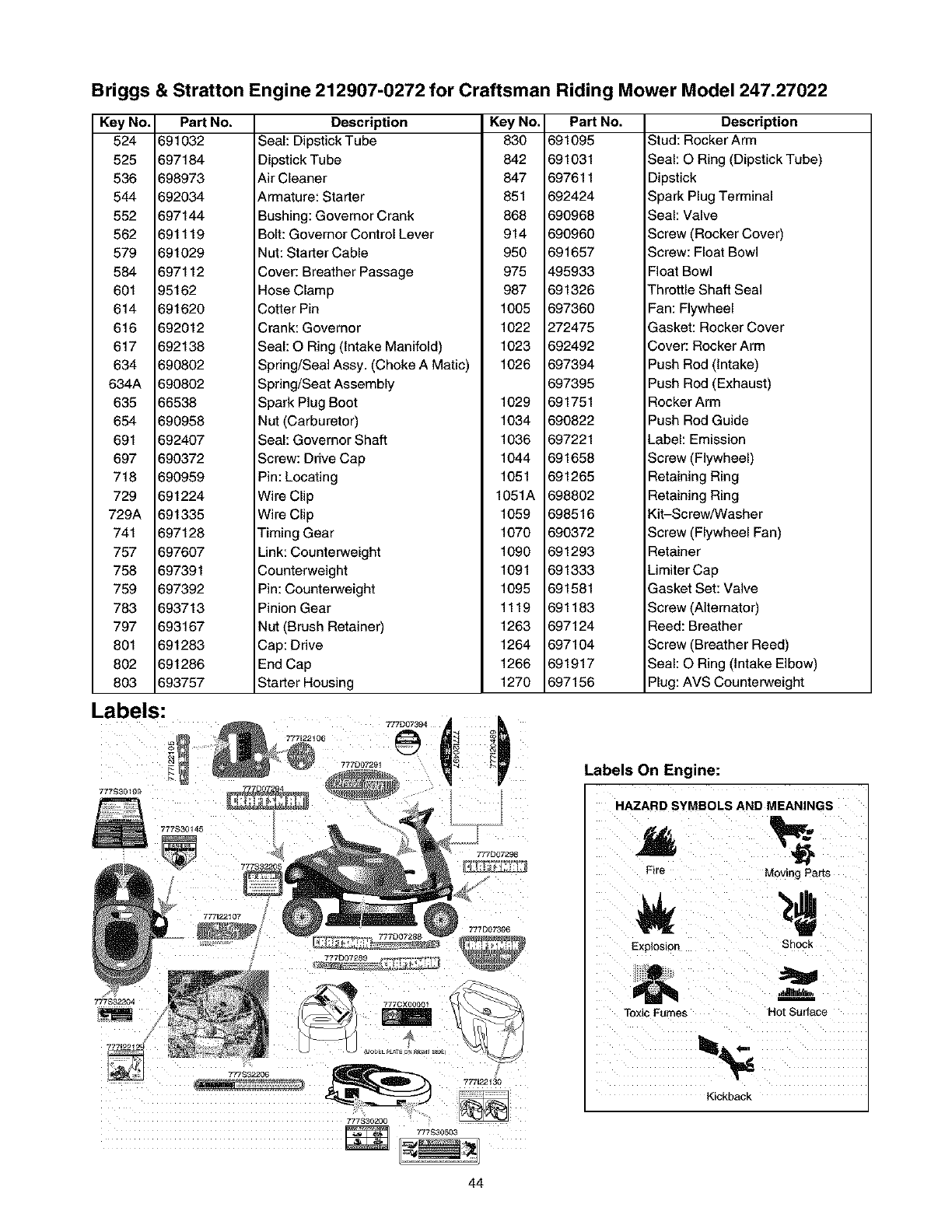
Briggs & Stratton Engine 212907-0272 for Craftsman Riding Mower Model 247.27022
Key No. PartNo.
524 691032
525 697184
536 698973
544 692034
552 697144
562 691119
579 691029
584 697112
601 95162
614 691620
616 692012
617 692138
634 690802
634A 690802
635 66538
654 690958
691 692407
697 690372
718 690959
729 691224
729A 691335
741 697128
757 697607
758 697391
759 697392
783 693713
797 693167
801 691283
802 691286
803 693757
Description
Seal: Dipstick Tube
Dipstick Tube
Air Cleaner
Armature: Starter
Bushing: Governor Crank
Bolt: Governor Control Lever
Nut: Starter Cable
Cover: Breather Passage
Hose Clamp
Cotter Pin
Crank: Governor
Seal: O Ring (intake Manifold)
Spring/Seal Assy. (Choke A Matic)
Spring/Seat Assembly
Spark Plug Boot
Nut (Carburetor)
Seal: Governor Shaft
Screw: Drive Cap
Pin: Locating
Wire Clip
Wire Clip
Timing Gear
Link: Counterweight
Counterweight
Pin: Counterweight
Pinion Gear
Nut (Brush Retainer)
Cap: Drive
End Cap
Starter Housing
Key No. PaN
830 691095
842 691031
847 697611
851 692424
868 690968
914 690960
950 691657
975 495933
987 691326
1005 697360
1022 272475
1023 692492
1026 697394
697395
1029 691751
1034 690822
1036 697221
1044 691658
1051 691265
1051A 698802
1059 698516
1070 690372
1090 691293
1091 691333
1095 691581
1119 691183
1263 697124
1264 697104
1266 691917
1270 697156
NO. Description
Stud: Rocker Arm
Seal: O Ring (Dipstick Tube)
Dipstick
Spark Plug Terminal
Seal: Valve
Screw (Rocker Cover)
Screw: Float Bowl
Float Bowl
Throttle Shaft Seal
Fan: Flywheel
Gasket: Rocker Cover
Cover: Rocker Arm
Push Rod (intake)
Push Rod (Exhaust)
Rocker Arm
Push Rod Guide
Label: Emission
Screw (Flywheel)
Retaining Ring
Retaining Ring
Kit-Screw/Washer
Screw (Flywheel Fan)
Retainer
Limiter Cap
Gasket Set: Valve
Screw (Alternator)
Reed: Breather
Screw (Breather Reed)
Seal: O Ring (intake Elbow)
Plug: AVS Counterweight
Labels:
777D07298
Labels On Engine:
HAZARD SYMBOLS AND MEANINGS
Fire Moving Parts
Explosion Shoc_
K ckback
777S30503
44
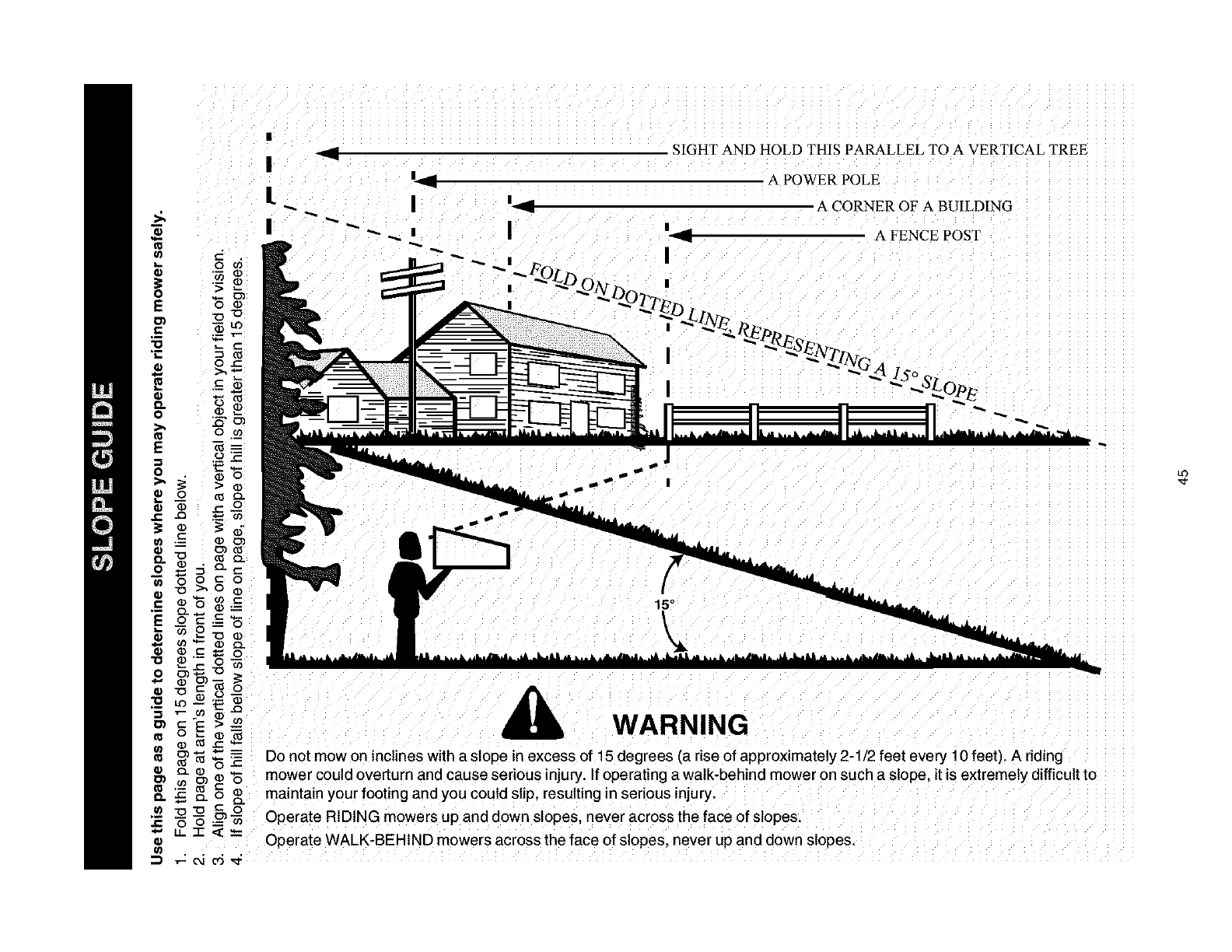
I
'91 SIGHT AND HOLD THIS PARALLEL TO A VERTICAL TREE
II'91 A POWER POLE
L_. _. I ! ,9 A CORNER OF A BUILDING
>,
"o "o
Ox=
o.__
E -_=
x:_o
0_ _Jl
= _X
_do-c
0 c 0
_ CE >
0 _-
I'''--I I
o
WARNING
Do not mow on inclines with a slope in excess of 15 degrees (a rise of approximately 2-1/2 feet every 10 feet). A riding
"5 mower could overturn and cause serious injury. If operating a walk-behind mower on such a slope, it is extremely difficult to
_. maintain your footing and you could slip, resulting in serious injury.
o
•-_ --_"_ .__-_ Operate RIDING mowers up and down slopes, never across the face of slopes.
=o_:<=
• Operate WALK-BEHIND mowers across the face of slopes, never up and down slopes.
LO
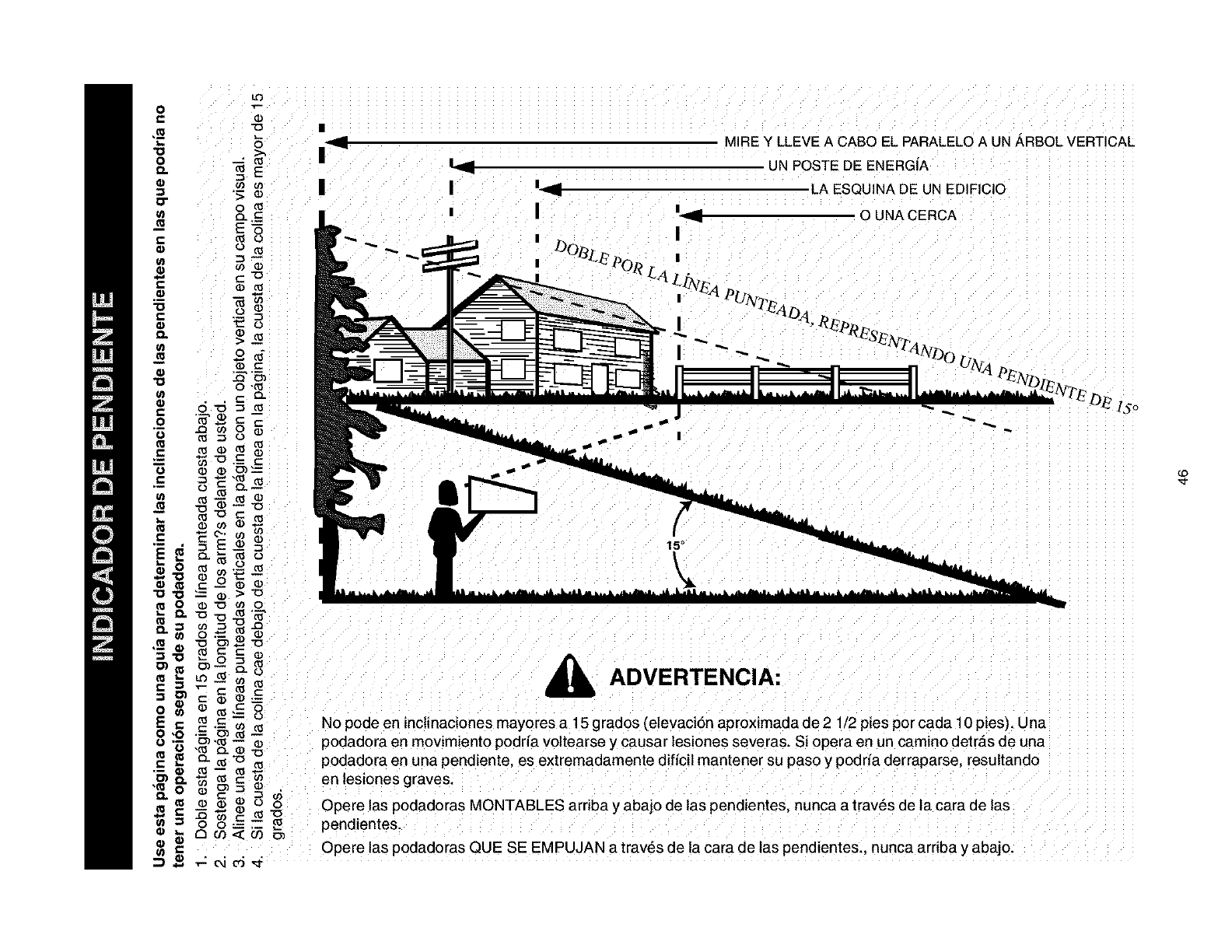
Contenido P_g.
Ustado de partes ......................................... 25
Medidor de pendientes ............................... 46
Informaci6n sobre la garantfa ...................... 47
Practicas de seguddad en la operaci6n ....... 48
Montaje .................................................... 52
Operaci6n .................................................... 54
Contenido P_g.
Mantenimiento ................................................. 59
Servicio y Ajuste ............................................... 61
Almacenamiento fuera de temporada .............. 69
Sotuci6n de problemas .................................... 69
Atenci6n a clientes .......................................... 72
GARANTfA LIMITADA DE LA PODADORA MONTABLE: Pos dos (2) aSos a partir de la fecha de compra, si el equipo montable
Craftsman se mantiene, lubdca y se afina de acuerdo con las instrucciones en el manual del propietario, Sears reparar_, o
reemplazar_, sin costo para usted cualquier parte que se encuentre defectuosa en material o mano de obra de acuerdo con los
]ineamientos de la cobertura listados m_,s abajo.
Sears proporcionar_ la mano de obra libre de cargo para usted por el servicio de las partes en garantfa durante los dos a£_os
completos. Durante los primeros 30 dias a partir de la fecha de compra, no habr_ cargo por servicio al producto en su domicilio
por todo Io que est,, cubierto en esta garantia. (Ver excepciones abajo).
Para su conveniencia, el servicio de garantia EN CASA estar_ disponible despu6s de los primeros 30 dfas de la compra, pero
se cobrar_, una cuotapor la visita. Este cargo se dispensarY, si el producto se Ileva hasta un centro de servicio autorizado por
Sears. Para saber cuAI es el centro de servicio autorizado Sears m_,s cercano a su Iocalidad, por favor Ilame al 1-800-4-MY-
HOME(R). Esta garantfa aplica solamente mientras el producto est6 dentro de los Estados Unidos.
EXCLUSIONES
Esta garantfa no cubre:
Elementos que se desgastan por el uso norrnal_ incluyendo entre otros_ las cuchillas_ buj_as, filtros de aire_ bandas, y filtros
de aceite.
Servicios de mantenimiento estAndar, cambio de aceite o afinaci6n
Cambio de ]lantas o reparaciones causadas per pinchaduras con clavos, espinas, vidrios, etc.
Reparaciones necesarias debido al mal use por parte del operador, incluyendo entre otros, el daSo ocasionado por
arrastrar objetos mAs all_ de la capacidad del equipo montable, el impacto de otros objetos que doblen la estructura o
impacten el cigQeSal, o por forzar el motor.
Reparaciones necesarias debido a negligencia del operador, incluyendo entre otros, daSos mecAnico y el_ctrico
ocasionado por un almacenamiento no apropiado, falla por el uso de aceite de grade y/o cantidad no apropiada, falla por
no mantener limpia el Area de cubierta, libre de residuos inflamables, o por no dar mantenimiento al equipo de acuerdo con
las instrucciones contenidas en el manual del propietario.
Limpieza o reparaciones al motor (sistema de combustible) provocadas por un combustible contaminado u oxidado (viejo).
En general, el combustible debe utilizarse en un perfodo no mayor de 30 d[as a partir de su adquisici6n.
El deterioro normal y desgaste de los acabados exteriores, o reemplazo de la etiqueta del producto.
• Equip o montable utilizado con fines comerciales o renta.
GARANTIA LIMITADA DE LA BATERIA
Por noventa (90) dias a partir de la fecha de compra, si la baterfa incluida con este equipo montable presenta defectos en
material o mano de obra y las pruebas que nosotros efectuemos determinan que la bateffa no mantiene la carga, Sears
reemplazar_, la bateria sin costo para usted. Durante los primeros 30 d[as a partir de la fecha de compra, no habr_, cargo por
reemplazar la bateria en su domicilio. Para su conveniencia, el servicio de garantfa EN CASA estarA disponible despu6s de los
primeros 30 dfas de la compra, pero se cobrarA una cuota por la visita. Este cargo se dispensarY, si el producto Craftsman se
Ileva hasta un centro de servicio autorizado per Sears. Para saber cu_J es el centro de servicio autorizado Sears mAs cercano a
su Iocalidad, por favor Ilame al 1-800-4-MY-HOM E(R). Esta garant[a sobre la bateffa aplica solamente mientras el producto
est_ dentro de los Estados Unidos. Esta garant[a le otorga derechos legales especfficos, pero usted podrfa gozar de otros
derechos en raz6n de su lugar de residencia.
Sears, Roebuck and Co.,Dept.817WA, Hoffman Estates, IL 60179
Caballaje: ................................... 10.0
Aceite para el motor .................... 48 oz. o 1.4 litros
Combustible ............................... Regular sin plomo
Bujias: ......................................... N/P 491055
Motor: .......................................... 212907-0272
Llave de encendido (Std.) ........... N/P 725-0201
Model nQmero ............................ 247.27022
Numero de Sede ........................................................
Fecha de compra ......................................................
Registre el nQmero de serie y la fecha de compra y
conserve en un sitio seguro para referencia futura.
47

Felicitaciones por esta inteligente compra. Su nuevo
producto Craftsman® esta diseSado y fabricado para
aSos de funcionamiento confiable. Pero al igual que
todos los productos, puede requerir reparaciones de
vez en cuando. Y, es en esos momentos que un
Acuerdo de Garantfas sobre Reparaciones puede
haoerle ahorrar dinero y malos momentos.
El Acuerdo consiste en 1osiguiente:
Servicio experto proporcionado por nuestros
12.000 especialistas en reparaciones.
Servicio Uimitado y sin cargo para piezas y
manos de obra en todas las reparaoiones
cubiertas.
Reemplazo de producto si su producto
cubierto por la garantfa no puede ser arreglado.
Descuento de110% sobre el precio normal del
servicio y piezas requeridas para Ilevar a cabo
et servicio no cubiertas por et acuerdo.
Asimismo, 10% de descuento sobre et precio
normal de controles de mantenimiento
preventivos.
Asistencia telefbnica inmediata - asistencia
tetef6nica proporcionada por un tecnico de
Sears para los productos que requieren
reparaciones dentro det hogar, ma.s
programaci6n de reparaci6n conveniente.
Adquiera un Acuerdo de Garantfa sobre Reparaciones
ahora y protejase de complicaciones y gastos
imprevistos.
Una vez que ha comprado et Acuerdo, una simple
ltamada telef6nica es todo Io que necesita para
coordinar el servicio. Puede ltamar en cualquier
momento dfa o noche, o programar un turno para et
servicio en lfnea.
Sears tiene ma.s de 12.000 especialistas en
reparaciones profesionales, que
tienen acceso a m&s de 4,5 millones de piezas y
accesodos de calidad. Ese es el tipo de
profesionalismo con el cual puede contar para ayudar a
prolongar la vida t_tilde su nueva adquisici6n en a_os
venideros, iCompre su Acuerdo de Garantfa sobre
Reparaciones hoy mismo!
Se aplican algunas Iimitaciones y exclusiones. Para
obtener precios e informaci6n adicional, Ilame al 1-800-
827-6655.
Servicio de Instalaci6n Sears
Para la instalaci6n profesional que bdnda Sears de
artefactos dom_sticos, dispositivos de abertura de
puertas de garaje, calentadores de agua y otros
artfculos esenciales para el hogar, en los EE.UU.,
ltame al 1-800-4-MY-HOME®
_ADVERTENCIA: Este simbolo indica instrucciones de seguridad importantes de no seguirse, podrfa
que poner
en peligro la seguridad personal y/o la propiedad suya y de terceros. Lea y siga todas las instrucciones en este manual
antes de iniciar la operaci6n de esta mAquina. En caso de no seguir estas instrucciones podria provocar lesiones
personales. Cuando yea este simbolo--siga la advertencia.
_ADVERTENCIA: La bateria y las emisiones del motor contienen quimicos que a saber del
estado de California, producen cancer, defectos de nacimiento o da5o a la salud reproductiva. La
baterfa y sus terminales contienen plomo, por Io que deberA lavarse las manos despues de entrar
en contacto con elias.
_ADVERTENCIA: Esta m_quina fue construida ser operada de acuerdo con las reglas de seguridad en la
para
operaci6n contenidas en este manual. AI igual que con cualquier tipo de equipo el_ctrico, una falla o error de parte del
operador puede producir graves lesiones. Esta maquina es capaz de amputar manos y pies y de arrojar objetos con
gran fuerza. En caso de no obedecer las siguientes instrucciones de seguridad podria producir lesiones severas e
incluso la muerte.
Funcionamiento general
1. Lea, enfienda y siga todas las instucciones en la
m_quina y en el manual antes de armada y operada.
Guarde este manual para consultarlo regularmente y
para ordenar partes de reemplazo.
2. Familiarfcese con todos los controles y su operaci6n
apropiada. Conozca como detener la m_quina y
desactivada rApidamente.
3. No permita nunca que los niSos menores de 14 aSos
operen esta m_,quina. Los ni£_osmayores de 14 a£_os
deben leer y entender las instrucciones de operacion y
48
reglas de seguddad contenidas en este manual y deben
ser entrenados y supervisados por sus padres.
4. Nunca permita que los adultos operen esta mAuina sin
recibir antes instrucci6n apropiada.
5. Para ayudar a evitar el contacto con las cuchillas o una
lesi6n por algun objeto que sea arrojado, mantenga alas
personas que Io observan, a los ayudantes, nifios y
mascotas alejados al menos 25 metros de la m_,quina
mientras estA en funcionamiento. Detenga la m_quina si
alguien traspasa este radio de seguridad.
6. lnspeccione detalladamente el Area en donde utilizar_, el
equipo. Retire todas las piedras, palos, Ilantas, huesos,
juguetes y otros objetos extrafios que podrfan ser
recogidos y arrojados por la acci6n de las cuchillas. Los
objetos arrojados poddan ocasionar lesiones personales
severas.
7. Planifique el patr6n en el que va a ir descargando el
recorte para evitar que la descarga de matedal se realice
hacia los caminos, los observadores, etc. Evite ademas
descargar matedal contra las paredes y obstrucciones
que poddan provocar que el material descargado rebote
contra el operador.
8. Para protegerse los ojos utilice siempre anteojos o
antiparras de seguridad mientras opera la m_,quina o
mientras la ajusta o repara. Los objetos arrojados que
rebotan pueden lesionar gravemente la vista.
9. Utilice zapatos de trabajo resistentes, de suela fuerte y
pantalones y camisas ajustados. Las prendas sueltas o
las alhajas pueden quedar atrapadas en las piezas
movibles. Nunca opere esta m_quina estando descalzo o
con sandalias.
10. Est6 atento de la podadora y de la direcci6n de la
descarga de los aditamentos y no apunte a nadie. Nunca
opere esta podadora sin que est_n en su lugar apropiado
la cubierta de descarga o bolsa recolectora de pasto.
11. No ponga las manos o los pies cerca de las piezas
rotatorias o en la tolva de la cortadora. El contacto con las
cuchillas puede producir la amputaci6n de manos y pies.
12. Una cubierta de descarga faltante o dafiada puede
provocar el contacto con la cuchilla o lesiones por
objetos arrojados.
13. Detenga las cuchillas cuando cruce caminos de gravilla,
pasillos o caminos y cuando no est6 recortando el
c6sped.
14. Vigile el tr_nsito vehicular cuando est6 operando cerca o
en cruces de caminos. Esta m_quina no est_ disefiada
para operarse en la via pQblica.
15. No opere esta mAquina estando bajo los efectos del
alcohol o de drogas.
16. Corte el c6sped solamente con luz de dfa o con una
buena luz artificial. Nunca transporte pasajeros.
17. Desenganche las cuchillas antes de colocar la reversa.
Retroceda lentamente. Siempre mire hacia abajo y arras
antes y mientras va en reversa para evitar un accidente..
18. Reduzca la velocidad antes de dar la vuelta. Opere la
m_quina suavemente. Evite la operaci6n erratica y la
velocidad excesiva.
19. Desenganche las cuchillas, coloque el freno de mano,
detenga el motor y espere hasta que las cuchillas se
detengan por completo antes de retirar el colector de
recortes de c6sped, vaciar los recortes, destapar la tolva,
retirar cualquier residuo o desecho, o hacer cualquier
ajuste.
20. Nunca deje la m_quina en funcionamiento sin vigilancia.
Apague siempre las cuchillas, coloque la transmisi6n en
neutral, coloque el freno de mano, detenga el motor y
saque la Ilave, antes de bajarse del vehiculo.
21. Tenga cuidado al cargar o descargar la m_,quina en un
camion. Esta unidad no debe conducirse en ascenso o
descenso de rampas, porque podda ladearse y provocar
lesiones personales graves. Debe empujar
manualmente la unidad en la rampa para cargada o
descargada apropiadamente.
22. El silenciador y el motor se ca]ientan y producen una
quemadura. No los toque.
23. Revise los espacios pot encima de la cabeza antes de
conducir bajo las ramas de los arboles, cables,
cerramientos de puertas, etc. en donde el operador
podrfa atorarse o ser empujado sacAndolo de la unidad,
Io que podrta resultar en lesiones graves.
24. Desenganche todos los embragues de aditamentos,
presione el pedal de frenos completamente y cambie a
neutral antes de intentar arrancar el motor.
25. Su mAquina estA disefiada pra cortar c6sped residencial
normal, con una altura no mayor a 10". No intente cortar
c_sped demasiado crecido, seco (pastura) o pilas de
hojas secas. El c6sped y las hojas secas pueden entrar
en contacto con el escape del motor y/o acumularse en la
cubierta de la podadora, convirti6dose en un peligro de
incendio
26. Utilice solamente partes y accesorios fabricados
especialmente para esta mAquina, originales del
fabricante (OEM). Lea, comprenda y siga todas las
instrucciones proporcionadas con los accesorios o
aditamentos.
27. Los datos estadfsticos muestran que los conductores
mayores de 60 afios se yen implicados en un alto
pocentaje de lesiones relacionadas con tractores. Estos
operadores deben evaluar su capacidad para operar el
tractor en forma suficientemente segura para protegerse
a ellos mismos y a los demAs contra lesiones graves.
28. Si se presentan situaciones que no estan previstas en
este manual sea cuidadoso y use el sentido comL_n.
Contacte al centro de servicio Sears para obtener ayuda.
Funcionamiento en pendientes
Las pendientes son un factor importante que se relaciona con
accidentes de derrapes y ca/das que puede producir lesiones
graves e incluso la muerte. La operaci6n en pendientes
requiere mayor precaucion. Si no puede retroceder en la
pendiente ono siente que sea f_cil, no pode allL
Para seguridad, use el medidor de pendientes que se pagina
46 para medir la pendiente antes de operar la unidad en una
zona inclinada. Si la pendiente es mayor a 15 grados en el
medidor, no opere esta unidad allL
Haga Io siguiente:
1. Pode hacia arriba y abajo de las pendientes, no en forma
transversal. Tenga cuidado cuando cambie de direccion
cuando opere la m_quina en pendientes.
2. Est6 atento a los agujeros, rafces, rocas, objetos ocultos
oabultamientos que puedan provocar que se derrape o
se tropiece. El terreno desnivelado puede voltear la
m_quina. El c6sped alto puede ocultar obst_culos.
3. Vaya a baja velocidad. Elija una velocidad Io
suficientemente baja de modo que no tenga que
detenerse ohacer cambios mientras estA sobre la
pendiente. Las Ilantas poddan perder traccion sobre las
49
pendientes aunque los frenos funcionen
apropiadamente. Siempre mantenga la maquina con una
velocidad seleccionada en la palanca mientras
desciende las pendientes para poder frenar con motor.
4. Siga la recomendaci6n del fabricante para los pesos o
contrapesos de las Ilantas para mejorar la estabilidad de
la mAquina. Tenga especial cuidado con los colectores
de recorte de c6sped u otros aditamentos, ya que
pueden modificar la estabilidad de la mAquina.
5. Haga que todos los movimientos en las pendientes sean
lentos y graduales. No cambie repentinamente la
velocidad ni la direcci6n. Un frenado o cambio de
velocidad repentinos pueden causar que el frente de la
mAquina se levante y de una voltereta hacia atras, Io que
podria producir lesiones severas.
6. Evite arrancar o detenerse en una pendiente. Si las
Ilantas pierden la tracci6n, desenganche las cuchillas y
descienda lentamente la pendiente.
No haga Io siguiente:
1. No de vuelta sobre las pendientes a menos que sea
necesario. Si es asi, de vuelta lenta y gradualmente
descendiendo de la pendiente, si es posible.
2. No corte el c6sped cerca de pozos, hundimientos,
bancos, podria perder el equilibrio. La podadora podria
volcarse repentinamente si una de las Ilantas estuviera
fuera de] borde de un pozo, banco u agujero.
3. No intente estabilizar la mAquina poniendo su pie en el
piso.
4. No utilice un colector de c6sped en pendientes
escalonadas.
5. No pode el c6sped hemedo. Una menor tracci6n podria
causar derrapes.
6. No haga cambios a neutral para descender. El exceso de
velocidad podria causar que el operador pierda el control
de la m_quina ocasionando lesiones graves e incluso la
muerte.
7. No arrastre cargas pesadas detrAs de los aditamentos
(carrito de basura cargado, podadora de rodillos, etc) en
pendientes mayores de 5 grados. Cuando descienda, el
peso adicional tiende a empujar el tractor y podr[a
ocasionar que usted pierda el control. (el tractor podria
acelerarse, reduciendo la capacidad de frenando y
maniobrabilidad, los aditamentos podrian clavarse y
hacer palanca y provocar que el tractor se voltee).
Nifios
1. Pueden ocurrir accidentes trAgicossi el operador no estA
atento a la presencia de ni£_os. Por Io general a los ni£_os
les atraen las podadoras y la actividad de podar el
c_sped. No entienden los riesgos ni los peligros. Nunca
asuma que los ni£_osperrnanecer_n en el mismo lugar
donde los vi6 por L_ltimavez.
a. Mantenga a los niOos fuera del Area de trabajo y
bajo estricta vigilancia de un adulto responsable
ademas del operador.
b. EstOalerla y apague la podadora si un ni£_o
ingresa al Area.
c. Antes y mientas se esta moviendo hacia atr_s,
mire hacia arras y cuide que no haya ni£_os.
d. Nunca transporte ni£_os,aun con la cuchilla
apagada. Podr[an caerse y resultar severamente
]esionados o interferir con la operaci6n segura de
]a m_quina.
e. Tenga extrema precauci6n cuando se aproxime a
esquinas ciegas, entradas de puertas, arboles u
otros objetos que puedan obstaculizarle la vista
de un niOo que pudiese correr hacia la podadora.
f. Desenganche las cuchillas antes de colocar la
reversa. La funci6n de "No-Cortar-En Reversa"
evita accidentes, no trate de hacer que funcione
de otro modo.
g. Mantenga alejados a los ni£_osde los motores en
marcha o calientes. Pueden sufrir quemaduras
con un silenciador caliente.
h. Retire la Ilave cuando deje la maquina sin
atenciOn para prevenir el funcionamiento no
autorizado.
2. No permita nunca que los niOos menores de 14 aOos
operen esta maquina. Los ni£_osmayores de 14 a£_os
deben leer y entender las instrucciones de operaciOn y
reglas de seguridad contenidas en este manual y deben
ser entrenados y supervisados por sus padres.
Servicio
Manejo seguro de la gasolina
1. Para evitar lesiones o da£_ossea sumamente cuidadoso
al manipular la gasolina. La gasolina es altamente
inflamable y los vapores son explosivos.. Se puede
lesionar gravemente si derrama gasolina sobre usted o
sobre la ropa ya que se puede encender. Lave la piel y
cAmbiese de ropa de inmediato..
a. Utilice solo recipientes para gasolina autodzados.
b. Nunca Ilene los contenedores en el interior de un
vehiculo o camion o caja de camioneta con
recubrimientos plAsticos. Coloque siempre los
contenedores en el piso lejos del vehicu]o antes
de Ilenarlos.
c. Cuando sea pr_ctico, retire el equipo a gasolina
del camion o remolque y II0nelo en el piso. Si esto
no es posible, Ilene el equipo en un remolque con
contenedor portatil, en vez de desde un
dispensador de gasolina.
d. Mantenga la boquilla de Ilenado en contacto con
el borde de la entrada del tanque de gasolina o
contenedor en todo momento hasta que est0
]leno. No utilice un dispositivo para abfir/cerrar la
boquilla.
e. Apague todos los cigarrillos, cigarros, pipas y
otras fuentes de combustion.
f. Nunca cargue combustible en la maquina en un
espacio cerrado.
g. Nunca saque la tapa del gas ni agregue
combustible mientras el motor est_ caliente o en
marcha. Deje que el motor se enfrie per Io menos
dos minutes antes de volver a cargar combustible.
h. Nunca recargue el tanque de combustible. Llene
el tanque no mAs de 112pulgada por debajo de la
base del cuello del filtro para dejar espacio para la
dilataci0n de] combustible..
i. Vuelva a co]ocar la tapa de la gasolina y ajestela
bien.
j. Limpie la gasolina derramada sobre el motor y el
equipo. Traslade la maquina a otra zona. Espere
5 minutes antes de encender el motor.
k. Para reducir el riesgo de incendio mantenga la
m_quina limpia de pasto, hojas y de acumulacion
5O
de otros escombros. Limpie los derrames de
aceite o combustible y saque todos los
escombros embebidos con combustible..
L Nunca almacene la maquina o el recipiente de
combustible en un espacio cerrado donde haya
fuego, chispas o luz piloto como per ejemplo,
calentadores de agua, homos, secadores de
ropa, otros aparatos a gas, etc.
m. Deje que la m_,quina se enfrfe 5 minutos por Io
menos antes de almacenarla.
Servicio general
1. Nunca encienda un motor en espacios cerrados o en una
zona con poca ventilaci6n. El escape del motor contiene
monoxide de carbono, un gas inodoro y letaL.
2. Antes de limpiar, reparar o inspeccionar la m_,quina,
compruebe que la cuchilla y todas las partes que se
mueven se ha]lan detenido. Desconecte el cable de la
bujia y p6ngalo de manera que haga masa contra el
motor para evitar que se encienda de manera accidental.
3. Revise peri6dicamente para asegurarse de que las
cuchillas se detengan por completo en aproximadamente
cinco (%) segundos despu_s de accionar el control de
desenganche. Si las cuchillas no se detienen en este
tiempo, su unidad debe ser reparada por un profesional
en un centro de servicio autorizado.
4. Revise con frecuencia el funcionamiento del sistema de
frenos ya que est,, sujeto a desgaste por la operacion
normal. Ajuste/de servicio segpun se requiera.
5. Revise los pemos de montaje de la cuchilla y del motor a
intervalos frecuentes para verificar que est_n bien
apretados. Adem_,s, inspeccione visualmente la cuchilla
en busca de da_os (desgaste excesivo, abolladuras,
cua[teaduras, etc)
Reemplace las cuchillas s6lo con partes de los
fabricantes de equipos originales (O.E.M.) listadas en
este manual. "La utilizaci6n de partes que no cumplan
con las especificaciones de equipos originales podr[a
tener como resultado un rendimiento incorrecto y
ademAs la seguridad podrfa estar comprometida"
6. Las cuchillas de las podadoras son muy afiladas y
podrfan cortar]o. Envuelva la cuchilla o utilice guantes y
extreme precauciones cuando le de servicio.
7. Mantenga todos los pernos, tuercas ytornillos bien
ajustados para asegurarse que la m_quina se encuentra
en condiciones seguras de operaci6n
8. Nunca intente violar el sistema de bloqueo de seguridad
u otros mecanismos de seguridad. Verifique
regularmente si funciona de manera correcta.
9. Despu6s de golpear con algen objeto extra£_o, detenga el
motor, desconecte el cable de la buj[a y conecte el motor
a masa. Inspeccione minuciosamente para ver si la
m_quina est_ daSada. Repare el daSo antes de arrancar
y operar.
10. Nunca trate de hacer ajustes o reparaciones a la
m_.quina mientras el motor estA en marcha.
11. Los componentes de la tolva para recorte y la cubierta de
descarga, estAn sujetos a desgaste y da£_osque podrfa
dejar expuestas partes que se mueven o permitir que se
arrojen objetos. Para proteger su seguridad, verifique
frecuentemente todos los componentes y reemplAcelos
s61o con partes de los fabricantes de equipos originales
(O.E.M.) listadas en este manual. "La utilizaci6n de
partes que no cumplan con las especificaciones de
equipos originales podrfa tenet como resultado un
rendimiento incorrecto y ademAs la seguridad podrfa
estar comprometida"
12. No cambie la configuracion del regulador del motor ni Io
opere a una velocidad demasiado elevada. El regulador
controla la velocidad m_'txima segura de operaci6n del
motor.
13. Mantenga o reemplace las etiquetas de seguridad e
instrucciones segun sea necesario.
14. Respete las normas referentes a la disposici6n correcta
y las reglamentaciones sobre gas, combustible, etc. para
proteger el medio ambiente.
Su responsabilidad
S61o permita que usen esta m_quina el_ctrica las
personas que lean, comprendan y respeten las
advertencias y las instrucciones que aparecen en este
manual yen la m_tquina.
51
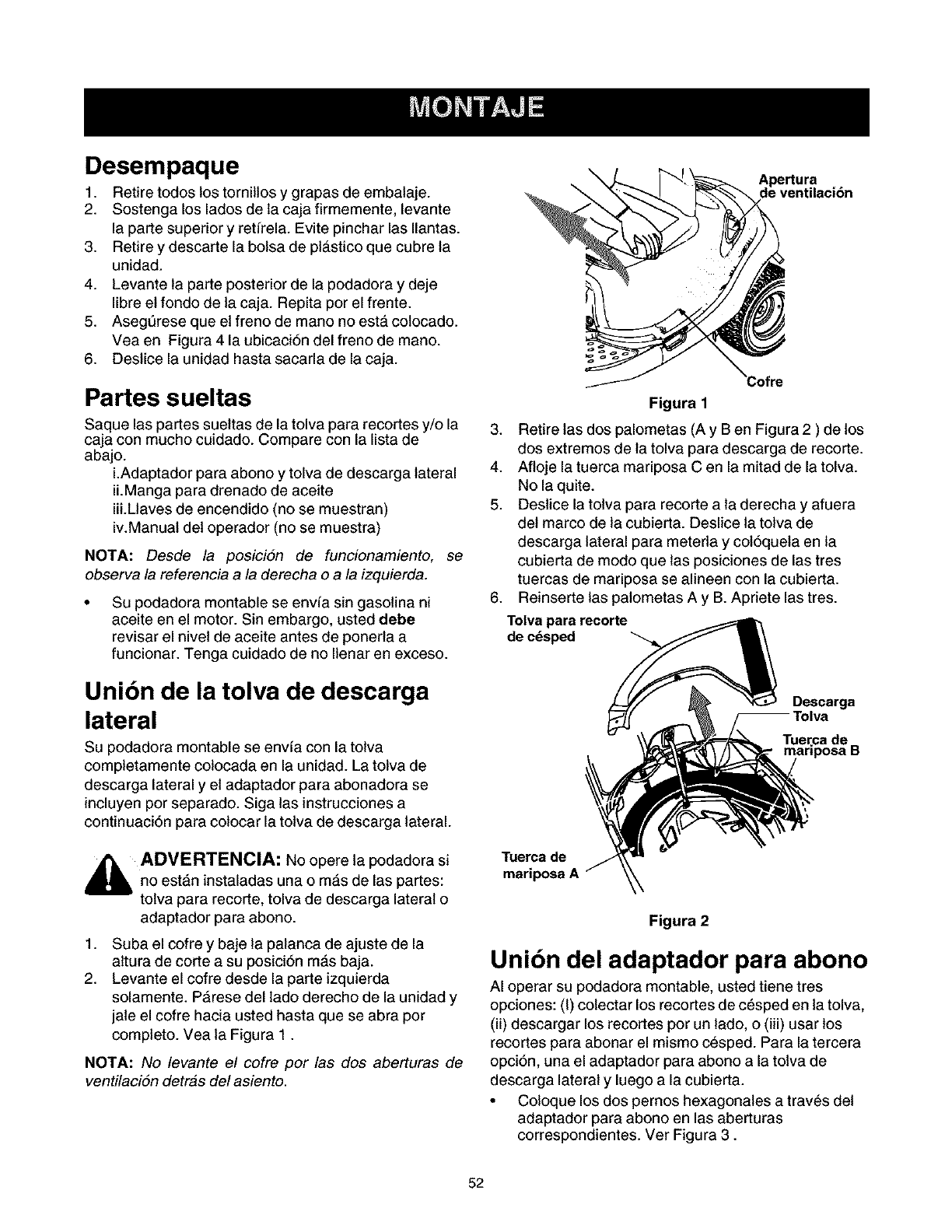
Desempaque
1. Retire todos los tornillos y grapas de embalaje.
2. Sostenga los lados de la caja firmemente, levante
la parte superior y retfrela. Evite pinchar las Ilantas.
3. Retire y descarte la bolsa de plastico que cubre la
unidad.
4. Levante la parte posterior de la podadora y deje
libre et fondo de la caja. Repita por el frente.
5. Asegi3rese que et freno de mano no est_l colocado.
Vea en Figura 4 la ubicaci6n del freno de mano.
6. Deslice la unidad hasta sacarla de la caja.
Partes sueltas
Saque las partes suettas de la tolva para recortes y/o la
caja con mucho cuidado. Compare con la lista de
abajo.
i.Adaptador para abono y tolva de descarga lateral
ii.Manga para drenado de aceite
iii.Llaves de encendido (no se muestran)
iv.Manual det operador (no se muestra)
NOTA: Desde la posicion de funcionamiento, se
observa la referencia a la derecha oa la izquierda.
Su podadora montable se envfa sin gasolina ni
aceite en el motor. Sin embargo, usted debe
revisar el nivet de aceite antes de ponerla a
funcionar. Tenga cuidado de no Ilenar en exceso.
Unibn de la tolva de descarga
lateral
Su podadora montable se envfa con la tolva
completamente colocada en la unidad. La tolva de
descarga lateral y et adaptador para abonadora se
incluyen por separado. Siga las instrucciones a
continuaci6n para colocar la tolva de descarga lateral.
,_ ADVERTENCIA: No opere la podadora si
no est_ln instaladas una o m_ls de las partes:
tolva para recorte, tolva de descarga lateral o
adaptador para abono.
1.
2.
Suba el cofre y baje la palanca de ajuste de la
altura de corte a su posici6n mas baja.
Levante el cofre desde la parte izquierda
solamente. PArese del lado derecho de la unidad y
jale el cofre hacia usted hasta que se abra por
completo. Vea la Figura 1.
NOTA: No levante el cofre por las dos aberturas de
ventilaci6n detras de/asiento.
Apertura
de ventilacibn
Figura 1
3. Retire las dos palometas (A y Ben Figura 2 ) de los
dos extremos de la tolva para descarga de recorte.
4. Afloje la tuerca mariposa C en la mitad de la tolva.
No la quite.
5. Destice la tolva para recorte a la derecha y afuera
det marco de la cubierta. Deslice la tolva de
descarga lateral para meterla y col6queta en la
cubierta de modo que las posiciones de las tres
tuercas de mariposa se alineen con la cubierta.
6. Reinserte las palometas A y B. Apriete las tres.
Tolva para recorte
de c_sped
Descarga
Tolva
Tuer.ca de
Tuerca de
mariposa A
Figura 2
Unibn del adaptador para abono
AI operar su podadora montable, usted tiene tres
opciones: (I) colectar los recortes de c_sped en la tolva,
(ii) descargar los recortes por un lado, o (iii) usar los
recortes para abonar el mismo cesped. Para la tercera
opci6n, una el adaptador para abono a la tolva de
descarga lateral y luego a la cubierta.
• Coloque los dos pemos hexagonales a trav_s det
adaptador para abono en las aberturas
correspondientes. Ver Figura 3.
52
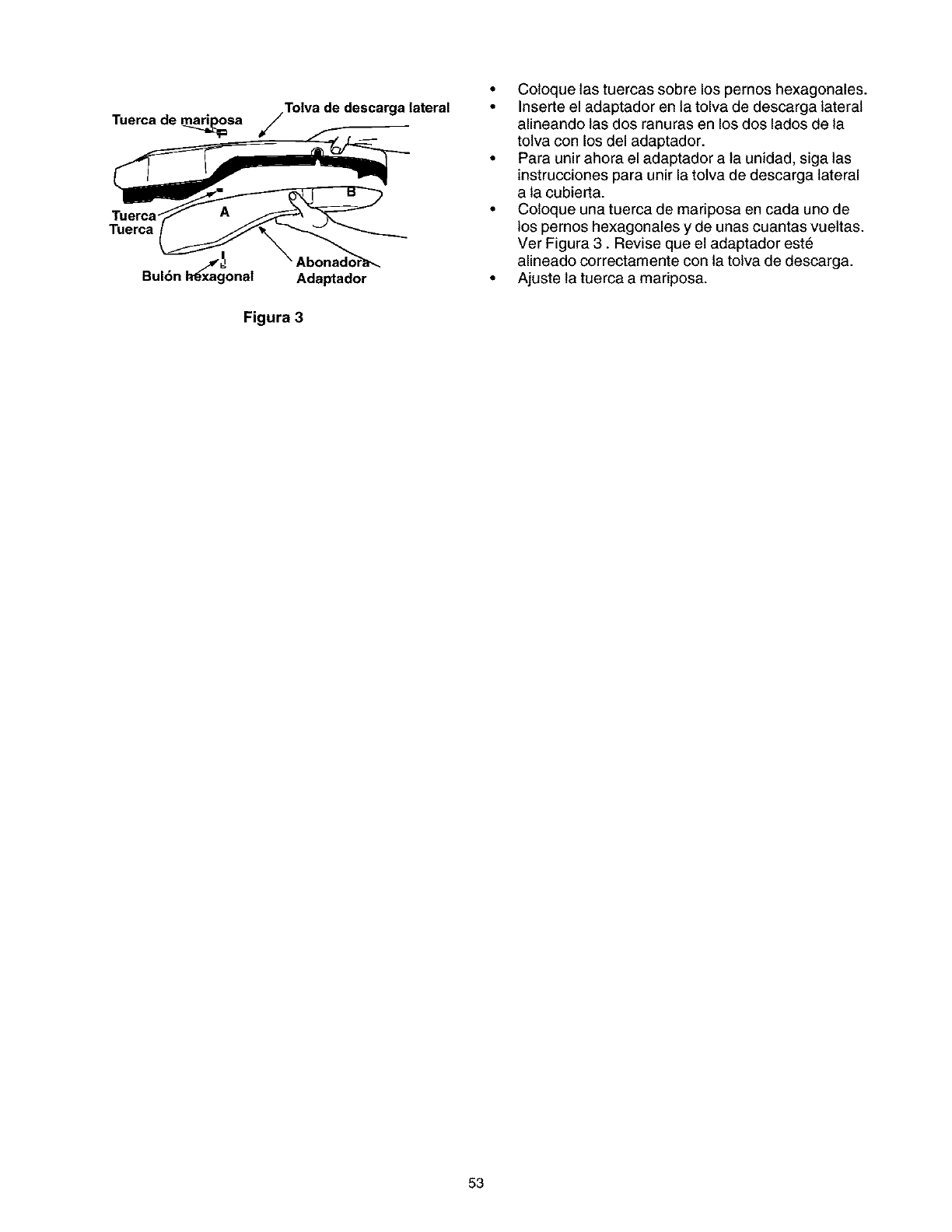
Tuerca de marieosa jTolva de descarga lateral
Tuerca____ _ f....L_-_
Bul6n I_xaxagonal Adaptado_""°'oonaa°rra_
• Coloque las tuercas sobre los pernos hexagonales.
• Inserte el adaptador en la tolva de descarga lateral
alineando gasdos ranuras en los dos lados de la
tolva con los del adaptador.
• Para unir ahora el adaptador a la unidad, siga las
instrucciones para unir la tolva de descarga lateral
a la cubierta.
• Coloque una tuerca de madposa en cada uno de
los pernos hexagonales y de unas cuantas vuettas.
Ver Figura 3. Revise que et adaptador est6
alineado correctamente con la tolva de descarga.
• Ajuste la tuerca a mariposa.
Figura 3
53
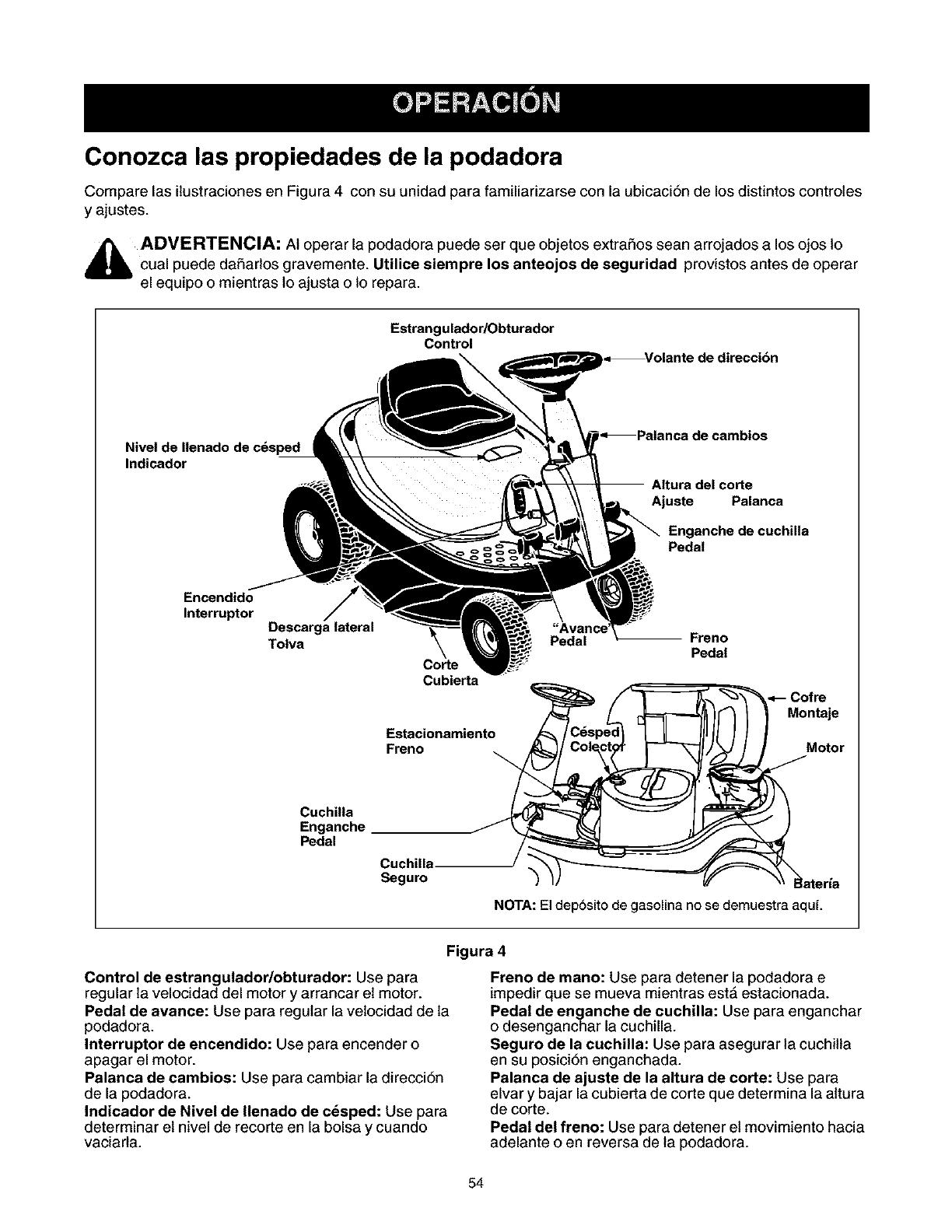
Conozca las propiedades de la podadora
Compare las ilustraciones en Figura 4 con su unidad para familiarizarse con la ubicaciSn de los distintos controles
y ajustes.
_lb ADVERTENCIA: AI operar la podadora puede ser que objetos extraSos sean arrojados a los ojos 1o
cual puede da_arlos gravemente. Utilice siempre los anteojos de seguridad provistos antes de operar
el equipo o mientras 1oajusta o 1orepara.
Estrang ulador/Obturador
Control
Nivel de Ilenado de cdsped
Indicador
i'=_Patanca de cambios
Altura del corte
Ajuste Palanca
Enganche de cuchilla
Pedal
Encendido
Interruptor Descarga lateral
Tolva Pedal Freno
Pedal
Corte
Cubierta _ _,_-- Cofre
_, [_"_ / _ Montaje
Estacionamiento 2_/Cespedl I U II] II I /
Freno _Motor,.
Cuchilla
Enganche
Pedal
Cuchina /.,"_ __=__,'_/_
Seguro J _/ v/ _Bateria
NOTA: El deposito de gasolina no se demuestra aqui.
Figura 4
Control de estrangulador/obturador: Use para
regular la velocidad del motor y arrancar et motor.
Pedal de avance: Use para regular la vetocidad de la
podadora.
Interruptor de encendido: Use para encender o
apagar el motor.
Palanca de cambios: Use para cambiar la direcciSn
de la podadora.
Indicador de Nivel de Ilenado de c_sped: Use para
determinar et nivel de recorte en la bolsa y cuando
vaciarla.
Freno de mano: Use para detener la podadora e
impedir que se mueva mientras est& estacionada.
Pedal de enganche de cuchilla: Use para enganchar
o desenganchar la cuchilla.
Seguro de la cuchilla: Use para asegurar la cuchitla
en su posici6n enganchada.
Palanca de ajuste de la altura de corte: Use para
elvar y bajar la cubierta de corte que determina la altura
de corte.
Pedal del freno: Use para detener et movimiento hacia
adelante o en reversa de la podadora.
54
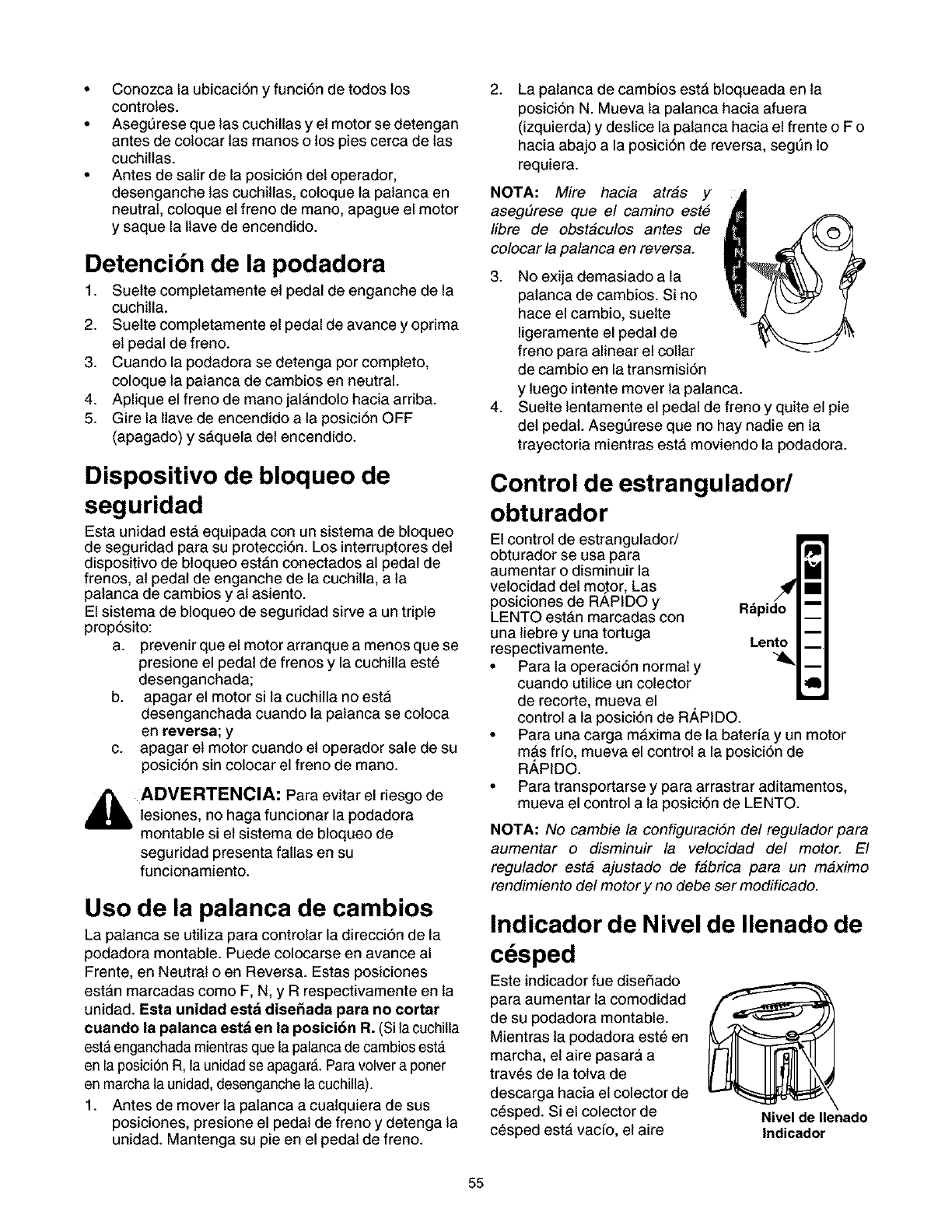
• Conozca la ubicaci6n y funci6n de todos los
controles.
• Asegt_rese que las cuchillas y et motor se detengan
antes de colocar las manos o los pies cerca de las
cuchillas.
• Antes de salir de la posici6n det operador,
desenganche tas cuchitlas, coloque la palanca en
neutral, coloque et freno de mano, apague el motor
y saque la ltave de encendido.
Detencibn de la podadora
1. Suette completamente et pedal de enganche de la
cuchilla.
2. Suette completamente el pedal de avarice y oprima
et pedal de freno.
3. Cuando la podadora se detenga por completo,
coloque la palanca de cambios en neutral.
4. Aplique el freno de mano jala.ndolo hacia arriba.
5. Gire la llave de encendido a la posici6n OFF
(apagado) y sAquela del encendido.
Dispositivo de bloqueo de
seguridad
Esta unidad esta. equipada con un sistema de bloqueo
de seguridad para su protecci6n. Los interruptores det
dispositivo de bloqueo est&n conectados al pedal de
frenos, al pedal de enganche de la cuchitla, a la
palanca de cambios y al asiento.
El sistema de bloqueo de seguridad sirve a un triple
prop6sito:
a. prevenir que el motor arranque a menos que se
presione el pedal de frenos y la cuchilla est_
desenganchada;
b. apagar el motor si la cuchitla no esta
desenganchada cuando la palanca se coloca
en reversa; y
c. apagar et motor cuando et operador sale de su
posici6n sin colocar el freno de mano.
,_ ADVERTENCIA: Para evitar el riesgo de
tesiones, no haga funcionar la podadora
montable si et sistema de bloqueo de
seguridad presenta fallas en su
funcionamiento.
Uso de la palanca de cambios
La palanca se utitiza para controlar la direcci6n de la
podadora montable. Puede colocarse en avance al
Frente, en Neutral o en Reversa. Estas posiciones
esta.n marcadas como F, N, y R respectivamente en la
unidad. Esta unidad est_ disefiada para no cortar
cuando la palanca est& en la posicibn R. (Si lacuchilla
esta enganchada mientras que la palanca de cambios est_
en la posici6n R, la unidadse apagara. Para volver a poner
en marcha la unidad, desenganche la cuchilla).
1. Antes de mover la palanca a cualquiera de sus
posiciones, presione el pedal de freno y detenga la
unidad. Mantenga su pie en el pedal de freno.
2. La palanca de cambios estA bloqueada en la
posici6n N. Mueva la palanca hacia afuera
(izquierda) y deslice la palanca hacia el frente o F o
hacia abajo a la posici6n de reversa, segt_n 1o
requiera.
NOTA: Mire hacia atras y
aseg#rese que el camino est#
libre de obstaculos antes de
colocar la palanca en reversa.
.
4.
No exija demasiado a la
palanca de cambios. Si no
hace el cambio, suette
ligeramente el pedal de
freno para alinear el collar
de cambio en la transmisi6n
y luego intente mover la palanca.
Suette lentamente el pedal de freno y quite el pie
det pedal. Asegt_rese que no hay nadie en la
trayectoria mientras estA moviendo la podadora.
Control de estrangulador/
obturador
El control de estrangulador/
obturador se usa para
aumentar o disminuir la
velocidad del motor, Las
posiciones de RAPIDO y
LENTO estan marcadas con
una liebre y una tortuga
respectivamente.
• Para la operaci6n normal y
cuando utilice un colector
de recorte, mueva el
control a la posici6n de R,_,PIDO.
• Para una carga m&xima de la baterfa y un motor
mas fifo, mueva el control a la posici6n de
R,_,PIDO.
• Para transportarse y para arrastrar aditamentos,
mueva el control a la posici6n de LENTO.
NOTA: No cambie la configuraci6n de/regulador para
aumentar o disminuir la velocidad de/ motor. El
regulador esta ajustado de fabrica para un maximo
rendimiento del motor y no debe ser modificado.
Indicador de Nivel de Ilenado de
c sped
Este indicador fue disefiado
para aumentar la comodidad
de su podadora montable.
Mientras la podadora est_ en
marcha, et aire pasara a
trav_s de la tolva de
descarga hacia el colector de
cesped. Si el colector de
cesped esta vacfo, et aire Nivel de Ilenado
Indicador
55
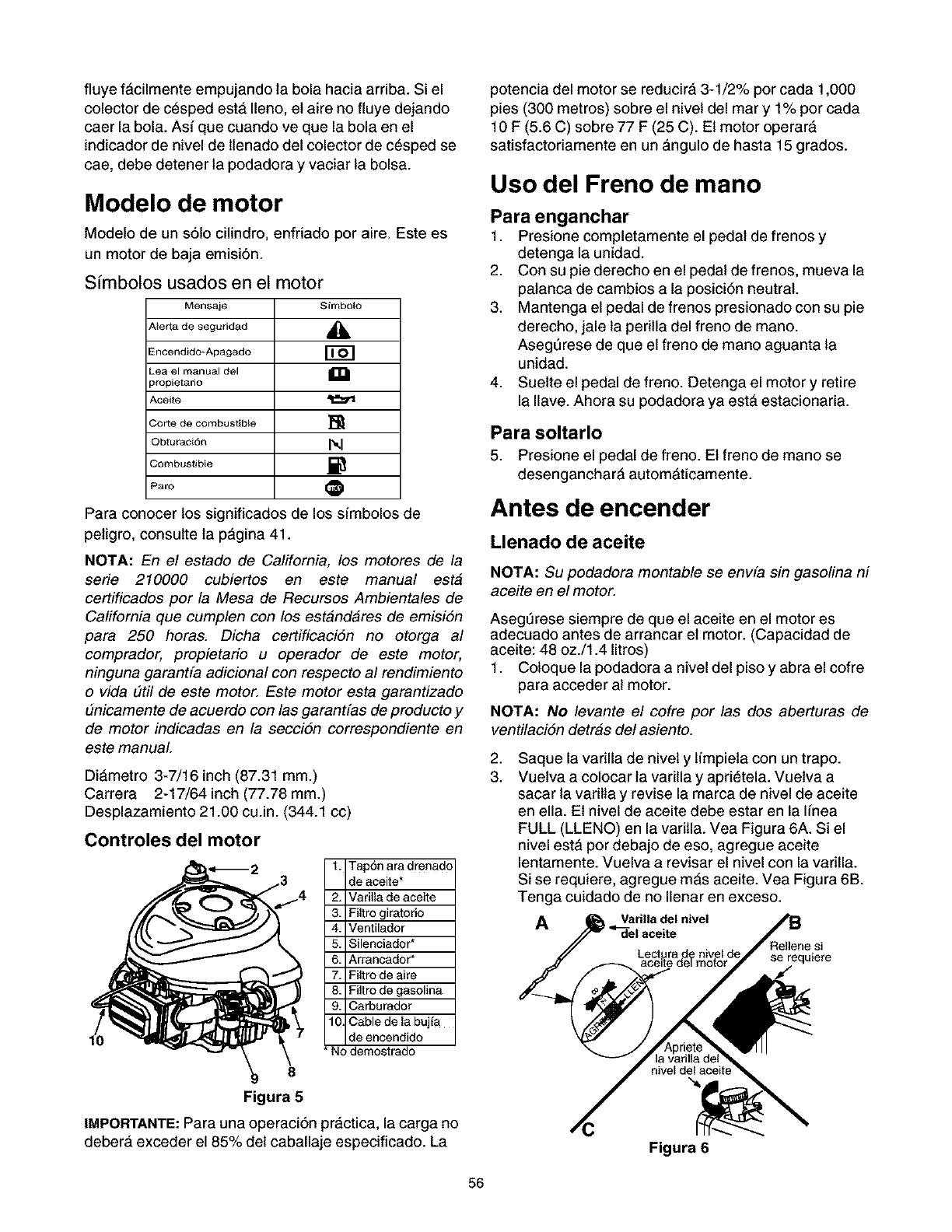
fluyefacilmenteempujandolabolahaciaarriba.Siel
colectordecespedest&Ileno,etairenofluyedejando
caerlabola.Asfquecuandovequelabolaenel
indicadordeniveldeItenadodelcolectordec_spedse
cae,debedetenerlapodadoray vaciarlabolsa.
Modelo de motor
Modelo de un s61o cilindro, enfriado pot aire. Este es
un motor de baja emisi6n.
Simbolos usados en el motor
Mensaje Simbo_o
A_erta de seguridad _1=
Encendido-Apagado IT_
Lea el manual del I_
propietario
Aceite
Corte de combustible
Obturaci6n I_l
Combustibteparo
Para conocer los significados de los simbolos de
petigro, consulte la pa.gina 41.
NOTA: En el estado de California, los motores de la
serie 210000 eubiertos en este manual esta
certificados por la Mesa de Recursos Ambientales de
California que cumplen con los estandares de emisidn
para 250 horas. Dicha eertificacidn no otorga al
comprador, propietario u operador de este motor,
ninguna garantia adicional con respecto al rendimiento
o vida _til de este motor. Este motor esta garantizado
dnicamente de acuerdo con las garant/as de producto y
de motor indicadas en la seeeion correspondiente en
este manual
Di&metro 3-7/16 inch (87.31 mm.)
Carrera 2-17/64 inch (77.78 mm.)
Desplazamiento 21.00 cu.in. (344.1 cc)
Controles del motor
=_2 1_ Tap6n ara drenado
de aceite*
2. Varilla de aceite
3. Filtro giratorio
4. Ventilador
5. Silenciador*
6. Arrancador*
7. Filtro de aire
8. Filtro de gasolina
9. Carburador
10 Cable de la bujia
de encendido
* No demostrado
9 8
Figura 5
IMPORTANTE: Para una operaci6n pr&ctica, la carga no
debera exceder el 85% det caballaje especificado. La
potencia del motor se reducira. 3-1/2% por cada 1,000
pies (300 metros) sobre el nivet del mar y 1% por cada
10 F (5.6 C) sobre 77 F (25 C). El motor operar&
satisfactoriamente en un angulo de hasta 15 grados.
Uso del Freno de mano
Para enganchar
1. Presione completamente el pedal de frenos y
detenga la unidad.
2. Con su pie derecho en el pedal de frenos, mueva la
palanca de cambios a la posici6n neutral.
3. Mantenga el pedal de frenos presionado con su pie
derecho, jale la peritla del freno de mano.
Asegerese de que el freno de mano aguanta la
unidad.
4. Suette el pedal de freno. Detenga el motor y retire
la Ilave. Ahora su podadora ya esta estacionaria.
Para soltarlo
5. Presione el pedal de freno. El freno de mano se
desenganchar& autom&ticamente.
Antes de encender
Llenado de aceite
NOTA: Su podadora montable se envfa sin gasolina ni
aceite en el motor.
Aseg_rese siempre de que el aceite en el motor es
adecuado antes de arrancar et motor. (Capacidad de
aceite: 48 oz./1.4 litros)
1. Coloque la podadora a nivel del piso y abra el co/re
para acceder al motor.
NOTA: No levante el co/re por las dos aberturas de
ventilacidn detras del asiento.
2.
3. Saque la varilla de nivet y lfmpieta con un trapo.
Vuetva a colocar la varilla y aprietela. Vuetva a
sacar la varilta y revise la marca de nivel de aceite
en ella. El nivel de aceite debe estar en la Ifnea
FULL (LLENO) en la varitla. Vea Figura 6A. Si el
nivel esta. por debajo de eso, agregue aceite
lentamente. Vuelva a revisar el nivel con la varilla.
Si se requiere, agregue m&s aceite. Vea Figura 6B.
Tenga cuidado de no Ilenar en exceso.
AVarilla del nivel
se requiere
Figura 6
56
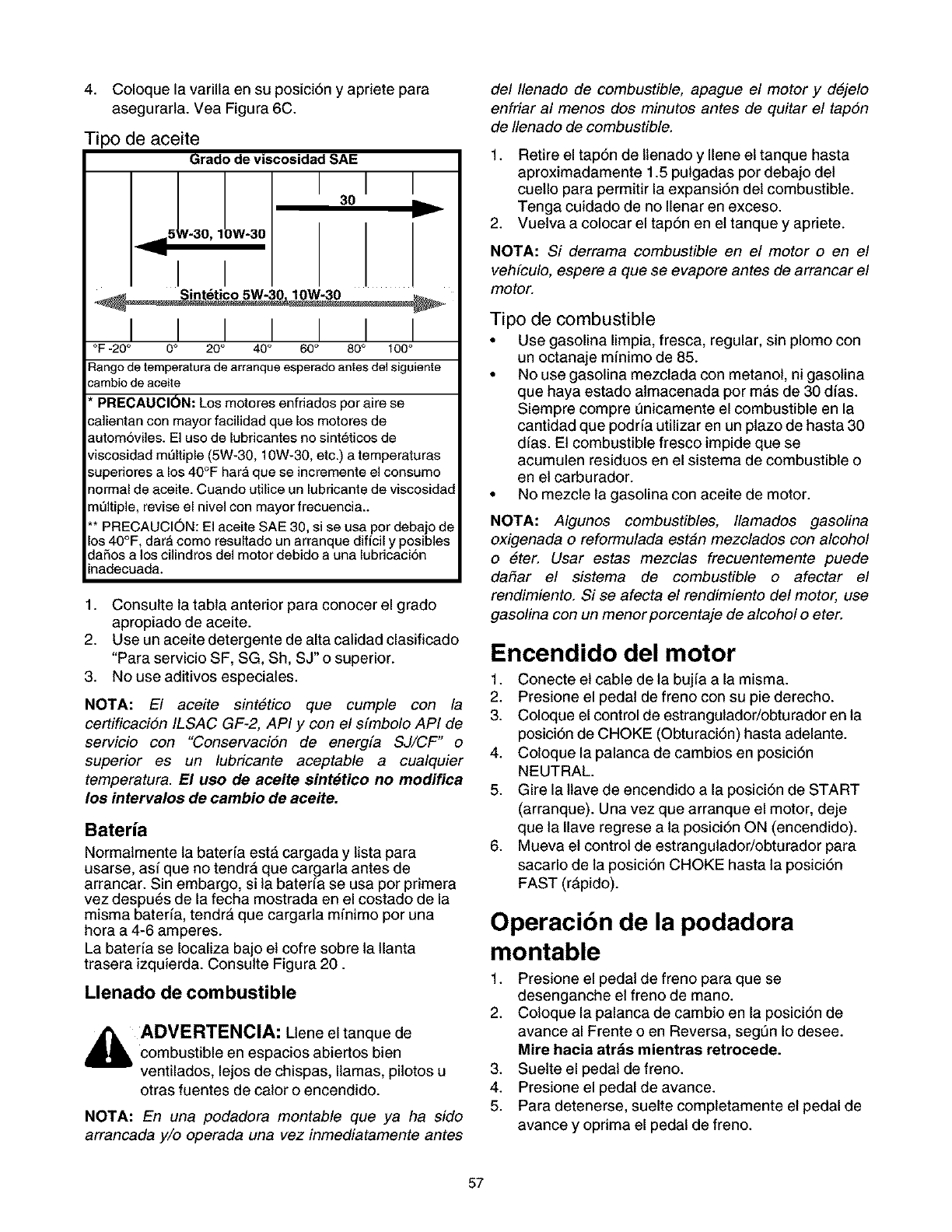
4. Coloquelavarillaensuposici6ny aprietepara
asegurarla.VeaFigura6C.
Tipo de aceite
Grado de viscosidad SAE
III
30 ==.._
_.==5 N-30, 1)W-30
I I
oF .20 oII III
0 o 20 °40 ° 60 ° 80° 100 °
_ango de temperatura de arranque esperado antes del siguiente
.'ambiode aceite
PRECAUCION: Los motores enfriados por aire se
_'alientan con mayor facilidad que los motores de
]utomSviles. El uso de lubricantes no sint_ticos de
Jiscosidad meltiple (5W-30, 10W-30, etc.) a temperaturas
_uperiores a los 40°F har_, que se incremente el consumo
_ormal de aceite. Cuando utilice un lubdcante de viscosidad
"n01tiple, revise el nivel con mayor frecuencia..
_*PRECAUCI6N: El aceite SAE 30, si se usa por debajo de
os 40°F, dar_ como resultado un arranque dificil y posibles
JaSos a los cilindros del motor debido a una lubdcacion
nadecuada.
1. Consulte la tabla anterior para conocer el grado
apropiado de aceite.
2. Use un aceite detergente de alta calidad clasificado
"Para servicio SF, SG, Sh, SJ" o superior.
3. No use aditivos especiales.
NOTA: El aceite sint#tico que cumple con la
certificacion ILSAC GF-2, API y con el sfmbolo API de
servicio con "Conservacion de energfa SJ/CF" o
superior es un lubricante aceptable a cualquier
temperatura. El uso de aceite sint#tieo no modifiea
los intervalos de cambio de aceite.
Bateria
Normalmente la baterfa estA cargada y lista para
usarse, asf que no tendrA que cargarla antes de
arrancar. Sin embargo, si la baterfa se usa por primera
vez despu_s de la fecha mostrada en el costado de la
misma baterfa, tendra que cargarla mfnimo por una
hora a 4-6 amperes.
La baterfa se Iocaliza bajo et cofre sobre la llanta
trasera izquierda. Consulte Figura 20.
Llenado de combustible
_lb ADVERTENCIA: Llene el tanque de
combustible en espacios abiertos bien
ventilados, lejos de chispas, llamas, pilotos u
otras fuentes de calor o encendido.
NOTA: En una podadora montable que ya ha side
arrancada y/o operada una vez inmediatamente antes
del Ilenado de combustible, apague el motor y d#jelo
enfriar al menos dos minutos antes de quitar el tapon
de Ilenado de combustible.
1. Retire el tap6n de Itenado y Ilene et tanque hasta
aproximadamente 1.5 pulgadas por debajo det
cuetlo para permitir la expansi6n det combustible.
Tenga cuidado de no Ilenar en exceso.
2. Vuetva a colocar el tapSn en et tanque y apdete.
NOTA: Si derrama combustible en el motor o en el
vehfculo, espere a que se evapore antes de arrancar el
motor.
Tipo de combustible
• Use gasolina limpia, fresca, regular, sin plomo con
un octanaje mfnimo de 85.
• No use gasolina mezclada con metanol, ni gasolina
que haya estado atmacenada por mas de 30 dfas.
Siempre compre Qnicamente el combustible en la
cantidad que podrfa utilizar en un plazo de hasta 30
dfas. El combustible fresco impide que se
acumulen residuos en el sistema de combustible o
en et carburador.
• No mezcle la gasolina con aceite de motor.
NOTA: Algunos combustibles, Ilamados gasolina
oxigenada o reformulada estan mezclados con alcohol
o eter. Usar estas mezclas frecuentemente puede
da#ar el sistema de combustible o afectar el
rendimiento. Si se afecta el rendimiento del motor, use
gasolina con un menor porcentaje de alcohol o eter.
Encendido del motor
1. Conecte et cable de la bujfa a la misma.
2. Presione el pedal de freno con su pie derecho.
3. Coloque el control de estrangulador/obturador en la
posici6n de CHOKE (Obturaci6n) hasta adelante.
4. Coloque la palanca de cambios en posici6n
NEUTRAL.
5. Gire la ltave de encendido a la posiciSn de START
(arranque). Una vez que arranque el motor, deje
que la Ilave regrese a la posiciSn ON (encendido).
6. Mueva et control de estrangulador/obturador para
sacarlo de la posici6n CHOKE hasta la posici6n
FAST (rApido).
Operacibn de la podadora
montable
1. Presione el pedal de freno para que se
desenganche et freno de mano.
2. Coloque la palanca de cambio en la posiciSn de
avance al Frente o en Reversa, segQn Io desee.
Mire hacia atr_s mientras retrocede.
3. Suette el pedal de freno.
4. Presione el pedal de avance.
5. Para detenerse, suelte completamente et pedal de
avarice y oprima el pedal de freno.
57
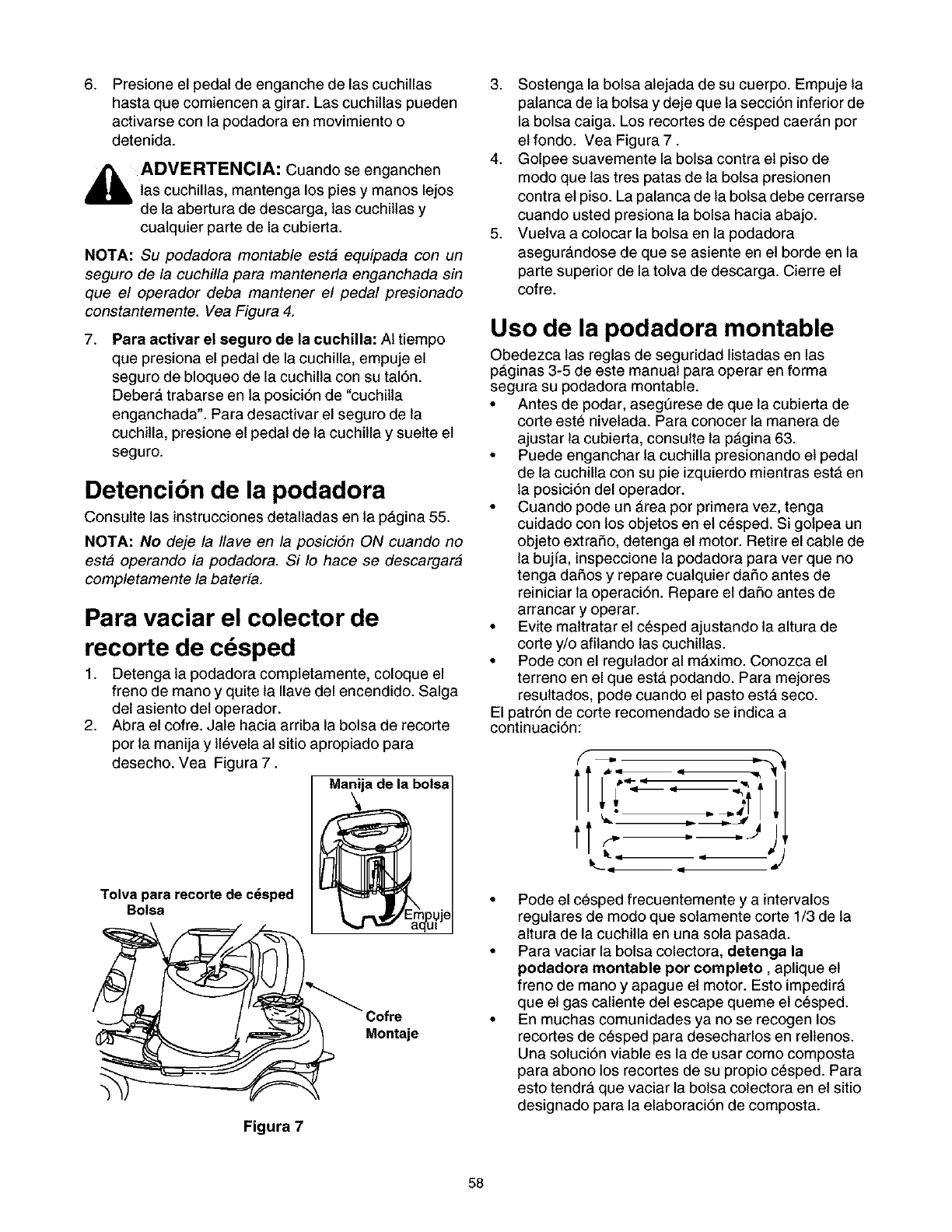
.Presione el pedal de enganche de las cuchillas
hasta que comiencen a girar. Las cuchitlas pueden
activarse con la podadora en movimiento o
detenida.
,_ ADVERTENCIA: Cuando se enganchen
tas cuchillas, mantenga los pies y manos lejos
de la abertura de descarga, las cuchiltas y
cualquier parte de la cubierta.
NOTA: Su podadora montable esta equipada con un
seguro de la cuchilla para mantenerla enganchada sin
que el operador deba mantener el pedal presionado
constantemente. Vea Figura 4.
7. Para activar el seguro de la cuchilla: AI tiempo
que presiona el pedal de la cuchilla, empuje el
seguro de bloqueo de la cuchilla con su tal6n.
Debera trabarse en la posici6n de "cuchilta
enganchada". Para desactivar el seguro de la
cuchitla, presione el pedal de la cuchitla y suette et
seguro.
Detencibn de la podadora
Consulte las instrucciones detalladas en la pAgina 55.
NOTA: No deje la Ilave en la posici6n ON cuando no
esta operando la podadora. Si Io hace se descargara
completamente la bated&
Para vaciar el colector de
recorte de c6sped
1. Detenga la podadora completamente, coloque el
freno de mano y quite la Ilave del encendido. Salga
det asiento det operador.
2. Abra el cofre. Jale hacia arriba la bolsa de recorte
por la manija y ll_vela al sitio apropiado para
desecho. Vea Figura 7.
Manija de la bolsa
\
Tolva para recorte de c_sped
Bolsa _/Eamq_je
Montaje
Figura 7
3. Sostenga la bolsa alejada de su cuerpo. Empuje la
palanca de la bolsa y deje que la secci6n inferior de
la bolsa caiga. Los recortes de cesped caeran por
et fondo. Vea Figura 7.
4. Golpee suavemente la bolsa contra et piso de
modo que las tres patas de la bolsa presionen
contra et piso. La palanca de la bolsa debe cerrarse
cuando usted presiona la bolsa hacia abajo.
5. Vuetva a colocar la bolsa en la podadora
asegurAndose de que se asiente en et borde en la
parte superior de la tolva de descarga. Cierre el
cofre.
Uso de la podadora montable
Obedezca las reglas de seguridad listadas en las
pAginas 3-5 de este manual para operar en forma
segura su podadora montable.
• Antes de podar, aseg6rese de que la cubierta de
corte este nivetada. Para conocer la manera de
ajustar la cubierta, consulte la pagina 63.
• Puede enganchar la cuchilla presionando et pedal
de la cuchilla con su pie izquierdo mientras estA en
la posici6n del operador.
• Cuando pode un Area por primera vez, tenga
cuidado con los objetos en et cesped. Si golpea un
objeto extrafio, detenga el motor. Retire el cable de
la bujfa, inspeccione la podadora para ver que no
tenga dafios y repare cualquier dafio antes de
reiniciar la operaci6n. Repare et dafio antes de
arrancar y operar.
• Evite maltratar et c_sped ajustando la altura de
corte y/o afitando tas cuchillas.
• Pode con el regulador al mAximo. Conozca el
terreno en el que estA podando. Para mejores
resultados, pode cuando el pasto estA seco.
El patr6n de corte recomendado se indica a
continuaci6n:
• Pode el cesped frecuentemente y a intervalos
regulares de modo que solamente corte 1/3 de la
altura de la cuchitla en una sola pasada.
• Para vaciar la bolsa colectora, detenga la
podadora montable per complete, aplique et
freno de mano y apague et motor. Esto impedirA
que et gas caliente del escape queme et cesped.
• En muchas comunidades ya no se recogen los
recortes de cesped para desecharlos en retlenos.
Una soluci6n viable es la de usar como composta
para abono los recortes de su propio cesped. Para
esto tendra que vaciar la bolsa colectora en et sitio
designado para la elaboraci6n de composta.
58
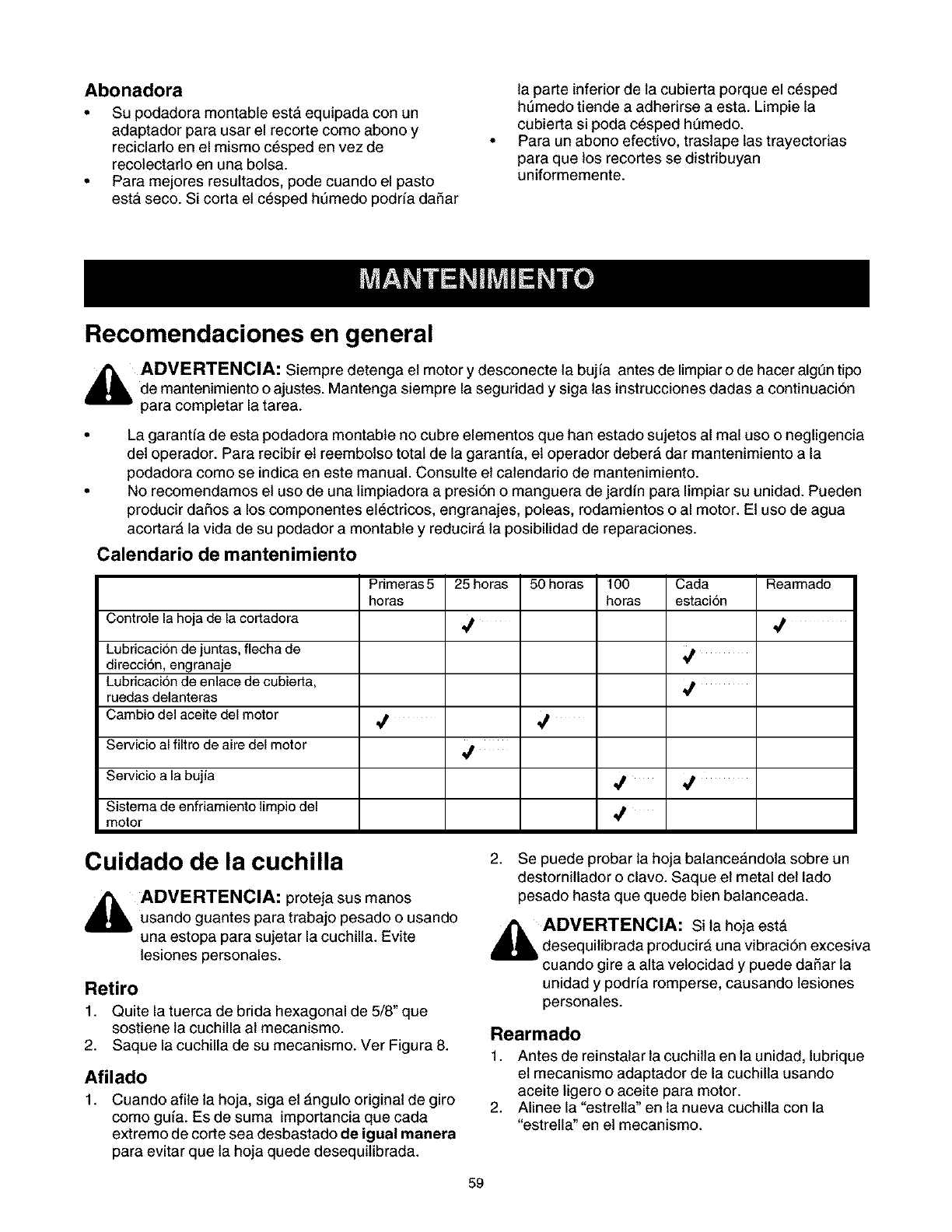
Abonadora
• Su podadora montable esta equipada con un
adaptador para usar el recorte como abono y
reciclarlo en el mismo c_sped en vez de
recolectarlo en una bolsa.
• Para mejores resultados, pode cuando el paste
esta seco. Si corta et cesped hQmedo podrfa daSar
la parte inferior de la cubierta porque el cesped
hQmedo tiende a adherirse a esta. Limpie la
cubierta si poda c_sped hQmedo.
Para un abono efectivo, trastape las trayectorias
para que los recortes se distdbuyan
uniformemente.
Recomendaciones en general
i_ ADVERTENCIA: Siempre detenga et motor y desconecte la bujfa antes de limpiar o de hacer algQntipo
de mantenimiento o ajustes. Mantenga siempre la seguridad y siga las instrucciones dadas a continuaci6n
para completar la tarea.
La garantfa de esta podadora montable no cubre elementos que hart estado sujetos al mal uso o negligencia
det operador. Para recibir et reembolso total de la garantfa, et operador deberA dar mantenimiento a la
podadora como se indica en este manual. Consulte et calendado de mantenimiento.
No recomendamos et use de una limpiadora a presi6n o manguera de jardfn para limpiar su unidad. Pueden
producir dai_os a los componentes electricos, engranajes, poleas, rodamientos o al motor. El use de agua
acortarA la vida de su podador a montable y reducira la posibilidad de reparaciones.
Calendario de mantenimiento
Primeras 5 25 horas 50 horas 100 Cada Rearrnado
horas horas estacion
Controle la hoja de la cortadora
Lubricacion de juntas, flecha de _#
direcci6n, engranaje
Lubdcacion de enlace de cubierta, ,_I
ruedas delanteras
Cambio del aceite del motor _ ,_
Servicio al filtro de aire del motor
Servicio a la bujia _# ,_I
Sistema de enfriamiento limpio del
motor
Cuidado de la cuchilla
i_ll ADVERTENCIA: proteja sus manos
usando guantes para trabajo pesado o usando
una estopa para sujetar la cuchilla. Evite
lesiones personales.
Retiro
1. Quite la tuerca de brida hexagonal de 5/8" que
sostiene la cuchitla al mecanismo.
2. Saque la cuchilla de su mecanismo. Ver Figura 8.
Afilado
1. Cuando afile la hoja, siga et Angulo original de giro
como gufa. Es de suma importancia que cada
extremo de corte sea desbastado de igual manera
para evitar que la hoja quede desequitibrada.
2. Se puede probar la hoja balance_mdola sobre un
destornitlador o clave. Saque et metal det lado
pesado hasta que quede bien balanceada.
i_ll ADVERTENCIA: Si la hoja est_l
desequilibrada producir61 una vibraci6n excesiva
cuando gire a alta vetocidad y puede daSar la
unidad y podrfa romperse, causando lesiones
personales.
Rearmado
1. Antes de reinstalar la cuchilla en la unidad, lubrique
et mecanismo adaptador de la cuchilla usando
aceite Iigero o aceite para motor.
2. Alinee la "estretla" en la nueva cuchilta con la
"estrella" en et mecanismo.
59
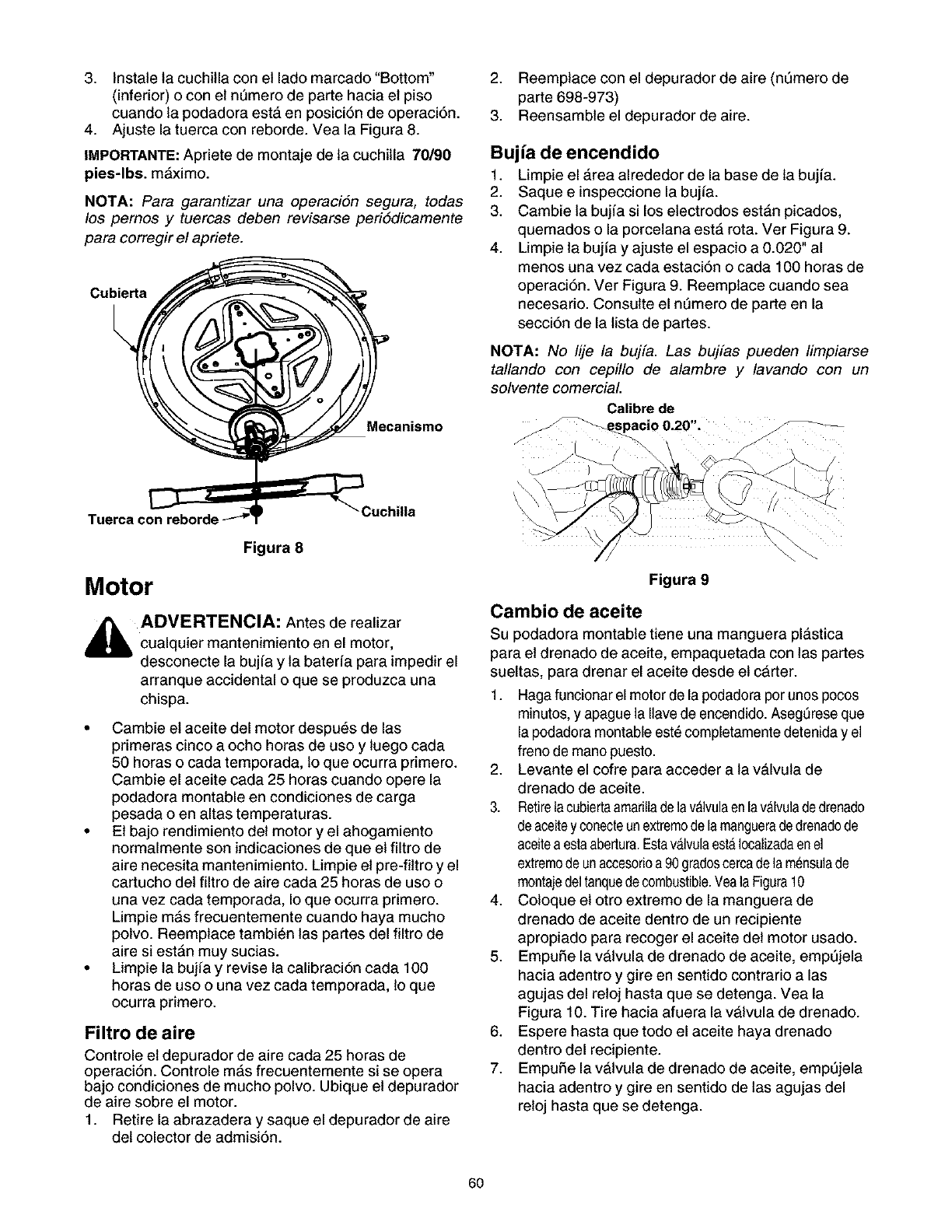
3. Instalelacuchitlaconetladomarcado"Bottom"
(inferior)oconetnQmerodepartehaciaetpiso
cuandolapodadoraestaenposici6ndeoperaci6n.
4. Ajustelatuercaconreborde.VealaFigura8.
IMPORTANTE:Apriete de montaje de la cuchitla 70/90
pies-lbs, mAximo.
NOTA: Para garantizar una operacion segura, todas
los pernos y tuercas deben revisarse peri6dicamente
para corregir el apriete.
Cubierta
Mecanismo
2. Reempiace con el depurador de aire (nQmero de
parte 698-973)
3. Reensambie el depurador de aire.
Bujia de encendido
1. Limpie el Area alrededor de la base de la bujfa.
2. Saque e inspeccione la bujfa.
3. Cambie la bujfa si los etectrodos estAn picados,
quemados o la porcetana estA rota. Ver Figura 9.
4. Limpie la buj[a y ajuste el espacio a 0.020" al
menos una vez cada estaci6n o cada 100 horas de
operaci6n. Ver Figura 9. Reempiace cuando sea
necesado. Consulte el nQmero de parte en la
secci6n de la lista de partes.
NOTA: No lije la bujfa. Las bujfas pueden limpiarse
tallando con cepillo de alambre y lavando con un
solvente comerciaL
Calibre de
_acio 0.20". _
Tuerca con rebordE
Figura 8
Cuchilla
Motor
,_ ADVERTENCIA: Antes de realizar
cualquier mantenimiento en el motor,
desconecte la bujfa y la baterfa para impedir el
arranque accidental o que se produzca una
chispa.
• Cambie et aceite del motor despues de las
primeras cinco a ocho horas de uso y luego cada
50 horas o cada temporada, lo que ocurra pdmero.
Cambie el aceite cada 25 horas cuando opere la
podadora montable en condiciones de carga
pesada o en altas temperaturas.
• El bajo rendimiento det motor y el ahogamiento
normalmente son indicaciones de que et filtro de
aire necesita mantenimiento. Limpie et pre-filtro y el
cartucho det filtro de aire cada 25 horas de uso o
una vez cada temporada, Io que ocurra primero.
Limpie mAs frecuentemente cuando haya mucho
polvo. Reemplace tambi_n las partes del filtro de
aire si estAn muy sucias.
• Limpie la bujfa y revise la calibraci6n cada 100
horas de uso ouna vez cada temporada, lo que
ocurra primero.
Filtro de aire
Controle et depurador de aire cada 25 horas de
operaci6n. Controle mAs frecuentemente si se opera
bajo condiciones de mucho polvo. Ubique et depurador
de aire sobre el motor.
1. Retire la abrazadera y saque el depurador de aire
det colector de admisi6n.
Figura 9
Cambio de aceite
Su podadora montabie tiene una manguera plAstica
para et drenado de aceite, empaquetada con las partes
sueltas, para drenar el aceite desde et carter.
1. Haga funcionar el motor de la podadora por unos pocos
minutes,y apague la Ilave de encendido. Aseg6rese que
la podadoramontable est_ completamente detenida y el
freno de mane puesto.
2. Levante el cofre para acceder a la valvula de
drenado de aceite.
3. Retirelacubiertaamarilladelav_lvulaenlavalvuladedrenado
deaceitey conecteunextremodelamangueradedrenadode
aceitea estaabertura.Estav_lvulaest_Iocalizadaenel
extremodeunaccesorioa 90gradoscercadelam_nsulade
montajedeltanquedecombustible.VealaFigura10
4. Coloque et otro extremo de la manguera de
drenado de aceite dentro de un recipiente
apropiado para recoger el aceite det motor usado.
5. EmpuSe la vAIvula de drenado de aceite, empQjela
hacia adentro y gire en sentido contrario alas
agujas del retoj hasta que se detenga. Vea la
Figura 10. Tire hacia afuera la vAIvula de drenado.
6. Espere hasta que todo el aceite haya drenado
dentro del recipiente.
7. EmpuSe la vAIvula de drenado de aceite, empQjela
hacia adentro y gire en sentido de las agujas del
retoj hasta que se detenga.
6O
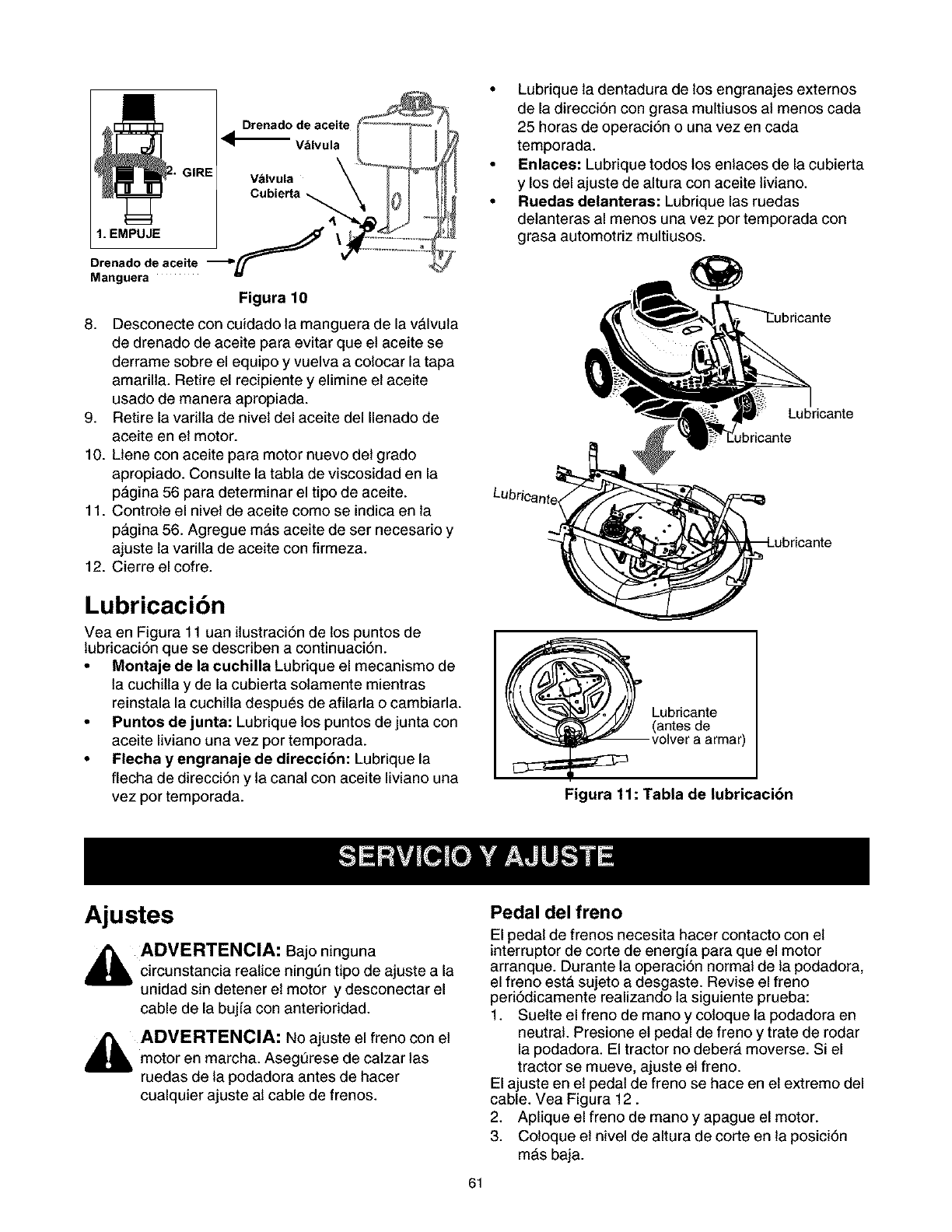
Drenado de aceite
_'-- Vblvula
Valvula
Cubierta ,_
___.f
Drenado de aceite
Manguera
Figura 10
8. Desconecte con cuidado la manguera de la va.lvula
de drenado de aceite para evitar que et aceite se
derrame sobre el equipo y vuelva a colocar la tapa
amarilla. Retire el recipiente y elimine et aceite
usado de manera apropiada.
9. Retire la varitla de nivet del aceite del Ilenado de
aceite en et motor.
10. Llene con aceite para motor nuevo det grade
apropiado. Consulte la tabla de viscosidad en la
pagina 56 para determinar el tipo de aceite.
11. Controle el nivet de aceite como se indica en la
pa.gina 56. Agregue ma.s aceite de ser necesado y
ajuste la varilla de aceite con firmeza.
12. Cierre el cofre.
Lubricacibn
Vea en Figura 11 uan ilustraci6n de los puntos de
lubricaci6n que se describen a continuaci6n.
•Montaje de la euchilla Lubdque el mecanismo de
la cuchitla y de la cubierta solamente mientras
reinstala la cuchitla despues de afilarla o cambiarla.
• Puntos de junta: Lubrique los puntos de junta con
aceite liviano una vez per temporada.
• Fleeha y engranaje de direeci6n: Lubrique la
flecha de direcci6n y la canal con aceite liviano una
vez por temporada.
• Lubrique la dentadura de los engranajes externos
de la direcci6n con grasa multiusos al menos cada
25 horas de operaci6n o una vez en cada
temporada.
• Enlaces: Lubrique todos los enlaces de la cubierta
y los del ajuste de altura con aceite liviano.
• Ruedas delanteras: Lubrique las ruedas
detanteras al menos una vez por temporada con
grasa automotriz multiusos.
Lubricante
e
_,_--_ volver a armar)
Figura 11: Tabla de lubricacibn
Ajustes
_i ADVERTENCIA: Bajo ninguna
circunstancia realice ningt_n tipo de ajuste a la
unidad sin detener et motor y desconectar el
cable de la bujfa con anterioridad.
,i_ ADVERTENCIA: No ajuste el freno con et
motor en marcha. Aseg6rese de calzar las
ruedas de la podadora antes de hacer
cualquier ajuste al cable de frenos.
61
Pedal del freno
El pedal de frenos necesita hacer contacto con et
interrupter de corte de energfa para que el motor
arranque. Durante la operaci6n normal de la podadora,
el freno esta. sujeto a desgaste. Revise el freno
peri6dicamente realizando la siguiente prueba:
1. Suelte el freno de mano y coloque la podadora en
neutral. Presione et pedal de freno y trate de rodar
la podadora. El tractor no debera moverse. Si el
tractor se mueve, ajuste et freno.
El ajuste en et pedal de freno se hace en et extreme del
cable. Vea Figura 12.
2. Aplique el freno de mano y apague el motor.
3. Coloque et nivel de altura de corte en la posici6n
mAs baja.
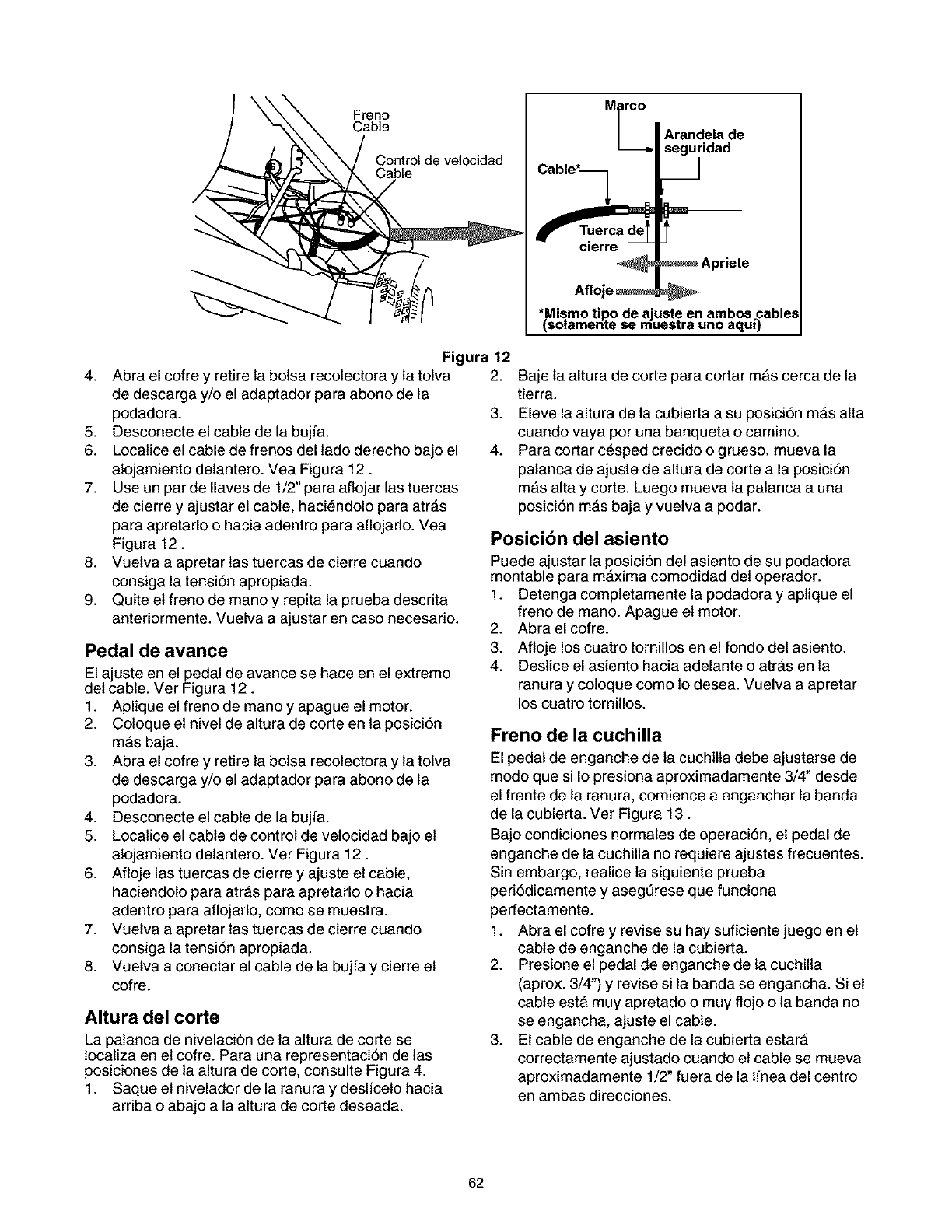
Freno
Cable
Control de velocidad
Cable
Figura 12
4. Abra el cofre y retire la bolsa recolectora y la tolva 2.
de descarga y/o el adaptador para abono de la
podadora. 3.
5. Desconecte el cable de la bujfa.
6. Localice el cable de frenos del lado derecho bajo el 4.
alojamiento detantero. Vea Figura 12.
7. Use un par de Ilaves de 1/2" para aflojar las tuercas
de cierre y ajustar el cable, haciendolo para atrAs
para apretarlo o hacia adentro para aflojarlo. Vea
Figura 12.
8. Vuetva a apretar las tuercas de cierre cuando
consiga la tensi6n apropiada.
9. Quite et freno de mano y repita la prueba descrita
anteriormente. Vuelva a ajustar en caso necesario.
Pedal de avance
El ajuste en el pedal de avance se hace en el extremo
det cable. Ver Figura 12.
1. Aplique el freno de mano yapague el motor.
2. Goloque et nivet de altura de corte en la posici6n
mAs baja.
3. Abra el cofre y retire la bolsa recolectora y la tolva
de descarga y/o el adaptador para abono de la
podadora.
4. Desconecte el cable de la bujfa.
5. Localice el cable de control de vetocidad bajo et
alojamiento detantero. Ver Figura 12.
6. Afloje las tuercas de cierre y ajuste et cable,
haciendolo para atrAs para apretarlo o hacia
adentro para aflojarlo, como se muestra.
7. Vuetva a apretar las tuercas de cierre cuando
consiga la tensi6n apropiada.
8. Vuetva a conectar el cable de la bujfa y cierre et
cofre.
Altura del corte
La palanca de nivelaci6n de la altura de corte se
localiza en el cofre. Para una representaci6n de las
posiciones de la altura de corte, consulte Figura 4.
1. Saque et nivelador de la ranura y deslfceto hacia
arriba o abajo a la altura de corte deseada.
Marco
L
Cable*-_
clerre
Arandela de
seguridad
Apriete
Afloje
*Mismo tipo de ajuste en ambos cables
(solamente ee muestra uno aquO
Baje la altura de corte para cortar mAs cerca de la
tierra.
Eleve la altura de la cubierta a su posici6n mAs alta
cuando vaya por una banqueta o camino.
Para cortar c_sped crecido o grueso, mueva la
palanca de ajuste de altura de corte a la posici6n
mAs alta y corte. Luego mueva la palanca a una
posici6n mas baja y vuetva a podar.
Posicibn del asiento
Puede ajustar la posici6n del asiento de su podadora
montable para maxima comodidad det operador.
1. Detenga completamente la podadora y aplique el
freno de mano. Apague et motor.
2. Abraelcofre.
3. Afloje los cuatro tornillos en el fondo del asiento.
4. Destice el asiento hacia adelante o atras en la
ranura y coloque como lo desea. Vuelva a apretar
los cuatro tornitlos.
Freno de la cuchilla
El pedal de enganche de la cuchitla debe ajustarse de
modo que si Io presiona aproximadamente 3/4" desde
el frente de la ranura, comience a enganchar la banda
de la cubierta. Ver Figura 13.
Bajo condiciones normales de operaci6n, et pedal de
enganche de la cuchilla no requiere ajustes frecuentes.
Sin embargo, realice la siguiente prueba
peri6dicamente y aseg_rese que funciona
perfectamente.
1. Abra el cofre y revise su hay suficiente juego en et
cable de enganche de la cubierta.
2. Presione el pedal de enganche de la cuchilla
(aprox. 3/4") y revise si la banda se engancha. Si et
cable estA muy apretado o muy flojo o la banda no
se engancha, ajuste el cable.
3. El cable de enganche de la cubierta estarA
correctamente ajustado cuando et cable se mueva
aproximadamente 1/2" fuera de la lfnea del centro
en ambas direcciones.
62
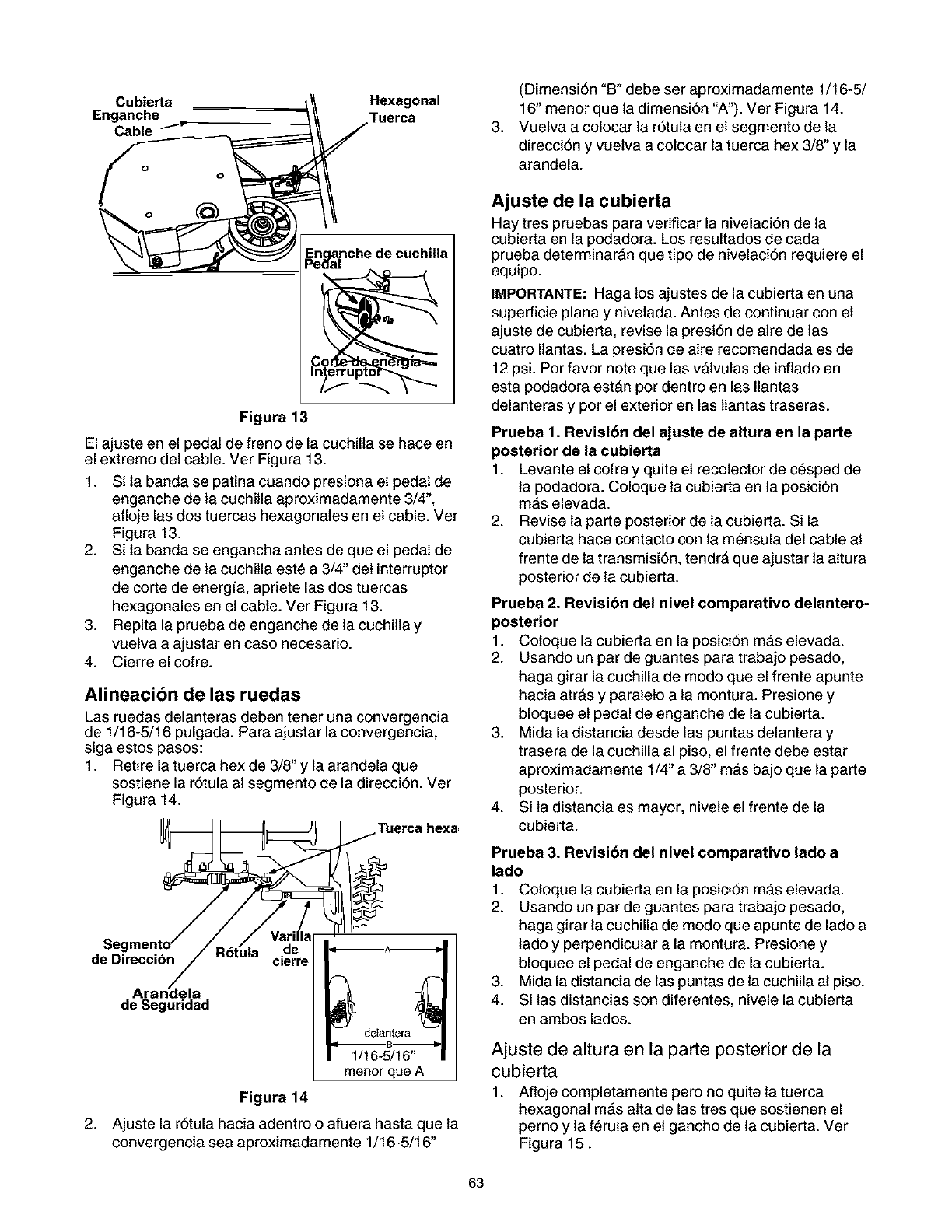
Cubierta Hexagonal
Enganche Tuerca
Cable
(Dimensi6n "B" debe ser aproximadamente 1/16-5/
16" menor que la dimensi6n "A"). Ver Figura 14.
3. Vuetva a colocar la r6tula en et segmento de la
direcci6n y vuetva a colocar la tuerca hex 3/8" y la
arandela.
Enaanche de cuchilla
Pedal
Figura 13
El ajuste en el pedal de freno de la cuchilla se hace en
el extremo det cable. Ver Figura 13.
1. Si la banda se patina cuando presiona et pedal de
enganche de la cuchilla aproximadamente 3/4",
afloje las dos tuercas hexagonales en et cable. Ver
Figura 13.
2. Si la banda se engancha antes de que el pedal de
enganche de la cuchitla est_ a 3/4" det interruptor
de corte de energfa, apriete las dos tuercas
hexagonales en et cable. Ver Figura 13.
3. Repita la prueba de enganche de la cuchilta y
vuetva a ajustar en caso necesario.
4. Cierre elcofre.
Alineacibn de las ruedas
Las ruedas delanteras deben tener una convergencia
de 1/16-5/16 pulgada. Para ajustar la convergencia,
siga estos pasos:
1. Retire la tuerca hex de 3/8" y ta arandela que
sostiene la r6tula al segmento de la direcci6n. Ver
Figura 14.
Tuerca hexa
2.
Segl de
de Direcci6n cierre
1/16-5/16"
menor que A
Figura 14
Ajuste la r6tula hacia adentro o afuera hasta que la
convergencia sea aproximadamente 1/16-5/16"
Ajuste de la cubierta
Hay tres pruebas para verificar la nivelaci6n de la
cubierta en la podadora. Los resultados de cada
prueba determinarAn que tipo de nivelaci6n requiere el
equipo.
IMPORTANTE: Haga los ajustes de la cubierta en una
superficie plana y nivetada. Antes de continuar con et
ajuste de cubierta, revise la presi6n de aire de las
cuatro Ilantas. La presi6n de aire recomendada es de
12 psi. Por favor note que las vAIvulas de inflado en
esta podadora esta.n por dentro en las Ilantas
delanteras y por el exterior en las ltantas traseras.
Prueba 1. Revisi6n del ajuste de altura en la parte
posterior de la cubierta
1. Levante et cofre y quite et recolector de c_sped de
la podadora. Coloque la cubierta en la posici6n
mAs elevada.
2. Revise la parte posterior de la cubierta. Si la
cubierta hace contacto con la m_nsula del cable al
frente de la transmisi6n, tendrA que ajustar la altura
posterior de la cubierta.
Prueba 2. Revisibn del nivel comparativo delantero-
posterior
1. Coloque la cubierta en la posici6n ma.s elevada.
2. Usando un par de guantes para trabajo pesado,
haga girar la cuchilla de modo que el frente apunte
hacia atrAs y paraleto a la montura. Presione y
bloquee et pedal de enganche de la cubierta.
3. Mida la distancia desde las puntas delantera y
trasera de la cuchilla al piso, el frente debe estar
aproximadamente 1/4" a 3/8" mas bajo que la parte
posterior.
4. Si la distancia es mayor, nivete el frente de la
cubierta.
Prueba 3. Revisibn del nivel comparativo lado a
lado
1. Coloque la cubierta en la posici6n ma.s elevada.
2. Usando un par de guantes para trabajo pesado,
haga girar la cuchilla de modo que apunte de lado a
lado y perpendicular a la montura. Presione y
bloquee et pedal de enganche de la cubierta.
3. Mida la distancia de las puntas de la cuchilla al piso.
4. Si las distancias son diferentes, nivele la cubierta
en ambos lados.
Ajuste de altura en la parte posterior de la
cubierta
1. Afloje completamente pero no quite la tuerca
hexagonal mas alta de las tres que sostienen el
perno y la ferula en et gancho de la cubierta. Ver
Figura 15.
63
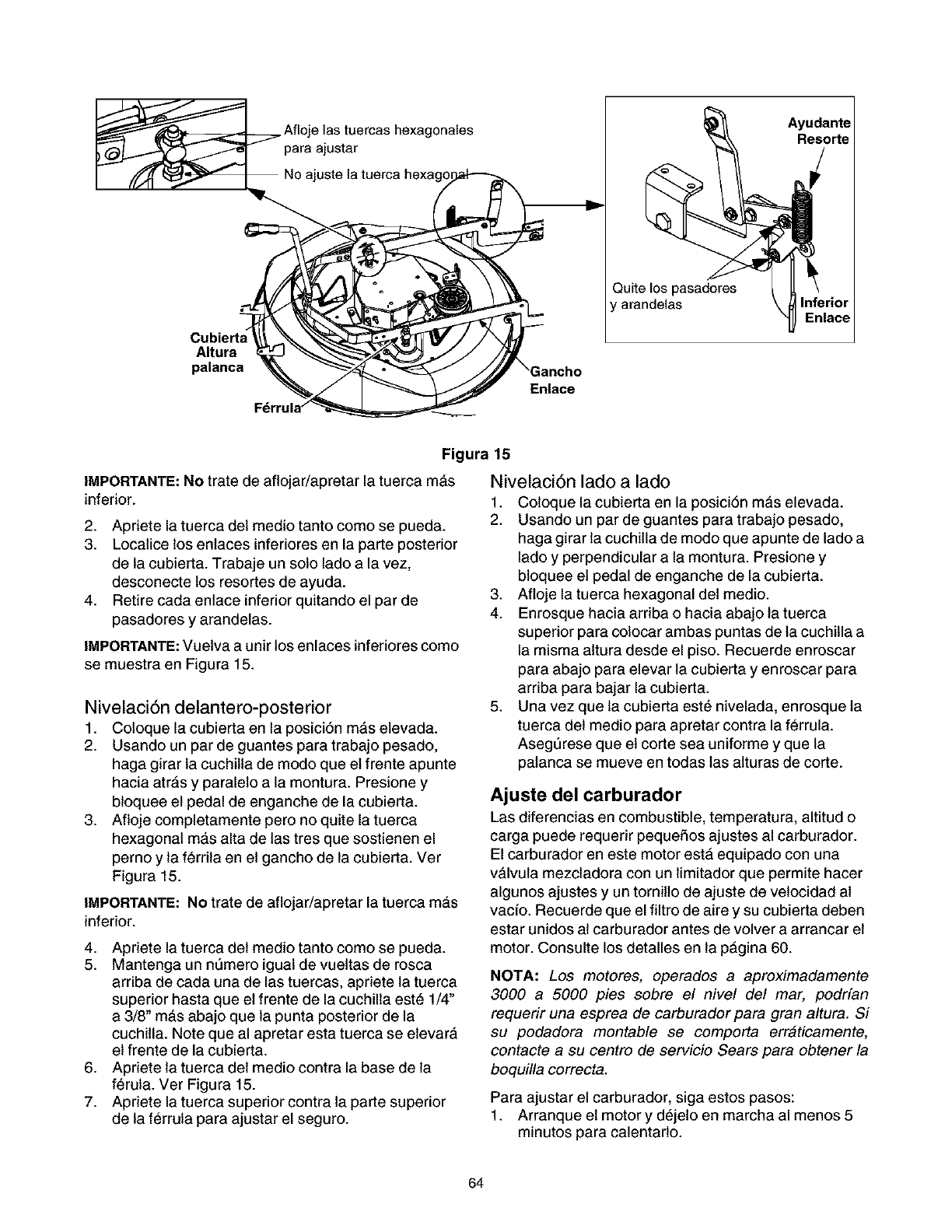
Afloje las tuercas hexagonales
para ajustar
No ajuste la tuerca hexa
Altura
palanca
Enlace
Quite lospasadores
rarandelas
Ayudante
Resorte
ne, Oe
Figura 15
IMPORTANTE: No trate de aflojar/apretar la tuerca mas
inferior.
2. Apriete la tuerca det medio tanto como se pueda.
3. Localice los enlaces inferiores en la parte posterior
de la cubierta. Trabaje un solo lado a la vez,
desconecte los resortes de ayuda.
4. Retire cada enlace inferior quitando el par de
pasadores y arandelas.
IMPORTANTE: Vuetva a unir los enlaces inferiores come
se muestra en Figura 15.
Nivelaci6n delantero-posterior
1. Coloque la cubierta en la posici6n m&s etevada.
2. Usando un par de guantes para trabajo pesado,
haga girar la cuchitla de modo que et frente apunte
hacia atr&s y paraleto a la montura. Presione y
bloquee et pedal de enganche de la cubierta.
3. Afloje completamente pero no quite la tuerca
hexagonal mas alta de las tres que sostienen el
perno y la ferrita en et gancho de la cubierta. Ver
Figura 15.
IMPORTANTE: No trate de aflojar/apretar la tuerca mas
inferior.
4. Apriete la tuerca det medio tanto como se pueda.
5. Mantenga un nemero igual de vuettas de rosca
arriba de cada una de las tuercas, apriete la tuerca
superior hasta que et frente de la cuchilla este 1/4"
a 3/8" ma.s abajo que la punta posterior de la
cuchilla. Note que al apretar esta tuerca se etevara
et frente de la cubierta.
6. Apriete la tuerca det medio contra la base de la
ferula. Ver Figura 15.
7. Apriete la tuerca superior contra la parte superior
de la ferrula para ajustar el seguro.
Nivelaci6n lado a lado
1. Coloque la cubierta en la posici6n ma.s elevada.
2. Usando un par de guantes para trabajo pesado,
haga girar la cuchitla de mode que apunte de lado a
lado y perpendicular a la montura. Presione y
bloquee et pedal de enganche de la cubierta.
3. Afloje la tuerca hexagonal det medio.
4. Enrosque hacia arriba o hacia abajo la tuerca
superior para colocar ambas puntas de la cuchitla a
la misma altura desde el piso. Recuerde enroscar
para abajo para elevar la cubierta y enroscar para
arriba para bajar la cubierta.
5. Una vez que la cubierta est_ nivelada, enrosque la
tuerca det medio para apretar contra la ferrula.
Asegerese que et corte sea uniforme y que la
palanca se mueve en todas las alturas de corte.
Ajuste del carburador
Las diferencias en combustible, temperatura, altitud o
carga puede requerir pequeSos ajustes al carburador.
El carburador en este motor estA equipado con una
va.lvula mezcladora con un limitador que permite hacer
algunos ajustes y un tornillo de ajuste de vetocidad al
vacfo. Recuerde que el filtro de aire y su cubierta deben
estar unidos al carburador antes de volver a arrancar et
motor. Consulte los detalles en la pAgina 60.
NOTA: Los motores, operados a aproximadamente
3000 a 5000 pies sobre el nivel del mar, podrfan
requerir una esprea de carburador para gran altura. Si
su podadora montable se comporta erraticamente,
contacte a su centro de servicio Sears para obtener la
boquilla correcta.
Para ajustar el carburador, siga estos pasos:
1. Arranque et motor y dejeto en marcha al menos 5
minutes para calentarlo.
64
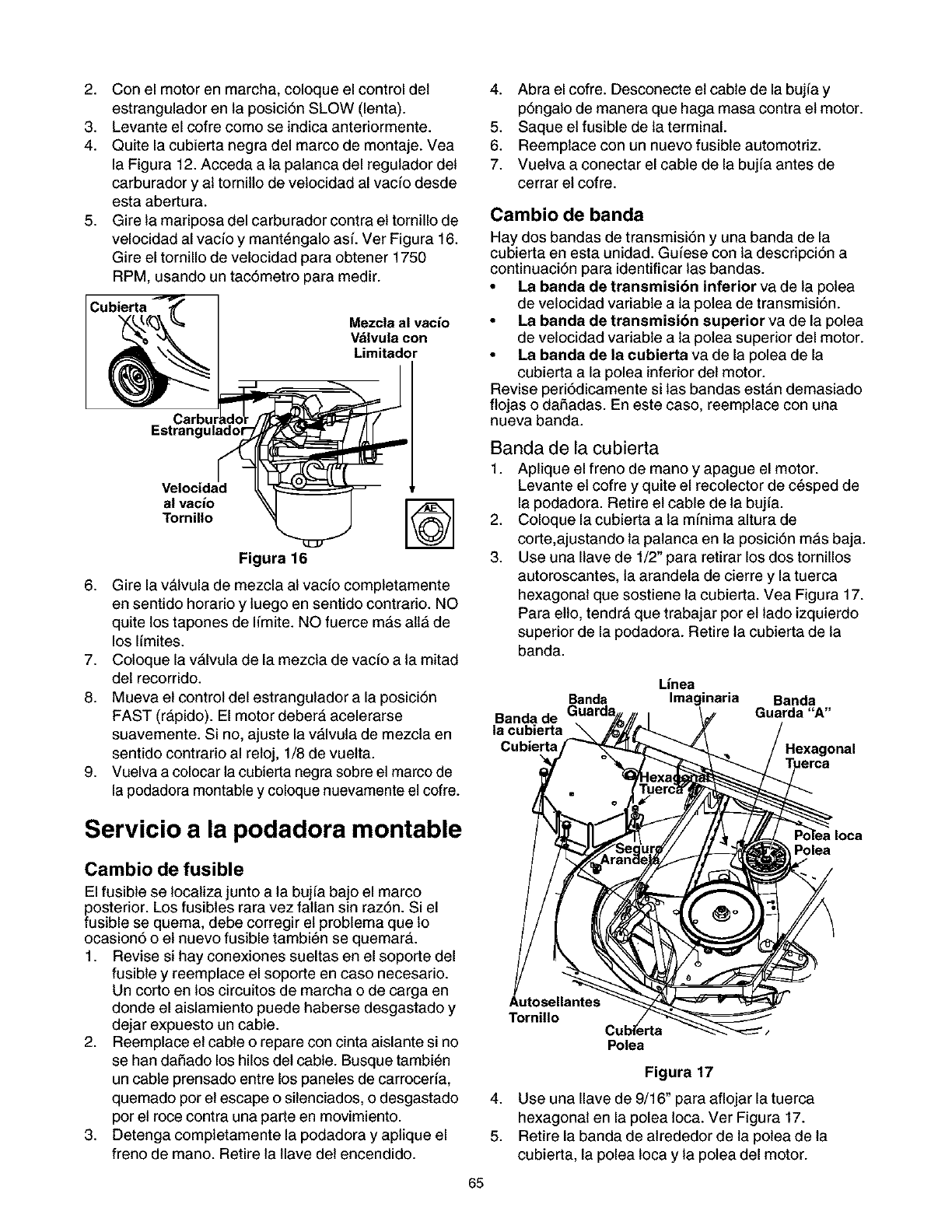
2. Con el motor en marcha, coloque el control det
estrangulador en la posici6n SLOW (lenta).
3. Levante el cofre como se indica anteriormente.
4. Quite la cubierta negra del marco de montaje. Vea
la Figura 12. Acceda a la palanca del regulador det
carburador y al tornilto de vetocidad al vacfo desde
esta abertura.
5. Gire la mariposa del carburador contra et tornillo de
velocidad al vacio y mantengalo asf. Ver Figura 16.
Gire el tornillo de velocidad para obtener 1750
RPM, usando un tac6metro para medir.
Cubierta Mezcla al vacio
Vdlvula con
Limitador
a| vacio
Tornil|o
Figura 16
6. Gire la v&lvula de mezcla al vacfo completamente
en sentido horario y luego en sentido contrario. NO
quite los tapones de Ifmite. NO fuerce m&s all& de
los Ifmites.
7. Coloque la v&lvula de la mezcla de vacfo a la mitad
det recorrido.
8. Mueva et control del estrangulador a la posici6n
FAST (r&pido). El motor deber& acelerarse
suavemente. Si no, ajuste la v&lvula de mezcla en
sentido contrario al retoj, 1/8 de vuetta.
9. Vuelva a colocar la cubierta negra sobre el marco de
la podadora montable y coloque nuevamente el cofre.
4. Abra el cofre. Desconecte et cable de la bujfa y
p6ngalo de manera que haga masa contra et motor.
5. Saque et fusible de la terminal.
6. Reemplace con un nuevo fusible automotriz.
7. Vuetva a conectar el cable de la bujfa antes de
cerrar et cofre.
Cambio de banda
Hay dos bandas de transmisi6n y una banda de la
cubierta en esta unidad. Gufese con la descripci6n a
continuaci6n para identificar las bandas.
• La banda de transmisi6n inferior va de la polea
de velocidad variable a la polea de transmisi6n.
• La banda de transmisi6n superior va de la polea
de velocidad variable a la polea superior del motor.
• La banda de la ¢ubierta va de la polea de la
cubierta a la polea inferior det motor.
Revise peri6dicamente si las bandas est&n demasiado
flojas o daSadas. En este caso, reemplace con una
nueva banda.
Banda de la cubierta
1. Aplique el freno de mano y apague el motor.
Levante et cofre y quite el recolector de c_sped de
la podadora. Retire et cable de la bujfa.
2. Coloque la cubierta a la mfnima altura de
corte,ajustando la palanca en la posici6n m&s baja.
3. Use una Ilave de 1/2" para retirar los dos tornillos
autoroscantes, la arandela de cierre y la tuerca
hexagonal que sostiene la cubierta. Vea Figura 17.
Para etlo, tendr& que trabajar por et lado izquierdo
superior de la podadora. Retire la cubierta de la
banda.
Banda de
la cubierta
Cubierta
Linea
Imaginaria Banda
Guarda "A"
Servicio a la podadora montable
Cambio de fusible
El fusible se localiza junto a la bujfa bajo el marco
posterior. Los fusibles rara vez fallan sin raz6n. Si el
fusible se quema, debe corregir et problema que Io
ocasion6 o et nuevo fusible tambi_n se quemar&.
1. Revise si hay conexiones sueltas en el soporte del
fusible y reemplace el soporte en caso necesario.
Un corto en los circuitos de marcha o de carga en
donde el aislamiento puede haberse desgastado y
dejar expuesto un cable.
2. Reemplace et cable o repare con cinta aislante si no
se hart daSado los hilos det cable. Busque tambi_n
un cable prensado entre los panetes de carroceda,
quemado por et escape o sitenciados, o desgastado
por et roce contra una parte en movimiento.
3. Detenga completamente la podadora y aplique el
freno de mano. Retire la llave det encendido.
Autosellantes
Tornillo
Polea
Po|ea
Figura 17
4. Use una Ilave de 9/16" para aflojar la tuerca
hexagonal en la polea loca. Ver Figura 17.
5. Retire la banda de alrededor de la polea de la
cubierta, la polea loca y la polea del motor.
65
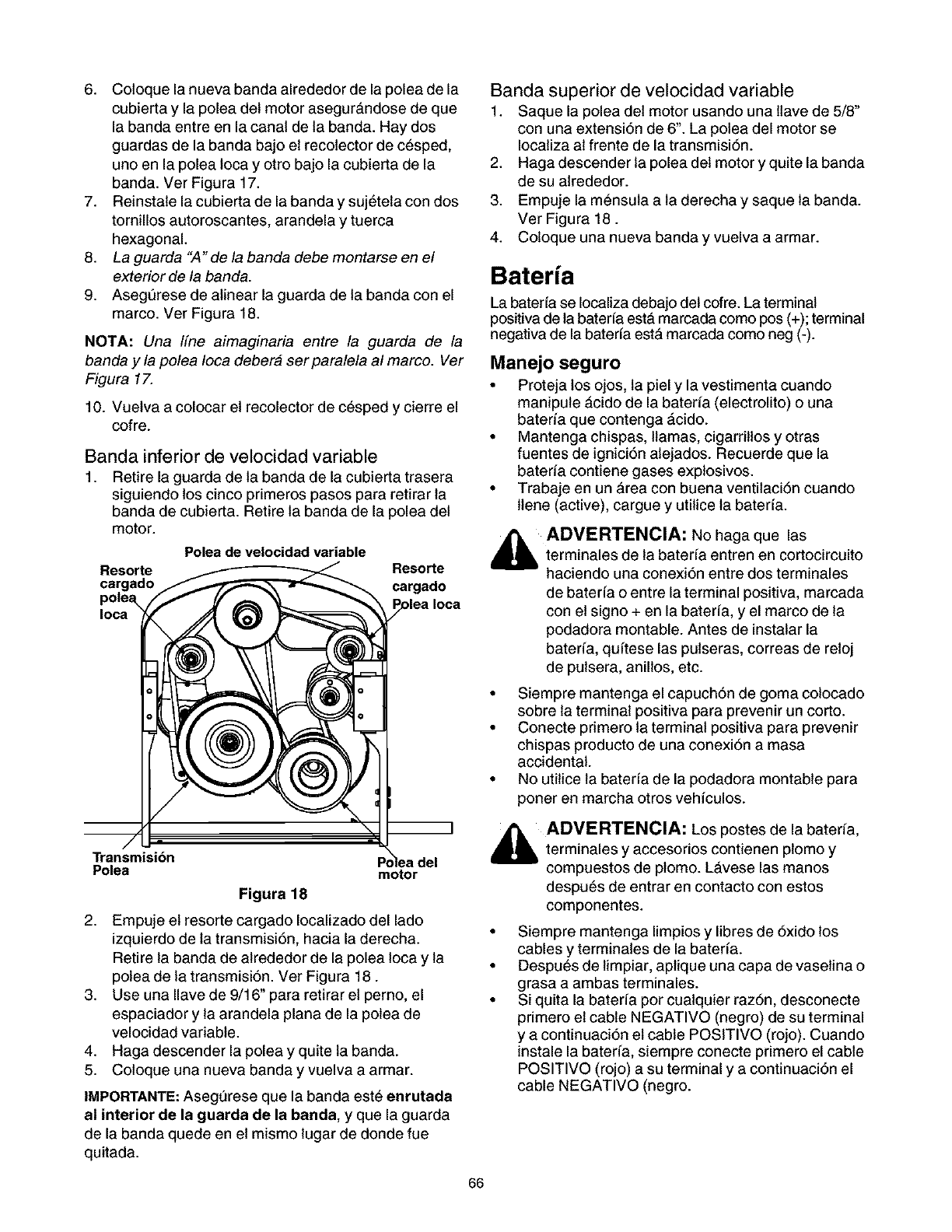
6. Coloquelanuevabandaalrededordelapoleadela
cubiertay lapoleadetmotorasegura.ndosedeque
labandaentreenlacanaldelabanda.Haydos
guardasdelabandabajoetrecolectordec_sped,
unoenlapolealocayotrobajolacubiertadela
banda.VerFigura17.
7. Reinstalelacubiertadelabandaysuj_tetacondos
tornillosautoroscantes,arandelay tuerca
hexagonal.
8. La guarda "A" de la banda debe montarse en el
exterior de la banda.
9. Aseg0rese de alinear la guarda de la banda con el
marco. Ver Figura 18.
NOTA: Una Ifne aimaginaria entre la guarda de la
banda y la polea Ioca debera ser paralela al marco. Ver
Figura 17.
10. Vuetva a colocar et recolector de c_sped y cierre el
cofre.
Banda inferior de velocidad variable
1. Retire la guarda de la banda de la cubierta trasera
siguiendo los cinco primeros pasos para retirar la
banda de cubierta. Retire la banda de la polea det
motor.
Polea de velocidad variable
Resorte Resole
cargado cargado
Ioca
Transmisi6n Po_eadel
Polea motor
Figura 18
2. Empuje et resorte cargado Iocalizado del lado
izquierdo de la transmisi6n, hacia la derecha.
Retire la banda de alrededor de la polea loca y la
polea de la transmisi6n. Ver Figura 18.
3. Use una Ilave de 9/16" para retirar et perno, el
espaciador y la arandela plana de la polea de
velocidad variable.
4. Haga descender la polea y quite la banda.
5. Coloque una nueva banda y vuelva a armar.
IMPORTANTE: Aseg0rese que la banda est_ enrutada
al interior de la guarda de la banda, y que la guarda
de la banda quede en et mismo lugar de donde fue
quitada.
66
Banda superior de velocidad variable
1. Saque la polea det motor usando una ltave de 5/8"
con una extensi6n de 6". La polea del motor se
Iocaliza al frente de la transmisi6n.
2. Haga descender la polea det motor y quite la banda
de su alrededor.
3. Empuje la mensula a la derecha y saque la banda.
Ver Figura 18.
4. Coloque una nueva banda y vuelva a armar.
Bateria
La baterfa se Iocaliza debajo det cofre. La terminal
positiva de la baterfa esta. marcada como pos (+); terminal
negativa de la baterfa esta marcada como neg (-).
Manejo seguro
•Proteja los ojos, la piel y la vestimenta cuando
manipule &cido de la baterfa (electrolito) o una
baterfa que contenga &cido.
• Mantenga chispas, llamas, cigarritlos y otras
fuentes de ignici6n alejados. Recuerde que la
baterfa contiene gases explosivos.
• Trabaje en un area con buena ventilaci6n cuando
ttene (active), cargue y utilice la baterfa.
_ADVERTENCIA: No haga las
que
terminales de la baterfa entren en cortocircuito
haciendo una conexi6n entre dos terminales
de baterfa o entre la terminal positiva, marcada
con et signo + en la baterfa, y el marco de la
podadora montable. Antes de instalar la
baterfa, quffese las pulseras, correas de retoj
de pulsera, anillos, etc.
• Siempre mantenga el capuch6n de goma colocado
sobre la terminal positiva para prevenir un corto.
• Conecte pdmero la terminal positiva para prevenir
chispas producto de una conexi6n a masa
accidental.
• No utitice la baterfa de la podadora montable para
porter en marcha otros vehfculos.
_IL ADVERTENCIA: Los postes de la baterfa,
terminales y accesorios contienen plomo y
compuestos de plomo. La.veselas manos
despu_s de entrar en contacto con estos
componentes.
Siempre mantenga limpios y libres de 6xido los
cables y terminales de la baterfa.
Despu_s de limpiar, aplique una capa de vasetina o
grasa a ambas terminales.
Si quita la baterfa por cualquier raz6n, desconecte
primero et cable NEGATIVO (negro) de su terminal
y a continuaci6n et cable POSITIVO (rojo). Cuando
instale la baterfa, siempre conecte primero el cable
POSITIVO (rojo) a su terminal y a continuaci6n el
cable NEGATIVO (negro.
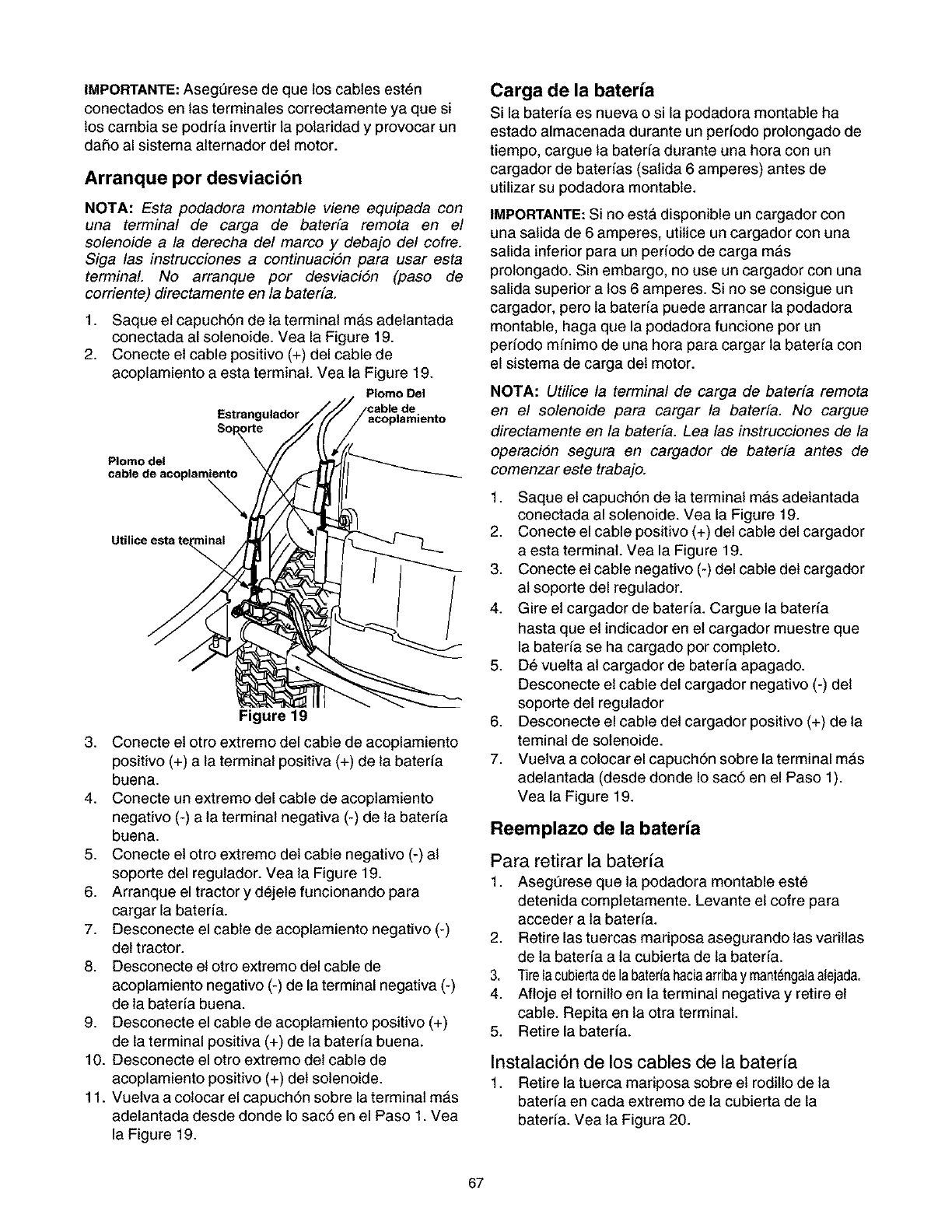
IMPORTANTE:Asegt_rese de que los cables esten
conectados en las terminales correctamente ya que si
los cambia se podrfa invertir la polaridad y provocar un
daSo al sistema alternador det motor.
Arranque por desviacibn
NOTA: Esta podadora montable viene equipada con
una terminal de carga de baterfa remota en el
solenoide a la derecha del marco y debajo del cofre.
Siga las instrucciones a continuaci6n para usar esta
terminal No arranque por desviaci6n (paso de
corriente) directamente en la baterfa.
1. Saque et capuch6n de la terminal m&s adetantada
conectada al solenoide. Vea la Figure 19.
2. Conecte et cable positivo (+) del cable de
acoplamiento a esta terminal. Vea la Figure 19.
Plomo Del
Estrangulador acoplamiento
Plomo del
cable de acoplamiento
Figure 19
3. Conecte et otro extremo del cable de acoplamiento
positivo (+) a la terminal positiva (+) de la baterfa
buena.
4. Conecte un extremo del cable de acoplamiento
negativo (-) a la terminal negativa (-) de la baterfa
buena.
5. Conecte et otro extremo det cable negativo (-) al
soporte del regulador. Vea la Figure 19.
6. Arranque el tractor y dejete funcionando para
cargar la baterfa.
7. Desconecte el cable de acoplamiento negativo (-)
det tractor.
8. Desconecte et otro extremo del cable de
acoplamiento negativo (-) de la terminal negativa (-)
de la baterfa buena.
9. Desconecte el cable de acoplamiento positivo (+)
de la terminal positiva (+) de la baterfa buena.
10. Desconecte el otro extremo det cable de
acoplamiento positivo (+) det solenoide.
11. Vuetva a colocar el capuch6n sobre la terminal ma.s
adelantada desde donde Io sac6 en el Paso 1. Vea
la Figure 19.
Carga de la bateria
Si la baterfa es nueva o si la podadora montable ha
estado almacenada durante un perfodo prolongado de
tiempo, cargue la baterfa durante una hora con un
cargador de baterfas (salida 6 amperes) antes de
utilizar su podadora montable.
IMPORTANTE: Si no esta disponible un cargador con
una salida de 6 amperes, utitice un cargador con una
salida inferior para un perfodo de carga m&s
prolongado. Sin embargo, no use un cargador con una
salida superior a los 6 amperes. Si no se consigue un
cargador, pero la baterfa puede arrancar la podadora
montable, haga que la podadora funcione por un
perfodo mfnimo de una hora para cargar la baterfa con
el sistema de carga det motor.
NOTA: Utilice la terminal de carga de baterfa remota
en el solenoide para cargar la baterfa. No cargue
directamente en la baterfa. Lea las instrucciones de la
operacion segura en cargador de baterfa antes de
comenzar este trabajo.
1. Saque et capuch6n de la terminal mAs adetantada
conectada al solenoide. Vea la Figure 19.
2. Conecte el cable positivo (+) det cable del cargador
a esta terminal. Vea la Figure 19.
3. Conecte et cable negativo (-) del cable det cargador
al soporte del regulador.
4. Gire et cargador de baterfa. Cargue la baterfa
hasta que et indicador en et cargador muestre que
la baterfa se ha cargado por completo.
5. D_ vuelta al cargador de baterfa apagado.
Desconecte et cable del cargador negativo (-) det
soporte del regulador
6. Desconecte el cable det cargador positivo (+) de la
teminal de solenoide.
7. Vuetva a colocar el capuch6n sobre la terminal mas
adelantada (desde donde Io sac6 en el Paso 1).
Vea la Figure 19.
Reemplazo de la bateria
Para retirar la baterfa
1. Aseg0rese que la podadora montable este
detenida completamente. Levante et cofre para
acceder a la baterfa.
2. Retire las tuercas mariposa asegurando las varitlas
de la baterfa a la cubierta de la baterfa.
3. Tirelacubiertadelabaterfahaciaarribay mant_ngalaalejada.
4. Afloje et tomilto en la terminal negativa y retire et
cable. Repita en la otra terminal.
5. Retirela baterfa.
Instalaci6n de los cables de la baterfa
1. Retire la tuerca mariposa sobre et rodillo de la
baterfa en cada extremo de la cubierta de la
baterfa. Vea la Figura 20.
67
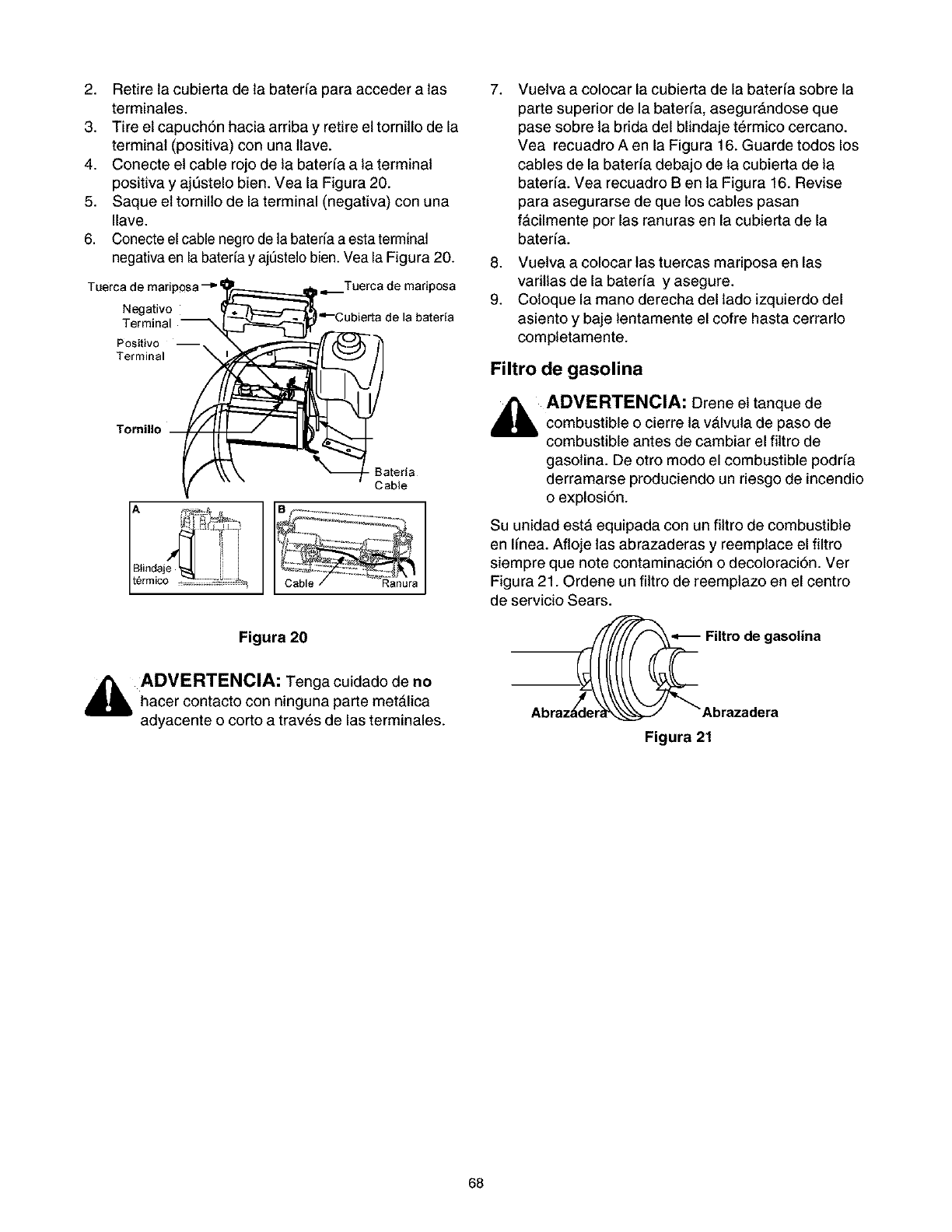
2. Retire la cubierta de la bateda para acceder a las
terminales.
3. Tire et capuchSn hacia arriba y retire et tomitlo de la
terminal (positiva) con una ltave.
4. Conecte et cable rojo de la baterfa a la terminal
positiva y ajt3stelo bien. Vea la Figura 20.
5. Saque et tomillo de la terminal (negativa) con una
Ilave.
6. Conecte el cable negro de la baterfa aesta terminal
negativa en la baterfa y ajSstelo bien. Vea la Figura 20.
Tuerca de mariposa--P _ Tuerca de rnariposa
TNe_rra_a_ __-Cub,erta de la bater{a
Po0,,,vo---
To,m,oo, /)
Btindaje .................. o
Figura 20
7. Vuelva a colocar la cubierta de la baterfa sobre la
parte superior de la baterfa, asegurAndose que
pase sobre la bdda del blindaje termico cercano.
Vea recuadro A en la Figura 16. Guarde todos los
cables de la baterfa debajo de la cubierta de la
baterfa. Vea recuadro Ben la Figura 16. Revise
para asegurarse de que los cables pasan
facilmente per las ranuras en la cubierta de la
baterfa.
8. Vuetva a colocar las tuercas mariposa en las
varitlas de la baterfa y asegure.
9. Coloque la mane derecha del lade izquierdo del
asiento y baje lentamente el cofre hasta cerrarlo
completamente.
Filtro de gasolina
,_ ADVERTENCIA: Drene et tanque de
combustible o cierre la va.lvula de paso de
combustible antes de cambiar el fittro de
gasolina. De otro modo el combustible podrfa
derramarse produciendo un riesgo de incendio
o explosi6n.
Su unidad estA equipada con un fittro de combustible
en Ifnea. Afloje las abrazaderas y reemplace el filtro
siempre que note contaminaci6n o decoloraci6n. Ver
Figura 21. Ordene un filtro de reemplazo en el centre
de servicio Sears.
•*-- Filtro de gasolina
,_ ADVERTENCIA: Tenga cuidado de no
hacer contacto con ninguna parte meta.lica
adyacente o corto atray,s de las terminales. Figura 21
68
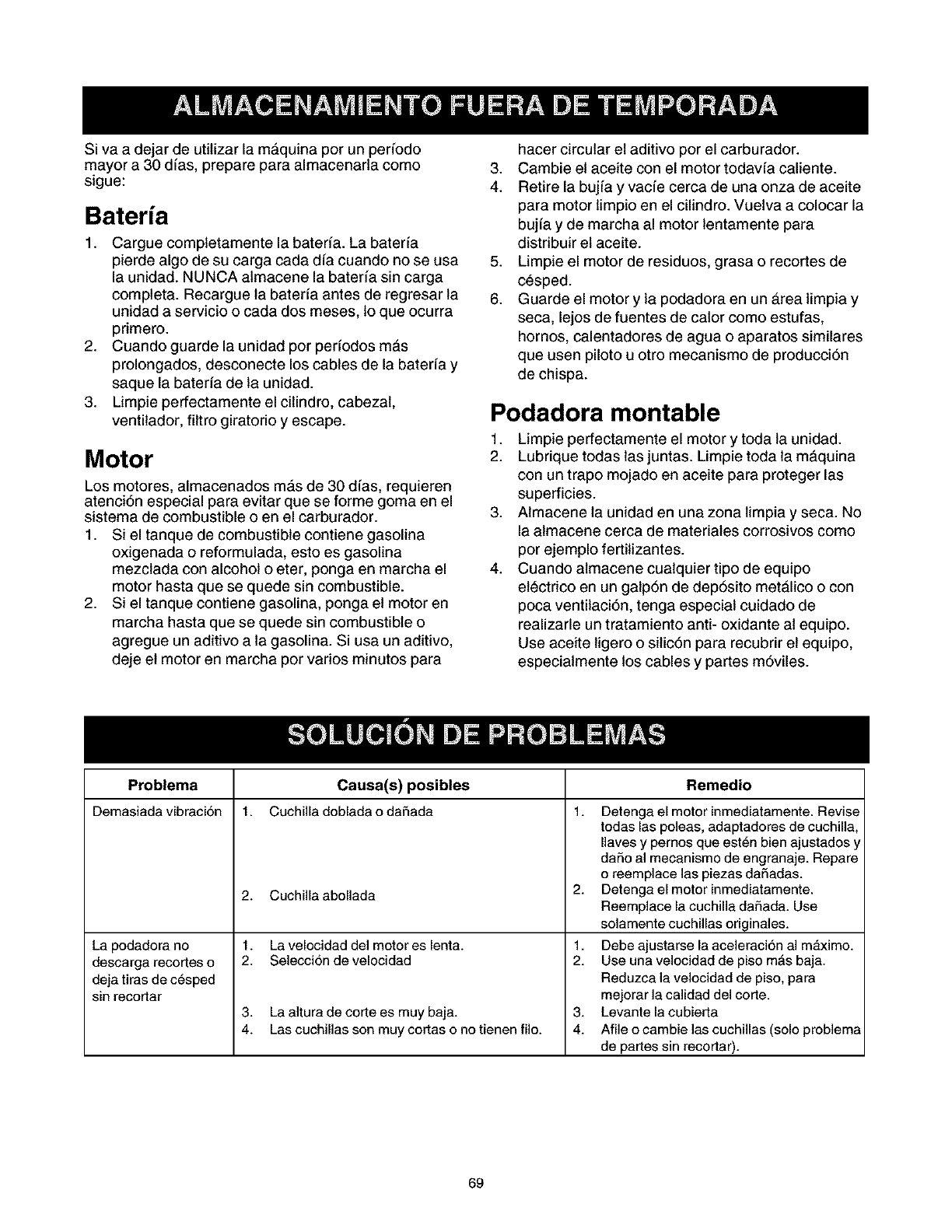
SivaadejardeutitizarlamAquinaporunperfodo
mayora30dfas,prepareparaalmacenarlacomo
sigue:
Baterfa
1. Cargue completamente la baterfa. La baterfa
pierde algo de su carga cada dfa cuando no se usa
la unidad. NUNCA almacene la baterfa sin carga
completa. Recargue la baterfa antes de regresar la
unidad a servicio o cada dos meses, 1oque ocurra
primero.
2. Cuando guarde la unidad por perfodos mAs
prolongados, desconecte los cables de la baterfa y
saque la baterfa de la unidad.
3. Limpie perfectamente el citindro, cabezal,
ventilador, filtro giratorio y escape.
Motor
Los motores, almacenados mAs de 30 dfas, requieren
atenci6n especial para evitar que se forme goma en el
sistema de combustible o en el carburador.
1. Si el tanque de combustible contiene gasolina
oxigenada o reformulada, esto es gasolina
mezclada con alcohol o eter, ponga en marcha el
motor hasta que se quede sin combustible.
2. Si el tanque contiene gasolina, ponga et motor en
marcha hasta que se quede sin combustible o
agregue un aditivo a la gasolina. Si usa un aditivo,
deje et motor en marcha por vados minutos para
hacer circular et aditivo por el carburador.
3. Cambie et aceite con el motor todavfa caliente.
4. Retire la bujfa y vacfe cerca de una onza de aceite
para motor limpio en el cilindro. Vuetva a colocar la
bujfa y de marcha al motor lentamente para
distdbuir et aceite.
5. Limpie el motor de residuos, grasa o recortes de
cesped.
6. Guarde el motor y la podadora en un Area limpia y
seca, lejos de fuentes de calor como estufas,
hornos, calentadores de agua o aparatos similares
que usen piloto u otro mecanismo de producci6n
de chispa.
Podadora montable
1. Limpie perfectamente el motor y toda la unidad.
2. Lubrique todas las juntas. Limpie toda la maquina
con un trapo mojado en aceite para proteger las
superficies.
3. Almacene la unidad en una zona limpia y seca. No
la almacene cerca de materiales corrosivos como
por ejemplo fertitizantes.
4. Cuando almacene cualquier tipo de equipo
etectrico en un galpdn de dep6sito metAlico o con
poca ventilacidn, tenga especial cuidado de
realizarle un tratamiento anti- oxidante al equipo.
Use aceite ligero o siticdn para recubrir et equipo,
especialmente los cables y partes m6viles.
i' iiii
Problema Causa(s) posibles Remedio
Demasiada vibraci6n 1. Cuchilla doblada o daf_ada 1.
La podadora no
descarga recortes o
deja tiras de c6sped
sin recortar
2.
1.
2.
3.
4.
Cuchilla abollada
La velocidad del motor es lenta.
Selecci6n de velocidad
La altura de corte es muy baja.
Las cuchillas son muy cortas o no tienen filo.
2,
Detenga el motor inmediatamente. Revise
todas las poleas, adaptadores de cuchilla,
Ilaves y pemos que est6n bien ajustados y
daSo al mecanismo de engranaje. Repare
o reemplace las piezas daSadas.
Detenga el motor inmediatamente.
Reemplace la cuchilla daf_ada. Use
solamente cuchillas originales.
1. Debe ajustarse la aceleraci0n al maximo.
2. Use una velocidad de piso m_s baja.
Reduzca la velocidad de piso, para
mejorar la calidad del corte.
3. Levantelacubierta
4. Afile o cambie las cuchillas (solo problema
de partes sin recortar).
69
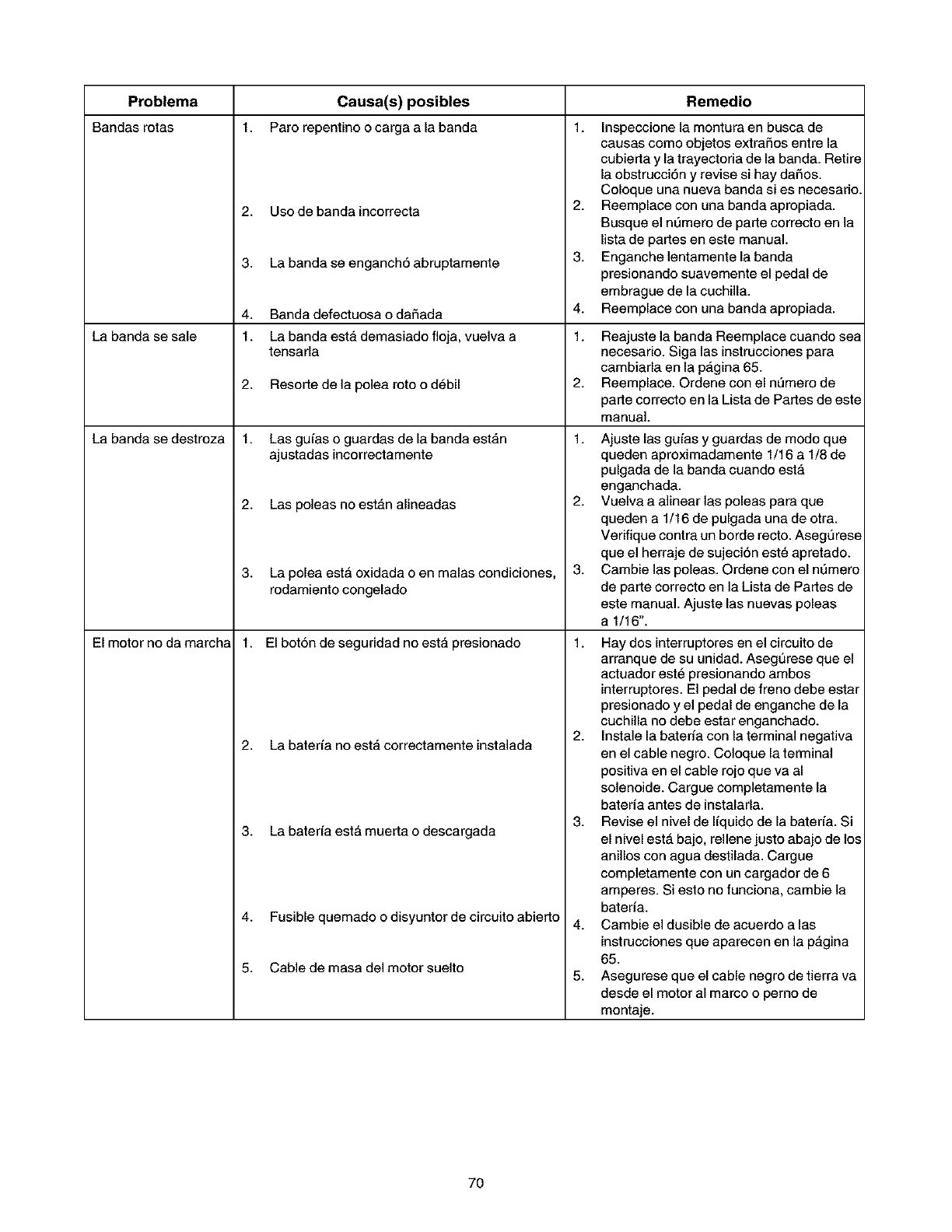
Problema Causa(s) posibles Remedio
Bandas rotas 1. Paro repentino ocarga a la banda 1.
La banda se sale
La banda se destroza
El motor no da marcha
2. Usodebandaincorrecta
3. La banda se enganch6 abruptamente
4. Banda defectuosa oda£_ada
1. La banda esta demasiado floja, vuelva a
tensarla
2. Resorte de la polea roto od6bil
1. Las guias oguardas de la banda estan
ajustadas incorrectamente
2. Las poleas no estan alineadas
3. La polea est_ oxidada o en malas condiciones,
rodamiento congelado
1. El boton de seguridad no esta presionado
2. La baterfa no esta correctamente instalada
3. La baterfa estA muerta o descargada
4. Fusible quemado o disyuntor de circuito abierto
5. Cable de masa del motor suelto
Inspeccione la montura en busca de
causas como objetos extraSos entre la
cubierta y la trayectoria de la banda. Retire
la obstrucci6n y revise si hay daSos.
Coloque una nueva banda si es necesario.
2. Reemplacecon una banda apropiada.
Busque el n0mero de parte correcto en la
lista de partes en este manual
3. Enganchelentamentelabanda
presionando suavemente el pedal de
embrague de la cuchilla.
4. Reemplacecon una bandaapropiada.
1. Reajustela banda Reemplace cuando sea
necesario. Siga las instrucciones para
cambiarla en la pagina 65.
2. Reemplace. Ordene con el nemero de
parte correcto en la Lista de Partes de este
manual
1. Ajuste las guias y guardas de mode que
queden aproximadamente 1/16 a 1/8 de
pulgada de la banda cuando esta
enganchada.
2. Vuelva a alinear las poleas para que
queden a 1/16 de pulgada una de otra.
Verifique contra un borde recto. Aseg0rese
que el herraje de sujeci6n est6 apretado.
3. Cambie las poleas. Ordene con el n0mero
de parte correcto en la Lista de Partes de
este manual. Ajuste las nuevas poleas
a 1/16".
1. Hay dos interruptores en el circuito de
arranque de su unidad. Aseg0rese que el
actuador est_ presionando ambos
interruptores. El pedal de freno debe estar
presionado y el pedal de enganche de la
cuchilla no debe estar enganchado.
2. Instale la bater/a con la terminal negativa
en el cable negro. Coloque la terminal
positiva en el cable rojo que va al
solenoide. Cargue completamente la
bateria antes de instalarla.
3. Revise el nivel de liquido de la baterfa. Si
el nivel estA bajo, rellene justo abajo de los
anillos con agua destilada. Cargue
completamente con un cargador de 6
amperes. Si esto no funciona, cambie la
bateria.
4. Cambie el dusible de acuerdo alas
instrucciones que aparecen en la pagina
65.
5. Asegurese que el cable negro de tierra va
desde el motor al marco o perno de
montaje.
7O
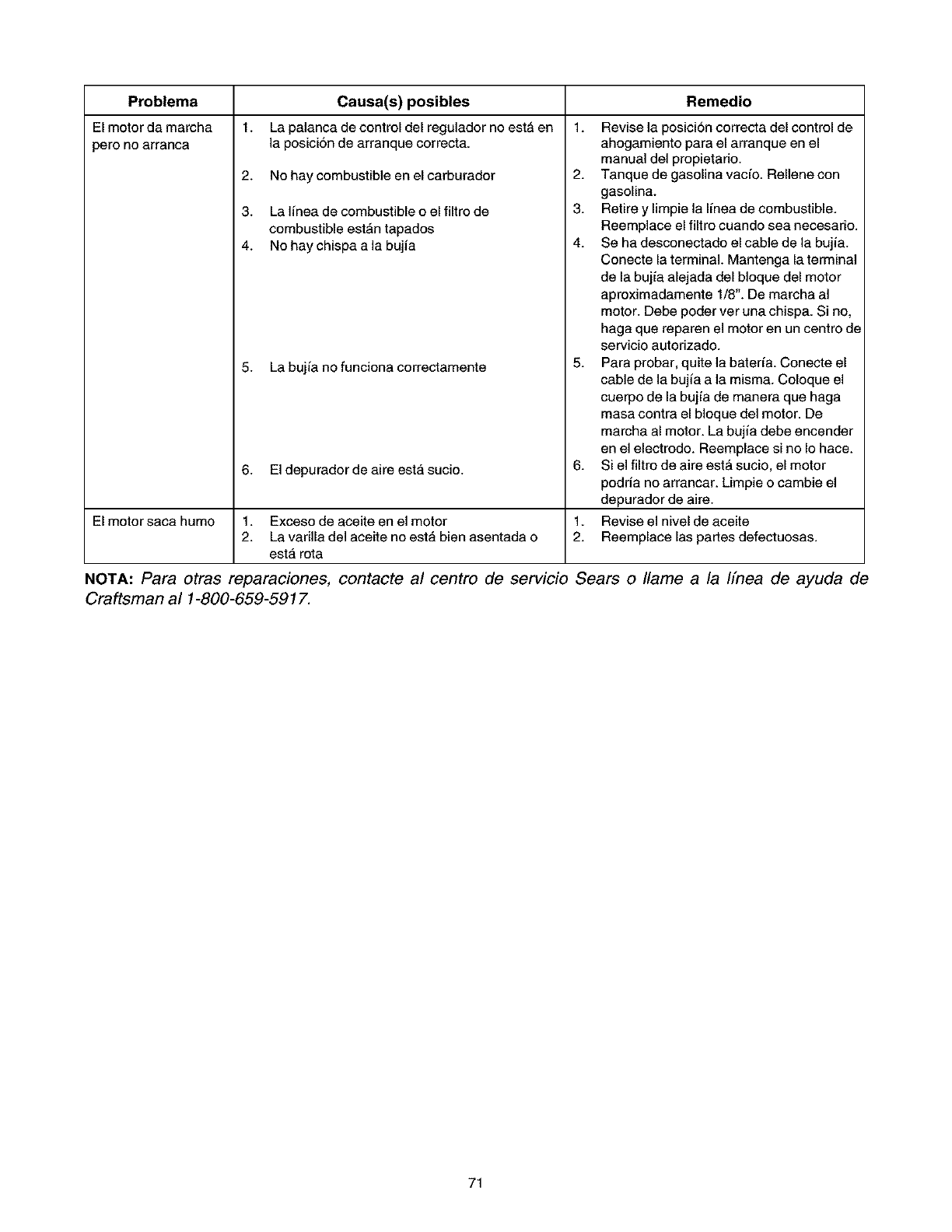
Problema
El motor da marcha
pero no arranca
Remedio
1. 1.
2.
3.
4.
Causa(s) posibles
La palanca de control del regulador no est_ en
la posici6n de arranque correcta.
No hay combustible en el carburador
La linea de combustible oel filtro de
combustible est_n tapados
No hay chispa a la bujia
5. La bujfa no funciona correctamente
El depurador de aire esta sucio.
6.
1.
2.
Revise la posici6n correcta del control de
ahogamiento para el arranque en el
manual del propietado.
2. Tanque de gasolina vacfo. Rellene con
gasolina.
3. Retire y limpie la I[nea de combustible.
Reemplace el filtro cuando sea necesario.
4. Se ha desconectado el cable de la bujia.
Conecte la terminal. Mantenga la terminal
de la buj[a alejada del bloque del motor
aproximadamente 1/8". De marcha al
motor. Debe poder ver una chispa. Si no,
haga que reparen el motor en un centro de
servicio autorizado.
5. Para probar, quite la baterfa. Conecte el
cable de la bujia a la misma. Coloque el
cuerpo de la buj[a de manera que haga
masa contra el bloque del motor. De
marcha al motor. La bujia debe encender
en el electrodo. Reemplace si no Io hace.
Si el filtro de aire est_ sucio, el motor
podrfa no arrancar. Limpie o cambie el
depurador de aire.
6.
1.
2.
El motor saca humo Exceso de aceite en el motor Revise el nivel de aceite
La varilla del aceite no esta bien asentada o Reemplace las partes defectuosas.
esta rota
NOTA: Para otras reparaciones, contacte al centro de servicio Sears oIlame a la Ifnea de ayuda de
Craftsman al 1-800-659-5917.
71

Get it fixed, at your home or ours!
Your Home
For repair-in your home-of all major brand appliances,
lawn and garden equipment, or heating and cooling systems,
no matter who made it, no matter who sold it!
For the replacement parts, accessories and
owner's manuals that you need to do-it-yourself.
For Sears professional installation of home appliances
and items like garage door openers and water heaters.
1-800-4-MY-HOME ®(1-800-469-4663)
Call anytime, day or night (U.S.A. and Canada)
www.sears.com www.sears.ca
Our Home
For repair of carry-in items like vacuums, lawn equipment,
and electronics, call or go on-line for the location of your nearest
Sears Parts & Repair Center.
1-800-488-1222
Call anytime, day or night (U.S.A. only)
www,sears,com
To purchase a protection agreement (U.S.A.)
or maintenance agreement (Canada) on a product serviced by Sears:
1-800-827-6655 (U.S.A.) 1-800-361-6665 (Canada
Para pedir servicio de reparacion
a domicilio, y para ordenar piezas:
1-888-SU-HOGAR sM
(1-888-784-6427)
Au Canada pour service en franga_s:
1-800-LE-FOYER Mc
(1-800-533-6937)
www.sears ca
T_ F
® Registered Trademark /"_Trademark /s ,_ Service Mark of Sears Roebuck and Co
TH _H
® Marca Reg_strada /Marca de Fabnca /_ Marca de Servlclo de Sears, Roebuck and Co
_fc _D
Marque de commerce ,'_ Marque deposee de Sears Roebuck and Co © Sears, Roebuck and Co
