Cubic Global Tracking Solutions GS5L Asset Tracking Equipment User Manual NGWC Mesh Network User Guide

Cubic Global Tracking Solutions Asset Tracking Equipment NGWC Mesh Network User Guide

User Manual

             GS-5L User Guide November 19, 2010            Cubic Global Tracking Solutions 2570 West El Camino Real, Suite 100 Mountain View, CA 94040 USA http://www.impeva.com
Copyright © 2010 by Cubic GTS 2   GS-5L User Guide Cubic GTS Proprietary and Company Confidential Information      Notice of Ownership Use of this information shall be limited to persons having a need to know, within the appropriate project organizations, as defined within the nondisclosure agreement (NDA) between Cubic Global Tracking Solutions and its customers. Disclosure of the material in this document to outside organizations shall only be made with the written consent of an authorized Cubic GTS  corporate officer. This document contains information that is considered proprietary and confidential to Cubic Global Tracking Solutions (CGTS).  No information contained in this document may be released, re-printed, or redistributed without the permission of CGTS. The information contained in this document is subject to change without notice. If you have questions or comments about this document, please direct them to info.cgts@cubic.com. Copyright © 2010 by Cubic GTS Revision History Revision Date Author(s) Notes 1.0 11/14/10 Bryan Shah Initial release.
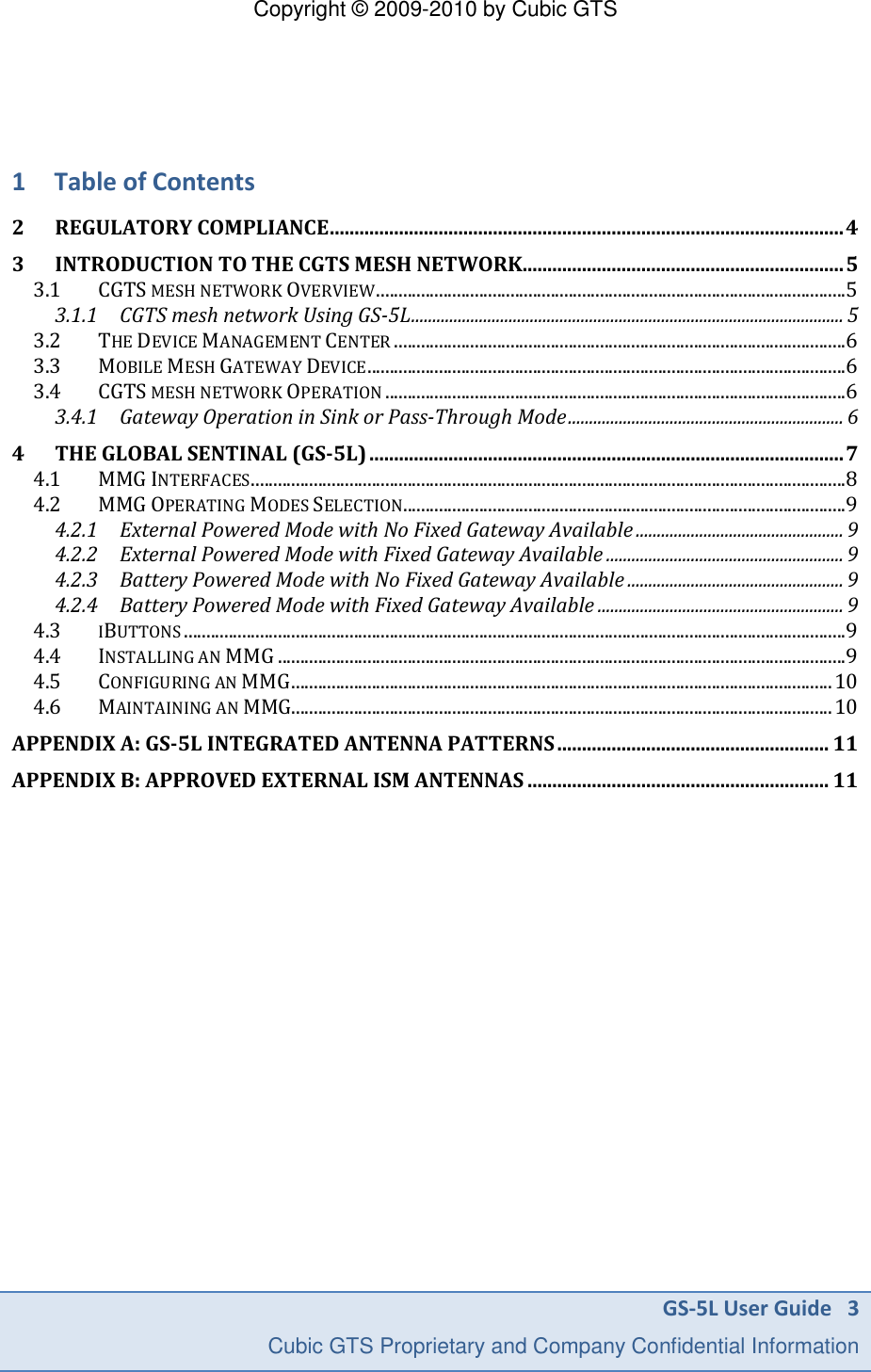
Copyright © 2009-2010 by Cubic GTS GS-5L User Guide   3     Cubic GTS Proprietary and Company Confidential Information    1 Table of Contents 2 REGULATORY COMPLIANCE ........................................................................................................ 4 3 INTRODUCTION TO THE CGTS MESH NETWORK ................................................................. 5 3.1 CGTS MESH NETWORK OVERVIEW ......................................................................................................... 5 3.1.1 CGTS mesh network Using GS-5L ...................................................................................................... 5 3.2 THE DEVICE MANAGEMENT CENTER ..................................................................................................... 6 3.3 MOBILE MESH GATEWAY DEVICE ........................................................................................................... 6 3.4 CGTS MESH NETWORK OPERATION ....................................................................................................... 6 3.4.1 Gateway Operation in Sink or Pass-Through Mode ................................................................. 6 4 THE GLOBAL SENTINAL (GS-5L) ................................................................................................ 7 4.1 MMG INTERFACES ..................................................................................................................................... 8 4.2 MMG OPERATING MODES SELECTION................................................................................................... 9 4.2.1 External Powered Mode with No Fixed Gateway Available ................................................. 9 4.2.2 External Powered Mode with Fixed Gateway Available ........................................................ 9 4.2.3 Battery Powered Mode with No Fixed Gateway Available ................................................... 9 4.2.4 Battery Powered Mode with Fixed Gateway Available .......................................................... 9 4.3 IBUTTONS .................................................................................................................................................... 9 4.4 INSTALLING AN MMG ............................................................................................................................... 9 4.5 CONFIGURING AN MMG ......................................................................................................................... 10 4.6 MAINTAINING AN MMG......................................................................................................................... 10 APPENDIX A: GS-5L INTEGRATED ANTENNA PATTERNS ....................................................... 11 APPENDIX B: APPROVED EXTERNAL ISM ANTENNAS ............................................................. 11
Copyright © 2010 by Cubic GTS 4   GS-5L User Guide Cubic GTS Proprietary and Company Confidential Information      2 Regulatory Compliance FCC STATEMENT: This equipment has been tested and found to comply with the limits for a Class A digital device, pursuant to part 15 of the FCC Rules. These limits are designed to provide reasonable protection against harmful interference when the equipment is operated in a commercial environment. This equipment generates, uses, and can radiate radio frequency energy and, if not installed and used in accordance with the instruction manual, may cause harmful interference to radio communications. Operation of this equipment in a residential area is likely to cause harmful interference in which case the user will be required to correct the interference at his/her own expense. Changes or modifications not expressly approved by Cubic Global Tracking Solutions for compliance could void the user’s authority to operate the equipment. Regarding the external mesh antenna port (J2): This device has been designed to operate with the antennas listed in Appendix B. Antennas not included in this list are prohibited for use with this device without the express approval of Cubic Global Tracking Solutions. Antennas with a gain greater than 3dBi are prohibited for use with this device. This product includes two modular radios: The Enfora GSM0308 Enabler III (FCC ID: MIV GSM0308) and the Iridium 9602 (FCC ID: Q639602). These modules have been tested and found to comply with the limits for a Class A digital device, pursuant to part 15 of the FCC Rules. These limits are designed to provide reasonable protection against harmful interference when the equipment is operated in a commercial environment. This equipment generates, uses, and can radiate radio frequency energy and, if not installed and used in accordance with the instruction manual, may cause harmful interference to radio communications. Further regulatory information for the Enabler III can be found at: http://www.enfora.com/ Further regulatory information for the 9602 can be found at: http://www.iridium.com/ EUROPEAN UNION: This product complies with the R&TTE Directive and the EMC Directive (89/336/EEC) issued by the Commission of the European Community This product has been tested to verify compliance to the following European Standards: EN 300 328 – Technical Requirements for Radio Equipment EN 301 489 –EMC Emissions and Immunity INDUSTRY CANADA: This Class A digital apparatus complies with Canadian ICES-003. Cet appareil numérique de la classe A est conforme à  la norme NMB-003 du Canada.
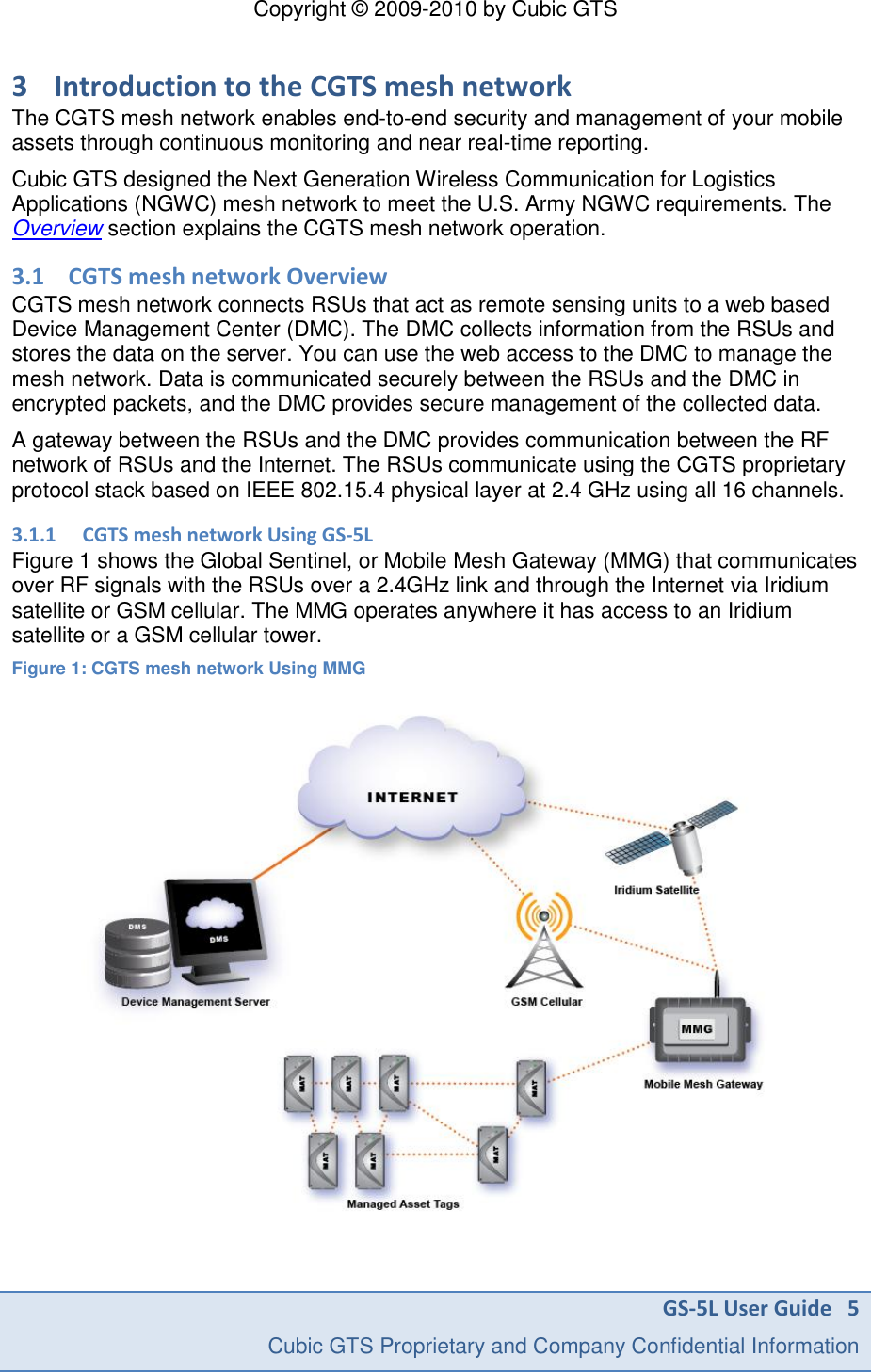
Copyright © 2009-2010 by Cubic GTS GS-5L User Guide   5     Cubic GTS Proprietary and Company Confidential Information  3 Introduction to the CGTS mesh network The CGTS mesh network enables end-to-end security and management of your mobile assets through continuous monitoring and near real-time reporting.  Cubic GTS designed the Next Generation Wireless Communication for Logistics Applications (NGWC) mesh network to meet the U.S. Army NGWC requirements. The Overview section explains the CGTS mesh network operation. 3.1 CGTS mesh network Overview CGTS mesh network connects RSUs that act as remote sensing units to a web based Device Management Center (DMC). The DMC collects information from the RSUs and stores the data on the server. You can use the web access to the DMC to manage the mesh network. Data is communicated securely between the RSUs and the DMC in encrypted packets, and the DMC provides secure management of the collected data. A gateway between the RSUs and the DMC provides communication between the RF network of RSUs and the Internet. The RSUs communicate using the CGTS proprietary protocol stack based on IEEE 802.15.4 physical layer at 2.4 GHz using all 16 channels.  3.1.1 CGTS mesh network Using GS-5L Figure 1 shows the Global Sentinel, or Mobile Mesh Gateway (MMG) that communicates over RF signals with the RSUs over a 2.4GHz link and through the Internet via Iridium satellite or GSM cellular. The MMG operates anywhere it has access to an Iridium satellite or a GSM cellular tower. Figure 1: CGTS mesh network Using MMG
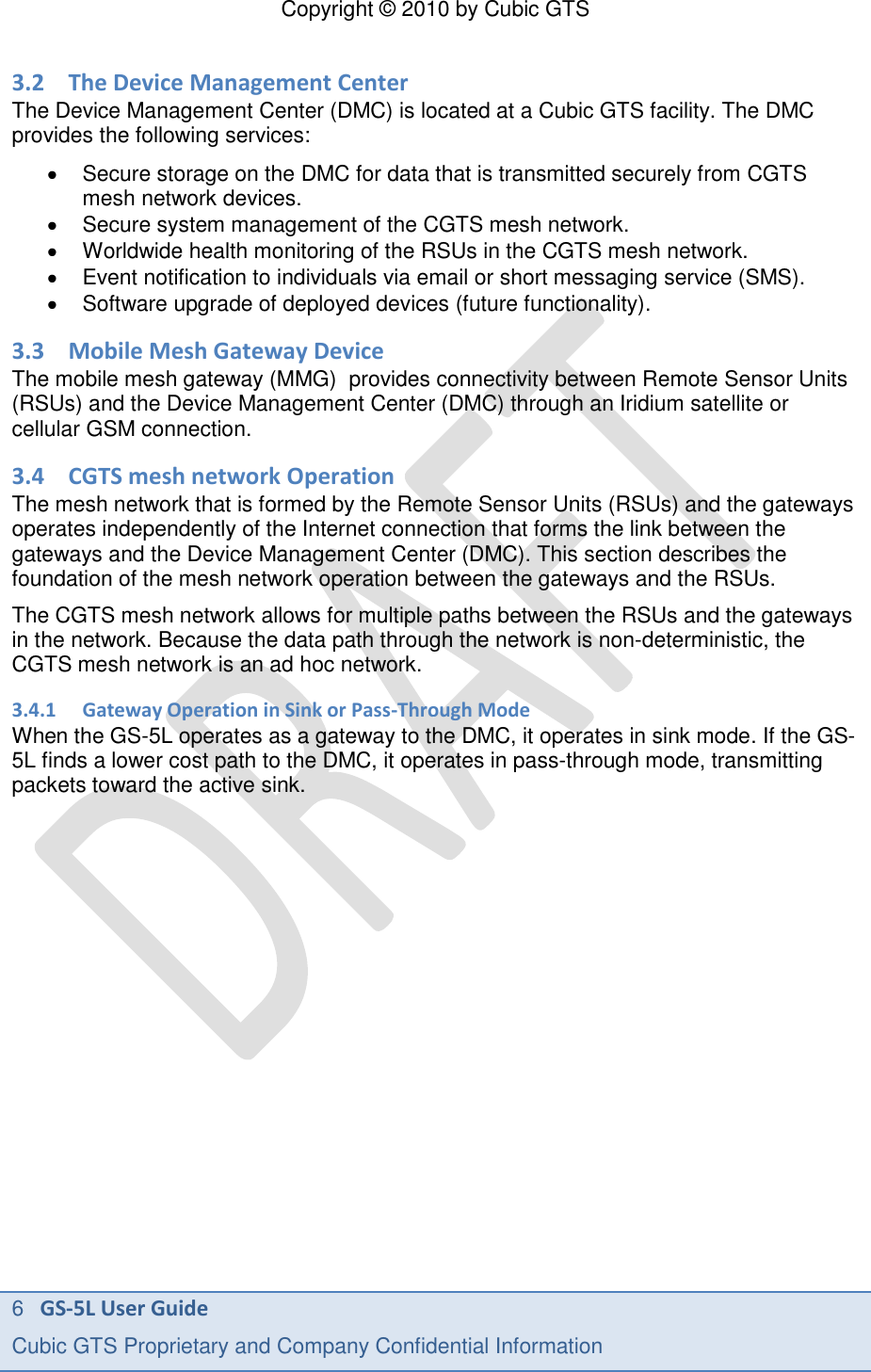
Copyright © 2010 by Cubic GTS 6   GS-5L User Guide Cubic GTS Proprietary and Company Confidential Information      3.2 The Device Management Center The Device Management Center (DMC) is located at a Cubic GTS facility. The DMC provides the following services:   Secure storage on the DMC for data that is transmitted securely from CGTS mesh network devices.   Secure system management of the CGTS mesh network.  Worldwide health monitoring of the RSUs in the CGTS mesh network.   Event notification to individuals via email or short messaging service (SMS).   Software upgrade of deployed devices (future functionality). 3.3 Mobile Mesh Gateway Device The mobile mesh gateway (MMG)  provides connectivity between Remote Sensor Units (RSUs) and the Device Management Center (DMC) through an Iridium satellite or cellular GSM connection.  3.4 CGTS mesh network Operation The mesh network that is formed by the Remote Sensor Units (RSUs) and the gateways operates independently of the Internet connection that forms the link between the gateways and the Device Management Center (DMC). This section describes the foundation of the mesh network operation between the gateways and the RSUs. The CGTS mesh network allows for multiple paths between the RSUs and the gateways in the network. Because the data path through the network is non-deterministic, the CGTS mesh network is an ad hoc network.  3.4.1 Gateway Operation in Sink or Pass-Through Mode When the GS-5L operates as a gateway to the DMC, it operates in sink mode. If the GS-5L finds a lower cost path to the DMC, it operates in pass-through mode, transmitting packets toward the active sink.
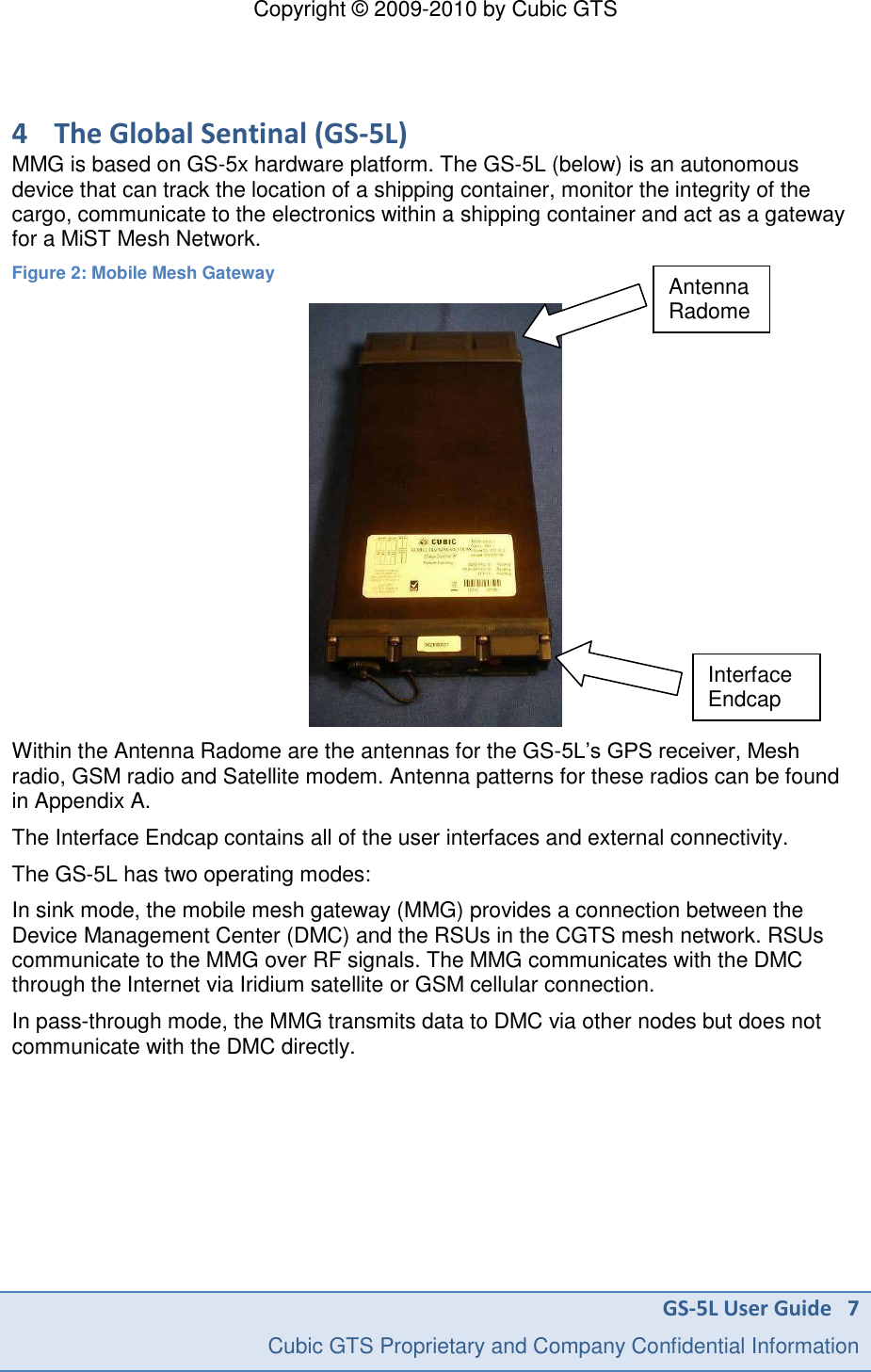
Copyright © 2009-2010 by Cubic GTS GS-5L User Guide   7     Cubic GTS Proprietary and Company Confidential Information  4 The Global Sentinal (GS-5L) MMG is based on GS-5x hardware platform. The GS-5L (below) is an autonomous device that can track the location of a shipping container, monitor the integrity of the cargo, communicate to the electronics within a shipping container and act as a gateway for a MiST Mesh Network. Figure 2: Mobile Mesh Gateway  Within the Antenna Radome are the antennas for the GS-5L’s GPS receiver, Mesh radio, GSM radio and Satellite modem. Antenna patterns for these radios can be found in Appendix A. The Interface Endcap contains all of the user interfaces and external connectivity. The GS-5L has two operating modes: In sink mode, the mobile mesh gateway (MMG) provides a connection between the Device Management Center (DMC) and the RSUs in the CGTS mesh network. RSUs communicate to the MMG over RF signals. The MMG communicates with the DMC through the Internet via Iridium satellite or GSM cellular connection. In pass-through mode, the MMG transmits data to DMC via other nodes but does not communicate with the DMC directly. Antenna Radome InterfaceEndcap
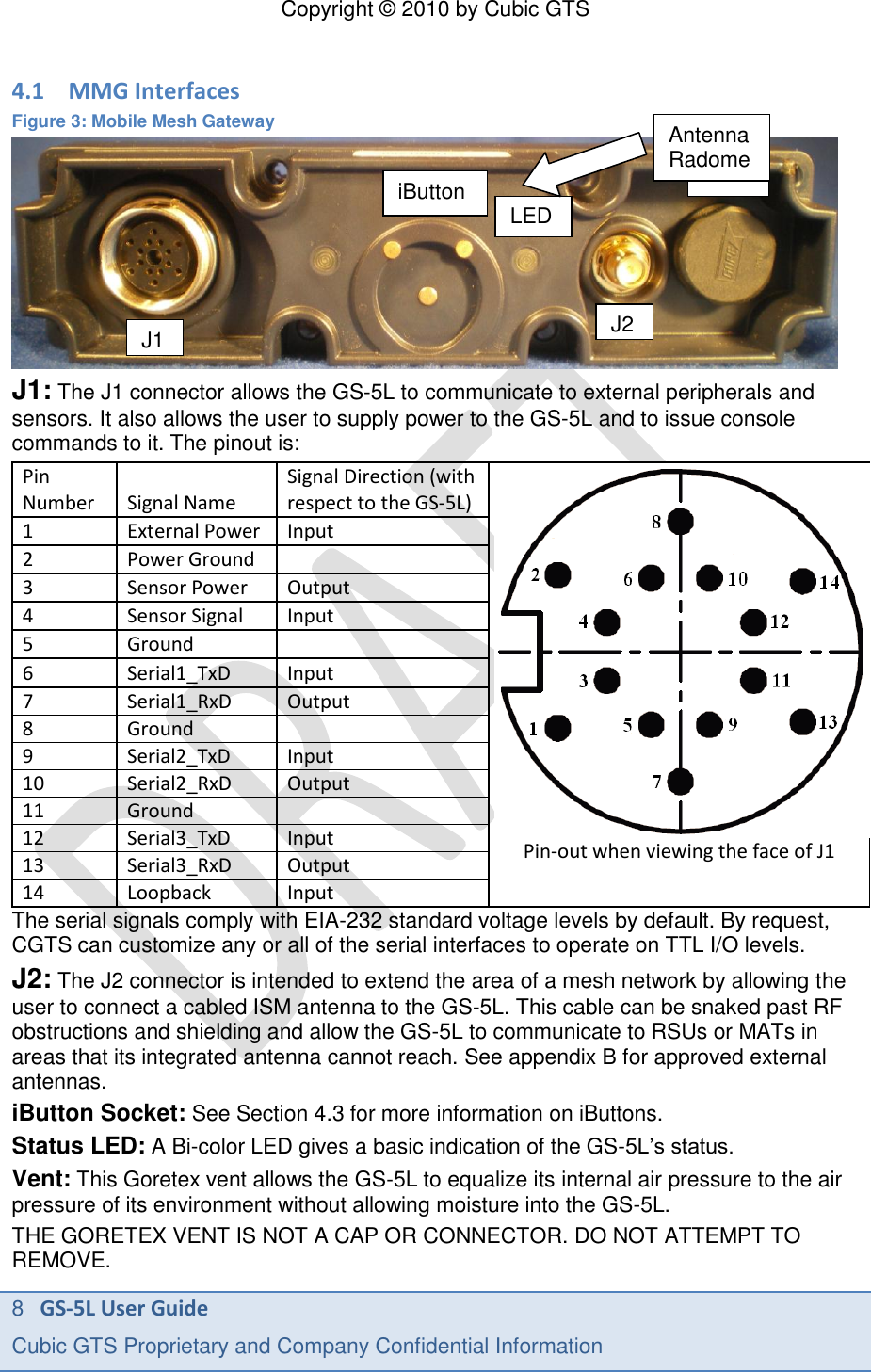
Copyright © 2010 by Cubic GTS 8   GS-5L User Guide Cubic GTS Proprietary and Company Confidential Information      4.1 MMG Interfaces Figure 3: Mobile Mesh Gateway  J1: The J1 connector allows the GS-5L to communicate to external peripherals and sensors. It also allows the user to supply power to the GS-5L and to issue console commands to it. The pinout is: Pin Number Signal Name Signal Direction (with  respect to the GS-5L) Pin-out when viewing the face of J1 1 External Power Input 2 Power Ground  3 Sensor Power Output 4 Sensor Signal Input 5 Ground  6 Serial1_TxD Input 7 Serial1_RxD Output 8 Ground  9 Serial2_TxD Input 10 Serial2_RxD Output 11 Ground  12 Serial3_TxD Input 13 Serial3_RxD Output 14 Loopback Input The serial signals comply with EIA-232 standard voltage levels by default. By request, CGTS can customize any or all of the serial interfaces to operate on TTL I/O levels. J2: The J2 connector is intended to extend the area of a mesh network by allowing the user to connect a cabled ISM antenna to the GS-5L. This cable can be snaked past RF obstructions and shielding and allow the GS-5L to communicate to RSUs or MATs in areas that its integrated antenna cannot reach. See appendix B for approved external antennas. iButton Socket: See Section 4.3 for more information on iButtons. Status LED: A Bi-color LED gives a basic indication of the GS-5L’s status. Vent: This Goretex vent allows the GS-5L to equalize its internal air pressure to the air pressure of its environment without allowing moisture into the GS-5L. THE GORETEX VENT IS NOT A CAP OR CONNECTOR. DO NOT ATTEMPT TO REMOVE. J2 iButton LED Vent J1 Antenna Radome
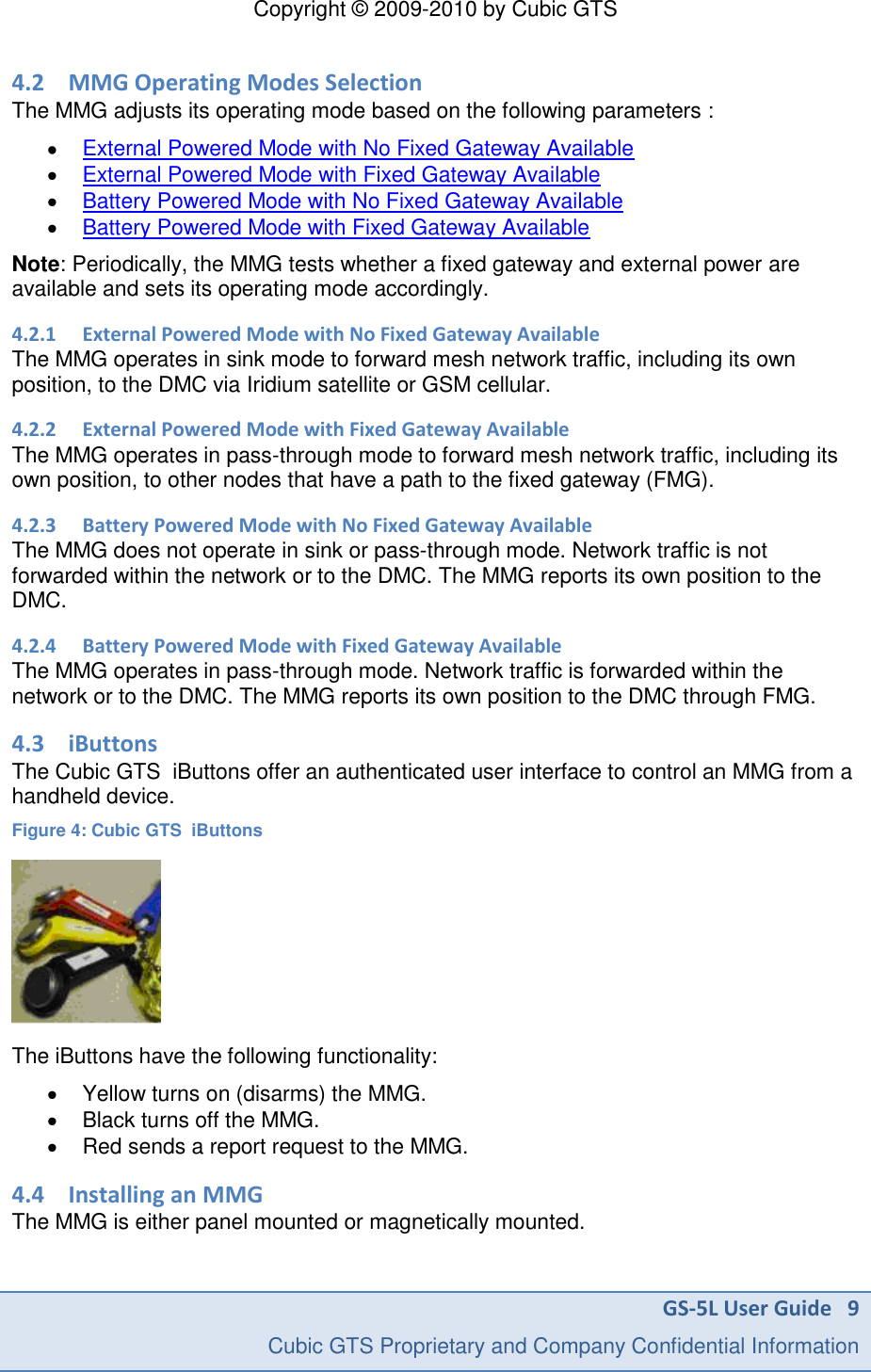
Copyright © 2009-2010 by Cubic GTS GS-5L User Guide   9     Cubic GTS Proprietary and Company Confidential Information  4.2 MMG Operating Modes Selection The MMG adjusts its operating mode based on the following parameters :  External Powered Mode with No Fixed Gateway Available  External Powered Mode with Fixed Gateway Available  Battery Powered Mode with No Fixed Gateway Available  Battery Powered Mode with Fixed Gateway Available Note: Periodically, the MMG tests whether a fixed gateway and external power are available and sets its operating mode accordingly. 4.2.1 External Powered Mode with No Fixed Gateway Available The MMG operates in sink mode to forward mesh network traffic, including its own position, to the DMC via Iridium satellite or GSM cellular. 4.2.2 External Powered Mode with Fixed Gateway Available The MMG operates in pass-through mode to forward mesh network traffic, including its own position, to other nodes that have a path to the fixed gateway (FMG). 4.2.3 Battery Powered Mode with No Fixed Gateway Available The MMG does not operate in sink or pass-through mode. Network traffic is not forwarded within the network or to the DMC. The MMG reports its own position to the DMC. 4.2.4 Battery Powered Mode with Fixed Gateway Available The MMG operates in pass-through mode. Network traffic is forwarded within the network or to the DMC. The MMG reports its own position to the DMC through FMG. 4.3 iButtons The Cubic GTS  iButtons offer an authenticated user interface to control an MMG from a handheld device. Figure 4: Cubic GTS  iButtons  The iButtons have the following functionality:   Yellow turns on (disarms) the MMG.   Black turns off the MMG.   Red sends a report request to the MMG. 4.4 Installing an MMG The MMG is either panel mounted or magnetically mounted.
Copyright © 2010 by Cubic GTS 10   GS-5L User Guide Cubic GTS Proprietary and Company Confidential Information      4.5 Configuring an MMG See CGTS Mesh Network User’s Manual. 4.6 Maintaining an MMG See CGTS Mesh Network User’s Manual.
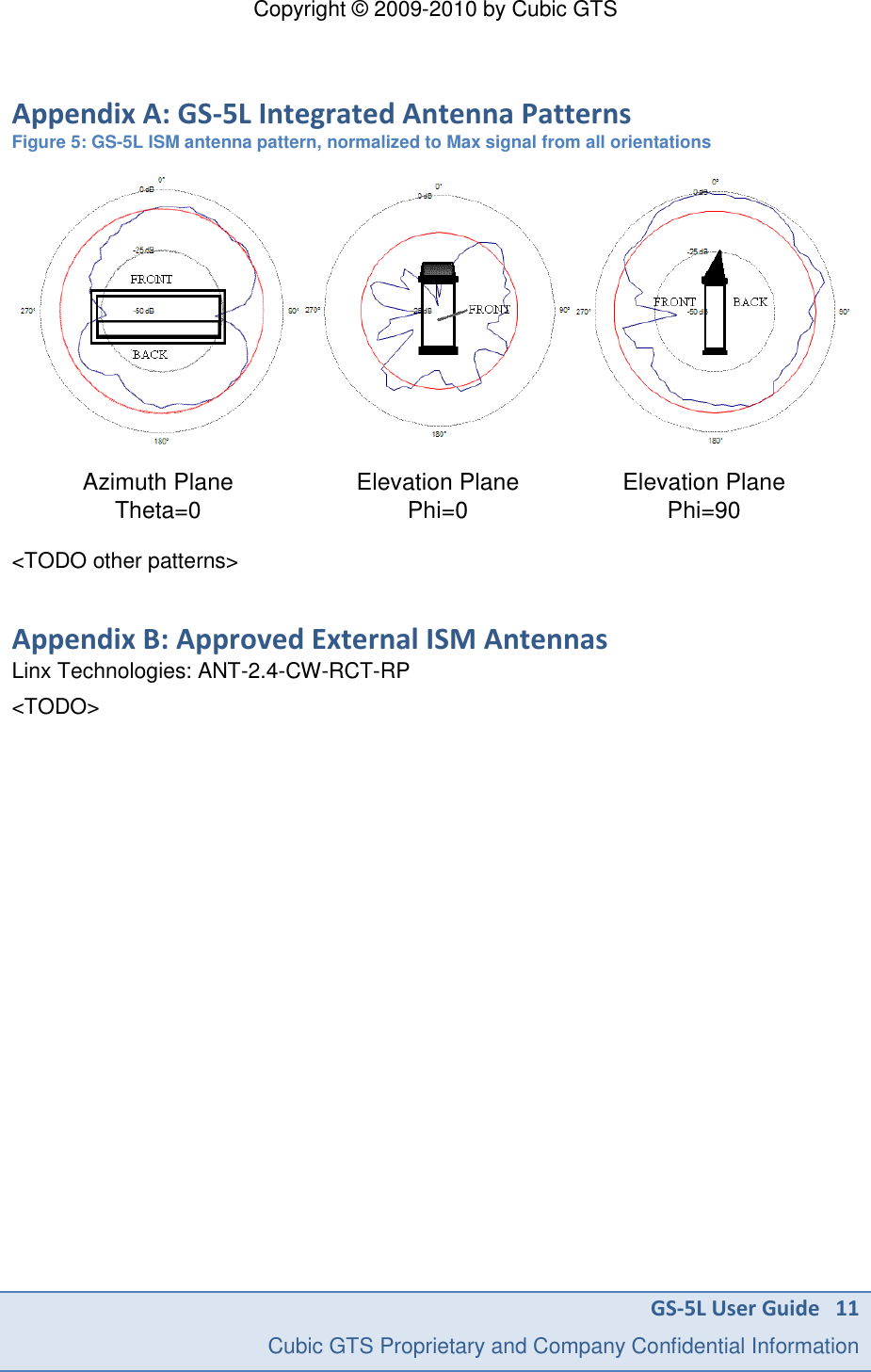
Copyright © 2009-2010 by Cubic GTS GS-5L User Guide   11     Cubic GTS Proprietary and Company Confidential Information  Appendix A: GS-5L Integrated Antenna Patterns Figure 5: GS-5L ISM antenna pattern, normalized to Max signal from all orientations                      Azimuth PlaneTheta=0                        Elevation PlanePhi=0                    Elevation PlanePhi=90 <TODO other patterns> Appendix B: Approved External ISM Antennas Linx Technologies: ANT-2.4-CW-RCT-RP <TODO>

Navigation menu