DareGlobal Technologies DB108 ADSL Modem User Manual Manual

Shanghai DareGlobal Technologies Co., Ltd. ADSL Modem Manual

User Manual

User Manual must provide user information:  Instruction Manual Federal Communication Commission Interference Statement  This equipment has been tested and found to comply with the limits for a Class B digital device, pursuant to Part 15 of the FCC Rules. These limits are designed to provide reasonable protection against harmful interference in a residential installation. This equipment generates, uses and can radiate radio frequency energy and, if not installed and used in accordance with the instructions, may cause harmful interference to radio communications. However, there is no guarantee that interference will not occur in a particular installation. If this equipment does cause harmful interference to radio or television reception, which can be determined by turning the equipment off and on, the user is encouraged to try to correct the interference by one of the following measures: - Reorient or relocate the receiving antenna. - Increase the separation between the equipment and receiver. - Connect the equipment into an outlet on a circuit different from that to which the receiver is connected. - Consult the dealer or an experienced radio/TV technician for help.  FCC Caution: To assure continued compliance, (example – use only shielded interface cables when connecting to computer or peripheral devices). Any changes or modifications not expressly approved by the party responsible for compliance could void the user’s authority to operate this equipment.
DB108 Ethernet ADSL MODEM USER MANUAL   - 2 -           DB108   Ethernet ADSL MODEM   USER MANUAL
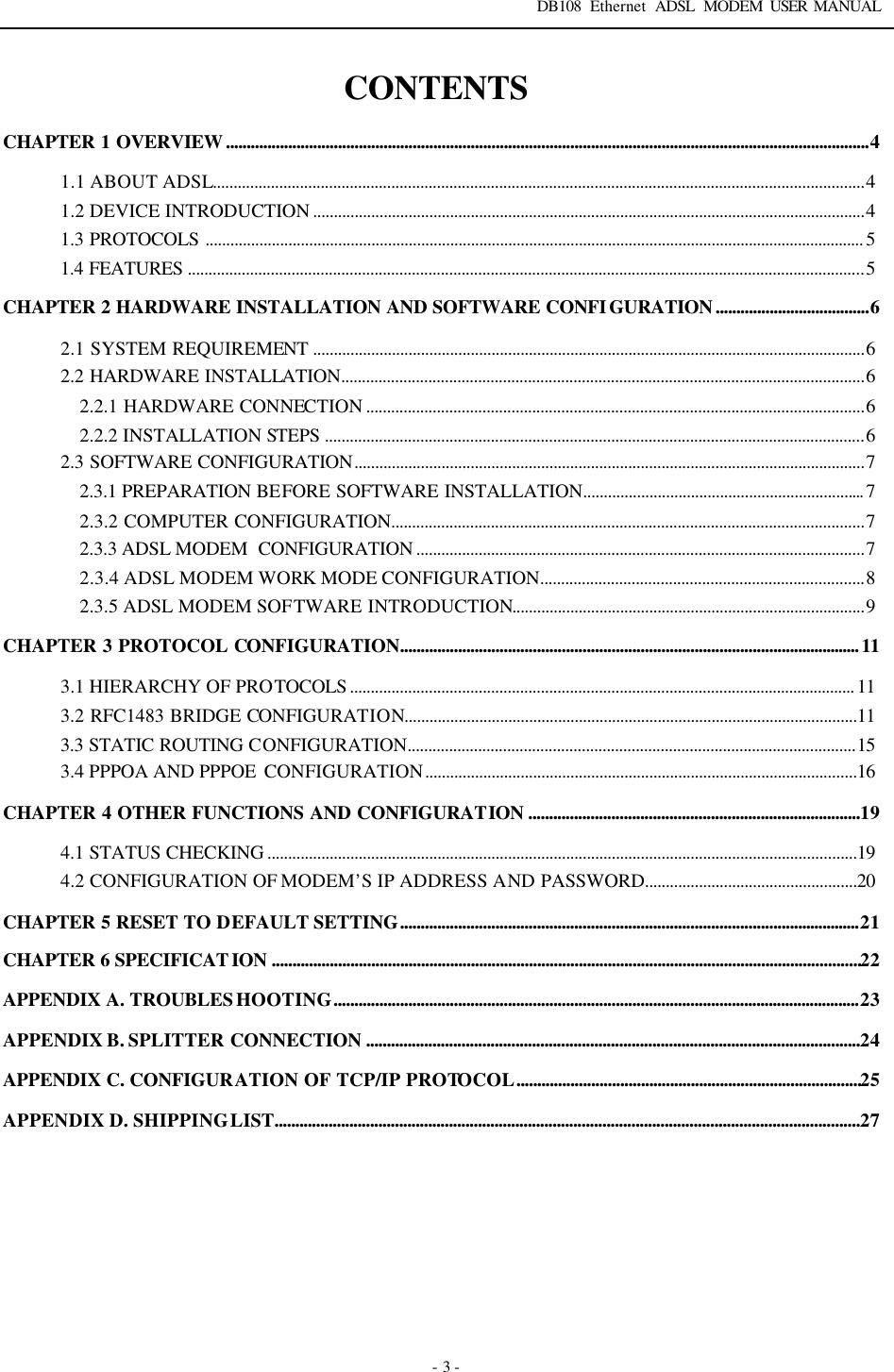
DB108 Ethernet ADSL MODEM USER MANUAL   - 3 - CONTENTS CHAPTER 1 OVERVIEW...........................................................................................................................................................4 1.1 ABOUT ADSL.............................................................................................................................................................4 1.2 DEVICE INTRODUCTION .....................................................................................................................................4 1.3 PROTOCOLS ............................................................................................................................................................... 5 1.4 FEATURES ...................................................................................................................................................................5 CHAPTER 2 HARDWARE INSTALLATION AND SOFTWARE CONFIGURATION.....................................6 2.1 SYSTEM REQUIREMENT .....................................................................................................................................6 2.2 HARDWARE INSTALLATION..............................................................................................................................6 2.2.1 HARDWARE CONNECTION ........................................................................................................................6 2.2.2 INSTALLATION STEPS ..................................................................................................................................6 2.3 SOFTWARE CONFIGURATION...........................................................................................................................7 2.3.1 PREPARATION BEFORE SOFTWARE INSTALLATION.................................................................... 7 2.3.2 COMPUTER CONFIGURATION..................................................................................................................7 2.3.3 ADSL MODEM  CONFIGURATION ............................................................................................................7 2.3.4 ADSL MODEM WORK MODE CONFIGURATION..............................................................................8 2.3.5 ADSL MODEM SOFTWARE INTRODUCTION.....................................................................................9 CHAPTER 3 PROTOCOL CONFIGURATION...............................................................................................................11 3.1 HIERARCHY OF PROTOCOLS .......................................................................................................................... 11 3.2 RFC1483 BRIDGE CONFIGURATION.............................................................................................................11 3.3 STATIC ROUTING CONFIGURATION............................................................................................................15 3.4 PPPOA AND PPPOE  CONFIGURATION........................................................................................................16 CHAPTER 4 OTHER FUNCTIONS AND CONFIGURATION ................................................................................19 4.1 STATUS CHECKING ..............................................................................................................................................19 4.2 CONFIGURATION OF MODEM’S IP ADDRESS AND PASSWORD...................................................20 CHAPTER 5 RESET TO DEFAULT SETTING...............................................................................................................21 CHAPTER 6 SPECIFICATION ..............................................................................................................................................22 APPENDIX A. TROUBLESHOOTING...............................................................................................................................23 APPENDIX B. SPLITTER CONNECTION .......................................................................................................................24 APPENDIX C. CONFIGURATION OF TCP/IP PROTOCOL...................................................................................25 APPENDIX D. SHIPPING LIST.............................................................................................................................................27
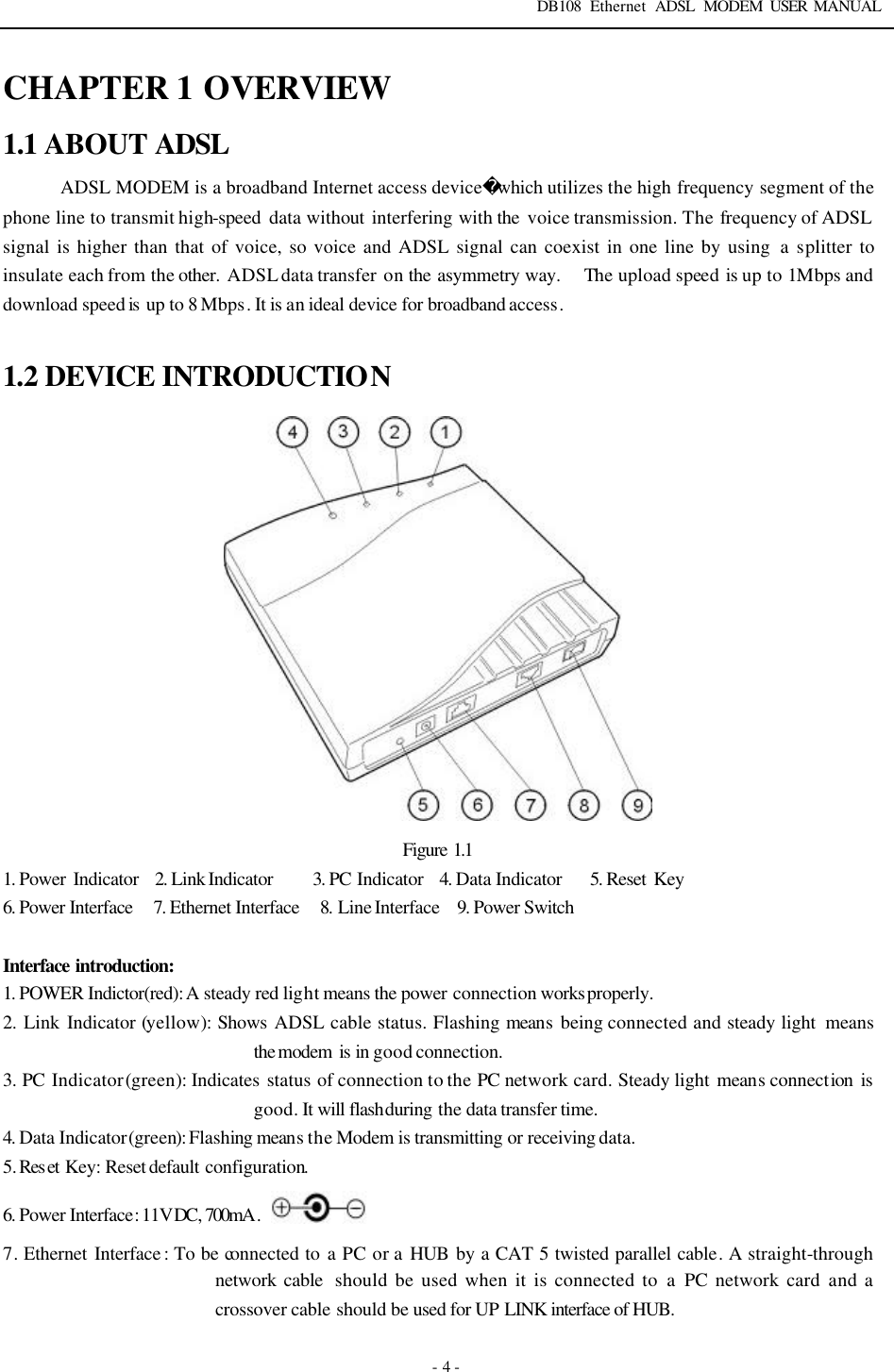
DB108 Ethernet ADSL MODEM USER MANUAL   - 4 - CHAPTER 1 OVERVIEW 1.1 ABOUT ADSL ADSL MODEM is a broadband Internet access devicewhich utilizes the high frequency segment of the phone line to transmit high-speed  data without interfering with the  voice transmission. The frequency of ADSL signal is higher than that of voice, so voice and ADSL signal can coexist in one line by using  a splitter to insulate each from the other.  ADSL data transfer  on the asymmetry way.    The upload speed is up to 1Mbps and download speed is  up to 8 Mbps. It is an ideal device for broadband access.  1.2 DEVICE INTRODUCTION  Figure  1.1 1. Power Indicator  2. Link Indicator    3. PC Indicator  4. Data Indicator   5. Reset  Key 6. Power Interface  7. Ethernet Interface  8.  Line Interface    9. Power Switch  Interface introduction: 1. POWER Indictor(red): A steady red light means the power connection works properly. 2.  Link Indicator (yellow): Shows  ADSL cable status. Flashing means being connected and steady light  means the modem  is in good connection. 3.  PC Indicator (green): Indicates  status of connection to the PC network card. Steady light means connection  is good. It will flash during the data transfer time.   4. Data Indicator (green): Flashing means the Modem is transmitting or receiving data. 5. Res et Key: Reset default configuration. 6. Power Interface: 11V DC, 700mA .     7. Ethernet Interface : To be connected to a PC or a HUB by a CAT 5 twisted parallel cable. A straight-through network cable  should be used when it is connected to a PC  network card and a crossover cable should be used for UP LINK interface of HUB.
DB108 Ethernet ADSL MODEM USER MANUAL   - 5 - 8. Line Interface: To be connected to a telephone. 9. Power switch: To turn  on or off the power.  1.3 PROTOCOLS ADSL Modem supports the following protocols:   1. PPPoAPPP over ATM  LLC encapsulation or VCMUX encapsulation            (RFC2364) 2. PPPoE  (PPP over Ethernet) LLC encapsulation or VCMUX encapsulation           (RFC2516)   3. 1483 bridge1483 Bridged IP over ATMLLC encapsulation or VCMUX encapsulation (RFC1483) 4. 1483 routing1483 Routing IP over ATMLLC encapsulation or VCMUX encapsulation (RFC1483) 5. Classical IP over ATM (RFC1577)  1.4 FEATURES 1. Supports ANSI T1.413 ISSUE 2, ITU G.992.1 (G.DMT) and ITU G.992.2 (G. LITE). 2. Web-based configuration and monitoring. 3. Supports  up to 8 PVCs. 4. Routing function. 5. NAPTDHCP function. 6. Maximum upstream transmission rates of 1Mbps   7. Maximum downstream transmission rates of 8 Mbps 8. Software  upgradeable. 9. Transmission distance up to 5 km.  10. ATM management function.
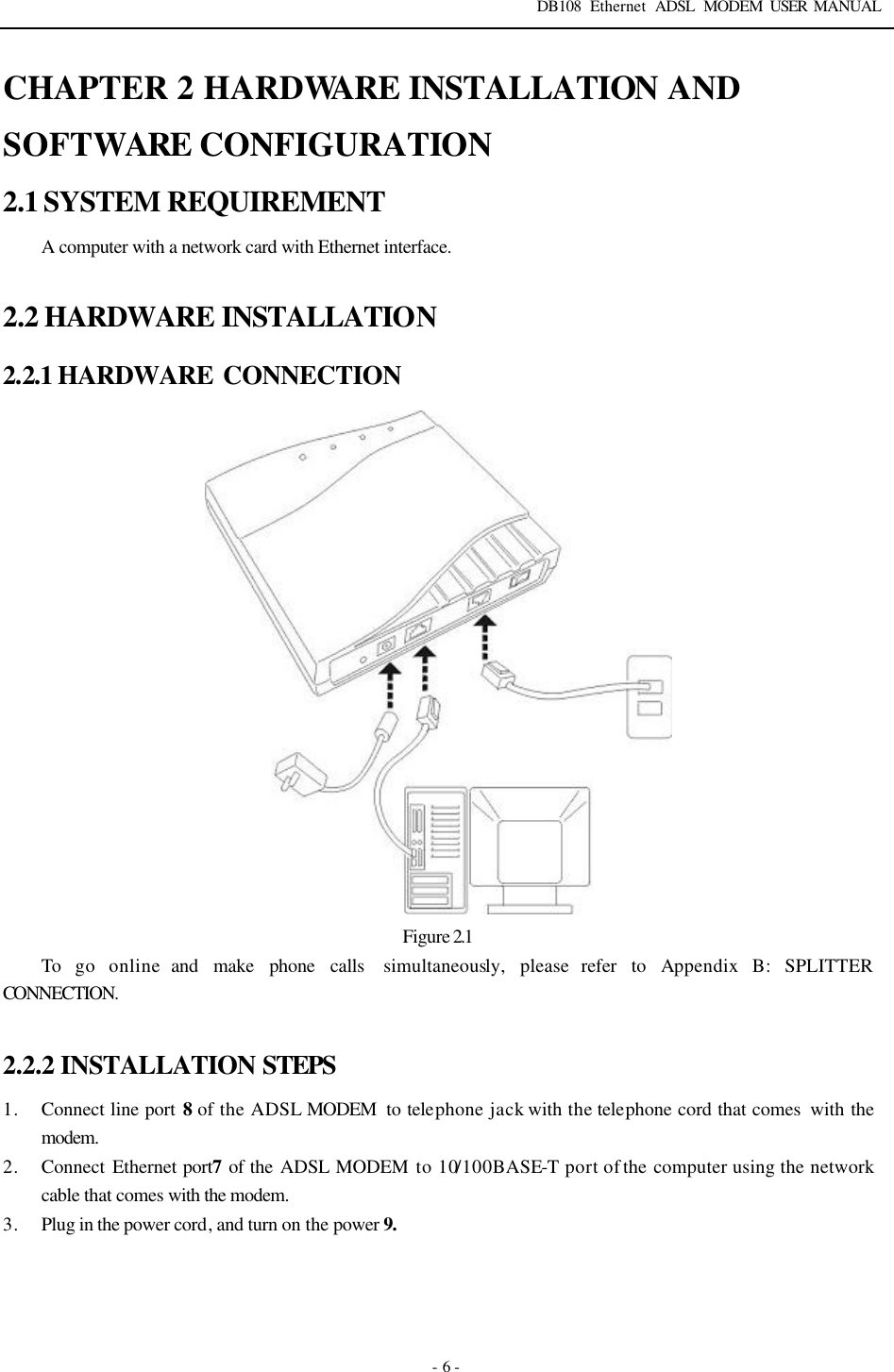
DB108 Ethernet ADSL MODEM USER MANUAL   - 6 - CHAPTER 2 HARDWARE INSTALLATION AND SOFTWARE CONFIGURATION 2.1 SYSTEM REQUIREMENT A computer with a network card with Ethernet interface.  2.2 HARDWARE INSTALLATION 2.2.1 HARDWARE  CONNECTION  Figure 2.1 To go online and make phone calls  simultaneously, please refer to Appendix B: SPLITTER CONNECTION.  2.2.2 INSTALLATION STEPS 1. Connect line port 8 of  the ADSL MODEM  to telephone jack with the telephone cord that comes  with the modem. 2. Connect Ethernet port7 of the ADSL MODEM to 10/100BASE-T port of the computer using the network cable that comes with the modem. 3. Plug in the power cord, and turn on the power 9.
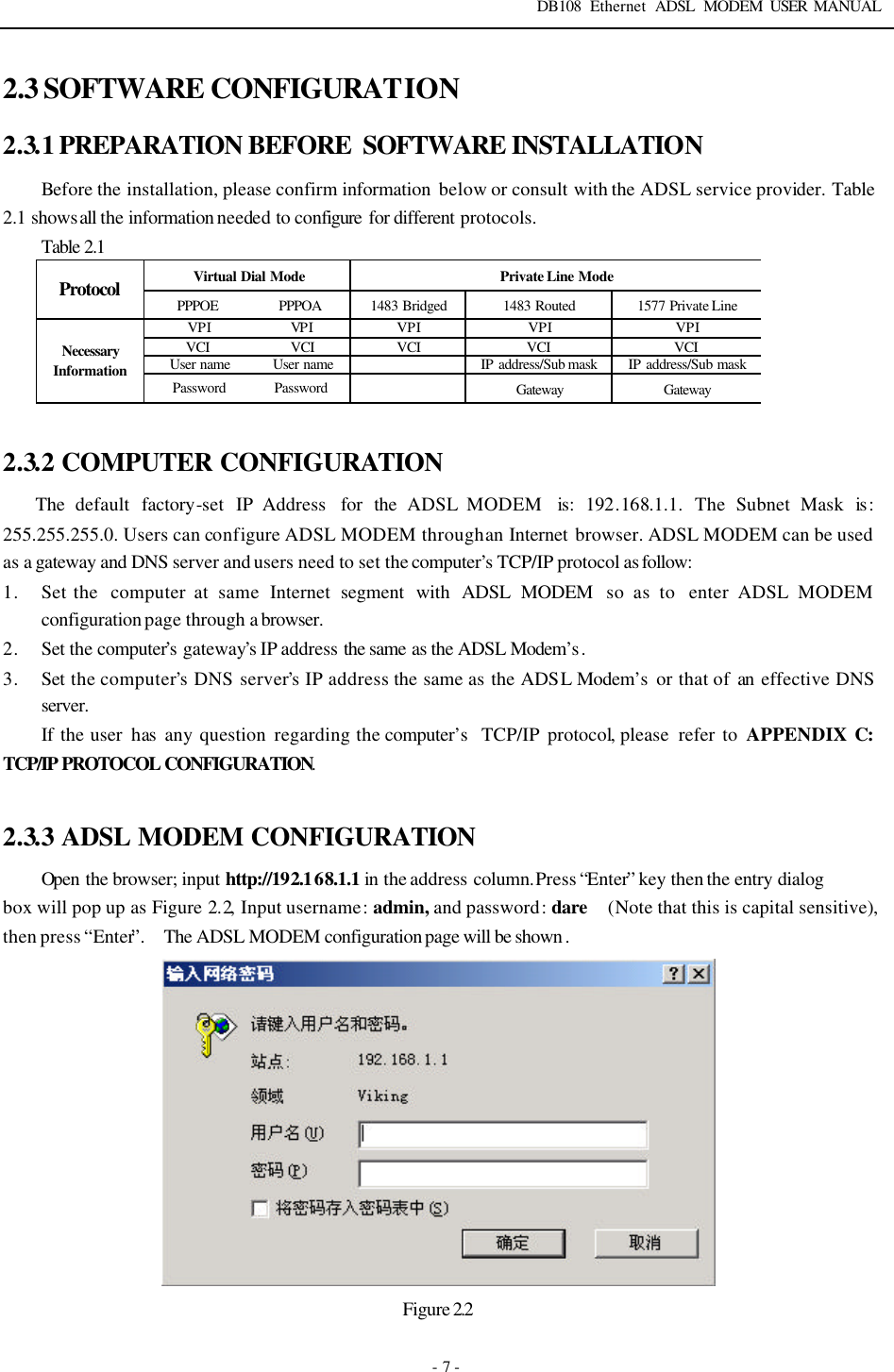
DB108 Ethernet ADSL MODEM USER MANUAL   - 7 - 2.3 SOFTWARE CONFIGURATION   2.3.1 PREPARATION BEFORE  SOFTWARE INSTALLATION  Before the installation, please confirm information  below or consult with the ADSL service provider. Table 2.1 shows all the information needed to configure  for different protocols. Table 2.1 Virtual Dial Mode Private Line Mode Protocol PPPOE PPPOA 1483 Bridged 1483 Routed 1577 Private Line VPI VPI VPI VPI VPI VCI VCI VCI VCI VCI User name User name    IP address/Sub mask IP address/Sub mask Necessary Information Password Password  Gateway Gateway  2.3.2 COMPUTER CONFIGURATION The  default  factory-set  IP Address  for the ADSL MODEM  is:  192.168.1.1. The  Subnet Mask is : 255.255.255.0. Users can configure ADSL MODEM through an Internet  browser. ADSL MODEM can be used as a gateway and DNS server and users need to set the computer’s  TCP/IP protocol as follow:   1. Set the  computer at same  Internet segment with ADSL MODEM  so as to  enter ADSL MODEM configuration page through a browser.   2. Set the computer’s  gateway’s IP address the same as the ADSL Modem’s .   3. Set the computer’s DNS server’s IP address the same as the ADSL Modem’s  or that of  an effective DNS server. If  the user  has any question regarding the computer’s  TCP/IP protocol, please  refer to APPENDIX C: TCP/IP PROTOCOL CONFIGURATION.  2.3.3 ADSL MODEM CONFIGURATION Open the browser; input http://192.168.1.1 in the address column. Press “Enter” key then the entry dialog box will pop up as Figure 2.2, Input username: admin, and password: dare   (Note that this is capital sensitive), then press “Enter”.  The ADSL MODEM configuration page will be shown .  Figure 2.2
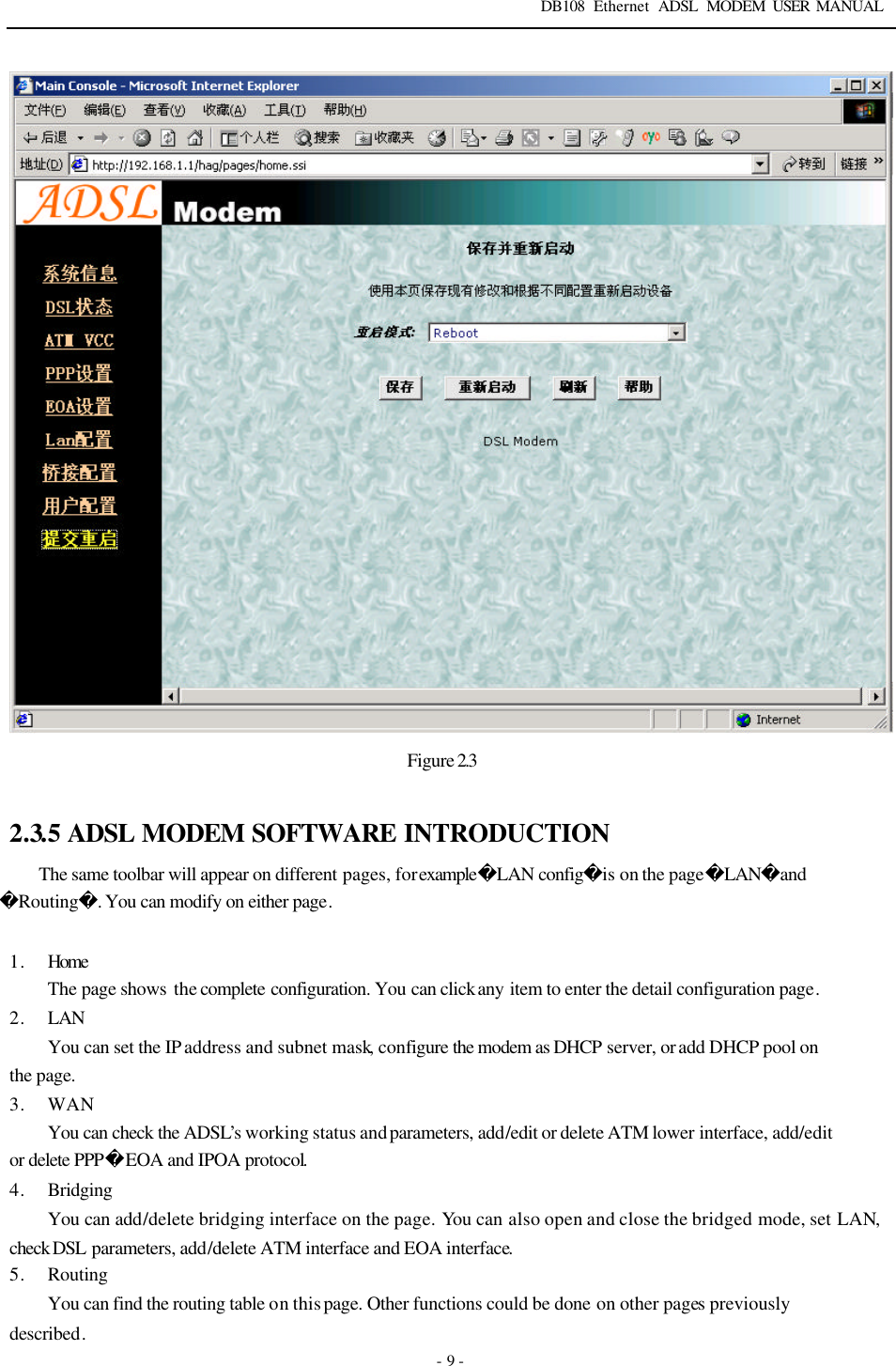
DB108 Ethernet ADSL MODEM USER MANUAL   - 8 - 2.3.4 ADSL MODEM WORK MODE CONFIGURATION 1. For different protocols , the users need to set ADSL Modem  accordingly as listed below: Table 2.2   ATM VCC Protocol Use DNS User Name Password  PPPoE Enable   PPPoE PPPoA  PPPoA Enable    Lower interface Default route 1483 Bridged  Disable  Lower interface IP Address Sub mask Gateway Address 1483 Routed      Lower interface IP Address Sub mask IPoA Mode Gateway Address 1577   Private Line    1577  Note:   means configure according to ADSL service provider’s instructed value. PPPoE can also be realized  via  third part y dialup software.  PPPoE PPPoA 1483 Bridged 1483 Routed 1577 Private Line User Manual Reference Chapter 3.4 3.4 3.2 3.3 3.3 2. After getting through every page for parameters set-up, click “Submit” to save the value in ADSL MODEM  3. Click the “Commit & reboot” on “Admin” Tab to enter the saving configuration page as Figure 2.3. Click Commitbutton to save the setting. Click “Reboot” button to reboot the ADSL MODEM . The ADSL   MODEM will work on the new parameters.
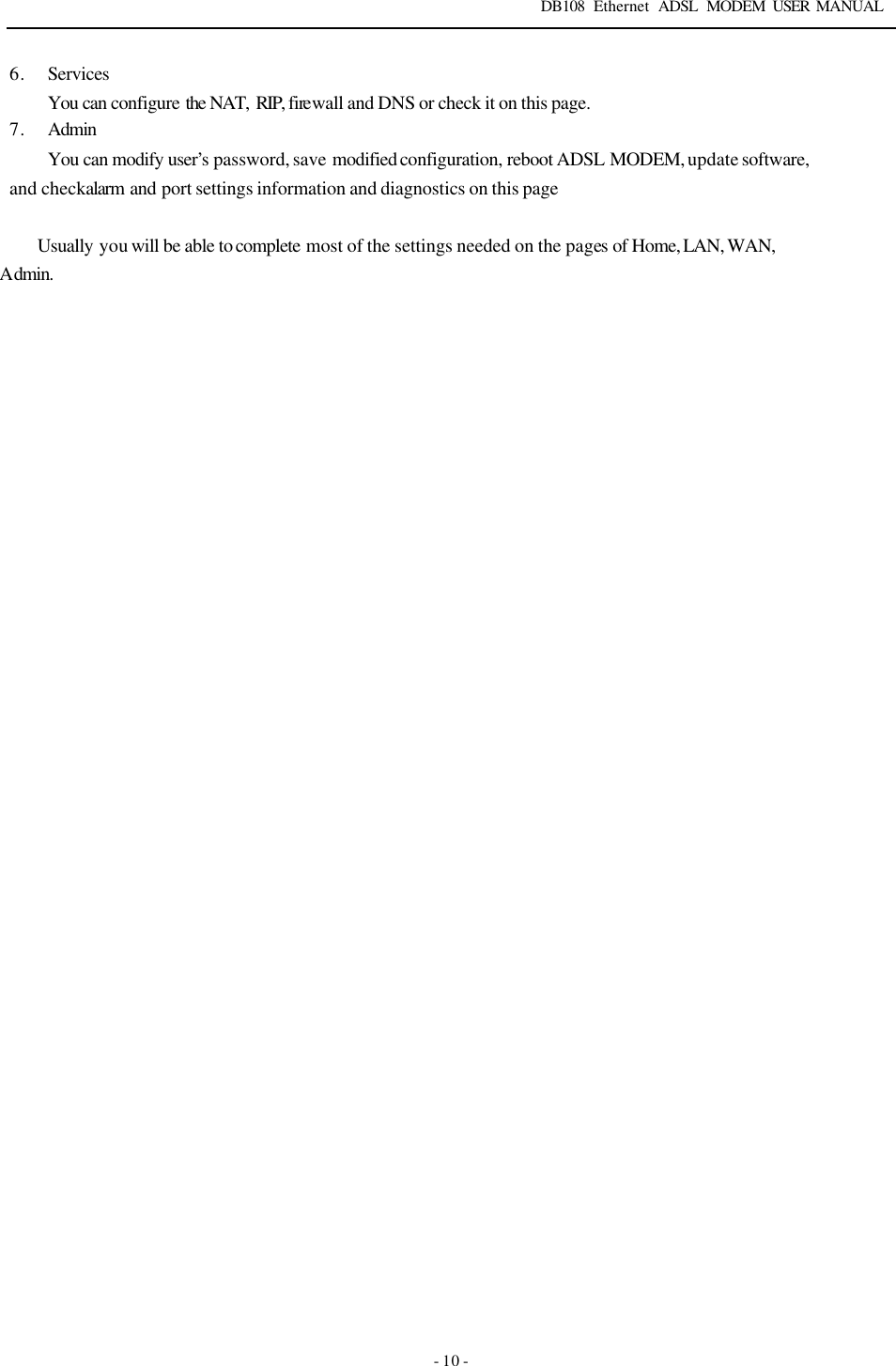
DB108 Ethernet ADSL MODEM USER MANUAL   - 9 -  Figure 2.3  2.3.5 ADSL MODEM SOFTWARE INTRODUCTION The same toolbar will appear on different pages, for exampleLAN configis on the pageLANandRouting. You can modify on either page.    1. Home  The page shows  the complete configuration. You can click any item to enter the detail configuration page. 2. LAN You can set the IP address and subnet mask, configure the modem as DHCP server, or add DHCP pool on the page. 3. WAN You can check the ADSL’s working status and parameters, add/edit or delete ATM lower interface, add/edit or delete PPPEOA and IPOA protocol.   4. Bridging You can add/delete bridging interface on the page. You can also open and close the bridged mode, set LAN, check DSL  parameters, add/delete ATM interface and EOA interface.   5. Routing You can find the routing table on this page. Other functions could be done on other pages previously described.
DB108 Ethernet ADSL MODEM USER MANUAL   - 10 - 6. Services You can configure the NAT,  RIP, firewall and DNS or check it on this page. 7. Admin You can modify user’s password, save modified configuration, reboot ADSL MODEM, update software, and check alarm  and port settings information and diagnostics on this page  Usually you will be able to complete most of the settings needed on the pages of Home, LAN, WAN, Admin.
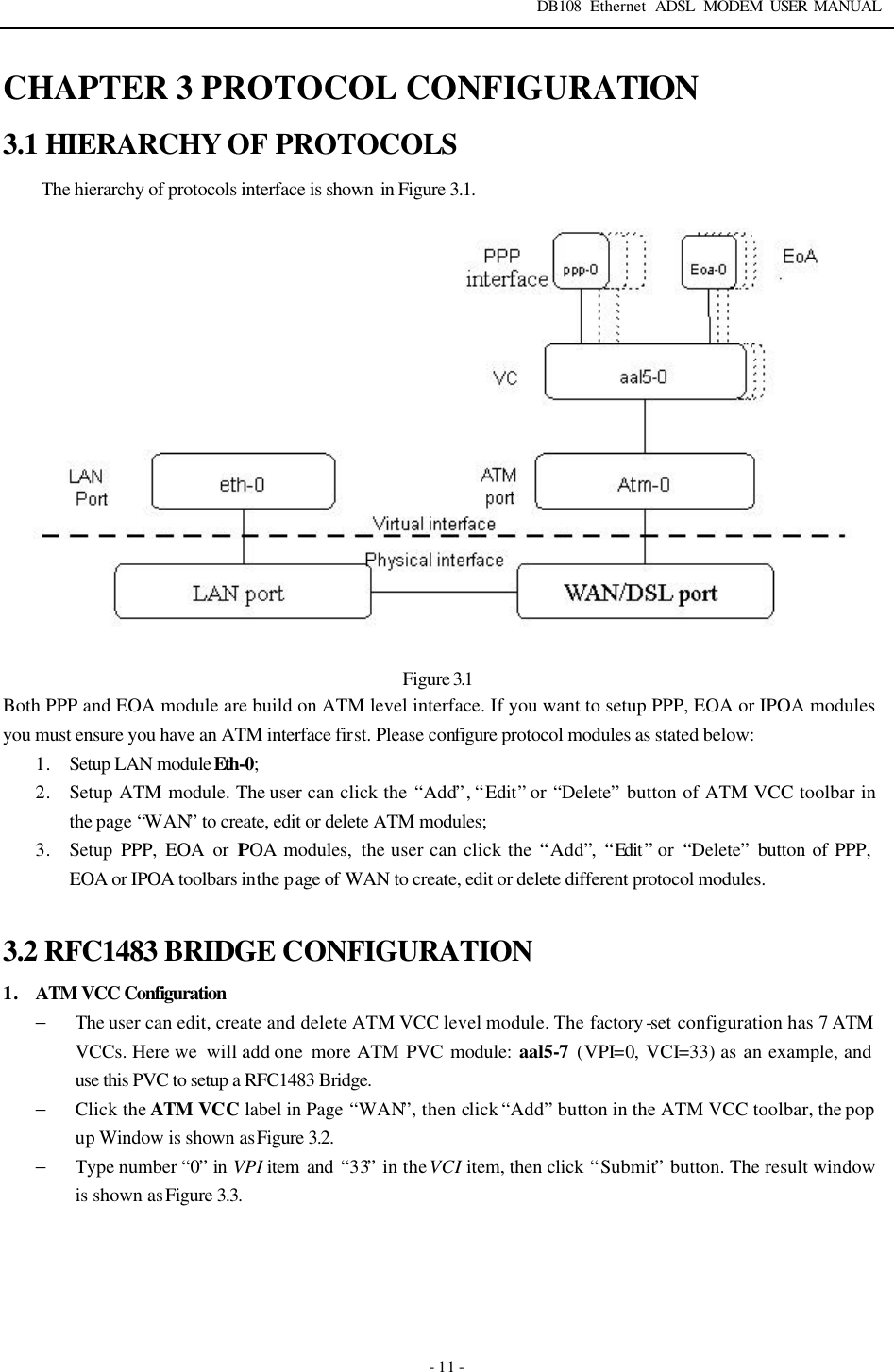
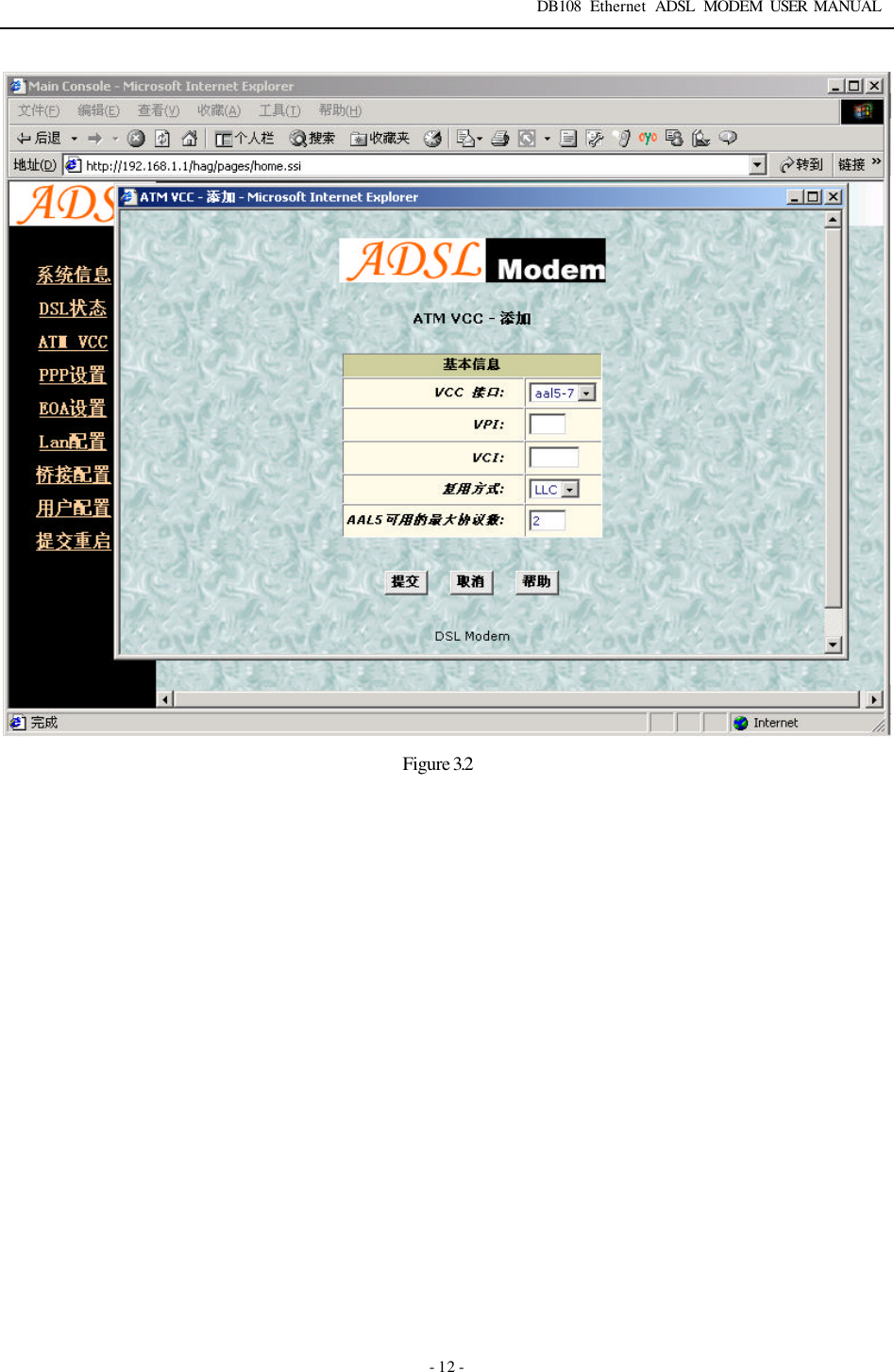
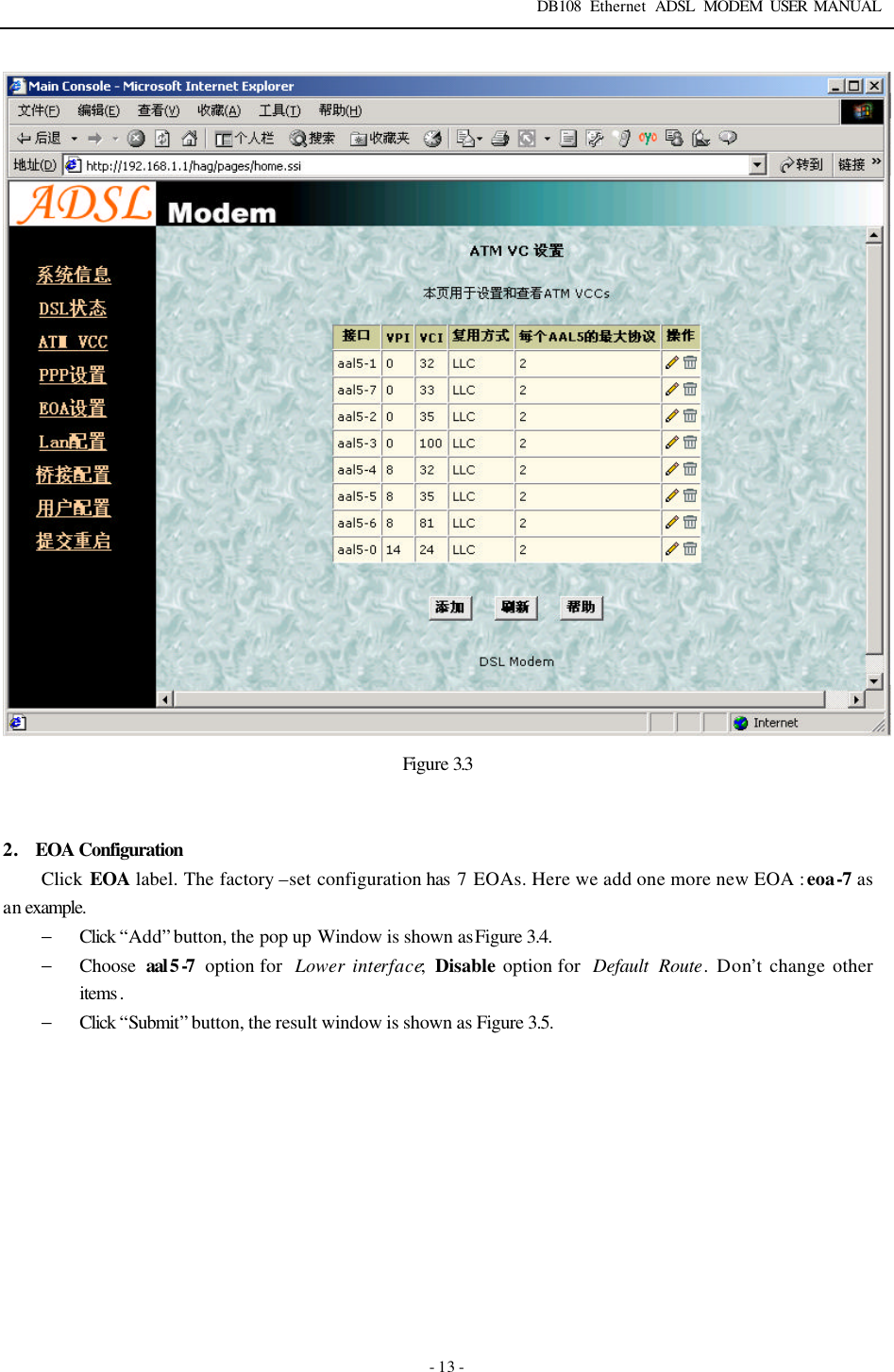
DB108 Ethernet ADSL MODEM USER MANUAL   - 11 - CHAPTER 3 PROTOCOL CONFIGURATION 3.1 HIERARCHY OF PROTOCOLS The hierarchy of protocols interface is shown  in Figure 3.1.  Figure 3.1 Both PPP and EOA module are build on ATM level interface. If you want to setup PPP, EOA or IPOA modules you must ensure you have an ATM interface first. Please configure protocol modules as stated below:   1. Setup LAN module Eth-0; 2. Setup ATM module. The user can click the “Add”, “Edit” or “Delete” button of ATM VCC toolbar in the page “WAN” to create, edit or delete ATM modules; 3. Setup PPP, EOA or IPOA modules,  the user can click the “Add”,  “Edit ” or  “Delete” button of PPP, EOA or IPOA toolbars in the page of WAN to create, edit or delete different protocol modules.  3.2 RFC1483 BRIDGE CONFIGURATION 1. ATM VCC Configuration − The user can edit, create and delete ATM VCC level module. The factory -set configuration has 7 ATM VCCs. Here we  will add one  more ATM PVC module: aal5-7 (VPI=0, VCI=33) as an example, and use this PVC to setup a RFC1483 Bridge. − Click the ATM VCC label in Page “WAN”, then click “Add” button in the ATM VCC toolbar, the pop up Window is shown as Figure 3.2. − Type number “0” in VPI item  and  “33” in the VCI item, then click “Submit” button. The result window is shown as Figure 3.3.
DB108 Ethernet ADSL MODEM USER MANUAL   - 12 -  Figure 3.2
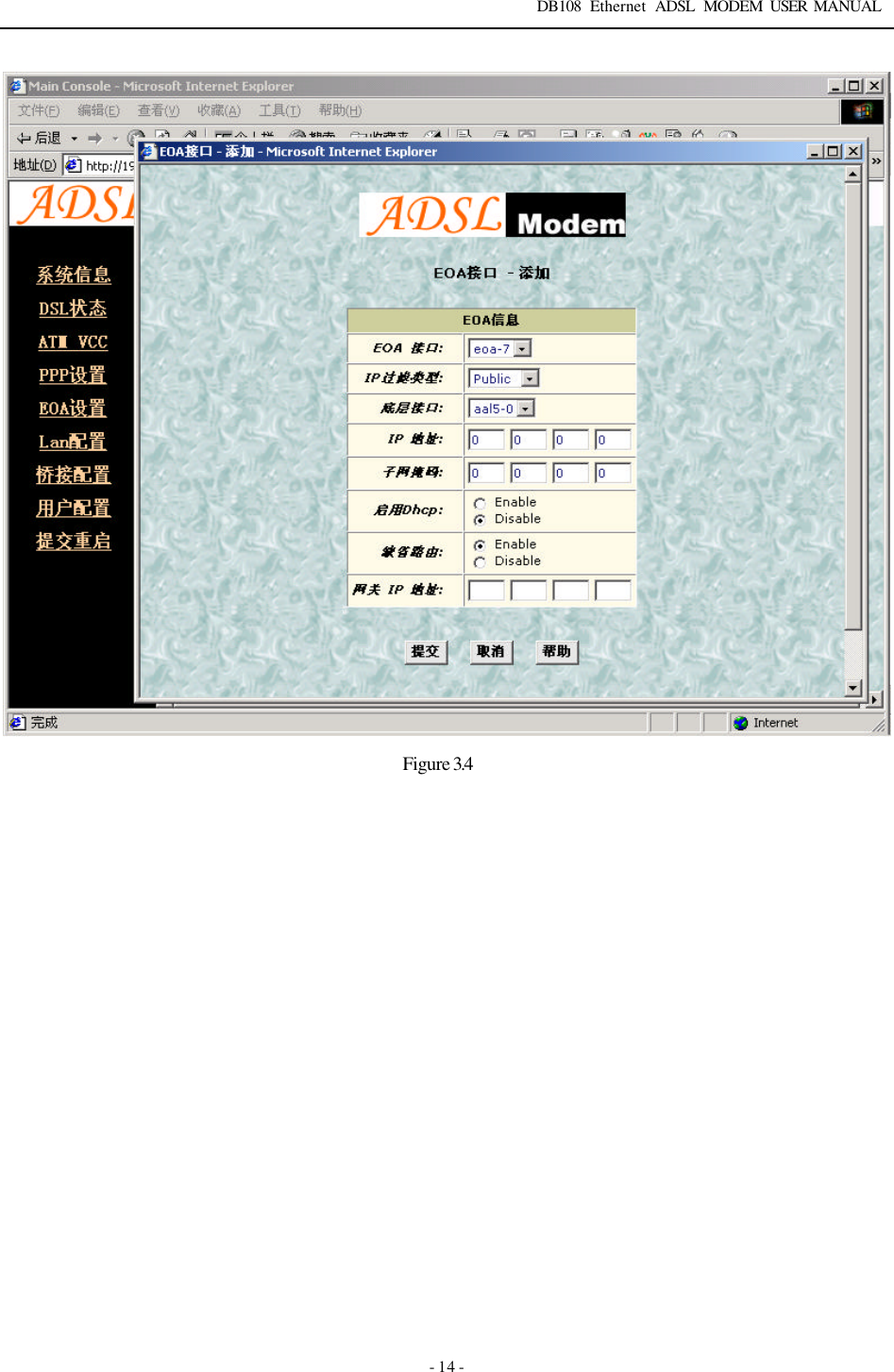
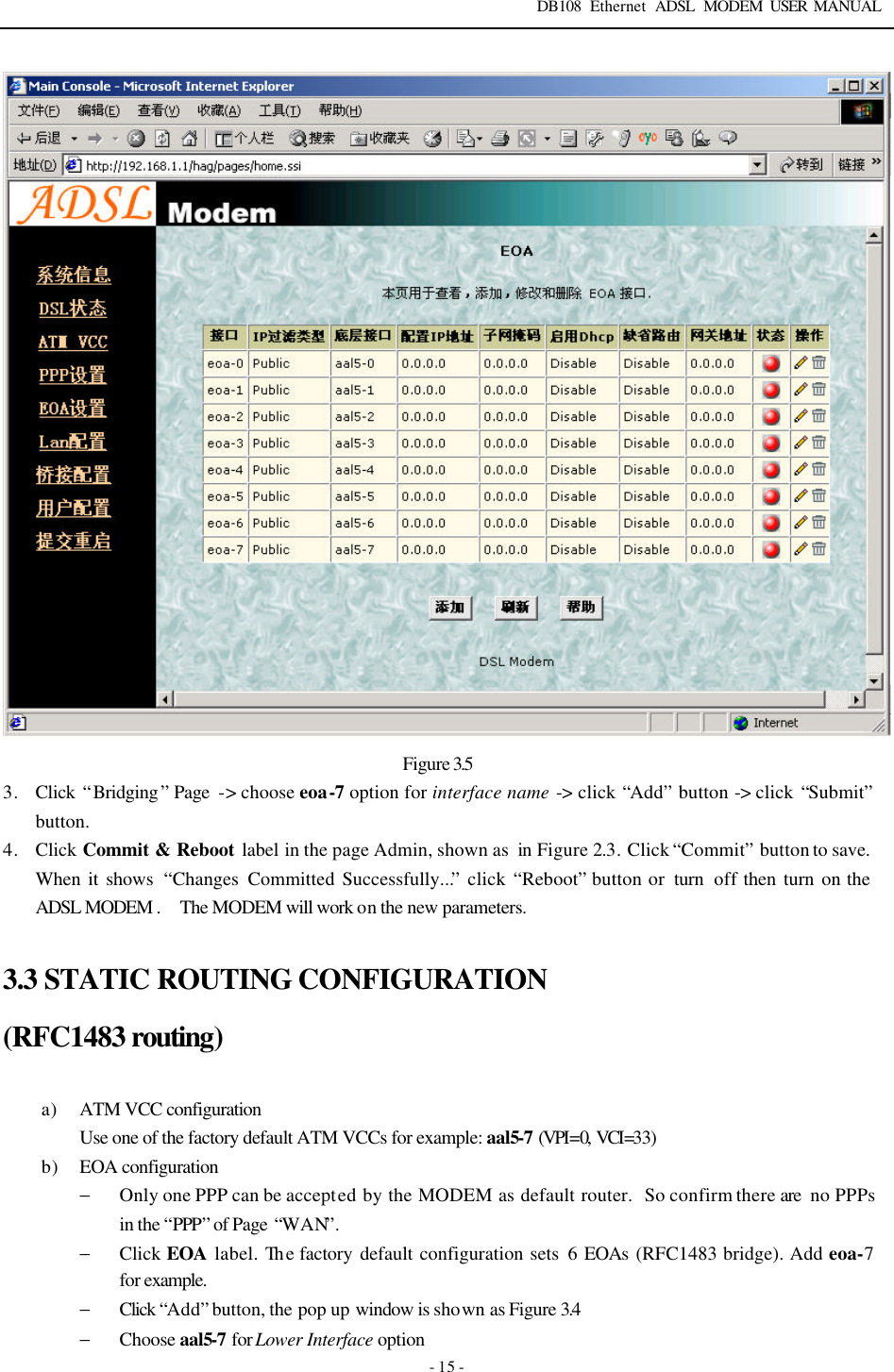
DB108 Ethernet ADSL MODEM USER MANUAL   - 13 -  Figure 3.3   2. EOA Configuration Click  EOA label. The factory –set configuration has 7 EOAs. Here we add one more new EOA : eoa-7 as an example. − Click “Add” button, the pop up Window is shown as Figure 3.4. − Choose  aal5-7 option for  Lower interface; Disable option for  Default Route.  Don’t change other items . − Click “Submit” button, the result window is shown as Figure 3.5.
DB108 Ethernet ADSL MODEM USER MANUAL   - 14 -  Figure 3.4
DB108 Ethernet ADSL MODEM USER MANUAL   - 15 -  Figure 3.5 3. Click  “Bridging ” Page  -> choose eoa-7 option for interface name -> click “Add” button -> click  “Submit” button.   4. Click Commit & Reboot label in the page Admin, shown as  in Figure 2.3. Click “Commit” button to save.  When it shows  “Changes  Committed Successfully...” click “Reboot” button or  turn  off then turn on the ADSL MODEM .   The MODEM will work on the new parameters.  3.3 STATIC ROUTING CONFIGURATION (RFC1483 routing)  a) ATM VCC configuration Use one of the factory default ATM VCCs for example: aal5-7 (VPI=0, VCI=33) b) EOA configuration − Only one PPP can be accepted by the MODEM as default router.  So confirm there are  no PPPs in the “PPP” of Page  “WAN”. − Click EOA label. The factory default configuration sets 6 EOAs (RFC1483 bridge). Add eoa-7 for example. − Click “Add” button, the pop up window is shown as Figure 3.4 − Choose aal5-7 for Lower Interface option
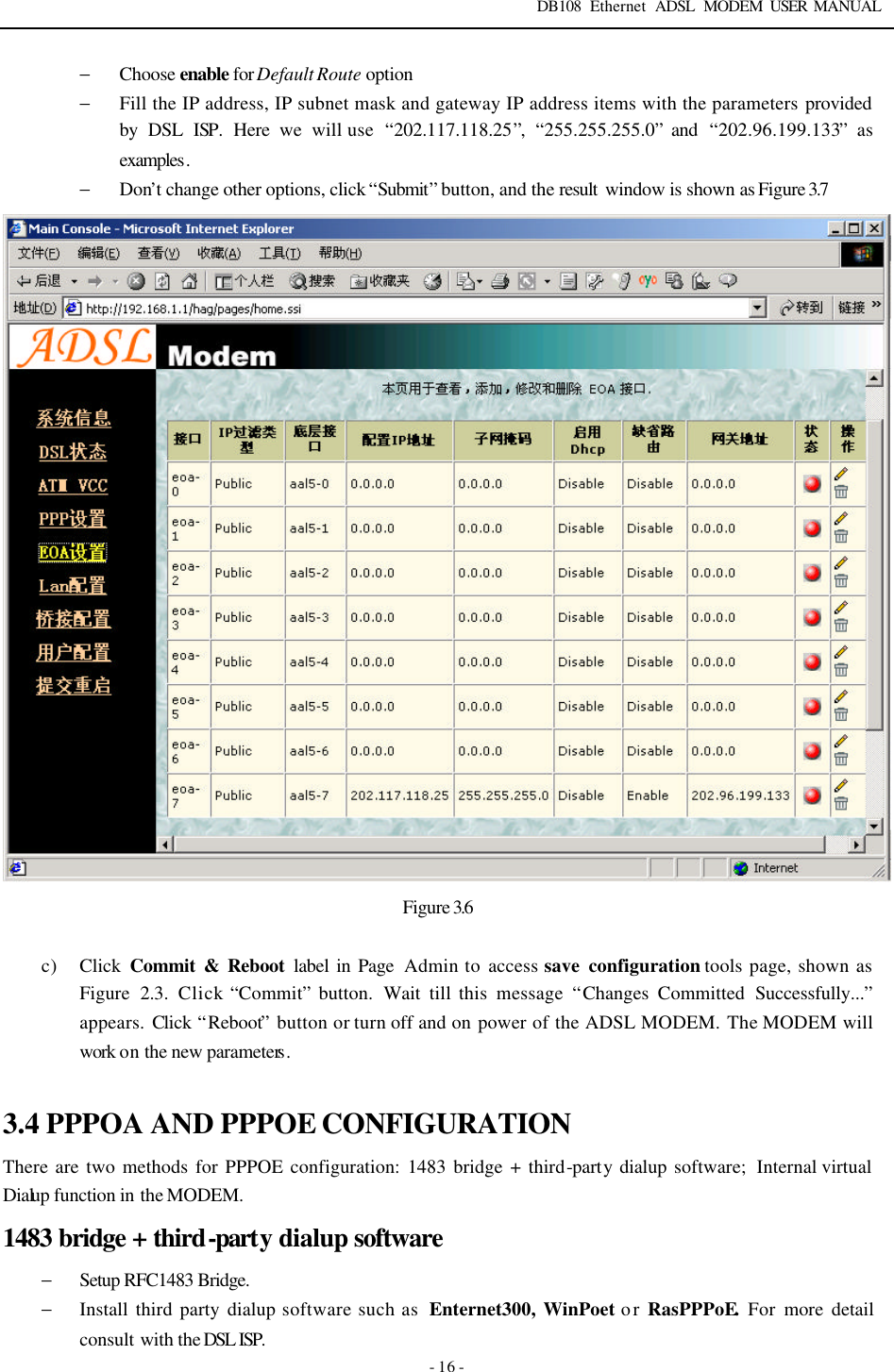
DB108 Ethernet ADSL MODEM USER MANUAL   - 16 - − Choose enable for Default Route option − Fill the IP address, IP subnet mask and gateway IP address items with the parameters provided by DSL ISP. Here we will use  “202.117.118.25”,  “255.255.255.0” and  “202.96.199.133” as examples. − Don’t change other options, click “Submit” button, and the result  window is shown as Figure 3.7  Figure 3.6  c) Click  Commit & Reboot label in Page  Admin to access save configuration tools page, shown as Figure  2.3. Click “Commit” button.  Wait  till this message “Changes  Committed Successfully...” appears. Click “Reboot” button or turn off and on power of the ADSL MODEM. The MODEM will work on the new parameters.  3.4 PPPOA AND PPPOE CONFIGURATION There are two methods for PPPOE configuration: 1483 bridge + third-party dialup software;  Internal virtual Dialup function in the MODEM. 1483 bridge + third-party dialup software − Setup RFC1483 Bridge. − Install third party dialup software such as  Enternet300, WinPoet or RasPPPoE. For more detail consult with the DSL ISP.
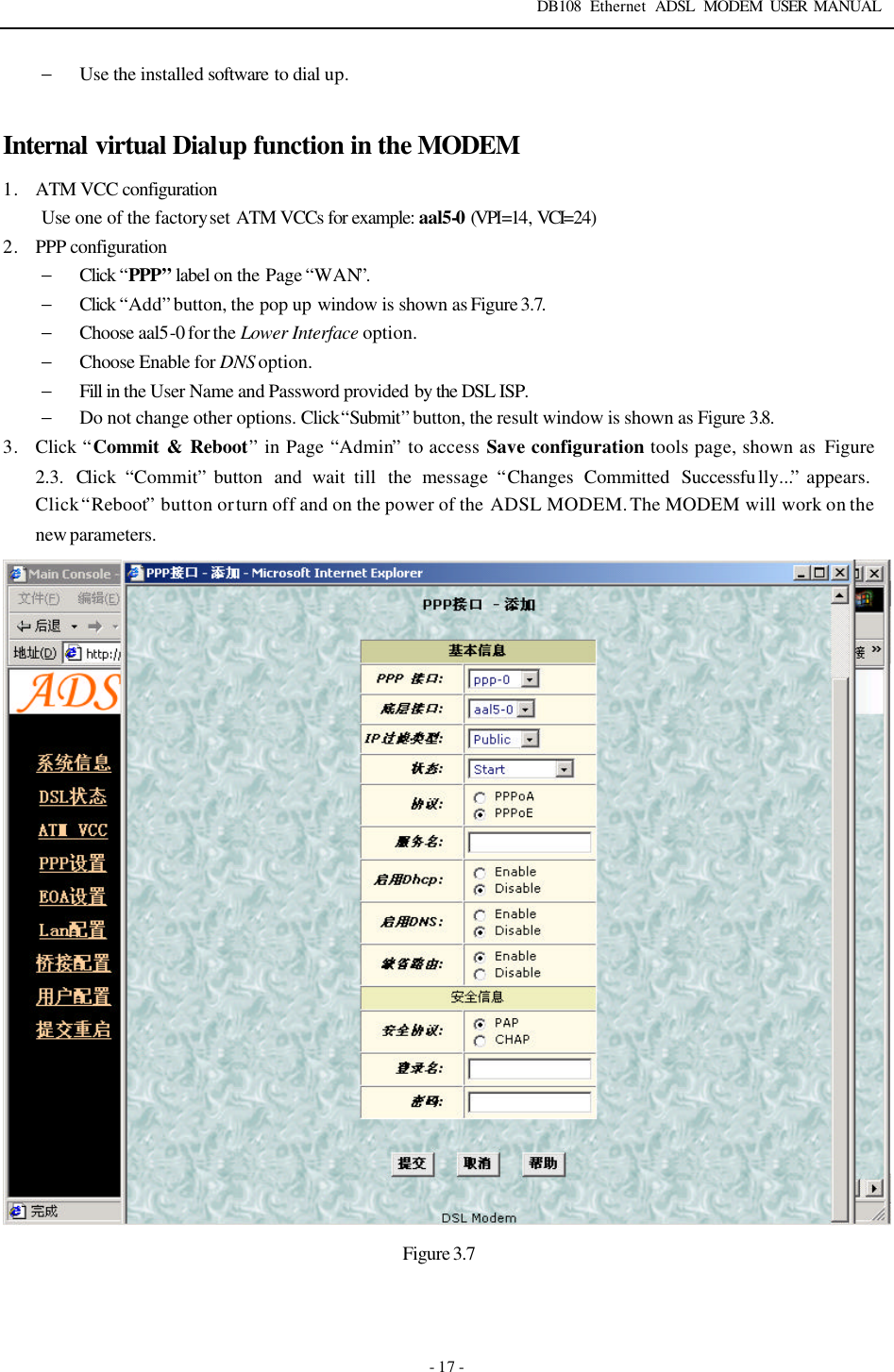
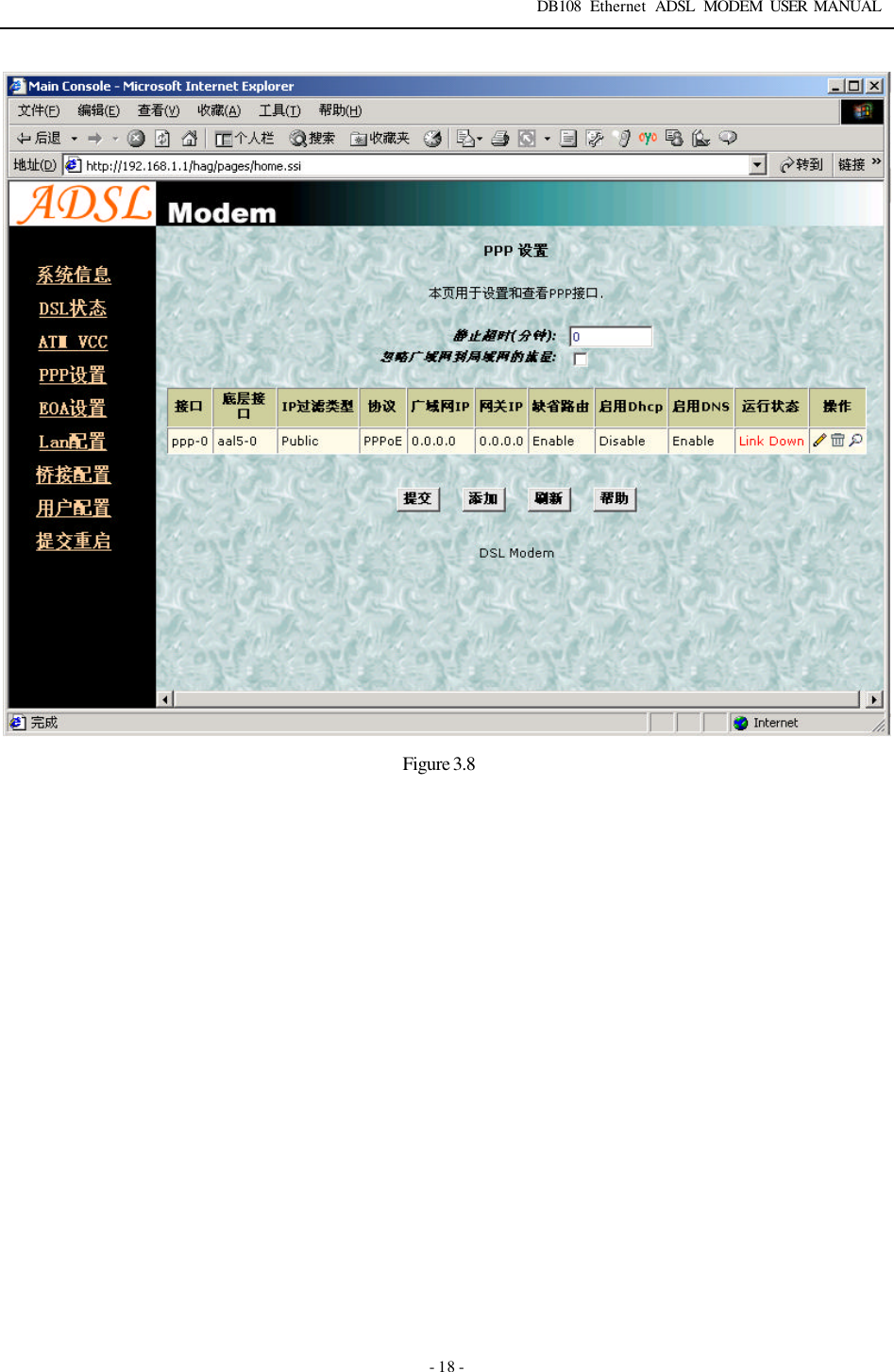
DB108 Ethernet ADSL MODEM USER MANUAL   - 17 - − Use the installed software  to dial up.  Internal virtual Dialup function in the MODEM 1. ATM VCC configuration Use one of the factory set ATM VCCs for example: aal5-0 (VPI=14, VCI=24) 2. PPP configuration − Click “PPP” label on the Page “WAN”.   − Click “Add” button, the pop up window is shown as Figure 3.7. − Choose aal5-0 for the Lower Interface option. − Choose Enable for DNS option. − Fill in the User Name and Password provided by the DSL ISP. − Do not change other options. Click “Submit” button, the result window is shown as Figure 3.8. 3. Click “Commit & Reboot” in Page “Admin” to access Save configuration tools page, shown as  Figure 2.3. Click  “Commit” button  and wait till  the message “Changes  Committed Successfu lly...” appears.   Click “Reboot” button or turn off and on the power of the ADSL MODEM. The MODEM will work on the new parameters.  Figure 3.7
DB108 Ethernet ADSL MODEM USER MANUAL   - 18 -  Figure 3.8
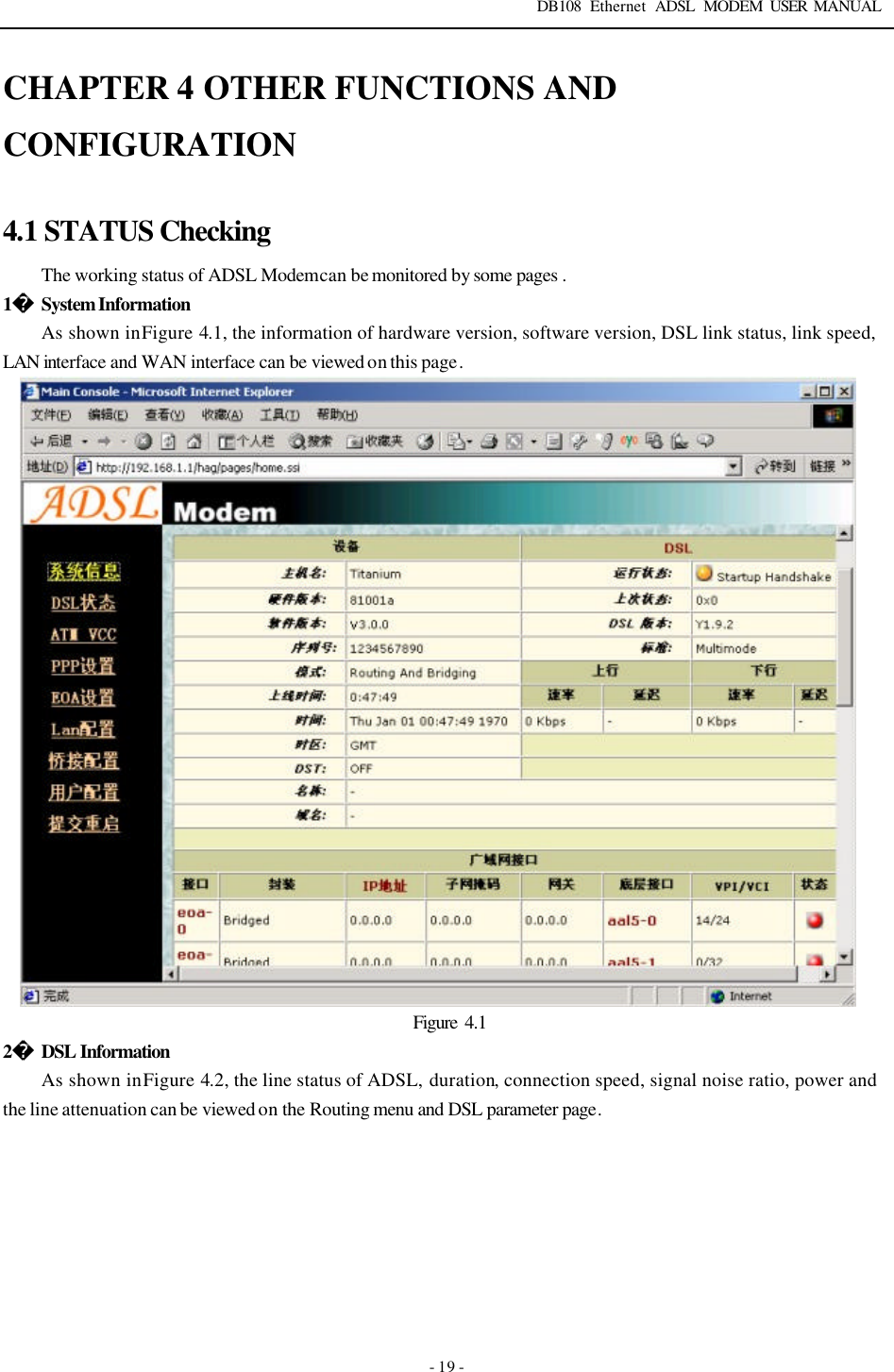
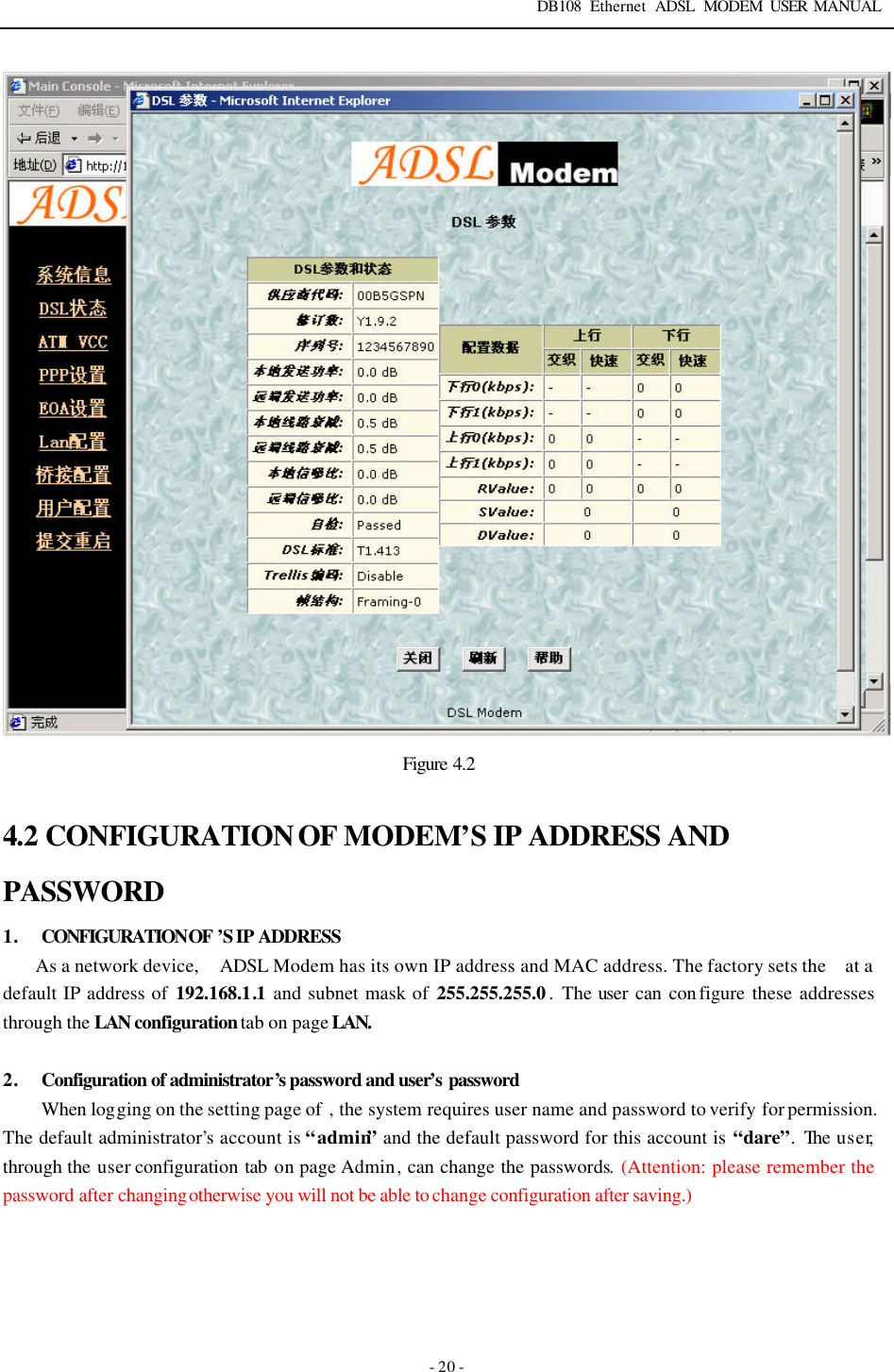
DB108 Ethernet ADSL MODEM USER MANUAL   - 19 - CHAPTER 4 OTHER FUNCTIONS AND CONFIGURATION  4.1 STATUS Checking The working status of ADSL Modem can be monitored by some pages . 1 System Information As shown in Figure 4.1, the information of hardware version, software version, DSL link status, link speed, LAN interface and WAN interface can be viewed on this page.                         Figure  4.1 2 DSL Information As shown in Figure 4.2, the line status of ADSL, duration, connection speed, signal noise ratio, power and the line attenuation can be viewed on the Routing menu and DSL parameter page.
DB108 Ethernet ADSL MODEM USER MANUAL   - 20 -  Figure  4.2  4.2 CONFIGURATION OF MODEM’S IP ADDRESS AND PASSWORD 1. CONFIGURATION OF ’S IP ADDRESS As a network device,   ADSL Modem has its own IP address and MAC address. The factory sets the   at a default IP address of 192.168.1.1 and subnet mask of 255.255.255.0.  The user can con figure  these  addresses through the LAN configuration tab on page LAN.  2. Configuration of administrator’s password and user’s password When logging on the setting page of  , the system requires user name and password to verify for permission. The default administrator’s account is “admin” and the default password for this account is “dare”. The  user, through the user configuration tab on page Admin, can change the passwords. (Attention: please remember the password after changing otherwise you will not be able to change configuration after saving.)
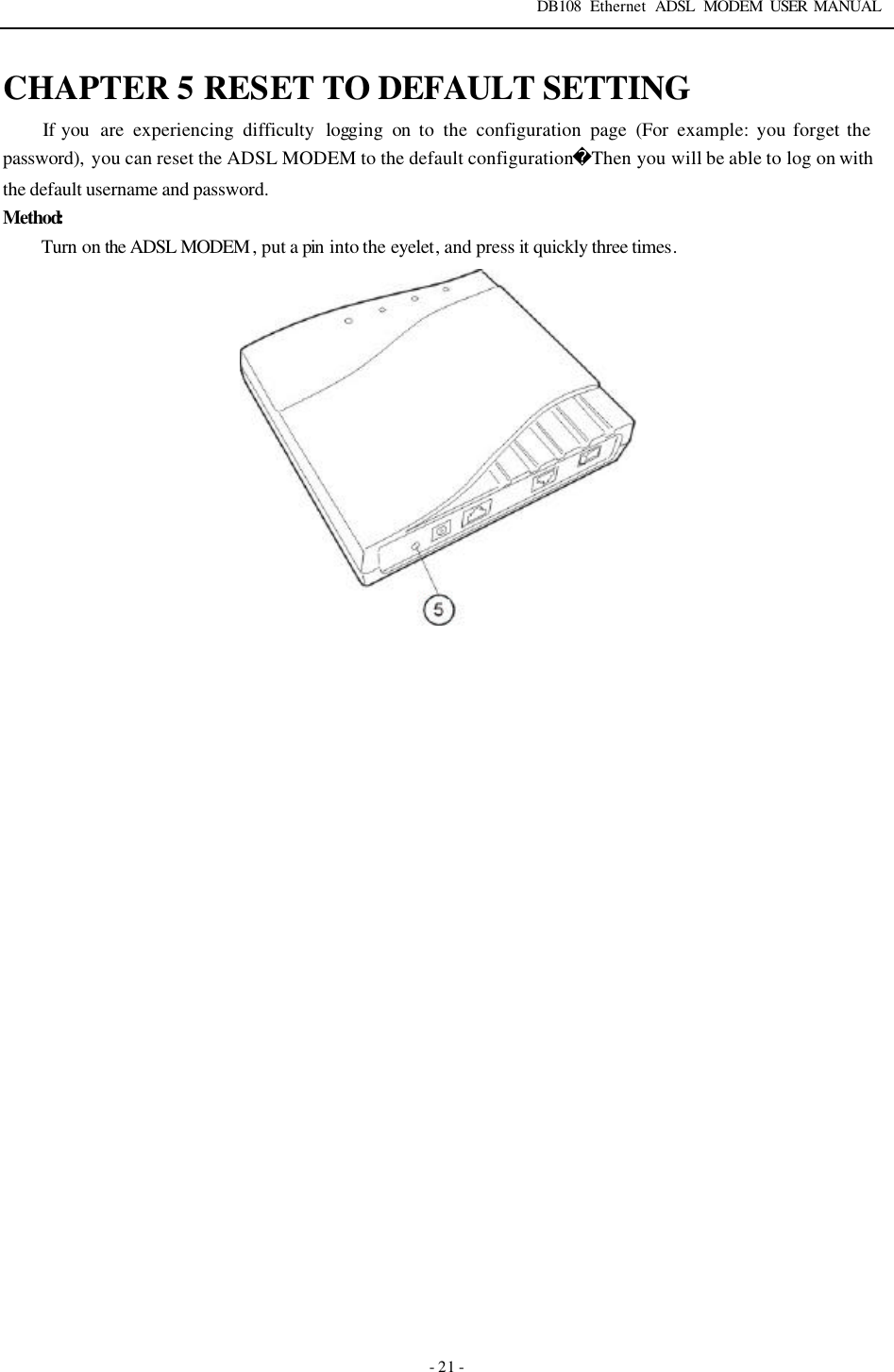
DB108 Ethernet ADSL MODEM USER MANUAL   - 21 - CHAPTER 5 RESET TO DEFAULT SETTING If you  are experiencing difficulty logging on to the configuration page (For  example: you forget the password),  you can reset the ADSL MODEM to the default configurationThen you will be able to log on with the default username and password. Method:       Turn on the ADSL MODEM , put a pin  into the eyelet, and press it quickly three times.
DB108 Ethernet ADSL MODEM USER MANUAL   - 22 - CHAPTER 6 SPECIFICATION 6.1 Power supply l Exterior power adapter l Input: 110VAC, 60Hz l Output: 11VDC700mA .  l Polarity  6.2 Dimension l 140mmLengthx130mmWidthx32mm  Height  6.3 Weight l Weight: about 200 gram  6.4 Standards  l EMI/Immunity: FCC Part 15 Class B, CE Mark (EN55022 Class B/EN50082) l Safety Standard: ULEN60950 l Communication: FCC Part 68, CYR21 l Electromagnetic: in accordance with FCC, ETSI and CISPR standard   6.5 Environment Requirements l Temperature: 540(41F104F) l Relative humidity:0%95%  l Electromagnetic disturbanceFCC PART15&68
DB108 Ethernet ADSL MODEM USER MANUAL   - 23 -  APPENDIX A. TROUBLESHOOTING  Phenomena Solution The  indicator of power supply is not on  1.  Make sure the connection of power supply is good. 2.  Make sure the switch of power supply is turned on. 3.  Make sure the output of power supply is correct. The indicator of PC is not on 1.  Check the connection between the cable and the network card. 2.  Make sure that the correct cable is used. 3.  Make sure the cable works fine by pinging the host IP address. Can not access Internet or remote networks 1.  Make sure the problems listed above are eliminated. 2.  Make sure the software configuration of the ADSL Modem is correct. 3.  Make sure you have restarted the ADSL Modem after configuration change. 4.  Check IP connection using ping command. 5.  Make sure the DNS of the computer is correct.   Can’t  access some web server 1.  The MTU of operating system might be too large. 2.  Some operating systems might need to be patched. Can not log on to  the configuration page 1.  Make sure the PC indicator is on. 2.  Make sure the configuration of TCP/IP is correct. 3.  Make sure the data indicator of Modem is on when using Ping command. 4.  Make sure the user name and password is correct. 5.  Reset the device.
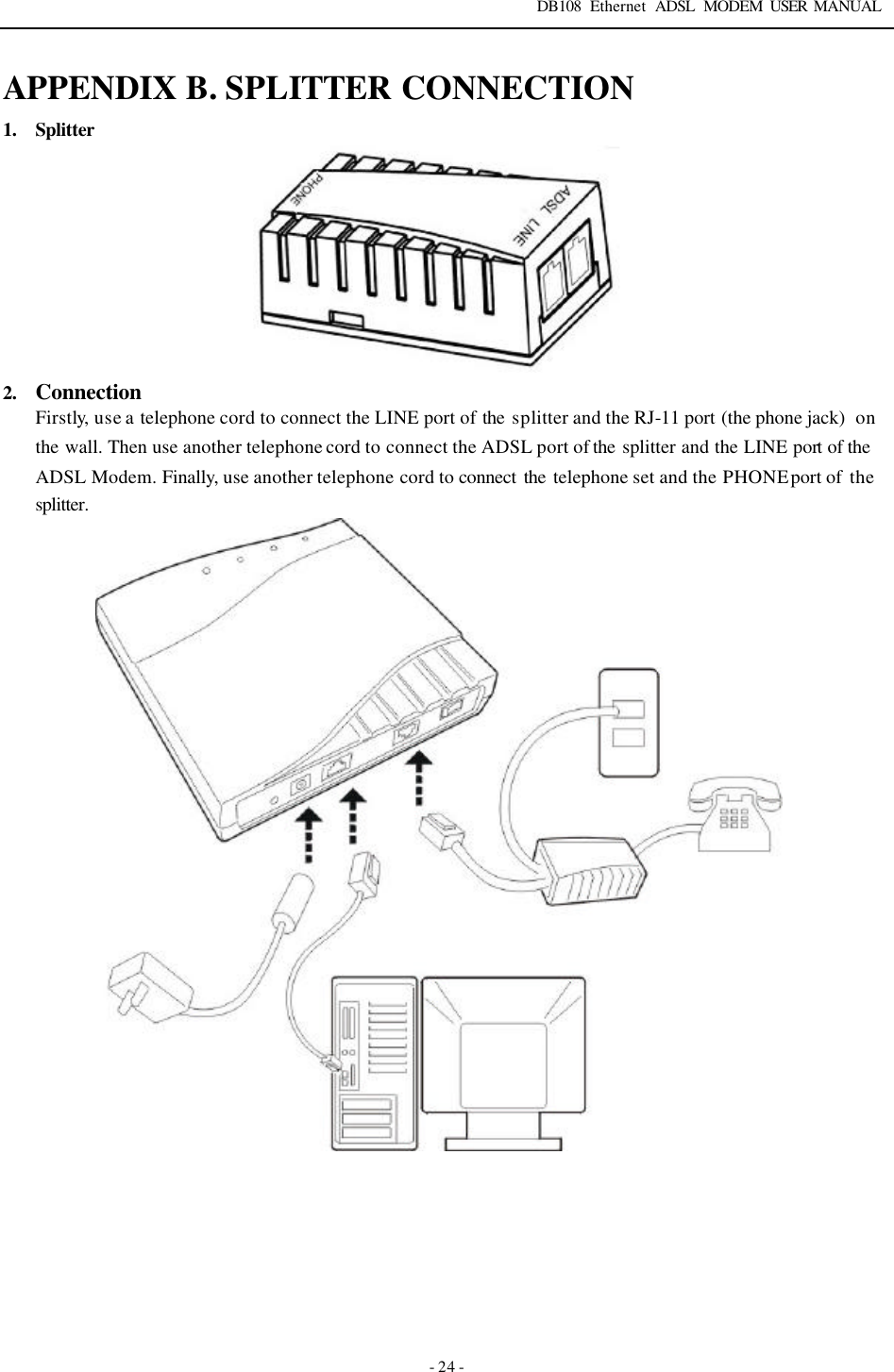
DB108 Ethernet ADSL MODEM USER MANUAL   - 24 - APPENDIX B. SPLITTER CONNECTION 1.  Splitter   2.  Connection Firstly, use a telephone cord to connect the LINE port of the  splitter and the RJ-11 port (the phone jack)  on the wall. Then use another telephone cord to connect the ADSL port of the  splitter and the LINE port of the  ADSL Modem. Finally, use another telephone cord to connect  the  telephone set and the PHONE port of  the splitter.
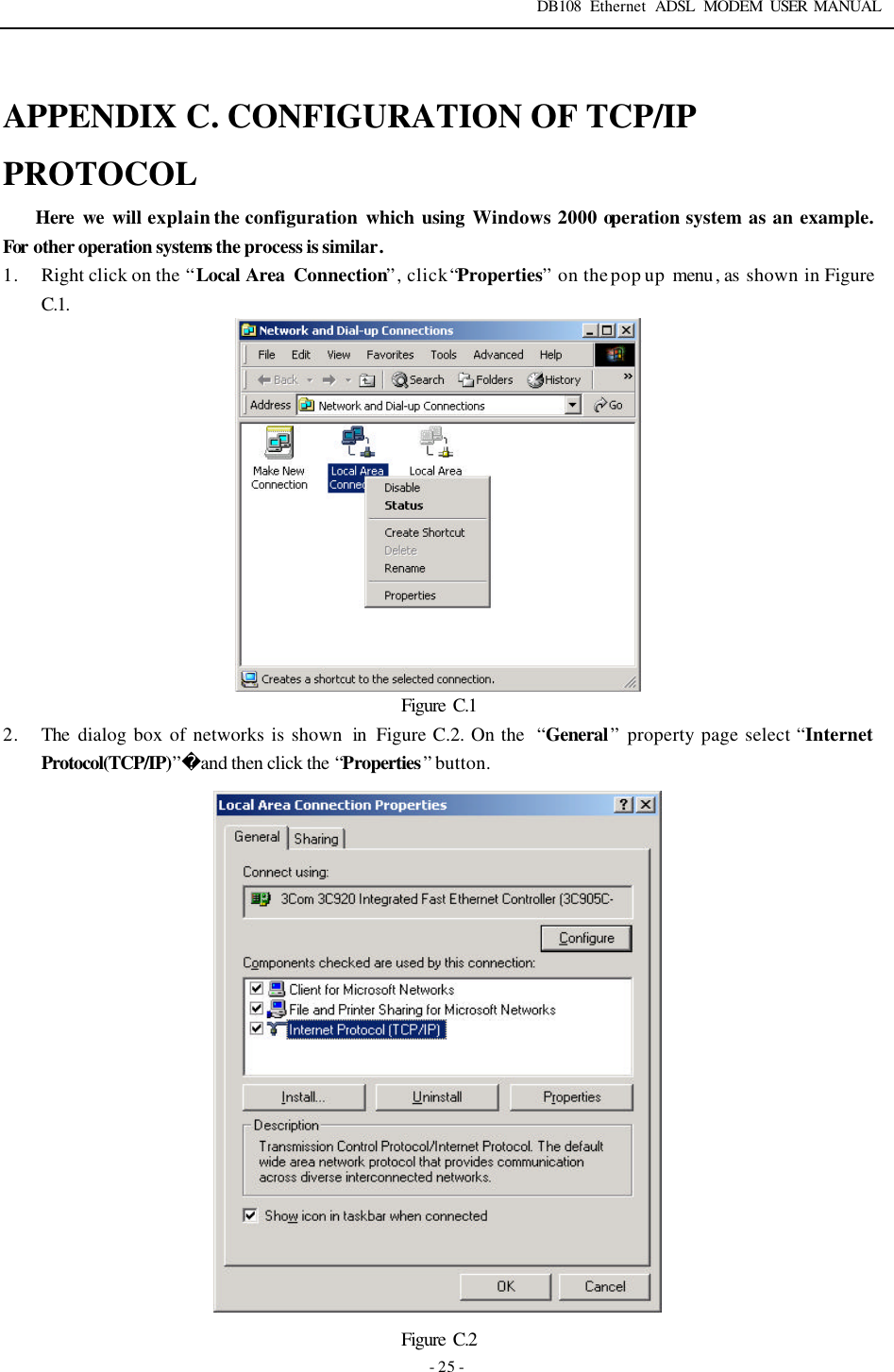
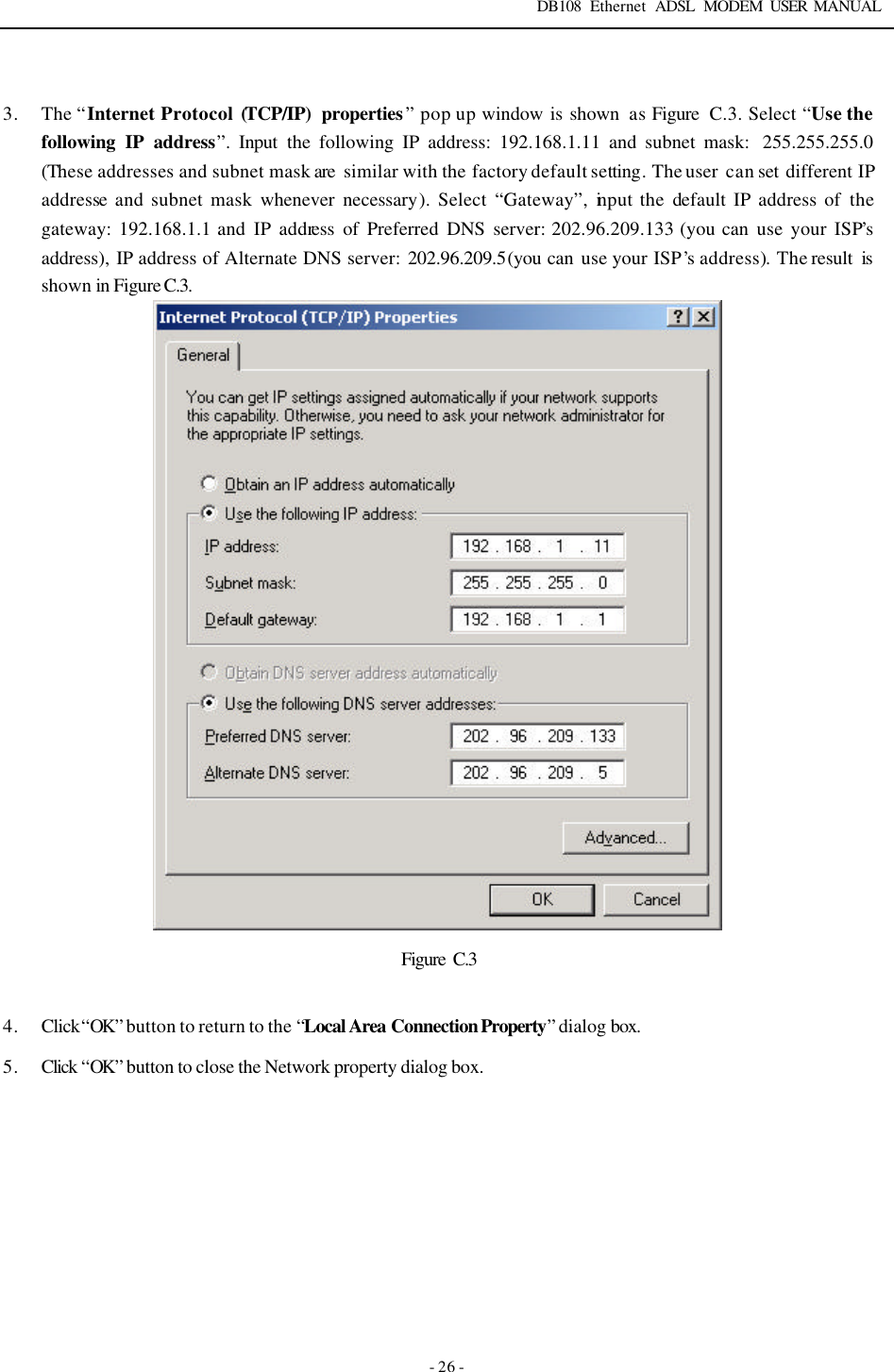
DB108 Ethernet ADSL MODEM USER MANUAL   - 25 -  APPENDIX C. CONFIGURATION OF TCP/IP PROTOCOL Here we will explain the configuration which using Windows 2000 operation system as an example. For other operation systems the process is similar. 1. Right click on the “Local Area Connection”, click “Properties” on the pop up menu , as shown in Figure C.1.  Figure  C.1 2. The dialog box of networks is shown  in  Figure C.2. On the  “General” property page select “Internet Protocol(TCP/IP)”and then click the “Properties” button.  Figure  C.2
DB108 Ethernet ADSL MODEM USER MANUAL   - 26 -  3. The “Internet Protocol (TCP/IP) properties” pop up window is shown  as Figure  C.3. Select “Use the following IP address”.  Input the following IP address: 192.168.1.11 and subnet mask:  255.255.255.0 (These addresses and subnet mask are  similar with the factory default setting. The user can set different IP addresse and subnet mask whenever necessary). Select “Gateway”, input the default IP address of the gateway: 192.168.1.1 and IP address of Preferred DNS server: 202.96.209.133 (you can use your ISP’s address), IP address of Alternate DNS server: 202.96.209.5(you can use your ISP’s address). The result is shown in Figure C.3.    Figure  C.3  4. Click “OK” button to return to the “Local Area Connection Property” dialog box. 5. Click “OK” button to close the Network property dialog box.
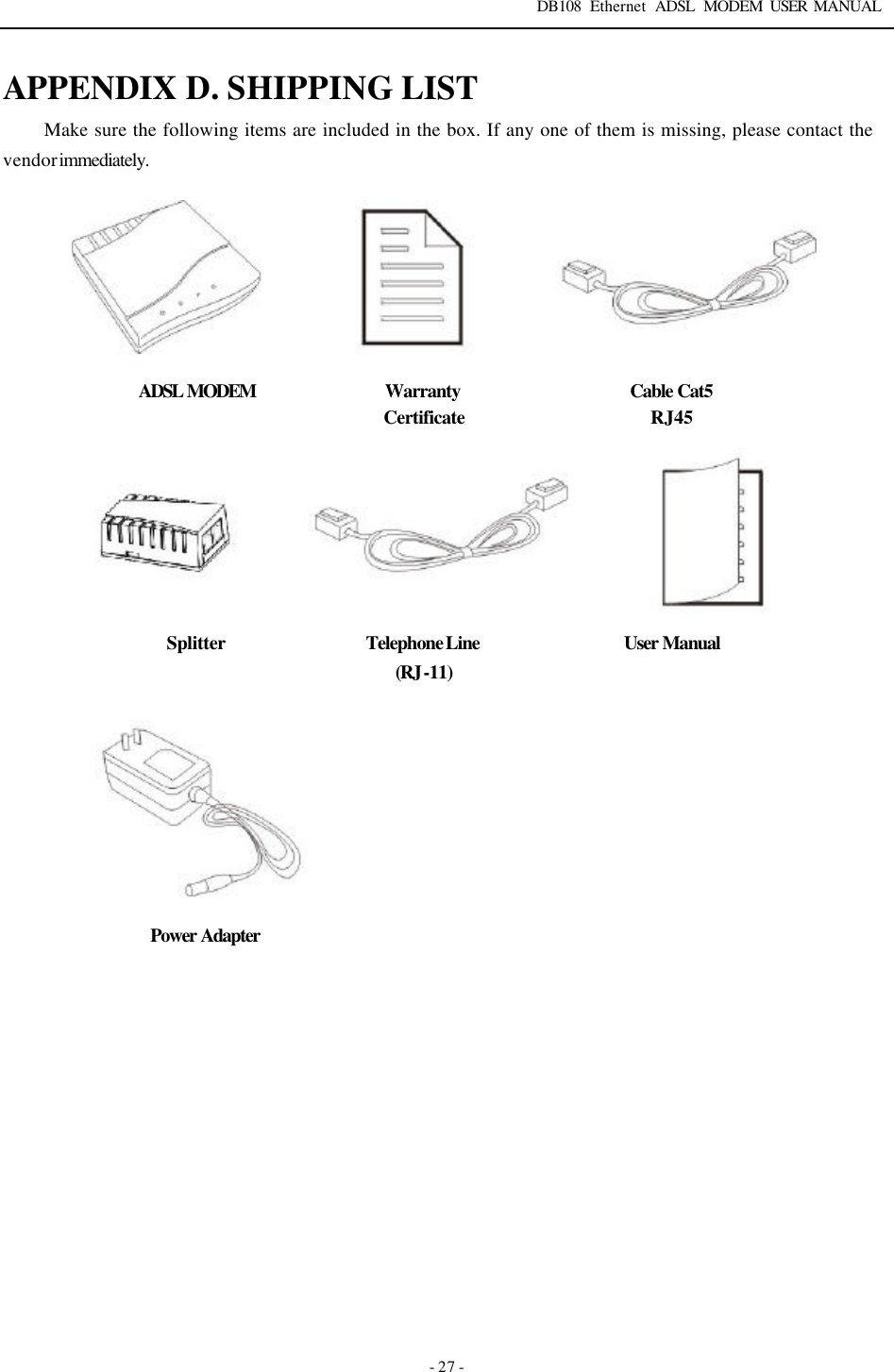
DB108 Ethernet ADSL MODEM USER MANUAL   - 27 - APPENDIX D. SHIPPING LIST Make sure the following items are included in the box. If any one of them is missing, please contact the vendor immediately.        ADSL MODEM Warranty Certificate Cable Cat5 RJ45 Splitter Telephone Line (RJ-11) User Manual   Power Adapter
DB108 Ethernet ADSL MODEM USER MANUAL   - 28 -            Please use the  factory recommended power supply.

Navigation menu