Dell C3765Dnf Color Laser Printer Users Manual User's Guide
C3765DNF to the manual 079af616-818b-45d1-b603-b7dc8e5f8ec5
2014-11-13
: Dell Dell-C3765Dnf-Color-Laser-Printer-Users-Manual-113606 dell-c3765dnf-color-laser-printer-users-manual-113606 dell pdf
Open the PDF directly: View PDF  .
.
Page Count: 578 [warning: Documents this large are best viewed by clicking the View PDF Link!]
- Dell™ C3765dnf Multifunction Color Laser Printer
- Contents
- A Notes, Cautions, and Warnings 23
- 1 Dell™ C3765dnf Multifunction Color Laser Printer User's Guide 25
- 2 Finding Information 27
- 3 Product Features 31
- 4 About the Printer 33
- 5 Preparing Printer Hardware 41
- 6 Installing Optional Accessories 43
- 7 Connecting Your Printer 71
- 8 Setting the IP Address 83
- 9 Loading Paper 87
- 10 Installing Printer Drivers on Windows® Computers 91
- 11 Installing Printer Drivers on Macintosh Computers 111
- 12 Installing Printer Drivers on Linux Computers (CUPS) 117
- 13 Operator Panel 129
- 14 Dell™ Printer Configuration Web Tool 135
- 15 Understanding the Tool Box Menus 203
- 16 Understanding the Printer Menus 231
- 17 Print Media Guidelines 301
- 18 Loading Print Media 307
- 19 Printing 315
- 20 Copying 329
- 21 Scanning 341
- 22 Faxing 369
- 23 Understanding Your Printer Software 397
- 24 Printing Using ColorTrack (External Authentication) 413
- 25 Using the Server Address Book and Server Phone Book 421
- 26 Using Digital Certificates 423
- 27 Understanding Fonts 435
- 28 Understanding Printer Messages 443
- 29 Specifications 455
- 30 Maintaining Your Printer 463
- 31 Removing Options 503
- 32 Clearing Jams 513
- 33 Troubleshooting Guide 531
- B Appendix 563
- A Notes, Cautions, and Warnings 23
- Before Beginning
- Setting up the Printer (Printer Setup)
- Preparing Printer Hardware
- Installing Optional Accessories
- Connecting Your Printer
- Setting the IP Address
- Loading Paper
- Installing Printer Drivers on Windows® Computers
- Installing Printer Drivers on Macintosh Computers
- Installing Printer Drivers on Linux Computers (CUPS)
- Using Your Printer
- Operator Panel
- Dell™ Printer Configuration Web Tool
- Understanding the Tool Box Menus
- Understanding the Printer Menus
- Report / List
- System Settings
- Panel Settings
- PCL Fonts List
- PCL Macros List
- PS Fonts List
- PDF Fonts List
- Job History
- Error History
- Print Meter
- Color Test Page
- Protocol Monitor
- Speed Dial
- Address Book
- Server Address
- Fax Activity
- Fax Pending
- Stored Documents
- Printing a Report/List Using the Operator Panel
- Printing a Report/List Using the Tool Box
- Admin Settings
- Default Settings
- Tray Management
- Panel Language
- Print Menu
- Copy Menu
- Scan Menu
- Fax Menu
- USB Direct Print Menu
- ID Card Copy
- Panel Lock
- Resetting Defaults
- Report / List
- Print Media Guidelines
- Loading Print Media
- Printing, Copying, Scanning, and Faxing
- Printing
- Copying
- Scanning
- Scanning Overview
- Scanning From the Operator Panel - Scan to Application
- Scanning from the Operator Panel - WSD Scan
- Scanning Using the TWAIN Driver
- Scan Settings Tool
- Scanning Using the Windows Image Acquisition (WIA) Driver
- Scanning to a PC or Server via SMB/FTP
- Scanning to a USB Memory
- Sending an E-Mail With the Scanned Image
- Faxing
- Specifying the Fax Initial Settings Using the Easy Setup Navigator
- Setting Your Country
- Setting the Printer ID
- Setting the Time and Date
- Changing the Clock Mode
- Setting Sounds
- Specifying the Fax Settings Options
- Sending a Fax
- Sending a Delayed Fax
- Sending a Fax from the Driver (Direct Fax)
- Receiving a Fax
- About Receiving Modes
- Loading Paper for Receiving Faxes
- Receiving a Fax Automatically in the Fax Mode
- Receiving a Fax Manually in the Telephone Mode
- Receiving a Fax Automatically in the Telephone / Fax or Ans Machine/Fax
- Receiving a Fax Manually Using an External Telephone (Remote Receive)
- Receiving Faxes Using the DRPD
- Receiving Faxes in the Memory
- Polling Receive
- Automatic Dialing
- Phone Book
- Other Ways to Fax
- Printing a Report
- Changing Setting Options
- Know Your Printer
- Understanding Your Printer Software
- Printing Using ColorTrack (External Authentication)
- Using the Server Address Book and Server Phone Book
- Using Digital Certificates
- Managing Certificates
- Setting the Features
- Setting the Certificate in the IPsec Digital Signature Mode
- Setting the SSL-use Server Certificate (HTTP/IPP)
- Setting LDAP-SSL/TLS Communication
- Setting Server Certificate Verification for LDAP-SSL/TLS Communication
- Setting Client Certificate for LDAP-SSL/TLS Communication
- Setting for Wireless LAN WPA-Enterprise (EAP-TLS)
- Setting for Wireless LAN WPA-Enterprise (PEAPV0-MS-CHAPV2, EAP-TTLS PAP, EAP-TTLS CHAP)
- Setting Client Certificate for IEEE 802.1x (EAP-TLS)
- Understanding Fonts
- Understanding Printer Messages
- Specifications
- Maintaining Your Printer
- Maintaining Your Printer
- Determining the Status of Supplies
- Conserving Supplies
- Ordering Supplies
- Storing Print Media
- Storing Consumables
- Replacing the Toner Cartridges
- Replacing the Drum Cartridges
- Replacing the Fusing Unit
- Replacing the Transfer Belt Unit, the 2nd Belt Transfer Roller (2nd BTR), and the Retard Roller
- Replacing the Waste Toner Box
- Cleaning Inside the Printer
- Cleaning the Scanner
- Cleaning the DADF Feed Roller
- Adjusting Color Registration
- Removing Options
- Clearing Jams
- Maintaining Your Printer
- Troubleshooting
- Troubleshooting Guide
- Basic Printer Problems
- Display Problems
- Printing Problems
- Print Quality Problems
- The output is too light
- Toner smears or print comes off
- Random spots/Blurred images
- The entire output is blank
- Streaks appear on the output
- Part or the entire output is black
- Pitched color dots
- Vertical blanks
- Ghosting
- Light-induced fatigue
- Fog
- Bead-Carry-Out (BCO)
- Jagged characters
- Banding
- Auger mark
- Wrinkled/Stained paper
- Damage on the leading edge of paper
- Jam/Alignment Problems
- Noise
- Copy Problem
- Fax Problems
- Scanning Problems
- Digital Certificate Problem
- Problems With Installed Optional Accessories
- Scanner Driver/Printer Utility Problems
- Other Problems
- Contacting Service
- Troubleshooting Guide
- Appendix

Dell™ C3765dnf Multifunction
Color Laser Printer
User's Guide
Regulatory Model: C3765dnf

Template Last Updated - 2/7/2007 Contents 1
Contents
Before Beginning . . . . . . . . . . . . . . . . . . . . . . . . . . . . . . 21
A Notes, Cautions, and Warnings . . . . . . . . . . . . . . . . . . . . . . 23
As for RSA BSAFE . . . . . . . . . . . . . . . . . . . . . . . . . . . . . . . . . . . . . . . . . . . . . . . . . . . . . . . . . . 23
1 Dell™ C3765dnf Multifunction Color Laser Printer User's
Guide . . . . . . . . . . . . . . . . . . . . . . . . . . . . . . . . . . . . . . . . . 25
Conventions. . . . . . . . . . . . . . . . . . . . . . . . . . . . . . . . . . . . . . 25
2 Finding Information . . . . . . . . . . . . . . . . . . . . . . . . . . . . . . 27
3 Product Features . . . . . . . . . . . . . . . . . . . . . . . . . . . . . . . . 31
4 About the Printer . . . . . . . . . . . . . . . . . . . . . . . . . . . . . . . . 33
Front and Rear View . . . . . . . . . . . . . . . . . . . . . . . . . . . . . . . . . 33
Front View . . . . . . . . . . . . . . . . . . . . . . . . . . . . . . . . . . . . 33
Rear View . . . . . . . . . . . . . . . . . . . . . . . . . . . . . . . . . . . . 34
Duplex Automatic Document Feeder (DADF) . . . . . . . . . . . . . . . . . . . . 35
Space Requirements . . . . . . . . . . . . . . . . . . . . . . . . . . . . . . . . . 35
Operator Panel . . . . . . . . . . . . . . . . . . . . . . . . . . . . . . . . . . . . 36
Additional Components. . . . . . . . . . . . . . . . . . . . . . . . . . . . . . . . 36
Optional Accessories . . . . . . . . . . . . . . . . . . . . . . . . . . . . . . 36
Non-bundled Items . . . . . . . . . . . . . . . . . . . . . . . . . . . . . . . 36
Securing the Printer . . . . . . . . . . . . . . . . . . . . . . . . . . . . . . . . . 37
Ordering Supplies . . . . . . . . . . . . . . . . . . . . . . . . . . . . . . . . . . 37

2Contents Template Last Updated - 2/7/2007
Setting up the Printer (Printer Setup) . . . . . . . . . . . . . . 39
5 Preparing Printer Hardware . . . . . . . . . . . . . . . . . . . . . . . . 41
Removing Tape . . . . . . . . . . . . . . . . . . . . . . . . . . . . . . . . . . . . 41
6 Installing Optional Accessories . . . . . . . . . . . . . . . . . . . . . 43
Installing the Optional Memory Module . . . . . . . . . . . . . . . . . . . . . . . 43
Updating Your Driver to Detect Memory Module . . . . . . . . . . . . . . . . 45
Installing the Optional 550-Sheet Feeder. . . . . . . . . . . . . . . . . . . . . . . 48
Updating Your Driver to Detect 550-Sheet Feeder. . . . . . . . . . . . . . . . 50
Installing the Optional Wireless Adapter . . . . . . . . . . . . . . . . . . . . . . 53
Verifying the Contents of the Box . . . . . . . . . . . . . . . . . . . . . . . . 54
Installing the Wireless Adapter Using Video Instructions (Recommended) . . 54
Installing the Optional Wireless Adapter . . . . . . . . . . . . . . . . . . . . 55
Determining the Wireless Network Settings . . . . . . . . . . . . . . . . . . 56
Configuring the Optional Wireless Adapter . . . . . . . . . . . . . . . . . . . . . 57
Using Wizard Setup to Configure a Wireless Adapter . . . . . . . . . . . . . 57
Using Advanced Setup to Configure a Wireless Adapter . . . . . . . . . . . . 59
Reconfiguring the Wireless Setting . . . . . . . . . . . . . . . . . . . . . . . . . 63
Installing the Optional Hard Disk. . . . . . . . . . . . . . . . . . . . . . . . . . . 64
Updating Your Driver to Detect Hard Disk . . . . . . . . . . . . . . . . . . . . 67
7 Connecting Your Printer . . . . . . . . . . . . . . . . . . . . . . . . . . . 71
Connecting Printer to Computer or Network . . . . . . . . . . . . . . . . . . . . . 72
Direct Connection . . . . . . . . . . . . . . . . . . . . . . . . . . . . . . . . 72
Network Connection . . . . . . . . . . . . . . . . . . . . . . . . . . . . . . . 73
Connecting the Telephone Line. . . . . . . . . . . . . . . . . . . . . . . . . . . . 73
Turning on the Printer . . . . . . . . . . . . . . . . . . . . . . . . . . . . . . . . . 75
Setting Initial Settings on the Operator Panel . . . . . . . . . . . . . . . . . . . . 75
8 Setting the IP Address . . . . . . . . . . . . . . . . . . . . . . . . . . . . 83
Assigning an IP Address . . . . . . . . . . . . . . . . . . . . . . . . . . . . . . . 83
When Using the Easy Setup Navigator . . . . . . . . . . . . . . . . . . . . . 83
When Using the Operator Panel. . . . . . . . . . . . . . . . . . . . . . . . . 83

Template Last Updated - 2/7/2007 Contents 3
When Using the Tool Box . . . . . . . . . . . . . . . . . . . . . . . . . . . . 84
Verifying the IP Settings . . . . . . . . . . . . . . . . . . . . . . . . . . . . . . . 85
Verifying the Settings Using Operator Panel . . . . . . . . . . . . . . . . . . 85
Verifying the Settings Using System Settings Report. . . . . . . . . . . . . . 85
Verifying the Settings Using Ping Command . . . . . . . . . . . . . . . . . . 85
9 Loading Paper . . . . . . . . . . . . . . . . . . . . . . . . . . . . . . . . . . 87
10 Installing Printer Drivers on Windows® Computers . . . . . 91
Identifying Printer Driver Pre-install Status . . . . . . . . . . . . . . . . . . . . . 91
Changing the firewall settings before installing your printer . . . . . . . . . . 91
Inserting the Software and Documentation Disc . . . . . . . . . . . . . . . . . . 91
Direct Connection Setup . . . . . . . . . . . . . . . . . . . . . . . . . . . . . . . 92
Network Connection Setup . . . . . . . . . . . . . . . . . . . . . . . . . . . . . 95
Network Printer Setup on a Local Network. . . . . . . . . . . . . . . . . . . 95
Network Printer Setup on a Remote Network . . . . . . . . . . . . . . . . . 99
Setting Up for Shared Printing . . . . . . . . . . . . . . . . . . . . . . . . . . . 104
Specifying the Shared Settings of the Printer . . . . . . . . . . . . . . . . 104
Point and Print. . . . . . . . . . . . . . . . . . . . . . . . . . . . . . . . . 105
Peer-to-Peer. . . . . . . . . . . . . . . . . . . . . . . . . . . . . . . . . . 108
11 Installing Printer Drivers on Macintosh Computers . . . . 111
Installing the Drivers and Software . . . . . . . . . . . . . . . . . . . . . . . . 111
Adding a Printer on Mac OS X 10.5, 10.6, 10.7, or 10.8 . . . . . . . . . . . . 111
Adding a Printer on Mac OS X 10.4.11 . . . . . . . . . . . . . . . . . . . . 112
Adding a Printer on Mac OS X 10.3.9 . . . . . . . . . . . . . . . . . . . . . 113
Configuring Settings. . . . . . . . . . . . . . . . . . . . . . . . . . . . . . 115
12 Installing Printer Drivers on Linux Computers (CUPS) . . 117
Operation on Red Hat Enterprise Linux 5/6 Desktop. . . . . . . . . . . . . . . . 117
Setup Overview . . . . . . . . . . . . . . . . . . . . . . . . . . . . . . . . 117
Installing the Printer Driver . . . . . . . . . . . . . . . . . . . . . . . . . . 117
Setting Up the Queue . . . . . . . . . . . . . . . . . . . . . . . . . . . . . 117
Setting the Default Queue. . . . . . . . . . . . . . . . . . . . . . . . . . . 118
Specifying the Printing Options . . . . . . . . . . . . . . . . . . . . . . . . 119
Uninstalling the Printer Driver. . . . . . . . . . . . . . . . . . . . . . . . . 119

4Contents Template Last Updated - 2/7/2007
Operation on SUSE Linux Enterprise Desktop 10. . . . . . . . . . . . . . . . . . 120
Setup Overview . . . . . . . . . . . . . . . . . . . . . . . . . . . . . . . . 120
Installing the Printer Driver . . . . . . . . . . . . . . . . . . . . . . . . . . 120
Setting Up the Queue . . . . . . . . . . . . . . . . . . . . . . . . . . . . . 120
Setting the Default Queue . . . . . . . . . . . . . . . . . . . . . . . . . . . 121
Specifying the Printing Options . . . . . . . . . . . . . . . . . . . . . . . . 121
Setting the Password for Authority as the Printer Administrator . . . . . . . 122
Uninstalling the Printer Driver . . . . . . . . . . . . . . . . . . . . . . . . . 122
Operation on SUSE Linux Enterprise Desktop 11. . . . . . . . . . . . . . . . . . 122
Setup Overview . . . . . . . . . . . . . . . . . . . . . . . . . . . . . . . . 122
Installing the Printer Driver . . . . . . . . . . . . . . . . . . . . . . . . . . 123
Setting Up the Queue . . . . . . . . . . . . . . . . . . . . . . . . . . . . . 123
Setting the Default Queue . . . . . . . . . . . . . . . . . . . . . . . . . . . 124
Specifying the Printing Options . . . . . . . . . . . . . . . . . . . . . . . . 124
Setting the Password for Authority as the Printer Administrator . . . . . . . 125
Uninstalling the Printer Driver . . . . . . . . . . . . . . . . . . . . . . . . . 125
Using Your Printer . . . . . . . . . . . . . . . . . . . . . . . . . . . . 127
13 Operator Panel . . . . . . . . . . . . . . . . . . . . . . . . . . . . . . . . . 129
About the Operator Panel . . . . . . . . . . . . . . . . . . . . . . . . . . . . . . 129
About the Main Home Screen . . . . . . . . . . . . . . . . . . . . . . . . . . . 130
Message Field . . . . . . . . . . . . . . . . . . . . . . . . . . . . . . . . . 130
Toner Status Icon . . . . . . . . . . . . . . . . . . . . . . . . . . . . . . . 130
Wireless LAN Connection Status Icon . . . . . . . . . . . . . . . . . . . . 130
Data Status Icon . . . . . . . . . . . . . . . . . . . . . . . . . . . . . . . . 130
Function Buttons. . . . . . . . . . . . . . . . . . . . . . . . . . . . . . . . 131
Using the Keyboard Displayed on the Touch Panel . . . . . . . . . . . . . . . . 131
Using the Number Pad . . . . . . . . . . . . . . . . . . . . . . . . . . . . . . . 132
Number Pad Numbers . . . . . . . . . . . . . . . . . . . . . . . . . . . . . 132
Changing Numbers or Names . . . . . . . . . . . . . . . . . . . . . . . . . 132
Inserting a Pause . . . . . . . . . . . . . . . . . . . . . . . . . . . . . . . 133
Printing a Panel Settings Report . . . . . . . . . . . . . . . . . . . . . . . . . . 133
Changing the Language. . . . . . . . . . . . . . . . . . . . . . . . . . . . . . . 133
When Using the Operator Panel. . . . . . . . . . . . . . . . . . . . . . . . 133
When Using the Tool Box . . . . . . . . . . . . . . . . . . . . . . . . . . . 133
Setting the Power Saver Timer Option . . . . . . . . . . . . . . . . . . . . . . . 133

Template Last Updated - 2/7/2007 Contents 5
About the Concurrent Jobs Feature . . . . . . . . . . . . . . . . . . . . . . . . 134
14 Dell™ Printer Configuration Web Tool . . . . . . . . . . . . . . . 135
Overview . . . . . . . . . . . . . . . . . . . . . . . . . . . . . . . . . . . . . . 135
Setting Up the Dell Printer Configuration Web Tool . . . . . . . . . . . . . . . . 136
Setting Up From Web Browser . . . . . . . . . . . . . . . . . . . . . . . . 136
Setting Up From Operator Panel . . . . . . . . . . . . . . . . . . . . . . . 137
Starting the Dell Printer Configuration Web Tool . . . . . . . . . . . . . . . . . 138
Overview of the Menu Items . . . . . . . . . . . . . . . . . . . . . . . . . . . . 138
Printer Status . . . . . . . . . . . . . . . . . . . . . . . . . . . . . . . . . 138
Printer Jobs . . . . . . . . . . . . . . . . . . . . . . . . . . . . . . . . . . 138
Printer Settings . . . . . . . . . . . . . . . . . . . . . . . . . . . . . . . . 138
Print Server Settings . . . . . . . . . . . . . . . . . . . . . . . . . . . . . 138
Copy Printer Settings . . . . . . . . . . . . . . . . . . . . . . . . . . . . . 139
Print Volume . . . . . . . . . . . . . . . . . . . . . . . . . . . . . . . . . . 139
Address Book . . . . . . . . . . . . . . . . . . . . . . . . . . . . . . . . . 139
Printer Information . . . . . . . . . . . . . . . . . . . . . . . . . . . . . . 139
Tray Management . . . . . . . . . . . . . . . . . . . . . . . . . . . . . . . 139
E-Mail Alert . . . . . . . . . . . . . . . . . . . . . . . . . . . . . . . . . . 139
Set Password . . . . . . . . . . . . . . . . . . . . . . . . . . . . . . . . . 139
Online Help . . . . . . . . . . . . . . . . . . . . . . . . . . . . . . . . . . 139
Order Supplies at: . . . . . . . . . . . . . . . . . . . . . . . . . . . . . . . 139
Contact Dell Support at: . . . . . . . . . . . . . . . . . . . . . . . . . . . . 139
Page Display Format . . . . . . . . . . . . . . . . . . . . . . . . . . . . . . . . 140
Top Frame . . . . . . . . . . . . . . . . . . . . . . . . . . . . . . . . . . . 140
Left Frame . . . . . . . . . . . . . . . . . . . . . . . . . . . . . . . . . . . 141
Right Frame . . . . . . . . . . . . . . . . . . . . . . . . . . . . . . . . . . 141
Changing the Settings of the Menu Items . . . . . . . . . . . . . . . . . . . . . 142
Details of the Menu Items . . . . . . . . . . . . . . . . . . . . . . . . . . . 142
Printer Status . . . . . . . . . . . . . . . . . . . . . . . . . . . . . . . . . 145
Printer Jobs . . . . . . . . . . . . . . . . . . . . . . . . . . . . . . . . . . 146
Printer Settings . . . . . . . . . . . . . . . . . . . . . . . . . . . . . . . . 147
Print Server Settings . . . . . . . . . . . . . . . . . . . . . . . . . . . . . 170
Copy Printer Settings . . . . . . . . . . . . . . . . . . . . . . . . . . . . . 193
Print Volume . . . . . . . . . . . . . . . . . . . . . . . . . . . . . . . . . . 193
Address Book . . . . . . . . . . . . . . . . . . . . . . . . . . . . . . . . . 194
Tray Management . . . . . . . . . . . . . . . . . . . . . . . . . . . . . . . 201

6Contents Template Last Updated - 2/7/2007
15 Understanding the Tool Box Menus . . . . . . . . . . . . . . . . . 203
Starting the Tool Box . . . . . . . . . . . . . . . . . . . . . . . . . . . . . . . . 203
Printer Setting Reports . . . . . . . . . . . . . . . . . . . . . . . . . . . . . . . 203
Printer Information. . . . . . . . . . . . . . . . . . . . . . . . . . . . . . . 203
Menu Settings . . . . . . . . . . . . . . . . . . . . . . . . . . . . . . . . . 204
Reports. . . . . . . . . . . . . . . . . . . . . . . . . . . . . . . . . . . . . 206
TCP/IP Settings . . . . . . . . . . . . . . . . . . . . . . . . . . . . . . . . 206
Tray Settings . . . . . . . . . . . . . . . . . . . . . . . . . . . . . . . . . . 207
Default Settings . . . . . . . . . . . . . . . . . . . . . . . . . . . . . . . . 207
Fax Settings . . . . . . . . . . . . . . . . . . . . . . . . . . . . . . . . . . 209
Panel Language . . . . . . . . . . . . . . . . . . . . . . . . . . . . . . . . 210
Printer Maintenance . . . . . . . . . . . . . . . . . . . . . . . . . . . . . . . . 211
System Settings - General . . . . . . . . . . . . . . . . . . . . . . . . . . . 211
System Settings - Timers . . . . . . . . . . . . . . . . . . . . . . . . . . . 213
System Settings - Output Settings. . . . . . . . . . . . . . . . . . . . . . . 214
Service Tools. . . . . . . . . . . . . . . . . . . . . . . . . . . . . . . . . . 215
Tray Management . . . . . . . . . . . . . . . . . . . . . . . . . . . . . . . 216
Panel Language . . . . . . . . . . . . . . . . . . . . . . . . . . . . . . . . 219
TCP/IP Settings . . . . . . . . . . . . . . . . . . . . . . . . . . . . . . . . 219
Network Settings . . . . . . . . . . . . . . . . . . . . . . . . . . . . . . . 220
Copy Defaults . . . . . . . . . . . . . . . . . . . . . . . . . . . . . . . . . 220
Scan Defaults . . . . . . . . . . . . . . . . . . . . . . . . . . . . . . . . . 223
Fax Defaults . . . . . . . . . . . . . . . . . . . . . . . . . . . . . . . . . . 224
USB Direct Print Defaults . . . . . . . . . . . . . . . . . . . . . . . . . . . 225
Fax Settings . . . . . . . . . . . . . . . . . . . . . . . . . . . . . . . . . . 226
Diagnosis . . . . . . . . . . . . . . . . . . . . . . . . . . . . . . . . . . . . . . 228
Chart Print . . . . . . . . . . . . . . . . . . . . . . . . . . . . . . . . . . . 228
Environment Sensor Info . . . . . . . . . . . . . . . . . . . . . . . . . . . 229
Resetting Defaults . . . . . . . . . . . . . . . . . . . . . . . . . . . . . . . . . 229
When Using the Tool Box . . . . . . . . . . . . . . . . . . . . . . . . . . . 229
16 Understanding the Printer Menus . . . . . . . . . . . . . . . . . . 231
Report / List . . . . . . . . . . . . . . . . . . . . . . . . . . . . . . . . . . . . . 231
System Settings . . . . . . . . . . . . . . . . . . . . . . . . . . . . . . . . 231
Panel Settings . . . . . . . . . . . . . . . . . . . . . . . . . . . . . . . . . 231
PCL Fonts List . . . . . . . . . . . . . . . . . . . . . . . . . . . . . . . . . 231
PCL Macros List . . . . . . . . . . . . . . . . . . . . . . . . . . . . . . . . 231
PS Fonts List . . . . . . . . . . . . . . . . . . . . . . . . . . . . . . . . . . 231
PDF Fonts List . . . . . . . . . . . . . . . . . . . . . . . . . . . . . . . . . 231
Job History . . . . . . . . . . . . . . . . . . . . . . . . . . . . . . . . . . . 231

Template Last Updated - 2/7/2007 Contents 7
Error History . . . . . . . . . . . . . . . . . . . . . . . . . . . . . . . . . . 232
Print Meter . . . . . . . . . . . . . . . . . . . . . . . . . . . . . . . . . . 232
Color Test Page . . . . . . . . . . . . . . . . . . . . . . . . . . . . . . . . 232
Protocol Monitor . . . . . . . . . . . . . . . . . . . . . . . . . . . . . . . 232
Speed Dial . . . . . . . . . . . . . . . . . . . . . . . . . . . . . . . . . . . 232
Address Book . . . . . . . . . . . . . . . . . . . . . . . . . . . . . . . . . 232
Server Address . . . . . . . . . . . . . . . . . . . . . . . . . . . . . . . . 232
Fax Activity . . . . . . . . . . . . . . . . . . . . . . . . . . . . . . . . . . 232
Fax Pending . . . . . . . . . . . . . . . . . . . . . . . . . . . . . . . . . . 232
Stored Documents. . . . . . . . . . . . . . . . . . . . . . . . . . . . . . . 232
Printing a Report/List Using the Operator Panel . . . . . . . . . . . . . . . 233
Printing a Report/List Using the Tool Box . . . . . . . . . . . . . . . . . . . 233
Admin Settings . . . . . . . . . . . . . . . . . . . . . . . . . . . . . . . . . . . 233
Phone Book . . . . . . . . . . . . . . . . . . . . . . . . . . . . . . . . . . 233
PCL. . . . . . . . . . . . . . . . . . . . . . . . . . . . . . . . . . . . . . . 233
PostScript . . . . . . . . . . . . . . . . . . . . . . . . . . . . . . . . . . . 240
PDF . . . . . . . . . . . . . . . . . . . . . . . . . . . . . . . . . . . . . . 240
Network . . . . . . . . . . . . . . . . . . . . . . . . . . . . . . . . . . . . 242
Fax Settings . . . . . . . . . . . . . . . . . . . . . . . . . . . . . . . . . . 247
System Settings . . . . . . . . . . . . . . . . . . . . . . . . . . . . . . . . 255
Maintenance . . . . . . . . . . . . . . . . . . . . . . . . . . . . . . . . . 264
Secure Settings . . . . . . . . . . . . . . . . . . . . . . . . . . . . . . . . 269
USB Settings . . . . . . . . . . . . . . . . . . . . . . . . . . . . . . . . . 272
Default Settings. . . . . . . . . . . . . . . . . . . . . . . . . . . . . . . . . . . 273
Copy Defaults . . . . . . . . . . . . . . . . . . . . . . . . . . . . . . . . . 273
Scan Defaults . . . . . . . . . . . . . . . . . . . . . . . . . . . . . . . . . 274
Fax Defaults . . . . . . . . . . . . . . . . . . . . . . . . . . . . . . . . . . 275
USB Direct Print Defaults . . . . . . . . . . . . . . . . . . . . . . . . . . . 275
Tray Management. . . . . . . . . . . . . . . . . . . . . . . . . . . . . . . . . . 275
Tray Settings. . . . . . . . . . . . . . . . . . . . . . . . . . . . . . . . . . 275
Panel Language. . . . . . . . . . . . . . . . . . . . . . . . . . . . . . . . . . . 280
Print Menu . . . . . . . . . . . . . . . . . . . . . . . . . . . . . . . . . . . . . 280
Private Mailbox . . . . . . . . . . . . . . . . . . . . . . . . . . . . . . . . 280
Public Mailbox. . . . . . . . . . . . . . . . . . . . . . . . . . . . . . . . . 281
Proof Print . . . . . . . . . . . . . . . . . . . . . . . . . . . . . . . . . . . 281
Secure Print . . . . . . . . . . . . . . . . . . . . . . . . . . . . . . . . . . 281
Secure Fax Receive . . . . . . . . . . . . . . . . . . . . . . . . . . . . . . 282
Copy Menu . . . . . . . . . . . . . . . . . . . . . . . . . . . . . . . . . . . . . 282
Copy Tab . . . . . . . . . . . . . . . . . . . . . . . . . . . . . . . . . . . . 282
Quality Tab. . . . . . . . . . . . . . . . . . . . . . . . . . . . . . . . . . . 285
Output Tab . . . . . . . . . . . . . . . . . . . . . . . . . . . . . . . . . . . 286

8Contents Template Last Updated - 2/7/2007
Scan Menu . . . . . . . . . . . . . . . . . . . . . . . . . . . . . . . . . . . . . 288
Network . . . . . . . . . . . . . . . . . . . . . . . . . . . . . . . . . . . . 288
Application . . . . . . . . . . . . . . . . . . . . . . . . . . . . . . . . . . . 288
USB . . . . . . . . . . . . . . . . . . . . . . . . . . . . . . . . . . . . . . 289
Scan Options. . . . . . . . . . . . . . . . . . . . . . . . . . . . . . . . . . 289
WSD Scan . . . . . . . . . . . . . . . . . . . . . . . . . . . . . . . . . . . 292
E-mail . . . . . . . . . . . . . . . . . . . . . . . . . . . . . . . . . . . . . . . . 293
Fax Menu . . . . . . . . . . . . . . . . . . . . . . . . . . . . . . . . . . . . . . 293
Fax Tab . . . . . . . . . . . . . . . . . . . . . . . . . . . . . . . . . . . . . 293
Options Tab . . . . . . . . . . . . . . . . . . . . . . . . . . . . . . . . . . 295
Polling Receive . . . . . . . . . . . . . . . . . . . . . . . . . . . . . . . . 295
Fax Cover Page . . . . . . . . . . . . . . . . . . . . . . . . . . . . . . . . 295
USB Direct Print Menu . . . . . . . . . . . . . . . . . . . . . . . . . . . . . . . 295
Select File to Print . . . . . . . . . . . . . . . . . . . . . . . . . . . . . . . 295
USB Direct Print Tab . . . . . . . . . . . . . . . . . . . . . . . . . . . . . . 295
Options Tab . . . . . . . . . . . . . . . . . . . . . . . . . . . . . . . . . . 298
ID Card Copy . . . . . . . . . . . . . . . . . . . . . . . . . . . . . . . . . . . . 298
ID Card Copy Tab. . . . . . . . . . . . . . . . . . . . . . . . . . . . . . . . 298
Quality Tab . . . . . . . . . . . . . . . . . . . . . . . . . . . . . . . . . . . 298
Panel Lock . . . . . . . . . . . . . . . . . . . . . . . . . . . . . . . . . . . . . 299
Enabling the Panel Lock . . . . . . . . . . . . . . . . . . . . . . . . . . . . 299
Disabling the Panel Lock . . . . . . . . . . . . . . . . . . . . . . . . . . . 299
Resetting Defaults . . . . . . . . . . . . . . . . . . . . . . . . . . . . . . . . . 299
When Using the Operator Panel. . . . . . . . . . . . . . . . . . . . . . . . 300
17 Print Media Guidelines . . . . . . . . . . . . . . . . . . . . . . . . . . . 301
Paper . . . . . . . . . . . . . . . . . . . . . . . . . . . . . . . . . . . . . . . . 301
Paper Characteristics . . . . . . . . . . . . . . . . . . . . . . . . . . . . . 301
Recommended Paper . . . . . . . . . . . . . . . . . . . . . . . . . . . . . 302
Unacceptable Paper . . . . . . . . . . . . . . . . . . . . . . . . . . . . . . 302
Selecting Paper . . . . . . . . . . . . . . . . . . . . . . . . . . . . . . . . 302
Selecting Pre-Printed Media and Letterheads . . . . . . . . . . . . . . . . 303
Selecting Pre-Punched Paper . . . . . . . . . . . . . . . . . . . . . . . . . 303
Envelopes . . . . . . . . . . . . . . . . . . . . . . . . . . . . . . . . . . . . . . 303
Labels . . . . . . . . . . . . . . . . . . . . . . . . . . . . . . . . . . . . . . . . 304
Storing Print Media . . . . . . . . . . . . . . . . . . . . . . . . . . . . . . . . . 305
Identifying Print Media and Specifications . . . . . . . . . . . . . . . . . . . . 305

Template Last Updated - 2/7/2007 Contents 9
Supported Paper Sizes . . . . . . . . . . . . . . . . . . . . . . . . . . . . 305
Supported Paper Types . . . . . . . . . . . . . . . . . . . . . . . . . . . . 306
Paper Type Specifications . . . . . . . . . . . . . . . . . . . . . . . . . . 306
18 Loading Print Media . . . . . . . . . . . . . . . . . . . . . . . . . . . . . 307
Capacity. . . . . . . . . . . . . . . . . . . . . . . . . . . . . . . . . . . . . . . 307
Print Media Dimensions . . . . . . . . . . . . . . . . . . . . . . . . . . . . . . 307
Loading Print Media in Tray1 and the Optional 550-Sheet Feeder . . . . . . . . 307
Loading Letterhead (Pre-Printed and Pre-Punched Paper) . . . . . . . . . 307
Loading Print Media in the MPF . . . . . . . . . . . . . . . . . . . . . . . . . . 308
Loading an Envelope in the MPF . . . . . . . . . . . . . . . . . . . . . . . 310
Envelope #10, Monarch, or DL . . . . . . . . . . . . . . . . . . . . . . . . 311
C5 . . . . . . . . . . . . . . . . . . . . . . . . . . . . . . . . . . . . . . . 311
Using the MPF . . . . . . . . . . . . . . . . . . . . . . . . . . . . . . . . . . . 312
Linking Trays . . . . . . . . . . . . . . . . . . . . . . . . . . . . . . . . . . . . 312
Printing, Copying, Scanning, and Faxing . . . . . . . . . . 313
19 Printing . . . . . . . . . . . . . . . . . . . . . . . . . . . . . . . . . . . . . . . 315
Tips for Successful Printing . . . . . . . . . . . . . . . . . . . . . . . . . . . . 315
Tips on Storing Print Media . . . . . . . . . . . . . . . . . . . . . . . . . . 315
Avoiding Paper Jams . . . . . . . . . . . . . . . . . . . . . . . . . . . . . 315
Sending a Job to Print . . . . . . . . . . . . . . . . . . . . . . . . . . . . . . . 315
Canceling a Print Job. . . . . . . . . . . . . . . . . . . . . . . . . . . . . . . . 316
Canceling a Job From the Operator Panel . . . . . . . . . . . . . . . . . . 316
Canceling a Job From a Computer Running Windows . . . . . . . . . . . . 316
Duplex Printing . . . . . . . . . . . . . . . . . . . . . . . . . . . . . . . . . . . 317
Duplex Printing With Duplex Unit . . . . . . . . . . . . . . . . . . . . . . . 317
Using Booklet Print . . . . . . . . . . . . . . . . . . . . . . . . . . . . . . 317
Using the Stored Print Feature . . . . . . . . . . . . . . . . . . . . . . . . . . . 318
Overview. . . . . . . . . . . . . . . . . . . . . . . . . . . . . . . . . . . . 319
Procedures for Printing Stored Print . . . . . . . . . . . . . . . . . . . . . 320
Printing from USB Memory. . . . . . . . . . . . . . . . . . . . . . . . . . . . . 321
Supported File Formats . . . . . . . . . . . . . . . . . . . . . . . . . . . . 322

10 Contents Template Last Updated - 2/7/2007
Inserting and Removing a USB Memory . . . . . . . . . . . . . . . . . . . 322
Printing a File in a USB Memory. . . . . . . . . . . . . . . . . . . . . . . . 322
Printing With Web Services on Devices (WSD) . . . . . . . . . . . . . . . . . . 323
Adding Roles of Printer Services . . . . . . . . . . . . . . . . . . . . . . . 323
Printer Setup . . . . . . . . . . . . . . . . . . . . . . . . . . . . . . . . . . 323
Installing a Printer Driver Using the Add Printer Wizard . . . . . . . . . . . 324
Printing With AirPrint. . . . . . . . . . . . . . . . . . . . . . . . . . . . . . . . 325
Setting Up AirPrint on Your Printer . . . . . . . . . . . . . . . . . . . . . . 325
Printing via AirPrint . . . . . . . . . . . . . . . . . . . . . . . . . . . . . . 325
Printing With Google Cloud Print™ . . . . . . . . . . . . . . . . . . . . . . . . 325
Preparing to Use the Printer with Google Cloud Print. . . . . . . . . . . . . 325
Registering the Printer to Your Google Account . . . . . . . . . . . . . . . 326
Printing via Google Cloud Print . . . . . . . . . . . . . . . . . . . . . . . . 326
Printing a Report Page . . . . . . . . . . . . . . . . . . . . . . . . . . . . . . . 327
Printer Settings . . . . . . . . . . . . . . . . . . . . . . . . . . . . . . . . . . . 327
Using the Operator Panel to Change the Printer Settings. . . . . . . . . . . 327
Using the Dell Printer Configuration Web Tool to Change the Printer Settings 327
20 Copying . . . . . . . . . . . . . . . . . . . . . . . . . . . . . . . . . . . . . . . 329
Loading Paper for Copying . . . . . . . . . . . . . . . . . . . . . . . . . . . . . 329
Selecting Paper Tray . . . . . . . . . . . . . . . . . . . . . . . . . . . . . . . . 329
Preparing a Document . . . . . . . . . . . . . . . . . . . . . . . . . . . . . . . 329
Making Copies From the Document Glass . . . . . . . . . . . . . . . . . . . . . 330
Making Copies From the DADF . . . . . . . . . . . . . . . . . . . . . . . . . . . 331
Setting Copy Options . . . . . . . . . . . . . . . . . . . . . . . . . . . . . . . . 332
Output Color . . . . . . . . . . . . . . . . . . . . . . . . . . . . . . . . . . 332
Select Tray . . . . . . . . . . . . . . . . . . . . . . . . . . . . . . . . . . . 332
Darken / Lighten . . . . . . . . . . . . . . . . . . . . . . . . . . . . . . . . 333
2 Sided Copying . . . . . . . . . . . . . . . . . . . . . . . . . . . . . . . . 333
Original Type . . . . . . . . . . . . . . . . . . . . . . . . . . . . . . . . . . 334
Sharpness . . . . . . . . . . . . . . . . . . . . . . . . . . . . . . . . . . . 334
Color Saturation . . . . . . . . . . . . . . . . . . . . . . . . . . . . . . . . 334
Auto Exposure . . . . . . . . . . . . . . . . . . . . . . . . . . . . . . . . . 334
Collation . . . . . . . . . . . . . . . . . . . . . . . . . . . . . . . . . . . . 335
Reduce / Enlarge. . . . . . . . . . . . . . . . . . . . . . . . . . . . . . . . 335
Original Size . . . . . . . . . . . . . . . . . . . . . . . . . . . . . . . . . . 336
2-Up . . . . . . . . . . . . . . . . . . . . . . . . . . . . . . . . . . . . . . 337

Template Last Updated - 2/7/2007 Contents 11
Margin . . . . . . . . . . . . . . . . . . . . . . . . . . . . . . . . . . . . . 338
Using the ID Card Copy . . . . . . . . . . . . . . . . . . . . . . . . . . . . . . . 338
Changing the Default Settings . . . . . . . . . . . . . . . . . . . . . . . . . . . 339
21 Scanning . . . . . . . . . . . . . . . . . . . . . . . . . . . . . . . . . . . . . 341
Scanning Overview. . . . . . . . . . . . . . . . . . . . . . . . . . . . . . . . . 341
Scanning - With scanner driver. . . . . . . . . . . . . . . . . . . . . . . . 341
Scanning - Without scanner driver . . . . . . . . . . . . . . . . . . . . . . 341
Scanning From the Operator Panel - Scan to Application. . . . . . . . . . . . . 343
Scanning from the Operator Panel - WSD Scan . . . . . . . . . . . . . . . . . . 344
Printer Setup for WSD Scan . . . . . . . . . . . . . . . . . . . . . . . . . 344
Procedures for WSD Scan . . . . . . . . . . . . . . . . . . . . . . . . . . 345
Scanning Using the TWAIN Driver. . . . . . . . . . . . . . . . . . . . . . . . . 345
Scan Settings Tool . . . . . . . . . . . . . . . . . . . . . . . . . . . . . . . . . 347
IP Address Settings . . . . . . . . . . . . . . . . . . . . . . . . . . . . . . 347
Password Setting . . . . . . . . . . . . . . . . . . . . . . . . . . . . . . . 348
Scanning Using the Windows Image Acquisition (WIA) Driver. . . . . . . . . . 349
Scanning to a PC or Server via SMB/FTP . . . . . . . . . . . . . . . . . . . . . 351
Overview. . . . . . . . . . . . . . . . . . . . . . . . . . . . . . . . . . . . 351
Procedures . . . . . . . . . . . . . . . . . . . . . . . . . . . . . . . . . . 352
Setting a Login Name and a Password (SMB Only) . . . . . . . . . . . . . 353
Creating a Shared Folder (SMB Only). . . . . . . . . . . . . . . . . . . . . 354
Setting a Destination Using an Address Book . . . . . . . . . . . . . . . . 359
Sending the Scanned File on the Network . . . . . . . . . . . . . . . . . . 364
Scanning to a USB Memory . . . . . . . . . . . . . . . . . . . . . . . . . . . . 364
Types of a USB Memory. . . . . . . . . . . . . . . . . . . . . . . . . . . . 364
Procedures . . . . . . . . . . . . . . . . . . . . . . . . . . . . . . . . . . 365
Specifying a Folder to Save the Scanned Image . . . . . . . . . . . . . . . 365
Sending an E-Mail With the Scanned Image . . . . . . . . . . . . . . . . . . . 366
Setting an E-Mail Alert . . . . . . . . . . . . . . . . . . . . . . . . . . . . 366
Registering a New E-Mail Address . . . . . . . . . . . . . . . . . . . . . . 367
Sending an E-mail With the Scanned File. . . . . . . . . . . . . . . . . . . 367
22 Faxing . . . . . . . . . . . . . . . . . . . . . . . . . . . . . . . . . . . . . . . . 369
Specifying the Fax Initial Settings Using the Easy Setup Navigator . . . . . . . 369

12 Contents Template Last Updated - 2/7/2007
Setting Your Country . . . . . . . . . . . . . . . . . . . . . . . . . . . . . . . . 370
Setting the Printer ID . . . . . . . . . . . . . . . . . . . . . . . . . . . . . . . . 370
Setting the Time and Date . . . . . . . . . . . . . . . . . . . . . . . . . . . . . 370
Changing the Clock Mode . . . . . . . . . . . . . . . . . . . . . . . . . . . . . 371
Setting Sounds . . . . . . . . . . . . . . . . . . . . . . . . . . . . . . . . . . . 371
Speaker Volume . . . . . . . . . . . . . . . . . . . . . . . . . . . . . . . . 371
Ringer Volume . . . . . . . . . . . . . . . . . . . . . . . . . . . . . . . . . 371
Specifying the Fax Settings Options . . . . . . . . . . . . . . . . . . . . . . . . 372
Changing the Fax Settings Options . . . . . . . . . . . . . . . . . . . . . . 372
Available Fax Settings Options . . . . . . . . . . . . . . . . . . . . . . . . 372
Advanced Fax Settings . . . . . . . . . . . . . . . . . . . . . . . . . . . . 376
Sending a Fax . . . . . . . . . . . . . . . . . . . . . . . . . . . . . . . . . . . . 377
Loading an Original Document . . . . . . . . . . . . . . . . . . . . . . . . 377
Adjusting the Document Resolution . . . . . . . . . . . . . . . . . . . . . . 378
Adjusting the Document Contrast . . . . . . . . . . . . . . . . . . . . . . . 379
Sending a Fax From Memory . . . . . . . . . . . . . . . . . . . . . . . . . 379
Sending a Fax Manually . . . . . . . . . . . . . . . . . . . . . . . . . . . . 380
Confirming Transmissions . . . . . . . . . . . . . . . . . . . . . . . . . . . 381
Automatic Redialing . . . . . . . . . . . . . . . . . . . . . . . . . . . . . . 381
Sending a Delayed Fax . . . . . . . . . . . . . . . . . . . . . . . . . . . . . . . 381
Sending a Fax from the Driver (Direct Fax). . . . . . . . . . . . . . . . . . . . . 382
Example . . . . . . . . . . . . . . . . . . . . . . . . . . . . . . . . . . . . 382
Receiving a Fax . . . . . . . . . . . . . . . . . . . . . . . . . . . . . . . . . . . 386
About Receiving Modes . . . . . . . . . . . . . . . . . . . . . . . . . . . . 386
Loading Paper for Receiving Faxes . . . . . . . . . . . . . . . . . . . . . . 386
Receiving a Fax Automatically in the Fax Mode. . . . . . . . . . . . . . . . 386
Receiving a Fax Manually in the Telephone Mode . . . . . . . . . . . . . . 387
Receiving a Fax Automatically in the Telephone / Fax or Ans Machine/Fax . 387
Receiving a Fax Manually Using an External Telephone (Remote Receive) . 387
Receiving Faxes Using the DRPD . . . . . . . . . . . . . . . . . . . . . . . 388
Receiving Faxes in the Memory . . . . . . . . . . . . . . . . . . . . . . . . 388
Polling Receive . . . . . . . . . . . . . . . . . . . . . . . . . . . . . . . . 388
Automatic Dialing. . . . . . . . . . . . . . . . . . . . . . . . . . . . . . . . . . 388
Speed Dialing . . . . . . . . . . . . . . . . . . . . . . . . . . . . . . . . . 388
Setting Speed Dial . . . . . . . . . . . . . . . . . . . . . . . . . . . . . . . 389
Sending a Fax Using Speed Dial. . . . . . . . . . . . . . . . . . . . . . . . 389
Group Dialing . . . . . . . . . . . . . . . . . . . . . . . . . . . . . . . . . 390
Setting Group Dial . . . . . . . . . . . . . . . . . . . . . . . . . . . . . . . 390
Editing Group Dial . . . . . . . . . . . . . . . . . . . . . . . . . . . . . . . 390

Template Last Updated - 2/7/2007 Contents 13
Sending a Fax Using Group Dial (Multi-address Transmission) . . . . . . . 391
Printing a Speed Dial List . . . . . . . . . . . . . . . . . . . . . . . . . . . 391
Phone Book . . . . . . . . . . . . . . . . . . . . . . . . . . . . . . . . . . . . . 391
Other Ways to Fax . . . . . . . . . . . . . . . . . . . . . . . . . . . . . . . . . 392
Using the Secure Receiving Mode . . . . . . . . . . . . . . . . . . . . . . 392
Using an Answering Machine. . . . . . . . . . . . . . . . . . . . . . . . . 393
Using a Computer Modem. . . . . . . . . . . . . . . . . . . . . . . . . . . 393
Printing a Report . . . . . . . . . . . . . . . . . . . . . . . . . . . . . . . . . . 394
Changing Setting Options . . . . . . . . . . . . . . . . . . . . . . . . . . . . . 394
Know Your Printer . . . . . . . . . . . . . . . . . . . . . . . . . . . . 395
23 Understanding Your Printer Software . . . . . . . . . . . . . . . 397
Printer Utility Software. . . . . . . . . . . . . . . . . . . . . . . . . . . . . . . 398
Status Window . . . . . . . . . . . . . . . . . . . . . . . . . . . . . . . . 399
Tool Box . . . . . . . . . . . . . . . . . . . . . . . . . . . . . . . . . . . . 399
Updater . . . . . . . . . . . . . . . . . . . . . . . . . . . . . . . . . . . . 399
Troubleshooting . . . . . . . . . . . . . . . . . . . . . . . . . . . . . . . . 399
Address Book Editor. . . . . . . . . . . . . . . . . . . . . . . . . . . . . . 399
ScanButton Manager . . . . . . . . . . . . . . . . . . . . . . . . . . . . . 399
Dell ScanCenter . . . . . . . . . . . . . . . . . . . . . . . . . . . . . . . . 399
Address Books . . . . . . . . . . . . . . . . . . . . . . . . . . . . . . . . . . . 399
Types of Address Books. . . . . . . . . . . . . . . . . . . . . . . . . . . . 399
Adding and Editing Entries to the Address Books . . . . . . . . . . . . . . 400
Status Monitor Widget for Macintosh . . . . . . . . . . . . . . . . . . . . . . . 403
Status Monitor Widget Feature . . . . . . . . . . . . . . . . . . . . . . . . 403
Before Installing the Status Monitor Widget . . . . . . . . . . . . . . . . . 403
Installing the Status Monitor Widget . . . . . . . . . . . . . . . . . . . . . 403
Opening and Closing the Status Monitor Widget . . . . . . . . . . . . . . . 403
Printer Status Window . . . . . . . . . . . . . . . . . . . . . . . . . . . . 404
Order Window . . . . . . . . . . . . . . . . . . . . . . . . . . . . . . . . . 405
Preferences . . . . . . . . . . . . . . . . . . . . . . . . . . . . . . . . . . 406
Status Monitor Console for Linux . . . . . . . . . . . . . . . . . . . . . . . . . 407
Status Monitor Console Feature . . . . . . . . . . . . . . . . . . . . . . . 407
Before Installing the Status Monitor Console. . . . . . . . . . . . . . . . . 407
Installing the Status Monitor Console. . . . . . . . . . . . . . . . . . . . . 407
Starting the Status Monitor Console . . . . . . . . . . . . . . . . . . . . . 408
Printer Selection Window. . . . . . . . . . . . . . . . . . . . . . . . . . . 408

14 Contents Template Last Updated - 2/7/2007
Printer Status Window. . . . . . . . . . . . . . . . . . . . . . . . . . . . . 409
Dell Supplies Management System Window . . . . . . . . . . . . . . . . . 410
Service Tag Window. . . . . . . . . . . . . . . . . . . . . . . . . . . . . . 411
Settings Window. . . . . . . . . . . . . . . . . . . . . . . . . . . . . . . . 411
24 Printing Using ColorTrack (External Authentication) . . . . 413
ColorTrack Settings . . . . . . . . . . . . . . . . . . . . . . . . . . . . . . . . . 413
Dell ColorTrack. . . . . . . . . . . . . . . . . . . . . . . . . . . . . . . . . 413
Authentication System. . . . . . . . . . . . . . . . . . . . . . . . . . . . . 414
Kerberos Server . . . . . . . . . . . . . . . . . . . . . . . . . . . . . . . . 415
LDAP Server . . . . . . . . . . . . . . . . . . . . . . . . . . . . . . . . . . 416
LDAP Authentication. . . . . . . . . . . . . . . . . . . . . . . . . . . . . . 417
Setting the Printer Driver . . . . . . . . . . . . . . . . . . . . . . . . . . . . . . 418
Dell ColorTrack Mode . . . . . . . . . . . . . . . . . . . . . . . . . . . . . 418
Specify Group Name. . . . . . . . . . . . . . . . . . . . . . . . . . . . . . 418
Specify Job Owner. . . . . . . . . . . . . . . . . . . . . . . . . . . . . . . 419
Job Owner Name . . . . . . . . . . . . . . . . . . . . . . . . . . . . . . . 419
Password . . . . . . . . . . . . . . . . . . . . . . . . . . . . . . . . . . . 419
25 Using the Server Address Book and Server Phone Book 421
Setting Server Address Book and Server Phone Book . . . . . . . . . . . . . . 421
26 Using Digital Certificates . . . . . . . . . . . . . . . . . . . . . . . . . 423
Managing Certificates . . . . . . . . . . . . . . . . . . . . . . . . . . . . . . . 423
Preparing to Manage Certificates . . . . . . . . . . . . . . . . . . . . . . . 423
Importing a Digital Certificate . . . . . . . . . . . . . . . . . . . . . . . . . 425
Setting a Digital Certificate . . . . . . . . . . . . . . . . . . . . . . . . . . 426
Confirming the Settings of a Digital Certificate . . . . . . . . . . . . . . . . 426
Deleting a Digital Certificate. . . . . . . . . . . . . . . . . . . . . . . . . . 427
Exporting a Digital Certificate . . . . . . . . . . . . . . . . . . . . . . . . . 427
Setting the Features. . . . . . . . . . . . . . . . . . . . . . . . . . . . . . . . . 428
Setting the Certificate in the IPsec Digital Signature Mode . . . . . . . . . 428
Setting the SSL-use Server Certificate (HTTP/IPP) . . . . . . . . . . . . . . 429
Setting LDAP-SSL/TLS Communication . . . . . . . . . . . . . . . . . . . . 429
Setting Server Certificate Verification for LDAP-SSL/TLS Communication . . 429
Setting Client Certificate for LDAP-SSL/TLS Communication . . . . . . . . . 430
Setting for Wireless LAN WPA-Enterprise (EAP-TLS). . . . . . . . . . . . . 430
Setting for Wireless LAN WPA-Enterprise (PEAPV0-MS-CHAPV2, EAP-TTLS PAP,
EAP-TTLS CHAP). . . . . . . . . . . . . . . . . . . . . . . . . . . . . . . . 431
Setting Client Certificate for IEEE 802.1x (EAP-TLS). . . . . . . . . . . . . . 433

Template Last Updated - 2/7/2007 Contents 15
27 Understanding Fonts . . . . . . . . . . . . . . . . . . . . . . . . . . . . 435
Typefaces and Fonts . . . . . . . . . . . . . . . . . . . . . . . . . . . . . . . . 435
Weight and Style . . . . . . . . . . . . . . . . . . . . . . . . . . . . . . . 435
Pitch and Point Size . . . . . . . . . . . . . . . . . . . . . . . . . . . . . . 435
Bitmapped and Scalable Fonts. . . . . . . . . . . . . . . . . . . . . . . . . . . 436
Resident Fonts . . . . . . . . . . . . . . . . . . . . . . . . . . . . . . . . . . . 437
Symbol Sets. . . . . . . . . . . . . . . . . . . . . . . . . . . . . . . . . . . . . 441
Symbol Sets for PCL 5/PCL 6 . . . . . . . . . . . . . . . . . . . . . . . . . 441
28 Understanding Printer Messages . . . . . . . . . . . . . . . . . . 443
Error Codes . . . . . . . . . . . . . . . . . . . . . . . . . . . . . . . . . . . . . 443
Error Messages . . . . . . . . . . . . . . . . . . . . . . . . . . . . . . . . . . . 451
29 Specifications . . . . . . . . . . . . . . . . . . . . . . . . . . . . . . . . . 455
Operating System Compatibility . . . . . . . . . . . . . . . . . . . . . . . . . . 455
Power Supply. . . . . . . . . . . . . . . . . . . . . . . . . . . . . . . . . . . . 455
Dimensions . . . . . . . . . . . . . . . . . . . . . . . . . . . . . . . . . . . . . 455
Memory . . . . . . . . . . . . . . . . . . . . . . . . . . . . . . . . . . . . . . . 455
Page Description Language (PDL)/Emulation, Operating System, and Interface . 455
MIB Compatibility . . . . . . . . . . . . . . . . . . . . . . . . . . . . . . . 456
Environment. . . . . . . . . . . . . . . . . . . . . . . . . . . . . . . . . . . . . 456
Operation . . . . . . . . . . . . . . . . . . . . . . . . . . . . . . . . . . . 456
Print Quality Guarantee . . . . . . . . . . . . . . . . . . . . . . . . . . . . 456
Storage . . . . . . . . . . . . . . . . . . . . . . . . . . . . . . . . . . . . 456
Altitude . . . . . . . . . . . . . . . . . . . . . . . . . . . . . . . . . . . . 456
Cables. . . . . . . . . . . . . . . . . . . . . . . . . . . . . . . . . . . . . . . . 456
Copier Specifications . . . . . . . . . . . . . . . . . . . . . . . . . . . . . . . 457
Scanner Specifications . . . . . . . . . . . . . . . . . . . . . . . . . . . . . . 458
Facsimile Specifications . . . . . . . . . . . . . . . . . . . . . . . . . . . . . . 458
Optional Wireless Adapter . . . . . . . . . . . . . . . . . . . . . . . . . . . . . 459

16 Contents Template Last Updated - 2/7/2007
Maintaining Your Printer . . . . . . . . . . . . . . . . . . . . . . . 461
30 Maintaining Your Printer . . . . . . . . . . . . . . . . . . . . . . . . . 463
Determining the Status of Supplies . . . . . . . . . . . . . . . . . . . . . . . . 463
Conserving Supplies . . . . . . . . . . . . . . . . . . . . . . . . . . . . . . . . 463
Ordering Supplies. . . . . . . . . . . . . . . . . . . . . . . . . . . . . . . . . . 463
Storing Print Media . . . . . . . . . . . . . . . . . . . . . . . . . . . . . . . . . 464
Storing Consumables . . . . . . . . . . . . . . . . . . . . . . . . . . . . . . . . 464
Replacing the Toner Cartridges. . . . . . . . . . . . . . . . . . . . . . . . . . . 465
Removing the Toner Cartridge . . . . . . . . . . . . . . . . . . . . . . . . . 465
Installing a Toner Cartridge . . . . . . . . . . . . . . . . . . . . . . . . . . 466
Replacing the Drum Cartridges. . . . . . . . . . . . . . . . . . . . . . . . . . . 467
Removing the Drum Cartridge . . . . . . . . . . . . . . . . . . . . . . . . . 467
Installing a Drum Cartridge . . . . . . . . . . . . . . . . . . . . . . . . . . 469
Replacing the Fusing Unit . . . . . . . . . . . . . . . . . . . . . . . . . . . . . 473
Removing the Fusing Unit . . . . . . . . . . . . . . . . . . . . . . . . . . . 473
Installing a Fusing Unit. . . . . . . . . . . . . . . . . . . . . . . . . . . . . 474
Replacing the Transfer Belt Unit, the 2nd Belt Transfer Roller (2nd BTR), and the Retard
Roller . . . . . . . . . . . . . . . . . . . . . . . . . . . . . . . . . . . . . . . . 475
Removing the Transfer Belt Unit. . . . . . . . . . . . . . . . . . . . . . . . 475
Installing a Transfer Belt Unit . . . . . . . . . . . . . . . . . . . . . . . . . 478
Removing the 2nd BTR. . . . . . . . . . . . . . . . . . . . . . . . . . . . . 481
Installing a 2nd BTR . . . . . . . . . . . . . . . . . . . . . . . . . . . . . . 481
Removing the Retard Roller in Tray1. . . . . . . . . . . . . . . . . . . . . . 482
Installing a Retard Roller in Tray1 . . . . . . . . . . . . . . . . . . . . . . . 483
Replacing the Waste Toner Box . . . . . . . . . . . . . . . . . . . . . . . . . . 484
Removing the Waste Toner Box . . . . . . . . . . . . . . . . . . . . . . . . 484
Installing a Waste Toner Box . . . . . . . . . . . . . . . . . . . . . . . . . 485
Cleaning Inside the Printer . . . . . . . . . . . . . . . . . . . . . . . . . . . . . 487
Cleaning the CTD Sensor . . . . . . . . . . . . . . . . . . . . . . . . . . . 487
Cleaning the Raster Optical Scanner (ROS) Window . . . . . . . . . . . . . 492
Cleaning the Scanner . . . . . . . . . . . . . . . . . . . . . . . . . . . . . . . . 496
Cleaning the DADF Feed Roller. . . . . . . . . . . . . . . . . . . . . . . . . . . 498
Adjusting Color Registration . . . . . . . . . . . . . . . . . . . . . . . . . . . . 498
Printing the Color Registration Chart . . . . . . . . . . . . . . . . . . . . . 498

Template Last Updated - 2/7/2007 Contents 17
Determining Values . . . . . . . . . . . . . . . . . . . . . . . . . . . . . . 499
Entering Values . . . . . . . . . . . . . . . . . . . . . . . . . . . . . . . . 501
31 Removing Options . . . . . . . . . . . . . . . . . . . . . . . . . . . . . . 503
Removing the Optional Memory Module. . . . . . . . . . . . . . . . . . . . . . 503
Removing the Optional 550-Sheet Feeder . . . . . . . . . . . . . . . . . . . . . 506
Removing the Optional Wireless Adapter . . . . . . . . . . . . . . . . . . . . . 509
Removing the Optional Hard Disk . . . . . . . . . . . . . . . . . . . . . . . . . 511
32 Clearing Jams . . . . . . . . . . . . . . . . . . . . . . . . . . . . . . . . . 513
Avoiding Jams . . . . . . . . . . . . . . . . . . . . . . . . . . . . . . . . . . . 513
Identifying the Location of Paper Jams . . . . . . . . . . . . . . . . . . . . . . 514
Clearing Paper Jams From the DADF . . . . . . . . . . . . . . . . . . . . . . . 515
Clearing Paper Jams From the MPF . . . . . . . . . . . . . . . . . . . . . . . . 517
If error code: 050-112 appears: . . . . . . . . . . . . . . . . . . . . . . . . 517
If error code: 050-129 appears: . . . . . . . . . . . . . . . . . . . . . . . . 519
Clearing Paper Jams From Tray1 . . . . . . . . . . . . . . . . . . . . . . . . . . 520
Clearing Paper Jams From the Fusing Unit . . . . . . . . . . . . . . . . . . . . 521
If error code: 050-111 appears: . . . . . . . . . . . . . . . . . . . . . . . . 521
If error code: 050-129 appears: . . . . . . . . . . . . . . . . . . . . . . . . 523
Clearing Paper Jams From the Optional 550-Sheet Feeder . . . . . . . . . . . . 527
Troubleshooting . . . . . . . . . . . . . . . . . . . . . . . . . . . . . . 529
33 Troubleshooting Guide . . . . . . . . . . . . . . . . . . . . . . . . . . . 531
Basic Printer Problems. . . . . . . . . . . . . . . . . . . . . . . . . . . . . . . 531
Display Problems . . . . . . . . . . . . . . . . . . . . . . . . . . . . . . . . . . 531
Printing Problems . . . . . . . . . . . . . . . . . . . . . . . . . . . . . . . . . 531
Print Quality Problems . . . . . . . . . . . . . . . . . . . . . . . . . . . . . . . 532
The output is too light . . . . . . . . . . . . . . . . . . . . . . . . . . . . . 533
Toner smears or print comes off . . . . . . . . . . . . . . . . . . . . . . . 534
Random spots/Blurred images . . . . . . . . . . . . . . . . . . . . . . . . 535

18 Contents Template Last Updated - 2/7/2007
The entire output is blank . . . . . . . . . . . . . . . . . . . . . . . . . . . 536
Streaks appear on the output . . . . . . . . . . . . . . . . . . . . . . . . . 537
Part or the entire output is black . . . . . . . . . . . . . . . . . . . . . . . 537
Pitched color dots . . . . . . . . . . . . . . . . . . . . . . . . . . . . . . . 538
Vertical blanks . . . . . . . . . . . . . . . . . . . . . . . . . . . . . . . . . 539
Ghosting . . . . . . . . . . . . . . . . . . . . . . . . . . . . . . . . . . . . 540
Light-induced fatigue . . . . . . . . . . . . . . . . . . . . . . . . . . . . . 540
Fog . . . . . . . . . . . . . . . . . . . . . . . . . . . . . . . . . . . . . . . 541
Bead-Carry-Out (BCO) . . . . . . . . . . . . . . . . . . . . . . . . . . . . . 541
Jagged characters. . . . . . . . . . . . . . . . . . . . . . . . . . . . . . . 542
Banding . . . . . . . . . . . . . . . . . . . . . . . . . . . . . . . . . . . . 543
Auger mark. . . . . . . . . . . . . . . . . . . . . . . . . . . . . . . . . . . 544
Wrinkled/Stained paper . . . . . . . . . . . . . . . . . . . . . . . . . . . . 544
Damage on the leading edge of paper . . . . . . . . . . . . . . . . . . . . 545
Jam/Alignment Problems . . . . . . . . . . . . . . . . . . . . . . . . . . . . . . 545
The top and side margins are incorrect . . . . . . . . . . . . . . . . . . . . 545
Color registration is out of alignment . . . . . . . . . . . . . . . . . . . . . 546
Images are skewed . . . . . . . . . . . . . . . . . . . . . . . . . . . . . . 547
Tray1/Optional 550-Sheet Feeder Misfeed Jam . . . . . . . . . . . . . . . . 547
MPF Misfeed Jam . . . . . . . . . . . . . . . . . . . . . . . . . . . . . . . 548
Regi Jam (Exit Sensor On JAM) . . . . . . . . . . . . . . . . . . . . . . . . 549
Exit Jam (Exit Sensor Off JAM) . . . . . . . . . . . . . . . . . . . . . . . . 550
Tray1/Optional 550-Sheet Feeder Multi-feed Jam. . . . . . . . . . . . . . . 550
MPF Multi-feed Jam . . . . . . . . . . . . . . . . . . . . . . . . . . . . . . 551
Noise . . . . . . . . . . . . . . . . . . . . . . . . . . . . . . . . . . . . . . . . 551
Copy Problem . . . . . . . . . . . . . . . . . . . . . . . . . . . . . . . . . . . . 552
Fax Problems . . . . . . . . . . . . . . . . . . . . . . . . . . . . . . . . . . . . 552
Scanning Problems . . . . . . . . . . . . . . . . . . . . . . . . . . . . . . . . . 554
Digital Certificate Problem . . . . . . . . . . . . . . . . . . . . . . . . . . . . . 556
Problems With Installed Optional Accessories . . . . . . . . . . . . . . . . . . 558
Scanner Driver/Printer Utility Problems . . . . . . . . . . . . . . . . . . . . . . 558
Other Problems . . . . . . . . . . . . . . . . . . . . . . . . . . . . . . . . . . . 559
Contacting Service . . . . . . . . . . . . . . . . . . . . . . . . . . . . . . . . . 559

Template Last Updated - 2/7/2007 Contents 19
Appendix . . . . . . . . . . . . . . . . . . . . . . . . . . . . . . . . . . . 561
B Appendix . . . . . . . . . . . . . . . . . . . . . . . . . . . . . . . . . . . . . . 563
Dell™ Technical Support Policy . . . . . . . . . . . . . . . . . . . . . . . . . . 563
Online Services . . . . . . . . . . . . . . . . . . . . . . . . . . . . . . . . 563
Warranty and Return Policy . . . . . . . . . . . . . . . . . . . . . . . . . . . . 564
Recycling Information . . . . . . . . . . . . . . . . . . . . . . . . . . . . . 564
Contacting Dell . . . . . . . . . . . . . . . . . . . . . . . . . . . . . . . . . . . 564
Index . . . . . . . . . . . . . . . . . . . . . . . . . . . . . . . . . . . . . . . . . . . . 565

20 Contents Template Last Updated - 2/7/2007

21
Before Beginning
Notes, Cautions, and Warnings ..................................................... 23
1 Dell™ C3765dnf Multifunction Color Laser Printer User's Guide....25
2 Finding Information..................................................................... 27
3 Product Features......................................................................... 31
4 About the Printer......................................................................... 33

22

Notes, Cautions, and Warnings 23
Notes, Cautions, and Warnings
NOTE: A NOTE indicates important information that helps you make better use of your printer.
CAUTION: A CAUTION indicates potential damage to hardware or loss of data if instructions are not followed.
WARNING: A WARNING indicates a potential for property damage, personal injury, or death.
Information in this document is subject to change without notice.
© 2012 Dell Inc. All rights reserved.
Reproduction of these materials in any manner whatsoever without the written permission of Dell Inc. is strictly forbidden.
Trademarks used in this text:
Dell
and the
DELL
logo
are trademarks of Dell Inc.;
Microsoft
,
Windows
,
Windows Server
,
Windows Vista, and
Active Directory
are either trademarks or registered trademarks of Microsoft Corporation in the United States and/or other countries; Apple,
Bonjour, iPad, iPhone, iPod touch, Macintosh, Mac OS, and TrueType are trademarks of Apple Inc., registered in the U.S. and other countries.
AirPrint and the AirPrint logo are trademarks of Apple Inc.; Android, Google Chrome, Gmail, Google, Google Cloud Print, and Google Drive are
either registered trademarks or trademarks of Google Inc.;
Adobe
and
Photoshop
are either registered trademarks or trademarks of Adobe Systems
Incorporated in the United States and/or other countries;
Wi-Fi
is a registered trademark of the Wi-Fi Alliance; Wi-Fi Protected Setup, WPA, and
WPA2 are trademarks of the Wi-Fi Alliance;
Red Hat
and
Red Hat Enterprise Linux
are registered trademarks of Red Hat. Inc. in the U.S. and
other countries;
SUSE
is a registered trademark of Novell, Inc., in the United States and other countries.
XML Paper Specification (XPS)
: This product may incorporate intellectual property owned by Microsoft Corporation. The terms and conditions
upon which Microsoft is licensing such intellectual property may be found at http://go.microsoft.com/fwlink/?LinkId=52369;
DES
: This product
includes software developed by Eric Young (eay@mincom.oz.au);
AES
: Copyright (c) 2003, Dr Brian Gladman, Worcester, UK. All rights
reserved. This product uses published AES software provided by Dr Brian Gladman under BSD licensing terms;
TIFF (libtiff)
: Copyright (c)
1988-1997 Sam Leffler and Copyright (c) 1991-1997 Silicon Graphics, Inc.;
ICC Profile (Little cms)
: Copyright (c) 1998-2004 Marti Maria.
Other trademarks and trade names may be used in this document to refer to either the entities claiming the marks and names or their products.
Dell Inc. disclaims any proprietary interest in trademarks and trade names other than its own.
The printer software uses some of the codes defined by the Independent JPEG Group.
WSD stands for Web Services on Devices.
As for RSA BSAFE
This printer includes RSA BSAFE® Cryptographic software from EMC Corporation.
____________________
UNITED STATES GOVERNMENT RESTRICTED RIGHTS
This software and documentation are provided with RESTRICTED RIGHTS. Use, duplication or disclosure by the Government is subject to
restrictions as set forth in subparagraph (c)(1)(ii) of the Rights in Technical Data and Computer Software clause at DFARS 252.227-7013 and in
applicable FAR provisions: Dell Inc., One Dell Way, Round Rock, Texas, 78682, USA.
November 2012 Rev. A02

24 Notes, Cautions, and Warnings

Dell™ C3765dnf Multifunction Color Laser Printer User's Guide 25
1
Dell™ C3765dnf Multifunction Color Laser Printer
User's Guide
Click the links to the left for information on the features, options, and operation of your Dell C3765dnf
Multifunction Color Laser Printer. For information on other documentation included with your Dell C3765dnf
Multifunction Color Laser Printer, see "Finding Information."
NOTE: In this manual, Dell C3765dnf Multifunction Color Laser Printer is referred to as the "printer."
Conventions
The following describe the meaning of the symbols and fonts used in this manual:
Bold texts :
• Names of hardware button on the operator panel.
• Screen and tab names on the touch panel.
• Menus, commands, windows, or dialog boxes displayed on the computer screen.
Texts in Courier New font :
• Menus and messages displayed on the touch panel.
• Characters entered from the computer.
• Directory paths.
<> :
• Key on the keyboard of the computer.
→:
• Indicates a path to a certain item within a procedure on a computer.
" " :
• Cross references in this manual.
• Characters entered from the operator panel.
• Messages displayed on the computer screen.

26 Dell™ C3765dnf Multifunction Color Laser Printer User's Guide
Finding Information 27
2
Finding Information
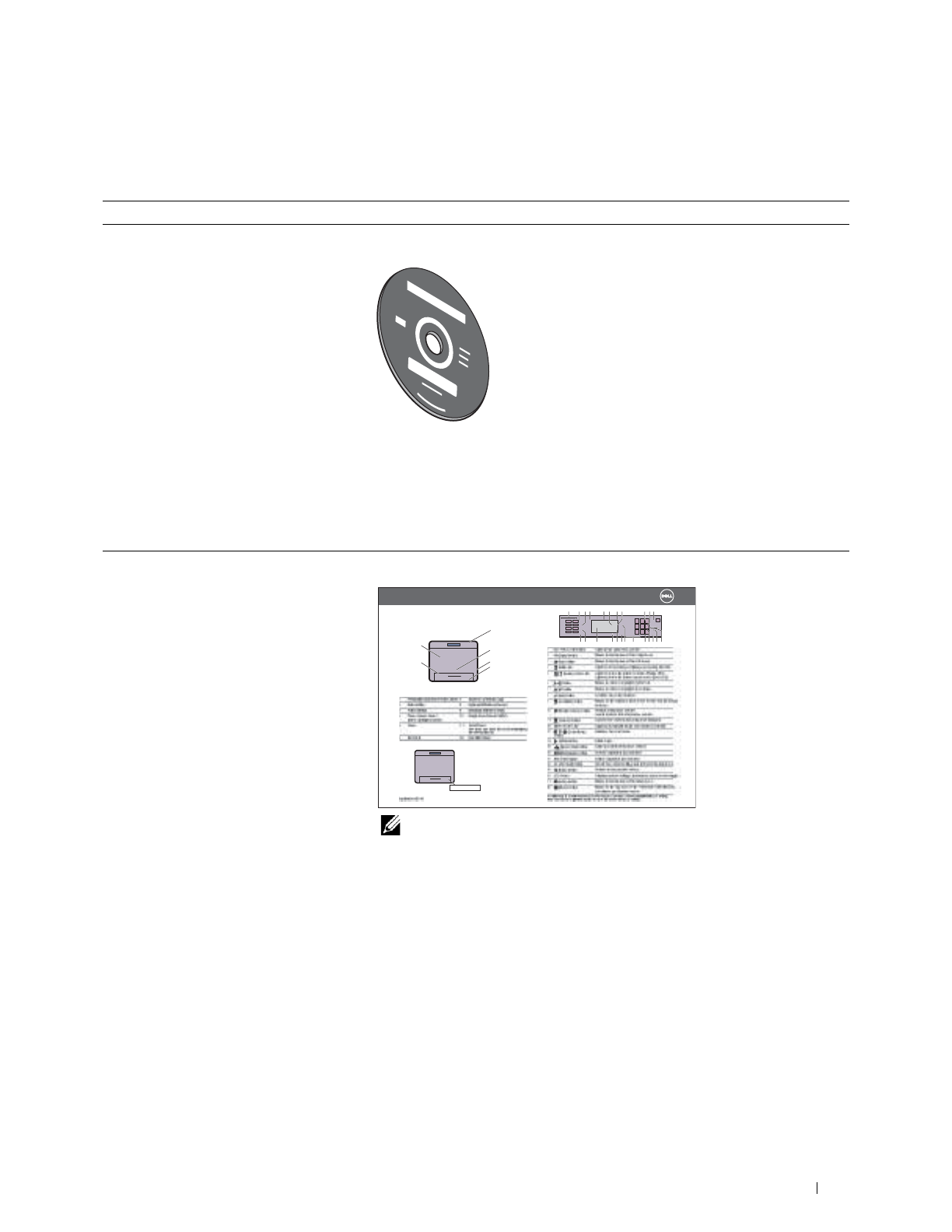
What are you looking for? Find it here
• Drivers for my printer
•My
User's Guide
Software and Documentation
disc
The
Software and Documentation
disc contains setup video, documentation,
and drivers for your printer. You can use the
Software and Documentation
disc to
install drivers or access your setup video and documentation.
Readme files may be included on your
Software and Documentation
disc to
provide last-minute updates about technical changes to your printer or advanced
technical reference material for experienced users or technicians.
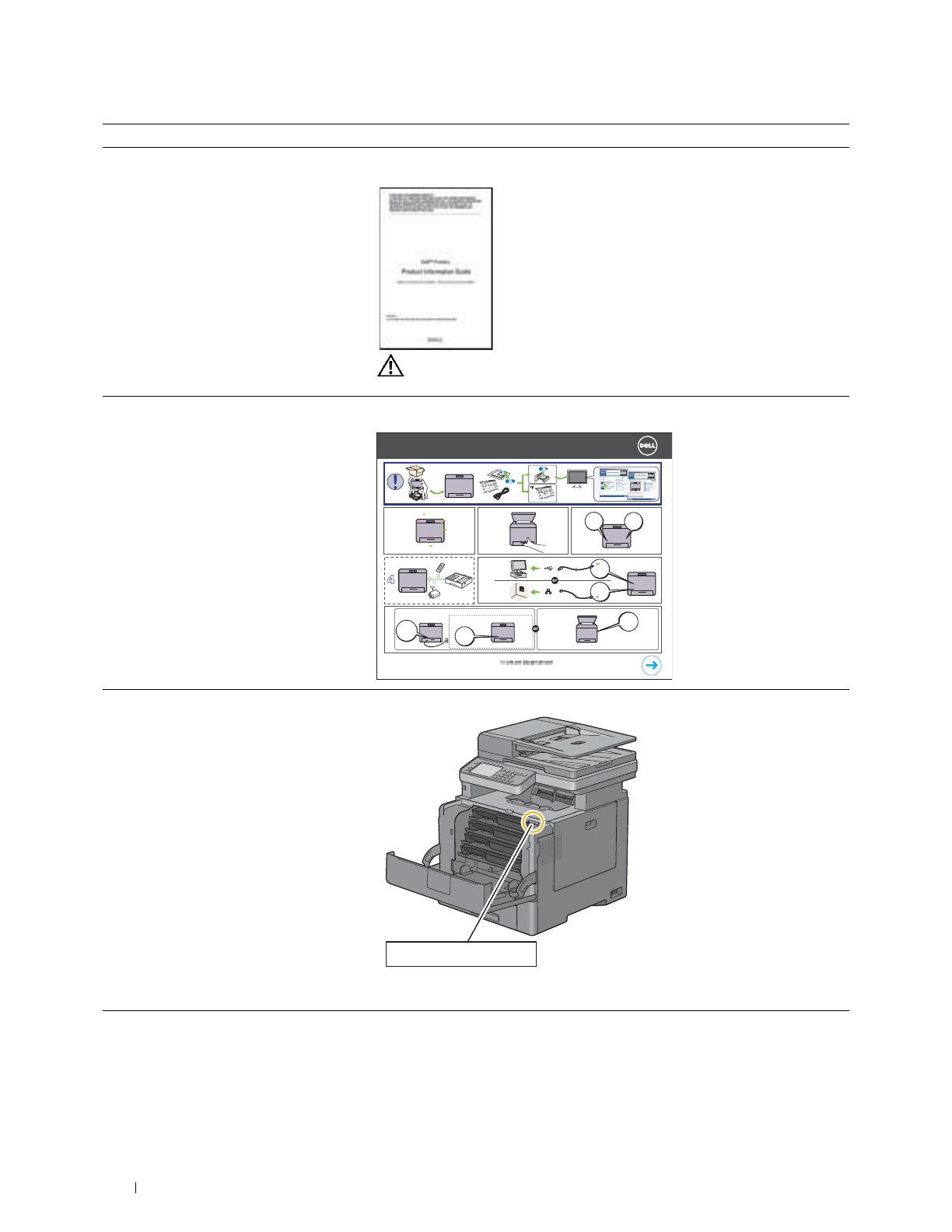
• How to use my printer
Quick Reference Guide
NOTE: Quick Reference Guide may not be included in the package for some
regions.
Quick Reference Guide
About Your Printer
1
2
4
3
11
12
Service Tag Express Service Code
xxxxxxx 000 000 000 00
111234 5678 910
6151412131917816 71202212
Service Tag
28 Finding Information
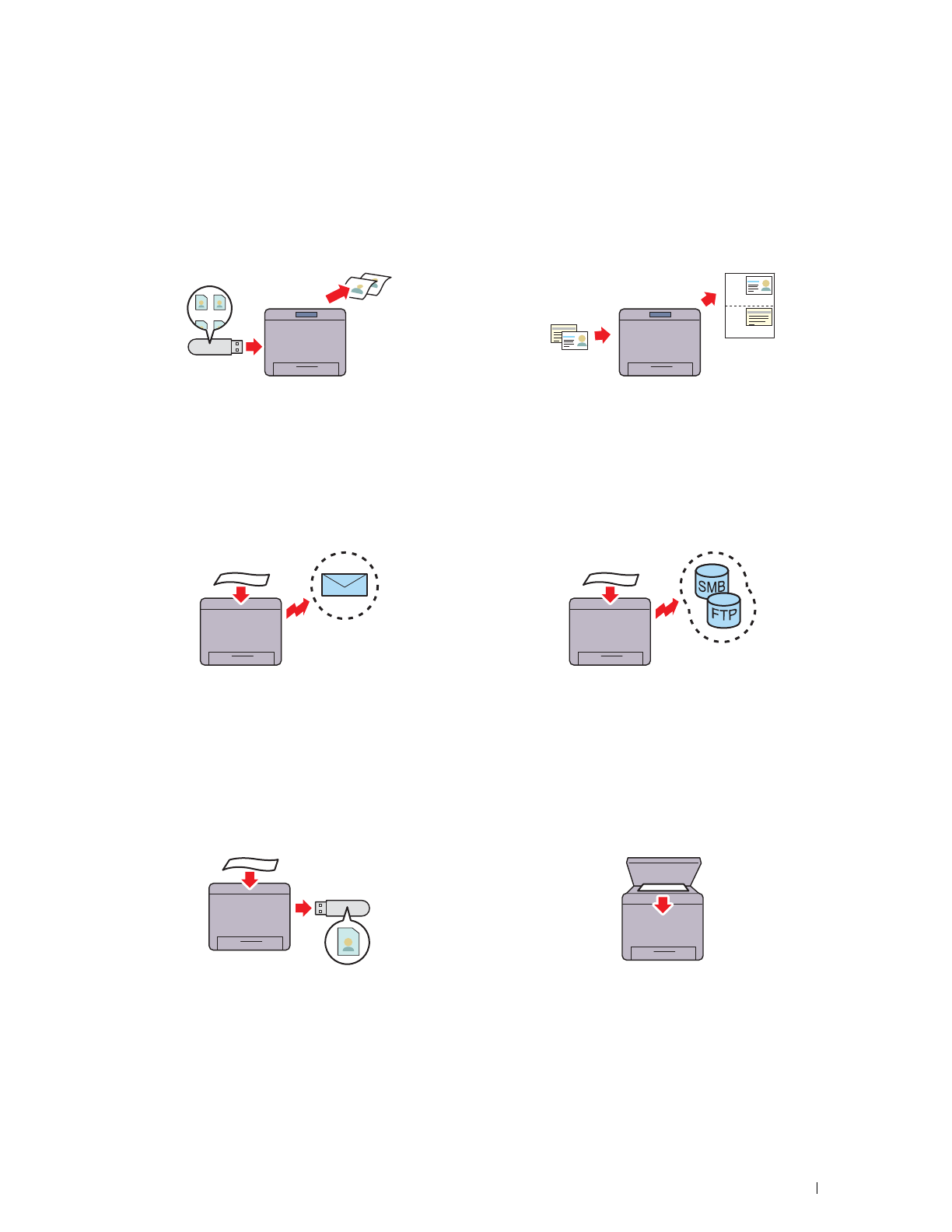
• Safety information
• Warranty information
Product Information Guide
WARNING: Read and follow all safety instructions in the
Product
Information Guide
prior to setting up and operating your printer.
• How to set up my printer
Setup diagram
• Express Service Code and Service Tag
The Express Service Code and Service Tag are located inside the front cover of
your printer.
• Latest drivers for my printer
• Documentation for my printer
Go to support.dell.com.
What are you looking for? Find it here
Setting Up Your Printer
54
a1
a2
b
123
Service Tag Express Service Code
xxxxxxx 000 000 000 00

Finding Information 29
• Answers to technical service and support
questions
support.dell.com provides several online tools, including:
• Solutions — Troubleshooting hints and tips, articles from technicians, and
online courses
• Upgrades — Upgrade information for components, such as the printer drivers
• Customer Care — Contact information, order status, warranty, and repair
information
•Downloads — Drivers
• Manuals— Printer documentation and product specifications
Go to support.dell.com. Select your region, and fill in the requested details to
access help tools and information.
What are you looking for? Find it here

30 Finding Information
Product Features 31
3
Product Features
This chapter describes the product features and indicates their links.
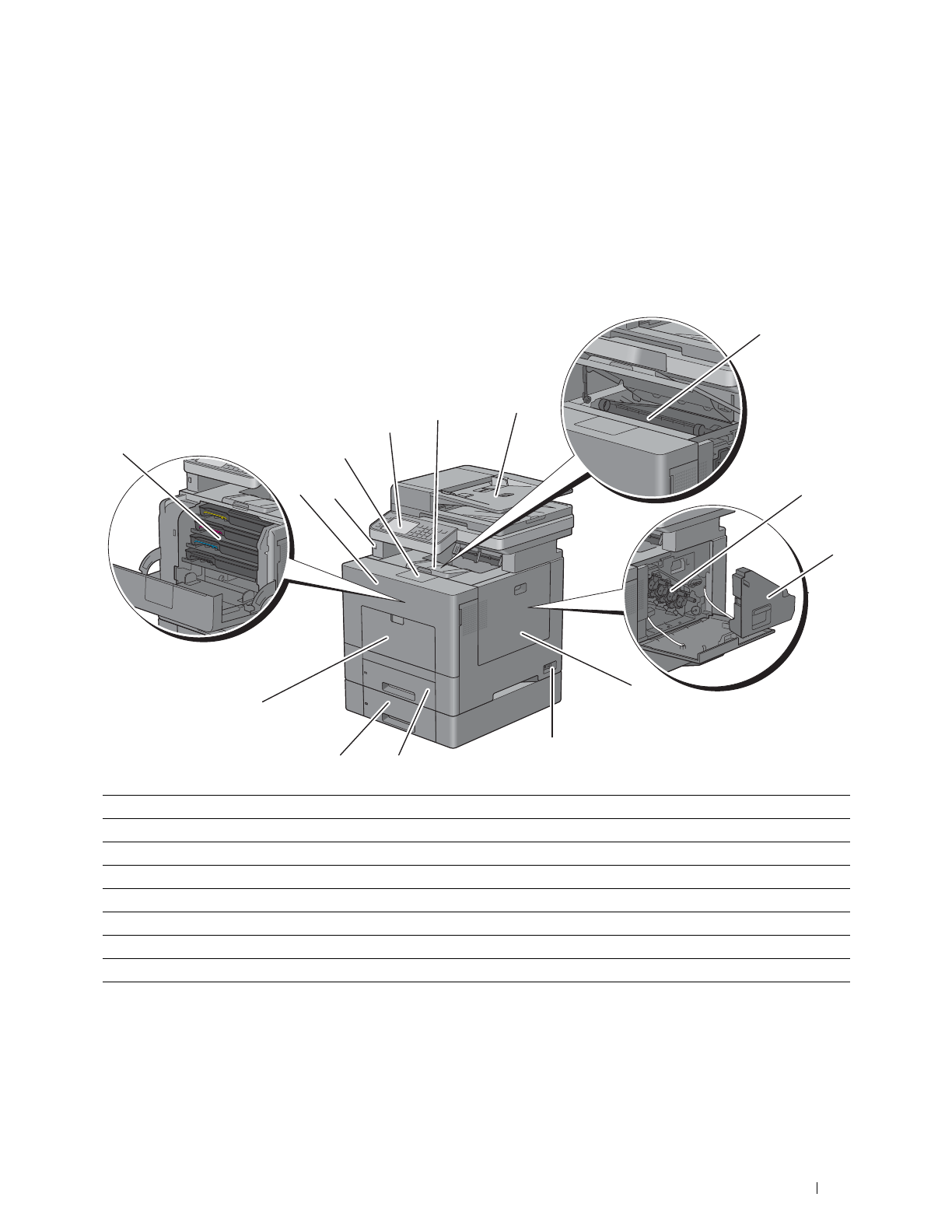
Printing from USB Memory (USB Direct Print)
The USB Direct Print feature enables you to print files
directly from a USB memory without requiring you to start
your computer and an application.
Using the ID Card Copy (ID Card Copy)
You can copy both sides of an ID card on one side of a
single sheet of paper in its original size by selecting ID
Card Copy on the touch panel. This feature helps to
show both sides of an ID card in one page in its original
size.
Sending an E-Mail With the Scanned Image (Scan to E-mail)
When you want to send scanned data by e-mail, use the
Scan to E-mail feature. You can directly send the data
scanned as an e-mail attachment. You can choose
destination e-mail addresses from the address book on the
printer or server. Or, you can enter the address from the
touch panel on the printer's operator panel.
Scanning to a PC or Server via SMB/FTP (Scan to Network)
You can transfer data scanned to a PC or a server via SMB
or FTP without service software. Although prior
registration of the destination FTP server or PC on the
address book is required, it helps save your time.
Scanning to a USB Memory (Scan to USB Memory)
With the Scan to USB Memory feature, you don't need a
PC to connect a USB memory. You can specify the USB
memory inserted into the printer's port as a data saving
location when you scan data.
Making Copies From the Document Glass (Scan From
Document Glass)
You can scan the pages of a book or a brochure from the
document glass. When you scan documents using the
document glass, place them facing down.

About the Printer 33
4
About the Printer
This chapter provides an overview of your Dell™ C3765dnf Multifunction Color Laser Printer.
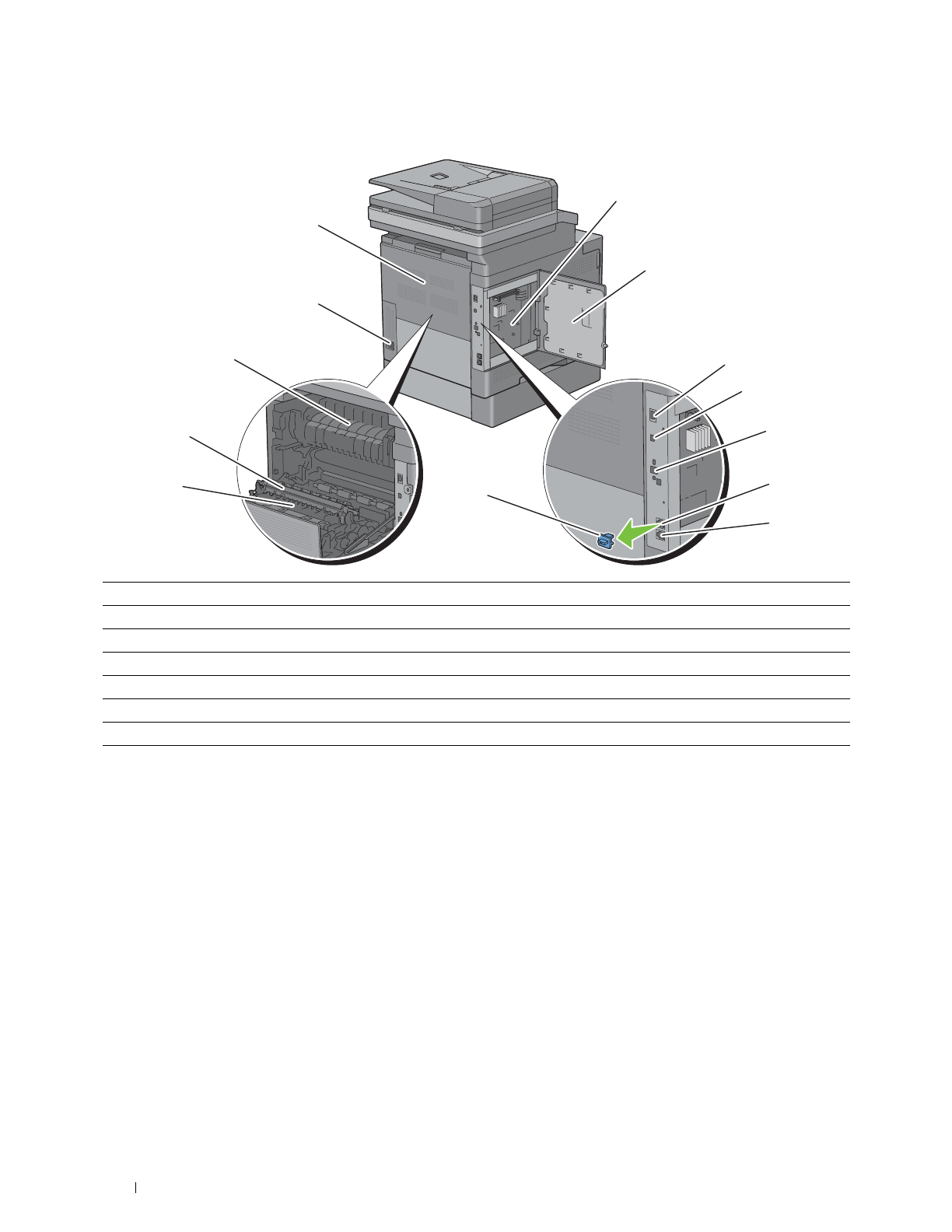
Front and Rear View
Front View
1Duplex Automatic Document Feeder (DADF) 9Multipurpose Feeder (MPF)
2Transfer B el t U n i t 10 Toner Cartridges
3Drum Cartridges 11 Front Cover
4Wast e Toner Box 12 Front USB Port
5Right Side Cover 13 Output Tray Extension
6Power Switch 14 Operator Panel
7Tray1 15 Top Cover
8Optional 550-Sheet Feeder (Tray2)
1
15
2
3
4
5
6
7
8
9
10
11 12
14
13
34 About the Printer
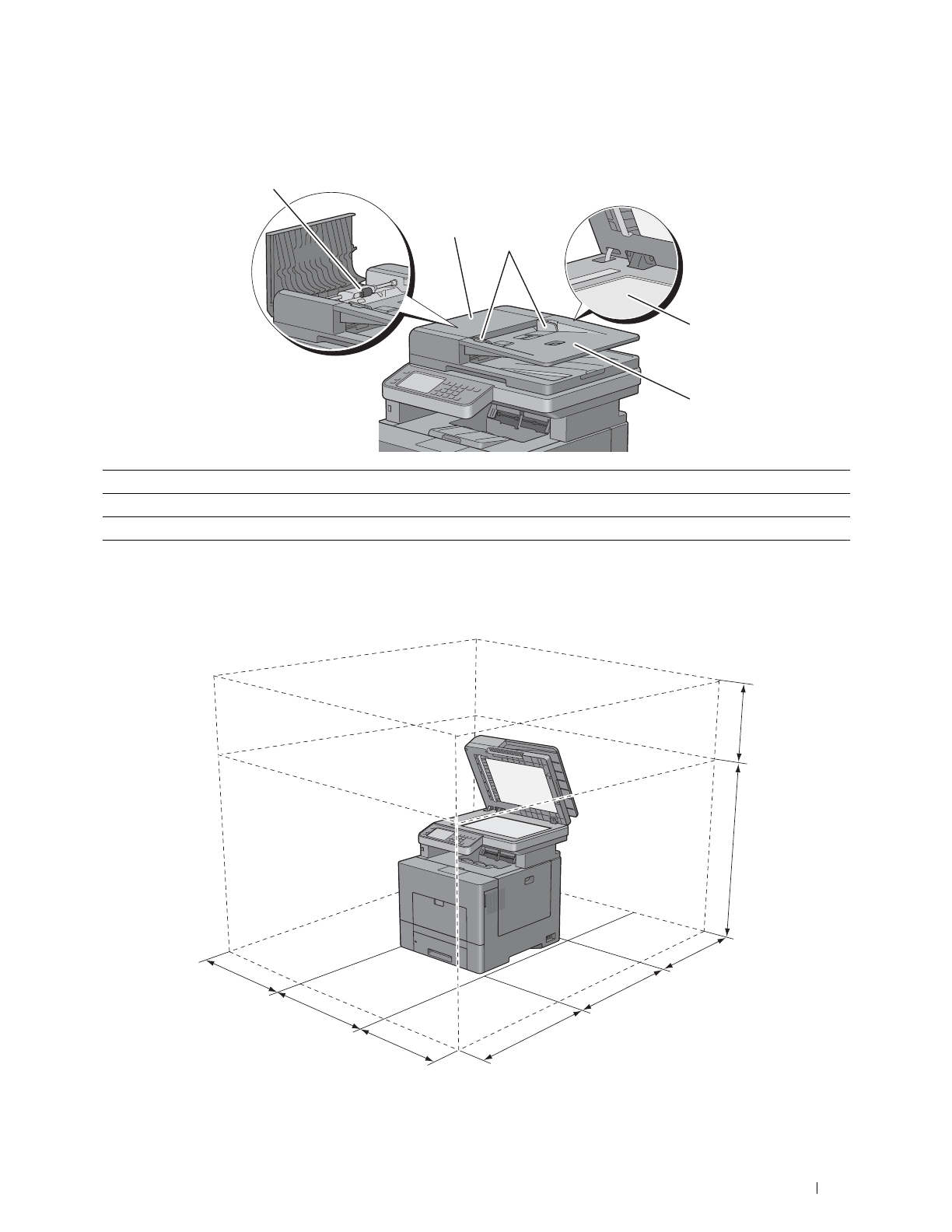
Rear View
1Control Board 8"Blue" Plug
2Left Side Cover 9Duplex Unit
3Ethernet Port 10 2nd Belt Transfer Roller (2nd BTR)
4USB Port 11 Fusing Unit
5Wireless Adapter Socket 12 Power Connector
6Phone Connector 13 Rear Cover
7Wall Jack Connector
1
2
3
4
5
6
7
8
9
10
11
12
13
About the Printer 35
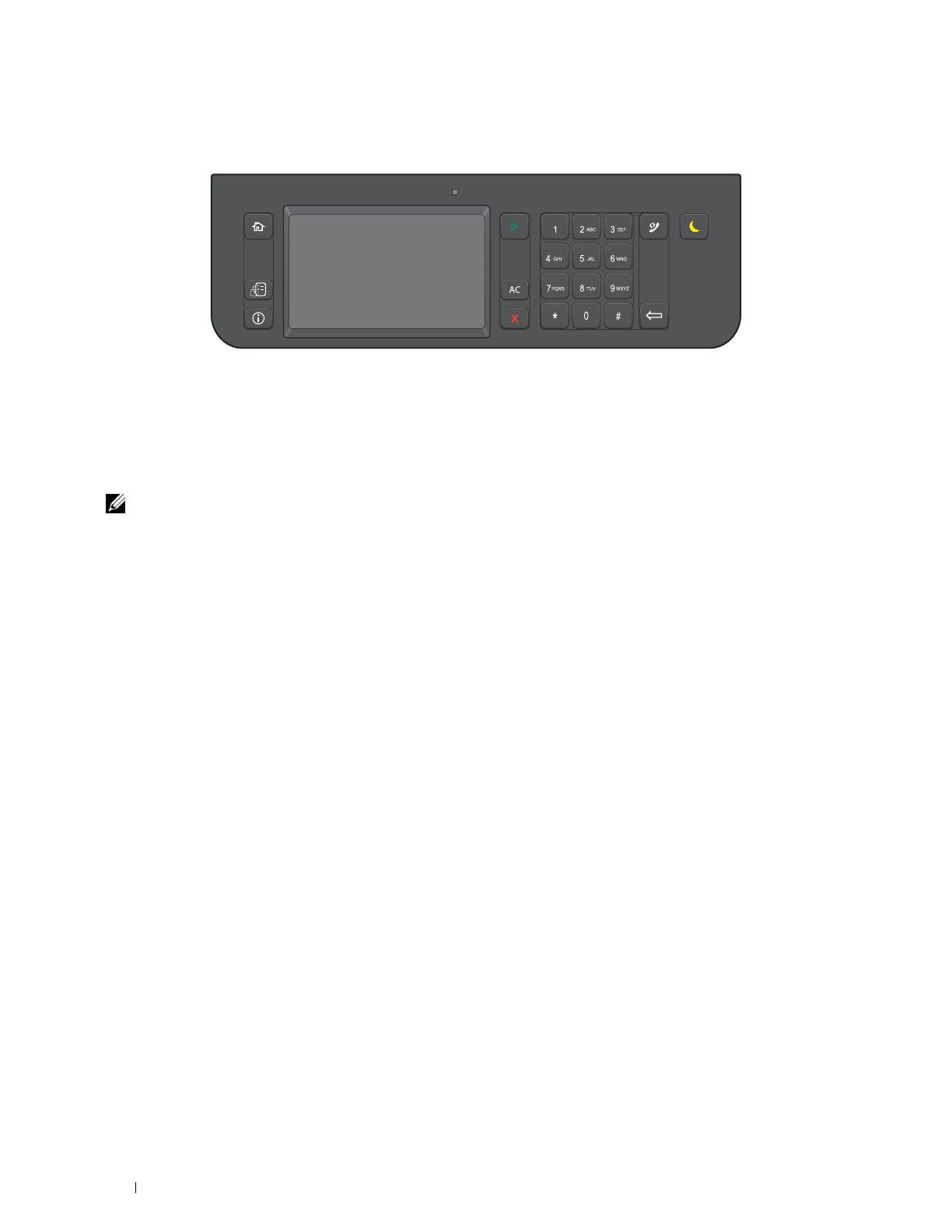
Duplex Automatic Document Feeder (DADF)
Space Requirements
Provide enough room to open the printer trays, covers, and optional accessories, and for proper ventilation.
1DADF Cover 4Document Feeder Tray
2Document Guides 5DADF Feed Roller
3Document Glass
12
3
4
5
320 mm/
12.60 inches
558 mm/
21.97 inches
400 mm/15.75 inches
530 mm/20.87 inches
600 mm/23.62 inches
400 mm/15.75 inches
530 mm/20.87 inches
400 mm/15.75 inches
36 About the Printer
Operator Panel
For more information on the operator panel, see "About the Operator Panel."
Additional Components
Optional Accessories
The following optional accessories are available for the printer.
NOTE: Each accessory can be purchased separately except for the wireless adapter and the hard disk, which can only be
purchased together as a bundled kit.
• Wireless adapter
• 512MB memory module
• Hard disk
• Optional 550-sheet feeder
Non-bundled Items
The following items are required for connecting the printer to a computer or a network. Please purchase them as
needed.
•USB cable
• Ethernet cable
About the Printer 37
Securing the Printer
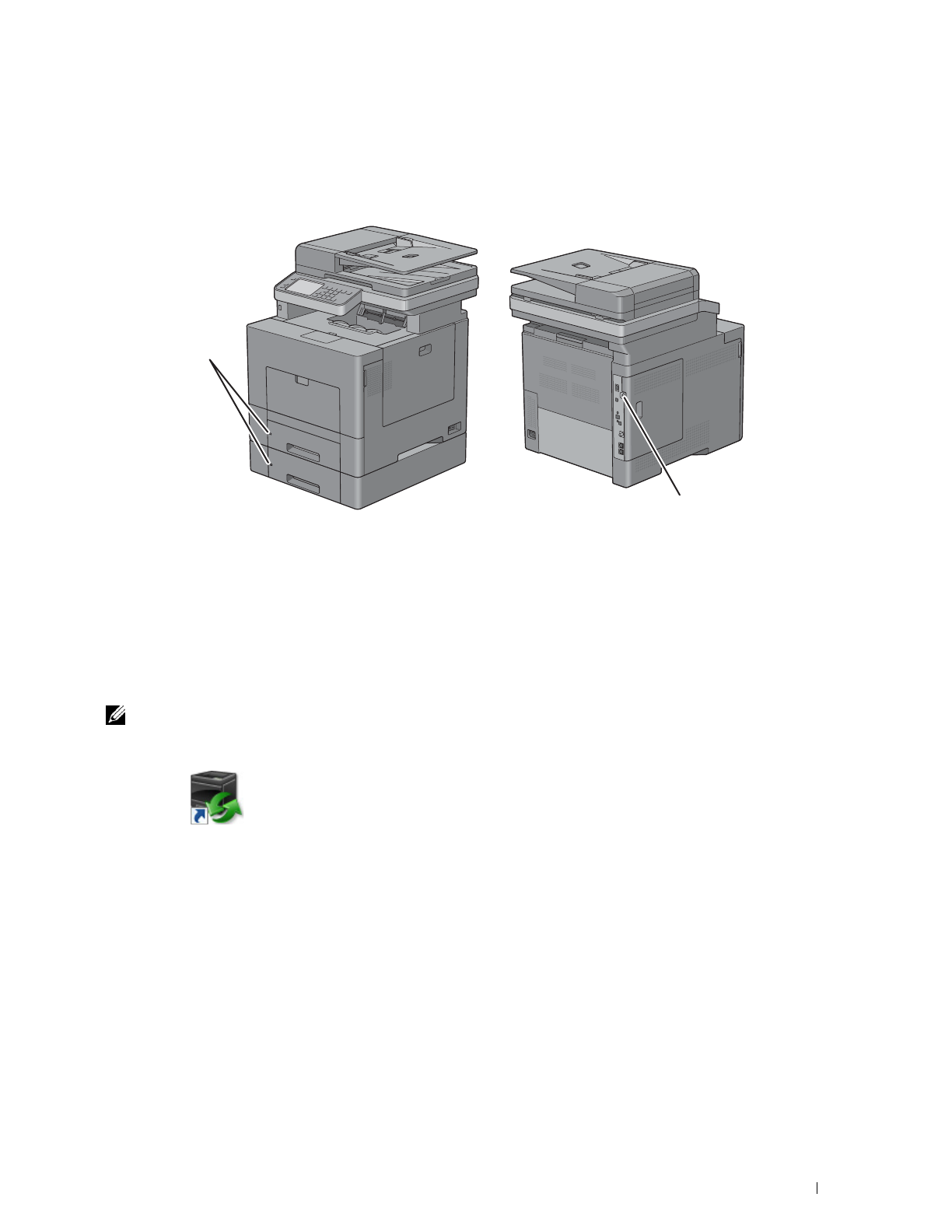
To protect your printer from theft, you can use the optional Kensington lock.
Attach the Kensington lock to the security slot on your printer.
For details, see the operating instructions supplied with the Kensington lock.
Ordering Supplies
You can order consumables from Dell online when using a networked printer. Enter the IP address of your printer in
your web browser, launch the Dell Printer Configuration Web Tool, and click the web address under Order Supplies
at: to order toner or supplies for your printer.
You can also order replacement toner cartridges or supplies from Dell by using the Dell Supplies Management
System:
NOTE: For Macintosh, start the Status Monitor Widget, and then select Order Supplies button to open Order window.
1
Double-click the icon on your desktop.
If you cannot find the icon on your desktop:
a
Right-click
DLRMM.EXE
under
x:\abc\Dell Printers\Additional Color Laser
Software\Reorder
, where
x:\abc
is the location where the printer software is installed.
b
Choose
Send To
from the drop-down menu, and then click
Desktop (create shortcut)
on the submenu.
The
Dell Supplies Management System
window appears.
You can also launch the Dell Supplies Management System by clicking
Start
→
All Programs
→
Dell Printers
→
Additional Color Laser Software
→
Dell Supplies Management System
.
2
Click the
Visit Dell printer supplies ordering web site
link (
www.dell.com/supplies
), or order Dell printer supplies
by phone.
To ensure that you get the best service, have your Dell printer’s Service Tag ready.
For information regarding locating your Service Tag, see
"
Express Service Code and Service Tag.
"
Security Slot
Security Slot

38 About the Printer

39
Setting up the Printer (Printer
Setup)
5 Preparing Printer Hardware...................................................... 41
6 Installing Optional Accessories................................................ 43
7 Connecting Your Printer............................................................. 71
8 Setting the IP Address ............................................................... 83
9 Loading Paper.............................................................................. 87
10 Installing Printer Drivers on Windows® Computers............. 91
11 Installing Printer Drivers on Macintosh Computers............ 111
12 Installing Printer Drivers on Linux Computers (CUPS) ...........117

40
Preparing Printer Hardware 41
5
Preparing Printer Hardware
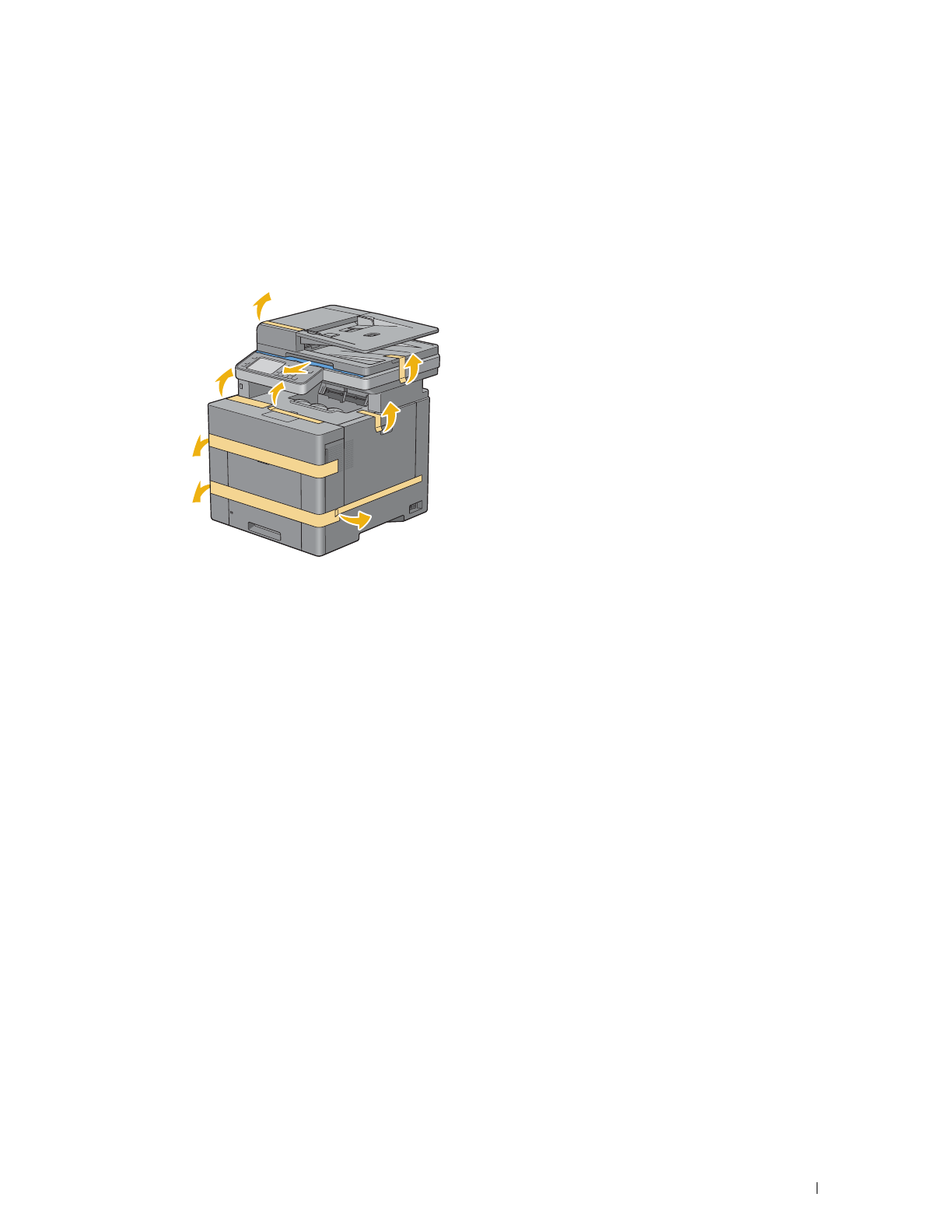
Removing Tape
1
Remove tapes and the protective sheet from the printer.

42 Preparing Printer Hardware
Installing Optional Accessories 43
6
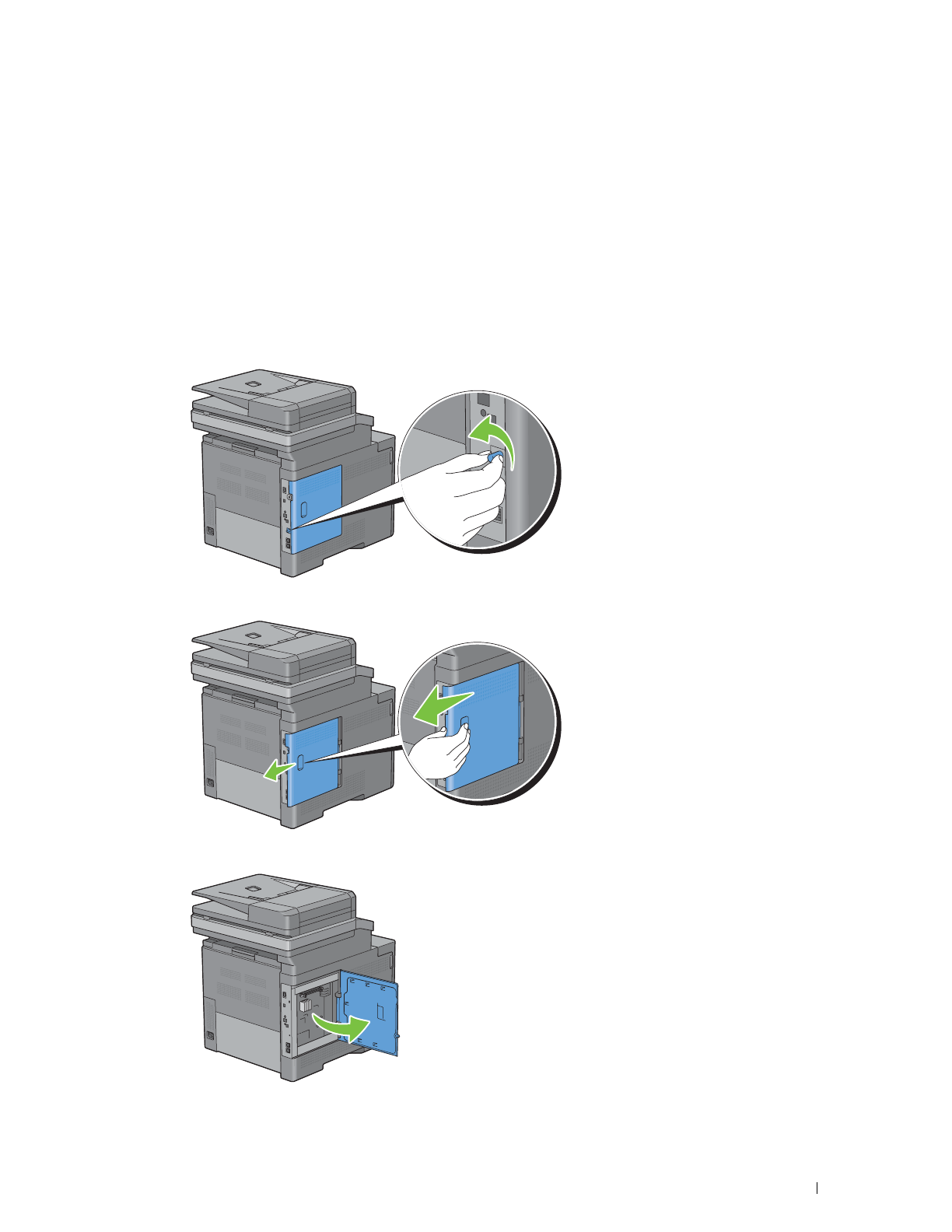
Installing Optional Accessories
You can make the printer more functional by installing the optional accessories. This chapter describes how to install
the printer's options such as the 512 MB memory module, optional 550-sheet feeder (tray2), wireless adapter, and
hard disk.
Installing the Optional Memory Module
1
Ensure that the printer is turned off.
2
Turn the screw on the left side cover counterclockwise.
3
Slide the left side cover towards the back of the printer.
4
Open the left side cover completely.
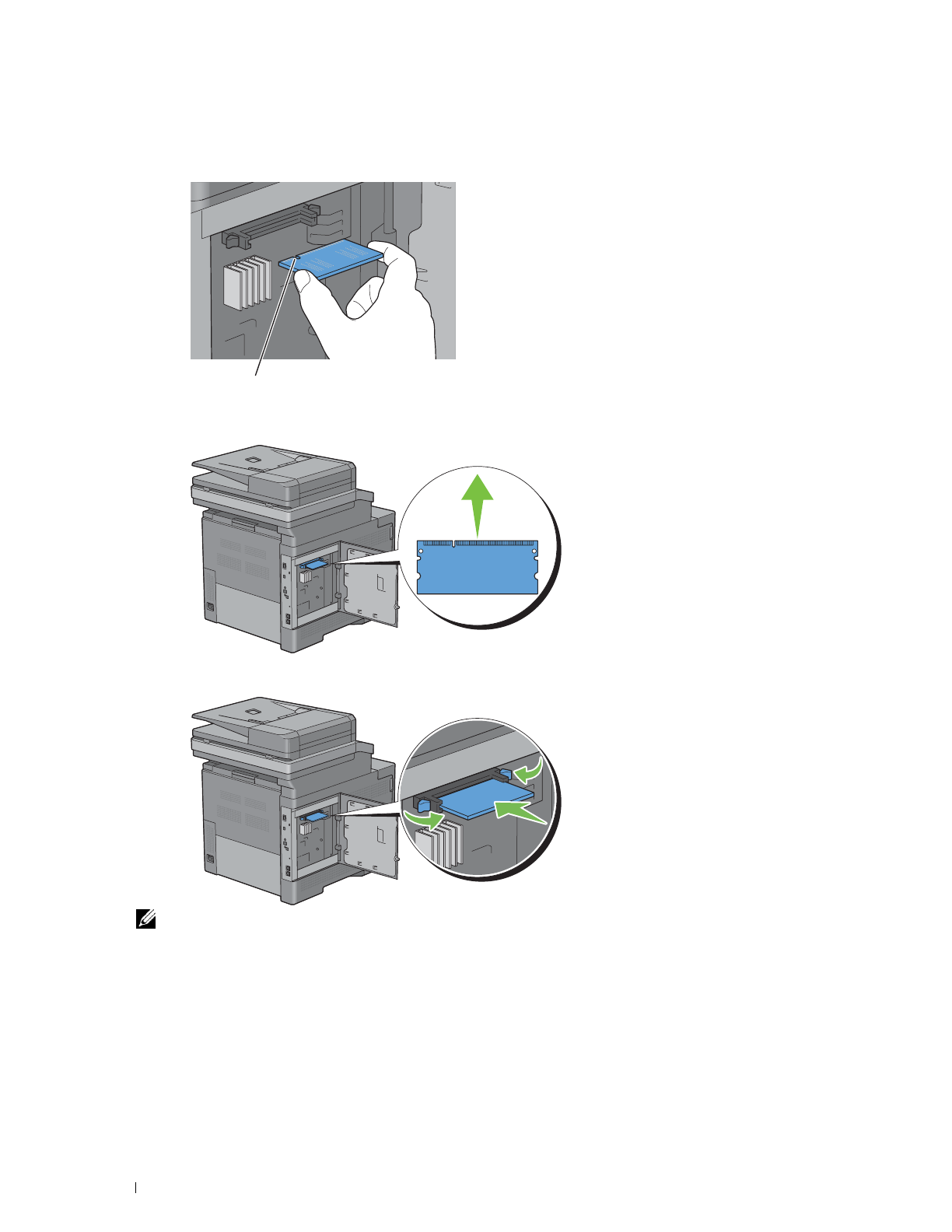
44 Installing Optional Accessories
5
Hold the edge of the memory module and face its connector toward the slot with the notch on the connector
positioned on left.
6
Align the connector of the memory module with the slot and insert the memory module into the slot.
7
Push the memory module firmly into the slot.
NOTE: Ensure that the memory module is firmly fixed in the slot and does not move easily.
notch
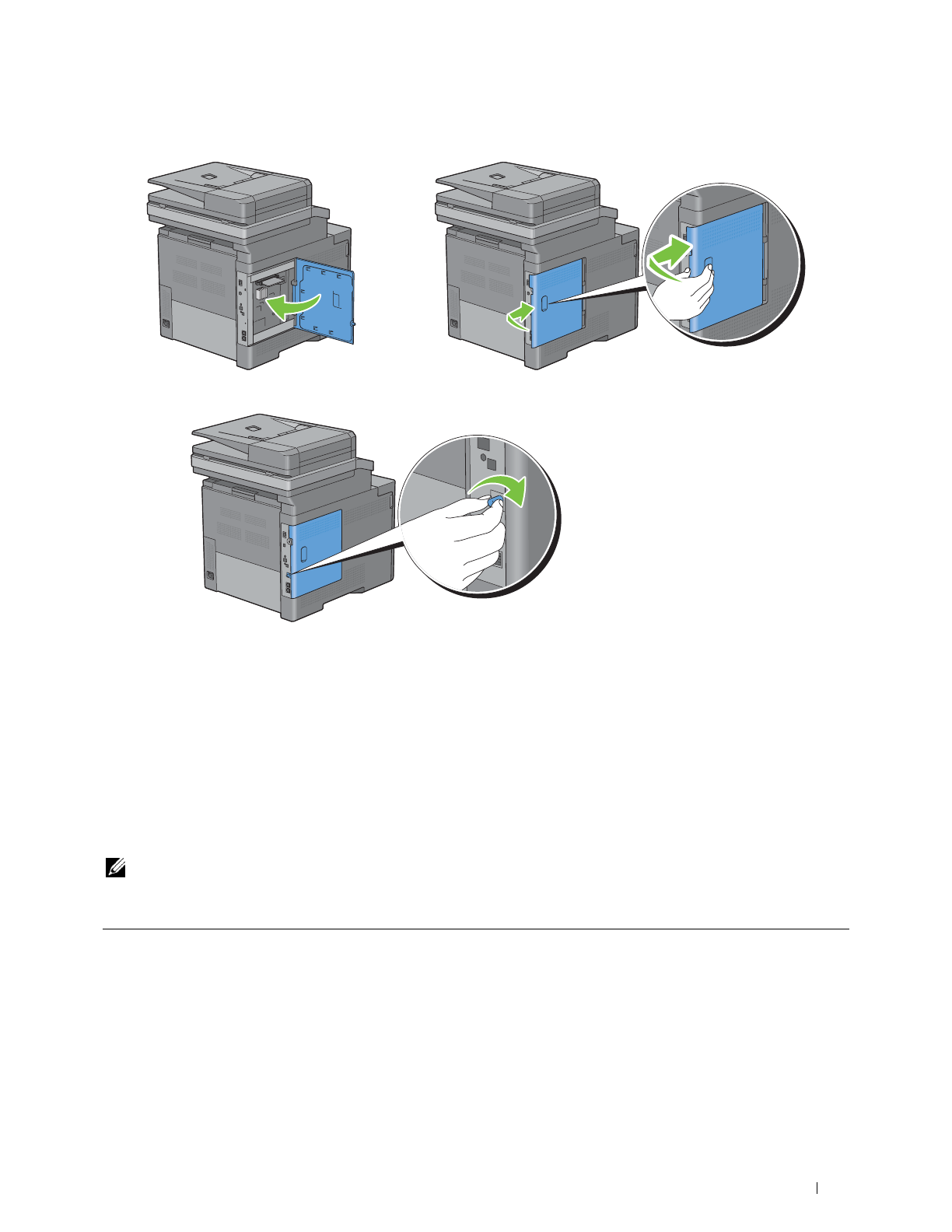
Installing Optional Accessories 45
8
Close the left side cover, and then slide it towards the front of the printer.
9
Turn the screw clockwise.
10
Turn on the printer.
11
Print the system settings report to confirm that the newly installed memory is detected by the printer.
For details about how to print a system settings report, see "Report / List."
12
Confirm the amount of
Memory Capacity
listed in the system settings report under
General
.
If the memory capacity has not increased, turn off the printer, unplug the power cable, and re-install the memory
module.
13
If you installed the optional memory module after installing the printer driver, update your driver by following the
instructions for the operating system you are using. If the printer is on a network, update the driver for each client.
Updating Your Driver to Detect Memory Module
NOTE: When you use XPS driver, driver updating is not required.
When Using PCL Driver
Microsoft® Windows® 8/
Windows 8 x64/
Windows Server® 2012
1
Under Desktop mode, right-click the bottom left corner of the screen, and then click
Control Panel
→
Hardware and Sound
(
Hardware
for Windows Server 2012)
→
Devices
and Printers
.
2
Right-click the printer icon of the Dell™ C3765dnf Multifunction Color Laser Printer, and
then select
Printer properties
.
3
Click the
Options
tab, and then select
Get Information from Printer
.
4
Click
Apply
, and then click
OK
.
5
Close the
Devices and Printers
dialog box.

46 Installing Optional Accessories
If the printer information is not updated automatically after clicking Get Information from Printer, follow these
steps:
1
Click the
Options
tab, and then select
Memory Capacity
in the
Items
list box.
2
Select the total amount of the installed printer memory in the
Memory Capacity
drop-down menu in
Change
Setting for
.
3
Click
Apply
, and then click
OK
.
4
Close the
Printers and Faxes
(
Printers
, or
Devices and Printers
) dialog box.
When Using PS Driver
Windows 7/
7 x64/
Server 2008 R2 x64
1
Click
Start
→
Devices and Printers
.
2
Right-click the printer icon of the Dell™ C3765dnf Multifunction Color Laser Printer, and
then select
Printer properties
.
3
Click the
Options
tab, and then select
Get Information from Printer
.
4
Click
Apply
, and then click
OK
.
5
Close the
Devices and Printers
dialog box.
Windows Vista®/Vista x64 1
Click
Start
→
Control Panel
→
Hardware and Sound
→
Printers
.
2
Right-click the printer icon of the Dell C3765dnf Multifunction Color Laser Printer, and
then select
Properties
.
3
Click the
Options
tab, and then select
Get Information from Printer
.
4
Click
Apply
, and then click
OK
.
5
Close the
Printers
dialog box.
Windows Server 2008/
Server 2008 x64
1
Click
Start
→
Control Panel
→
Printers
.
2
Right-click the printer icon of the Dell C3765dnf Multifunction Color Laser Printer, and
then select
Properties
.
3
Click the
Options
tab, and then select
Get Information from Printer
.
4
Click
Apply
, and then click
OK
.
5
Close the
Printers
dialog box.
Windows XP/XP x64/
Server 2003/
Server 2003 x64
1
Click
start
→
Printers and Faxes
.
2
Right-click the printer icon of the Dell C3765dnf Multifunction Color Laser Printer, and
then select
Properties
.
3
Click the
Options
tab, and then select
Get Information from Printer
.
4
Click
Apply
, and then click
OK
.
5
Close the
Printers and Faxes
dialog box.
Windows 8/
Windows 8 x64/
Windows Server 2012
1
Under Desktop mode, right-click the bottom left corner of the screen, and then click
Control Panel
→
Hardware and Sound
(
Hardware
for Windows Server 2012)
→
Devices
and Printers
.
2
Right-click the printer icon of the Dell C3765dnf Multifunction Color Laser Printer, and
then select
Printer properties
.
3
Click the
Configuration
tab, and then select
Bi-Directional Setup
.
4
Select
Get Information from Printer
and then click
OK
.
5
Click
Apply
, and then click
OK
.
6
Close the
Devices and Printers
dialog box.

Installing Optional Accessories 47
If the printer information is not updated automatically after clicking Get Information from Printer, follow these
steps:
1
Click the
Configuration
tab, and then select
Installable Options
.
2
Select
Memory Capacity
in the
Items
list box.
3
Select the total amount of the installed printer memory in the
Memory Capacity
drop-down menu under
Setting
for
.
4
Click
OK
.
5
Click Apply, and then click
OK
.
6
Close the
Printers and Faxes
(
Printers
, or
Devices and Printers
) dialog box.
Windows 7/
7 x64/
Server 2008 R2 x64
1
Click
Start
→
Devices and Printers
.
2
Right-click the printer icon of the Dell C3765dnf Multifunction Color Laser Printer, and
then select
Printer properties
.
3
Click the
Configuration
tab, and then select
Bi-Directional Setup
.
4
Select
Get Information from Printer
and then click
OK
.
5
Click
Apply
, and then click
OK
.
6
Close the
Devices and Printers
dialog box.
Windows Vista/Vista x64 1
Click
Start
→
Control Panel
→
Hardware and Sound
→
Printers
.
2
Right-click the printer icon of the Dell C3765dnf Multifunction Color Laser Printer, and
then select
Properties
.
3
Click the
Configuration
tab, and then select
Bi-Directional Setup
.
4
Select
Get Information from Printer
and then click
OK
.
5
Click
Apply
, and then click
OK
.
6
Close the
Printers
dialog box.
Windows Server 2008/
Server 2008 x64
1
Click
Start
→
Control Panel
→
Printers
.
2
Right-click the printer icon of the Dell C3765dnf Multifunction Color Laser Printer, and
then select
Properties
.
3
Click the
Configuration
tab, and then select
Bi-Directional Setup
.
4
Select
Get Information from Printer
and then click
OK
.
5
Click
Apply
, and then click
OK
.
6
Close the
Printers
dialog box.
Windows XP/XP x64/
Server 2003/
Server 2003 x64
1
Click
Start
→
Printers and Faxes
.
2
Right-click the printer icon of the Dell C3765dnf Multifunction Color Laser Printer, and
then select
Properties
.
3
Click the
Configuration
tab, and then select
Bi-Directional Setup
.
4
Select
Get Information from Printer
and then click
OK
.
5
Click
Apply
, and then click
OK
.
6
Close the
Printers and Faxes
dialog box.
Mac OS® X 10.7.x/10.8.x 1
Select the
Print & Scan
in
System Preferences
.
2
Select the printer in
Printers
list, and click
Options & Supplies
.
3
Select
Driver
, select the options that have been installed on the printers, and then click
OK
.
Mac OS X 10.5.x/10.6.x 1
Select the
Print & Fax
in
System Preferences
.
2
Select the printer in
Printers
list, and click
Options & Supplies
.
3
Select
Driver
, select the options that have been installed on the printers, and then click
OK
.
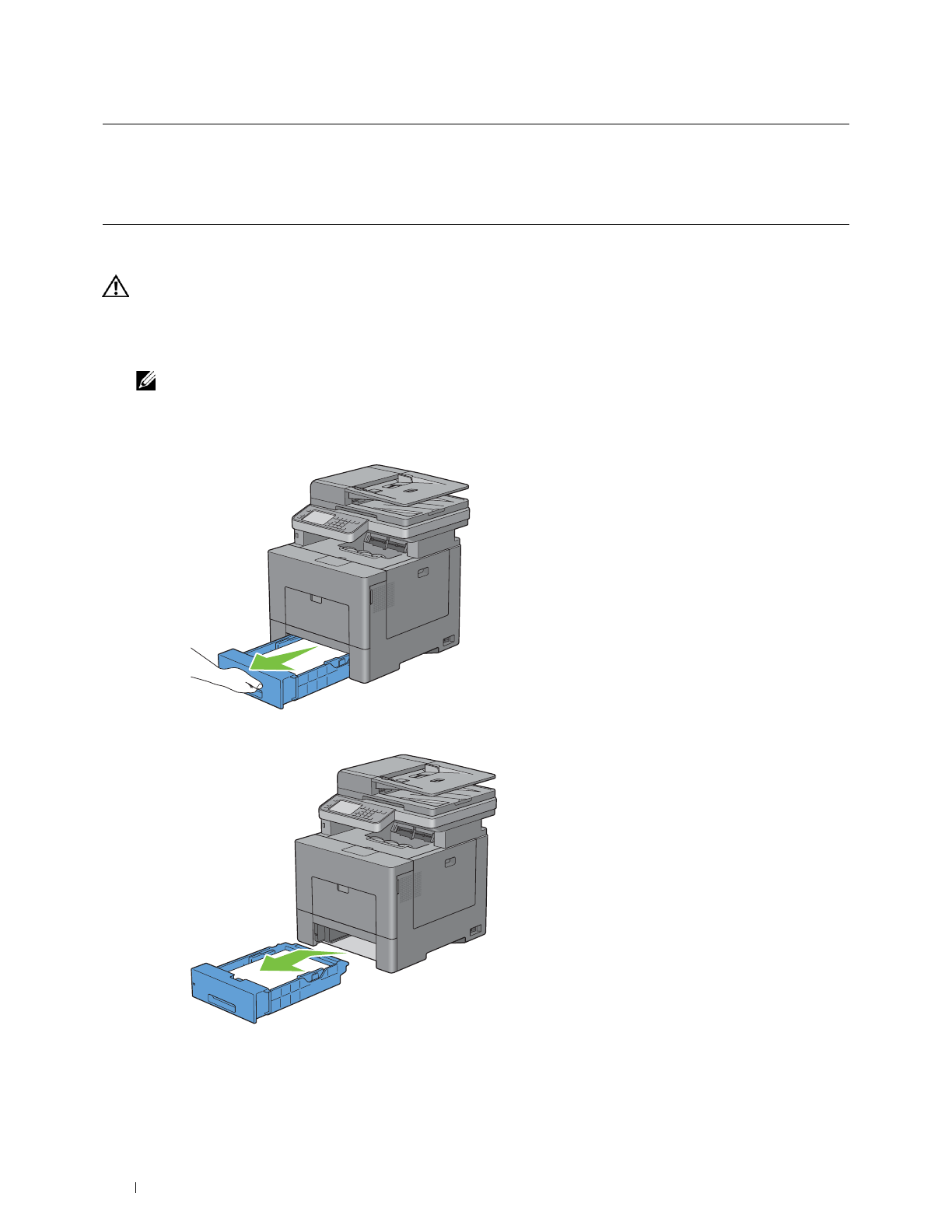
48 Installing Optional Accessories
Installing the Optional 550-Sheet Feeder
WARNING: If you install the optional 550-sheet feeder after setting up the printer, be sure to turn off the printer, unplug the
power cable, and disconnect all cables from the back of the printer before starting this task.
1
Ensure that the printer is turned off, and then disconnect all cables from the back of the printer.
2
Remove the tape and the bag holding the screws.
NOTE: Do not lose the screws because you will need them later.
3
Place the optional 550-sheet feeder in the same location that the printer is located.
4
Pull tray1 out of the printer about 200 mm.
5
Hold tray1 with both hands, and remove it from the printer.
Mac OS X 10.3.x/10.4.x 1
Select the printer from the
Printer List
screen in
Print Center
(or
Printer Setup Utility
).
2
Click
Printers
on the
Print Center
(or
Printer Setup Utility
) menu bar, and select
Show
Info
.
3
Select
Installable Options
, and select the options that have been installed on the printer,
and then click
Apply Changes
.
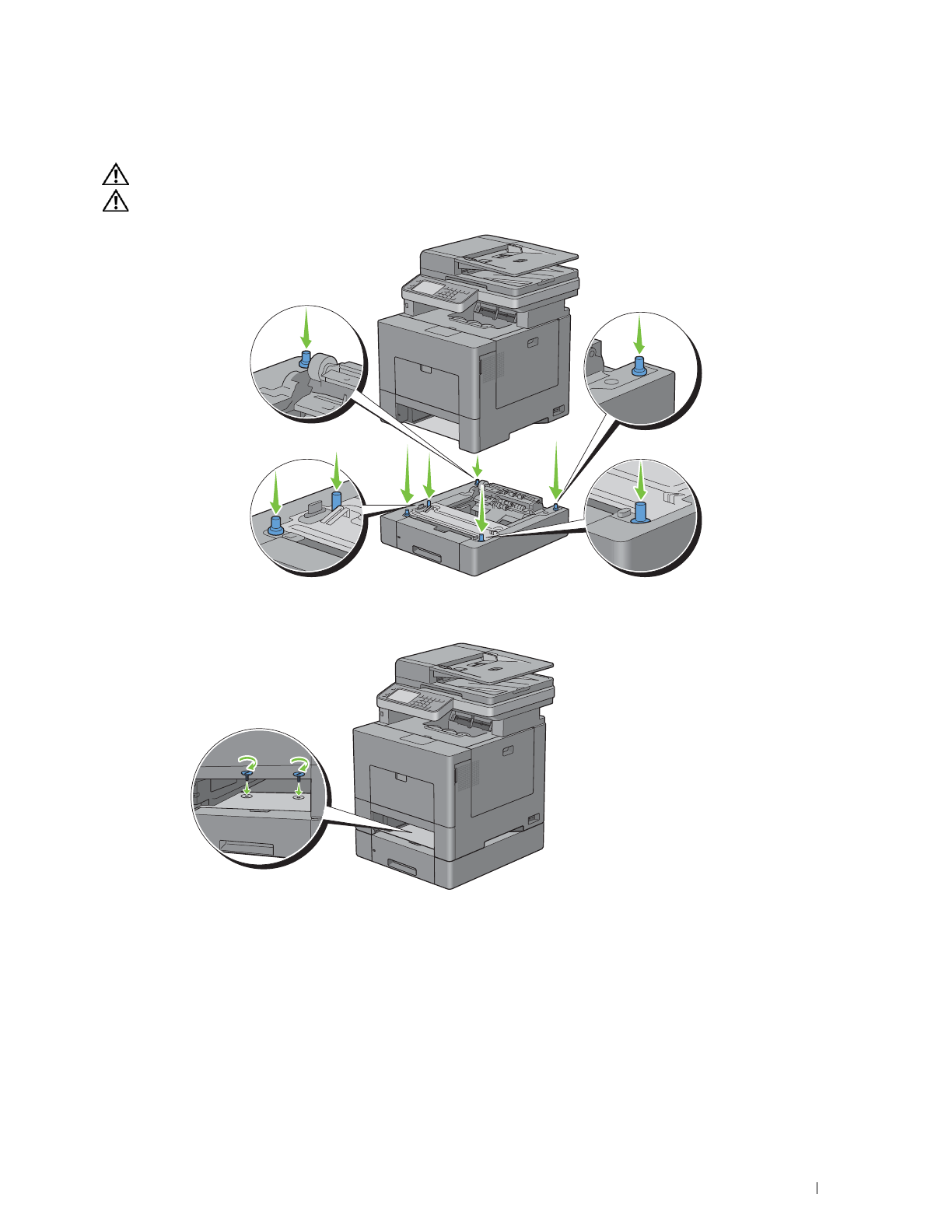
Installing Optional Accessories 49
6
Lift the printer and align the five guide pins of the optional 550-sheet feeder with the holes at the bottom of the
printer. Gently lower the printer onto the optional 550-sheet feeder.
WARNING: Two people are required to lift the printer.
WARNING: Be careful not to pinch your fingers when lowering the printer onto the optional 550-sheet feeder.
7
Secure the optional 550-sheet feeder to the printer by tightening the two screws provided with the feeder, using a
coin or similar object.
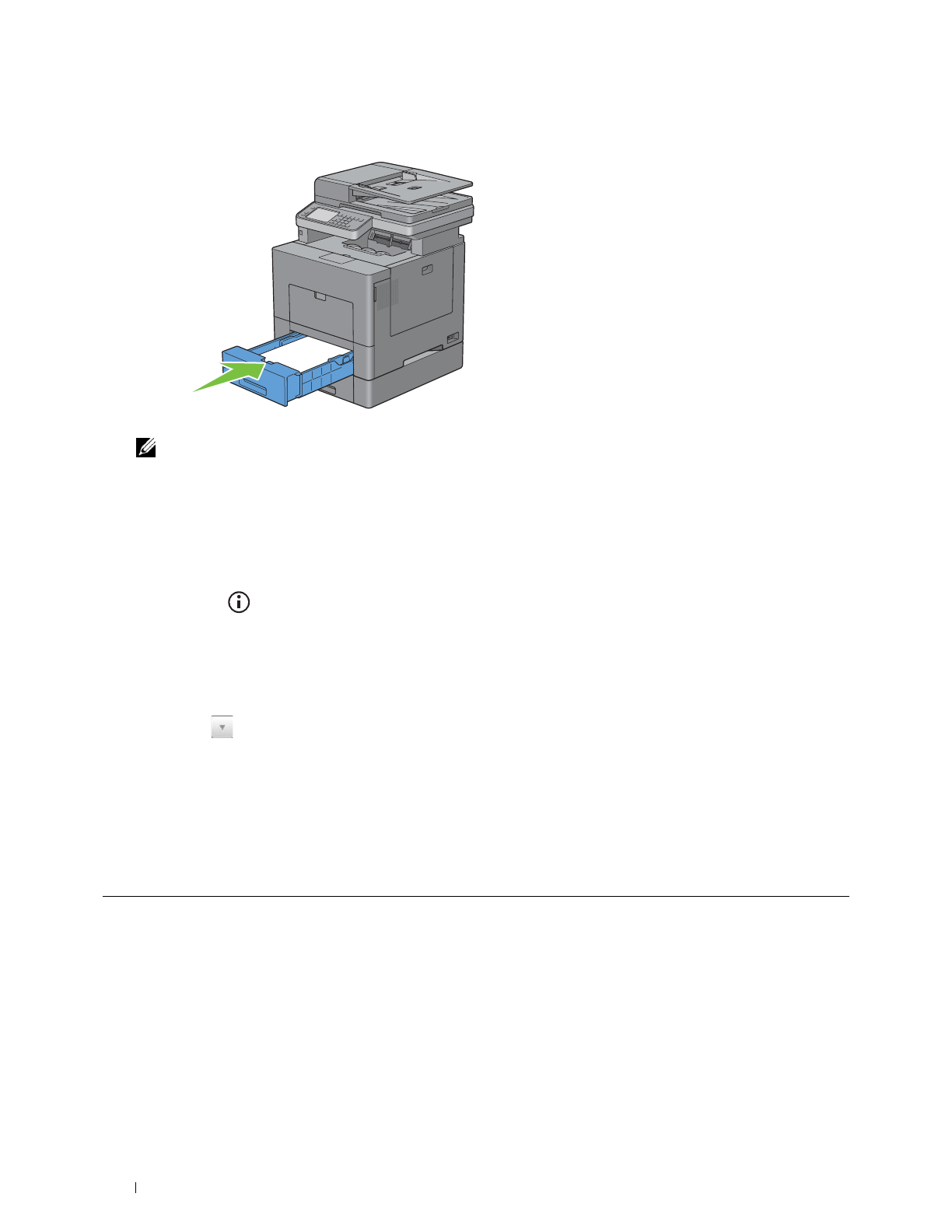
50 Installing Optional Accessories
8
Insert tray1 into the printer, and push until it stops.
9
Re-connect all cables into the back of the printer, and turn on the printer.
NOTE: The printer will automatically detect the attached tray but will not detect the paper type.
10
Print the system settings report to confirm that the optional 550-sheet feeder is installed correctly.
For details about how to print a system settings report, see "Report / List."
11
Confirm
Tray2 (550 Sheet Feeder)
is listed in the system settings report under
Printer Options
.
If the feeder is not listed, turn off the printer, unplug the power cable, and re-install the optional 550-sheet feeder.
12
After loading paper in the optional 550-sheet feeder, specify the paper type from the printer touch panel.
a
Press the
(Information)
button.
b
Select the
Tools
tab, and then select
Tray Management
.
c
Select
Tray Settings
.
d
Select
Tray2
.
e
Select
Type
.
f
Select until the desired paper type appears, and then select the desired paper type.
g
Select
OK
.
13
If you installed the optional 550-sheet feeder after installing the printer driver, update your driver by following the
instructions for each operating system. If the printer is on a network, update the driver for each client.
Updating Your Driver to Detect 550-Sheet Feeder
When Using PCL Driver
Windows 8/
Windows 8 x64/
Windows Server 2012
1
Under Desktop mode, right-click the bottom left corner of the screen, and then click
Control Panel
→
Hardware and Sound
(
Hardware
for Windows Server 2012)
→
Devices
and Printers
.
2
Right-click the printer icon of the Dell C3765dnf Multifunction Color Laser Printer, and
then select
Printer properties
.
3
Click the
Options
tab, and then select
Get Information from Printer
.
4
Click
Apply
, and then click
OK
.
5
Close the
Devices and Printers
dialog box.

Installing Optional Accessories 51
If the printer information is not updated automatically after clicking Get Information from Printer, follow these
steps:
1
Click the
Options
tab, and then select
Paper Tray Configuration
in the
Items
list box.
2
Select
Tray2
in the
Paper Tray Configuration
drop-down menu in
Change Setting for
.
3
Click
Apply
, and then click
OK
.
4
Close the
Printers and Faxes
(
Printers
, or
Devices and Printers
) dialog box.
When Using PS Driver
Windows 7/
7 x64/
Server 2008 R2 x64
1
Click
Start
→
Devices and Printers
.
2
Right-click the printer icon of the Dell C3765dnf Multifunction Color Laser Printer, and
then select
Printer properties
.
3
Click the
Options
tab, and then select
Get Information from Printer
.
4
Click
Apply
, and then click
OK
.
5
Close the
Devices and Printers
dialog box.
Windows Vista/Vista x64 1
Click
Start
→
Control Panel
→
Hardware and Sound
→
Printers
.
2
Right-click the printer icon of the Dell C3765dnf Multifunction Color Laser Printer, and
then select
Properties
.
3
Click the
Options
tab, and then select
Get Information from Printer
.
4
Click
Apply
, and then click
OK
.
5
Close the
Printers
dialog box.
Windows Server 2008/
Server 2008 x64
1
Click
Start
→
Control Panel
→
Printers
.
2
Right-click the printer icon of the Dell C3765dnf Multifunction Color Laser Printer, and
then select
Properties
.
3
Click the
Options
tab, and then select
Get Information from Printer
.
4
Click
Apply
, and then click
OK
.
5
Close the
Printers
dialog box.
Windows XP/XP x64/
Server 2003/
Server 2003 x64
1
Click
start
→
Printers and Faxes
.
2
Right-click the printer icon of the Dell C3765dnf Multifunction Color Laser Printer, and
then select
Properties
.
3
Click the
Options
tab, and then select
Get Information from Printer
.
4
Click
Apply
, and then click
OK
.
5
Close the
Printers and Faxes
dialog box.
Windows 8/
Windows 8 x64/
Windows Server 2012
1
Under Desktop mode, right-click the bottom left corner of the screen, and then click
Control Panel
→
Hardware and Sound
(
Hardware
for Windows Server 2012)
→
Devices
and Printers
.
2
Right-click the printer icon of the Dell C3765dnf Multifunction Color Laser Printer, and
then select
Printer properties
.
3
Click the
Configuration
tab, and then select
Bi-Directional Setup
.
4
Select
Get Information from Printer
and then click
OK
.
5
Click
Apply
, and then click
OK
.
6
Close the
Devices and Printers
dialog box.

52 Installing Optional Accessories
If the printer information is not updated automatically after clicking Get Information from Printer, follow these
steps:
1
Click the
Configuration
tab, and then select
Installable Options
.
2
Select
Paper Tray Configuration
in the
Items
list box.
3
Select
Tray2
in the
Paper Tray Configuration
drop-down menu in
Setting for
.
4
Click
OK
.
5
Click
Apply
, and then click
OK
.
6
Close the
Printers and Faxes
(
Printers
, or
Devices and Printers
) dialog box.
Windows 7/
7 x64/
Server 2008 R2 x64
1
Click
Start
→
Devices and Printers
.
2
Right-click the printer icon of the Dell C3765dnf Multifunction Color Laser Printer, and
then select
Printer properties
.
3
Click the
Configuration
tab, and then select
Bi-Directional Setup
.
4
Select
Get Information from Printer
and then click
OK
.
5
Click
Apply
, and then click
OK
.
6
Close the
Devices and Printers
dialog box.
Windows Vista/Vista x64 1
Click
Start
→
Control Panel
→
Hardware and Sound
→
Printers
.
2
Right-click the printer icon of the Dell C3765dnf Multifunction Color Laser Printer, and
then select
Properties
.
3
Click the
Configuration
tab, and then select
Bi-Directional Setup
.
4
Select
Get Information from Printer
and then click
OK
.
5
Click
Apply
, and then click
OK
.
6
Close the
Printers
dialog box.
Windows Server 2008/
Server 2008 x64
1
Click
Start
→
Control Panel
→
Printers
.
2
Right-click the printer icon of the Dell C3765dnf Multifunction Color Laser Printer, and
then select
Properties
.
3
Click the
Configuration
tab, and then select
Bi-Directional Setup
.
4
Select
Get Information from Printer
and then click
OK
.
5
Click
Apply
, and then click
OK
.
6
Close the
Printers
dialog box.
Windows XP/XP x64/
Server 2003/
Server 2003 x64
1
Click
Start
→
Printers and Faxes
.
2
Right-click the printer icon of the Dell C3765dnf Multifunction Color Laser Printer, and
then select
Properties
.
3
Click the
Configuration
tab, and then select
Bi-Directional Setup
.
4
Select
Get Information from Printer
and then click
OK
.
5
Click
Apply
, and then click
OK
.
6
Close the
Printers and Faxes
dialog box.
Mac OS X 10.7.x/10.8.x 1
Select the
Print & Scan
in
System Preferences
.
2
Select the printer in
Printers
list, and click
Options & Supplies
.
3
Select
Driver
, select the options that have been installed on the printers, and then click
OK
.
Mac OS X 10.5.x/10.6.x 1
Select the
Print & Fax
in
System Preferences
.
2
Select the printer in
Printers
list, and click
Options & Supplies
.
3
Select
Driver
, select the options that have been installed on the printers, and then click
OK
.
Installing Optional Accessories 53
When Using XPS Driver
NOTE: The XPS driver does not support Windows XP, XP x64, and Windows Server 2003.
Installing the Optional Wireless Adapter
The wireless adapter allows you to use the printer with wireless network connection.
The specifications of the wireless adapter are described below.
Mac OS X 10.3.x/10.4.x 1
Select the printer from the
Printer List
screen in
Print Center
(or
Printer Setup Utility
).
2
Click
Printers
on the
Print Center
(or
Printer Setup Utility
) menu bar, and select
Show
Info
.
3
Select
Installable Options
, and select the options that have been installed on the printer,
and then click
Apply Changes
.
Windows 8/
Windows 8 x64/
Windows Server 2012
1
Under Desktop mode, right-click the bottom left corner of the screen, and then click
Control Panel
→
Hardware and Sound
(
Hardware
for Windows Server 2012)
→
Devices
and Printers
.
2
Right-click the printer icon of the Dell C3765dnf Multifunction Color Laser Printer, and
then select
Printer properties
.
3
Click the
Device Setting
tab, and then select
Available
in
Tray2
drop-down menu.
4
Click
Apply
, and then click
OK
.
5
Close the
Devices and Printers
dialog box.
Windows 7/
7 x64/
Server 2008 R2 x64
1
Click
Start
→
Devices and Printers
.
2
Right-click the printer icon of the Dell C3765dnf Multifunction Color Laser Printer, and
then select
Printer properties
.
3
Click the
Device Setting
tab, and then select
Available
in
Tray2
drop-down menu.
4
Click
Apply
, and then click
OK
.
5
Close the
Devices and Printers
dialog box.
Windows Vista/Vista x64 1
Click
Start
→
Control Panel
→
Hardware and Sound
→
Printers
.
2
Right-click the printer icon of the Dell C3765dnf Multifunction Color Laser Printer, and
then select
Properties
.
3
Click the
Device Setting
tab, and then select
Available
in
Tray2
drop-down menu.
4
Click
Apply
, and then click
OK
.
5
Close the
Printers
dialog box.
Windows Server 2008/
Server 2008 x64
1
Click
Start
→
Control Panel
→
Printers
.
2
Right-click the printer icon of the Dell C3765dnf Multifunction Color Laser Printer, and
then select
Properties
.
3
Click the
Device Setting
tab, and then select
Available
in
Tray2
drop-down menu.
4
Click
Apply
, and then click
OK
.
5
Close the
Printers
dialog box.
Item Specification
Connectivity Technology Wireless
Compliant Standards IEEE 802.11b, 802.11g, and 802.11n
Bandwidth 2.4 GHz
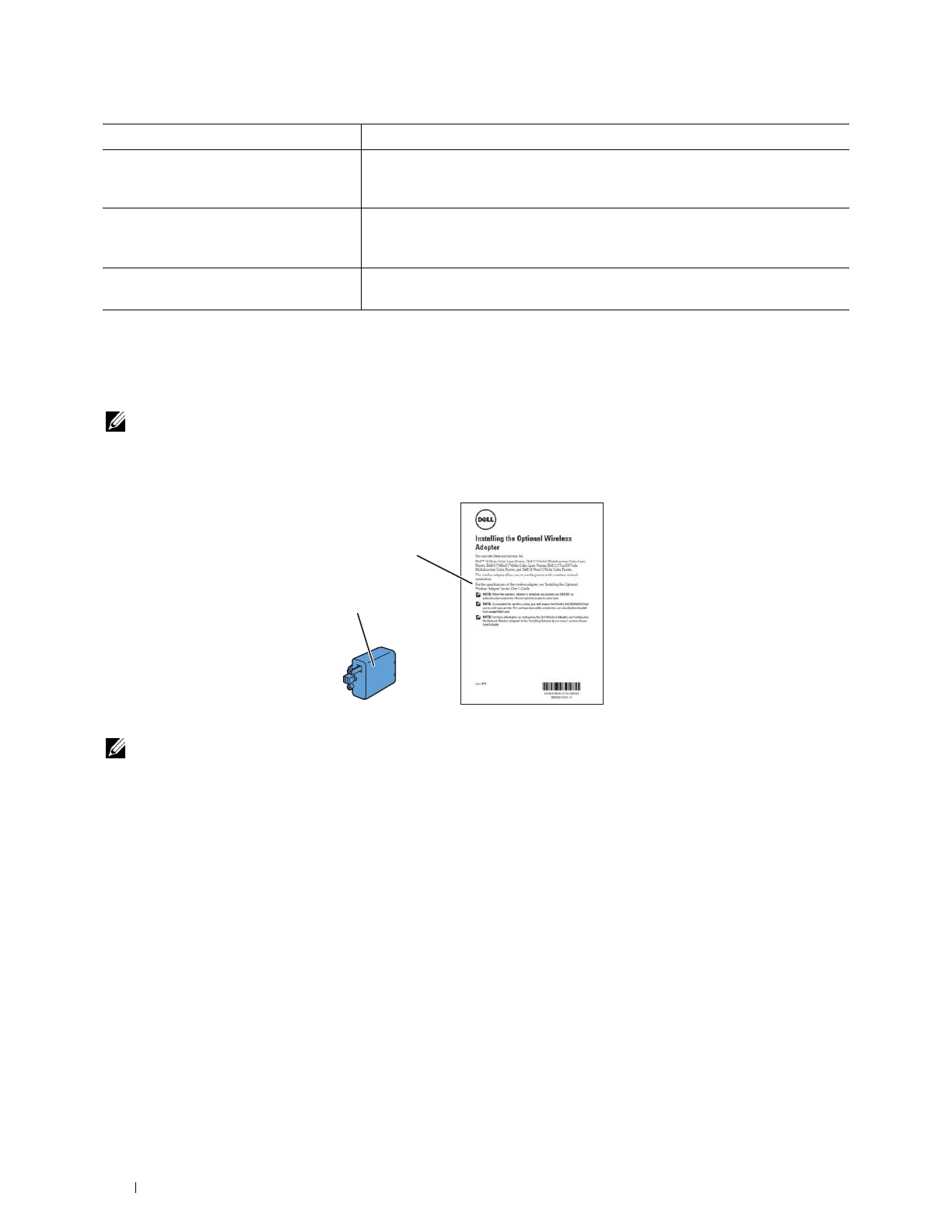
54 Installing Optional Accessories
*1 This item is available only when the optional hard disk is installed.
*2 EAP method supports PEAPv0, EAP-TLS, EAP-TTLS PAP, and EAP-TTLS CHAP.
*3 WPS 2.0 compliant. WPS 2.0 works on access points with the following encryption types: Mixed mode PSK,
WPA-PSK AES, WPA2-PSK AES, WPA-PSK TKIP, Open (No Security)
NOTE: When the wireless adapter is installed, you cannot use IEEE 802.1x authentication and/or the Ethernet port for a wired
connection.
Verifying the Contents of the Box
NOTE: To complete wireless installation, you require the corresponding Software and Documentation disc that comes with your
printer, which can also be downloaded from support.dell.com.
Installing the Wireless Adapter Using Video Instructions (Recommended)
To install the wireless adapter, perform the following method.
1
Insert the
Software and Documentation
disc in your computer. The
Easy Setup Navigator
file launches
automatically.
2
Select
Optional Accessories Setup
on the
Easy Setup Navigator
window.
Data Transfer Rate IEEE 802.11n: 65 Mbps
IEEE 802.11g: 54, 48, 36, 24, 18, 12, 9, and 6 Mbps
IEEE 802.11b: 11, 5.5, 2, and 1 Mbps
Security 64 (40-bit key)/128 (104-bit key) WEP,
WPA- PSK (TKIP, AES), WPA2-PSK (AES), WPA-Enterprise (TKIP, AES)*1*2,
WPA2-Enterprise (AES)*1*2
Wi-Fi Protected Setup® (WPS)*3 Push-Button Configuration (PBC),
Personal Identification Number (PIN)
Item Specification
Installing the Optional
Wireless Adapter
Wireless Adapter
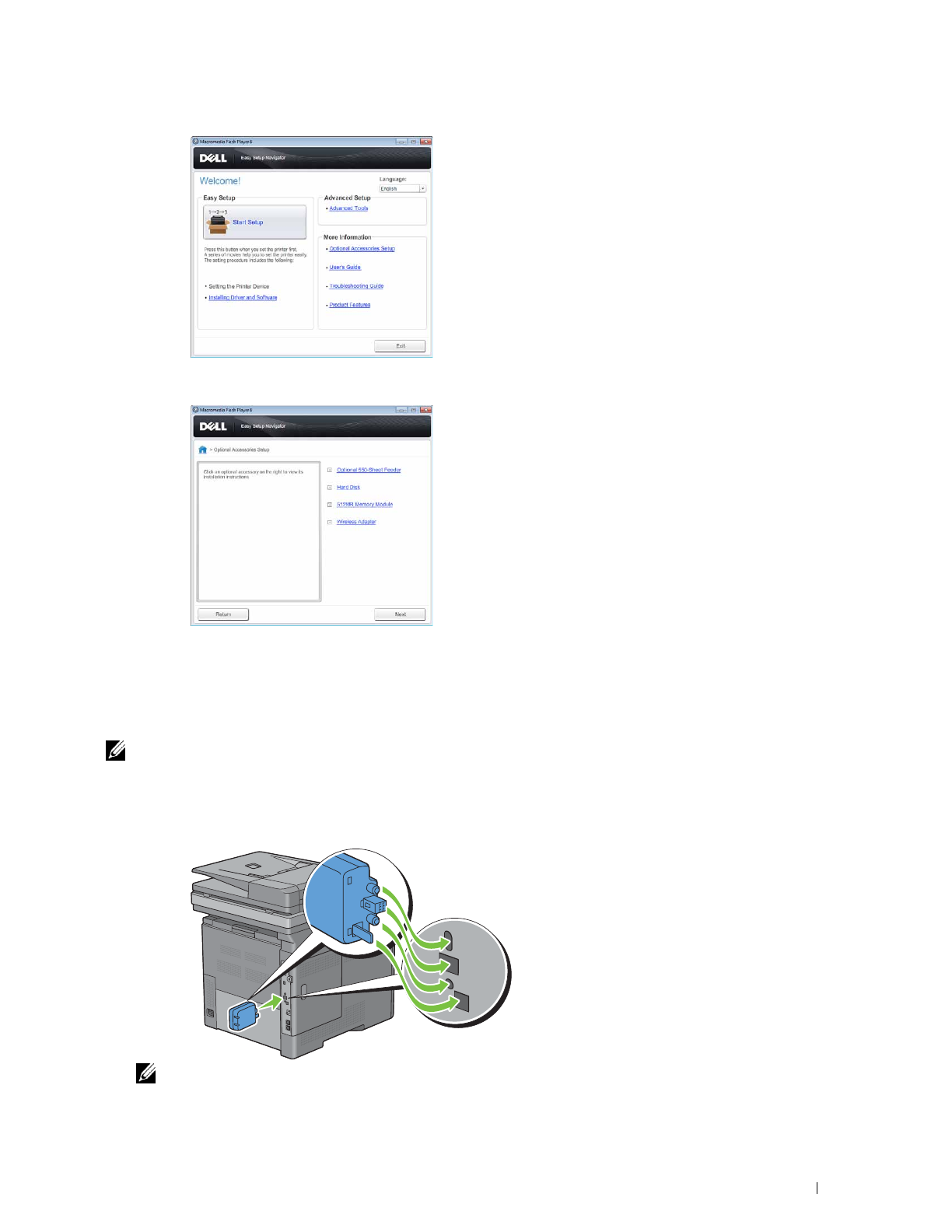
Installing Optional Accessories 55
3
Click
Wireless adapter
.
The instruction video starts.
Follow the on-screen instructions to configure wireless settings.
Installing the Optional Wireless Adapter
NOTE: You can also install the wireless adapter by following the instructions described in Installing the Optional Wireless
Adapter provided with the wireless adapter.
1
Ensure that the printer is turned off.
2
Align the connector and the three protrusions of the wireless adapter with the four holes and insert the adapter.
NOTE: Ensure that the adapter is fully inserted and secured.
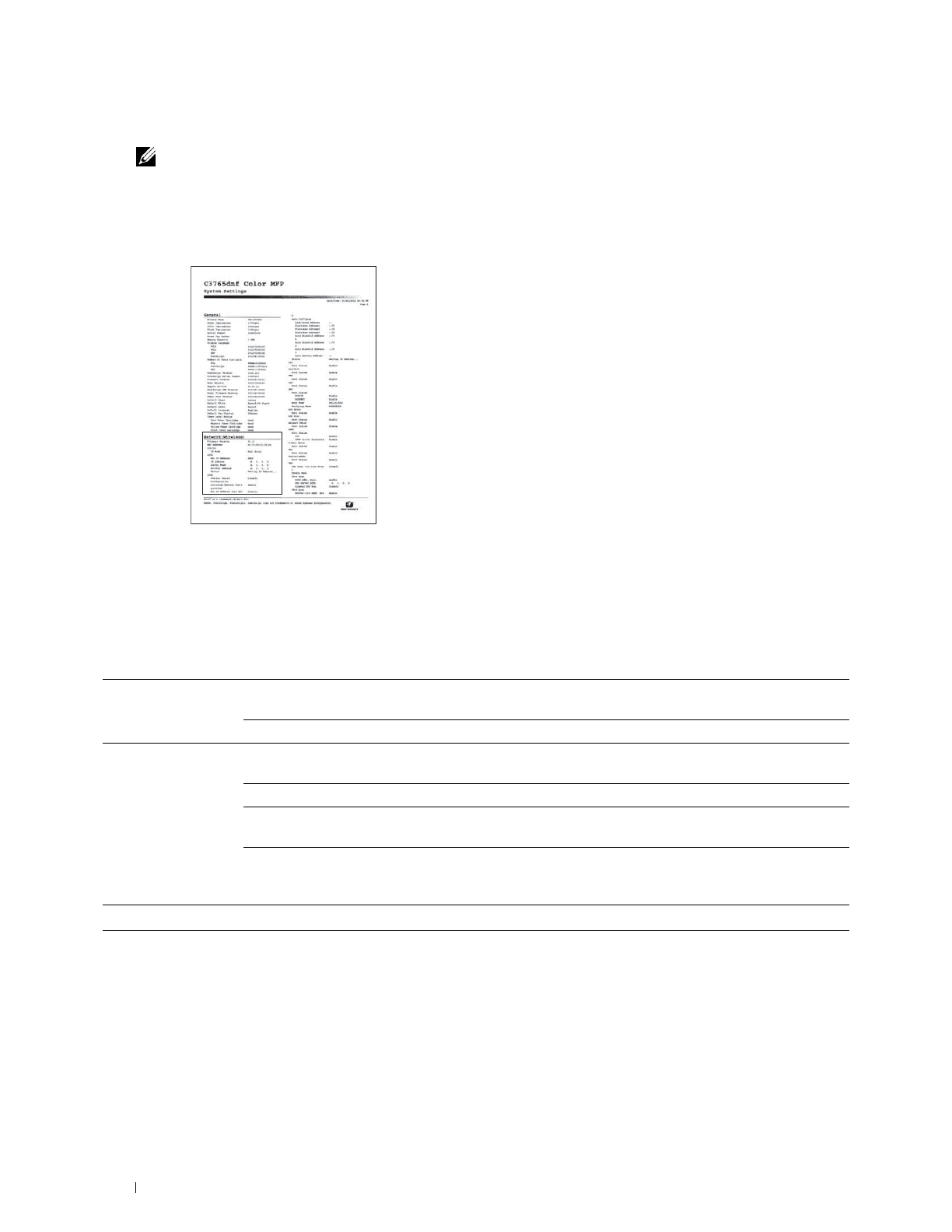
56 Installing Optional Accessories
3
Turn on the printer.
NOTE: If a message displays telling you to make initial setup on the touch panel, always do as instructed.
4
Print the system settings report to confirm that the wireless adapter is installed correctly.
For details about how to print a system settings report, see "Report / List."
5
Confirm that the
Network (Wireless)
section exists.
6
Configure the wireless adapter to connect to a wireless network. For details, see "Configuring the Optional
Wireless Adapter."
Determining the Wireless Network Settings
You need to know the settings for the wireless network to set up the wireless printer. For details of the settings,
contact your network administrator.
Wireless Settings SSID Specifies the name that identifies the wireless network with up to 32
alphanumeric characters.
Network Mode Specifies the network mode from Ad-hoc or Infrastructure.
Security Settings Security Selects the encryption type from No Security, Mixed mode PSK*, WPA-PSK-
TKIP, WPA2-PSK-AES, and WEP.
Transmit Key Specifies the transmit key from the list.
WEP Key Specifies the WEP key used through the wireless network only when WEP is
selected as the encryption type.
Pass Phrase Specifies the pass phrase of alphanumeric characters from 8 to 63 bytes long
only when Mixed mode PSK*, WPA-PSK-TKIP, or WPA2-PSK-AES is
selected as the encryption type.
*Mixed mode PSK automatically selects an available encryption type from WPA-PSK-TKIP, WPA-PSK-AES, or WPA2-PSK-AES.
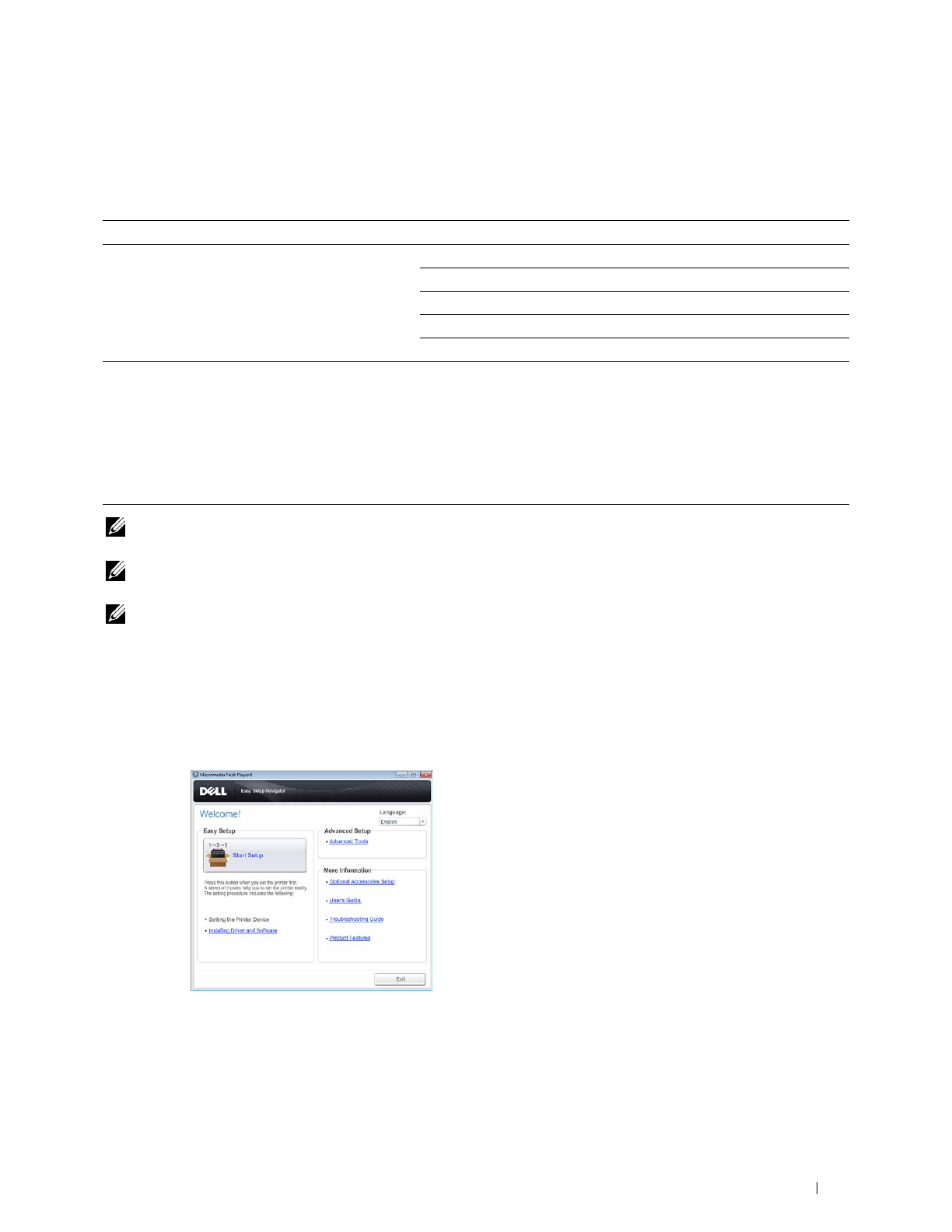
Installing Optional Accessories 57
Configuring the Optional Wireless Adapter
This section describes how to configure a wireless adapter through Easy Setup Navigator.
You can select a method to configure a wireless adapter from the following:
NOTE: The optional wireless adapter must be installed on the printer. For information on how to install a wireless adapter, see
"Installing the Optional Wireless Adapter."
NOTE: If the Panel Lock Control is set to Enable, you need to enter the four digit password to enter the Admin
Settings menu.
NOTE: For details about using WPA-Enterprise-AES, WPA2-Enterprise-AES, or WPA-Enterprise-TKIP, see "Using Digital
Certificates."
Using Wizard Setup to Configure a Wireless Adapter
1
Insert the
Software and Documentation
disc provided with the printer in your computer. The
Easy Setup
Navigator
file launches automatically.
2
Click
Start Setup
.
Wizard Setup through USB Cable(recommended)
Advanced Setup through
WPS-PBC*1*3
WPS-PIN*2*3
Operator Panel
Ethernet Cable
Dell Printer Configuration Web Tool
*1 WPS-PBC (Wi-Fi Protected Setup-Push Button Configuration) is a method to authenticate and register devices required for wireless
configuration, by pressing the button provided on the access point via wireless routers, and then performing WPS-PBC setting on the
operator panel. This setting is available only when the access point supports WPS.
*2 WPS-PIN (Wi-Fi Protected Setup-Personal Identification Number) is a method to authenticate and register devices required for wire-
less configuration, by entering PIN assignments in the printer and computer. This setting, performed through access point, is available
only when the access points of your wireless router supports WPS.
*3 WPS 2.0 compliant. WPS 2.0 works on access points with the following encryption types: Mixed mode PSK, WPA-PSK AES, WPA2-
PSK AES, WPA-PSK TKIP, Open (No Security)
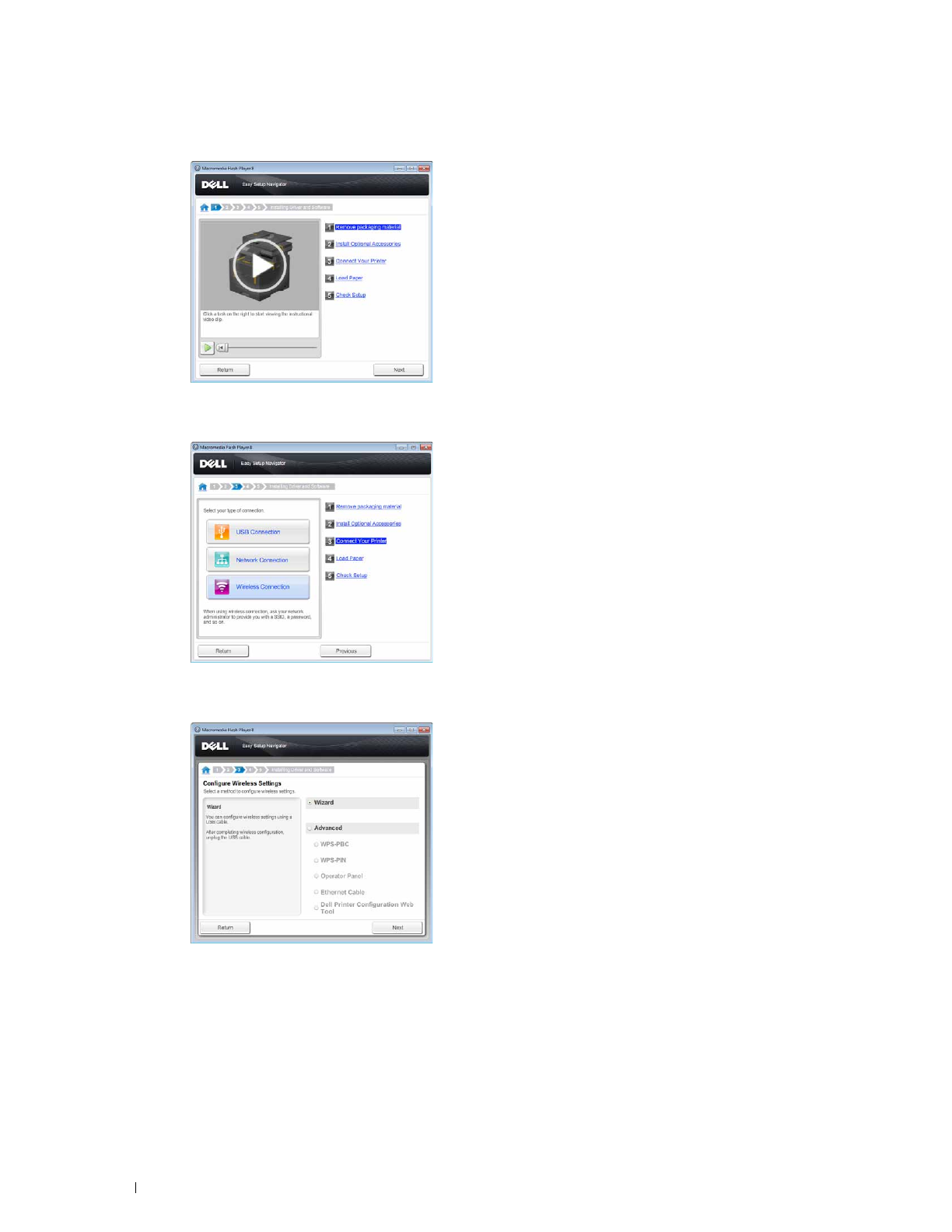
58 Installing Optional Accessories
3
Click
Connect Your Printer
.
4
Click
Wireless Connection
.
5
Click
Wizard
.
Follow the on-screen instructions to configure wireless settings.
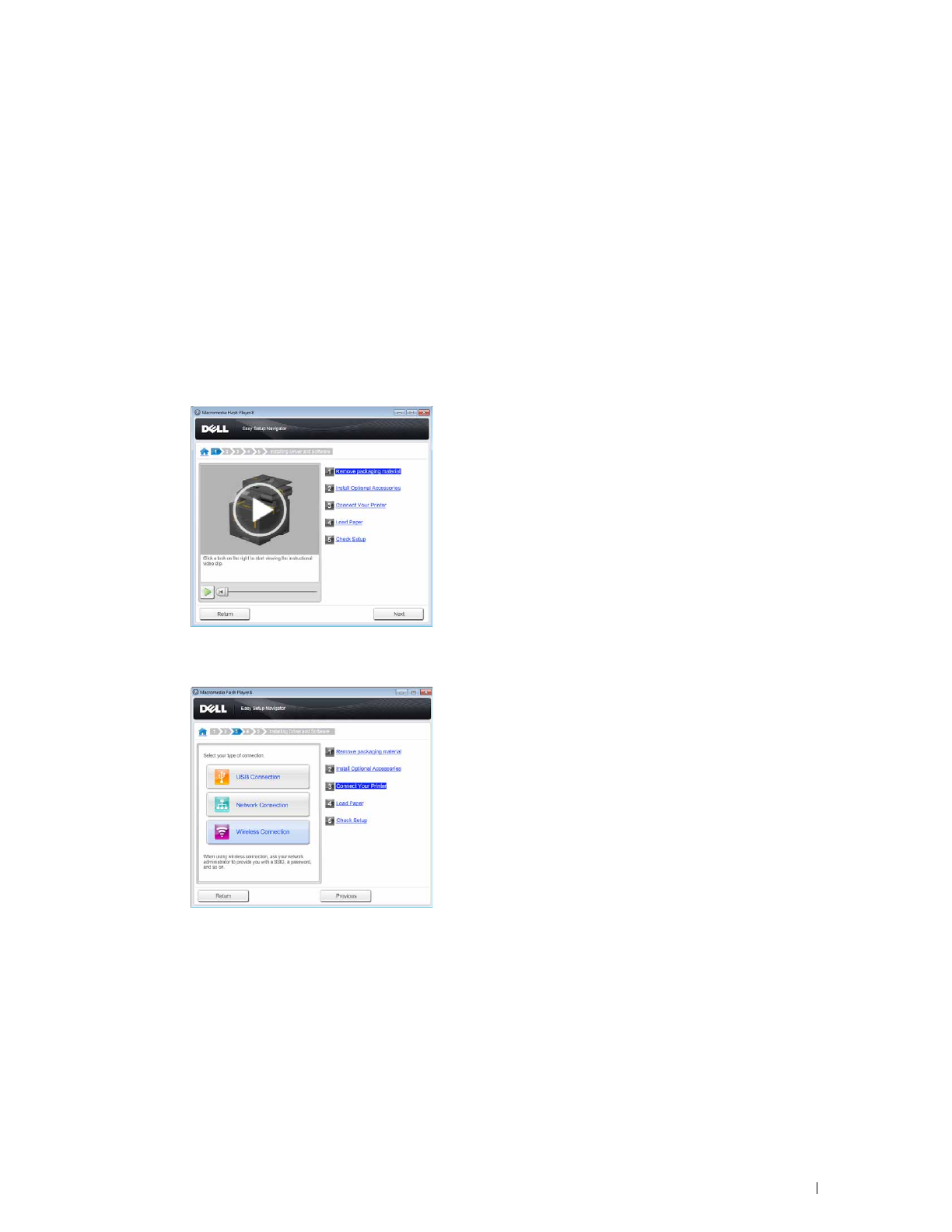
Installing Optional Accessories 59
Using Advanced Setup to Configure a Wireless Adapter
You can configure the wireless adapter with the following connection methods:
•WPS-PBC
•WPS-PIN
•Operator Panel
• Ethernet Cable
• Dell Printer Configuration Web Tool
1
Insert the
Software and Documentation
disc provided with the printer in your computer. The
Easy Setup
Navigator
file launches automatically.
2
Click
Start Setup
.
3
Click
Connect Your Printer
.
4
Click
Wireless Connection
.

60 Installing Optional Accessories
5
Select
Advanced
, and then select a connection method from
WPS-PBC
,
WPS-PIN
,
Operator Panel
,
Ethernet
Cable
, or
Dell Printer Configuration Web Tool
.
For
Ethernet Cable
:
a
Select
Ethernet Cable
, and then click
Next
.
Follow the on-screen instructions to configure wireless settings, and then click
Next
.
The
Advanced Configuration Tool
starts.
b
Select the printer, and then click
Next
.
Wireless Network Settings
screen appears.
NOTE: If the printer is not listed, click Enter IP Address and enter the IP address of your printer, and then click OK.
c
Set the wireless network settings, and then click
Next
.
IP Address Settings
screen appears.
NOTE: For details on each item, see "Assigning an IP Address."
d
Set the IP address settings of the printer, and then click
Next
.
Confirm the settings
screen appears.
e
Confirm the settings, and then click
Apply
.
Complete configuration
screen appears.
f
Click
Next
.
For
WPS-PBC
,
WPS-PIN
,
Operator Panel
, and
Dell Printer Configuration Web Tool
, follow the on-screen
instructions to configure wireless settings.
To configure wireless settings without using the video instructions, see the following instructions.
WPS-PIN
The PIN code of WPS-PIN can only be configured from the operator panel.
NOTE: WPS-PIN (Wi-Fi Protected Setup-Personal Identification Number) is a method to authenticate and register devices
required for wireless configuration by entering PIN assignments to a printer and computer. This setting, performed through an
access point, is available only when the access points of your wireless router supports WPS.
1
Press the
(Information)
button.
2
Select the
Tools
tab, and then select
Admin Settings
.
3
Select until
Network
appears, and then select
Network
.
4
Select until
Wireless
appears, and then select
Wireless
.
5
Select until
WPS Setup
appears, and then select
WPS Setup
.
6
Select
PIN Code
.
7
Write down the displayed 8-digit PIN code or select
Print PIN Code
. The PIN code is printed.
8
Select
Start Configuration
.
9
Ensure that the message
Setting WPS
is displayed, and enter the PIN code displayed on step 7 into the wireless
LAN access point (Registrar).
NOTE: For WPS operation on the wireless LAN access point, refer to the manual supplied with the wireless LAN access
point.
10
When the WPS operation is successful and the printer is rebooted, wireless LAN connection setting is completed.

Installing Optional Accessories 61
WPS-PBC
You can start Push Button Control only from the operator panel.
NOTE: WPS-PBC (Wi-Fi Protected Setup-Push Button Configuration) is a method to authenticate and register devices required
for wireless configuration by pressing the button provided on the access point via wireless routers, and then performing WPS-
PBC setting on the operator panel. This setting is available only when the access point supports WPS.
NOTE: Before starting WPS-PBC, confirm the position of the WPS button (button name may vary) on the wireless LAN access
point. For information about WPS operation on the wireless LAN access point, refer to the manual supplied with the wireless
LAN access point.
1
Press the
(Information)
button.
2
Select the
Tools
tab, and then select
Admin Settings
.
3
Select until
Network
appears, and then select
Network
.
4
Select until
Wireless
appears, and then select
Wireless
.
5
Select until
WPS Setup
, and then select
WPS Setup
.
6
Select
Push Button Control
.
7
Select
Start Configuration
.
Ensure that the message
Setting WPS
is displayed, and start the WPS-PBC on the wireless LAN access point
(Registrar) within two minutes.
8
When the WPS operation is successful and the printer is rebooted, wireless LAN connection setting is completed.
Operator Panel
Auto SSID Setup
1
Press the
(Information)
button.
2
Select the
Tools
tab, and then select
Admin Settings
.
3
Select until
Network
appears, and then select
Network
.
4
Select until
Wireless
appears, and then select
Wireless
.
5
Select until
Wireless Setup Wizard
appears, and then select
Wireless Setup Wizard
.
The printer automatically searches the access points on wireless network.
6
Select until the desired access point appears, and then select the access point.
If the desired access point does not appear, go to "Manual SSID Setup."
NOTE: Some hidden SSID may not be displayed. If the SSID is not detected turn on SSID broadcast from the router.
7
Select
Next
.
8
Enter the WEP key or pass phrase.
When the encryption type of the selected access point is WEP in step 6:
a
Select the
WEP Key
text box, and then enter the WEP key.
b
Select
OK
.
When the encryption type of the selected access point is WPA, WPA2 or Mixed in step 6:
a
Select the
Pass Phrase
text box, and then enter the pass phrase.
b
Select
OK
.
9
The
Restart System
screen appears.
10
Turn off the printer, and turn it on again to apply the settings.

62 Installing Optional Accessories
Wireless LAN connection setting is complete.
Manual SSID Setup
1
Press the
(Information)
button.
2
Select the
Tools
tab, and then select
Admin Settings
.
3
Select until
Network
appears, and then select
Network
.
4
Select until
Wireless
appears, and then select
Wireless
.
5
Select until
Wireless Setup Wizard
appears, and then select
Wireless Setup Wizard
.
6
Select the
Manual SSID Setup
check box, and then select
Next
.
7
Enter the SSID, and then select
Next
.
8
Select the network mode from
Infrastructure
and
Ad-hoc
depending on your environment, and then
select
Next
.
If you select
Infrastructure
, proceed to step 9.
If you select
Ad-hoc
, proceed to step 10.
9
Select the encryption type from
No Security
,
Mixed mode PSK
,
WPA-PSK-TKIP
,
WPA2-PSK-AES
, or
WEP
.
If you do not set security for your wireless network:
a
Select until
No Security
appears, and then select
No Security
.
b
Select
OK
.
To use Mixed mode PSK, WPA-PSK-TKIP, or WPA2-PSK-AES encryption:
a
Select until
Mixed mode PSK
,
WPA-PSK-TKIP
, or
WPA2-PSK-AES
appears, and then select the
desired encryption type.
b
Select the
Pass Phrase
text box, and then enter the pass phrase.
c
Select
OK
.
To use WEP encryption:
a
Select until
WEP
appears, and then select
WEP
.
b
Select the
WEP Key
text box, and then enter the WEP key.
c
Select
Transmit Key
, and then select the desired transmit key from
Auto
or
WEP Key 1
to
WEP Key 4
.
d
Select
OK
.
Proceed to step 11.
10
Select the encryption type from
No Security
or
WEP
.
If you do not set security for your wireless network:
a
Select until
No Security
appears, and then select
No Security
.
b
Select
OK
.
To use WEP encryption:
a
Select until
WEP
appears, and then select
WEP
.
b
Select the
WEP Key
text box, and then enter the WEP key.
c
Select
Transmit Key
, and then select the desired transmit key from
Auto
or
WEP Key 1
to
WEP Key 4
.
d
Select
OK
.
11
The
Restart System
screen appears.

Installing Optional Accessories 63
12
Turn off the printer, and turn it on again to apply the settings.
Wireless LAN connection setting is complete.
Dell Printer Configuration Web Tool
NOTE: For details about using WPA-Enterprise-AES, WPA2-Enterprise-AES, or WPA-Enterprise-TKIP, see "Using Digital
Certificates."
1
Ensure that the printer is turned off and the wireless adapter is connected to the printer.
2
Connect the printer to the network with an Ethernet cable.
For details about how to connect the Ethernet cable, see "Connecting Printer to Computer or Network."
3
Turn on the printer.
4
Launch the
Dell Printer Configuration Web Tool
by entering the IP address of the printer in your web browser.
5
Click
Print Server Settings
.
6
Click
Print Server Settings
tab.
7
Click
Wireless LAN
.
8
Enter the SSID in the
SSID
text box.
9
Select
Ad-Hoc
or
Infrastructure
in the
Network Type
drop-down list box.
10
Select the encryption type from
No Security
,
WEP, WPA-PSK-TKIP
,
WPA-PSK-AES/WEP2-PSK AES
, and
Mixed
Mode PSK
in the
Encryption
drop-down list box, and then set each item for the encryption type selected.
NOTE: For details on each item, see "Dell™ Printer Configuration Web Tool."
11
Click
Apply New Settings
to apply the settings.
12
Turn off the printer, disconnect the Ethernet cable and turn it on again.
Wireless LAN connection setting is complete.
Reconfiguring the Wireless Setting
To change the wireless setting through an Ethernet or wireless connection from your computer, perform the
following.
NOTE: To change the wireless setting through wireless connection, ensure that the wireless connection setting is completed in
"Configuring the Optional Wireless Adapter."
NOTE: The following settings are available when the network mode is set to infrastructure in "Configuring the Optional Wireless
Adapter."
1
Check the IP address of the printer.
a
Press the
(Information)
button.
b
Select
About This MFP
.
c
Select the
Network
tab.
d
Select button until
IP(v4) Address
appears, and then check the IP address displayed in the
IP(v4) Address
.
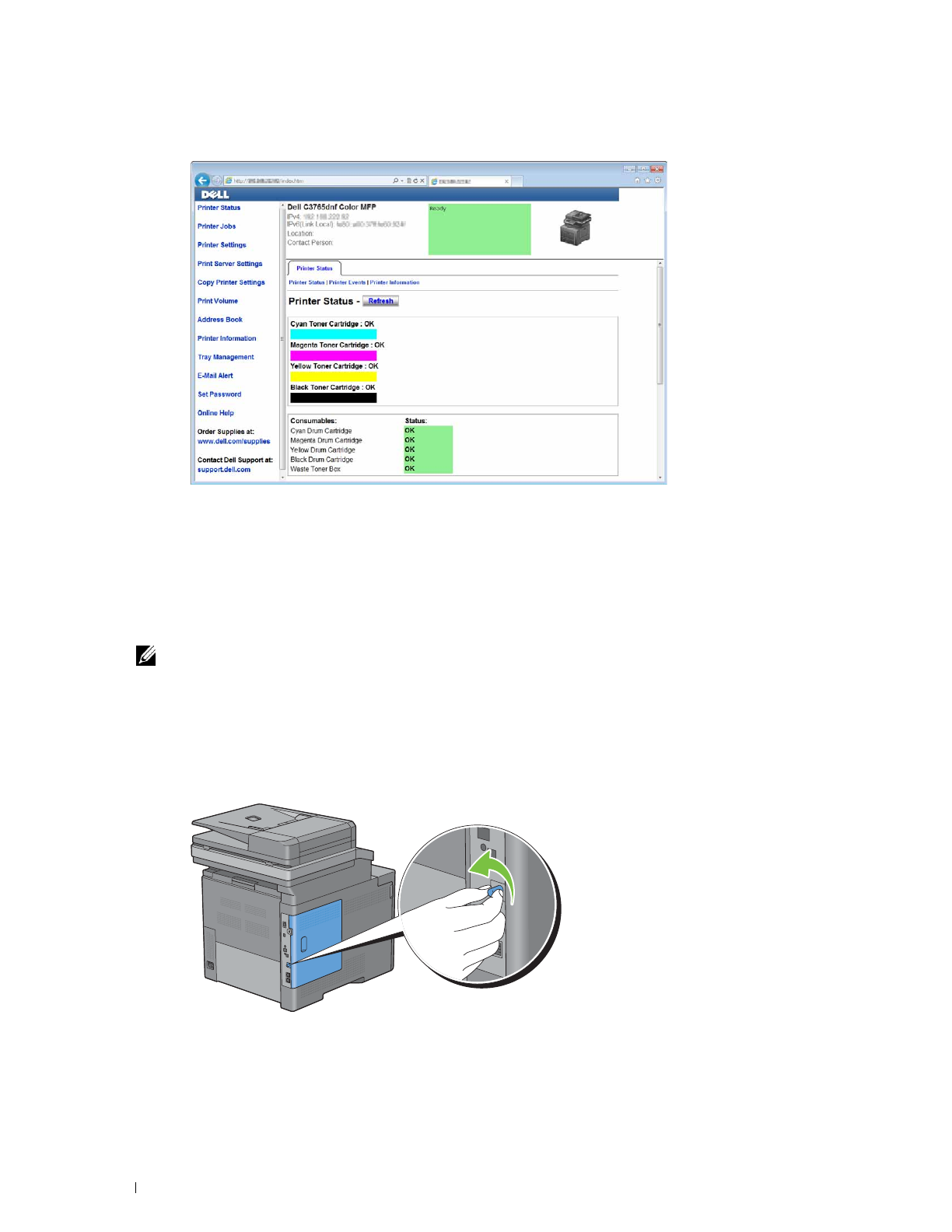
64 Installing Optional Accessories
2
Launch the
Dell Printer Configuration Web Tool
by entering the IP address of the printer in your web browser.
3
Click
Print Server Settings
.
4
Click
Print Server Settings
tab.
5
Click
Wireless LAN
.
6
Change the wireless setting of the printer.
7
Reboot the printer.
8
Change the wireless settings on your computer or access point accordingly.
NOTE: To change the wireless settings on your computer, refer to the manuals provided with the wireless adapter or if
your computer provides a wireless adapter tool, change the wireless settings using that tool.
Installing the Optional Hard Disk
1
Ensure that the printer is turned off.
2
Turn the screw on the control board counterclockwise.
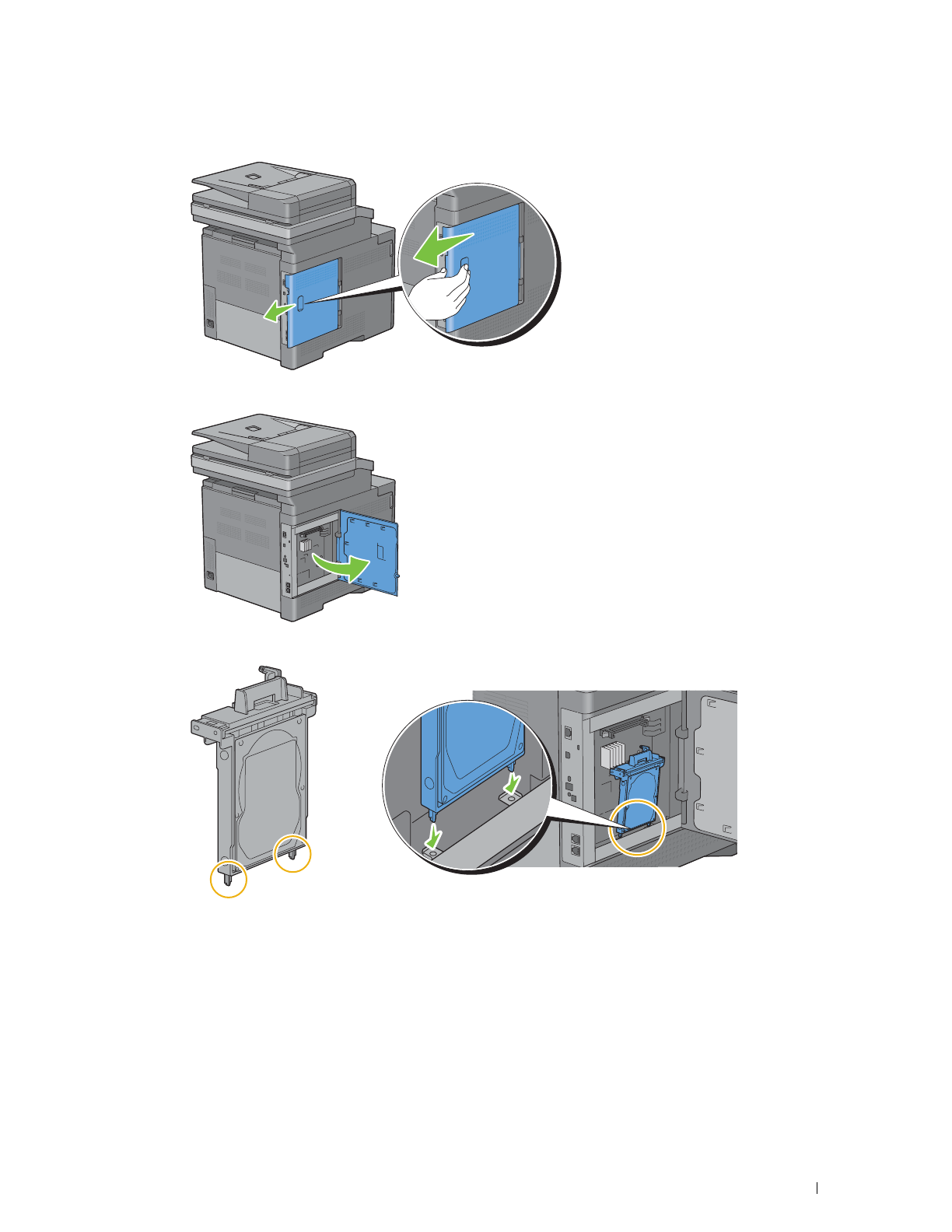
Installing Optional Accessories 65
3
Slide the left side cover towards the back of the printer.
4
Open the left side cover completely.
5
Insert the two plastic pins on the hard disk into the metal casing holes.
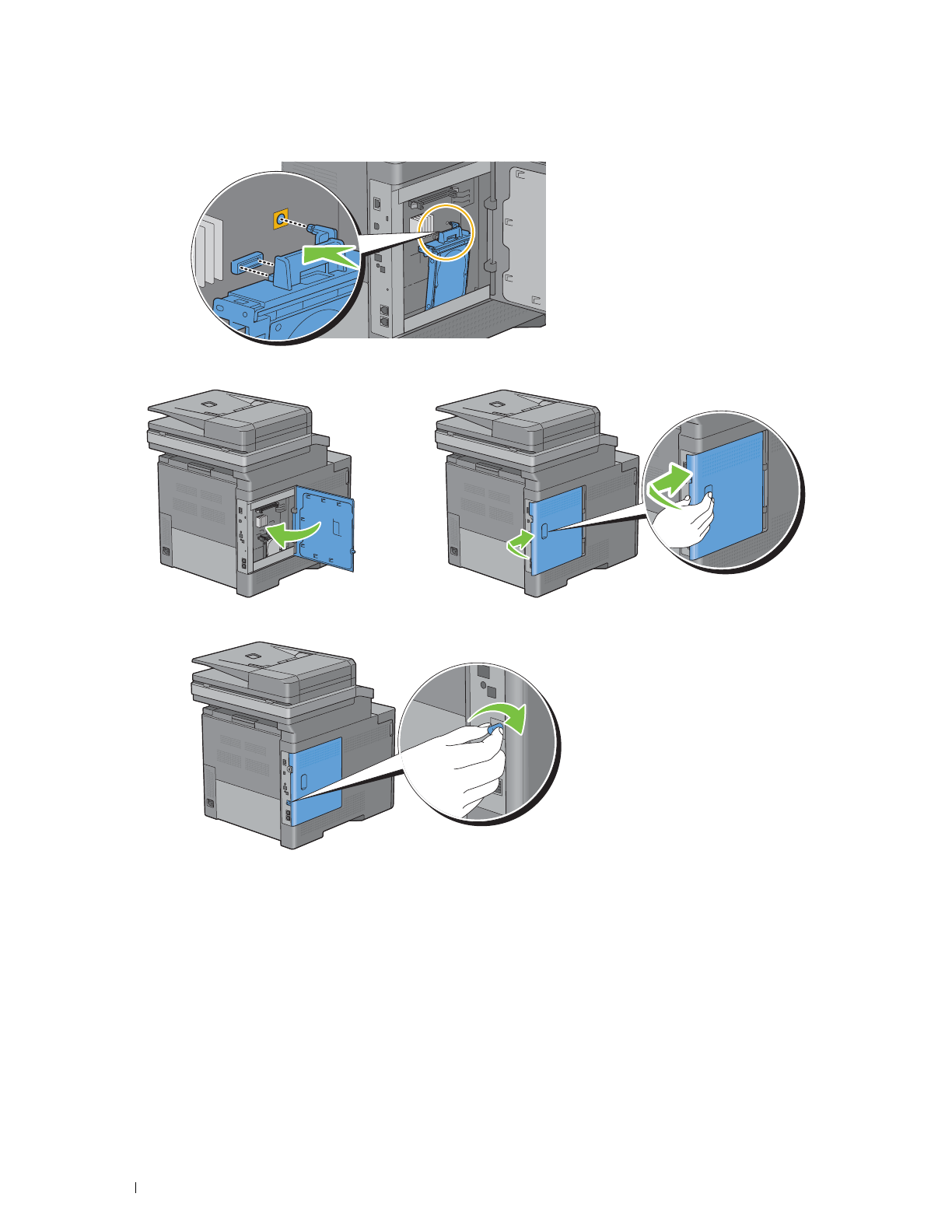
66 Installing Optional Accessories
6
Attach the plastic pin and the connector to the control board, and push the hard disk firmly into place.
7
Close the left side cover, and then slide it towards the front of the printer.
8
Turn the screw clockwise.
9
Turn on the printer.
10
Print the system settings report to confirm that the newly installed hard disk is detected by the printer.
For details about how to print a system settings report, see "Report / List."
11
Confirm the amount of
Hard Disk
listed in the system settings report under
Printer Options
.
If the hard disk is not listed, turn off the printer, unplug the power cable, and re-install the hard disk.
12
If you installed the hard disk after installing the printer driver, update your driver by following the instructions for
the operating system you are using. If the printer is on a network, update the driver for each client.
Hard disk can be specified on the printer driver only when hard disk or RAM disk is available on the printer driver.

Installing Optional Accessories 67
Updating Your Driver to Detect Hard Disk
NOTE: When you use XPS driver, driver updating is not required.
When Using PCL Driver
If the printer information is not updated automatically after clicking Get Information from Printer, follow these
steps:
1
Click the
Options
tab, and then select
Hard Disk
in the
Items
list box.
2
Select
Available
in the
Hard Disk
drop-down menu in
Change Setting for
.
3
Click
Apply
, and then click
OK
.
4
Close the displayed active dialog box.
Windows 8/
Windows 8 x64/
Windows Server 2012
1
Under Desktop mode, right-click the bottom left corner of the screen, and then click
Control Panel
→
Hardware and Sound
(
Hardware
for Windows Server 2012)
→
Devices
and Printers
.
2
Right-click the printer icon of the Dell C3765dnf Multifunction Color Laser Printer, and
then select
Printer properties
.
3
Click the
Options
tab, and then select
Get Information from Printer
.
4
Click
Apply
, and then click
OK
.
5
Close the
Devices and Printers
dialog box.
Windows 7/
7 x64/
Server 2008 R2 x64
1
Click
Start
→
Devices and Printers
.
2
Right-click the printer icon of the Dell C3765dnf Multifunction Color Laser Printer, and
then select
Printer properties
.
3
Click the
Options
tab, and then select
Get Information from Printer
.
4
Click
Apply
, and then click
OK
.
5
Close the
Devices and Printers
dialog box.
Windows Vista/
Vista x64
1
Click
Start
→
Control Panel
→
Hardware and Sound
→
Printers
.
2
Right-click the printer icon of the Dell C3765dnf Multifunction Color Laser Printer, and
then select
Properties
.
3
Click the
Options
tab, and then select
Get Information from Printer
.
4
Click
Apply
, and then click
OK
.
5
Close the
Printers
dialog box.
Windows Server 2008/
Server 2008 x64
1
Click
Start
→
Control Panel
→
Printers
.
2
Right-click the printer icon of the Dell C3765dnf Multifunction Color Laser Printer, and
then select
Properties
.
3
Click the
Options
tab, and then select
Get Information from Printer
.
4
Click
Apply
, and then click
OK
.
5
Close the
Printers
dialog box.
Windows XP/XP x64/
Server 2003/
Server 2003 x64
1
Click
start
→
Printers and Faxes
.
2
Right-click the printer icon of the Dell C3765dnf Multifunction Color Laser Printer, and
then select
Properties
.
3
Click the
Options
tab, and then select
Get Information from Printer
.
4
Click
Apply
, and then click
OK
.
5
Close the
Printers and Faxes
dialog box.

68 Installing Optional Accessories
When Using PS Driver
If the printer information is not updated automatically after clicking Get Information from Printer, follow these
steps:
1
Click the
Configuration
tab, and then select
Installable Options
.
2
Select
Hard Disk
in the
Items
list box.
3
Select
Available
in the
Hard Disk
drop-down menu in
Setting for
.
4
Click
OK
.
5
Click
Apply
, and then click
OK
.
Windows 8/
Windows 8 x64/
Windows Server 2012
1
Under Desktop mode, right-click the bottom left corner of the screen, and then click
Control Panel
→
Hardware and Sound
(
Hardware
for Windows Server 2012)
→
Devices
and Printers
.
2
Right-click the printer icon of the Dell C3765dnf Multifunction Color Laser Printer, and
then select
Printer properties
.
3
Click the
Configuration
tab, and then select
Bi-Directional Setup
.
4
Select
Get Information from Printer
and then click
OK
.
5
Click
Apply
, and then click
OK
.
6
Close the
Devices and Printers
dialog box.
Windows 7/
7 x64/
Server 2008 R2 x64
1
Click
Start
→
Devices and Printers
.
2
Right-click the printer icon of the Dell C3765dnf Multifunction Color Laser Printer, and
then select
Printer properties
.
3
Click the
Configuration
tab, and then select
Bi-Directional Setup
.
4
Select
Get Information from Printer
and then click
OK
.
5
Click
Apply
, and then click
OK
.
6
Close the
Devices and Printers
dialog box.
Windows Vista/
Vista x64
1
Click
Start
→
Control Panel
→
Hardware and Sound
→
Printers
.
2
Right-click the printer icon of the Dell C3765dnf Multifunction Color Laser Printer, and
then select
Properties
.
3
Click the
Configuration
tab, and then select
Bi-Directional Setup
.
4
Select
Get Information from Printer
and then click
OK
.
5
Click
Apply
, and then click
OK
.
6
Close the
Printers
dialog box.
Windows Server 2008/Server 2008
x64
1
Click
Start
→
Control Panel
→
Printers
.
2
Right-click the printer icon of the Dell C3765dnf Multifunction Color Laser Printer, and
then select
Properties
.
3
Click the
Configuration
tab, and then select
Bi-Directional Setup
.
4
Select
Get Information from Printer
and then click
OK
.
5
Click
Apply
, and then click
OK
.
6
Close the
Printers
dialog box.
Windows XP/XP x64/Server
2003/Server 2003 x64
1
Click
Start
→
Printers and Faxes
.
2
Right-click the printer icon of the Dell C3765dnf Multifunction Color Laser Printer, and
then select
Properties
.
3
Click the
Configuration
tab, and then select
Bi-Directional Setup
.
4
Select
Get Information from Printer
and then click
OK
.
5
Click
Apply
, and then click
OK
.
6
Close the
Printers and Faxes
dialog box.

Installing Optional Accessories 69
6
Close the
Printers and Faxes
(
Printers
, or
Devices and Printers
) dialog box.
Mac OS X 10.7.x/10.8.x 1
Select the
Print & Scan
in
System Preferences
.
2
Select the printer in
Printers
list, and click
Options & Supplies
.
3
Select
Driver
, select the options that have been installed on the printers, and then click
OK
.
Mac OS X 10.5.x/10.6.x 1
Select the
Print & Fax
in
System Preferences
.
2
Select the printer in
Printers
list, and click
Options & Supplies
.
3
Select
Driver
, select the options that have been installed on the printers, and then click
OK
.
Mac OS X 10.3.x/10.4.x 1
Select the printer from the
Printer List
screen in
Print Center
(or
Printer Setup Utility
).
2
Click
Printers
on the
Print Center
(or
Printer Setup Utility
) menu bar, and select
Show
Info
.
3
Select
Installable Options
, and select the options that have been installed on the printer,
and then click
Apply Changes
.

70 Installing Optional Accessories
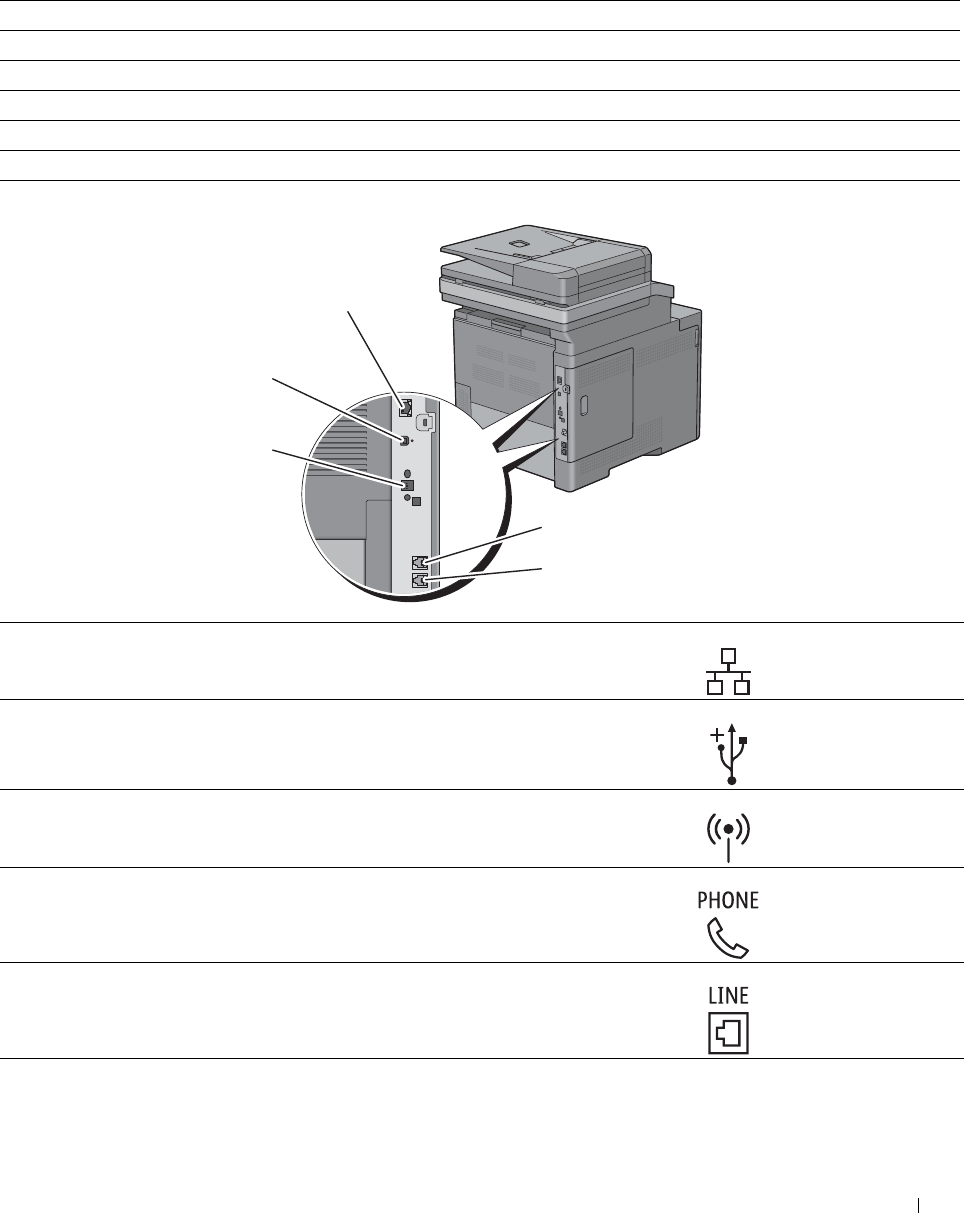
Connecting Your Printer 71
7
Connecting Your Printer
Your Dell™ C3765dnf Multifunction Color Laser Printer interconnection cable must meet the following
requirements:
Connection type Connection specifications
Ethernet 10 Base-T/100 Base-TX/1000 Base-T
USB USB 2.0
Wireless (optional) IEEE 802.11b/802.11g/802.11n
Phone connector RJ11
Wall jack connector RJ11
1Ethernet port
2USB port
3Wireless adapter socket
4Phone connector
5Wall jack connector
1
2
3
4
5
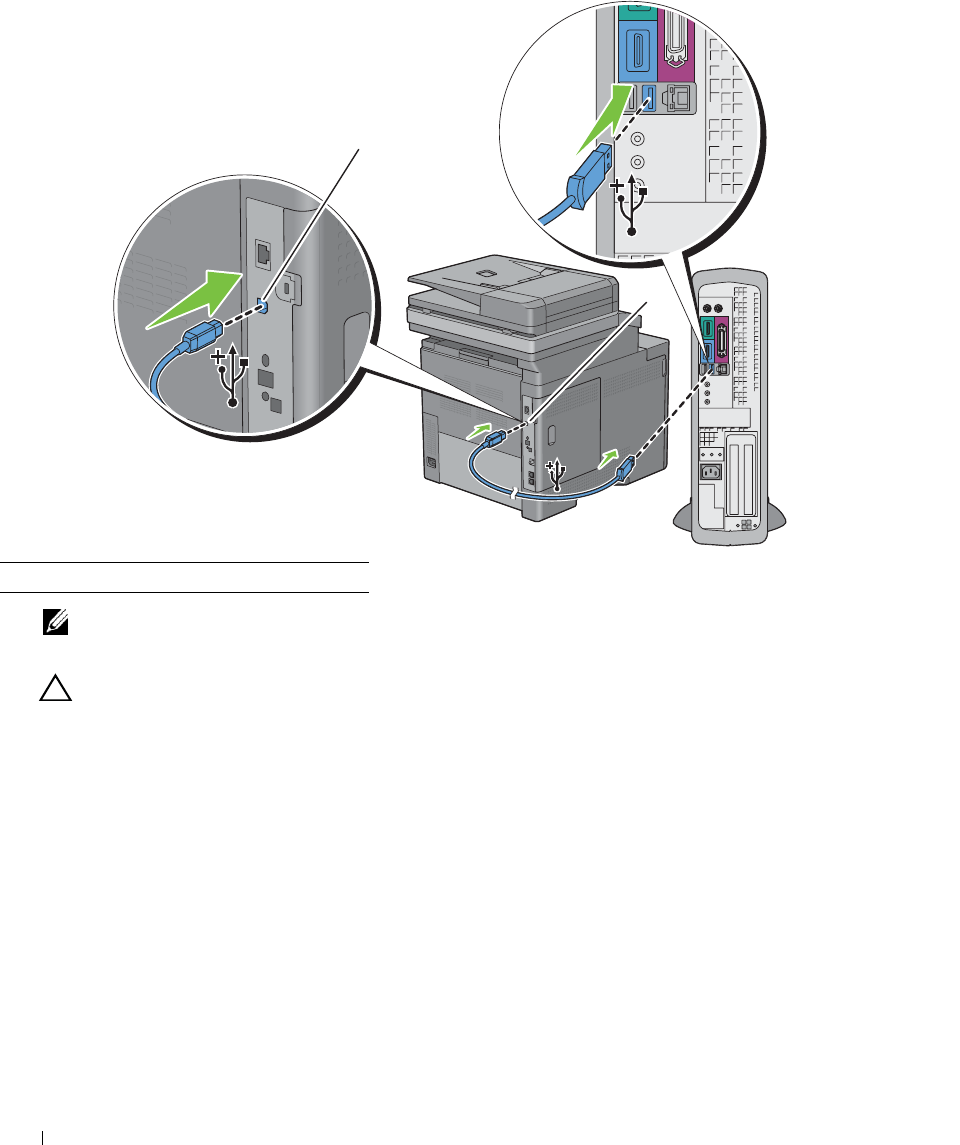
72 Connecting Your Printer
Connecting Printer to Computer or Network
Direct Connection
A local printer is a printer which is directly connected to your computer using the USB cable. If your printer is
connected to a network instead of your computer, skip this section and go to "Network Connection."
To connect the printer to a computer:
1
Connect the smaller USB connector into the USB port at the back of the printer.
NOTE: Ensure that you match the USB symbol on the cable to the USB symbol on the printer.
2
Connect the other end of the cable into a USB port of the computer.
CAUTION: Do not connect the printer USB cable to the USB port available on the keyboard.
1USB port
1
1
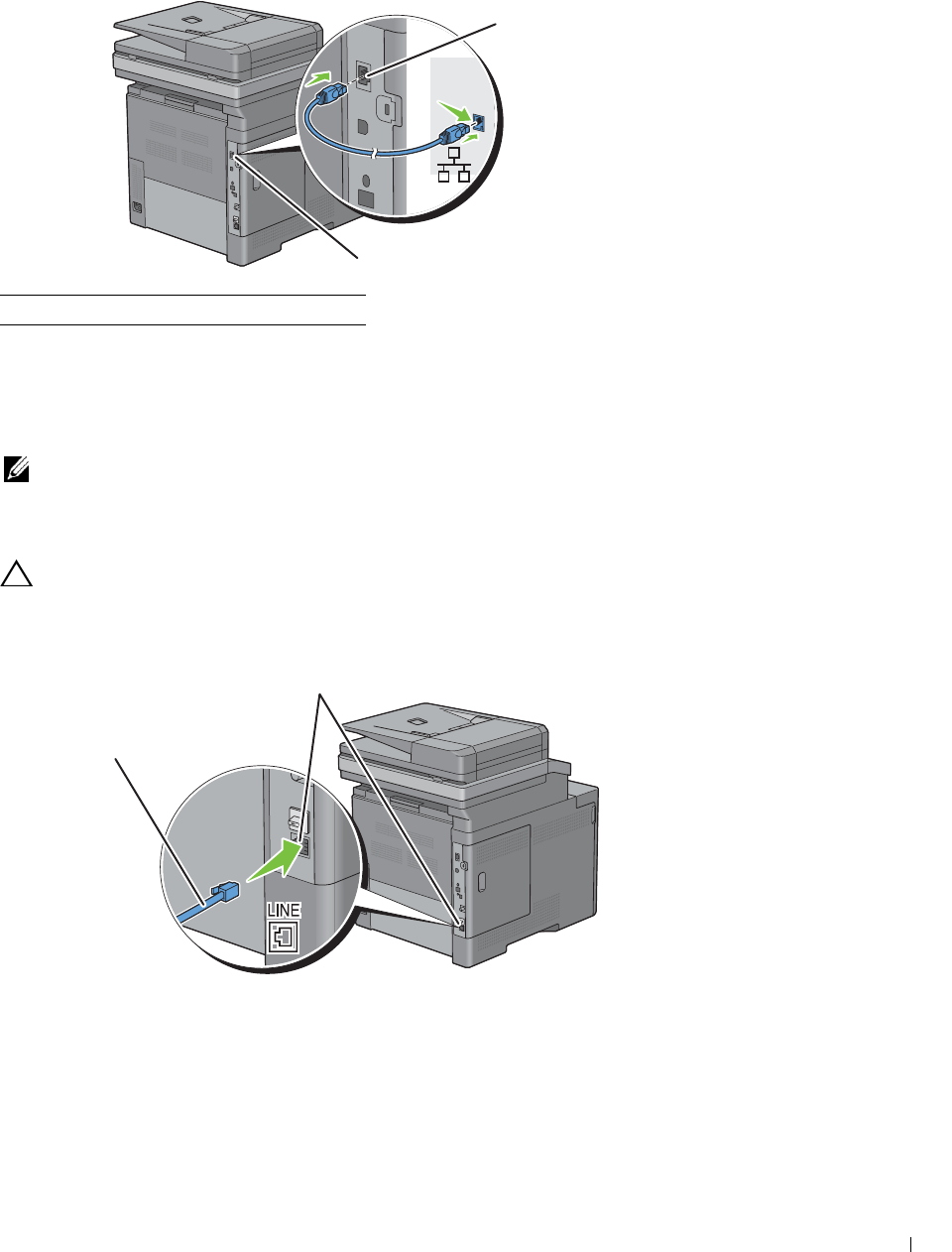
Connecting Your Printer 73
Network Connection
To connect the printer to a network:
1
Connect the Ethernet cable.
To connect the printer to the network, connect one end of an Ethernet cable into the Ethernet port on the rear of
the printer, and the other end to a LAN drop or hub. To setup a wireless connection, insert the wireless adapter into
the wireless adapter socket on the back of the printer.
For a wireless connection, see "Installing the Optional Wireless Adapter."
NOTE: To use the wireless adapter, be sure to disconnect the Ethernet cable.
Connecting the Telephone Line
CAUTION: Do not connect your printer directly to a Digital Subscriber Line (DSL). This may damage the printer. To use a DSL,
you will need to use an appropriate DSL filter. Contact your service provider for the DSL filter.
1
Connect one end of a telephone line cord into the wall jack connector and the other end into an active wall jack.
1Ethernet port
1
1
Wall jack connector
To the wall jack
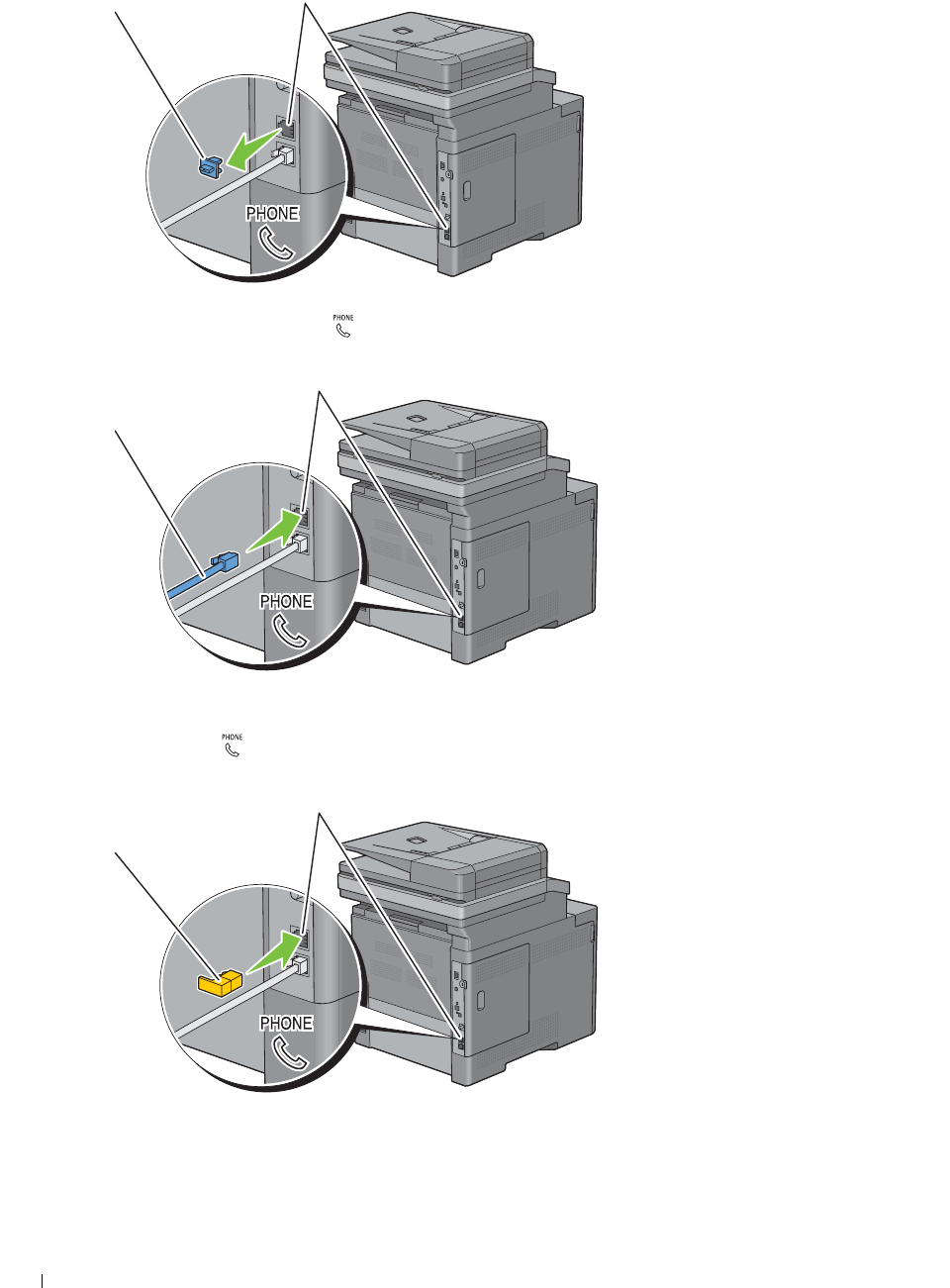
74 Connecting Your Printer
2
Remove the "Blue" plug from the phone connector.
3
To connect a telephone and/or answering machine to your printer, Connect the telephone or answering machine
line cord into the phone connector ( ).
If the phone communication is serial in your country (such as Germany, Sweden, Denmark, Austria, Belgium, Italy,
France and Switzerland), and that you are supplied with a "Yellow" terminator, insert the "Yellow" terminator into
the phone connector ( ).
Phone connector
"Blue" plug
Phone connector
To an external telephone or
answering machine
Phone connector
"Yellow" terminator
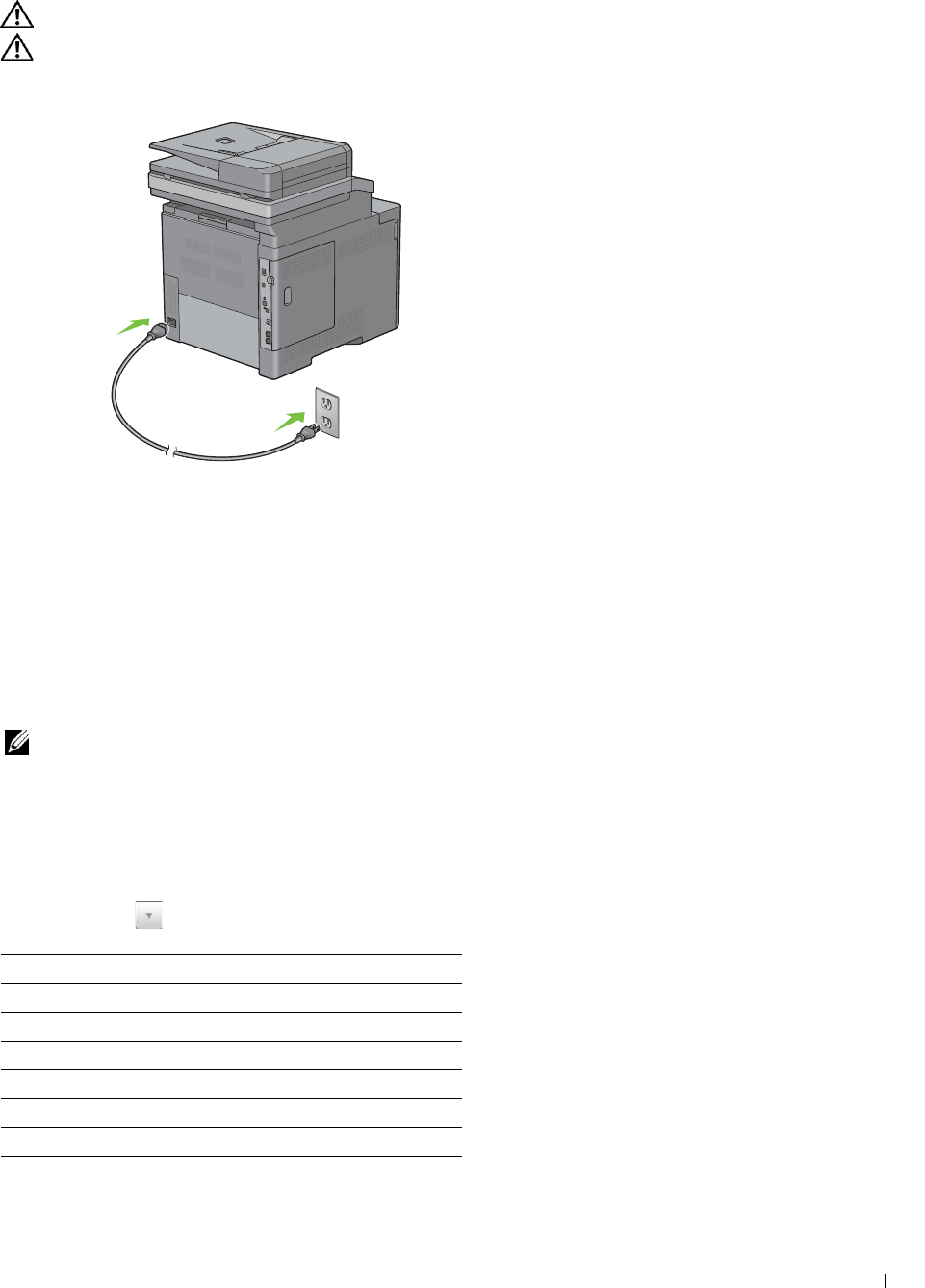
Connecting Your Printer 75
Turning on the Printer
WARNING: Do not use extension cords or power strips.
WARNING: The printer should not be connected to an Uninterruptible Power Supply (UPS) system.
1
Connect the power cable to the power connector on the rear of the printer, and then to a power source.
2
Turn on the printer. When the printer is connected via a USB (Uninterruptible Power Supply) cable, the USB
driver is automatically installed.
Setting Initial Settings on the Operator Panel
You need to set the printer language, country, clock date, time, and fax settings when you turn on printer for the first
time.
When you turn the printer on, the wizard screen to perform the initial setup appears on the touch panel. Follow the
steps below to set the initial settings.
NOTE: If you do not start configuring the initial settings, the printer automatically restarts in three minutes, and the Main Home
screen appears on the touch panel. After that, you can set the following initial setup by enabling Power on Wizard on the
touch panel or Dell Printer Configuration Web Tool if needed.
For more information on operator panel, see
"Operator Panel."
For more information on
Dell Printer Configuration Web Tool
, see
"
Dell™ Printer Configuration Web Tool.
"
1
The
Select Your Language
screen appears.
a
Select until desired language appears, and then select the desired language.
English
Français
Italiano
Deutsch
Español
Dansk
Nederlands
76 Connecting Your Printer
b
Select
Next
.
2
The
Date/Time
screen appears.
a
Select
Time Zone
.
b
Select until the desired geographic region appears, and then select the desired geographic region.
c
Select until the desired time zone appears, and then select the desired time zone.
Norsk
Svenska
Geographic Region Time Zone
Africa (UTC) Accra, Bamako, Dakar, Nouakchott
(UTC) Casablanca
(UTC +01:00) Algiers, Douala, Libreville, Luanda
(UTC +01:00) Tunis
(UTC +01:00) Windhoek
(UTC +02:00) Cairo
(UTC +02:00) Harare, Johannesburg, Kinshasa, Tripoli
(UTC +03:00) Addis Ababa, Khartoum, Mogadishu, Nairobi
Americas (UTC -10:00) Adak
(UTC -09:00) Alaska
(UTC -08:00) Pacific Time (US & Canada)
(UTC -08:00) Tijuana
(UTC -07:00) Arizona, Dawson Creek, Sonora
(UTC -07:00) Chihuahua, Mazatlan
(UTC -07:00) Mountain Time (US & Canada)
(UTC -06:00) Cancun, Mexico City, Monterrey
(UTC -06:00) Central America
(UTC -06:00) Central Time (US & Canada)
(UTC -06:00) Saskatchewan
(UTC -05:00) Atikokan, Resolute
(UTC -05:00) Bogota, Lima, Panama, Quito
(UTC -05:00) Cayman Islands, Jamaica, Port-au-Prince
(UTC -05:00) Eastern Time (US & Canada)
(UTC -05:00) Grand Turk
(UTC -05:00) Havana
(UTC -04:30) Caracas
(UTC -04:00) Asuncion
(UTC -04:00) Atlantic Time (Canada)
(UTC -04:00) Blanc-Sablon
(UTC -04:00) Caribbean Islands
(UTC -04:00) Cuiaba
Connecting Your Printer 77
Americas (UTC -04:00) Georgetown, La Paz, Manaus
(UTC -04:00) Thule
(UTC -03:30) St. John's
(UTC -03:00) Brasilia, Cayenne, Paramaribo
(UTC -03:00) Buenos Aires
(UTC -03:00) Greenland
(UTC -03:00) Miquelon
(UTC -03:00) Montevideo
(UTC -02:00) Noronha
Antarctica (UTC -04:00) Palmer Archipelago, Santiago
(UTC -03:00) Rothera
(UTC +03:00) Syowa
(UTC +06:00) Mawson, Vostok
(UTC +07:00) Davis
(UTC +08:00) Casey
(UTC +10:00) Dumont d'Urville
(UTC +12:00) McMurdo
Asia (UTC +02:00) Amman
(UTC +02:00) Beirut
(UTC +02:00) Damascus
(UTC +02:00) Jerusalem
(UTC +02:00) Nicosia
(UTC +02:00) Palestine
(UTC +03:00) Aden, Baghdad, Qatar, Riyadh
(UTC +03:30) Tehran
(UTC +04:00) Baku
(UTC +04:00) Dubai, Muscat, Tbilisi
(UTC +04:00) Yerevan
(UTC +04:30) Kabul
(UTC +05:00) Aqtau, Aqtobe, Ashgabat, Samarkand
(UTC +05:00) Ekaterinburg
(UTC +05:00) Karachi
(UTC +05:30) Colombo, Kolkata
(UTC +05:45) Kathmandu
(UTC +06:00) Almaty, Bishkek, Dhaka, Thimphu
(UTC +06:00) Novosibirsk, Omsk
(UTC +06:30) Yangon (Rangoon)
(UTC +07:00) Bangkok, Ho Chi Minh, Hovd, Jakarta
(UTC +07:00) Krasnoyarsk
(UTC +08:00) Chongqing, Hong Kong, Shanghai
(UTC +08:00) Irkutsk
Geographic Region Time Zone
78 Connecting Your Printer
Asia (UTC +08:00) Kuala Lumpur, Makassar, Manila, Singapore
(UTC +08:00) Taipei
(UTC +08:00) Ulaan Baatar
(UTC +09:00) Dili, Jayapura
(UTC +09:00) Pyongyang
(UTC +09:00) Seoul
(UTC +09:00) Tokyo
(UTC +09:00) Yakutsk
(UTC +10:00) Sakhalin, Vladivostok
(UTC +11:00) Magadan
(UTC +12:00) Anadyr, Kamchatka
Atlantic Ocean (UTC -04:00) Bermuda
(UTC -04:00) Stanley
(UTC -02:00) South Georgia Island
(UTC -01:00) Azores, Scoresbysund
(UTC -01:00) Cape Verde
(UTC) Reykjavik
Australia (UTC +08:00) Perth
(UTC +08:45) Eucla
(UTC +09:30) Adelaide
(UTC +09:30) Darwin
(UTC +10:00) Brisbane, Lindeman
(UTC +10:00) Hobart, Melbourne, Sydney
(UTC +10:30) Lord Howe Island
Europe (UTC) Dublin, Edinburgh, Lisbon, London
(UTC +01:00) Amsterdam, Berlin, Rome, Stockholm, Vienna
(UTC +01:00) Belgrade, Bratislava, Budapest, Prague
(UTC +01:00) Brussels, Copenhagen, Madrid, Paris
(UTC +01:00) Sarajevo, Skopje, Warsaw, Zagreb
(UTC +02:00) Athens, Bucharest, Istanbul
(UTC +02:00) Helsinki, Kiev, Riga, Sofia
(UTC +02:00) Kaliningrad, Minsk
(UTC +03:00) Moscow
(UTC +04:00) Samara
Indian Ocean (UTC +03:00) Antananarivo, Comoro Islands, Mayotte
(UTC +04:00) Mahe, Reunion
(UTC +04:00) Mauritius
(UTC +05:00) Kerguelen, Maldives
(UTC +06:00) Chagos
(UTC +06:30) Cocos Islands
(UTC +07:00) Christmas Island
Geographic Region Time Zone
Connecting Your Printer 79
d
Select
OK
.
e
Select
Date
.
f
Select a data format from the menu displayed by selecting
Format
.
g
After selecting the box under
Year
, select or , or use the number pad to enter the desired value.
Repeat this step to enter the desired value for
Month
and
Day
.
h
Select
OK
.
i
Select
Time
.
j
Select the time format from
12 Hour
or
24 Hour
. If you select
12 Hour
, select
AM
or
PM
.
k
After selecting the box under
Hour
, use the number pad to enter the desired value. Repeat this step to enter
the desired value for
Minute
.
l
Select
OK
.
m
Select
Next
.
3
The
Fax (Do you want to setup Fax Now?)
screen appears.
To set Fax settings, select
Yes, Setup FAX
and follow the procedure below. To end the settings, select
No,
I'll Do It Later
and proceed to Step 4.
a
Enter the fax number of the printer using the number pad.
b
Select
Country
.
c
Select until the desired country appears, and then select the desired country.
The default paper size is automatically set when you select a country.
Pacific Ocean (UTC -11:00) Midway Island, Niue, Samoa
(UTC -10:00) Cook Islands, Hawaii, Tahiti
(UTC -09:30) Marquesas Islands
(UTC -09:00) Gambier Islands
(UTC -08:00) Pitcairn Islands
(UTC -06:00) Easter Island
(UTC -06:00) Galapagos Islands
(UTC +09:00) Palau
(UTC +10:00) Guam, Port Moresby, Saipan
(UTC +11:00) Efate, Guadalcanal, Kosrae
(UTC +11:30) Norfolk Island
(UTC +12:00) Auckland
(UTC +12:00) Fiji, Marshall Islands
(UTC +12:45) Chatham
(UTC +13:00) Tongatapu
(UTC +14:00) Kiritimati
YYYY/MM/DD
DD/MM/YYYY
MM/DD/YYYY
Geographic Region Time Zone

80 Connecting Your Printer
Algeria A4
Australia A4
Austria A4
Belgium A4
Bulgaria A4
Canada Letter
Colombia Letter
Costa Rica Letter
Cyprus A4
Czech Republic A4
Denmark A4
Dominican Republic Letter
Egypt A4
Estonia A4
Finland A4
France A4
Germany A4
Greece A4
Guatemala Letter
Hungary A4
Iceland A4
Ireland A4
Italy A4
Jamaica Letter
Jordan A4
Latvia A4
Liechtenstein A4
Lithuania A4
Luxembourg A4
Malta A4
Mexico Letter
Netherlands A4
New Zealand A4
Nicaragua Letter
Norway A4
Panama Letter
Poland A4
Portugal A4
Puerto Rico Letter
Romania A4
Russia A4

Connecting Your Printer 81
d
Select
Next
.
4
The
Setup Complete (Congratulations, setup is complete.)
screen appears.
5
Select
Done
.
The printer automatically restarts after selecting
Done
.
Saudi Arabia A4
Slovakia A4
Slovenia A4
South Africa A4
Spain A4
Sweden A4
Switzerland A4
Tunisia A4
Turkey A4
U.A.E. A4
United Kingdom A4
United States Letter
Unknown Letter

82 Connecting Your Printer
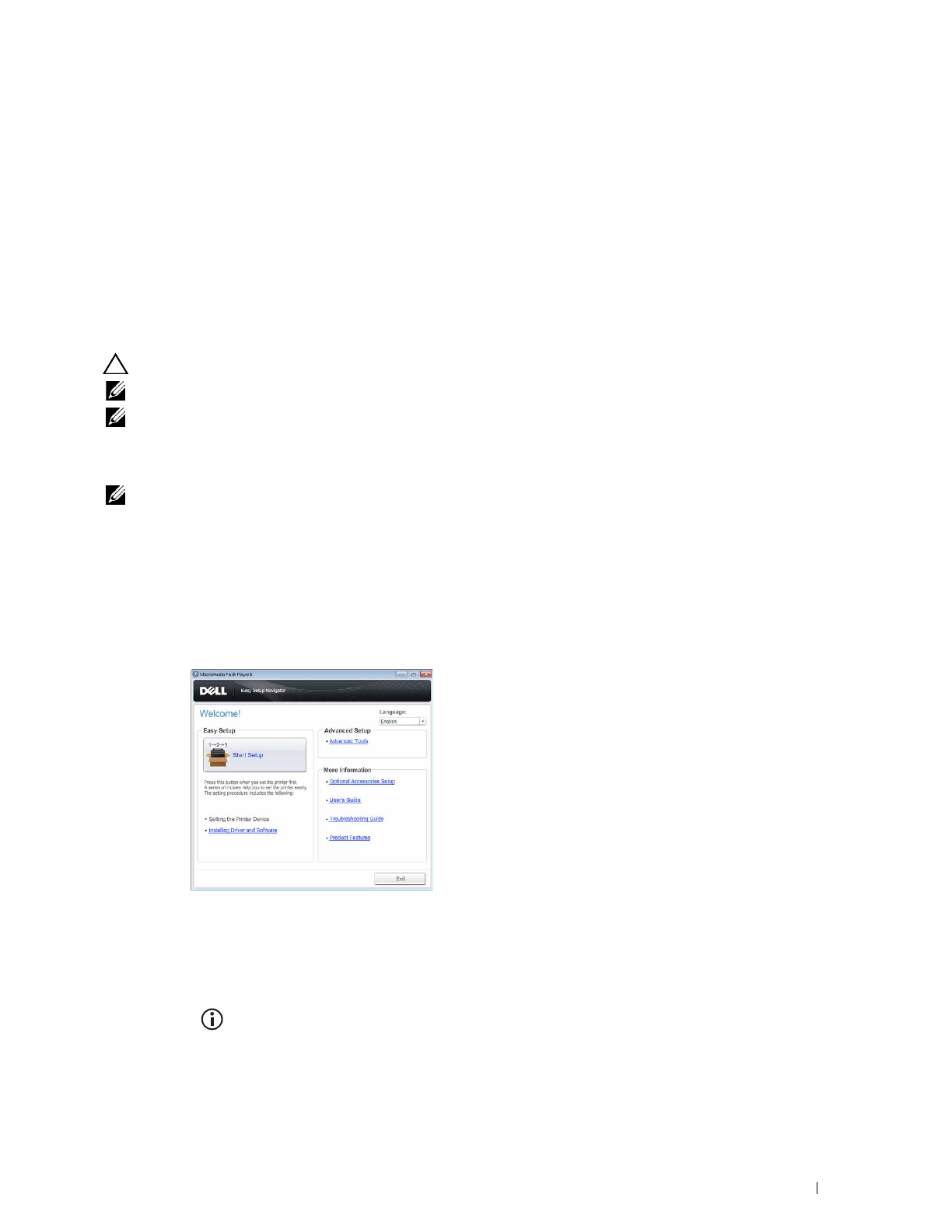
Setting the IP Address 83
8
Setting the IP Address
Assigning an IP Address
An IP address is a unique number that consists of four sections that are delimited by a period and can include up to
three digits in each section, for example, 111.222.33.44.
You can select the IP mode from Dual Stack, IPv4, and IPv6. If your network supports both IPv4 and IPv6, select
Dual Stack.
Select the IP mode of your environment, and then set IP address, subnet mask (for IPv4 only), and gateway address.
CAUTION: Assigning an IP address that is already in use can cause network performance issues.
NOTE: Assigning an IP address is considered as an advanced function and is normally done by a system administrator.
NOTE: When you assign an IP address manually in IPv6 mode, use the Dell™ Printer Configuration Web Tool. To display the Dell
Printer Configuration Web Tool, use the link-local address. To confirm the link-local address, print a system settings report and
check the Link-Local Address under Network (Wired) or Network (Wireless).
For details about how to print a system settings report, see "Report / List."
NOTE: If the Panel Lock Control is set to Enable, you need to enter the four digit password to enter the Admin
Settings menu.
When Using the Easy Setup Navigator
1
Insert the
Software and Documentation
disc provided with the printer in your computer. The
Easy Setup
Navigator
file launches automatically.
2
Click
Advanced Tools
on the
Easy Setup Navigator
window.
The
Advanced Tools
window opens.
3
Click
IP Configuration
.
4
Follow the instructions displayed on the screen.
When Using the Operator Panel
For more information on using the operator panel, see
"
Operator Panel.
"
1
Press the
(Information)
button.
2
Select the
Tools
tab, and then select
Admin Settings
.
3
Select
Network
.

84 Setting the IP Address
4
Do either of the following:
When connecting to network with the Ethernet cable:
Select
Ethernet
.
When connecting to network with the wireless adapter:
Select
Wireless
.
5
Select
IP Mode
.
6
Select
IPv4 Mode
, and then select
OK
.
7
Select
TCP / IP
.
8
Select
Get IP Address
.
9
Select
Panel
, and then select
OK
.
10
Select
IP Address
.
The cursor is located at the first octet of the IP address.
11
Use the number pad to enter the first octet of the IP address, and then select .
The cursor moves to the next digit.
NOTE: You can only enter one octet at a time and must select after entering each octet.
12
Enter the rest of the octets, and then select
OK
.
13
Select
Subnet Mask
.
14
Repeat steps 11 and 12 to set Subnet Mask.
15
Select
Gateway Address
.
16
Repeat steps 11 and 12 to set Gateway Address.
17
Turn off the printer, and then turn it on again.
When Using the Tool Box
1
Click
Start
→
All Programs
→
Dell Printers
→
Dell C3765dnf Multifunction Color Laser Printer
→
Tool Box
.
NOTE: For details about starting the Tool Box, see "Starting the Tool Box."
The
Tool Box
opens.
2
Click the
Printer Maintenance
tab.
3
Select
TCP/IP Settings
from the list at the left side of the page.
The
TCP/IP Settings
page appears.
4
Select the mode from
IP Address Mode
, and then enter the values in IP Address, Subnet Mask, and Gateway
Address.
5
Click
Apply New Settings
to take effect.
You can also assign the IP address to the printer when installing the printer drivers with the installer. When you use the
Network Installation
feature, and the
Get IP Address
is set to
AutoIP or DHCP
on the printer, you can set the IP
address from 0.0.0.0 to the desired IP address on the printer selection window.

Setting the IP Address 85
Verifying the IP Settings
You can confirm the settings by using the operator panel, printing the system settings report, or using the ping
command.
Verifying the Settings Using Operator Panel
1
Press the
(Information)
button.
2
Select
About This MFP
.
3
Select the
Network
tab.
4
Select
IP(v4) Address
, and then verify the IP address displayed in
IP(v4) Address
.
Verifying the Settings Using System Settings Report
1
Print the system settings report.
For details about how to print a system settings report, see "Report / List."
2
Verify the correct IP address, subnet mask, and gateway address are listed in the system settings report under
Network (Wired)
or
Network (Wireless)
.
If the IP address shows
0.0.0.0
(the factory default), an IP address has not been assigned. To assign one for your
printer, see "Assigning an IP Address."
Verifying the Settings Using Ping Command
Ping the printer and verify that it responds. For example, at a command prompt on a network computer, type ping
followed by the new IP address (for example, 192.168.0.11):
ping 192.168.0.11
If the printer is active on the network, you will receive a reply.

86 Setting the IP Address
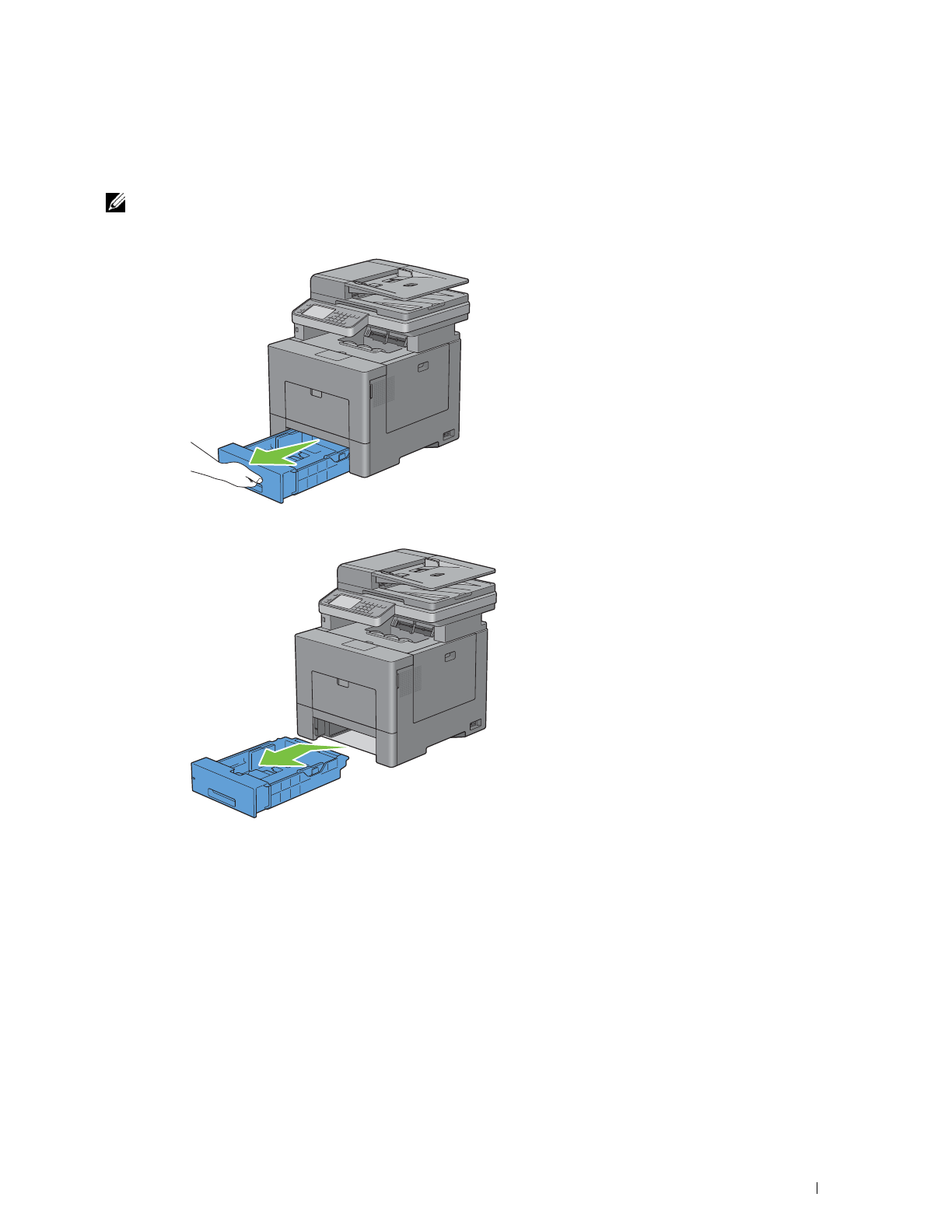
Loading Paper 87
9
Loading Paper
NOTE: To avoid paper jams, do not remove the tray while printing is in progress.
1
Pull the tray out of the printer about 200 mm.
2
Hold the tray with both hands, and remove it from the printer.
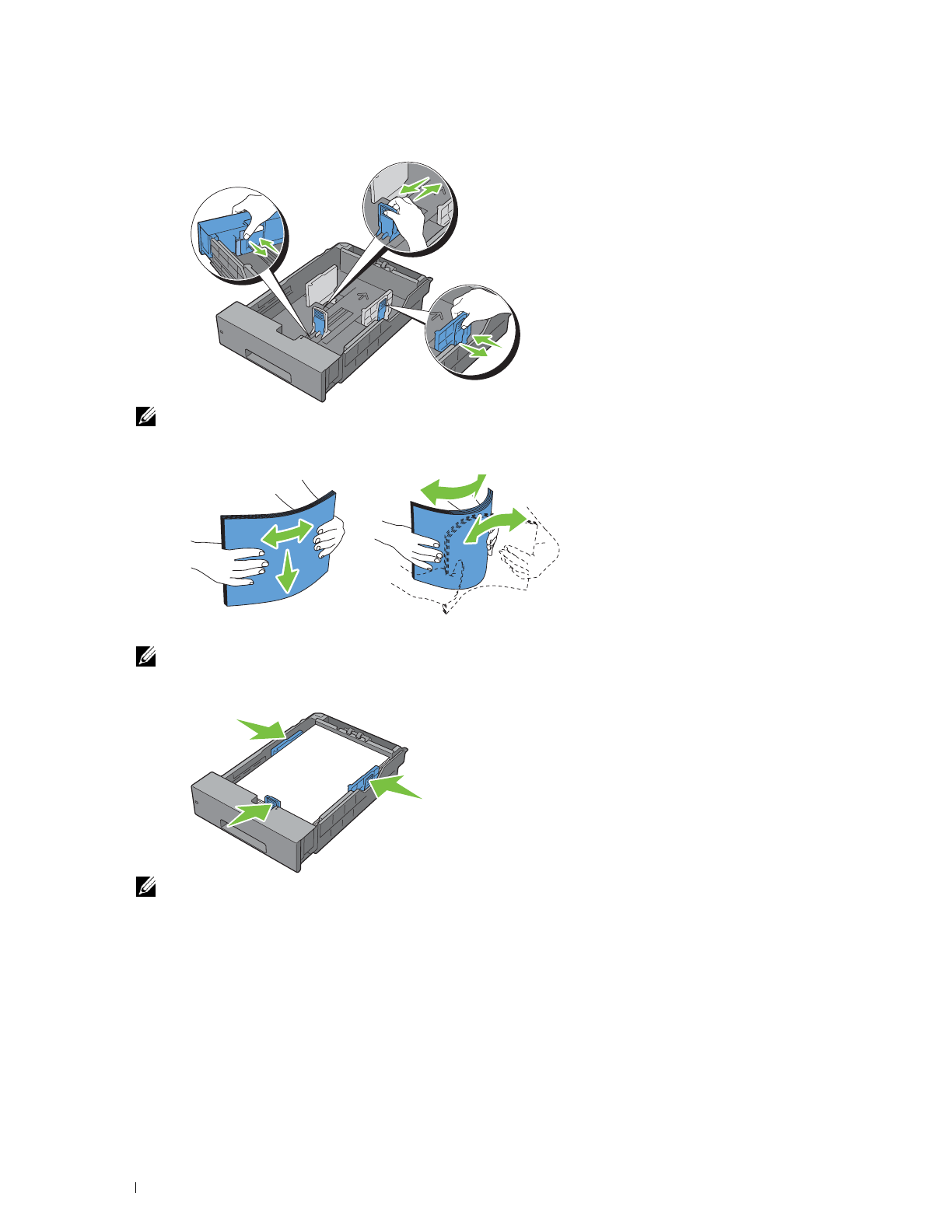
88 Loading Paper
3
Adjust the paper guides.
NOTE: Extend the front side of the tray when you load Legal size paper.
4
Before loading the print media, flex the sheets and fan them. Straighten the edges of the stack on a level surface.
5
Load the print media into the tray with the recommended print side facing up.
NOTE: Do not exceed the maximum fill line in the tray. Overfilling the tray may cause paper jams.
6
Align the width guides against the edges of the paper.
NOTE: When loading user-specified print media, adjust the width guides and slide the extendable part of the tray by
pinching the length guide and sliding it until it rests lightly against the edge of the paper.
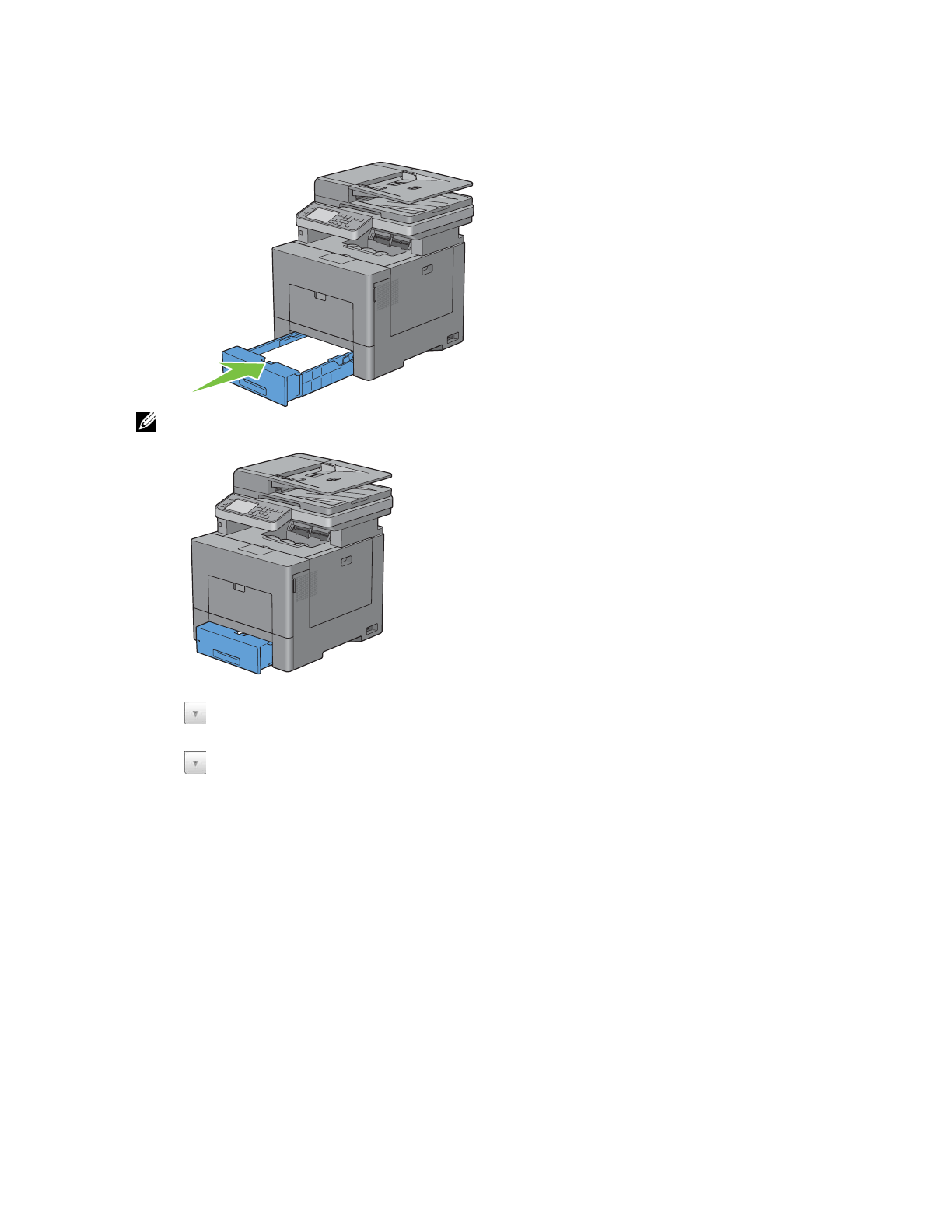
Loading Paper 89
7
After confirming that the guides are securely adjusted, insert the tray into the printer.
NOTE: If the front side of the tray is extended, the tray protrudes when it is inserted into the printer.
8
On the touch panel, select
Size
.
9
Select until the desired paper size appears, and then select the desired paper size.
10
Select
Type
.
11
Select until the desired paper type appears, and then select the desired paper size.
12
Select
OK.

90 Loading Paper

Installing Printer Drivers on Windows® Computers 91
10
Installing Printer Drivers on Windows® Computers
Identifying Printer Driver Pre-install Status
Before installing the printer driver on your computer, check the IP address of your printer by performing one of the
procedures in "Verifying the IP Settings."
Changing the firewall settings before installing your printer
If you are running one of the following operating systems, you must change the firewall settings before installing the
Dell printer software:
•Microsoft
®
Windows XP
•Windows Vista
®
•Windows 7
•Windows 8
•Windows Server
®
2008
• Windows Server 2008 R2
• Windows Server 2012
NOTE: For Windows XP, Service Pack 2 or 3 must be installed.
The following procedure uses Windows 7 as an example.
1
Insert the
Software and Documentation
disc into your computer.
2
Click
Start
→
Control Panel
.
3
Select
System and Security
.
4
Click
Allow a program through Windows Firewall
.
5
Click
Change settings
→
Allow another program
.
6
Check
Browse
.
7D:\setup_assist.exe
(where D is the drive letter of the optical drive) in the
File name
text box, and then
click
Open
.
8
Click
Add
, and then click
OK
.
Inserting the Software and Documentation Disc
1
Insert the
Software and Documentation
disc into your computer and click
setup_assist.exe
to start
Easy Setup
Navigator
.
NOTE: If the Software and Documentation disc does not launch automatically, follow the procedure below.
For Windows XP, Windows Server 2008, and Windows Server 2008 R2
Click
start
→
Run
, enter
D:\setup_assist.exe
(where D is the drive letter of the optical drive) in the Run dialog
box, and then click
OK
.
For Windows Vista and Windows 7
Click
Start
→
All Programs
→
Accessories
→
Run
, enter
D:\setup_assist.exe
(where D is the drive letter of
the optical drive) in the Run dialog box, and then click
OK
.

92 Installing Printer Drivers on Windows® Computers
For Windows 8 and Windows Server 2012
Point to the top or bottom right corner of the screen, and then click
Search
→
Ty p e
Run
in the search box, click
Apps
, and
then click
Run
→
Ty p e
D:\setup_assist.exe
(where D is the drive letter of the optical drive), and then click
OK
.
Direct Connection Setup
For installing PCL, PS and Fax printer driver
1
In the
Easy Setup Navigator
window, click
Installing Driver and Software
to launch the installation software.
2
Select
Personal Installation
, and then click
Next
.
3
Follow the on-screen instructions to connect the computer and the printer with a USB cable, and then turn the
printer on.
The Plug and Play installation starts and the installation software proceeds to the next page automatically.
NOTE: If the installation software does not automatically proceed to the next page, click Install.
4
Select either
Typical Installation (recommended)
or
Custom Installation
from the installation wizard, and then
click
Install
. If you select
Custom Installation
, you can select the specific software you want to install.
5
Click
Finish
to exit the wizard when the
Congratulations!
screen appears.
Personal Installation
A personal printer is a printer connected to your computer or a print server using a USB. If your printer is connected
to a network and not your computer, see "Network Connection Setup."

Installing Printer Drivers on Windows® Computers 93
For installing XML Paper Specification (XPS) printer driver
NOTE: XPS driver is supported on the following operating systems: Windows Vista, Windows Vista 64-bit Edition, Windows
Server 2008, Windows Server 2008 64-bit Edition, Windows Server 2008 R2, Windows 7, Windows 7 64-bit Edition, Windows 8,
Windows 8 64-bit Edition, and Windows Server 2012.
NOTE: If you are using Windows Vista or Windows Server 2008, you need to install Service Pack 2 or later, and then the
Windows Platform Update (KB971644). The update (KB971644) is available for download from Windows Update.
Windows Vista or Windows Vista 64-bit Edition
1
Extract the following zip file to your desired location.
D:\Drivers\XPS\Win_7Vista\XPS_3765.zip
(where D is the drive letter of the optical drive)
2
Click
Start
→
Control Panel
→
Hardware and Sound
→
Printers
.
3
Click
Add a printer
.
4
Click
Add a local printer
.
5
Select the port connected to this product, and then click
Next
.
6
Click
Have Disk
to display the
Install From Disk
dialog box.
7
Click
Browse
, and then select the extracted folder in step 1.
8
Click
OK
.
9
Select your printer name and click
Next
.
10
To change the printer name, enter the printer name in the
Printer name
box, and then click
Next
. To use this
printer as the default printer, select the check box displayed under the
Printer name
, and then click
Next
.
Installation starts.
If the
User Account Control
dialog box appears, click
Continue
.
NOTE: If you are an administrator on the computer, click Continue; otherwise, contact your administrator to continue the
desired action.
11
As the driver installation is completed, click
Print a test page
to print a test page.
12
Click
Finish
.
Windows Server 2008 or Windows Server 2008 64-bit Edition
NOTE: You must log in as an administrator.
1
Extract the following zip file to your desired location.
D:\Drivers\XPS\Win_7Vista\XPS_3765.zip
(where D is the drive letter of the optical drive)
2
Click
Start
→
Control Panel
→
Hardware and Sound
→
Printers
.
3
Click
Add a printer
.
4
Click
Add a local printer
.
5
Select the port connected to this product, and then click
Next
.
6
Click
Have Disk
to display the
Install From Disk
dialog box.
7
Click
Browse
, and then select the extracted folder in step 1.
8
Click
OK
.
9
Select your printer name and click
Next
.
10
To change the printer name, enter the printer name in the
Printer name
box, and then click
Next
.
To use this printer as the default printer, select the
Set as the default printer
check box, and then click
Next
.

94 Installing Printer Drivers on Windows® Computers
11
If you do not share your printer, select
Do not share this printer
.
If you share your printer, select
Share this printer
so that others on your network can find and use it
.
12
Click
Next
.
Installation starts.
13
As the driver installation is completed, click
Print a test page
to print a test page.
14
Click
Finish
.
Windows 7, Windows 7 64-bit Edition, or Windows Server 2008 R2
1
Extract the following zip file to your desired location.
D:\Drivers\XPS\Win_7Vista\XPS_3765.zip
(where D is the drive letter of the optical drive)
2
Click
Start
→
Devices and Printers
.
3
Click
Add a printer
.
When you use Windows Server 2008 R2, click
Add a local or network printer as an administrator
.
If the
User Account Control
dialog box appears, click
Yes
.
NOTE: If you are an administrator on the computer, click Yes; otherwise, contact your administrator to continue the desired
action.
4
Click
Add a local printer
.
5
Select the port connected to this product, and then click
Next
.
6
Click
Have Disk
to display the
Install From Disk
dialog box.
7
Click
Browse
, and then select the extracted folder in step 1.
8
Click
OK
.
9
Select your printer name and click
Next
.
10
To change the printer name, enter the printer name in the
Printer name
box, and then click
Next
.
To use this printer as the default printer, select the
Set as the default printer
check box, and then click
Next
.
11
If you do not share your printer, select
Do not share this printer
.
If you share your printer, select
Share this printer
so that others on your network can find and use it
.
12
Click
Next
.
Installation starts.
13
As the driver installation is completed, click
Print a test page
to print a test page.
14
Click
Finish
.
Windows 8, Windows 8 64-bit Edition, or Windows Server 2012
1
Extract the zip file you downloaded to your desired location.
2
Under Desktop mode, right-click the bottom left corner of the screen, and then click
Control Panel
.
3
Click
Hardware and Sound
(
Hardware
for Windows Server 2012)
→
Devices and Printers
→
Add a printer
.
4
Click
Have Disk
to display the
Install From Disk
dialog box.
5
Click
Browse
, and then select the extracted folder in step 1.
6
Click
OK
.
7
Select your printer name and click
Next
.
8
To change the printer name, enter the printer name in the
Printer name
box, and then click
Next
. Installation
starts.

Installing Printer Drivers on Windows® Computers 95
9
If you do not share your printer, select
Do not share this printer
. If you share your printer, select
Share this printer
so that others on your network can find and use it
. Click
Next
.
10
As the driver installation is completed, click
Print a test page
to print a test page. To use this printer as the default
printer, select the
Set as the default printer
check box.
11
Click
Finish
.
Network Connection Setup
NOTE: To use this printer in a Linux environment, you need to install a Linux driver. For more information on how to install and
use these, see "Installing Printer Drivers on Linux Computers (CUPS)."
Network Printer Setup on a Local Network
For installing PCL, PS and Fax printer driver
1
In the
Easy Setup Navigator
window, click
Installing Driver and Software
to launch the installation software.
2
Select
Network Installation
, and then click
Next
.
3
Select
Local Installation
, and then click
Next
.
4
Select the printer you want to install from the printer list, and then click
Next
. If the target printer is not displayed
on the list, click
Refresh
to refresh the list or click
Add Printer
to add a printer to the list manually. You may specify
the IP address and port name at this point.
If you have installed this printer on the server computer, select the
I am setting up this printer on a server
check
box.
NOTE: When using AutoIP, 0.0.0.0 is displayed in the installer. Before you can continue, you must enter a valid IP
address.
NOTE: In some cases,
Windows Security Alert
is displayed in this step when you use Windows Vista, Windows Vista 64-
bit Edition, Windows Server 2008, Windows Server 2008 64-bit Edition, Windows Server 2008 R2, Windows 7, Windows 7 64-
bit Edition, Windows 8, Windows 8 64-bit Edition, Windows Server 2012. In this case, select
Unblock (Allow access
for
Windows Server 2008 R2 and Windows 7), and then continue the procedure.
5
Specify the printer settings, and then click
Next
.
a
Enter the printer name.
b
If you want other users on the network to access the printer, select
Share this printer with other computers on
the network
, and then enter a share name that users can identify.
c
If you want to set the printer as the default printer, select the
Set this printer as default
check box.
d
If you want to restrict color printing, select the appropriate
Dell™ ColorTrack
option. Enter the password
when
Color-Password Enabled
is selected for
Dell ColorTrack
.
e
If you want to install the Fax Driver, select the
FAX Driver
check box.
If you want to install the PostScript printer driver, select the
PostScript Driver
check box.
6
Select the software and documentation you want to install, and then click
Next
. If you want to change the
installation destination, click
Browse
and specify a new location.
7
Click
Install
.
8
Click
Finish
to exit the wizard when the
Congratulations!
screen appears.

96 Installing Printer Drivers on Windows® Computers
For installing XML Paper Specification (XPS) printer driver
NOTE: XPS driver is supported on the following operating systems: Windows Vista, Windows Vista 64-bit Edition, Windows
Server 2008, Windows Server 2008 64-bit Edition, Windows Server 2008 R2, Windows 7, Windows 7 64-bit Edition, Windows 8,
Windows 8 64-bit Edition, and Windows Server 2012.
Windows Vista or Windows Vista 64-bit Edition
1
Extract the following zip file to your desired location.
D:\Drivers\XPS\Win_7Vista\XPS_3765.zip
(where D is the drive letter of the optical drive)
2
Click
Start
→
Control Panel
→
Hardware and Sound
→
Printers
.
3
Click
Add a printer
.
4
Click
Add a network
,
wireless or Bluetooth printer
.
5
Select printer or click
The printer that I want isn't listed
.
6
Select
Add a printer using a TCP/IP address or host name
, and then click
Next
.
7
Select
TCP/IP Device
from
Device type
, and enter the IP address for
Hostname or IP address
, and then click
Next
.
If the
User Account Control
dialog box appears, click
Continue
.
NOTE: If you are an administrator on the computer, click Continue; otherwise, contact your administrator to continue the
desired action.
8
Click
Have Disk
to display the
Install From Disk
dialog box.
9
Click
Browse
, and then select the extracted folder in step 1.
10
Click
OK
.
11
Select your printer name and click
Next
.
12
To change the printer name, enter the printer name in the
Printer name
box, and then click
Next
.
To use this printer as the default printer, select the
Set as the default printer
check box, and then click
Next
.
Installation starts.
13
As the driver installation is completed, click
Print a test page
to print a test page.
14
Click
Finish
.
Windows Server 2008 or Windows Server 2008 64-bit Edition
NOTE: You must log in as an administrator.
1
Extract the following zip file to your desired location.
D:\Drivers\XPS\Win_7Vista\XPS_3765.zip
(where D is the drive letter of the optical drive)
2
Click
Start
→
Control Panel
→
Hardware and Sound
→
Printers
.
3
Click
Add a printer
.
4
Click
Add a network
,
wireless or Bluetooth printer
.
5
Select printer or click
The printer that I want isn't listed
.
When you select your printer, go to step 8.
When you click
The printer that I want isn't listed
, go to step 6.
6
Select
Add a printer using a TCP/IP address or host name
, and then click
Next
.
7
Select
TCP/IP Device
from
Device
type
, and enter the IP address for
Hostname or IP address
, and then click
Next
.
If the
User Account Control
dialog box appears, click
Continue
.

Installing Printer Drivers on Windows® Computers 97
NOTE: If you are an administrator on the computer, click Continue; otherwise, contact your administrator to continue the
desired action.
8
Click
Have Disk
to display the
Install From Disk
dialog box.
9
Click
Browse
, and then select the extracted folder in step 1.
10
Click
OK
.
11
Select your printer name and click
Next
.
12
To change the printer name, enter the printer name in the
Printer name
box, and then click
Next
.
To use this printer as the default printer, select the
Set as the default printer
check box, and then click
Next
.
13
If you do not share your printer, select
Do not share this printer
.
If you share your printer, select
Share this printer
so that others on your network can find and use it
.
14
Click
Next
.
Installation starts.
15
As the driver installation is completed, click
Print a test page
to print a test page.
16
Click
Finish
.
Windows Server 2008 R2
1
Extract the following zip file to your desired location.
D:\Drivers\XPS\Win_7Vista\XPS_3765.zip
(where D is the drive letter of the optical drive)
2
Click
Start
→
Devices and Printers
.
3
Click
Add a printer
.
4
Click
Add a network
,
wireless or Bluetooth printer
.
5
Select printer or click
The printer that I want isn't listed
.
NOTE: When you click The printer that I want isn't listed, Find a printer by name or TCP/IP address screen appears. Find your
printer on the screen.
If the
User Account Control
dialog box appears, click
Continue
.
NOTE: If you are an administrator on the computer, click Continue; otherwise, contact your administrator to continue the
desired action.
6
Click
Have Disk
to display the
Install From Disk
dialog box.
7
Click
Browse
, and then select the extracted folder in step 1.
8
Click
OK
.
9
Select your printer name and click
Next
.
10
To change the printer name, enter the printer name in the
Printer name
box, and then click
Next
.
To use this printer as the default printer, select the
Set as the default printer
check box, and then click
Next
.
11
If you do not share your printer, select
Do not share this printer
.
If you share your printer, select
Share this printer
so that others on your network can find and use it
.
12
Click
Next
.
Installation starts.
13
As the driver installation is completed, click
Print a test page
to print a test page.
14
Click
Finish
.

98 Installing Printer Drivers on Windows® Computers
Windows 7 or Windows 7 64-bit Edition
1
Extract the following zip file to your desired location.
D:\Drivers\XPS\Win_7Vista\XPS_3765.zip
(where D is the drive letter of the optical drive)
2
Click
Start
→
Devices and Printers
.
3
Click
Add a printer
.
4
Click
Add a network
,
wireless or Bluetooth printer
.
5
Select printer or click
The printer that I want isn't listed
.
When you select your printer, go to step 8.
When you click
The printer that I want isn't listed
, go to step 6.
6
Select
Add a printer using a TCP/IP address or host name
, and then click
Next
.
7
Select
TCP/IP Device
from
Device type
, and enter the IP address for
Hostname or IP address
, and then click
Next
.
If the
User Account Control
dialog box appears, click
Yes
.
NOTE: If you are an administrator on the computer, click Yes; otherwise, contact your administrator to continue the desired
action.
8
Click
Have Disk
to display the
Install From Disk
dialog box.
9
Click
Browse
, and then select the extracted folder in step 1.
10
Click
OK
.
11
Select your printer name and click
Next
.
12
To change the printer name, enter the printer name in the
Printer name
box, and then click
Next
.
To use this printer as the default printer, select the
Set as the default printer
check box, and then click
Next
.
13
If you do not share your printer, select
Do not share this printer
.
If you share your printer, select
Share this printer
so that others on your network can find and use it
.
14
Click
Next
.
Installation starts.
15
As the driver installation is completed, click
Print a test page
to print a test page.
16
Click
Finish
.
Windows 8, Windows 8 64-bit Edition, or Windows Server 2012
1
Extract the zip file you downloaded to your desired location.
2
Under Desktop mode, right-click the bottom left corner of the screen, and then click
Control Panel
.
3
Click
Hardware and Sound
(
Hardware
for Windows Server 2012)
→
Devices and Printers
→
Add a printer
.
4
Click
Have Disk
to display the
Install From Disk
dialog box.
5
Click
Browse
, and then select the extracted folder in step 1.
6
Click
OK
.
7
Select your printer name and click
Next
.
8
To change the printer name, enter the printer name in the
Printer name
box, and then click
Next
. Installation
starts.
9
If you do not share your printer, select
Do not share this printer
. If you share your printer, select
Share this printer
so that others on your network can find and use it
. Click
Next
.

Installing Printer Drivers on Windows® Computers 99
10
As the driver installation is completed, click
Print a test page
to print a test page. To use this printer as the default
printer, select the
Set as the default printer
check box.
11
Click
Finish
.
Use the Dell Printer Configuration Web Tool to monitor the status of your network printer without leaving your
desk. You can view and/or change the printer settings, monitor toner level, and acknowledge the timing of ordering
replacement consumables. You can click the Dell supplies link for ordering supplies.
NOTE: The
Dell Printer Configuration Web Tool
is not available when the printer is directly connected to a computer or a print
server.
To launch the Dell Printer Configuration Web Tool, type the printer's IP address in your web browser. The printer
configuration appears on the screen.
You can set up the Dell Printer Configuration Web Tool
to send you an e-mail when the printer needs supplies or
intervention.
To set up e-mail alerts:
1
Launch the
Dell Printer Configuration Web Tool
.
2
Click
E-Mail Alert
link.
3
Under
E-Mail Server Settings
, enter the
Primary SMTP Gateway
,
Reply Address
, and your or key operator's e-mail
address in the e-mail list box.
4
Click
Apply New Settings
.
NOTE:
Connection pending until printer sends an alert
is displayed on the SMTP server until an error occurs.
Network Printer Setup on a Remote Network
Before Installation
Before you start remote installation, perform the following procedures.
Allow Print Spooler to Accept Client Connections
NOTE: This procedure is required for Windows XP 64-bit Edition, Windows Server 2003, Windows Server 2003 x64 Edition,
Windows Vista, Windows Vista 64-bit Edition, Windows Server 2008, Windows Server 2008 64-bit Edition, Windows Server 2008
R2, Windows 7, and Windows 7 64-bit Edition.
For Windows XP, Windows Server 2003, Windows Vista, and Windows Server 2008:
1
Open the Run dialog box.
For Windows XP, Windows Server 2003, Windows Server 2008, click
start
→
All Programs
→
Accessories
→
Run
.
For Windows Vista, click
Start
→
Run
.
2
Ty p e
gpedit.msc
, and then click
OK
.
3
Click
Computer Configuration
→
Administrative Templates
→
Printers
.
4
Right-click
Allow Print Spooler to accept client connections
and select
Properties
.
5
On the
Setting
tab, select
Enabled
, and then click
OK
.
6
Restart the computer.
For Windows Server 2008 R2 and Windows 7:
1
Open the Run dialog box.
For Windows Server 2008 R2, click
Start
→
Run
.
For Windows 7, click
Start
→
All Programs
→
Accessories
→
Run
.

100 Installing Printer Drivers on Windows® Computers
2
Ty p e
gpedit.msc
, and then click
OK
.
3
Click
Computer Configuration
→
Administrative Templates
→
Printers
.
4
Right-click
Allow Print Spooler to accept client connections
and select
Edit
.
5
Select
Enabled
, and then click
OK
.
6
Restart the computer.
Change the Firewall Setting to Share File and Printer
NOTE: This procedure is required for Windows XP, Windows XP 64-bit Edition, Windows Vista, Windows Vista 64-bit Edition,
Windows Server 2008, Windows Server 2008 64-bit Edition, Windows Server 2008 R2, Windows 7, and Windows 7 64-bit Edition.
For Windows XP:
1
Click
start
→
Control Panel
.
2
Select
Security Center
.
3
Click
Windows Firewall
.
4
On the
Exceptions
tab, select the
File and Printer Sharing
check box, and then click
OK
.
For Windows Vista:
1
Click
Start
→
Control Panel
.
2
Select
Security
.
3
Click
Windows Firewall
.
4
Click
Change settings
.
5
Click
Continue
.
6
On the
Exceptions
tab, select the
File and Printer Sharing
check box, and then click
OK
.
For Windows Server 2008:
1
Click
Start
→
Control Panel
.
2
Double-click
Windows Firewall
.
3
Click
Change settings
.
4
On the
Exceptions
tab, select the
File and Printer Sharing
check box, and then click
OK
.
For Windows Server 2008 R2 and Windows 7:
1
Click
Start
→
Control Panel
.
2
Select
System and Security
.
3
Click
Windows Firewall
.
4
Click
Allow a program or feature through Windows Firewall
.
5
If the check boxes under
Allowed programs and features
: are dimmed, click
Change settings
.
6
Select the
File and Printer Sharing
check box.
Home/Work (Private)
or
Public
check box is automatically selected
according to your settings.
If the
File and Printer Sharing Properties
dialog box appears, click
OK
.
7
Click
OK
.

Installing Printer Drivers on Windows® Computers 101
Start Remote Registry
NOTE: This procedure is required for Windows Vista, Windows Vista 64-bit Edition, Windows 7, and Windows 7 64-bit Edition.
1
Click
Start
→
Control Panel
.
2
Select
System and Maintenance
(System and Security for Windows 7).
3
Click
Administrative Tools
.
4
Double-click
Services
.
5
Click
Continue
(for Windows Vista only).
6
Right-click
Remote Registry
and select
Start
.
7
Right-click
Remote Registry
and select
Properties
.
8
Change
Startup typ
e to
Automatic
, and then click
OK
.
Disable User Account Control
CAUTION: Disabling the User Account Control might leave the system vulnerable to virus attacks.
NOTE: This procedure is required for Windows Vista, Windows Vista 64-bit Edition, Windows Server 2008, Windows Server 2008
64-bit Edition, Windows Server 2008 R2, Windows 7, and Windows 7 64-bit Edition.
For Windows Vista:
1
Click
Start
→
Control Panel
.
2
Select
User Accounts and Family Safety
.
3
Click
User Accounts
.
4
Click
Turn User Account Control on
or
off
.
5
Click
Continue
.
6
Clear the
Use User Account Control (UAC) to help protect your computer
check box.
7
Restart the computer.
For Windows Server 2008:
1
Click
Start
→
Control Panel
.
2
Double-click
User Accounts
.
3
Click
Turn User Account Control on or off
.
4
Clear the
Use User Account Control (UAC) to help protect your computer
check box.
5
Click
OK
.
6
Restart the computer.
For Windows Server 2008 R2:
1
Click
Start
→
Control Panel
.
2
Select
User Accounts
.
3
Click
Change User Account Control Settings
.
4
Move the slider to the bottom, and then click
OK
.
5
Restart the computer.
For Windows 7:
1
Click
Start
→
Control Panel
.
2
Select
User Accounts and Family Safety
.
3
Click
User Accounts
.

102 Installing Printer Drivers on Windows® Computers
4
Click
Change User Account Control Settings
.
5
Move the slider to the bottom, and then click
OK
.
6
Click
Yes
in the
User Account Control
dialog box.
7
Restart the computer.
Enable Network Discovery and File Sharing for all Public Networks
NOTE: This procedure is required when you use Windows Vista, Windows Vista 64-bit Edition, Windows Server 2008, Windows
Server 2008 64-bit Edition, Windows Server 2008 R2, Windows 7, and Windows 7 64-bit Edition for the server computer.
1
Click
Start
→
Network
(
Start
→
your user name
→
Network
for Windows 7).
2
Click
Network discovery and file sharing are turned off
. Network computers and devices are not visible. Click to
change.
3
Click
Turn on network discovery and file sharing
.
4
Click
Yes, turn on network discovery and file sharing for all public networks
.
Disable Simple File Sharing
NOTE: This procedure is required for Windows XP, and Windows XP 64-bit Edition.
1
Click
start
→
Control Panel
.
2
Select
Appearance and Themes
.
3
Select
Folder Options
.
4
On the
View
tab, clear the
Use simple file sharing
(Recommended)
check box, and then click
OK
.
5
Click
Start
→
Control Panel
.
6
Select
Performance and Maintenance
.
7
Select
Administrative Tools
.
8
Click
Local Security Policy
.
9
Click
Local Policies
→
Security Options
.
10
Right-click
Network
access: Sharing and security model for local accounts
and select
Properties
.
11
Ensure
Classic - local users authenticate as themselves
is selected.
Installing the Printer Driver
NOTE: Installation is not supported on Windows XP Home Edition, Windows Vista Home Basic, Windows Vista Home Premium,
Windows Vista Home Basic 64-bit Edition, Windows Vista Home Premium 64-bit Edition, Windows 7 Starter, Windows 7 Home
Basic, Windows 7 Home Premium, Windows 7 Home Basic 64-bit Edition, Windows 7 Home Premium 64-bit Edition, Windows 8,
Windows 8 64-bit Edition, Windows 8 Pro, Windows 8 Pro 64-bit Edition, and Windows Server 2012.
1
In the
Easy Setup Navigator
window, click
Software Installation
to launch the installation software.
2
Select
Network Installation
, and then click
Next
.
3
Select
Remote Installation
, and then click
Next
.
a
Enter the computer name, user ID, and password, and then click
Add
.
b
Click
Next
.
NOTE:
Windows Security Alert
may appear on Windows Vista, Windows Vista 64-bit Edition, Windows Server 2008,
Windows Server 2008 64-bit Edition, Windows Server 2008 R2, Windows 7, or Windows 7 64-bit Edition. In this case, select
Unblock (Allow access
for Windows Server 2008 R2 and Windows 7), and then continue the procedure.

Installing Printer Drivers on Windows® Computers 103
4
Select a printer from the printer list, and then click
Next
. If the target printer is not displayed on the list, click
Refresh
to refresh the list or click
Add Printer
to add a printer to the list manually. You may specify the IP address
and port name at this point.
NOTE: When using AutoIP, 0.0.0.0 is displayed in the installer. Before you continue, you must enter a valid IP address.
5
Specify the printer settings, and then click
Next
.
a
Enter the printer name.
b
If you want other users on the network to access this printer, select the
Share this printer with other
computers on the network
, and then enter a share name that users can identify.
c
If you want to set the printer as default, select the
Set this printer as default
check box.
d
If you want to restrict color printing, select the appropriate
Dell ColorTrack
option. Enter the password when
Color-Password Enabled
is selected for
Dell ColorTrack
.
e
If you want to install the Fax Driver, select the
FAX Driver
check box.
6
Select the software and documentation you want to install, and then click
Next
.
If you want to change the installation destination, click
Input
and specify a new location.
7
Click
Install
.
8
Click
Finish
to exit the wizard when the
Congratulations!
screen appears.
Use the Dell Printer Configuration Web Tool to monitor the status of your network printer without leaving your
desk. You can view and/or change the printer settings, monitor toner level, and acknowledge the timing of ordering
replacement consumables. You can click the Dell supplies link for ordering supplies.
NOTE: The
Dell Printer Configuration Web Tool
is not available when the printer is directly connected to a computer or a print
server.
To launch the Dell Printer Configuration Web Tool, type the printer's IP address in your web browser. The printer
configuration appears on the screen.
You can set up the Dell Printer Configuration Web Tool to send you an e-mail when the printer needs supplies or
intervention.
To set up e-mail alerts:
1
Launch the
Dell Printer Configuration Web Tool
.
2
Click
E-Mail Alert
link.
3
Under
E-Mail Server Settings
, enter the
Primary SMTP Gateway
,
Reply Address
, and your or key operator's e-mail
address in the e-mail list box.
4
Click
Apply New Settings
.
NOTE:
Connection pending until printer sends an alert
is displayed on the SMTP server until an error occurs.

104 Installing Printer Drivers on Windows® Computers
Setting Up for Shared Printing
You can share your new printer on the network using the
Software and Documentation
disc that comes with your
printer, or using Microsoft® point-and-print or peer-to-peer method. However, if you use one of the Microsoft
methods, some features, such as the status monitor and other printer utilities, installed with the
Software and
Documentation
disc, may not be available.
If you want to use the printer on a network, share the printer and install its drivers on all the computers on the
network.
NOTE: You need to purchase an Ethernet cable for shared printing.
Specifying the Shared Settings of the Printer
Windows XP, Windows XP 64-bit Edition, Windows Server 2003, or Windows Server 2003 x64 Edition
1
Click
start
→
Printers and Faxes
.
2
Right-click the printer icon and select
Properties
.
3
On the
Sharing
tab, select the
Share this printer
check box, and then type a name in the
Share name
text box.
4
Click
Additional Drivers
and select the operating systems of all network clients that print to the printer.
5
Click
OK
.
If you are missing files, you are prompted to insert the server operating system CD.
Windows Vista or Windows Vista 64-bit Edition
1
Click
Start
→
Control Panel
→
Hardware and Sound
→
Printers
.
2
Right-click the printer icon and select
Sharing
.
3
Click
Change sharing options
.
The message
Windows needs your permission to continue
appears.
4
Click
Continue
.
5
Select the
Share this printer
check box, and then type a name in the
Share name
text box.
6
Click
Additional Drivers
and select the operating systems of all network clients that print to the printer.
7
Click
OK
.
Windows Server 2008 or Windows Server 2008 64-bit Edition
1
Click
Start
→
Control Panel
→
Printers
.
2
Right-click the printer icon and select
Sharing
.
3
Click
Change Sharing Options
if exists.
4
Select the
Share this printer
check box, and then type a name in the
Share name
text box.
5
Click
Additional Drivers
and select the operating systems of all network clients that print to the printer.
6
Click
OK
.
Windows 7, Windows 7 64-bit Edition, or Windows Server 2008 R2
1
Click
Start
→
Devices and Printers
.
2
Right-click the printer icon and select
Printer properties
.
3
On the
Sharing
tab, click
Change Sharing Options
if exists.
Select the
Share this printer
check box, and then type a name in the
Share name
text box.

Installing Printer Drivers on Windows® Computers 105
4
Click
Additional Drivers
and select the operating systems of all network clients that print to the printer.
5
Click
Apply
, and then click
OK
.
Windows 8, Windows 8 64-bit Edition, or Windows Server 2012
1
Under Desktop mode, right-click the bottom left corner of the screen, and then click
Control Panel
→
Hardware
and Sound
(
Hardware
for Windows Server 2012)
→
Devices and Printers
.
2
Right-click the printer icon and select
Printer properties
.
3
On the
Sharing
tab, click
Change Sharing Options
if exists.
4
Select the
Share this printer
check box, and then type a name in the
Share name
text box.
5
Click
Additional Drivers
and select the operating systems of all network clients using this printer.
6
Click
Apply
, and then click
OK
.
To confirm that the printer is properly shared:
• Ensure that the printer object in the
Printers
,
Printers and Faxes
, or
Devices and Printers
folder is shared. The
shared icon is shown under the printer icon.
•Browse
Network
or
My Network Places
. Find the host name of the server and the shared name you assigned to the
printer.
Now that the printer is shared, you can install the printer on network clients using the point and print method or the
peer-to-peer method.
NOTE: If the OS bit editions (32/64 bit edition) differ between a print server and a client computer, you need to manually add the
printer driver for the client computer edition on the server. Otherwise, the printer driver cannot be installed on the client
computer using the point and print or peer-to-peer method. For example, if the print server runs on Windows XP 32-bit edition,
while the client computer runs on Windows 7 64-bit edition, follow the procedures below to additionally install the printer driver
for 64-bit client on the 32-bit server.
a
Click
Additional Drivers
on the screen for sharing printers.
For details about how to display this screen, see "Specifying the Shared Settings of the Printer."
b
Select the
x64
check box, and then click
OK
.
c
Insert the
Software and Documentation
disc into your computer.
d
Click
Browse
to specify the folder that contains the 64-bit OS driver, and then click
OK
.
Installation starts.
Point and Print
Point and Print is a Microsoft Windows technology that allows you to connect to a remote printer. This feature
automatically downloads and installs the printer driver.
Windows XP, Windows XP 64-bit Edition, Windows Server 2003, or Windows Server 2003 x64 Edition
1
On the Windows desktop of the client computer, double-click
My Network Places
.
2
Locate the host name of the server computer, and then double-click the host name.
3
Right-click the shared printer name, and then click
Connect
.
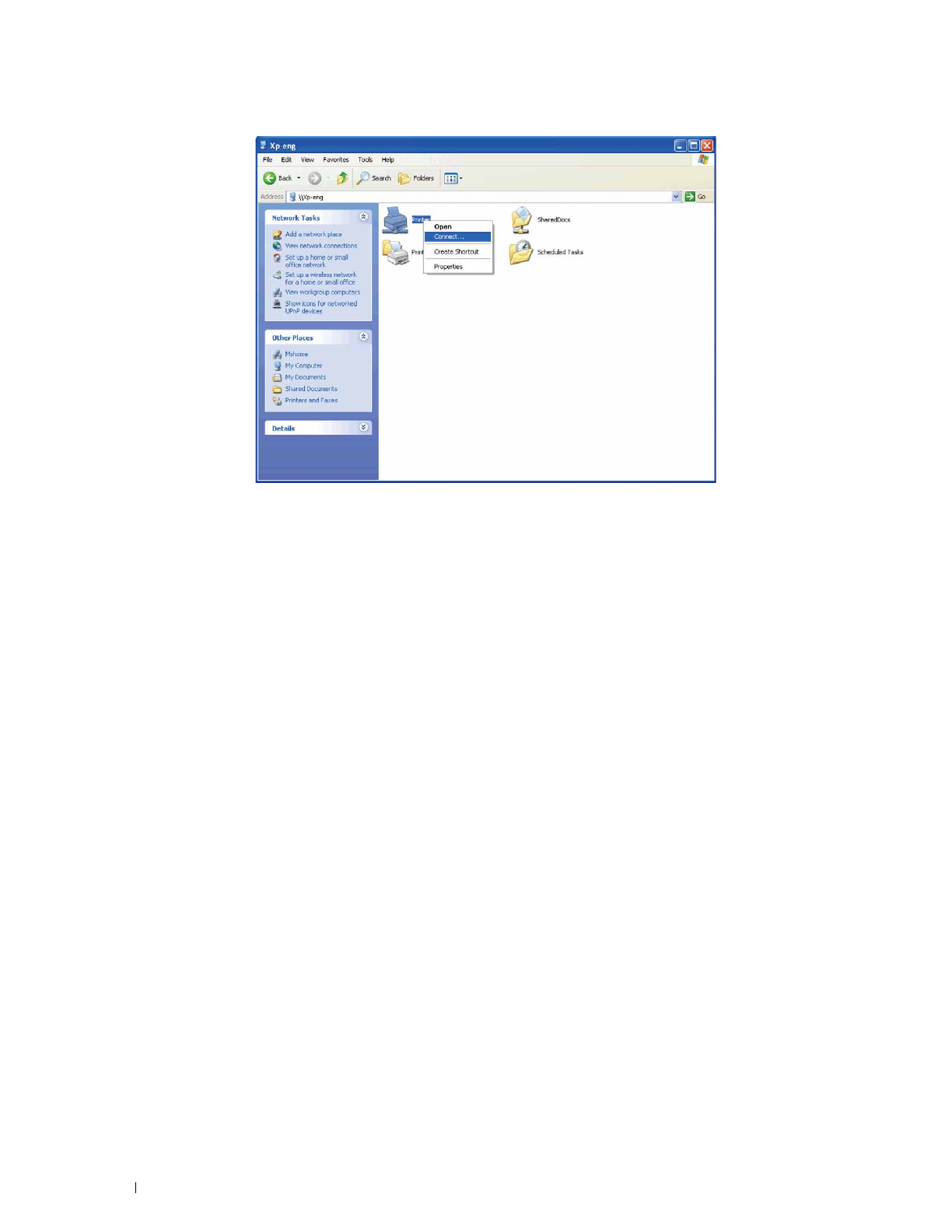
106 Installing Printer Drivers on Windows® Computers
Wait for the driver information to be copied from the server computer to the client computer, and for a new printer
object to be added to the
Printers and Faxes
folder. The copy time varies, based on network traffic and other
factors.
4
Close
My Network Places
.
5
Print a test page to verify installation.
a
Click
start
→
Printers and Faxes
.
b
Select the printer you just created.
c
Click
File
→
Properties
.
d
On the
General
tab, click
Print Test Page
.
When a test page prints successfully, installation is complete.
Windows Vista or Windows Vista 64-bit Edition
1
On the Windows desktop of the client computer, click
Start
→
Network
.
2
Locate the host name of the server computer, and then double-click the host name.
3
Right-click the shared printer name, and then click
Connect
.
4
Click
Install driver
.
5
Click
Continue
in the
User Account Control
dialog box.
6
Wait for the driver information to be copied from the server computer to the client computer, and for a new printer
object to be added to the Printers folder. The time this takes varies, based on network traffic and other factors.
7
Print a test page to verify installation.
a
Click
Start
→
Control Panel
→
Hardware and Sound
.
b
Select
Printers
.
c
Right-click the printer you just created and click
Properties
.
d
On the
General
tab, click
Print Test Page
.
When a test page prints successfully, installation is complete.

Installing Printer Drivers on Windows® Computers 107
Windows Server 2008 or Windows Server 2008 64-bit Edition
1
On the Windows desktop of the client computer, click
Start
→
Network
.
2
Locate the host name of the server computer, and then double-click the host name.
3
Right-click the shared printer name, and then click
Connect
.
4
Click
Install driver
.
5
Wait for the driver information to be copied from the server computer to the client computer, and for a new printer
object to be added to the
Printers
folder. The time this takes varies, based on network traffic and other factors.
6
Print a test page to verify installation.
a
Click
Start
→
Control Panel
.
b
Select
Printers
.
c
Right-click the printer you just created and select
Properties
.
d
On the
General
tab, click
Print Test Page
.
When a test page prints successfully, installation is complete.
Windows 7, Windows 7 64-bit Edition, or Windows Server 2008 R2
1
On the Windows desktop of the client computer, click
Start
→
your user name
→
Network
(
Start
→
Network
for
Windows Server 2008 R2).
2
Locate the host name of the server computer, and then double-click the host name.
3
Right-click the shared printer name, and then click
Connect
.
4
Click
Install driver
.
5
Wait for the driver information to be copied from the server computer to the client computer, and for a new printer
object to be added to the
Devices and Printers
folder. The time this takes varies, based on network traffic and other
factors.
6
Print a test page to verify installation.
a
Click
Start
→
Devices and Printers
.
b
Right-click the printer you just created and select
Printer properties
.
c
On the
General
tab, click
Print Test Page
.
When a test page prints successfully, installation is complete.
Windows 8, Windows 8 64-bit Edition, or Windows Server 2012
1
Point to the top or bottom right corner of the screen, and then click
Search
→
Ty p e
Network
in the search box,
click
Apps
, and then click
Network
.
2
Locate the host name of the server computer, and then double-click the host name.
3
Right-click the shared printer name, and then click
Connect
.
4
Click
Install driver
.
5
Wait for the driver information to be copied from the server computer to the client computer, and for a new printer
object to be added to the
Devices and Printers
folder. The time this takes varies, based on network traffic and other
factors.
6
Print a test page to verify installation.
a
Under Desktop mode, right-click the bottom left corner of the screen, and then click
Control Panel
→
Hardware and Sound
(
Hardware
for Windows Server 2012)
→
Devices and Printers
.
b
Right-click the printer you just created and select
Printer properties
.
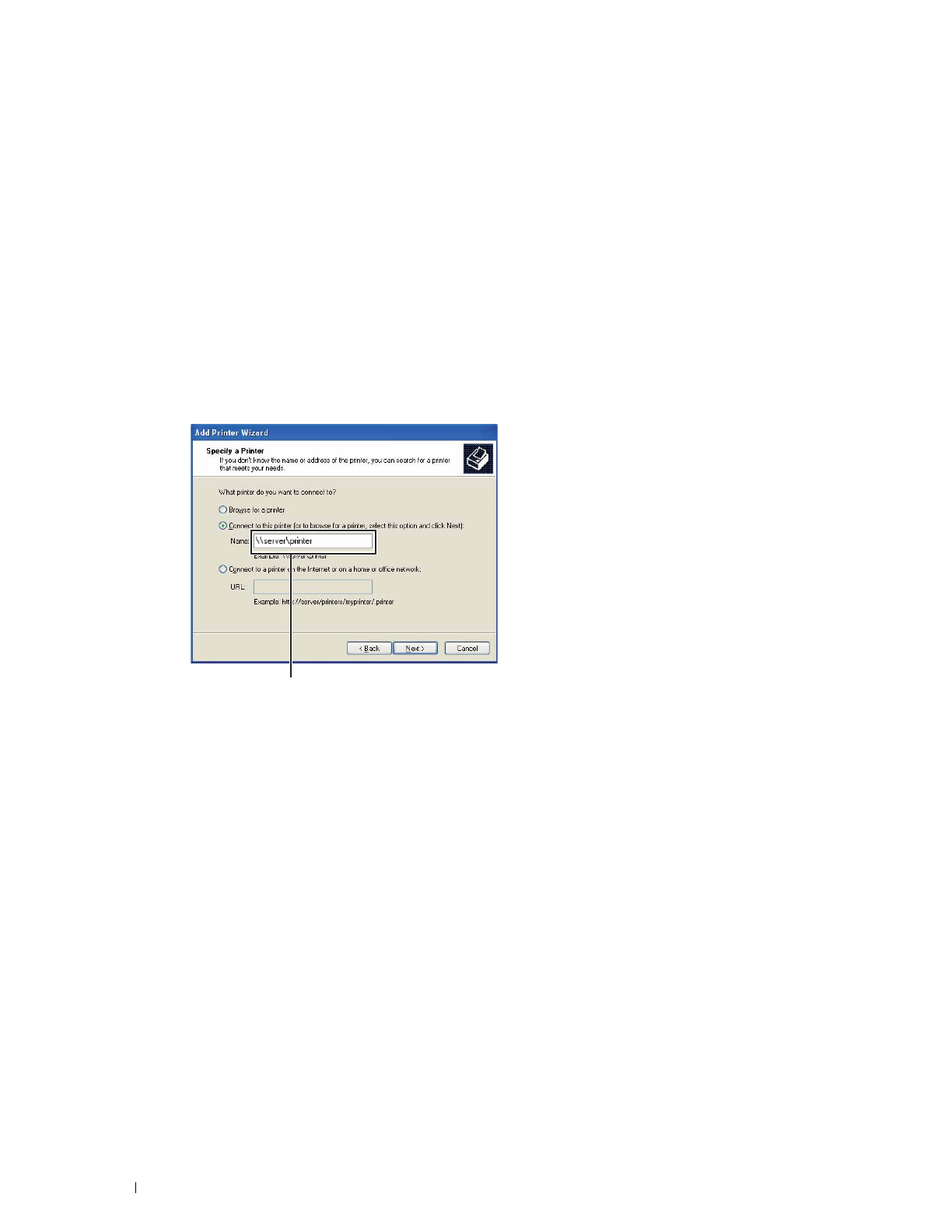
108 Installing Printer Drivers on Windows® Computers
c
On the
General
tab, click
Print Test Page
.
When a test page is printed successfully, installation is complete.
Peer-to-Peer
If you use the peer-to-peer method, the printer driver is fully installed on each client computer. Network clients
retain control of driver modifications. The client computer handles the print job processing.
Windows XP, Windows XP 64-bit Edition, Windows Server 2003, or Windows Server 2003 x64 Edition
1
Click
start
→
Printers and Faxes
.
2
Click
Add a Printer
.
3
Click
Next
.
4
Select
A network printer, or a printer attached to another computer
, and then click
Next
. If the printer is not
listed, type the path to the printer in the text box.
The server host name is the name of the server computer that identifies it on the network. The shared printer
name is the name assigned during the server installation process.
5
Click
Browse for a printer
, and then click
Next
.
If this is a new printer, you may be prompted to install a printer driver. If no system driver is available, you need to
specify the path to available drivers.
6
Select
Yes
if you want this printer to be set as the default printer, and then click
Next
.
If you want to verify installation, click
Yes
to print a test page.
7
Click
Finish
.
When a test page prints successfully, installation is complete.
For example:\\<server host name>\<shared printer name>
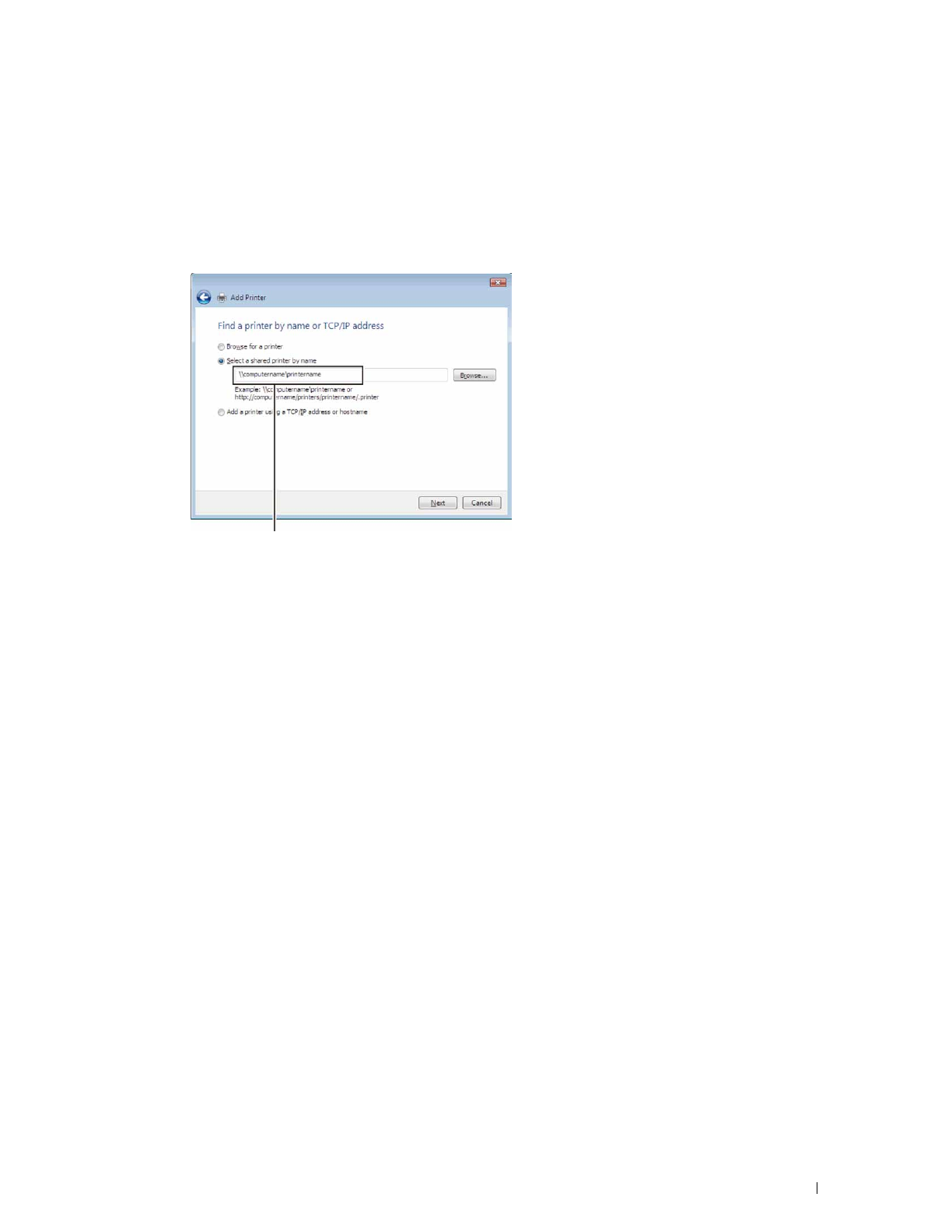
Installing Printer Drivers on Windows® Computers 109
Windows Vista or Windows Vista 64-bit Edition
1
Click
Start
→
Control Panel
→
Hardware and Sound
→
Printers
.
2
Click
Add a Printer
to launch the
Add Printer
wizard.
3
Select
Add a network
,
wireless or Bluetooth printer
, and then click
Next
. If the printer is listed, select the printer
and click
Next
, or select
The printer that I want isn't listed
and type in the path of the printer in the
Select a
shared printer by name
text box and click
Next
.
The server host name is the name of the server computer that identifies it on the network. The shared printer
name is the name assigned during the server installation process.
If this is a new printer, you may be prompted to install a printer driver. If no system driver is available, you need to
specify the path to available drivers.
4
Select
Yes
if you want this printer to be set as the default printer, and then click
Next
.
5
If you want to verify installation, click
Print a test page
.
6
Click
Finish
.
When a test page prints successfully, installation is complete.
Windows Server 2008 or Windows Server 2008 64-bit Edition
1
Click
Start
→
Control Panel
→
Printers
.
2
Click
Add a Printer
.
3
Select
Add a network
,
wireless or Bluetooth printer
, and then click
Next
. If the printer is listed, select the printer
and click
Next
, or select
The printer that I want isn't listed
and type the path to the printer in the
Select a shared
printer by name
text box and click
Next
.
For example:
\\<server host name>\<shared printer name>
The server host name is the name of the server computer that identifies it on the network. The shared printer
name is the name assigned during the server installation process.
If this is a new printer, you may be prompted to install a printer driver. If no system driver is available, then you will
need to provide a path to available drivers.
4
Select
Yes
if you want this printer to be set as the default printer, and then click
Next
.
5
Click
Print a test page
if you want to verify installation.
6
Click
Finish
.
When a test page prints successfully, installation is complete.
For example:\\<server host name>\<shared printer name>

110 Installing Printer Drivers on Windows® Computers
Windows 7, Windows 7 64-bit Edition, or Windows Server 2008 R2
1
Click
Start
→
Devices and Printers
.
2
Click
Add a Printer
.
3
Select
Add a network, wireless or Bluetooth printer
. If the printer is listed, select the printer and click
Next
, or
select
The printer that I want isn't listed
. Click
Select a shared printer by name
and type in the path of the printer
in the text box, and then click
Next
.
For example:
\\<server host name>\<shared printer name>
The server host name is the name of the server computer that identifies it to the network. The shared printer name
is the name assigned during the server installation process.
If this is a new printer, you may be prompted to install a printer driver. If no system driver is available, then you will
need to provide the path to the available driver.
4
Confirm the printer name, and then click
Next
.
5
Select
Yes
if you want this printer to be set as the default printer, and then click
Next
.
6
Click
Print a test page
if you want to verify installation.
7
Click
Finish
.
When a test page prints successfully, installation is complete.
Windows 8, Windows 8 64-bit Edition, or Windows Server 2012
1
Under Desktop mode, right-click the bottom left corner of the screen, and then click
Control Panel
→
Hardware
and Sound
(
Hardware
for Windows Server 2012)
→
Devices and Printers
.
2
Click
Add a Printer
to launch the
Add Printer
wizard.
3
If the printer is listed, select the printer and click
Next
, or select
The printer that I want isn't listed
. Click
Select a
shared printer by name
and type in the path of the printer in the text box, and then click
Next
.
For example:
\\<server host name>\<shared printer name>
The server host name is the name of the server computer that identifies it to the network. The shared printer name
is the name assigned during the server installation process.
If this is a new printer, you may be prompted to install a printer driver. If no system driver is available, then you will
need to provide the path to the available driver.
4
Confirm the printer name, and then click
Next
.
5
Select
Yes
if you want this printer to be set as the default printer, and then click
Next
.
6
Click
Print a test page
if you want to verify installation.
7
Click
Finish
.
When a test page is printed successfully, installation is complete.

Installing Printer Drivers on Macintosh Computers 111
11
Installing Printer Drivers on Macintosh Computers
Installing the Drivers and Software
1
Run the
Software and Documentation
disc on the Macintosh computer.
2
Double-click the
Dell C3765 Installer
icon, and then click
Continue
.
3
When the popup dialog box prompts you for confirming the program included in the installation package, click
Continue
.
4
Click
Continue
on the
Important Information
screen.
5
Select a language for the Software License Agreement.
6
After reading the Software License Agreement,
click
Continue
.
7
If you agree to the terms of the Software License Agreement, click
Agree
to continue the installation process.
8
Confirm the installation location.
9
Click
Install
to perform the standard installation.
If you want to select a custom installation, click
Customize
to select items that you want to install.
• Dell C3765 Printer Driver
• Dell C3765 Fax Driver
• Dell C3765 Scan Driver
• Dell Printer Status Monitor
10
Type the administrator's name and password, and then click
Install Software
.
11
Click
Continue Installation
to continue the installation.
12
When the message
The installation was successful.
appears, click
Log Out
to complete installation.
Adding a Printer on Mac OS X 10.5, 10.6, 10.7, or 10.8
When Using a USB connection
1
Turn on the printer.
2
Connect the USB cable between the printer and the Macintosh computer.
The printer is automatically added to your Macintosh computer.
When Using IP Printing
1
Turn on the printer.
2
Ensure that Macintosh computer and the printer are connected.
If you use wired connection, connect the LAN cable between the printer and the network.
If you use wireless connection, ensure that wireless connection is configured properly on your Macintosh computer
and the printer.
3
Open the
System Preferences,
and click
Print & Fax
(
Print & Scan
for Mac OS X 10.7 and Mac OS X 10.8).
4
Click the Plus (+) sign, and click
IP
.
5
Select
Line Printer Daemon - LPD
for
Protocol
.
6
Type the IP address for the printer in the
Address
area.

112 Installing Printer Drivers on Macintosh Computers
7
Select
Dell C3765dnf Color MFP
for
Print Using
(
Use
for Mac OS X 10.8).
NOTE: When printing is set up using IP printing, the queue name is displayed as blank. You do not need to specify it.
8
Click
Add
.
9
Specify the options that have been installed on the printer, and then click
Continue
.
10
Confirm that the printer is displayed in the
Print & Fax
(
Print & Scan
for Mac OS X 10.7 and Mac OS X 10.8)
dialog box.
When Using Bonjour
1
Turn on the printer.
2
Ensure that Macintosh computer and the printer are connected.
If you use wired connection, connect the LAN cable between the printer and the network.
If you use wireless connection, ensure that wireless connection is configured properly on your Macintosh computer
and the printer.
3
Open the
System Preferences,
and click
Print & Fax
(
Print & Scan
for Mac OS X 10.7 and Mac OS X 10.8).
4
Click the Plus (+) sign, and click
Default
.
5
Select the printer connected via Bonjour from the
Printer Name
list.
6
Name
and
Print Using
(
Use
for Mac OS X 10.8) are automatically entered.
7
Click
Add
.
8
Specify the options that have been installed on the printer, and then click
Continue
.
9
Confirm that the printer is displayed in the
Print & Fax
(
Print & Scan
for Mac OS X 10.7 and Mac OS X 10.8)
dialog box.
Adding a Printer on Mac OS X 10.4.11
When Using a USB Connection
1
Turn on the printer.
2
Connect the USB cable between the printer and the Macintosh computer.
3
Start
Printer Setup Utility
.
NOTE: You can find Printer Setup Utility in the Utilities folder in Applications.
4
Click
Add
.
5
Click
Default Browser
in the
Printer Browser
dialog box.
6
Select the printer connected via USB from the Printer list.
7
Name
and
Print Using
are automatically entered.
8
Click
Add
.
When Using IP Printing
1
Turn on the printer.
2
Ensure that Macintosh computer and the printer are connected.
If you use wired connection, connect the LAN cable between the printer and the network.
If you use wireless connection, ensure that wireless connection is configured properly on your Macintosh computer
and the printer.
3
Start
Printer Setup Utility
.

Installing Printer Drivers on Macintosh Computers 113
NOTE: You can find Printer Setup Utility in the Utilities folder in Applications.
4
Click
Add
.
5
Click
IP
Printer
in the
Printer Browser
dialog box.
6
Select
Line Printer Daemon - LPD
for
Protocol
.
7
Type the IP address for the printer in the
Address
area.
8
Select
Dell C3765dnf Color MFP
for
Print Using
.
NOTE: When printing is set up using IP printing, the queue name is displayed as blank. You do not need to specify it.
NOTE: Entry of Location is optional.
9
Click
Add
.
When Using Bonjour
1
Turn on the printer.
2
Ensure that Macintosh computer and the printer are connected.
If you use wired connection, connect the LAN cable between the printer and the network.
If you use wireless connection, ensure that wireless connection is configured properly on your Macintosh computer
and the printer.
3
Start the
Printer Setup Utility
.
NOTE: You can find Printer Setup Utility in the Utilities folder in Applications.
4
Click
Add
.
5
Click
Default Browser
in the
Printer Browser
dialog box.
6
Select the printer connected via Bonjour from the
Printer Name
list.
7
Name
and
Print Using
are automatically entered.
8
Click
Add
.
9
Specify the options installed to the printer, and then click
Continue
.
10
Confirm that the printer is displayed on the
Printer
list dialog box.
Adding a Printer on Mac OS X 10.3.9
When Using a USB connection
1
Turn on the printer.
2
Connect the USB cable between the printer and the Macintosh computer.
3
Start
Printer Setup Utility
.
NOTE: You can find Printer Setup Utility in the Utilities folder in Applications.
4
Click
Add
.
5
Select
USB
from the menu.
The
Printer Model
is automatically selected.
6
Click
Add.

114 Installing Printer Drivers on Macintosh Computers
When Using IP Printing
1
Turn on the printer.
2
Ensure that Macintosh computer and the printer are connected.
If you use wired connection, connect the LAN cable between the printer and the network.
If you use wireless connection, ensure that wireless connection is configured properly on your Macintosh computer
and the printer.
3
Start
Printer Setup Utility
.
NOTE: You can find Printer Setup Utility in the Utilities folder in Applications.
4
Click
Add
in the
Printer List
dialog box.
5
Select
IP Printing
from the menu.
6
Select
LPD/LPR
for
Printer Type
.
7
Type the IP address for the printer in the
Address
area.
8
Select
Dell
for
Printer Model,
and select
Dell C3765dnf Color MFP
.
NOTE: When printing is set up using IP printing, the queue name is displayed as blank. You do not need to specify it.
9
Click
Add
.
When Using Rendezvous (Bonjour)
1
Turn on the printer.
2
Ensure that Macintosh computer and the printer are connected.
If you use wired connection, connect the LAN cable between the printer and the network.
If you use wireless connection, ensure that wireless connection is configured properly on your Macintosh computer
and the printer.
3
Start
Printer Setup Utility
.
NOTE: You can find Printer Setup Utility in the Utilities folder in Applications.
4
Click
Add
in the
Printer List
dialog box.
5
Select
Rendezvous
from the menu.
6
Select
Dell
for
Printer Model
, and select
Dell C3765dnf Color MFP
.
7
Click
Add
.

Installing Printer Drivers on Macintosh Computers 115
Configuring Settings
All the optional accessories are verified as installed
.
Mac OS X 10.5, 10.6, 10.7, or 10.8
1
Open the
System Preferences,
and click
Print & Fax
(
Print & Scan
for Mac OS X 10.7 and Mac OS X 10.8).
2
Select the printer in the
Printer Name
list, and click
Options & Supplies
.
3
Select
Driver,
and select the options that have been installed in the printer, and then click
OK
.
Mac OS X 10.3.9 or 10.4.11
1
Start
Printer Setup Utility
.
2
Select the printer in the
Printer List
dialog box, and click
Show Info
.
3
Select
Installable Options
, and select the options that have been installed in the printer, and then click
Apply
Changes
.

116 Installing Printer Drivers on Macintosh Computers

Installing Printer Drivers on Linux Computers (CUPS) 117
12
Installing Printer Drivers on Linux Computers (CUPS)
This section provides information for installing or setting up the printer driver with CUPS (Common UNIX Printing
System) on Red Hat® Enterprise Linux® 5/6 Desktop or SUSE® Linux Enterprise Desktop 10/11.
Operation on Red Hat Enterprise Linux 5/6 Desktop
Setup Overview
Red Hat Enterprise Linux 5/6 Desktop:
1
Install the printer driver.
2
Set up the print queue.
3
Specify the default queue.
4
Specify the printing options.
Installing the Printer Driver
CAUTION: Before you install the printer driver on Red Hat Enterprise Linux 5, confirm that Update 6 or higher is applied to your
operating system. Consult your Linux distributor for the upgrade of your system.
1
Select
Applications
→
System Tools
(
Accessories
for Red Hat Enterprise Linux 5 Desktop)
→
Terminal
.
2
Type the following command in the terminal window.
The printer driver is installed.
Setting Up the Queue
To execute printing, you must set up the print queue on your workstation.
For Red Hat Enterprise Linux 5 Desktop:
1
Open the URL "
http://localhost:631
" using a web browser.
2
Click
Administration
.
3
Click
Add Printer.
Type the name of the printer in the
Name
box in the
Add New Printer
window, and click
Continue
.
You can optionally specify the location and description of the printer for further information.
For network connections:
a
Select
LPD/LPR Host or Printer
from the
Device
menu, and click
Continue
.
b
Type the IP address of the printer in
Device URI
, and click
Continue
.
Format:
lpd://xxx.xxx.xxx.xxx
(the IP address of the printer)
su
(Type the administrator password)
rpm -ivh (Type the file path)/Dell-C3765-Color-
MFP-x.x-x.noarch.rpm

118 Installing Printer Drivers on Linux Computers (CUPS)
For USB connections
:
a
Select
Dell C3765dnf Color MFP USB #1
or
Dell C3765dnf Color MFP
from the
Device
menu, and click
Continue
.
4
Select
Dell C3765dnf Color MFP PS vx.x (en)
from the
Model
menu, and click
Add Printer
.
5
Ty p e
root
as the user name, type the administrator password, and click
OK
.
The message
Printer xxx has been added successfully.
appears.
The setup is complete.
For Red Hat Enterprise Linux 6 Desktop:
1
Open the URL
"http://localhost:631"
using a web browser.
2
Click
Administration
.
3
Click
Add Printer
.
4
Ty p e
root
as the user name, type the administrator password, and click
OK
.
For network connections:
a
Select
LPD/LPR Host or Printer
from the
Other Network Printers
menu, and click
Continue
.
b
Type the IP address of the printer in
Connection
, and click
Continue
.
Format:
lpd://xxx.xxx.xxx.xxx
(the IP address of the printer)
For USB connections:
a
Select
Dell C3765dnf Color MFP
from the
Local Printers
menu, and click
Continue
.
5
Type the name of the printer in the
Name
box in the
Add Printer
window, and click
Continue
.
You can optionally specify the location and description of the printer for further information.
6
Select
Dell C3765dnf Color MFP PS vx.x (en)
from the
Model
menu, and click
Add Printer
.
The setup is complete.
Printing From the Applications
When you have finished setting up the queue, you can print jobs from the applications. Start the print job from the
application, and specify the queue in the print dialog box.
However, sometimes you can print only from the default queue depending on the application (for example Mozilla).
In these cases, before you start printing, set queue you want to print to as the default queue. For information on
specifying the default queue, see "Setting the Default Queue."
Setting the Default Queue
1
Select
Applications
→
System Tools
(
Accessories
for Red Hat Enterprise Linux 5 Desktop)
→
Terminal
.
2
Type the following command in the terminal window.
su
(Type the administrator password)
lpadmin -d (Type the queue name)

Installing Printer Drivers on Linux Computers (CUPS) 119
Specifying the Printing Options
You can specify the printing options such as color mode.
For Red Hat Enterprise Linux 5 Desktop:
1
Open the URL "
http://localhost:631
" using a web browser.
2
Click
Administration
.
3
Click
Manage Printers
.
4
Click
Set Printer Options
of the printer for which you want to specify the printing options.
5
Specify the required settings, and click
Set Printer Options
.
6
Ty p e
root
as the user name, and type the administrator password.
The message
Printer xxx has been configured successfully.
appears.
The setting is complete.
For Red Hat Enterprise Linux 6 Desktop:
1
Open the URL
"http://localhost:631"
using a web browser.
2
Click
Administration
.
3
Click
Manage Printers
.
4
Click the queue name for which you want to specify the printing options.
5
Select
Set Default Options
from the
Administration
menu.
6
Click the desired setting item, specify the required settings, and click
Set Default Options
.
The message
Printer xxx default options have been set successfully.
appears.
The setting is complete.
Uninstalling the Printer Driver
1
Select
Applications
→
System Tools
(
Accessories
for Red Hat Enterprise Linux 5 Desktop)
→
Terminal
.
2
Type the following command in the terminal window to delete the print queue.
3
Repeat the command above for all queues for the same model.
4
Type the following command in the terminal window.
The printer driver is uninstalled.
su
(Type the administrator password)
/usr/sbin/lpadmin -x (Type the print queue name)
su
(Type the administrator password)
rpm -e Dell-C3765-Color-MFP

120 Installing Printer Drivers on Linux Computers (CUPS)
Operation on SUSE Linux Enterprise Desktop 10
Setup Overview
SUSE Linux Enterprise Desktop 10:
1
Install the printer driver.
2
Set up the print queue.
3
Specify the default queue.
4
Specify the printing options.
Installing the Printer Driver
1
Select
Computer
→
More Applications...
and select
Gnome Terminal
on the Application Browser.
2
Type the following command in the terminal window.
The printer driver is installed.
Setting Up the Queue
To execute printing, you must set up the print queue on your workstation.
1
Select
Computer
→
More Applications...
and select
YaST
on the Application Browser.
2
Type the administrator password, and click
Continue
.
YaST Control Center
is activated.
3
Select
Hardware
on
YaST Control Center
, and select
Printer
.
The
Printer Configuration
dialog box appears.
For network connections:
a
Click
Add
.
b
Select
Network Printers
as
Printer Type
, and click
Next
.
c
Select
Print via LPD-Style Network Server
as
Network Printers
, and click
Next
.
d
Type the IP address of the printer in
Hostname of the Print Server
.
e
Type the name of the printer queue in
Print Queue Name
, and click
Next
.
f
Type the printer name in
Name for Printing
.
NOTE: Printer Description and Printer Location do not have to be specified.
g
Select the
Do Local Filtering
check box, and click
Next
.
h
Select DELL as
Manufacturer
. Select
C3765dnf Color MFP
as
Model
, and click
Next
.
i
Confirm the settings in
Configuration
, and click
OK
.
su
(Type the administrator password)
rpm -ivh (Type the file path)/Dell-C3765-Color-
MFP-x.x-x.noarch.rpm

Installing Printer Drivers on Linux Computers (CUPS) 121
For USB connections:
a
Select
Dell C3765dnf Color MFP on USB
(//Dell/C3765dnf%20Color%20MFP or /dev/usblp*)
as
Available
are
, and click
Configure…
.
b
Confirm the settings in
Edit configuration
, and click
OK
.
4
Click
Finish
.
Printing From the Applications
When you have finished setting up the queue you can print jobs from the applications. Start the print job from the
application, and specify the queue in the print dialog box.
However, sometimes you can print only from the default queue depending on the application (for example Mozilla).
In these cases, before you start printing, set queue you want to print to as the default queue. For information on
specifying the default queue, see "Setting the Default Queue."
Setting the Default Queue
1
To activate the
Printer setup: Autodetected printers
, do the following.
a
Select
Computer
→
More Applications...
and select
YaST
on the Application Browser.
b
Type the administrator password, and click
Continue
.
YaST Control Center
is activated.
c
Select
Hardware
on
YaST Control Center
, and select
Printer
.
2
Select the printer you want to set to default on the
Printer Configuration
, and select
Set Default
in the
Other
button menu.
3
Click
Finish
.
Specifying the Printing Options
You can specify the printing options such as color mode.
1
Open a web browser.
2
Ty p e
http://localhost:631/admin
in
Location
, and press <Enter>.
3
Ty p e
root
as the user name, and type the administrator password.
The
CUPS
window appears.
NOTE:
Set the password for authority as the printer administrator before setting the printer queue. If you have not set it, go to
"Setting the Password for Authority as the Printer Administrator."
4
Click
Manage Printers
.
5
Specify the required settings, and click
Continue
.
The message
Printer xxx has been configured successfully.
appears.
The setting is complete. Execute printing from the application.

122 Installing Printer Drivers on Linux Computers (CUPS)
Setting the Password for Authority as the Printer Administrator
You must set the password for authority as the printer administrator to do operations as the printer administrator.
1
Select
Computer
→
More Applications...
and select
Gnome Terminal
on the Application Browser.
2
Type the following command in the terminal window.
Uninstalling the Printer Driver
1
Select
Computer
→
More Applications...
and select
Gnome Terminal
on the Application Browser.
2
Type the following command in the terminal window to delete the print queue.
3
Repeat the command above for all queues for the same model.
4
Type the following command in the terminal window.
The printer driver is uninstalled.
Operation on SUSE Linux Enterprise Desktop 11
Setup Overview
SUSE Linux Enterprise Desktop 11:
1
Install the printer driver.
2
Set up the print queue.
3
Specify the default queue.
4
Specify the printing options.
su
(Type the administrator password)
lppasswd -g sys -a root
(Type the password for authority as the printer administrator after
the Enter password prompt.)
(Retype the password for authority as the printer administrator after
the Enter password again prompt.)
su
(Type the administrator password)
/usr/sbin/lpadmin -x (Type the printer queue name)
su
(Type the administrator password)
rpm -e Dell-C3765-Color-MFP

Installing Printer Drivers on Linux Computers (CUPS) 123
Installing the Printer Driver
1
Select
Computer
→
More Applications...
and select
GNOME Terminal
on the Application Browser.
2
Type the following command in the terminal window.
The printer driver is installed.
Setting Up the Queue
To execute printing, you must set up the print queue on your workstation.
1
Select
Computer
→
More Applications...
,
and
select
YaST
on the Application Browser.
2
Type the administrator password, and click
Continue
.
YaST Control Center
is activated.
3
Select
Hardware
on
YaST Control Center
, and select
Printer
.
The
Printer Configurations
dialog box opens.
For network connections:
a
Click
Add
.
The
Add New Printer Configuration
dialog box opens.
b
Click
Connection Wizard
.
The
Connection Wizard
dialog box opens.
c
Select
Line Printer Daemon (LPD) Protocol
from
Access Network Printer or Printserver Box via
.
d
Type the IP address of the printer in
IP Address or Host Name:
.
e
Select
Dell
in the
Select the printer manufacturer:
drop-down menu.
f
Click
OK
.
The
Add New Printer Configuration
dialog box appears.
g
Select
Dell C3765dnf Color MFP PS vx.x [Dell/Dell_C3765dnf_Color_MFP.ppd.gz]
from the
Assign
Driver
list.
NOTE: You can specify the printer name in Set Name:.
h
Confirm the settings, and click
OK
.
For USB connections:
a
Click
Add
.
The
Add New Printer Configuration
dialog box opens.
The printer name is displayed in the
Determine Connection
list.
b
Select
Dell C3765dnf Color MFP PS vx.x. [Dell/Dell_C3765dnf_Color_MFP.ppd.gz]
from the
Assign
Driver
list.
NOTE: You can specify the printer name in Set Name:.
c
Confirm the settings, and click
OK
.
su
(Type the administrator password)
rpm -ivh (Type the file path)/Dell-C3765-Color-
MFP-x.x-x.noarch.rpm

124 Installing Printer Drivers on Linux Computers (CUPS)
Printing From the Applications
When you have finished setting up the queue you can print jobs from the applications. Start the print job from the
application, and specify the queue in the print dialog box.
However, sometimes you can print only from the default queue depending on the application (for example Mozilla).
In these cases, before you start printing, set queue you want to print to as the default queue. For information on
specifying the default queue, see "Setting the Default Queue."
Setting the Default Queue
You can set the default queue when you add the printer.
1
Select
Computer
→
More Applications...
,
and select
YaST
on the Application Browser.
2
Type the administrator password, and click
Continue
.
YaST Control Center
is activated.
3
Select
Hardware
on
YaST Control Cente
r, and select
Printer
.
The
Printer Configurations
dialog box opens.
4
Click
Edit
.
A
dialog box to modify the specified queue opens.
5
Confirm that the printer you want to set is selected in the
Connection
list.
6
Select the
Default Printer
check box.
7
Confirm the settings, and click
OK
.
Specifying the Printing Options
You can specify the printing options such as color mode.
1
Open a web browser.
2
Ty p e
http://localhost:631/admin
in
Location
, and press <Enter>.
3
Click
Manage Printers
.
4
Click
Set Printer Options
of the printer for which you want to specify the printing options.
5
Specify the required settings, and click
Set Printer Options
.
6
Ty p e
root
as the user name, type the administrator password, and click
OK
.
NOTE:
Set the password for authority as the printer administrator before setting the printer queue. If you have not set it, go to
"Setting the Password for Authority as the Printer Administrator."
The message
Printer xxx has been configured successfully.
appears.
The setting is complete. Execute printing from the application.

Installing Printer Drivers on Linux Computers (CUPS) 125
Setting the Password for Authority as the Printer Administrator
You must set the password for authority as the printer administrator to do operations as the printer administrator.
1
Select
Computer
→
More Applications...
and select
GNOME Terminal
on the Application Browser.
2
Type the following command in the terminal window.
Uninstalling the Printer Driver
1
Select
Computer
→
More Applications...
and select
GNOME Terminal
on the Application Browser.
2
Type the following command in the terminal window to delete the print queue.
3
Repeat the command above for all queues for the same model.
4
Type the following command in the terminal window.
The printer driver is uninstalled.
su
(Type the administrator password)
lppasswd -g sys -a root
(Type the password for authority as the printer administrator after
the Enter password prompt.)
(Retype the password for authority as the printer administrator after
the Enter password again prompt.)
su
(Type the administrator password)
/usr/sbin/lpadmin -x (Type the printer queue name)
su
(Type the administrator password)
rpm -e Dell-C3765-Color-MFP

126 Installing Printer Drivers on Linux Computers (CUPS)

127
Using Your Printer
13 Operator Panel .......................................................................... 129
14 Dell™ Printer Configuration Web Tool................................... 135
15 Understanding the Tool Box Menus....................................... 203
16 Understanding the Printer Menus.......................................... 231
17 Print Media Guidelines............................................................. 301
18 Loading Print Media ................................................................. 307

128
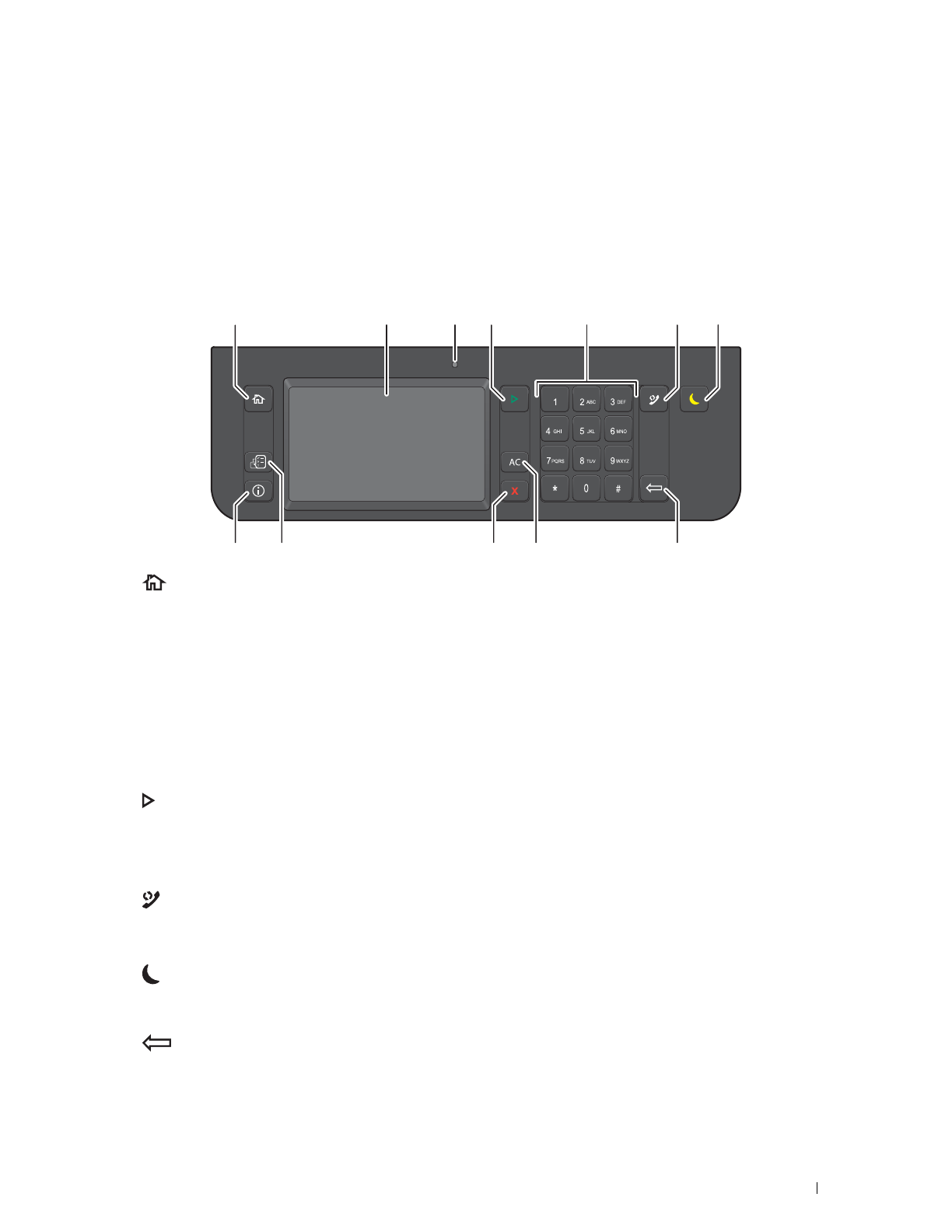
Operator Panel 129
13
Operator Panel
About the Operator Panel
The operator panel has a touch panel, a status LED, control buttons, and a number pad, which allows you to control
the printer.
1
(Home)
button
• Moves to the
Main Home
screen.
2
Touch Panel
• Specifies the settings by directly touching the screen.
• Displays various settings, instructions, and error messages.
3
Status LED (Ready / Error)
• Shows a green light when the printer is ready and a blinking green light when data is being received.
• Shows an amber light when an error occurs and a blinking amber light when an unrecoverable print error
occurs.
4 (Start) button
•Starts a job.
5
Number Pad
• Enters numbers and characters.
6
(Redial / Pause)
button
• Re-dials a telephone number.
• Inserts a pause into a telephone number.
7
(Power Saver)
button
• Enters or exits the Power Saver mode. When the machine is not used for a while, it enters the Power Saver
mode to reduce power consumption. When the Power Saver mode is active, the Power Saver button blinks.
8
(Delete)
button
• Deletes numbers and characters.
123456
89101112
7
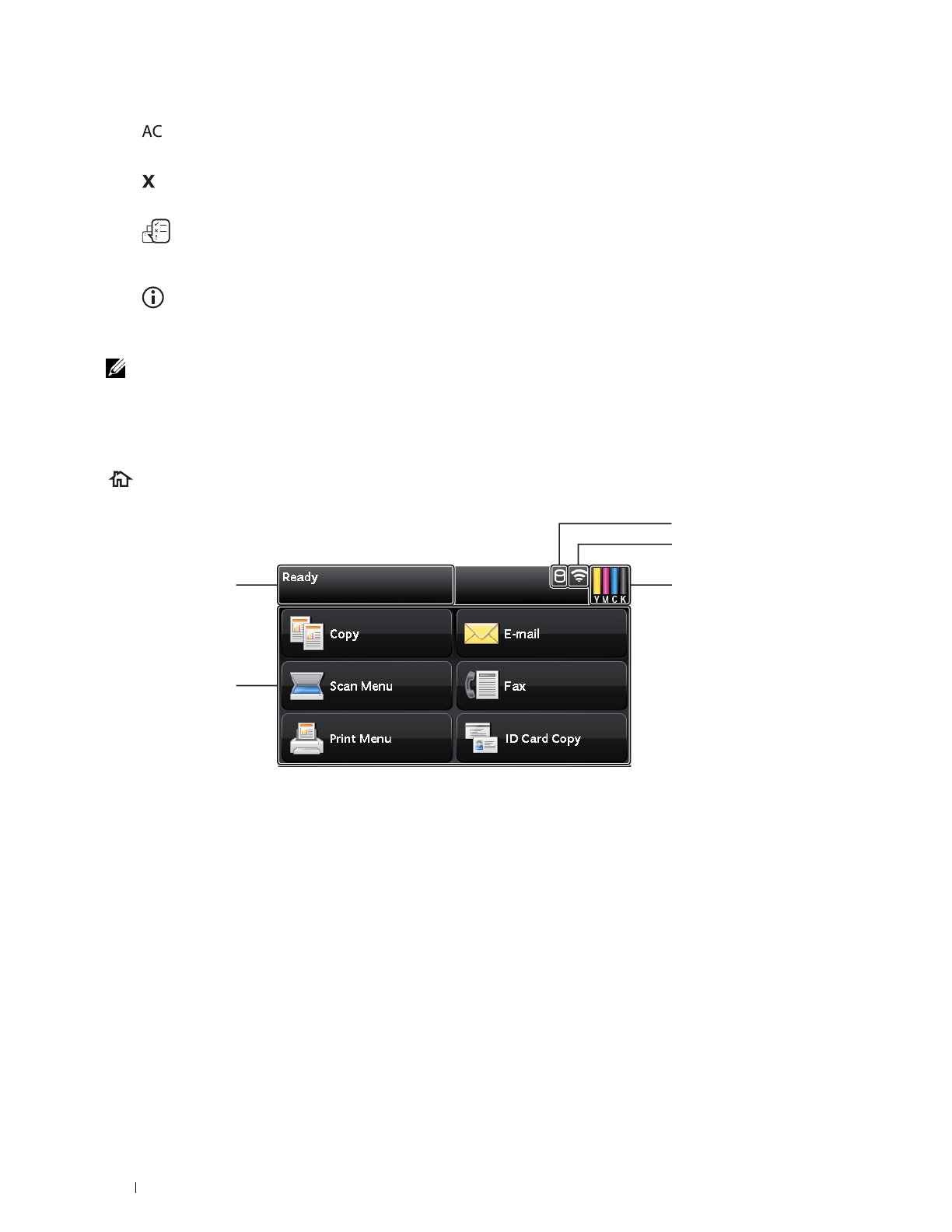
130 Operator Panel
9
(All Clear)
button
• Resets the current setting, and returns to the top menu.
10
(Cancel)
button
• Cancels active or pending jobs.
11
(Job Status)
button
• Moves to the
Job Status
screen. From this screen, you can check or cancel active jobs and also access
Secure
Print
and
Secure Fax receive
.
12
(Information)
button
• Moves to the
Information
screen. You can access various information and menus, check consumable levels,
and print various types of reports and lists.
NOTE: Moving to a different menu or returning to a previous screen cancels the current entry or setting. Make sure to select OK
to save the current entry or setting.
About the Main Home Screen
This section describes the fields and buttons on the Main Home screen which is displayed by pressing the
(Home) button. This is the default screen that appears when the printer is turned on.
Message Field
Displays the printer status, error message, and IP address assigned to the printer.
Toner Status Icon
Displays the condition of toner in 6 levels. (The toner level for each color: 100%, 80%, 60%, 40%, 20%, 0%) Selecting
this icon moves to the Supplies tab.
Wireless LAN Connection Status Icon
Displays the intensity of wireless signal when the wireless adapter is connected to the printer.
Data Status Icon
Displays when the print data or fax data is stored in the printer. While receiving fax data, this icon blinks on and off.
When wireless LAN connection status icon is not displayed, the position of the data status icon is right-justified.
Message Field
Function Buttons
Data Status Icon
Wireless LAN Connection
Status Icon
Toner Status Icon
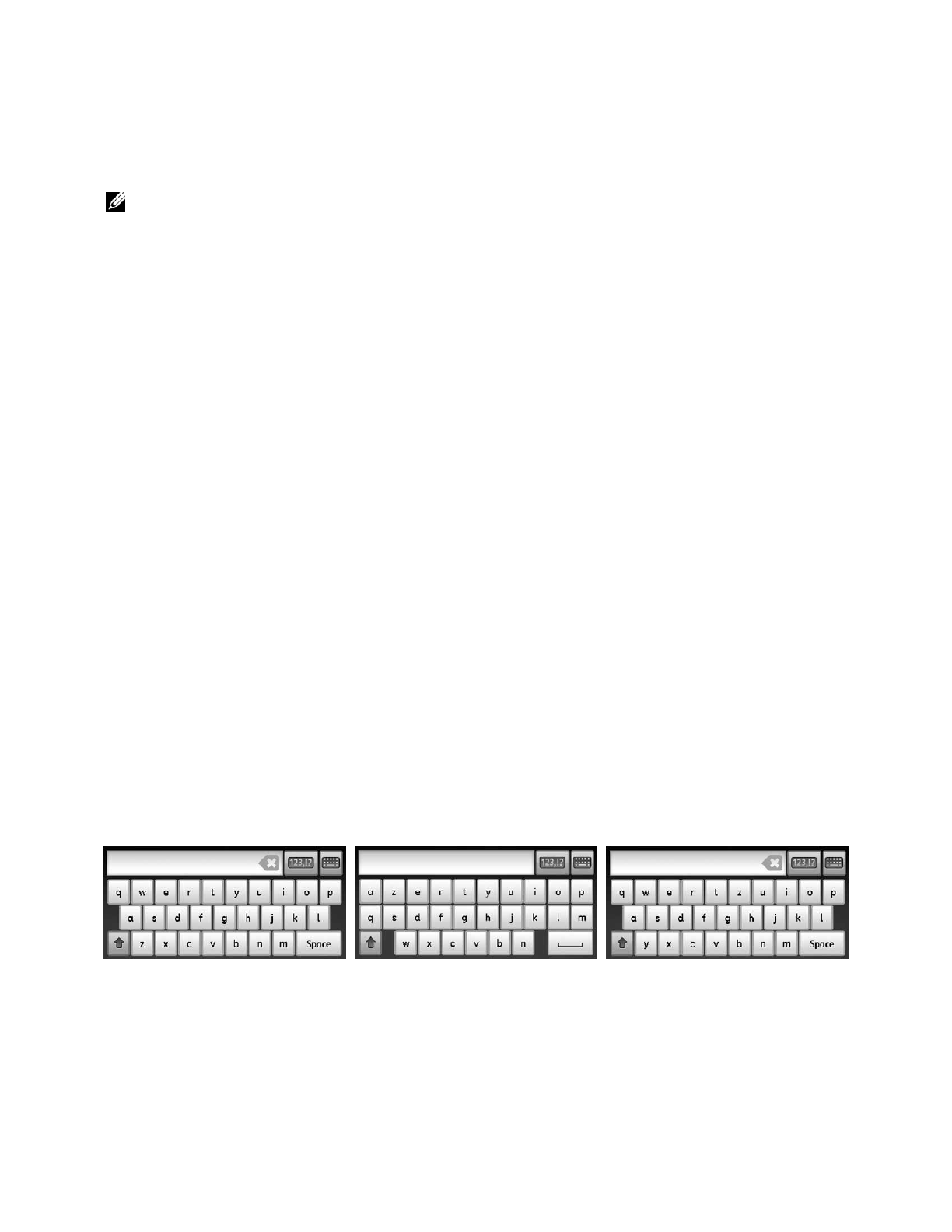
Operator Panel 131
Function Buttons
Allows you to set the features for functions such as Copy, E-mail, Scan Menu, Fax, Print Menu, and ID
Card Copy.
NOTE: Functions that are disabled do not appear on this screen. For details about enabling and disabling functions, see
"Function Enabled."
Copy
You can set the features for the Copy function.
For more information, see "Copying."
E-mail
You can scan documents and send the scanned data as an e-mail attachment.
For more information, see "Sending an E-Mail With the Scanned Image."
Scan Menu
You can set the features for the Scan Menu function.
For more information, see "Scanning."
Fax
You can set the features for the Fax function.
For more information, see "Faxing."
Print Menu
You can set the features for the Print Menu function.
For more information, see "Printing."
ID Card Copy
You can set the features for the ID Card Copy function.
For more information, see "Using the ID Card Copy."
Using the Keyboard Displayed on the Touch Panel
During operations, a keyboard for entering text sometimes appears. The following describes how to enter text.
You can enter the following characters: numbers, alphabets, and symbols.
QWERTY AZERTY QWERTZ
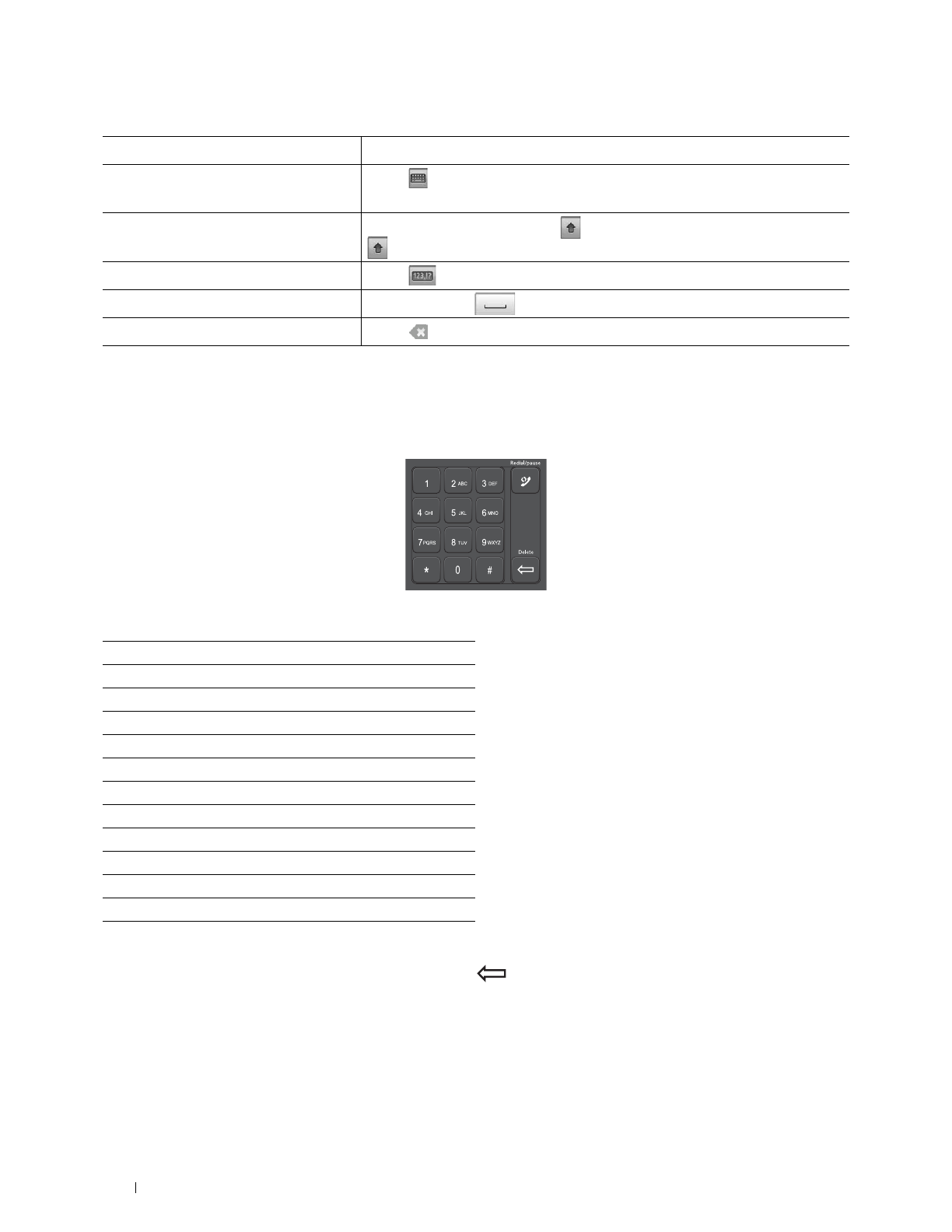
132 Operator Panel
Using the Number Pad
As you perform various tasks, you may need to enter numbers. For example, when you specify the quantity of copies
or when you enter fax number directly.
Number Pad Numbers
Changing Numbers or Names
If you make a mistake while entering a number, press
the
(Delete)
button
to delete the last digit or character.
Then enter the correct number or character.
Item Description
Changing keyboards Select to change the keyboard layout on the touch panel. Select from
QWERTY, AZERTY, or QWERTZ.
Entering alphabets To enter uppercase letters, select . To return to the lowercase letters, select
again.
Entering numbers and symbols Select .
Entering a space Select Space or .
Deleting characters Select to delete one character at a time.
1
2
3
4
5
6
7
8
9
0
∗
#

Operator Panel 133
Inserting a Pause
For some telephone systems, it is necessary to dial an access code and listen for a second dial tone. A pause must be
entered in order for the access code to function. For example, enter the access code 9 and then press the
(Redial/Pause) button before entering the telephone number. "-" appears on the display to indicate when a pause is
entered.
Printing a Panel Settings Report
The panel settings report shows current settings for the printer menus. For details about how to print a panel settings
report, see "Report / List."
Changing the Language
To change the language used on the touch panel:
When Using the Operator Panel
1
Press the
(Information)
button.
2
Select the
Tools
tab, and then select
Panel Language
.
3
Select the until the desired language appears, and then select the desired language.
4
Select
OK
.
When Using the Tool Box
1
Click
Start
→
All Programs
→
Dell Printers
→
Dell C3765dnf Multifunction Color Laser Printer
→
Tool Box
.
NOTE: For details about starting the Tool Box, see "Starting the Tool Box."
The
Tool Box
opens.
2
Click the
Printer Maintenance
tab.
3
Select
Panel Language
from the list at the left side of the page.
The
Panel Language
page appears.
4
Select the desired language from
Panel Language
, and then click
Apply New Settings
.
Setting the Power Saver Timer Option
You can set the power saver timer for the printer. The printer enters the power saver mode when the printer is not
used for a certain period of time.
NOTE: If the Panel Lock Control is set to Enable, you need to enter the four digit password to enter the Admin
Settings menu.
To set the power saver timer:
1
Press the
(Information)
button.
2
Select the
Tools
tab, and then select
Admin Settings
.
3
Select until
System Settings
appears, and then select
System Settings
.
4
Select until
General
appears, and then select
General
.
5
Select until
Power Saver Timer
appears, and then select
Power Saver Timer
.
6
Select
Sleep
or
Deep Sleep
.

134 Operator Panel
7
Select or , or use the number pad to enter the desired value.
You can specify from 1 to 60 minutes for
Sleep
or 1 to 60 minutes for
Deep Sleep
.
To return to the
Information
screen, press the
(All Clear)
button.
About the Concurrent Jobs Feature
This feature enables you to start a concurrent job while a fax job is running. This is done by temporarily displaying
the Main Home screen and switching to a different function that can be run concurrently such as copy or scan.
1
While the printer is sending or receiving a fax, press the (
Home
) button.
2
Select
Copy
or
Scan Menu
.
3
After setting the copy or scan options, press the
(Start)
button.
For details about
Copy
or
Scan Menu
, see "Copying" or "Scanning."
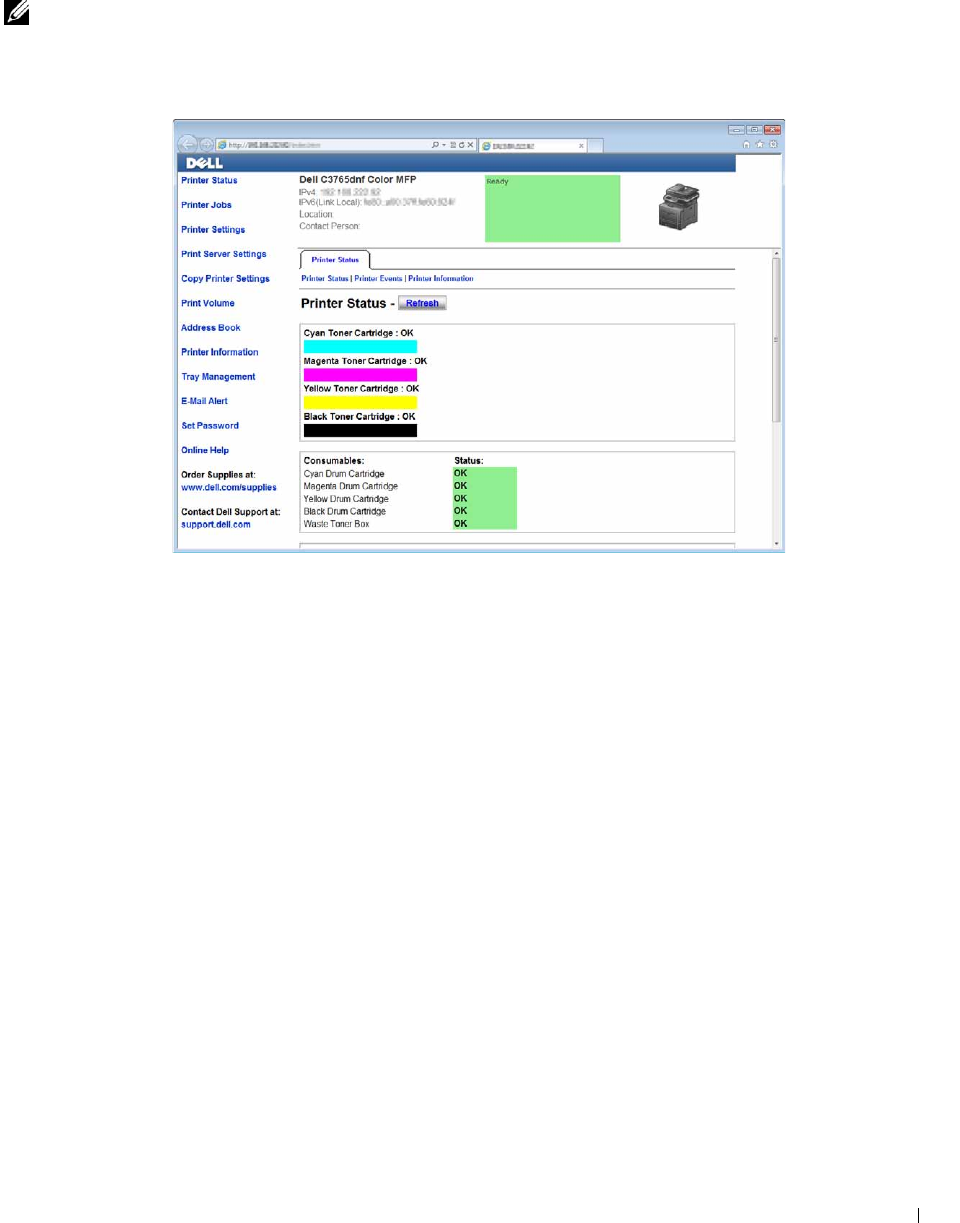
Dell™ Printer Configuration Web Tool 135
14
Dell™ Printer Configuration Web Tool
Overview
NOTE: This web tool is available only when the printer is connected to a network using an Ethernet cable or the wireless printer
adapter.
One of the features of the Dell Printer Configuration Web Tool is E-Mail Alert Setup, which sends e-mail to you or
the key operator when the printer needs supplies or intervention.
To fill out printer inventory reports requiring the asset tag number of all the printers in your area, use the Printer
Information feature in the Dell Printer Configuration Web Tool. Enter the IP address of each printer on the
network to display the asset tag number.
The Dell Printer Configuration Web Tool feature also allows you to change the printer settings and keep track of
printing trends. If you are a network administrator, you can copy the printer settings to one or all printers on the
network using your web browser.

136 Dell™ Printer Configuration Web Tool
Setting Up the Dell Printer Configuration Web Tool
Ensure that you activate JavaScript in your browser before using the Dell Printer Configuration Web Tool.
Follow the procedures below to configure both the environment settings of your web browser and the EWS setting
on the operator panel before using the Dell Printer Configuration Web Tool.
NOTE: The Dell Printer Configuration Web Tool pages may be displayed unreadable if the pages were configured by the
language different from the language of your web browser.
Setting Up From Web Browser
For Internet Explorer®
Setting Up the Display Language
1
Select
Internet Options
from
Tools
on the menu bar.
2
Select
Languages
in the
General
tab.
3
Specify the display language in order of preference in the
Language
list.
For example:
•
Italian
(
Italy
) [
it-IT
]
•
Spanish
(
Traditional Sort
) [
es-ES tradnl
]
•
German
(
Germany
) [
de-DE
]
•
French
(
France
) [
fr-FR
]
•
English
(
United States
) [
en-US
]
•
Danish
[
da-DK]
•
Dutch
(
Netherlands
) [
nl-NL
]
•
Norwegian
(
Bokmal
) [
no
]
•
Swedish
[
sv-SE
]
Setting the IP Address of the Printer to Non-Proxy
1
Select
Internet Options
from the
Tools
menu.
2
Click
LAN Settings
under
Local Area Network (LAN) Settings
in the
Connections
tab.
3
Do either of the following:
•Clear the
Use a proxy server for your LAN
check box under
Proxy server
.
•Click
Advanced
, and then specify the IP address of the printer in the
Do not use proxy server for addresses
beginning with
field under
Exceptions
.
For Firefox 2.0 or Later
Setting Up the Display Language
1
Select
Options
from the
Tools
menu.
2
Click
Advanced
.
3
If you are using Firefox 2.0, click
Choose
in the
General
tab. If you are using Firefox 3.0, click
Choose
in the
Content
tab.

Dell™ Printer Configuration Web Tool 137
4
Specify the display language in order of preference in the
Languages in order of preference
list menu.
For example:
•
English
[
en
] or
English/United States
[
en-us
]
•
Italian
[
it
]
•
Spanish
[
es
]
•
German
[
de
]
•
French
[
fr
]
•
Dutch
[
nl
]
•
Norwegian
[
no
]
•
Swedish
[
sv
]
•
Danish
[
da
]
Setting the IP Address of the Printer to Non-Proxy
1
Select
Options
from the
Tools
menu.
2
Click
Advanced
tab.
3
Click
Network
on the
Options
dialog box.
4
Click
Connection
→
Settings
.
5
If you are using Firefox 2.0, do one of the following:
• Select the
Direct connection to the Internet
check box.
• Select the
Auto-detect proxy settings for this network
check box.
• Select the
Manual proxy configuration
check box, and then enter the IP address of the printer in the
No Proxy
for
edit box.
• Select the
Automatic proxy configuration URL
check box.
If you are using Firefox 3.0, do one of the following:
• Select the
No Proxy
check box, if you do not want to use a proxy.
• Select the
Auto-detect proxy settings for this network
check box.
• Select the
Manual proxy configuration
check box, and then enter a hostname and a port number if you have a
list of one or more proxy servers. If you have an IP address that does not use a proxy, enter the IP address of the
printer in the
No Proxy for
edit
box.
• Select the
Automatic proxy configuration URL
check box.
Setting Up From Operator Panel
You can launch the Dell Printer Configuration Web Tool only when EWS is set to Enable (the factory default) on
the operator panel. Confirm the operator panel setting if you cannot launch the Dell Printer Configuration Web
Tool. For more information, see "Understanding the Printer Menus."

138 Dell™ Printer Configuration Web Tool
Starting the Dell Printer Configuration Web Tool
To launch the Dell Printer Configuration Web Tool, enter the IP address of your printer in your web browser.
If you do not know the IP address of your printer, print the system settings report or display the TCP/IP Settings
page, which lists the IP address. For details about how to find your printer's IP address, see "Verifying the IP
Settings."
Overview of the Menu Items
The Dell Printer Configuration Web Tool consists of the following menus:
• Printer Status
• Printer Jobs
• Printer Settings
• Print Server Settings
• Copy Printer Settings
•Print Volume
• Address Book
• Printer Information
• Tray Management
• E-Mail Alert
•Set Password
•Online Help
• Order Supplies at:
• Contact Dell Support at:
Printer Status
Use the Printer Status menu to get immediate feedback on the printer supply status. When a toner cartridge is
running low, click the order supplies link on the first screen to order a new toner cartridge.
Printer Jobs
Use the Printer Jobs menu to contain information on the Job List page and Completed Jobs page.
These pages show the details of the status regarding each protocol or job.
Printer Settings
Use the Printer Settings menu to change the printer settings and to view the settings in the operator panel remotely.
Print Server Settings
Use the Print Server Settings menu to change the type of printer interface and the necessary conditions for
communications.

Dell™ Printer Configuration Web Tool 139
Copy Printer Settings
Use the Copy Printer Settings menu to copy the printer settings to another printer or printers on the network by
typing the IP address of each printer.
NOTE: You must log in as an administrator to use this feature.
Print Volume
Use the Print Volume menu to check the history of printing, such as paper usage, the types of jobs being printed,
limit to which users can use the color mode, and the maximum number of pages they can print.
Address Book
Use the Address Book menu to view or edit the e-mail address, server address, and fax number entries in the Address
Book, or to register new entries.
NOTE: You must log in as an administrator to use this feature.
Printer Information
Use the Printer Information menu to get information on service calls, inventory reports, or the status of current
memory and engine code levels.
Tray Management
Use the Tray Management menu to get information about the paper type and size for each tray.
E-Mail Alert
Use the E-Mail Alert menu to receive e-mail when the printer needs supplies or intervention. To be notified, type
your name or the name of the key operator in the e-mail list box. Set E-mail Alert also when using the Scan to E-
mail or forwarding fax to e-mail feature.
Set Password
Use the Set Password menu to lock the Dell Printer Configuration Web Tool with a password so that other users do
not inadvertently change the printer settings that you have selected.
NOTE: You must log in as an administrator to use this feature.
Online Help
Click Online Help to visit the Dell Support website.
Order Supplies at:
www.dell.com/supplies
Contact Dell Support at:
support.dell.com
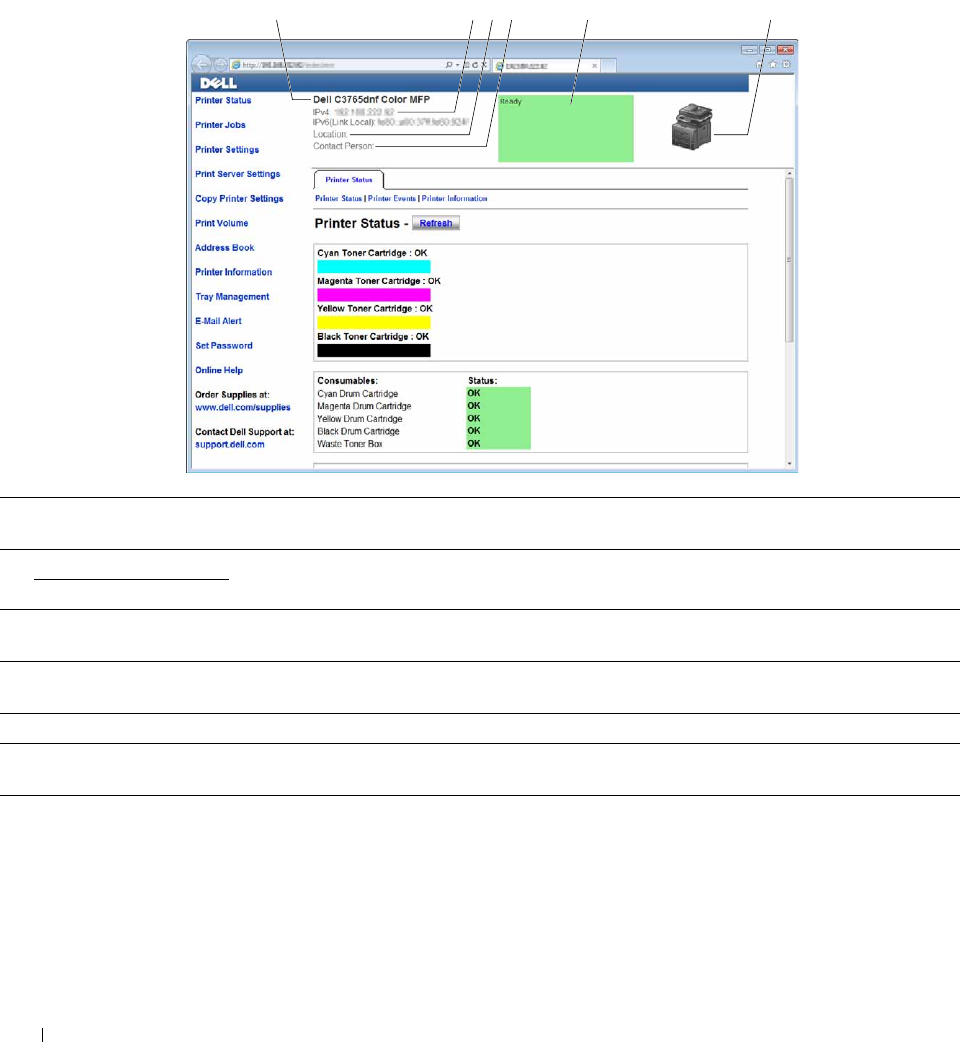
140 Dell™ Printer Configuration Web Tool
Page Display Format
The layout of the page is divided into three sections listed below:
•Top Frame
•Left Frame
•Right Frame
Top Frame
The top frame is located at the top of all pages. When the Dell Printer Configuration Web Tool is activated, the
current status and specifications of the printer are displayed in the top frame on every page.
The following items are displayed in the top frame.
1 Dell C3765dnf Color
MFP
Displays the product name of the printer.
2IPv4 Displays the IP address of the printer.
IPv6
3 Location Displays location of the printer. The location can be changed in the Basic Information section on
the Print Server Settings page.
4 Contact Person Displays the name of the printer administrator. The name can be changed in the Basic
Information section on the Print Server Settings page.
5 Event Panel Displays the indicator for the condition of the printer.
6 Machine image Shows the bitmap image of the printer. The Printer Status menu appears in the right frame when
you click on the image.
1234 65
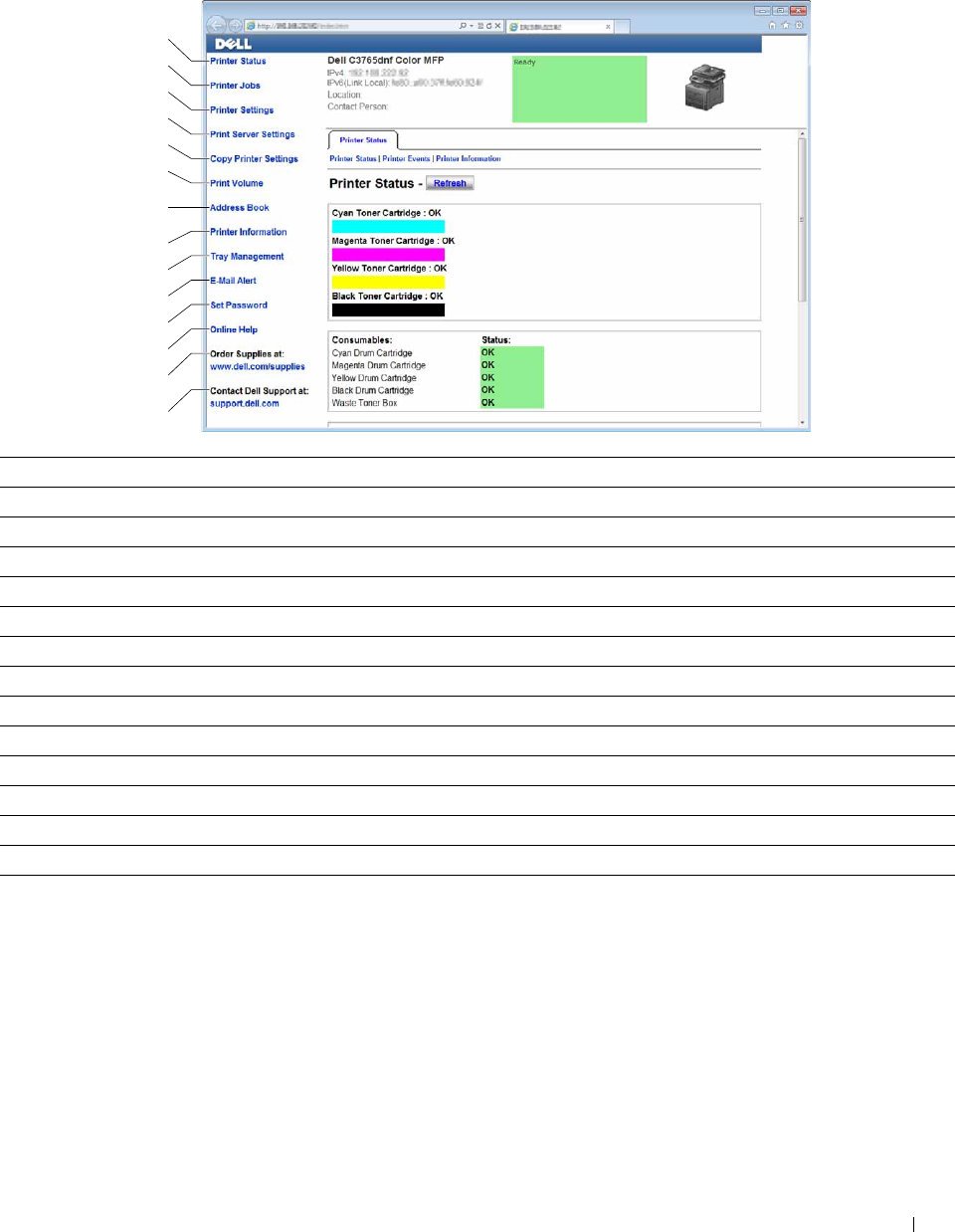
Dell™ Printer Configuration Web Tool 141
Left Frame
The left frame is located on the left side of all the pages. The menu titles displayed in the left frame are linked to
corresponding menus and pages. You can go to the corresponding page by clicking their characters.
The following menus are displayed in the left frame.
Right Frame
The right frame is located on the right side of all the pages. The contents of the right frame correspond to the menu
that you select in the left frame. For details on the items displayed in the right frame, see "Details of the Menu
Items."
1Printer Status Links to the Printer Status menu.
2Printer Jobs Links to the Printer Jobs menu.
3 Printer Settings Links to the Printer Settings Report menu.
4 Print Server Settings Links to the Print Server Reports menu.
5 Copy Printer Settings Links to the Copy Printer Settings menu.
6Print Volume Links to the Print Volume menu.
7 Address Book Links to the E-Mail Address menu.
8Printer Information Links to the Printer Status menu.
9 Tray Management Links to the Tray Management menu.
10 E-Mail Alert Links to the Print Server Settings menu.
11 Set Password Links to the Security menu.
12 Online Help Links to the Dell Support website.
13 Order Supplies at: Links to the Dell web page.
14 Contact Dell Support at: Links to the Dell support page web address: http://support.dell.com
1
2
3
4
5
6
8
9
10
11
12
13
14
7
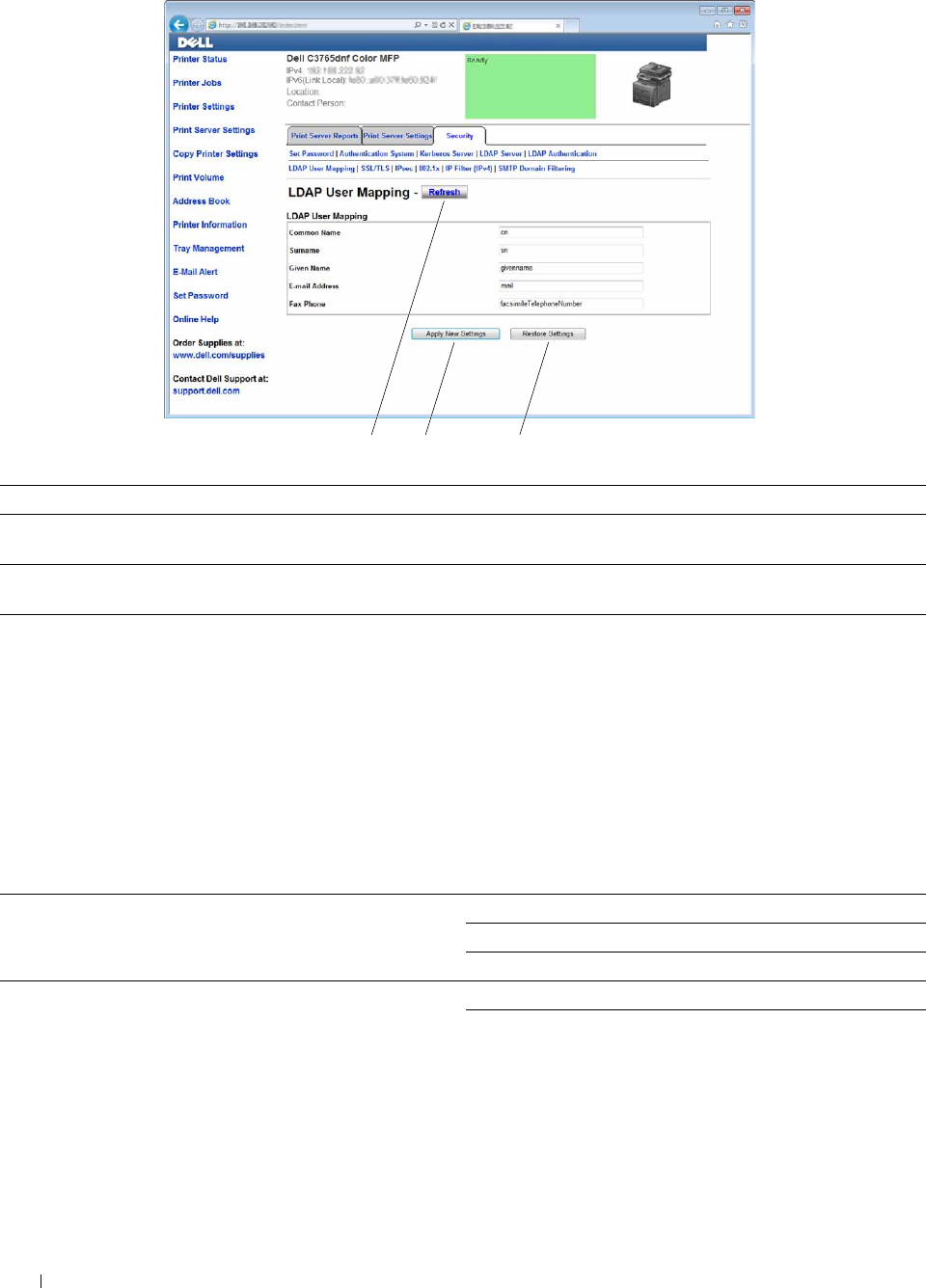
142 Dell™ Printer Configuration Web Tool
Buttons in the Right Frame
Changing the Settings of the Menu Items
Some menus allow you to change the printer settings through the Dell Printer Configuration Web Tool. When you
access these menus, the authentication window appears on the screen. Type a user name and password for the
printer administrator by following the prompts displayed in the dialog box.
The default user name is admin, and the default password is left blank (NULL). You can change only the password in
the Set Password page in the Security menu. The user name cannot be changed. See "Set Password" for more
information.
Details of the Menu Items
1Refresh Button Receives the current printer configuration and updates the latest information in the right frame.
2 Apply New Settings
Button
Submits new settings made on the Dell Printer Configuration Web Tool to the printer. The new
settings replace the old settings of the printer.
3 Restore Settings Button Restores the old settings that existed before any changes were made. New settings will not be
submitted to the printer.
"Printer Status" "Printer Status" "Printer Status"
"Printer Events"
"Printer Information"
"Printer Jobs" "Printer Jobs" "Job List"
"Completed Jobs"
1 2 3

Dell™ Printer Configuration Web Tool 143
"Printer Settings" "Printer Settings Report" "Menu Settings"
"Reports"
"Printer Settings" "System Settings"
"Network Settings"
"USB Settings"
"PCL Settings"
"PostScript Settings"
"PDF Settings"
"Secure Settings"
"Copy Defaults"
"Copy Color Balance"
"Copy Settings"
"Fax Defaults"
"Fax Settings"
"Scan Defaults"
"USB Direct Print Defaults"
"Printer Maintenance" "Paper Density"
"Adjust Transfer Belt Unit"
"Adjust 2nd BTR"
"Adjust Fusing Unit"
"Auto Registration Adjustment"
"Color Registration Adjustments"
"Reset Defaults"
"Initialize PrintMeter"
"Storage"*1
"Non-Dell Toner"
"Adjust Altitude"
"Clock Settings"
"Web Link Customization"

144 Dell™ Printer Configuration Web Tool
"Print Server Settings" "Print Server Reports" "Print Server Setup Page"
"E-Mail Alert Setup Page"
"Print Server Settings" "Basic Information"
"Port Settings"
"TCP/IP"
"SMB"
"E-Mail Alert"
"Bonjour (mDNS)"
"SNMP"
"Scan to PC"
"SNTP"
"Wireless LAN"*2
"AirPrint"
"Google Cloud Print"
"Proxy Server"
"Reset Print Server"
"Print Server Settings" "Security" "Set Password"
"Authentication System"
"Kerberos Server"
"LDAP Server"
"LDAP Authentication"
"LDAP User Mapping"
"SSL/TLS"
"IPsec"
"802.1x"*3
"IP Filter (IPv4)"
"SMTP Domain Filtering"
"Copy Printer Settings" "Copy Printer Settings" "Copy Printer Settings"
"Copy Printer Settings Report"
"Print Volume" "Print Volume" "Print Volume"
"Dell ColorTrack"
"Address Book" "E-Mail Address" "E-Mail Address"
"E-Mail Group"
"Default Setup"
"Server Address" "Server Address"
"Phone Book" "FAX Speed Dial"
"FAX Group"
"Tray Management" "Tray Management"
*1 This item is available only when RAM Disk is enabled.
*2 This item is available only when the printer is connected using the wireless network.
*3 This item is available only when the printer is connected using an Ethernet cable.

Dell™ Printer Configuration Web Tool 145
Printer Status
Use the Printer Status menu to check the status of consumables, hardware, and specifications of the printer.
The following pages are displayed in the Printer Status menu.
Printer Status
Purpose:
To check the status of the consumables, trays, and covers.
Val u e s:
Printer Events
Purpose:
When faults occur, such as
Out of Paper
or
Cover is open
, the details of all alerts or indications of faults are displayed
in the Printer Events page.
Val u e s:
Cyan Toner Cartridge
Magenta Toner Cartridge
Yellow Toner Cartridge
Black Toner Cartridge
OK Indicates that there is enough amount of toner for use.
Replace Soon Indicates that the toner needs to be replaced soon.
Replace Now Indicates that the toner needs to be replaced now.
Consumables Status OK Indicates that the status of the drum cartridge and/or waste toner
box is OK for use.
Replace Soon Indicates that the drum cartridge and/or waste toner box needs to be
replaced soon.
Replace Now Indicates that the drum cartridge and/or waste toner box needs to be
replaced now.
Paper Trays Status OK Indicates that there is some paper in the tray but the quantity is
unknown.
Add Paper Indicates that there is no paper in the tray.
Capacity Displays the maximum capacity of the paper tray.
Size Displays the size of paper in the tray.
Output Tray Status OK Indicates that the tray is available.
Full Indicates that the tray is not available.
Capacity Displays the maximum capacity of the paper tray.
Cover Status Closed Indicates that the cover is closed.
Open Indicates that the cover is open.
Printer Type Displays the type of the printer. Color Laser is displayed normally.
Printing Speed Displays the printing speed.
Location Displays the location where a fault occurred.
Details Displays the details of the fault.
146 Dell™ Printer Configuration Web Tool
Printer Information
Purpose:
To verify the printer details such as the hardware configuration and software version. This page can also be displayed
by clicking on the Printer Information tab in the left frame.
Val u e s:
Printer Jobs
The Printer Jobs menu contains information on the Job List and Completed Jobs pages. These pages show the
details of the status regarding each protocol or job.
Job List
Purpose:
To confirm the jobs that are being processed. Click the Refresh button to update the screen.
Val u e s:
Completed Jobs
Purpose:
To check the completed jobs. Up to the last 20 jobs are displayed. Click the Refresh button to update the screen.
Val u e s:
Dell Service Tag Number Displays Dell service tag number.
Express Service Code Displays Dell express service code.
Asset Tag Number Displays the asset tag number of the printer.
Printer Serial Number Displays the serial number of the printer.
Memory Capacity Displays the memory capacity.
Hard Disk*1Displays information on the printer's hard disk.
Processor Speed Displays the processing speed.
Printer Revision Levels Firmware Version Displays the revision date (revision level).
Network Firmware Version Displays the revision date (revision level).
*1This item is available only when the optional hard disk drive is installed.
ID Displays the job ID.
Job Name
Displays the file name of the job being processed.
Owner Displays the name of the job owner.
Host Name Displays the name of the host computer.
Job Status Displays the status of the job being processed.
Job Type Displays the type of the job.
Host I/F Displays the status of the host interface.
Job Submitted Time Displays the date when the job was submitted.
ID Displays the job ID.
Job Name Displays the file name of the completed job.
Owner Displays the name of the job owner.
Dell™ Printer Configuration Web Tool 147
Printer Settings
Use the Printer Settings menu to display the Printer Settings Report, Printer Settings, and Printer Maintenance
tabs and to configure the printer settings.
The following tabbed pages are displayed at the top of the right frame.
Printer Settings Report
The Printer Settings Report tab includes the Menu Settings and Reports pages.
Menu Settings
Purpose:
To display the current settings of the printer menus.
Val u e s:
Host Name Displays the name of the host computer.
Output Result Displays the status of the completed job.
Job Type Displays the type of the job.
Impression Number Displays the total number of pages for the job.
No. of Sheets Displays the total number of sheets for the job.
Host I/F Displays the status of the host interface.
Job Submitted Time Displays the date when the job was submitted.
System Settings Power Saver Time - Sleep Displays the time taken by the printer to enter Sleep mode after it
finishes a job.
Power Saver Time - Deep
Sleep
Displays the time taken by the printer to enter Deep Sleep mode after
it has entered Sleep mode.
mm / inch Displays the measurement unit that is used on the touch panel.
Display Brightness Displays the brightness level of the touch panel screen.
Control Panel Tone Displays the volume of the tone that is emitted when the operator
panel input is correct. Off indicates that the tone is disabled.
Invalid Key Tone Displays the volume of the tone that is emitted when the operator
panel input is incorrect. Off indicates that the tone is disabled.
Machine Ready Tone Displays the volume of the tone that is emitted when the printer
becomes ready. Off indicates that the tone is disabled.
Copy Completed Tone Displays the volume of the tone that is emitted when a copy job is
complete. Off indicates that the tone is disabled.
Job Completed Tone Displays the volume of the tone that is emitted when a job other than a
copy job is complete. Off indicates that the tone is disabled.
Fault Tone Displays the volume of the tone that is emitted when a job ends
abnormally. Off indicates that the tone is disabled.
Alert Tone Displays the volume of the tone that is emitted when a problem occurs.
Off indicates that the tone is disabled.
Out of Paper Tone Displays the volume of the tone that is emitted when the printer runs
out of paper. Off indicates that the tone is disabled.
Low Toner Alert Tone Displays the volume of the tone that is emitted when the toner is low.
Off indicates that the tone is disabled.

148 Dell™ Printer Configuration Web Tool
Auto Clear Alert Tone Displays the volume of the tone that is emitted 5 seconds before the
printer performs auto clear. Off indicates that the tone is disabled.
All Tones Displays the volume of all the alert tones. Off indicates that all the
tones are disabled.
Low Toner Alert Message Displays whether to show the alert message when the toner is low.
OffHook Wake Up Displays whether to wake up from Sleep or Deep Sleep mode when you
pick up the handset of the external telephone.
Auto Log Print Displays whether to automatically print a job history report after every
20 jobs.
RAM Disk*1 Displays whether to allocate RAM for the file system for the Secure
Print, Proof Print, Private Mail Box Print, and Public Mail Box Print
features.
Panel Language Displays the language used on the touch panel.
Auto Reset Displays the amount of time before the printer automatically resets its
settings to the defaults when no additional settings are made.
Fault Time-out Displays the amount of time the printer waits before canceling a job
that stops abnormally.
Job Time-out Displays the amount of time the printer waits for data to arrive from
the computer.
Default Paper Size Displays the default print paper size.
Print ID Displays where to print a user ID on the output paper.
Print Text Displays whether the printer outputs PDL (Page Description
Language) data (which is not supported by the printer) as text when
the printer receives it.
Banner Sheet Insert
Position
Displays where to insert a banner sheet in the output paper.
Banner Sheet Specify Tray Displays the tray to feed a banner sheet.
Substitute Tray Displays if paper of another size has to be used when the paper that is
loaded in the specified tray does not match the paper size setting for
the current job.
Letterhead 2 Sided Displays whether to print both sides on letterhead.
A4<>Letter Switch Displays whether to print A4 size jobs on Letter size paper if A4 is not
available in the paper trays and vice versa (Letter size job on A4 size
paper).
Report 2 Sided Print Displays whether to print reports on both sides a sheet of paper.
Use Another Tray Displays whether to show a message to select another tray when the
specified paper is not available in the paper tray.
Network Settings Adobe Protocol Displays PostScript communication protocol for each interface.
USB Settings USB Port Displays whether to enable the USB interface.
Adobe Protocol Displays PostScript communication protocol for each interface.
PCL Settings Paper Tray Displays the paper input tray.
Paper Size Displays the paper size setting.
Custom Paper Size - Y Displays the length of custom size paper.
Custom Paper Size - X Displays the width of custom size paper.
Orientation Displays how text and graphics are oriented on the page.
2 Sided Print Displays whether to print on both sides of a sheet of paper.

Dell™ Printer Configuration Web Tool 149
Font Displays the selected font from the list of registered fonts.
Symbol Set Displays a symbol set for the specified font.
Font Size Displays the font size for scalable typographic fonts.
Font Pitch Displays the font pitch for scalable mono spaced fonts.
Form Line Displays the number of lines in a page.
Quantity Displays the number of copies to print.
Image Enhance Displays whether to enable the Image Enhancement feature.
Hex Dump Displays whether to enable the Hex Dump feature.
Draft Mode Displays whether to print in the draft mode.
Line Termination Displays whether to set the line termination.
Default Color Displays the color mode setting.
Ignore Form Feed Displays whether to ignore blank pages that only contain Form Feed
control codes.
PostScript Settings PS Error Report Displays whether the printer outputs error contents for a PostScript
error.
PS Job Time-out Displays the execution time for one PostScript job.
Paper Select Mode Displays the tray that is selected in the PostScript printing.
Default Color Displays the color mode setting.
PDF Settings Quantity Displays the number of copies to print.
2 Sided Print Displays whether to print on both sides of a sheet of paper.
Print Mode Displays the print mode setting.
Collation Displays whether to sort a job.
Output Size Displays the output paper size.
Layout Displays the output layout.
Default Color Displays the color mode setting.
Secure Settings Panel Lock Control Displays whether to lock Admin Settings with a password.
Copy Displays whether to lock the Copy function with a password.
E-mail Displays whether to lock the Scan to E-mail function with a password.
Fax Displays whether to lock the Fax function with a password.
Fax Driver Displays whether to lock the Fax Driver function with a password.
Scan To Network Displays whether to lock the Scan To Network function with a
password.
Scan To Application Displays whether to lock the Scan To Application function with a
password.
PC Scan Displays whether to lock the PC Scan function with a password.
Scan To USB Displays whether to lock the Scan To USB function with a password.
USB Direct Print Displays whether to lock the USB Direct Print function with a password.
ID Card Copy Displays whether to lock the ID Card Copy function with a password.
USB Services - Show When
Inserted
Displays whether to show a USB Drive Detected screen when a USB
memory is inserted into the printer.
USB Services - Hide Until
Inserted
Displays whether to hide menus concerning USB memory until a USB
memory is inserted into the printer.
Secure Receive Set Displays whether a password is required to receive faxes.
150 Dell™ Printer Configuration Web Tool
Edit E-mail From Fields Displays whether to enable editing of the transmission source when you
use the Scan to E-mail function.
Reconfirm Recipients Displays whether to reconfirm before sending fax or scan jobs.
Software Download Displays whether to enable download of firmware updates.
Display of Network
Information
Displays whether to show network information in the message field of
the Main Home screen.
Encryption Displays whether to encrypt the data.
Hard Disk Over Write*2Displays whether to overwrite the hard disk drive.
Login Error Displays how many times an administrator can attempt to log in to
Panel Lock, Function Enabled, and Secure Receive.
Expiration Mode*3Displays whether to set the date to delete the files stored as Secure
Print in the RAM disk or the hard disk drive.
Expiration Time*3Displays the time to delete the files stored as Secure Print in the RAM
disk or the hard disk drive.
Recurrence*3Displays the period to repeat the setting.
Weekly Settings*3Displays the day of the week to repeat the setting.
Monthly Settings*3Displays the day of the month to repeat the setting.
Secure Settings -
Copy/Scan/Fax/Print
Set Available Time Displays whether to set the available time period for the Print, Copy,
Fax, and Scan functions, respectively.
Start Time Displays the start time of the available time period for the Print, Copy,
Fax, and Scan functions, respectively.
End Time Displays the end time of the available time period for the Print, Copy,
Fax, and Scan functions, respectively.
Recurrence Displays the day of the week to repeat the setting.
Copy Defaults Output Color Displays whether to make copies in color or in black and white.
Select Tray Displays the default input tray.
Collation Displays whether to sort a copy job.
Reduce/Enlarge Displays the default copy reduction/enlargement ratio.
Original Size Displays the paper size of the original.
Original Type Displays the type of the original.
Darken/Lighten Displays the default copy density.
Sharpness Displays the default sharpness level.
Color Saturation Displays the default color saturation level.
Auto Exposure Displays whether to suppress the background of the original to enhance
text on the copy.
Auto Exposure Level Displays the background suppression level.

Dell™ Printer Configuration Web Tool 151
Copy Color Balance Yellow Low Density Displays the color balance level of low density yellow.
Yellow Medium Density Displays the color balance level of medium density yellow.
Yellow High Density Displays the color balance level of high density yellow.
Magenta Low Density Displays the color balance level of low density magenta.
Magenta Medium Density Displays the color balance level of medium density magenta.
Magenta High Density Displays the color balance level of high density magenta.
Cyan Low Density Displays the color balance level of low density cyan.
Cyan Medium Density Displays the color balance level of medium density cyan.
Cyan High Density Displays the color balance level of high density cyan.
Black Low Density Displays the color balance level of low density black.
Black Medium Density Displays the color balance level of medium density black.
Black High Density Displays the color balance level of high density black.
Copy Settings 2 Sided Copying Displays whether to print on both sides of a sheet of paper.
Binding of Original Displays the binding position for the 2-sided copying.
2-Up Displays whether the Multiple-Up feature is enabled.
Margin Top/Bottom Displays the value of the top and bottom margins.
Margin Left/Right Displays the value of the left and right margins.
Margin Middle Displays the value of the middle margin.
Fax Defaults Resolution Displays the resolution level to be used for fax transmission.
2 Sided Scanning Displays whether to scan both sides of a document.
Binding of Original Displays the binding position for the 2-sided scanning.
Darken/Lighten Displays the density level to be used for fax transmission.
Delayed Send Displays the fax transmission start time.
Fax Settings Fax Number Displays the fax number of the printer, which will be printed on the
header of faxes.
Country Displays the country where the printer is used.
Fax Header Name Displays the name of the sender that will be printed on the header of
faxes.
Line Type Displays the line type; PSTN or PBX.
Line Monitor Displays the volume of the line monitor, which audibly monitors a
transmission through the internal speaker until a connection is made.
DRPD Pattern Displays the Distinctive Ring Pattern Detection (DRPD) setting.
Receive Mode Displays the fax receiving mode.
Ring Tone Volume Displays the volume of the ring tone, which indicates that an incoming
call is a telephone call through the internal speaker when Receive
Mode is set to Telephone/Fax.
Auto Receive Fax Displays the interval at which the printer goes into the fax receive
mode after receiving an incoming call.
Auto Receive Tel/Fax Displays the interval at which the printer goes into the fax receive
mode after the external telephone receives an incoming call.
Auto Receive Answer/Fax Displays the interval at which the printer goes into the fax mode after
the external answering machine receives an incoming call.
Junk Fax Setup Displays whether to reject faxes sent from unwanted stations.
Sent Fax Forward Displays whether to forward incoming faxes to a specified destination.

152 Dell™ Printer Configuration Web Tool
Forwarding Number Displays the fax number of the destination to which incoming faxes are
to be forwarded.
Forwarding E-mail
Address 1
Displays the e-mail address to which incoming faxes are to be
forwarded.
Forwarding E-mail
Address 2
Displays the e-mail address to which incoming faxes are to be
forwarded.
Forwarding E-mail
Address 3
Displays the e-mail address to which incoming faxes are to be
forwarded.
Forwarding E-mail
Address 4
Displays the e-mail address to which incoming faxes are to be
forwarded.
Forwarding E-mail
Address 5
Displays the e-mail address to which incoming faxes are to be
forwarded.
2 Sided Printing Displays whether to print on both sides of a sheet of paper.
Remote Receive Displays whether to receive faxes by pressing a remote receive code on
the external telephone.
Remote Receive Tone Displays the 2-digit remote receive code when Remote Receive is On.
Discard Size Displays whether to delete text or images at the bottom of a fax page
when the entire page does not fit onto the output paper.
Redial Attempts Displays the number of redial attempts to make if the destination fax
number is busy.
Interval of Redial Displays the interval between redial attempts.
Resend Delay Displays the interval between re-send attempts.
Tone/Pulse Displays whether to use tone or pulse dialing.
Prefix Dial Displays whether to set a prefix dial number.
Prefix Dial Number Displays a prefix dial number. This number dials before any auto dial
number is started. It is useful for accessing the Private Automatic
Branch Exchange (PABX).
Fax Cover Page Displays whether to attach a cover page to faxes.
Fax Header Displays whether to print the information of the sender on the header
of faxes.
ECM Displays whether the Error Correction Mode (ECM) is enabled.
Modem Speed Displays the modem speed.
Display Manual Fax
Recipients
Displays whether to show the fax number of the recipient on the
Sending Fax screen when manually sending a fax.
Fax Activity Displays whether to automatically print a fax activity report after every
50 incoming and outgoing fax communications.

Dell™ Printer Configuration Web Tool 153
Scan Defaults File Format Displays the file format in which scanned documents are to be saved.
Output Color Displays whether to scan in color or in black and white.
Resolution Displays the default scan resolution.
Original Size Displays the paper size of the original.
2 Sided Scanning Displays whether to scan both sides of a document.
Binding of Original Displays the binding position for the 2-sided scanning.
Darken/Lighten Displays the default scan density level.
Sharpness Displays the default sharpness level.
Contrast Displays the default contrast level.
Auto Exposure Displays whether to suppress the background of the original to enhance
text on the scan.
Auto Exposure Level Displays the background suppression level.
Margin Top/Bottom Displays the value of the top and bottom margins.
Margin Left/Right Displays the value of the left and right margins.
Margin Middle Displays the value of the middle margin.
TIFF File Format Displays the selected TIFF file format; TIFF V6 or TTN2.
Image Compression Displays the image compression level.
Max E-mail Size Displays the maximum size of e-mail that can be sent.
File Naming Mode Displays the mode used to name scanned documents.
Prefix/Suffix String Displays the text string that will be added to the file name.
Create Folder Displays the folder to which scanned documents are to be saved.
USB Direct Print
Defaults
Output Color Displays whether to print in color or in black and white.
Select Tray Displays the default input tray.
2 Sided Printing Displays whether to print on both sides of a sheet of paper.
Multiple-Up Displays whether to print two or more pages on one side of a sheet of
paper.
Collation*2 Displays whether to sort a job.
Paper Density Plain Displays the paper density of plain paper.
Label Displays the paper density of labels.
Adjust Transfer Belt Unit K Offset Displays the value for black ghost image.
YMC Offset Displays the value for color ghost image.
Adjust 2nd BTR Plain Displays the voltage setting of the transfer roller (-5 to 10) for plain
paper.
Plain Thick*4 Displays the voltage setting of the transfer roller (-5 to 10) for thick
plain paper.
Covers (106-163g/m2)Displays the voltage setting of the transfer roller (-5 to 10) for cover
paper.
Covers Thick*4
(164-216g/m2)
Displays the voltage setting of the transfer roller (-5 to 10) for thick
cover paper.
Coated (106-163g/m2)Displays the voltage setting of the transfer roller (-5 to 10) for coated
paper.
Coated Thick*4
(164-216g/m2)
Displays the voltage setting of the transfer roller (-5 to 10) for thick
coated paper.
Label Displays the voltage setting of the transfer roller (-5 to 10) for labels.

154 Dell™ Printer Configuration Web Tool
Envelope Displays the voltage setting of the transfer roller (-5 to 10) for
envelopes.
Recycled Displays the voltage setting of the transfer roller (-5 to 10) for recycled
paper.
Adjust Fusing Unit Plain Displays the temperature setting of the fusing unit (-3 to 3) for plain
paper.
Plain Thick*4 Displays the temperature setting of the fusing unit (-3 to 3) for thick
plain paper.
Covers (106-163g/m2)Displays the temperature setting of the fusing unit (-3 to 3) for cover
paper.
Covers Thick*4
(164-216g/m2)
Displays the temperature setting of the fusing unit (-3 to 3) for thick
cover paper.
Coated (106-163g/m2)Displays the temperature setting of the fusing unit (-3 to 3) for coated
paper.
Coated Thick*4
(164-216g/m2)
Displays the temperature setting of the fusing unit (-3 to 3) for thick
coated paper.
Label Displays the temperature setting of the fusing unit (-3 to 3) for labels.
Envelope Displays the temperature setting of the fusing unit (-3 to 3) for
envelopes.
Recycled Displays the temperature setting of the fusing unit (-3 to 3) for recycled
paper.
Auto Registration Adjustment Displays whether to automatically perform color registration
adjustment.
Adjust Altitude Displays the altitude of the location where the printer is installed.
Non-Dell Toner Displays whether to use toner cartridge of another manufacturer.
Clock Settings Date Format Displays the default date format.
Time Format Displays the default time format; 24H or 12H.
Time Zone Displays the default time zone.
Set Date Displays the date setting.
Set Time Displays the time setting.
Web Link Customization Select Reorder URL Displays a link used for ordering consumables, which can be accessed
from Order Supplies at: in the left frame.
Regular Displays the regular URL (http://accessories.us.dell.com/sna) that can
be linked to Order Supplies at:.
Premier Displays the premier URL (http://premier.dell.com) that can be linked
to Order Supplies at:.
Dell ColorTrack ColorTrack Mode Displays whether to enable the ColorTrack.
Non Registered User Displays whether to permit the printing of data without authentication
information.
Auto Color To Mono Print Displays whether to print all print jobs in black and white even when
color print is specified.
ColorTrack Error Report Displays whether to print the error report on the ColorTrack mode.
Dell™ Printer Configuration Web Tool 155
Reports
Purpose:
To print various types of reports and lists.
Val u e s:
Tray Management MPF Use Driver Settings
for Print Job
Displays whether to use the printer driver settings for the size and type
of paper loaded in the multipurpose feeder (MPF).
MPF Paper Size*5 Displays the paper size setting of the MPF.
MPF Paper Type*5 Displays the paper type setting of the MPF.
MPF Custom Paper Size -
Y*5 Displays the length of custom size paper loaded in the MPF.
MPF Custom Paper Size -
X*5 Displays the width of custom size paper loaded in the MPF.
MPF Display Tray
Prompt*5 Displays whether to show a popup menu that prompts the user to set
the paper size and type when the paper is loaded in the MPF.
Tray 1 Paper Size Displays the paper size setting of tray1.
Tray 1 Paper Type Displays the paper type setting of tray1.
Tray 1 Custom Paper Size -
Y
Displays the length of custom size paper loaded in tray1.
Tray 1 Custom Paper Size -
X
Displays the width of custom size paper loaded in tray1.
Tray 1 Display Tray
Prompt
Displays whether to show a popup menu that prompts the user to set
the paper size and type when the paper is loaded in tray1.
Tray 2 Paper Size*6 Displays the paper size setting of the optional 550-sheet feeder (tray2).
Tray 2 Paper Type*6 Displays the paper type setting of the optional 550-sheet feeder.
Tray 2 Custom Paper Size -
Y*6 Displays the length of custom size paper loaded in the optional 550-
sheet feeder.
Tray 2 Custom Paper Size -
X*6 Displays the width of custom size paper loaded in the optional 550-
sheet feeder.
Tray 2 Display Tray
Prompt*6 Displays whether to show a popup menu that prompts the user to set
the paper size and type when the paper is loaded in the optional 550-
sheet feeder.
1st Priority Displays the paper source to be used as the first priority.
2nd Priority Displays the paper source to be used as the second priority.
3rd Priority*6 Displays the paper source to be used as the third priority.
*1 This item is not available when the optional hard disk is installed.
*2 This item is available only when the optional hard disk is installed.
*3 This item is available only when RAM Disk is enabled or the optional hard disk is installed.
*4 For paper weight specifications, see "Paper Type Specifications."
*5 This item is available only when Off in MPF Use Driver Settings for Print Job is selected.
*6 This item is available only when the optional 550-sheet feeder is installed.
System Settings Click Start to print the System Settings page.
Panel Settings Click Start to print the Panel Settings page.
PCL Fonts List Click Start to print the PCL (Hewlett-Packard Printer Control Language) Fonts List.
PCL Macros List Click Start to print the PCL Macro List.
156 Dell™ Printer Configuration Web Tool
Printer Settings
The Printer Settings tab includes System Settings, Network Settings, USB Settings, PCL Settings, PostScript
Settings, PDF Settings, Secure Settings, Copy Defaults, Copy Color Balance, Copy Settings, Fax Defaults, Fax
Settings, Scan Defaults, and USB Direct Print Defaults pages.
System Settings
Purpose:
To configure the basic printer settings.
Val u e s:
PS Fonts List Click Start to print the PS Fonts List.
PDF Fonts List Click Start to print the PDF Fonts List.
Job History Click Start to print the Job History report.
Error History Click Start to print the Error History report.
Print Meter Click Start to print the Print Meter report.
Color Test Page Click Start to print the Color Test Page.
Protocol Monitor Click Start to print the Protocol Monitor report.
Speed Dial Click Start to print the Speed Dial report.
Address Book Click Start to print the Address Book report.
Server Address Click Start to print the Server Address report.
Fax Activity Click Start to print the Fax Activity report.
Fax Pending Click Start to print the Fax Pending report.
Stored Documents*1 Click Start to print the Stored Documents list.
*1 This item is available only when RAM Disk is enabled or the optional hard disk is installed.
Power Saver Time - Sleep Sets the time taken by the printer to enter Sleep mode after it finishes a job.
Power Saver Time - Deep Sleep Sets the time taken by the printer to enter Deep Sleep mode after it has
entered Sleep mode.
mm / inch Sets the measurement unit to be used on the touch panel as either mm or
inches.
Display Brightness Sets the brightness level of the touch panel screen.
Control Panel Tone Sets the volume of the tone that is emitted when the operator panel input is
correct, or disables the tone.
Invalid Key Tone Sets the volume of the tone that is emitted when the operator panel input is
incorrect, or disables the tone.
Machine Ready Tone Sets the volume of the tone that is emitted when the printer becomes ready,
or disables the tone.
Copy Completed Tone Sets the volume of the tone that is emitted when a copy job is complete, or
disables the tone.
Job Completed Tone Sets the volume of the tone that is emitted when a job other than a copy job
is complete, or disables the tone.
Fault Tone Sets the volume of the tone that is emitted when a job ends abnormally, or
disables the tone.
Alert Tone Sets the volume of the tone that is emitted when a problem occurs, or
disables the tone.

Dell™ Printer Configuration Web Tool 157
Network Settings
Purpose:
To Specify the PostScript communication protocol for this printer.
Val u e s:
USB Settings
Purpose:
To change USB settings on your printer.
Out of Paper Tone Sets the volume of the tone that is emitted when the printer runs out of
paper, or disables the tone.
Low Toner Alert Tone Sets the volume of the tone that is emitted when the toner is low, or
disables the tone.
Auto Clear Alert Tone Sets the volume of the tone that is emitted 5 seconds before the printer
performs auto clear, or disables the tone.
All Tones Sets the volume of all the alert tones, or disables all the tones.
Low Toner Alert Message Alerts you if the toner is low.
OffHook Wake Up Sets whether to wake up from Sleep or Deep Sleep mode when you pick up
the handset of the external telephone.
Auto Log Print Sets if a job history needs to be printed after every 20 jobs.
RAM Disk*1 Sets whether to allocate RAM for the file system for the Secure Print, Proof
Print, Private Mail Box Print, and Public Mail Box Print features.
Panel Language Used to set the language on the touch panel.
Auto Reset Sets the amount of time before the printer automatically resets its settings
to the defaults when no additional settings are made.
Fault Time-out Sets the amount of time the printer waits before canceling a job that stops
abnormally.
Job Time-out Sets the amount of time the printer waits for data to arrive from the
computer.
Default Paper Size Sets the default print paper size.
Print ID Sets where to print the user ID on the output paper.
Print Text Sets whether the printer outputs PDL data (which is not supported by the
printer) as text when the printer receives it.
Banner Sheet Insert Position Sets where to insert a banner sheet in the output.
Banner Sheet Specify Tray Sets from which tray a banner sheet is fed.
Substitute Tray Sets whether to use another size paper when the paper that is loaded in the
specified tray does not match the paper size settings for the current job.
Letterhead 2 Sided Sets whether to print on both sides of letterhead.
A4<>Letter Switch Sets whether to print A4 size jobs on Letter size paper if A4 is not available
in the paper trays and vice versa (Letter size job on A4 size paper).
Report 2 Sided Print Sets whether to print reports on both sides a sheet of paper.
Use Another Tray Sets whether to show a message to select another tray when the specified
paper is not available in the paper tray.
*1 This item is not available when the optional hard disk is installed.
Adobe Protocol Sets PostScript communication protocol for each interface.
158 Dell™ Printer Configuration Web Tool
Val u e s:
PCL Settings
Purpose:
To change the PCL settings.
Val u e s:
PostScript Settings
Purpose:
To change printer settings that only affect jobs using the PostScript emulation printer language.
Val u e s:
USB Port Enables the USB interface on your printer.
Adobe Protocol Sets PostScript communication protocol for each interface.
Paper Tray Sets the paper input tray.
Paper Size Sets the paper size.
Custom Paper Size - Y Sets the length of custom size paper. The available range is from 127 mm (5.0 inch) to 355 mm (14.0
inch).
Custom Paper Size - X Sets the width of custom size paper. The available range is from 77 mm (3.0 inch) to 215 mm (8.5
inch).
Orientation Sets how text and graphics are oriented on the page.
2 Sided Print Sets duplexing as the default for all print jobs.
Font Sets the font from the list of registered fonts.
Symbol Set Sets a symbol set for the specified font.
Font Size Sets the font size for scalable typographic fonts.
Font Pitch Sets the font pitch for scalable mono spaced fonts.
Form Line Sets the number of lines in a page.
Quantity Sets the number of copies to print.
Image Enhance Sets whether to enable the Image Enhancement feature.
Hex Dump Sets whether to help isolate the source of a print job problem. With Hex Dump selected, all data
sent to the printer is printed in hexadecimal and character representation. Control codes are not
executed.
Draft Mode Sets whether to print in the draft mode.
Line Termination Sets how to handle line terminations.
Default Color Sets the print color mode as Color or Black. This setting is used for print jobs without a specified
color print mode.
Ignore Form Feed Sets whether to ignore blank pages that only contain Form Feed control codes.
PS Error Report Sets whether the printer outputs error contents for a PostScript error.
PS Job Time-out Sets the execution time for one PostScript job.
Paper Select Mode Sets the way to select the tray for the PostScript mode.
Default Color Sets the default color mode for the PostScript mode.
Dell™ Printer Configuration Web Tool 159
PDF Settings
Purpose:
To change the PDF settings.
Val u e s:
Secure Settings
Panel Lock
Purpose:
To set a limited access to Admin Settings with a password, and to set or change the password.
Val u e s:
NOTE: You can set the password for the Dell Printer Configuration Web Tool from Set Password in Print Server Settings.
Function Enabled
Purpose:
To specify whether to lock the Copy, Scan, Fax, and Print functions with a password, and to set or change the
password.
Val u e s:
Quantity Sets the number of copies.
2 Sided Print Sets whether to print on both sides of a sheet of paper.
Print Mode Sets a print mode.
PDF Password Sets a password.
Re-enter PDF Password Confirms the set password.
Collation Sets whether to sort the output.
Output Size Sets the output paper size.
Layout Sets the output layout.
Default Color Sets the output color.
Panel Lock Control*1 Enables/Disables password protection for the Admin Settings.
New Password Sets a password that is required to access the Admin Settings.
Re-enter Password Confirms the set password.
*1 Some setting items in the Secure Settings are displayed only when this setting item is enabled.
Copy Sets whether to lock the Copy function with a password.
E-mail Sets whether to lock the Scan to E-mail function with a password.
Fax Sets whether to lock the Fax function with a password.
Fax Driver Sets whether to lock the Fax Driver function with a password.
Scan To Network Sets whether to lock the Scan To Network function with a password.
Scan To Application Sets whether to lock the Scan To Application function with a password.
PC Scan Sets whether to lock the PC Scan function with a password.
Scan To USB Sets whether to lock the Scan To USB function with a password.
USB Direct Print Sets whether to lock the USB Direct Print function with a password.
ID Card Copy Sets whether to lock the ID Card Copy function with a password.
160 Dell™ Printer Configuration Web Tool
NOTE: You can set the password for the Dell Printer Configuration Web Tool from Set Password in Print Server Settings.
Secure Receive
Purpose:
Allows you to password protect all the incoming faxes. When the Secure Receive feature is enabled, the printer
stores incoming faxes and prints them when the correct password is entered on the operator panel.
Val u e s:
NOTE: You can set the password for the Dell Printer Configuration Web Tool from Set Password in Print Server Settings.
Edit E-mail From Fields
Purpose:
To set whether to enable editing of the transmission source when you use the Scan to E-mail function.
Reconfirm Recipients
Purpose:
To set whether to reconfirm before sending fax or scan jobs.
Software Download
Purpose:
To set whether to enable download of firmware updates.
Display of Network Information
Purpose:
To set whether to show network information in the message field of the Main Home screen.
Data Encryption
Purpose:
To set whether to encrypt the data.
Val u e s:
USB Services - Show
When Inserted
Sets whether to show a USB Drive Detected screen when a USB memory is inserted into the printer.
USB Services - Hide
Until Inserted
Sets whether to hide menus concerning USB memory until a USB memory is inserted into the printer.
New Password Sets a password that is required to access the Copy, Scan, Fax, and Print functions.
Re-enter Password Confirms the set password.
Secure Receive Set Enables/Disables password protection for all incoming faxes.
New Password Sets a password for incoming faxes.
Re-enter Password Confirms the set password.
Data Encryption Encryption Sets whether to encrypt the data.
Encryption Key Sets a key that is required to encrypt.
Re-enter Encryption Key Enter the new key again to confirm.
Dell™ Printer Configuration Web Tool 161
NOTE: You can enter only characters from 0 to 9, a to z, A to Z, and NULL values for encryption key.
Hard Disk Over Write
NOTE: Hard Disk Over Write feature is available only when the optional hard disk is installed.
Purpose:
To set whether to overwrite the hard disk drive.
Val u e s:
Login Error
Purpose:
To specify how many times an administrator can attempt to log in to Panel Lock, Function Enabled, and Secure
Receive.
Val u e s:
Set Available Time - Copy/Scan/Fax/Print
Purpose:
To specify the time to enable the secure setting for the Copy, Scan, Fax, and Print functions.
Val u e s:
Secure Job Expiration
NOTE: Secure Job Expiration feature is available only when RAM Disk is enabled or the optional hard disk is installed.
Purpose:
To specify the date and time to delete the files stored as Secure Print in the RAM disk or the optional hard disk drive.
Val u e s:
Hard Disk Over Write Sets whether to overwrite the hard disk drive.
Login Error Displays how many times an administrator can attempt to log in to Panel Lock, Function Enabled,
and Secure Receive.
Set Available Time Allows you to set the available time period for the Copy, Scan, Fax, and Print functions.
Start Time Sets the start time of the available time period for the Copy, Scan, Fax, and Print functions.
End Time Sets the end time of the available time period for the Copy, Scan, Fax, and Print functions.
Recurrence Sets the day of the week to repeat the setting.
Expiration Mode Allows you to set the date to delete the files stored as Secure Print in the RAM disk or the optional
hard disk drive.
Expiration Time Sets the time to delete the files stored as Secure Print in the RAM disk or the optional hard disk drive.
Recurrence Sets the period to repeat the setting.
Weekly Settings Sets the day of the week to repeat the setting.
Monthly Settings Sets the day of the month to repeat the setting.
162 Dell™ Printer Configuration Web Tool
Copy Defaults
Purpose:
To create your own default Copy settings.
Val u e s:
Copy Color Balance
Purpose:
To specify the copy color balance.
Val u e s:
Copy Settings
Purpose:
To configure the Copy settings.
NOTE: Values marked by an asterisk (*) are the factory default menu settings.
Output Color Sets whether to print in color or in black and white.
Select Tray Sets the default input tray.
Collation Sets whether to sort a copy job.
Reduce/Enlarge Sets the default reduction/enlargement ratio.
Custom Reduce/Enlarge Sets the custom reduction/enlargement ratio.
Original Size Sets the paper size of the original.
Original Type Sets the type of the original.
Darken/Lighten Sets the default copy density.
Sharpness Sets the default sharpness level.
Color Saturation Adjusts the saturation of colors to make the colors lighter or darker than the original.
Auto Exposure Sets whether to suppress the background of the original to enhance text on the copy.
Auto Exposure Level Sets the background suppression level.
Yellow Low Density Sets the color balance level of low density yellow.
Yellow Medium Density Sets the color balance level of medium density yellow.
Yellow High Density Sets the color balance level of high density yellow.
Magenta Low Density Sets the color balance level of low density magenta.
Magenta Medium
Density
Sets the color balance level of medium density magenta.
Magenta High Density Sets the color balance level of high density magenta.
Cyan Low Density Sets the color balance level of low density cyan.
Cyan Medium Density Sets the color balance level of medium density cyan.
Cyan High Density Sets the color balance level of high density cyan.
Black Low Density Sets the color balance level of low density black.
Black Medium Density Sets the color balance level of medium density black.
Black High Density Sets the color balance level of high density black.
Dell™ Printer Configuration Web Tool 163
Val u e s:
Fax Defaults
Purpose:
To create your own default Fax settings.
NOTE: Values marked by an asterisk (*) are the factory default menu settings.
Val u e s:
Fax Settings
Purpose:
To configure the Fax settings.
NOTE: You cannot set up the items on the Fax Settings page unless you set up the country code under Country.
NOTE: Values marked by an asterisk (*) are the factory default menu settings.
Val u e s:
2 Sided Copying Sets whether to print on both sides of a sheet of paper.
Binding of Original Sets the binding position for the 2-sided copying.
2-Up Off*Does not perform multiple-up printing.
Auto Automatically reduces the original pages to fit onto one sheet of paper.
Manual Prints the original pages onto one sheet of paper in the size specified for
Reduce/Enlarge.
Margin Top/Bottom Sets the value of the top and bottom margins within the range of 0 mm (0.0 inch) to 50 mm (2.0
inch).
Margin Left/Right Sets the value of the left and right margins within the range of 0 mm (0.0 inch) to 50 mm (2.0 inch).
Margin Middle Sets the value of the middle margin within the range of 0 mm (0.0 inch) to 50 mm (2.0 inch).
Resolution Standard*Suitable for documents with normal sized characters.
Fine Suitable for documents containing small characters or thin lines or
documents printed using a dot-matrix printer.
Super Fine Suitable for documents containing extremely fine detail. The super fine
mode is enabled only if the remote machine also supports the Super Fine
resolution.
Photo Suitable for documents containing photographic images.
2 Sided Scanning Sets whether to scan both sides of a document.
Binding of Original Sets the binding position for the 2-sided scanning.
Darken/Lighten Sets the default density to fax your documents lighter or darker.
Delayed Send Sets the fax transmission start time when sending a fax at a specified time.
Fax Number Allows you to enter the fax number of the printer, which will be printed on the header of faxes.
Country Sets the country where the printer is used.
Fax Header Name Allows you to enter a name that will be printed on the header of faxes.
Line Type Sets the default line type; PSTN or PBX.
Line Monitor Sets the volume of the line monitor, which audibly monitors a transmission through the internal
speaker until a connection is made.
164 Dell™ Printer Configuration Web Tool
DRPD Pattern Sets the Distinctive Ring Pattern Detection (DRPD) setting from Pattern1 to Pattern7.
DRPD is a service provided by some telephone companies.
Receive Mode Fax*Automatically receives faxes.
Telephone Automatic fax reception is turned off. You can receive a fax by picking up the
handset of the external telephone and then pressing a remote receive code, or by
selecting Manual Receive in On Hook and then pressing the (Start)
button. For details about Manual Receive, see "Receiving a Fax Manually in
the Telephone Mode."
Telephone/Fax When the printer receives an incoming fax, the external telephone rings for the
time specified in Auto Receive Tel/Fax, and then the printer automatically
receives a fax. If an incoming call is not a fax, the printer beeps from the internal
speaker indicating that the call is a telephone call.
Ans Machine/Fax The printer can share a telephone line with an answering machine. In this mode,
the printer will monitor the fax signal and pick up the line if there are fax tones. If
the telephone communication in your country is serial, this mode is not
supported.
DRPD Before using the Distinctive Ring Pattern Detection (DRPD) option, a distinctive
ring service must be installed on your telephone line by the telephone company.
After the telephone company has provided a separate number for faxing with a
distinctive ring pattern, configure the fax setup to monitor for that specific ring
pattern.
Ring Tone Volume Sets the volume of the ring tone, which indicates that an incoming call is a telephone call through the
internal speaker when Receive Mode is set to Telephone/Fax.
Auto Receive Fax Sets the interval at which the printer goes into the fax receive mode after answering an incoming call.
Auto Receive Tel/Fax Sets the interval at which the printer goes into the fax receive mode after the external telephone
receives an incoming call.
Auto Receive
Answer/Fax
Sets the interval at which the printer goes into the fax receive mode after the external answering
machine receives an incoming call.
Junk Fax Setup Sets whether to reject unwanted faxes by accepting only the faxes from the numbers registered in the
Phone Book
Sent Fax Forward Sets whether to forward incoming faxes to a specified destination.
Forwarding Number Allows you to enter the fax number of the destination to which incoming faxes will be forwarded.
Forwarding E-mail
Address 1
Allows you to enter the e-mail address to which incoming faxes are to be forwarded.
Forwarding E-mail
Address 2
Allows you to enter the e-mail address to which incoming faxes are to be forwarded.
Forwarding E-mail
Address 3
Allows you to enter the e-mail address to which incoming faxes are to be forwarded.
Forwarding E-mail
Address 4
Allows you to enter the e-mail address to which incoming faxes are to be forwarded.
Forwarding E-mail
Address 5
Allows you to enter the e-mail address to which incoming faxes are to be forwarded.
2 Sided Printing Sets whether to print on both sides of a sheet of paper.
Remote Receive Sets whether to receive a fax by pressing a remote receive code on the external telephone.
Remote Receive Tone Sets a 2-digit remote receive code when Remote Receive is On.
Discard Size Sets whether to delete text or images at the bottom of a fax page when the entire page does not fit
onto the output paper. Selecting Auto Reduction automatically reduces the fax page to fit it onto the
output paper, and does not discard any images or text at the bottom of the page.
Dell™ Printer Configuration Web Tool 165
Scan Defaults
Purpose:
To create your own default Scan settings.
Val u e s:
Redial Attempts Sets the number of redial attempts (0–13) to make if the destination fax number is busy. If you enter
0, the printer will not redial.
Interval of Redial Sets the interval (1–15 minutes) between redial attempts.
Resend Delay Sets the interval (3–255 seconds) between re-send attempts.
Tone/Pulse Sets whether to use tone or pulse dialing.
Prefix Dial Sets whether to set a prefix dial number.
Prefix Dial Number Sets a prefix dial number of up to five digits. This number dials before any auto dial number is started.
It is useful for accessing the Private Automatic Branch Exchange (PABX).
Fax Cover Page Sets whether to attach a cover page to faxes.
Fax Header Sets whether to print the information of the sender on the header of faxes.
ECM Sets whether to enable the Error Correction Mode (ECM). To use the ECM, the remote machines
must also support the ECM.
Modem Speed Allows you to adjust the fax modem speed when a fax transmission or reception error occurs.
Display Manual Fax
Recipients
Sets whether to show the fax number of the recipient on the Sending Fax screen when manually
sending a fax.
Fax Activity Sets whether to automatically print a fax activity report after every 50 incoming and outgoing fax
communications.
Fax Transmit Sets whether to print a transmission report after every fax transmission or only when an error occurs.
Fax Broadcast Sets whether to print a transmission report after every fax transmission to multiple destinations or
only when an error occurs.
Fax Protocol Sets whether to print the protocol monitor report after every fax transmission or only when an error
occurs.
File Format Sets the file format in which scanned documents are to be saved.
Output Color Sets whether to scan in color or in black and white.
Resolution Sets the default scan resolution.
Original Size Sets the paper size of the original.
2 Sided Scanning Sets whether to scan both sides of a document.
Binding of Original Sets the binding position for the 2-sided scanning.
Darken/Lighten Sets the default scan density.
Sharpness Sets the default sharpness level.
Contrast Sets the default contrast level.
Auto Exposure Sets whether to suppress the background of the original to enhance text on the copy.
Auto Exposure Level Sets the default background suppression level.
Margin Top/Bottom Sets the value of the top and bottom margins within the range of 0 mm (0.0 inch) to 50 mm (2.0
inch).
Margin Left/Right Sets the value of the left and right margins within the range of 0 mm (0.0 inch) to 50 mm (2.0 inch).
Margin Middle Sets the value of the middle margin within the range of 0 mm (0.0 inch) to 50 mm (2.0 inch).
TIFF File Format Sets the TIFF file format to TIFF V6 or TTN2.
166 Dell™ Printer Configuration Web Tool
USB Direct Print Defaults
Purpose:
To create your own USB Direct Print Defaults setting.
Val u e s:
Printer Maintenance
The Printer Maintenance tab includes the Paper Density, Adjust Transfer Belt Unit, Adjust 2nd BTR, Adjust
Fusing Unit, Auto Registration Adjustment, Color Registration Adjustments, Reset Defaults, Initialize
PrintMeter, Storage, Non-Dell Toner, Adjust Altitude, Clock Settings, and Web Link Customization pages.
Paper Density
Purpose:
To specify the paper density.
Val u e s:
Adjust Transfer Belt Unit
Purpose:
To adjust the transfer bias when ghosting occur. (The ghost image may be the image of the previous page, or a part of
the page currently printing.)
Val u e s:
Adjust 2nd BTR
Purpose:
To specify the optimum voltage settings for printing for the 2nd Belt Transfer Roller (2nd BTR). To lower the
voltage, set negative values. To increase, set positive values.
Image Compression Sets the image compression level.
Max E-mail Size Sets the maximum size of e-mail that can be sent, within the range of 50 K bytes to 16384 K bytes.
File Naming Mode Sets the detailed settings of File Naming Mode to Auto, Add Prefix or Add Suffix.
Prefix/Suffix String Sets the texts that are added when Add Prefix or Add Suffix are selected.
Create Folder Sets whether to create a folder when saving scanned documents.
Output Color Sets whether to print in color or in black and white.
Select Tray Sets the default input tray.
2 Sided Printing Sets whether to print on both sides of a sheet of paper.
Multiple-Up Sets whether to print two or more pages on one side of a sheet of paper.
Collation Sets whether to sort the output.
PDF Password Sets a password.
Re-enter PDF Password Confirms the set password.
Plain Sets the density of plain paper to Light or Normal.
Label Sets the density of labels to Light or Normal.
K Offset If faint black colored ghosts appear, try to decrease the value.
YMC Offset If faint ghosts in color (yellow, magenta, or cyan) appear, try to decrease the value.
Dell™ Printer Configuration Web Tool 167
The default settings may not give the best output on all paper types. If you see mottles on the print output, try to
increase the voltage. If you see white spots on the print output, try to decrease the voltage.
CAUTION: The print quality changes depending on the setting values you select for this item.
Val u e s:
Adjust Fusing Unit
Purpose:
To specify the optimum temperature settings for printing for the fusing unit. To lower the temperature, set negative
values. To increase, set positive values.
The default settings may not give the best output on all paper types. When the printed paper has curled, try to lower
the temperature. When the toner does not fuse on the paper properly, try to increase the temperature.
NOTE: The print quality changes depending on the setting values you select for this item.
Val u e s:
Auto Registration Adjustment
Purpose:
To specify whether to automatically perform color registration adjustment.
Color Registration Adjustments
Purpose:
To specify whether to manually perform color registration adjustment.
Plain Sets the reference voltage setting for the transfer roller for plain paper within the range of -5 to 10.
Plain Thick Sets the reference voltage setting for the transfer roller for thick plain paper within the range of -5 to
10.
Covers Sets the reference voltage setting for the transfer roller for cover paper within the range of -5 to 10.
Covers Thick Sets the reference voltage setting for the transfer roller for thick cover paper within the range of -5 to
10.
Coated Sets the reference voltage setting for the transfer roller for coated paper within the range of -5 to 10.
Coated Thick Sets the reference voltage setting for the transfer roller for thick coated paper within the range of -5 to
10.
Label Sets the reference voltage setting for the transfer roller for labels within the range of -5 to 10.
Envelope Sets the reference voltage setting for the transfer roller for envelopes within the range of -5 to 10.
Recycled Sets the reference voltage setting for the transfer roller for recycled paper within the range of -5 to 10.
Plain Sets the temperature settings for the fusing unit for plain paper within the range of -3 to 3.
Plain Thick Sets the temperature settings for the fusing unit for thick plain paper within the range of -3 to 3.
Covers Sets the temperature settings for the fusing unit for cover paper within the range of -3 to 3.
Covers Thick Sets the temperature settings for the fusing unit for thick cover paper within the range of -3 to 3.
Coated Sets the temperature settings for the fusing unit for coated paper within the range of -3 to 3.
Coated Thick Sets the temperature settings for the fusing unit for thick coated paper within the range of -3 to 3.
Label Sets the temperature settings for the fusing unit for labels within the range of -3 to 3.
Envelope Sets the temperature settings for the fusing unit for envelopes within the range of -3 to 3.
Recycled Sets the temperature settings for the fusing unit for recycled paper within the range of -3 to 3.

168 Dell™ Printer Configuration Web Tool
Manual Color Registration Adjustments are required such as when the printer is initially installed and after the
printer is moved.
NOTE: The Color Registration Adjustments feature can be configured when Auto Registration Adjustment is set to Off.
Val u e s:
Auto Correct Click Start to automatically perform color registration correction.
Color Regi Chart Click Start to print a color registration chart. The color registration chart prints a lattice pattern of
yellow, magenta, and cyan lines. On the chart, look at the values on the right side that are next to the
line that is perfectly straight for each of the three colors. If the value for this line is 0, color registration
adjustment is not required. If the value for this line is any value other than 0, specify the adjustment
values under Color Registration Adjustments.
Color Registration
Adjustments
Sets lateral (perpendicular to paper feed direction) and process (paper feed direction) color
adjustment values individually for Yellow, Magenta, and Cyan within the range of -9 to 9.
Dell™ Printer Configuration Web Tool 169
Reset Defaults
Purpose:
To initialize the non-volatile (NV) memory. After executing this function and rebooting the printer, all the menu
parameters are reset to their default values.
Initialize PrintMeter
Purpose:
To initialize the print meter of the printer. When the print meter is initialized, the meter count is reset to 0.
Storage
NOTE: Storage feature is available only when RAM Disk is enabled or the optional hard disk is installed.
Purpose:
To clear all files stored in the RAM disk or the optional hard disk, or format the optional hard disk.
Val u e s:
Non-Dell Toner
Purpose:
To use toner cartridge of another manufacturer.
WARNING: Using a non-Dell toner cartridge may severely damage your printer. The warranty does not cover damages caused
by using non-Dell toner cartridges.
Adjust Altitude
Purpose:
To specify the altitude of the location where the printer is installed.
The discharge phenomenon for charging the photo conductor varies with barometric pressure. Adjustments are
performed by specifying the altitude of the location where the printer is being used.
Reset Defaults Reset Defaults User Fax Section and
restart printer.
Click Start to reset the fax number entries in the Address
Book.
Reset Defaults User Scan Section
and restart printer.
Click Start to reset the e-mail and server address entries
in the Address Book.
Reset Defaults System Section and
restart printer.
Click Start to reset the system parameters.
Power On Wizard Power On Wizard Click Start to perform the initial setup for the printer.
Clear Storage*1All Clear Click Start to clear all files stored as Secure Print, Proof Print, Private Mail Box
Print, and Public Mail Box Print in the RAM disk or the optional hard disk.
Secure Document Click Start to clear all files stored as Secure Print, Proof Print, Private Mail Box
Print, and Public Mail Box Print in the RAM disk or the optional hard disk.
Stored Document Click Start to clear all files stored in the RAM disk or the optional hard disk.
Format Hard Disk*2Format Hard Disk Click Start to format the optional hard disk. All fonts, forms and files for Secure
Print, Proof Print, Private Mail Box Print, and Public Mail Box Print stored in the
optional hard disk are cleared.
*1 This item is available only when RAM Disk is enabled or the optional hard disk is installed.
*2 This item is available only when the optional hard disk is installed.
170 Dell™ Printer Configuration Web Tool
Clock Settings
Purpose:
To specify the clock settings.
Val u e s:
Web Link Customization
Purpose:
To specify a link used for ordering consumables, which can be accessed from Order Supplies at: in the left frame.
Val u e s:
Print Server Settings
Use the Print Server Settings menu to set the type of printer interface and the necessary conditions for
communication.
The following tabbed pages are displayed in the top of the right frame.
Print Server Reports
The Print Server Reports tab includes the Print Server Setup Page and the E-Mail Alert Setup Page.
Print Server Setup Page
Purpose:
To verify the current settings of TCP/IP (Transmission Control Protocol/Internet Protocol) protocol and printing
ports. On this page, you can only verify the settings of items. If you want to change the settings, go to the pages in
the Print Server Settings tab.
Val u e s:
Date Format Sets the date format; YYYY/MM/DD, MM/DD/YYYY, or DD/MM/YYYY.
Time Format Sets the time format; 24 Hour Clock or 12 Hour Clock.
Time Zone Sets the time zone.
Set Date Sets the current date.
Set Time Sets the current time.
Select Reorder URL Sets a URL to be linked to Order Supplies at:
Regular Displays the regular URL (http://accessories.us.dell.com/sna) that can be linked to Order Supplies
at:.
Premier Displays the premier URL (http://premier.dell.com) that can be linked to Order Supplies at:.
Ethernet*1 Ethernet Settings Displays the current settings of Ethernet transmission rate and the duplex
settings.
Current Ethernet
Settings
Displays the current Ethernet settings.
MAC Address Displays the Media Access Control (MAC) address of the printer.

Dell™ Printer Configuration Web Tool 171
Wireless Settings*2 SSID Displays the name that identifies the network.
Network Type Displays the network type from either the Ad-Hoc or Infrastructure mode.
MAC Address Displays the MAC address of the wireless adapter.
Link Channel Displays the channel number of the connection.
Link Quality Displays the quality of the connection.
TCP/IP Settings IP Mode Displays the IP mode.
Host Name Displays the host name.
IPv4*3 IP Address Mode Displays the IP address mode.
IP Address Displays the IP address.
Subnet Mask Displays the subnet mask.
Gateway Address Displays the gateway address.
IPv6*4 Enable Stateless Address Displays whether to enable the stateless
address.
Use Manual Address Displays whether to set the IP address
manually.
Get IP Address from
DHCP
Displays whether to automatically set the IP
address via DHCP.
Manual Address*5 Displays the IP address.
Stateless Address 1-3*6 Displays the stateless addresses.
Stateful Address 1-3 Displays the stateful addresses.
Link Local Address*6 Displays the link local address.
Manual Gateway
Address*5 Displays the gateway address.
Auto Configure Gateway
Address*6 Displays the gateway address.
DNS IPv4*3 Get DNS Server Address
from DHCP
Displays whether to automatically set the
DNS server address via DHCP.
Current DNS Server
Address
Displays the current DNS server address.
IPv6*4 Get DNS Server Address
from DHCPv6-lite
Displays if the printer receives the DNS server
address automatically from the DHCPv6-lite
server.
Current DNS Server
Address
Displays the current DNS server address.
DNS Dynamic Update
(IPv4)
Displays the status of the DNS Dynamic
Update feature.
DNS Dynamic Update
(IPv6)
Displays the status of the DNS Dynamic
Update feature.
Auto Generate Search List Displays whether to automatically generate a
search list.
Search Domain Name Displays the search domain name.
Time-out Displays the time-out period.
Priority to IPv6 DNS
Name Resolution*7 Displays whether to use the DNS Name
Resolution feature.
172 Dell™ Printer Configuration Web Tool
WINS*3 WINS Mode Displays whether to automatically set the primary and secondary WINS
server addresses via DHCP.
WINS Primary Server Displays the primary WINS server address.
WINS Secondary Server Displays the secondary WINS server address.
LPD Port Status Displays the port status of the Line Printer Daemon (LPD) protocol.
Connection Time-Out Displays the connection time-out period.
Port9100 Port Status Displays the port status.
Port Number Displays the port number.
Connection Time-Out Displays the connection time-out period.
IPP Port Status Displays the port status.
Printer URI Displays the printer URI.
Connection Time-Out Displays the connection time-out period.
Port Number Displays the port number.
Maximum Sessions Displays the maximum number of connections received simultaneously by
the client.
WSD WSD Scan Displays whether to use WSD for scanning.
WSD Print Displays whether to use WSD for printing.
Port Number Displays the WSD port number.
Receive Time-Out Displays the receive time-out period.
Notification Time-Out Displays the notification time-out period.
Maximum Number of
TTL
Displays the maximum number of TTLs.
Maximum Number of
Notification
Displays the maximum number of notifications.
Network TWAIN Port Status Displays the port status.
Connection Time-Out Displays the connection time-out period.
FTP Port Status Displays the port status.
Connection Time-Out Displays the connection time-out period.
HTTP Port Status Displays the port status.
Port Number Displays the port number.
Simultaneous
Connections
Displays the maximum number of simultaneous connections.
Connection Time-Out Displays the connection time-out period.
SMB Port Status Displays the port status.
Host Name Displays the host name.
Workgroup Displays the workgroup.
Maximum Sessions Displays the maximum number of sessions.
Unicode Support Displays whether to notify the host name and workgroup name in Unicode
characters during SMB transmission.
Auto Master Mode Displays whether to enable the Auto Master Mode.
Encrypt Password Displays whether to encrypt the password during SMB transmission.
Job Time-Out Displays the job time-out period.
Connection Time-Out Displays the connection time-out period.

Dell™ Printer Configuration Web Tool 173
Bonjour (mDNS) Port Status Displays the port status.
Host Name Displays the host name.
Printer Name Displays the printer name.
Wide-Area Bonjour Displays the status of the Wide-Area Bonjour feature.
Telnet Port Status Displays the port status.
Connection Time-Out Displays the connection time-out period.
SNMP Port Status Displays the port status.
Enable SNMP v1/v2c
Protocol
Displays the status of the SNMP v1/v2c feature.
Enable SNMP v3
Protocol
Displays the status of the SNMP v3 feature.
Update Address Book Port Status Displays the port status.
Connection Time-Out Displays the connection time-out period.
FTP Client Connection Time-Out Displays the connection time-out period.
FTP Passive Displays whether to enable the FTP Passive mode.
SMB Client Connection Time-Out Displays the connection time-out period.
SNTP Port Status Displays the port status.
IP Address / Host Name Displays the IP address or the host name of the SNTP server.
Connection Time-Out Displays the connection time-out period.
Time Synchronization
Interval
Displays the interval for performing time synchronization using SNTP.
AirPrint Port Status Displays the port status.
Name Displays the name of AirPrint.
Location Displays the location of the printer.
Geo-Location Displays the physical location of the printer.
Google Cloud Print Port Status Displays the port status.
Registration state Displays the registration state.
Proxy Server Use Proxy Server Displays the status of proxy server.
Address to Bypass Proxy
Server
Displays the address of the bypass proxy server.
Server Name Displays the server name.
Port Number Displays the port number.
Authentication Displays the status of authentication feature.
Authentication System Authentication System
Settings (for ColorTrack
PRO)
Displays the authentication method.
Authentication System
Settings (for Server
Address/Phone Book)
Displays the authentication method.
174 Dell™ Printer Configuration Web Tool
E-Mail Alert Setup Page
Purpose:
To verify the current settings of SMTP/POP (Simple Mail Transfer Protocol/Post Office Protocol) used for the Scan
to E-mail feature, forwarding fax to e-mail feature, and E-Mail Alert feature. In this page, you can only verify the
settings of items. If you want to change the settings, go to the pages in the Print Server Settings tab.
Val u e s:
SSL/TLS HTTP - SSL/TLS
Communication
Displays the status of the HTTP - SSL/TLS Communication.
HTTP - SSL/TLS
Communication Port
Number
Displays HTTP - SSL/TLS Communication Port Number.
LDAP - SSL/TLS
Communication*8 Displays the status of the LDAP - SSL/TLS Communication.
Verify Remote Ser ver
Certificate*8 Displays the status of the Verify Remote Server Certificate.
IPsec Settings Protocol Displays the protocol status.
IKE Displays IKE authentication.
802.1x*1 Enable IEEE 802.1x Displays the status of IEEE 802.1x.
Authentication Method Displays the setting of authentication method for IEEE 802.1x.
IP Filter (IPv4)*9 Access List Displays the list of IP addresses that are permitted or denied access to the
printer.
SMTP Domain
Filtering
Domain Filtering Displays whether to enable Domain Filtering.
Allow Domain List Displays the domains allowed for sending e-mails.
*1 This item is available only when the printer is connected using an Ethernet cable.
*2 This item is available only when the printer is connected using the wireless network.
*3 This item is displayed when IPv4 Mode or Dual Stack in IP Mode is selected.
*4 This item is displayed when IPv6 Mode or Dual Stack in IP Mode is selected.
*5 This item is displayed only when Use Manual Address is set to Enable.
*6 This item is displayed only when an IP address has been assigned.
*7 This item is available only when using IPv6 dual mode.
*8 This item is displayed only when the optional hard disk is installed and is set to On for encryption.
*9 This item is available only for LPD or Port9100.
E-Mail Server Settings Port Status Displays the port status.
Primary SMTP Gateway Displays the primary SMTP (Simple Mail Transfer Protocol) gateway.
SMTP Port Number Displays the SMTP port number.
E-Mail Send
Authentication
Displays the authentication method for outgoing e-mail.
POP3 Server Address Displays the POP3 (Post Office Protocol 3) server address.
POP3 Port Number Displays the POP3 port number.
Reply Address Displays the IP address of servers connected with SMTP protocol when data
is incoming.
SMTP Server
Connection
Displays the status of the SMTP server connection.
Dell™ Printer Configuration Web Tool 175
Print Server Settings
The Print Server Settings tab includes the Basic Information, Port Settings, TCP/IP, SMB, E-Mail Alert, Bonjour
(mDNS), SNMP, Scan to PC, SNTP, Wireless LAN, AirPrint, Google Cloud Print, Proxy Server, and Reset Print
Server pages.
Basic Information
Purpose:
To configure basic information of the printer.
Val u e s:
NOTE: The Auto Refresh feature is effective for the contents of the top frame, Printer Status page, Job List page, and Completed
Jobs page.
Port Settings
Purpose:
To enable or disable printing ports and management protocol features.
E-Mail Alert Settings E-Mail List 1 Displays the acceptable e-mail addresses for
the E-Mail Alert feature specified in E-Mail
List 1.
Select Alerts for List 1 Supplies Alerts Displays the e-mail alert receive status for
consumables.
Paper Handling Alerts Displays the e-mail alert receive status for
paper handling.
Service Call Displays the e-mail alert receive status for
service calls.
E-Mail List 2 Displays the acceptable e-mail addresses for
the E-Mail Alert feature specified in E-Mail
List 2.
Select Alerts for List 2 Supplies Alerts Displays the e-mail alert receive status for
consumables.
Paper Handling Alerts Displays the e-mail alert receive status for
paper handling.
Service Call Displays the e-mail alert receive status for
service calls.
System Settings Printer Name Sets the name of the printer.
Location Sets the location of the printer.
Contact Person Sets the contact name, number, and other information of the printer
administrator and service center.
Administrator E-Mail
Address
Sets the contact address of the printer administrator and service center.
Asset Tag Number Enters the asset tag number for the printer.
EWS Settings Auto Refresh Automatically refreshes the contents of the status display pages.
Auto Refresh Interval Sets the time interval for refreshing the contents of the status display pages
automatically from 15 to 600 seconds.
176 Dell™ Printer Configuration Web Tool
Val u e s:
NOTE: The settings in the Port Settings page will be valid only when the printer is rebooted. When you change or configure the
settings, click the Apply New Settings button to apply the new settings.
TCP/IP
Purpose:
To configure the IP address, subnet mask, and gateway address of the printer.
Ethernet*1 Ethernet Settings Auto Detects the Ethernet transmission rate and the
duplex settings automatically.
10Base-T Half-Duplex Selects 10Base-T Half-Duplex as the default
value.
10Base-T Full-Duplex Selects 10Base-T Full-Duplex as the default
value.
100Base-TX Half-Duplex Selects 100Base-TX Half-Duplex as the default
value.
100Base-TX Full-Duplex Selects 100Base-TX Full-Duplex as the default
value.
1000Base-T Full-Duplex Selects 1000Base-T Full-Duplex as the default
value.
Current Ethernet Settings Displays the current settings of the Ethernet.
MAC Address Displays the MAC address of the printer.
Port Status LPD Sets whether to enable LPD.
Port9100 Sets whether to enable Port9100.
IPP Sets whether to enable IPP.
WSD Print Sets whether to enable WSD Print.
WSD Scan Sets whether to enable WSD Scan.
Network TWAIN Sets whether to enable Network TWAIN
FTP Sets whether to enable FTP.
SMB Sets whether to enable SMB.
Bonjour (mDNS) Sets whether to enable Bonjour (mDNS).
E-Mail Alert Sets whether to enable E-Mail Alert.
Teln e t Sets whether to enable Telnet.
SNMP Sets whether to enable SNMP.
Update Address Book Sets whether to enable Update Address Book.
SNTP Sets whether to enable SNTP.
Google Cloud Print Sets whether to enable Google Cloud Print.
*1 This item is available only when the printer is connected using an Ethernet cable.

Dell™ Printer Configuration Web Tool 177
Val u e s:
TCP/IP
Settings
IP Mode Sets the IP mode.
Host Name Sets the host name.
IPv4 IP Address Mode Sets the method for acquiring the IP address.
Manual IP Address When an IP address is being set manually, the IP is allocated to
the printer using the format nnn.nnn.nnn.nnn. Each octet that
makes up nnn.nnn.nnn.nnn is a value in the range of 0 to 254.
127 and any value in the range of 224 to 254 cannot be
specified for the first octet of a gateway address.
Manual Subnet Mask When an IP address is being set manually, the subnet mask is
specified using the format nnn.nnn.nnn.nnn. Each octet that
makes up nnn.nnn.nnn.nnn is a value in the range of 0 to 255.
255.255.255.255 cannot be specified as the subnet mask.
Manual Gateway
Address
When an IP address is being set manually, the gateway address
is specified using the format nnn.nnn.nnn.nnn. Each octet
that makes up nnn.nnn.nnn.nnn is a value in the range of 0 to
254. 127 and any value in the range of 224 to 254 cannot be
specified for the first octet of a gateway address.
IPv6 Enable Stateless
Address
Select the check box to enable the stateless address.
Use Manual Address Select the check box to set the IP address manually.
Get IP Address from
DHCP
Allows you to enable or disable the automatic setting of the IP
address via DHCP.
Manual Address Sets the IP address. To specify an IPv6 address, enter the
address followed by a slash (/) and then "64". For details,
consult your system administrator.
Manual Gateway
Address
Sets the gateway address.

178 Dell™ Printer Configuration Web Tool
DNS DNS Domain Name Sets the DNS domain name.
IPv4 Get DNS Server
Address from DHCP
Allows you to enable or disable the automatic setting of the
DNS server address via DHCP.
Manual DNS Server
Address
Manually sets the DNS server address in xxx.xxx.xxx.xxx
format when Get DNS Server Address from DHCP is not
selected.
IPv6 Get DNS Server
Address from DHCPv6-
lite
Select the check box to get the DNS server address
automatically from the DHCPv6-lite server.
Manual DNS Server
Address
Sets the DNS server address.
DNS Dynamic Update
(IPv4)
Select the check box to enable dynamic updates to DNS.
DNS Dynamic Update
(IPv6)
Select the check box to enable dynamic updates to DNS.
Auto Generate Search
List
Select the check box to automatically generate the search list.
Search Domain Name Sets the search domain name. Up to 255 alphanumeric
characters, periods, and hyphens can be used. If you need to
specify more than one domain name, separate them using a
comma or semicolon.
Time-out Sets the time-out period between 1 and 60 seconds.
Priority to IPv6 DNS
Name Resolution
Select the check box to enable the DNS Name Resolution
feature.
WINS WINS Mode Allows you to enable or disable the automatic setting of the primary and secondary
WINS server addresses via DHCP.
WINS Primary Server Manually sets the primary WINS server address in xxx.xxx.xxx.xxx format when WINS
Mode is not selected.
WINS Secondary
Server
Manually sets the secondary (backup) WINS server address in xxx.xxx.xxx.xxx format
when WINS Mode is not selected.
LPD Connection Time-
Out
Sets the connection time-out period from 1 to 3,600 seconds.
IP Filter (IPv4) Click IP Filter (IPv4) to set the IP Filter settings on the IP Filter (IPv4) page.
Port9100 Port Number Sets the port number from 9,000 to 9,999.
Connection Time-
Out
Sets the connection time-out period between 1 and 1,000 seconds.
IP Filter (IPv4) Click IP Filter (IPv4) to set the IP filter settings on the IP Filter (IPv4) page.
IPP Printer URI Displays the printer URI.
Connection Time-
Out
Sets the connection time-out period from 1 to 1,000 seconds.
Port Number Displays the port number for receiving requests from the client.
Maximum Sessions Displays the maximum number of connections received simultaneously by the client.
Dell™ Printer Configuration Web Tool 179
To configure the IP Filter feature, enter an IP address to be filtered in the Address field and the subnet mask in the
Address Mask field. Enter a numeric value between 0 and 255 in each field. "*" is appended to the current value.
IP Filter Setup Procedure
You can set up to a maximum of five items and the first item set takes priority. When setting multiple filters, enter
the shortest address first followed by a slightly longer address, a longer address and so on.
Enabling Printing From a Specified User
The following describes the procedure to enable printing only from the "192.168.100.10" IP address.
1
Click the first column of the
Access List
row
1
.
2
Enter "
192.168.100.10
" in the
Address
field and "
255.255.255.255
" in the
Address Mask
field.
3
Select
Accept
.
4
Click
Apply New Settings
.
Disabling Printing From a Specified User
The following describes the procedure to disable printing only from the "192.168.100.10" IP address.
1
Click the first column of the
Access List
row
1
.
2
Enter "
192.168.100.10
" in the
Address
field and "
255.255.255.255
" in the
Address Mask
field.
3
Select
Reject
.
4
Click the first column of the
Access List
row
2
.
WSD Port Number Sets the port number to 80 or from 8,000 to 9,999.
Receive
Time-Out
Sets the receive time-out period from 1 to 65,535 seconds.
Notification Time-
Out
Sets the notification time-out period from 1 to 60 seconds.
Maximum Number
of TTL
Sets the maximum number of TTL from 1 to 10.
Maximum Number
of Notification
Sets the maximum number of notifications from 10 to 20.
Network
TWAIN
Connection Time-
Out
Sets the connection time-out period between 1 and 65,535 seconds.
FTP Password Sets the password for FTP.
Re-enter Password Enter the password again to confirm it.
Connection Time-
Out
Sets the connection time-out period from 1 to 1000 seconds.
HTTP Port Number Sets the port number to 80 or from 8,000 to 9,999.
Simultaneous
Connections
Displays the maximum number of simultaneous connections.
Connection Time-
Out
Sets the connection time-out period from 1 to 255 seconds.
Telnet Password Sets the password for Telnet.
Re-enter Password Confirms the set password.
Connection Time-
Out
Sets the connection time-out period from 1 to 1,000 seconds.
Update
Address Book
Connection Time-
Out
Sets the connection time-out period from 1 to 65,535 seconds.
180 Dell™ Printer Configuration Web Tool
5
Enter "
0.0.0.0
" in the
Address
field and "
0.0.0.0
" in the
Address Mask
field.
6
Select
Accept
.
7
Click
Apply New Settings
.
Enabling and Disabling Printing from Network Addresses
You can enable printing from the "192.168" network address and disable printing from the "192.168.200"
network address.
The example below describes how to enable printing from the "192.168.200.10" IP address.
1
Click the first column of the
Access List
row
1
.
2
Enter "
192.168.200.10
" in the
Address
field and "
255.255.255.255
" in the
Address Mask
field.
3
Select
Accept
.
4
Click the first column of the
Access List
row
2
.
5
Enter "
192.168.200.0
" in the
Address
field and "
255.255.255.0
" in the
Address Mask
field.
6
Select
Reject
.
7
Click the first column of the
Access List
row
3
.
8
Enter "
192.168.0.0
" in the
Address
field and "
255.255.0.0
" in the
Address Mask
field.
9
Select
Accept
.
10
Click
Apply New Settings
.
SMB
Purpose:
To specify the setting of the Server Message Block (SMB) protocol.
Val u e s:
E-Mail Alert
Purpose:
To configure detailed settings of E-Mail Alert. This page can also be displayed by clicking the E-Mail Alert in the
left frame.
Val u e s:
Host Name Sets the host name of the server computer.
Workgroup Sets the workgroup.
Maximum Sessions Sets the maximum number of sessions.
Unicode Support Sets whether to notify the host name and workgroup name in Unicode characters during
SMB transmission.
Auto Master Mode Sets whether to enable the Auto Master Mode.
Encrypt Password Sets whether to encrypt the password.
Job Time-Out Sets the job time-out period between 60 and 3,600 seconds.
Connection Time-Out Sets the connection time-out period between 60 and 3,600 seconds.
E-Mail Server Settings Primary SMTP Gateway Sets the primary SMTP gateway.
SMTP Port Number Sets the SMTP port number. This must be 25, 587 or between 5,000 and
65,535.

Dell™ Printer Configuration Web Tool 181
E-Mail Send
Authentication
Sets the authentication method for outgoing e-mail.
SMTP Login User Sets the SMTP login user. Up to 63 alphanumeric characters, periods,
hyphens, underscores, and at symbols (@) can be used. If specifying more
than one address, separate them using commas.
SMTP Login Password Sets the SMTP account password using up to 31 alphanumeric characters.
Re-enter SMTP Login
Password
Confirms the set SMTP account password.
POP3 Server Address*1 Sets the POP3 server address in IP address format of "aaa.bbb.ccc.ddd" or
as a DNS host name using up to 63 characters.
POP3 Port Number*1 Sets the POP3 server port number. This must be 110 or between 5,000 and
65,535.
POP User Name*1 Sets the POP3 account user name. Up to 63 alphanumeric characters,
periods, hyphens, underscores, and at symbols (@) can be used. If
specifying more than one address, separate them using commas.
POP User Password*1 Sets the POP3 account password using up to 31 alphanumeric characters.
Re-enter POP User
Password*1 Confirms the set password.
Reply Address Designates the reply e-mail address sent with each E-mail Alert.
SMTP Server
Connection
Displays the status of the SMTP server connection.
E-Mail Alert Settings E-Mail List 1 Sets acceptable e-mail addresses for the E-
Mail Alert feature using up to 255
alphanumeric characters.
Select Alerts for List 1 Supplies Alerts Select the check box to receive an E-Mail
Alert for consumables.
Paper Handling Alerts Select the check box to receive an E-Mail
Alert for paper handling.
Service Call Select the check box to receive an E-Mail
Alert for Service Calls.
E-Mail List 2 Sets acceptable e-mail addresses for the E-
Mail Alert feature using up to 255
alphanumeric characters.
Select Alerts for List 2 Supplies Alerts Select the check box to receive an E-Mail
Alert for consumables.
Paper Handling Alerts Select the check box to receive an E-Mail
Alert for paper handling.
Service Call Select the check box to receive an E-Mail
Alert for Service Calls.
*1 This item is available only when POP before SMTP (Plain) or POP before SMTP (APOP) for E-Mail Send Authentication is selected.
182 Dell™ Printer Configuration Web Tool
Bonjour (mDNS)
Purpose:
To configure the detailed settings of Bonjour.
Val u e s:
SNMP
Purpose:
To configure the detailed settings of SNMP.
Val u e s:
SNMP v1/v2c
Purpose:
To edit the detailed settings of SNMP v1/v2 protocol.
To enter this page, click Edit SNMP v1/v2 Properties in the SNMP page.
Host Name Sets the host name up to 63 alphanumeric characters and "-" (dash). The original setting will remain
valid if no input is made.
Printer Name Sets the printer name up to 63 alphanumeric characters and symbol sets. The original setting will
remain valid if no input is made.
Wide-Area Bonjour Select the check box to enable the Wide-Area Bonjour protocol.
SNMP Configuration Enable SNMP v1/v2c
Protocol
Select the check box to enable the SNMP v1/v2c protocol.
Edit SNMP v1/v2c
Properties
Click to display the SNMP v1/v2c page and to edit the setting of SNMP
v1/v2c protocol from the page.
Enable SNMP v3
Protocol
Select the check box to enable the SNMP v3 protocol.
Edit SNMP v3
Properties
Click to display the SNMP v3 page and to edit the setting of SNMP v3
protocol from the page.
You can click this item only when SSL communication is enabled.

Dell™ Printer Configuration Web Tool 183
Val u e s:
SNMP v3
Purpose:
To edit the detailed settings of SNMP v3 protocol.
To enter this page, click Edit SNMP v3 Properties in the SNMP page.
Community Name Community Name
(Read only)*1 Sets the community name to access (read only) data using up to 31
alphanumeric characters.
The original setting will remain valid if no input is made. Characters
entered for community name in the previous settings will not be displayed
on the screen. The default Read Community is public.
Re-enter Community
Name (Read only)*1 Enters the community name to access (read only) data again to confirm it.
Community Name
(Read/Write)*1 Sets the community name to access (read and write) data using up to 31
alphanumeric characters.
The original setting will remain valid if no input is made. Characters
entered for community name in the previous settings will not be displayed
on the screen. The default Read/Write Community is private.
Re-enter Community
Name (Read/Write)*1 Enters the community name to access (read and write) data again to
confirm it.
Community Name
(Trap)*1 Sets the community name used for trap up to 31 alphanumeric characters.
The original setting will remain valid if no input is made. Characters
entered for Community Name (Trap) in the previous settings will not be
displayed on the screen. The default Trap Community is " " (NULL).
Re-enter Community
Name (Trap)*1 Enters the community name used for trap again to confirm it.
Trap Notification 1-4 Trap Address Type
Trap Address
Port Number
Notify
Select the check boxes to notify trap occurrence. In this case, specify the IP
address and IP socket in the following format:
IPv4
Specify the IP address and IP socket in the nnn.nnn.nnn.nnn:mmmmm
format. Each section of "nnn" is a variable value between 0 and 255. Note
that values 127 and 224-254 are not valid for the first three-digits only. IP
socket mmmmm is a variable value between 0 and 65,535.
IPv6
Specify the IP address and IP socket in the
xxxx:xxxx:xxxx:xxxx:xxxx:xxxx:xxxx:xxxx:mmmmm format. Each section
of "xxxx" is a hexadecimal variable value between 0 and ffff. IP socket
mmmmm is a variable value between 0 and 65,535.
Authenticate Error Trap Select the check box to notify Authenticate Error Trap.
*1 The default value can be changed by using Dell Printer Configuration Web Tool.
184 Dell™ Printer Configuration Web Tool
Val u e s:
Scan to PC
Purpose:
To specify the client when scanning data.
Val u e s:
SNTP
Purpose:
To configure the SNTP server settings in order to perform time synchronization through SNTP.
Val u e s:
Wireless LAN
NOTE: Wireless LAN feature is available only when the printer is connected using the wireless network.
Purpose:
To configure the detailed setting for the wireless network.
To use the wireless adapter, be sure to disconnect the Ethernet cable.
NOTE: Once wireless LAN is activated, wired LAN protocol will be disabled.
Administrator Account Account Enabled Select the check box to enable the administrator account.
User Name Enters the user name of the administrator account.
Authentication
Password
Sets the authentication password of the administrator account using 8 to 32
alphanumeric characters.
Re-enter Authentication
Password
Confirms the set password.
Privacy Password Sets the privacy password of the administrator account using 8 to 32
alphanumeric characters.
Re-enter Privacy
Password
Confirms the set password.
Print Drivers / Remote
Client Account
Account Enabled Select the check box to enable the print drivers and remote client account.
Reset to default
Password
Click to reset the password for the print drivers and remote client account
to default.
FTP Client Connection Time-Out Sets the connection time-out period from 1 to 60 seconds.
FTP Passive Sets whether to enable the FTP Passive mode.
SMB Client Connection Time-Out Sets the connection time-out period from 1 to 60 seconds.
SNTP IP Address / Host Name Sets the IP address or the host name of the SNTP server.
Connection Time-Out Sets the connection time-out period from 1 to 120 seconds.
Time Synchronization
Interval
Sets the interval for performing time synchronization using SNTP.
Last Connection Time Displays the last date and time when your printer was connected to the
SNTP server.
Connection Status Displays the status of the connections between the SNTP server and your
printer.

Dell™ Printer Configuration Web Tool 185
Val u e s:
Wireless Settings SSID Sets the name that identifies the wireless network. Up to 32 alphanumeric
characters can be entered.
Network Type Sets the network type from either Ad-Hoc or Infrastructure.
MAC Address Displays the MAC address of the wireless adapter for the printer.
Link Channel Displays the channel number of the wireless connection for the printer.
Link Quality Displays the quality of the wireless network connection for the printer.
Security Settings Encryption Select the encryption type from the list.
No Security Sets No Security to configure the wireless
setting without specifying an encryption type
from WEP, WPA-PSK, and WPA-Enterprise.
WEP Sets the WEP to use through the wireless
network.
WPA-PSK TKIP*1, 2 Sets the WPA-PSK TKIP to use through the
wireless network.
WPA-PSK AES/WPA2-PSK
AES*1, 2 Sets the WPA-PSK AES/WPA2-PSK AES to
use through the wireless network.
WPA-Enterprise
TKIP*2, 3, 4 Sets the WPA-Enterprise TKIP to use
through the wireless network.
WPA-Enterprise
AES/WPA2-Enterprise
AES*2, 3, 4
Sets the WPA-Enterprise AES/WPA2-
Enterprise AES to use through the wireless
network.
Mixed Mode PSK*1, 2 Sets the Mixed Mode PSK to use through the
wireless network. Mixed Mode PSK
automatically selects the encryption type
from either WPA-PSK TKIP, WPA-PSK AES,
or WPA2-PSK AES.
Mixed Mode
Enterprise*2, 3, 4 Sets the Mixed Mode Enterprise to use
through the wireless network. Mixed Mode
Enterprise automatically selects the
encryption type from either WPA-Enterprise
TKIP, WPA-Enterprise AES, or WPA2-
Enterprise AES.
WEP Encryption Select the WEP key code from either Hex or Ascii.
WEP Key 1 Sets the WEP key set used through the wireless network only when WEP
128bit or WEP 64bit is selected for Encryption.
Re-enter WEP Key 1 Enters the WEP key 1 again to confirm it.
WEP Key 2 Sets the WEP key set used through the wireless network only when WEP
128bit or WEP 64bit is selected for Encryption.
Re-enter WEP Key 2 Enters the WEP key 2 again to confirm it.
WEP Key 3 Sets the WEP key set used through the wireless network only when WEP
128bit or WEP 64bit is selected for Encryption.
Re-enter WEP Key 3 Enters the WEP key 3 again to confirm it.
WEP Key 4 Sets the WEP key set used through the wireless network only when WEP
128bit or WEP 64bit is selected for Encryption.
Re-enter WEP Key 4 Enters the WEP key 4 again to confirm it.
Transmit Key*6 Sets the transmit key type from the list.
186 Dell™ Printer Configuration Web Tool
AirPrint
Purpose:
To configure the detailed setting of AirPrint.
Val u e s:
Google Cloud Print
Purpose:
To register the printer to Google Cloud Print.
Val u e s:
Proxy Server
Purpose:
To configure the Proxy Server settings.
WPA-PSK Pass Phrase Sets the pass phrase.
Re-enter Pass Phrase Enters the pass phrase again to confirm it.
WPA-Enterprise*4, 5 EAP-Identity Sets the EAP-Identity for the authentication.
Authentication Method Shows the authentication method.
Login Name Sets the login name for the authentication.
Password Sets the password.
Re-enter Password Enters the password again to confirm it.
*1 For encryption, AES or TKIP method is used.
*2 This item is available only when Infrastructure is selected for Network Type.
*3 For authentication and encryption by digital certificate, AES or TKIP method is used.
*4 This item is displayed only when the optional hard disk is installed and is set to On for encryption.
*5 To activate the setting, import a certificate which supports wireless LAN (server/client) on the SSL/TLS pages, and enable the relevant
certificate in advance.
*6 When Auto is selected for Transmit Key, the key set specified for WEP Key 1 is used.
AirPrint Enable AirPrint Click to enable the printer for AirPrint.
Name Enters the name that is to be displayed as an AirPrint printer.
Location Sets the location of the printer.
Geo-Location Sets the physical location of the printer.
Supply Levels Cyan Toner Cartridge Displays the cyan toner level.
Magenta Toner
Cartridge
Displays the magenta toner level.
Yellow Toner Cartridge Displays the yellow toner level.
Black Toner Cartridge Displays the black toner level.
Google Cloud Print*1 (Registration state) Displays the Google Cloud Print registration state.
Register This Device to
Google Cloud Print
Click to register the printer to Google Cloud Print.
*1
Google Cloud Print can only be used when the machine is using IPv4.
Dell™ Printer Configuration Web Tool 187
Val u e s:
Reset Print Server
Purpose:
To initialize NVRAM (non-volatile RAM) for the network feature and reboot the printer. You can also initialize
NVRAM of the printer from Reset Defaults in the Printer Settings menu.
Val u e s:
Security
The Security tab includes Set Password, Authentication System, Kerberos Server, LDAP Server, LDAP
Authentication, LDAP User Mapping, SSL/TLS, IPsec, 802.1x, IP Filter (IPv4), and SMTP Domain Filtering.
Set Password
Purpose:
To set or change the password that is required to access the setup parameters of the printer from the Dell Printer
Configuration Web Tool. This page can also be displayed by clicking Set Password in the left frame.
NOTE: To restore the password to the default (NULL), initialize the non-volatile memory (NVM).
NOTE: You can set the password for access to Admin Settings from Panel Lock in Printer Settings.
Val u e s:
Authentication System
Purpose:
To specify the server authentication type, the server response time-out, or the search time-out.
Proxy Server Use Proxy Server Sets whether to enable the use of a proxy server.
Address to Bypass Proxy
Server
Sets the address to bypass proxy server.
Server Name Sets the name of the proxy server.
Port Number Sets the port number from 1 to 65535.
Authentication Sets whether to enable authentication.
Login Name Sets the login name for the proxy server.
Password Sets the login password for the proxy server.
Retype Password Confirms the set password.
Initialize NIC NVRAM Memory
and restart printer.
Click Start to initialize NVRAM, revert network settings to the factory default settings, and
reboot the network capability.
Restart Printer Click Start to reboot the printer.
Administrator Password Sets the password using up to 128 alphanumeric characters.
Re-enter Administrator Password Confirms the set password.
Access denial by the authentication
failure of the Administrator
Sets the amount of time the administrator should wait for the access to the printer
setup from Dell Printer Configuration Web Tool. Sets the time period from 5 to 255
seconds. The access is denied if the time-out time is exceeded. If you set 0, this mode
is disabled.
188 Dell™ Printer Configuration Web Tool
Val u e s:
Kerberos Server
Purpose:
To specify the settings for the Kerberos server.
Val u e s:
LDAP Server
Purpose:
To specify the settings of the LDAP server.
Val u e s:
Authentication Type
(for ColorTrack PRO)
Authentication System
Settings
Select the authentication system from the list.
Authentication Type
(for Server Address/
Phone Book)*1
Authentication System
Settings
Select the authentication system from the list.
Optional Information Server Response Time-
Out
Sets the amount of time the printer should wait for response from the
server. Sets the time period from 1 to 75 seconds.
Search Time-Out Sets the amount of time the printer should wait for searching for the server.
Sets the time period from 5 to 120 seconds.
*1
If
Off
or
Internal Mode
is selected for
ColorTrack Mode
, be sure to select
LDAP
. For details about
ColorTrack Mode
, see "Dell ColorTrack."
Kerberos Server (for
ColorTrack PRO)
IP Address / Host Name
& Port
Sets the IP address or host name, and the port address. The port address
must be 88 or between 5,000 and 65,535.
Domain Name Enter the domain name.
Kerberos Server (for
Server Address/Phone
Book)
IP Address / Host Name
& Port
Sets the IP address or host name, and the port address. The port address
must be 88 or between 5,000 and 65,535.
Domain Name Enter the domain name.
Login Name Enter the login name.
Password Enter the login password.
Re-enter Password Enter the login password again to confirm it.
Server Information
(for ColorTrack PRO)
IP Address / Host Name
& Port
Sets IP address or the host name, and the port address. The port address
must be 389, 3268, or between 5,000 and 65,535.*1
LDAP Server Displays the current software information of the LDAP server.
Optional Information
(for ColorTrack PRO)
Search Directory Root Enters the search directory root.
Login Name Enters the login name.
Password Enters the login password using 1 to 127 alphanumeric characters. If the
password is left blank (NULL), you cannot log in to a server.
Re-enter-Password Enters the login password again to confirm it.
Search
Time-Out
Select Wait LDAP Ser ver Limit to follow the time specified by the LDAP
server. Select Wait to specify the time between 5 and 120 seconds.
Server Information
(for Server
Address/Phone Book)
IP Address / Host Name
& Port
Sets IP address or the host name, and the port address. The port address
must be 389, 3268, or between 5,000 and 65,535.*1
LDAP Server Displays the current software information of the LDAP server.
Dell™ Printer Configuration Web Tool 189
NOTE: Server Address Book must be set to On before you can use the server address book for the Scan to E-mail feature.
NOTE: Server Phone Book must be set to On before you can use the server phone book for the Fax function.
LDAP Authentication
Purpose:
To specify the LDAP server authentication method.
Val u e s:
LDAP User Mapping
Purpose:
To specify the settings of the LDAP user mapping.
Val u e s:
SSL/TLS
Purpose:
To specify the settings for the SSL encryption communication to the printer, and set/delete the certificate used for
IPsec, LDAPS, or Wireless LAN.
Optional Information
(for Server
Address/Phone Book)
Search Directory Root Enters the search directory root.
Login Name Enters the login name.
Password Enters the login password using 1 to 127 alphanumeric characters. If the
password is left blank (NULL), you cannot log in to a server.
Re-enter-Password Enters the login password again to confirm it.
Search
Time-Out
Select Wait LDAP Ser ver Limit to follow the time specified by the LDAP
server. Select Wait to specify the time between 5 and 120 seconds.
Search Name Order Sets the search order.
Server Address Book Select the check box to enable the server address book.
Server Phone Book Select the check box to enable the server phone book.
*1 When the optional hard disk is installed, 636 and 3269 also can be specified as the port address.
LDAP Authentication
(for ColorTrack PRO)
Authentication Method
Shows the authentication method.
Use Added Text String
Select whether to use the added text string from the list.
Text String Added to
User Name
Enter the added text string.
LDAP Authentication
(for Server Address/
Phone Book)
Authentication Method
Shows the authentication method.
Use Added Text String
Select whether to use the added text string from the list.
Text String Added to
User Name
Enter the added text string.
Common Name
Sets the attribute type of the common name set for the LDAP server.
Surname
Sets the attribute type of the surname set for the LDAP server.
Given Name
Sets the attribute type of the given name set for the LDAP server.
E-mail Address Sets the attribute type of the e-mail address set for the LDAP server.
Fax Phone Sets the attribute type of the fax phone number set for the LDAP server.

190 Dell™ Printer Configuration Web Tool
Val u e s:
HTTP-SSL/TLS
Communication*1 Select the check box to enable the HTTP-SSL/TLS Communication.
HTTP-SSL/TLS
Communication Port
Number
Sets the port number, which is not identical with that of HTTP for SSL/TLS. This must be 443 or
between 8000 and 9999.
LDAP-SSL/TLS
Communication*1, 2 Select the check box to enable the LDAP, and access is established using SSL/TLS communication.
Verify Remote Server
Certificate*2 Select the check box to enable the Verify Remote Server Certificate function.
Generate Self-Signed
Certificate*3 Click to display the Generate Self-Signed Certificate page and to create a security certification from
the page. The Generate Self-Signed Certificate button is available only when the self-signed
certificate is not generated.
Public Key Method Select the public key method of the self-signed certificate.
Size of Public Key Select the size of public key.
Issuer Sets the issuer of SSL self-signed certificate.
Generate Signed
Certificate
Click to generate the SSL self-signed certificate.
Upload Signed
Certificate*3, 4 Click to display the Upload Signed Certificate page and to upload the certificate file to the device
from the page.
Password Enter the password to upload the certificate file.
Re-enter Password Enter the password again for confirmation.
File Name Click Browse to browse the file name to upload to the device.
Import Click Import to upload the certificate file to the device.
Certificate
Management*3, 4 Click to display the Certificate Management page and to manage a security certification from the
page.
Category Select the device to certificate.
Certificate Purpose Select the connection to certificate.
Certificate Order Select the order to certificate.
Display the List Click to display the Certificate List page.
Certificate List*3 Category Displays the device to certificate selected at the Certificate Management
page.
Certificate Purpose Displays the connection to certificate selected at the Certificate
Management page.
Issued To Displays the list of certificate order.
Valid i ty Displays whether certificate is valid or not.
Certificate Details Click to display the Certificate Details page. The SSL/TLS page is
displayed when no item in the Issued To column is selected.
Dell™ Printer Configuration Web Tool 191
IPsec
Purpose:
To specify the Security Architecture settings for Internet Protocol (IPsec) for encrypted communication to the
printer.
Val u e s:
Certificate Details*3 Category Displays the device to certificate selected at the Certificate Management
page or SSL/TLS page.
Issued To Displays the device to certificate.
Issuer Displays the issuer to certificate.
Serial Number Displays the serial number of the device.
Public Key Method Displays the public key method.
Size of Public Key Displays the size of public key.
Valid Fro m Displays the time the certificate is valid.
Valid U n til Displays the time the certificate is invalid.
Status Displays whether certificate is valid or not.
Certificate Purpose Displays the purpose of certificate.
Certificate Selection
Status
Displays the type of device certificate you selected.
E-mail Address Displayed only when an e-mail address is specified in the certificate.
Use this certificate*2 Click to apply this certificate to the device.
Delete Click to delete this certificate.
Export This
Certificate*2 Click to export the certificate to the other device.
*1 This item is available only when the self-signed certificate has been generated.
*2 This item is displayed only when the optional hard disk is installed and is set to On for encryption.
*3 This item is effective only when connected via SSL/TLS (https). Only the administrator is allowed to display the pages.
*4 This item is displayed only when the optional hard disk is installed and is set to On for encryption. If not, Certificate Details is displayed.
IPsec Settings Protocol Select the check box to enable the protocol.
IKE Sets IKE authentication. Device Certificate is displayed on the list only
when an effective digital signature is set up.
Pre-Shared Key Sets a shared key. Up to 255 alphanumeric characters, periods, and
hyphens can be used.
Re-enter Pre-Shared Key Enters the shared key again to confirm it.
Device Certificate*1 Displays the device certificate.
IKE SA Lifetime Sets the lifetime for IKE SA from 5 to 28,800 minutes.
IPsec SA Lifetime Sets the lifetime for IPsec SA from 5 to 2,880 minutes.
DH Group Sets the DH group.
PFS Select the check box to enable the PFS setting.
Remote peers IPv4 address Sets the IP address to connect to.
Remote peers IPv6 address Sets the IP address to connect to.
Non IPsec communication
policy
Allows communication with a device which does not support IPsec.
192 Dell™ Printer Configuration Web Tool
NOTE: If IPsec is enabled with incorrect settings, you must disable it using the IPsec menu on the operator panel.
802.1x
Purpose:
To specify the settings for IEEE 802.1x authentication for encrypted communication to the printer.
Val u e s:
IP Filter (IPv4)
Purpose:
To specify the IP address and subnet mask to be permitted or denied access to the printer.
Val u e s:
SMTP Domain Filtering
Purpose:
To specify whether to restrict sending e-mails to specific domains only.
NOTE: This feature does not restrict sending e-mails through the E-Mail Alert feature.
*1 This item is effective only when the optional hard disk is installed and is set to On for encryption.
Configure 802.1x Enable IEEE 802.1x Select the check box to enable IEEE 802.1x authentication.
Authentication Method EAP-MD5 Selects the authentication method to use for IEEE
802.1x authentication.
EAP-MS-
CHAPv2
PEAP/MS-
CHAPv2
EAP-TLS*1, 2
Login Name: (Device
Name)
Sets the login name (device name) for IEEE 802.1x authentication using
up to 128 alphanumeric characters.
Password Sets the login password for IEEE 802.1x authentication using up to 128
alphanumeric characters.
Re-enter Password Confirms the set login password.
Certificate Validation Select the check box to enable Certificate Validation.
*1 This item is displayed only when the optional hard disk is installed and is set to On for encryption.
*2 When this item is selected, Password and Re-enter Password need not to be specified.
Access List Address Sets the IP addresses that are permitted or denied access to the printer. Enter a
numeric value between 0 and 255 in each field.
Address Mask Sets the subnet mask that are permitted or denied access to the printer. Enter a
numeric value between 0 and 255 in each field.
Active Mode Reject Rejects printing from specified network address.
Accept Permits printing from specified network address.
Off Disables the IP Filter feature for the specified IP address.
Dell™ Printer Configuration Web Tool 193
Val u e s:
Copy Printer Settings
The Copy Printer Settings menu includes the Copy Printer Settings and Copy Printer Settings Report pages.
Copy Printer Settings
Purpose:
To copy the printer settings to one or more of the same model of the printer.
To copy the settings to another printer, specify the IP address and password of the printer to which the settings are
copied in the IP Address
text box and Password text box. Then, click the Copy the settings to the Host in the above
list button. Copying the settings is complete. The connection time-out period is 60 seconds. After that, you can
check whether the settings were copied to this page. And you need to check the Copy the settings to the Host in the
above list and reboot the printer menu of the Dell Printer Configuration Web Tool in the destination printer to
verify if the settings were actually copied or not.
If the settings can be copied but the printer configuration is different, the settings of only the same items are copied.
Printer settings are simultaneously copied to printers of up to 10 IP addresses.
NOTE: You cannot copy the Address Book when the destination printer has a fax job.
Copy Printer Settings Report
Purpose:
To verify whether the printer setting is copied to other printers successfully.
NOTE: The history is cleared by turning off the printer.
Print Volume
The Printer Volume menu includes the Print Volume and Dell ColorTrack pages.
Print Volume
Purpose:
To verify the number of printed pages. This page can also be displayed by clicking Print Volume in the left frame.
Val u e s:
Dell ColorTrack
Purpose:
To specify which users have access to color printing and to limit print volume per user.
SMTP Domain Filtering Domain Filtering Select the check box to enable Domain Filtering.
Allow Domain List
Allows you to register up to five domains allowed for sending e-mails.
Printer Page Count Displays the total number of pages printed since the printer was shipped from the factory.
Paper Used
Displays the number of pages printed for each paper size.
194 Dell™ Printer Configuration Web Tool
Val u e s:
Address Book
The Address Book menu includes the E-Mail Address, Server Address, and Phone Book pages.
ColorTrack Mode Off Enables to print the data with no authentication information.
Internal Mode Restricts printing based on the print user information registered in the
internal server.
External Mode Restricts printing based on the print user information registered in the
external server.
Non Registered User Sets whether to permit the printing of data with no authentication information. To permit the
printing for non-account user, select the check box.
Non Registered User
Password*1 Sets the password to be used for non-account user using 1 to 127 alphanumeric characters. If the
password is left blank (NULL), you cannot log in to a server.
Re-enter Non Registered
User Password*1 Enter the password again to confirm it.
ColorTrack Error Report Sets whether to automatically print error-related information if printing using ColorTrack results in an
error.
Auto Color To Mono
Print
Sets whether to print all print jobs in black and white even when color print is specified.
User Registration*2 Click Edit User Registration to display the Edit Print User Registration page.
• To register a user, click
Create
to open the
Print User Settings
page.
• To delete a user, click
Delete
to open the
Delete User
page.
Clicking
Back
returns the screen to the status prior to deleting the user.
• To confirm or change the registered user, click
Confirm / Change
to open the
Print User Settings
page.
User Registration No. Displays the user registration number. The Delete User button is displayed
when the user is already registered.
User Name Sets the user name.
Password Sets the user password using 4 to 12 alphanumeric characters.
Re-enter password Enter the password again to confirm it.
Color Mode Limitation Sets whether to limit color printing.
Upper Limit for Color
Print
Sets the maximum number of pages allowed for color printing.
Cumulative Color Page
Count
Displays the cumulative number of pages printed for color printing.
Upper Limit for
Monochrome Print
Sets the maximum number of pages allowed for monochrome printing.
Cumulative
Monochrome Page
Count
Displays the cumulative number of pages printed for monochrome printing.
Setup Remote
Authentication*3 Click to display the Authentication System page.
*1 The password must be set when External Mode is selected for ColorTrack Mode and Non Registered User is set to on.
*2 This item is displayed only when ColorTrack Mode is Internal Mode.
*3 This item is displayed only when ColorTrack Mode is External Mode.

Dell™ Printer Configuration Web Tool 195
E-Mail Address
The E-mail Address page includes the following subpages.
E-Mail Address
Purpose:
To view the e-mail address entries registered on the E-Mail Address page.
Val u e s:
E-Mail Address (Confirm/Change, Create)
Purpose:
To view or edit the e-mail address entries on the E-Mail Address page, or create a new entry. The following items are
in the dialog box that appears when you click Confirm / Change or Create on the E-Mail Address top page.
Val u e s:
E-Mail Address E-Mail Address Allows you to view, edit, or create e-mail address entries.
E-Mail Group Allows you to view, edit, or create e-mail group entries.
Default Setup Allows you to view, edit, or set the default e-mail subject and message.
Server Address Server Address Allows you to view, edit, or create server address entries.
Phone Book FAX Speed Dial Allows you to view, edit, or create speed dial entries.
FAX Group Allows you to view, edit, or create fax group entries.
E-Mail Address Allows you to view, edit, or create e-mail address entries.
E-Mail Group Allows you to view, edit, or create e-mail group entries.
Default Setup Allows you to view, edit, or set the default e-mail subject and message.
Address List to: Selecting each button displays a list of entries for the group of user IDs indicated on the button.
ID Displays the user ID.
Name Displays the user name. (Not in Use) is displayed when there is no registration.
Address Displays the e-mail address of the user.
Delete Deletes the entry for the selected user ID.
Confirm / Change Displays a dialog box where you can edit the entry of the selected user ID.
Create Displays a dialog box where you can create a new entry under the selected user ID.
ID Displays the selected user ID.
Name Allows you to view or edit the name of the user registered under the user ID, or enter a name for the
new entry.
Address Allows you to view or edit the e-mail address of the user, or enter an e-mail address for the new entry.
Delete*1 Click this button to delete the selected user.
Apply New Settings Click this button to apply the new settings.
Restore Settings Click this button to restore the previous settings.
Back Click this button to return to the top page.
*1 This item is available only when you click Confirm / Change.
196 Dell™ Printer Configuration Web Tool
E-Mail Address (Delete)
Purpose:
To delete the e-mail address entries registered on the E-Mail Address page. The following items are in the dialog box
that appears when you click Delete on the E-Mail Address top page.
Val u e s:
E-Mail Group
Purpose:
To view the e-mail address entries registered on the E-Mail Group page.
Val u e s:
ID Displays the selected user ID.
Name Displays the name of the user registered under the selected user ID.
Address Displays the e-mail address of the user.
Apply New Settings Click this button to apply the new settings.
Back Click this button to return to the top page.
GroupID Displays the group ID.
Name Displays the assigned group name. (Not in Use) is displayed when there is no registration.
Delete Deletes the entry for the selected group ID.
Confirm / Change Displays a dialog box where you can edit the entry for the selected group ID.
Create Displays a dialog box where you can create a new entry under the selected group ID.
Dell™ Printer Configuration Web Tool 197
E-Mail Group (Confirm/Change, Create)
Purpose:
To view or edit the e-mail address group entries on the E-Mail Group page, or create a new entry. The following
items are in the dialog box that appears when you click Confirm / Change or Create on the E-Mail Group top page.
Val u e s:
E-Mail Group (Delete)
Purpose:
To delete the e-mail group entries registered on the E-Mail Group page. The following items are in the dialog box
that appears when you click Delete on the E-Mail Group top page.
Val u e s:
Default Setup
Purpose:
To set the default e-mail subject and message.
Val u e s:
E-Mail Group ID Displays the selected group ID.
Name Allows you to view or edit the name assigned for the group ID, or enter a
new group name.
Delete*1 Click this button to delete the current entry.
E-Mail Address Address List to: Selecting each button displays a list of entries for the group of IDs indicated
on the button.
ID Displays the user ID.
Select the check box on the left to create the group.
Name Displays the user name. (Not in Use) is displayed when there is no
registration.
Address Allows you to view or edit the e-mail address of an entry registered under
the selected user ID, or enter an e-mail address for the new entry.
Apply New Settings Click this button to apply the new settings.
Restore Settings Click this button to restore the previous settings.
Back Click this button to return to the top page.
*1 This item is available only when you click Confirm / Change.
ID Displays the selected group ID.
Name Displays the name assigned for the group ID.
Apply New Settings Click this button to apply the new settings.
Back Click this button to return to the top page.
Default Subject Allows you to enter the default e-mail subject.
Body Text Allows you to enter the default e-mail message.
Apply New Settings Click this button to apply the new settings.
Restore Settings Click this button to restore the previous settings.
198 Dell™ Printer Configuration Web Tool
Server Address
Server Address
Purpose:
To view the server address entries registered on the Server Address page.
Val u e s:
Server Address (Confirm/Change, Create)
Purpose:
To view or edit the server address entries on the Server Address page, or create a new entry. The following items are
in the dialog box that appears when you click Confirm / Change or Create on the Server Address top page.
Val u e s:
Address List to: Selecting each button displays a list of entries for the group of IDs indicated on the button.
ID Displays the server ID.
Name Displays the file directory name. (Not in Use) is displayed when there is no registration.
Server Address Displays the address of the file directory.
Delete Deletes the entry for the selected server ID.
Confirm / Change Displays a dialog box where you can edit the entry for the selected server ID.
Create Displays a dialog box where you can create a new entry under the selected server ID.
ID Displays the selected server ID.
Name Allows you to view or change the server name assigned to the server ID, or enter a new server name.
Server Type Allows you to view the server type if you click Confirm / Change. Allows you to edit the server type if
you click Create.
FTP*1 Select this to store scanned documents on a server via the FTP protocol.
SMB*1 Select this to store scanned documents on a computer via the Server
Message Block (SMB) protocol.
Server Address Allows you to view or edit the server address registered under the server ID, or enter a new server
address.
Share Name*2 Allows you to view or edit the assigned shared name, or enter a new shared name, when Server Type is
set to SMB.
Server Path Allows you to view or edit the assigned server path, or enter a new path.
Server Port Number Allows you to view or edit the assigned server port number, or enter a new port number. If you leave
the text box blank, the default port number (FTP: 21, SMB: 139) will be used.
Login Name Allows you to view or edit the login name that is required to access the selected protocol, or enter a
new login name.
Login Password Allows you to view or edit the password that is required to access the selected protocol, or enter a new
password.
Re-enter Password Confirms the set password.
Delete*3 Click this button to delete the current entry.
Apply New Settings Click this button to apply the new settings.
Restore Settings Click this button to restore the previous settings.
Back Click this button to return to the top page.
Dell™ Printer Configuration Web Tool 199
Server Address (Delete)
Purpose:
To delete the server address entries registered on the Server Address page. The following items are in the dialog box
that appears when you click Delete on the Server Address top page.
Val u e s:
Phone Book
The Phone Book page includes the following subpages.
FAX Speed Dial
Purpose:
To view the fax number entries registered on the FAX Speed Dial page.
Val u e s:
FAX Speed Dial (Confirm/Change, Create)
Purpose:
To view or edit the speed dial entries on the FAX Speed Dial page, or create a new entry. The following items are in
the dialog box that appears when you click Confirm / Change or Create on the FAX Speed Dial top page.
Val u e s:
*1 You can edit this item only when you click Create.
*2 This item is available only when Server Type is set to SMB.
*3 This item is available only when you click Confirm / Change.
ID Displays the selected server ID.
Name Displays the name assigned for the server ID.
Server Address Displays the server address registered under the server ID.
Apply New Settings Click this button to apply the new settings.
Back Click this button to return to the top page.
FAX Speed Dial Allows you to view, edit, or create speed dial entries.
FAX Group Allows you to view, edit, or create fax group entries.
Speed Dial List to: Selecting each button displays a list of entries for the group of speed dial codes indicated on the
button.
Speed Dial Displays the speed dial ID.
Name Displays the assigned name for a speed dial ID.
Phone Number Displays the speed dial code. (Not in Use) is displayed when there is no registration.
Delete Deletes the entry for the selected speed dial code.
Confirm / Change Displays a dialog box where you can edit the entry for the selected speed dial code.
Create Displays a dialog box where you can create a new entry under the selected speed dial code.
Speed Dial Displays the selected speed dial code.
200 Dell™ Printer Configuration Web Tool
FAX Speed Dial (Delete)
Purpose:
To delete the speed dial entries registered on the FAX Speed Dial page. The following items are in the dialog box
that appears when you click Delete on the FAX Speed Dial top page.
Val u e s:
FAX Group
Purpose:
To view the fax group entries registered on the FAX Group page.
Val u e s:
FAX Group (Confirm/Change, Create)
Purpose:
To view or edit the fax number group entries on the FAX Group page, or create a new entry. The following items are
in the dialog box that appears when you click Confirm / Change or Create on the FAX Group top page.
Val u e s:
Name Allows you to view or edit the name of an entry registered under the speed dial code, or enter a
name for the new entry.
Phone Number Allows you to view or edit the fax number of an entry registered under the speed dial code, or
enter a fax number for the new entry.
Delete*1 Click this button to delete the entry for the speed dial code. This button is available only on
the dialog box for editing an existing entry.
Apply New Settings Click this button to apply the new settings.
Restore Settings Click this button to restore the previous settings.
Back Click this button to return to the top page.
*1 This item is available only when you click Confirm / Change.
Speed Dial Displays the selected speed dial code.
Name Displays the name registered under the speed dial code.
Phone Number Displays the fax number registered under the speed dial code.
Apply New Settings Click this button to apply the new settings.
Back Click this button to return to the top page.
ID Displays a fax group ID.
Name Displays the assigned group name. (Not in Use) is displayed when there is no registration.
Delete Deletes the entry for the selected group ID.
Confirm / Change Displays a dialog box where you can edit the entry for the selected group ID.
Create Displays a dialog box where you can create a new entry under the selected group ID.
FAX Group ID Displays the selected group ID.
Name Allows you to view or edit the name assigned for the group ID, or enter a
new group name.
Delete*1 Click this button to delete the current entry.
Dell™ Printer Configuration Web Tool 201
FAX Group (Delete)
Purpose:
To delete the fax number group entries registered on the FAX Group page. The following items are in the dialog box
that appears when you click Delete on the FAX Group top page.
Val u e s:
Tray Management
Use the Tray Management menu to set the paper size and type of paper loaded in tray1 and the optional 550-sheet
feeder.
Val u e s:
FAX Speed Dial Speed Dial List to: Selecting each button displays a list of entries for the group of speed dial
codes indicated on the button.
Speed Dial Displays the speed dial code. Select the check box on the left to add the
speed dial code in the group.
Name Displays the name registered for the speed dial code. (Not in Use) is
displayed when there is no registration.
Phone Number Allows you to view or edit the fax number of an entry registered under the
selected speed dial code, or enter a fax number for the new entry.
Apply New Settings Click this button to apply the new settings.
Restore Settings Click this button to restore the previous settings.
Back Click this button to return to the top page.
*1 This item is available only when you click Confirm / Change.
ID Displays the selected group ID.
Name Displays the name assigned for the group ID.
Apply New Settings Click this button to apply the new settings.
Back Click this button to return to the top page.
MPF Use Driver
Settings for Print Job
Sets whether to use the printer driver settings for the size and type of paper loaded in the MPF.
MPF Paper Size*1 Sets the size of paper loaded in the MPF.
MPF Paper Type*1 Sets the type of paper loaded in the MPF.
MPF Custom Paper
Size - Y*1 Sets the length of custom size paper loaded in the MPF.
MPF Custom Paper
Size - X*1 Sets the width of custom size paper loaded in the MPF.
MPF Display Tray
Prompt*1 Sets whether to display a popup message that prompts the user to set the paper size and type when
the paper is loaded in the MPF.
Tray 1 Paper Size Sets the size of paper loaded in tray1.
Tray 1 Paper Type Sets the type of paper loaded in tray1.
Tray 1 Custom Paper
Size - Y
Sets the length of custom size paper loaded in tray1.
Tray 1 Custom Paper
Size - X
Sets the width of custom size paper loaded in tray1.

202 Dell™ Printer Configuration Web Tool
Tray 1 Display Tray
Prompt
Sets whether to display a popup message that prompts the user to set the paper size and type when
the paper is loaded in tray1.
Tray 2 Paper Size*2 Sets the size of paper loaded in the optional 550-sheet feeder.
Tray 2 Paper Type*2 Sets the type of paper loaded in the optional 550-sheet feeder.
Tray 2 Custom Paper
Size - Y*2 Sets the length of custom size paper loaded in the optional 550-sheet feeder.
Tray 2 Custom Paper
Size - X*2 Sets the width of custom size paper loaded in the optional 550-sheet feeder.
Tray 2 Display Tray
Prompt*2 Sets whether to display a popup message that prompts the user to set the paper size and type when
the paper is loaded in the optional 550-sheet feeder.
1st Priority Sets the paper source to be used as the first priority.
2nd Priority Sets the paper source to be used as the second priority.
3rd Priority*2 Sets the paper source to be used as the third priority.
*1 This item is available only when Off in MPF Use Driver Settings for Print Job is selected.
*2 This item is available only when the optional 550-sheet feeder is installed.
Understanding the Tool Box Menus 203
15
Understanding the Tool Box Menus
The Tool Box allows you to view, specify, and diagnose the system settings.
NOTE: A Password dialog box appears the first time you try to change settings on Tool Box when Panel Lock is set on the
printer. In this case, input the password that you have already specified, and click OK to apply the settings.
Starting the Tool Box
1
Click
Start
→
All Programs
→
Dell Printers
→
Dell C3765dnf Multifunction Color Laser Printer
→
Tool Box
.
The screen to select the printer appears.
2
Click
Network Connection
or
USB Connection
, and then select the printer listed in
Select From the Found
Printers
.
NOTE: If the printer is not listed in Select From the Found Printers when you click Network Connection, click Directly Input
IP Address/Host Name and enter the IP address of the printer. For details about how to verify the IP address of the printer,
see "Verifying the IP Settings."
NOTE: On Microsoft® Windows® XP or Windows Server® 2003, printers using IPv6 addresses cannot be detected.
3
Click
OK
.
The
Tool Box
opens.
The
Tool Box
consists of the
Printer Setting Reports
,
Printer Maintenance
, and
Diagnosis
tabs.
Printer Setting Reports
The Printer Setting Reports tab includes the Printer Information, Menu Settings, Reports, TCP/IP Settings, Tray
Settings, Default Settings, Fax Settings, and Panel Language pages.
Printer Information
Purpose:
To display the system information of the printer.
Val u e s:
Dell Service Tag Number Displays the service tag number of your printer.
Express Service Code Displays the express service code number.
Printer Serial Number Displays the serial number of your printer.
Printer Type Displays the type of printing for the printer. Color Laser is displayed normally.
Asset Tag Number Displays the asset tag number of your printer.
Memory Capacity Displays the memory capacity.
Processor Speed Displays the processing speed.
Firmware Version Displays the version of the controller.
Network Firmware Version Displays the NIC version.
MCU Firmware Version Displays the version of the Machine Control Unit (MCU) firmware.
Color Printing Speed Displays the speed for color printing.
Monochrome Printing Speed Displays the speed for monochrome printing.
204 Understanding the Tool Box Menus
Menu Settings
Purpose:
To display the menu settings of the printer.
Val u e s:
System Settings -
General
Power Saver Timer - Sleep Displays the amount of transition time to the Sleep mode
after the printer finishes a job.
Power Saver Timer - Deep Sleep Displays the amount of transition time between the Sleep
mode and the Deep Sleep mode.
Time Zone Displays the selected time zone.
Set Date Displays the date setting.
Set Time Displays the time setting.
Date Format Displays the selected date format.
Time Format Displays the selected time format; 24 Hour or 12 Hour.
mm / inch Displays the measurement unit used on the operator
panel.
Low Toner Alert Message Displays whether to show the alert message when the
toner is low.
OffHook Wake Up Displays whether to wake up from Sleep or Deep Sleep
mode when you pick up the handset of the external
telephone.
Auto Log Print Displays whether to automatically print a job history
report after every 20 jobs.
RAM Disk*1 Displays whether to allocate RAM for the disk file system
for the Secure Print, Private Mail Box Print, Public Mail
Box Print, and Proof Print features.
Fax Server Address Book Displays whether to specify the fax numbers from the
Address Book for the LDAP server.
E-mail Server Address Book Displays whether to specify the e-mail addresses from the
Address Book for the LDAP server.
System Settings - Audio
Tone
Control Panel Tone Displays the volume of the tone that is emitted when the
operator panel input is correct. Off indicates that the tone
is disabled.
Invalid Key Tone Displays the volume of the tone that is emitted when the
operator panel input is incorrect. Off indicates that the
tone is disabled.
Machine Ready Tone Displays the volume of the tone that is emitted when the
printer becomes ready. Off indicates that the tone is
disabled.
Copy Completed Tone Displays the volume of the tone that is emitted when a
copy job is complete. Off indicates that the tone is
disabled.
Job Completed Tone Displays the volume of the tone that is emitted when a job
other than copying is complete. Off indicates that the
tone is disabled.
Fault Tone Displays the volume of the tone that is emitted when a job
ends abnormally. Off indicates that the tone is disabled.
Understanding the Tool Box Menus 205
Alert Tone Displays the volume of the tone that is emitted when a
problem occurs. Off indicates that the tone is disabled.
Out of Paper Alert Tone Displays the volume of the tone that is emitted when the
printer runs out of paper. Off indicates that the tone is
disabled.
Low Toner Alert Tone Displays the volume of the tone that is emitted when the
toner is low. Off indicates that the tone is disabled.
Auto Clear Alert Tone Displays the volume of the tone that is emitted 5 seconds
before the printer performs auto clear. Off indicates that
the tone is disabled.
System Settings - Timers Auto Reset Displays the amount of time before the printer
automatically resets the settings on the operator panel to
the defaults when no additional settings are made.
Fault Time-out Displays the amount of time the printer waits before
canceling a job that stops abnormally.
Job Time-out Displays the amount of time the printer waits for data to
arrive from the computer.
System Settings -
Output Settings
Default Paper Size Displays the default paper size.
Print ID Displays where to print a user ID on the output paper.
Print Text Displays whether the printer outputs PDL (Page
Description Language) data (which is not supported by
the printer) as text when the printer receives it.
Banner Sheet Insert Position Displays where to insert the banner sheet.
Banner Sheet Specify Tray Displays the banner sheet tray.
Substitute Tray Displays an indication to use paper of a different size
when the paper that is loaded in the specified tray does
not match the paper size settings for the current job.
Letterhead 2 Sided Displays whether to print on both sides of a sheet of
letterhead paper.
Enable A4<>Letter Switch Displays whether to print A4 size jobs on Letter size paper
if A4 is not available in the paper trays and vice versa
(Letter size job on A4 size paper).
Report 2 Sided Print Displays whether to print reports on both sides of a sheet
of paper.
Use Another Tray Displays whether to show a message to select another tray
when the specified paper is not available in the paper tray.
Service Tools - Paper
Density
Plain Displays the plain paper density settings.
Label Displays the label paper density settings.
Service Tools - Auto
Registration Adjustment
Auto Registration Adjustment Displays whether to automatically adjust color
registration.
Service Tools - Non-Dell
Toner
Non-Dell Toner Displays whether to use toner cartridge of another
manufacturer.
Service Tools - Adjust
Altitude
Adjust Altitude Displays the altitude of the location where the printer is
installed.
*1 This item is not available when the optional hard disk is installed.
206 Understanding the Tool Box Menus
Reports
Purpose:
To print the settings and history information of the printer.
The reports are printed in the paper size specified in system settings.
Val u e s:
TCP/IP Settings
Purpose:
To display the current settings of TCP/IP (Transmission Control Protocol/Internet Protocol).
Val u e s:
System Settings Click this button to print a detailed list of the system settings.
Panel Settings Click this button to print a detailed list of the panel settings.
PCL Fonts List Click this button to print a list of the PCL (Hewlett-Packard Printer Control Language) fonts.
PCL Macros List Click this button to print a list of the PCL Macro.
PS Fonts List Click this button to print a list of the PS fonts.
PDF Fonts List Click this button to print a list of the PDF fonts.
Job History Click this button to print the Completed Jobs history of the printer.
Error History Click this button to print the error history of the printer.
Print Meter Click this button to print the report for the total number of pages printed.
Color Test Page Click this button to print a color test page.
Protocol Monitor Click this button to print the Protocol Monitor report.
Speed Dial Click this button to print a list of all the members stored as speed dial numbers.
Email Address Book Click this button to print a list of all the addresses stored as address book information.
Server Address Click this button to print a list of all the members stored as server address information.
Fax Activity Click this button to print the report of faxes recently received or sent.
Fax Pending Click this button to print a list of status of pending faxes.
Stored Documents*1 Click this button to print a list of the Stored Documents.
*1 You can print the list only when the RAM disk is enabled or the optional hard disk is installed.
IPv4 IP Address Mode Displays the method for acquiring the IP address.
IP Address Displays the IP address of the printer.
Subnet Mask Displays the subnet mask.
Gateway Address Displays the gateway address.
IPv6 Use Manual Address Displays whether to set the IP address manually.
Manual Address Displays the IP address of the printer.
Link Local Address Displays the link local address.
Understanding the Tool Box Menus 207
Tray Settings
Purpose:
To display the tray settings of the printer.
Val u e s:
Default Settings
Purpose:
To display the default settings for the Copy, Scan, Fax, and USB Direct Print functions of the printer.
Val u e s:
Tray Settings MPF Display Tray
Prompt
Displays a popup menu that prompts to set the paper size and type when
paper is loaded in the multipurpose feeder (MPF).
MPF Use Driver
Settings for Print Job
Displays whether to use the printer driver settings for the size and type of
paper loaded in the MPF.
MPF Paper Size Displays the paper size setting of the MPF.
MPF Custom Size - Y Displays the length of custom size paper loaded in the MPF.
MPF Custom Size - X Displays the width of custom size paper loaded in the MPF.
MPF Paper Type Displays the paper type setting of the MPF.
Tray 1 Display Tray
Prompt
Displays a popup menu that prompts to set the paper size and type when
paper is loaded in tray1.
Tray 1 Paper Size Displays the paper size setting of tray1.
Tray 1 Custom Size - Y Displays the length of custom size paper loaded in tray1.
Tray 1 Custom Size - X Displays the width of custom size paper loaded in tray1.
Tray 1 Paper Type Displays the paper type setting of tray1.
Tray 2 Display Tray
Prompt*1 Displays a popup menu that prompts to set the paper size and type when
paper is loaded in the optional 550-sheet feeder (tray2).
Tray 2 Paper Size*1 Displays the paper size setting of the optional 550-sheet feeder.
Tray 2 Custom Size - Y*1 Displays the length of custom size paper loaded in the optional 550-sheet
feeder.
Tray 2 Custom Size - X*1 Displays the width of custom size paper loaded in the optional 550-sheet
feeder.
Tray 2 Paper Type*1 Displays the paper type setting of the optional 550-sheet feeder.
Tray Priority Tray Priority Displays the priority order of the paper trays.
*1 This item is available only when the optional 550-sheet feeder is installed.
Copy Defaults Output Color Displays whether to make copies in color or in black and white.
Select Tray Displays the input tray.
Collation Displays whether to sort the copy job.
Reduce / Enlarge Displays the default copy reduction/enlargement ratio.
Original Size Displays the paper size of the original document.
Original Type Displays the type of the original document.
Darken / Lighten Displays the default copy density level.
Sharpness Displays the default sharpness level.

208 Understanding the Tool Box Menus
Color Saturation Displays the default color saturation level.
Auto Exposure Displays whether to suppress the background of the original to enhance text
on the copy.
Auto Exposure Level Displays the background suppression level.
Color Balance (Yellow
Low)
Displays the color balance level of low density yellow.
Color Balance (Yellow
Medium)
Displays the color balance level of medium density yellow.
Color Balance (Yellow
High)
Displays the color balance level of high density yellow.
Color Balance (Magenta
Low)
Displays the color balance level of low density magenta.
Color Balance (Magenta
Medium)
Displays the color balance level of medium density magenta.
Color Balance (Magenta
High)
Displays the color balance level of high density magenta.
Color Balance (Cyan
Low)
Displays the color balance level of low density cyan.
Color Balance (Cyan
Medium)
Displays the color balance level of medium density cyan.
Color Balance (Cyan
High)
Displays the color balance level of high density cyan.
Color Balance (Black
Low)
Displays the color balance level of low density black.
Color Balance (Black
Medium)
Displays the color balance level of medium density black.
Color Balance (Black
High)
Displays the color balance level of high density black.
2 Sided Copying Displays whether to print on both sides of a sheet of paper.
2-Up Displays whether the Multiple-Up feature is enabled.
Margin Top / Bottom Displays the value of the top and bottom margins.
Margin Left / Right Displays the value of the left and right margins.
Margin Middle Displays the value of the middle margin.
Scan Defaults File Format Displays the file format in which scanned documents are to be saved.
Output Color Displays whether to scan in color or in black and white.
Resolution Displays the default scan resolution.
Original Size Displays the paper size of the original document.
2 Sided Scanning Displays whether to scan both sides of a document.
Darken / Lighten Displays the default scan density level.
Sharpness Displays the default sharpness level.
Contrast Displays the default contrast level.
Auto Exposure Displays whether to suppress the background of the original to enhance text
on the copy.
Auto Exposure Level Displays the background suppression level.
Margin Top / Bottom Displays the value of the top and bottom margins.
Understanding the Tool Box Menus 209
Fax Settings
Purpose:
To display the fax settings of the printer.
Val u e s:
Margin Left / Right Displays the value of the left and right margins.
Margin Middle Displays the value of the middle margin.
TIFF File Format Displays the TIFF file format; TIFF V6 or TTN2.
Image Compression Displays the image compression level.
Max E-mail Size Displays the maximum size of e-mail that can be sent.
File Naming Mode Displays the mode used to name scanned documents.
Create Folder Displays the folder to which scanned documents are to be saved.
Fax Defaults Resolution Displays the resolution level to be used for fax transmission.
2 Sided Scanning Displays whether to scan both sides of a document.
Darken / Lighten Displays the density level to be used for fax transmission.
Delayed Send Displays the fax transmission start time.
USB Direct Print
Defaults
Output Color Displays the default color mode.
Select Tray Displays the default tray.
2 Sided Printing Displays whether to print on both sides of a sheet of paper.
Multiple-Up Displays the default paper layout when Multiple-Up is selected.
Collation Displays whether to sort the print job.
Fax Number Displays the fax number of the printer, which will be printed on the header of
faxes.
Country Displays the country where the printer is used.
Fax Header Name Displays the name of the sender that will be printed on the header of faxes.
Line Type Displays the line type; PSTN or PBX.
Line Monitor Displays the volume of the line monitor, which audibly monitors a transmission
through the internal speaker until a connection is made.
DRPD Pattern Displays the Distinctive Ring Pattern Detection (DRPD) setting.
Receive Mode Displays the fax receiving mode.
Ring Tone Volume Displays the volume of the ring tone, which indicates that an incoming call is a
telephone call through the internal speaker when Receive Mode is set to
Telephone / Fax.
Auto Receive Fax Displays the interval at which the printer goes into the fax receive mode after
receiving an incoming call.
Auto Receive Tel/Fax Displays the interval at which the printer goes into the fax receive mode after the
external telephone receives an incoming call.
Auto Receive Ans/Fax Displays the interval at which the printer goes into the fax mode after the external
answering machine receives an incoming call.
Junk Fax Setup Displays whether to reject faxes sent from unwanted stations.
Sent Fax Forward Displays whether to forward incoming faxes to a specified destination.
Fax Forwarding Number Displays the fax number of the destination to which incoming faxes are to be
forwarded.
210 Understanding the Tool Box Menus
Panel Language
Purpose:
To display the panel language setting of the printer.
Val u e s:
2 Sided Printing Displays whether to print the received fax on both sides of a sheet of paper.
Remote Receive Displays whether to receive faxes by pressing a remote receive code on the external
telephone.
Remote Receive Tone Displays the tone to start Remote Receive.
Discard Size Displays whether to delete text or images at the bottom of a fax page when the
entire page does not fit onto the output paper.
Redial Attempts Displays the number of redial attempts.
Interval of Redial Displays the redial interval.
Resend Delay Displays the interval between transmission attempts.
Tone / Pulse Displays whether to use tone or pulse dialing.
Prefix Dial Displays whether to set a prefix dial number.
Prefix Dial Number Displays a prefix dial number. This number dials before any auto dial number is
started. It is useful for accessing the Private Automatic Branch Exchange (PABX).
Fax Cover Page Displays whether to attach a cover page to faxes.
Fax Header*1 Displays whether to print the information of the sender on the header of faxes.
ECM Displays whether the Error Correction Mode (ECM) is enabled.
Modem Speed Displays the fax modem speed when a fax transmission or reception error occurs.
Display Manual Fax Recipients Displays whether to show the fax number of the recipient on the Sending Fax
screen when manually sending a fax.
Fax Activity Displays whether to automatically print a fax activity report after every 50
incoming and outgoing fax communications.
Fax Transmit Displays whether to print a transmission report after every fax transmission or only
when an error occurs.
Fax Broadcast Displays whether to print a transmission report after every fax transmission to
multiple destinations or only when an error occurs.
Fax Protocol Displays whether to automatically print a protocol monitor report after every fax
transmission or only when an error occurs.
*1 This item is not available when Country is set to United States.
Panel Language Displays the language that is used on the touch panel.
Understanding the Tool Box Menus 211
Printer Maintenance
The Printer Maintenance tab includes the System Settings - General, System Settings - Timers, System Settings -
Output Settings, Service Tools, Tray Management, Panel Language, TCP/IP Settings, Network Settings, Copy
Defaults, Scan Defaults, Fax Defaults, USB Direct Print Defaults, and Fax Settings pages.
System Settings - General
Purpose:
To configure the power management of the printer, date and time, mm/inch setting, alarm tones, job log auto print,
and setting of the additional memory.
Val u e s:
Power Saver Timer Sleep*1 Available Range:
1–60 minutes
Sets the amount of transition time to the Sleep mode
after the printer finishes a job.
Deep Sleep*1 Available Range:
1–60 minutes
Sets the amount of transition time between the Sleep
mode and the Deep Sleep mode.
Date & Time Time Zone
Settings
Click to display the Time Zone Settings dialog box. Select
the geographic region and time zone, and then click OK.
Time Zone Displays the time zone selected on the Time Zone
Settings dialog box.
Set Date Sets the date.
Date Format Sets the date format.
Set Time Sets the time. You can select AM or PM when Time
Format is set to 12 Hour.
Time Format Sets the time format in 24 Hour or 12 Hour.
mm / inch Millimeters(mm) Selects millimeter or inch as the default measurement
unit.
Inches(")
Audio Tone Control Panel
Tone
Off Does not emit a tone when the operator panel input is
correct.
Soft Emits a tone at the specified volume when the operator
panel input is correct.
Normal
Loud
Invalid Key Tone Off Does not emit a tone when the operator panel input is
incorrect.
Soft Emits a tone at the specified volume when the operator
panel input is incorrect.
Normal
Loud
Machine Ready
Tone
Off Does not emit a tone when the printer becomes ready.
Soft Emits a tone at the specified volume when the printer
becomes ready.
Normal
Loud
212 Understanding the Tool Box Menus
Copy Completed
Tone
Off Does not emit a tone when copying is complete.
Soft Emits a tone at the specified volume when copying is
complete.
Normal
Loud
Job Completed
Tone
Off Does not emit a tone when any other job except copying is
complete.
Soft Emits a tone at the specified volume when any other job
except copying is complete.
Normal
Loud
Fault Tone Off Does not emit a tone when a job ends abnormally.
Soft Emits a tone at the specified volume when a job ends
abnormally.
Normal
Loud
Alert Tone Off Does not emit a tone when a problem occurs.
Soft Emits a tone at the specified volume when a problem
occurs.
Normal
Loud
Out of Paper Alert
Tone
Off Does not emit a tone when the printer runs out of paper.
Soft Emits a tone at the specified volume when the printer
runs out of paper.
Normal
Loud
Low Toner Alert
Tone
Off Does not emit a tone when the toner is low.
Soft Emits a tone at the specified volume when the toner is
low.
Normal
Loud
Auto Clear Alert
Tone
Off Does not emit a tone before the printer performs auto
clear.
Soft Emits a tone at the specified volume 5 seconds before the
printer performs auto clear.
Normal
Loud
Low Toner Alert Message On Shows the alert message when the toner is low.
Off Does not show the alert message when the toner is low.
OffHook Wake Up Off Does not wake up from Sleep or Deep Sleep mode when
you pick up the handset of the external telephone.
On Wake up from Sleep or Deep Sleep mode when you pick
up the handset of the external telephone.
Auto Log Print Off Does not automatically print a job history report after
every 20 jobs.
On Automatically prints a job history report after every 20
jobs.
Understanding the Tool Box Menus 213
System Settings - Timers
Purpose:
To configure the auto clear time and time-out time.
Val u e s:
RAM Disk*2 Off Does not allocate RAM for the disk file system. Secure
Print, Private Mail Box Print, Public Mail Box Print, and
Proof Print jobs will abort and be recorded to the job log.
Available Range: 50–100MBytes Allocates RAM for the disk file system automatically.
(in 50 MB increments)Available Range: 50–600MBytes*3
Fax Server Address Book On Enables the server address book for fax numbers.
Off Disables the server address book for fax numbers.
E-mail Server Address Book On Enables the server address book for e-mail addresses.
Off Disables the server address book for e-mail addresses.
Apply New Settings After you change the settings, click this button to apply
the changes.
Restart printer to apply new settings Click this button to apply the changes.
*1 When you specify 1 minute for Sleep, the printer enters power saver mode 1 minute after it finishes a job. This uses much less energy,
but requires more warm-up time for the printer. Specify 1 minute if your printer shares an electrical circuit with room lighting and you
notice lights flickering.
Select a high value if your printer is in constant use. Under most circumstances, this keeps the printer ready to operate with minimum
warm-up time.
Select a value between 1 and 60 minutes for the power saver mode if you want a balance between energy consumption and a shorter
warm-up period.
The printer automatically returns to the standby mode from the power saver mode when it receives data from the computer. You can
also return the printer to the standby mode by pressing the (Power Saver) button on the operator panel.
*2 This item is not available when the optional hard disk is installed.
*3 When the optional 512MB memory module is installed.
Auto Reset 45 seconds Sets the amount of time before the printer automatically
resets the settings on the operator panel to the defaults
when no additional settings are made.
1 minute
2 minutes
3 minutes
4 minutes
Fault Time-out 0 Sets the amount of time the printer waits before canceling
a job when the job stops abnormally.
Available Range: 3–300 seconds
Job Time-out 0 Sets the amount of time the printer waits for additional
data from the computer before it cancels the job.
Available Range: 5–300 seconds
Apply New Settings After you change the settings, click this button to apply
the changes.
Restart printer to apply new settings Click this button to apply the changes.
214 Understanding the Tool Box Menus
System Settings - Output Settings
Purpose:
To configure the setting of the print ID, substitute tray, and other settings.
Val u e s:
Default Paper Size A4 (210x297mm) Sets the default paper size.
Letter (8.5x11")
Print ID Off Does not print the user ID.
Top Left Prints the user ID on the specified location.
Top Right
Bottom Left
Bottom Right
Print Text Off Does not print the received PDL data as text data.
On Prints the received PDL data as text data.
Banner Sheet Insert
Position
Off Does not insert the banner sheet.
Front Sets where to insert the banner sheet.
Back
Front & Back
Banner Sheet Specify Tray MPF Sets the tray for the banner sheet.
Tray 1
Tray 2*1
Substitute Tray Off No tray size substitute accepted.
Larger Size Substitutes paper of next largest size. When there is no
larger paper size, the printer substitutes paper of nearest
size.
Nearest Size Substitutes paper of nearest size.
Use MPF Substitutes paper from the MPF.
Letterhead 2 Sided Disable Does not print on both sides of a sheet of letterhead paper.
Enable Prints on both sides of a sheet of letterhead paper.
Enable A4<>Letter
Switch
On Prints A4 size jobs on Letter size paper if A4 is not
available in the paper trays and vice versa (Letter size job
on A4 size paper).
Off Does not print A4 size jobs on Letter size paper or Letter
size jobs on A4 paper.
Report 2 Sided Print 1 Sided Prints reports on one side of a sheet of paper.
2 Sided Prints reports on both sides of a sheet of paper.
Use Another Tray On Sets to show a message to select another tray when the
specified paper is not available in the paper tray.
Off Does not print on other paper sizes in other paper trays if
the paper size specified in the job is not available.
Apply New Settings After you change the settings, click this button to apply
the changes.
Restart printer to apply new settings Click this button to apply the changes.
*1 This item is available only when the optional 550-sheet feeder is installed.
Understanding the Tool Box Menus 215
Service Tools
CAUTION: Using a non-Dell™ toner cartridge may severely damage your printer. The warranty does not cover damages
caused by using non-Dell toner cartridges.
Purpose:
To configure the paper density, the color registration adjustments, the initialization of the printer, and other settings.
Val u e s:
Paper Density Plain Light Sets plain paper density.
Normal
Label Light Sets label paper density.
Normal
Color Registration
Adjustments
Auto Correct Click Start to perform color registration
automatically.
Print Color Regi Chart Click Start to print a color registration chart.
Registration
Adjustments
LY(Left Yellow) Available Range:
-9 to +9
Sets lateral (perpendicular to paper feed
direction) and process (paper feed direction)
color adjustment values that are found in the
color registration chart individually for Yellow,
Magenta, and Cyan.
LM(Left Magenta) Available Range:
-9 to +9
LC(Left Cyan) Available Range:
-9 to +9
RY(Right Yellow) Available Range:
-9 to +9
RM(Right Magenta) Available Range:
-9 to +9
RC(Right Cyan) Available Range:
-9 to +9
PY(Process Yellow) Available Range:
-9 to +9
PM(Process Magenta) Available Range:
-9 to +9
PC(Process Cyan) Available Range:
-9 to +9
Reset Defaults User Fax Section Initializes the fax number entries in the
Address Book.
User Scan Section Initializes the e-mail and server address entries
in the Address Book.
System Section Initializes the system parameters.
Initialize Print Meter Click Initialize Print Meter to initialize the
Print Meter.
Non-Dell Toner Off Disables the use of another manufacturer's
toner cartridge.
On Enables the use of another manufacturer's
toner cartridge.
216 Understanding the Tool Box Menus
Tray Management
Purpose:
To specify the paper types and sizes, and the tray priority for the MPF, tray1, and the optional 550-sheet feeder
respectively.
Val u e s:
Adjust Altitude 0 meter Sets the altitude of the location where the
printer is installed.
1000 meters
2000 meters
3000 meters
Apply New Settings After you change the settings, click this button
to apply the changes.
Restart printer to apply new settings Click this button to apply the changes.
Tray Settings MPF Display Tray
Prompt
On Displays a popup message that prompts the user
to set Paper Type and Paper Size when the paper
is loaded in the MPF.
Off
MPF Use Driver
Settings for Print Job
On Sets whether to use the printer driver settings
for the size and type of paper loaded in the MPF.
Off
MPF Paper Size*1 A4 (210x297mm) Sets the size of paper loaded in the MPF.
A5 (148x210mm)
B5 (182x257mm)
Letter (8.5x11")
Folio (8.5x13")
Legal (8.5x14")
Executive (7.3x10.5")
Envelope #10 (4.1x9.5")
Monarch Env. (3.9x7.5")
DL Env. (110x220mm)
C5 Env. (162x229mm)
Custom Size
MPF Custom Size -
Y*1 Available Range:
127–355 mm (5.0–14.0 inches)
Sets the length of custom size paper loaded in
the MPF.
MPF Custom Size -
X*1 Available Range:
77–215 mm (3.0–8.5 inches)
Sets the width of custom size paper loaded in
the MPF.
MPF Paper Type*1 Plain Sets the type of paper loaded in the MPF.
Plain Thick
Covers(106–163g/m2)
Covers Thick(164–216g/m2)
Coated(106–163g/m2)
Coated Thick(164–216g/m2)
Label
Envelope

Understanding the Tool Box Menus 217
Recycled
Letterhead
Preprinted
Prepunched
Color
Plain - Side 2
Color - Side 2
Plain Thick - Side 2
Recycled - Side 2
Tray 1 Display Tray
Prompt
On Displays a popup message that prompts the user
to set Paper Type and Paper Size when the paper
is loaded in tray1.
Off
Tray 1 Paper Size A4 (210x297mm) Sets the size of paper loaded in tray1.
A5 (148x210mm)
B5 (182x257mm)
Letter (8.5x11")
Folio (8.5x13")
Legal (8.5x14")
Executive (7.3x10.5")
Custom Size
Tray 1 Custom Size -
Y
Available Range:
210–355 mm (8.3–14.0 inches)
Sets the length of custom size paper loaded in
tray1.
Tray 1 Custom Size -
X
Available Range:
148–215 mm (5.8–8.5 inches)
Sets the width of custom size paper loaded in
tray1.
Tray 1 Paper Type Plain Sets the type of paper loaded in tray1.
Plain Thick
Covers(106–163g/m2)
Covers Thick(164–216g/m2)
Coated(106–163g/m2)
Coated Thick(164–216g/m2)
Recycled
Letterhead
Preprinted
Prepunched
Color
Plain - Side 2
Color - Side 2
Plain Thick - Side 2
Recycled - Side 2
Tray 2 Display Tray
Prompt*2 On Displays a popup message that prompts the user
to set Paper Type and Paper Size when the paper
is loaded in the optional 550-sheet feeder.
Off
218 Understanding the Tool Box Menus
NOTE: For details about the paper density for paper types, see "Paper Type Specifications."
Tray 2 Paper Size *2 Auto Sensed Sets the size of paper loaded in the optional
550-sheet feeder.
Custom Size
Tray 2 Custom Size -
Y*2 Available Range:
210–355 mm (8.3–14.0 inches)
Sets the length of custom size paper loaded in
the optional 550-sheet feeder.
Tray 2 Custom Size -
X*2 Available Range:
148–215 mm (5.8–8.5 inches)
Sets the width of custom size paper loaded in
the optional 550-sheet feeder.
Tray 2 Paper Type*2 Plain Sets the type of paper loaded in the optional
550-sheet feeder.
Plain Thick
Covers(106–163g/m2)
Covers Thick(164–216g/m2)
Coated(106–163g/m2)
Coated Thick(164–216g/m2)
Recycled
Letterhead
Preprinted
Prepunched
Color
Plain - Side 2
Color - Side 2
Plain Thick - Side 2
Recycled - Side 2
Tray Priority MPF->Tray1 Sets the priority order of the paper trays.
Tray1->MPF
MPF->Tray1->Tray2*2
MPF->Tray2*2->Tray1
Tray1->MPF->Tray2*2
Tray1->Tray2*2->MPF
Tray2*2 ->MPF->Tray1
Tray2*2 ->Tray1->MPF
Apply New Settings After you change the settings, click this button
to apply the changes.
Restart printer to apply new settings Click this button to restart the printer and apply
the changes.
*1 This item is available only when MPF Use Driver Settings for Print Job is set to Off.
*2 This item is available only when the optional 550-sheet feeder is installed.
Understanding the Tool Box Menus 219
Panel Language
Purpose:
To determine the language of the text on the touch panel.
Val u e s:
TCP/IP Settings
NOTE: TCP/IP Settings is not available when IP Mode of the printer is set to IPv6 Mode.
Purpose:
To configure TCP/IP settings.
Val u e s:
Panel Language English Sets the language to be used on the touch panel.
French
Italian
German
Spanish
Danish
Dutch
Norwegian
Swedish
Apply New Settings After you change the settings, click this button to apply the changes.
Restart printer to apply new settings Click this button to apply the changes.
IP Address Mode AutoIP Automatically sets the IP address.
A random value in the range of 169.254.1.0 to 169.254.254.255 that is not
currently in use on the network is set as the IP address. The subnet mask is set as
255.255.0.0.
BOOTP Sets the IP address using BOOTP.
RARP Sets the IP address using RARP.
DHCP Sets the IP address using DHCP.
Panel Manually sets the IP address.
IP Address Manually sets the IP address allocated to the printer.
It is allocated to the printer using the format nnn.nnn.nnn.nnn. Each octet that
makes up nnn.nnn.nnn.nnn is a value in the range of 0 to 254. 127 and any value in
the range of 224 to 254 cannot be specified for the first octet of a gateway address.
Subnet Mask Manually sets the subnet mask.
It is specified using the format nnn.nnn.nnn.nnn. Each octet that makes up
nnn.nnn.nnn.nnn is a value in the range of 0 to 255. 255.255.255.255 cannot be
specified as the subnet mask.
Gateway Address Manually sets the gateway address.
It is specified using the format nnn.nnn.nnn.nnn. Each octet that makes up
nnn.nnn.nnn.nnn is a value in the range of 0 to 254. 127 and any value in the range
of 224 to 254 cannot be specified for the first octet of a gateway address.
Apply New Settings After you change the settings, click this button to apply the changes.
220 Understanding the Tool Box Menus
Network Settings
NOTE: Network Settings is not available when the printer is connected using a USB cable.
Purpose:
To configure the setup of the printer using your web browser.
Val u e s:
Copy Defaults
Purpose:
To create your own copy settings.
Val u e s:
Restart printer to apply new settings Click this button to restart the printer and apply the changes.
Print Server Settings*1 Display Click to display the Print Server Setup page on the Dell Printer Configuration
Web Tool.
Display of Dell
Configuration Web Tool
Off Does not display the server settings for the Dell Printer Configuration Web Tool.
On Displays the server settings for the Dell Printer Configuration Web Tool.
Apply New Settings After you change the settings, click this button to apply the changes.
Restart printer to apply new settings Click this button to restart the printer and apply the changes.
*1 This item is available only when Display of Dell Configuration Web Tool is set to On.
Output Color Full Color Prints in color mode.
Black & White Prints in black and white mode.
Select Tray MPF The paper is fed from the MPF.
Tray 1 The paper is fed from tray1.
Tray 2*1 The paper is fed from the optional 550-sheet feeder.
Collation Auto Automatically sorts the copy job.
Collated Sorts the copy job.
Uncollated Does not sort the copy job.
Reduce / Enlarge
mm series
100% Does not enlarge or reduce the size of a copied image.
50% Sets the default reduction ratio.
A4->A5 (70%)
B5->A5 (81%)
A5->B5 (122%) Sets the default enlargement ratio.
A5->A4 (141%)
200%
Custom Sets the default enlargement / reduction ratio to a
custom ratio.
inch series 100% Does not enlarge or reduce the size of a copied image.
50% Sets the default reduction ratio.
Ledger->Letter (64 %)
Legal->Letter (78 %)
Understanding the Tool Box Menus 221
Statement->Letter (129 %) Sets the default enlargement ratio.
Statement->Legal (154 %)
200%
Custom Sets the default enlargement / reduction ratio to a
custom ratio.
Custom Reduce /
Enlarge
Available Range: 25–400% Sets the custom enlargement / reduction ratio when
you set Reduce / Enlarge to Custom.
Original Size Auto Sets the document size automatically.
A4 (210x297mm) Sets the document size.
A5 (148x210mm)
B5 (182x257mm)
Letter (8.5x11")
Folio (8.5x13")
Legal (8.5x14")
Executive (7.3x10.5")
Original Type Photo & Text Improves the image quality of documents with both
text and photos.
Text Improves the image quality of documents with text.
Photo Improves the image quality of documents with photos.
Darken / Lighten Darken +3 Makes the copy darker than the original. Works well
with light documents or faint pencil markings.
Darken +2
Darken +1
Normal Works well with standard typed or printed documents.
Lighten +1 Makes the copy lighter than the original. Works well
with dark documents.
Lighten +2
Lighten +3
Sharpness Sharpen Makes the copy sharper than the original.
Normal Does not make the copy sharper or softer than the
original.
Soften Makes the copy softer than the original.
Color Saturation High Increases the color saturation to brighten the color of
the copy.
Normal The color saturation is the same as the original.
Low Decreases the color saturation to lighten the color of
the copy.
Auto Exposure Off Does not suppress the background.
On Suppresses the background of the original to enhance
text on the copy.
Auto Exposure Level Normal Sets the background suppression level to Normal.
High Sets the background suppression level to High.
Highest Sets the background suppression level to Highest.
Color Balance Yellow Low Density Available Range:
-3 to +3
Sets the color balance level of low density yellow.
222 Understanding the Tool Box Menus
Yellow Medium
Density
Available Range:
-3 to +3
Sets the color balance level of medium density yellow.
Yellow High Density Available Range:
-3 to +3
Sets the color balance level of high density yellow.
Magenta Low
Density
Available Range:
-3 to +3
Sets the color balance level of low density magenta.
Magenta Medium
Density
Available Range:
-3 to +3
Sets the color balance level of medium density
magenta.
Magenta High
Density
Available Range:
-3 to +3
Sets the color balance level of high density magenta.
Cyan Low Density Available Range:
-3 to +3
Sets the color balance level of low density cyan.
Cyan Medium
Density
Available Range:
-3 to +3
Sets the color balance level of medium density cyan.
Cyan High Density Available Range:
-3 to +3
Sets the color balance level of high density cyan.
Black Low Density Available Range:
-3 to +3
Sets the color balance level of low density black.
Black Medium
Density
Available Range:
-3 to +3
Sets the color balance level of medium density black.
Black High Density Available Range:
-3 to +3
Sets the color balance level of high density black.
2 Sided Copying 1 -> 1 Sided Prints on one side of a sheet of paper.
1 -> 2 Sided Prints one sided originals on both sides of a sheet of
paper.
2 -> 1 Sided Prints two sided originals on one side of a sheet of
paper.
2 -> 2 Sided Prints two sided originals on both sides of a sheet of
paper.
Binding of Output*2 Long Edge Binding Prints on both sides of a sheet of paper to be bound by
long edge.
Short Edge Binding Prints on both sides of a sheet of paper to be bound by
short edge.
Binding of
Original*3 Long Edge Binding Scans both sides of a document bound by long edge.
Short Edge Binding Scans both sides of a document bound by short edge.
2-Up Off Does not perform multiple-up printing.
Auto Automatically reduces the original pages to fit onto one
sheet of paper.
Manual Prints the original pages onto one sheet of paper in the
size specified in Reduce / Enlarge.
Margin Top / Bottom Available Range: 0–50 mm (0.0–2.0 inches) Sets the value of the top and bottom margins.
Margin Left / Right Available Range: 0–50 mm (0.0–2.0 inches) Sets the value of the left and right margins.
Margin Middle Available Range: 0–50 mm (0.0–2.0 inches) Sets the value of the middle margin.
Apply New Settings After you change the settings, click this button to apply
the changes.
Restart printer to apply new settings Click this button to restart the printer and apply the
changes.

Understanding the Tool Box Menus 223
Scan Defaults
Purpose:
To create your own scan settings.
Val u e s:
*1 This item is available only when the optional 550-sheet feeder is installed.
*2 This item is available only when 2 Sided Copying is set to 1 -> 2 Sided in the Copy Defaults page.
*3 This item is available only when 2 Sided Copying is set to 2 -> 1 Sided or 2 -> 2 Sided in the Copy Defaults page.
File Format PDF Saves the scanned image in PDF.
Multi-Page TIFF Saves the scanned image in Multi-Page TIFF.
TIFF (1File per Page) Saves the scanned image in TIFF (1File per Page).
JPEG (1File per Page) Saves the scanned image in JPEG (1File per Page).
Output Color Color Scans in color mode.
Black & White Scans in black and white mode.
Gray Scale Scans in grayscale.
Resolution 200 dpi Scans an image at 200 dpi.
300 dpi Scans an image at 300 dpi.
400 dpi Scans an image at 400 dpi.
600 dpi Scans an image at 600 dpi.
Original Size A4 (210x297mm) Sets the document size.
A5 (148x210mm)
B5 (182x257mm)
Letter (8.5x11")
Folio (8.5x13")
Legal (8.5x14")
Executive (7.3x10.5")
2 Sided
Scanning
1 Sided Scans one side of a document.
2 Sided Scans both sides of a document.
Binding of
Original
Long Edge Binding Scans both sides of a document bound by long edge.
Short Edge Binding Scans both sides of a document bound by short edge.
Darken /
Lighten
Darken +3 Makes the scanned image darker than the original. Works well
with light documents or faint pencil markings.
Darken +2
Darken +1
Normal Works well with standard typed or printed documents.
Lighten +1 Makes the scanned image lighter than the original. Works well
with dark documents.
Lighten +2
Lighten +3
Sharpness Sharpen Makes the scanned image sharper than the original.
Normal Does not make the scanned image sharper or softer than the
original.
Soften Makes the scanned image softer than the original.

224 Understanding the Tool Box Menus
Fax Defaults
Purpose:
To create your own fax settings.
Val u e s:
Contrast High Adjusts the amount of colors to make the contrast of colors
darker than the original.
Medium Does not adjust the amount of colors to make the contrast of
colors darker or lighter than the original.
Low Adjusts the amount of colors to make the contrast of colors
lighter than the original.
Auto Exposure On Suppresses the background of the original to enhance text on the
copy.
Off Does not suppress the background.
Auto Exposure
Level
Normal Sets the background suppression level to Normal.
High Sets the background suppression level to High.
Highest Sets the background suppression level to Highest.
Margin Top /
Bottom
Available Range: 0–50 mm (0.0–2.0 inches) Sets the value of the top and bottom margins.
Margin Left /
Right
Available Range: 0–50 mm (0.0–2.0 inches) Sets the value of the left and right margins.
Margin Middle Available Range: 0–50 mm (0.0–2.0 inches) Sets the value of the middle margin.
TIFF File
Format
TIFF V6 Sets the TIFF file format to TIFF V6.
TTN2 Sets the TIFF file format to TTN2.
Image
Compression
High Sets the image compression level to High.
Normal Sets the image compression level to Normal.
Low Sets the image compression level to Low.
Max E-mail
Size
Available Range: 50–16384 KBytes Sets the maximum size of e-mail that can be sent within the
range of 50 KB to 16384 KB.
File Naming
Mode
Auto Sets the default file name.
Add Prefix Adds a prefix to the file name.
Add Suffix Adds a suffix to the file name.
Prefix/Suffix String Sets the texts that are added when Add Prefix or Add Suffix are
selected.
Create Folder Off Does not create a folder when saving a scanned image.
On Creates a folder when saving a scanned image.
Apply New Settings After you change the settings, click this button to apply the
changes.
Restart printer to apply new settings Click this button to restart the printer and apply the changes.
Resolution Standard Improves the output quality of the original. For documents with normal sized
characters.
Fine Improves the output quality of the original. For documents containing small
characters or thin lines or documents printed using a dot-matrix printer.

Understanding the Tool Box Menus 225
USB Direct Print Defaults
Purpose:
To create your own settings for USB Direct Print Defaults.
Val u e s:
Super Fine Improves the output quality of the original. For documents containing
extremely fine detail. The super fine mode is enabled only if the remote
machine also supports the Super Fine resolution.
Photo Improves the output quality of the original. For documents containing
photographic images.
2 Sided Scanning 1 Sided Scans one side of a document.
2 Sided Scans both sides of a document.
Binding of
Original
Long Edge
Binding
Scans both sides of a document bound by long edge.
Short Edge
Binding
Scans both sides of a document bound by short edge.
Darken / Lighten Darken +3 Makes the documents darker than the original. Works well with light
documents or faint pencil markings.
Darken +2
Darken +1
Normal Works well with standard typed or printed documents.
Lighten +1 Makes the documents lighter than the original. Works well with dark
documents.
Lighten +2
Lighten +3
Delayed Send 00:00–23:59*1 Sets the fax transmission start time in 24-hour format when sending a fax at a
specified time.
01:00–12:59*2 AM Sets the fax transmission start time in 12-hour format when sending a fax at a
specified time.
PM
Apply New Settings After you change the settings, click this button to apply the changes.
Restart printer to apply new settings Click this button to restart the printer and apply the changes.
*1 This item is available only when Time Format is set to 24 Hour in the System Settings - General page.
*2 This item is available only when Time Format is set to 12 Hour in the System Settings - General page.
Output Color Full Color Prints in color mode.
Black & White Prints in black and white mode.
Select Tray MPF The paper is fed from the MPF.
Tray 1 The paper is fed from tray1.
Tray 2*1 The paper is fed from the optional 550-sheet feeder.
2 Sided Printing 1 Sided Prints on one side of a sheet of paper.
2 Sided Prints on both sides of a sheet of paper.
Binding of
Output
Long Edge Binding Prints on both sides of a sheet of paper to be bound by long edge.
Short Edge Binding Prints on both sides of a sheet of paper to be bound by short edge.
Multiple-Up Off Prints one page on one side of a sheet of paper.
2-Up Prints two pages on one side of a sheet of paper.
4-Up Prints four pages on one side of a sheet of paper.
226 Understanding the Tool Box Menus
Fax Settings
Purpose:
To specify the fax settings.
Val u e s:
Collation Collated Sorts the print job.
Uncollated Does not sort the print job.
Apply New Settings After you change the settings, click this button to apply the changes.
Restart printer to apply new settings Click this button to restart the printer and apply the changes.
*1 This item is available only when the optional 550-sheet feeder is installed.
Fax Number Sets the fax number of the printer, which will be printed on the
header of faxes.
Country Selects the country where the printer is used.
Fax Header Name Sets the sender's name to be printed on the header on faxes.
Line Type PSTN Sets the default line type to PSTN.
PBX Sets the default line type to PBX.
Line Monitor Off Turns off the volume of the line monitor, which audibly monitors a
transmission through the internal speaker until a connection is made.
Low Sets the volume of the line monitor.
Medium
High
DRPD Pattern Pattern1–7 Provides a separate number for faxing with a distinctive ring pattern.
Receive Mode Telephone Sets the default fax receiving mode to Telephone.
Fax Sets the default fax receiving mode to Fax.
Telephone / Fax Sets the default fax receiving mode to Telephone / Fax.
Ans Machine / Fax Sets the default fax receiving mode to Ans Machine / Fax.
DRPD Sets the default fax receiving mode to DRPD.
Ring Tone Volume Off Turns the volume of the ring tone, which indicates that an incoming
call is a telephone call through the internal speaker when Receive
Mode is set to Telephone / Fax.
Low Sets the volume of the ring tone.
Medium
High
Auto Receive Fax Available Range: 0–255 seconds Sets the interval at which the printer goes into the fax receive mode
after receiving an incoming call in 0 to 255 seconds.
Auto Receive Tel/Fax Available Range: 0–255 seconds Sets the interval at which the printer goes into the fax receive mode
after the external telephone receives an incoming call in 0 to 255
seconds.
Auto Receive
Ans/Fax
Available Range: 0–255 seconds Sets the interval at which the printer goes into the fax mode after the
external answering machine receives an incoming call in 0 to 255
seconds.
Understanding the Tool Box Menus 227
Junk Fax Setup On Rejects faxes sent from unwanted numbers by accepting faxes only
from the fax numbers registered in the Phone Book.
Off Does not reject faxes sent from unwanted numbers.
Sent Fax Forward Off Does not forward any of the incoming faxes to a specified destination.
Forward Forwards the incoming faxes to a specified destination.
Print and Forward Prints the incoming fax and forwards it to a specified destination.
Print and E-mail Prints incoming faxes and also forward them to a specified e-mail
address.
Fax Forwarding Number Sets the destination to which incoming faxes will be forwarded.
2 Sided Printing On Prints the received fax on both sides of a sheet of paper.
Off Does not print the received fax on both sides of a sheet of paper.
Remote Receive On Receives a fax by pressing a remote receive code on the external
telephone after picking up the handset of the telephone.
Off Does not receive a fax by pressing a remote receive code on the
external telephone after picking up the handset of the telephone.
Remote Receive
Tone
Available Range: 00–99 Sets the tone to start Remote Receive.
Discard Size Off Prints any excess at the bottom of a fax page without discarding it.
On Discards any excess at the bottom of the page.
Auto Reduction Automatically reduces a fax page to fit it onto the appropriate sized
paper.
Redial Attempts Available Range: 0–13 Sets the number of redial attempts to make when the destination fax
number is busy, within the range of 0 to 13.
Interval of Redial Available Range: 1–15 minutes Sets the interval between redial attempts within the range of 1 to 15
minutes.
Resend Delay Available Range: 3–255 seconds Sets the interval between transmission attempts within the range of 3
to 255 seconds.
Tone / Pulse Ton e Sets the dialing type to Tone.
Pulse (10PPS) Sets the dialing type to Pulse (10PPS).
Pulse (20PPS) Sets the dialing type to Pulse (20PPS).
Prefix Dial On Sets a prefix dial number.
Off Does not set a prefix dial number.
Prefix Dial Number Sets a prefix dial number of up to five digits. This number dials
before any auto dial number is started.
Fax Cover Page On Attaches a cover page to faxes.
Off Does not attach a cover page to faxes.
Fax Header*1 On Prints the information of the sender on the header of faxes.
Off Does not print the information of the sender on the header of faxes.
ECM On Enables the ECM (Error Correction Mode). To use the ECM, the
remote machines must also support the ECM.
Off Disables the ECM.
228 Understanding the Tool Box Menus
Diagnosis
The Diagnosis tab includes the Chart Print and Environment Sensor Info pages.
Chart Print
Purpose:
To print various charts that can be used for diagnosis of the printer. The chart is printed to A4 or letter size paper.
Val u e s:
Modem Speed 2.4 kbps Allows you to adjust the fax modem speed when a fax transmission or
reception error occurs.
4.8 kbps
9.6 kbps
14.4 kbps
33.6 kbps
Display Manual Fax
Recipients
On Displays the fax number when manually sending a fax.
Off Does not display the fax number when manually sending a fax.
Fax Activity Auto Print Automatically prints a fax activity report after every 50 incoming and
outgoing fax communications.
No Auto Print Does not print a fax activity report automatically.
Fax Transmit Print Always Prints a transmission report after every fax transmission.
Print On Error Prints a transmission report only when an error occurs.
Print Disable Does not print a transmission report after a fax transmission.
Fax Broadcast Print Always Prints a transmission report after every fax transmission.
Print On Error Prints a transmission report only when an error occurs.
Print Disable Does not print a transmission report after a fax transmission to
multiple destinations.
Fax Protocol Print Always Prints a protocol monitor report after every fax transmission.
Print On Error Prints the protocol monitor report only when an error occurs.
Print Disable Does not print the protocol monitor report.
Apply New Settings After you change the settings, click this button to apply the changes.
Restart printer to apply new settings Click this button to restart the printer and apply the changes.
*1 This item is not available when Country is set to United States. The setting is fixed to On and cannot be changed.
Pitch Configuration Chart Prints full halftone pages for yellow, magenta, cyan, and black. Also prints pages to
check the pitch. A total of five pages are output.
Ghost Configuration Chart Prints a chart to check for ghost printing. One page is printed.
4 Colors Configuration Chart Bands of yellow, magenta, cyan, and black are printed with varying density. One
page is printed.
Banding Detection Chart Prints charts to check which color the banding occurred and the distance between
each band.
MQ Chart Prints charts to check for the banding in A4 or Letter.
Alignment Chart Prints a chart to check for proper alignment of the print image on the paper. One
page is printed.

Understanding the Tool Box Menus 229
Environment Sensor Info
Purpose:
To print the internal environment sensor information of the printer to Result.
Val u e s:
Resetting Defaults
After executing this function and rebooting the printer, the phone book, address book, or menu parameters are reset
to their default values.
The following menu parameters are exceptions and are not reset.
• Network settings
• Panel Lock settings and password
• Function Enabled settings (Copy, E-mail, Fax, Scan To Network, Scan To Application, PC Scan, Scan To USB,
USB Direct Print) and passwords
• Secure Receive settings and password
• Login Error settings
• Set Available Time settings
• Secure Job Expiration settings
• USB Port settings
• Data Encryption settings
• Hard Disk Over Write settings
• ColorTrack Mode settings
• ColorTrack Error Report settings
• Non Registered User settings
When Using the Tool Box
1Click Start→ All Programs→ Dell Printers→ Dell C3765dnf Multifunction Color Laser Printer→ Tool Box.
NOTE: For details about starting the Tool Box, see "Starting the Tool Box."
The Tool Box opens.
2Click the Printer Maintenance tab.
3Select Service Tools from the list at the left side of the page.
The Service Tools page appears.
4Click User Fax Section, User Scan Section, or System Section.
The printer restarts automatically to apply the settings.
Get Environment Sensor
Info
Click this button to confirm the internal environment sensor information of the printer such as
temperature and humidity.

230 Understanding the Tool Box Menus

Understanding the Printer Menus 231
16
Understanding the Printer Menus
When your printer is connected to a network and available to a number of users, the access to the Admin
Settings can be limited. This prevents other users from using the operator panel to inadvertently change a user
default that has been set by the administrator.
However, you can use your printer driver to override user defaults and select settings for individual print jobs.
Report / List
Use the Report/List menu to print various types of reports and lists.
System Settings
Purpose:
To print a list of the current user default values, the installed options, the amount of installed print memory, and the
status of printer supplies.
Panel Settings
Purpose:
To print a detailed list of all the settings of the printer menus.
PCL Fonts List
Purpose:
To print a sample of the available PCL fonts.
See also:
"Understanding Fonts"
PCL Macros List
Purpose:
To print the information on the downloaded PCL macro.
PS Fonts List
Purpose:
To print a sample of the available PS fonts.
See also:
"Understanding Fonts"
PDF Fonts List
Purpose:
To print a sample of the available PDF fonts.
Job History
Purpose:
To print a detailed list of the print, copy, fax, or scan jobs that have been processed. This list contains the last 20 jobs.

232 Understanding the Printer Menus
Error History
Purpose:
To print a detailed list of paper jams and fatal errors.
Print Meter
Purpose:
To print the reports for the total number of pages printed.
Color Test Page
Purpose:
To print a page for testing colors.
Protocol Monitor
Purpose:
To print a detailed list of monitored protocols.
Speed Dial
Purpose:
To print the list of all members stored as speed dial numbers.
Address Book
Purpose:
To print the list of all addresses stored as Address Book information.
Server Address
Purpose:
To print the list of all members stored as Server Address information.
Fax Activity
Purpose:
To print the report of faxes you recently received or sent.
Fax Pending
Purpose:
To print the list of status of pending faxes.
Stored Documents
NOTE: Stored Documents feature is available only when RAM Disk under System Settings is enabled or when the
optional hard disk is installed.
Purpose:
To print a list of all files stored for Secure Print, Private Mail Box Print, Public Mail Box Print, and Proof Print in the
RAM disk.

Understanding the Printer Menus 233
Printing a Report/List Using the Operator Panel
1
Press the
(Information)
button.
2
Select
Report/List
.
3
Select until the desired report or list appears, and then select that report or list .
4
Select
Print
.
The selected report or list is printed.
Printing a Report/List Using the Tool Box
1
Click
Start
→
All Programs
→
Dell Printers
→
Dell C3765dnf Multifunction Color Laser Printer
→
Tool Box
.
NOTE: For details about starting the Tool Box, see "Starting the Tool Box."
The
Tool Box
opens.
2
Ensure that the
Printer Setting Reports
tab is open.
3
Select
Reports
from the list at the left side of the page.
The
Reports
page appears.
4
Click the button for the desired report or list.
The report or list is printed
Admin Settings
Use the Admin Settings menu to configure a variety of printer features.
Phone Book
Use the Phone Book menu to configure the speed dial and group dial settings.
Individuals
Purpose:
To store up to 200 frequently dialed numbers in speed dial locations.
Groups
Purpose:
To create a group of fax destinations and register it under a two-digit dial code. Up to six group dial codes can be
registered.
PCL
Use the PCL menu to change printer settings that only affect jobs using the PCL emulation printer language.
NOTE: Values marked by an asterisk (*) are the factory default menu settings.
Paper Tray
Purpose:
To specify the default paper tray.

234 Understanding the Printer Menus
Val u e s:
Paper Size
Purpose:
To specify the default paper size.
Val u e s:
mm series
Auto*
MPF
Tray1
Tray2*1
*1 This item is available only when the optional 550-sheet
feeder is installed.
A4
(210x297mm)*1
A5
(148x210mm)
B5
(182x257mm)
Letter
(8.5x11")
Folio
(8.5x13")
Legal
(8.5x14")
Executive
(7.3x10.5")
Envelope #10
(4.1x9.5")
Monarch Env.
(3.9x7.5")
DL Env.
(110x220mm)
C5 Env.
(162x229mm)
Custom Size
*1 Denotes country-specific factory default value.
Understanding the Printer Menus 235
inch series
NOTE: Selecting a custom size for the paper size prompts you to enter a custom length and width.
Orientation
Purpose:
To specify how text and graphics are oriented on the page.
Val u e s:
2 Sided Print
Purpose:
To specify whether to print on both sides of a sheet of paper.
Letter
(8.5x11")*1
Folio
(8.5x13")
Legal
(8.5x14")
A4
(210x297mm)
A5
(148x210mm)
B5
(182x257mm)
Executive
(7.3x10.5")
Envelope #10
(4.1x9.5")
Monarch Env.
(3.9x7.5")
DL Env.
(110x220mm)
C5 Env.
(162x229mm)
Custom Size
*1 Denotes country-specific factory default value.
Portrait*Prints text and graphics parallel to the short edge of the paper.
Landscape Prints text and graphics parallel to the long edge of the paper.

236 Understanding the Printer Menus
Val u e s:
Font
Purpose:
To specify the default font from the fonts registered in the printer.
Val u e s:
Symbol Set
Purpose:
To specify a symbol set for a specified font.
1 Sided*Does not print on both sides of a sheet of paper.
2 Sided Flip on Long Edge*Prints on both sides of a sheet of paper to be bound by long edge.
Flip on Short Edge Prints on both sides of a sheet of paper to be bound by short edge.
CG Times LetterGothic CourierPS
CG Times It LetterGothic It CourierPS Ob
CG Times Bd LetterGothic Bd CourierPS Bd
CG Times BdIt Albertus Md CourierPS BdOb
Univers Md Albertus XBd SymbolPS
Univers MdIt Clarendon Cd Palatino Roman
Univers Bd Coronet Palatino It
Univers BdIt Marigold Palatino Bd
Univers MdCd Arial Palatino BdIt
Univers MdCdIt Arial It ITCBookman Lt
Univers BdCd Arial Bd ITCBookman LtIt
Univers BdCdIt Arial BdIt ITCBookmanDm
AntiqueOlv Times New ITCBookmanDm It
AntiqueOlv It Times New It HelveticaNr
AntiqueOlv Bd Times New Bd HelveticaNr Ob
CG Omega Times New BdIt HelveticaNr Bd
CG Omega It Symbol HelveticaNrBdOb
CG Omega Bd WingdingsN C Schbk Roman
CG Omega BdIt Line Printer N C Schbk It
GaramondAntiqua Times Roman N C Schbk Bd
Garamond Krsv Times It N C Schbk BdIt
Garamond Hlb Times Bd ITC A G Go Bk
GaramondKrsvHlb Times BdIt ITC A G Go BkOb
Courier*Helvetica ITC A G Go Dm
Courier It Helvetica Ob ITC A G Go DmOb
Courier Bd Helvetica Bd ZapfC MdIt
Courier BdIt Helvetica BdOb ZapfDingbats
Understanding the Printer Menus 237
Val u e s:
Font Size
Purpose:
To specify the font size for scalable typographic fonts.
Val u e s:
Font size refers to the height of the characters in the font. One point equals approximately 1/72 of an inch.
NOTE: The Font Size menu is only displayed for typographic fonts.
See also:
"Pitch and Point Size"
Font Pitch
Purpose:
To specify the font pitch for scalable mono spaced fonts.
Val u e s:
Font pitch refers to the number of fixed-space characters in a horizontal inch of type. For non-scalable mono spaced
fonts, the pitch is displayed, but cannot be changed.
NOTE: The Font Pitch menu is only displayed for fixed or mono spaced fonts.
See also:
"Pitch and Point Size"
DESKTOP ISO L5 PC-8 TK
DNGBTSMS ISO L6 PI FONT
ISO-11 LEGAL PS MATH
ISO-15 MATH-8 PS TEXT
ISO-17 MC TEXT ROMAN-8*
ISO-21 MS PUB SYMBOL
ISO-4 PC-1004 WIN 3.0
ISO-6 PC-775 WINBALT
ISO-60 PC-8 WINGDINGS
ISO-69 PC-850 WIN L1
ISO L1 PC-852 WIN L2
ISO L2 PC-8 DN WIN L5
12.00*Sets the values in increments of 0.25.
Available Range: 4.00 – 50.00
10.00*Sets the value in increments of 0.01.
Available Range: 6.00–24.00
238 Understanding the Printer Menus
Form Line
Purpose:
To set the number of lines in a page.
Val u e s:
mm series
inch series
The printer sets the amount of space between each line (vertical line spacing) based on the Form Line and
Orientation menu items. Select the correct Form Line and Orientation before changing Form Line.
See also:
"Orientation"
Quantity
Purpose:
To set the default print quantity. (Set the number of copies required for a specific job from the printer driver. Values
selected from the printer driver always override values selected from the operator panel.)
Val u e s:
Image Enhance
Purpose:
To specify whether to enable the Image Enhance feature, which makes the boundary line between black and white
smoother to decrease jagged edges and enhance the visual appearance.
Val u e s:
Hex Dump
Purpose:
To help isolate the source of a print job problem. With Hex Dump selected, all data sent to the printer is printed in
hexadecimal and character representation. Control codes are not executed.
64 mm*1 Sets the value in increments of 1 mm.
Available Range: 5–128 mm
*1 Denotes country-specific factory default values.
60 inches*1 Sets the value in increments of 1 inch.
Available Range: 5–128 inches
*1 Denotes country-specific factory default values.
1*Sets the value in increments of 1.
Available Range: 1–999
Off Disables the Image Enhance feature.
On*Enables the Image Enhance feature.
Understanding the Printer Menus 239
Val u e s:
Draft Mode
Purpose:
To save toner by printing in the draft mode. The print quality is reduced when printing in the draft mode.
Val u e s:
LineTermination
Purpose:
To add the line termination commands.
Val u e s:
Default Color
Purpose:
To specify the color mode to Color or Black. This setting is used for a print job that does not specify a print mode.
Val u e s:
Ignore Form Feed
Purpose:
To specify whether to ignore blank pages that only contain Form Feed control codes.
Val u e s:
Disable*Disables the Hex Dump feature.
Enable Enables the Hex Dump feature.
Disable*Does not print in the draft mode.
Enable Prints in the draft mode.
Off*The line termination command is not added.
CR=CR, LF=LF, FF=FF
Add-LF The LF command is added.
CR=CR-LF, LF=LF, FF=FF
Add-CR The CR command is added.
CR=CR, LF=CR-LF, FF=CR-FF
CR-XX The CR and LF commands are added.
CR=CR-LF, LF=CR-LF, FF=CR-FF
Black*Prints in the black and white mode.
Color Prints in the color mode.
Off*Disables the Ignore Form Feed feature.
On Enables the Ignore Form Feed feature.
240 Understanding the Printer Menus
PostScript
Use the PostScript menu to change printer settings that only affect jobs using the PostScript emulation printer
language.
NOTE: Values marked by an asterisk (*) are the factory default menu settings.
PS Error Report
Purpose:
To specify whether the printer outputs error contents for a PostScript error.
The change becomes effective after the printer is turned off and then on again.
Val u e s:
NOTE: Instructions from the PS driver override the settings specified on the operator panel.
PS Job Time-out
Purpose:
To specify the execution time for one PostScript job. The change becomes effective after the printer is turned off
and then on again.
Val u e s:
Paper Select Mode
Purpose:
To specify the way to select the tray for PostScript mode. The change becomes effective after the printer is turned off
and then on again.
Val u e s:
Default Color
Purpose:
To specify the color mode to Color or Black. This setting is used for a print job which does not specify a print mode.
Val u e s:
PDF
Use the PDF menu to change printer settings that only affect the PDF jobs.
Off Discards the print job without printing an error message.
On*Prints an error message before it discards the job.
Off*Job time-out does not occur.
On 1 minute*A PostScript error occurs if processing is not completed after the
specified time.
Available Range: 1-900 minutes
Auto*The tray is selected as the same setting as in the PCL mode.
Select from Tray The tray is selected in a method compatible with regular Post Script printers.
Color*Prints in the color mode.
Black Prints in the black and white mode.
Understanding the Printer Menus 241
NOTE: Values marked by an asterisk (*) are the factory default menu settings.
Quantity
Purpose:
To specify the number of copies to print.
Val u e s:
2 Sided Print
Purpose:
To specify whether to print on both sides of a sheet of paper.
Val u e s:
Print Mode
Purpose:
To specify the print mode.
Val u e s:
PDF Password
Purpose:
To specify the password to print a PDF file secured with a document open password (password to open the PDF file).
Val u e s:
Collation
Purpose:
To specify whether to sort the job.
Val u e s:
1*Sets the value in increments of 1.
Available Range: 1–999
1 Sided*Does not print on both sides of a sheet of paper.
2 Sided Flip on Long Edge* Prints on both sides of a sheet of paper to be bound by long edge.
Flip on Short Edge Prints on both sides of a sheet of paper to be bound by short edge.
Normal*For documents with normal sized characters.
High Quality For documents with small characters or thin lines, or documents printed using a dot-matrix printer.
High Speed Prints with the higher speed than the Normal mode, but the quality is less.
Enter PDF Password Enter the document open password to print the secure PDF.
Collated Sorts the job.
Uncollated*Does not sort the job.
242 Understanding the Printer Menus
Output Size
Purpose:
To specify the output paper size for PDF.
Val u e s:
Layout
Purpose:
To specify the output layout.
Val u e s:
Default Color
Purpose:
To specify the default output color.
Val u e s:
Network
Use the Network menu to change the printer settings affecting jobs sent to the printer through the wired or
wireless network.
NOTE: Values marked by an asterisk (*) are the factory default menu settings.
Ethernet/Wireless
NOTE: When using a wired network, Ethernet is displayed. When the optional wireless adapter is attached and the
Ethernet cable is disconnected, Wireless is displayed.
Purpose:
To confirm or specify network settings.
Val u e s:
Wireless Status
NOTE: Wireless Status feature is available only when the printer is connected using the wireless network.
A4*1
Letter*1
Auto
*1 The default paper size is displayed.
Auto %*
100% (No Zoom)
Booklet
2 Pages Up
4 Pages Up
Color (Auto)*
Black
Understanding the Printer Menus 243
Purpose:
To confirm the wireless communication status.
Val u e s:
Wireless Setup Wizard
NOTE: Wireless Setup Wizard is available only when the printer is connected using the wireless network.
Purpose:
To configure the wireless network interface.
Val u e s:
Status Good
Acceptable
Low
No Reception
SSID Displays the name that identifies the wireless network.
Encryption Type Displays the encryption type.
Select Access Select the access point from the list.
WEP Key When you select an access point using WEP as the
encryption type, enter the WEP key.
Pass Phrase When you select an access point using WPA, WPA2, or
Mixed as the encryption type, enter the pass phrase.
Manual SSID Setup Enter SSID Specifies a name to identify the wireless network. Up to 32
alphanumeric characters can be entered.
Infrastructure Select when you configure the wireless setting through the
access point such as a wireless router.
No Security Specifies No Security to configure the wireless setting
without specifying a encryption type from WEP, WPA-PSK-
TKIP, and WPA-PSK-AES.
Mixed mode PSK*Select to configure the wireless setting with the encryption
type of Mixed mode PSK. Mixed mode PSK automatically
selects the encryption type from either WPA-PSK-TKIP,
WPA-PSK-AES, or WPA2-PSK-AES.
Pass Phrase Specifies the passphrase of
alphanumeric characters from 8 to 63.
WPA-PSK-TKIP Select to configure the wireless setting with the encryption
type of WPA-PSK-TKIP.
Pass Phrase Specifies the passphrase of
alphanumeric characters from 8 to 63.
WPA2-PSK-AES Select to configure the wireless setting with the encryption
type of WPA2-PSK-AES.
Pass Phrase Specifies the passphrase of
alphanumeric characters from 8 to 63.
WEP Specifies the WEP key to use through the wireless network.
For 64bit keys, up to 10 hexadecimal characters can be
entered. For 128bit keys, up to 26 hexadecimal characters
can be entered.
244 Understanding the Printer Menus
WPS Setup
NOTE: WPS Setup is available only when the printer is connected using the wireless network.
Purpose:
To configure the wireless network using WPS.
Val u e s:
IP Mode
Purpose:
To configure the IP mode.
Val u e s:
TCP/IP
Purpose:
To configure TCP/IP settings.
Val u e s:
Transmit Key Specifies the transmit key from Auto*,
WEP Key 1, WEP Key 2, WEP Key 3,
and WEP Key 4.
Ad-hoc Select to configure the wireless setting without the access
point such as a wireless router.
No Security*Select to configure the wireless setting without specifying
the encryption type from WEP.
WEP Specifies the WEP key to use through the wireless network.
For 64bit keys, up to 10 hexadecimal characters can be
entered. For 128bit keys, up to 26 hexadecimal characters
can be entered.
Transmit Key Specifies the transmit key from WEP
Key 1*, WEP Key 2, WEP Key 3, and
WEP Key 4.
Push Button Control*Start Configuration Configures the wireless setting with WPS-PBC.
PIN Code Start Configuration Configures the wireless setting using the PIN code assigned automatically by
the printer.
Print PIN Code Prints the PIN code. Confirm it when entering PIN assigned to the printer
into your computer.
Dual Stack*Uses both IPv4 and IPv6 to set the IP address.
IPv4 Mode Uses IPv4 to set the IP address.
IPv6 Mode Uses IPv6 to set the IP address.
Get IP Address AutoIP*Sets the IP address automatically. A random value in the range of 169.254.1.0
to 169.254.254.255 that is not currently in use on the network is set as the IP
address. The subnet mask is set as 255.255.0.0.
BOOTP Sets the IP address using BOOTP.
RARP Sets the IP address using RARP.
Understanding the Printer Menus 245
IPsec
NOTE: IPsec feature is available only when IPsec is enabled on the Dell Printer Configuration Web Tool.
Purpose:
Disables IPsec.
Reset Wireless
NOTE: Reset Wireless feature is available only when the printer is connected using the wireless network.
Purpose:
To initialize wireless network settings. After executing this function and rebooting the printer, all wireless network
settings are reset to their default values.
Connection Speed
NOTE: Connection Speed feature is available only when the printer is connected using the wired network.
Purpose:
To specify the communication speed and the duplex settings of Ethernet. The change becomes effective after the
printer is turned off and then on again.
Val u e s:
Protocols
Purpose:
To enable or disable each protocol. The change becomes effective after the printer is turned off and then on again.
DHCP Sets the IP address using DHCP.
Panel Use this option when you want to set the IP address manually on the
operator panel.
IP Address When an IP address is being set manually, the IP is allocated to the printer
using the format nnn.nnn.nnn.nnn. Each octet that makes up
nnn.nnn.nnn.nnn is a value in the range of 0 to 254. 127 and any value in the
range of 224 to 254 cannot be specified for the first octet of a gateway
address.
Subnet Mask When an IP address is being set manually, the subnet mask is specified using
the format nnn.nnn.nnn.nnn. Each octet that makes up nnn.nnn.nnn.nnn is
a value in the range of 0 to 255.255.255.255.255 cannot be specified as the
subnet mask.
Gateway Address When an IP address is being set manually, the gateway address is specified
using the format nnn.nnn.nnn.nnn. Each octet that makes up
nnn.nnn.nnn.nnn is a value in the range of 0 to 254. 127 and any value in the
range of 224 to 254 cannot be specified for the first octet of a gateway
address.
Auto*Detects the Ethernet settings automatically.
10BASE-T Half Uses 10BASE-T Half-duplex.
10BASE-T Full Uses 10BASE-T Full-duplex.
100BASE-TX Half Uses 100BASE-TX Half-duplex.
100BASE-TX Full Uses 100BASE-TX Full-duplex.
1000BASE-T Full Uses 1000BASE-T Full-duplex.

246 Understanding the Printer Menus
Val u e s:
Advanced Settings
Purpose:
To specify advanced network settings.
LPD Disable Disables the LPD port.
Enable*Enables the Line Printer Daemon (LPD) port.
Port9100 Disable Disables the Port9100 port.
Enable*Enables the Port9100 port.
FTP Disable Disables FTP port.
Enable*Enables FTP port.
IPP Disable Disables IPP port.
Enable*Enables IPP port.
SMB TCP/IP Disable Disables SMB TCP/IP port.
Enable*Enables SMB TCP/IP port.
SMB NetBEUI Disable Disables SMB NetBEUI port.
Enable*Enables SMB NetBEUI port.
WSD Print Disable Disables WSD print.
Enable*Enables WSD print.
WSD Scan Disable Disables WSD scan.
Enable*Enables WSD scan.
Network TWAIN Disable Disables Network TWAIN.
Enable*Enables Network TWAIN.
SNMP UDP Disable Disables the SNMP UDP port.
Enable*Enables the Simple Network Management Protocol (SNMP) UDP port.
E-mail Alert Disable Disables the E-mail Alert feature.
Enable*Enables the E-mail Alert feature.
EWS Disable Disables an access to Dell Printer Configuration Web Tool embedded in the
printer.
Enable*Enables an access to Dell Printer Configuration Web Tool embedded in the
printer.
Bonjour(mDNS) Disable Disables Bonjour (mDNS).
Enable*Enables Bonjour (mDNS).
Telnet Disable Disables Telnet.
Enable*Enables Telnet.
Update Address Book Disable Disables Update Address Book.
Enable*Enables Update Address Book.
HTTP-SSL/TLS Disable*Disables HTTP-SSL/TLS.
Enable Enables HTTP-SSL/TLS.
Google Cloud Print Disable*Disables Google Cloud Print.
Enable Enables Google Cloud Print.
Understanding the Printer Menus 247
IP Filter
NOTE: IP Filter feature is available only for LPD or Port9100.
Purpose:
To block data received from certain IP addresses through the wired or wireless network. You can set up to five IP
addresses. The change becomes effective after the printer is turned off and then on again.
Val u e s:
IEEE 802.1x
NOTE: IEEE 802.1x feature is available only when the printer is connected using Ethernet cable and it is available only when the
IEEE 802.1x authentication is enabled.
Purpose:
To disable IEEE 802.1x authentication. The change becomes effective after the printer is turned off and then on
again.
Adobe Protocol
Purpose:
To specify PostScript communication protocol for a parallel interface, you can configure the Adobe Protocol
settings for the wired network. The change becomes effective after the printer is turned off and then on again.
Val u e s:
Reset LAN
Purpose:
To initialize wired network data stored in non-volatile memory (NVM). After executing this function and rebooting
the printer, all wired network settings are reset to their default values.
Fax Settings
Use the Fax Settings menu to configure the basic fax settings.
NOTE: Values marked by an asterisk (*) are the factory default menu settings.
Fax Line Settings
Purpose:
To configure basic settings for the fax line.
n (n is 1-5) IP Address Sets the IP address for Filter n.
Subnet Mask Sets the address mask for Filter n.
Mode Off*Disables the IP Filter feature for Filter n.
Accept Accepts an access from the specified IP address.
Reject Rejects an access from the specified IP address.
Auto*Used when auto-detecting the PostScript communication protocol.
Standard Used when the communication protocol is in ASCII interface.
BCP Used when the communication protocol is in binary format.
TBCP Used when the communication protocol supports both ASCII and binary data to switch
between them according to the specified control code.
Binary Used when no special processing is required for data.
248 Understanding the Printer Menus
Fax Number
Purpose:
To set the fax number of the printer, which will be printed on the header of a fax message.
NOTE: Ensure to specify Fax Number before using Junk Fax Setup.
Country
Purpose:
To select the country where the printer is used.
Val u e s:
Fax Header Name
Purpose:
To set the sender name to be printed on the header on faxes.
Line Type
Purpose:
To select the default line type.
Val u e s:
Algeria Hungary Puerto Rico
Australia Iceland Romania
Austria Ireland Russia
Belgium Italy Saudi Arabia
Bulgaria Jamaica Slovakia
Canada Jordan Slovenia
Colombia Latvia South Africa
Costa Rica Liechtenstein Spain
Cyprus Lithuania Sweden
Czech Republic Luxembourg Switzerland
Denmark Malta Tunisia
Dominican Republic Mexico Turkey
Egypt Netherlands U.A.E.
Estonia New Zealand United Kingdom
Finland Nicaragua United States
France Norway Unknown*
Germany Panama
Greece Poland
Guatemala Portugal
PSTN*Uses PSTN.
PBX Uses PBX.
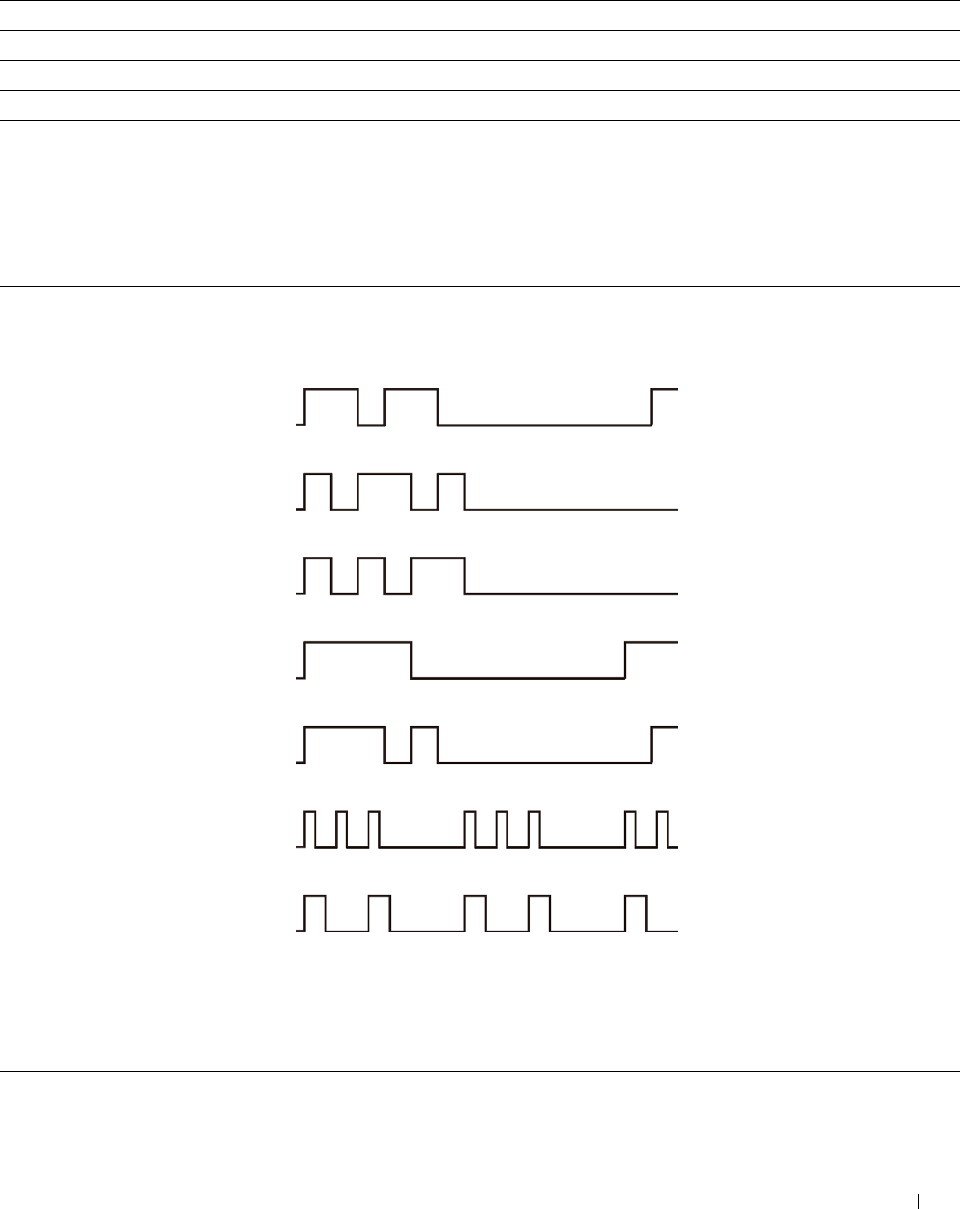
Understanding the Printer Menus 249
Line Monitor
Purpose:
To set the volume of the line monitor, which audibly monitors a transmission through the internal speaker until a
connection is made.
Val u e s:
DRPD Pattern
Purpose:
To provide a separate number for faxing with a distinctive ring pattern.
Val u e s:
Off Turns off the volume of the line monitor.
Low Sets the volume of the line monitor to Low.
Medium*Sets the volume of the line monitor to Medium.
High Sets the volume of the line monitor to High.
Pattern1–7 DRPD is a service provided by some telephone companies. DRPD Patterns are specified by your
telephone company. The patterns provided with your printer are shown below:
Ask your telephone company which pattern you need to select to use this service. For example, Pattern
7 is the New Zealand FaxAbility distinctive ringing pattern: rings for 400 ms, stops for 800 ms, rings
for 400 ms and stops for 1400 ms. This pattern is repeated over and over again. This printer only
responds to Distinctive Alert cadence(s) DA4 in New Zealand.
Pattern 1
Pattern 2
Pattern 3
Pattern 4*
Pattern 5
Pattern 6
Pattern 7
250 Understanding the Printer Menus
Incoming Defaults
Purpose:
To configure settings for incoming fax.
Receive Mode
Purpose:
To select the default fax receiving mode.
Val u e s:
Ring Tone Volume
Purpose:
To set the volume of the ring tone, which indicates that an incoming call is a telephone call through the internal
speaker when Receive Mode is set to Telephone/Fax.
Val u e s:
Auto Receive Setup
Purpose:
To configure settings for automatic fax reception.
Val u e s:
Telephone Automatic fax reception is turned off. You can receive a fax by picking up the handset of the external
telephone and then pressing the remote receive code, or by selecting Manual Receive in On
Hook and then pressing the (Start) button. For details about Manual Receive, see
"Receiving a Fax Manually in the Telephone Mode."
Fax*Automatically receives faxes.
Telephone / Fax When the printer receives an incoming fax, the external telephone rings for the time specified in
Auto Receive Tel/Fax, and then the printer automatically receives a fax. If an incoming call
is not a fax, the printer beeps from the internal speaker indicating that the call is a telephone call.
Ans Machine/Fax The printer can share a telephone line with an answering machine. In this mode, the printer will
monitor the fax signal and pick up the line if there are fax tones. If the phone communication in your
country is serial, this mode is not supported.
DRPD Before using the Distinctive Ring Pattern Detection (DRPD) option, a distinctive ring service must be
installed on your telephone line by the telephone company. After the telephone company has provided
a separate number for faxing with a distinctive ring pattern, configure the fax setup to monitor for
that specific ring pattern.
Off Turns off the volume of the ring tone.
Low Sets the volume of the ring tone to Low.
Medium Sets the volume of the ring tone to Medium.
High*Sets the volume of the ring tone to High.
Auto Receive Fax 0 seconds*Sets the interval at which the printer goes into the fax
receive mode after receiving an incoming call. The value is
set in increments of 1 second.
Available Range: 0-255 seconds
Understanding the Printer Menus 251
Junk Fax Setup
Purpose:
To reject unwanted faxes by accepting faxes only from the fax numbers registered in the Phone Book.
Val u e s:
Secure Receive
NOTE: Secure Receive feature is available only when Panel Lock Control is set to Enable.
Purpose:
To specify whether to require a password to receive faxes, and to set or change the password.
Val u e s:
Sent Fax Forward
NOTE: Print and E-mail feature is available only when E-mail Alert information and Forwarding E-mail
Address are registered. For information on e-mail alert, see "E-Mail Alert" and on forwarding e-mail address information, see
"Fax Settings."
Purpose:
To set whether to forward incoming faxes to a specified destination.
Val u e s:
Auto Receive Tel/Fax 6 seconds*Sets the interval at which the printer goes into the fax
receive mode after the external telephone receives an
incoming call. The value is set in increments of 1 second.
Available Range: 0-255 seconds
Auto Receive Ans/Fax 21 seconds*Sets the interval at which the printer goes into the fax
receive mode after the external answering machine receives
an incoming call. The value is set in increments of 1
second.
Available Range: 0-255 seconds
Off*Does not reject faxes sent from unwanted numbers.
On Rejects faxes sent from unwanted numbers.
Secure Receive Set Disable*Does not require a password to receive faxes.
Enable Requires a password to receive faxes.
Change Password*1 0000–9999 Sets or changes the password required to receive faxes.
*1 This item is available only when Secure Receive Set is set to Enable.
Off*Does not forward incoming faxes.
Forward Forwards incoming faxes to a specified destination. Prints incoming faxes if
an error occurs during the transfer.
Print and Forward Prints incoming faxes and also forwards them to a specified destination.
Forwarding Number Specifies the fax number of the destination to which incoming faxes will be
forwarded.
Print and E-mail*1, 2 Prints incoming faxes and also forward them to a specified e-mail address.
252 Understanding the Printer Menus
2 Sided Print
To set the duplex printing for fax.
Val u e s:
Remote Receive
Purpose:
To receive a fax by pressing a remote receive code on the external telephone after picking up the handset of the
telephone.
Val u e s:
Discard Size
Purpose:
To set the printer to discard images or any text at the bottom of a fax page when the entire page does not fit the
output paper.
Val u e s:
Transmission Defaults
Purpose:
To configure settings for transmitting fax.
Auto Redial Setup
Purpose:
To configure settings for automatic redial.
Val u e s:
*1 This item is available only when the E-mail Alert information is registered.
*2 This item is available only when Forwarding E-mail Address is registered.
Off*Does not perform duplex printing.
On Performs duplex printing.
Off*Does not receive a fax by pressing a remote receive code on the external
telephone.
On Receives a fax by pressing a remote receive code on the external telephone.
Remote Receive Tone Specifies the tone in two digits to start Remote Receive.
Off*Prints excess images or text at the bottom of a fax page without discarding it.
On Discards any excess images or text.
Auto Reduction Automatically reduces a fax page to fit it onto the appropriate paper size.
Redial Attempts 3*Sets the number of redial attempts to make when the
destination fax number is busy. If you enter 0, the printer
will not redial. The value is set in increments of 1.
Available Range: 0-13
Understanding the Printer Menus 253
Tone / Pulse
Purpose:
To select the dialing type.
Val u e s:
Prefix Dial
Purpose:
To select whether to set a prefix dial number.
Val u e s:
Fax Cover Page
Purpose:
To set whether to attach a cover page to faxes.
Val u e s:
Fax Header
Purpose:
To print the information of the sender on the header of the faxes.
Val u e s:
NOTE: If United States is selected for the setting of Country, this option does not appear on the menu. The setting is
fixed to On and cannot be changed. For information on the country setting, see "Setting Your Country."
Interval of Redial 1 minute*Sets the interval between redial attempts. The value is set
in increments of 1 minute.
Available Range: 1-15 minutes
Resend Delay 8 seconds*Sets the interval between re-send attempts. The value is set
in increments of 1 second.
Available Range: 3-255 seconds
Tone*Uses tone dialing.
Pulse(10PPS) Sets "DP (10PPS)" (Dial Pulse, 10 Pulse Per Second) as the dial type.
Pulse(20PPS) Sets "DP (20PPS)" (Dial Pulse, 20 Pulse Per Second) as the dial type.
Off*Does not set a prefix dial number.
On Sets a prefix dial number.
Prefix Dial Number Sets a prefix dial number of up to five digits. This number dials before any
auto dial number is started. It is useful for accessing the Private Automatic
Branch Exchange (PABX).
Off*Does not attach a cover page to faxes.
On Attaches a cover page to faxes.
Off Does not print the sender's information on the header of faxes.
On*Prints the sender's information on the header of faxes.
254 Understanding the Printer Menus
ECM
Purpose:
To set whether to enable or disable the Error Correction Mode (ECM). To use the ECM, the remote machines must
also support the ECM.
Val u e s:
Modem Speed
Purpose:
To adjust the fax modem speed when a fax transmission or reception error occurs.
Val u e s:
Display Manual Fax Recipients
Purpose:
To set whether to display the fax number of the recipient on the Sending Fax screen when manually sending a fax.
Val u e s:
Fax Reports
Purpose:
To configure settings for fax reports.
Fax Activity
Purpose:
To set whether to automatically print a fax activity report after every 50 incoming and outgoing fax communications.
Val u e s:
Fax Transmit
Purpose:
To set whether to print a transmission result after a fax transmission.
Off Disables the ECM.
On*Enables the ECM.
2.4 Kbps
4.8 Kbps
9.6 Kbps
14.4 Kbps
33.6 Kbps*
Off Does not display the fax number when manually sending a fax.
On*Displays the fax number when manually sending a fax.
Auto Print*Automatically prints a fax activity report after every 50 incoming and outgoing fax communications.
No Auto Print Does not automatically print a fax activity report after every 50 incoming and outgoing fax
communications.
Understanding the Printer Menus 255
Val u e s:
Fax Broadcast
Purpose:
To set whether to print a transmission result after a fax transmission to multiple destinations.
Val u e s:
Fax Protocol
Purpose:
To set whether to print the protocol monitor report, which helps you identify the cause of a communication problem.
Val u e s:
System Settings
Use System Settings to configure the power saving mode, warning tones, time-out duration, display language,
and job log auto print settings.
NOTE: Values marked by an asterisk (*) are the factory default menu settings.
General
Purpose:
To configure general settings for the printer.
Power Saver Timer
Purpose:
To specify the time for transition to power saver mode.
Val u e s:
Print Always Prints a transmission report after every fax transmission.
Print On Error*Prints a transmission report only when an error occurs.
Print Disable Does not print a transmission report after a fax transmission.
Print Always*Prints a transmission report after every fax transmission.
Print On Error Prints a transmission report only when an error occurs.
Print Disable Does not print a transmission report after a fax transmission to multiple destinations.
Print Always Prints a protocol monitor report after every fax transmission.
Print On Error Prints the protocol monitor report only when an error occurs.
Print Disable*Does not print the protocol monitor report.
Sleep 3 minutes*Specifies the time taken by the printer to enter Sleep mode after it
finishes a job.
Available Range: 1–60 minutes
Deep Sleep 5 minutes*Specifies the time taken by the printer to enter Deep Sleep mode after it
has entered Sleep mode.
Available Range: 1–60 minutes
256 Understanding the Printer Menus
When you specify 1 minute for Sleep, the printer enters power saver mode 1 minute after it finishes a job. This
uses much less energy, but requires more warm-up time for the printer. Specify 1 minute if your printer shares an
electrical circuit with room lighting and you notice lights flickering.
Select a high value if your printer is in constant use. In most circumstances, this keeps the printer ready to operate
with minimum warm-up time.
Select a value between 1 and 60 minutes for power saver mode if you want a balance between energy consumption
and a shorter warm-up period.
The printer automatically returns to the standby mode from the power saver mode when it receives data from the
computer or remote fax machine. You can also change the status of the printer to the standby mode by pressing any
button on the operator panel.
Date & Time
Purpose:
To specify the date and time formats.
Val u e s:
mm / inch
Purpose:
To specify the default measurement unit displayed after the numeric value on the operator panel.
Val u e s:
NOTE: The default for mm/inch varies depending on other settings, such as Country and Document Size.
Display Brightness
Purpose:
To adjust the screen brightness of the touch panel.
Val u e s:
Audio Tone
Purpose:
To configure settings for tones emitted by the printer during operation or when a warning message appears.
Time Zone Sets the time zone.
Date Sets the date depending on the Format settings.
Format Sets the date format.
Time Sets the time.
Format 12 Hour Sets the time in 12-hour format.
24 Hour Sets the time in 24-hour format.
Millimeters(mm)*Selects millimeter as the default measurement unit.
Inches(") Selects inch as the default measurement unit.
5*Sets the brightness in ten levels, with ten being the brightest.
Available Range: 1-10
Understanding the Printer Menus 257
Val u e s:
Control Panel Off* Does not emit a tone when the operator panel input is correct.
Soft Emits a tone when the operator panel input is correct.
Normal
Loud
Invalid Key Off*Does not emit a tone when the operator panel input is incorrect.
Soft Emits a tone when the operator panel input is incorrect.
Normal
Loud
Machine Ready Off Does not emit a tone when the printer is ready to process a job.
Soft Emits a tone when the printer is ready to process a job.
Normal*
Loud
Copy Completed Off Does not emit a tone when a copy job is complete.
Soft Emits a tone when a copy job is complete.
Normal*
Loud
Job Completed Off Does not emit a tone when a job other than a copy job is complete.
Soft Emits a tone when a job other than a copy job is complete.
Normal*
Loud
Fault Tone Off Does not emit a tone when a job ends abnormally.
Soft Emits a tone when a job ends abnormally.
Normal*
Loud
Alert Tone Off Does not emit a tone when a problem occurs.
Soft Emits a tone when a problem occurs.
Normal*
Loud
Out of Paper Off Does not emit a tone when the printer runs out of paper.
Soft Emits a tone when the printer runs out of paper.
Normal*
Loud
Low Toner Alert Off Does not emit a tone when a toner is low.
Soft Emits a tone when a toner is low.
Normal*
Loud
Auto Clear Alert Off*Does not emit a tone 5 seconds before the printer performs auto clear.
Soft Emits a tone 5 seconds before the printer performs auto clear.
Normal
Loud
258 Understanding the Printer Menus
Low Toner Alert Message
Purpose:
To specify whether to show the alert message when the toner is low.
Val u e s:
OffHook Wake Up
Purpose:
To specify whether to wake up from Sleep or Deep Sleep mode when you pick up the handset of the external
telephone.
Val u e s:
Auto Log Print
Purpose:
To automatically print a job history report after every 20 jobs.
Val u e s:
Print logs can also be printed using the Report / List menu.
RAM Disk
NOTE: RAM Disk feature is not available when the optional hard disk is installed.
Purpose:
To allocate memory to the RAM disk file system for the Secure Print, Private Mail Box Print, Public Mail Box Print,
and Proof Print features. The change becomes effective after the printer is turned off and then on again.
Val u e s:
All Tones Off Disables all the alert tones.
Soft Sets the volume of all the alert tones at once.
Normal*
Loud
Off Does not show the alert message when the toner is low.
On*Shows the alert message when the toner is low.
OffHook Wake Up Off*Does not wake up from Sleep or Deep Sleep mode when you pick up the handset of
the external telephone.
On Wakes up from Sleep or Deep Sleep mode when you pick up the handset of the
external telephone.
Off*Does not automatically print a job history report.
On Automatically prints a job history report.
Off Does not allocate memory to the RAM disk file system. Secure Print, Private Mail
Box Print, Public Mail Box Print, and Proof Print jobs will abort and be recorded to
the job log.
Understanding the Printer Menus 259
NOTE: Restart your printer when you change the settings for the RAM Disk menu.
Fax Server Address Book
Purpose:
To specify whether to search the phone numbers from the Address Book for the LDAP server.
Val u e s:
NOTE: You can search the phone numbers only from the local Address Book when Fax Server Address Book is set
to Off.
Email Server Address Book
Purpose:
To specify whether to search the e-mail addresses from the Address Book for the LDAP server.
Val u e s:
NOTE: You can search the e-mail addresses only from the Address Book that is local when Email Server Address
Book is set to Off.
Power On Wizard
Purpose:
To perform initial setup for the printer.
Timers
Purpose:
To configure timer settings.
Auto Reset
Purpose:
To automatically reset the settings for Copy, Scan, Fax, E-mail, or Print to the default settings and return to the
standby mode after you do not specify any settings for the specified time.
Val u e s:
On*50 MB* (300 MB*1)Sets the allocation of memory to the RAM disk file system in increments of 50 MB.
Available Range:
50-100 MB (50-600 MB*1)
*1 When the optional 512 MB memory module is installed.
Off*Does not search the phone numbers from the Address Book for the LDAP server.
On Searches the phone numbers from the Address Book for the LDAP server.
Off*Does not search the e-mail addresses from the Address Book for the LDAP server.
On Searches the e-mail addresses from the Address Book for the LDAP server.
45sec*
1min
2min
260 Understanding the Printer Menus
Fault Time-out
Purpose:
To specify the amount of time the printer waits before canceling a job that stops abnormally. The print job is cancelled if the
time-out time is exceeded.
Val u e s:
Job Time-out
Purpose:
To specify the amount of time the printer waits for data to arrive from the computer. The print job is cancelled if the time-out
time is exceeded.
Val u e s:
Output Settings
Purpose:
To configure settings concerning output from the printer.
Default Paper Size
Purpose:
To specify the default paper size.
Val u e s:
mm series
inch series
Print ID
Purpose:
3min
4min
Off Disables the fault time-out.
On*60 seconds*Sets the amount of time the printer waits before canceling a job that stops
abnormally.
Available Range: 3-300 seconds
Off Disables the job time-out.
On*30 seconds*Sets the time the printer waits for data to arrive from the computer.
Available Range: 5–300 seconds
A4 (210x297mm)*1
Letter(8.5x11")
*1 Denotes country-specific factory default values.
A4 (210x297mm)
Letter(8.5x11")*1
*1 Denotes country-specific factory default values.
Understanding the Printer Menus 261
To specify a location where the user ID is printed.
Val u e s:
NOTE: When printing on DL size paper, a part of the user ID may not be printed correctly.
Print Text
Purpose:
To specify whether the printer outputs PDL data, which is not supported by the printer, as text when the printer
receives it. Text data is printed on A4 or Letter size paper.
Val u e s:
Banner Sheet
Purpose:
To specify the position of banner sheet, and also specify the tray in which the banner sheet is loaded.
Val u e s:
Substitute Tray
Purpose:
Specifies whether to use paper of a different size when the paper that is loaded in the specified tray does not match
the paper size settings for the current job.
Val u e s:
Off*Does not print the user ID.
Top Left Prints the user ID on the top left of the page.
Top Right Prints the user ID on the top right of the page.
Bottom Left Prints the user ID on the bottom left of the page.
Bottom Right Prints the user ID on the bottom right of the page.
Off Does not print the received data.
On*Prints the received data as text data.
Insert Position Off*Does not print the banner sheet.
Front Inserted before the first page of every copy.
Back Inserted after the last page of every copy.
Front & Back Inserted before the first page of every copy and after the last page of every
copy.
Specify Tray MPF The banner sheet is loaded in the MPF.
Tray1*The banner sheet is loaded in tray1.
Tray2*1 The banner sheet is loaded in the optional 550-sheet feeder.
*1 This item is available only when the optional 550-sheet feeder is installed.
Off No tray size substitute accepted.
Larger Size Substitutes paper of next largest size. When there is no larger paper size, the printer substitutes paper of
nearest size.
Nearest Size*Substitutes paper of nearest size.
262 Understanding the Printer Menus
Letterhead 2 Sided
Purpose:
To specify whether to print on both sides when using letterhead.
Val u e s:
A4<>Letter Switch
Purpose:
To print A4 size jobs on Letter size paper if A4 size paper is not available or to print Letter size jobs on A4 size paper
if Letter size paper is not available.
Val u e s:
Report 2 Sided Print
Purpose:
To specify to print reports on both sides a sheet of paper.
Val u e s:
Use Another Tray
Purpose:
To change to another paper tray when a paper size runs out in the specified paper tray.
NOTE: If you select another paper tray with paper size smaller than the paper size specified in the job, the parts that do not fit
are not printed (print size is not adjusted automatically).
Val u e s:
Set Available Time
Purpose:
Sets the available time for the Copy, Scan, Fax, and Print functions.
Use MPF Substitutes paper from the MPF.
Disable*Does not print on both sides of letterhead.
Enable Prints on both sides of letterhead.
Off*1 Does not print A4 size jobs on Letter size paper or Letter size jobs on A4 paper.
On*Prints A4 size jobs on Letter size paper if A4 is not available in the paper trays and vice versa (Letter
size job on A4 size paper).
*1 Depending on the printer setting, the printer will continue to print on existing media of a different size or prompt the user to select from
the following:
• Delete Job
• Supply with correct media
1 Sided*Prints reports on one side of a sheet of paper.
2 Sided Prints reports on both side of a sheet of paper.
Off Does not print on other paper sizes in other paper trays if the paper size specified in the job runs out.
On*Shows a message to select another tray when the specified paper runs out in the paper tray.
Understanding the Printer Menus 263
Val u e s:
NOTE: Set Available Time can be configured when Print, Copy, Scan, or Fax is set to On.
Secure Job Expiration
NOTE: Secure Job Expiration feature is available only when RAM Disk is set to On.
Purpose:
To specify the date and time to delete the files stored as Secure Print in the RAM disk.
Val u e s:
ColorTrack Mode
Purpose:
To specify who has access to color printing.
Val u e s:
Copy, Scan, Fax, Print Set Available Time Off*Does not set the time when function is available.
On Sets the time when function is available.
Start Time Sets the start time of the available time.
End Time Sets the end time of the available time.
Recurrence Sets the day of the week to repeat the setting.
Expiration Mode Off*Does not set the date and time to delete the files stored as Secure
Print in the RAM disk.
On Sets the date and time to delete the files stored as Secure Print in
the RAM disk.
Expiration Time Sets the time to delete the files stored as Secure Print in the RAM
disk.
Recurrence Daily Sets the recurrence to delete the files stored as Secure Print in the
RAM disk daily.
Weekly* Sets the recurrence to delete the files stored as Secure Print in the
RAM disk weekly.
Monthly Sets the recurrence to delete the files stored as Secure Print
monthly.
Weekly Setting Monday Sets the day of the week to delete the files stored as Secure Print.
Tuesda y
Wednesday
Thursday
Friday
Saturday
Sunday*
Monthly Setting 1 day*Sets the day of the month to delete the files stored as Secure Print
in the RAM disk.
Available Range: 1-28 days
Off*Does not limit access to color printing.
264 Understanding the Printer Menus
Non Registered User
Purpose:
To specify whether to permit the printing of data without authentication information.
Val u e s:
Auto Color To Mono Print
NOTE: Auto Color To Mono Print feature is available when Dell ColorTrack is disabled.
Purpose:
To specify whether to print all print jobs in black and white even when color print is specified.
Val u e s:
ColorTrack Error Report
Purpose:
To specify whether to automatically print error-related information if printing with ColorTrack results in an error.
Val u e s:
Maintenance
Use the Maintenance menu to initialize the NV (non-volatile) memory, configure the plain paper quality
adjustment settings, and configure the security settings.
NOTE: Values marked by an asterisk (*) are the factory default menu settings.
Paper Density
Purpose:
To specify paper density settings.
Val u e s:
Internal Mode Limits access to color printing. Authentication is done using user information registered on the
printer .
External Mode Limits access to color printing. Authentication is done using an external authentication server .
Off*Does not permit non-account user to print the data.
On*1 Permits non-account user to print the data.
*1 Set Non Account User Password using the Dell Printer Configuration Web Tool.
Off*Prints according to the specified color mode.
On Prints all print jobs in black and white even when color print is specified.
Off*Does not print the error report when printing with ColorTrack results in an error.
On Prints the error report when printing with ColorTrack results in an error.
Plain Light
Normal*
Label Light
Normal*
Understanding the Printer Menus 265
Adjust Transfer Belt Unit
Purpose:
To adjust the transfer bias when ghosting occur. (The ghost image may be the image of the previous page, or a part of
the page currently printing)
Val u e s:
Adjust 2nd BTR
NOTE: The print quality changes depending on the setting values you select for this item.
Purpose:
To specify the transfer roller voltage adjustment for each paper type.
Val u e s:
Adjust Fusing Unit
NOTE: The print quality changes depending on the setting values you select for this item.
Purpose:
To adjust the temperature setting of the fusing unit for each paper type.
K Offset 0*If faint black colored ghosts appear, try to decrease the value.
Available Range: -5 to +5
YMC Offset 0*If faint ghosts in color (yellow, magenta, or cyan) appear, try to decrease
the value.
Available Range: -5 to +5
Plain 0*Sets the transfer roller voltage in increments of 1. The default settings
may not give the best output on all paper types. If you see mottles on
the print output, try to increase the voltage. If you see white spots on
the print output, try to decrease the voltage.
Available Range: -5 to +10
Plain Thick 0*
Available Range: -5 to +10
Covers
(106-163g/m2)
0*
Available Range: -5 to +10
Covers Thick
(164-216g/m2)
0*
Available Range: -5 to +10
Coated
(106-163g/m2)
0*
Available Range: -5 to +10
Coated Thick
(164-216g/m2)
0*
Available Range: -5 to +10
Label 0*
Available Range: -5 to +10
Envelope 0*
Available Range: -5 to +10
Recycled 0*
Available Range: -5 to +10
266 Understanding the Printer Menus
Val u e s:
Auto Reg Adjust
Purpose:
To specify whether to automatically perform color registration adjustment.
Val u e s:
Color Reg Adjust
Purpose:
To manually perform color registration adjustment.
Manual Color Registration Adjustments are required when the printer is initially installed and after the printer is
moved.
NOTE: The Color Reg Adjust feature can be configured when Auto Reg Adjust is set to Off.
Val u e s:
Plain 0*Sets the fusing unit temperature in increments of 1. The default
settings may not give the best output on all paper types. When the
printed paper has curled, try to lower the temperature. When the toner
does not fuse on the paper properly, try to increase the temperature.
Available Range: -3 to +3
Plain Thick 0*
Available Range: -3 to +3
Covers
(106-163g/m2)
0*
Available Range: -3 to +3
Covers Thick
(164-216g/m2)
0*
Available Range: -3 to +3
Coated
(106-163g/m2)
0*
Available Range: -3 to +3
Coated Thick
(164-216g/m2)
0*
Available Range: -3 to +3
Label 0*
Available Range: -3 to +3
Envelope 0*
Available Range: -3 to +3
Recycled 0*
Available Range: -3 to +3
Off Does not automatically perform color registration adjustment.
On*Automatically performs color registration adjustment.
Auto Correct Start Automatically performs color registration correction.
Understanding the Printer Menus 267
NOTE: Ensure that you remove the paper from the single sheet feeder before performing Auto Correct.
Reset Defaults
Purpose:
To initialize the non-volatile (NV) memory. After executing this function and rebooting the printer, all the menu
parameters are reset to their default values.
Val u e s:
Initialize Print Meter
Purpose:
To initialize the print meter of the printer. When the print meter is initialized, the meter count is reset to zero.
Reset Fusing Unit
Purpose:
To initialize the life counter of the fusing unit. After replacing the fusing unit, be sure to initialize its life counter.
Reset Transfer Belt Unit
Purpose:
To initialize the life counter of the transfer belt unit. After replacing the transfer belt unit, be sure to initialize its life
counter.
Clear Storage
NOTE: Clear Storage feature is available only when RAM Disk is set to On or when the optional hard disk is installed.
Color Regi Chart Print Prints a color registration chart. The color registration chart
prints a lattice pattern of yellow, magenta, and cyan lines.
On the chart, find the values on the right side that are next
to the line that is perfectly straight for each of the three
colors. If the value for this line is 0, color registration
adjustment is not required. If the value for this line is any
value other than 0, specify the adjustment values under
under lateral adjustment and process adjustment in
Enter Number.
Enter Number LY Available Range:
-9 to +9
Sets lateral (perpendicular to paper feed direction) and
process (paper feed direction) color adjustment values
individually for Yellow, Magenta, and Cyan. Enter a number
in order of lateral adjustment (left), lateral adjustment
(right), and process adjustment. Select OK
to save all the
settings.
LM
LC
RY Available Range:
-9 to +9
RM
RC
PY Available Range:
-9 to +9
PM
PC
User Fax Section Initialize Initializes the fax number entries in the Address Book.
User Scan Section Initialize Initializes the e-mail and server address entries in the Address Book.
System Section Initialize Initializes the system parameters.
268 Understanding the Printer Menus
Purpose:
To clear all files stored as Secure Print, Private Mail Box Print, Public Mail box Print, Proof Print, and Stored Print in
the RAM Disk or the optional hard disk.
Val u e s:
Format Hard Disk
NOTE: Format Hard Disk feature is available only when the optional hard disk is installed.
Purpose:
To initialize the optional hard disk.
Non-Dell Toner
Purpose:
To use toner cartridge of another manufacturer.
CAUTION: Using a non-Dell™ toner cartridge may severely damage your printer. The warranty does not cover damages
caused by using non-Dell toner cartridges.
Val u e s:
Adjust Altitude
Purpose:
To specify the altitude of the location where the printer is installed.
The discharge phenomenon for charging the photo conductor varies with barometric pressure. Adjustments are
performed by specifying the altitude of the location where the printer is being used.
NOTE: An incorrect altitude adjustment setting leads to poor printing quality, incorrect indication of remaining toner, etc.
Val u e s:
Clear Job History
Purpose:
To clear the job history of all finished jobs.
Calibrate Touchscreen
Purpose:
All Deletes all files stored as Secure Print, Private Mail Box Print, Public Mail Box Print, and Proof
Print in the RAM Disk or the optional hard disk.
Secure Document Deletes all files stored as Secure Print in the RAM Disk or the optional hard disk.
Stored Document Deletes all files stored as Stored Print in the RAM Disk or the optional hard disk.
Off*Does not use toner cartridge of another manufacturer.
On Uses toner cartridge of another manufacturer.
0m*Sets the altitude of the location where the printer is installed.
1000m
2000m
3000m
Understanding the Printer Menus 269
To calibrate the touch panel.
Fax Line Test
NOTE: Fax Line Test feature is not available when the Fax function is disabled.
Purpose:
To test if the voltage supply from the fax line is sufficient.
Secure Settings
Use the Secure Settings menu to set a password to limit access to the menus. This prevents items from being
changed accidentally.
NOTE: Values marked by an asterisk (*) are the factory default menu settings.
See also:
"Panel Lock"
Panel Lock
Purpose:
To set a limited access to Admin Settings with a password, and to set or change the password.
Val u e s:
Function Enabled
NOTE: Function Enabled feature is available only when Panel Lock Control is set to Enable.
Purpose:
To specify whether to enable or disable each of the printer functions, or to require a password to use the functions.
Val u e s:
Panel Lock Control Disable*Disables password protection for Admin Settings.
Enable Enables password protection for Admin Settings.
Change Password*1 0000–9999 Sets or changes the password required to access Admin Settings.
*1 This item is available only when Panel Lock Control is set to Enable.
Copy On*Enables the Copy function.
On (Password) Enables the Copy function, but requires a password to
use the function.
On (Color
Password)
Enables the Copy function with a color mode, but
requires a password.
Off Disables the Copy function.
E-mail On*Enables the E-mail function.
On (Password) Enables the E-mail function, but requires a password.
Off Disables the E-mail function.
Fax On*Enables the Fax function.
On (Password) Enables the Fax function but requires a password to
send faxes (does not require a password to receive
incoming faxes).

270 Understanding the Printer Menus
Edit E-mail From Fields
Purpose:
Off Disables the Fax function (the printer will not send or
receive faxes).
Fax Driver Enable*Enables the Fax Driver function.
Disable Disables the Fax Driver function (the printer will not
send faxes).
Scan To Network On*Enables the Scan To Network function.
On (Password) Enables the Scan To Network function, but requires a
password.
Off Disables the Scan To Network function.
Scan To Application On*Enables the Scan To Application and WSD Scan
function.
On (Password) Enables the Scan To Application function, but
requires a password. WSD Scan is disabled since On
(Password) is not supported by WSD Scan.
Off Disables the Scan To Application and WSD Scan
function.
PC Scan On*Enables the PC Scan function.
On (Password) Enables the PC Scan function, but requires a
password.
Off Disables the PC Scan function.
Scan To USB On*Enables the Scan To USB function.
On (Password) Enables the Scan To USB function, but requires a
password.
Off Disables the Scan To USB function.
USB Direct Print On*Enables the USB Direct Print function.
On (Password) Enables the USB Direct Print function, but requires a
password.
On (Color
Password)
Enables the USB Direct Print function with a color
mode, but requires a password.
Off Disables the USB Direct Print function.
ID Card Copy Enable*Enables the ID Card Copy function.
Disable Disables the ID Card Copy function.
USB Services Show When
Inserted
Enable*Shows a USB Drive Detected screen when a USB
memory is inserted in to the printer.
Disable Does not show a USB Drive Detected screen when a
USB memory is inserted in to the printer.
Hide Until
Inserted
Enable*Hides menus concerning USB memory until a USB
memory is inserted to the printer.
Disable Menus concerning USB memory are shown without a
USB memory inserted to the printer.
Change Password*1 Changes the password that is set under the
Function Enabled menu.
*1 This item is available only when On (Password) or On (Color Password) is enabled.
Understanding the Printer Menus 271
To specify whether to enable editing of the transmission source when you use Scan to E-mail.
Val u e s:
Reconfirm Recipient
Purpose:
To specify whether to reconfirm the recipient before sending a fax or scan.
NOTE: If Reconfirm Recipient menu is set to Reconfirm Recipient, recipients can only be selected from
the phone book or the address book. You cannot directly enter an address or fax number.
Val u e s:
Domain Filtering
Purpose:
To specify whether to only send e-mails to specified domains.
NOTE: Set the domains from SMTP Domain Filtering on the Dell Printer Configuration Web Tool.
Val u e s:
Software Download
Purpose:
To enable or disable download of firmware updates.
Val u e s:
Display of Network Information
Purpose:
To show or hide network information in the message field of the Main Home screen.
Val u e s:
Disable Disables editing of the transmission source.
Enable*Enables editing of the transmission source.
No Confirmation*Does not display a screen to reconfirm the recipient before the job is actually sent.
Reconfirm Recipient Displays a screen to reconfirm the recipient before the job is actually sent.
Off*Disables Domain Filtering.
Allow Domains Only allows e-mails to be sent to specified domains.
Disable Disables firmware updates.
Enable*Enables firmware updates.
Show IPv4 Address*Shows the IPv4 address of the printer on the Main Home screen.
Show Host Name Shows the host name of the printer on the Main Home screen.
Hide Network Information Does not show network information on the Main Home screen.
272 Understanding the Printer Menus
Data Encryption
NOTE: Data Encryption feature is available only when the optional hard disk is installed.
Purpose:
To disable or enable data encryption when using the printer.
Val u e s:
Hard Disk Over Write
NOTE: Hard Disk Over Write feature is available only when the optional hard disk is installed.
NOTE: Overwrite of the hard disk may take several hours. When overwriting the hard disk, all functions of the printer are
inoperable.
Purpose:
To erase the contents of the entire hard disk by overwriting the hard disk with meaningless data.
Val u e s:
Login Error
NOTE: Login Error feature is available only when Panel Lock Control is set to Enable.
Purpose:
To specify the number of error entry attempts allowed when you log in as an administrator in the Admin
Settings and Report/List menu.
Val u e s:
USB Settings
Use the USB Settings menu to change printer settings affecting a USB port.
USB Port
NOTE: USB Port feature is available only for the USB port on the rear of the printer.
Purpose:
To specify whether to enable the USB port. The change becomes effective after the printer is turned off and then on
again.
Encryption Off*Disables encryption of the data.
On Enables encryption of the data.
Encryption Key Sets a key that is required for encryption.
Off*Disables overwrite of the hard disk.
Single Pass Overwrites the hard disk once.
3 Pass Overwrites the hard disk three times.
Off*Does not allow an administrator to log in after one error entry attempt.
On 5*Sets the number of error entry attempts allowed when an administrator logs in.
Available Range: 1-10
Understanding the Printer Menus 273
Val u e s:
Adobe Protocol
Purpose:
To specify PostScript communication protocol for a parallel interface. You can configure the Adobe Protocol settings
for the wired network. The change becomes effective after the printer is turned off and then on again.
Val u e s:
Default Settings
Use Default Settings to modify the Copy, Scan Menu, or Fax menu defaults.
Copy Defaults
Purpose:
To modify the Copy menu defaults.
Copy Defaults allows you to configure the following items in addition to the items under the Copy menu.
Auto Exposure Level
Purpose:
To specify the default background suppression level.
Val u e s:
Color Balance
Purpose:
To specify the default color balance level within the range of -3 to +3.
Val u e s:
Disable Disables the USB interface.
Enable*Enables the USB interface.
Auto Used when auto-detecting the PostScript communication protocol.
Standard Used when the communication protocol is in ASCII interface.
BCP Used when the communication protocol is in binary format.
TBCP* Used when the communication protocol supports both ASCII and binary data to switch
between them according to the specified control code.
Binary Used when no special processing is required for data.
Normal*Sets the background suppression level to Normal.
High Sets the background suppression level to High.
Highest Sets the background suppression level to Highest.
Yellow L ow Density 0*Sets the color balance level of low density yellow.
Available Range: -3 to +3
Med. Density 0*Sets the color balance level of medium density yellow.
Available Range: -3 to +3
274 Understanding the Printer Menus
Scan Defaults
Purpose:
To modify the Scan Menu and E-mail menu defaults.
Scan Defaults allows you to configure the following items in addition to the items under the Scan Menu and
E-mail menus.
Auto Exposure Level
Purpose:
To specify the default background suppression level.
Val u e s:
TIFF File Format
Purpose:
To specify the default TIFF file format.
Val u e s:
High Density 0*Sets the color balance level of high density yellow.
Available Range: -3 to +3
Magenta Low Density 0*Sets the color balance level of low density magenta.
Available Range: -3 to +3
Med. Density 0*Sets the color balance level of medium density magenta.
Available Range: -3 to +3
High Density 0*Sets the color balance level of high density magenta.
Available Range: -3 to +3
Cyan Low Density 0*Sets the color balance level of low density cyan.
Available Range: -3 to +3
Med. Density 0*Sets the color balance level of medium density cyan.
Available Range: -3 to +3
High Density 0*Sets the color balance level of high density cyan.
Available Range: -3 to +3
Black Low Density 0*Sets the color balance level of low density black.
Available Range: -3 to +3
Med. Density 0*Sets the color balance level of medium density black.
Available Range: -3 to +3
High Density 0*Sets the color balance level of high density black.
Available Range: -3 to +3
Normal*Sets the background suppression level to Normal.
High Sets the background suppression level to High.
Highest Sets the background suppression level to Highest.
TIFF V6*Sets the default TIFF file format to TIFF V6.
TTN2 Sets the default Tiff file format to TTN2.
Understanding the Printer Menus 275
Image Compression
Purpose:
To specify the image compression level.
Val u e s:
Max E-mail Size
Purpose:
To specify the maximum size of e-mail that can be sent.
Val u e s:
Fax Defaults
Purpose:
To modify the Fax menu defaults. See "Fax Menu" for more details.
USB Direct Print Defaults
Purpose:
To modify the defaults for the USB Direct Print Defaults menu. See "USB Direct Print Menu" for more
details.
Tray Management
Use the Tray Settings menu to define the print media loaded in tray1 and the optional 550-sheet feeder.
NOTE: Values marked by an asterisk (*) are the factory default menu settings.
Tray Settings
To configure tray settings.
MPF
Purpose:
To specify the paper loaded in the MPF.
Val u e s:
High Sets the image compression level to High.
Normal*Sets the image compression level to Normal.
Low Sets the image compression level to Low.
2048 KB*Sets the maximum size of e-mail that can be sent, in increments of 1 KB.
50-16384 KB
Display Tray Prompt Enter a check to display a popup message that prompts to set Paper
Type and Paper Size when paper is loaded in the MPF. The factory
default is on (check).
Use Driver Settings for Print Job Enter a check to use the paper size and type set on the printer
driver. The factory default is off (blank).

276 Understanding the Printer Menus
Size A4
(210x297mm)*1
mm series A5
(148x210mm)
B5
(182x257mm)
Letter
(8.5x11")
Folio
(8.5x13")
Legal
(8.5x14")
Executive
(7.3x10.5")
Envelope #10
(4.1x9.5")
Monarch Env.
(3.9x7.5")
DL Env.
(110x220mm)
C5 Env.
(162x229mm)
Custom
inch series Letter
(8.5x11")*1
Folio
(8.5x13")
Legal
(8.5x14")
A4
(210x297mm)
A5
(148x210mm)
B5
(182x257mm)
Executive
(7.3x10.5")
Envelope #10
(4.1x9.5")
Monarch Env.
(3.9x7.5")
Understanding the Printer Menus 277
Tray1
Purpose:
To specify the paper loaded in tray1.
Val u e s:
DL Env.
(110x220mm)
C5 Env.
(162x229mm)
Custom
Type Plain*
Plain Thick
Covers
(106-163g/m2)
Covers Thick
(164-216g/m2)
Coated
(106-163g/m2)
Coated Thick
(164-216g/m2)
Label
Envelope
Recycled
Letterhead
Preprinted
Prepunched
Color
Plain S2
Color S2
Plain Thick S2
Recycled S2
*1 Denotes country-specific factory default value.
Display Tray Prompt Enter a check to display a popup message that
prompts to set Paper Type and Paper Size when
paper is loaded in tray1. The factory default is on
(check).
Size A4
(210x297mm)*1
mm series A5
(148x210mm)
B5
(182x257mm)

278 Understanding the Printer Menus
Letter
(8.5x11")
Folio
(8.5x13")
Legal
(8.5x14")
Executive
(7.3x10.5")
Custom
inch series Letter
(8.5x11")*1
Folio
(8.5x13")
Legal
(8.5x14")
A4
(210x297mm)
A5
(148x210mm)
B5
(182x257mm)
Executive
(7.3x10.5")
Custom
Ty p e P l a i n
Plain Thick
Covers
(106-163g/m2)
Covers Thick
(164-216g/m2)
Coated
(106-163g/m2)
Coated Thick
(164-216g/m2)
Recycled
Letterhead
Preprinted
Prepunched
Color
Plain S2
Color S2
Plain Thick S2
Understanding the Printer Menus 279
NOTE: For more information on supported paper sizes, see "Supported Paper Sizes."
Tray2
NOTE: Tray2 feature is available only when the optional 550-sheet feeder is installed.
Purpose:
To specify the paper loaded in the optional 550-sheet feeder.
Val u e s:
Tray Priority
Purpose:
To set the priority order of the paper trays for automatic tray selection. If paper trays loaded with the same paper size
and type exists, the paper tray is selected according to this priority order.
Val u e s:
Recycled S2
*1 Denotes country-specific factory default value.
Display Tray Prompt Enter a check to display a popup message that prompts to set Paper Type
and Paper Size when paper is loaded in the optional 550-sheet feeder.
The factory default is on (check).
Size Auto Sensed*
Custom
Type Plain
Plain Thick
Covers
(106-163g/m2)
Covers Thick
(164-216g/m2)
Coated
(106-163g/m2)
Coated Thick
(164-216g/m2)
Recycled
Letterhead
Preprinted
Prepunched
Color
Plain S2
Color S2
Plain Thick S2
Recycled S2
First MPF*1 Sets the MPF as the first priority.
280 Understanding the Printer Menus
Panel Language
Purpose:
To determine the language of the text on the touch panel.
Val u e s:
Print Menu
Use the Print Menu to print a job using the Secure Print, Private Mail Box Print, Public Mail Box Print, and Proof
Print features.
NOTE: Values marked by an asterisk (*) are the factory default menu settings.
Private Mailbox
NOTE: Private Mailbox feature is available only when RAM Disk is set to On or the optional hard disk is installed.
Purpose:
To specify whether and how to print the job stored in the Private Mailbox.
Val u e s:
Tray1*Sets tray1 as the first priority.
Tray2 Sets the optional 550-sheet feeder as the first priority.
Second MPF*Sets the MPF as the second priority.
Tray1*1 Sets tray1 as the second priority.
Tray2 Sets the optional 550-sheet feeder as the second priority.
Third MPF Sets the MPF as the third priority.
Tray1 Sets tray1 as the third priority.
Tray2*1 Sets the optional 550-sheet feeder as the third priority.
*1 The factory default when the optional 550-sheet feeder is installed.
English*
Français
Italiano
Deutsch
Español
Dansk
Nederlands
Norsk
Svenska
Select User ID Enter the password you specified on the printer driver.
Select a Job Selects a job to print.
Select All Selects all the documents stored for this User ID.
Quantity 1*Specifies the quantity of prints in increments of 1.
Available Range: 1-999
Understanding the Printer Menus 281
Public Mailbox
NOTE: Public Mailbox feature is available only when RAM Disk is set to On or the optional hard disk is installed.
Purpose:
To specify whether and how to print the job stored in the Public Mailbox.
Val u e s:
Proof Print
NOTE: Proof Print feature is available only when RAM Disk is set to On or the optional hard disk is installed.
Purpose:
To specify whether and how to print the job stored in the Proof Print. When the print job is sent from the printer
driver on the computer, a single copy is printed for you to check the print result. If you do not have problems with
the print result, you can choose to print more copies. This prevents a large number of misprinted copies from being
printed at one time.
Val u e s:
Secure Print
Secure Print feature is available only when RAM Disk is set to On or the optional hard disk is installed.
Purpose:
To print confidential jobs. The printer can hold the job in memory until you arrive at the printer and type the
password on the operator panel.
Use Driver Settings Sets the quantity of prints specified on the printer driver.
Print Prints the selected job.
Print and Delete*Deletes the document after it is printed.
Delete Deletes the specified document from print memory.
Select User ID Select a Job Selects a job to print.
Select All Selects all the documents stored for this User ID.
Quantity 1*Specifies the quantity of prints in increments of 1.
Available Range: 1-999
Use Driver Settings Sets the quantity of prints specified on the printer driver.
Print Prints the selected job.
Print and Delete Deletes the document after it is printed.
Delete Deletes the specified document from print memory.
Select User ID Select a Job Selects a job to print.
Select All Selects all the documents stored for this User ID.
Quantity 1*Specifies the quantity of prints in increments of 1.
Available Range: 1-999
Use Driver Settings Sets the quantity of prints specified on the printer driver.
Print Prints the selected job.
Print and Delete Deletes the document after it is printed.
Delete Deletes the specified document from print memory.
282 Understanding the Printer Menus
Val u e s:
Secure Fax Receive
Purpose:
To specify the password to receive faxes.
Val u e s:
Copy Menu
Use the Copy menus to configure a variety of copy features.
NOTE: Values marked by an asterisk (*) are the factory default menu settings.
Copy Tab
Purpose:
To set the basic copy options.
Output Color
Purpose:
To select color or black and white copying.
Val u e s:
Select Tray
Purpose:
To specify the input tray.
Val u e s:
Select User ID Enter the password you specified on the printer driver.
Select a Job Selects a job to print.
Select All Selects all the documents stored for this User ID.
Print Prints the selected job.
Print and Delete*Deletes the document after it is printed.
Delete Deletes the specified document from print memory.
Enter Password Enter the password you specified in Secure Receive.
Full Color*Prints in color mode.
Black & White Prints in black and white mode.
MPF The paper is fed from the MPF. When Use Driver Settings
for Print Job is set in MPF of Tray Settings, Any is
displayed for Size and Type. If you start the copy job with Any as the
paper size and type, A4 or Letter is selected as the paper size and
plain is selected as the paper type. If you want to specify the size and
type of paper in the MPF, select MPF and specify the paper size and type.

Understanding the Printer Menus 283
Size
mm series
A4
(210x297mm)*1
A5
(148x210mm)
B5
(182x257mm)
Letter
(8.5x11")
Folio
(8.5x13")
Legal
(8.5x14")
Executive
(7.3x10.5")
Envelope #10
(4.1x9.5")
Monarch Env.
(3.9x7.5")
DL Env.
(110x220mm)
C5 Env.
(162x229mm)
Custom
inch series Letter
(8.5x11")*1
Folio
(8.5x13")
Legal
(8.5x14")
A4
(210x297mm)
A5
(148x210mm)
B5
(182x257mm)
Executive
(7.3x10.5")
Envelope #10
(4.1x9.5")
Monarch Env.
(3.9x7.5")

284 Understanding the Printer Menus
Darken / Lighten
Purpose:
To make the copy darker or lighter than the original.
Val u e s:
DL Env.
(110x220mm)
C5 Env.
(162x229mm)
Custom
Ty p e P l a i n
Plain Thick
Covers
(106-163g/m2)
Covers Thick
(164-216g/m2)
Coated
(106-163g/m2)
Coated Thick
(164-216g/m2)
Label
Envelope
Recycled
Letterhead
Preprinted
Prepunched
Color
Plain S2
Color S2
Plain Thick S2
Recycled S2
Tray1*The paper is fed from tray1.
Tray2*2 The paper is fed from the optional 550-sheet feeder.
*1 Denotes country-specific factory default value.
*2 This item is available only when the optional 550-sheet feeder is installed.
Darken +3 Works well with light documents or faint pencil markings.
Darken +2
Darken +1
Normal*Works well with standard typed or printed documents.

Understanding the Printer Menus 285
2 Sided Copying
Purpose:
To specify whether to make duplex copy and select the binding position.
Val u e s:
Quality Tab
Purpose:
To set the options concerning image quality.
Original Type
Purpose:
To improve the image quality by selecting the type of the original document.
Val u e s:
Sharpness
Purpose:
To adjust the sharpness to make the copy sharper or softer than the original.
Val u e s:
Lighten +1 Works well with dark documents.
Lighten +2
Lighten +3
1 → 1 Sided*Prints on one side of a sheet of paper.
1 → 2 Sided Prints one sided originals on both sides of a sheet of paper.
Binding of Output Long Edge Binding*Prints on both sides of a sheet of paper to be bound by long
edge.
Short Edge Binding Prints on both sides of a sheet of paper to be bound by short
edge.
2 → 1 Sided Prints two sided originals on one side of a sheet of paper.
Binding of Original Long Edge Binding*Scans both sides of a document bound by long edge.
Short Edge Binding Scans both sides of a document bound by short edge.
2 → 2 Sided Prints two sided originals on both sides of a sheet of paper.
Binding of Original Long Edge Binding*Scans both sides of a document bound by long edge.
Short Edge Binding Scans both sides of a document bound by short edge.
Photo & Text*Used for documents with both text and photos.
Text Used for documents with text.
Photo Used for documents with photos.
Sharpen Makes the copy sharper than the original.
Normal*Does not make the copy sharper or softer than the original.
Soften Makes the copy softer than the original.
286 Understanding the Printer Menus
Color Saturation
Purpose:
To adjust the amount of colors to make the colors darker or lighter than the original.
Val u e s:
Auto Exposure
Purpose:
To suppress the background of the original to enhance text on the copy.
Val u e s:
Output Tab
Purpose:
To set other copy options.
Collation
Purpose:
To sort the copy job. For example, if you make two copies of three page documents, one complete set of three page
documents is printed one by one.
Val u e s:
Reduce / Enlarge
Purpose:
To reduce or enlarge the size of a copied image.
Val u e s:
High Increases the color saturation to brighten the color of the copy.
Normal*The color saturation is the same as the original.
Low Decreases the color saturation to lighten the color of the copy.
Off Does not suppress the background.
On*Suppresses the background to enhance text.
Auto*Automatically sorts a copy job only when you use the DADF.
Collated Sorts a copy job.
Uncollated Does not sort a copy job.
Custom ratio 100*Enter a custom ratio in increments of 1 percent.
25-400 %
mm series 100%*
50%
70%
A4→A5
Understanding the Printer Menus 287
Original Size
Purpose:
To specify the default document size.
Val u e s:
mm series
inch series
81%
B5→A5
122%
A5→B5
141%
A5→A4
200%
inch series 100%*
50%
64%
Ledger→Letter
78%
Legal→Letter
129%
Statement→Letter
154%
Statement→Legal
200%
Auto*1
A4 (210x297mm)
A5 (148x210mm)
B5 (182x257mm)
Letter (8.5x11")
Folio (8.5x13")
Legal (8.5x14")
Executive (7.3x10.5")
Auto*1
Letter (8.5x11")
Folio (8.5x13")
Legal (8.5x14")
A4 (210x297mm)
A5 (148x210mm)
288 Understanding the Printer Menus
NOTE: When Auto is selected, the printer assumes that the document size is the size of the print media loaded in tray1 or the
MPF.
2-Up
Purpose:
To print two original pages to fit onto one sheet of paper.
Val u e s:
Margin
Purpose:
To specify the top, bottom, right, left, and middle margins of the copy.
Val u e s:
Scan Menu
Use the Scan Menu to configure a variety of scanner features.
Network
Purpose:
To store the scanned image on a network server or a computer. See "Scan Options" for more details about the various
scan options you can set for the scan.
Val u e s:
Application
Purpose:
B5 (182x257mm)
Executive (7.3x10.5")
*1 Denotes country-specific factory default values.
Off*Does not perform 2-up printing.
Auto Automatically reduces the original pages to fit onto one sheet of paper.
Manual Prints the original pages onto the one sheet of paper in the size specified in
Reduce/Enlarge.
Top / Bottom 0.2 inch* (4 mm*)Sets the value in increments of 0.1 inch (1 mm).
Available Range: 0.0–2.0 inches (0–50 mm)
Left / Right 0.2 inch* (4 mm*)Sets the value in increments of 0.1 inch (1 mm).
Available Range: 0.0–2.0 inches (0–50 mm)
Middle 0.0 inches*(0 mm*)Sets the value in increments of 0.1 inch (1 mm).
Available Range: 0.0–2.0 inches (0–50 mm)
Address Book Selects a FTP address or Server Message Block (SMB) protocol address from the Local
Address Book.
Understanding the Printer Menus 289
To save scanned data on a computer. The Scan to Application feature allows you to import scanned data from the
printer to a computer connected via a USB cable. The computer must have ScanButton Manager installed to receive
the data. See "Scan Options" for more details about the various scan options you can set for the scan.
USB
Purpose:
To save the scanned image to a USB memory attached to the printer. See "Scan Options" for more details about the
various scan options you can set for the scan.
Val u e s:
Scan Options
Use the scan options to configure a variety of scanner features when scanning to a Network, Application, or USB.
NOTE: Values marked by an asterisk (*) are the factory default menu settings.
Scan To Network/Application/USB Tab
Purpose:
To set the basic options of the scan.
Output Color
Purpose:
To select color or black and white scanning.
Val u e s:
Resolution
Purpose:
To specify the resolution of the scanned image.
Val u e s:
2 Sided Scanning
Purpose:
To specify whether to scan both sides of a document.
Change Folder Selects which folder the scanned image is saved to.
Color*Scans in color mode. Works well with texts and photos.
Black & White Scans in black and white mode. Works well with texts.
Gray Scale Scans in grayscale mode. Works well with texts and photos.
200 dpi*
300 dpi
400 dpi
600 dpi
290 Understanding the Printer Menus
Val u e s:
File Format
Purpose:
To specify the file format to save the scanned image.
Val u e s:
Quality Tab
Purpose:
To set the options concerning image quality.
Darken / Lighten
Purpose:
To adjust the density to make the scanned image darker or lighter than the original.
Val u e s:
Sharpness
Purpose:
To adjust the sharpness to make the scanned image sharper or softer than the original.
Val u e s:
Contrast
Purpose:
1 Sided*Scans one side of a document.
2 Sided Long Edge Binding*Scans both sides of a document bound by the long edge.
Short Edge Binding Scans both sides of a document bound by the short edge.
PDF*
Multi-Page TIFF
TIFF (1 File per Page)
JPEG (1 File per Page)
Darken +3 Works well with light documents or faint pencil markings.
Darken +2
Darken +1
Normal*Works well with standard typed or printed documents.
Lighten +1 Works well with dark documents.
Lighten +2
Lighten +3
Sharpen Makes the scanned image sharper than the original.
Normal*Does not make the scanned image sharper or softer than the original.
Soften Makes the scanned image softer than the original.
Understanding the Printer Menus 291
To adjust the amount of colors to make the contrast of colors darker or lighter than the original.
Val u e s:
Auto Exposure
Purpose:
To suppress the background of the original to enhance text on the copy.
Val u e s:
Options Tab
Purpose:
To set other options for the scan.
Original Size
Purpose:
To specify the default paper size.
Val u e s:
mm series
inch series
High Adjusts the amount of colors to make the contrast of colors darker than the original.
Medium*Does not adjust the amount of colors to make the contrast of colors darker or lighter than the
original.
Low Adjusts the amount of colors to make the contrast of colors lighter than the original.
Off Does not suppress the background.
On*Suppresses the background to enhance text.
A4 (210x297mm) *1
A5 (148x210mm)
B5 (182x257mm)
Letter (8.5x11")
Folio (8.5x13")
Legal (8.5x14")
Executive (7.3x10.5")
*1 Denotes country-specific factory default values.
Letter (8.5x11") *1
Folio (8.5x13")
Legal (8.5x14")
A4 (210x297mm)
A5 (148x210mm)
B5 (182x257mm)
Executive (7.3x10.5")
292 Understanding the Printer Menus
Margin
Purpose:
To specify the top, bottom, right, left, and middle margins of the scanned image.
Val u e s:
File Naming Mode
Purpose:
To specify the detailed setting of File Naming Mode.
Val u e s:
Create Folder
Purpose:
To specify whether to create a folder when saving scanned images.
Val u e s:
WSD Scan
Purpose:
To save scanned data on a computer using WSD.
NOTE: WSD Scan is available when the OS of the client computer is Windows Vista SP2 (or later), Windows 7, and Windows 8.
Val u e s:
*1 Denotes country-specific factory default values.
Top / Bottom 0.1 inch* (2 mm*)Sets the value in increments of 0.1 inch (1 mm).
Available Range: 0.0–2.0 inches (0–50 mm)
Left / Right 0.1 inch* (2 mm*)Sets the value in increments of 0.1 inch (1 mm).
Available Range: 0.0–2.0 inches (0–50 mm)
Middle 0.0 inches*(0 mm*)Sets the value in increments of 0.1 inch (1 mm).
Available Range: 0.0–2.0 inches (0–50 mm)
Auto*Sets the default file name.
Add Prefix Adds texts in front of the file name.
Prefix/Suffix String Specifies the texts that are added when Add Prefix
is selected.
Add Suffix Adds texts after the file name.
Prefix/Suffix String Specifies the texts that are added when Add Suffix
is selected.
Off Does not create a folder when saving a scanned image.
On*Creates a folder when saving a scanned image.
Scan to
Computer
Name
Selects which computer the scanned image is saved to. Up
to 20 computers will be listed.
Understanding the Printer Menus 293
E-mail
Use the E-mail to configure a variety of e-mail features. See "Scan Options" for details about the Quality and
Options tab.
NOTE: Values marked by an asterisk (*) are the factory default menu settings.
Val u e s:
Fax Menu
Use the Fax menus to configure a variety of fax features.
NOTE: The Fax function cannot be used unless you set up a country code under Country. If Country is not set up, a
message Set the Country Code appears on the display.
NOTE: Values marked by an asterisk (*) are the factory default menu settings.
Fax Tab
Purpose:
To set the recipient and basic fax options.
Specify the Recipient
Purpose:
To specify the recipient
Val u e s:
Event Scan Sends the scanned image to the computer according to the
chosen event. Which application each event is associated
with depends on the setting on the computer.
ScanToPrint
ScanToEmail
ScanToFax
ScanToOCR
New Recipient Enters the e-mail address of the recipient using the keyboard.
Address Book Machine Address Book - Individuals Selects an e-mail address from the Local Address Book.
Machine Address Book - Groups Selects an e-mail group from the Local Address Book.
Search Network Address Book Searches an e-mail address from the Server Address Book.
From Keyboard Enters the e-mail address of the sender using the keyboard.
Machine Address Book Selects an e-mail address of the sender from the Local
Address Book.
Search Network Address Book Searches an e-mail address of the sender from the Server
Address Book.
Enter number
text box Enters the fax number using the number pad.
Enters the speed dial number stored in the printer.
Machine Address Book - Individuals Selects a fax number from the Local Address Book.
Machine Address Book - Groups Selects a group dial number from the Local Address Book.
Search Network Address Book Searches a fax number from the Server Address Book.
294 Understanding the Printer Menus
Darken / Lighten
Purpose:
To adjust the density to make the copy darker or lighter than the original.
Val u e s:
2 Sided Scanning
Purpose:
To specify whether to scan both sides of a document.
Val u e s:
Resolution
Purpose:
To specify the scan resolution to improve the output quality.
Val u e s:
NOTE: Faxes scanned in the Super Fine mode transmit at the highest resolution supported by the receiving device.
OnHook
Purpose:
To send or receive faxes manually.
Val u e s:
Darken +3 Works well with light documents or faint pencil markings.
Darken +2
Darken +1
Normal*Works well with standard typed or printed documents.
Lighten +1 Works well with dark documents.
Lighten +2
Lighten +3
1 Sided*Scans one side of a document.
2 Sided Long Edge Binding*Scans both sides of a document bound by the long edge.
Short Edge Binding Scans both sides of a document bound by the short edge.
Standard*Suitable for documents with normal sized characters.
Fine Suitable for documents containing small characters or thin lines or documents printed using a
dot-matrix printer.
Super Fine Suitable for documents containing extremely fine detail. The Super Fine mode is
enabled only if the remote machine also supports the Super Fine mode. See the notes
below.
Photo Suitable for documents containing photographic images.
Manual Send*Enter Number Enters the fax number using the number pad.
Machine Address Book Selects a fax number from the Local Address Book.
Understanding the Printer Menus 295
Options Tab
Purpose:
To set other fax options.
Delayed Send
Purpose:
To send a fax at a later time.
Val u e s:
NOTE: A maximum of 19 delayed fax jobs can be stored in the Dell C3765dnf Multifunction Color Laser Printer.
Polling Receive
Purpose:
To receive faxes from the remote fax machine when you want to receive it.
Val u e s:
Fax Cover Page
Purpose:
To set whether to attach a cover page to faxes.
Val u e s:
USB Direct Print Menu
NOTE: USB Direct Print function is available only when a USB memory is inserted in the front USB port.
Select File to Print
Purpose:
To specify the document stored in the root, file, or folder in a USB memory.
USB Direct Print Tab
Purpose:
To change the file and set basic print options.
Search Network Address Book Searches a fax number from the Server Address Book.
Manual Receive Receives faxes manually.
Manual Polling Manually retrieves information from a remote machine.
Off*Does not send a fax at a later time.
On Sets the fax transmission start time when sending a fax at a specified time.
Off*Does not receive faxes using Polling Receive.
On Receives faxes using Polling Receive.
Off*Does not attach a cover page to faxes.
On Attaches a cover page to faxes.
296 Understanding the Printer Menus
Change File
Purpose:
To change the file you want to print.
Output Color
Purpose:
To select color or black and white printing.
Val u e s:
Select Tray
Purpose:
To specify the input tray.
Val u e s:
Full Color*Prints in color mode.
Black & White Prints in black and white mode.
MPF The paper is fed from the MPF. When Use Driver
Settings for Print Job is set in MPF of Tray
Settings, Any is displayed for Size and Type. If you
start the print job with Any as the paper size and type, A4 or
Letter is selected as the paper size and plain is selected
as the paper type. If you want to specify the size and type of
paper in the MPF, select MPF and specify the paper size and
type.
Size
mm series
A4
(210x297mm)*1
A5
(148x210mm)
B5
(182x257mm)
Letter
(8.5x11")
Folio
(8.5x13")
Legal
(8.5x14")
inch series Letter
(8.5x11")*1
Folio
(8.5x13")
Legal
(8.5x14")
Understanding the Printer Menus 297
2 Sided Printing
Purpose:
To print on both sides of a sheet of paper.
Val u e s:
Multiple-Up
Purpose:
To specify the output layout.
A4
(210x297mm)
A5
(148x210mm)
B5
(182x257mm)
Ty p e Plain
Plain Thick
Covers
(106-163g/m2)
Covers Thick
(164-216g/m2)
Coated
(106-163g/m2)
Coated Thick
(164-216g/m2)
Envelope
Recycled
Letterhead
Prepunched
Color
Plain S2
Color S2
Plain Thick S2
Recycled S2
Tray1*The paper is fed from tray1.
Tray2 The paper is fed from the optional 550-sheet feeder.
*1 Denotes country-specific factory default value.
1 Sided*Does not print on both sides of a sheet of paper.
2 Sided Long Edge Binding*Prints on both sides of a sheet of paper to be bound by the
long edge.
Short Edge Binding Prints on both sides of a sheet of paper to be bound by the
short edge.
298 Understanding the Printer Menus
Val u e s:
Options Tab
Purpose:
To set other print options.
Collation
Purpose:
To specify whether to sort the job.
Val u e s:
PDF Password
Purpose:
To enter the password when you print a PDF file secured with a document open password (password to open the
PDF file).
Val u e s:
ID Card Copy
Purpose:
To copy both sides of an ID card on one side of a single sheet of paper in the original size.
ID Card Copy Tab
Purpose:
To set the basic ID Card Copy options.
Val u e s:
Quality Tab
Purpose:
To set the options concerning image quality.
Off*Prints one page on one side of a sheet of paper.
2-Up Prints two pages on one side of a sheet of paper.
4-Up Prints four pages on one side of a sheet of paper.
Collated Sorts a job.
Uncollated*Does not sort a job.
Enter PDF Password Enter the document open password to print the secure PDF job.
Output Color For details about each menu, see "Copy Menu."
Select Tray
Darken / Lighten
Auto Exposure
Understanding the Printer Menus 299
Val u e s:
Panel Lock
This feature prevents unauthorized personnel from changing the settings made by the administrator. For regular
printing, items can be selected from the menu and printer settings remain unchanged. For regular printing, items
can be configured using the printer driver.
NOTE: Disabling the operator panel menus does not prevent access to the Stored Print and Tray Settings menus.
Enabling the Panel Lock
1
Press the
(Information)
button.
2
Select the
Tools
tab, and then select
Admin Settings
.
3
Select until
Secure Settings
appears, and then select
Secure Settings
.
4
Select until
Panel Lock
appears, and then select
Panel Lock
.
5
Select
Panel Lock Control
.
6
Select
Enable
, and then select
OK
.
7
Enter the new password, and then select
OK
.
CAUTION: Be sure to remember the password. The procedure described below allows you to reset the password, but
the settings for Address Book and Phone Book are cleared.
• Turn off the printer. Then, while holding the
(Information)
button, turn on the printer. Perform steps 7
and 8.
8
Re-enter the password to confirm the password that you entered, and then select
OK
.
The password has been changed.
To change the password while
Panel Lock
is
Enable
, perform steps 1 to 4 above, and then select
Change
Password
. Perform steps 7 and 8 above to change the password.
Disabling the Panel Lock
1
Press the
(Information)
button.
2
Select the
Tools
tab, and then select
Admin Settings
.
3
Select until
Secure Settings
appears, and then select
Secure Settings
.
4
Select until
Panel Lock
appears, and then select
Panel Lock
.
5
Select
Panel Lock Control
.
6
Select
Disable
.
7
Enter the current password, and then select
OK
.
The setting has been changed.
Resetting Defaults
After executing this function and rebooting the printer, the phone book, address book, or menu parameters are reset
to their default values.
Sharpness For details about each menu, see "Copy Menu."
Color Saturation
300 Understanding the Printer Menus
The following menu parameters are exceptions and are not reset.
• Network settings
• Panel Lock settings and password
• Function Enabled settings (Copy, E-mail, Fax, Scan To Network, Scan To Application, PC Scan, Scan To USB,
USB Direct Print) and passwords
• Secure Receive settings and password
• Login Error settings
• Set Available Time settings
• Secure Job Expiration settings
• USB Port settings
• Data Encryption settings
• Hard Disk Over Write settings
• ColorTrack Mode settings
• ColorTrack Error Report settings
• Non Registered User settings
When Using the Operator Panel
1
Press the
(Information)
button.
2
Select the
Tools
tab, and then select
Admin Settings
.
3
Select until
Maintenance
appears, and then select
Maintenance
.
4
Select until
Reset Defaults
appears, and then select
Reset Defaults
.
5
Select the desired setting, and then select
Initialize
.
6
Select
Yes, Reset
.
The printer is restarted automatically.
User Fax Section Resets the phone book data.
User Scan Section Resets the address book data.
System Section Resets the system parameters.

Print Media Guidelines 301
17
Print Media Guidelines
Print media refers to paper, labels, envelopes, and coated paper among others. Your printer provides high-quality
printing on a variety of print media. Selecting the appropriate print media for your printer helps avoid printing
troubles. This section describes selecting and caring for print media.
NOTE: Use only laser print media. Do not use ink jet paper in your printer.
Paper
For the best print quality in color, use 75 g/m2 (20 lb) xerographic, grain long paper. For the best print quality in
black and white, use 90 g/m2 (24 lb) xerographic, grain long paper. It is recommended that you try a sample first
before buying large quantities of any print media.
When loading paper, identify the recommended print side on the paper package, and load the paper accordingly. See
"
Loading Print Media in Tray1 and the Optional 550-Sheet Feeder
"
and
"
Loading Print Media in the MPF
"
for
detailed loading instructions.
Paper Characteristics
The following paper characteristics affect print quality and reliability. It is recommended that you follow these
guidelines when evaluating new paper stock.
Weight
The tray automatically feeds paper weights from 60 g/m2 to 216 g/m2 (16 lb to 80 lb bond) grain long. The
multipurpose feeder (MPF) automatically feeds paper weights from 60 g/m2 to 216 g/m2 (16 lb to 80 lb bond) grain
long. Paper lighter than 60 g/m2 (16 lb) may not feed properly, and could cause paper jams. For best performance,
use 75 g/m2 (20 lb bond) grain long paper.
Curl
Curl is the tendency of print media to curve at its edges. Excessive curl can cause paper feeding problems. Curl
usually occurs after the paper passes through the printer, where it is exposed to high temperatures. Storing paper
unwrapped, even in the paper tray, can contribute to paper curling prior to printing and cause feeding problems
regardless of humidity. When printing on curled paper, straighten the paper and then insert it into the MPF.
Smoothness
The degree of paper smoothness directly affects the print quality. If the paper is too rough, the toner does not fuse
on to the paper properly, resulting in poor print quality. If the paper is too smooth, it can cause paper feeding
problems. Smoothness between 150 and 250 Sheffield points produces the best print quality.
Moisture Content
The amount of moisture in the paper affects both the print quality and the ability of the printer to feed the paper
properly. Leave the paper in its original packaging until you are ready to use it. This limits the exposure of the paper
to moisture changes that can degrade its performance.
Grain Direction
Grain refers to the alignment of the paper fibers in a sheet of paper. Grain is either grain long, running the length of
the paper, or grain short, running the width of the paper. For 60 g/m2 to 135 g/m2 (16 lb to 36 lb bond) paper, grain
long fibers are recommended. For paper heavier than 135 g/m2 (36 lb bond), grain short is preferred.

302 Print Media Guidelines
Fiber Content
Most high-quality xerographic paper is made from 100 % chemically pulped wood. Paper containing fibers such as
cotton may lead to degraded paper handling.
Recommended Paper
To ensure the best print quality and feed reliability, use 75 g/m2 (20 lb) xerographic paper. Business paper designed
for general business use also provides acceptable print quality. Only use paper able to withstand high temperatures
without discoloring, bleeding, or releasing hazardous emissions. The laser printing process heats paper to high
temperatures. Check with the manufacturer or vendor to determine whether the paper you have chosen is
acceptable for laser printers.
It is recommended that you try a sample first before buying large quantities of any print media. When choosing any
print media, you should consider the weight, fiber content, and color.
Unacceptable Paper
The following paper types are not recommended for use with the printer:
• Chemically treated paper used to make copies without carbon paper, also known as carbonless paper, carbonless
copy paper (CCP), or no carbon required (NCR) paper.
• Preprinted paper with chemicals that may contaminate the printer.
• Preprinted paper that can be affected by the temperature in the fusing unit.
• Preprinted paper that requires a registration (the precise print location on the page) greater than ±0.09 inches,
such as optical character recognition (OCR) forms.
In some cases, you can adjust registration with your software program to successfully print on these forms.
• Coated paper (erasable bond), synthetic paper, and thermal paper.
• Rough-edged, rough or heavily textured surface paper, or curled paper.
• Recycled paper containing more than 25 % post-consumer waste that does not meet DIN 19 309.
• Multiple-part forms or documents.
• Print quality may deteriorate (blank spaces or blotches may appear in the text) when printing on talc or acid paper.
Selecting Paper
Proper paper selection helps prevent jams and ensures trouble-free printing.
To help avoid jams or poor print quality:
• Always use new, undamaged paper.
• Before loading the paper, identify the recommended print side of the paper. This information is usually indicated
on the paper package.
• Do not use paper that you have cut or trimmed.
• Do not mix print media sizes, weights, or types in the same source. This may result in a paper jam.
• Do not remove the tray while printing is in progress.
• Ensure that the paper is properly loaded in the tray.
• Flex the paper back and forth, and then fan them. Straighten the edges of the stack on a level surface.

Print Media Guidelines 303
Selecting Pre-Printed Media and Letterheads
When selecting pre-printed and letterhead paper for the printer:
• Use grain long paper for best results.
• Use only forms and letterheads printed using an offset lithographic or engraved printing process.
• Select paper that absorb ink, but does not bleed.
• Avoid paper with rough or heavily textured surfaces.
• Use paper printed with heat-resistant inks designed for use in xerographic copiers. The ink must withstand
temperatures of 225 °C (437 °F) without melting or releasing hazardous emissions.
• Use inks that are not affected by the resin in the toner or the silicone in the fusing unit. Inks that are oxidation-set
or oil-based should meet these requirements; latex inks might not. If you are in doubt, contact your paper supplier.
Selecting Pre-Punched Paper
When selecting pre-punched paper for the printer:
• Test paper from several manufacturers before ordering and using large quantities of pre-punched paper.
• Paper should be punched at the paper manufacturer and not drilled into paper already packaged in a ream. Drilled
paper can cause jams when multiple sheets feed through the printer. This may result in a paper jam.
• Pre-punched paper can include more paper dust than standard paper. Your printer may require more frequent
cleaning and feed reliability may not be as good as standard paper.
• Weight guidelines for pre-punched paper are the same as non-punched paper.
Envelopes
Depending on the envelopes, it is possible to expect variable levels of wrinkling. It is recommended that you try a
sample first before buying large quantities of any print media. See
"
Loading an Envelope in the MPF
"
for
instructions on loading an envelope.
When printing on envelopes:
• Use only high-quality envelopes that are designed for use in laser printers.
• Set the print media source to the MPF. Set the paper type to
Envelope
, and select the correct size of envelope from
the printer driver.
• Use envelopes made from 75 g/m
2
(20 lb bond) paper. You can use up to 105 g/m
2
(28 lb bond) weight for the
envelope feeder as long as the cotton content is 25 % or less. Envelopes with 100 % cotton content must not exceed
90 g/m
2
(24 lb bond) weight.
• Use only freshly unpackaged, undamaged envelopes.
• Use envelopes that can withstand temperatures of 205 °C (401 °F) without sealing, excessive curling, wrinkling, or
releasing hazardous emissions. If you have any doubts about the envelopes you are considering, check with the
envelope supplier.

304 Print Media Guidelines
• Adjust the guide to fit the width of the envelopes.
• To load an envelope into the MPF, insert the envelope with the flaps closed or open and the short-edge of the
envelope facing into the printer. The print side must be facing up.
• See "
Loading an Envelope in the MPF
" for instructions on loading an envelope.
• Use one envelope size during a print job.
• Ensure that the humidity is low because high humidity (more than 60 %) and the high printing temperatures may
seal the envelopes.
• For best performance, do not use envelopes that:
– Have excessive curl or twist
– Are stuck together or damaged in any way
– Contain windows, holes, perforations, cutouts, or embossing
– Use metal clasps, string ties, or metal folding bars
– Have an interlocking design
– Have postage stamps attached
– Have any exposed adhesive when the flap is in the sealed or closed position
– Have nicked edges or bent corners
– Have rough, cockle, or laid finishes
Labels
Your printer can print on many labels designed only for use with laser printers.
When selecting labels:
• Label adhesives, face sheet (printable stock), and topcoats must be able to withstand temperatures of 205 °C (401
°F) and pressure of 25 pounds per square inch (psi).
• Use labels that can be without sealing, excessive curling, wrinkling, or releasing hazardous emissions.
• Do not use label sheets with a slick backing material.
CAUTION: Before buying large quantities of any print media, it is recommended that you try a sample first.
When printing on labels:
• Use labels that can withstand temperatures of 205 °C (401 °F) without sealing, excessive curling, wrinkling, or
releasing hazardous emissions.
• Set the paper type to
Label
from the printer driver.
• Load labels in the MPF. Tray1 and the optional 550-sheet feeder do not support labels.
• Do not load labels together with paper in the MPF.
• Do not print within 1 mm (0.04 inches) of the die-cut.
• Do not print within 1 mm (0.04 inches) of the edge of the label, of the perforations, or between die-cuts of the
label.
• Do not print a label through the printer more than once.
• Portrait orientation is preferred, especially when printing bar codes.
• Do not use labels that have exposed adhesive.
• Use full label sheets. Partial sheets may cause labels to peel off during printing, resulting in a jam.

Print Media Guidelines 305
• Do not use label sheets that have adhesive to the edge of the sheet. It is recommended that zone coating of the
adhesive is done at least 1 mm (0.04 inches) away from edges. Adhesive material contaminates your printer and
could void your warranty.
WARNING: Otherwise a jam occurs in the printer and contaminate your printer and your cartridges with adhesive. As a result,
could void your printer and cartridge warranties.
Storing Print Media
For proper print media storage, the following guidelines will help to avoid media feeding problems and uneven print
quality.
• Store print media in an environment where the temperature is approximately 21 °C (70 °F) and the relative
humidity is 40 %.
• Store cartons of print media on a pallet or shelf, rather than directly on the floor.
• If you store individual packages of print media out of the original carton, ensure that they rest on a flat surface so
that the edges do not buckle or curl.
• Do not place anything on top of the print media packages.
Identifying Print Media and Specifications
The following tables show print media information.
Supported Paper Sizes
Paper size MPF Tray1 Optional 550-sheet
feeder
Duplex unit
Side 1 Side 2 Side 1 Side 2 Side 1 Side 2
A4 (210 x 297 mm) YYYYYYY
B5 (182 x 257 mm) YYYYYYY
A5 (148 x 210 mm) YYYYYYY
Letter (8.5 x 11 in) YYYYYYY
Folio (8.5 x 13 in) YYYYYYY
Legal (8.5 x 14 in) YYYYYYY
Executive (7.25 x 10.5 in) YYYYYYY
Envelope #10 (4.125 x 9.5 in) YNNNNNN
Monarch (3.875 x 7.5 in) YNNNNNN
DL (110 x 220mm) YNNNNNN
C5 (162 x 229mm) YNNNNNN
Custom*1, 2 YYYYYYY
*1 Custom: width: 76.2 mm (3.0 inches) to 215.9 mm (8.5 inches) for the MPF; 148 mm (5.83 inches) to 215.9 mm (8.5 inches) for tray1 and the
optional 550-sheet feeder
length: 127.0 mm (5.0 inches) to 355.6 mm (14.00 inches) for the MPF; 210 mm (8.27 inches) to 355.6 mm (14.00 inches) for tray1
and the optional 550-sheet feeder
*2 XPS driver does not support custom size paper.
306 Print Media Guidelines
Supported Paper Types
NOTE: For Plain and Label paper, you can set the paper density by selecting the Paper Density (Light or Normal) under
Maintenance from the operator panel, Tool Box, or Dell™ Printer Configuration Web Tool. Once you set the Paper Density
settings, the printer uses the settings for Plain and Label paper.
Paper Type Specifications
Paper type MPF Tray1 Optional 550-sheet
feeder
Duplex unit
Side 1 Side 2 Side 1 Side 2 Side 1 Side 2 Side 1 Side 2
Plain Light YYYYYYYN
Normal YYYYYYYN
Thick YYYYYYYN
Covers Normal YNYNYNYN
Thick YNYNYNNN
Coated Normal YNYNYNYN
Thick YNYNYNNN
Label Normal YNNNNNNN
Light YNNNNNNN
Envelope YNNNNNNN
Recycled YYYYYYYN
Letterhead YNYNYNYN
Preprinted YNYNYNYN
Prepunched YNYNYNYN
Color YYYYYYYN
Paper type Weight (g/m2) Remarks
Plain 60–90 -
Plain Thick 80/90–105 -
Recycled 60–105 -
Labels - Inkjet printer paper cannot be used.
Covers 106–163 -
Covers Thick 164–216 -
Envelope - -
Coated 106–163 Inkjet printer paper cannot be used.
Coated Thick 164–216 Inkjet printer paper cannot be used.
Letterhead 60–90 -
Preprinted 60–90 -
Prepunched 60–90 -
Color 60–90 -

Loading Print Media 307
18
Loading Print Media
Loading print media properly helps prevent jams and ensures trouble-free printing.
Before loading any print media, identify the recommended print side of the print media. This information is usually
indicated on the print media package.
Capacity
Tray1 and the optional 550-sheet feeder (tray2) can hold:
• 550 sheets of the standard paper.
The multipurpose feeder (MPF) can hold:
• 150 sheets of the standard paper.
Print Media Dimensions
The maximum dimensions of print media that tray1 and the optional 550-sheet feeder can handle are:
• Width — 148 mm (5.83 inches) to 215.9 mm (8.5 inches)
• Length — 210 mm (8.27 inches) to 355.6 mm (14.00 inches)
The maximum dimensions of print media that the MPF can handle are:
• Width — 76.2 mm (3.00 inches) to 215.9 mm (8.5 inches)
• Length — 127 mm (5.00 inches) to 355.6 mm (14.00 inches)
Loading Print Media in Tray1 and the Optional 550-Sheet Feeder
This section describes how to load letterhead. For details about loading print media other than letterhead, see
"Loading Paper."
NOTE: To avoid paper jams, do not remove the tray while printing is in progress.
NOTE: Use only laser print media. Do not use ink jet paper in the printer.
Loading Letterhead (Pre-Printed and Pre-Punched Paper)
The pre-printed paper such as letterhead and pre-punched paper must be inserted bottom edge first with the print
side facing down as shown below.
NOTE: Set Letterhead 2-Sided or Letterhead Duplex Mode to Enable and Paper Type to
Letterhead, Preprinted, or Prepunched from the operator panel or the printer driver even when you print on a single
side of letterhead, pre-printed, or pre-punched paper.
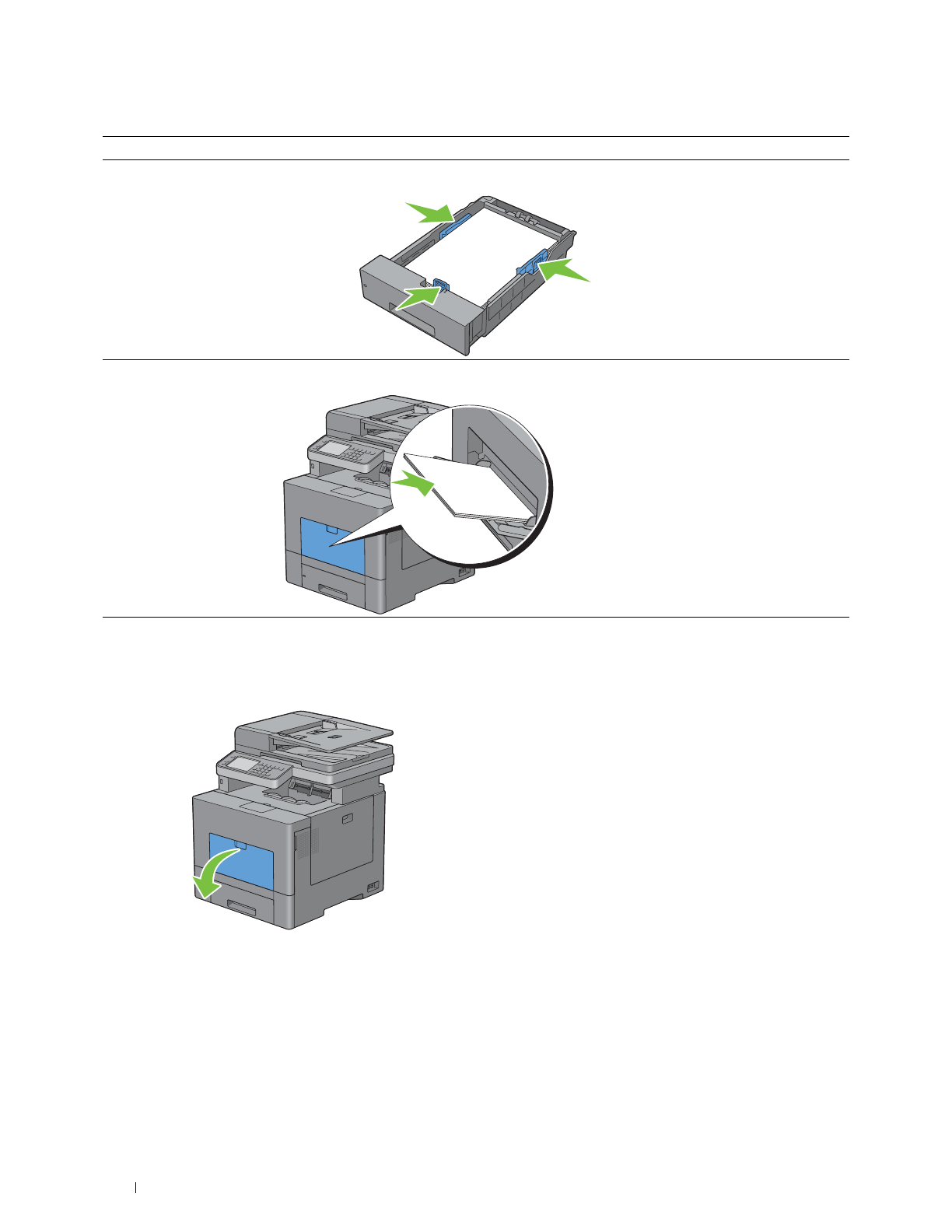
308 Loading Print Media
Loading Print Media in the MPF
1
Gently pull open the MPF cover.
Print media source Print side Page orientation
Tray1 and optional 550-sheet
feeder
Face down Letterhead enters the printer
last
MPF Face down Letterhead enters the printer
last
LETTERHEAD
LETTERHEAD
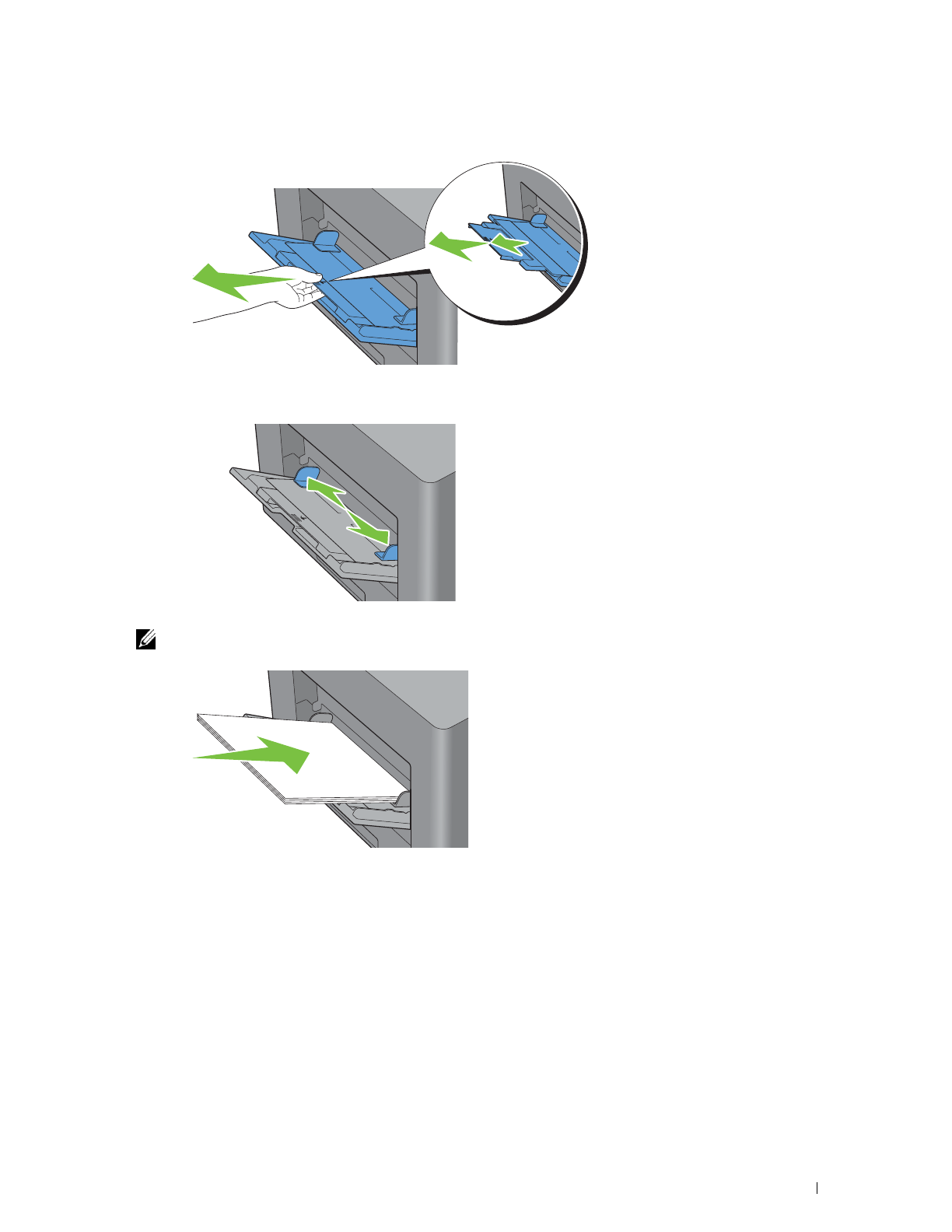
Loading Print Media 309
2
Extend the extension tray as necessary.
3
Slide the width guides to the edge of the tray. The width guides should be fully extended.
4
Insert all media facing up and top edge first into the MPF.
NOTE: Do not force the print media into the MPF.
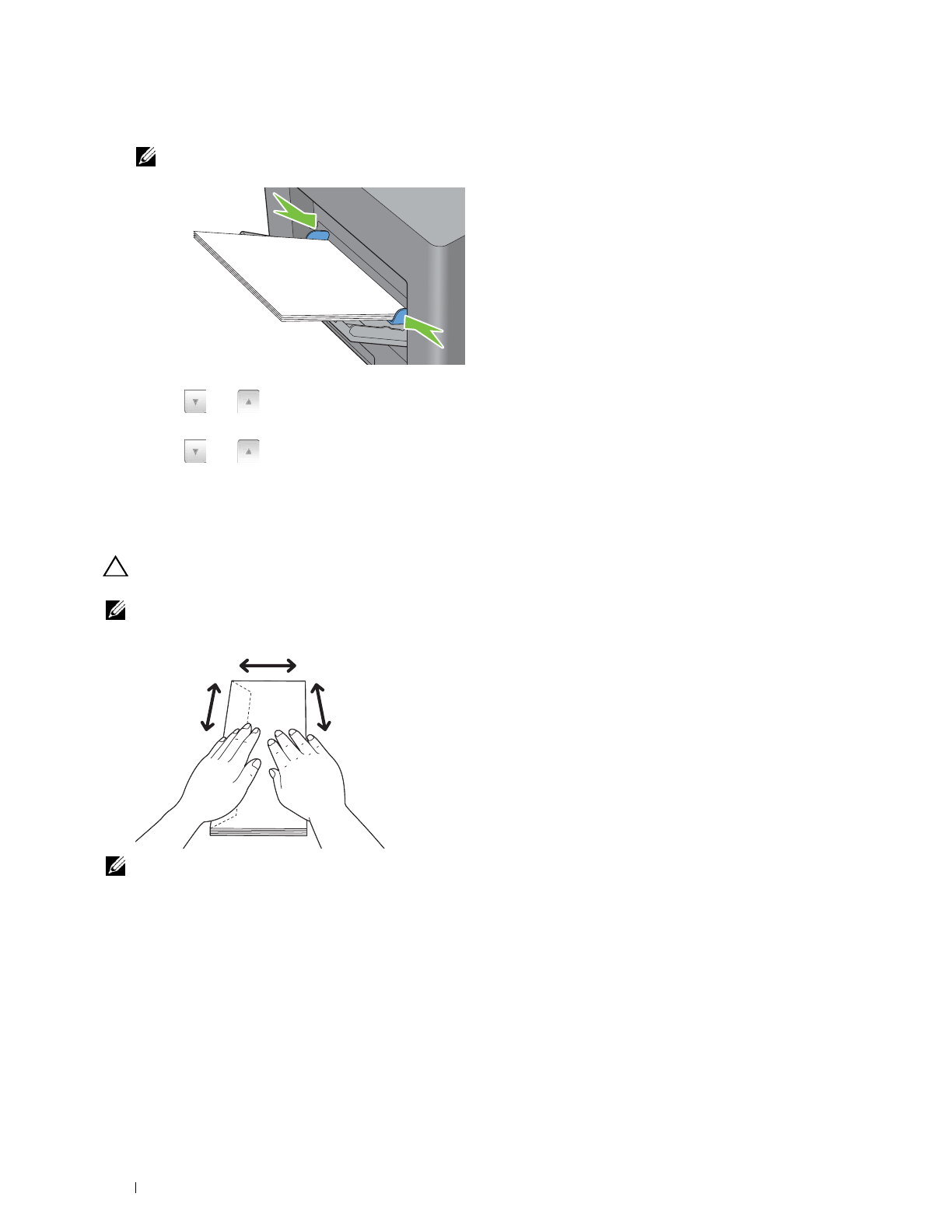
310 Loading Print Media
5
Slide both width guides until they rest lightly against the edge of the print media stack.
NOTE: Do not force the print media into the MPF.
6
On the touch panel, select
Size
.
7
Select or until the desired paper size appears, and then select the size.
8
Select
Type
.
9
Select or until the desired paper type appears, and then select the type.
10
Select
OK
.
Loading an Envelope in the MPF
Use the following guidelines when loading envelopes in the MPF:
CAUTION: Never use envelopes with windows, coated linings, or self-stick adhesives. These lead to paper jams and can
cause damage to the printer.
NOTE: If you do not load envelopes in the MPF right after they have been removed from the packaging, they may bulge. To avoid
jams, press firmly across the whole envelopes to flatten them as shown below before loading the envelopes in the MPF.
NOTE: The maximum height (quantity) of envelopes that can be loaded in the MPF is approximately 15 mm (0.59 inches) (15
envelopes).
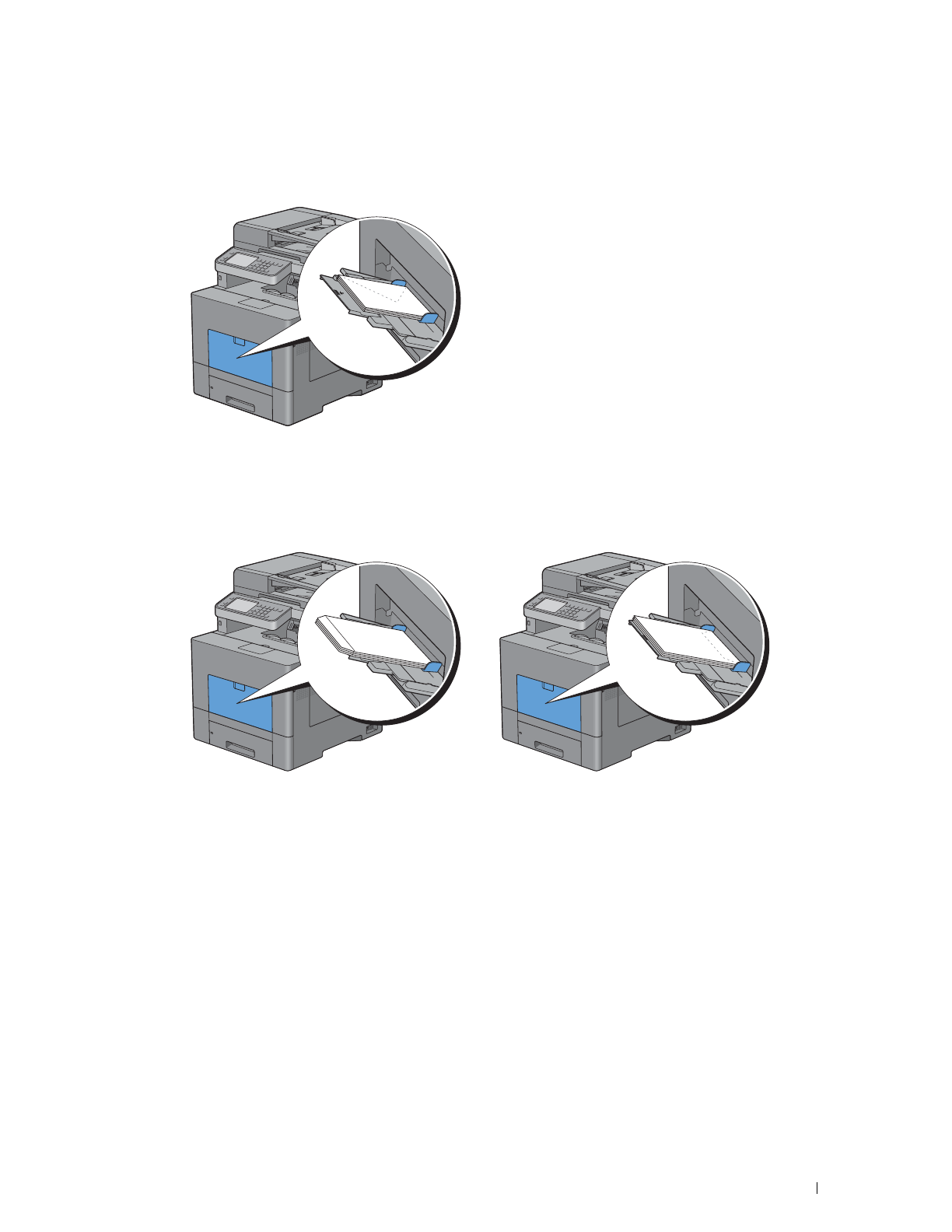
Loading Print Media 311
Envelope #10, Monarch, or DL
Load the envelopes short edge feed with the flaps closed and the print side up. Ensure that the flaps come at the left
when you face towards the printer.
C5
Load the envelopes short edge feed with the flaps open or closed and the print side up.
Ensure that the flaps come at the bottom with the flaps open or at the top with the flaps closed when you face
towards the printer.

312 Loading Print Media
Using the MPF
• Load only one size and type of print media during a single print job.
• To achieve the best possible print quality, use only high-quality print media that is designed for use in laser printer.
For more guidelines on print media, see "Print Media Guidelines."
• Do not add or remove print media when there is still print media in the MPF or when the printer is printing from
the MPF. This may result in a paper jam.
• Print media should be loaded with the recommended print side up and the top of the print media going into the
MPF first.
• Do not place objects on the MPF. Also, avoid pressing down or apply excessive force on it.
• The icons on the MPF show how to load the MPF with paper, and how to turn an envelope for printing.
Linking Trays
The printer automatically links the trays when you load the same size and type of print media in them. The first tray
will be utilized until the media runs out after which the next tray will be used.
NOTE: The print media should be the same size and type in each tray.
The MPF cannot be linked to any of the tray sources.
After loading the selected trays with the same size and type of print media, select the Paper Type setting in the Tray
Settings component for each source (tray).
To disable tray linking change the paper type in one of the sources (trays) to a unique value.
NOTE: If different types of print media of the same size are loaded in each tray, the printer will automatically link them if the
paper type is not specified in the printer driver properties/preferences.

313
Printing, Copying, Scanning,
and Faxing
19 Printing........................................................................................ 315
20 Copying ....................................................................................... 329
21 Scanning..................................................................................... 341
22 Faxing.......................................................................................... 369

314

Printing 315
19
Printing
This chapter covers tips for printing, how to print certain information from your printer, and how to cancel a job.
Tips for Successful Printing
Tips on Storing Print Media
Store your print media properly. For more information, see
"
Storing Print Media.
"
Avoiding Paper Jams
CAUTION: Before buying large quantities of any print media, it is recommended that you try a sample first.
By selecting appropriate print media and loading it properly, you can avoid paper jams. See the following instructions
on loading print media:
•"Loading Paper"
• "Loading Print Media in the MPF"
• "Avoiding Jams"
If you encounter a paper jam, see
"
Clearing Jams.
"
Sending a Job to Print
To support all of the printer features, use the printer driver. When you choose Print from an application, a window
representing the printer driver opens. Select the appropriate settings for the specific job that you are sending to
print. Print settings selected from the driver override the default menu settings selected from the operator panel or
Tool Box.
You may need to click Preferences from the initial Print box to see all of the available system settings you can
change. If you are not familiar with a feature in the printer driver window, open the online Help for more
information.
To print a job from a typical
Microsoft
® Windows® application:
1
Open the file you want to print.
2
From the
File
menu, select
Print
.
3
Verify that the correct printer is selected in the dialog box. Modify the print settings as appropriate (such as the
pages you want to print or the number of copies).
4
Click
Preferences
to adjust system settings that are not available from the first screen, and then click
OK
.
5
Click
OK
or
Print
to send the job to the selected printer.
NOTE: When you print on a small size medium such as an envelope, lift the operator panel so that you can easily remove the
printed media from the output tray.

316 Printing
Canceling a Print Job
There are several methods for canceling a job.
• Canceling a Job From the Operator Panel
• Canceling a Job From a Computer Running Windows
Canceling a Job From the Operator Panel
To cancel a job after it has started printing:
1
Press the
(Cancel)
button or Select
Delete
.
Printing is canceled only for the current job. All the following jobs will continue to print.
To cancel a job before it has started printing:
1
Press the
(Job Status)
button.
A list of print jobs appears.
2
Select the desired job to cancel.
3
Select
Delete
.
4
Select
Delete Job
.
Canceling a Job From a Computer Running Windows
Canceling a Job From the Taskbar
When you send a job to print, a small printer icon appears in the bottom right corner of the taskbar.
1
Double-click the printer icon.
A list of print jobs appears in the printer window.
2
Select the job you want to cancel.
3
Press the <Delete> key.
Canceling a Job From the Desktop
1
Click
Start
→
Devices and Printers
.
For Windows XP: Click
start
→
Printers and Faxes
.
For Windows Vista
®
: Click
Start
→
Control Panel
→
Hardware and Sound
→
Printers
.
For Windows Server
®
2008: Click
Start
→
Control Panel
→
Printers
.
For Windows Server 2008 R2: Click
Start
→
Devices and Printers
.
For Windows 8: Under Desktop mode, right-click the bottom left corner of the screen, and then click
Control
Panel
→
Hardware and Sound
→
Devices and Printers
.
For Windows Server 2012: Under Desktop mode, right-click the bottom left corner of the screen, and then click
Control Panel
→
Hardware
→
Devices and Printers
.
A list of available printers appears.
2
Right-click the printer that you selected when you sent the job for print, and then select
See what's printing
.
3
Select the printer driver.
A list of print jobs appears in the printer window.
4
Select the job you want to cancel.

Printing 317
5
Press the <Delete> key.
Duplex Printing
Duplex printing (or two-sided printing) allows you to print on both sides of a sheet of paper. For sizes that are
acceptable for duplex printing, see
"
Supported Paper Sizes.
"
Duplex Printing With Duplex Unit
1
Click
Start
→
Devices and Printers
.
For Windows XP: Click
start
→
Printers and Faxes
.
For Windows Vista: Click
Start
→
Control Panel
→
Hardware and Sound
→
Printers
.
For Windows Server 2008: Click
Start
→
Control Panel
→
Printers
.
For Windows Server 2008 R2: Click
Start
→
Devices and Printers
.
For Windows 8: Under Desktop mode, right-click the bottom left corner of the screen, and then click
Control
Panel
→
Hardware and Sound
→
Devices and Printers
.
For Windows Server 2012: Under Desktop mode, right-click the bottom left corner of the screen, and then click
Control Panel
→
Hardware
→
Devices and Printers
.
2
Right-click the printer and select
Printing Preferences
.
The
General
tab appears.
3
From
Paper Source
, select the paper tray.
For PCL driver:
Select from
Auto
,
Tray1
,
Tray2
, or
MPF
.
For PS driver:
Select from
Automatically Select
,
Tray1
,
Tray2
, or
MPF
.
4
From
Duplex
, select
Flip on Short Edge
or
Flip on Long Edge
.
NOTE: For details on the Flip on Short Edge and Flip on Long Edge options, see
"
Flip on Short Edge
"
and
"
Flip on Long Edge.
"
5
Click
OK
.
Using Booklet Print
To use the booklet print feature, select the Enable check box of the Booklet Printing in the Layout tab.
NOTE: When the XPS or PS driver is used, booklet print is not available.
NOTE: You must select Flip on Long Edge in the Duplex when using the Booklet Print feature.
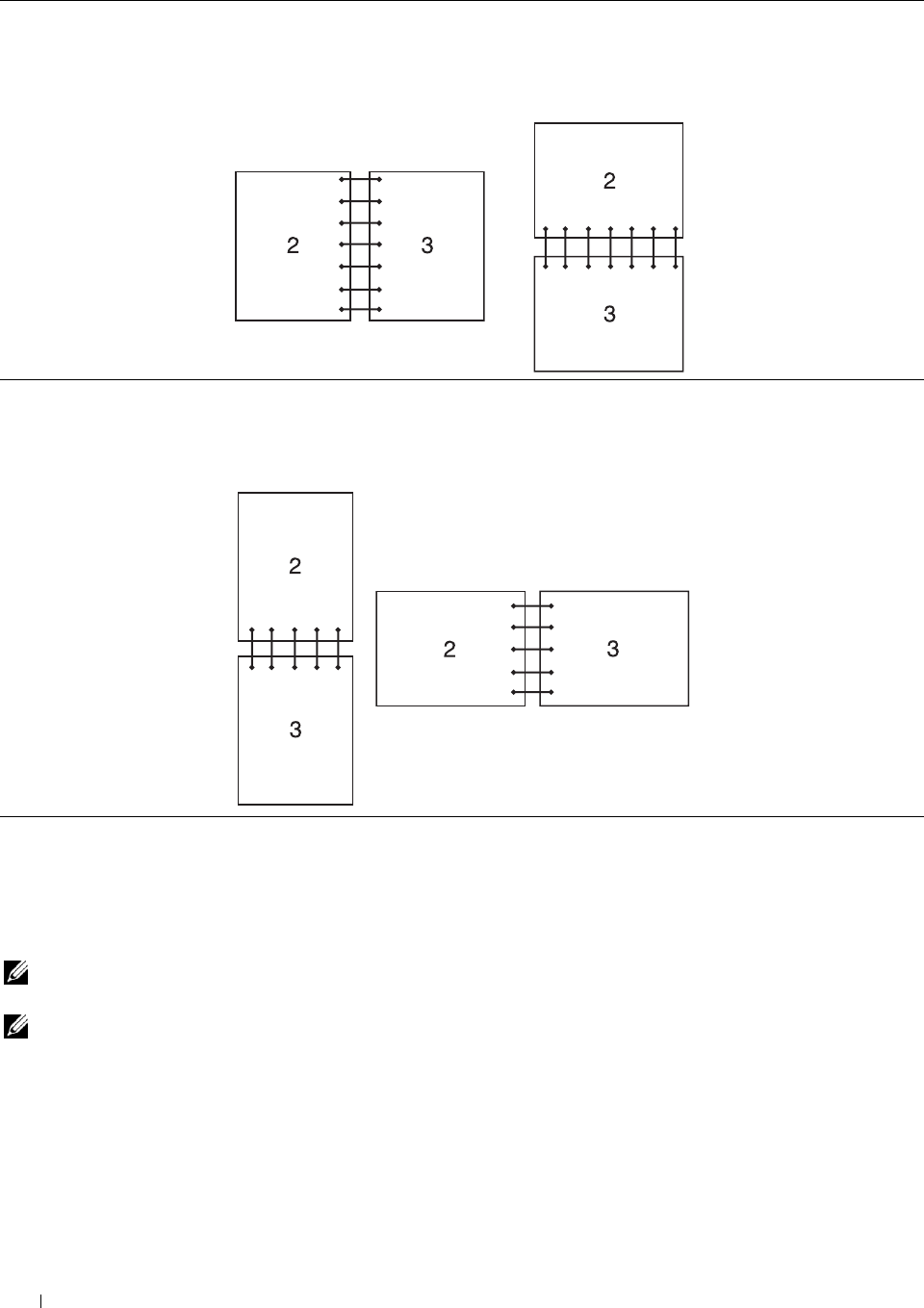
318 Printing
Using the Stored Print Feature
When you send a job to the printer, you can specify in the printer driver to store the job in the memory or hard disk.
When you are ready to print the job, go to the printer and use the operator panel to identify which job in the
memory or hard disk you want to print.
NOTE: The data in the memory is cleared when the printer is turned off. The data on the optional hard disk is not cleared even
when the printer is turned off.
NOTE: Stored Print feature is available when:
•The RAM disk is enabled in the printer menu.
•RAM Disk is set to Available in the printer driver.
OR
•The optional hard disk is installed.
•Hard Disk is set to Available in the printer driver.
Flip on Long Edge Assumes binding along the long edge of the page (left edge for portrait orientation and top edge
for landscape orientation). The following illustration shows long-edge binding for portrait and
landscape pages:
Flip on Short Edge Assumes binding along the short edge of the page (top edge for portrait orientation and left
edge for landscape orientation). The following illustration shows short-edge binding for portrait
and landscape pages:
Portrait Landscape
Portrait Landscape
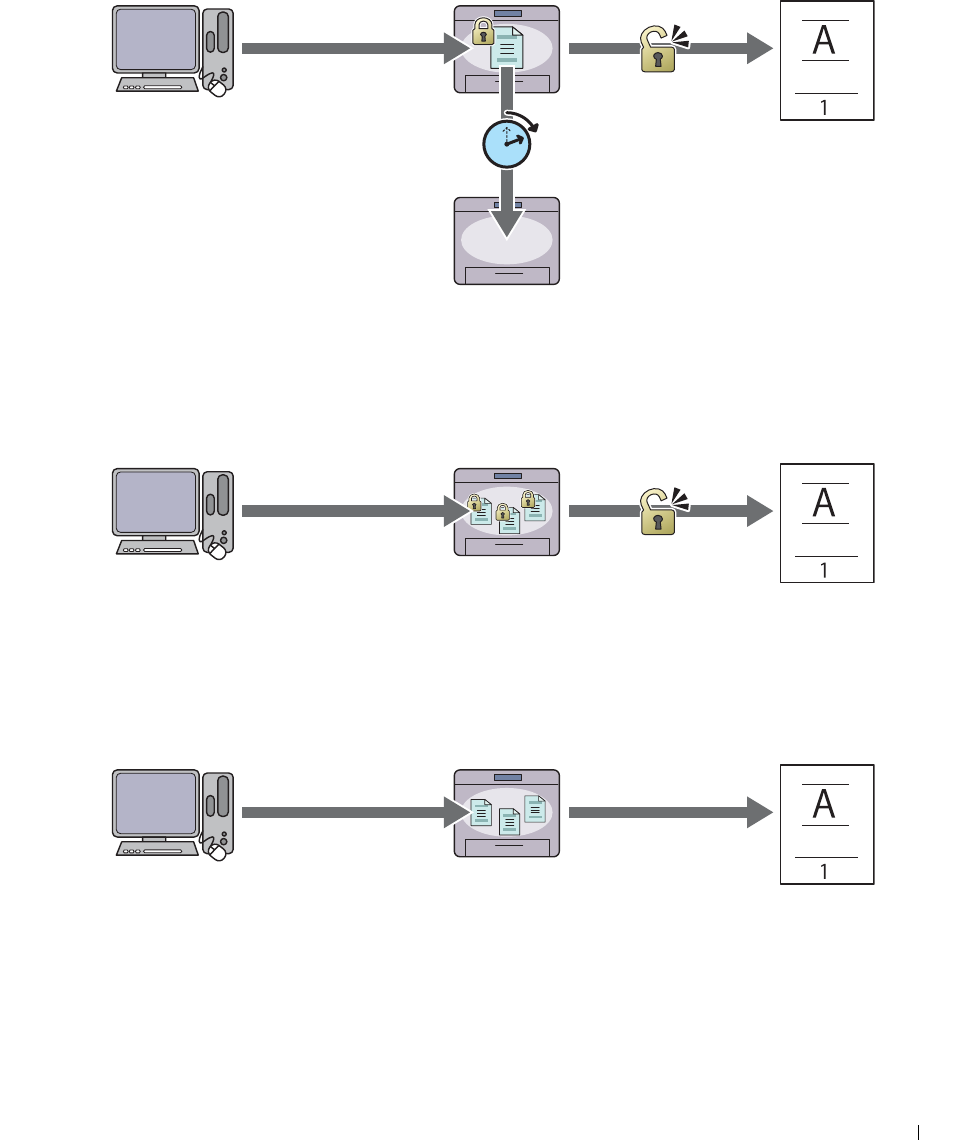
Printing 319
Overview
The stored printing feature includes the following job types.
Secure Print
You can temporarily store print jobs secured with a password in the memory or hard disk. Users with the password
can print them from the operator panel. This feature can be used to print confidential documents. A stored print job
will be deleted after you print it or at a designated time.
Private Mail Box Print
You can store print jobs secured with a password in the memory or hard disk. Users with the password can print them
at a more convenient time from the operator panel. This feature can be used to print confidential documents. The
stored jobs remain in the memory or hard disk until you delete them from the operator panel.
Public Mail Box Print
You can store print jobs without a password in the memory or hard disk. Any user can print them at a more
convenient time from the operator panel. The stored jobs remain in the memory or hard disk until you delete them
from the operator panel.
Send confidential data.
Enter the password from
the operator panel.
Print data.
Confidential
Data is deleted at a
designated time.
Send data.
Enter the password from
the operator panel.
Print data.
Send data.
Print data.
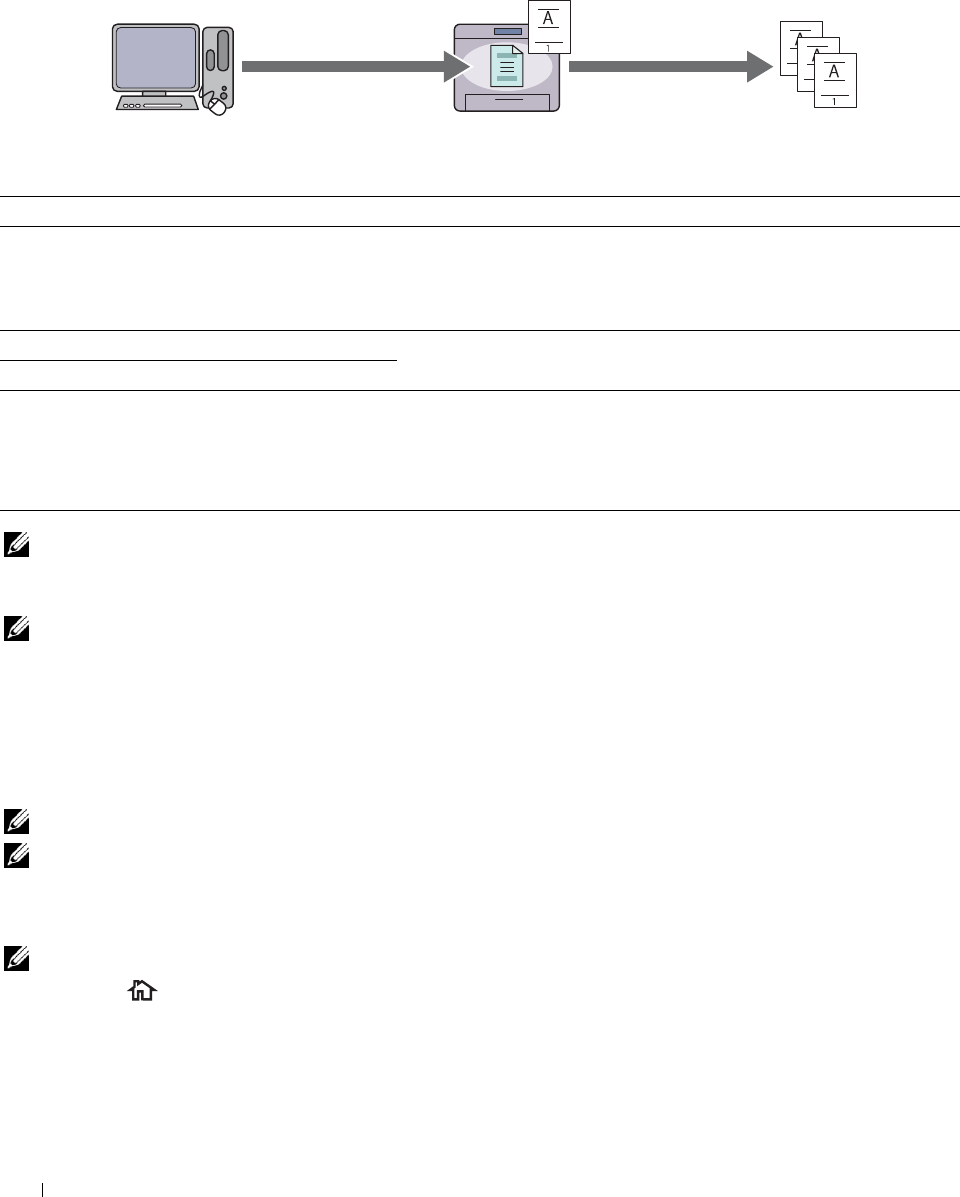
320 Printing
Proof Print
The collated print job is stored in the memory or hard disk, but a single copy is printed automatically so you can
check the print result. If you do not have problems with the print result, you can choose to print more copies. This
prevents large number of misprinted copies from being printed at one time.
The difference between each of the job types are listed below. If you want to set the password for confidentiality,
store the jobs in the Secure Print or Private Mail Box Print.
NOTE: If a print job is too large for the memory available, the printer may display an error message.
Procedures for Printing Stored Print
NOTE: The stored print feature is available when using the PCL or PS driver.
When you select a job type in the printer driver, the job will be stored in the memory or hard disk until you request
to print it from the operator panel. The following are procedures for storing and printing jobs.
Storing Print Jobs
To use the stored print feature, you need to select a job type other than Normal Print in the General tab of the
printer driver. The job will be stored in the memory or hard disk until you request to print it from the operator panel.
NOTE: Secure Print and Private Mail Box Print require specifying a password for confidentiality.
NOTE: If a document name is not assigned to your print job in the printer driver, the job's name will be identified using the
printer's time and date of submission to distinguish it from other jobs you have stored under your name.
Printing the Stored Jobs
NOTE: You can access Secure Print from the Job Status screen. In this case, select Secure Print, and proceed to step 4.
1
Press the
(Home)
button.
2
Select
Print Menu
.
Job types Password Differences
Secure Print Y
• The stored jobs will be deleted at a designated time.
• You cannot specify the quantity of copies from the operator panel. The
quantity of copies depends on the number you specified on the printer
driver.
Private Mail Box Print Y
• The stored jobs remain until you delete them from the operator panel.
• You can specify the quantity of copies from the operator panel.
Public Mail Box Print N
Proof Print N
• The print job is set to collate.
• A single copy is printed automatically.
• The stored jobs remain until you delete them from the operator panel.
• You can specify the quantity of copies from the operator panel.
Send data.
Print the rest of sets
from the operator panel.
One set is
printed.
Check if the print result
is OK.

Printing 321
3
Select a job types such as
Secure Print
,
Private Mailbox
,
Public Mailbox
, or
Proof Print
.
A list of user ID appears.
4
Select until the desired user ID appears, and then select that user ID.
NOTE: Secure Print and Private Mail Box Print require specifying a password for confidentiality. If you select Public Mail
Box Print or Proof Print, proceed to step 6.
5
Enter the password using the number pad, and then select
OK
.
For details about specifying the password, see "Specifying your password on the operator panel (Secure
Print/Private Mail Box Print)."
6
Select until the desired document appears, and then select that document.
NOTE: You can select Quantity to specify the number of copies. For Secured Print, Quantity is not available.
7
Select
Print
.
NOTE: If you want to keep the data in the memory or hard disk for the time being, clear the Print and Delete check box.
8
Select
OK
.
The stored job will be printed.
Specifying your password on the operator panel (Secure Print/Private Mail Box Print)
When you select Secure Print or Private Mailbox from Print Menu, a screen to enter the password
appears after selecting your user ID.
Use the number pad to enter the numeric password you specified in the printer driver. The password you entered will
appear as asterisks (*******) to ensure confidentiality.
If you enter an invalid password, the message Wrong Password Retry appears. Wait 3 seconds, or select Close
to return to the screen for entering the password.
When you enter a valid password, you have access to all print jobs matching the user ID and password you entered.
The print jobs matching the password you entered appear on the screen. You can then choose to print or delete jobs
matching the password you entered. (See "Printing the Stored Jobs" for more information.)
Deleting Stored Jobs
With Secure Print, a job that has been stored will be deleted after printing or deleted at a designated time entered on
the operator panel.
For other jobs, these jobs remain stored until you delete them from the operator panel.
Printing from USB Memory
The USB Direct Print feature allows you to print files stored in a USB memory by operating from the operator panel.
CAUTION: To prevent damage to your printer, do not connect any device other than USB memory to the front USB port of the
printer.
CAUTION: Do not remove the USB memory from the front USB port until the printer has finished printing.
NOTE: If the Function Enabled setting for USB Direct Print is set to On (Password), you need to enter the four
digit password to use the print function. If the Function Enabled setting for USB Direct Print is set to Off, the print
function is disabled and the menu is not displayed on the screen. For details, see "Function Enabled."
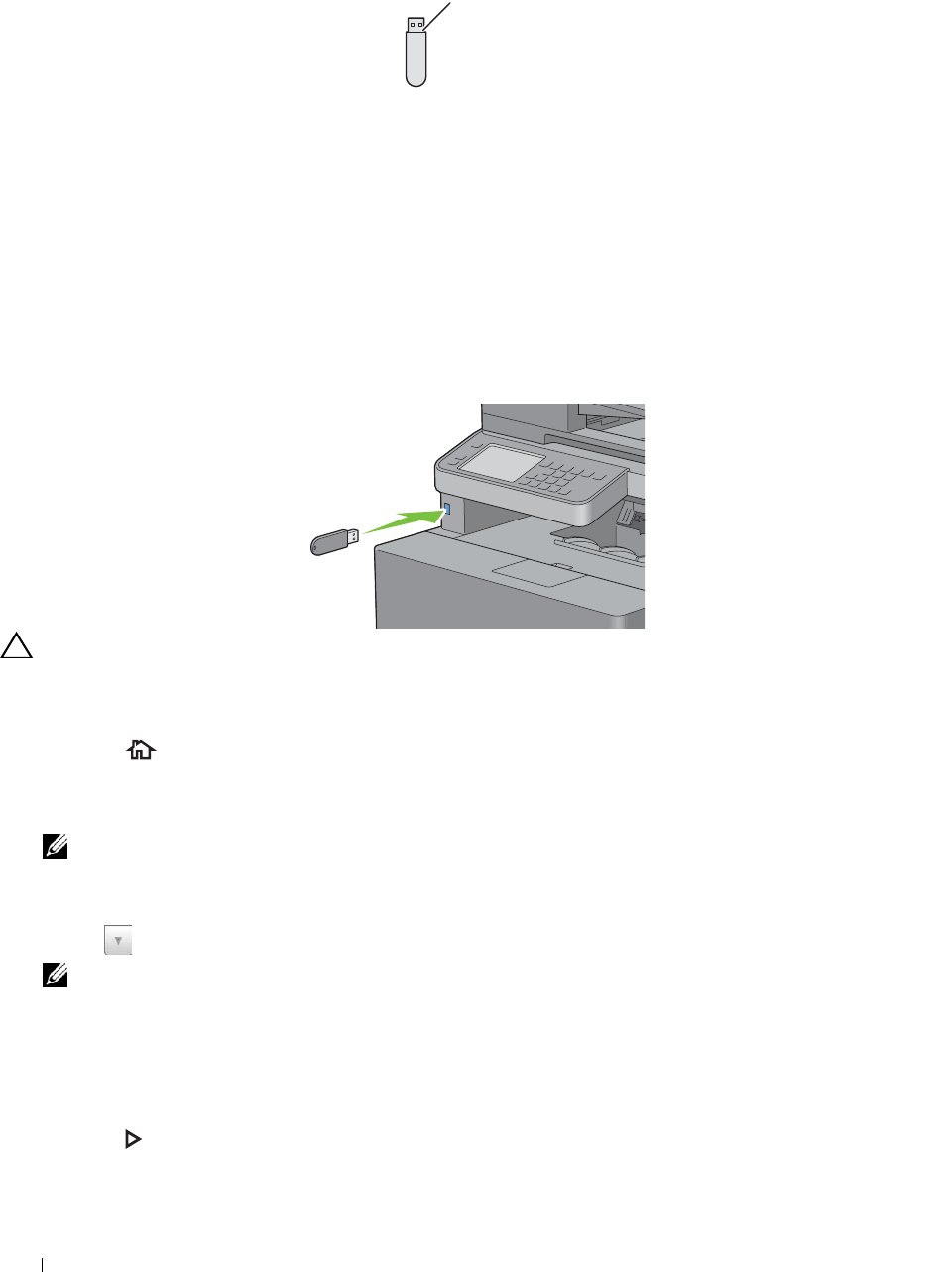
322 Printing
The front USB port of the printer is designed for USB 2.0 devices. You must use only an authorized USB memory
with an A plug type connector. Use only a metal shielded USB memory.
Supported File Formats
Files in the following file formats can be printed directly from a USB memory.
•PDF
•TIFF
•JPEG
Inserting and Removing a USB Memory
You can insert the USB memory before printing or scanning images.
Before removing the USB memory, ensure that the printer is not accessing the USB memory.
CAUTION: If you remove the USB memory while the printer is accessing, the data in the USB memory or the USB memory
device itself may be destroyed.
Printing a File in a USB Memory
1
Press the
(Home)
button.
2
Insert a USB memory to the front USB port of the printer.
For details about inserting a USB memory, see "Inserting and Removing a USB Memory."
NOTE: If the USB Drive Detected screen appears, select USB Direct Print, and proceed to step 5.
3
Select
Print Menu
.
4
Select
USB Direct Print
.
5
Select until the desired file appears, and then select that file.
NOTE: Only the following characters are displayed on the touch panel:
A B C D E F G H I J K L M N O P Q R S T U V W X Y Z 0 1 2 3 4 5 6 7 8 9 $ % ’ ‘ - @ {} ~ ! # ( ) & _ ^
6
Select
OK
.
7
Specify print options such as
Output Color
,
Select Tray
,
2 Sided Printing
,
Multiple-Up
,
Collation
, and
PDF Password
on the
USB Direct Print
and
Options
tabs. For details, see "USB Direct Print
Menu."
8
Press the
(Start)
button to begin printing.
A plug type

Printing 323
NOTE: Color printing is secured with a password if the Function Enabled setting for USB Direct Print is set to
On (Color Password). If you set Output Color to Full Color and the Function Enabled setting for
USB Direct Print to On (Color Password), you will need to enter the four digit password after pressing
the (Start) button.
NOTE: You can print files created using the Scan to USB feature of the printer. Files created by other means or sources
may not be printed properly.
Printing With Web Services on Devices (WSD)
This section provides information for network printing with WSD, the protocol of Microsoft for Windows Vista,
Windows 7, Windows 8, Windows Server 2008, Windows Server 2008 R2, and Windows Server 2012.
Adding Roles of Printer Services
When you use Windows Server 2008, Windows Server 2008 R2 or Windows Server 2012, you need to add the roles
of print services to the Windows Server 2008, Windows Server 2008 R2 or Windows Server 2012 client.
For Windows Server 2008:
1
Click
Start
→
Administrative Tools
→
Server Manager
.
2
Select
Add Roles
from the
Action
menu.
3
Check the
Print Services
check box on the
Server Roles
window in the
Add Roles Wizard
, and then click
Next
.
4
Check the
Print Server
check box, and then click
Next
.
5
Click
Install
.
For Windows Server 2008 R2:
1
Click
Start
→
Administrative Tools
→
Server Manager
.
2
Select
Add Roles
from the
Action
menu.
3
Check the
Print and Document Services
check box on the
Server Roles
window in the
Add Roles Wizard
, and
then click
Next
.
4
Click
Next
.
5
Check the
Print Server
check box, and then click
Next
.
6
Click
Install
.
For Windows Server 2012:
1
Click
Server Manager
of the
Start
screen.
2
Select
Add Roles and Features
from the
Manage
menu.
3
Click
Next
on the
Before You Begin
window
→
Select installation type on the
Installation Type
window
→
Select
destination server on the
Server Selection
window in the
Add Roles and Features Wizard
.
4
Check the
Print and Document Services
check box on the
Server Roles
window, and then click
Next
.
5
Select features on the
Features
window
→
Confirm installation selections on the
Confirmation
window.
6
Click
Install
.
Printer Setup
You can install your new printer on the network using the
Software and Documentation
disc that shipped with your
printer, or using Microsoft Windows’
Add Printer
wizard.

324 Printing
Installing a Printer Driver Using the Add Printer Wizard
1
Click
Start
→
Devices and Printers
(
Start
→
Control Panel
→
Hardware and Sound
→
Printers
for Windows Vista
and Windows Server 2008).
For Windows 8 and Windows Server 2012:
Under Desktop mode, right-click the bottom left corner of the screen, and then click
Control Panel
→
Hardware
and Sound
(
Hardware
for Windows Server 2012)
→
Devices and Printers
.
2
Click
Add a printer
to launch the
Add Printer
wizard.
3
Select
Add a network, wireless or Bluetooth printer
.
4
In the list of available printers, select the one you want to use, and then click
Next
.
NOTE: In the list of available printers, the WSD printer is displayed in the form of
http://IP address/ws
/.
NOTE: If no WSD printer is displayed in the list, enter the printer's IP address manually to create a WSD printer. To enter
the printer's IP address manually, follow the instructions below.
For Windows Server 2008 R2, to create a WSD printer, you must be a member of Administrators group.
1. Click The printer that I want isn't listed.
2. Select Add a printer using a TCP/IP address or hostname and click Next.
3. Select Web Services Device from Device type.
4. Enter the printer's IP address in the Hostname or IP address text box and click Next.
NOTE: Before installing the driver using the Add Printer wizard on Windows Server 2008 R2 or Windows 7, perform one of
the following:
•Establish the Internet connection so that Windows Update can scan your computer.
•Add the printer driver to your computer.
5
If prompted, install the printer driver on your computer. If you are prompted for an administrator password or
confirmation, type the password or provide confirmation.
6
Complete the additional steps in the wizard, and then click
Finish
.
7
Print a test page to verify print installation.
a
Click
Start
→
Devices and Printers
(
Start
→
Control Panel
→
Hardware and Sound
→
Printers
for Windows
Vista and Windows Server 2008).
For Windows 8 and Windows Server 2012:
Under Desktop mode, right-click the bottom left corner of the screen, and then click
Control Panel
→
Hardware and Sound
(
Hardware
for Windows Server 2012)
→
Devices and Printers
.
b
Right-click the printer you just created, and then click
Printer properties
(
Properties
for Windows Vista and
Windows Server 2008).
c
On the
General
tab, click
Print Test Page
. When a test page prints successfully, installation is complete.

Printing 325
Printing With AirPrint
This section provides information for printing with AirPrint. AirPrint allows you to print through a
network with iPad (all models), iPhone (3GS or later), and iPod touch (3rd generation or later) running
the latest version of iOS. AirPrint also allows you to accomplish basic network printing with Macintosh
(Mac OS X 10.7 or later) without installing additional drivers.
Setting Up AirPrint on Your Printer
To use AirPrint, Bonjour (mDNS) and IPP protocols are required on your printer. Make sure that Bonjour(mDNS)
and IPP are set to Enable on the operator panel menu. See "Protocols" for details. Bonjour(mDNS) and IPP can
also be enabled by clicking Turn on AirPrint from the Dell™ Printer Configuration Web Tool. Follow the procedure
below to configure the environment settings for AirPrint from the Dell Printer Configuration Web Tool.
1
Ensure that the printer is connected to the network.
2
Launch the
Dell Printer Configuration Web Tool
by entering the IP address of the printer in your web browser.
For more information, see "Setting Up the Dell Printer Configuration Web Tool" and "Starting the Dell Printer
Configuration Web Tool."
3
When the
Dell Printer Configuration Web Tool
opens, go to the pages in the
Print Server Settings
tab. Click
Turn on AirPrint
in
Enable AirPrint
. The printer is ready for AirPrint.
NOTE: If the Turn on AirPrint button is not active, it means that both Bonjour (mDNS) and IPP are already set to
Enable on the operator panel menu and the printer is ready for AirPrint.
Printing via AirPrint
The following procedure uses the iPhone running iOS5 as an example.
1
Open your email, photo, web page, or document you want to print.
2
Tap the action icon
.
3
Ta p
Print
.
4
Select your printer and set printer options.
5
Ta p
Print
.
NOTE: To cancel the printing job, double click the Home button, tap the Print Center icon
. If there are more than one
job in the queue, select the job you want to cancel, then tap Cancel Printing.
Printing With Google Cloud Print™
This section provides information for Google Cloud Print service with your smart phone, tablet, or any other device.
By registering the printer to your GoogleTM account, you can use the Google Cloud Print service to print from
various devices connected to the Internet. You can print documents, photos or e-mails using the Google ChromeTM
browser or applications such as Google DriveTM on your mobile device. For more information about Google Cloud
Print, visit the Google web site.
Preparing to Use the Printer with Google Cloud Print
To use Google Cloud Print, you need to prepare the following in advance:
• Connect the printer to a network that has access to the Internet.
NOTE: Google Cloud Print supports only IPv4 connection.
NOTE: If the printer is connected to a network that uses a proxy server, you need to specify the settings in Proxy Server
from the Dell Printer Configuration Web Tool. For more information, see "Proxy Server."
• Acquire a Google account and a Gmail
TM
address.

326 Printing
•Set
Google Cloud Print
to
Enable
from the operator panel menu, or set
Google Cloud Print
to
On
from
the
Dell Printer Configuration Web Tool
.
When using the operator panel
1
Press the (
Information
) button.
2
Select the
Tools
tab, and then select
Admin Settings
.
3
Select until
Network
appears, and then select
Network
.
4
Select until
Protocols
appears, and then select
Protocols
.
5
Select until
Google Cloud Print
appears, and then select
Google Cloud Print
.
6
Select
Enable
.
7
Turn off the printer, and turn it on again to apply the settings.
When using the Dell Printer Configuration Web Tool
1
Launch the
Dell Printer Configuration Web Tool
by entering IP address of the printer in your web browser. For
more information, see "Setting Up the Dell Printer Configuration Web Tool" and "Starting the Dell Printer
Configuration Web Tool."
2
When the
Dell Printer Configuration Web Tool
opens, go to the pages in the
Print Server Settings
tab. Click
Port
Settings
. In
Port Status
, select the
On
check box for
Google Cloud Print
.
Registering the Printer to Your Google Account
To register the printer to your Google account, follow the procedure below.
1
Launch the
Dell Printer Configuration Web Tool
by entering IP address of the printer in your web browser. For
more information, see "Setting Up the Dell Printer Configuration Web Tool" and "Starting the Dell Printer
Configuration Web Tool."
2
When the
Dell Printer Configuration Web Tool
opens, go to the pages in the
Print Server Settings
tab. Click
Register This Device to Google Cloud Print
in
Google Cloud Print
. A sheet with a URL for the Google Cloud
Print printer registration web site is printed.
3
From the web browser of your computer, visit the Google web site and sign in with your Google account. Visit the
Google Cloud Print registration web site by entering the URL on the printout into your web browser. You can also
visit the site by scanning the QR code with your mobile device.
4
On the Google Cloud Print registration web site, click
Finish printer registration
.
5
Click
Manage your printers
. Your printer will be listed in the
Printers
list and will be ready for use with the Google
Cloud Print service.
Printing via Google Cloud Print
The printing procedure varies depending on the application or the device you are using. You can see the application
list that supports Google Cloud Print service on the Google web site.
Printing From an Application on a Mobile Device
The following procedure uses the Google Drive application on an Android mobile device as an example.
1
Install the Google Drive application on your mobile device.
NOTE: You can download the application from Google Play.
2
Access the Google Drive application from your mobile device and tap
to select the document.
3
Ta p
and then tap
Print
.
4
Select your printer from the list.

Printing 327
5
Select printer options and then tap
Print
.
Printing From Google Chrome
The following procedure uses the Google Chrome browser on a Windows PC as an example.
1
Open the Google Chrome browser.
2
Open the web page or e-mail that you want to print.
3
Click
or
(varies depending on the version of the Google Chrome browser) in the top right corner and then
click
Print
.
4
Click
Change
in the
Destination
area.
5
Choose your printer from the Google Cloud Print area.
6
Click
Print
.
Printing a Report Page
You can print a variety of settings for your printer including system settings, panel setting, and font list. For details about
how to print reports or lists, see "Report / List."
Printer Settings
You can change most of the print settings from the application you are printing from. If your printer is attached to
the network, you can also change settings from the Dell Printer Configuration Web Tool. To launch the Dell
Printer Configuration Web Tool, type the printer's IP address in your web browser. To find your printer's IP address,
see
"
Verifying the IP Settings.
"
Settings from the application update the default system settings for the printer. Settings from the printer driver only
apply to the job that you are currently sending to the printer.
If you cannot change a setting from the application, use the operator panel, Tool Box or the Dell Printer
Configuration Web Tool. Changing a system setting from the operator panel, Tool Box or from the Dell Printer
Configuration Web Tool makes that setting the user default.
You can verify the detailed system settings by printing a system settings report. For details about how to print a
system settings report, see "
Report / List
."
You can reset settings to their default values from the Tool Box or the operator panel. For details, see "When Using
the Tool Box" or "When Using the Operator Panel."
Using the Operator Panel to Change the Printer Settings
You can select menu items and corresponding values from the operator panel.
When you first browse through the menus from the operator panel, you see some menu items are highlighted.
These highlighted items are the factory default and original system settings.
NOTE: Factory defaults may vary for different countries.
When you select a new setting from the operator panel, the item selected is highlighted to identify it as the current
user default menu setting.
These settings are active until new ones are selected or the factory defaults are restored.
Driver settings may override changes previously made and may require you to change the operator panel defaults.
Using the Dell Printer Configuration Web Tool to Change the Printer Settings
If your printer is connected to the network, you can change the printer settings from your web browser. If you are a
network administrator, you can clone the system settings of one printer to one or all the printers on the network.

328 Printing
Type the IP address of your printer in your web browser. Choose Printer Settings from the topics list. From the
Printer Settings tab, select the System Settings to change the printer settings.
To change the paper type and size, choose Tray Management from the topics list. To change the ColorTrack settings,
choose Print Volume from the topics list, and then select the Dell ColorTrack tab.
To copy your system settings to another printer on the network, choose Copy Printer Settings from the topics list,
and then type the other printer's IP address.
If you do not know your printer's IP address, see the
system settings report or display the TCP/IP settings
. For details
about how to find your printer's IP address, see "Verifying the IP Settings."

Copying 329
20
Copying
NOTE: If the Function Enabled setting for Copy is set to On (Password), you need to enter the four digit password to use
the copy function. If the Function Enabled setting for Copy is set to Off, the copy function is disabled and the menu is not
displayed on the screen. For details, see "Function Enabled."
Loading Paper for Copying
The instructions for loading paper in the paper tray are the same whether you are printing, faxing, or copying. For
details about loading paper, see "Loading Print Media." For details about setting the paper type and size in the tray,
see "Print Media Guidelines."
Selecting Paper Tray
After loading the print media for copy output, select the desired paper tray to be used for the copy job.
To select the tray:
1
Press the
(Home)
button.
2
Select
Copy
.
3
Select
Select Tray
.
4
Select the desired tray, and then select
OK
.
You can select
MPF
,
Tray1
, or
Tray2
*.
* Tray2 is only available when
the optional 550-sheet feeder (tray2) is installed.
Preparing a Document
You can use the document glass or the duplex automatic document feeder (DADF) to load an original document for
copying, scanning, and sending a fax. You can load up to 50 sheets of 75 g/m2 (20 lb) documents for one job using
the DADF or one sheet at a time using the document glass.
WARNING: Avoid loading documents that are smaller than 5.5 inches by 5.5 inches (139.7 mm by 139.7 mm) or larger than 8.5
inches by 14 inches (215.9 mm by 355.6 mm), different sizes or weights together, or booklets, pamphlets, transparencies, or
documents having other unusual characteristics in the DADF.
WARNING: Carbon-paper or carbon-backed paper, coated paper, onion skin or thin paper, wrinkled or creased paper, curled
or rolled paper, torn paper, photographs, or transparencies cannot be used in the DADF.
WARNING: Do not use the documents with staples, paper clips or exposed to adhesives or solvent based materials such as
glue, ink and correcting fluid in the DADF.
NOTE: To get the best scan quality, especially for color or gray scale images, use the document glass instead of the DADF.
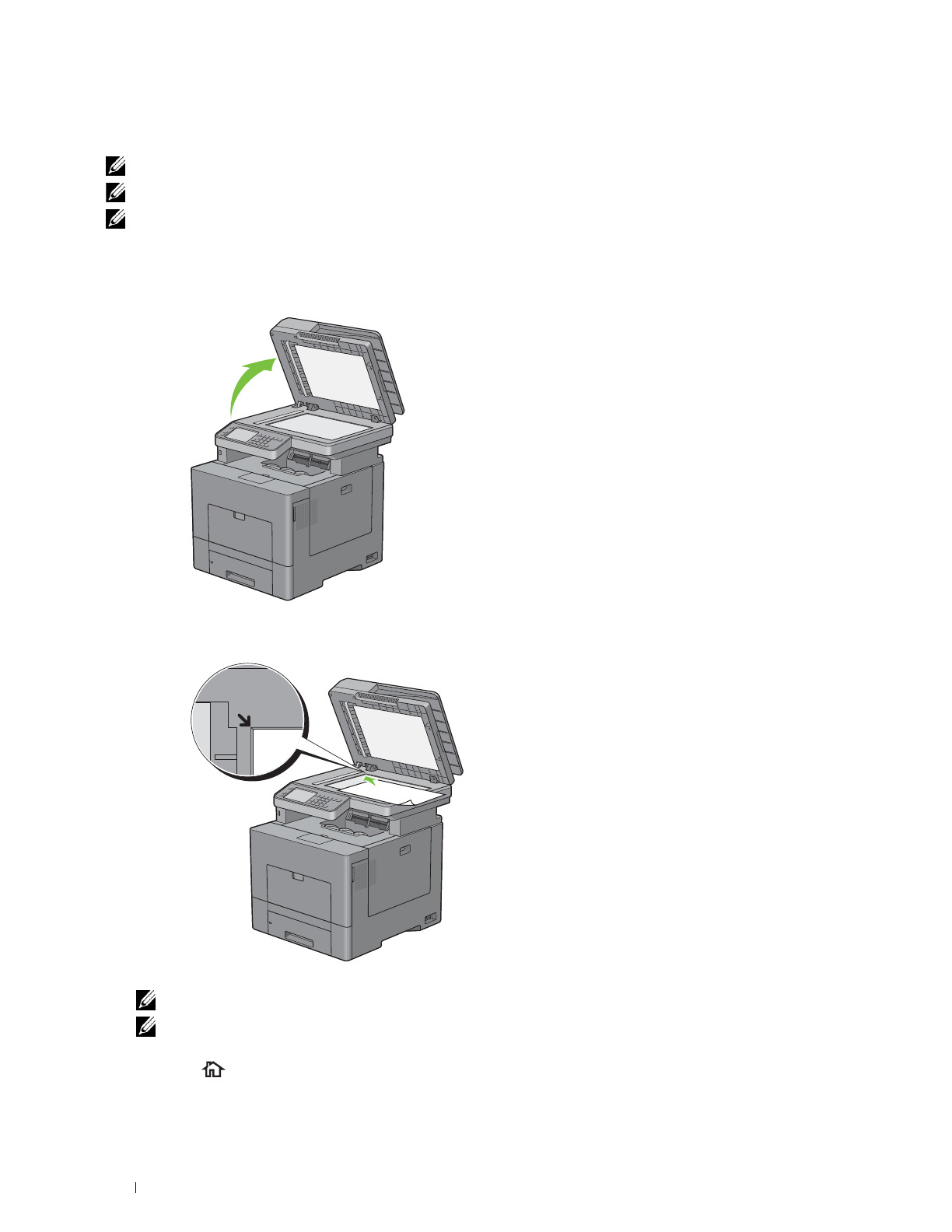
330 Copying
Making Copies From the Document Glass
NOTE: A computer connection is not required for copying.
NOTE: Remove any documents from the DADF before copying from the document glass.
NOTE: Contaminants on the document glass may cause black spots on the copy output. For best results, clean the document
glass before use. For more information, see "Cleaning the Scanner."
To make a copy from the document glass:
1
Lift and open the document cover.
2
Place the document facing down on the document glass and align it with the registration guide on the top left
corner of the glass.
3
Close the document cover.
NOTE: Leaving the document cover open while copying may affect the copy quality and increase the toner consumption.
NOTE: If you are copying a page from a book or magazine, lift the cover until its hinges are caught by the stopper and then
close the cover. If the book or magazine is thicker than 30 mm, start copying with the document cover open.
4
Press the
(Home)
button.
To simply make a copy without changing the default copy settings, proceed to step 7.
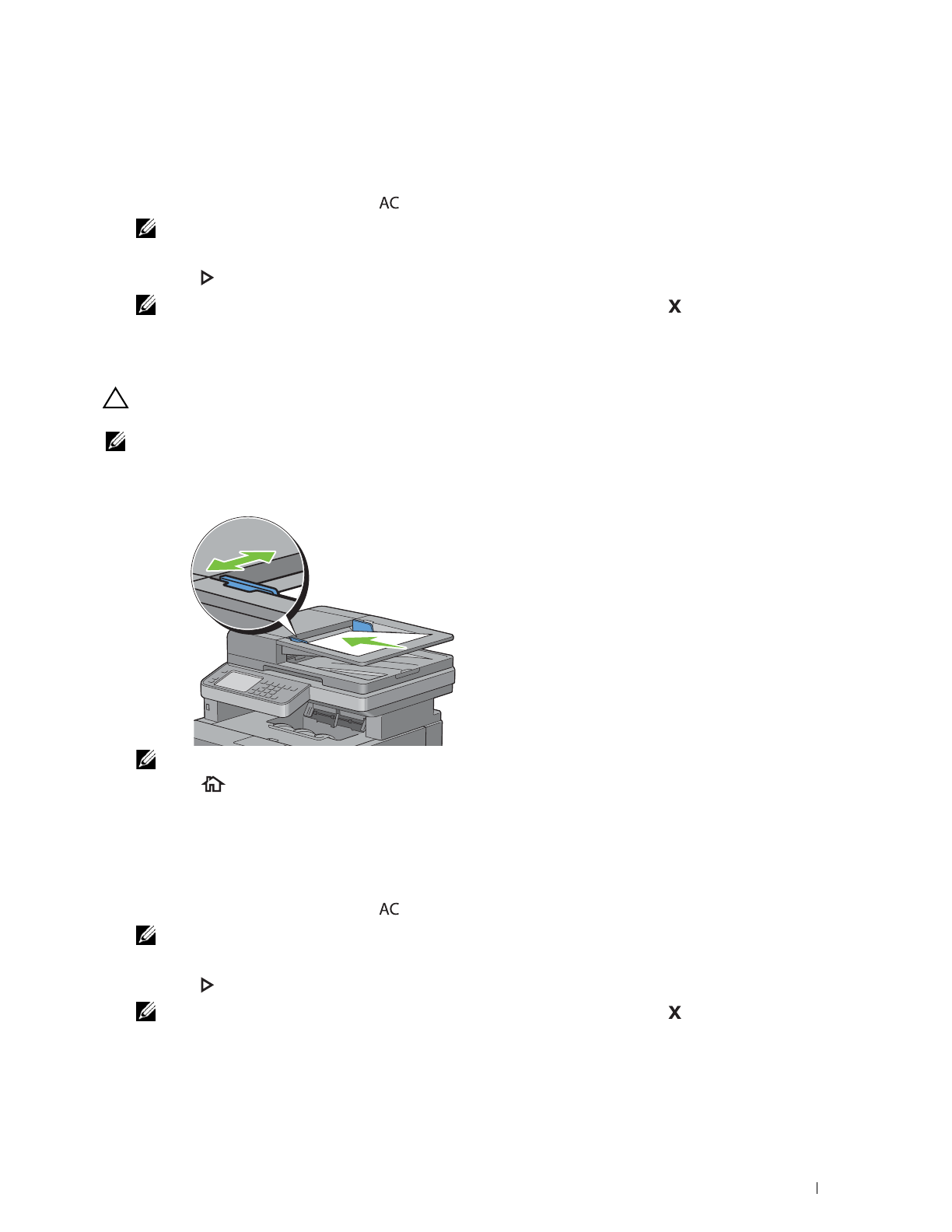
Copying 331
5
Select
Copy
.
To customize the copy settings such as
Output Color
,
Select Tray
, and
Darken / Lighten
, see
"Setting Copy Options."
To clear the option settings, press the
(All Clear)
button.
NOTE: The copy options automatically return to their default status after the auto clear timer is expired.
6
Enter the number of copies from 1 to 99 using the number pad.
7
Press the
(Start)
button to begin copying.
NOTE: You can cancel a copy job at any time while scanning a document by pressing the (Cancel) button, or selecting
Delete.
Making Copies From the DADF
CAUTION: Do not load more than 50 sheets into the DADF or allow more than 50 sheets to be fed to the document output tray.
The document output tray should be emptied before it exceeds 50 sheets or your original documents may be damaged.
NOTE: A computer connection is not required for copying.
1
Load the document(s) facing up on the DADF with top edge of the documents in first. Then adjust the document
guides to the document size.
NOTE: Ensure that you use the document stopper before copying a legal-size document.
2
Press the
(Home)
button.
To simply make a copy without changing the default copy settings, proceed to step 5.
3
Select
Copy
.
To customize the copy settings such as
Output Color
,
Select Tray
, and
Darken / Lighten
, see
"Setting Copy Options."
To clear the option settings, press the
(All Clear)
button.
NOTE: The copy options automatically return to their default status after the auto clear timer is expired.
4
Enter the number of copies from 1 to 99 using the number pad.
5
Press the
(Start)
button to begin copying.
NOTE: You can cancel a copy job at any time while scanning a document by pressing the (Cancel) button, or selecting
Delete.

332 Copying
Setting Copy Options
Set the following options for the current copy job before pressing the
(Start)
button to begin copying.
For details about making copies, see "Making Copies From the Document Glass" and "Making Copies From the
DADF."
NOTE: The copy options automatically return to their default status after the auto clear timer is expired.
Options on each tab are below:
•Copy tab
–Output Color
– Select Tray
–Darken / Lighten
–2 Sided Copying
• Quality tab
–Original Type
– Sharpness
– Color Saturation
–Auto Exposure
• Output tab
– Collation
– Reduce / Enlarge
–Original Size
– 2-Up
–Margin
Output Color
To select mode for color or black and white copying:
1
Select
Output Color
.
2
Select
Full Color
or
Black & White
, and then select
OK
.
NOTE: Color copy is secured with a password if the Function Enabled setting for Copy is set to On (Color
Password). If you set Output Color to Full Color and the Function Enabled setting for Copy to On
(Color Password), you will need to enter the four digit password after pressing the (Start) button.
Select Tray
To select the tray:
1
Select
Select Tray
.
2
Select the desired setting, and then select
OK
.
* Denotes the factory default setting.
MPF The paper is fed from the multipurpose feeder.
Tray1* The paper is fed from tray1.
Tray2 The paper is fed from the optional 550-sheet feeder.
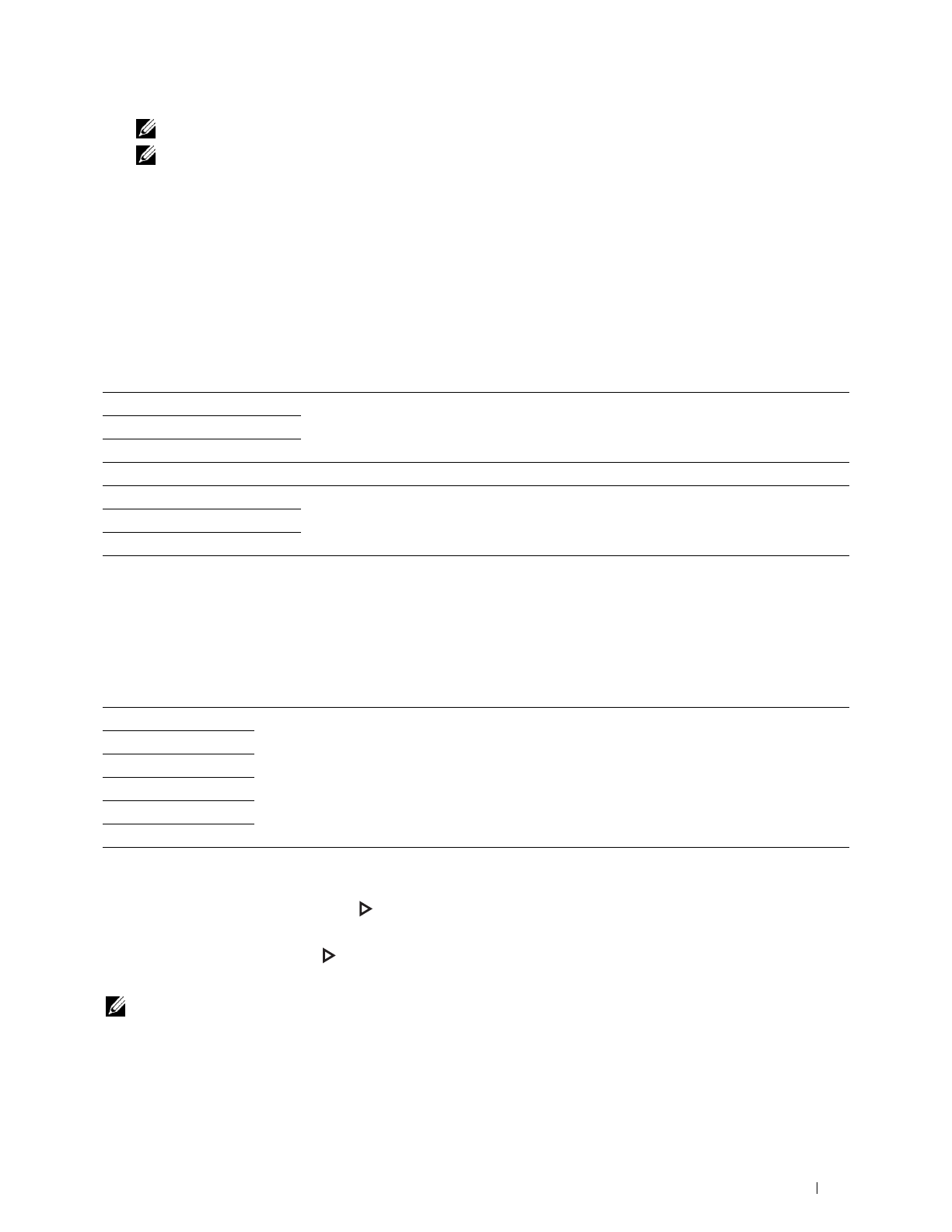
Copying 333
NOTE: Tray2 is only available when the optional 550-sheet feeder is installed.
NOTE: When Any is displayed as the paper size and type in the MPF, you can select the paper size and type from this
menu. For details, see "Select Tray."
Darken / Lighten
To adjust the contrast to make the copy darker or lighter than the original:
1
Select
Darken / Lighten
.
2
Select the desired level on the
Darken / Lighten
bar, and then select
OK
.
You can select a contrast level from seven levels between
Darken
and
Lighten
.
Selecting a cell on the left side of the bar makes the document contrast darker, and selecting a cell on the right side
of the bar makes the document contrast lighter.
* Denotes the factory default setting.
2 Sided Copying
To make duplex copies with the specified binding position:
1
Select
2 Sided Copying
.
2
Select the desired setting, and then select
OK
.
* Denotes the factory default setting.
When you are using the document glass and it is set to
1
→
2 Sided
or
2
→
2 Sided
, the display prompts you
for another page after pressing the
(Start)
button.
a
If you want to place a new document, replace the document with a new document, and then select
Continue
or press the
(Start)
button.
b
If you finish copying, select
Print Now
.
NOTE: When you use the DADF to copy both sides of a document, the printed position of the front and back of the document
may differ if the size in the document size setting and the size of the document do not match. In this case, set Original
Size to the same size as the document.
Darken +3 Works well with light documents or faint pencil markings.
Darken +2
Darken +1
Normal* Works well with normal typed or printed documents.
Lighten +1 Works well with dark documents.
Lighten +2
Lighten +3
1 → 1 Sided* Select 1 sided or 2 sided and specify binding position for the 2 sided copy.
1 → 2 Sided
2 → 1 Sided
2 → 2 Sided
Long Edge Biding
Short Edge Binding

334 Copying
Original Type
To select the copy image quality:
1
Select the
Quality
tab, and then select
Original Type
.
2
Select the desired setting, and then select
OK
.
* Denotes the factory default setting.
Sharpness
To adjust the sharpness to make the copy image sharper or softer than the original:
1
Select the
Quality
tab, and then select
Sharpness
.
2
Select the desired setting, and then select
OK
.
* Denotes the factory default setting.
Color Saturation
To adjust the amount of colors of the copy to make the colors darker or lighter than the original:
1
Select the
Quality
tab, and then select
Color Saturation
.
2
Select the desired setting, and then select
OK
.
* Denotes the factory default setting.
Auto Exposure
To suppress the background of the original to enhance text on the copy:
1
Select the
Quality
tab, and then select
Auto Exposure
.
2
Select
On
, and then select
OK
.
Photo & Text* Used for documents with both photos and text.
Text Used for documents with text.
Photo Used for documents with photos.
Sharpen Makes the copy image sharper than the original.
Normal* The color clarity of the image is the same as the original.
Soften Makes the copy image softer than the original.
High Makes the color of the copy more vivid.
Normal* The color saturation is the same as the original.
Low Makes the color of the copy less vivid.
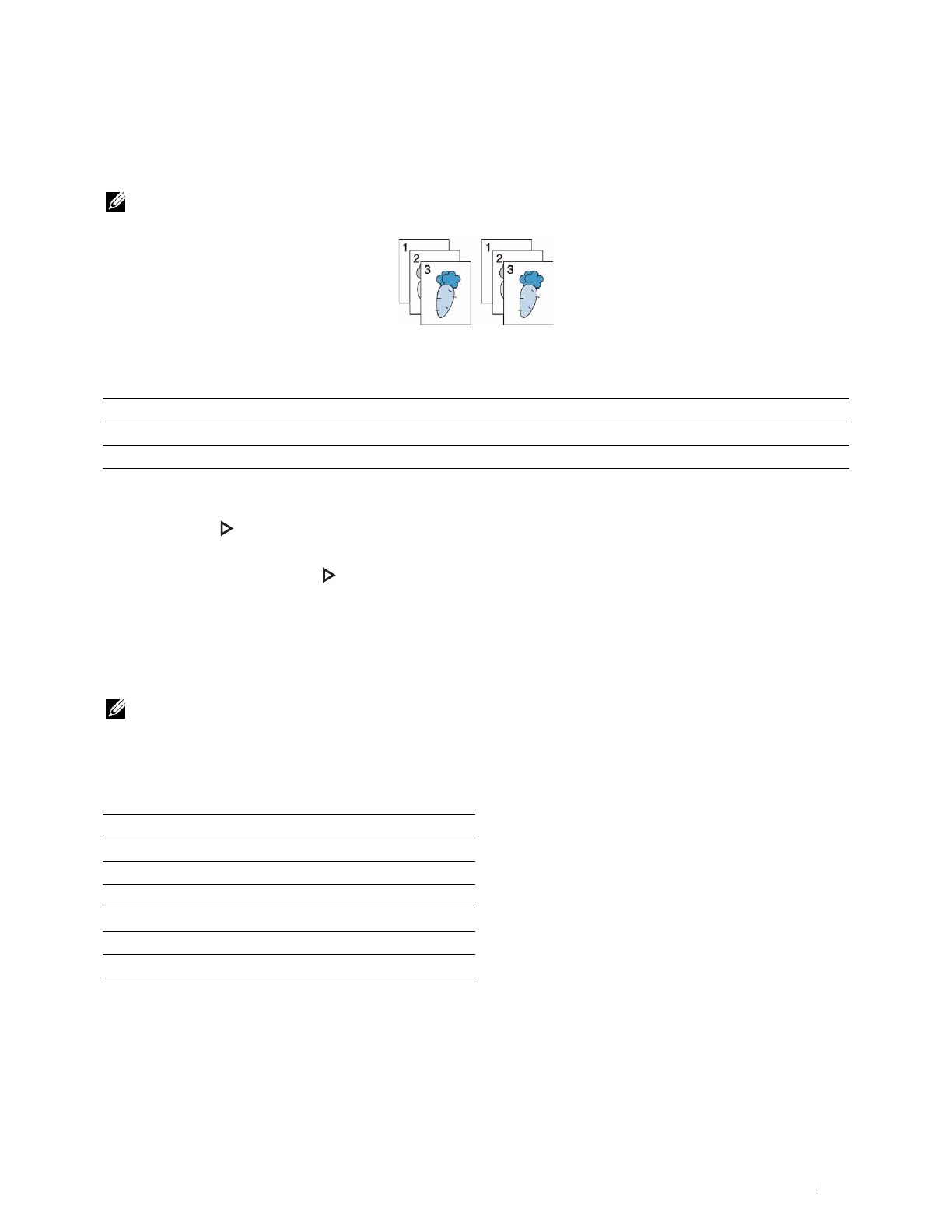
Copying 335
Collation
To sort the copy output: For example, if you make two copies of three page documents, one complete three page
document will be printed followed by the second complete document:
NOTE: You can collate more pages when the optional memory module or hard disk is installed.
1
Select the
Output
tab, and then select
Collation
.
2
Select the desired setting, and then select
OK
.
* Denotes the factory default setting.
When you are using the document glass and it is set to
Collated
, the display prompts you for another page after
pressing the
(Start)
button.
a
If you want to place a new document, replace the document with a new document, and then select
Continue
or press the
(Start)
button.
b
If you finish copying, select
Print Now
.
Reduce / Enlarge
To reduce or enlarge the size of a copied image from 25 to 400 percent when you copy original documents from the
document glass or DADF:
NOTE: When you make a reduced copy, black lines may appear at the bottom of your copy.
1
Select the
Output
tab, and then select
Reduce / Enlarge
.
2
Select the desired setting, and then select
OK
.
(Inch series)
Auto* Only the documents loaded from DADF are copied in collated order.
Collated Copies in collated order.
Uncollated Does not copy in collated order.
100%*
50%
64% (Ledger→Letter)
78% (Legal→Letter)
129% (Statement→Letter)
154% (Statement→Legal)
200%
336 Copying
(mm series)
* Denotes the factory default setting.
NOTE: You can also specify the value in increments of 1 percent from 25 to 400 by
selecting or , or
entering a
value using the number pad.
Original Size
To select the default document size:
1
Select the
Output
tab, and then select
Original Size
.
2
Select the desired setting, and then select
OK
.
(Inch series)
(mm series)
* Denotes the factory default setting.
100%*
50%
70% (A4→A5)
81% (B5→A5)
122% (A5→B5)
141% (A5→A4)
200%
Auto*
Letter (8.5x11")
Folio (8.5x13")
Legal (8.5x14")
A4 (210x297mm)
A5 (148x210mm)
B5 (182x257mm)
Executive (7.3x10.5")
Auto*
A4 (210x297mm)
A5 (148x210mm)
B5 (182x257mm)
Letter (8.5x11")
Folio (8.5x13")
Legal (8.5x14")
Executive (7.3x10.5")
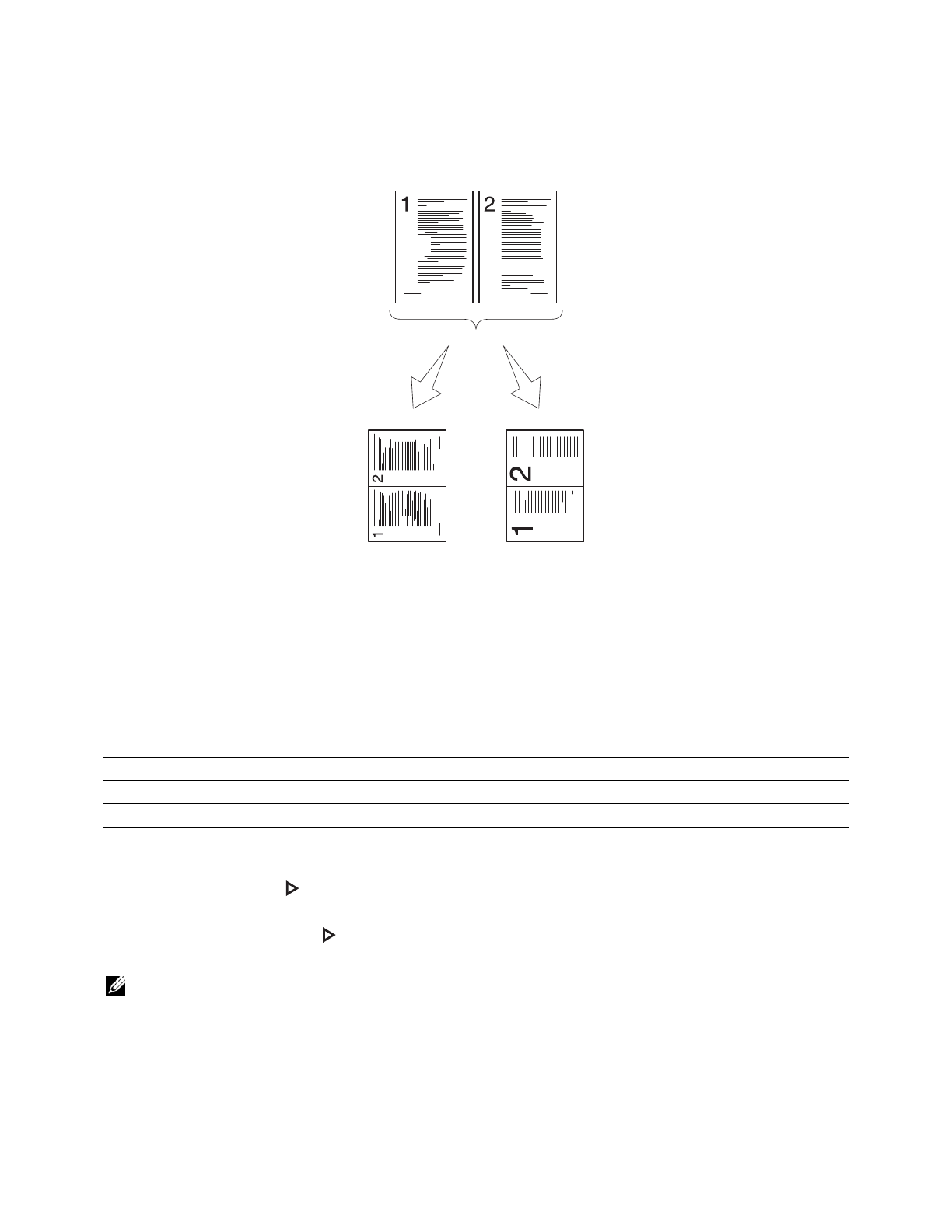
Copying 337
2-Up
To print two original images to fit onto one sheet of paper:
1
Select the
Output
tab, and then select
2-Up
.
2
Select the desired setting, and then select
OK
.
* Denotes the factory default setting.
When you are using the document glass and it is set to
Auto
or
Manual
, the display prompts you for another
page after pressing the
(Start)
button.
a
If you want to place a new document, replace the document with a new document, and then select
Continue
or press the
(Start)
button.
b
If you finish copying, select
Print Now
.
NOTE: When you use the DADF to copy both sides of a document, the printed position of the front and back of the document
may differ if the size in the document size setting and the size of the document do not match. In this case, set Original
Size to the same size as the document.
Off* Does not perform multiple-up printing.
Auto Automatically reduces the original pages to fit onto one sheet of paper.
Manual Prints the original pages onto the one sheet of paper in the size specified in Reduce / Enlarge.
Auto:
Automatically
reduces the
pages to fit in
one page.
Manual:
Reduces the
pages in the
custom size
depending on the
setting of the
Reduce / Enlarge
menu.
338 Copying
Margin
To specify the margins of the copy:
1
Select the
Output
tab.
2
Select until
Margin
appears, and then select
Margin
.
3
Select or , or use the number pad to enter the desired value.
* Denotes the factory default settings.
Using the ID Card Copy
NOTE: If the Function Enabled setting for ID Card Copy is set to Disable, the ID card copy function is disabled and the
menu is not displayed on the screen. For details, see "Function Enabled."
You can copy both sides of an ID card on one side of a single sheet of paper in its original size by selecting ID Card
Copy on the touch panel. This feature helps to show both sides of an ID card in one page in its original size.
To make a copy:
1
Place an ID card facing down on the document glass, and close the document cover.
For details about loading a document, see "Making Copies From the Document Glass."
2
Press the
(Home)
button.
3
Select
ID Card Copy
.
4
Specify the copy settings below as required.
•Output Color
• Select Tray
•Darken / Lighten
•Auto Exposure
• Sharpness
• Color Saturation
For details, see "Setting Copy Options."
5
Press the (
Start
) button to begin copying.
After the front side of the ID card is scanned, the display prompts you to turn over the card.
a
To scan the back side of the ID card, turn the ID card over and select
Continue
or press the (
Start
)
button.
b
To finish copying, select
Print Now
.
NOTE: Color copy is secured with a password if the Function Enabled setting for Copy is set to On (Color
Password). If you set Output Color to Full Color and the Function Enabled setting for Copy to On
(Color Password), you will need to enter the four digit password after pressing the (Start) button.
Top / Bottom 0.2 inch* (4 mm*) Specify the value in increments of 0.1 inch (1 mm).
Available Range: 0.0–2.0 inches (0–50 mm)
Left / Right 0.2 inch* (4 mm*) Specify the value in increments of 0.1 inch (1 mm).
Available Range: 0–2.0 inches (0–50 mm)
Middle 0 inches* (0 mm*) Specify the value in increments of 0.1 inch (1 mm).
Available Range: 0–2.0 inches (0–50 mm)

Copying 339
Changing the Default Settings
The default settings of the copy menu options such as Output Color, Select Tray, and
Darken / Lighten can be set to the most frequently used modes. When you copy a document, the specified
default settings are used unless they are changed by using the operator panel.
To create your own default settings:
1
Press the
(Information)
button.
2
Select the
Tools
tab, and then select
Default Settings
.
3
Select
Copy Defaults
.
4
Select until the desired menu item appears, and then select that menu item.
5
Select the desired setting or enter the value, and then select
OK
.
6
Repeat steps 4 and 5 as needed.
To return to the
Information
screen, press the
(All Clear)
button.

340 Copying

Scanning 341
21
Scanning
NOTE: If the Function Enabled setting for a scan function (E-mail, Scan To Network, Scan To Application
/ WSD Scan, PC Scan, or Scan To USB) is set to On (Password), you need to enter the four digit password to
use that scan function. If the Function Enabled setting for a scan function is set to On, that scan function is disabled and the
menu is not displayed on the screen. For details, see "Function Enabled."
Scanning Overview
Use your Dell™ C3765dnf Multifunction Color Laser Printer to turn pictures and text into editable images on your
computer.
The Dell C3765dnf Multifunction Color Laser Printer provides several ways to scan your document. There are two
main scanning types. One is operated on the printer side without using the scanner driver, and the other is operated
on the computer side using a software and the scanner driver. See the available features below to help you find the
information you need.
• Scanning - With scanner driver
• Scanning - Without scanner driver
Scanning - With scanner driver
• Scan into a graphic software such as
PaperPort
®
(a software for Microsoft
®
Windows
®
that is bundled with the
printer) and Adobe
®
Photoshop
®
using a TWAIN driver
(Supporting USB and Network connections for both Microsoft Windows and Apple Macintosh using a graphic
software)
See "Scanning Using the TWAIN Driver."
• Scan into a Microsoft’s default program such as Windows Photo Gallery and Microsoft Paint, using a Windows
Image Acquisition (WIA) driver
(Supporting USB and Network (including WSD) connections on Windows only)
See "Scanning Using the Windows Image Acquisition (WIA) Driver."
• Scan and send the scanned document to computer connected via USB cable
(Supporting USB connection for both Microsoft
Windows
and Apple Macintosh using bundled software tool of
ScanButton Manager
)
Using the feature of Scan to Application on the operator panel of your printer, the scanned image is saved in the
location of your computer specified with the
ScanButton Manager
.
See "Scanning From the Operator Panel - Scan to Application."
Scanning - Without scanner driver
• Scan and save the scanned document in a USB memory
See "Scanning to a USB Memory."
• Scan and send the scanned document by e-mail
See "Sending an E-Mail With the Scanned Image."
• Scan and send the scanned document to computer or server connected to network
See "Scanning to a PC or Server via SMB/FTP."
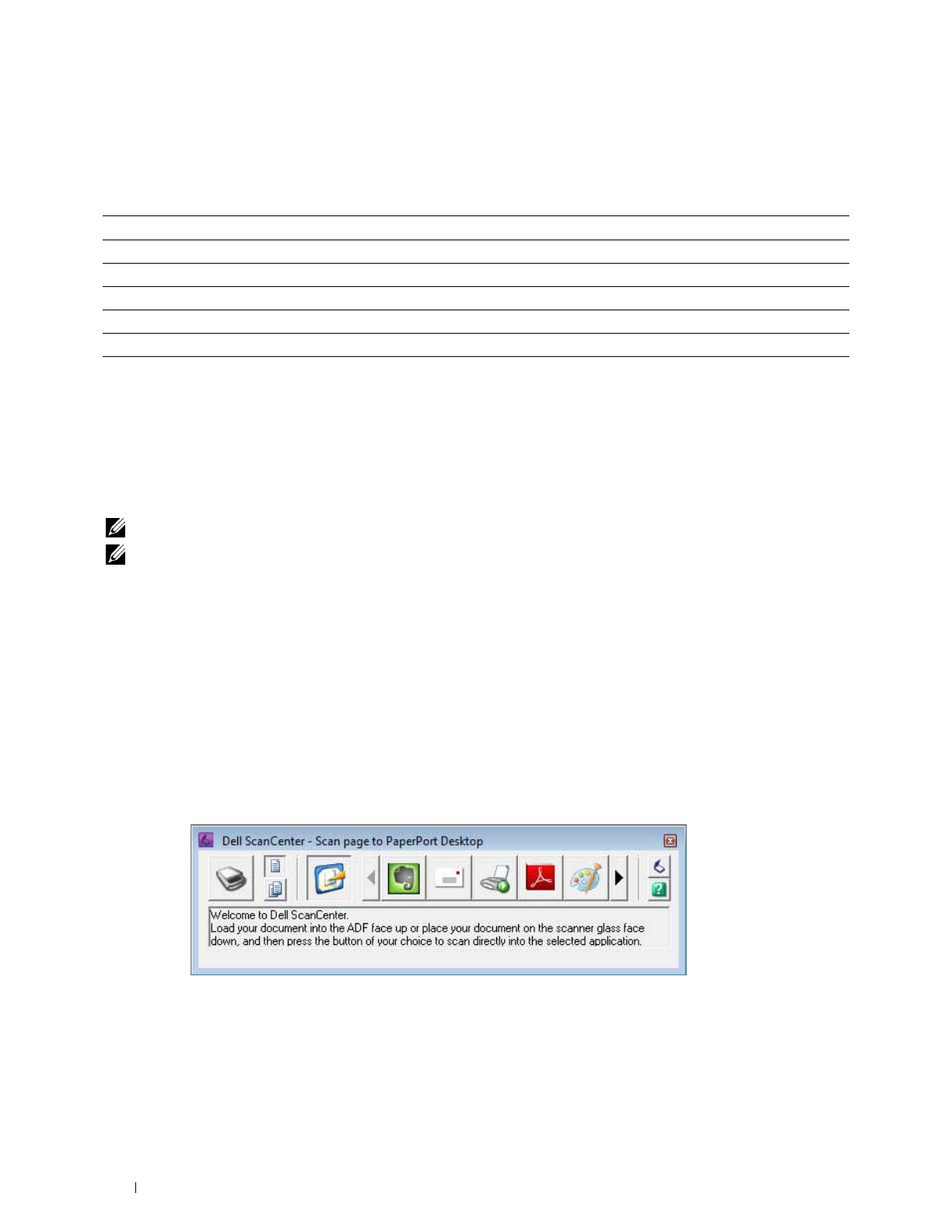
342 Scanning
• Scan and send the scanned document to a computer connected to a network using WSD
See "Scanning from the Operator Panel - WSD Scan."
The resolution setting to use when you scan an item depends on the item type and how you plan to use the image or
document after you scan it to your computer. For the best results, use these recommended settings.
Scanning above these recommended resolutions may exceed the capabilities of the application. If you require a
resolution above those recommended in the above table, you should reduce the size of the image by previewing (or
pre-scan) and cropping before scanning the image.
PaperPort
PaperPort that comes bundled with this printer can be used to manage all your documents. You can organize, search,
and share all of your scanned documents.
NOTE: PaperPort is supported only on Windows.
NOTE: You can use PaperPort's built-in Optical Character Recognition (OCR) software to copy text from scanned documents so
that you can use and edit the text in any text editing, word processing, or spreadsheet program. The OCR process requires
textual images scanned at 150–600 dpi and 300 dpi or 600 dpi is recommended for graphics.
If you prefer to use another application, such as Adobe Photoshop, you must assign the application to the printer by
selecting it from the list of available applications through the Select Software button each time you start scanning. If
you do not assign an application to the Select Software button, PaperPort is automatically selected when you start
scanning. See "Printer Utility Software."
Dell ScanCenter
Dell ScanCenter is a PaperPort application that enables you to scan items and send them directly to PaperPort or
other programs on your computer without first running PaperPort. Dell ScanCenter runs as a separate application
from the Windows start menu and displays the Dell ScanCenter bar. For more information about using Dell
ScanCenter, refer to the PaperPort's Help menu.
Icons on the Dell ScanCenter bar represent the programs that are limited to PaperPort and to Dell ScanCenter. To
scan and send an item to a program, click the program icon and then scan the item. Dell ScanCenter automatically
starts the selected program when the scan is complete.
Type Resolution
Documents 300 dpi black-and-white or 200 dpi grayscale or color
Documents of poor quality or that contain small text 400 dpi black-and-white or 300 dpi grayscale
Photographs and pictures 100–200 dpi color or 200 dpi grayscale
Images for an inkjet printer 150–300 dpi
Images for a high-resolution printer 300–600 dpi
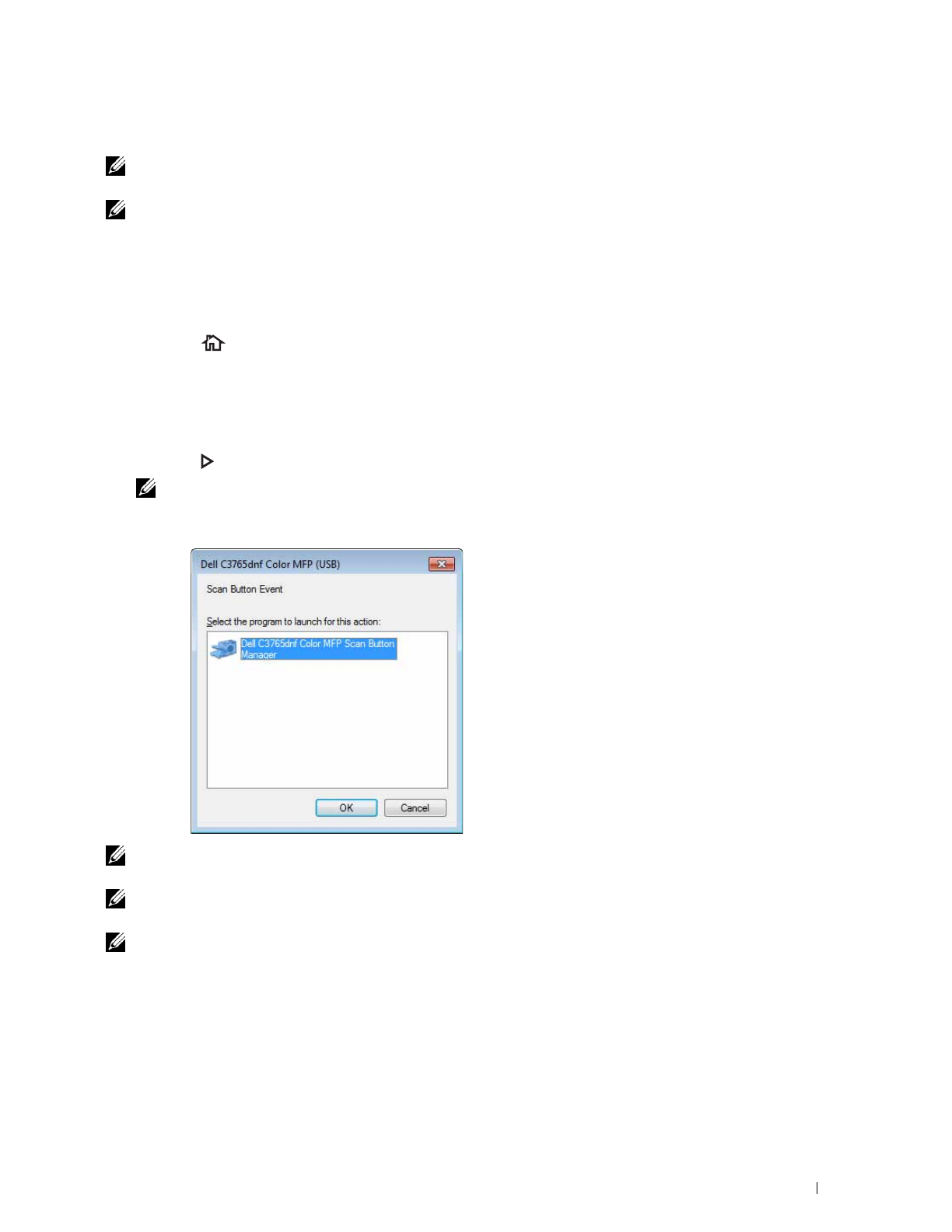
Scanning 343
Scanning From the Operator Panel - Scan to Application
NOTE: You must connect your computer via USB for selecting the Scan to Application feature from the operator panel. Network
connection is not supported.
NOTE: This feature is supported on both Microsoft Windows and Apple Macintosh.
1
Load the document(s) facing up with top edge in first into the DADF.
OR
Place a single document facing down on the document glass, and close the document cover.
For details about loading a document, see "Loading an Original Document."
2
Press the
(Home)
button.
3
Select
Scan Menu
.
4
Select
Application
.
5
Specify scan options such as
Output Color
,
Resolution
,
2 Sided Scanning
, and
File Format
on
the
Scan to Application
,
Quality
and
Options tabs
. For details, see "Application."
6
Press the
(Start)
button to begin scanning the document.
NOTE: If the following dialog box appears on your computer, select Dell C3765dnf Color MFP ScanButton Manager, and
then click OK.
For Microsoft Windows:
NOTE: Once you select Dell C3765dnf Color MFP ScanButton Manager with the Always use this program for this action check
box selected, Dell C3765dnf Color MFP ScanButton Manager will automatically open without selecting an application.
NOTE: You must use ScanButton Manager on your computer to change the settings for scanning. For details, see "ScanButton
Manager."
NOTE: For Macintosh, the dialog box for selecting a program is not displayed.
ScanButton Manager
The Scan to Application stores the image files in the My Documents folder by default, and then you can
open them using the related application. Use ScanButton Manager to change the output destination of the
obtained image files and to select whether to open the image files using the related application.
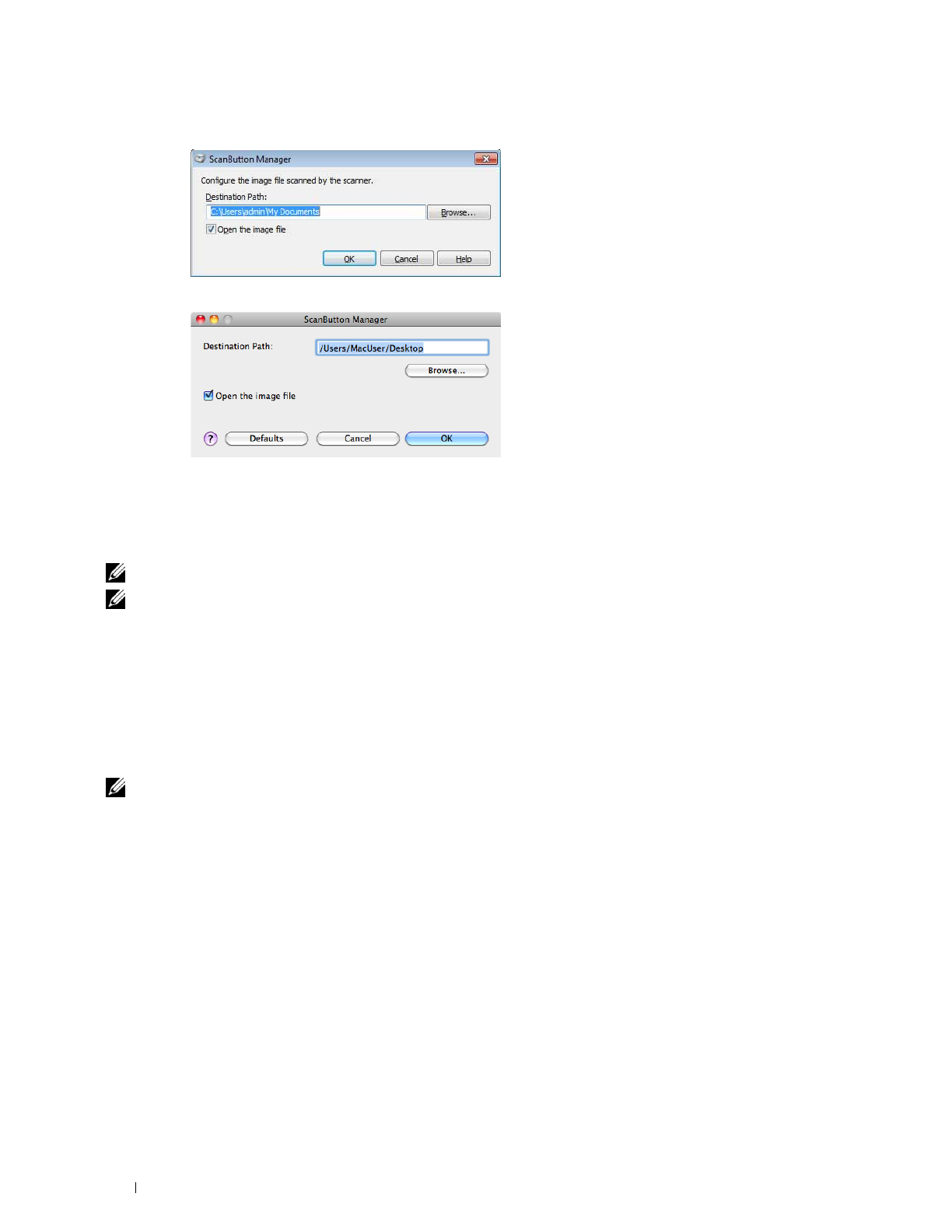
344 Scanning
For Microsoft Windows:
For Apple Macintosh:
Scanning from the Operator Panel - WSD Scan
If the printer is connected to a computer via network using WSD (Web Services on Devices), you can use the WSD
Scan function to send scanned images to a computer.
NOTE: To use WSD Scan, you need to setup connection using WSD.
NOTE: WSD is supported only on Windows Vista®, Windows 7, and Windows 8.
Printer Setup for WSD Scan
Setup the printer and computer for connection using WSD.
Checking the Printer Setting
To use the WSD Scan function, WSD Scan needs to be set to Enable. See "Protocols" for details.
Setting Up the Computer
NOTE: For Windows 8, the computer automatically connects the printer using WSD. There is no need to install the printer
manually.
For Windows 7:
1
Click
Start
→
Computer
→
Network
2
Right-click the icon for the printer, and then click
Install
. The printer is connected using WSD.
For Windows Vista:
1
Click
Start
→
Network
2
Right-click the icon for the printer, and then click
Install
.
3
Click
Continue
. The printer is connected using WSD.

Scanning 345
Procedures for WSD Scan
1
Load the document(s) facing up with top edge in first into the DADF.
OR
Place a single document facing down on the document glass, and close the document cover.
For details about loading a document, see "Loading an Original Document."
2
Press the (
Home
) button.
3
Select
Scan Menu
.
4
Select
WSD Scan
.
5
Select until the desired computer you want to send the scan job to appears, and then select that computer.
6
Select
Event
, and specify the type of scan. For details, see "WSD Scan."
7
Press the (
Start
) button to begin sending the scanned file.
Scanning Using the TWAIN Driver
Your printer supports the TWAIN driver for scanning images that supports Microsoft Windows XP, Windows
Server® 2003, Windows Vista, Windows Server 2008, Windows Server 2008 R2, Windows 7, Windows 8, Windows
Server 2012, Apple Mac OS X 10.3.9, Mac OS X 10.4.11, Mac OS X 10.5, Mac OS X 10.6, Mac OS X 10.7, Mac OS X
10.8 works with various scanners.
1
Load the document(s) facing up with top edge in first into the DADF.
OR
Place a single document facing down on the document glass, and close the document cover.
For details about loading a document, see "Loading an Original Document."
2
Start the drawing software that supports TWAIN, such as
PaperPort
for Windows. For using other than
PaperPort
,
proceed to step 6.
3
To set the location where to store the scanned images:
Click
Desktop
→
Folders
.
In the
Folders
panel, specify a destination folder.
4
To set the scanner:
Click
Desktop
→
Scan Settings
→
Select...
In the
Available Scanners
dialog box, select
TWAIN: Dell C3765dnf Color MFP
, and then click
OK
.
5
Make sure that
Display scanner dialog box
check box is selected on the
Scan or Get Photo
panel.
6
Click
Scan
to begin scanning process.
The
Dell C3765dnf Color MFP
TWAIN Driver
window appears.
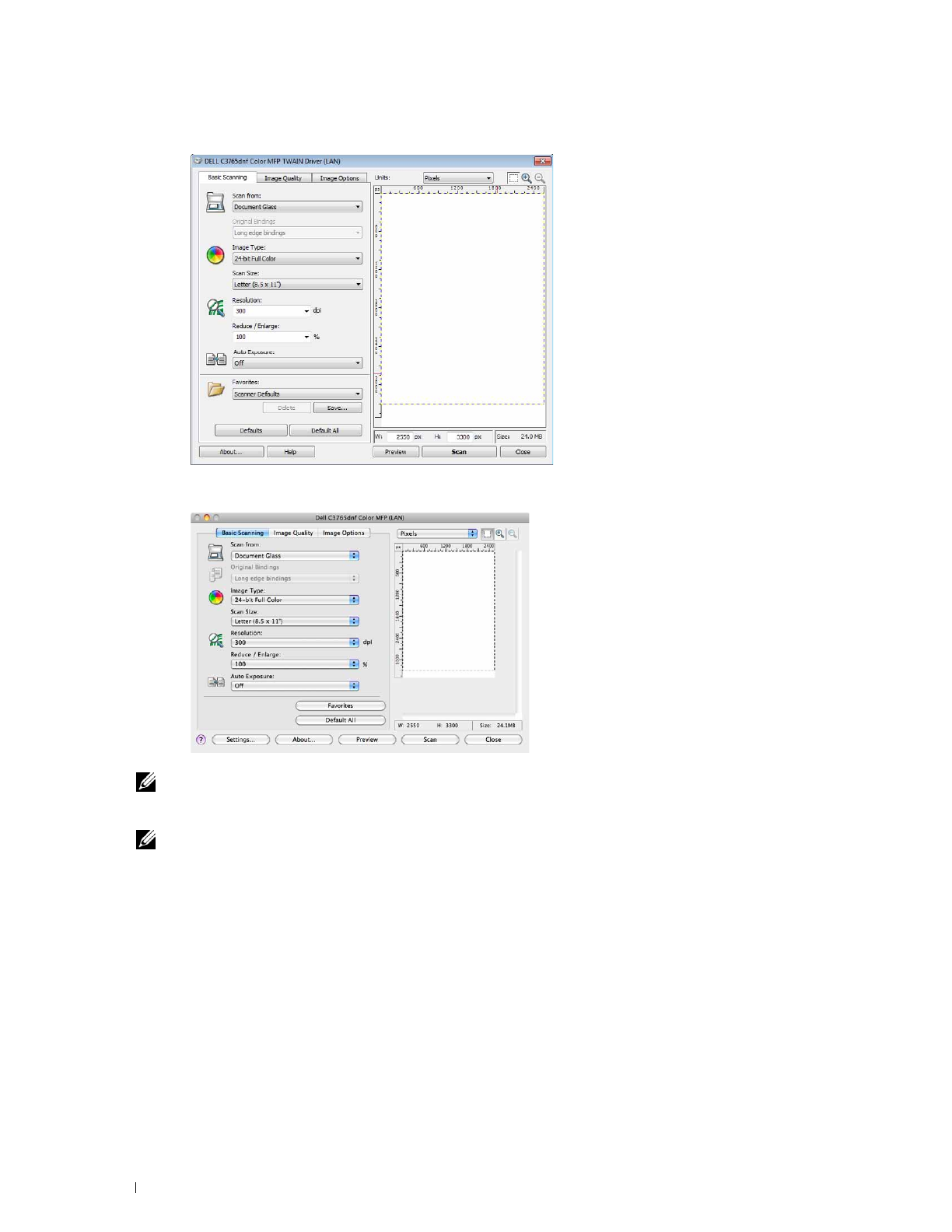
346 Scanning
For Microsoft Windows:
For Apple Macintosh:
NOTE: The screen image may vary depending on the operating system.
7
In the
Basic Scanning
tab, set the desired preferences, and click
Preview
to display the preview image.
NOTE: The Preview feature cannot be used when performing duplex (two-sided) scanning from the DADF.
8
Adjust the settings in the
Image Quality
and
Image Option
tabs.
9
Click
Scan
to start scanning.
10
When the scanning is completed, click
Close
to exit the window.
11
Click
Done
to close the
PaperPort - Scan
window.
The scanned image is automatically saved in the specified location.
If you want to scan more pages, follow the on-screen instructions to edit the picture after it is copied to your
computer.
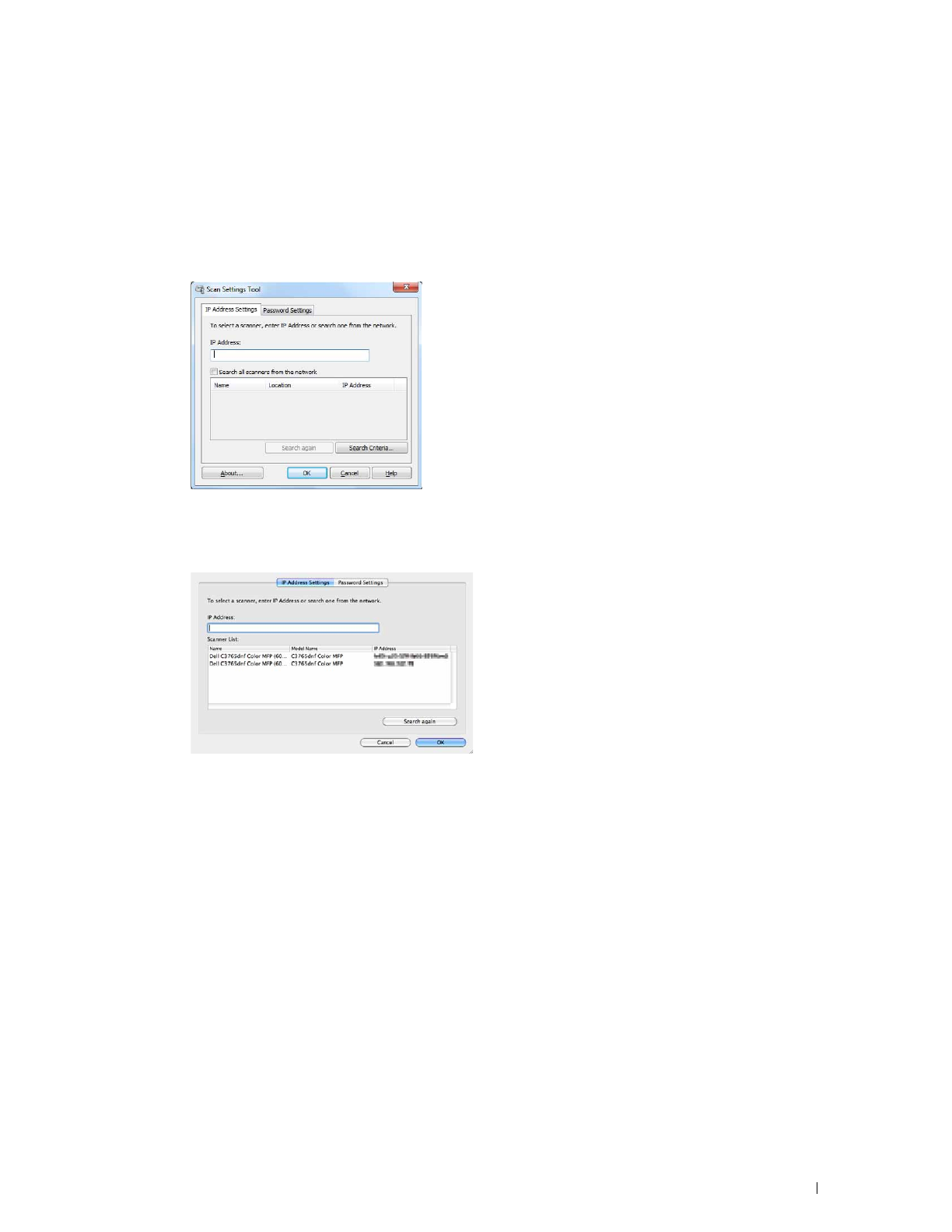
Scanning 347
Scan Settings Tool
You can check the IP address of the printer or set the password using the Scan Settings Tool.
To open the Scan Settings Tool:
For Microsoft Windows:
Click Start
→
Program
→
Dell Printers
→
Dell C3765dnf Multifunction Color Laser Printer
→
Scan Settings Tool.
For Apple Macintosh:
Click Settings on the main scanning window of the
Dell C3765dnf Color MFP
window.
IP Address Settings
In the IP Address Settings tab, you can check the IP address that is set for your scanner or change the scanner
selection.
•IP Address
Enter the IP address.
• Search all scanners from the network
(Windows only)
Searches scanners in your network.
•Scanner List
Displays a list of scanners that are detected.
• Search again
Searches the scanners in your network.
• Search Criteria
(Windows only)
Displays the
Search Criteria
dialog box for setting the search condition.
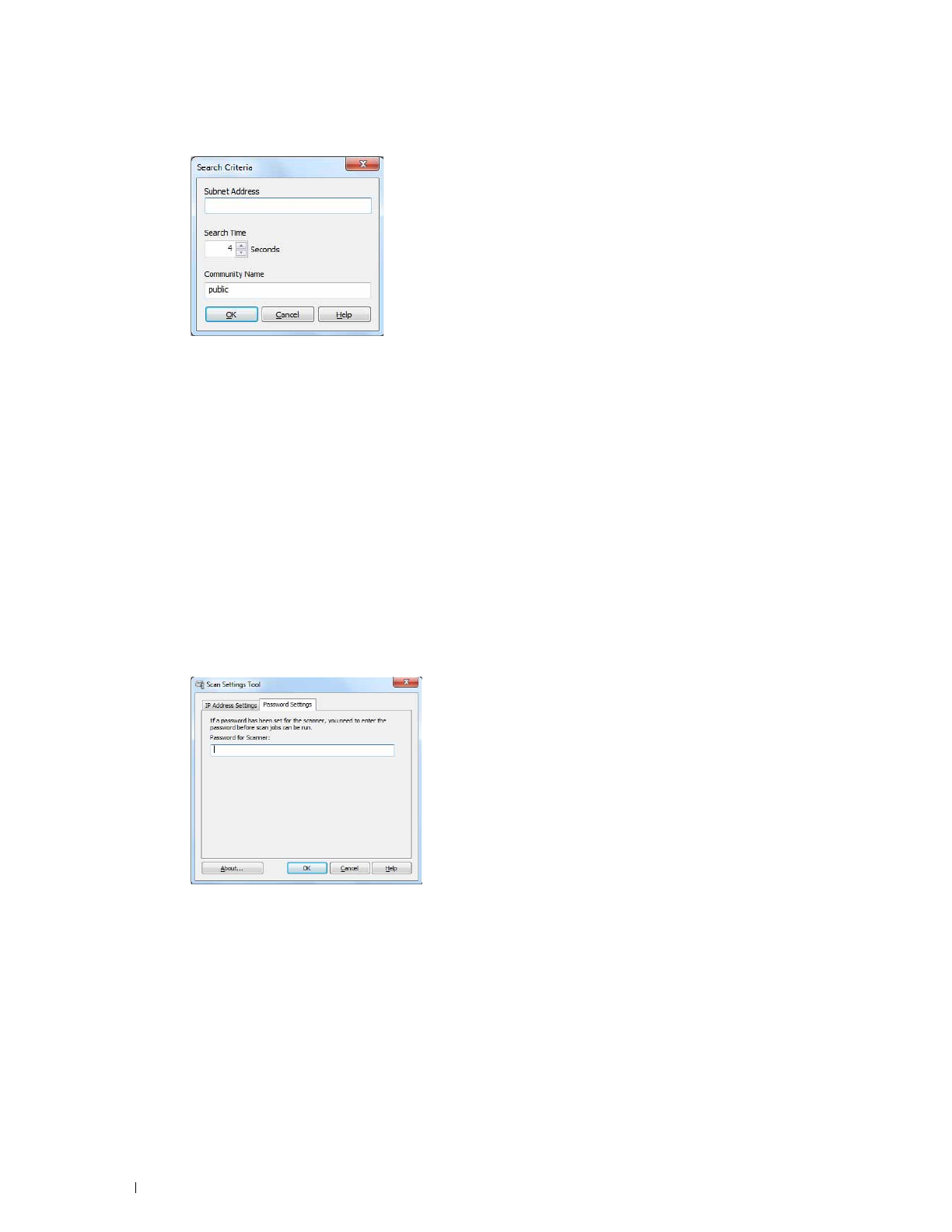
348 Scanning
Search Criteria Dialog Box (Windows only)
•Subnet Address
Enter the subnet address.
• IPv4: Broadcast Address such as "192.168.1.255"
• IPv6: Multicast Address such as "ff02::1"
• Search Time
Specify a time period for searching a scanner.
• Community Name
Enter the SNMPv1/v2 community name. The default community name is "public."
Password Setting
In the Password Setting tab, you can input the password that is set for your scanner to access from your computer to
the printer.
For Microsoft Windows:
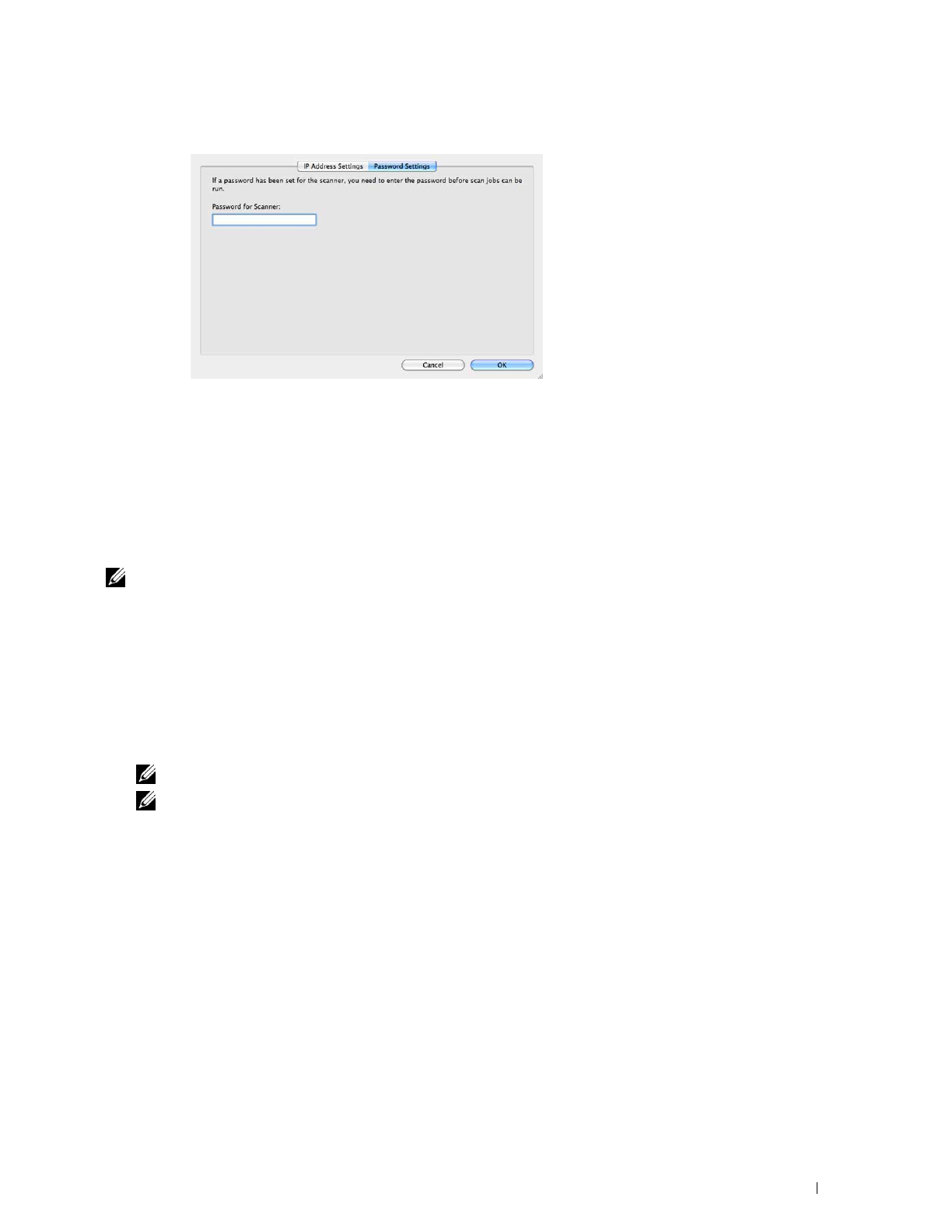
Scanning 349
For Apple Macintosh:
• Password for Scanner
Enter the password.
Scanning Using the Windows Image Acquisition (WIA) Driver
Your printer also supports the WIA driver for scanning images. WIA is one of the standard components provided by
Microsoft Windows XP and later operating systems and works with digital cameras and scanners. Unlike the TWAIN
driver, the WIA driver allows you to scan an image and easily manipulate those images without using additional
software.
NOTE: The Windows Image Acquisition (WIA) driver is supported only on Windows.
To scan an image from the drawing software:
1
Load the document(s) facing up with top edge in first into the DADF.
OR
Place a single document facing down on the document glass, and close the document cover.
For details about loading a document, see "Loading an Original Document."
2
Start the drawing software, such as Microsoft Paint for Windows.
NOTE: When you use Windows Vista or Windows Server 2008, use Windows Photo Gallery instead of Microsoft Paint.
NOTE: When using applications that utilize WIA 2.0, such as Windows Fax and Scan on Windows Vista, Windows 7 and
Windows 8, the Feeder (Scan both sides) option can be selected for duplex (two-sided) scanning.
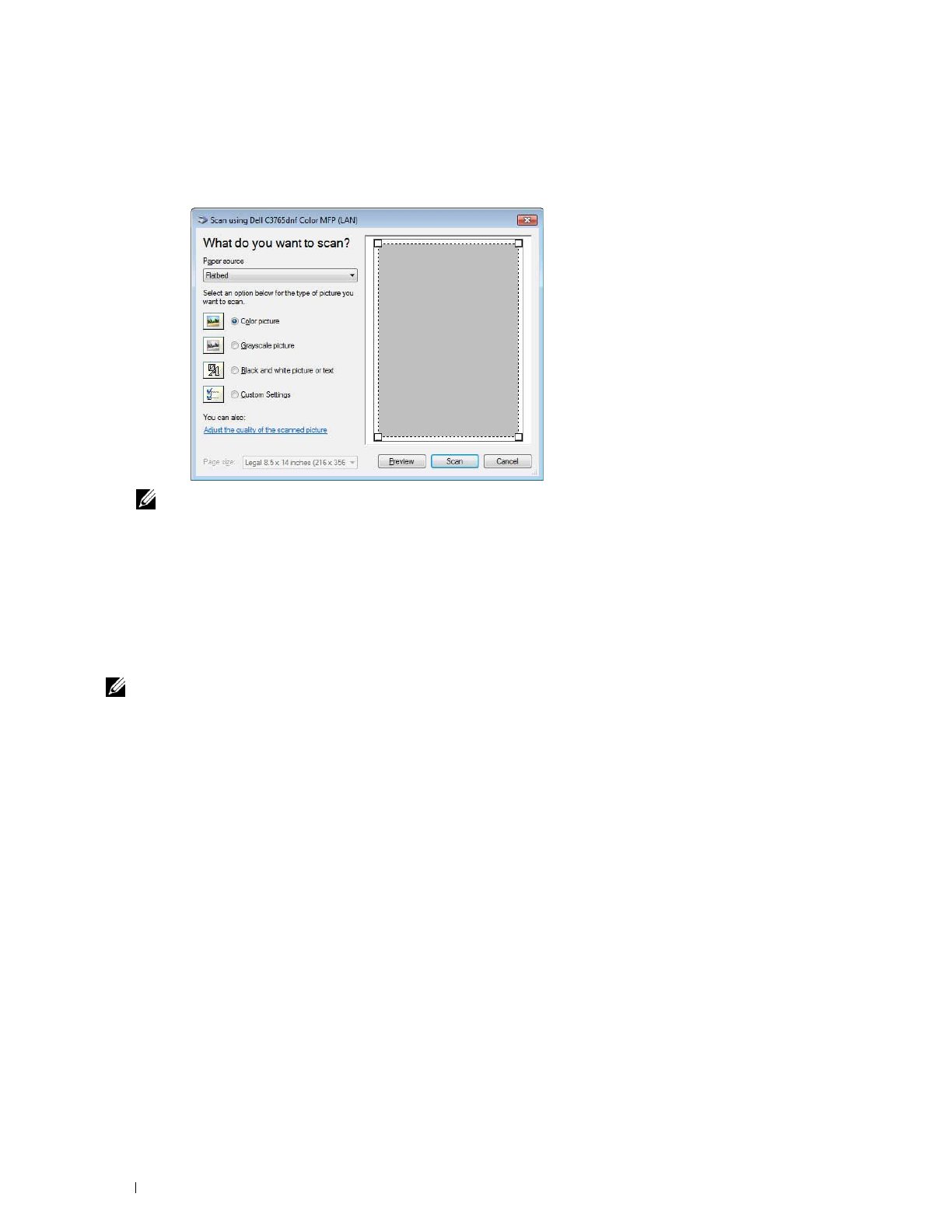
350 Scanning
3
Click
File
→
From Scanner or Camera
(
Paint
button
→
From scanner or camera
for Windows 7, Windows 8,
Windows Server 2008 R2, and Windows Server 2012).
The
Scan using Dell C3765dnf Color MFP (
USB or LAN
)
window appears.
NOTE: The screen image may vary depending on the operating system.
4
Select your desired type of picture that you want to scan, and click
Adjust the quality of the scanned picture
to
display the
Advanced Properties
dialog box.
5
Select the desired properties including brightness and contrast, and then click
OK
.
6
Click
Scan
to start scanning.
7
Click
File
→
Save
to save your scanned document in your desired location on your computer.
To scan an image from Control Panel:
NOTE: This feature is supported on Microsoft Window Server 2003 and Windows XP only.
1
Load the document(s) facing up with top edge in first into the DADF.
OR
Place a single document facing down on the document glass, and close the document cover.
For details about loading a document, see "Loading an Original Document."
2
Click
Start
→
Control Panel
→
Printers and Other Hardware
→
Scanners and Cameras
.
3
Double-click the scanner icon. The
Scanner and Camera Wizard
launches.
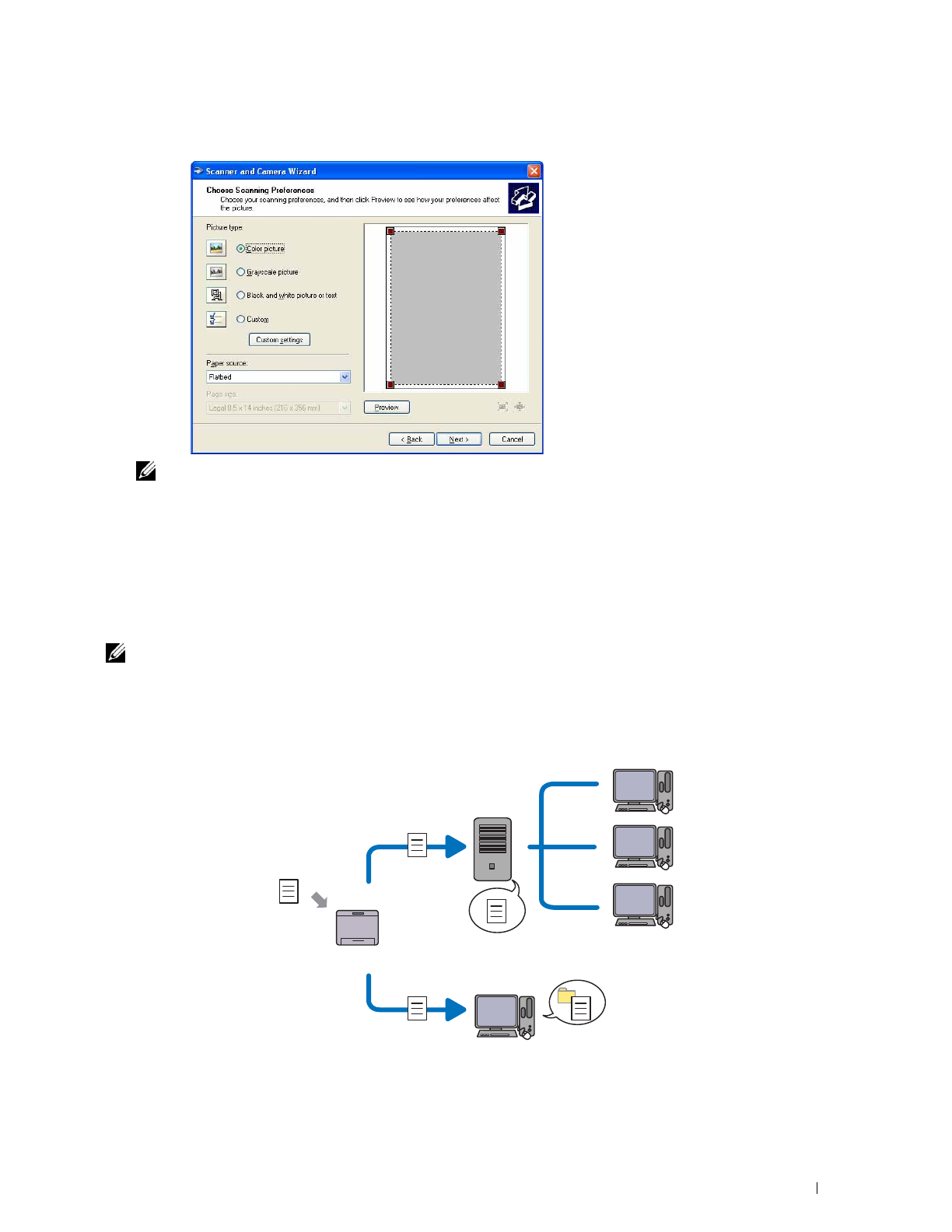
Scanning 351
4
Click
Next
to display the
Choose Scanning Preferences
page.
NOTE: The screen image may vary depending on the operating system.
5
Select your desired type of picture, paper source, and paper size, and click
Next
.
6
Enter a picture name, select a file format, and specify the desired location to save the scanned document.
7
Click
Next
to start scanning.
8
Follow the on-screen instructions to edit the picture after it is copied to your computer.
Scanning to a PC or Server via SMB/FTP
NOTE: This feature does not require a network scan driver.
Overview
The Scan to Network feature allows you to send the scanned documents to a computer or FTP server.
Scan
Using FTP
Using SMB
FTP Server
Computer
Computer

352 Scanning
Required operating systems:
For FTP:
NOTE: For information on how to configure the FTP service, refer to the manual provided with the software.
NOTE: Microsoft Windows Server 2003, Windows XP, Windows Vista, Mac OS X
10.3.9/10.4.11/10.5
support IPv4 only.
• Microsoft Windows XP Professional
FTP service of Microsoft Internet Information Services 5.1
• Microsoft Windows Server 2003 Service Pack 1
FTP service of Microsoft Internet Information Services 6.0
• Microsoft Windows Vista
Microsoft Windows Server 2008
FTP service of Microsoft Internet Information Services 7.0
• Microsoft Windows 7
Microsoft Windows Server 2008 R2
FTP service of Microsoft Internet Information Services 7.5
• Microsoft Windows 8
Microsoft Windows Server 2012
FTP service of Microsoft Internet Information Services 8.0
• Mac OS X 10.3.9/10.4.11/10.5/10.6/10.7/10.8
FTP service of Mac OS X
For SMB:
NOTE: Microsoft Windows Server 2003, Windows XP, Mac OS X
10.3.9/10.4.11/10.5/10.6
support IPv4 only.
• Microsoft Windows XP
• Microsoft Windows Server 2003
• Microsoft Windows Vista
• Microsoft Windows Server 2008
• Microsoft Windows Server 2008 R2
• Microsoft Windows 7
• Microsoft Windows 8
• Microsoft Windows Server 2012
•Mac OS X 10.3.9/10.4.11/10.5/10.6
Procedures
For FTP:
1
"Setting a Destination Using an Address Book"
2
"Sending the Scanned File on the Network"
For SMB:
1
"Setting a Login Name and a Password (SMB Only)"
2
"Creating a Shared Folder (SMB Only)"
Scanning 353
3
"Setting a Destination Using an Address Book"
4
"Sending the Scanned File on the Network"
Setting a Login Name and a Password (SMB Only)
The Scan to Network feature requires a user login account with a valid and non-empty password for authentication.
Confirm a login user name and password.
For Microsoft Windows:
If you do not use a password for your user login, you need to create a password on your User Login Account with the
following procedure.
For Windows XP:
1
Click
start
→
Control Panel
→
User Accounts
.
2
Click
Change an account
.
3
Click
Create a password
and add in a password for your user login account.
For Windows Vista and Windows 7:
1
Click
Start
→
Control Panel
.
2
Click
User Accounts and Family Safety
.
3
Click
User Accounts
.
4
Click
Create a password for your account
and add in a password for your user login account.
For Windows Server 2008:
1
Click
Start
→
Control Panel
.
2
Double-click
User Accounts
.
3
Click
Create a password for your account
and add in a password for your user login account.
For Windows Server 2008 R2:
1
Click
Start
→
Control Panel
.
2
Select
User Accounts
.
3
Click
User Accounts
.
4
Click
Create a password for your account
and add in a password for your user login account.
For Windows 8 and Windows Server 2012:
1
Point to the top or bottom right corner of the screen, and then click
Settings
.
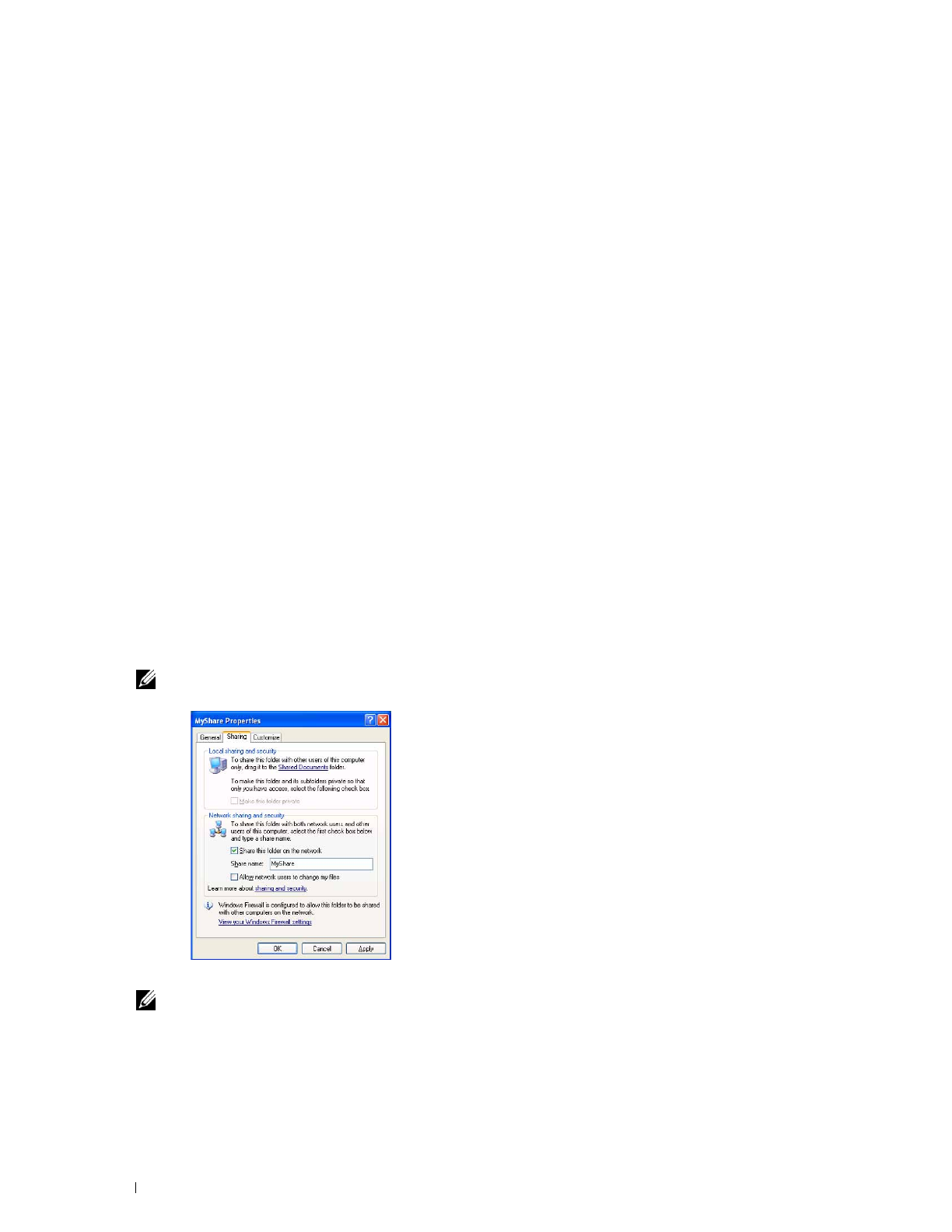
354 Scanning
2
Click
Change PC settings
.
3
Click
Users
.
4
Click
Create a Password
and add in a password for your user login account.
For Mac OS X 10.3.9:
1
Click
System Preferences
→
Accounts
.
2
Enter a password for your user login account in
Password
.
3
Re-enter the password in
Verify
.
For Mac OS X 10.4.11/10.5/10.6:
1
Click
System Preferences
→
Accounts
.
2
Select
Change Password
.
3
Enter a password for your user login account in
New password
.
4
Re-enter the password in
Verify
.
Creating a Shared Folder (SMB Only)
Create a shared folder to store the scanned document from your printer.
For Microsoft Windows XP Home Edition:
1
Create a folder in the desired directory on your computer (Example of folder name,
MyShare
).
2
Right-click on the folder, and then select
Properties
.
The
Properties
dialog box appears.
3
Click on the
Sharing
tab, and then select
Share this folder on the network
.
4
Enter a shared name in the
Share name
box.
NOTE: Write down this shared name because you will use this name in the next setting procedure.
5
Select the
Allow network users to change my files
check box, and click
OK
.
NOTE: When the following screen appears, click If you understand the security risks but want to share files without
running the wizard, click here, then select Just enable file sharing, and then click OK.
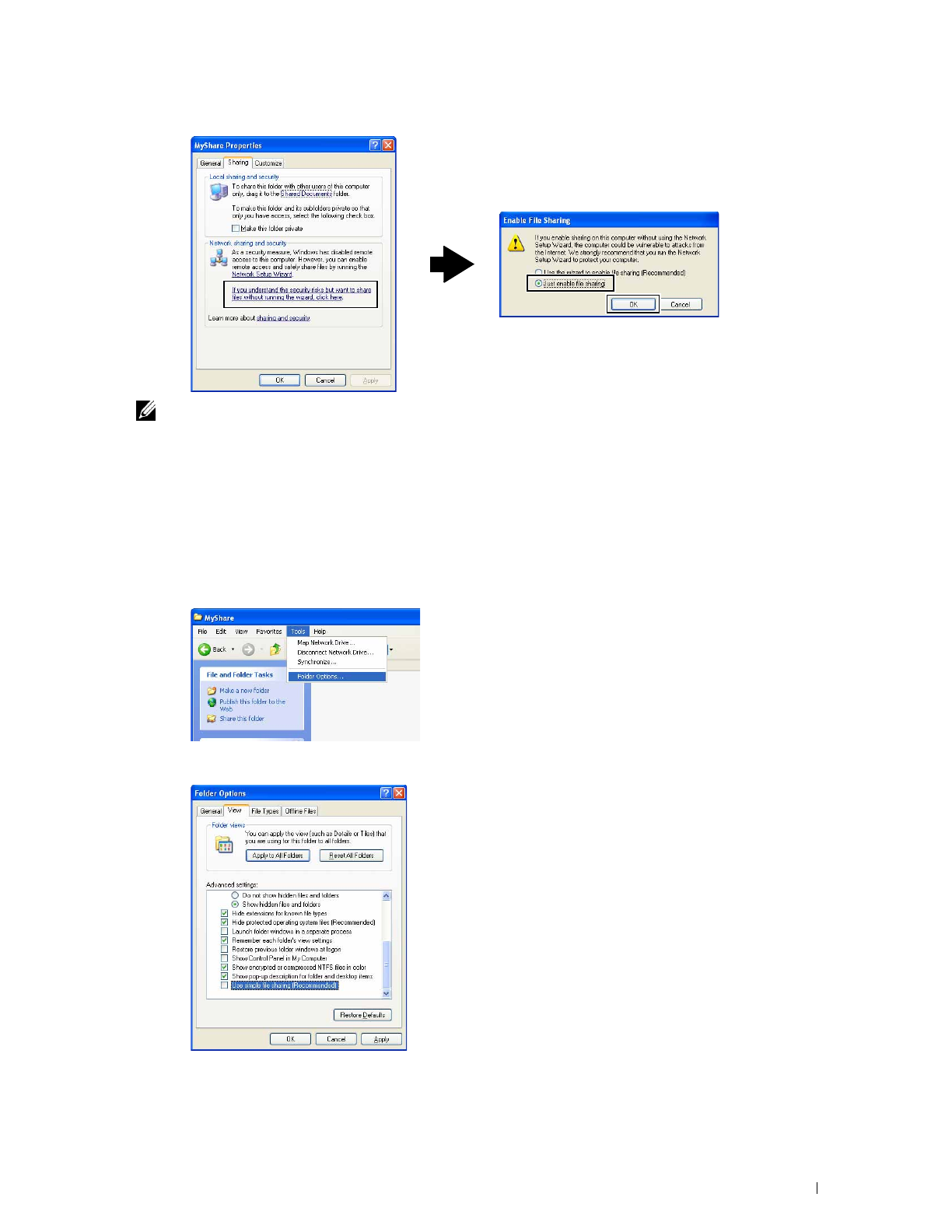
Scanning 355
NOTE: To add sub-folders, create new folders in the shared folder you have created.
For example:
Folder name:
MyShare,
Second-level folder name:
MyPic, Third-level folder name: John
You should now see
MyShare\MyPic\John
in your directory.
For Microsoft Windows XP Professional:
1
Create a folder in the desired directory on your computer (Example of folder name,
MyShare
) and double-click
the folder.
2
Select
Folder Options
from
Tools
.
3
Click
View
tab, and then clear the check box of
Use simple file sharing (Recommended)
.
4
Click
OK
.
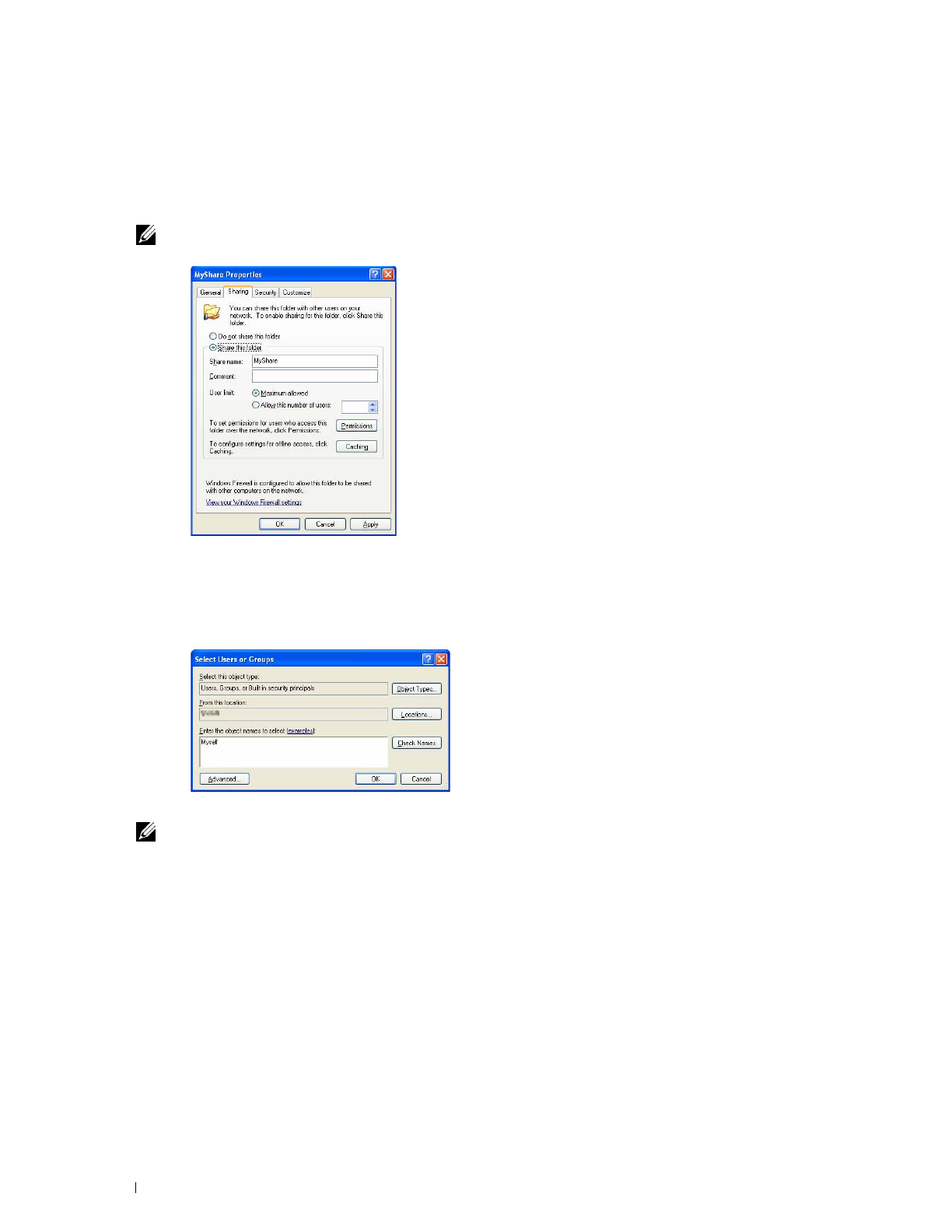
356 Scanning
5
Right-click the folder, and then select
Properties
.
The
Properties
dialog box appears.
6
Select the
Sharing
tab, and then select
Share this folder
.
7
Enter a shared name in the
Share name
box.
NOTE: Write down this shared name because you will use this name in the next setting procedure.
8
Click on
Permissions
to create a write permission for this folder.
9
Click
Add
.
10
Search user login name by clicking
Advanced
, or enter the user login name in
Enter the object names to select
box
and click
Check Names
to confirm (Example of user login name,
Myself
).
11
Click
OK
.
NOTE: Do not use Everyone as the user login name.
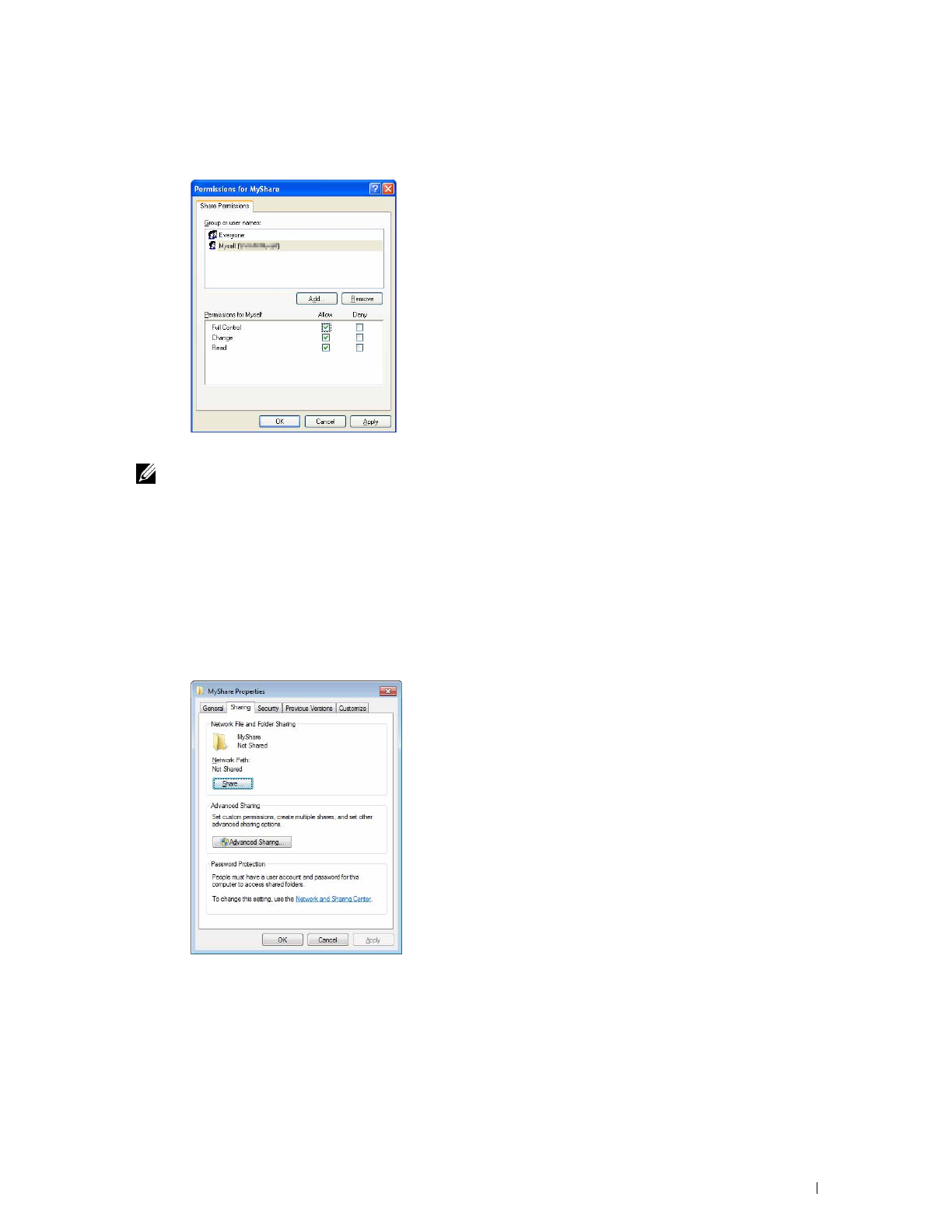
Scanning 357
12
Click on the user login name that you have just entered. Select
Full Control
check box. This will grant you
permission to send the document into this folder.
13
Click
OK
.
NOTE: To add sub-folders, create new folders in the shared folder you have created.
For example:
Folder name:
MyShare,
Second-level folder name:
MyPic, Third-level folder name: John
You should now see
MyShare\MyPic\John
in your directory.
For Windows Vista, Windows Server 2008, Windows Server 2008 R2, Windows 7, Windows 8, Windows Server 2012:
1
Create a folder in the desired directory on your computer (Example of folder name,
MyShare
).
2
Right-click on the folder, and then select
Properties
.
The
Properties
dialog box appears.
3
Click on the
Sharing
tab, and then select
Advanced Sharing
.
4
Select the
Share this folder
check box.
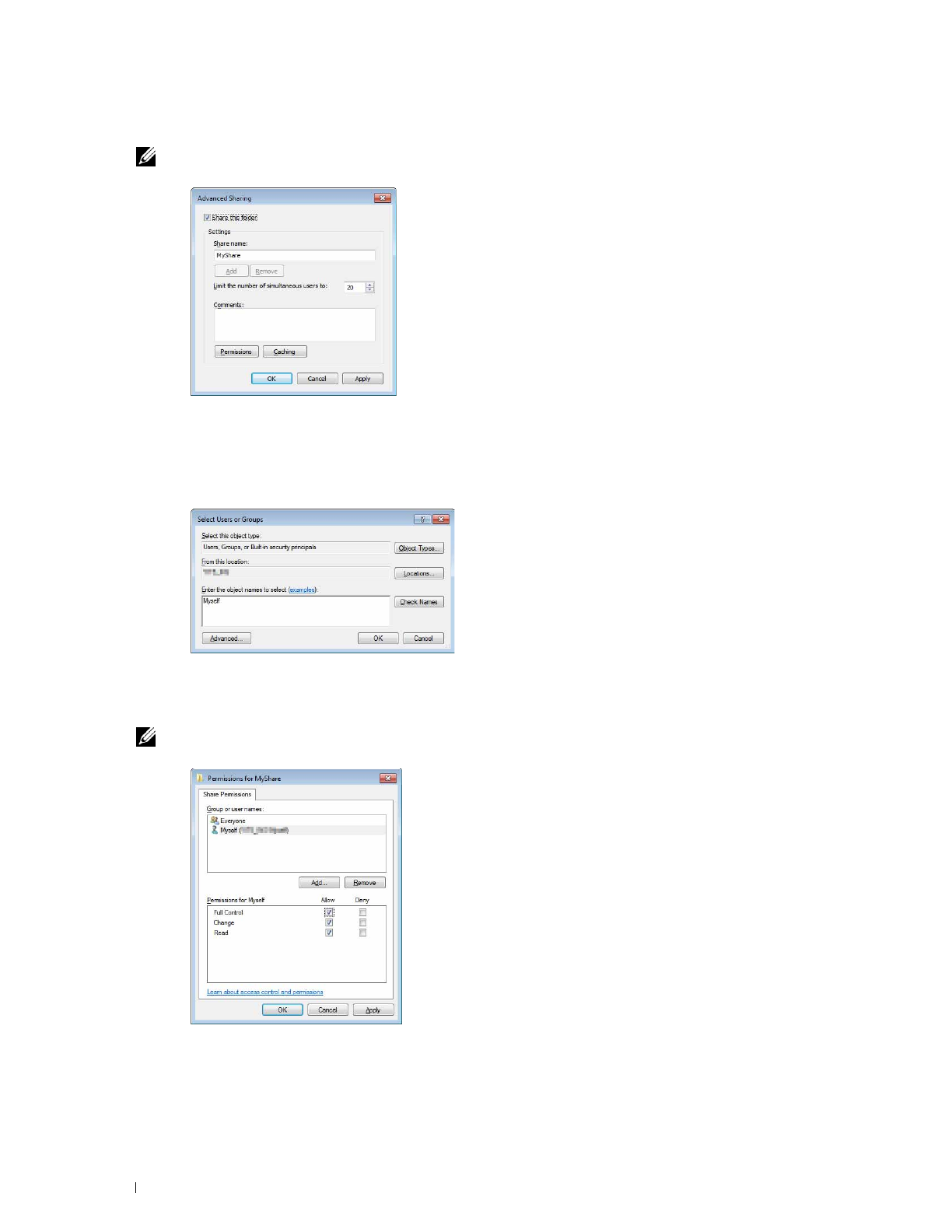
358 Scanning
5
Enter a shared name in the
Share name
box.
NOTE: Write down the shared name as you need to use this name in the next setting procedure.
6
Click on
Permissions
to create a write permission for this folder.
7
Click
Add
.
8
Search user login name by clicking
Advanced
, or enter the user login name in
Enter the object names to select
box
and click
Check Names
to confirm (Example of user login name,
Myself
).
9
Click
OK
.
10
Click on the user login name that you have just entered. Select
Full Control
check box. This will grant you
permission to send the document into this folder.
NOTE: Do not use Everyone as the user login name.

Scanning 359
11
Click
OK
.
NOTE: To add sub-folders, create new folders in the shared folder you have created.
For example:
Folder name:
MyShare,
Second-level folder name:
MyPic, Third-level folder name: John
You should now see
MyShare\MyPic\John
in your directory.
For Mac OS X 10.3.9/10.4.11:
1
Select
Go
from the
Finder
menu, and then click
Home
.
2
Double-click
Public
.
3
Create a folder (Example of folder name,
MyShare
).
4
Open
System Preferences
, and then click
Sharing
.
5
Select the
Personal File Sharing
check box and
Windows Sharing
check box.
For Mac OS X 10.5/10.6:
1
Create a folder in the desired directory on your computer (Example of folder name,
MyShare
).
2
Select the created folder, and then select
Get Info
from the
File
menu.
3
Select the
Shared Folder
check box.
4
Open
System Preferences
, and then click
Sharing
.
5
Select the
File Sharing
check box, and then click
Options
.
6
Select the
Share Files and folders using SMB
and account name check boxes.
7
Click
Done
.
Setting a Destination Using an Address Book
You can register the connection details for SMB and FTP server in the address book using Dell Printer
Configuration Web Tool or Address Book Editor.
Before beginning to setup a destination, make sure you have the IP addresses you need such as printer and computer.
Verifying the IP Address Setting of the Printer
To setup the server address book through the network, you will first need to locate the IP address of the printer. To
find your printer's IP address, see "Verifying the IP Settings."
Locating the IP Address Setting of Your Computer
You can locate the IP address of your computer by the following operations.
1
Click
Start
→
Run
.
For Windows Server 2003/Windows Server 2008/Windows Server 2008 R2:
Click
Start
→
Run
.
For Windows Vista/Windows 7:
Click
Start
→
All Programs
→
Accessories
→
Run
.
For Windows 8/Windows Server 2012:
Point to the top or bottom right corner of the screen, and then click
Search
→
Ty p e
Run
in the search box, click
Apps
, and then click
Run
.
2
Ty p e
cmd
in the text field and click
OK
. A command prompt window will open.
3
Ty p e
ipconfig
and press
Enter
.
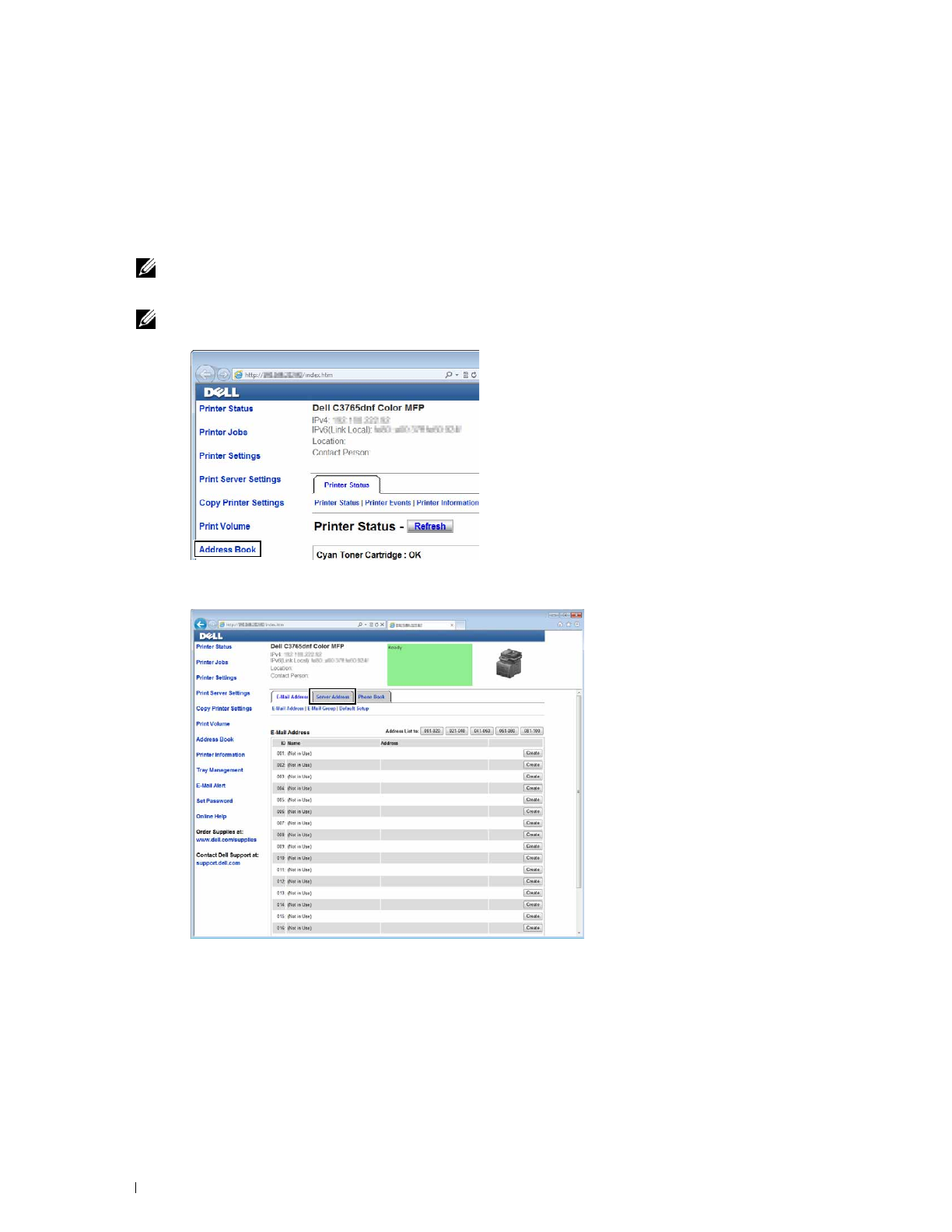
360 Scanning
4
Write down the IP Address xxx.xxx.xxx.xxx.
Using Dell Printer Configuration Web Tool
1
Open a web browser.
2
Type in the IP address of the printer in the address bar, and press the <Enter> key.
The web page of the printer appears.
NOTE: For details on how to check the IP address of the printer, see "Verifying the IP Settings."
3
Click
Address Book
. If a security login dialog box appears, type in the correct
User Name
and
Password
.
NOTE: The default user name is "admin", and the default password is left blank (NULL).
4
Click the
Server Address
tab, and then click
Create
of an ID.
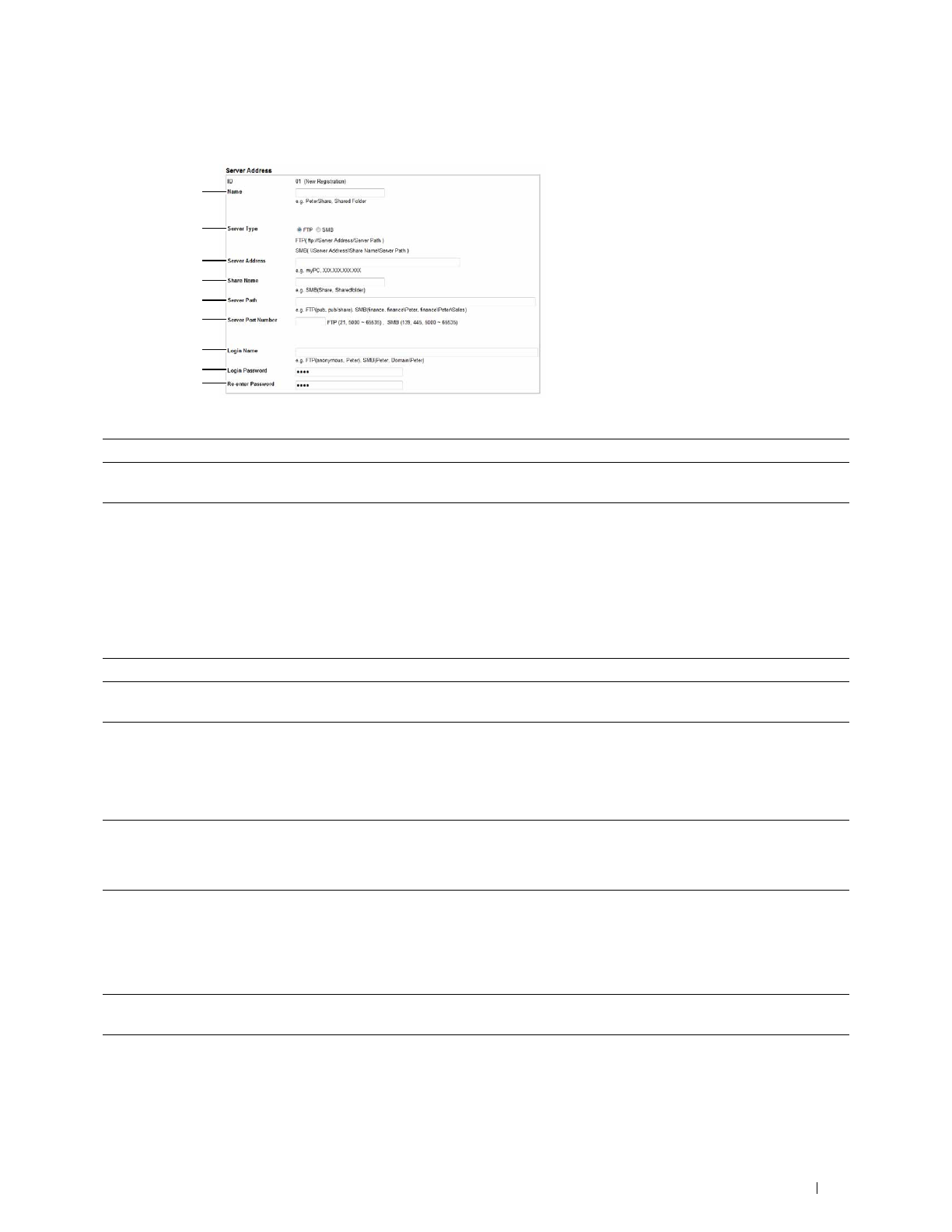
Scanning 361
Server Address
page appears.
To fill in the fields, enter the information as follows:
(1) Name Enter a friendly name that you want it to appear on the Server address book.
(2) Server Type Select FTP if you store document on a FTP server.
Select SMB if you store documents in a shared folder on your computer.
(3) Server Address Enter a FTP server name that you have shared out or a server name or IP address of your computer.
•For FTP:
Server name: myhost.example.com
(myhost: host name, example.com: domain name)
IP address: 192.168.1.100
•For SMB:
Server name: myhost
IP address: 192.168.1.100
(4) Share Name Enter the name of the shared folder on the recipient computer. For SMB only.
(5) Server Path Enter the subdirectory path where you want the scanned document to be stored. Ensure that the
subdirectory path is already created in the shared folder or FTP server.
(6) Server Port
Number
Enter the Server Port Number. If you are unsure, you can enter the default value of 21 for FTP or 139 for
SMB.
Available ports are:
FTP: 21, 5000 - 65535
SMB: 139, 445, 5000 - 65535
(7) Login Name Enter the user account name to allow access to a shared folder on your computer or to a FTP server.
• For FTP: Contact the system administrator.
• For SMB: Windows login name that you have specified in the procedure 1.
(8) Login Password Enter the password corresponding to the above login name.
• For FTP: Contact the system administrator
• For SMB: Empty password is not valid in the Network (Computer) feature. Ensure that you have a valid
password for the user login account. (See "Setting a Login Name and a Password (SMB Only)" for details
on how to add a password in your user login account.)
(9) Re-enter
Password
Re-enter your password.
1
2
3
4
5
6
7
8
9
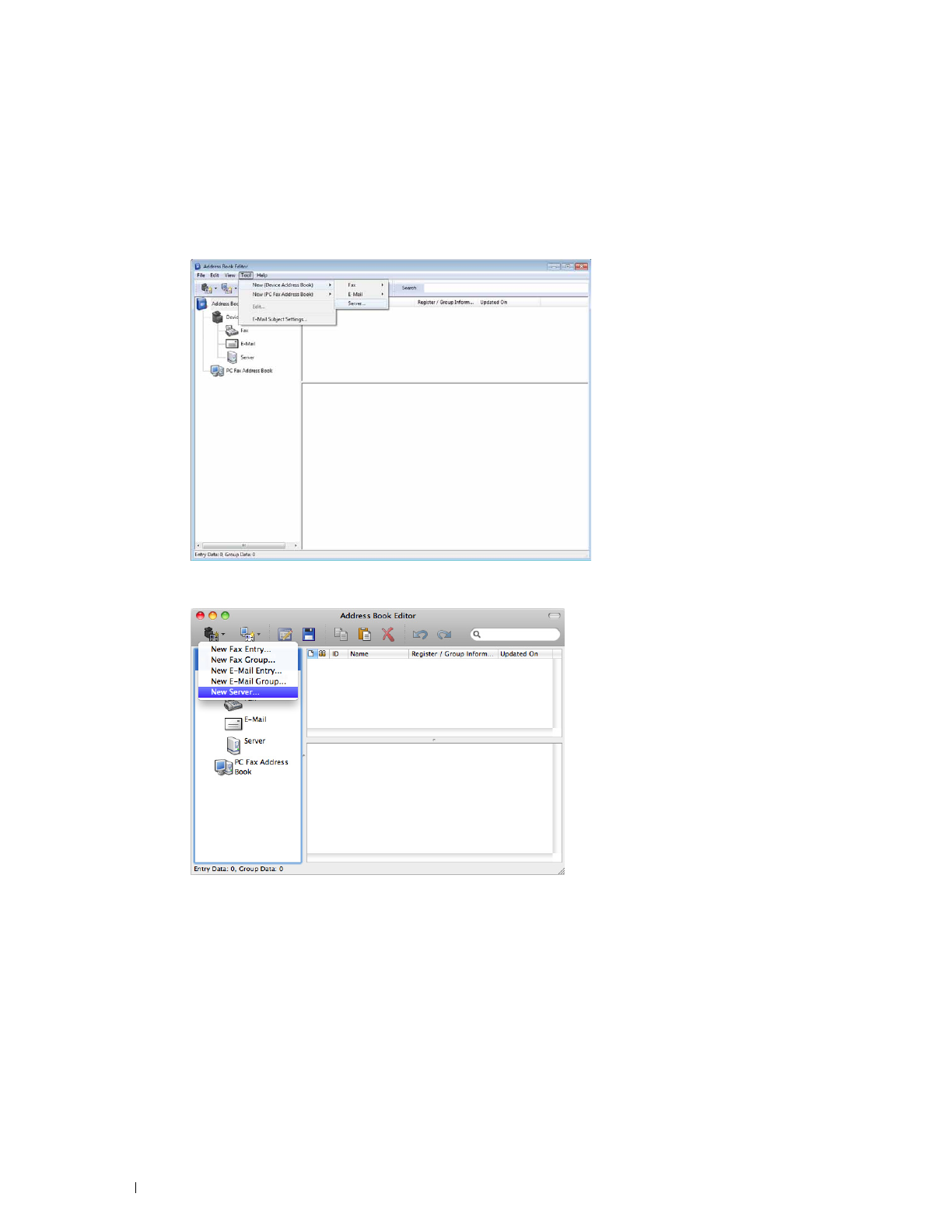
362 Scanning
Using Address Book Editor
1
Click
Start
→
All Programs
→
Dell Printers
→
Dell C3765dnf Multifunction Color Laser Printer
→
Address Book
Editor
.
2
Click
Tool
→
New (Device Address Book)
→
Server
.
For Microsoft Windows:
For Apple Macintosh:
Server Address
dialog box appears.
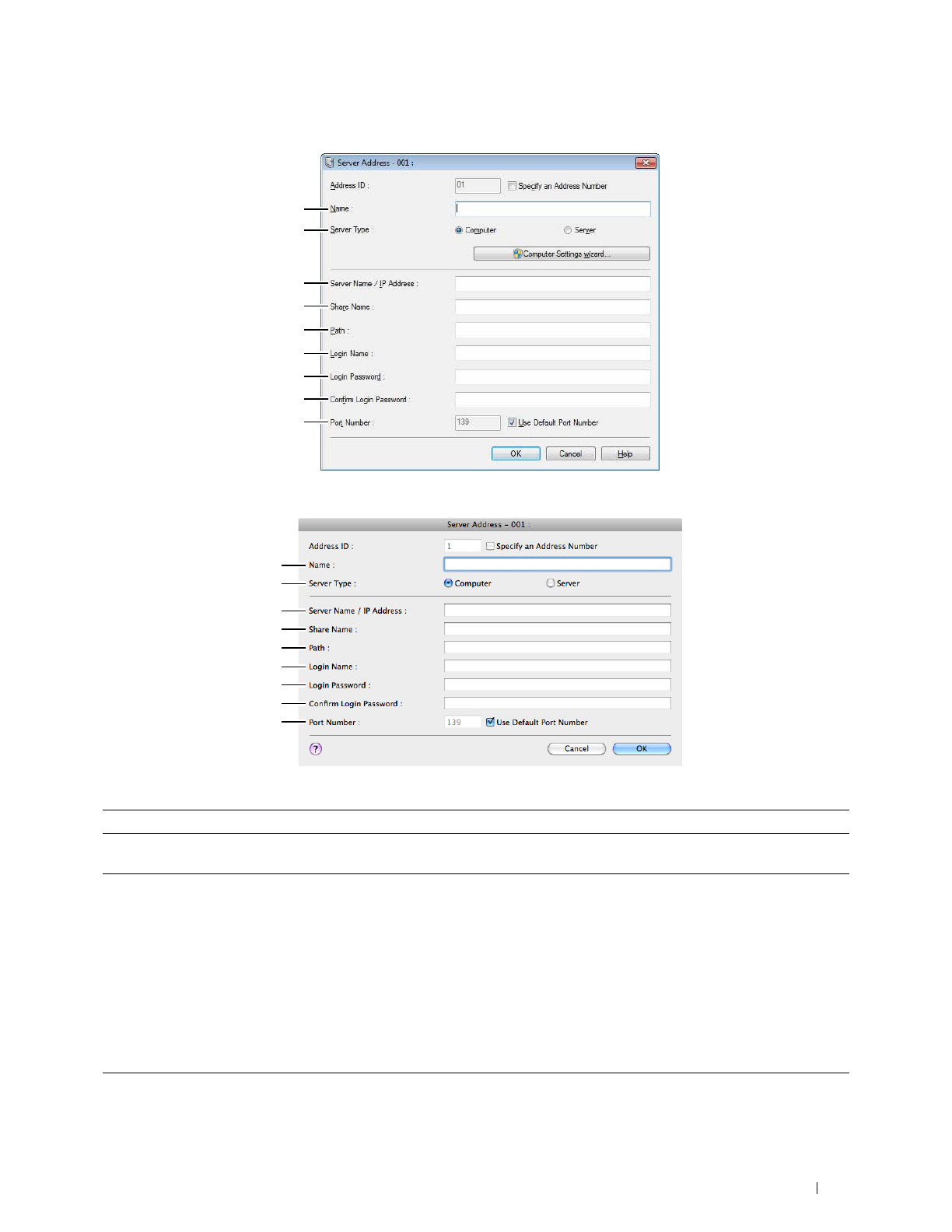
Scanning 363
For Microsoft Windows:
For Apple Macintosh:
To fill in the fields, enter the information as follows:
(1) Name Enter a friendly name that you want it to appear on the Server address book.
(2) Server Type Select Computer if you store documents in a shared folder on your computer.
Select Server if you store documents on a FTP server.
(3) Server Name/IP
Address
Enter a server name or IP address of your computer or the FTP server name that you have shared out.
The following are examples:
•For Computer:
Server name: myhost
IP address: 192.168.1.100
•For Server:
Server name: myhost.example.com
(myhost: host name, example.com: domain name)
IP address: 192.168.1.100
(4) Share Name Enter the name of the shared folder on the recipient computer. For SMB only.
1
2
3
4
5
6
7
8
9
1
2
3
4
5
6
7
8
9
364 Scanning
Sending the Scanned File on the Network
1
Load the document(s) facing up with top edge in first into the DADF.
OR
Place a single document facing down on the document glass, and close the document cover.
For details about loading a document, see "Loading an Original Document."
2
Press the
(Home)
button.
3
Select
Scan Menu
.
4
Select
Network
.
5
Select until the desired address appears and then select that address.
6
Select
OK
.
7
Specify scan options such as
Output Color
,
Resolution
,
2 Sided Scanning
, and
File Format
on
the
Scan to Network
,
Quality
and
Options tabs
. For details, see "File Format."
8
Press the
(Start)
button to begin sending the scanned file.
Scanning to a USB Memory
The Scan to USB Memory feature allows you to store scanned image directly to a USB memory attached to the
printer without using software.
Types of a USB Memory
You can use a USB memory with the following interfaces:
•USB 1.1
•USB 2.0
The USB memory must be formatted in FAT file systems (FAT16, FAT32, or VFAT) before inserting the memory
device into the front USB port of the printer.
(5) Path Enter the subdirectory path where you want the scanned document to be stored. Ensure that the
subdirectory path is already created in the shared folder or FTP server.
(6) Login Name Enter the user account name to allow access to a shared folder on your computer or to a FTP server.
• For Computer: Windows login name that you have specified in the procedure 1.
• For Server: Contact the system administrator.
(7) Login Password Enter the password corresponding to the above login name.
• For Computer: Empty password is not valid in the
Network(Computer)
feature. Ensure that you
have a valid password for the user login account. (See "Setting a Login Name and a Password (SMB Only)"
for details on how to add a password in your user login account.)
• For Server: Contact the system administrator.
(8) Confirm Login
Password
Re-enter your password.
(9) Port Number Enter the Server Port Number. If you are unsure, you can enter the default value of 139 for Computer and
21 for FTP server.
Available ports are:
For Computer: 139, 445, 5000 - 65535
For Server: 21, 5000 - 65535

Scanning 365
NOTE: If the USB memory is formatted in a file system other than above, the printer may not recognize that the USB memory is
attached.
NOTE: A USB memory with authentication feature and some brands of USB memories cannot be used with this printer.
Procedures
To store the scanned images to a USB memory:
NOTE: If you insert a USB memory to the front USB port first, the USB Drive Detected screen may appear. In this case, select
Scan to USB, and proceed to step 6.
1
Load the document(s) facing up with top edge in first into the DADF.
OR
Place a single document facing down on the document glass, and close the document cover.
For details about loading a document, see "Loading an Original Document."
2
Press the
(Home)
button.
3
Insert a USB memory into the front USB port of the printer. See "Inserting and Removing a USB Memory" for
more details.
4
Select
Scan Menu
.
5
Select
USB
.
6
Specify scan options such as
Output Color
,
Resolution
,
2 Sided Scanning
, and
File Format
on
the
Scan to USB
,
Quality
and
Options tabs
. For details, see "File Format."
You can also specify the folder to save the scanned image. For details, see "Specifying a Folder to Save the Scanned
Image."
7
Press the
(Start)
button to begin scanning the document.
8
Remove the USB memory from the printer. See "Inserting and Removing a USB Memory" for more details.
Specifying a Folder to Save the Scanned Image
To save the scanned image to a folder in the USB memory, specify the folder before executing the scan job.
1
Select
Change Folder
on the
Scan to USB
tab.
2
Select a folder to save the scanned image.
NOTE: The default saving location is the root directory of the USB memory.
NOTE: You cannot directly enter a folder path using the numeric keypad.
NOTE: You can select any folder in the USB memory but cannot create a new folder in this step. You should always create
a new folder before connecting the memory to the printer. If you want the printer to automatically create a folder and then
save the scanned image to that folder, set Create Folder to On. For details, see "Create Folder."
If the name of the scanned image has already existed in the folder, the printer automatically generate a new file
name to save the data.
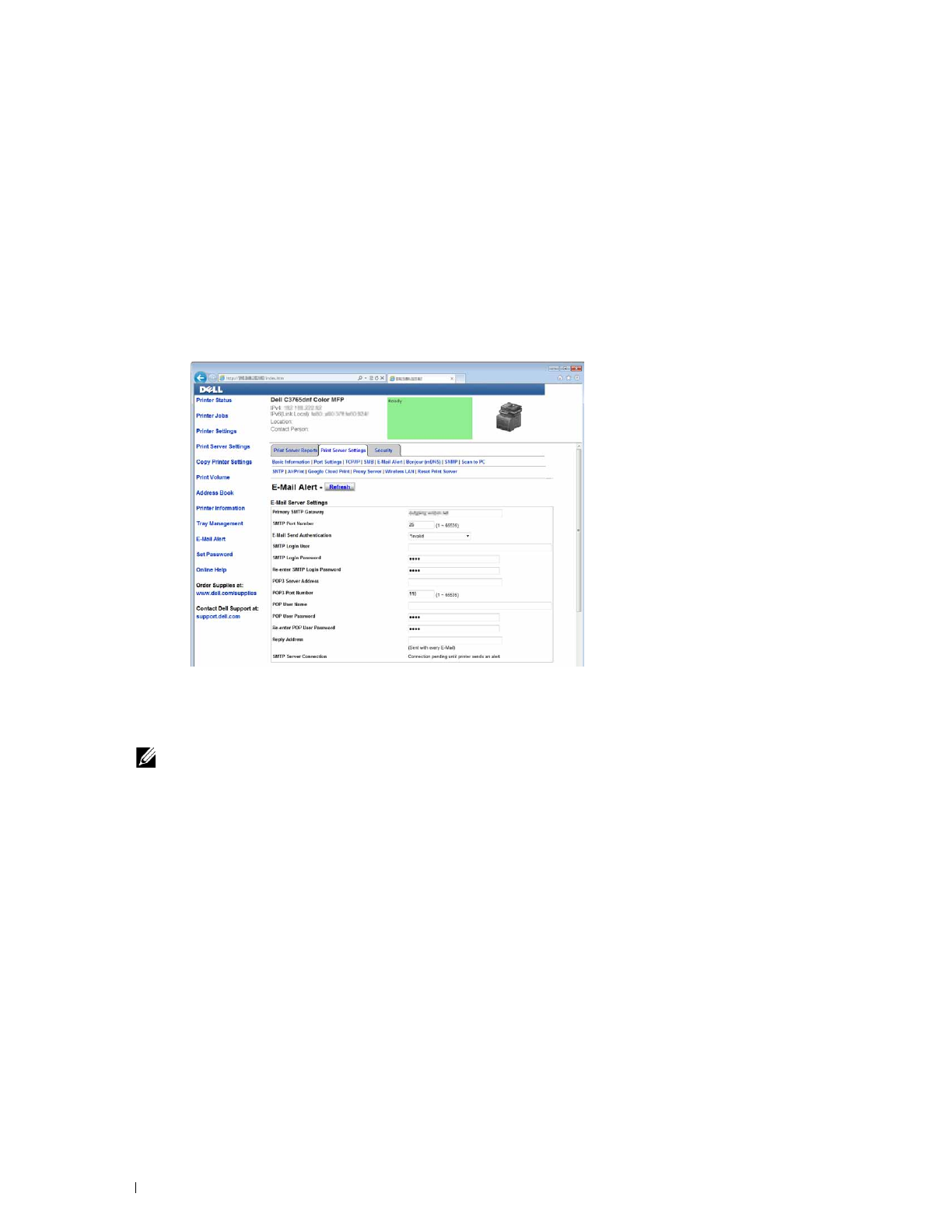
366 Scanning
Sending an E-Mail With the Scanned Image
To send an e-mail attached with the scanned image from your printer, follow the steps below:
• Set E-Mail Alert
• Register a user
• Start to send e-mail with the scanned file
Setting an E-Mail Alert
1
From the
Dell Printer Configuration Web Tool
, click
E-Mail Alert
.
The
E-Mail Server Settings
page appears.
2
Specify the settings for E-Mail Alert as follows:
Primary SMTP Gateway
: Enter the IP address of the e-mail server.
E-Mail Send Authentication
: Specify Invalid to enable the e-mail server.
NOTE: If an error message including 016-506 or 016-764 is displayed, contact your server administrator for the
settings for E-Mail Send Authentication.
3
Click
Apply New Settings
.
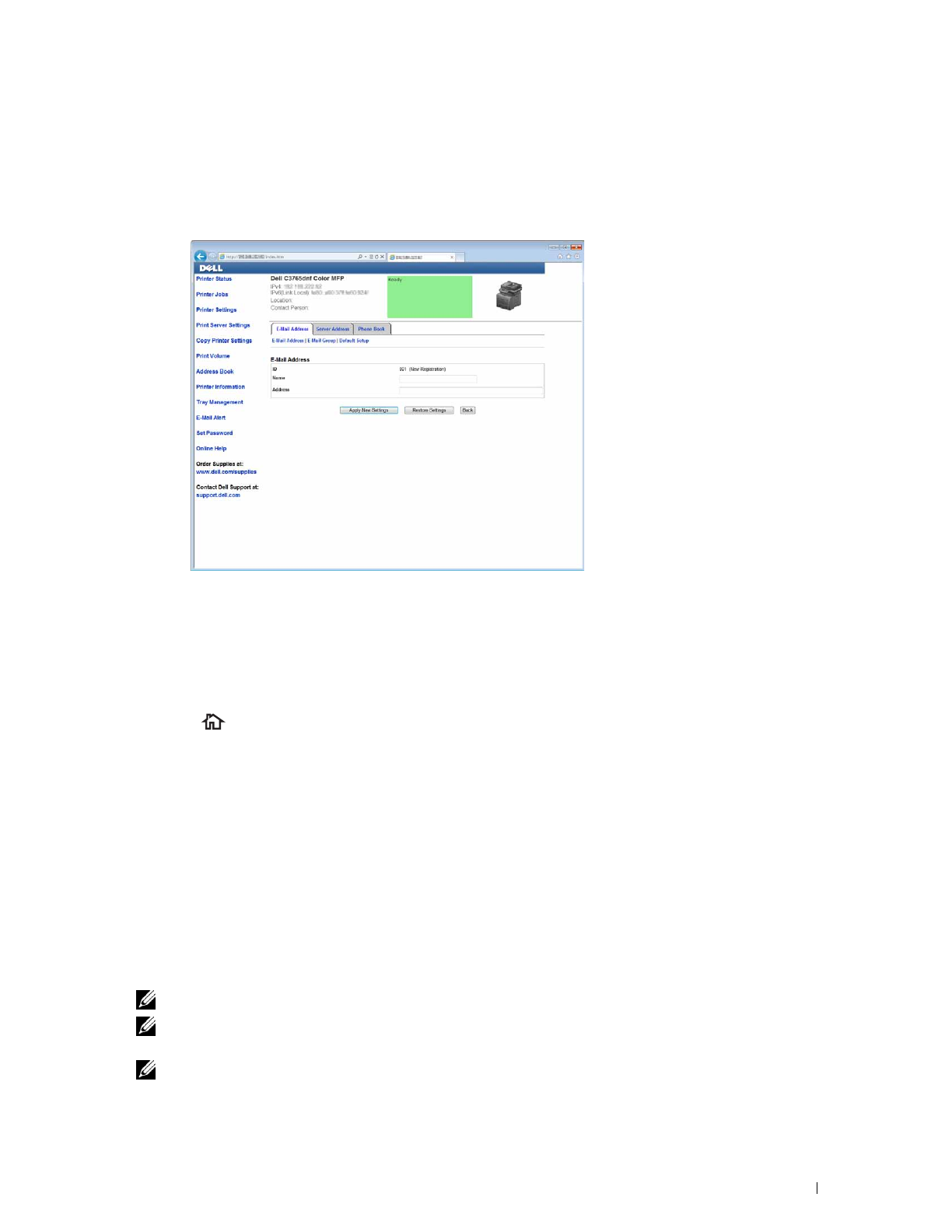
Scanning 367
Registering a New E-Mail Address
1
From the
Dell Printer Configuration Web Tool
, click
Address Book
, and then click the
E-Mail Address
tab.
2
Click
Create
.
The
E-Mail Address
page for registering a new e-mail address appears.
3
Enter the following:
•Name
•Address
4
Click
Apply New Settings
.
Sending an E-mail With the Scanned File
1
Press the
(Home)
button.
2
Select
Email
.
3
Specify a recipient from the following, and then select
OK
:
New Recipient
: Enter an e-mail address directly.
Address Book
: Select from the following types of address books:
•
Machine Address Book - Individuals
: Select an e-mail address registered in the address book.
•
Machine Address Book - Groups
: Select a group of e-mails registered in the address book.
•
Search Network Address Book
: Search an e-mail address from the LDAP server address book.
Select the recipient you specified from the
New Recipient
to remove or edit the recipient.
Select the recipient you specified from the
Address Book
to remove or see details of the recipient. You can also
change the email to Bcc.
NOTE: For more information on address book and server address book, see "Address Books."
NOTE: For details about Search Network Address Book, see "Using the Server Address Book and Server
Phone Book."
NOTE: The e-mail addresses needs to be registered before you can select Address Book.

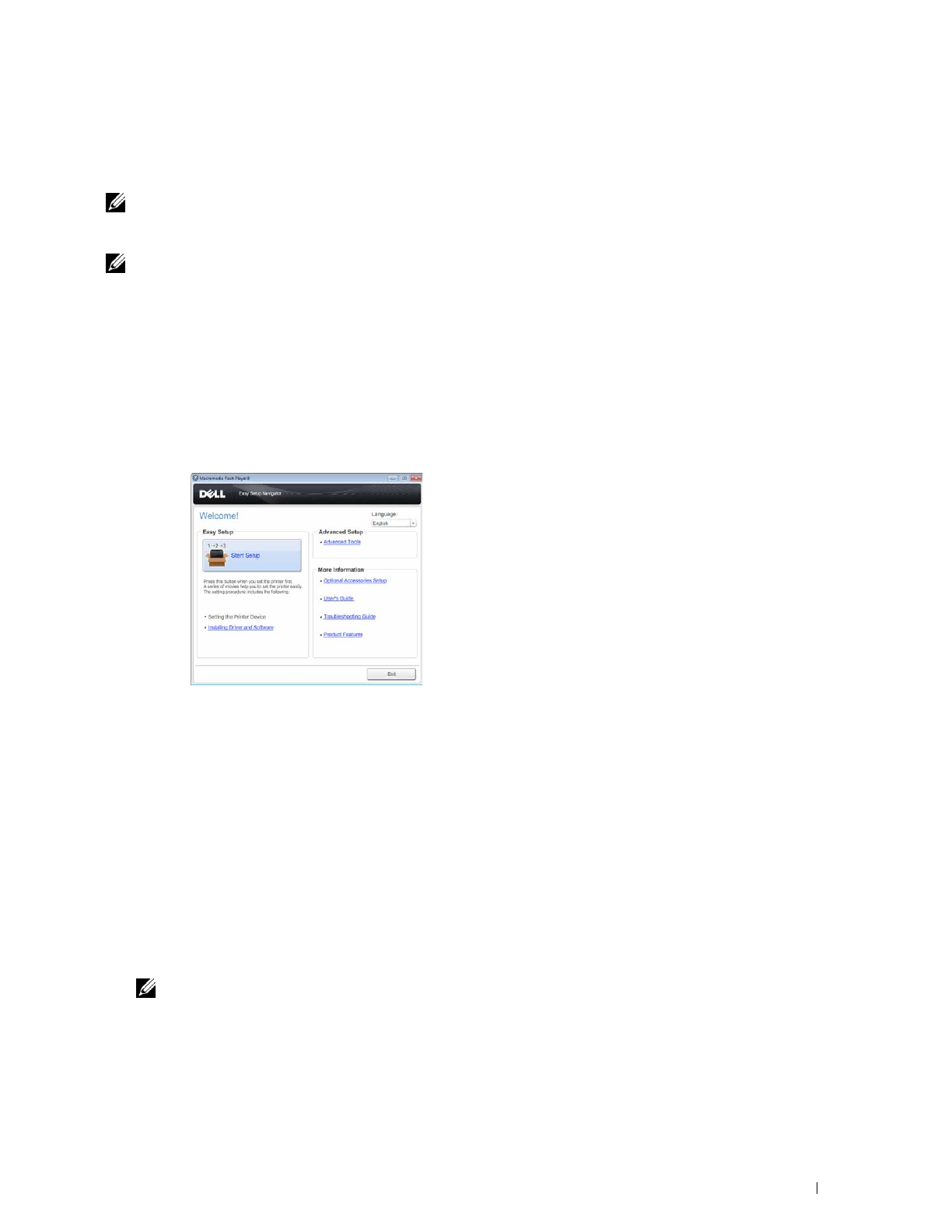
Faxing 369
22
Faxing
NOTE: If the Function Enabled setting for Fax is set to On (Password), you need to enter the four digit password to use
the fax function. If the Function Enabled setting for Fax is set to On, the fax function is disabled and the menu is not displayed
on the touch panel. For details, see "Function Enabled."
NOTE: If the Panel Lock Control is set to Enable, you need to enter the four digit password to enter the Admin
Settings menu.
Specifying the Fax Initial Settings Using the Easy Setup Navigator
You can specify the country, line type, tone/pulse, receive mode, DRPD pattern, fax header name, and fax number.
1
Insert the
Software and Documentation
disc provided with the printer in your computer. The
Easy Setup
Navigator
file launches automatically.
2
Click
Advanced Tools
on the
Easy Setup Navigator
window.
The
Advanced Tools
window appears.
3
Click
Fax Configuration
.
4
Follow the instructions displayed on the screen.
Available settings are:
•Country
•Line Type
•Tone/Pulse
• Receive Mode
• DRPD Pattern
(This setting is available only when a distinctive ring service is installed on your telephone line by your
telephone company.)
• FAX Header Name
• FAX Number
NOTE: To make initial settings from the printer operator panel, see "Setting Your Country."

370 Faxing
Setting Your Country
1
Press the
(Information)
button.
2
Select the
Tools
tab, and then select
Admin Settings
.
3
Select until
Fax Settings
appears, and then select
Fax Settings
.
4
Select
Fax Line Settings
.
5
Select until
Country
appears, and then select
Country
.
6
Select the country where the printer is used, and then select
OK
.
The printer must be rebooted after you set the country settings. When a screen prompting you to reboot the
printer, select
Start
. After the reboot, the
Main Home
screen is displayed on the touch panel.
NOTE: When you configure the country setting, the information, which is registered to the printer, is initialized.
Setting the Printer ID
In most countries, you are required by law to indicate your fax number on any fax you send. The printer ID,
containing your telephone number and name or company name, will be printed at the top of each page sent from
your printer.
1
Press the
(Information)
button.
2
Select the
Tools
tab, and then select
Admin Settings
.
3
Select until
Fax Settings
appears, and then select
Fax Settings
.
4
Select
Fax Line Settings
.
5
Select until
Fax Number
appears, and then select
Fax Number
.
6
Enter your fax number using the number pad, and then select
OK
.
NOTE: If you make a mistake while entering numbers, press the (Delete) button to delete the last digit.
7
Select until
Fax Header Name
appears, and then select
Fax Header Name
.
8
Enter your name or company name using the keyboard, and then select
OK
.
For details on how to use the keyboard to enter alphanumeric characters, see "Using the Keyboard Displayed on the
Touch Panel."
To return to the
Information
screen, press the
(All Clear)
button.
Setting the Time and Date
NOTE: It may be necessary to reset the correct time and date if loss of power to the printer occurs.
To set the time and date:
1
Press the
(Information)
button.
2
Select the
Tools
tab, and then select
Admin Settings
.
3
Select until
System Settings
appears, and then select
System Settings
.
4
Select until
General
appears, and then select
General
.
5
Select until
Date & Time
appears, and then select
Date & Time
.
6
Select
Time Zone
.
7
Select until the desired geographic region appears, and then select that region.
8
Select until the desired time zone appears, and then select that time zone.
9
Select
OK
.

Faxing 371
10
Select
Date
.
11
Select or or enter the date using the number pad.
12
Select
Time
.
13
Enter the time using the number pad.
14
Select
OK
.
To return to the
Information
screen, press the
(All Clear)
button.
NOTE: The printer beeps and does not allow you to proceed to the next step if a wrong number is entered.
Changing the Clock Mode
You can set the current time using either the 12-hour or the 24-hour format.
1
Press the
(Information)
button.
2
Select the
Tools
tab, and then select
Admin Settings
.
3
Select until
System Settings
appears, and then select
System Settings
.
4
Select until
General
appears, and then select
General
.
5
Select until
Date & Time
appears, and then select
Date & Time
.
6
Select
Time
.
7
Select
12 Hour
or
24 Hour
, and then select
OK
.
To return to the
Information
screen, press the
(All Clear)
button.
Setting Sounds
Speaker Volume
1
Press the
(Information)
button.
2
Select the
Tools
tab, and then select
Admin Settings
.
3
Select until
Fax Settings
appears, and then select
Fax Settings
.
4
Select
Fax Line Settings
.
5
Select until
Line Monitor
appears, and then select
Line Monitor
.
6
Select the desired volume, and then select
OK
.
7
Turn off the printer, and turn it on again to apply the settings.
Ringer Volume
1
Press the
(Information)
button.
2
Select the
Tools
tab, and then select
Admin Settings
.
3
Select until
Fax Settings
appears, and then select
Fax Settings
.
4
Select
Incoming Defaults
.
5
Select until
Ring Tone Volume
appears, and then select
Ring Tone Volume
.
6
Select the desired volume, and then select
OK
.
7
Turn off the printer, and turn it on again to apply the settings.
372 Faxing
Specifying the Fax Settings Options
Changing the Fax Settings Options
1
Press the
(Information)
button.
2
Select the
Tools
tab, and then select
Admin Settings
.
3
Select until
Fax Settings
appears, and then select
Fax Settings
.
4
Select the desired menu.
5
Select the desired setting or enter a value.
To enter a value, select or , or use the number pad or the keyboard.
6
Select
OK
.
If necessary , repeat steps 4 through 6.
To return to the
Information
screen, press the
(All Clear)
button.
Available Fax Settings Options
You can use the following settings options for configuring the fax system:
Option Description
Fax Line Settings Fax Number Specifies the fax number of the printer, which will be printed on
the header of faxes. This feature is available when you set Fax
Header to On. The number specified in Fax Number is used in
the printer ID.
Country You can select the country where the printer is used.
You can change this setting when:
• No jobs in operation
• No fax jobs waiting in the memory
Fax Header Name Specifies the sender’s name to be printed on the header of faxes.
Line Type You can select the default line type.
•PSTN
•PBX
Line Monitor Sets the volume of the line monitor, which audibly monitors a
transmission through the internal speaker until a connection is
made.
DRPD Pattern Before using the Distinctive Ring Pattern Detection (DRPD)
option, distinctive ring service must be installed on your telephone
line by the telephone company. After the telephone company has
provided a separate number for faxing with a distinctive ring
pattern, configure the fax setup to monitor for that specific ring
pattern.

Faxing 373
Incoming
Defaults
Receive Mode You can select the default fax receiving mode.
•
Telephon e
(manual receive mode): Automatic fax reception is
turned off. You can receive a fax by picking up the handset of the
external telephone and then pressing the remote receive code, or
by selecting
Manual Receive
in
On Hook
and then
pressing the
(Start)
button. For details about
Manual
Receive
, see "Receiving a Fax Manually in the Telephone
Mode."
•
Fax
: (automatic receive mode)
•
Telephon e / Fax
: When the printer receives an incoming fax, the
external telephone rings for the time specified in
Auto Rec
Fax/Tel
, and then the printer automatically receives a fax. If
an incoming call is not a fax, the printer beeps from the internal
speaker indicating that the call is a telephone call.
•
Ans Machine/Fax
: The printer can share a telephone line with an
answering machine. In this mode, the printer will monitor the fax
signal and pick up the line if there are fax tones. If the phone
communication is using serial transmission in your country (such
as Germany, Sweden, Denmark, Austria, Belgium, Italy, France
and Switzerland), this mode is not supported.
•
DRPD
: Before using the Distinctive Ring Pattern Detection
(DRPD) option, distinctive ring service must be installed on your
telephone line by the telephone company. After the telephone
company has provided a separate number for faxing with a
distinctive ring pattern, configure the fax setup to monitor for
that specific ring pattern.
Ring Tone Volume Sets the volume of the ring tone, which indicates that an incoming
call is a telephone call through the internal speaker when
Receive Mode is set to Telephone / Fax.
Auto Receive
Setup
Auto Receive Fax Sets the interval at which the printer goes into the fax receive
mode after receiving an incoming call. The interval can be
specified within the range of 0 to 255 seconds. The default is 0
second.
Auto Receive
Tel/Fax
Sets the interval at which the printer goes into the fax receive
mode after the external telephone receives an incoming call. The
interval can be specified within the range of 0 to 255 seconds. The
default is 6 seconds.
Auto Receive
Ans/Fax
Sets the interval at which the printer goes into the fax receive
mode after the external answering machine receives an incoming
call. The interval can be specified within the range of 0 to 255
seconds. The default is 21 seconds.
Junk Fax Setup You can reject faxes sent from unwanted stations. The system only
accepts faxes from the remote stations registered in the speed dial.
This feature is useful for blocking any unwanted faxes.
Select Off to turn the feature off. Anybody can send you a fax.
Select On to turn the feature on.
Secure Receive You can specify whether to require a four digit password to receive
faxes, and to set or change the password.
Option Description

374 Faxing
Sent Fax Fwd You can set your printer to forward incoming faxes to another fax
number, or forward them to an e-mail address. When a fax arrives
at your printer, it is stored in the memory. Then, the printer dials
the fax number you have specified in Forwarding Number
or sends an e-mail to the address you have specified in
Forwarding E-mail Address 1-5.
To forward to a fax number, you need to register a fax number on
Forwarding Number. To forward to an e-mail address, you
need to register information on E-mail Alert and
Forwarding E-mail Address. For information on e-
mail alert, see "E-Mail Alert" and on forwarding number and e-
mail address, see "Fax Settings."
Select Off not to forward incoming faxes.
Select Forward to forward incoming faxes without printing. If
an error occurs during forwarding a received fax, the printer prints
the fax.
Select Print and Forward to forward and print incoming
faxes.
Select Print and E-mail to print and forward incoming
faxes to e-mail.
2 Sided Print You can set whether to make duplex print when you print faxes.
Select Off to print faxes on one side of a sheet of paper.
Select On to print faxes on both sides of a sheet of paper.
Remote Receive You can receive a fax by pressing the remote receive code on the
external telephone after picking up the handset of the telephone.
When you set Remote receive to On, specify a two digit
remote receive code in Remote Receive Tone.
Discard Size When receiving a document as long as or longer than the paper
installed in your printer, you can set the printer to discard any
excess at the bottom of the page. If the received page is outside
the margin you set, it will print on two sheets of paper at the
actual size. When the document is within the margin and
Discard Size is set to Auto Reduction, the printer
reduces the document to fit it onto the appropriate sized paper
and discard does not occur. If Discard Size is set to other
than Auto Reduction, the data within the margin will be
discarded.
Transmission
Defaults
Auto Redial Setup Resend Delay You can specify the interval between transmission attempts within
the range of 3 to 255 seconds. The default is 8 seconds.
Redial Attempts You can specify the number of redial attempts to make when the
destination fax number is busy, within the range of 0 to 13. If you
enter 0, the printer will not redial.
Interval of Redial Your printer can automatically redial a remote fax machine if it
was busy. Intervals from 1–15 minutes can be entered.
Tone/Pulse You can select the dialing type.
•Tone
•
Pulse(10PPS)
•
Pulse(20PPS)
Option Description
Faxing 375
NOTE: Prefix Dial supports only the environment where you send a fax to the external line number. To use Prefix Dial, you must
do the following from the operator panel.
1
Press the
(Information)
button.
2
Select the
Tools
tab, and then select
Admin Settings
.
3
Select until
Fax Settings
appears, and then select
Fax Settings
.
4
Select
Fax Line Settings
.
5
Select until
Line Type
appears, and then select
Line Type
.
6
Select
PBX
, and then OK.
7
Select .
8
Select
Transmission Defaults
.
9
Select until
Prefix Dial
appears, and then select
Prefix Dial
.
10
Select
On
.
11
Select the
Prefix Dial Number
box.
12
Enter a prefix number using the number pad, and then select
OK
. The characters you can use for a prefix number
are 0–9, *, and #. The maximum number of characters for a prefix number is five.
Prefix Dial You can specify whether or not to set a prefix dial number. When
you set Prefix Dial to On, the number set in Prefix
Dial Number dials before any auto dial number is started. It is
useful for accessing the Private Automatic Branch Exchange
(PBX). You can set a prefix dial number of up to five digits.
Fax Cover Page You can set whether to attach a cover page to faxes when sending
faxes.
Fax Header Prints the sender’s information on the header of faxes.
Select Off to turn this feature off.
Select On to turn this feature on.
Note that if United States is selected for the setting of Country,
this option does not appear on the menu. The setting is fixed to
On and cannot be changed.
For information on the country setting, see "Setting Your
Country."
ECM You can set whether to enable or disable the ECM (Error
Correction Mode).
Modem Speed You can set the modem speed.
Display Manual
Fax Recipients
You can set whether to display the fax number of the recipient on
the Sending Fax screen when manually sending a fax.
Fax Reports Fax Activity You can set whether to automatically print a fax activity report
after every 50 incoming and outgoing fax communications.
Fax Transmit You can set whether to print a transmission result after a fax
transmission.
Fax Broadcast You can set whether to print a transmission result after a fax
transmission to multiple locations.
Fax Protocol You can set whether to print the protocol monitor report after a fax
transmission to monitor fax protocol problems.
Option Description

376 Faxing
13
Turn off the printer, and turn it on again to apply the settings.
Advanced Fax Settings
NOTE: The advanced fax settings are only meant for advanced users. Incorrect settings may damage the printer.
If you are experiencing fax send or receive errors, there is an advanced fax settings menu which you can access and
change the settings accordingly.
To enter the Diagnostic Menu (Customer Mode), follow the instructions.
1
Turn off the printer.
2
Disconnect all network, phone line, and USB cables from the printer.
3
Turn on the printer while holding down the
8
and
2
buttons on the number pad to start in
Customer Mode
.
After all the advanced fax settings have been made, you will need to turn off and on the printer
for the new settings
to be effective.
Fax Data Encoding Method
Some of the legacy fax devices do not support the Joint Bi-level Image Experts Group (JBIG) data encoding method.
You may experience fax send or receive errors due to this data encoding method. You can disable the JBIG and select
the Modified Huffman (MH), Modified Read (MR), or Modified Modified Read (MMR) encoding with the
following instructions.
You can change the modem transmission encoding with the following instructions.
1
Turn on the printer while holding down the
8
and
2
buttons on the number pad to start in Customer Mode.
2
Press button to select
Fax/Scanner Diag
, and then select
OK
.
3
Press button until
Parameter
appears, and then select
OK
.
4
Ensure that
FAX Parameter
appears, and then select
OK
.
5
Press button until
G3M TX Coding
appears, and then select
OK
.
6
Press button until the desired encoding appears, and then select
OK
.
You can select
MH
,
MR
, or
MMR
.
You can change the modem receive encoding with the following instructions.
1
Turn on the printer while holding down the
8
and
2
buttons on the number pad to start in Customer Mode.
2
Press button to select
Fax/Scanner Diag
, and then select
OK
.
3
Press button until
Parameter
appears, and then select
OK
.
4
Ensure that
FAX Parameter
appears, and then select
OK
.
5
Press button until
G3M RX Coding
appears, and then select
OK
.
6
Press button until the desired encoding appears, and then select
OK
.
You can select
MH
,
MR
, or
MMR
.
Diagnosing the Fax Connection
You can diagnose the Fax connection using the FAX Line Diagnosis feature that can detect the abnormalities of
telephone line connection.
1
Turn on the printer while holding down the
8
and
2
buttons on the number pad to start in Customer Mode.
2
Press button to select
Fax/Scanner Diag
, and then select
OK
.
3
Press button until
FAX Test
appears, and then select
OK
.
4
When the message
Check FAX Connection
appears, select
OK
.
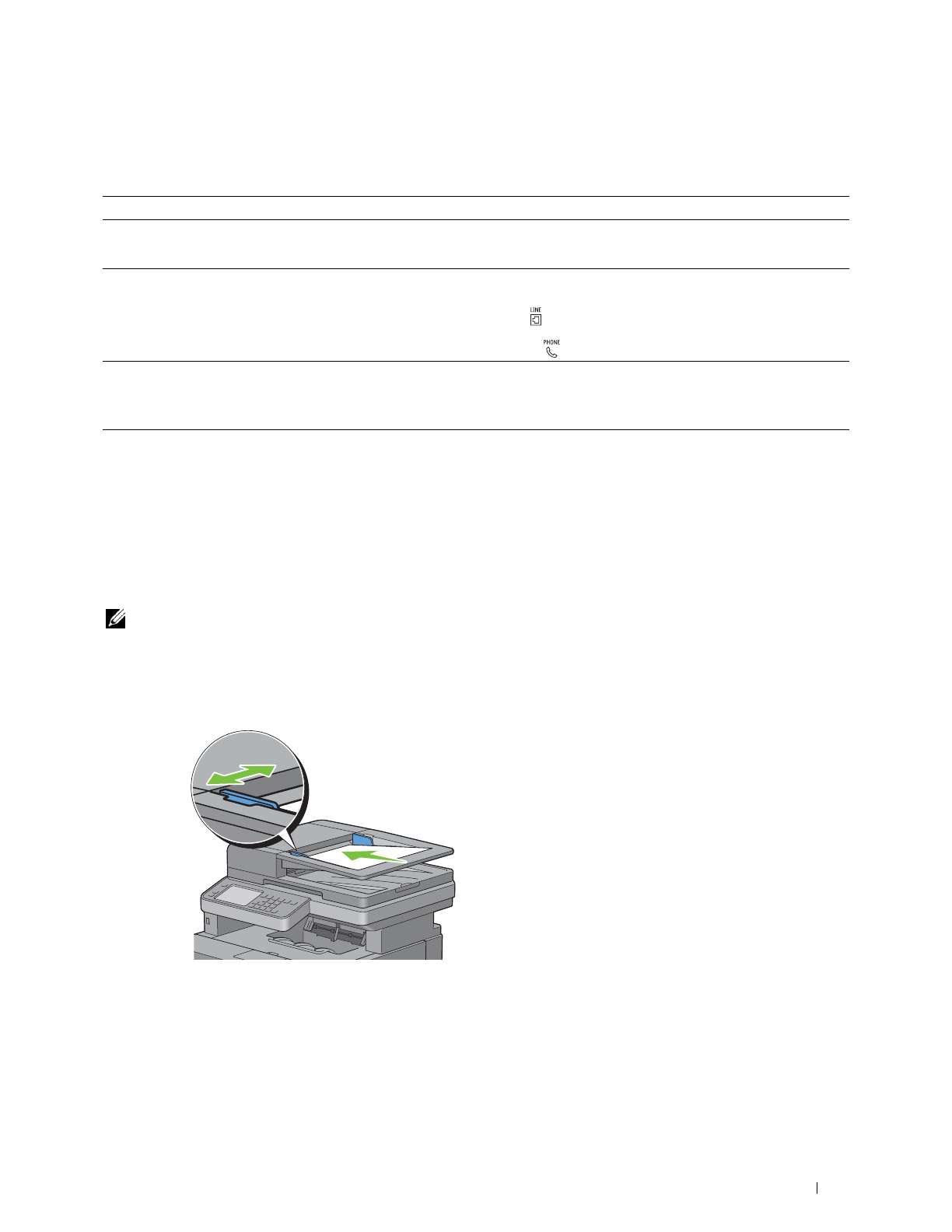
Faxing 377
5
When the message
Ready to Start
appears, select
OK
to start diagnosing the FAX connection.
One of the following diagnosing result is displayed.
Sending a Fax
You can fax data from your printer. You can also directly fax data transferred from the computer running a
Microsoft® Windows® operating system.
Loading an Original Document
You can use the DADF or the document glass to load an original document for faxing. Using the DADF, you can load
up to 50 sheets of 75 g/m2 (20 lb) paper at a time. Using the document glass, you can load one sheet at a time.
NOTE: To get the best scan quality, especially for gray scale images, use the document glass instead of the DADF.
To fax a document using the Duplex Automatic Document Feeder (DADF):
1
Place the document(s) facing up on the DADF with the top edge of the documents in first. Then adjust the
document guides to the correct document size.
2
Adjust the document resolution. (For details, see "Adjusting the Document Resolution.")
Diagnosing result Description
Connection not Detected
Please Reconnect Telephone Line
The telephone line cord is not connected. Make sure that the
telephone line cord is securely connected.
Cable Connected Wrongly
Reconnect Telephone Line from Wall
Jack to Line Connection
The telephone line cord is connected to the wrong connector. Make
sure that the telephone line cord is connected at one end to the wall
jack connector
()
of your printer and at the other end to an active
wall jack. If you use a telephone or answering machine, connect to the
phone connector
()
.
Fax Connection OK
Please Check Setting of Tone/Pulse
in Admin Menu after Restart Printer
The telephone line cord is properly connected. Check the Tone/Pulse
setting. For information on Tone/Pulse setting, see "Available Fax
Settings Options."
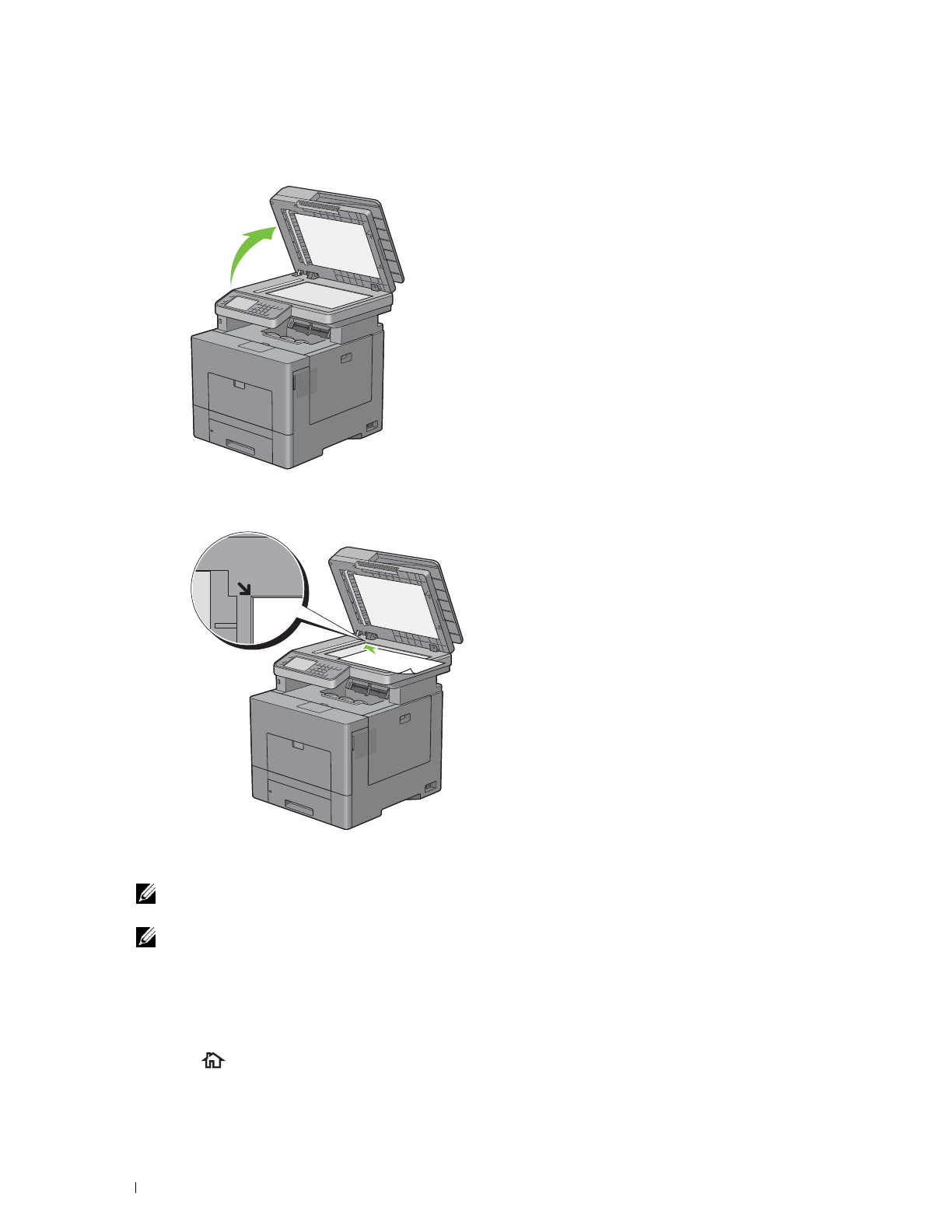
378 Faxing
To fax a document from the document glass:
1
Open the document cover.
2
Place the document facing down on the document glass and align it with the registration guide on the top left
corner of the glass.
3
Adjust the document resolution. (For details, see "Adjusting the Document Resolution.")
4
Close the document cover.
NOTE: Ensure that no document is in the DADF. If any document is detected in the DADF, it takes priority over the
document on the document glass.
NOTE: If you are faxing a page from a book or magazine, lift the cover until its hinges are caught by the stopper and then
close the cover. If the book or magazine is thicker than 30 mm, start faxing with the cover open.
Adjusting the Document Resolution
You can improve the quality of the fax document by adjusting the resolution, especially for documents with low
image quality or documents containing photographic images.
1
Press the
(Home)
button.
2
Select
Fax
.
Faxing 379
3
Select
Resolution
.
4
Select the desired setting, and then select
OK
.
* Denotes the factory default setting.
NOTE: Faxes scanned in the Super Fine resolution transmit at the highest resolution supported by the receiving device.
Adjusting the Document Contrast
You can adjust the contrast of the fax document to be lighter or darker than the original.
1
Load the document(s) facing up with top edge in first into the DADF.
OR
Place a single document facing down on the document glass, and close the document cover.
For details about loading a document, see "Loading an Original Document."
2
Press the
(Home)
button.
3
Select
Fax
.
4
Select
Darken/Lighten
.
5
Select the desired level on the
Darken/Lighten
bar, and then select
OK
.
You can select a contrast level from seven levels between
Darken
and
Lighten
.
Selecting a cell on the left side of the bar makes the document contrast darker, and selecting a cell on the right side
of the bar makes the document contrast lighter.
* Denotes the factory default setting.
Sending a Fax From Memory
1
Load the document(s) facing up with top edge in first into the DADF.
OR
Place a single document facing down on the document glass, and close the document cover.
For details about loading a document, see "Loading an Original Document."
2
Press the
(Home)
button.
Standard* Used for documents with normal sized characters.
Fine Used for documents containing small characters or thin lines or documents printed using a
dot-matrix printer.
Super Fine Used for documents containing extremely fine detail. The super fine mode is enabled only if
the remote machine also supports the Super Fine resolution. See the note below.
Photo Used for documents containing photographic images.
Darken3 Works well with light documents or faint pencil markings.
Darken2
Darken1
Normal* Works well with standard typed or printed documents.
Lighten1 Works well with dark documents.
Lighten2
Lighten3

380 Faxing
3
Select
Fax
.
4
Adjust the document resolution to suit your fax needs. (For details, see "Adjusting the Document Resolution." For
adjusting the contrast, see "Adjusting the Document Contrast.")
5
To select a fax number, do one of the followings :
• Select , and then select one of the following:
Machine Address Book - Individuals
- Select an individual fax number and then select
OK
.
Machine Address Book - Groups
- Select a group dial number and then select
OK
.
Search Network Address Book
- Search and select a fax number from the LDAP server and then
select
OK
.
NOTE: For more information on address book and server address book, see "Address Books."
NOTE: For details about Search Network Address Book, see "Using the Server Address Book and Server
Phone Book."
NOTE: The fax number needs to be registered before you can select Address Book.
• Select .
Enter the speed dial number using the number pad, and then select .
6
Press the
(Start)
button to scan data.
When the document is loaded on the document glass, the display prompts you for another page.
If you want to place a new document, replace the document with a new document, and then press the
(Start)
button.
When you have finished loading documents, select
Send Now
.
The printer starts dialing the number, and then sends the fax when the remote fax machine is ready.
NOTE: You can cancel the fax job at any time while sending the fax by pressing the
(Cancel) button.
NOTE: Pressing the
(Start)
button
does not start sending a fax when the available time is set or the Fax function is
locked. (For details, see "Set Available Time" for the Available time and "Function Enabled" for the Fax function.)
Sending a Fax Manually
1
Load the document(s) facing up with top edge in first into the DADF.
OR
Place a single document facing down on the document glass, and close the document cover.
For details about loading a document, see "Loading an Original Document."
2
Press the
(Home)
button.
3
Select
Fax
.
4
Adjust the document resolution to suit your fax needs. (For details, see "Adjusting the Document Resolution." For
adjusting the contrast, see "Adjusting the Document Contrast.")
5
Select
On Hook
.
6
Enter the fax number of the recipient using the number pad.
You can also select the recipient by using speed dial number or address book. (For details, see "Automatic
Redialing.")
7
Press the
(Start)
button to begin sending the fax.
NOTE: You can cancel the fax job at any time while sending the fax by pressing the
(Cancel) button.

Faxing 381
NOTE: Pressing the
(Start)
button
does not start sending a fax when the available time is set or the Fax function is
locked. (For details, see "Set Available Time" for the Available time and "Function Enabled" for the Fax function.)
Confirming Transmissions
When the last page of your document has been sent successfully, the printer beeps and returns to the standby mode.
If something goes wrong while sending your fax, an error message appears on the display.
If you receive an error message, press the
(Cancel) button to clear the message and try to send the document
again.
You can set your printer to print a confirmation report automatically after each fax transmission. For further details,
see "Printing a Report."
Automatic Redialing
If the number you have dialed is busy or there is no answer when you send a fax, the printer will automatically redial
the number every minute based on the number set in the redial settings.
To change the time interval between redials and the number of redial attempts, see "Available Fax Settings Options."
NOTE: The printer will not automatically redial a number that was busy when the number was manually entered.
Sending a Delayed Fax
The Delayed Start mode can be used to save scanned documents for transmission at a specified time to take
advantage of lower long distance rates.
1
Load the document(s) facing up with top edge in first into the DADF.
OR
Place a single document facing down on the document glass, and close the document cover.
For details about loading a document, see "Loading an Original Document."
2
Press the
(Home)
button.
3
Select
Fax
.
4
Adjust the document resolution to suit your fax needs. (For details, see "Adjusting the Document Resolution." For
adjusting the contrast, see "Adjusting the Document Contrast.")
5
Select the
Options
tab, and then select
Delayed Send
.
6
Select
On
.
7
Enter the start time using the number pad, and then select
OK
.
8
Select the
Fax
tab, and then enter the fax number of the recipient using the number pad.
You can also select the recipient by using speed dial number or address book. (For details, see "Automatic
Redialing.")
9
Press the
(Start)
button to scan data.
Once Delayed Start mode is activated, your printer stores all of the documents to be faxed into its memory and
sends them at the specified time. After faxing in the Delayed Start mode is complete, the data in the memory is
cleared.
NOTE: If you turn off and on the printer, the stored documents are sent as soon as the printer is activated.
NOTE: If the specified start time overlaps with the time periods for the available time or the Fax function, the printer cannot
send the delayed fax at the specified time. (For details, see "Set Available Time" for the Available time and "Function
Enabled" for the Fax function.)
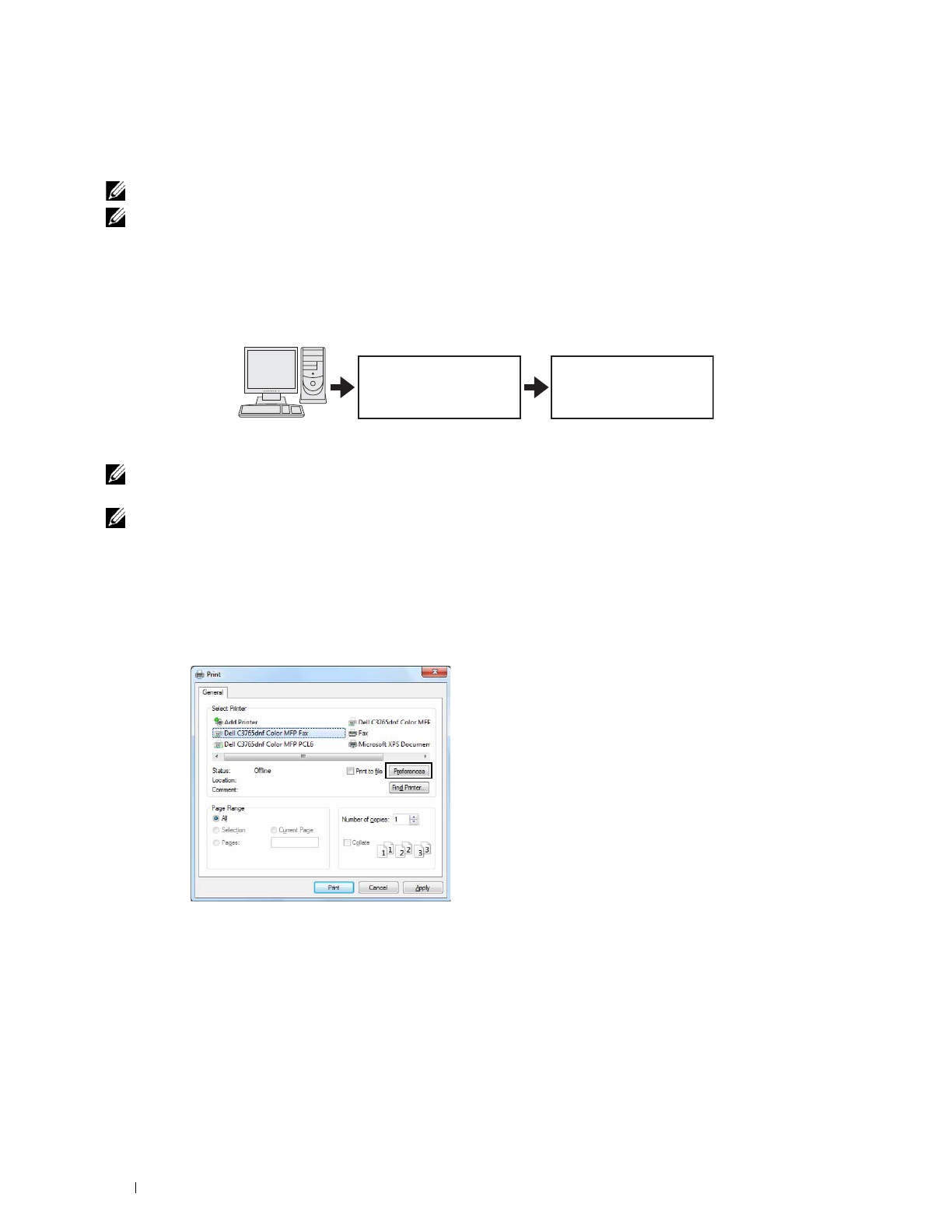
382 Faxing
Sending a Fax from the Driver (Direct Fax)
You can send a fax directly from your computer by using the driver.
NOTE: Only black and white faxes can be sent using Direct Fax.
NOTE: If the specified start time overlaps with the time periods for the available time or the Fax function, the printer cannot send
the delayed fax at the specified time. (For details, see "Set Available Time" for the Available time and "Function Enabled" for the
Fax function.)
Example
Procedure
NOTE: The names of the dialog boxes and the buttons may be different from those given in the following procedure depending
on the application you are using.
NOTE: To use this feature, you must install the fax driver. (For details, see "Inserting the Software and Documentation Disc" for
Windows or "Installing the Drivers and Software" for Macintosh.)
1
Open the file you want to send by fax.
2
Open the print dialog box from the application, and then select
Dell C3765dnf Color MFP Fax
.
3
Click
Preferences
in Windows, or select
FAX Setting
in Macintosh.
For Microsoft Windows:
Send data via the
Dell C3765dnf Color MFP Fax driver
Send fax
Receiving machine (fax
machine/multifunction
printer)
Sending machine (Dell™
C3765dnf Multifunction
Color Laser Printer)
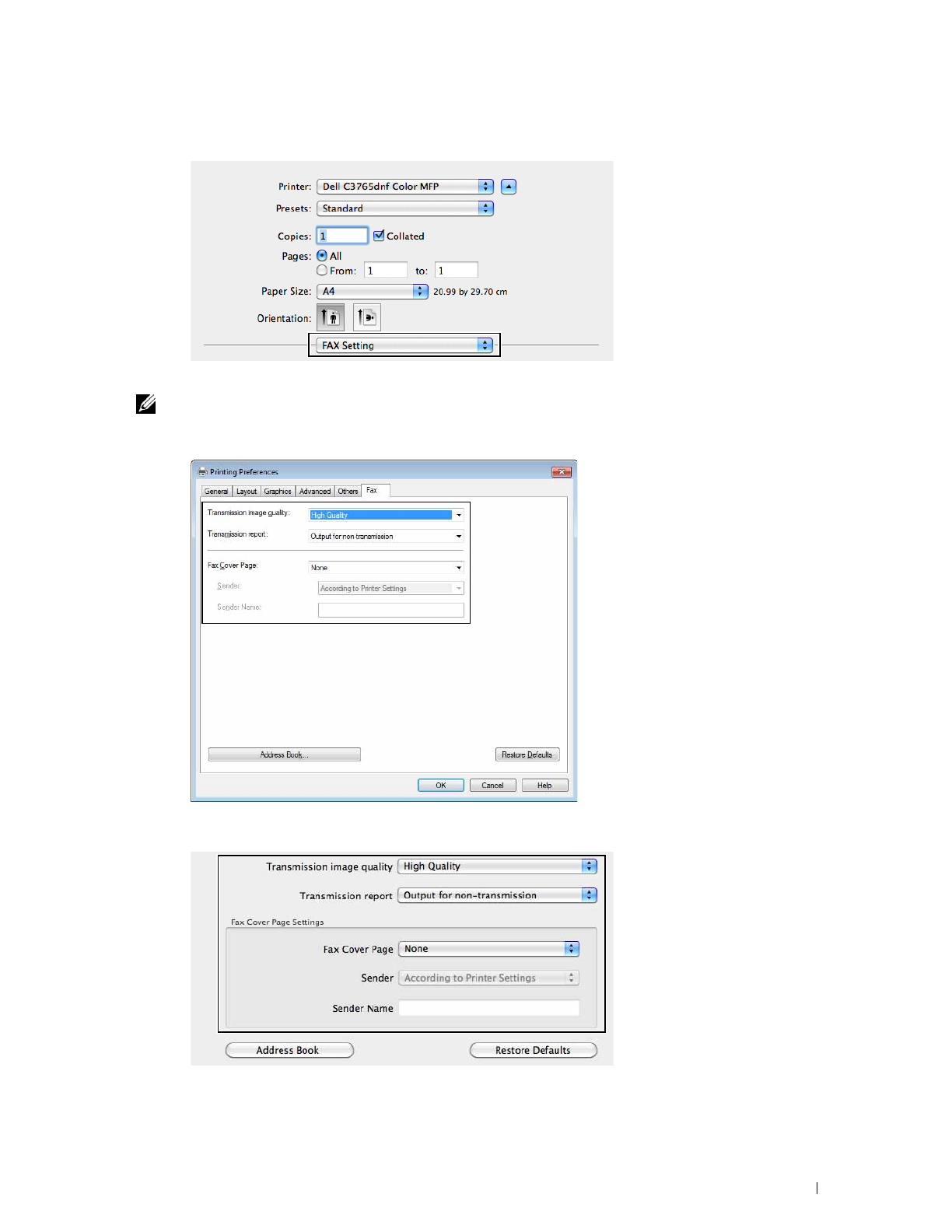
Faxing 383
For Apple Macintosh:
4
When the setting dialog box appears, specify the following settings.
NOTE: The settings done here are only applied to a single fax job.
For Microsoft Windows:
For Apple Macintosh:
384 Faxing
a. Transmission image quality
Purpose:
To set the output quality.
Val u e s:
* Denotes the factory default setting.
NOTE: Faxes printed in the Super-high image quality by Direct Fax driver transmits at the highest resolution supported by the
receiving device.
b. Transmission report
Purpose:
To specify whether to print a fax transmission result.
Val u e s:
* Denotes the factory default setting.
c. Fax Cover Page
Purpose:
To specify whether to attach a cover page to your fax.
Val u e s:
* Denotes the factory default setting.
Sender
Purpose:
To specify whether to print the sender’s name on the fax cover page.
Val u e s:
* Denotes the factory default setting.
Standard For documents with normal sized characters.
High Quality* For documents containing small characters or thin lines or documents printed using a dot-
matrix printer.
Super-high image quality For documents containing extremely fine detail. The super fine mode is enabled only if the
remote machine also supports Super Fine resolution. See the notes below.
Output regularly Prints a transmission result after every fax transmission.
Output for non-transmission* Prints a transmission result only when an error occurs.
Do not output Does not print fax transmission results.
According to Printer Settings Determines whether to attach a cover page to your fax depending on the setting you specify in
Fax Cover Page on the operator panel.
Attach Attaches a cover page to your fax.
None* Does not attach a cover page to your fax.
According to Printer Settings* Determines whether or not to print the sender’s name on the fax cover page based on the
printer settings.
Enter a sender name Allows you to enter a sender’s name that will be printed on the fax cover page in Sender
Name.
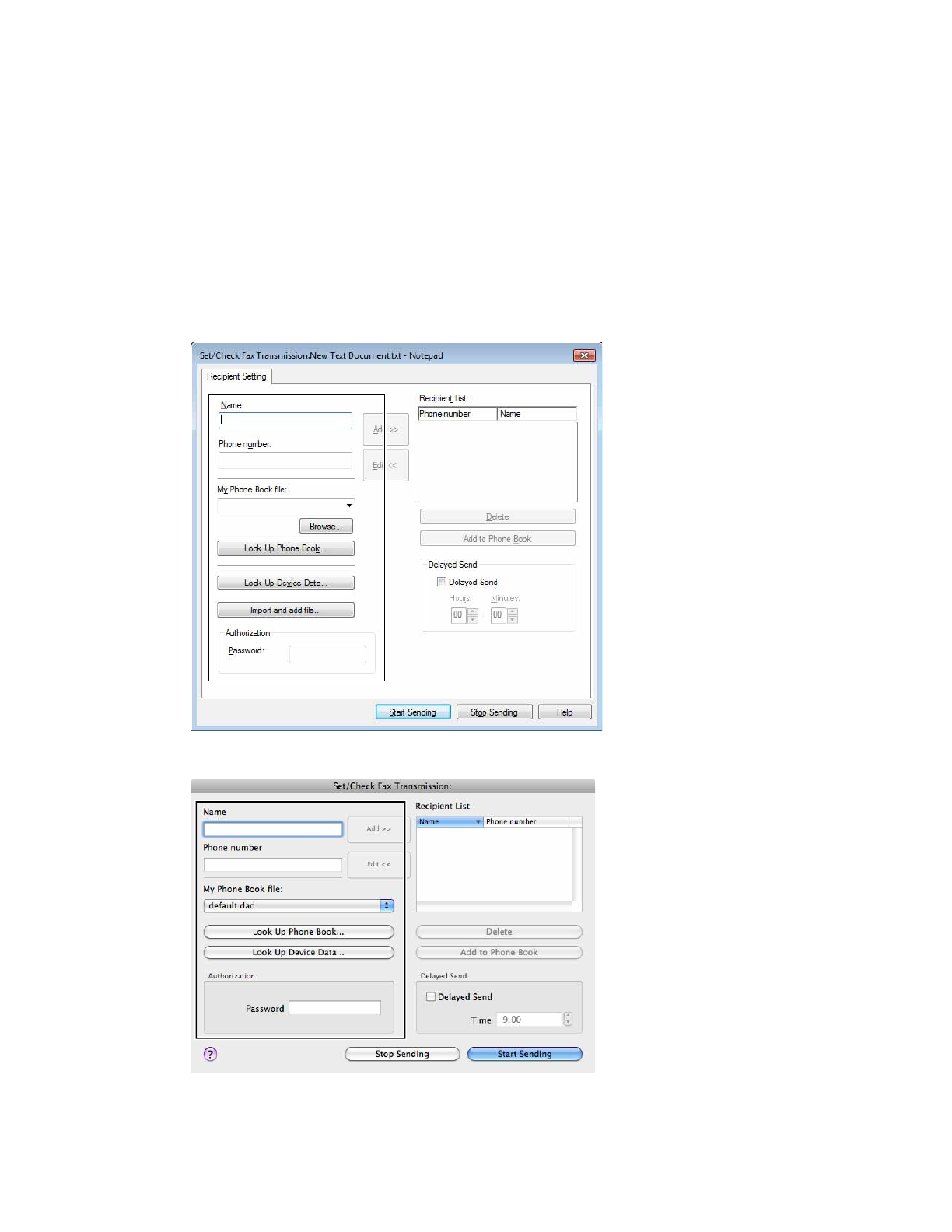
Faxing 385
Sender Name
Purpose:
To enter a sender’s name that will be printed on the fax cover page.
The sender’s name can be up to 30 characters. If it exceeds 30 characters, only the first 30 characters will be printed.
5
For Windows, click
OK
to close the
Printing Preferences
dialog box, and then click
Print
.
For Macintosh, click
Print
.
The
Set/Check Fax Transmission
dialog box appears.
For Microsoft Windows:
For Apple Macintosh:

386 Faxing
6
Enter the destination for the recipient. The following procedure is for entering the destination. For details on how
to enter the destination, please refer to the Help file for the driver.
a
Enter the name and fax number directly.
b
Select a fax number from a phone book.
•
Look Up Phone Book
:
Displays a list of fax numbers that are saved in the file specified for
My Phone
Book file
.
•
Look Up Device Data
: Displays a list of fax numbers that are saved in the Phone Book on the Dell
C3765dnf Multifunction Color Laser Printer.
•
Import and add file
(Windows only): Allows you to select a source file such as a CSV file, WAB file,
MAPI, or a LDAP server. (For details on LDAP server, see "LDAP Server" and "Fax Server Address Book.")
NOTE: Enter the password in the Password field in the Authorization area before sending a fax if the fax function is locked
with a password.
To lock the fax function with a password:
NOTE: To lock the fax function from Function Enabled, you must first set Panel Lock to On. For details, see
"Panel Lock."
1
Press the
(Information)
button.
2
Select the
Tools
tab, and then select
Admin Settings
.
3
Select until
Secure Settings
appears, and then select
Secure Settings
.
4
Select
Function Enabled
.
5
Select until
Fax
appears, and then select
Fax
.
6
Select
On (Password)
.
7
Enter a four digit password, and then select
OK
.
8
Turn off the printer, and turn it on again to apply the settings.
To check whether the fax has been sent:
Print a job history report. For details about how to print a job history report, see "Report / List."
Receiving a Fax
About Receiving Modes
NOTE: To use the Telephone / Fax or Ans Machine/Fax, connect an answering machine to the phone connector
()
on the back of your printer.
When the memory is full, the fax is received in the Telephone mode.
Loading Paper for Receiving Faxes
The instructions for loading paper in the paper tray are the same whether you are printing, faxing, or copying, except
that faxes can only be printed on Letter-sized, A4-sized, or Legal-sized paper. For details about loading paper, see
"Loading Print Media." For details about setting the paper type and size in the tray, see "Print Media Guidelines."
Receiving a Fax Automatically in the Fax Mode
Your printer is preset to the Fax mode at the factory.
If you receive a fax, the printer automatically goes into the fax mode after a specified period of time and receives the
fax.

Faxing 387
To change the interval at which the printer goes into the fax mode after receiving an incoming call, see "Available
Fax Settings Options."
Receiving a Fax Manually in the Telephone Mode
You can receive a fax by picking up the handset of the external telephone and then pressing the remote receive code
(see "Available Fax Settings Options"). You can also receive a fax by selecting Manual Receive in On Hook.
To receive a fax by selecting Manual Receive:
1
When the external telephone rings, pick up the handset and check for the fax tone.
2
After you hear the fax tone, press the
(Home)
button.
3
Select
Fax
.
4
Select
On Hook
.
5
Select
Mode
, and then select
Manual Receive
.
6
Press the
(Start)
button.
7
Hang up the hand set of the external telephone.
The printer begins receiving a fax and returns to the standby mode when the reception is completed.
Receiving a Fax Automatically in the Telephone / Fax or Ans Machine/Fax
To use the Telephone / Fax or Ans Machine/Fax mode, you must connect an external telephone to the
phone connector ( ) on the back of your printer.
If the caller leaves a message, the answering machine stores the message as it would normally. If your printer hears a
fax tone on the line, it automatically starts to receive a fax.
For details on Telephone / Fax or Ans Machine/Fax mode, see "Available Fax Settings Options."
NOTE: If you have set your printer to Ans Machine/Fax and your answering machine is switched off, or no answering
machine is connected to your printer, your printer will automatically go into the Fax mode after a predefined time.
Receiving a Fax Manually Using an External Telephone (Remote Receive)
You can manually receive a fax from the external telephone without having to go to the printer.
To manually receive a fax using the external telephone, you must connect an external telephone to the phone
connector ( ) on the back of your printer and also set Remote Receive to On.
When you receive a call on the external telephone and hear a fax tone, enter the two-digit code from the external
telephone.
The printer receives the document.
When entering the remote receive code from the external telephone, press the number keys slowly in sequence. If
you still hear the fax tone from the remote machine, try entering the two-digit code once again.
The default remote receive code is 00. You can change the two-digit code to whatever you choose. For details on
changing the code, see "Available Fax Settings Options."
NOTE: Set the dialing system of your external telephone to DTMF.

388 Faxing
Receiving Faxes Using the DRPD
The DRPD is a telephone company service which enables a user to use a single telephone line to answer several
different telephone numbers. The particular number someone uses to call you on is identified by different ringing
patterns, which consist of various combinations of long and short ringing sounds.
Before using the Distinctive Ring Pattern Detection option, Distinctive Ring service must be installed on your
telephone line by the telephone company. To set up Distinctive Ring Pattern Detection, you will need another
telephone line at your location, or someone available to dial your fax number from outside.
To set up the DRPD:
1
Press the
(Information)
button.
2
Select the
Tools
tab, and then select
Admin Settings
.
3
Select until
Fax Settings
appears, and then select
Fax Settings
.
4
Select
Fax Line Settings
.
5
Select until
DRPD Pattern
appears, and then select
DRPD Pattern
.
6
Select the desired pattern, and then select
OK
.
7
Turn off the printer, and turn it on again to apply the settings.
To receive faxes in the DRPD, you need to set the menu to DRPD. For details, see "Available Fax Settings
Options."
Your printer provides seven DRPD patterns. If this service is available from your telephone company, ask your
telephone company which pattern you need to select to use this service.
Receiving Faxes in the Memory
Since your printer is a multi-tasking device, it can receive faxes while you are making copies or printing. If you
receive a fax while you are copying, printing, or run out of paper or toner, your printer stores incoming faxes in the
memory. Then, as soon as you finish copying, printing, or re-supply the consumables, the printer automatically prints
the fax.
Polling Receive
You can receive faxes from the remote fax machine when you want to receive it.
1
Press the
(Home)
button.
2
Select
Fax
.
3
Select
On Hook
.
4
Select
Mode
, and then select
Manual Polling
5
Enter the fax number of the remote machine using the number pad.
6
Press the
(Start)
button to begin receiving the fax.
Automatic Dialing
Speed Dialing
You can store up to 200 frequently dialed numbers in speed dial locations (001–200).
When the speed dial job specified in the delayed fax or redial exists, you cannot change the speed dial number from
the operator panel or Dell Printer Configuration Web Tool.

Faxing 389
Setting Speed Dial
1
Press the
(Information)
button.
2
Select the
Tools
tab, and then select
Admin Settings
.
3
Select until
Phone Book
appears, and then select
Phone Book
.
4
Select
Individuals
.
5
Select until the desired speed dial number between 1 and 200 appears and then select that number.
To jump to a specific speed dial number, enter the desired number and then # using the number pad.
6
Select the
Name
text box.
7
Enter the name, and then
OK
.
8
Select the
Fax Number
text box.
9
Enter the fax number using the number pad, and then
OK
.
To insert a pause between numbers, press the
(Redial/Pause)
button.
"-" appears on the display.
10
Select
OK
.
To store more fax numbers, repeat steps 5 to 10.
To return to the
Information
screen, press the
(All Clear)
button.
Sending a Fax Using Speed Dial
1
Load the document(s) facing up with top edge in first into the DADF.
OR
Place a single document facing down on the document glass, and close the document cover.
For details about loading a document, see "Loading an Original Document."
2
Press the
(Home)
button.
3
Select
Fax
.
4
Select .
5
Enter the speed dial number between 1 and 200 using the number pad, and then select .
6
Adjust the document resolution to suit your fax needs. (For details, see "Adjusting the Document Resolution." For
adjusting the contrast, see "Adjusting the Document Contrast.")
7
Press the
(Start)
button to scan data.
When the document is loaded on the document glass, the display prompts you for another page.
If you want to place a new document, replace the document with a new document, and then press the
(Start)
button.
When you have finished loading documents, select
Send Now
.
The fax number stored in the speed dial location is automatically dialed. The document is sent when the remote
fax machine answers.
NOTE: Using the asterisk (*) in the first digit, you can send a document to multiple locations. For example, if you enter 00*,
you can send a document to the locations registered between 001 and 009.

390 Faxing
Group Dialing
If you frequently send the same document to several destinations, you can create a group of these destinations and
set them under a one-digit group dial location. This enables you to use a group dial number setting to send the same
document to all the destinations in the group.
NOTE: You cannot include one group dial number within another group dial number.
Setting Group Dial
1
Press the
(Information)
button.
2
Select the
Tools
tab, and then select
Admin Settings
.
3
Select until
Phone Book
appears, and then select
Phone Book
.
4
Select
Groups
.
5
Select until the desired group dial number between 1 and 6 appears and then select that group dial number.
If a speed dial number is already stored in the location you chose, the display shows the name and the number of
entries stored in that group dial number.
6
Select the
Enter Group Name
text box.
7
Enter the name, and then
OK
.
8
Select
Add from Address Book
.
NOTE: The fax number needs to be registered before you can select Add from Address Book.
9
Select until the desired speed dial number appears and then select that speed dial number.
10
Select
OK
, and then select
OK
again.
To store more group dial numbers, repeat steps 5 to 11.
To return to the
Information
screen, press the
(All Clear)
button.
Editing Group Dial
You can delete a specific speed dial number from a selected group or add a new number to the selected group.
1
Press the
(Information)
button.
2
Select the
Tools
tab, and then select
Admin Settings
.
3
Select until
Phone Book
appears, and then select
Phone Book
.
4
Select
Groups
.
5
Select until the group dial number that you want to edit appears, and then select that group dial number.
6
Select
Edit
.
7
Select the
Enter Group Name
text box.
8
Enter a new name, and then
OK
.
9
To delete a speed dial number from the group dial number:
a
Select until the speed dial number that you want to edit appears, and then select that speed dial number.
b
Select
Remove
.
10
To add a new speed dial number to the group dial number:
a
Select
Add from Address Book
.
b
Select until the desired speed dial number appears and then select that speed dial number.
c
Select
OK
.

Faxing 391
11
Select
OK
.
To delete an existing group dial number, select the group dial number, and then select
Remove
.
If you want to edit another group dial number, repeat steps 5 to 11.
To return to the
Information
screen, press the
(All Clear)
button.
Sending a Fax Using Group Dial (Multi-address Transmission)
You can use group dialing for Broadcasting or Delayed transmissions.
Follow the procedure of the desired operation. (For Delayed transmission, see "Specifying the Fax Settings
Options.")
You can use one or more group numbers in one operation. Then continue the procedure to complete the desired
operation.
Your printer automatically scans the document loaded in the DADF or on the document glass into the memory. The
printer dials each of the numbers included in the group.
Printing a Speed Dial List
You can check your automatic dial setting by printing a Speed Dial list.
For details about how to print a Speed Dial list, see "Report / List."
Phone Book
You can select or search the registered phone numbers from the phone books.
1
Load the document(s) facing up with top edge in first into the DADF.
OR
Place a single document facing down on the document glass, and close the document cover.
For details about loading a document, see "Loading an Original Document."
2
Press the
(Home)
button.
3
Select
Fax
.
4
Select , and then select one of the following:
To select from the local phone book:
a
Select
Machine Address Book - Individuals
or
Machine Address Book - Groups
.
b
Select until the desired speed dial number or the group dial number appears, and then select that speed
dial number or group dial number.
c
Select
OK
.
To search from the server phone book:
a
Select
Search Network Address Book
.
b
Enter a keyword using the keyboard, and then select
OK
.
c
Select a recipient from the search result, and then select
OK
.
NOTE: For more information on address book and server address book, see "Address Books."
NOTE: For details about Search Network Address Book, see "Using the Server Address Book and Server
Phone Book."
NOTE: A fax number needs to be registered before you can select an address book.

392 Faxing
5
Press the
(Start)
button to begin sending the fax.
Other Ways to Fax
Using the Secure Receiving Mode
You may need to prevent your received faxes from being accessed by unauthorized people. You can turn on the secure
fax mode using the Secure Receive option to restrict printing out all of the received faxes when the printer is
unattended. In the secure fax mode, all incoming faxes will go in memory. When the mode is turned off, all stored
faxes will be printed.
NOTE: Before operation, ensure Panel Lock is enabled.
To turn the secure receiving mode on:
1
Press the
(Information)
button.
2
Select the
Tools
tab, and then select
Admin Settings
.
3
Select until
Fax Settings
appears, and then select
Fax Settings
.
4
Select
Incoming Defaults
.
5
Select until
Secure Receive
appears, and then select
Secure Receive
.
6
Select
Secure Receive Set
.
7
Select
Enable
.
8
Enter a four digit password, and then select
OK
.
9
To return to the
Information
screen, press the
(All Clear)
button.
When a fax is received in the secure receiving mode, your printer stores it into memory and
Secure Fax
Receive
is enabled on the
Job Status
screen to let you know that there is a fax stored.
To print received documents:
1
Press the
(Job Status)
button.
2
Select
Secure Fax Receive
.
3
Enter a four digit password, and then select
OK
.
The faxes stored in memory are printed.
To turn the secure receiving mode off:
1
Follow the same steps from 1 to 6 in "To turn the secure receiving mode on:" and select
Secure Receive Set
.
2
Select
Disable
.
To return to the
Information
screen, press the
(All Clear)
button.
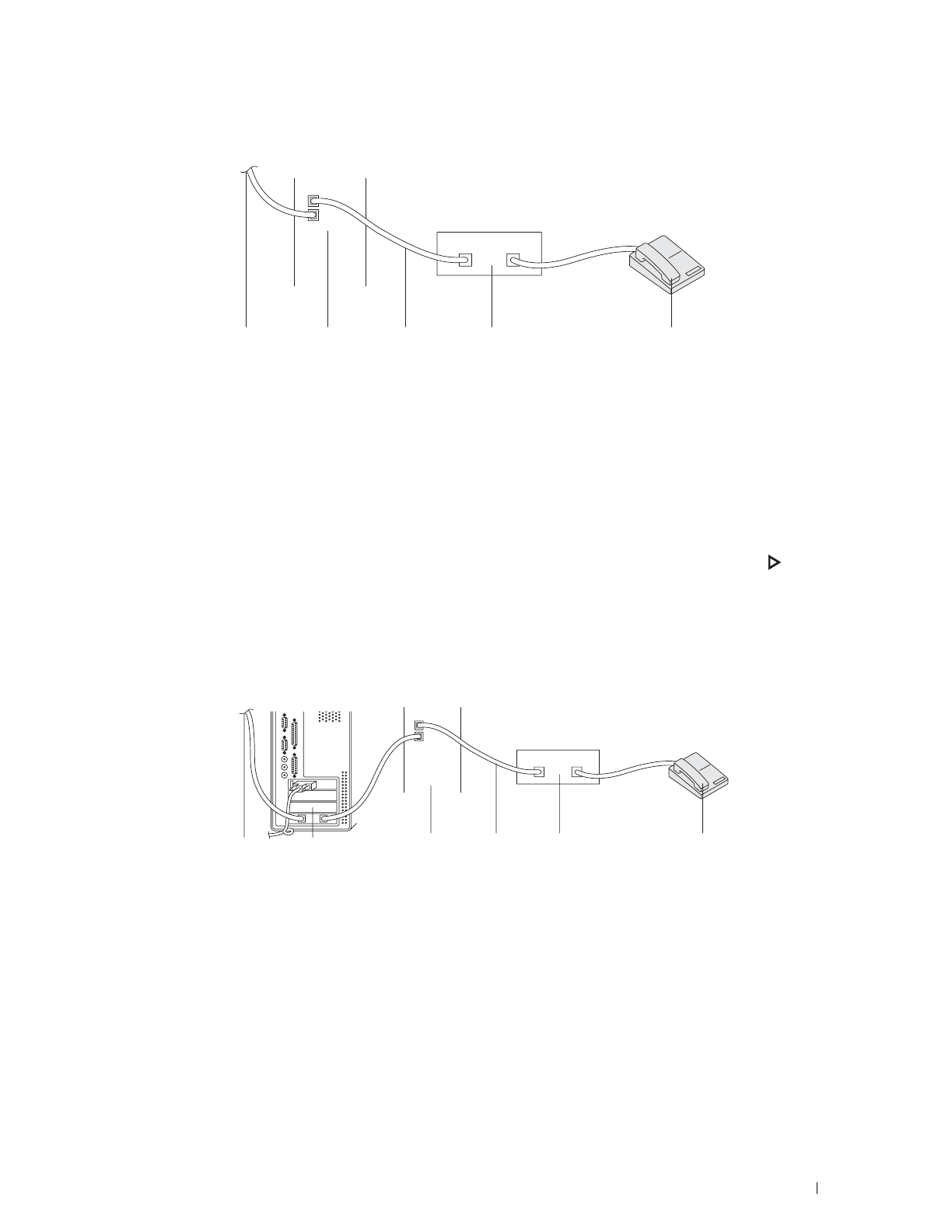
Faxing 393
Using an Answering Machine
You can connect a telephone answering device (TAD) directly to the back of your printer as shown above.
• Set your printer to the
Ans Machine/Fax
and set
Auto Receive Ans/Fax
to specify the time for the
TAD.
• When the TAD picks up the call, the printer monitors and takes the line if fax tones are received and then starts
receiving the fax.
• If the answering device is off, the printer automatically goes into the
Fax
after the ring tone sounds for a
predefined time.
• If you answer the call and hear fax tones, the printer will answer the fax call if you
Set
On Hook
to
On
(you can hear voice or fax tones from the remote machine), and then press the
(Start)
button and hang up the receiver.
OR
Press the two-digit remote receive code and hang up the receiver.
Using a Computer Modem
If you want to use your computer modem for faxing or for a dial-up Internet connection, connect the computer
modem directly to the back of your printer with the TAD as shown above.
• Set your printer to the
Ans Machine/Fax
and set
Auto Receive Ans/Fax
to specify the time for the
TAD.
• Turn off the computer modem's fax-receive feature.
• Do not use the computer modem if your printer is sending or receiving a fax.
• Follow the instructions provided with your computer modem and fax application to fax via the computer modem.
To the
wall jack
Printer Line Telephone
Answering Device
Phone
To the
Internet
Computer Line Telephone
Answering Device
PhonePrinter
394 Faxing
Printing a Report
The following reports may be useful when using fax:
NOTE: For more information about other reports and how to print a report, see "Report / List."
Changing Setting Options
1
Press the
(Information)
button.
2
Select the
Tools
tab, and then select
Default Settings
.
3
Select
Fax Defaults
.
4
Select until the desired menu appears, and then select that menu.
5
Select until the desired setting appears or enter the value using the number pad, and then select
OK
.
To return to the
Information
screen, press the
(All Clear)
button.
Speed Dial This list shows all the numbers currently stored in the memory of your printer as speed dial
numbers.
Address Book This list shows all the addresses currently stored in the printer's memory as Address Book
information.
Server Address This list shows all of the numbers currently stored in the printer's memory as Server Address
information.
Fax Activity This report shows information about the faxes you recently received or sent.
Fax Pending This list shows the status of pending faxes. You may print this list to confirm your changes
after changing any settings.
Print Meter This report shows the total number of pages printed. The report will be titled Dell ColorTrack
Report.

395
Know Your Printer
23 Understanding Your Printer Software ................................... 397
24 Printing Using ColorTrack (External Authentication) .......... 413
25 Using the Server Address Book and Server Phone Book ... 421
26 Using Digital Certificates ......................................................... 423
27 Understanding Fonts ................................................................ 435
28 Understanding Printer Messages .......................................... 443
29 Specifications............................................................................ 455

396

Understanding Your Printer Software 397
23
Understanding Your Printer Software
Use the
Software and Documentation
disc that shipped with your printer to install a combination of software
programs, depending on your operating system.
Printer Status Window
The Printer Status window alerts you when there is a warning or when an error occurs, for example, when a paper
jam occurs or toner is running low.
By default, the Printer Status window launches only when an error occurs. When an error occurs, the error message
appears on the Printer Status window. You can set the Printer Status window to always launch when printing in
Printing Status Window Properties.
You can also check toner level, quantity of paper remaining or the configuration of options for the printer.
Status Monitor Console
Use the Status Monitor Console to manage multiple instances of the Status Window for a particular printer.
Select a printer from the list view (or Printer Selection) by clicking its name to open a Status Window for a
particular printer.
Dell™ Supplies Management System
You can launch the Dell Supplies Management System dialog box from the All Programs menu or the desktop icon.
You can order consumables by phone or from the web.
1
Click
Start
→
All Programs
→
Dell Printers
→
Additional Color Laser Software
→
Dell Supplies Management
System
.
The
Dell Supplies Management System
window appears.
2
Select your printer from the
Select Printer Model
list.
3
If you are ordering from the web:
a
Select a URL from the
Select Reorder URL
list.
b
Click
Visit Dell printer supplies ordering web site
.
NOTE: When you cannot get information from the printer automatically by two-way communication, a window prompting
you to type the Service Tag appears. Type the Service Tag of your Dell printer in the field provided.
Your Service Tag is located inside the front cover of your printer.
4
If you order by phone, call the number that appears in the
Order by Phone
section.
User Setup Disk Creating Tool
The User Setup Disk Creating Tool program located in the MakeDisk folder of the Utilities folder on the
Software
and Documentation
disc and the printer drivers located on the
Software and Documentation
disc are used to create
driver installation packages that contain custom driver settings. A driver installation package can contain a group of
saved printer driver settings and other data for things such as:
• Print orientation and Multiple Up (document settings)
•Watermarks
•Font references
If you want to install the printer driver with the same settings on multiple computers running the same operating
system, create a setup disk in a floppy disk or in a server on the network. Using the setup disk that you have created
will reduce the amount of work required when installing the printer driver.
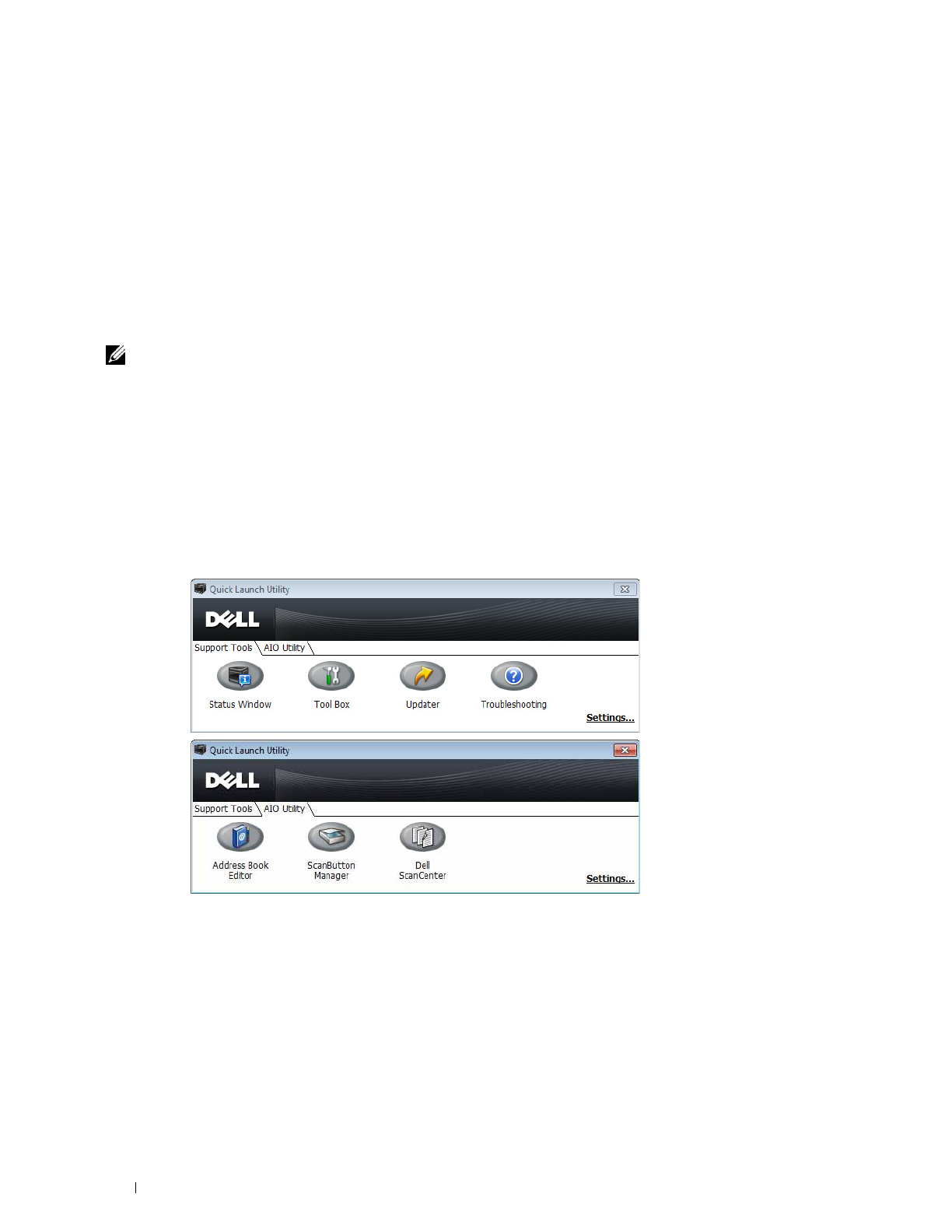
398 Understanding Your Printer Software
• Install the printer driver in the computer on which the setup disk is to be created.
• The setup disk can only be used on the operating system on which the disk was created or computers running the
same operating system. Create a separate setup disk for each of the operating systems.
Software Update
The firmware and/or driver updates can be downloaded from the Dell Support web site located at support.dell.com.
Printer Utility Software
You can open the Status Window, Tool Box, Updater, Troubleshooting, Address Book Editor, ScanButton Manager,
and Dell ScanCenter using the Quick Launch Utility window.
NOTE: Quick Launch Utility is only supported on Microsoft® Windows®.
To use the Quick Launch Utility, select to install the Quick Launch Utility when you install the Dell software.
To install the Dell software, follow the instructions below.
1
Insert the
Software and Documentation
disc into your computer and click
setup_assist.exe
to start
Easy Setup
Navigator
.
2
Click
Installing Driver and Software
.
3
Follow the on-screen instructions.
To open the Quick Launch Utility window:
1
Click
Start
→
All Programs
→
Dell Printers
→
Additional Color Laser Software
→
Quick Launch Utility
.
The Quick Launch Utility window provides seven buttons: Status Window, Tool Box, Updater, Troubleshooting,
Address Book Editor, ScanButton Manager, and Dell ScanCenter.

Understanding Your Printer Software 399
To exit the Quick Launch Utility window:
1
Click the Close (x) button at the top-right of the window.
For details, click
Help
of each application.
Status Window
The Status Window button opens the Printer Status window. For more information about using Status Window,
refer to "Printer Status Window."
Tool Box
The Tool Box button opens the Tool Box. For more information about using Tool Box, refer to "Understanding the
Tool Box Menus."
Updater
The Updater button updates the Dell software and printer firmware.
Troubleshooting
The Troubleshooting button opens the Troubleshooting Guide, which allows you to solve problems by yourself.
Address Book Editor
The Address Book Editor button opens the Address Book Editor, which allows you to register the contact
information such as phone number and e-mail address. For more information about using Address Book Editor, refer
to "Using Address Book Editor."
ScanButton Manager
The ScanButton Manager button opens the ScanButton Manager, which allows you to specify how the ScanButton
Manager behaves for scan events that the device generates (USB connection only). For more information about
using ScanButton Manager, refer to "Scanning From the Operator Panel - Scan to Application."
Dell ScanCenter
The Dell ScanCenter button opens the Dell ScanCenter, which is a PaperPort® application that enables you to
scan items and send them directly to PaperPort or other programs on your computer without running the PaperPort
program first. For more information about using Dell ScanCenter, refer to "Dell ScanCenter" or PaperPort's Help
menu.
Address Books
There are several address books available for Scan and Fax functions. Address books help you organize contact
information, such as e-mail addresses, fax numbers and server information, and quickly choose the recipient or
locate the address. The address book data can be obtained from the printer or a remote LDAP server.
NOTE: Phone Book is described as one of Address Books in this section.
NOTE: For information on how to setup the LDAP server, see "LDAP Server" and "LDAP User Mapping." For information on how to
obtain e-mail addresses and fax numbers from LDAP servers, see "Using the Server Address Book and Server Phone Book."
Types of Address Books
• E-mail Address Book (for Scan to E-mail)
E-mail addresses registered for sending the scanned document via e-mail

400 Understanding Your Printer Software
• Email Group (for Scan to E-mail)
Groups of e-mail addresses registered for sending the scanned document via e-mail
• LDAP Server Address Book (for Scan to E-mail)
E-mail addresses registered in the LDAP server for sending the scanned document via e-mail
• Network Address Book
(for Scan to Network)
Computer and FTP server information registered for sending the scanned document to a computer or ftp server
• Phone Book (for Fax)
Fax numbers registered for sending documents from your printer
• Group Dial (for Fax)
Groups of fax numbers registered for sending documents from your printer
• LDAP Server Phone Book (for Fax)
Fax numbers registered in the LDAP server for sending documents from your printer
• PC Fax Address Book (for Direct Fax)
Fax numbers registered for sending documents from your computer
• PC Fax Address Book for group (for Direct Fax)
Groups of fax numbers registered for sending documents from your computer
Adding and Editing Entries to the Address Books
There are following three ways to add or edit entries to the address books:
• Operator panel of the printer
• Address Book Editor
• Dell Printer Configuration Web Tool
Functions Features Types of Address Books Entry Registration
Operator Panel on
the Printer
Address Book Editor Dell Printer
Configuration Web
Tool
Scan E-mail Address Book -
Email Group -
Server Address Book
(LDAP server)
---
Network Address Book -
Fax Fax Phone Book
Group Dial
Server Phone Book
(LDAP server)
---
Direct Fax PC Fax Address Book - -
PC Fax Address Book - group - -
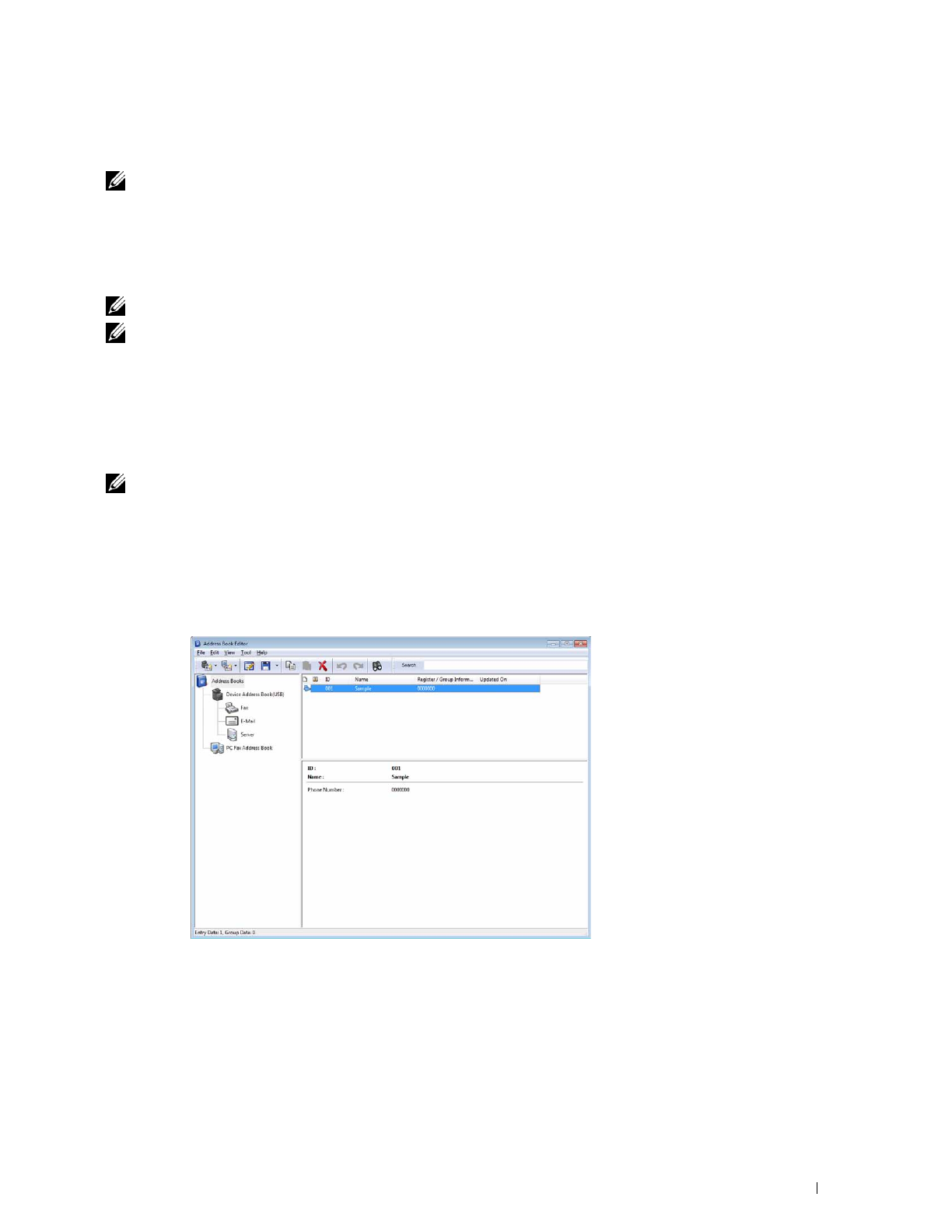
Understanding Your Printer Software 401
Using Operator Panel of the Printer
You can directly enter the fax numbers on the operator panel.
NOTE: For information on how to add a new entry, see "Setting Speed Dial."
Using Address Book Editor
You can use Address Book Editor installed on your computer to add or edit entries. Address Book Editor is
synchronized with the address books of your printer and updated simultaneously as you save changes to the entries
in Address Book Editor.
NOTE: This tool is supported on both Microsoft Windows and Apple Macintosh.
NOTE: When the printer and your computer is connected via USB, you must install the scanner driver.
With Address Book Editor, you can:
• Automatically retrieves data from the address books of your printer at startup
• Synchronizes with the printer
• Allows you to import the Address Book data from CSV file, WAB file, MAPI, and LDAP server
• Allows you to export the Address Book data into a CSV file
NOTE: Do not edit the exported CSV file with applications other than the Address Book Editor. Editing the CSV file with other
applications may corrupt the address data.
Address Book Panel
There are two address books you can manage in the Address Book Editor: Device Address Book for Fax, E-mail, and
Server and PC Fax Address Book for Direct Fax.
For Microsoft Windows:
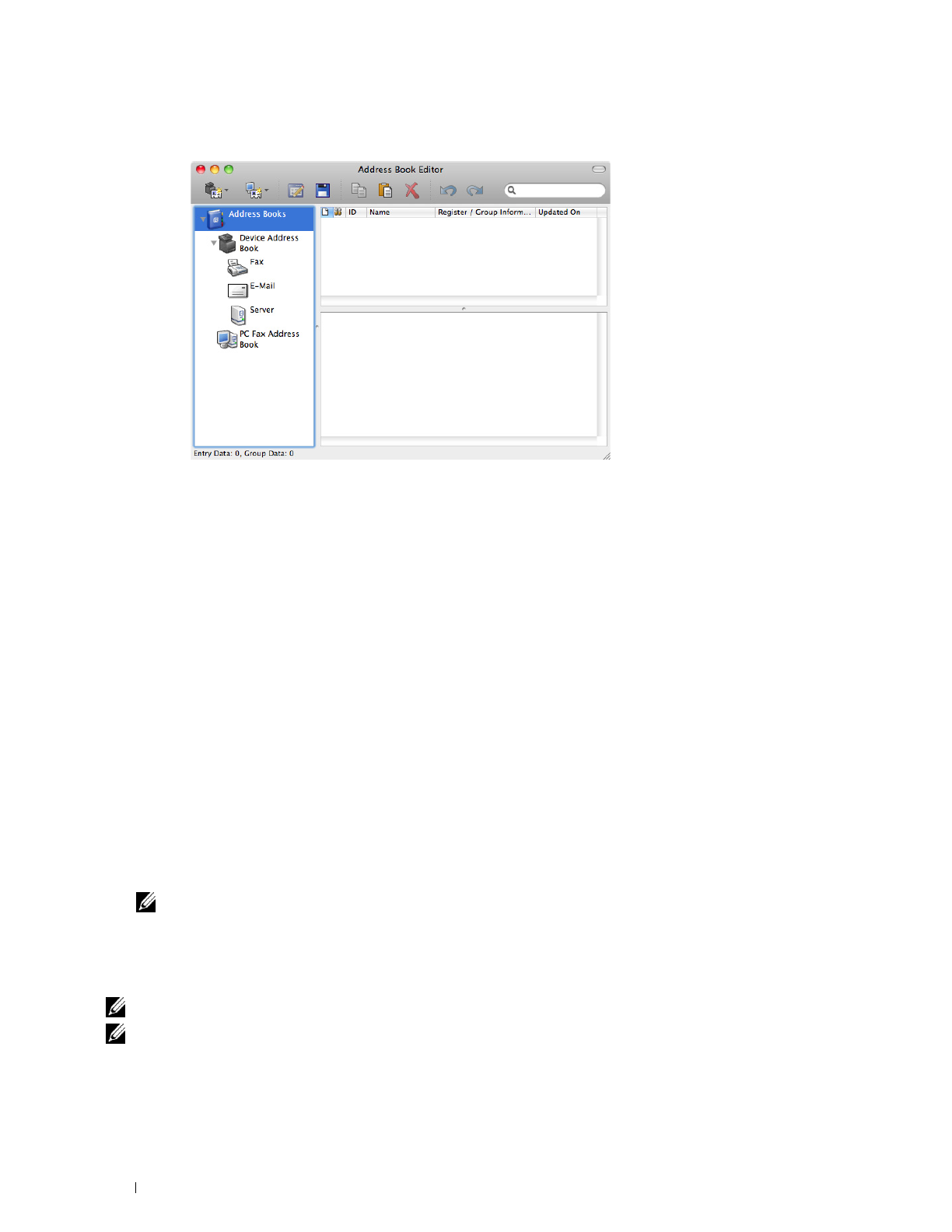
402 Understanding Your Printer Software
For Apple Macintosh:
•
Device Address Book
•Fax
Links to the printer's Address Book for Fax feature. You can register up to 200 fax numbers and 6 groups with
200 fax numbers.
•E-Mail
Links to the printer’s Address Book for Scan to E-mail feature. You can register up to 100 e-mail addresses and
10 groups with 10 e-mail addresses.
•Server
Links to the printer’s Address Book for Scan to Network feature. You can register up to 32 server information.
•
PC Fax Address Book
You can manage the PC Fax Address Book for using Direct Fax feature on your computer. You can register up to
500 fax numbers and 500 groups with 30 fax numbers.
Editing an entry:
1
Select an Address Book that the entry you want to edit is stored.
2
Select an entry that you want to edit.
3
Click
Edit
, and enter new information.
4
Click
Save
to save changes.
NOTE: When the address book entries are updated, it synchronizes with the printer and updates the address books of your
printer simultaneously.
Using Dell Printer Configuration Web Tool
You can use Dell Printer Configuration Web Tool using a general web browser.
NOTE: For information on how to add a new entry, see "Address Book."
NOTE: When the address book entries are updated, it synchronizes with the printer and updates the address books of your
printer simultaneously.

Understanding Your Printer Software 403
Status Monitor Widget for Macintosh
Status Monitor Widget is a printer utility that promotes efficient use of the printer through the exchange of
information between the Macintosh and the printer.
Status Monitor Widget Feature
• Monitoring Dell Printers
Allows you to check the status of Dell printers currently connected to your Macintosh
• Receiving Alerts
Alerts you to problems, such as paper jams or low toner
• Ordering Supplies
Allows you to access the web site to order supplies
Before Installing the Status Monitor Widget
Operating systems
• Mac OS X 10.4.11
•Mac OS X 10.5
•Mac OS X 10.6
•Mac OS X 10.7
•Mac OS X 10.8
Network protocols and interfaces
•LPR
• Socket 9100
•Bonjour
• USB 2.0 and 1.1 (When connecting with multiple printers of the same model via USB cables, only the printer
recognized first can be monitored in the
Status Monitor Widget
.)
Installing the Status Monitor Widget
1
Double-click the
Status Monitor Installer
icon in the
Finder
window.
2
Follow the on-screen instructions.
When the
Install Succeeded
screen appears, the installation is complete.
NOTE: Entering the administrative login name and password are required during the installation process.
Opening and Closing the Status Monitor Widget
Opening the Status Monitor Widget
1
Click the Dashboard icon in the Dock to launch Dashboard.
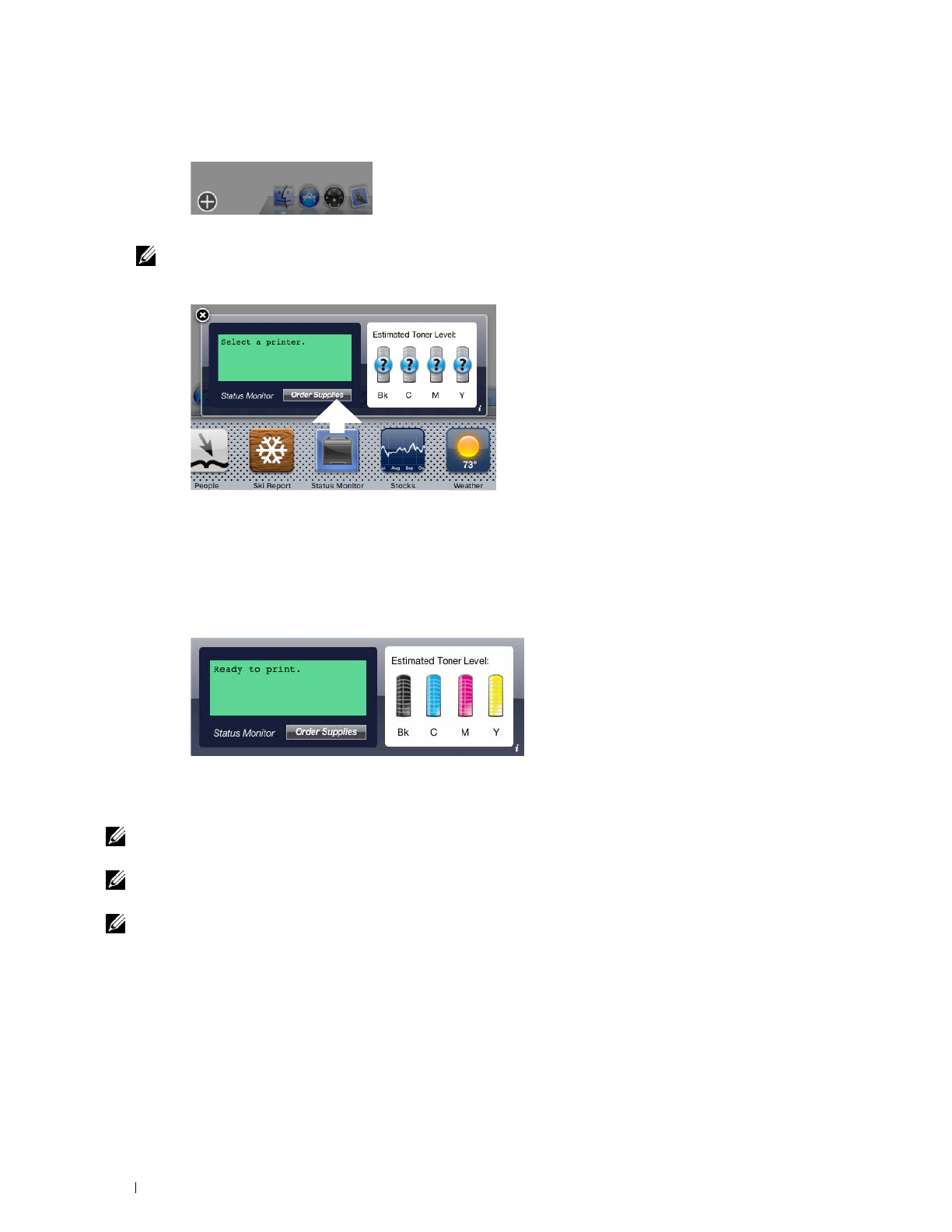
404 Understanding Your Printer Software
2
Click the Plus (+) sign to display the Widget Bar.
3
Click the icon of
Status Monitor
in the Widget Bar. The
Printer Status
window appears.
NOTE: If the message Select a printer is displayed, select your printer in Preferences. (For more information on
Preferences, see "Preferences.")
Closing the Status Monitor Widget
1
Click the Close (x) button in the upper-left corner of the
Printer Status
window.
Printer Status Window
When the Status Monitor Widget is activated, the Printer Status window appears on Dashboard.
Printer Status Message Area
Displays a message of the current printer status.
NOTE: The Status Monitor Widget automatically obtains the printer information at the updated interval that can be specified in
Preferences. Also, the printer status is refreshed when Dashboard is launched or Preferences is closed.
NOTE: If the Status Monitor Widget receives no response from the printer, the message Cannot get printer information is
displayed.
NOTE: When the printer is connected via USB cable, you cannot check the status of the printer during a print or scan job.
Printer Status Image Area
Displays the image of printer condition.
• Estimated Toner Level image
Displays the estimated toner level of each color if the printer is functioning properly.
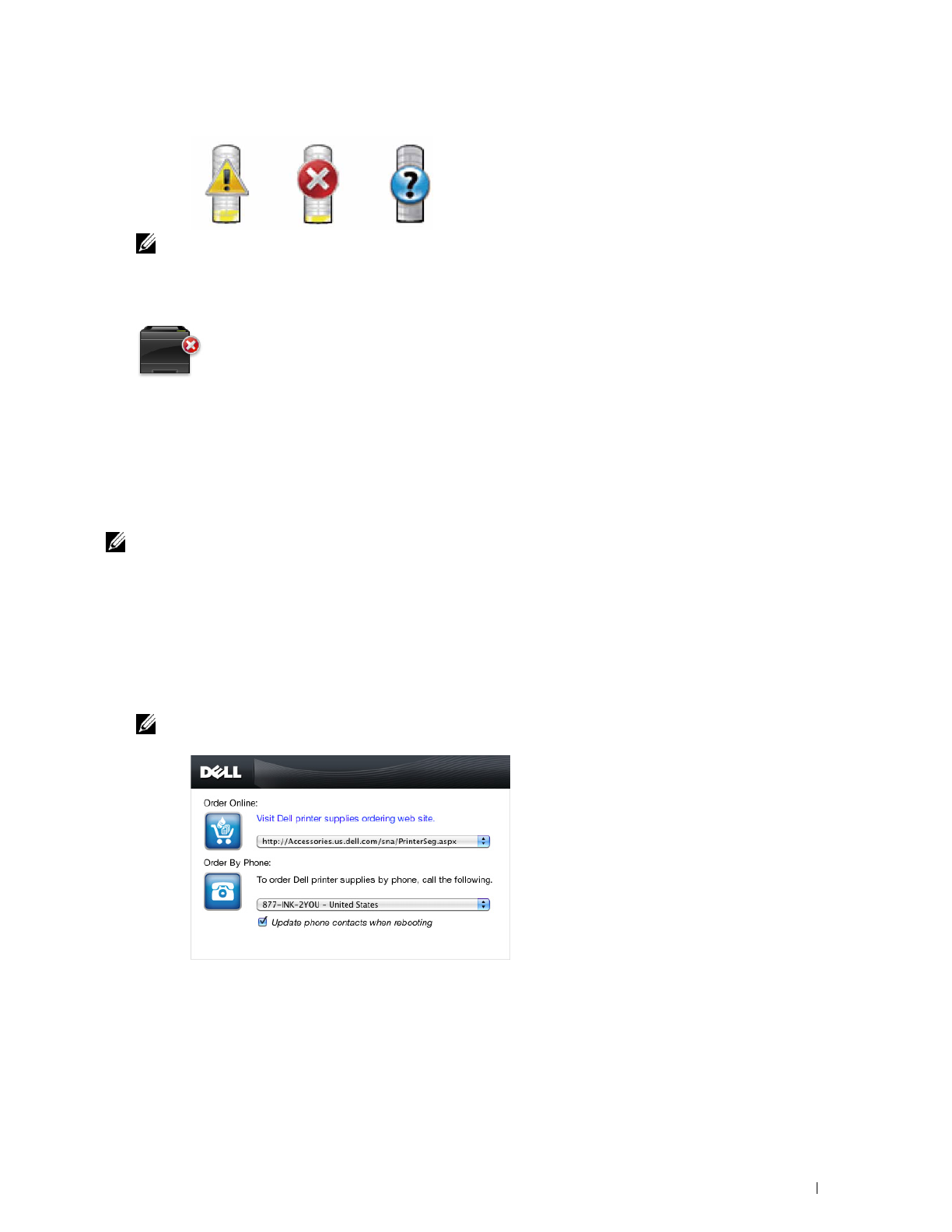
Understanding Your Printer Software 405
NOTE: If the utility does not receive a response from the printer, the Unknown toner image is displayed.
• Printer error image
Displays an indication image when an error occurs.
An error has occurred and the printer cannot be used.
Order Supplies button
Click this button to display the Order window.
To hide the Order window, click Order Supplies again.
Info (i) button
Click this button to open Preferences.
NOTE: The info (i) button appears on the lower-right corner of the window when the cursor is over the Printer Status window.
The info (i) button is a standard used across all widgets.
Order Window
This window provides you with the information for ordering printer supplies by telephone or from the web site.
To open the Order window:
1
Click
Order Supplies
in the
Printer Status
window.
The
Order
window appears.
NOTE: The Order window appears when low toner is detected.
Order Online
•
Visit Dell printer supplies ordering web site
hyperlink
Click the
Visit Dell printer supplies ordering web site
hyperlink to access the web site for ordering Dell printer
supplies.
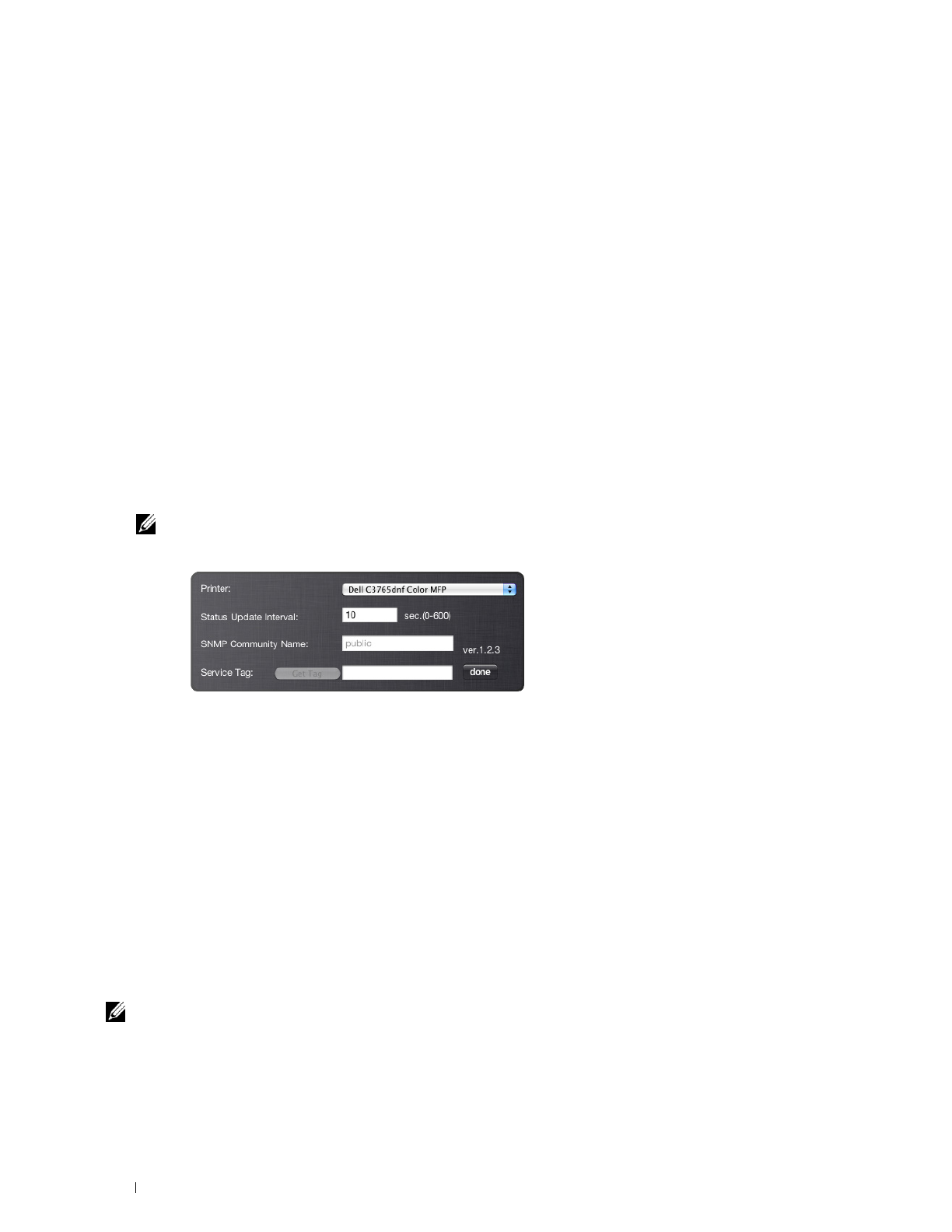
406 Understanding Your Printer Software
• URL list
Displays a list of available URLs where you can order Dell printer supplies.
Select a URL address to use when the
Visit Dell printer supplies ordering web site
hyperlink is clicked.
Order By Phone
• Phone number list
Displays a list of available phone numbers that you can call to order Dell printer supplies.
•
Update phone contacts when rebooting
check box
Select this check box to regularly update the phone number list.
Dell and the Environment
Click the hyperlink to access the web site about recycling.
Preferences
To open Preferences:
1
Click the
info (i)
button
in the
Printer Status
window.
Preferences
appears.
NOTE: The info (i) button appears on the lower-right corner of the window when the cursor is over the Printer Status
window. The info (i) button is a standard used across all widgets.
Printer
Displays a list of available printer names in the pull down menu. The first printer displayed in this list is set as
default.
Status Update Interval
You can specify the update interval of the printer status. By default, it is set to obtain the printer information every
10 seconds. It can be set from 0 second to 600 seconds.
SNMP Community Name
You can change the SNMP (Simple Network Management Protocol) community name if using default community
name (public). Up to 31 characters can be entered.
Service Tag button
Click this button to obtain the service tag.
NOTE: You cannot retrieve the service tag when the printer is connected via USB cable.
done button
Click this button to return to the Printer Status window.

Understanding Your Printer Software 407
Status Monitor Console for Linux
Status Monitor Console is a printer utility that promotes efficient use of the printer through the exchange of
information between the Linux and the printer.
Status Monitor Console Feature
• Monitoring Dell Printers
Allows you to check the status of Dell printers currently connected to your Linux.
• Receiving Alerts
Alerts you to problems, such as paper jams or low toner.
• Ordering Supplies
Allows you to access the web site to order supplies.
Before Installing the Status Monitor Console
NOTE: The Status Monitor Console requires the following modules installed.
- Python, PyGTK, Net-SNMP, cups-libs, and xdg-open
Please confirm that these modules are installed before you install the
Status Monitor Console
.
NOTE: The Status Monitor Console is available when the printer is connected to a network (LPR or Socket 9100). USB
connection is not supported.
Distributions
•Red Hat
®
Enterprise Linux
®
5 Desktop
• Red Hat Enterprise Linux 6 Desktop
•SUSE
®
Linux Enterprise Desktop 10
• SUSE Linux Enterprise Desktop 11
Printing system
• CUPS (Common Unix Printing System)
Installing the Status Monitor Console
1
Activate the terminal, and log in as a super user.
2
Type the following rpm command in the terminal window.
# rpm -ivh (Type the package file name)
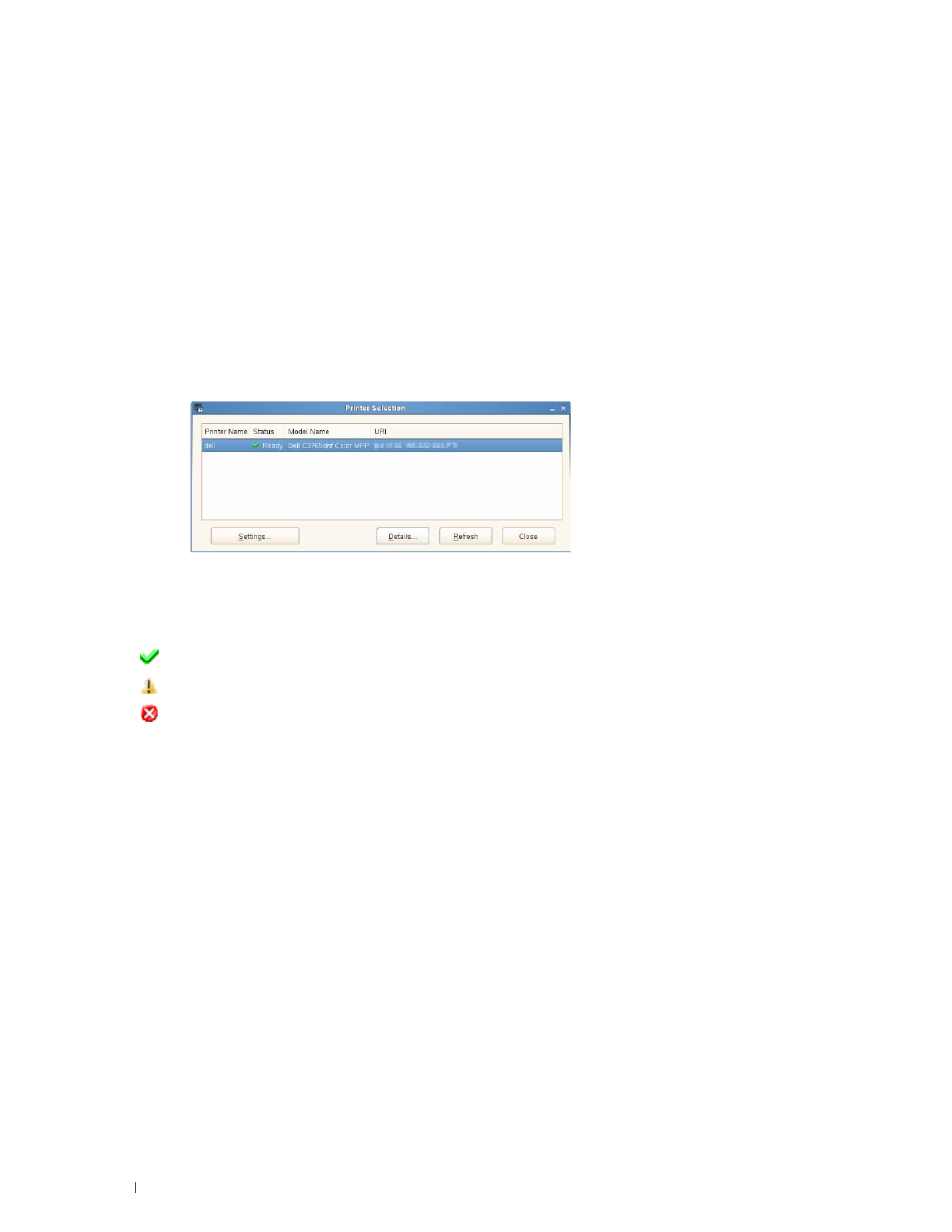
408 Understanding Your Printer Software
Starting the Status Monitor Console
1
Click
Dell Printers
→
Status Monitor Console
The
Printer Selection
window appears.
For more information on Printer Selection window, see "Printer Selection Window."
2
Select your printer.
The
Printer Status
window appears.
For more information on
Printer Status
window, see "Printer Status Window."
• You can order supplies from the
Dell Supplies Management System
window. See "Dell Supplies Management
System Window."
Printer Selection Window
Printers list
All the printers registered in the CUPS (Common UNIX Printing System) are displayed in a list.
• Status icons:
Ready
Unknown/Offline/Toner Low/Paper Low
Door Open/Paper Jam/No Toner/Out Of Paper
Settings button
Click this button to open the Settings window.
Details button
Click this button to open the Printer Status window. If a non-supported printer is selected, it opens the Dell Printer
Configuration Web Tool. For details on the Dell Printer Configuration Web Tool, see "Dell™ Printer Configuration
Web Tool."
Refresh button
Click this button to update the information of printers.
Close button
Click this button to close the
Printer Selection
window
.
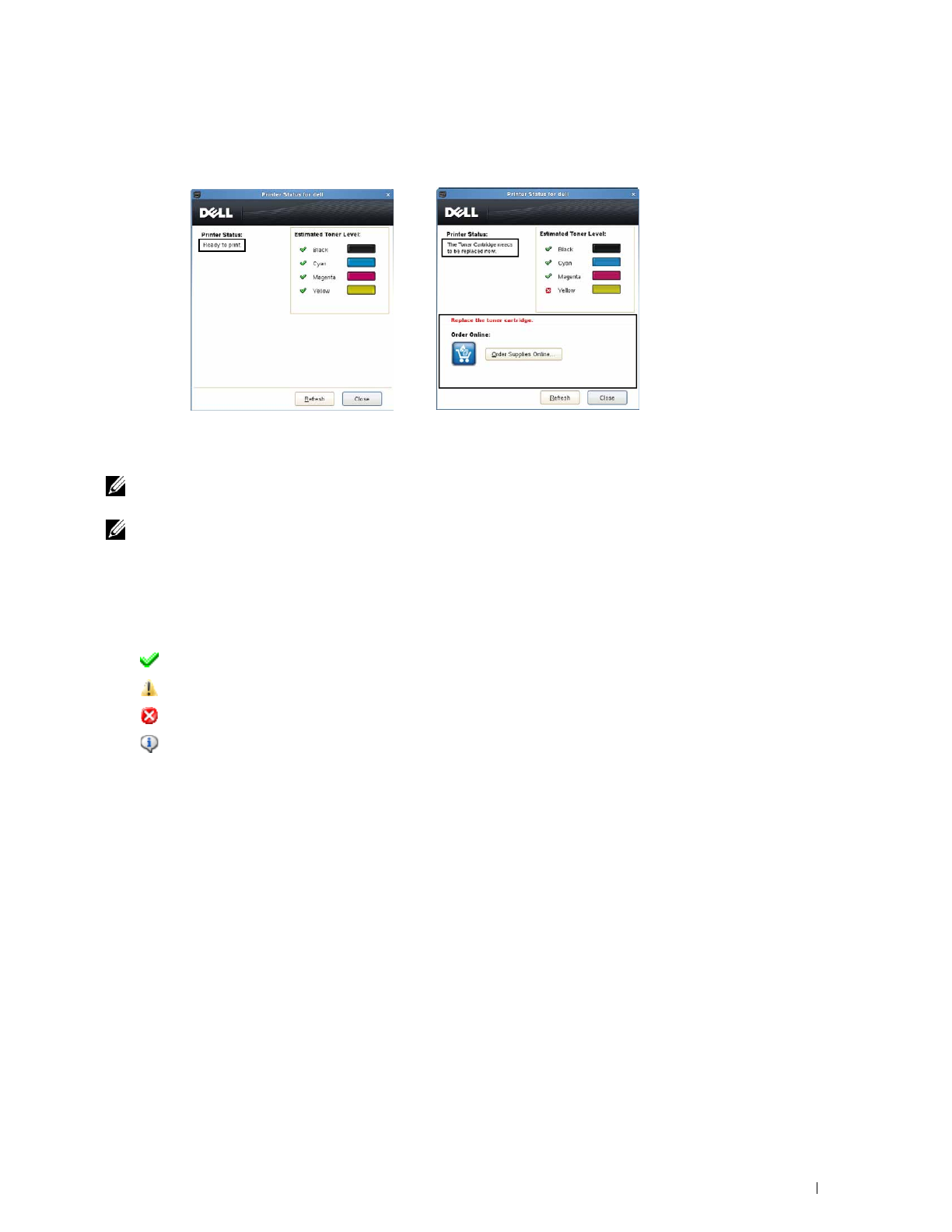
Understanding Your Printer Software 409
Printer Status Window
When the printer is specified in the
Printer Selection
window,
the Printer Status window appears.
Printer Status Message Area
Displays a message of the current printer status.
NOTE: The Status Monitor Console automatically obtains the printer information at the updated interval that can be specified in
the Settings window. Also, the printer status is refreshed when the Refresh is clicked.
NOTE: If the Status Monitor Console receives no response from the printer, the message Cannot get printer information is
displayed.
Printer Status Image Area
• Current Toner Status icons
Displays icons of the current status of each toner.
The toner level is more than 30%.
The toner level is less than 29%.
The toner level is less than 9%.
The toner level is unknown.
• Estimated Toner Level images
Keeps you informed about the amount of toner that remains for each color.
Toner Alert
Displays an alert message when any remaining toner is low, empty, or unknown.
Order Online
•
Order Supplies Online
button
Click this button to access the web site for ordering Dell printer supplies.
This button appears when the amount
of toners becomes less than 30%.
Refresh button
Click this button to update the status of the printer.
Close button
Click this button to close the Printer Status window.
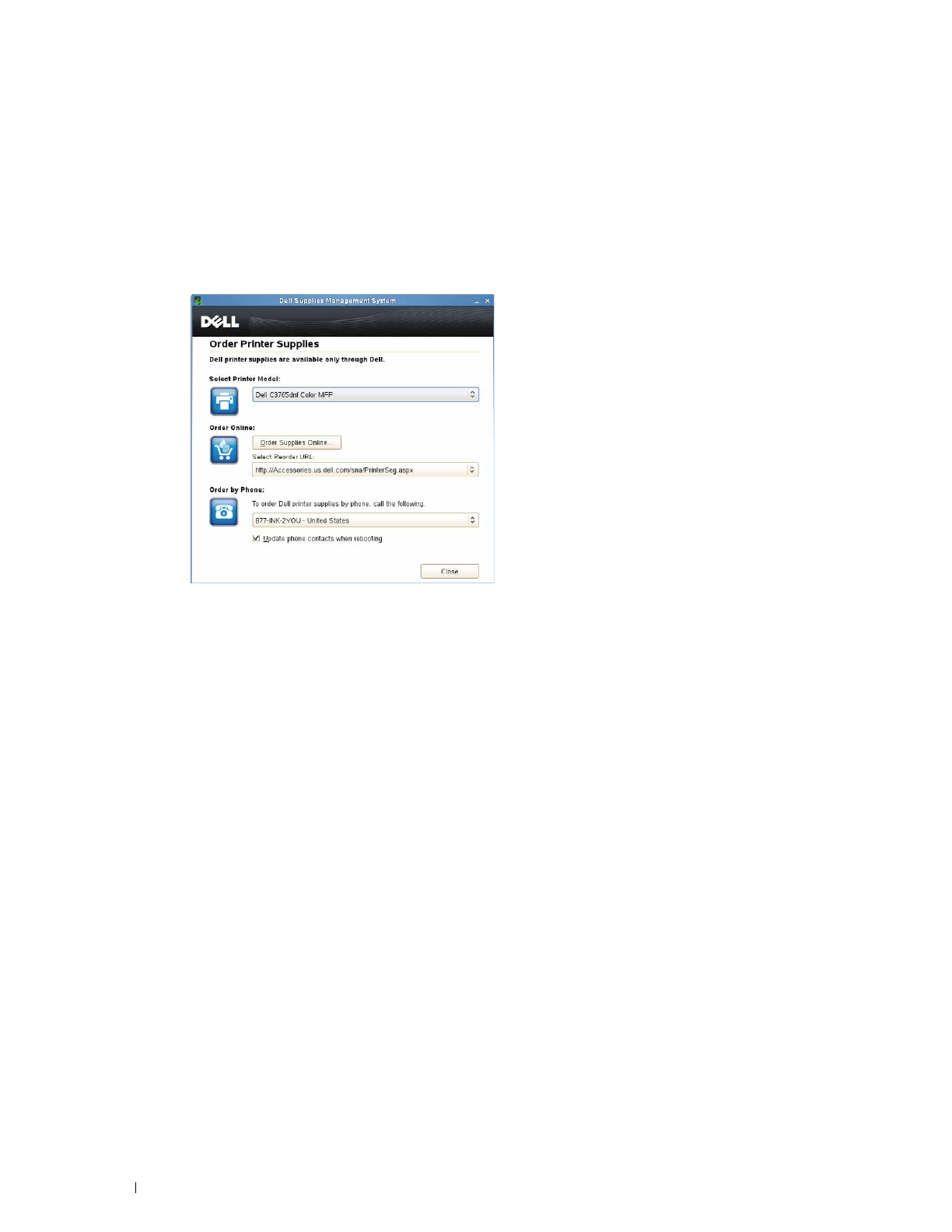
410 Understanding Your Printer Software
Dell Supplies Management System Window
This window provides you with the information for ordering printer supplies by telephone or from the web site.
To open the Dell Supplies Management System window:
1
Click
Order Supplies Online
in the
Printer Status
window.
OR
Click
Dell Printers
→
Dell Supplies Management System
.
Select Printer Model
Select your printer model name.
Order Online
•
Order Supplies Online
button
• When the Regular URL is selected in the
Select Reorder URL
:
Click this button to open the
Service Tag
window.
• When the Premier URL is selected in the
Select Reorder URL
:
Click this button to open the procurement and support web site.
• Select Reorder URL
Displays a list of available URLs where you can order Dell printer supplies. Select a URL address to use when the
Order Supplies Online
button is clicked.
• Regular URL: http://accessories.us.dell.com/sna/printerseg.aspx
• Premier URL: http://premier.dell.com
Order by Phone
• To order Dell printer supplies by phone, call the following
Select your country with phone number from the list, and call the displayed telephone number to order supplies.
•
Update phone contacts when rebooting
check box
Select this check box to regularly update the phone number list.
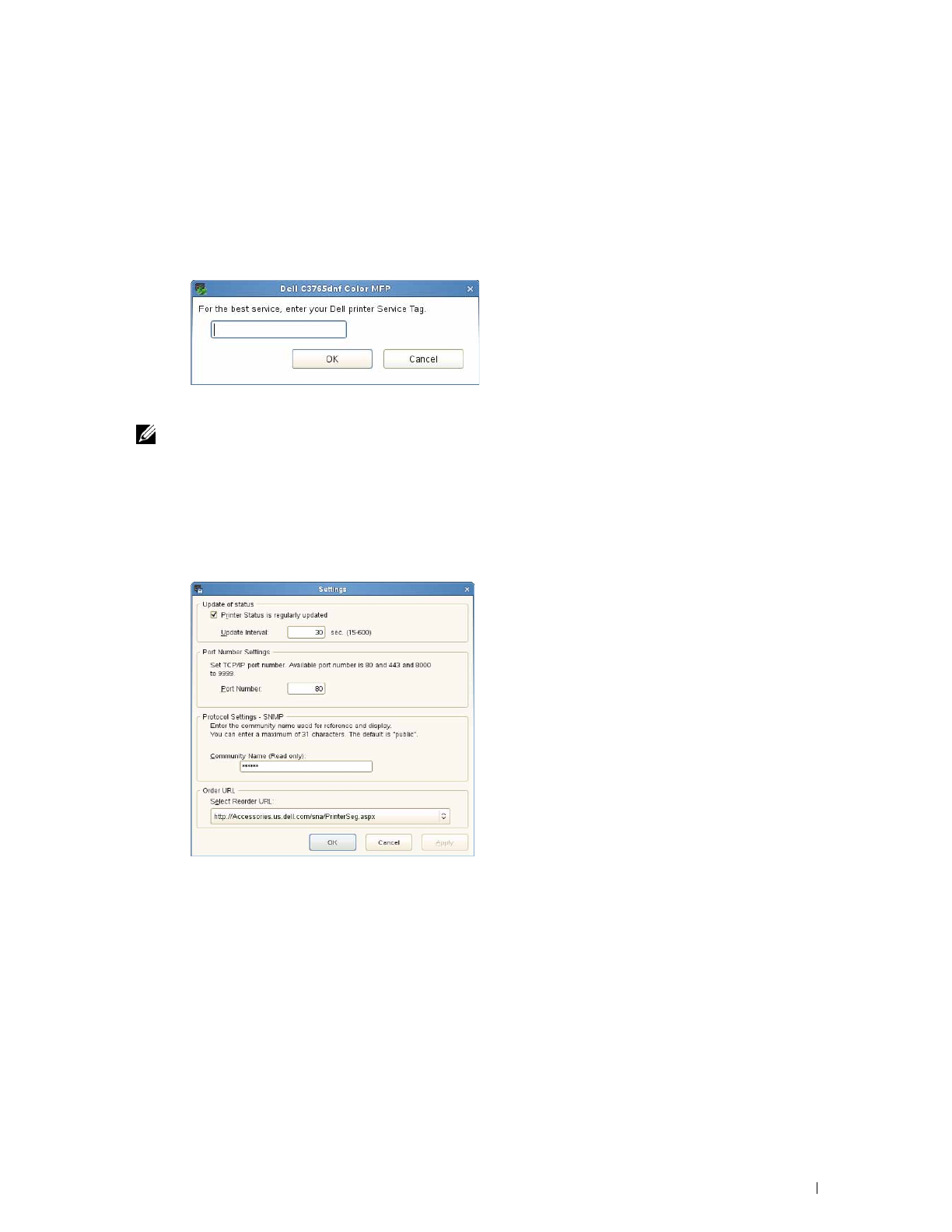
Understanding Your Printer Software 411
Dell and the Environment
Click the hyperlink to access the web site about recycling.
Close button
Click this button to close the Dell Supplies Management System window.
Service Tag Window
1
Enter the Dell printer service tag.
NOTE: For information on the service tag, see "Express Service Code and Service Tag."
Settings Window
To open the Settings window:
1
Click
Settings
in the
Printer Selection
window.
The
Settings
window appears.
Update of status
•
Printer Status is regularly updated
check box
Select the check box to enable/disable the printer status to be updated by the specified interval.
•
Update interval
text box
Specify the update interval of the printer status.
Port Number Settings
• Port Number
Specify the port number in the
Port Number
text box to open the setting page of your printer in a web browser.

412 Understanding Your Printer Software
Protocol Settings - SNMP
• Community Name
Enter the Community name of SNMP in the
Community Name
text box.
Order URL
• Select Reorder URL
The selected URL address is set as default web site for the
Select Reorder URL
in the
Dell Supplies Management
System
window.

Printing Using ColorTrack (External Authentication) 413
24
Printing Using ColorTrack (External Authentication)
With ColorTrack, you can restrict the number of pages that can be printed per user, specify the users who can print
in color, and restrict the users who can access the printer, based on the user information registered on the external
authentication server or the printer.
To print using ColorTrack, you must set ColorTrack Settings and the printer driver. Also, you must set the external
server with ColorTrack for using an external authentication server. To set the external server, consult your system
administrator.
NOTE: To restrict color printing when ColorTrack is disabled, set Auto Color To Mono Print to On. All print jobs
are printed in black and white even when color is specified. For details, see "Auto Color To Mono Print."
ColorTrack Settings
To print using Dell™ ColorTrack, configure the following settings.
• "Dell ColorTrack"
• "Authentication System"
• "Kerberos Server"
• "LDAP Server"
• "LDAP Authentication"
Dell ColorTrack
Specify the authentication method.
When Using the Dell Printer Configuration Web Tool
1
Launch
Dell Printer Configuration Web Tool
.
a
Open the web browser.
b
Enter the IP address of your printer in the web browser.
See "Dell™ Printer Configuration Web Tool.
"
2
Select
Print Volume
.
3
Click the
Dell ColorTrack
tab.
• Select
External Mode
for
ColorTrack Mode
.
• Select the
On
check box for
Non Registered User
when you permit the printing of data with no authentication
information. If not, clear the
On
check box.
• Enter the password when
External Mode
is selected for
ColorTrack Mode
and
On
is selected for
Non
Registered User
. Then, re-enter the password to confirm the password that you entered.
• Select the On check box for ColorTrack Error Report, if necessary.
4
Click
Apply New settings
.
5
Turn off the printer, and turn it on again to apply the settings.

414 Printing Using ColorTrack (External Authentication)
When Using the Operator Panel
You can specify only the settings of ColorTrack Mode, Non Registered User, and ColorTrack Error Report using the
operator Panel.
1
Press the
(Information)
button.
2
Select the
Tools
tab, and then select
Admin Settings
.
3
Select until
System Settings
appears, and then select
System Settings
.
4
Select until
ColorTrack Mode
appears, and then select
ColorTrack Mode
.
5
Select
External Mode
, and then select
OK
.
6
Select until
Non Registered User
appears, and then select
Non Registered User
.
7
Select
Off
or
On
, and then select
OK
.
8
Select until
ColorTrack Error Report
appears, and then select
ColorTrack Error Report
.
9
Select
Off
or
On
, and then select
OK
.
10
Turn off the printer, and turn it on again to apply the settings.
ColorTrack Mode
The following two authentication modes are available: the Internal Mode using user information registered on the
printer, and the External Mode using user information registered on an external server. To authenticate on the
external authentication server with External Mode, you need not register user information on the printer. The
change becomes effective after the printer is turned off and then on again.
Non Registered User
Specify whether to permit the printing of data with no authentication information. This setting is enabled when the
printer is restarted. The change becomes effective after the printer is turned off and then on again.
Non Registered User Password
Specify the password to be used for non-account user using 1 to 127 alphanumeric characters. If the password is left
blank (NULL), you cannot log in to a server. The change becomes effective after the printer is turned off and then
on again.
NOTE: When External Mode is specified and Non Registered User is set to On, you must set a password.
NOTE: When using an LDAP server, you also must set the same password on the server.
Re-enter Non Registered User Password
Enter the Non Registered user password again to confirm it.
ColorTrack Error Report
Specify whether to automatically print error-related information if printing using ColorTrack results in an error.
Setup Remote Authentication
Click Setup Remote Authentication Page to display the Authentication System page.
NOTE: This item is displayed only when External Mode is specified.
Authentication System
Specify the server authentication type, the server response time-out, or the search time-out.

Printing Using ColorTrack (External Authentication) 415
When Using the Dell Printer Configuration Web Tool
1
Launch
Dell Printer Configuration Web Tool
.
a
Open the web browser.
b
Enter the IP address of your printer in the web browser.
See "Dell™ Printer Configuration Web Tool.
"
2
Select
Print Server Settings
.
3
Click the
Security
tab.
4
Select
Authentication System
.
Authentication System
page is displayed.
• Select the authentication system for
Authentication System Settings
.
• Specify the time-out period for
Server Response Time-Out
.
• Specify the time-out period for
Search Time-Out
.
5
Click
Apply New settings
.
6
Turn off the printer, and turn it on again to apply the settings.
Authentication System Settings
Select the authentication system from the list. The change becomes effective after the printer is turned off and then
on again.
Server Response Time-Out
Specify the amount of time the printer should wait for response from the server. Set the time period from 1 up to 75
seconds. The change becomes effective after the printer is turned off and then on again.
Search Time-Out
Specify the amount of time the printer should wait for searching for the server. Set the time period from 5 up to 120
seconds. The change becomes effective after the printer is turned off and then on again.
Kerberos Server
Specify the settings for the Kerberos Server.
When Using the Dell Printer Configuration Web Tool
1
Launch
Dell Printer Configuration Web Tool
.
a
Open the web browser.
b
Enter the IP address of your printer in the web browser.
See "Dell™ Printer Configuration Web Tool.
"
2
Select
Print Server Settings
.
3
Click the
Security
tab.
4
Select
Kerberos Server
.
5
Enter the IP address or host name, and the port address in
IP Address / Host Name & Port
of
Kerberos Server (for
ColorTrack PRO)
.
6
Enter the domain name in
Domain Name
.
7
Click
Apply New settings
.

416 Printing Using ColorTrack (External Authentication)
8
Turn off the printer, and turn it on again to apply the settings.
IP Address / Host Name & Port
Specify the IP address or host name, and the port address. The change becomes effective after the printer is turned
off and then on again.
CAUTION: Do not use the same port address as that of another port.
NOTE: The port address must be 88 or between 5,000 and 65,535. The default value is 88.
NOTE: Specify the IP address in the nnn.nnn.nnn.nnn format for IPv4. Each section of "nnn" is a variable value between 0 and
255.
NOTE: Specify the IP address in the xxxx:xxxx:xxxx:xxxx:xxxx:xxxx:xxxx:xxxx format for IPv6. Each section of "xxxx" is a
hexadecimal variable value.
Domain Name
Specify the domain name of the Active Directory® in Domain Name (Realm Name). The change becomes effective
after the printer is turned off and then on again.
NOTE: Specify the domain name with uppercase characters. Depending on your server, an error may occur if you specify the
domain name with lowercase characters.
LDAP Server
Specify the directory server and the authentication method to execute LDAP authentication or to acquire
information using LDAP, and specify the range and attributes for searching.
NOTE: When using LDAPS or certificate verification, you must set the LDAP server or import an external certificate. For more
information, see "Using Digital Certificates."
When Using the Dell Printer Configuration Web Tool
1
Launch
Dell Printer Configuration Web Tool
.
a
Open the web browser.
b
Enter the IP address of your printer in the web browser.
See "Dell™ Printer Configuration Web Tool.
"
2
Select
Print Server Settings
.
3
Click the
Security
tab.
4
Select
LDAP Server
.
Server Information (for ColorTrack PRO)
:
• Enter the IP address or the host name, and the port address in
IP Address / Host Name & Port
.
• Confirm the software information for
LDAP Server
.
Optional Information (for ColorTrack PRO)
:
• Enter a text string in
Search Directory Root
.
• Enter the login name in
Login Name
.
• Enter the password in
Password
. Then, re-enter the password to confirm the password that you entered.
• Specify the time-out period for
Search Time-Out.
5
Click
Apply New settings
.
6
Turn off the printer, and turn it on again to apply the settings.

Printing Using ColorTrack (External Authentication) 417
Server Information (for ColorTrack PRO)
IP Address / Host Name & Port
Specify the IP address or the host name, and the port address. The change becomes effective after the printer is
turned off and then on again.
CAUTION: Do not use the same port address as that of another port.
NOTE: The port address must be 389, 636 or between 5,000 and 65,535. The default value is 389. When using LDAPS, normally
specify 636.
NOTE: Specify the IP address in the nnn.nnn.nnn.nnn format for IPv4. Each section of "nnn" is a variable value between 0 and
255.
NOTE: Specify the IP address in the xxxx:xxxx:xxxx:xxxx:xxxx:xxxx:xxxx:xxxx format for IPv6. Each section of "xxxx" is a
hexadecimal variable value.
LDAP Server
Displays the current software information of the LDAP server.
Optional Information (for ColorTrack PRO)
Search Directory Root
Specify a text string as the origin of the search when using LDAP communication. The change becomes effective
after the printer is turned off and then on again.
For example: ou=colortrackv3,dc=win2003ad,dc=colortrack.dc=net
Login Name
Specify the login name for accessing the directory server with LDAP authentication. Specify the name of a user with
the authority to update the LDAP server. The change becomes effective after the printer is turned off and then on
again.
Password
Specify the password for accessing the directory server with LDAP authentication. Specify the password of a user
with the authority to update the LDAP server using 1 to 127 alphanumeric characters. If the password is left blank
(NULL), you cannot log in to a server. The change becomes effective after the printer is turned off and then on
again.
Re-enter Password
Enter the password again to confirm it.
Search Time-Out
Specify the amount of time the printer should wait for searching for the server. To specify a time-out period for
searching, select Wait, and set the time period from 5 up to 120 seconds. To not specify a time-out period, select the
Wait LDAP Server Limit. The change becomes effective after the printer is turned off and then on again.
LDAP Authentication
Specify the LDAP server authentication method.
When Using the Dell Printer Configuration Web Tool
1
Launch
Dell Printer Configuration Web Tool
.
a
Open the web browser.

418 Printing Using ColorTrack (External Authentication)
b
Enter the IP address of your printer in the web browser.
See "Dell™ Printer Configuration Web Tool.
"
2
Select
Print Server Settings
.
3
Click the
Security
tab.
4
Select
LDAP Authentication
.
LDAP Authentication (for ColorTrack PRO)
:
• Confirm the authentication method.
• When adding a text string to the UserID, select
Enable
for
Use Added Text String
.
•When
Enable
is selected for
Use Added Text String
, enter the additional text string in
Text String Added to
User Name
.
5
Click
Apply New settings
.
6
Turn off the printer, and turn it on again to apply the settings.
Authentication Method
Displays the current LDAP authentication method. Direct Authentication executes server authentication with the
UserID and password entered.
Use Added Text String
Specify whether to add a text string to the UserID. The change becomes effective after the printer is turned off and
then on again.
Text String Added to User Name
When using an added string for the user name, specify the text string to be added.
For example: if the user name is "abcde@myhost.example.com", normally you must enter
"abcde@myhost.example.com".
However if Use Added Text String is set to Enable, and "@myhost.example.com" is specified in Text String Added
to User Name, only the data "abcde" must be entered with the printer driver, thus simplifying the entry task.
The change becomes effective after the printer is turned off and then on again.
Setting the Printer Driver
To print using ColorTrack, set the printer driver. Once set, the settings of the printer driver are enabled until they are
changed.
1
Open
Properties
of the printer driver.
2
Configure the following settings from the
Configuration
tab.
Dell ColorTrack Mode
Specify whether to allow general users to change settings related to authentication or whether general users must use
the settings configured by the Administrator.
Specify Group Name
Specify the name of the belonging group to use when authenticating. If you specify a group that does not belong,
authentication fails and the data is not printed. Also, the default group is set if Specify Group Name is not specified.

Printing Using ColorTrack (External Authentication) 419
Specify Job Owner
Select Use Login Name to use the user information logged into your PC, and select Enter ID to enter the user name
yourself.
Job Owner Name
Specify the user name to use when authenticating with an external server. You can enter this only when selecting
Enter ID for Specify Job Owner.
Password
Specify the user password to use when authenticating with an external server.

420 Printing Using ColorTrack (External Authentication)

Using the Server Address Book and Server Phone Book 421
25
Using the Server Address Book and Server Phone
Book
With server address book and server phone book, you can specify an e-mail address or fax number of a recipient
registered in the external LDAP server when sending a scanned image with e-mail or fax.
To use the server address book and server phone book, the printer needs to be configured in order to access the
external LDAP server.
NOTE: To configure the settings of the external LDAP server, consult your system administrator.
NOTE: You must also set Email Server Address Book and Fax Server Address Book to On to specify recipients using the server
address book and server phone book. For details, see "Email Server Address Book" and "Fax Server Address Book."
Setting Server Address Book and Server Phone Book
1
Launch the
Dell™ Printer Configuration Web Tool
by entering the IP address of your printer in your web browser.
If you do not know the IP address of your printer, print the system settings report or display the
TCP/IP Settings
page, which lists the IP address. For details about how to find your printer's IP address, see "Verifying the IP
Settings."
2
Select
Print Volume
, and then click the
Dell ColorTrack
tab.
3
Select
Off
,
Internal Mode
, or
External Mode
for
ColorTrack Mode
, and then click
Apply New Settings
.
Selecting
External Mode
allows you to authenticate the printer to the external server using the LDAP or Kerberos
authentication method.
If the external server does not require authentication, select
Off
or
Internal Mode
.
4
Click
Restart Printer
.
5
Select
Print Server Settings
, click the
Security
tab, and then select
Authentication System
.
6
From the
Authentication System Settings
drop-down menu under
Authentication Type (for Server
Address/Phone Book)
, select
Kerberos
or
LDAP
as the authentication method you are using, and then click
Apply
New Settings
.
If
Off
or
Internal Mode
is selected in step 3, be sure to select
LDAP
.
If
External Mode
is selected, select
LDAP
or
Kerberos
according to the authentication method set up for the
external server.
7
Click
Restart Printer
.
If you select
LDAP
in step 6, go to step 11.
8
Select
Print Server Settings
, click the
Security
tab, and then select
Kerberos Server
.
9
Specify the settings under
Kerberos Server (for Server Address/Phone Book)
, and then click
Apply New Settings
.
For details about each setting item, see "Kerberos Server."
10
Click
Restart Printer
.
11
Select
Print Server Settings
, click the
Security
tab, and then select
LDAP Server
.
12
Specify the settings under
LDAP Server (for Server Address/Phone Book)
and
Optional Information (for Server
Address/Phone Book)
, and then click
Apply New Settings
.
For details about each setting item, see "LDAP Server."

422 Using the Server Address Book and Server Phone Book
13
Click
Restart Printer
.
14
Select
Print Server Settings
, click the
Security
tab, and then select
LDAP User Mapping
.
Specify the attribute names used in the LDAP server. If the attribute names are not customized in the LDAP
server, leave the settings in this step as they are by default.
Now the settings are complete. See "Sending an E-mail With the Scanned File" or "Phone Book" to use the address
information in the external server for sending e-mails or faxes.
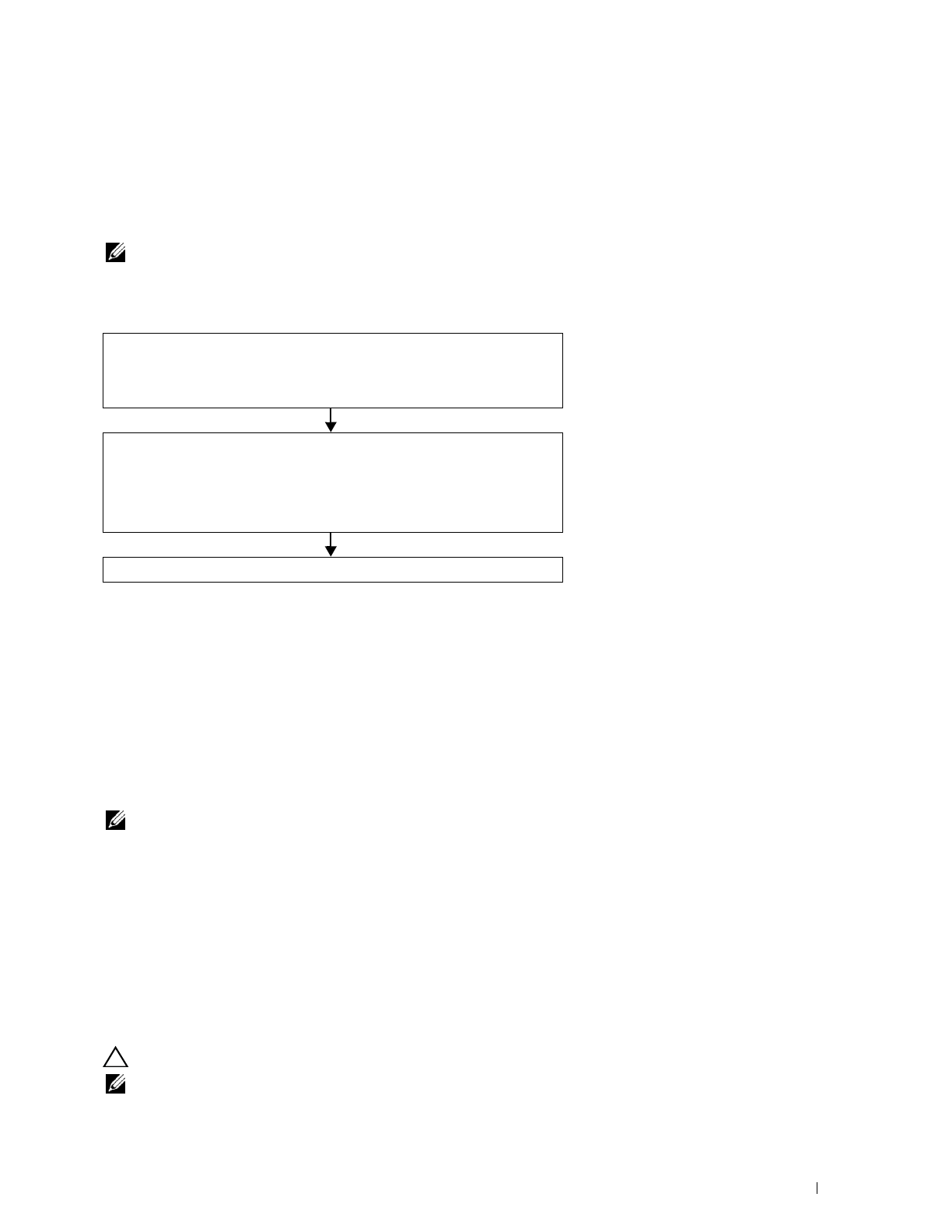
Using Digital Certificates 423
26
Using Digital Certificates
The authentication feature using digital certificates upgrades security when sending print data or setting data.
This chapter describes how to manage digital certificates.
NOTE: For information about digital certificate error, see "Understanding Printer Messages" and "Digital Certificate Problem."
The following is a typical setup flow for using digital certificates.
Managing Certificates
This section describes how to manage digital certificates as follows.
• "Preparing to Manage Certificates"
• "Importing a Digital Certificate"
• "Setting a Digital Certificate"
• "Confirming the Settings of a Digital Certificate"
• "Deleting a Digital Certificate"
• "Exporting a Digital Certificate"
NOTE: The external certificate management described above is enabled only when the optional hard disk is installed and is set
to On for encryption.
Preparing to Manage Certificates
Before managing digital certificates, the following settings must be applied.
• "Changing the Encryption Setting of the Hard Disk"
• "Setting HTTPS Communication"
Changing the Encryption Setting of the Hard Disk
Some items are effective only when encryption of the optional hard disk is set to On. Change the encryption setting
to On and set a key that is required to encrypt, if necessary.
CAUTION: All files stored on the optional hard disk are cleared when changing the encryption setting.
NOTE: You can enter only characters from 0 to 9, a to z, A to Z, and NULL values for encryption key.
Prepare to manage digital certificates.
• Change the Encryption Setting of the Hard Disk
• Set HTTPS Communication
Import and set digital certificates.
• Import a Digital Certificate
• Set a Digital Certificate
• Confirm the Settings of a Digital Certificate
Set various security features using digital certificates.

424 Using Digital Certificates
When Using the Operator Panel
1
Press the
(Information)
button.
2
Select the
Tools
tab, and then select
Admin Settings
.
3
Select until
Secure Settings
appears, and then select
Secure Settings
.
4
Select until
Data Encryption
appears, and then select
Data Encryption
.
5
Select
Encryption
.
6
Select
On
, and then select
OK
.
7
Use number pad to enter the passphrase for the encryption key, and then select
OK
.
8
The
Encryption (All stored documents will be deleted. Are you sure)
screen appears. When you confirm that all
stored documents will be deleted to change the encryption setting, select
Yes, Delete
to change the setting.
When you quit changing encryption setting, select
No, Cancel
.
When Using the Dell™ Printer Configuration Web Tool
1
Launch
Dell Printer Configuration Web Tool
.
a
Open the web browser.
b
Enter the IP address of your printer in the web browser.
See "Dell™ Printer Configuration Web Tool.
"
2
Select
Printer Settings
.
3
Click the
Printer Settings
tab.
4
Select
Secure Settings
.
5
Check that the
Enable
check box of
Panel Lock Control
of
Panel Lock
is selected.
If
Enable
is selected, proceed to step 10. If not, perform the following steps.
6
Select the
Enable
check box of
Panel Lock Control
of
Panel Lock
.
7
Enter a four digit password in
New Password
.
8
Re-enter the password in
Re-enter Password
.
9
Click
Apply New Settings
.
For details about Panel Lock, see "Panel Lock."
10
Click
Data Encryption
.
The
Data Encryption
page is displayed.
11
Select the
Encryption
check box.
12
Enter a key that is required to encrypt.
13
Re-enter the key again to confirm it.
14
Click
Apply New Settings
.
Setting HTTPS Communication
Before managing certificates, set HTTPS communication with a self-signed certificate.
NOTE: Set HTTPS communication after changing the Encryption setting to On.

Using Digital Certificates 425
When Using the Dell Printer Configuration Web Tool
1
Launch
Dell Printer Configuration Web Tool
.
a
Open the web browser.
b
Enter the IP address of your printer in the web browser.
See "Dell™ Printer Configuration Web Tool.
"
2
Select
Print Server Settings
.
3
Click the
Security
tab.
4
Select
SSL/TLS
.
5
Click
Generate Self-Signed Certificate
of
Machine Digital Certificate
. The
Generate Self-Signed Certificate
page is displayed.
6
Select the size of public key from the list of
Size of Public Key
.
7
Specifies the issuer of SSL self-signed certificate.
8
Click
Generate Signed Certificate
.
9
The
Restart Printer
button is displayed after generating the self-signed certificate, and then click
Restart Printer
.
10
Repeat steps 2 to 4 to display the
SSL/TLS
page after restarting the printer.
11
If the self-signed certificate is set correctly, since the
HTTP- SSL/TLS Communication
column is set to
Enable
and a check box is displayed, select
Enable
.
Importing a Digital Certificate
CAUTION: Before importing a certificate file, back up the certificate file.
NOTE: To manage digital certificates, you must first set encryption of the optional hard disk to On, and then set up HTTPS
communication. For details, see "Preparing to Manage Certificates."
NOTE: Be sure to import the certificate with Internet Explorer.
NOTE: After importing a PKCS#12 format certificate, the secret key is not exported even if you execute exporting.
1
Launch
Dell Printer Configuration Web Tool
.
a
Open the web browser.
b
Enter the IP address of your printer in the web browser.
See "Dell™ Printer Configuration Web Tool.
"
2
Select
Print Server Settings
.
3
Click the
Security
tab.
4
Select
SSL/TLS
.
5
Click
Upload Signed Certificate
of
Machine Digital Certificate
.
The
Upload Signed Certificate
page is displayed.
NOTE: The Upload Signed Certificate button is displayed only when the optional hard disk is installed and is set to On for
encryption.
6
Enter a password.
7
Re-enter the password again to confirm it.
8
Click
Browse
of
File Name,
and select the file to be imported.
9
Click
Import
to import the certificate.

426 Using Digital Certificates
Setting a Digital Certificate
NOTE: To manage digital certificates, you must first set encryption of the optional hard disk to On, and then set up HTTPS
communication. For details, see "Preparing to Manage Certificates."
1
Launch
Dell Printer Configuration Web Tool
.
a
Open the web browser.
b
Enter the IP address of your printer in the web browser.
See "Dell™ Printer Configuration Web Tool.
"
2
Select
Print Server Settings
.
3
Click the
Security
tab.
4
Select
SSL/TLS
.
5
Click
Certificate Management
to display the
Certificate Management
page.
NOTE: The Certificate Management button is displayed only when the optional hard disk is installed and is set to On for
encryption.
6
When setting a Wireless LAN (Server) certificate, select
Trusted Certificate Authorities
within
Category
.
When setting a certificate of SSL Server, SSL Client, IPsec, or Wireless LAN (Client), select
Local Device.
7
Select the purpose of use from the
Certificate Purpose
list.
8
Click
Display the List
to display the
Certificate List
page.
NOTE: If the list includes more than 20 certificates, click Next to display the next page.
9
Select the certificate to associate. At this time, confirm that
Val i d ity
of the certificate selected is set to
Val i d
.
10
Click
Certificate Details
to display the
Certificate Details
page.
11
Confirm the content, and click
Use This Certificate
at the upper-right corner.
Confirming the Settings of a Digital Certificate
NOTE: To manage digital certificates, you must first set encryption of the optional hard disk to On, and then set up HTTPS
communication. For details, see "Preparing to Manage Certificates."
1
Launch
Dell Printer Configuration Web Tool
.
a
Open the web browser.
b
Enter the IP address of your printer in the web browser.
See "Dell™ Printer Configuration Web Tool.
"
2
Select
Print Server Settings
.
3
Click the
Security
tab.
4
Select
SSL/TLS
.
5
Click
Certificate Management
to display the
Certificate Management
page.
NOTE: The Certificate Management button is displayed only when the optional hard disk is installed and is set to On for
encryption.
6
Select the category from the
Category
list.
7
Select the purpose of use from the
Certificate Purpose
list.
8
Click
Display the List
to display the
Certificate List
page.
NOTE: If the list includes more than 20 certificates, click Next to display the next page.
9
The certificate displayed with an asterisk as "
*Valid
" in the
Val i d ity
column is the certificate associated with the
use purpose and actually used.

Using Digital Certificates 427
Deleting a Digital Certificate
NOTE: To manage digital certificates, you must first set encryption of the optional hard disk to On, and then set up HTTPS
communication. For details, see "Preparing to Manage Certificates."
1
Launch
Dell Printer Configuration Web Tool
.
a
Open the web browser.
b
Enter the IP address of your printer in the web browser.
See "Dell™ Printer Configuration Web Tool.
"
2
Select
Print Server Settings
.
3
Click the
Security
tab.
4
Select
SSL/TLS
.
5
Click
Certificate Management
to display the
Certificate Management
page.
NOTE: The Certificate Management button is displayed only when the optional hard disk is installed and is set to On for
encryption.
6
Select the category from the
Category
list.
7
Select the purpose of use from the
Certificate Purpose
list.
8
Click
Display the List
to display the
Certificate List
page.
NOTE: If the list includes more than 20 certificates, click Next to display the next page.
9
Select the certificate to be deleted.
10
Click
Certificate Details
to display the
Certificate Details
page.
11
To delete the selected certificate, click
Delete
at the upper-right corner.
NOTE: When a certificate is deleted, the features associated with the deleted certificate are disabled. To delete a
certificate being used, either set the feature to OFF in advance or switch the association to another certificate, and then
switch to another operation mode if possible before deleting the certificate.
• For an SSL Server, switch to another certificate such as a self-signed certificate.
• For an SSL Client, set the LDAP-SSL/TLS and IEEE 802.1x (EAP-TLS) setting to OFF.
• For IPsec, change the IKE setting to Pre-Shared Key or set the feature to OFF.
• For Wireless LAN, change the Wireless Security setting to other than WPA-Enterprise before deleting the
certificate.
Exporting a Digital Certificate
NOTE: To manage digital certificates, you must first set encryption of the optional hard disk to On, and then set up HTTPS
communication. For details, see "Preparing to Manage Certificates."
NOTE: Since the secret key is not exported, an imported PKCS#12 format certificate can be exported only as a PKCS#7
certificate.
1
Launch
Dell Printer Configuration Web Tool
.
a
Open the web browser.
b
Enter the IP address of your printer in the web browser.
See "Dell™ Printer Configuration Web Tool.
"
2
Select
Print Server Settings
.
3
Click the
Security
tab.
4
Select
SSL/TLS
.

428 Using Digital Certificates
5
Click
Certificate Management
to display the
Certificate Management
page.
NOTE: The Certificate Management button is displayed only when the optional hard disk is installed and is set to On for
encryption.
6
Select the category from the
Category
list.
7
Select the purpose of use from the
Certificate Purpose
list.
Click
Display the List
to display the
Certificate List
page.
NOTE: If the list includes more than 20 certificates, click Next to display the next page.
8
Select the certificate to be exported.
9
Click
Certificate Details
to display the
Certificate Details
page.
10
To export the selected certificate, click
Export This Certificate
.
Setting the Features
You can set various security features using digital certificates.
See the following for details:
• "Setting the Certificate in the IPsec Digital Signature Mode"
• "Setting the SSL-use Server Certificate (HTTP/IPP)"
• "Setting LDAP-SSL/TLS Communication"
• "Setting Server Certificate Verification for LDAP-SSL/TLS Communication"
• "Setting Client Certificate for LDAP-SSL/TLS Communication"
• "Setting for Wireless LAN WPA-Enterprise (EAP-TLS)"
• "Setting for Wireless LAN WPA-Enterprise (PEAPV0-MS-CHAPV2, EAP-TTLS PAP, EAP-TTLS CHAP)"
• "Setting Client Certificate for IEEE 802.1x (EAP-TLS)"
Setting the Certificate in the IPsec Digital Signature Mode
NOTE: To manage digital certificates, you must first set encryption of the optional hard disk to On, and then set up HTTPS
communication. For details, see "Preparing to Manage Certificates."
1
Import the certificate to be used with IPsec. For more information, see "Importing a Digital Certificate."
2
Set the certificate to be used with IPsec. For more information, see "Setting a Digital Certificate."
3
Confirm whether the certificate is set correctly in IPsec. For more information, see "Confirming the Settings of a
Digital Certificate."
4
Select
Print Server Settings
from the left side of the page.
5
Click the
Security
tab.
6
Select
IPsec
.
7
Select the
Enable
check box for
Protocol
.
8
Select
Digital Signature
from the
IKE
list.
9
Set each item, as necessary.
10
Click
Apply New Settings
.
11
After restarting the printer, IPsec communication using digital signatures is enabled. You can execute IPsec
communication (Digital Signature Mode) between the printer and the network device (such as PC) on which the
certificate and IPsec are set identically as on this device.

Using Digital Certificates 429
Setting the SSL-use Server Certificate (HTTP/IPP)
NOTE: To manage digital certificates, you must first set encryption of the optional hard disk to On, and then set up HTTPS
communication. For details, see "Preparing to Manage Certificates."
1
Import the certificate to be used with the SSL-use server. For more information, see "Importing a Digital
Certificate."
2
Set the certificate to be used with the SSL-use server. For more information, see "Setting a Digital Certificate."
3
Confirm whether the certificate is set correctly. For more information, see "Confirming the Settings of a Digital
Certificate."
NOTE: Confirm whether the newly set certificate, not the self-signed certificate, is associated.
4
After restarting the printer, the certificate set as described above is used as the server certificate when executing
communication with HTTP/IPP-SSL/TLS.
Setting LDAP-SSL/TLS Communication
NOTE: This setting is available only when the optional hard disk is installed and is set to On for encryption.
1
Select
Print Server Settings
from the left side of the page.
2
Click the
Security
tab.
3
Select
SSL/TLS
.
4
Select the
Enable
check box for
LDAP-SSL/TLS Communication
.
5
Click
Apply New Settings
.
6
After restarting the printer,
LDAP-SSL/TLS Communication
is enabled.
NOTE: When executing the certificate validity of the server and the presentation of the client certificate, see "Setting Server
Certificate Verification for LDAP-SSL/TLS Communication" and "Setting Client Certificate for LDAP-SSL/TLS Communication."
Setting Server Certificate Verification for LDAP-SSL/TLS Communication
NOTE: This setting is available only when the optional hard disk is installed and is set to On for encryption.
NOTE: This feature is enabled only when Enable is set for LDAP-SSL/TLS Communication.
1
Import the root certificate (including intermediate certificate) for the LDAP server certificate. For more
information, see "Importing a Digital Certificate."
NOTE: In the verification of a certificate of the connected server, to automatically search for an imported certificate and
verify the path, the certificate does not need to be associated.
2
Confirm whether the root certificate is correctly imported to the LDAP server. For more information, see
"Confirming the Settings of a Digital Certificate."
3
Select
Print Server Settings
.
4
Click the
Security
tab.
5
Select
SSL/TLS
.
6
Select the
Enable
check box for
Verify Remote Server Certificate
.
7
Click
Apply New Settings
.
8
After restarting the printer, the certificate presented by the LDAP server is verified when LDAP-SSL/TLS
communication starts with the LDAP server.
NOTE: When the result of verification is NG, communication is not established and an error results.

430 Using Digital Certificates
Setting Client Certificate for LDAP-SSL/TLS Communication
NOTE: To manage digital certificates, you must first set encryption of the optional hard disk to On, and then set up HTTPS
communication. For details, see "Preparing to Manage Certificates."
NOTE: This feature is enabled only when Enable is set for LDAP-SSL/TLS Communication.
1
Import a certificate to be used with SSL Client. For more information, see "Importing a Digital Certificate."
2
Set a certificate to be used with SSL Client. For more information, see "Setting a Digital Certificate."
3
Confirm whether the certificate is set correctly. For more information, see "Confirming the Settings of a Digital
Certificate."
4
After restarting the printer, the LDAP client certificate is presented when LDAP-SSL/TLS communication with
the LDAP server starts. When the LDAP server is set to require a client certificate, the client certificate provided
by the printer is verified by the LDAP server.
Setting for Wireless LAN WPA-Enterprise (EAP-TLS)
NOTE: To manage digital certificates, you must first set encryption of the optional hard disk to On, and then set up HTTPS
communication. For details, see "Preparing to Manage Certificates."
NOTE: WPA-Enterprise is available only when infrastructure is selected as the network type.
NOTE: Be sure to import the certificate with Internet Explorer.
NOTE: After importing a PKCS#12 format certificate, the secret key is not exported even if you execute exporting.
1
Import the certificate to be used with Wireless LAN (server or root certificate). For details, see "Importing a Digital
Certificate."
2
Set the digital certificate for wireless LAN (server or root certificate).
a
Launch
Dell Printer Configuration Web Tool
.
b
Select
Print Server Settings
.
c
Click the
Security
tab.
d
Select
SSL/TLS
.
e
Click
Certificate Management
to display the
Certificate Management
page.
f
Select
Trusted Certificate Authorities
within
Category
.
g
Select the Wireless LAN (Server) of use from the
Certificate Purpose
list.
h
From
Certificate Order
, select how the certificates are sorted in
Certificate List
. This setting is not necessary
if you do not need to specify the order for the certificates.
i
Click
Display the List
to display the
Certificate List
page.
j
Select the certificate to associate. At this time, confirm that
Val i d ity
of the certificate selected is set to
Val i d
.
k
Click
Certificate Details
to display the
Certificate Details
page.
l
Confirm the content, and click
Use This Certificate
at the upper-right corner.
3
Confirm whether the certificate is set correctly. For details, see "Confirming the Settings of a Digital Certificate."
4
Import the certificate to be used with Wireless LAN (client or client certificate). For details, see "Importing a
Digital Certificate."
5
Set the digital certificate for wireless LAN (client or client certificate).
a
Launch
Dell Printer Configuration Web Tool
.
b
Select
Print Server Settings
.
c
Click the
Security
tab.

Using Digital Certificates 431
d
Select
SSL/TLS
.
e
Click
Certificate Management
to display the
Certificate Management
page.
f
Select
Local Device
within
Category
.
g
Select the Wireless LAN (Server) of use from the
Certificate Purpose
list.
h
From
Certificate Order
, select how the certificates are sorted in
Certificate List
. This setting is not necessary
if you do not need to specify the order for the certificates.
i
Select the certificate to associate. At this time, confirm that
Val i d ity
of the certificate selected is set to
Val i d
.
j
Click
Certificate Details
to display the
Certificate Details
page.
k
Confirm the content, and click
Use This Certificate
at the upper-right corner.
6
Confirm whether the certificate is set correctly. For details, see "Confirming the Settings of a Digital Certificate."
7
Set WPA-Enterprise for EAP-TLS.
a
Launch
Dell Printer Configuration Web Tool
.
b
Click the
Print Server Settings
tab.
c
Select
Wireless LAN
.
NOTE: This setting is available only when the optional wireless adapter is installed.
d
Select either of the following from the
Encryption list
of
Secure Settings
.
•
WPA-Enterprise-AES/WPA2-Enterprise-AES
•
WPA-Enterprise-TKIP
NOTE: WPA-Enterprise-AES/WPA2-Enterprise-AES or WPA-Enterprise-TKIP becomes available only when the
following steps are set correctly.
•Importing a Digital Certificate
•Setting a Digital Certificate
•Confirming the Settings of a Digital Certificate
e
Set
EAP-Identity
of
WPA-Enterprise
.
f
Select
EAP-TLS
from the
Authentication Method
list of
WPA-Enterprise
.
g
Click
Apply New Settings
.
Setting for Wireless LAN WPA-Enterprise (PEAPV0-MS-CHAPV2, EAP-TTLS PAP, EAP-TTLS CHAP)
NOTE: To manage digital certificates, you must first set encryption of the optional hard disk to On, and then set up HTTPS
communication. For details, see "Preparing to Manage Certificates."
NOTE: WPA-Enterprise is available only when infrastructure is selected as the network type.
NOTE: Be sure to import the certificate with Internet Explorer.
NOTE: After importing a PKCS#12 format certificate, the secret key is not exported even if you execute exporting.
1
Import the certificate to be used with Wireless LAN (server or root certificate). For details, see "Importing a Digital
Certificate."
2
Set the digital certificate for wireless LAN (server or root certificate).
a
Launch
Dell Printer Configuration Web Tool
.
b
Select
Print Server Settings
.
c
Click the
Security
tab.
d
Select
SSL/TLS
.
e
Click
Certificate Management
to display the
Certificate Management
page.

432 Using Digital Certificates
f
Select
Trusted Certificate Authorities
within
Category
.
g
Select the purpose of use from the
Certificate Purpose
list.
h
Click
Display the List
to display the
Certificate List
page.
i
Select the certificate to associate. At this time, confirm that
Val i d ity
of the certificate selected is set to
Val i d
.
j
Click
Certificate Details
to display the
Certificate Details
page.
k
Confirm the content, and click
Use This Certificate
at the upper-right corner.
3
Confirm whether the certificate is set correctly.
a
Launch
Dell Printer Configuration Web Tool
.
b
Select
Print Server Settings
.
c
Click the
Security
tab.
d
Select
SSL/TLS
.
e
Click
Certificate Management
to display the
Certificate Management
page.
f
Select the category from the
Category
list.
g
Select the Wireless LAN (Server) of use from the
Certificate Purpose
list.
h
From
Certificate Order
, select how the certificates are sorted in
Certificate List
. This setting is not necessary
if you do not need to specify the order for the certificates.
i
Click
Display the List
to display the
Certificate List
page.
j
The certificate displayed with an asterisk as "
*Valid
" in the
Val i d ity
column is the certificate associated with
the use purpose and actually used.
4
Set WPA-Enterprise for PEAPV0-MS-CHAPV2, EAP-TTLS PAP, or EAP-TTLS CHAP.
a
Launch
Dell Printer Configuration Web Tool
.
b
Click the
Print Server Settings
tab.
c
Select
Wireless LAN
.
NOTE: This setting is available only when the optional wireless adapter is installed.
d
Select either of the following from the
Encryption list
of
Secure Settings
.
•
WPA-Enterprise-AES/WPA2-Enterprise-AES
•
WPA-Enterprise-TKIP
NOTE: WPA-Enterprise-AES/WPA2-Enterprise-AES or WPA-Enterprise-TKIP becomes available only when the
following steps are set correctly.
•Importing a Digital Certificate
•Setting a Digital Certificate
•Confirming the Settings of a Digital Certificate
e
Set
EAP-Identity
,
Login Name
, and
Password
of
WPA-Enterprise
.
f
Select either of the following from the
Authentication Method
list of
WPA-Enterprise
:
•
PEAPV0 MS-CHAPV2
•
EAP-TTLS PAP
•
EAP-TTLS CHAP
g
Click
Apply New Settings
.

Using Digital Certificates 433
Setting Client Certificate for IEEE 802.1x (EAP-TLS)
NOTE: To manage digital certificates, you must first set encryption of the optional hard disk to On, and then set up HTTPS
communication. For details, see "Preparing to Manage Certificates."
NOTE: This feature is enabled only when Enable is set for IEEE 802.1x (EAP-TLS).
1
Import a certificate to be used with SSL Client. For more information, see "Importing a Digital Certificate."
2
Set a certificate to be used with SSL Client. For more information, see "Setting a Digital Certificate."
3
Confirm whether the certificate is set correctly. For more information, see "Confirming the Settings of a Digital
Certificate."
4
After restarting the printer, the IEEE 802.1x (EAP-TLS) certificate is presented when IEEE 802.1x communication
with the RADIUS server starts. When the RADIUS server is set to require a client certificate, the client certificate
provided by the printer is verified by the RADIUS server.

434 Using Digital Certificates
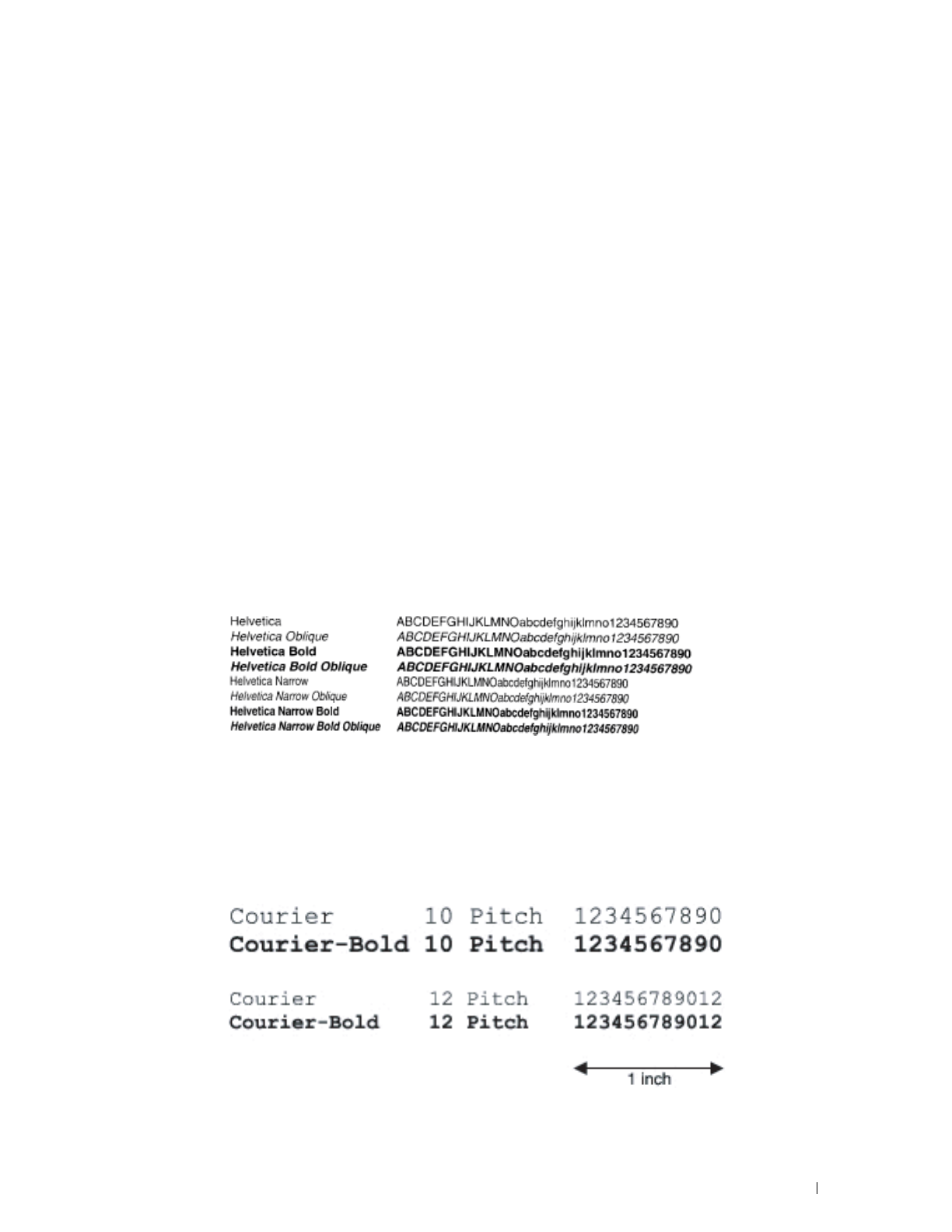
Understanding Fonts 435
27
Understanding Fonts
Typefaces and Fonts
A font is a set of characters and symbols created with a distinct design. The distinct design is called a
typeface
. The
typefaces you select add personality to a document. Well-chosen typefaces make a document easier to read.
The printer has numerous resident fonts in PCL 5/PCL 6 and PostScript 3. See "Resident Fonts" for a listing of all
resident fonts.
Weight and Style
Typefaces are often available in different weights and styles. These variations modify the original typeface so you can,
for example, emphasize important words in text or highlight book titles. The different weights and styles are
designed to complement the original typeface.
Weight
refers to the thickness of the lines that form the characters. Thicker lines result in darker characters. Some
words commonly used to describe the weight of a typeface are bold, medium, light, black, and heavy.
Style
refers to other typeface modifications, such as tilt or character width. Italic and oblique are styles where the
characters are tilted. Narrow, condensed, and extended are three common styles that modify the character widths.
Some fonts combine several weight and style modifications; for example, Helvetica BdOb. A group of several weight
and style variations of a single typeface is called a
typeface family
. Most typeface families have four variations:
regular, italic (oblique), bold, and bold italic (bold oblique). Some families have more variations, as the following
illustration for the Helvetica typeface family shows:
Pitch and Point Size
The size of a font is specified as either a pitch or point size, depending on whether the font is fixed space or
proportional.
In
fixed space
fonts, each character has the same width.
Pitch
is used to specify the size of fixed space fonts. It is a
measure of the number of characters that will print in one horizontal inch of type. For example, all 10-pitch fonts
print 10 characters per inch (cpi) and all 12-pitch fonts print 12 cpi:
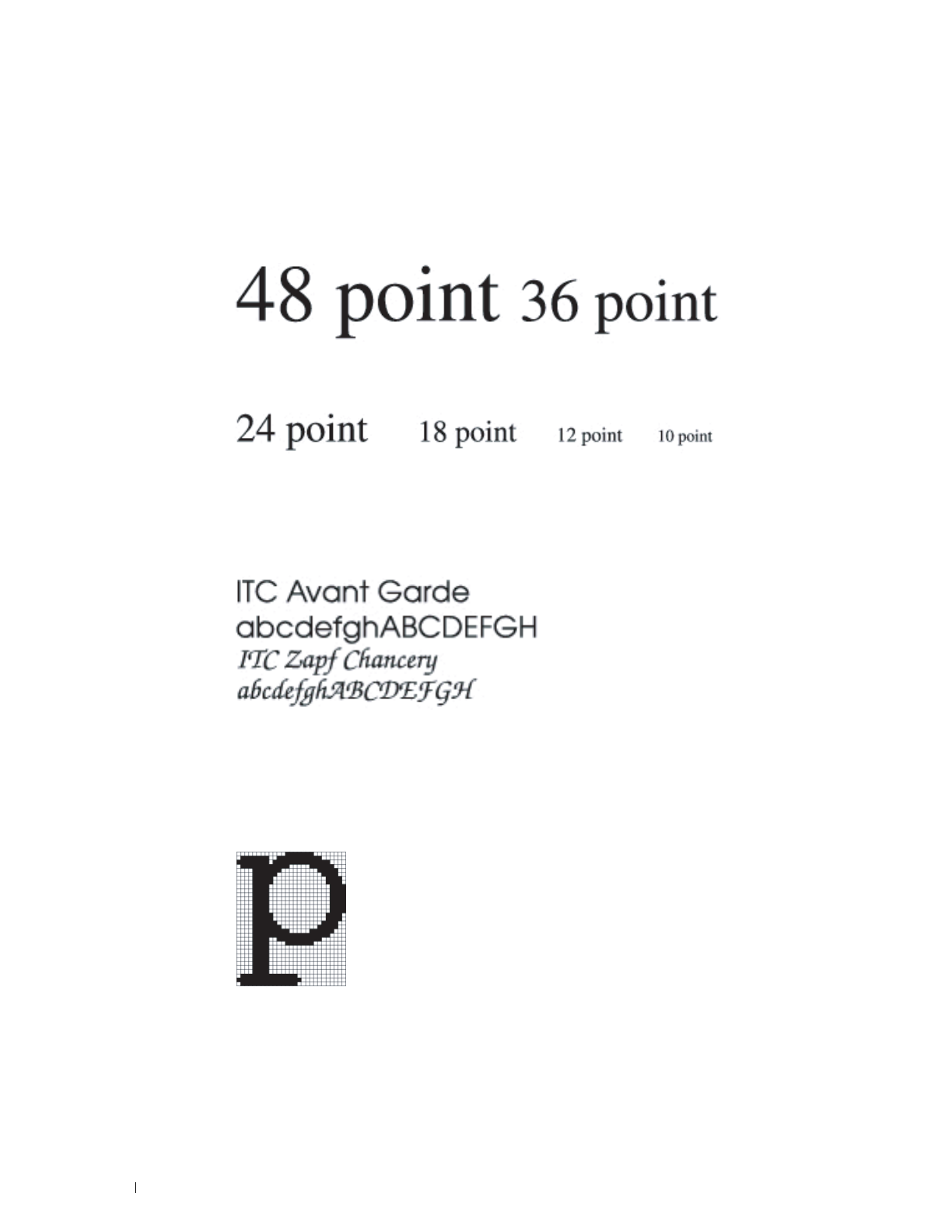
436 Understanding Fonts
In
proportional
(or
typographic
) fonts, every character can have a different width. Since proportional fonts have
characters with different widths, the font size is specified in point size, not pitch.
Point size
refers to the height of
the characters in the font. A
point
is defined as 1/72 inch. The characters in a font printed at 24 point will be twice as
large as the characters in the same font printed at 12 point.
The following illustration shows samples of a font printed in different point sizes:
The point size of a font is defined as the distance from the top of the tallest character in the font to the bottom of
the lowest character in the font. Due to the definition of point size, different fonts printed at the same point size
may appear quite different in size. This is because there are other font parameters that affect how the font looks.
However, the point size of a font is an excellent specification of the relative size of a font. The following examples
illustrate two very different proportional fonts at 14 point:
Bitmapped and Scalable Fonts
The printer uses both bitmapped and scalable fonts.
Bitmapped
fonts are stored in print memory as predefined patterns of bits that represent a typeface at a specific size,
style, and resolution. The following illustration shows an example of a character from a bitmapped font.
Bitmapped fonts are available in different type styles and point sizes as downloadable fonts.
Scalable
fonts (also called
outline
fonts) are stored as computer programs that define the outlines of the characters
in the font. Each time you print characters from a scalable font, the printer creates a bitmap of the characters at the
point size you choose and saves it temporarily in print memory.

Understanding Fonts 437
These temporary bitmapped fonts are deleted when you turn off or reset the printer. Scalable fonts provide the
flexibility of printing in many different point sizes.
Your printer uses different scalable font formats for downloading fonts to the printer. PCL 5/PCL 6 uses Intellifont
and TrueType scalable fonts. PostScript 3 uses Type 1 and TrueType scalable fonts. There are thousands of different
scalable fonts available in these different font formats from numerous font suppliers.
If you plan to use many downloadable bitmapped or scalable fonts or if you plan to use many different sizes of
scalable fonts, you may need to purchase additional memory for your printer.
Resident Fonts
Your printer is equipped with resident fonts stored permanently in print memory. Different fonts are available in
PCL 5/PCL 6 and PostScript 3. Some of the most popular typefaces, like Courier and TimesNew (PCL 5/PCL
6)/Times New Roman (PostScript 3), are available for all printer languages.
The following table lists all the fonts resident in your printer. See "Report / List" for instructions on how to print
samples of the fonts. You can select the resident fonts from your software program. You can also select the fonts from
the operator panel if you are using PCL 5/PCL 6.
Resident bitmapped and scalable fonts
PCL 5/PCL 6 PostScript 3
CG Times Albertus
CG Times It Albertus Italic
CG Times Bd Albertus Light
CG Times BdIt
Antique Olive Roman
Univers Md Antique Olive Italic
Univers MdIt Antique Olive Bold
Univers Bd Antique Olive Compact
Univers BdIt Apple Chancery
Univers MdCd Arial
Univers MdCdIt Arial Italic
Univers BdCd Arial Bold
Univers BdCdIt Arial Bold Italic
ITC Avant Garde Gothic Book
AntiqueOlv ITC Avant Garde Gothic Book Oblique
AntiqueOlv It ITC Avant Garde Gothic Demi
AntiqueOlv Bd ITC AvantGarde Gothic Demi Oblique
Bodoni Roman

438 Understanding Fonts
CG Omega Bodoni Italic
CG Omega It Bodoni Bold
CG Omega Bd Bodoni Bold Italic
CG Omega BdIt Bodoni Poster
Bodoni Poster Compressed
Garamond Antiqua ITC Bookman Light
Garamond Krsv ITC Bookman Light Italic
Garamond Hlb ITC Bookman Demi
Garamond KrsvHlb ITC Bookman Demi Italic
Carta
Courier Chicago
Courier It Clarendon Roman
Courier Bd Clarendon Bold
Courier BdIt Clarendon Light
Cooper Black
LetterGothic Cooper Black Italic
LetterGothic It Cooper Gothic 32BC
LetterGothic Bd Cooper Gothic 33BC
Coronet
Albertus Md Courier
Albertus XBd Courier Oblique
Courier Bold
Clarendon Cd Courier Bold Oblique
Eurostile Medium
Coronet Eurostile Bold
Eurostile Extended No. 2
Marigold Eurostile Bold Extended No. 2
Geneva
Arial Gill Sans
Arial It Gill Sans Italic
Arial Bd Gill Sans Bold
Arial BdIt Gill Sans Bold Italic
Gill Sans Light
TimesNew Gill Sans Light Italic
TimesNew It Gill Sans Extra Bold
TimesNew Bd Gill Sans Condensed
TimesNew BdIt Gill Sans Condensed Bold
Goudy Oldstyle
Symbol Goudy Oldstyle Italic
Goudy Bold
Resident bitmapped and scalable fonts
PCL 5/PCL 6 PostScript 3

Understanding Fonts 439
Wingdings Goudy Bold Italic
Goudy Extra Bold
Line Printer Helvetica
Helvetica Oblique
Times Roman Helvetica Bold
Times It Helvetica Bold Oblique
Times Bd Helvetica Narrow
Times BdIt Helvetica Narrow Oblique
Helvetica Narrow Bold
Helvetica Helvetica Narrow Bold Oblique
Helvetica Ob Helvetica Condensed
Helvetica Bd Helvetica Condensed Oblique
Helvetica BdOb Helvetica Condensed Bold
Helvetica Condensed Bold Oblique
CourierPS Hoefler Text
CourierPS Ob Hoefler Text Italic
CourierPS Bd Hoefler Text Black
CourierPS BdOb Hoefler Text Black Italic
Hoefler Ornaments
SymbolPS Joanna
Joanna Italic
Palatino Roman Joanna Bold
Palatino It Joanna Bold Italic
Palatino Bd Letter Gothic
Palatino BdIt Letter Gothic Slanted
Letter Gothic Bold
ITCBookman Lt Letter Gothic Bold Slanted
ITCBookman LtIt ITC Lubalin Graph Book
ITCBookmanDm ITC Lubalin Graph Book Oblique
ITCBookmanDm It ITC Lubalin Graph Demi
ITC Lubalin Graph Demi Oblique
HelveticaNr Marigold
HelveticaNr Ob Monaco
HelveticaNr Bd ITC Mona Lisa Recut
HelveticaNr BdOb New Century Schoolbook Roman
New Century Schoolbook Italic
N C Schbk Roman New Century Schoolbook Bold
N C Schbk It New Century Schoolbook Bold Italic
N C Schbk Bd NewYork
N C Schbk BdIt Optima Roman
Resident bitmapped and scalable fonts
PCL 5/PCL 6 PostScript 3
440 Understanding Fonts
Optima Italic
ITC A G Go Bk Optima Bold
ITC A G Go BkOb Optima Bold Italic
ITC A G Go Dm Oxford
ITC A G Go DmOb Palatino Roman
Palatino Italic
ZapfC MdIt Palatino Bold
Palatino Bold Italic
ZapfDingbats Stempel Garamond Roman
Stempel Garamond Italic
Stempel Garamond Bold
Stempel Garamond Bold Italic
Symbol
Tekton Regular
Times Roman
Times Italic
Times Bold
Times Bold Italic
Times New Roman
Times New Roman Italic
Times New Roman Bold
Times New Roman Bold Italic
Univers 45 Light
Univers 45 Light Oblique
Univers 55
Univers 55 Oblique
Univers 65 Bold
Univers 65 Bold Oblique
Univers 57 Condensed
Univers 57 Condensed Oblique
Univers 67 Condensed Bold
Univers 67 Condensed Bold Oblique
Univers 53 Extended
Univers 53 Extended Oblique
Univers 63 Extended Bold
Univers 63 Extended Bold Oblique
Wingdings
ITC Zapf Chancery Medium Italic
ITC Zapf Dingbats
Resident bitmapped and scalable fonts
PCL 5/PCL 6 PostScript 3

Understanding Fonts 441
Symbol Sets
A symbol set is the collection of alphabetic and numeric characters, punctuation, and special characters available in
the font you select. Symbol sets support the requirements for different languages or specific applications, such as
math symbols used for scientific text.
In PCL 5/PCL 6, a symbol set also defines which character will print for each key on the keyboard (or more
specifically, for each
code point
). Some applications require different characters at some code points. To support
multiple applications and languages, your printer has 36 symbol sets for the resident PCL 5/PCL 6 fonts.
Symbol Sets for PCL 5/PCL 6
Not all font names support all of the symbol sets listed.
Roman 8 (Default) ISO 8859-1 Latin 1 ISO 8859-2 Latin 2
ISO 8859-9 Latin 5 ISO 8859-10 Latin 6 PC-8
PC-8 DN PC-775 Baltic PC-850 Multilingual
PC-852 Latin 2 PC-1004 OS/2 PC Turkish
Windows 3.1 Latin 1 Windows 3.1 Latin 2 Windows 3.1 Latin 5
DeskTop PS Text MC Text
Microsoft Publishing Math 8 PS Math
Pi Font Legal ISO 4 United Kingdom
ISO 6 ASCII ISO 11 Swedish:names ISO 15 Italian
ISO 17 Spanish ISO 21 German ISO 60 Norwegian v1
ISO 69 French Windows 3.0 Latin 1 Windows Baltic
Symbol Wingdings ITC ZapfDingbats MS

442 Understanding Fonts
Understanding Printer Messages 443
28
Understanding Printer Messages
The touch panel displays error messages describing the current state of the printer and indicates possible printer
problems you must resolve. This chapter provides a list of error codes or error messages, and informs you what you
can do to clear error messages. When you contact customer support about an error, have the error codes and
messages ready.
CAUTION: When an error occurs, the print data remaining on the printer and the information accumulated in the memory of
the printer may be corrupted.
NOTE: An error code is listed in an error message.
NOTE: For error codes that are not listed in this chapter, refer to instructions in each error messages.
Error Codes
Error-Code What you can do
004-310 Turn off the printer. Make sure that the tray is correctly installed, and turn on the printer. Contact customer
support if this failure is repeated.
005-110 Open the DADF cover and remove the jammed documents.
005-121
005-124 Open the DADF cover and remove all documents.
009-340 Turn off the printer. Clean the CTD sensor with a clean dry cotton swab, and turn on the printer. Contact
customer support if this failure is repeated. For more information about cleaning the CTD sensor, see
"Cleaning the CTD Sensor."
009-360 Turn off the printer. Make sure that the yellow toner cartridge is correctly installed, and turn on the printer.
Contact customer support if this failure is repeated. For more information about installing the toner
cartridge, see "Replacing the Toner Cartridges."
009-361 Turn off the printer. Make sure that the magenta toner cartridge is correctly installed, and turn on the
printer. Contact customer support if this failure is repeated. For more information about installing the toner
cartridge, see "Replacing the Toner Cartridges."
009-362 Turn off the printer. Make sure that the cyan toner cartridge is correctly installed, and turn on the printer.
Contact customer support if this failure is repeated. For more information about installing the toner
cartridge, see "Replacing the Toner Cartridges."
009-363 Turn off the printer. Make sure that the black toner cartridge is correctly installed, and turn on the printer.
Contact customer support if this failure is repeated. For more information about installing the toner
cartridge, see "Replacing the Toner Cartridges."
009-367 Turn off the printer. Make sure that the yellow toner cartridge is correctly installed, and turn on the printer.
Contact customer support if this failure is repeated. For more information about installing the toner
cartridge, see "Replacing the Toner Cartridges."
009-368 Turn off the printer. Make sure that the magenta toner cartridge is correctly installed, and turn on the
printer. Contact customer support if this failure is repeated. For more information about installing the toner
cartridge, see "Replacing the Toner Cartridges."
009-369 Turn off the printer. Make sure that the cyan toner cartridge is correctly installed, and turn on the printer.
Contact customer support if this failure is repeated. For more information about installing the toner
cartridge, see "Replacing the Toner Cartridges."
009-370 Turn off the printer. Make sure that the black toner cartridge is correctly installed, and turn on the printer.
Contact customer support if this failure is repeated. For more information about installing the toner
cartridge, see "Replacing the Toner Cartridges."

444 Understanding Printer Messages
010-317 Turn off the printer, wait for 30 minutes to let the fusing unit cool, and then make sure that the fusing unit
is fully installed. For more information about installing the fusing unit, see "Replacing the Fusing Unit."
010-351 Turn off the printer. Remove the used fusing unit, and install a new fusing unit. For more information about
replacing the fusing unit, see "Replacing the Fusing Unit."
010-377 Turn off the printer. Confirm that the fusing unit is correctly installed, and turn on the printer. Contact
customer support if this failure is repeated. For more information about installing the fusing unit, see
"Replacing the Fusing Unit."
016-316 Turn off the printer. Remove the optional 512MB memory module from the slot, and then reattach it firmly.
Turn on the printer. Contact customer support if this failure is repeated.
016-318 Remove the unsupported memory module. Contact customer support if this failure is repeated.
016-338 Turn off the printer, and turn it on again. If the error message remains on the touch panel, confirm that the
wireless adapter is securely inserted. Contact customer support if this failure is repeated.
016-404 Contact your system administrator. For more information about digital certificate problems, see "Digital
Certificate Problem."
016-405 Security setting mismatch. Initialize the security setting, and then restart the printer. Contact your system
administrator for the security resetting.
016-503 Unable to resolve the e-mail SMTP server hostname. Select Close, or wait for 60 seconds for the printer to
recover. Check if SMTP server and DNS server are set correctly.
016-504 Unable to resolve the e-mail POP3 server hostname. Select Close, or wait for 60 seconds for the printer to
recover. Check if user name and password for POP3 server and DNS server are set correctly.
016-505 E-mail POP3 server login error. Select Close, or wait for 60 seconds for the printer to recover. Check if user
name and password used for POP3 server are set correctly.
016-506 SMTP server is not configured. Select Close, or wait for 60 seconds for the printer to recover. Check if
SMTP server or POP server is set.
016-507 E-mail SMTP server login error. Select Close, or wait for 60 seconds for the printer to recover. Check if
user name and password used for SMTP server are set correctly.
016-520 IPsec certificate error. (Certificate error of the printer.) The certificate of the printer is invalid. Contact your
system administrator. Reset the certificate from other connectable clients with Dell™ Printer
Configuration Web Tool. If no device can be connected, disconnect Ethernet cable, turn off the IPsec, and
then reset the certificate with Dell Printer Configuration Web Tool.
016-521 IPsec certificate error. (Remote device certification verification error.) The certificate of the destination
client is invalid. Contact your system administrator. Confirm the certificate of the destination client and
reset.
016-522 LDAP certificate error. (No client certificate exists.) The SSL client certificate is requested by the LDAP
server. Set the SSL client certificate to the device. Contact your system administrator.
016-523 LDAP certificate error. (Server certificate verification error.) The SSL certificate of the LDAP server is not
trusted by the device. Register the root certificate of the SSL certificate of the LDAP server with the device.
016-524 LDAP certificate error. (No server certificate exists.) Change the SSL certificate of the LDAP server to a
valid SSL certificate.
016-527 LDAP certificate error. (SSL authentication internal error.) The error has occurred inside the program.
Contact your system administrator.
016-534 The LDAP server information setting for ColorTrack PRO is invalid. Check the LDAP server setting of the
printer.
016-541 A wireless certificate (server or client) cannot be correctly referenced while using Wireless LAN
WPA-Enterprise or WPA2-Enterprise. Ask your system administrator to connect the printer with a wired
network, initialize the wireless settings, import the wireless certificate, and set WPA-Enterprise or
WPA2-Enterprise again.
Error-Code What you can do

Understanding Printer Messages 445
016-542 A server certificate error has occurred when acquiring the certificate with the operation of WPA-Enterprise
or WPA2-Enterprise. This is a problem in the server certificate, such as the validity period has expired for
the server certificate being used with the Radius server. Ask your system administrator to confirm the server
certificate being used with the Radius server.
016-543 A wireless certificate (server or client) corruption error has occurred while using the Wireless LAN
WPA-Enterprise or WPA2-Enterprise. Ask your system administrator to connect the printer with a wired
network, initialize the wireless settings, import the wireless certificate, and set WPA-Enterprise or
WPA2-Enterprise again.
016-720 Error relating to PDL emulation problems has occurred. Change the Print Mode setting in the Graphics tab
of the printer driver. Contact customer support if this failure is repeated.
016-756 Printing in the prohibited time. Contact your system administrator.
016-757 The account is not registered. Contact your system administrator.
016-758 The function cannot be used. Contact your system administrator.
016-759 Printable page limit is exceeded. Contact your system administrator.
016-764 An error occurs when the printer connected to the SMTP server. Select Close, or wait for 60 seconds for
the printer to recover. Check the SMTP server settings or contact the SMTP server administrator.
016-765 The capacity of the SMTP server is not enough. Select Close, or wait for 60 seconds for the printer to
recover. Contact the SMTP server administrator.
016-766 The e-mail exceeds the SMTP server size restriction. Select Close, or wait for 60 seconds for the printer to
recover. Contact the SMTP server administrator.
016-767 The e-mail address of the recipient is incorrect. Select Close, or wait for 60 seconds for the printer to
recover. Check e-mail address, and try scanning again.
016-768 The e-mail address of the sender is incorrect. Select Close, or wait for 60 seconds for the printer to
recover. Check e-mail address, and try scanning again.
016-786 A timeout error occurs when sending or receiving scanned data. Select Close, or wait for 60 seconds for
the printer to recover. Check if the Ethernet cable is connected properly. If there is no problem with the
Ethernet cable, contact server administrator.
016-790 Network connection error. (IP address is not determined.) Select Close, or wait for 60 seconds for the
printer to recover. Check if the Ethernet cable is connected properly. If there is no problem with the
Ethernet cable, contact server administrator.
016-799 Select Close to clear the message and cancel the current print job. Confirm the configuration of the
printer on the printer driver.
016-930 The device is not supported. Remove it from the front USB port.
016-931 The USB hub is not supported. Remove it from the front USB port.
016-985 Select Close, or wait for 60 seconds for the printer to recover. Retry scanning by lowering the resolution
setting or changing the file format of the scanned image.
016-986
024-920 Remove the paper from the output tray.
024-927 Check the toner gauge on the touch panel for an empty toner cartridge. Remove the empty toner cartridge,
and install a new cartridge. For more information about replacing the toner cartridge, see "Replacing the
Toner Cartridges."
024-965 Confirm that the size and type specified in the tray settings matches the size and type of paper loaded in the
tray.
024-966
024-969
026-721 Check your USB memory:
• If the file size or the number of files exceeds the limit of your USB memory.
• If your USB memory is write-protected.
Error-Code What you can do

446 Understanding Printer Messages
027-446 Change the IPv6 address to avoid duplication. Turn off the printer, and turn it on again.
027-452 Change the IPv4 address to avoid duplication. Turn off the printer, and turn it on again.
031-521 SMB server login error. Select Close, or wait for 60 seconds for the printer to recover. Confirm login-able
computer with your system administrator.
031-522 SMB server login error. Select Close, or wait for 60 seconds for the printer to recover. Check if login name
(domain name and user name) and password are correct.
031-523 Invalid SMB share name. Select Close, or wait for 60 seconds for the printer to recover. Check the share
name you specified.
031-524 Exceeded the SMB server user account limit. Select Close, or wait for 60 seconds for the printer to
recover. Check the number of users who use the server at the same time is not exceeding the upper limit.
031-525 SMB destination client permission error. Select Close, or wait for 60 seconds for the printer to recover.
Check if the specified user can read and write file at the storage location.
031-526 Unable to resolve the SMB server hostname. Select Close, or wait for 60 seconds for the printer to recover.
Check DNS connection, or check if forwarding destination server is registered with DNS.
031-527 Unable to resolve the SMB server hostname. Select Close, or wait for 60 seconds for the printer to recover.
Set DNS address, or set forwarding destination server address as IP address.
031-528 Unable to connect to the SMB server. Select Close, or wait for 60 seconds for the printer to recover. Check
if the printer can communicate via network with the forwarding destination SMB server. For example, check
the following:
• Connection of an Ethernet cable
• TCP/IP setting
• Communication with Port 137 (UDP), 138 (UDP), and 139 (TCP).
For communication beyond the subnet, contact your system administrator.
031-529 SMB server login error. (Invalid password.) Select Close, or wait for 60 seconds for the printer to recover.
Check if password is correct.
031-530 The SMB share folder was not found on the specified SMB server. Select Close, or wait for 60 seconds for
the printer to recover. Check the following:
• Check if the storage location is correct.
• Check if the file name you specified can be used when creating a file on the SMB server.
• Have your system administrator check the DFS setting, and directly specify the SMB server, share name, and
storage location according to the checked settings.
031-531 Unable to get a file or folder name on the SMB server. Select Close, or wait for 60 seconds for the printer
to recover. Check access right of the folder you specified.
031-532 SMB scan file or folder name limit exceeded. Select Close, or wait for 60 seconds for the printer to
recover. Change file name and forwarding destination folder, or move or delete file in forwarding destination
folder.
031-533 Unable to write a file in the SMB server. Select Close, or wait for 60 seconds for the printer to recover.
Check the following:
• If the file name you specified is not used by other users.
• If file or folder that has the same name as the one you specified already exists.
031-534 Unable to create a folder on the SMB server. Select Close, or wait for 60 seconds for the printer to recover.
Check the following:
• If the file name you specified is not used by other users.
• If file or folder that has the same name as the one you specified already exists.
Error-Code What you can do

Understanding Printer Messages 447
031-535 Unable to delete a file on the SMB server. Select Close, or wait for 60 seconds for the printer to recover.
Check if other user is not operating file in storage location you specified.
031-536 Unable to delete a folder on the SMB server. Select Close, or wait for 60 seconds for the printer to recover.
Check if other user is not operating file in storage location you specified.
031-537 SMB server capacity exceeded. Select Close, or wait for 60 seconds for the printer to recover. Check if
storage location has free space.
031-539 The specified SMB server is invalid. Select Close, or wait for 60 seconds for the printer to recover. Check
if server name is correct.
031-540 The specified domain name is invalid. Select Close, or wait for 60 seconds for the printer to recover.
Check if domain name is correct.
031-541 Invalid user name specified for SMB server. Select Close, or wait for 60 seconds for the printer to recover.
Check if login name (user name) is correct.
031-542 TCP/IP not initialized. Select Close, or wait for 60 seconds for the printer to recover. Wait for a while and
try the same operation again. Contact customer support if this failure is repeated.
031-543 SMB server login error. Select Close, or wait for 60 seconds for the printer to recover. Check login
permitted time with your system administrator.
031-544 SMB server login error. (Expired password.) Select Close, or wait for 60 seconds for the printer to recover.
Check the password valid period with your system administrator.
031-545 SMB server login error. (Password change required.) Select Close, or wait for 60 seconds for the printer to
recover. Check necessity of password change with your system administrator.
031-546 SMB server login error. (Invalid user is specified.) Select Close, or wait for 60 seconds for the printer to
recover. Contact your system administrator for the destination server settings.
031-547 SMB server login error. (The specified user is restricted from accessing the SMB server.) Select Close, or
wait for 60 seconds for the printer to recover. Contact your system administrator for the destination server
settings.
031-548 SMB server login error. (Logon time of SMB destination expired.) Select Close, or wait for 60 seconds for
the printer to recover. Contact your system administrator for the destination server settings.
031-549 SMB server login error. Specified user is restricted, and a null password is prohibited. Select Close, or wait
for 60 seconds for the printer to recover. On server security settings, check access permission of null
password user.
031-550 Append command not supported by SMB server. Select Close, or wait for 60 seconds for the printer to
recover. Check if the printer has access rights to append data to the SMB server. Check if server supports
SMB append command.
031-551 Rename command not supported by SMB server. Select Close, or wait for 60 seconds for the printer to
recover. Check if the printer has access rights to rename data on the SMB server. Check if server supports
SMB append command.
031-552 Job canceled. Select Close, or wait for 60 seconds for the printer to recover. Change the file name that
already exists on FTP server.
031-574 Unable to resolve the FTP server hostname. Select Close, or wait for 60 seconds for the printer to recover.
Check DNS connection, or check if name of forwarding destination server is registered with DNS.
031-575 Unable to resolve the FTP server hostname. Select Close, or wait for 60 seconds for the printer to recover.
Set DNS address, or set forwarding destination server address as IP address.
031-576 Unable to connect to the FTP server. Select Close, or wait for 60 seconds for the printer to recover. Check
if the printer communicates with forwarding destination FTP server. For example, check connection of
Ethernet cable and if the IP address of the server is correct.
031-578 FTP server login error. Select Close, or wait for 60 seconds for the printer to recover. Check if login name
(user name) and password are correct.
Error-Code What you can do

448 Understanding Printer Messages
031-579 Invalid FTP subdirectory path. Select Close, or wait for 60 seconds for the printer to recover. Check if
storage location is correct.
031-580 Failed to obtain a file or folder name of the FTP server. Select Close, or wait for 60 seconds for the printer
to recover. Check server access right.
031-581 FTP scan file or folder name limit exceeded. Select Close, or wait for 60 seconds for the printer to recover.
Change file name and forwarding destination folder, or move or delete file in forwarding destination folder.
031-582 Unable to write a scan file to the FTP server location. Select Close, or wait for 60 seconds for the printer
to recover. Check if the file name you specified can be created in storage location. Check if storage location
has free space.
031-584 Unable to create a scan folder on the FTP server. Select Close, or wait for 60 seconds for the printer to
recover. Check if the folder name you specified can be created in storage location. Check if the folder that
has the same name as the one you specified already exists.
031-585 Unable to delete a file on the FTP server. (DEL command failure.) Select Close, or wait for 60 seconds for
the printer to recover. Check server access rights.
031-587 Unable to delete a folder on the FTP server. (RMD command failure.) Select Close, or wait for 60 seconds
for the printer to recover. Check server access rights.
031-588 Unable to write a file to the FTP server location. Select Close, or wait for 60 seconds for the printer to
recover. Check if storage location has free space.
031-590 Job canceled. Select Close, or wait for 60 seconds for the printer to recover. Change the file name that
already exists on FTP server.
031-594 FTP transfer type error. (TYPE command failure.) Select Close, or wait for 60 seconds for the printer to
recover. Try the same operation again. Contact customer support if this failure is repeated.
031-595 FTP data port error. (PORT command failure.) Select Close, or wait for 60 seconds for the printer to
recover. Try the same operation again. Contact customer support if this failure is repeated.
031-598 FTP append data error. (APPE command failure.) Select Close, or wait for 60 seconds for the printer to
recover. Check if the printer has access rights to append data to the FTP server. Check if server supports
FTP append command.
031-599 FTP rename file error. (RNFR command failure.) Select Close, or wait for 60 seconds for the printer to
recover. Check if the printer has access rights to rename data on the FTP server. Check if server supports
FTP rename command.
033-513 Select Close, or wait for 60 seconds for the printer to recover. Try the following:
• Print the received fax, or wait for a while until sending a fax is completed.
• Print the fax job stored using the Secure Receive feature.
For more information about the Secure Receive feature, see "Using the Secure Receiving Mode."
033-527 Select Close, or wait for 60 seconds for the printer to recover. Wait for a while until the printer is not busy,
and try again.
033-528 Select Close, or wait for 60 seconds for the printer to recover. Check the available time period for the
FAX, and try again.
033-762 Select Close, or wait for 60 seconds for the printer to recover. The printer rejects faxes sent from
unwanted numbers. For more information, see "Junk Fax Setup."
033-788 Select Close, or wait for 60 seconds for the printer to recover. Try the following:
• Remove the received fax, or wait for a while until sending a fax is completed.
• Print the fax job stored using the Secure Receive feature.
For more information about the Secure Receive feature, see "Using the Secure Receiving Mode."
Error-Code What you can do

Understanding Printer Messages 449
034-515 Select Close, or wait for 60 seconds for the printer to recover. Try the following:
• Try the same operation.
• Check the printer or remote machine if the memory is full.
034-791 Select Close, or wait for 60 seconds for the printer to recover. Check if the telephone line cord is
connected properly. If the line connection is correct, check the following:
• If Tone/Pulse setting is correct.
For more information about Tone/Pulse setting, see "Tone / Pulse."
If Tone/Pulse setting is correct, check the following:
• If the remote machine can receive a fax.
035-701 Select Close, or wait for 60 seconds for the printer to recover. Check the following:
• Status of the remote machine
• Tone/Pulse setting
For more information about Tone/Pulse setting, see "Tone / Pulse."
035-708 Select Close, or wait for 60 seconds for the printer to recover. Try the following:
• Try the same operation.
• Reduce the modem speed.
For more information about modem speed, see "Modem Speed."
035-717 Select Close, or wait for 60 seconds for the printer to recover. Reduce the modem speed. For more
information about modem speed, see "Modem Speed."
035-718 Select Close, or wait for 60 seconds for the printer to recover. Check the status of the remote machine.
035-720 Select Close, or wait for 60 seconds for the printer to recover. Check the features of the remote machine.
035-781 Select Close, or wait for 60 seconds for the printer to recover. Check if the remote machine is busy.
042-700 Wait for a while until the printer cools down. Contact customer support if this failure is repeated.
075-910 Make sure that the multipurpose feeder (MPF) is fully installed.
077-300 Close the front cover.
077-301 Close the right side cover.
077-302 Close the rear cover.
091-911 Remove the used waste toner box, and install a new toner box. For more information about replacing the
waste toner box, see "Replacing the Waste Toner Box."
091-914 Reinsert the black drum cartridge. If the message remains, replace the cartridge. For more information
about reinserting the drum cartridge, see "Replacing the Drum Cartridges."
091-917 Reinsert the yellow drum cartridge. If the message remains, replace the cartridge. For more information
about reinserting the drum cartridge, see "Replacing the Drum Cartridges."
091-918 Reinsert the magenta drum cartridge. If the message remains, replace the cartridge. For more information
about reinserting the drum cartridge, see "Replacing the Drum Cartridges."
091-919 Reinsert the cyan drum cartridge. If the message remains, replace the cartridge. For more information about
reinserting the drum cartridge, see "Replacing the Drum Cartridges."
091-921 Make sure that the black drum cartridge is fully installed. For more information about installing the drum
cartridge, see "Replacing the Drum Cartridges."
091-922 Make sure that the yellow drum cartridge is fully installed. For more information about installing the drum
cartridge, see "Replacing the Drum Cartridges."
091-923 Make sure that the magenta drum cartridge is fully installed. For more information about installing the
drum cartridge, see "Replacing the Drum Cartridges."
Error-Code What you can do

450 Understanding Printer Messages
091-924 Make sure that the cyan drum cartridge is fully installed. For more information about installing the drum
cartridge, see "Replacing the Drum Cartridges."
091-931 Remove the used black drum cartridge, and install a new cartridge. For more information about replacing
the drum cartridge, see "Replacing the Drum Cartridges."
091-932 Remove the used yellow drum cartridge, and install a new cartridge. For more information about replacing
the drum cartridge, see "Replacing the Drum Cartridges."
091-933 Remove the used magenta drum cartridge, and install a new cartridge. For more information about replacing
the drum cartridge, see "Replacing the Drum Cartridges."
091-934 Remove the used cyan drum cartridge, and install a new cartridge. For more information about replacing the
drum cartridge, see "Replacing the Drum Cartridges."
091-942 Reinsert the black drum cartridge. If the message remains, replace the cartridge. For more information
about replacing the drum cartridge, see "Replacing the Drum Cartridges."
091-943 Reinsert the yellow drum cartridge. If the message remains, replace the cartridge. For more information
about replacing the drum cartridge, see "Replacing the Drum Cartridges."
091-944 Reinsert the magenta drum cartridge. If the message remains, replace the cartridge. For more information
about replacing the drum cartridge, see "Replacing the Drum Cartridges."
091-945 Reinsert the cyan drum cartridge. If the message remains, replace the cartridge. For more information about
replacing the drum cartridge, see "Replacing the Drum Cartridges."
091-960 Remove the unsupported yellow drum cartridge, and install a supported drum cartridge. For more
information about installing the drum cartridge, see "Replacing the Drum Cartridges."
091-961 Remove the unsupported magenta drum cartridge, and install a supported drum cartridge. For more
information about installing the drum cartridge, see "Replacing the Drum Cartridges."
091-962 Remove the unsupported cyan drum cartridge, and install a supported drum cartridge. For more
information about installing the drum cartridge, see "Replacing the Drum Cartridges."
091-963 Remove the unsupported black drum cartridge, and install a supported drum cartridge. For more
information about installing the drum cartridge, see "Replacing the Drum Cartridges."
092-651 Clean the CTD sensor with a clean dry cotton swab. For more information about cleaning the CTD sensor,
see "Cleaning the CTD Sensor."
093-930 Remove the used yellow toner cartridge, and install a new cartridge. For more information about replacing
the toner cartridge, see "Replacing the Toner Cartridges."
093-931 Remove the used magenta toner cartridge, and install a new cartridge. For more information about replacing
the toner cartridge, see "Replacing the Toner Cartridges."
093-932 Remove the used cyan toner cartridge, and install a new cartridge. For more information about replacing the
toner cartridge, see "Replacing the Toner Cartridges."
093-933 Remove the used black toner cartridge, and install a new cartridge. For more information about replacing
the toner cartridge, see "Replacing the Toner Cartridges."
093-960 Remove the unsupported yellow toner cartridge, and install a supported toner cartridge. For more
information about installing the toner cartridge, see "Replacing the Toner Cartridges."
093-961 Remove the unsupported magenta toner cartridge, and install a supported toner cartridge. For more
information about installing the toner cartridge, see "Replacing the Toner Cartridges."
093-962 Remove the unsupported cyan toner cartridge, and install a supported toner cartridge. For more information
about installing the toner cartridge, see "Replacing the Toner Cartridges."
093-963 Remove the unsupported black toner cartridge, and install a supported toner cartridge. For more
information about installing the toner cartridge, see "Replacing the Toner Cartridges."
093-970 Make sure that the yellow toner cartridge is fully installed. For more information about installing the toner
cartridge, see "Replacing the Toner Cartridges."
Error-Code What you can do

Understanding Printer Messages 451
Error Messages
093-971 Make sure that the magenta toner cartridge is fully installed. For more information about installing the
toner cartridge, see "Replacing the Toner Cartridges."
093-972 Make sure that the cyan toner cartridge is fully installed. For more information about installing the toner
cartridge, see "Replacing the Toner Cartridges."
093-973 Make sure that the black toner cartridge is fully installed. For more information about installing the toner
cartridge, see "Replacing the Toner Cartridges."
094-422 Remove the used transfer belt unit, and install a new transfer belt unit. For more information about
replacing the transfer belt unit, see "Replacing the Transfer Belt Unit, the 2nd Belt Transfer Roller (2nd
BTR), and the Retard Roller."
094-910 Make sure that the transfer belt unit is fully installed. For more information about installing the transfer belt
unit, see "Replacing the Transfer Belt Unit, the 2nd Belt Transfer Roller (2nd BTR), and the Retard Roller."
094-911 Remove the used transfer belt unit, and install a new transfer belt unit. For more information about
replacing the transfer belt unit, see "Replacing the Transfer Belt Unit, the 2nd Belt Transfer Roller (2nd
BTR), and the Retard Roller."
116-722 Select Close for the printer to recover. Check the WSD scan address and the destination computer, and
then try scanning again. Contact your system administrator.
193-700 When genuine toner cartridges are installed, change the Non-Dell Toner setting to disable using the Dell
Printer Configuration Web Tool or the Tool Box.
Message Cause Action
Cannot access the LDAP address
book. Consult your network
administrator if this error persists.
The printer fails to authenticate against an
authentication server.
Check the server settings. If the error
persists, consult your network administrator.
An SSL authentication error on connection
to the LDAP server; an SSL authentication
internal error occurs.
If the error persists, consult your network
administrator.
Cannot access the LDAP address
book. The LDAPS server certificate
is not correct.
An SSL authentication error on connection
to the LDAP server; the server certificate
data is incorrect.
Check the root certificate of the LDAP
server SSL certificate on the printer.
Cannot access the LDAP address
book. The LDAPS SSL client
certificate is not set.
An SSL authentication error on connection
to the LDAP server; the LDAP server cannot
acquire an SSL client certificate.
Check that an SSL client certificate is
correctly imported into the printer.
Cannot access the LDAP address
book. The server names of LDAPS
and the SSL certificate do not
match.
An SSL authentication error on connection
to the LDAP server; the server certificate for
the LDAP server is not yet valid or has
expired.
Change to a valid LDAP server SSL
certificate.
An SSL authentication error on connection
to the LDAP server; the LDAP server name
does not match the certificate.
Set the LDAP server address on the printer
to match the address on the LDAP server
SSL certificate.
Cannot access the LDAP address
book. The time settings of the
printer and the Kerberos server do
not match.
The printer and the Kerberos server clocks
have a time difference that exceeds the
Kerberos server clock skew value.
Check that the printer and the Kerberos
server clocks have the correct time.
Error-Code What you can do

452 Understanding Printer Messages
Cannot connect to server. Check the
server settings.
The specified server settings such as IP
address and realm/domain name are
incorrect.
Make sure that the correct IP address/host
name, port number, realm/domain name,
and search directory root are specified in IP
Address / Host Name & Port, Domain
Name, and Search Directory Root on the
Dell Printer Configuration Web Tool. (See
"Kerberos Server" and "LDAP Server.")
The LDAP or Kerberos version on the server
is not compatible with the printer.
Consult your network administrator.
The server is down. Check that the server is functioning
normally.
Change the server settings and
confirm the server connection.
The printer cannot search for destinations
within the specified time.
Increase the time setting for Search Time-
Out on the Dell Printer Configuration Web
Tool. (See "Authentication System" and
"LDAP Server.")
Check that the printer and the server are
properly connected with an Ethernet cable.
If there are not any problems with the
connection and the error persists, the server
settings may have been changed. Consult
your network administrator.
Check the authentication settings. The login name and password for access to
an authentication server are incorrect.
Make sure that the correct login name and
password are specified in Login Name and
Password on the Dell Printer Configuration
Web Tool. (See "Kerberos Server" and
"LDAP Server.")
Invalid search characters or LDAP
User Mapping incorrectly configured
for Configuration Web Tool.
The LDAP search filter fails to work properly
as special characters are used in your search
condition or on the LDAP User Mapping
page on the Dell Printer Configuration
Web Tool.
Remove special characters, and then search
again. (See "LDAP User Mapping.")
Network connection is not ready. Try
again later.
You have started searching for destinations
before the IP address is set for the printer.
Wait for a while, and then search again.
No attribute or invalid name.
Confirm address info. on server.
The address information on the server
contain incorrect data or are insufficient to
get your search request.
Check the address information registered on
the server or consult your network
administrator.
No Entries. The printer cannot find any destinations
that meet your search condition.
Select OK to return to the Search Network
Address Book screen, and then specify a
new condition to search again.
Search Directory Root incorrectly
configured for Configuration Web
Tool.
The directories that do not exist in the
LDAP server are specified or an invalid DN
syntax is specified.
Make sure that valid values are specified in
Search Directory Root on the Dell Printer
Configuration Web Tool. (See "LDAP
Server.") Specify the origin of the search
with the correct DN syntax, as shown in the
following example:
dc=w2008ad,dc=addressbook,dc=net
Too many search results. Only a
maximum of 50 search scan be
displayed. Please refine your search if
needed.
The number of search results has exceeded
the limits (50 search results) the printer can
display.
Select Close to display the search results.
If you cannot find your desired destination
on the result list, specify a new condition to
search again.
Message Cause Action

Understanding Printer Messages 453
Certificate Error 016-530
Job canceled. Restart the printer.
Some other error occurs regarding the LDAP
server address book.
Turn off the printer, and turn it on again. If
the error persists, consult your network
administrator.
Message Cause Action

454 Understanding Printer Messages

Specifications 455
29
Specifications
Operating System Compatibility
Your Dell™ C3765dnf Multifunction Color Laser Printer is compatible with Microsoft® Windows® XP, Windows XP
64-bit Edition, Windows Server® 2003, Windows Server 2003 x64 Edition, Windows Server 2008, Windows Server
2008 64-bit Edition, Windows Server 2008 R2 64-bit Edition, Windows Vista®, Windows Vista 64-bit Edition,
Windows 7, Windows 7 64-bit Edition, Windows 8, Windows 8 64-bit Edition, Windows Server 2012, Mac OS X
10.3.9, 10.4.11, 10.5, 10.6, 10.7, 10.8, Red Hat® Enterprise Linux® 5/6 Desktop (x86), and SUSE® Linux Enterprise
Desktop 10/11 (x86).
Power Supply
Dimensions
Height: 558 mm (21.97 inches) Width: 530 mm (20.87 inches) Depth: 530 mm (20.87 inches)
Weight (including toner cartridges and drum cartridges): 32.7 kg (72.09 lb)
Memory
Page Description Language (PDL)/Emulation, Operating System, and
Interface
Rated voltage 220 VAC - 240 VAC 110 VAC - 127 VAC
Frequency 50/60 Hz 50/60 Hz
Current 5 A or less 9 A or less
Power consumption 78.0 W (Ready)
19.5 W (Sleep)
5.5 W (Deep Sleep)
0 W (Offline)
82.0 W (Ready)
19.5 W (Sleep)
5.5 W (Deep Sleep)
0 W (Offline)
TEC value 3.0 kWh 3.0 kWh
Base memory 512 MB
Maximum memory 1024 MB (512 MB + 512 MB)
Connector 144 pin EP2-2100 DDR2 SDRAM
32b-SO-DIMM
DIMM size 512 MB
Speed EP2-2100
PDL/Emulations PCL 6, PCL5e, PostScript, HBPL, XPS (Host Based)

456 Specifications
MIB Compatibility
Management Information Base (MIB) is a database containing information about network devices (such as adapters,
bridges, routers, or computers). This information helps network administrators manage the network (analyze
performance, traffic, errors, and so on). Dell C3765dnf Multifunction Color Laser Printer complies with standard
industry MIB specifications, allowing the printer to be recognized and managed by various printer and network
management software systems.
Environment
Operation
Print Quality Guarantee
Storage
Altitude
Cables
Your interconnection cable must meet the following requirements:
Operating systems Microsoft Windows XP/XP x64/Server 2003/Server 2003 x64/Server 2008/Server 2008 x64/Server
2008 R2 x64/Vista/Vista x64/7/7 x64/8/8 x64/Server 2012, Mac OS X (10.3.9/10.4.11/10.5/10.6/10.7/
10.8), Red Hat Enterprise Linux 5/6 Desktop (x86), and SUSE Linux Enterprise Desktop 10/11
(x86)
Interfaces Standard local: USB 2.0
Standard network: 10Base-T/100Base-TX/
1000Base-T Ethernet
Optional network: IEEE 802.11b/802.11g/802.11n (Wireless)
Temperature 10
°
C
-
32
°
C
Relative humidity 10 % - 85 % RH (no condensation)
Temperature 15
°
C
-
28
°
C
Relative humidity 20 % - 70 % RH (no condensation)
Temperature range -20
°
C to 40 °C (0 °F to 104 °F)
Storage humidity range 5 % - 85 % RH (no condensation)
Operating Up to 3,100 m (10,170 feet)
Storage Up to 3,100 m (10,170 feet)
Connection type Connection specifications and symbols
1Ethernet 10Base-T/100Base-TX/
1000Base-T
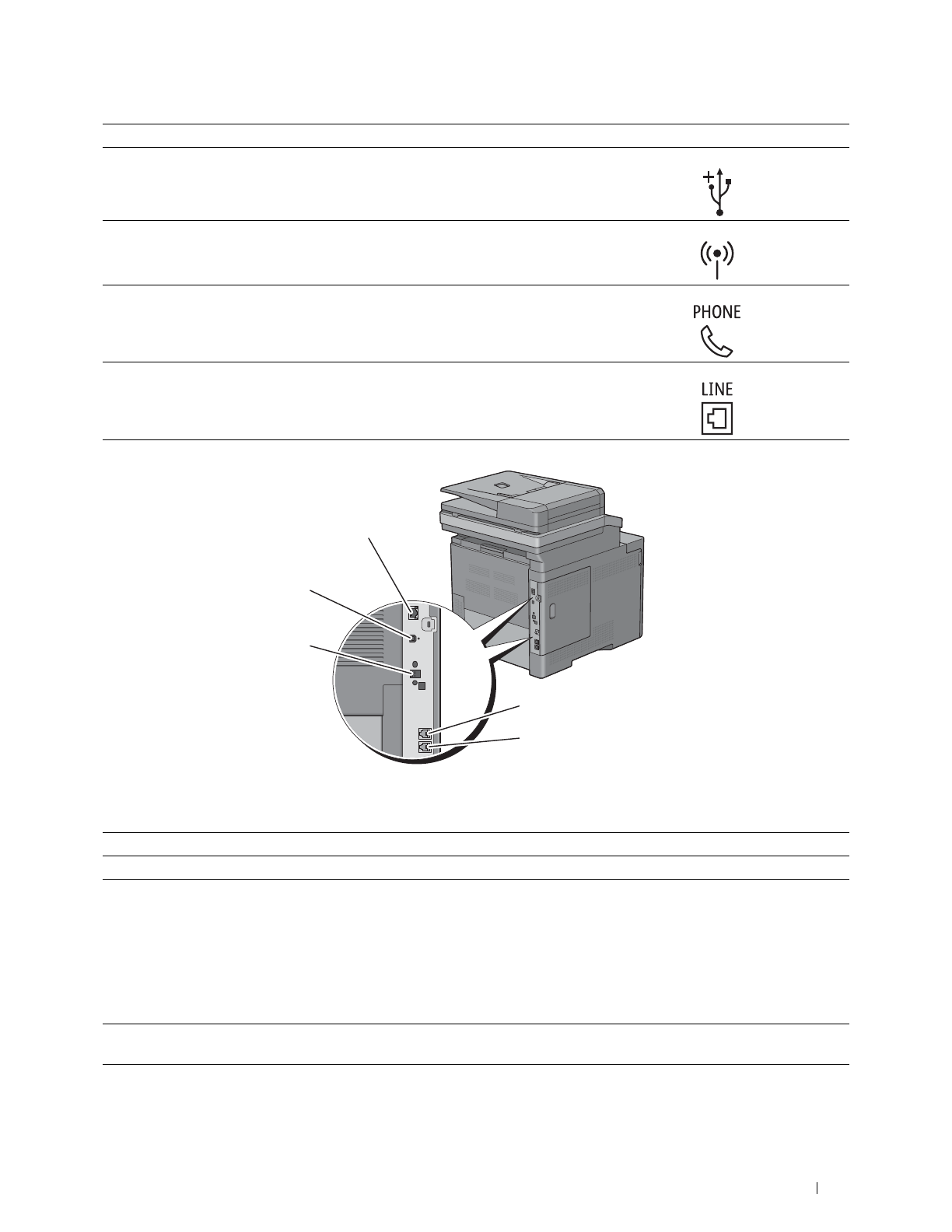
Specifications 457
Copier Specifications
2USB USB 2.0
3Wireless adapter socket IEEE 802.11b/802.11g/802.11n
4Phone connector
5Wall jack connector
Item Description
Copy resolution Optical: 600 dpi x 600 dpi
Copy speed Color 35 cpm or more, Black & White 35 cpm or more (When using the
document glass to make sequential copies of a document with pages scanned one
by one.)
Simplex: Color 13 cpm or more, Black & White 22 cpm or more
Duplex: Color 4 cpm or more, Black & White 7 cpm or more
(When using the Duplex Automatic Document Feeder (DADF) to make
sequential copies of multiple documents.)
Paper size A4, B5, A5, Letter, Executive, Folio (8.5" x 13"), Legal, Envelope #10, Monarch,
DL, C5
Zoom rate Document glass: 25 % - 400 %, DADF: 25 % - 400 %
Connection type Connection specifications and symbols
1
2
3
4
5

458 Specifications
Scanner Specifications
*1 : Windows OS only
*2 : Windows Vista/7/8 only
Facsimile Specifications
Multiple copies 1 - 99 pages
Copy mode (=Original type) Text, Text & Photo, Photo
Scanning method Document glass: Document-fixed flatbed scanning
DADF: Carriage-fixed, document-feeding scanning (2- side scanning)
Item Description
Compatibility TWAIN, TWAIN-Net, Windows Image Acquisition (WIA)*1,
Scan Service for WSD*2
Scan resolution Optical: 600 dpi x 300 dpi (Color only), 600 dpi x 400 dpi, 600 dpi x 600 dpi, 1,200
dpi, x 1,200 dpi
Enhanced (Pull Scan):
• TWAIN – 50 x 50 to 9,600 x 9,600 dots/25.4 mm
• WIA – 75/100/150/200/300/400/600 dots/25.4 mm
Enhanced (Push Scan):
200(Default)/300/400/600 dots/25.4 mm
Color bit depth 24 bit
Mono bit depth 1 bit for Line art. 8 bit for Gray scale
Effective scanning length Document glass: 297 mm. DADF: 355.6 mm
Effective scanning width 215.9 mm
Scan speed (Text mode) Monochrome: 665 μs/line (600 dpi), 1330 μs/line (1200 dpi)
Color: 1330 μs/line (600 dpi), 2660 μs/line (1200 dpi)
Item Description
Compatibility ITU-T Super G3, ITU-T G3 ECM, ITU-T G3
Applicable line Public Switched Telephone Network (PSTN), Private Branch Exchange (PBX), or
Leased line (3.4 KHz/2-wire)
Data coding 1bit/JBIG/MMR/MR/MH
Max modem speed 33.6 Kbps
Transmission speed Approx. 3 seconds/page *Transmission time applies to memory transmission of
text data scanned in Standard resolution with ECM using only ITU-T No.1 Chart.
Scanning speed Document glass: approx. 3 seconds/A4 (at standard fax resolution mode) DADF:
approx. 5 seconds/Letter (at standard fax resolution mode), 7.5 seconds/Letter (at
fine fax resolution mode)
Maximum document length Document glass: 297 mm DADF: 355.6 mm
Paper size Letter, A4 (depending on a country)
Item Description

Specifications 459
Optional Wireless Adapter
*1 This item is available only when the optional hard disk is installed.
*2 EAP method supports PEAPv0, EAP-TLS, EAP-TTLS PAP, and EAP-TTLS CHAP.
*3 WPS 2.0 compliant.
Resolution Standard: R8 x 3.85 l/mm, Fine: R8 x 7.7 l/mm, Super Fine: 400 dpi x 400 dpi,
Photo: R8 x 7.7 1/mm
User memory 4 MB (320 pages)
Halftone 256 levels
Item Description
Connectivity technology Wireless
Compliant standards IEEE 802.11b, 802.11g, and 802.11n
Bandwidth 2.4 GHz
Data transfer rate IEEE 802.11n: 65 Mbps
IEEE 802.11g: 54, 48, 36, 24, 18, 12, 9, and 6 Mbps
IEEE 802.11b: 11, 5.5, 2, and 1 Mbps
Security 64 (40-bit key)/128 (104-bit key) WEP,
WPA- PSK (TKIP, AES), WPA2-PSK (AES), WPA-Enterprise (TKIP, AES)*1*2,
WPA2-Enterprise (AES)*1*2
Wi-Fi Protected Setup® (WPS)*3 Push-Button Configuration (PBC),
Personal Identification Number (PIN)
Item Description

460 Specifications

461
Maintaining Your Printer
30 Maintaining Your Printer.......................................................... 463
31 Removing Options ..................................................................... 503
32 Clearing Jams............................................................................ 513

462
Maintaining Your Printer 463
30
Maintaining Your Printer
You need to complete certain tasks to maintain optimum print quality.
Determining the Status of Supplies
If your printer is connected to the network, the Dell™ Printer Configuration Web Tool can provide instant feedback
on remaining toner levels. Type the printer's IP address in your web browser to view this information. To use the E-
Mail Alert Setup feature that notifies you when the printer requires new supplies, type the desired e-mail address in
the e-mail list box.
On the touch panel screen, you can also confirm the following:
• Any supply or maintenance items that require attention replacing (However, the printer can only display
information about one item at a time).
• Amount of toner remaining in each toner cartridge.
Conserving Supplies
You can change several settings in your printer driver to conserve toner cartridge and paper.
Ordering Supplies
You can order consumables (toner cartridges, drum cartridges, and waste toner box) from Dell on the Internet when
using a networked printer. Type the IP address of your printer in your web browser, launch the Dell Printer
Configuration Web Tool, and click the Order Supplies at: to order consumables for your printer.
You can also order consumables by the following method.
1
Click
Start
→
All Programs
→
Dell Printers
→
Additional Color Laser Software
→
Dell Supplies Management
System
.
The
Dell Supplies Management System
window appears.
2
Select your printer from the
Select Printer Model
list.
3
If ordering from the web:
a
Select a URL from the
Select Reorder URL
list.
b
Click
Visit Dell printer supplies ordering web site
.
NOTE: When you cannot get information from the printer automatically by two-way communication, a window that
prompts you to type the Service Tag appears. Type your Dell printer Service Tag in the field provided.
Your Service Tag number is located inside the front cover of your printer.
4
If ordering by phone, call the number that appears under the
Order by Phone
heading.
Supply Setting Function
Toner cartridge Toner Saver in the Others tab This check box allows the users to select a print mode that uses less
toner. The image quality will be lower when this feature is used.
Print media Multiple Up in the Layout tab The printer prints two or more pages on one side of a sheet.
Print media Duplex in the General tab The printer prints on both sides of a sheet of paper.

464 Maintaining Your Printer
Storing Print Media
To avoid potential paper feeding problems and uneven print quality, there are several things you can do:
• To achieve the best possible print quality, store print media in an environment where the temperature is
approximately 21 °C (70 °F) and the relative humidity is 40 %.
• Store cartons of print media on a pallet or shelf, rather than directly on the floor.
• If you store individual packages of print media out of the original carton, ensure that they rest on a flat surface so
the edges do not buckle or curl.
• Do not place anything on top of the print media packages.
Storing Consumables
Store consumables in their original packaging until you need to use them. Do not store consumables in:
• Temperatures greater than 40 °C (104 °F).
• An environment with extreme changes in humidity or temperature.
• Direct sunlight.
• Dusty places.
• A car for a long period of time.
• An environment where corrosive gases are present.
• A humid environment.
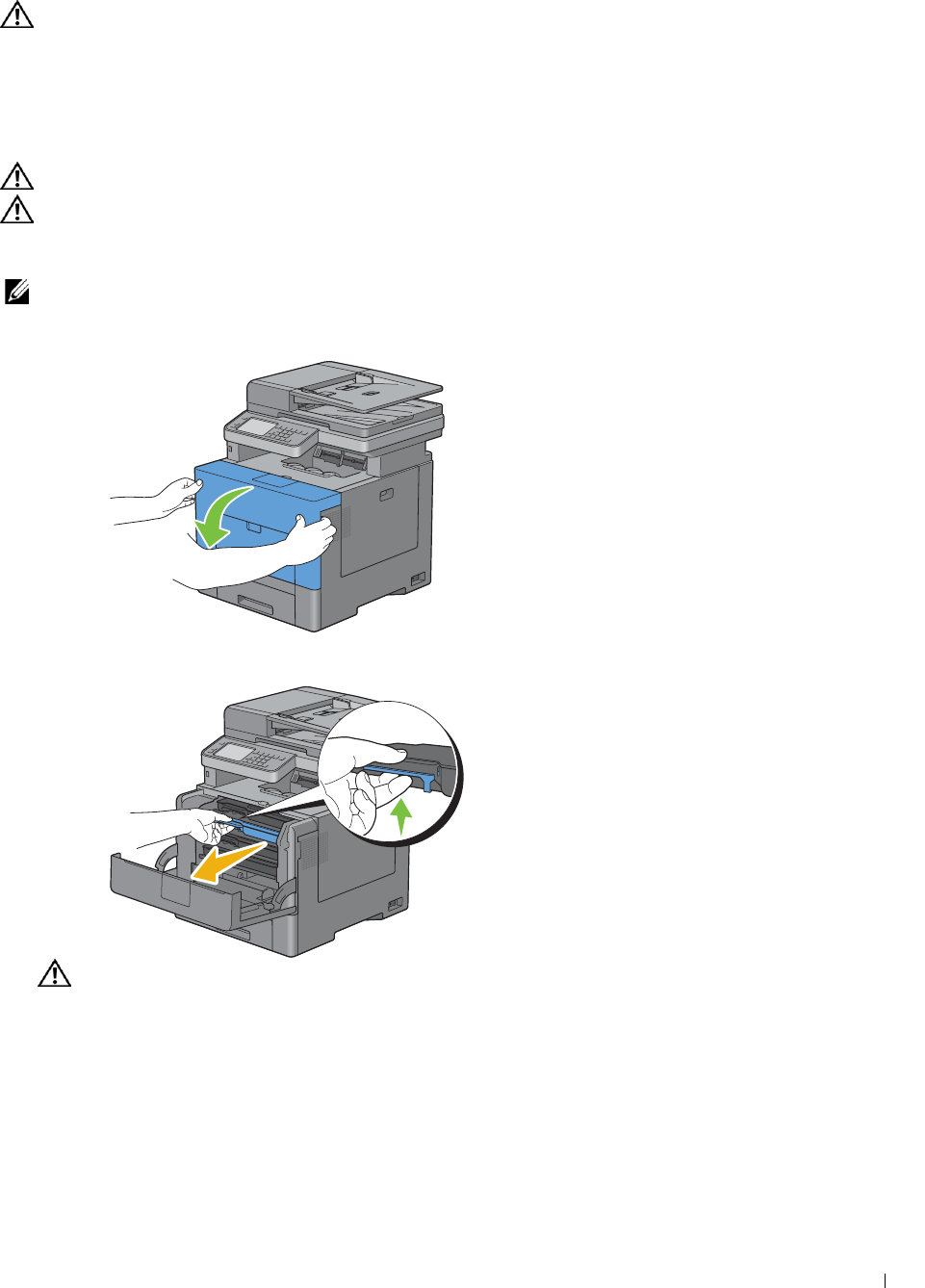
Maintaining Your Printer 465
Replacing the Toner Cartridges
WARNING: Before performing any of the following procedures, read and follow the safety instructions in the
Product
Information Guide
.
Dell toner cartridges are available only through Dell. You can order cartridges online at http://www.dell.com/supplies
or by phone. To order by phone, see "Contacting Dell."
It is recommended to use Dell toner cartridges for your printer. Dell does not provide warranty coverage for problems
caused by using accessories, parts, or components not supplied by Dell.
WARNING: Never throw used toner cartridges into fire. The residual toner could explode resulting in burns and injuries.
WARNING: Do not shake the used toner cartridge. This may cause toner spills.
Removing the Toner Cartridge
NOTE: Ensure that you remove all the paper from the MPF and close the MPF cover before removing the toner cartridge.
1
Grasp the grips on both sides of the front cover, and then pull it down to open.
2
Grasp the handle on the toner cartridge that you want to replace, and then pull it out.
WARNING: Do not shake the toner cartridge as it may cause toner spills.
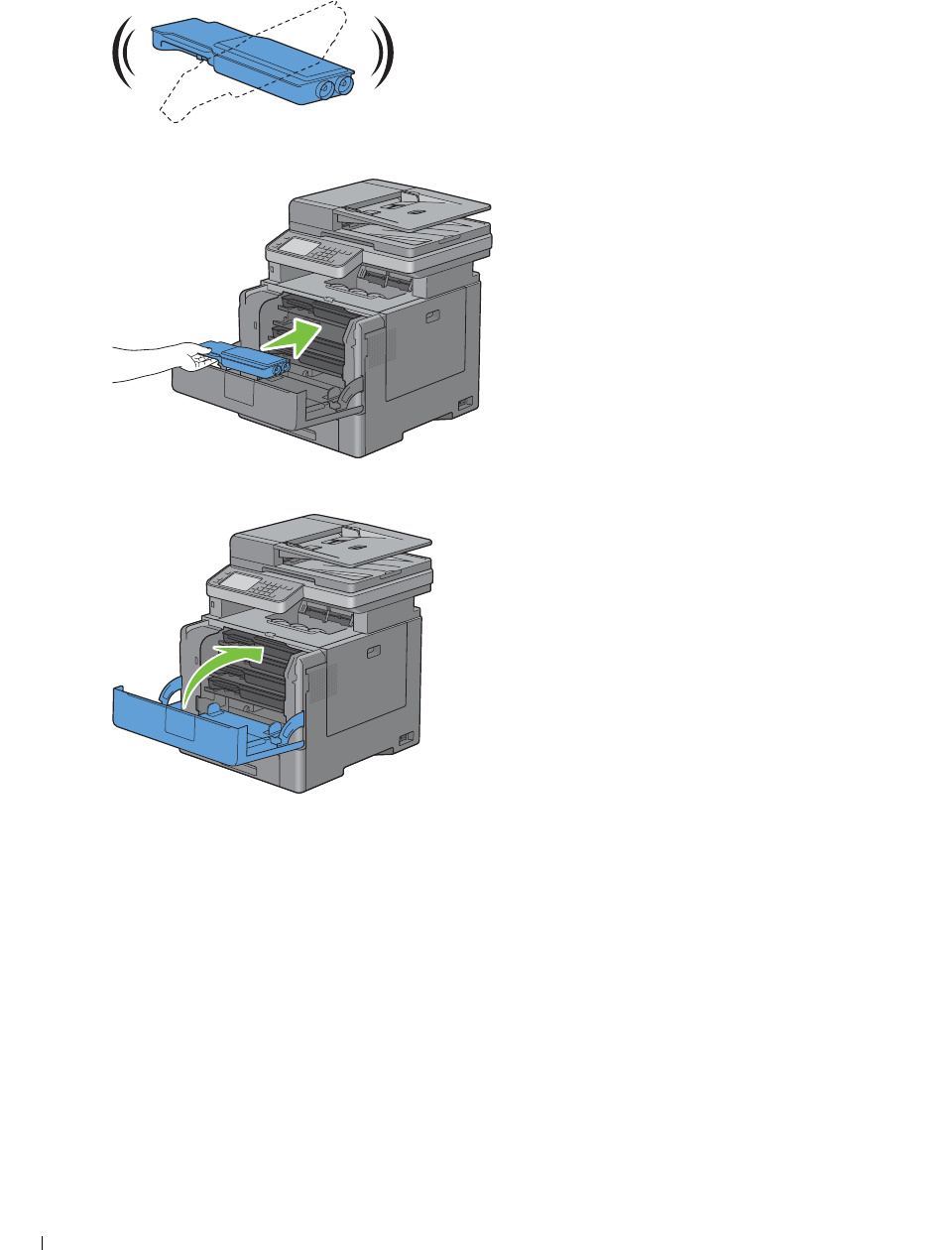
466 Maintaining Your Printer
Installing a Toner Cartridge
1
Unpack a new toner cartridge of the desired color.
2
Shake the new toner cartridge five or six times to distribute the toner evenly.
3
Insert the toner cartridge into the associated cartridge slot, and then push until it stops.
4
Close the front cover.
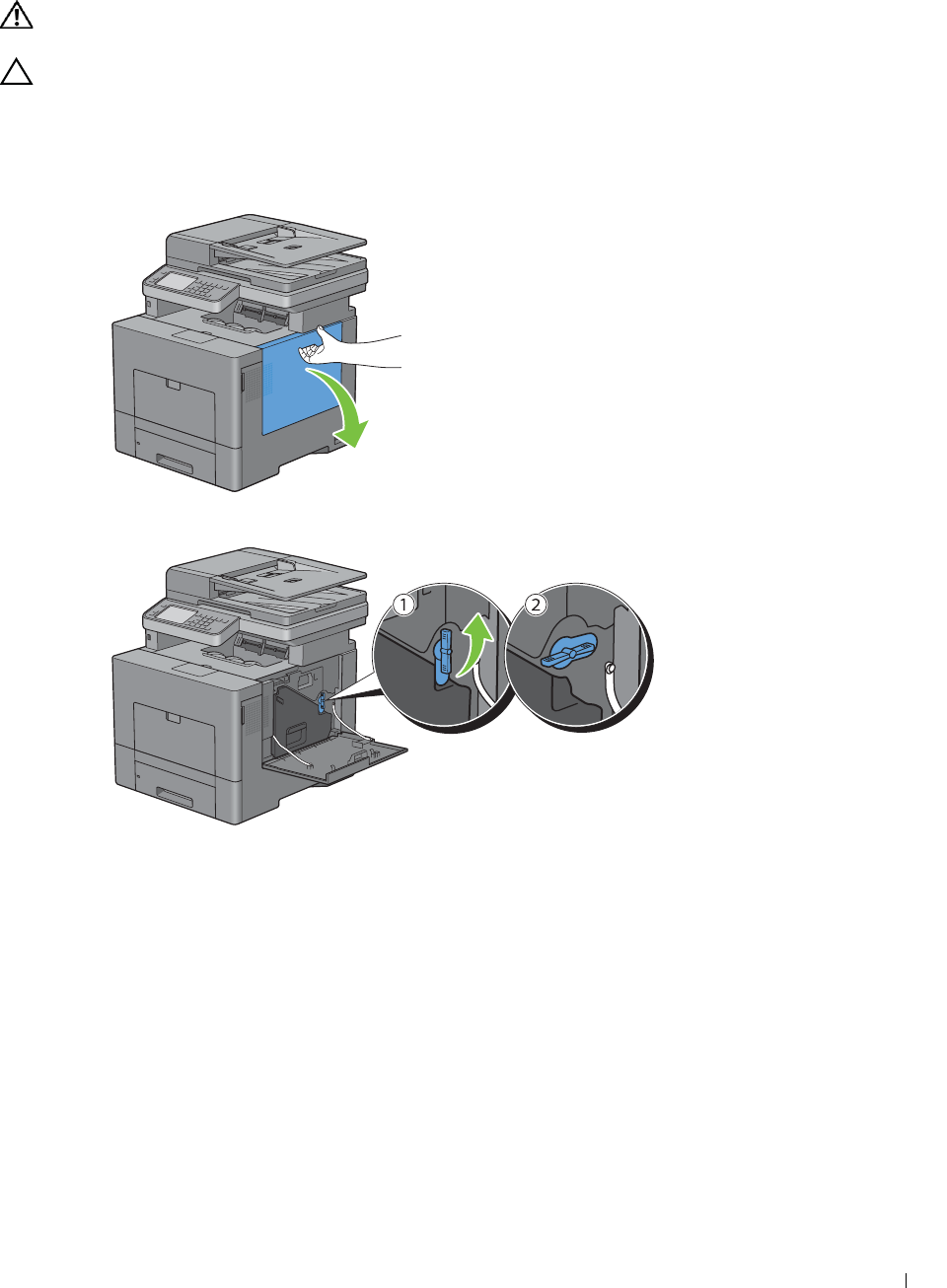
Maintaining Your Printer 467
Replacing the Drum Cartridges
You need to replace all drum cartridges (yellow, magenta, cyan, and black) at a time.
WARNING: Before performing any of the following procedures, read and follow the safety instructions in the
Product
Information Guide
.
CAUTION: Protect the drum cartridges against bright light. If the right side cover remains open for more than three minutes,
print quality may deteriorate.
Removing the Drum Cartridge
1
Open the right side cover.
2
Turn the waste toner box lock lever 90-degrees counterclockwise to unlock the waste toner box.
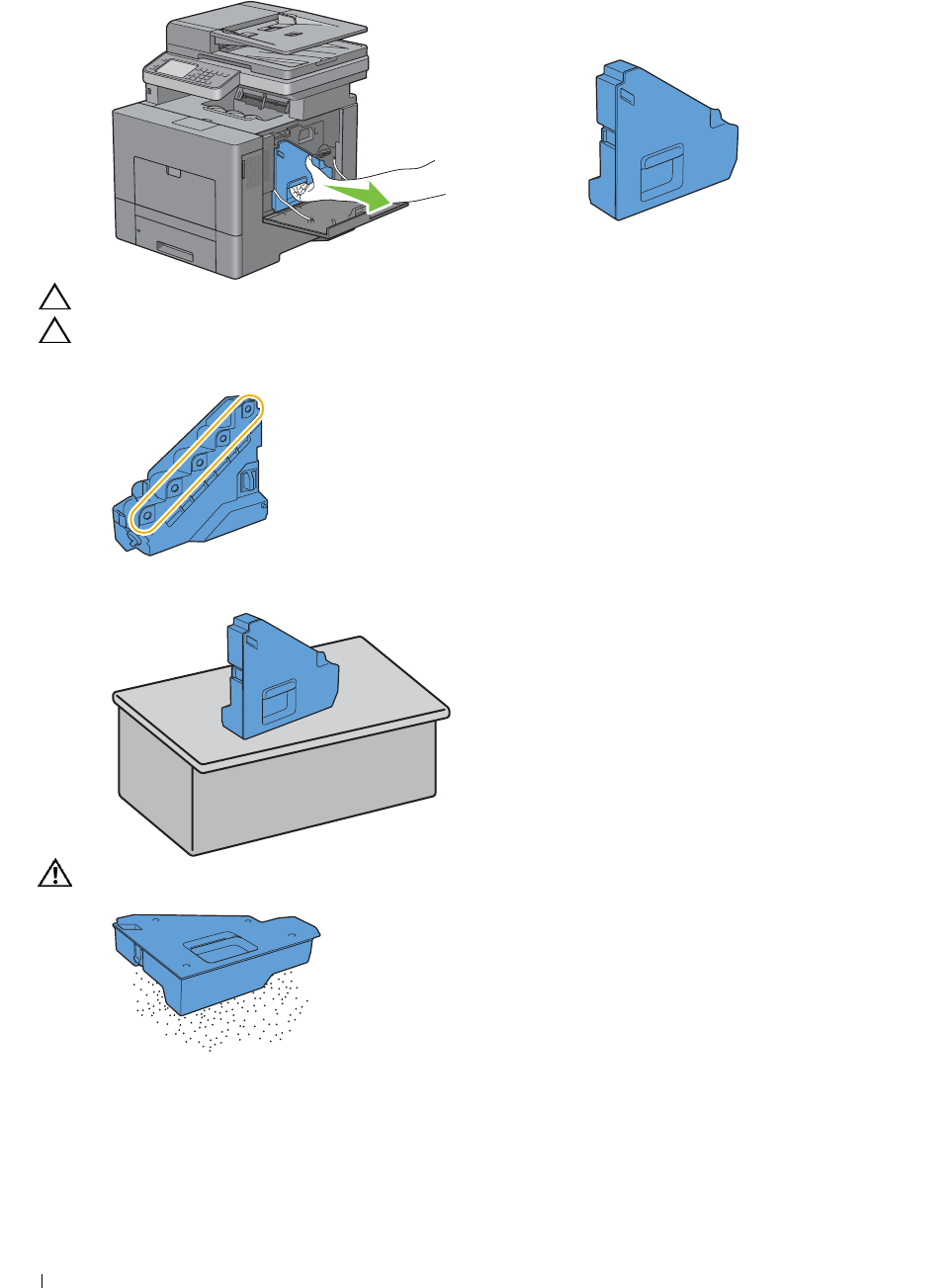
468 Maintaining Your Printer
3
Grasp the handle on the waste toner box and pull it out making sure to hold it upright so that the waste toner does
not spill out.
CAUTION: Take care not to drop the waste toner box while you are removing it.
CAUTION: After removing the waste toner box, do not touch the parts shown in the illustration. Toner can dirty or stain
your hands.
4
Stand the removed waste toner box upright on a level surface.
WARNING: Never lay the waste toner box on its side as this may cause its malfunction or toner spills.
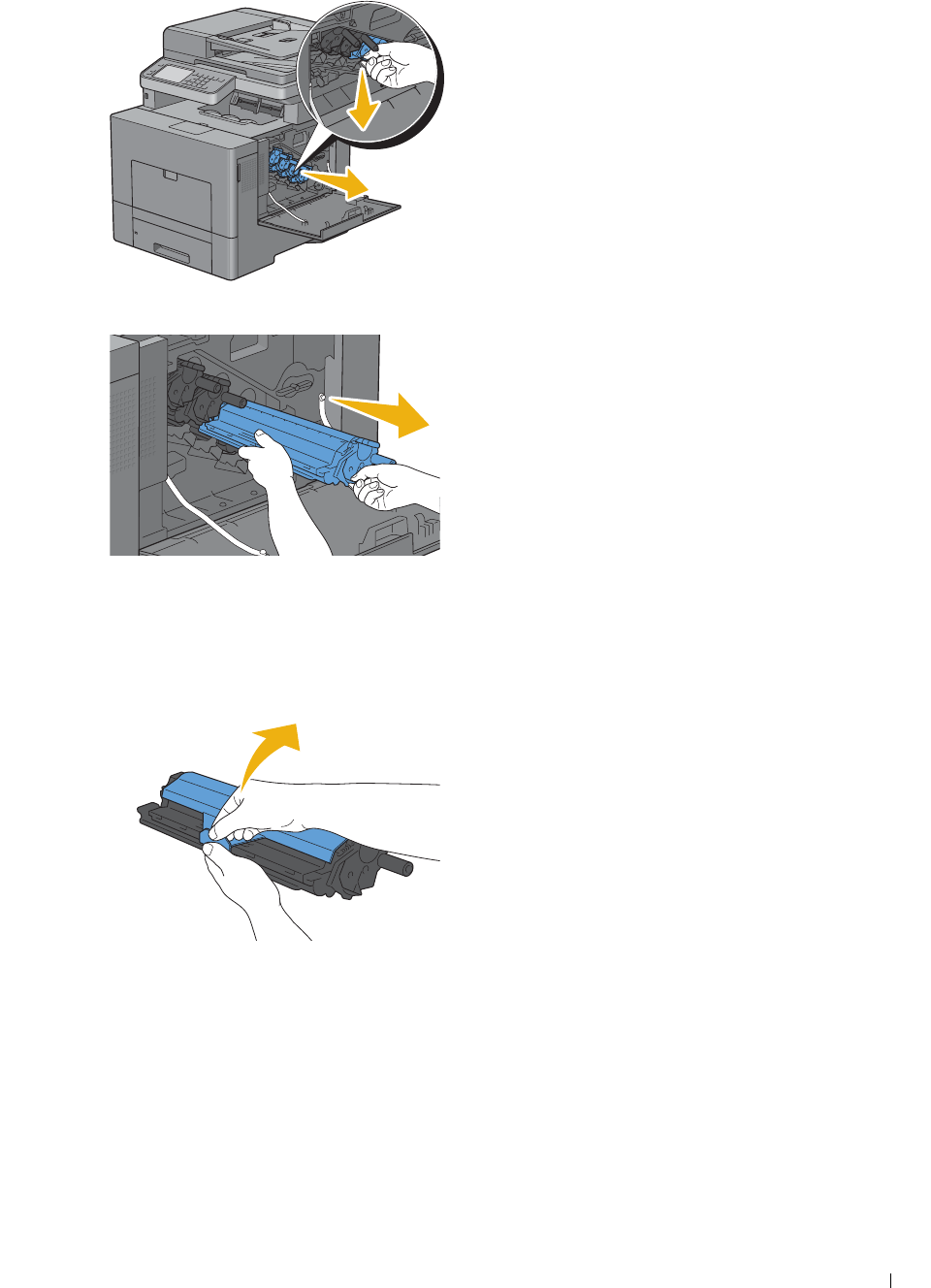
Maintaining Your Printer 469
5
Slightly pressing down the tab on the drum cartridge that you want to replace, pull it out halfway with one hand.
6
Support the drum cartridge with the other hand from underneath, and then pull it out completely.
7
Repeat the steps 5 and 6 to remove the other three cartridges.
Installing a Drum Cartridge
1
Unpack a new drum cartridge of the desired color.
2
Remove the orange protective cover from the drum cartridge.
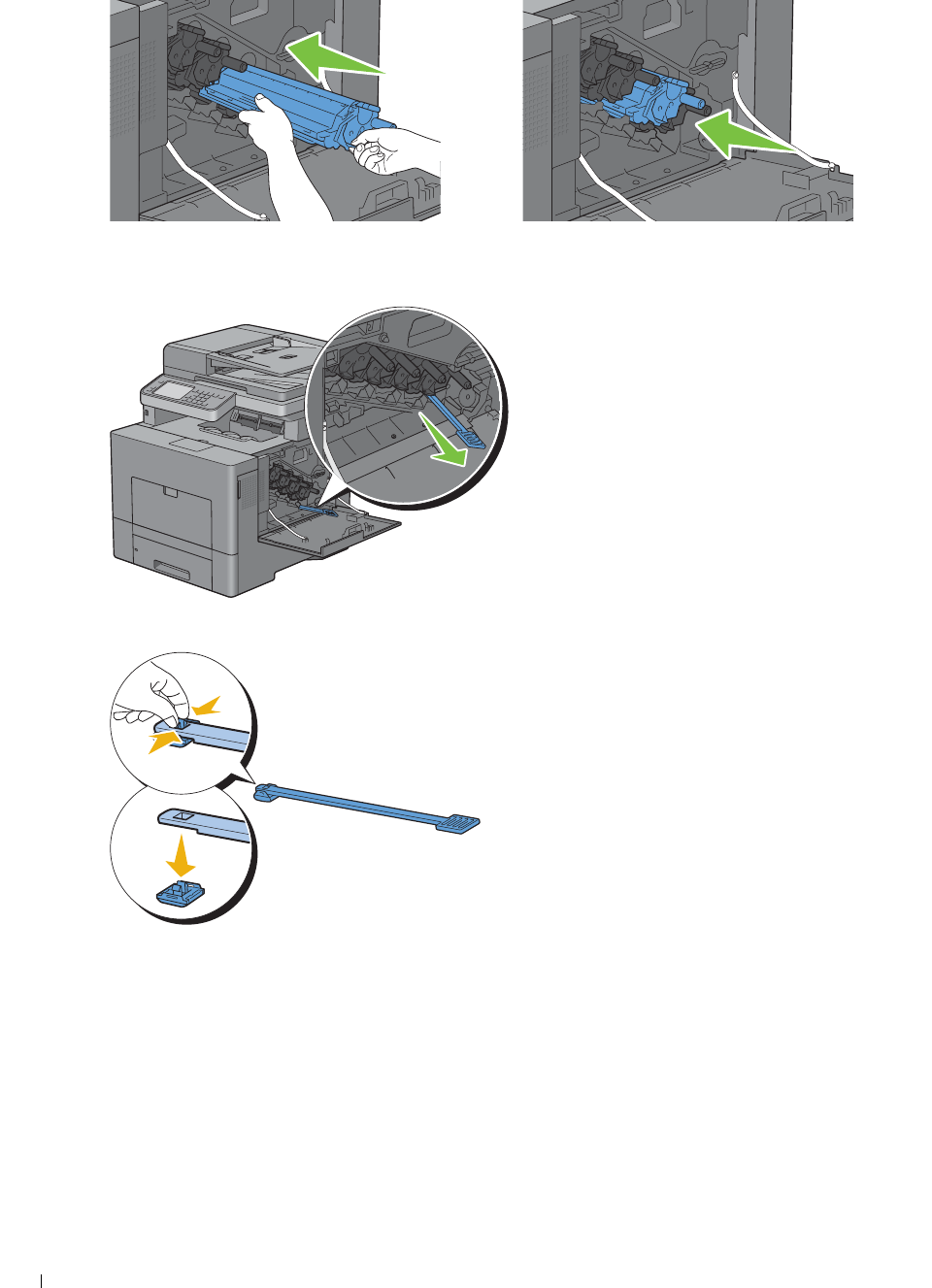
470 Maintaining Your Printer
3
Insert the drum cartridge into the associated cartridge slot, and then push until it stops.
4
Repeat the steps 1 to 3 to insert the other three cartridges.
5
Remove the cleaning rod from inside the printer.
6
Remove the cleaning pad by pressing the white tabs between your thumb and index finger.
7
Unpack a new cleaning pad.
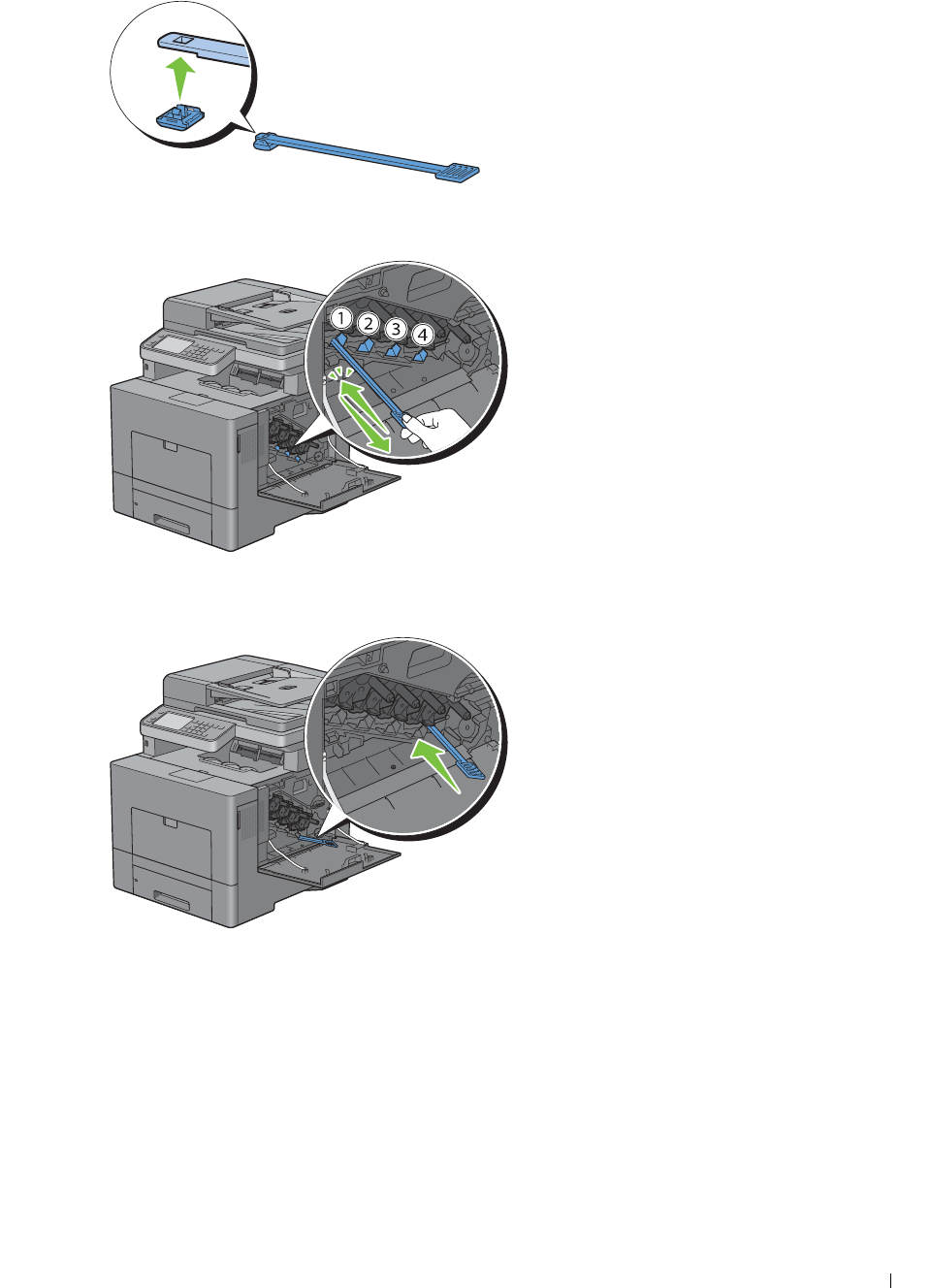
Maintaining Your Printer 471
8
Attach the new cleaning pad to the cleaning rod.
9
Insert the cleaning rod fully into one of the four holes until it clicks into the interior of the printer as illustrated
below, and then pull it out.
10
Repeat step 9 also on the other three holes. One time insertion is enough for each hole.
11
Return the cleaning rod to its original location.
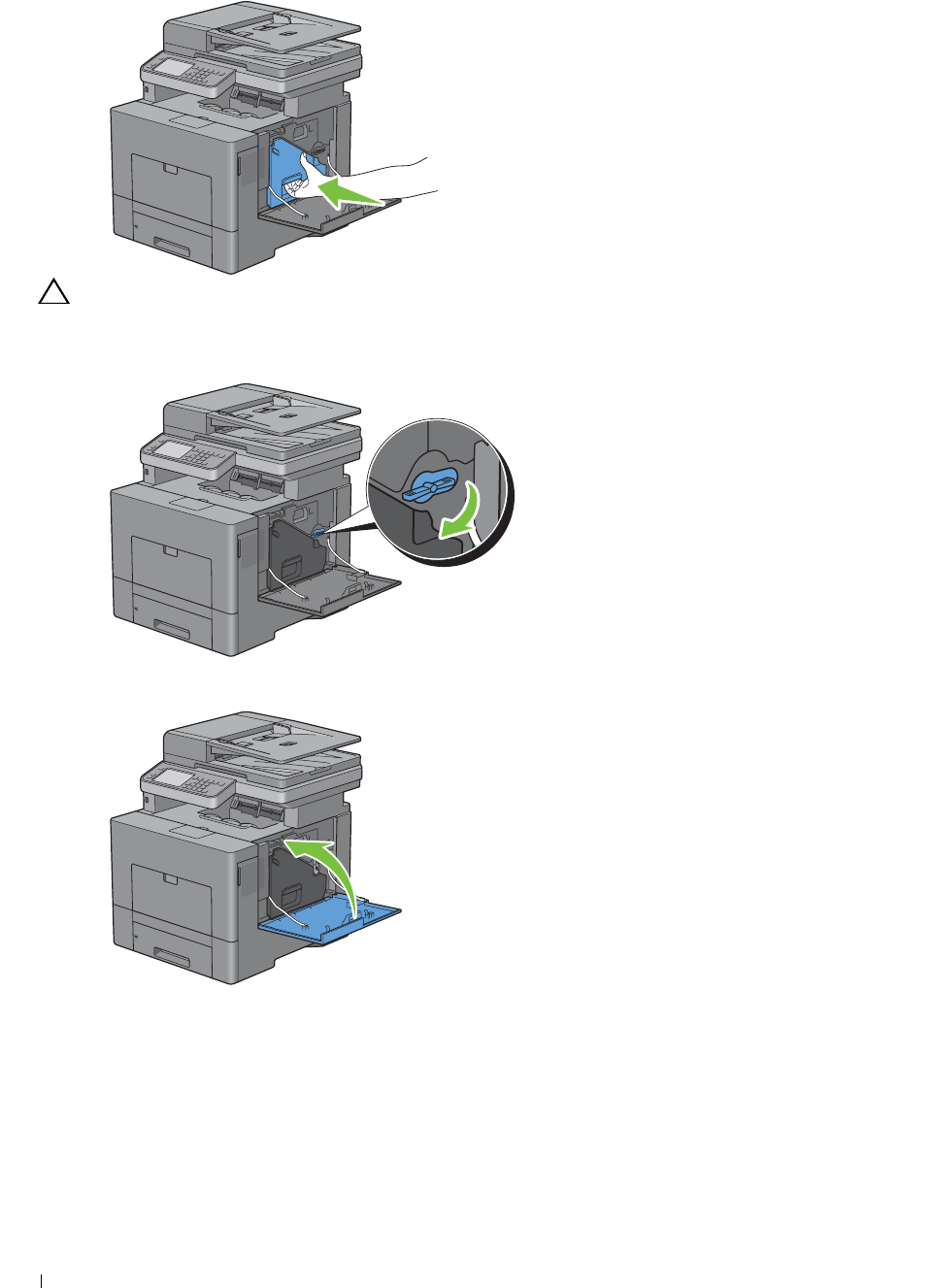
472 Maintaining Your Printer
12
Reinsert the removed waste toner box.
CAUTION: If the waste toner box does not fit into place properly, make sure that the drum cartridge is fully inserted in
the previous step.
13
Turn the waste toner box lock lever 90-degrees clockwise to lock the waste toner box.
14
Close the right side cover.
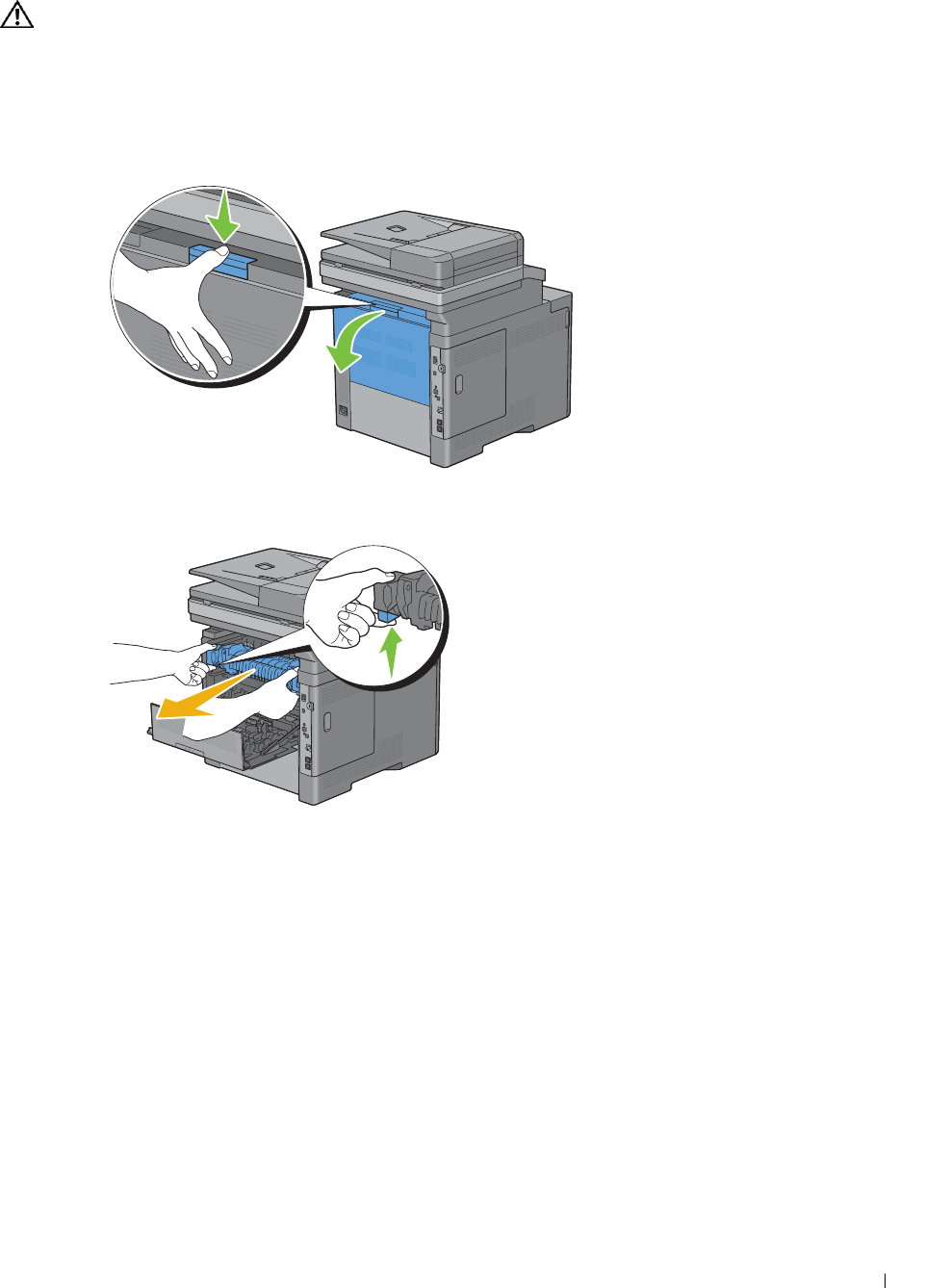
Maintaining Your Printer 473
Replacing the Fusing Unit
WARNING: Before performing any of the following procedures, read and follow the safety instructions in the
Product
Information Guide
.
Removing the Fusing Unit
1
Turn off the printer and wait for 30 minutes.
2
Push down the latch to open the rear cover.
3
Grasp the grips on both sides of the fusing unit squeezing the lever under the left side grip, and then pull out the
unit.
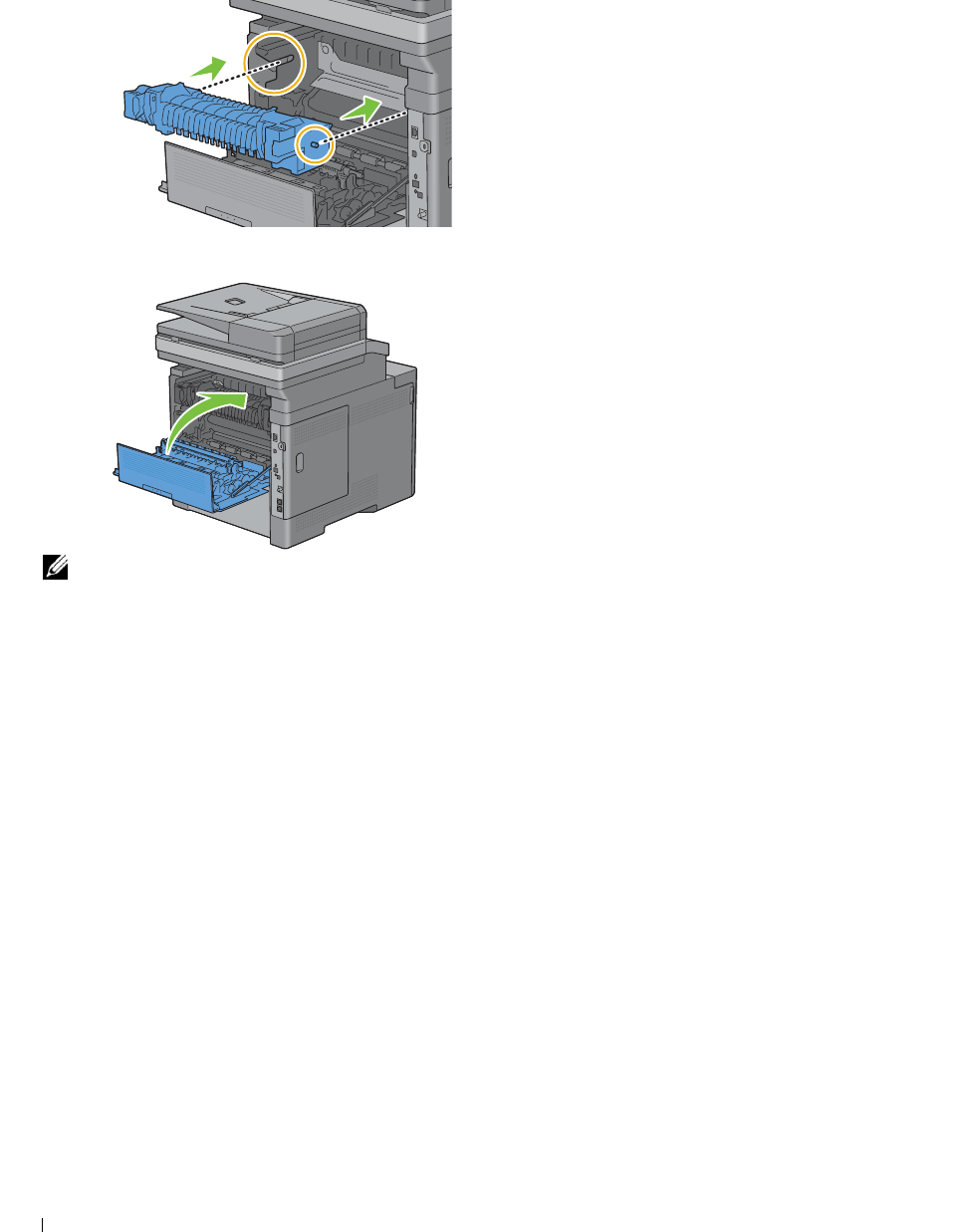
474 Maintaining Your Printer
Installing a Fusing Unit
1
Unpack a new fusing unit.
2
Make sure that the two tabs of the fusing unit align with the grooves on the printer, and then insert it into the
printer until it clicks.
3
Close the rear cover.
NOTE: After replacing the fusing unit, be sure to initialize its life counter by following the instructions in the accompanying
manual.
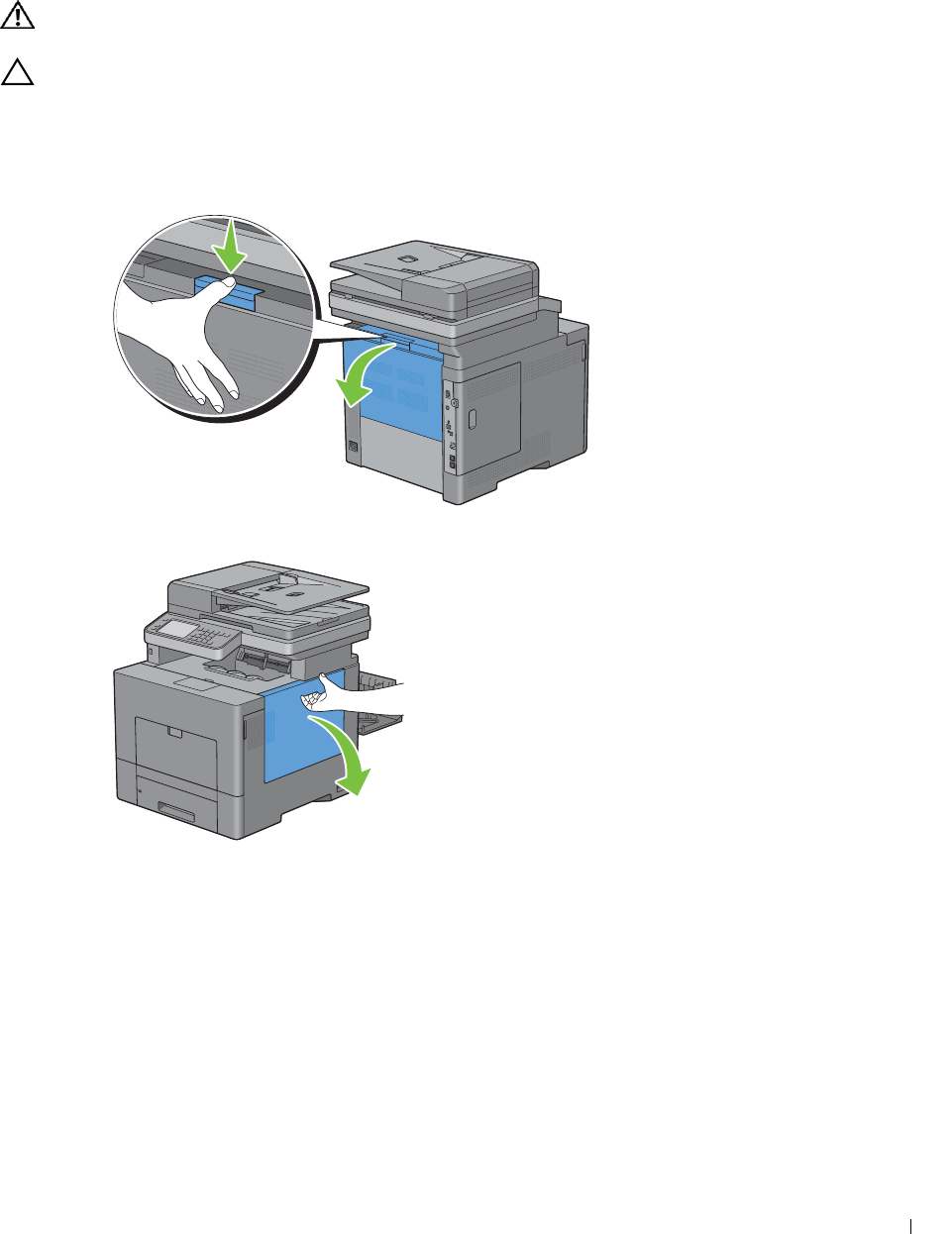
Maintaining Your Printer 475
Replacing the Transfer Belt Unit, the 2nd Belt Transfer Roller (2nd BTR),
and the Retard Roller
You need to replace all three parts (transfer belt unit, 2nd BTR, and retard roller) at a time. Both the 2nd BTR and
the retard roller for replacement come with a new transfer belt unit.
WARNING: Before performing any of the following procedures, read and follow the safety instructions in the
Product
Information Guide
.
CAUTION: Ensure nothing touches or scratches the surface (black-colored film) of the transfer belt unit. Scratches, dirt, or oil
from your hands on the film of the transfer belt unit may reduce print quality.
Removing the Transfer Belt Unit
1
Push down the latch to open the rear cover.
2
Open the right side cover.
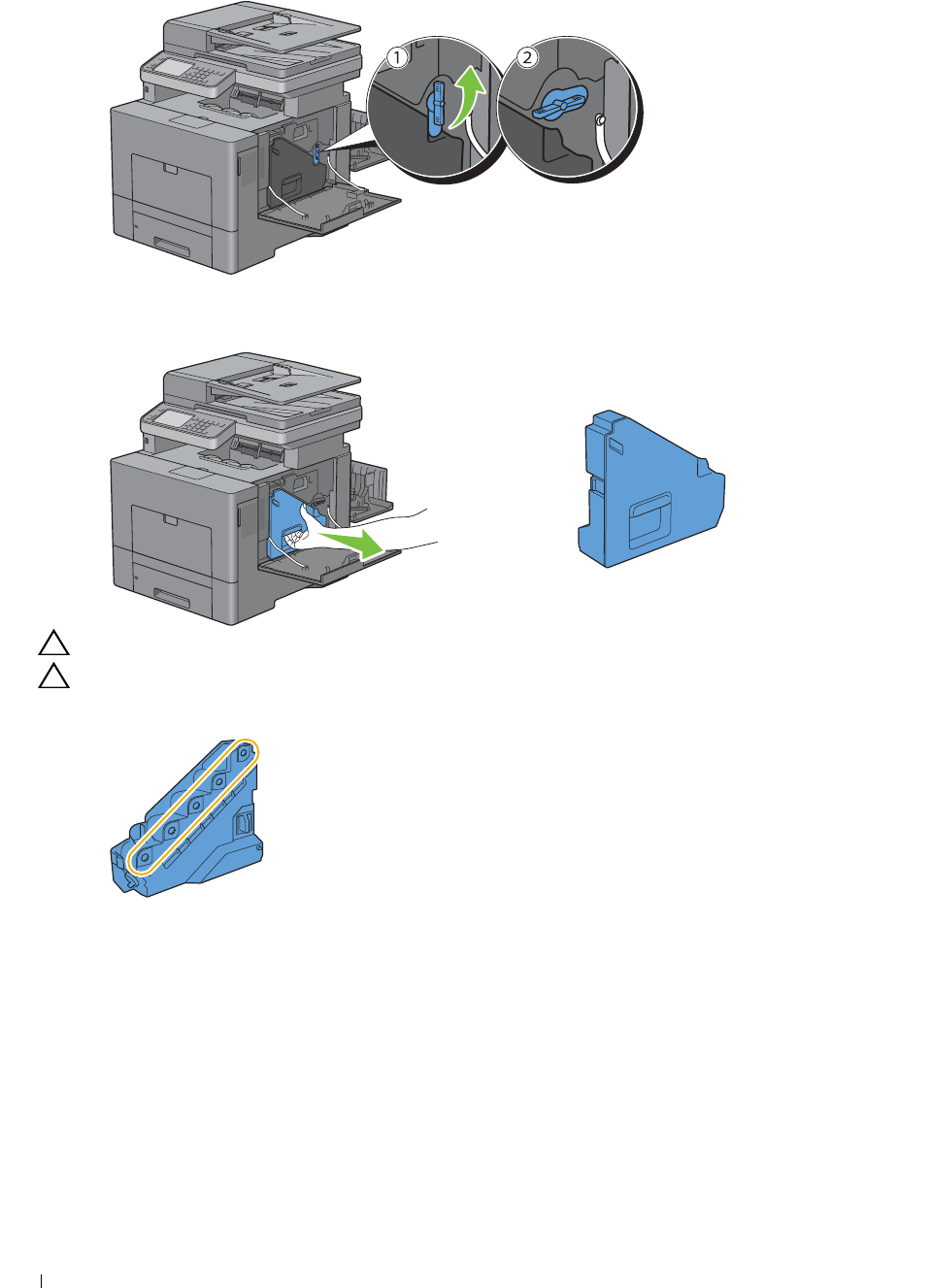
476 Maintaining Your Printer
3
Turn the waste toner box lock lever 90-degrees counterclockwise to unlock the waste toner box.
4
Grasp the handle on the waste toner box and pull it out making sure to hold it upright so that the waste toner does
not spill out.
CAUTION: Take care not to drop the waste toner box while you are removing it.
CAUTION: After removing the waste toner box, do not touch the parts shown in the illustration. Toner can dirty or stain
your hands.
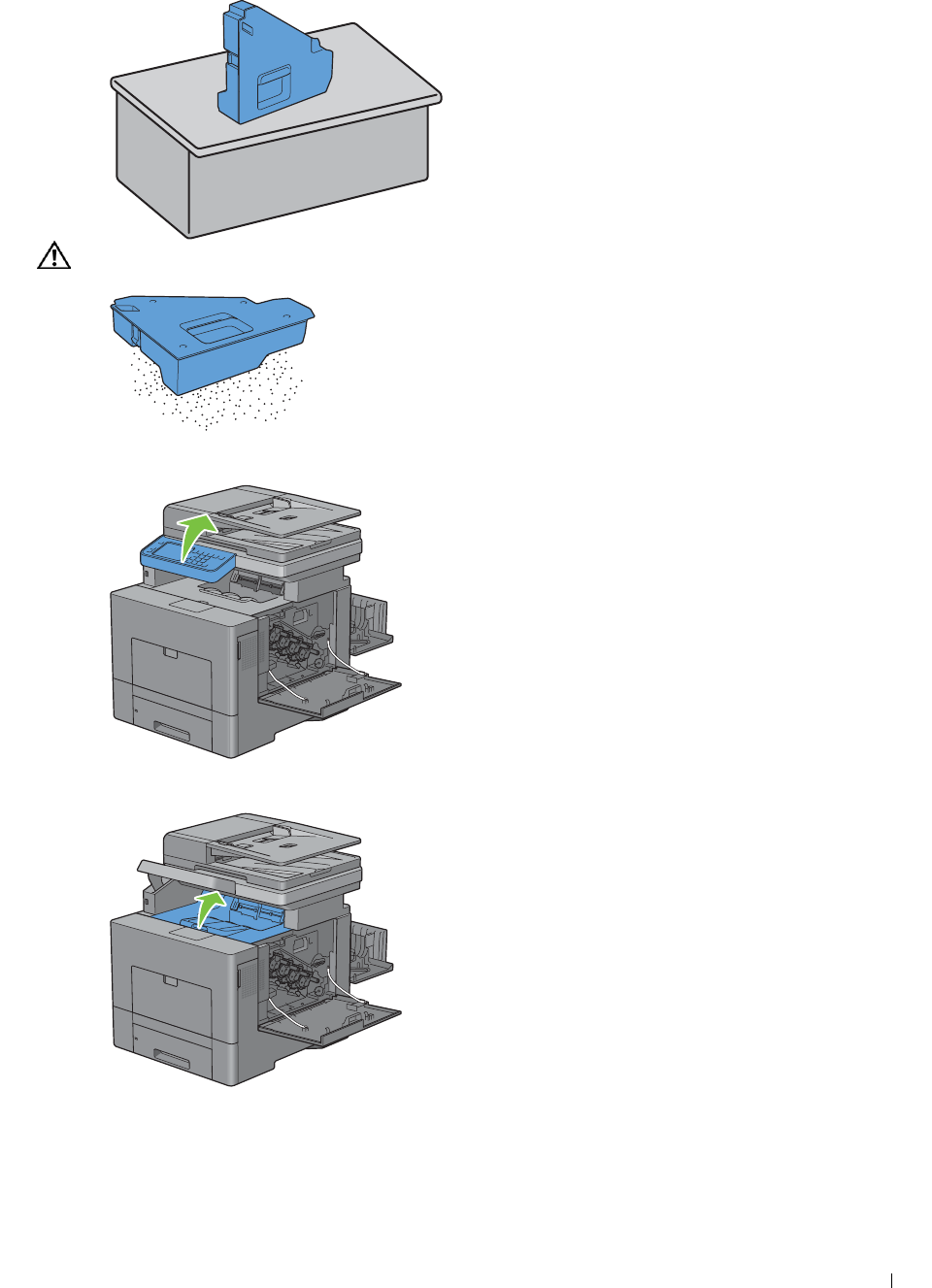
Maintaining Your Printer 477
5
Stand the removed waste toner box upright on a level surface.
WARNING: Never lay the waste toner box on its side as this may cause its malfunction or toner spills.
6
Lift the operator panel.
7
Open the top cover.
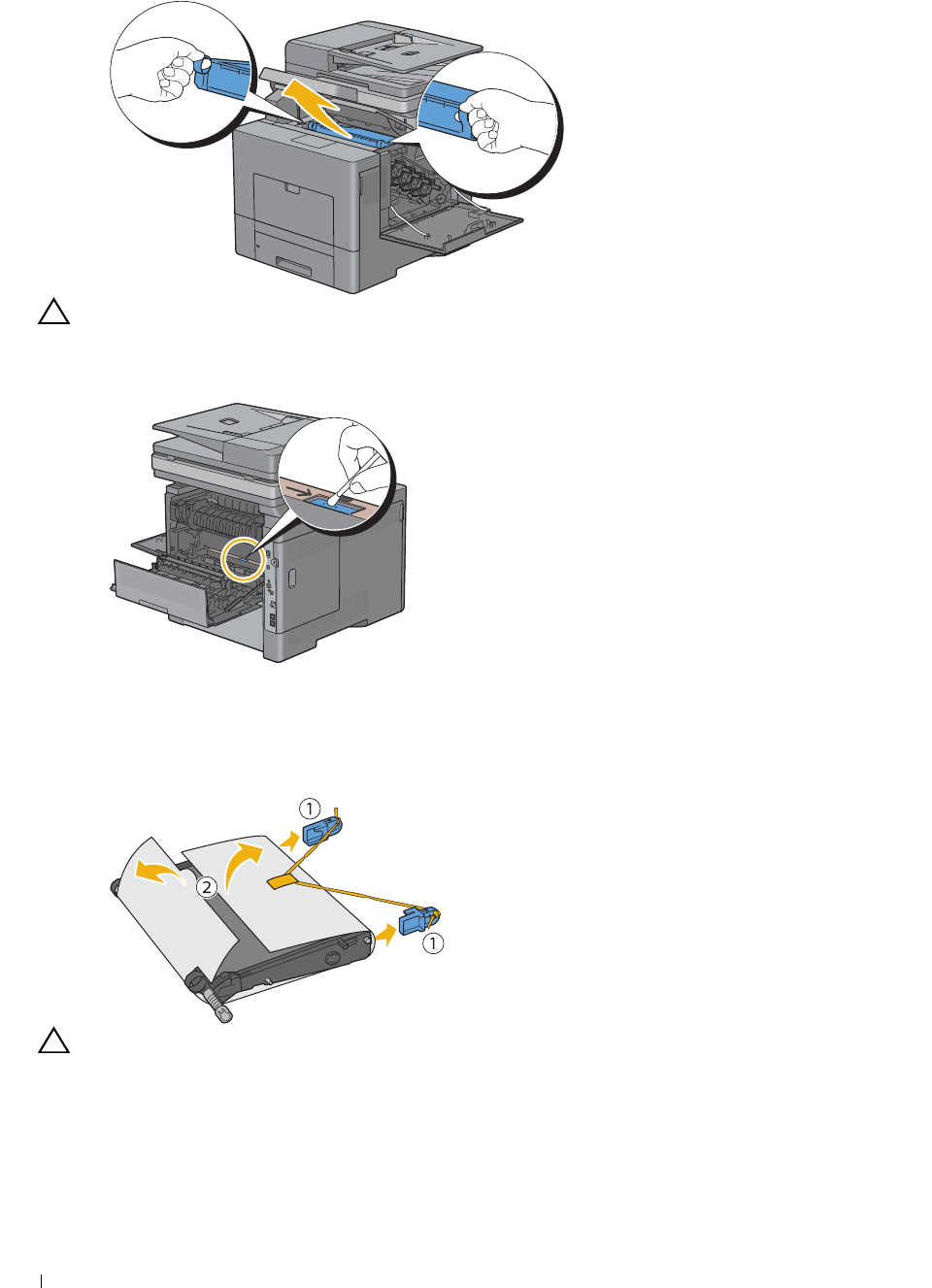
478 Maintaining Your Printer
8
Put your fingers through the loops on both sides of the transfer belt unit, and then pull it out.
CAUTION: If you cannot pull out the unit from the printer, make sure that all of the above procedures are performed
properly.
9
Clean the CTD sensor (as shown) with a clean, dry cotton swab.
Installing a Transfer Belt Unit
1
Unpack a new transfer belt unit.
2
Remove the two orange packing materials first, and then the protective sheet from the transfer belt unit.
CAUTION: Ensure nothing touches or scratches the surface (black-colored film) of the transfer belt unit. Scratches, dirt,
or oil from your hands on the film of the transfer belt unit may reduce print quality.
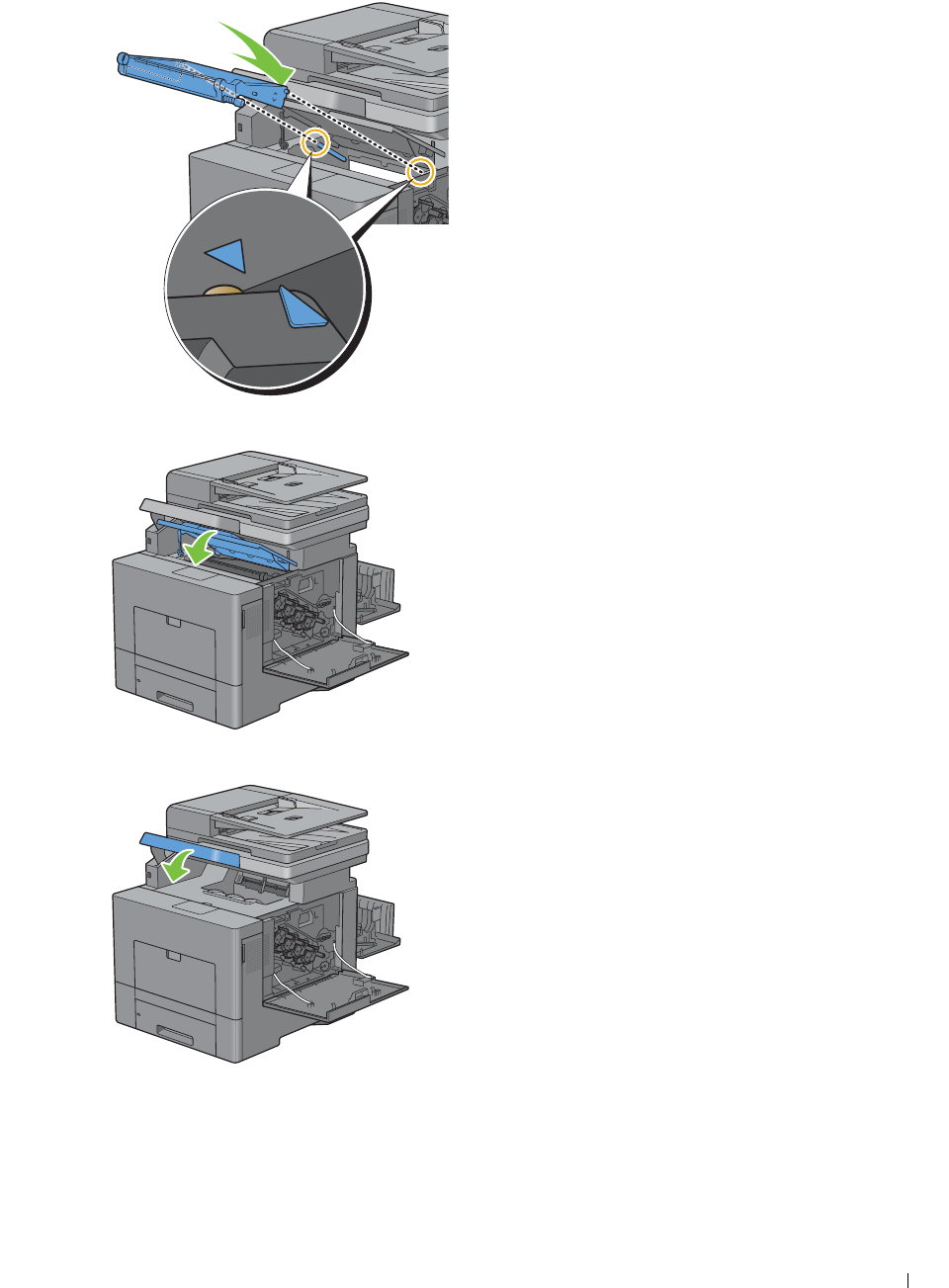
Maintaining Your Printer 479
3
Make sure that the arrow marks on the transfer belt unit and the printer face each other, and then insert the unit
into the printer until it clicks.
4
Close the top cover.
5
Lower the operator panel back in place.
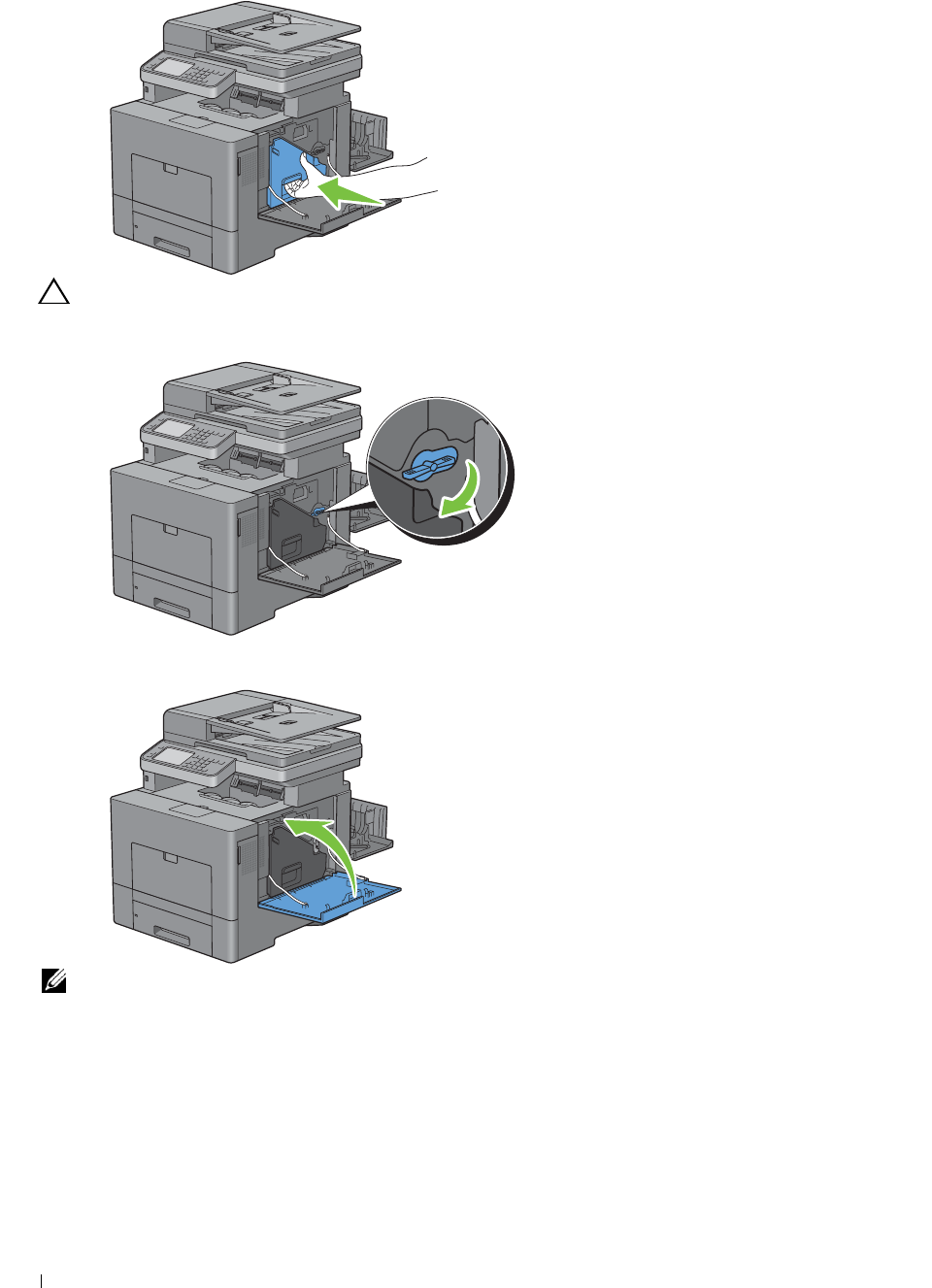
480 Maintaining Your Printer
6
Reinsert the removed waste toner box.
CAUTION: If the waste toner box does not fit into place properly, make sure that the transfer belt unit is fully inserted.
7
Turn the waste toner box lock lever 90-degrees clockwise to lock the waste toner box.
8
Close the right side cover.
NOTE: After replacing the transfer belt unit, be sure to initialize its life counter by following the instructions in the
accompanying manual.
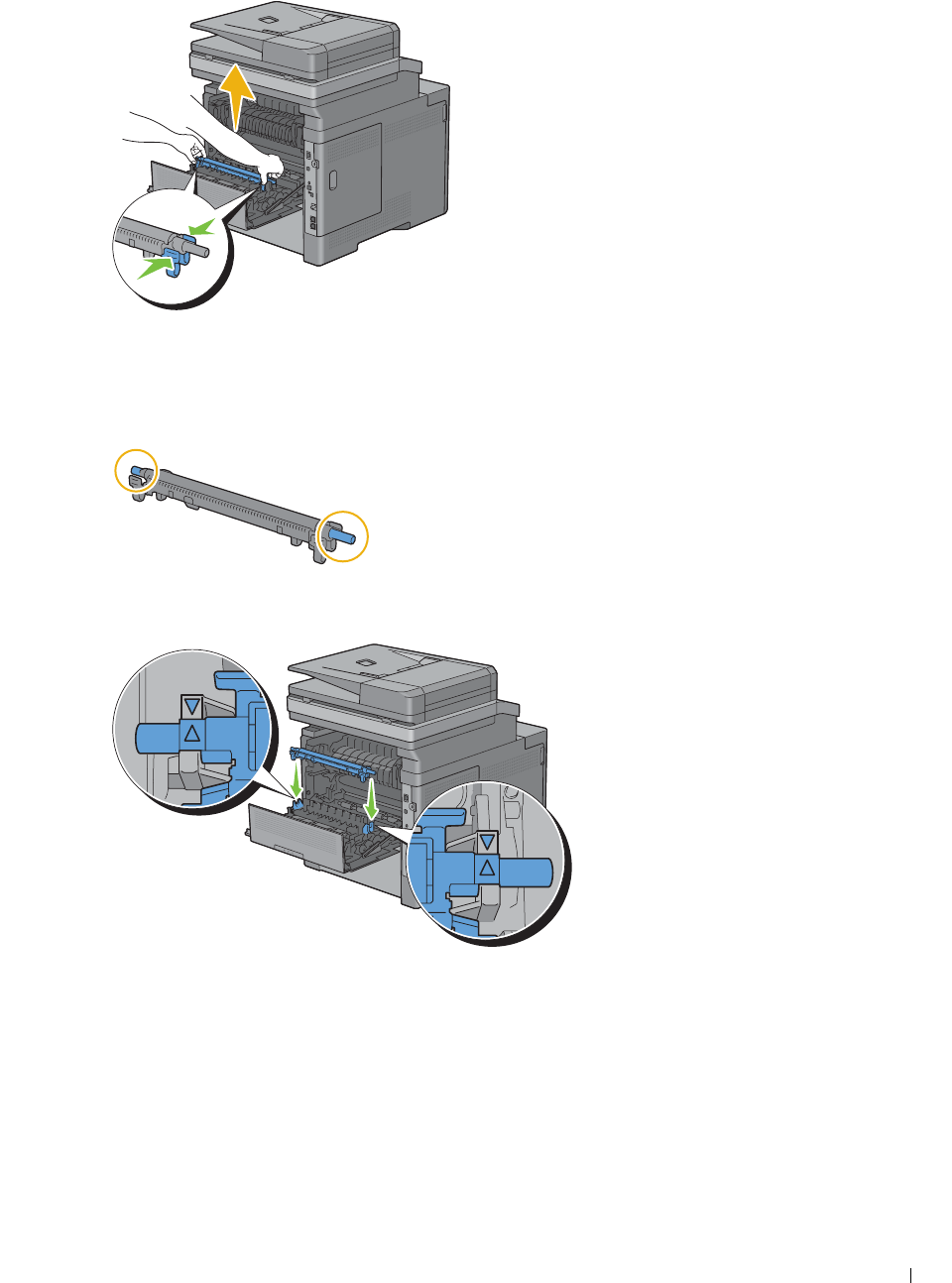
Maintaining Your Printer 481
Removing the 2nd BTR
1
Pinching the tabs on both sides of the 2nd BTR, lift it out of the printer.
Installing a 2nd BTR
1
Unpack a new 2nd BTR.
2
Hold the 2nd BTR by both its ends.
3
Make sure that the arrow marks on the 2nd BTR and the printer face each other, and then press down the 2nd BTR
until it clicks.
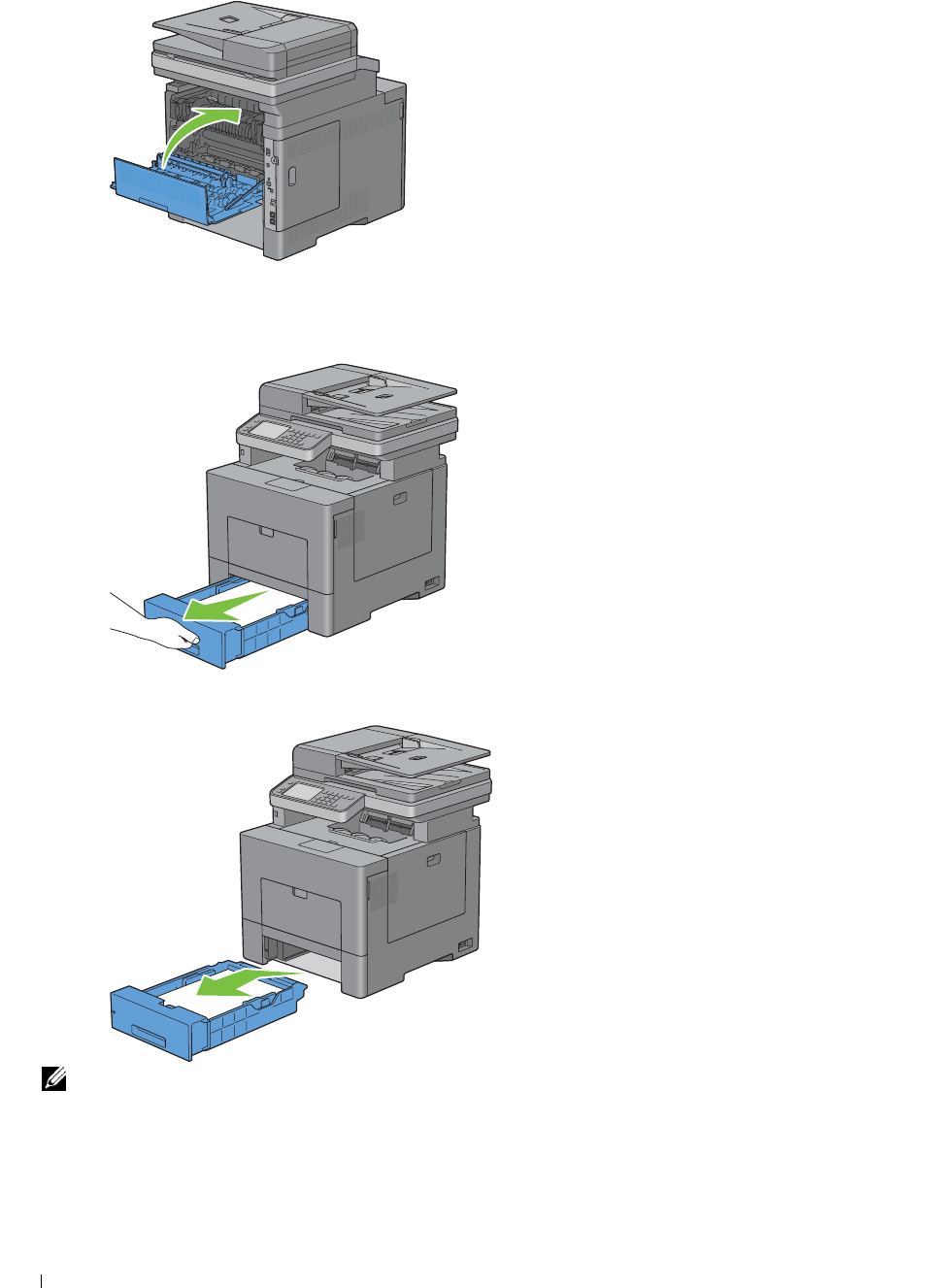
482 Maintaining Your Printer
4
Close the rear cover.
Removing the Retard Roller in Tray1
1
Pull tray1 out of the printer about 200 mm.
2
Hold tray1 with both hands, and remove it from the printer.
NOTE: Ensure that you remove all the paper from tray1 before removing the retard roller.
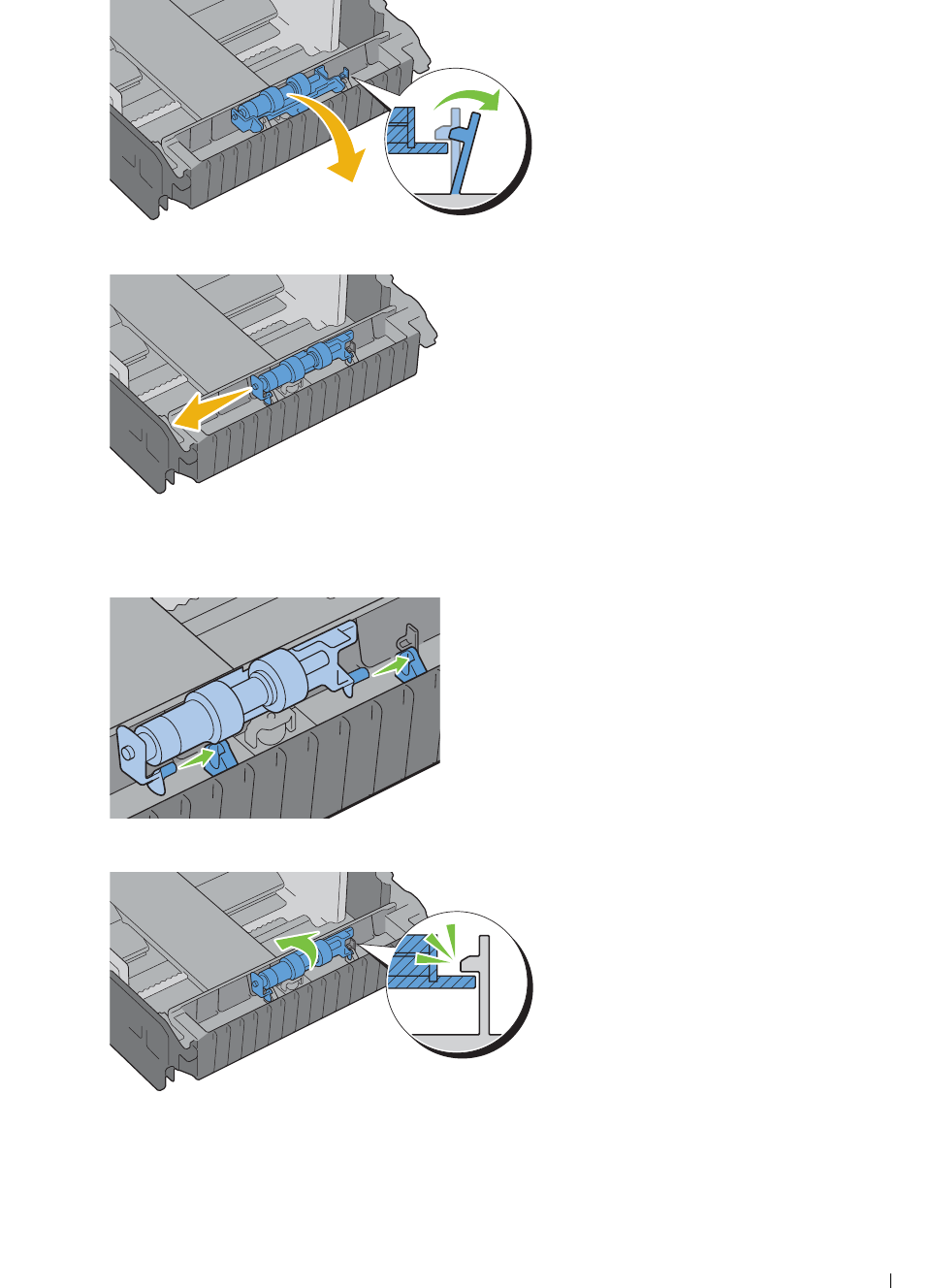
Maintaining Your Printer 483
3
Slightly pressing down the lock lever on tray1 to the right with one hand, raise the retard roller with the other hand.
4
Slide the retard roller to the left to remove it from tray1.
Installing a Retard Roller in Tray1
1
Slide the two axles of the retard roller into the holes on tray1.
2
Press down the retard roller until it snaps.
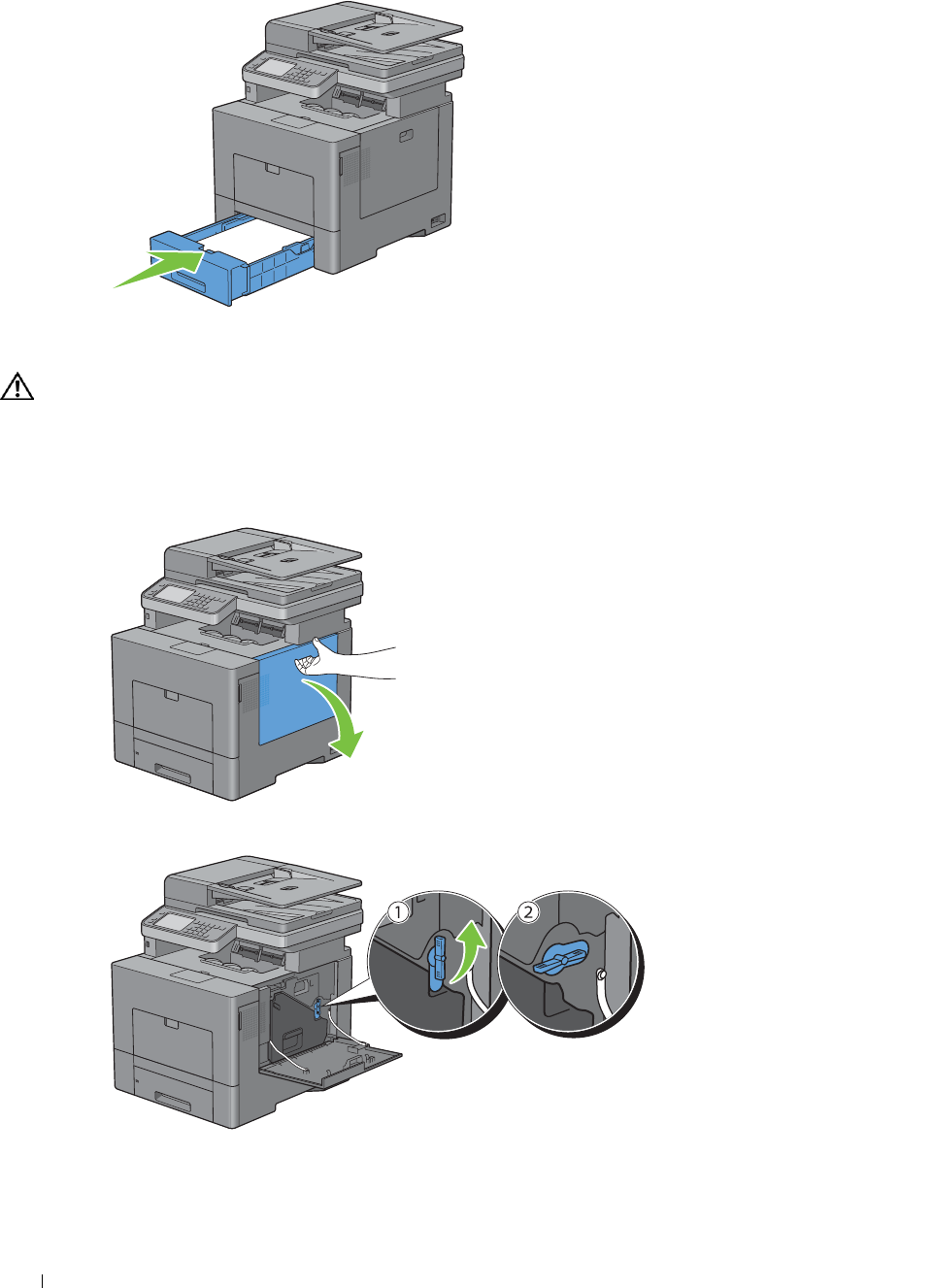
484 Maintaining Your Printer
3
Load paper in tray1, and then insert the tray into the printer and push until it stops.
Replacing the Waste Toner Box
WARNING: Before performing any of the following procedures, read and follow the safety instructions in the
Product
Information Guide
.
Removing the Waste Toner Box
1
Open the right side cover.
2
Turn the waste toner box lock lever 90-degrees counterclockwise to unlock the waste toner box.
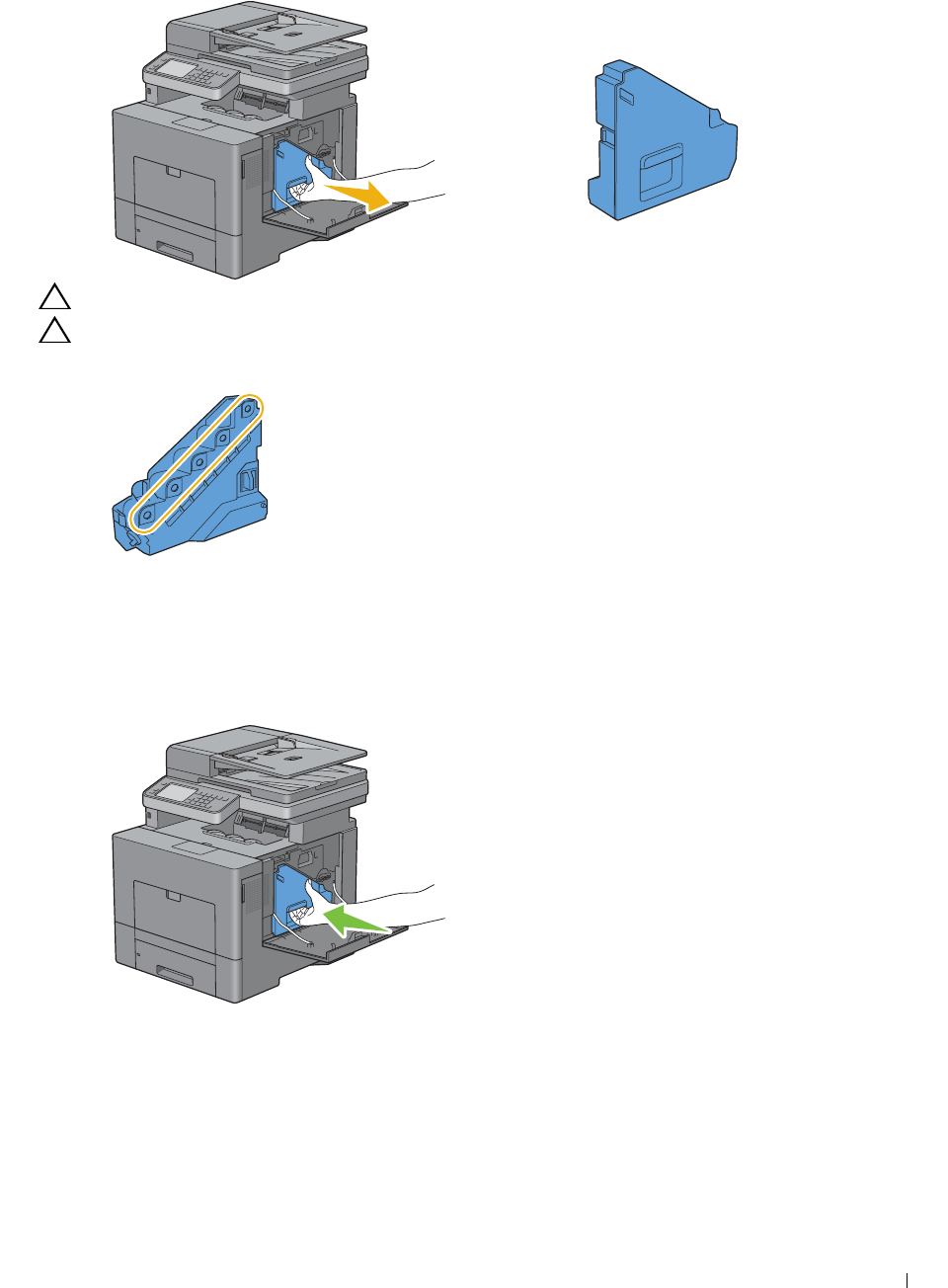
Maintaining Your Printer 485
3
Grasp the handle on the waste toner box and pull it out making sure to hold it upright so that the waste toner does
not spill out.
CAUTION: Take care not to drop the waste toner box while you are removing it.
CAUTION: After removing the waste toner box, do not touch the parts shown in the illustration. Toner can dirty or stain
your hands.
4
Insert the used waste toner box into the plastic bag that came with the new waste toner box and seal the bag.
Installing a Waste Toner Box
1
Unpack a new waste toner box.
2
Insert the waste toner box.
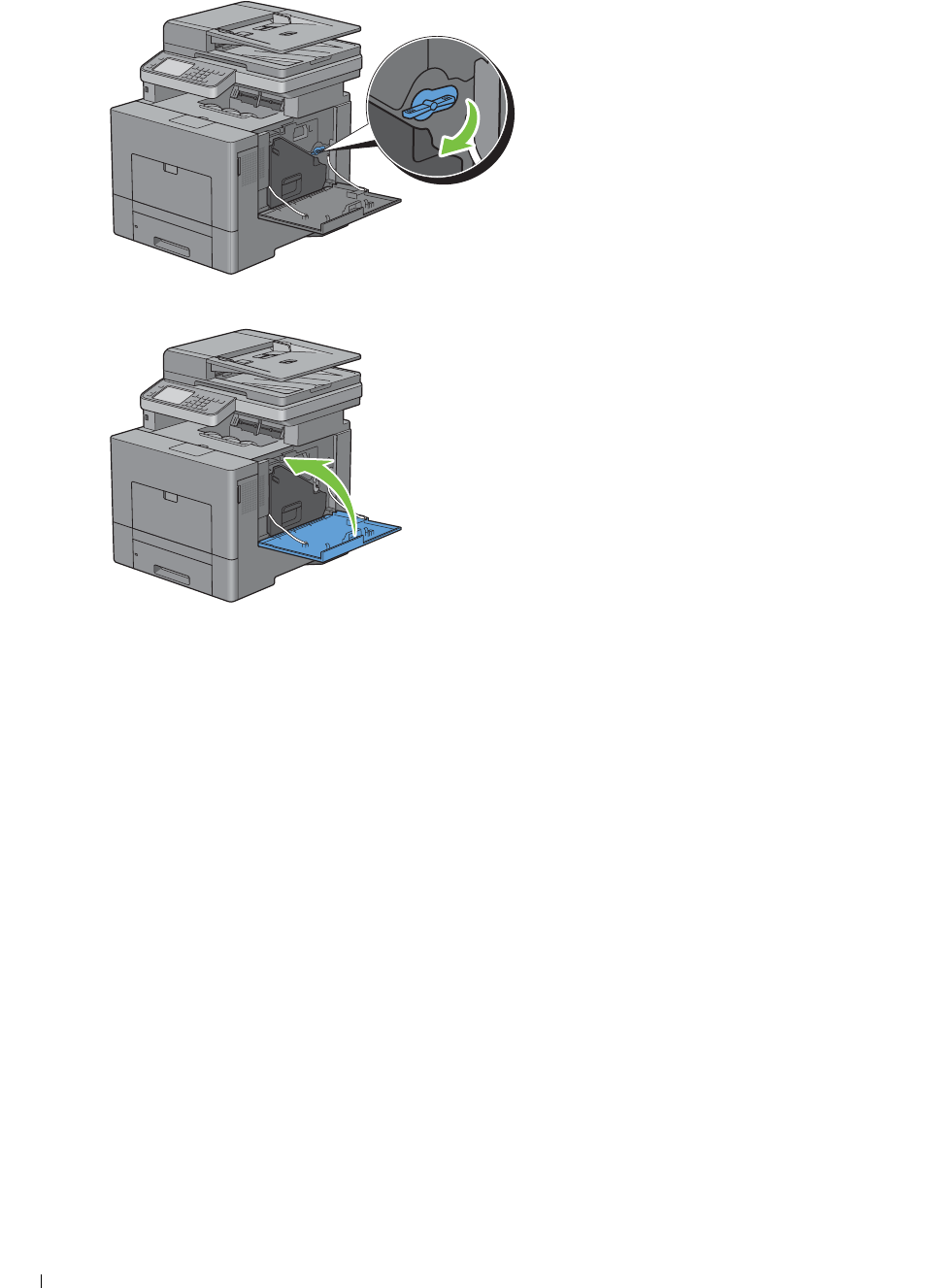
486 Maintaining Your Printer
3
Turn the waste toner box lock lever 90-degrees clockwise to lock the waste toner box.
4
Close the right side cover.
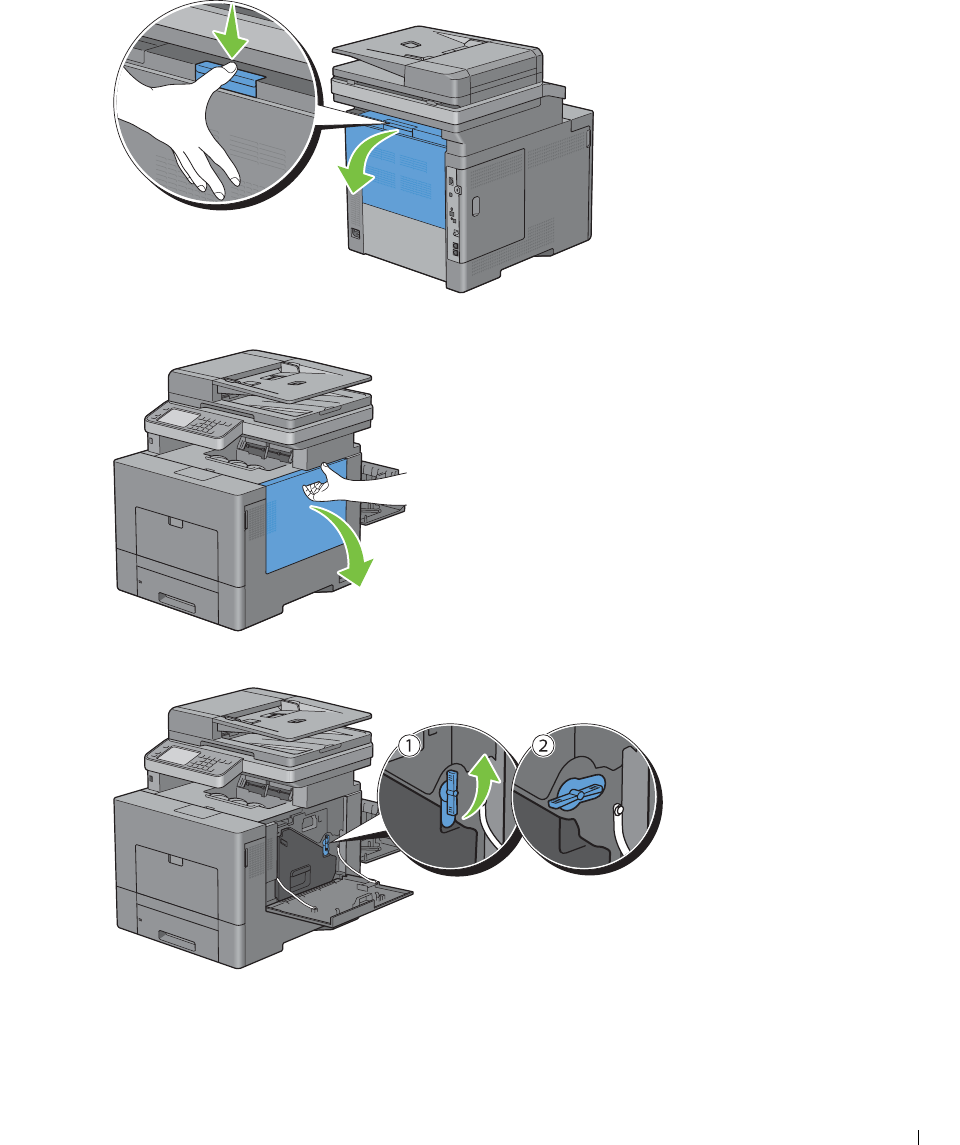
Maintaining Your Printer 487
Cleaning Inside the Printer
Cleaning the CTD Sensor
Clean the Color Toner Density (CTD) sensor only when an alert for the CTD sensor is shown on the Status Monitor
or touch panel screen.
1
Ensure that the printer is turned off.
2
Push down the latch to open the rear cover.
3
Open the right side cover.
4
Turn the waste toner box lock lever 90-degrees counterclockwise to unlock the waste toner box.
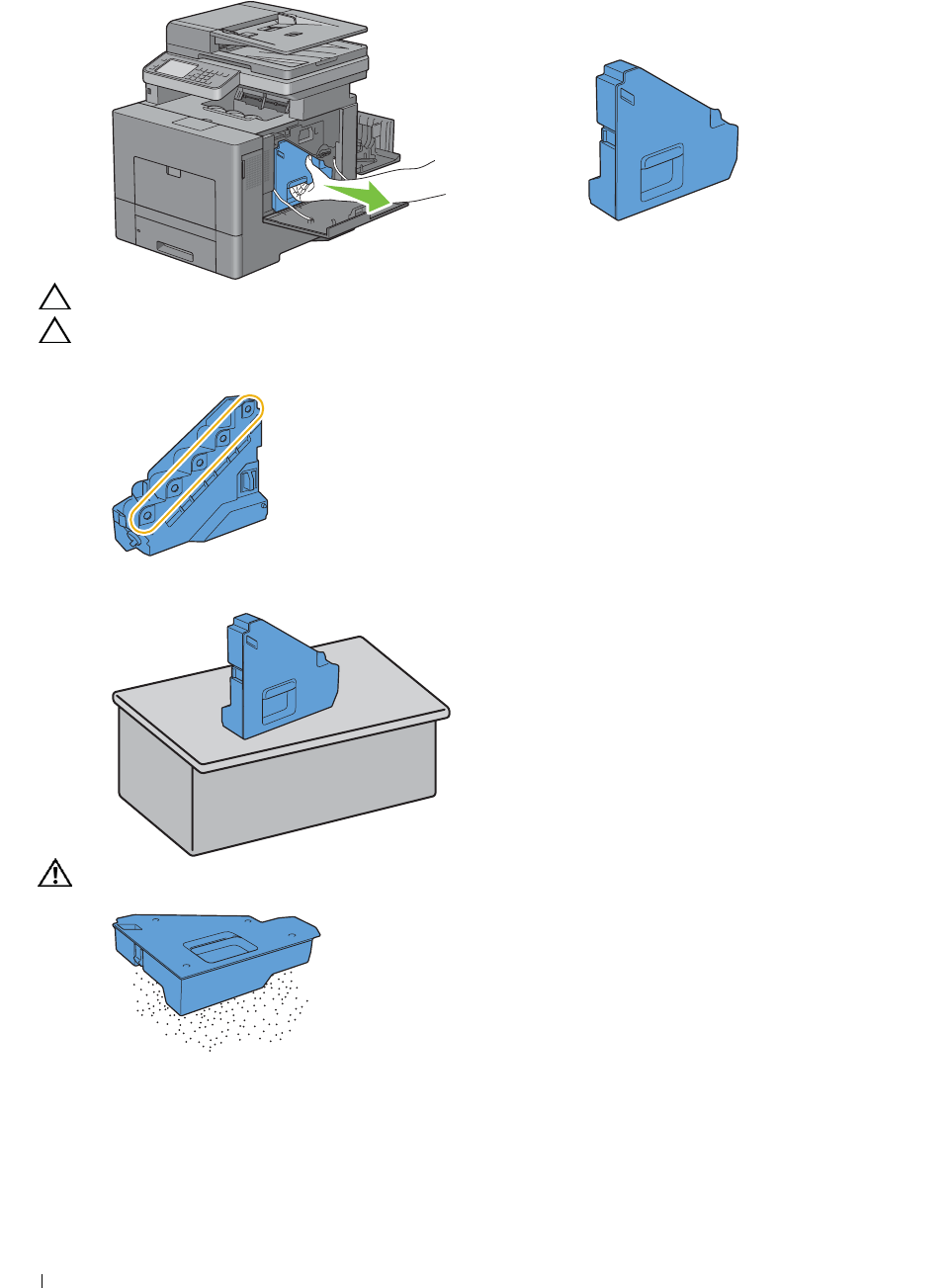
488 Maintaining Your Printer
5
Grasp the handle on the waste toner box and pull it out making sure to hold it upright so that the waste toner does
not spill out.
CAUTION: Take care not to drop the waste toner box while you are removing it.
CAUTION: After removing the waste toner box, do not touch the parts shown in the illustration. Toner can dirty or stain
your hands.
6
Stand the removed waste toner box upright on a level surface.
WARNING: Never lay the waste toner box on its side as this may cause its malfunction or toner spills.
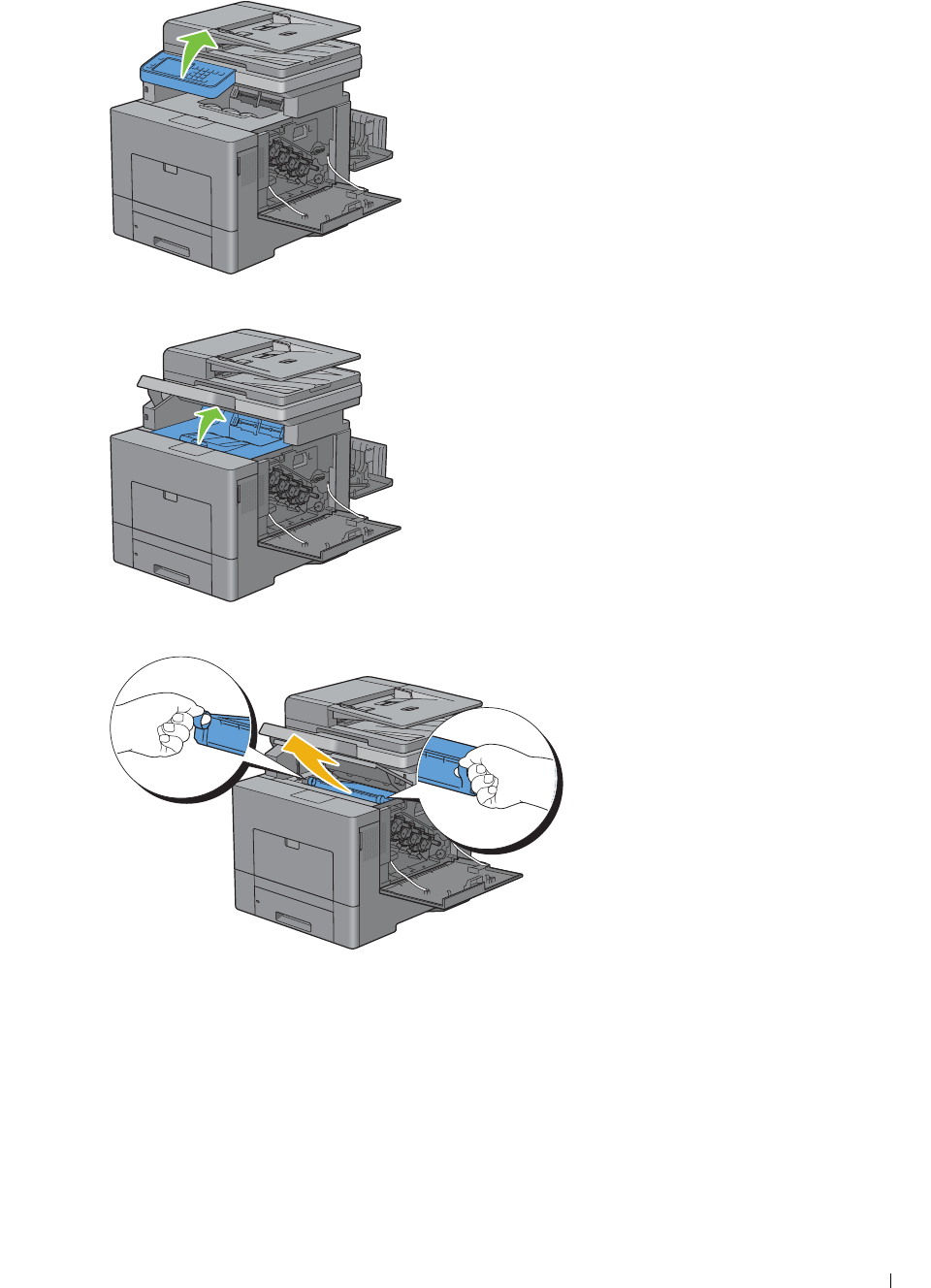
Maintaining Your Printer 489
7
Lift the operator panel.
8
Open the top cover.
9
Put your fingers through the loops on both sides of the transfer belt unit, and then pull it out.
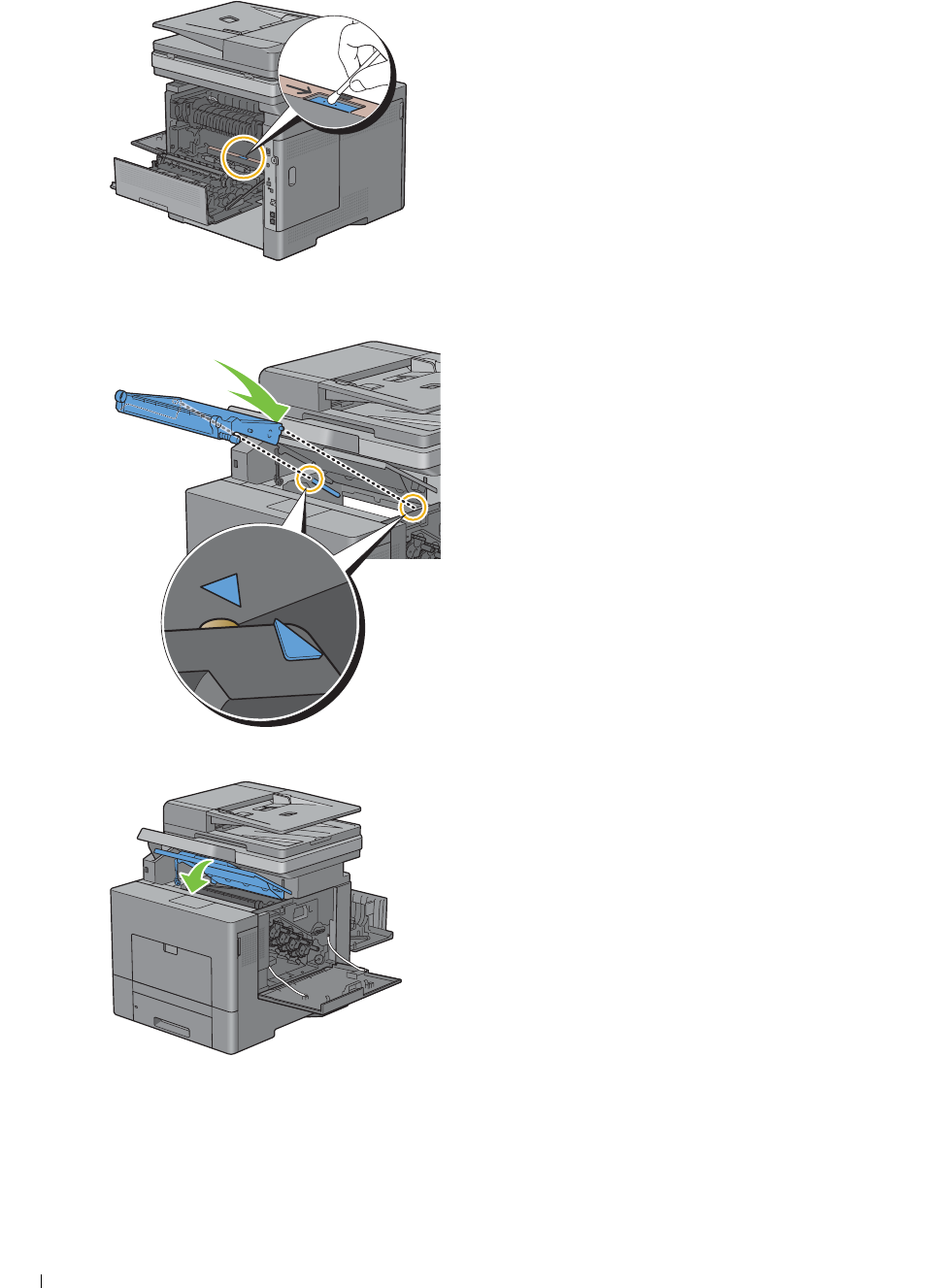
490 Maintaining Your Printer
10
Clean the CTD sensor (as shown) with a clean, dry cotton swab.
11
Make sure that the arrow marks on the transfer belt unit and the printer face each other, and then insert the unit
into the printer until it clicks.
12
Close the top cover.
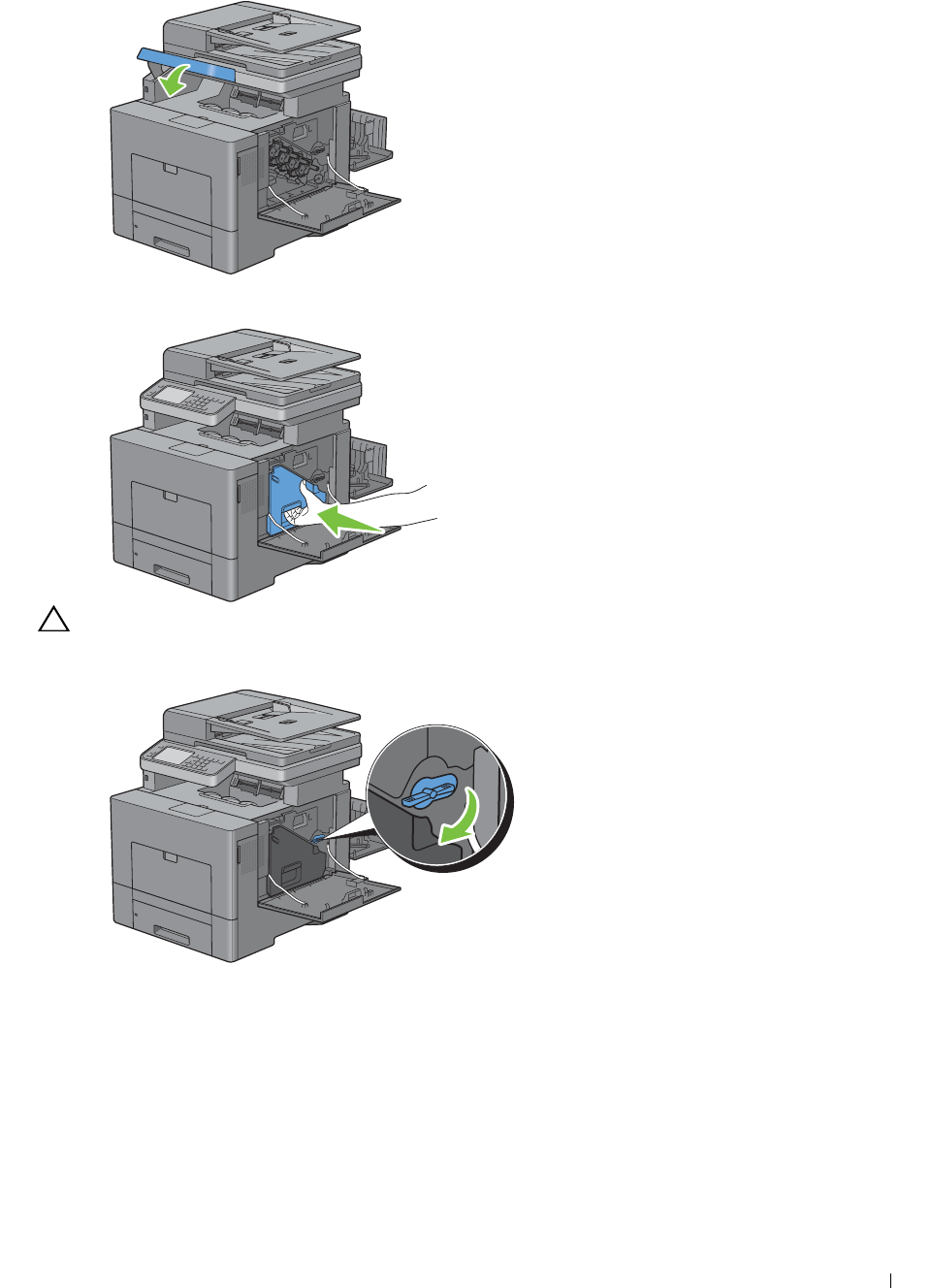
Maintaining Your Printer 491
13
Lower the operator panel back in place.
14
Reinsert the removed waste toner box.
CAUTION: If the waste toner box does not fit into place properly, make sure that the transfer belt unit is fully inserted.
15
Turn the waste toner box lock lever 90-degrees clockwise to lock the waste toner box.
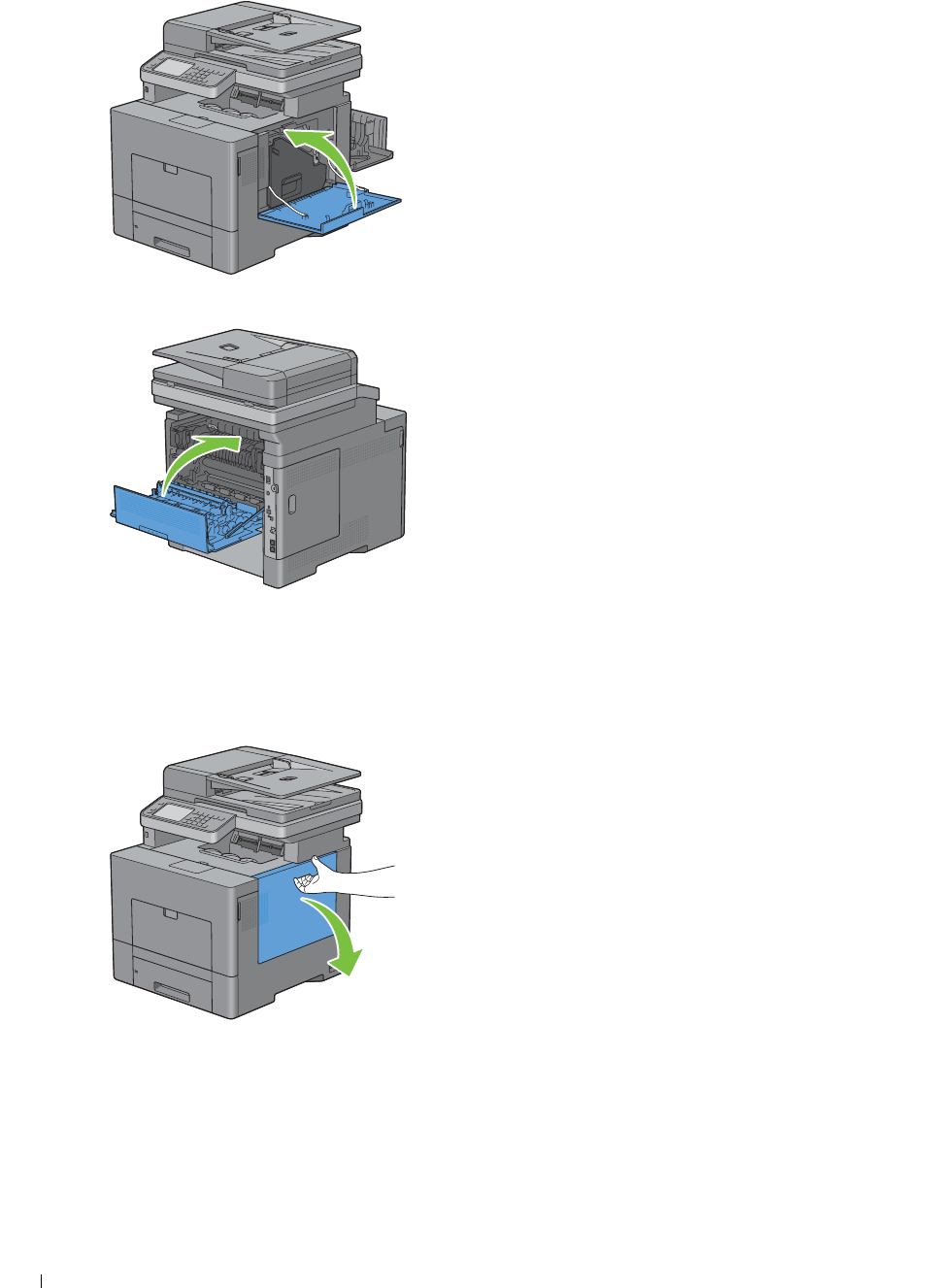
492 Maintaining Your Printer
16
Close the right side cover.
17
Close the rear cover.
Cleaning the Raster Optical Scanner (ROS) Window
To prevent deterioration of printing quality due to stains inside the printer, clean inside the printer regularly by using
the cleaning rod whenever you replace drum cartridges.
1
Open the right side cover.
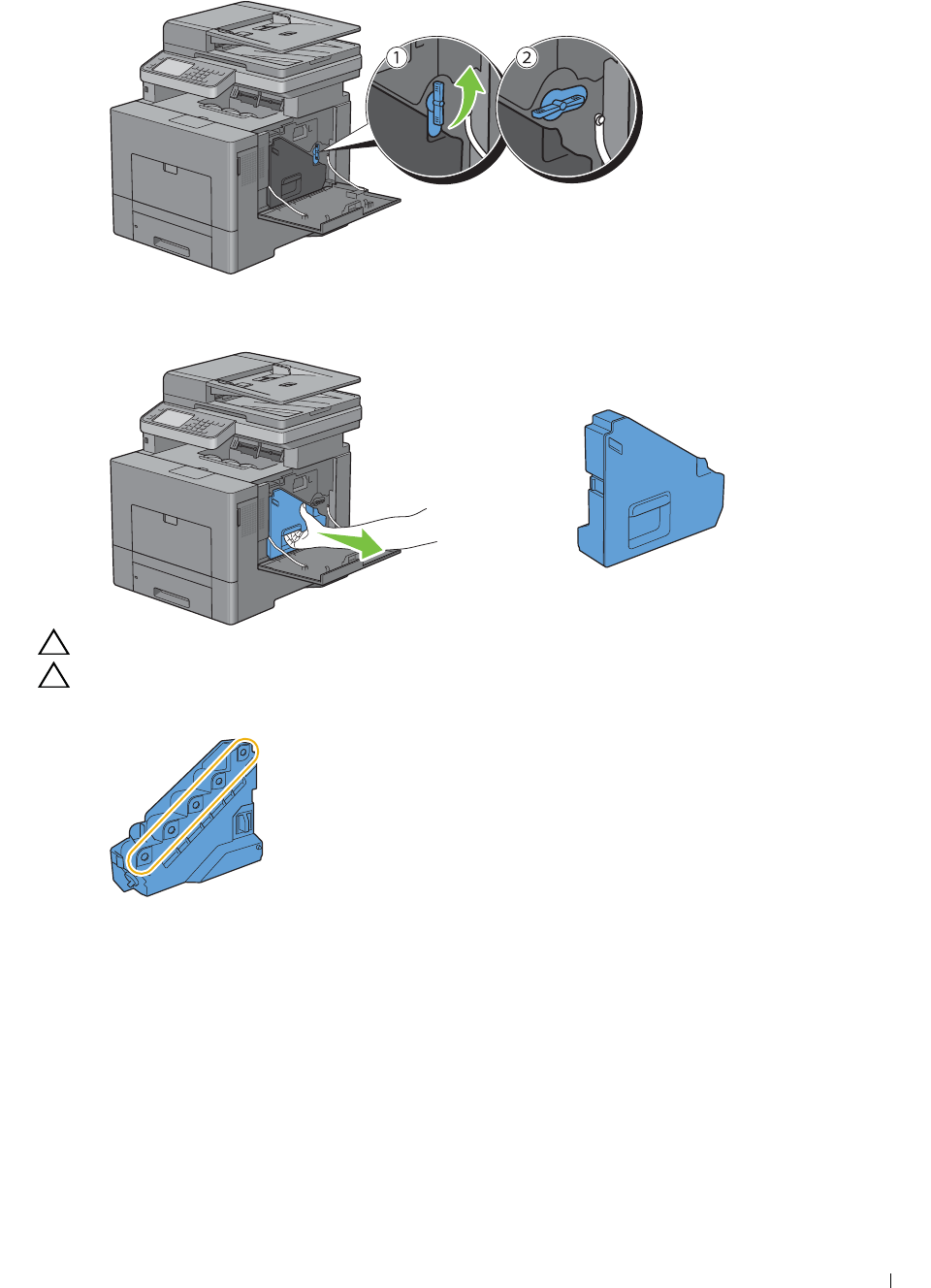
Maintaining Your Printer 493
2
Turn the waste toner box lock lever 90-degrees counterclockwise to unlock the waste toner box.
3
Grasp the handle on the waste toner box and pull it out making sure to hold it upright so that the waste toner does
not spill out.
CAUTION: Take care not to drop the waste toner box while you are removing it.
CAUTION: After removing the waste toner box, do not touch the parts shown in the illustration. Toner can dirty or stain
your hands.
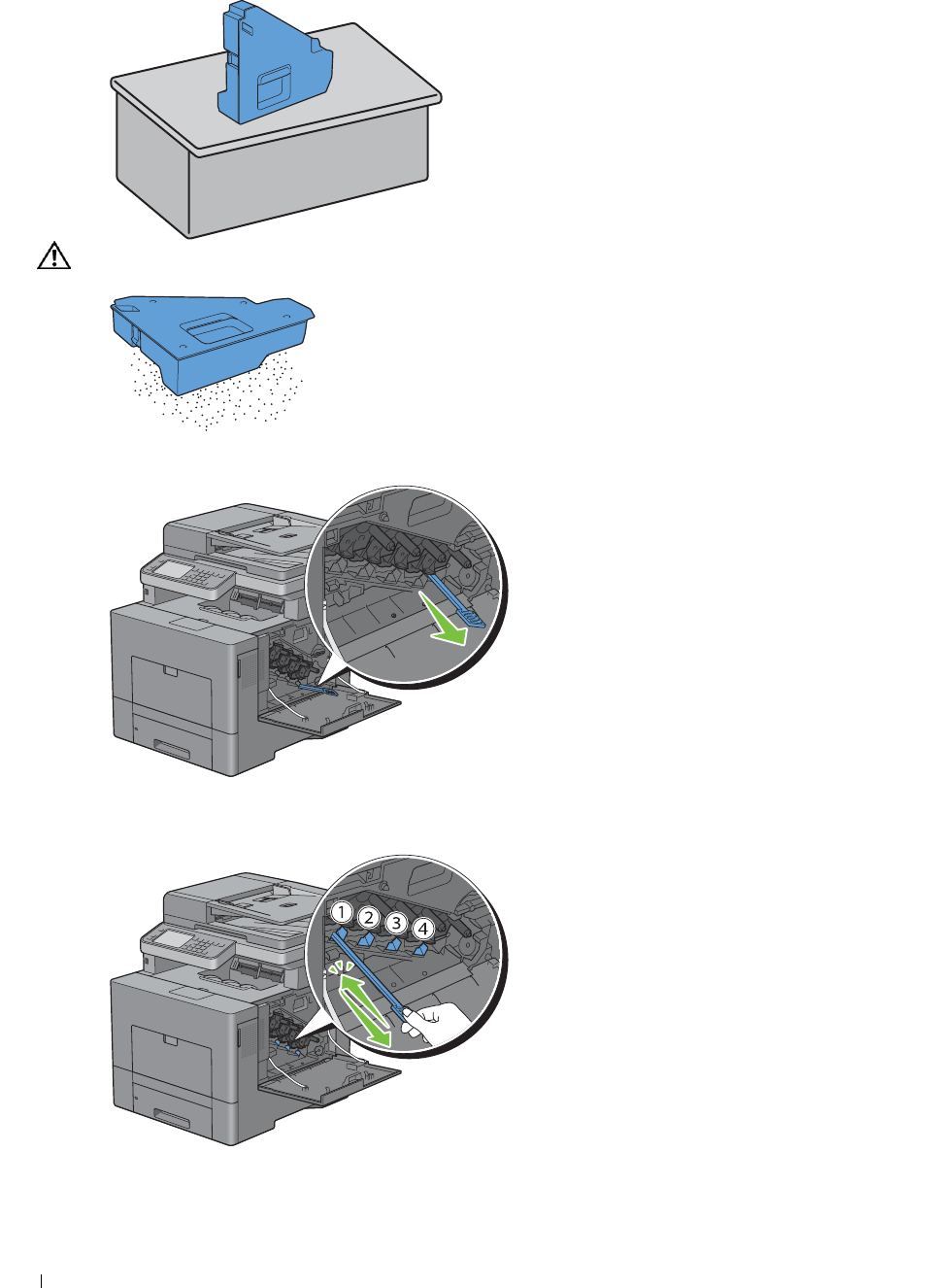
494 Maintaining Your Printer
4
Stand the removed waste toner box upright on a level surface.
WARNING: Never lay the waste toner box on its side as this may cause its malfunction or toner spills.
5
Remove the cleaning rod from inside the printer.
6
Insert the cleaning rod fully into one of the four holes until it clicks into the interior of the printer as illustrated
below, and then pull it out.
7
Repeat step 6 also on the other three holes. One time insertion is enough for each hole.
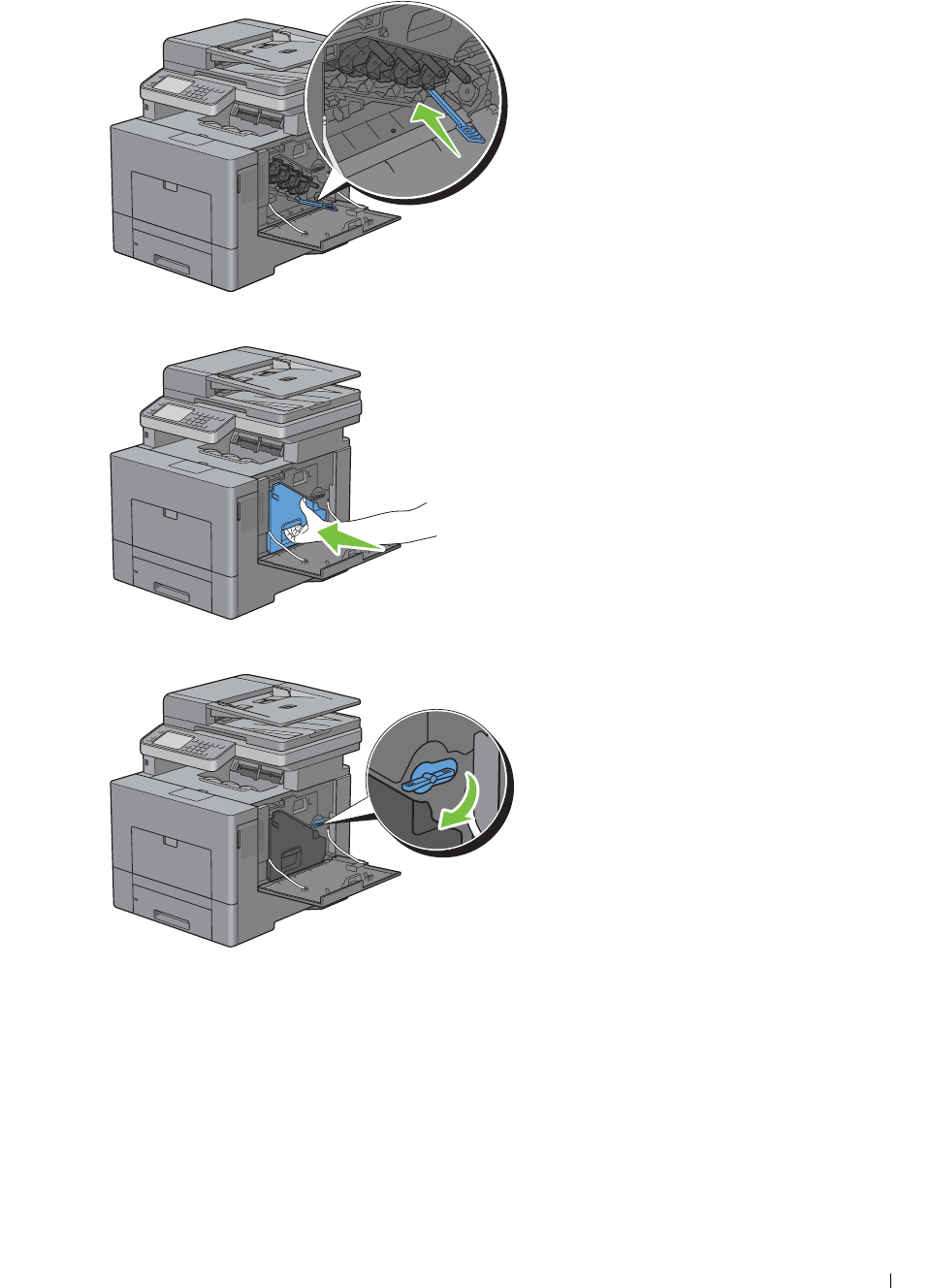
Maintaining Your Printer 495
8
Return the cleaning rod to its original location.
9
Reinsert the removed waste toner box.
10
Turn the waste toner box lock lever 90-degrees clockwise to lock the waste toner box.
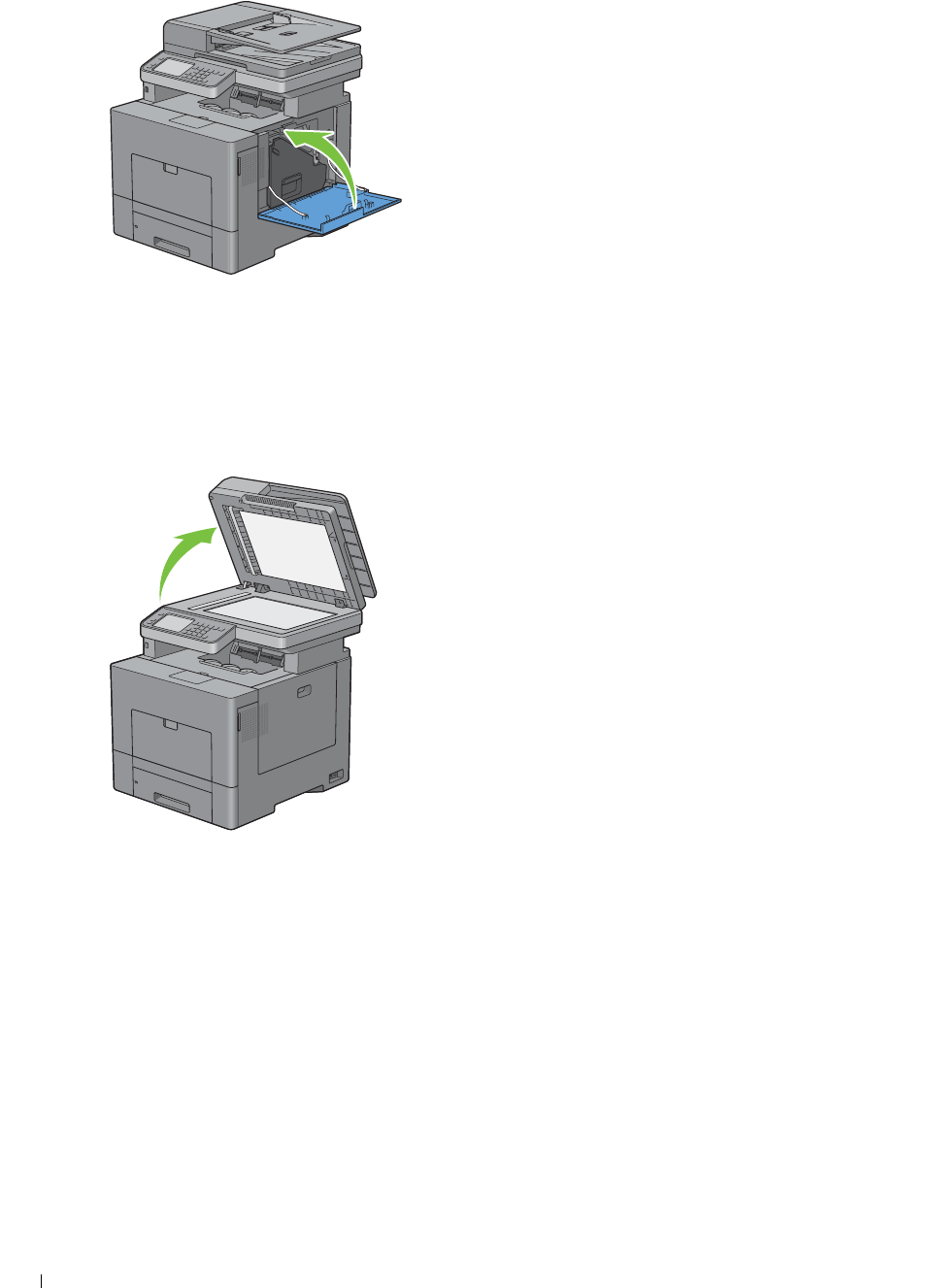
496 Maintaining Your Printer
11
Close the right side cover.
Cleaning the Scanner
Keeping the scanner clean helps ensure the best possible copies. It is recommended to clean the scanner at the start
of each day and during the day, as needed.
1
Slightly dampen a soft lint-free cloth or paper towel with water.
2
Open the document cover.
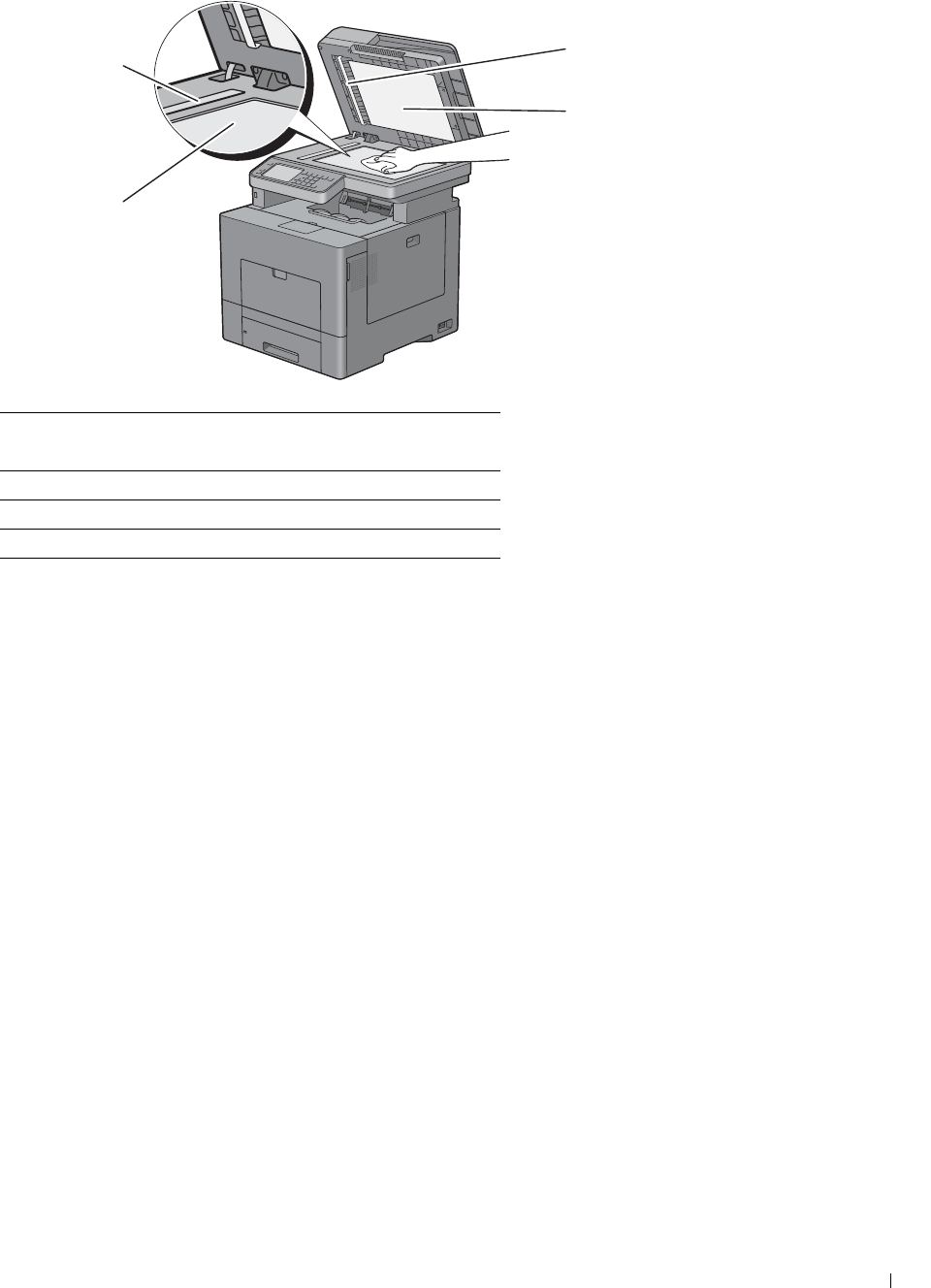
Maintaining Your Printer 497
3
Wipe the surface of the document glass and DADF glass until it is clean and dry.
4
Wipe the underside of the white document cover and white sheet until it is clean and dry.
5
Close the document cover.
1White Sheet
NOTE: Handle with care.
2White Document Cover
3Document Glass
4DADF Glass
1
2
3
4
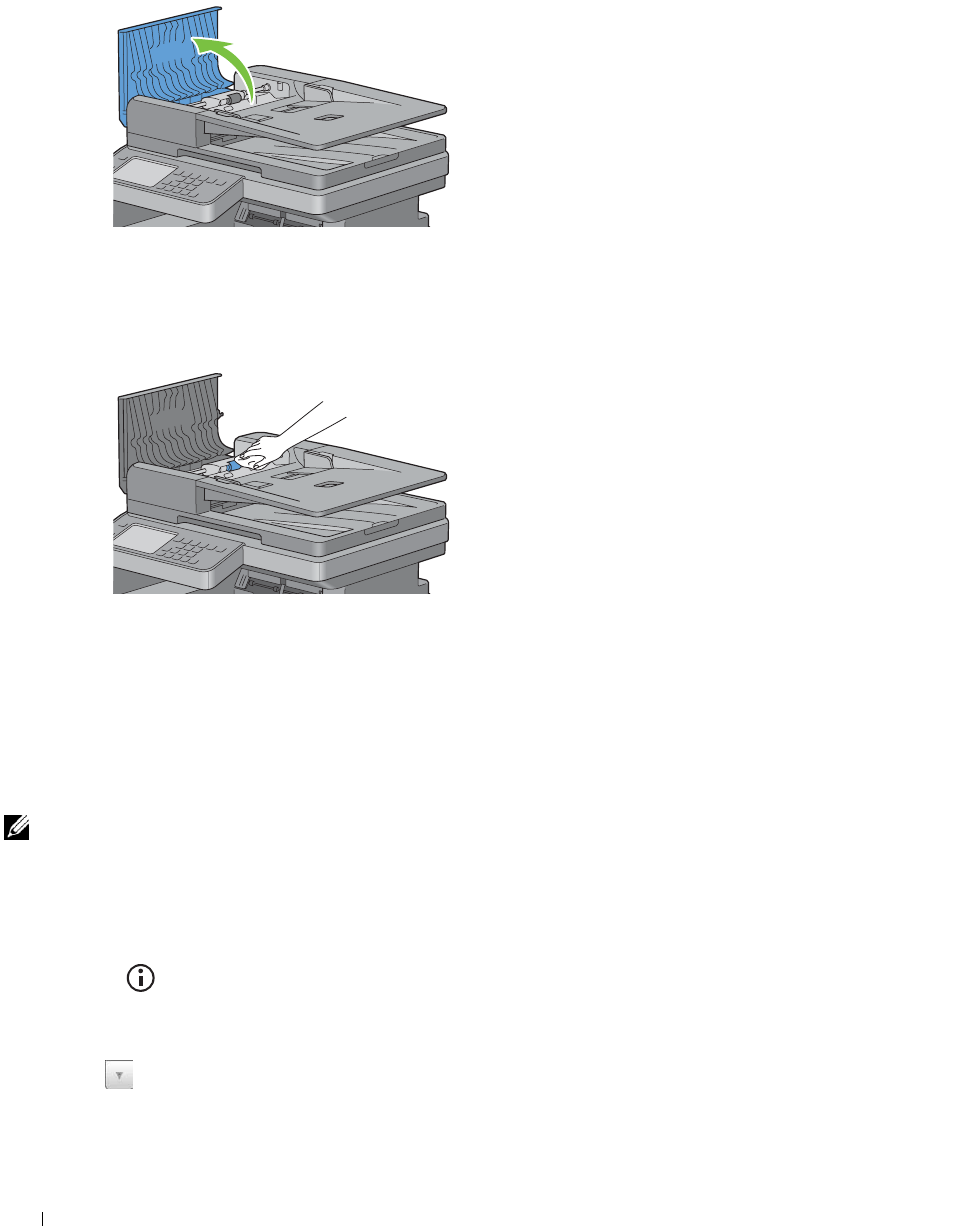
498 Maintaining Your Printer
Cleaning the DADF Feed Roller
Keeping the DADF feed roller clean helps ensure the best possible copies. It is recommended to clean the DADF feed
roller at regular intervals.
1
Open the DADF cover.
2
Wipe the DADF feed roller with a dry soft lint-free cloth or paper towel until it is clean.
If the DADF feed roller gets soiled with ink stains, paper from the DADF may also be soiled. In this case, slightly
dampen a soft lint-free cloth or paper towel with a neutral detergent or water, and then remove the contamination
from the DADF feed roller until it is clean and dry.
Adjusting Color Registration
To adjust the color registration when you first install the printer or after moving it to a new location, follow the
procedure below.
• Printing the Color Registration Chart
• Determining Values
• Entering Values
NOTE: If the Panel Lock Control is set to Enable, you need to enter the four digit password to enter the Admin
Settings menu.
Printing the Color Registration Chart
When Using the Operator Panel
1
Press the
(Information)
button.
2
Select the
Tools
tab, and then select
Admin Settings
.
3
Select
Maintenance
.
4
Select until
Color Reg Adjust
appears, and then select
Color Reg Adjust
.
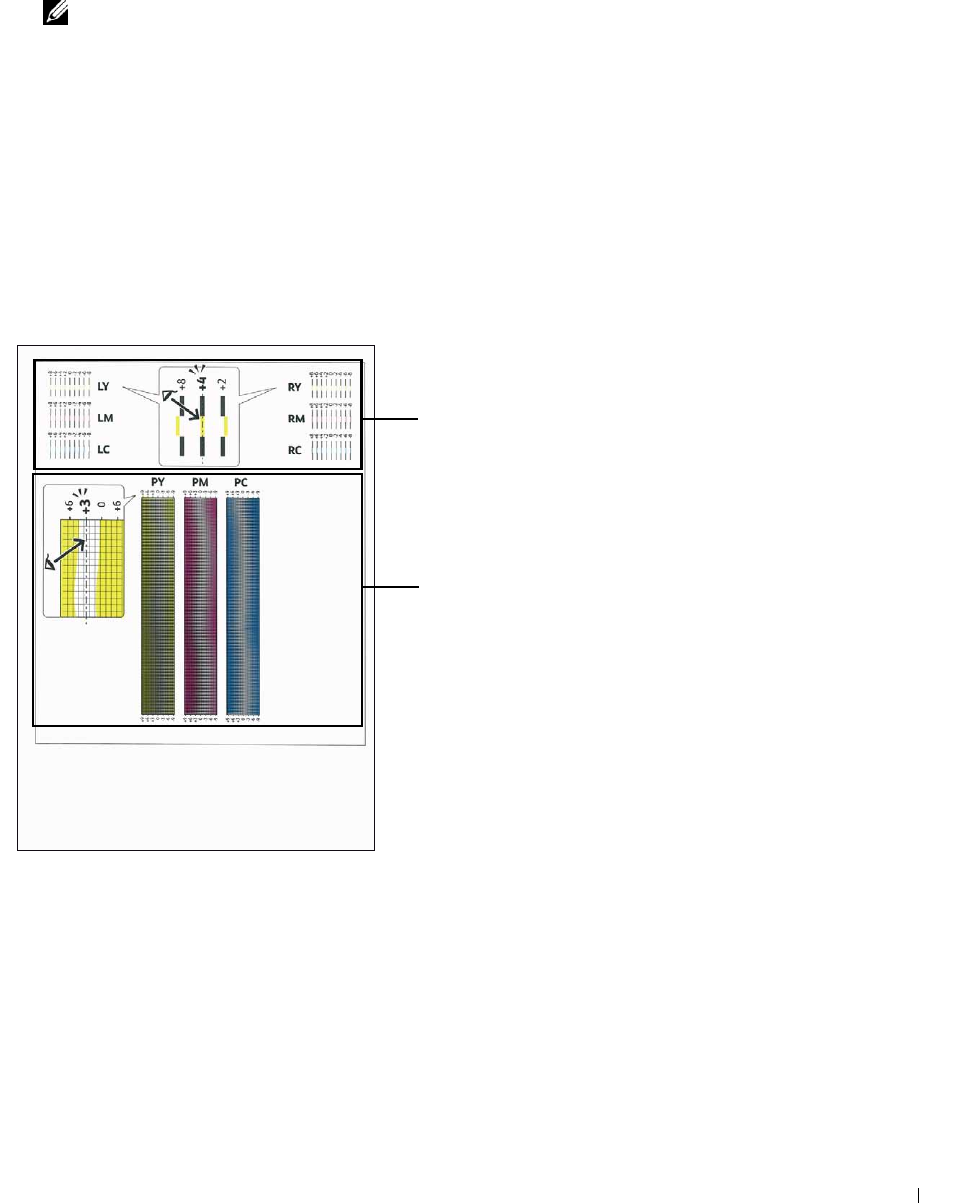
Maintaining Your Printer 499
5
Select
Color Regi Chart
.
6
Select
Print
.
The color registration chart is printed.
When Using the Tool Box
1
Click
Start
→
All Programs
→
Dell Printers
→
Dell C3765dnf Multifunction Color Laser Printer
→
Tool Box
.
NOTE: For details about starting the Tool Box, see "Starting the Tool Box."
The
Tool Box
opens.
2
Click the
Printer Maintenance
tab.
3
Select
Service Tools
from the list at the left side of the page.
The
Service Tools
page is displayed.
4
Click
Start
next to
Color Regi Chart
under
Color Registration Adjustments
.
The color registration chart is printed.
Determining Values
On the color registration chart, there are two types of charts: Chart 1 (fast scan) and Chart 2 (slow scan).
The Chart 1 is used to adjust the color registration for the fast scan direction, which is vertical to paper feed
direction. The Chart 2 is used to adjust the color registration for the slow scan direction, which is horizontal to paper
feed direction.
The following sections explain how to determine the adjustment values for the fast scan and the slow scan using
Chart 1 and Chart 2.
Chart 1 (fast scan)
Chart 2 (slow scan)
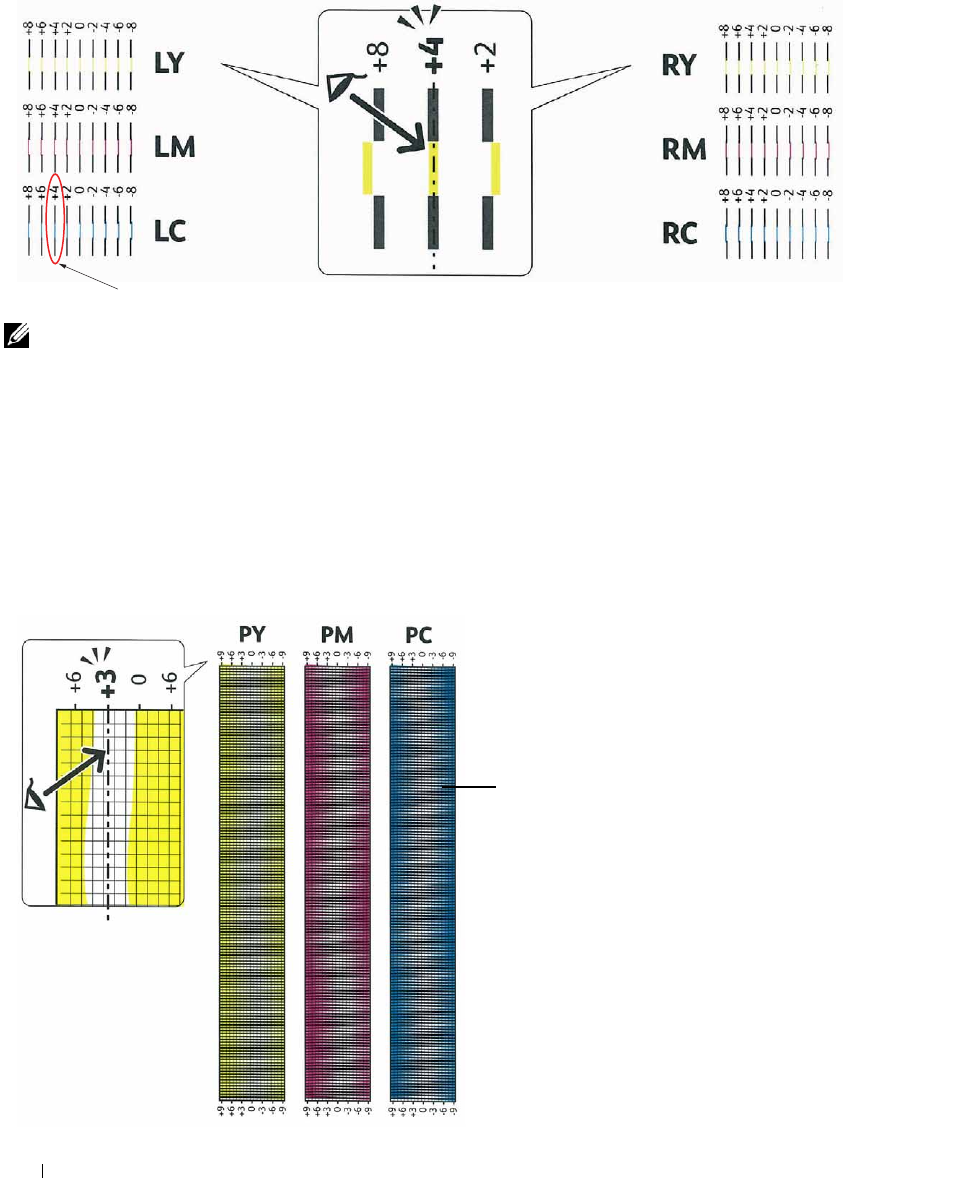
500 Maintaining Your Printer
Fast Scan
On the Chart 1 of the color registration chart, find the straightest lines where the two black lines and the colored line
are most closely aligned for each color (LY, LM, LC, RY, RM, and RC). If you find the straightest line, make a note
of the value (-8 to +8) indicated by the straightest line for each color.
When the value is 0 for each color, you do not need to adjust the color registration for the fast scan.
When the value is not 0, enter the value using the procedure in "Entering Values."
NOTE: If it is difficult to choose only one value, as in the case that there seem to be two values closest to a straight line, take the
value between the two. For example, in the figure above, -6 and -8 are the values closest to a straight line, so you would enter the
value -7.
Slow Scan
On the Chart 2 of the color registration chart, find the medium line within the range of white area for each color
pattern (PY, PM, and PC). If you find the medium line, make a note of the value (-9 to +9) indicated by the
medium line for each color.
When the value is 0 for each color, you do not need to adjust the color registration for the slow scan.
When the value is not 0, enter the value using the procedure in "Entering Values."
Straightest line
Lattice pattern

Maintaining Your Printer 501
Entering Values
When Using the Operator Panel
Using the operator panel, enter the values found in the color registration chart to make adjustments.
1
Press the
(Information)
button.
2
Select the
Tools
tab, and then select
Admin Settings
.
3
Select
Maintenance
.
4
Select until
Color Reg Adjust
appears, and then select
Color Reg Adjust
.
5
Select
Enter Number
.
6
Select
-
or
+
to specify the values for left colors (
LY
,
LM
, and
LC
), and then select
Next
.
7
Select
-
or
+
to specify the values for right colors (
RY
,
RM
, and
RC
), and then select
Next
.
8
Select
-
or
+
to specify the values for process colors (
PY
,
PM
, and
PC
), and then select
OK
.
NOTE: The registration values are always shown as 0 the next time you enter the menu.
9
Select
Color Regi Chart
.
10
Select
Print
.
The color registration chart with the new values is printed.
If the straightest line is not at the value of 0, adjust the values again. Checking the charts before and after the
adjustments will help you to determine the values to enter.

502 Maintaining Your Printer
When Using the Tool Box
Using the Tool Box, enter the values that you found in the color registration chart to make adjustments.
1
Click
Start
→
All Programs
→
Dell Printers
→
Dell C3765dnf Multifunction Color Laser Printer
→
Tool Box
.
NOTE: For details about starting the Tool Box, see "Starting the Tool Box."
The
Tool Box
opens.
2
Click the
Printer Maintenance
tab.
3
Select
Service Tools
from the list at the left side of the page.
The
Service Tools
page is displayed.
4
Specify each value for process, left, and right colors in
Enter Number
under
Color Registration Adjustments
, and
then click
Apply New Settings
.
5
Click
Start
next to
Color Regi Chart
under
Color Registration Adjustments
.
The color registration chart is printed with the new values.
6
Adjust till all straight lines are at the value of 0. Show image of before and after adjustment will help.
After printing the color registration chart, do not turn off the printer until the printer motor has stopped running.
NOTE: If 0 is not next to the straightest lines, determine the values and adjust the printer again.
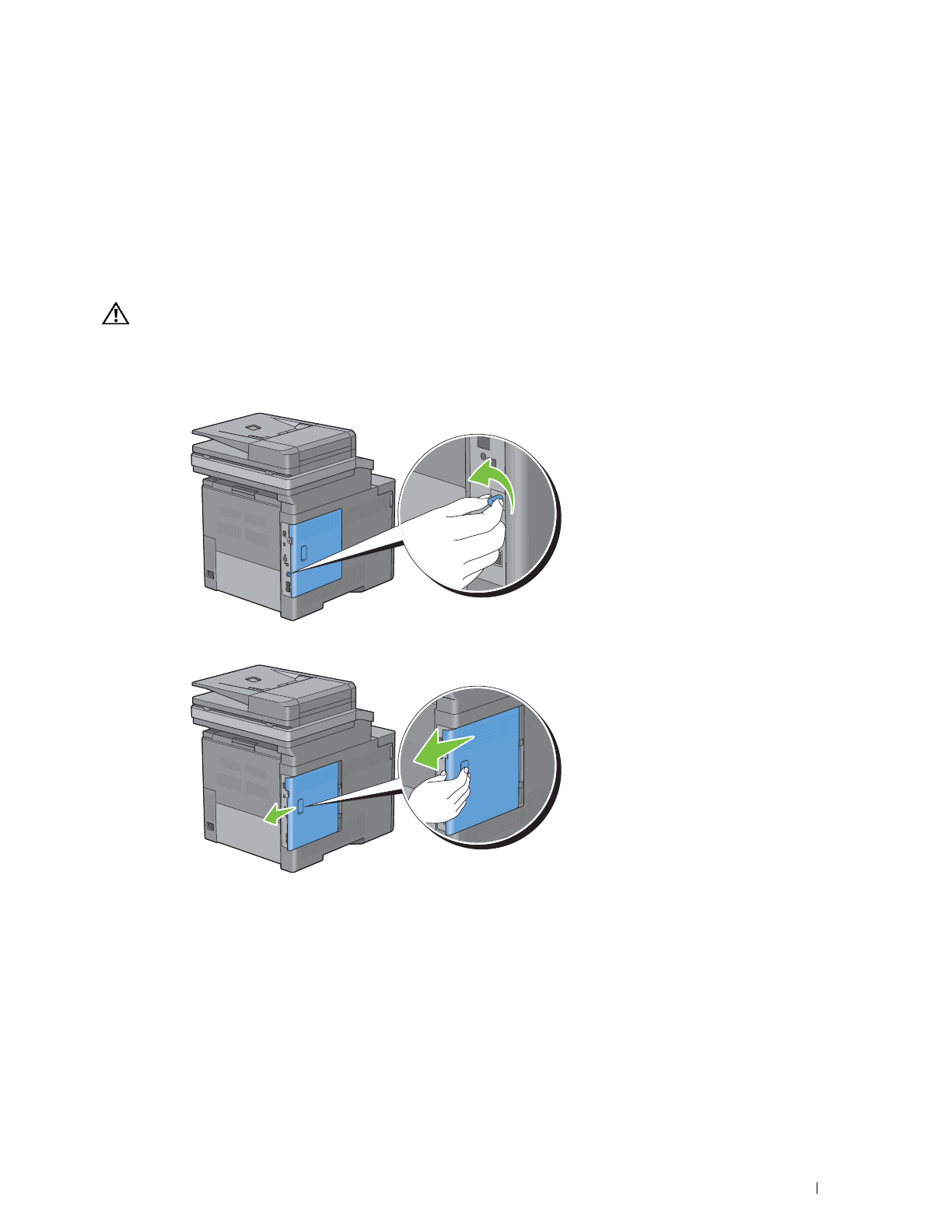
Removing Options 503
31
Removing Options
If the printer location needs to change or the printer and print media handling options need to be shipped to a new
location, all print media handling options must be removed from the printer. For shipping, pack the printer and print
media handling options securely to avoid damage.
Removing the Optional Memory Module
WARNING: When you remove the optional memory module, be sure to turn off the printer, unplug the power cable, and
disconnect all cables from the back of the printer before starting these tasks.
1
Ensure that the printer is turned off.
2
Turn the screw on the left side cover counterclockwise.
3
Slide the left side cover towards the back of the printer.
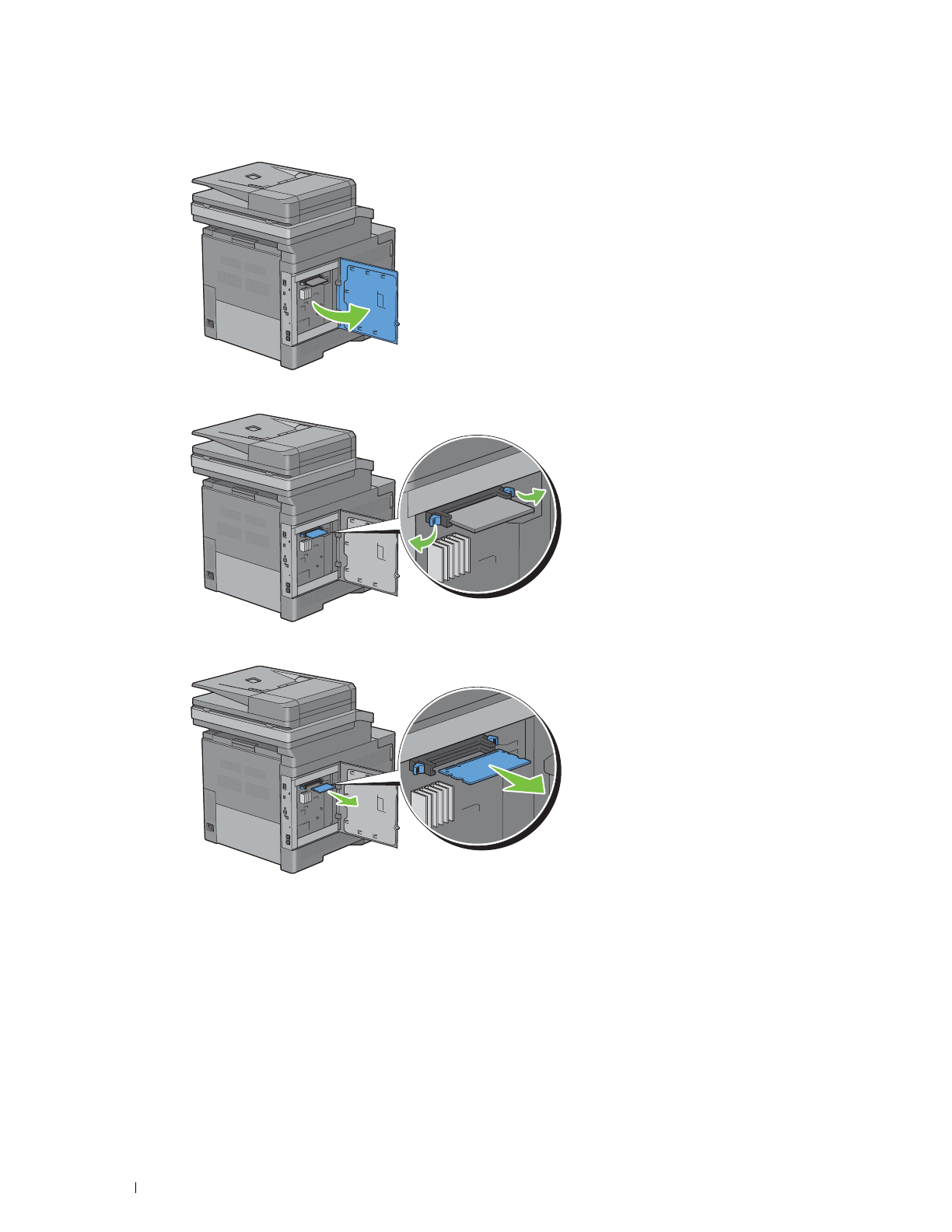
504 Removing Options
4
Open the left side cover completely.
5
Push the clips on both sides of the slot outward to raise the memory module up.
6
Hold the memory module and pull it straight out.
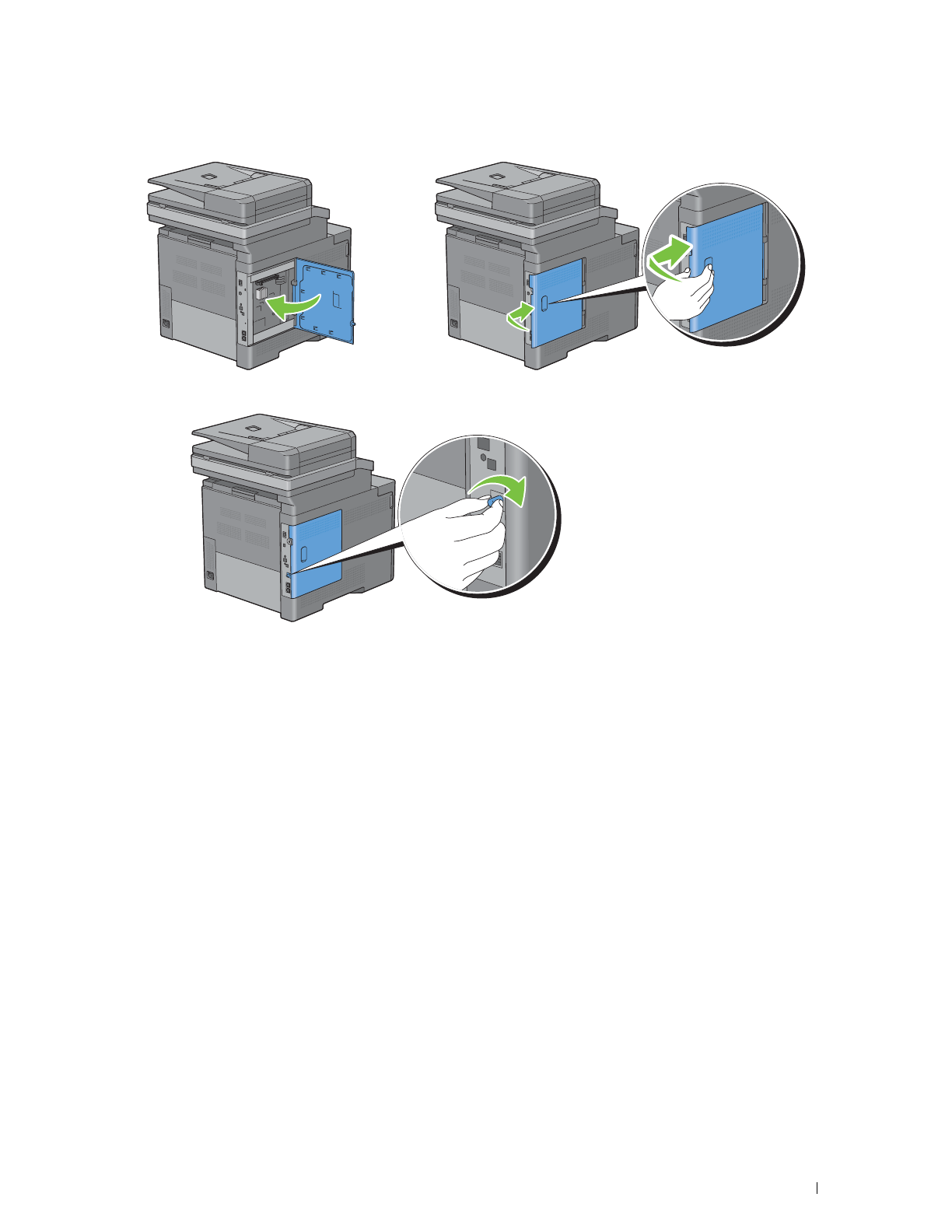
Removing Options 505
7
Close the left side cover, and then slide it towards the front of the printer.
8
Turn the screw clockwise.
9
Turn on the printer.
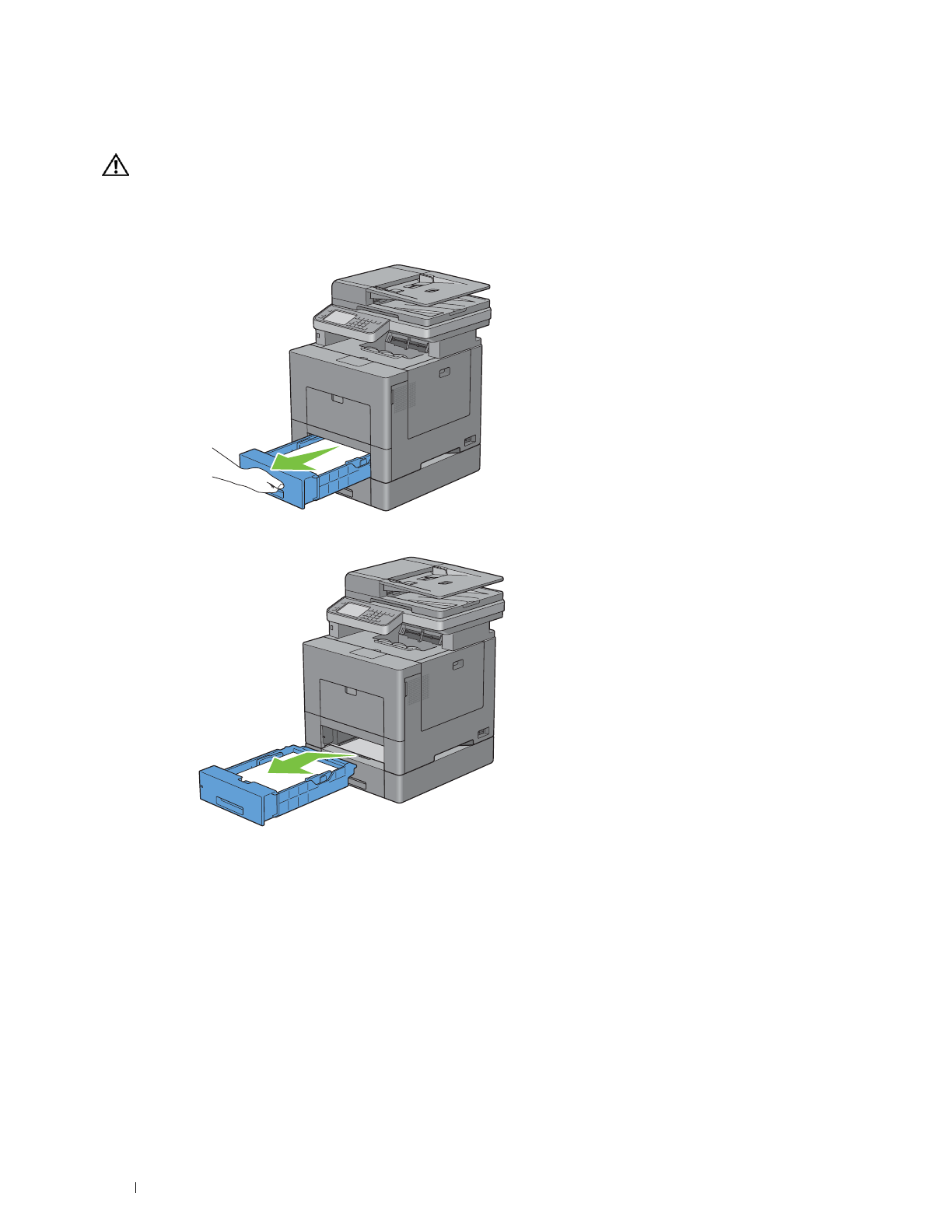
506 Removing Options
Removing the Optional 550-Sheet Feeder
WARNING: When you remove the optional 550-sheet feeder (Tray2), be sure to turn off the printer, unplug the power cable, and
disconnect all cables from the back of the printer before starting these tasks.
1
Ensure that the printer is turned off, and then disconnect all cables from the back of the printer.
2
Pull the tray1 out of the printer about 200 mm.
3
Hold tray1 with both hands, and remove it from the printer.
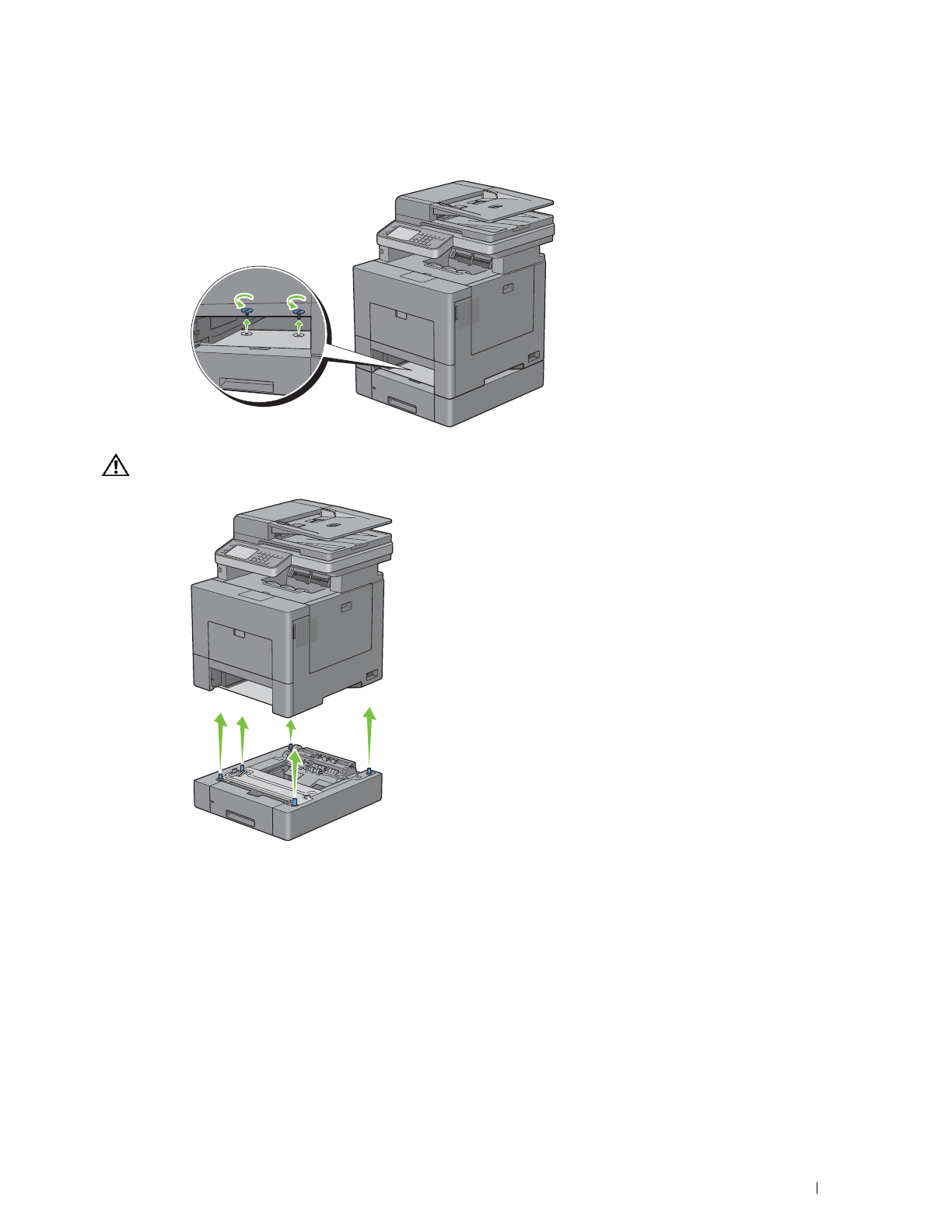
Removing Options 507
4
Remove the two screws joining the printer and the optional 550-sheet feeder by unscrewing them with a coin or
similar object.
5
Gently lift the printer off the optional 550-sheet feeder, and place it on a level surface.
WARNING: Two people are required to lift the printer.
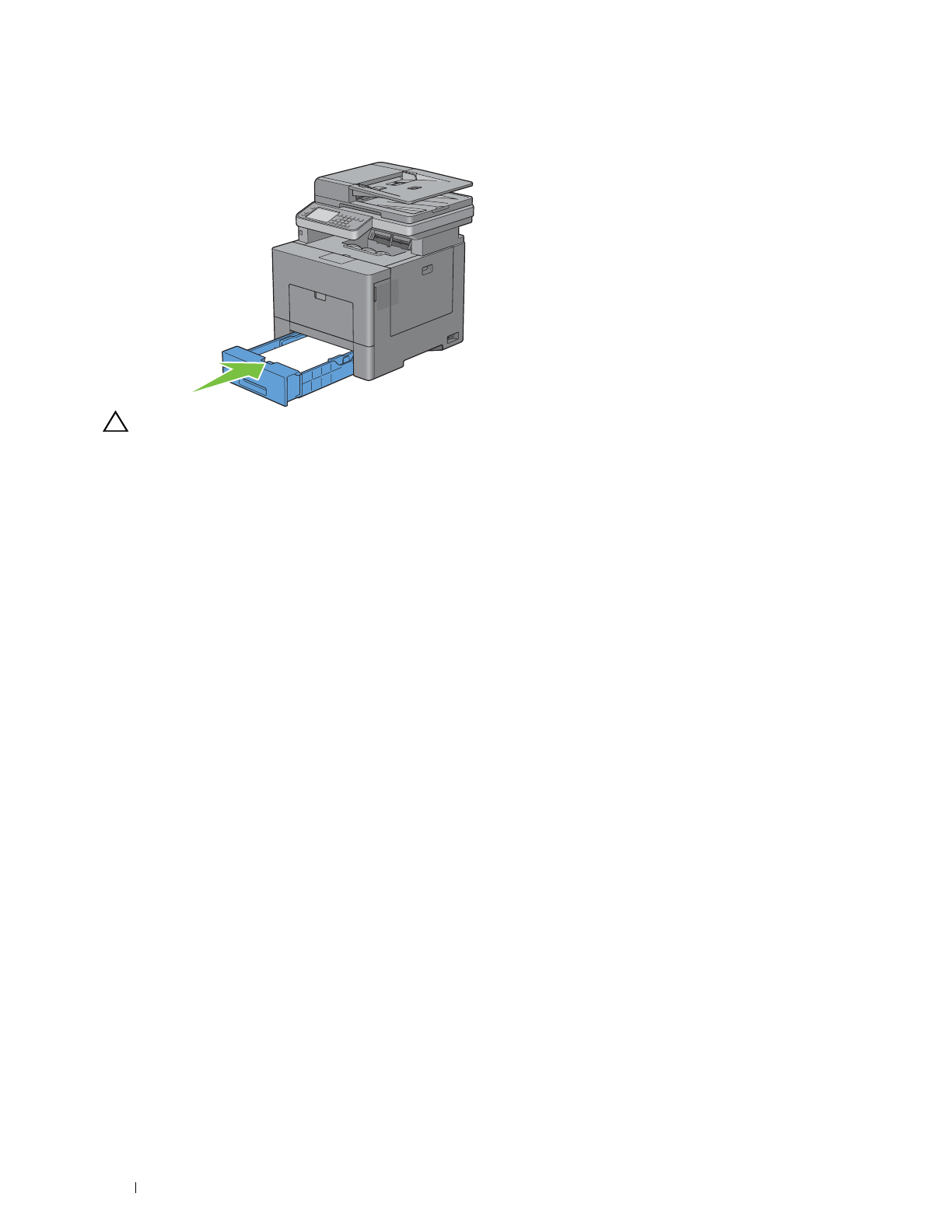
508 Removing Options
6
Insert the tray1 into the printer, and push until it stops.
CAUTION: Do not use excessive force on the tray. Doing so could damage the tray or the inside of the printer.
7
Re-connect all cables into the back of the printer and turn on the printer.
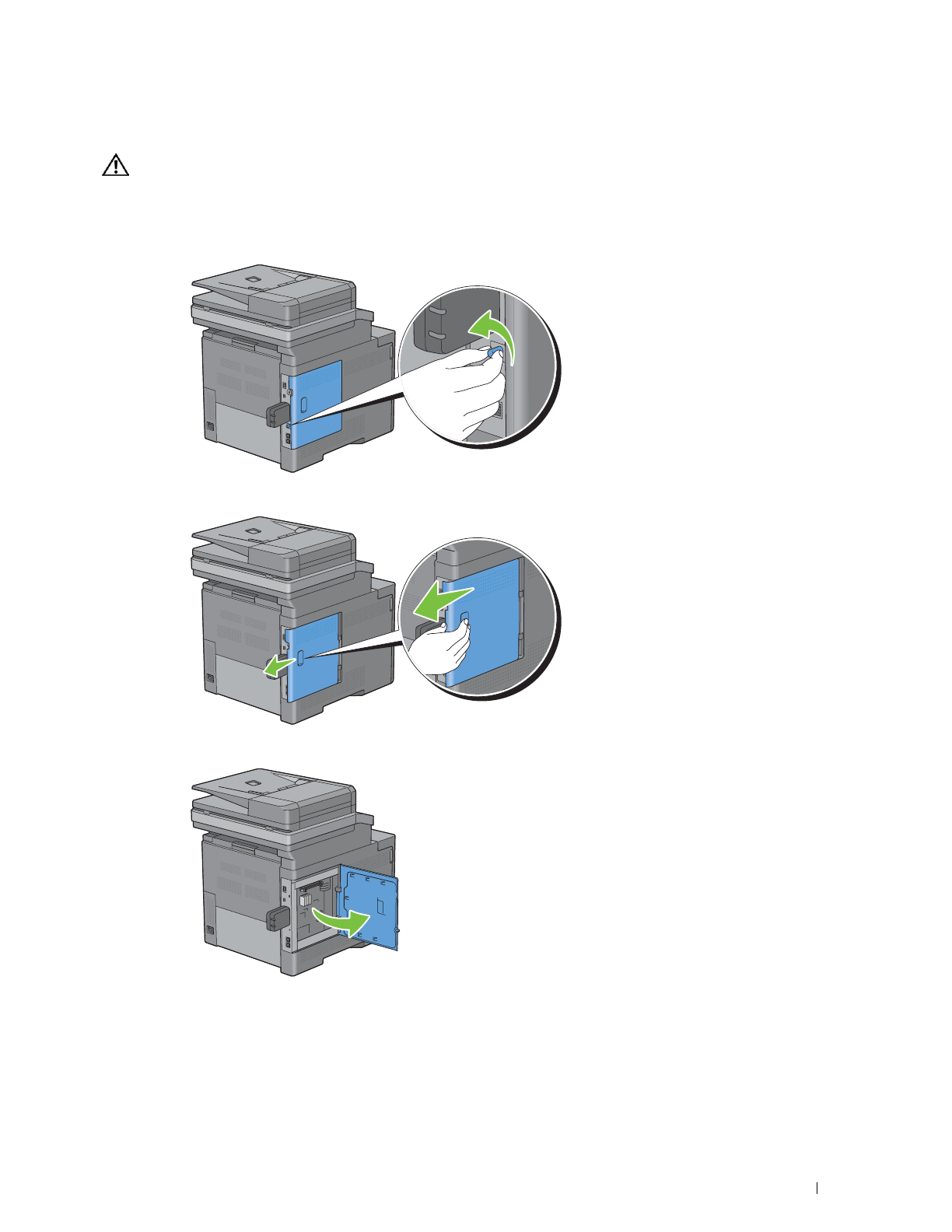
Removing Options 509
Removing the Optional Wireless Adapter
WARNING: When you remove the optional wireless adapter, be sure to turn off the printer, unplug the power cable, and
disconnect all cables from the back of the printer before starting these tasks.
1
Ensure that the printer is turned off.
2
Turn the screw on the left side cover counterclockwise to remove it.
3
Slide the left side cover towards the back of the printer.
4
Open the left side cover completely.
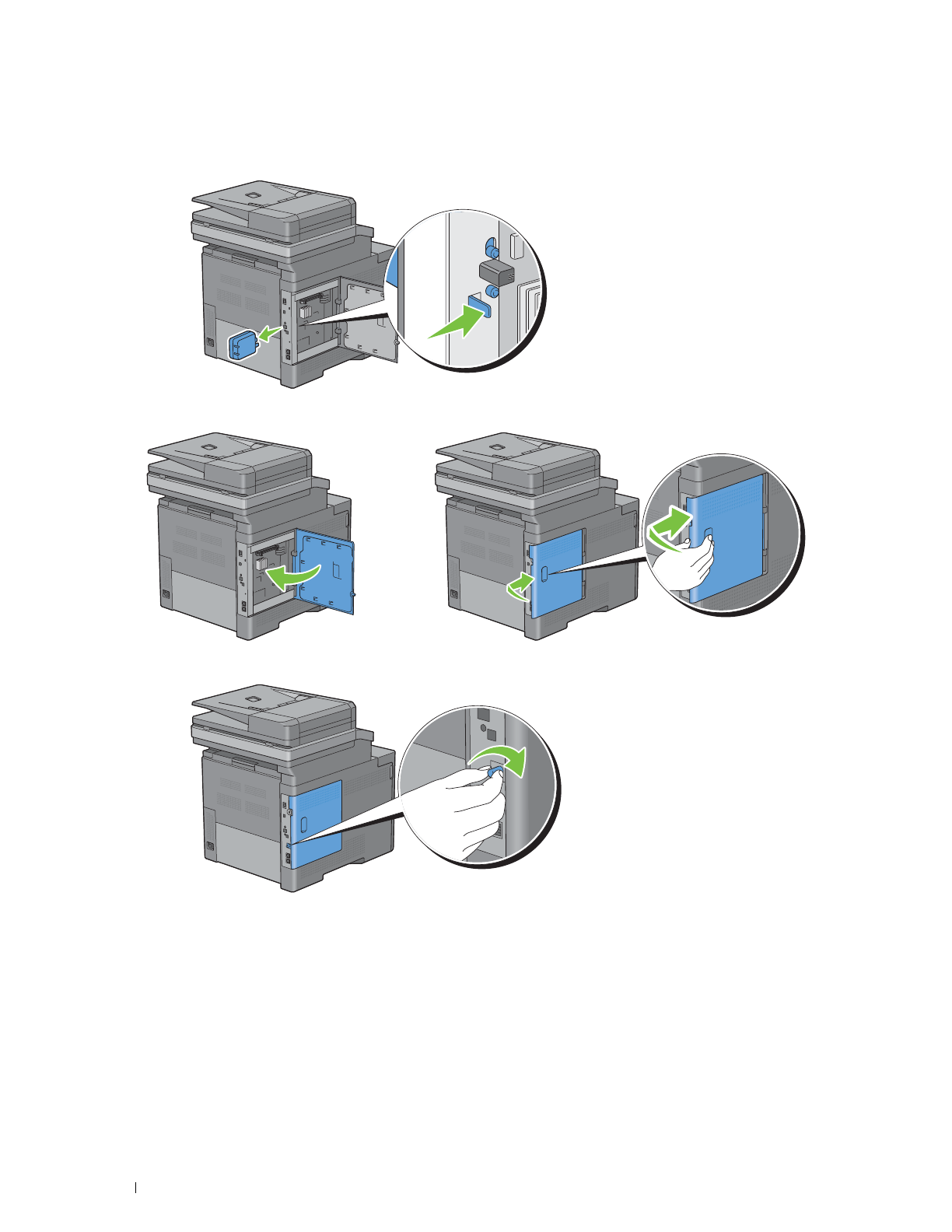
510 Removing Options
5
Remove the wireless adapter from the printer by releasing the adapter's hook while pushing the wireless adapter
towards the front of the printer.
6
Close the left side cover, and then slide it towards the front of the printer.
7
Turn the screw clockwise.
8
Turn on the printer.
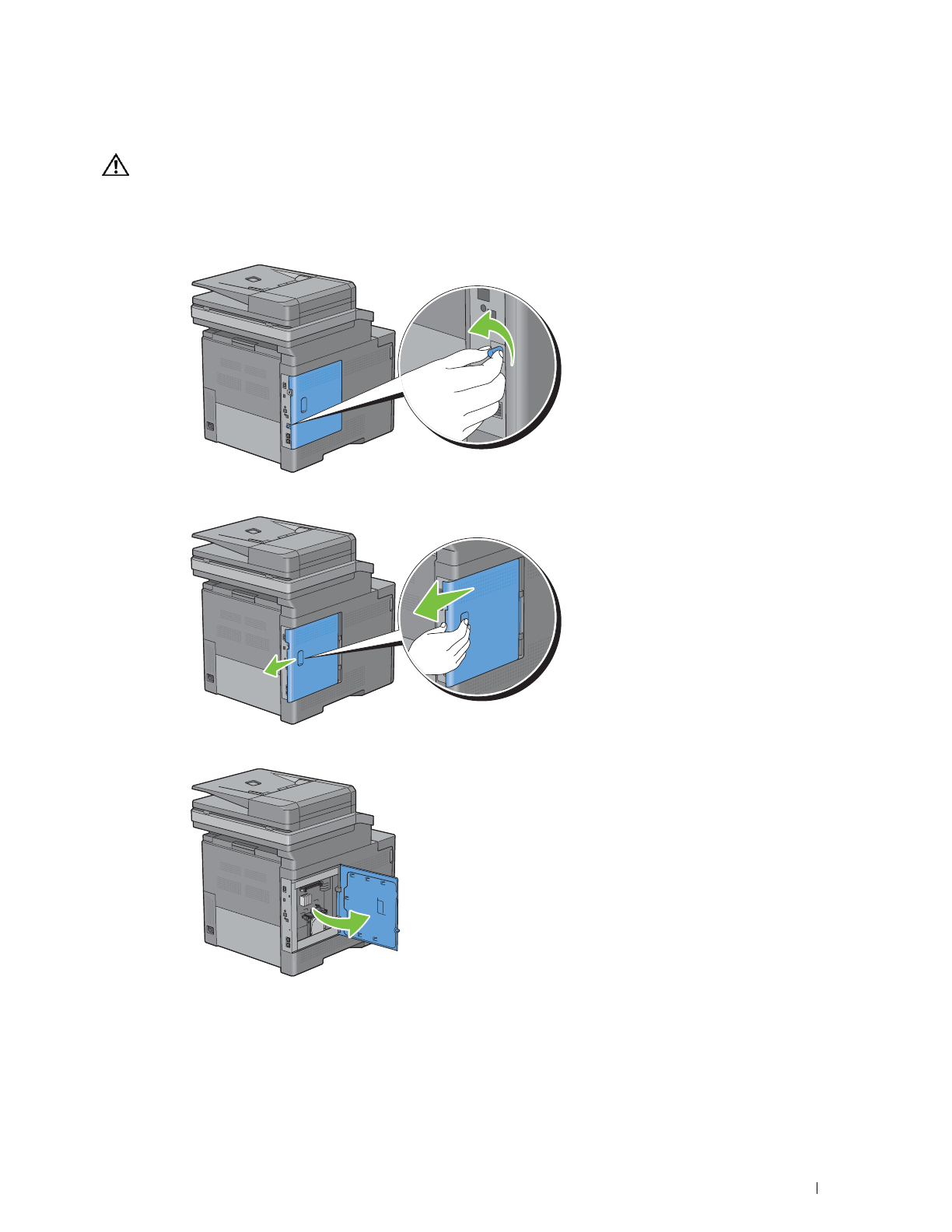
Removing Options 511
Removing the Optional Hard Disk
WARNING: When you remove the optional wireless adapter, be sure to turn off the printer, unplug the power cable, and
disconnect all cables from the back of the printer before starting these tasks.
1
Ensure that the printer is turned off.
2
Turn the screw on the control board counterclockwise
3
Slide the left side cover towards the back of the printer.
4
Open the left side cover completely.
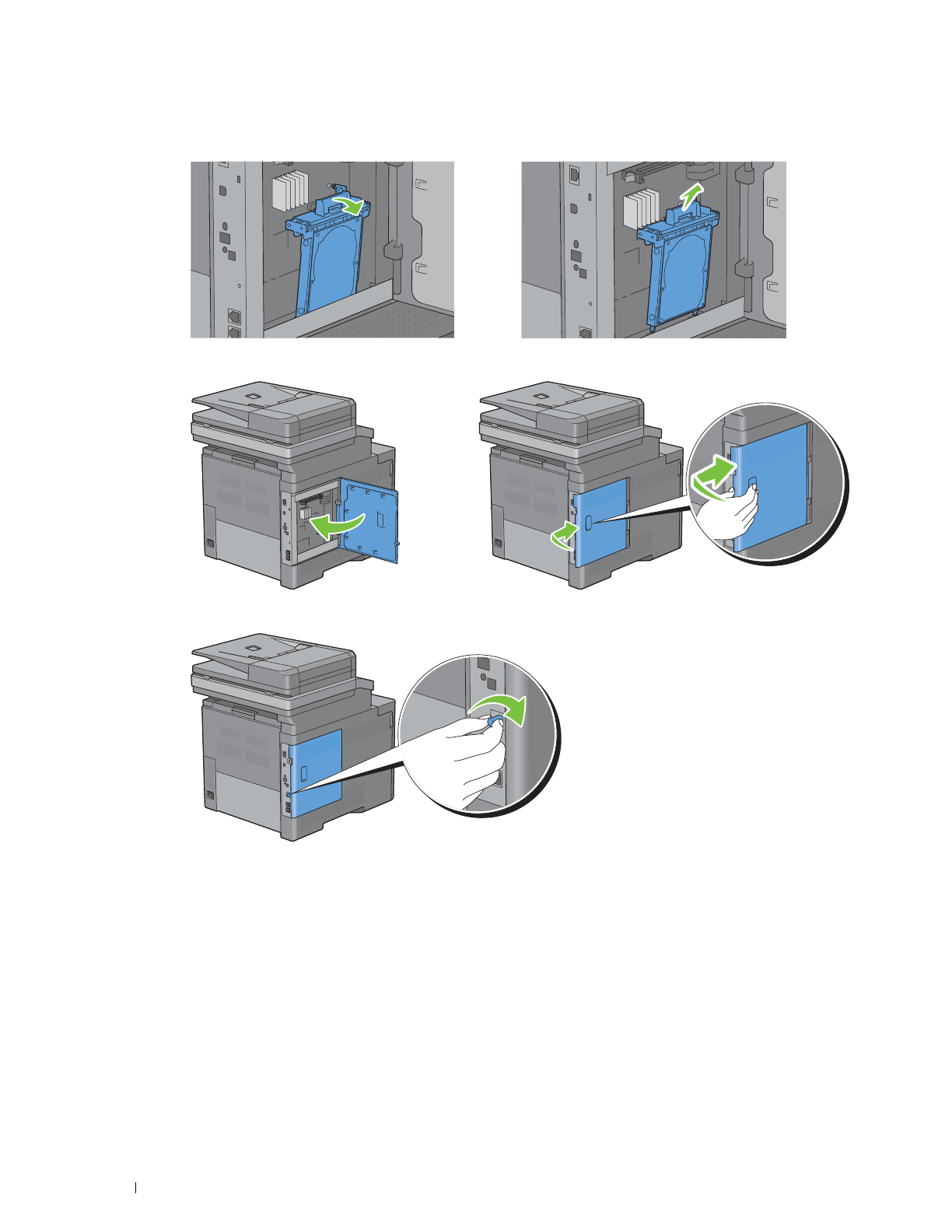
512 Removing Options
5
Remove the hard disk from the printer by releasing the hook of hard disk.
6
Close the left side cover, and then slide it towards the front of the printer.
7
Turn the screw clockwise.
8
Turn on the printer.

Clearing Jams 513
32
Clearing Jams
Careful selection of appropriate print media and proper loading allow you to avoid paper jams. See
"
Print Media
Guidelines
"
for more information.
NOTE: Before buying large quantities of any print media, it is recommended to try a sample first.
Avoiding Jams
• Use only recommended print media. See "
Print Media Guidelines
" for more information.
• See "Loading Print Media in Tray1 and the Optional 550-Sheet Feeder" and "Loading Print Media in the MPF" to
load print media properly.
• Do not overload the print media sources. Ensure that the print media stack height does not exceed the maximum
height indicated by the load-line labels in the tray.
• Do not load wrinkled, creased, damp, or curled print media.
• Flex, fan, and straighten print media before you load it. If a jam occurs with print media, try feeding one sheet at a
time through the multipurpose feeder (MPF).
• Do not use print media that you have cut or trimmed yourself.
• Do not mix print media sizes, weights, or types in the same print media source.
• Ensure that the recommended print side is face up when you insert the print media.
• Keep print media stored in an acceptable environment. For more information, see
"
Storing Print Media.
"
• Do not remove the feeding tray during a print job.
• Push tray1 or the optional 550-sheet feeder (tray2) in firmly after loading.
• Ensure that all cables that connect to the printer are correctly attached.
• Overtightening the guides may cause jams.
• Wipe the retard rollers in the tray or MPF with a cloth that is slightly dampened with water if jams caused by
misfeeding paper occur frequently.
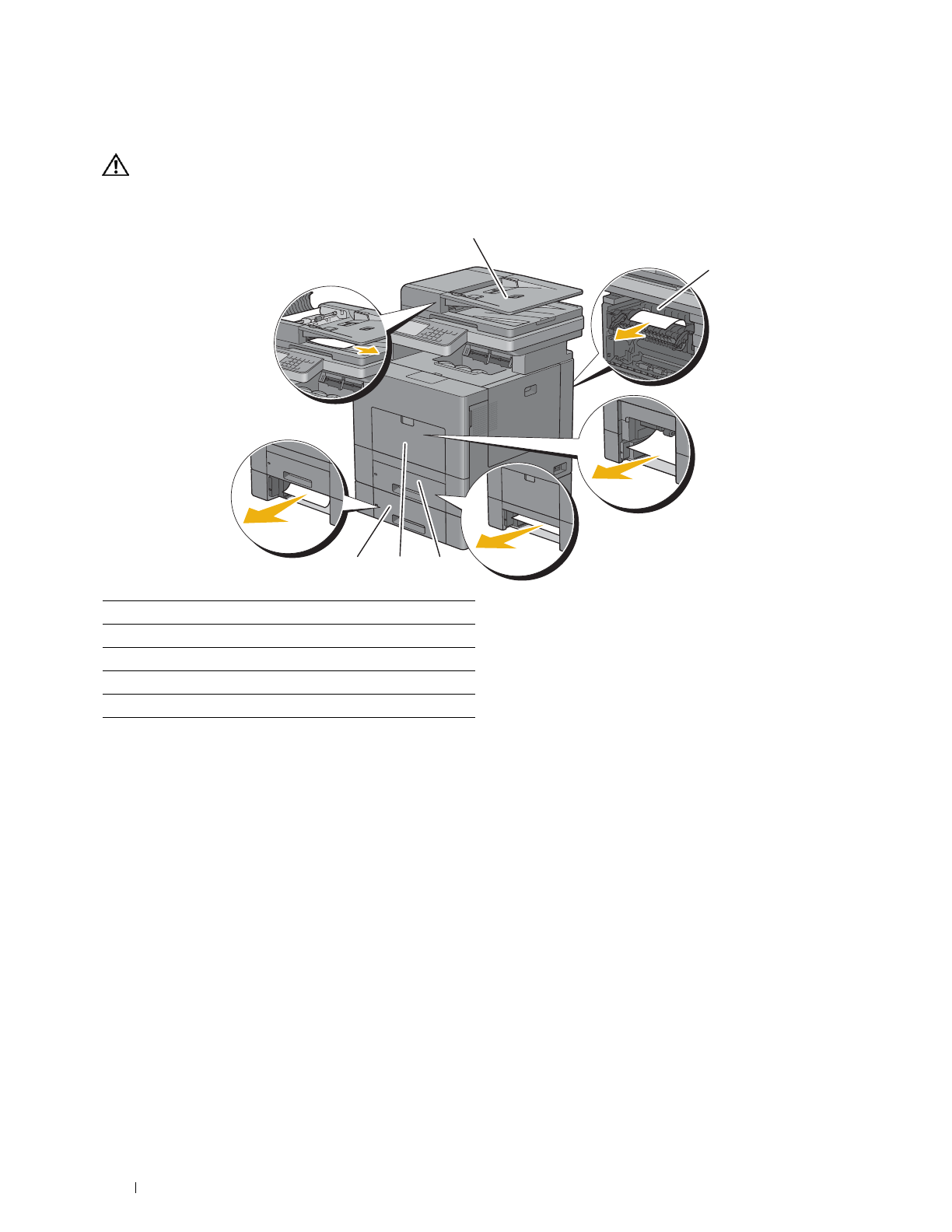
514 Clearing Jams
Identifying the Location of Paper Jams
WARNING: Do not attempt to clear any jams using tools or instruments. This may permanently damage the printer.
The following illustration shows where paper jams may occur along the print media path.
1Duplex Automatic Document Feeder (DADF)
2Fusing Unit
3Tray1
4MPF
5Optional 550-Sheet Feeder
1
2
345
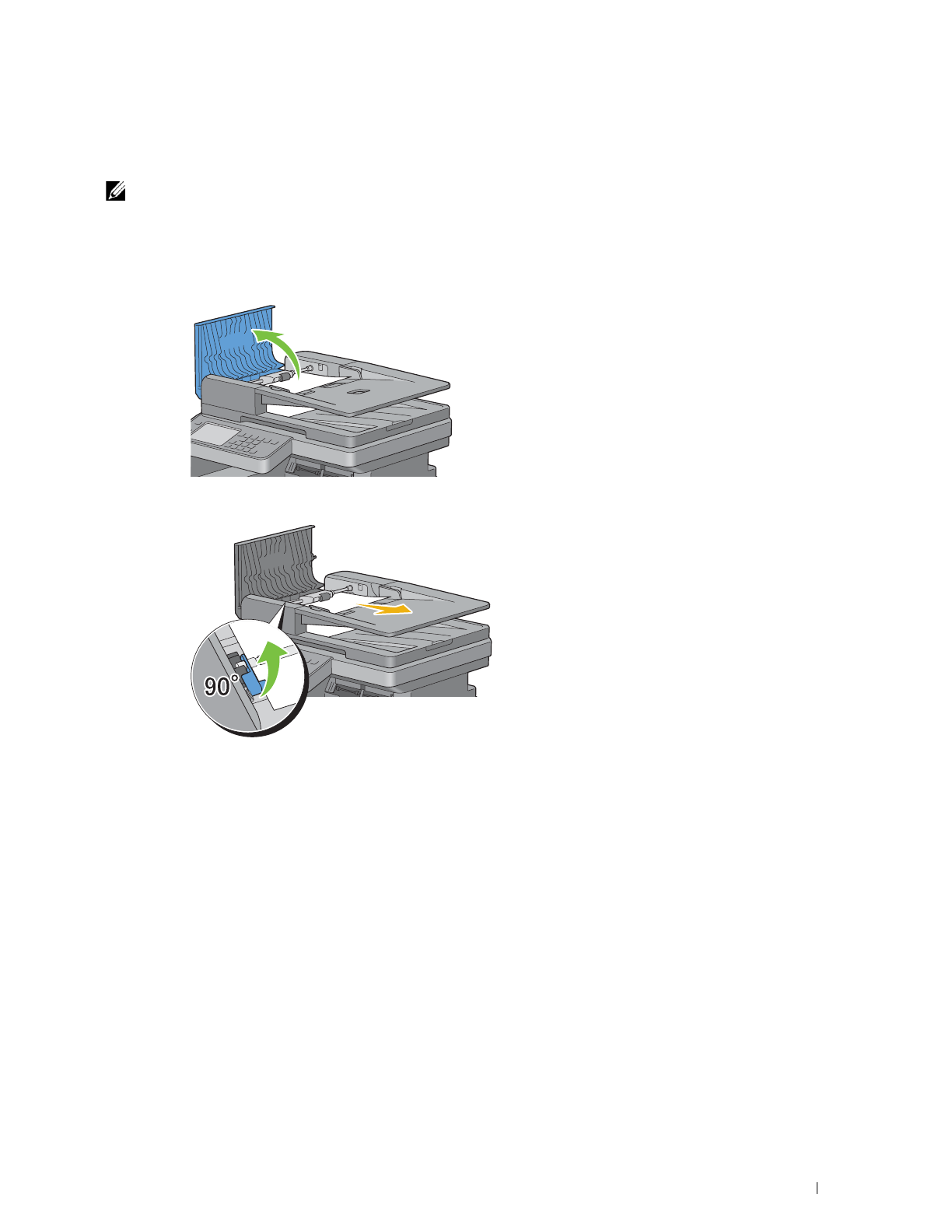
Clearing Jams 515
Clearing Paper Jams From the DADF
When a document jams while it passes through the DADF, remove the jam according to the following procedure.
NOTE: To prevent document jams, use the document glass for thick, thin, or mixed documents.
1
Remove the remaining documents from the DADF.
If the document is jammed in the paper feed area:
a
Open the DADF cover.
b
Lift the release lever 90 degrees and remove the jammed document by carefully pulling it to the right.
If you find it difficult to pull the document:
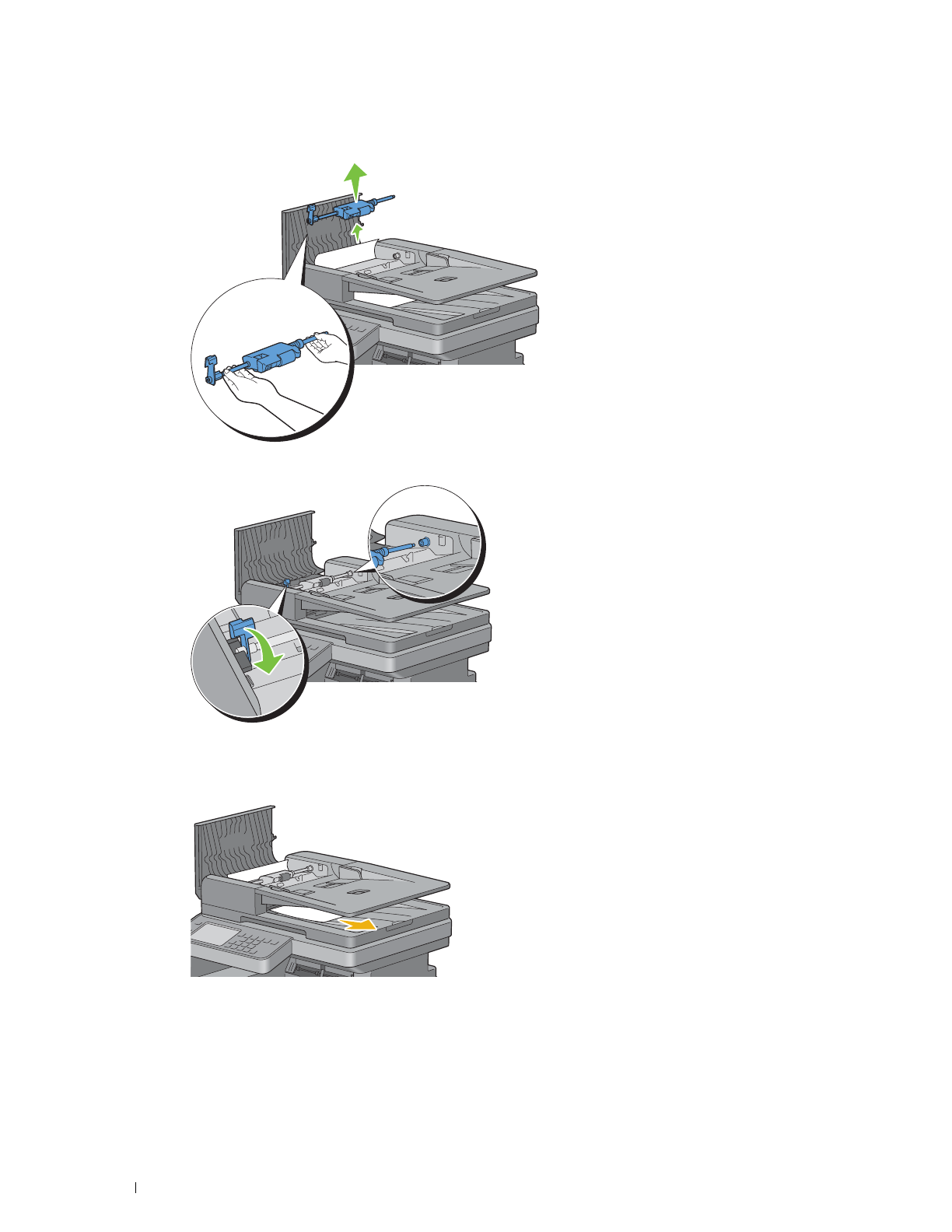
516 Clearing Jams
c
Remove the DADF feed roller assembly and remove the document by gently pulling it straight up.
d
Insert the DADF feed roller assembly and press down the release lever.
If the document is jammed in the paper exit area:
e
Remove the jammed document from the document output tray.
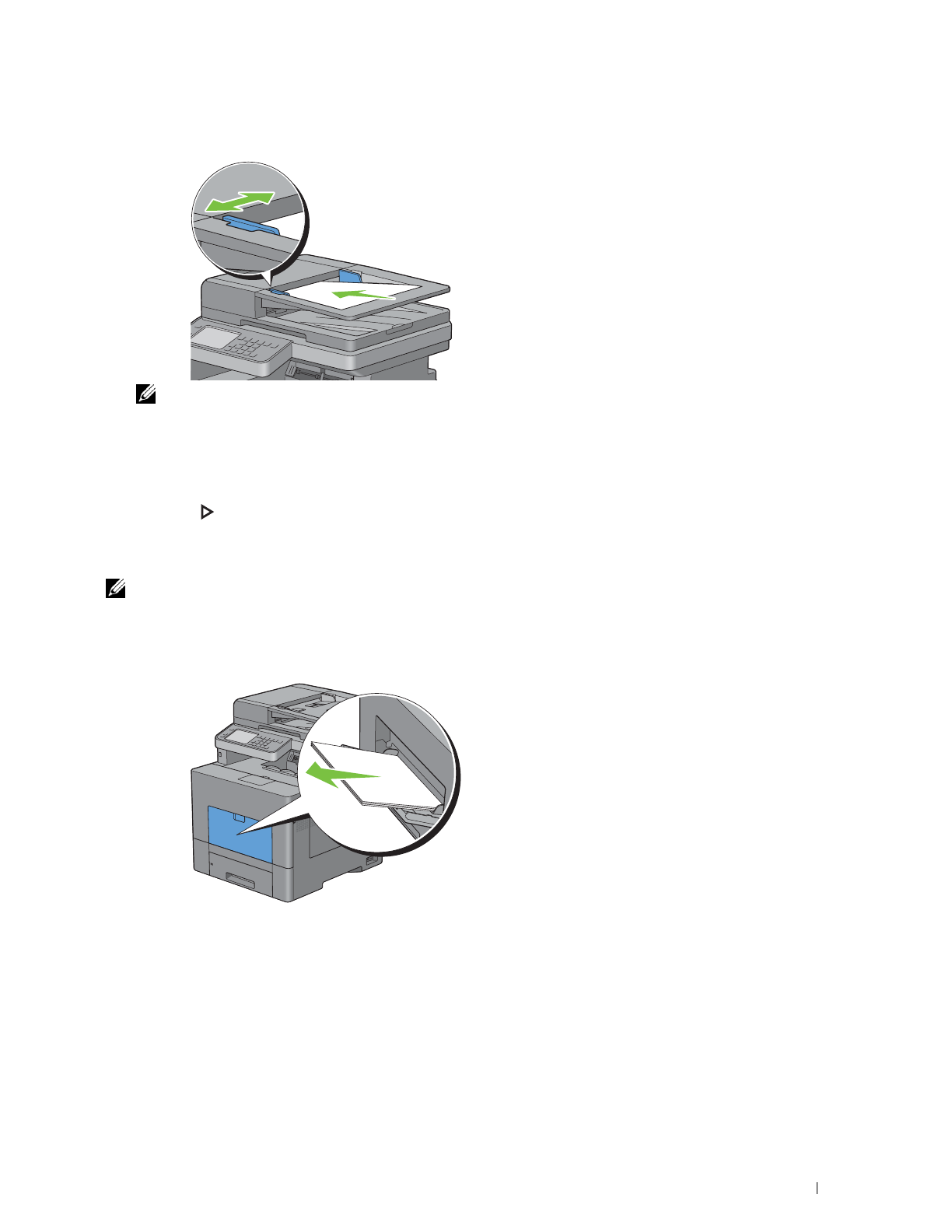
Clearing Jams 517
f
Close the DADF cover, and then load the documents back into the DADF.
NOTE: Ensure that you adjust the document guides before printing a Legal-size document.
2
If you cannot see the jammed document or the jammed document do not move when you pulled, open the
document cover.
3
Remove the document from the white sheet by carefully pulling it to the right.
4
Close the document cover, and then load the documents back into the DADF.
5
Press the (
Start
) button.
Clearing Paper Jams From the MPF
NOTE: To resolve the error displayed on the touch panel, you must clear all print media from the print media path.
If error code: 050-112 appears:
1
Remove any paper loaded on the MPF
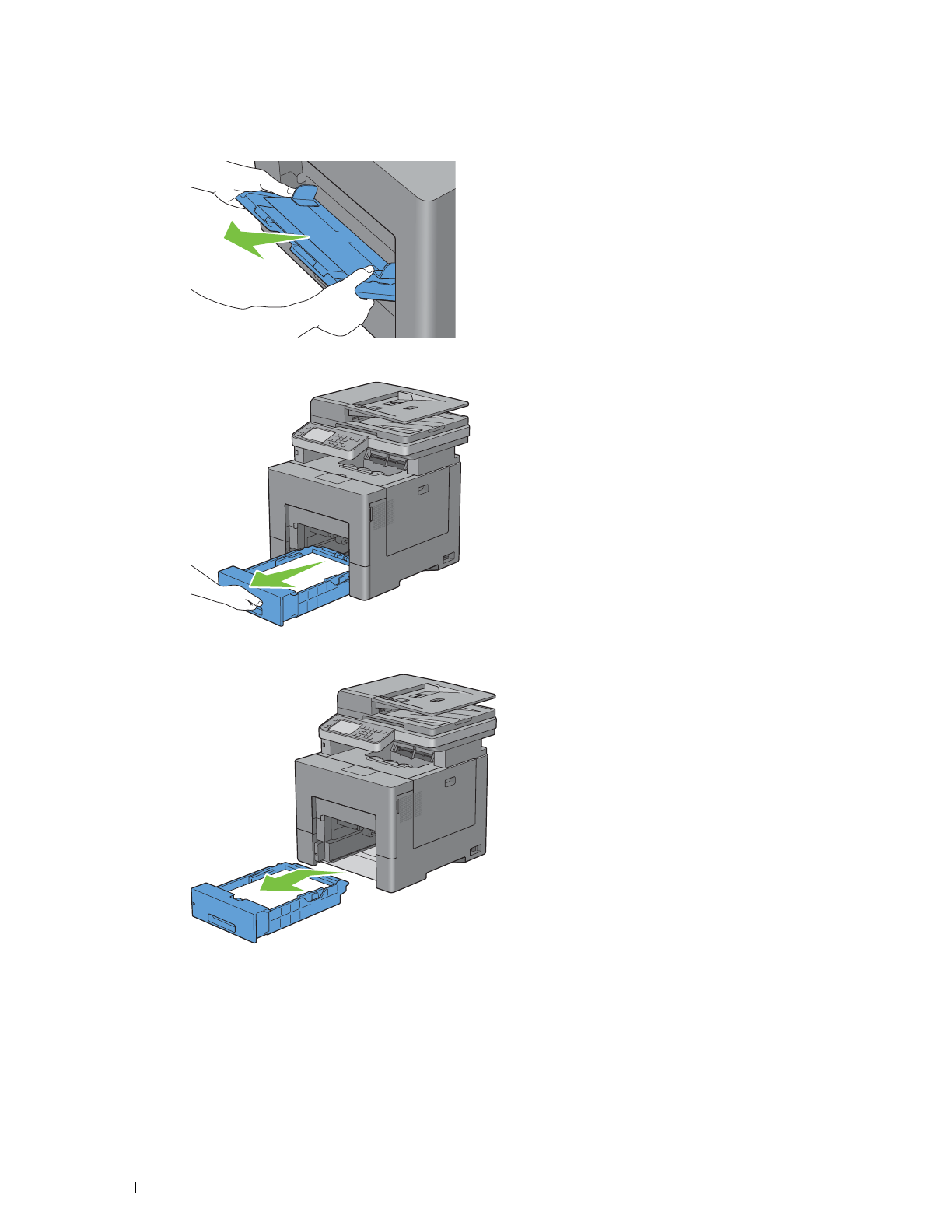
518 Clearing Jams
2
Grasp both sides of the MPF, and then pull it out of the printer.
3
Pull tray1 out of the printer about 200 mm.
4
Hold tray1 with both hands, and remove it from the printer.
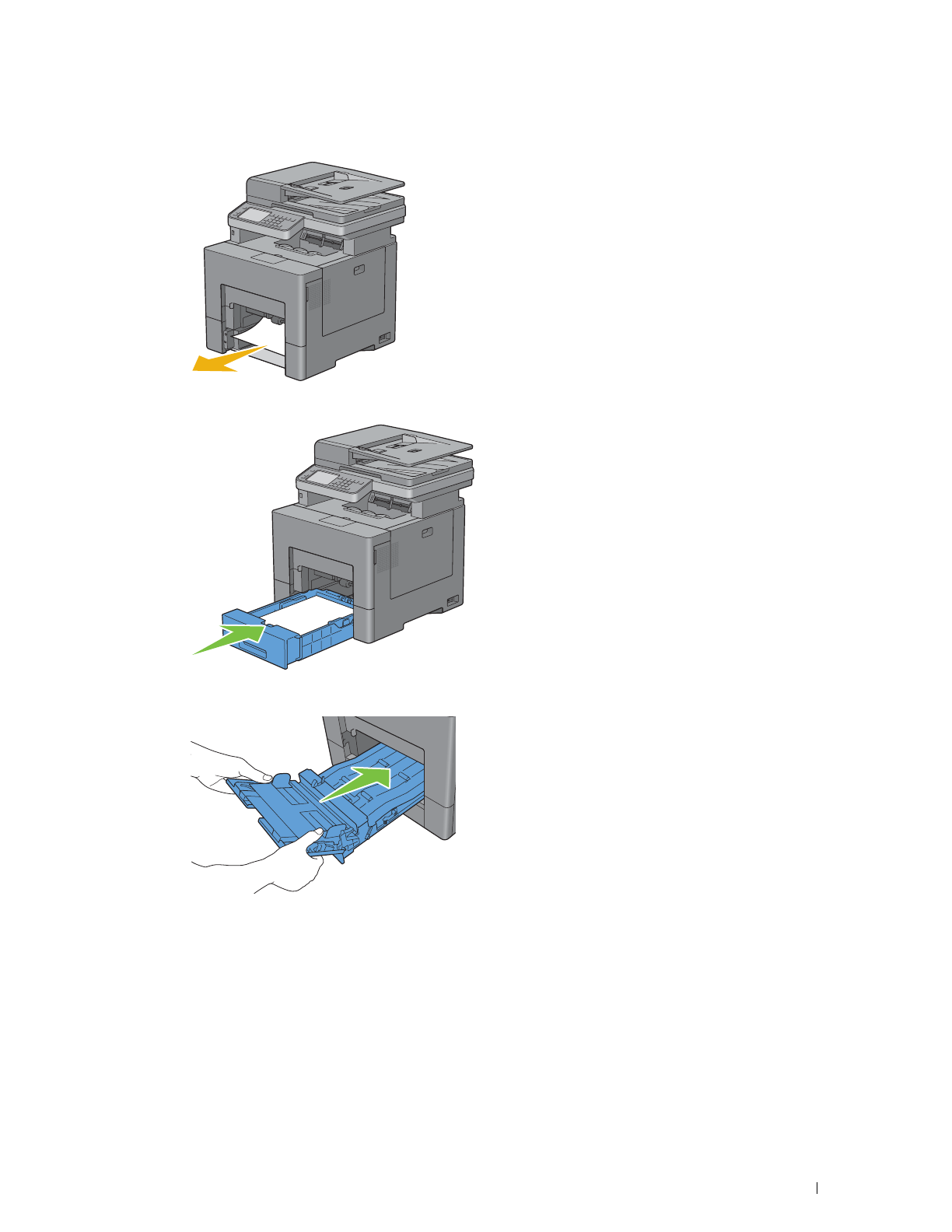
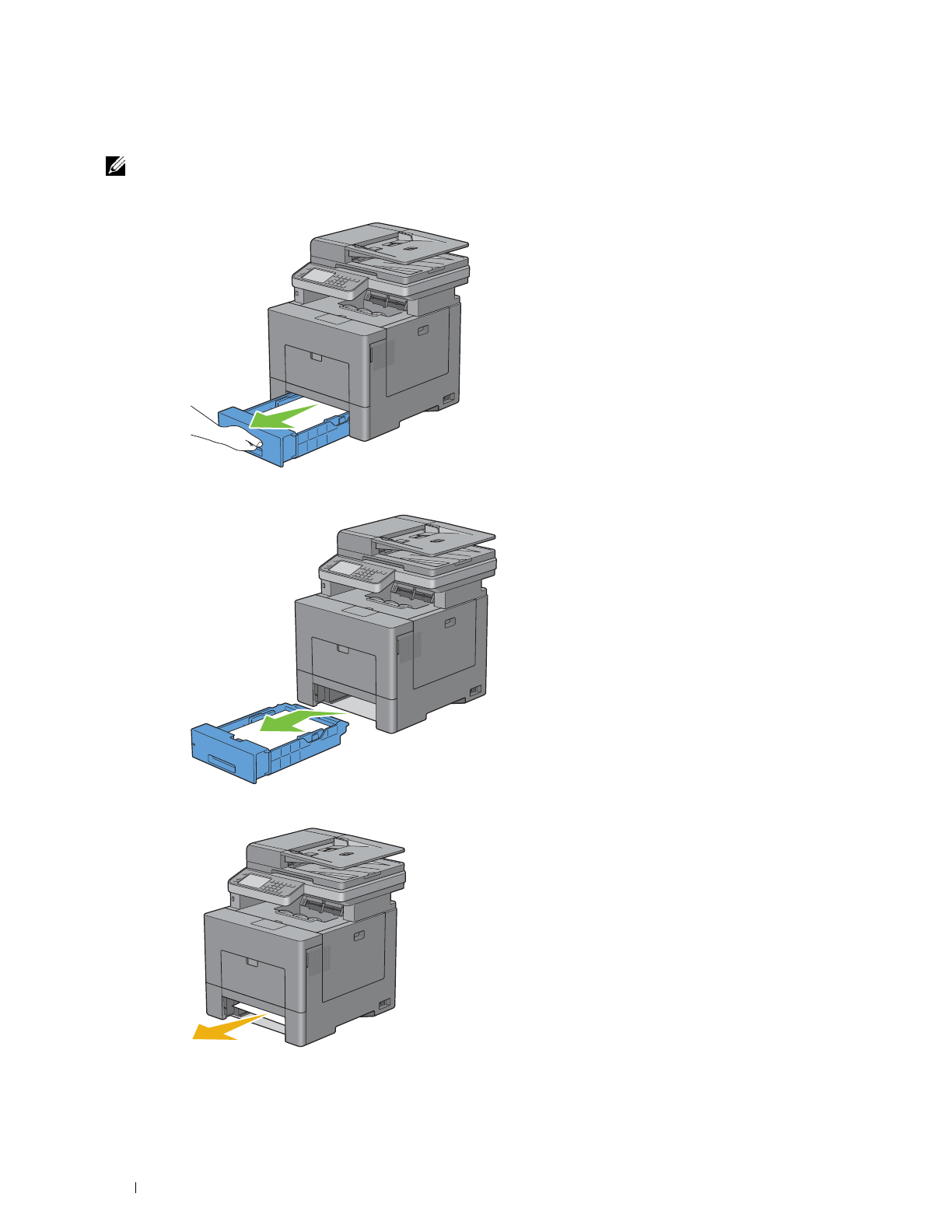
520 Clearing Jams
Clearing Paper Jams From Tray1
NOTE: To resolve the error displayed on the touch panel, you must clear all print media from the print media path.
1
Pull tray1 out of the printer about 200 mm.
2
Hold tray1 with both hands, and remove it from the printer.
3
Remove the jammed paper.
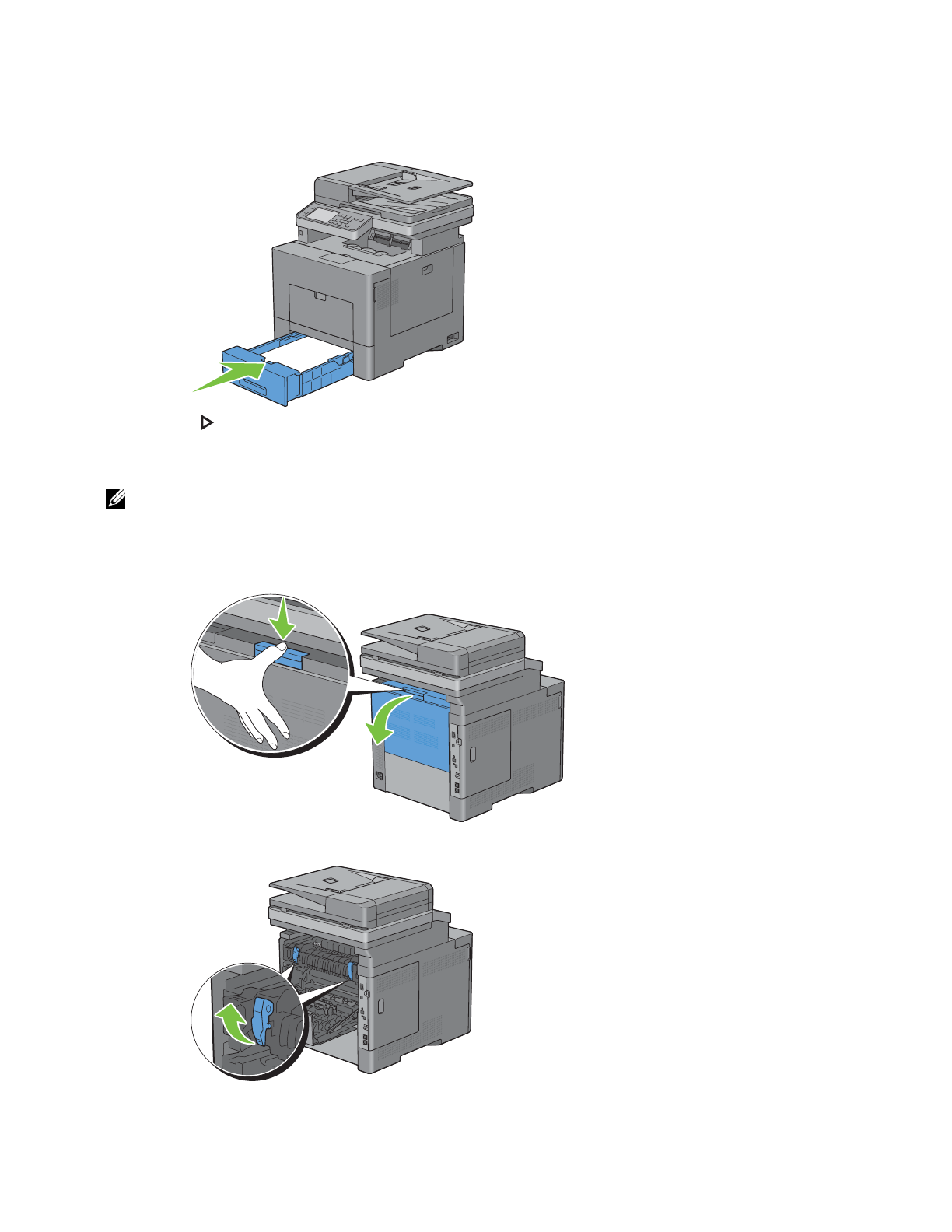
Clearing Jams 521
4
Insert tray1 into the printer, and push until it stops.
5
Press the (
Start
) button.
Clearing Paper Jams From the Fusing Unit
NOTE: To resolve the error displayed on the touch panel, you must clear all print media from the print media path.
If error code: 050-111 appears:
1
Push down the latch to open the rear cover.
2
Lift the levers on both sides of the fusing unit.
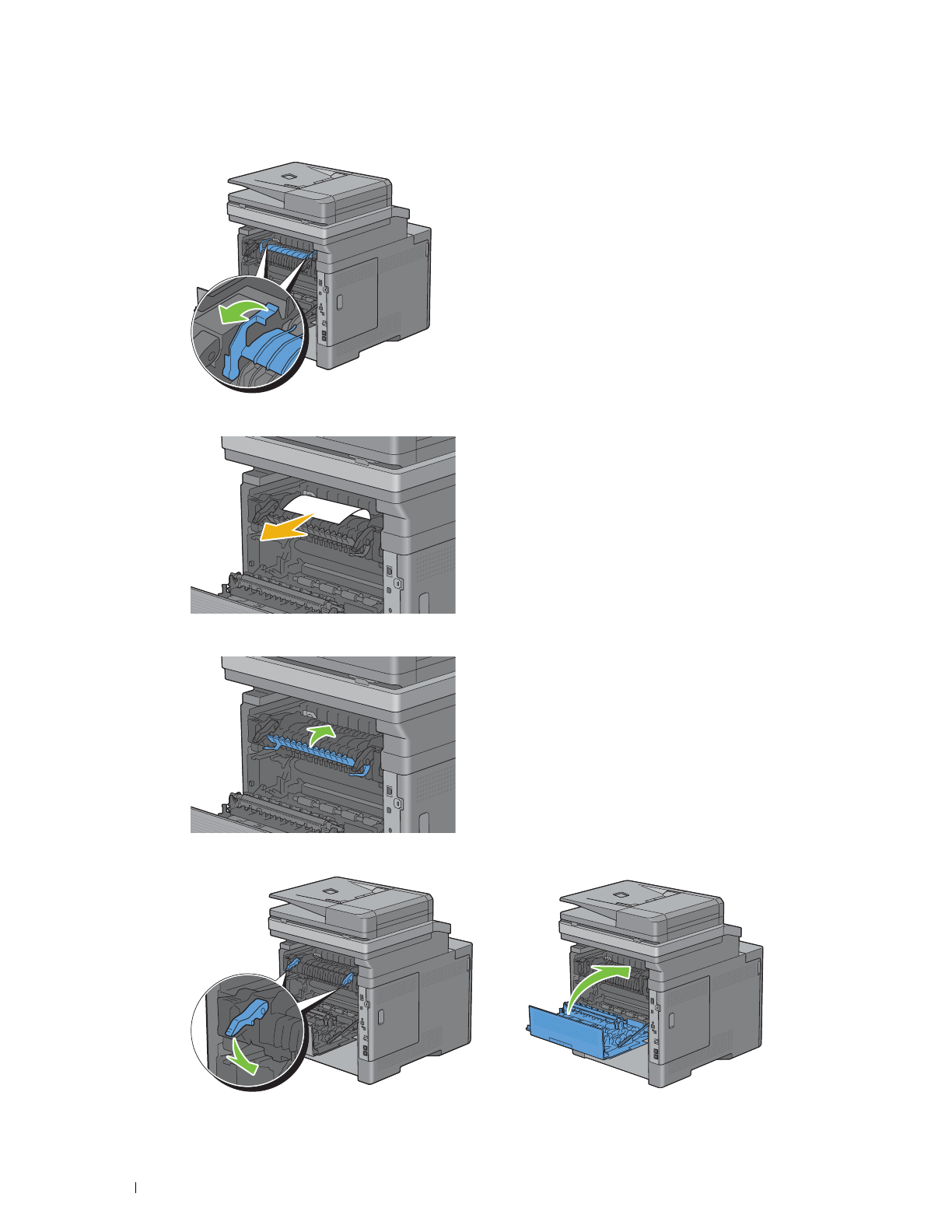
522 Clearing Jams
3
Hold and lower the tab to open the inner part.
4
Remove the jammed paper.
5
Replace the inner part.
6
Press down the levers on both sides of the fusing unit, and then close the rear cover.
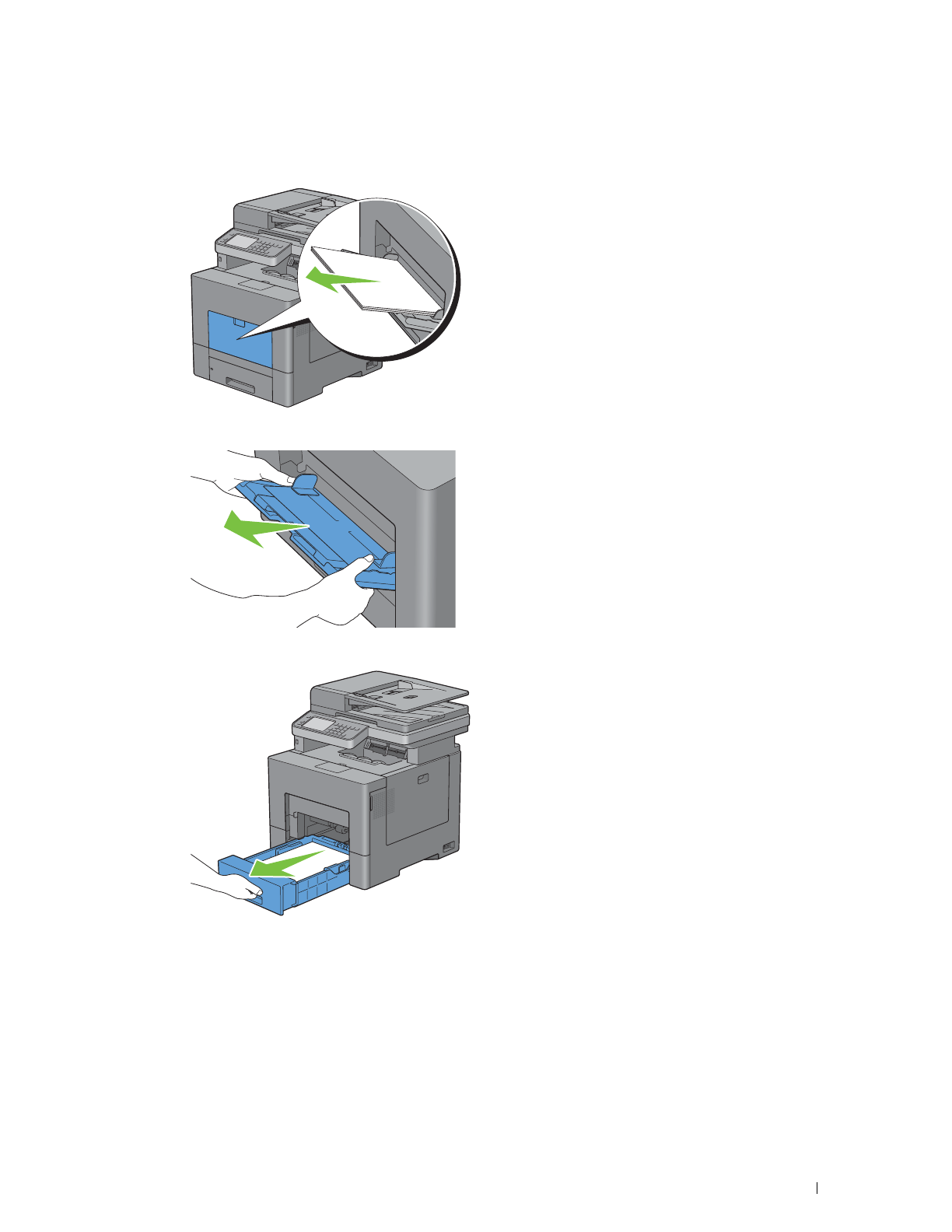
Clearing Jams 523
If error code: 050-129 appears:
1
Remove any paper loaded on the MPF
2
Grasp both sides of the MPF and then pull it out of the printer.
3
Pull tray1 out of the printer about 200 mm.
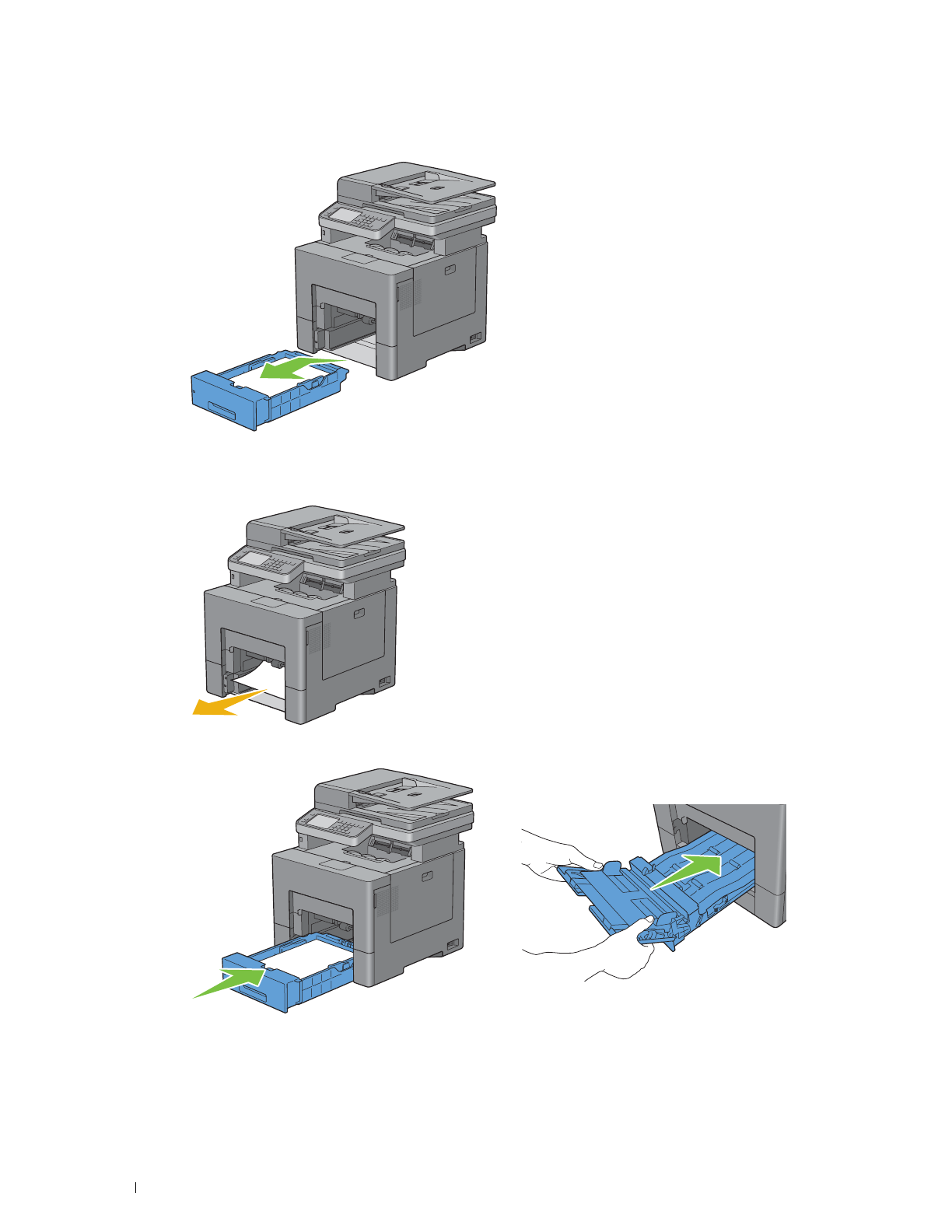
524 Clearing Jams
4
Hold tray1 with both hands, and remove it from the printer.
If you can see the jammed paper:
a
Remove the jammed paper.
b
Reinsert tray1 and the MPF into the printer.
If you cannot see the jammed paper:
a
Go to the next step.
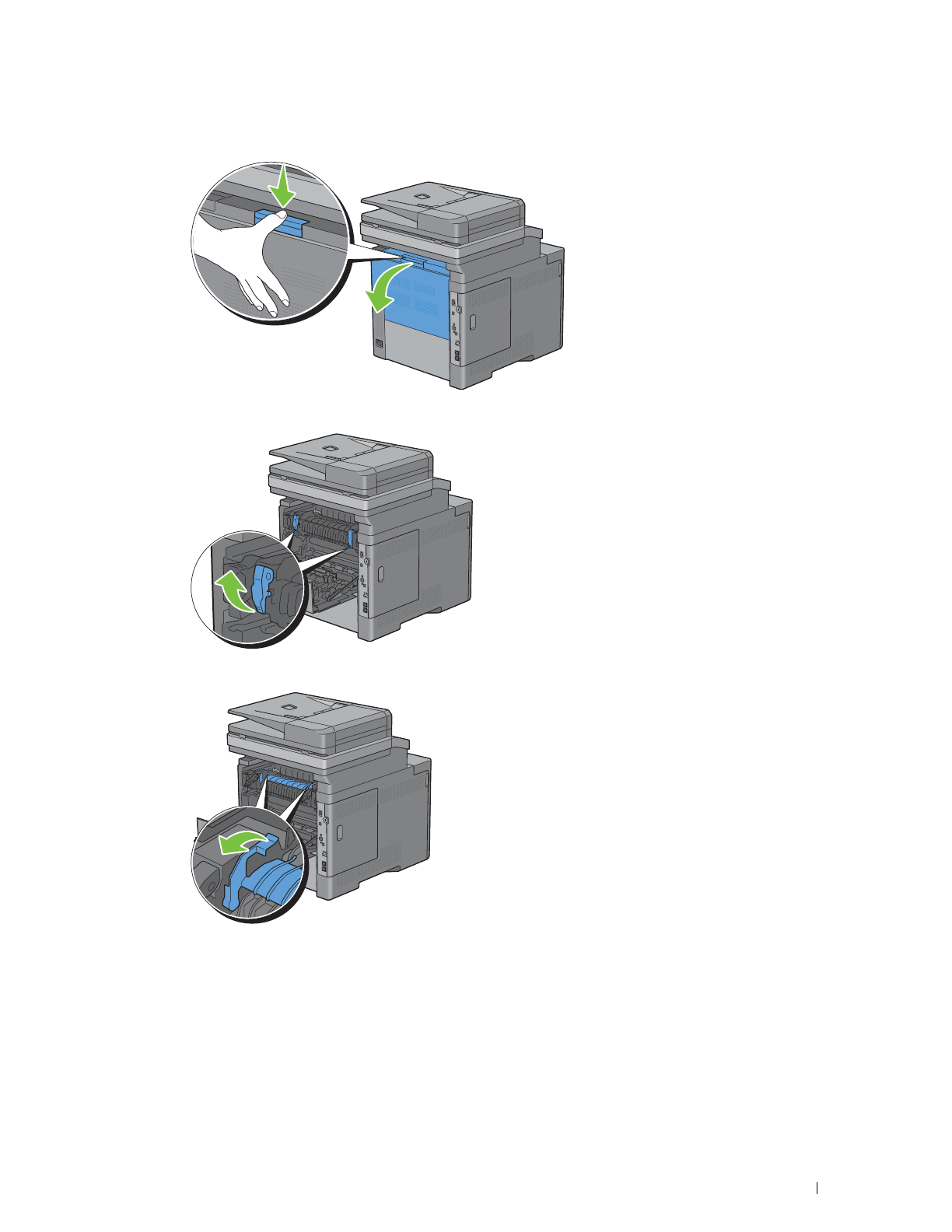
Clearing Jams 525
5
Push down the latch to open the rear cover.
6
Lift the levers on both sides of the fusing unit.
7
Hold and lower the tab to open the inner part.
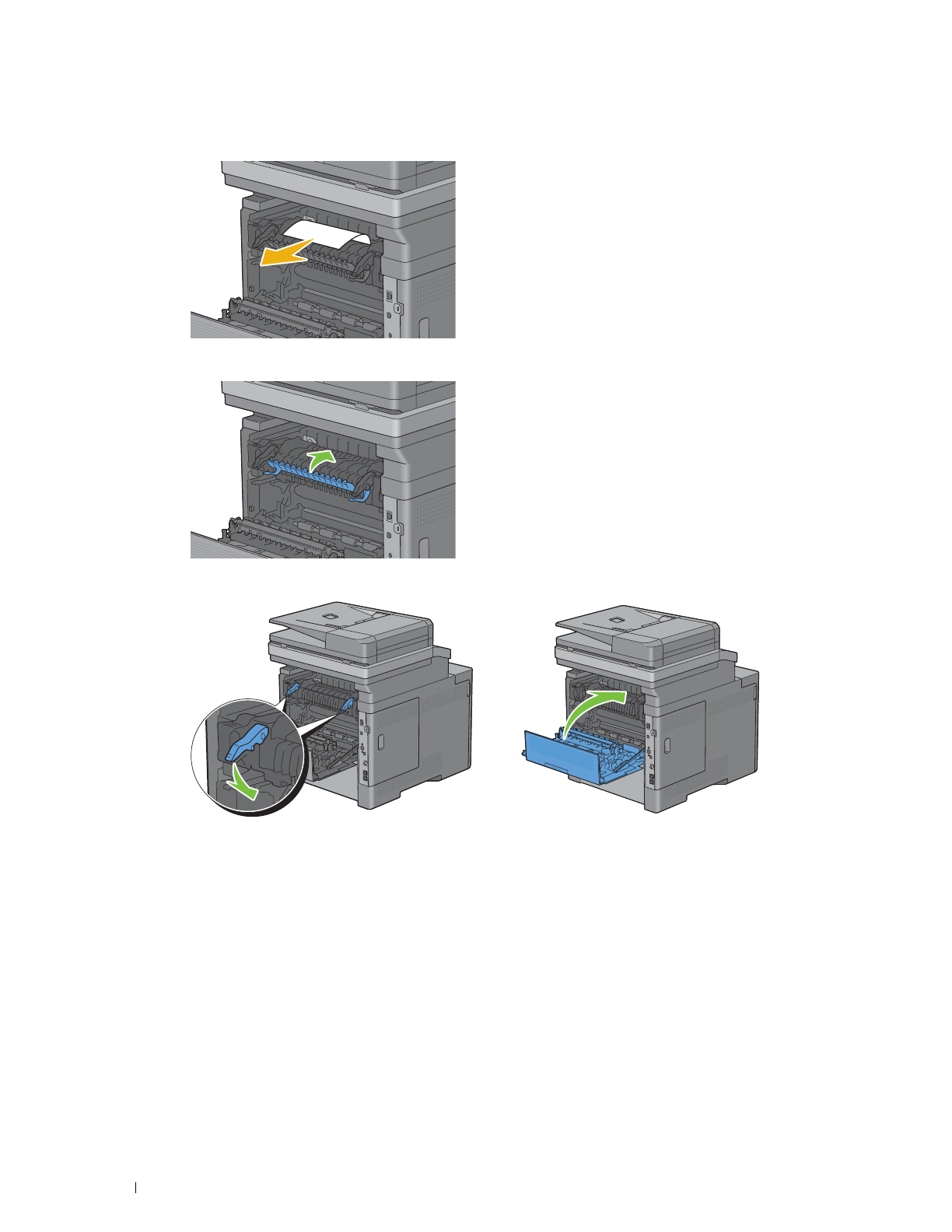
526 Clearing Jams
8
Remove the jammed paper.
9
Replace the inner part.
10
Press down the levers on both sides of the fusing unit, and then close the rear cover.
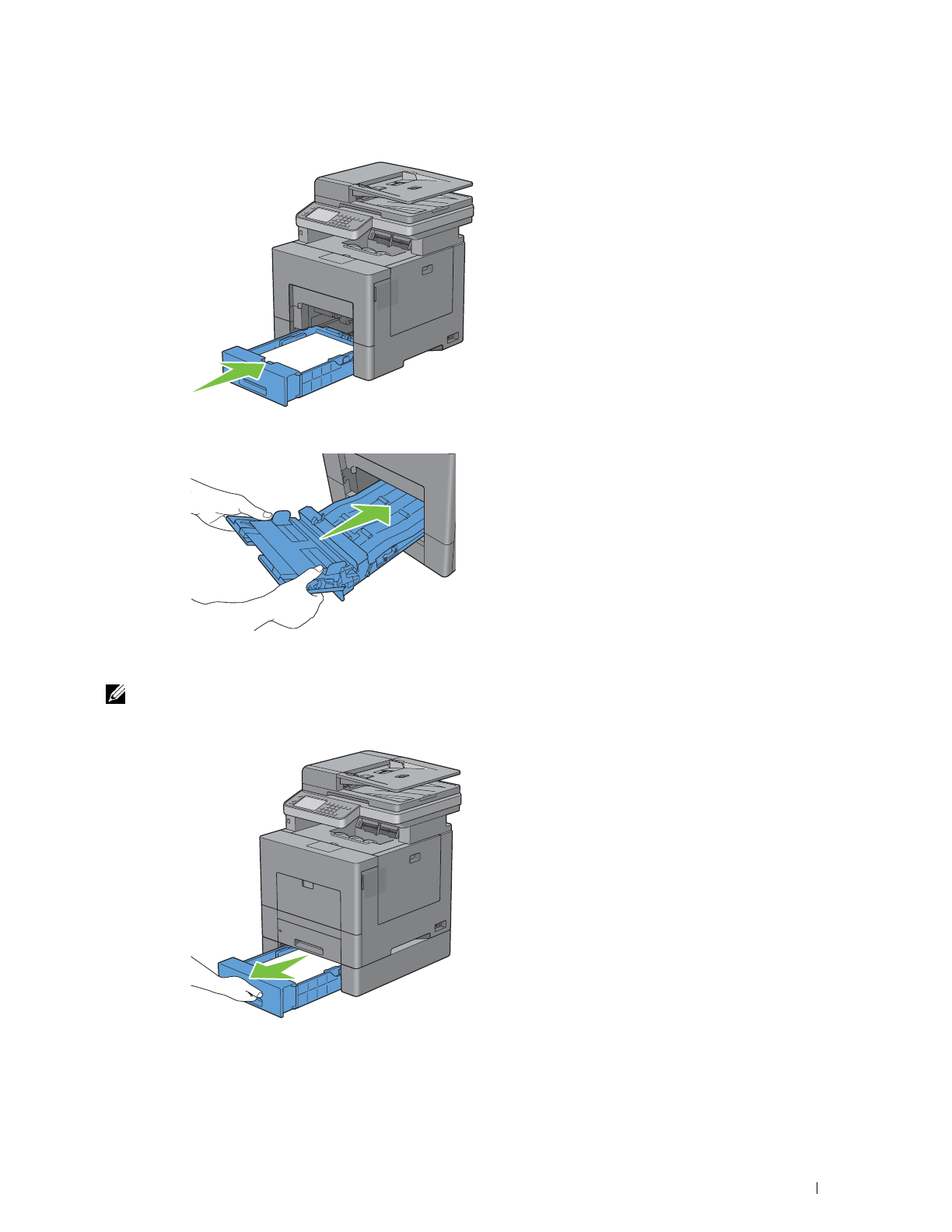
Clearing Jams 527
11
Insert tray1 into the printer, and push until it stops.
12
Insert the MPF into the printer.
Clearing Paper Jams From the Optional 550-Sheet Feeder
NOTE: To resolve the error displayed on the touch panel, you must clear all print media from the print media path.
1
Pull the optional 550-sheet feeder out of the printer about 200 mm.
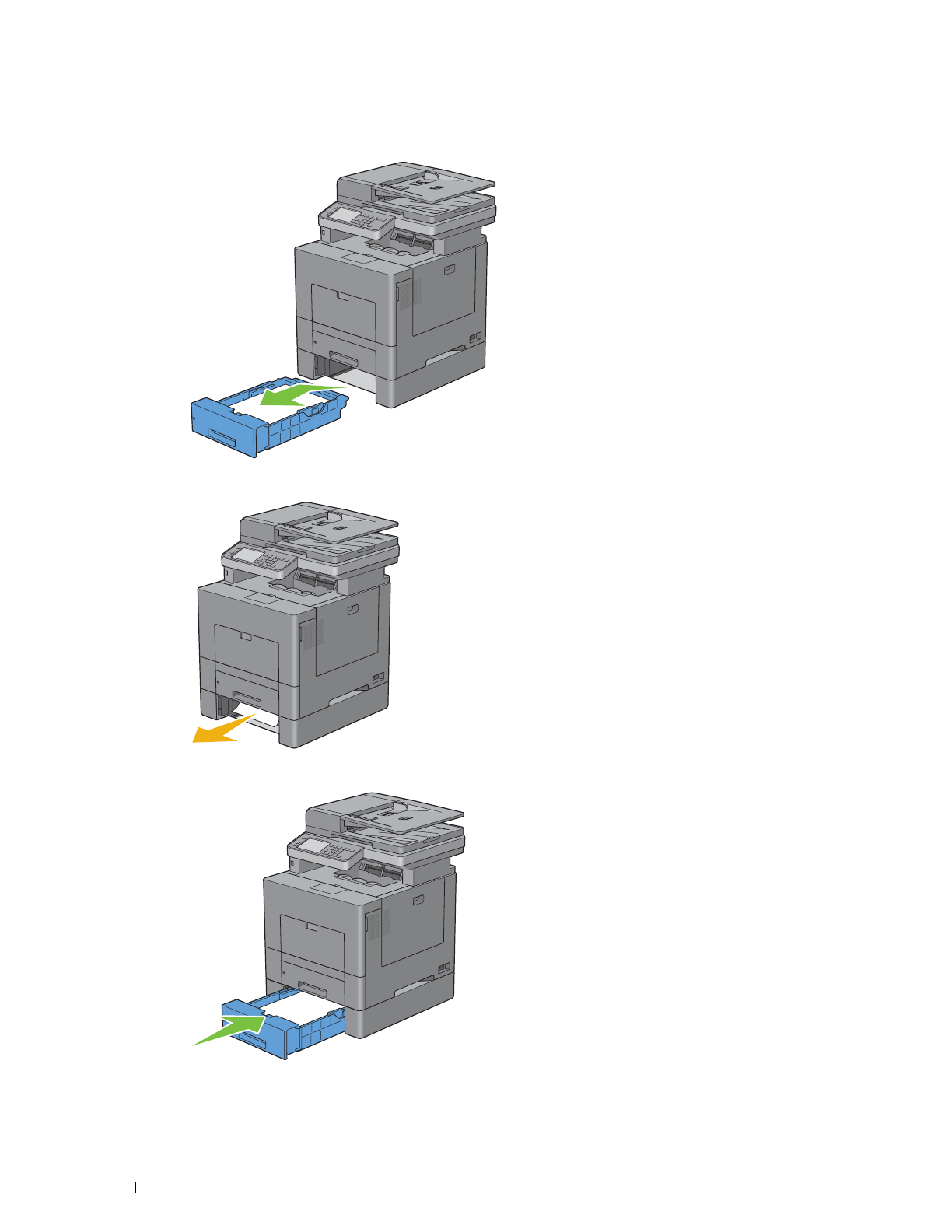
528 Clearing Jams
2
Hold the optional 550-sheet feeder with both hands, and remove it from the printer.
3
Remove the jammed paper.
4
Insert the optional 550-sheet feeder into the printer, and push until it stops.


530
Troubleshooting Guide 531
33
Troubleshooting Guide
Basic Printer Problems
Some printer problems can be easily resolved. If a problem occurs with your printer, check each of the following:
• The power cable is plugged into the printer and a properly grounded electrical outlet.
• The printer is turned on.
• The electrical outlet is not turned off at any switch or breaker.
• Other electrical equipment plugged into the outlet is working.
• All options are properly installed.
If you have checked all of the above and still have a problem, turn off the printer, wait for 10 seconds, and then turn
on the printer. This often fixes the problem.
NOTE: If error messages are displayed on the touch panel or on your computer screen, follow the on-screen instructions to
resolve the printer problems. For details about error messages and error codes, see "Understanding Printer Messages."
Display Problems
Printing Problems
NOTE: If Panel Lock Control is set to Enable, you need to enter the four digit password to enter the Admin
Settings menu.
Problem Action
Menu settings changed from the operator
panel have no effect.
Settings in the software program, the printer driver, or the printer utilities are
overriding the settings made on the operator panel.
Problem Action
Job did not print or incorrect characters
printed.
Ensure that the top menu appears on the touch panel before you send a job to
print. Press the (Home) button to return to the top menu.
Ensure that the print media is loaded in the printer. Press the (Home)
button to return to the top menu.
Verify that the printer is using the correct page description language (PDL).
Verify that you are using the correct printer driver.
Ensure that the correct USB or Ethernet cable is securely connected to the printer.
Verify that the correct print media size is selected.
If you are using a print spooler, verify that the spooler has not stalled.
Check the printer's interface from the Admin Settings.
Determine the host interface you are using. Print a panel settings report to verify
that the current interface settings are correct.

532 Troubleshooting Guide
Print Quality Problems
NOTE: Some of the following procedures that use the Tool Box can also be performed using the operator panel or Dell Printer
Configuration Web Tool. For information on how to use the operator panel and Dell Printer Configuration Web Tool, see
"Understanding the Printer Menus" and "Dell™ Printer Configuration Web Tool."
• The output is too light
• Toner smears or print comes off
• Random spots/Blurred images
• The entire output is blank
• Streaks appear on the output
• Part or the entire output is black
Print media misfeeds or multiple feeds
occur.
Ensure that the print media you are using meets the specifications for your printer.
See "Supported Paper Types" for more information.
Fan the print media before loading it.
Ensure that the print media is loaded correctly.
Ensure that the width and length guides of the print media sources are adjusted
correctly.
Ensure that tray1, the optional 550-sheet feeder (tray2), or the multi-purpose
feeder (MPF) unit is securely inserted.
Do not overload tray1, the optional 550-sheet feeder, or the MPF.
Do not force print media into the MPF when you load it; otherwise, it may skew or
buckle.
Ensure that the print media is not curled.
Face the recommended print side up. See "Loading Print Media in Tray1 and the
Optional 550-Sheet Feeder" for more information.
Turn the print media over or around and try printing again to see if feeding
improves.
Do not mix print media types.
Do not mix reams of print media.
Remove the top and bottom curled sheets of a ream before loading the print
media.
Load print media only when tray1, the optional 550-sheet feeder, or the MPF is
empty.
Wipe the retard rollers in tray1, the optional 550-sheet feeder, or the MPF with a
cloth moistened with water.
The envelope is creased after printed. Make sure that the envelope is loaded in the MPF as instructed in "Loading an
Envelope in the MPF."
Page breaks in unexpected places. Increase the value for Time-Out using the operator panel, the Tool Box, or Dell™
Printer Configuration Web Tool.
Print media does not stack neatly in the
output tray.
Turn the print media stack over in tray1 or the MPF.
Cannot print from tray1 or the optional 550-
sheet feeder because the print media in
tray1 or the optional 550-sheet feeder is
curled.
Load the print media into the MPF.
Problem Action
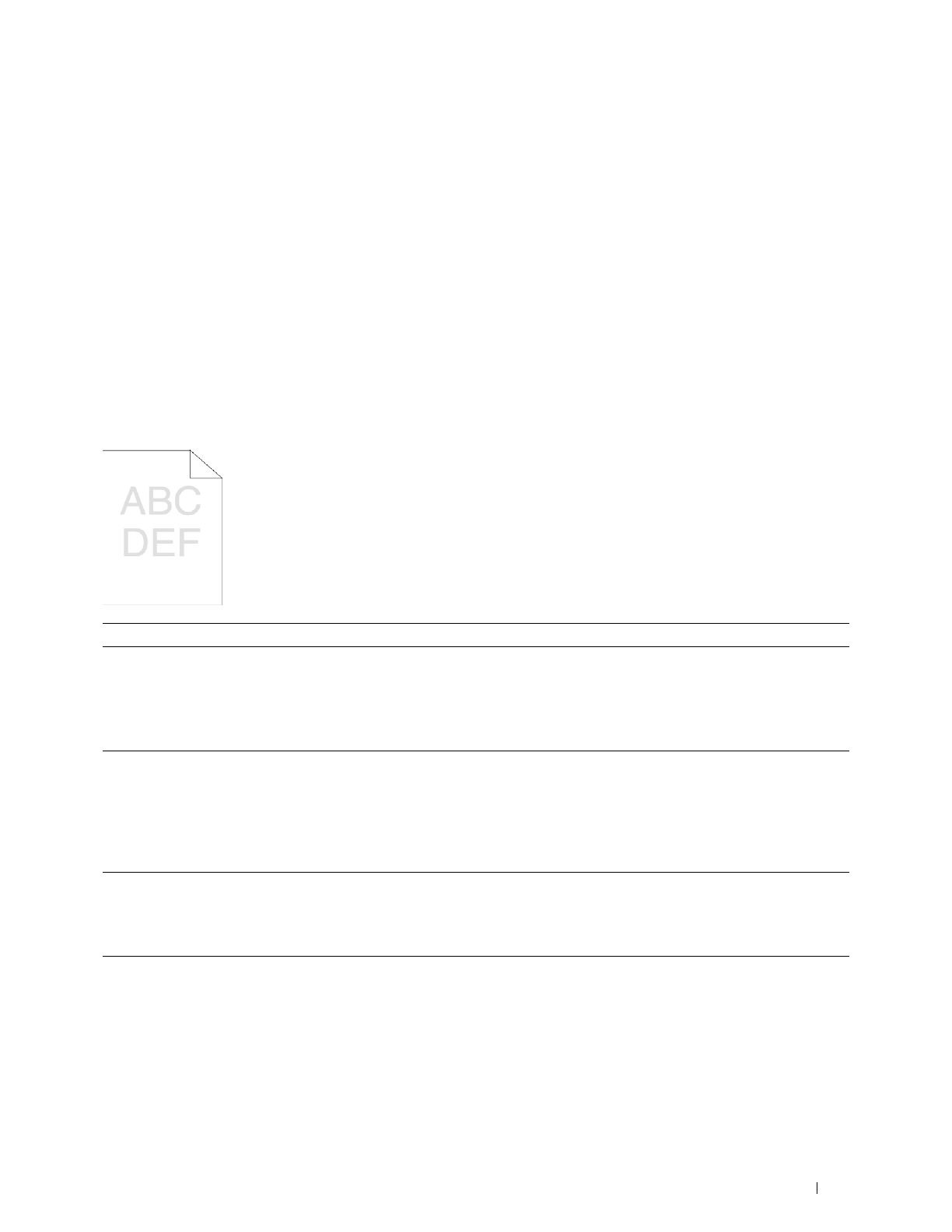
Troubleshooting Guide 533
•Pitched color dots
•Vertical blanks
•Ghosting
• Light-induced fatigue
•Fog
• Bead-Carry-Out (BCO)
• Jagged characters
•Banding
•Auger mark
• Wrinkled/Stained paper
• Damage on the leading edge of paper
The output is too light
Action Yes No
1The toner cartridges may be low or need to be replaced. Confirm the
amount of toner left in each toner cartridge.
a
Check the toner level in the
Status
tab in the Status Monitor.
b
Replace the toner cartridges as necessary.
Does this solve your problem?
The task is complete. Go to action 2.
2If you are using non-Dell brand toner cartridges, enable the Non-Dell
Toner option.
a
Launch the
Tool Box
, and click
Service Tools
on the
Printer
Maintenance
tab.
b
Ensure that the
On
check box under
Non-Dell Toner
is selected.
Does this solve your problem?
The task is complete. Go to action 3.
3Disable the Tone r S aver in the printer driver.
a
On the
Others
tab, ensure that Off is selected in the Toner Saver
drop-down menu.
Does this solve your problem?
The task is complete. Go to action 4.
4The print media surface may be uneven. Try changing the Paper Type
setting in the printer driver. For example, change the plain paper to
thick.
a
On the
General
tab, change the
Paper Type
setting.
Does this solve your problem?
The task is complete. Go to action 5.
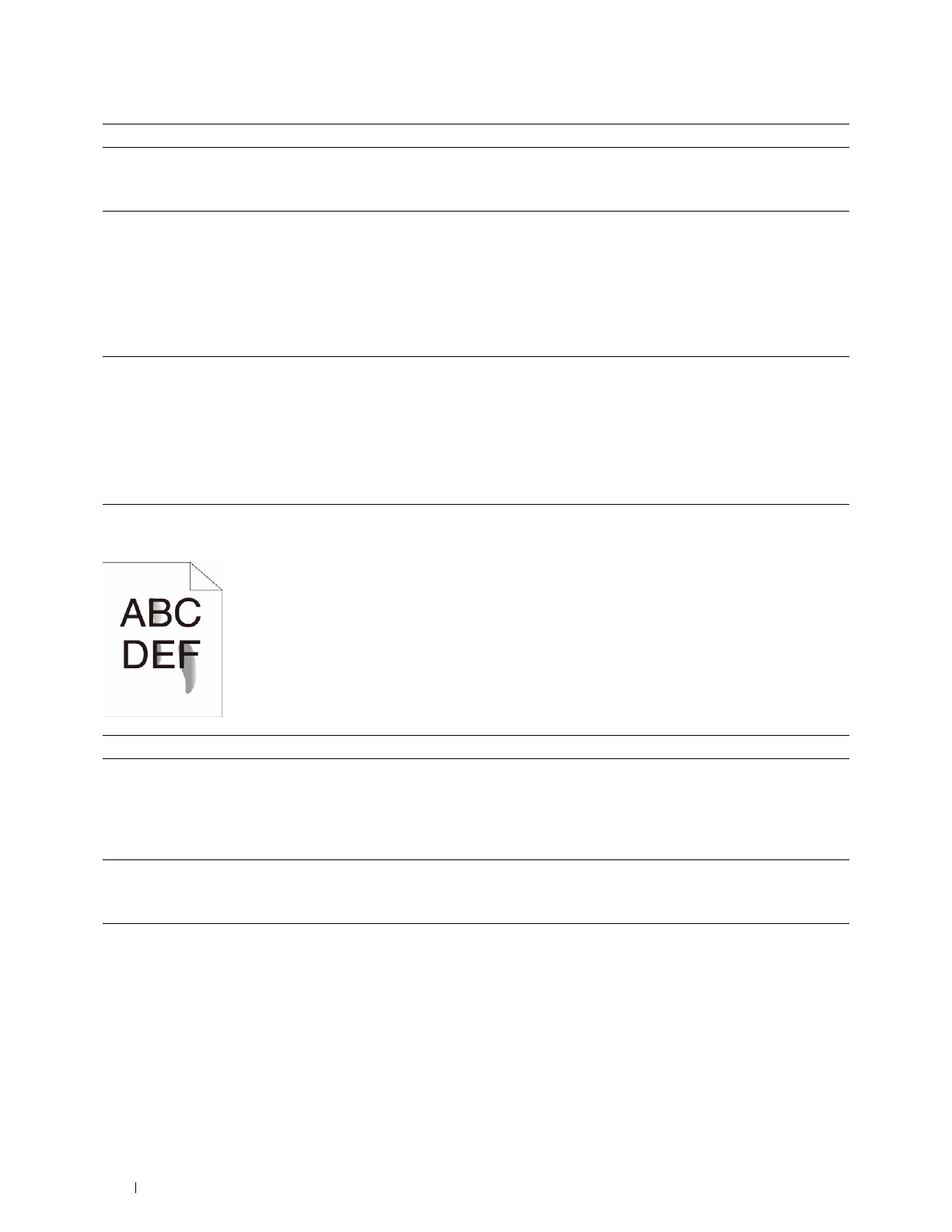
534 Troubleshooting Guide
Toner smears or print comes off
5Verify that the correct print media is being used. See "Supported Paper
Types." If not, use the print media recommended for the printer.
Does this solve your problem?
The task is complete. Go to action 6.
6Clean inside the printer by using the cleaning rod. See "Cleaning the
Raster Optical Scanner (ROS) Window."
a
After the cleaning is completed, click
Chart Print
on the
Diagnosis
tab.
b
Click
Pitch Configuration Chart
.
The Pitch Configuration Chart is printed.
Does this solve your problem?
The task is complete. Go to action 7.
7Replace the drum cartridges.
a
Replace the drum cartridges. See "Replacing the Drum Cartridges."
b
After you replace the drum cartridges, click
Chart Print
on the
Diagnosis
tab.
c
Click
4 Colors Configuration Chart
.
The 4 Colors Configuration Chart is printed.
Does this solve your problem?
The task is complete. Contact Dell.
Action Yes No
1The print media surface may be uneven. Try changing the Paper Type
setting in the printer driver. For example, change the plain paper to
thick.
a
On the
General
tab, change the Paper Type setting.
Does this solve your problem?
The task is complete. Go to action 2.
2Verify that the correct print media is being used. See "Supported Paper
Types." If not, use the print media recommended for the printer.
Does this solve your problem?
The task is complete. Go to action 3.
3Replace the drum cartridges.
a
Replace the drum cartridges. See "Replacing the Drum Cartridges."
b
After you replace the drum cartridges, test print your document
again.
Does this solve your problem?
The task is complete. Go to action 4.
Action Yes No
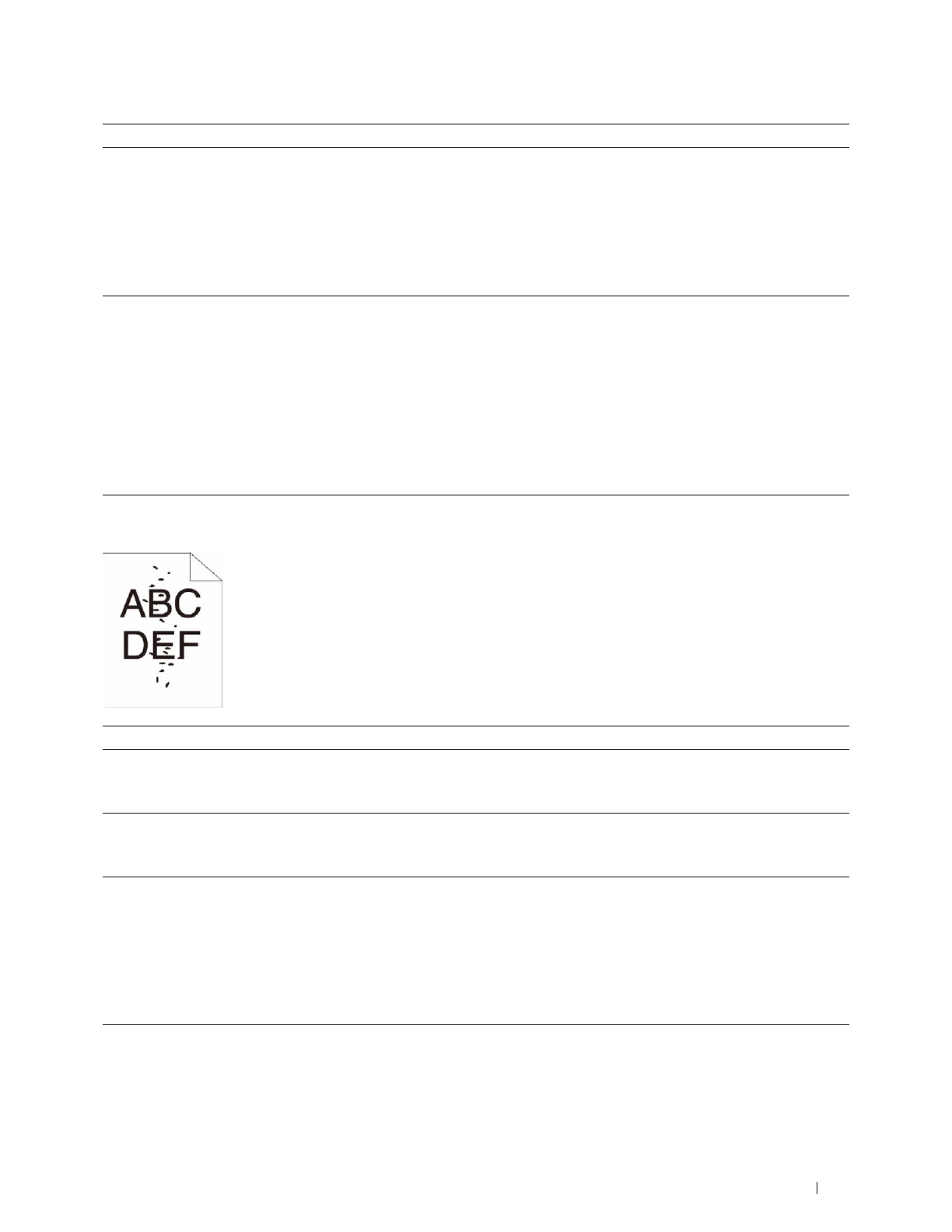
Troubleshooting Guide 535
Random spots/Blurred images
4Replace the fusing unit.
a
Replace the fusing unit. See "Replacing the Fusing Unit."
b
After you replace the fusing unit, click
Chart Print
on the
Diagnosis
tab.
c
Click
Pitch Configuration Chart
.
The Pitch Configuration Chart is printed.
Does this solve your problem?
The task is complete. Go to action 5.
5Replace the transfer belt unit, the 2nd Belt Transfer Roller (2nd BTR),
and the retard roller.
a
Replace the transfer belt unit, the 2nd BTR, and the retard roller. See
"Replacing the Transfer Belt Unit, the 2nd Belt Transfer Roller (2nd
BTR), and the Retard Roller."
b
After you replace the transfer belt unit, the 2nd BTR,
and the retard
roller, click
Chart Print
on the
Diagnosis
tab.
c
Click
Pitch Configuration Chart
.
The Pitch Configuration Chart is printed.
Does this solve your problem?
The task is complete. Contact Dell.
Action Yes No
1Ensure that the toner cartridges are installed correctly. See "
Installing a
Toner Cartridge."
Does this solve your problem?
The task is complete. Go to action 2.
2Ensure that the drum cartridges are installed correctly.
See "Installing a
Drum Cartridge."
Does this solve your problem?
The task is complete. Go to action 3.
3Replace the drum cartridges.
a
Replace the drum cartridges. See "Replacing the Drum Cartridges."
b
After you replace the drum cartridges, click
Chart Print
on the
Diagnosis
tab.
c
Click
Pitch Configuration Chart
.
The Pitch Configuration Chart is printed.
Does this solve your problem?
The task is complete. Contact Dell.
Action Yes No
536 Troubleshooting Guide
The entire output is blank
Action Yes No
1The toner cartridges may be low or need to be replaced. Confirm the
amount of toner left in each toner cartridge.
a
Check the toner level in the
Status
tab in the Status Monitor.
b
Replace the toner cartridges as necessary.
Does this solve your problem?
The task is complete. Go to action 2.
2If you are using non-Dell brand toner cartridges, enable the Non-Dell
Toner option.
a
Launch the
Tool Box
, and click
Service Tools
on the
Printer
Maintenance
tab.
b
Ensure that the
On
check box under
Non-Dell Toner
is selected.
Does this solve your problem?
The task is complete. Go to action 3.
3Disable the Tone r S aver in the printer driver.
a
On the
Others
tab, ensure that
Off
is selected in the
Toner Saver
drop-down menu.
Does this solve your problem?
The task is complete. Go to action 4.
4The print media surface may be uneven. Try changing the Paper Type
setting in the printer driver. For example, change the plain paper to
thick.
a
On the
General
tab, change the
Paper Type
setting.
Does this solve your problem?
The task is complete. Go to action 5.
5Verify that the correct print media is being used. See "Supported Paper
Types." If not, use the print media recommended for the printer.
Does this solve your problem?
The task is complete. Go to action 6.
6Replace the drum cartridges.
a
Replace the drum cartridges. See "Replacing the Drum Cartridges."
b
After you replace the drum cartridges, click
Chart Print
on the
Diagnosis
tab.
c
Click
4 Colors Configuration Chart
.
The 4 Colors Configuration Chart is printed.
Does this solve your problem?
The task is complete. Contact Dell.
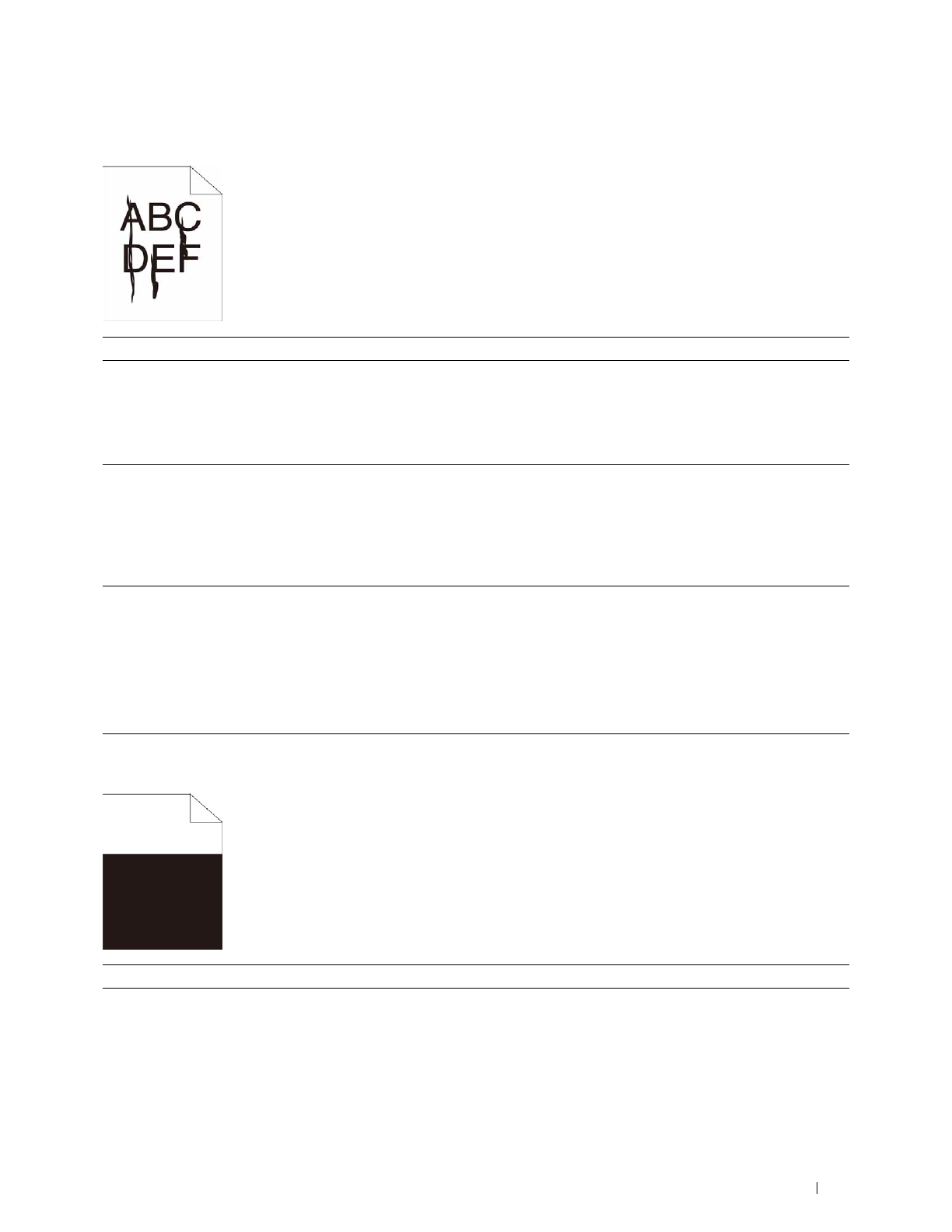
Troubleshooting Guide 537
Streaks appear on the output
Part or the entire output is black
Action Yes No
1The toner cartridges may be low or need to be replaced. Confirm the
amount of toner left in each toner cartridge.
a
Check the toner level in the
Status
tab in the Status Monitor.
b
Replace the toner cartridges as necessary.
Does this solve your problem?
The task is complete. Go to action 2.
2If you are using non-Dell brand toner cartridges, enable the Non-Dell
Tone r option.
a
Launch the
Tool Box
, and click
Service Tools
on the
Printer
Maintenance
tab.
b
Ensure that the
On
check box under
Non-Dell Toner
is selected.
Does this solve your problem?
The task is complete. Go to action 3.
3Replace the drum cartridges.
a
Replace the drum cartridges. See "Replacing the Drum Cartridges."
b
After you replace the drum cartridges, click
Chart Print
on the
Diagnosis
tab.
c
Click
4 Colors Configuration Chart
.
The 4 Colors Configuration Chart is printed.
Does this solve your problem?
The task is complete. Contact Dell.
Action Yes No
1Ensure that the drum cartridges are installed correctly. See "Installing a
Drum Cartridge."
Does this solve your problem?
The task is complete. Go to action 2.
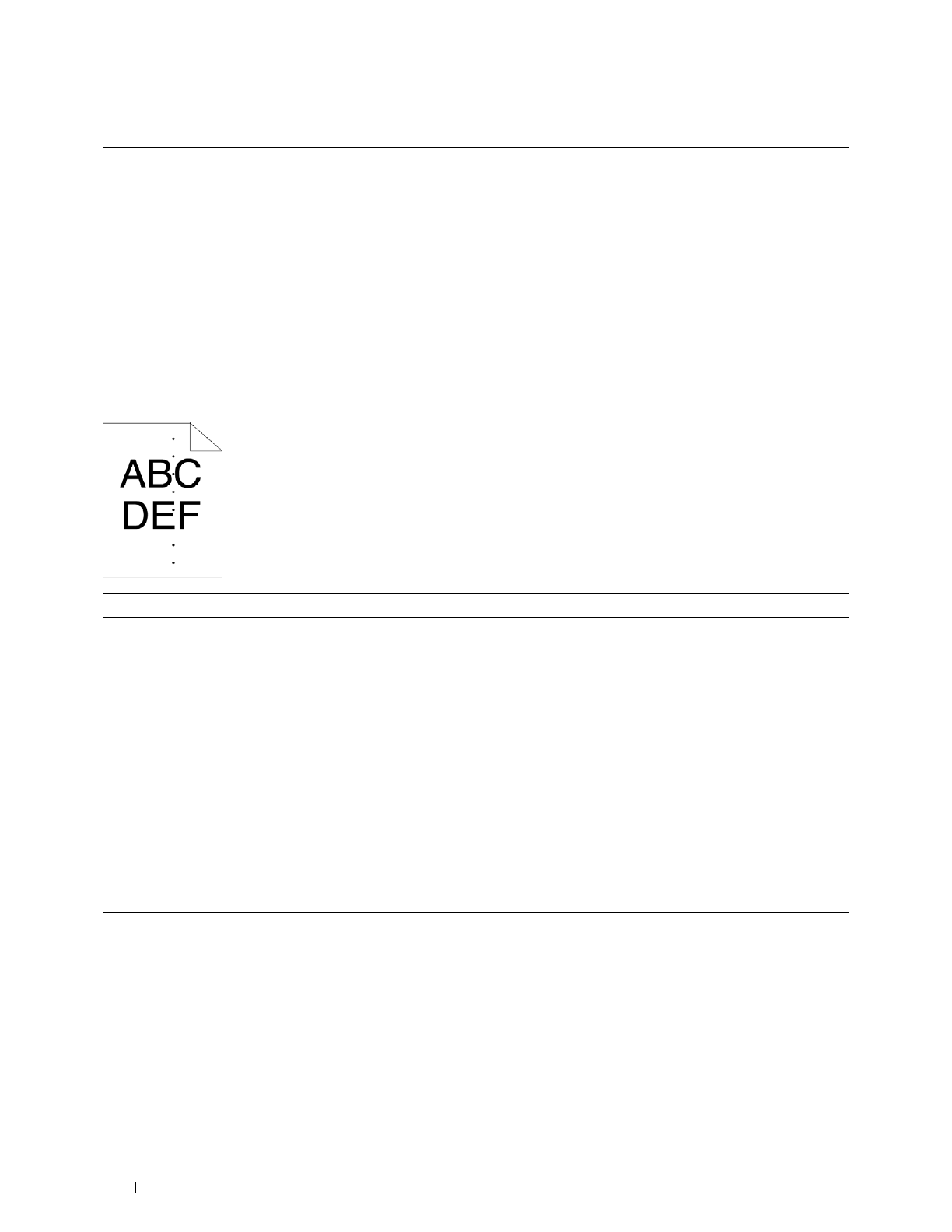
538 Troubleshooting Guide
Pitched color dots
2Ensure Output Color is set to Color in the printer driver.
a
On the
Graphics
tab, ensure that
Output Color
is set to
Color
.
Does this solve your problem?
The task is complete. Go to action 3.
3Replace the drum cartridges.
a
Replace the drum cartridges. See "Replacing the Drum Cartridges."
b
After you replace the drum cartridges, click
Chart Print
on the
Diagnosis
tab.
c
Click
4 Colors Configuration Chart
.
The 4 Colors Configuration Chart is printed.
Does this solve your problem?
The task is complete. Contact Dell.
Action Yes No
1Locate the cause of the problem using the Pitch Configuration Chart.
a
Launch the
Tool Box
, and click
Chart Print
on the
Diagnosis
tab.
b
Click
Pitch Configuration Chart
.
The Pitch Configuration Chart is printed.
c
Compare the pitch of the color spots on your output with that on the
Pitch Configuration Chart, and locate the cause of the problem.
Is the cause of the problem located?
Proceed to the action
corresponding to the
location of the
problem:
• Drum cartridge - 2
• Fusing unit - 3
• Transfer belt unit - 4
Contact Dell.
2Replace the drum cartridges.
a
Replace the drum cartridges. See "Replacing the Drum Cartridges."
b
After you replace the drum cartridges, click
Chart Print
on the
Diagnosis
tab.
c
Click
Pitch Configuration Chart
.
The Pitch Configuration Chart is printed.
Does this solve your problem?
The task is complete. Contact Dell.
3Replace the fusing unit.
a
Replace the fusing unit. See "Replacing the Fusing Unit."
b
After you replace the fusing unit, click
Chart Print
on the
Diagnosis
tab.
c
Click
Pitch Configuration Chart
.
The Pitch Configuration Chart is printed.
Does this solve your problem?
The task is complete. Contact Dell.
Action Yes No
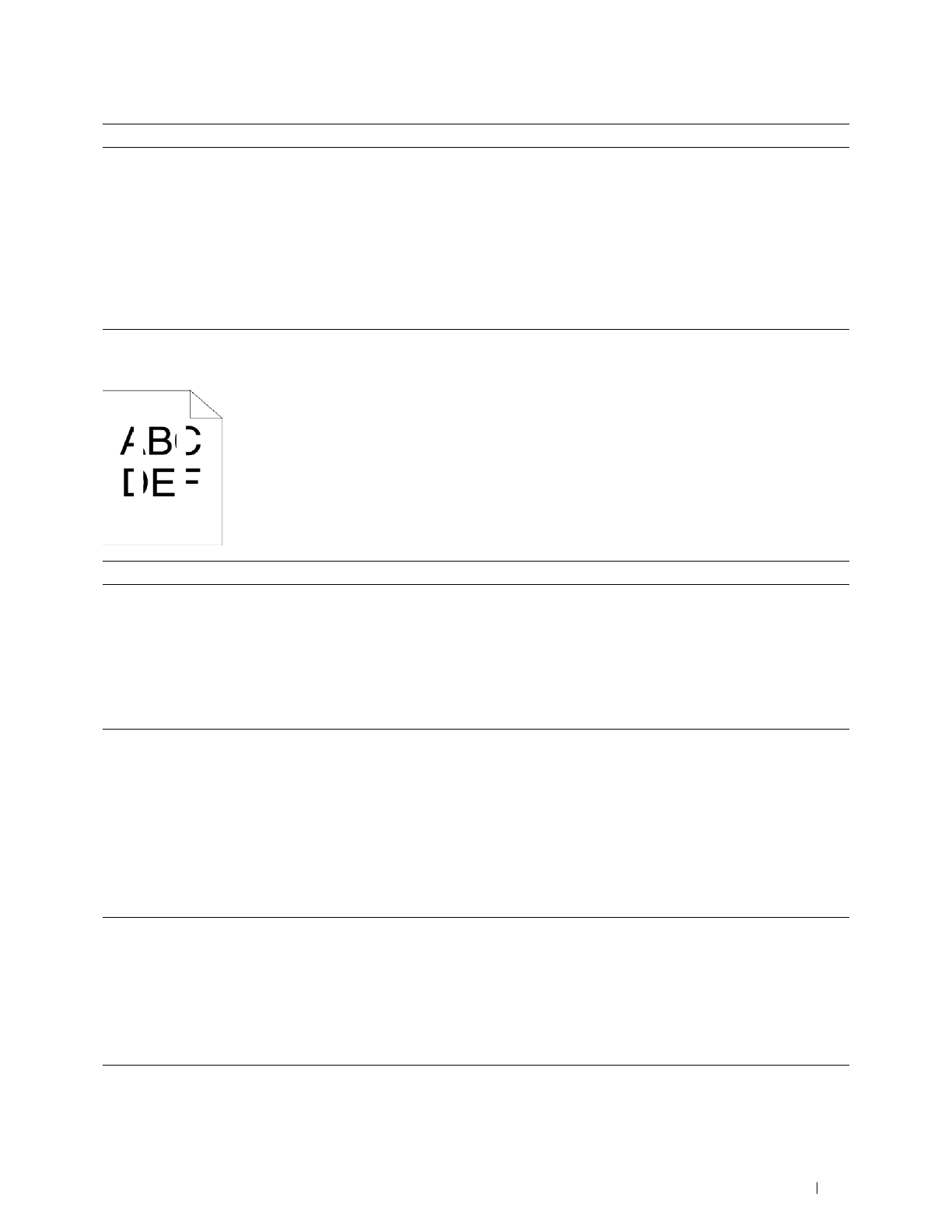
Troubleshooting Guide 539
Vertical blanks
4Replace the transfer belt unit, the 2nd BTR, and the retard roller.
a
Replace the transfer belt unit, the 2nd BTR, and the retard roller. See
"Replacing the Transfer Belt Unit, the 2nd Belt Transfer Roller (2nd
BTR), and the Retard Roller."
b
After you replace the transfer belt unit, the 2nd BTR,
and the retard
roller,
click
Chart Print
on the
Diagnosis
tab.
c
Click
Pitch Configuration Chart
.
The Pitch Configuration Chart is printed.
Does this solve your problem?
The task is complete. Contact Dell.
Action Yes No
1Clean inside the printer by using the cleaning rod. See
"
Cleaning the
Raster Optical Scanner (ROS) Window.
"
a
After the cleaning is completed, click
Chart Print
on the
Diagnosis
tab.
b
Click
Pitch Configuration Chart
.
The Pitch Configuration Chart is printed.
Does this solve your problem?
The task is complete. Go to action 2.
2Ensure the light path is not covered.
a
Remove the drum cartridges, and keep them in the dark place. See
"Removing the Drum Cartridge."
b
Check the light path, and then remove the shielding.
c
Re-install the drum cartridges. See "Installing a Drum Cartridge."
d
Launch the
Tool Box
, and click
Chart Print
on the
Diagnosis
tab.
e
Click
Pitch Configuration Chart
.
The Pitch Configuration Chart is printed.
Does this solve your problem?
The task is complete. Go to action 3.
3Replace the drum cartridges.
a
Replace the drum cartridges. See "Replacing the Drum Cartridges."
b
After you replace the drum cartridges, click
Chart Print
on the
Diagnosis
tab.
c
Click
Pitch Configuration Chart
.
The Pitch Configuration Chart is printed.
Does this solve your problem?
The task is complete. Contact Dell.
Action Yes No
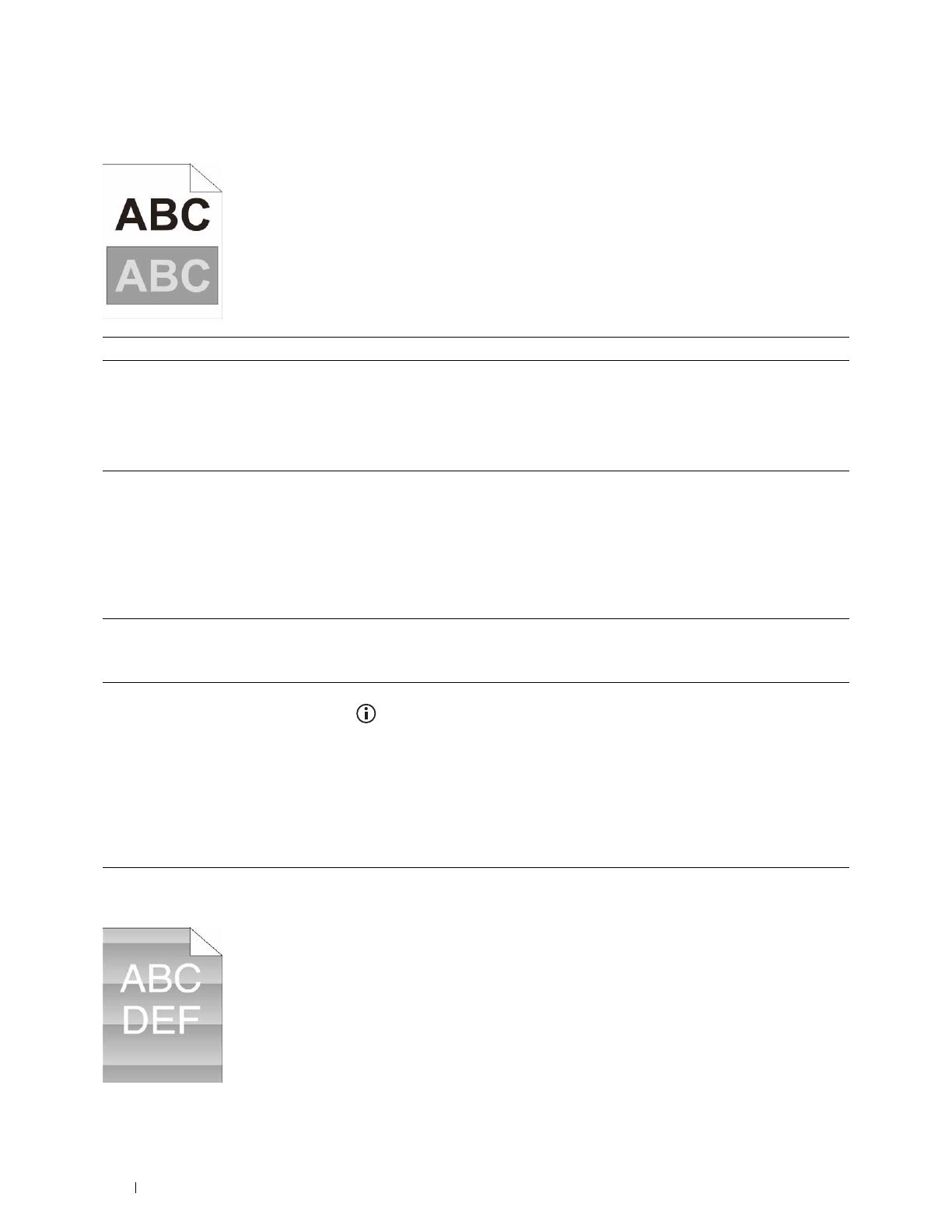
540 Troubleshooting Guide
Ghosting
Light-induced fatigue
Action Yes No
1Locate the cause of the problem using the Ghost Configuration Chart.
a
Launch the
Tool Box
, and click
Chart Print
on the
Diagnosis
tab.
b
Click
Ghost Configuration Chart
.
The Ghost Configuration Chart is printed.
Is the type of the problem identified?
Proceed to the action
corresponding to the
type of ghosting.
Positive ghost - 2a
Negative ghost - 2b
Contact Dell.
2a Replace the drum cartridges.
a
Replace the drum cartridges. See "Replacing the Drum Cartridges."
b
After you replace the drum cartridges, click
Chart Print
on the
Diagnosis
tab.
c
Click
Ghost Configuration Chart
.
The Ghost Configuration Chart is printed.
Does this solve your problem?
The task is complete. Contact Dell.
2b If you are using non-recommended print media, use the print media
recommended for the printer.
Does this solve your problem?
The task is complete. Go to action 3.
3Adjust the transfer bias.
a
On the operator panel, press the
(Information)
button and
select the
Tools
tab
→
select
Admin Settings→
Maintenance→ Adjust Transfer Belt Unit
.
b
Select
K Offset
or
YMC Offset
, and then decrease the value.
c
Launch the
Tool Box
, and click
Chart Print
on the
Diagnosis
tab.
d
Click
Ghost Configuration Chart
.
The Ghost Configuration Chart is printed.
Does this solve your problem?
The task is complete. Contact Dell.
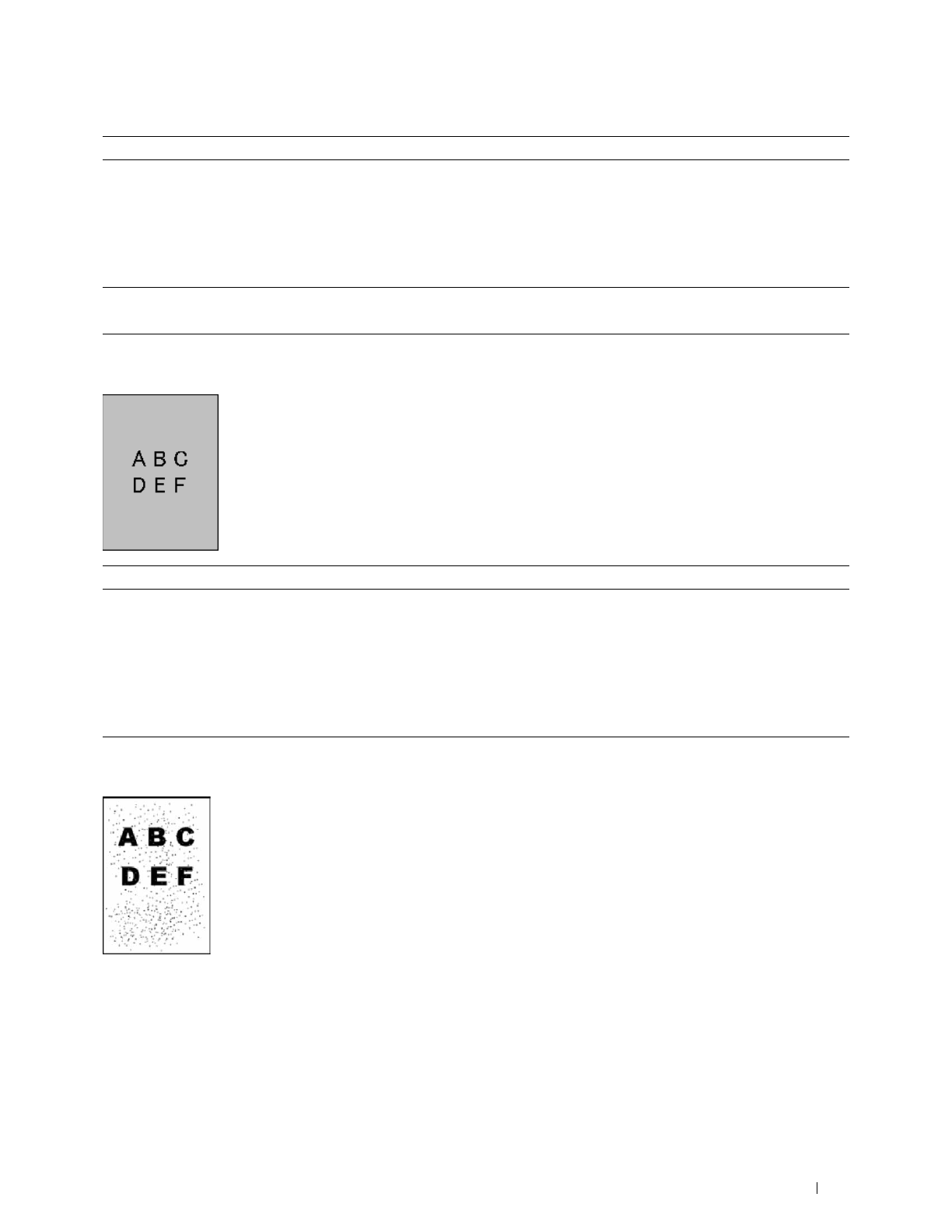
Troubleshooting Guide 541
Fog
Bead-Carry-Out (BCO)
Action Yes No
1Check the light fatigue pattern using the Pitch Configuration Chart.
a
Launch the
Tool Box
, and click
Chart Print
on the
Diagnosis
tab.
b
Click
Pitch Configuration Chart
.
The Pitch Configuration Chart is printed.
Does the pattern on the output match with that on the Pitch
Configuration Chart?
Go to action 2. Contact Dell.
2Replace the drum cartridges. See "Replacing the Drum Cartridges."
Does this solve your problem?
The task is complete. Contact Dell.
Action Yes No
1Replace the drum cartridges.
a
Replace the drum cartridges. See "Replacing the Drum Cartridges."
b
After you replace the drum cartridges, click
Chart Print
on the
Diagnosis
tab.
c
Click
4 Colors Configuration Chart
.
The 4 Colors Configuration Chart is printed.
Does this solve your problem?
The task is complete. Contact Dell.
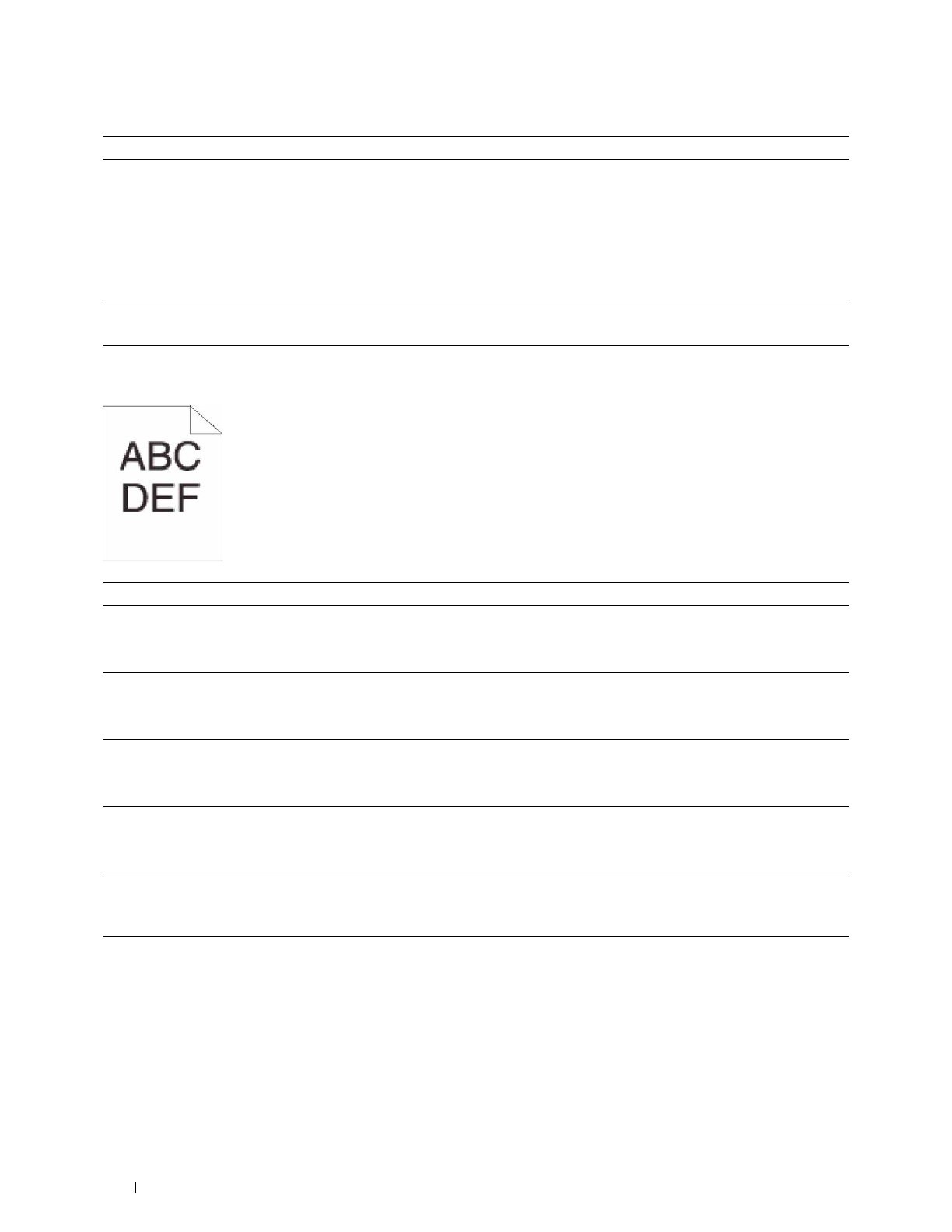
542 Troubleshooting Guide
Jagged characters
Action Yes No
1If the printer is installed in a high altitude location, set the altitude of
the location.
a
Launch the
Tool Box
, and click
Service Tools
on the
Printer
Maintenance
tab.
b
Under
Adjust Altitude
, select the value close to the altitude of the
location where the printer is installed.
Does this solve your problem?
The task is complete. Go to action 2.
2Replace the drum cartridges. See "Replacing the Drum Cartridges."
Does this solve your problem?
The task is complete. Contact Dell.
Action Yes No
1Set Screen to Fineness in the printer driver.
a
On the
Others
tab, set
Screen
under
Items:
to
Fineness
.
Does this solve your problem?
The task is complete. Go to action 2.
2Set Print Mode to High Quality in the printer driver.
a
On the
Graphics
tab, select
High Quality
from
Print Mode
.
Does this solve your problem?
The task is complete. Go to action 3.
3Enable Bitmap Smoothing in the printer driver.
a
On the
Others
tab, set
Bitmap Smoothing
under
Items:
to
On
.
Does this solve your problem?
The task is complete. Go to action 4.
4Enable Print Page Mode in the printer driver.
a
On the
Others
tab, set
Print Page Mode
under
Items:
to
On
.
Does this solve your problem?
The task is complete. Go to action 5.
5If using a downloaded font, ensure that the font is recommended for the
printer, operating system, and the application being used.
Does this solve your problem?
The task is complete. Contact Dell.

Troubleshooting Guide 543
Banding
Action Yes No
1Locate the cause of the problem using the Pitch Configuration Chart.
a
Launch the
Tool Box
, and click
Chart Print
on the
Diagnosis
tab.
b
Click
Pitch Configuration Chart
.
The Pitch Configuration Chart is printed.
Is the cause of the problem located?
Proceed to the action
corresponding to the
location of the
problem:
• Drum cartridge - 2
•Fusing unit - 3
•Transfer belt unit - 4
Contact Dell.
2Replace the drum cartridges.
a
Replace the drum cartridges. See "Replacing the Drum Cartridges."
b
After you replace the drum cartridges, click
Chart Print
on the
Diagnosis
tab.
c
Click
Pitch Configuration Chart
.
The Pitch Configuration Chart is printed.
Does this solve your problem?
The task is complete. Contact Dell.
3Replace the fusing unit.
a
Replace the fusing unit. See "Replacing the Fusing Unit."
b
After you replace the fusing unit, click
Chart Print
on the
Diagnosis
tab.
c
Click
Pitch Configuration Chart
.
The Pitch Configuration Chart is printed.
Does this solve your problem?
The task is complete. Contact Dell.
4Replace the transfer belt unit, the 2nd BTR, and the retard roller.
a
Replace the transfer belt unit, the 2nd BTR, and the retard roller. See
"Replacing the Transfer Belt Unit, the 2nd Belt Transfer Roller (2nd
BTR), and the Retard Roller."
b
After you replace the transfer belt unit, the 2nd BTR,
and the retard
roller, click
Chart Print
on the
Diagnosis
tab.
c
Click
Pitch Configuration Chart
.
The Pitch Configuration Chart is printed.
Does this solve your problem?
The task is complete. Contact Dell.
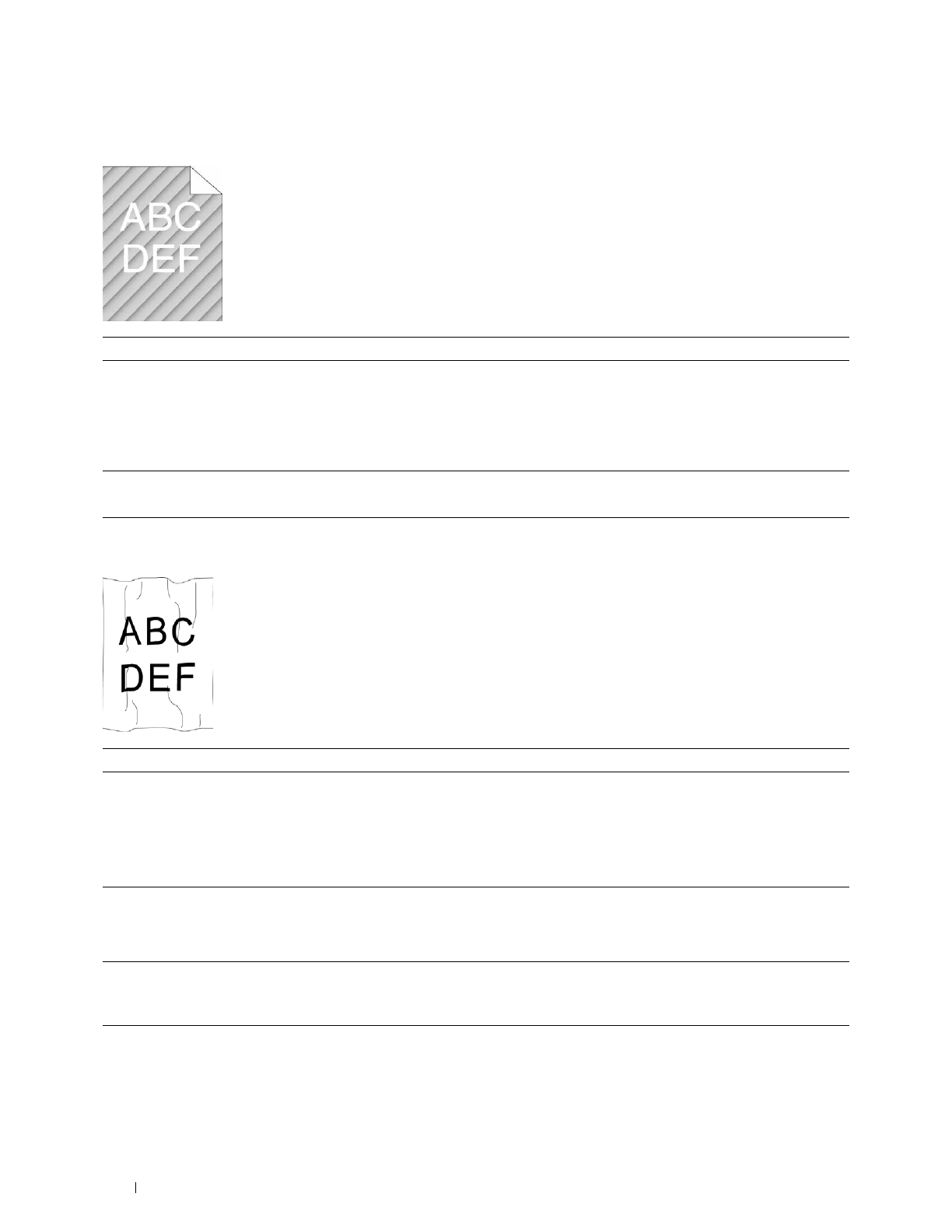
544 Troubleshooting Guide
Auger mark
Wrinkled/Stained paper
Action Yes No
1Locate the cause of the problem using the Pitch Configuration Chart.
a
Launch the
Tool Box
, and click
Chart Print
on the
Diagnosis
tab.
b
Click
Pitch Configuration Chart
.
The Pitch Configuration Chart is printed.
Does the output match with the pattern for auger mark?
Go to action 2. Contact Dell.
2Replace the drum cartridges. See "Replacing the Drum Cartridges."
Does this solve your problem?
The task is complete. Contact Dell.
Action Yes No
1Verify that the correct print media is being used. See "Supported Paper
Types." If not, use the print media recommended for the printer.
Does this solve your problem?
The task is complete. If printing on an
envelope, go to action
2.
If printing on print
media other than
envelopes, contact Dell.
2
Check the wrinkle. Is the wrinkle within 30 mm of the four edges of the
envelope?
This type of wrinkle is
considered normal.
Your printer is not at
fault.
Go to action 3.
3Load the envelopes in the MPF properly. For details, see "Loading an
Envelope in the MPF."
Does this solve your problem?
The task is complete. Contact Dell.
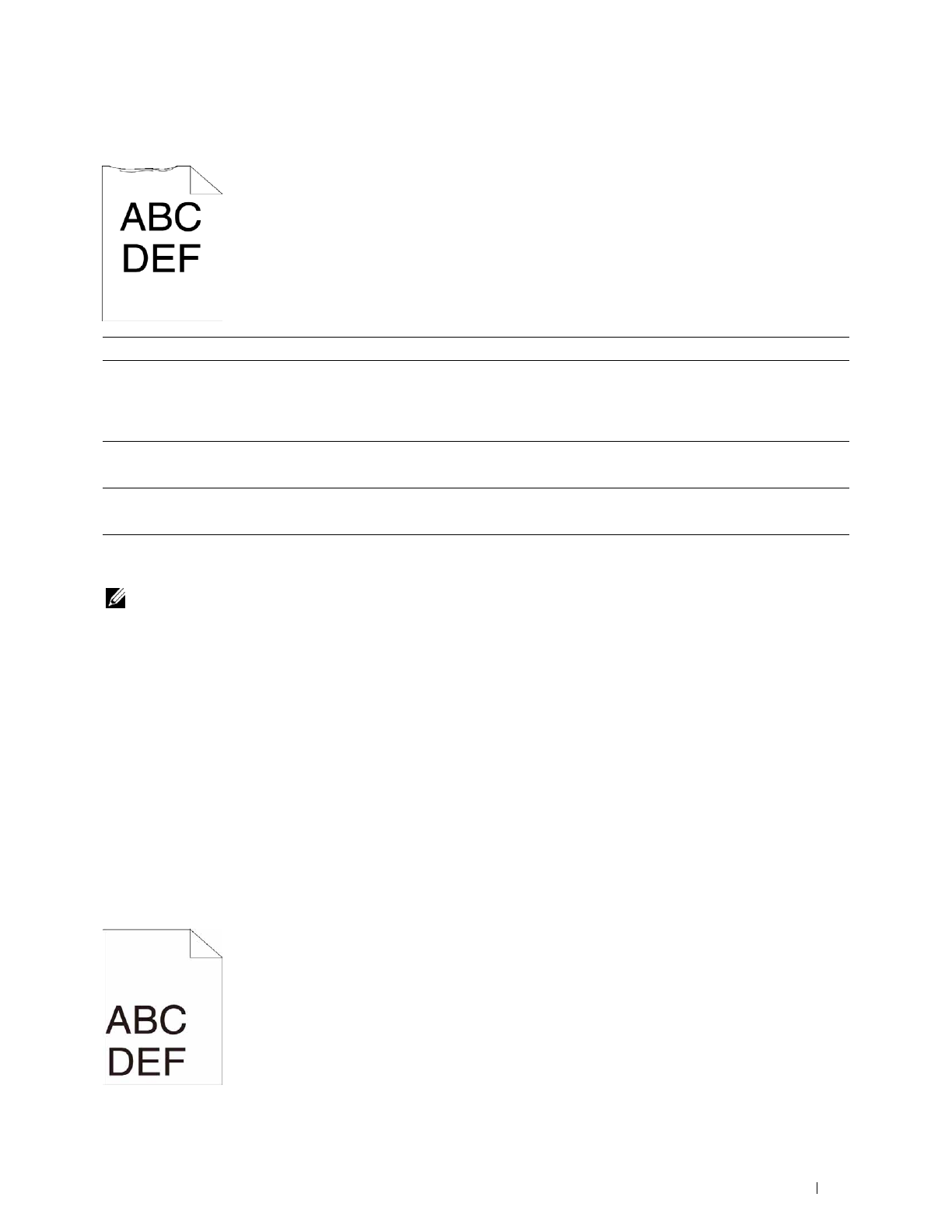
Troubleshooting Guide 545
Damage on the leading edge of paper
Jam/Alignment Problems
NOTE: Some of the following procedures that use the Tool Box can also be performed using the operator panel or Dell Printer
Configuration Web Tool. For information on how to use the operator panel and Dell Printer Configuration Web Tool, see
"Understanding the Printer Menus" and "Dell™ Printer Configuration Web Tool."
• The top and side margins are incorrect
• Color registration is out of alignment
• Images are skewed
• Tray1/Optional 550-Sheet Feeder Misfeed Jam
• MPF Misfeed Jam
•Regi Jam (Exit Sensor On JAM)
• Exit Jam (Exit Sensor Off JAM)
• Tray1/Optional 550-Sheet Feeder Multi-feed Jam
•MPF Multi-feed Jam
The top and side margins are incorrect
Action Yes No
1When you use the MPF, reverse the paper and then try again.
When you use any of the trays, change the paper and then try again.
Does this solve your problem?
The task is complete. (MPF)
Go to action 2.
(trays)
Contact Dell.
2Change the paper with another one and then try again.
Does this solve your problem?
The task is complete. Go to action 3.
3Use any of the trays in place of the MPF.
Does this solve your problem?
The task is complete. Contact Dell.
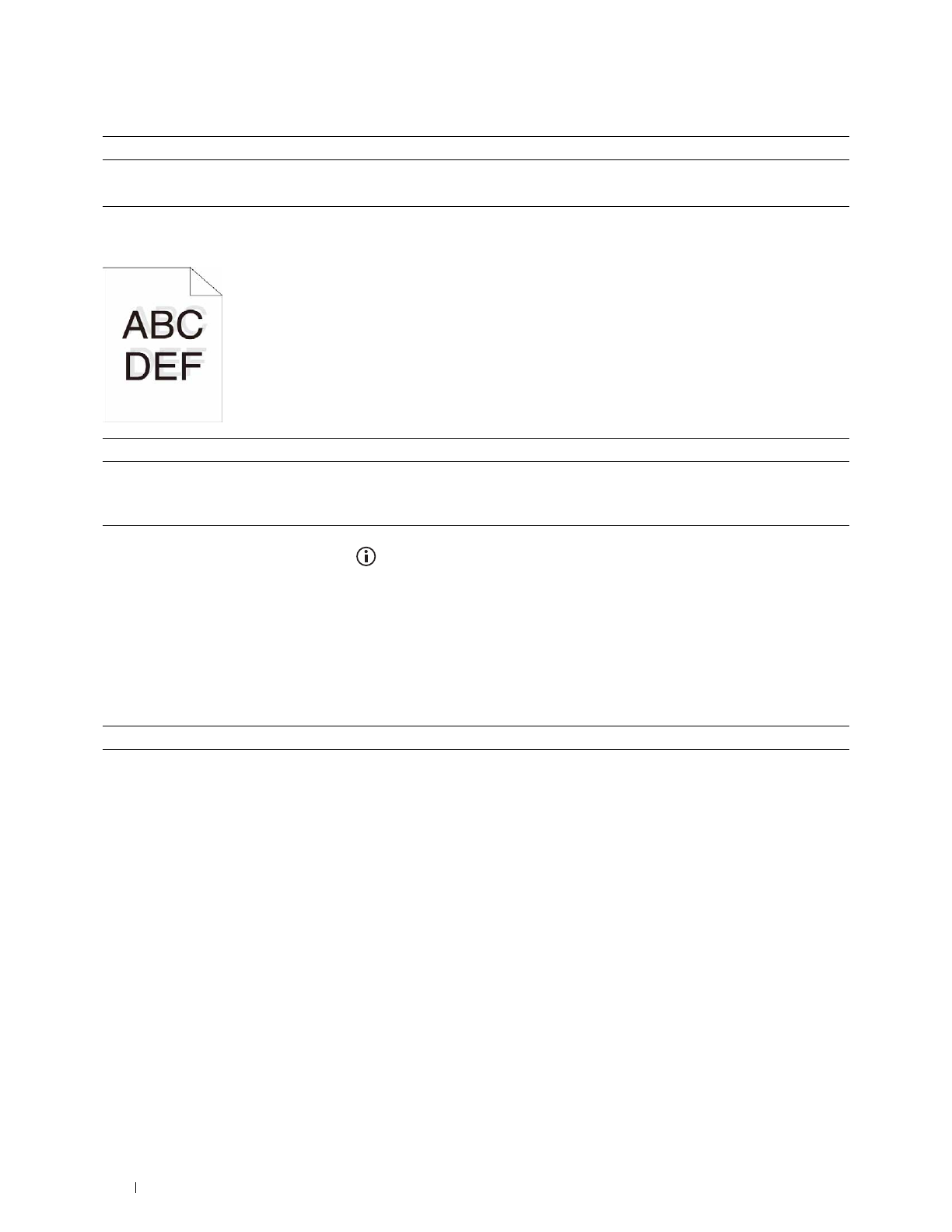
546 Troubleshooting Guide
Color registration is out of alignment
Action Yes No
1Ensure that the margins are set correctly on the application being used.
Does this solve your problem?
The task is complete. Contact Dell.
Action Yes No
1Adjust the settings of the paper type on the printer driver to those of the
tray.
Does this solve your problem?
The task is complete. Go to action 2.
2Execute auto color registration adjustment.
a
On the operator panel, press the
(Information)
button and
select the
Tools
tab
→
select
Admin Settings
→
Maintenance
→
Color Reg Adjust
→
Auto Correct
→
Start
.
OR
a
Launch the
Tool Box
, and click
Service Tools
on the
Printer
Maintenance
tab.
b
Click
Start
under
Auto Correct
in
Color Registration Adjustments
.
Does this solve your problem?
The task is complete. Go to action 3.
3Do you have spare drum cartridges? Go to action 4a. Go to action 4b.
4a Replace the drum cartridges.
a
Replace the drum cartridges. See "Replacing the Drum Cartridges."
b
Launch the
Tool Box
, and click
Service Tools
on the
Printer
Maintenance
tab.
c
Click
Start
under
Color Regi Chart
in
Color Registration
Adjustments
.
The Color Regi Configuration Chart is printed.
Does this solve your problem?
The task is complete. Contact Dell.
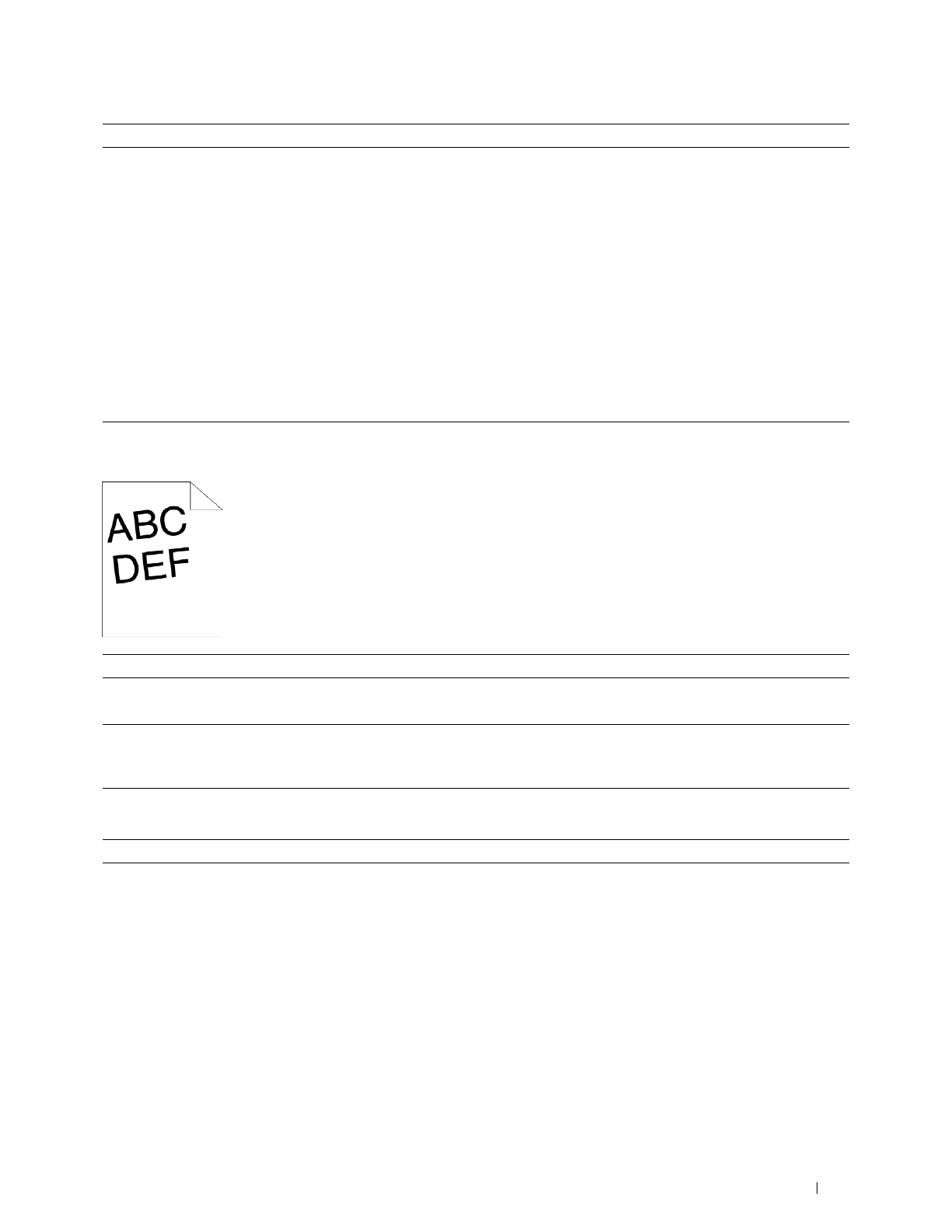
Troubleshooting Guide 547
Images are skewed
Tray1/Optional 550-Sheet Feeder Misfeed Jam
4b Print the Color Regi Configuration Chart and manually correct the color
registration.
aLaunch the
Tool Box
, and click
Service Tools
on the Printer
Maintenance tab.
b
Click
Start
under
Color Regi Chart
in
Color Registration
Adjustments
.
The Color Regi Configuration Chart is printed.
c
Identify the offset values from the chart and specify each value for
process, left, and right colors in
Enter Number
. See "Adjusting Color
Registration" for details.
d
Click
Apply New Settings
.
eClick
Start
under
Color Regi Chart
to print the Color Regi
Configuration Chart again.
Does this solve your problem?
The task is complete. Contact Dell.
Action Yes No
1Adjust the paper guides properly.
Does this solve your problem?
The task is complete. Go to action 2.
2Install the transfer belt unit according to an appropriate procedure. See
"Installing a Transfer Belt Unit."
Does this solve your problem?
The task is complete. Contact Dell.
Action Yes No
1Ensure that tray1 or the optional 550-sheet feeder is properly inserted.
Does this solve your problem?
The task is complete. Proceed to the action
corresponding to the
type of the print media
being used:
•Thick - 2a
• Thin - 2b
•Coated - 2c
If using paper other
than the above, go to
action 2d.
Action Yes No

548 Troubleshooting Guide
MPF Misfeed Jam
2a Use thick paper that is 216 g/m2 or less.
Does this solve your problem?
The task is complete. Go to action 3a.
2b Use thin paper that is 60 g/m2 or more.
Does this solve your problem?
The task is complete. Go to action 3a.
2c Load coated paper one sheet at a time.
Does this solve your problem?
The task is complete. Go to action 3b.
2d Ensure that the print media is not curled.
Does this solve your problem?
The task is complete. Go to action 3a.
2e Is the print media damp? Go to action 3c. Go to action 3a.
3a Fan the print media.
Does this solve your problem?
The task is complete. Go to action 3b.
3b Wipe the retard roller in tray1 or the optional 550-sheet feeder with a
cloth moistened with water.
Does this solve your problem?
The task is complete. Go to action 4b.
3c Turn over the print media.
Does this solve your problem?
The task is complete. Go to action 4a.
4a Use print media that is not damp.
Does this solve your problem?
The task is complete. Go to action 3a.
4b Replace the drum cartridges.
Does this solve your problem?
The task is complete. Contact Dell.
Action Yes No
1Ensure that the MPF is properly inserted.
Does this solve your problem?
The task is complete. Proceed to the action
corresponding to the
type of the print media
being used:
•Thick - 2a
• Thin - 2b
•Coated - 2c
•Envelope - 2d
If using paper other
than the above, go to
action 2e.
2a Use thick paper that is 216 g/m2 or less.
Does this solve your problem?
The task is complete. Go to action 3a.
2b Use thin paper that is 60 g/m2 or more.
Does this solve your problem?
The task is complete. Go to action 3a.
2c Load coated paper one sheet at a time.
Does this solve your problem?
The task is complete. Go to action 3b.
Action Yes No

Troubleshooting Guide 549
Regi Jam (Exit Sensor On JAM)
2d Ensure that the envelope is properly loaded in the MPF as instructed in
"Loading an Envelope in the MPF."
Does this solve your problem?
The task is complete. Go to action 3c.
2e Is the print media damp? Go to action 3d. Go to action 3a.
3a Fan the print media.
Does this solve your problem?
The task is complete. Go to action 3b.
3b Wipe the retard roller in the MPF with a cloth moistened with water.
Does this solve your problem?
The task is complete. Go to action 4b.
3c If the envelope is deformed, correct it or use another envelope.
Does this solve your problem?
The task is complete. Go to action 3a.
3d Turn over the print media.
Does this solve your problem?
The task is complete. Go to action 4a.
4a Use print media that is not damp.
Does this solve your problem?
The task is complete. Go to action 3a.
4b Replace the drum cartridges.
Does this solve your problem?
The task is complete. Contact Dell.
Action Yes No
1Ensure that the drum cartridges are installed correctly.
Does this solve your problem?
The task is complete. Go to action 2.
2Replace the drum cartridges. See "
Replacing the Drum Cartridges
."
Does this solve your problem?
The task is complete. Go to action 3.
3Ensure that the fusing unit is set properly.
Does this solve your problem?
The task is complete. Go to action 4.
4Replace the fusing unit.
a
Replace the fusing unit. See "Removing the Fusing Unit."
b
After you replace the fusing unit, click
Chart Print
on the
Diagnosis
tab.
c
Click
Pitch Configuration Chart
.
The Pitch Configuration Chart is printed.
Does this solve your problem?
The task is complete. Go to action 5.
5Ensure that the transfer belt unit is installed correctly.
Does this solve your problem?
The task is complete. Go to action 6.
Action Yes No

550 Troubleshooting Guide
Exit Jam (Exit Sensor Off JAM)
Tray1/Optional 550-Sheet Feeder Multi-feed Jam
6Replace the transfer belt unit, the 2nd BTR, and the retard roller.
a
Replace the transfer belt unit, the 2nd BTR, and the retard roller. See
"Replacing the Transfer Belt Unit, the 2nd Belt Transfer Roller (2nd
BTR), and the Retard Roller."
b
After you replace the transfer belt unit, the 2nd BTR,
and the retard
roller,
click
Chart Print
on the
Diagnosis
tab.
c
Click
Pitch Configuration Chart
.
The Pitch Configuration Chart is printed.
Does this solve your problem?
The task is complete. Contact Dell.
Action Yes No
1Ensure the fusing unit is installed correctly.
Does this solve your problem?
The task is complete. Go to action 2.
2Replace the fusing unit.
a
Replace the fusing unit. See "Replacing the Fusing Unit."
b
After you replace the fusing unit, click
Chart Print
on the
Diagnosis
tab.
c
Click
Pitch Configuration Chart
.
The Pitch Configuration Chart is printed.
Does this solve your problem?
The task is complete. Contact Dell.
Action Yes No
1Ensure that tray1 or the optional 550-sheet feeder is properly inserted.
Does this solve your problem?
The task is complete. If using coated paper,
go to action 2.
If using other type of
print media, go to
action 3.
2Load coated paper one sheet at a time.
Does this solve your problem?
The task is complete. Go to action 4.
3Use print media that is not damp.
Does this solve your problem?
The task is complete. Go to action 4.
4Fan the print media.
Does this solve your problem?
The task is complete. Go to action 5.
5Wipe the retard roller in tray1 or the optional 550-sheet feeder where the
multi-feed occurred with a cloth moistened with water.
Does this solve your problem?
The task is complete. Contact Dell.
Action Yes No

Troubleshooting Guide 551
MPF Multi-feed Jam
Noise
1Ensure the media type you are using.
If using coated paper, go to action 2.
If using other type of print media, go to action 3.
--
2Load coated paper one sheet at a time.
Does this solve your problem?
The task is complete. Go to action 4.
3Use print media that is not damp.
Does this solve your problem?
The task is complete. Go to action 4.
4Fan the print media.
Does this solve your problem?
The task is complete. Go to action 5.
5Wipe the retard roller in the MPF where the multi-feed occurred with a
cloth moistened with water.
Does this solve your problem?
The task is complete. Contact Dell.
Action Yes No
1To specify the cause of the noise, perform the Auto Registration
Adjustment.
Does this solve your problem?
The task is complete. Go to action 2.
2Replace the transfer belt unit, the 2nd BTR, and the retard roller.
a
Replace the transfer belt unit, the 2nd BTR, and the retard roller. See
"Replacing the Transfer Belt Unit, the 2nd Belt Transfer Roller (2nd
BTR), and the Retard Roller."
b
After you replace the transfer belt unit, the 2nd BTR,
and the retard
roller
,
click
Chart Print
on the
Diagnosis
tab.
c
Click
Pitch Configuration Chart
.
The Pitch Configuration Chart is printed.
Does this solve your problem?
The task is complete. Go to action 3.
3Replace the fusing unit.
a
Replace the fusing unit. See "Replacing the Fusing Unit."
b
After you replace the fusing unit, click
Chart Print
on the
Diagnosis
tab.
c
Click
Pitch Configuration Chart
.
The Pitch Configuration Chart is printed.
Does this solve your problem?
The task is complete. Go to action 4.
4Replace the waste toner box.
Does this solve your problem?
The task is complete. Go to action 5.
5Replace the drum cartridges.
Does this solve your problem?
The task is complete. Go to action 6.

552 Troubleshooting Guide
Copy Problem
Fax Problems
6Replace the toner cartridge (K). See "Replacing the Toner Cartridges." The task is complete.
(The toner cartridge
(K) you are using has
been damaged. Replace
it with a new one.)
Go to action 7.
7Replace the toner cartridge (Y). See "Replacing the Toner Cartridges." The task is complete.
(The toner cartridge
(Y) you are using has
been damaged. Replace
it with a new one.)
Go to action 8.
8Replace the toner cartridge (M). See "Replacing the Toner Cartridges." The task is complete.
(The toner cartridge
(M) you are using has
been damaged. Replace
it with a new one.)
Go to action 9.
9Replace the toner cartridge (C). See "Replacing the Toner Cartridges." The task is complete.
(The toner cartridge
(C) you are using has
been damaged. Replace
it with a new one.)
Contact Dell.
Problem Action
A document loaded in the DADF cannot be
copied.
Ensure that the DADF cover is firmly closed.
Ensure that the release lever is properly positioned.
Vertical blanks or streaks appear on the
output when scanned using the DADF.
Clean the DADF glass.
Clean inside the printer by using the cleaning rod. See
"
Cleaning the Raster
Optical Scanner (ROS) Window.
"
Problem Action
The printer is not working, there is no
display and the buttons are not working.
Unplug the power cord and plug it in again.
Ensure that there is power to the electrical receptacle.

Troubleshooting Guide 553
No dial tone sounds. Check that the phone line is connected properly. See "Connecting the Telephone
Line."
Check that the phone socket in the wall is working by plugging in another phone.
Diagnose the fax connection. See "Diagnosing the Fax Connection."
The numbers stored in the memory do not
dial correctly.
Ensure that the numbers are stored in the memory correctly.
Print a Phone Book list.
The document does not feed into the
printer.
Ensure that the document is not wrinkled and you are putting it in correctly.
Check that the document is of the right size, not too thick or thin.
Ensure that the DADF cover is firmly closed.
Faxes are not received automatically. The FAX mode should be selected.
Ensure that there is paper in the paper tray.
Check to see if the display shows MFP Memory Full.
If the time interval specified for the following features is too long, change the time
interval shorter such as 30 seconds.
•Auto Rec Fax
•Auto Rec TEL/FAX
• Auto Rec Ans/FAX
Diagnose the fax connection. See "Diagnosing the Fax Connection."
The printer does not send faxes. Sending Fax should show up on the display.
Check the other fax machine you are sending to, to see if it can receive your fax.
Check the dialing type for Tone or Pulse.
Ensure that the document is loaded in the DADF or on the document glass.
Diagnose the fax connection. See "Diagnosing the Fax Connection."
The incoming fax has blank spaces or is
received in poor quality.
Check your printer by making a copy.
The toner cartridge may be empty. Replace the toner cartridge. See "Replacing the
Toner Cartridges."
A noisy phone line can cause line errors. Set the fax modem speed to a slower
speed.
The fax machine sending you the fax may be faulty.
Some of the words on an incoming fax are
stretched.
The fax machine sending you the fax had a temporary document jam.
There are lines on the documents you send. Check the surface of the document glass and DADF glass for marks and clean it.
See "Cleaning the Scanner."
The printer dials a number, but the
connection with another fax machine fails.
The other fax machine may be turned off, out of paper, or cannot answer incoming
calls. Speak with the other machine operator and ask her/him to sort out the
problem.
Documents are not stored in the memory. There may not be enough memory to store the document. If the display shows a
MFP Memory Full message, delete any documents you no longer need from
the memory and then restore the document, or wait for the job in progress (e.g., a
fax transmission or reception) to complete.
Blank areas appear at the bottom of each
page or on other pages, with a small strip of
text at the top.
You may have chosen the wrong paper settings in the user option setting. See
"Print Media Guidelines."
554 Troubleshooting Guide
Scanning Problems
The printer will not send or receive faxes. Ensure that the country code is set correctly. Press the (Information) button
and select the Tools tab
→
select Admin Settings
→
Fax Settings
→
Fax Line Settings
→
Country.
Check the dialing type for Tone or Pulse.
Check that the cables are connected properly.
If the telephone line cord is connected to the printer via any device such as an
answering machine and a computer, remove the device and directly connect the
telephone line cord to the printer.
Ensure that Junk Fax Setup is set to off.
An error often occurs during a fax
transmission or reception.
Reduce the modem speed. Press the (Information) button and select the
Tools tab
→
select Admin Settings
→
Fax Settings
→
Transmission Defaults
→
Modem Speed.
The printer receive faxes, but it does not
print.
Check the toner level.
Ensure that there is paper in the paper tray.
Ensure that Sent Fax Forward is set to off.
Check whether the printer is in the secure receiving mode. If this mode is turned
on, enter the correct password or turn off this mode to print faxes in memory.
Problem Action
The scanner does not work. Ensure that you place the document to be scanned facing down from the
document glass, or facing up in the DADF.
There may not be enough available memory to hold the document you want to
scan. Lower the scan resolution rate and then try scanning again.
Check that the USB or Ethernet cable is connected properly.
Ensure that the USB or Ethernet cable is not defective. Switch the cable with a
known good cable. If necessary, replace the cable.
If using the network TWAIN (WIA) driver, check that the Ethernet cable is
connected properly and the IP address of the printer is set correctly. To check the
IP address, see "Verifying the IP Settings."
Check that the scanner is configured correctly. Check the application you want to
use to make certain that the scanner job is being sent to the correct port.
Ensure that the scanner sharing feature is disabled when you use Mac OS X before
you scan documents via an ICA compatible application such as Image Capture.
The printer does not support the scanner sharing feature of Mac OS X. Select a
printer which is directly connected to the computer via USB or wired /wireless
LAN and scan documents.
The printer scans very slowly. Graphics are scanned more slowly than text when using the E-mail or Scan to
Network feature.
Communication speed becomes slow in scan mode because of the large amount of
memory required to analyze and reproduce the scanned image.
Scanning images at a high resolution takes more time than scanning at a low
resolution.

Troubleshooting Guide 555
Document misfeeds or multiple feeds occur
in the DADF.
Check whether the DADF roller assembly is installed properly.
Ensure the document’s paper type meets the specifications for the printer. See
"Supported Paper Types" for more information.
Check whether the document is properly loaded in the DADF.
Ensure that the document guides are adjusted properly.
Ensure that the number of document sheets do not exceed the maximum capacity
of the DADF.
Ensure that the document is not curled.
Fan the document well before loading it in the DADF.
Vertical blanks or streaks appear on the
output when scanned using the DADF.
Clean the DADF glass.
Clean inside the printer by using the cleaning rod. See
"
Cleaning the Raster
Optical Scanner (ROS) Window.
"
A smear appears at the same location on the
output when scanned using the document
glass.
Clean the document glass.
Images are skewed. Ensure that the document is loaded straight in the DADF or on the document
glass.
Diagonal lines appear jagged when scanned
using the DADF.
If the document uses thick media, try scanning it from the document glass.
Message appears on your computer screen:
• "Device can’t be set to the H/W mode you
want."
• "Port is being used by another program."
•"Port is Disabled."
• "Scanner is busy receiving or printing data.
When the current job is completed, try
again."
• "Invalid handle."
• "Scanning has failed."
There may be a copying or printing job in progress. When the current job is
complete, try the job again.
The selected port is currently being used. Restart your computer and try again.
The cable may be improperly connected or the printer may be turned off.
The scanner driver is not installed or an operating environment is not set up
properly.
Ensure that the port is properly connected and the printer is turned on. Then
restart your computer.
Check that the USB or Ethernet cable is connected properly.
The printer does not properly transfer scan
data to a specified destination via the E-
mail or Scan to Network feature.
Check if the following settings have been set correctly on the Dell Printer
Configuration Web Tool.
Scan to Network
Check the following settings under Address Book→ Server Address:
• Server Address
•Share Name
•Server Path
•Login Name
•Login Password
E-mail
Check the following setting under Address Book→ E-Mail Address:
•Address

556 Troubleshooting Guide
Digital Certificate Problem
Cannot scan using WIA on a Microsoft®
Windows Server® 2003 computer.
Enable WIA on the computer.
To enable WIA:
1
Click
Start
, point to
Administrative Tools
, and then click
Services
.
2
Right-click
Windows Image Acquisition (WIA)
, and then click
Start
.
Cannot scan using TWAIN or WIA on a
Windows Server 2008 or Windows Server
2008 R2 computer.
Install the Desktop Experience feature on the computer.
To install Desktop Experience:
1
Click
Start
, point to
Administrative Tools
, and then click
Server Manager
.
2
Under
Features Summary
, click
Add Features
.
3
Select the
Desktop Experience
check box, click
Next
, and then click
Install
.
4
Restart the computer.
Cannot scan using TWAIN or WIA on a
Windows Server 2012 computer.
Install the Desktop Experience feature on the computer.
To install Desktop Experience:
1
Click
Server Manager
from the
Start
screen.
The
Server Manager
screen appears.
2
Under
Manage
, click
Add Roles and Features
.
Add Roles and Features Wizard
appears.
3
Click
Next
to skip the
Before you begin
page.
4
Ensure that
Role-based or feature-based installation
is selected, and then click
Next
.
5
Ensure that
Select a server from the server pool
is selected, select the server under
Server Pool
, and then click
Next
.
6
Click
Next
to skip the
Select server roles
page.
7
Select the
Desktop Experience
check box under
User Interfaces and
Infrastructure
, and then click
Next
.
8
Click
Confirmation
from the list on the left.
9
Select the
Restart the destination server automatically if required
check box, and
then click
Install
.
10
Restart the computer.
Symptom Cause Action
The LDAP-SSL/TLS
Communication setting and the
Upload Signed Certificate button
are not displayed.
The optional hard disk installed in
the printer is not encrypted.
Confirm whether the optional hard disk is
connected correctly, and confirm whether Data
Encryption is enabled from the operator panel or
Dell Printer Configuration Web Tool.
The certificate import button is
disabled.
SSL communication is disabled. Create a self-signed certificate and enable SSL.
The certificate details button is
disabled.

Troubleshooting Guide 557
The certificate cannot be imported. The time setting is incorrect. Confirm validity period of the certificate as well as
the time setting of the device.
The certificate file is incorrect. Confirm whether the password is correct.
Confirm whether the file type is PKCS#7/#12 or
x509CACert (extension: p7b/p12/pfx/cer/crt).
Confirm whether the attribute information (key
Usage/Extended key usage) of the certificate to be
imported is set correctly.
The browser is incorrect. Use Internet Explorer.
016-404 is displayed when setting
the encryption of the optional hard
disk to Off.
The optional hard disk is formatted
and the certificate data is deleted
when setting encryption of the
optional hard disk to Off. Since a
certificate is required and the
security function cannot be enabled
when restarting the device afterward,
016-404 is displayed and the security
setting must be initialized. The
cause is the same when formatting or
removing the optional hard disk.
After initializing, import the certificate and enable
the security settings again. The action is the same
when formatting the optional hard disk.
016-404 is displayed when
formatting the optional hard disk.
Security is set to Off when setting
encryption of the optional hard disk
to Off.
Security is set to Off when
formatting the optional hard disk.
A certificate is deleted when setting
encryption of the optional hard disk
to Off.
A certificate is deleted when
formatting the optional hard disk.
A certificate cannot be set with
"Certificate Details".
The validity period is invalid. The validity period of the certificate is invalid.
Confirm whether the time setting of the machine is
correct, and whether the validity period of the
certificate has expired.
The certificate path is invalid. The certificate chain (path validation) of the
imported certificate may not be correctly validated.
Confirm whether all of the high-level certificates
(Trusted/Intermediate) have been imported and are
not deleted, and whether the validity period has
expired.
Although a certificate was imported,
it is not displayed when selecting
with "Local Device".
The type of the certificate is
incorrect.
To import a certificate for use with the device (own
device), import the secret key and a certificate of
the PKCS#12 (p12/pfx) format as a pair.
Server validation is not operating
correctly.
The certificate chain is incorrect
when importing.
Although importing a root certificate (Trusted) to
use for server authentication, an Intermediate
certificate may be required when validating the
path.
When executing a certificate file with the
certification authority, create the certificate with a
format including all paths and then import that
certificate.
Symptom Cause Action

558 Troubleshooting Guide
Problems With Installed Optional Accessories
If an option does not operate correctly following installation or stops working:
• Turn off the printer, wait for 10 seconds, and then turn on the printer. If this does not fix the problem, unplug the
printer, and check the connection between the option and the printer.
• Print the system settings report to see if the option is listed in the Installed Options list. If the option is not listed,
re-install it. See "Report / List."
• Ensure the option is selected in the printer driver you are using.
The following table lists printer's option and corrective action for related problem. If the suggested corrective action
does not correct the problem, call customer service.
Scanner Driver/Printer Utility Problems
Digital Signature cannot be selected
with the IPsec setting.
The certificate cannot be associated. Either the certificate has not been imported or the
certificate has not been associated for use with
Digital Signature of IPsec. Refer to "Setting the
Certificate in the IPsec Digital Signature Mode" to
set a certificate of IPsec.
Problem Action
550-sheet feeder
• Ensure the 550-sheet feeder is correctly installed on the printer. Re-install the
feeder. See "Removing the Optional 550-Sheet Feeder" and "Installing the
Optional 550-Sheet Feeder."
• Ensure the print media is loaded correctly. See "Loading Print Media in Tray1 and
the Optional 550-Sheet Feeder" for more information.
Memory module
• Ensure the memory module is securely connected to the memory connector.
Hard disk
• Ensure the hard disk is securely inserted to the correct slot.
Wireless adapter
• Ensure the wireless adapter is securely inserted to the correct slot.
Problem Action
Unable to retrieve the Address Book data
from the printer on the Address Book Editor.
Check that the USB or Ethernet cable is connected properly.
Ensure that the printer is turned on.
Ensure that the scanner driver is installed on your computer. (The Address Book
Editor retrieves the Address Book data via the scanner driver when the printer is
connected using a USB cable.)
The TWAIN driver cannot connect to the
printer.
Check that the USB or Ethernet cable is connected properly.
If using the network connection, check that IP address of the printer is set
correctly. To check the IP address, see "Scanning Using the TWAIN Driver."
Check whether the printer is turned on. If the printer is turned on, reboot it by
turning off the printer and then on again.
If a scan application is running, close the application once, restart the application,
and then try scanning again.
The scanner driver has not been registered
on your computer and cannot be accessed
from ScanButton Manager.
Install the scanner driver. If the scanner driver is installed, uninstall it and then re-
install it again. After the installation of the scanner driver is completed, re-install
the ScanButton Manager.
Symptom Cause Action

Troubleshooting Guide 559
Other Problems
Contacting Service
When you call for printer service, be prepared to describe the problem you are experiencing or the error message that
appears.
You need to know the model type and service tag of your printer. See the label located inside the front cover of your
printer.
Failed to scan your document on the printer
via ScanButton Manager.
Ensure that your computer and the printer is properly connected with the USB
cable.
Check whether the printer is turned on. If the printer is turned on, reboot it by
turning off the printer and then on again.
If a scan application is running, close the application once, restart the application,
and then try scanning again.
Network connection cannot be used. Connect with the USB cable.
Uninstall ScanButton Manager from
Control Panel
→
Add or Remove Programs
(
Programs and Features
in Windows Vista
®
and Windows
®
7) on your computer and
then re-install it again.
Failed to create an image file via ScanButton
Manager.
Ensure there is sufficient space in your hard disk.
Uninstall ScanButton Manager from
Control Panel
→
Add or Remove Programs
on
your computer and then re-install it again.
Failed to initialize ScanButton Manager.
Uninstall ScanButton Manager from
Control Panel
→
Add or Remove Programs
on
your computer and then re-install it again.
Failed to execute ScanButton Manager.
Uninstall ScanButton Manager from
Control Panel
→
Add or Remove Programs
on
your computer and then re-install it again.
An unexpected error occurred on
ScanButton Manager.
Uninstall ScanButton Manager from
Control Panel
→
Add or Remove Programs
on
your computer and then re-install it again.
Problem Action
Condensation has occurred inside the
printer.
This usually occurs within several hours after you heat the room in winter. This
also occurs when the printer is operating in a location where relative humidity
reaches 85% or more. Adjust the humidity or relocate the printer to an appropriate
environment.
Problem Action

560 Troubleshooting Guide


562

Appendix 563
Appendix
Dell™ Technical Support Policy
Technician-assisted technical support requires the cooperation and participation of the customer in the
troubleshooting process and provides for restoration of the operating system, software program and hardware drivers
to the original default configuration as shipped from Dell, as well as the verification of appropriate functionality of
the printer and all Dell-installed hardware. In addition to this technician assisted technical support, online technical
support is available at Dell Support. Additional technical support options may be available for purchase.
Dell provides limited technical support for the printer and any Dell-installed software and peripherals. Support for
third-party software and peripherals is provided by the original manufacturer, including those purchased and/or
installed through Software & Peripherals (DellWare), ReadyWare, and Custom Factory Integration (CFI/DellPlus).
Online Services
You can learn about Dell products and services on the following websites:
www.dell.com
www.dell.com/ap
(Asian/Pacific countries only)
www.dell.com/jp
(Japan only)
www.euro.dell.com
(Europe only)
www.dell.com/la
(Latin American and Caribbean countries)
www.dell.ca
(Canada only)
You can access Dell Support through the following websites and e-mail addresses:
• Dell Support websites
support.dell.com
support.jp.dell.com
(Japan only)
support.euro.dell.com
(Europe only)
• Dell Support e-mail addresses
mobile_support@us.dell.com
support@us.dell.com
la-techsupport@dell.com (Latin America and Caribbean countries only)
apsupport@dell.com
(Asian/Pacific countries only)
• Dell Marketing and Sales e-mail addresses
apmarketing@dell.com
(Asian/Pacific countries only)
sales_canada@dell.com (Canada only)
• Anonymous file transfer protocol (FTP)
ftp.dell.com
Log in as user:
anonymous
, and use your e-mail address as your password.

564 Appendix
Warranty and Return Policy
Dell Computer Corporation ("Dell") manufactures its hardware products from parts and components that are new or
equivalent to new in accordance with industry-standard practices. For information about the Dell warranty for your
printer, see support.dell.com.
Recycling Information
It is recommended that customers dispose of their used computer hardware, monitors, printers, and other peripherals in an environmentally
sound manner. Potential methods include reuse of parts or whole products and recycling of products, components, and/or materials.
For specific information on Dell’s worldwide recycling programs, see www.dell.com/recyclingworldwide.
Contacting Dell
You can access Dell Support at support.dell.com. Select your region on the WELCOME TO DELL SUPPORT page,
and fill in the requested details to access help tools and information.
You can contact Dell electronically using the following addresses:
•World Wide Web
www.dell.com
www.dell.com/ap
(Asian/Pacific countries only)
www.dell.com/jp
(Japan only)
www.euro.dell.com
(Europe only)
www.dell.com/la
(Latin American and Caribbean countries)
www.dell.ca
(Canada only)
• Anonymous file transfer protocol (FTP)
ftp.dell.com
Log in as user: anonymous, and use your email address as your password.
• Electronic Support Service
mobile_support@us.dell.com
support@us.dell.com
la-techsupport@dell.com (Latin America and Caribbean countries only)
apsupport@dell.com (Asian/Pacific countries only)
support.jp.dell.com (Japan only)
support.euro.dell.com (Europe only)
• Electronic Quote Service
apmarketing@dell.com (Asian/Pacific countries only)
sales_canada@dell.com (Canada only)

Appendix 565
Index
Symbols
(All Clear) button, 130
(Cancel) button, 130
(Delete) button, 129
(Home) button, 129
(Information) button, 130
(Job Status) button, 130
(Power Saver) button, 129
(Redial / Pause) button, 129
(Start) button, 129
Numerics
1000Base-T Full-Duplex, 176
100Base-TX Full-Duplex, 176
100Base-TX Half-Duplex, 176
10Base-T Full-Duplex, 176
10Base-T Half-Duplex, 176
2 Sided, 149
2 Sided Copying, 151, 163, 208, 222
2 Sided Print, 148
2 Sided Printing, 152-153, 164, 209, 225, 227,
252
2 Sided Scanning, 208-209, 223, 225
2nd BTR, 34, 475
2-Up, 151, 163, 208, 222, 288
4 Colors Configuration Chart, 228
802.1x, 174, 192
A
A4, 305
A4<>Letter Switch, 205, 214, 262
A5, 305
About printer, 33
Access List, 192
Address Book, 139, 141, 156, 194, 399
Address Book Editor, 399
Ad-Hoc, 185
Adjust 2nd BTR, 166
Adjust Altitude, 154, 169, 205, 216
Adjust Fusing Unit, 154, 167, 265
Adjust Transfer Belt Unit, 166, 265
Adjusting color registration, 498
Admin Settings, 233
Administrator Account, 184
AirPrint, 173, 186, 325
Alert Tone, 147, 156, 205, 212
Alignment Chart, 228
All Tones, 148, 157
Altitude, 456
Ans Machine/Fax, 164
Appendix, 563
Apply New Settings, 142
Asset Tag Number, 135, 146
Assigning IP address, 83
Audio Tone, 204, 211
Authenticate Error Trap, 183
Authentication System, 414
Auto Clear Alert Tone, 148, 157, 205, 212
Auto Color To Mono Print, 264
Auto Correct, 168, 215
Auto Exposure, 150, 153, 162, 165, 208, 221,
224, 286, 291
Auto Exposure Level, 150, 153, 162, 165, 208,
221, 224
Auto Log Print, 148, 157, 204, 212, 258
Auto Receive Ans/Fax, 209, 226
Auto Receive Answer/Fax, 151, 164

566 Appendix
Auto Receive Fax, 151, 164, 209, 226
Auto Receive Tel/Fax, 151, 164, 209, 226
Auto Reg Adjust, 266
Auto Registration Adjustment, 154, 167, 205
Auto Reset, 148, 157, 205, 213
Avoiding paper jams, 315, 513
B
B5, 305
Banding Detection Chart, 228
Banner Sheet Insert Position, 148, 157, 205, 214
Banner Sheet Specify Tray, 148, 157, 205, 214
Base memory, 455
Basic Information, 175
Basic printer problems, 531
Bitmapped font, 436
Blue plug, 34, 74
Bonjour (mDNS), 173, 176
C
C5, 305
Cable, 456
Canceling a print job, 316
Canceling print job
From your computer, 316
Carbonless copy paper, 302
CCP, 302
Changing printer settings, 142, 327
Changing the Language, 133
Clear Storage, 169
Clearing paper jams, 513
From DADF, 515
From fusing unit, 521
From MPF, 517
From optional 550-sheet feeder, 527
From tray1, 520
Clock Settings, 154
Coated, 153-154, 167, 265-266
Coated Thick, 153-154, 167, 265-266
Collation, 149-150, 162, 207, 209, 220, 226
Color Balance, 208, 221
Color Reg Adjust, 266
Color Regi Chart, 168
Color Registration Adjustments, 167-168, 215
Color registration chart, 498
Color Saturation, 150, 162, 208, 221, 286
Color Test Page, 156, 206, 232
ColorTrack, 413
ColorTrack Error Report, 154, 414
ColorTrack Mode, 154, 414
ColorTrack Settings, 413
Community Name, 183
Completed Jobs, 138, 146
Concurrent Jobs Feature, 134
Configure 802.1x, 192
Configuring wireless adapter, 57
Connecting local printer, 72
Connecting printer, 71
Connecting to the network, 73
Connection specification, 71, 456
Connection Time-Out, 178
Connection type, 71, 456
Conserving supplies, 463
Contact Dell Support at, 139, 141
Contact Person, 140
Contacting service, 559
Contrast, 153, 165, 208, 224, 290
Control board, 34
Control Panel Tone, 156, 204, 211
Copy Color Balance, 151, 162
Copy Completed Tone, 147, 204, 212
Copy Defaults, 150, 207
Copy Printer Settings, 139, 141, 193
Copy Printer Settings Report, 193

Appendix 567
Copy Settings, 151
Country, 151, 163, 209, 226, 248
Cover, 145
Covers, 153-154, 167, 265-266
Covers Thick, 153-154, 167, 265-266
Create Folder, 153, 166, 209, 224, 292
Custom Paper Size - X, 148, 158
Custom Paper Size - Y, 148, 158
Custom Reduce / Enlarge, 162, 221
D
DADF cover, 35
DADF feed roller, 35, 498
DADF glass, 497
Darken / Lighten, 150, 153, 162-163, 165,
207-209, 221, 223, 225, 284, 290, 294
Data Encryption, 423
Date & Time, 211
Date Format, 154, 204, 211
Default Color, 149, 158, 239
Default Paper Size, 148, 157, 205, 214
Default Setup, 195
Delayed Send, 151, 163, 209, 225, 295
Dell ColorTrack, 154, 193, 413
Dell Printer Configuration Web Tool, 135
Page display format, 140
Dell ScanCenter, 399
Dell Service Tag Number, 146
Dell Supplies Management System, 397
Dell support website, 28
Dell technical support policy, 563
Details, 145
Determining Values, 499
Digital Certificates, 423
Dimensions, 455
DIMM size, 455
Direct connection setup, 92
Direct Fax, 382
Disabling Panel Lock, 299
Discard Size, 152, 164, 210, 227, 252
Display Manual Fax Recipients, 210, 228
Display of Dell Configuration Web Tool, 220
Display problems, 531
DL, 305
DNS, 171, 178
Document feeder tray, 35
Document glass, 35, 497
Document guides, 35
Draft Mode, 149, 158, 239
Driver, 27
DRPD, 164
DRPD Pattern, 151, 164, 209, 226, 249
Drum cartridge, 33, 467
Duplex Automatic Document Feeder
(DADF), 33, 514-515
Duplex unit, 34
E
ECM, 152, 165, 210, 227, 254
E-mail, 366
E-Mail Address, 195
Email Address Book, 206
E-Mail Alert, 139, 141, 176, 180, 246
E-Mail Alert Settings, 175, 181
E-Mail Alert Setup, 135
E-Mail Alert Setup Page, 174
E-Mail Group, 195-196
E-mail Server Address Book, 204, 213
E-Mail Server Settings, 174, 180
Emulations, 455
Encryption, 185
End Time, 161
Entering Values, 501
Envelope, 154, 167, 265-266, 303

568 Appendix
Envelope #10, 305
Environment, 456
Error codes, 443
Error History, 156, 206, 232
Error messages, 451
Ethernet, 170, 176, 456
Ethernet port, 34, 71, 73
Event Panel, 140
EWS, 246
EWS Settings, 175
Executive, 305
Expiration Mode, 161
Expiration Time, 161
Express Service Code, 146
External Authentication, 413
F
Fast scan, 500
Fault Time-out, 148, 157, 205, 213
Fault Tone, 147, 156, 204, 212
Fax Activity, 152, 156, 165, 206, 210, 228, 254
Fax Broadcast, 165, 210, 228, 255
Fax Cover Page, 152, 165, 210, 227, 253, 295
Fax Defaults, 151, 163, 209, 275
Fax Forwarding Number, 209, 227
FAX Group, 195, 200
Fax Header, 152, 165, 210, 227, 253
Fax Header Name, 151, 163, 209, 226, 248
Fax Line Test, 269
Fax Menu, 293
Fax Number, 151, 163, 209, 226, 248
Fax Pending, 156, 206
Fax printer driver, 92, 95
Fax Protocol, 165, 210, 228
Fax Server Address Book, 204, 213
Fax Settings, 151, 163
FAX Speed Dial, 195, 201
Fax Transmit, 165, 210, 228
File Format, 153, 165, 208, 223, 290
File Naming Mode, 153, 166, 209, 224, 292
Finding information, 27
Firmware Version, 146
Flip on Long Edge, 318
Flip on Short Edge, 318
Folio, 305
Font, 149, 158, 435
PCL 5/PCL 6, 437
Pitch, 435
Point size, 435
PostScript 3, 437
Style, 435
Typefaces and fonts, 435
Weigh t, 4 3 5
Font Pitch, 149, 158, 237
Font Size, 149, 158, 237
Form Line, 149, 158, 238
Forwarding Number, 152, 164
Front cover, 33
Front USB port, 33
FTP Client, 173, 184
Function Enabled, 159, 269
Function Enabled - Copy, 159
Function Enabled - Fax, 159
Fusing unit, 34, 473, 514, 521
G
Gateway Address, 177, 206, 219
Get Environment Sensor Info, 229
Ghost Configuration Chart, 228
Google Cloud Print, 173, 186, 325
Group Dial, 233
H
Hard disk, 64
Hex Dump, 149, 158, 238

Appendix 569
Host I/F, 146-147
Host Name, 146-147, 182, 188
How to install option, 43
How to remove option, 503
How to set up, 28
How to use printer, 27
HTTP, 172, 179
HTTP-SSL/TLS Communication, 425
I
ID, 146
ID Card Copy, 298, 338
Identifying print media, 305
Image Compression, 153, 166, 209, 224
Image Enhance, 149, 158
Impression Number, 147
Infrastructure, 185
Initialize NIC NVRAM Memory and restart
printer, 187
Initialize Print Meter, 215, 267
Installing optional 550-Sheet Feeder, 48
Installing optional accessories, 43
Installing optional hard disk, 64
Installing optional memory module, 43
Installing optional wireless adapter, 53
Interfaces, 456
Interval of Redial, 152, 165, 210, 227
Invalid Key Tone, 147, 156, 204, 211
IP Address, 83, 135, 138, 140, 171, 177, 183, 188,
191-192, 206, 219, 417
IP Address Mode, 206, 219
IP Filter (IPv4), 174, 192
IP filter setup, 179
IPP, 172, 176, 178
IPsec, 191, 428
IPsec Settings, 174, 191
IPv4, 183, 191
IPv6, 140, 171, 178, 183, 191
J
Job Completed Tone, 147, 156, 204, 212
Job History, 156, 206, 231
Job List, 138, 146
Job Name, 146
Job Status, 146
Job Submitted Time, 146-147
Job Time-out, 148, 157, 205, 213, 260
Job Type, 146-147
Junk Fax Setup, 151, 164, 209, 227, 251
K
Kerberos Server, 415
L
Label, 153-154, 167, 205, 215, 304
Landscape, 235
Layout, 149
LDAP Authentication, 417
LDAP Server, 188-189, 416-417
LDAP-SSL/TLS Communication, 429-430
Left frame, 141
Left side cover, 34
Legal, 305
Letter, 305
Letterhead 2 Sided, 148, 157, 205, 214
Line Monitor, 151, 163, 209, 226, 249
Line Termination, 149, 158, 239
Line Type, 151, 163, 209, 226, 248
Link Channel, 185
Link Local Address, 206
Link Quality, 185
Loading letterhead, 307
Loading paper, 87

570 Appendix
Loading print media, 307
MPF, 308
Tray1 and optional 550-sheet feeder, 307
Location, 140, 145
Login Error, 161
Low Toner Alert Message, 148, 157, 204, 212
Low Toner Alert Tone, 147, 157, 205, 212
LPD, 172, 176, 178, 246
M
MAC Address, 185
Machine Ready Tone, 147, 156, 204, 211
Maintenance, 463
Manual Address, 206
Margin Left / Right, 151, 153, 163, 165, 208-209,
222, 224
Margin Middle, 151, 153, 163, 165, 208-209,
222, 224
Margin Top / Bottom, 151, 153, 163, 165, 208,
222, 224
Max E-mail Size, 153, 166, 209, 224
Maximum memory, 455
Memory, 455
Memory Capacity, 146
Memory connector, 455
Memory module, 43, 503
Memory speed, 455
Menu item, 142
Menu Settings, 147
MIB compatibility, 456
mm / inch, 147, 156, 204, 211
Modem Speed, 152, 165, 210, 228, 254
Monarch, 305
Monthly Settings, 161
MPF, 514
MPF Custom Paper Size - X, 155, 201
MPF Custom Paper Size - Y, 155, 201
MPF Custom Size - X, 207, 216
MPF Custom Size - Y, 207, 216
MPF Display Tray Prompt, 155, 201, 207, 216
MPF Paper Size, 155, 201, 207, 216
MPF Paper Type, 155, 201, 207, 216
MPF Use Driver Settings for Print Job, 155, 201,
207, 216
MQ Chart, 228
Multiple Up, 463
Multiple-Up, 153, 209, 225, 297
Multipurpose feeder (MPF), 33, 517
N
NCR, 302
Network, 73
Network connection setup, 95
Network Firmware Version, 146
Network TWAIN, 172, 176, 179
Network Type, 185
New Password, 160
No carbon required paper, 302
No. of Sheets, 147
Non Registered User, 154, 414
Non-Dell Toner, 154, 205, 215, 268
Notification Time-Out, 179
Number pad, 129, 132
O
OCR, 302
OffHook Wake Up, 148, 157, 204, 212
Online Help, 139, 141
Operation, 456
Operator panel, 33, 36
Operator Panel Buttons, 129
Optical character recognition, 302
Optional 550-sheet feeder, 33, 514, 527
Order Supplies at, 139, 141

Appendix 571
Ordering supplies, 37, 463
Orientation, 148, 158, 235
Original Size, 150, 153, 162, 165, 207-208, 221,
223, 291, 336
Original Type, 162, 207, 221, 285
OS, 456
OS compatibility, 455
Other problems, 559
Out of Paper Alert Tone, 205, 212
Out of Paper Tone, 147, 157
Output Color, 150, 153, 162, 165, 207-209, 220,
223, 225
Output Result, 147
Output Size, 149
Output Tray, 145
Output tray extension, 33
Owner, 146
P
Page display format, 140
Page orientation, 308
Panel Language, 148, 157, 210, 219, 280
Panel Lock Control, 149, 159, 269
Panel Settings, 155, 206, 231
Panel Settings page, 155, 231
Paper, 301
Characteristics, 301
Curl, 301
Fiber content, 302
Grain direction, 301
Moisture content, 301
Smoothness, 301
Weigh t, 3 0 1
Paper Density, 153, 166, 205, 215, 264
Paper jam location, 514
Paper Size, 148, 158, 234
Paper Tray, 148
Paper Used, 193
Parts name, 33
Password, 179, 184, 187-189, 192, 414, 417, 419
PCL, 233
Font, 2 3 6
PCL 5/PCL 6, 437
PCL Fonts List, 155, 206, 231
PCL Macros List, 155, 206, 231
PCL printer driver, 92, 95
PCL Settings, 148, 158
PDF Fonts List, 156, 206
PDL, 455
Peer-to-Peer, 108
Phone Book, 195, 233
Phone connector, 34, 71, 74, 457
Pitch Configuration Chart, 228
Plain, 153-154, 167, 205, 215, 265-266
Plain Thick, 153-154, 167, 265-266
Point and Print, 105
Polling Receive, 295
Port Settings, 175
Port Status, 176
Port9100, 172, 176, 178, 246
Portrait, 235
PostScript 3, 437
Power connector, 34
Power On Wizard, 169
Power Saver Time, 255
Power Saver Time - Deep Sleep, 147, 156
Power Saver Time - Sleep, 147, 156
Power Saver Timer, 211
Power Saver Timer - Deep Sleep, 204
Power Saver Timer - Sleep, 204
Power supply, 455
Power switch, 33
Prefix Dial, 152, 165, 210, 227
Prefix Dial Number, 152, 165, 210, 227
Prefix/Suffix String, 153, 166
Premier, 154

572 Appendix
Print Color Regi Chart, 215
Print Drivers / Remote Client Account, 184
Print ID, 148, 157, 205, 214, 260
Print media, 301, 463
Source, 308
Print Meter, 156, 206
Print Mode, 149
Print quality guarantee, 456
Print Server Reports, 170
Print Server Settings, 138, 141, 170, 175, 220
Print Server Setup Page, 170
Print side, 308
Print Text, 148, 157, 205, 214, 261
Print Volume, 139, 141, 193
Printer driver, 117, 119, 418
Printer Events, 145
Printer Information, 139, 141, 146
Printer Jobs, 138, 141, 146
Printer Maintenance, 166
Printer Page Count, 193
Printer paper, 301
Printer Revision Levels, 146
Printer Serial Number, 146
Printer Settings, 138, 147, 156
Printer software, 397
Printer specification, 455
Printer Status, 138, 141, 145
Printer Status Window, 397
Printer Type, 145
Printer utility software, 398
Printing, 315
Printing problems, 531
Printing Speed, 145
Private Mail Box Print, 280, 319-320
Problems with Optional Accessories, 558
Processor Speed, 146
Product Information Guide, 28
Proof Print, 281, 320
Protocol Monitor, 156, 206, 232
Proxy Server, 173, 186
PS Fonts List, 156, 206
PS printer driver, 92, 95
Public Mail Box Print, 281, 319-320
Q
Quantity, 149, 158, 238
Quick Launch Utility, 398
Quick Reference Guide, 27
R
RAM Disk, 148, 157, 204, 213
Rear cover, 34
Receive Mode, 151, 164, 209, 226, 250
Receive Time-Out, 179
Recommended paper, 302
Recurrence, 161
Recycled, 154, 167, 265-266
Red Hat, 117
Red Hat Enterprise Linux, 117, 455
Redial Attempts, 152, 165, 210, 227
Reduce / Enlarge, 150, 162, 207, 220
Re-enter Password, 160
Refresh, 142
Registration Adjustments, 215
Regular, 154
Relative humidity, 456
Remote Authentication, 414
Remote Receive, 152, 164, 210, 227
Remote Receive Tone, 152, 164, 210, 227
Removing optional 550-sheet feeder, 506
Removing optional hard disk, 511
Removing optional memory module, 503
Removing optional wireless adapter, 509

Appendix 573
Removing options, 503
Report 2 Sided Print, 205, 214
Reports, 155, 233
Resend Delay, 152, 165, 210, 227
Reset Defaults, 169, 215
Reset Print Server, 187
Resident fonts, 437
Resident scalable fonts, 437
Resolution, 151, 153, 163, 165, 208-209,
223-224, 289, 294
Restore Settings, 142
Retard roller, 475
Return policy, 564
Right frame, 141
Right side cover, 33
Ring Tone Volume, 151, 164, 209, 226, 250
RSA BSAFE, 23
S
Safety information, 28
Scalable fonts, 436
Scan Defaults, 153, 208
Scan Settings Tool, 347
Scan to Application, 343
Scan to Network, 351
Scan to USB Memory, 364
ScanButton Manager, 399
Search Time-Out, 188-189, 417
Secure Print, 281, 319-320
Secure Receive, 251, 392
Secure Receive Set, 160
Secure Settings, 149, 159
Security, 187
Security Settings, 185
Select Reorder URL, 154
Select Tray, 150, 153, 162, 207, 209, 220, 225
Selecting letterhead, 303
Selecting paper, 302
Selecting preprinted form, 303
Selecting pre-punched paper, 303
Sending print job, 315
Sent Fax Forward, 151, 164, 209, 227
Server Address, 156, 195, 198, 206
Server address book, 421
Server phone book, 421
Server Response Time-Out, 415
Service code, 28
Service tag, 28
Set Available Time, 161
Set Date, 154, 204, 211
Set Password, 139, 141, 187
Set Time, 154, 204, 211
Shared printing, 104
Sharpness, 150, 153, 162, 165, 207-208, 221,
223, 285, 290
Slow scan, 499-500
SMB, 172, 176
SMB Client, 173, 184
SNMP, 173, 176
SNMP Configuration, 182
SNMP UDP, 246
Software and Documentation disc, 27
Software update, 398
Speed Dial, 156, 206
SSID, 185
SSL/TLS, 174, 189, 429
Start Time, 161
Status LED, 129
Status Monitor Console, 397
Status Monitor Console for Linux, 407
Status Monitor Widget for Macintosh, 403
Status of printer supplies, 463
Status Window, 399
Storage, 456

574 Appendix
Storage humidity range, 456
Stored Documents, 156, 206, 232
Storing consumables, 464
Storing print media, 305, 315, 464
Straightest lines, 500
Subnet Mask, 206, 219
Substitute Tray, 148, 157, 205, 214, 261
Supported paper sizes, 305
Supported paper types, 306
SUSE, 455
SUSE Linux Enterprise Desktop 10, 120
SUSE Linux Enterprise Desktop 11, 122
Symbol Set, 149, 158, 236, 441
System Settings, 147, 155-156, 175, 204, 206,
231
System Settings Report, 155, 231
T
TCP/IP, 176
TCP/IP Settings, 171, 177
Telephon e, 164
Telephon e/Fax , 164
Telnet, 173, 176, 179
Temperature, 456
TIFF File Format, 153, 165, 209, 224
Time Format, 154, 204, 211
Time Zone, 154, 204, 211
Time Zone Settings, 211
Tone/Pulse, 152, 165, 210, 227, 253
Toner cartridge, 33, 465
Toner cartridge level, 145
Tool Box, 203, 399
Top cover, 33
Top frame, 140
Touch panel, 129
Transfe r be lt u nit, 3 3
Trap Notification, 183
Tray 1 Custom Paper Size - X, 155, 201
Tray 1 Custom Paper Size - Y, 155, 201
Tray 1 Custom Size - X, 207, 217
Tray 1 Custom Size - Y, 207, 217
Tray 1 Display Tray Prompt, 155, 202, 207, 217
Tray 1 Paper Size, 155, 201, 207, 217
Tray 1 Paper Type, 155, 201, 207, 217
Tray 2 Custom Paper Size - X, 155, 202
Tray 2 Custom Paper Size - Y, 155, 202
Tray 2 Custom Size - X, 207, 218
Tray 2 Custom Size - Y, 207, 218
Tray 2 Display Tray Prompt, 155, 202, 207, 217
Tray 2 Paper Size, 155, 202, 207, 218
Tray 2 Paper Type, 155, 202, 207, 218
Tray Management, 139, 141, 155, 201, 275
Tray Priority, 207, 218
Tray Settings, 207, 216
Tray1, 33, 514, 520
Troubleshooting, 399, 531
Ty p e f a c e , 4 3 5
U
Unacceptable paper, 302
UNITED STATES GOVERNMENT
RESTRICTED RIGHTS, 23
Update Address Book, 173, 176, 179
Updater, 399
USB, 457
USB Direct Print, 159
USB Direct Print Defaults, 153, 209
USB port, 34, 71-72, 148, 158
USB printing, 92
Use Another Tray, 205, 214
Use Manual Address, 206
User Setup Disk Creating Tool, 397
Using Dell Printer Configuration Web Tool, 138

Appendix 575
V
Verifying IP settings, 85
W
Wall jack connector, 34, 71, 73, 457
Warranty, 564
Warranty information, 28
Waste toner box, 33, 484
Web Link Customization, 154, 170
Web services on devices, 323
Weekly Settings, 161
WEP, 185
White document cover, 497
White sheet, 497
Width guide, 88
WINS, 172, 178
Wired Network
IP Filter, 247
Protocol, 245
Reset LAN, 247
Wireless Adapter, 53
Wireless adapter socket, 34
Wireless Settings, 171, 185
WPA-Enterprise, 430-431
WPA-PSK, 186
WPS-PBC, 61
WPS-PIN, 60
WSD, 172, 179, 323
WSD Scan, 292, 344
X
XPS printer driver, 93, 96
Y
Yellow terminator, 74

576 Appendix
