Dell Studio Desktop Setup Guide
2015-01-05
: Dell Dell-Studio-Desktop-Setup-Guide-135940 dell-studio-desktop-setup-guide-135940 dell pdf
Open the PDF directly: View PDF  .
.
Page Count: 62

SETUP GUIDE


Model DCMA
SETUP GUIDE

Notes, Notices, and Cautions
NOTE: A NOTE indicates important information that helps you make better use of your
computer.
NOTICE: A NOTICE indicates either potential damage to hardware or loss of data and tells you
how to avoid the problem.
CAUTION: A CAUTION indicates a potential for property damage, personal injury, or death.
If you purchased a Dell™ n Series computer, any references in this document to Microsoft® Windows® operating systems
are not applicable.
__________________
Information in this document is subject to change without notice.
© 2008–2009 Dell Inc. All rights reserved.
Reproduction of these materials in any manner whatsoever without the written permission of Dell Inc. is strictly forbidden.
Trademarks used in this text:
Dell
, the
DELL
logo, YOURS IS HERE, and
DellConnect
are trademarks of Dell Inc.;
Intel
,
Pentium
, and
Celeron
are registered trademarks and
Core
is a trademark of Intel Corporation in the U.S. and other
countries;
Microsoft
,
Windows
,
Windows Vista,
and
Windows Vista
start button logo are either trademarks or registered
trademarks of Microsoft Corporation in the United States and/or other countries;
Blu-ray Disc
is a trademark of the
Blu‑ray Disc Association;
Bluetooth
is a registered trademark owned by Bluetooth SIG, Inc. and is used by Dell under
license;
Realtek
is a trademark of Realtek Semiconductor Corporation.
Other trademarks and trade names may be used in this document to refer to either the entities claiming the marks and
names or their products. Dell Inc. disclaims any proprietary interest in trademarks and trade names other than its own.
June 2009 P/N W447F Rev. A01
3
Setting Up Your Studio 540 . . . . . . . . . . . . . .5
Before Setting Up Your Computer . . . . . . . . . 5
Connect the Display . . . . . . . . . . . . . . . . . . . . 6
Connect the Keyboard and Mouse. . . . . . . . . 8
Connect the Network Cable (Optional) . . . . . 9
Connect the Power Cables for Your
Display and Computer . . . . . . . . . . . . . . . . . . 10
Press the Power Buttons on Your
Computer and Display . . . . . . . . . . . . . . . . . . 10
Windows Vista Setup . . . . . . . . . . . . . . . . . . 11
Connect to the Internet (Optional) . . . . . . . . 11
Using Your Studio 540 . . . . . . . . . . . . . . . . .14
Front View Features. . . . . . . . . . . . . . . . . . . . 14
Back View Features. . . . . . . . . . . . . . . . . . . . 17
Back Panel Connectors. . . . . . . . . . . . . . . . . 18
Software Features . . . . . . . . . . . . . . . . . . . . . 20
Solving Problems . . . . . . . . . . . . . . . . . . . . .22
Network Problems . . . . . . . . . . . . . . . . . . . . . 22
Power Problems. . . . . . . . . . . . . . . . . . . . . . . 23
Memory Problems . . . . . . . . . . . . . . . . . . . . . 25
Lockups and Software Problems . . . . . . . . . 26
Using Support Tools. . . . . . . . . . . . . . . . . . .28
Dell Support Center . . . . . . . . . . . . . . . . . . . . 28
System Messages . . . . . . . . . . . . . . . . . . . . . 29
Hardware Troubleshooter. . . . . . . . . . . . . . . 30
Dell Diagnostics . . . . . . . . . . . . . . . . . . . . . . 31
System Recovery Options . . . . . . . . . . . . . .33
System Restore . . . . . . . . . . . . . . . . . . . . . . . 33
Dell Factory Image Restore . . . . . . . . . . . . . 34
Operating System Reinstallation . . . . . . . . . 36
Contents
4
Contents
Getting Help . . . . . . . . . . . . . . . . . . . . . . . . .38
Technical Support and Customer
Service . . . . . . . . . . . . . . . . . . . . . . . . . . . . . . 39
DellConnect™ . . . . . . . . . . . . . . . . . . . . . . . . . 39
Online Services . . . . . . . . . . . . . . . . . . . . . . . 39
Product Information. . . . . . . . . . . . . . . . . . . . 40
Returning Items for Repair Under
Warranty or for Credit . . . . . . . . . . . . . . . . . . 41
Before You Call. . . . . . . . . . . . . . . . . . . . . . . . 42
Contacting Dell. . . . . . . . . . . . . . . . . . . . . . . . 43
Finding More Information and
Resources . . . . . . . . . . . . . . . . . . . . . . . . . . .44
Specifications . . . . . . . . . . . . . . . . . . . . . . .46
Appendix. . . . . . . . . . . . . . . . . . . . . . . . . . . .53
Macrovision Product Notice. . . . . . . . . . . . . 53
Index . . . . . . . . . . . . . . . . . . . . . . . . . . . . . . .54
5
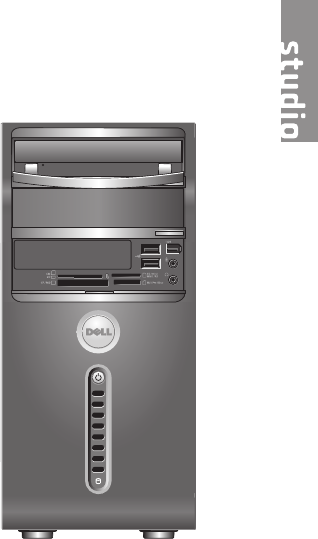
Setting Up Your Studio 540
This section provides information about setting
up your Studio 540 and connecting peripherals.
Before Setting Up Your Computer
When positioning your computer, ensure that
you allow easy access to a power source,
adequate ventilation, and a level surface to
place your computer.
Restricting airflow around your Studio 540 may
cause it to overheat. To prevent overheating
ensure that you leave at least 10.2 cm (4 inches)
at the back of the computer and a minimum of
5.1 cm (2 inches) on all other sides. You should
never place your computer in an enclosed
space, such as a cabinet or drawer when it is
powered on.
6
Setting Up Your Studio 540
Connect the Display
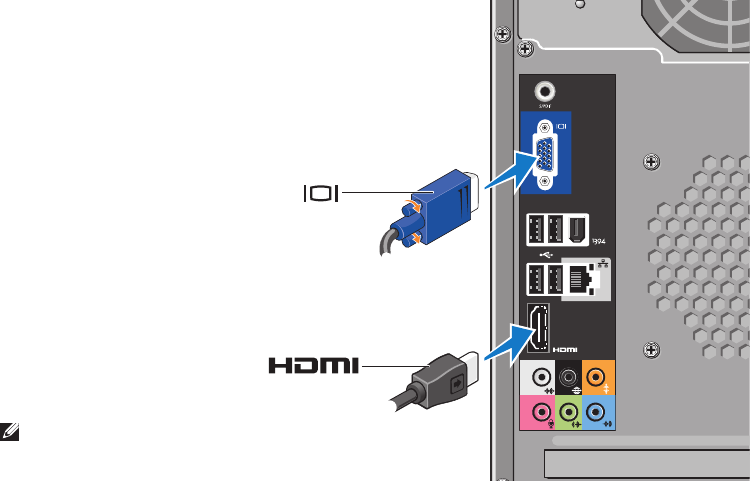
Your computer uses one of two
different connectors for connecting
the display. The HDMI connector is a
high‑performance digital connector
that carries both video and audio
signals for displays such as TVs and
monitors with integrated speakers.
The VGA connector carries only video
signals for displays such as monitors
and projectors.
NOTE: A DVI connector may be available on
your computer if you purchased an optional
discreet graphics card.
‑OR‑
7
Setting Up Your Studio 540
Connect the Video Cable to the Display
Check your TV or monitor to see which type of
connectors are available. Refer to the following
table when identifying the connectors on your
display to select the connection type you
will use.
HDMI
VGA
DVI
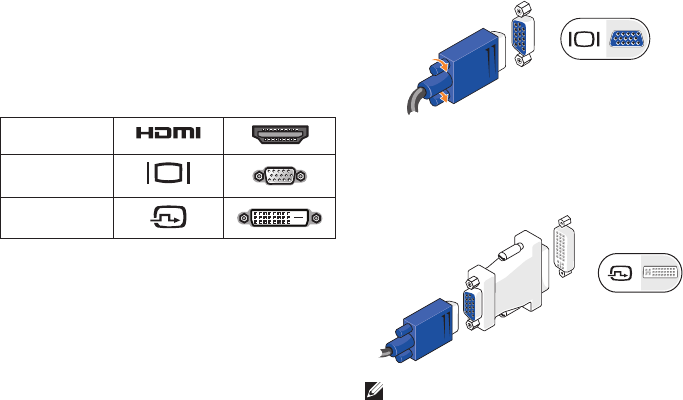
You can connect to the display using the
following connectors available on your
computer: the VGA connector, the HDMI
connector, or the DVI connector (optional).
Connect Using the VGA Connector
Connect the display using a VGA cable (which
usually has blue connectors at both ends).
If your computer has a DVI connector, use the
VGA cable (with blue connectors at both ends)
with a DVI‑to‑VGA adapter (white connector).
NOTE: You can purchase a DVI‑to‑VGA
adapter from the Dell website at dell.com.
8
Setting Up Your Studio 540
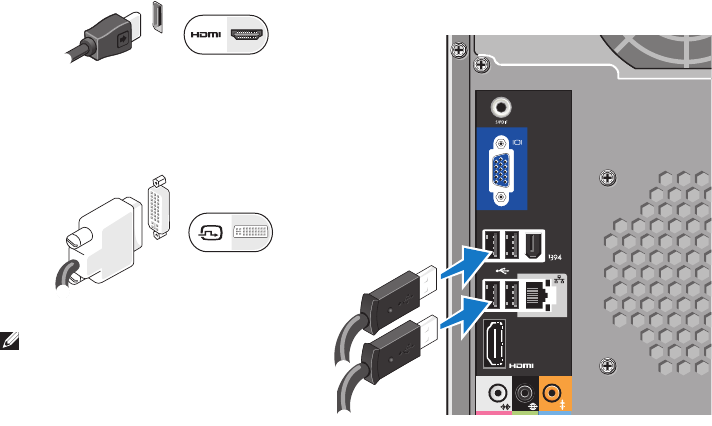
Connect Using the HDMI Connector
Connect the display using an HDMI cable.
Connect Using the DVI Connector (Optional)
Connect the display using a DVI cable.
NOTE: You can purchase additional HDMI
and DVI cables from the Dell website at
dell.com.
Connect the Keyboard and Mouse
Use the USB connectors on the back panel of
the computer to attach a USB keyboard and
mouse.
9
Setting Up Your Studio 540
Connect the Network Cable
(Optional)
A network connection is not required to
complete your computer setup, but if you have
an existing network or Internet connection
that uses a cable connection (such as a
home cable modem or Ethernet jack), you can
connect it now. Use only an Ethernet cable
(RJ45 connector). Do not plug a telephone cable
(RJ11 connector) into the network connector.
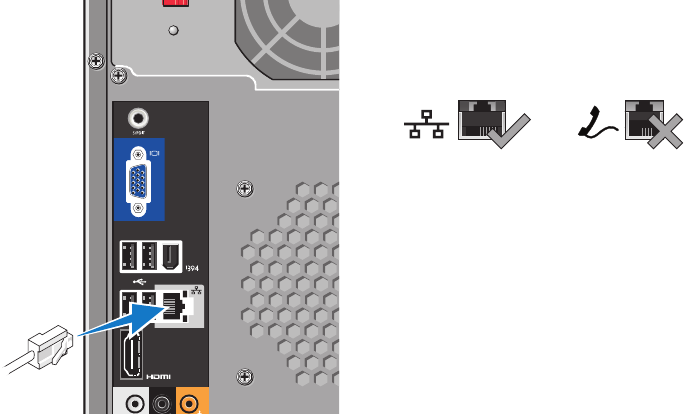
To attach your computer to a network or
broadband device, connect one end of the
network cable to either a network port or a
broadband device. Connect the other end of the
network cable to the network adapter connector
on the back panel of your computer. A click
indicates that the network cable has been
securely attached.
10
Setting Up Your Studio 540
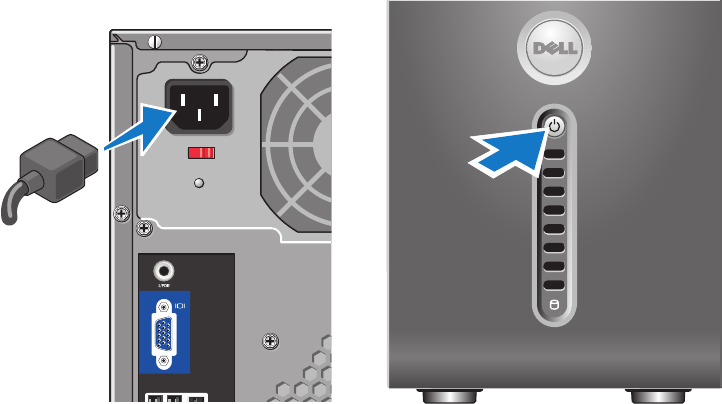
Connect the Power Cables for
Your Display and Computer
Press the Power Buttons on Your
Computer and Display

11
Setting Up Your Studio 540
Windows Vista Setup
To set up Windows Vista® for the first time
follow the instructions on the screen. These
steps are mandatory and may take up to
15 minutes to complete. The screens will take
you through several procedures including
accepting license agreements, setting
preferences, and setting up an Internet
connection.
NOTICE: Do not interrupt the operating
system’s setup process. Doing so may
render your computer unusable.
Connect to the Internet (Optional)
NOTE: ISPs and ISP offerings vary by
country.
To connect to the Internet, you need an external
modem or network connection and an Internet
service provider (ISP). Your ISP will offer one
or more of the following Internet connection
options:
DSL connections that provide high‑speed •
Internet access through your existing
telephone line or cellular telephone service.
With a DSL connection, you can access the
Internet and use your telephone on the same
line simultaneously.
Cable modem connections that provide •
high‑speed Internet access through your
local cable TV line.
Satellite modem connections that provide •
high‑speed Internet access through a
satellite television system.
Dial‑• up connections that provide Internet
access through a telephone line. Dial‑up
connections are considerably slower
than DSL and cable (or satellite) modem
connections. Your computer does not have
an integrated modem. An optional USB
modem must be used for dialup service with
this computer.

12
Setting Up Your Studio 540
Wireless LAN (WLAN) • connections that
provide Internet access using WiFi 802.11
technology. Wireless LAN support requires
optional internal components that may or
may not be installed in your computer based
on decisions made at the time of purchase.
NOTE: If an external USB modem or
WLAN adapter is not part of your original
order, you can purchase one from the Dell
website at dell.com.
Setting Up a Wired Connection
If you are using a dial‑up connection, connect
the telephone line to the external USB modem
(optional) and to the telephone wall jack before
you set up your Internet connection. If you
are using a DSL or cable/satellite modem
connection, contact your ISP or cellular
telephone service for setup instructions.
Setting Up a Wireless Connection
Before you can use your wireless Internet
connection, you need to connect to your
wireless router. To set up your connection to a
wireless router:
Save and close any open files, and exit any 1.
open programs.
Click 2. Start → Connect To.
Follow the instructions on the screen to 3.
complete the setup.
Setting Up Your Internet Connection
To set up an Internet connection with a provided
ISP desktop shortcut:
Save and close any open files, and exit any 1.
open programs.
Double‑click the ISP icon on the Microsoft2. ®
Windows® desktop.
Follow the instructions on the screen to 3.
complete the setup.

13
Setting Up Your Studio 540
If you do not have an ISP icon on your desktop
or if you want to set up an Internet connection
with a different ISP, perform the steps in the
following section.
NOTE: If you cannot connect to the Internet
but have successfully connected in the
past, the ISP might have a service outage.
Contact your ISP to check the service
status, or try connecting again later.
NOTE: Have your ISP information ready. If
you do not have an ISP, the Connect to the
Internet wizard can help you get one.
Save and close any open files, and exit any 1.
open programs.
Click 2. Start → Control Panel.
Under 3. Network and Internet, click Connect
to the Internet.
The Connect to the Internet window appears.
Click either 4. Broadband (PPPoE) or Dial-up,
depending on how you want to connect:
Choose a. Broadband if you will use a
DSL, satellite modem, cable TV modem,
or Bluetooth® wireless technology
connection.
Chose b. Dial-up if you will use an optional
USB dial‑up modem or ISDN.
NOTE: If you do not know which type of
connection to select, click Help me choose
or contact your ISP.
Follow the instructions on the screen and 5.
use the setup information provided by your
ISP to complete the setup.
14
Your computer has indicators, buttons, and
features that provide information at‑a‑glance and
time‑saving shortcuts for common tasks.
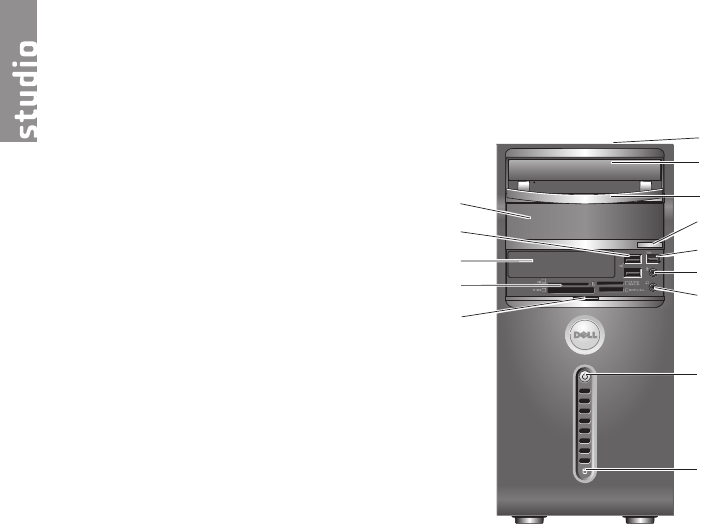
Front View Features
1 Service Tag (located on top of the
chassis towards the back) — Use the
Service Tag to identify your computer
when you access the Dell Support
website or call technical support.
2Optical drive — Plays or records only
standard‑size (12 cm) CDs, DVDs, and
Blu‑ray Disc™.
3Optical drive panel — This panel covers
the optical drive (shown in open position).
Using Your Studio 540
1
2
3
4
5
6
7
8
9
12
13
14
10
11
15
Using Your Studio 540
4Optical drive eject button — Press to
eject a disc from the optical drive.
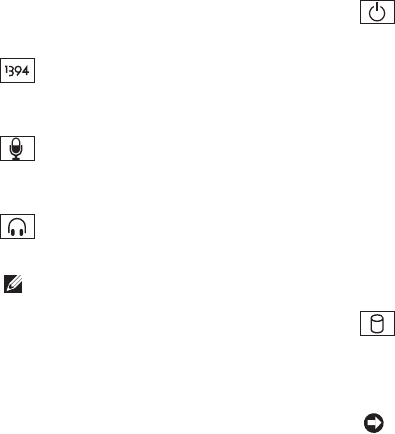
5 IEEE 1394 connector — Connects
to high‑speed serial multimedia devices
such as digital video cameras.
6 Line-in or microphone connector —
Connects to a microphone for voice or to
an audio cable for audio input.
7 Headphone connector — Connects
to headphones.
NOTE: To connect to a powered
speaker or sound system, use the
audio out or S/PDIF connector on the
back of your computer.
8 Power button and light — Turns the
power on or off when pressed. The light
in the center of this button indicates the
power state:
Blinking white — the computer is in •
sleep state.
Solid white — the computer is in •
power‑on state.
Blinking amber — there may be a •
problem with the system board.
Solid amber — there may be a •
problem with either the system board
or power supply.
9 Hard drive activity light — Turns on
when the computer reads or writes data.
A blinking blue light indicates hard drive
activity.
NOTICE: To avoid loss of data, never
turn off the computer while the hard
drive activity light is blinking.
16
Using Your Studio 540
10 Front-panel door grip — Slide up the front
panel door grip to cover the FlexBay drive,
USB connectors, IEEE 1394 connector,
headphone connector, and microphone
connector.
11 Media card reader — Provides a
fast and convenient way to view and
share digital photos, music, videos, and
documents stored on the following digital
memory cards:
Secure Digital (• SD) memory card
•Secure Digital High Capacity (SDHC)
card
Multi • Media Card (MMC)
Memory • Stick
Memory Stick PRO•
xD‑• Picture Card (type ‑ M and type ‑ H)
12 FlexBay drive — Can contain an optional
FlexBay.
13 USB 2.0 connectors (2) — Connects
USB devices that are connected
occasionally such as memory keys,
digital cameras, and MP3 players.
14 Optional Optical drive bay — Can contain
an additional optical drive.
17
Using Your Studio 540
Back View Features
7
1
2
3
4
5
6
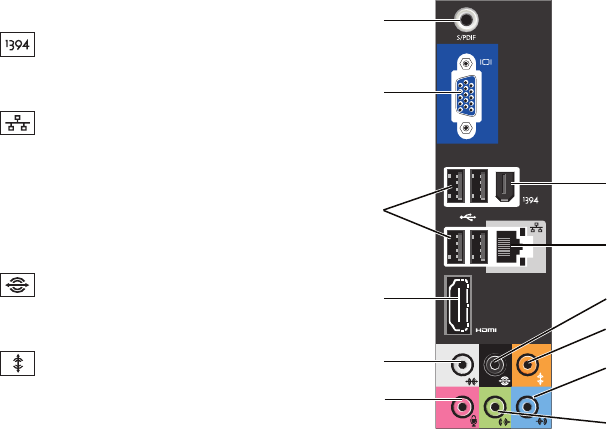
1Security cable slot — Connects to a lock
for a security cable used as an anti‑theft
device.
NOTE: Before you buy a lock, ensure
that it works with the security cable
slot on your computer.
2Padlock rings — Attach a commercially
available anti‑theft device.
3Expansion card slots (4) — Access
connectors for any installed PCI and PCI
Express cards.
4Back panel connectors — Plug USB,
audio, and other devices into the
appropriate connector.
5Power supply light — Indicates power
availability for power supply.
6Voltage selector switch — Select the
region specific voltage range.
7Power connector — Connects your
computer to the power socket.
18
Using Your Studio 540
Back Panel Connectors
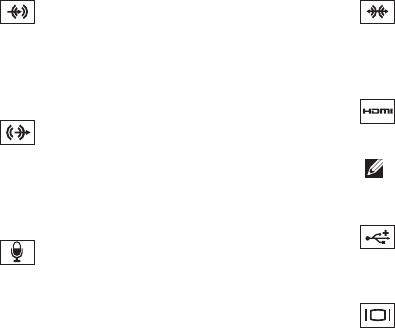
1 IEEE 1394 connector — Connects to
high‑speed serial multimedia devices such
as digital video cameras.
2 Network connector and light —
Connects your computer to a network
or broadband device. The network
activity light flashes when the computer
is transmitting or receiving data. A high
volume of network traffic may make this
light appear to be in a steady “on” state.
3 Back L/R surround connector —
Connects to multichannel capable
speakers.
4 Center/subwoofer connector —
Connects to a subwoofer.
1
2
3
4
5
6
7
8
9
10
11
12
19
Using Your Studio 540
5 Line-in connector — Connects to a
microphone for voice or audio input into a
sound or telephony program.
On computers with a sound card, use the
connector on the card.
6 Front L/R line-out connector —
Connects to headphones and speakers
with integrated amplifiers.
On computers with a sound card, use the
connector on the card.
7 Microphone connector — Connects
to a record/playback device such as a
microphone, cassette player, CD player,
or VCR.
On computers with a sound card, use the
connector on the card
8 Side L/R surround connector —
Connects to surround sound speakers.
On computers with a sound card, use the
connector on the card.
9 HDMI 1.2 connector — Connects to a
TV for both audio and video signals.
NOTE: For a monitor without built‑in
speakers, only the video signal will
be read.
10 USB 2.0 connectors (4) — Connects
USB devices, such as a mouse, keyboard,
printer, external drive, or MP3 player.
11 VGA connector — Connects to a
monitor or projector only for video signals.
12 S/PDIF connector — Connects to
amplifiers and TVs for digital audio through
coaxial digital cables. This format carries
an audio signal without going through an
analog audio conversion process.

20
Using Your Studio 540
Software Features
NOTE: For more information about the
features described in this section, see the
Dell Technology Guide available on your
hard drive or on the Dell Support website at
support.dell.com.
Productivity and Communication
You can use your computer to create
presentations, brochures, greeting cards, fliers,
and spreadsheets. You can also edit and view
digital photographs and images. Check your
purchase order for software installed on your
computer.
After connecting to the Internet, you can access
websites, setup an e‑mail account, upload and
download files, and so on.
Entertainment and Multimedia
You can use your computer to watch videos,
play games, create your own CDs, listen to
music and radio stations. Your optical disc
drive may support multiple disc media formats
including CDs, Blu‑ray Discs (if the option is
selected at the time of purchase), and DVDs.
You can download or copy pictures and video
files from portable devices, such as digital
cameras and cell phones. Optional software
applications enable you to organize and create
music and video files that can be recorded to a
disc, saved on portable products such as MP3
players and handheld entertainment devices, or
played and viewed directly on connected TVs,
projectors, and home theater equipment.
Customizing the Desktop
You can customize your desktop to change the
appearance, resolution, wallpaper, screensaver,
and so on by accessing the Personalize
appearance and sounds window.
To access the display properties window:
Right‑click an open area of the desktop.1.
Click 2. Personalize, to open the Personalize
appearance and sounds window and learn
more about your customization options.

21
Using Your Studio 540
Customizing Your Energy Settings
You can use the power options in your operating
system to configure the power settings on your
computer. Microsoft® Windows Vista® provides
three default options:
Balanced• — This power option offers full
performance when you need it and saves
power during periods of inactivity.
Power saver• — This power option saves
power on your computer by reducing system
performance to maximize the life of the
computer and by reducing the amount of
energy consumed by your computer over its
lifetime.
High performance• — This power option
provides the highest level of system
performance on your computer by adapting
processor speed to your activity and by
maximizing system performance.
Backing Up Your Data
It is recommended that you periodically back
up files and folders on your computer. To back
up files:
Click 1. Start → Control Panel→ System
and Maintenance→ Welcome Center→
Transfer files and settings.
Click 2. Back up files or Back up computer.
Click 3. Continue on Your User Account Control
dialog box and follow the instructions in the
Back up Files wizard.

22
Solving Problems
This section provides troubleshooting
information for your computer. If you are unable
to solve your problem using the following
guidelines, see “Using Support Tools” on
page 28 or “Contacting Dell” on page 43.
CAUTION: Only trained service personnel
should remove the computer cover. See
the
Service Manual
on the Dell Support
website at support.dell.com for advanced
service and troubleshooting instructions.
CAUTION: Before working inside your
computer, read the safety information that
shipped with your computer. For additional
safety best practice information, see the
Regulatory Compliance Homepage on
www.dell.com at the following location:
http://www.dell.com/regulatory_
compliance.
Network Problems
Wireless Connections
If the network connection is lost — The
wireless router is offline or wireless has been
disabled on the computer.
Check your wireless router to ensure it is •
powered on and connected to your data
source (cable modem or network hub).
Re‑establish your connection to the wireless •
router:
Save and close any open files, and exit a.
any open programs.
Click b. Start → Connect To.
Follow the instructions on the screen c.
to complete the setup.

23
Solving Problems
Wired Connections
If the network connection is lost — The cable
is loose or damaged.
Check the cable to ensure it is plugged in •
and not damaged.
The link integrity light on the integrated network
connector lets you verify that your connection is
working and provides information on the status:
Green — A good connection exists between •
a 10/100‑Mbps network and the computer.
Orange — A good connection exists between •
a 1000‑Mbps network and the computer.
Off (no light) — The computer is not •
detecting a physical connection to the
network.
NOTE: The link integrity light on the network
connector is only for the wired cable
connection. The link integrity light does not
provide status for wireless connections.
Power Problems
If the power light is off — The computer is
either turned off or is not receiving power.
Reseat the power cable into both the •
power connector on the computer and the
electrical outlet.
If the computer is plugged into a power strip, •
ensure that the power strip is plugged into
an electrical outlet and that the power strip
is turned on. Also bypass power protection
devices, power strips, and power extension
cables to verify that the computer turns on
properly.
Ensure that the electrical outlet is working •
by testing it with another device, such as a
lamp.
24
Solving Problems
If the power light is solid white and the
computer is not responding — The display may
not be connected or powered on. Ensure that
the display is properly connected and then turn
it off, then back on.
If the power light is blinking white — The
computer is in standby mode. Press a key on the
keyboard, move the pointer on the trackpad or a
connected mouse, or press the power button to
resume normal operation.
If the power light is solid amber — The
computer has a power problem or an internal
device malfunction. For assistance contact Dell,
see “Contacting Dell” on page 43.
If the power light is blinking amber — The
computer is receiving electrical power, but a
device might be malfunctioning or incorrectly
installed. You may have to remove and then
reinstall the memory modules (for information on
removing and replacing memory modules, see
the Service Manual on the Dell Support website
at support.dell.com).
If you encounter interference that hinders
reception on your computer — An unwanted
signal is creating interference by interrupting or
blocking other signals. Some possible causes of
interference are:
Power, keyboard, and mouse extension •
cables.
Too many devices connected to a power •
strip.
Multiple power strips connected to the same •
electrical outlet.
25
Solving Problems
Memory Problems
If you receive an insufficient memory
message —
Save and close any open files and exit any •
open programs you are not using to see if
that resolves the problem.
See the software documentation for •
minimum memory requirements. If
necessary, install additional memory
(see the Service Manual on the Dell Support
website at support.dell.com).
Reseat the memory modules (see the •
Service Manual on the Dell Support website
at support.dell.com) to ensure that your
computer is successfully communicating
with the memory.
If you experience other memory problems —
Ensure that you are following the memory •
installation guidelines (see the Service
Manual on the Dell Support website at
support.dell.com).
Check if the memory module is compatible •
with your computer. Your computer supports
DDR2 memory. For more information about
the type of memory supported by your
computer, see “Specifications” on page 46.
Run the Dell Diagnostics (see “Dell •
Diagnostics” on page 31).
Reseat the memory modules (see the •
Service Manual on the Dell Support website
at support.dell.com) to ensure that your
computer is successfully communicating
with the memory.

26
Solving Problems
Lockups and Software Problems
If the computer does not start up — Ensure
that the power cable is firmly connected to the
computer and to the electrical outlet.
If a program stops responding — End the
program:
Press <Ctrl><Shift><Esc> simultaneously.1.
Click 2. Applications.
Click the program that is no longer 3.
responding
Click 4. End Task.
If a program crashes repeatedly — Check the
software documentation. If necessary, uninstall
and then reinstall the program.
NOTE: Software usually includes
installation instructions in its
documentation or on CD.
If the computer stops responding —
NOTICE: You might lose data if you are
unable to perform an operating system
shutdown.
Turn the computer off. If you are unable to get a
response by pressing a key on your keyboard or
moving your mouse, press and hold the power
button for at least 8 to 10 seconds until the
computer turns off. Then restart your computer.
If a program is designed for an earlier
Microsoft® Windows® operating system —
Run the Program Compatibility Wizard. The
Program Compatibility Wizard configures a
program so that it runs in an environment
similar to non‑Windows Vista operating system
environments.
Click 1. Start → Control Panel→
Programs→ Use an older program with this
version of Windows.
In the welcome screen, click 2. Next.
Follow the instructions on the screen.3.

27
Solving Problems
If a solid blue screen appears — Turn the
computer off. If you are unable to get a
response by pressing a key on your keyboard or
moving your pointer or mouse, press and hold
the power button for at least 8 to 10 seconds
until the computer turns off. Then restart your
computer.
If you have other software problems —
Back up your files immediately.•
Use a virus‑scanning program to check the •
hard drive or CDs.
Save and close any open files or programs •
and shut down your computer through the
Start menu.
Check the software documentation or •
contact the software manufacturer for
troubleshooting information:
Ensure that the program is compatible –
with the operating system installed on
your computer.
Ensure that your computer meets the –
minimum hardware requirements needed
to run the software. See the software
documentation for information.
Ensure that the program is installed and –
configured properly.
Verify that the device drivers do not –
conflict with the program.
If necessary, uninstall and then reinstall –
the program.
28
Dell Support Center
The Dell Support Center helps you find
the service, support, and system‑specific
information you need. For more information
about Dell Support Center and available support
tools, click the Services tab at support.dell.com.
Click the icon in the taskbar to run the
application. The home page provides links to
access:
Self Help (Troubleshooting, Security, System •
Performance, Network/Internet, Backup/
Recovery, and Windows Vista)
Alerts (technical support alerts relevant to •
your computer)
Assistance from Dell (Technical Support with •
DellConnect™, Customer Service, Training
and Tutorials, How‑To Help with Dell on Call,
and Online Scan with PCCheckUp)
About Your System (System Documentation, •
Warranty Information, System Information,
Upgrades & Accessories)
The top of the Dell Support Center home page
displays your system’s model number along with
its Service Tag and express service code.
For more information about the Dell Support
Center, see the
Dell Technology Guide
on your
hard drive or on the Dell Support website at
support.dell.com.
CAUTION: To guard against the likelihood
of electric shock, laceration by moving
fan blades or other unexpected injuries,
always unplug your computer from the
electrical outlet before removing the cover.
Using Support Tools

29
Using Support Tools
System Messages
If your computer has an issue or error, it may
display a System Message that will help you
identify the cause and action needed to resolve
the issue.
NOTE: If the message you received is not
listed in the following examples, see the
documentation for either the operating
system or the program that was running
when the message appeared. Alternatively
you could see the Service Manual on the
Dell Support website at support.dell.com
or see “Contacting Dell” on page 43 for
assistance.
Alert! Previous attempts at booting this system
have failed at checkpoint [nnnn]. For help
in resolving this problem, please note this
checkpoint and contact Dell Technical
Support — The computer failed to complete
the boot routine three consecutive times for the
same error (see “Contacting Dell” on page 43
for assistance).
CMOS checksum error — Possible motherboard
failure or RTC battery low. Battery needs
replacement. See the Service Manual on the
Dell Support website at support.dell.com or see
“Contacting Dell” on page 43 for assistance.
CPU fan failure — CPU fan has failed. CPU fan
needs replacement. See the Service Manual on
the Dell Support website at support.dell.com.
Hard-disk drive failure — Possible hard disk
drive failure during HDD POST (see “Contacting
Dell” on page 43 for assistance).
Hard-disk drive read failure — Possible hard
disk drive failure during HDD boot test (see
“Contacting Dell” on page 43 for assistance).
Keyboard failure — Replace keyboard or check
the cable for loose connection.
No boot device available — No bootable
partition on hard disc drive, the hard disc drive
cable is loose, or no bootable device exists.

30
Using Support Tools
If the hard drive is your boot device, ensure •
that the cables are connected and that the
drive is installed properly and partitioned as
a boot device.
Enter system setup and ensure that the boot •
sequence information is correct (see the
Service Manual on the Dell Support website
at support.dell.com).
No timer tick interrupt — A chip on the system
board might be malfunctioning or motherboard
failure (see the Service Manual on the Dell
Support website at support.dell.com or see
“Contacting Dell” on page 43 for assistance).
USB over current error — Disconnect the USB
device. Your USB device needs more power for
it to function properly. Use an external power
source to connect the USB device, or if your
device has two USB cables, connect both of
them.
NOTICE - Hard Drive SELF MONITORING
SYSTEM has reported that a parameter
has exceeded its normal operating range.
Dell recommends that you back up your data
regularly. A parameter out of range may or may
not indicate a potential hard drive problem —
S.M.A.R.T error, possible hard disk drive failure.
This feature can be enabled or disabled in the
BIOS setup (see “Contacting Dell” on page 43
for assistance).
Hardware Troubleshooter
If a device is either not detected during
the operating system setup or is detected
but incorrectly configured, you can use the
Hardware Troubleshooter to resolve the
incompatibility.
To start the Hardware Troubleshooter:
Click 1. Start → Help and Support.
Type 2. hardware troubleshooter in
the search field and press <Enter> to start
the search.

31
Using Support Tools
In the search results, select the option that 3.
best describes the problem and follow the
remaining troubleshooting steps.
Dell Diagnostics
If you experience a problem with your
computer, perform the checks in “Lockups and
Software Problems” on page 26 and run the
Dell Diagnostics before you contact Dell for
technical assistance.
It is recommended that you print these
procedures before you begin.
NOTE: Dell Diagnostics works only on Dell
computers.
NOTE: The
Drivers and Utilities
media
is optional and may not ship with your
computer.
See the System Setup section in the Service
Manual to review your computer’s configuration
information, and ensure that the device that
you want to test displays in the system setup
program and is active.
Start the Dell Diagnostics from your hard drive
or from the
Drivers and Utilities
media.
Starting Dell Diagnostics From Your Hard Drive
The Dell Diagnostics is located on a hidden
diagnostic utility partition on your hard drive.
NOTE: If your computer cannot display a
screen image, see “Contacting Dell” on
page 43.
Ensure that the computer is connected to an 1.
electrical outlet that is known to be working
properly.
Turn on (or restart) your computer.2.
When the DELL3. ™ logo appears, press <F12>
immediately. Select Diagnostics from the
boot menu and press <Enter>.
NOTE: If you wait too long and the operating
system logo appears, continue to wait until
you see the Microsoft® Windows® desktop;
then, shut down your computer and try again.

32
Using Support Tools
NOTE: If you see a message stating that no
diagnostics utility partition has been found,
run the Dell Diagnostics from the
Drivers
and Utilities
media.
Press any key to start the Dell Diagnostics 4.
from the diagnostics utility partition on your
hard drive.
Starting Dell Diagnostics From the Drivers and
Utilities Media
Insert the1.
Drivers and Utilities
media.
Shut down and restart the computer. 2.
When the DELL logo appears, press <F12>
immediately.
NOTE: If you wait too long and the
operating system logo appears, continue to
wait until you see the Microsoft® Windows®
desktop; then, shut down your computer
and try again.
NOTE: The next steps change the boot
sequence for one time only. On the next
start‑up, the computer boots according to
the devices specified in the system setup
program.
When the boot device list appears, highlight 3.
CD/DVD/CD-RW and press <Enter>.
Select the 4. Boot from CD-ROM option from
the menu that appears and press <Enter>.
Type 1 to start the CD menu and press 5.
<Enter> to proceed.
Select 6. Run the 32 Bit Dell Diagnostics from
the numbered list. If multiple versions are
listed, select the version appropriate for your
computer.
When the Dell Diagnostics 7. Main Menu
appears, select the test you want to run.

33
You can restore your operating system in the
following ways:
System • Restore returns your computer to an
earlier operating state without affecting data
files. Use System Restore as the first solution
for restoring your operating system and
preserving data files.
Dell • Factory Image Restore returns your hard
drive to the operating state it was in when
you purchased the computer. This procedure
permanently deletes all data on the hard
drive and removes any programs installed
after you received the computer. Use Dell
Factory Image Restore only if System
Restore did not resolve your operating
system problem.
If you received an Operating System disc with •
your computer, you can use it to restore your
operating system. However, using the Operating
System disc also deletes all data on the hard
drive. Use the disc only if System Restore did
not resolve your operating system problem.
System Restore
The Windows operating systems provide a
System Restore option which allows you to
return your computer to an earlier operating state
(without affecting data files) if changes to the
hardware, software, or other system settings have
left the computer in an undesirable operating
state. Any changes that System Restore makes to
your computer are completely reversible.
NOTICE: Make regular backups of your
data files. System Restore does not monitor
your data files or recover them.
NOTE: The procedures in this document
were written for the Windows default view,
so they may not apply if you set your Dell™
computer to the Windows Classic view.
System Recovery Options
34
System Recovery Options
Starting System Restore
Click 1. Start .
In the 2. Start Search box, type System
Restore and press <Enter>.
NOTE: The User Account Control window
may appear. If you are an administrator on
the computer, click Continue; otherwise,
contact your administrator to continue the
desired action.
Click 3. Next and follow the remaining prompts
on the screen.
In the event that System Restore did not resolve
the issue, you may undo the last system restore.
Undoing the Last System Restore
NOTE: Before you undo the last system
restore, save and close all open files, and
exit any open programs. Do not alter, open,
or delete any files or programs until the
system restoration is complete.
Click 1. Start .
In the 2. Start Search box, type System
Restore and press <Enter>.
Click 3. Undo my last restoration and click
Next.
Dell Factory Image Restore
NOTICE: Using Dell Factory Image Restore
permanently deletes all data on the hard
drive and removes any programs or drivers
installed after you received your computer.
If possible, back up the data before using
this option. Use Dell Factory Image Restore
only if System Restore did not resolve your
operating system problem.
NOTE: Dell Factory Image Restore may
not be available in certain countries or on
certain computers.
Use Dell Factory Image Restore only as the
last method to restore your operating system.
These options restore your hard drive to the

35
System Recovery Options
operating state it was in when you purchased
the computer. Any programs or files added
since you received your computer—including
data files—are permanently deleted from
the hard drive. Data files include documents,
spreadsheets, e‑mail messages, digital photos,
music files, and so on. If possible, back up all
data before using Factory Image Restore.
Dell Factory Image Restore
Turn on the computer. When the Dell logo 1.
appears, press <F8> several times to access
the Vista Advanced Boot Options Window.
Select 2. Repair Your Computer.
The 3. System Recovery Options window
appears.
Select a keyboard layout and click 4. Next.
To access the recovery options, log on as a 5.
local user. To access the command prompt,
type administrator in the User name
field, then click OK.
Click 6. Dell Factory Image Restore. The Dell
Factory Image Restore welcome screen
appears.
NOTE: Depending upon your configuration,
you may need to select Dell Factory Tools,
then Dell Factory Image Restore.
Click 7. Next. The Confirm Data Deletion
screen appears.
NOTICE: If you do not want to proceed with
Factory Image Restore, click Cancel.
Click the checkbox to confirm that you want 8.
to continue reformatting the hard drive and
restoring the system software to the factory
condition, then click Next.
The restore process begins and may take
five or more minutes to complete. A message
appears when the operating system and
factory‑installed applications have been
restored to factory condition.
Click 9. Finish to reboot the system.

36
System Recovery Options
Operating System Reinstallation
Before you Begin
If you are considering reinstalling the Windows
operating system to correct a problem with a
newly installed driver, first try using Windows
Device Driver Rollback. If Device Driver
Rollback does not resolve the problem, then use
System Restore to return your operating system
to the operating state it was in before you
installed the new device driver. See “System
Restore” on page 33.
NOTICE: Before performing the installation,
back up all data files on your primary
hard drive. For conventional hard drive
configurations, the primary hard drive is the
first drive detected by the computer.
To reinstall Windows, you need the following
items:
Dell Operating System
• media
Dell Drivers and Utilities
• media
NOTE: The
Dell Drivers and Utilities
media
contains drivers that were installed during
the assembly of the computer. Use the
Dell Drivers and Utilities media to load any
required drivers. Depending on the region
from which you ordered your computer, or
whether you requested the media, the
Dell
Drivers and Utilities
media and
Operating
System
media may not ship with your
computer.
Reinstalling Windows Vista
The reinstallation process can take 1 to 2 hours
to complete. After you reinstall the operating
system, you must also reinstall the device
drivers, virus protection program, and other
software.
Save and close any open files and exit any 1.
open programs.
Insert the 2.
Operating System
disc.
Click 3. Exit if the Install Windows message
appears.

37
System Recovery Options
Restart the computer.4.
When the DELL logo appears, press <F12> 5.
immediately.
NOTE: If you wait too long and the
operating system logo appears, continue to
wait until you see the Microsoft® Windows®
desktop; then, shut down your computer
and try again.
NOTE: The next steps change the boot
sequence for one time only. On the next
start‑up, the computer boots according to
the devices specified in the system setup
program.
When the boot device list appears, highlight 6.
CD/DVD/CD-RW Drive and press <Enter>.
Press any key to 7. Boot from CD-ROM.
Follow the instructions on the screen to
complete the installation.

38
If you experience a problem with your computer,
you can complete the following steps to
diagnose and troubleshoot the problem:
See “Solving Problems” on page 1. 22 for
information and procedures that pertain to
the problem your computer is experiencing.
See “Dell Diagnostics” on page 2. 31 for
procedures on how to run Dell Diagnostics.
Fill out the “Diagnostic Checklist” on 3.
page 42.
Use Dell’s extensive suite of online services 4.
available at Dell Support (support.dell.com)
for help with installation and troubleshooting
procedures. See “Online Services” on
page 39 for a more extensive list of Dell
Support online.
If the preceding steps have not resolved the 5.
problem, see “Contacting Dell” on page 43.
NOTE: Call Dell Support from a telephone
near or at the computer so that the support
staff can assist you with any necessary
procedures.
NOTE: Dell’s Express Service Code system
may not be available in all countries.
When prompted by Dell’s automated telephone
system, enter your Express Service Code to
route the call directly to the proper support
personnel. If you do not have an Express
Service Code, open the Dell Accessories folder,
double‑click the Express Service Code icon, and
follow the directions.
NOTE: Some of the following services
are not always available in all locations
outside the continental U.S. Call your local
Dell representative for information on
availability.
Getting Help
39
Getting Help
Technical Support and Customer
Service
Dell’s support service is available to answer
your questions about Dell hardware. Our
support staff uses computer‑based diagnostics
to provide fast, accurate answers.
To contact Dell’s support service, see “Before
You Call” on page 42 and then see the contact
information for your region or go to support.dell.
com.
DellConnect™
DellConnect is a simple online access tool that
allows a Dell service and support associate to
access your computer through a broadband
connection, diagnose your problem, and repair it
all under your supervision. For more information,
go to support.dell.com/dellconnect.
Online Services
You can learn about Dell products and services
on the following websites:
www.dell.com•
www.dell.com/ap• (Asian/Pacific countries
only)
www.dell.com/jp• (Japan only)
www.euro.dell.com• (Europe only)
www.dell.com/la• (Latin American and
Caribbean countries)
www.dell.ca• (Canada only)
You can access Dell Support through the
following websites and e‑mail addresses:
Dell Support websites
support.dell.com•
support.jp.dell.com• (Japan only)
support.euro.dell.com• (Europe only)
40
Getting Help
Dell Support e-mail addresses
mobile_support@us.dell.com•
support@us.dell.com•
la-techsupport@dell.com• (Latin America and
Caribbean countries only)
apsupport@dell.com• (Asian/Pacific
countries only)
Dell Marketing and Sales e-mail addresses
apmarketing@dell.com• (Asian/Pacific
countries only)
sales_canada@dell.com• (Canada only)
Anonymous file transfer protocol (FTP)
ftp.dell.com•
Log in as user: anonymous, and use your
e‑mail address as your password.
Automated Order-Status Service
To check on the status of any Dell products that
you have ordered, you can go to support.dell.
com, or you can call the automated order‑
status service. A recording prompts you for the
information needed to locate and report on your
order. For the telephone number to call your
region, see “Contacting Dell” on page 43.
If you have a problem with your order, such as
missing parts, wrong parts, or incorrect billing,
contact Dell for customer assistance. Have your
invoice or packing slip handy when you call. For
the telephone number to call for your region,
see “Contacting Dell” on page 43.
Product Information
If you need information about additional
products available from Dell, or if you would like
to place an order, visit the Dell website at
www.dell.com. For the telephone number to call
for your region or to speak to a sales specialist,
see “Contacting Dell” on page 43.
41
Getting Help
Returning Items for Repair Under
Warranty or for Credit
Prepare all items being returned, whether for
repair or credit, as follows:
Call Dell to obtain a Return Material 1.
Authorization Number, and write it clearly
and prominently on the outside of the box.
For the telephone number to call for your 2.
region, see “Contacting Dell” on page 43.
Include a copy of the invoice and a letter 3.
describing the reason for the return.
Include a copy of the Diagnostics Checklist 4.
(see “Diagnostic Checklist” on page 42),
indicating the tests that you have run and
any error messages reported by the Dell
Diagnostics (see “Dell Diagnostics” on
page 31).
Include any accessories that belong with 5.
the item(s) being returned (power cables,
software, guides, and so on) if the return is
for credit.
Pack the equipment to be returned in the 6.
original (or equivalent) packing materials.
You are responsible for paying shipping 7.
expenses. You are also responsible for
insuring any product returned, and you
assume the risk of loss during shipment to
Dell. Collect On Delivery (C.O.D.) packages
are not accepted.
Returns that are missing any of the 8.
preceding requirements will be refused at
Dell’s receiving dock and returned to you.

42
Getting Help
Before You Call
NOTE: Have your Express Service Code
ready when you call. The code helps Dell’s
automated‑support telephone system direct
your call more efficiently. You may also be
asked for your Service Tag (located on the
top of your computer).
Remember to fill out the following Diagnostics
Checklist. If possible, turn on your computer
before you call Dell for assistance and call from
a telephone at or near the computer. You may be
asked to type some commands at the keyboard,
relay detailed information during operations, or
try other troubleshooting steps possible only at
the computer itself. Ensure that the computer
documentation is available.
Diagnostic Checklist
Name:•
Date:•
Address:•
Phone number:•
Service Tag (bar code on the back or bottom •
of the computer):
Express Service Code:•
Return Material Authorization Number (if •
provided by Dell support technician):
Operating system and version:•
Devices:•
Expansion cards:•
Are you connected to a network? Yes /No•
Network, version, and network adapter:•
Programs and versions:•
See your operating system documentation
to determine the contents of the computer’s
start‑up files. If the computer is connected to

43
Getting Help
a printer, print each file. Otherwise, record the
contents of each file before calling Dell.
Error message, beep code, or diagnostic •
code:
Description of problem and troubleshooting •
procedures you performed:
Contacting Dell
For customers in the United States, call
800‑WWW‑DELL (800‑999‑3355).
NOTE: If you do not have an active
Internet connection, you can find contact
information on your purchase invoice,
packing slip, bill, or Dell product catalog.
Dell provides several online and telephone‑
based support and service options. Availability
varies by country and product, and some
services may not be available in your area.
To contact Dell for sales, technical support, or
customer service issues:
Visit 1. support.dell.com.
Verify your country or region in the 2. Choose
A Country/Region drop‑down menu at the
bottom of the page.
Click 3. Contact Us on the left side of the page.
Select the appropriate service or support link 4.
based on your need.
Choose the method of contacting Dell that is 5.
convenient for you.
44
Finding More Information and Resources
If you need to: See:
reinstall your operating system. your
Operating System
disc.
run a diagnostic program for your computer,
reinstall desktop system software, or update
drivers for your computer, and readme files.
the
Drivers and Utilities
disc.
NOTE: Drivers and documentation updates
can be found on the Dell™ Support website
at support.dell.com.
learn more about your operating system,
maintaining peripherals, RAID, Internet,
Bluetooth®, networking, and e‑mail.
the Dell Technology Guide available on your
hard drive.
upgrade your computer with new or additional
memory, or a new hard drive.
reinstall or replace a worn or defective part.
the Service Manual on the Dell Support website
at support.dell.com.
NOTE: In some countries, opening and
replacing parts of your computer may void
your warranty. Check your warranty and
return policies before working inside your
computer.

45
Finding More Information and Resources
If you need to: See:
find safety best practices information for your
computer.
review Warranty information, Terms and
Conditions (U.S. only), Safety instructions,
Regulatory information, Ergonomics
information, and End User License Agreement.
Before working inside your computer, read
the safety information that shipped with your
computer. For additional safety best practices
information, see the Regulatory Compliance
Homepage at www.dell/regulatory_
compliance.
find your Service Tag/Express Service Code—
You must use the Service Tag to identify your
computer on support.dell.com or to contact
technical support.
the top of your computer.
find drivers and downloads.
access technical support and product help.
check on your order status for new purchases.
find solutions and answers to common
questions.
locate information for last‑minute updates
about technical changes to your computer or
advanced technical‑reference material for
technicians or experienced users.
the Dell Support website at
support.dell.com.

46
Specifications
Computer Model
Studio 540
This section provides information that you may
need when setting up, updating drivers for, and
upgrading your computer.
NOTE: Offerings may vary by region.
For more information regarding the
configuration of your computer, click
Start → Help and Support and select
the option to view information about your
computer.
Processor
Type L2 cache
Intel® Celeron®512 KB
Intel Pentium® Dual‑Core 1 MB
Intel Core™2 Duo 2 MB/3 MB/4 MB/
6 MB
Intel Core2 Quad 6 MB/8 MB/12 MB
47
Specications
Drives
Externally accessible two 5.25‑inch drive
bays for SATA
DVD+/‑RW Super
Multi Drive or Blu‑ray
Disc™ combo or Blu‑
ray Disc RW optical
drive
one 3.5 inch bay for
FlexBay
Internally accessible two 3.5‑inch drive
bays for SATA hard
drive
Memory
Connectors four internally‑
accessible DDR2
DIMM sockets
Capacities 512 MB, 1 GB, and
2 GB
Memory
Memory type 800 MHz, DDR2 DIMM
Minimum 1 GB
Maximum 4 GB (32‑bit operating
system)
8 GB (64‑bit operating
system)
NOTE: For instructions on upgrading your
memory, see the Service Manual on the
Dell Support website at support.dell.com.
Computer Information
System chipset Intel G45 + ICH10R
Data bus width 64 bits
DRAM bus width 64 bits
Processor address
bus width
32 bits

48
Specications
Computer Information
RAID support RAID 0 (striping)
RAID 1 (mirroring)
BIOS chip (NVRAM) 8 MB
Expansion Bus
Bus types PCI 2.3
PCI Express 1.0A (x1)
PCI Express 2.0 (x16)
SATA 1.0, 2.0, and
USB 2.0
Bus speeds
PCI 133 MB/s
Expansion Bus
PCI Express x1 slot •
bi‑directional
speed ‑ 500 MB/s
x16 slot •
bi‑directional
speed ‑ 8 GB/s
SATA 1.5 Gbps and 3.0
Gbps
USB 480 Mbps high
speed, 12 Mbps full
speed, and 1.2 Mbps
low speed
PCI
Connectors one
Connector size 124 pins
Connector data
width (maximum)
32 bits

49
Specications
Expansion Bus
PCI Express x1
Connectors two
Connector size 36 pins
Connector data
width (maximum)
1 PCI Express lane
PCI Express x16
Connectors one
Connector size 164 pins connectors
Connector data
width (maximum)
16 PCI Express lane
Video
Integrated Intel GMA X4500HD
Discrete PCI Express x16 card
(optional)
Audio
Type Realtek ALC888S,
High Definition Audio
System Board Connectors
Chassis fan one 3‑pin connector
Front panel audio
HDA header
one 10‑pin connector
Front panel control one 10‑pin connector
Internal USB device five 10‑pin
connectors
Memory four 240‑pin
connectors
PCI 2.3 one 124‑pin
connector
PCI Express x1 two 36‑pin
connectors

50
Specications
System Board Connectors
PCI Express x16 one 164‑pin
connector
Power one 24‑pin connector
Power 12 V one 4‑pin connector
Processor 775 pin
Processor fan one 4‑pin connector
Serial ATA four 7‑pin connectors
Physical
Height 362 mm (14.2 inches)
Width 170 mm (6.7 inches)
Depth 435 mm (17.1 inches)
Weight 12.5 kg (28.0 lb)
External connectors
Video one VGA and one
HDMI connector
Network adapter RJ45 connector
USB two front‑panel and
four back‑panel
USB 2.0 compliant
connectors
Audio six connectors for 7.1
support
S/PDIF one S/PDIF connector
IEEE one front‑panel and
one back‑panel 6‑pin
serial connector

51
Specications
Power
DC Power Supply
Wattage 300 W/350 W
NOTE: The 300 W power supply will be used in
Energy star systems.
Maximum heat
dissipation
75 W (300 W PSU)
188.5 W (350 W PSU)
NOTE: Heat dissipation is calculated by using
the power supply wattage rating.
Voltage 115/230 VAC,
50/60 Hz, 7.0 A/4.0 A
Coin‑cell battery 3‑V CR2032 lithium
coin cell
Computer Environment
Temperature ranges:
Operating 10° to 35°C
Storage – 40° to 70° C
Relative humidity
(maximum):
20% to 80%
(noncondensing)
Maximum vibration (using a random-vibration
spectrum that simulates user environment):
Operating 5 to 350 Hz at 0.0002
G2/Hz
Storage 5 to 500 Hz at 0.001 to
0.01 G2/Hz

52
Specications
Computer Environment
Maximum shock (measured with hard drive
in head-parked position and a 2-ms half-sine
pulse):
Operating 40 G +/‑ 5% with
pulse duration of
2 msec +/‑ 10%
(equivalent to 20
inches/sec [51 cm/
sec])
Storage 105 G +/‑ 5% with
pulse duration of
2 msec +/‑ 10%
(equivalent to 50
inches/sec [127 cm/
sec])
Computer Environment
Altitude (maximum):
Operating –15.2 to 3048 m
(–50 to 10,000 ft)
Storage –15.2 to 10,668 m
(–50 to 35,000 ft)
Airborne contaminant
level
G2 or lower
as defined by
ISA‑S71.04‑1985

53
Appendix
The information in this document applies to the
products listed below:
Studio•
Studio 540•
Studio 540n•
Macrovision Product Notice
This product incorporates copyright protection
technology that is protected by method claims
of certain U.S. patents and other intellectual
property rights owned by Macrovision
Corporation and other rights owners. Use of
this copyright protection technology must be
authorized by Macrovision Corporation, and is
intended for home and other limited viewing
uses only unless otherwise authorized by
Macrovision Corporation. Reverse engineering
or disassembly is prohibited.

54
B
backups
creating 21
C
calling Dell 42
card reader 16
CDs, playing and creating 20
chipset 47
coaxial digital cables 19
computer capabilities 20
connect(ing)
displays 6
optional network cable 9
to the Internet 11
using dial‑up 11
via DSL 12
via WLAN 12
conserving energy 21
Contacting Dell online 43
customer service 39
customizing
your desktop 20
your energy settings 21
D
data, backing up 21
DellConnect 39
Dell Diagnostics 31
Dell Factory Image Restore 33
Dell Support Center 28
Dell support website 45
Index
55
Index
Dell Technology Guide
for futher information 44
Diagnostic Checklist 42
drivers and downloads 45
DVDs, playing and creating 20
E
eject button 15
email addresses
for technical support 40
energy
conserving 21
expansion bus 48
F
finding more information 44
front‑side connectors 14
FTP login, anonymous 40
H
hard drive
type 47
hard drive activity light 15
hardware problems
diagnosing 30
Hardware Troubleshooter 30
HDMI
connector location 19
display 6
headphone
front connector 15
help
getting assistance and support 38
I
IEEE 1394 connector 15, 18
Internet connection 11
56
Index
ISP
Internet Service Provider 11
L
line‑in connector 15
M
media card reader 16
memory
minimum and maximum 47
memory problems
solving 25
Memory Stick reader 16
memory support 47
microphone connector 15
Microsoft Windows Vista 11
MMC 16
Multi Media Card reader 16
N
network connection
fixing 23
network connector
location 18
network speed
testing 22
O
order status 40
P
power button and light 15
power connector 17
power problems, solving 23
problems, solving 22
processor 46
products
information and purchasing 40
57
Index
R
reinstalling Windows 33
resources, finding more 44
restoring factory image 34
S
SD card reader 16
SDHC card reader 16
security cable slot 17
shipping products
for return or repair 41
software features 20
software problems 26
solving problems 22
S/PDIF connector 19
specifications 46
support email addresses 40
support sites
worldwide 39
system board connectors 49
System Messages 29
system reinstall options 33
System Restore 33
T
technical support 39
temperature
operating and storage ranges 51
U
USB 2.0
back connectors 19
front connectors 16
W
warranty returns 41
Windows, reinstalling 33


Printed in the U.S.A.
0W447FA01
www.dell.com | support.dell.com
