Dell B3465dn Mono Laser Printer User's Guide User Manual En Us
Dell-B3465Dn-Mono-Laser-Multifunction-Printer-Users-Manual-113510 dell-b3465dn-mono-laser-multifunction-printer-users-manual-113510
User Manual: Dell dell-b3465dn Dell B3465dn Mono Laser Printer User's Guide
Open the PDF directly: View PDF  .
.
Page Count: 315 [warning: Documents this large are best viewed by clicking the View PDF Link!]
- Contents
- Safety information
- Learning about the printer
- Understanding the printer control panel
- Setting up and using the home screen applications
- Additional printer setup
- Installing internal options
- Installing hardware options
- Setting up the printer software
- Attaching cables
- Networking
- Preparing to set up the printer on an Ethernet network
- Preparing to set up the printer on a wireless network
- Connecting the printer using the Wireless Setup Wizard
- Connecting the printer to a wireless network using Wi-Fi Protected Setup
- Connecting the printer to a wireless network using the Embedded Web Server
- Changing port settings after installing a new network ISP
- Setting up serial printing
- Verifying printer setup
- Loading paper and specialty media
- Paper and specialty media guide
- Printing
- Copying
- Making copies
- Copying photos
- Copying on specialty media
- Customizing copy settings
- Copying to a different size
- Making copies using paper from a selected tray
- Copying different paper sizes
- Copying on both sides of the paper (duplexing)
- Reducing or enlarging copies
- Adjusting copy quality
- Collating copies
- Placing separator sheets between copies
- Copying multiple pages onto a single sheet
- Creating a custom copy job
- Placing information on copies
- Canceling a copy job
- Understanding the copy options
- E-mailing
- Faxing
- Setting up the printer to fax
- Sending a fax
- Creating shortcuts
- Customizing fax settings
- Canceling an outgoing fax
- Holding and forwarding faxes
- Understanding the fax options
- Scanning
- Understanding the printer menus
- Saving money and the environment
- Securing the printer
- Maintaining the printer
- Managing the printer
- Clearing jams
- Avoiding jams
- Understanding jam messages and locations
- [x]-page jam, open automatic feeder top cover. [28y.xx]
- [x]-page jam, clear standard bin. [20y.xx]
- [x]-page jam, open rear door. [20y.xx]
- [x]-page jam, open front door. [20y.xx]
- [x]-page jam, remove tray 1 to clear duplex. [23y.xx]
- [x]-page jam, clear manual feeder. [25y.xx]
- [x]-page jam, open tray [x]. [24y.xx]
- [x]-page jam, remove all pages from the output bin. Leave paper in bin. [45y.xx]
- Troubleshooting
- Understanding the printer messages
- Cartridge low [88.xy]
- Cartridge nearly low [88.xy]
- Cartridge very low, [x] estimated pages remain [88.xy]
- Change [paper source] to [custom type name] load [orientation]
- Change [paper source] to [custom string] load [orientation]
- Change [paper source] to [paper size] load [orientation]
- Change [paper source] to [paper type] [paper size] load [orientation]
- Check tray [x] connection
- Close front door
- Close rear door
- Close finisher rear door
- Close flatbed cover and load originals if restarting job [2yy.xx]
- Complex page, some data may not have printed [39]
- Configuration change, some held jobs were not restored [57]
- Defective flash detected [51]
- Disk full [62]
- Disk must be formatted for use in this device
- Disk near full. Securely clearing disk space.
- Error reading USB drive. Remove USB.
- Error reading USB hub. Remove hub.
- Fax memory full
- Fax partition inoperative. Contact system administrator.
- Fax server 'To Format' not set up. Contact system administrator.
- Fax Station Name not set up. Contact system administrator.
- Fax Station Number not set up. Contact system administrator.
- Imaging unit low [84.xy]
- Imaging unit nearly low [84.xy]
- Imaging unit very low, [x] estimated pages remain [84.xy]
- Incompatible tray [x] [59]
- Incorrect paper size, open [paper source] [34]
- Insufficient memory to collate job [37]
- Insufficient memory for Flash Memory Defragment operation [37]
- Insufficient memory, some Held Jobs were deleted [37]
- Insufficient memory, some held jobs will not be restored [37]
- Insufficient memory to support Resource Save feature [35]
- Load [paper source] with [custom type name] [paper orientation]
- Load [paper source] with [custom string] [paper orientation]
- Load [paper source] with [paper size] [paper orientation]
- Load [paper source] with [paper type] [paper size] [paper orientation]
- Load Manual Feeder with [custom type name] [paper orientation]
- Load Manual Feeder with [custom string] [paper orientation]
- Load Manual Feeder with [paper size] [paper orientation]
- Load Manual Feeder with [paper type] [paper size] [paper orientation]
- Maintenance kit low [80.xy]
- Maintenance kit nearly low [80.xy]
- Maintenance kit very low, [x] estimated pages remain [80.xy]
- Memory full [38]
- Memory full, cannot print faxes
- Memory full, cannot send faxes
- Network [x] software error [54]
- No analog phone line connected to modem, fax is disabled.
- Non-Dell [supply type], see User’s Guide [33.xy]
- Not enough free space in flash memory for resources [52]
- Paper changes needed
- Parallel port [x] disabled [56]
- Printer had to restart. Last job may be incomplete.
- Remove defective disk [61]
- Remove paper from standard output bin
- Replace defective imaging unit [31.xy]
- Reinstall missing or unresponsive cartridge [31.xy]
- Replace cartridge, printer region mismatch [42.xy]
- Replace cartridge, 0 estimated pages remain [88.xy]
- Replace imaging unit, 0 estimated pages remain [84.xy]
- Replace maintenance kit, 0 estimated pages remain [80.xy]
- Replace all originals if restarting job.
- Reinstall missing or unresponsive imaging unit [31.xy]
- Replace unsupported cartridge [32.xy]
- Replace unsupported imaging unit [32.xy]
- Restore held jobs?
- Scanner automatic feeder cover open
- Scanner disabled by admin [840.01]
- Scanner disabled. Contact system administrator if problem persists. [840.02]
- Scanner jam, remove all originals from the scanner [2yy.xx]
- Scanner jam, remove jammed originals from the scanner [2yy.xx]
- Serial port [x] disabled [56]
- SMTP server not set up. Contact system administrator.
- Some held jobs were not restored
- Standard network software error [54]
- Standard USB port disabled [56]
- Supply needed to complete job
- Too many flash options installed [58]
- Too many trays attached [58]
- Unformatted flash detected [53]
- Unsupported disk
- Unsupported option in slot [x] [55]
- USB port [x] disabled [56]
- Weblink server not set up. Contact system administrator.
- Solving printer problems
- Solving print problems
- Printing problems
- Multiple-language PDF files do not print
- Error message about reading the flash drive appears
- Print jobs do not print
- Confidential and other held jobs do not print
- Print job takes longer than expected
- Job prints from the wrong tray or on the wrong paper
- Incorrect characters print
- Tray linking does not work
- Large jobs do not collate
- Unexpected page breaks occur
- Print quality problems
- Characters have jagged or uneven edges
- Printer is printing blank pages
- Clipped pages or images
- Prints on color transparencies appear dark when projected
- Shadow images appear on prints
- Gray background on prints
- Incorrect margins on prints
- Paper curl
- Print irregularities
- Repeating defects appear on prints
- Print is too dark
- Print is too light
- Skewed print
- Printer is printing solid black pages
- Transparency print quality is poor
- Streaked horizontal lines appear on prints
- Streaked vertical lines appear on prints
- Horizontal voids appear on prints
- Vertical voids appear on prints
- Toner specks appear on prints
- Toner fog or background shading appears on prints
- Toner rubs off
- Uneven print density
- Printing problems
- Solving copy problems
- Solving fax problems
- Solving scanner problems
- Solving home screen application problems
- Embedded Web Server does not open
- Contacting technical support
- Understanding the printer messages
- Appendix
- Index
Dell B3465dn-dnf Laser MFP
User's Guide
March 2014 www.dell.com | dell.com/support/printers
Trademarks
Information in this document is subject to change without notice.
© 2014 Dell, Inc. All rights reserved.
Reproduction of this material in any manner whatsoever without the written permission of Dell Inc. is strictly forbidden.
Trademarks used in this text: Dell, the DELL logo, Inspiron, Dell Precision, Dimension, OptiPlex, Latitude, PowerEdge, PowerVault, PowerApp, and Dell OpenManage are trademarks
of Dell Inc.; Intel, Pentium, and Celeron are registered trademarks of Intel Corporation; Microsoft and Windows are registered trademarks of Microsoft Corporation; AirPrint and
the AirPrint logo are trademarks of Apple, Inc.
Other trademarks and trade names may be used in this document to refer to the entities claiming the marks and names of their products. Dell Inc. disclaims any proprietary
interest in trademarks and trade names other than its own.

Contents
Safety information.......................................................................................7
Learning about the printer...........................................................................9
Finding information about the printer......................................................................................................9
Selecting a location for the printer..........................................................................................................10
Printer configurations.............................................................................................................................11
Using the Embedded Web Server...........................................................................................................13
Understanding the basic functions of the scanner..................................................................................14
Using the ADF and scanner glass.............................................................................................................14
Understanding the printer control panel....................................................15
Using the printer control panel...............................................................................................................15
Understanding the colors of the Sleep button and indicator lights........................................................15
Understanding the home screen.............................................................................................................16
Using the touch-screen buttons..............................................................................................................18
Setting up and using the home screen applications....................................20
Finding the IP address of the computer..................................................................................................20
Finding the IP address of the printer.......................................................................................................20
Accessing the Embedded Web Server.....................................................................................................20
Customizing the home screen.................................................................................................................21
Understanding the different applications...............................................................................................21
Activating the home screen applications................................................................................................22
Finding information about the home screen applications................................................................................22
Setting up Forms and Favorites ........................................................................................................................22
Setting up Card Copy ........................................................................................................................................22
Using MyShortcut .............................................................................................................................................23
Setting up Multi Send .......................................................................................................................................24
Setting up Scan to Network ..............................................................................................................................24
Setting up Remote Operator Panel.........................................................................................................25
Exporting and importing a configuration................................................................................................25
Additional printer setup.............................................................................27
Installing internal options........................................................................................................................27
Installing hardware options.....................................................................................................................42
Setting up the printer software...............................................................................................................44
Contents 2

Attaching cables......................................................................................................................................45
Networking..............................................................................................................................................46
Verifying printer setup............................................................................................................................50
Loading paper and specialty media............................................................51
Setting the paper size and type...............................................................................................................51
Configuring Universal paper settings......................................................................................................51
Loading trays...........................................................................................................................................51
Loading the multipurpose feeder............................................................................................................56
Using the standard bin and paper stop...................................................................................................61
Linking and unlinking trays......................................................................................................................62
Paper and specialty media guide................................................................65
Using specialty media..............................................................................................................................65
Paper guidelines......................................................................................................................................67
Supported paper sizes, types, and weights.............................................................................................70
Printing......................................................................................................74
Printing forms and a document...............................................................................................................74
Printing from a flash drive or mobile device...........................................................................................75
Printing confidential and other held jobs................................................................................................78
Printing information pages......................................................................................................................80
Canceling a print job................................................................................................................................80
Copying......................................................................................................81
Making copies.........................................................................................................................................81
Copying photos........................................................................................................................................82
Copying on specialty media.....................................................................................................................82
Customizing copy settings.......................................................................................................................83
Placing information on copies.................................................................................................................89
Canceling a copy job................................................................................................................................89
Understanding the copy options.............................................................................................................90
E-mailing....................................................................................................92
Setting up the printer to e-mail...............................................................................................................92
Creating an e-mail shortcut.....................................................................................................................93
E-mailing a document..............................................................................................................................94
Customizing e-mail settings.....................................................................................................................95
Contents 3

Canceling an e-mail.................................................................................................................................96
Understanding the e-mail options..........................................................................................................96
Faxing........................................................................................................99
Setting up the printer to fax....................................................................................................................99
Sending a fax.........................................................................................................................................113
Creating shortcuts.................................................................................................................................116
Customizing fax settings........................................................................................................................116
Canceling an outgoing fax.....................................................................................................................118
Holding and forwarding faxes...............................................................................................................118
Understanding the fax options..............................................................................................................119
Scanning...................................................................................................122
Using Scan to Network..........................................................................................................................122
Scanning to an FTP address...................................................................................................................122
Scanning to a computer or flash drive..................................................................................................124
Understanding the scan options...........................................................................................................126
Understanding the printer menus............................................................129
Menus list..............................................................................................................................................129
Paper menu...........................................................................................................................................130
Reports Menu........................................................................................................................................140
Network/Ports menu.............................................................................................................................141
Security menu.......................................................................................................................................149
Settings menu........................................................................................................................................154
Help menu.............................................................................................................................................199
Saving money and the environment.........................................................200
Saving paper and toner.........................................................................................................................200
Saving energy........................................................................................................................................200
Recycling................................................................................................................................................204
Securing the printer..................................................................................205
Statement of Volatility..........................................................................................................................205
Erasing volatile memory........................................................................................................................205
Erasing non‑volatile memory................................................................................................................206
Erasing printer hard disk memory.........................................................................................................206
Configuring printer hard disk encryption..............................................................................................207
Contents 4

Finding printer security information.....................................................................................................208
Maintaining the printer............................................................................209
Cleaning printer parts............................................................................................................................209
Checking the status of parts and supplies.............................................................................................211
Estimated number of remaining pages.................................................................................................211
Ordering supplies..................................................................................................................................211
Storing supplies.....................................................................................................................................212
Replacing supplies.................................................................................................................................213
Moving the printer................................................................................................................................219
Managing the printer...............................................................................221
Managing printer messages..................................................................................................................221
Accessing Status Monitor Center..........................................................................................................221
Checking the virtual display...................................................................................................................221
Setting up e‑mail alerts.........................................................................................................................222
Viewing reports.....................................................................................................................................222
Configuring supply notifications from the Embedded Web Server.......................................................222
Restoring factory default settings.........................................................................................................223
Clearing jams............................................................................................224
Avoiding jams........................................................................................................................................224
Understanding jam messages and locations.........................................................................................225
[x]‑page jam, open automatic feeder top cover. [28y.xx].....................................................................226
[x]‑page jam, clear standard bin. [20y.xx].............................................................................................227
[x]‑page jam, open rear door. [20y.xx]..................................................................................................227
[x]‑page jam, open front door. [20y.xx]................................................................................................229
[x]‑page jam, remove tray 1 to clear duplex. [23y.xx]...........................................................................232
[x]‑page jam, clear manual feeder. [25y.xx]..........................................................................................233
[x]‑page jam, open tray [x]. [24y.xx].....................................................................................................234
[x]-page jam, remove all pages from the output bin. Leave paper in bin. [45y.xx]...............................235
Troubleshooting.......................................................................................240
Understanding the printer messages....................................................................................................240
Solving printer problems.......................................................................................................................254
Solving print problems..........................................................................................................................261
Solving copy problems..........................................................................................................................286
Contents 5

Solving fax problems.............................................................................................................................290
Solving scanner problems.....................................................................................................................296
Solving home screen application problems...........................................................................................301
Embedded Web Server does not open.................................................................................................301
Contacting technical support................................................................................................................302
Appendix..................................................................................................303
Index........................................................................................................305
Contents 6
Safety information
Connect the power cord to a properly grounded electrical outlet that is near the product and easily accessible.
Do not place or use this product near water or wet locations.
CAUTION—POTENTIAL INJURY: This product uses a laser. Use of controls or adjustments or performance of
procedures other than those specified herein may result in hazardous radiation exposure.
This product uses a printing process that heats the print media, and the heat may cause the media to release emissions.
You must understand the section in your operating instructions that discusses the guidelines for selecting print media
to avoid the possibility of harmful emissions.
CAUTION—POTENTIAL INJURY: The lithium battery in this product is not intended to be replaced. There is a
danger of explosion if a lithium battery is incorrectly replaced. Do not recharge, disassemble, or incinerate a
lithium battery. Discard used lithium batteries according to the manufacturer's instructions and local
regulations.
CAUTION—HOT SURFACE: The inside of the printer might be hot. To reduce the risk of injury from a hot
component, allow the surface to cool before touching it.
CAUTION—POTENTIAL INJURY: The printer weight is greater than 18 kg (40 lb) and requires two or more
trained personnel to lift it safely.
CAUTION—POTENTIAL INJURY: Before moving the printer, follow these guidelines to avoid personal injury or
printer damage:
•Turn the printer off using the power switch, and then unplug the power cord from the electrical outlet.
•Disconnect all cords and cables from the printer before moving it.
•If an optional tray is installed, then remove it from the printer. To remove the optional tray, slide the latch on the
right side of the tray toward the front of the tray until it clicks into place.
•Use the handholds located on both sides of the printer to lift it.
•Make sure your fingers are not under the printer when you set it down.
•Before setting up the printer, make sure there is adequate clearance around it.
Use only the power cord provided with this product or the manufacturer's authorized replacement.
Use only the telecommunications (RJ‑11) cord provided with this product or a 26 AWG or larger replacement when
connecting this product to the public switched telephone network.
CAUTION—SHOCK HAZARD: If you are accessing the controller board or installing optional hardware or
memory devices sometime after setting up the printer, then turn the printer off, and unplug the power cord
from the electrical outlet before continuing. If you have any other devices attached to the printer, then turn
them off as well, and unplug any cables going into the printer.
CAUTION—SHOCK HAZARD: Make sure that all external connections (such as Ethernet and telephone system
connections) are properly installed in their marked plug-in ports.
This product is designed, tested, and approved to meet strict global safety standards with the use of specific
manufacturer's components. The safety features of some parts may not always be obvious. The manufacturer is not
responsible for the use of other replacement parts.
CAUTION—POTENTIAL INJURY: Do not cut, twist, bind, crush, or place heavy objects on the power cord. Do not
subject the power cord to abrasion or stress. Do not pinch the power cord between objects such as furniture
and walls. If any of these things happen, a risk of fire or electrical shock results. Inspect the power cord regularly
for signs of such problems. Remove the power cord from the electrical outlet before inspecting it.
Safety information 7

Refer service or repairs, other than those described in the user documentation, to a service representative.
CAUTION—TIPPING HAZARD: Floor-mounted configurations require additional furniture for stability. You must
use either a printer stand or printer base if you are using multiple input options. If you purchased a
multifunction printer (MFP) that scans, copies, and faxes, then you may need additional furniture. For more
information, contact the place where you purchased the printer.
CAUTION—POTENTIAL INJURY: To reduce the risk of equipment instability, load each tray separately. Keep all
other trays closed until needed.
CAUTION—SHOCK HAZARD: Do not use the fax feature during a lightning storm. Do not set up this product or
make any electrical or cabling connections, such as the fax feature, power cord, or telephone, during a lightning
storm.
CAUTION—SHOCK HAZARD: To avoid the risk of electrical shock when cleaning the exterior of the printer,
unplug the power cord from the electrical outlet and disconnect all cables from the printer before proceeding.
SAVE THESE INSTRUCTIONS.
Safety information 8

Learning about the printer
Finding information about the printer
What are you looking for? Find it here
Initial setup instructions:
•Connecting the printer
•Installing the printer software
Setup documentation—The setup documentation came
with the printer.
Additional setup and instructions for using the printer:
•Selecting and storing paper and specialty media
•Loading paper
•Configuring printer settings
•Viewing and printing documents and photos
•Setting up and using the printer software
•Configuring the printer on a network
•Caring for and maintaining the printer
•Troubleshooting and solving problems
User's Guide and Quick Reference Guide—The guides may
be available on the Software and Documentation CD.
For more information, visit our Web site at
www.dell.com/support/manuals.
Instructions for:
•Connecting the printer to an Ethernet network
•Troubleshooting printer connection problems
Networking Guide—Open the Software and
Documentation CD, and then navigate to:
Documentation > User’s Guide and other publications >
Networking Guide
Help using the printer software Windows or Mac Help—Open a printer software program
or application, and then click Help.
Click
?
to view context‑sensitive information.
Notes:
•Help is automatically installed with the printer
software.
•The printer software is located in the printer
program folder or on the desktop, depending on
your operating system.
The latest supplemental information, updates, and technical
support:
•Documentation
•Driver downloads
•Product upgrades
•Service call and repair information
•Order status
•Live chat support
•E‑mail support
•Voice support
Dell support Web site—
www.dell.com/support/printers
Support telephone numbers and hours of operation for
your country or region can be found on the support Web
site.
Have the following information ready when you contact
support so that they may serve you faster:
•Service tag
•Express service Code
Note: The service tag and express service code appear
on labels located on your printer.
Learning about the printer 9
What are you looking for? Find it here
•Software and Drivers—Certified drivers for your printer and
installers for Dell printer software
•Readme files—Last‑minute technical changes, or advanced
technical reference materials for experienced users or
technicians
Software and Documentation CD
•Supplies and accessories for your printer
•Replacement cartridges
Dell printer supplies Web site–www.dell.com/printers
You can purchase printer supplies online, by telephone,
or in select retail stores.
•Safety information for preparing to operate your printer
•Regulatory information
•Warranty information
Product Information Guide
Note: The Product Information Guide may not be
available in your country or region.
Selecting a location for the printer
CAUTION—POTENTIAL INJURY: The printer weight is greater than 18 kg (40 lb) and requires two or more
trained personnel to lift it safely.
When selecting a location for the printer, leave enough room to open trays, covers, and doors. If you plan to install any
options, then leave enough room for them also. It is important to:
•Set up the printer near a properly grounded and easily accessible electrical outlet.
•Make sure airflow in the room meets the latest revision of the ASHRAE 62 standard or the CEN Technical Committee
156 standard.
•Provide a flat, sturdy, and stable surface.
•Keep the printer:
–Clean, dry, and free of dust.
–Away from stray staples and paper clips.
–Away from the direct airflow of air conditioners, heaters, or ventilators.
–Free from direct sunlight and humidity extremes.
•Observe the recommended temperatures and avoid fluctuations:
Ambient temperature 15.6 to 32.2°C (60 to 90°F)
Storage temperature 1 to 35°C (34 to 95°F)
•Allow the following recommended amount of space around the printer for proper ventilation:
Learning about the printer 10
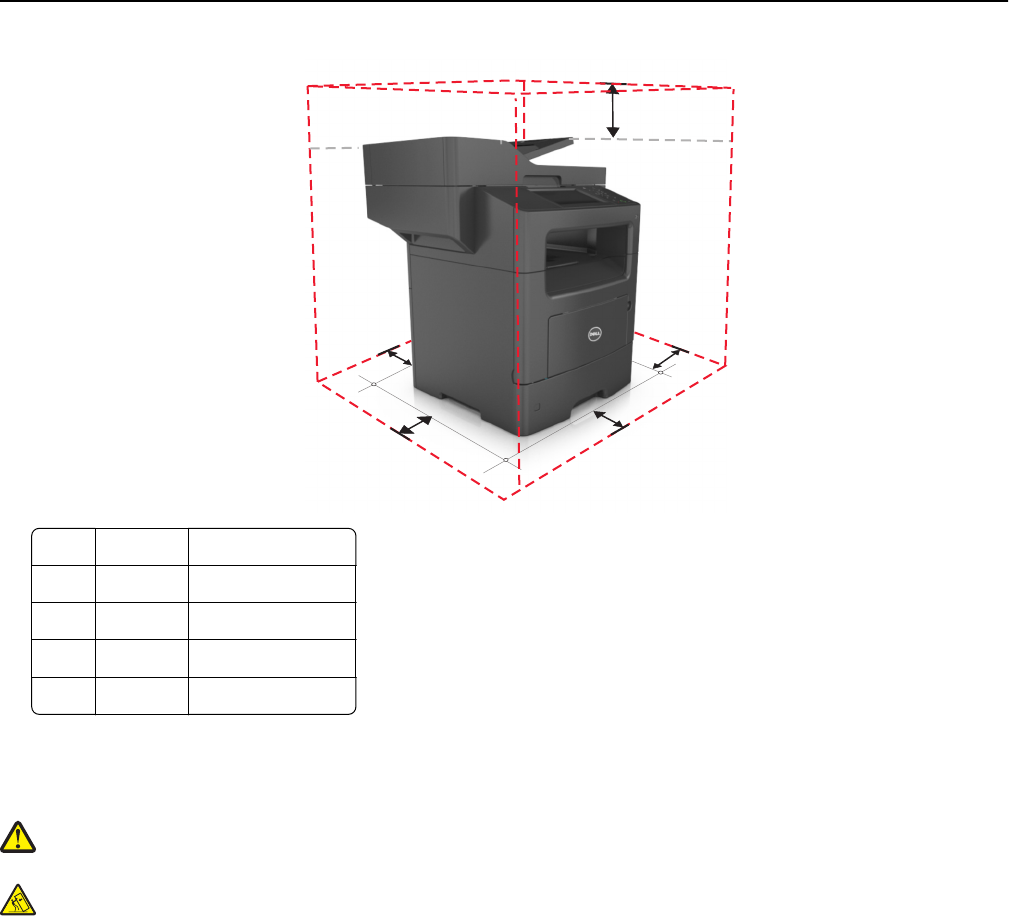
4
3
2
1
5
1
1Right side 304.8 mm (12 in.)
2Front 508 mm (20 in.)
3Left side 203.2 mm (8 in.)
4Rear 203.2 mm (8 in.)
5Top 800 mm (31.49 in.)
Printer configurations
CAUTION—POTENTIAL INJURY: To reduce the risk of equipment instability, load each tray separately. Keep all
other trays closed until needed.
CAUTION—TIPPING HAZARD: Floor-mounted configurations require additional furniture for stability. You must
use either a printer stand or printer base if you are using multiple input options. If you purchased a
multifunction printer (MFP) that scans, copies, and faxes, then you may need additional furniture. For more
information, contact the place where you purchased the printer.
Learning about the printer 11
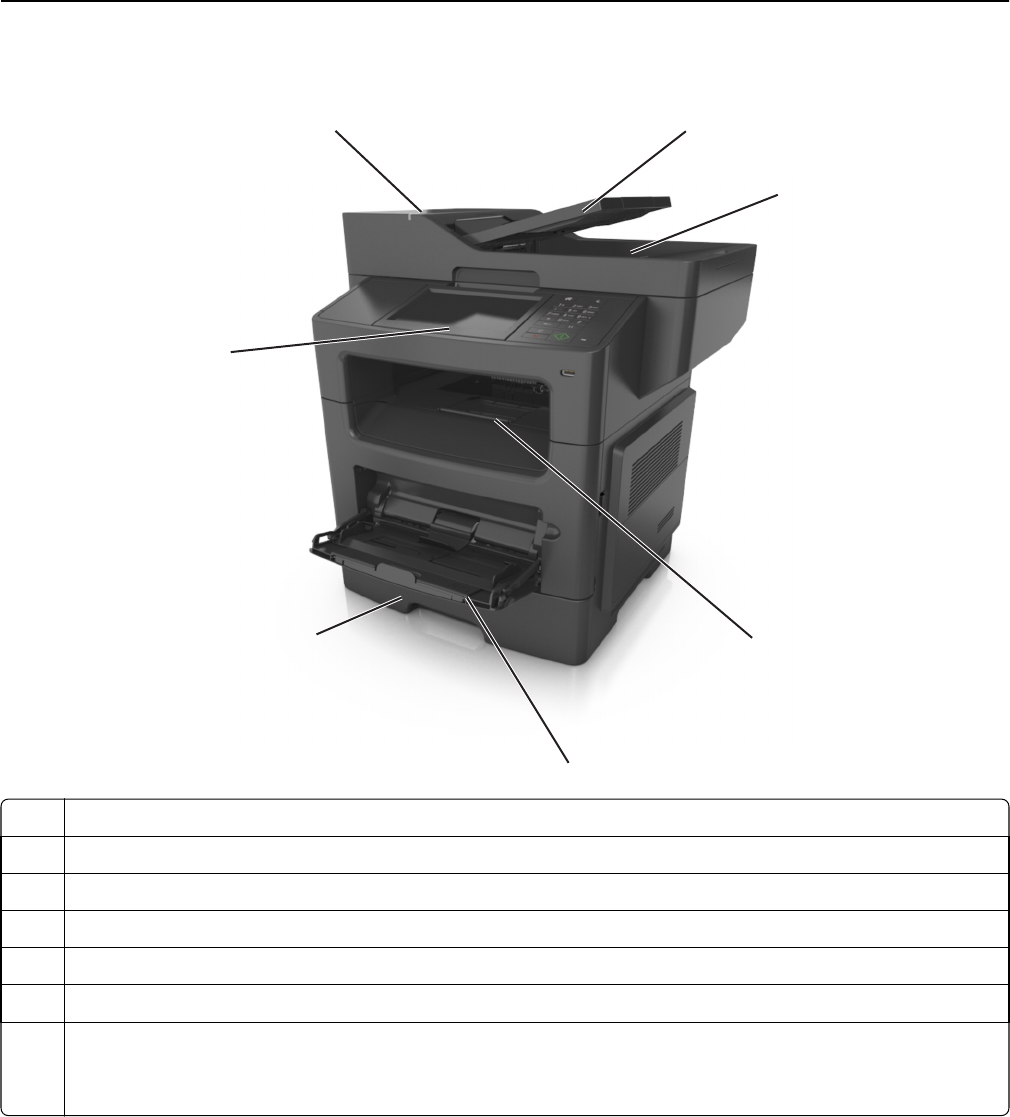
Basic model
1
23
4
5
6
7
1Display
2Automatic document feeder (ADF)
3ADF tray
4ADF bin
5Standard bin
6Multipurpose feeder
7Standard 550‑sheet tray
Note: A lockable 550‑sheet tray is also available. For more information, contact the place where you purchased
the printer.
Learning about the printer 12
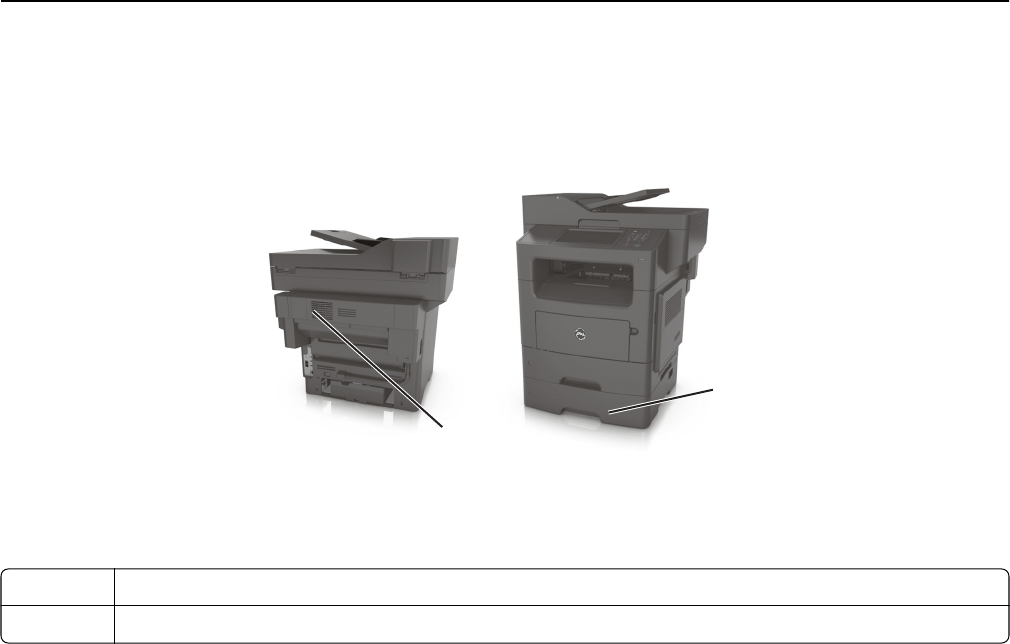
Configured model
2
1
1
1 Optional 550‑sheet tray
2 Optional stapler
Using the Embedded Web Server
Note: This feature is available only in network printers or printers connected to print servers.
If the printer is installed on a network, then you can use the Embedded Web Server to do the following:
•View the virtual display of the printer control panel.
•Check the status of the printer supplies.
•Configure supply notifications.
•Configure printer settings.
•Configure network settings.
•View reports.
To access the Embedded Web Server for your printer:
1Obtain the printer IP address:
•From the TCP/IP section in the Network/Ports menu
•By printing a network setup page or menu settings page, and then finding the TCP/IP section
Notes:
–An IP address appears as four sets of numbers separated by periods, such as 123.123.123.123.
–If you are using a proxy server, then temporarily disable it to load the Web page correctly.
2Open a Web browser, and then type the printer IP address in the address field.
3Press Enter.
The Embedded Web Server page appears.
Learning about the printer 13
Understanding the basic functions of the scanner
•Make quick copies or set the printer to perform specific copy jobs.
•Send a fax using the printer control panel.
•Send a fax to multiple fax destinations at the same time.
•Scan documents and send them to your computer, an e-mail address, or an FTP destination.
•Scan documents and send them to another printer (PDF through an FTP).
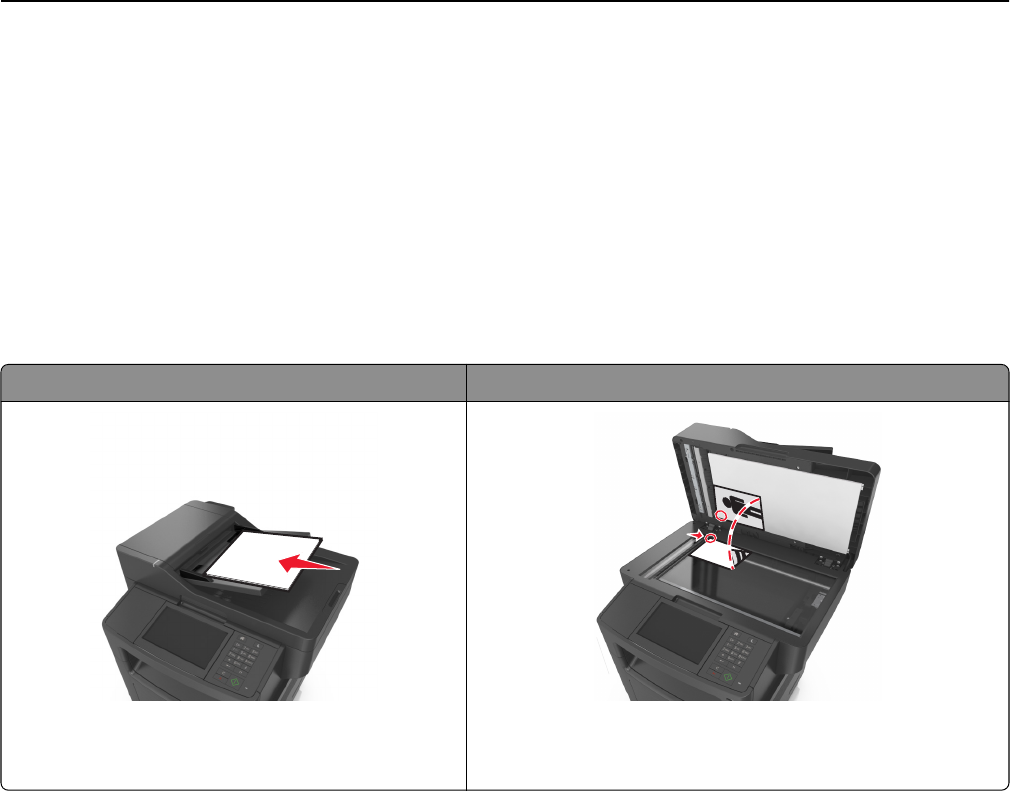
Using the ADF and scanner glass
Automatic document feeder (ADF) Scanner glass
ABC
Use the ADF for multiple‑page documents including two-
sided (duplex) pages.
Use the scanner glass for single‑page documents, book pages,
small items (such as postcards or photos), transparencies, photo
paper, or thin media (such as magazine clippings).
Using the ADF
When using the ADF:
•Load the document into the ADF tray faceup, short edge first.
•Load up to 50 sheets of plain paper into the ADF tray.
•Scan sizes from 105 x 148 mm (4.1 x 5.8 inches) wide to 216 x 368 mm (8.5 x 14.5 inches) long.
•Scan media weights from 52 to 120 g/m2 (14–32 lb).
•Do not load postcards, photos, small items, transparencies, photo paper, or thin media (such as magazine clippings)
into the ADF tray. Place these items on the scanner glass.
Using the scanner glass
When using the scanner glass:
•Place a document facedown on the scanner glass in the corner with the green arrow.
•Scan or copy documents up to 216 x 355.6 mm (8.5 x 14 inches) long.
•Copy books up to 25.3 mm (1 inch) thick.
Learning about the printer 14
Understanding the printer control panel
Using the printer control panel
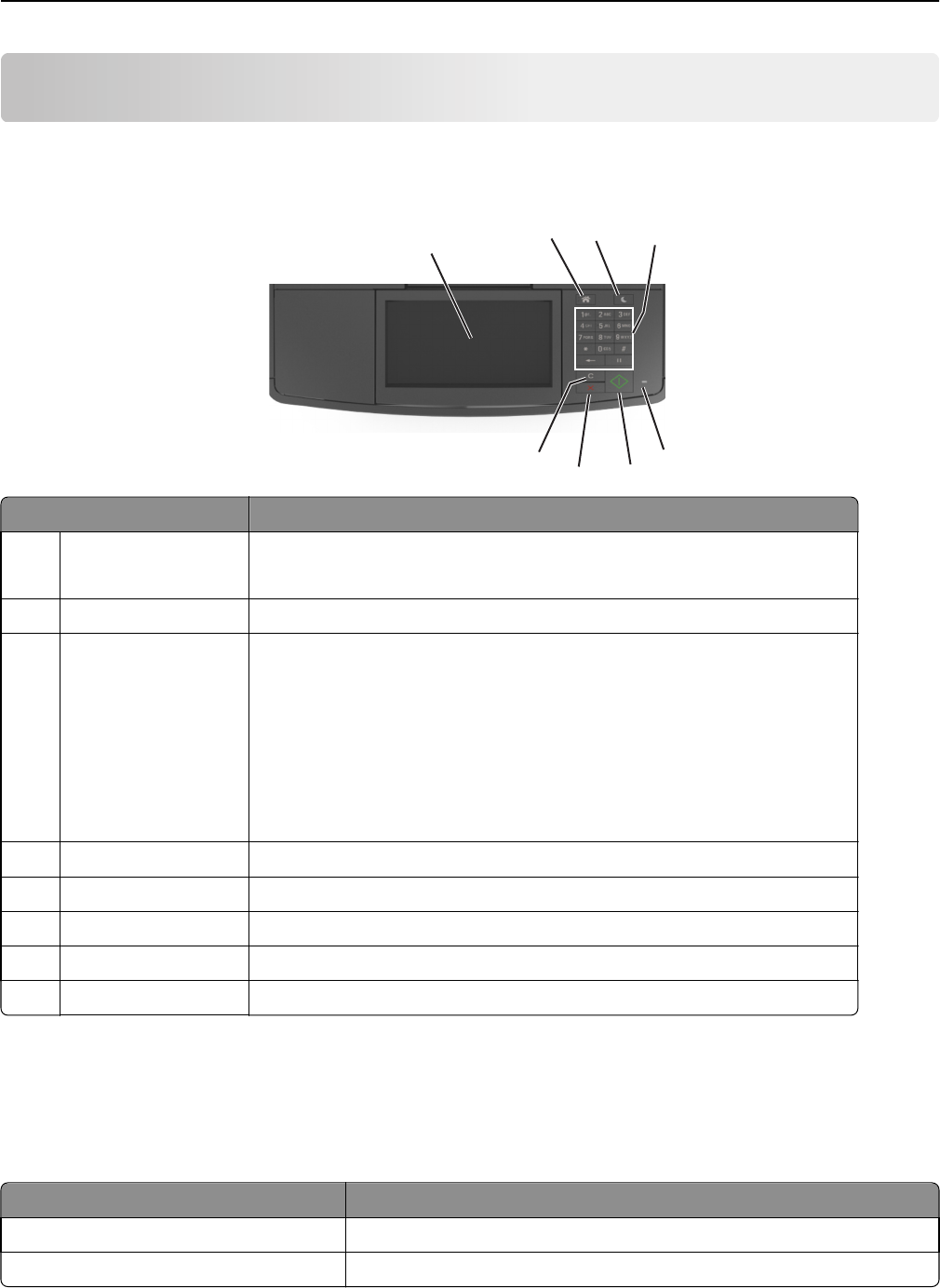
1
234
5
6
7
8
Use the To
1Display •View the printer status and messages.
•Set up and operate the printer.
2Home button Go to the home screen.
3Sleep button Enable Sleep mode or Hibernate mode.
Do the following to wake the printer from Sleep mode:
•Press any hard button.
•Open a door or cover.
•Send a print job from the computer.
•Perform a power‑on reset (POR) with the main power switch.
•Attach a device to the USB port on the printer.
4Keypad Enter numbers, letters, or symbols.
5Indicator light Check the status of the printer.
6Start button Start a job, depending on which mode is selected.
7Cancel button Stop all printer activity.
8Clear All / Reset button Reset the default settings of a function, such as printing, copying, or e-mailing.
Understanding the colors of the Sleep button and indicator
lights
The colors of the Sleep button and indicator lights on the printer control panel signify a certain printer status or condition.
Indicator light Printer status
Off The printer is off or in Hibernate mode.
Blinking green The printer is warming up, processing data, or printing.
Understanding the printer control panel 15
Indicator light Printer status
Solid green The printer is on, but idle.
Blinking red The printer requires user intervention.
Sleep button light Printer status
Off The printer is off, idle or in Ready state.
Solid amber The printer is in Sleep mode.
Blinking amber The printer is entering or waking from Hibernate mode.
Blinking amber for 0.1 second, then goes
completely off for 1.9 seconds in a slow,
pulsing pattern
The printer is in Hibernate mode.
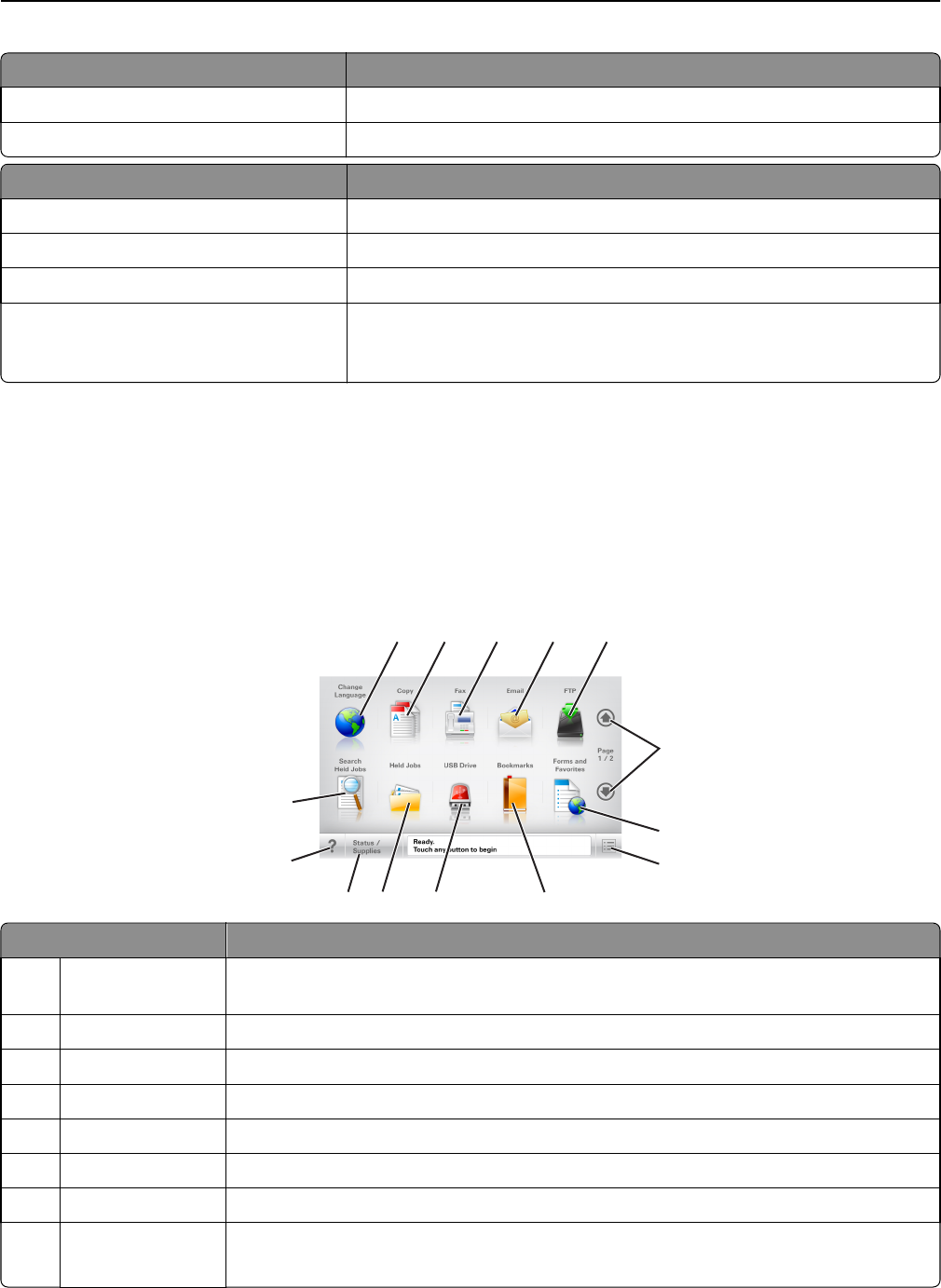
Understanding the home screen
When the printer is turned on, the display shows a basic screen, referred to as the home screen. Touch the home screen
buttons and icons to initiate an action such as copying, faxing, or scanning; to open the menu screen; or to respond to
messages.
Note: Your home screen may vary depending on your home screen customization settings, administrative setup, and
active embedded solutions.
6
1
12 11 10
7
8
2 3 4 5
9
13
14
Touch To
1Change Language Launch the Change Language pop‑up window that lets you change the primary language of
the printer.
2Copy Access the Copy menus and make copies.
3Fax Access the Fax menus and send fax.
4E-mail Access the E-mail menus and send e‑mails.
5FTP Access the File Transfer Protocol (FTP) menus and scan documents directly to an FTP server.
6Arrows Scroll up or down.
7Forms and Favorites Quickly find and print frequently used online forms.
8Menu icon Access the printer menus.
Note: The menus are available only when the printer is in Ready state.
Understanding the printer control panel 16
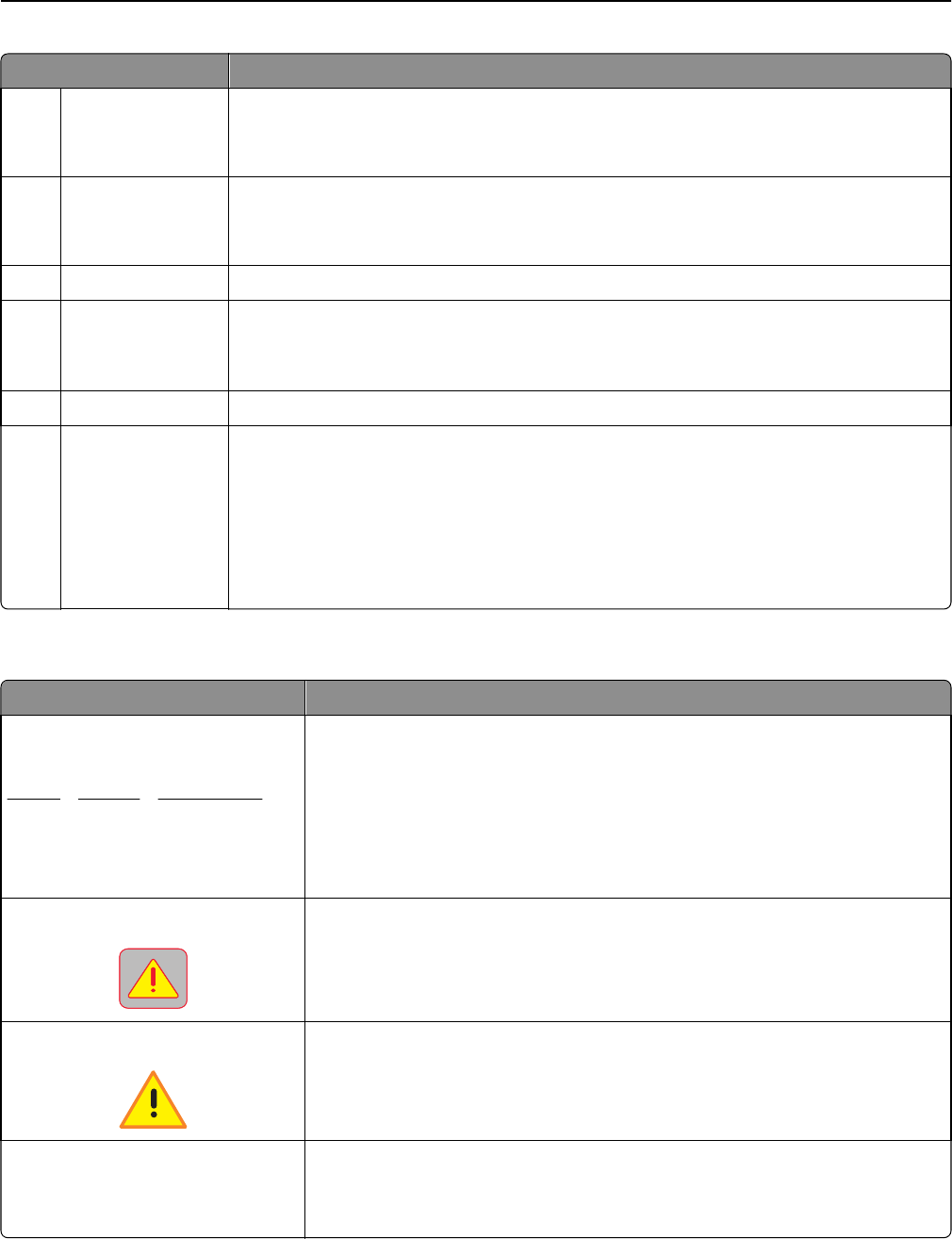
Touch To
9Bookmarks Create, organize, and save a set of bookmarks (URL) into a tree view of folders and file links.
Note: The tree view supports only bookmarks created from this function, and not from any
other application.
10 USB Drive View, select, print, scan, or e‑mail photos and documents from a flash drive.
Note: This icon appears only when you return to the home screen while a memory card or
flash drive is connected to the printer.
11 Held Jobs Display all current held jobs.
12 Status/Supplies •Show a warning or error message whenever the printer requires intervention to continue
processing.
•Access the messages screen for more information on the message, and how to clear it.
13 Tips Open a context-sensitive Help dialog.
14 Search held jobs Search for one or more of the following items:
•User name for held or confidential print jobs
•Job names for held jobs, excluding confidential print jobs
•Profile names
•Bookmark container or print job names
•USB container or print job names for supported file types
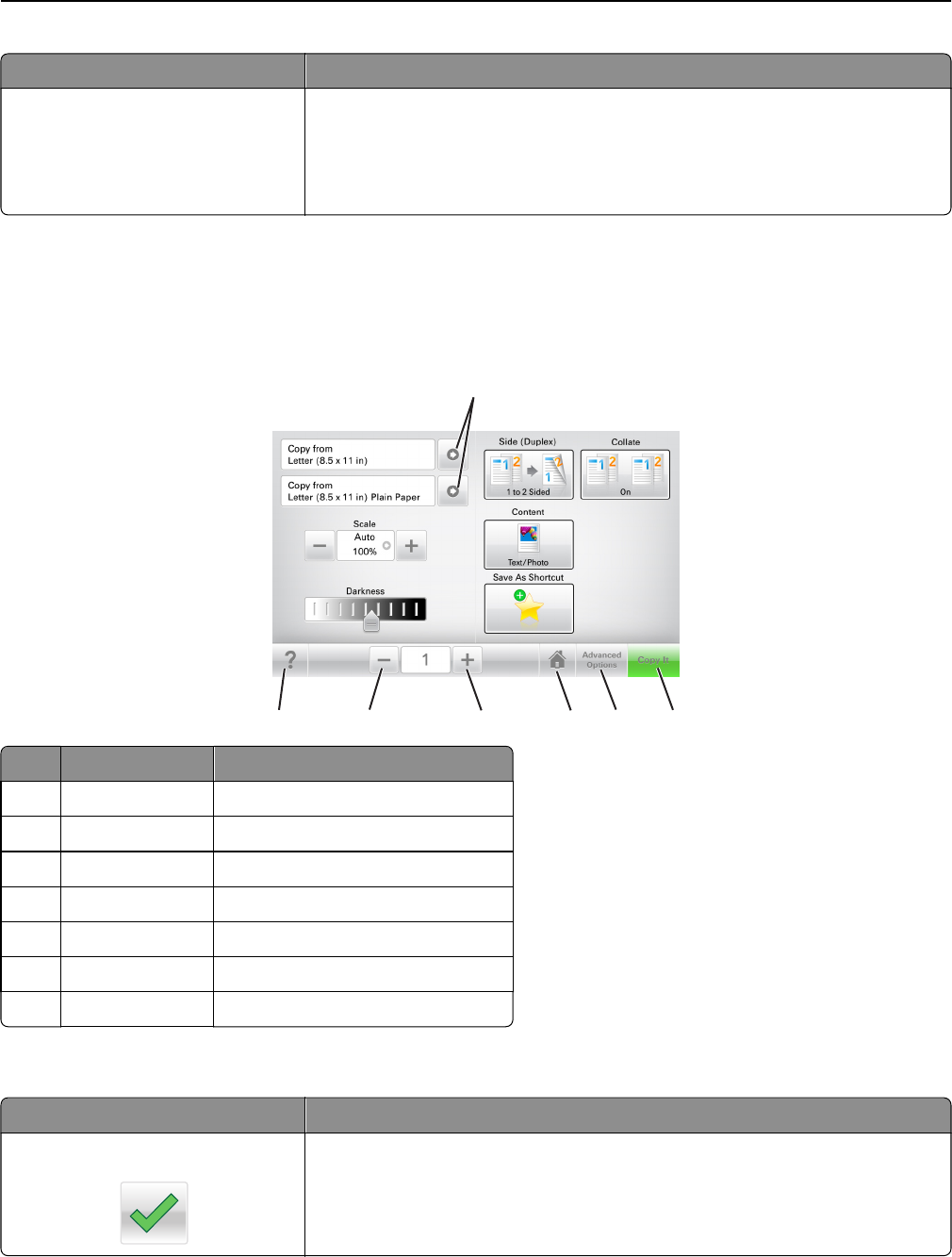
Features
Feature Description
Menu trail line
Example:
Menus > Settings > Copy Settings >
Number of Copies
A menu trail line is located at the top of each menu screen. This feature shows the
path taken to arrive at the current menu.
Touch any of the underlined words to return to that menu.
Number of Copies is not underlined because it is the current screen. If you touch an
underlined word on the “Number of Copies” screen before the number of copies is
set and saved, then the selection is not saved, and it does not become the default
setting.
Attendance message alert If an attendance message affects a function, then this icon appears and the red
indicator light blinks.
Warning If an error condition occurs, then this icon appears.
Status message bar •Show the current printer status such as Ready or Busy.
•Show printer conditions such as Toner Low or Cartridge Low.
•Show intervention messages so the printer can continue processing.
Understanding the printer control panel 17
Feature Description
Printer IP address
Example:
123.123.123.123
The IP address of your network printer is located at the upper left corner of the
home screen and appears as four sets of numbers separated by periods. You can
use the IP address when accessing the Embedded Web Server so you can view and
remotely configure printer settings even when you are not physically near the
printer.
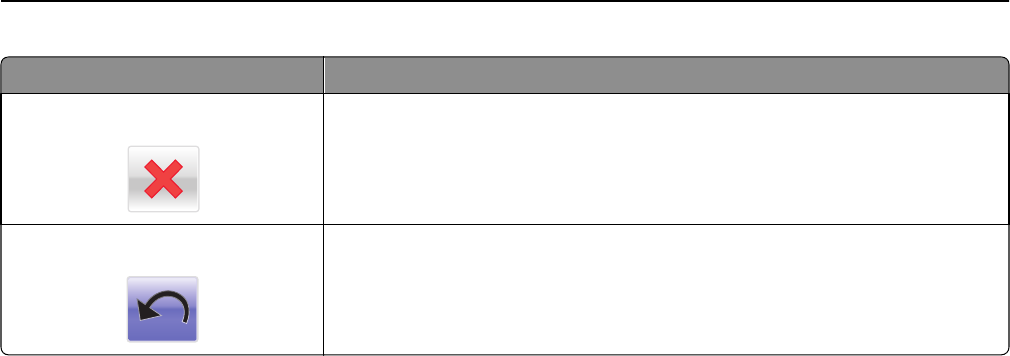
Using the touch-screen buttons
Note: Your home screen, icons, and buttons may vary, depending on your home screen customization settings,
administrative setup, and active embedded solutions.
763
4
1
52
Touch To
1Arrows View a list of options.
2Copy It Print a copy.
3Advanced Options Select a copy option.
4Home Go to the home screen.
5Increase Select a higher value.
6Decrease Select a lower value.
7Tips Open a context-sensitive Help dialog.
Other touch-screen buttons
Touch To
Accept Save a setting.
Understanding the printer control panel 18
Touch To
Cancel •Cancel an action or a selection.
•Exit a screen and return to the previous screen without saving changes.
Reset Reset values on the screen.
Understanding the printer control panel 19

Setting up and using the home screen applications
Note: Your home screen may vary depending on your home screen customization settings, administrative setup, and
active applications. Some applications are supported only in select printer models.
Finding the IP address of the computer
For Windows users
1In the Run dialog box, type cmd to open the command prompt.
2Type ipconfig, and then look for the IP address.
For Macintosh users
1From System Preferences in the Apple menu, select Network.
2Select your connection type, and then click Advanced > TCP/IP.
3Look for the IP address.
Finding the IP address of the printer
Note: Make sure your printer is connected to a network or to a print server.
You can find the printer IP address:
•From the top left corner of the printer home screen.
•From the TCP/IP section in the Network/Ports menu.
•By printing a network setup page or menu settings page, and then finding the TCP/IP section.
Note: An IP address appears as four sets of numbers separated by periods, such as 123.123.123.123.
Accessing the Embedded Web Server
The Embedded Web Server is the printer Web page that lets you view and remotely configure printer settings even
when you are not physically near the printer.
1Obtain the printer IP address:
•From the printer control panel home screen
•From the TCP/IP section in the Network/Ports menu
•By printing a network setup page or menu settings page, and then finding the TCP/IP section
Note: An IP address appears as four sets of numbers separated by periods, such as 123.123.123.123.
2Open a Web browser, and then type the printer IP address in the address field.
3Press Enter.
Note: If you are using a proxy server, then temporarily disable it to load the Web page correctly.
Setting up and using the home screen applications 20
Customizing the home screen
1Open a Web browser, and then type the printer IP address in the address field.
Note: View the printer IP address on the printer home screen. The IP address appears as four sets of numbers
separated by periods, such as 123.123.123.123.
2Do one or more of the following:
•Show or hide the icons of basic printer functions.
aClick Settings > General Settings > Home screen customization.
bSelect the check boxes to specify which icons appear on the home screen.
Note: If you clear a check box beside an icon, then the icon does not appear on the home screen.
cClick Submit.
•Customize the icon for an application. For more information, see “Finding information about the home screen
applications” on page 22 or see the documentation that came with the application.
Understanding the different applications
Use To
Card Copy Scan and print both sides of a card on a single page. For more information, see “Setting up Card Copy”
on page 22.
Fax Scan a document, and then send it to a fax number. For more information, see “Faxing” on page
99.
Forms and Favorites Quickly find and print frequently used online forms directly from the printer home screen. For more
information, see “Setting up Forms and Favorites” on page 22.
Multi Send Scan a document, and then send it to multiple destinations. For more information, see “Setting up
Multi Send” on page 24.
MyShortcut Create shortcuts directly on the printer home screen. For more information, see “Using MyShortcut”
on page 23.
Scan to E‑mail Scan a document, and then send it to an e‑mail address. For more information, see “E-mailing” on
page 92.
Scan to Computer Scan a document, and then save it to a predefined folder on a host computer. For more information,
see “Setting up Scan to Computer” on page 125.
Scan to FTP Scan documents directly to a File Transfer Protocol (FTP) server. For more information, see “Scanning
to an FTP address” on page 122.
Scan to Network Scan a document, and then send it to a network shared folder. For more information, see “Setting
up Scan to Network” on page 24.
Setting up and using the home screen applications 21
Activating the home screen applications
Finding information about the home screen applications
Your printer comes with preinstalled home screen applications. Before you can use these applications, you must first
activate and set up these applications using the Embedded Web Server. For more information on accessing the
Embedded Web Server, see “Accessing the Embedded Web Server” on page 20.
For detailed information on configuring and using the home screen applications, visit the Dell support Web site at
www.dell.com/support/printers.
Setting up Forms and Favorites
Note: A later version of this User's Guide may contain a direct link to the Administrator’s Guide of this application. To
check for updates of this User’s Guide, go to www.dell.com/support/manuals.
Use To
Streamline work processes by letting you quickly find and print frequently used online forms directly
from the printer home screen.
Note: The printer must have permission to access the network folder, FTP site, or Web site where the
bookmark is stored. From the computer where the bookmark is stored, use sharing, security, and
firewall settings to allow the printer at least a read access. For help, see the documentation that
came with your operating system.
1Open a Web browser, and then type the printer IP address in the address field.
Note: View the printer IP address on the printer home screen. The IP address appears as four sets of numbers
separated by periods, such as 123.123.123.123.
2Click Settings > Apps > Apps Management > Forms and Favorites.
3Click Add, and then customize the settings.
Notes:
•See the mouse-over help beside each field for a description of the setting.
•To make sure the location settings of the bookmark are correct, type the correct IP address of the host
computer where the bookmark is located. For more information on obtaining the IP address of the host
computer, see “Finding the IP address of the computer” on page 20.
•Make sure the printer has access rights to the folder where the bookmark is located.
4Click Apply.
To use the application, touch Forms and Favorites on the printer home screen, and then navigate through form
categories, or search for forms based on a form number, name, or description.
Setting up Card Copy
Note: A later version of this User's Guide may contain a direct link to the Administrator’s Guide of this application. To
check for updates of this User’s Guide, go to www.dell.com/support/manuals.
Setting up and using the home screen applications 22
Use To
Quickly and easily copy insurance, identification, and other wallet‑size cards.
You can scan and print both sides of a card on a single page, saving paper and showing the information
on the card in a more convenient manner.
1Open a Web browser, and then type the printer IP address in the address field.
Note: View the printer IP address on the printer home screen. The IP address appears as four sets of numbers
separated by periods, such as 123.123.123.123.
2Click Settings > Apps > Apps Management > Card Copy.
3Change the default scanning options, if necessary.
•Default tray—Select the default tray to be used for printing scan images.
•Default number of copies—Specify the number of copies that should automatically print when the application
is used.
•Default contrast setting—Specify a setting to increase or decrease the level of contrast when a copy of the
scanned card is printed. Select Best for Content if you want the printer to adjust the contrast automatically.
•Default scale setting—Set the size of the scanned card when printed. The default setting is 100% (full size).
•Resolution setting—Adjust the quality of the scanned card.
Notes:
–When scanning a card, make sure the scan resolution is not more than 200 dpi for color, and 400 dpi for
black and white.
–When scanning multiple cards, make sure the scan resolution is not more than 150 dpi for color, and
300 dpi for black and white.
•Print Borders—Select the check box to print the scan image with a border around it.
4Click Apply.
To use the application, touch Card Copy on the printer home screen, and then follow the instructions.
Using MyShortcut
Note: A later version of this User's Guide may contain a direct link to the Administrator’s Guide of this application. To
check for updates of this User’s Guide, go to www.dell.com/support/manuals.
Use To
Create shortcuts on the printer home screen, with settings for up to 25 frequently used copy, fax, or e-
mail jobs.
To use the application, touch MyShortcut, and then follow the instructions on the printer display.
Setting up and using the home screen applications 23
Setting up Multi Send
Note: A later version of this User's Guide may contain a direct link to the Administrator’s Guide of this application. To
check for updates of this User’s Guide, go to www.dell.com/support/manuals.
Use To
Scan a document, and then send the scanned document to multiple destinations.
Note: Make sure there is enough space in the printer hard disk.
1Open a Web browser, and then type the printer IP address in the address field.
Note: View the printer IP address on the printer home screen. The printer IP address appears as four sets of
numbers separated by periods, such as 123.123.123.123.
2Click Settings > Apps > Apps Management > Multi Send.
3From the Profiles section, click Add, and then customize the settings.
Notes:
•See the mouse‑over help beside each field for a description of the setting.
•If you select FTP or Share Folder as a destination, then make sure the location settings of the destination are
correct. Type the correct IP address of the host computer where the specified destination is located. For
more information on obtaining the IP address of the host computer, see “Finding the IP address of the
computer” on page 20.
4Click Apply.
To use the application, touch Multi Send on the printer home screen, and then follow the instructions on the printer
display.
Setting up Scan to Network
Note: A later version of this User's Guide may contain a direct link to the Administrator’s Guide of this application. To
check for updates of this User’s Guide, go to www.dell.com/support/manuals.
Use To
Scan a document and send it to a shared network folder. You can define up to 30 unique folder
destinations.
Notes:
•The printer must have permission to write to the destinations. From the computer where the
destination is specified, use sharing, security, and firewall settings to allow the printer at least a
write access. For help, see the documentation that came with your operating system.
•The Scan to Network icon appears only when one or more destinations are defined.
Setting up and using the home screen applications 24

1Open a Web browser, and then type the printer IP address in the address field.
Note: View the printer IP address on the printer home screen. The IP address appears as four sets of numbers
separated by periods, such as 123.123.123.123.
2Do either of the following:
•Click Set up Scan to Network > Click here.
•Click Settings > Apps > Apps Management > Scan to Network.
3Specify the destinations, and then customize the settings.
Notes:
•See the mouse-over help beside some of the fields for a description of the setting.
•To make sure the location settings of the destination are correct, type the correct IP address of the host
computer where the specified destination is located. For more information on obtaining the IP address of
the host computer, see “Finding the IP address of the computer” on page 20.
•Make sure the printer has access rights to the folder where the specified destination is located.
4Click Apply.
To use the application, touch Scan to Network on the printer home screen, and then follow the instructions on the
printer display.
Setting up Remote Operator Panel
This application enables you to interact with the printer control panel even when you are not physically near the network
printer. From your computer, you can view the printer status, release held print jobs, create bookmarks, and do other
print-related tasks.
1Open a Web browser, and then type the printer IP address in the address field.
Note: View the printer IP address on the printer home screen. The IP address appears as four sets of numbers
separated by periods, such as 123.123.123.123.
2Click Settings > Remote Operator Panel Settings.
3Select the Enable check box, and then customize the settings.
4Click Submit.
To use the application, click Remote Operator Panel > Launch VNC Applet.
Exporting and importing a configuration
You can export configuration settings into a text file, and then import the file to apply the settings to other printers.
1Open a Web browser, and then type the printer IP address in the address field.
Note: View the printer IP address on the printer home screen. The IP address appears as four sets of numbers
separated by periods, such as 123.123.123.123.
2To export or import a configuration for one application, do the following:
aClick Settings > Apps > Apps Management.
bFrom the list of installed applications, click the name of the application you want to configure.
Setting up and using the home screen applications 25

cClick Configure, and then do either of the following:
•To export a configuration to a file, click Export, and then follow the instructions on the computer screen to
save the configuration file.
Notes:
–When saving the configuration file, you can type a unique file name or use the default name.
–If a "JVM Out of Memory” error occurs, then repeat the export process until the configuration file is
saved.
•To import a configuration from a file, click Import, and then browse to the saved configuration file that was
exported from a previously configured printer.
Notes:
–Before importing the configuration file, you can choose to preview it first or load it directly.
–If a timeout occurs and a blank screen appears, then refresh the Web browser, and then click Apply.
3To export or import a configuration for multiple applications, do the following:
aClick Settings > Import/Export.
bDo either of the following:
•To export a configuration file, click Export Embedded Solutions Settings File, and then follow the instructions
on the computer screen to save the configuration file.
•To import a configuration file, do the following:
1Click Import Embedded Solutions Settings File > Choose File, and then browse to the saved configuration
file that was exported from a previously configured printer.
2Click Submit.
Setting up and using the home screen applications 26
Additional printer setup
Installing internal options
CAUTION—SHOCK HAZARD: If you are accessing the controller board or installing optional hardware or
memory devices sometime after setting up the printer, then turn the printer off, and unplug the power cord
from the electrical outlet before continuing. If you have any other devices attached to the printer, then turn
them off as well, and unplug any cables going into the printer.
Available internal options
•Memory card
–DDR3 DIMM
–Flash memory
•Fonts
•Firmware
Forms Barcode
Prescribe
IPDS
Printcryption
Accessing the controller board
CAUTION—SHOCK HAZARD: If you are accessing the controller board or installing optional hardware or
memory devices sometime after setting up the printer, then turn the printer off, and unplug the power cord
from the electrical outlet before continuing. If you have any other devices attached to the printer, then turn
them off as well, and unplug any cables going into the printer.
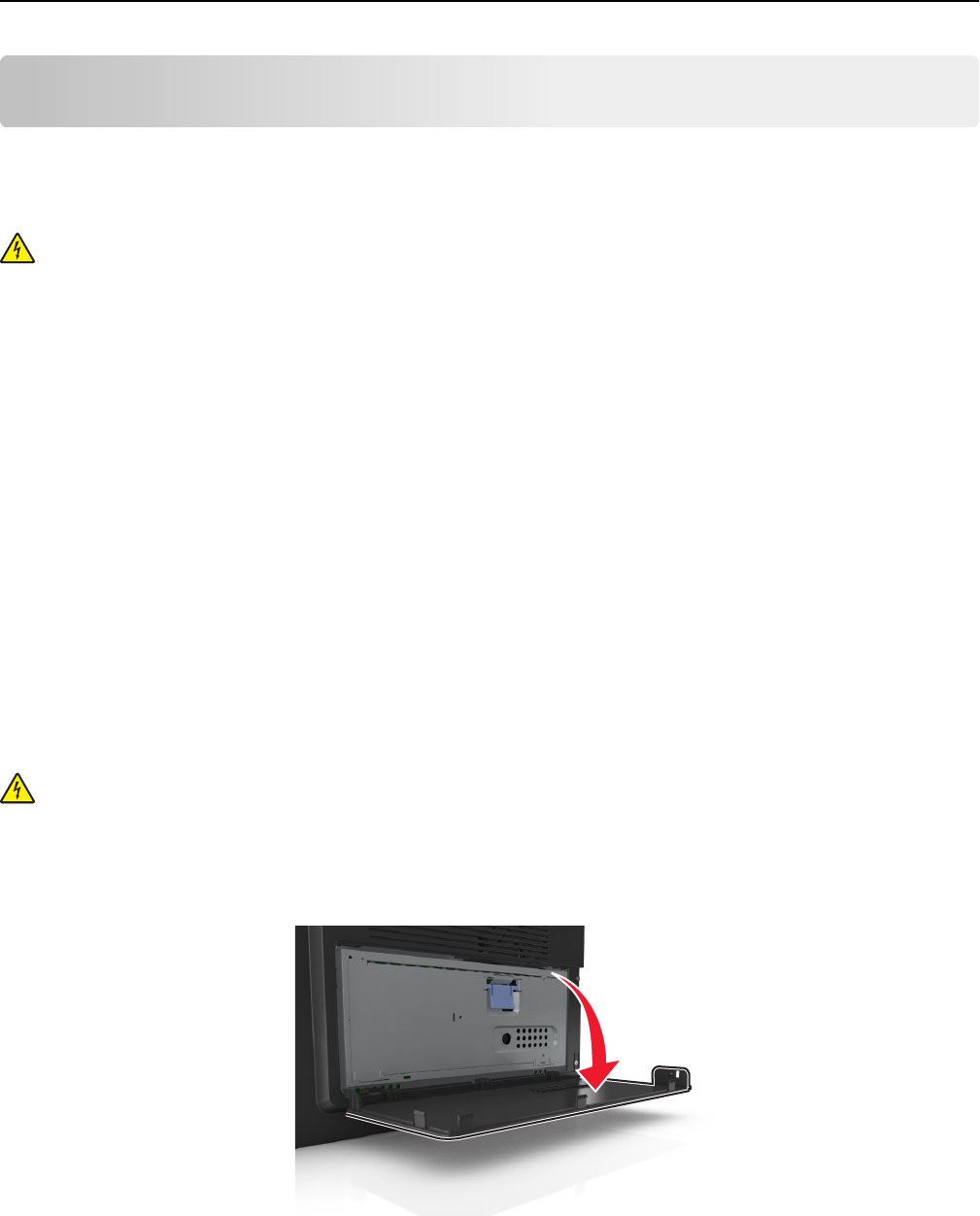
1Open the controller board access door.
Additional printer setup 27
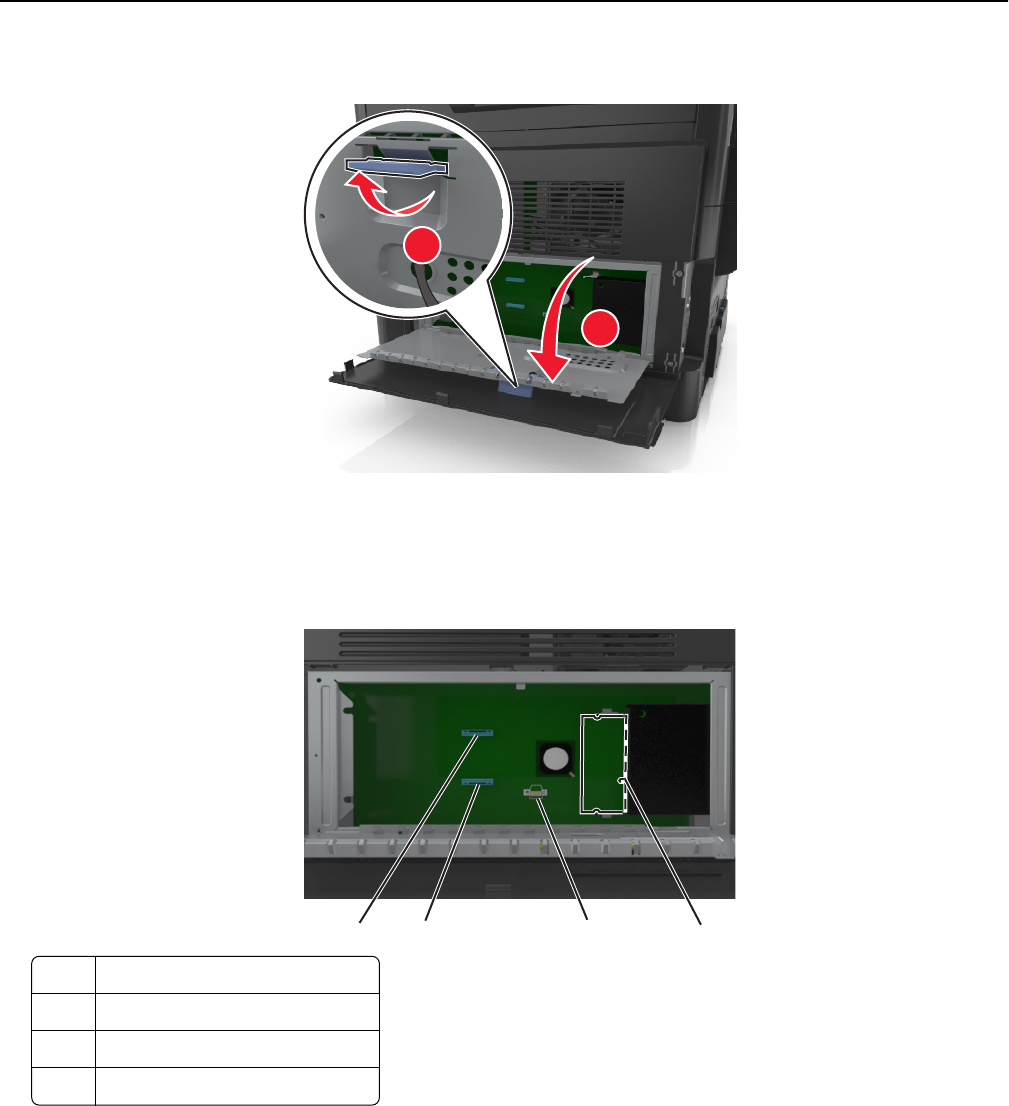
2Open the controller board shield using the blue handle.
2
1
3Use the following illustration to locate the appropriate connector.
Warning—Potential Damage: Controller board electronic components are easily damaged by static electricity.
Touch something metal on the printer before touching any controller board electronic components or
connectors.
21
3
4
1Memory card connector
2Option card connector
3Printer hard disk connector
4Internal Solutions Port connector
Additional printer setup 28
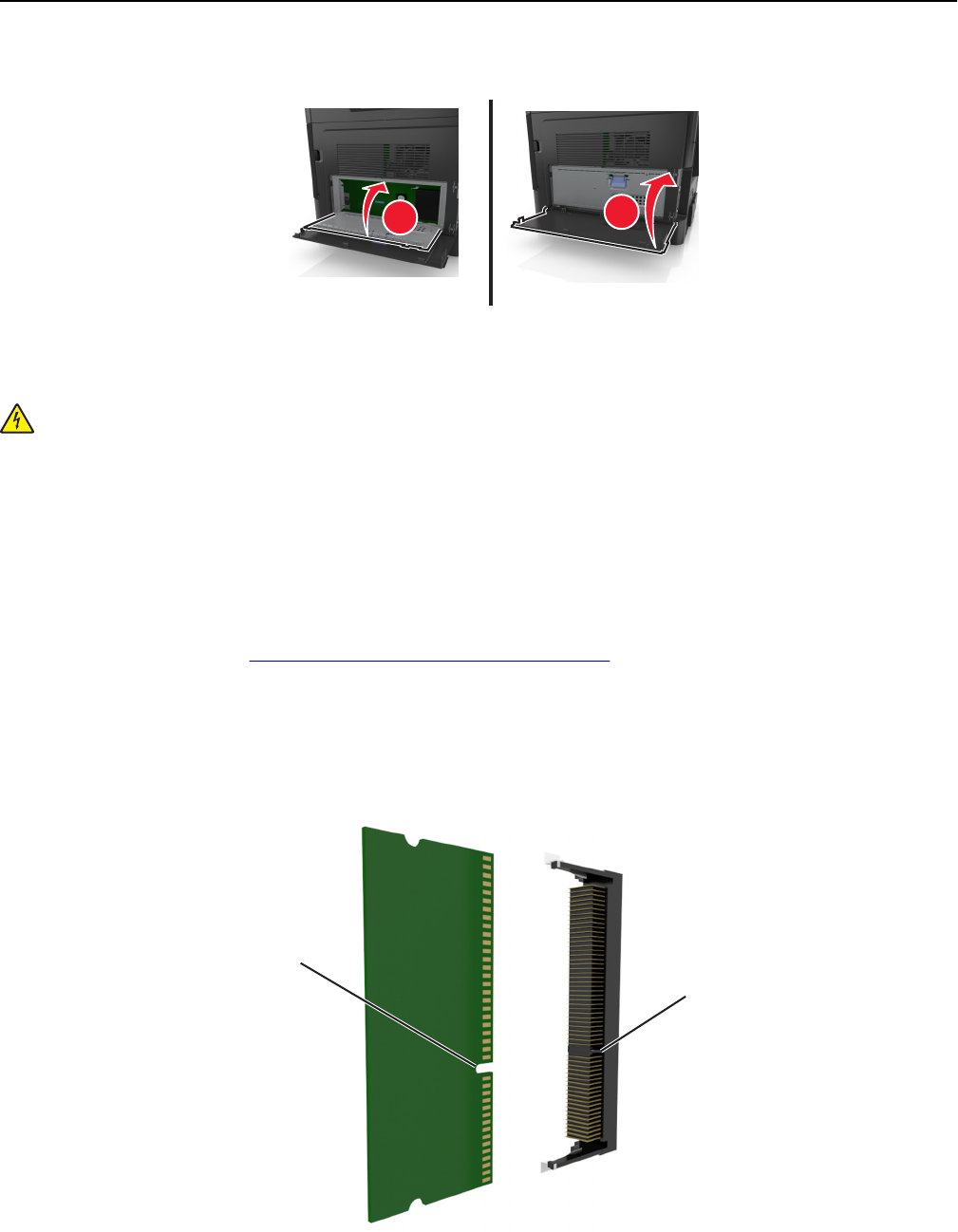
4Close the shield, and then the access door.
12
Installing a memory card
CAUTION—SHOCK HAZARD: If you are accessing the controller board or installing optional hardware or
memory devices sometime after setting up the printer, then turn the printer off, and unplug the power cord
from the electrical outlet before continuing. If you have any other devices attached to the printer, then turn
them off as well, and unplug any cables going into the printer.
Warning—Potential Damage: Controller board electronic components are easily damaged by static electricity.
Touch something metal on the printer before touching any controller board electronic components or connectors.
Note: An optional memory card can be purchased separately and attached to the controller board.
1Access the controller board.
For more information, see “Accessing the controller board” on page 27.
2Unpack the memory card.
Warning—Potential Damage: Do not touch the connection points along the edge of the card. Doing so may
cause damage.
3Align the notch (1) on the memory card with the ridge (2) on the connector.
1
2
Additional printer setup 29
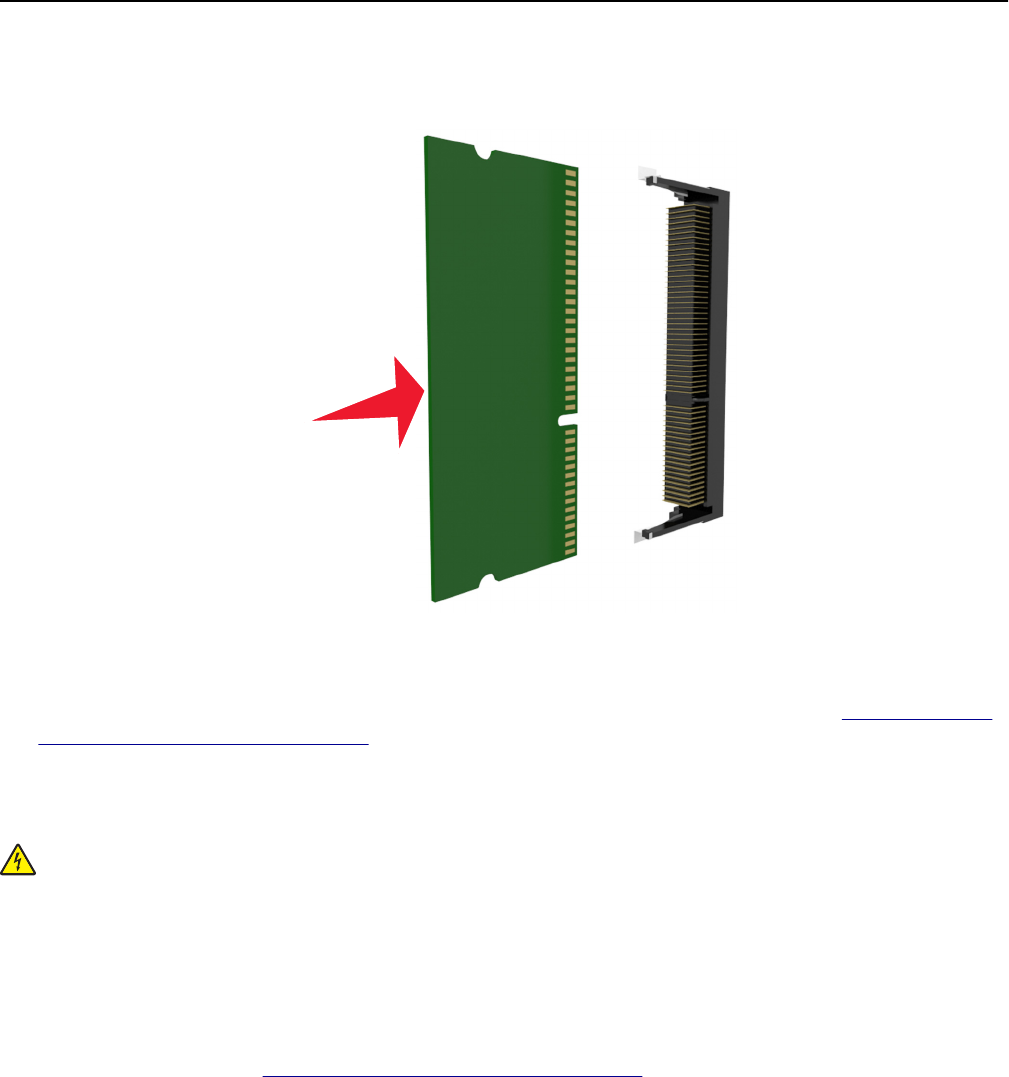
4Push the memory card straight into the connector, and then push the card toward the controller board wall until
it clicks into place.
5Close the controller board shield, and then the controller board access door.
Note: When the printer software and any hardware options are installed, you may need to manually add the
options in the printer driver to make them available for print jobs. For more information, see “Adding available
options in the print driver” on page 44.
Installing an optional card
CAUTION—SHOCK HAZARD: If you are accessing the controller board or installing optional hardware or
memory devices sometime after setting up the printer, then turn the printer off, and unplug the power cord
from the electrical outlet before continuing. If you have other devices attached to the printer, then turn them
off as well, and unplug any cables going into the printer.
Warning—Potential Damage: Controller board electronic components are easily damaged by static electricity.
Touch something metal on the printer before touching any controler board electronic components or connectors.
1Access the controller board.
For more information, see “Accessing the controller board” on page 27.
2Unpack the optional card.
Warning—Potential Damage: Avoid touching the connection points along the edge of the card.
Additional printer setup 30
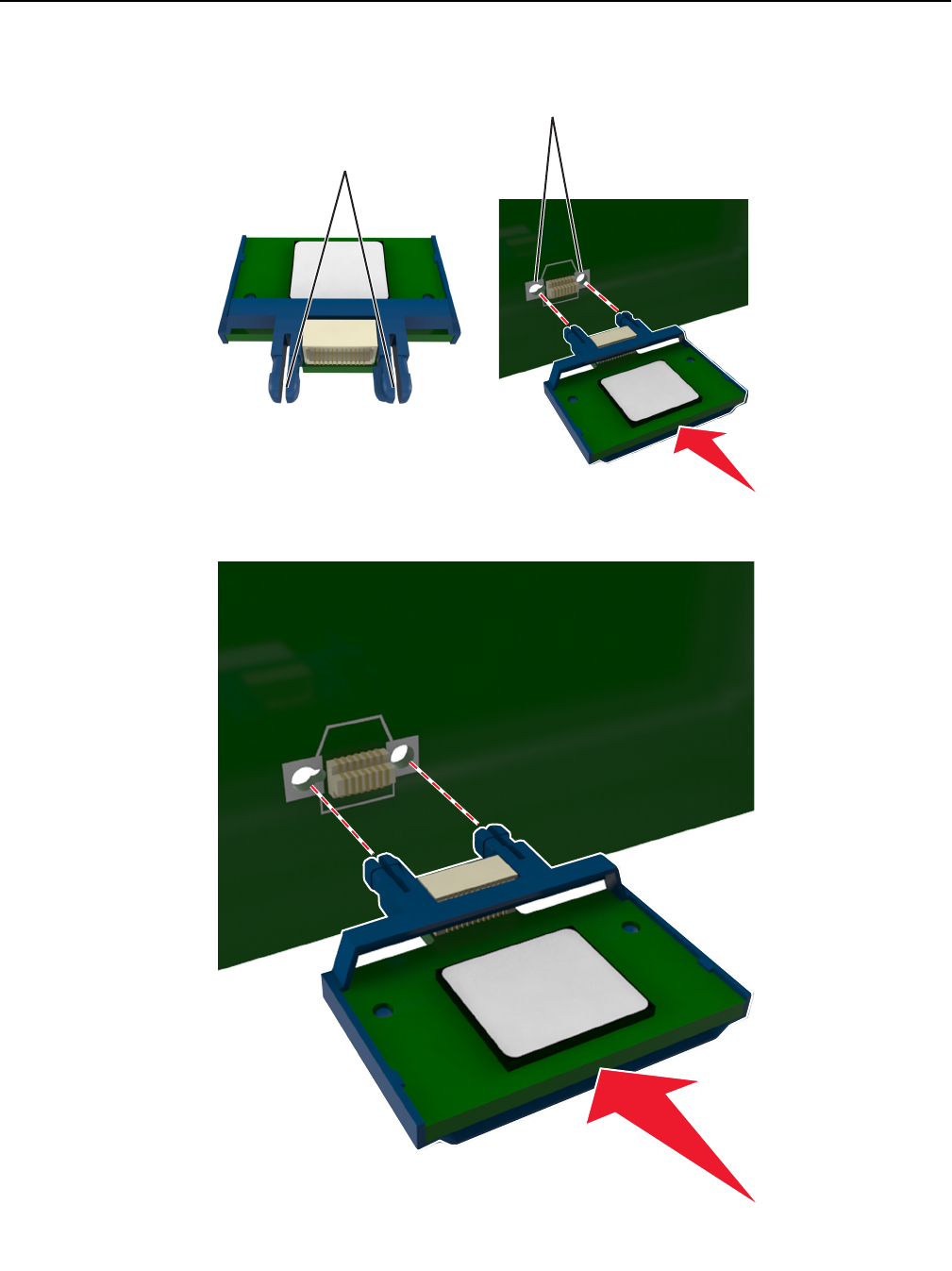
3Holding the card by its sides, align the plastic pins (1) on the card with the holes (2) on the controller board.
2
1
4Push the card firmly into place as shown in the illustration.
Additional printer setup 31
Warning—Potential Damage: Improper installation of the card may cause damage to the card and the
controller board.
Note: The entire length of the connector on the card must touch and be flushed against the controller board.
5Close the controller board shield, and then the controller board access door.
Note: When the printer software and any hardware options are installed, it may be necessary to manually add
the options in the printer driver to make them available for print jobs. For more information, see “Adding
available options in the print driver” on page 44.
Installing an Internal Solutions Port
The controller board supports one optional Internal Solutions Port (ISP).
Note: This task requires a flat‑head screwdriver.
CAUTION—SHOCK HAZARD: If you are accessing the controller board or installing optional hardware or
memory devices sometime after setting up the printer, then turn the printer off, and unplug the power cord
from the electrical outlet before continuing. If you have any other devices attached to the printer, then turn
them off as well, and unplug any cables going into the printer.
Warning—Potential Damage: Controller board electronic components are easily damaged by static electricity.
Touch a metal surface on the printer before touching any controller board electronic components or connectors.
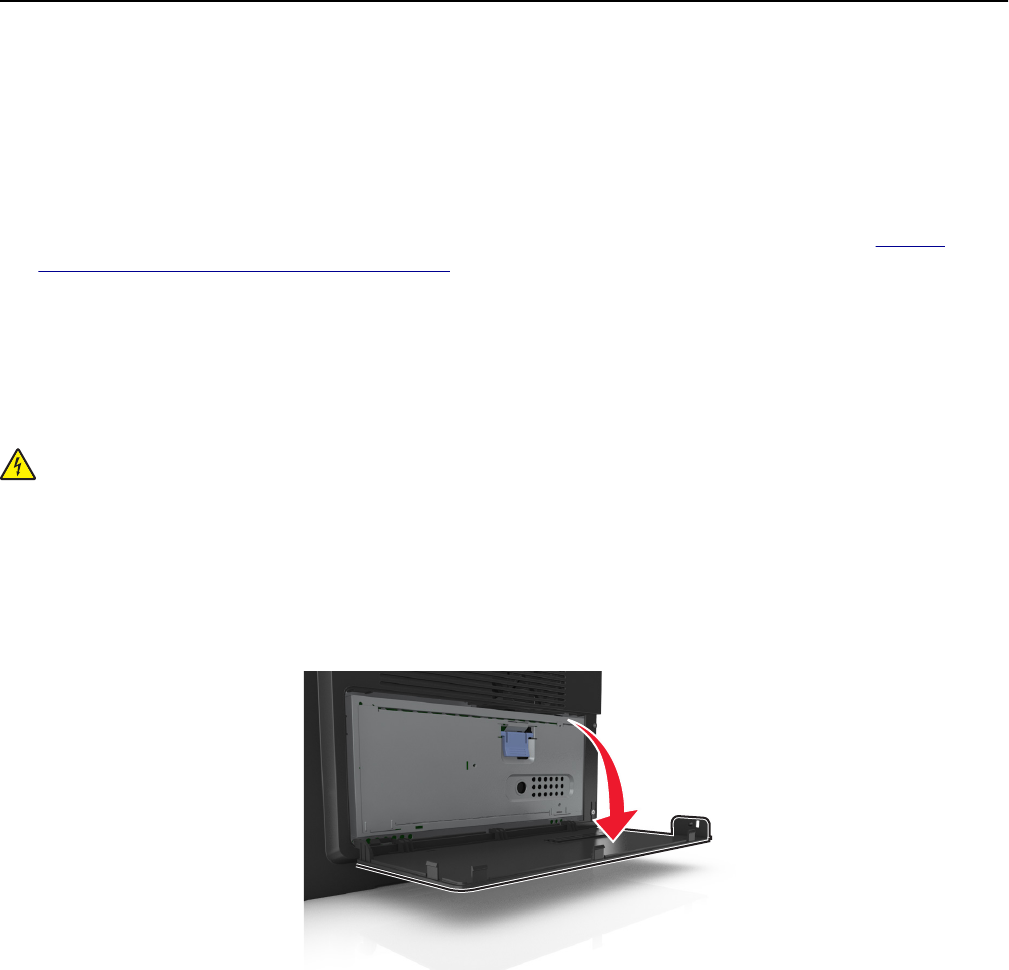
1Open the controller board access door.
Additional printer setup 32
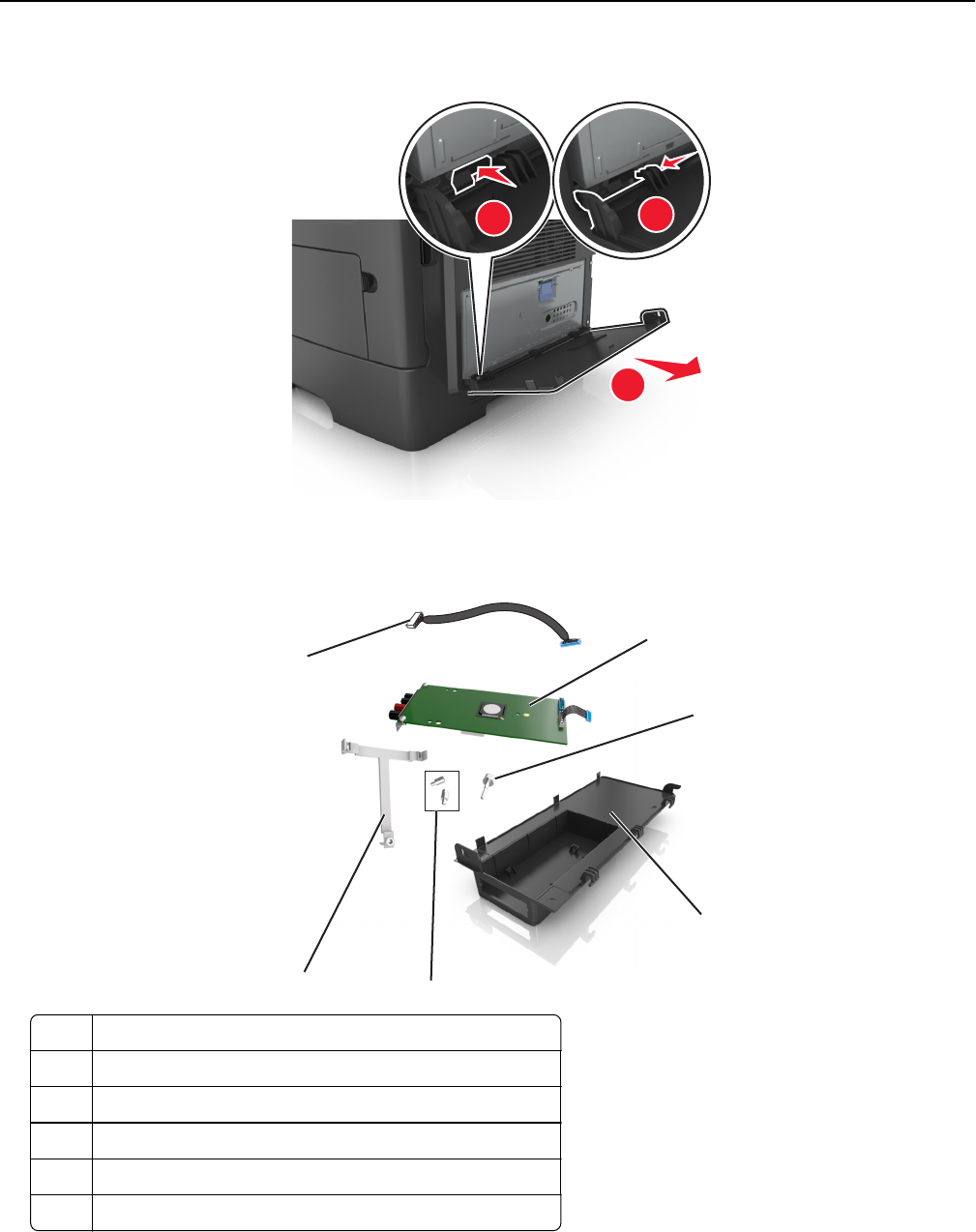
2Lightly press the stop on the left side of the access door, and then slide the access door to remove it.
3
12
3Unpack the ISP kit.
Note: Make sure to remove and discard the small cable attached to the white connector.
1
2
4
3
5
6
1ISP solution
2Screw to attach the ISP to the bracket
3ISP exterior cover
4Screws to attach the ISP metal bracket to the printer cage
5Plastic bracket
6Long ISP cable
Additional printer setup 33
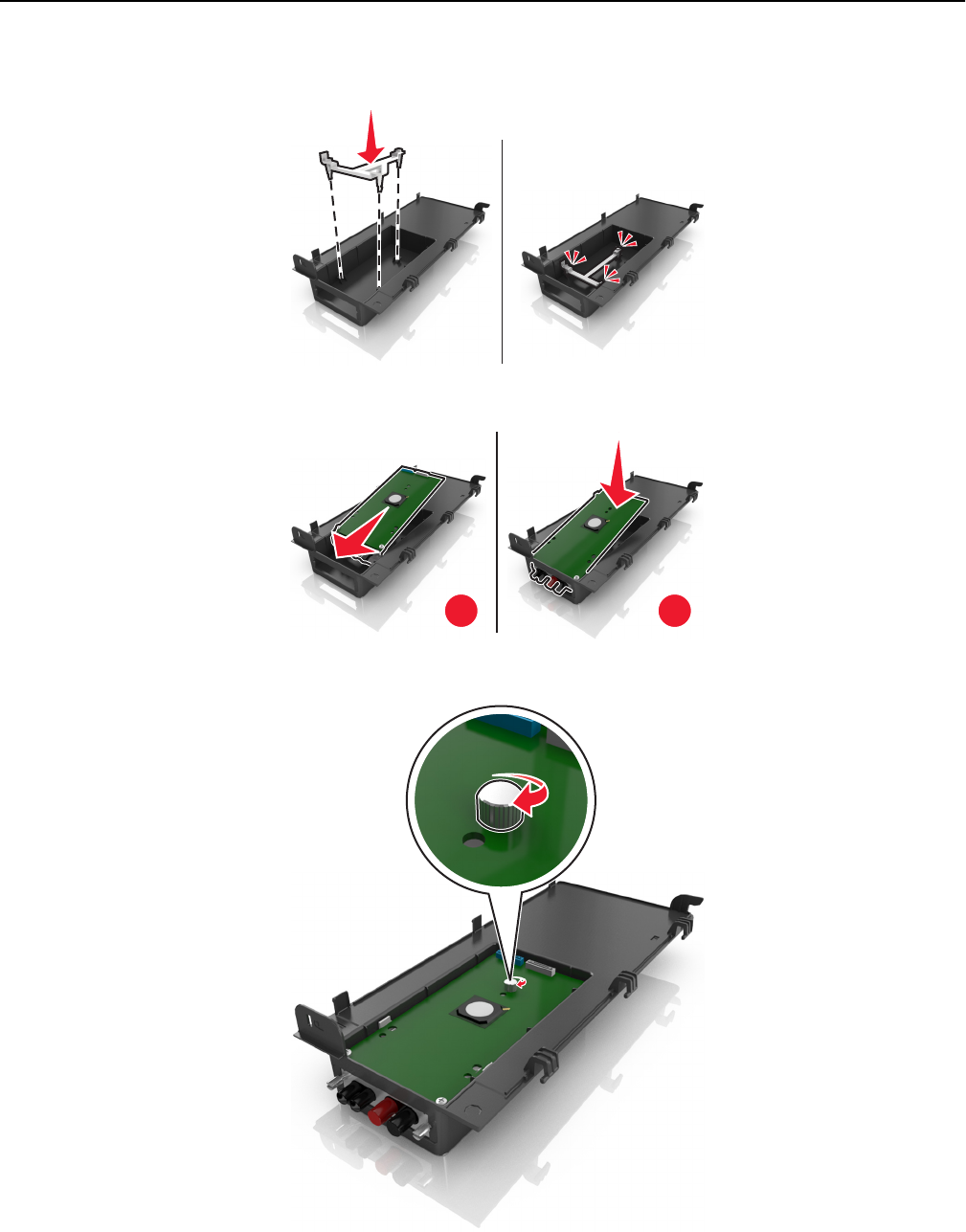
4Place the plastic bracket inside the ISP exterior cover until it clicks into place.
5Slide and push the ISP solution into the plastic bracket.
12
6Secure the ISP solution to the plastic bracket using the long screw.
Additional printer setup 34
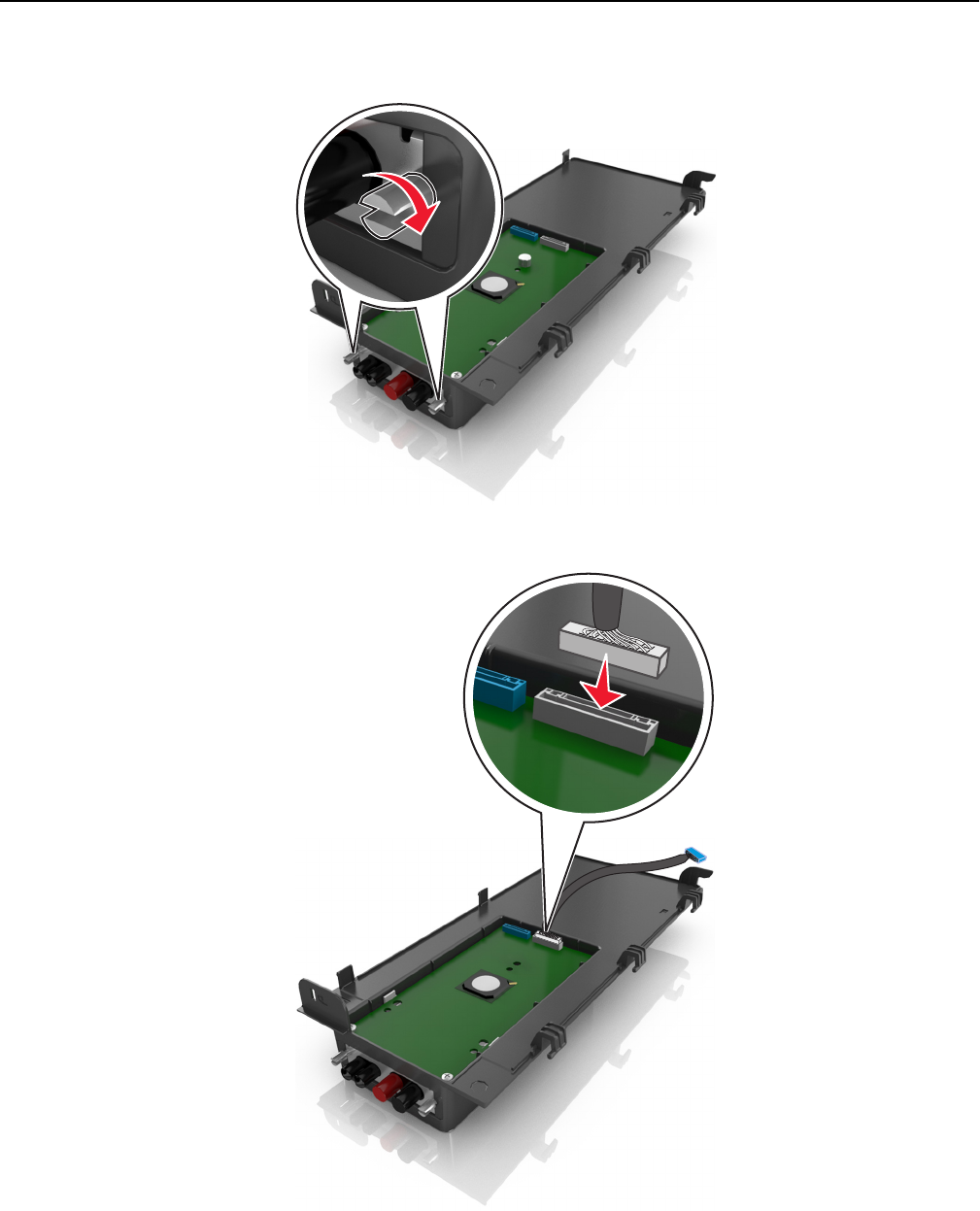
7Tighten the two screws on the end of the ISP solution.
8Attach the white plug of the ISP solution interface cable into the white receptacle on the ISP.
Additional printer setup 35
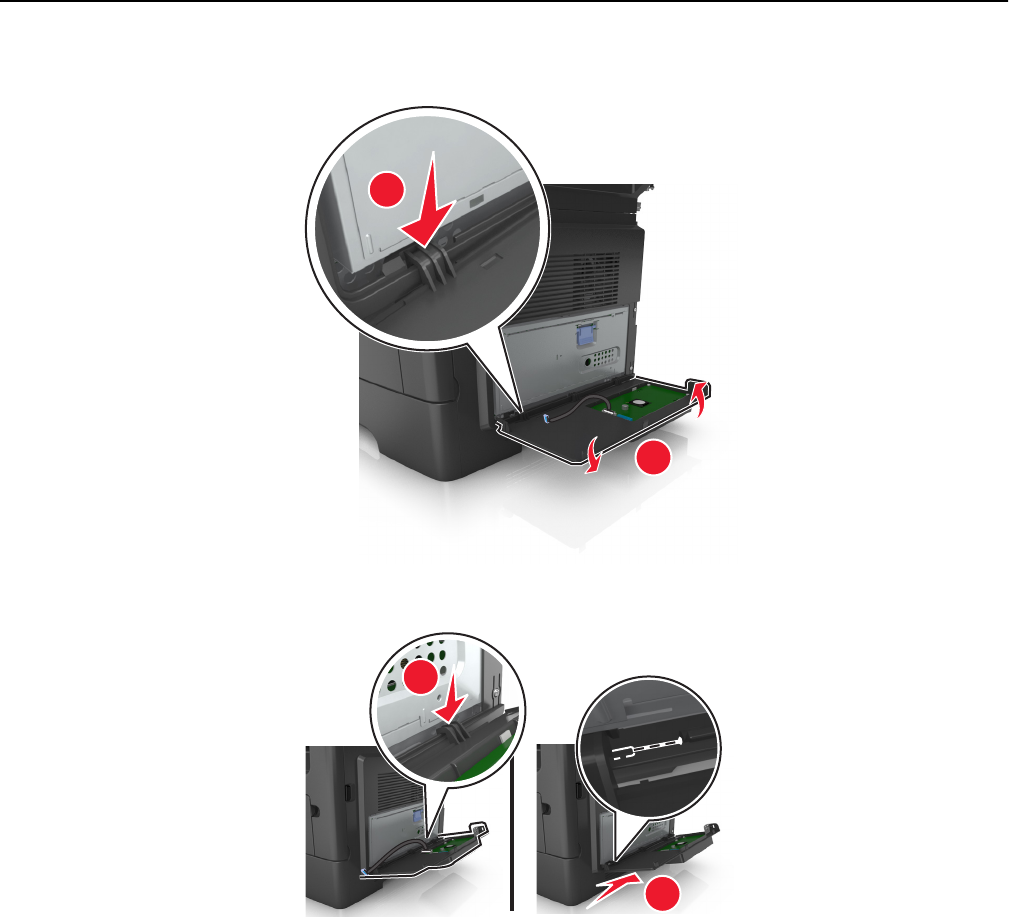
9Attach the ISP exterior cover at an angle by inserting the left hinges first.
1
2
10 Lower the rest of the cover, and then slide the cover to the right.
3
4
Additional printer setup 36
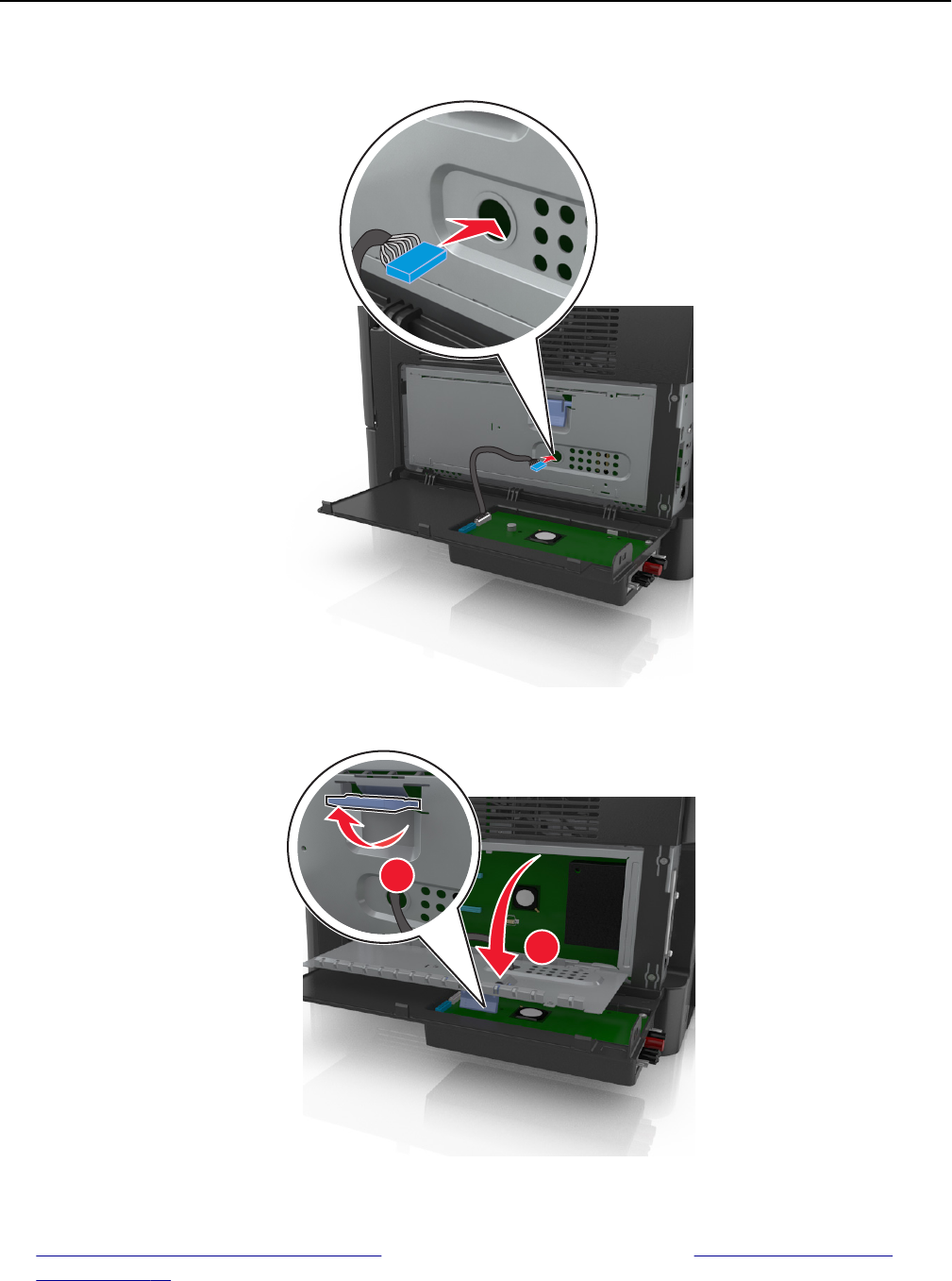
11 Run the ISP cable through the controller board shield.
12 Open the shield using the blue handle.
2
1
13 Attach the blue plug of the ISP solution interface cable into the blue receptacle on the controller board.
Note: If you have installed a printer hard disk, then you need to remove it. For more information, see
“Removing a printer hard disk” on page 41. To reinstall the printer hard disk, see “Installing a printer hard
disk” on page 39.
Additional printer setup 37
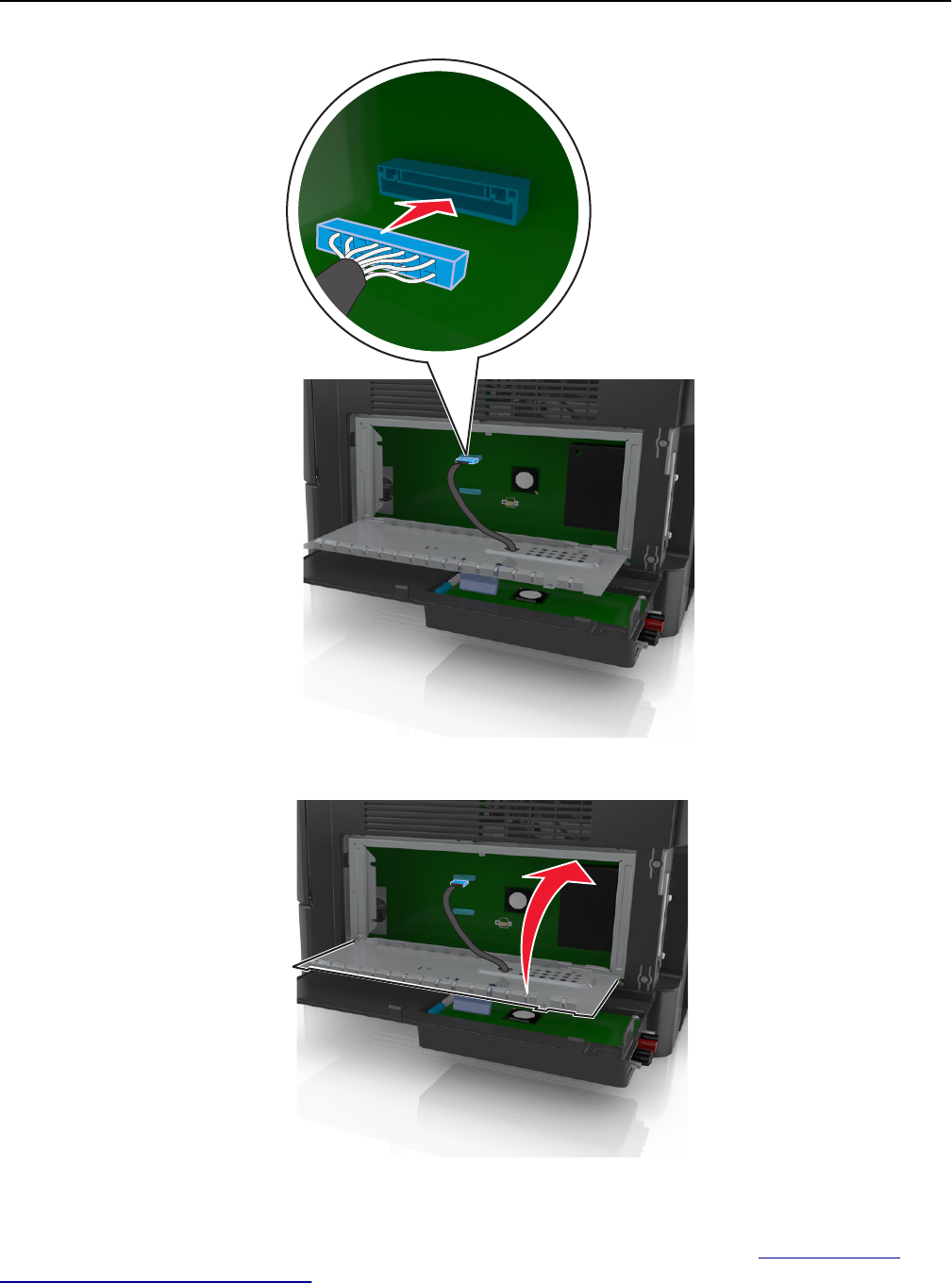
14 Close the shield.
15 Close the ISP exterior cover.
Note: When the printer software and any hardware options are installed, it may be necessary to manually add the
options in the printer driver to make them available for print jobs. For more information, see “Adding available
options in the print driver” on page 44.
Additional printer setup 38
Installing a printer hard disk
CAUTION—SHOCK HAZARD: If you are accessing the controller board or installing optional hardware or
memory devices sometime after setting up the printer, then turn the printer off, and unplug the power cord
from the electrical outlet before continuing. If you have any other devices attached to the printer, then turn
them off as well, and unplug any cables going into the printer.
Warning—Potential Damage: Controller board electronic components are easily damaged by static electricity.
Touch a metal surface on the printer before touching any controller board electronic components or connectors.
1Unpack the printer hard disk.
2Install the printer hard disk on the controller board.
Warning—Potential Damage: Hold only the edges of the printed circuit board assembly. Do not touch or press
on the center of the printer hard disk. Doing so may cause damage.
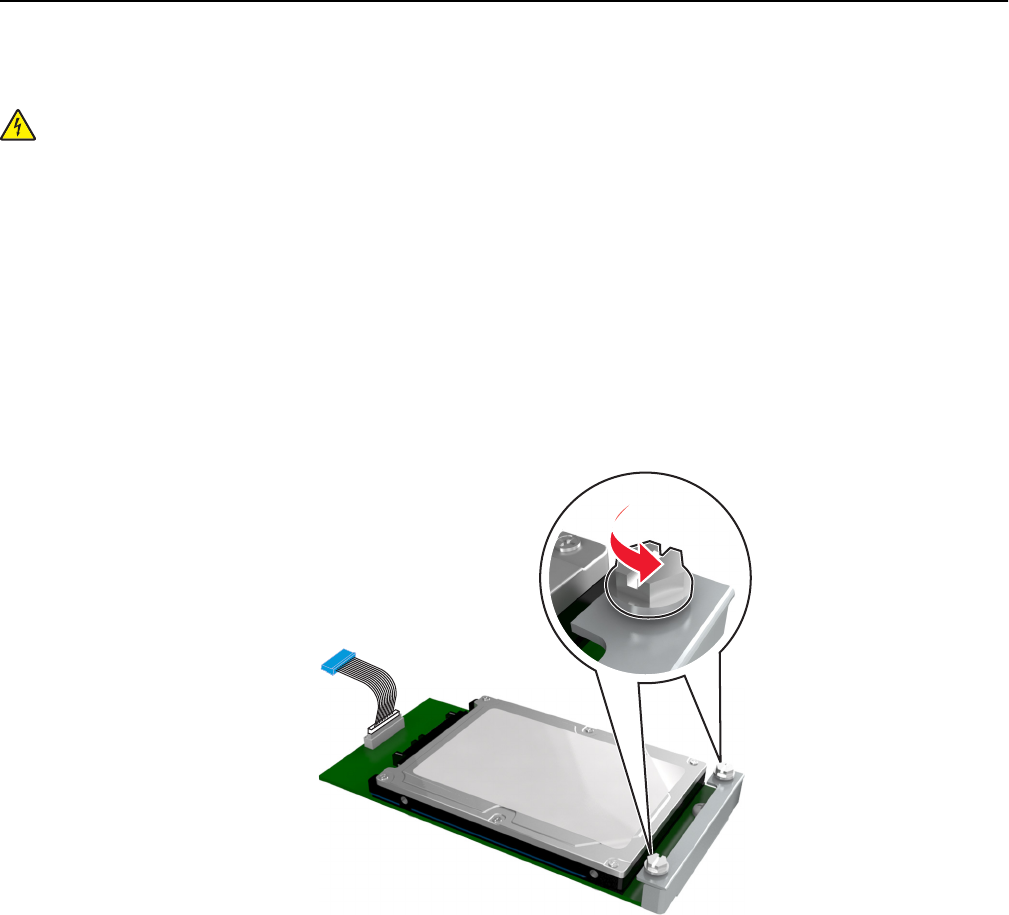
aUsing a flat‑head screwdriver, loosen the screws.
bInsert the plug of the printer hard disk interface cable into the receptacle of the controller board.
Note: The plug and the receptacle are color‑coded blue.
Additional printer setup 39
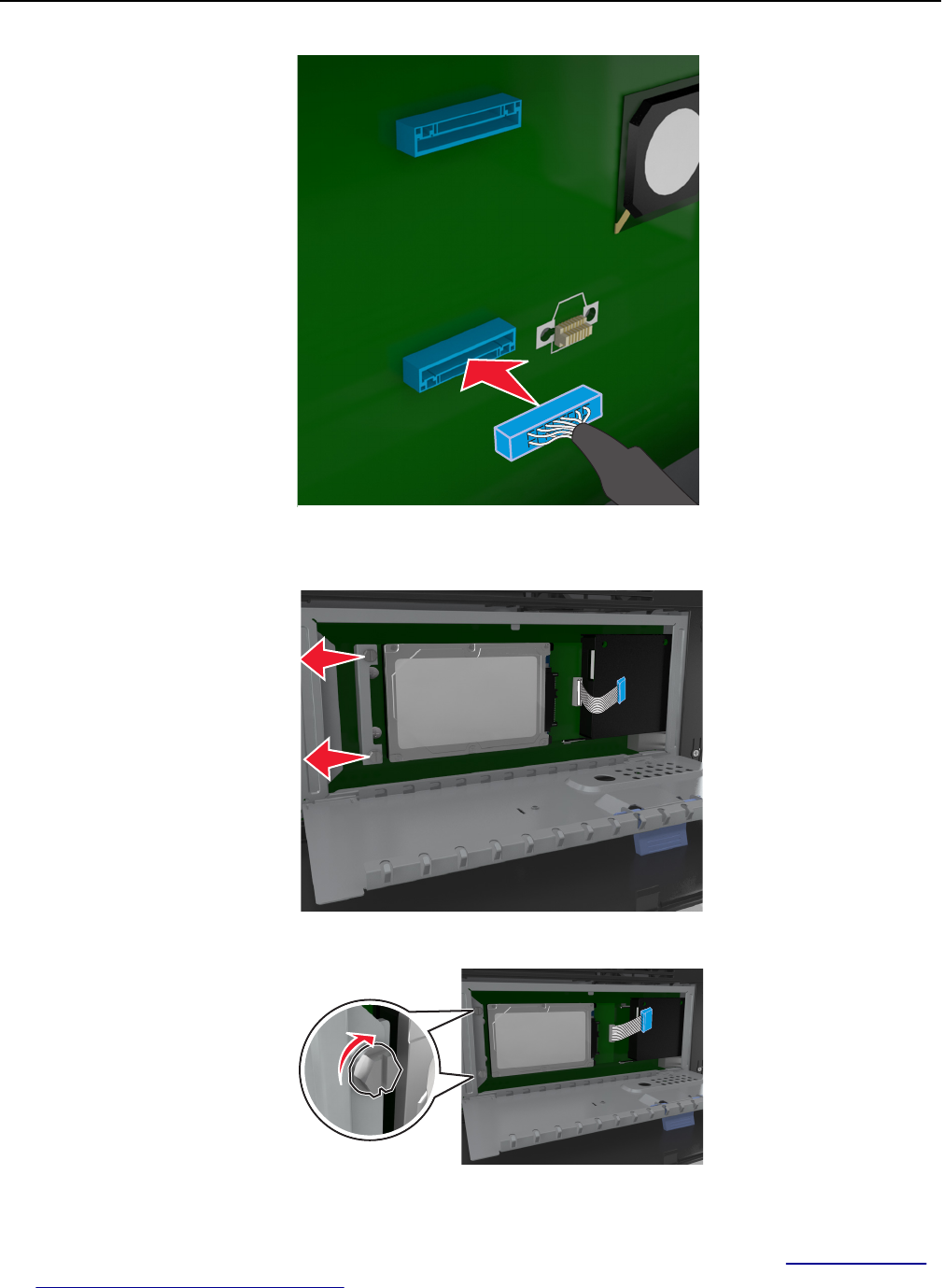
cAlign the screws on the printer hard disk to the slots on the controller board bracket, and then slide the printer
hard disk onto the brackets.
dTighten the two screws.
3Close the controller board shield, and then close the controller board access door.
Note: When the printer software and any hardware options are installed, you may need to manually add the
options in the printer driver to make them available for print jobs. For more information, see “Adding available
options in the print driver” on page 44.
Additional printer setup 40
Removing a printer hard disk
Warning—Potential Damage: Controller board electronic components are easily damaged by static electricity.
Touch a metal surface on the printer before touching any controller board electronic components or connectors.
1Access the controller board.
For more information, see “Accessing the controller board” on page 27.
Note: This task requires a flat‑head screwdriver.
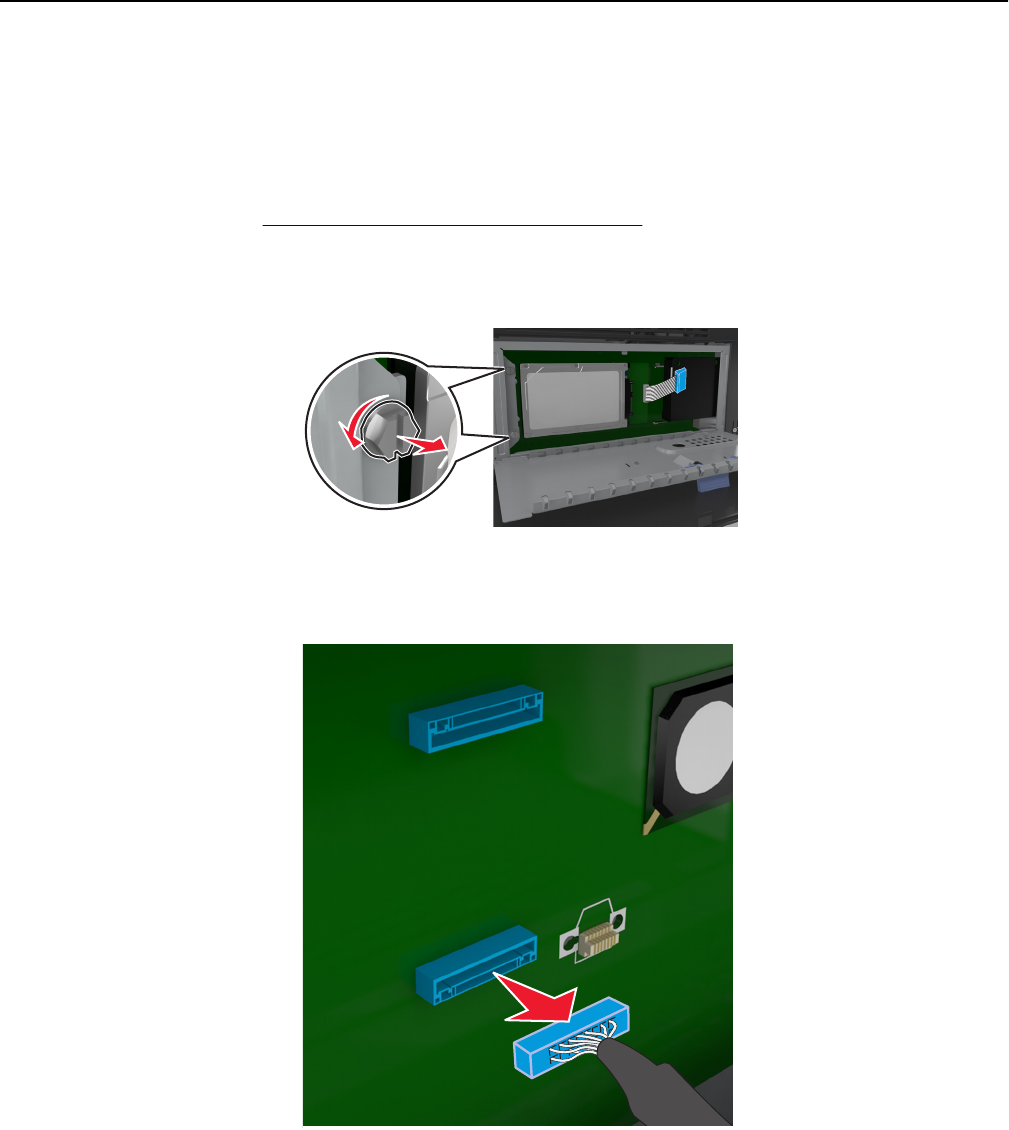
2Loosen the screws that connect the printer hard disk to the controller board bracket.
3Unplug the printer hard disk interface cable from the receptacle in the controller board, leaving the cable attached
to the printer hard disk. To unplug the cable, squeeze the paddle at the plug of the interface cable to disengage the
latch before pulling the cable out.
4Hold the printer hard disk by the edges, and then remove it from the printer.
5Close the controller board shield, and then close the access door.
Additional printer setup 41
Installing hardware options
Order of installation
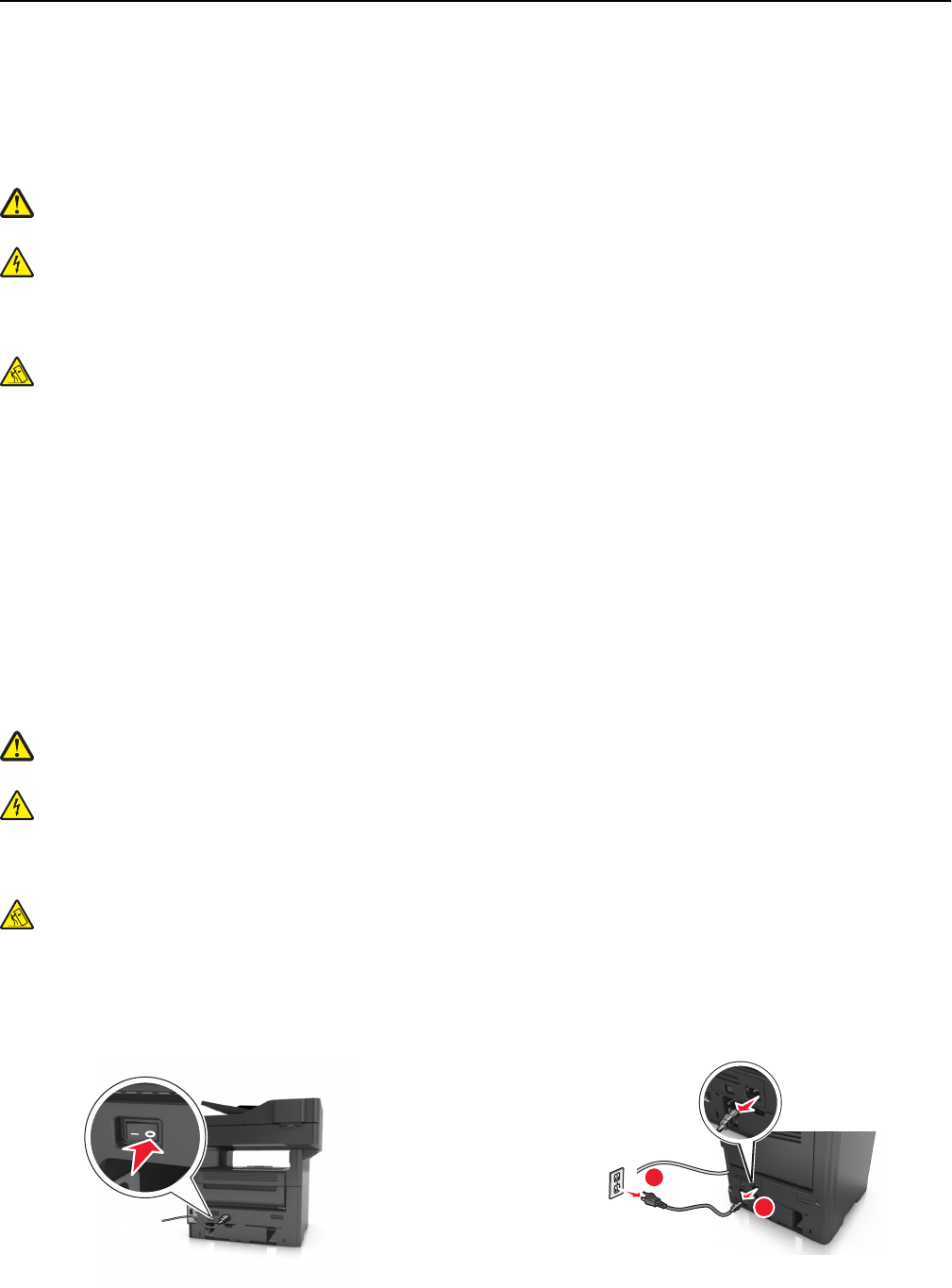
CAUTION—POTENTIAL INJURY: The printer weight is greater than 18 kg (40 lb) and requires two or more
trained personnel to lift it safely.
CAUTION—SHOCK HAZARD: If you are accessing the controller board or installing optional hardware or
memory devices sometime after setting up the printer, then turn the printer off, and unplug the power cord
from the electrical outlet before continuing. If you have any other devices attached to the printer, then turn
them off as well, and unplug any cables going into the printer.
CAUTION—TIPPING HAZARD: Floor-mounted configurations require additional furniture for stability. You must
use either a printer stand or printer base if you are using multiple input options. If you purchased a
multifunction printer (MFP) that scans, copies, and faxes, then you may need additional furniture. For more
information, contact the place where you purchased the printer.
Install the printer and any hardware options you have purchased in the following order:
•Printer stand
•Optional 550‑sheet tray
•Printer
For more information on installing a printer stand, optional 550‑sheet tray, or spacer, see the setup sheet that came
with the option.
Installing optional trays
CAUTION—POTENTIAL INJURY: The printer weight is greater than 18 kg (40 lb) and requires two or more
trained personnel to lift it safely.
CAUTION—SHOCK HAZARD: If you are accessing the controller board or installing optional hardware or
memory devices sometime after setting up the printer, then turn the printer off, and unplug the power cord
from the electrical outlet before continuing. If you have any other devices attached to the printer, then turn
them off as well, and unplug any cables going into the printer.
CAUTION—TIPPING HAZARD: Floor-mounted configurations require additional furniture for stability. You must
use either a printer stand or printer base if you are using multiple input options. If you purchased a
multifunction printer (MFP) that scans, copies, and faxes, you may need additional furniture. For more
information, contact the place where you purchased the printer.
1Turn off the printer using the power switch, and then unplug the power cord from the electrical outlet.
2
1
2
Additional printer setup 42
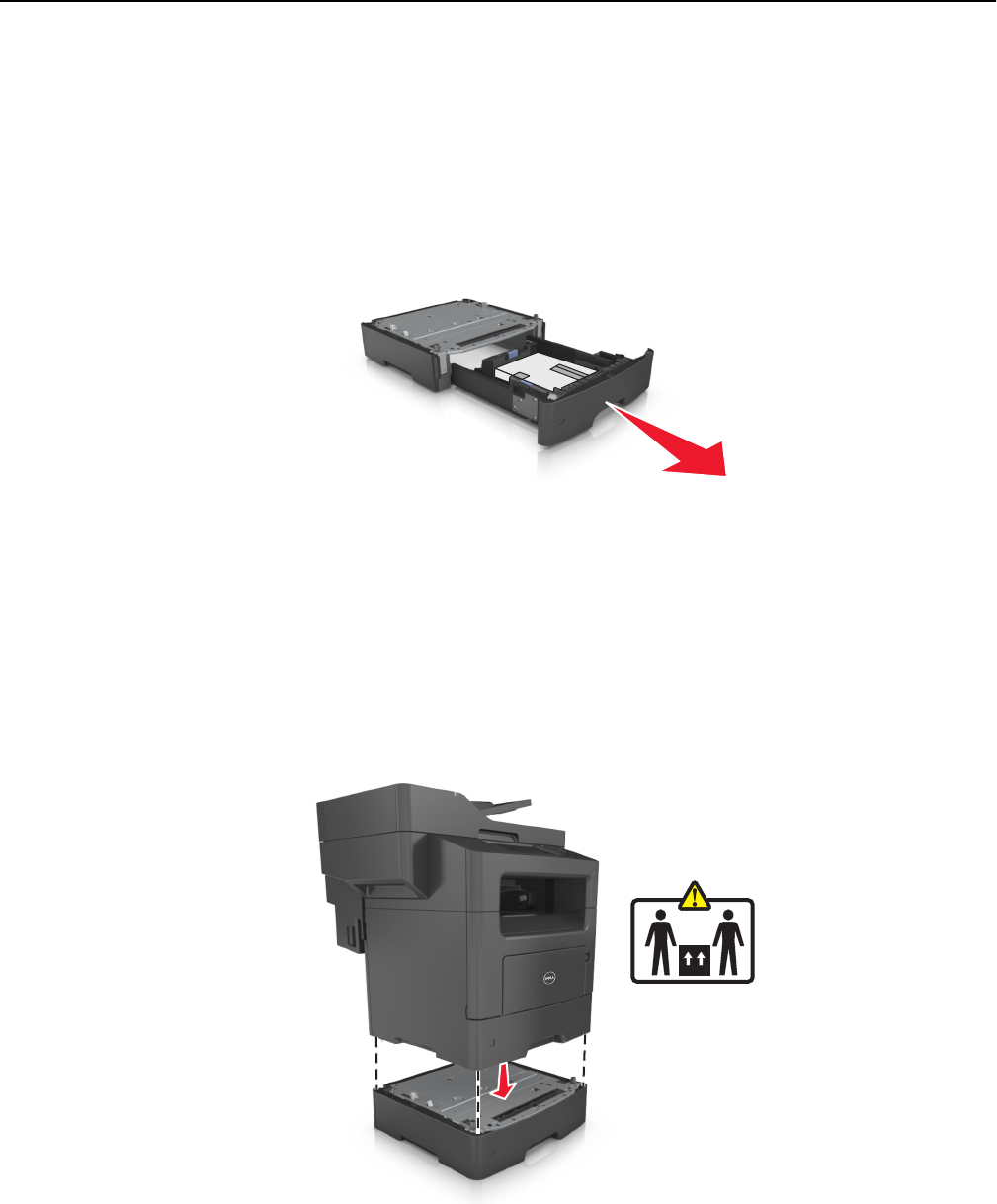
2Unpack the tray, and then remove all packing material.
3Pull out the tray from the base.
1
4Remove any packing material from inside the tray.
5Insert the tray into the base.
6Place the tray near the printer.
7Align the printer with the tray, and then slowly lower the printer into place.
Note: Optional trays lock together when stacked.
1
8Connect the power cord to the printer, then to a properly grounded electrical outlet, and then turn on the printer.
Additional printer setup 43
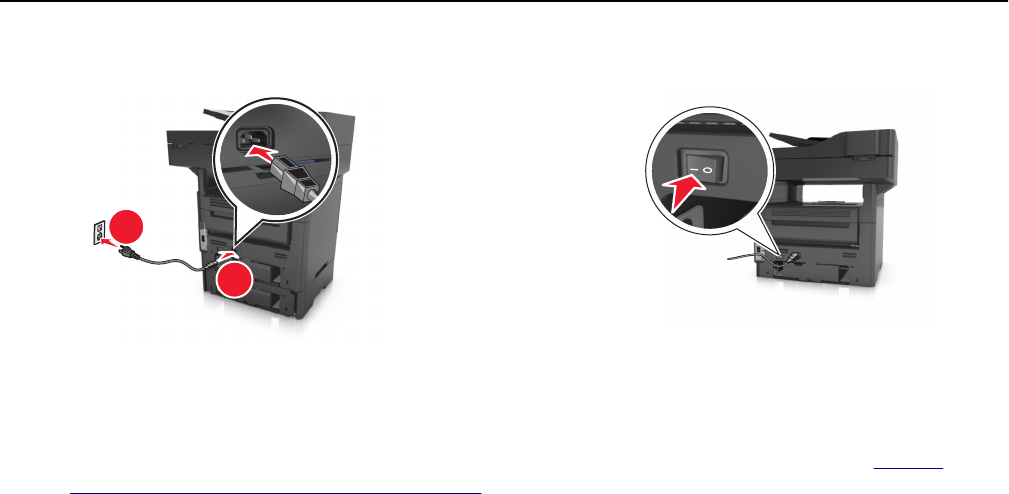
2
1
Notes:
•When the printer software and any hardware options are installed, you may need to manually add the
options in the printer driver to make them available for print jobs. For more information, see “Adding
available options in the print driver” on page 44.
•To uninstall the optional trays, slide the latch on the right side of the printer toward the front of the printer
until it clicks into place, and then remove stacked trays one at a time from the top to the bottom.
Setting up the printer software
Installing the printer
1Obtain a copy of the software installer package.
2Run the installer, and then follow the instructions on the computer screen.
3For Macintosh users, add the printer.
Note: Obtain the printer IP address from the TCP/IP section in the Network/Ports menu.
Adding available options in the print driver
For Windows users
1Open the printers folder, and then select your printer.
2Open the printer properties, and then add or manually install any options.
3Apply the changes.
For Macintosh users
1From System Preferences in the Apple menu, navigate to your printer, and then select Options & Supplies >
Driver.
2Add any installed hardware options.
3Apply the changes.
Additional printer setup 44
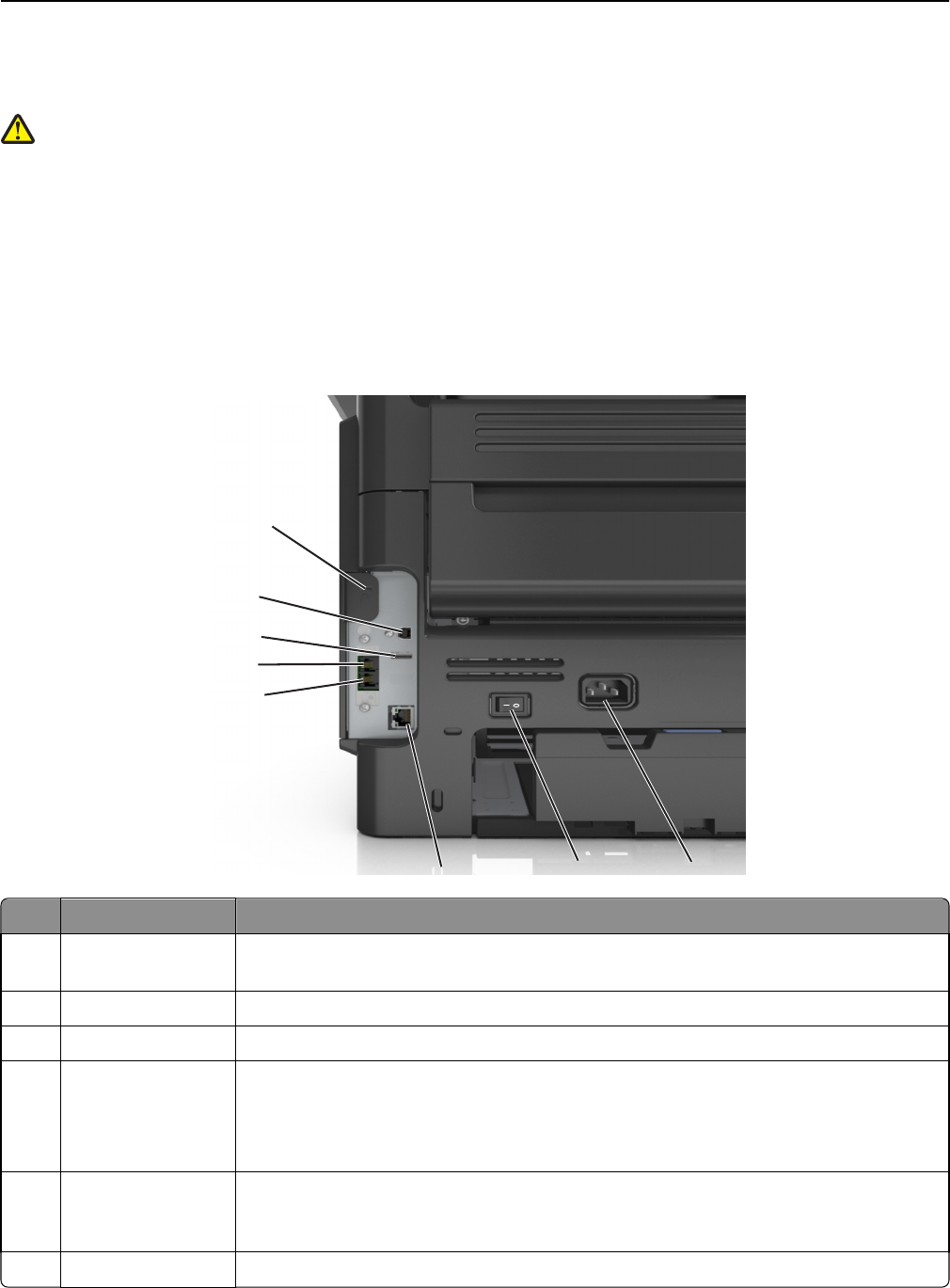
Attaching cables
CAUTION—POTENTIAL INJURY: Do not use the fax feature during a lightning storm. Do not set up this product
or make any electrical or cabling connections, such as the fax feature, power cord, or telephone, during a
lightning storm.
Connect the printer to the computer using a USB cable or to the network using an Ethernet cable.
Make sure to match the following:
•The USB symbol on the cable with the USB symbol on the printer
•The appropriate Ethernet cable with the Ethernet port
Warning—Potential Damage: Do not touch the USB cable, any network adapter, or the printer in the area shown
while actively printing or scanning. Loss of data or a malfunction can occur.
1
2
3
5
8
6
4
7
Use the To
1Printer power cord
socket
Connect the printer to a properly grounded electrical outlet.
2Power switch Turn the printer on or off.
3Ethernet port Connect the printer to an Ethernet network.
4EXT port Connect additional devices (telephone or answering machine) to the printer and the
telephone line. Use this port if you do not have a dedicated fax line for the printer and if this
connection method is supported in your country or region.
Note: Remove the adapter plug to access the port.
5LINE port Connect the printer to an active telephone line through a standard wall jack (RJ‑11), DSL filter,
or VoIP adapter, or any other adapter that allows you to access the telephone line to send
and receive faxes.
6USB port Attach a supported printer keyboard.
Additional printer setup 45

Use the To
7USB printer port Connect the printer to a computer.
8Security slot Attach a lock that will secure the printer in place.
Networking
Notes:
•Purchase a wireless network adapter first before setting up the printer on a wireless network. For more
information, contact the place where you purchased the printer.
•A Service Set Identifier (SSID) is a name assigned to a wireless network. Wired Equivalent Privacy (WEP), Wi-Fi
Protected Access (WPA), WPA2, and 802.1X-RADIUS are types of security used on a network.
Preparing to set up the printer on an Ethernet network
To configure your printer to connect to an Ethernet network, organize the following information before you begin:
Note: If your network automatically assigns IP addresses to computers and printers, continue on to installing the
printer.
•A valid, unique IP address for the printer to use on the network
•The network gateway
•The network mask
•A nickname for the printer (optional)
Note: A printer nickname can make it easier for you to identify your printer on the network. You can choose to
use the default printer nickname, or assign a name that is easier for you to remember.
You will need an Ethernet cable to connect the printer to the network and an available port where the printer can
physically connect to the network. Use a new network cable when possible to avoid potential problems caused by a
damaged cable.
Preparing to set up the printer on a wireless network
Notes:
•Make sure your wireless network adapter is installed in your printer and working properly. For more
information, see the instruction sheet that came with the wireless network adapter.
•Make sure your access point (wireless router) is turned on and is working properly.
Make sure you have the following information before setting up the printer on a wireless network:
•SSID—The SSID is also referred to as the network name.
•Wireless Mode (or Network Mode)—The mode is either infrastructure or ad hoc.
•Channel (for ad hoc networks)—The channel defaults to automatic for infrastructure networks.
Some ad hoc networks will also require the automatic setting. Check with your system support person if you are
not sure which channel to select.
Additional printer setup 46

•Security Method—There are four basic options for Security Method:
–WEP key
If your network uses more than one WEP key, then enter up to four in the provided spaces. Select the key
currently in use on the network by selecting the default WEP transmit key.
–WPA or WPA2 preshared key or passphrase
WPA includes encryption as an additional layer of security. The choices are AES or TKIP. Encryption must be set
for the same type on the router and on the printer, or the printer will not be able to communicate on the
network.
–802.1X–RADIUS
If you are installing the printer on an 802.1X network, then you may need the following:
•Authentication type
•Inner authentication type
•802.1X user name and password
•Certificates
–No security
If your wireless network does not use any type of security, then you will not have any security information.
Note: We do not recommend using an unsecured wireless network.
Notes:
–If you do not know the SSID of the network that your computer is connected to, then launch the wireless utility
of the computer network adapter, and then look for the network name. If you cannot find the SSID or the
security information for your network, then see the documentation that came with the access point, or contact
your system support person.
–To find the WPA/WPA2 preshared key or passphrase for the wireless network, see the documentation that
came with the access point, see the Embedded Web Server associated with the access point, or consult your
system support person.
Connecting the printer using the Wireless Setup Wizard
Before you begin, make sure that:
•A wireless network adapter is installed in the printer and is working properly. For more information, see the
instruction sheet that came with the wireless network adapter.
•An Ethernet cable is disconnected from the printer.
•Active NIC is set to Auto. To set this to Auto, navigate to:
> Network/Ports > Active NIC > Auto > Submit
Note: Make sure to turn off the printer, then wait for at least five seconds, and then turn the printer back on.
1From the printer control panel, navigate to:
> Network/Ports > Network [x] > Network [x] Setup > Wireless > Wireless Connection Setup
2Select a wireless connection setup.
Additional printer setup 47
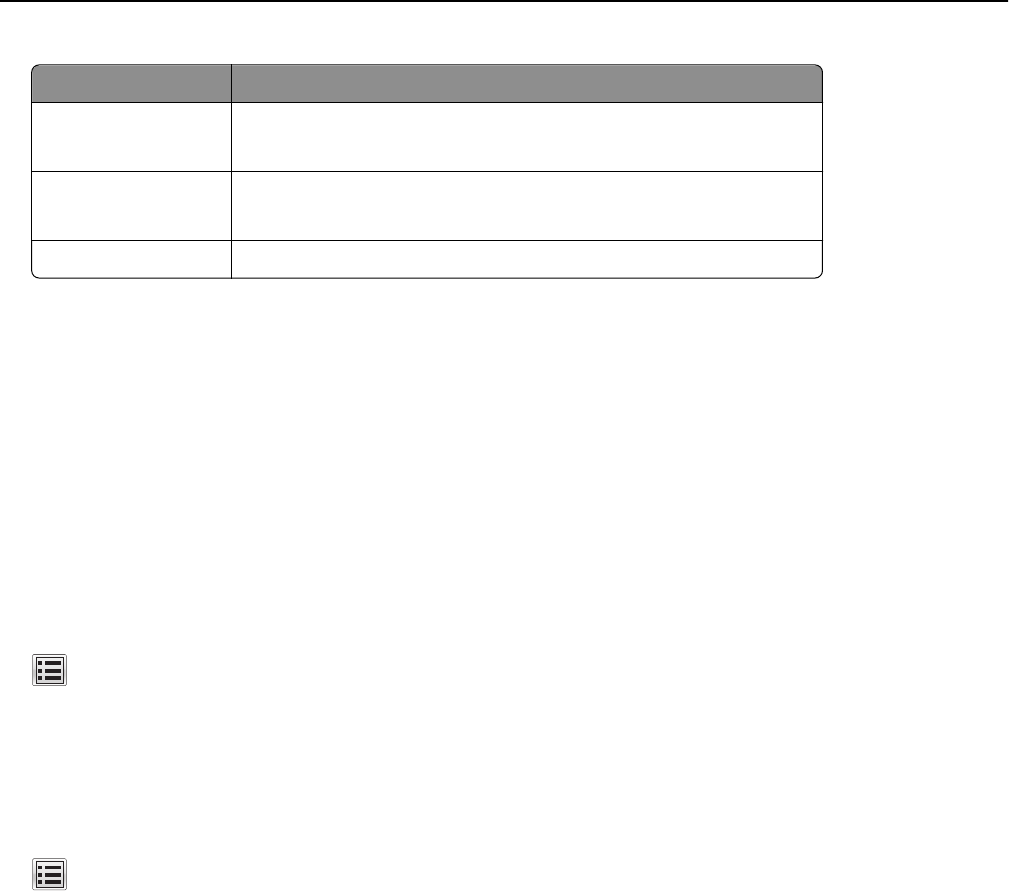
Use To
Search for networks Show available wireless connections.
Note: This menu item shows all broadcast secured or unsecured SSIDs.
Enter a network name Manually type the SSID.
Note: Make sure to type the correct SSID.
Wi‑Fi Protected Setup Connect the printer to a wireless network using Wi‑Fi Protected Setup.
3Follow the instructions on the printer display.
Connecting the printer to a wireless network using Wi‑Fi Protected Setup
Before you begin, make sure that:
•The access point (wireless router) is Wi‑Fi Protected Setup (WPS) certified or WPS‑compatible. For more
information, see the documentation that came with your access point.
•A wireless network adapter installed in your printer is attached and working properly. For more information, see
the instruction sheet that came with the wireless network adapter.
Using the Push Button Configuration method
1From the printer control panel, navigate to:
> Network/Ports > Network [x] > Network [x] Setup > Wireless > Wireless Connection Setup > Wi‑Fi Protected
Setup > Start Push Button Method
2Follow the instructions on the printer display.
Using the Personal Identification Number (PIN) method
1From the printer control panel, navigate to:
> Network/Ports > Network [x] > Network [x] Setup > Wireless > Wireless Connection Setup > Wi‑Fi Protected
Setup > Start PIN Method
2Copy the eight‑digit WPS PIN.
3Open a Web browser, and then type the IP address of your access point in the address field.
Notes:
•The IP address appears as four sets of numbers separated by periods, such as 123.123.123.123.
•If you are using a proxy server, then temporarily disable it to load the Web page correctly.
4Access the WPS settings. For more information, see the documentation that came with your access point.
5Enter the eight‑digit PIN, and then save the setting.
Additional printer setup 48

Connecting the printer to a wireless network using the Embedded Web Server
Before you begin, make sure that:
•Your printer is connected temporarily to an Ethernet network.
•A wireless network adapter is installed in your printer and working properly. For more information, see the
instruction sheet that came with the wireless network adapter.
1Open a Web browser, and then type the printer IP address in the address field.
Notes:
•View the printer IP address on the printer control panel. The IP address appears as four sets of numbers
separated by periods, such as 123.123.123.123.
•If you are using a proxy server, then temporarily disable it to load the Web page correctly.
2Click Settings > Network/Ports > Wireless.
3Modify the settings to match the settings of your access point (wireless router).
Note: Make sure to enter the correct SSID, security method, preshared key or passphrase, network mode, and
channel.
4Click Submit.
5Turn off the printer, and then disconnect the Ethernet cable. Then wait for at least five seconds, and then turn the
printer back on.
6To verify if your printer is connected to the network, print a network setup page. Then in the Network Card [x]
section, see if the status is Connected.
Changing port settings after installing a new network ISP
Notes:
•If the printer has a static IP address, then you do not need to make any changes.
•If the computers are configured to use the network name, instead of an IP address, then you do not need to
make any changes.
•If you are adding a wireless ISP to a printer previously configured for an Ethernet connection, then make sure
the printer is disconnected from the Ethernet network.
For Windows users
1Open the printers folder.
2From the shortcut menu of the printer with the new ISP, open the printer properties.
3Configure the port from the list.
4Update the IP address.
5Apply the changes.
For Macintosh users
1From System Preferences in the Apple menu, navigate to the list of printers, and then select + > IP.
2Type the IP address in the address field.
Additional printer setup 49

3Apply the changes.
Setting up serial printing
Use serial printing when the computer is far from the printer. After installing the serial or communication (COM) port,
configure the printer and the computer.
Note: Serial printing reduces print speed.
1Set the parameters in the printer.
aFrom the control panel, navigate to the menu for the port settings.
bLocate the menu for the serial port settings, and then adjust the settings, if necessary.
cSave the settings.
2From your computer, open the printers folder, and then select your printer.
3Open the printer properties, and then select the COM port from the list.
4Set the COM port parameters in Device Manager.
Use the Run dialog box to open the command prompt, and then type devmgmt.msc.
Verifying printer setup
When all hardware and software options are installed and the printer is turned on, verify that the printer is set up
correctly by printing the following:
•Menu settings page—Use this page to verify that all printer options are installed correctly. A list of installed options
appears toward the bottom of the page. If an option you installed is not listed, then it is not installed correctly.
Remove the option, and then install it again.
•Network setup page—If your printer has Ethernet or wireless capability and is attached to a network, then print a
network setup page to verify the network connection. This page also provides important information that aids
network printing configuration.
Printing a menu settings page
From the home screen, navigate to:
> Reports > Menu Settings Page
Printing a network setup page
If the printer is attached to a network, then print a network setup page to verify the network connection. This page
also provides important information that aids network printing configuration.
1From the home screen, navigate to:
> Reports > Network Setup Page
2Check the first section of the network setup page, and confirm that the status is Connected.
If the status is Not Connected, then the LAN drop may not be active, or the network cable may be malfunctioning.
Consult a system support person for a solution, and then print another network setup page.
Additional printer setup 50
Loading paper and specialty media
The selection and handling of paper and specialty media can affect how reliably documents print. For more information,
see “Avoiding jams” on page 224 and “Storing paper” on page 69.
Setting the paper size and type
From the home screen, navigate to:
> Paper Menu > Paper Size/Type > select a tray > select the paper size or type > Submit
Notes:
•The Paper Size setting is automatically set according to the position of the paper guides in each tray except the
standard 550‑sheet tray (Tray 1) and the multipurpose feeder.
•The Paper Size setting for Tray 1 and the multipurpose feeder must be set manually in the Paper Size menu.
•The factory default Paper Type setting is Plain Paper.
•The Paper Type setting must be set manually for all trays.
Configuring Universal paper settings
The Universal paper size is a user‑defined setting that lets you print on paper sizes that are not preset in the printer
menus.
Notes:
•The smallest supported Universal size is 76.2 x 76.2 mm (3 x 3 inches).
•The largest supported Universal size is 215.9 x 359.92 mm (8.5 x 14.17 inches).
1From the home screen, navigate to:
> Paper Menu > Universal Setup > Units of Measure > select the unit of measure >
2Touch Portrait Width or Portrait Height.
3Select the width or height, and then touch .
Loading trays
CAUTION—POTENTIAL INJURY: To reduce the risk of equipment instability, load each tray separately. Keep all
other trays closed until needed.
1Pull out the tray completely.
Note: Do not remove trays while a job prints or while Busy appears on the printer display. Doing so may cause
a jam.
Loading paper and specialty media 51
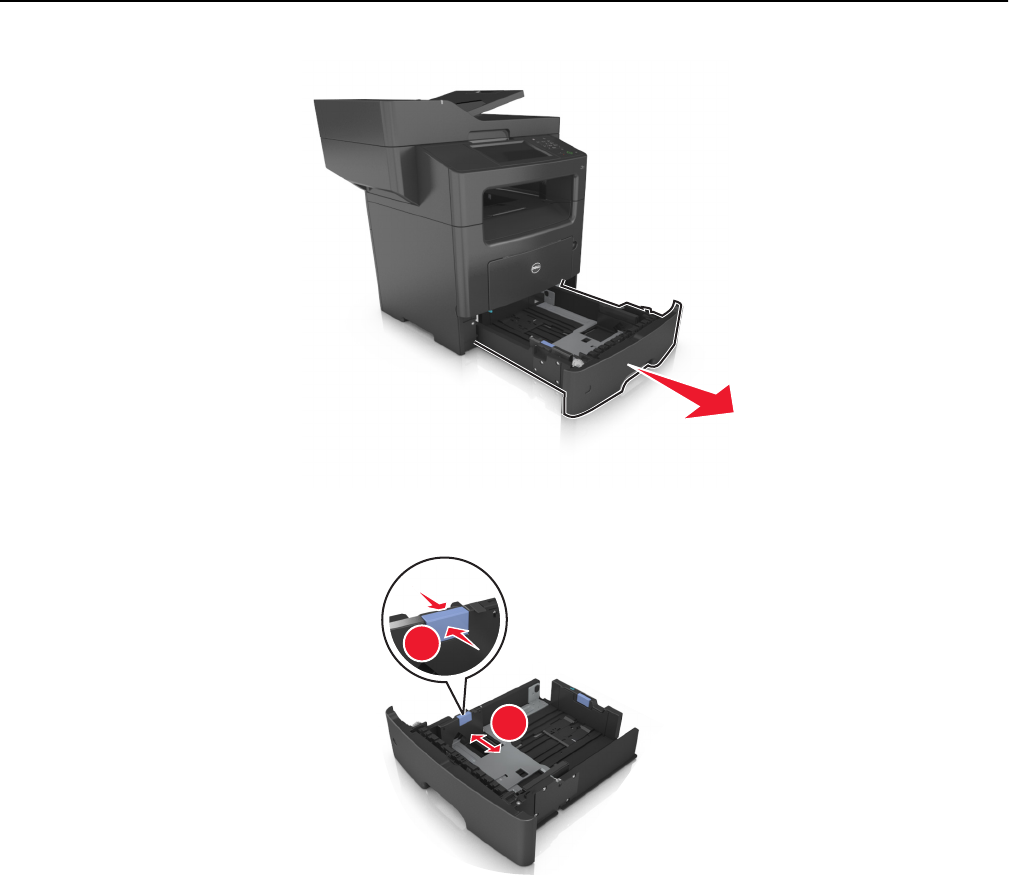
1
2Squeeze, and then slide the width guide tab to the correct position for the size of the paper you are loading.
2
1
Loading paper and specialty media 52
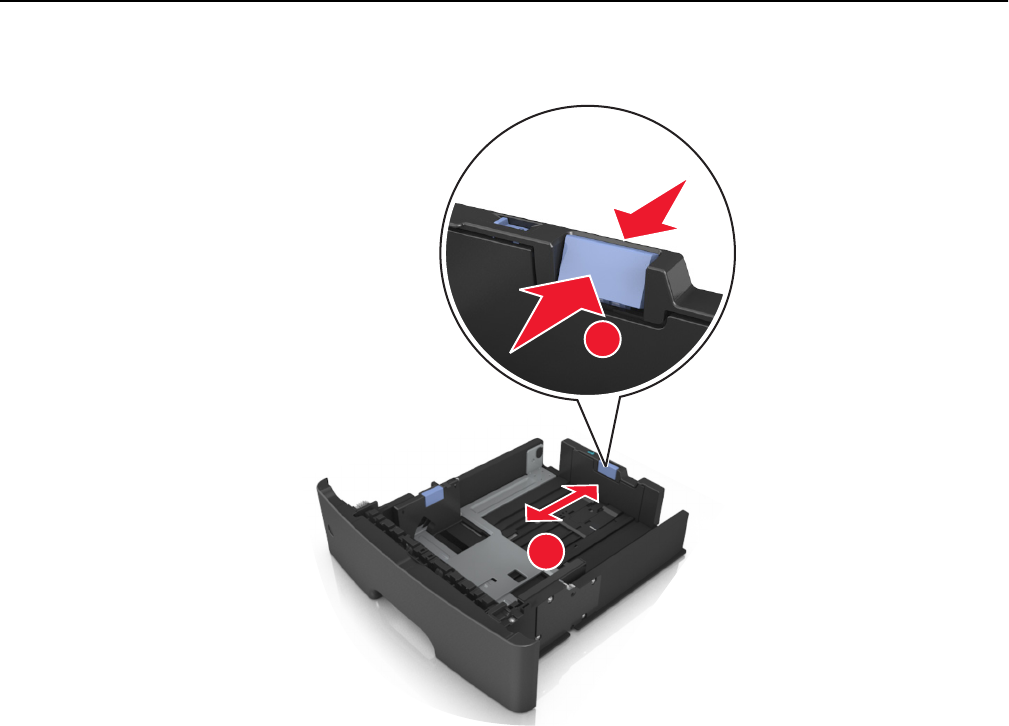
3Squeeze, and then slide the length guide tab to the correct position for the size of the paper you are loading.
2
1
Notes:
•For some paper sizes like letter, legal, and A4, squeeze, and then slide the length guide tab backward to
accommodate their length.
•If you are loading A6-size paper in the standard tray, squeeze, and then slide the length guide tab toward the
center of the tray to the A6‑size position.
•Make sure the width and length guides are aligned with the paper size indicators on the bottom of the tray.
Loading paper and specialty media 53
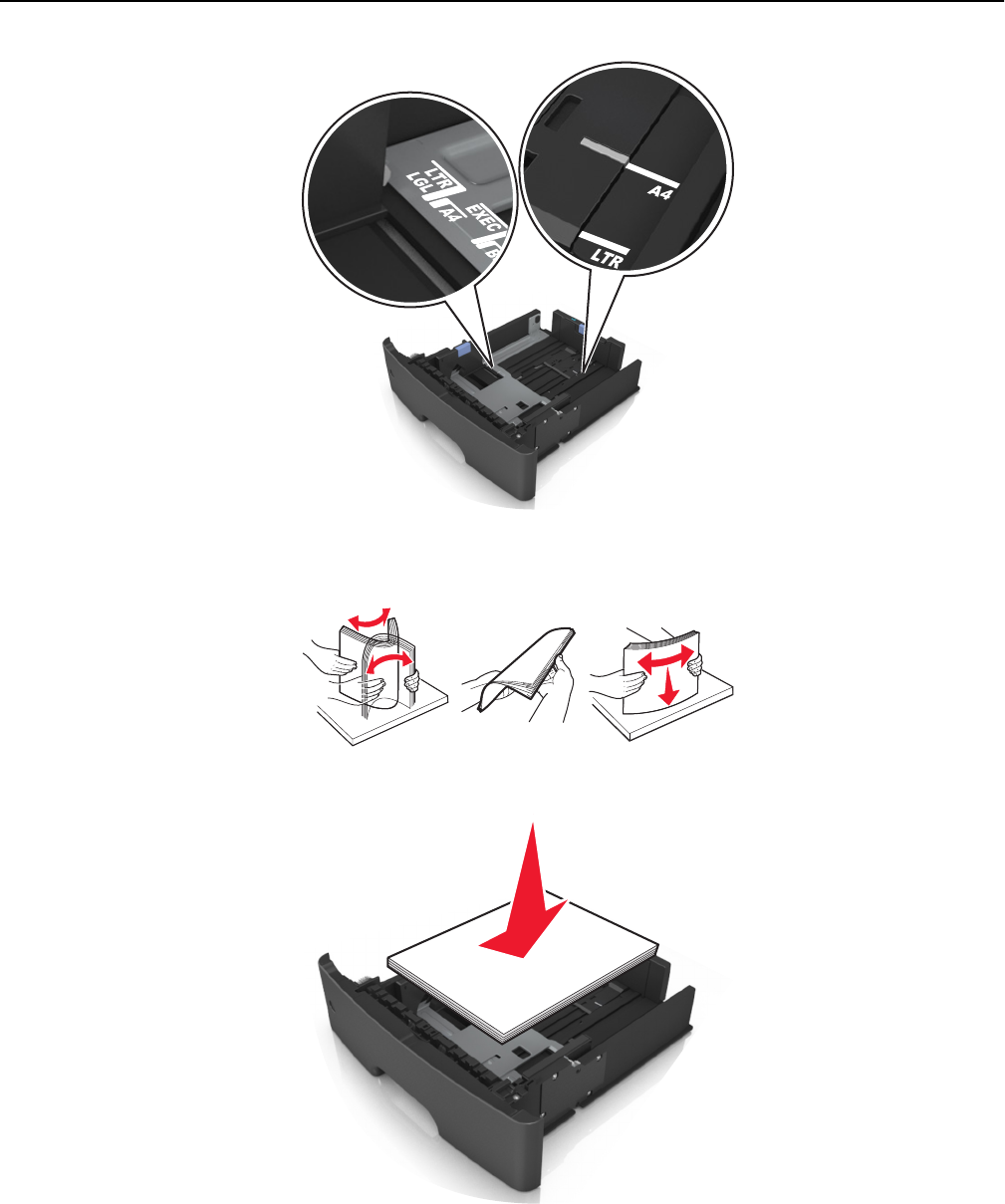
A4
LTR
EXEC
B5
A5
LTR/LGL EXEC
A4 A5
B5
A6
4Flex the sheets back and forth to loosen them, and then fan them. Do not fold or crease the paper. Straighten the
edges on a level surface.
5Load the paper stack with the printable side facedown.
•There are different ways of loading letterhead depending on whether an optional staple finisher is installed or
not, and whether two sided printing is needed.
Loading paper and specialty media 54
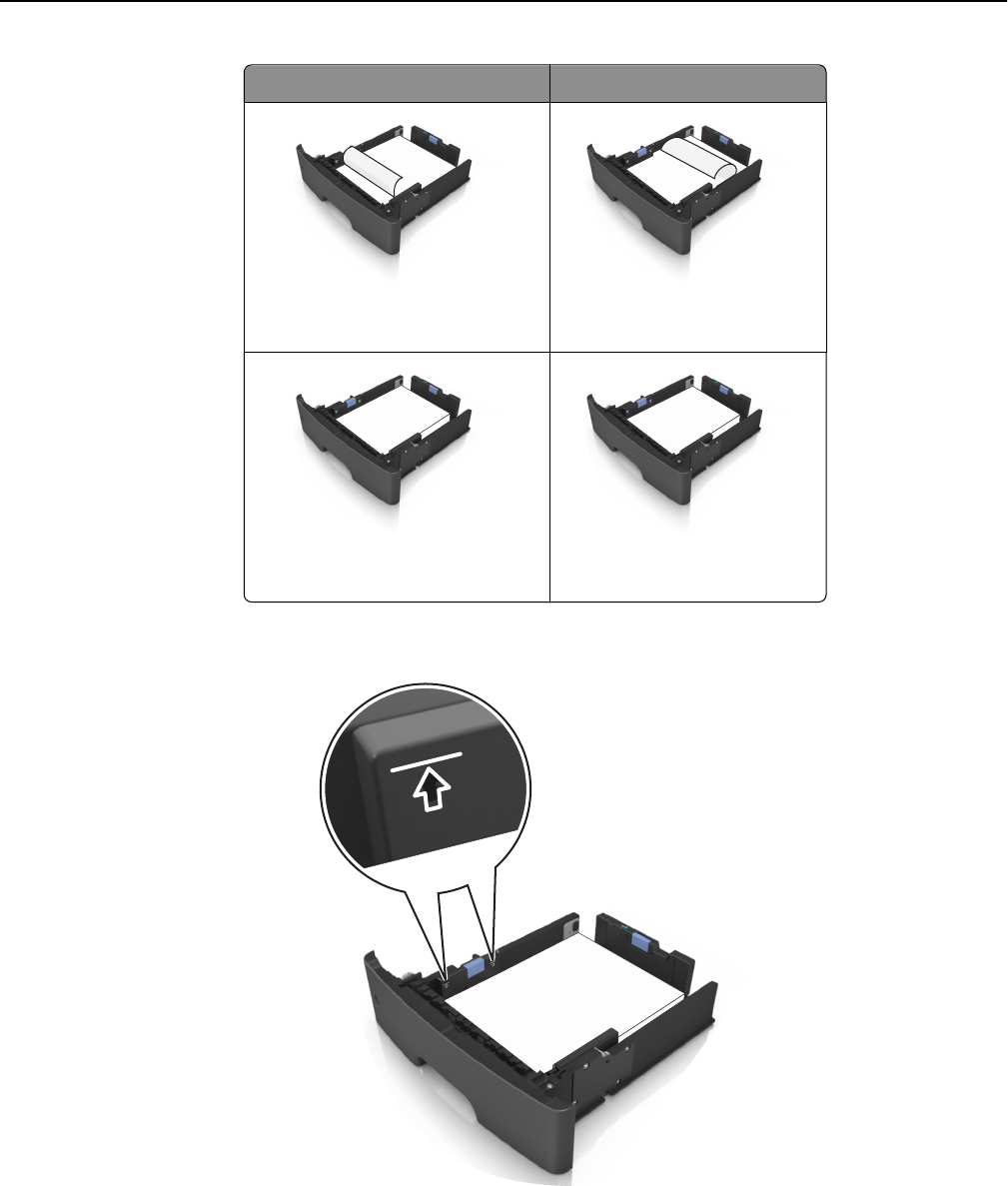
Without an optional staple finisher With an optional staple finisher
ABC
One‑sided printing
ABC
One‑sided printing
ABC
Two‑sided (duplex) printing
ABC
Two‑sided (duplex) printing
•Make sure the paper is below the maximum paper fill indicator located on the side of the width guide. Overfilling
may cause paper jams.
A4
LTR
EXEC
B5
A5
LTR
LGLA4
EXEC
B5A5A6
Loading paper and specialty media 55
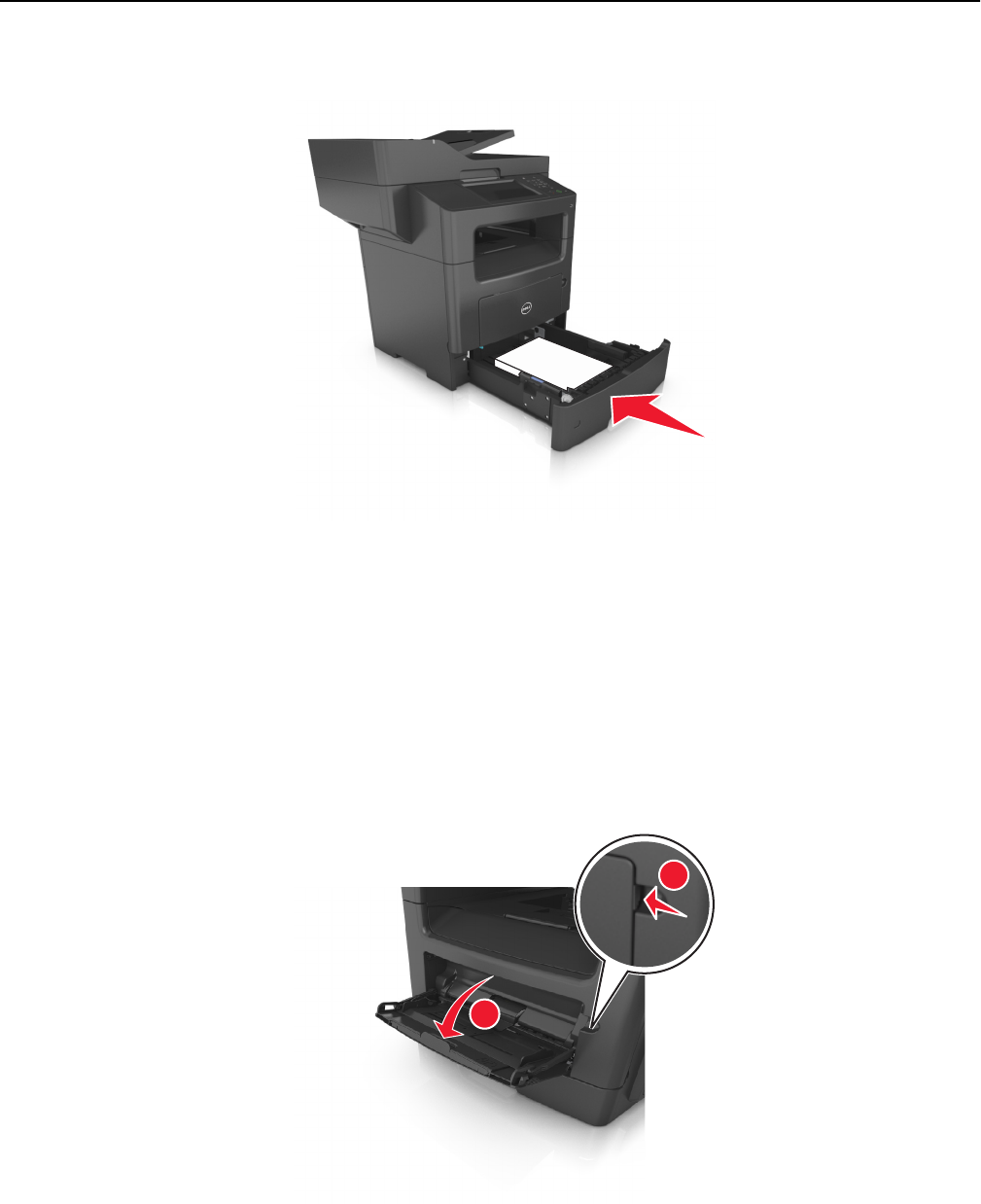
6Insert the tray.
1
7From the printer control panel, set the paper size and paper type in the Paper menu to match the paper loaded in
the tray.
Note: Set the correct paper size and paper type to avoid paper jams and print quality problems.
Loading the multipurpose feeder
Use the multipurpose feeder when printing on different paper sizes and types or specialty media, such as card stock,
transparencies, and envelopes. You can also use it for single‑page print jobs on letterhead.
1Open the multipurpose feeder.
1
2
Loading paper and specialty media 56
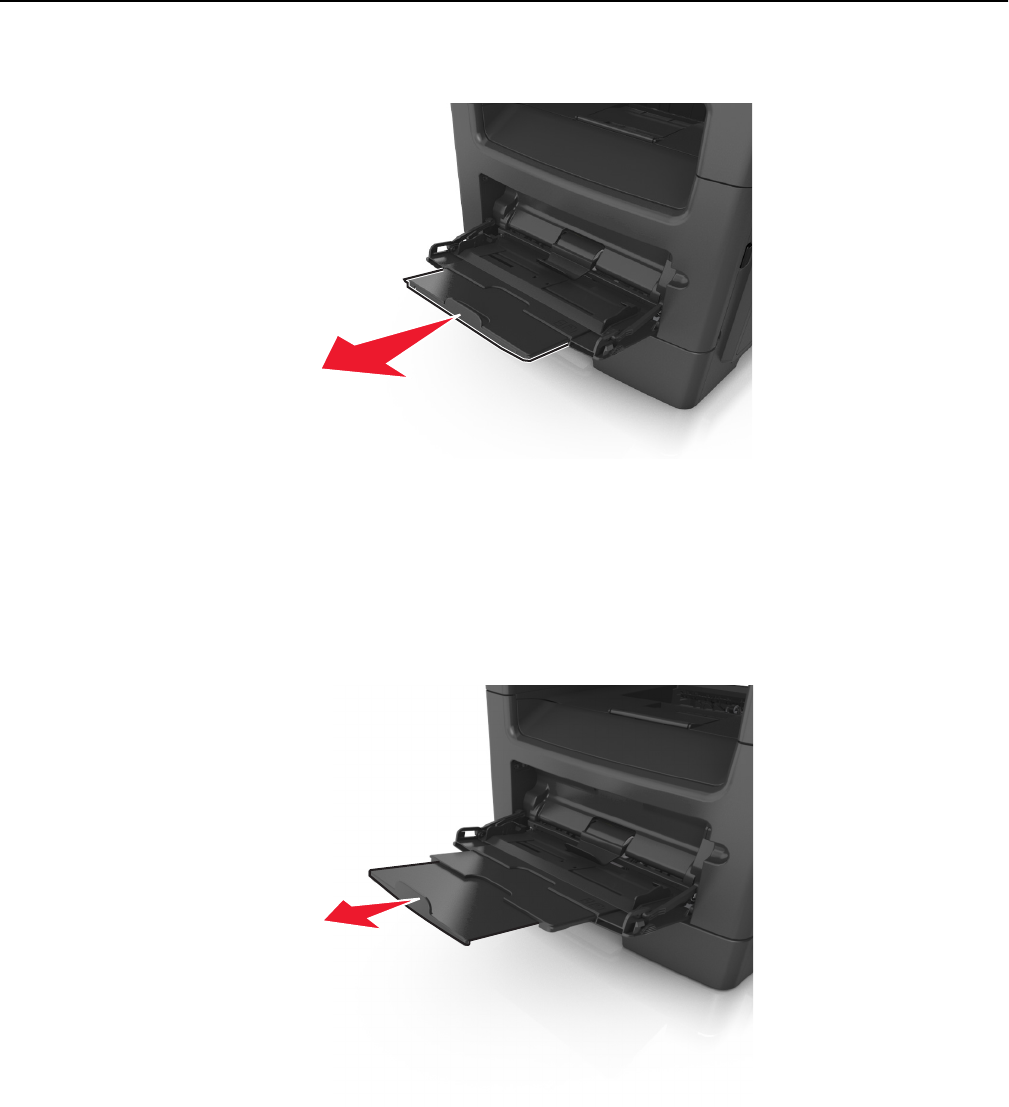
aPull the multipurpose feeder extender.
bPull the extender gently so that the multipurpose feeder is fully extended and open.
Loading paper and specialty media 57
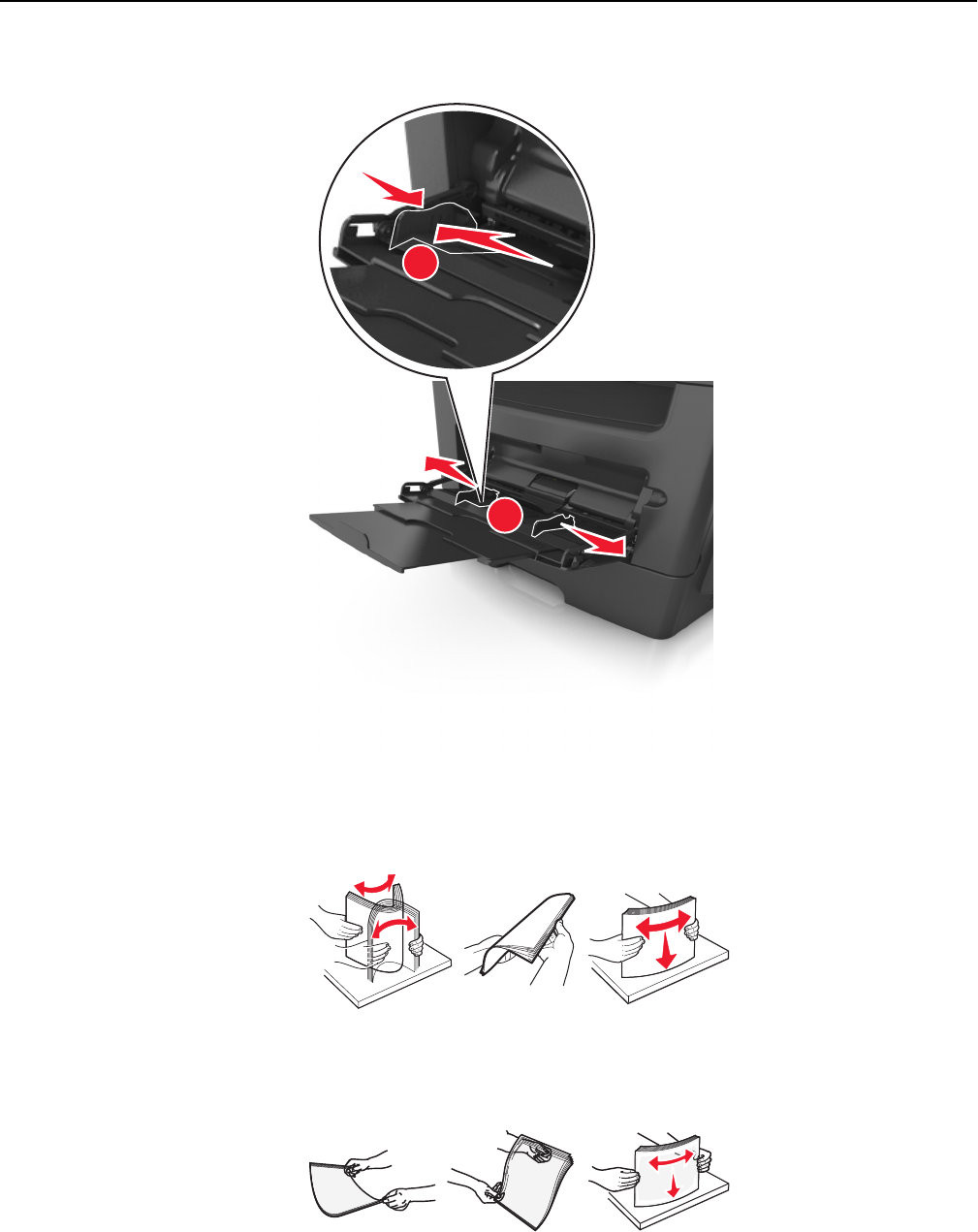
2Squeeze the tab on the left width guide, and then move the guides for the paper you are loading.
2
1
3Prepare the paper or specialty media for loading.
•Flex sheets of paper back and forth to loosen them, and then fan them. Do not fold or crease the paper. Straighten
the edges on a level surface.
•Hold transparencies by the edges. Flex the stack of transparencies back and forth to loosen them, and then fan
them. Straighten the edges on a level surface.
Note: Avoid touching the printable side of the transparencies. Be careful not to scratch them.
Loading paper and specialty media 58
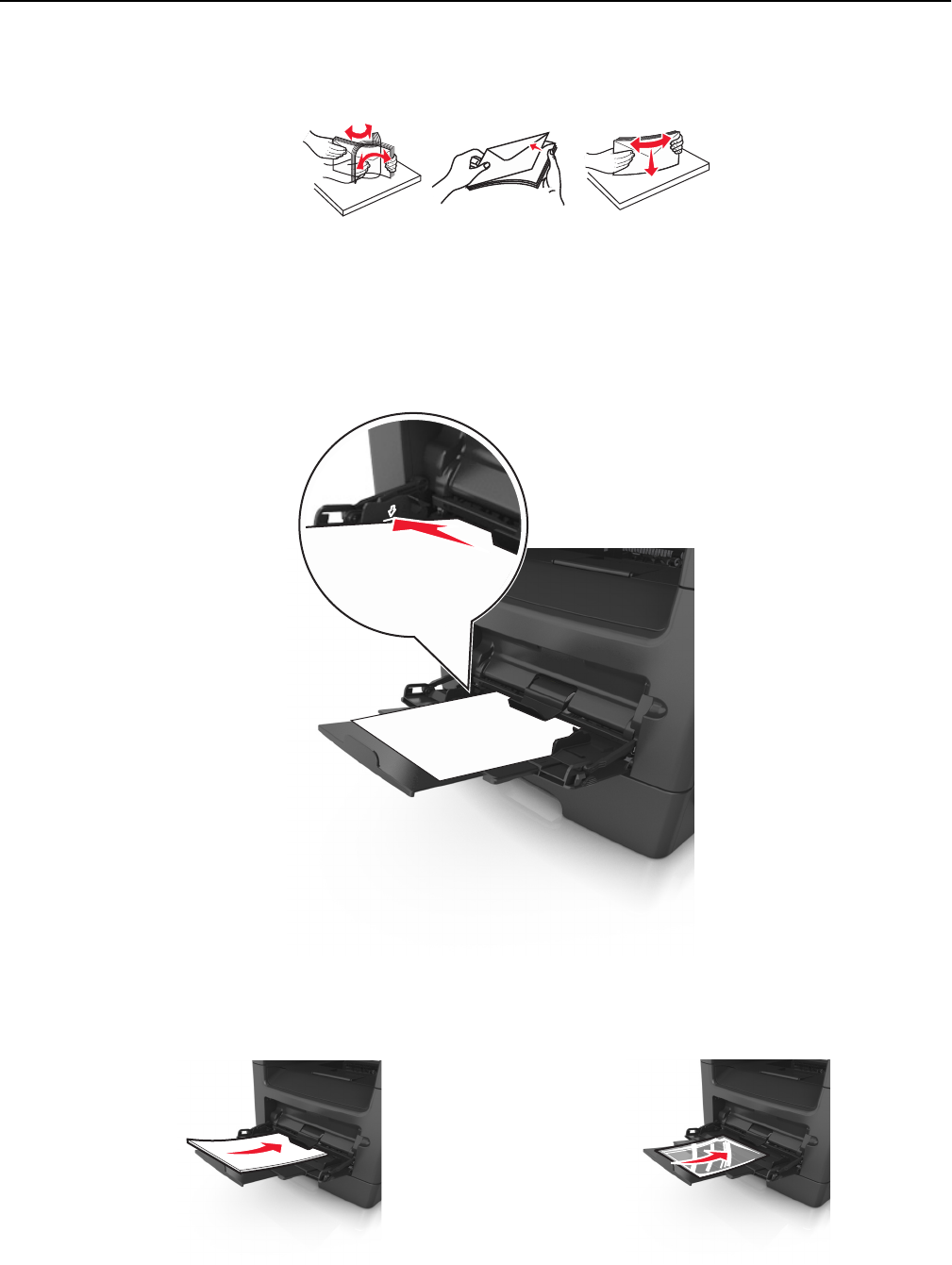
•Flex the stack of envelopes back and forth to loosen them, and then fan them. Straighten the edges on a level
surface.
4Load the paper or specialty media.
Notes:
•Do not force paper or specialty media into the multipurpose feeder.
•Make sure the paper or specialty media is below the maximum paper fill indicator located on the paper
guides. Overfilling may cause paper jams.
•Load paper, transparencies, and card stock with the recommended printable side faceup and the top edge
entering the printer first. For more information on loading transparencies, see the packaging that the
transparencies came in.
Loading paper and specialty media 59
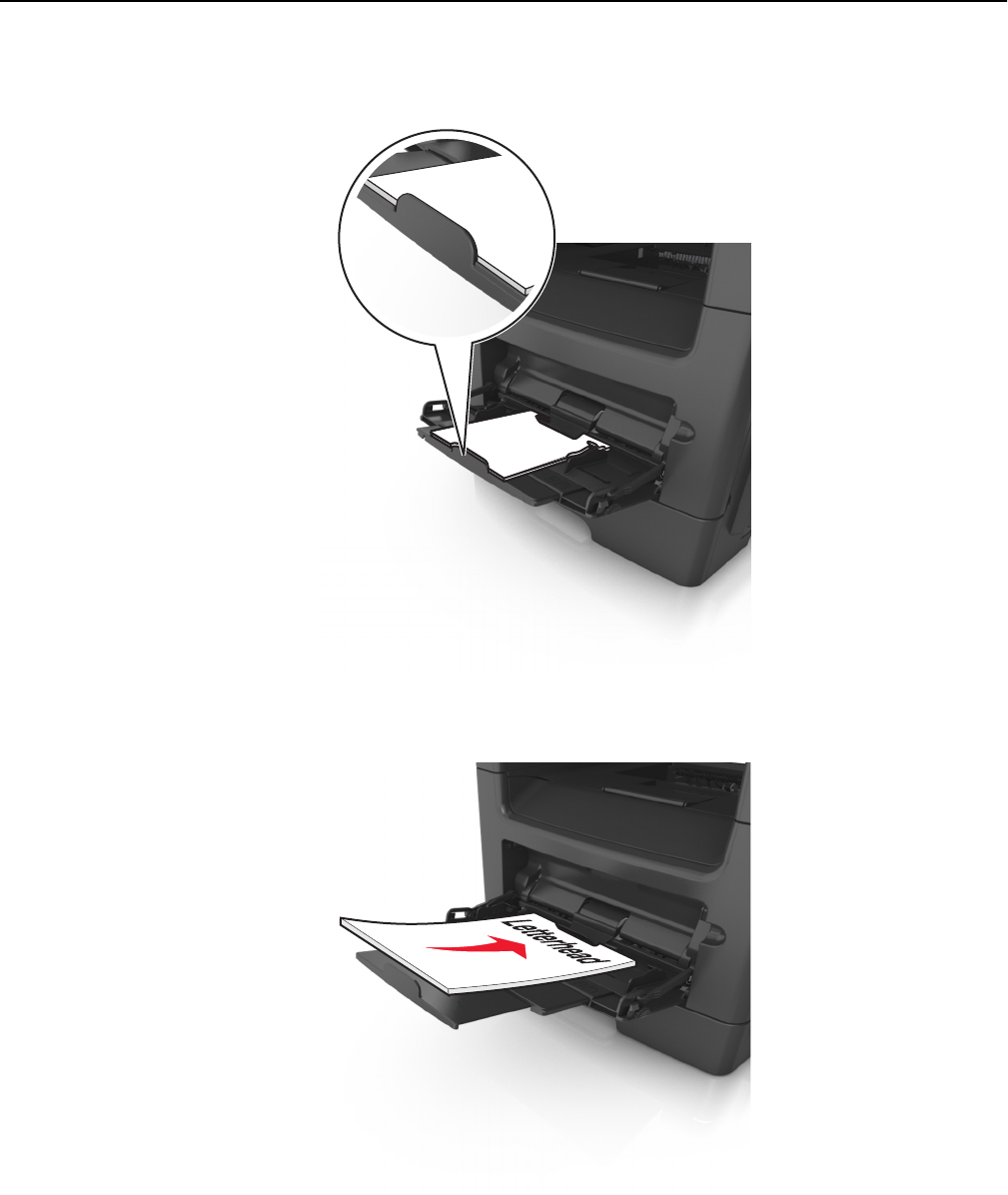
Note: When loading A6‑size paper, make sure the multipurpose feeder extender rests lightly against the
edge of the paper so that the last few sheets of paper remain in place.
•Load letterhead faceup with the top edge entering the printer first. For two‑sided (duplex) printing, load
letterhead facedown with the bottom edge entering the printer first.
Loading paper and specialty media 60
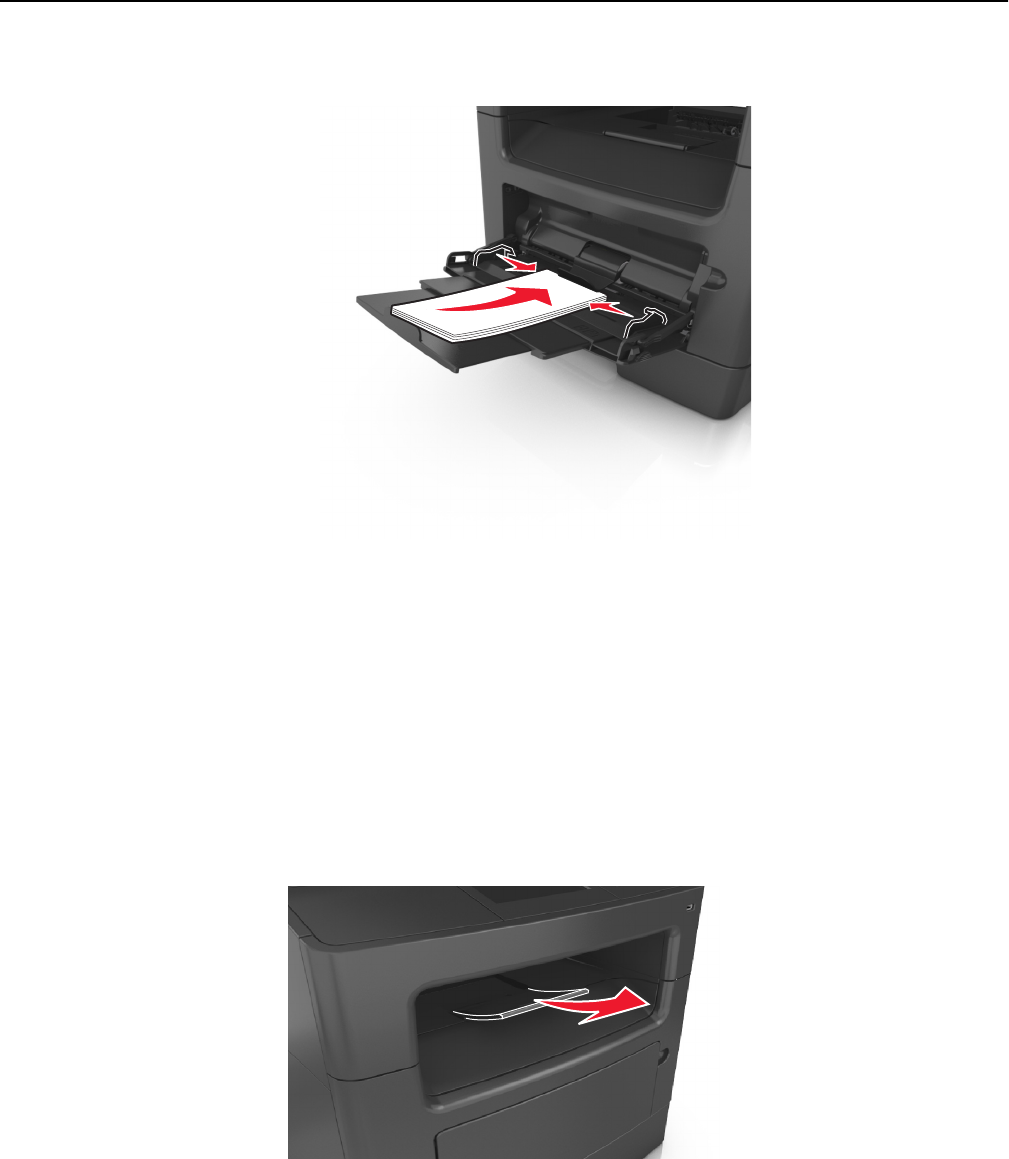
•Load envelopes with the flap on the left side facedown.
Warning—Potential Damage: Never use envelopes with stamps, clasps, snaps, windows, coated linings, or
self‑stick adhesives. These envelopes may severely damage the printer.
5From the printer control panel, set the paper size and paper type in the Paper menu to match the paper or specialty
media loaded in the multipurpose feeder.
Using the standard bin and paper stop
The standard bin holds up to 150 sheets of 20‑lb paper. It collects prints facedown. The standard bin includes a paper
stop that keeps paper from sliding out the front of the bin as it stacks.
To open the paper stop, pull it so that it flips forward.
Note: Close the paper stop when moving the printer to another location.
Loading paper and specialty media 61

Linking and unlinking trays
When the paper size and paper type for any trays are the same, the printer links those trays. When one linked tray
becomes empty, paper feeds from the next linked tray. We recommend giving all unique paper, such as letterhead and
different colored plain papers, a different custom type name so that the trays they are in do not automatically link.
Linking and unlinking trays
1Open a Web browser, and then type the printer IP address in the address field.
Notes:
•View the printer IP address on the printer home screen. The IP address appears as four sets of numbers
separated by periods, such as 123.123.123.123.
•If you are using a proxy server, then temporarily disable it to load the Web page correctly.
2Click Settings > Paper Menu.
3Change the paper size and type settings for the trays you are linking.
•To link trays, make sure the paper size and type for the tray match that of the other tray.
•To unlink trays, make sure the paper size or type for the tray does not match that of the other tray.
4Click Submit.
Note: You can also change the paper size and type settings using the printer control panel. For more information,
see “Setting the paper size and type” on page 51.
Warning—Potential Damage: Paper loaded in the tray should match the paper type name assigned in the printer.
The temperature of the fuser varies according to the specified paper type. Printing issues may occur if settings are
not properly configured.
Creating a custom name for a paper type
Using the Embedded Web Server
1Open a Web browser, and then type the printer IP address in the address field.
Notes:
•View the printer IP address on the printer home screen. The IP address appears as four sets of numbers
separated by periods, such as 123.123.123.123.
•If you are using a proxy server, then temporarily disable it to load the Web page correctly.
2Click Settings > Paper Menu > Custom Names.
3Select a custom name, and then type a custom paper type name.
4Click Submit.
5Click Custom Types, and then verify if the new custom paper type name has replaced the custom name.
Loading paper and specialty media 62

Using the printer control panel
1From the home screen, navigate to:
> Paper Menu > Custom Names
2Select a custom name, and then type a custom paper type name.
3Touch .
4Touch Custom Types, and then verify that the new custom paper type name has replaced the custom name.
Assigning a custom paper type
Using the Embedded Web Server
Assign a custom paper type name to a tray when linking or unlinking trays.
1Open a Web browser, and then type the printer IP address in the address field.
Notes:
•View the printer IP address on the printer home screen. The IP address appears as four sets of numbers
separated by periods, such as 123.123.123.123.
•If you are using a proxy server, then temporarily disable it to load the Web page correctly.
2Click Settings > Paper Menu > Custom Types.
3Select a custom paper type name, and then select a paper type
Note: Paper is the factory default paper type for all user‑defined custom names.
4Click Submit.
Using the printer control panel
1From the home screen, navigate to:
> Paper Menu > Custom Types
2Select a custom paper type name, and then select a paper type
Note: Paper is the factory default paper type for all user‑defined custom names.
3Touch .
Configuring a custom name
Using the Embedded Web Server
1Open a Web browser, and then type the printer IP address in the address field.
Notes:
•View the printer IP address on the printer home screen. The IP address appears as four sets of numbers
separated by periods, such as 123.123.123.123.
Loading paper and specialty media 63

•If you are using a proxy server, then temporarily disable it to load the Web page correctly.
2Click Settings > Paper Menu > Custom Types.
3Select a custom name you want to configure, then select a paper or specialty media type, and then click Submit.
Using the printer control panel
1From the home screen, navigate to:
> Paper Menu > Custom Types
2Select a custom name you want to configure, and then touch .
Loading paper and specialty media 64
Paper and specialty media guide
Using specialty media
Tips on using letterhead
•Use letterhead designed specifically for laser printers.
•Print samples on the letterhead being considered for use before buying large quantities.
•Before loading letterhead, flex, fan, and straighten the stack to prevent sheets from sticking together.
•Page orientation is important when printing on letterhead. For information on how to load letterhead, see:
–“Loading trays” on page 51
–“Loading the multipurpose feeder” on page 56
Tips on using transparencies
•Print a test page on the transparencies being considered for use before buying large quantities.
•Feed transparencies from the standard tray, or the multipurpose feeder.
•Use transparencies designed specifically for laser printers. Transparencies must be able to withstand temperatures
up to 185°C (365°F) without melting, discoloring, offsetting, or releasing hazardous emissions.
Note: If the transparency weight is set to Heavy and the transparency texture is set to Rough in the Paper menu,
then transparencies can be printed at a temperature up to 195°C (383°F).
•Avoid getting fingerprints on the transparencies to prevent print quality problems.
•Before loading transparencies, flex, fan, and straighten the stack to prevent sheets from sticking together.
Tips on using envelopes
Print samples on the envelopes being considered for use before buying large quantities.
•Use envelopes designed specifically for laser printers. Check with the manufacturer or vendor to ensure that the
envelopes can withstand temperatures up to 230°C (446°F) without sealing, wrinkling, curling excessively, or
releasing hazardous emissions.
•For best performance, use envelopes made from 90‑g/m2 (24‑lb bond) paper or 25% cotton. All‑cotton envelopes
must not exceed 75‑g/m2 (20‑lb bond) weight.
•Use only new envelopes from undamaged packages.
•To optimize performance and minimize jams, do not use envelopes that:
–Have excessive curl or twist
–Are stuck together or damaged in any way
–Have windows, holes, perforations, cutouts, or embossing
–Have metal clasps, string ties, or folding bars
–Have an interlocking design
–Have postage stamps attached
Paper and specialty media guide 65

–Have any exposed adhesive when the flap is in the sealed or closed position
–Have bent corners
–Have rough, cockle, or laid finishes
•Adjust the width guides to fit the width of the envelopes.
Note: A combination of high humidity (over 60%) and high printing temperature may wrinkle or seal envelopes.
Tips on using labels
Print samples on the labels being considered for use before buying large quantities.
Note: Use only paper label sheets. Vinyl, pharmacy, and two‑sided labels are not supported.
When printing on labels:
•Use labels designed specifically for laser printers. Check with the manufacturer or vendor to verify that:
–The labels can withstand temperatures up to 230°C (446°F) without sealing, excessive curling, wrinkling, or
releasing hazardous emissions.
–Label adhesives, face sheet (printable stock), and topcoats can withstand up to 25‑psi (172‑kPa) pressure without
delaminating, oozing around the edges, or releasing hazardous fumes.
•Do not use labels with slick backing material.
•Use full label sheets. Partial sheets may cause labels to peel off during printing, resulting in a jam. Partial sheets
also contaminate the printer and the cartridge with adhesive, and could void the printer and toner cartridge
warranties.
•Do not use labels with exposed adhesive.
•Do not print within 1 mm (0.04 inches) of the edge of the label, of the perforations, or between die‑cuts of the
label.
•Make sure the adhesive backing does not reach to the edge of the sheet. Zone coating of the adhesive should be
at least 1 mm (0.04 inches) away from edges. Adhesive material contaminates the printer and could void the
warranty.
•If zone coating of the adhesive is not possible, then remove a 2‑mm (0.06‑inches) strip on the leading and driver
edge, and use a non‑oozing adhesive.
•Portrait orientation is recommended, especially when printing bar codes.
Tips on using card stock
Card stock is heavy, single‑ply specialty media. Many of its variable characteristics, such as moisture content, thickness,
and texture, can significantly impact print quality. Print samples on the card stock being considered for use before
buying large quantities.
•From the Paper menu, set the Paper Type to Card Stock.
•Select the appropriate Paper Texture setting.
•Be aware that preprinting, perforation, and creasing may significantly affect the print quality and cause jams or
other paper handling problems.
•Check with the manufacturer or vendor to ensure the card stock can withstand temperatures up to 220°C (446°F)
without releasing hazardous emissions.
Paper and specialty media guide 66

•Do not use preprinted card stock manufactured with chemicals that may contaminate the printer. Preprinting
introduces semi‑liquid and volatile components into the printer.
•Use grain short card stock when possible.
Paper guidelines
Selecting the correct paper or specialty media reduces printing problems. For the best print quality, try a sample of the
paper or specialty media before buying large quantities.
Paper characteristics
The following paper characteristics affect print quality and reliability. Consider these characteristics when evaluating
new paper stock.
Weight
The standard printer trays can automatically feed paper weights up to 90‑g/m2 (24‑lb) bond grain long paper. The
optional trays can automatically feed paper weights up to 120‑g/m2 (32‑lb) bond grain long paper. The multipurpose
feeder can automatically feed paper weights up to 163‑g/m2 (43‑lb) bond grain long paper. Paper lighter than
60 g/m2 (16 lb) might not be stiff enough to feed properly, causing jams. For best performance, use 75‑g/m2 (20‑lb)
bond grain long paper. For paper smaller than 182 x 257 mm (7.2 x 10.1 inches), it is recommended to use 90 g/m2
(24 lb) or heavier paper.
Note: Two‑sided printing is supported only for 60–90‑g/m2 (16–24‑lb) bond paper.
Curl
Curl is the tendency for paper to curl at its edges. Excessive curl can cause paper feeding problems. Curl can occur after
the paper passes through the printer, where it is exposed to high temperatures. Storing paper unwrapped in hot, humid,
cold, or dry conditions, even in the trays, can contribute to paper curling prior to printing and can cause feeding
problems.
Smoothness
Paper smoothness directly affects print quality. If paper is too rough, toner cannot fuse to it properly. If paper is too
smooth, it can cause paper feeding or print quality issues. Always use paper between 100 and 300 Sheffield points;
smoothness between 150–250 Sheffield points produces the best print quality.
Moisture content
The amount of moisture in paper affects both print quality and the ability of the printer to feed the paper correctly.
Leave paper in its original wrapper until it is time to use it. This limits the exposure of paper to moisture changes that
can degrade its performance.
Condition paper before printing by storing it in its original wrapper in the same environment as the printer for 24–48
hours before printing. Extend the time to several days if the storage or transportation environment is very different
from the printer environment. Thick paper may also require a longer conditioning period.
Grain direction
Grain refers to the alignment of the paper fibers in a sheet of paper. Grain is either grain long, running the length of
the paper, or grain short, running the width of the paper.
Paper and specialty media guide 67

For 60–90‑g/m2 (16–24‑lb) bond paper, grain long paper is recommended.
Fiber content
Most high‑quality xerographic paper is made from 100% chemically treated pulped wood. This content provides the
paper with a high degree of stability resulting in fewer paper feeding problems and better print quality. Paper containing
fibers such as cotton can negatively affect paper handling.
Unacceptable paper
The following paper types are not recommended for use with the printer:
•Chemically‑treated papers used to make copies without carbon paper, also known as carbonless papers, carbonless
copy paper (CCP), or no carbon required (NCR) paper
•Preprinted papers with chemicals that may contaminate the printer
•Preprinted papers that can be affected by the temperature in the printer fuser
•Preprinted papers that require a registration (the precise print location on the page) greater or lesser than +/‑2.5 mm
(+/‑0.10 inch), such as optical character recognition (OCR) forms
In some cases, registration can be adjusted with a software application to successfully print on these forms:
•Coated papers (erasable bond), synthetic papers, thermal papers
•Rough‑edged, rough or heavily textured surface papers, or curled papers
•Recycled papers that fail EN12281:2002 (European)
•Paper weighing less than 60 g/m2 (16 lb)
•Multiple‑part forms or documents
Selecting paper
Using the appropriate paper prevents jams and helps ensure trouble‑free printing.
To help avoid paper jams and poor print quality:
•Always use new, undamaged paper.
•Before loading paper, know the recommended printable side of the paper. This information is usually indicated on
the paper package.
•Do not use paper that has been cut or trimmed by hand.
•Do not mix paper sizes, types, or weights in the same tray; mixing results in jams.
•Do not use coated papers unless they are specifically designed for electrophotographic printing.
Selecting preprinted forms and letterhead
Use these guidelines when selecting preprinted forms and letterhead:
•Use grain long for 60 to 90 g/m2 (16 to 24 lb) weight paper.
•Use only forms and letterhead printed using an offset lithographic or engraved printing process.
•Avoid papers with rough or heavily textured surfaces.
Paper and specialty media guide 68

Use papers printed with heat‑resistant inks designed for use in xerographic copiers. The ink must be able to withstand
temperatures up to 230°C (446°F) without melting or releasing hazardous emissions. Use inks that are not affected by
the resin in toner. Inks that are oxidation‑set or oil‑based generally meet these requirements; latex inks might not.
When in doubt, contact the paper supplier.
Preprinted papers such as letterhead must be able to withstand temperatures up to 230°C (446°F) without melting or
releasing hazardous emissions.
Using recycled paper and other office papers
•Low moisture content (4–5%)
•Suitable smoothness (100–200 Sheffield units, or 140–350 Bendtsen units, European)
Note: Some much smoother papers (such as premium 24 lb laser papers, 50–90 Sheffield units) and much
rougher papers (such as premium cotton papers, 200–300 Sheffield units) have been engineered to work very
well in laser printers, despite surface texture. Before using these types of paper, consult your paper supplier.
•Suitable sheet-to-sheet coefficient of friction (0.4–0.6)
•Sufficient bending resistance in the direction of feed
Recycled paper, paper of lower weight (<60 g/m2 [16 lb bond]) and/or lower caliper (<3.8 mils [0.1 mm]), and paper
that is cut grain-short for portrait (or short-edge) fed printers may have lower bending resistance than is required for
reliable paper feeding. Before using these types of paper for laser (electrophotographic) printing, consult your paper
supplier. Remember that these are general guidelines only and that paper meeting these guidelines may still cause
paper feeding problems in any laser printer (for example, if the paper curls excessively under normal printing
conditions).
Storing paper
Use these paper storage guidelines to help avoid jams and uneven print quality:
•For best results, store paper where the temperature is 21°C (70°F) and the relative humidity is 40 percent. Most
label manufacturers recommend printing in a temperature range of 18–24°C (65–75°F) with relative humidity
between 40 and 60 percent.
•Store paper in cartons, on a pallet or shelf, rather than on the floor.
•Store individual packages on a flat surface.
•Do not store anything on top of individual paper packages.
•Take paper out of the carton or wrapper only when you are ready to load it in the printer. The carton and wrapper
help keep the paper clean, dry, and flat.
Paper and specialty media guide 69
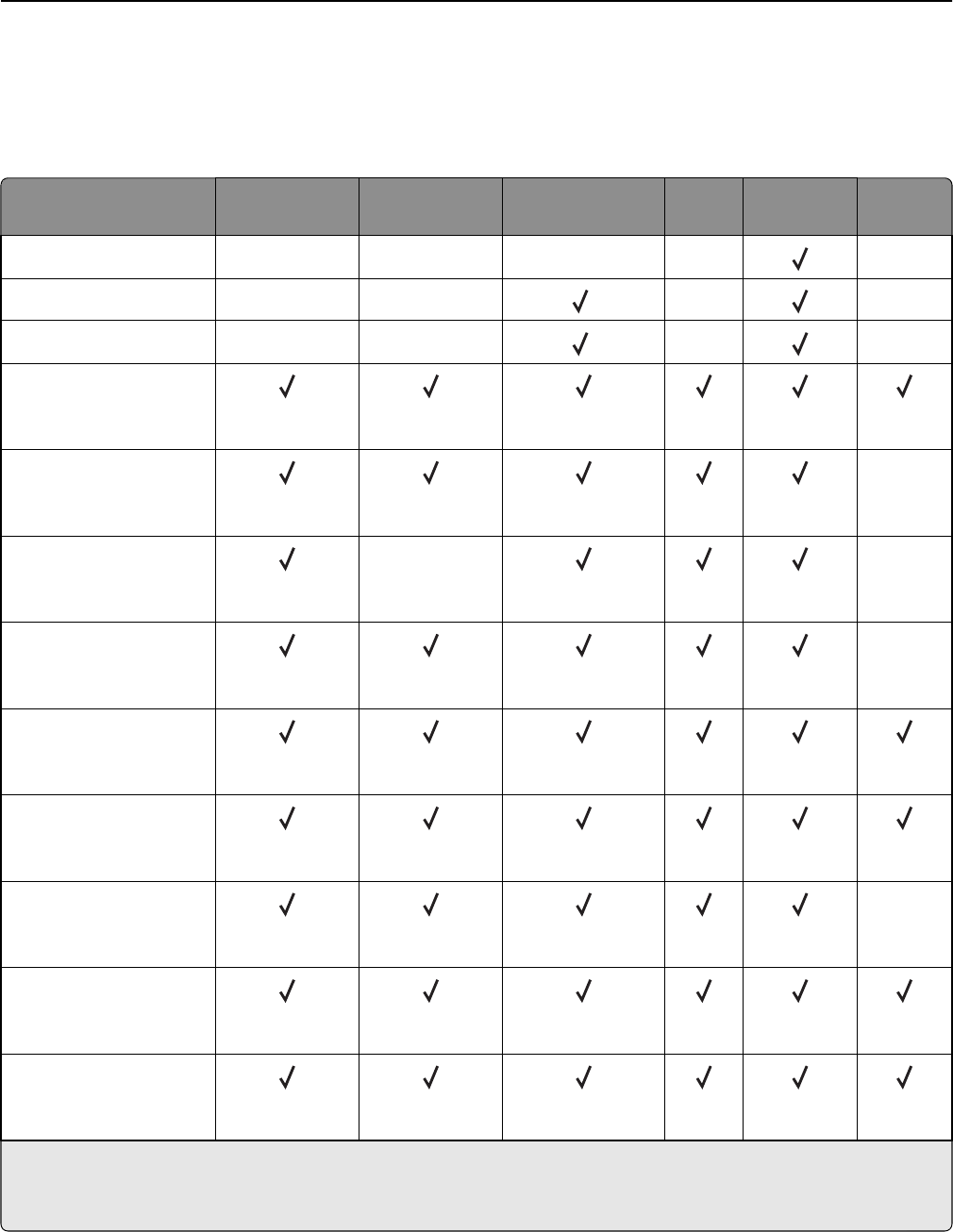
Supported paper sizes, types, and weights
Supported paper sizes
Paper size and dimension Standard
550‑sheet tray
Optional
550‑sheet tray
Multipurpose
feeder
ADF Scanner
glass
Duplex
printing
Business card X X X X X
3 x 5 X X 1X X
4 x 6 X X 1X X
A4
210 x 297 mm
(8.27 x 11.7 in.)
A5
148 x 210 mm
(5.83 x 8.27 in.)
X
A6
105 x 148 mm
(4.13 x 5.83 in.)
X X
JIS B5
182 x 257 mm
(7.17 x 10.1 in.)
X
Letter
215.9 x 279.4 mm
(8.5 x 11 in.)
Legal
215.9 x 355.6 mm
(8.5 x 14 in.)
Executive
184.2 x 266.7 mm
(7.25 x 10.5 in.)
X
Oficio (México)
215.9 x 340.4 mm
(8.5 x 13.4 in.)
Folio
215.9 x 330.2 mm
(8.5 x 13 in.)
1 Paper is supported only if the paper size setting is set to Universal.
2 Paper is supported in two‑sided (duplex) printing only if the width is at least 210 mm (8.27 in.) and the length is at least
279.4 mm (11 in.). The smallest supported Universal paper size is supported only in the multipurpose feeder.
Paper and specialty media guide 70
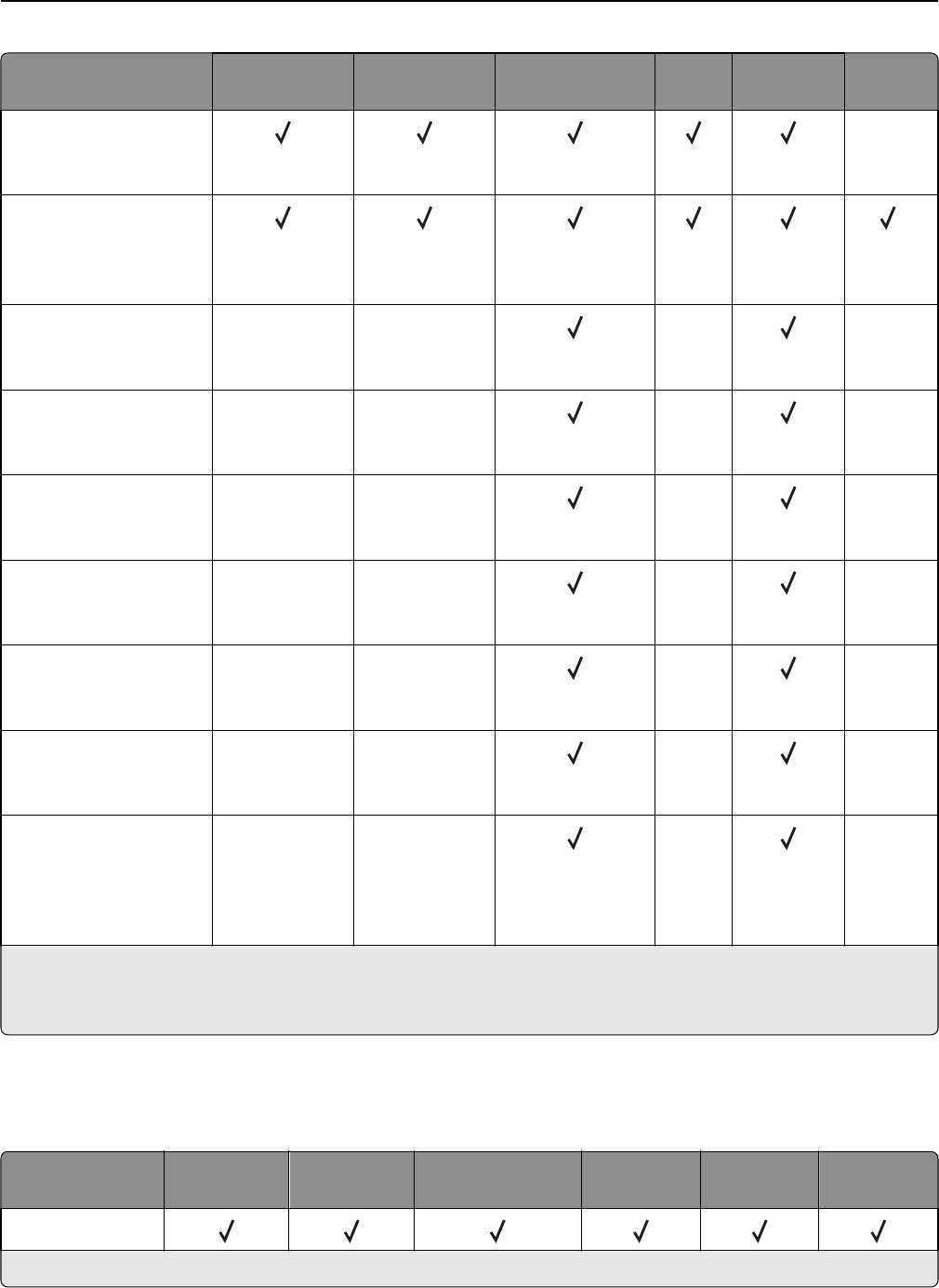
Paper size and dimension Standard
550‑sheet tray
Optional
550‑sheet tray
Multipurpose
feeder
ADF Scanner
glass
Duplex
printing
Statement
139.7 x 215.9 mm
(5.5 x 8.5 in.)
X
Universal2
76.2 x 127 mm (3 x 5 in.) to
215.9 x 359.92 mm
(8.5 x 14.17 in.)
2
7 3/4 Envelope (Monarch)
98.4 x 190.5 mm
(3.875 x 7.5 in.)
XX X X
9 Envelope
98.4 x 226.1 mm
(3.875 x 8.9 in.)
XX X X
10 Envelope
104.8 x 241.3 mm
(4.12 x 9.5 in.)
XX X X
DL Envelope
110 x 220 mm
(4.33 x 8.66 in.)
XX X X
C5 Envelope
162 x 229 mm
(6.38 x 9.01 in.)
XX X X
B5 Envelope
176 x 250 mm
(6.93 x 9.84 in.)
XX X X
Other Envelope
85.7 x 165 mm to
215.9 x 355.6 mm
(3.375 x 6.50 in. to
8.5 x 14 in.)
XX X X
1 Paper is supported only if the paper size setting is set to Universal.
2 Paper is supported in two‑sided (duplex) printing only if the width is at least 210 mm (8.27 in.) and the length is at least
279.4 mm (11 in.). The smallest supported Universal paper size is supported only in the multipurpose feeder.
Supported paper types and weights
Note: Labels, transparencies, envelopes, and card stock always print at a reduced speed.
Paper type Standard
550‑sheet tray
550‑sheet tray Multipurpose
feeder
Duplex mode ADF Scanner glass
Plain paper
* Use envelopes that lie flat when individually placed on a table facedown.
Paper and specialty media guide 71
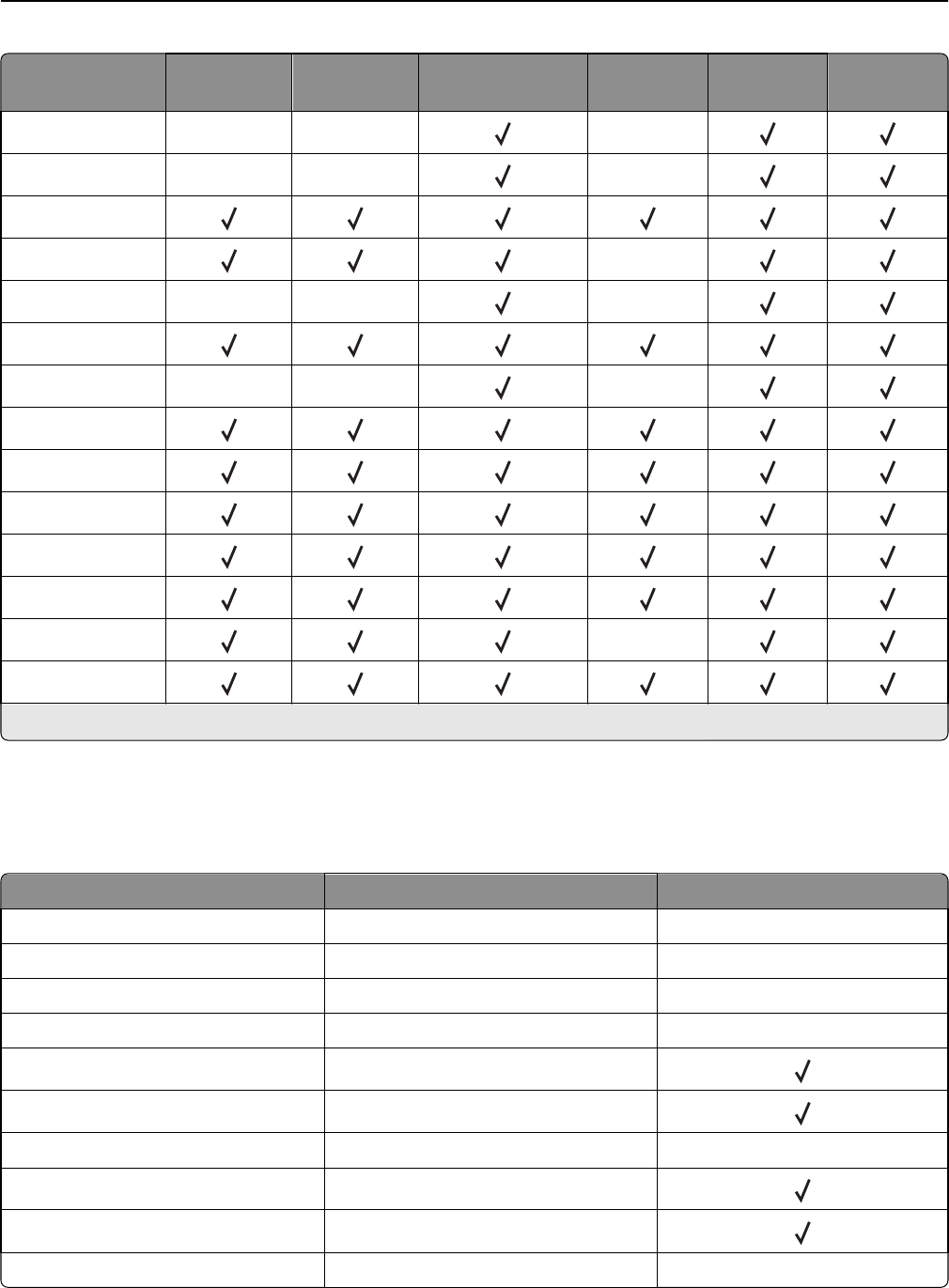
Paper type Standard
550‑sheet tray
550‑sheet tray Multipurpose
feeder
Duplex mode ADF Scanner glass
Card stock X X X
Transparencies X X X
Recycled
Paper labels X
Bond X X X
Envelope*
Rough envelope X X X
Letterhead
Preprinted
Colored paper
Light paper
Heavy paper
Rough/Cotton X
Custom Type [x]
* Use envelopes that lie flat when individually placed on a table facedown.
Paper sizes, types, and weights supported by the optional finisher
Supported paper sizes
Paper size Dimensions Staple finisher
A4 210 x 297 mm (8.3 x 11.7 in.) X
A5 148 x 210 mm (5.8 x 8.3 in.) X
A6 105 x 148 mm (4.1 x 5.8 in.) X
JIS B5 182 x 257 mm (7.2 x 10.1 in.) X
Letter 216 x 279 mm (8.5 x 11 in.)
Legal 216 x 356 mm (8.5 x 14 in.)
Executive 184 x 267 mm (7.3 x 10.5 in.) X
Oficio (México) 216 x 340 mm (8.5 x 13.4 in.)
Folio 216 x 330 mm (8.5 x 13 in.)
Statement 140 x 216 mm (5.5 x 8.5 in.) X
Paper and specialty media guide 72
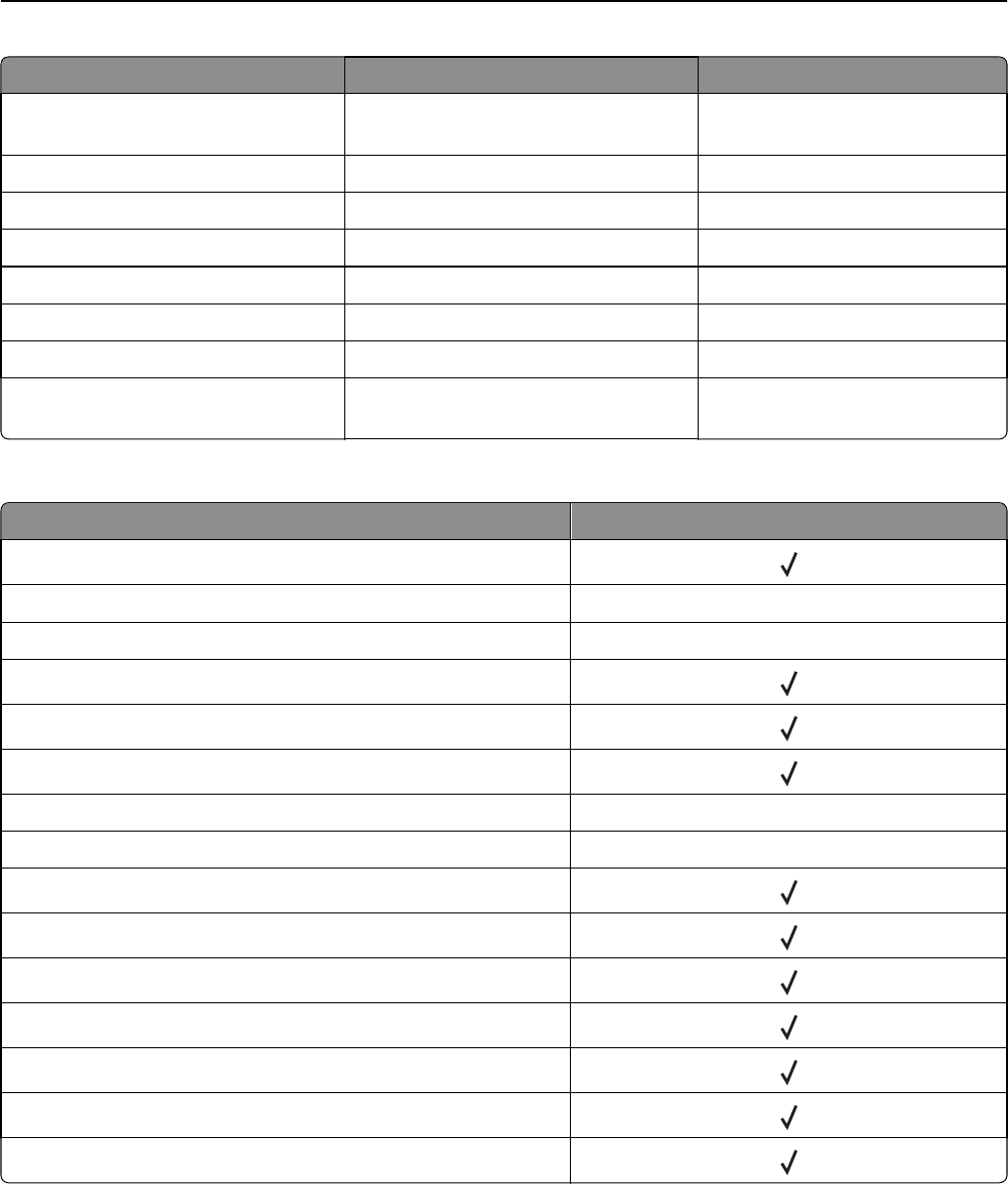
Paper size Dimensions Staple finisher
Universal 105 x 216 mm to 216 x 356 mm
(4.13 x 8.5 in. to 8.5 x 14 in.) X
7 3/4 Envelope (Monarch) 98 x 191 mm (3.9 x 7.5 in.) X
9 Envelope 98 x 225 mm (3.9 x 8.9 in.) X
10 Envelope 105 x 241 mm (4.1 x 9.5 in.) X
DL Envelope 110 x 220 mm (4.3 x 8.7 in.) X
C5 Envelope 162 x 229 mm (6.38 x 9.01 in.) X
B5 Envelope 176 x 250 mm (6.93 x 9.84 in.) X
Other Envelope 98 x 162 mm (3.9 x 6.4 in.) to 176 x 250 mm
(6.9 x 9.8 in.) X
Supported paper types and weights
Paper type Staple finisher
Plain paper
Card stock X
Transparencies X
Recycled
Paper labels
Bond
Envelope X
Rough envelope X
Letterhead
Preprinted
Colored paper
Light paper
Heavy paper
Rough/Cotton
Custom Type [x]
Paper and specialty media guide 73
Printing
Printing forms and a document
Printing forms
Use the Forms and Favorites application to quickly and easily access frequently used forms or other information that
is regularly printed. Before you can use this application, first set it up on the printer. For more information, see “Setting
up Forms and Favorites” on page 22.
1From the printer home screen, navigate to:
Forms and Favorites > select the form from the list > enter the number of copies > adjust other settings
2Depending on your printer model, touch , , or Submit.
Printing a document
1From the Paper menu on the printer control panel, set the paper type and size to match the paper loaded.
2Send the print job:
For Windows users
aWith a document open, click File > Print.
bClick Properties, Preferences, Options, or Setup.
cAdjust the settings, if necessary.
dClick OK > Print.
For Macintosh users
aCustomize the settings in the Page Setup dialog:
1With a document open, choose File > Page Setup.
2Choose a paper size or create a custom size to match the paper loaded.
3Click OK.
bCustomize the settings in the Print dialog:
1With a document open, choose File > Print.
If necessary, click the disclosure triangle to see more options.
2From the Print dialog and pop‑up menus, adjust the settings if necessary.
Note: To print on a specific paper type, adjust the paper type setting to match the paper loaded, or
select the appropriate tray or feeder.
3Click Print.
Adjusting toner darkness
1Open a Web browser, and then type the printer IP address in the address field.
Printing 74
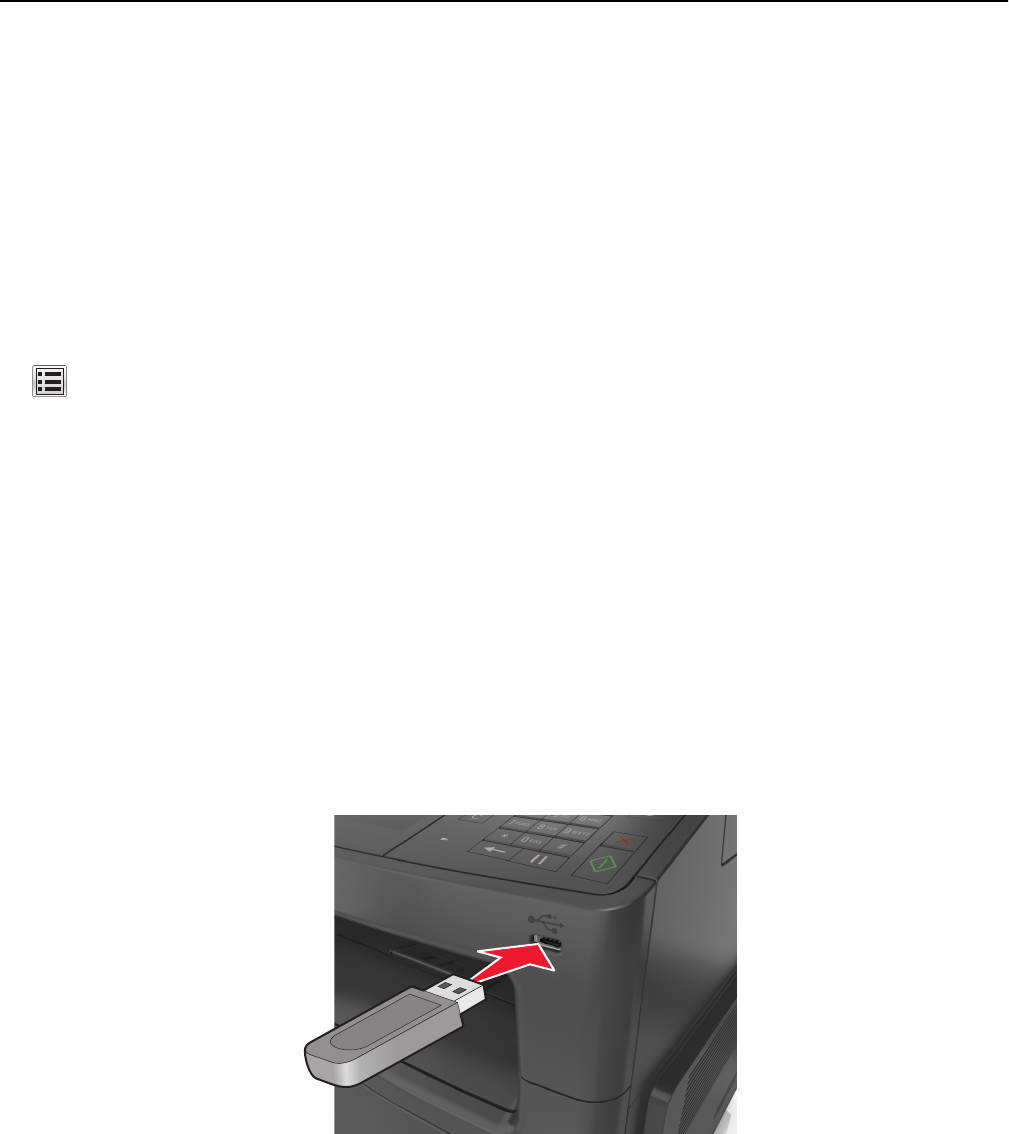
Notes:
•View the printer IP address on the printer home screen. The IP address appears as four sets of numbers
separated by periods, such as 123.123.123.123.
•If you are using a proxy server, then temporarily disable it to load the Web page correctly.
2Click Settings > Print Settings > Quality Menu > Toner Darkness.
3Adjust the toner darkness, and then click Submit.
Using the printer control panel
1From the home screen, navigate to:
> Settings > Print Settings > Quality Menu > Toner Darkness
2Adjust the setting, and then touch Submit.
Printing from a flash drive or mobile device
Printing from a flash drive
Notes:
•Before printing an encrypted PDF file, you will be prompted to type the file password from the printer control
panel.
•You cannot print files for which you do not have printing permissions.
1Insert a flash drive into the USB port.
Notes:
•A flash drive icon appears on the printer home screen when a flash drive is inserted.
•If you insert the flash drive when the printer requires attention, such as when a jam has occurred, then the
printer ignores the flash drive.
•If you insert the flash drive while the printer is processing other print jobs, then Busy appears on the printer
display. After these print jobs are processed, you may need to view the held jobs list to print documents
from the flash drive.
Printing 75
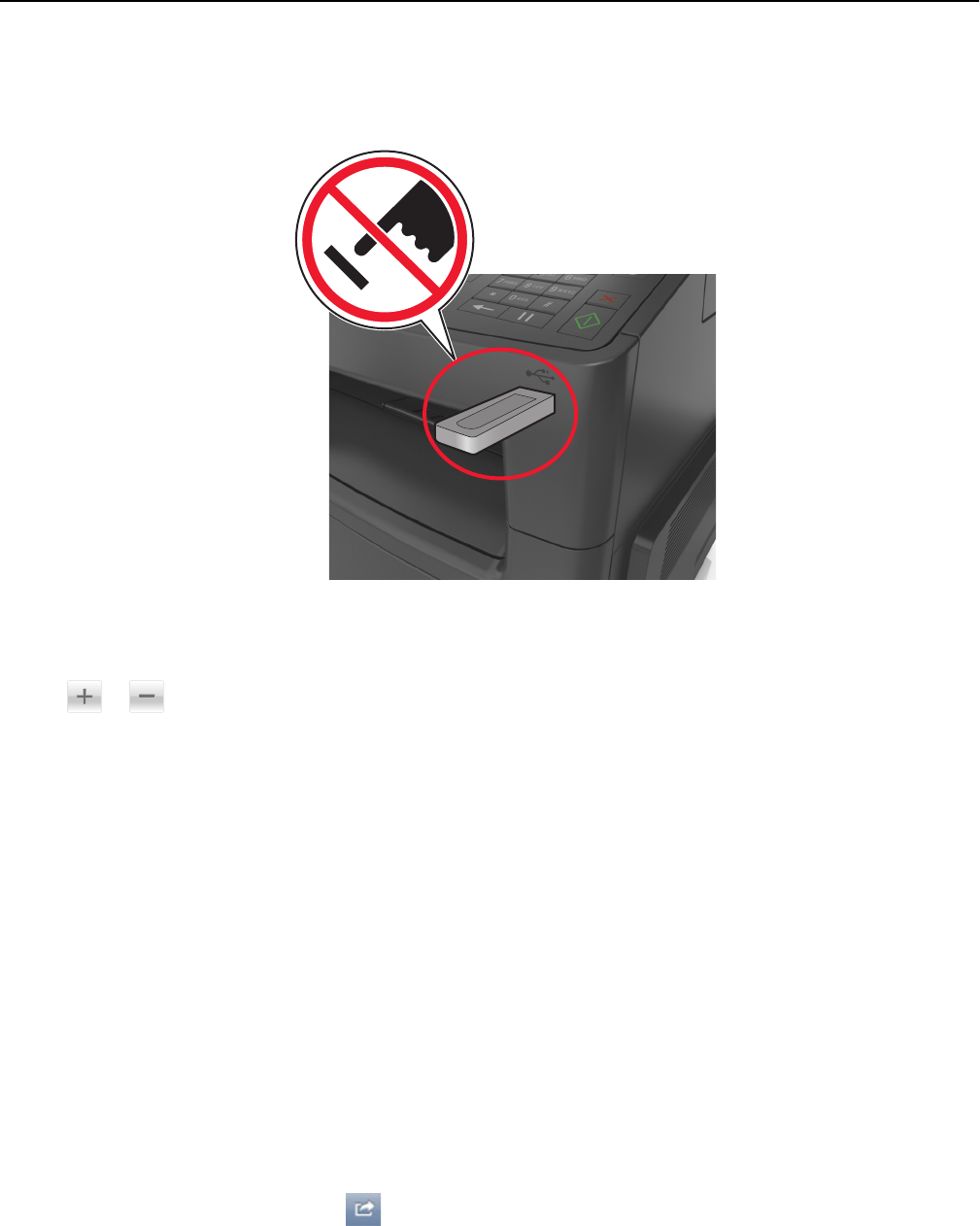
Warning—Potential Damage: Do not touch the USB cable, any wireless network adapter, any connector, the
memory device, or the printer in the areas shown while actively printing, reading, or writing from the memory
device. Loss of data can occur.
2From the printer control panel, touch the document you want to print.
3Touch the arrows to get a preview of the document.
4Use or to specify the number of copies to be printed, and then touch Print.
Notes:
•Do not remove the flash drive from the USB port until the document has finished printing.
•If you leave the flash drive in the printer after leaving the initial USB menu screen, then touch Held Jobs on
the home screen to print files from the flash drive.
Printing from a mobile device using AirPrint
AirPrintTM is a mobile printing application that allows you to print directly from your iPad® (all models), iPhone® (3GS
or later), or iPod touch® (3rd generation or later) to your AirPrint‑enabled printer. AirPrint‑enabled printers work with
these mobile devices that run the latest version of iOS.
Note: Make sure the printer and the mobile device share the same wireless network. For information on configuring
the wireless settings of your mobile device, see the documentation that came with the device.
1From the home screen of your mobile device, launch the application.
Note: You can print any content from these Apple applications: iBook, Mail, Photos, Safari, and some select App
Store applications.
2Select the item to print, and then tap .
3Tap Print, and then choose your printer.
4Set the print options you want, and then tap Print.
Printing 76
Printing from a mobile device using Dell Mobile Print
You can print directly from an Android mobile device (OS 2.1 or later) to your printer using Dell Mobile Print.
Notes:
•Make sure the printer and the mobile device share the same wireless network.
•For information on configuring the wireless settings, see the documentation that came with your mobile device.
1From Google Play, download the Dell Mobile Print application.
2From the home screen of your mobile device, tap .
3Select the item to print.
You can choose from the list of supported applications (such as Calendar, Contacts, Gallery, Google Docs, GMail,
Internet, Messaging, Word Documents, Excel Documents, PowerPoint Documents, and PDF Documents).
4From the print preview dialog, set the print and printer options if necessary.
Note: If your printer does not appear in the list, then check the network settings of both your printer and your
mobile device to make sure that both share the same wireless network.
5Tap Print.
Supported flash drives and file types
Notes:
•High‑speed USB flash drives must support the full‑speed standard. Low-speed USB devices are not supported.
•USB flash drives must support the File Allocation Table (FAT) system. Devices formatted with New Technology
File System (NTFS) or any other file system are not supported.
Recommended flash drives File type
Many flash drives are tested and approved for use with the printer. For more information, visit
www.dell.com/support/printers.
Documents:
•.pdf
•.xps
Images:
•.dcx
•.gif
•.jpeg or .jpg
•.bmp
•.pcx
•.tiff or .tif
•.png
•.fls
Printing 77
Printing confidential and other held jobs
Storing print jobs in the printer
1From the printer control panel, navigate to:
> Security > Confidential Print > select the print job type
Use To
Max Invalid PIN Limit the number of times an invalid PIN can be entered.
Note: When the limit is reached, the print jobs for that user name and PIN
are deleted.
Confidential Job Expiration Hold print jobs in the computer until you enter the PIN from the printer control
panel.
Note: The PIN is set from the computer. It must be four digits, using the
numbers 1–9.
Repeat Job Expiration Print and store print jobs in the printer memory.
Verify Job Expiration Print one copy of a print job and hold the remaining copies. It allows you to
examine if the first copy is satisfactory. The print job is automatically deleted
from the printer memory when all copies are printed.
Reserve Job Expiration Store print jobs for printing at a later time.
Note: The print jobs are held until deleted from the Held Jobs menu.
Notes:
•Confidential, Verify, Reserve, and Repeat print jobs may be deleted if the printer requires extra memory to
process additional held jobs.
•You can set the printer to store print jobs in the printer memory until you start the print job from the printer
control panel.
•All print jobs that can be initiated by the user at the printer are called held jobs.
2Touch Submit.
Printing confidential and other held jobs
Note: Confidential and Verify print jobs are automatically deleted from memory after printing. Repeat and Reserve
jobs are held in the printer until you delete them.
For Windows users
1With a document open, click File > Print.
2Click Properties, Preferences, Options, or Setup.
3Click Print and Hold.
4Select the print job type (Confidential, Repeat, Reserve, or Verify), and then assign a user name. For a confidential
print job, also enter a four‑digit PIN.
5Click OK or Print.
Printing 78

6From the printer home screen, release the print job.
•For confidential print jobs, navigate to:
Held jobs > select your user name > Confidential Jobs > enter the PIN > Print
•For other print jobs, navigate to:
Held jobs > select your user name > select the print job > specify the number of copies > Print
For Macintosh users
1With a document open, choose File > Print.
If necessary, click the disclosure triangle to see more options.
2From the print options or Copies & Pages pop‑up menu, choose Job Routing.
3Select the print job type (Confidential, Repeat, Reserve, or Verify), and then assign a user name. For a confidential
print job, also enter a four‑digit PIN.
4Click OK or Print.
5From the printer home screen, release the print job.
•For confidential print jobs, navigate to:
Held jobs > select your user name > Confidential Jobs > enter the PIN > Print
•For other print jobs, navigate to:
Held jobs > select your user name > select the print job > specify the number of copies > Print
Modifying confidential print settings
1Open a Web browser, and then type the printer IP address in the address field.
Notes:
•View the printer IP address on the printer home screen. The IP address appears as four sets of numbers
separated by periods, such as 123.123.123.123.
•If you are using a proxy server, then temporarily disable it to load the Web page correctly.
2Click Settings > Security > Confidential Print Setup.
3Modify the settings:
•Set a maximum number of PIN entry attempts. When a user exceeds that number, all of the jobs for that user
are deleted.
•Set an expiration time for confidential print jobs. When a user has not printed the jobs within that time, all of
the jobs for that user are deleted.
4Click Submit to save the modified settings.
Printing 79

Printing information pages
Printing a font sample list
1From the home screen, navigate to:
> Reports > Print Fonts
2Touch PCL Fonts or PostScript Fonts.
Printing a directory list
A directory list shows the resources stored in a flash memory or in the printer hard disk.
From the home screen, navigate to:
> Reports > Print Directory
Canceling a print job
Canceling a print job from the printer control panel
1From the printer control panel, touch Cancel Job or press on the keypad.
2Touch the print job you want to cancel, and then touch Delete Selected Jobs.
Note: If you press on the keypad, then touch Resume to return to the home screen.
Canceling a print job from the computer
For Windows users
1Open the printers folder, and then select your printer.
2From the print queue, select the print job you want to cancel, and then delete it.
For Macintosh users
1From System Preferences in the Apple menu, navigate to your printer.
2From the print queue, select the print job you want to cancel, and then delete it.
Printing 80
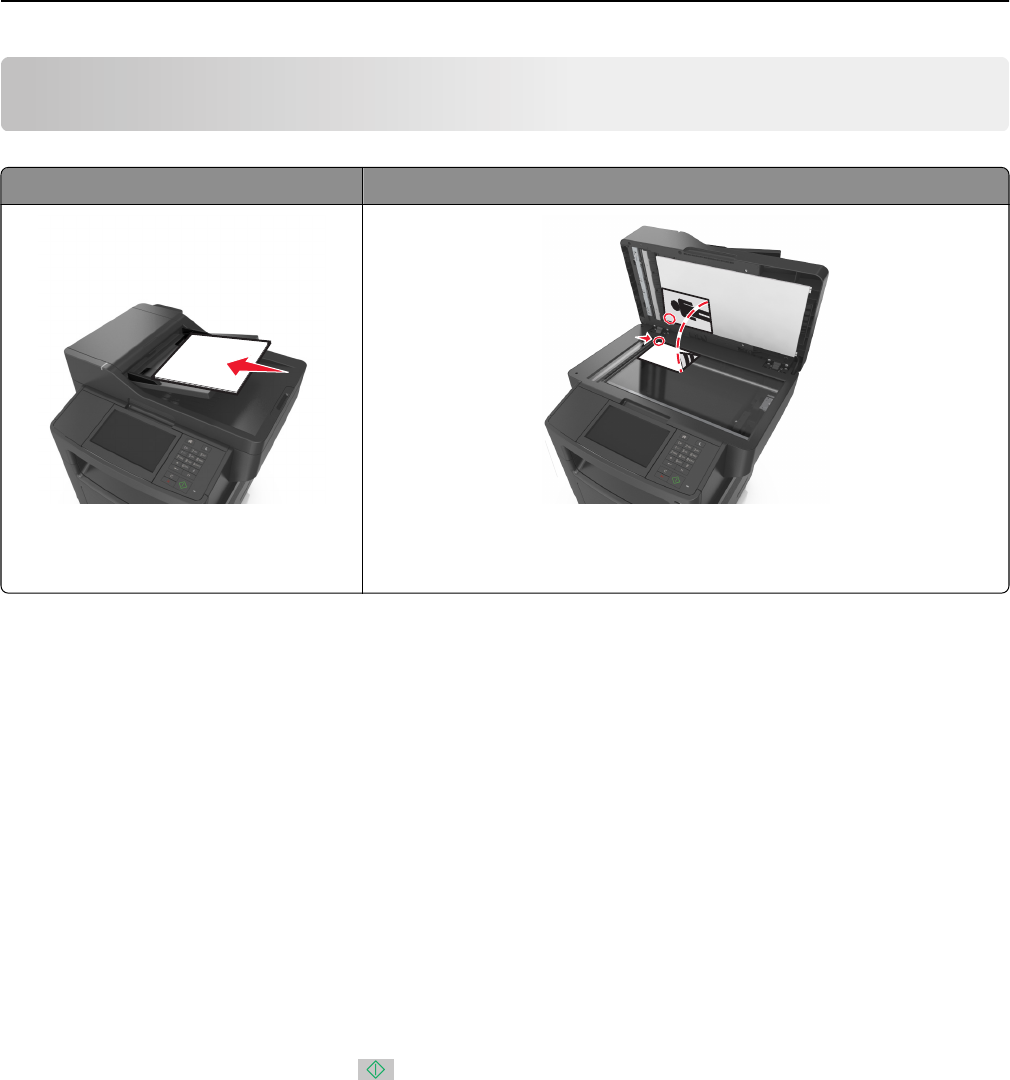
Copying
Automatic document feeder (ADF) Scanner glass
ABC
Use the ADF for multiple‑page documents. Use the scanner glass for single pages, small items (such as postcards or
photos), transparencies, photo paper, or thin media (such as magazine
clippings).
Making copies
Making a quick copy
1Load an original document faceup, short edge first into the ADF tray or facedown on the scanner glass.
Notes:
•Do not load postcards, photos, small items, transparencies, photo paper, or thin media (such as magazine
clippings) into the ADF tray. Place these items on the scanner glass.
•The ADF indicator light comes on when the paper is loaded properly.
2If you are loading a document into the ADF tray, then adjust the paper guides.
Note: To avoid a cropped image, make sure the size of the original document and the size of the copy paper are
the same.
3From the printer control panel, press .
Copying using the ADF
1Load an original document faceup, short edge first into the ADF tray.
Notes:
•Do not load postcards, photos, small items, transparencies, photo paper, or thin media (such as magazine
clippings) into the ADF tray. Place these items on the scanner glass.
•The ADF indicator light comes on when the paper is loaded properly.
2Adjust the paper guides.
Copying 81

3From the home screen, navigate to:
Copy > specify the copy settings > Copy It
Copying using the scanner glass
1Place an original document facedown on the scanner glass in the upper left corner.
2From the home screen, navigate to:
Copy > specify the copy settings > Copy It
If you have more pages to scan, then place the next document on the scanner glass, and then touch Scan the next
page.
3Touch Finish the Job.
Copying photos
1Place a photo facedown on the scanner glass in the upper left corner.
2From the home screen, navigate to:
Copy > Content > Photo >
3From the Content Source menu, navigate to:
Photo/Film > > Copy It
Note: If you have more photos to copy, then place the next photo on the scanner glass, and then touch Scan the
next page.
4Touch Finish the Job.
Copying on specialty media
Copying on transparencies
1Load an original document faceup, short edge first into the ADF tray or facedown on the scanner glass.
Notes:
•Do not load postcards, photos, small items, transparencies, photo paper, or thin media (such as magazine
clippings) into the ADF tray. Place these items on the scanner glass.
•The ADF indicator light comes on when the paper is loaded properly.
2From the home screen, navigate to:
Copy > Copy from > select the size of the original document >
Copying 82

3Navigate to:
Copy to > select the tray that contains transparencies > Copy It
If there are no trays that contain transparencies, then navigate to:
Manual Feeder > > select the size of the transparencies > > Transparency >
4Load transparencies into the multipurpose feeder, and then touch Copy It.
Copying on letterhead
1Load an original document faceup, short edge first into the ADF tray or facedown on the scanner glass.
Notes:
•Do not load postcards, photos, small items, transparencies, photo paper, or thin media (such as magazine
clippings) into the ADF tray. Place these items on the scanner glass.
•The ADF indicator light comes on when the paper is loaded properly.
2If you are loading a document into the ADF tray, then adjust the paper guides.
3From the home screen, navigate to:
Copy > Copy from > select the size of the original document >
4Navigate to:
Copy to > select the tray containing the letterhead > Copy It
5If there are no trays that support letterhead, then navigate to:
Manual Feeder > select the size of the letterhead > Letterhead
6Load the letterhead faceup, top edge first into the multipurpose feeder, and then touch Copy It.
Customizing copy settings
Copying to a different size
1Load an original document faceup, short edge first into the ADF tray or facedown on the scanner glass.
Notes:
•Do not load postcards, photos, small items, transparencies, photo paper, or thin media (such as magazine
clippings) into the ADF tray. Place these items on the scanner glass.
•The ADF indicator light comes on when the paper is loaded properly.
2If you are loading a document into the ADF tray, then adjust the paper guides.
3From the home screen, navigate to:
Copy > Copy from > select the size of the original document >
4Navigate to:
Copy to > select a new size for the copy > > Copy It
Copying 83

Making copies using paper from a selected tray
1Load an original document faceup, short edge first into the ADF tray or facedown on the scanner glass.
Notes:
•Do not load postcards, photos, small items, transparencies, photo paper, or thin media (such as magazine
clippings) into the ADF tray. Place these items on the scanner glass.
•The ADF indicator light comes on when the paper is loaded properly.
2If you are loading a document into the ADF tray, then adjust the paper guides.
3From the home screen, navigate to:
Copy > Copy from > select the size of the original document >
4Navigate to:
Copy to > select the tray containing the paper type you want to use >
5Touch Copy It.
Copying different paper sizes
Use the ADF to copy original documents with different paper sizes. Depending on the paper sizes loaded and the “Copy
to” and “Copy from” settings, each copy is either printed on mixed paper sizes (Example 1) or scaled to fit a single paper
size (Example 2).
Example 1: Copying on mixed paper sizes
1Load an original document faceup, short edge first into the ADF tray or facedown on the scanner glass.
Notes:
•Do not load postcards, photos, small items, transparencies, photo paper, or thin media (such as magazine
clippings) into the ADF tray. Place these items on the scanner glass.
•The ADF indicator light comes on when the paper is loaded properly.
2If you are loading a document into the ADF tray, then adjust the paper guides.
3From the home screen, navigate to:
Copy > Copy from > Mixed Sizes >
4Navigate to:
Copy to > Auto Size Match > > Copy It
The scanner identifies the different paper sizes as they are scanned. Copies are printed on mixed paper sizes
corresponding to the paper sizes of the original document.
Example 2: Copying on a single paper size
1Load an original document faceup, short edge first into the ADF tray or facedown on the scanner glass.
Notes:
•Do not load postcards, photos, small items, transparencies, photo paper, or thin media (such as magazine
clippings) into the ADF tray. Place these items on the scanner glass.
Copying 84

•The ADF indicator light comes on when the paper is loaded properly.
2If you are loading a document into the ADF tray, then adjust the paper guides.
3From the home screen, navigate to:
Copy > Copy from > Mixed Sizes >
4Navigate to:
Copy to > Letter > > Copy It
The scanner identifies the different paper sizes as they are scanned, and then scales the mixed paper sizes to fit on
the paper size selected.
Copying on both sides of the paper (duplexing)
1Load an original document faceup, short edge first into the ADF tray or facedown on the scanner glass.
Notes:
•Do not load postcards, photos, small items, transparencies, photo paper, or thin media (such as magazine
clippings) into the ADF tray. Place these items on the scanner glass.
•The ADF indicator light comes on when the paper is loaded properly.
2If you are loading a document into the ADF tray, then adjust the paper guides.
3From the home screen, navigate to:
Copy > Sides (Duplex) > select the preferred duplexing method
Note: For the preferred duplexing method, the first number represents sides of the original documents while
the second number represents sides of the copy. For example, select “2 sided to 2 sided” if you have two-sided
original documents and you want two‑sided copies.
4Touch > Copy It.
Reducing or enlarging copies
Copies can be scaled from 25% to 400% of the original document size.
1Load an original document faceup, short edge first into the ADF tray or facedown on the scanner glass.
Notes:
•Do not load postcards, photos, small items, transparencies, photo paper, or thin media (such as magazine
clippings) into the ADF tray. Place these items on the scanner glass.
•The ADF indicator light comes on when the paper is loaded properly.
2If you are loading a document into the ADF tray, then adjust the paper guides.
3From the home screen, touch Copy.
Copying 85

4From the Scale area, touch or to decrease or increase the value by 1%.
Touching “Copy to” or “Copy from” after setting Scale manually changes the scale value back to Auto.
Note: Auto is the factory default setting. This automatically adjusts the scan image of the original document to
fit the size of the paper onto which you are copying.
5Touch Copy It.
Adjusting copy quality
1Load an original document faceup, short edge first into the ADF tray or facedown on the scanner glass.
Notes:
•Do not load postcards, photos, small items, transparencies, photo paper, or thin media (such as magazine
clippings) into the ADF tray. Place these items on the scanner glass.
•The ADF indicator light comes on when the paper is loaded properly.
2If you are loading a document into the ADF tray, then adjust the paper guides.
3From the home screen, navigate to:
Copy > Content
4Touch the button that best represents the content type of the document you are copying.
•Text—The content of the original document is mostly text or line art.
•Text/Photo—The original document is a mixture of text, graphics, and photos.
•Photo—The original document is mostly a photo or an image.
•Graphics—The original document is mostly business‑type graphics, such as pie charts, bar charts, and
animations.
5Touch .
6Touch the button that best represents the content source of the document you are copying.
•Color Laser—The original document was printed using a color laser printer.
•Inkjet—The original document was printed using an inkjet printer.
•Magazine—The original document is from a magazine.
•Press—The original document was printed using a printing press.
•Black/White Laser—The original document was printed using a mono laser printer.
•Photo/Film—The original document is a photo from a film.
•Newspaper—The original document is from a newspaper.
•Other—The original document was printed using an alternate or unknown printer.
7Touch > Copy It.
Collating copies
If you print multiple copies of a document, then you can choose to print the copies as a set (collated) or to print the
copies as groups of pages (not collated).
Copying 86
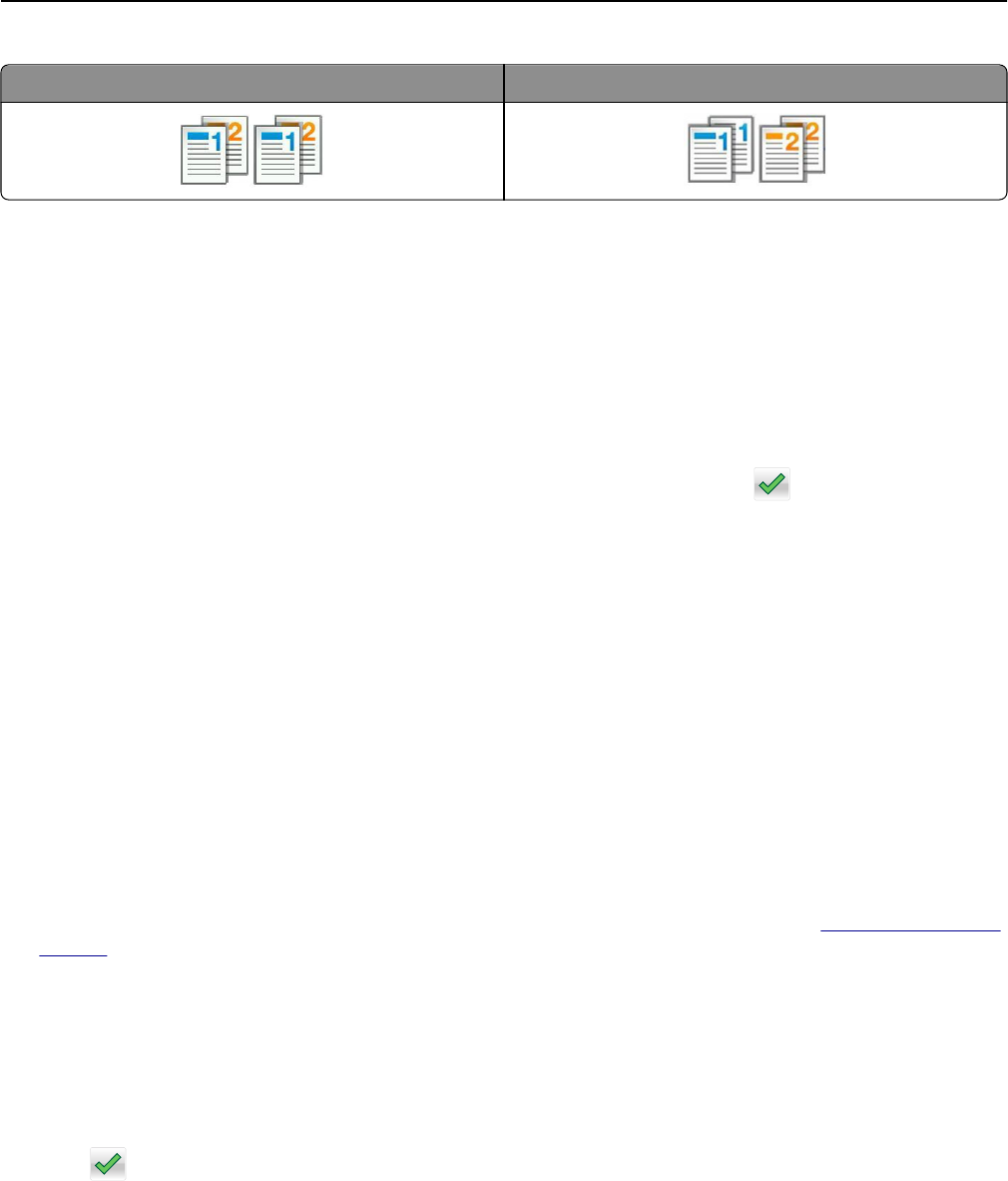
Collated Not collated
1Load an original document faceup, short edge first into the ADF tray or facedown on the scanner glass.
Notes:
•Do not load postcards, photos, small items, transparencies, photo paper, or thin media (such as magazine
clippings) into the ADF tray. Place these items on the scanner glass.
•The ADF indicator light comes on when the paper is loaded properly.
2If you are loading a document into the ADF tray, then adjust the paper guides.
3From the home screen, navigate to:
Copy > enter the number of copies > Collate > select the preferred order of pages > > Copy It
Placing separator sheets between copies
1Load an original document faceup, short edge first into the ADF tray or facedown on the scanner glass.
Notes:
•Do not load postcards, photos, small items, transparencies, photo paper, or thin media (such as magazine
clippings) into the ADF tray. Place these items on the scanner glass.
•The ADF indicator light comes on when the paper is loaded properly.
2If you are loading a document into the ADF tray, then adjust the paper guides.
3From the home screen, navigate to:
Copy > Advanced Options > Separator Sheets
Note: Set Collate to “1,2,3 ‑ 1,2,3” to place separator sheets between copies. If Collate is set to “1,1,1 ‑ 2,2,2,”
then the separator sheets are added to the end of the copy job. For more information, see “Collating copies” on
page 86.
4Select one of the following:
•Between Copies
•Between Jobs
•Between Pages
•Off
5Touch > Copy It.
Copying multiple pages onto a single sheet
In order to save paper, you can copy either two or four consecutive pages of a multiple‑page document onto a single
sheet of paper.
Copying 87

Notes:
•Make sure to set the paper size to letter, legal, A4, or JIS B5.
•Make sure to set the copy size to 100%.
1Load an original document faceup, short edge first into the ADF tray or facedown on the scanner glass.
Notes:
•Do not load postcards, photos, small items, transparencies, photo paper, or thin media (such as magazine
clippings) into the ADF tray. Place these items on the scanner glass.
•The ADF indicator light comes on when the paper is loaded properly.
2If you are loading a document into the ADF tray, then adjust the paper guides.
3From the home screen, navigate to:
Copy > Advanced Options > Paper Saver > select the output you want > > Copy It
Note: If Paper Saver is set to Off, then the Print Page Borders option is unavailable.
Creating a custom copy job
The custom copy job or job build is used to combine one or more sets of original documents into a single copy job. Each
set may be scanned using different job parameters. When a copy job is submitted and Custom Job is enabled, the
scanner scans the first set of original documents using the specified settings, and then it scans the next set with the
same or different settings.
The definition of a set depends on the scan source:
•If you scan a document on the scanner glass, then a set consists of one page.
•If you scan multiple pages using the ADF, then a set consists of all scanned pages until the ADF tray becomes empty.
•If you scan one page using the ADF, then a set consists of one page.
For example:
1Load an original document faceup, short edge first into the ADF tray or facedown on the scanner glass.
Notes:
•Do not load postcards, photos, small items, transparencies, photo paper, or thin media (such as magazine
clippings) into the ADF tray. Place these items on the scanner glass.
•The ADF indicator light comes on when the paper is loaded properly.
2If you are loading a document into the ADF tray, then adjust the paper guides.
3From the home screen, navigate to:
Copy > Advanced Options > Custom Job > On > > Copy It
Note: When the end of a set is reached, the scan screen appears.
4Load the next document faceup, short edge first into the ADF tray or facedown on the scanner glass, and then touch
Scan from automatic feeder or Scan from flatbed.
Note: Change the scan job settings, if necessary.
5If you have another document to scan, then repeat the previous step. Otherwise, touch Finish the job.
Copying 88

Placing information on copies
Placing a header or footer on pages
1Load an original document faceup, short edge first into the ADF tray or facedown on the scanner glass.
Notes:
•Do not load postcards, photos, small items, transparencies, photo paper, or thin media (such as magazine
clippings) into the ADF tray. Place these items on the scanner glass.
•The ADF indicator light comes on when the paper is loaded properly.
2If you are loading a document into the ADF, then adjust the paper guides.
3From the home screen, navigate to:
Copy > Advanced Options > Header/Footer > select where you want to place the header or footer > select the type
of header or footer you want
4Enter the required information depending on the header or footer you selected, and then touch Done.
5Touch , and then press .
Placing an overlay message on each page
An overlay message can be placed on each page. The message choices are Urgent, Confidential, Copy, Custom, and
Draft.
1Load an original document faceup, short edge first into the ADF tray or facedown on the scanner glass.
Notes:
•Do not load postcards, photos, small items, transparencies, photo paper, or thin media (such as magazine
clippings) into the ADF tray. Place these items on the scanner glass.
•The ADF indicator light comes on when the paper is loaded properly.
2If you are loading a document into the ADF tray, then adjust the paper guides.
3From the home screen, navigate to:
Copy > Advanced Options > Overlay > select overlay message > Done > Copy It
Canceling a copy job
Canceling a copy job while the original document is in the ADF
When the ADF begins processing a document, touch Cancel Job on the printer control panel.
Canceling a copy job while copying pages using the scanner glass
From the home screen, touch Cancel Job.
Canceling appears on the display. When the job is canceled, the Copy screen appears.
Copying 89

Canceling a copy job while pages are being printed
1From the printer control panel, touch Cancel Job or press on the keypad.
2Touch the job you want to cancel, and then touch Delete Selected Jobs.
Note: If you press on the keypad, then touch Resume to return to the home screen.
Understanding the copy options
Copy from
This option opens a screen where you can select the paper size of the original document.
•Touch the paper size that matches the original document.
•To copy an original document that contains mixed paper sizes with the same width, touch Mixed Sizes.
•To set the printer to automatically detect the size of the original document, touch Auto Size Sense.
Copy to
This option opens a screen where you can enter the paper size and type on which your copies will be printed.
•Touch the paper size and type that matches the paper loaded.
•If the settings for “Copy from” and “Copy to” are different, then the printer automatically adjusts the Scale setting
to accommodate the difference.
•If the paper type or size that you want to copy onto is not loaded in one of the trays, then touch Manual Feeder,
and manually load the paper in the multipurpose feeder.
•When “Copy to” is set to Auto Size Match, each copy matches the paper size of the original document. If a matching
paper size is not in one of the trays, then Paper size not found appears and prompts to load a paper in a
tray or multipurpose feeder.
Scale
This option lets you scale the document from 25% to 400% of the original document size. You can also set automatic
scaling.
•When copying to a different paper size, such as from legal‑size to letter‑size paper, set the “Copy from” and “Copy
to” paper sizes automatically to scale the scan image to fit the size of the paper onto which you are copying.
•To decrease or increase the value by 1%, touch or on the printer control panel. To make a continuous
decrease or increase in value, hold the button for two seconds or more.
Darkness
This option lets you adjust how light or dark the copies are in relation to the original document.
Sides (Duplex)
This option lets you make one- or two-sided copies from one- or two-sided original documents.
Copying 90

Collate
This option keeps the pages of a print job stacked in sequence when printing multiple copies of the document.
Copies
This option lets you set the number of copies to be printed.
Content
This option lets you set the original document type and source.
Select from the following content types:
•Text—The content of the original document is mostly text or line art.
•Text/Photo—The original document is a mixture of text, graphics, and photos.
•Photo—The original document is mostly a photo or an image.
•Graphics—The original document is mostly business‑type graphics, such as pie charts, bar charts, and animations.
Select from the following content sources:
•Color Laser—The original document was printed using a color laser printer.
•Inkjet—The original document was printed using an inkjet printer.
•Magazine—The original document is from a magazine.
•Brochure—The original document is from a brochure.
•Black/White Laser—The original document was printed using a mono laser printer.
•Photo/Film—The original document is a photo from film.
•Newspaper—The original document is from a newspaper.
•Other—The original document was printed using an alternate or unknown printer.
Save As Shortcut
This option lets you save the current settings by assigning a shortcut number.
Using the advanced options
Select from the following settings:
•Advanced Imaging—This adjusts the Background Removal, Color Balance, Color Dropout, Contrast, JPEG Quality,
Mirror Image, Negative Image, Scan Edge to Edge, Shadow Detail, and Sharpness settings before you scan the
document.
•Custom Job—This combines multiple scanning jobs into a single job.
•Edge Erase—This removes smudges or marks around the edges of a document. You can choose to remove an equal
area around all four sides of the paper, or pick a particular edge. Edge Erase erases whatever is within the area
selected, leaving nothing on that portion of the scan.
•Transmission Log—This prints the transmission log or transmission error log.
•Adjust ADF Skew—This straightens scanned images that are slightly skewed when received from the ADF tray.
Note: This option is supported only in select printer models.
Copying 91
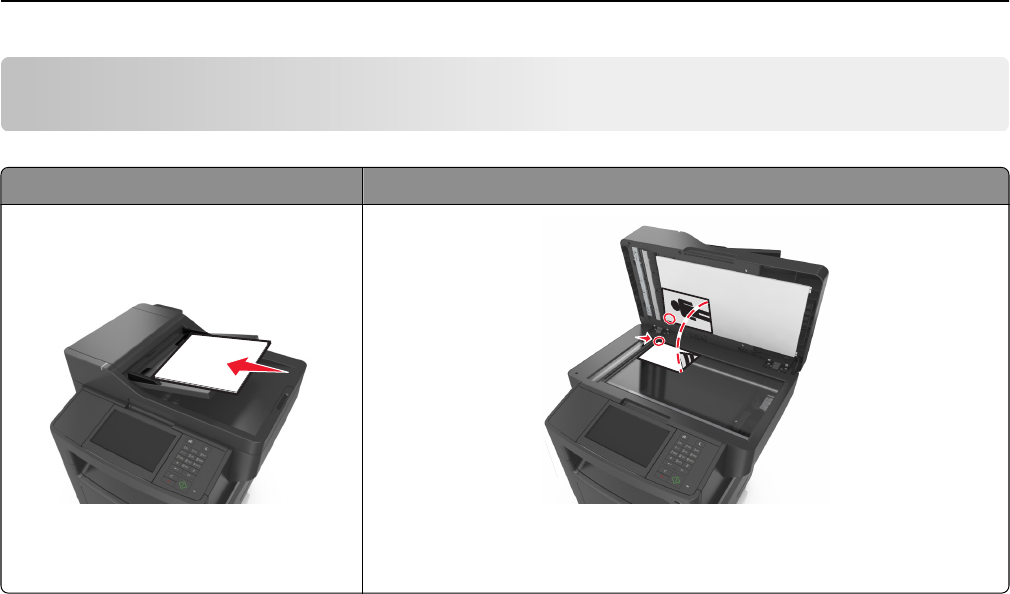
E-mailing
Automatic document feeder (ADF) Scanner glass
ABC
Use the ADF for multiple‑page documents. Use the scanner glass for single pages, small items (such as postcards or
photos), transparencies, photo paper, or thin media (such as magazine
clippings).
You can use the printer to e‑mail scanned documents to one or more recipients in a number of ways. You can type the
e‑mail address, use a shortcut number, or use the address book.
Setting up the printer to e-mail
Setting up the e-mail function
1Open a Web browser, and then type the printer IP address in the address field.
Notes:
•View the printer IP address on the printer home screen. The IP address appears as four sets of numbers
separated by periods, such as 123.123.123.123.
•If you are using a proxy server, then temporarily disable it to load the Web page correctly.
2Click Settings > E-mail/FTP Settings > E-mail Settings.
3Enter the appropriate information, and then click Submit.
Configuring e‑mail settings
1Open a Web browser, and then type the printer IP address in the address field.
Notes:
•View the printer IP address on the printer home screen. The IP address appears as four sets of numbers
separated by periods, such as 123.123.123.123.
•If you are using a proxy server, then temporarily disable it to load the Web page correctly.
2Click Settings > E-mail/FTP Settings > E-mail Settings.
E-mailing 92

3Enter the appropriate information, and then click Submit.
Creating an e-mail shortcut
Creating an e-mail shortcut using the Embedded Web Server
1Open a Web browser, and then type the printer IP address in the address field.
Notes:
•View the printer IP address on the printer home screen. The IP address appears as four sets of numbers
separated by periods, such as 123.123.123.123.
•If you are using a proxy server, then temporarily disable it to load the Web page correctly.
2Click Settings.
3From the Other Settings column, click Manage Shortcuts > E-mail Shortcut Setup.
4Type a unique name for the e‑mail recipient, and then type the e‑mail address. If you are entering multiple addresses,
then separate each address with a comma.
5Click Add.
Creating an e-mail shortcut using the printer control panel
1From the home screen, navigate to:
E-mail > Recipient > type an e‑mail address
To create a group of recipients, touch Next address, and then type the next recipient’s e-mail address.
2Touch Subject, then type the e‑mail subject, and then touch Done.
3Touch Message, then type your message, and then touch Done.
4Adjust the e‑mail settings.
Note: If you change the settings after the e‑mail shortcut has been created, then the settings are not saved.
5Touch .
6Type a unique name for the shortcut, and then touch Done.
7Verify that the shortcut name is correct, and then touch OK.
If the shortcut name is incorrect, then touch Cancel, and then reenter the information.
Notes:
•The shortcut name appears in the E-mail Shortcuts icon on the printer home screen.
•You can use the shortcut when e‑mailing another document using the same settings.
E-mailing 93

E-mailing a document
You can use the printer to e‑mail scanned documents to one or more recipients in a number of ways. You can type the
e‑mail address, use a shortcut number, or use the address book. You can also use the Multi Send or MyShortcut
application from the printer home screen. For more information, see “Activating the home screen applications” on
page 22.
Sending an e-mail using the printer control panel
1Load an original document faceup, short edge first into the ADF tray or facedown on the scanner glass.
Notes:
•Do not load postcards, photos, small items, transparencies, photo paper, or thin media (such as magazine
clippings) into the ADF tray. Place these items on the scanner glass.
•The ADF indicator light comes on when the paper is loaded properly.
2If you are loading a document into the ADF tray, then adjust the paper guides.
Note: To avoid a cropped image, make sure that the size of the original document and the copy paper size are
the same.
3From the home screen, navigate to:
E-mail > Recipient(s)
4Type the e‑mail address, or press # using the keypad, and then enter the shortcut number.
Notes:
•To enter additional recipients, touch Next address, and then enter the address or shortcut number you want
to add.
•You can also enter an e‑mail address using the address book.
5Touch Done > Send It.
Sending an e‑mail using a shortcut number
1Load an original document faceup, short edge first into the ADF tray or facedown on the scanner glass.
Notes:
•Do not load postcards, photos, small items, transparencies, photo paper, or thin media (such as magazine
clippings) into the ADF tray. Place these items on the scanner glass.
•The ADF indicator light comes on when the paper is loaded properly.
2If you are loading a document into the ADF tray, then adjust the paper guides.
3Press #, then enter the shortcut number using the keypad, and then touch .
Note: To enter additional recipients, touch Next address, and then enter the address or shortcut number that
you want to add.
4Touch Send It.
E-mailing 94

Sending an e‑mail using the address book
1Load an original document faceup, short edge first into the ADF tray or facedown on the scanner glass.
Notes:
•Do not load postcards, photos, small items, transparencies, photo paper, or thin media (such as magazine
clippings) into the ADF tray. Place these items on the scanner glass.
•The ADF indicator light comes on when the paper is loaded properly.
2If you are loading a document into the ADF tray, then adjust the paper guides.
3From the home screen, navigate to:
E-mail > Recipient(s) > > type the name of the recipient > Search
4Touch the name of the recipient.
Note: To enter additional recipients, touch Next address, and then enter the address or shortcut number that
you want to add, or search the address book.
5Touch Done.
Customizing e-mail settings
Adding e-mail subject and message information
1Load an original document faceup, short edge first into the ADF tray or facedown on the scanner glass.
Notes:
•Do not load postcards, photos, small items, transparencies, photo paper, or thin media (such as magazine
clippings) into the ADF tray. Place these items on the scanner glass.
•The ADF indicator light comes on when the paper is loaded properly.
2If you are loading a document into the ADF tray, then adjust the paper guides.
3From the home screen, navigate to:
E-mail > Recipient(s) > type the e‑mail address > Done
4Touch Subject, then type the e‑mail subject, and then touch Done.
5Touch Message, then type your message, and then touch Done.
Changing the output file type
1Load an original document faceup, short edge first into the ADF tray or facedown on the scanner glass.
Notes:
•Do not load postcards, photos, small items, transparencies, photo paper, or thin media (such as magazine
clippings) into the ADF tray. Place these items on the scanner glass.
•The ADF indicator light comes on when the paper is loaded properly.
2If you are loading a document into the ADF tray, then adjust the paper guides.
E-mailing 95

3From the home screen, navigate to:
E-mail > Recipient(s) > type the e‑mail address > Done > Send as
4Touch the button that represents the file type you want to send.
•PDF—Create a single file with multiple pages.
•Secure PDF—Create an encrypted PDF file that protects the file contents from unauthorized access.
•TIFF—Create multiple files or a single file. If Multi-page TIFF is turned off in the Settings menu of the Embedded
Web Server, then TIFF saves one page in each file. The file size is usually larger than an equivalent JPEG.
•JPEG—Create and attach a separate file for each page of your original document, viewable by most Web
browsers and graphics programs.
•XPS—Create a single XML Paper Specification (XPS) file with multiple pages, viewable using an Internet
Explorer‑hosted viewer and the .NET Framework, or by downloading a third‑party standalone viewer.
5Touch > Send It.
Note: If you selected Secure PDF, then you will be prompted to enter your password twice.
Canceling an e-mail
•When using the ADF, touch Cancel Job while Scanning appears.
•When using the scanner glass, touch Cancel Job while Scanning appears, or while Scan the Next Page /
Finish the Job appears.
Understanding the e-mail options
Recipient(s)
This option lets you enter the recipient of your e-mail. You may enter multiple e‑mail addresses.
Subject
This option lets you type a subject line for your e-mail.
Message
This option lets you type a message that will be sent with your scanned attachment.
File Name
This option lets you customize the attachment file name.
Original Size
This option lets you set the paper size of the documents you are going to e‑mail. When Original Size is set to Mixed
Sizes, you can scan an original document that contains mixed paper sizes (letter‑ and legal‑size pages).
E-mailing 96

Darkness
This option lets you adjust how light or dark your scanned documents are in relation to the original document.
Resolution
This option lets you adjust the output quality of your e-mail. Increasing the image resolution increases the e-mail file
size and the time needed to scan your original document. Decreasing the image resolution reduces the file size.
Send As
This option lets you set the output type for the scan image.
Select one of the following:
•PDF—Use this to create a single file with multiple pages.
Note: PDF is the factory default setting.
•Secure PDF—Use this to create an encrypted PDF file that protects the file contents from unauthorized access.
•TIFF—Use this to create multiple files or a single file. If Multi-page TIFF is turned off in the Settings menu of the
Embedded Web Server, then TIFF saves one page in each file. The file size is usually larger than an equivalent JPEG.
•JPEG—Use this to create and attach a separate file for each page of your original document.
•XPS—Use this to create a single XPS file with multiple pages.
Content
This option lets you set the original document type and source.
Select from the following content types:
•Text—The content of the original document is mostly text or line art.
•Text/Photo—The original document is a mixture of text, graphics, and photos.
•Photo—The original document is mostly a photo or an image.
•Graphics—The original document is mostly business‑type graphics, such as pie charts, bar charts, and animations.
Select from the following content sources:
•Color Laser—The original document was printed using a color laser printer.
•Inkjet—The original document was printed using an inkjet printer.
•Magazine—The original document is from a magazine.
•Brochure—The original document is from a brochure.
•Black/White Laser—The original document was printed using a mono laser printer.
•Photo/Film—The original document is a photo from film.
•Newspaper—The original document is from a newspaper.
•Other—The original document was printed using an alternate or unknown printer.
E-mailing 97

Page Setup
This option lets you change the following settings:
•Sides (Duplex)—This specifies if the original document is printed on only one side or on both sides of the paper.
This also identifies what needs to be scanned for inclusion in the e-mail.
•Orientation—This specifies the orientation of the original document, and then changes the Sides (Duplex) and
Binding settings to match the orientation.
•Binding—This specifies if the original document is bound on the long‑edge or short‑edge side.
Scan Preview
This option lets you view the first page of the image before it is included in the e-mail. When the first page is scanned,
the scanning is paused and a preview image appears.
Note: This option appears only when a working printer hard disk is installed.
Using the advanced options
Select from the following settings:
•Advanced Imaging—This adjusts the Background Removal, Color Balance, Color Dropout, Contrast, JPEG Quality,
Mirror Image, Negative Image, Scan Edge to Edge, Shadow Detail, and Sharpness settings before you e‑mail the
document.
•Custom Job—This combines multiple scanning jobs into a single job.
•Edge Erase—This removes smudges or marks around the edges of a document. You can choose to remove an equal
area around all four sides of the paper, or pick a particular edge. Edge Erase will erase whatever is within the area
selected, leaving nothing on that portion of the scan.
•Transmission Log—This prints the transmission log or transmission error log.
•Adjust ADF Skew—This straightens scanned images that are slightly skewed when received from the ADF tray.
Note: This option is supported only in select printer models.
E-mailing 98
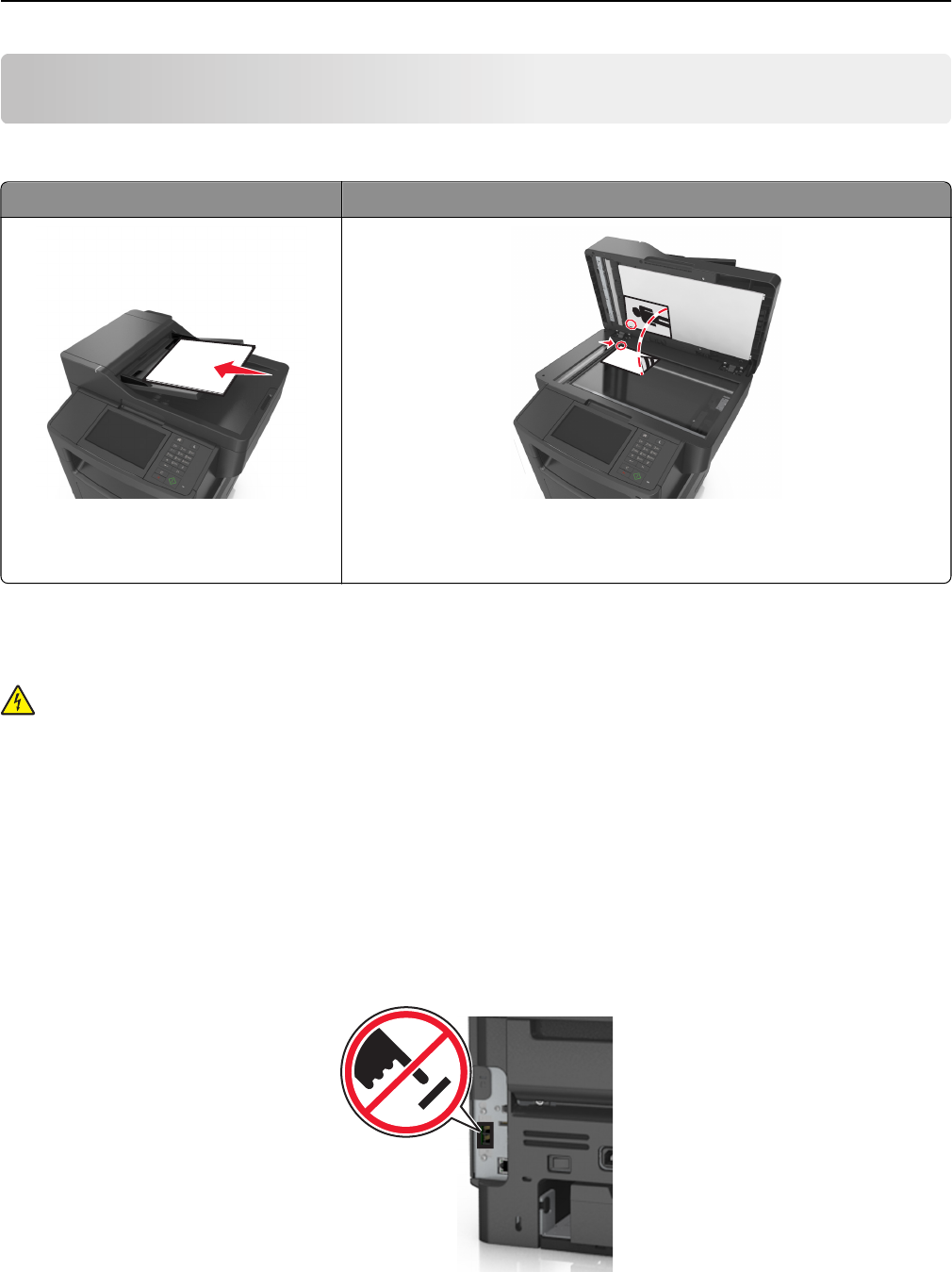
Faxing
Note: Fax capabilities may not be available on all printer models.
Automatic document feeder (ADF) Scanner glass
ABC
Use the ADF for multiple‑page documents. Use the scanner glass for single pages, small items (such as postcards or
photos), transparencies, photo paper, or thin media (such as magazine
clippings).
Setting up the printer to fax
CAUTION—SHOCK HAZARD: Do not use the fax feature during a lightning storm. Do not set up this product or
make any electrical or cabling connections, such as the fax feature, power cord, or telephone, during a lightning
storm.
Notes:
•The following connection methods are applicable only in select countries or regions.
•During the initial printer setup, clear the fax function check box and any other function you plan to set up later,
and then press Continue.
•The indicator light may blink red if the fax function is enabled but not fully set up.
Warning—Potential Damage: Do not touch the cables or the printer in the area shown while actively sending or
receiving a fax.
Faxing 99

Initial fax setup
Many countries and regions require outgoing faxes to contain the following information in a margin at the top or bottom
of each transmitted page, or on the first page of the transmission: fax name (identification of the business, other entity,
or individual sending the message) and fax number (telephone number of the sending fax machine, business, other
entity, or individual).
To enter your fax setup information, use the printer control panel, or use your browser to access the Embedded Web
Server and then enter the Settings menu.
Note: If you do not have a TCP/IP environment, then you must use the printer control panel to enter your fax setup
information.
Using the printer control panel for fax setup
When the printer is turned on for the first time, a series of start‑up screens appear. If the printer has fax capabilities,
then the Fax Name and Fax Number screens appear.
1When the Fax Name screen appears, do the following:
aEnter the name to be printed on all outgoing faxes.
bEnter the fax name, and then touch Submit.
2When the Fax Number screen appears, enter the fax number, and then touch Submit.
Using the Embedded Web Server for fax setup
1Open a Web browser, and then type the printer IP address in the address field.
Notes:
•View the printer IP address on the printer home screen. The IP address appears as four sets of numbers
separated by periods, such as 123.123.123.123.
•If you are using a proxy server, then temporarily disable it to load the Web page correctly.
2Click Settings > Fax Settings > Analog Fax Setup.
3In the Fax Name field, type the name to be printed on all outgoing faxes.
4In the Fax Number field, enter the printer fax number.
5Click Submit.
Faxing 100
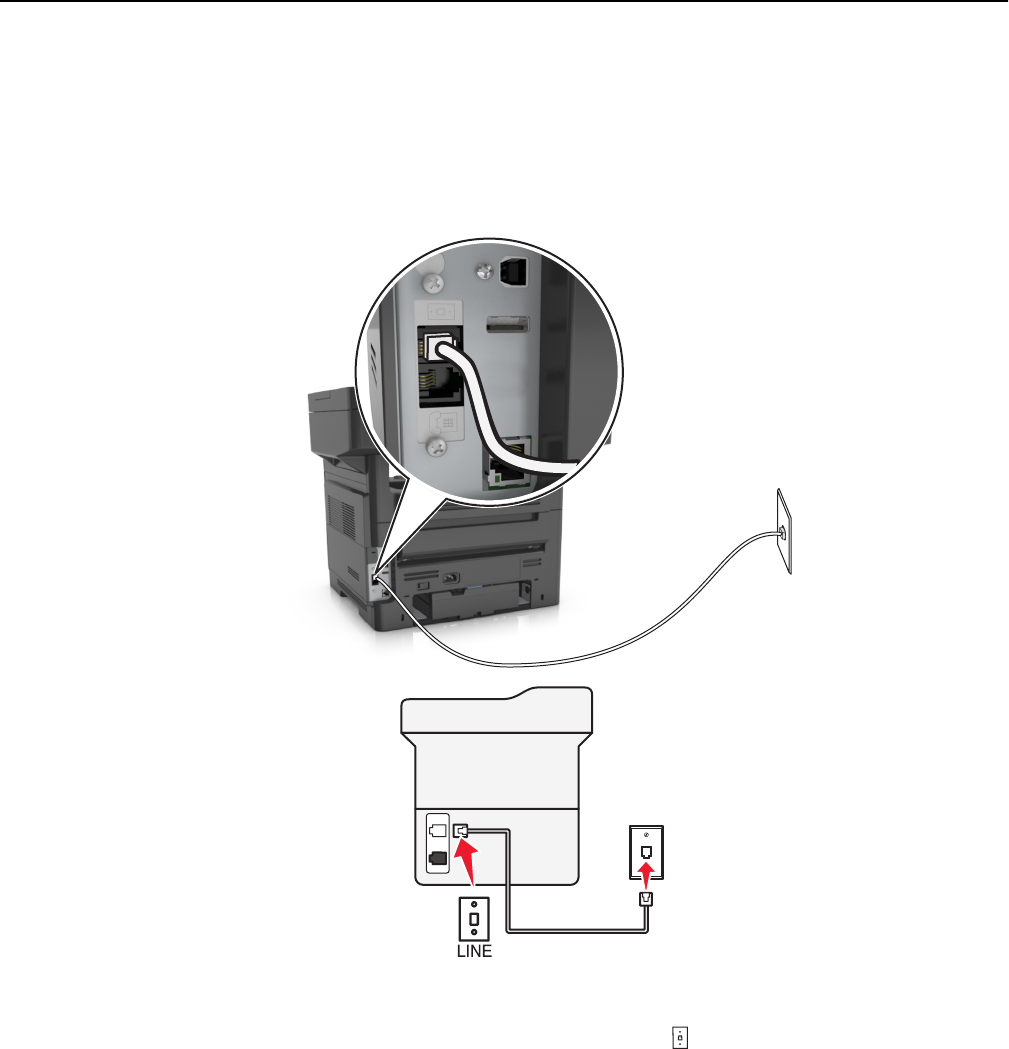
Choosing a fax connection
Scenario 1: Standard telephone line
Setup 1: Printer is connected to a dedicated fax line
To connect:
1Connect one end of the telephone cable that came with the printer to the port of the printer.
2Connect the other end of the telephone cable to an active analog wall jack.
Tips for this setup:
•You can set the printer to receive faxes automatically (Auto Answer On) or manually (Auto Answer Off).
•If you want to receive faxes automatically (Auto Answer On), then set the printer to pick up on any number of rings
that you want.
Faxing 101
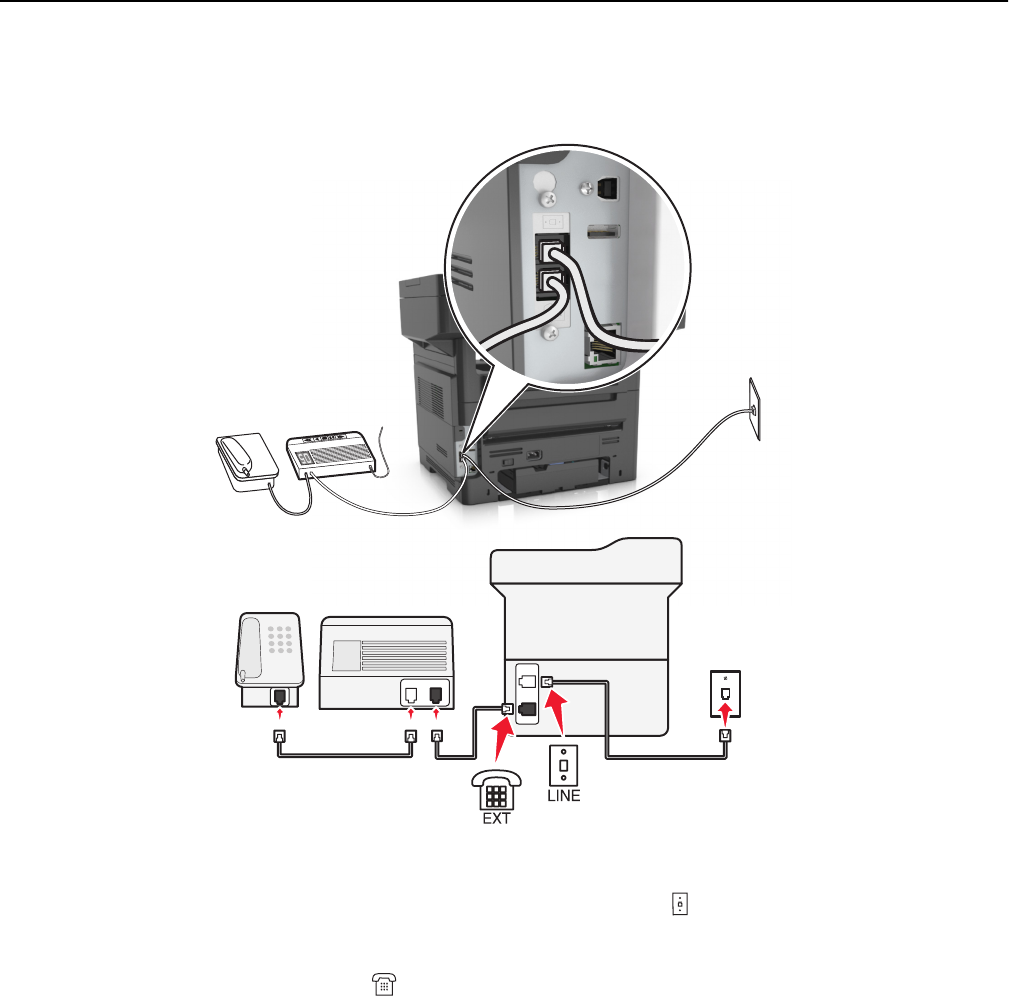
Setup 2: Printer is sharing the line with an answering machine
Connected to the same telephone wall jack
PHONE
LINE
To connect:
1Connect one end of the telephone cable that came with the printer to the port of the printer.
2Connect the other end of the telephone cable to an active analog wall jack.
3Connect the answering machine to the port of the printer.
Faxing 102
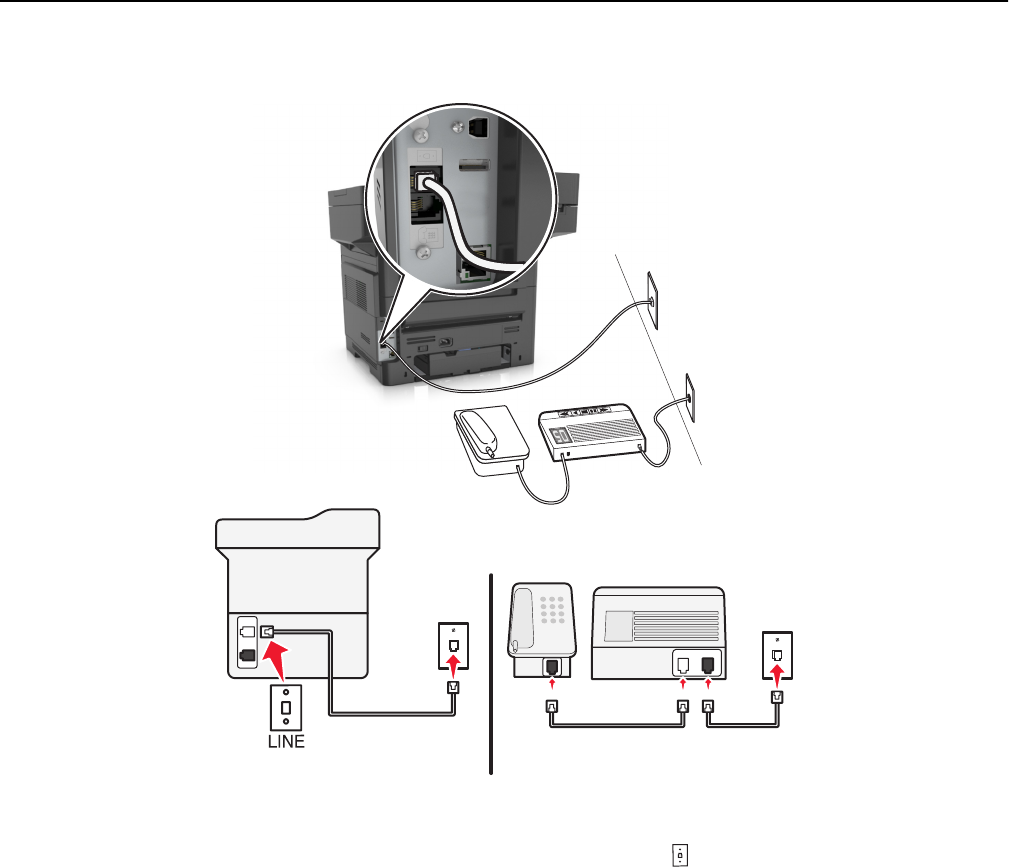
Connected to different wall jacks
PHONE
LINE
To connect:
1Connect one end of the telephone cable that came with the printer to the port of the printer.
2Connect the other end of the telephone cable to an active analog wall jack.
Tips for this setup:
•If you have only one telephone number on your line, then you need to set the printer to receive faxes automatically
(Auto Answer On).
•Set the printer to pick up calls two rings after the answering machine. For example, if the answering machine picks
up calls after four rings, then set the printer to pick up after six rings. This way, the answering machine picks up
calls first and your voice calls are received. If the call is a fax, then the printer detects the fax signal on the line and
takes over the call.
•If you subscribe to a distinctive ring service provided by your telephone company, then make sure that you set the
correct ring pattern for the printer. Otherwise, the printer does not receive faxes even if you have set it to receive
faxes automatically.
Faxing 103
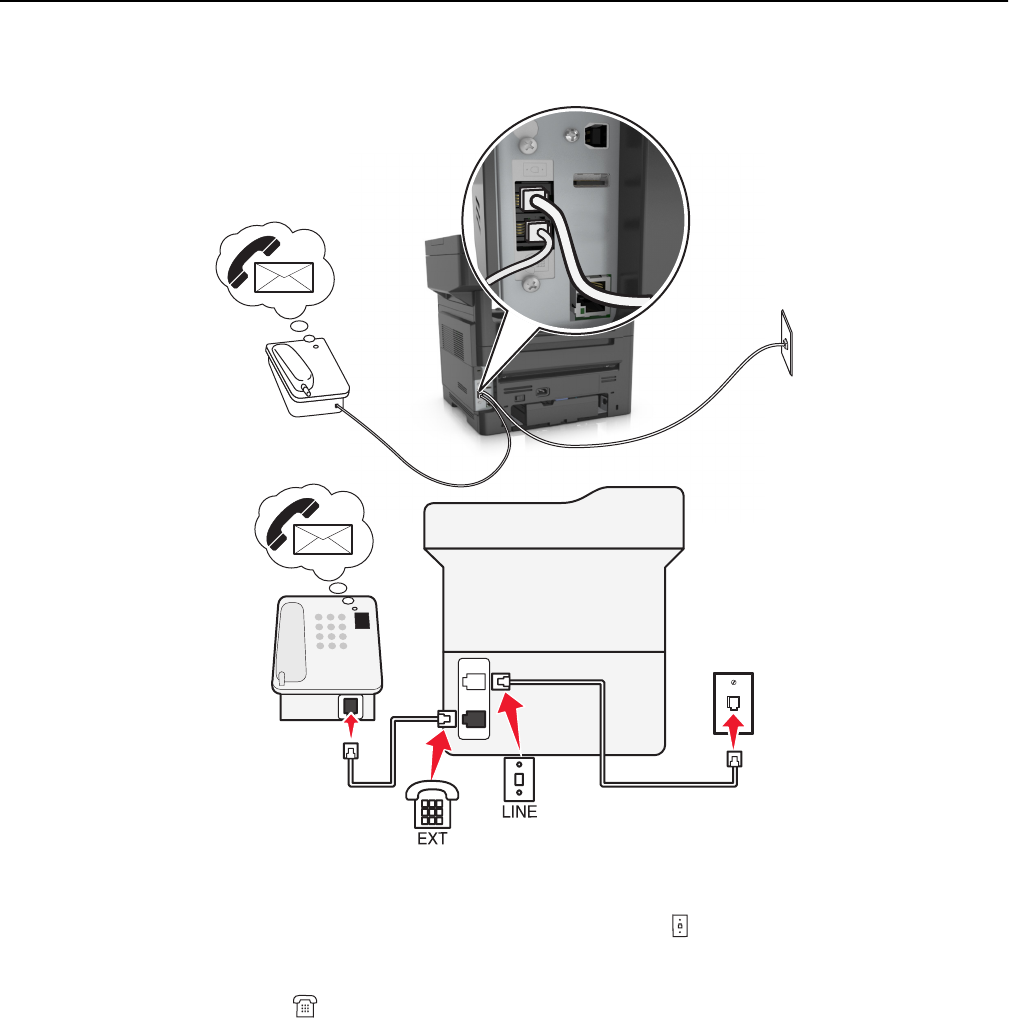
Setup 3: Printer is sharing the line with a telephone subscribed to voice mail service
02
To connect:
1Connect one end of the telephone cable that came with the printer to the port of the printer.
2Connect the other end of the telephone cable to an active analog wall jack.
3Connect the telephone to the port of the printer.
Tips for this setup:
•This setup works best if you subscribe to a distinctive ring service. If you have distinctive ring service, then make
sure that you set the correct ring pattern for the printer. Otherwise, the printer does not receive faxes even if you
have set it to receive faxes automatically.
•If you have only one telephone number on your line, then you need to set the printer to receive faxes manually
(Auto Answer Off).
When you answer the telephone and you hear fax tones, press *9* or the manual answer code on the telephone
to receive the fax.
•You can also set the printer to receive faxes automatically (Auto Answer On), but you need to turn off the voice
mail service when you are expecting a fax. This setting works best if you are using voice mail more often than fax.
Faxing 104
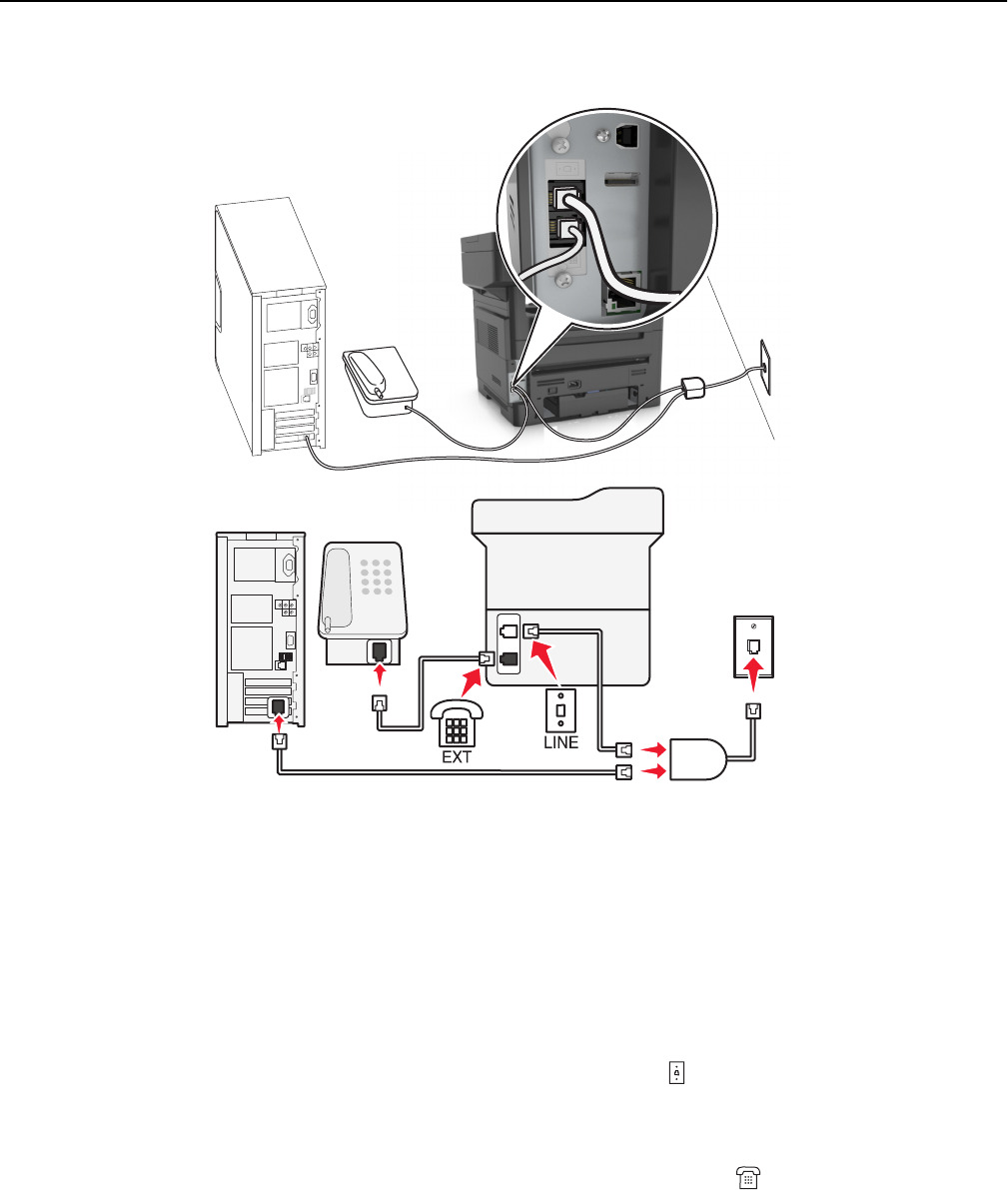
Scenario 2: Digital Subscriber Line (DSL)
A Digital Subscriber Line splits your regular telephone line into two channels: voice and Internet. Telephone and fax
signals travel through the voice channel, and Internet signals pass through the other channel. This way, you can use
the same line for analog voice calls (including faxes) and digital Internet access.
To minimize interference between the two channels and ensure a quality connection, you need to install a DSL filter
for the analog devices (fax machine, telephone, answering machine) in your network. Interference causes noise and
static on the telephone, failed and poor quality faxes for the printer, and slow Internet connection on your computer.
To install a filter for the printer:
1Connect the line port of the DSL filter to the wall jack.
2Connect one end of the telephone cable that came with your printer to the port of the printer. Connect the other
end to the phone port on the DSL filter.
3To continue using a computer for Internet access, connect the computer to the DSL HPN port on the DSL filter.
4To connect a telephone to the printer, remove any installed adapter plug from the port of the printer, and then
connect the telephone to the port.
Faxing 105
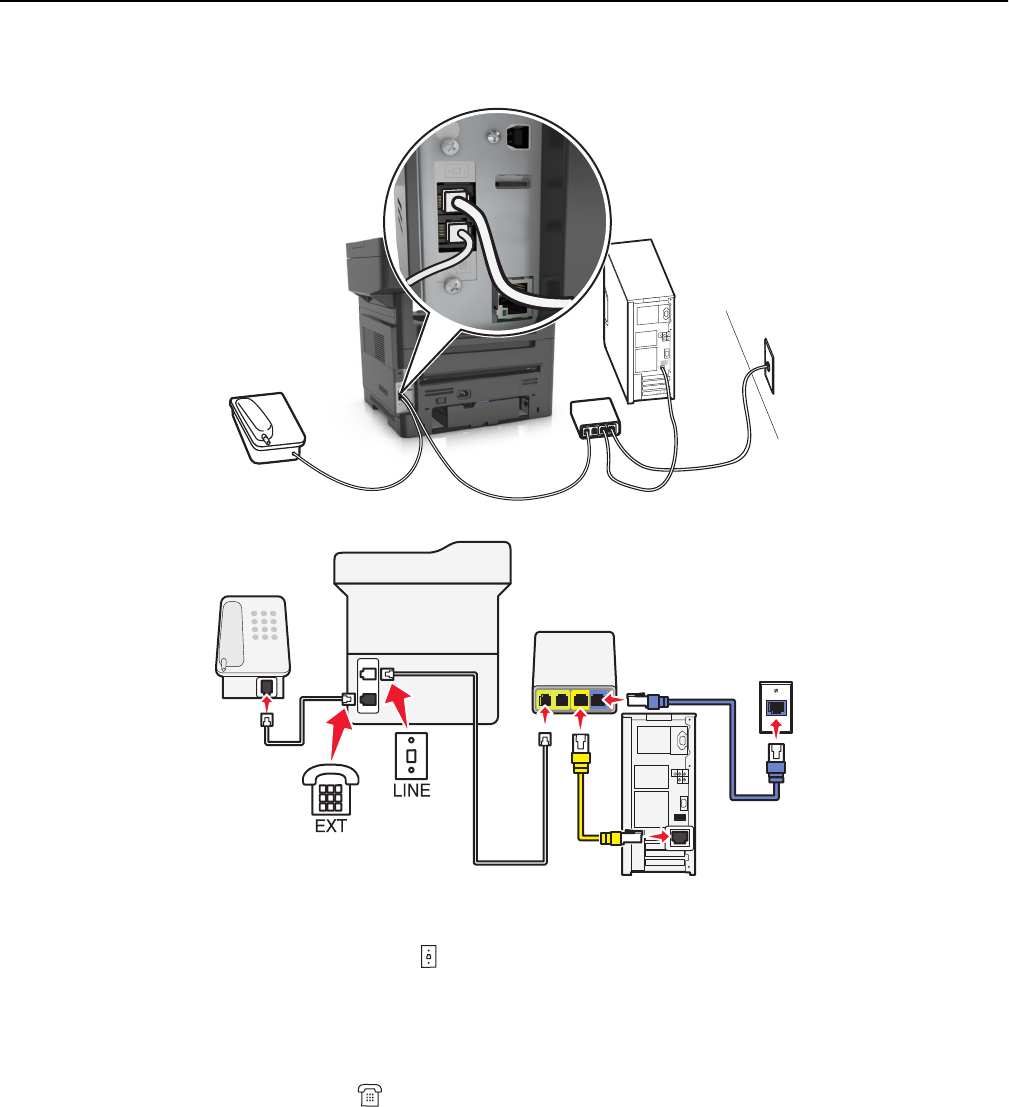
Scenario 3: VoIP telephone service
To connect:
1Connect one end of a telephone cable to the port of the printer.
2Connect the other end of the cable to the port labeled Phone Line 1 or Phone Port on the VoIP adapter.
The port labeled Phone Line 2 or Fax Port is not always active. You may need to pay extra to your VoIP provider if
you want to activate the second phone port.
3Remove the protective plug from the port of the printer, and then connect the telephone to the port.
Tips for this setup:
•To make sure that the phone port on the VoIP adapter is active, plug an analog telephone into the phone port, and
then listen for a dial tone. If you hear a dial tone, then the port is active.
•If you need two phone ports for your devices but do not want to pay extra, then do not plug the printer into the
second phone port. You can use a phone splitter. Plug the phone splitter into the Phone Line 1 or Phone Port, and
then plug the printer and telephone into the splitter.
Make sure you use a phone splitter, not a line splitter. To make sure that you are using the correct splitter, plug an
analog telephone into the splitter and then listen for a dial tone.
Faxing 106
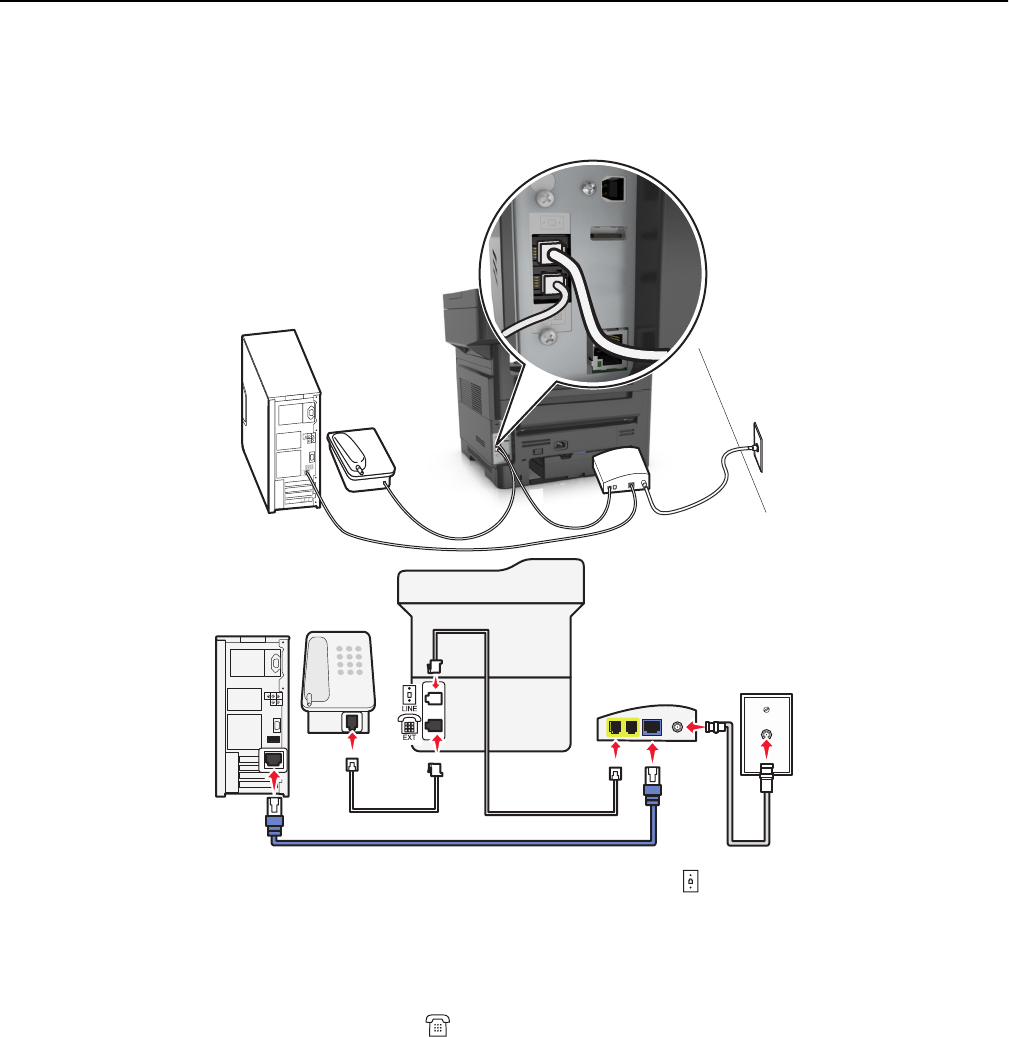
Scenario 4: Digital telephone service through a cable provider
Setup 1: Printer is connected directly to a cable modem
1Connect one end of the telephone cable that came with your printer to the port of the printer.
2Connect the other end of the cable to the port labeled Phone Line 1 or Phone Port on the cable modem.
Note: The port labeled Phone Line 2 or Fax Port is not always active. VoIP providers may charge additional cost
for activation of the second phone port.
3Connect your analog telephone phone to the port of the printer.
Notes:
•To make sure that the telephone port on the cable modem is active, plug an analog telephone into the
telephone port, and then listen for a dial tone. If you hear a dial tone, then the port is active.
•If you need two telephone ports for your devices, but do not want to pay additional cost, then do not plug the
printer into the second telephone port. You can use a phone splitter. Plug the phone splitter into the Phone Line
1 or Phone Port, and then plug the printer and telephone into the splitter.
•Make sure you use a phone splitter, not a line splitter. To make sure that you are using the correct splitter, plug
an analog telephone into the splitter and then listen for a dial tone.
Faxing 107
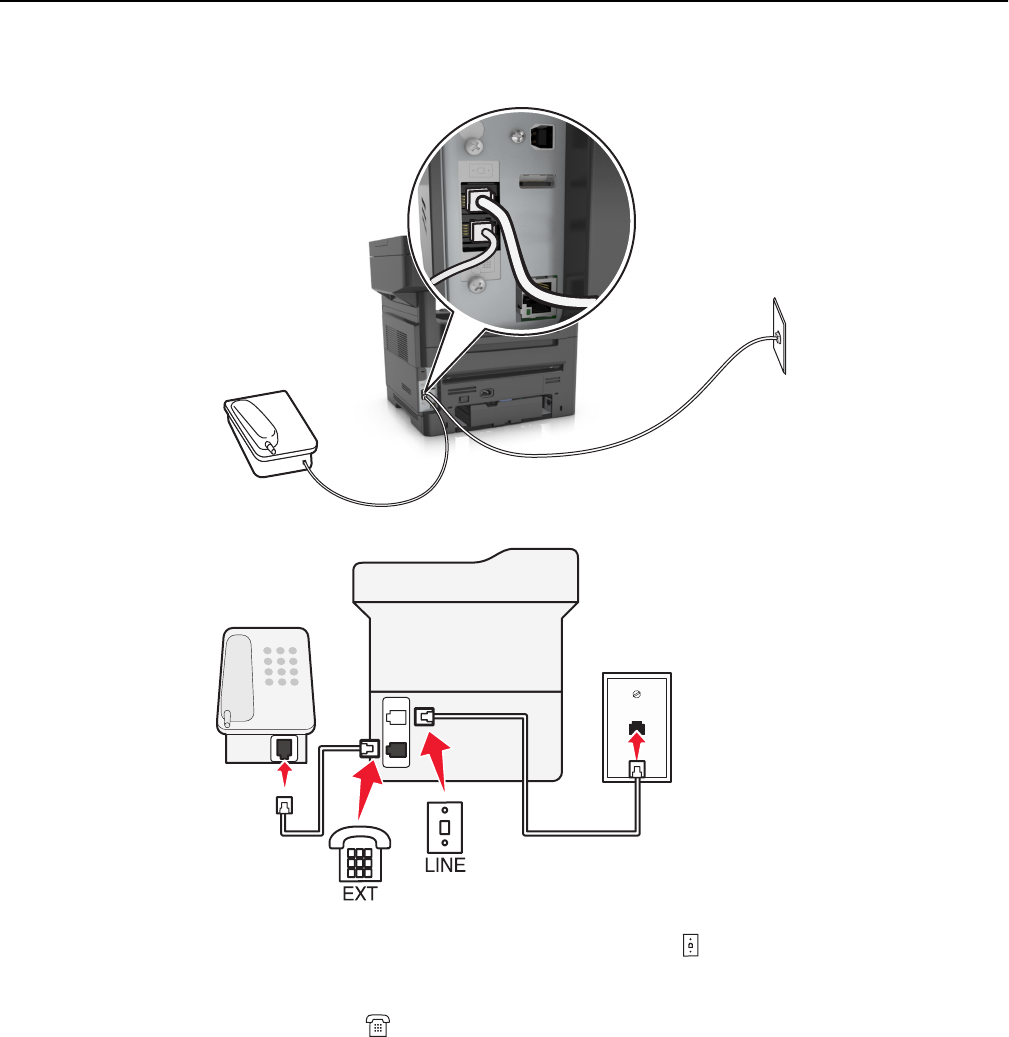
Setup 2: Printer is connected to a wall jack; cable modem is installed elsewhere in the facility
1Connect one end of the telephone cable that came with your printer to the port of the printer.
2Connect the other end of the telephone cable to an active analog telephone wall jack.
3Connect your analog telephone to the port of the printer.
Scenario 5: Countries or regions with different telephone wall jacks and plugs
Some countries or regions may have different types of telephone wall jack connectors than those that came with the
printer. The standard wall jack adopted by most countries or regions is RJ-11. Your printer comes with the RJ-11 jack
and a telephone cable with the RJ-11 plug.
Faxing 108
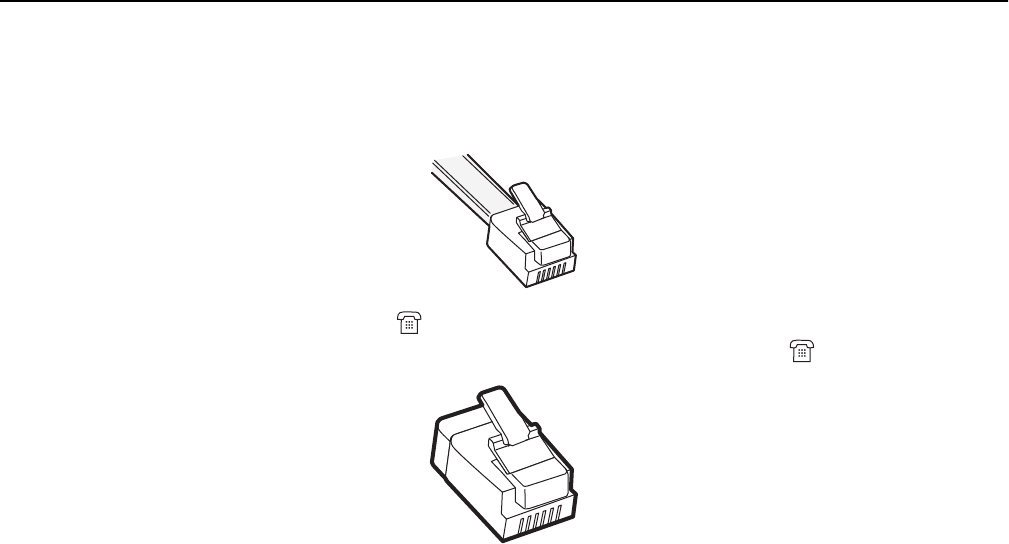
If the wall jack or equipment in your facility is not compatible with this type of connection, then you need to use a
telephone adapter. An adapter for your country or region may not come with your printer, and you may need to
purchase it separately.
There may be an adapter plug installed in the port of the printer. If you are using a telephone adapter or a facility
that has a cascaded or serial wiring scheme, then do not remove the adapter plug from the port of the printer.
Faxing 109
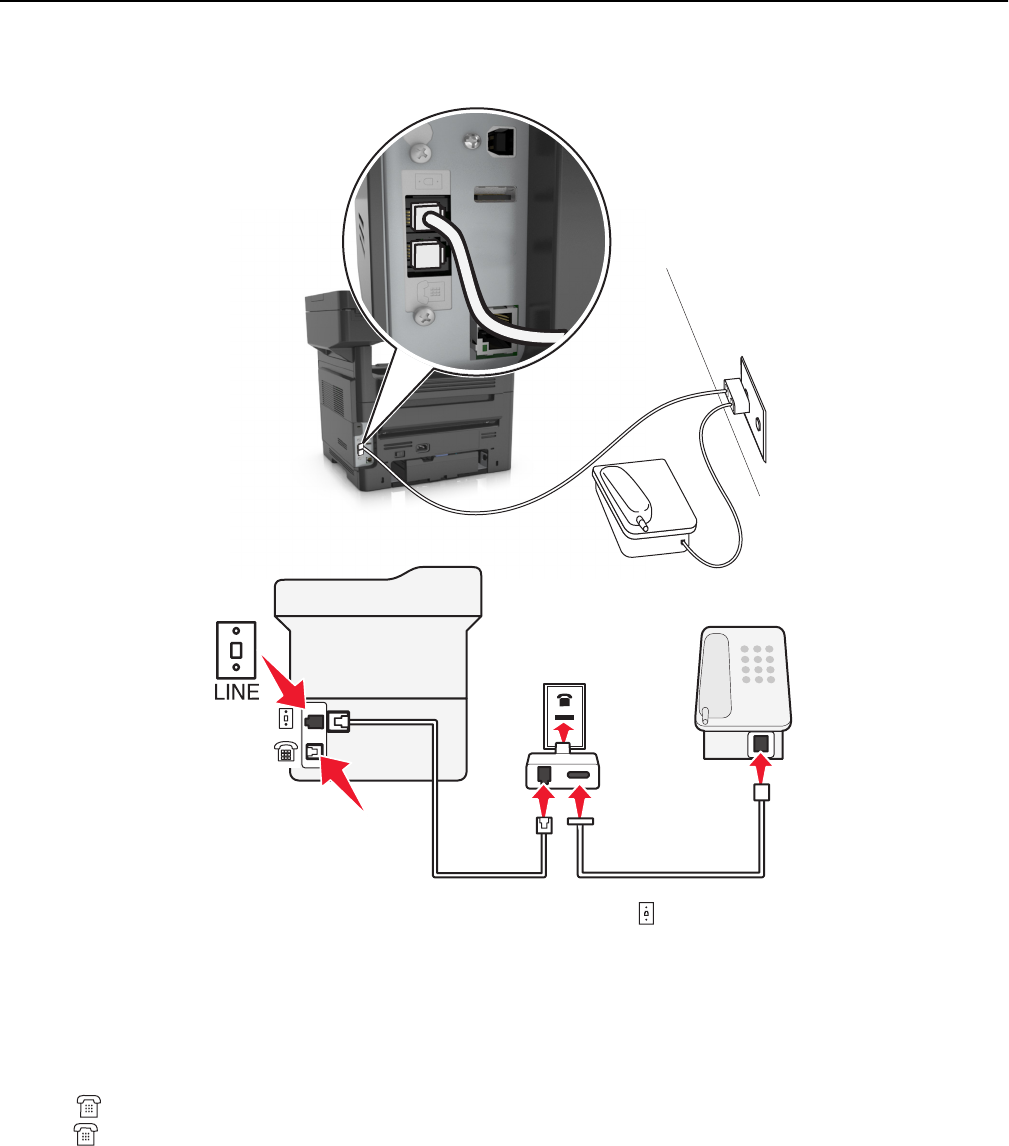
Connecting the printer to a non‑RJ‑11 wall jack
LINE
EXT
1Connect one end of the telephone cable that came with printer to the port of the printer.
2Connect the other end of the cable to the RJ‑11 adapter, and then connect the adapter to the wall jack.
3If you want to connect another device (telephone or answering machine) to the same wall jack, and if the device
has a non‑RJ‑11 connector, then connect it directly to the telephone adapter.
Notes:
•The port of the printer may have an adapter plug for use with the adapter. Do not remove the plug from
the port of the printer.
•In some countries or regions, the printer may not come with a telephone adapter or an adapter plug.
Faxing 110
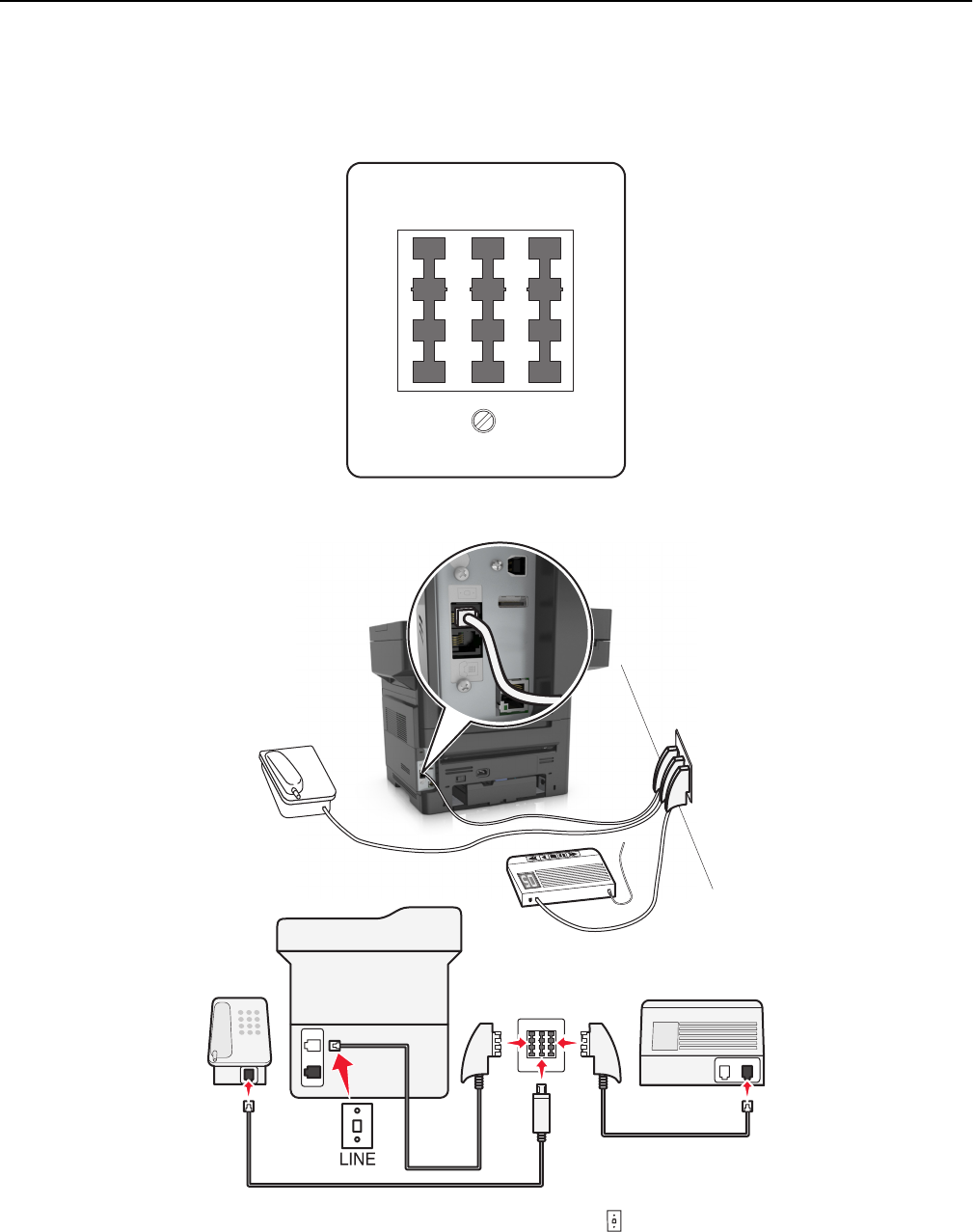
Connecting the printer to a wall jack in Germany
The German wall jack has two kinds of ports. The N ports are for fax machines, modems, and answering machines. The
F port is for telephones.
NFN
Connect the printer to any of the N ports.
PHONE
LINE
NFN
1Connect one end of the telephone cable that came the printer to the port of the printer.
2Connect the other end of the telephone cable to the RJ‑11 adapter, and then connect the adapter to an N port.
3If you want to connect a telephone and answering machine to the same wall jack, then connect the devices as
shown.
Faxing 111
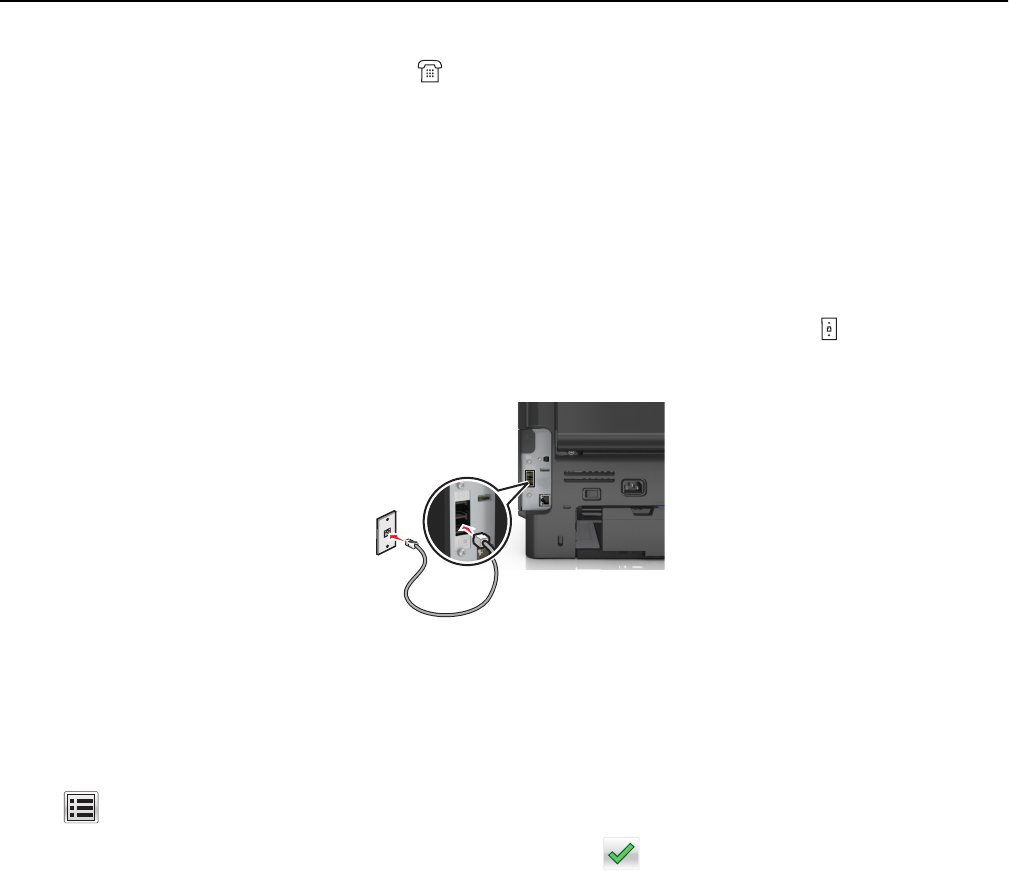
Note: Do not remove the adapter plug from the port of the printer if you are connecting to a serial or cascaded
telephone system.
Connecting to a distinctive ring service
A distinctive ring service may be available from your telephone company. This service lets you have multiple telephone
numbers on one telephone line, with each telephone number having a different ring pattern. This may be useful for
distinguishing between fax and voice calls. If you subscribe to a distinctive ring service, then follow these steps to
connect the equipment:
1Connect one end of the telephone cable that came with the printer to the printer LINE port .
2Connect the other end of the telephone cable to an active analog telephone wall jack.
3Change the distinctive rings setting to match the setting you want for the printer to answer.
Note: The factory default setting for distinctive rings is On. This sets the printer to answer single, double, and
triple ring patterns.
aFrom the home screen, navigate to:
> Settings > Fax Settings > Analog Fax Setup > Answer On
bSelect the pattern setting you want to change, and then touch .
Setting the outgoing fax name and number
1Open a Web browser, and then type the printer IP address in the address field.
Notes:
•View the printer IP address on the printer home screen. The IP address appears as four sets of numbers
separated by periods, such as 123.123.123.123.
•If you are using a proxy server, then temporarily disable it to load the Web page correctly.
2Click Settings > Fax Settings > Analog Fax Setup.
3In the Fax Name field, type the name to be printed on all outgoing faxes.
4In the Fax Number field, enter the printer fax number.
5Click Submit.
Faxing 112

Setting the date and time
You can set the date and time so that they are printed on every fax you send.
1Open a Web browser, and then type the printer IP address in the address field.
Notes:
•View the printer IP address on the printer home screen. The IP address appears as four sets of numbers
separated by periods, such as 123.123.123.123.
•If you are using a proxy server, then temporarily disable it to load the Web page correctly.
2Click Security > Set Date and Time.
3In the Manually Set Date & Time field, enter the current date and time.
4Click Submit.
Note: It is recommended to use the network time.
Configuring the printer to observe daylight saving time
The printer can be set to automatically adjust for daylight saving time:
1Open a Web browser, and then type the printer IP address in the address field.
Notes:
•View the printer IP address on the printer home screen. The IP address appears as four sets of numbers
separated by periods, such as 123.123.123.123.
•If you are using a proxy server, then temporarily disable it to load the Web page correctly.
2Click Security > Set Date and Time.
3Select the Automatically Observe DST check box, and then enter the DST start and end dates in the Custom Time
Zone Setup section.
4Click Submit.
Sending a fax
You can use the printer to send a fax to one or more recipients in a number of ways. You can type the e‑mail address,
use a shortcut number, or use the address book. You can also use the Multi Send or MyShortcut application from the
printer home screen. For more information, see “Activating the home screen applications” on page 22.
Sending a fax using the printer control panel
1Load an original document faceup, short edge first into the ADF tray or facedown on the scanner glass.
Notes:
•Do not load postcards, photos, small items, transparencies, photo paper, or thin media (such as magazine
clippings) into the ADF tray. Place these items on the scanner glass.
•The ADF indicator light comes on when the paper is loaded properly.
2If you are loading a document into the ADF tray, then adjust the paper guides.
Faxing 113

3From the home screen, touch Fax.
4Enter the fax number or a shortcut.
Note: To add recipients, touch Next number, and then enter the recipient's telephone number or shortcut
number, or search the address book.
5Touch Fax It.
Sending a fax using the computer
The printer driver fax option lets you send a print job to the printer, which sends the job as a fax. The fax option works
as a normal fax machine, but is controlled through the printer driver instead of the printer control panel.
1With a document open, click File > Print.
2Select the printer, and then click Properties, Preferences, Options, or Setup.
3Navigate to:
Fax tab > Enable fax
4Enter the recipient fax number or numbers in the “Fax number(s)” field.
Note: Fax numbers can be entered manually or by using the Phone Book feature
5If necessary, enter a prefix in the “Dialing prefix” field.
6Select the appropriate paper size and page orientation.
7If you want to include a cover page with the fax, then select Include cover page with fax, and then enter the
appropriate information.
8Click OK.
Notes:
•The Fax option is available for use only with the PostScript driver or the Universal Fax Driver. For information on
installing these drivers, see the Software and Documentation CD.
•The Fax option must be configured and enabled in the PostScript driver under the Configuration tab before it
can be used.
•If the Always display settings prior to faxing check box is selected, then you are prompted to verify the
recipient information before the fax is sent. If this check box is cleared, then the queued document is sent
automatically as a fax when you click OK on the Fax tab.
Sending a fax using a shortcut number
Fax shortcuts are like the speed dial numbers on a telephone or a fax machine. A shortcut number (1–999) can contain
a single recipient or multiple recipients.
1Load an original document faceup, short edge first into the ADF tray or facedown on the scanner glass.
Notes:
•Do not load postcards, photos, small items, transparencies, photo paper, or thin media (such as magazine
clippings) into the ADF tray. Place these items on the scanner glass.
Faxing 114

•The ADF indicator light comes on when the paper is loaded properly.
2If you are loading a document into the ADF tray, then adjust the paper guides.
3From the printer control panel, press #, and then enter the shortcut number using the keypad.
4Touch Fax It.
Sending a fax using the address book
The address book lets you search for bookmarks and network directory servers. For more information on enabling the
address book feature, contact your system support person.
1Load an original document faceup, short edge first into the ADF tray or facedown on the scanner glass.
Notes:
•Do not load postcards, photos, small items, transparencies, photo paper, or thin media (such as magazine
clippings) into the ADF tray. Place these items on the scanner glass.
•The ADF indicator light comes on when the paper is loaded properly.
2If you are loading a document into the ADF tray, then adjust the paper guides.
3From the home screen, navigate to:
Fax > > type the name of the recipient > Search
Note: You can search only for one name at a time.
4Touch the name of the recipient, and then touch Fax It.
Sending a fax at a scheduled time
1Load an original document faceup, short edge first into the ADF tray or facedown on the scanner glass.
Notes:
•Do not load postcards, photos, small items, transparencies, photo paper, or thin media (such as magazine
clippings) into the ADF tray. Place these items on the scanner glass.
•The ADF indicator light comes on when the paper is loaded properly.
2If you are loading a document into the ADF tray, then adjust the paper guides.
3From the home screen, navigate to:
Fax > enter the fax number > Delayed Send
Note: If Fax Mode is set to Fax Server, then the Delayed Send button will not appear. Faxes waiting for
transmission are listed in the fax queue.
4Specify the time the fax will be transmitted, and then touch .
The time is increased or decreased in 30‑minute increments.
5Touch Fax It.
Note: The document is scanned and then faxed at the scheduled time.
Faxing 115

Creating shortcuts
Creating a fax destination shortcut using the Embedded Web Server
Assign a shortcut number to a single fax number or a group of fax numbers.
1Open a Web browser, and then type the printer IP address in the address field.
Notes:
•View the printer IP address on the printer home screen. The IP address appears as four sets of numbers
separated by periods, such as 123.123.123.123.
•If you are using a proxy server, then temporarily disable it to load the Web page correctly.
2Click Settings > Manage Shortcuts > Fax Shortcut Setup.
Note: A password may be required. If you do not have an ID and password, then contact your system support
person.
3Type a name for the shortcut, and then enter the fax number.
Notes:
•To create a multiple‑number shortcut, enter the fax numbers for the group.
•Separate each fax number in the group with a semicolon (;).
4Assign a shortcut number.
Note: If you enter a number that is already in use, then you are prompted to select another number.
5Click Add.
Creating a fax destination shortcut using the printer control panel
1From the home screen, touch Fax, and then enter the fax number.
Note: To create a group of fax numbers, touch Next number, and then enter the next fax number.
2Touch .
3Type a unique name for the shortcut, and then touch Done.
4Verify that the shortcut name and number are correct, and then touch OK.
Note: If the name or number is incorrect, then touch Cancel, and then reenter the information.
Customizing fax settings
Changing the fax resolution
1Load an original document faceup, short edge first into the ADF tray or facedown on the scanner glass.
Faxing 116

Notes:
•Do not load postcards, photos, small items, transparencies, photo paper, or thin media (such as magazine
clippings) into the ADF tray. Place these items on the scanner glass.
•The ADF indicator light comes on when the paper is loaded properly.
2If you are loading a document into the ADF tray, then adjust the paper guides.
3From the home screen, navigate to:
Fax > enter the fax number > Options
4From the Resolution area, touch the arrows to select the resolution you want.
Note: Select a resolution from Standard (fastest speed) to Ultra Fine (best quality at a reduced speed).
5Touch Fax It.
Making a fax lighter or darker
1Load an original document faceup, short edge first into the ADF tray or facedown on the scanner glass.
Notes:
•Do not load postcards, photos, small items, transparencies, photo paper, or thin media (such as magazine
clippings) into the ADF tray. Place these items on the scanner glass.
•The ADF indicator light comes on when the paper is loaded properly.
2If you are loading a document into the ADF tray, then adjust the paper guides.
3From the home screen, navigate to:
Fax > enter the fax number > Options
4Adjust the fax darkness, and then touch Fax It.
Viewing a fax log
1Open a Web browser, and then type the printer IP address in the address field.
Notes:
•View the printer IP address on the printer home screen. The IP address appears as four sets of numbers
separated by periods, such as 123.123.123.123.
•If you are using a proxy server, then temporarily disable it to load the Web page correctly.
2Click Settings > Reports.
3Click Fax Job Log or Fax Call Log.
Blocking junk faxes
1Open a Web browser, and then type the printer IP address in the address field.
Notes:
•View the printer IP address on the printer home screen. The IP address appears as four sets of numbers
separated by periods, such as 123.123.123.123.
Faxing 117

•If you are using a proxy server, then temporarily disable it to load the Web page correctly.
2Click Settings > Fax Settings > Analog Fax Setup > Block No Name Fax.
Notes:
•This option blocks all incoming faxes that have a private caller ID or have no fax name.
•In the Banned Fax List field, enter the phone numbers or type the fax names of specific fax callers you want
to block.
Canceling an outgoing fax
Canceling a fax while the original documents are still scanning
•When using the ADF, touch Cancel Job on the printer control panel while Scanning appears.
•When using the scanner glass, touch Cancel Job on the printer control panel while Scanning appears or while
Scan the Next Page and Finish the Job appear.
Canceling a fax after the original documents have been scanned to memory
1On the home screen, touch Cancel Jobs.
The Cancel Jobs screen appears.
2Touch the job or jobs you want to cancel.
Only three jobs appear on the screen; touch the down arrow until the job you want appears, and then touch the
job you want to cancel.
3Touch Delete Selected Jobs.
The Deleting Selected Jobs screen appears, the selected jobs are deleted, and then the home screen appears.
Holding and forwarding faxes
Holding faxes
This option lets you hold received faxes from printing until they are released. Held faxes can be released manually or
at a scheduled day or time.
1Open a Web browser, and then type the printer IP address in the address field.
Notes:
•View the printer IP address on the printer home screen. The IP address appears as four sets of numbers
separated by periods, such as 123.123.123.123.
•If you are using a proxy server, then temporarily disable it to load the Web page correctly.
2Click Settings > Fax Settings > Analog Fax Setup > Holding Faxes.
Faxing 118

3From the Held Fax Mode menu, select one of the following:
•Off
•Always On
•Manual
•Scheduled
4If you selected Scheduled, then continue with the following steps:
aClick Fax Holding Schedule.
bFrom the Action menu, select Hold faxes.
cFrom the Time menu, select the time you want the held faxes released.
dFrom the Day(s) menu, select the day you want the held faxes released.
5Click Add.
Forwarding a fax
This option lets you print and forward received faxes to a fax number, e‑mail address, FTP site, or LDSS.
1Open a Web browser, and then type the printer IP address in the address field.
Notes:
•View the printer IP address on the printer home screen. The IP address appears as four sets of numbers
separated by periods, such as 123.123.123.123.
•If you are using a proxy server, then temporarily disable it to load the Web page correctly.
2Click Settings > Fax Settings.
3From the Fax Forwarding menu, select Print, Print and Forward, or Forward.
4From the “Forward to” menu, select Fax, E‑mail, FTP, LDSS, or eSF.
5In the “Forward to Shortcut” field, enter the shortcut number where you want the fax forwarded.
Note: The shortcut number must be valid for the setting selected in the “Forward to” menu.
6Click Submit.
Understanding the fax options
Content
This option lets you specify the content type and source of the original document.
Select from the following content types:
•Text—The content of the original document is mostly text or line art.
•Text/Photo—The original document is a mixture of text, graphics, and photos.
•Photo—The original document is mostly a photo or an image.
•Graphics—The original document is mostly business‑type graphics, such as pie charts, bar charts, and animations.
Faxing 119

Select from the following content sources:
•Color Laser—The original document was printed using a color laser printer.
•Inkjet—The original document was printed using an inkjet printer.
•Magazine—The original document is from a magazine.
•Brochure—The original document is from a brochure.
•Black/White Laser—The original document was printed using a mono laser printer.
•Photo/Film—The original document is a photo from film.
•Newspaper—The original document is from a newspaper.
•Other—The original document was printed using an alternate or unknown printer.
Resolution
This option lets you adjust the quality of the fax output. Increasing the image resolution increases the file size and the
time needed to scan your original document. Decreasing the image resolution reduces the file size.
Select one of the following:
•Standard—Use this when faxing most documents.
•Fine 200 dpi—Use this when faxing documents with small prints.
•Super fine 300 dpi—Use this when faxing documents with fine details.
•Ultra fine 600 dpi—Use this when faxing documents with pictures or photos.
Darkness
This option lets you adjust how light or dark the faxes are in relation to the original document.
Delayed Send
This option lets you send a fax at a later time or date.
Page Setup
This option lets you change the following settings:
•Sides (Duplex)—This specifies if the original document is printed on one side or on both sides of the page (duplex).
This also identifies what needs to be scanned for inclusion in the fax.
•Orientation—This specifies the orientation of the original document, and then changes the Sides (Duplex) and
Binding settings to match the orientation.
•Binding—This specifies if the original document is bound on the long‑edge or short‑edge side.
Scan Preview
This option lets you view the first page of the image before it is included in the fax. When the first page is scanned, the
scanning is paused and a preview image appears.
Note: This option appears only when a working printer hard disk is installed.
Faxing 120

Using the advanced options
Select from the following settings:
•Advanced Imaging—This adjusts the Background Removal, Color Balance, Color Dropout, Contrast, Mirror Image,
Negative Image, Scan Edge to Edge, Shadow Detail, and Sharpness settings before you fax the document.
•Custom Job—This combines multiple scanning jobs into a single job.
•Edge Erase—This removes smudges or marks around the edges of a document. You can choose to remove an equal
area around all four sides of the paper, or pick a particular edge. Edge Erase erases whatever is within the area
selected, leaving nothing on that portion of the scan.
•Transmission Log—This prints the transmission log or transmission error log.
•Adjust ADF Skew—This straightens scanned images that are slightly skewed when received from the ADF tray.
Note: This option is supported only in select printer models.
Faxing 121
Scanning
You can use the printer to send a file to an FTP address. You can type the e‑mail address, use a shortcut number, or
use the address book. You can also use the Multi-send or MyShortcut application from the printer home screen. For
more information, see “Activating the home screen applications” on page 22.
Using Scan to Network
Scan to Network lets you scan your documents to network destinations specified by your system support person. After
the destinations (shared network folders) have been established on the network, the setup process for the application
involves installing and configuring the application on the appropriate printer using its Embedded Web Server. For more
information, see “Setting up Scan to Network” on page 24.
Scanning to an FTP address
Creating shortcuts
Instead of entering the entire FTP site address on the printer control panel each time you want to send a document to
an FTP server, you can create a permanent FTP destination and assign a shortcut number. There are two methods for
creating shortcut numbers: using the Embedded Web Server or using the printer control panel.
Creating an FTP shortcut using the Embedded Web Server
1Open a Web browser, and then type the printer IP address in the address field.
Notes:
•View the printer IP address on the printer home screen. The IP address appears as four sets of numbers
separated by periods, such as 123.123.123.123.
•If you are using a proxy server, then temporarily disable it to load the Web page correctly.
2Navigate to:
Settings > Other Settings area > Manage Shortcuts > FTP Shortcut Setup
3Enter the appropriate information.
Note: A password may be required. If you do not have an ID and password, then contact your system support
person.
4Enter a shortcut number.
Note: If you enter a number that is already in use, then you are prompted to select another number.
5Click Add.
Scanning 122

Creating an FTP shortcut using the printer control panel
1From the home screen, navigate to:
FTP > FTP > type the FTP address > > type a name for the shortcut > Done
2Verify that the shortcut name and number are correct, and then touch OK.
Notes:
•If the name or number is incorrect, then touch Cancel, and then reenter the information.
•If you enter a number that is already in use, then you are prompted to select another number.
Scanning to an FTP address
Scanning to an FTP address using the printer control panel
1Load an original document faceup, short edge first into the ADF tray or facedown on the scanner glass.
Notes:
•Do not load postcards, photos, small items, transparencies, photo paper, or thin media (such as magazine
clippings) into the ADF tray. Place these items on the scanner glass.
•The ADF indicator light comes on when the paper is loaded properly.
2If you are loading a document into the ADF tray, then adjust the paper guides.
3From the printer control panel, navigate to:
FTP > FTP > type the FTP address > Done > Send It
Scanning to an FTP address using a shortcut number
1Load an original document faceup, short edge first into the ADF tray or facedown on the scanner glass.
Notes:
•Do not load postcards, photos, small items, transparencies, photo paper, or thin media (such as magazine
clippings) into the ADF tray. Place these items on the scanner glass.
•The ADF indicator light comes on when the paper is loaded properly.
2If you are loading a document into the ADF tray, then adjust the paper guides.
3From the printer control panel, press # on the keypad, and then enter the FTP shortcut number.
4Touch > Send It.
Scanning an FTP using the address book
1Load an original document faceup, short edge first into the ADF tray or facedown on the scanner glass.
Notes:
•Do not load postcards, photos, small items, transparencies, photo paper, or thin media (such as magazine
clippings) into the ADF tray. Place these items on the scanner glass.
Scanning 123
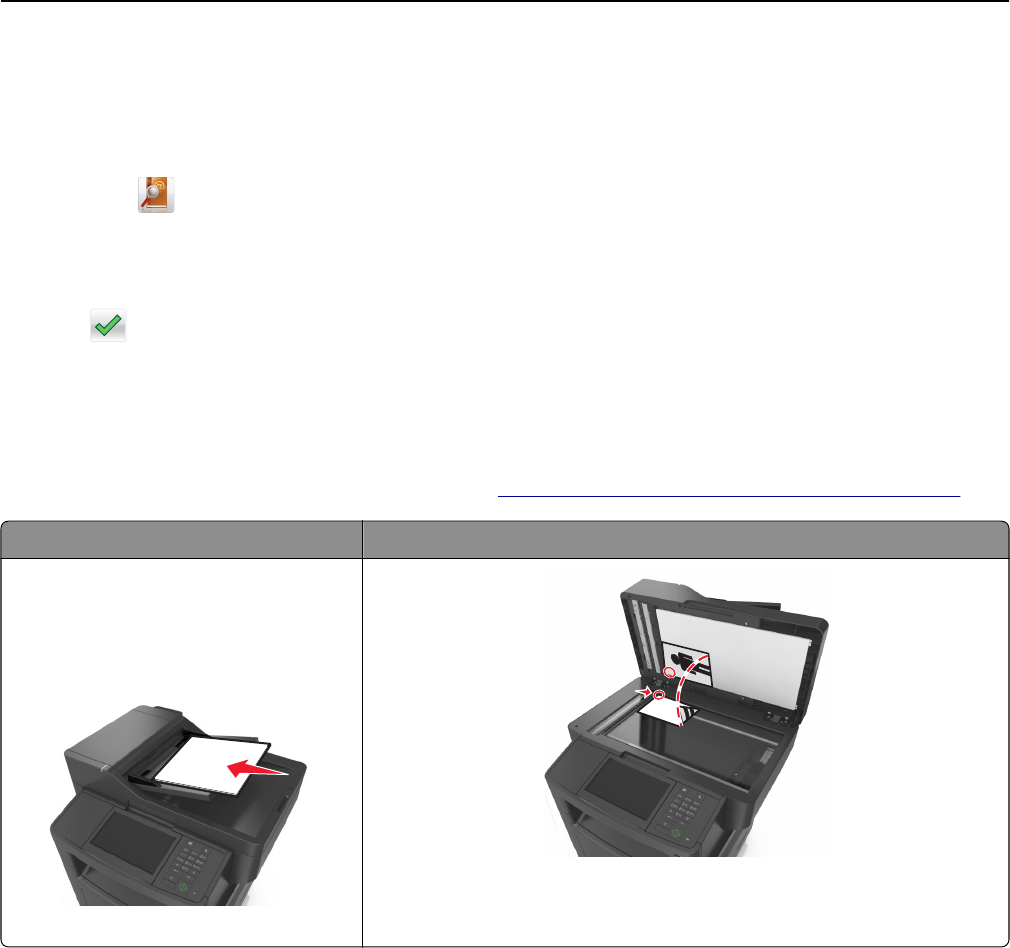
•The ADF indicator light comes on when the paper is loaded properly.
2If you are loading a document into the ADF tray, then adjust the paper guides.
3From the home screen, navigate to:
FTP > FTP > > type the name of the recipient > Search
4Touch the name of the recipient.
Note: To search for additional recipients, touch New Search, and then type the name of the next recipient.
5Touch > Send It.
Scanning to a computer or flash drive
You can use the printer to send a scanned file. You can also use Scan to Network, Multisend, and MyShortcut applications
from the printer home screen. For more information, see “Activating the home screen applications” on page 22.
ADF Scanner glass
ABC
Use the ADF for multiple‑page documents.
Use the scanner glass for single pages, small items (such as postcards or
photos), transparencies, photo paper, or thin media (such as magazine
clippings).
The scanner lets you scan documents directly to a computer or a flash drive. The computer does not have to be directly
connected to the printer for you to receive Scan to PC images. You can scan the document back to the computer over
the network by creating a scan profile on the computer and then downloading the profile to the printer.
Scanning to a computer using the Embedded Web Server
1Open a Web browser, and then type the printer IP address in the address field.
Notes:
•View the printer IP address on the printer home screen. The IP address appears as four sets of numbers
separated by periods, such as 123.123.123.123.
•If you are using a proxy server, then temporarily disable it to load the Web page correctly.
2Click Scan Profile > Create Scan Profile.
3Select your scan settings, and then click Next.
Scanning 124

4Select a location on your computer where you want to save the scan image.
5Type a scan name, and then a user name.
Note: The scan name is the name that appears in the Scan Profile list on the display.
6Click Submit.
Note: Clicking Submit automatically assigns a shortcut number. You can use this shortcut number when you are
ready to scan your documents.
7Review the instructions on the Scan Profile screen.
aLoad an original document faceup, short edge first into the ADF tray or facedown on the scanner glass.
Notes:
•Do not load postcards, photos, small items, transparencies, photo paper, or thin media (such as
magazine clippings) into the ADF tray. Place these items on the scanner glass.
•The ADF indicator light comes on when the paper is loaded properly.
bIf you are loading a document into the ADF tray, then adjust the paper guides.
cDo either of the following:
•Press #, and then enter the shortcut number using the keypad.
•From the home screen, navigate to:
Held Jobs > Profiles > select your shortcut on the list
Note: The scanner scans and sends the document to the directory you specified.
8View the file from the computer.
Note: The output file is saved in the location or launched in the program you specified.
Setting up Scan to Computer
Notes:
•This feature is supported only in Windows Vista or later.
•Make sure your computer and printer are connected to the same network.
1Open the printers folder, and then select your printer.
Note: If your printer is not in the list, then add your printer.
2Open the printer properties, and then adjust the settings as necessary.
3From the control panel, touch Scan to Computer > select the appropriate scan setting > Send It.
Scanning to a flash drive
1Load an original document faceup, short edge first into the ADF tray or facedown on the scanner glass.
Notes:
•Do not load postcards, photos, small items, transparencies, photo paper, or thin media (such as magazine
clippings) into the ADF tray. Place these items on the scanner glass.
Scanning 125

•The ADF indicator light comes on when the paper is loaded properly.
2If you are loading a document into the ADF tray, then adjust the paper guides.
3Insert the flash drive into the USB port on the front of the printer.
Note: The USB Drive home screen appears.
4Select the destination folder, and then touch Scan to USB drive.
Note: The printer goes back to the home screen after 30 seconds of inactivity.
5Adjust the scan settings, and then touch Scan It.
Understanding the scan options
FTP
This option lets you enter the IP address for the FTP destination.
Note: An IP address appears as four sets of numbers separated by periods, such as 123.123.123.123.
File Name
This option lets you type a file name for the scan image.
Save As Shortcut
This option lets you save the current settings as a shortcut by assigning a number.
Original Size
This option lets you set the paper size of the documents you are going to scan. When Original Size is set to Mixed Sizes,
you can scan an original document that contains mixed paper sizes (letter‑ and legal‑size pages).
Darkness
This option lets you adjust how light or dark the scanned documents are in relation to the original document.
Resolution
This option lets you adjust the output quality of your file. Increasing the image resolution increases the file size and the
time needed to scan your original document. Decreasing the image resolution reduces the file size.
Send As
This option lets you set the output type for the scan image.
Scanning 126

Select one of the following:
•PDF—Use to create a single file with multiple pages.
•Secure PDF—Use to create an encrypted PDF file that protects the file contents from unauthorized access.
•TIFF—Use to create multiple files or a single file. If Multi-page TIFF is turned off in the Settings menu, then TIFF
saves one page in each file. The file size is usually larger than an equivalent JPEG.
•JPEG—Use to create and attach a separate file for each page of the original document.
•XPS—Use to create a single XPS file with multiple pages.
Content
This option lets you set the original document type and source.
Select from the following content types:
•Text—The content of the original document is mostly text or line art.
•Text/Photo—The original document is a mixture of text, graphics, and photos.
•Photo—The original document is mostly a photo or an image.
•Graphics—The original document is mostly business‑type graphics, such as pie charts, bar charts, and animations.
Select from the following content sources:
•Color Laser—The original document was printed using a color laser printer.
•Inkjet—The original document was printed using an inkjet printer.
•Magazine—The original document is from a magazine.
•Brochure—The original document is from a brochure.
•Black/White Laser—The original document was printed using a mono laser printer.
•Photo/Film—The original document is a photo from film.
•Newspaper—The original document is from a newspaper.
•Other—The original document was printed using an alternate or unknown printer.
Page Setup
This option lets you change the following settings:
•Sides (Duplex)—This specifies if the original document is printed on only one side or on both sides of the paper.
•Orientation—This specifies the orientation of the original document, and then changes the Sides (Duplex) and
Binding settings to match the orientation.
•Binding—This specifies if the original document is bound on the long‑edge or short‑edge side.
Scan Preview
This option lets you view the first page of the image before it is included in the e-mail. When the first page is scanned,
the scanning is paused and a preview image appears.
Note: This option appears only when a working printer hard disk is installed.
Scanning 127

Using the advanced options
Select from the following settings:
•Advanced Imaging—This adjusts the Background Removal, Color Balance, Color Dropout, Contrast, JPEG Quality,
Mirror Image, Negative Image, Scan Edge to Edge, Shadow Detail, Sharpness, and Temperature settings before you
scan the document.
•Custom Job—This combines multiple scanning jobs into a single job.
•Edge Erase—This removes smudges or marks around the edges of a document. You can choose to remove an equal
area around all four sides of the paper, or pick a particular edge. Edge Erase erases whatever is within the area
selected, leaving nothing on that portion of the scan.
•Transmission Log—This prints the transmission log or transmission error log.
•Multifeed Sensor—This detects when the ADF picks more than one sheet of paper at a time, and then shows an
error message.
Note: This option is supported only in select printer models.
Scanning 128

Understanding the printer menus
Menus list
Paper Menu Reports Network/Ports Security
Default Source
Paper Size/Type
Configure MP
Substitute Size
Paper Texture
Paper Weight
Paper Loading
Custom Types
Custom Names1
Custom Scan Sizes
Universal Setup
Menu Settings Page
Device Statistics
Stapler Test
Network Setup Page1
Network [x] Setup Page
Shortcut List
Fax Job Log
Fax Call Log
Copy Shortcuts
E‑mail Shortcuts
Fax Shortcuts
FTP Shortcuts
Profiles List
Print Fonts
Print Directory
Print Demo
Asset Report
Active NIC
Standard Network2
Standard USB
Parallel [x]
Serial [x]
SMTP Setup
Edit Security Settings
Miscellaneous Security
Settings
Confidential Print Menu
Erase Temporary Data
Files
Security Audit Log
Set Date and Time
Settings Help Manage Shortcuts Option Card Menu3
General Settings
Copy Settings
Fax Settings
E‑mail Settings
FTP Settings
Flash Drive Menu
Print Settings
Print All Guides
Copy Guide
E‑mail Guide
Fax Guide
FTP Guide
Print Defects Guide
Information Guide
Supplies Guide
Fax Shortcuts
E-mail Shortcuts
FTP Shortcuts
Copy Shortcuts
Profile Shortcuts
A list of installed DLEs
(Download Emulators)
appears.
1 Depending on the printer setup, this menu appears as Network Setup Page or Network [x] Setup Page.
2 Depending on the printer setup, this menu appears as Standard Network or Network [x].
3 This menu appears only when one or more DLEs are installed.
Understanding the printer menus 129

Paper menu
Default Source menu
Use To
Default Source
Tray [x]
Multipurpose Feeder
Manual Paper
Manual Envelope
Set a default paper source for all print jobs.
Notes:
•Tray 1 (standard tray) is the factory default setting.
•From the Paper menu, set Configure MP to "Cassette" for Multipurpose
Feeder to appear as a menu setting.
•If two trays contain paper of the same size and type, and the trays have
the same settings, then the trays are automatically linked. When one tray
is empty, the print job continues using the linked tray.
Paper Size/Type menu
Use To
Tray [x] Size
A4
A5
A6
JIS‑B5
Letter
Legal
Executive
Oficio (Mexico)
Folio
Statement
Universal
7 3/4 Envelope
9 Envelope
10 Envelope
DL Envelope
C5 Envelope
B5 Envelope
Other Envelope
Specify the paper size loaded in each tray.
Notes:
•Letter is the U.S. factory default setting. A4 is the international factory
default setting.
•If two trays contain paper of the same size and type, and the trays have
the same settings, then the trays are automatically linked. The
multipurpose feeder may also be linked. When one tray is empty, the
print job continues using the linked tray.
•The A6 paper size is supported only in Tray 1 and the multipurpose
feeder.
Note: Only installed trays and feeders are listed in this menu.
Understanding the printer menus 130

Use To
Tray [x] Type
Plain Paper
Card Stock
Transparency
Recycled
Labels
Vinyl Labels
Bond
Envelope
Rough Envelope
Letterhead
Preprinted
Colored Paper
Light Paper
Heavy Paper
Rough/Cotton
Custom Type [x]
Specify the type of paper loaded in each tray.
Notes:
•Plain Paper is the factory default setting for Tray 1. Custom Type [x] is
the factory default setting for all other trays.
•If available, a user‑defined name will appear instead of Custom Type [x].
•Use this menu to configure automatic tray linking.
Multipurpose Feeder Size
A4
A5
A6
JIS B5
Letter
Legal
Executive
Oficio (Mexico)
Folio
Statement
Universal
7 3/4 Envelope
9 Envelope
10 Envelope
DL Envelope
C5 Envelope
B5 Envelope
Other Envelope
Specify the paper size loaded in the multipurpose feeder.
Notes:
•Letter is the U.S. factory default setting. A4 is the international factory
default setting.
•From the Paper menu, set Configure MP to “Cassette” for Multipurpose
Feeder Size to appear as a menu.
•The multipurpose feeder does not automatically detect paper size.
Make sure to set the paper size value.
Note: Only installed trays and feeders are listed in this menu.
Understanding the printer menus 131
Use To
Multipurpose Feeder Type
Plain Paper
Card Stock
Transparency
Recycled
Labels
Vinyl Labels
Bond
Envelope
Rough Envelope
Letterhead
Preprinted
Colored Paper
Light Paper
Heavy Paper
Rough/Cotton
Custom Type [x]
Specify the paper type loaded in the multipurpose feeder.
Notes:
•Plain Paper is the factory default setting.
•From the Paper menu, set Configure to “Cassette” for Multipurpose
Feeder Type to appear as a menu.
Manual Paper Size
A4
A5
A6
JIS B5
Letter
Legal
Executive
Oficio (Mexico)
Folio
Statement
Universal
Specify the size of the paper being manually loaded.
Note: Letter is the U.S. factory default setting. A4 is the international factory
default setting.
Note: Only installed trays and feeders are listed in this menu.
Understanding the printer menus 132
Use To
Manual Paper Type
Plain Paper
Card Stock
Transparency
Recycled
Labels
Vinyl Labels
Bond
Letterhead
Preprinted
Colored Paper
Light Paper
Heavy Paper
Rough/Cotton
Custom Type [x]
Specify the paper type being manually loaded.
Notes:
•Plain Paper is the factory default setting.
•From the Paper menu, set Configure MP to “Manual” for Manual Paper
Type to appear as a menu.
Manual Envelope Size
7 3/4 Envelope
9 Envelope
10 Envelope
DL Envelope
C5 Envelope
B5 Envelope
Other Envelope
Specify the envelope size being manually loaded.
Note: 10 Envelope is the U.S. factory default setting. DL Envelope is the
international factory default setting.
Manual Envelope Type
Envelope
Rough Envelope
Custom Type [x]
Specify the envelope type being manually loaded.
Note: Envelope is the factory default setting.
Note: Only installed trays and feeders are listed in this menu.
Configure MP menu
Use To
Configure MP
Cassette
Manual
First
Determine when the printer selects paper from the multipurpose feeder.
Notes:
•Cassette is the factory default setting. Cassette configures the
multipurpose feeder as the automatic paper source.
•Manual sets the multipurpose feeder only for manual‑feed print jobs.
•First configures the multipurpose feeder as the primary paper source.
Understanding the printer menus 133
Substitute Size menu
Use To
Substitute Size
Off
Statement/A5
Letter/A4
All Listed
Substitute a specified paper size if the requested paper size is not available.
Notes:
•All Listed is the factory default setting. All available substitutions are
allowed.
•Off indicates no size substitutions are allowed.
•Setting a substitution lets the job print without a Change Paper
message appearing.
Paper Texture menu
Use To
Plain Texture
Smooth
Normal
Rough
Specify the relative texture of the plain paper loaded.
Note: Normal is the factory default setting.
Card Stock Texture
Smooth
Normal
Rough
Specify the relative texture of the card stock loaded.
Notes:
•Normal is the factory default setting.
•The options appear only if card stock is supported.
Transparency Texture
Smooth
Normal
Rough
Specify the relative texture of the transparencies loaded.
Note: Normal is the factory default setting.
Recycled Texture
Smooth
Normal
Rough
Specify the relative texture of the recycled paper loaded.
Note: Normal is the factory default setting.
Labels Texture
Smooth
Normal
Rough
Specify the relative texture of the labels loaded.
Note: Normal is the factory default setting.
Bond Texture
Smooth
Normal
Rough
Specify the relative texture of the bond paper loaded.
Note: Rough is the factory default setting.
Envelope Texture
Smooth
Normal
Rough
Specify the relative texture of the envelopes loaded.
Note: Normal is the factory default setting.
Understanding the printer menus 134
Use To
Rough Envelope Texture
Rough
Specify the relative texture of the rough envelopes loaded.
Letterhead Texture
Smooth
Normal
Rough
Specify the relative texture of the letterhead loaded.
Note: Normal is the factory default setting.
Preprinted Texture
Smooth
Normal
Rough
Specify the relative texture of the preprinted paper loaded.
Note: Normal is the factory default setting.
Colored Texture
Smooth
Normal
Rough
Specify the relative texture of the colored paper loaded.
Note: Normal is the factory default setting.
Light Texture
Smooth
Normal
Rough
Specify the relative texture of the paper loaded.
Note: Normal is the factory default setting.
Heavy Texture
Smooth
Normal
Rough
Specify the relative texture of the paper loaded.
Note: Normal is the factory default setting.
Rough/Cotton Texture
Rough
Specify the relative texture of the cotton paper loaded.
Custom [x] Texture
Smooth
Normal
Rough
Specify the relative texture of the custom paper loaded.
Notes:
•Normal is the factory default setting.
•The options appear only if the custom type is supported.
Paper Weight menu
Use To
Plain Weight
Light
Normal
Heavy
Specify the relative weight of the plain paper loaded.
Note: Normal is the factory default setting.
Card Stock Weight
Light
Normal
Heavy
Specify the relative weight of the card stock loaded.
Note: Normal is the factory default setting.
Understanding the printer menus 135

Use To
Transparency Weight
Light
Normal
Heavy
Specify the relative weight of the transparencies loaded.
Note: Normal is the factory default setting.
Recycled Weight
Light
Normal
Heavy
Specify the relative weight of the recycled paper loaded.
Note: Normal is the factory default setting.
Labels Weight
Light
Normal
Heavy
Specify the relative weight of the labels loaded.
Note: Normal is the factory default setting.
Bond Weight
Light
Normal
Heavy
Specify the relative weight of the bond paper loaded.
Note: Normal is the factory default setting.
Envelope Weight
Light
Normal
Heavy
Specify the relative weight of the envelope loaded.
Note: Normal is the factory default setting.
Rough Envelope Weight
Light
Normal
Heavy
Specify the relative weight of the rough envelope loaded.
Note: Normal is the factory default setting.
Letterhead Weight
Light
Normal
Heavy
Specify the relative weight of the letterhead loaded.
Note: Normal is the factory default setting.
Preprinted Weight
Light
Normal
Heavy
Specify the relative weight of the preprinted paper loaded.
Note: Normal is the factory default setting.
Colored Weight
Light
Normal
Heavy
Specify the relative weight of the colored paper loaded.
Note: Normal is the factory default setting.
Light Weight
Light
Specify that the relative weight of the paper loaded is light.
Heavy Weight
Heavy
Specify the relative weight of the paper loaded is heavy.
Understanding the printer menus 136
Use To
Rough/Cotton Weight
Light
Normal
Heavy
Specify the relative weight of the cotton or rough paper loaded.
Note: Normal is the factory default setting.
Custom [x] Weight
Light
Normal
Heavy
Specify the relative weight of the custom paper loaded.
Notes:
•Normal is the factory default setting.
•The options appear only when the custom type is supported.
Paper Loading menu
Use To
Card Stock Loading
Duplex
Off
Determine and set two-sided printing for all print jobs that specify
Card Stock as the paper type.
Recycled Loading
Duplex
Off
Determine and set two-sided printing for all print jobs that specify
Recycled as the paper type.
Labels Loading
Duplex
Off
Determine and set two-sided printing for all print jobs that specify
Labels as the paper type.
Bond Loading
Duplex
Off
Determine and set two-sided printing for all print jobs that specify
Bond as the paper type.
Letterhead Loading
Duplex
Off
Determine and set two-sided printing for all print jobs that specify
Letterhead as the paper type.
Preprinted Loading
Duplex
Off
Determine and set two-sided printing for all print jobs that specify
Preprinted as the paper type.
Colored Loading
Duplex
Off
Determine and set two-sided printing for all print jobs that specify
Colored as the paper type.
Light Loading
Duplex
Off
Determine and set two-sided printing for all print jobs that specify
Light as the paper type.
Notes:
•Off is the factory default setting for all Paper Loading menu selections.
•Duplex sets the printer default to two‑sided printing for every print job unless one‑sided printing is selected from
Print Preferences in Windows or the Print dialog in Macintosh.
Understanding the printer menus 137
Use To
Heavy Loading
Duplex
Off
Determine and set two-sided printing for all print jobs that specify
Heavy as the paper type.
Rough/Cotton Loading
Duplex
Off
Determine and set two-sided printing for all print jobs that specify
Rough or Cotton as the paper type.
Custom [x] Loading
Duplex
Off
Determine and set two-sided printing for all print jobs that specify
Custom [x] as the paper type.
Note: Custom [x] Loading appears only when the custom type is
supported.
Notes:
•Off is the factory default setting for all Paper Loading menu selections.
•Duplex sets the printer default to two‑sided printing for every print job unless one‑sided printing is selected from
Print Preferences in Windows or the Print dialog in Macintosh.
Custom Types menu
Use To
Custom Type [x]
Paper
Card Stock
Transparency
Rough/Cotton
Labels
Envelope
Associate a paper or specialty media type with a factory default custom type name or a user‑defined
custom name created from the Embedded Web Server.
Recycled
Paper
Card Stock
Transparency
Rough/Cotton
Labels
Envelope
Specify a paper type when Recycled is selected in other menus.
Notes:
•Paper is the factory default setting.
•The custom media type must be supported by the selected tray or multipurpose feeder to print from that source.
Custom Names menu
Use To
Custom Name [x] Specify a custom name for a paper type. This name replaces Custom Type [x] in
the printer menus.
Understanding the printer menus 138

Custom Scan Sizes menu
Use To
Custom Scan Size [x]
Scan Size Name
Width
Height
Orientation
Portrait
Landscape
2 scans per side
Off
On
Specify a custom scan size name and page orientation.
Notes:
•The custom scan size name replaces Custom Scan Size [x] in the printer
menus.
•ADF Media Type is the factory default setting for custom scan sizes 3, 4,
5, and 6.
•8.5 inches is the U.S. factory default setting for Width. 210 millimeters is
the international factory default setting for Width.
•14 inches is the U.S. factory default setting for Height. 297 millimeters is
the international factory default setting for Height.
•Portrait is the factory default setting for Orientation.
•Off is the factory default setting for “2 scans per side.”
Universal Setup menu
Use To
Units of Measure
Inches
Millimeters
Identify the units of measure.
Notes:
•Inches is the U.S. factory default setting.
•Millimeters is the international factory default setting.
Portrait Width
3–14.17 inches
76–360 mm
Set the portrait width.
Notes:
•If the width exceeds the maximum, then the printer uses the
maximum width allowed.
•8.5 inches is the U.S. factory default setting. You can increase the
width in 0.01‑inch increments.
•216 mm is the international factory default setting. You can increase
the width in 1‑mm increments.
Portrait Height
3–14.17 inches
76–360 mm
Set the portrait height.
Notes:
•If the height exceeds the maximum, then the printer uses the
maximum height allowed.
•14 inches is the U.S. factory default setting. You can increase the
height in 0.01‑inch increments.
•356 mm is the international factory default setting. You can increase
the height in 1‑mm increments.
Understanding the printer menus 139
Use To
Feed Direction
Short Edge
Long Edge
Specify the feed direction if the paper can be loaded in either direction.
Notes:
•Short Edge is the factory default setting.
•Long Edge appears only when the longest edge is shorter than the
maximum width supported in the tray.
Reports Menu
Reports menu
Use To
Menu Settings Page Print a report containing information about the paper loaded in trays, installed
memory, total page count, alarm settings, timeouts, printer control panel
language, TCP/IP address, status of supplies, status of the network connection,
and other information.
Device Statistics Print a report containing printer statistics such as supply information and number
of printed pages.
Network Setup Page Print a report containing information about the network printer settings, such as
the TCP/IP address information.
Note: This menu item appears only in network printers or in printers connected
to print servers.
Network [x] Setup Page Print a report containing information about the network settings of the printer,
such as the TCP/IP address information.
Note: This menu item appears only in network printers or printers connected
to print servers, and when there is more than one network option installed.
Shortcut List Print a report containing information about configured shortcuts.
Fax Job Log Print a report containing information about the last 200 completed faxes.
Note: This menu item appears only when Enable Job Log is set to On in the Fax
Settings menu.
Fax Call Log Print a report containing information about the last 100 attempted, received, and
blocked calls.
Note: This menu item appears only when Enable Job Log is set to On in the Fax
Settings menu.
Copy Shortcuts Print a report containing information about copy shortcuts.
E‑mail Shortcuts Print a report containing information about e‑mail shortcuts.
Fax Shortcuts Print a report containing information about fax shortcuts.
FTP Shortcuts Print a report containing information about FTP shortcuts.
Profiles List Print a list of profiles stored in the printer.
Print Fonts Print a report of all the fonts available for the printer language currently set in
the printer.
Understanding the printer menus 140
Use To
Print Directory Print a list of all the resources stored in an optional flash memory card or printer
hard disk.
Notes:
•Job Buffer Size must be set to 100%.
•Make sure the optional flash memory or printer hard disk is working and
installed correctly.
Asset Report Print a report containing asset information including the printer serial number
and model name. The report contains text and UPC bar codes that can be scanned
into an asset database.
Network/Ports menu
Active NIC menu
Use To
Active NIC
Auto
[list of available network cards]
Notes:
•Auto is the factory default setting.
•This menu item appears only when an optional network card is installed.
Standard Network or Network [x] menu
Note: Only active ports appear in this menu. All inactive ports are omitted.
Use To
PCL SmartSwitch
On
Off
Set the printer to automatically switch to PCL emulation when a print job requires
it, regardless of the default printer language.
Notes:
•On is the factory default setting.
•If PCL SmartSwitch is disabled, then the printer does not examine incoming
data and it uses the default printer language specified in the Setup menu.
PS SmartSwitch
On
Off
Set the printer to automatically switch to PS emulation when a print job requires it,
regardless of the default printer language.
Notes:
•On is the factory default setting.
•If PS SmartSwitch is disabled, then the printer does not examine incoming
data and uses the default printer language specified in the Setup menu.
Understanding the printer menus 141

Use To
NPA Mode
Off
Auto
Set the printer to perform the special processing required for bidirectional
communication following the conventions defined by the NPA protocol.
Notes:
•Auto is the factory default setting.
•Changing this setting from the printer control panel and then exiting the
menus causes the printer to restart. The menu selection is then updated.
Network Buffer
Auto
3KB to [maximum size allowed]
Set the size of the network input buffer.
Notes:
•Auto is the factory default setting.
•The value can be changed in 1KB increments.
•The maximum size allowed depends on the amount of memory in the printer,
the size of the other link buffers, and whether Resource Save is set to On or
Off.
•To increase the maximum size range for the Network Buffer, disable or
reduce the size of the parallel, serial, and USB buffers.
•Changing this setting from the printer control panel, and then exiting the
menus causes the printer to restart. The menu selection is then updated.
Mac Binary PS
On
Off
Auto
Set the printer to process Macintosh binary PostScript print jobs.
Notes:
•Auto is the factory default setting.
•Off filters print jobs using the standard protocol.
•On processes raw binary PostScript print jobs.
Standard Network Setup or
Network [x] Setup
Reports
Network Card
TCP/IP
IPv6
Wireless
AppleTalk
Display and set the printer network settings.
Note: The Wireless menu appears only when the printer is connected to a wireless
network.
Reports menu
To access the menu, navigate to either of the following:
•Network/Ports > Standard Network > Standard Network Setup > Reports
•Network/Ports > Network [x] > Network [x] Setup > Reports
Use To
Print Setup Page Print a report containing information about the network printer settings, such as the TCP/IP address.
Understanding the printer menus 142
Network Card menu
To access the menu, navigate to either of the following:
•Network/Ports > Standard Network > Standard Network Setup > Network Card
•Network/Ports > Network [x] > Network [x] Setup > Network Card
Use To
View Card Status
Connected
Disconnected
View the connection status of the network card.
View Card Speed View the speed of an active network card.
Network Address
UAA
LAA
View the network addresses.
Job Timeout
0–255 seconds
Set the amount of time it takes for a network print job to be canceled.
Notes:
•90 seconds is the factory default setting.
•A setting value of 0 disables the timeout.
•If a value of 1–9 is selected, then the setting is saved as 10.
TCP/IP menu
To access the menu, navigate to either of the following:
•Network/Ports > Standard Network > Standard Network Setup > TCP/IP
•Network/Ports > Network [x] > Network [x] Setup > TCP/IP
Note: This menu is available only in network printers or printers attached to print servers.
Use To
Set Hostname Set the current TCP/IP host name.
Note: This can be changed only from the Embedded Web Server.
IP Address View or change the current TCP/IP address.
Note: Manually setting the IP address sets the Enable DHCP and Enable Auto IP
settings to Off. It also sets Enable BOOTP and Enable RARP to Off on systems that
support BOOTP and RARP.
Netmask View or change the current TCP/IP netmask.
Gateway View or change the current TCP/IP gateway.
Enable DHCP
On
Off
Specify the DHCP address and parameter assignment.
Note: On is the factory default setting.
Enable RARP
On
Off
Specify the RARP address assignment setting.
Note: Off is the factory default setting.
Understanding the printer menus 143
Use To
Enable BOOTP
On
Off
Specify the BOOTP address assignment setting.
Note: On is the factory default setting.
Enable AutoIP
Yes
No
Specify the Zero Configuration Networking setting.
Note: Yes is the factory default setting.
Enable FTP/TFTP
Yes
No
Enable the built-in FTP server, which lets you send files to the printer using File Transfer
Protocol.
Note: Yes is the factory default setting.
Enable HTTP Server
Yes
No
Enable the built-in Web server (Embedded Web Server). When enabled, the printer
can be monitored and managed remotely using a Web browser.
Note: Yes is the factory default setting.
WINS Server Address View or change the current WINS server address.
Enable DDNS
Yes
No
View or change the current DDNS setting.
Note: Yes is the factory default setting.
Enable mDNS
Yes
No
View or change the current mDNS setting.
Note: Yes is the factory default setting.
DNS Server Address View or change the current DNS server address.
Backup DNS Server Address View or change the backup DNS server addresses.
Backup DNS Server Address 2
Backup DNS Server Address 3
Enable HTTPS
Yes
No
View or change the current HTTPS setting.
Note: Yes is the factory default setting.
IPv6 menu
To access the menu, navigate to either of the following:
•Network/Ports > Standard Network > Standard Network Setup > IPv6
•Network/Ports > Network [x] > Network [x] Setup > IPv6
Note: This menu is available only in network printers or printers that are attached to print servers.
Use To
Enable IPv6
On
Off
Enable IPv6 in the printer.
Note: On is the factory default setting.
Understanding the printer menus 144
Use To
Auto Configuration
On
Off
Specify whether or not the wireless network adapter accepts the
automatic IPv6 address configuration entries provided by a router.
Note: On is the factory default setting.
View Hostname Set the host name.
Note: These settings can be changed only from the Embedded Web
Server.
View Address
View Router Address
Enable DHCPv6
On
Off
Enable DHCPv6 in the printer.
Note: On is the factory default setting.
Wireless menu
Note: This menu is available only in printers connected to an Ethernet network and printers with a wireless network
adapter attached.
To access the menu, navigate to either of the following:
•Network/Ports > Standard Network > Standard Network Setup > Wireless
•Network/Ports > Network [x] > Network [x] Setup > Wireless
Use To
Wi‑Fi Protected Setup (WPS)
Start Push Button Method
Start PIN Method
Establish a wireless network connection and enable network security.
Notes:
•Start Push Button Method connects the printer to a wireless
network when buttons on both the printer and the access point
(wireless router) are pressed within a given period of time.
•Start PIN Method connects the printer to a wireless network when
a PIN on the printer is entered into the wireless settings of the
access point.
Enable/Disable WPS Auto‑detection
Enable
Disable
Automatically detect the connection method that an access point with
WPS uses—Start Push Button Method or Start PIN Method.
Note: Disable is the factory default setting.
Network Mode
BSS Type
Infrastructure
Ad hoc
Specify the network mode.
Notes:
•Infrastructure is the factory default setting. This lets the printer
access a network using an access point.
•Ad hoc configures a wireless connection directly between the
printer and a computer.
Compatibility
802.11b/g
802.11b/g/n
Specify the wireless standard for the wireless network.
Note: The 802.11b/g/n is the factory default setting.
Choose Network Select an available network for the printer to use.
View Signal Quality View the quality of the wireless connection.
Understanding the printer menus 145
Use To
View Security Mode View the encryption method for the wireless network.
AppleTalk menu
Note: This menu appears only in printer models that are connected to an Ethernet network or when an optional
wireless network adapter is installed.
To access the menu, navigate to either of the following:
•Network/Ports > Standard Network > Standard Network Setup > AppleTalk
•Network/Ports > Network [x] > Network [x] Setup > AppleTalk
Use To
Activate
Yes
No
Enable or disable AppleTalk support.
Note: Yes is the factory default setting.
View Name Show the assigned AppleTalk name.
Note: The AppleTalk name can be changed only from the Embedded Web
Server.
View Address Show the assigned AppleTalk address.
Note: The AppleTalk address can be changed only from the Embedded Web
Server.
Set Zone
[list of zones available on the network]
Provide a list of AppleTalk zones available on the network.
Note: The default zone for the network is the factory default setting.
Standard USB menu
Use To
PCL SmartSwitch
On
Off
Set the printer to automatically switch to PCL emulation when a print job received
through a USB port requires it, regardless of the default printer language.
Notes:
•On is the factory default setting.
•When set to Off, the printer does not examine incoming data. The printer uses
PostScript emulation if the PS SmartSwitch is set to On. It uses the default
printer language specified in the Setup menu if the PS SmartSwitch is set to
Off.
PS SmartSwitch
On
Off
Set the printer to automatically switch to PS emulation when a print job received
through a USB port requires it, regardless of the default printer language.
Notes:
•On is the factory default setting.
•When set to Off, the printer does not examine incoming data. The printer uses
PCL emulation if the PCL SmartSwitch is set to On. It uses the default printer
language specified in the Setup menu if the PCL SmartSwitch is set to Off.
Understanding the printer menus 146

Use To
NPA Mode
On
Off
Auto
Set the printer to perform the special processing required for bidirectional
communication following the conventions defined by the NPA protocol.
Notes:
•Auto is the factory default setting. Auto sets the printer to examine data,
determine the format, and then process it appropriately.
•The printer automatically restarts when changing the setting from the printer
control panel. The menu selection is then updated.
USB Buffer
Disabled
Auto
3K to [maximum size allowed]
Set the size of the USB input buffer.
Notes:
•Auto is the factory default setting.
•Disabled turns off job buffering. Any jobs already buffered on the printer hard
disk are printed before normal processing resumes.
•The USB buffer size value can be changed in 1-K increments.
•The maximum size allowed depends on the amount of memory in the printer,
the size of the other link buffers, and whether Resource Save is set to On or
Off.
•To increase the maximum size range for the USB Buffer, disable or reduce the
size of the parallel, serial, and network buffers.
•The printer automatically restarts when the setting is changed from the printer
control panel. The menu selection is then updated.
Job Buffering
Off
On
Auto
Temporarily store print jobs in the printer hard disk before printing.
Notes:
•Off is the factory default setting.
•On buffers jobs on the printer hard disk.
•Auto buffers print jobs only if the printer is busy processing data from another
input port.
•Changing this setting from the printer control panel and then exiting the
menus causes the printer to restart. The menu selection is then updated.
Mac Binary PS
On
Off
Auto
Set the printer to process Macintosh binary PostScript print jobs.
Notes:
•Auto is the factory default setting.
•On processes raw binary PostScript print jobs.
•Off filters print jobs using the standard protocol.
ENA Address
yyy.yyy.yyy.yyy
Set the network address information for an external print server.
Note: This menu is available only when the printer is attached to an external print
server through the USB port.
ENA Netmask
yyy.yyy.yyy.yyy
Set the netmask information for an external print server.
Note: This menu is available only when the printer is attached to an external print
server through the USB port.
Understanding the printer menus 147
Use To
ENA Gateway
yyy.yyy.yyy.yyy
Set the gateway information for an external print server.
Note: This menu is available only when the printer is attached to an external print
server through the USB port.
SMTP Setup menu
Use To
Primary SMTP Gateway Specify SMTP server gateway and port information.
Note: 25 is the default SMTP gateway port.
Primary SMTP Gateway Port
Secondary SMTP Gateway
Secondary SMTP Gateway Port
SMTP Timeout
5–30
Specify the amount of time in seconds before the server stops trying to
send an e‑mail.
Note: 30 is the factory default setting.
Reply Address Specify a reply address of up to 128 characters in the e-mail sent by the
printer.
Use SSL
Disabled
Negotiate
Required
Set the printer to use SSL for increased security when connecting to the
SMTP server.
Notes:
•Disabled is the factory default setting.
•When the Negotiate setting is used, the SMTP server determines if
SSL will be used.
SMTP Server Authentication
No authentication required
Login/Plain
CRAM‑MD5
Digest‑MD5
NTLM
Kerberos 5
Specify the type of user authentication required for scan to e‑mail
privileges.
Note: “No authentication required” is the factory default setting.
Understanding the printer menus 148
Use To
Device‑Initiated E‑mail
None
Use Device SMTP Credentials
Specify what credentials will be used when communicating to the SMTP
server.
Notes:
•None is the factory default setting for Device‑Initiated E‑mail and
User‑Initiated E‑mail.
•“Device Userid” and “Device password” are used to log in to the
SMTP server when Use Device SMTP Credentials is selected.
User‑Initiated E‑mail
None
Use Device SMTP Credentials
Use Session User ID and Password
Use Session E‑mail address and Password
Prompt user
Device Userid
Device password
Kerberos 5 Realm
NTLM Domain
Security menu
Edit Security Setups menu
Note: This menu appears only in select touch‑screen printer models.
Use To
Edit Backup Password
Use Backup Password
•Off
•On
Password
Create a backup password.
Notes:
•Off is the factory default setting for “Use Backup Password.”
•This menu appears only if a backup password exists.
Edit Building Blocks
Internal Accounts
NTLM
Simple Kerberos Setup
Kerberos Setup
Active Directory
LDAP
LDAP+GSSAPI
Password
PIN
Edit settings for Internal Accounts, NTLM, Simple Kerberos Setup, Kerberos Setup,
Active Directory, LDAP, Password, and PIN.
Edit Security Templates
[list of available templates]
Add or edit a security template.
Understanding the printer menus 149

Use To
Edit Access Controls
Administrative Menus
Function Access
Management
Solutions
Cancel jobs at the Device
Control access to printer menus, firmware updates, held jobs, and other access
points.
Miscellaneous Security Settings menu
Use To
Login Restrictions
Login failures
Failure time frame
Lockout time
Panel Login Timeout
Remote Login Timeout
Limit the number and time frames of failed login attempts from the printer control
panel before all users are locked out.
Notes:
•“Login failures” specifies the number of failed login attempts before users are
locked out. Settings range from 1 to 10 attempts is the factory default setting.
•“Failure time frame” specifies the time frame during which failed login
attempts can be made before users are locked out. Settings range from 1 to 60
minutes. 5 minutes is the factory default setting.
•“Lockout time” specifies how long users are locked out after exceeding the
login failures limit. Settings range from 1 to 60 minutes. 5 minutes is the
factory default setting. 1 indicates the printer does not impose a lockout time.
•“Panel Login Timeout” specifies how long the printer remains idle on the
Home screen before automatically logging the user off. Settings range from 1
to 900 seconds. 30 seconds is the factory default setting.
•“Remote Login Timeout” specifies how long a remote interface remains idle
before automatically logging the user off. Settings range from 1 to 120
seconds. 10 minutes is the factory default setting.
Security Reset Jumper
Access controls=”No Security”
No Effect
Reset factory security defaults
Change the value of the security settings.
Notes:
•Access controls=”No Security” retains all the security information that the user
has defined. “No Security" is the factory default setting.
•“No Effect” means the reset has no effect on the device’s security
configuration.
•“Reset factory security defaults” deletes all security information that the user
has defined, and assigns the factory default value to each setting in the
Miscellaneous Security Settings section of both the panel and the Embedded
Web Server.
Understanding the printer menus 150
Use To
LDAP Certificate Verification
Demand
Try
Allow
Never
Allow the user to request a server certificate.
Notes:
•“Demand” means a server certificate is requested. If a bad certificate is
provided or if no certificate is provided, then the session is terminated
immediately. “Demand” is the factory default setting.
•“Try” means a server certificate is requested. If no certificate is provided, then
the session proceeds normally. If a bad certificate is provided, then the session
is terminated immediately.
•“Allow” means a server certificate is requested. If no certificate is provided,
then the session proceeds normally. If a bad certificate is provided, then it will
be ignored, and then the session proceeds normally.
•“Never” means no server certificate is requested.
Minimum PIN Length
1–16
Limit the digit length of the PIN.
Note: 4 is the is the factory default setting.
Confidential Print menu
Use To
Max Invalid PIN
Off
2–10
Set a limit on the number of times an invalid PIN can be entered.
Notes:
•This menu item appears only when a formatted, working printer hard disk is installed.
•When the limit is reached, the print jobs for that user name and PIN are deleted.
Confidential Job Expiration
Off
1 hour
4 hours
24 hours
1 week
Set a limit on how long the printer stores confidential print jobs.
Notes:
•If the “Confidential Job Expiration” setting is changed while confidential print jobs
reside in the printer memory or printer hard disk, then the expiration time for those
print jobs does not change to the new default value.
•If the printer is turned off, then all confidential jobs held in the printer memory are
deleted.
Repeat Job Expiration
Off
1 hour
4 hours
24 hours
1 week
Set a limit on how long the printer stores print jobs.
Note: Off is the factory default setting.
Understanding the printer menus 151
Use To
Verify Job Expiration
Off
1 hour
4 hours
24 hours
1 week
Set a limit on how long the printer stores print jobs needing verification.
Reserve Job Expiration
Off
1 hour
4 hours
24 hours
1 week
Set a limit on how long the printer stores print jobs for printing at a later time.
Note: Off is the factory default setting.
Erase Temporary Data Files menu
Erase Temporary Data Files deletes only print job data on the printer hard disk that are not currently in use by the file
system. All permanent data on the printer hard disk are preserved, such as downloaded fonts, macros, and held jobs.
Note: This menu appears only when a formatted, working printer hard disk is installed.
Use To
Wiping Mode
Auto
Specify the mode for erasing temporary data files.
Automatic Method
Single pass
Multiple pass
Mark all disk space used by a previous print job. This method does not permit the file
system to reuse this space until it has been cleared.
Notes:
•“Single pass” is the factory default setting.
•Only automatic wiping enables users to erase temporary data files without
having to turn off the printer for an extended amount of time.
•Highly confidential information should be erased using only the Multiple pass
method.
Security Audit Log menu
Use To
Export Log Let an authorized user export the audit log.
Notes:
•To export the audit log from the printer control panel, a flash drive must be
attached to the printer.
•The audit log can be downloaded from the Embedded Web Server and saved
on a computer.
Understanding the printer menus 152
Use To
Delete Log
Yes
No
Specify whether or not audit logs are deleted.
Note: Yes is the factory default setting.
Configure Log
Enable Audit
Yes
No
Enable Remote Syslog
No
Yes
Remote Syslog Facility
0–23
Severity of events to log
0–7
Specify how and whether or not audit logs are created.
Notes:
•Enable Audit determines if events are recorded in the secure audit log and
remote syslog. No is the factory default setting.
•Enable Remote Syslog determines if logs are sent to a remote server. No is the
factory default setting.
•Remote Syslog Facility determines the value used to send logs to the remote
syslog server. 4 is the factory default setting.
•If the security audit log is activated, then the severity value of each event is
recorded. 4 is the factory default setting.
Set Date/Time menu
Use To
Current Date and Time View the current date and time settings for the printer.
Manually Set Date and Time Enter the date and time.
Note: Date/Time is set in YYYY-MM-DD HH:MM:SS format.
Time Zone Select the time zone.
Note: GMT is the factory default setting.
Automatically Observe DST
On
Off
Set the printer to use the applicable daylight saving time (DST) start and end times
associated with the printer Time Zone setting.
Note: On is the factory default setting and uses the applicable Daylight Saving Time
associated with the Time Zone setting.
Custom Time Zone Setup
DST Start Week
DST Start Day
DST Start Month
DST Start Time
DST End Week
DST End Day
DST End Month
DST End Time
DST Offset
Enable the user to set up the time zone.
Enable NTP
On
Off
Enable Network Time Protocol, which synchronizes the clocks of devices on a
network.
Note: On is the factory default setting.
NTP Server View the NTP server address.
Understanding the printer menus 153

Use To
Enable Authentication
On
Off
Change the authentication setting to On or Off.
Note: Off is the factory default setting.
Settings menu
General Settings menu
Use To
Display Language
English
Francais
Deutsch
Italiano
Espanol
Dansk
Norsk
Nederlands
Svenska
Portuguese
Suomi
Russian
Polski
Greek
Magyar
Turkce
Cesky
Simplified Chinese
Traditional Chinese
Korean
Japanese
Set the language of the text appearing on the display.
Note: Not all languages are available for all models. You may
need to install special hardware for some languages.
Show Supply Estimates
Show estimates
Do not show estimates
View the estimates of the supplies on the control panel, Embedded
Web Server, menu settings, and device statistics reports.
Note: Show estimates is the factory default setting.
Understanding the printer menus 154

Use To
Eco-Mode
Off
Energy
Energy/Paper
Paper
Minimize the use of energy, paper, or specialty media.
Notes:
•Off is the factory default setting. This resets the printer to its
factory default settings.
•Energy minimizes the power used by the printer.
•Energy/Paper minimizes the use of power, paper, and
specialty media.
•Paper minimizes the amount of paper and specialty media
needed for a print job.
ADF Loaded Beep
Enabled
Disabled
Specify whether the ADF sounds a beep when paper is loaded.
Note: Enabled is the factory default setting.
Quiet Mode
Off
On
Minimize the printer noise.
Note: Off is the factory default setting.
Run Initial setup
Yes
No
Run the setup wizard.
Understanding the printer menus 155

Use To
Keyboard
Keyboard Type
English
Francais
Francais Canadien
Deutsch
Italiano
Espanol
Greek
Dansk
Norsk
Nederlands
Svenska
Suomi
Portuguese
Russian
Polski
Swiss German
Swiss French
Korean
Magyar
Turkce
Cesky
Simplified Chinese
Traditional Chinese
Japanese
Custom Key [x]
Specify a language and custom key information for the display
keyboard.
Paper Sizes
US
Metric
Specify the unit of measurement for paper sizes.
Notes:
•US is the factory default setting.
•The initial setting is determined by your country or region
selection in the initial setup wizard.
Scan to PC Port Range
[port range]
Specify a valid port range for printers behind a port blocking
firewall.
Note: 9751:12000 is the factory default setting.
Understanding the printer menus 156

Use To
Displayed Information
Left side
Right side
Custom Text [x]
Specify what is displayed in the upper corners of the home screen.
For the Left side and Right side menus, select from the following
options:
None
IP Address
Hostname
Contact Name
Location
Date/Time
mDNS/DDNS Service Name
Zero Configuration Name
Custom Text [x]
Model Name
Notes:
•IP Address is the factory default setting for Left side.
•Date/Time is the factory default setting for Right side.
Displayed Information (continued)
Black Toner
Customize the displayed information for supplies.
Select from the following options:
When to display
Do not display
Display
Message to display
Default
Alternate
Default
[text entry]
Alternate
[text entry]
Note: “Do not display” is the factory default setting for When to
display.
Displayed Information (continued)
Paper Jam
Load Paper
Service Errors
Customize the displayed information for certain menus.
Select from the following options:
Display
Yes
No
Message to display
Default
Alternate
Default
[text entry]
Alternate
[text entry]
Note: No is the factory default setting for Display.
Understanding the printer menus 157

Use To
Home screen customization
Change Language
Copy
Copy Shortcuts
Fax
Fax Shortcuts
E‑mail
E‑mail Shortcuts
FTP
FTP Shortcuts
Search Held Jobs
Held Jobs
USB Drive
Profiles and Apps
Bookmarks
Jobs by user
Forms and Favorites
Card Copy
Scan to Network
MyShortcut
Multi Send
Change the icons that appear on the home screen.
For each icon, select from the following options:
Display
Do not display
Date Format
MM‑DD‑YYYY
DD‑MM‑YYYY
YYYY‑MM‑DD
Format the date.
Note: MM‑DD‑YYYY is the U.S. factory default setting. DD-MM-
YYYY is the international factory default setting.
Time Format
12 hour A.M./P.M.
24 hour clock
Format the time.
Note: “12 hour A.M./P.M.” is the factory default setting.
Screen Brightness
20–100
Specify the brightness of the display.
Note: 100 is the factory default setting.
One Page Copy
Off
On
Set copies from the scanner glass to only one page at a time.
Note: Off is the factory default setting.
Output Lighting
Normal/Standby Mode
Off
Dim
Bright
Set the amount of light from the standard bin.
Notes:
•Dim is the factory default setting if Eco-Mode is set to Energy
or Energy/Paper.
•Bright is the factory default setting if Eco-Mode is Off or set
to Paper.
Understanding the printer menus 158

Use To
Audio Feedback
Button Feedback
On
Off
Volume
1–10
Set the audio volume for the buttons.
Notes:
•On is the factory default setting for Button Feedback.
•5 is the factory default setting for Volume.
Show Bookmarks
Yes
No
Specify whether bookmarks are displayed from the Held Jobs area.
Note: Yes is the factory default setting.
Allow Background Removal
On
Off
Specify whether image background removal is allowed.
Note: On is the factory default setting.
Allow Custom Job Scans
On
Off
Scan multiple jobs to one file.
Note: On is the factory default setting. If On is selected, then the
Allow Custom Job Scans setting can be enabled for specific jobs.
Scanner Jam Recovery
Job level
Page level
Specify how a scanned job should be reloaded if a paper jam occurs
in the ADF.
Notes:
•Job level is the factory default setting. If Job level is selected,
then rescan the entire job.
•If Page level is selected, then rescan from the jammed page
forward.
Web Page Refresh Rate
30–300
Specify the number of seconds between Embedded Web Server
refreshes.
Note: 120 is the factory default setting.
Contact Name Specify a contact name for the printer.
Note: The contact name is stored on the Embedded Web Server.
Location Specify the location.
Note: The location is stored on the Embedded Web Server.
Alarms
Alarm Control
Cartridge Alarm
Staple Alarm
Set an alarm to sound when operator intervention is required.
For each alarm type, select from the following options:
Off
Single
Continuous
Notes:
•Single is the factory default setting for Alarm Control. This
sounds several quick beeps.
•Off is the factory default setting for Cartridge Alarm and
Staple Alarm.
•Continuous repeats several quick beeps in a regular interval.
Understanding the printer menus 159

Use To
Timeouts
Standby Mode
Disabled
1–240
Set the amount of time before the printer enters a lower power
state.
Note: 15 minutes is the factory default setting.
Timeouts
Sleep Mode
Disabled
1–120
Set the amount of time the printer waits after a job is printed before
it goes into a reduced power state.
Notes:
•20 minutes is the factory default setting.
•Lower settings conserve more energy, but may require
longer warm‑up times.
•Select the lowest setting if the printer shares an electrical
circuit with room lighting or you notice lights flickering in the
room.
•Select a high setting if the printer is in constant use. Under
most circumstances, this keeps the printer ready to print
with minimum warm‑up time.
•Disabled appears only if Energy Conserve is set to Off.
Timeouts
Print with Display Off
Allow printing with display off
Display on when printing
Print a job while the display is off.
Note: Display on when printing is the factory default setting.
Timeouts
Hibernate Timeout
Disabled
20 minutes
1–3 hours
6 hours
1–3 days
1–2 weeks
1 month
Set the amount of time before the printer enters Hibernate mode.
Note: 3 days is the factory default setting.
Timeouts
Hibernate Timeout on Connection
Hibernate
Do Not Hibernate
Set the printer to Hibernate mode even if there is an active Ethernet
or phone connection.
Note: Hibernate is the factory default setting.
Timeouts
Screen Timeout
15–300
Set the amount of time the printer waits before returning the
display to Ready state.
Note: 30 is the factory default setting.
Timeouts
Prolong Screen Timeout
On
Off
Continue a specified job without returning to the home screen
when the screen timeout timer expires.
Note: Off is the factory default setting.
Understanding the printer menus 160

Use To
Timeouts
Print Timeout
Disabled
1–255
Set the amount of time the printer waits to receive an end‑of‑job
message before canceling the rest of the print job.
Notes:
•90 seconds is the factory default setting.
•When the timer expires, any partially printed page still in the
printer is printed.
•Print Timeout is available only when using PCL emulation.
Timeouts
Wait Timeout
Disabled
15–65535
Set the amount of time the printer waits for additional data before
canceling a print job.
Notes:
•40 seconds is the factory default setting.
•Wait Timeout is available only when the printer is using
PostScript emulation.
Timeouts
Job Hold Timeout
5–255
Set the amount of time the printer waits for user intervention
before it holds jobs that require unavailable resources and
continues to print other jobs in the print queue.
Notes:
•30 is the factory default setting.
•This menu item appears only when a hard disk is installed.
Error Recovery
Auto Reboot
Reboot when idle
Reboot always
Reboot never
Set the printer to restart when an error occurs.
Note: Reboot always is the factory default setting.
Error Recovery
Max Auto Reboots
1–20
Determine the number of automatic reboots the printer can
perform.
Notes:
•2 is the factory default setting.
•When the number of reboots equals the specified value,
then the error message appears.
Print Recovery
Auto Continue
Disabled
5–255
Let the printer automatically continue printing from certain offline
situations when not resolved within the specified time period.
Note: Disabled is the factory default setting.
Understanding the printer menus 161

Use To
Print Recovery
Jam Recovery
On
Off
Auto
Specify whether the printer reprints jammed pages.
Notes:
•Auto is the factory default setting. The printer reprints
jammed pages unless the memory required to hold the
pages is needed for other printer tasks.
•On sets the printer to always reprint jammed pages.
•Off sets the printer to never reprint jammed pages.
Print Recovery
Jam Assist
On
Off
Set the printer to automatically check for jammed paper.
Note: On is the factory default setting.
Print Recovery
Page Protect
Off
On
Successfully print a page that may not have printed otherwise.
Notes:
•Off is the factory default setting. This prints a partial page
when there is not enough memory to print the whole page.
•On sets the printer to print the entire page.
Press Sleep Button
Do Nothing
Sleep
Hibernate
Determine how the printer, while in idle state, reacts to a short
press of the Sleep button.
Note: Sleep is the factory default setting.
Press and Hold Sleep Button
Do Nothing
Sleep
Hibernate
Determine how the printer, while in idle state, reacts to a long press
of the Sleep button.
Note: Do Nothing is the factory default setting.
Factory Defaults
Do Not Restore
Restore Now
Use the printer factory default settings.
Notes:
•Do Not Restore is the factory default setting.
•Restore Now returns all printer settings to the factory
default settings except Network/Ports menu settings. All
downloads stored in the RAM are deleted. Downloads stored
in the flash memory or in a printer hard disk are not affected.
Export Configuration File
Export
Export configuration files to a flash drive.
Understanding the printer menus 162

Copy Settings menu
Use To
Content Type
Text
Graphics
Text/Photo
Photo
Specify the content of the original document.
Note: Text/Photo is the factory default setting.
Content Source
Black/White Laser
Color Laser
Inkjet
Photo/Film
Magazine
Newspaper
Press
Other
Specify how the original document was produced.
Note: Black/White Laser is the factory default setting.
Sides (Duplex)
1 sided to 1 sided
1 sided to 2 sided
2 sided to 1 sided
2 sided to 2 sided
Specify whether an original document is two‑sided (duplex) or one‑sided, and then
specify whether the copy should be two‑sided or one‑sided.
Notes:
•1 sided to 1 sided—The original document has print on one side and the copy
will also have print on one side.
•1 sided to 2 sided—The original document has print on one side, while the
copy will have print on both sides.
•2 sided to 1 sided—The original document has print on both sides, while the
copy will have print on just one side.
•2 sided to 2 sided—The original document has print on both sides, and the
copy will also have print on both sides.
Paper Saver
Off
2‑up Portrait
4‑up Portrait
2‑up Landscape
4‑up Landscape
Copy two or four sheets of a document on one page.
Note: Off is the factory default setting.
Print Page Borders
On
Off
Specify whether or not a border is printed.
Note: Off is the factory default setting.
Collate
(1,1,1) (2,2,2)
(1,2,3) (1,2,3)
Keep the pages of a print job stacked in sequence when printing multiple copies.
Note: “(1,2,3) (1,2,3)” is the factory default setting.
Staple
Off
On
Enable or disable the staple finisher.
Notes:
•Off is the factory default setting.
•This menu item appears only when a staple finisher is installed.
Understanding the printer menus 163

Use To
Original Size
Letter
Legal
Executive
Folio
Statement
Oficio (Mexico)
Universal
Auto Size Sense
Mixed Sizes
A4
A5
A6
JIS B5
Custom Scan Size [x]
Book Original
Business Card
3 x 5 in.
4 x 6 in.
ID Card
Specify the paper size of the original document.
Notes:
•Letter is the U.S. factory default setting.
•A4 is the international factory default setting.
Copy To Source
Tray [x]
Auto Size Match
Multipurpose Feeder
Specify the paper source for copy jobs.
Note: Tray 1 is the factory default setting.
Transparency Separators
On
Off
Place a sheet of paper between transparencies.
Note: On is the factory default setting.
Separator Sheets
Off
Between Copies
Between Jobs
Between Pages
Place a sheet of paper between pages, copies, or jobs.
Note: Off is the factory default setting.
Separator Sheet Source
Tray [x]
Multipurpose Feeder
Specify the paper source for separator sheet.
Note: Tray 1 is the factory default setting.
Darkness
1–9
Specify the level of darkness for the copy job.
Note: 5 is the factory default setting.
Number of Copies
1–999
Specify the number of copies for the copy job.
Note: 1 is the factory default setting.
Understanding the printer menus 164

Use To
Header/Footer
[Location]
Off
Date/Time
Page number
Custom text
Print on
All pages
First page only
All but first page
Custom text
Specify the header or footer information and its location on the page.
For the location, select from the following options:
•Top left
•Top middle
•Top right
•Bottom left
•Bottom middle
•Bottom right
Notes:
•Off is the factory default setting for the location.
•“All pages” is the factory default setting for “Print on.”
Overlay
Confidential
Copy
Draft
Urgent
Custom
Off
Specify the overlay text printed on each page of the copy job.
Note: Off is the factory default setting.
Custom Overlay Specify the custom overlay text.
Note: A maximum of 64 characters is allowed.
Allow priority copies
On
Off
Allow interruption of a print job to copy a page or document.
Note: On is the factory default setting.
Custom Job scanning
On
Off
Scan a document that contains mixed paper sizes into a single copy job.
Notes:
•Off is the factory default setting.
•This menu item appears only when a formatted, working printer hard disk is
installed.
Allow Save as Shortcut
On
Off
Save custom copy settings as shortcuts.
Note: On is the factory default setting.
Background Removal
‑4 to 4
Adjust the amount of background visible on a copy.
Note: 0 is the factory default setting.
Auto Center
Off
On
Automatically align the content at the center of the page.
Note: Off is the factory default setting.
Understanding the printer menus 165

Use To
Color Dropout
Color Dropout
None
Red
Green
Blue
Default Red Threshold
0–255
Default Green Threshold
0–255
Default Blue Threshold
0–255
Specify which color to drop during scanning and to adjust the dropout setting for each
color threshold.
Notes:
•None is the factory default setting for Color Dropout.
•128 is the factory default setting for each color threshold.
Contrast
0–5
Best for content
Specify the contrast used for the copy job.
Note: “Best for content” is the factory default setting.
Mirror Image
Off
On
Create a mirror image of the original document.
Note: Off is the factory default setting.
Negative Image
Off
On
Create a negative image of the original document.
Note: Off is the factory default setting.
Shadow Detail
‑4 to 4
Adjust the amount of shadow detail visible on a copy.
Note: 0 is the factory default setting.
Adjust ADF Skew
Auto
Off
On
Correct slight skew in the scanned image.
Note: Off is the factory default setting.
Scan edge to edge
Off
On
Specify if the original document is scanned edge‑to‑edge prior to faxing.
Note: Off is the factory default setting.
Sharpness
1–5
Adjust the amount of sharpness of a copy.
Note: 3 is the factory default setting.
Sample Copy
Off
On
Create a sample copy of the original document.
Note: Off is the factory default setting.
Fax Settings menu
Fax Mode (Analog Fax Setup) menu
Analog Fax Setup mode sends the fax job through a telephone line.
Note: The fax function is available only in select printer models.
Understanding the printer menus 166

Use To
Fax Name Specify the name of the fax in the printer.
Fax Number Specify the number assigned to the fax.
Fax ID
Fax Name
Fax Number
Specify how the fax is identified.
Enable Manual Fax
On
Off
Set the printer to fax manually, which requires a line splitter and a telephone handset.
Notes:
•Off is the factory default setting.
•Use a regular telephone to answer an incoming fax job and to dial a fax
number.
•Press # 0 on the numeric keypad to go directly to the Manual Fax function.
Memory Use
All receive
Mostly receive
Equal
Mostly send
All send
Define the allocation of non-volatile memory between sending and receiving fax jobs.
Notes:
•Equal is the factory default setting. This splits the memory for sending and
receiving fax jobs into equal amounts.
•“Mostly send” specifies that most of the memory is set to send fax jobs.
•“All send” specifies that all the memory is set to send fax jobs.
•“All receive” specifies that all the memory is set to receive fax jobs.
•“Mostly receive” specifies that most of the memory is set to receive fax jobs.
Cancel Faxes
Allow
Don't Allow
Specify whether or not the printer cancels fax jobs.
Note: Allow is the factory default setting.
Caller ID
Off
Primary
Alternate
Specify the type of caller ID being used.
Fax number masking
Off
From left
From right
Specify the direction from where digits are masked in an outgoing fax number.
Notes:
•Off is the factory default setting.
•The number of characters masked is determined by the “Digits to mask”
setting.
Digits to Mask
0–58
Specify the number of digits to mask in an outgoing fax number.
Note: 0 is the factory default setting.
Understanding the printer menus 167
Use To
Fax Cover Page
Fax Cover Page
Off by default
On by default
Never use
Always use
Include to Field
On
Off
Include from Field
On
Off
From
Include Message Field
On
Off
Message
Include Logo
On
Off
Include Footer [x]
On
Off
Footer [x]
Configure the fax cover page.
Notes:
•“Off by default” is the factory default setting for Fax Cover Page.
•Off is the factory default setting for all other menu items.
Use To
Resolution
Standard
Fine 200 dpi
Super Fine 300 dpi
Ultra Fine 600 dpi
Specify quality in dots per inch (dpi). A higher resolution gives better print quality, but
increases the fax transmission time for outgoing faxes.
Note: Standard is the factory default setting.
Understanding the printer menus 168

Use To
Original Size
Letter
Legal
Executive
Folio
Statement
Oficio (Mexico)
Universal
Auto Size Sense
Mixed Sizes
A4
A5
A6
JIS B5
Custom Scan Size [x]
Book Original
Business Card
3 x 5 in.
4 x 6 in.
Specify the paper size of the original document.
Note: Mixed Sizes is the U.S. factory default setting. A4 is the international factory
default setting.
Sides (Duplex)
Off
Long edge
Short edge
Specify the page orientation of text and graphics.
Notes:
•Off is the factory default setting.
•Long edge assumes binding along the long edge of the page (left edge for
portrait and top edge for landscape).
•Short edge assumes binding along the short edge of the page (top edge for
portrait and left edge for landscape).
Content Type
Text
Graphics
Text/Photo
Photo
Specify the content of the original document.
Note: Text is the factory default setting.
Content Source
Black/White Laser
Color Laser
Inkjet
Photo/Film
Magazine
Newspaper
Press
Other
Specify how the original document was produced.
Note: Black/White Laser is the factory default setting.
Darkness
1–9
Lighten or darken the output.
Note: 5 is the factory default setting.
Dial Prefix Enter a dialing prefix, such as 99. A numeric entry field is provided.
Understanding the printer menus 169
Use To
Dialing Prefix Rules
Prefix Rule [x]
Establish a dialing prefix rule.
Automatic Redial
0–9
Specify the number of times the printer tries to send the fax to a specified number.
Note: 5 is the factory default setting.
Redial frequency
1–200
Specify the number of minutes between redials.
Note: 3 is the factory default setting.
Behind a PABX
Yes
No
Enable or disable switchboard blind dialing without a dial tone.
Note: No is the factory default setting.
Enable ECM
Yes
No
Enable or disable Error Correction Mode for fax jobs.
Note: Yes is the factory default setting.
Enable Fax Scans
On
Off
Fax files that are scanned at the printer.
Note: On is the factory default setting.
Driver to fax
Yes
No
Allow the printer driver to send fax jobs.
Note: Yes is the factory default setting.
Allow Save as Shortcut
On
Off
Save fax numbers as shortcuts in the printer.
Note: On is the factory default setting.
Dial Mode
Tone
Pulse
Specify the dialing sound, either as a tone or as a pulse.
Note: Tone is the factory default setting.
Max Speed
2400
4800
9600
14400
33600
Specify the maximum speed in baud at which faxes are sent.
Note: 33600 is the factory default setting.
Custom Job scanning
On
Off
Scan a document that contains mixed paper sizes into a single file.
Notes:
•Off is the factory default setting.
•This menu item appears only when a formatted, working printer hard disk is
installed.
Scan Preview
On
Off
Specify whether a preview will appear on the display for scan jobs.
Notes:
•Off is the factory default setting.
•This menu item appears only when a formatted, working printer hard disk is
installed.
Understanding the printer menus 170
Use To
Background Removal
‑4 to 4
Adjust the amount of background visible on a scanned image.
Note: 0 is the factory default setting.
Contrast
0–5
Best for content
Specify the contrast in the scanned image.
Note: “Best for content” is the factory default setting.
Mirror Image
Off
On
Create a mirror image of the original document.
Note: Off is the factory default setting.
Negative Image
Off
On
Create a negative image of the original document.
Note: Off is the factory default setting.
Shadow Detail
‑4 to 4
Adjust the amount of shadow detail visible.
Note: 0 is the factory default setting.
Adjust ADF Skew
Auto
Off
On
Correct the slight skew in the scanned image.
Notes:
•Off is the factory default setting.
•This menu item is supported only in select printer models.
Scan edge to edge
Off
On
Specify if the original document is scanned edge-to‑edge prior to faxing.
Note: Off is the factory default setting.
Sharpness
1–5
Adjust the sharpness of a fax.
Note: 3 is the factory default setting.
Temperature
‑4 to 4
Specify “warm” or “cool” outputs. "Cool” values generate a bluer output than the
default while “warm” values generate a redder output than the default.
Note: 0 is the factory default setting.
Auto Convert Color Faxes to Mono
Faxes
On
Off
Convert all outgoing faxes to black and white.
Note: On is the factory default setting.
Use To
Enable Fax Receive
On
Off
Allow the printer to receive fax jobs.
Note: On is the factory default setting.
Fax Job Waiting
None
Toner
Toner and Supplies
Remove fax jobs from the print queue when the job requires specific unavailable
resources.
Note: None is the factory default setting.
Rings to Answer
1–25
Specify the number of rings before answering an incoming fax job.
Note: 3 is the factory default setting.
Understanding the printer menus 171

Use To
Auto Reduction
On
Off
Scale an incoming fax job so that it fits the size of the paper loaded in the designated
fax source.
Note: On is the factory default setting.
Paper Source
Auto
Tray [x]
Multipurpose Feeder
Specify the paper source for printing incoming fax jobs.
Note: Auto is the factory default setting.
Sides (Duplex)
Off
On
Enable two‑sided (duplex) printing for incoming fax jobs.
Notes:
•Off is the factory default setting.
•This menu item appears only when a print duplexer is installed.
Separator Sheets
Off
Before Job
After Job
Enable the printer to include separator sheets for incoming fax jobs.
Note: Off is the factory default setting.
Separator Sheet Source
Tray [x]
Multipurpose Feeder
Specify where the printer will pick the separator sheet.
Note: Tray 1 is the factory default setting.
Fax Footer
On
Off
Print the transmission information at the bottom of each page from a received fax.
Note: Off is the factory default setting.
Max Speed
2400
4800
9600
14400
33600
Specify the maximum speed in baud at which faxes are received.
Note: 33600 is the factory default setting.
Fax Forwarding
Print
Print and Forward
Forward
Enable forwarding of received faxes to another recipient.
Note: Print is the factory default setting.
Forward to
Fax
E‑mail
FTP
LDSS
eSF
Specify the type of recipient to which faxes will be forwarded.
Notes:
•Fax is the factory default setting.
•This menu item is available only from the Embedded Web Server.
Forward to Shortcut Enter the shortcut number which matches the recipient type (Fax, E-mail, FTP, LDSS,
or eSF).
Note: You can enter up to 16 characters.
Understanding the printer menus 172
Use To
Block No Name Fax
Off
On
Enable blocking of incoming faxes sent from devices with no station ID or fax ID
specified.
Note: Off is the factory default setting.
Banned Fax List Enable the list of blocked fax numbers stored in the printer.
Note: You can enter up to 512 characters.
Use To
Transmission Log
Print log
Do not print log
Print only for error
Enable printing of a transmission log after each fax job.
Note: “Print log” is the factory default setting.
Receive Error Log
Print Never
Print on Error
Enable printing of a receive error log following a receive error.
Note: Print Never is the factory default setting.
Auto Print Logs
On
Off
Enable automatic printing of fax logs.
Notes:
•On is the factory default setting.
•Logs print after every 200 fax jobs.
Log Paper Source
Tray [x]
Multipurpose Feeder
Specify the source of the paper used for printing logs.
Note: Tray 1 is the factory default setting.
Logs Display
Remote Station Name
Dialed Number
Specify whether printed logs display the dialed number or the station name or fax
name returned.
Note: Remote Station Name is the factory default setting.
Enable Job Log
On
Off
Enable access to the Fax Job log.
Note: On is the factory default setting.
Enable Call Log
On
Off
Enable access to the Fax Call log.
Note: On is the factory default setting.
Use To
Speaker Mode
Always Off
On until Connected
Always On
Specify the mode of the speaker.
Notes:
•On until Connected is the factory default setting. A sound is issued until the fax
connection is made.
•Always On turns the speaker on.
•Always Off turns the speaker off.
Speaker Volume
High
Low
Control the volume setting.
Note: High is the factory default setting.
Understanding the printer menus 173
Use To
Ringer Volume
Off
On
Control the fax speaker ringer volume.
Note: On is the factory default setting.
Use To
All Rings
Single Ring Only
Double Ring Only
Triple Ring Only
Single or Double Rings Only
Single or Triple Rings Only
Double or Triple Rings Only
Specify ring patterns when the printer is answering calls.
Note: All Rings is the factory default setting.
E‑mail Settings menu
Use To
E‑mail Server Setup
Subject
Message
File Name
Specify e‑mail server information.
Notes:
•You can enter up to 255 characters in the Subject field.
•You can enter up to 512 characters in the Message field.
•You can enter up to 53 characters in the File Name field.
E‑mail Server Setup
Send me a copy
Never appears
On by default
Off by default
Always On
Send a copy of the e-mail to the sender.
Note: “Never appears” is the factory default setting.
E‑mail Server Setup
Max E‑mail size
0–65535 KB
Specify the maximum e-mail size in kilobytes.
Note: E-mails above the specified size are not sent.
E‑mail Server Setup
Size Error Message
Send a message when an e-mail is greater than the configured size limit.
Note: You can enter up to 1024 characters.
E‑mail Server Setup
Limit destinations
Specify a domain name, such as a company domain name, and then limit e‑mail
destinations only to that domain name.
Note: You can specify only one domain.
Understanding the printer menus 174

Use To
E‑mail Server Setup
Web Link Setup
Server
Login
Password
Path
File Name
Web Link
Define the e‑mail server path name, for example: /directory/path.
Notes:
•The characters * : ? < > | are invalid entries for a path name.
•You can enter up to 128 characters for Server, Login, Password, Path, and Web
Link.
•You can enter up to 53 characters for File Name.
Format
PDF (.pdf)
Secure PDF
TIFF (.tif)
JPEG (.jpg)
XPS (.xps)
Specify the format of the scanned file.
Note: “PDF (.pdf)” is the factory default setting.
PDF Version
1.2–1.7
A–1a
Set the version of the PDF file that will be scanned for e‑mailing.
Note: 1.5 is the factory default setting.
Content Type
Text
Graphics
Text/Photo
Photo
Specify the content of the original document.
Note: Text/Photo is the factory default setting.
Content Source
Black/White Laser
Color Laser
Inkjet
Photo/Film
Magazine
Newspaper
Press
Other
Specify how the original document was produced.
Note: Black/White Laser is the factory default setting.
Color
Off
On
Specify whether copies are printed in color.
Resolution
75 dpi
150 dpi
200 dpi
300 dpi
400 dpi
600 dpi
Specify the resolution of the scan in dots per inch.
Note: “150 dpi” is the factory default setting.
Darkness
1–9
Lighten or darken the output.
Note: 5 is the factory default setting.
Understanding the printer menus 175

Use To
Orientation
Portrait
Landscape
Specify the page orientation of the scanned image.
Note: Portrait is the factory default setting.
Original Size
Letter
Legal
Executive
Folio
Statement
Oficio (Mexico)
Universal
Auto Size Sense
Mixed Sizes
A4
A5
A6
JIS B5
Custom Scan Size [x]
Book Original
Business Card
3 x 5 in.
4 x 6 in.
Specify the paper size of the document being scanned.
Notes:
•Letter is the U.S. factory default setting.
•A4 is the international factory default setting.
Sides (Duplex)
Off
Long edge
Short edge
Specify the page orientation of text and graphics.
Notes:
•Off is the factory default setting.
•“Long edge” assumes binding along the long edge of the page (left edge for
portrait and top edge for landscape).
•“Short edge” assumes binding along the short edge of the page (top edge for
portrait and left edge for landscape).
JPEG Quality
Best for content
5–90
Set the quality of a JPEG photo image in relation to file size and quality of the image.
Notes:
•“Best for content” is the factory default setting.
•5 reduces the file size and quality of the image.
•90 provides the best image quality, but the file size is very large.
•This menu item applies to all scan functions.
Text Default
5–90
Set the quality of a text image in relation to file size and quality of the image.
Note: 75 is the factory default setting.
Text/Photo Default
5–90
Set the quality of a text or photo image in relation to file size and the quality of the
image.
Note: 75 is the factory default setting.
Understanding the printer menus 176

Use To
Photo Default
5–90
Set the quality of a photo image in relation to file size and the quality of the image.
Note: 50 is the factory default setting.
E‑mail images sent as
Attachment
Web Link
Specify how the images are sent.
Note: Attachment is the factory default setting.
Use Multi‑Page Tiff
On
Off
Provide a choice between single-page TIFF files and multiple‑page TIFF files. For a
multiple-page scan‑to‑e-mail job, either one TIFF file is created containing all the
pages, or multiple TIFF files are created with one file for each page of the job.
Notes:
•On is the factory default setting.
•This menu item applies to all scan functions.
Transmission Log
Print log
Do not print log
Print only for error
Specify whether or not the transmission log prints.
Note: “Print log “is the factory default setting.
Log Paper Source
Tray [x]
Multipurpose Feeder
Specify the paper source for printing e-mail logs.
Note: Tray 1 is the factory default setting.
E‑mail Bit Depth
1 bit
8 bit
Enable the Text/Photo mode to produce smaller file sizes by using 1‑bit images.
Note: “8 bit” is the factory default setting.
Custom Job scanning
On
Off
Copy a document that contains mixed paper sizes.
Notes:
•Off is the factory default setting.
•This menu item appears only when a formatted, working printer hard disk is
installed.
Scan Preview
On
Off
Specify whether or not a preview will appear on the display for scan jobs.
Notes:
•Off is the factory default setting.
•This menu item appears only when a formatted, working printer hard disk is
installed.
Allow Save as Shortcut
On
Off
Save e-mail addresses as shortcuts.
Notes:
•On is the factory default setting.
•When set to Off, the Save as Shortcut button does not appear on the e-mail
Destination screen.
Background Removal
‑4 to 4
Adjust the amount of background visible on a scanned image.
Note: 0 is the factory default setting.
Understanding the printer menus 177

Use To
Color Balance
Cyan‑Red
Magenta-Green
Yellow-Blue
Enable an equal balance of colors in the output.
Color Dropout
Color Dropout
None
Red
Green
Blue
Default Red Threshold
0–255
Default Green Threshold
0–255
Default Blue Threshold
0–255
Specify which color to drop during scanning and to adjust the dropout setting for
each color threshold.
Notes:
•None is the factory default setting for Color Dropout.
•128 is the factory default setting for each color threshold.
Contrast
0–5
Best for content
Specify the contrast of the output.
Note: “Best for content” is the factory default setting.
Mirror Image
Off
On
Create a mirror image of the original document.
Note: Off is the factory default setting.
Negative Image
Off
On
Create a negative image of the original document.
Note: Off is the factory default setting.
Shadow Detail
‑4 to 4
Adjust the amount of shadow detail visible on a scanned image.
Note: 0 is the factory default setting.
Adjust ADF Skew
Auto
Off
On
Correct slight skew in the scanned image.
Notes:
•Auto is the factory default setting.
•This menu item appears only in select printer models.
Scan edge to edge
Off
On
Specify whether the original document is scanned edge-to-edge.
Note: Off is the factory default setting.
Sharpness
1–5
Adjust the amount of sharpness on a scanned image.
Note: 3 is the factory default setting.
Temperature
‑4 to 4
Enable the user to specify “warm” or “cool” outputs. "Cool” values generate a bluer
output than the default, while “warm” values generate a redder output than the
default.
Note: 0 is the factory default setting.
Understanding the printer menus 178

Use To
Use cc:/bcc:
Off
On
Enable the use of the cc and bcc fields.
Note: Off is the factory default setting.
FTP Settings menu
Use To
Format
PDF (.pdf)
Secure PDF (.pdf)
TIFF (.tif)
JPEG (.jpg)
XPS (.xps)
Specify the format of the file for FTP sending.
Note: PDF (.pdf) is the factory default setting.
PDF Version
1.2–1.7
A–1a
Set the version level of the PDF file for FTP sending.
Note: 1.5 is the factory default setting.
Content Type
Text
Graphics
Text/Photo
Photo
Specify the content of the original document.
Note: Text/Photo is the factory default setting.
Content Source
Black/White Laser
Color Laser
Inkjet
Photo/Film
Magazine
Newspaper
Press
Other
Specify how the original document was produced.
Note: Black/White Laser is the factory default setting.
Color
Off
On
Specify whether or not copies are printed in color.
Note: On is the factory default setting.
Resolution
75 dpi
150 dpi
200 dpi
300 dpi
400 dpi
600 dpi
Specify the quality of the scan in dots per inch (dpi).
Note: “150 dpi” is the factory default setting.
Darkness
1–9
Lighten or darken the output.
Note: 5 is the factory default setting.
Understanding the printer menus 179

Use To
Orientation
Portrait
Landscape
Specify the page orientation of the scanned image.
Note: Portrait is the factory default setting.
Original Size
Letter
Legal
Executive
Folio
Statement
Oficio (Mexico)
Universal
Auto Size Sense
Mixed Sizes
A4
A5
A6
JIS B5
Custom Scan Size [x]
Book Original
Business Card
3 x 5 in.
4 x 6 in.
Specify the paper size of the original document.
Notes:
•Letter is the U.S. factory default setting.
•A4 is the international factory default setting.
Sides (Duplex)
Off
Long edge
Short edge
Specify the page orientation of text and graphics.
Notes:
•Off is the factory default setting.
•“Long edge” assumes binding along the long edge of the page (left edge for
portrait and top edge for landscape ).
•“Short edge” assumes binding along the short edge of the page (top edge for
portrait and left edge for landscape ).
JPEG Quality
Best for content
5–90
Set the quality of a JPEG photo image in relation to the file size and quality of the
image.
Notes:
•“Best for content” is the factory default setting.
•5 reduces the file size, but the quality of the image is lessened.
•90 provides the best image quality, but the file size is very large.
•This menu item applies to all scan functions.
Text Default
5–90
Set the quality of the text in relation to the file size and quality of the image.
Note: 75 is the factory default setting.
Text/Photo Default
5–90
Set the quality of a text/photo image in relation to the file size and quality of the
image.
Note: 75 is the factory default setting.
Understanding the printer menus 180

Use To
Photo Default
5–90
Set the quality of a photo image in relation to the file size and quality of the image.
Note: 50 is the factory default setting.
Use Multi‑Page TIFF
On
Off
Provide a choice between single-page TIFF files and multiple‑page TIFF files. For a
multiple-page scan‑to‑FTP job, either one TIFF file is created containing all the pages,
or multiple TIFF files are created with one file for each page of the job.
Notes:
•On is the factory default setting.
•This menu item applies to all scan functions.
Transmission Log
Print log
Do not print log
Print only for error
Specify whether the transmission log prints.
Note: “Print log” is the factory default setting.
Log Paper Source
Tray [x]
Multipurpose Feeder
Specify a paper source when printing FTP logs.
Note: Tray 1 is the factory default setting.
FTP bit Depth
1 bit
8 bit
Enable the Text/Photo mode to have smaller file sizes by using 1‑bit images.
Note: 8 bit is the factory default setting.
File Name Type a base file name.
Note: You can enter up to 53 characters.
Custom Job Scanning
On
Off
Copy a document that contains mixed paper sizes into a single scan job.
Note: Off is the factory default setting.
Scan Preview
On
Off
Specify whether a preview will appear on the display for scan jobs.
Notes:
•Off is the factory default setting.
•This menu item appears only when a formatted, working printer hard disk is
installed.
Allow Save as Shortcut
On
Off
Enable shortcut creation for FTP addresses.
Note: On is the factory default setting.
Background Removal
‑4 to 4
Adjust the amount of background visible on a copy.
Note: 0 is the factory default setting.
Color Balance
Cyan‑Red
Magenta‑Green
Yellow‑Blue
Enable an equal balance of colors in the output.
Understanding the printer menus 181

Use To
Color Dropout
Color Dropout
None
Red
Green
Blue
Default Red Threshold
0–255
Default Green Threshold
0–255
Default Blue Threshold
0–255
Specify which color to drop during scanning, and how much the dropout is increased
or decreased.
Notes:
•None is the factory default setting for Color Dropout.
•128 is the factory default setting for each color threshold.
Contrast
0–5
Best for content
Specify the contrast of the output.
Note: “Best for content” is the factory default setting.
Mirror Image
Off
On
Create a mirror image of the original document.
Note: Off is the factory default setting.
Negative Image
Off
On
Create a negative image of the original document.
Note: Off is the factory default setting.
Shadow Detail
‑4 to 4
Adjust the amount of shadow detail visible on a scanned image.
Note: 0 is the factory default setting.
Adjust ADF Skew
Auto
Off
On
Correct slight skew in the scanned image.
Notes:
•Auto is the factory default setting.
•This menu item is supported only in select printer models.
Scan edge to edge
Off
On
Specify whether the original document is scanned edge-to-edge.
Note: Off is the factory default setting.
Sharpness
1–5
Adjust the amount of sharpness of a scanned image.
Note: 3 is the factory default setting.
Temperature
‑4 to 4
Enable the user to specify “warm” or “cool” outputs. "Cool” values generate a bluer
output than the default while “warm” values generate a redder output than the
default.
Note: 0 is the factory default setting.
Understanding the printer menus 182

Flash Drive menu
Scan Settings
Use To
Format
PDF (.pdf)
Secure PDF
TIFF (.tif)
JPEG (.jpg)
XPS (.xps)
Specify the format of the file to be sent through FTP.
Note: “PDF (.pdf)” is the factory default setting.
PDF Version
1.2–1.7
A‑1a
Set the version of the PDF file to be sent through FTP.
Note: 1.5 is the factory default setting.
Content Type
Text
Graphics
Text/Photo
Photo
Specify the content of the original document.
Note: Text/Photo is the factory default setting.
Content Source
Black and White Laser
Color Laser
Inkjet
Photo/Film
Magazine
Newspaper
Press
Other
Specify how the original document was produced.
Note: “Black and White Laser” is the factory default setting.
Resolution
75 dpi
150 dpi
200 dpi
300 dpi
400 dpi
600 dpi
Specify the resolution of the scan in dots per inch (dpi).
Note: “150 dpi” is the factory default setting.
Darkness
1–9
Lighten or darken the output.
Note: 5 is the factory default setting.
Orientation
Portrait
Landscape
Specify the orientation of the scanned image.
Note: Portrait is the factory default setting.
Understanding the printer menus 183

Use To
Original Size
Letter
Legal
Executive
Folio
Statement
Oficio (Mexico)
Auto Size Sense
Mixed Sizes
A4
A5
A6
JIS B5
Difficult Media Letter
Difficult Media A5
Difficult Media Legal
Difficult Media A4
Custom Scan Size [x]
Book Original
Business Card
3 x 5 in.
4 x 6 in.
Specify the paper size of the original document.
Note: Letter is the U.S. factory default setting. A4 is the international factory
default setting.
Sides (Duplex)
Off
Long Edge
Short Edge
Specify the page orientation of text and graphics.
Notes:
•Off is the factory default setting.
•Long Edge assumes binding along the long edge of the page (left edge for
portrait and top edge for landscape).
•Short Edge assumes binding along the short edge of the page (top edge for
portrait and left edge for landscape).
JPEG Quality
Best for content
5–90
Set the quality of a JPEG photo image in relation to file size and quality.
Notes:
•“Best for content” is the factory default setting.
•5 reduces the file size, but the quality of the image is lessened.
•90 provides the best image quality, but the file size is very large.
•This menu item applies to all scan functions.
Text Default
5–90
Set the quality of the text in relation to file size and the quality of the image.
Note: 75 is the factory default setting.
Text/Photo Default
5–90
Set the quality of a text/photo image in relation to file size and quality.
Note: 75 is the factory default setting.
Photo Default
5–90
Set the quality of a photo image in relation to file size and quality.
Note: 50 is the factory default setting.
Understanding the printer menus 184

Use To
Use Multi‑Page TIFF
On
Off
Provide a choice between single-page TIFF files and multiple‑page TIFF files. For a
multiple-page scan to FTP job, either one TIFF file is created containing all the pages,
or multiple TIFF files are created with one file for each page.
Notes:
•On is the factory default setting.
•This menu item applies to all scan functions.
File Name Type a base file name.
Note: A maximum of 53 characters is allowed.
Custom Job Scanning
On
Off
Copy a document containing mixed paper sizes in a single copy job.
Note: Off is the factory default setting.
Scan Preview
On
Off
Specify whether a preview appears on the display for scan jobs.
Note: Off is the factory default setting.
Background Removal
‑4 to 4
Adjust the amount of background visible on a copy.
Note: 0 is the factory default setting.
Contrast
0–5
Best for content
Specify the contrast of the scanned image.
Note: “Best for content” is the factory default setting.
Mirror Image
Off
On
Create a mirror image of the original document.
Note: Off is the factory default setting.
Negative Image
Off
On
Create a negative image of the original document.
Note: Off is the factory default setting.
Shadow Detail
‑4 to 4
Adjust the amount of shadow detail visible on a scanned image.
Note: 0 is the factory default setting.
Scan edge to edge
Off
On
Specify whether the original document is scanned edge-to-edge.
Note: Off is the factory default setting.
Sharpness
1–5
Adjust the amount of sharpness on a scanned image.
Note: 3 is the factory default setting.
Temperature
‑4 to 4
Enable the user to specify “warm” or “cool” outputs. "Cool” values generate a bluer
output than the default while “warm” values generate a redder output than the
default.
Understanding the printer menus 185

Print Settings
Copies
1–999
Specify a default number of copies for each print job.
Note: 1 is the factory default setting.
Paper Source
Tray [x]
Multipurpose Feeder
Manual Paper
Manual Envelope
Set a default paper source for all print jobs.
Note: Tray 1 is the factory default setting.
Collate
(1,1,1) (2,2,2)
(1,2,3) (1,2,3)
Stack the pages of a print job in sequence when printing multiple copies.
Note: “(1,2,3) (1,2,3)” is the factory default setting.
Sides (Duplex)
1 sided
2 sided
Specify whether prints are on one side or on both sides of the page.
Note: “1 sided” is the factory default setting.
Staple
Off
On
Specify whether prints are stapled.
Notes:
•Off is the factory default setting.
•This menu appears only when a staple finisher is installed.
Duplex Binding
Long Edge
Short Edge
Define binding for duplexed pages in relation to page orientation.
Notes:
•Long Edge assumes binding along the long edge of the page (left edge for portrait and top
edge for landscape).
•Short Edge assumes binding along the short edge of the page (top edge for portrait and
left edge for landscape).
Paper Saver
Off
2‑Up
3‑Up
4‑Up
6‑Up
9‑Up
12‑Up
16‑Up
Specify that multiple‑page images be printed on one side of a paper.
Notes:
•Off is the factory default setting.
•The number selected is the number of page images that will print per side.
Paper Saver Ordering
Horizontal
Reverse Horizontal
Reverse Vertical
Vertical
Specify the positioning of multiple‑page images.
Notes:
•Horizontal is the factory default setting.
•Positioning depends on the number of page images and whether they are in portrait or
landscape orientation.
Understanding the printer menus 186
Paper Saver Orientation
Auto
Landscape
Portrait
Specify the orientation of a multiple‑page document.
Note: Auto is the factory default setting. The printer chooses between portrait and landscape.
Paper Saver Border
None
Solid
Print a border on each page image.
Note: None is the factory default setting.
Separator Sheets
Off
Between Copies
Between Jobs
Between Pages
Specify whether blank separator sheets are inserted.
Notes:
•Off is the factory default setting.
•Between Copies inserts a blank sheet between each copy of a print job if Collate is set to
“(1,2,3) (1,2,3).” If Collate is set to “(1,1,1) (2,2,2),” then a blank page is inserted between
each set of printed pages, such as after all page 1's and after all page 2's.
•Between Jobs inserts a blank sheet between print jobs.
•Between Pages inserts a blank sheet between each page of the print job. This setting is
useful when printing transparencies or when inserting blank pages in a document .
Separator Sheet Source
Tray [x]
Multipurpose Feeder
Specify the paper source for separator sheets.
Note: Tray 1 is the factory default setting.
Blank Pages
Do Not Print
Print
Specify whether blank pages are inserted in a print job.
Note: Do Not Print is the factory default setting.
Print Settings
Setup menu
Use To
Printer Language
PCL Emulation
PS Emulation
Set the printer language.
Notes:
•PCL Emulation is the factory default setting.
•Setting a printer language as the default does not prevent a
software program from sending print jobs that use another
printer language.
Understanding the printer menus 187

Use To
Job Waiting
On
Off
Specify that print jobs be removed from the print queue if they
require unavailable printer options or custom settings.
Print jobs removed from the print queue are stored in a separate
print queue, so other jobs print normally. When the missing
information or options are obtained, the stored jobs print.
Notes:
•Off is the factory default setting.
•This menu setting appears only when a formatted, working
printer hard disk is installed. This requirement ensures that
stored jobs are not deleted if the printer loses power.
Print Area
Normal
Whole Page
Set the logical and physical printable area.
Notes:
•Normal is the factory default setting. When attempting to
print data in the non‑printable area defined by the Normal
setting, the printer clips the image at the boundary.
•Whole Page allows the image to be moved into the
non‑printable area defined by the Normal setting, but the
printer will clip the image at the Normal setting boundary.
This affects only pages printed using a PCL 5e interpreter.
This has no effect on pages printed using the PCL XL or
PostScript interpreter.
Download Target
RAM
Flash
Disk
Set the storage location for downloads.
Notes:
•RAM is the factory default setting. Storing downloads in the
RAM is temporary.
•Storing downloads in flash memory or on a printer hard disk
places them in permanent storage. Downloads remain in
flash memory or on the printer hard disk even when the
printer is turned off.
•This menu setting appears only when a formatted, working
flash drive or printer hard disk is installed.
Resource Save
On
Off
Specify how the printer handles temporary downloads, such as
fonts and macros stored in the RAM, when the printer receives a
job that requires more memory than is available.
Notes:
•Off is the factory default setting. This sets the printer to
retain the downloads only until memory is needed.
Downloads are deleted in order to process print jobs.
•On retains the downloads during language changes and
printer resets. If the printer runs out of memory, then
Memory Full [38] appears, and downloads are not
deleted.
Understanding the printer menus 188
Use To
Print All Order
Alphabetical
Oldest First
Newest First
Specify the order in which held and confidential jobs are printed
when Print All is selected.
Note: Alphabetical is the factory default setting. Print jobs always
appear in alphabetical order on the printer control panel.
Finishing menu
Use To
Sides (Duplex)
1 sided
2 sided
Specify whether two‑sided (duplex) printing is set as the default for all print jobs.
Notes:
•“1 sided” is the factory default setting.
•You can set two‑sided printing from the printer software.
For Windows users:
Click File > Print, and then click Properties, Preferences, Options, or Setup.
For Macintosh users:
Choose File > Print, and then adjust the settings from the Print dialog and pop‑up
menus.
Duplex Binding
Long Edge
Short Edge
Define the way duplexed pages are bound and printed in relation to page orientation.
Notes:
•Long Edge is the factory default setting. This assumes binding along the long
edge of the page (left edge for portrait and top edge for landscape).
•Short Edge assumes binding along the short edge of the page (top edge for
portrait and left edge for landscape).
Copies
1–999
Specify the default number of copies for each print job.
Note: 1 is the factory default setting.
Blank Pages
Do Not Print
Print
Specify whether blank pages are inserted in a print job.
Note: Do Not Print is the factory default setting.
Collate
(1,1,1) (2,2,2)
(1,2,3) (1,2,3)
Stack the pages of a print job in sequence when printing multiple copies.
Notes:
•“(1,1,1) (2,2,2)” is the factory default setting.
•On stacks the print job in sequence.
Understanding the printer menus 189

Use To
Separator Sheets
Off
Between Copies
Between Jobs
Between Pages
Specify whether blank separator sheets are inserted.
Notes:
•None is the factory default setting.
•Between Copies inserts a blank sheet between each copy of a print job if
Collate is set to “(1,2,3) (1,2,3).” If Collate is set to “(1,1,1) (2,2,2),” then a
blank page is inserted between each set of printed pages, such as after all
page 1's and after all page 2's.
•Between Jobs inserts a blank sheet between print jobs.
•Between Pages inserts a blank sheet between each page of a print job. This
setting is useful when printing transparencies or when inserting blank pages in
a document.
Separator Source
Tray [x]
Manual Feeder
Specify the paper source for separator sheets.
Notes:
•Tray 1 (standard tray) is the factory default setting.
•From the Paper menu, set Configure MP to "Cassette" for Manual Feeder to
appear as a menu setting.
Paper Saver
Off
2‑Up
3‑Up
4‑Up
6‑Up
9‑Up
12‑Up
16‑Up
Print multiple‑page images on one side of a paper.
Notes:
•Off is the factory default setting.
•The number selected is the number of page images that will print per side.
Paper Saver Ordering
Horizontal
Reverse Horizontal
Reverse Vertical
Vertical
Specify the positioning of multiple‑page images when using Paper Saver.
Notes:
•Horizontal is the factory default setting.
•Positioning depends on the number of page images and whether they are in
portrait or landscape orientation.
Paper Saver Orientation
Auto
Landscape
Portrait
Specify the orientation of a multiple‑page document.
Note: Auto is the factory default setting. The printer chooses between portrait and
landscape.
Paper Saver Border
None
Solid
Print a border when using Paper Saver.
Note: None is the factory default setting.
Staple Job
Off
On
Specify whether printed output is stapled.
Notes:
•Off is the factory default setting.
•This menu item appears only when a supported staple finisher is installed.
Understanding the printer menus 190

Use To
Run Stapler Test Print a report that confirms that the staple finisher is functioning properly.
Note: This menu item appears only when a supported staple finisher is installed.
Quality menu
Use To
Print Resolution
300 dpi
600 dpi
1200 dpi
1200 Image Q
2400 Image Q
Specify the printed output resolution in dots per inch.
Note: 600 dpi is the factory default setting.
Pixel Boost
Off
Fonts
Horizontally
Vertically
Both directions
Isolated
Enable more pixels to print in clusters for clarity, in order to enhance images horizontally
or vertically, or to enhance fonts.
Note: Off is the factory default setting.
Toner Darkness
1–10
Lighten or darken the printed output.
Notes:
•8 is the factory default setting.
•Selecting a smaller number can help conserve toner.
Enhance Fine Lines
On
Off
Enable a print mode preferable for files such as architectural drawings, maps, electrical
circuit diagrams, and flow charts.
Notes:
•Off is the factory default setting.
•You can set this option from the printer software. For Windows users, click File >
Print, and then click Properties, Preferences, Options, or Setup. For Macintosh
users, choose File > Print, and then adjust the settings from the Print dialog and
pop‑up menus.
•To set this option using the Embedded Web Server, type the network printer IP
address in the Web browser address field.
Gray Correction
Auto
Off
Automatically adjust the contrast enhancement applied to images.
Note: Auto is the factory default setting.
Brightness
‑6 to 6
Adjust the printed output either by lightening or darkening it. You can conserve toner
by lightening the output.
Note: 0 is the factory default setting.
Contrast
0–5
Adjust the contrast of printed objects.
Note: 0 is the factory default setting.
Understanding the printer menus 191

Job Accounting menu
Note: This menu item appears only when a formatted, working printer hard disk is installed. Make sure the printer
hard disk is not read/write‑ or write‑protected.
Use To
Job Accounting Log
Off
On
Determine and set if the printer creates a log of the print jobs it receives.
Note: Off is the factory default setting.
Job Accounting Utilities Print and delete log files or export them to a flash drive.
Accounting Log Frequency
Weekly
Monthly
Determine and set how often a log file is created.
Note: Monthly is the factory default setting.
Log Action at End of Frequency
None
E‑mail Current Log
E‑mail & Delete Current Log
Post Current Log
Post & Delete Current Log
Determine and set how the printer responds when the frequency threshold expires.
Note: None is the factory default setting.
Disk Near Full Level
Off
1–99
Specify the maximum size of the log file before the printer executes the Disk Near
Full Action.
Note: 5 is the factory default setting.
Disk Near Full Action
None
E‑mail Current Log
E‑mail & Delete Current Log
E‑mail & Delete Oldest Log
Post Current Log
Post & Delete Current Log
Post & Delete Oldest Log
Delete Current Log
Delete Oldest Log
Delete All Logs
Delete All But Current
Determine and set how the printer responds when the printer hard disk is nearly full.
Notes:
•None is the factory default setting.
•The value defined in Disk Near Full Level determines when this action is
triggered.
Disk Full Action
None
E‑mail & Delete Current Log
E‑mail & Delete Oldest Log
Post & Delete Current Log
Post & Delete Oldest Log
Delete Current Log
Delete Oldest Log
Delete All Logs
Delete All But Current
Determine and set how the printer responds when disk usage reaches the maximum
limit (100MB).
Note: None is the factory default setting.
URL to Post Logs Determine and set where the printer posts job accounting logs.
Understanding the printer menus 192

Use To
E‑mail Address to Send Logs Specify the e‑mail address to which the printer sends job accounting logs.
Log File Prefix Specify the prefix you want for the log file name.
Note: The current host name defined in the TCP/IP menu is used as the default log
file prefix.
Utilities menu
Use To
Remove Held Jobs
Confidential
Held
Not Restored
All
Delete confidential and held jobs from the printer hard disk.
Notes:
•Selecting a setting affects only print jobs that are resident in the printer.
Bookmarks, print jobs on flash drives, and other types of held jobs are not
affected.
•Not Restored removes all Print and Hold jobs that are not restored from the
printer hard disk or memory.
Format Flash
Yes
No
Format the flash memory.
Warning—Potential Damage: Do not turn off the printer while the flash memory is
being formatted.
Notes:
•Yes deletes all data stored in flash memory.
•No cancels the format request.
•Flash memory refers to the memory added by installing a flash memory card in
the printer.
•The flash memory option card must not be read/write‑ or write‑protected.
•This menu item appears only when a non‑defective flash memory card is
installed.
Delete Downloads on Disk
Delete Now
Do Not Delete
Delete downloads from the printer hard disk, including all held jobs, buffered jobs,
and parked jobs.
Notes:
•Delete Now sets the printer to delete the downloads and allows the display to
return to the originating screen after the deletion.
•Do Not Delete sets the printer display to return to the main Utilities menu for
touch‑screen printer models. When selected in non‑touch‑screen printer
models, Do Not Delete sets the printer to return to the originating screen after
the deletion.
Activate Hex Trace Assist in isolating the source of a print job problem.
Notes:
•When activated, all data sent to the printer is printed in hexadecimal and
character representation, and control codes are not executed.
•To exit or deactivate Hex Trace, turn off or reset the printer.
Understanding the printer menus 193
Use To
Coverage Estimator
Off
On
Provide an estimate of the percentage coverage of toner on a page. The estimate is
printed on a separate page at the end of each print job.
Note: Off is the factory default setting.
XPS menu
Use To
Print Error Pages
Off
On
Print a page containing information on errors, including XML markup errors.
Note: Off is the factory default setting.
PDF menu
Use To
Scale to Fit
Yes
No
Scale page content to fit the selected paper size.
Note: No is the factory default setting.
Annotations
Do Not Print
Print
Print annotations in a PDF.
Note: Do Not Print is the factory default setting.
PostScript menu
Use To
Print PS Error
On
Off
Print a page containing the PostScript error.
Note: Off is the factory default setting.
Lock PS Startup Mode
On
Off
Disable the SysStart file.
Note: Off is the factory default setting.
Font Priority
Resident
Flash/Disk
Establish the font search order.
Notes:
•Resident is the factory default setting.
•This menu item is available only when a formatted flash memory option
card or printer hard disk is installed and operating properly.
•Make sure the flash memory option or printer hard disk is not
read/write‑, write‑, or password‑protected.
•Job Buffer Size must not be set to 100%.
Understanding the printer menus 194

PCL Emul menu
Use To
Font Source
Resident
Disk
Download
Flash
All
Specify the set of fonts used by the Font Name menu.
Notes:
•“Resident” is the factory default setting. Resident shows the factory
default set of fonts downloaded in the RAM.
•“Flash” and “Disk” settings show all fonts resident in that option.
•The flash option must be properly formatted and cannot be read/write‑,
write‑, or password‑protected.
•“Download” shows all the fonts downloaded in the RAM.
•“All” shows all fonts available to any option.
Font Name
Courier 10
Identify a specific font and the option where it is stored.
Note: Courier 10 is the factory default setting. Courier 10 shows the font
name, font ID, and the storage location in the printer. The font source
abbreviation is R for Resident, F for Flash, K for Disk, and D for Download.
Symbol Set
10U PC‑8
12U PC‑850
Specify the symbol set for each font name.
Notes:
•10U PC‑8 is the US factory default setting. 12U PC‑850 is the international
factory default setting.
•A symbol set is a set of alphabetic and numeric characters, punctuation,
and special symbols. Symbol sets support the different languages or
specific programs such as math symbols for scientific text. Only the
supported symbol sets are shown.
PCL Emulation Settings
Point Size
1.00–1008.00
Change the point size for scalable typographic fonts.
Notes:
•12 is the factory default setting.
•Point size refers to the height of the characters in the font. One point
equals approximately 0.014 inch.
•Point sizes can be increased or decreased in 0.25‑point increments.
PCL Emulation Settings
Pitch
0.08–100
Specify the font pitch for scalable monospaced fonts.
Notes:
•10 is the factory default setting.
•Pitch refers to the number of fixed‑space characters per inch (cpi).
•Pitch can be increased or decreased in 0.01‑cpi increments.
•For nonscalable monospaced fonts, the pitch appears on the display but it
cannot be changed.
PCL Emulation Settings
Orientation
Portrait
Landscape
Specify the orientation of text and graphics on the page.
Notes:
•Portrait is the factory default setting. Portrait prints text and graphics
parallel to the short edge of the page.
•Landscape prints text and graphics parallel to the long edge of the page.
Understanding the printer menus 195

Use To
PCL Emulation Settings
Lines per Page
1–255
Specify the number of lines that print on each page.
Notes:
•60 is the US factory default setting. 64 is the international default setting.
•The printer sets the amount of space between each line based on the
Lines per Page, Paper Size, and Orientation settings. Select the Paper Size
and Orientation you want before setting Lines per Page.
PCL Emulation Settings
A4 Width
198 mm
203 mm
Set the printer to print on A4‑size paper.
Notes:
•“198 mm” is the factory default setting.
•The 203‑mm setting sets the width of the page to allow printing of eighty
10‑pitch characters.
PCL Emulation Settings
Auto CR after LF
On
Off
Specify whether the printer automatically performs a carriage return (CR) after
a line feed (LF) control command.
Note: Off is the factory default setting.
PCL Emulation Settings
Auto LF after CR
On
Off
Specify whether the printer automatically performs a line feed (LF) after a
carriage return (CR) control command.
Note: Off is the factory default setting.
Tray Renumber
Assign MP Feeder
Off
None
0–199
Assign Tray [x]
Off
None
0–199
Assign Manual Paper
Off
None
0–199
Assign Manual Env
Off
None
0–199
Configure the printer to work with printer software or programs that use
different source assignments for trays and feeders.
Notes:
•“Off” is the factory default setting.
•“None” ignores the Select Paper Feed command. This option appears only
when it is selected by the PCL 5 interpreter.
•“0–199” allows a custom setting to be assigned.
Understanding the printer menus 196
Use To
Tray Renumber
View Factory Defaults
MPF Default = 8
T1 Default = 1
T1 Default = 4
T1 Default = 5
T1 Default = 20
T1 Default = 21
Env Default = 6
MPaper Default = 2
MEnv Default = 3
Display the factory default setting assigned to each tray or feeder.
Tray Renumber
Restore Defaults
Yes
No
Restore all tray and feeder assignments to the factory default settings.
HTML menu
Use To
Font Name
Albertus MT
Antique Olive
Apple Chancery
Arial MT
Avant Garde
Bodoni
Bookman
Chicago
Clarendon
Cooper Black
Copperplate
Coronet
Courier
Eurostile
Garamond
Geneva
Gill Sans
Goudy
Helvetica
Hoefler Text
Intl CG Times
Intl Courier
Intl Univers
Joanna MT
Letter Gothic
Lubalin Graph
Marigold
MonaLisa Recut
Monaco
New CenturySbk
New York
Optima
Oxford
Palatino
StempelGaramond
Taffy
Times
TimesNewRoman
Univers
Zapf Chancery
NewSansMTCS
NewSansMTCT
New SansMTJA
NewSansMTKO
Set the default font for HTML documents.
Note: The Times font is used in HTML documents that do not
specify a font.
Understanding the printer menus 197
Use To
Font Size
1–255 pt
Set the default font size for HTML documents.
Notes:
•12 pt is the factory default setting.
•Font size can be increased in 1‑point increments.
Scale
1–400%
Scale the default font for HTML documents.
Notes:
•100% is the factory default setting.
•Scaling can be increased in 1% increments.
Orientation
Portrait
Landscape
Set the page orientation for HTML documents.
Note: Portrait is the factory default setting.
Margin Size
8–255 mm
Set the page margin for HTML documents.
Notes:
•19 mm is the factory default setting.
•Margin size can be increased in 1‑mm increments.
Backgrounds
Do Not Print
Print
Specify whether to print backgrounds on HTML documents.
Note: Print is the factory default setting.
Image menu
Use To
Auto Fit
On
Off
Select the optimal paper size, scaling, and orientation.
Note: On is the factory default setting. It overrides scaling and orientation settings
for some images.
Invert
On
Off
Invert bitonal monochrome images.
Notes:
•Off is the factory default setting.
•This setting does not apply to GIF or JPEG images.
Scaling
Anchor Top Left
Best Fit
Anchor Center
Fit Height/Width
Fit Height
Fit Width
Scale the image to fit the selected paper size.
Notes:
•Best Fit is the factory default setting.
•When Auto Fit is set to On, Scaling is automatically set to Best Fit.
Understanding the printer menus 198
Use To
Orientation
Portrait
Landscape
Reverse Portrait
Reverse Landscape
Set the image orientation.
Note: Portrait is the factory default setting.
Help menu
The Help menu consists of a series of Help pages that are stored in the multifunction printer (MFP) as PDF files. They
contain information about using the printer and performing various tasks, including copying, scanning, and faxing.
English, French, German, and Spanish translations are stored in the printer.
Menu item Description
Print All Guides Prints all the guides
Copy Guide Provides information about making copies and changing settings
E‑mail Guide Provides information about sending e‑mails using addresses, shortcut numbers, or
the address book, and about changing settings
Fax Guide Provides information about sending faxes using fax numbers, shortcut numbers,
or the address book, and about changing settings
FTP Guide Provides information about scanning documents directly to an FTP server using an
FTP address, shortcut numbers, or the address book, and about changing settings
Print Defects Guide Provides help in resolving repeating defects in copies or prints
Information Guide Provides help in locating additional information
Understanding the printer menus 199

Saving money and the environment
Saving paper and toner
Studies show that as much as 80% of the carbon footprint of a printer is related to paper usage. You can significantly
reduce your carbon footprint by using recycled paper and the following printing suggestions, such as printing on both
sides of the paper and printing multiple pages on one side of a single sheet of paper.
For more information on how you can quickly save paper and energy using one printer setting, see “Using Eco‑Mode”
on page 200.
Conserving supplies
Use both sides of the paper
If your printer model supports two‑sided printing, then you can control whether print appears on one or two sides of
the paper.
Notes:
•Two-sided printing is the default setting in the print driver.
•For a complete list of supported products and countries, go to www.dell.com/support.
Place multiple pages on one sheet of paper
You can print up to 16 consecutive pages of a multiple‑page document onto one side of a single sheet of paper by
setting multiple page printing (N‑Up) for the print job.
Check your first draft for accuracy
Before printing or making multiple copies of a document:
•Use the preview feature to see how the document looks like before you print it.
•Print one copy of the document to check its content and format for accuracy.
Avoid paper jams
Correctly set the paper type and size to avoid paper jams. For more information, see “Avoiding jams” on page 224.
Saving energy
Using Eco‑Mode
1Open a Web browser, and then type the printer IP address in the address field.
Saving money and the environment 200
Notes:
•View the printer IP address on the printer home screen. The IP address appears as four sets of numbers
separated by periods, such as 123.123.123.123.
•If you are using a proxy server, then temporarily disable it to load the Web page correctly.
2Click Settings > General Settings > Eco‑Mode > select a setting
Use To
Off Use the factory default settings for all settings associated with Eco‑Mode. Off supports the performance
specifications of the printer.
Energy Reduce energy use, especially when the printer is idle.
•Printer engine motors do not start until it is ready to print. You may notice a short delay before the
first page is printed.
•The printer enters Sleep mode after one minute of inactivity.
Energy/Paper Use all the settings associated with Energy and Paper modes.
Plain Paper •Enable the automatic two‑sided (duplex) feature.
•Turn off print log features.
3Click Submit.
Reducing printer noise
Enable Quiet Mode to reduce printer noise.
1Open a Web browser, and then type the printer IP address in the address field.
Notes:
•View the printer IP address on the printer home screen. The IP address appears as four sets of numbers
separated by periods, such as 123.123.123.123.
•If you are using a proxy server, then temporarily disable it to load the Web page correctly.
2Click Settings > General Settings > Quiet Mode > select a setting
Use To
On Reduce printer noise.
Notes:
•Print jobs are processed at a reduced speed.
•Printer engine motors do not start until a document
is ready to print. There will be a short delay before
the first page is printed.
Off Use factory default settings.
Note: This setting supports the performance
specifications of the printer.
3Click Submit.
Saving money and the environment 201

Adjusting Sleep mode
To save energy, decrease the number of minutes the printer waits before it enters Sleep mode.
Available settings range from 1–180 minutes. The factory default setting is 30 minutes.
Using the Embedded Web Server
1Open a Web browser, and then type the printer IP address in the address field.
Notes:
•View the printer IP address on the printer home screen. The IP address appears as four sets of numbers
separated by periods, such as 123.123.123.123.
•If you are using a proxy server, then temporarily disable it to load the Web page correctly.
2Click Settings > General Settings > Timeouts.
3In the Sleep Mode field, enter the number of minutes you want for the printer to wait before it enters Sleep Mode.
4Click Submit.
Using the printer control panel
1From the home screen, navigate to:
> Settings > General Settings > Timeouts > Sleep Mode
2In the Sleep Mode field, select the number of minutes you want for the printer to wait before it enters Sleep Mode.
3Touch .
Using Hibernate mode
Hibernate is an ultra‑low‑power operating mode.
Notes:
•Three days is the default amount of time before the printer enters Hibernate mode.
•Make sure to wake the printer from Hibernate mode before sending a print job. A hard reset or a long press of
the Sleep button wakes the printer from Hibernate mode.
•If the printer is in Hibernate mode, then the Embedded Web Server is disabled.
1From the home screen, navigate to:
> Settings > General Settings
2From the “Press Sleep Button” or “Press and Hold Sleep Button” menu, select Hibernate, and then touch Submit.
Saving money and the environment 202

Setting Hibernate Timeout
Hibernate Timeout lets you set the amount of time the printer waits after a print job is processed before it goes into a
reduced power state.
Using the Embedded Web Server
1Open a Web browser, and then type the printer IP address in the address field.
Notes:
•View the printer IP address on the printer home screen. The IP address appears as four sets of numbers
separated by periods, such as 123.123.123.123.
•If you are using a proxy server, then temporarily disable it to load the Web page correctly.
2Click Settings > General Settings > Timeouts.
3From the Hibernate Timeout menu, select the number of hours, days, weeks, or months you want for the printer
to wait before it goes into a reduced power state.
4Click Submit.
Using the printer control panel
1From the printer control panel, navigate to:
> Settings > General Settings > Timeouts > Hibernate Timeout
2Select the amount of time the printer waits after a print job is processed before it enters Hibernate mode.
3Touch .
Using Schedule Power Modes
Schedule Power Modes lets you schedule when the printer goes into a reduced power state or into Ready state.
Note: This feature is available only in network printers or printers connected to print servers.
Using the Embedded Web Server
1Open a Web browser, and then type the printer IP address in the address field.
Notes:
•View the printer IP address on the printer home screen. The IP address appears as four sets of numbers
separated by periods, such as 123.123.123.123.
•If you are using a proxy server, then temporarily disable it to load the Web page correctly.
2Click Settings > General Settings > Schedule Power Modes.
3From the Action menu, select the power mode.
4From the Time menu, select the time.
5From the Day(s) menu, select the day or days.
6Click Add.
Saving money and the environment 203

Adjusting the brightness of the display
To save energy, or if you are have trouble reading your display, adjust the brightness of the display.
Available settings range from 20–100. The factory default setting is 100.
Using the Embedded Web Server
1Open a Web browser, and then type the printer IP address in the address field.
Notes:
•View the printer IP address on the home screen. The IP address appears as four sets of numbers separated
by periods, such as 123.123.123.123.
•If you are using a proxy server, then temporarily disable it to load the Web page correctly.
2Click Settings > General Settings.
3In the Screen Brightness field, enter the brightness percentage you want for the display.
4Click Submit.
Using the printer control panel
1From the home screen, navigate to:
> Settings > General Settings > Screen Brightness
2In the Screen Brightness field, enter the brightness percentage you want for the display.
3Touch .
Recycling
Recycling Dell products
To return Dell products for recycling:
1Visit our Web site at www.dell.com/recycle.
2Select your country or region.
3Follow the instructions on the computer screen.
Saving money and the environment 204
Securing the printer
Statement of Volatility
Your printer contains various types of memory that can store device and network settings, and user data.
Types of memory Description
Volatile memory Your printer uses standard Random Access Memory (RAM) to
temporarily buffer user data during simple print and copy
jobs.
Non-volatile memory Your printer may use two forms of non-volatile memory:
EEPROM and NAND (flash memory). Both types are used to
store the operating system, device settings, network
information, scanner and bookmark settings, and embedded
solutions.
Hard disk memory Some printers have a hard disk drive installed. The printer
hard disk is designed for device-specific functionality. This lets
the device retain buffered user data from complex scan, print,
copy, and fax jobs, as well as form data, and font data.
Erase the content of any installed printer memory in the following circumstances:
•The printer is being decommissioned.
•The printer hard disk is being replaced.
•The printer is being moved to a different department or location.
•The printer is being serviced by someone from outside your organization.
•The printer is being removed from your premises for service.
•The printer is being sold to another organization.
Disposing of a printer hard disk
Note: Some printer models may not have a printer hard disk installed.
In high‑security environments, it may be necessary to take additional steps to make sure that confidential data stored
in the printer hard disk cannot be accessed when the printer—or its hard disk—is removed from your premises.
•Degaussing—Flushes the hard disk with a magnetic field that erases stored data
•Crushing—Physically compresses the hard disk to break component parts and render them unreadable
•Milling—Physically shreds the hard disk into small metal bits
Note: Most data can be erased electronically, but the only way to guarantee that all data is completely erased is to
physically destroy each hard disk where data is stored.
Erasing volatile memory
The volatile memory (RAM) installed in your printer requires a power source to retain information. To erase the buffered
data, simply turn off the printer.
Securing the printer 205

Erasing non‑volatile memory
•Individual settings, device and network settings, security settings, and embedded solutions—Erase information
and settings by selecting Wipe All Settings in the Configuration menu.
•Fax data—Erase fax settings and data by selecting Wipe All Settings in the Configuration menu.
1Turn off the printer.
2Hold down 2 and 6 while turning the printer on. Release the buttons only when the screen with the progress bar
appears.
The printer performs a power-on sequence, and then the Configuration menu appears. When the printer is fully
powered up, the touch screen displays a list of functions, instead of the standard home screen icons.
3Touch Wipe All Settings.
The printer will restart several times during this process.
Note: Wipe All Settings securely removes device settings, solutions, jobs, faxes, and passwords from the printer
memory.
4Touch Back > Exit Config Menu.
The printer will perform a power‑on reset, and then return to normal operating mode.
Erasing printer hard disk memory
Notes:
•Some printer models may not have a printer hard disk installed.
•Configuring Erase Temporary Data Files in the printer menus lets you remove residual confidential material left
by print jobs by securely overwriting files that have been marked for deletion.
Using the printer control panel
1Turn off the printer.
2Hold down 2 and 6 while turning the printer on. Release the buttons only when the screen with the progress bar
appears.
The printer performs a power-on sequence, and then the Configuration menu appears. When the printer is fully
turned on, the touch screen displays a list of functions.
3Touch Wipe Disk, and then touch one of the following:
•Wipe disk (fast)—This lets you overwrite the disk with all zeroes in a single pass.
•Wipe disk (secure)—This lets you overwrite the disk with random bit patterns several times, followed by a
verification pass. A secure overwrite is compliant with the DoD 5220.22‑M standard for securely erasing data
from a hard disk. Highly confidential information should be wiped using this method.
4Touch Yes to proceed with disk wiping.
Notes:
•A status bar will indicate the progress of the disk wiping task.
Securing the printer 206

•Disk wiping can take from several minutes to more than an hour, during which the printer will be unavailable
for other user tasks.
5Touch Back > Exit Config Menu.
The printer will perform a power‑on reset, and then return to normal operating mode.
Configuring printer hard disk encryption
Enable hard disk encryption to prevent loss of sensitive data in the event the printer or its hard disk is stolen.
Note: Some printer models may not have a printer hard disk installed.
Using the Embedded Web Server
1Open a Web browser, and then type the printer IP address in the address field.
Notes:
•View the printer IP address on the printer home screen. The IP address appears as four sets of numbers
separated by periods, such as 123.123.123.123.
•If you are using a proxy server, then temporarily disable it to load the Web page correctly.
2Click Settings > Security > Disk Encryption.
Note: Disk Encryption appears in the Security Menu only when a formatted, non‑defective printer hard disk is
installed.
3From the Disk encryption menu, select Enable.
Notes:
•Enabling disk encryption will erase the contents of the printer hard disk.
•Disk encryption can take from several minutes to more than an hour, during which the printer will be
unavailable for other user tasks.
4Click Submit.
Using the printer control panel
1Turn off the printer.
2Hold down 2 and 6 while turning the printer on. Release the buttons only when the screen with the progress bar
appears.
The printer performs a power-on sequence, and then the Configuration menu appears. When the printer is fully
turned on, a list of functions appears on the printer display.
3Touch Disk Encryption > Enable.
Note: Enabling disk encryption will erase the contents of the printer hard disk.
4Touch Yes to proceed with disk wiping.
Notes:
•Do not turn off the printer during the encryption process. Doing so may result in loss of data.
•Disk encryption can take from several minutes to more than an hour, during which the printer will be
unavailable for other user tasks.
Securing the printer 207

•A status bar will indicate the progress of the disk wiping task. After the disk has been encrypted, the printer
will return to the Enable/Disable screen.
5Touch Back > Exit Config Menu.
The printer will perform a power‑on reset, and then return to normal operating mode.
Finding printer security information
In high-security environments, you may need to take additional steps to make sure that confidential data stored in the
printer cannot be accessed by unauthorized persons. For more information, check the Embedded Web Server—Security:
Administrator’s Guide from your printer CD or from our Web site, or contact the place where you purchased the printer.
Securing the printer 208
Maintaining the printer
Warning—Potential Damage: Failure to maintain optimum printer performance, or to replace parts and supplies,
may cause damage to your printer.
Cleaning printer parts
Cleaning the printer
Note: You may need to perform this task after every few months.
Warning—Potential Damage: Damage to the printer caused by improper handling is not covered by the printer
warranty.
1Make sure that the printer is turned off and unplugged from the electrical outlet.
CAUTION—SHOCK HAZARD: To avoid the risk of electrical shock when cleaning the exterior of the printer,
unplug the power cord from the electrical outlet and disconnect all cables from the printer before
proceeding.
2Remove paper from the standard bin and multipurpose feeder.
3Remove any dust, lint, and pieces of paper around the printer using a soft brush or vacuum.
4Dampen a clean, lint-free cloth with water, and use it to wipe the outside of the printer.
Warning—Potential Damage: Do not use household cleaners or detergents to prevent damage to the exterior
of the printer.
5Make sure all areas of the printer are dry before sending a new print job.
Maintaining the printer 209
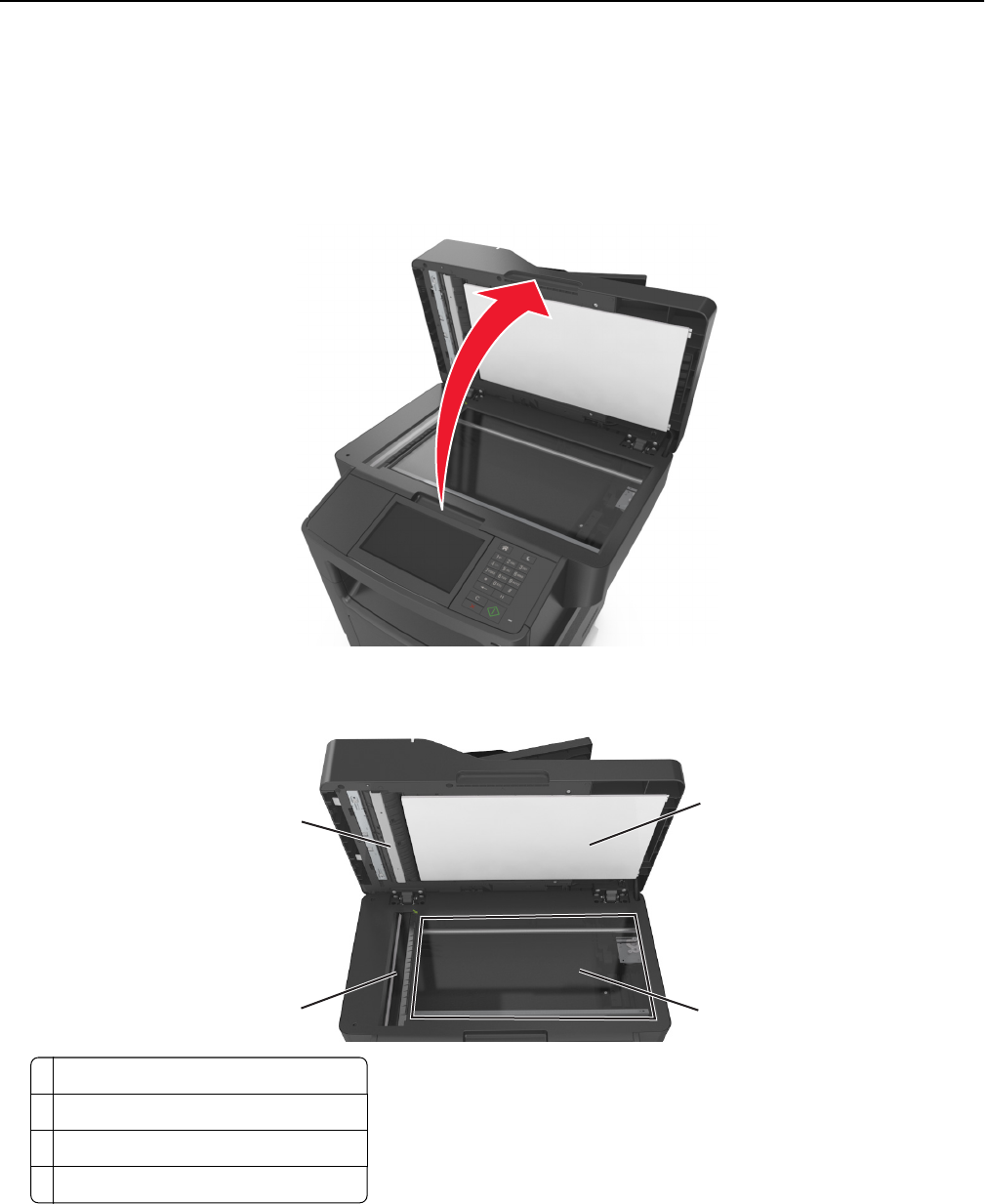
Cleaning the scanner glass
Clean the scanner glass if you encounter print quality problems, such as streaks on copied or scanned images.
1Slightly dampen a soft, lint-free cloth or paper towel with water.
2Open the scanner cover.
3Clean all the areas shown, and then let them dry.
1
23
4
1White underside of the scanner cover
2Scanner glass
3ADF glass
4White underside of the ADF cover
4Close the scanner cover.
Maintaining the printer 210

Checking the status of parts and supplies
Checking the status of parts and supplies on the printer control panel
From the home screen, touch Status/Supplies > View Supplies.
Checking the status of parts and supplies from the Embedded Web Server
Note: Make sure the computer and the printer are connected to the same network.
1Open a Web browser, and then type the printer IP address in the address field.
Notes:
•View the printer IP address on the home screen. The IP address appears as four sets of numbers separated
by periods, such as 123.123.123.123.
•If you are using a proxy server, then temporarily disable it to load the Web page correctly.
2Click Device Status > More Details.
Estimated number of remaining pages
The estimated number of remaining pages is based on the recent printing history of the printer. Its accuracy may
vary significantly and is dependent on many factors, such as actual document content, print quality settings, and
other printer settings.
The accuracy of the estimated number of remaining pages may decrease when the actual printing consumption is
different from the historical printing consumption. Consider the variable level of accuracy before purchasing or replacing
supplies based on the estimate. Until an adequate print history is obtained on the printer, initial estimates assume
future supplies consumption based on the International Organization for Standardization* test methods and page
content.
* Average continuous black declared cartridge yield in accordance with ISO/IEC 19752.
Ordering supplies
Ordering supplies using the Supplies Ordering Utility
1Use the Search command on the Start menu to locate Status Monitor Center.
2Open the application, and then click Order Supplies.
Ordering supplies using Printer Home
1Use the Search command on the Start menu to locate Dell Printer Home.
2Open the application, and then click Maintenance > Order supplies.
Maintaining the printer 211

Ordering toner cartridges
To order toner cartridges, contact the place where you purchased the printer.
Ordering an imaging unit
To order an imaging unit, contact the place where you purchased the printer.
Ordering a maintenance kit
To order a maintenance kit, contact the place where you purchased the printer.
Ordering an ADF separator roller
Order an ADF separator roller when the ADF fails to pick paper or picks more than one sheet of paper at a time.
For information on replacing the ADF separator roller, see the instruction sheet that came with the part.
Storing supplies
Choose a cool, clean storage area for the printer supplies. Store supplies right side up in their original packing until you
are ready to use them.
Do not expose supplies to:
•Direct sunlight
•Temperatures above 35°C (95°F)
•High humidity above 80%
•Salty air
•Corrosive gases
•Heavy dust
Maintaining the printer 212
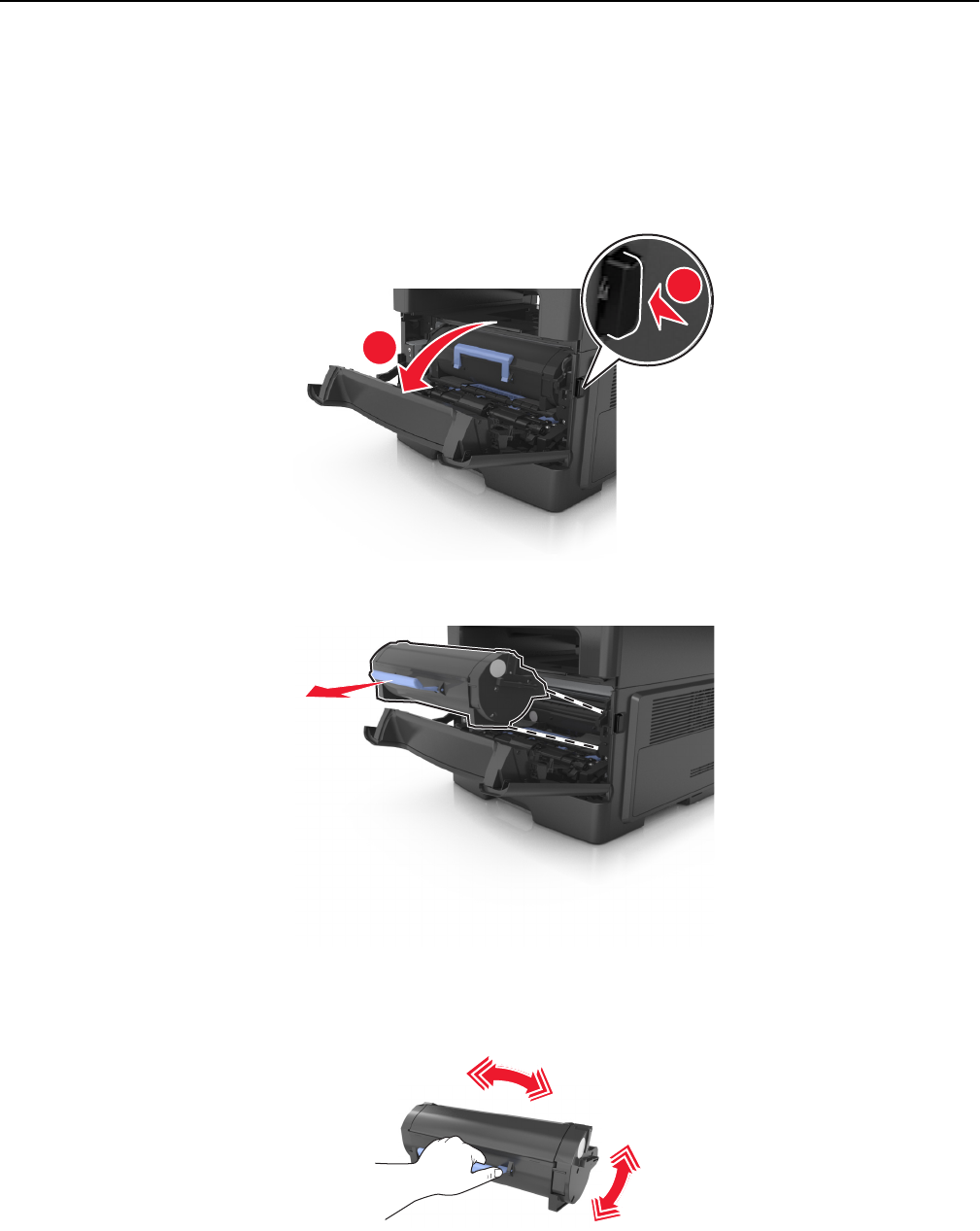
Replacing supplies
Replacing the toner cartridge
1Press the button on the right side of the printer, and then open the front door.
2
1
2Pull the toner cartridge out using the handle.
3Unpack the toner cartridge, and then remove all packing materials.
4Shake the new cartridge to redistribute the toner.
5Insert the toner cartridge into the printer by aligning the side rails of the cartridge with the arrows on the side rails
inside the printer.
Maintaining the printer 213
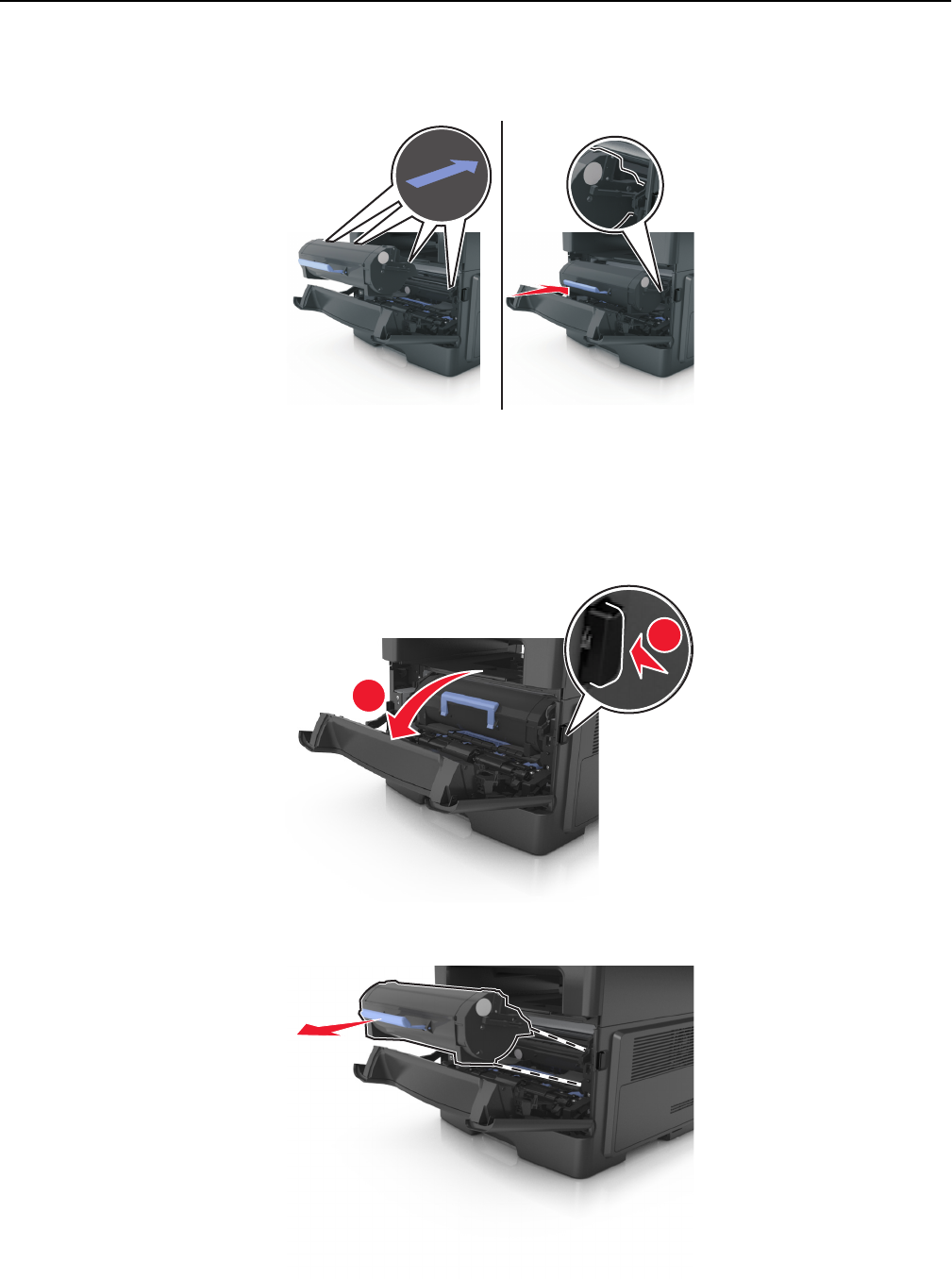
Warning—Potential Damage: Do not expose the imaging unit to direct light for more than 10 minutes.
Extended exposure to light may cause print quality problems.
6Close the front door.
Replacing the imaging unit
1Press the button on the right side of the printer, and then open the front door.
2
1
2Pull the toner cartridge out using the handle.
Maintaining the printer 214
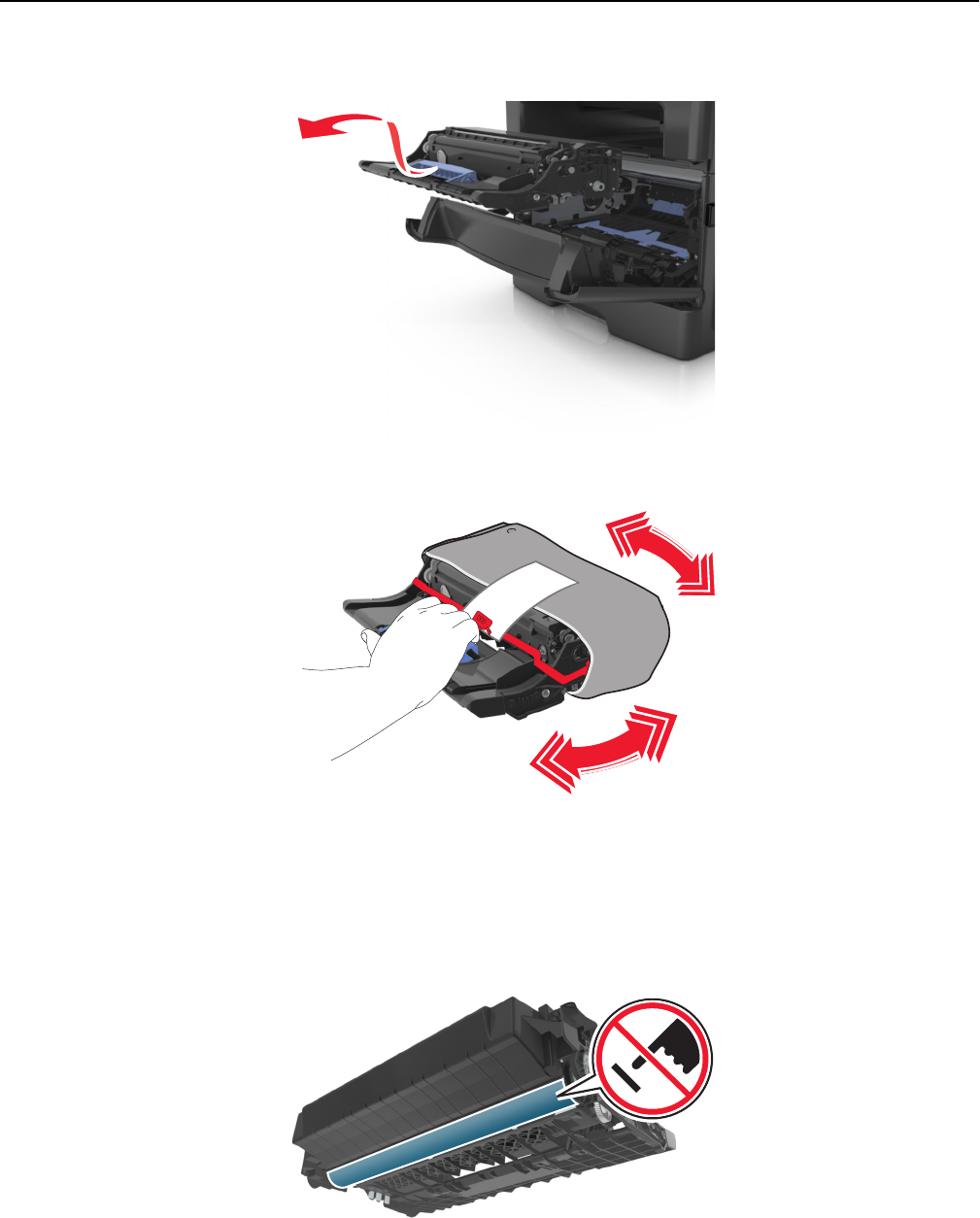
3Lift the blue handle, and then pull the imaging unit out of the printer.
4Unpack the new imaging unit, and then shake it.
5Remove all packing materials from the imaging unit.
Warning—Potential Damage: Do not expose the imaging unit to direct light for more than 10 minutes.
Extended exposure to light may cause print quality problems.
Warning—Potential Damage: Do not touch the photoconductor drum. Doing so may affect the print quality of
future print jobs.
Maintaining the printer 215
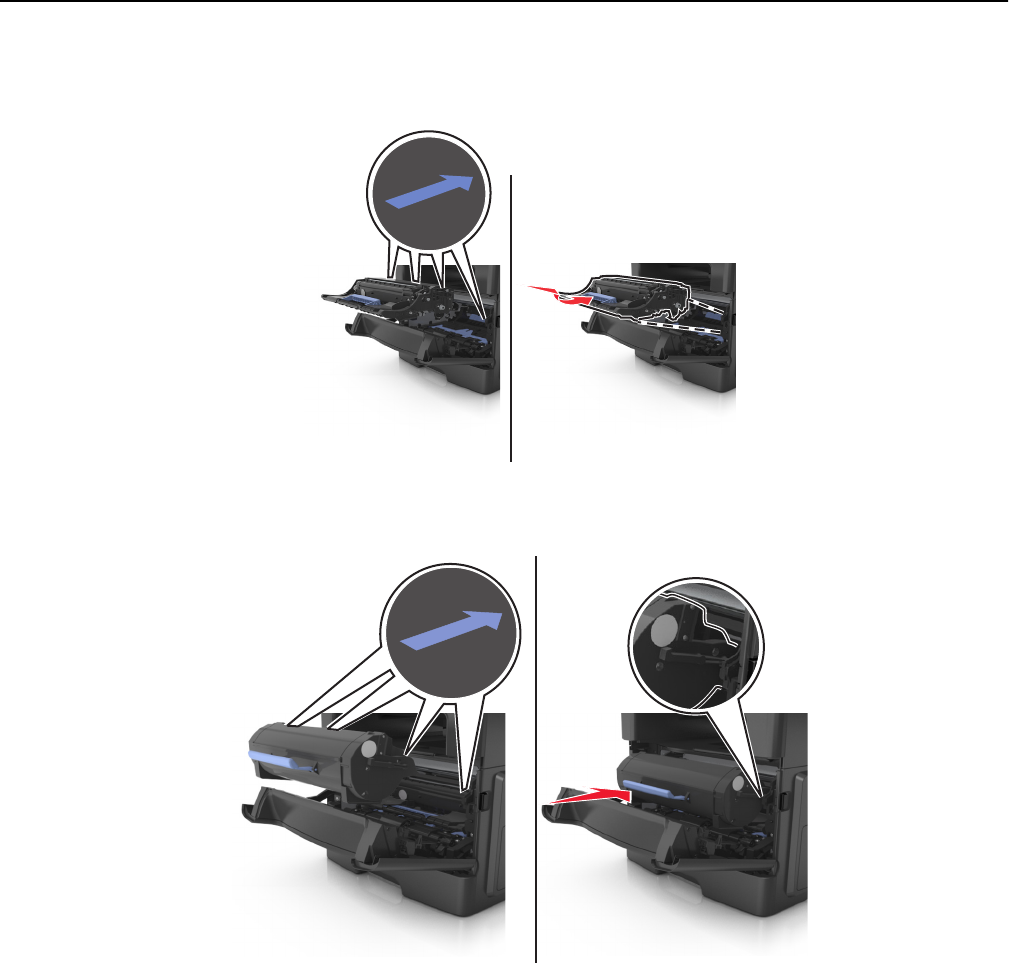
6Insert the imaging unit into the printer by aligning the arrows on the side rails of the imaging unit with the arrows
on the side rails inside the printer.
7Insert the toner cartridge into the printer by aligning the side rails of the cartridge with the arrows on the side rails
inside the printer.
8Close the front door.
Maintaining the printer 216
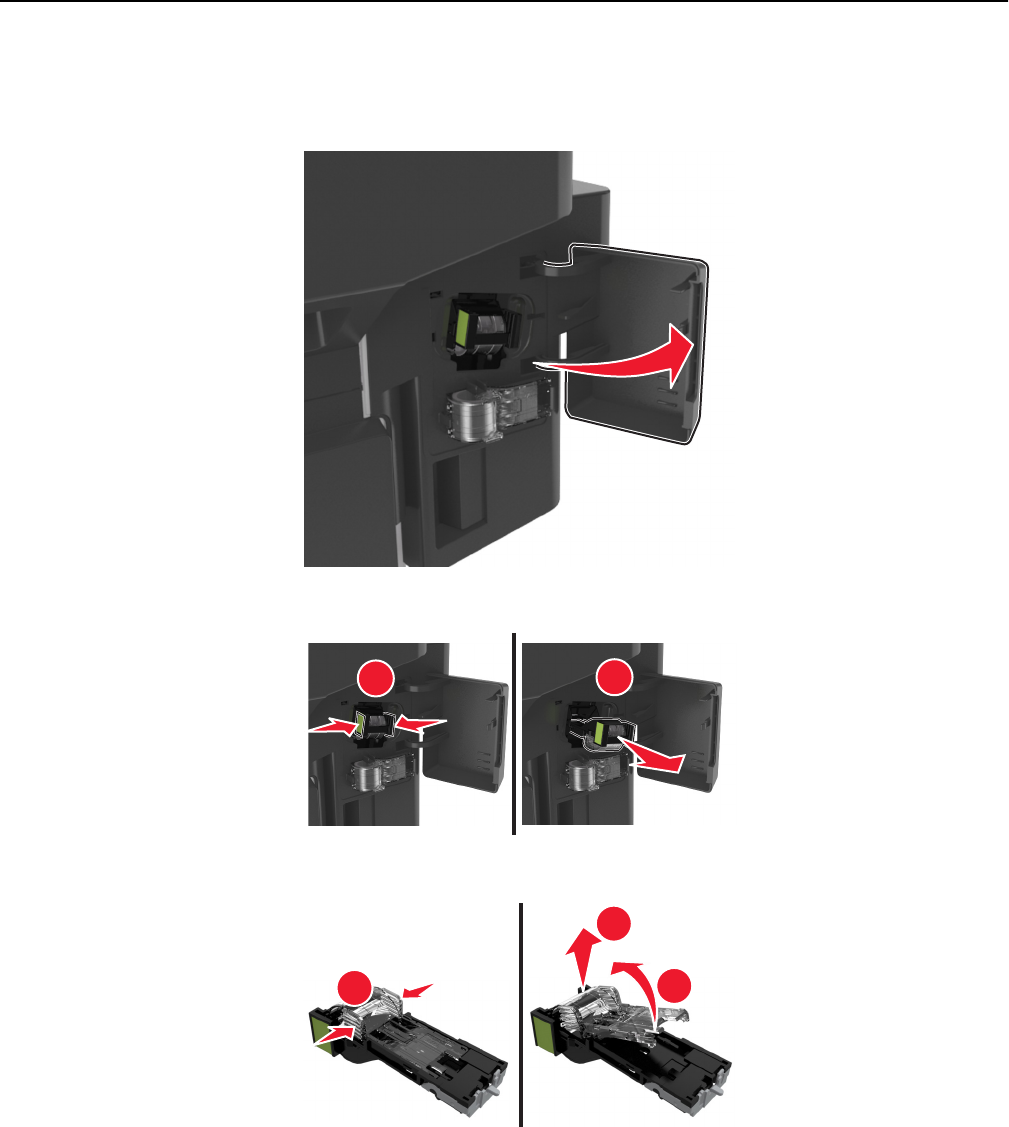
Replacing the staple cartridge
1Open the stapler door.
2Pull out the staple cartridge from the finisher.
12
3Hold both sides of the empty staple case with your fingers, pull, and then lift the empty staple case from the cartridge.
1
2
3
Maintaining the printer 217
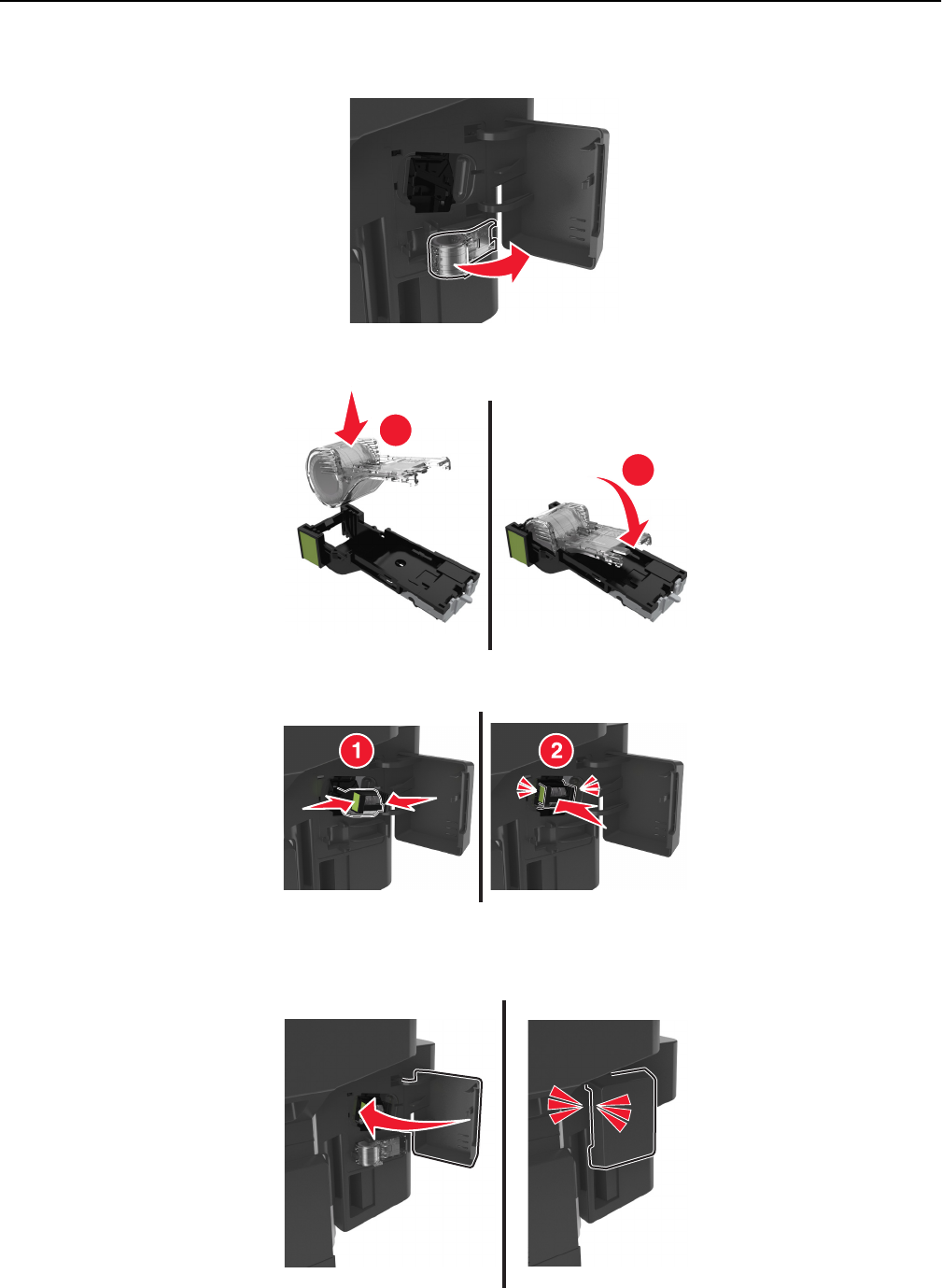
4Remove the spare staple case from its holder.
5Insert the spare staple case into the staple cartridge.
1
2
6Push the staple cartridge into the finisher until it clicks into place.
7Replace the spare staple case for future use.
8Close the stapler door.
Maintaining the printer 218
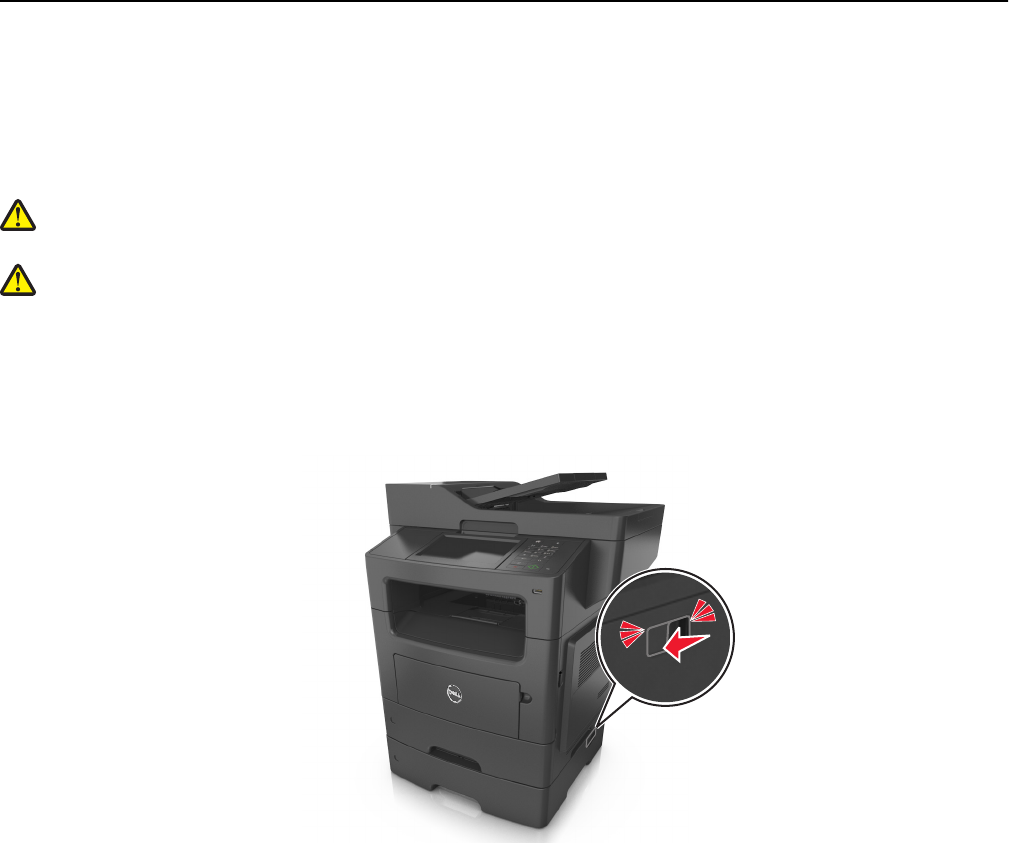
Moving the printer
Before moving the printer
CAUTION—POTENTIAL INJURY: The printer weight is greater than 18 kg (40 lb) and requires two or more
trained personnel to lift it safely.
CAUTION—POTENTIAL INJURY: Before moving the printer, follow these guidelines to avoid personal injury or
printer damage:
•Turn the printer off using the power switch, and then unplug the power cord from the electrical outlet.
•Disconnect all cords and cables from the printer before moving it.
•If an optional tray is installed, then remove it from the printer. To remove the optional tray, slide the latch on the
right side of the tray toward the front of the tray until it clicks into place.
•Use the handholds located on both sides of the printer to lift it.
•Make sure your fingers are not under the printer when you set it down.
•Before setting up the printer, make sure there is adequate clearance around it.
Use only the power cord provided with this product or the manufacturer's authorized replacement.
Warning—Potential Damage: Damage to the printer caused by improper moving is not covered by the printer
warranty.
Moving the printer to another location
The printer and its hardware options can be safely moved to another location by following these precautions:
•Any cart used to move the printer must have a surface able to support the full footprint of the printer.
•Any cart used to move the hardware options must have a surface able to support the dimensions of the hardware
options.
•Keep the printer in an upright position.
•Avoid severe jarring movements.
Maintaining the printer 219

Shipping the printer
When shipping the printer, use the original packaging or call the place of purchase for a relocation kit.
Maintaining the printer 220

Managing the printer
Managing printer messages
Use the Status Messenger application to view error messages requiring your intervention on your printer. When there
is an error, a bubble appears telling you what the error is, and points you to the appropriate recovery information.
If you installed Status Messenger with your printer software, then the application launches automatically when the
software installation is completed. The installation is successful if you see the Status Messenger icon in the system tray.
Notes:
•This feature is available only in Windows XP or later.
•Make sure bidirectional communication support is in place so the printer and the computer can communicate.
Disabling Status Messenger
1From the system tray, right‑click the Status Messenger icon.
2Select Exit.
Enabling Status Messenger
1Use the Search command on the Start menu to locate Status Messenger.
2Open the application.
Accessing Status Monitor Center
Use this application to view the status of any USB‑ or network‑connected printer and to order supplies online.
Note: Make sure bidirectional communication support is in place so the printer and the computer can communicate.
1Use the Search command on the Start menu to locate Status Monitor Center.
2Open the application.
Checking the virtual display
1Open a Web browser, and then type the printer IP address in the address field.
Notes:
•View the printer IP address in the TCP/IP section in the Network/Ports menu. The IP address appears as four
sets of numbers separated by periods, such as 123.123.123.123.
•If you are using a proxy server, then temporarily disable it to load the Web page correctly.
2Check the virtual display that appears at the top left corner of the screen.
The virtual display works as an actual display would work on a printer control panel.
Managing the printer 221

Setting up e‑mail alerts
Configure the printer to send you e‑mail alerts when the supplies are getting low or when the paper needs to be changed
or added, or when there is a paper jam.
1Open a Web browser, and then type the printer IP address in the address field.
Notes:
•View the printer IP address on the printer home screen. The IP address appears as four sets of numbers
separated by periods, such as 123.123.123.123.
•If you are using a proxy server, then temporarily disable it to load the Web page correctly.
2Click Settings.
3From the Other Settings menu, click E‑mail Alert Setup.
4Select the items you want to be notified on, and then type the e‑mail addresses.
5Click Submit.
Note: For information on setting up the e‑mail server, contact your system support person.
Viewing reports
You can view some reports from the Embedded Web Server. These reports are useful for assessing the status of the
printer, network, and supplies.
1Open a Web browser, and then type the printer IP address in the address field.
Notes:
•View the printer IP address on the printer home screen. The IP address appears as four sets of numbers
separated by periods, such as 123.123.123.123.
•If you are using a proxy server, then temporarily disable it to load the Web page correctly.
2Click Reports, and then click the type of report you want to view.
Configuring supply notifications from the Embedded Web
Server
You can determine how you would like to be notified when supplies run nearly low, low, very low, or reach their
end‑of‑life by setting the selectable alerts.
Notes:
•Selectable alerts can be set on the toner cartridge, imaging unit, and maintenance kit.
•All selectable alerts can be set for nearly low, low, and very low supply conditions. Not all selectable alerts can
be set for the end‑of‑life supply condition. E‑mail selectable alert is available for all supply conditions.
•The percentage of estimated remaining supply that prompts the alert can be set on some supplies for some
supply conditions.
1Open a Web browser, and then type the printer IP address in the address field.
Managing the printer 222
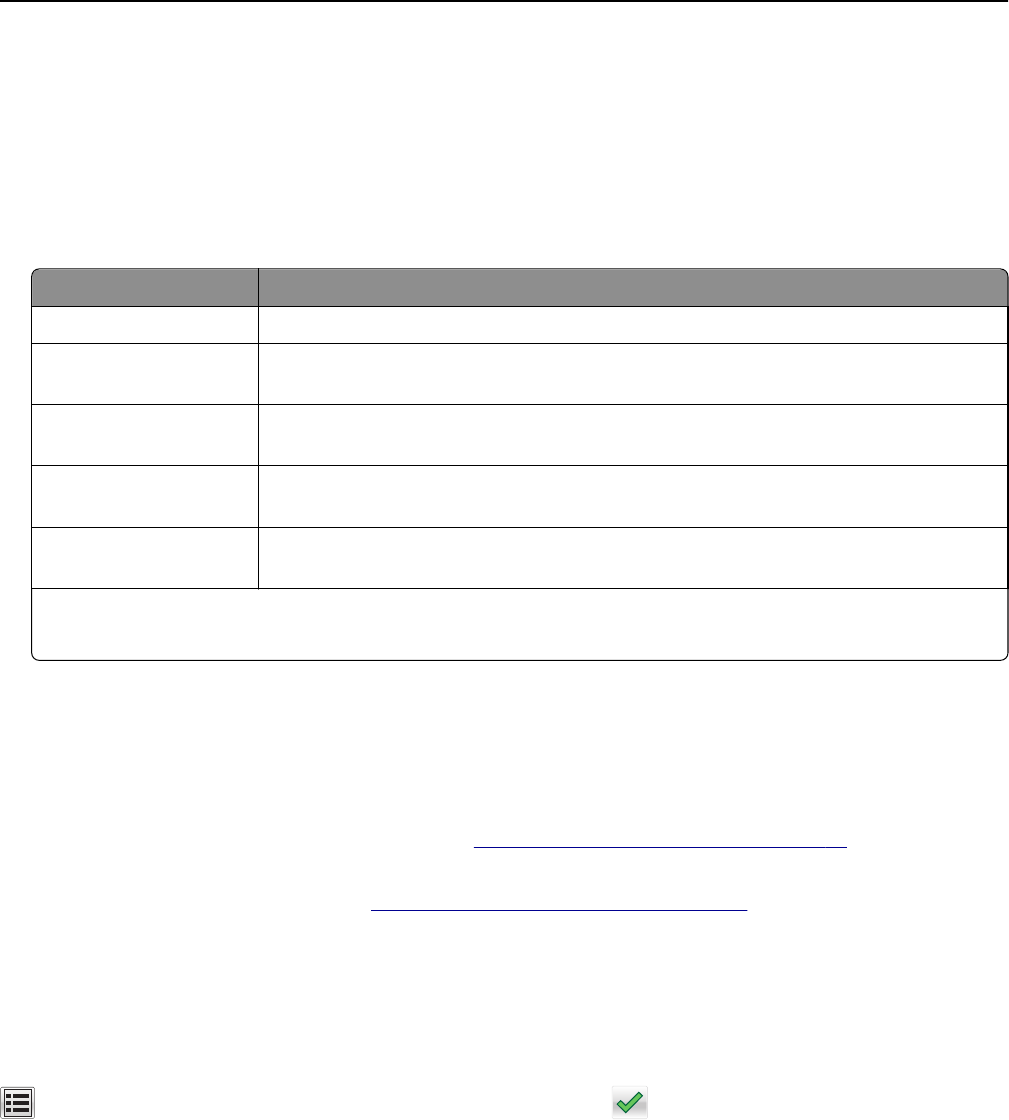
Notes:
•View the printer IP address on the printer home screen. The IP address appears as four sets of numbers
separated by periods, such as 123.123.123.123.
•If you are using a proxy server, then temporarily disable it to load the Web page correctly.
2Click Settings > Print Settings > Supply Notifications.
3From the drop‑down menu for each supply, select one of the following notification options:
Notification Description
Off The normal printer behavior for all supplies occurs.
E‑mail Only The printer generates an e‑mail when the supply condition is reached. The status of the
supply appears on the menus page and status page.
Warning The printer displays the warning message and generates an e‑mail about the status of the
supply. The printer does not stop when the supply condition is reached.
Continuable Stop1The printer stops processing jobs when the supply condition is reached, and the user needs
to press a button to continue printing.
Non Continuable Stop1,2 The printer stops processing jobs when the supply condition is reached. The supply must be
replaced to continue printing.
1 The printer generates an e-mail about the status of the supply when supply notification is enabled.
2 The printer stops when some supplies become empty to prevent damage.
4Click Submit.
Restoring factory default settings
If you want to keep a list of the current menu settings for reference, then print a menu settings page before restoring
the factory default settings. For more information, see “Printing a menu settings page” on page 50.
If you want a more comprehensive method of restoring the printer factory default settings, then perform the Wipe All
Settings option. For more information, see “Erasing non‑volatile memory” on page 206.
Warning—Potential Damage: Restoring factory defaults returns most printer settings to the original factory default
settings. Exceptions include the display language, custom sizes and messages, and network/port menu settings. All
downloads stored in the RAM are deleted. Downloads stored in the flash memory or in a printer hard disk are not
affected.
From the home screen, navigate to:
> Settings > General Settings > Factory Defaults > Restore Now >
Managing the printer 223
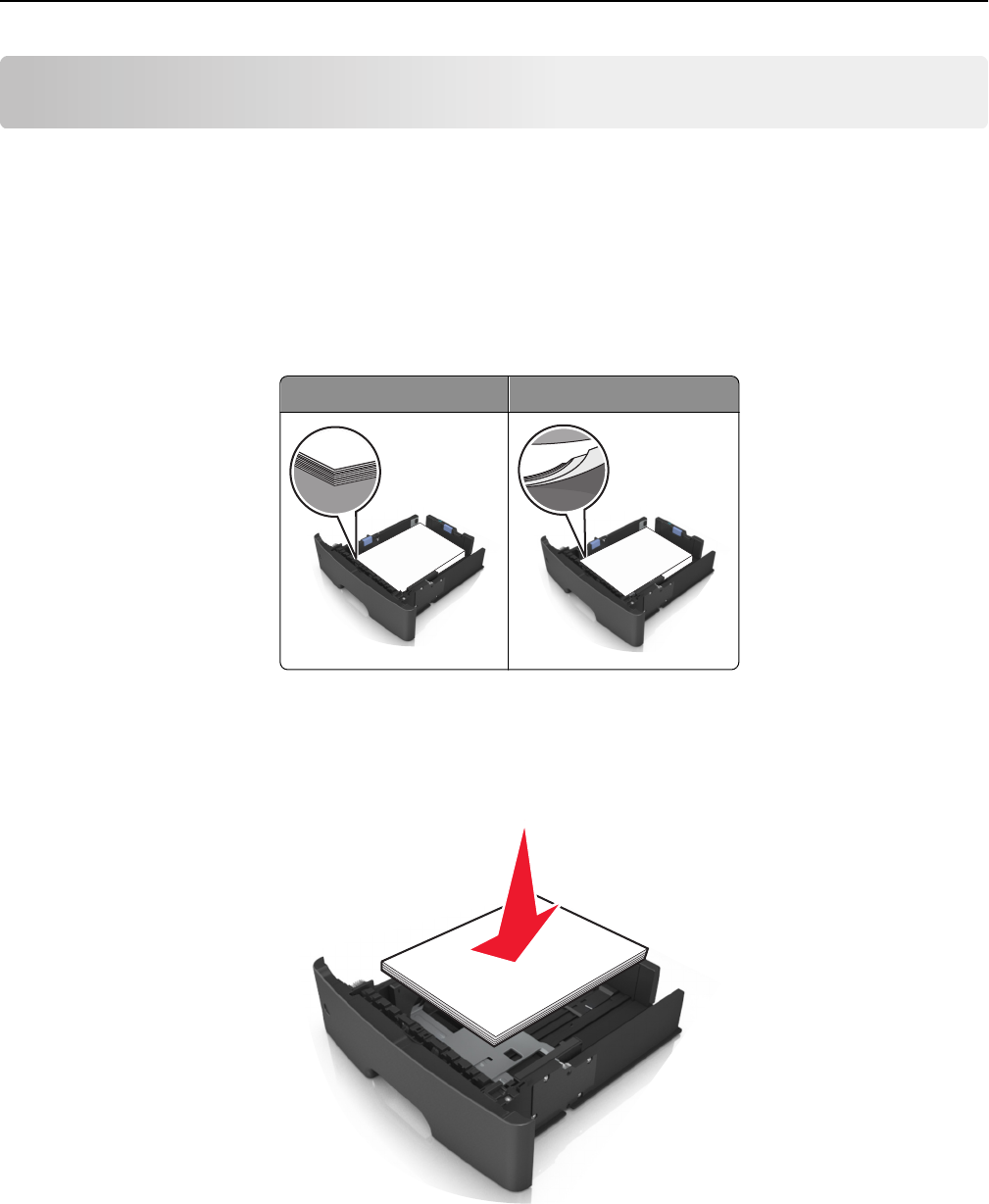
Clearing jams
Jam error messages appear on the printer display and include the area of the printer where the jam occurred. When
there is more than one jam, the number of jammed pages is displayed.
Avoiding jams
Load paper properly
•Make sure paper lies flat in the tray.
Correct loading of paper Incorrect loading of paper
A4
LTR
EXEC
B5
A5
LTR
LGLA4
EXEC
B5A5A6
A4
LTR
EXEC
B5
A5
LTR
LGLA4
EXEC
B5A5A6
•Do not remove a tray while the printer is printing.
•Do not load a tray while the printer is printing. Load it before printing, or wait for a prompt to load it.
•Do not load too much paper. Make sure the stack height is below the maximum paper fill indicator.
•Do not slide the paper into the tray. Load paper as shown in the illustration.
•Make sure the guides in the tray or the multipurpose feeder are properly positioned and are not pressing tightly
against the paper or envelopes.
•Push the tray firmly into the printer after loading paper.
Clearing jams 224
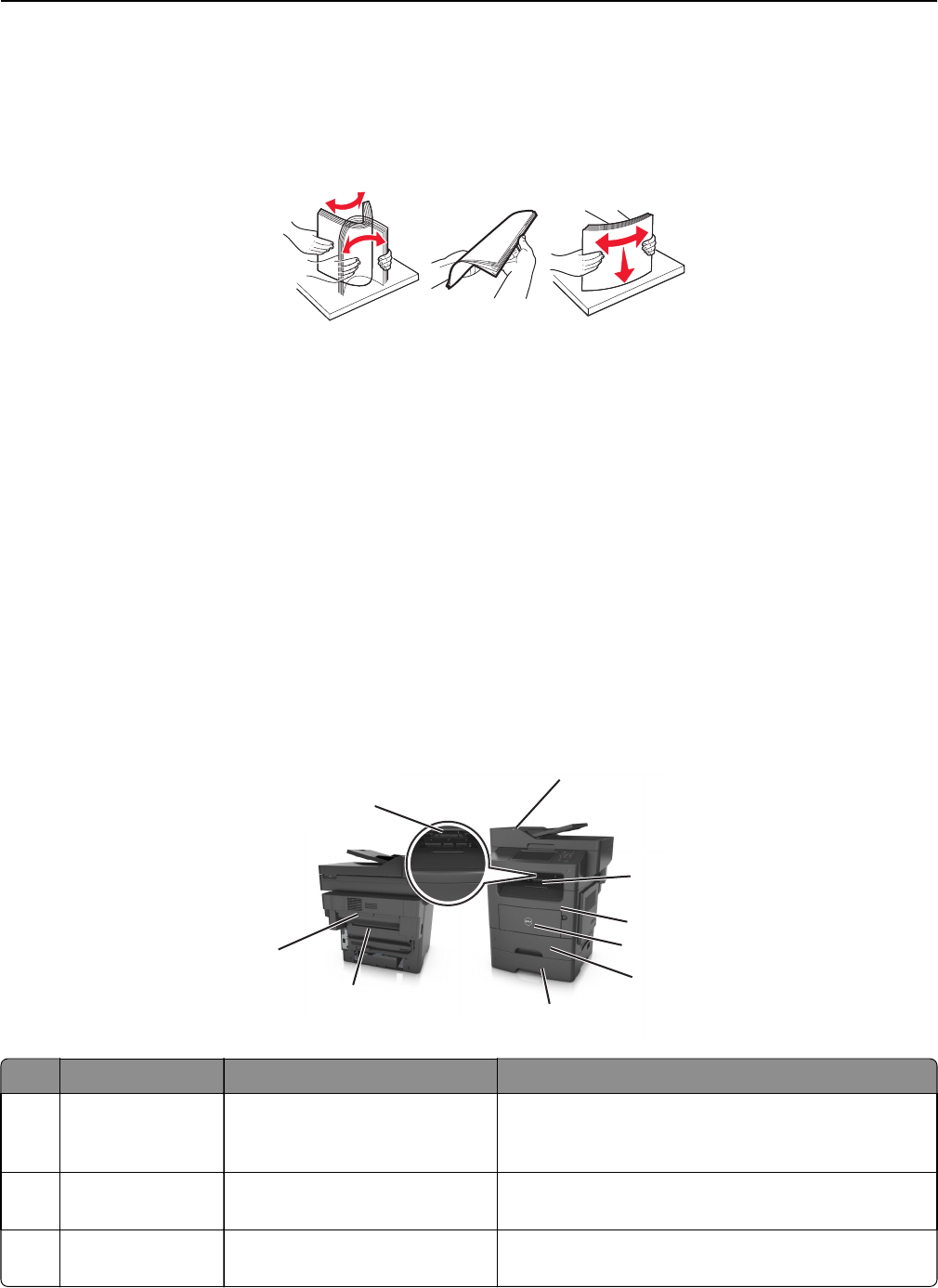
Use recommended paper
•Use only recommended paper or specialty media.
•Do not load wrinkled, creased, damp, bent, or curled paper.
•Flex, fan, and straighten paper before loading it.
•Do not use paper that has been cut or trimmed by hand.
•Do not mix paper sizes, weights, or types in the same tray.
•Make sure the paper size and type are set correctly on the computer or printer control panel.
•Store paper according to manufacturer recommendations.
Understanding jam messages and locations
When a jam occurs, a message indicating the jam location and information to clear the jam appears on the printer
display. Open the doors, covers, and trays indicated on the display to remove the jam.
Notes:
•When Jam Assist is set to On, the printer automatically flushes blank pages or pages with partial prints to the
standard bin after a jammed page has been cleared. Check your printed output stack for discarded pages.
•When Jam Recovery is set to On or Auto, the printer reprints jammed pages. However, the Auto setting does not
guarantee that the page will print.
1
2
3
4
5
6
9
7
8
1
Jam access area Printer control panel message What to do
1Automatic
document feeder
(ADF)
[x]‑page jam, open ADF to clear
jam. [28y.xx]
Remove all paper from the ADF tray, and then remove the
jammed paper.
2Standard bin [x]‑page jam, clear standard
bin. [20y.xx]
Remove the jammed paper.
3Front door [x]‑page jam, open front
door. [20y.xx]
Open the front door, then remove the toner cartridge and
imaging unit, and then the jammed paper.
Clearing jams 225
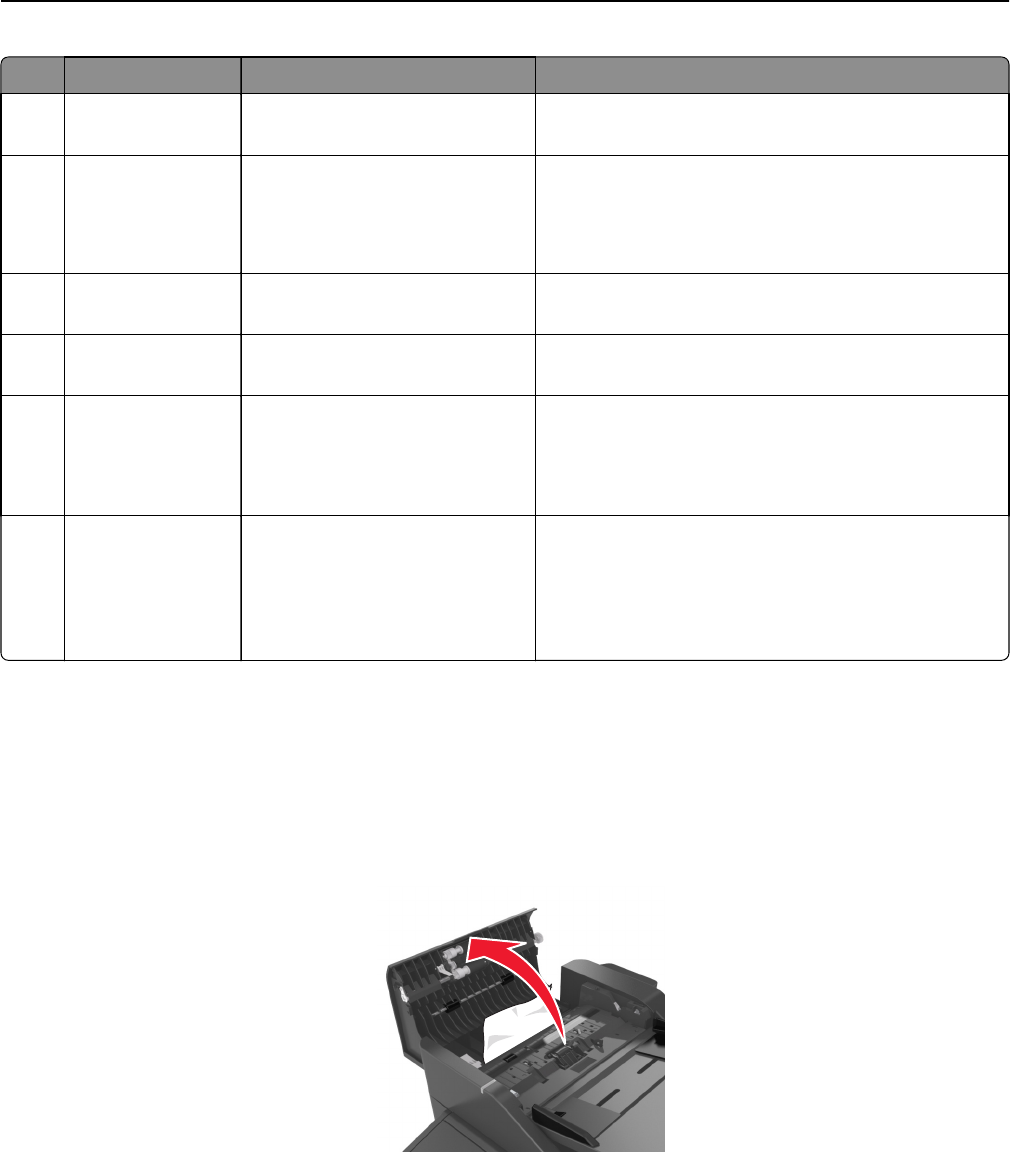
Jam access area Printer control panel message What to do
4Multipurpose
feeder
[x]‑page jam, clear manual
feeder. [25y.xx]
Remove all paper from the multipurpose feeder, and then
remove the jammed paper.
5Tray 1 [x]‑page jam, remove tray 1 to clear
duplex. [23y.xx]
Pull out tray 1 completely, then push the front duplex flap
down, and then remove the jammed paper.
Note: You may need to open the rear door to clear
some 23y.xx paper jams.
6Tray [x] [x]‑page jam, open tray [x]. [24y.xx] Pull the indicated tray out, and then remove the jammed
paper.
7Rear door [x]‑page jam, open rear
door. [20y.xx]
Open the rear door, and then remove the jammed paper.
8Finisher rear door [x]-page jam, remove all pages
from the finisher’s output bin.
Leave paper in bin [45y.xx]
•Open the finisher rear door, and then remove the
jammed paper.
•Open the narrow door, and then remove the jammed
paper.
9Finisher output bin [x]-page jam, remove all pages
from the output bin. Leave paper
in bin [45y.xx]
•Move the left paper guide to the left and the right
paper guide to the right, and then remove the jammed
paper from the finisher bin.
•Open the finisher rear door and the narrow door, and
then remove any jammed pages.
[x]‑page jam, open automatic feeder top cover. [28y.xx]
1Remove all original documents from the ADF tray.
Note: The message is cleared when the pages are removed from the ADF tray.
2Open the ADF cover.
3Firmly grasp the jammed paper on each side, and then gently pull it out.
Note: Make sure all paper fragments are removed.
4Close the ADF cover.
5Straighten the edges of the original documents, then load the documents into the ADF, and then adjust the paper
guide.
6From the printer control panel, touch Done to clear the message and continue printing.
Clearing jams 226
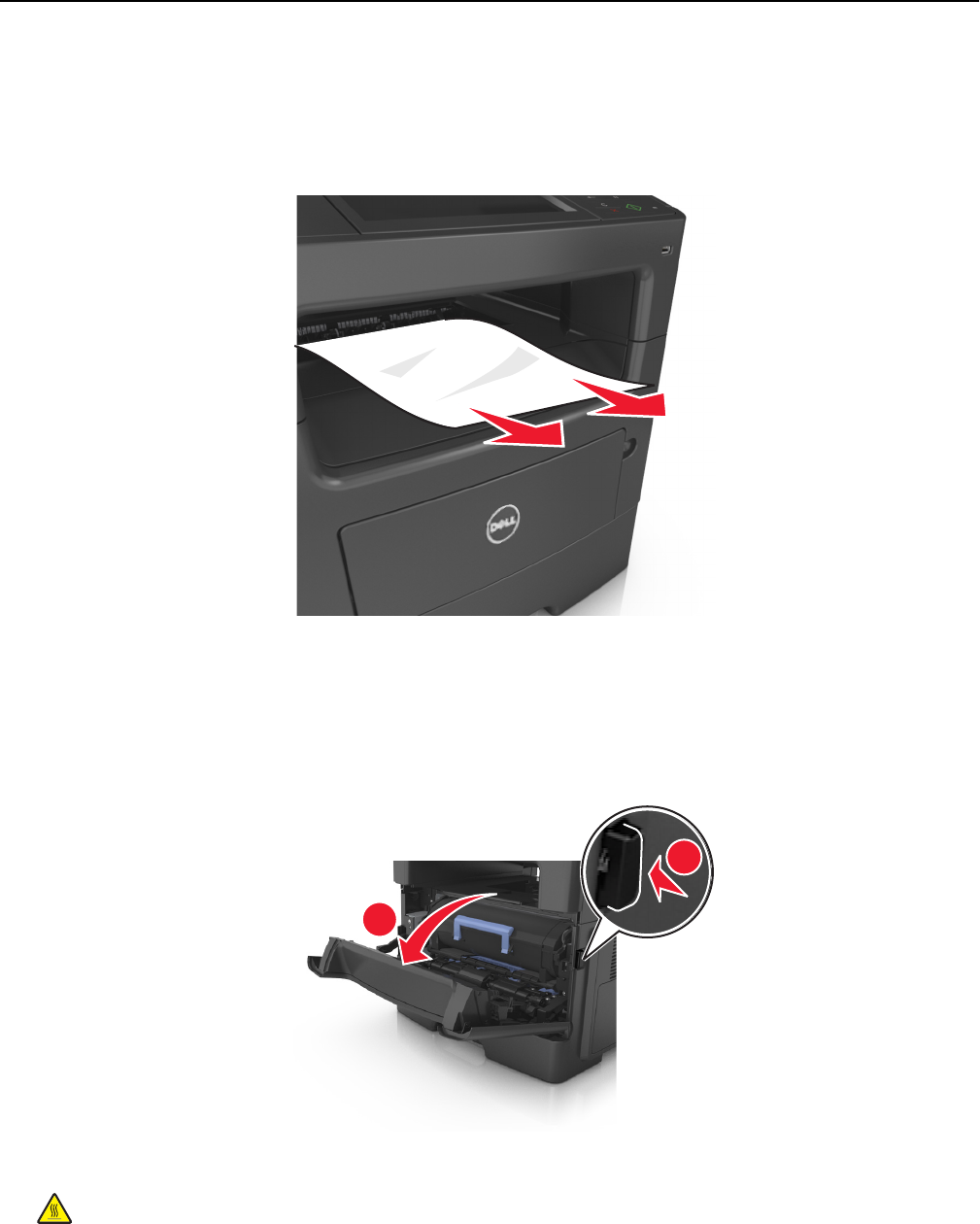
[x]‑page jam, clear standard bin. [20y.xx]
1Firmly grasp the jammed paper on each side, and then gently pull it out.
Note: Make sure all paper fragments are removed.
2From the printer control panel, touch Done to clear the message and continue printing.
[x]‑page jam, open rear door. [20y.xx]
1Open the front door to loosen the jammed paper in the rear door.
2
1
2Gently pull down the rear door.
CAUTION—HOT SURFACE: The inside of the printer might be hot. To reduce the risk of injury from a hot
component, allow the surface to cool before touching it.
Clearing jams 227
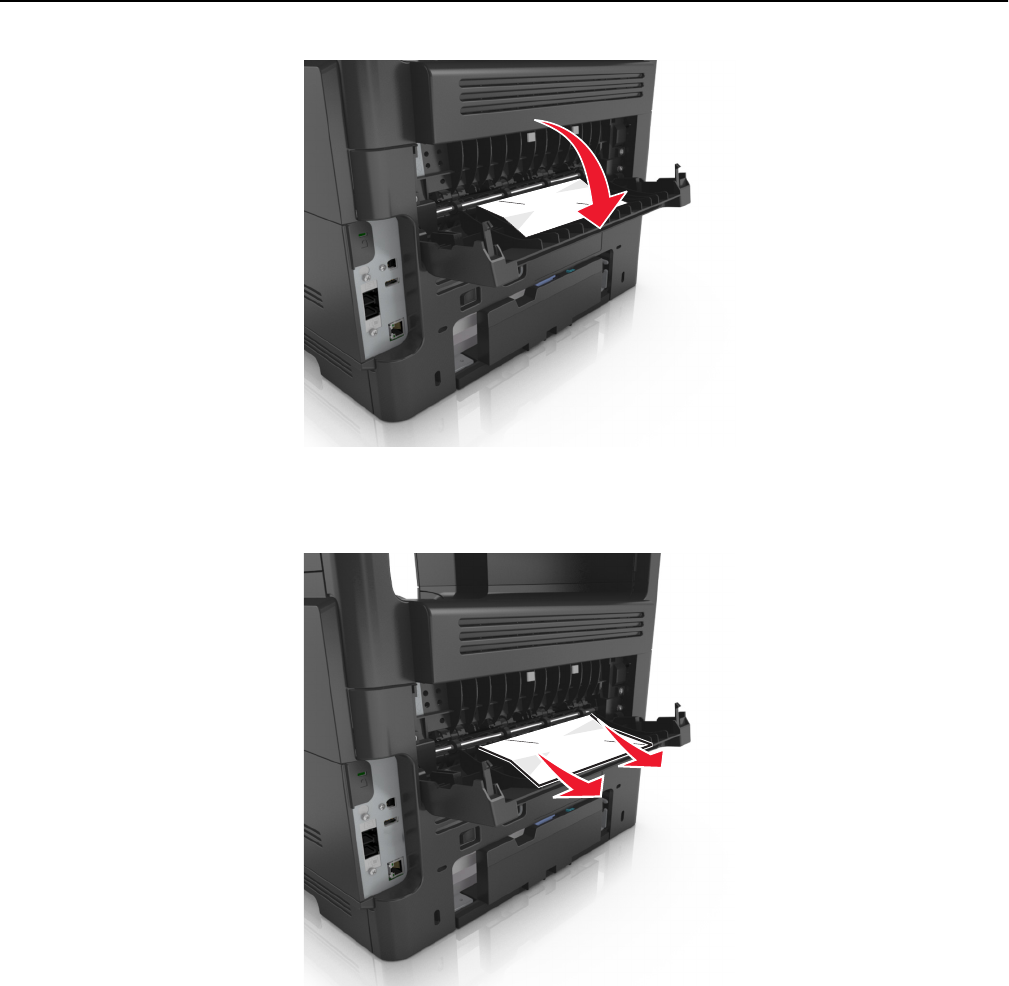
3Firmly grasp the jammed paper on each side, and then gently pull it out.
Note: Make sure all paper fragments are removed.
4Close the front and rear door.
5From the printer control panel, select Done to clear the message and continue printing.
Clearing jams 228
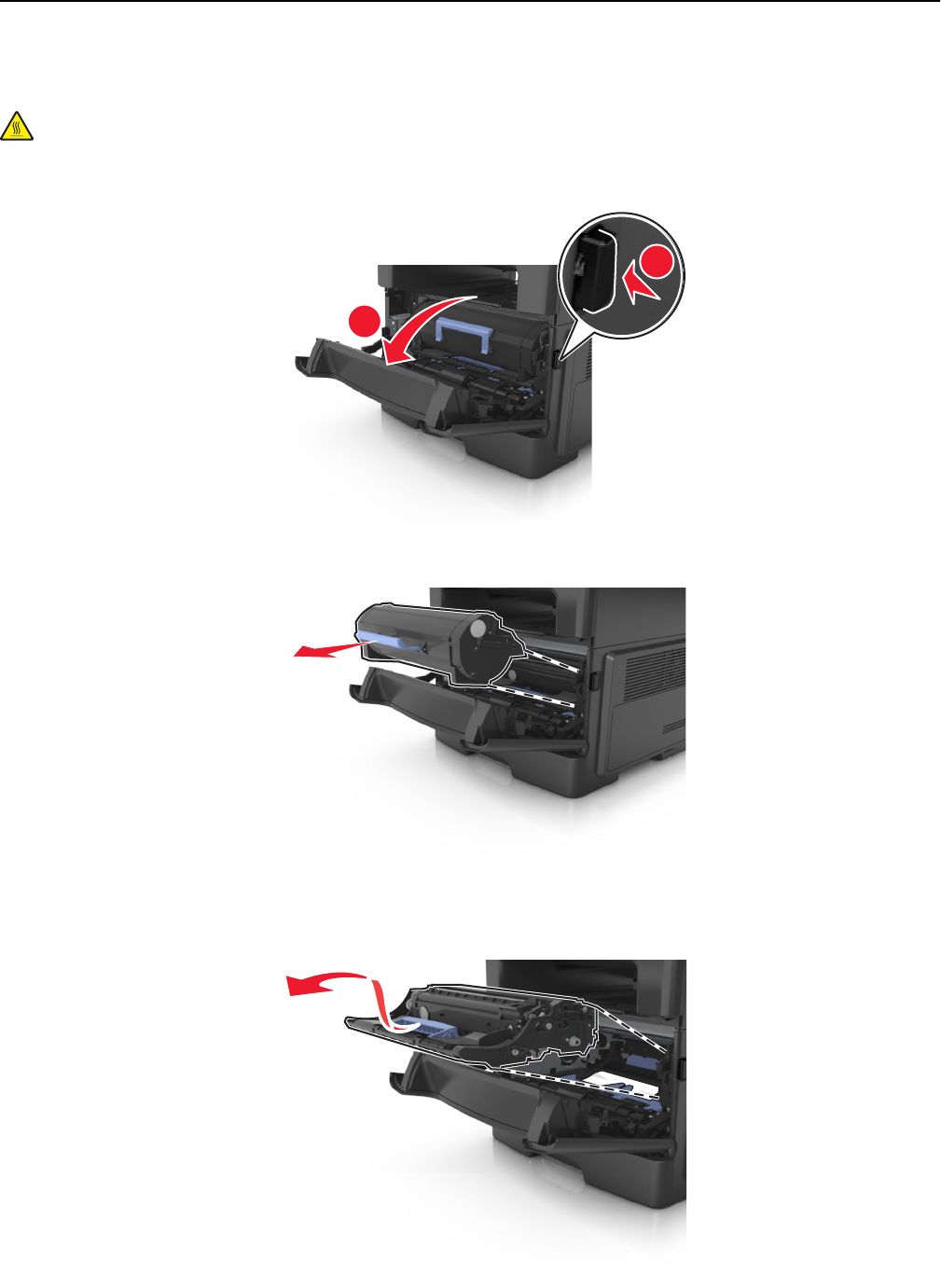
[x]‑page jam, open front door. [20y.xx]
CAUTION—HOT SURFACE: The inside of the printer might be hot. To reduce the risk of injury from a hot
component, allow the surface to cool before touching it.
1Press the button on the right side of the printer, and then open the front door.
2
1
2Pull out the toner cartridge using the handle.
3Lift the blue handle, and then pull out the imaging unit from the printer.
Clearing jams 229
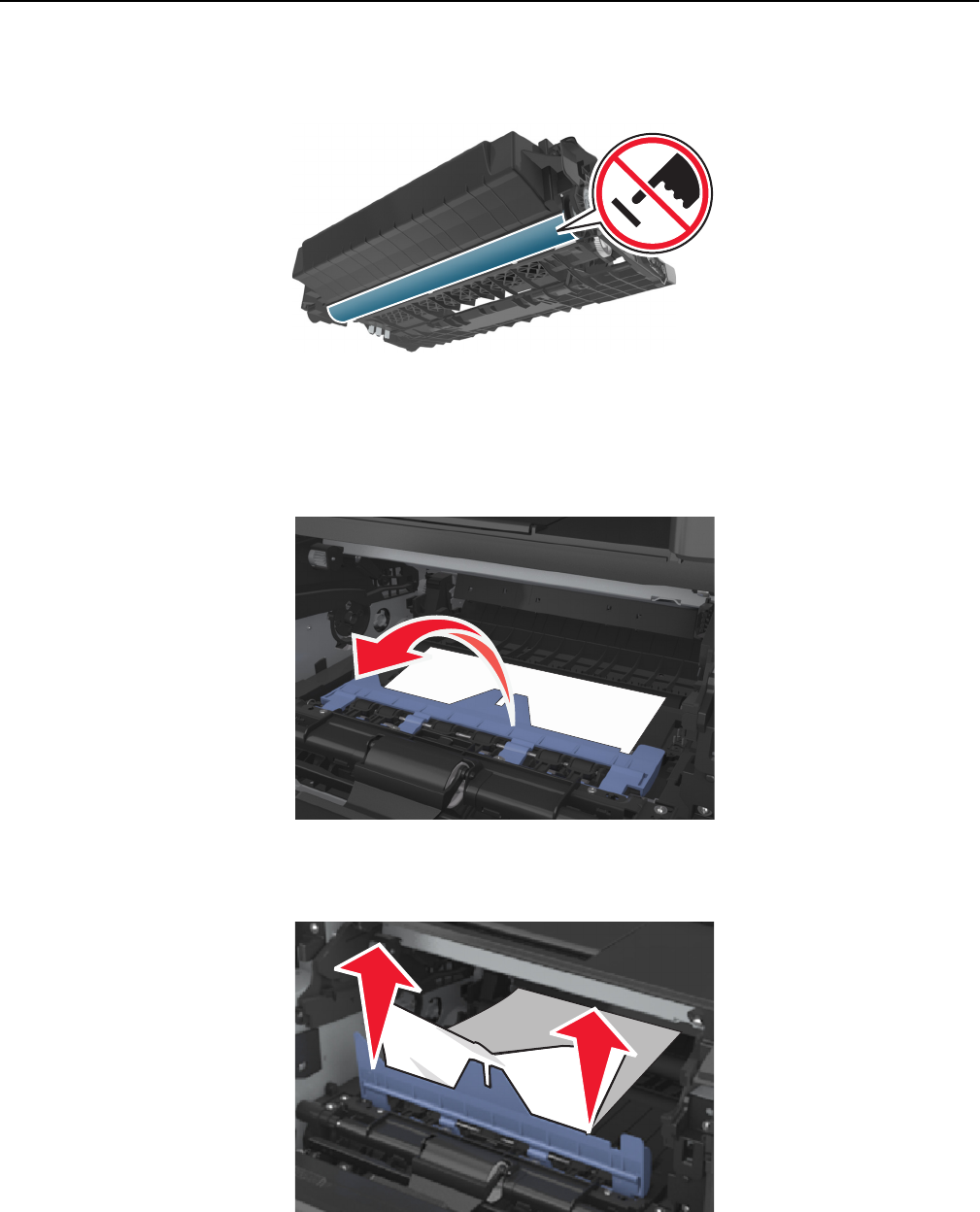
Warning—Potential Damage: Do not touch the shiny blue photoconductor drum under the imaging unit. Doing
so may affect the quality of future print jobs.
4Place the imaging unit aside on a flat, smooth surface.
Warning—Potential Damage: Do not expose the imaging unit to direct light for more than 10 minutes.
Extended exposure to light may cause print quality problems.
5Lift the blue flap in front of the printer.
6Firmly grasp the jammed paper on each side, and then gently pull it out.
Note: Make sure all paper fragments are removed.
Clearing jams 230
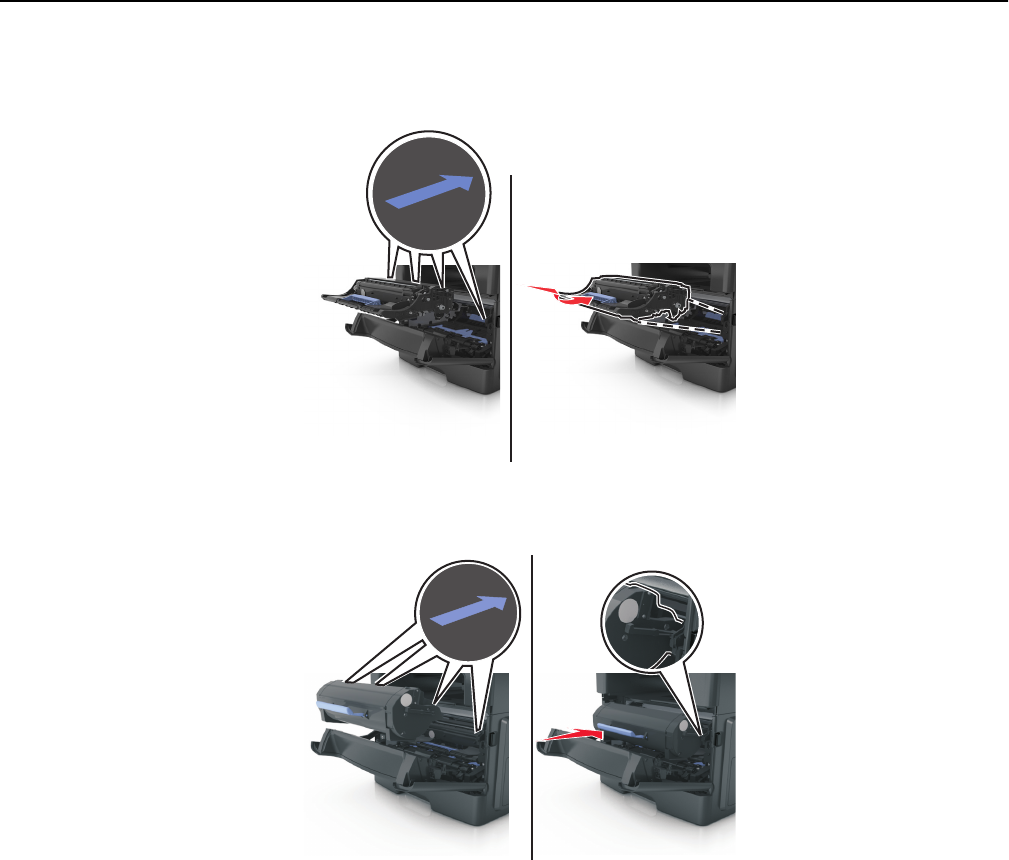
7Insert the imaging unit by aligning the arrows on the side rails of the unit with the arrows on the side rails inside
the printer, and then insert the imaging unit into the printer.
8Insert the toner cartridge by aligning the side rails of the cartridge with the arrows on the side rails inside the printer,
and then insert the cartridge into the printer.
9Close the front door.
10 From the printer control panel, select Continue to clear the message and continue printing.
Clearing jams 231
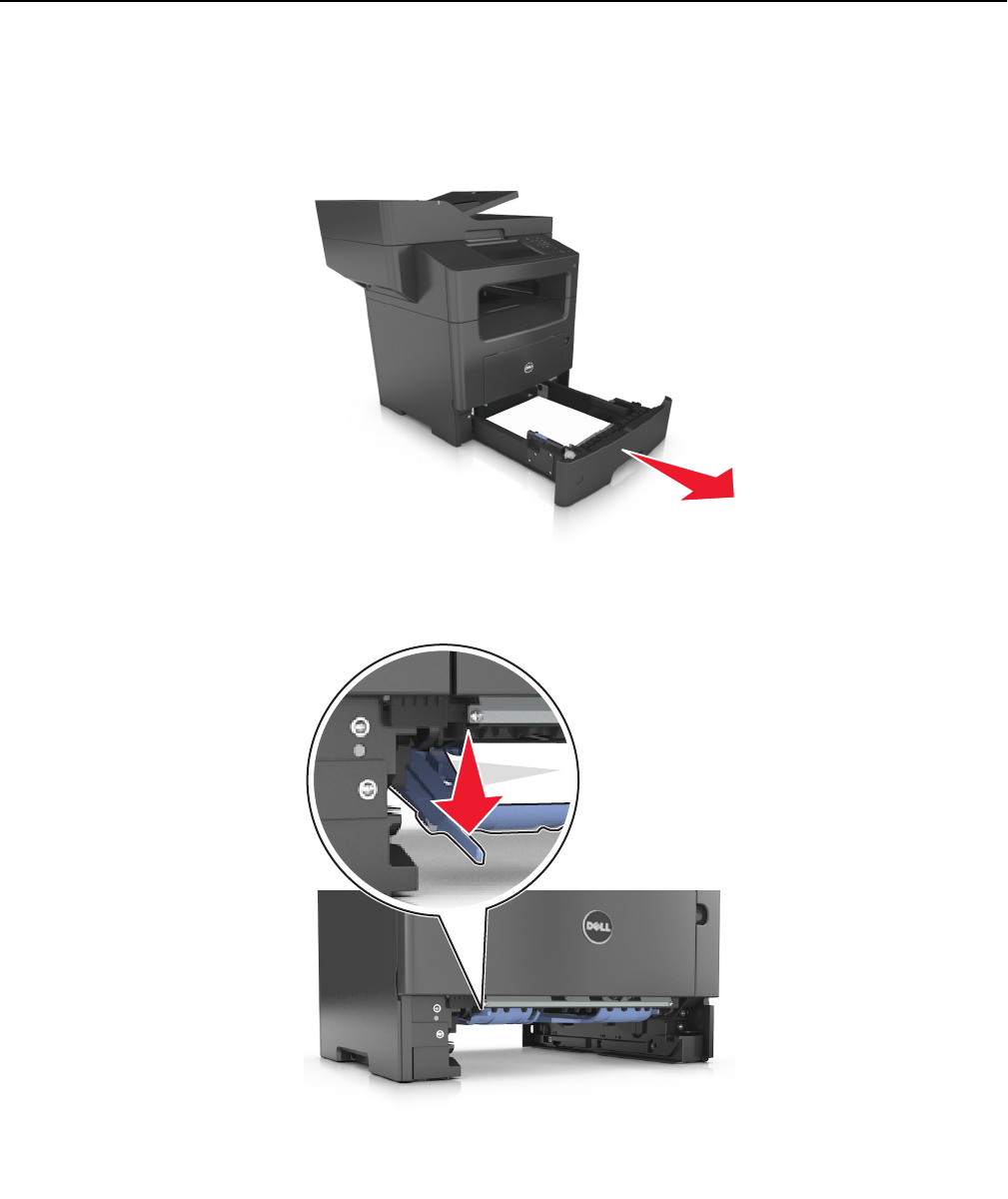
[x]‑page jam, remove tray 1 to clear duplex. [23y.xx]
1Pull out the tray completely.
1
2Locate the lever, and then pull it down to release the jam.
3Firmly grasp the jammed paper on each side, and then gently pull it out.
Note: Make sure all paper fragments are removed.
Clearing jams 232
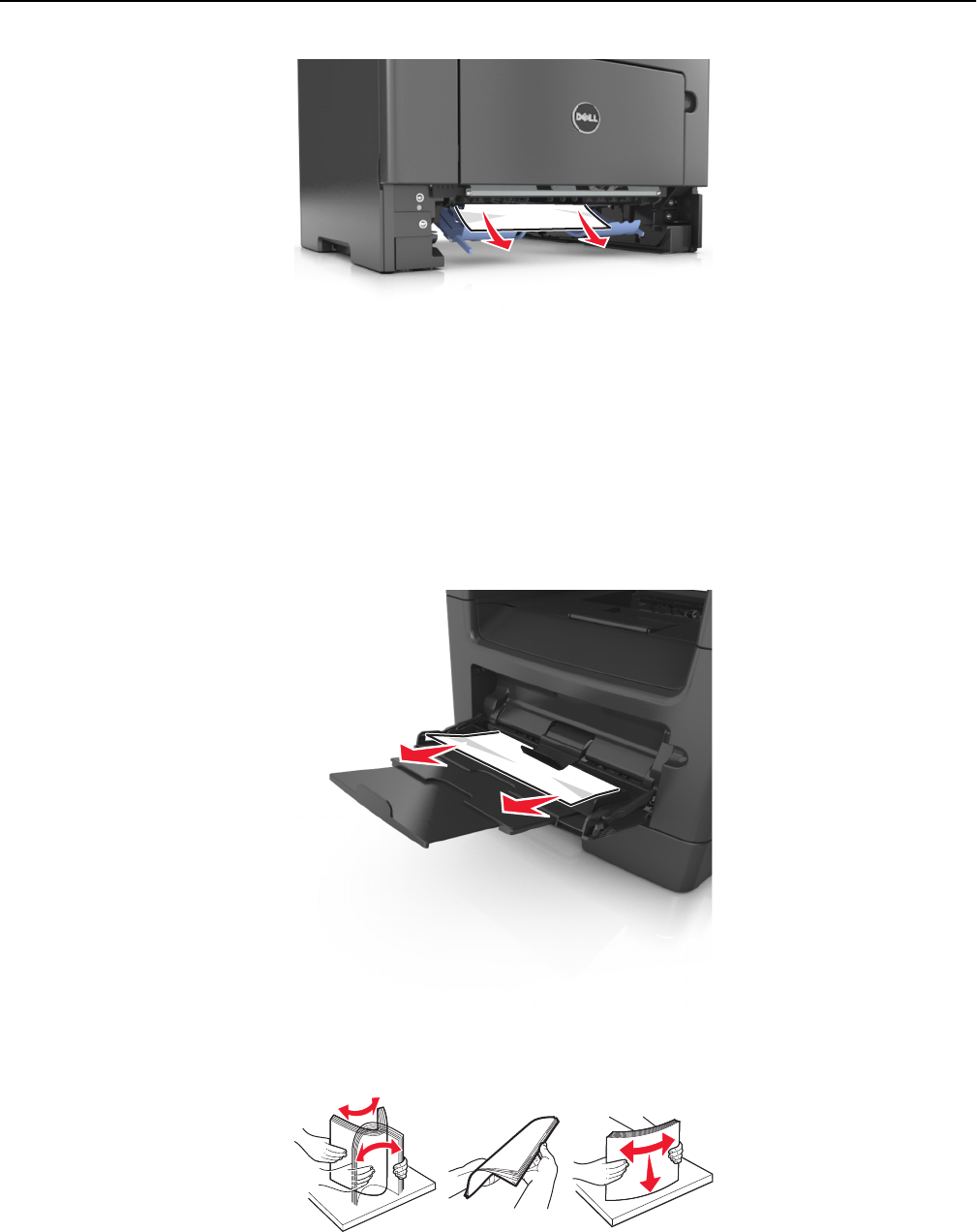
4Insert the tray.
5From the printer control panel, touch Done to clear the message and continue printing.
[x]‑page jam, clear manual feeder. [25y.xx]
1From the multipurpose feeder, firmly grasp the jammed paper on each side, and then gently pull it out.
Note: Make sure all paper fragments are removed.
2Flex the sheets back and forth to loosen them, and then fan them. Do not fold or crease the paper. Straighten the
edges on a level surface.
Clearing jams 233
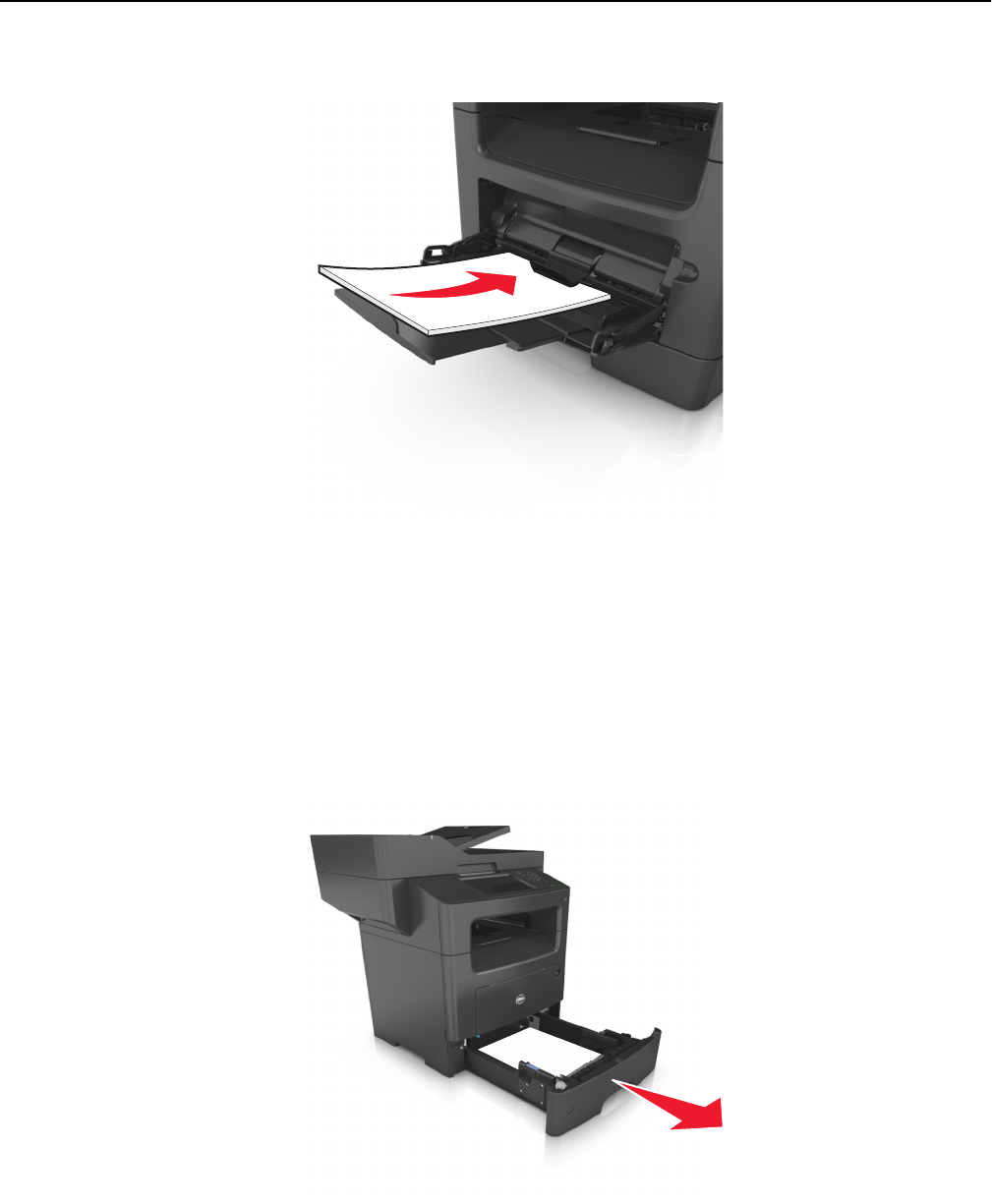
3Reload paper into the multipurpose feeder.
Note: Make sure the paper guide lightly rests against the edge of the paper.
4From the printer control panel, touch Done to clear the message and continue printing.
[x]‑page jam, open tray [x]. [24y.xx]
1Pull out the tray completely.
Note: The message on the printer display indicates the tray where the jammed paper is located.
1
2Firmly grasp the jammed paper on each side, and then gently pull it out.
Note: Make sure all paper fragments are removed.
Clearing jams 234
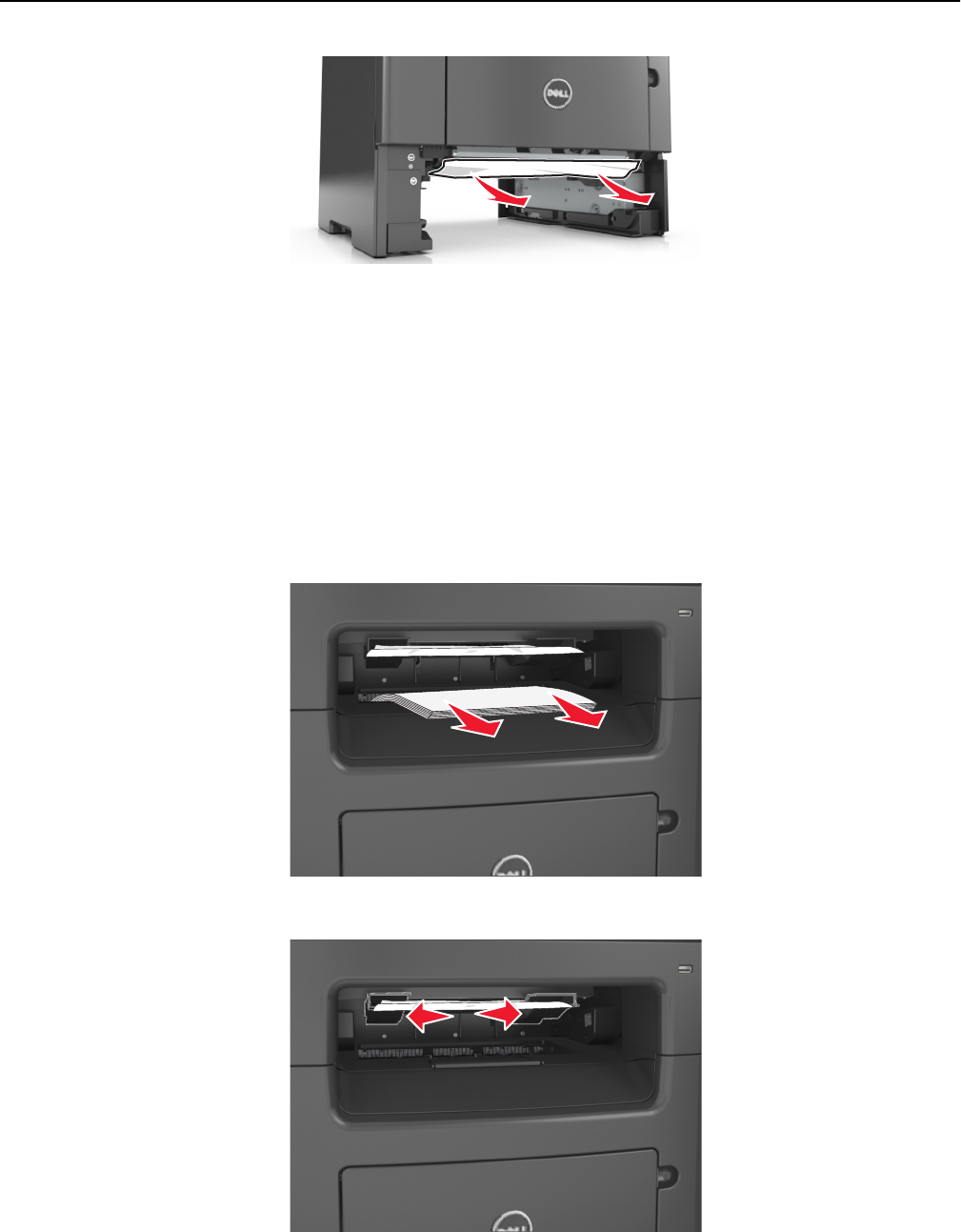
3Insert the tray.
4From the printer control panel, touch Done to clear the message and continue printing.
[x]-page jam, remove all pages from the output bin. Leave
paper in bin. [45y.xx]
Paper jam in the finisher bin
1Empty the standard bin.
2Move the paper guides to the sides.
3Remove all jammed pages from inside the access areas.
Note: Make sure all paper fragments are removed.
Clearing jams 235
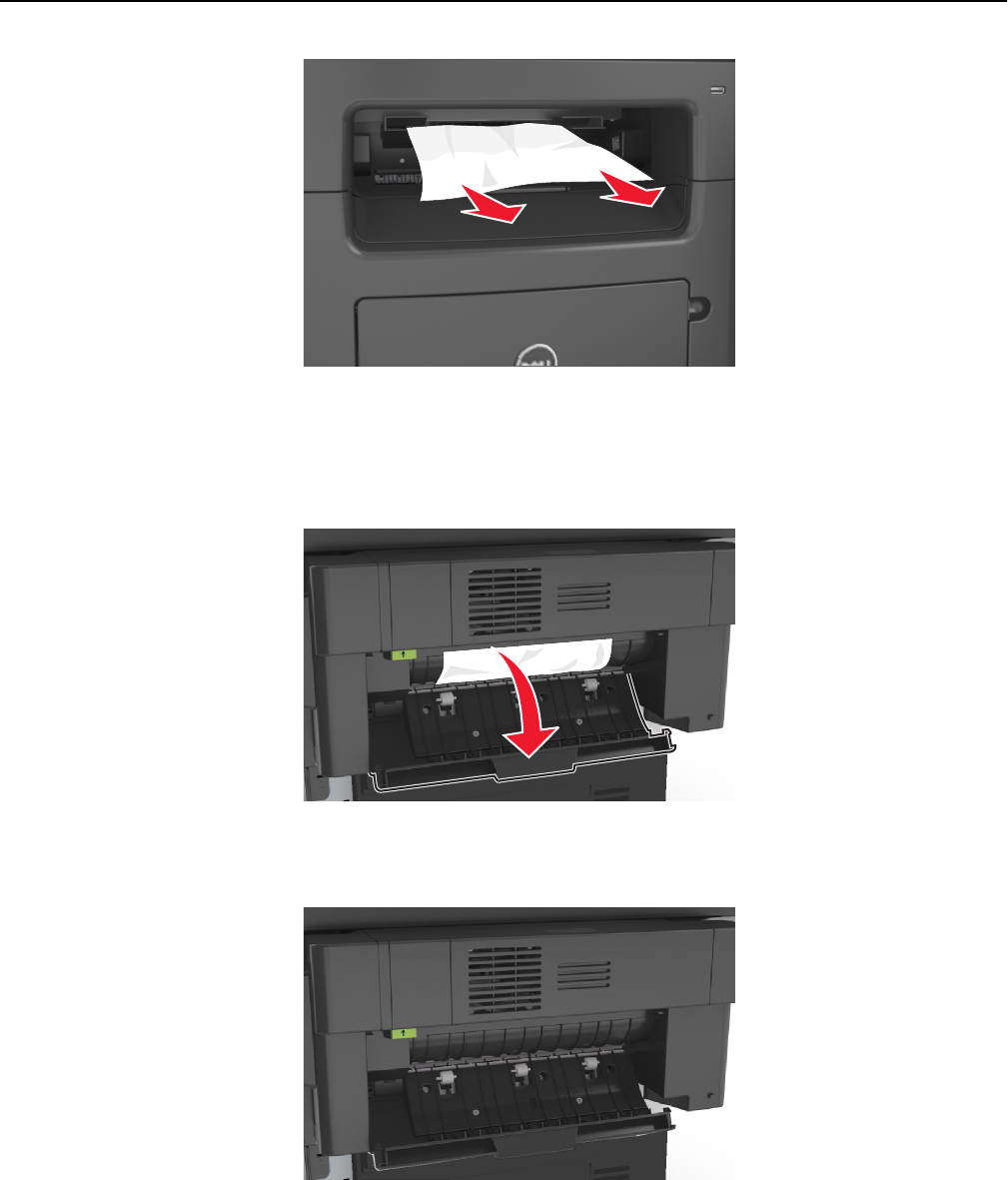
4If necessary, touch Done from the printer control panel to clear the message and continue printing.
Paper jam in the finisher rear door
1Open the finisher rear door.
2Firmly grasp the jammed paper on each side, and then gently pull it out.
Note: Make sure all paper fragments are removed.
Clearing jams 236
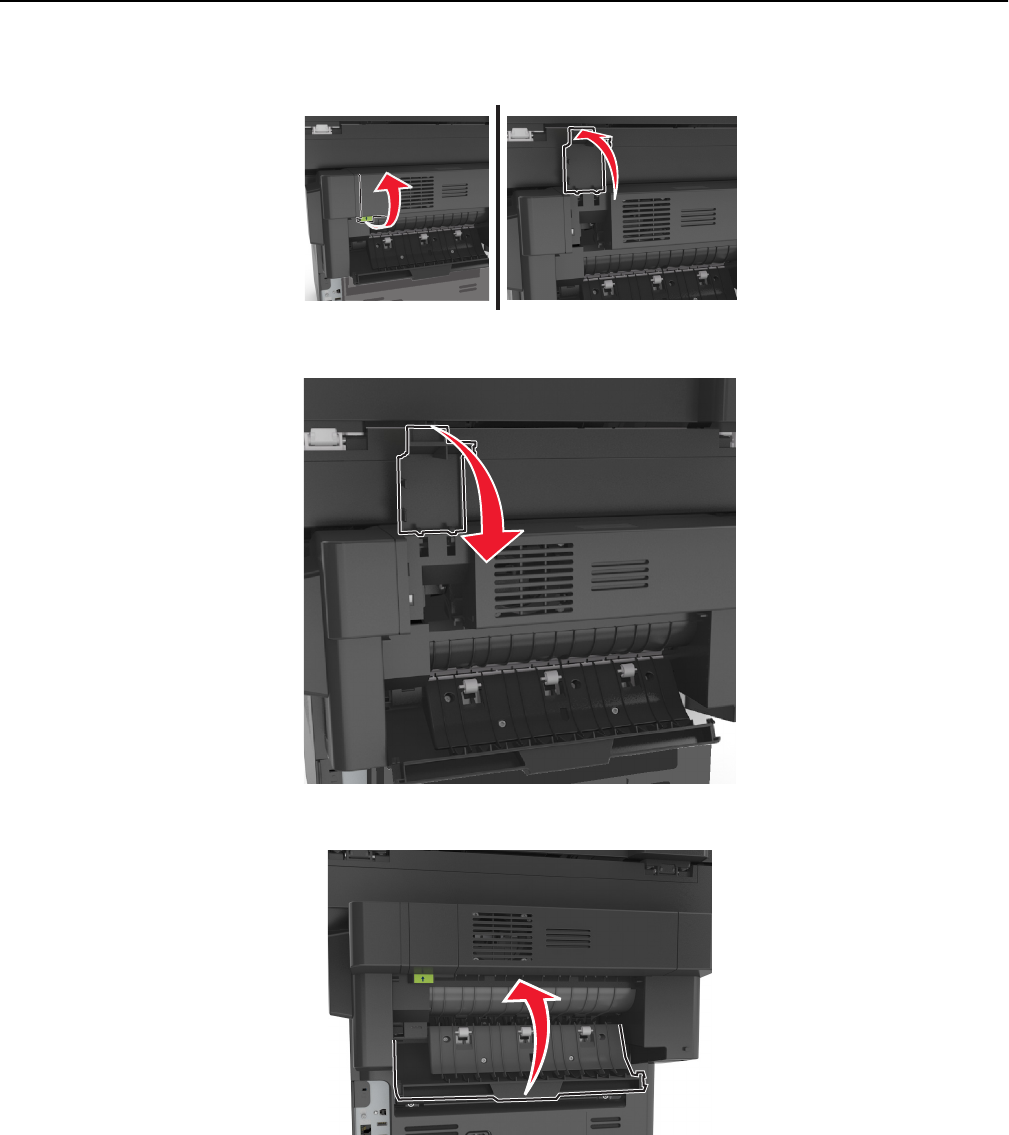
3Open the finisher narrow door, and then remove any paper fragments inside the narrow door.
4Close the narrow door.
5Close the finisher rear door.
6If necessary, touch Done from the printer control panel to clear the message and continue printing.
Clearing jams 237
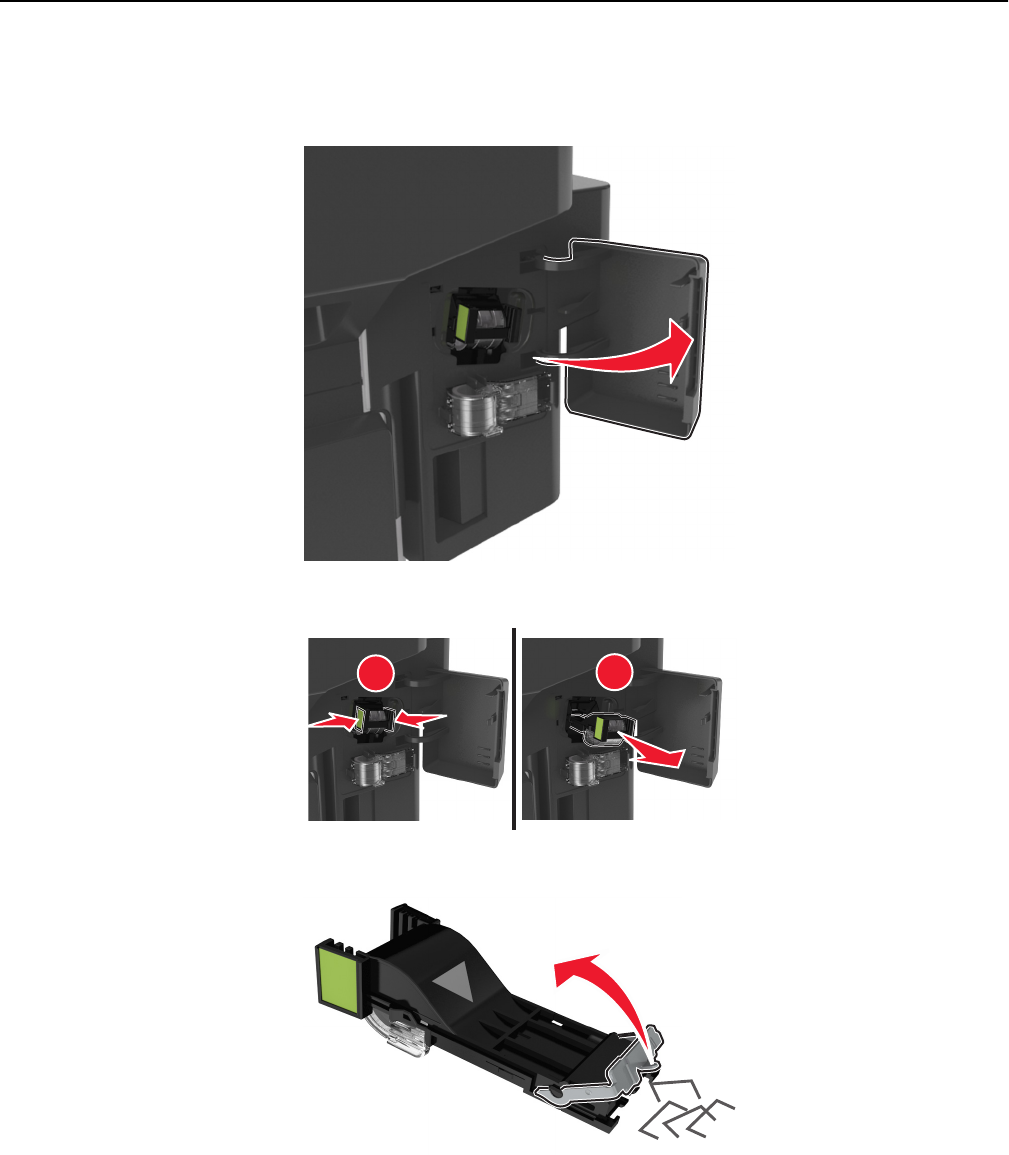
Staple jam in the finisher
1Open the staple access door.
2Pull out the staple cartridge from the finisher.
12
3Lift the staple guard, and then remove any jammed or loose staples.
Clearing jams 238
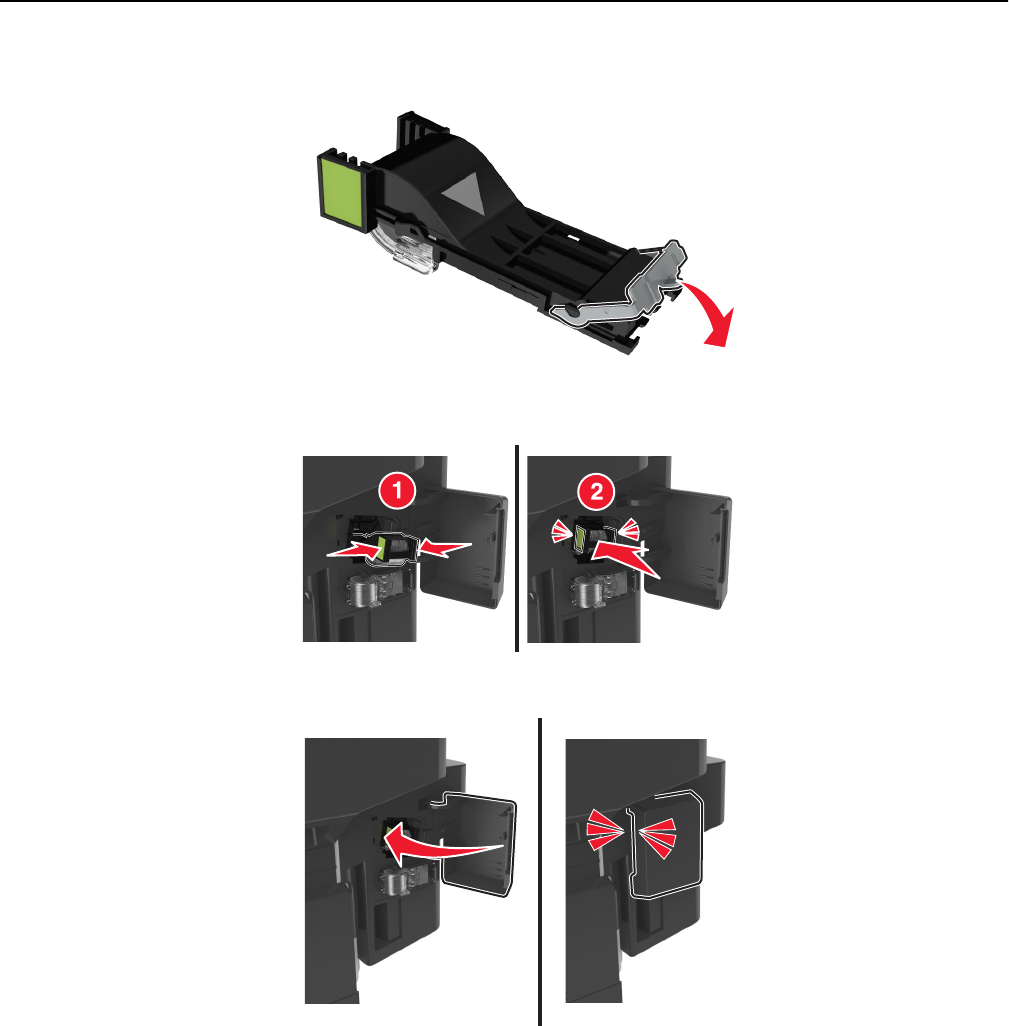
4Press down the staple guard until it clicks into place.
5Insert staple cartridge back into the finisher until it clicks into place.
6Close the staple access door.
7If necessary, touch Done from the printer control panel to clear the message and continue printing.
Clearing jams 239

Troubleshooting
Understanding the printer messages
Cartridge low [88.xy]
You may need to order a replacement toner cartridge. If necessary, touch Continue on the printer control panel to
clear the message and continue printing.
Cartridge nearly low [88.xy]
If necessary, touch Continue on the printer control panel to clear the message and continue printing.
Cartridge very low, [x] estimated pages remain [88.xy]
You may need to replace the toner cartridge very soon. For more information, see the “Replacing supplies” section of
the User’s Guide.
If necessary, touch Continue on the printer control panel to clear the message and continue printing.
Change [paper source] to [custom type name] load [orientation]
Try one or more of the following:
•Load the correct size and type of paper in the tray or feeder, specify the paper size and type in the Paper menu on
the printer control panel, and then touch Finished changing paper.
•Touch Reset active bin to reset the active bin for a linked set of bins.
•Cancel the print job.
Change [paper source] to [custom string] load [orientation]
Try one or more of the following:
•Load the correct size and type of paper in the tray or feeder, specify the paper size and type in the Paper menu on
the printer control panel, and then touch Finished changing paper.
•Touch Reset active bin to reset the active bin for a linked set of bins.
•Cancel the print job.
Change [paper source] to [paper size] load [orientation]
Try one or more of the following:
•Load the correct size and type of paper in the tray or feeder, specify the paper size and type in the Paper menu on
the printer control panel, and then touch Finished changing paper.
•Touch Reset active bin to reset the active bin for a linked set of bins.
•Cancel the print job.
Troubleshooting 240

Change [paper source] to [paper type] [paper size] load [orientation]
Try one or more of the following:
•Load the correct size and type of paper in the tray or feeder, specify the paper size and type in the Paper menu on
the printer control panel, and then touch Finished changing paper.
•Touch Reset active bin to reset the active bin for a linked set of bins.
•Cancel the print job.
Check tray [x] connection
Try one or more of the following:
•Turn off the printer, and then turn it back on.
If the error occurs a second time, then:
1Turn off the printer.
2Unplug the power cord from the electrical outlet.
3Remove the indicated tray.
4Reattach the tray.
5Connect the power cord to a properly grounded electrical outlet.
6Turn the printer back on.
If the error occurs again, then:
1Turn off the printer.
2Unplug the power cord from the electrical outlet.
3Remove the tray.
4Contact technical support.
•From the printer control panel, touch Continue to clear the message and resume the job.
Close front door
Close the front door of the printer.
Close rear door
Close the rear door of the printer.
Close finisher rear door
Close the rear door of the finisher.
Troubleshooting 241

Close flatbed cover and load originals if restarting job [2yy.xx]
Try one or more of the following:
•Touch Scan from automatic feeder to continue scanning from the ADF immediately after the last successful scan
job.
•Touch Scan from flatbed to continue scanning from the scanner glass immediately after the last successful scan
job.
•Touch Finish job without further scanning to end the last successful scan job.
Note: This does not cancel the scan job. All successfully scanned pages will be processed further for copying,
faxing, or e-mailing.
•Touch Cancel job to clear the message and cancel the scan job.
Complex page, some data may not have printed [39]
Try one or more of the following:
•From the printer control panel, touch Continue to ignore the message and continue printing.
•Cancel current print job.
•Install additional printer memory.
Configuration change, some held jobs were not restored [57]
Held jobs are invalidated because of the following possible changes in the printer:
•The printer firmware has been updated.
•The tray for the print job has been removed.
•The print job is sent from a flash drive that is no longer attached to the USB port.
•The printer hard disk contains print jobs that were stored when the hard disk was installed in a different printer
model.
From the printer control panel, touch Continue to clear the message.
Defective flash detected [51]
Try one or more of the following:
•Replace the defective flash memory card.
•From the printer control panel, touch Continue to ignore the message and continue printing.
•Cancel the current print job.
Disk full [62]
Try one or more of the following:
•From the printer control panel, touch Continue to clear the message and continue processing.
•Delete fonts, macros, and other data stored in the printer hard disk.
•Install a printer hard disk with larger capacity.
Troubleshooting 242

Disk must be formatted for use in this device
From the printer control panel, touch Format disk to format the printer hard disk and clear the message.
Note: Formatting deletes all the files stored in the printer hard disk.
Disk near full. Securely clearing disk space.
Try one or more of the following:
•Touch Continue to clear the message and continue printing.
•Delete fonts, macros, and other data stored on the printer hard disk.
•Install a hard disk with higher capacity.
Error reading USB drive. Remove USB.
An unsupported USB device is inserted. Remove the USB device, and then insert a supported one.
Error reading USB hub. Remove hub.
An unsupported USB hub has been inserted. Remove the USB hub, and then install a supported one.
Fax memory full
From the printer control panel, touch Continue to clear the message.
Fax partition inoperative. Contact system administrator.
Try one or more of the following:
•From the printer control panel, touch Continue to clear the message.
•Turn off the printer, and then turn it back on. If the message appears again, then contact your system support
person.
Fax server 'To Format' not set up. Contact system administrator.
Try one or more of the following:
•From the printer control panel, touch Continue to clear the message.
•Complete the Fax Server setup. If the message appears again, then contact your system support person.
Fax Station Name not set up. Contact system administrator.
Try either of the following:
•From the printer control panel, touch Continue to clear the message.
•Complete the Analog Fax setup. If the message appears again after completing the setup, then contact your system
support person.
Troubleshooting 243

Fax Station Number not set up. Contact system administrator.
Try one or more of the following:
•From the printer control panel, touch Continue to clear the message.
•Complete the Analog Fax setup. If the message appears again after completing the setup, then contact your system
support person.
Imaging unit low [84.xy]
You may need to order a replacement imaging unit. If necessary, select Continue on the printer control panel to clear
the message and continue printing.
Imaging unit nearly low [84.xy]
If necessary, touch Continue on the printer control panel to clear the message and continue printing.
Imaging unit very low, [x] estimated pages remain [84.xy]
You may need to replace the imaging unit very soon. For more information, see the “Replacing supplies” section of the
User’s Guide.
If necessary, touch Continue on the printer control panel to clear the message and continue printing.
Incompatible tray [x] [59]
Try one or more of the following:
•Remove the indicated tray.
•From the printer control panel, touch Continue to clear the message and continue printing without using the
indicated tray.
Incorrect paper size, open [paper source] [34]
Try one or more of the following:
•Load the correct size and type of paper in the tray, and then specify the paper size and type in the Paper menu on
the printer control panel.
•Make sure the correct paper size and type are specified in Print Properties or the Print dialog settings.
•Check if the paper size is correctly set. For example, if MP Feeder Size is set to Universal, then make sure the paper
is large enough for the data being printed.
•Check the length and width guides and make sure the paper is loaded properly in the tray.
•From the printer control panel, touch Continue to clear the message and print using a different tray.
•Cancel the print job.
Troubleshooting 244

Insufficient memory to collate job [37]
Try one or more of the following:
•From the printer control panel, touch Continue to print the part of the job already stored and begin collating the
rest of the print job.
•Cancel the current print job.
Insufficient memory for Flash Memory Defragment operation [37]
Try one or more of the following:
•From the printer control panel, touch Continue to stop the defragmentation and continue printing.
•Delete fonts, macros, and other data in the printer memory.
•Install additional printer memory.
Insufficient memory, some Held Jobs were deleted [37]
From the printer control panel, touch Continue to clear the message.
Insufficient memory, some held jobs will not be restored [37]
Try one or more of the following:
•From the printer control panel, touch Continue to clear the message.
•Delete other held jobs to free up additional printer memory.
Insufficient memory to support Resource Save feature [35]
Install additional printer memory or touch Continue to disable Resource Save, clear the message, and continue printing.
Load [paper source] with [custom type name] [paper orientation]
Try one or more of the following:
•Load the tray or feeder with the correct size and type of paper.
•To use the tray with the correct paper size or type, touch Finished loading paper on the printer control panel.
Note: If the printer detects a tray that has the correct paper size and type, then it feeds from that tray. If the
printer cannot detect a tray that has the correct paper size and type, then it prints from the default paper
source.
•Cancel the current job.
Troubleshooting 245

Load [paper source] with [custom string] [paper orientation]
Try one or more of the following:
•Load the indicated tray or feeder with the correct size and type of paper.
•To use the tray with the correct paper size or type, touch Finished loading paper on the printer control panel.
Note: If the printer finds a tray that has the correct paper size and type, then it feeds from that tray. If the
printer cannot find a tray with the correct paper type and size, then it prints from the default paper source.
•Cancel the current job.
Load [paper source] with [paper size] [paper orientation]
Try one or more of the following:
•Load the specified tray or feeder with the correct size of paper.
•To use the tray or feeder with the correct size of paper, touch Finished loading paper on the printer control panel.
Note: If the printer finds a tray or feeder that has the correct size of paper, then it feeds from that tray or
feeder. If the printer cannot find a tray or feeder with the correct size of paper, then it prints from the default
paper source.
•Cancel the current job.
Load [paper source] with [paper type] [paper size] [paper orientation]
Try one or more of the following:
•Load the specified tray or feeder with the correct size and type of paper.
•To use the tray or feeder with the correct size and type of paper, touch Finished loading paper on the printer control
panel.
Note: If the printer finds a tray or feeder that has the correct size and type of paper, then it feeds from that tray
or feeder. If the printer cannot find a tray or feeder with the correct size and type of paper, then it prints from
the default paper source.
•Cancel the current job.
Load Manual Feeder with [custom type name] [paper orientation]
Try one or more of the following:
•Load the feeder with the correct size and type of paper.
•From the printer control panel, touch Prompt each page, paper loaded or Do not prompt, paper loaded to clear
the message and continue printing.
•From the printer control panel, touch Automatically select paper to use the paper loaded in the tray.
•Cancel the print job.
Troubleshooting 246

Load Manual Feeder with [custom string] [paper orientation]
Try one or more of the following:
•Load the feeder with the correct size and type of paper.
•From the printer control panel, touch Prompt each page, paper loaded or Do not prompt, paper loaded to clear
the message and continue printing.
•From the printer control panel, touch Automatically select paper to use the paper loaded in the tray.
•Cancel the print job.
Load Manual Feeder with [paper size] [paper orientation]
Try one or more of the following:
•Load the feeder with the correct size of paper.
•From the printer control panel, touch Prompt each page, paper loaded or Do not prompt, paper loaded to clear
the message and continue printing.
•From the printer control panel, touch Automatically select paper to use the paper loaded in the tray.
•Cancel the print job.
Load Manual Feeder with [paper type] [paper size] [paper orientation]
Try one or more of the following:
•Load the feeder with the correct size and type of paper.
•From the printer control panel, touch Prompt each page, paper loaded or Do not prompt, paper loaded to clear
the message and continue printing.
•From the printer control panel, touch Automatically select paper to use the paper loaded in the tray.
•Cancel the print job.
Maintenance kit low [80.xy]
You may need to order a maintenance kit. For more information, contact technical support or your Dell printer dealer.
If necessary, touch Continue to clear the message and continue printing.
Maintenance kit nearly low [80.xy]
For more information, contact technical support or your Dell printer dealer.
If necessary, touch Continue to clear the message and continue printing.
Maintenance kit very low, [x] estimated pages remain [80.xy]
You may need to replace the maintenance kit very soon. For more information, contact technical support or your Dell
printer dealer.
If necessary, touch Continue to clear the message and continue printing.
Troubleshooting 247

Memory full [38]
Try one or more of the following:
•From the printer control panel, touch Cancel job to clear the message.
•Install additional printer memory.
Memory full, cannot print faxes
From the printer control panel, touch Continue to clear the message without printing. Held faxes attempt to print after
the printer is restarted.
Memory full, cannot send faxes
1From the printer control panel, touch Continue to clear the message and cancel the fax job.
2Try one or more of the following:
•Reduce the fax resolution, and then resend the fax job.
•Reduce the number of pages in the fax, and then resend the fax job.
Network [x] software error [54]
Try one or more of the following:
•From the printer control panel, touch Continue to continue printing.
•Turn off the printer, wait for about 10 seconds, and then turn the printer back on.
•Update the network firmware in the printer or print server. For more information, contact technical support or
your Dell printer dealer.
No analog phone line connected to modem, fax is disabled.
Connect the printer to an analog phone line.
Non‑Dell [supply type], see User’s Guide [33.xy]
Note: The supply type can either be a toner cartridge or imaging unit.
The printer has detected a non‑Dell supply or part installed in the printer.
Your Dell printer is designed to function best with genuine Dell supplies and parts. Use of third-party supplies or parts
may affect the performance, reliability, or life of the printer and its imaging components.
All life indicators are designed to function with Dell supplies and parts, and may deliver unpredictable results if third-
party supplies or parts are used. Imaging component usage beyond the intended life may damage your Dell printer or
associated components.
Warning—Potential Damage: Use of third-party supplies or parts can affect warranty coverage. Damage caused by
the use of third-party supplies or parts are not covered by the warranty.
To accept any and all of these risks and to proceed with the use of non-genuine supplies or parts in your printer, press
and hold and # on the printer control panel simultaneously for 15 seconds to clear the message and continue printing.
Troubleshooting 248

If you do not wish to accept these risks, then remove the third-party supply or part from your printer, and then install
a genuine Dell supply or part.
Note: For the list of supported supplies, see the “Ordering supplies” section of the User's Guide or visit
www.dell.com/support/printers.
Not enough free space in flash memory for resources [52]
Try one or more of the following:
•From the printer control panel, touch Continue to clear the message and continue printing.
•Delete fonts, macros, and other data stored in the flash memory.
•Install a flash memory card with larger capacity.
Note: Downloaded fonts and macros not previously stored in the flash memory are deleted.
Paper changes needed
Try one or more of the following:
•From the printer control panel, touch Prompt for each page to continue printing.
•Touch Use current supplies to continue printing using the paper loaded in the tray.
•Cancel the current print job.
Parallel port [x] disabled [56]
Try one or more of the following:
•From the printer control panel, touch Continue to clear the message.
•Enable the parallel port. From the printer control panel, navigate to:
Network/Ports > Parallel [x] > Parallel Buffer > Auto
Note: The printer discards any data received through the parallel port.
Printer had to restart. Last job may be incomplete.
From the printer control panel, touch Continue to clear the message and continue printing.
For more information, visit www.dell.com/support/printers or contact technical support.
Remove defective disk [61]
Remove and replace the defective printer hard disk.
Remove paper from standard output bin
Remove the paper stack from the standard bin.
Troubleshooting 249

Replace defective imaging unit [31.xy]
Replace the defective imaging unit to clear the message. For more information, see the instruction sheet that came
with the supply.
Note: If you do not have a replacement imaging unit, then see the “Ordering supplies” section of the User’s Guide or
visit our Web site.
Reinstall missing or unresponsive cartridge [31.xy]
Try one or more of the following:
•Check if the toner cartridge is missing. If missing, install the toner cartridge.
For information on installing the cartridge, see the “Replacing supplies” section of the User’s Guide.
•If the toner cartridge is installed, then remove the unresponsive toner cartridge, and then reinstall it.
Note: If the message appears after reinstalling the supply, then the cartridge is defective. Replace the toner
cartridge.
Replace cartridge, printer region mismatch [42.xy]
Install a suitable toner cartridge.
Replace cartridge, 0 estimated pages remain [88.xy]
Replace the toner cartridge to clear the message and continue printing. For more information, see the instruction sheet
that came with the supply or see the “Replacing supplies” section of the User’s Guide.
Note: If you do not have a replacement cartridge, then visit our Web site or contact the place where you purchased
the printer.
Replace imaging unit, 0 estimated pages remain [84.xy]
Replace the imaging unit to clear the message and continue printing. For more information, see the instruction sheet
that came with the supply or see the “Replacing supplies” section of the User’s Guide.
Note: If you do not have a replacement imaging unit, then visit our Web site or contact the place where you
purchased the printer.
Replace maintenance kit, 0 estimated pages remain [80.xy]
The printer is scheduled for maintenance. Contact technical support or your Dell printer dealer, and then report the
message.
Replace all originals if restarting job.
Try one or more of the following:
•Touch Cancel job to clear the message and cancel the scan job.
•Touch Scan from automatic feeder to continue scanning from the ADF immediately after the last successful scan
job.
Troubleshooting 250

•Touch Scan from flatbed to continue scanning from the scanner immediately after the last successful scan job.
•Touch Finish job without further scanning to end the last successful scan job.
•Touch Restart job to restart the scan job with the same settings from the previous scan job.
Reinstall missing or unresponsive imaging unit [31.xy]
Try one or more of the following:
•Check if the imaging unit is missing. If missing, install the imaging unit.
For information on installing the imaging unit, see the “Replacing supplies” section of the User’s Guide.
•If the imaging unit is installed, then remove the unresponsive imaging unit, and then reinstall it.
Note: If the message appears after reinstalling the supply, then the imaging unit is defective. Replace the
imaging unit.
Replace unsupported cartridge [32.xy]
Remove the toner cartridge, and then install a supported one to clear the message and continue printing. For more
information, see the instruction sheet that came with the supply or see the “Replacing supplies” section of the User’s
Guide.
Note: If you do not have a replacement cartridge, then visit our Web site or contact the place where you purchased
the printer.
Replace unsupported imaging unit [32.xy]
Remove the imaging unit, and then install a supported one to clear the message and continue printing. For more
information, see the instruction sheet that came with the supply or see the “Replacing supplies” section of the User’s
Guide.
Note: If you do not have a replacement imaging unit, then visit our Web site or contact the place where you
purchased the printer.
Restore held jobs?
Try one or more of the following:
•From the printer control panel, touch Restore to restore all held jobs stored in the printer hard disk.
•From the printer control panel, touch Do not restore if you do not want to restore any of the print jobs.
Scanner automatic feeder cover open
Close the ADF cover.
Scanner disabled by admin [840.01]
Print without the scanner, or contact your system support person.
Troubleshooting 251

Scanner disabled. Contact system administrator if problem persists. [840.02]
Try one or more of the following:
•Touch Continue with scanner disabled to return to the home screen, and then contact your system support person.
•Touch Reboot and automatically enable scanner to cancel the job.
Note: This attempts to enable the scanner.
Scanner jam, remove all originals from the scanner [2yy.xx]
Remove the jammed paper from the scanner.
Scanner jam, remove jammed originals from the scanner [2yy.xx]
Remove the jammed paper from the scanner.
Serial port [x] disabled [56]
Try one or more of the following:
•From the printer control panel, touch Continue to clear the message.
The printer discards any data received through the specified serial port.
•Make sure Serial Buffer is not set to Disabled.
•From the printer control panel, set Serial Buffer to Auto in the Serial [x] menu.
SMTP server not set up. Contact system administrator.
From the printer control panel, touch Continue to clear the message.
Note: If the message appears again, then contact your system support person.
Some held jobs were not restored
From the printer control panel, touch Continue to delete the indicated job.
Note: Held jobs that are not restored remain in the printer hard disk and are inaccessible.
Standard network software error [54]
Try one or more of the following:
•From the printer control panel, touch Continue to continue printing.
•Turn off the printer, and then turn it back on.
•Update the network firmware in the printer or print server. For more information, visit the Dell support Web site
at www.dell.com/support/printers or contact your system support person.
Troubleshooting 252

Standard USB port disabled [56]
Try one or more of the following:
•From the printer control panel, touch Continue to clear the message.
•Enable the USB port. From the printer control panel, navigate to:
Network/Ports > USB Buffer > Auto
Note: The printer discards any data received through the USB port.
Supply needed to complete job
Do either of the following:
•Install the missing supply to complete the job.
•Cancel the current job.
Too many flash options installed [58]
1Turn off the printer.
2Unplug the power cord from the electrical outlet.
3Remove the extra flash memory.
4Connect the power cord to a properly grounded electrical outlet.
5Turn the printer back on.
Too many trays attached [58]
1Turn off the printer.
2Unplug the power cord from the electrical outlet.
3Remove the extra trays.
4Connect the power cord to a properly grounded electrical outlet.
5Turn the printer back on.
Unformatted flash detected [53]
Try one or more of the following:
•From the printer control panel, touch Continue to stop the defragmentation and continue printing.
•Format the flash memory.
Note: If the error message remains, then the flash memory may be defective and needs to be replaced.
Unsupported disk
Remove the unsupported printer hard disk, and then insert a supported one.
Troubleshooting 253

Unsupported option in slot [x] [55]
1Turn off the printer.
2Unplug the power cord from the electrical outlet.
3Remove the unsupported option card from the printer controller board, and then replace it with a supported card.
4Connect the power cord to a properly grounded electrical outlet.
5Turn the printer back on.
USB port [x] disabled [56]
From the printer control panel, touch Continue to clear the message.
Notes:
•The printer discards any data received through the USB port.
•Make sure the USB Buffer menu is not set to Disabled.
Weblink server not set up. Contact system administrator.
From the printer control panel, touch Continue to clear the message.
Note: If the message appears again, then contact your system support person.
Solving printer problems
•“Basic printer problems” on page 254
•“Option problems” on page 257
•“Paper feed problems” on page 260
Basic printer problems
The printer is not responding
Action Yes No
Step 1
Make sure the printer is turned on.
Is the printer turned on?
Go to step 2. Turn on the printer.
Step 2
Check if the printer is in Sleep mode or Hibernate mode.
Is the printer in Sleep mode or Hibernate mode?
Press the Sleep button
to wake the printer
from Sleep mode or
Hibernate mode.
Go to step 3.
Troubleshooting 254

Action Yes No
Step 3
Check if one end of the power cord is plugged into the printer and the
other to a properly grounded electrical outlet.
Is the power cord plugged into the printer and a properly grounded
electrical outlet?
Go to step 4. Plug one end of the
power cord into the
printer and the other to
a properly grounded
electrical outlet.
Step 4
Check other electrical equipment plugged into the electrical outlet.
Does other electrical equipment work?
Unplug the other
electrical equipment,
and then turn on the
printer. If the printer
does not work, then
reconnect the other
electrical equipment.
Go to step 5.
Step 5
Check if the cables connecting the printer and the computer are inserted
in the correct ports.
Are the cables inserted in the correct ports?
Go to step 6. Make sure to match the
following:
•The USB symbol on
the cable with the
USB symbol on the
printer
•The appropriate
Ethernet cable with
the Ethernet port
Step 6
Make sure the electrical outlet is not turned off by a switch or breaker.
Is the electrical outlet turned off by a switch or breaker?
Turn on the switch or
reset the breaker.
Go to step 7.
Step 7
Check if the printer is plugged into any surge protectors, uninterruptible
power supplies, or extension cords.
Is the printer plugged into any surge protectors, uninterruptible power
supplies, or extension cords?
Connect the printer
power cord directly to
a properly grounded
electrical outlet.
Go to step 8.
Step 8
Check if one end of the printer cable is plugged into a port on the printer
and the other to the computer, print server, option, or other network
device.
Is the printer cable securely attached to the printer and the computer,
print server, option, or other network device?
Go to step 9. Connect the printer
cable securely to the
printer and the
computer, print server,
option, or other
network device.
Step 9
Make sure to install all hardware options properly and remove any packing
material.
Are all hardware options properly installed and all packing material
removed?
Go to step 10. Turn off the printer,
remove all packing
materials, then
reinstall the hardware
options, and then turn
on the printer.
Troubleshooting 255
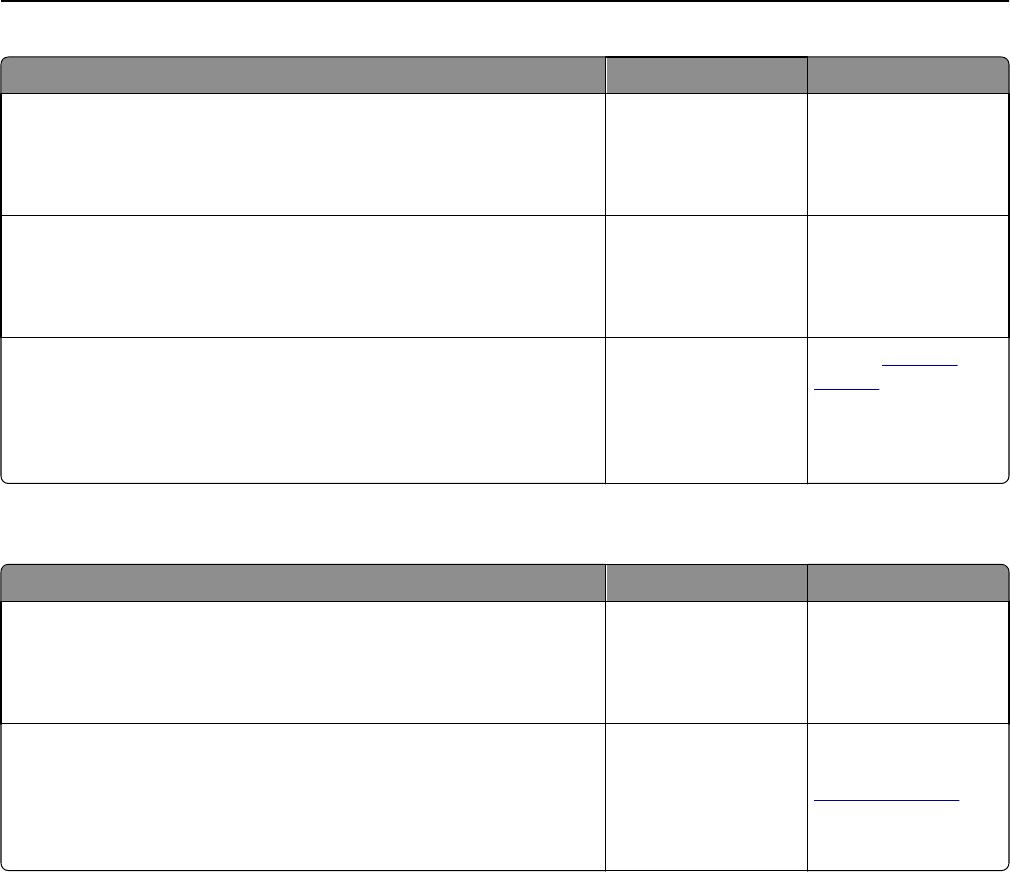
Action Yes No
Step 10
Check if you have selected the correct port settings in the printer driver.
Are the port settings correct?
Go to step 11. Use correct printer
driver settings.
Step 11
Check the installed printer driver.
Is the correct printer driver installed?
Go to step 12. Install the correct
printer driver.
Step 12
Turn off the printer, then wait for about 10 seconds, and then turn the
printer back on.
Is the printer working?
The problem is solved. Contact technical
support.
Printer display is blank
Action Yes No
Step 1
Press the Sleep button on the printer control panel.
Does Ready appear on the printer display?
The problem is solved. Go to step 2.
Step 2
Turn off the printer, then wait for about 10 seconds, and then turn the
printer back on.
Do Please wait and Ready appear on the printer display?
The problem is solved. Turn off the printer,
and then contact
technical support.
Troubleshooting 256

Option problems
Cannot detect internal option
Action Yes No
Step 1
Turn off the printer, then wait for about 10 seconds, and then turn on the
printer.
Does the internal option operate correctly?
The problem is solved. Go to step 2.
Step 2
Check if the internal option is properly installed in the controller board.
aTurn off the printer using the power switch, and then unplug the power
cord from the electrical outlet.
bMake sure the internal option is installed in the appropriate connector
in the controller board.
cConnect the power cord to the printer, then to a properly grounded
electrical outlet, and then turn on the printer.
Is the internal option properly installed in the controller board?
Go to step 3. Connect the internal
option to the controller
board.
Step 3
Print a menu settings page, and then check to see if the internal option is
listed in the Installed Features list.
Is the internal option listed in the menu settings page?
Go to step 4. Reinstall the internal
option.
Step 4
aCheck if the internal option is selected.
It may be necessary to manually add the internal option in the printer
driver to make it available for print jobs. For more information, see
“Adding available options in the print driver” on page 44.
bResend the print job.
Does the internal option operate correctly?
The problem is solved. Contact technical
support.
Troubleshooting 257

Tray problems
Action Yes No
Step 1
aPull out the tray, and then do one or more of the following:
•Check for paper jams or misfeeds.
•Check if the paper size indicators on the paper guides are aligned
with the paper size indicators on the tray.
•If you are printing on custom‑size paper, then make sure that the
paper guides rest against the edges of the paper.
•Make sure the paper is below the maximum paper fill indicator.
•Make sure paper lies flat in the tray.
bCheck if the tray closes properly.
Is the tray working?
The problem is solved. Go to step 2.
Step 2
aTurn off the printer, then wait about 10 seconds, and then turn the
printer back on.
bResend the print job.
Is the tray working?
The problem is solved. Go to step 3.
Step 3
Check if the tray is installed and recognized by the printer.
Print a menu settings page, and then check if the tray is listed in the
Installed Features list.
Is the tray listed in the menu settings page?
Go to step 4. Reinstall the tray. For
more information, see
the setup
documentation that
came with the tray.
Step 4
Check if the tray is available in the printer driver.
Note: If necessary, manually add the tray in the printer driver to make it
available for print jobs. For more information, see “Adding available
options in the print driver” on page 44.
Is the tray available in the printer driver?
The problem is solved. Contact technical
support.
Troubleshooting 258

Cannot detect memory card
Action Yes No
Make sure the memory card is installed.
aInstall the memory card. For more information, see “Installing a
memory card” on page 29.
Note: Check if the memory card is securely connected to the printer
controller board.
bPrint a menu settings page, and then check if the card is listed in the
Installed Options list.
Is the card listed in the Installed Options list?
The problem is solved. Contact technical
support.
Internal Solutions Port does not operate correctly
Action Yes No
Step 1
Make sure the Internal Solutions Port (ISP) is installed.
aInstall the ISP. For more information, see “Installing an Internal
Solutions Port” on page 32.
bPrint a menu settings page, and then check if the ISP is listed in the
Installed Features list.
Is the ISP listed in the Installed Features list?
Go to step 2. Check if you have a
supported ISP.
Note: An ISP from
another printer may
not work on this
printer.
Step 2
Check the cable and the ISP connection.
aUse the correct cable, and then make sure it is securely connected to
the ISP.
bCheck if the ISP solution interface cable is securely connected into the
receptacle of the controller board.
Note: The ISP solution interface cable and the receptacle on the
controller board are color‑coded.
Does the Internal Solutions Port operate correctly?
The problem is solved. Contact technical
support.
USB/parallel interface card does not operate correctly
Action Yes No
Step 1
Make sure the USB or parallel interface card is installed.
aInstall the USB or parallel interface card. For more information, see
“Installing an Internal Solutions Port” on page 32.
bPrint a menu settings page, and then check if the USB or parallel
interface card is listed in the Installed Features list.
Is the USB or parallel interface card listed in the Installed Features list?
Go to step 2. Check if you have a
supported USB or
parallel interface card.
Note: A USB or parallel
interface card from
another printer may
not work on this
printer.
Troubleshooting 259

Action Yes No
Step 2
Check the cable and the USB or parallel interface card connection.
Use the correct cable, and then make sure it is securely connected to
the USB or parallel interface card.
Does the USB or parallel interface card operate correctly?
The problem is solved. Contact technical
support.
Paper feed problems
Paper frequently jams
Action Yes No
Step 1
aPull out the tray, and then do one or more of the following:
•Make sure paper lies flat in the tray.
•Check if the paper size indicators on the paper guides are aligned
with the paper size indicators on the tray.
•Check if the paper guides are aligned against the edges of the
paper.
•Make sure the paper is below the maximum paper fill indicator.
•Check if you are printing on a recommended paper size and type.
bInsert the tray properly.
If jam recovery is enabled, then the print jobs will reprint
automatically.
Do paper jams still occur frequently?
Go to step 2. The problem is solved.
Step 2
aLoad paper from a fresh package.
Note: Paper absorbs moisture due to high humidity. Store paper in
its original wrapper until you use it.
bResend the print job.
Do paper jams still occur frequently?
Go to step 3. The problem is solved.
Step 3
aReview the tips on avoiding jams. For more information, see “Avoiding
jams” on page 224.
bFollow the recommendations, and then resend the print job.
Do paper jams still occur frequently?
Contact technical
support.
The problem is solved.
Troubleshooting 260
Paper jam message remains after jam is cleared
Action Yes No
Check the entire paper path for jammed paper.
aRemove any jammed paper.
bFrom the printer control panel, touch Continue to clear the message.
Does the paper jam message remain?
Contact technical
support.
The problem is solved.
Jammed pages are not reprinted
Action Yes No
Turn on Jam Recovery.
aFrom the home screen, navigate to:
> Settings > General Settings > Print Recovery
bFrom the Jam Recovery menu, touch the arrows to scroll to On or
Auto.
cTouch Submit.
Do pages reprint after a jam?
The problem is solved. Contact technical
support.
Solving print problems
Printing problems
Multiple‑language PDF files do not print
Action Yes No
Step 1
aCheck if the print options for the PDF output are set to embed all fonts.
For more information, see the documentation that came with Adobe
Acrobat.
bGenerate a new PDF file, and then resend the print job.
Do the files print?
The problem is solved. Go to step 2.
Step 2
aOpen the document you want to print in Adobe Acrobat.
bClick File > Print > Advanced > Print As Image > OK > OK.
Do the files print?
The problem is solved. Contact technical
support.
Troubleshooting 261

Error message about reading the flash drive appears
Action Yes No
Step 1
Check if the flash drive is inserted into the front USB port.
Note: The flash drive will not work if it is inserted into the rear USB
port.
Is the flash drive inserted into the front USB port?
Go to step 2. Insert the flash drive
into the front USB port.
Step 2
Check if the indicator light on the printer control panel is blinking green.
Note: A green blinking light indicates that the printer is busy.
Is the indicator light blinking green?
Wait until the printer is
ready, then view the
held jobs list, and then
print the documents.
Go to step 3.
Step 3
aCheck for an error message on the display.
bClear the message.
Does the error message still appear?
Go to step 4. The problem is solved.
Step 4
Check if the flash drive is supported.
For more information on tested and approved USB flash drives, see
“Supported flash drives and file types” on page 77.
Does the error message still appear?
Go to step 5. The problem is solved.
Step 5
Check if the USB port is disabled by the system support person.
Does the error message still appear?
Contact technical
support.
The problem is solved.
Print jobs do not print
Action Yes No
Step 1
aFrom the document you are trying to print, open the Print dialog and
check if you have selected the correct printer.
Note: If the printer is not the default printer, then you must select
the printer for each document that you want to print.
bResend the print job.
Do the jobs print?
The problem is solved. Go to step 2.
Troubleshooting 262

Action Yes No
Step 2
aCheck if the printer is plugged in and turned on, and if Ready appears
on the printer display.
bResend the print job.
Do the jobs print?
The problem is solved. Go to step 3.
Step 3
If an error message appears on the printer display, then clear the message.
Note: The printer continues to print after clearing the message.
Do the jobs print?
The problem is solved. Go to step 4.
Step 4
aCheck if the ports (USB, serial, or Ethernet) are working and if the
cables are securely connected to the computer and the printer.
Note: For more information, see the setup documentation that
came with the printer.
bResend the print job.
Do the jobs print?
The problem is solved. Go to step 5.
Step 5
aTurn off the printer, wait for about 10 seconds, and then turn the
printer back on.
bResend the print job.
Do the jobs print?
The problem is solved. Go to step 6.
Step 6
aRemove, and then reinstall the printer software. For more
information, see “Installing the printer” on page 44.
Note: The printer software is available at
www.dell.com/support/printers.
bResend the print job.
Do the jobs print?
The problem is solved. Contact technical
support.
Troubleshooting 263

Confidential and other held jobs do not print
Note: Confidential, Verify, Reserve, and Repeat print jobs may be deleted if the printer requires extra memory to
process additional held jobs.
Action Yes No
Step 1
Open the held jobs folder on the printer display, and then verify that your
print job is listed.
Is your print job listed in the held jobs folder?
Go to step 2. Select one of the Print
and Hold options, and
then resend the print
job. For more
information, see
“Printing confidential
and other held jobs” on
page 78.
Step 2
The print job may contain a formatting error or invalid data.
•Delete the print job, and then send it again.
•For PDF files, generate a new PDF, and then print it again.
If you are printing from the Internet, then the printer may be reading
multiple job titles as duplicates and deleting all jobs except the first one.
For Windows users
aOpen the Print Properties folder.
bFrom the Print and Hold dialog, select the “Keep duplicate documents”
check box.
cEnter a PIN number.
For Macintosh users
Save each print job, name each job differently, and then send the
individual jobs to the printer.
Does the job print?
The problem is solved. Go to step 3.
Step 3
Free up additional printer memory by deleting some of the held jobs.
Does the job print?
The problem is solved. Add additional printer
memory.
Troubleshooting 264

Print job takes longer than expected
Action Yes No
Step 1
Change the environmental settings of the printer.
aFrom the printer control panel, navigate to:
> Settings > General Settings
bSelect Eco‑Mode or Quiet Mode, and then select Off.
Note: Disabling Eco-Mode or Quiet Mode may increase the
consumption of energy or supplies, or both.
Did the job print?
The problem is solved. Go to step 2.
Step 2
Reduce the number and size of fonts, the number and complexity of
images, and the number of pages in the print job, and then resend the job
Did the job print?
The problem is solved. Go to step 3.
Step 3
aRemove held jobs stored in the printer memory.
bResend the print job.
Did the job print?
The problem is solved. Go to step 4.
Step 4
aDisable the Page Protect feature.
From the printer control panel, navigate to:
>Settings > General Settings > Print Recovery > Page Protect >
Off
bResend the print job.
Did the job print?
The problem is solved. Go to step 5.
Step 5
aCheck if the cable connections to the printer and print server are
secure. For more information, see the setup documentation that came
with the printer.
bResend the print job.
Did the job print?
The problem is solved. Go to step 6.
Step 6
Install additional printer memory, and then resend the print job.
Did the job print?
The problem is solved. Contact technical
support.
Troubleshooting 265

Job prints from the wrong tray or on the wrong paper
Action Yes No
Step 1
aCheck if you are printing on paper that is supported by the tray.
bResend the print job.
Did the job print from the correct tray or on the correct paper?
The problem is solved. Go to step 2.
Step 2
aFrom the Paper menu on the printer control panel, set the paper size
and type to match the paper loaded in the tray.
bResend the print job.
Did the job print from the correct tray or on the correct paper?
The problem is solved. Go to step 3.
Step 3
aDepending on your operating system, open Printing Preferences or
the Print dialog, and then specify the paper type.
bResend the print job.
Did the job print from the correct tray or on the correct paper?
The problem is solved. Go to step 4.
Step 4
aCheck if the trays are not linked.
bResend the print job.
Did the job print from the correct tray or on the correct paper?
The problem is solved. Contact technical
support.
Incorrect characters print
Action Yes No
Step 1
Make sure the printer is not in Hex Trace mode.
Note: If Ready Hex appears on the printer display, then turn off the
printer, and then turn it back on to deactivate Hex Trace mode.
Is the printer in Hex Trace mode?
Deactivate Hex Trace
mode.
Go to step 2.
Step 2
aFrom the printer control panel, select Standard Network or
Network [x], and then set SmartSwitch to On.
bResend the print job.
Do incorrect characters print?
Contact technical
support.
The problem is solved.
Troubleshooting 266

Tray linking does not work
Notes:
•The trays can detect paper length.
•The multipurpose feeder does not automatically detect the paper size. You must set the size from the Paper
Size/Type menu.
Action Yes No
Step 1
aOpen the trays, and then check if they contain paper of the same size
and type.
•Check if the paper guides are in the correct positions for the size
of the paper loaded in each tray.
•Check if the paper size indicators on the paper guides are aligned
with the paper size indicators on the tray.
bResend the print job.
Do the trays link correctly?
The problem is solved. Go to step 2.
Step 2
aFrom the printer control panel, set the paper size and type in the Paper
menu to match the paper loaded in the trays to be linked.
Note: The paper size and type must match for trays to be linked.
bResend the print job.
Do the trays link correctly?
The problem is solved. Contact technical
support.
Large jobs do not collate
Action Yes No
Step 1
aFrom the Finishing menu on the printer control panel, set Collate to
(1,2,3) (1,2,3).
bResend the print job.
Did the job print and collate correctly?
The problem is solved. Go to step 2.
Step 2
aFrom the printer software, set Collate to (1,2,3) (1,2,3).
Note: Setting Collate to (1,1,1) (2,2,2) in the software overrides the
setting in the Finishing menu.
bResend the print job.
Did the job print and collate correctly?
The problem is solved. Go to step 3.
Troubleshooting 267
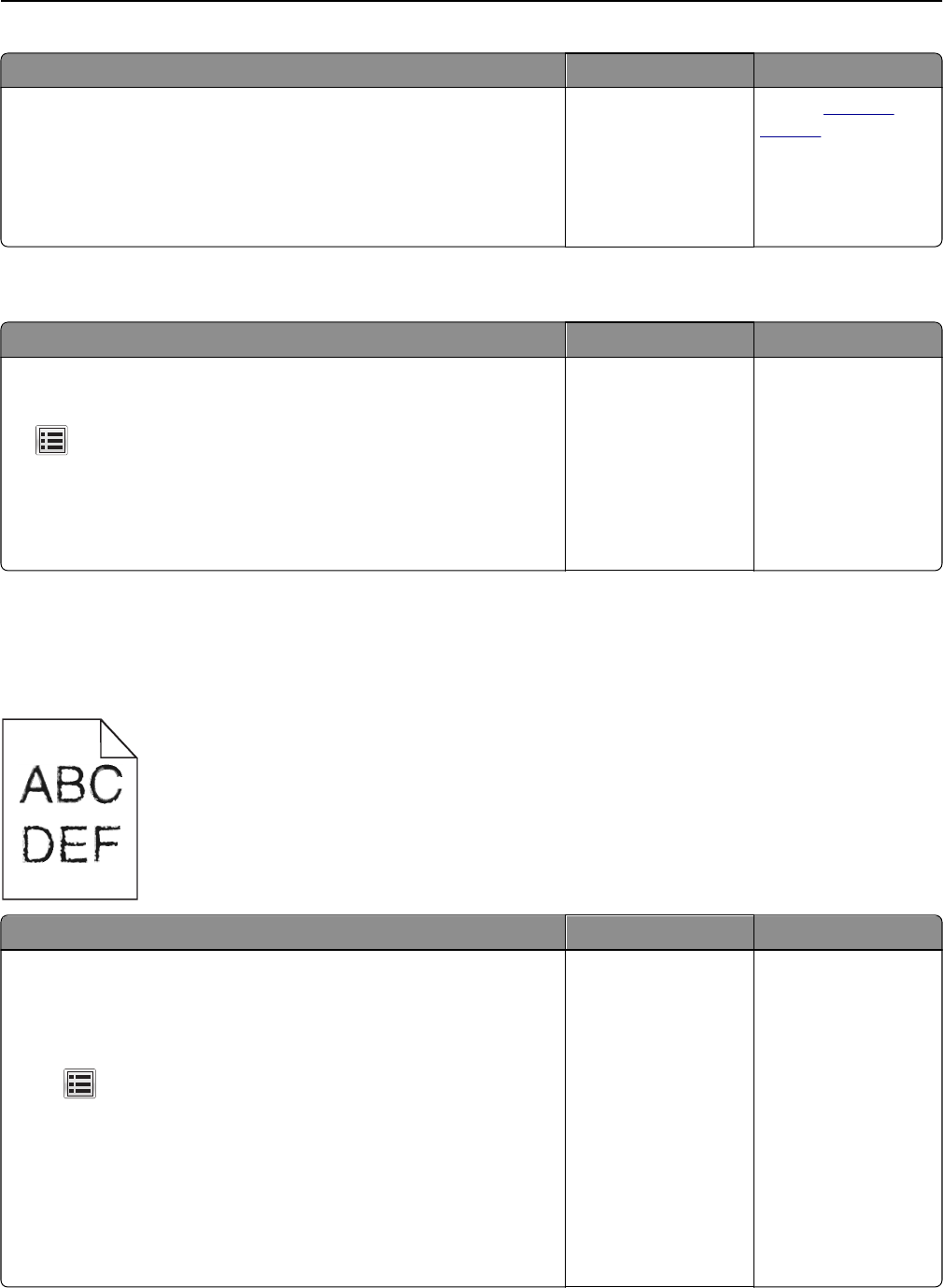
Action Yes No
Step 3
Reduce the complexity of the print job by eliminating the number and size
of fonts, the number and complexity of images, and the number of pages
in the job.
Did the job print and collate correctly?
The problem is solved. Contact technical
support.
Unexpected page breaks occur
Action Yes No
Increase the printing timeout.
aFrom the home screen, navigate to:
> Settings > General Settings > Timeouts
bIncrease the Print Timeout setting, and then touch Submit.
cResend the print job.
Did the file print correctly?
The problem is solved. Check the original file
for manual page
breaks.
Print quality problems
Characters have jagged or uneven edges
Action Yes No
Step 1
aPrint a font sample list to check if the fonts you are using are supported
by the printer.
1From the printer control panel, navigate to:
> Reports > Print Fonts
2Touch PCL Fonts or PostScript Fonts.
bUse a font that is supported by the printer or install the font that you
want to use. For more information, contact your system support
person.
cResend the print job.
Do prints still contain characters that have jagged or uneven edges?
Go to step 2. The problem is solved.
Troubleshooting 268
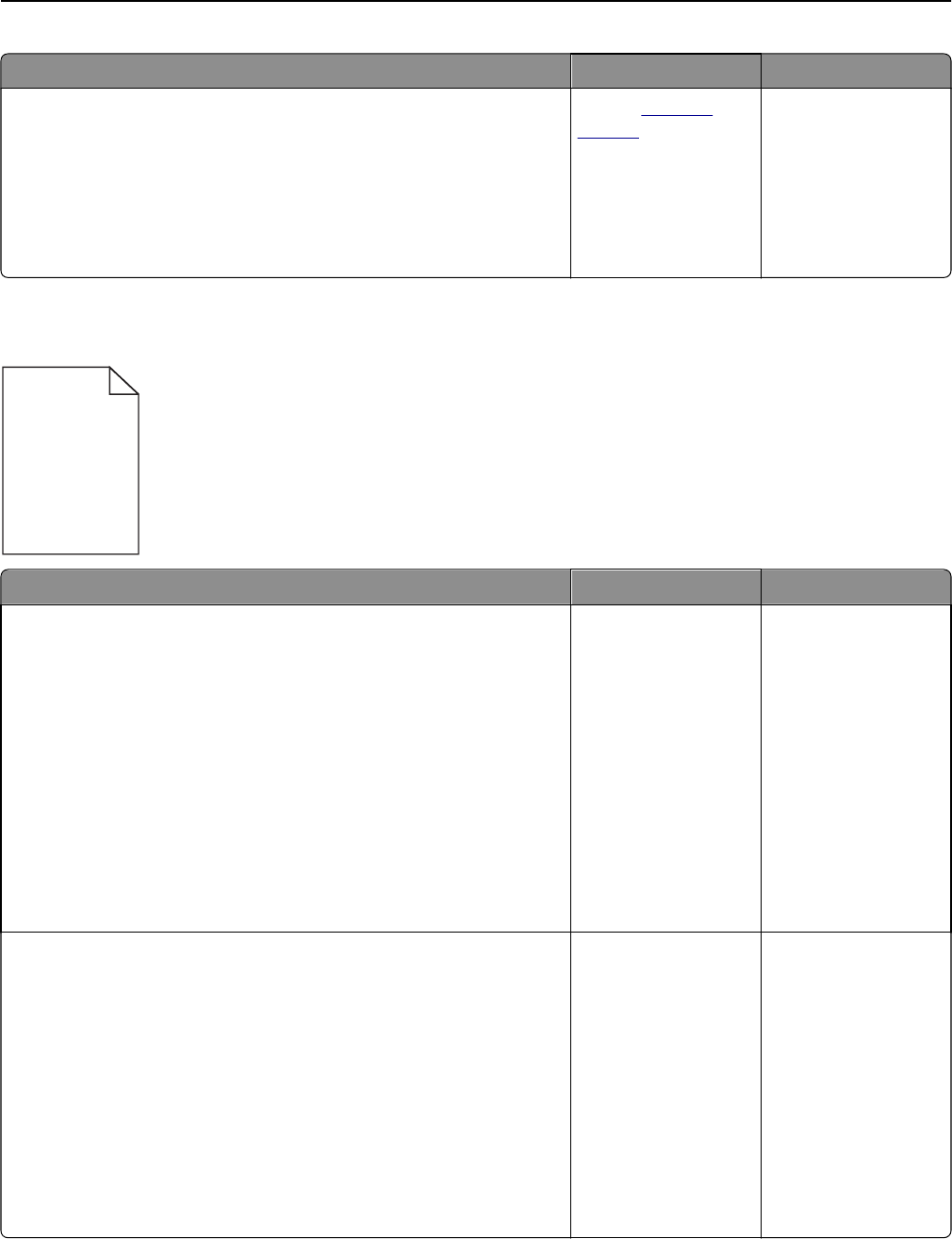
Action Yes No
Step 2
aUse a font that is supported by the printer or install the font that you
want to use on your computer. For more information, contact your
system support person.
bResend the print job.
Do prints still contain characters that have jagged or uneven edges?
Contact technical
support.
The problem is solved.
Printer is printing blank pages
Action Yes No
Step 1
aCheck if there is packing material left on the imaging unit.
1Remove the toner cartridge, and then the imaging unit.
2Check if the packing material is properly removed from the imaging
unit.
Warning—Potential Damage: Do not expose the imaging unit to
direct light for more than 10 minutes. Extended exposure to
light may cause print quality problems.
3Reinstall the imaging unit, and then the cartridge.
bResend the print job.
Is the printer still printing blank pages?
Go to step 2. The problem is solved.
Step 2
aRedistribute the toner in the imaging unit.
1Remove the toner cartridge, and then the imaging unit.
2Firmly shake the imaging unit.
Warning—Potential Damage: Do not expose the imaging unit to
direct light for more than 10 minutes. Extended exposure to
light may cause print quality problems.
3Reinstall the imaging unit, and then the cartridge.
bResend the print job.
Is the printer still printing blank pages?
Go to step 3. The problem is solved.
Troubleshooting 269
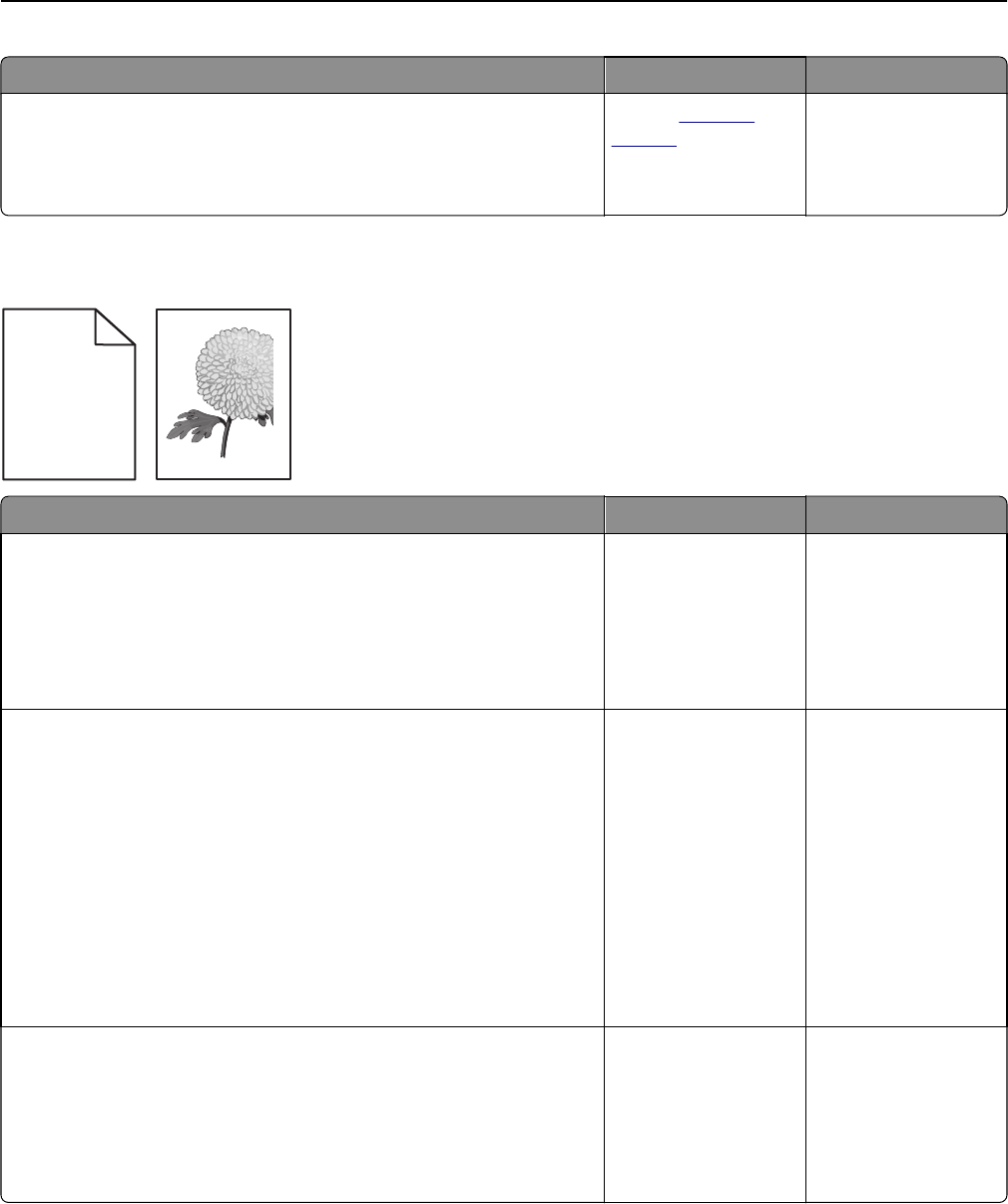
Action Yes No
Step 3
Replace the imaging unit, and then resend the print job.
Is the printer still printing blank pages?
Contact technical
support.
The problem is solved.
Clipped pages or images
Leading edge
Trailing edge
ABCDE
ABCDE
ABCDE
Action Yes No
Step 1
aMove the width and length guides in the tray to the correct positions
for the paper loaded.
bResend the print job.
Is the page or image clipped?
Go to step 2. The problem is solved.
Step 2
From the printer control panel, set the paper size and type in the Paper
menu to match the paper loaded in the tray.
Do the paper size and type match the paper loaded in the tray?
Go to step 3. Do one or more of the
following:
•Specify the paper
size from the tray
settings to match
the paper loaded in
the tray.
•Change the paper
loaded in the tray
to match the paper
size specified in the
tray settings.
Step 3
aDepending on your operating system, specify the paper size from
Printing Preferences or from the Print dialog.
bResend the print job.
Is the page or image clipped?
Go to step 4. The problem is solved.
Troubleshooting 270
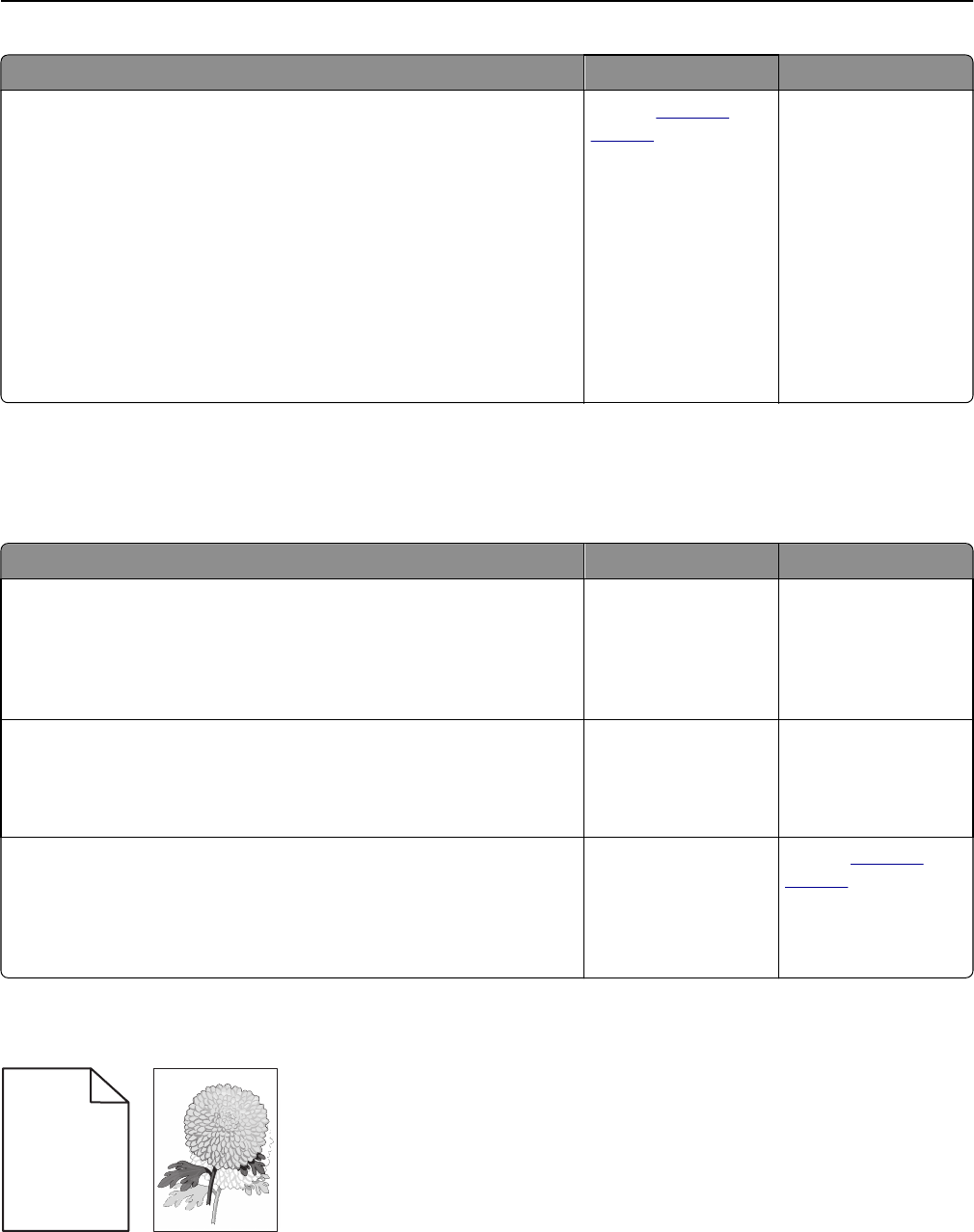
Action Yes No
Step 4
aReinstall the imaging unit.
1Remove the toner cartridge.
2Remove the imaging unit.
Warning—Potential Damage: Do not expose the imaging unit to
direct light for more than 10 minutes. Extended exposure to
light may cause print quality problems.
3Install the imaging unit, and then the cartridge.
bResend the print job.
Is the page or image clipped?
Contact technical
support.
The problem is solved.
Prints on color transparencies appear dark when projected
Note: This problem occurs when projecting transparencies with reflective overhead projectors. To obtain the highest
projected color quality, transmissive overhead projectors are recommended.
Action Yes No
Step 1
From the printer control panel, make sure the paper type setting is set to
Transparency.
Is the paper type setting correct?
Go to step 2. Set the paper type to
Transparency.
Step 2
Reduce the toner darkness, and then resend the print job.
Does the print on the color transparency look lighter?
The problem is solved. Go to step 3.
Step 3
Make sure you are using a recommended type of color transparency, and
then resend the print job.
Does the print on the color transparency look lighter?
The problem is solved. Contact technical
support.
Shadow images appear on prints
ABCD
ABCD
ABCD
ABCD
Leading edge
Trailing edge
Troubleshooting 271
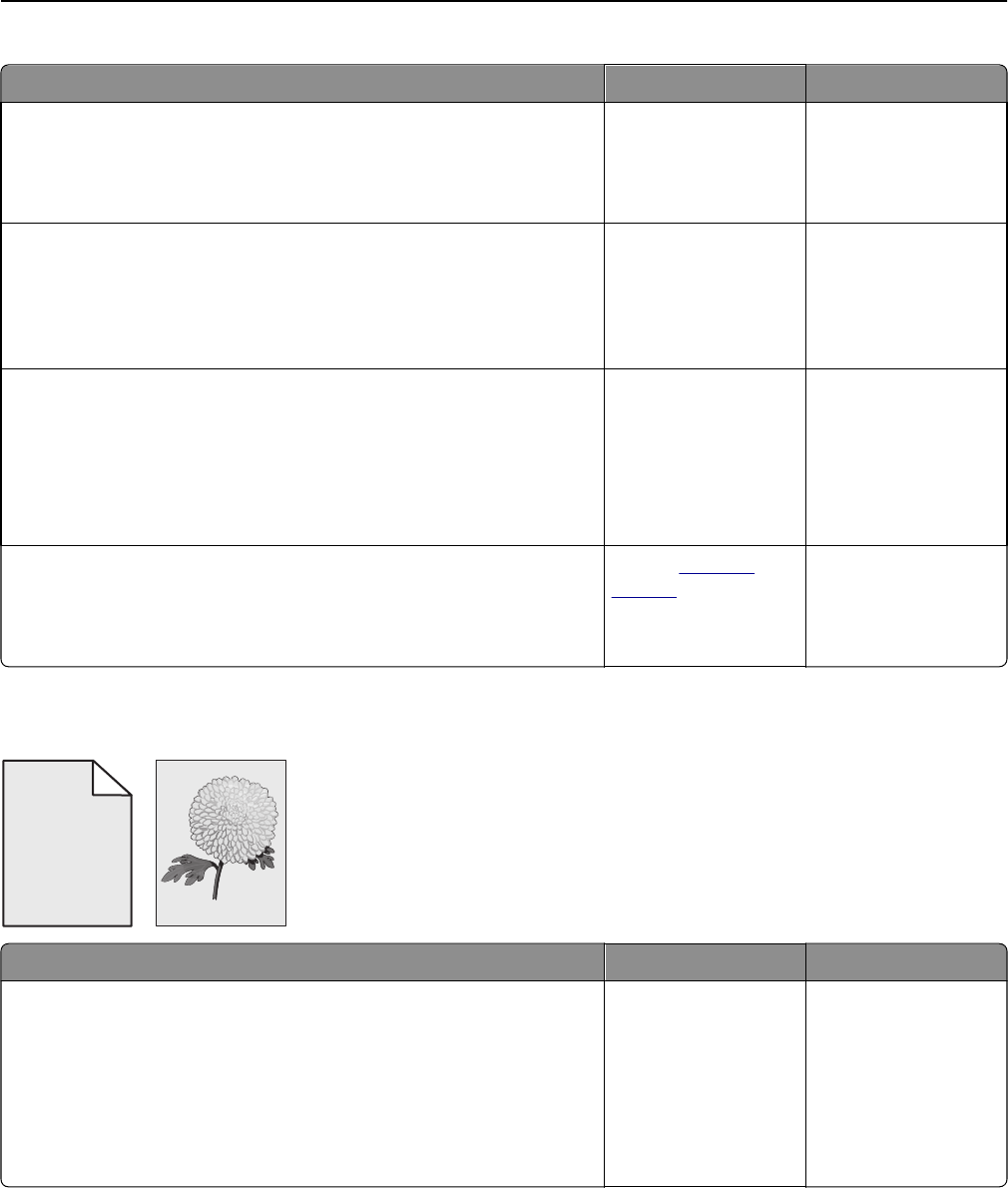
Action Yes No
Step 1
Load paper with the correct paper type and weight in the tray.
Is paper with the correct paper type and weight loaded in the tray?
Go to step 2. Load paper with the
correct paper type and
weight in the tray.
Step 2
From the printer control panel, set the paper type and weight in the Paper
menu to match the paper loaded in the tray.
Is the tray set to the type and weight of the paper loaded?
Go to step 3. Change the paper
loaded in the tray to
match the paper type
and weight specified in
the tray settings.
Step 3
aDepending on your operating system, specify the paper type and
weight from Printing Preferences or from the Print dialog.
bResend the print job.
Do shadow images still appear on prints?
Go to step 4. The problem is solved.
Step 4
Replace the imaging unit, and then resend the print job.
Do shadow images still appear on prints?
Contact technical
support.
The problem is solved.
Gray background on prints
ABCDE
ABCDE
ABCDE
Leading edge
Trailing edge
Action Yes No
Step 1
Check if Allow Background Removal is set to Off.
aFrom the General Settings menu, set Allow Background Removal to
On.
bResend the print job.
Did the background disappear from the prints?
The problem is solved. Go to step 2.
Troubleshooting 272
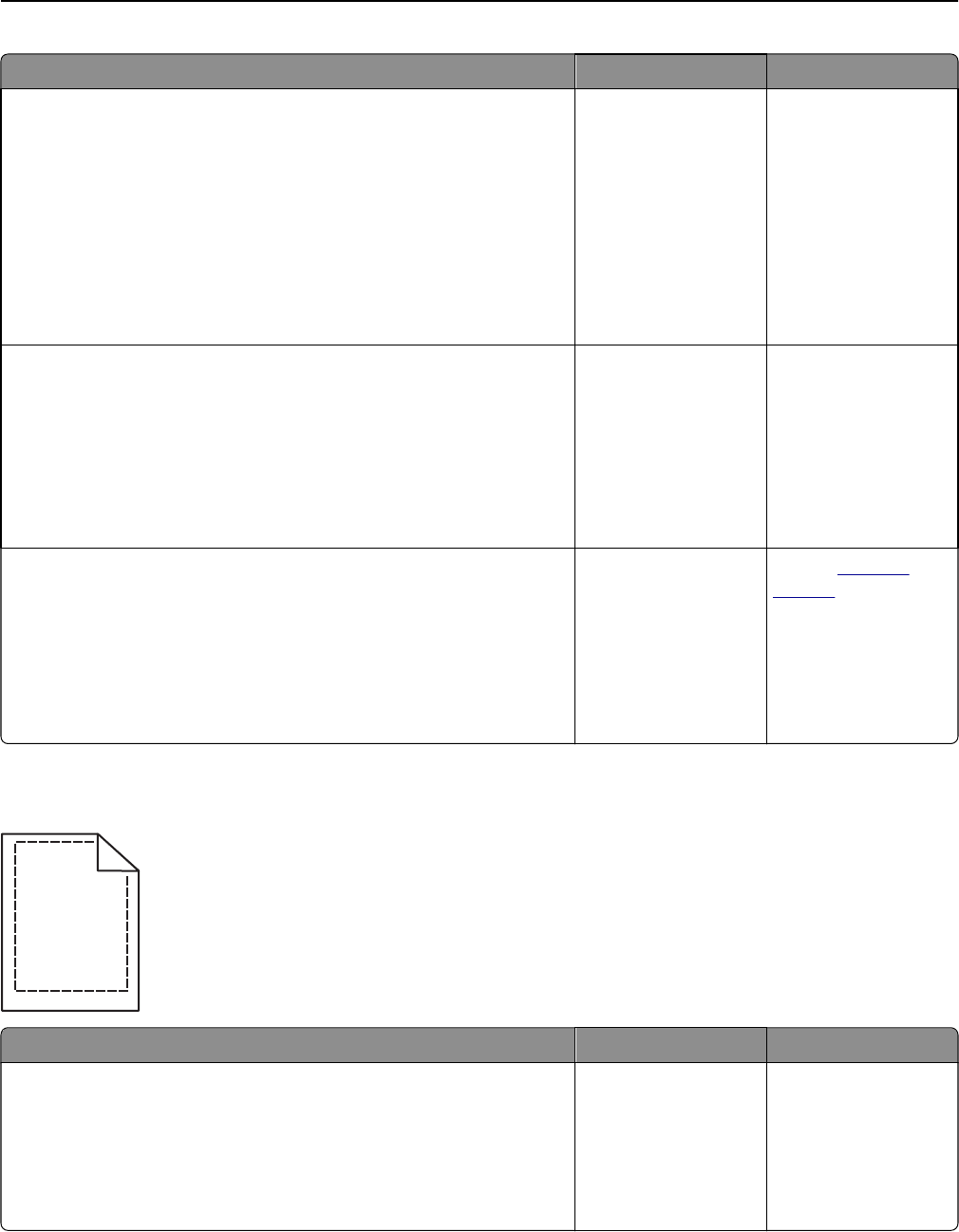
Action Yes No
Step 2
Adjust the toner darkness to a lighter setting.
aFrom the Quality Menu, select a lower value to reduce toner density.
•4 is the factory default setting.
•If Print Mode is set to Black Only, then a setting of 5 increases toner
density and darkness for all print jobs.
bResend the print job.
Did the background disappear from the prints?
The problem is solved. Go to step 3.
Step 3
Reinstall the toner cartridge.
aRemove the cartridge.
bInstall the cartridge.
cResend the print job.
Did the background disappear from the prints?
The problem is solved. Go to step 4.
Step 4
Check if off-white background is selected.
aDepending on your operating system, set off-white background from
Print Properties or the Print dialog.
bResend the print job.
Did the background disappear from the prints?
The problem is solved. Contact technical
support.
Incorrect margins on prints
ABCD
ABCD
ABCD
Action Yes No
Step 1
aMove the width and length guides in the tray to the correct positions
for the paper size loaded.
bResend the print job.
Are the margins correct?
The problem is solved. Go to step 2.
Troubleshooting 273
Action Yes No
Step 2
From the printer control panel, set the paper size in the Paper menu to
match the paper loaded in the tray.
Does the paper size match the paper loaded in the tray?
Go to step 3. Do one or more of the
following:
•Specify the paper
size from the tray
settings to match
the paper loaded in
the tray.
•Change the paper
loaded in the tray
to match the paper
size specified in the
tray settings.
Step 3
aDepending on your operating system, specify the paper size from
Printing Preferences or from the Print dialog.
bResend the print job.
Are the margins correct?
The problem is solved. Contact technical
support.
Paper curl
Action Yes No
Step 1
Move the width and length guides in the tray to the correct positions for
the size of the paper loaded.
Are the width and length guides positioned correctly?
Go to step 2. Adjust the width and
length guides.
Step 2
From the printer control panel, set the paper type and weight in the Paper
menu to match the paper loaded in the tray.
Do the paper type and weight match the type and weight of the paper in
the tray?
Go to step 3. Specify the paper type
and weight from the
tray settings to match
the paper loaded in the
tray.
Step 3
aDepending on your operating system, specify the paper type and
weight from Printing Preferences or from the Print dialog.
bResend the print job.
Is the paper still curled?
Go to step 4. The problem is solved.
Step 4
aRemove the paper from the tray, and then turn it over.
bResend the print job.
Is the paper still curled?
Go to step 5. The problem is solved.
Troubleshooting 274
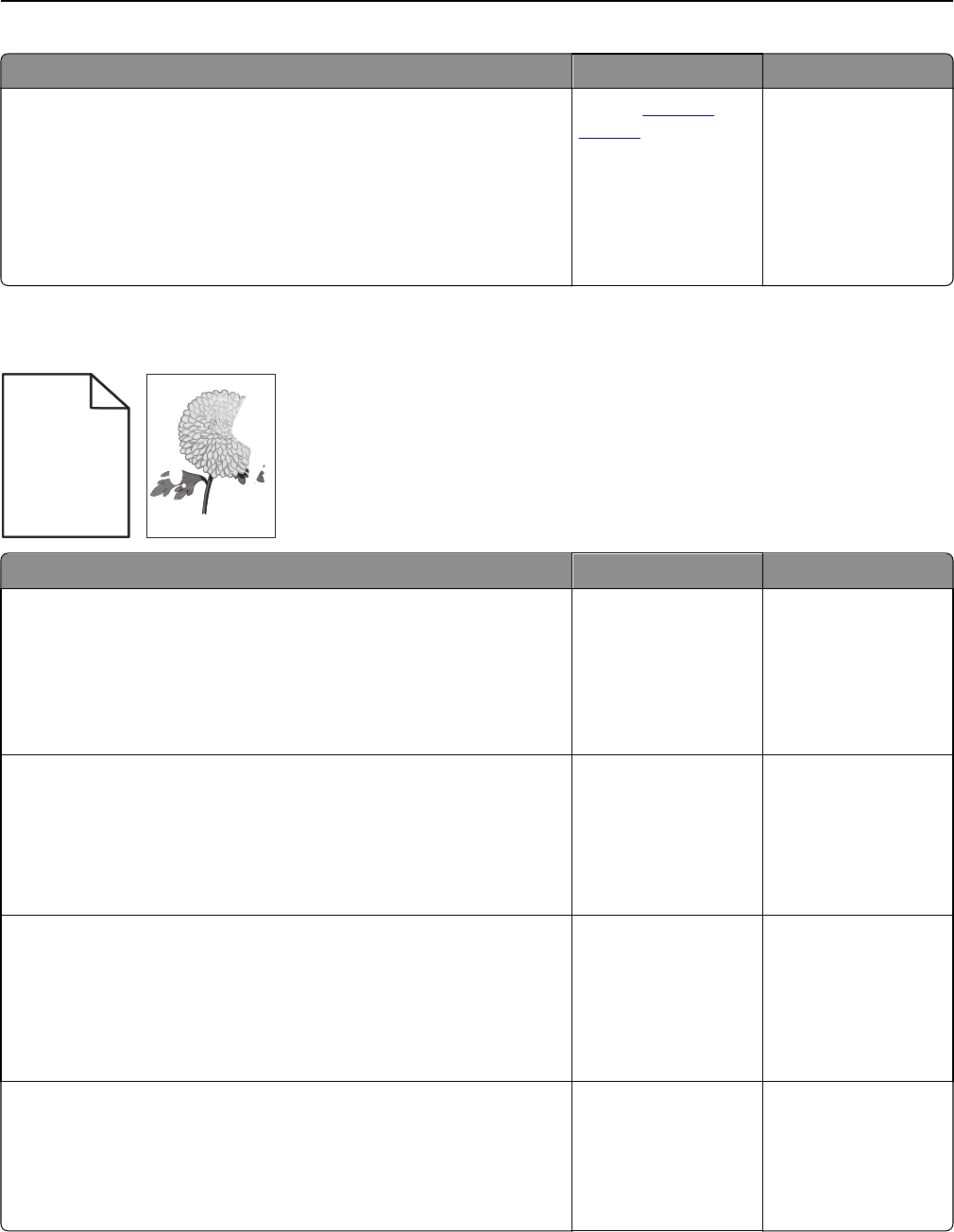
Action Yes No
Step 5
aLoad paper from a fresh package.
Note: Paper absorbs moisture due to high humidity. Store paper in
its original wrapper until you use it.
bResend the print job.
Is the paper still curled?
Contact technical
support.
The problem is solved.
Print irregularities
) )
ABCDE
ABCDE
ABCDE
Leading edge
Trailing edge
Action Yes No
Step 1
aMove the width and length guides in the tray to the correct positions
for the size of the paper loaded in the tray.
bResend the print job.
Do print irregularities still appear?
Go to step 2. The problem is solved.
Step 2
From the printer control panel, set the paper size and type in the Paper
menu to match the paper loaded in the tray.
Do the printer settings match the type and weight of the paper loaded in
the tray?
Go to step 3. Specify the paper size
and type from the tray
settings to match the
paper loaded in the
tray.
Step 3
aDepending on your operating system, specify the paper type and
weight from Printing Preferences or from the Print dialog.
bResend the print job.
Do print irregularities still appear?
Go to step 4. The problem is solved.
Step 4
Check if the paper loaded in the tray has texture or rough finishes.
Are you printing on textured or rough paper?
From the printer
control panel, set the
paper texture in the
Paper menu to match
the paper loaded in the
tray.
Go to step 5.
Troubleshooting 275
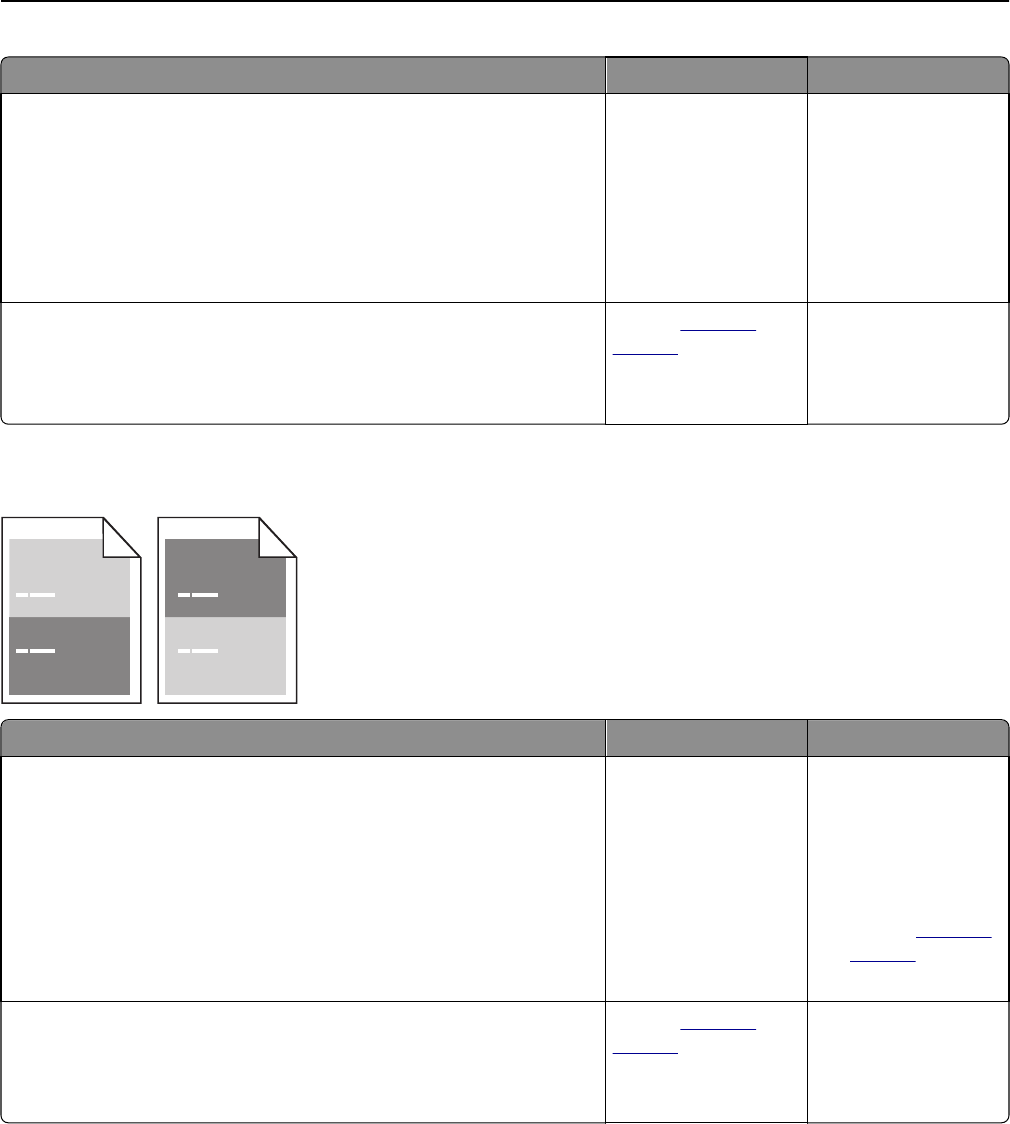
Action Yes No
Step 5
aLoad paper from a fresh package.
Note: Paper absorbs moisture due to high humidity. Store paper in
its original wrapper until you use it.
bResend the print job.
Do print irregularities still appear?
Go to step 6. The problem is solved.
Step 6
Replace the imaging unit, and then resend the print job.
Do print irregularities still appear?
Contact technical
support or your Dell
printer dealer.
The problem is solved.
Repeating defects appear on prints
Action Yes No
Step 1
Measure the distance between the defects.
Check for a distance between the defects that equals:
•97 mm (3.82 in.)
•47 mm (1.85 in.)
•38 mm (1.5 in.)
Is the distance between defects equal to one of the listed measurements?
Go to step 2. 1Check if the
distance between
the defects equal
to 80 mm (3.15 in.)
2Take note of the
distance, and then
contact technical
support or your
Dell printer dealer.
Step 2
Replace the imaging unit, and then resend the print job.
Do the repeating defects still appear?
Contact technical
support or your Dell
printer dealer.
The problem is solved.
Troubleshooting 276
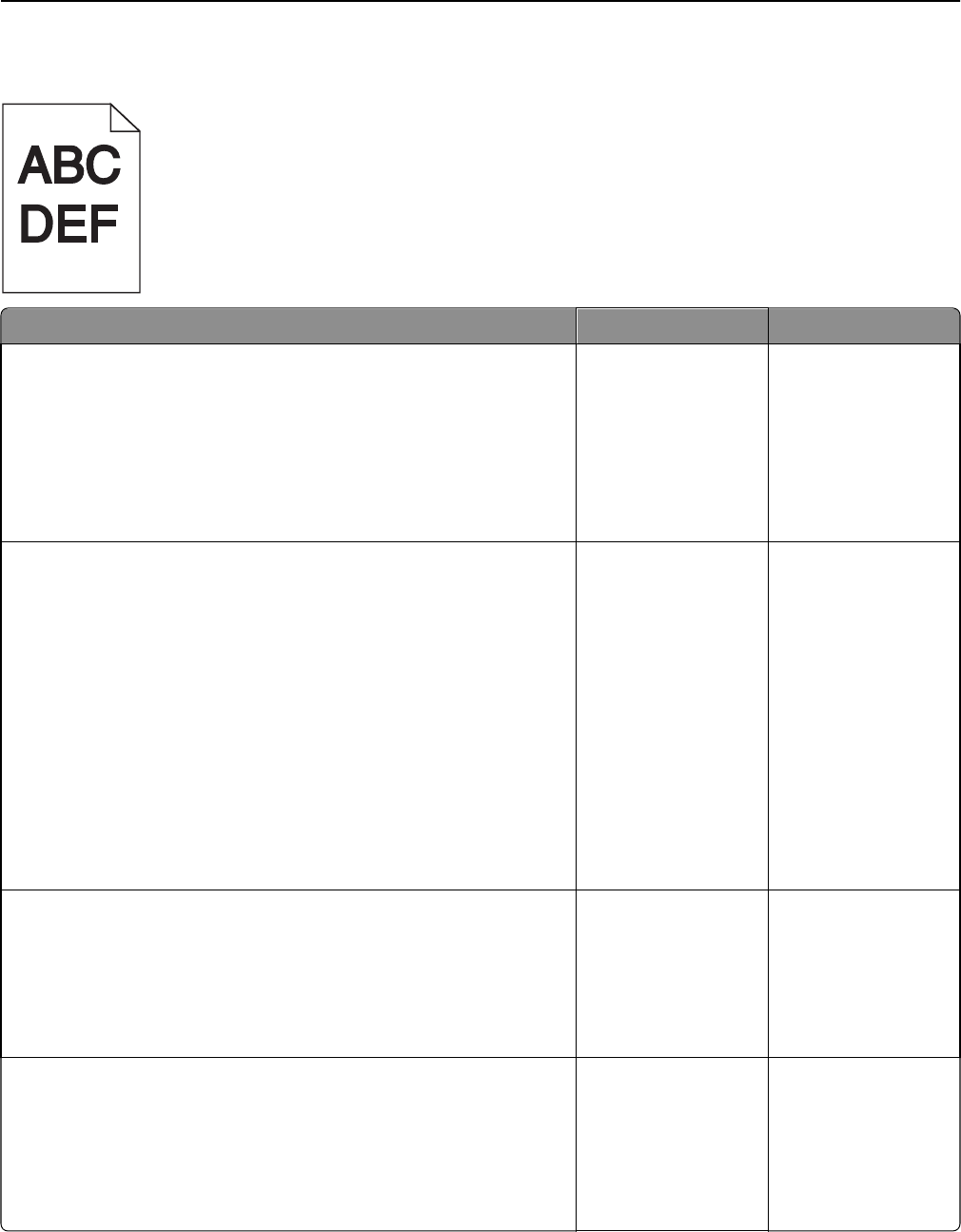
Print is too dark
Action Yes No
Step 1
aFrom the Quality menu on the printer control panel, reduce the toner
darkness.
Note: 8 is the factory default setting.
bResend the print job.
Is the print still too dark?
Go to step 2. The problem is solved.
Step 2
aFrom the printer control panel, set the paper type, texture and weight
in the Paper menu to match the paper loaded in the tray.
bResend the print job.
Is the tray set to the type, texture, and weight of the paper loaded?
Go to step 3. Do one or more of the
following:
•Specify the paper
type, texture, and
weight from the
tray settings to
match the paper
loaded in the tray.
•Change the paper
loaded in the tray
to match the paper
type, texture and
weight specified in
the tray settings.
Step 3
aDepending on your operating system, specify the paper type, texture
and weight from Printing Preferences or from the Print dialog.
bResend the print job.
Is the print still too dark?
Go to step 4. The problem is solved.
Step 4
Check if the paper loaded in the tray has texture or rough finishes.
Are you printing on textured or rough paper?
From the printer
control panel, change
the texture settings in
the Paper Texture
menu to match the
paper you are printing
on.
Go to step 5.
Troubleshooting 277
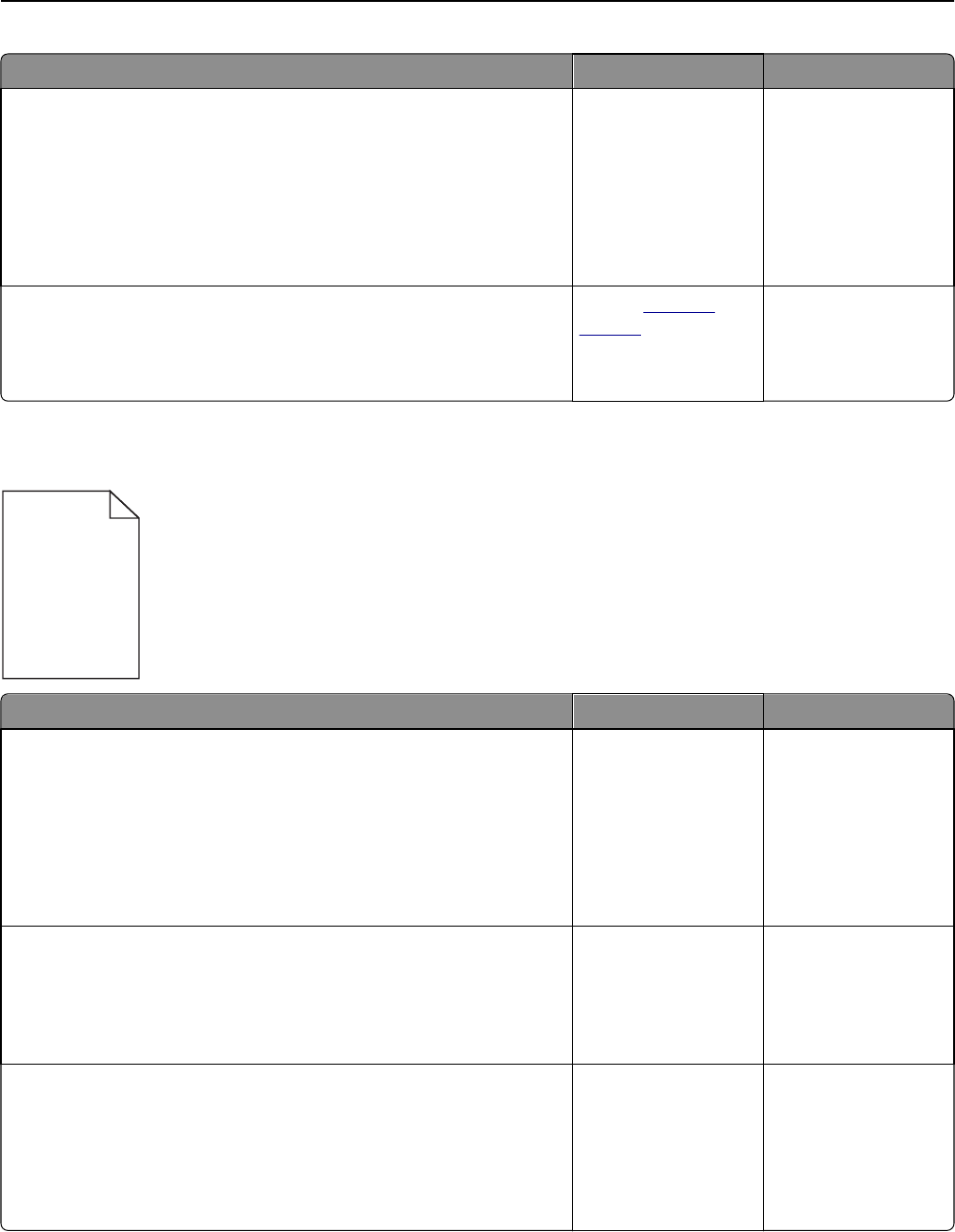
Action Yes No
Step 5
aLoad paper from a fresh package.
Note: Paper absorbs moisture due to high humidity. Store paper in
its original wrapper until you use it.
bResend the print job.
Is the print still too dark?
Go to step 6. The problem is solved.
Step 6
Replace the imaging unit, and then resend the print job.
Is the print still too dark?
Contact technical
support.
The problem is solved.
Print is too light
ABC
DEF
Action Yes No
Step 1
aFrom the Quality menu on the printer control panel, increase the toner
darkness.
Note: 8 is the factory default setting.
bResend the print job.
Is the print still too light?
Go to step 2. The problem is solved.
Step 2
From the printer control panel, set the paper type, texture, and weight in
the Paper menu to match the paper loaded in the tray.
Is the tray set to the type, texture, and weight of the paper loaded?
Go to step 3. Change the paper type,
texture, and weight to
match the paper
loaded in the tray.
Step 3
aDepending on your operating system, specify the paper type, texture,
and weight from Printing Preferences or from the Print dialog.
bResend the print job.
Is the print still too light?
Go to step 4. The problem is solved.
Troubleshooting 278

Action Yes No
Step 4
Make sure that the paper has no texture or rough finishes.
Are you printing on textured or rough paper?
From the printer
control panel, change
the texture settings in
the Paper Texture
menu to match the
paper you are printing
on.
Go to step 5.
Step 5
aLoad paper from a fresh package.
Note: Paper absorbs moisture due to high humidity. Store paper in
its original wrapper until you use it.
bResend the print job.
Is the print still too light?
Go to step 6. The problem is solved.
Step 6
aRedistribute the toner in the imaging unit.
1Remove the toner cartridge, and then the imaging unit.
2Firmly shake the imaging unit.
Warning—Potential Damage: Do not expose the imaging unit to
direct light for more than 10 minutes. Extended exposure to
light may cause print quality problems.
3Install the imaging unit, and then the cartridge.
bResend the print job.
Is the print still too light?
Go to step 7. The problem is solved.
Step 7
Replace the imaging unit, and then resend the print job.
Is the print still too light?
Contact technical
support.
The problem is solved.
Skewed print
) )
ABCDE
ABCDE
ABCDE
Troubleshooting 279
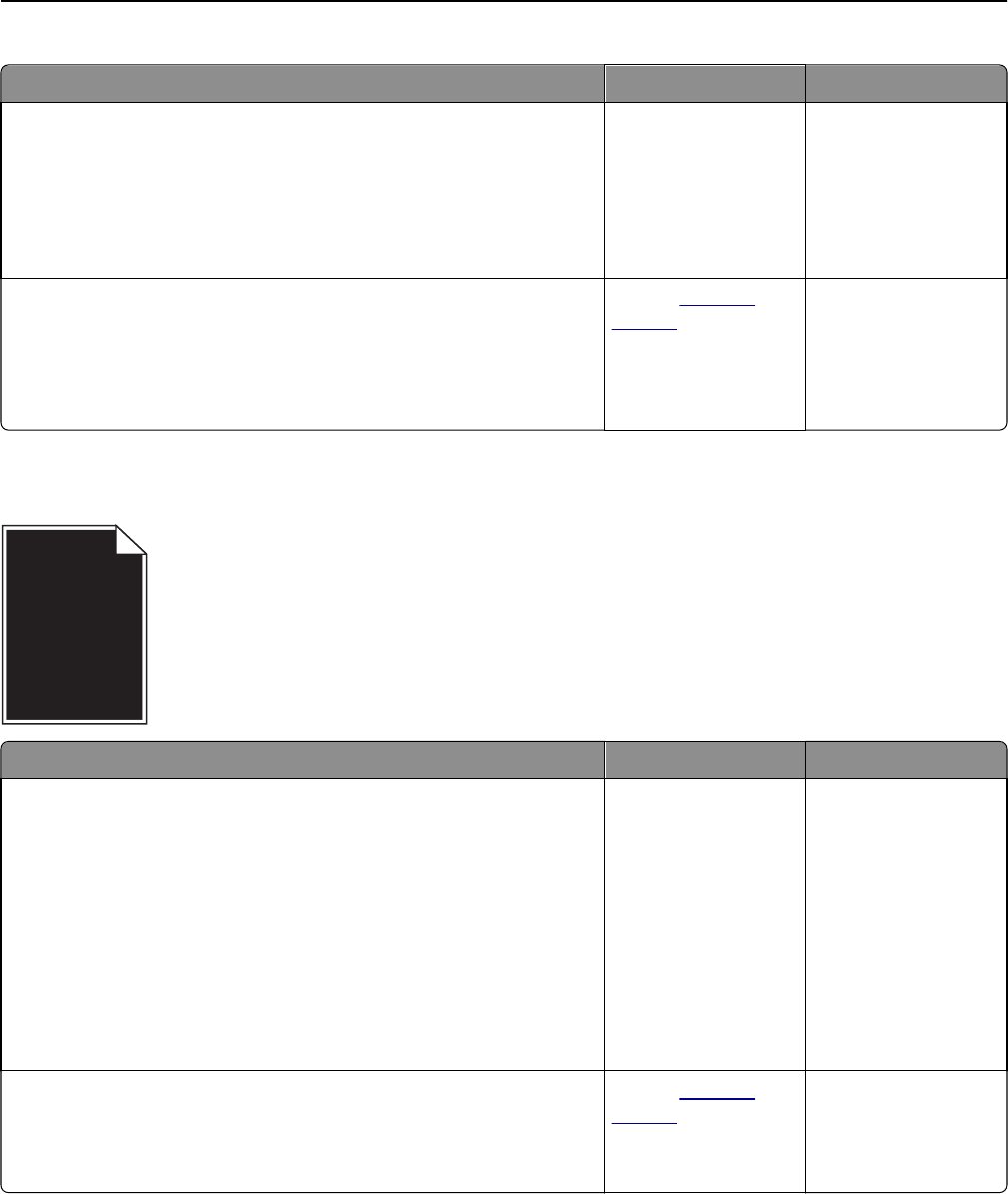
Action Yes No
Step 1
aMove the width and length guides in the tray to the correct positions
for the size of the paper loaded.
bResend the print job.
Is the print still skewed?
Go to step 2. The problem is solved.
Step 2
aCheck if you are printing on a paper that is supported by the tray.
bResend the print job.
Is the print still skewed?
Contact technical
support.
The problem is solved.
Printer is printing solid black pages
Action Yes No
Step 1
aReinstall the imaging unit.
1Remove the toner cartridge, and then the imaging unit.
Warning—Potential Damage: Do not expose the imaging unit to
direct light for more than 10 minutes. Extended exposure to
light may cause print quality problems.
2Install the imaging unit, and then the cartridge.
bResend the print job.
Is the printer printing solid black pages?
Go to step 2. The problem is solved.
Step 2
Replace the imaging unit, and then resend the print job.
Is the printer printing solid black pages?
Contact technical
support.
The problem is solved.
Troubleshooting 280
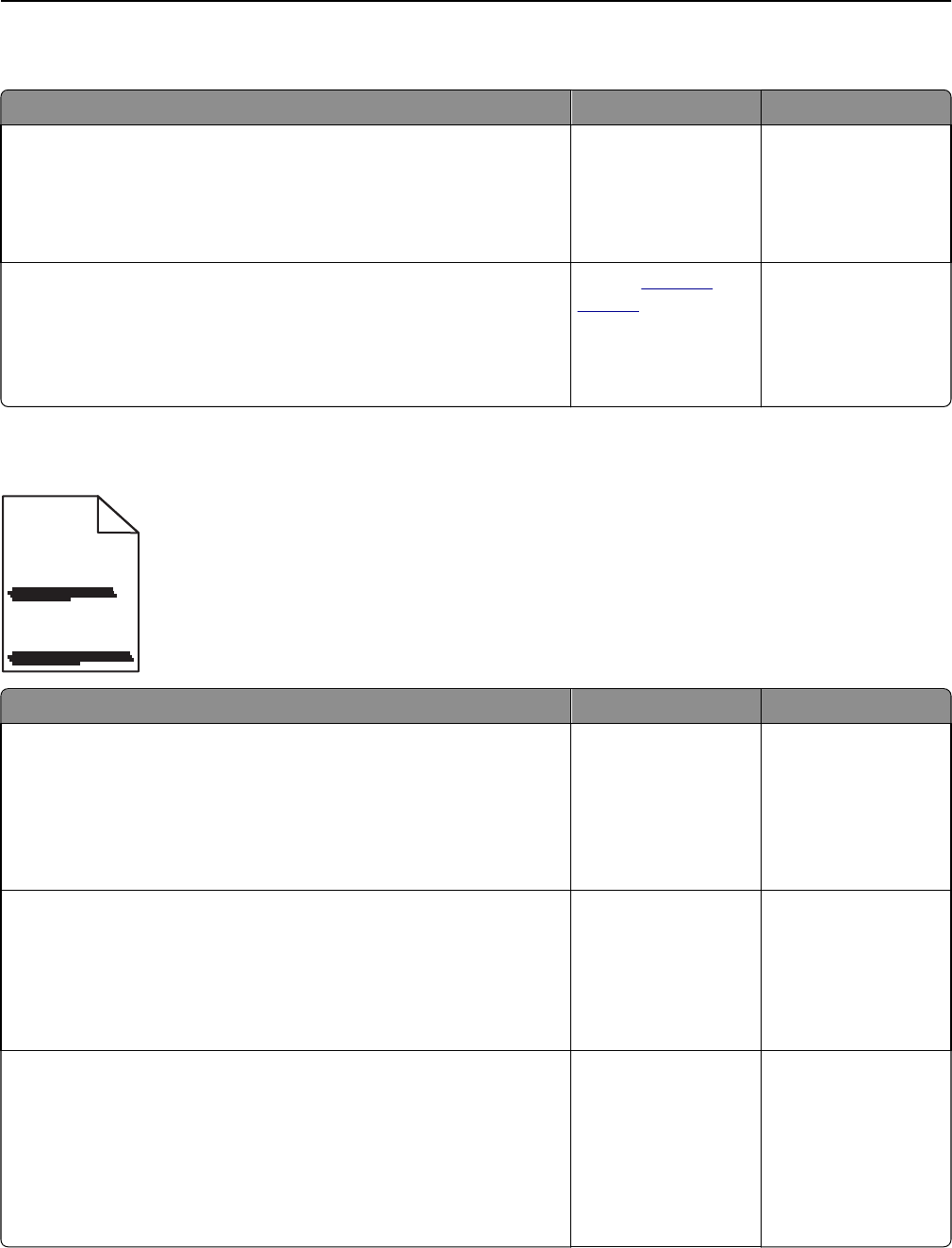
Transparency print quality is poor
Action Yes No
Step 1
From the printer control panel, set the paper type in the Paper menu to
match the paper loaded in the tray.
Is the paper type for the tray set to Transparency?
Go to step 2. Set the paper type to
Transparency.
Step 2
aCheck if you are using a recommended type of transparency.
bResend the print job.
Is the print quality still poor?
Contact technical
support.
The problem is solved.
Streaked horizontal lines appear on prints
ABCDE
ABCDE
ABCDE
Action Yes No
Step 1
aDepending on your operating system, specify the tray or feeder from
Printing Preferences or the Print dialog.
bResend the print job.
Do streaked horizontal lines appear on prints?
Go to step 2. The problem is solved.
Step 2
From the printer control panel, set the paper type and weight in the Paper
menu to match the paper loaded in the tray.
Do the paper type and weight match the type and weight of the paper in
the tray?
Go to step 3. Change the paper type
and weight to match
the paper loaded in the
tray.
Step 3
aLoad paper from a fresh package.
Note: Paper absorbs moisture due to high humidity. Store paper in
its original wrapper until you use it.
bResend the print job.
Do streaked horizontal lines appear on prints?
Go to step 4. The problem is solved.
Troubleshooting 281
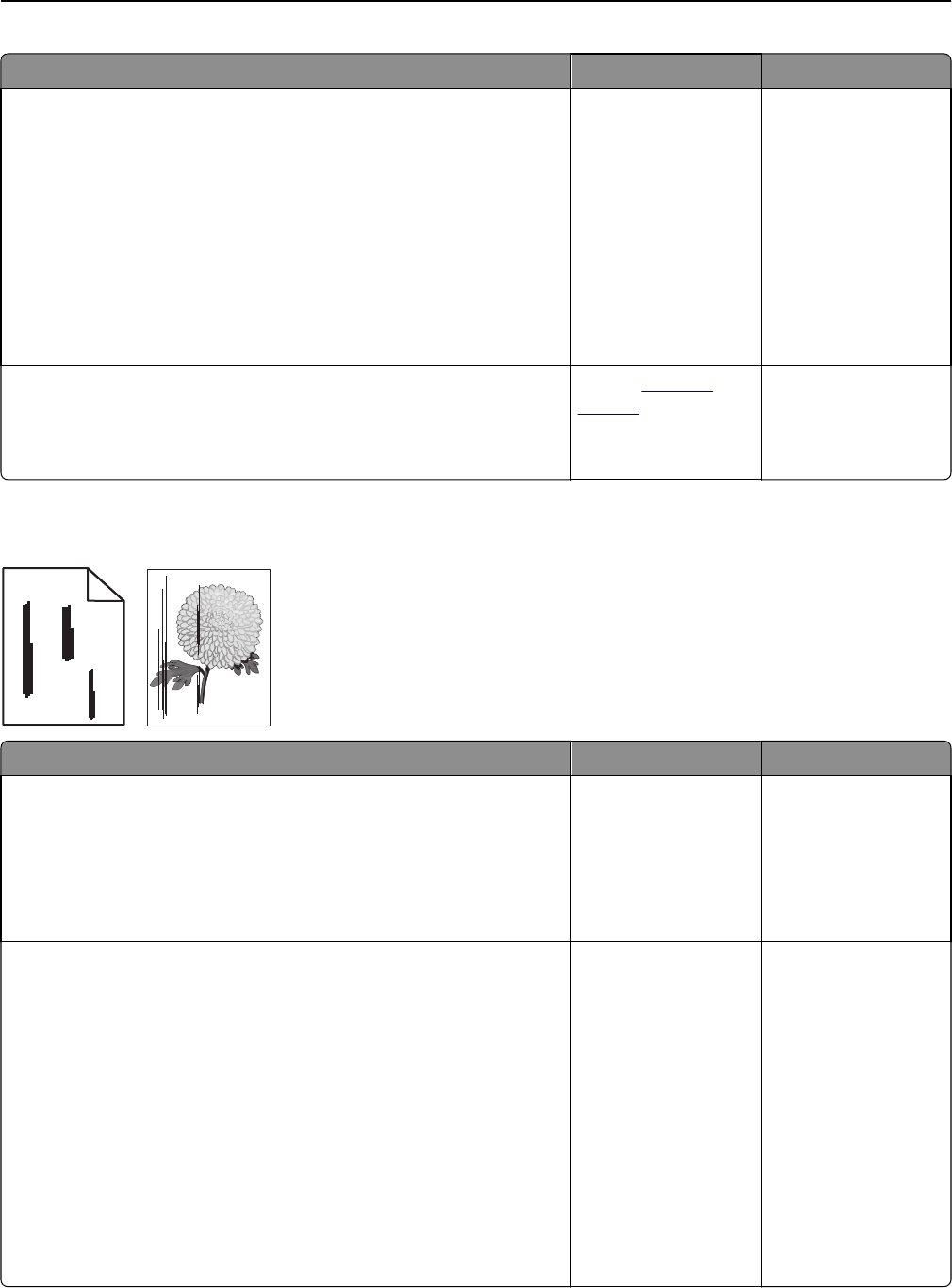
Action Yes No
Step 4
aReinstall the imaging unit.
1Remove the toner cartridge, and then the imaging unit.
Warning—Potential Damage: Do not expose the imaging unit to
direct light for more than 10 minutes. Extended exposure to
light may cause print quality problems.
2Install the imaging unit, and then the cartridge.
bResend the print job.
Do streaked horizontal lines appear on prints?
Go to step 5. The problem is solved.
Step 5
Replace the imaging unit, and then resend the print job.
Do streaked horizontal lines appear on prints?
Contact technical
support.
The problem is solved.
Streaked vertical lines appear on prints
ABCDE
ABCDE
ABCDE
Leading edge
Trailing edge
Action Yes No
Step 1
aDepending on your operating system, specify the paper type, texture,
and weight from Printing Preferences or from the Print dialog.
bResend the print job.
Do streaked vertical lines appear on prints?
Go to step 2. The problem is solved.
Step 2
From the printer control panel, set the paper texture, type, and weight in
the Paper menu to match the paper loaded in the tray.
Do the paper texture, type, and weight match the paper in the tray?
Go to step 3. Do one or more of the
following:
•Specify the paper
texture, type, and
weight from the
tray settings to
match the paper
loaded in the tray.
•Change the paper
loaded in the tray
to match the paper
texture, type, and
weight specified in
the tray settings.
Troubleshooting 282
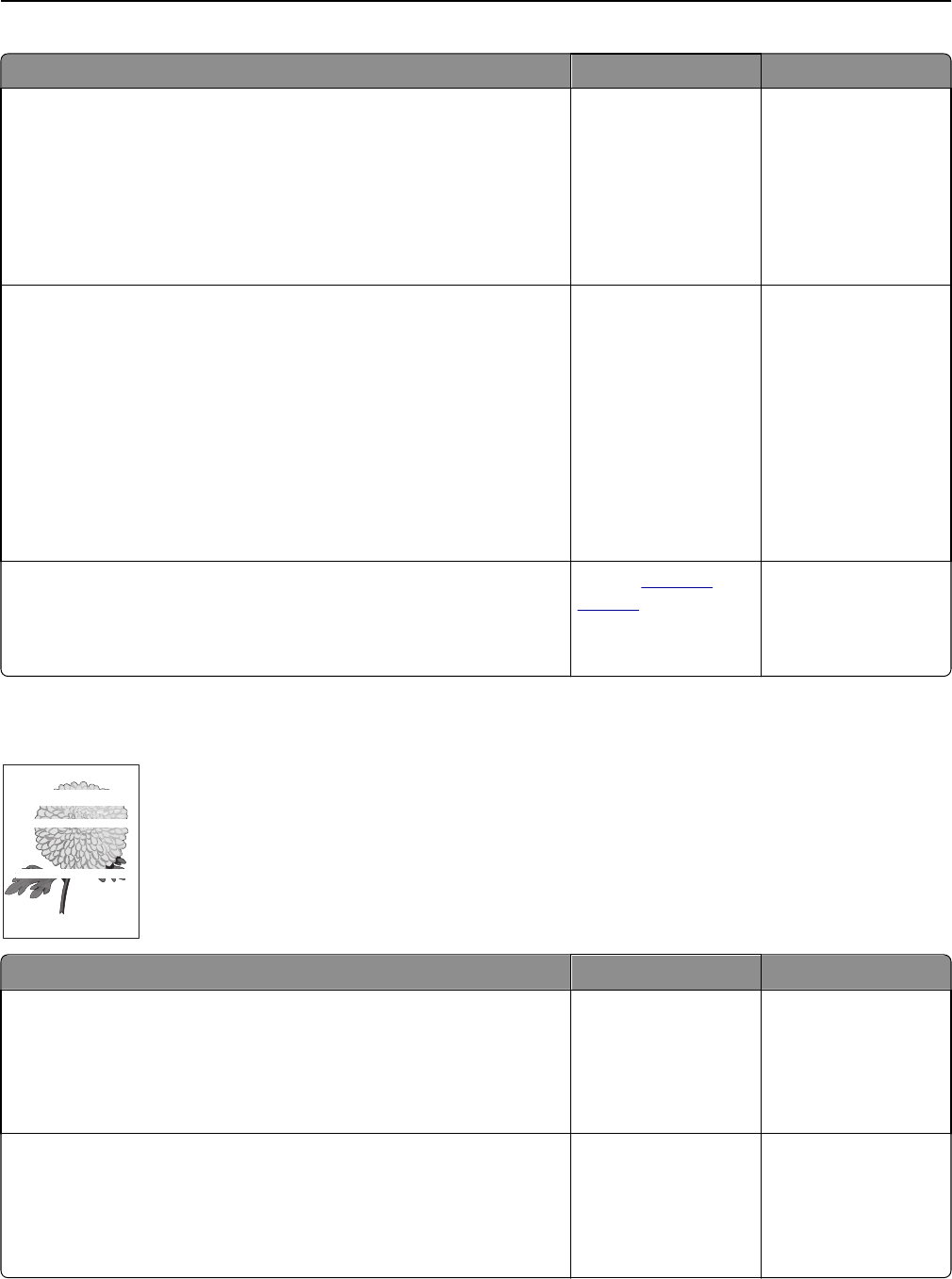
Action Yes No
Step 3
aLoad paper from a fresh package.
Note: Paper absorbs moisture due to high humidity. Store paper in
its original wrapper until you use it.
bResend the print job.
Do streaked vertical lines appear on prints?
Go to step 4. The problem is solved.
Step 4
aReinstall the imaging unit.
1Remove the toner cartridge, and then the imaging unit.
Warning—Potential Damage: Do not expose the imaging unit to
direct light for more than 10 minutes. Extended exposure to
light may cause print quality problems.
2Install the imaging unit, and then the cartridge.
bResend the print job.
Do streaked vertical lines appear on prints?
Go to step 5. The problem is solved.
Step 5
Replace the imaging unit, and then resend the print job.
Do streaked vertical lines appear on prints?
Contact technical
support or your Dell
printer dealer.
The problem is solved.
Horizontal voids appear on prints
Leading edge
Trailing edge
Action Yes No
Step 1
aMake sure your software program is using a correct fill pattern.
bResend the print job.
Do horizontal voids appear on prints?
Go to step 2. The problem is solved.
Step 2
aLoad the specified tray or feeder with a recommended type of paper.
bResend the print job.
Do horizontal voids appear on prints?
Go to step 3. The problem is solved.
Troubleshooting 283
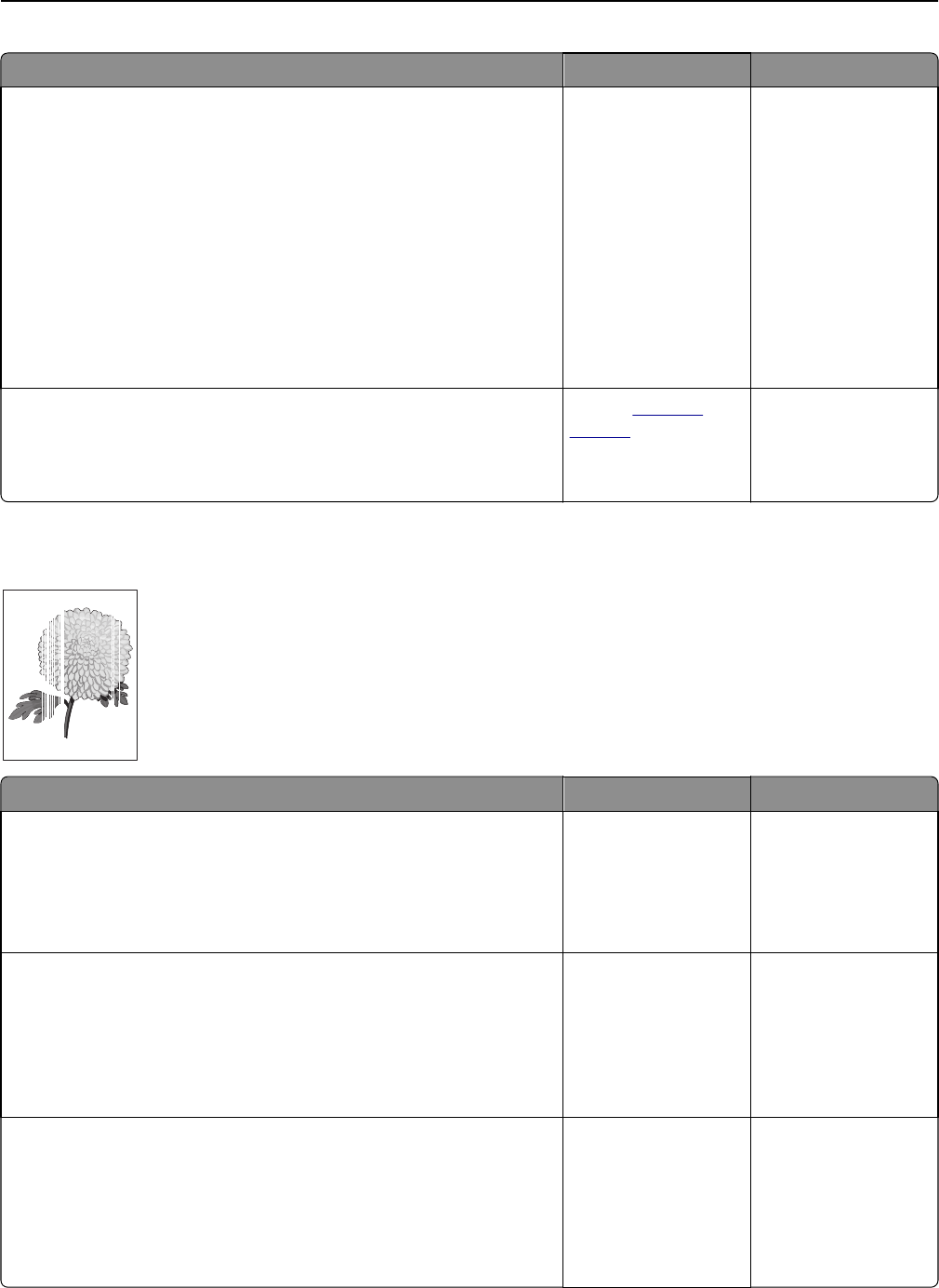
Action Yes No
Step 3
aRedistribute the toner in the imaging unit.
1Remove the toner cartridge, and then the imaging unit.
2Firmly shake the imaging unit.
Warning—Potential Damage: Do not expose the imaging unit to
direct light for more than 10 minutes. Extended exposure to
light may cause print quality problems.
3Reinstall the imaging unit, and then the cartridge.
bResend the print job.
Do horizontal voids appear on prints?
Go to step 4. The problem is solved.
Step 4
Replace the imaging unit, and then resend the print job.
Do horizontal voids appear on prints?
Contact technical
support.
The problem is solved.
Vertical voids appear on prints
Leading edge
Trailing edge
Action Yes No
Step 1
aMake sure your software program is using a correct fill pattern.
bResend the print job.
Do vertical voids appear on prints?
Go to step 2. The problem is solved.
Step 2
aFrom the printer control panel, set the paper type and weight in the
Paper menu to match the paper loaded in the tray.
bResend the print job.
Do vertical voids appear on prints?
Go to step 3. The problem is solved.
Step 3
Check if you are using a recommended type of paper.
aLoad the specified tray or feeder with a recommended type of paper.
bResend the print job.
Do vertical voids appear on prints?
Go to step 4. The problem is solved.
Troubleshooting 284
Action Yes No
Step 4
aRedistribute the toner in the imaging unit.
1Remove the toner cartridge, and then the imaging unit.
2Firmly shake the imaging unit.
Warning—Potential Damage: Do not expose the imaging unit to
direct light for more than 10 minutes. Extended exposure to
light may cause print quality problems.
3Reinstall the imaging unit, and then the cartridge.
bResend the print job.
Do vertical voids appear on prints?
Go to step 5. The problem is solved.
Step 5
Replace the imaging unit, and then resend the print job.
Do vertical voids appear on prints?
Contact technical
support.
The problem is solved.
Toner specks appear on prints
Action Yes No
Replace the imaging unit, and then resend the print job.
Do toner specks appear on prints?
Contact technical
support.
The problem is solved.
Toner fog or background shading appears on prints
ABCDE
ABCDE
ABCDE
Action Yes No
Step 1
Reinstall the imaging unit.
aRemove, and then install the imaging unit.
bResend the print job.
Does fog or shading appear on prints?
Go to step 2. The problem is solved.
Troubleshooting 285
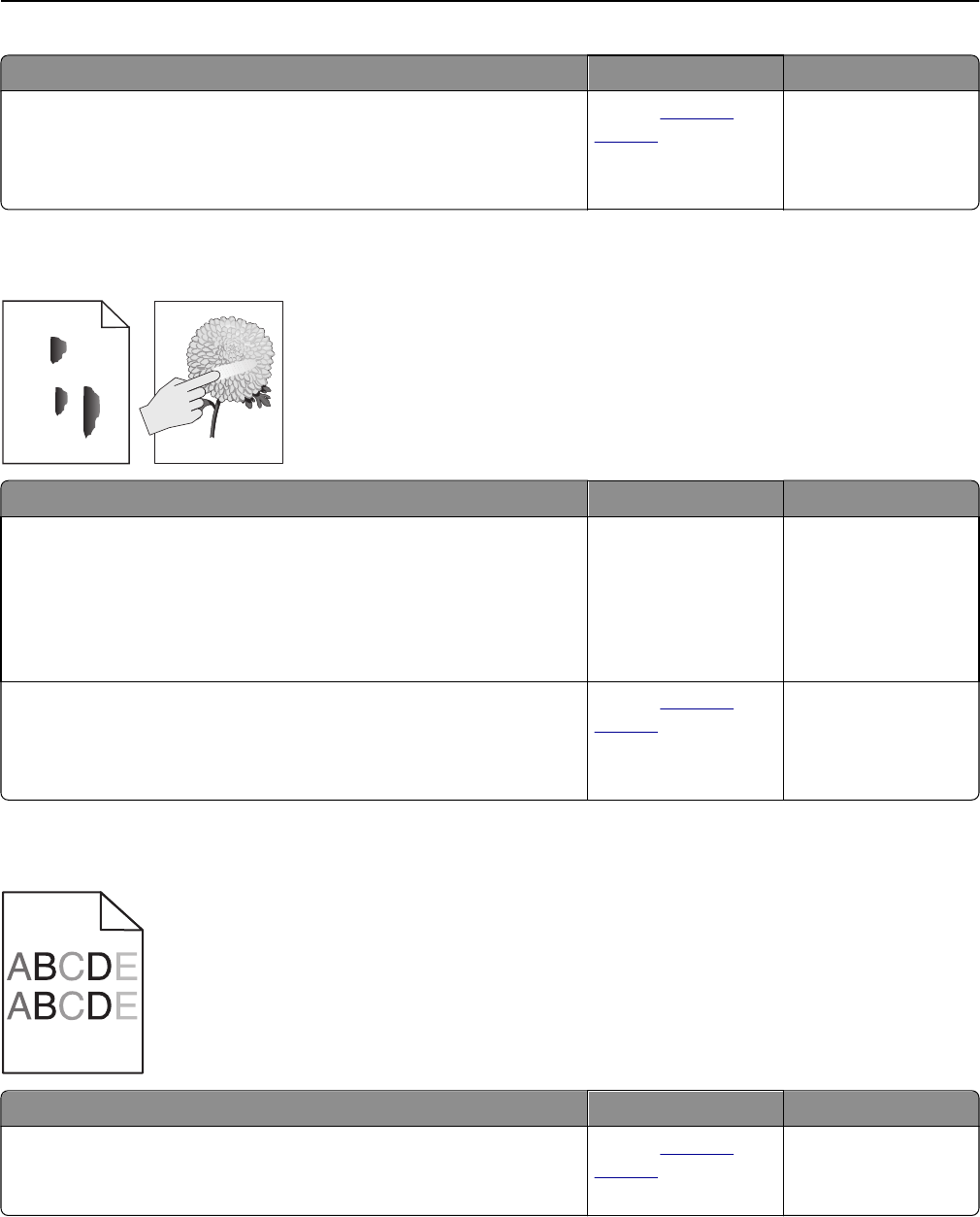
Action Yes No
Step 2
Replace the imaging unit, and then resend the print job.
Does fog or shading appear on prints?
Contact technical
support or your Dell
printer dealer.
The problem is solved.
Toner rubs off
Leading edge
Trailing edge
ABC
DEF
Action Yes No
Step 1
From the Paper menu on the printer control panel, check the paper type,
texture, and weight.
Do the paper type, texture, and weight match the paper loaded in the
tray?
Go to step 2. Specify the paper type,
texture, and weight
from the tray settings
to match the paper
loaded in the tray.
Step 2
Resend the print job.
Does the toner still rub off?
Contact technical
support or your Dell
printer dealer.
The problem is solved.
Uneven print density
Action Yes No
Replace the imaging unit, and then resend the print job.
Is the print density uneven?
Contact technical
support.
The problem is solved.
Solving copy problems
•“Copier does not respond” on page 287
Troubleshooting 286

•“Scanner unit does not close” on page 287
•“Poor copy quality” on page 288
•“Partial document or photo copies” on page 289
Copier does not respond
Action Yes No
Step 1
Check if an error or status message appears on the display.
Does an error or status message appear?
Clear the error or status
message.
Go to step 2.
Step 2
Check if the power cord is plugged into the printer and a properly
grounded electrical outlet.
Is the power cord plugged into the printer and a properly grounded
electrical outlet?
Go to step 3. Connect the power
cord to the printer and
a properly grounded
electrical outlet.
Step 3
Turn off the printer, then wait for about 10 seconds, and then turn it back
on.
Did Performing Self Test and Ready appear?
The problem is solved. Contact technical
support.
Scanner unit does not close
Action Yes No
Check if there are no obstructions between the scanner unit and the
printer.
aLift the scanner unit.
bRemove any obstruction that keeps the scanner unit open.
cLower the scanner unit.
Did the scanner unit close properly?
The problem is solved. Contact technical
support.
Troubleshooting 287

Poor copy quality
Action Yes No
Step 1
Check if an error or status message appears on the display.
Does an error or status message appear?
Clear the error or status
message.
Go to step 2.
Step 2
Check the quality of the original document.
Is the quality of the original document satisfactory?
Go to step 3. Increase the scan
resolution setting for a
higher‑quality output.
Step 3
If dark marks appear on prints, then clean the scanner glass and the ADF
glass using a clean, lint-free cloth dampened with water.
Is the scanner glass clean?
Go to step 4. See “Cleaning the
scanner glass” on
page 210.
Step 4
Send a print job, and then check for print quality problems.
aFrom the General Settings menu, adjust the Eco‑Mode settings.
bFrom the Copy menu, adjust the toner darkness.
cIf the print remains faded, then replace the toner cartridge.
Is the print quality satisfactory?
Go to step 5. See “Print quality
problems” on
page 268.
Step 5
Check the placement of the document or photo.
Make sure the document or photo is loaded facedown on the scanner
glass in the upper left corner.
Is the document or photo loaded correctly?
Go to step 6. Place the document or
photo facedown on the
scanner glass in the
upper left corner.
Step 6
Increase the scan resolution setting for a higher‑quality output.
Did the increased resolution produce a higher‑quality output?
The problem is solved. Go to step 7.
Step 7
Check the copy settings.
From the Copy screen, check if the Content Type and Content Source
settings are correct for the document being scanned.
Are the Content Type and Content Source settings correct for the
document being scanned?
Go to step 8. Change the Content
Type and Content
Source settings to
match the document
being scanned.
Troubleshooting 288

Action Yes No
Step 8
Check for patterns on print.
aFrom the Copy screen, navigate to:
Advanced Options > Advanced Imaging > Sharpness > select a lower
setting
bOn the Copy screen, make sure no scaling is being selected.
Do patterns appear on prints?
Go to step 9. The problem is solved.
Step 9
Check for missing or faded text on prints.
aFrom the Copy screen, navigate to:
Advanced Options > Advanced Imaging
bAdjust the settings:
•Improve sharpness—Increase the sharpness setting.
•Remove background—Reduce the current background removal
setting.
•Increase contrast—Increase the current setting.
•Decrease shadow—Reduce the current setting.
Do prints have missing or faded text?
Go to step 10. The problem is solved.
Step 10
Check for washed‑out or overexposed output.
aFrom the Copy screen, navigate to:
Advanced Options > Advanced Imaging
bAdjust the settings of the following:
•Background removal—Reduce the current setting.
•Shadow detail—Reduce the current background removal setting.
cResend the copy job.
Do pages show washed‑out or overexposed prints?
Contact technical
support.
The problem is solved.
Partial document or photo copies
Action Yes No
Step 1
Check the placement of the document or photo.
Make sure the document or photo is loaded facedown on the scanner
glass in the upper left corner.
Is the document or photo loaded correctly?
Go to step 2. Place the document or
photo facedown on the
scanner glass in the
upper left corner.
Troubleshooting 289
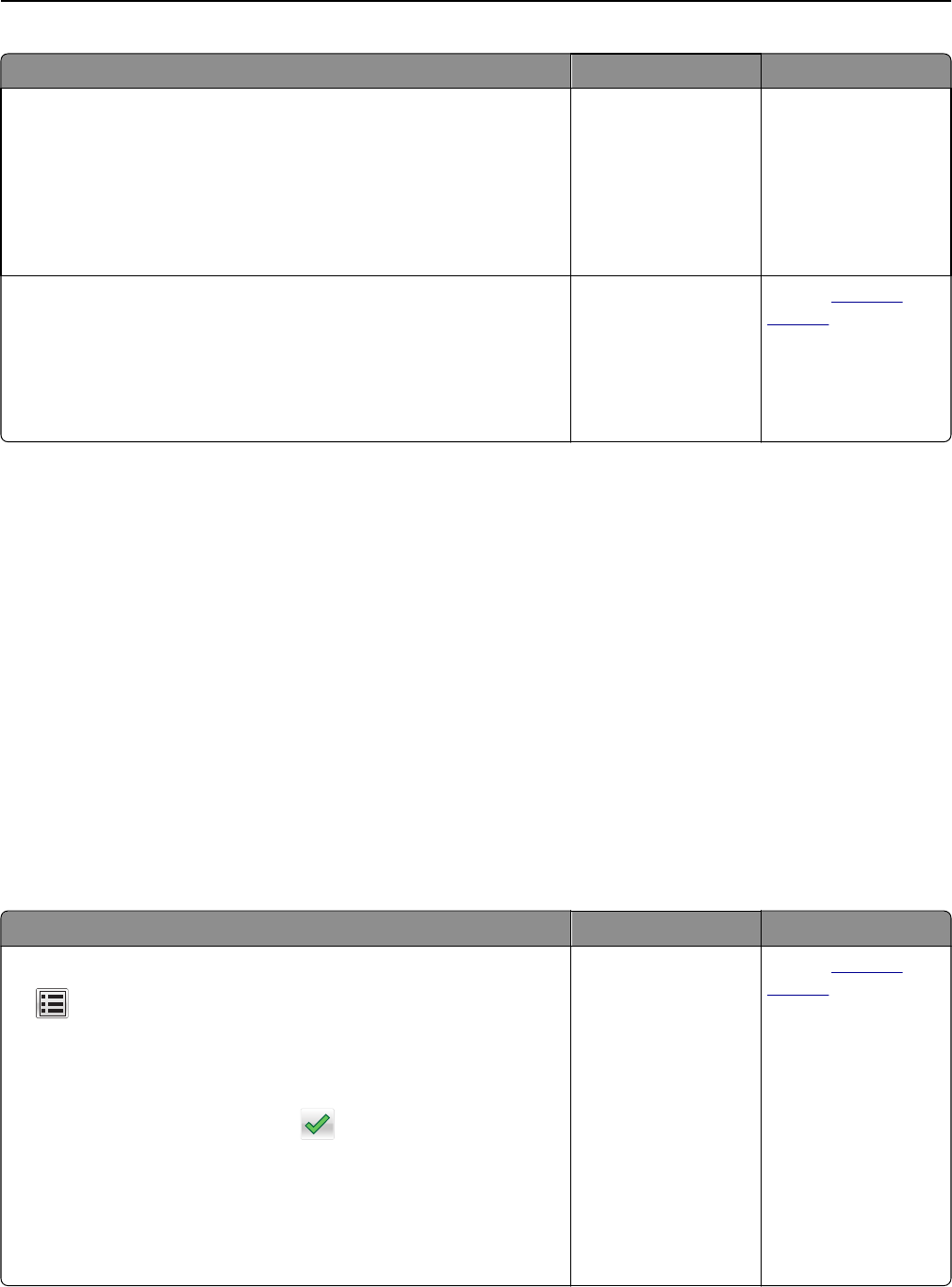
Action Yes No
Step 2
Check if the paper size setting matches the size of the paper loaded in the
tray.
From the Paper menu on the printer control panel, check the Paper
Size setting.
Does the paper size setting match the size of the paper loaded in the tray.
Go to step 3. Change the paper size
setting to match the
paper loaded in the
tray, or load the tray
with paper that
matches the paper size
setting.
Step 3
aSpecify the paper size. Depending on your operating system, specify
the paper size in Printing Preferences or the Print dialog.
bResend the print job.
Do copies print properly?
The problem is solved. Contact technical
support.
Solving fax problems
•“Fax and e-mail functions are not set up” on page 290
•“Caller ID is not shown” on page 291
•“Cannot send or receive a fax” on page 291
•“Can send but not receive faxes” on page 293
•“Can receive but not send faxes” on page 294
•“Received fax has poor print quality” on page 295
Fax and e-mail functions are not set up
Notes:
•Before you troubleshoot, check if the fax cables are connected.
•The indicator light is blinking red until you set up fax and e‑mail.
Action Yes No
aFrom the home screen, navigate to:
> Settings > General Settings > Run initial setup > Yes >
Submit
bTurn off the printer, and then turn it back on.
The “Select your language” screen appears on the printer display.
cSelect a language, and then touch .
dSelect a country or region, and then touch Next.
eSelect a time zone, and then touch Next.
fSelect Fax and E‑mail, and then touch Next.
Are fax and e‑mail functions set up?
The problem is solved. Contact technical
support.
Troubleshooting 290
Caller ID is not shown
Action Yes No
Contact your telephone company to check if your telephone line is
subscribed to the caller ID service.
Notes:
•If your region supports multiple caller ID patterns, then you may
have to change the default setting. There are two settings
available: FSK (pattern 1) and DTMF (pattern 2).
•The availability of these settings in the Fax menu depends on
whether your country or region supports multiple caller ID
patterns.
•Contact your telephone company to determine which pattern or
switch setting to use.
Does the caller ID appear?
The problem is solved. Contact technical
support.
Cannot send or receive a fax
Action Yes No
Step 1
Check if an error or status message appears on the display.
Is there an error or status message on the display?
Clear the error or status
message.
Go to step 2.
Step 2
Check if the power cord is plugged into the printer and a properly
grounded electrical outlet.
Is the power cord plugged into the printer and a properly grounded
electrical outlet?
Go to step 3. Connect the power
cord to the printer and
a properly grounded
electrical outlet.
Step 3
Check the power.
Check if the printer is plugged in and turned on, and if Ready appears
on the display.
Is the printer turned on, and does Ready appear on the display?
Go to step 4. Turn on the printer,
and then wait until
Ready appears on the
display.
Step 4
Check the printer connections.
If applicable, check if the cable connections for the following
equipment are secure:
•Telephone
•Handset
•Answering machine
Are the cable connections secure?
Go to step 5. Securely connect the
cables.
Troubleshooting 291

Action Yes No
Step 5
aCheck the telephone wall jack.
1Plug the telephone cable into the wall jack.
2Listen for a dial tone.
3If you do not hear a dial tone, then plug a different telephone cable
into the wall jack.
4If you still do not hear a dial tone, then plug the telephone cable
into a different wall jack.
5If you hear a dial tone, then connect the printer to that wall jack.
bTry sending or receiving a fax.
Can you send or receive a fax?
The problem is solved. Go to step 6.
Step 6
Check if the printer is connected to an analog phone service or the correct
digital connector.
The fax modem is an analog device. Certain devices can be connected
to the printer so that digital telephone services can be used.
•If you are using an ISDN telephone service, then connect the
printer to an analog telephone port (an R-interface port) on an
ISDN terminal adapter. For more information and to request an R-
interface port, contact your ISDN provider.
•If you are using DSL, then connect to a DSL filter or router that will
support analog use. For more information, contact your DSL
provider.
•If you are using a PBX telephone service, then make sure you are
connecting to an analog connection on the PBX. If none exists, then
consider installing an analog telephone line for the fax machine.
Is the printer connected to an analog phone service or the correct digital
connector?
Go to step 7. Connect the printer to
an analog phone
service or the correct
digital connector.
Step 7
Check for a dial tone.
Did you hear a dial tone?
Go to step 8. •Try calling the fax
number to make
sure that it is
working properly.
•If the telephone
line is being used by
another device,
then wait until the
other device is
finished before
sending a fax.
•If you are using the
On Hook Dial
feature, then turn
up the volume to
check if you hear a
dial tone.
Troubleshooting 292

Action Yes No
Step 8
Temporarily disconnect other equipment (such as answering machines,
computers with modems, or telephone line splitters) between the printer
and the telephone line, and then try sending or receiving a fax.
Can you send or receive a fax?
The problem is solved. Go to step 9.
Step 9
aTemporarily disable call waiting. Contact your telephone company to
obtain the keypad sequence for temporarily disabling call waiting.
bTry sending or receiving a fax.
Can you send or receive a fax?
The problem is solved. Go to step 10.
Step 10
aTemporarily disable voice mail service. For more information, contact
your telephone company.
Note: If you want to use both voice mail and the printer, then
consider adding a second telephone line for the printer.
bTry sending or receiving a fax.
Can you send or receive a fax?
The problem is solved. Go to step 11.
Step 11
Scan the original document one page at a time.
aDial the fax number.
bScan the document one page at a time.
Can you send or receive a fax?
The problem is solved. Contact technical
support.
Can send but not receive faxes
Action Yes No
Step 1
Check the tray or feeder.
If empty, then load paper in the tray or feeder.
Can you receive faxes?
The problem is solved. Go to step 2.
Troubleshooting 293

Action Yes No
Step 2
Check the ring count delay settings.
aOpen a Web browser, and then type the printer IP address in the
address field.
Notes:
•View the printer IP address on the printer home screen. The IP
address appears as four sets of numbers separated by periods,
such as 123.123.123.123.
•If you are using a proxy server, then temporarily disable it to
load the Web page correctly.
bClick Settings > Fax Settings > Analog Fax Setup.
cIn the “Rings to Answer” field, enter the number of times you want
the phone to ring before the printer answers.
dClick Submit.
Can you receive faxes?
The problem is solved. Go to step 3.
Step 3
Replace the toner cartridge. For more information, see the instruction
sheet that came with the supply.
Can you receive faxes?
The problem is solved. Contact technical
support.
Can receive but not send faxes
Action Yes No
Step 1
Check if the printer is in Fax mode.
From the home screen, touch Fax to put the printer in Fax mode, and
then send the fax.
Note: The Multi Send application does not support the XPS output type.
To use XPS, use the regular faxing method.
Can you send faxes?
The problem is solved. Go to step 2.
Step 2
Load the original document properly.
Load the original document faceup, short edge first into the ADF tray
or facedown on the scanner glass in the upper left corner.
Note: Do not load postcards, photos, small items, transparencies, photo
paper, or thin media (such as magazine clippings) into the ADF tray.
Place these items on the scanner glass.
Can you send faxes?
The problem is solved. Go to step 3.
Troubleshooting 294
Action Yes No
Step 3
Set up the shortcut number properly.
•Check if the shortcut number has been set for the telephone number
that you want to dial.
•Dial the telephone number manually.
Can you send faxes?
The problem is solved. Contact technical
support.
Received fax has poor print quality
Action Yes No
Step 1
Ask the person who sent you the fax to:
aCheck if the quality of the original document is satisfactory.
bIncrease the fax scan resolution, if possible.
cResend the fax.
Is the fax print quality satisfactory?
The problem is solved. Go to step 2.
Step 2
Decrease the incoming fax transmission speed.
aOpen a Web browser, and then type the printer IP address in the
address field.
Notes:
•View the printer IP address on the printer home screen. The IP
address appears as four sets of numbers separated by periods,
such as 123.123.123.123.
•If you are using a proxy server, then temporarily disable it to
load the Web page correctly.
•Print a network setup page or menu settings page, and then
locate the IP address in the TCP/IP section.
bClick Settings > Fax Settings > Analog Fax Setup.
cIn the Max Speed menu, click one of the following:
•2400
•4800
•9600
•14400
•33600
dClick Submit, and then resend the fax.
Is the fax print quality satisfactory?
The problem is solved. Go to step 3.
Troubleshooting 295

Action Yes No
Step 3
Replace the toner cartridge.
When Cartridge low [88.xy] appears, replace the cartridge,
and then resend the fax.
Is the fax print quality satisfactory?
The problem is solved. Contact technical
support.
Solving scanner problems
•“The scanner does not respond” on page 296
•“Scan job was not successful” on page 297
•“Scanner unit does not close” on page 298
•“Scanning takes too long or freezes the computer” on page 298
•“Poor scanned image quality” on page 299
•“Partial document or photo scans” on page 300
•“Cannot scan from a computer” on page 300
The scanner does not respond
Action Yes No
Step 1
Check if the printer is turned on.
Is the printer turned on?
Go to step 2. Turn on the printer.
Step 2
Check if the printer cable is securely attached to the printer and the
computer, print server, option, or other network device.
Is the printer cable securely attached to the printer and the computer,
print server, option, or other network device?
Go to step 3. Connect the printer
cable securely to the
printer and the
computer, print server,
option, or other
network device.
Step 3
Check if the power cord is plugged into the printer and a properly
grounded electrical outlet.
Is the power cord plugged into the printer and a properly grounded
electrical outlet?
Go to step 4. Connect the power
cord to the printer and
a properly grounded
electrical outlet.
Step 4
Check if the electrical outlet is turned off by a switch or breaker.
Is the electrical outlet turned off by a switch or breaker?
Turn on the switch or
reset the breaker.
Go to step 5.
Troubleshooting 296
Action Yes No
Step 5
Check if the printer is plugged into any surge protectors, uninterruptible
power supplies, or extension cords.
Is the printer plugged into any surge protectors, uninterruptible power
supplies, or extension cords?
Connect the printer
power cord directly to
a properly grounded
electrical outlet.
Go to step 6.
Step 6
Check other electrical equipment plugged into the outlet.
Are the other electrical equipment working?
Unplug the other
electrical equipment
and turn on the printer.
If the printer does not
work, then reconnect
the other electrical
equipment and then go
to step 6.
Go to step 7.
Step 7
Turn off the printer, then wait for about 10 seconds, and then turn the
printer back on.
Are the printer and scanner working?
The problem is solved. Contact technical
support.
Scan job was not successful
Action Yes No
Step 1
Check the cable connections.
Make sure the Ethernet or USB cable is securely connected to the
computer and the printer.
Are the cables securely connected?
Go to step 2. Connect the cables
properly.
Step 2
Check if the file name is already in use.
Is the file name already in use?
Change the file name. Go to step 3.
Step 3
Check if the document or photo you want to scan is open in another
application or being used by another user.
Is the file you want to scan open in another application or being used by
another user?
Close the file you are
scanning.
Go to step 4.
Step 4
Check if either the Append time stamp or the Overwrite existing file check
box is selected in the destination configuration settings.
Is the Append time stamp or Overwrite existing file check box selected
in the destination configuration settings?
Go to step 5. Select the Append time
stamp or Overwrite
existing file check box
in the destination
configuration settings.
Troubleshooting 297
Action Yes No
Step 5
From the Flash Drive menu, reduce the scan resolution settings, and then
resend the scan job.
Does the job scan?
The problem is solved. Go to step 6.
Step 6
Check the scan settings.
From the Scan screen, make sure the Content Type and Content Source
settings are correct for the document being scanned.
Are the Content Type and Content Source settings correct for the
document being scanned?
The problem is solved. Change the Content
Type and Content
Source settings to
match the document
being scanned.
Scanner unit does not close
Action Yes No
Check if there are obstructions in the scanner unit.
aLift the scanner unit.
bRemove any obstruction keeping the scanner unit open.
cLower the scanner unit.
Did the scanner unit close correctly?
The problem is solved. Contact technical
support.
Scanning takes too long or freezes the computer
Action Yes No
Step 1
Check if other applications are interfering with the scan.
Close all applications that are not being used.
Does scanning still take too long or freeze the computer?
Go to step 2. The problem is solved.
Step 2
Select a lower scan resolution.
Does scanning still take too long or freeze the computer?
Contact technical
support.
The problem is solved.
Troubleshooting 298

Poor scanned image quality
Action Yes No
Step 1
Check if an error message appears on the display.
Is there an error message on the printer display?
Clear the error
message.
Go to step 2.
Step 2
Check the quality of the original document.
Is the quality of the original document satisfactory?
Go to step 3. Increase the scan
resolution settings for a
higher‑quality output.
Step 3
Clean the scanner glass and the ADF glass using a clean, lint‑free cloth
dampened with water.
Is the scanner glass clean?
Go to step 4. See “Cleaning the
scanner glass” on
page 210.
Step 4
Check the placement of the document or photo.
Make sure the document or photo is loaded facedown on the scanner
glass in the upper left corner.
Is the document or photo loaded correctly?
Go to step 5. Place the document or
photo facedown on the
scanner glass in the
upper left corner.
Step 5
Send a print job, and then check for print quality problems.
•From the General Settings menu, adjust the Eco‑Mode settings.
•From the Copy menu, adjust the toner darkness.
•When the print becomes faded, replace the toner cartridge.
Is the print quality satisfactory?
Go to step 6. See “Print quality
problems” on
page 268.
Step 6
Increase the scan resolution settings for a higher‑quality output.
Did the increased resolution produce a higher‑quality output?
Problem solved. Go to step 7.
Step 7
Check the scan settings.
From the Scan screen, make sure the Content Type and Content Source
settings are correct for the document being scanned.
Are the Content Type and Content Source settings correct for the
document being scanned?
Contact technical
support.
Change the Content
Type and Content
Source settings to
match the document
being scanned.
Troubleshooting 299
Partial document or photo scans
Action Yes No
Check the placement of the document or photo.
Make sure the document or photo is loaded facedown on the scanner
glass in the upper left corner.
Is the document or photo loaded correctly?
Contact technical
support.
Load the document or
photo loaded
facedown on the
scanner glass in the
upper left corner.
Cannot scan from a computer
Action Yes No
Step 1
Make sure the printer is turned on and that Ready appears on the printer
display before scanning a job.
Does Ready appear before scanning the job?
Go to step 3. Go to step 2.
Step 2
Turn off the printer, then wait for about 10 seconds, and then turn the
printer back on.
Is there an error message on the printer display?
Clear the error
message.
Go to step 3.
Step 3
Check the cable connections between the printer and the print server to
make sure they are secure.
For more information, see the setup documentation that came with
the printer.
Are the cable connections between the printer and the print server
secure?
Contact technical
support.
Tighten the cable
connections.
Troubleshooting 300
Solving home screen application problems
An application error has occurred
Action Yes No
Step 1
Check the system log for relevant details.
aOpen a Web browser, and then type the printer IP address in the
address field.
If you do not know the IP address of the printer, then you can:
•View the IP address on the printer home screen.
•Print a network setup page or the menu settings pages, and then
locate the IP address in the TCP/IP section.
Note: An IP address appears as four sets of numbers separated by
periods, such as 123.123.123.123.
bClick Settings > Apps > Apps Management > System tab > Log.
cFrom the Filter menu, select an application status.
dFrom the Application menu, select an application, and then click
Submit.
Does an error message appear in the log?
Go to step 2. Contact technical
support.
Step 2
Resolve the error.
Is the application working now?
The problem is solved. Contact technical
support.
Embedded Web Server does not open
Action Yes No
Step 1
Make sure the printer IP address is correct.
View the printer IP address:
•From the printer home screen
•From the TCP/IP section in the Network/Ports menu
•By printing a network setup page or menu settings page, and then
finding the TCP/IP section
Note: An IP address appears as four sets of numbers separated by
periods, such as 123.123.123.123.
Is the printer IP address correct?
Go to step 2. Type the correct
printer IP address in the
address field of your
Web browser.
Note: Depending on
the network settings,
you may need to type
“https://” instead of
“http://” before the
printer IP address to
access the Embedded
Web Server.
Step 2
Check if the printer is turned on.
Is the printer turned on?
Go to step 3. Turn on the printer.
Troubleshooting 301
Action Yes No
Step 3
Check if the network connection is working.
Is the network connection working?
Go to step 4. Contact your system
support person.
Step 4
Make sure the cable connections to the printer and print server are secure.
For more information, see the setup documentation that came with
the printer.
Are the cable connections to the printer and print server secure?
Go to step 5. Tighten the cable
connection.
Step 5
Temporarily disable the Web proxy servers.
Note: Proxy servers may block or restrict you from accessing certain
Web sites including the Embedded Web Server.
Are the Web proxy servers disabled?
Go to step 6. Contact your system
support person.
Step 6
Access the Embedded Web Server again by typing the correct IP address
in the address field.
Did the Embedded Web Server open?
The problem is solved. Contact technical
support.
Contacting technical support
When you call technical support, describe the problem you are experiencing, the message on the printer display, and
the troubleshooting steps you have already taken to find a solution.
You need to know your printer model type and the service tag number or express service code. For more information,
see the label on the inside top front cover or at the back of the printer. The service tag number is also listed on the
menu settings page.
For more information, check the Dell support Web site at www.dell.com/support/printers.
Troubleshooting 302

Appendix
Dell Technical Support Policy
Technician‑assisted technical support requires the cooperation and participation of the customer in the troubleshooting
process and provides for restoration of the Operating System, application software and hardware drivers to the original
default configuration as shipped from Dell, as well as the verification of appropriate functionality of the printer and all
Dell‑installed hardware. In addition to this technician assisted technical support, online technical support is available
at Dell Support. Additional technical support options may be available for purchase.
Dell provides limited technical support for the printer and any Dell‑installed software and peripherals. Support for
third‑party software and peripherals is provided by the original manufacturer, including those purchased and/or
installed through Software & Peripherals (DellWare), ReadyWare, and Custom Factory Integration (CFI/DellPlus).
Contacting Dell
You can access Dell Support at www.dell.com/support/printers.
You can contact Dell electronically using the following addresses:
•World Wide Web
www.dell.com/
www.dell.com/ap/ (Asian/Pacific countries only)
www.dell.com/jp/ (Japan only)
www.euro.dell.com (Europe only)
www.dell.com/la/ (Latin American and Caribbean countries)
www.dell.ca (Canada only)
•Anonymous file transfer protocol (FTP)
ftp.dell.com
Log in as user: anonymous, and use your email address as your password.
•Electronic Support Service
mobile_support@us.dell.com
support@us.dell.com
la-techsupport@dell.com (Latin America and Caribbean countries only)
apsupport@dell.com (Asian/Pacific countries only)
support.jp.dell.com (Japan only)
support.euro.dell.com (Europe only)
•Electronic Quote Service
apmarketing@dell.com (Asian/Pacific countries only)
sales_canada@dell.com (Canada only)
Appendix 303

Warranty and Return Policy
Dell Inc. (“Dell”) manufactures its hardware products from parts and components that are new or equivalent to new
in accordance with industry‑standard practices. For information about the Dell warranty for your printer, refer to the
Product Information Guide.
Appendix 304

Index
Numerics
250‑sheet tray
installing 42
550‑sheet tray
installing 42
Symbols
[x]-page jam, remove all pages from
the output bin. Leave paper in bin.
[45y.xx] 235
[x]‑page jam, clear manual feeder.
[25y.xx] 233
[x]‑page jam, clear standard bin.
[20y.xx] 227
[x]‑page jam, open automatic
feeder top cover. [28y.xx] 226
[x]‑page jam, open front door.
[20y.xx] 229
[x]‑page jam, open rear door.
[20y.xx] 227
[x]‑page jam, open tray [x].
[24y.xx] 234
[x]‑page jam, remove tray 1 to clear
duplex. [23y.xx] 232
A
accessing Status Monitor
Center 221
accessing the Embedded Web
Server 20
Active NIC menu 141
adapter plug 108
adding hardware options
print driver 44
ADF
copying using 81
ADF separator roller
ordering 212
adjusting brightness
Embedded Web Server 204
printer control panel 204
adjusting copy quality 86
adjusting display brightness 204
adjusting Sleep mode 202
adjusting toner darkness 74
advanced options
fax 121
FTP 91
FTP options 128
advanced options, touch‑screen
e‑mail 98
AirPrint
using 76
answering machine
setting up 101
AppleTalk menu 146
applications
home screen 22
understanding 21
attaching cables 45
available internal options 27
avoiding jams 69
avoiding paper jams 224
B
blocking junk faxes 117
buttons, printer control panel 15
buttons, touch screen
using 18
C
cables
Ethernet 45
USB 45
canceling a print job
from a computer 80
from the printer control panel 80
canceling an e-mail 96
cannot open Embedded Web
Server 301
Card Copy
setting up 22
card stock
loading, multipurpose feeder 56
tips 66
Cartridge low [88.xy] 240
Cartridge nearly low [88.xy] 240
Cartridge very low, [x] estimated
pages remain [88.xy] 240
Change [paper source] to [custom
string] load [orientation] 240
Change [paper source] to [custom
type name] load [orientation] 240
Change [paper source] to [paper
size] load [orientation] 240
Change [paper source] to [paper
type] [paper size] load
[orientation] 241
Check tray [x] connection 241
checking an unresponsive
printer 254
checking status of parts and
supplies 211
checking the status of parts and
supplies 211
checking the virtual display
using the Embedded Web
Server 221
cleaning
exterior of the printer 209
scanner glass 210
cleaning the printer 209
Close finisher rear door 241
Close flatbed cover and load
originals if restarting job
[2yy.xx] 242
Close front door 241
Close rear door 241
collate
copy options 91
collating copies 86
color quality troubleshooting
prints on color transparencies
appear dark when projected 271
Complex page, some data may not
have printed [39] 242
confidential data
information on securing 208
confidential jobs
modifying print settings 79
confidential print jobs 78
printing from a Macintosh
computer 78
printing from Windows 78
Confidential Print menu 151
Configuration change, some held
jobs were not restored [57] 242
configuration information
wireless network 46
Configure MP menu 133
configuring
supply notifications, imaging
unit 222
Index 305

supply notifications, maintenance
kit 222
supply notifications, toner
cartridge 222
configuring e‑mail settings 92
configuring port settings 49
configuring supply notifications 222
connecting printer to distinctive
ring service 112
connecting to a wireless network
using PIN (Personal Identification
Number) method 48
using Push Button Configuration
method 48
using the Embedded Web
Server 49
using wireless setup wizard 47
conservation settings
brightness, adjusting 204
Eco‑Mode 200
Hibernate Timeout 203
Quiet Mode 201
Schedule Power Modes 203
Sleep Mode 202
contacting technical support 302
content
e‑mail settings 97
content source
e‑mail settings 97
fax options 119
content type
e‑mail settings 97
fax options 119
control panel, printer 15
indicator light 15
Sleep button light 15
controller board
accessing 27
copies
copy options 91
copy job, canceling
using the ADF 89
using the scanner glass 89
copy options
collate 91
copies 91
darkness 90
save as shortcut 91
sides (duplex) 90
copy quality
adjusting 86
copy screen
content source 91
content type 91
options 90
Copy Settings menu 163
copy troubleshooting
copier does not respond 287
partial document or photo
copies 289
poor copy quality 288
poor scanned image quality 299
scanner unit does not
close 287, 298
copying
adding an overlay message 89
adjusting quality 86
canceling a copy job 89, 90
collating copies 86
custom job 88
different paper sizes 84
enlarging 85
inserting a header or footer 89
multiple pages on one sheet 87
on both sides of the paper
(duplexing) 85
on letterhead 83
on transparencies 82
photos 82
placing separator sheets between
copies 87
quick copy 81
reducing 85
selecting a tray 84
to a different size 83
using the ADF 81
using the scanner glass 82
copying different paper sizes 84
copying multiple pages on one
sheet 87
copying on both sides of the paper
(duplexing) 85
copying on transparencies 82
creating a fax destination shortcut
using the Embedded Web
Server 116
creating an FTP shortcut
using the Embedded Web
Server 122
creating custom name
paper type 62
custom name
configuring 63
Custom Names menu 138
custom paper type name
assigning 63
Custom Scan Sizes menu 139
Custom Type [x]
changing paper type 63
creating custom name 62
Custom Types menu 138
D
darkness
copy options 90
e‑mail options 97
fax options 120
scan options 126
date and time, fax
setting 113
daylight saving time, setting 113
Default Source menu 130
Defective flash detected [51] 242
delayed send
fax options 120
Dell Mobile Print
using 77
different paper sizes, copying 84
Digital Subscriber Line (DSL)
fax setup 105
digital telephone service
fax setup 107
directory list
printing 80
Disk full 62 242
Disk must be formatted for use in
this device 243
disk wiping 206
display troubleshooting
printer display is blank 256
display, printer control panel 15
adjusting brightness 204
disposing of printer hard disk 205
distinctive ring service, fax
connecting to 112
documents, printing
from Macintosh 74
from Windows 74
DSL filter 105
duplexing 85
E
Eco‑Mode setting 200
Edit Security Setups menu 149
Index 306

Embedded Web Server
accessing 13, 20
checking the status of parts 211
checking the status of
supplies 211
creating a fax destination
shortcut 116
creating an FTP shortcut 122
creating e‑mail shortcuts 93
functions 13
initial fax setup 100
modifying confidential print
settings 79
problem accessing 301
scanning to a computer using 124
setting up e‑mail alerts 222
using 13
Embedded Web Server—Security:
Administrator’s Guide
where to find 208
encrypting the printer hard
disk 207
enlarging a copy 85
envelopes
loading, multipurpose feeder 56
tips on using 65
environmental settings
display brightness, adjusting 204
Eco‑Mode 200
Hibernate Timeout 203
Quiet Mode 201
Schedule Power Modes 203
Sleep Mode 202
Erase Temporary Data Files
menu 152
erasing hard disk memory 206
erasing non‑volatile memory 206
erasing volatile memory 205
Error reading USB drive. Remove
USB. 243
Error reading USB hub. Remove
hub. 243
Ethernet network
preparing to set up for Ethernet
printing 46
Ethernet port 45
Ethernet setup
preparing for an 46
exporting a configuration
using the Embedded Web
Server 25
exterior of the printer
cleaning 209
e‑mail
canceling 96
e‑mail alerts
low supply levels 222
paper jam 222
setting up 222
e‑mail function
setting up 92
e‑mail options
darkness 97
message 96
original size 96
page setup 98
recipient(s) 96
resolution 97
send as 97
subject 96
e‑mail screen
advanced options 98
options 96, 98
E‑mail Settings menu 174
e‑mail shortcuts, creating
using the Embedded Web
Server 93
e‑mail, sending
using a shortcut number 94
using the address book 95
e‑mailing
adding message line 95
adding subject line 95
changing output file type 95
configuring e‑mail settings 92
creating shortcuts using the
Embedded Web Server 93
creating shortcuts using the
printer control panel 93
setting up e‑mail function 92
using a shortcut number 94
using the address book 95
using the printer control panel 94
F
factory defaults
restoring 223
fax
sending 114, 115
fax and e‑mail functions
setting up 290
fax and e‑mail functions are not set
up 290
fax log
viewing 117
Fax memory full 243
Fax Mode (Analog Fax Setup)
menu 166
fax name, setting 112
fax number, setting 112
fax options
content source 119
content type 119
darkness 120
delayed send 120
page setup 120
resolution 120
scan preview 120
Fax partition inoperative. Contact
system administrator. 243
fax ports 45
fax screen
advanced options 121
Fax server 'To Format' not set up.
Contact system administrator. 243
fax setup
country‑ or region‑specific 108
digital telephone service 107
DSL connection 105
standard telephone line
connection 101
VoIP 106
Fax Station Name not set up.
Contact system administrator. 243
Fax Station Number not set up.
Contact system administrator. 244
fax troubleshooting
caller ID is not shown 291
can receive but not send
faxes 294
can send but not receive
faxes 293
cannot send or receive a fax 291
received fax has poor print
quality 295
faxing
blocking junk faxes 117
canceling a fax job 118
changing resolution 116
configuring the printer to observe
daylight saving time 113
creating shortcuts using the
Embedded Web Server 116
creating shortcuts using the
printer control panel 116
Index 307

distinctive ring service 112
fax setup 100
forwarding faxes 119
holding faxes 118
making a fax lighter or darker 117
sending a fax at a scheduled
time 115
sending using the printer control
panel 113
setting the date and time 113
setting the fax number 112
setting the outgoing fax name 112
viewing a fax log 117
file name
scan options 126
finding more information about the
printer 9
finding printer IP address 20
finisher
finishing features 72
supported paper sizes 72
finisher features 72
Finishing menu 189
firmware card 27
flash drive
printing from 75
Flash Drive menu 183
flash drives
supported file types 77
font sample list
printing 80
Forms and Favorites
setting up 22
forwarding faxes 119
FTP
FTP options 126
FTP address
creating shortcuts using the
printer control panel 123
FTP address, scanning to
using a shortcut number 123
using the printer control
panel 123
FTP options
advanced options 128
FTP 126
FTP screen
advanced options 91
FTP Settings menu 179
G
green settings
Eco‑Mode 200
Hibernate Timeout 203
Quiet Mode 201
Schedule Power Modes 203
H
hardware options, adding
print driver 44
held jobs 78
printing from a Macintosh
computer 78
printing from Windows 78
Help menu 199
Hibernate Timeout
setting 203
hiding icons on the home screen 21
holding faxes 118
home screen
customizing 21
hiding icons 21
showing icons 21
home screen applications
configuring 22
finding information 22
home screen buttons and icons
description 16
HTML menu 197
I
icons on the home screen
hiding 21
showing 21
Image menu 198
imaging unit
ordering 212
replacing 214
Imaging unit low [84.xy] 244
Imaging unit nearly low [84.xy] 244
Imaging unit very low, [x] estimated
pages remain [84.xy] 244
importing a configuration
using the Embedded Web
Server 25
in finisher rear door
paper jams, clearing 235
Incompatible tray [x] [59] 244
Incorrect paper size, open [paper
source] [34] 244
initial fax setup 100
using the Embedded Web
Server 100
inserting a header or footer 89
installing an Internal Solutions
Port 32
installing an optional card 30
installing options
order of installation 42
installing printer 44
installing printer hard disk 39
installing the 250‑sheet tray 42
installing the 550‑sheet tray 42
Insufficient memory for Flash
Memory Defragment operation
[37] 245
Insufficient memory to collate job
[37] 245
Insufficient memory to support
Resource Save feature [35] 245
Insufficient memory, some Held
Jobs were deleted [37] 245
Insufficient memory, some held
jobs will not be restored [37] 245
internal options 27
Internal Solutions Port
changing port settings 49
installing 32
troubleshooting 259
IP address of computer
finding 20
IP address, printer
finding 20
IPv6 menu 144
J
jams
accessing 225
avoiding 224
understanding messages 225
jams, clearing
finisher bin 235
in automatic document feeder top
cover 226
in duplex area 232
in front door 229
in manual feeder 233
in rear door 227
in standard bin 227
in staple access door 235
in tray [x] 234
Job Accounting menu 192
Index 308

L
labels, paper
tips 66
letterhead
copying on 83
loading, multipurpose feeder 56
tips on using 65
light, indicator 15
line filter 105
linking trays 62, 63
Load [paper source] with [custom
string] [paper orientation] 246
Load [paper source] with [custom
type name] [paper orientation] 245
Load [paper source] with [paper
size] [paper orientation] 246
Load [paper source] with [paper
type] [paper size] [paper
orientation] 246
Load Manual Feeder with [custom
string] [paper orientation] 247
Load Manual Feeder with [custom
type name] [paper orientation] 246
Load Manual Feeder with [paper
size] [paper orientation] 247
Load manual feeder with [paper
type] [paper size] [paper
orientation] 247
loading
multipurpose feeder 56
trays 51
loading the optional tray 51
loading the standard tray 51
M
maintenance kit
ordering 212
Maintenance kit low [80.xy] 247
Maintenance kit nearly low
[80.xy] 247
Maintenance kit very low, [x]
estimated pages remain
[80.xy] 247
making copies using paper from
selected tray 84
managing printer messages 221
memory
types installed on printer 205
memory card 27
installing 29
troubleshooting 259
Memory full [38] 248
Memory full, cannot print
faxes 248
Memory full, cannot send
faxes 248
menu settings page
printing 50
menus
Active NIC 141
AppleTalk 146
Confidential Print 151
Configure MP 133
Copy Settings 163
Custom Names 138
Custom Scan Sizes 139
Custom Types 138
Default Source 130
Edit Security Setups 149
Erase Temporary Data Files 152
E‑mail Settings 174
Fax Mode (Analog Fax Setup) 166
Finishing 189
Flash Drive 183
FTP Settings 179
Help 199
HTML 197
Image 198
IPv6 144
Job Accounting 192
list of 129
Miscellaneous Security
Settings 150
Network [x] 141
Network Card 143
Network Reports 142
Paper Loading 137
Paper Size/Type 130
Paper Texture 134
Paper Weight 135
PCL Emul 195
PDF 194
PostScript 194
Quality 191
Reports 140
Security Audit Log 152
Set Date/Time 153
Settings 187
SMTP Setup menu 148
Standard Network 141
Standard USB 146
Substitute Size 134
TCP/IP 143
Universal Setup 139
Utilities 193
Wireless 145
XPS 194
message
e‑mail options 96
Miscellaneous Security Settings
menu 150
mobile device
printing from 76, 77
moving the printer 10, 219
Multi Send
adding a profile 24
setting up 24
multipurpose feeder
loading 56
MyShortcut
about 23
N
Network [x] menu 141
Network [x] software error
[54] 248
Network Card menu 143
Network Reports menu 142
network setup page
printing 50
No analog phone line connected to
modem, fax is disabled. 248
Non‑Dell [supply type], see User’s
Guide [33.xy] 248
non‑volatile memory 205
erasing 206
Not enough free space in flash
memory for resources [52] 249
number of remaining pages
estimate 211
O
optional card
installing 30
optional tray
loading 51
options
250‑sheet tray, installing 42
550‑sheet tray, installing 42
firmware cards 27
Internal Solutions Port,
installing 32
memory card 29
memory cards 27
Index 309

printer hard disk, installing 39
printer hard disk, removing 41
options, copy screen
copy from 90
scale 90
options, touch‑screen
copy 90
e‑mail 96, 98
ordering
imaging unit 212
maintenance kit 212
ordering supplies
toner cartridges 212
using Printer Home 211
original size
e‑mail options 96
scan options 126
output file type
changing 95
P
page setup
e‑mail options 98
fax options 120
scan options 127
paper
characteristics 67
different sizes, copying 84
letterhead 68
loading, multipurpose feeder 56
preprinted forms 68
recycled 69
saving 87
selecting 68
storing 69
unacceptable 68
Universal size setting 51
Paper changes needed 249
paper feed troubleshooting
message remains after jam is
cleared 261
paper jams
avoiding 224
paper jams, clearing
finisher bin 235
in automatic document feeder top
cover 226
in duplex area 232
in finisher rear door 235
in front door 229
in manual feeder 233
in rear door 227
in standard bin 227
in staple access door 235
in tray [x] 234
Paper Loading menu 137
paper size
setting 51
Paper Size/Type menu 130
paper stop, using 61
Paper Texture menu 134
paper type
setting 51
paper types
supported by printer 71
where to load 71
Paper Weight menu 135
paper weights
supported by printer 71
Parallel port [x] disabled [56] 249
parts
checking status 211
checking, from printer control
panel 211
checking, using the Embedded
Web Server 211
PCL Emul menu 195
PDF menu 194
Personal Identification Number
method
using 48
phone splitter 106
photos
copying 82
placing separator sheets between
copies 87
port settings
configuring 49
PostScript menu 194
preparing to set up the printer on
an Ethernet network 46
print driver
hardware options, adding 44
print irregularities 275
print job
canceling, from computer 80
print quality
cleaning the scanner glass 210
print quality troubleshooting
blank pages 269
characters have jagged edges 268
clipped pages or images 270
gray background on prints 272
horizontal voids appear on
prints 283
print irregularities 275
print is too dark 277
print is too light 278
printer is printing solid black
pages 280
repeating print defects appear on
prints 276
shadow images appear on
prints 271
skewed print 279
streaked horizontal lines appear
on prints 281
streaked vertical lines 282
toner fog or background
shading 285
toner rubs off 286
toner specks appear on prints 285
transparency print quality is
poor 281
uneven print density 286
white streaks 284
print troubleshooting
error reading flash drive 262
held jobs do not print 264
incorrect characters print 266
incorrect margins on prints 273
jammed pages are not
reprinted 261
job prints from wrong tray 266
job prints on wrong paper 266
jobs do not print 262
Large jobs do not collate 267
multiple‑language PDF files do not
print 261
paper curl 274
paper frequently jams 260
print job takes longer than
expected 265
tray linking does not work 267
unexpected page breaks
occur 268
printer 44
basic model 11
finishing features 72
fully configured 11
minimum clearances 10
moving 10, 219
selecting a location 10
shipping 220
printer configurations 11
Index 310

printer control panel 15
factory defaults, restoring 223
indicator light 15
Sleep button light 15
printer control panel, virtual
display
using the Embedded Web
Server 221
Printer had to restart. Last job may
be incomplete. 249
printer hard disk
disposing of 205
encrypting 207
installing 39
removing 41
wiping 206
printer hard disk encryption 207
printer hard disk memory
erasing 206
printer information
where to find 9
printer IP address
finding 20
printer is printing blank pages 269
printer messages
[x]-page jam, remove all pages
from the output bin. Leave paper
in bin. [45y.xx] 235
[x]‑page jam, clear manual feeder.
[25y.xx] 233
[x]‑page jam, clear standard bin.
[20y.xx] 227
[x]‑page jam, open automatic
feeder top cover. [28y.xx] 226
[x]‑page jam, open front door.
[20y.xx] 229
[x]‑page jam, open rear door.
[20y.xx] 227
[x]‑page jam, open tray [x].
[24y.xx] 234
[x]‑page jam, remove tray 1 to
clear duplex. [23y.xx] 232
Cartridge low [88.xy] 240
Cartridge nearly low [88.xy] 240
Cartridge very low, [x] estimated
pages remain [88.xy] 240
Change [paper source] to [custom
string] load [orientation] 240
Change [paper source] to [custom
type name] load
[orientation] 240
Change [paper source] to [paper
size] load [orientation] 240
Change [paper source] to [paper
type] [paper size] load
[orientation] 241
Check tray [x] connection 241
Close finisher rear door 241
Close flatbed cover and load
originals if restarting job
[2yy.xx] 242
Close front door 241
Close rear door 241
Complex page, some data may not
have printed [39] 242
Configuration change, some held
jobs were not restored [57] 242
Defective flash detected [51] 242
Disk full 62 242
Disk must be formatted for use in
this device 243
Disk near full. Securely clearing
disk space. 243
Error reading USB drive. Remove
USB. 243
Error reading USB hub. Remove
hub. 243
Fax memory full 243
Fax partition inoperative. Contact
system administrator. 243
Fax server 'To Format' not set up.
Contact system
administrator. 243
Fax Station Name not set up.
Contact system
administrator. 243
Fax Station Number not set up.
Contact system
administrator. 244
Imaging unit low [84.xy] 244
Imaging unit nearly low
[84.xy] 244
Imaging unit very low, [x]
estimated pages remain
[84.xy] 244
Incompatible tray [x] [59] 244
Incorrect paper size, open [paper
source] [34] 244
Insufficient memory for Flash
Memory Defragment operation
[37] 245
Insufficient memory to collate job
[37] 245
Insufficient memory to support
Resource Save feature [35] 245
Insufficient memory, some Held
Jobs were deleted [37] 245
Insufficient memory, some held
jobs will not be restored
[37] 245
Load [paper source] with [custom
string] [paper orientation] 246
Load [paper source] with [custom
type name [paper
orientation] 245
Load [paper source] with [paper
size] [paper orientation] 246
Load [paper source] with [paper
type] [paper size] [paper
orientation] 246
Load Manual Feeder with [custom
string] [paper orientation] 247
Load Manual Feeder with [custom
type name] [paper
orientation] 246
Load Manual Feeder with [paper
size] [paper orientation] 247
Load manual feeder with [paper
type] [paper size] [paper
orientation] 247
Maintenance kit low [80.xy] 247
Maintenance kit nearly low
[80.xy] 247
Maintenance kit very low, [x]
estimated pages remain
[80.xy] 247
managing 221
Memory full [38] 248
Memory full, cannot print
faxes 248
Memory full, cannot send
faxes 248
Network [x] software error
[54] 248
No analog phone line connected
to modem, fax is disabled. 248
Non‑Dell [supply type], see User’s
Guide [33.xy] 248
Not enough free space in flash
memory for resources [52] 249
Paper changes needed 249
Parallel port [x] disabled [56] 249
Printer had to restart. Last job
may be incomplete. 249
Index 311

Reinstall missing or unresponsive
cartridge [31.xy] 250
Reinstall missing or unresponsive
imaging unit [31.xy] 251
Remove defective disk [61] 249
Remove paper from standard
output bin 249
Replace all originals if restarting
job. 250
Replace cartridge, 0 estimated
pages remain [88.xy] 250
Replace cartridge, printer region
mismatch [42.xy] 250
Replace defective imaging unit
[31.xy] 250
Replace imaging unit, 0 estimated
pages remain [84.xy] 250
Replace maintenance kit, 0
estimated pages remain
[80.xy] 250
Replace unsupported cartridge
[32.xy] 251
Replace unsupported imaging unit
[32.xy] 251
Restore held jobs? 251
Scanner automatic feeder cover
open 251
Scanner disabled by admin
[840.01] 251
Scanner disabled. Contact system
administrator if problem persists.
[840.02] 252
Scanner jam, remove all originals
from the scanner [2yy.xx] 252
Scanner jam, remove jammed
originals from the scanner
[2yy.xx] 252
Serial port [x] disabled [56] 252
SMTP server not set up. Contact
system administrator. 252
Some held jobs were not
restored 252
Standard network software error
[54] 252
Standard USB port disabled
[56] 253
Supply needed to complete
job 253
Too many flash options installed
[58] 253
Too many trays attached [58] 253
Unformatted flash detected
[53] 253
Unsupported disk 253
Unsupported option in slot [x]
[55] 254
Unsupported USB hub, please
remove 243
USB port [x] disabled [56] 254
Weblink server not set up. Contact
system administrator. 254
printer options troubleshooting
internal option is not
detected 257
Internal Solutions Port 259
memory card 259
tray problems 258
USB/parallel interface card 259
printer problems, solving basic 254
printer security
information on 208
printing
canceling, from the printer control
panel 80
directory list 80
font sample list 80
forms 74
from a mobile device using
AirPrint 76
from a mobile device using Dell
Mobile Print 77
from flash drive 75
from Macintosh 74
from Windows 74
menu settings page 50
network setup page 50
printing a directory list 80
printing a document 74
printing a font sample list 80
printing a menu settings page 50
printing a network setup page 50
printing confidential and other held
jobs
from a Macintosh computer 78
from Windows 78
printing forms 74
printing from a flash drive 75
publications
where to find 9
Push Button Configuration method
using 48
Q
Quality menu 191
Quiet Mode 201
R
recipient(s)
e‑mail options 96
recycled paper
using 69
recycling
Dell products 204
reducing a copy 85
reducing noise 201
Reinstall missing or unresponsive
cartridge [31.xy] 250
Reinstall missing or unresponsive
imaging unit [31.xy] 251
Remote Operator Panel
setting up 25
Remove defective disk [61] 249
Remove paper from standard
output bin 249
removing printer hard disk 41
repeat print jobs 78
printing from a Macintosh
computer 78
printing from Windows 78
repeating print defects appear on
prints 276
Replace all originals if restarting
job. 250
Replace cartridge, 0 estimated
pages remain [88.xy] 250
Replace cartridge, printer region
mismatch [42.xy] 250
Replace defective imaging unit
[31.xy] 250
Replace imaging unit, 0 estimated
pages remain [84.xy] 250
Replace maintenance kit, 0
estimated pages remain
[80.xy] 250
Replace unsupported cartridge
[32.xy] 251
Replace unsupported imaging unit
[32.xy] 251
replacing
imaging unit 214
toner cartridge 213
replacing supplies
staple cartridge 217
Index 312

replacing the staple cartridge 217
reports
viewing 222
Reports menu 140
reserve print jobs 78
printing from a Macintosh
computer 78
printing from Windows 78
resolution
e‑mail options 97
fax options 120
scan options 126
resolution, fax
changing 116
Restore held jobs? 251
restoring factory default
settings 223
RJ‑11 adapter 108
S
safety information 7, 8
save as shortcut
copy options 91
scan options 126
saving paper 87
scan options
darkness 126
file name 126
original size 126
page setup 127
resolution 126
save as shortcut 126
scan preview 127
send as 126
scan preview
fax options 120
scan options 127
scan screen
content source 127
content type 127
Scan to Computer
setting up 125
Scan to Network
setting up 24
using 122
scan troubleshooting
cannot scan from a computer 300
partial document or photo
scans 300
scan job was not successful 297
scanner unit does not
close 287, 298
scanning takes too long or freezes
the computer 298
scanner
automatic document feeder
(ADF) 14
functions 14
scanner glass 14
Scanner automatic feeder cover
open 251
Scanner disabled by admin
[840.01] 251
Scanner disabled. Contact system
administrator if problem persists.
[840.02] 252
scanner glass
cleaning 210
copying using 82
Scanner jam, remove all originals
from the scanner [2yy.xx] 252
Scanner jam, remove jammed
originals from the scanner
[2yy.xx] 252
scanning
from a flash drive 125
quick copy 81
to a computer using the
Embedded Web Server 124
to an FTP address 123
scanning to a computer 125
using the Embedded Web
Server 124
scanning to a flash drive 125
scanning to an FTP address
creating shortcuts using the
computer 122
using a shortcut number 123
using the address book 123
using the printer control
panel 123
scanning to network
destinations 122
Schedule Power Modes
using 203
security
modifying confidential print
settings 79
Security Audit Log menu 152
security slot 45
selecting a location for the
printer 10
selecting paper 68
send as
e‑mail options 97
scan options 126
sending a fax 114
sending a fax using the printer
control panel 113
sending an e‑mail using the printer
control panel 94
sending fax
using shortcuts 114
using the address book 115
sending fax at a scheduled
time 115
sending fax using the address
book 115
Serial port [x] disabled [56] 252
serial printing
setting up 50
Set Date/Time menu 153
setting
TCP/IP address 143
setting Hibernate Timeout 203
setting the fax number 112
setting the outgoing fax name 112
setting the paper size 51
setting the paper type 51
setting the Universal paper size 51
setting up e‑mail alerts 222
setting up fax
country‑ or region‑specific 108
digital telephone service 107
DSL connection 105
standard telephone line
connection 101
VoIP connection 106
setting up fax and e‑mail
functions 290
setting up serial printing 50
Settings menu 187
shipping the printer 220
shortcuts, creating
e‑mail 93
fax destination 116
FTP address 123
FTP destination 122
showing icons on the home
screen 21
sides (duplex)
copy options 90
Sleep Mode
adjusting 202
Index 313

SMTP server not set up. Contact
system administrator. 252
SMTP Setup menu 148
software
Status Messenger 221
Status Monitor Center 221
Supplies Ordering Utility 211
Some held jobs were not
restored 252
standard bin, using 61
Standard Network menu 141
Standard network software error
54] 252
standard tray
loading 51
Standard USB menu 146
Standard USB port disabled
[56] 253
staple cartridge
replacing 217
statement of volatility 205
Status Monitor Center
accessing 221
status of parts
checking 211
status of supplies
checking 211
storing
paper 69
supplies 212
storing print jobs 78
streaked horizontal lines appear on
prints 281
streaked vertical lines appear on
prints 282
streaks appear 284
subject and message information
adding to e‑mail 95
Substitute Size menu 134
supplies
checking status 211
checking, from printer control
panel 211
checking, using the Embedded
Web Server 211
ordering 211
storing 212
Supplies Ordering Utility
ordering supplies 211
supplies, ordering
ADF separator roller 212
imaging unit 212
maintenance kit 212
toner cartridges 212
Supply needed to complete job 253
supply notifications
configuring 222
supported flash drives 77
T
TCP/IP menu 143
the scanner does not respond 296
tips
card stock 66
labels, paper 66
letterhead 65
on using envelopes 65
transparencies 65
tips on using envelopes 65
toner cartridge
replacing 213
toner cartridges
ordering 212
toner darkness
adjusting 74
Too many flash options installed
[58] 253
Too many trays attached [58] 253
touch screen
buttons 18
transparencies
copying on 82
loading, multipurpose feeder 56
tips 65
trays
linking 62, 63
loading 51
unlinking 62, 63
troubleshooting
an application error has
occurred 301
cannot open Embedded Web
Server 301
checking an unresponsive
printer 254
contacting technical support 302
fax and e‑mail functions are not
set up 290
solving basic printer
problems 254
the scanner does not respond 296
troubleshooting, color quality
prints on color transparencies
appear dark when projected 271
troubleshooting, copy
copier does not respond 287
partial document or photo
copies 289
poor copy quality 288
poor scanned image quality 299
scanner unit does not
close 287, 298
troubleshooting, display
printer display is blank 256
troubleshooting, fax
caller ID is not shown 291
can receive but not send
faxes 294
can send but not receive
faxes 293
cannot send or receive a fax 291
received fax has poor print
quality 295
troubleshooting, paper feed
message remains after jam is
cleared 261
troubleshooting, print
error reading flash drive 262
held jobs do not print 264
incorrect characters print 266
incorrect margins on prints 273
jammed pages are not
reprinted 261
job prints from wrong tray 266
job prints on wrong paper 266
jobs do not print 262
Large jobs do not collate 267
multiple‑language PDF files do not
print 261
paper curl 274
paper frequently jams 260
print job takes longer than
expected 265
tray linking does not work 267
unexpected page breaks
occur 268
troubleshooting, print quality
blank pages 269
characters have jagged edges 268
clipped pages or images 270
gray background on prints 272
horizontal voids appear on
prints 283
print irregularities 275
print is too dark 277
print is too light 278
Index 314

printer is printing solid black
pages 280
repeating print defects appear on
prints 276
shadow images appear on
prints 271
skewed print 279
streaked horizontal lines appear
on prints 281
streaked vertical lines 282
toner fog or background
shading 285
toner rubs off 286
toner specks appear on prints 285
transparency print quality is
poor 281
uneven print density 286
white streaks on a page 284
troubleshooting, printer options
internal option is not
detected 257
Internal Solutions Port 259
memory card 259
tray problems 258
USB/parallel interface card 259
troubleshooting, scan
cannot scan from a computer 300
partial document or photo
scans 300
scan job was not successful 297
scanner unit does not
close 287, 298
scanning takes too long or freezes
the computer 298
U
unacceptable paper 68
understanding the home screen
buttons and icons 16
uneven print density 286
Unformatted flash detected
[53] 253
Universal Paper Size
setting 51
Universal paper size
setting 51
Universal Setup menu 139
unlinking trays 62, 63
Unsupported option in slot [x]
[55] 254
Unsupported USB hub, please
remove 243
USB port 45
USB port [x] disabled [56] 254
USB/parallel interface card
troubleshooting 259
using a shortcut number
scanning to an FTP address 123
using Forms and Favorites 74
using Schedule Power Modes 203
using shortcuts
sending fax 114
using the address book 95
sending fax 115
using the Embedded Web
Server 13
using the touch‑screen buttons 18
Utilities menu 193
V
verify print jobs 78
printing from a Macintosh
computer 78
printing from Windows 78
vertical voids appear 284
viewing
reports 222
viewing a fax log 117
virtual display
checking, using Embedded Web
Server 221
voice mail
setting up 101
Voice over Internet Protocol (VoIP)
fax setup 106
voids appear 284
VoIP adapter 106
volatile memory 205
erasing 205
volatility
statement of 205
W
Weblink server not set up. Contact
system administrator. 254
wiping the printer hard disk 206
Wireless menu 145
wireless network
configuration information 46
wireless network setup
using the Embedded Web
Server 49
wireless setup wizard
using 47
X
XPS menu 194
Index 315
