Dell S2415h User's Guide User Manual En Us
User Manual: Dell dell-s2415h Dell S2415H - User's Guide
Open the PDF directly: View PDF  .
.
Page Count: 52

Dell S2415H
User’s Guide
Model: S2415H
Regulatory model: S2415Hb
book.book Page 1 Wednesday, October 7, 2015 9:21 AM

Notes, Cautions, and Warnings
NOTE: A NOTE indicates important information that helps you make better
use of your computer.
CAUTION: A CAUTION indicates potential damage to hardware or loss of
data if instructions are not followed.
WARNING: A WARNING indicates a potential for property damage,
personal injury, or death.
____________________
Copyright © 2014-2015 Dell Inc. All rights reserved.
Reproduction of these materials in any manner whatsoever without the written permission of
Dell Inc. is strictly forbidden.
Trademarks used in this text: Dell and the DELL logo are trademarks of Dell Inc.; Microsoft and
Windows are either trademarks or registered trademarks of Microsoft Corporation in the
United States and/or other countries, Intel is a registered trademark of Intel Corporation in
the U.S. and other countries; and ATI is a trademark of Advanced Micro Devices, Inc. ENERGY
STAR is a registered trademark of the U.S. Environmental Protection Agency. As an ENERGY
STAR partner, Dell Inc. has determined that this product meets the ENERGY STAR guidelines
for energy efficiency.
Other trademarks and trade names may be used in this document to refer to either the entities
claiming the marks and names or their products. Dell Inc. disclaims any proprietary interest
in trademarks and trade names other than its own.
2015 - 11 Rev. A03
book.book Page 2 Wednesday, October 7, 2015 9:21 AM
Contents | 3
Contents
1 About Your Monitor . . . . . . . . . . . . . . . . . . . . . . . . .5
Package Contents . . . . . . . . . . . . . . . . . . . . . . . . . . . . . . . . 5
Product Features . . . . . . . . . . . . . . . . . . . . . . . . . . . . . . . . 7
Identifying Parts and Controls . . . . . . . . . . . . . . . . . . . . . 8
Monitor Specifications . . . . . . . . . . . . . . . . . . . . . . . . . . . 11
Plug and Play Capability . . . . . . . . . . . . . . . . . . . . . . . . . . 19
LCD Monitor Quality and Pixel Policy. . . . . . . . . . . . . . .20
Maintenance Guidelines . . . . . . . . . . . . . . . . . . . . . . . . . .20
2 Setting Up the Monitor . . . . . . . . . . . . . . . . . . . . .21
Attaching the Stand. . . . . . . . . . . . . . . . . . . . . . . . . . . . . . 21
Connecting Your Monitor . . . . . . . . . . . . . . . . . . . . . . . . 22
Organizing Your Cables . . . . . . . . . . . . . . . . . . . . . . . . . .24
Attaching the Cable Cover. . . . . . . . . . . . . . . . . . . . . . . . 24
Removing the Monitor Stand . . . . . . . . . . . . . . . . . . . . . 25
Removing the Cable Cover . . . . . . . . . . . . . . . . . . . . . . . 25
Wall Mounting (Optional) . . . . . . . . . . . . . . . . . . . . . . . . .26
3 Operating the Monitor. . . . . . . . . . . . . . . . . . . . . 27
Power On the Monitor . . . . . . . . . . . . . . . . . . . . . . . . . . . 27
Using the Front Panel Controls . . . . . . . . . . . . . . . . . . . . 27
Using the On-Screen Display (OSD) Menu . . . . . . . . . .29
Setting the Maximum Resolution . . . . . . . . . . . . . . . . . .42
Using Tilt . . . . . . . . . . . . . . . . . . . . . . . . . . . . . . . . . . . . . .43
4 Troubleshooting . . . . . . . . . . . . . . . . . . . . . . . . . . 44
Self-Test . . . . . . . . . . . . . . . . . . . . . . . . . . . . . . . . . . . . . . .44
Built-in Diagnostics. . . . . . . . . . . . . . . . . . . . . . . . . . . . . .45
Common Problems . . . . . . . . . . . . . . . . . . . . . . . . . . . . .46
Product Specific Problems. . . . . . . . . . . . . . . . . . . . . . . .48
Mobile High-Definition Link (MHL) Specific Problems 49
Speakers Specific Problems . . . . . . . . . . . . . . . . . . . . . . .49
book.book Page 3 Wednesday, October 7, 2015 9:21 AM
4 | Contents
5 Appendix . . . . . . . . . . . . . . . . . . . . . . . . . . . . . . . . . 50
FCC Notices (U.S. Only) and Other Regulatory
Information. . . . . . . . . . . . . . . . . . . . . . . . . . . . . . . . . . . . .50
Contact Dell . . . . . . . . . . . . . . . . . . . . . . . . . . . . . . . . . . . .50
Setting Up Your Monitor . . . . . . . . . . . . . . . . . . . . . . . . . 51
book.book Page 4 Wednesday, October 7, 2015 9:21 AM
About Your Monitor | 5
About Your Monitor
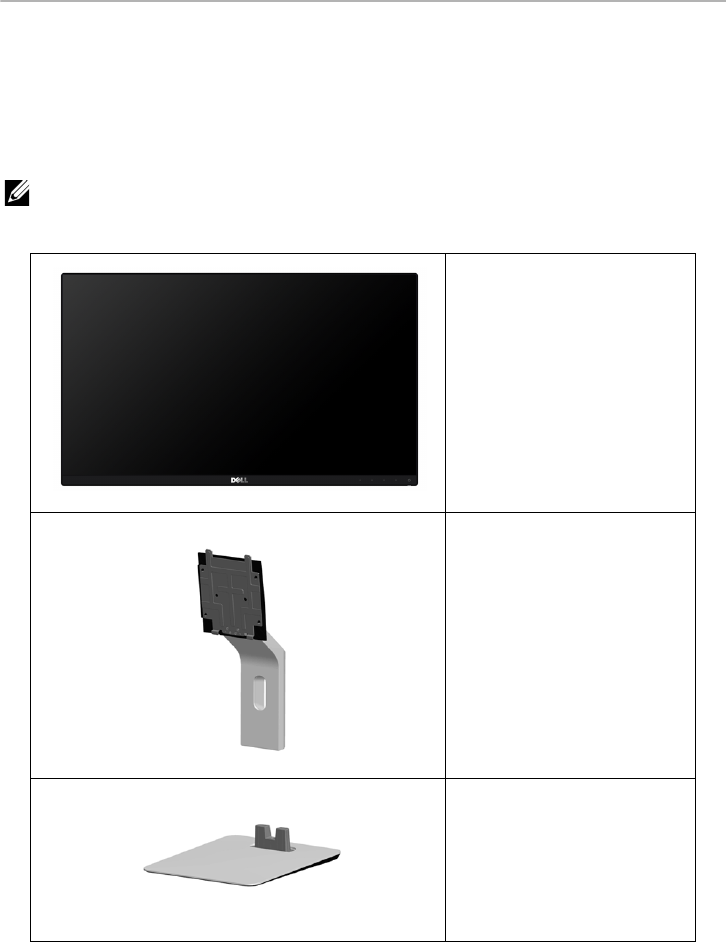
Package Contents
Your monitor ships with the components shown below. Make sure that you have
received all the components and
Contact Dell
if something is missing.
NOTE: Some items may be optional and may not ship with your monitor. Some
features or media may not be available in certain countries.
Monitor
Stand Riser
Stand Base
book.book Page 5 Wednesday, October 7, 2015 9:21 AM
6 | About Your Monitor
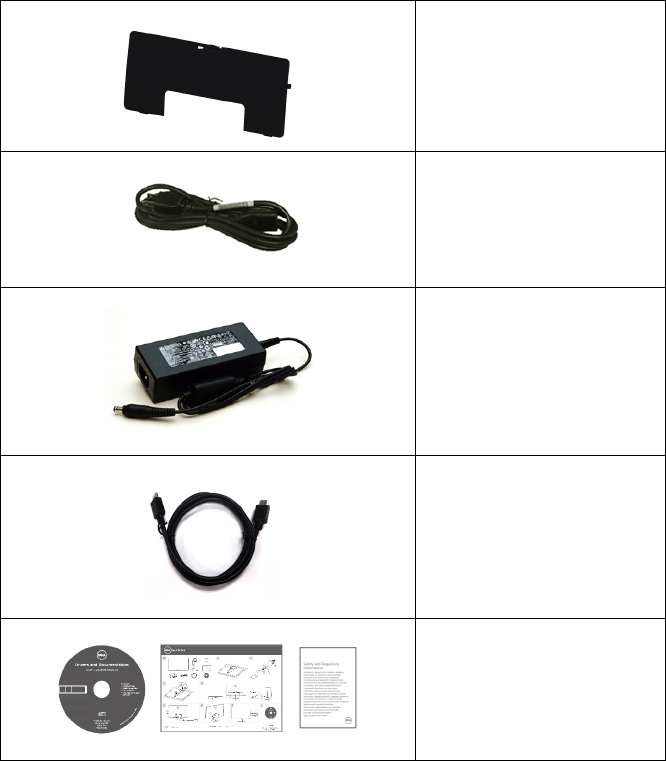
Cable Cover
Power Cable (Varies by
Country)
Power Adapter
HDMI Cable
•Drivers and
Documentation Media
•Quick Setup Guide
•Safety and Regulatory
Information
book.book Page 6 Wednesday, October 7, 2015 9:21 AM
About Your Monitor | 7
Product Features
The Dell S2415H flat panel monitor has an active matrix, Thin-Film Transistor (TFT),
Liquid Crystal Display (LCD), and Light Emitting Diode (LED) backlight. The monitor
features include:
•60.47 cm (23.8-inch) viewable area display (measured diagonally).
1920 x 1080 resolution with full-screen support for lower resolutions.
•Wide viewing angle to allow viewing from a sitting or standing position, or while
moving from side-to-side.
•Mega Dynamic Contrast Ratio (8,000,000:1).
•Tilt capability.
•Ultra-thin bezel minimizes the bezel gap in multi-monitor usage, enabling easier
set up with an elegant viewing experience.
•Extensive digital connectivity with HDMI (MHL) helps future-proof your monitor.
•Removable stand and Video Electronics Standards Association (VESA™) 100 mm
mounting holes for flexible mounting solutions.
•Plug and play capable.
•Color gamut of 72% (CIE1931).
•On-Screen Display (OSD) adjustments for easy setup and screen optimization.
•Software and documentation media includes an Information File (INF), Image Color
Matching File (ICM), and product documentation.
•Dell Display Manager Software (Available on the disc shipped with the monitor).
•Energy Saver feature for Energy Star compliance.
•Security-lock slot.
•Stand lock.
•Capability to switch from wide aspect to standard aspect ratio while maintaining
image quality.
•EPEAT Gold Rating.
•BFR/PVC-reduced.
•TCO-Certified Displays.
•Arsenic-Free glass and Mercury-Free for the panel only.
•0.5 W standby power when in the sleep mode.
•Energy Gauge shows the energy level being consumed by the monitor in real time.
book.book Page 7 Wednesday, October 7, 2015 9:21 AM
About Your Monitor | 9
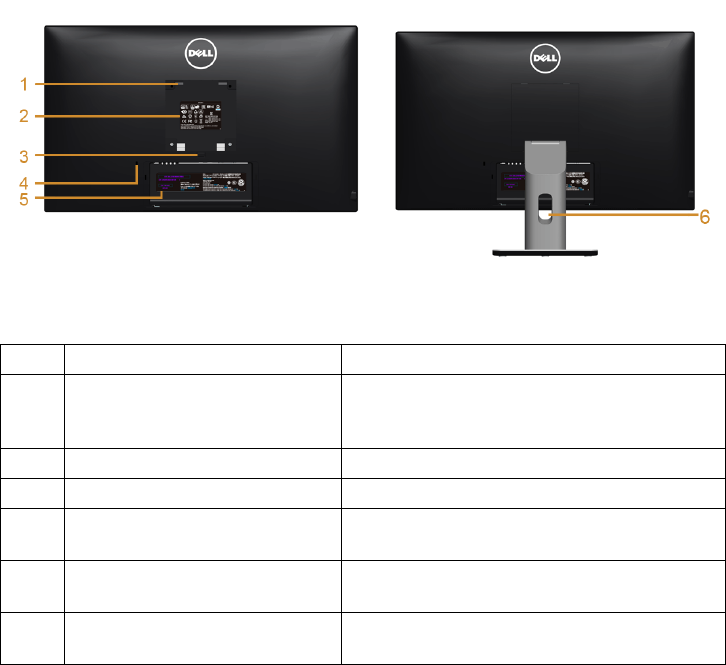
Back View
Back View with Monitor Stand
Label Description Use
1VESA mounting holes
(100 mm x 100 mm - behind
attached VESA cover)
Wall mount monitor using VESA-compatible
wall mount kit (100 mm x 100 mm).
2Regulatory label Lists the regulatory approvals.
3Stand release button Releases stand from monitor.
4Security lock slot Secures monitor with security lock (security
lock not included).
5Barcode serial number label Refer to this label if you need to contact Dell
for technical support.
6Cable management slot Uses to organize cables by placing them
through the slot.
book.book Page 9 Wednesday, October 7, 2015 9:21 AM
10 | About Your Monitor
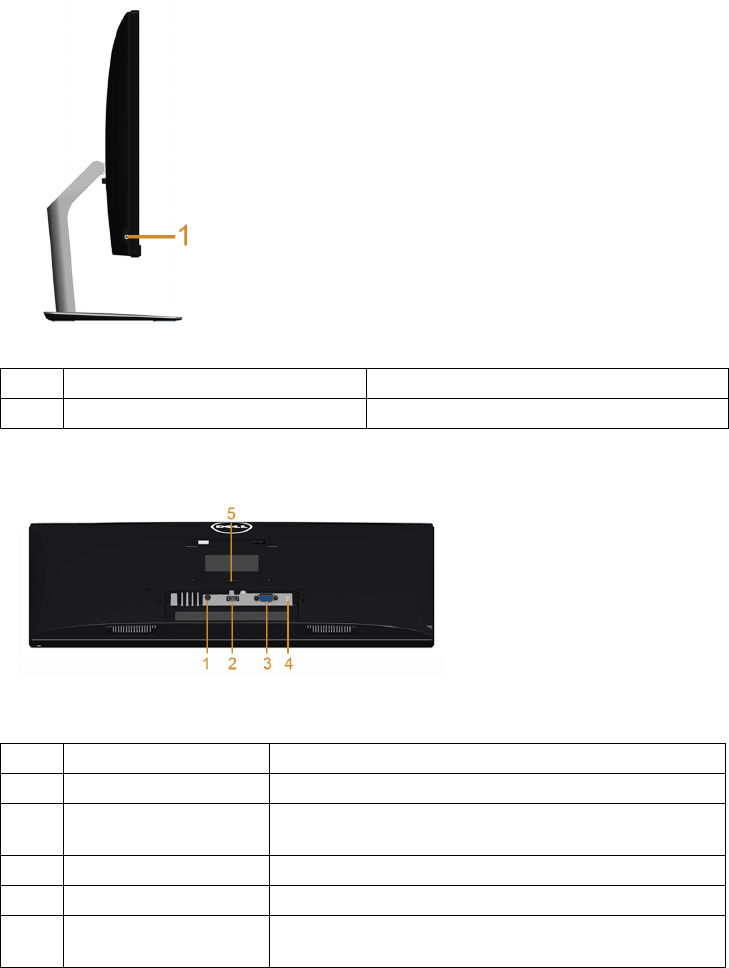
Side View
Bottom View
Label Description Use
1Headphone port Connect a headphone.
Bottom View without Monitor Stand
Label Description Use
1Power adapter port Connect the power adapter.
2HDMI (MHL) port Connect your computer with HDMI cable or MHL
devices with MHL cable (optional).
3VGA port Connect your computer with VGA cable (optional).
4Audio Line-In port Connect to your computer audio output (optional).
5Stand lock Lock the stand to the monitor using a M3 x 6 mm
screw (screw not included).
book.book Page 10 Wednesday, October 7, 2015 9:21 AM
About Your Monitor | 11
Monitor Specifications
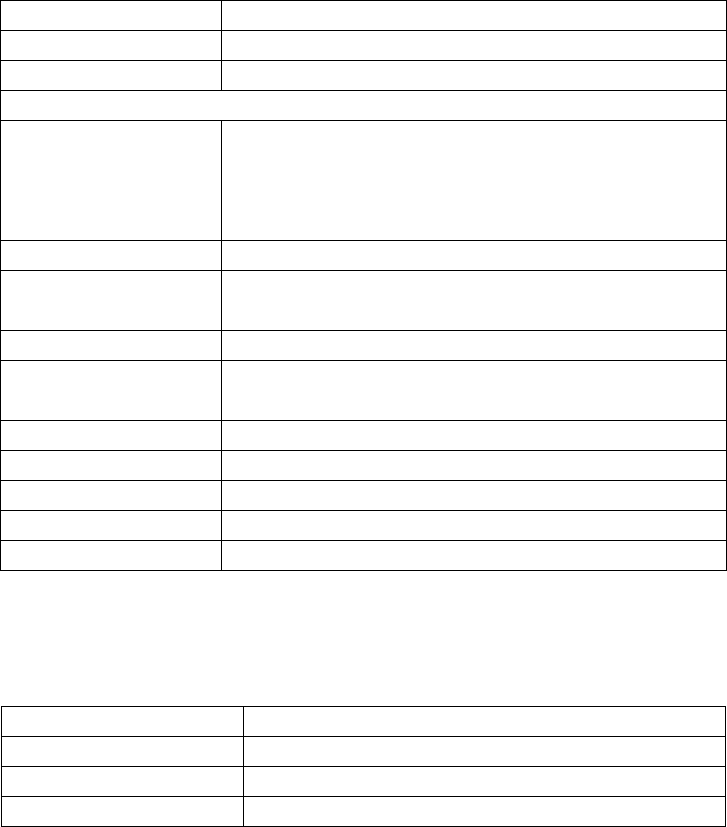
Flat Panel Specifications
* Color gamut (typical) is based on CIE1976 (85%) and CIE1931 (72%) test standards.
Resolution Specifications
Model S2415H
Screen type Active matrix - TFT LCD
Panel type In Plane Switching (IPS)
Viewable image
Diagonal
Horizontal, Active Area
Vertical, Active Area
Area
604.70 mm (23.8 inches)
527.04 mm (20.75 inches)
296.46 mm (11.67 inches)
156246.28 mm2 (242.18 inch2)
Pixel pitch 0.2745 mm x 0.2745 mm
Viewing angle 178° (vertical) typical
178° (horizontal) typical
Luminance output 250 cd/m² (typical)
Contrast ratio 1000 to 1 (typical)
8,000,000 to 1 (Mega Dynamic Contrast On)
Faceplate coating Glare with Hard coating (3H)
Backlight LED edgelight system
Response time 6 ms (typical) with Overdrive
Color depth 16.77 million colors
Color gamut CIE 1931* (72%)
Model S2415H
Horizontal scan range 30 kHz to 83 kHz (automatic)
Vertical scan range 56 Hz to 75 Hz (automatic)
Maximum preset resolution 1920 x 1080 at 60 Hz
book.book Page 11 Wednesday, October 7, 2015 9:21 AM
12 | About Your Monitor
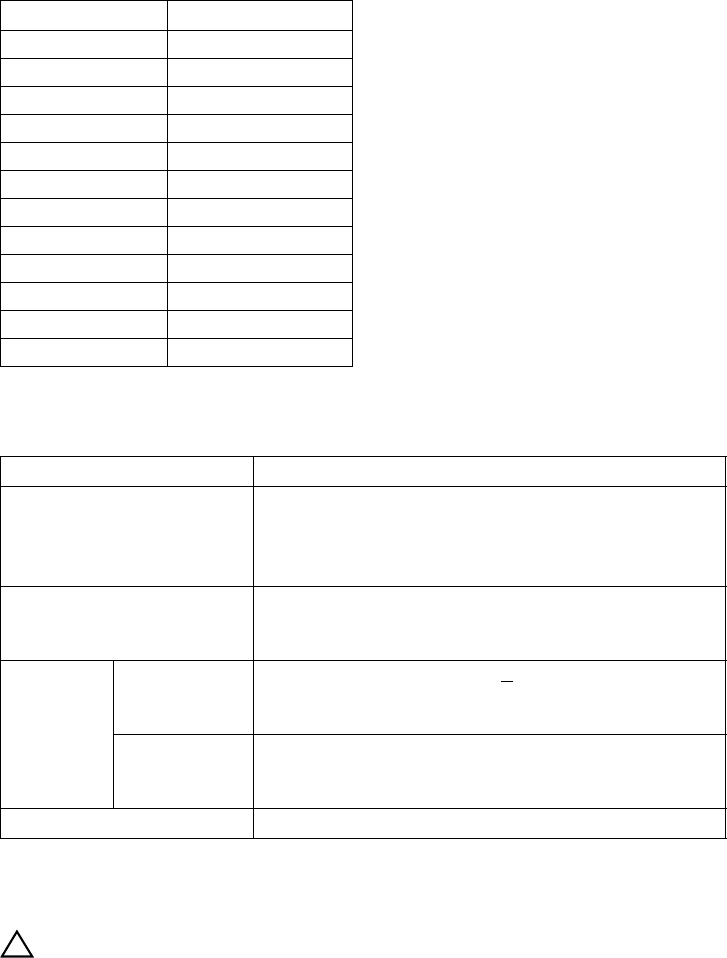
Supported Video Modes
Preset Display Modes
Model S2415H
Video display capabilities
(VGA & HDMI playback)
480i, 480p, 576i, 576p, 720p, 1080i, 1080p
Display Mode Horizontal
Frequency (kHz)
Vertical
Frequency (Hz)
Pixel Clock
(MHz)
Sync Polarity
(Horizontal/
Vertical)
VESA, 720 x 400 31.5 70.1 28.3 -/+
VESA, 640 x 480 31.5 60.0 25.2 -/-
VESA, 640 x 480 37.5 75.0 31.5 -/-
VESA, 800 x 600 37.9 60.3 40.0 +/+
VESA, 800 x 600 46.9 75.0 49.5 +/+
VESA, 1024 x 768 48.4 60.0 65.0 -/-
VESA, 1024 x 768 60.0 75.0 78.8 +/+
VESA, 1280 x 1024 64.0 60.0 108.0 +/+
VESA, 1280 x 1024 80.0 75.0 135.0 +/+
VESA, 1152 x 864 67.5 75.0 108.0 +/+
VESA, 1600 x 900 75.0 60.0 162.0 +/+
VESA, 1920 x 1080 67.5 60.0 148.5 +/+
book.book Page 12 Wednesday, October 7, 2015 9:21 AM
About Your Monitor | 13
MHL Source Display Modes
Electrical Specifications
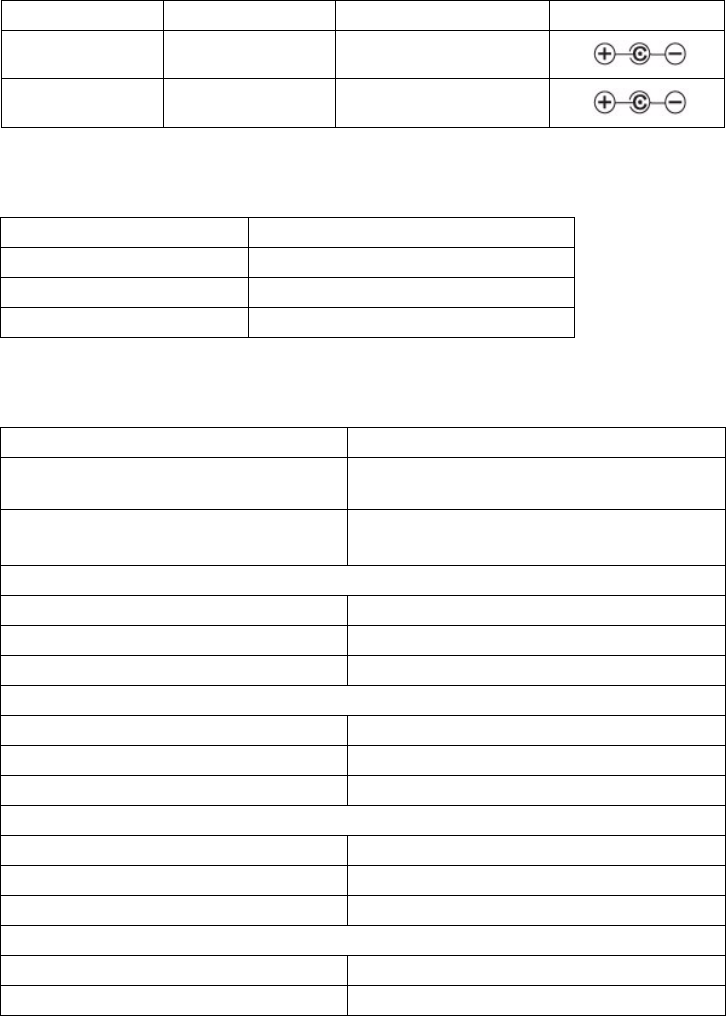
*Qualified Compatible AC/DC adapters.
**The AC source must be using chroma 6530 3KV source or other same level AC source.
CAUTION: To avoid damage to the monitor, use only the adapter designed for
this particular Dell monitor.
Display Mode Frequency (Hz)
640 x 480p 60
720 x 480p 60
720 x 576p 50
1280 x 720p 60
1280 x 720p 50
1920 x 1080i 60
1920 x 1080i 50
1920 x 1080p 30
1920 x 1080p 60
1920 x 1080p 50
720 (1440) x 480i 60
720 (1440) x 576i 50
Model S2415H
Video input signals •Analog RGB, 0.7 Volts +/- 5%, positive polarity at 75
ohm input impedance
•HDMI 1.4 (MHL 2.1), 600mV for each differential line,
100 ohm input impedance per differential pair
Synchronization input
signals
Separate horizontal and vertical synchronizations,
polarity-free TTL level, SOG (Composite SYNC on
green)
AC/DC
adapter*
Input voltage/
frequency/
current
100 -240 VAC / 50 or 60 Hz + 3 Hz/1.7 A (maximum)
Output
voltage/
current
Output: 19.5 VDC / 3.34 A
Inrush current 115 V/230V: 150 A (Max.)**
book.book Page 13 Wednesday, October 7, 2015 9:21 AM
14 | About Your Monitor
Speaker Specifications
Physical Characteristics
Brand Manufacturer Model Polarity
Dell Delta DA65NM111-00
Dell Chicony HA65NS5-00
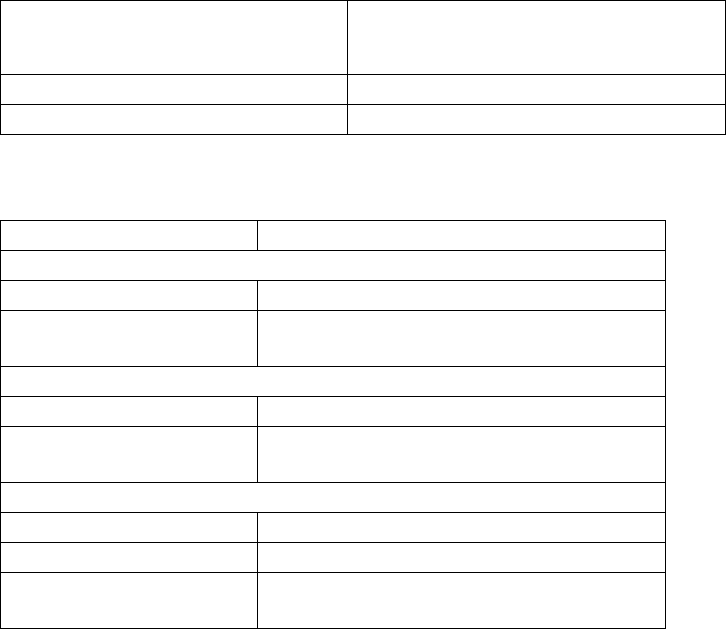
Model S2415H
Speaker rated power 2 x 3 W
Frequency Response 200 Hz - 20 kHz
Impedance 4 ohm
Model S2415H
Connector type 15-pin D-subminiature (Blue connector);
HDMI (MHL); Audio-In; Headphone-Out
Signal cable type •Digital: detachable, HDMI, 19 pins
•Digital: detachable, MHL, 19 pins
Dimensions (with stand)
Height 404.6 mm (15.93 inches)
Width 539.1 mm (21.23 inches)
Depth 180.0 mm (7.09 inches)
Dimensions (without stand)
Height 321.1 mm (12.64 inches)
Width 539.1 mm (21.23 inches)
Depth 45.9 mm (1.81 inches)
Stand dimensions
Height 318.9 mm (12.56 inches)
Width 190.0 mm (7.48 inches)
Depth 180.0 mm (7.09 inches)
Weight
Weight with packaging 6.83 kg (15.06 lb)
Weight with stand assembly and cables 4.72 kg (10.41 lb)
book.book Page 14 Wednesday, October 7, 2015 9:21 AM
About Your Monitor | 15
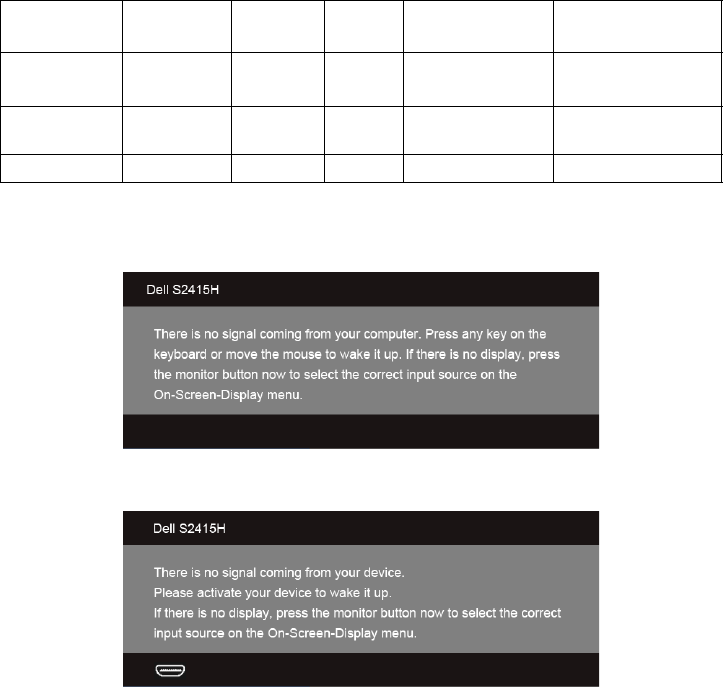
Environmental Characteristics
Weight without stand assembly (For wall
mount or VESA mount considerations -
no cables)
3.24 kg (7.14 lb)
Weight of stand assembly 1.01 kg (2.23 lb)
Front frame gloss 14%~20%
Model S2415H
Temperature
Operating 0 °C to 40 °C (32 °F to 104 °F)
Non-operating •Storage: -20 °C to 60 °C (-4 °F to 140 °F)
•Shipping: -20 °C to 60 °C (-4 °F to 140 °F)
Humidity
Operating 10% to 80% (non-condensing)
Non-operating •Storage: 5% to 90% (non-condensing)
•Shipping: 5% to 90% (non-condensing)
Altitude
Operating 5,000 m (16,404 ft) (maximum)
Non-operating 12,192 m (40,000 ft) (maximum)
Thermal dissipation •122.83 BTU/hour (maximum)
•61.42 BTU/hour (typical)
book.book Page 15 Wednesday, October 7, 2015 9:21 AM
16 | About Your Monitor
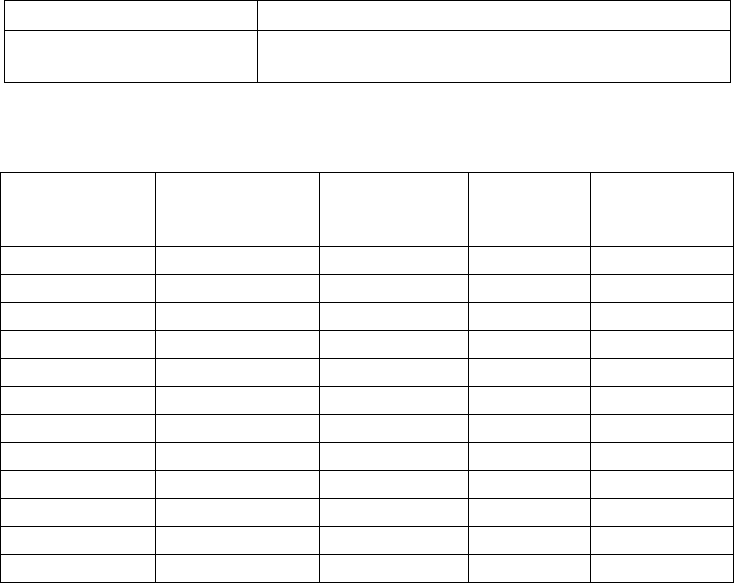
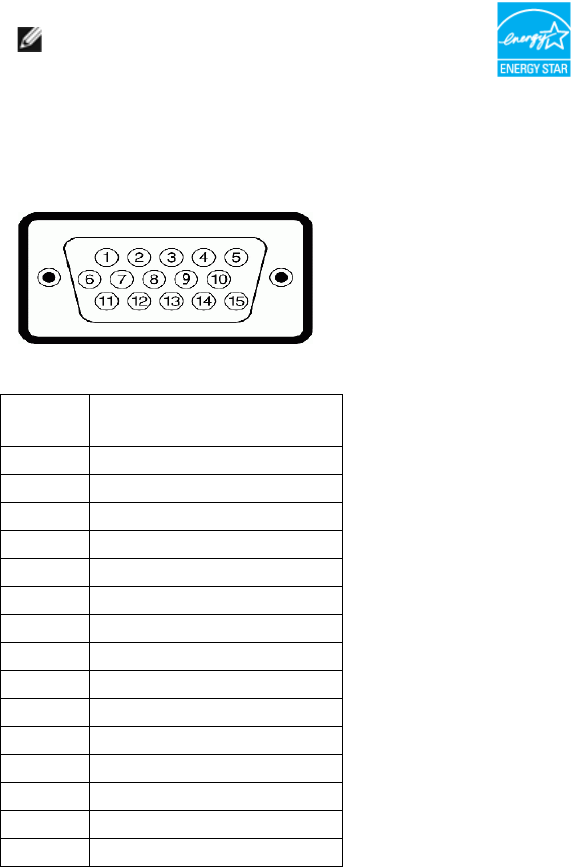
Power Management Modes
If you have VESA's DPM™ compliant display card or software installed in your PC, the
monitor can automatically reduce its power consumption when not in use. This is
referred to as Power Save Mode*. If the computer detects input from the keyboard,
mouse, or other input devices, the monitor automatically resumes functioning. The
following table shows the power consumption and signaling of this automatic power
saving feature.
The OSD functions only in the normal operation mode. When any button is pressed in
the Active-off mode, one of the following messages will be displayed:
or
* Zero power consumption in OFF mode can only be achieved by disconnecting the
power adapter from the monitor.
** Maximum power consumption with maximum luminance.
VESA Modes Horizontal
Sync
Vertical
Sync
Video Power
Indicator
Power
Consumption
Normal
operation
Active Active Active White 36 W (maximum)**
18 W (typical)
Active-off
mode
Inactive Inactive Blanked White (Breathing) Less than 0.5 W
Switch off - - - Off Less than 0.5 W
book.book Page 16 Wednesday, October 7, 2015 9:21 AM
About Your Monitor | 17
Activate the computer and the monitor to gain access to the OSD.
Pin Assignments
VGA Connector
NOTE: This monitor is ENERGY STAR®-compliant.
Pin
Number
15-pin Side of the
Connected Signal Cable
1Video-Red
2Video-Green
3Video-Blue
4GND
5Self-test
6GND-R
7GND-G
8GND-B
9Computer 5 V/3.3 V
10 GND-sync
11 GND
12 DDC data
13 H-sync
14 V-sync
15 DDC clock
book.book Page 17 Wednesday, October 7, 2015 9:21 AM
18 | About Your Monitor
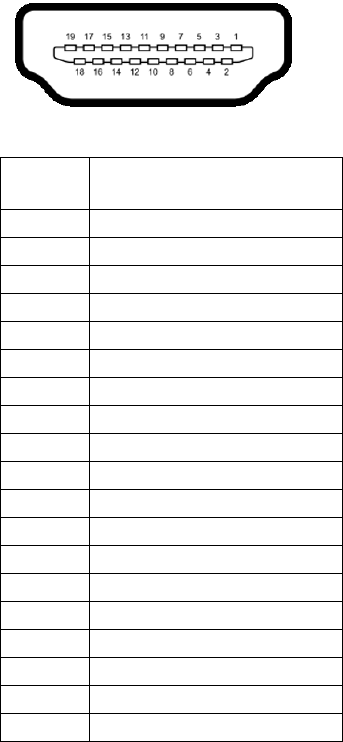
HDMI Connector
Pin
Number
19-pin Side of the
Connected Signal Cable
1TMDS DATA 2+
2TMDS DATA 2 SHIELD
3TMDS DATA 2-
4TMDS DATA 1+
5TMDS DATA 1 SHIELD
6TMDS DATA 1-
7TMDS DATA 0+
8TMDS DATA 0 SHIELD
9TMDS DATA 0-
10 TMDS CLOCK+
11 TMDS CLOCK SHIELD
12 TMDS CLOCK-
13 CEC
14 Reserved (N.C. on device)
15 DDC CLOCK (SCL)
16 DDC DATA (SDA)
17 DDC/CEC Ground
18 +5V POWER
19 HOT PLUG DETECT
book.book Page 18 Wednesday, October 7, 2015 9:21 AM
About Your Monitor | 19
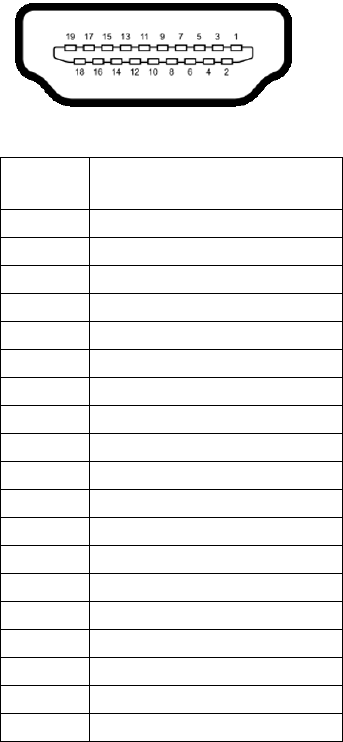
MHL Connector
Plug and Play Capability
You can install the monitor in any Plug and Play-compatible system. The monitor
automatically provides the computer system with its Extended Display Identification Data
(EDID) using Display Data Channel (DDC) protocols so the system can configure itself
and optimize the monitor settings. Most monitor installations are automatic; you can
select different settings if desired. For more information about changing the monitor
settings, see
Operating the Monitor
.
Pin
Number
19-pin Side of the
Connected Signal Cable
1TMDS DATA 2+
2TMDS DATA 2 SHIELD
3TMDS DATA 2-
4TMDS DATA 1+
5GND
6TMDS DATA 1-
7MHL+
8TMDS DATA 0 SHIELD
9MHL-
10 TMDS CLOCK+
11 GND
12 TMDS CLOCK-
13 CEC
14 Reserved (N.C. on device)
15 DDC CLOCK (SCL)
16 DDC DATA (SDA)
17 GND
18 VBUS (+5V, 900mA maximum)
19 CBUS
book.book Page 19 Wednesday, October 7, 2015 9:21 AM

20 | About Your Monitor
LCD Monitor Quality and Pixel Policy
During the LCD Monitor manufacturing process, it is not uncommon for one or more
pixels to become fixed in an unchanging state which are hard to see and do not affect
the display quality or usability. For more information on Dell Monitor Quality and Pixel
Policy, see Dell Support site at: http://www.dell.com/support/monitors.
Maintenance Guidelines
Cleaning Your Monitor
WARNING: Before cleaning the monitor, unplug the monitor power cable from
the electrical outlet.
CAUTION: Read and follow the
Safety Instructions
before cleaning the monitor.
For best practices, follow the instructions in the list below while unpacking, cleaning, or
handling your monitor:
•To clean your anti-static screen, lightly dampen a soft, clean cloth with water. If
possible, use a special screen-cleaning tissue or solution suitable for the anti-
static coating. Do not use benzene, thinner, ammonia, abrasive cleaners, or
compressed air.
•Use a lightly-dampened, warm cloth to clean the monitor. Avoid using
detergent of any kind as some detergents leave a milky film on the monitor.
•If you notice white powder when you unpack your monitor, wipe it off with a
cloth.
•Handle your monitor with care as a darker-colored monitor may get scratched
and show white scuff marks more than a lighter-colored monitor.
•To help maintain the best image quality on your monitor, use a dynamically
changing screen saver and turn Off your monitor when not in use.
book.book Page 20 Wednesday, October 7, 2015 9:21 AM
Setting Up the Monitor | 21
Setting Up the Monitor
Attaching the Stand
NOTE: The stand riser and stand base are detached when the monitor is shipped
from the factory.
NOTE: The procedure below is applicable for the default stand. If you purchased
any other stand, see the documentation shipped with the stand to set it up.
WARNING: Place monitor of a flat, clean, and soft surface to avoid scratching the
display panel.
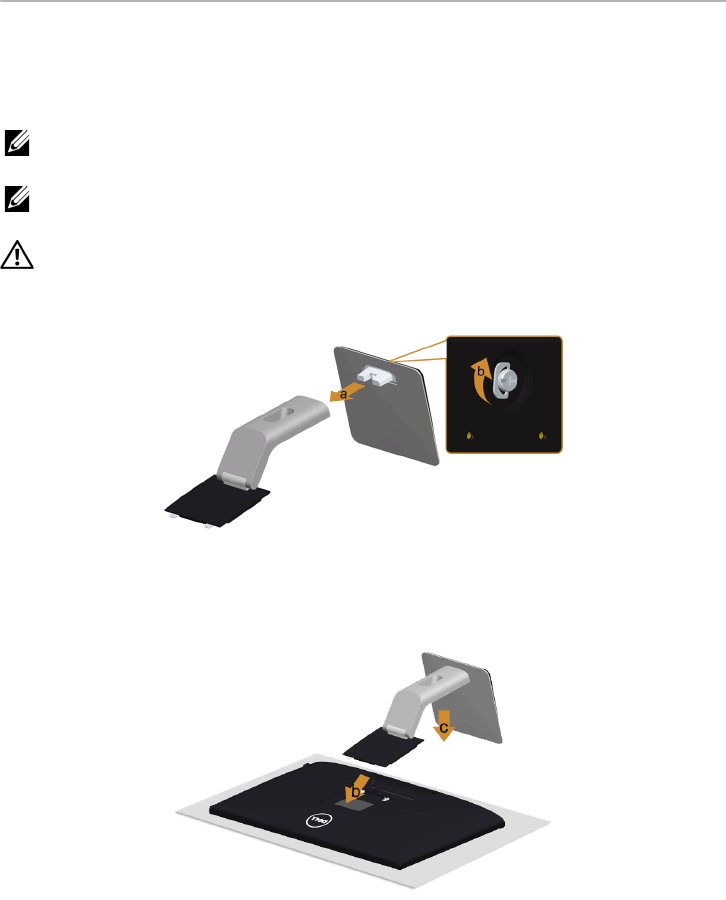
1Assemble the stand riser to stand base.
aAttach the stand riser to the stand base.
bTighten the thumbscrew below the stand base.
2Attach the stand assembly to the monitor.
aRemove the cover and place the monitor on it.
bInsert the two tabs on the upper part of the stand in the slots on the back of the
monitor.
cPress the stand down till it snaps into place.
book.book Page 21 Wednesday, October 7, 2015 9:21 AM
22 | Setting Up the Monitor
Connecting Your Monitor
WARNING: Before you begin any of the procedures in this section, follow the
Safety Instructions
.
NOTE: Do not connect all cables to the computer at the same time.
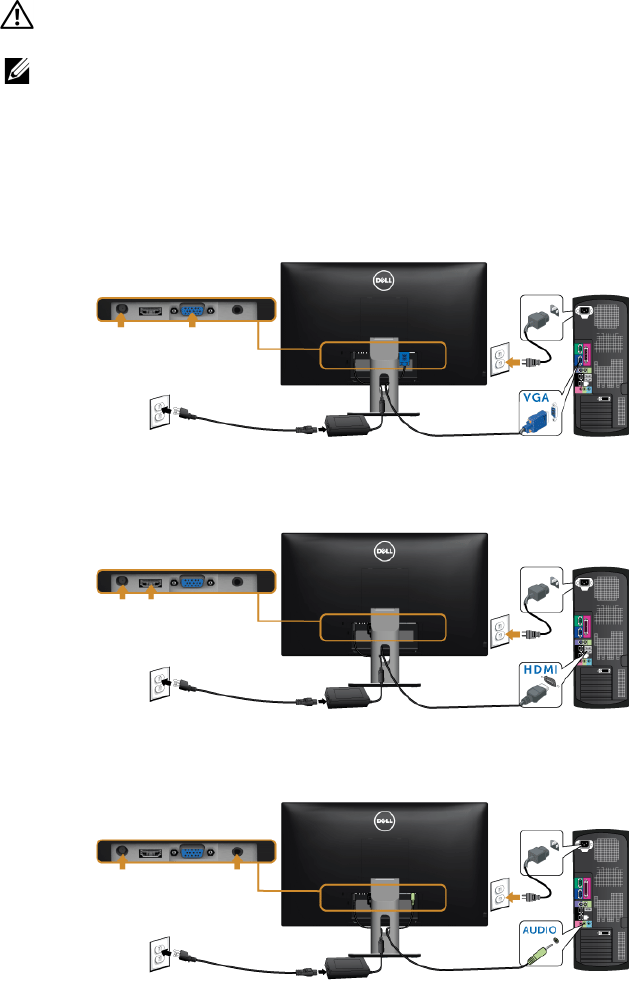
To connect your monitor to the computer:
1Turn Off your computer and disconnect the power cable.
2Connect the VGA/HDMI/audio cable from your monitor to the computer.
Connecting the blue VGA cable
Connecting the HDMI cable
Connecting the audio cable
book.book Page 22 Wednesday, October 7, 2015 9:21 AM
Setting Up the Monitor | 23
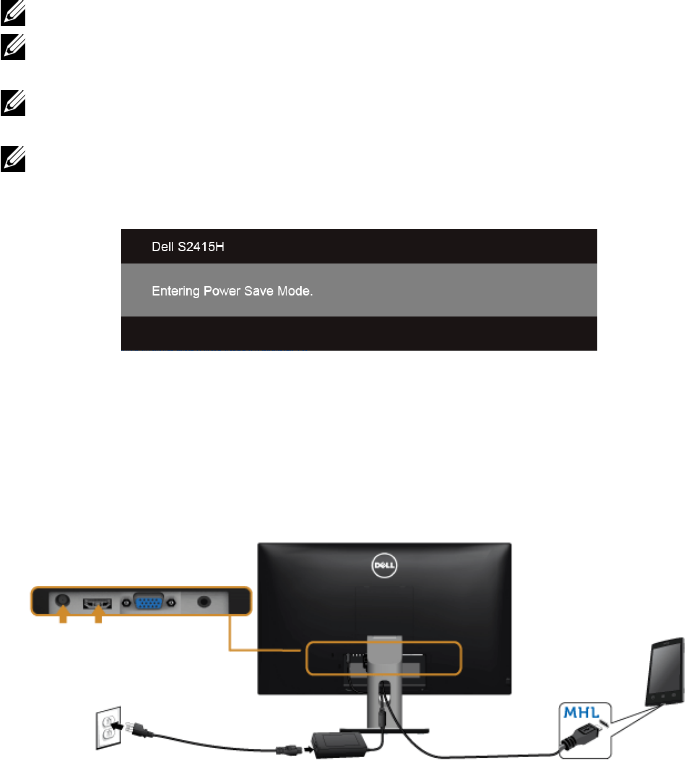
Using the Mobile-High Definition Link (MHL)
NOTE: This monitor is MHL certified.
NOTE: To use the MHL function, use only MHL certified cable and source devices
that support MHL output.
NOTE: Some MHL source devices may take more than a few seconds or longer to
output an image, depending on MHL source devices.
NOTE: When the connected MHL source device enters Standby mode, the monitor
displays a black screen or the message below, depending on MHL source device's
output.
To enable MHL connection, please perform the below steps:
1Plug the power adapter to your monitor and to a power outlet.
2Connect the (micro) USB port on you MHL source device to HDMI (MHL) port on
the monitor with a MHL certified cable (See
Bottom View
for details).
3Turn On the monitor and the MHL source device.
4Select input source on monitor to HDMI (MHL) by using OSD Menu (See
Using the
On-Screen Display (OSD) Menu
for details).
5If the monitor does not display an image, see
Mobile High-Definition Link (MHL)
Specific Problems
.
book.book Page 23 Wednesday, October 7, 2015 9:21 AM
24 | Setting Up the Monitor
Organizing Your Cables
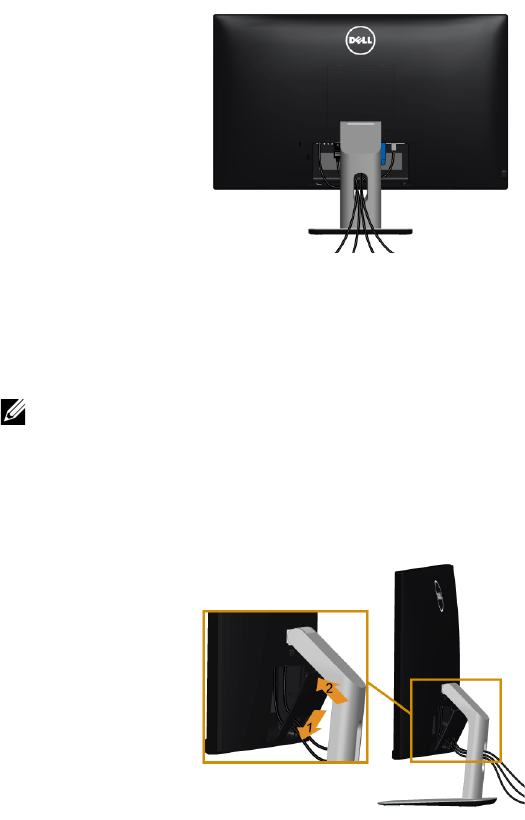
After attaching all necessary cables to your monitor and computer, (See
Connecting Your
Monitor
for cable attachment,) organize all cables as shown above.
Attaching the Cable Cover
NOTE: The cable cover is detached when the monitor is shipped from the factory.
1Insert the two tabs on the bottom part of the cable cover in the slots on the back of
the monitor.
2Press the cable cover till it snaps into place.
book.book Page 24 Wednesday, October 7, 2015 9:21 AM
Setting Up the Monitor | 25
Removing the Monitor Stand
CAUTION: To prevent scratches on the LCD screen while removing the stand,
make sure that the monitor is placed on a soft, clean surface.
NOTE: The procedure below is applicable for the default stand. If you purchased
any other stand, see the documentation shipped with the stand to set it up.
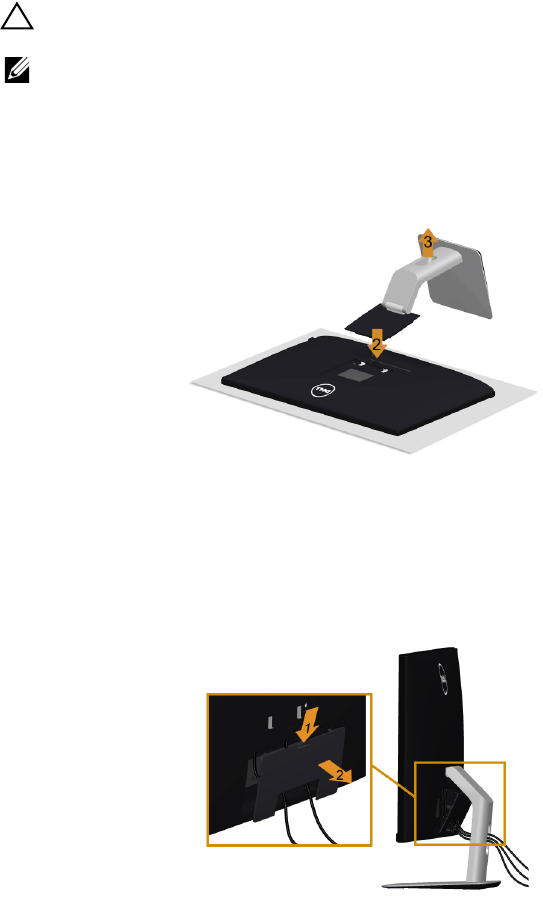
To remove the stand:
1Place the monitor on a soft cloth or cushion.
2Press and hold the stand-release button.
3Lift the stand up and away from the monitor.
Removing the Cable Cover
1Press the tab on the cable cover.
2Remove the two tabs on the bottom part of the cable cover from the slots on the
back of the monitor.
book.book Page 25 Wednesday, October 7, 2015 9:21 AM
26 | Setting Up the Monitor
Wall Mounting (Optional)
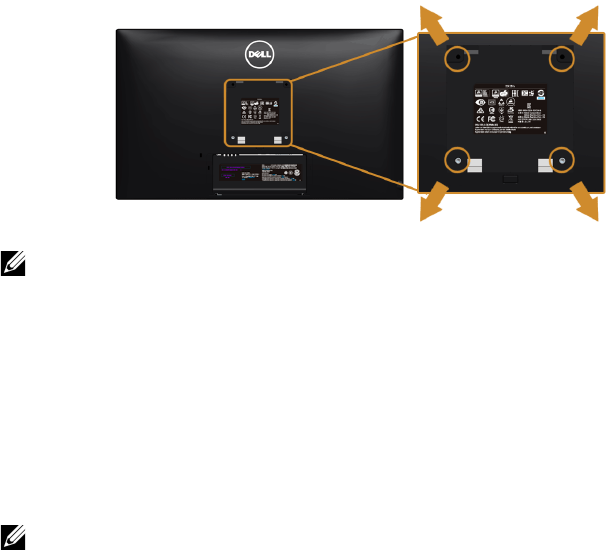
NOTE: Use M4 x 10 mm screws to connect the monitor to the wall-mounting kit.
Refer to the instructions that come with the VESA-compatible wall mounting kit.
1Place the monitor panel on a soft cloth or cushion on a stable, flat table.
2Remove the stand.
3Use a Phillips crosshead screwdriver to remove the four screws securing the plastic
cover.
4Attach the mounting bracket from the wall mounting kit to the monitor.
5Mount the monitor on the wall by following the instructions that comes with the
wall mounting kit.
NOTE: For use only with UL-listed wall mount bracket with minimum weight/load
bearing capacity of 5.88 kg (12.96 lb).
book.book Page 26 Wednesday, October 7, 2015 9:21 AM
Operating the Monitor | 27
Operating the Monitor
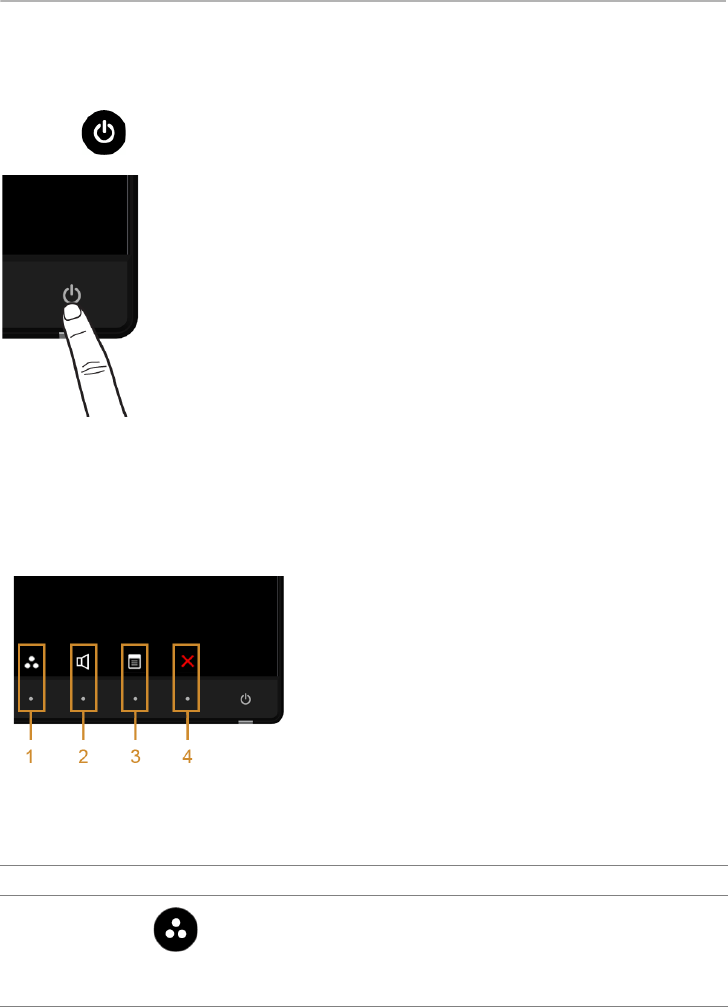
Power On the Monitor
Press the button to turn On the monitor.
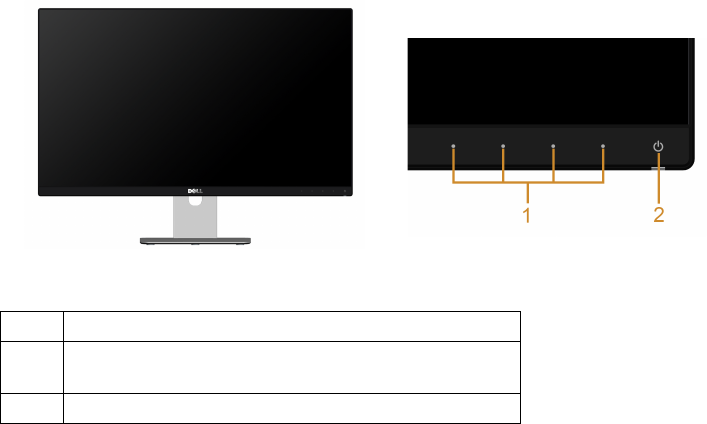
Using the Front Panel Controls
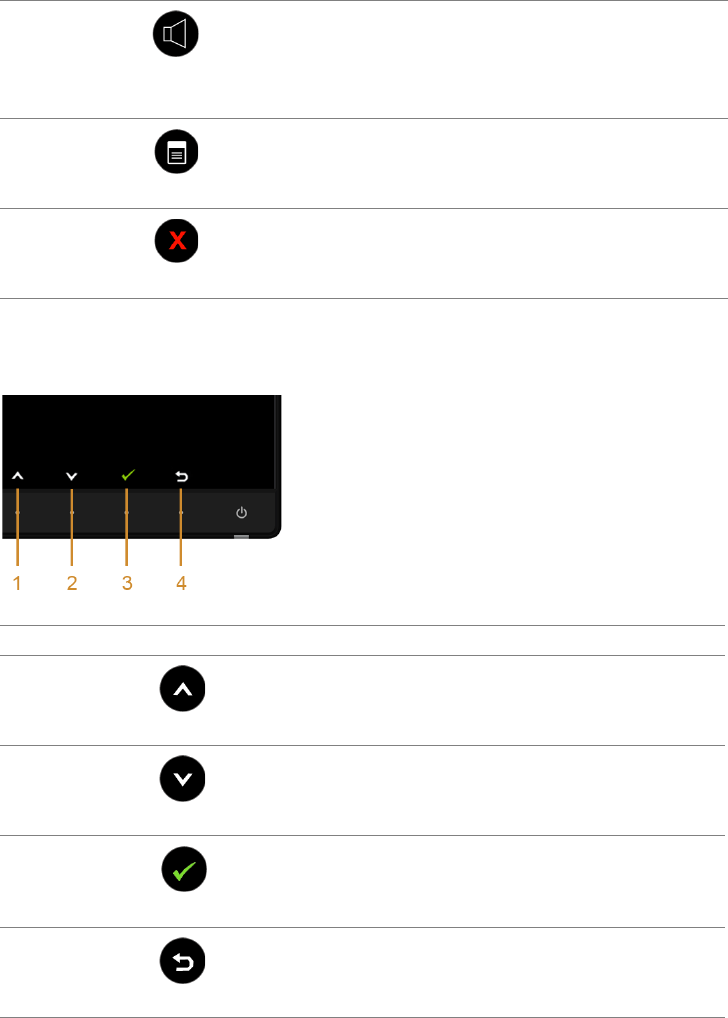
Use the control buttons on the front of the monitor to adjust the characteristics of the
image being displayed. As you use these buttons to adjust the controls, an OSD shows
the numeric values of the characteristics as they change.
The following table describes the front panel buttons:
Front Panel Button Description
1
Shortcut key/
Preset Modes
Use this button to choose from a list of preset color
modes.
book.book Page 27 Wednesday, October 7, 2015 9:21 AM
28 | Operating the Monitor
Front Panel Button
Use the buttons on the front of the monitor to adjust the image settings.
2
Shortcut key/
Volume
Use this button to directly access the Volume level bar.
3
Menu
Use the MENU button to launch the On-Screen Display
(OSD) and select the OSD Menu. See
Accessing the Menu
System
.
4
Exit
Use this button to go back to the main menu or exit the
OSD main menu.
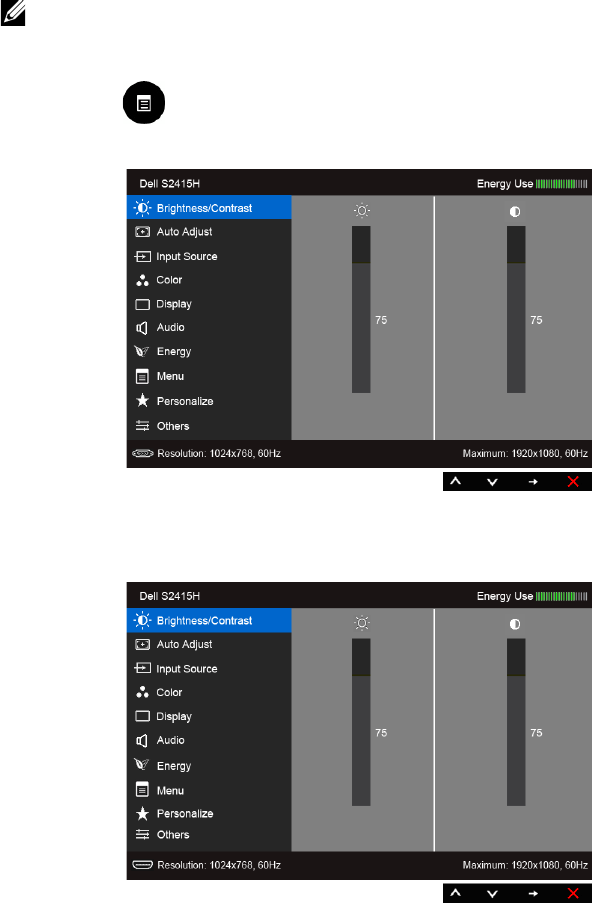
Front Panel Button Description
1
Up
Use the Up button to adjust (increase ranges) items in the
OSD menu.
2
Down
Use the Down button to adjust (decrease ranges) items in
the OSD menu.
3
OK
Use the OK button to confirm your selection.
4
Back
Use the Back button to go back to the previous menu.
book.book Page 28 Wednesday, October 7, 2015 9:21 AM
Operating the Monitor | 29
Using the On-Screen Display (OSD) Menu
Accessing the Menu System
NOTE: If you change the settings and then either proceed to another menu or exit
the OSD menu, the monitor automatically saves those changes. The changes are
also saved if you change the settings and then wait for the OSD menu to disappear.
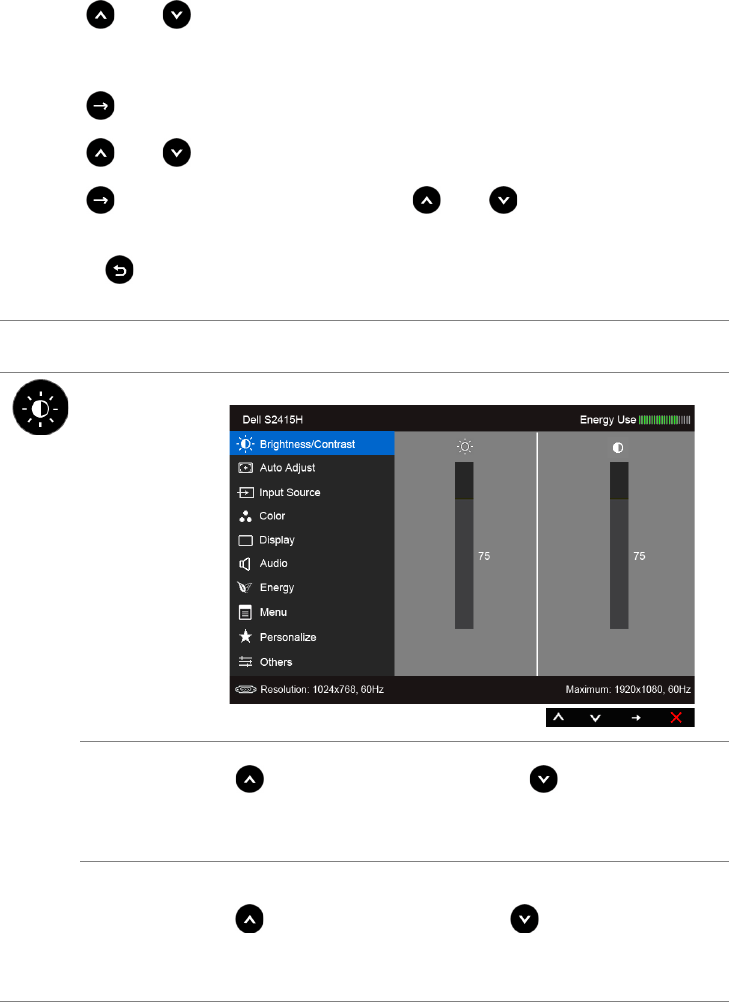
1Press the button to launch the OSD menu and display the main menu.
Main Menu for VGA input
or
Main Menu for HDMI (MHL) input
book.book Page 29 Wednesday, October 7, 2015 9:21 AM
30 | Operating the Monitor
2Use and to move between the options in the menu. As you move from
one icon to another, the option name is highlighted. See the following table for a
complete list of all the options available for the monitor.
3Use to activate the highlighted option.
4Use and to select the desired parameter.
5Use to enter the slide bar and then use and , according to the
indicators on the menu, to make your changes.
6Select to return to the main menu.
Icon Menu and
Submenus
Description
Brightness/
Contrast
Use this menu to activate Brightness/Contrast adjustment.
Brightness Brightness adjusts the luminance of the backlight.
Use to increase the brightness and use to decrease the
brightness (min. 0 / max. 100).
NOTE: Manual adjustment of Brightness is disabled when Dynamic
Contrast is switched On.
Contrast Adjust the Brightness first, and then adjust the Contrast only if further
adjustment is necessary.
Use to increase the contrast and use to decrease the contrast
(min. 0 / max. 100).
The Contrast function adjusts the degree of difference between
darkness and lightness on the monitor screen.
book.book Page 30 Wednesday, October 7, 2015 9:21 AM
Operating the Monitor | 31
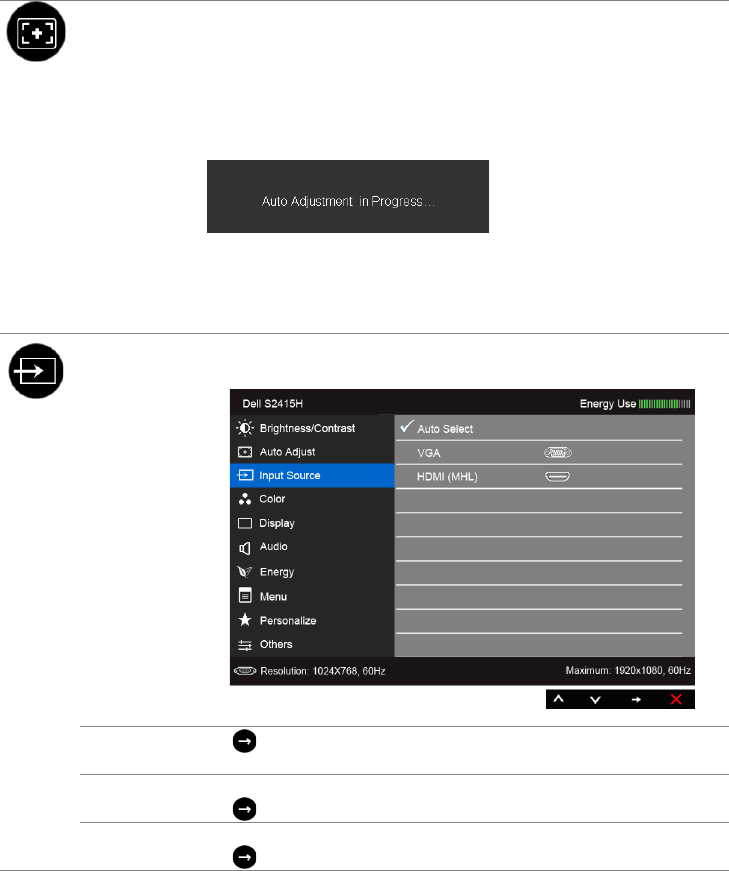
Auto Adjust Even though your computer recognizes your monitor on startup, the
Auto Adjustment function optimizes the display settings for use with
your particular setup.
Auto Adjustment allows the monitor to self-adjust to the incoming
video signal. After using Auto Adjustment, you can further tune your
monitor by using the Pixel Clock (Coarse) and Phase (Fine) controls
under Display menu.
NOTE: In most cases, Auto Adjust produces the best image for your
configuration.
NOTE: Auto Adjust option is only available when you are using the
analog (VGA) connector.
Input
Source
Use the Input Source menu to select between the different video signals
that may be connected to your monitor.
Auto Select Use to select Auto Select, the monitor scans for available input
sources.
VGA Select the VGA input when you are using the analog (VGA) connector.
Use to select the VGA input source.
HDMI (MHL) Select the HDMI (MHL) input when you are using the HDMI connector.
Use to select the HDMI (MHL) input source.
book.book Page 31 Wednesday, October 7, 2015 9:21 AM
32 | Operating the Monitor
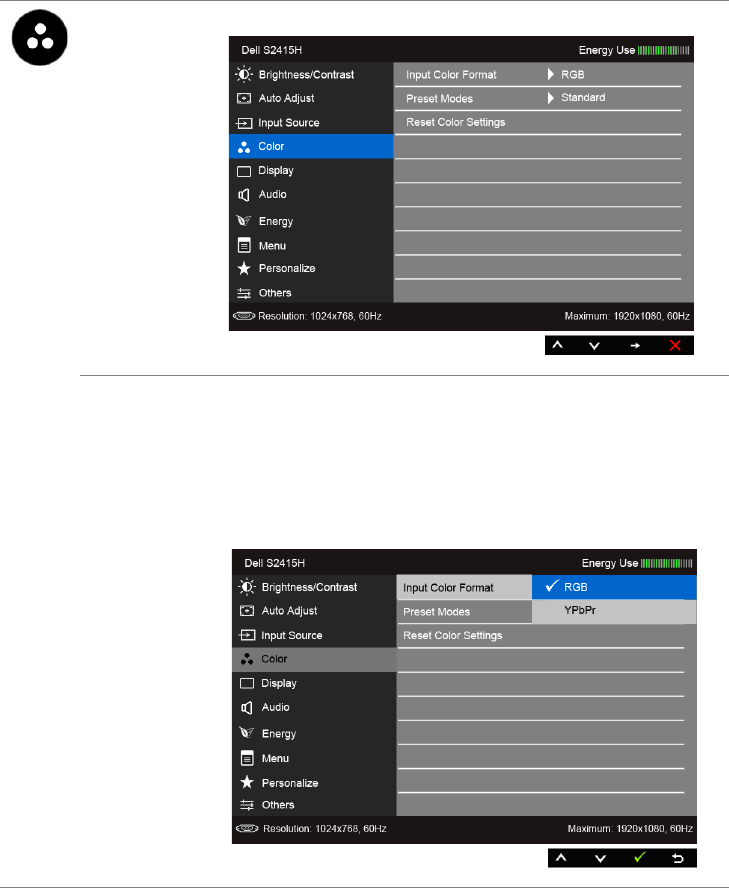
Color Use the Color menu to adjust the color setting mode.
Input Color
Format
Allows you to set the video input mode to:
RGB: Select this option if your monitor is connected to a computer (or
DVD player) using the HDMI cable; or MHL devices using the MHL cable.
YPbPr: Select this option if your monitor is connected to a DVD player
by YPbPr using HDMI cable; or MHL devices by YPbPr using the MHL
cable.
Or if the DVD (or MHL devices) color output setting is not RGB.
book.book Page 32 Wednesday, October 7, 2015 9:21 AM
Operating the Monitor | 33
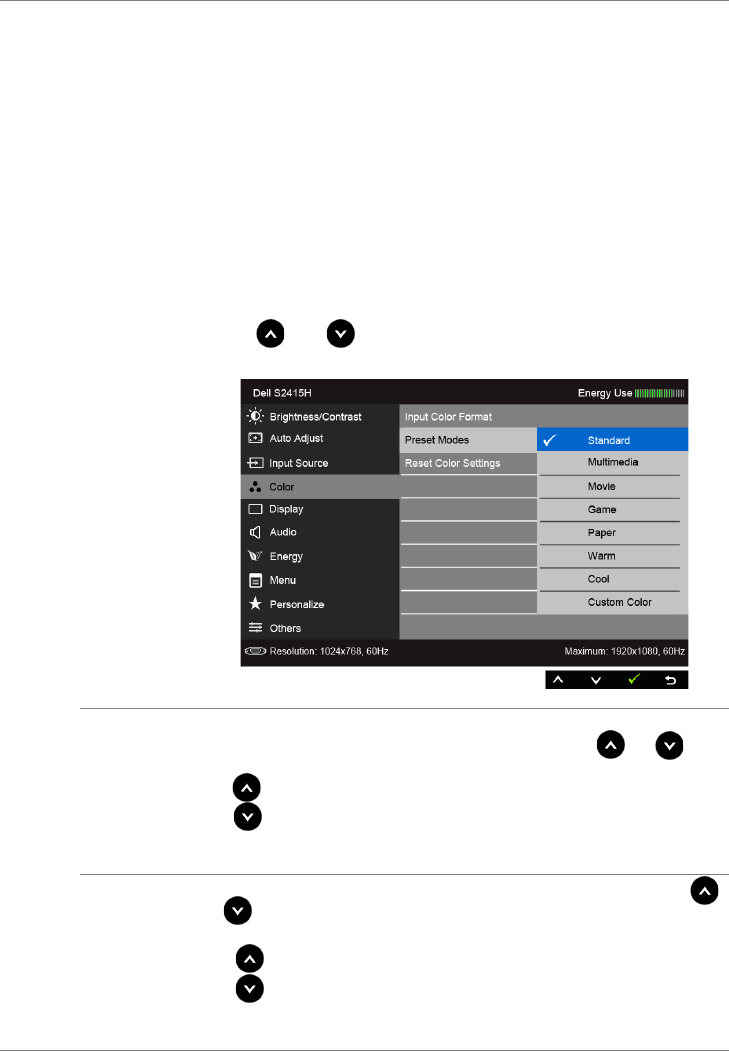
Preset
Modes
When you select Preset Modes, you can choose Standard, Multimedia,
Movie, Game, Paper, Warm, Cool, or Custom Color from the list.
•Standard: Loads the monitor's default color settings. This is the
default preset mode.
•Multimedia: Loads color settings ideal for multimedia applications.
•Movie: Loads color settings ideal for movies.
•Game: Loads color settings ideal for most gaming applications.
•Paper: Loads brightness and sharpness settings ideal for viewing text.
Blend the text background to simulate paper media without affecting
color images. Applies to RGB input format only.
•Warm: Increases the color temperature. The screen appears warmer
with a red/yellow tint.
• Cool: Decreases the color temperature. The screen appears cooler
with a blue tint.
• Custom Color: Allows you to manually adjust the color settings.
Use and to adjust the three colors (R, G, B) values and create
your own preset color mode.
Hue This feature can shift the color of the video image to green or purple.
This is used to adjust the desired flesh tone color. Use or to
adjust the hue from '0' to '100'.
Use to increase the green shade of the video image.
Use to increase the purple shade of the video image.
NOTE: Hue adjustment is available only when you select Movie or Game
preset mode.
Saturation This feature can adjust the color saturation of the video image. Use
or to adjust the saturation from '0' to '100'.
Use to increase the monochrome appearance of the video image.
Use to increase the colorful appearance of the video image.
NOTE: Saturation adjustment is available only when you select Movie or
Game preset mode.
book.book Page 33 Wednesday, October 7, 2015 9:21 AM
34 | Operating the Monitor
Reset Color
Settings
Reset your monitor’s color settings to the factory settings.
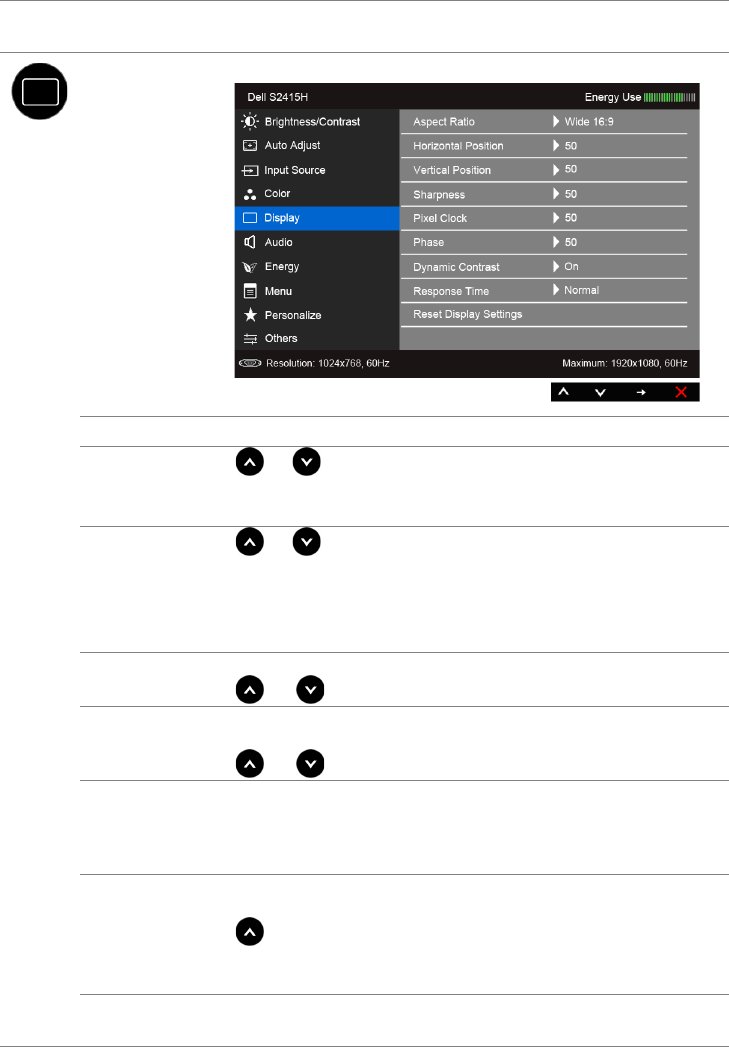
Display Use the Display menu to adjust image.
Aspect Ratio Adjusts the image ratio to Wide 16:9, 4:3, or 5:4.
Horizontal
Position
Use or to adjust the image left or right.
Minimum is '0' (-).
Maximum is '100' (+).
Vertical
Position
Use or to adjust the image up or down.
Minimum is '0' (-).
Maximum is '100' (+).
NOTE: Horizontal Position and Vertical Position adjustments are only
available for "VGA" input.
Sharpness This feature can make the image look sharper or softer.
Use or to adjust the sharpness from '0' to '100'.
Pixel Clock The Phase and Pixel Clock adjustments allow you to adjust your monitor
to your preference.
Use or to adjust for best image quality.
Phase If satisfactory results are not obtained using the Phase adjustment, use
the Pixel Clock (coarse) adjustment and then use Phase (fine) again.
NOTE: Pixel Clock and Phase adjustments are only available for "VGA"
input.
Dynamic
Contrast
Allows you to increase the level of contrast to provide sharper and more
detailed image quality.
Use to select the Dynamic Contrast "On" or "Off".
NOTE: Dynamic Contrast provides higher contrast if you select Game
or Movie preset mode.
Response
Time
Allows you to set the Response Time to Normal or Fast.
book.book Page 34 Wednesday, October 7, 2015 9:21 AM
Operating the Monitor | 35
Reset
Display
Settings
Select this option to restore default display settings.
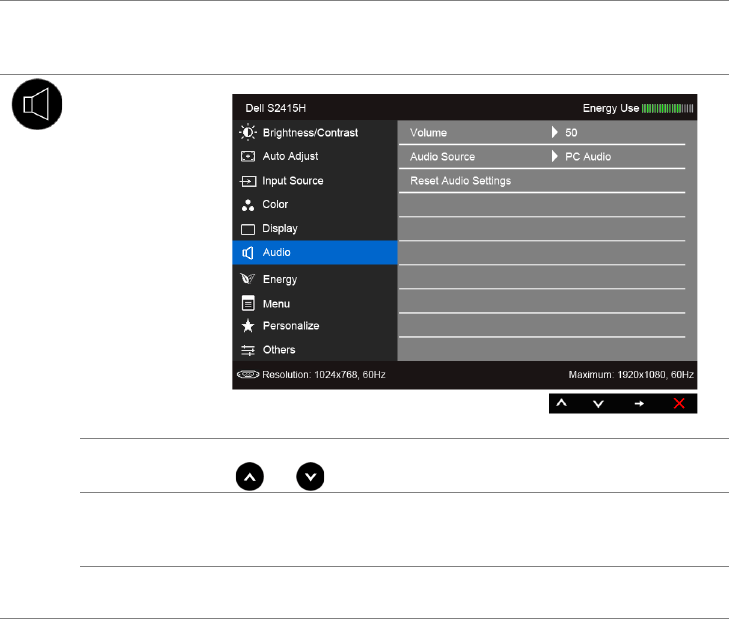
Audio
Volume Allows you to set the volume level of audio source.
Use or to adjust the volume level from '0' to '100'.
Audio
Source
Allows you to set the audio source to PC Audio or HDMI (MHL).
NOTE: Audio Source option is only available when you are using the
HDMI (MHL) connector.
Reset Audio
Settings
Select this option to restore default audio settings.
book.book Page 35 Wednesday, October 7, 2015 9:21 AM
36 | Operating the Monitor
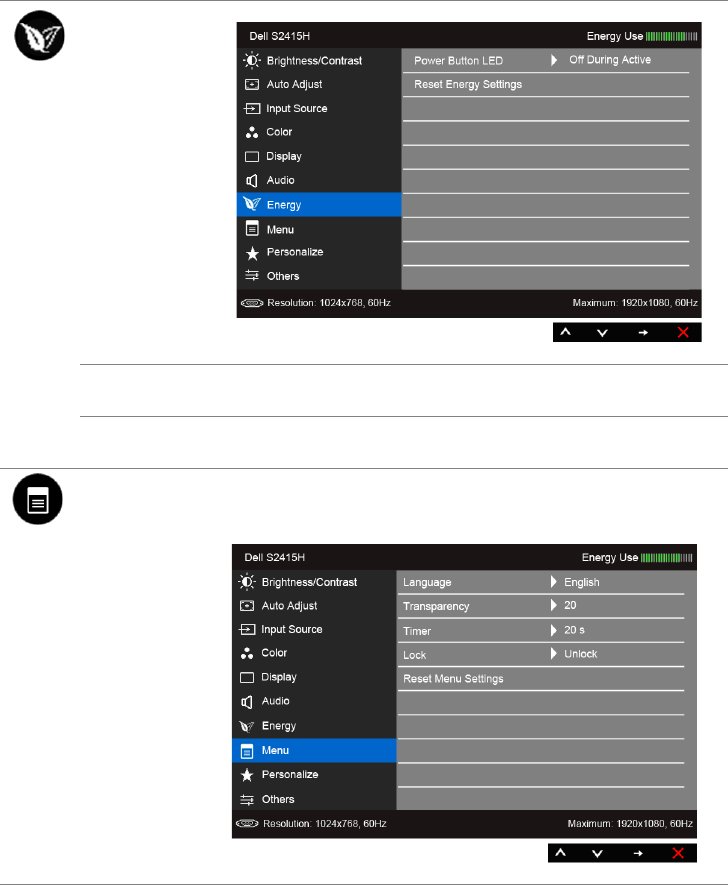
Energy
Power Button
LED
Allows you to set the power LED indicator On or Off to save energy.
Reset Energy
Settings
Select this option to restore default Energy settings.
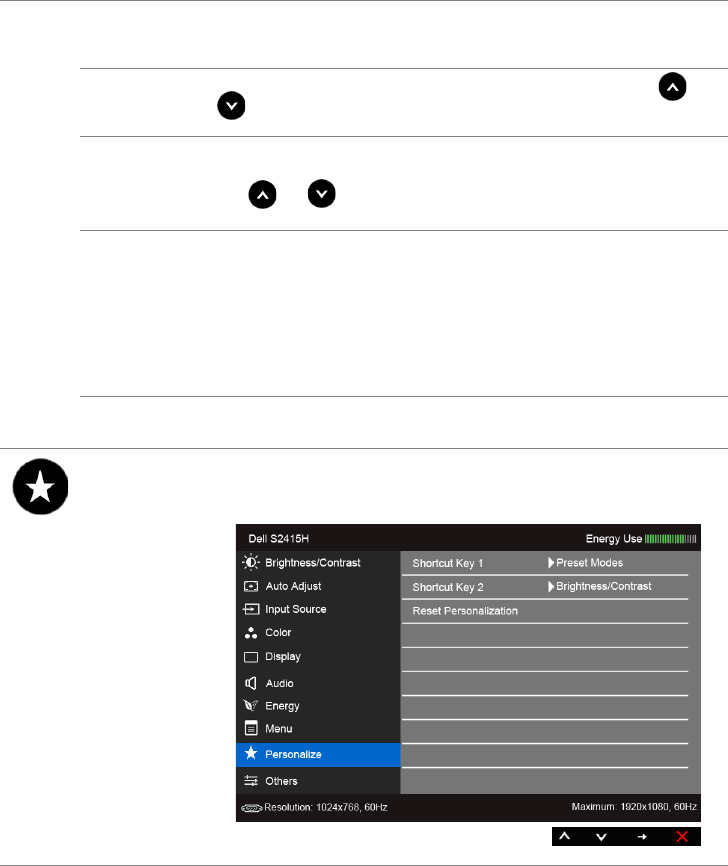
Menu Select this option to adjust the settings of the OSD, such as, the
languages of the OSD, the amount of time the menu remains on
screen, and so on.
book.book Page 36 Wednesday, October 7, 2015 9:21 AM
Operating the Monitor | 37
Language Language options set the OSD display to one of the eight languages
(English, Spanish, French, German, Brazilian Portuguese, Russian,
Simplified Chinese, or Japanese).
Transparency Select this option to change the menu transparency by using and
(min. 0 / max. 100).
Timer OSD Hold Time: sets the length of time the OSD will remain active
after the last time you pressed a button.
Use or to adjust the slider in 1 second increments, from 5 to
60 seconds.
Lock Controls user access to adjustments. When Lock is selected, no user
adjustments are allowed. All buttons are locked.
NOTE:
Lock function – Either soft lock (through the OSD menu) or hard lock
(press and hold the button beside the power button for 10 seconds)
Unlock function – Only hard unlock (press and hold the button beside
the power button for 10 seconds)
Reset Menu
Settings
Reset all OSD settings to the factory preset values.
Personalize Users can choose a feature from Preset Modes, Brightness/Contrast,
Auto Adjust, Input Source, Aspect Ratio, or Volume and set it as a
shortcut key.
book.book Page 37 Wednesday, October 7, 2015 9:21 AM
38 | Operating the Monitor
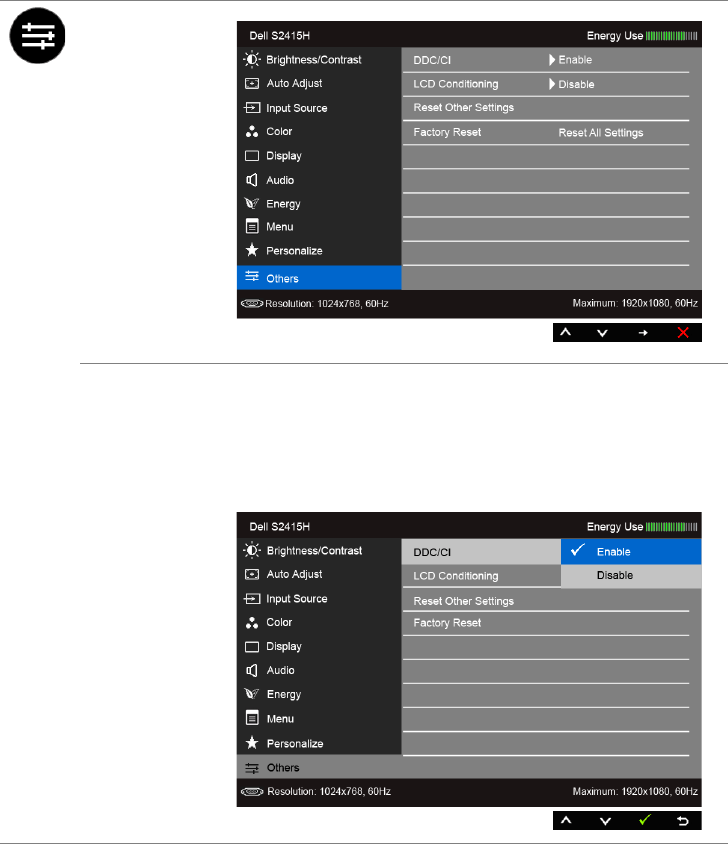
Others
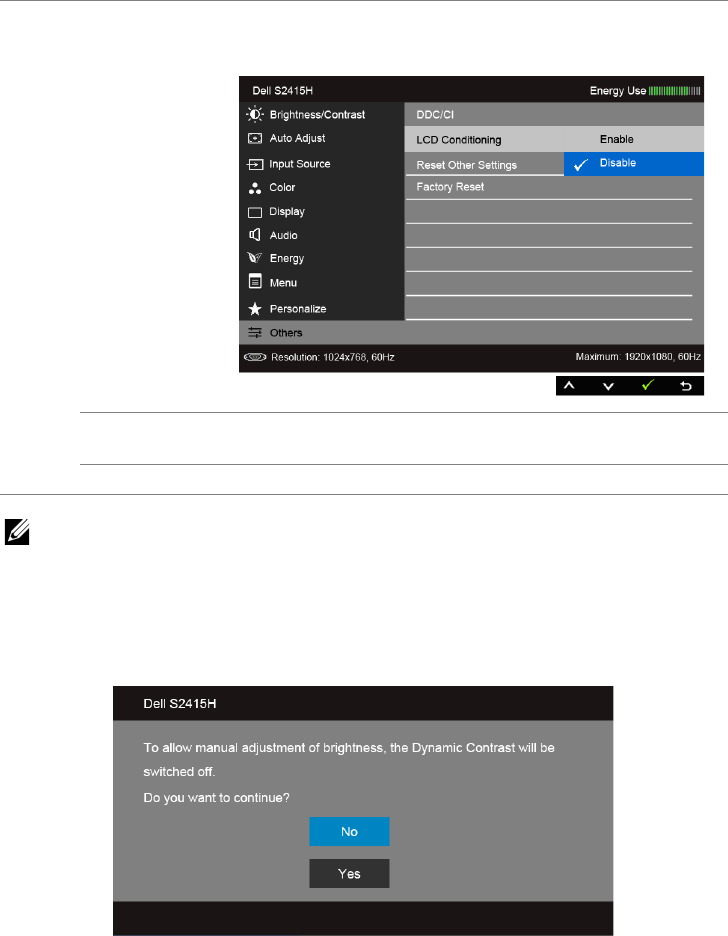
DDC/CI DDC/CI (Display Data Channel/Command Interface) allows your
monitor parameters (brightness, color balance, and etc.) to be
adjustable via the software on your computer.
You can disable this feature by selecting Disable.
Enable this feature for best user experience and optimum
performance of your monitor.
book.book Page 38 Wednesday, October 7, 2015 9:21 AM
Operating the Monitor | 39
NOTE: This monitor has a built-in feature to automatically calibrate the brightness
to compensate for LED aging.
OSD Warning Messages
When the Dynamic Contrast feature is enabled (in these preset modes: Game or Movie),
manual brightness adjustment is disabled.
LCD
Conditioning
Helps reduce minor cases of image retention. Depending on the
degree of image retention, the program may take some time to run.
You can enable this feature by selecting Enable.
Reset Other
Settings
Reset all settings under the Others menu to the factory preset values.
Factory Reset Reset all settings to the factory preset values.
book.book Page 39 Wednesday, October 7, 2015 9:21 AM
40 | Operating the Monitor
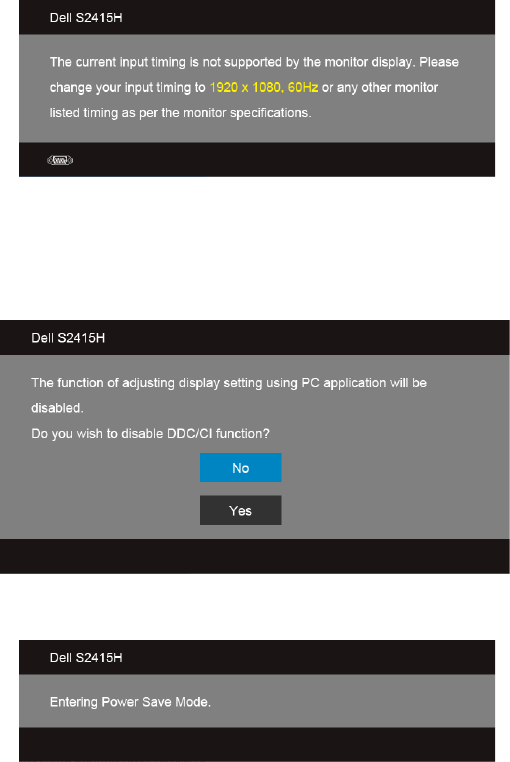
When the monitor does not support a particular resolution mode, you will see the
following message:
This means that the monitor cannot synchronize with the signal that it is receiving from
the computer. See
Monitor Specifications
for the Horizontal and Vertical frequency
ranges addressable by this monitor. Recommended mode is 1920 x 1080.
You will see the following message before the DDC/CI function is disabled:
When the monitor enters the Power Save mode, the following message appears:
Activate the computer and wake up the monitor to gain access to the
OSD
.
If you press any button other than the power button, one of the following messages will
appear depending on the selected input:
book.book Page 40 Wednesday, October 7, 2015 9:21 AM
42 | Operating the Monitor
Setting the Maximum Resolution
To set the maximum resolution for the monitor:
In Windows® 7, Windows® 8, and Windows® 8.1:
1For Windows® 8 and Windows® 8.1 only, select the Desktop tile to switch to classic
desktop.
2Right-click on the desktop and click Screen Resolution.
3Click the Dropdown list of the Screen Resolution and select 1920 x 1080.
4Click OK.
In Windows® 10:
1Right-click on the desktop and click Display settings.
2Click Advanced display settings.
3Click the dropdown list of Resolution and select 1920 x 1080.
4Click Apply.
If you do not see 1920 x 1080 as an option, you may need to update your graphics driver.
Depending on your computer, complete one of the following procedures:
If you have a Dell desktop or portable computer:
•Go to http://www.dell.com/support, enter your service tag, and download the
latest driver for your graphics card.
If you are using a non-Dell computer (portable or desktop):
•Go to the support site for your computer and download the latest graphic drivers.
•Go to your graphics card website and download the latest graphic drivers.
book.book Page 42 Wednesday, October 7, 2015 9:21 AM
Operating the Monitor | 43
Using Tilt
NOTE: This is applicable for a monitor with a stand. When any other stand is
bought, please refer to the respective stand setup guide for set up instructions.
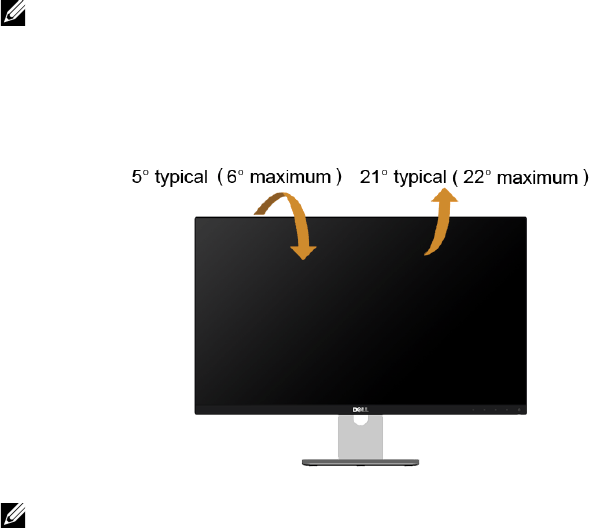
Tilt
With the stand attached to the monitor, you can tilt the monitor for the most
comfortable viewing angle.
NOTE: The stand is detached when the monitor is shipped from the factory.
book.book Page 43 Wednesday, October 7, 2015 9:21 AM
44 | Troubleshooting
Troubleshooting
WARNING: Before you begin any of the procedures in this section, follow the
Safety Instructions
.
Self-Test
Your monitor provides a self-test feature that allows you to check whether your monitor
is functioning properly. If your monitor and computer are properly connected but the
monitor screen remains dark, run the monitor self-test by performing the following
steps:
1Turn off both your computer and the monitor.
2Unplug the video cable from the back of the computer. To ensure proper Self-Test
operation, remove all Digital and the Analog cables from the back of computer.
3Turn on the monitor.
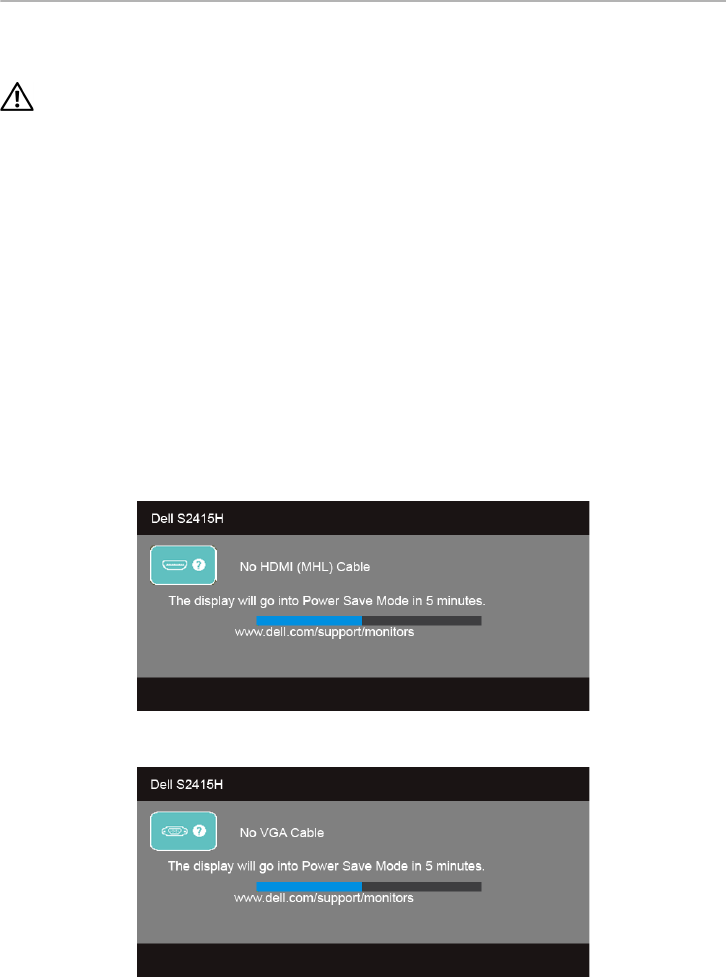
The floating dialog box should appear on-screen (against a black background), if the
monitor cannot sense a video signal and is working correctly. While in self-test mode, the
power LED remains white. Also, depending upon the selected input, one of the dialogs
shown below will continuously scroll through the screen.
or
book.book Page 44 Wednesday, October 7, 2015 9:21 AM
Troubleshooting | 45
4This box also appears during normal system operation, if the video cable becomes
disconnected or damaged.
5Turn Off your monitor and reconnect the video cable; then turn On both your
computer and the monitor.
If your monitor screen remains blank after you use the previous procedure, check your
video controller and computer, because your monitor is functioning properly.
Built-in Diagnostics
Your monitor has a built-in diagnostic tool that helps you determine if the screen
abnormality you are experiencing is an inherent problem with your monitor, or with your
computer and video card.
NOTE: You can run the built-in diagnostics only when the video cable is unplugged
and the monitor is in self-test mode.
To run the built-in diagnostics:
1Make sure that the screen is clean (no dust particles on the surface of the screen).
2Unplug the video cable(s) from the back of the computer or monitor. The monitor
then goes into the self-test mode.
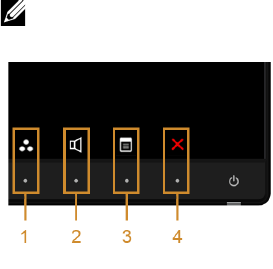
3Press and hold Button 1 and Button 4 on the front panel simultaneously for 2
seconds. A gray screen appears.
4Carefully inspect the screen for abnormalities.
5Press Button 4 on the front panel again. The color of the screen changes to red.
6Inspect the display for any abnormalities.
7Repeat steps 5 and 6 to inspect the display in green, blue, black, white, and text
screens.
The test is complete when the text screen appears. To exit, press Button 4 again.
If you do not detect any screen abnormalities upon using the built-in diagnostic tool, the
monitor is functioning properly. Check the video card and computer.
book.book Page 45 Wednesday, October 7, 2015 9:21 AM

46 | Troubleshooting
Common Problems
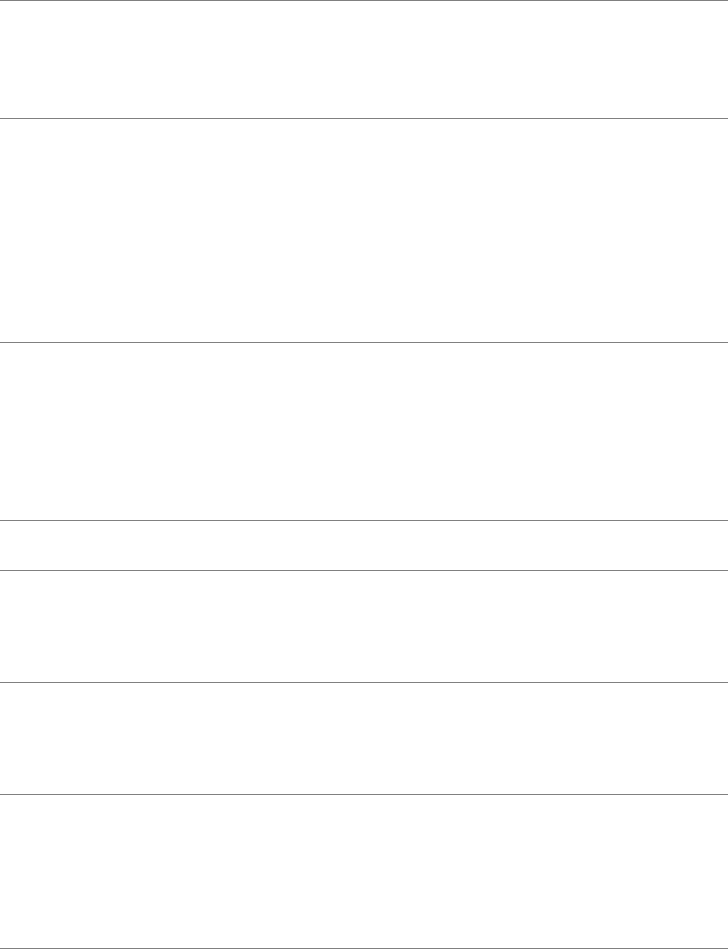
The following table contains general information about common monitor problems you
might encounter and the possible solutions:
Common
Symptoms
What You
Experience
Possible Solutions
No Video/Power
LED off
No picture •Ensure that the video cable connecting the monitor and
the computer is properly connected and secure.
•Verify that the power outlet is functioning properly using
any other electrical equipment.
•Ensure that the power button is depressed fully.
•Ensure that the correct input source is selected in the
Input
Source
menu.
No Video/Power
LED on
No picture or no
brightness
•Increase brightness & contrast controls via OSD.
•Perform monitor self-test feature check.
•Check for bent or broken pins in the video cable
connector.
•Run the built-in diagnostics.
•Ensure that the correct input source is selected in the
Input
Source
menu.
Poor Focus Picture is fuzzy,
blurry, or
ghosting
•Perform Auto Adjust via OSD.
•Adjust the Phase and Pixel Clock controls via OSD.
•Eliminate video extension cables.
•Reset the monitor to factory settings.
•Change the video resolution to the correct aspect ratio.
Shaky/Jittery
Video
Wavy picture or
fine movement
•Perform Auto Adjust via OSD.
•Adjust the Phase and Pixel Clock controls via OSD.
•Reset the monitor to factory settings.
•Check environmental factors.
•Relocate the monitor and test in another room.
Missing Pixels LCD screen has
spots
•Cycle power On-Off.
•Pixel that is permanently Off is a natural defect that can
occur in LCD technology.
•For more information on Dell Monitor Quality and Pixel
Policy, see Dell Support site at: http://www.dell.com/
support/monitors.
Stuck-on Pixels LCD screen has
bright spots
•Cycle power On-Off.
•Pixel that is permanently off is a natural defect that can
occur in LCD technology.
•For more information on Dell Monitor Quality and Pixel
Policy, see Dell Support site at: http://www.dell.com/
support/monitors.
Brightness
Problems
Picture too dim
or too bright
•Reset the monitor to factory settings.
• Auto Adjust via OSD.
•Adjust brightness & contrast controls via OSD.
book.book Page 46 Wednesday, October 7, 2015 9:21 AM
Troubleshooting | 47
Geometric
Distortion
Screen not
centered
correctly
•Reset the monitor to factory settings.
• Auto Adjust via OSD.
•Adjust horizontal & vertical controls via OSD.
NOTE: When using HDMI input, the positioning adjustments
are not available.
Horizontal/
Vertical Lines
Screen has one
or more lines
•Reset the monitor to factory settings.
•Perform Auto Adjust via OSD.
•Adjust Phase and Pixel Clock controls via OSD.
•Perform monitor self-test feature check and determine if
these lines are also in self-test mode.
•Check for bent or broken pins in the video cable
connector.
•Run the built-in diagnostics.
NOTE: When using HDMI input, the Pixel Clock and Phase
adjustments are not available.
Synchronization
Problems
Screen is
scrambled or
appears torn
•Reset the monitor to factory settings.
•Perform Auto Adjust via OSD.
•Adjust Phase and Pixel Clock controls via OSD.
•Perform monitor self-test feature check to determine if the
scrambled screen appears in self-test mode.
•Check for bent or broken pins in the video cable
connector.
•Restart the computer in Safe Mode.
Safety Related
Issues
Visible signs of
smoke or sparks
•Do not perform any troubleshooting steps.
•Contact Dell immediately.
Intermittent
Problems
Monitor
malfunctions on
& off
•Ensure that the video cable connecting the monitor to the
computer is connected properly and is secure.
•Reset the monitor to factory settings.
•Perform monitor self-test feature check to determine if the
intermittent problem occurs in self-test mode.
Missing Color Picture missing
color
•Perform monitor self-test.
•Ensure that the video cable connecting the monitor to the
computer is connected properly and is secure.
•Check for bent or broken pins in the video cable
connector.
Wrong Color Picture color not
good
•Change the settings of the Preset Modes in the Color
menu OSD depending on the application.
•Adjust R/G/B value under Custom Color in Color menu
OSD.
•Change the Input Color Format to PC RGB or YPbPr in the
Color menu OSD.
•Run the built-in diagnostics.
book.book Page 47 Wednesday, October 7, 2015 9:21 AM

48 | Troubleshooting
Product Specific Problems
Image retention
from a static
image left on the
monitor for a
long period of
time
Faint shadow
from the static
image displayed
appears on the
screen
•Use the Power Management feature to turn off the
monitor at all times when not in use (for more information,
see
Power Management Modes
).
•Alternatively, use a dynamically changing screensaver.
Specific
Symptoms
What You
Experience
Possible Solutions
Screen image is
too small
Image is
centered on
screen, but does
not fill entire
viewing area
•Check the Aspect Ratio setting in the Display menu OSD.
•Reset the monitor to factory settings.
Cannot adjust
the monitor
with the
buttons on the
front panel
OSD does not
appear on the
screen
•Turn Off the monitor, unplug the monitor power cable, plug
it back, and then turn On the monitor.
•Check whether the OSD menu is locked. If yes, press and
hold the button beside the Power button for 10 seconds to
unlock (for more information, see
Lock
).
No Input Signal
when user
controls are
pressed
No picture, the
LED light is white
•Check the signal source. Ensure the computer is not in the
power saving mode by moving the mouse or pressing any
key on the keyboard.
•Check whether the signal cable is plugged in properly. Re-
plug the signal cable if necessary.
•Reset the computer or video player.
The picture
does not fill the
entire screen
The picture
cannot fill the
height or width
of the screen
•Due to different video formats (aspect ratio) of DVDs, the
monitor may display in full screen.
•Run the built-in diagnostics.
book.book Page 48 Wednesday, October 7, 2015 9:21 AM
Troubleshooting | 49
Mobile High-Definition Link (MHL) Specific Problems
Speakers Specific Problems
Specific
Symptoms
What You
Experience
Possible Solutions
MHL interface
is not working
Can not see MHL
device image
shown on the
monitor
•Ensure your MHL cable and MHL device are MHL certified.
•Check your MHL device is turned On.
•Check your MHL device is not in Standby mode.
•Check physical MHL cable connection is corresponding to
input source selected on OSD Menu: HDMI (MHL).
•Wait for 30 seconds after connecting MHL cable as some
MHL devices require longer recovery time.
Specific
Symptoms
What You
Experience
Possible Solutions
No sound
coming from
the speakers
Cannot hear any
sound
•Turn Off the monitor, unplug the monitor power cord,
replug it, and then turn On the monitor.
•Check the audio cable connection is connected correctly
to the computer Audio Line Out port.
•Unplug the headphone jack from the headphone port.
•Reset the monitor to factory settings.
book.book Page 49 Wednesday, October 7, 2015 9:21 AM
50 | Appendix
Appendix
WARNING: Safety Instructions
WARNING: Use of controls, adjustments, or procedures other than those
specified in this documentation may result in exposure to shock, electrical
hazards, and/or mechanical hazards.
For information on safety instructions, see the Product Information Guide.
FCC Notices (U.S. Only) and Other Regulatory
Information
For FCC notices and other regulatory information, see the regulatory compliance
website located at www.dell.com/regulatory_compliance.
Contact Dell
NOTE: If you do not have an active Internet connection, you can find contact
information on your purchase invoice, packing slip, bill, or Dell product catalog.
Dell provides several online and telephone-based support and service options.
Availability varies by country and product, and some services may not be available in your
area.
To get online Monitor support content:
1Visit www.dell.com/support/monitors.
To contact Dell for sales, technical support, or customer service issues:
1Visit www.dell.com/support.
2Verify your country or region in the Choose A Country/Region drop-down menu at
the top-left corner of the page.
3Click Contact Us next to the country dropdown.
4Select the appropriate service or support link based on your need.
5Choose the method of contacting Dell that is convenient for you.
book.book Page 50 Wednesday, October 7, 2015 9:21 AM

Appendix | 51
Setting Up Your Monitor
Setting the display resolution
For maximum display performance with Microsoft® Windows® operating systems, set
the display resolution to 1920 x 1080 pixels by performing the following steps:
In Windows® 7, Windows® 8, and Windows® 8.1:
1For Windows® 8 and Windows® 8.1 only, select the Desktop tile to switch to classic
desktop.
2Right-click on the desktop and click Screen Resolution.
3Click the Dropdown list of the Screen Resolution and select 1920 x 1080.
4Click OK.
In Windows® 10:
1Right-click on the desktop and click Display settings.
2Click Advanced display settings.
3Click the dropdown list of Resolution and select 1920 x 1080.
4Click Apply.
If you do not see the recommended resolution as an option, you may need to update
your graphics driver. Please choose the scenario below that best describes the computer
system you are using, and follow the given steps.
If you have a Dell™ desktop or a Dell™ portable computer with
internet access
1Go to www.dell.com/support, enter your service tag, and download the latest
driver for your graphics card.
2After installing the drivers for your graphics adapter, attempt to set the resolution to
1920 x 1080 again.
NOTE: If you are unable to set the resolution to 1920 x 1080, please contact Dell™
to inquire about a graphics adapter that supports these resolutions.
If you have a non Dell™ desktop, portable computer, or graphics
card
In Windows® 7, Windows® 8, and Windows® 8.1:
1For Windows® 8 and Windows® 8.1 only, select the Desktop tile to switch to classic
desktop.
2Right-click on the desktop and click Personalization.
3Click Change Display Settings.
4Click Advanced Settings.
5Identify your graphics controller supplier from the description at the top of the
window (e.g. NVIDIA, ATI, Intel etc.).
book.book Page 51 Wednesday, October 7, 2015 9:21 AM
52 | Appendix
6Refer to the graphic card provider website for updated driver (for example,
http://www.ATI.com OR http://www.NVIDIA.com).
7After installing the drivers for your graphics adapter, attempt to set the resolution to
1920 x 1080 again.
In Windows® 10:
1Right-click on the desktop and click Display settings.
2Click Advanced display settings.
3Click the dropdown list of Resolution and select 1920 x 1080.
4Identify your graphics controller supplier from the description at the top of the
window (e.g. NVIDIA, ATI, Intel etc.).
5Refer to the graphic card provider website for updated driver (for example,
http://www.ATI.com OR http://www.NVIDIA.com).
6After installing the drivers for your graphics adapter, attempt to set the resolution to
1920 x 1080 again.
NOTE: If you are unable to set the recommended resolution, please contact the
manufacturer of your computer or consider purchasing a graphics adapter that will
support the video resolution.
book.book Page 52 Wednesday, October 7, 2015 9:21 AM
