Dixon Speedztr 968999545 Users Manual OM, 30, 2007, ZERO TURN
SpeedZTR 968999545 DIXO2007_USen_118736_
968999545 to the manual 5c3b9408-0525-4595-9fc3-bcb241a9736b
2015-02-04
: Dixon Dixon-Speedztr-968999545-Users-Manual-514315 dixon-speedztr-968999545-users-manual-514315 dixon pdf
Open the PDF directly: View PDF  .
.
Page Count: 48
Safety Instructions
and
Operator’s Manual
968999545
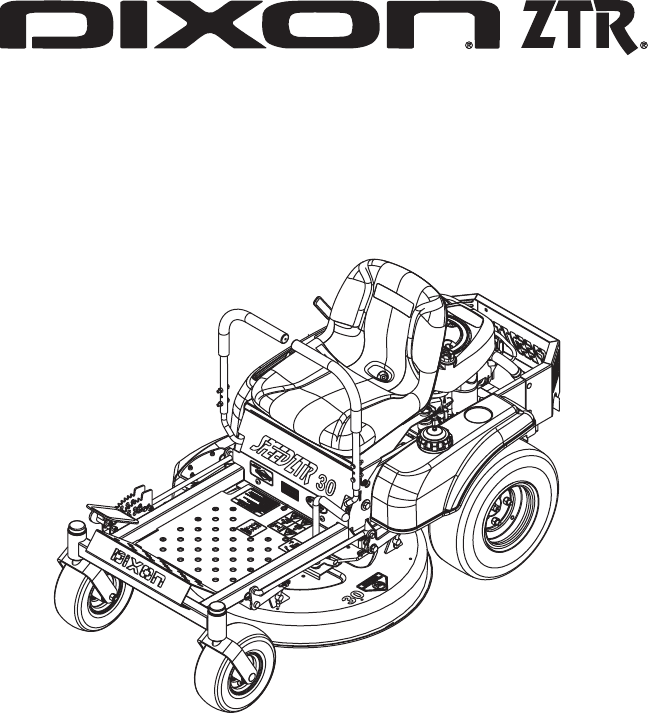
SPEEDZTR
™
30
ZTR
®
2
IMPORTANT - READ CAREFULLY
The Dixon ZTR mower is both easy and fun to operate.
However, any power mower must be operated properly
to be safe. It is not a toy or a recreational vehicle.
Before you use the mower, read this Operator’s Manual
carefully. It contains valuable information that is
necessary for the safe operation of the machine.
Observe all safety rules and become completely
familiar with the controls.
The information contained in this manual applies to all
Dixon ZTR SpeedZTR™30 mowers.
See your authorized Dixon dealer for warranty service,
parts and repairs or to answer questions you have
about your new Dixon ZTR.

3
TABLE OF CONTENTS
Page
SAFETY & WARNING ............................................. 4-15
WARRANTY ............................................................... 16
SPECIFICATIONS...................................................... 17
CONTROLS........................................................... 18-20
OPERATION INSTRUCTIONS..............................21-31
CARE & MAINTENANCE ...................................... 32-43
TROUBLESHOOTING .......................................... 44-45
STANDARD SERVICE PARTS LIST ......................... 46
SpeedZTR™ 30
Part Number 118736
SAFETY
4
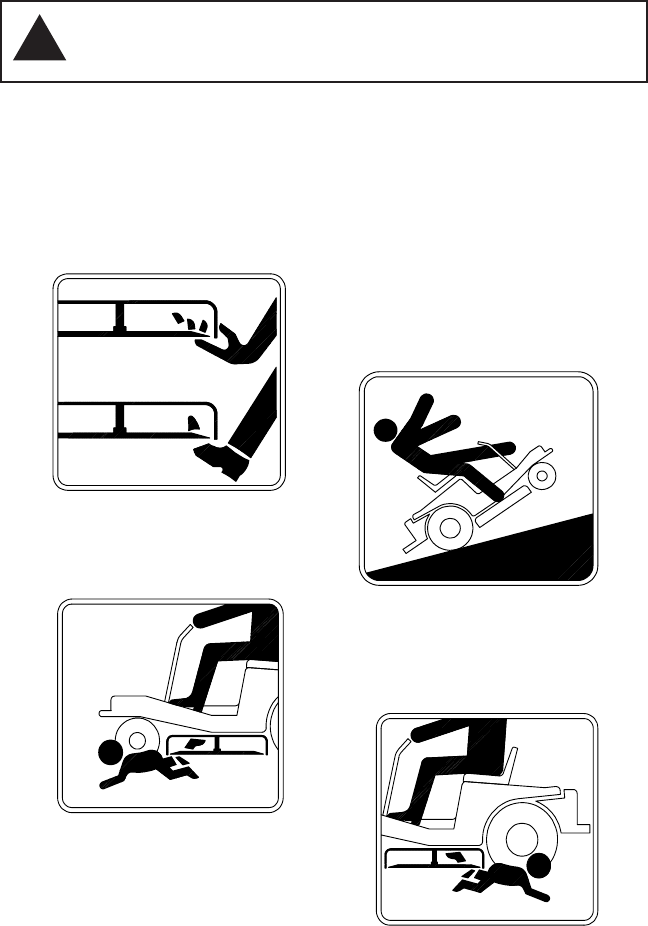
Blade Contact
Tip Over
Run Over
Back Over
Pictured below are the most common causes of injury
to the operator or bystander. Please read and
understand this manual to prevent injuries.
WARNING
!Riding lawn movers, if improperly operated,
can cause serious injury or death.
SAFETY
5
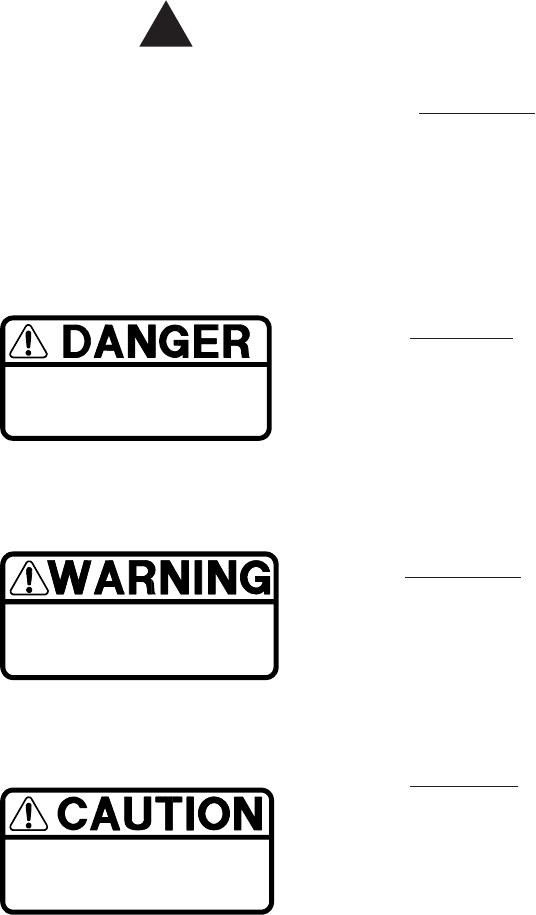
Safety Alert Symbol
When you see this symbol, BE ALERT
to the potential for injury.
Follow the recommended safety precautions and
safe operating practices.
DANGER
(highlighted in red)
indicates an imminently hazardous
situation which, if not avoided, will result
in death or serious injury.
WARNING
(highlighted in orange)
indicates a potentially
hazardous situation which, if not
avoided, could result in death or
serious injury.
CAUTION
(highlighted in yellow)
indicates a potentially
hazardous situation which,
if not avoided, may result in minor
or moderate injury. It may also
be used to alert against
unsafe practices.
!

WARNING
6
GENERAL OPERATION:
Read, understand, and follow all instructions in this
manual and on the mower before starting.
In this operator’s manual, left and right, backward and
forward are used in relation to the machine’s normal
driving direction.
Only allow responsible adults, who are familiar with the
instructions, to operate the mower.
Clear the area of objects such as rocks, toys, wire, etc.,
which could be picked up and thrown by the blade.
Be sure the area is clear of bystanders before mowing.
Stop mower if anyone enters the area.
Never direct discharged material toward anyone. Avoid
discharging against a wall or obstruction. Material may
ricochet back toward the operator. Stop the blade(s)
when crossing gravel surfaces.
Do not operate the mower without either the entire
grass catcher or the deflector in place. This will
decrease the possibility of injury from objects being
thrown by the mower blades.
Never carry passengers.
Do not mow in reverse unless absolutely necessary.
Always look down and behind before and while
backing.
WARNING
!Failure to observe the following instructions
could result in serious injury or death.

WARNING
7
GENERAL OPERATION (continued):
Never leave a running mower unattended. Always turn
off blades, set Park Brake, stop engine and remove key
before dismounting.
Do not put hands or feet near rotating parts or under
the machine. Keep clear of the discharge opening at all
times.
Disengage blade(s) when not mowing. Shut off engine
and wait for all parts to come to a complete stop before
cleaning the machine, removing the grass catcher, or
unclogging the discharge guard.
Mow only in daylight or good artificial light.
Do not operate the mower while under the influence of
alcohol or drugs.
Slow down before turning to reduce the risk of tip-over.
Watch for traffic when operating near or crossing
roadways.
Use extra care when loading or unloading the mower
into a trailer or truck.
WARNING
!Failure to observe the following instructions
could result in serious injury or death.

WARNING
8
GENERAL OPERATION (continued):
Always wear eye protection when operating machine.
Data indicates that operators, age 60 years and above,
are involved in a large percentage of riding mower-
related injuries. These operators should evaluate their
ability to operate the riding mower safely enough to
protect themselves and others from serious injury.
Follow the manufacturer’s recommendation for wheel
weights and counterweights.
The engine exhaust from this product contains chemicals
known to the State of California to cause cancer, birth de-
fects or other reproductive harm.
WARNING
!Failure to observe the following instructions
could result in serious injury or death.

WARNING
9
SLOPE OPERATION:
Slopes are a major factor related to loss-of-con-
trol and tip-over accidents, which can result in
severe injury or death.
All slopes require extra caution. If you feel unsure
on any slope, do not mow it!
DO
Mow across the slope with your Dixon ZTR -- never up
or down. This will decrease the risk of tip-over.
Remove obstacles such as rocks, tree limbs, wires and
other foreign objects that can be thrown by mower
blades.
Watch for holes, ruts, roots and bumps and uneven
terrain that could overturn the mower. Tall grass can
hide such obstacles.
Use slow speed. Tires may lose traction on slopes even
though the brakes are functioning properly.
Avoid starting or stopping on a slope. If tires lose
traction, disengage the blades and proceed slowly
down the slope.
WARNING
!Failure to observe the following instructions
could result in serious injury or death.

WARNING
10
SLOPE OPERATION (continued):
DO
Keep all movement on the slopes slow and gradual. Do
not make sudden changes in speed or direction.
Use extreme caution when operating the mower with
attachments to prevent tip-over or roll-over.
If front wheels lift off the ground, pull levers back to
stabilize the mower. Discontinue mowing the slope!
WARNING
!Failure to observe the following instructions
could result in serious injury or death.

WARNING
11
SLOPE OPERATION (continued):
DO NOT
Do not turn on slopes unless necessary, and then, turn
slowly and gradually downhill, if possible. Rapid uphill
turns may cause tip-over.
Do not mow near drop-offs, ditches, or embankments.
Unstable ground may cause loss of control.
Do not mow on wet grass. Reduced traction could
cause sliding.
Do not try to stabilize the mower by putting your foot on
the ground.
Do not use grass catcher or other attachments on steep
slopes. The added weight may change the stability of
the mower thus creating the potential for tip-over.
WARNING
!Failure to observe the following instructions
could result in serious injury or death.

WARNING
12
FIRE HAZARDS:
Use extra care when handling gasoline and other fuels.
They are flammable and vapors are explosive.
Store all fuel in approved containers specifically
designed for that purpose.
Allow engine to cool before refueling. Never remove
fuel cap or add fuel with engine running.
Do not smoke while refueling or operating the mower.
To reduce fire hazard, keep mower free of grass,
leaves and other debris buildup.
If gasoline is spilled, do not attempt to start the
engine. Move mower away from the area of the spill.
Do not create any source of ignition until gas vapors
have dissipated. Wipe up spilled fuel and dispose of
waste properly.
If fuel is spilled on clothing, change clothing
immediately.
Before storing, allow mower to cool. Clean fuel and oil
spillage.
Never store the mower or fuel container inside a
building where there is an open flame.
WARNING
!Failure to observe the following instructions
could result in serious injury or death.

WARNING
13
FIRE HAZARDS (continued):
To prevent fire or explosion, keep sparks and open
flames away from battery.
Keep electrical connections clean and tight. Inspect
them often. Loose connections and corrosion increase
fire risk.
Before disconnecting the negative ground cable, make
sure all switches are off. This decreases the chance of
sparking and fire.
Use care when backing to avoid pushing the grass
bags into the frame or “hot” exhaust muffler of the
engine. Fire could result.
To prevent fire and explosion caused by static electricity:
Never fill containers inside a vehicle or on a truck or
trailer bed with a plastic liner. Always place containers
on the ground away from your vehicle before filling.
When practical, remove fuel powered equipment from
the truck or trailer and refuel it on the ground. If this is
not possible, refuel such equipment on a trailer with a
portable container, rather than from a fuel dispenser
nozzle.
If a fuel dispenser nozzle must be used, keep the
nozzle in contact with the rim of the fuel tank or
container opening at all times until fueling is complete.
Do not use a nozzle lock-open device.
WARNING
!Failure to observe the following instructions
could result in serious injury or death.

WARNING
14
CHILDREN, BYSTANDERS AND PETS:
Tragic accidents can occur if the operator is not alert
to the presence of children, bystanders and pets.
Children are attracted to lawn mowers
and the mowing activity.
NEVER assume children, bystanders and pets
will stay where they were last seen.
Be alert to avoid accidents.
Keep bystanders and pets out of the mowing area and
keep children under the watchful care of another
responsible adult.
Be alert and turn mower off if bystanders, children or
pets enter the area.
Before and during backing look BEHIND and DOWN for
small children.
Never carry children as passengers. They may fall off
and be seriously injured or interfere with safe mower
operation.
Never allow children to operate the mower.
Use extra care when approaching blind corners,
shrubs, trees, or other objects that may obscure vision.
WARNING
!Failure to observe the following instructions
could result in serious injury or death.

WARNING
15
SERVICE:
Never run a mower inside a closed area or without
proper ventilation.
Keep nuts and bolts tight, especially blade attachment
bolts, and keep equipment in good condition.
Never tamper with safety devices. Check their proper
operation regularly.
Stop and inspect the equipment if you strike an object.
Repair, if necessary, before restarting.
Never make adjustments or repairs with the engine
running unless otherwise specified.
Grass catcher components are subject to wear,
damage and deterioration that could expose moving
parts or allow objects to be thrown. Frequently check
components. Replace with original equipment parts
when necessary.
When servicing blades, wrap blades or wear gloves,
and use extra caution.
Batteries contain sulfuric acid. To prevent burns, avoid
contact with skin, eyes and clothing.
WARNING
!Failure to observe the following instructions
could result in serious injury or death.

16
DIXON® WARRANTS ITS ZTR® MOWERS AGAINST DEFECTS IN MATERIAL AND
WORKMANSHIP FOR THE PERIODS SET FORTH BELOW. THE SOLE REMEDY UNDER THIS
WARRANTY IS REPLACEMENT OR REPAIR OF PARTS INCLUDING LABOR COSTS.
THIS WARRANTY IS SUBJECT TO THE FOLLOWING CONDITIONS AND LIMITATIONS:
1. RESIDENTIAL APPLICATION - (used only at owner’s primary place of residence):
a. Two Years - 100% parts and labor subject to the conditions and limitations described
herein for a period of two years from date of purchase by the original owner.
b. Third year - limited to 100% parts cost as shown in the current Dixon® Parts Price List and
subject to the conditions and limitations as described herein.
c. Attachments marketed through or approved by Dixon are warranted for two years parts and
labor in residential use applications.
2. NOT APPROVED FOR COMMERCIAL USE.
3. Lifetime warranty on all frames and leading edge of all fabricated (welded) decks
(SPEEDZTR™ 36 & 44 only).
4. All Dixon® warranty must be accomplished by authorized Dixon® dealers and in accordance
with Dixon® warranty policy and allowances. All warranty claims must be submitted to Dixon
for approval.
5. Warranty applies to new and unused mowers and is transferable within the stated time frame
to a second owner.
6. Warranty labor reimbursement to dealers based on published Dixon® flat rate schedule.
7. Warranty does not apply to damage in transit or incidents of misuse, negligence, accidents, or
alteration. The use of parts or components other than those supplied by Dixon VOIDS ALL
WARRANTY.
8. Battery warranty is limited to 1 year from mower manufacture date.
9. The following items are not covered by this warranty policy:
(a) Routine maintenance or adjustments to include any oils, filters or other fluids used.
(b) Belts, blades, tires and cosmetic appearance (paint, seat fade, etc.)
(c) Pick up and delivery charges for transportation of mower to and from an authorized Dixon®
dealer’s place of business.
(d) Engines. These are covered under a separate warranty by each individual engine
manufacturer. Consult engine manual for warranty details.
(e) Any costs or expense of providing substitute equipment while repair work is being
performed on a warranted mower.
10. THERE IS NO OTHER EXPRESS WARRANTY. TO THE EXTENT PERMITTED BY LAW, ALL
IMPLIED WARRANTIES, INCLUDING THOSE OF MERCHANTABILITY AND FITNESS FOR
A PARTICULAR PURPOSE ARE EXCLUDED, OTHERWISE, ALL SUCH IMPLIED
WARRANTIES ARE LIMITED TO THE SAME DURATION AND REMEDIES AS THE
EXPRESS WARRANTY. ALL LIABILITIES FOR CONSEQUENTIAL DAMAGES UNDER ANY
EXPRESS OR IMPLIED WARRANTY ARE EXCLUDED.
DIXON® ZTR® RESIDENTIAL WARRANTY POLICY
SpeedZTR™ & RAM 42 - Residential Mowers
SPECIFICATIONS
17
11 gauge welded steel tubular frame
Body parts are made of steel
11 gauge stamped steel construction. Single 30"
(76 cm) cut blade. Cut height approximately 1½"
(38mm)- 4" (102 mm) via seven position foot
pedal.
Mechanical; hand lever engagement.
Each rear wheel is independently driven by a
Hydro Gear EZT self contained hydrostatic drive.
13 HP Briggs & Stratton Intek, 4-cycle, single
cylinder, air-cooled, gasoline, vertical shaft,
aluminum head and block, cast iron sleeve, AVS
balanced.
Electric-key switch operation with safety interlocks
on park brake, steering levers and blade drive.
Front 11 x 4.00-5 smooth tread16-21 PSI
(110-145 kPa)
Rear 18 x 6.50-8 turf tread 8-14 PSI
(55-97 kPa)
Fuel 1.8 gallon (6.8 liters)
Engine Oil 1.25 quarts (1.2 liters)
Width 34" (86 cm) outside rear wheel
measurement
Width 40" (101 cm) overall width of
deck with deflector
Height 38" (96 cm) to top edge of seat
Length 67" (170 cm) hitch tab to front
Weight 470 lbs. (213 kg)
Additional information may be provided elsewhere in this manual.
SPECIFICATIONS SUBJECT TO CHANGE WITHOUT NOTICE
Chassis:
Body:
Mower Deck:
Blade Drive:
Transmission:
Engine:
Starting
System:
Tires:
Capacities:
Dimensions:
SpeedZTR™ 30
CONTROLS
18
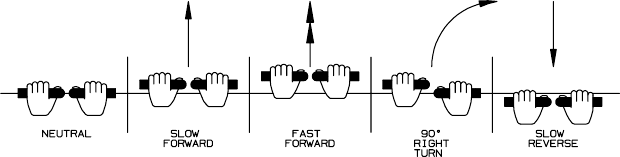
CONTROL LEVERS
For access to the seat, move control levers to neutral
position and swing them outward.
TO GO FORWARD
• From neutral position, gently push control levers
forward.
• To increase speed, move levers further forward.
TO GO BACKWARDS
• From neutral position, gently pull control levers
toward you.
TURNING
• Turning is controlled by moving one control lever slightly
forward or rearward of the other.
• To turn left, move left lever rearward of the right lever.
• To turn right, move right lever rearward of the left lever.
• To turn on mower’s own axis (zero turning radius), stop
and move one lever to reverse position and the other to
forward position.
BRAKING
• To brake mower, move both levers in direction opposite
of travel.
NOTE: The pressure required to operate the mower is very light.
LEFT TURN
OPPOSITE
—Fig. 1—
CONTROLS
19
—Fig. 2—
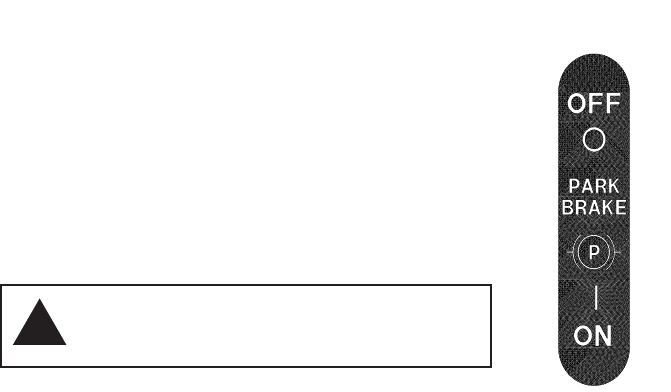
PARK BRAKE:
The park brake is designed to hold the
mower from moving and is not intended for
use in stopping the mower while it is in
motion. The engine will stop if the park brake
is engaged while the control levers are in the
drive position.
TO SET PARK BRAKE:
The hand operated park brake is located on
the operator’s right.
•To engage brake, pull lever up (to the rear).
•To release brake, move lever forward (down).
NOTE: Always set park brake before dismounting.
Release park brake before moving mower.
TRANSMISSION DRIVE SYSTEM
Allows the mower to turn on its own axis
“ZERO TURNING RADIUS”. Each lever controls
one side of the mower.
NOTE: The pressure required to operate the mower is very light.
CAUTION
!Engage park brake before
starting engine.
CONTROLS
20
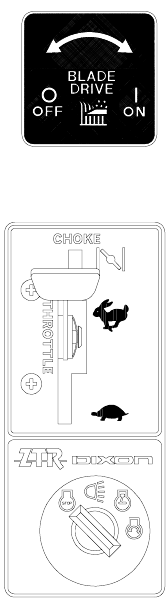
BLADE DRIVE:
•Located on the operator’s left.
• To engage the mower blade, turn lever on
floor slowly to the ON position.
• To disengage mower blade, turn lever to
OFF position.
THROTTLE CONTROL LEVER:
• Located on control panel to operator’s
right.
• Throttle control for engine speed.
• Choke for engine starting.
•Throttle control should be set to
MAXIMUM or wide open setting to
insure adequate cooling of the engine
and to maintain mower deck blade
speed while mowing.
MOWER DECK CUT HEIGHT
LIFT LEVER:
• Use right foot to operate deck foot pedal
at right front foot area.
• To raise mower deck, push forward with
right foot on top portion of foot pedal. When desired deck
height is reached, push with right foot on lower portion of
foot pedal until bottom of the pedal engages in deck
positioning notch.
• To lower deck, push forward with right foot on top portion of
foot pedal until bottom edge of pedal disengages deck
positioning notch. Lower deck to desired height and push
bottom portion of foot pedal until bottom edge engages
notch.
• Never attempt to operate deck lift mechanism in any
manner other than foot method described above.
• Always use highest position for transport.
—Fig. 3—
—Fig. 4—

OPERATION INSTRUCTIONS
21
The safe and successful operation of the SpeedZTR
will depend upon the operator having the correct
knowledge of all controls used on the mower and
making good judgements about the terrain to be
mowed.
NEVER allow anyone who does not have complete
knowledge of all controls and their functions to operate
the mower.
NEVER dismount mower without applying park brake or
stopping engine.
During initial operation, “learning to drive”, set throttle at
slow speed.
Sound judgement by the operator will prevent
accidents.
BEFORE OPERATING MOWER:
1. Read engine manufacturer’s operating and
maintenance instructions.
2. Read and observe all safety instructions on your
mower and in the manual.
3. Check engine oil.
4. Check fuel cap to be sure it is in place.
5. Be sure park brake is on.
6. Mower blade drive is off.
7. Steering levers are in outward position.
8. Know how to stop engine. (Turn key to OFF
position).

OPERATION INSTRUCTIONS
22
STARTING INSTRUCTIONS:
1. Park brake must be on, control levers in outward
position and blade drive disengaged.
2. Position throttle to choke position if engine is cold.
Full throttle if warm.
3. Insert ignition key and turn to START position. When
engine starts, release ignition key. Key will return to
RUN position.
4. Move throttle to maximum speed position.
6. Release park brake.
7. Swing levers inward.
8. Operate mower per “CONTROL” instructions on
Page 18.
NOTE: When mowing with blades engaged, set throttle control
to the MAXIMUM or wide open setting to insure adequate
cooling of the engine and to maintain mower deck blade
speed.
WARNING
!Failure to observe the following instructions
could result in serious injury or death.
CAUTION
!Do not operate the engine in an enclosed
area due to the harmful exhaust gas
produced.
OPERATION INSTRUCTIONS
23
TOWING TRAILERS & OTHER ATTACHMENTS:
Towing a trailer or other attachment that is too heavy
could damage the drive or cause the mower to become
unstable. Limit loads to 150 pounds (68 kg) or less with
this mower.
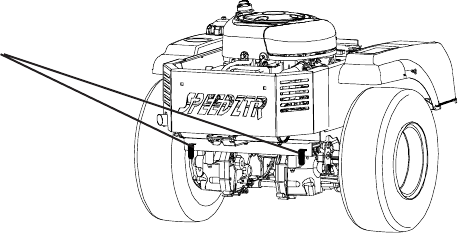
To Free Wheel Machine
(Unlock Transmission):
Always turn off engine before engaging or disengaging
the hydro release (free wheel) lever. Never attempt to
move the lever with the engine running.
Pull the hydro release levers toward the rear of the
machine and inward until notches lock in place on
frame. (See Fig. 5) Release park brake.
To engage the transmissions, move the release levers
outward so they return to normal position.
NOTE: Before pushing or towing tractor, transmission must be
unlocked and park brake released. The tractor should
never be pulled at more than 2 miles per hour (3.2 km/h)
or for distances over ¼ mile (.402 km). Trailer the unit for
distances over ¼ mile.
—Fig. 5—
Hydro Release Levers

OPERATION INSTRUCTIONS
24
TESTING OF SAFETY INTERLOCK SYSTEMS:
The following tests should be performed at the start of
each mowing day.
PARK BRAKE SWITCH TEST:
1. Swing control levers to outward position.
2. Disengage blade drive.
3. Put park brake in OFF position.
4. Turn ignition switch to START.
Engine should not turn over or attempt to start.
CONTROL LEVER SWITCH TEST:
1. Disengage blade drive.
2. Put park brake in ON position.
3. Swing control levers inward.
4. Turn ignition switch to START.
Engine should not turn over or attempt to start.
NOTE: If any safety check fails, do not operate the mower until
the system has been checked and repaired by an
authorized Dixon dealer.
WARNING
!Failure to observe the following instructions
could result in serious injury or death.

OPERATION INSTRUCTIONS
25
TESTING OF SAFETY INTERLOCK SYSTEMS:
The following tests should be performed at the start of
each mowing day.
BLADE DRIVE SWITCH TEST:
1. Put park brake in ON position.
2. Swing control levers to outward position.
3. Engage blade drive.
4. Turn ignition switch to START.
Engine should not turn over or attempt to start.
SEAT SWITCH TEST:
1. In a safe area away from bystanders, start engine.
2. Leave control levers in outward position and put
park brake in OFF position.
3. Rise slightly off seat. Engine should stop!
4. Restart engine.
5. Leave control levers in outward position and put
park brake in ON position.
6. Make sure area is clear of bystanders. Engage
blade drive and rise slightly off the seat. Engine
should stop!
NOTE: If any safety check fails, do not operate the mower until
the system has been checked and repaired by an
authorized Dixon dealer.
WARNING
!Failure to observe the following instructions
could result in serious injury or death.
OPERATION INSTRUCTIONS
26
MOWING WITH A MULCHING ATTACHMENT:
Mulching or recycling the grass clippings requires a
totally different mowing approach than would be normal
when side discharging or bagging the grass. There may
be instances or conditions where it is not possible to
hide all the recycled or mulched clippings.
In order to achieve the best results, please read and
follow the mulching tips listed below:
1. Read and follow the installation instructions that are
included with your mulcher.
2. Set the engine speed control to the wide open or full
setting.
3. Place the mower deck cut height selector in either
the top or second notch. Never cut more than
¾" (19 mm) to 1" (25mm) off the grass at any one
time. Attempting to cut more grass will result in the
deck plugging and cause the engine to stall.
4. It may be necessary to cut the lawn twice to achieve
acceptable mulching performance especially on first
cuttings or if the lawn is heavily fertilized.
5. Do not attempt to cut grass when it is wet. Mulching
performance will be very poor in wet grass
conditions.
6. Maintain sharp blades throughout the cutting
season. This is very important. Optimal mulching
performance cannot be obtained with a dull or
nicked blade.
OPERATION INSTRUCTIONS
27
MOWING WITH A MULCHING ATTACHMENT
(continued):
7. Keep the underside of the mower deck clean.
Remove all grass and dirt buildup from the
underside of the pan, the baffles and deflectors
after each use. Never, under any circumstances,
should you place hands or feet under the mower
deck or in the chute while blades or impeller are
still turning.
8. Alternate mower direction. This will evenly disperse
the mulched grass clippings over the lawn for even
fertilization.
If the mulching quality of the mower does not seem
to be satisfactory, try one or more of the following
tips:
• Raise the height-of-cut setting on your mower.
• It may be necessary to cut your grass more
frequently.
• Operate the mower at a slower ground speed.
• Overlap cutting swaths instead of cutting a full
swath with each pass.
• Mow across the marginal areas a second time.
• CUT HIGH - MOW OFTEN!
OPERATION INSTRUCTIONS
28
MOWING WITH A
GRASS CATCHER ATTACHMENT:
In order to achieve optimum performance when mowing
with a grass catching attachment, please read and
follow the tips listed below.
1. Read and follow the installation instructions that are
included with your grass catcher.
2. Set engine speed control to the wide open or full
setting.
3. Do not attempt to cut grass when it is wet. Wet grass
will clog both the underside of the deck and the
attachment chutes. Empty bags often to prevent
plugging.
4. If the grass is tall, place the mower deck cut height
selector in the top or second notch. “Initially” overlap
cutting swaths instead of a full swath with each
pass.
5. Keep the underside of the mower deck clean.
Frequent removal of dried grass and dirt will greatly
assist in bagging of the clippings. Never, under any
circumstances, should you place hands or feet
under the mower deck or in the chute while
blades or impeller are still turning.
6. Operate the mower at a slower ground speed than
when mowing without a grass catching attachment.

OPERATION INSTRUCTIONS
29
MOWING WITH A
GRASS CATCHER ATTACHMENT (continued):
7. Maintain sharp blades throughout the cutting
season. Some grass catching attachments require a
“high-lift” blade. See your dealer for advice on the
type of blade(s) needed for your mower.
8. Some mowing applications/use of grass catchers
may require that an additional weight kit be fitted to
the mower to counter the weight of grass in the
bags. Please consult with your dealer for more
information regarding installation and adding weight
to the box.
• Watch for low hanging branches or other obstacles
which might hit the catcher top while turning or
backing the mower.
• Use care when backing to avoid pushing the grass
bags into the frame or “hot” exhaust muffler of the
engine. Fire could result.
• Disengage blade and stop engine prior to clearing
grass from either the discharge chute or grass
catcher components.
• Do not operate the mower with the grass catching
attachment partially removed. Operator or
bystanders could be injured by thrown objects.
• Keep all attachment bolts tight.
•Important: Do not leave clippings in the bags while
the mower is stored. Damp grass clippings are a fire
hazard if left in the bag.
WARNING
!Failure to observe the following instructions
could result in personal injury.

OPERATION INSTRUCTIONS
30
SIDE DISCHARGE OF THE CLIPPINGS:
In order to achieve optimum performance when side
discharging the grass clippings, please read and follow
the tips listed below. Additional information can be
found in the Troubleshooting guide on Page 44-45.
1. Set engine speed control to the wide open or full
setting.
2. Do not attempt to cut grass when it is wet. Wet grass
will clog the underside of the deck and discharge
area.
3. If the grass is tall, place the mower deck cut height
lever in the top or second notch. “Initially” overlap
cutting swaths instead of a full swath with each
pass. Some applications may require a second
cutting.
4. Keep the underside of the mower deck clean.
Frequent removal of dried grass and dirt will allow
the clippings to discharge correctly. Never, under
any circumstances, should you place hands or
feet under the mower deck or in the chute while
blades or impeller are still turning.
5. Maintain sharp blade(s) throughout the cutting
season.
CAUTION
!To avoid personal injury, be sure that the
deflector is properly installed on the
discharge chute.

OPERATION INSTRUCTIONS
31
GRASS HEIGHT AND CUTTING SUGGESTIONS:
Do not attempt to cut grass when it is wet.
If the grass is tall, place the mower deck cut height
lever in the top or second notch. “Initially” overlap
cutting swaths instead of a full swath with each pass.
Some applications may require a second cutting.
Keep the underside of the mower deck clean.
Maintain sharp blades throughout the cutting season.
As a rule of thumb, never cut off more than one third of
the total grass blade length. Correct mowing height can
reduce weeds and disease by 50% to 80%.
The following grass cut heights are based on adequate
moisture conditions and normal thatch buildup in a
healthy lawn. Some locations and applications may
require slightly different cut heights. If in doubt, consult
your local lawn professional for assistance.
Grass Types Best Cut Heights
Bermudagrass 1 - 2" (25-51 mm)
Bluegrass 2 - 3" (51-76 mm)
Buffalograss 11/2 -3"(38-76 mm)
Ryegrass 2 - 3" (51-76 mm)
Tall Fescue 3-31/2" (76-89 mm)
Zoysiagrass 1 - 3" (25-76 mm)

CARE AND MAINTENANCE
32
Before performing any maintenance, turn off engine,
allow to cool and remove key.
Use extreme care when working on machinery.
Do not wear watch or jewelry.
Do not wear loose fitting clothes, and observe all
common safety practices with tools.
MAINTENANCE SCHEDULE
•Check deck drive belt..................................... after 20 hours break-in
•Check crankcase oil level.......................................... before each use
•Clean grass & debris from muffler & manifold area ....before each use
•Check air intake screen................................................ after each use
•Clean grass under deck ............................................... after each use
•Check tire pressure ......................................................every 10 hours
•Inspect blades for sharpness .......................................every 10 hours
•Clean air filter element .................................................every 25 hours
•Grease all zerks .......................................................... every 50 hours
•Check all belts..............................................................every 50 hours
•Change engine crankcase oil. .................... after 5 hours break-in and
.....................................every 50 hours
•Change engine oil filter................................................every 50 hours
•Replace air filter element........................ annually or every 100 hours
WARNING Failure to observe the following instructions
could result in serious injury or death.
!
CARE AND MAINTENANCE
33
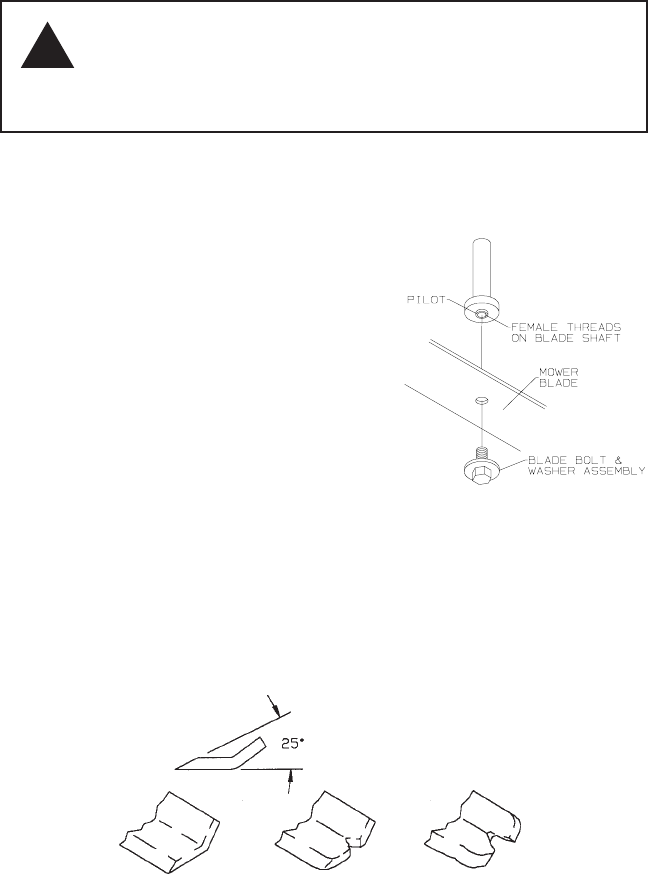
CUTTER BLADE MAINTENANCE:
Check sharpness of mower
blades after every 10 hours of
operation. Observe proper blade
position prior to removal.
1. Safely raise front of mower.
2. Hold or block blade from
turning.
3. Loosen blade bolt and remove
blade.
4. When replacing blade, tighten blade bolt securely.
Refer to Fig. 6. Be sure blade is centered on pilot
before tightening to 60 ft. lbs. (81 Nm)
CAUTION Stop engine and remove ignition key for
safety. Wear heavy, thick gloves when
holding onto cutter blade, avoid the sharp
edge of the blade.
—Fig. 6—
!
Blades should be discarded when worn excessively.
DANGEROUS!
Do not use blade
in this condition!
When notch starts,
discard blade
New blade
—Fig. 7—

CARE AND MAINTENANCE
34
ENGINE:
For complete maintenance and operating information of
the engine, please refer to the maintenance instructions
furnished by the engine manufacturer included in your
Zero Turn Radius mower information packet.
BATTERY:
This is a maintenance-free battery and the fluid level
cannot be checked. Charge battery if required.
OFF SEASON BATTERY STORAGE:
• DO NOT remove battery from mower.
• Clean top of battery and terminals with baking soda
and water.
• Identify each cable so they can be reconnected to
the correct terminal.
• Disconnect cables from terminals. ALWAYS
disconnect ground cable first and reconnect last.
• Charge battery.
NOTE: Your Dixon mower comes equipped with a quick
disconnect harness for the optional Dixon Battery
Manager. The Dixon Battery Manager maintains the
proper charge levels during periods of inactivity and may
prevent premature battery failures. Contact your dealer
for more information.
CAUTION Battery contains sulfuric acid electrolyte
that is poisonous and corrosive.
!
CARE AND MAINTENANCE
35
TIRES
Correct tire pressure is essential for efficient operation
of the mower. Check tire pressure periodically. Inflate
tires to the pressure listed below.
Front tires 11 x 4.00 - 5 16-21 PSI (110-145 kPa)
Rear tires 18 x 6.50 - 8 8-14 PSI (55-97 kPa)
Lug nuts or lug bolts should be checked regularly for tightness.
LUBRICATION:
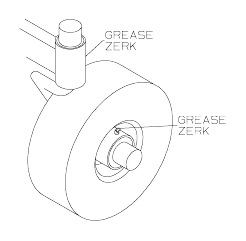
CHASSIS: (9) grease zerks
LOCATIONS: (2) front wheel axles
(2) front wheel casters
(2) deck lift shaft
(2) control levers
(1) mower deck hub
SERVICE INTERVALS: Every 50 hours of operation
or once per season.
RECOMMENDED Name brand wheel bearing
GREASE: or multipurpose grease
(3 pumps each)
—Fig. 8—
CARE AND MAINTENANCE
36
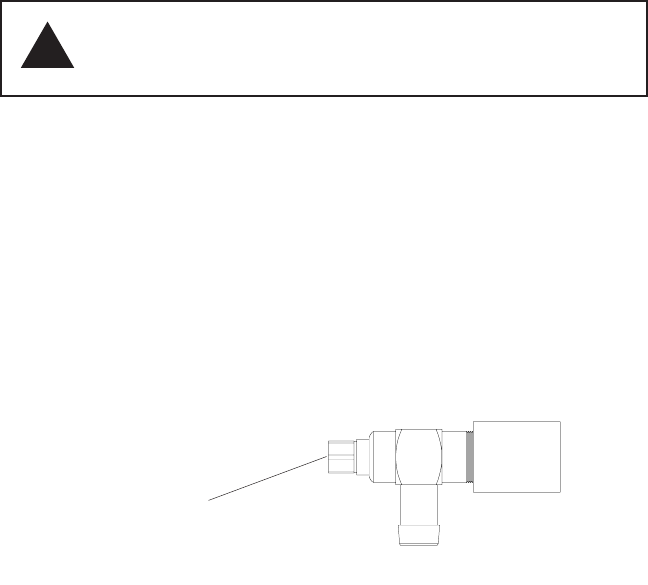
Hex Head Valve Stem
—Fig. 9—
CHANGING THE ENGINE OIL:
1. The “Dapco” oil drain valve is located on the left side
of the engine crankcase.
2. Place a suitable container under the drain valve
hose.
3. To drain, turn hex head valve stem counter-
clockwise with a 10mm wrench or socket. (See Fig.
9) Open to full open (approximately 7 turns).
4. After engine is drained, tighten hex stem.
5. Change oil filter.
6. Fill with oil (see steps on next page).
NOTE: Refer to engine manufacturer’s recommendations for
frequency of oil changes.
CAUTION HOT oil may cause burns. Allow engine to
cool before draining oil.
!

CARE AND MAINTENANCE
37
OIL FILL
1. Clean any spilled oil from engine and chassis.
2. Make sure the hex stem on drain valve has been
tightened.
3. Refill engine with type and quantity of oil
recommended by the engine manufacturer in engine
literature.
NOTE: Engine oil changes on the SpeedZTR™ will require
replacement of the oil filter. These filters may be available
from your authorized Dixon dealer.
Please dispose of used oils at proper collection centers.
Protect your environment.
CAUTION HOT oil may cause burns. Allow engine to
cool before draining oil.
!
CARE AND MAINTENANCE
38
BELTS
Check belts every 50 hours. Replace any belts showing
signs of wear or cracking.
BELT TENSION
Transmission Drive Belt - P/N 120806
No adjustment necessary.
Engine to Mower Deck Belt-P/N 120185
No adjustment required.
NOTE: Engaging the blade clutch may produce a sharp, high
pitched chirp or squeal as the belt tension loading is
absorbed by the idler system. This is normal and not a
sign of failure.
CARE AND MAINTENANCE
39
NEUTRAL ADJUSTMENT
Drive machine until Hydrostatic Transmissions have
warmed up. With engine running and the park brake off,
swing the control levers outward. If machine starts to
creep, follow the instructions below.
1. Stop the engine, engage park brake and raise rear
of frame with jack or blocks so that rear tires do not
contact the ground.
2. Swing control levers outward, start the engine and
release the park brake.
3. Raise the seat to access hydro control linkage. If
right wheel creeps, adjust right side linkage and
vice-versa. Use procedure below. (See Fig. 10, next
page)
a. Loosen jam nut on end of the coupler
P/N 116689.
b. If right wheel is creeping forward, turn coupler
counter-clockwise until neutral is achieved
(clockwise for left side). If right wheel is creep-
ing backward, turn coupler clockwise until
neutral is achieved (counter-clockwise for left
side).
c. Tighten jam nut against coupler.
4. Stop engine and remove rear of machine from jack
or blocks.

CARE AND MAINTENANCE
40
—Fig. 11—
Front Adjuster Nut
(2 places)
Side-to-Side
Adjustment
Rear Adjuster Nut
(2 Places)
Front to Rear
Adjustment
—Fig. 10—116689 Coupler
Adjust in Step B
Jam Nut
Loosen in Step A
Tighten in Step C
CARE AND MAINTENANCE
41
MOWER DECK LEVELING PROCEDURE:
1. Place mower on a smooth, level surface and rotate
casters in the direction of forward travel. Tires
should be inflated as follows.
Front: 16 - 21 PSI (110-145 kPa)
Rear: 8 - 14 PSI (55-97 kPa)
(See Fig. 11, page 40)
2. Turn blade so tips each point outward.
3. Turn front adjuster nut(s) to level deck side to side.
4. Turn blade so tips point to the front and rear.
5. Turn rear adjuster nut(s) until blade is level to
¼" (6mm) higher in the rear.
NOTE: This will place the mower deck in a base measurement
position. Additional adjustment may be required to
achieve desired cut for the type of grass or conditions
involved.

CARE AND MAINTENANCE
42
DECK REMOVAL:
1. Place cut height pedal in lowest cut position.
2. Loosen belt keepers. (See Fig. 12)
3. Remove deck drive belt from engine pulley.
4. Using a slight upward twisting motion, remove link
from engaging handle.
5. Lift engaging handle then remove handle down
through hole in floor plate.
6. Remove hair pin cotter and washer from front of
each deck support rod. Rear of deck support rods
will remain attached to mower frame.
7. Remove hair pin cotter and washer used to attach
each L-rod to deck lift arms. Carefully remove each
L-rod from deck lift arms. The deck will drop down.
The L-rod/swivel assemblies will remain attached to
mower deck.
8. Carefully raise and support front of chassis. Slide
mower deck to either side for removal. (Reverse
procedure to reinstall deck assembly.)
—Fig. 12—
CARE AND MAINTENANCE
43
ELECTRICAL SYSTEMS:
Keep all connections clean and tight.
CLEANING THE MOWER:
Wash mower periodically. Clean above and below
deck.
High pressure washing and alkaline based soaps can
cause damage to bearings and other parts of the
mower. After washing your mower, start the engine and
engage the mower deck for a few minutes to disperse
any water that may have accumulated in bearings,
pulleys or fans.
NOTE: Allow mower to cool before washing. If bearings are hot,
they will draw moisture inside as they dry and cause
corrosion.
SERIAL NUMBERS:
The serial number is located on frame at rear of engine.
WARRANTY:
Refer to warranty information (page 16).
PARTS/SERVICE:
See your authorized Dixon dealer for replacement
parts, warranty or service.
44
1. ENGINE WON’T TURN OVER
Mower blades engaged - - - - - - - - - - - - - - - disengage blades
Park brake not on - - - - - - - - - - - - - - - - - - engage park brake
Dead battery - - - - - - - - - - - - - - - - - - - - - - - charge or replace
Solenoid - - - - - - - - - - - - - - - - - - - - - - - - - - - - - consult dealer
Ignition switch - - - - - - - - - - - - - - - - - - - - - - - - - consult dealer
Starter - - - - - - - - - - - - - - - - - - - - - - - - - - - - - - consult dealer
2. ENGINE WILL TURN OVER BUT WON’T START
No fuel - - - - - - - - - - - refuel and/or clean or replace fuel filters
3. HARD TO START ENGINE
Fuel line clogged - - - - - - - - clean fuel line and check fuel filter
4. ENGINE STARTS BUT CUTS OUT
Water in fuel - - - - - - - - - - - drain old fuel-replace with new fuel
Clogged fuel line - - - - - - - - - - - - - - - - - - - - - - check fuel filter
Fuel tank vent plugged - - - - - - - - - - - - - - - - - - clean fuel vent
Faulty fuel pump - - - - - - - - - - - - - - - - - - - - - - - consult dealer
5. ENGINE OVERHEATED
Air intake screen or fins clogged - clean intake screen and fins
Oil level too low or too high - - - - - - - - - - - - - - - adjust oil level
Running engine too slow - - - - - - - - - - - - - - run engine faster
TROUBLESHOOTING
45
TROUBLESHOOTING
6. ENGINE RUNS BUT MOWER WON’T MOVE FORWARD
Drive belt broken or slipping - - - - - - - - - - - - replace drive belt
Transmission oil low - - - - - - - - - - - - - - - - - - - - - - - - - - add oil
Damaged transmission - - - - - - - - - - - - - - - - - - - consult dealer
Transmission bypass may be engaged disengage (see page 23)
7. MOWER LOSES POWER OR TRANSMISSION OVERHEATS
Engine air filter - - - - - - - - - - - - - - - - - - - - - - clean or replace
Transmission damage - - - - - - - - - - - - - - - - - - - consult dealer
8. ENGINE STALLS WHEN BLADES ARE ENGAGED
Operator not on seat - - - - - - - - - - - - - - - - - - - - - - sit on seat
Faulty interlock system - - - - - - - - - - - - - - - - - - - consult dealer
Faulty blade spindle bearing - - - - - - - - - - - - - - consult dealer
Deck drive belt not properly routed - - - - - - - - - - - - - - - reroute
Blades blocked by foreign material - - - - - - - clean under deck
9. DRIVE SYSTEM
Mower pulls to side - - - - - - - check tire inflation/consult dealer
Mower creeps in neutral - - - - - - - - - - - - - - - - - - consult dealer
Low on power - - - - - - - - - - - - - - - - - - - - - - check belt tension
10. CUT QUALITY
Cut uneven left to right - - - - - - - - check tire inflation/level deck
Ends of grass blades are ragged - - - - - - - - - - - sharpen blades
Poor dispersal of grass - - - - - - clean deck/check for loose belt
Skips in spots - - - - - - check for loose belt/slow ground speed

46
BLADES
*Hi-Lift (factory installed) - P/N 119845
Standard Lift - P/N 119844
Gator - P/N 119846
*Factory installed
BELTS
Engine to Mower Deck - P/N 120185
Engine to Transmission - P/N 120806
ENGINE AIR AND OIL FILTERS
Refer to Engine Operator’s Manual for correct service
intervals for engine oil changes and air filter
maintenance.
Protect your engine investment, use only original
equipment filters. Refer to the Engine Operator’s
Manual or ask your dealer for correct replacement
parts.
STANDARD SERVICE PARTS LIST

OWNER’S INFORMATION
Date of Purchase ________________________________
Mower Model Number_____________________________
Mower Serial Number _____________________________
Purchased From ________________________________
________________________________
________________________________
DATE OIL CHANGED DATE ENGINE TUNED
____________________ _____________________
____________________ _____________________
____________________ _____________________
____________________ _____________________
____________________ _____________________
____________________ _____________________
____________________ _____________________
Dixon ~401 North Commerce~Beatrice, NE~402-223-1000~Fax 402-223-1053
Name
Address

Dixon and ZTR®
are registered trademarks
of Dixon
DIXON
401 Commerce Street
Beatrice, NE 68310 SpeedZTR 30
Part No. 118736
WARNING
!The engine exhaust from this product
contains chemicals known to the State of
California to cause cancer, birth defects or
other reproductive harm.
