TABLE OF CONTENTS P183 V3 11045015
User Manual: TABLE OF CONTENTS P183 V3
Open the PDF directly: View PDF  .
.
Page Count: 22
.
,._
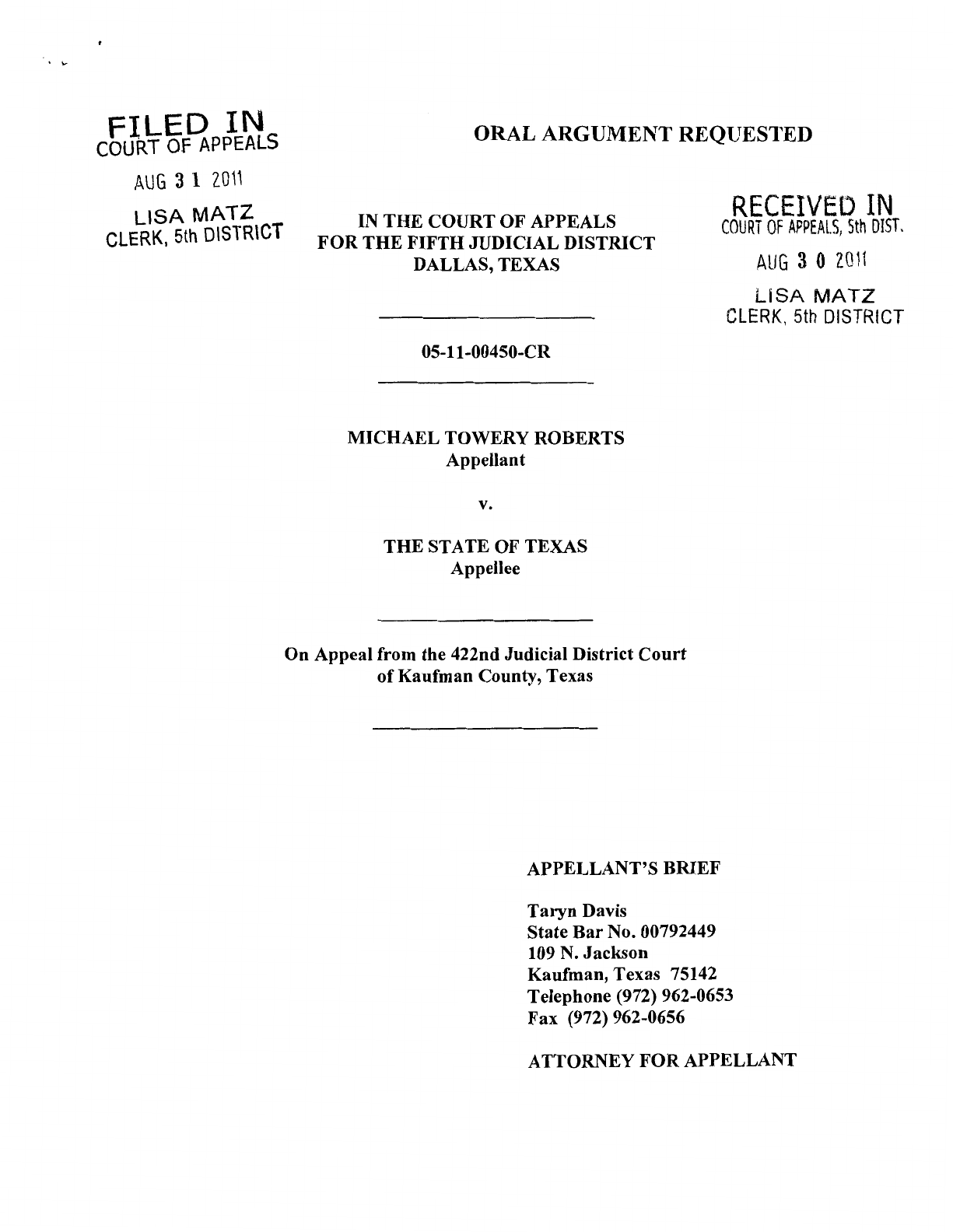
FILED
IN
COURT
OF
APPEALS
AUG
3 1
20H
USA
MATZ
CLERK,
5th
0\STR\CT
ORAL ARGUMENT REQUESTED
IN
THE
COURT
OF
APPEALS
FOR
THE
FIFTH
JUDICIAL DISTRICT
DALLAS, TEXAS
05-11-00450-CR
MICHAEL TOWERY ROBERTS
Appellant
v.
THE
STATE
OF
TEXAS
Appellee
On
Appeal from the 422nd Judicial District
Court
ofKaufman
County, Texas
APPELLANT'S
BRIEF
Taryn
Davis
RECEIVED
IN
COURT
OF
APPEALS,
5th
OIST.
AUG
3 0
20'1
LiSA
MATZ
CLERK,
5th
DISTRICT
State
Bar
No. 00792449
109
N.
Jackson
Kaufman, Texas 75142
Telephone (972) 962-0653
Fax (972) 962-0656
ATTORNEY
FOR
APPELLANT
Appellant:
Trial Judge:
IDENTITY OF PARTIES
Michael Towery Roberts
B. Michael Chitty
422nd
Judicial District Judge
Kaufman County Courthouse
Kaufman, Texas 75142
Appellant's Counsel: Taryn Davis
Trial Counsel:
State's Attorney:
SBN: 00792449
109 N. Jackson
Kaufman, Texas 75142
Dennis Jones
SBN 1086980
201
W.
Mulberry
Kaufman, Texas 7 5142
Michelle Sutton
SBN: 24027900
Assistant Criminal District Attorney
Mark Hasse
SBN: 09202000
Assistant Criminal District Attorney
Kaufman County Courthouse
Kaufman, Texas 7 5142
TABLE
OF
CONTENTS
Page(s)
NAMES OF PARTIES
TABLE OF AUTHORITIES . . . . . . . . . . . . . . . . . . . . . . . . . . . . . . . . . . . . . . . . . n
PRELIMINARY STATEMENT
......................................
.
POINTS OF ERROR
.............................................
.
STATEMENT OF FACTS
POINT OF ERROR NO. 1
Whether the evidence
is
sufficient to prove beyond a reasonable doubt that
Mr. Roberts failed to register
as
alleged
in
the indictment.
10
SUMMARY OF
ARGUMENT.......................................
10
ARGUMENT . . . . . . . . . . . . . . . . . . . . . . . . . . . . . . . . . . . . . . . . . . . . . . . . . . . .
10
POINT
OF
ERROR
NO.2
. . . . . . . . . . . . . . . . . . . . . . . . . . . . . . . . . . . . . . . . . .
14
Whether the trial court erred
in
holding the evidence to be sufficient
when an element
of
the offense charged was not proved.
SUMMARY OF
ARGUMENT.......................................
14
ARGUMENT . . . . . . . . . . . . . . . . . . . . . . . . . . . . . . . . . . . . . . . . . . . . . . . . . . . .
15
POINT
OF
ERROR
NO.3
. . . . . . . . . . . . . . . . . . . . . . . . . . . . . . . . . . . . . . . . . .
16
SUMMARY OF
ARGUMENT.......................................
16
ARGUMENT . . . . . . . . . . . . . . . . . . . . . . . . . . . . . . . . . . . . . . . . . . . . . . . . . . . .
16
Whether the trial court failed to properly instruct the jury on sex
offender registration as it applied to Mr. Roberts.
PRAYER OF RELIEF
•••••••••
0 0
••
0 0 0
••••
0.
0
•••••
0 0
•••
0 0
••
0 0
••••••
CERTIFICATE OF SERVICE
•••
0
0.
0
••
0. 0.
0.
0
••
0
••
0 0 0
••
0.
0
0.
0
••••
0
••
18
18
TABLE OF AUTHORITIES
STATUTES
Page(s)
Tex. Code Crim Proc. Ann. art. 3 6.14 . . . . . . . . . . . . . . . . . . . . . . . . . . . . . . . . . . . . . . .
16
Tex. Code Crim Proc. Ann. art.
36.19.
. . . . . . . . . . . . . . . . . . . . . . . . . . . . . . . . . . . . . 16,18
Tex. Code Crim Proc. Ann. art.
62.001...
. . . . . . . . . . . . . . . . . . . . . . . . . . . . . . . . . . . .
11
Tex. Code Crim Proc. Ann. art. 62.051. . . . . . . . . . . . . . . . . . . . . . . . . . . . . . . . . . . . . . .
17
Tex. Code Crim Proc. Ann. art.
62.055...
. . . . . . . . . . . . . . . . . . . . . . . . . . . . . . . . . 13,17
Tex. Code Crim Proc. Ann. art. 62.058
......................................
11,17
Tex. Code Crim Proc. Ann. art. 62.059. . . . . . . . . . . . . . . . . . . . . . . . . . . . . . . . . . . . . . .
13
Tex. Code Crim Proc. Ann. art.
62.101.......................................
11
Tex. Code Crim Proc. Ann. art. 62.102. . . . . . . . . . . . . . . . . . . . . . . . . . . . . . . . . . . . . . .
11
CASES
Almanza v State, 686 S.W.2d 157,
171
(Tex. Crim. App. 1984)
16
Armstrong
v.
State, 573 S.W.2d 813 (Tex. Crim. App. 1978) . . . . . . . . . . . . . . . . . . .
15
Brooks
v.
State, 323 S.W.3d 893, 899 (Tex. Crim. App. 2010) . . . . . . . . . . . . . . . . . . 10,11
Jackson
v.
Virginia, 443 U.S.
307,318-19
(1979)
............................
10,11
Lockhart
v.
Nelson, 488 U.S.
33,41-42
(1988) . . . . . . . . . . . . . . . . . . . . . . . . . . . . . .
11
McDaniel
v.
Brown, 130 S. Ct.
665,672
(2010) . . . . . . . . . . . . . . . . . . . . . . . . . . . . .
11
Roy
v.
State, 76 S.W.3d 87 (Tex.
App-Houston
[14th
Dist.] 2002) . . . . . . . . . . . . . .
15
Simpkins
v.
State, 300 S.W.3d 860 (Tex.
App.-Texarkana
2009) . . . . . . . . . . . . . . .
13
Swearingen
v.
State, 101 S.W.3d 89,
95
(Tex. Crim. App. 2003) . . . . . . . . . . . . . . . .
14
Taylor
v.
State, 332 S.W.3d
483,490
(Tex. Crim. App. 2011) . . . . . . . . . . . . . . . . . .
18
Williams
v.
State, 937 S.W.2d
479,482
(Tex. Crim. App. 1996)
11
10
THE
HONORABLE
JUSTICES
OF
THE
COURT
OF
APPEALS:
Comes now Appellant and submits this brief pursuant to the Texas Rules
of
Appellate
Procedure specifying error
of
which Appellant complains on appeal.
PRELIMINARY STATEMENT
Appellant, Michael Towery Roberts, was charged by indictment with Failure
to
Register
as
a Sex Offender, third degree felony. On March 21,2011, a jury was selected, empanelled, and
Appellant pled not guilty (R. V3P84). Appellant was convicted
of
failing to register. On April
6,
2011, punishment was assessed by the judge, at two (2) years confinement in the Texas
Department
of
Criminal Justice -Institutional Division. Appellant gave timely written notice
of
appeal.
POINTS OF ERROR
POINT OF ERROR Number
1-
Whether the evidence is sufficient
to
prove beyond a
reasonable doubt that Mr. Roberts failed to register
as
alleged in the indictment.
POINT OF ERROR Number 2 -Whether the trial court erred in holding the evidence
to
be
sufficient when an element
of
the offense charged was not proved.
POINT OF ERROR Number
3-
Whether the trial court failed to properly instruct the jury on
sex offender, registration as it applied to Mr. Roberts.
STATEMENT OF FACTS
Preliminarily Counsel for Appellant moved for a continuance based on his inability
to
receive subpoenaed phone records, which ultimately received and not used (R.
V3
P25). The
Court denied (R.
V3
P26). Appellant was admonished and elected the judge the access
punishment in the event
of
a conviction
(R.
V3
P26).
Roberts 05-11-00450-CR
Page 1
of
18

Testimony began with the State calling Sergeant Susan Monroe, certified peace officer
with the Kaufman County
Sheriffs
Department and resident fingerprint expert (R
V3
P88). She
made a comparison
of
Appellant's prints, State's Exhibit No.
1,
which was a fingerprint card that
was generated at the jail from Mr. Roberts (R.
V3
P93). The prints were taken by Deputy
Dickens and observed by Sgt. Monroe (R.
V3
P93). Appellant was identified (R.
V3
P94).
State's Exhibit
No.2,
Judgment from Kaufman County Cause No. 18654 containing Appellant's
fingerprint, which was confirmed by the witness' comparison
of
the two exhibits (R.
V3
P95).
State's Exhibit No. 2 is then admitted, without objection (R.
V3
P96).
On cross, trial counsel emphasizes that State's Exhibit
No.2
is not actually a conviction
(R.
V3
P98).
The State next called Sergeant Joseph Cagle. He testified that he is an investigator and
certified peace officer with Kaufman County
Sheriffs
Office and that his current duties include
sex offender registration (R. V3 P 1 00). He identified Appellant as one
of
the
151
registered sex
offenders that he works with (R.
V3
P101). He identified State's Exhibit
No.2
as a document
that would trigger sex offender registration (R.
V3
P103). He explained how the Kaufman
County sex offender registration works. He testified that Appellant's address was 1606
Warrington Way in Forney, within Kaufman County and that that address was covered by his
registration authority (R. V3
P1
08). He testified that Appellant was personally interviewed and
provided with the required notices under Chapter 62
of
the Code
of
Criminal Procedure (R.
V3
P1
08).
He
testified that he was alerted Appellant was not residing at his specified location due to
Sgt. Cagle's May 3, 2010, letter to Appellant being returned to sender May 28, 2010 (R.
V3
P111-112). Thereafter, Sgt. Cagle did a compliance check at Appellant's residence (R.
V3
Roberts 05-11-00450-CR
Page 2
of
18
P112). The only time Sgt. Cagle knew Appellant had been in Alabama
was
when he was
arrested there (R. V3 P122).
On cross, Sgt. Cagle testified that Appellant missed his annual verification appointment
on September 7, 2010 (R. V3 P 126). And, his last verification was made
on
September 16, 2009
(R.
V3
P126). Sgt. Cagle testified that Appellant's record's indicated that he continuously
registered from 1997 to 2009 (R. V3 P128). Trial counsel questioned Sgt. Cagle about his
compliance letter and his two physical compliance check, which is the alleged offense date in the
indictment versus his failure to comply with the annual registration date
of
September. Sgt.
Cagle went on to say that the house was listed for sale that that he contacted Coldwell Banker on
September 13, 2010, and was informed by Aden Flores that Appellant was the owner and had the
residence currently listed for sale (R. V3 P133). Sgt Cagle testified that on May
28,2010,
he
wrote a report noting that he went to Roberts' residence for a compliance check and observed the
house was listed for sale, the yard was un-kept, and there was a numeric key lock on the front
door. The residence appeared vacant and he took photographs evidencing that fact. He found a
letter sent by the post office in Roberts' mailbox informing the owner that the residence was
notated
as
a vacant residence. He testified that on May 28, 2010, he tried to contact Appellant's
wife, Rhonda Stephens and had left a voice message with no return call (R. V3
Pl35).
Sgt. Cagle was questioned about his possession
of
any follow-up papers where a case was
dismissed or discharged from probation; and he responded that he had a polygraph (R.
V3
Pl44).
Trial counsel approached; and the jury was excused to take up a matter outside their presence (R.
V3
P144). Trial counsel objected to Sgt. Cagle's response as being nonresponsive, and that he
mentioned the word "polygraph". The results being not allowed and thereby there being no way
Roberts 05-11-00450-CR
Page 3
of
18
to clear up (R.
V3
P145). The Court sustained the objection (R. V3 P145). Trial counsel moved
for a mistrial, which the Court denied (R.
V3
P145).
Then trial counsel, still outside the presence
of
the jury asks that he be allowed to
go
into
the results
of
the polygraph with the jury and withdraws his nonresponsive objection (R.
V3
Pl49). The Judge would not allow the defense to go into the polygraph results (R.
V3
P149).
As a result
of
the
Court's
rulings, he reasserted the nonresponsive objection and
requested an instruction for the
jury
to disregard (R.
V3
Pl50).
The Court instructed the jury to
disregard the comment and not to give it any consideration for any purpose and noted for the
record that the jury is all nodding in agreement (R.
V3
P
151
).
On redirect, State's Exhibit 21, September 16,2009, CR39 form, is admitted without
objection (R.
V3
Pl60).
State's Exhibit 23, notification
of
registrant's duty to register, is
admitted, without objection (R. V 3
Pl61).
State's Exhibit 22, a letter signed acknowledging
that the sex offender has received a copy
of
the CCP, is admitted, without objection
(R.
V3
Pl63). State's Exhibit 24, another form given to sex offender to be signed, is admitted, without
objection (R.
V3
Pl64).
On recross, Sgt. Cagle testified that the warrant was put out for Appellant's arrest on
September
14,2010
(R. V3 P166).
The State called Sergeant Phillip Stewart, certified peace officer with Kaufman County
Sheriffs
Office assigned to criminal investigations (R.
V3
Pl67).
Sgt. Stewart testified that he
made visits to 1606 Warrington Way, Forney, Texas with Sgt. Cagle. He identified State's
Exhibits 3,4,5,6,7,8, and 9; photographs
ofthat
location taken
on
May 28, 2010 (R.
V3
Pl69).
Sgt. Stewart testified that the house appeared vacant although it also appeared that there were
some renovations going
on
inside the residence (R.
V3
Pl72).
State's Exhibits 3-9 were
Roberts 05-11-00450-CR
Page 4
of
18
admitted, without objection (R.
V3
P169). Sgt. Stewart identified State Exhibits
10
through
15,
pictures taken
of
the residence on August 30, 2010. They were admitted, without objection
(R.
V3
P173).
On cross, Sgt Stewart testified that he did not check the mailbox, did not knock on the
door or windows, and did not check with any neighbors
(R.
V3
P176). And, upon further
inspection
of
the exhibits, Sgt. Stewart agreed that the grass appeared to have been cut or did not
grow between the taking
of
the pictures (R.
V3
P 1 78).
The State called Brandi Fernandez, Kaufman County Assistant Criminal District
Attorney. The jury was excused on the request
of
the State to take up matters outside their
presence. State's Exhibit 16, transcript
of
testimony from a bond hearing, is offered; and without
objection
is
admitted for record purposes only (R.
V3
P183). The Court granted the State's
Motion in Limine as to an Order discharging Appellant from probation (R.
V3
P 185).
Brandi Fernandez testified that she was present during a hearing held on November 23,
2010, involving Mr. Roberts. She went on to identify Appellant (R.
V3
P 186). She identified
State's Exhibit 2, a community supervision judgment placing the defendant on community
supervision out
of
the 86
111
Judicial District Court for the offense
of
indecency with a child. Ms.
Fernandez
is
asked to explain the effect
of
the document; and over a "editorializing" and a
relevance objection she is allowed to explain the judgment (R.
V3
P188). Trial counsel objects
to
Ms. Fernandez summarization
of
what the law is as it relates to Chapter 62
of
the Code
of
Criminal Procedure and further asserts that the law comes from the Court. The Judge excuses
the jury to clarify the objection (R.
V3
P190). The Judge instructs the witness to just read the
law
if
she is going to testify about it (R.
V3
P
191
).
Roberts 05-11-00450-CR
Page 5
of
18
Trial counsel believes the State has opened the door to allowing him to introduce Defendant's
Exhibit
1,
the Order discharging Mr. Roberts from community supervision (R.
V3
P191). Trial
counsel argues that under two theories, one being a mistake
of
fact and secondly, mitigation he
should be allowed to introduce this exhibit
(R.
V3
P194). The Judge overruled the State's
objection
(R.
V3
P196). On cross examination, Defense Exhibit No.
1,
Order discharging Mr.
Roberts from community supervision is offered, and without objection here is admitted
(R.
V3
P205).
Ms. Fernandez went on to testify that Mr. Roberts had a reportable adjudication that
required sex offender registration for life because it was an indecency by contact
(R.
V3
P197).
Ms.
Fernandez referred to State's Exhibit No. 16, and testified about her eliciting testimony from
Mr.
Roberts during a writ hearing. She testified that when Mr. Roberts was question about
where he resided prior to his arrest and he replied, Mobile, Alabama for 28 days (R.
V3
P199).
And, when asked where he lived prior to that, Mr. Roberts responded that he lived in Pascalooga,
Mississippi
(R.
V3
P200). According to her, he further testified during this writ hearing that the
last time he lived in Kaufman County was June or July
of2010
(R.
V3
P200). Additionally, Mr.
Roberts testified during that hearing that he had been in Arkansas, Tennessee, California,
Mississippi, and Alabama since being in Texas (R.
V3
P203).
The State rests (R. V3 P206).
The defense is reurging its Motion for Continuance due to their inability receiving
subpoenaed phone records (R.
V3
P208). The court recessed the case until the following
morning. Appellant is put back on the record with regards to him testifying and again he
indicated it was his desire to testify (R.
V3
P21
0). The Court further admonished Mr. Roberts
Roberts 05-11-00450-CR
Page
6 of
18
(R.
V3
P212). Appellant elected to testify and seemingly waived his privilege against self-
incrimination freely, voluntarily and knowingly (R.
V3
P213
).
On March 22, 2011, the defense began by moving for an instructed verdict
of
not guilty
based on the indictment alleging that Mr. Roberts had a "reportable conviction." (R. V4 P5).
The evidence was such that Mr. Roberts received a deferred adjudication, which was in essence
not a conviction. Trial counsel argued the State alleged the wrong wording and that they are
"stuck" with proving a reportable conviction, which they did not. They proved a reportable
adjudication (R. V 4 P5). There is a variance between the
proof
and the indictment. The Court
denied the Motion asserting the indictment puts the defendant on notice
of
what
he's
charged
with (R. V 4 P7).
Trial counsel's second Motion for Instructed Verdict had to do with the evidence
showing Mr. Robert's failed to notify Kaufman County
of
his move versus actually proving that
he failed to register in another jurisdiction (R. V 4 P8). The actual evidence was that he failed to
notify Kaufman County
of
a change
of
address again not that he failed to register. The Court
denied the Motion (R. V4 P12).
The defense began with no opening and called Lacy Smith, Kaufman County Adult
Probation Officer. She identified State's Exhibit
No.2,
a letter written by her.
It
was offered
and admitted without objection (R. V 4 P15). Defense Exhibit
No.2,
this letter merely confirms
Order discharging Mr. Roberts from community supervision and acknowledges that he was not
convicted
of
the charge and was addressed to Transportation Securities Administration.
Trial Counsel recalled Sergeant Joseph Cagle (R. V 4 P21
).
Sgt. Cagle testified that Mr.
Roberts was due to verify
on
September 16, 2010, and had a 30 day window before or after that
date to schedule this appointment (R. V4 P23). Sgt. Cagle identified Defense ("State's") Exhibit
Roberts 05-11-00450-CR
Page 7
of
18
No. 3, the Probable cause affidavit for the warrant for Mr. Roberts' arrest. Defendant's Exhibit
No. 3 is offered; and without objection, admitted (R. V 4 P27).
Appellant took the stand. He testified his birthday is September 7 (R. V 4 P29). Mr.
Roberts testified that he was a truck driver who was not in Kaufman County very often and that
he believed Kaufman County was aware
of
his situation. When he went into Alabama DMV to
renew his commercial
driver's
license during the time
of
his birthday, he was attempting to
establish his residence there and then would have needed to notify Kaufman County
Sheriffs
Department
of
the change (R. V4 P40). The Court sustained the State's leading objection (R. V4
P41
).
Mr. Roberts testified that he was instructed by Mobile Metro Police that he had to first
establish
of
residence
then
register (R. V4 P43). Mr. Roberts testified that he was further
instructed to get his license first and then come back to register (R. V 4 P43). Mr. Roberts was
not able to get his license renewed until his $7 40 log-book ticket was paid
in
Maine, which took
until September
17,2010
(R. V4 P44). Mr. Roberts testified that his long-time girlfriend and he
had broke-up in August 2009, and that when she left she took most
of
the furnishings (R. V4
P48). Mr. Roberts testified that Sgt. Cagle was mistaken about any belongings being in the
house because the only view he had into his home was from the front window where he took
pictures (R. V4 P50).
He
testified he had a bed in his bedroom and clothes there. Mr. Roberts
testified the house in Forney was his residence until he got an apartment, was attempting to
renew his driver's license in Alabama and register there as instructed (R. V4 P51). The Defense
rests (R. V4 P64).
Trial counsel had objected to the charge (R. V4 P66).
He
asserted that the indictment
charges Appellant with failing to register. The Charge is allowing for a conviction by failing to
notify the proper authority
of
the change
of
address. The objection was overruled (R. V 4 P68).
Roberts 05-11-00450-CR
Page 8
of
18
Trial counsel moved again for instructed verdict being that there was no evidence that Mr.
Roberts failed to register because the State had not proved he had actually changed his address
for the purpose
of
triggering the duty to register at anytime other than his annual verification (R.
V 4 P69). The Court overruled the objection (R. V 4 P69).
The Jury is brought in and the Charge is read. After deliberations, the
jury
found Mr.
Roberts guilty.
The jury is excused. Court is reconvened the following day for testimony from Sergeant
Susan Monroe for a prove-up
on
more prints from two judgments out
of
California. On March
23,2011, the punishment phase
of
the trial began with Sgt. Monroe.
Sgt. Monroe testified that State's Exhibit No. 20 was a document that she examined for
the purpose
of
doing a fingerprint comparison (R. V5 P4). This document is offered; and
without objection, admitted (R. V5 P6). State's Exhibit No.
18
was another document that she
examined. State's Exhibit No.
18
is offered; and without objection, admitted (R. V5 P10).
The case is recessed until April 6, 2011, for the completion
of
the PSI. During the
punishment phase the Court takes judicial notice
of
both the original and supplemental pre-
sentence investigation report (R. V6 P5).
Mr.
Roberts testified that he had been registering since 1997 (R. V6 P8). Trial counsel
requested State's Exhibit No. 20, judgment with someone
else's
name
on
it, but linked to Mr.
Roberts, which he attempted to explain the error to dispel any
belief
that Mr. Roberts was
purposely using an alias, be admitted for all purposes at this time (R. V 6 P 1 0). Defense Exhibit
No.4,
a copy
of
State's
20, was offered; and without objection, admitted. Mr. Roberts is
requesting probation from the Court. Both sides closed (R. V 6 P31 ). The Court accessed
Roberts 05-11-00450-CR
Page 9
of
18
punishment at two years in the Texas Department
of
Criminal
Justice-
Institutional Division
(R.
V6
P37).
POINT OF ERROR Number
1-
Whether the evidence is sufficient to prove beyond a
reasonable doubt that Mr. Roberts failed to register
as
alleged in the indictment.
SUMMARY OF ARGUMENT
The indictment charged the defendant with failure
to
register. The State failed
to
prove
beyond a reasonable doubt that Mr. Roberts had established residence anywhere other than
Kaufman County. The State failed to prove that
Mr.
Roberts' address
of
1606 Warrington Way,
Forney, Texas was even located within rural Kaufman County. His annual registration was not
due
at
the time alleged in the indictment (May 28,
201
0). And,
if
there was
no
move, then
Mr.
Roberts was registered and in good standing with Kaufman County.
ARGUMENT
Mr.
Robert's indictment in said cause fails
to
state an offense to which Appellant can
be
held criminal responsible. The trial counsel specifically argued this point in support
of
his
Motion for Instructed Verdict
(R.
V 4 P8).
An
appellate court reviews a challenge
to
the denial
of
a motion for instructed verdict
as
a challenge to the sufficiency
of
evidence. Williams
v.
State,
937
S.W.2d
479,482
(Tex. Crim. App. 1996).
Under the proper sufficiency standard
of
review, an appellate court considers all the
evidence in the light most favorable to the verdict to determine whether the jury was rationally
justified in finding guilt beyond a reasonable doubt. Jackson
v.
Virginia, 443 U.S. 307, 318-19
(1979); Brooks
v.
State, 323 S.W.3d 893, 899 (Tex. Crim. App. 2010). Appellate courts are
required
to
determine whether any rational juror could have found the essential elements
of
the
Roberts 05-11-00450-CR
Page
10
of
18
offense beyond a reasonable doubt. See Jackson,
443
U.S. at 319; Brooks,
323
S.W.3d at 902
n.
19.
An
appellate court
is
required to defer to the jury's credibility and weight determinations
because the jury
is
the sole judge
of
the witnesses' credibility and the weight to be given
to
their
testimony. See Jackson, 443 U.S. at 319, 326; Brooks,
323
S.W.3d at 899. All evidence,
whether properly or improperly admitted, will be considered when reviewing the sufficiency
of
th~::
evidence. See McDaniel
v.
Brown,
130
S.
Ct.
665, 672 (2010); Lockhart
v.
Nelson,
488
U.S.
33,
41-42(1988); Jackson, 443 U.S. at 319.
A person
is
subject to the sex-offender registration program
if
he has a reportable
conviction or adjudication. For purposes
of
CCP ch. 62, a "reportable conviction or adjudication
means
of
conviction or an adjudication, including a deferred adjudication. Depending on the
offense, there are two types
of
registration: a duty to register for life or a duty to register for ten
years after disposition or discharge. See CCP arts. 62.001(5), 62.101. Then, an adult who has a
lifetime registration for CCP art. 62.101(a) offense and who fails to verify registration once each
year
as
required
by
CCP art. 62.058. Failure to register as such shall be punished
as
a third
degree felony. Code
of
Crim. Proc. Ann. art.
62.1
02(b)(2). The indictment
is
specifically titled
and charged Mr. Roberts with an offense for failing
to
register for "life/annually" alleged
to
have
been committed on or about May 28, 2010, and mistakenly cites Texas Penal Code
sec.
62.1
versus same article number under Texas Code
of
Criminal Procedure (Clerk's
R.
P7).
The testimony is uncontroverted that Mr. Roberts' annual reporting was due in
September 2010.
Mr.
Roberts testified his birthday
is
September 7 (R. V4 P29). On cross, Sgt.
Cagle testified that Appellant missed his set annual verification appointment on September
7,
2010
(R.
V3
P126). Sgt. Cagle testified that
he
obtained a warrant for Appellant on September
14,
2010
(R.
V3
Pl66). Appellant's last verification was made on September
16,
2009 (R.
V3
Roberts 05-11-00450-CR
Page
11
of
18
P 126). Sgt. Cagle testified that Appellant's records indicated that he had continuously registered
from 1997 to 2009 (R.
V3
P128). Sgt. Cagle also testified that annual registration is required 30
plus or minus days
of
Mr. Roberts' September 7 birthday (R.
V3
Pl30).
Code Crim. Proc. Ann.
art. 62.058(a). Thus, the evidence was insufficient to prove Appellant failed to register annually.
Appellant further asserts the State has failed to properly charge Appellant. The
indictment alleges
...
:
"while being a person required to register with the local law enforcement authority in the
county where the defendant resided or intended to reside for more than seven days, to-
wit: Kaufman County, because
of
a reportable conviction for Indecency with a Child,
intentionally
or
knowingly fail to register with the local law enforcement authority in said
county," (Clerk's R. P7)
....
Sgt. Cagle even testified that sex offenders are obligated to report seven day before or
after, just within seven days
of
the move. He testified, "Okay,
here's
the deal, they've got to
notify me seven days, within seven days
of
their move.
Ifthey're
going to move next week, they
can contact me and say hey,
we're
moving next week.
That's
plenty
of
time. But
ifthey
move
that next week, they have seven days to notify the next jurisdiction,
you
see." (R.
V3
P119). The
evidence is insufficient as to Appellant intentionally or knowingly violating the law when State's
own witness is incorrectly testifying and relaying to the jury the law as he believed it applied to
Appellant.
The State put
on
testimony from Sgt. Cagle who testified that he was alerted Appellant
was not residing at his specified location due to Sgt. Cagle's May 3, 201
0,
letter to Appellant
being returned to sender May 28, 2010 (R.
V3
P111-112). Thereafter, Sgt. Cagle did a
compliance check at Appellant's residence (R.
V3
P112). Sgt. Cagle testified that 1606
Warrington Way in Forney is an address that's within Kaufman County (R.
V3
P108). The
Roberts 05-11-00450-CR
Page
12
of
18
State's evidence
is
insufficient here because the State failed to prove-up that
if
Appellant failed
to
register, registration was even required in Kaufman County and not within the City
of
Forney.
Evidence was held to be insufficient where the State's evidence failed to prove that one's
residence was located in rural area
of
a County and not within the municipality. Simpkins
v.
State,
300
S.W.3d 860 (Tex. App.--Texarkana 2009).
The Statute is such that any intended change
of
address must be reported seven days prior
to
the change. Code Crim. Proc. Ann. art. 62.055(a). The Statute
is
such that
if
the person
moves
to
another state that has a registration requirement for sex offenders, the person shall, not
later than the
1oth
day after the date on which the person arrives in the other state, register
....
Code Crim. Proc. Ann. art. 62.055(c). The Statute
is
such that
if
a person intended
to
regularly
visit other locations for more than
48
consecutive hours on 3 or more occasions during a month
other registration guidelines are triggered. Code Crim. Proc. Ann. art. 62.059. Although, Sgt
Cagle again testified incorrectly. He testified the window is
72
hours at another location for
more than 3 times per month requires a report.
(R.
V3
Pl20). Nevertheless, the State did not
charge
Mr.
Roberts with that violation.
The trial court erred when it failed
to
grant Appellant's Motion for Instructed Verdict
(R.
V4
P4,
69).
The evidence at best showed
Mr.
Robert's failed to notify Kaufman County
of
his
intended move seven days prior to an intended move versus actually proving that
he
failed
to
register because it
is
undisputed he was registered in Kaufman County, Texas.
If
there was a move, as the evidence may suggest to Alabama, then registration would
have been required there. However, residency never was established, nor proved
to
be,
anywhere else that would have allowed Mr. Roberts
to
basically, un-register in Kaufman County.
Roberts 05-11-00450-CR
Page
13
of
18
Mr.
Roberts testified that Sgt. Cagle was mistaken about any belongings being in the
house because the only view he had into his home on the two trips he made there, was from the
front window where he took pictures (R. V 4 P50).
He
testified he had a bed in his bedroom and
clothes there. Mr. Roberts testified the house in Forney was his residence (R.
V4
P51). The
State failed
to
prove Mr. Roberts had established residence anywhere other than Kaufman
County. Sgt. Cagle testified that the house at 1606 Warrington Way in Forney, Texas was listed
for sale that that he contacted Coldwell Banker on September
13,
2010, and was informed by
Aden Flores that Appellant was the owner and had the residence currently listed for sale (R.
V3
P133).
The State's never proved Mr. Roberts intentionally or knowingly failed to register
anywhere because he was in fact registered in Kaufman County. A reasonable fact-finder would
necessarily entertain reasonable doubt about
Mr.
Robert's guilt as charged; due process requires
a reversal and order
of
judgment
of
acquittal. Swearingen
v.
State,
101
S.W.3d 89,
95
(Tex.
Crim.
App.
2003)
POINT OF ERROR Number 2 -Whether the trial court erred in holding the evidence
to
be
sufficient when an element
of
the offense charged was not proved.
SUMMARY OF ARGUMENT
The indictment alleged that Mr. Roberts had a "reportable conviction." The indictment
says nothing about the alternative mechanism for triggering sex offender registration, which was
having a "reportable adjudication." Mr. Roberts was placed on deferred probation, not
convicted, for indecency with a child. That is a fatal variance, which requires reversal and an
acquittal.
Roberts 05-11-00450-CR
Page
14
of
18
ARGUMENT
Should the Court believe that the State actually correctly charged Mr. Roberts with
failing
to
register; then, Appellant refers you to the indictment, which alleges that Mr. Roberts
had a "reportable conviction" (Clerk's Record P7). The evidence
of
the deferred community
supervision definitely does not support a "reportable conviction" element (State's Exhibit
No.
2
and
Defendant's Exhibit No.
1).
Again, the trial court erred when overruled Appellant's Motion
for
Instructed Verdict (R. V 4 P4, 69). Counsel specifically argued the variance (R. V 4 P5).
A fatal variance existed as to an aggravated assault offense where the indictment charged
that a defendant "did then and there unlawfully, while a public servant
...
intentionally and
knowingly threaten J.B. Easthagen." However, the evidence did not show the defendant was a
public servant. The evidence was such that Easthagen was the public servant. Because
of
this
fatal variance between indictment and the proof, reversal for acquittal was required. Roy
v.
St~
76
SW3d
87
(Tex.
App-Houston
[14
1
h Dist.] 2002).
Additionally, a trial court erred in holding the evidence sufficient to sustain a conviction
when there was a material and fatal variance between the instrument set out in the indictment
by
its tenor and the instrument offered in evidence to support such description. This referenced case
had
to
do
with a check appearing in the indictment bearing a 2-19-74 date and a bank transit
number appearing as 88-135; and when the check was introduced into evidence it bore the date
2-19-74 and bank transit number was 88-1135, the Criminal Court
of
Appeals held that was a
variance fatal to conviction. Armstrong
v.
State,
573
S.W.2d
813
(Tex. Crim. App. 1978).
In our case, the State alleged a "reportable conviction" and they proved a
"reportable adjudication." The evidence
is
insufficient to sustain the conviction.
Roberts 05-11-00450-CR
Page
15
of
18
POINT OF ERROR Number
3-
Whether the trial court failed to properly instruct the jury on
sex offender registration
as
it applied
to
Mr.
Roberts.
SUMMARY OF ARGUMENT
The State was allowed to include language associated with a failure to register violation
when a person fails to report an intended move, which absolutely has nothing to
do
with
Mr.
Roberts' alleged violation.
It
would appear they were trying to include additional violations
of
the Statute that might apply to Appellant, and give some credence to their application paragraph,
while confusing the already confusing issues.
ARGUMENT
Article 36.19
of
the Texas Code
of
Criminal Procedure establishes the standard for
reversal
on
appeal when the requirements
of
Article 36.14, which relates to the charge
of
the
court, have been disregarded: "the judgment shall not be reversed unless the error appearing
from the record was calculated to injure the rights
of
the defendant, or unless it appears from the
record that the defendant has not had a fair and impartial trial." Tex. Code Crim. Proc.
Ann.
art
36.19.
Under Almanza, jury charge error requires reversal
of
the judgment when the defendant
has properly objected to the charge and the appellate court finds "some harm" to his rights.
Almanza v State, 686 S.W.2d 157,
171
(Tex. Crim. App. 1984). Trial counsel objected
to
the
charge and argued that the indictment charges Appellant for specifically "failing to register;" and
that
the
Charge
is
allowing for a conviction
by
"failing to notify the proper authority
of
the
change
of
address."
(R.
V4 P66). The objection was overruled
(R.
V4 P68) (Clerk's
R.
P118).
The change
of
address, in midstream
so
to speak, and failure to annually register are
Roberts 05-11-00450-CR
Page
16
of
18
controlled by two different Code
of
Criminal Procedure Articles. Tex. Code Crim. Proc. arts.
62.055, 62.058 (respectively).
After a review
of
the indictment, the trial court's jury charge on the law; and then, the
application paragraph, harm
is
shown.
The indictment alleged
...
:
"while being a person required to register with the local law enforcement authority in the
county where the defendant resided or intended to reside for more than seven days, to-
wit: Kaufman County, because
of
a reportable conviction for Indecency with a Child,
intentionally or knowingly fail to register with the local law enforcement authority in said
county," (Clerk's
R.
P7)
....
The Charge mixed CCP Arts. 62.051(a) and 62.055(a) thereby
g1vmg
irrelevant
instructions that pertained to a person failing to notify law enforcement
of
an intended change
of
address, which Mr. Roberts was surprisingly not accused of.
The application paragraph tracks the indictment (Clerk's
R.
P120). The indictment by
itself
is
confusing enough with the title referring to one violation and the body referring
to
Appellant's failure to basically un-register. The harm is evident with the conviction.
The State alleged it would prove a reportable conviction, but did not. The State alleged a
failure
to
register in Kaufman County, although
Mr.
Roberts was registered in Kaufman County.
The State seemingly may have proved Mr. Roberts failed to notify Kaufman County
of
an
intended change
of
address seven days before any potential change (and was allowed to have this
law in the charge). However, it
is
what is accused in the indictment that must be proved.
The insertion
of
the following paragraph in the Court's Charge:
"If
a person required to register under this chapter intends to change address, regardless
of
whether the person intends to move to another state, the person shall, not later than the
seventh day before the intended change, report in person to the local law enforcement
Roberts 05-11-00450-CR
Page
17
of
18
'.
authority designated as the person's primary registration authority by the department
...
.
"(Clerk's
R.
P118),
makes a case for conviction clearly and significantly more persuasive. Taylor
v.
State, 332
S.W.3d 483,490 (Tex. Crim. App. 2011). Appellant was harmed by the insertion
of
law that did
not apply to Mr. Roberts as
he
was indicted when the jury returned its verdict
of
guilty. Trial
counsel properly made the objection to the jury charge. The inclusion
of
the law as it related to
individuals who failed to notify law enforcement
of
any intended change in address seven days
prior
to
the change was irrelevant to the accusations made in Mr. Roberts' indictment. And, with
that charge being improperly included, reversal is required with "some harm" being shown. Tex.
Code Crim. Proc. art. 36.19.
PRAYER OF RELIEF
WHEREFORE, PREMISES CONSIDERED, Appellant prays this
rev~ewmg
court
reverse the trial court's judgment and enter a judgment
of
acquittal.
Respectfully submitted,
Law Office
ofTaryn
Davis, PLLC
109 N. Jackson
Kaufman, Texas 75142
Telephone 97 962-0653
Fax 2-0 6
BY:
\
n Davis
State Bar No. 00792449
ATTORNEY FOR APPELLANT
CERTIFICATE OF SERVICE
I,
hereby, certify that a true and correct copy
of
Appellant's brief was hand-delivered to
the Kaufman County Criminal District Attorney, Kaufman County Courthouse, Kaufman, Texas
75142,
on
this 7:0-fu
day
of August, 2011.
.--------;-i::L·
~-~
--~'
~
Taryn
Dav1s
--
Roberts 05-11-00450-CR
Page
18
of
18
