195705
195705 195705
User Manual: 195705
Open the PDF directly: View PDF  .
.
Page Count: 48
Computer
Market
Survey -Report
No.
1
. . . Edmund
C.
Berkeley
New
Products
and
Ideas
Reliability in Business Automatic Data Processing
Herbert
T.
Glantz
Automatic Search
of
Library Documents
. S. Richard
Moyer
I.
R.
E.
National
Convention,
March,
1957,
New
York -
Titles
and
Abstracts
of
Papers Bearing on Computers
and
Data
Processors
As recently as ten years ago it was just becoming
evident
that
digital techniques in electronics were
destined to create a new and rapidly growing field.
Today,
incorporat~d
in
electronic compu,ters
and
other equipment, they constitute one
of
the most sig-
nificant developments
in'
scientific computation, in
electronic data processing for business and industry,
and in electronic
cantlol
s~stems
for the military.
In
the
near
future they are expected to become a major
new factor in industrial process control systems.
The digital computer for scientific computation is
becoming commonplace in research and development
laboratories. Such machines range from small spe-
cialized units costing a few thousand dollars, to large
general purpose computers costing over a million
dollars. One
of
these large computers
is
a
part
of
the
Ramo-Wooldridge Computing Center, and a second
such unit will be installed the latter
part
of
this year.
The digital computer has not only lightened the com-
putation load for scientists and engineers,
but
has
made possible many calculations which previously
were impracticable. Such computers have played a
major
role
in
the
modern
systems
engineering
approach to complex problems.
Electronic data processing for business and industry
is
now well under way, based
on
earlier developments
in electronic computers.
Data
processors have
much
in common with computers, including the utilization
of
digital techniques.
In
this field, teams
of
Ramo-
Wooldridge specialists are providing consulting serv-
ices to a variety
of
clients
on
the application
of
data
processing equipment to their problems.
The
use
of
digital techniques in military
control
systems
is
an accomplished fact. Modern interceptor
aircraft, for example, use digital fire control systems.
A number
of
Ramo-Wooldridge scientists and engi-
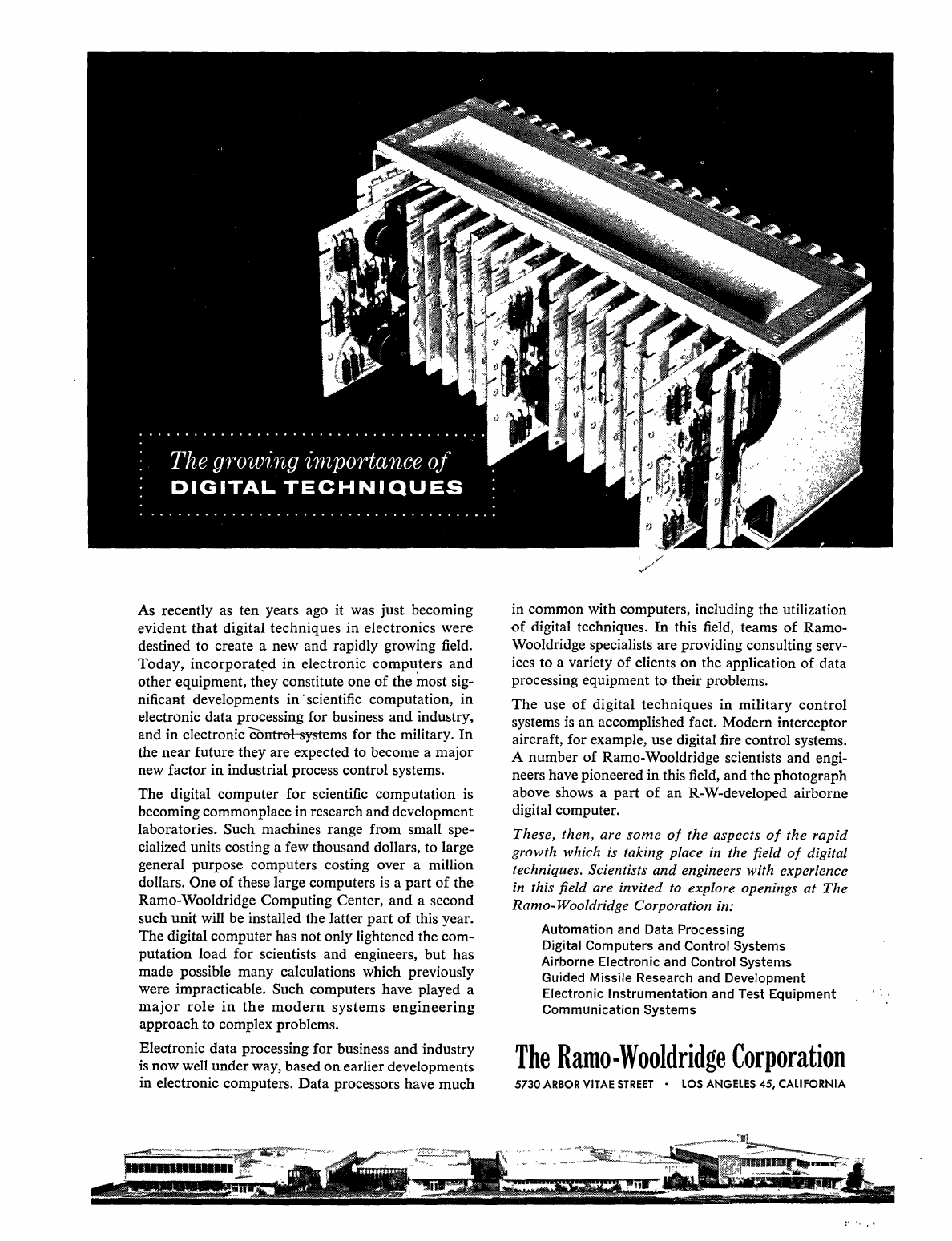
neers have pioneered in this field, and the photograph
above shows a part
of
an R-W-developed airborne
digital computer.
These, then, are
some
of
the
aspects
of
the
rapid
growth which is taking place in the field
of
digital
techniques. Scientists
and
engineers with experience
in this field are invited to explore openings at
The
Ramo-
Wooldridge Corporation in:
Automation and Data Processing
Digital Computers and Control Systems
Airborne Electronic and Control Systems
Guided Missile Research and Development
Electronic
Instrumentation
and Test Equipment
Communication Systems
The
Ramo-Wooldridge
Corporation
5730
ARBOR
VITAE
STREET
•
LOS
ANGELES
45, CALIFORNIA
COMPUTERS
AND
CYBERNETICS
•
ROBOTS
•
AUTOMATION
AUTOMATIC
CONTROL
Vol. 6,
No.
5
ESTABLISHED
SEPTEMBER,
1951
ARTICLES
Computer
Market
Survey
-
Report
No.1
Reliability
in
Business
Automatic
Data
Processing
Automatic
Search
of
Library
Documents
NEW PRODUCTS AND IDEAS
REFERENCE
INFORMATION
Edmund
C.
Berkeley
Herbert
T.
Glantz
S.
Richard
Moyer
1.
R.
E.
National
Convention,
March
1957, New
York
-
Titles
and
Abstracts
of
Papers
Bearing
on
Computers
and
Data
Processing
New
Patents
FORUM
May,
1957
8
20
24
18
30
36
Magazines
on
"Computology"
The
United
States
Mails
-
Field
for
Automatic
Processing
of
Information
...
Samuel
J.
M.
England
37
...
The
Reader's
Digest
and
38
the
U.
S.
Post
Office
Analogue
Computers
in
Europe
P.
A.
R.
Wright
42
Association
for
Computing
Machinery
Meeting
...
J.
F.
Summers
44
The
Editor's
Notes
Index
of
Notice
s
Advertising
Index
Edi
tor:
Edmund
C.
Berkp.ley
Assistant
Edi
tors:
Neil
D.
lJacdonald,
F.
L.
Walker
Contributing
Editors:
Andrew
D Booth, John
W.
Carr,III,
Alston S.
Hous~holder
Advisory Committee: Samuel
B.
Williams,
Herbert
F.
Mitchell
Jr.,
Howard
T. Engstrom,
Alston
S. Householder,
H.
Jefferson
Mills,
Jr.
Sales
and
Service
Manager: -
Miltnl'>
L. Kaye,
601
Madison Ave.,
New
York
22,
N.Y.
-
Plaza
5-4680
Advertising
Representatives:
New
York
-Mil,ton
L.
Kaye,
601
Madison Ave.,
New
York
22, N.Y.,
Plaza
5-4680
San
Francisco
-
W.A.
Babcock,
605
Market
St.,
San Francisco 5,
Calif.,
Yukon
2-·3954
6
6
46
Los
Angeles -Wentworth
F.
Green,
439
So. Western Ave.,
Los
Angeles 5,
Calif.,
Dunkirk 7-8135
Elsewhere -
the
Publisher
Publisher:
Berkeley
Enterprises,
Inc.,
815
Washington
St.,
Newtonville 60, Mass., Decatur 2-5453
or
2~3928
COMPUTERS
ANn
AUTOMATION
is
published
monthly. Copyright, 1957,
by
Berkeley
Enterprises,
Inc.
'Subscription
rates:
in
the United
States
-
one
year
$5.50,
two
years
$10.50;
in
Canada -one
year
$6.00,
two
years
$11.50;
elsewhere -
one
year
$6.50,
two
years
$12.50
Entered
as second
class
matter
at
the
Post
Office,
New
York,
N.Y.
- 3 -
New
Sylvania package offers
Maximum
Dissipation
Cooler
operation
resulting
from
higher
qissipation
of
Sylvania
glass-
to-metal
miniature
diode
permits
closer
printed
board
spacing
for
maximum
savings
in
space.
Right
angle
bending
of
leads
for
printed
board
insertion
does
not
affect
the
diode
body
since
metal-to-
glass
design
avoids
chipping
or
cracking.
v
V
./
l/
V'
....
V
./v
1/
.
10
20
30 40
50
JUNCTION
TEMPERATURE RISE,
TOC,
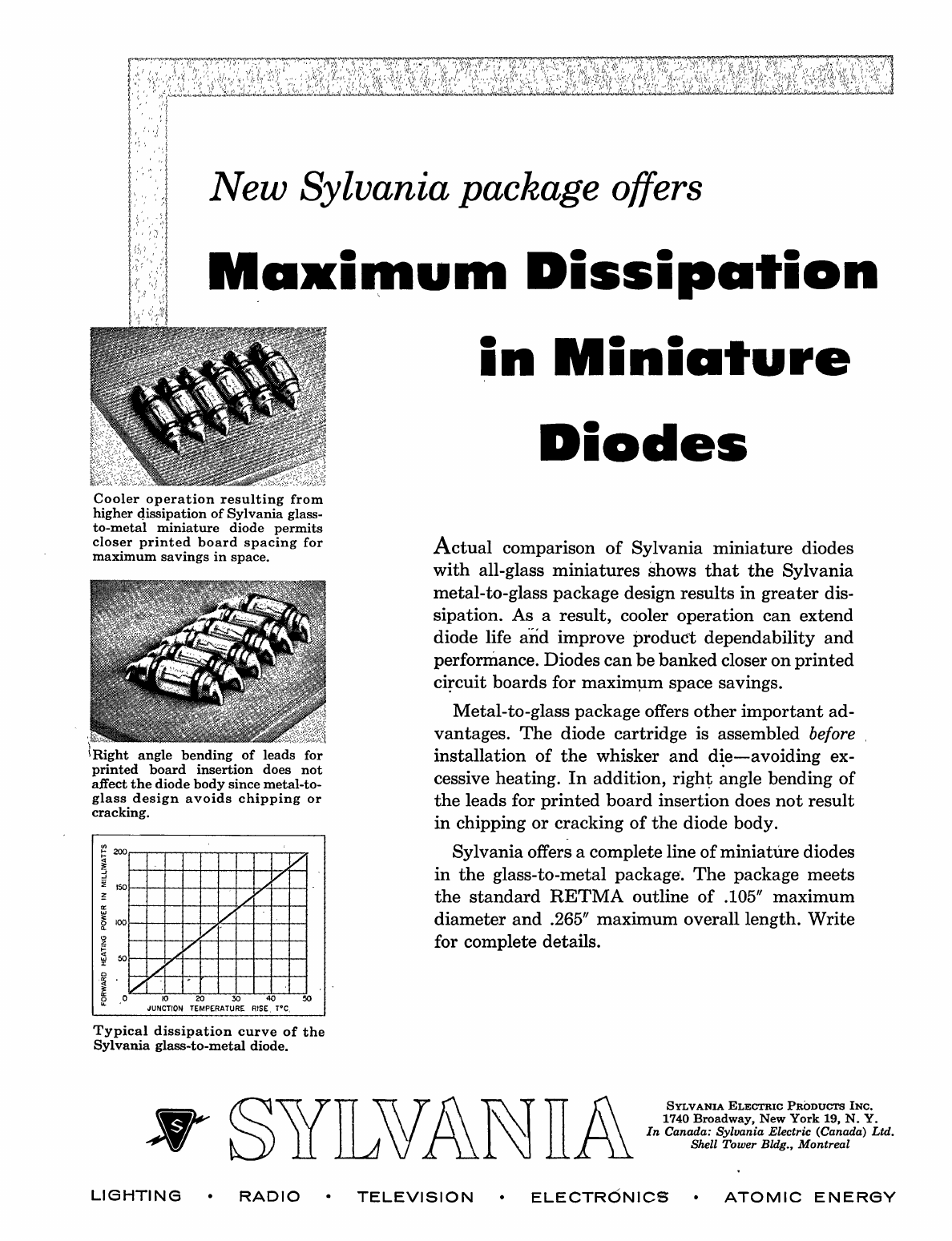
Typical
dissipation
curve
of
the
Sylvania
glass-to-metal
diode.
LIGHTING
RADIO
in
Miniature
Diodes
Actual
comparison
of
Sylvania
miniature
diodes
with
all-glass
miniatures
shows
that
the
Sylvania
metal-to-glass package design
results
in
greater
dis-
sipation. As a
result,
cooler
operation
can
extend
diode life aiid
improve
product
dependability
and
performance. Diodes
can
be
banked
closer
on
printed
circuit
boards
for
maxim~m
space savings.
Metal-to-glass package offers
other
important
ad-
vantages.
The
diode
cartridge
is assembled before
installation
of
the
whisker
and
d~e-avoiding
ex-
cessive heating.
In
addition,
right
angle bending
of
the
leads for
printed
board
insertion does
not
result
in
chipping
or
cracking
of
the
diode body.
Sylvania
offers a complete line
of
miniature
diodes
in
the
glass-to-metal package'.
The
package
meets
the
standard
RETMA
outline
of
.105"
maximum
diameter
and
.265"
maximum
overall length.
Write
for complete details .
TELEVISION
SYLVANIA
ELECTRIC
PR(>DUCTS
INC.
1740
Broadway,
New
York
19,
N.
Y.
In
Canada: Sylvania Electric (Canada) Ltd.
Shell Tower Bldg., Montreal
ELECTRONICS
ATOMIC
ENERGY
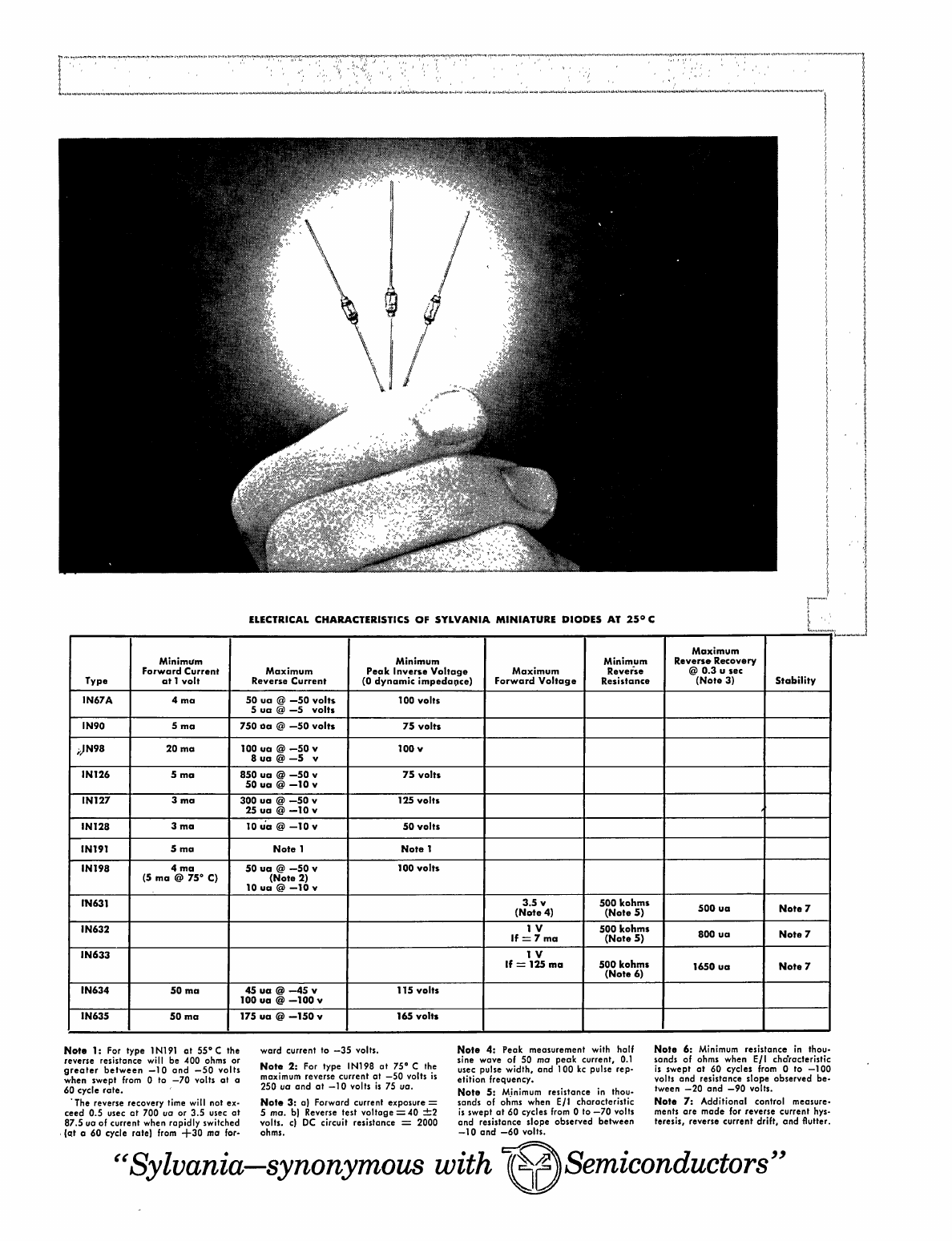
MinimU'm
Forward
Current
Type
at
1
volt
IN67A
4ma
IN90 5
ma
;,)N98
20ma
IN126
Sma
IN127
3ma
IN128
3ma
IN191
Sma
IN198
4ma
(5
ma
@
75°
C)
IN631
IN632
IN633
IN634
SOma
IN635
SOma
Note
1:
For
type 1
N191
at
55° C the
reverse resistance will be 400 ohms or
greater
between
-10
and
-50
volts
when swept
from
0 to
-70
volts
at
a
60 cycle rate.
.
The
reverse recovery time will not ex·
ceed 0.5 usec
at
700 ua or 3.5 usec
at
87.5 ua of current when rapidly switched
, (at a 60 cycle rate)
from
+30
ma for-
/
f'
/
;1,
W
l
//
~'
#
I'
J
ELECTRICAL CHARACTERISTICS
OF
SYLVANIA
MINIATURE
DIODES
AT
25
0 C
Minimum Minimum
Maximum
Peak
Inverse
Voltage
Maximum
Reverse
Reverse
Current
(0
dynamic
impedal;1ce)
Forward
Voltage
Resistance
50
ua
@
-50
volts
100
volts
5
ua
@-5
volts
750
Oa @
-50
volts
75
volts
100
ua
@
-50
v
100v
8
ua
@-S
v
850
ua
@
-50
v
75
volts
SO
ua
@
-10
v
300
ua
@
-50
v 125
volts
25
ua
@
-10
v
10
ua
@
-10
v
50
volts
Note
1
Note
1
50
ua
@
-50
v 100
volts
(Note
2)
10
ua
@
-10
v
45
ua
@
-45
v 115
volts
100
ua
@
-100
v
175
ua
@
-150
v 165
volts
ward current to
-35
volts.
Nate
2:
For
type IN198
at
75° C the
maximum reverse current at
-50
volts
is
250 ua and
at
-10
volts
is
75
ua.
Note
3:
a) Forward current exposure =
5
mao
b)
Reverse test voltage = 40
±2
volts.
c)
DC
circuit resistance = 2000
ohms.
3.5
v
500
kohms
(Note
4)
(Note
5)
1 V
500
kohms
If
= 7
ma
(NoteS)
lV
If =
125
ma
500
kohms
(Note
6)
Note
4:
Peak measurement with half
sine wave of 50 ma peak current,
0.1
usec pulse width, and 100
kc
pulse rep·
etition frequency.
Note
5:
Minimum resistance
in
thou·
sands of
oh'ms
when Ell characteristic
is
swept
at
60 cycles
from
0 to
-70
volts
and resistance slope observed between
-10
and
-60
volts.
Maximum
Reverse
Recovery
@
0.3
usee
(Note
3)
Stability
500
ua
Note
7
800
ua
Note
7
1650
ua
Note
7
Note
6:
Minimum resistance
in
thou·
sands of ohms when Ell cha'racteristic
is
swept
at
60 cycles
from
0 to
-100
volts and resistance slope observed
be·
tween
-20
and
-90
volts.
Note
7:
Additional control measure-
ments are made for reverse current hys·
teresis, reverse current drift, and flutter.
"Sylvania-synonymous with
~Semiconductors"
THE EDITOR'S NOTES
BARRIERS TO COMMUNICATION
I.
The
Computation
Laboratory
of
Harvard
Uni-
versity
held
"An
International
Symposium
on
the
Theory
of
Switching",
April
2
to
5,
in
Cambridge,
Mass.
As
the
conference
began,
Dr.
Howard
H.
Aiken,
Director
of
the
Computation
Laboratory,
read
some
cables.
The
first
one
was
from
Dr.
Michael
A.
Gavrilov,
'Professor,
Doctor
of
Tech-
nical
Sciences,
Academy
of
Sciences,
Moscow,
U.
S.
S.
R.,
saying
that
illness
prevented
him
from
coming;
his
paper
was
"Investigation
of
Switching
Theory
in
the
Soviet
Union".
The
second
cable
was
from
the
Institute
of
Mathematical
Machines,
Academy
of
Sciences,
Prague,
Czechoslovakia,
saying
"Svoboda
can
not
come";
Dr.
Antonin
Svoboda,
Director
of
the
Institute,
was
to
give
a
paper,
"Some
Applications
of
Contact
Grids".
Dr.
Aiken
said
that
the
other
speakers
from
the
u.
S. S.
R.
(G.
N.
Povarov,
Academy
of
Sciences,
Moscow,
whose
paper
was"
A
Mathematical
The-
ory
for
the
Design
of
Contact
Networks";
Alexan-
der
G.
Lunts,
Associate
Professor
of
Mathemat-
ics,
Leningrad
Electrotechnical
Institute,
Lenin-
grad,
whose
paper
was
"Network
Equivalent
Trans-
formations
by
Means
of
Characteristic
Functions";
and
V. N.
Roginskii,
Senior
Research
Associate,
Academy
of
Sciences,
Moscow,
whose
paper
was
"A
Graphic
Method
for
the
Synthesis
of
Contact
Multipoles")
had
not
been
heard
from,
and
had
not
arrived
at
the
conference.
He
expressed
the
regret
-
his
own
and
of
all
those
present
-
that
none
of
these
welcome
scientists
from
the
U.
S.
S.
R.
and
Czechoslovakia
had
been
able
to
come;
and
he
hoped
that
Dr.
Gavrilov's
illness
was
not
con-
tagious.
Dr.
Aiken
added
that
the
texts
of
all
pap-
ers
had
been
received,
would
be
read
at
the
sched-
uled
place
in
the
program,
and
would
be
published;
but
that
it
was
a
great
pity
that
discussion
of
ques-
tions
with
the
author
s
could
not
take
place.
We
think
we
speak
for
all
computer
people
when
we
say
we
also
deeply
regret
political
con-
siderations
spreading
contagiously
into
scientific
fields.
We
cannot
see
any
earthly
use
to
these
stupid
barriers
to
scientific
communication.
We
are
all
of
us
human
beings
jointly
pursuing
scien-
tific
search
to
find
out
the
secrets
of
nature.
II.
But
this
kind of
barrier
is
not
the
only
kind
of
a
barrier.
I
thought
as
I
walked
around
the
- 6 -
Symposium,
and
looked
at
a
great
many
new
faces,
how
much
I
might
have
in
common
with
many
of
them,
if
only
I
had
a
short
cut
for
the
first
five
min-
utes
of
conversation
-
when
one
decides
whether
or
not
"this
man
is
intere
sting
to
me;
we
should
talk
together".
So
far,
the
be
st
form
of
communication
at
any
computer
meeting
seems
to
be
the
cocktail
party:
no
one
sits
down;
everyone
is
mobile;
you
can
wander
around,
say
many
hellos,
introduce
many
people,
and
be
introduced
to
many.
But
there
ought
to
be
much
better
techniques
of
communication
at
computer
meetings:
(1)
The
tag
which
you
wear
at
a
meeting
should
show:
your
name;
your
organization;
your
main
interests.
This
would
give
a
wonderful
starting
point.
(2)
In
your
pocket
you
should
have
a
thumbnail
sketch
of
your-
self,
a
"Who's
Who"
report,
-
so
that
while
you
read
your
new
acquaintance's,
he
can
read
yours.
If
computer
people
suffer
from
lack
of
com-
munication,
we
have
mainly
ourselves
to
blame:
we
are
supposed
to
be
experts
in
information
hand-
ling,
information
engineer
s I
*
----------
*
----------*
NEW
PRO,DUCTS AND
IDEAS
Page
1.
A
Three-Axis
Simulator
for
Controlled
18
Flight
Test
of
Airborne
Systems
2.
A New
Radar
Device
for
Corrected
19
Mapping
3.
Lattice
Networks
for
Digital
Storage
19
4.
A New
Idea
in
Component
Supply
19
* * *
INDEX
OF
NOTICES
For
Information
on:
Advertising
Index
Advertising
Rates
and
Specifications
Back
Copies
Bulk
Subscription
Rates
Manuscripts
Reader's
Inquiry
Form
Special
Issues
See
Page:
46
see
Apr.
issue
see
Apr.
issue
see
Apr.
issue
see
Mar.
issue
46
see
Mar.
issue
Address
Changes:
If
your
address
changes,
please
send
us
both
your
new
and
your
old
address
(torn
off
from
the
wrapper
if
possible),
and
allow
thr~e
weeks
for
the
change.
........
,
,
...
'
.....
e'.'
•••
'.'." •
. '
...
' .
.....
,
..
.
e,
,
•••
, • '
••••••••
••••••••
••••••••
•
••••
........
'
•
•••
•
••••••••
••••••••
.........
••••••••
....
...
'.
•••••
••
••
•
•••
••
•
••••••••
••••••••
••••••••
••••••••
. '
......
.
•
••••
••••••••
·
...
'.
••••••••
••••••••
••••••••
••••• ••
••••••••
..
..
~
..
••••••••
·
...
'
..
,.'
....
,.
...
'
..
.
....
~'
..
.
••••••••
••••••••
•
,.
••
',a
,
.....
,
...
· '
...
' .
. '
......
.
•
•••••
,
.......
.
.'
....
.
••••••••
.,
......
.
'
.......
.
••••••••
.'
...
'.
,
..
' .
~
,
.'
.....
'
..
,.'
.'
....
'.
.,
......
.
'.'
....
",
..
•••••••
'
.....
",
..
'
...•.
'
..
.
· . "
..
.
..
:
...
.
...
..
' .
. '
...
'
....
,
..
'
.....
' '
.......
'
,
..
'
...
' .
..
'~.,
...
,
."
:
...
,'
.
••
'<,
.'
•••
'
..
'.,
',
...
"
••••••••
.....
,
..
.
.....
,
..
.
·
.....
'
••••••••
. ;
..
~
:
..
..
'
....
••••••••
••••••••
·
'.",
..•.
'
.......
.
'
....
,.'
......
'.,
,
".,'
'",
'
.......
.
••••••••
.......
'.,
·
.'
...
••••••••
....
~
...
••••••••
,.
'."
..
,.,
:~~:::
~:,
:
....
'
...
.
".
,
...
'
..
...
,~
..
I,
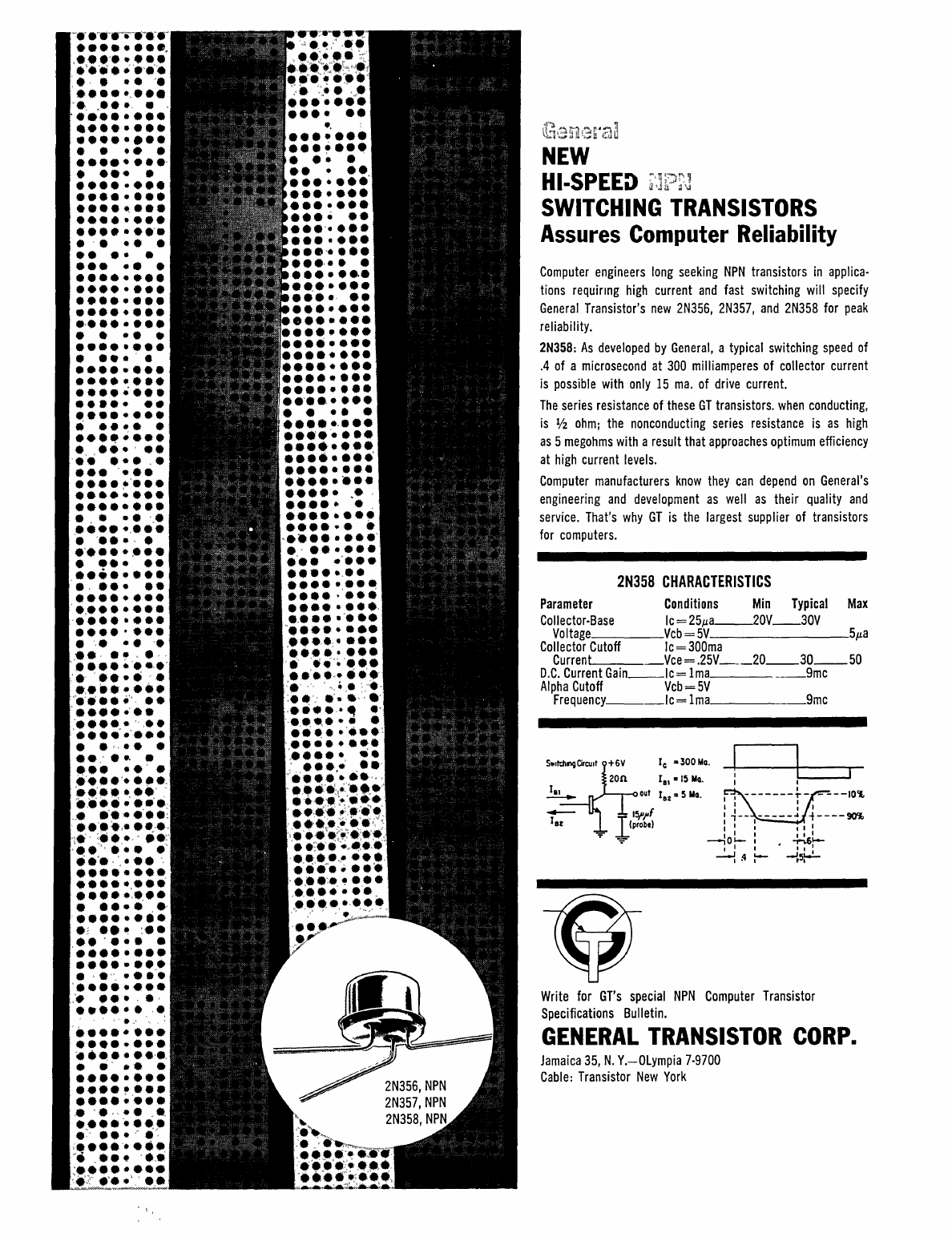
NEW
HI-SPEEi>
SWITCHING
TRANSISTORS
Assures Computer Reliability
Computer
engineers
long
seeking
NPN
transistors
in
applica-
tions
requiring
high
current
and
fast
switching
will
specify
General
Transistor's
new
2N356, 2N357,
and
2N358
for
peak
reliability.
2N358:
As
developed
by
General,
a
typical
switching
speed
of
.4
of
a
microsecond
at
300
milliamperes
of
collector
current
is
possible
with
only
15
rna.
of
drive
current.
The
series
resistance
of
these
GT
transistors.
when
conducting,
is
V2
ohm;
the
nonconducting
series
resistance
is
as
high
as
5
megohms
with
a
result
that
approaches
optimum
efficiency
at
high
current
levels
.
Computer
manufacturers
know
they
can
depend
on
General's
engineering
and
development
as
well
as
their
quality
and
service.
That's
why
GT
is
the
largest
supplier
of
transistors
for
computers.
2N358
CHARACTERISTICS
Parameter
Conditions
Min
Typical
Max
Collector-Base
Ic
=
25Ila
__
20V
__
30V
Voltage
Vcb
=
SV
51la
Collector
Cutoff
Ic
=
300ma
Current
_
Vce=.2SV
___
20
__
30
__
S0
D.C.
Current
Gain
__
lc=
Ima
gmc
Alpha
Cutoff
Vcb
=
SV
Frequency
___
lc=
Ima
gmc
Ie a300Ma .
lSI
·I~
Ma
.
out
In"
5
Ma
.
Write
for
GT's
special
NPN
Computer
Transistor
Specifications
Bulletin.
GENERAL
TRANSISTOR
CORP
•
Jamaica
3S,
N.
Y.-OLympia
7-9700
Cable:
Transistor
New
York
COMPUTER
MARKET
SURVEY
-
REPORT
NO.1
Edmund C.
Berkeley
Edi
tor,
"Computers
and
Automation"
INTRODUCTION
At
the
beginning
of
March,
we
mailed out
to
our
subscribers
in
the
United
States
and
Canada a survey form,
the
main purpose
of
which
was
to
make
an
estimate
of
the
market
for
computer
products
and
services.
A copy
of
the
survey form appears
on
page 40.
Approximately 2200
of
these
forms were
mailed
out;
and as
of
the
middle
of
April,
about 200 forms,
or
9
percent,
had
been
re-
turned.
The
replies
contain
interesting,
im-
portant,
and
extraordinary
information,
show-
ing
the
nature
and
size
of
the
current
market
for
computing and
data
processing
machinery.
The
replies
will
furnish
the
material
for
several
reports
to
our
readers,
particularly
after
they have been
carefully
projected,
industry
by
industry,
to
determine
their
prob-
able
implications.
In
the
meantime,
we
think
that
the
inter-
ests
of
our
readers
will
be
best
served
if
we
publish
a
serial
tabulation
of
a
part
of
the
raw
data
received
for
each
reply.
This
is
especially
true
because
often
in
surveys
the
examples
of
the
raw
data
are
just
as
interest-
ing as summaries
of
the
data.
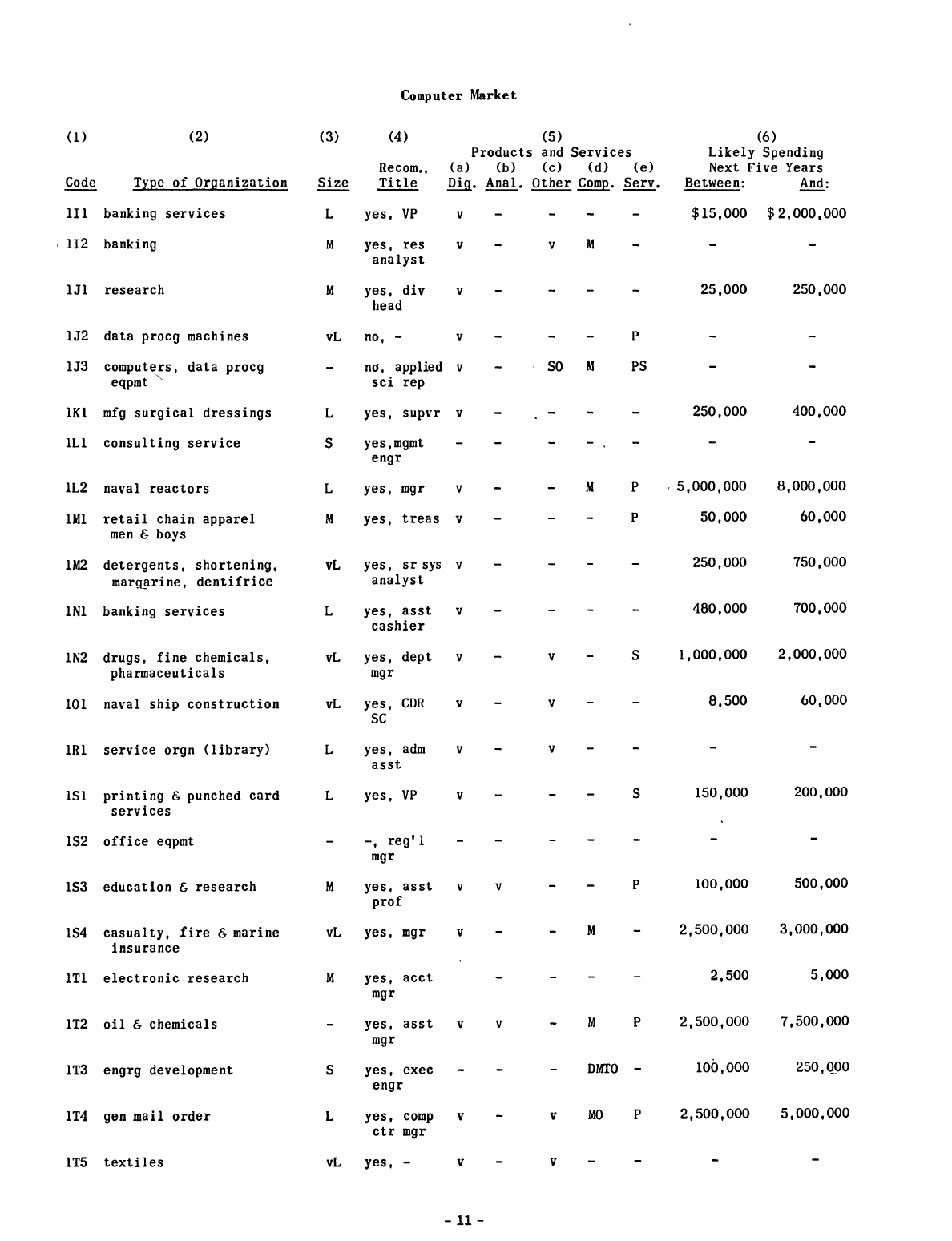
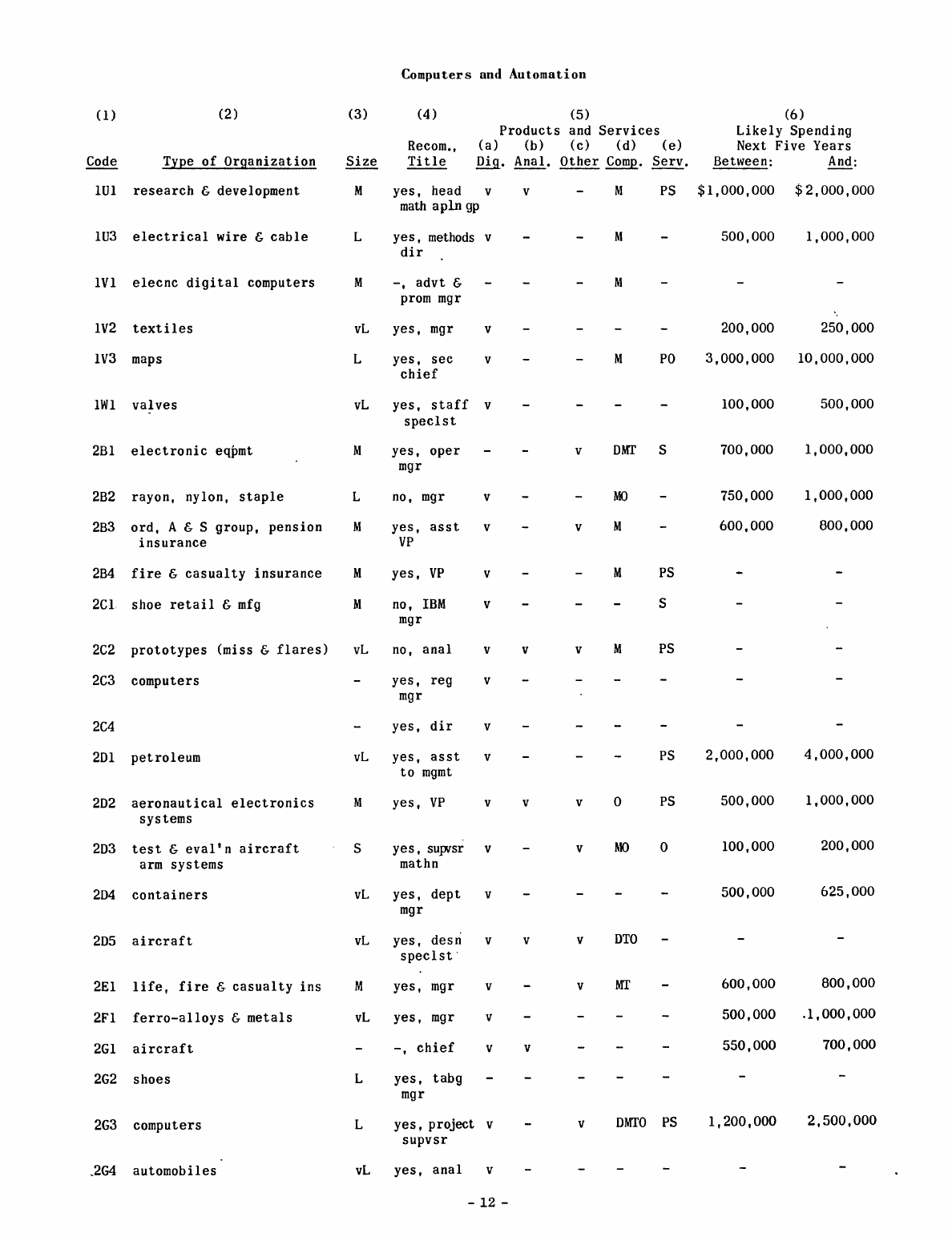
The
tabulation
given below
includes
all
replies
except a
few
incomplete
or
inapplicable
returns.
Each
entry
in
the
tabulation
is
important,
because
it
represents
a
report
by
a
subscriber
of
"Computers and Automation" (whose
title
in
his
organization
has been
indicated)
who
kindly
took
the
trouble
to
serld
us
in
his
estimate
for
the
advantage
of
others.
We
express
our
app~
ciation
to
these
subscribers
of
ours
for
send-
ing
us
this
information.
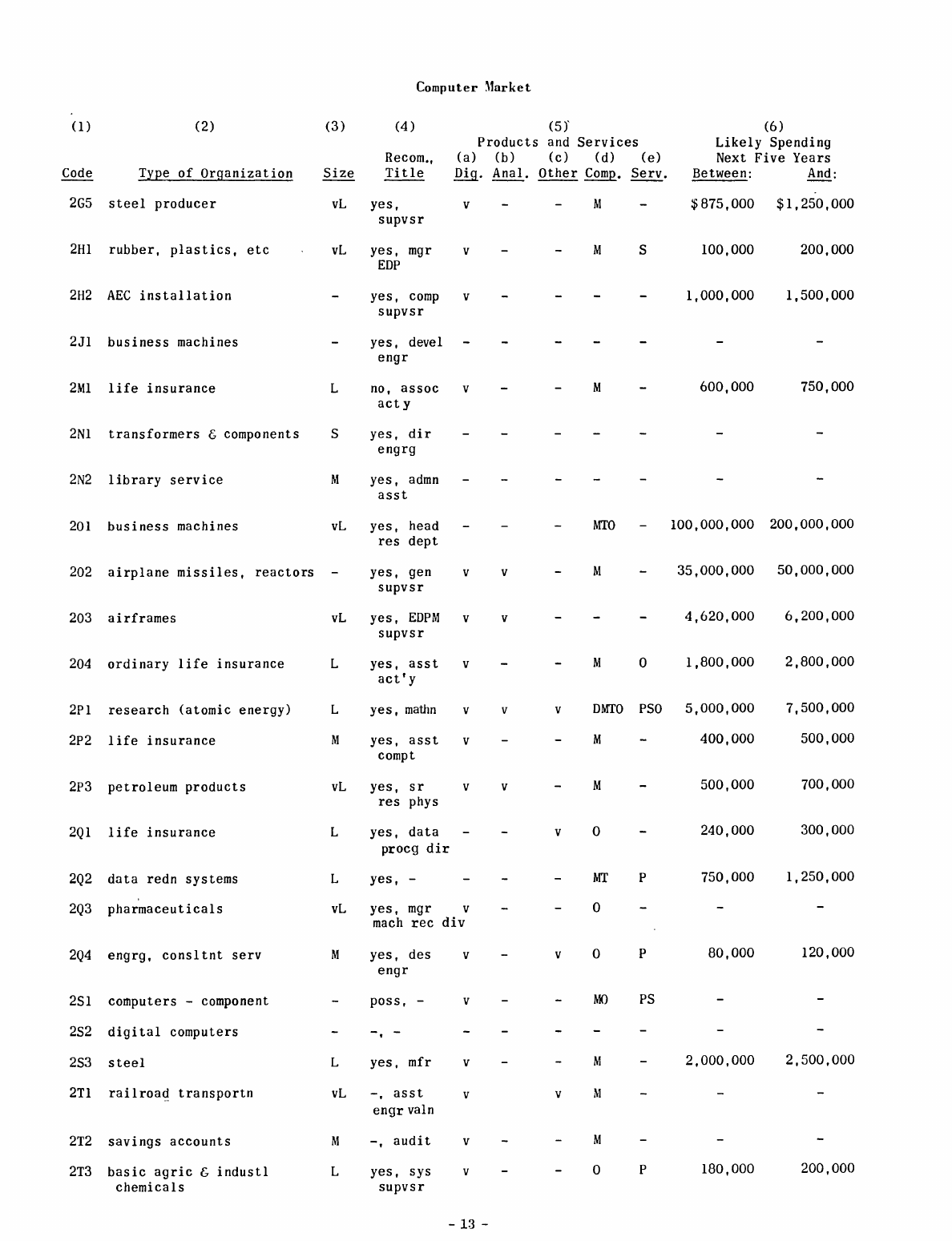
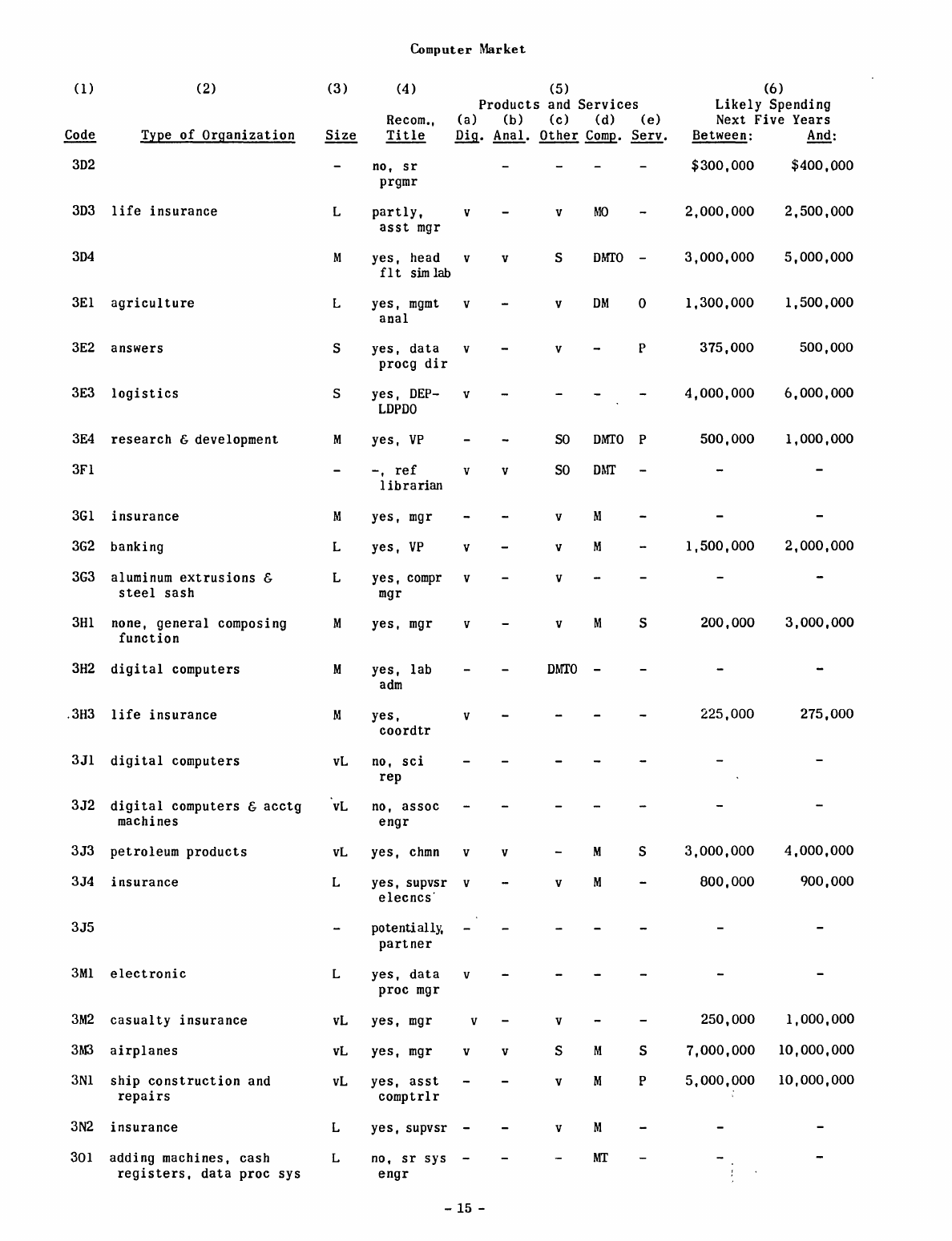
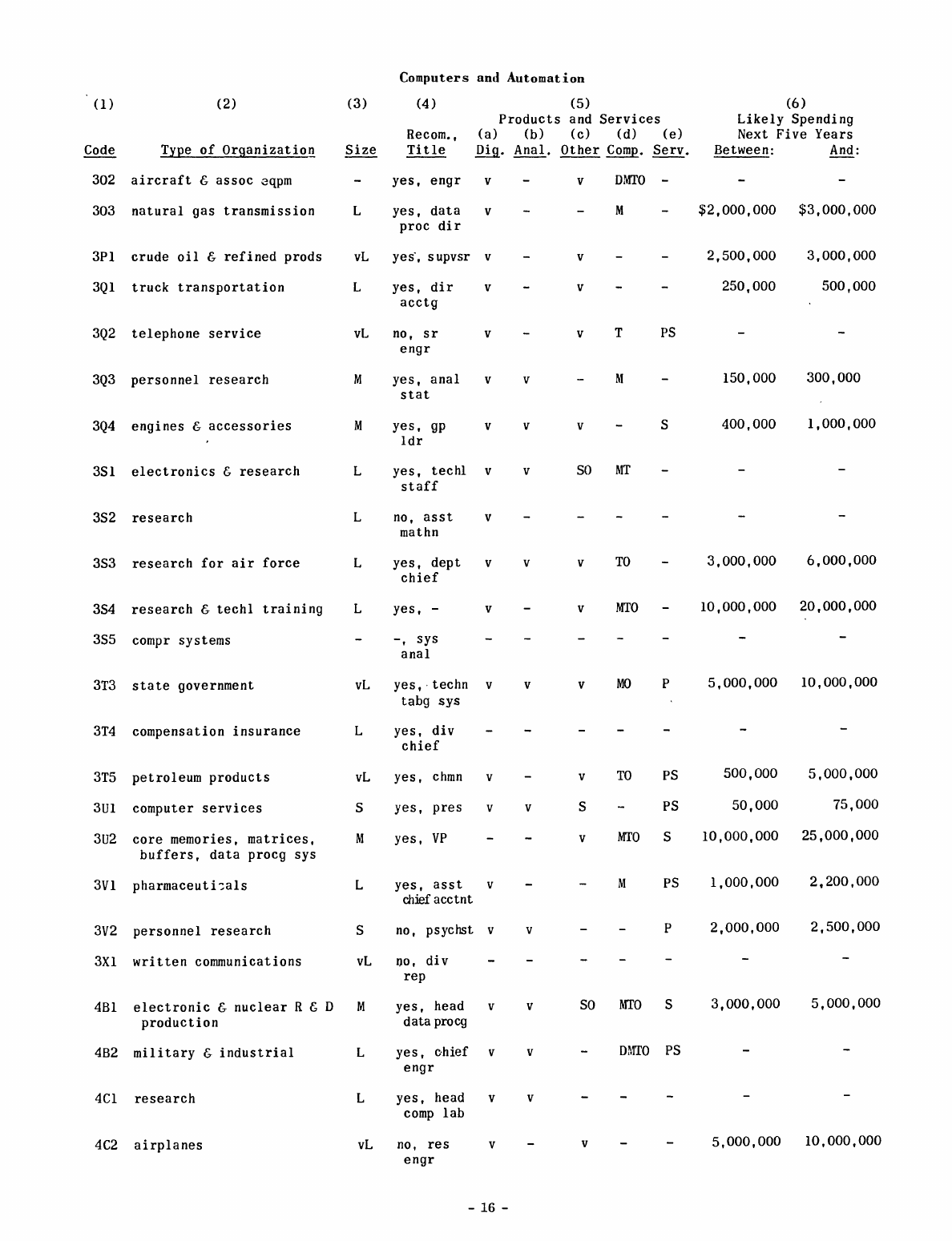
WHAT
THE
TABULATION
CONTAINS
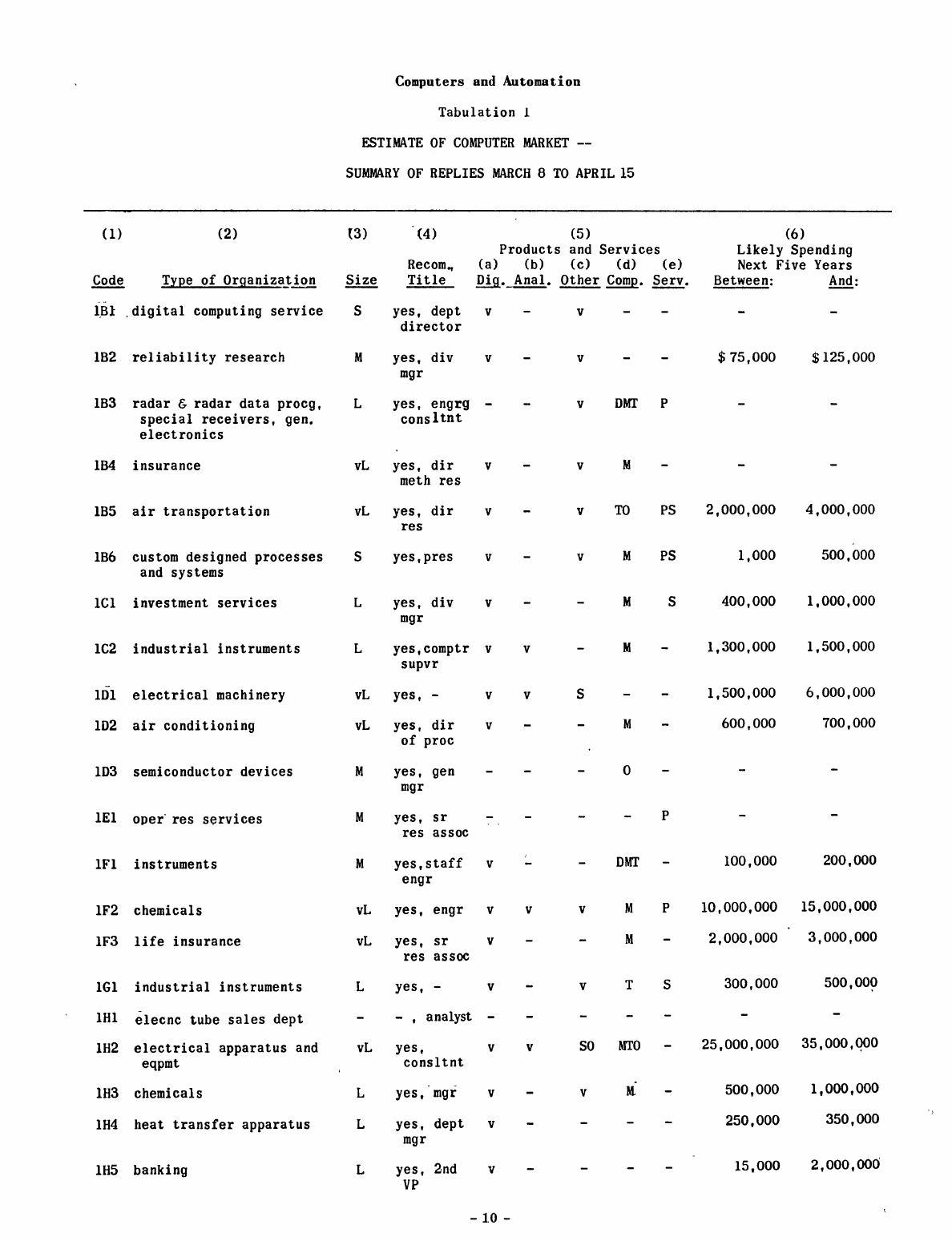
An
explanation
of
the
information
in
the
table
follows: '
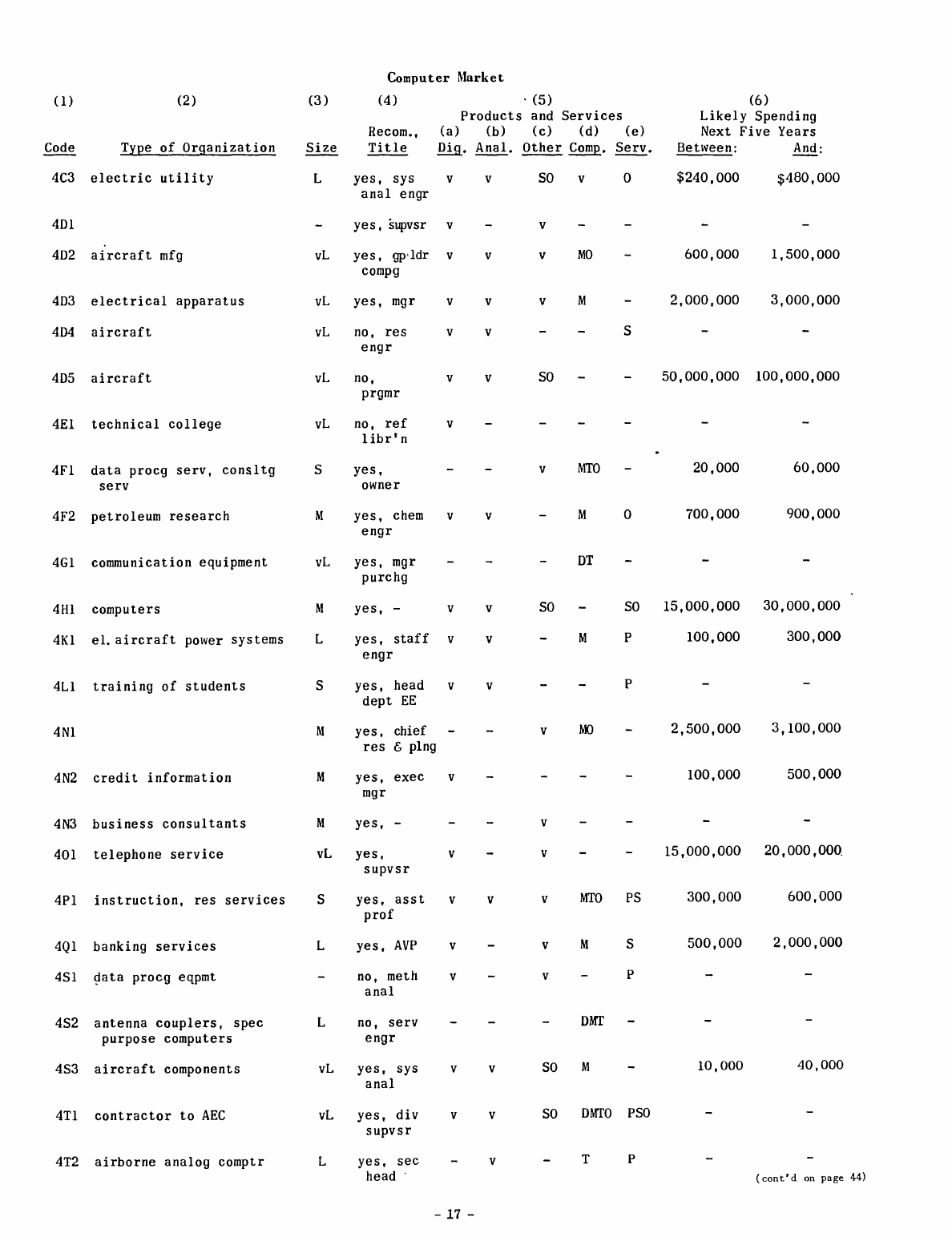
(1) Code. This code
identifies
the
re-
turn,
not
the
organization.
Although
the
name
of
the
organization
was
given
on
nearly
every
return,
we
cannot
publish
the
name
since
it
- 8 -
was
requested
"for
statistical
purposes" only.
(2)
Type
of
Organization.
This
is
self-
explanatory.
(3)
Size.
Size
is
reported
in
number
of
employees, grouped. S
stands
for
small
size,
I
to
50
employees;
M,
medium
size,
51
to
500
employees;
L,
large
size,
501
to
5,000 employ-
ees;
vL,
very
large
size,
over 5,000 employees.
(4) Recom.,
Title.
Here
is
the
report
on
the
question
"Do
your recommendations
affect
purchases?",
and
the
title
of
the
person
fill-
ing
in
the
questionnaire.
The
purpose
of
this
information
is
to
give
some
indication
of
the
probable
authority
of
the
estimate
here
re-
ported.
(5) Products and
Services.
Here
is
the
report
on
the
question
"What
kinds
of
computer
products
and
services
does your
organization
buy
or
rent
(or
is
considering
buying
or
rent-
ing?"
Column
(a)
reports
on
"automatic
digital
computers".
Column
(b)
reports
on
"automatic
analog
computers".
Column
(c)
reports
on
"other
computers";
the
codes
are
as
follows:
S -
simulators
.
v -
other
data
processing
machines
Column
(d)
reports
on
"components";
the
codes
are
as
follows:
D - Delay
lines
M - Magnetic
tape
devices
T -
Transistors
o
~
Other components
Colum~(e)
reports
on
"services";
the
codes
are
as
follows:
P - comPuting
services
S -
conSulting
services
o - Other
services
(6)
Likely
Spending Next Five Years.
This column
reports
on
the
question:
"Can
you
estimate
roughly and approximately
about
how
much
your
organization
is
likely
to
spend
on
products
and
services
in
the
com-
puter
field
in
the
next
five
years?
Between and
_____
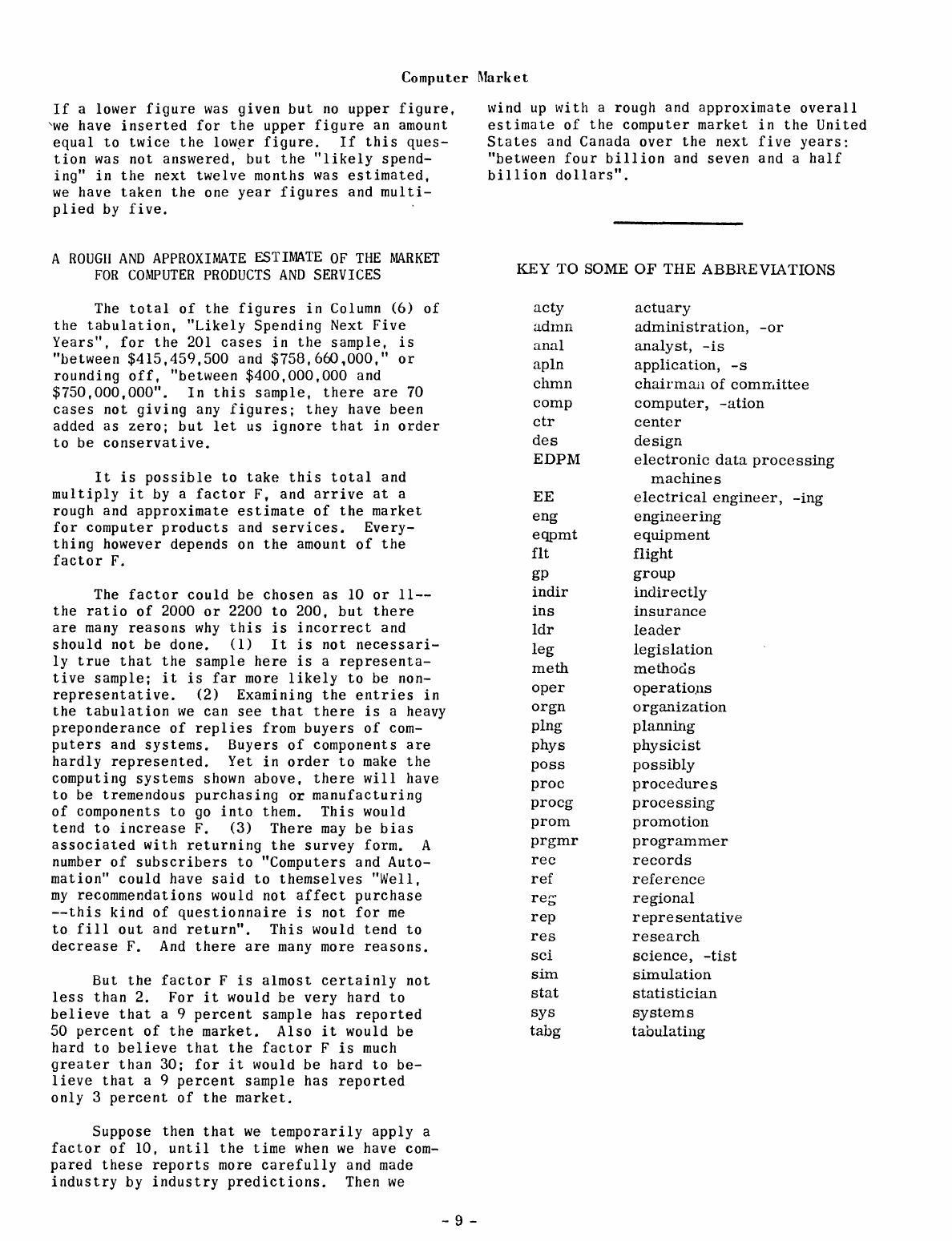
"
Computer
Market
If
a lower
figure
was
given
but
no
upper
figure,
'we
have
inserted
for
the
upper
figure
an amount
equal
to
twice
the
low~r
figure.
If
this
ques-
tion
was
not answered,
but
the
"likely
spend-
ing"
in
the
next
twelve
months
was
estimated,
we
have
taken
the
one
year
figures
and
multi-
plied
by
five.
A
ROUGH
AND
APPROXIMATE
ESTIMATE
OF
THE
MARKET
FOR
COMPUTER
PRODUCTS
AND
SERVICES
The
total
of
the
figures
in
Column
(6)
of
the
tabulation,
"Likely
Spending Next
Five
Years",
for
the
201
cases
in
the
sample,
is
"between
$415,459,500
and
$758,660,000,"
or
rounding
off,
"between
$400,000,000
and
$750,000,000".
In
this
sample,
there
are
70
cases
not
giving
any
figures;
they
have been
added as
zero;
but
let
us
ignore
that
in
order
to
be
conservative.
It
is
possible
to
take
this
total
and
multiply
it
by
a
factor
F, and
arrive
at
a
rough and
approximate
estimate
of
the
market
for
computer
products
and
services.
Every-
thing
however depends
on
the
amount
of
the
factor
F.
The
factor
could
be chosen as
10
or
II--
the
ratio
of
2000
or
2200
to
200,
but
there
are
many
reasons
why
this
is
incorrect
and
should
not be done. (1)
It
is
not
necessari-
ly
true
that
the
sample
here
is
a
representa-
tive
sample;
it
is
far
more
likely
to
be non-
representat
i ve. (2)
Exami
ni
ng
the
entries
in
the
tabulation
we
can
see
that
there
is
a heavy
preponderance
of
replies
from
buyers
of
com-
puters
and
systems.
Buyers
of
components
are
hardly
represented.
Yet
in
order
to
make
the
computing systems
shown
above,
there
will
have
to
be tremendous
purchasing
or
manufacturing
of
components
to
go
into
them.
This
would
tend
to
increase
F. (3) There
may
be
bias
associated
with
returning
the
survey
form. A
number
of
subscribers
to
"Computers and Auto-
mation"
could
have
said
to
themselves
"Well,
my
recommendations would not
affect
purchase
--this
kind
of
questionnaire
is
not
for
me
to
fill
out
and
return".
This
would
tend
to
decrease
F.
And
there
are
many
more
reasons.
But
the
factor
F
is
almost
certainly
not
less
than
2. For
it
would be
very
hard
to
believe
that
a 9
percent
sample has
reported
50
percent
of
the
market.
Also
it
would be
hard
to
believe
that
the
factor
F
is
much
greater
than
30;
for
it
would be
hard
to
be-
lieve
that
a 9
percent
sample has
reported
only
3
percent
of
the
market.
Suppose
then
that
we
temporarily
apply
a
factor
of
10,
until
the
time
when
we
have com-
pared
these
reports
more
carefully
and
made
industry
by
industry
predictions.
Then
we
- 9 -
wind
up
with
a rough and
approximate
overall
estimate
of
the
computer market
in
the
United
States
and Canada
over
the
next
five
years:
"between fou r
bi
11
ion
and seven and a
hal
f
billion
dollars".
KEY
TO
SOME
OF
THE
ABBHEVIATIONS
acty
admn
anal
apln
chmn
comp
ctr
des
EDPM
EE
eng
eqpmt
flt
gp
indir
ins
ldr
leg
meth
oper
orgn
pIng
phys
poss
proc
procg
prom
prgmr
rec
ref
ret;
rep
res
sci
sim
stat
sys
tabg
actuary
administration,
-or
analyst,
-is
application,
-s
chairman
of
comrr!ittee
computer,
-ation
center
design
electronic
data
processing
machines
electrical
engineer,
-ing
engineering
equipment
flight
group
indirectly
insurance
leader
legislation
methoQs
operatio.l1s
orga.l1ization
planning
physicist
possibly
procedures
processing
promotion
programmer
records
reference
regional
representative
research
science,
-tist
simulation
statistician
systems
tabulating
Computers
and
Automation
Tabulation
1
ESTIMATE
OF
COMPUTER
MARKET
--
SUMMARY
OF
REPLIES
MARCH
8
TO
APRIL
15
0)
(2) (3) (4) (5) (6)
Products
and
Services
Likely
Spending
Recom.,
(a) (b) (c) (d) (e)
Next
Five Years
Code
Type
of
Organiza,.!.ion
Size
Title
Q!.9..
Anal. Other
Compo
Servo Between:
And:
1.Bl
.digital
computing
service
S yes, dept v v
director
lB2
reliability
research
M yes, div v v $ 75,000 $125,000
mgr
lB3
radar
&
radar
data
procg, L yes, engrg -v
DMT
P
special
receivers,
gen.
consltnt
electronics
lB4
insurance
vL
yes,
dir
v v M
meth
res
IB5
air
transportation
vL
yes,
dir
v v
TO
PS
2,000,000 4,000,000
res
IB6
custom designed
processes
S
yes,pres
v v M
PS
1,000 500,000
and systems
lCl investment
services
L yes, div v M S 400,000 1,000,000
mgr
lC2
industrial
instruments L yes,comptr v v M 1,300,000 1,500,000
supvr
IDI
electrical
machinery
vL
yes, -v v S 1,500,000 6,000,000
ID2
air
conditioning
vL
yes,
dir
v M 600,000 700,000
of
proc
lD3
semiconductor devices M yes, gen 0
mgr
lEI
oper
res
services
M yes,
sr
P
res
assoc
IFI
instruments
M
yes,staff
v
DMT
100,000 200,000
engr
IF2 chemicals
vL
yes, engr v v v M P 10,000,000 15,000,000
lF3
life
insurance
vL
yes,
sr
v M 2,000,000 3,000,000
res
assoc
IG1
industrial
instruments L yes, -v v T S 300,000
500,00~
IHI
elecnc
tube
sales
dept - , analyst
IH2
electrical
apparatus and
vL
yes, v v
SO
MTO
25,000,000
35,OOO,QOO
eqpmt
consltnt
183 chemicals L yes,
mgr
v v M 500,000 1,000,000
184
heat
transfer
apparatus
L yes, dept v 250,000 350,000
mgr
185 banking L yes,
2nd
v 15,000 2,000,000
VP
-10
-
Computer Market
(1)
(2) (3) (4) (5) (6)
Products
and
Services
Likely
Spending
Recom.,
(a)
(b) (c) (d)
(e)
Next
Five
Years
Code
Type
of
Organization
Size
~
Dig. Anal.
Other
Compo
Servo Between:
And:
III
banking
services
L
yes,
VP
v
$15,000
$
2,000,000
II2
banking M
yes,
res
v v M
analyst
IJI
research
M
yes,
div
v 25,000 250,000
head
IJ2
data
procg machines
vL
no, -v P
IJ3
computers,
data
procg
nO',
applied v
SO
M
PS
eqpmt
'-..
sci
rep
IKI
mfg
surgical
dressings
L
yes,
supvr v 250,000 400,000
ILl
consulting
service
S yes,mgmt
engr
IL2
naval
reactors
L
yes,
mgr
v M P ,
5,000,000
8,000,000
IMI
retail
chain
apparel
M
yes,
treas
v P 50,000 60,000
men
& boys
1M2
detergents,
shortening,
vL
yes,
sr
sys
v 250,000 750,000
marQilrine,
dentifrice
analyst
INI banking
services
L
yes,
asst
v 480,000 700,000
cashier
IN2
drugs,
fine
chemicals,
vL
yes,
dept
v v S
1,000,000
2,000,000
pharmaceuticals
mgr
101
naval
ship
construction
vL
yes,
CDR
v v
8,500
60,000
SC
IRI
service
orgn
(library)
L
yes,
adm
v v
asst
lSI
printing
& punched
card
L
yes,
VP
v S 150,000 200,000
services
IS2
office
eqpmt -,
reg'l
mgr
IS3
education
&
research
M
yes,
asst
v v P 100,000 500,000
prof
IS4
casualty,
fire
& marine
vL
yes,
mgr
v M
2,500,000
3,000,000
insurance
ITI
electronic
research
M
yes,
acct
2,500
5,000
mgr
IT2
oil
& chemicals
yes,
asst
v v M P
2,500,000
7,500,000
mgr
IT3 engrg development S
yes,
exec
DMI'O
-100,000
250,QOO
engr
IT4
gen
mail
order
L
yes,
comp
v v
MO
P
2,500,000
5,000,000
ctr
mgr
ITS
textiles
vL
yes,
-v v
-11
-
Computers
and
Automation
(1)
(2) (3)
(4
) (5) (6)
Products
and
Services
Likely
Spending
Recom.,
(a) (b) (c) (d)
(e)
Next Five Years
Code
T~Ee
of
Organization
Size
Title
Qi[.
Anal.
Other
ComE.
Servo Between:
And:
lUI
research
& development M
yes,
head v v M
PS
$1,000,000
$
2,000,000
math
apln
gp
lU3
electrical
wire
&
cable
L
yes,
methods
v M 500,000
1,000,000
dir
lVl
elecnc
digital
computers M -, advt & M
prom
mgr
lV2
textiles
vL
yes,
mgr
v 200,000 250,000
lV3
maps
L
yes,
sec v M
PO
3,000,000
10,000,000
chief
lWl
valves
vL
yes,
staff
v 100,000 500,000
speclst
2Bl
electronic
eqpmt M
yes,
oper
v
OMT
S 700,000
1,000,000
mgr
2B2
rayon, nylon,
staple
L no,
mgr
v
MO
750,000
1,000,000
2B3
ord,
A & S group,
pension
M
yes,
asst
v v M 600,000 800,000
insurance
VP
2B4
fire
&
casualty
insurance
M
yes,
VP
v M
PS
2Cl shoe
retail
&
mfg
M no,
IBM
v S
mgr
2C2
prototypes
(miss &
flares)
vL
no,
anal
v v v M
PS
2C3
computers
yes,
reg v
mgr
2C4
yes,
dir
v
201
petroleum
vL
yes,
asst
v
PS
2,000,000
4,000,000
to
mgmt
202
aeronautical
electronics
M
yes,
VP
v v v 0
PS
500,000
1,000,000
systems
203
test
&
evalln
aircraft
S
yes,
supvsr
v v
MO
0 100,000 200,000
arm
systems mathn
204
containers
vL
yes,
dept
v 500,000 625,000
mgr
205
aircraft
vL
yes,
desn v v v
OTO
speclst'
2El
life,
fire
&
casualty
ins
M
yes,
mgr
v v
MT
600,000 800,000
2Fl
ferro-alloys
&
metals
vL
yes,
mgr
v 500,000
.1,000,000
2Gl
aircraft
-,
chief
v v 550,000 700,000
2G2
shoes L
yes,
tabg
mgr
2G3
computers L
yes,
project v v
OMTO
PS
1,200,000
2,500,000
supvsr
.2G4
automobiles
vL
yes,
anal
v
-
12
-
Computer
"arket
(1)
(2) (3) (4 ) (5)' (6)
Products
and
Services
Likely
Spending
Recom., (a) (b)
(c)
(d)
(e)
Next
Five
Years
Code
T~~e
of
Organization
Size
Title
Q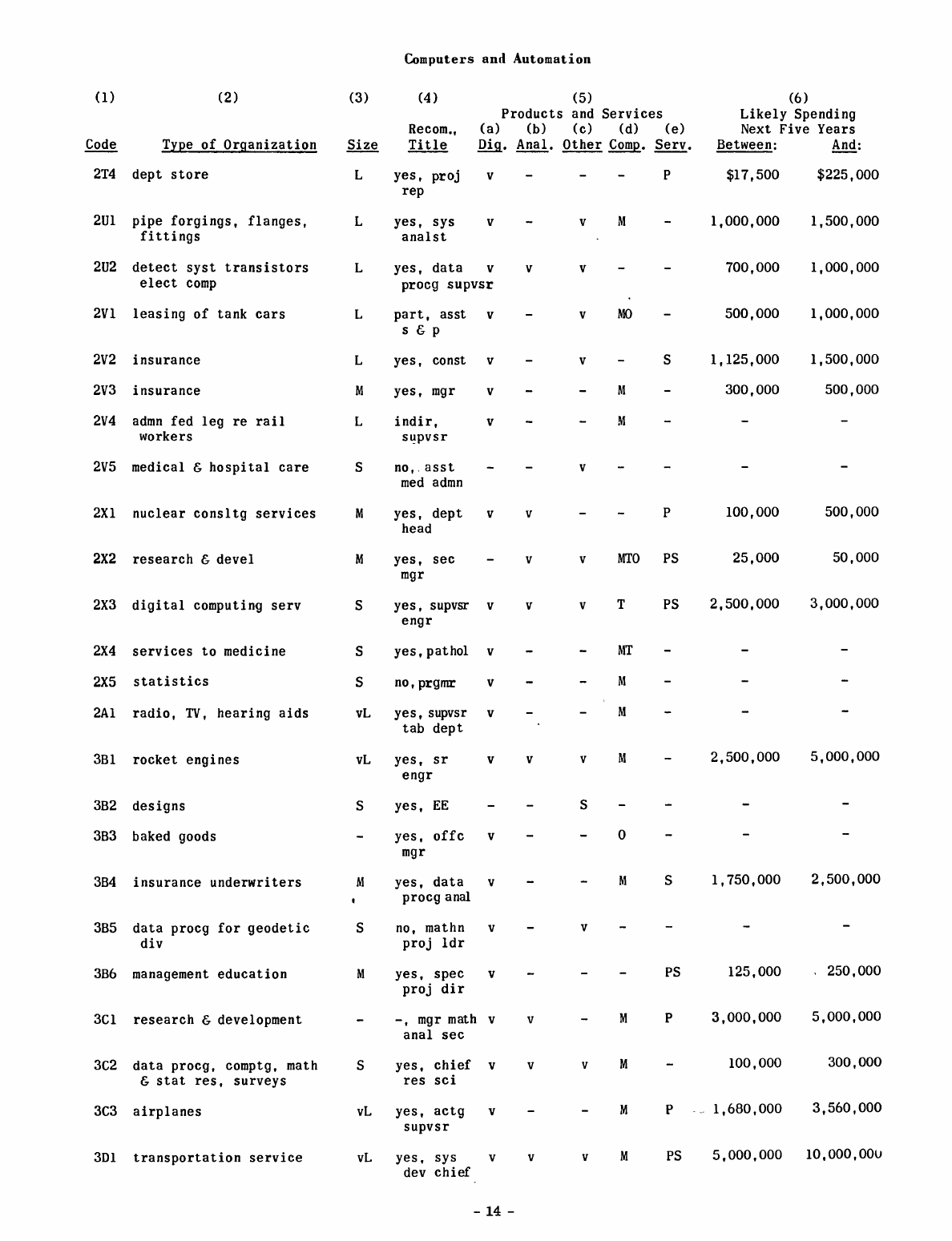
Computers and Automation
(1)
(2) (3)
(4
) (5) (6)
Products
and
Services
Likely
Spending
Recom.,
(a)
(b) (c) (d) (e) Next Five Years
Code
T~~e
of
Organization
Size
Title
Dig. Anal.
Other
Com~.
Servo Between:
And:
2T4
dept
store
L
yes,
proj v P $17,500 $225,000
rep
2Ul
pipe
forgings,
flanges,
L
yes,
sys v v M
1,000,000
1,500,000
fittings
analst
2U2
detect
syst
transistors
L
yes,
data
v v v 700,000 1,000,000
elect
comp
procg
supvsr
2Vl
leasing
of
tank
cars
L
part,
asst v v
MO
500,000 1,000,000
s & P
2V2
insurance
L
yes,
const v v S
1,125,000 1,500,000
2V3
insurance
M
yes,
mgr
v M 300,000 500,000
2V4
admn
fed
leg
re
rail
L
indir,
v M
workers
s~pvsr
2V5
medical &
hospital
care
S no,.
asst
v
med
admn
2Xl
nuclear
consltg
services
M yes,
dept
v v P 100,000 500,000
head
2X2
research
&
devel
M
yes,
sec v v
MTO
PS
25,000 50,000
mgr
2X3
digital
computing
serv
S
yes,
supvsr v v v T
PS
2,500,000
3,000,000
engr
2X4
services
to
medicine S
yes,
pathol v
MT
2X5
statistics
S no, prgmr v M
2Al
radio,
TV,
hearing
aids
vL
yes,
supvsr v M
tab
dept
381
rocket
engines
vL
yes,
sr
v v v M
2,500,000
5,000,000
engr
382
designs
S
yes,
EE
S
383 baked goods
yes,
offc
v 0
mgr
384
insurance
underwriters
M
yes,
data
v M S
1,750,000
2,500,000
procg anal
385
data
procg
for
geodetic
S no, mathn v v
div
proj
ldr
386 management
education
M
yes,
spec v
PS
125,000 250,000
proj
dir
3Cl
research
& development
-,
mgr
math
v v M P
3,000,000
5,000,000
anal
sec
3C2
data
procg, comptg, math S yes,
chief
v v v M 100,000 300,000
&
stat
res,
surveys
res
sci
3C3
airplanes
vL
yes,
actg
v M P
1,680,000
3,560,000
supvsr
3Dl
transportation
service
vL
yes,
sys v v v M
PS
5,000,000
10, 000,
OOu
dey
chief
-14 -
Computer
Market
(1)
(2) (3 )
(4
) (5) (6)
Products
and
Services
Likely
Spending
Recom.,
(a) (b) (c) (d)
(e)
Next Five Years
Code
Type
of
Organization
Size
Title
Qi[.
Anal. Other
Compo
Servo Between:
And:
302 no,
sr
$300,000 $400,000
prgmr
303
life
insurance
L
partly,
v v
MO
2,000,000
2,500,000
asst
mgr
304
M
yes,
head v v S
OMTO
-
3,000,000
5,000,000
flt
simlab
3El
agriculture
L
yes,
mgmt
v v
OM
°
1,300,000
1,500,000
anal
3E2
answers S
yes,
data
v v P 375,000 500,000
procg
dir
3E3
logistics
S
yes,
OEP-
v
4,000,000
6,000,000
LOPOO
3E4
research
& development M yes,
VP
SO
OMTO
P 500,000
1,000,000
3Fl -,
ref
v v
SO
OMT
librarian
3Gl
insurance
M
yes,
mgr
v M
3G2
banking L
yes,
VP
v v M
1,500,000
2,000,000
3G3
aluminum
extrusions
& L yes,
compr
v v
steel
sash
mgr
3Hl
none,
general
composing M
yes,
mgr
v v M S 200,000
3,000,000
function
3H2
digital
computers M
yes,
lab
OMTO
-
adm
.3H3
life
insurance
M
yes,
v 225,000 275,000
coordtr
3Jl
digital
computers
vL
no,
sci
rep
3J2
digital
computers &
acctg
vL
no,
assoc
machines
engr
3J3 petroleum
products
vL
yes,
chmn
v v M S
3,000,000
4,000,000
3J4
insurance
L yes, supvsr v v M 800,000 900,000
elecncs'
3J5 potentially,
partner
3Ml
electronic
L
yes,
data
v
proc
mgr
3M2
casualty
insurance
vL
yes,
mgr
v v 250,000
1,000,000
3M3
airplanes
vL
yes,
mgr
v v S M S
7,000,000
10,000,000
3Nl
ship
construction
and
vL
yes,
asst
v M P
5,000,000
10,000,000
repairs
comptrlr
3N2
insurance
L
yes,
supvsr -v M
301
adding machines, cash L no,
sr
sys -
MT
registers,
data
proc sys
engr
-15
-
Computers
and
Automation
(1)
(2) (3)
(4
) (5) (6)
Products
and
Services
Likely
Spending
Recom.
,
(a)
(b) (c) (d)
(e)
Next
Five
Years
Code
Tn:!e
of
Organization
Size
Title
Dig. Anal.
Other
Compo
Servo Between:
And:
302
aircraft
&
assoc
~qpm
yes,
engr
v v
DMTO
303
natural
gas
transmission
L
yes,
data
v M
$2,000,000
$3,000,000
proc
dir
3Pl
crude
oil
&
refined
prods
vL
yes",
s upvsr v v
2,500,000
3,000,000
3Ql
truck
transportation
L
yes,
dir
v v 250,000 500,000
acctg
3Q2
telephone
service
vL
no,
sr
v v T
PS
engr
3Q3
personnel
research
M
yes,
anal
v v M 150,000 300,000
stat
3Q4
engines
&
accessories
M
yes,
gp
v v v S 400,000
1,000,000
Idr
3S1
electronics
&
research
L
yes,
techl
v v
SO
MT
staff
3S2
research
L no,
asst
v
mathn
3S3
research
for
air
force
L
yes,
dept
v v v
TO
3,000,000
6,000,000
chief
3S4
research
&
techl
training
L
yes,
-v v
MTO
10,000,000
20,000,000
3S5
compr systems -, sys
anal
3T3
state
government
vL
yes,·techn
v v v
MO
P
5,000,000
10,000,000
tabg
sys
3T4
compensation
insurance
L
yes,
div
chief
3T5
petroleum
products
vL
yes,
chmn
v v
TO
PS
500,000
5,000,000
3Ul computer
services
S
yes,
pres
v v S
PS
50,000
75,000
3U2
core
memories,
matrices,
M
yes,
VP
v
MTO
S
10,000,000
25,000,000
buffers,
data
procg sys
3Vl pharmaceutioo;als L
yes,
asst
v M
PS
1,000,000
2,200,000
chief
acctnt
3V2
personnel
research
S no, psychst v v P
2,000,000
2,500,000
3Xl
written
communications
vL
no,
div
rep
4Bl
electronic
&
nuclear
R & D M
yes,
head v v
SO
MTO
S
3,000,000
5,000,000
production
data
procg
4B2
military
&
industrial
L
yes,
ohief v v
DMTO
PS
engr
4Cl
research
L
yes,
head v v
comp
lab
4C2
airplanes
vL
no,
res
v v
5,000,000
10,000,000
engr
-
16
-
Computer
Market
(1)
(2)
(3
)
(4
) . (5) (6)
Products
and
Services
Likely
Spending
Recom., (a) (b) (c) (d) (e) Next
Five
Years
Code
Type
of
Organization
Size
Title
Dig. Anal.
Other
Compo
Servo Between:
And:
4C3
electric
utility
L
yes,
sys v v
SO
v 0 $240,000 $480,000
anal
engr
4Dl
yes,
supvsr v v
4D2
aircraft
mfg
vL
yes,
gp,ldr v v v
MO
600,000
1,500,000
compg
4D3
electrical
apparatus
vL
yes,
mgr
v v v M
2,000,000
3,000,000
404
aircraft
vL
no,
res
v v 5
engr
4D5
aircraft
vL
no, v v
SO
50,000,000
100,000,000
prgmr
4El
technical
college
vL
no,
ref
v
libr
' n
4Fl
data
procg
serv,
consltg
5
yes,
v
MTO
20,000
60,000
serv
owner
4F2
petroleum
research
M
yes,
chern
v v M 0 700,000 900,000
engr
4Gl
communication equipment
vL
yes,
mgr
DT
purchg
4Hl
computers M
yes,
-v v
SO SO
15,000,000
30,000,000
4Kl
el.
aircraft
power systems L
yes,
staff
v v M P 100,000 300,000
engr
4Ll
training
of
students
5
yes,
head v v P
dept
EE
4Nl
M
yes,
chief v
~
2,500,000
3,100,000
res
&
pIng
4N2
credit
information
M
yes,
exec v 100,000 500,000
mgr
4N3
business
consultants
M
yes,
-v
401
telephone
service
vL
yes,
v v 15,000,000 20,000 ,000.
supvsr
4Pl
instruction,
res
services
5
yes,
asst
v v v
MTO
PS
300,000 600,000
prof
4Ql
banking
services
L
yes,
AVP
v v M 5 500,000
2,000,000
451
~ata
procg eqpmt no, meth v v P
anal
452 antenna
couplers,
spec L no,
serv
DMT
purpose computers
engr
453
aircraft
components
vL
yes,
sys v v
SO
M 10,000 40,000
anal
4Tl
contractor
to
AEC
vL
yes,
div
v v
SO
DMTO
PSO
supvsr
4T2
airborne
analog comptr L
yes,
sec
v T p
head'
(cont'd
on
page
44)
-17 -
NEW
PRO,D,UCTS,
AND,
ID,EAS
A
THREE-AXIS
SIMULATOR
FOR
CONTROLLED
FLIGHT
TEST
OF
AIRBORNE
SYSTEMS
Bendix Computer
Division
Los
Angeles,
Calif.
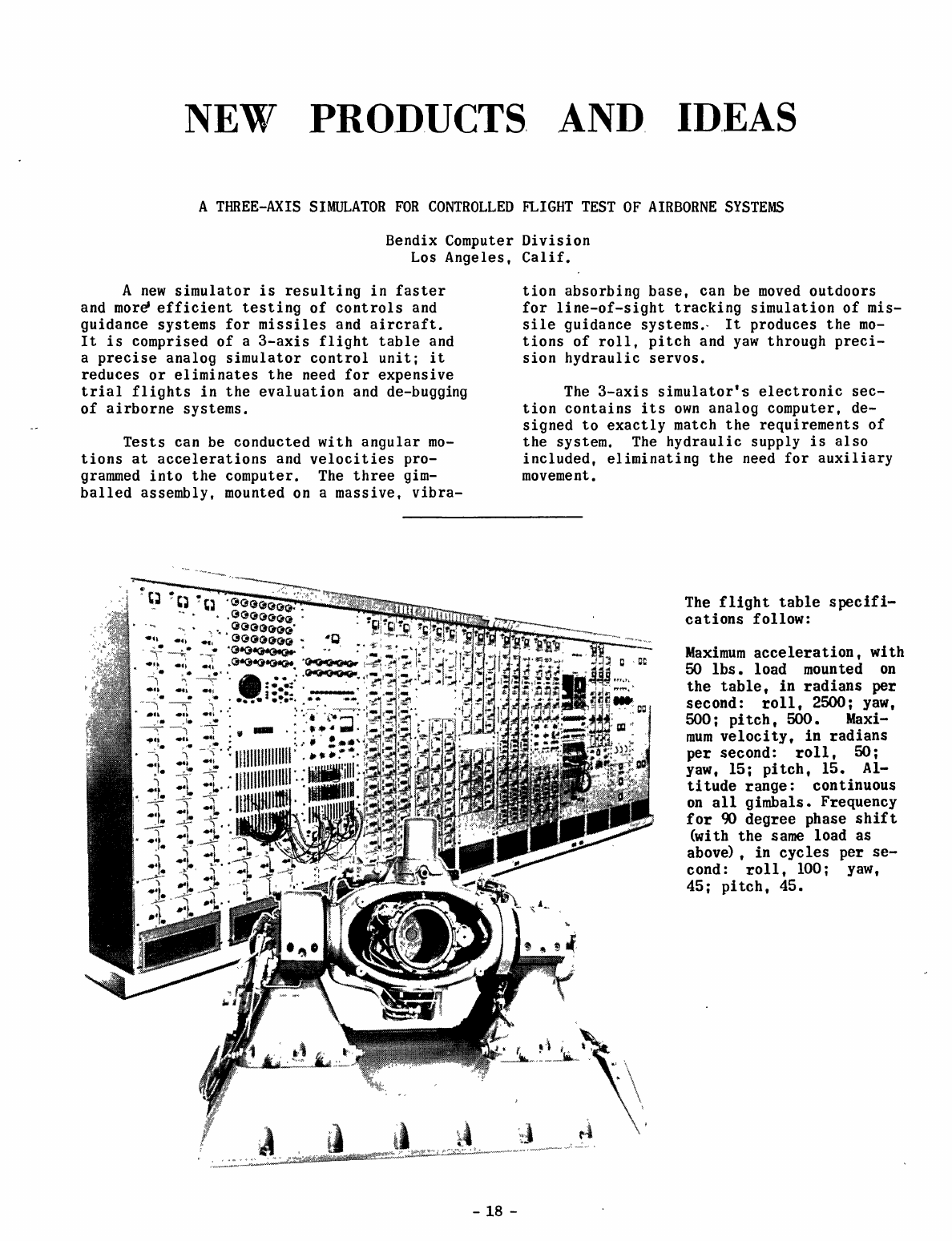
A
new
simulator
is
resulting
in
faster
and
mor~
efficient
testing
of
controls
and
guidance systems
for
missiles
and
aircraft.
It
is
comprised
of
a
3-axis
flight
table
and
a
precise
analog
simulator
control
unit;
it
reduces
or
eliminates
the
need
for
expensive
trial
flights
in
the
evaluation
and de-bugging
of
airborne
systems.
Tests
can be conducted
with
angular
mo-
tions
at
accelerations
and
velocities
pro-
grammed
into
the
computer.
The
three
gim-
balled
assembly, mounted
on
a massive,
vibra-
-
18
-
tion
absorbing
base,
can be
moved
outdoors
for
line-of-sight
tracking
simulation
of
mis-
sile
guidance systems.-
It
produces
the
mo-
tions
of
roll,
pitch
and
yaw
through
preci-
sion
hydraulic
servos.
The
3-axis
simulator's
electronic
sec-
tion
contains
its
own
analog computer, de-
signed
to
exactly
match
the
requirements
of
the
system.
The
hydraulic
supply
is
also
included,
eliminating
the
need
for
auxiliary
movement.
The
flight
table
specifi-
cations
follow:
Maximum
acceleration,
with
50
lbs.
load mounted
on
the
table,
in
radians
per
second:
roll,
2500;
yaw,
500;
pitch,
500.
Maxi-
mum
velocity,
in
radians
per
second:
roll,
50;
yaw,
15;
pitch,
15.
Al-
titude
range:
continuous
on
all
gimbals.
Frequency
for
90
degree phase
shift
(with
the
same
load as
above),
in
cycles
per
se-
cond:
roll,
100;
yaw,
45;
pitch,
45.
New
Products
and
Ideas
A
NEW
RADAR
DEVICE
FOR
CORRECTED
MAPPING
Fairchild
Controls
Corp.
Syosset,
Long
Island,
N.Y.
A novel
device
which promises
to
inaugu-
rate
a
new
era
in
the
use
of
radar
for
accur-
ate
mapping and
charting
has been completed.
The
instrument
has been
named
the
"Radar
Restitutor";
it
was
invented,
designed
and
fabricated
by
the
Electronics
Division
of
Fairchild
Controls
Corporation,
a
subsidiary
of
Fairchild
Camera and
Instrument
Corporation.
Photographs
of
radar
displays
are
not
normally
true
maps
since
they
contain
many
distortions
and
inaccuracies.
This
makes such
photographs
unsuitable
for
measuring
distances
between
different
points
on
the
ground. The
Radar
Restitutor
automatically
computes
the
errors
which
give
rise
to
the
distortions
present
in
the
radar
photography, and
it
pro-
duces a
new
photograph
on
which
every
ground
object
is
accurately
located.
The
photographs
produced
by
the
Restitutor
are
then
used
in
the
compilation
of
maps.
The
chief
distortion
on
the
original
radar
photographs
is
caused
by
the
fact
that
radar
records
the
distance
between
the
radar
station
and an
object,
and
for
airborne
radar
sets
this
means
that
the
slant
distance
is
recorded.
For mapping
purposes,
though,
it
is
necessary
to
know
the
ground
distance
be-
tween
the
point
directly
under
the
aircraft
and
the
ground
object.
Another
source
of
error
is
the
fact
that
an
airborne
radar
is
continually
moving,
while
the
radar
display
does not
take
this
motion
into
consideration.
The
Restitutor
not only computes
these
dis-
tortions
but
several
additional
distortions
as
well,
and
positions
the
grou~d
object
at
the
corrected
coordinates
on
the
new
photo-
graph which
it
produces.
*-------------------*-------------------*
LATTICE
NETWORKS
FOR
DIGITAL
STORAGE
R.
H.
Davies
Ferranti
Electric
Inc.
New
York
20,
N.Y.
To
the
Editor:
Following
is
a
brief
description
and a
photograph
of
a
new
type
of
lattice
network
which
we
have developed
for
use
in
digital
memory
stores.
We
trust
'you
will.
find
this
-19
-
item
sufficiently'interesting
for
publication
in
the
"New
Products"
section
of
your magazine.
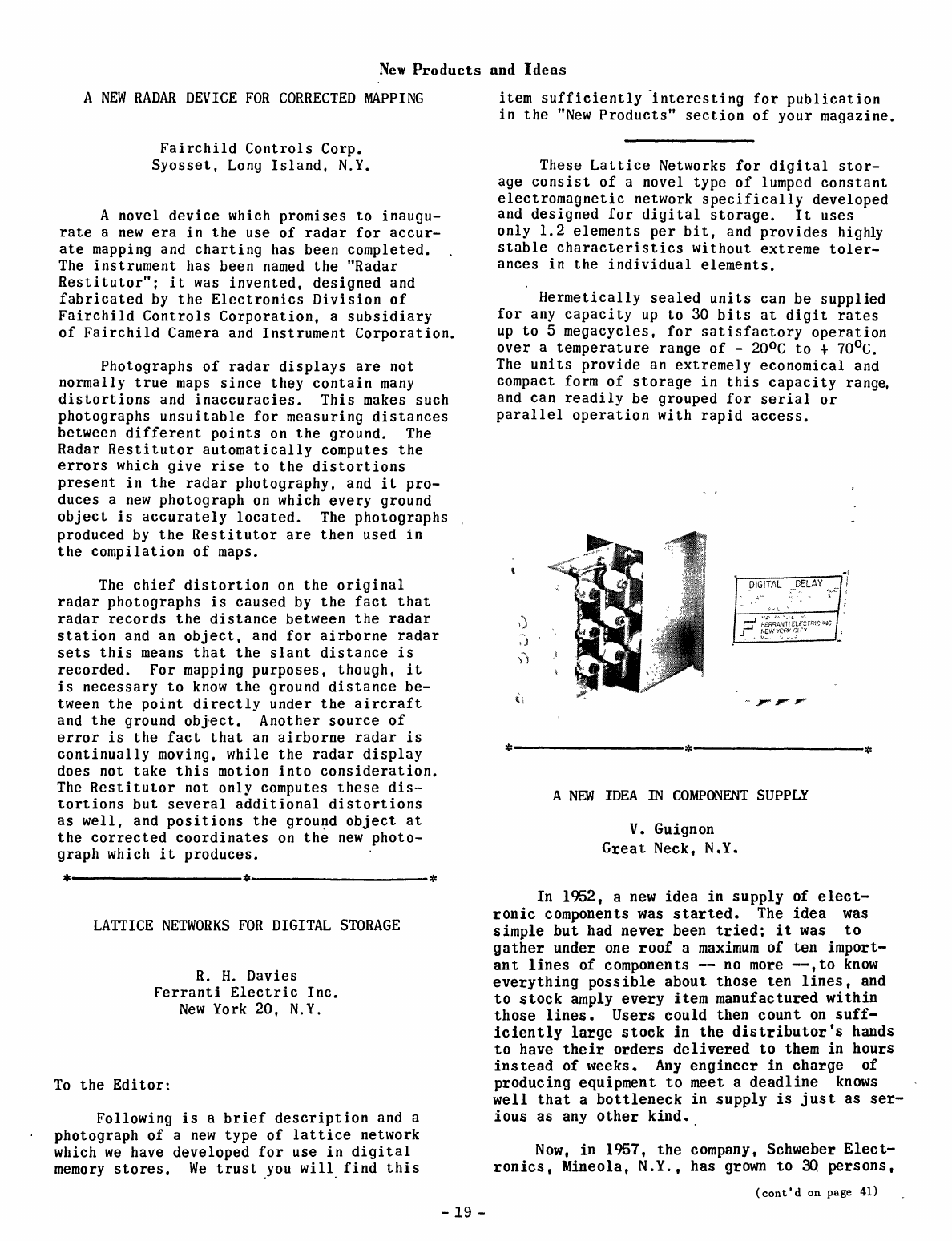
These
Lattice
Networks
for
digital
stor-
age
consist
of
a novel
type
of
lumped
constant
electromagnetic
network
specifically
developed
and
designed
for
digital
storage.
It
uses
only
1.2
elements
per
bit,
and
provides
highly
stable
characteristics
without
extreme
toler-
ances
in
the
individual
elements.
Hermetically
sealed
units
can be
supplied
for
any
capacity
up
to
30
bits
at
digit
rates
up
to
5 megacycles,
for
satisfactory
operation
over
a
temperature
range
of
-
20
0C
to
t
70
0
C.
The
units
provide
an
extremely
economical and
compact form
of
storage
in
this
capacity
range,
and can
readily
be grouped
for
serial
or
parallel
operation
with
rapid
access.
*-------------------*--------------------*
A
NEW
IDEA
IN
COMPONENT
SUPPLY
v.
Guignon
Great
Neck, N.Y.
In
1952, a
new
idea
in
supply
of
elect-
ronic
components
was
started.
The
idea
was
simple
but
had
never
been
tried;
it
was
to
gather
under one
roof
a
maximum
of
ten
import-
ant
lines
of
components
--
no
more
--,to
know
everything
possible
about
those
ten
lines,
and
to
stock
amply
every
item
manufactured
within
those
lines.
Users
could
then
count
on
suff-
iciently
large
stock
in
the
distributor's
hands
to
have
their
orders
delivered
to
them
in
hours
instead
of
weeks.
Any
engineer
in
charge
of
producing
equipment
to
meet a
deadline
knows
well
that
a
bottleneck
in
supply
is
just
as
ser-
ious
as
any
other
kind.
Now,
in
1957,
the
company, Schweber
Elect-
ronics,
Mineola,
N.Y.,
has grown
to
30
persons,
(cont'
d
on
page
41)
RELIABILITY
IN
BUSINESS
AUTOMATIC
DATA
PROCESSING
Herbert
T.
Glantz
John
Diebold
&
Associates,
Inc.
New
York,
N.
Y.
(Based
on
a
talk
delivered
February
27,
1957
at
the
Western
Joint
Computer Conference
Los
Angeles,
California)
Introduction
Throughout
the
past
few
years
a
great
deal
of
study
has been
devoted
to
analyzing
the
different
characteristics
and
require-
ments
of
scientific
and commercial
data
pro-
cessing
systems.
Although
early
general
agreement
was
reached
on
the
fact
that
such
systems were
different,
the
exact
cause
and
nature
of
these
variations
has not
yet
been
clearly
defined.
Equipment
manufacturers
attempted
to
resolve
this
difficulty
by
de-
signing
two
distinct
"lines"
of
computer
models.
In
some
instances
these
manufactur-
ing
distinLtions
have become
blurred
with
usage,
with
the
result
that
a Remington
Rand
Univac
is
utilized
for
engineering
calcula-
tions,
while
an
IBM
704
is
applied
to
payroll
preparation.
But,
in
the
main,
this
dichoto-
my
of
design
and
application
is
being
effec-
tively
preserved.
Dr. Jay
Forrester,
the
former
Director
of
MIT
Project
Whirlwind, has
characterized
the
chronology
of
electronic
computation
as
falling
into
three
distinct
phases.
Begin-
ning
in
1945, an
intensive
amount
of
research
was
devoted
to
investigation
of
the
physical
possibility
of
building
electronic
digital
computers.
The
early
studies
of
computer.
logic
and
circuit
design
were conducted
al-
most
entirely
by
various
engineering
uni-
versities.
By
1950
it
was
apparent
that
the
basic
problems
could
be
solved
and
that
elec-
tronic
computation
would become a
reality.
Shortly
afterwards,
the
major
portion
of
re-
search
activity
was
shifted
to
the
applica-
tion
of
these
machines
to
various
problems.
The second phase
of
the
history
of
electronic
computation
was
devoted
to
computation
in
the
fields
of
engineering
and
science,
as
the
first
large-scale
digital
computers began
to
appear
in
the
universities
and
aircraft
com-
panies.
In
1955
the
emphasis
of
machine
ap-
plications
research
began
to
switch
from
engineering
to
commercial problems.
This
trend
marked
the
entry
into
the
third
and
perhaps
the
most
vital
phase
of
development
of
electronic
computation.
As
the
problem
of
utilizing
electronic
-20 -
equipment
for
business
applications
was
ap-
proached,
it
became
apparent
'that
there
were
major
differences
in
the
requirements
of
this
new
area.
The
early
studies
devoted
to
this
problem
concentrated
on
seemingly obvious
operational
variations.
Business
problems
called
for
vast
amounts
of
input-output
data,
while
scientific
problems
required
lengthy
and
involved
internal
calculations.
Thus,
in
short
order
a
convenient
categorization
grew up:
Engineering
and
Scientific
Applications:
Small volume
of
input-output
data;
large
amounts
of
complex
internal
calculations.
Commercial
Applications:
Large volumes
of
input-output
data;
small
amounts
of
simple
internal
calculations.
Although
this
fairly
arbitrary
and sweeping
.classification
proved
adequate
for
early
needs
of
the
industry,
an
increasing
sophistication
in
computer usage has
tended
to
obscure
these
demarcation
lines.
It
has become
increasingly
evident
that
such
operational
differences
do
not
provide
an
adequate
representation
of
the
two
different
systems.
If
one
considers
instead
the
respective
functional
purposes
of
scientific
and commer-
cial
systems,
a
striking
contrast
may
be
ob-
served.
Scientific
data
processing
installa-
tions
may
be
regarded
as
self-contained
sys-
tems which
function
only
to
satisfy
the
dic-
tates
and
requirements
of
the
parent
organiza-
tion.
Thus,
in
a
broad
sense,
all
input
data
originates
within
the
system
proper;
all
com-
putations
are
determined
by
the
needs
of
the
overall
organization;
and
the
timing,
quantity,
and amount
of
output
information
is
again
dic-
tated
by
the
requirements
of
the
system
itselL
Commercial
data
processing
systems,
on
the
other
hand, must
inevitably
exist
and
per-
form
their
functions
in
constant
relationship
with
the
environment
of
the
business
world
at
large.
This
relationship,
which dominates
both
the
design
and
performance
of
business
systems,
is
notably
evidenced
in
three
ways.
The mass
of
data
entering
the
system
origi-
nates
externally
and
is
to
a
large
extent
uncontrolled
in
format,
timing,
content,
and
accuracy.
The
calculations
that
are
performed
Reliability
are
frequently
regulated
by
the
rules
of
out-
side
agencies
such
as
the
S.E.C.,
I.C.C.,
and
the
Bureau
of
Internal
Revenue.
Finally,
the
daily
deadlines
that
must be
satisfied
are
generally
determined
by
an
essentially
indif-
ferent
environment and
are
frequently
unyield-
ing and seemingly
unrealistic.
Accordingly,
whereas a
scientific
data
processing
system
exists
and
operates
to
satis-
fy
its
own
n~eds,
commercial systems must
func-
tion
in
large
measure
to
satisfy
requirements
imposed from
outside
the
system.
The
Design
of
Business
Systems
Business
systems
are
growing
increasingly
more complex as
their
range
of
applications
expands
to
cover
more demanding and more
in-
tricate
areas.
A
functioning
commercial
data
processing
system
includes
a
variety
of
in-
formation
handling
components, human,
mechani-
cal,
and
electronic,
which
are
linked
together
by
an
overall
communications network. The
term
"integrated
data
processing"
has
gradu-
ally
corne
to
be
accepted
as a
generic
descrip-
tion
of
the
workings
of
such
systems.
The
design
of
these
systems has
created
a
strikillg
opportunity
for
the
business
world.
We
are
now
able
to
conceive
of
all
routine
daily
operations
of
a company
being
controlled
and
directed
by
an
automatic
system.
Auto-
matic
process
control
is
already
a
familiar
occurrence
in
the
chemical and
petroleum
in-
dustries.
We
are
on
the
verge
of
applying
similar
concepts
to
a number
of
commercial
enterprises.
The
underlying
theme
in
such
systems
is
automatic
control
of
business
operations
including
a feedback loop
for
the
correction
of
errors.
At
the
same
time,
the
managing
executive
is
to
be
provided
with
information
that
will
allow
him
to
exercise
control
over
entire
company
policy
on
the
basis
of
reliable
and
timely
data.
However,
in
painting
this
picture
of
successful
office
automation
we
have
passed
over
a number
of
evidently
dangerous
pitfalls.
For as
automatic
systems
exercise
a
greater
amount
of
control
and
direction,
one must
place
a
correspondingly
greater
emphasis
on
their
operating
reliability.
Intermittent
or
periodic
failures
in
such systems can
wreak more havoc
than
is
to
be
gained
from
long
intervals
of
reliable
operation.
The
increased
complexity
of
these
systems
intro-
duces more components
that
are
liable
to
fail-
ure and, due
to
their
varying
interrelation-
ships,
introduces
a
greater
degree
of
diffi-
culty
in
isolating
and
replacing
the
faulty
elements.
Many
systems
engineers
become so
enamored
of
possible
accomplishments
that
they
tend
to
overlook
the
question
of
system
-21 -
reliability
and
the
implications
of
component
failure.
As
an
illustration
of
the
problems
that
are
inherent
in
the
operation
of
business
data
processing
systems,
I
should
like
to
briefly
discuss
two
systems
that
our
organization
has
designed
for
commercial
organizations.
In
both
cases
we
have
completely
restructured
the
data
processing
operations
of
the
companies
involved.
In
both
cases,
although
substantial
dollar
savings
were
accomplished,
our
primary
aim
was
to
have
the
data
processing
system
provide
more
effective
aid
to
the
sales
organ-
ization
and
to
top
management
of
the
company.
In
both
cases
this
was
effected
by
centraliz-
ing
the
data
processing
elements
and
by
util-
izing
extensive
communications
networks.
A
Stock
Brokerage
House
"X"
is
one
of
the
largest
stock
brokerage
houses
in
the
country.
Their
main volume
of
business
originates
on
the
West
Coast
where
they
maintain
a number
of
branch
offices.
One
of
the
principal
requirements
of
competitive
existence
in
the
brokerage
field
is
rapid
ful-
fillment
of
customers'
orders,
and
requests
for
sample
prices,
or
"quotes".
Since
most
of
the
clients'
trading
is
done
on
the
floor
of
the
New
York
Stock
Exchange,
the
company
utilizes
an
extensive
private
wire
system
to
link
the
branches
with
the
Eastern
trading
center.
It
is
not unusual
for
an
order
to
originate
in
Los
Angeles,
be
flashed
to
New
York, be
executed
on
the
Exchange, and be
con-
firmed back
to
Los Angeles
in
a
matter
of
two
or
three
minutes.
The
system
that
we
have
designed
for
this
firm
includes
an
automatic
teletype
switching
center
on
the
West Coast and a Data
Processing
Center
in
New
York.
The
data
processing
cen-
ter
utilizes
a medium-scale
general
purpose
digital
computer
as
the
nucleus
of
all
inform-
ation-processing
activities.
All
branch
orders
are
received
by
the
West
Coast message
center
and
are
automatically
routed
on
to
New
York
where
they
are
simultaneously
sent
to
the
Exchange and
to
the
data
processing
cen-
ter.
Execution
reports
from
the
Exchange
are
sent
directly
to
the
originating
branch
and
to
the
data
processing
center.
These
orders
and
execution
reports
are
received
on
5-channel
teletype
tape
which
is
fed
directly
into
the
computer. The volume
of
business
handled
during
the
five
and one
half
hour
trading
day,
coupled
with
overall
speed
requirements,
necessitate
a system
capacity
of
twelve
such
order-execution
pairs
per
minute.
Basic
input
is
also
provided
to
the
sys-
tem
by
the
branch
and
New
York
office
reports
of
daily
receipts
and
disbursements
of
cash
and
securities.
This
extensive
input
data
·
Computers
and
Automation
must be
processed
each
day
according
to
a
rigid
timetable.
In
general,
all
of
one
day's
business
activity
must be
completely
recorded
and
processed
before
the
start
of
the
next
trading
day.
All
of
this
work
is
subject
to
the
detailed
scrutiny
of
various
Exchanges,
the
S.E.C.,
and
the
auditors.
By
utilizing
the
extensive
private
wire
system,
the
data
processing
center
in
New
York
is
able
to
direct
the
complex
daily
operational
activities
of
this
company.
Furthermore,
although
the
company's
top
man-
agement
is
separated
from
the
data
processing
center
by
3,000
miles,
the
center
is
able
to
provide
them
with
a normal
supply
of
reports
while
at
the
same
time
rapidly
fulfilling
requests
for
special
analysis.
A
Transportation
Company
"Y"
is
a medium-size
company
in
the
trans-
portation
industry.
The
main volume
of
their
work
is
concerned
with
cross-country
movement
of
railroad
freight
cars.
The
majority
of
such movements
originate
in
East
Coast
ports
and
are
destined
for
Western
cities.
However,
a
considerable
portion
of
volume
consists
of
overnight
movements
into
such
mid~~stern
cities
as
Chicago,
St.
Louis,
and
Cincinnati.
A
further
complication
is
caused
by
the
fre-
quent
necessity
of
transfer
operations,
as
when
Baltimore
and Boston shipments
are
merged
in
St.
Louis
before
going
on
to
Los
Angeles.
A
Shipping
Order
is
prepared
by
the
cus-
tomer and
delivered
to
the
Company
with
each
consignment
of
merchandise.
These
Shipping
Orders
are
the
basic
input
to
the
system and
are
used
to
prepare
Freight
Bills,
Railroad
Manifests,
Receivabl~s
Entries,
and so
forth.
A completed
Freight
Bill
must
precede
each
shipment
to
its
destination
and must be on
hand
at
the
appropriate
Transfer
Points
be-
fore
arrival
of
the
various
freight
cars.
All
daily
processing
activities
are
subject
to
I.C.C.
regulation
and
are
continually
com-
pared
by
Carrier
Railroads
with
their
own
computations.
Our
client
processes
an
aver-
age
of
10,000
Shipping
Orders
each working
day.
The
data
processing
operations
of
this
company
are
characterized
by
a
large
mass
of
input
data,
a
requirement
for
flexible
pro-
cessing
schedules
that
allow
for
the
periodic
interruptions
of
rush
movements, and a high
volume
of
printed
output
accompani~d
by
a
moderate amount
of
punched
paper
tape
output
suitable
for
direct
teletype
transmission.
Our system
design
for
this
company
util-
izes
a medium-scale
general
purpose
digital
computer
installed
in
a Data
Processing
Cen-
ter
located
in
Chicago.
Due
to
the
fluctu-
ating
nature
of
data
transmission
time
sche-
dules,
the
overall
system
design
is
based
on
combined use
of
direct
teletype
input
and
output
and
extensive
air
mail
communication.
Original
Shipping
Orders,
as
well
~s
other
operational
data,
are
sent
to
the
data
pro-
cessing
center,
which
functions
as
the
con-
trolling
element
for
the
entire
company.
In
addition
to
processing
routine
daily
operating
data,
the
computer
is
utilized
for
the
formu-
lation
of
strategic
decisions
as
to
selection
of
optimum
freight
car
routings
and
Carrier-
Tariff
combinations.
Operational
Characte~istics
The X
Brokerage
House and
the
Y
Transpor-
tation
Company
are
in
two
vastly
different
fields
of
business.
Yet
the
requirements
and
characteristics
of
the
data
processing
systems
that
have been
designed
for
these
companies
are
strikingly
similar.
These
similarities
reveal
a
great
deal
about
the
nature
of
such
business
systems:
Both companies
operate
over
a wide
geo-
graphic
area
and use an
extensive
com-
munications
network and a medium-scale
computer
in
a
central
data
processing
installation.
In
both
cases,
basic
input
data
is
pro-
vided
by
activities
that
are
outside
of
the
system and
are
essentially
unin-
terested
in
the
workings
of
the
system
and
the
difficulties
that
are
caused
by
incorrect
data.
In
both
cases,
input
data
arrives
in
a
fairly
random
fashion
but
must
neverthe-
less
be
processed
upon
receipt,
since
all
operations
are
conducted
against
fairly
intractable
time
deadlines.
In
both
cases,
normal
operational
sche-
dules
must be
flexible
enough
to
accom-
modate
the
intermittent
interruptions
of
rush
jobs.
In
both
cases,
internal
system
proces-
sing
must conform
to
rulings
of
various
outside
regulatory
agencies.
"Real Time"
Business
Systems
The most
important
characteristic
of
both
systems,
however,
is
that
they
are
"real
time"
business
systems.
The
standard
definition
of
a
real
time
data
processing
system.is
one
"whose
actions
influence
the
input
data
that
is
being
received".
In
the
world
of
business
data
processing
systems,
this
definition
may
be
modified
to
read:
"A
real
time
business
system
operates
on-line
with
its
input
data".
One
such
automatic
real
time
business
system
is
the
American
Airlines
Reservisor
system
wherein
passenger
requests
for
seats
are
satisfied
as
they
are
received
with
essen-
tially
no
processing
delay.
-22 -
Reliability
Until
very
recently,
almost
all
commer-
cial
installations
of
general
purpose computer
sys~ems
were used
in
non-real
time
situations
and
relied
extensively
on
"batch
processing"
techniques.
Examples
of
areas
that
are
amen-
able
to
such
techniques
form an honor
roll
of
the
problems
first
handled
by
business
sys-
tems:
Payroll,
Receivables
Accounting,
In-
ventory
Accounting,
Insurance
and
Utility
Billing,
and so
forth.
'
The
functional
nature
of
a
real
time
business
system
requires
that
essential
con-
trol
and
direction
of
the
business
be
vested
in
the
data
processing
system
itself.
Both
of
the
systems
described
above
receive
in-
formation
concerning
the
environment
or
stimu-
li
or'
the
business.
In
one
case
these
are
orders
for
security
trades;
in
the
other,
they
are
Shipping
Orders.
The
automatic
system
processes
the
information
contained
in
these
initial
messages and
issues
directions
so
that
successive
appropriate
measures
may
be
taken.
Finally,
the
data
processing
'center
is
notified
of
the
results
of
these
actions
and
acts
to
issue
either
corrections
or
in-
structions
for
further
measures.
All
opera-
tional
data
funnels
into
the
processing
sys-
tem and
all
routine
operational
directions
issue
from
the
system.
Further,
the
formu-
lations
of
company management
are
based
on
analysis
prepared
by
the
data
processing
system from
information
that
is
contained
in
the
records
of
the
system.
An
operation
of
this
type
sounds
delight-
ful
to
the
systems
engineer,
for
we
have
in
large
measure
eliminated
the
human
element
from
routine
business
functions.
The
auto-
matic
system
directs
and
controls
daily
oper-
ations
while
using
the
results
to
provide
management
with
timely
reports
on
which
to
base
long-range
policy
decisions.
However,
the
practical
businessman views
such a system
in
an
entirely
different
light.
The
system
will
reduce
direct
operating
costs;
it
will
provide
greater
flexibility
and
effi-
ciency
than
the
present
manual system; manage-
ment
will
receive
information
in
time
to
for-
mulate
important
decisions
that
direct
the
company's
future
operations.
But,
while
ac-
cepting
the
validity
of
such
advantages,
the
executive
also
realizes
that
if
this
beauti-
ful
system
should
fail,
his
company
will
be
out
of
business.
In
the
final
analysis,
this
factor
of
reliability
is
the
most
important
character-
istic
of
real
time
business
systems and
pro-
vides
the
greatest
single
functional
differ-
ence between
on-line
and
batch
processing
systems.
If
the
payroll
is
late,
there
will
be unhappy
labor
force,
and
if
the
utility
bills
are
delayed
the
company
will
be
corres-
-23 -
pondingly
tardy
in
receiving
revenue.
But
if
an
on-line
s~stem
fails,
all
company
opera-
tions
cease.
Reliability
in
Real
Time
Systems
At
the
same
time,
the
inherent
benefits
that
may
accrue
from
the
utilization
of
auto-
matic
real
time
business
systems
are
signifi-
cantly
greater
than
those
provided
by
the
earlier
systems.
It
is
just
this
factor
of
automatic
control
of
routine
operations
that
provides
the
appeal
of
on-line
systems.
For
the
effect
of
a
day's
activity
will
be
re-
flected
in
reports
early
enough
for
the
ex-
ecutive
to
exert
an
effective
influence
on
these
same
operations.
Such
real
time
data
processing
systems
are
capable
of
implement-
ing
the
theory
of
"management
by
exception"
in
actual
daily
operations.
We
thus
have a
system
concept
that
can
provide
extensive
and
valuable
benefits
to
a
business
organization
and can
also
do
ir-
reparable
harm
in
case
of
failure.
Accord-
ingly,
we
must
provide
a system
design
that
will
reliably
ensure
against
failure
while
retaining
the
maximum
benefits.
Only
in
this
fashion,
can
we
hope
to
implement
this
signi-
ficant
step
forward
in
the
application
of
automatic
data
processing.
In
the
design
of
real
time
business
sys-
tems
we
have
adopted
a
concept
that
is
based
on
the
assumption
that
all
components
of
a
system
are
liable
to
failure,
but
that
over-
all
operations
must
not
fail.
One
of
the
simplest
and most
effective
means
of
ensuring
system
reliability
is
through
the
use
of
re-
dundancy.
This
technique
is
utilized
by
the
human
brain
and nervous system, and
the
anal-
ogy
is
a
natural
one
since
the
data
processing
system
functions
in
a
similar
fashion
for
the
business
organism. However,
in
view
of
the
economic
realities
of
commercial
life,
it
would
appear
more
practicable
to
approach
the
problem
in
a
slightly
different
manner.
The
first
requisite
of
our
system
is
high
quality
of
design
and
performance
in
each
individual
element.
Practically,
this
implies
that
only
proven components
can
be
incorporated
in
the
system.
As
newer compu-
ters
are
developed,
they
should
be
"broken
in"
on
the
batch
processing
problems.
If
that
is
not
feasible,
one must
insist
on
a
substantial
period
of
rigorous
testing
before
accepting
such
equipment.
Continual
preventive
maintenance
of
all
equipment
is
required.
A number
of
engineer-
ing
installations
of
medium-scale computers
adopted
the
practice
of
eliminating
preven-
tive
maintenance
periods.
These
organizations
(cont'd
on page 42)
AUTOMATIC SEARCH OF LIBRARY DOCUMENTS
s.
Richard
Moyer
University
of
Pennsylvania,
The
Institute
for
Cooperative
llesearch
Philadelphia,
Pa.
(This work
was
supported
in
full
by
the
Air
Research
and Development
Command
under
Contract
No.
AFI8(600)-125
with
the
Institute)
The
idea
of
an
automatic
library
has been
the
object
of
speculation
for
a
considerable
length
of
time.
Various
schemes,
some
grand-
iose
and
some
quite
modest, have been advanced
for
its
accomplishment.
Some
involve
machin-
ery
that
would
stagger
the
designers
of
a
modern
oil
refinery,
while
others
are
quite
simple;
some
display
Rube
Goldberg
overtones,
and
others
seem
quite
sensible.
Most
of
them
aim
at
a
level
of
automation
and a speed
of
operation
that
still
require
development and
research
before
becoming
realities.
However,
if
these
schemes
are
discarded
and an examin-
ation
is
made
of
the
various
types
of
auto-
matic
machinery
already
in
production
in
the
plants
of
electronic
computer
manufacturers,
it
will
be
possible
to
automatize
many
of
the
operations
of
the
modern
library.
Although
the
ultimate
degree
of
automation
has
not
yet
been
realized,
sufficient
progress
has been
made
to
eliminate
many
man-hours
of
labor.
While
the
possible
speed
of
operation
is
not
phenomenal,
when
viewed
in
relation
to
the
speed
of
present
methods
it
does
represent
a
very
substantial
saving
of
time.
The
cost,
furthermore,
will
be
considerably
less
than
that
for
present
methods
of
operation.
Currently,
both
industry
and
science
are
finding
it
increasingly
difficult
to
retrieve,
for
research
purposes,
information
stored
in
special
and
general
purpose
libra~y
collection~
This
situation
is
the
result
of
the
present
overflow
of
information
that
not
only
contri-
butes
to
the
time and
care
required
in
find-
ing
anything
specific
in
an
already
massive
collection,
but
also
complicates
the
task
of
adding
the
constantly
expanding incoming flow
of
new
information
to
that
collection.
Naturally,
a
great
capital
investment
is
necessary
to
install
electronic
computers and
automatic
maChinery
in
a
library.
This
fact
may
be viewed
by
many
with
trepidation,
but
several
industries
and government
agencies
already
have
electronic
computers
that
could
be
devoted
to
part-time
library
work,
thus
greatly
reducing
the
initial
investment.
Such
agencies
normally
represent
a
specialized
field
of
endeavor
and have
libraries
that
might
contain
100,000
to
200,000 documents,
i.e.,
publications
or
parts
of
publications
considered
as
single
units
for
indexing
pur-,
poses.
If
~n
automatic
installation
were made,
various
possibilities
of
improved
operation
would open up, and
substantial
savings
of
time
and money,
as
well
as
increased
thoroughness,
would
accrue
to
industrial
research.
Electronic
computer
manufacturers,
consequently,
would
soon
begin
to
design
and
build
special
purpose
machines
for
increasing
the
speed
of
operation
to
a
point
where
the
goals
of
the
visionaries
would be
approached.
At
the
present
time,
the
speed
of
exist-
ing
production
models
of
automatic
data-hand-
ling
machinery
probably
makes
the
operation
impractical
for
libraries
of
more
than
1,000,000
to
2,000,000
documents,
unless
the
required
machinery
is
installed
in
multiple
units.
Furthermore,
the
initial
cost
of
such
an
installation
would be
prohibitive.
Al-
though
obsolescence
might be a
serious
factor
initially,
stimulated
interest
would soon
pro-
duce
special
equipment
capable
of
greater
speed,
and such
institutions
as
the
Library
of
Congress,
as
well
as
the
predicted
50,000,000
document
library
of
the
future,
could
be
automatized.
The
idea
of
using
electronic
computers
for
searching
the
document
collection
of
a
library
is
not
new.
In
1951
Philip
Rutherford
Bagley
prepared
at
the
Massachusetts
Institute
of
Technology a
master's
thesis
entitled
Elec-
tronic
Digital
Machines
for
High Speed
Inform-
ation
SearChing.'
Because
of
the
rapid
growth
of
the
mass
of
published
articles,
books,
etc.,
during
the
past
few
years,
he
specified
that
the
machines must be
able
to
search
50,000,000
documents
within
a
reasonable
length
of
time.
Bagley's
method
of
recording
the
necessary
information
in
the
memory
system
of
the
elec-
tronic
computer
involves
the
use
of
a
series
of
terms
called
descriptors
which
consist
of
single
words used
singly
or
in
groups
to
de-
scribe
the
characteristics
of
the
subject
matter
of
a document.
This
information
is
arranged
in
the
memory
system
of
the
computer
in
the
form
of
consecutive
lists
of
descrip-
tors,
each
list
describing
a
single
document
headed
by
its
serial
number.
This
document
record
consists
of
only
two
types
of
informa-
tion:
(1)
the
serial
number
of
a document
which
allows
for
its
positive
identification;
and (2) a number
of
descriptors
that
describe
-24 -
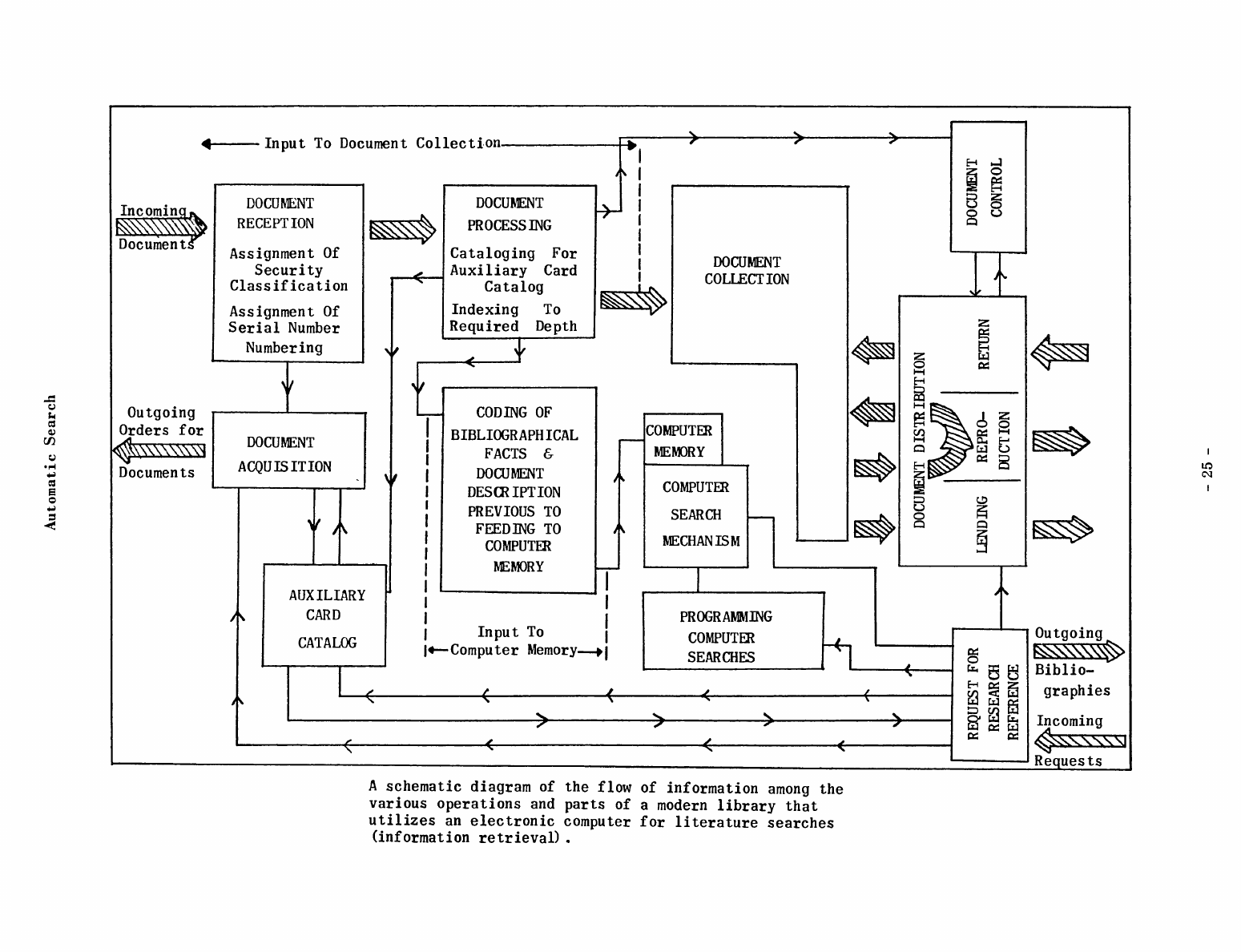
4
Incominqfll,.
~"
""'\'\'\'\.~
Document!'
Outgoing
Orders
for
..tI
fcS.\\\\\\..\.
\.
\..\..\..
\.~
~
Documents
"
....
...
Input
To
Document
Collecti,on
..
, , "
"I
, I
I
DOCOMENT DOCUMENT
~
I
~
I
RECEPTION
PROCESSING
I
I
Assignment
Of
Cataloging
For I
DOCUMENT
Security
.J'
Auxiliary
Card I
COLLECTION
Classification
"' Catalog
~
Assignment
Of
Indexing
To
Serial
Number
Required Depth
~
Numbering "
~
t
"
,II
,~
CODING
OF
~
"""":-
BIBLIOGRAPHICAL
COMPUTER
DOCUMENT
.--
MEIDRY
FACTS
&
~
ACQUISITION
"
DOCUMENT
~\
DESmIPTION
COMPUTER
PREVIOUS
TO
SEARCH
I--
~
,II
I~
FEEDING
TO
J~
MECHANISM
COMPUTER
MEMORY
T I
AUXILIARY
I
I'
CARD
I
PROGRAMMING
Input
To
I
COMPUTER
h
CATALOG
I+-
Compu
ter
Memory--+
I
SEARCHES
JI'
"
"-
;
~
.I
L
"- "- , ,
" " "
, ,
~
"
~
.I
'"
""
"-
A schematic diagram of the flow
of
information
among
the
various
operations
and
parts
of a
modern
library
that
utilizes
an
electronic
computer
for
literature
searches
(information
retrieval)
•
~
,
....
,
E-t
...J
~
0
~
B
~
25
u
1
z
~
~
~
~
0::
H
E-t
53
~)6~
CI)
0:: H
~
H
c..
E-'
o
~
U
E-t
0:: 8
~
::>
Co!)
u
~
0
~
0 0
~
"II'
Outgoing
0::
~~~
~
0
"-
t..
a~
Biblio-
H~f5
graphies
~~ffi
@:~t..
Incoming
O::~
~"""SJ
0:: 0::
Requests
Computers
and
Automation
the
contents
of
the
text
of
the
document.
Bagley's
method
provides
for
an
average
of
30.0
descriptors
per
document, as
well
as
for
a
search
procedure
designed
so
that
vari-
ous numbers
of
descriptors
in
various
combin-
ations
can be
specified
as
the
subjects
of
the
information
retrieval
operation.
Invest·i-
gation
revealed
that
the
digital
computer,
Whirlwind
I,
could
search
approximately
11,990
documents
per
hour and would
require
approxi-
mately
41,700 hours
to
search
a
collection
of
50,000,000
documents. Bagley
then
outlined
an
idea
for
a
'special
purpose computer
that
could
be
designed
to
search
documents
at
the
rate
of
4.66
million
per
hour
(or
10.7
hours
to
search
a document
collection
of
50,000,000).
Recently,
Harley
E.
Tillitt,
at
the
U.S.
Naval Ordnance
Test
Station
at
China Lake,
California,
published
a
paper
entitled
An
Experiment
In
Information
Searching
Wit~The
'
701
Calculator.
Like Bagley,
Tillitt
used
in
his
experiment
the
mechanism
of
the
descrip-
tor
to
delineate
the
contents
of
the
document,
but
he
recorded
each
descriptor
only
once and
associated
serial
numbers
with
it.
Thus
the
record
in
the
memory
system
contains
lists
of
serial
numbers
of
many
different
documents
headed
by
a
single
descriptor,
signifying
that
each document
in
the
list
contains
the
inform-
ation
labeled
by
a
descriptor
at
the
head
of
the
list.
In
this
system, each
consecutive
list
refers
to
many
documents.
As
in
Bagley's
method,
the
record
consists
of
only
two
types
of
information:
(1)
a
serial
number
that
allows
for
positive
identification
of
the
documentj and (2) a number
of
descriptors
that
define
the
contents
of
the
text
of
the
document.
Tillitt's
operation
actually
adapted
the
Uniterm system
to
an
IBM
701
Electronic
Data
Processing
Machine and used an
average
of
7.6
descriptors
per
document.
This
method
provides
for
searches
by
the
IBM
701
of
vari-
ous numbers
of
descriptors
in
different
com-
binations.
Using
this
system,
Tillitt
found
that
he
could
record
the
information
for
approximately
34,000
documents
on
a 1200
ft.
magnetic
tape.
Because
of
divergent
factors
peculiar
to
dif-
ferent
types
of
searches,
he
found
that
the
minimum
search
time
for
34,000
documents
was
20
seconds and
the
maximum
4
minutes.
If
the
maximum
search
time
is
used as a
base,
Tillitt's
method would
provide
a
search
rate
of
510,000
documents
per
hour,
or
98.04 hours
for
50,000,000
documents.
Both
Bagley's
thesis
and
Tillitt's
opera-
tion
were aimed
at
overcoming
the
problem
of
retrieving
information
stored
in
a document
collection.
The
solution
of
this
problem
would remove one
of
the
major
obstacles
in
carrying
out
adequate
literature
research
to-
day. However,
the
problems
of
the
modern
-26 -
library
do
not
consist
solely
of
information
retrieval.
Another major
obstacle
is
the
processing
of
incoming documents
before
they
are
put
into
the
document
collection
and
thence
become
available
to
individuals
engaged
in
re-
search.
The
processing
of
documents
consists
of
assigning
serial
numbers, numbering
the
document,
cataloging
the
document, and
pre-
paring
appropriate
records
for
document con-
trol.
With
the
increasing
mass
of
publica-
tions
in
recent
years,
processing
of
documents
has
created
a
serious
delay
in
the
progress
of
information
storage
in
itself,
so
that
it
is
not
uncommon
for
large
libraries
of
one
to
two
million
items
to
have documents backlogged
for
as
much
as one
or
two
years.
Such a
situ-
ation
impedes
research,
inasmuch
as
current
publications
are
not
available
in
collections.
Naturally,
this
is
an
important
factor,
con-
sidering
the
current
advances
in
scientific
research.
In
view
of
this
fact,
it
would
seem
that
there
is
a need, not
only
to
pro-
vide
faster
means
of
searching
document
col-
lections,
but
also
to
streamline
and mechanize
the
processing
of
documents
for
a
collection.
These
things
must be done
before
the
problems
of
the
modern
library
will
be
solved
even
partially.
A
study
of
the
modern
library
reveals
that
the
use
of
electronic
computers
for
search
ac-
tivities
will
not
permit
us
to
eliminate
the
card
catalog
completely.
Search
activities
which
involve
checking
for
the
presence
or
absence
of
a
particular
document,
locating
a
document
by'a
given
author,
finding
any docu-
ment under
certain
broad
classifications,
etc.,
can
still
be
carried
out
best
by
the
use
of
a
card
catalog.
However,
the
card
catalog
thus
actually
becomes an
auxiliary
aid
and
should
be
considerably
streamlined
so
that
it
would
contain
only
author
and
title
cards
and a
maximum
of
three
of
the
traditional
sUbject
cards
per
document.
A
new
operation,
indexing
by
the
use
of
descriptors,
takes
the
place
of
extensive
cataloging.
The
product
of
this
process
is
the
record
which
is
searched
by
the
computer
mechanism.
The
use
of
descriptors
for
index-
ing
eliminates
the
necessity
for
making numer-
ous
involved
judgments which
are
critical
to
the
efficient
functioning
of
the
standard
card
catalog
as an
information
retrieval
system.
This
being
true,
personnel
requirements
for
the
indexing
operation
may
be somewhat lowered
in
respect
to
the
extent
of
time
required
for
training,
and
the
level
of
intellectual
ability
of
the
trainee.
This would
tend
to
ease
the
existing
shortage
of
professional
librarians
and would
also
release
such
people
for
the
more
critical
tasks
of
documentation
in
the
automatic
library.
Other
items
necessary
to
the
functioning'
Automatic
Search
of
a modern
library
are
the
accession
record
( a
record
of
each document
in
the
collection
in
the
order
of
its
receipt),
the
shelf
list
(a
record
of
the
shelf
position
of
each
docu-
ment
in
the
collection),
and a
series
record
(a
record
which
allows
for
the
location
or
grouping
of
any
given
series
of
documents
issued
periodically).
These
three
records
taken
together
constitute
the
document
con-
trol
system and
they
must be produced
when
the
document
is
processed.
The
author
and Mrs. Gwendolyn
M.
Bedford,
members
of
the
Institute
for
Cooperative
Re-
search
of
the
University
of
Pennsylvania,
working
in
conjunction
with
Dr. Donald
Thomsen
and
Mr.
David Lawrence
of
the
Applied
Science
Division
of
the
Philadelphia
offices
of
the
International
Business
Machines
Corporation,
have
designed
a system
that
utilizes
an
IBM
705
Electronic
Data
Processing
Machine
to
search
document
collections.
The
selection
of
IBM
equipment
for
study
as
to
the
possibil-
ities
of
such an
application
evolved
from a
survey
of
the
Sharp &
Dohme
punch
card
in-
formation
retrieval
system
at
West
Point,
Pa.
This
system employs an
IBM
101
Electronic
Statistical
Machine.
There
is
no
doubt
that
the
system
devised
at
the
Institution
for
Cooperative
Research
is
compatible
with
other
automatic
machinery,
since
other
computer
builders
have
in
pro-
duction
machines
of
similar
scope and
capa-
city.
The
intent
in
this
system
is
to
use a
special
assembly
of
IBM
typewriter
card
punch
equipment
(or
comparable equipment from any
other
manufacturer),
including
a number
of
remotely
controlled
typewriters,
to
produce
in
one
operation
all
the
cards
for
the
aux~
iliary
card
file
and
all
the
necessary
con-
trol
records.
This
assembly
of
equipment
will
produce
simultaneously
all
the
necessary
input
to
the
computer
memory.
The documentary
information
fed
into
the
computer
memory
is
called
the
document
record
in
this
system.
It
consists
of
two
sections,
a
bibliographical
facts
section
and
descrip-
tor
section.
The
bibliographical
facts
sec-
tion
contains
seventeen
facts
about
the
docu-
ment, such
as
an
identifying
and
locating
number,
the
author
or
authors,
the
publisher,
the
date
of
publication,
etc.
The
descriptor
section
of
the
document
record
contains
an
average
of
thirty
descriptors
per
document
to
define
the
contents
of
the
document. '
On
the
basis
of
past
experience,
it
was
decided
at
the
time
this
system
was
designed
that
an
average
of
thirty
descriptors
per
document
is
necessary
to
define
the
contents
completely
enough
to
locate
the
various
types
of
inform-
ation
a document
may
contain.
Within
the
descriptor
section
it
will
be
possible,
if
it
is
so
desired,
to
signify
such
things
as
-27 -
the
year
or
era,
the
geographic
and
political
areas
to
which
the
contents
pertain,
and
the
basic
nature
of
the
contents.
In
this
system,
as
in
Bagley's,
each
con-
secutive
list
of
information
in
the
memory
system
of
the
computer
refers
to
a
single
document. The
list
contains
(1)
the
serial
number
of
the
document,
allowing
for
its
positive
identification,
(2)
the
shelf
loca-
tion,
(3)
the
bibliographical
facts
such as
author,
publisher,
date,
etc.,
and (4)
the
list
of
descriptors
pertaining
to
that
docu-
ment.
The coding system
designed
for
the
de-
scriptor
section
obviates
some
of
the
diffi-
culties
existing
in
earlier
systems such as
Uniterm and
various
other
adaptations
of
Coordinate
Indexing.
The
system under
dis-
cussion
provides
for
the
division
of
the
de-
scriptors
of
any
given
document
into
arbi-
trary
groups.
Thus
two
or
more
discussions
in
a
single
document
may
be
specified
as
related
or
unrelated.
If
this
feature
is
used
in
conjunction
with
certain
types
of
search
programs,
the
breadth
as
well
as
the
level
of
abstraction
of
the
retrieved
in-
formation
may
be
controlled.
At
the
option
of
the
user,
this
system
also
provides
for
the
qualification
of
descriptors
that
appear
in
the
descriptor
section
of
the
document.
The
system under
discussion
carries
much
more
information
in
the
computer
memory
(the
document
record)
than
the
systems
of
either
Bagley
or
Tillitt.
The
inclusion
of
seven-
teen
bibliographical
facts
permits
one
to
locate
any document
that
contains
the
neces-
sary
information,
whether
the
search
be
carried
out
by
author,
by
issuing
agency,
or
by
publication
date.
The
reader
can
easily
imagine
many
other
combinations
that
might
be
desired.
The
experience
of
research
li-
braries,
moreover,
corroborates
the
necessity
for
such
flexibility
and'
capacity.
Such a document
record,
with
seventeen
bibliographical
facts
and
thirty
terms
in
the
descriptor
section,
will
be
stored
on
reels
of
magnetic
tape.
Each 2500
ft.
reel
of
tape
will
hold
the
record
of
14,000 docu-
ments.
This
document
record
can be
searched
by
an
IBM
705
Electronic
Data
Processing
Ma-
chine
at
the
rate
of
150,000 documents
per
hour.
The
results
of
the
search
will
be
de-
livered
by
the
printer
of
the
Elec~ronic
Data
Processing
Machine
in
the
form
of
a
list
(bibliography)
of
identifying
and
locating
numbers
for
the
documents
containing
the
desired
information.
Upon
request,
the
printer
could
print
out
the
entire
document
record
of
each document.
To
study
the
bibli-
ography more
intensively
before
consulting
-the
documents
themselves,
one would need
only
Computers
and
Automation
to
decode
the
document
record.
One
IBM
705
Electronic
Data
Processing
Machine would
re-
quire
333.33 hours
to
search
a
library
of
50,000,000
documents
(Bagley's
goal),
using
the
system
described
here.
Since
such a
length
of
time
is
prohibitive,
it
would seem
that
search
of
a
50,000,000
document
library
will
have
to
await
the
development
of
some
such
device
as
Bagley's
"special
purpose
computer".
The
system
described
here
is
slower
than
Tillitt's
operation
with
the
701
but,
were
Tillitt
to
raise
his
average
descriptor
load
from
7.6
to
30.0
descriptors
per
document,
it
appears
that
his
search
speed would be
cut
from 510,000
to
146,166 documents
per
hour.
If
he
were
also
to
include
17
bibliographical
facts,
the
speed seems
to
drop
to
93,279
docu-
ments
per
hour. This
is
only
a
tentative
estimate
because
there
may
be
several
ways
of
arranging
the
record
in
the
memory
system
of
the
computer.
Some
of
these
arrangements
might
increase
the
speed
of
search
to
more
than
93,279 documents
per
hour.
On
the
other
hand,
there
is
a chance
that
it
may
be im-
possible
to
include
more
than
one
biblio-
graphical
fact
in
Tillitt's
system
(in
this
case
an
identifying
number
or
serial
number
of
the
document)
because
of
the
way
he
lists
his
records
of
documents
in
the
computer
memory.
During
the
winter
of
1953-54,
the
writer
was
concerned
with
a
literature
search
of
a
library
of
approximately
1,000,000
documents
for
some
important
key
facts
connected
with
a problem.
After
600 hours
of
labor
had been
expended
at
the
cost
of
approximately
$1425,
nearly
1700
promising
document
titles
had
been assembled from
the
card
catalog,
and
from
various
abstracts,
footnotes,
indices,
bibliographies,
etc.
The 1700 documents
themselves had not been examined. For
vari-
ous
reasons,
including
cost
and
lack
of
person-
nel,
the
search
was
abandoned
at
this
point.
However, as a
conservative
estimate,
the
time
required
to
make
an
adequate
examination
of
the
1700 documents would
certainly
be
in
ex-
cess
of
850
hours.
The
labor
charges
for
this
operation
would have amounted
to
at
least
$2025. At
this,point,
the
costs
are
already
$3450,
without
the
inclusion
of
any
charges
for
stenographic
services
or
materials.
Even
with
such an
expenditure,
the
search
would have
exploited
neither
the
major
por-
tion
of
the
collection's
periodical
holdings
nor a number
of
other
possible
source
areas.
More
important
than
the
fact
that
some
areas
were not
searched
is
the
fact
that,
be-
cause
of
conventional
methods
of
cataloging,
many
relevant
references
were undoubtedly
missed
in
the
areas
that
had been
covered.
-
28
-
It
should
also
be
noted
that,
in
the
areas
that
were
thoroughly
combed,
many
irrelevant
references
were
undoubtedly
tagged
for
exami-
nation.
Although
these
two
situations
may
occur
in
searches
conducted by
electronic
com-
puter,
they
are
not
likely
to
do
so
because
the
descriptor
concept
of
indexing
is
more
flexible
and
at
the
same
time more
precise
than
the
conventional
method.
What
about
cost
and
time
outlays
for
in-
formation
retrieval
procedures
of
the
system
outlined
in
this
article?
An
IBM
705
Elec-
tronic
Data
Processing
Machine
costs
approxi-
mately
$28,180
per
month. A crew
of
six
oper-
ating
21
hours a day,
or
two
people
on
each
shift,
would
cost
approximately
$3000
per
month. Each
shift
would
consist
of
an
oper-
ating
specialist
($8000
per
year)
and a
ser-
vice
clerk
($4000
per
year).
It
is
difficult
to
estimate
what
other
personnel
and
material
are
necessary
or
at
what
point
cataloging
and
library
control
services
leave
off
and
litera-
ture
searching
activities
begin,
but
it
would
seem
that
an
additional
$10,000
per
month
would
take
care
of
this
overlap,
as
well
as
of
additional
staff
and
material
needs.
This
staff
would program
searches
during
the
day
for
the
around-the-clock
operation
and
enter
records
of
documents
in
the
memory
system.
Thus
the
total
operating
costs
add
up
to
approximately
$41,180
per
month,
or
$2059
per
day. Under
the
system
outlined,
the
machinery
could
search,
barring
breakdown and
excluding
multiple
searches,
3.15
million
documents
every
24
hours
(21 hours
of
work).
If
the
machine were
operated
20 days
per
month,
the
cost
would be
approximately
$653.65
per
search
of
1,000,000
documents,
or
18.9%
of
the
$3450
necessary
to
carry
out
the
same
operation
by
a
completely
human
agency.
The
result
of
the
search
would be
delivered
in
the
form
of
serial
numbers
of
documents (and
in
many
cases
page numbers
of
·the
desired
information)
which would
permit
the
location
of
any document
in
the
document
collection.
So
far
as
time
outlays
are
concerned,
such a system would
allow
the
search
of
a
million
documents
every
6.66
hours
without
an
increase
in
capital
investment
for
ma-
chinery,
barring
breakdowns and
multiple
searches.
If
demands were so heavy
as
to
make
it
necessary
to
install
two
electronic
computers,
search
time
per
million
documents
could
be
cut
to
3.33
hours
at
approximately
the
same
cost.
If
all
previous
data
set
forth
,in
thi
s
di
scus
s
ion
are
accepted,
it
can be
readily
estimated
that
an
equivalent
but
less
precise
and complete
search
of
a
million
documents
could
be
carried
out
by
a
completely
human
agency
in
6.66
hours,
with
approximately
221
individuals
using
existing
library
facilities
and equipment. However,
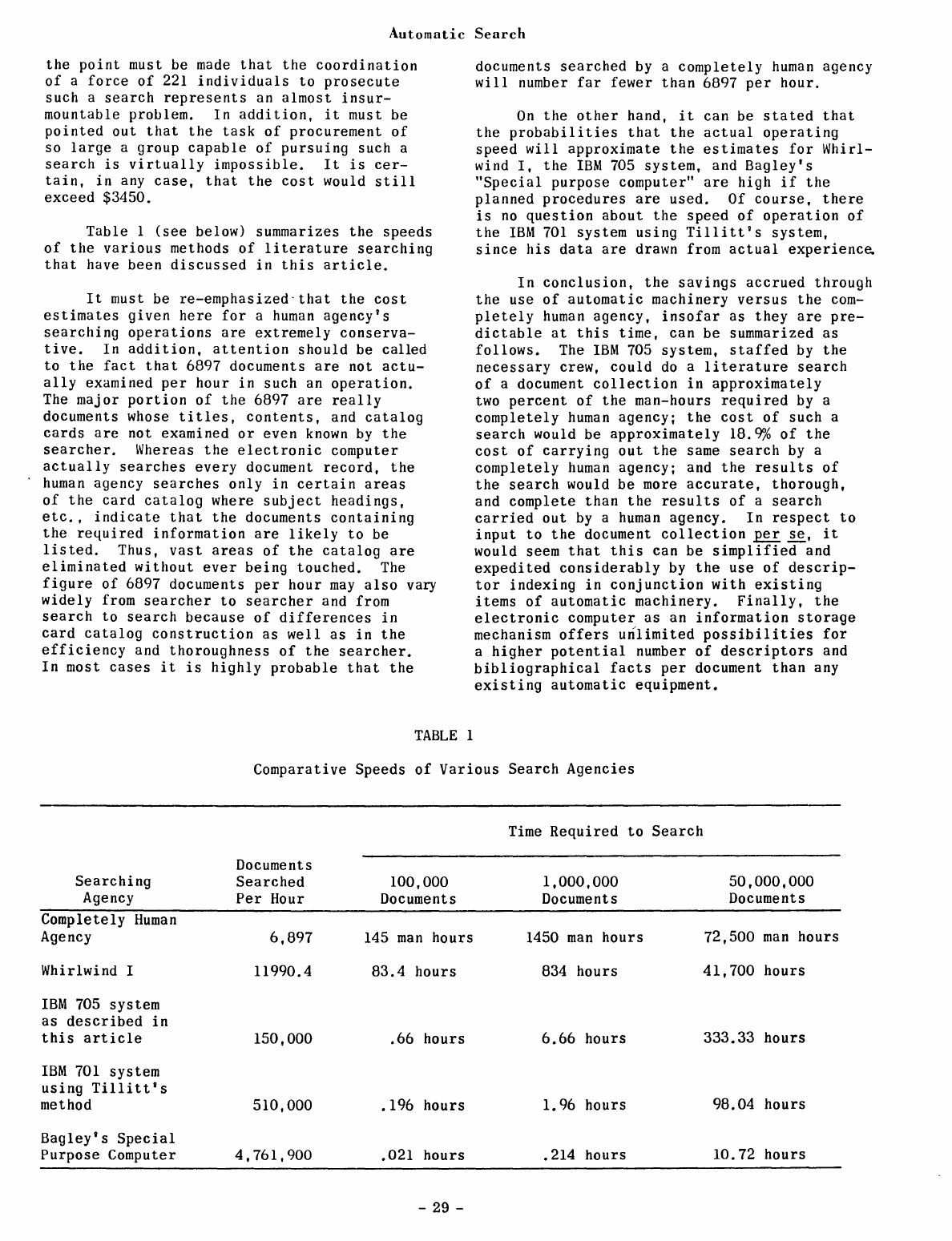
Automatic
Search
the
point
must be
made
that
the
coordination
of
a
force
of
221
individuals
to
prosecute
such a
search
represents
an
almost
insur-
mountable proulem.
In
addition,
it
must be
pointed
out
that
the
task
of
procurement
of
so
large
a group
capable
of
pursuing
such a
search
is
virtually
impossible.
It
is
cer-
tain,
in
any
case,
that
the
cost
would
still
exceed $3450.
Table
1
(see
below) summarizes
the
speeds
of
the
various
methods
of
literature
searching
that
have been
discussed
in
this
article.
It
must be
re-emphasized,that
the
cost
estimates
given
here
for
a
human
agencyVs
searching
operations
are
extremely
conserva-
tive.
In
addition,
attention
should
be
called
to
the
fact
that
6897 documents
are
not
actu-
ally
examined
per
hour
in
such an
operation.
The major
portion
of
the
6897
are
really
documents whose
titles,
contents,
and
catalog
cards
are
not examined
or
even
known
by
the
searcher.
Whereas
the
electronic
computer
actually
searches
every
document
record,
the
human
agency
searches
only
in
certain
areas
of
the
card
catalog
where
subject
headings,
etc.,
indicate
that
the
documents
containing
the
required
information
are
likely
to
be
listed.
Thus,
vast
areas
of
the
catalog
are
eliminated
without
ever
being
touched.
The
figure
of
6897 documents
per
hour
may
also
vary
widely
from
searcher
to
searcher
and from
search
to
search
because
of
differences
in
card
catalog
construction
as
well
as
in
the
efficiency
and
thoroughness
of
the
searcher.
In
most
cases
it
is
highly
probable
that
the
TABLE
1
documents
searched
by
a
completely
human
agency
will
number
far
fewer
than
6897
per
hour.
On
the
other
hand,
it
can be
stated
that
the
probabilities
that
the
actual
operating
speed
will
approximate
the
estimates
for
Whirl-
wind
I,
the
IBM
705
system,
and
Bagley's
"Special
purpose computer"
are
high
if
the
planned
procedures
are
used.
Of
course,
there
is
no
question
about
the
speed
of
operation
of
the
IBM
701
system
using
TillittVs
system,
since
his
data
are
drawn from
actual
experienca
In
conclusion,
the
savings
accrued
through
the
use
of
automatic
machinery
versus
the
com-
pletely
human
agency,
insofar
as
they
are
pre-
dictable
at
this
time,
can be summarized
as
follows.
The
IBM
705
system,
staffed
by
the
necessary
crew,
could
do
a
literature
search
of
a document
collection
in
approximately
two
percent
of
the
man-hours
required
by a
completely
human
agency;
the
cost
of
such a
search
would be
approximately
18.9%
of
the
cost
of
carrying
out
the
same
search
by
a
completely
human
agency; and
the
results
of
the
search
would be more
accurate,
thorough,
and complete
than
the
results
of
a
search
carried
out
by
a
human
agency.
In
respect
to
input
to
the
document
collection
~~,
it
would seem
that
this
can be
simplified
and
expedited
considerably
by
the
use
of
descrip-
tor
indexing
in
conjunction
with
existing
items
of
automatic
machinery.
Finally,
the
electronic
computer
as
an
information
storage
mechanism
offers
unlimited
possibilities
for
a
higher
potential
number
of
descriptors
and
bibliographical
facts
per
document
than
any
existing
automatic
equipment.
Comparative Speeds
of
Various
Search
Agencies
Searching
Agency
Completely
Human
Agency
Whirlwind I
IBM
705
system
as
described
in
this
article
IBM
701
system
using
Tillitt's
method
Bagley's
Special
Purpose
Computer
Documents
Searched
Per
Hour
6,897
11990.4
150,000
510,000
4,761,900
100,000
Documents
145
man
hours
83.4
hours
.66
hours
.196
hours
.021
hours
-
29
-
Time
Required
to
Search
1,000,000
50,000,000
Documents Documents
1450
man
hours
72,500
man
hours
834 hours
41,700
hours
6.66
hours
333.33
hours
1.96
hours
98.04
hours
.214
hours
10.72
hours
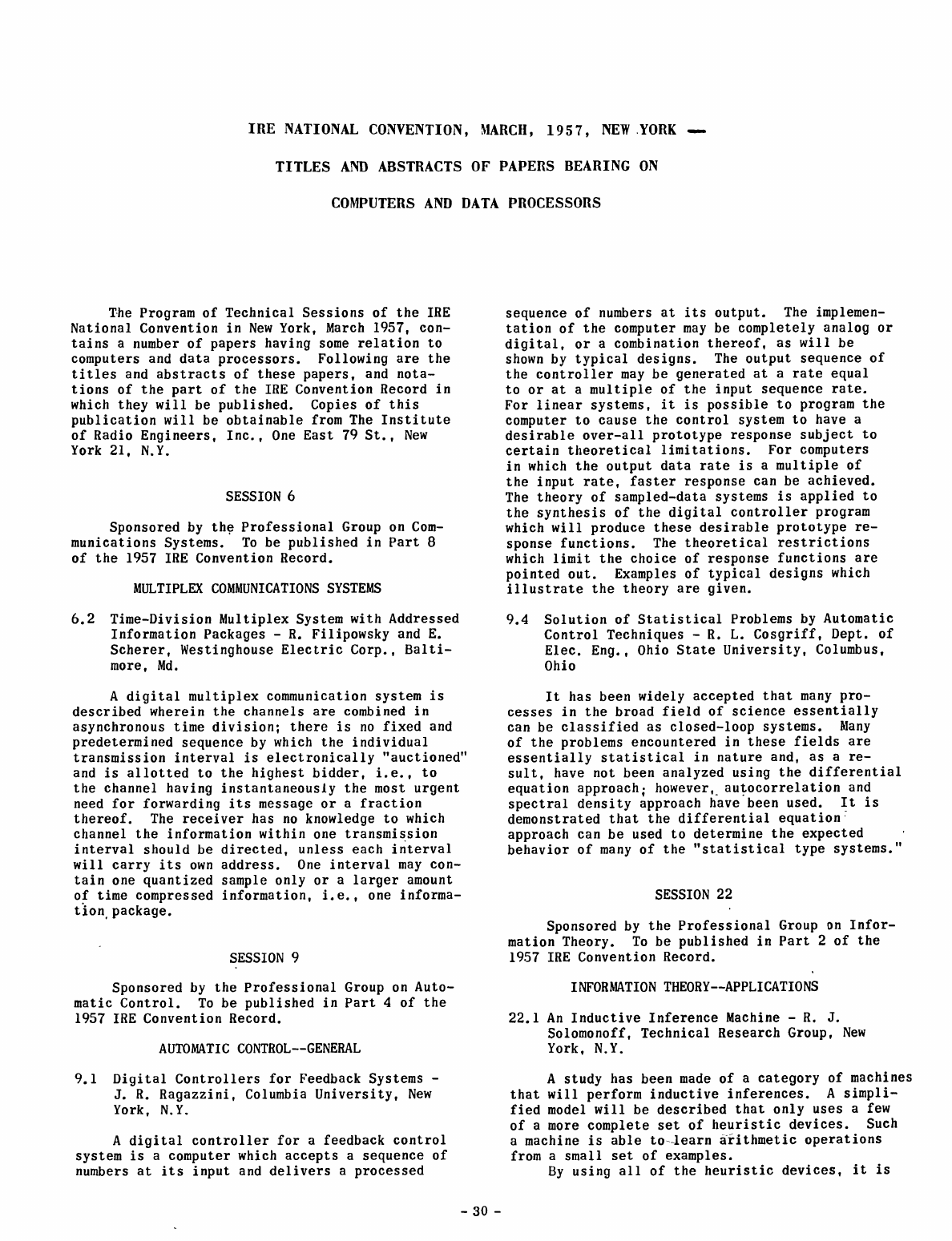
IRE
NATIONAL
CONVENTION,
MARCH,
1957,
NEW
,YORK
TITLES
AND
ABSTRACTS
OF
PAPERS
BEARING
ON
COMPUTERS
AND
DATA
PROCESSORS
The
Program
of
Technical
Sessions
of
the
IRE
National
Convention
in
New
York,
March
1957,
con-
tains
a number
of
papers
having
some
relation
to
computers and
data
processors.
Following
are
the
titles
and
abstracts
of
these
papers,
and
nota-
tions
of
the
part
of
the
IRE
Convention Record
in
which
they
will
be
published.
Copies
of
this
publication
will
be
obtainable
from
The
Institute
of
Radio
Engineers,
Inc.,
One
East
79
St.,
New
York
21,
N.Y.
SESSION
6
Sponsored
by
th~
Professional
Group
on
Com-
munications
Systems.
To
be
published
in
Part
8
of
the
1957
IRE
Convention Record.
MULTIPLEX
COMMUNICATIONS
SYSTEMS
6.2
Time-Division
Multiplex
System
with
Addressed
Information
Packages -
R.
Filipowsky and
E.
Scherer,
Westinghouse
Electric
Corp.,
Balti-
more,
Md.
A
digital
multiplex
communication system
is
described
wherein
the
channels
are
combined
in
asynchronous time
division;
there
is
no
fixed
and
predetermined
sequence by which
the
individual
transmission
interval
is
electronically
"auctioned"
and
is
allotted
to
the
highest
bidder,
i.e.,
to
the
channel having
instantaneously
the
most
urgent
need
for
forwarding
its
message
or
a
fraction
thereof.
The
receiver
has
no
knowledge
to
which
channel
the
information
within
one
transmission
interval
should
be
directed,
unless
each
interval
will
carry
its
own
address.
One
interval
may
con-
tain
one
quantized
sample only
or
a
larger
amount
of
time compressed
information,
i.e.,
one
informa-
tion,package.
SESSION
9
Sponsored
by
the
Professional
Group
on
Auto-
matic
Control.
To
be
published
in
Part
4
of
the
1957
IRE
Convention Record.
AUTOMATIC
CONTROL--GENERAL
9.1
Digital
Controllers
for
Feedback Systems -
J.
R.
Ragazzini,
Columbia
University,
New
York,
N.Y.
A
digital
controller
for
a feedback
control
system
is
a computer which
accepts
a sequence
of
numbers
at
its
input
and
delivers
a
processed
-30 -
sequence
of
numbers
at
its
output.
The
implemen-
tation
of
the
computer
may
be
completely
analog
or
digital,
or
a combination
thereof,
as
will
be
shown
by
typical
designs.
The
output
sequence
of
the
controller
may
be
generated
at
a
rate
equal
to
or
at
a
multiple
of
the
input
sequence
rate.
For
linear
systems,
it
is
possible
to
program
the
computer
to
cause
the
control
system
to
have a
desirable
over-all
prototype
response
subject
to
certain
theoretical
limitations.
For computers
in
which
the
output
data
rate
is
a
multiple
of
the
input
rate,
faster
response
can be
achieved.
The
theory
of
sampled-data systems
is
applied
to
the
synthesis
of
the
digital
controller
program
which
will
produce
these
desirable
prototype
re-
sponse
functions.
The
theoretical
restrictions
which
limit
the
choice
of
response
functions
are
pointed
out.
Examples
of
typical
designs
which
illustrate
the
theory
are
given.
9.4
Solution
of
Statistical
Problems
by
Automatic
Control
Techniques -
R.
L.
Cosgriff,
Dept.
of
Elec.
Eng.,
Ohio
State
University,
Columbus,
Ohio
It
has been widely
accepted
that
many
pro-
cesses
in
the
broad
field
of
science
essentially
can be
classified
as
closed-loop
systems.
Many
of
the
problems
encountered
in
these
fields
are
essentially
statistical
in
nature
and,
as
a
re-
sult,
have not been
analyzed
using
the
differential
equation
approach; however
,_
au~ocorrelation
and
spectral
density
approach have been used.
~t
is
demonstrated
that
the
differential
equation'
approach can be used
to
determine
the
expected
behavior
of
many
of
the
"statistical
type
systems."
SESSION
22
Sponsored
by
the
Professional
Group
on
Infor-
mation Theory.
To
be
published
in
Part
2
of
the
1957
IRE
Convention Record.
INFORMATION
THEORY--APPLICATIONS
22.1
An
Inductive
Inference
Machine -
R.
J.
Solomonoff,
Technical
Research Group,
New
York,
N.Y.
A
study
has been
made
of
a
category
of
machines
that
will
perform
inductive
inferences.
A
simpli-
fied
model
will
be
described
that
only
uses a few
of
a more complete
set
of
heuristic
devices.
Such
a machine
is
able
to-~earn
arithmetic
operations
from a small
set
of
examples.
By
using
all
of
the
heuristic
devices,
it
is
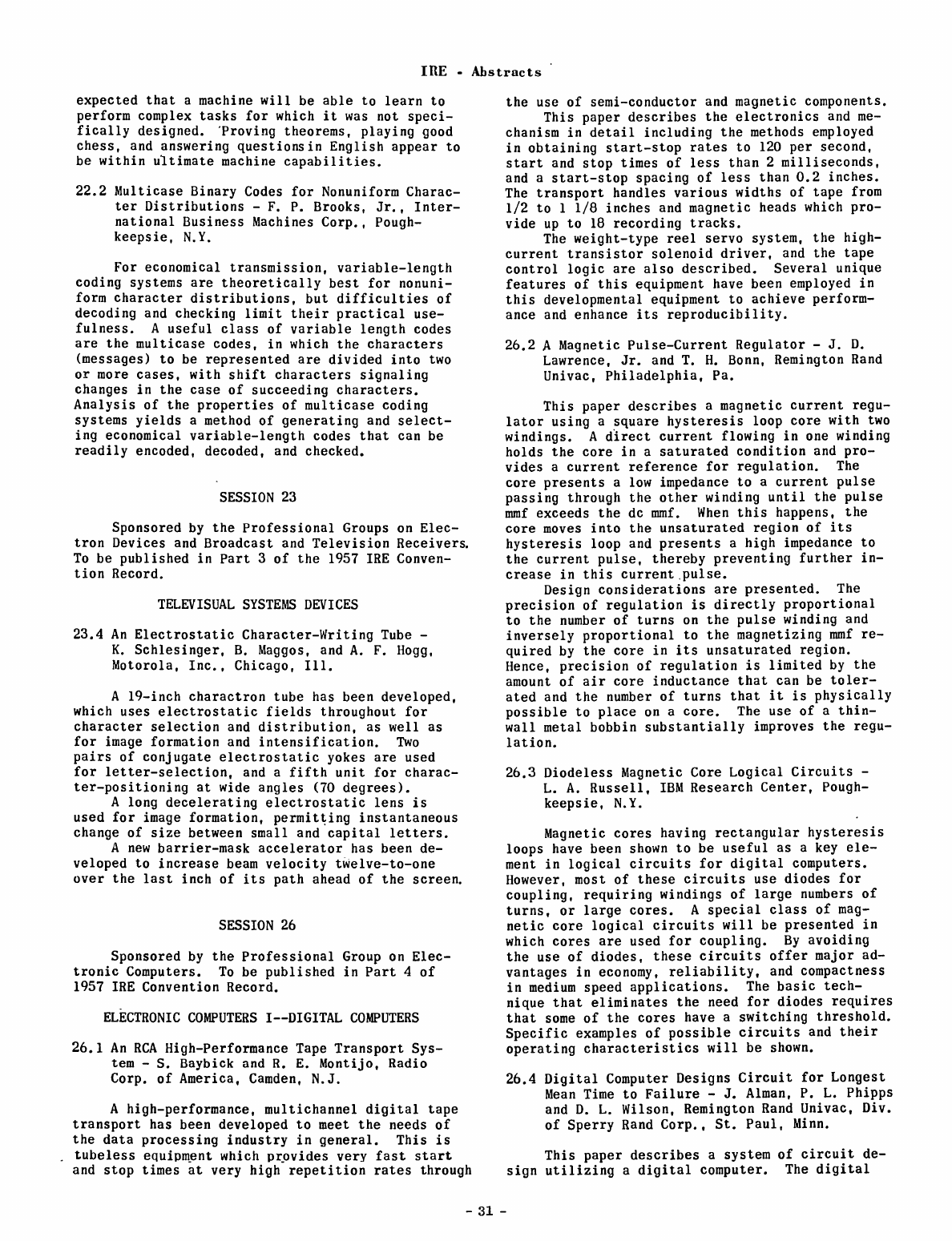
IRE
-
Abstracts
expected
that
a machine
will
be
able
to
learn
to
perform complex
tasks
for
which
it
was
not
speci-
fically
designed.
'Proving
theorems,
playing
good
chess,
and answering
questionsin
English
appear
to
be
within
ultimate
machine
capabilities.
22.2
Multicase
Binary Codes
for
Nonuniform
Charac-
ter
Distributions
-
F.
P.
Brooks,
Jr.,
Inter-
national
Business
Machines
Corp.,
Pough-
keepsie,
N.Y.
For economical
transmission,
variable-length
coding systems
are
theoretically
best
for
nonuni-
form
character
distributions,
but
difficulties
of
decoding and checking
limit
their
practical
use-
fulness.
A
useful
class
of
variable
length
codes
are
the
multicase
codes,
in
which
the
characters
(messages)
to
be
represented
are
divided
into
two
or
more
cases,
with
shift
characters
signaling
changes
in
the
case
of
succeeding
characters.
Analysis
of
the
properties
of
multicase
coding
systems
yields
a method
of
generating
and
select-
ing economical
variable-length
codes
that
can be
readily
encoded, decoded, and checked.
SESSION
23
Sponsored
by
the
Professional
Groups
on
Elec-
tron
Devices and
Broadcast
and
Television
Receivers.
To
be
published
in
Part
3
of
the
1957
IRE
Conven-
tion
Record.
TELEVISUAL
SYSTEMS
DEVICES
23.4
An
Electrostatic
Character-Writing
Tube -
K.
Schlesinger,
B.
Maggos,
and
A.
F.
Hogg,
Motorola,
Inc.,
Chicago,
Ill.
A
19-inch
charactron
tube
has been developed,
which uses
electrostatic
fields
throughout
for
character
selection
and
distribution,
as
well
as
for
image
formation
and
intensification.
Two
pairs
of
conjugate
electrostatic
yokes
are
used
for
letter-selection,
and a
fifth
unit
for
charac-
ter-positioning
at
wide
angles
(70
degrees).
A long
decelerating
electrostatic
lens
is
used
for
image
formation,
permit~ing
instantaneous
change
of
size
between small and
capital
letters.
A
new
barrier-mask
accelerator
has been
de-
veloped
to
increase
beam
velocity
twelve-to-one
over
the
last
inch
of
its
path
ahead
of
the
screen.
SESSION
26
Sponsored
by
the
Professional
Group
on
Elec-
tronic
Computers.
To
be
published
in
Part
4
of
1957
IRE
Convention Record.
ELECTRONIC
COMPUTERS
I--DIGITAL
COMPUTERS
26.1
An
RCA
High-Performance Tape
Transport
Sys-
tem -S. Baybick and
R.
E.
Montijo, Radio
Corp.
of
America,
Camden,
N.J.
A
high-performance,
multichannel
digital
tape
transport
has been developed
to
meet
the
needs
of
the
data
processing
industry
in
general.
This
is
tubeless
equipment which
provides
very
fast
start
and
stop
times
at
very high-
repetition
rates
through
the
use
of
semi-conductor
and magnetic components.
This paper
describes
the
electronics
and
me-
chanism
in
detail
including
the
methods employed
in
obtaining
start-stop
rates
to
120
per
second,
start
and
stop
times
of
less
than
2
milliseconds,
and a
start-stop
spacing
of
less
than
0.2
inches.
The
transport
handles
various
widths
of
tape
from
1/2
to
1
1/8
inches
and magnetic heads which
pro-
vide
up
to
18
recording
tracks.
The
weight-type
reel
servo
system,
the
high-
current
transistor
solenoid
driver,
and
the
tape
control
logic
are
also
described.
Several
unique
features
of
this
equipment have been employed
in
this
developmental equipment
to
achieve
perform-
ance and enhance
its
reproducibility.
26.2
A Magnetic
Pulse-Current
Regulator
-
J.
D.
Lawrence,
Jr.
and
T.
H.
Bonn, Remington
Rand
Univac,
Philadelphia,
Pa.
This
paper
describes
a magnetic
current
regu-
lator
using
a
square
hysteresis
loop
core
with
two
windings. A
direct
current
flowing
in
one winding
holds
the
core
in
a
saturated
condition
and
pro-
vides
a
current
reference
for
regulation.
The
core
presents
a
low
impedance
to
a
current
pulse
passing
through
the
other
winding
until
the
pulse
mmf
exceeds
the
dc
mmf.
When
this
happens,
the
core
moves
into
the
unsaturated
region
of
its
hysteresis
loop and
presents
a high impedance
to
the
current
pulse,
thereby
preventing
further
in-
crease
in
this
current
,pulse.
Design
considerations
are
presented.
The
precision
of
regulation
is
directly
proportional
to
the
number
of
turns
on
the
pulse
winding and
inversely
proportional
to
the
magnetizing
mmf
re-
quired
by
the
core
in
its
unsaturated
region.
Hence,
precision
of
regulation
is
limited
by
the
amount
of
air
core
inductance
that
can be
toler-
ated
and
the
number
of
turns
that
it
is
physically
possible
to
place
on
a
core.
The
use
of
a
thin-
wall
metal bobbin
substantially
improves
the
regu-
lation.
26.3
Diodeless
Magnetic Core
Logical
Circuits
-
L.
A.
Russell,
IBM
Research
Center,
Pough-
keepsie,
N.Y.
Magnetic
cores
having
rectangular
hysteresis
loops have been
shown
to
be
useful
as a key
ele-
ment
in
logical
circuits
for
digital
computers.
However, most
of
these
circuits
use
diodes
for
coupling,
requiring
windings
of
large
numbers
of
turns,
or
large
cores.
A
special
class
of
mag-
netic
core
logical
circuits
will
be
presented
in
which
cores
are
used
for
coupling.
By
avoiding
the
use
of
diodes,
these
circuits
offer
major
ad-
vantages
in
economy,
reliability,
and compactness
in
medium
speed
applications.
The
basic
tech-
nique
that
eliminates
the
need
for
diodes
requires
that
some
of
the
cores
have a
switching
threshold.
Specific
examples
of
possible
circuits
and
their
operating
characteristics
will
be shown.
26.4
Digital
Computer Designs
Circuit
for
Longest
Mean
Time
to
Failure
-
J.
Alman, P.
L.
Phipps
and
D.
L.
Wilson, Remington
Rand
Univac, Div.
of
Sperry
Rand
Corp.,
St.
Paul,
Minn.
This
paper
describes
a system
of
circuit
de-
sign
utilizing
a
digital
computer.
The
digital
-
31
-
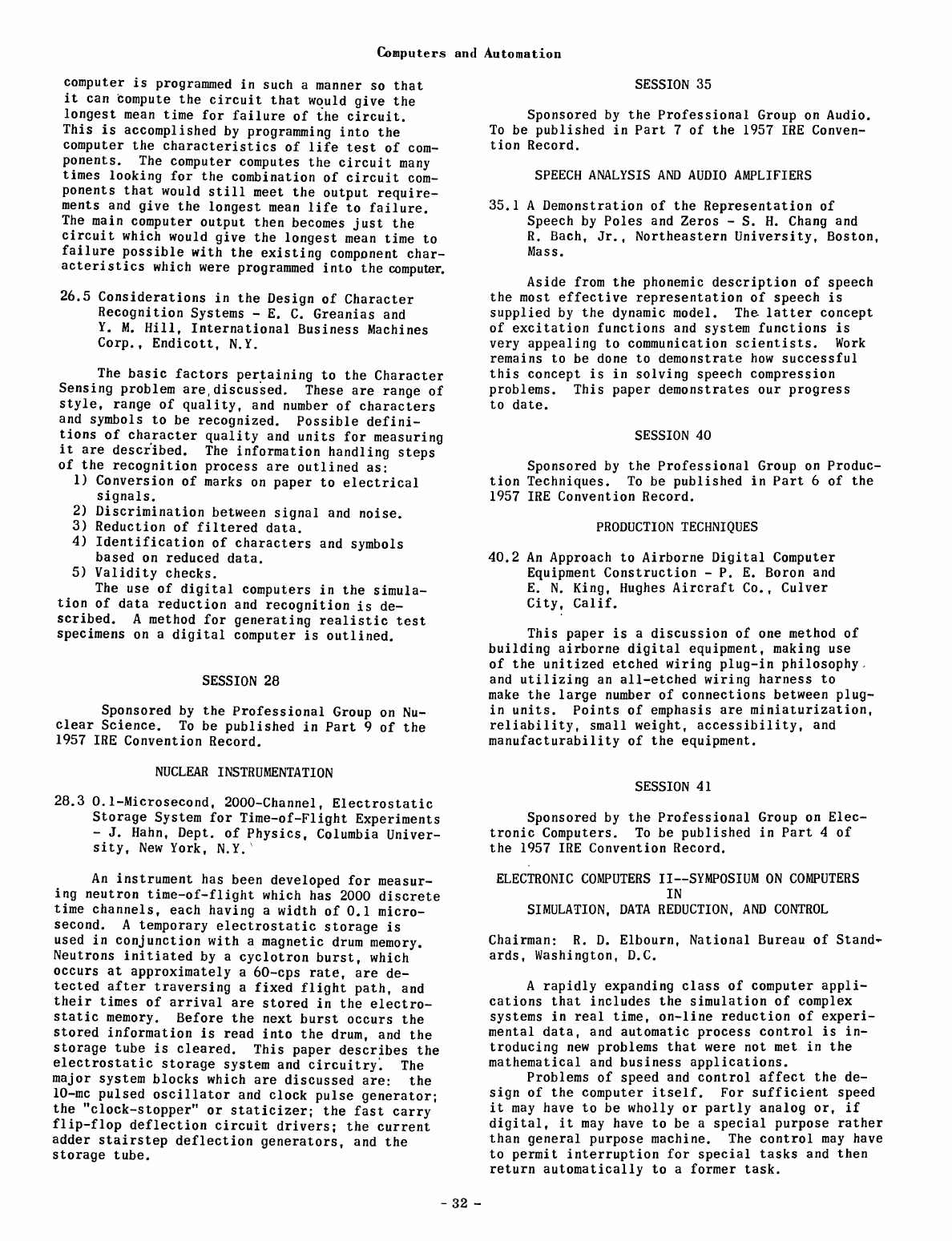
COmputers
and
Automation
computer
is
programmed
in
such a manner so
that
it
can compute
the
circuit
that
w~uld
give
the
longest
mean
time
for
failure
of
the
circuit.
This
is
accomplished
by
programming
into
the
computer
the
characteristics
of
life
test
of
com-
ponents.
The
computer computes
the
circuit
many
times looking
for
the
combination
of
circuit
com-
ponents
that
would
still
meet
the
output
require-
ments and
give
the
longest
mean
life
to
failure.
The
main computer
output
then
becomes
just
the
circuit
which would
give
the
longest
mean
time
to
failure
possible
with
the
existing
component
char-
acteristics
which were programmed
into
the
computer.
26.5
Considerations
in
the
Design
of
Character
Recognition
Systems -
E.
C.
Greanias
and
Y.
M.
Hill,
International
Business
Machines
Corp.,
Endicott,
N.Y.
The
basic
factors
pertaining
to
the
Character
Sensing
problem
are,discussed.
These
are
range
of
style,
range
of
quality,
and number
of
characters
and symbols
to
be
recognized.
Possible
defini-
~ions
of
ch~racter
quality
and
units
for
measuring
It
are
described.
The
information
handling
steps
of
the
recognition
process
are
outlined
as:
1) Conversion
of
marks
on
paper
to
electrical
signals.
2)
Discrimination
between
signal
and
noise.
3)
Reduction
of
filtered
data.
4)
Identification
of
characters
and symbols
based
on
reduced
data.
5)
Validity
checks.
The
use
of
digital
computers
in
the
simula-
tion
of
data
reduction
and
recognition
is
de-
scribed.
A method
for
generating
realistic
test
specimens
on
a
digital
computer
is
outlined.
SESSION
28
Sponsored
by
the
Professional
Group
on
Nu-
clear
Science.
To
be
published
in
Part
9
of
the
1957
IRE
Convention Record.
NUCLEAR
INSTRUMENTATION
28.3
O.l-Microsecond,
2000-Channel,
Electrostatic
Storage
System
for
Time-of-Flight
Experiments
-
J.
Hahn, Dept.
of
Physics,
Columbia
Univer-
sity,
New
York,
N.Y.
\
An
instrument
has been developed
for
measur-
ing
neutron
time-of-flight
which has 2000
discrete
time
channels,
each having a width
of
0.1
micro-
second. A temporary
electrostatic
storage
is
used
in
conjunction
with
a magnetic
drum
memory.
Neutrons
initiated
by a
cyclotron
burst,
which
occurs
at
approximately
a
60-cps
rate,
are
de-
tected
after
traversing
a
fixed
flight
path,
and
their
times
of
arrival
are
stored
in
the
electro-
static
memory.
Before
the
next
burst
occurs
the
stored
information
is
read
into
the
drum, and
the
storage
tube
is
cleared.
This
paper
describes
the
electrostatic
storage
system and
circuitry~
The
major system
blocks
which
are
discussed
are:
the
10-mc
pulsed
oscillator
and
clock
pulse
generator;
the
"clock-stopper"
or
staticizer;
the
fast
carry
flip-flop
deflection
circuit
drivers;
the
current
adder
stairstep
deflection
generators,
and
the
storage
tube.
-32 -
SESSION
35
Sponsored
by
the
Professional
Group
on
Audio.
To
be
published
in
Part
7
of
the
1957
IRE
Conven-
tion
Record.
SPEECH
ANALYSIS
AND
AUDIO
AMPLIFIERS
35.1 A Demonstration
of
the
Representation
of
Speech
by
Poles
and Zeros -S.
H.
Chang
and
R.
Bach,
Jr.,
Northeastern
University,
Boston,
Mass.
Aside from
the
phonemic
description
of
speech
the
most
effective
representation
of
speech
is
supplied
by
the
dynamic model. The
latter
concept
of
excitation
functions
and system
functions
is
very
appealing
to
communication
scientists.
Work
remains
to
be done
to
demonstrate
how
successful
this
concept
is
in
solving
speech compression
problems. This
paper
demonstrates
our
progress
to
date.
SESSION
40
Sponsored
by
the
Professional
Group
on
Produc-
tion
Techniques.
To
be
published
in
Part
6
of
the
1957
IRE
Convention Record.
PRODUCTION
TECHNIQUES
40.2
An
Approach
to
Airborne
Digital
Computer
Equipment
Construction
-P.
E.
Boron and
E.
N.
King, Hughes
Aircraft
Co.,
Culver
City,
Calif.
This
paper
is
a
discussion
of one method
of
building
airborne
digital
equipment, making use
of
the
unitized
etched wiring
plug-in
philosophy-
and
utilizing
an
all-etched
wiring
harness
to
make
the
large
number
of
connections
between
plug-
in
units.
Points
of
emphasis
are
miniaturization,
reliability,
small
weight,
accessibility,
and
manufacturability
of
the
equipment.
SESSION
41
Sponsored
by
the
Professional
Group
on
Elec-
tronic
Computers.
To
be
published
in
Part
4
of
the
1957
IRE
Convention Record.
ELECTRONIC
COMPUTERS
II--SYMPOSIUM
ON
COMPUTERS
IN
SIMULATION,
DATA
REDUCTION,
AND
CONTROL
Chairman:
R.
D.
Elbourn,
National
Bureau
of
Stand~
ards,
Washington,
D.C.
A
rapidly
expanding
class
of
computer
appli-
cations
that
includes
the
simulation
of
complex
systems
in
real
time,
on-line
reduction
of
experi-
mental
data,
and
automatic
process
control
is
in-
troducing
new
problems
that
were not met
in
the
mathematical and
business
applications.
Problems
of
speed and
control
affect
the
de-
sign
of
the
computer
itself.
For
sufficient
speed
it
may
have
to
be wholly
or
partly
analog
or,
if
digital,
it
may
have
to
be a
special
purpose
rather
than
general
purpose machine.
The
control
may
have
to
permit
interruption
for
special
tasks
and
then
return
automatically
to
a former
task.
IRE
-
Abstracts
Communication between
the
computer and
the
rest
of
the
system
may
involve
problems
of
con-
version
between analog and
digital
data,
of
multi-
plexing
many
data
channels
into
one computer chan-
nel,
of
smoothing
or
interpolating
sampled
data,
or
of
preparing
displays
suitable
for
human
beings.
The
first
two
speakers
will
deal
generally
with
these
problems,
then
three
speakers
will
de-
scribe
their
solutions
in-three
specific
applica-
tions:
1) A
large
combined
analog-digital
simulator.
2)
The
digital
control
of
machine
tools.
3)
The
reduction
of
wind-tunnel
data.
After
these
talks
there
will
be a round
table
discussion
of
present
and
future
solutions
of
these
problems.
SESSION
44
Sponsored
by
the
Professional
Group
on
Indus-
trial
Electronics.
To
be
published
in
Part
6
of
the
1957
IRE
Convention Record.
INDUSTRIAL
ELECTRONICS
44.1
The
Canadian Mail Handling System and
the
Problem
of
Coding -
M. M.
Levy and
A.
Barszczewski,
Post
Office
Dept.,
Ottawa,
Ontario,
Canada
The
Canadian
Post
Office
has under
develop-
ment an
Electronic
Automatic Mail
Sorting
System.
The
efficient
operation
of
the
system
is
made
possible
by
use
of
a
proper
code and coding methods.
The
proper
names
of
towns,
villages,
and
streets
are
converted
into
a
special
code
suit-
able
for
electronic
handling.
The
process
of
coding
is
performed
mentally
by
the
operators
according
to
a
set
of
simple
rules.
The
addresses
of
letters
are
read
by
the
operators
in
special
reading
stations
and men-
tally
coded,
the
code
is
then
marked
on
the
enve-
lopes
by
a
speCial
keyboard.
Afterwards
the
re-
maining
operations
are
performed
completely
auto-
matically.
The
prototype
of
the
system
is
briefly
de-
scribed.
The
paper
is
dealing
mainly
with
the
coding problem and
human
factors
involved
in
it.
A
clear
account
is
given
of
various
codes and
coding
aspects.
Description
is
given
of
mini-
mization
of
errors.
The
realization
of
a working
system
did
depend
to
a
large
extent
on
suitable
coding and
therefore
its
importance
is
stressed.
Although
this
paper
is
restricted
to
the
specific
application
only,
nevertheless
the
meth-
ods used have
large
potential
possibilities
in
other
fields
where
realization
of
electronic
sort-
ing and
filing
of
data
is
essential.
SESSION
45
Sponsored
by
the
Professional
Group
on
Relia-
bility
and
Quality
Control.
To
be
published
in
Part
10
of
the
1957
IRE
Convention Record.
RELIABILITY
PROGRAMS
45.1
Air
Force Ground
Electronic
Equipment
Relia-
bility
Improvement Program -
J.
J.
Naresky,
-
33
-
Rome
Air
Development
Center,
Griffiss
Air
Force Base,
N.Y.
As
the
demands
of
modern
warfare
have
dic-
tated
increases
in
electronic
equipment complex-
ity,
reliability
has been
correspondingly
de-
creased,
thus
necessitating
the
institution
of
a
comprehensive program
of
reliability
improvement
in
the
Department
of
Defense.
This
paper
describes
the
factors
leading
to
the
development
of
the
pro-
gram
at
the
Rome
Air
Development
Center
and
the
methods
of
its
implementation on
radar
and
other
ground
electronic
equipment developed
by
RADC.
The
RADC
Reliability
Program--past,
present,
and
future--is
discussed.
The
general
areas
covered
are:
1) Methods
of
educating
design
engineers
on
reliability;
2) development,
veri-
fication
and use
of
a
reliability
prediction
technique;
3) development
of
automatic
monitoring
equipment; 4) component and
circuit
reliability
improvement
techniques,
and 5)
insertion
of
quanti-
tative
reliability
requirements
into
equipment
specifications.
45.2
A
Reliability
Program -
R.
E.
Kuehn,
Inter-
national
Business
Machines
Corp.,
Owego,
N.Y.
The
introduction
of
complex
electronic
sys-
tems
into
general
usage has
made
the
organiza-
tion
of
reliability
engineering
groups a
neces-
sity.
This
group can
function
best
by
reporting
to
the
manager
of
engineering
as an independent
evaluation
and
service
agency.
The
tasks
of
'
reliability
engineering
include
the
development
and
application
of
reliability
prediction
tech-
niques;
the
operation
of
a
failure
reporting
and
analysis
system;
the
selection,
qualification,
and
application
of
components;
the
environmental
and
life
testing
of
components,
units,
and systems,
and
the
evaluation
of
systems
on
the
bench and
in
the
field
for
reliability,
maintainability,
accu-
racy,
and
operational
suitability.
45.3
A
Reliability
Program
for
Rand
D
Projects
-
E.
F.
Dertinger,
American Bosch
Arma
Corp.,
Garden
City,
N.Y.
The
proposed
paper
will
describe
a
long-range
reliability
program which has been
inaugurated
during
the
initial
design
stage
of
developing
and
producing an
inertial
guidance
system
for
ballistic
missile
application.
This
program
represents,
to
the
writer's
knowledge,
the
first
all-out
attempt
to
"design-in"
complete
missile
system
reliability.
Considerable
effort
will
be
extended
toward
presenting
the
procedures
and
techniques
developed
for
"comparative
evaluation"
of
functionally-suit-
able
component
parts
and
"reliability
qualifica-
tion"
of:
1)
parts
selected
for
design
incorpora-
tion,
2)
assemblies
and major components, and 3)
complete systems.
The
philosophy
of
Arma
manage-
ment as
regards
reliability
and
the
support
given
to
this
program
will
be
described.
45.4
The
Role
of
Quality
Engineering
in
Procuring
and Producing
Reliable
Products
-
R.
A.
Hulnick,
International
Business
Machines
Corp.,
Kingston,
N.Y.
To
assure
production
of
a
reliable
product,
quality
engineering
must
formulate
for
the
manu-
Computers
and
Automation
facturer
a
plan
which encompasses a
design
of
ac-
ceptable
reliability,
adequate
controls
over
pro-
curement and
processing,
and
techniques
for
con-
tinuous
performance
evaluation
for
the
purpose
of
product
improvement.
SESSION
46
Sponsored
by
the
Professional
Group
on
Telem-
etry
and Remote
Control.
To
be
published
in
Part
5
of
the
1957
IRE
Convention Record.
SYMPOSIUM--DIGITAL
TECHNIQUES
FOR
PROBLEMS
IN
TELEMETERING
AND
REMOTE
CONTROL
Chairman:
C.
H.
Hoeppner,
Jr.,
Radiation,
Inc.,
Melbourne,
Fla.
46.1
A High-Speed
Digital
Data-Handling System -
G.
F. Anderson,
Radiation,
Inc.,
Melbourne,
Fla.
This
paper
describes
a
high-speed
digital
data-handling
system which
provides
digitizing,
editing,
and
processing
of
pwm
and fm/fm
data.
This
system
digitizes
a
maximum
of
22
channels
of
analog
data
at
a
channel-sampling
rate
of
22,000
data
points
per
second.
An
over-all
accuracy
of
one
part
in
1024
is
provided,
utilizing
a
10-bit
binary
straight
code. Simultaneous sampling
of
the
data
to
an
accuracy
of
33 microseconds
is
provided.
Editing
is
provided
by
the
Quick-Look
analog
recording
system.
The
processing
system
generates
an
output
code
compatible
with
the
IBM
650 computer; however,
with
slight
altera-
tions,
the
output
format can be
made
compatible
with
other
types
of
digital
computers.
46.2
Magnetic Tape Playback and
Digital
Conversion
of
Telemetered
Flight
Data
for
Entry
into
Digital
Computers -
G.
C.
Dannals,
Radiation,
Inc.,
Melbourne,
Fla.
Paper
describes
an
automatic
digital
conver-
sion
and
data
processing
system
designed
and
built
by
Radiation,
Inc.
for
the
AC
Spark
Plug
Division
of
General Motors Corp. Decommutated and
separ-
ated
pdm
and fm/fm
data
recovered
during
magnetic
tape
playback
of
telemetry
records
is
electronic-
ally
sampled and
converted
to
ten-pit
binary
code
and
further
processed
to
suitable
form
for
entry
into
high-speed
digital
computers. Data
editing,
intermediate
recording,
and
processing
control
features
are
incorporated.
Other
salient
features
as
regards
system
accuracy,
high-speed-handling,
and
operational
flexibility
are
discussea.
46.3
Design
Considerations
for
Super Speed
Perfor-
ated
Tape
Digital
Recording -
J.
Bellinger,
J.
T.
MacNeill, and
C.
F.
West, Soroban En-
gineering
Co.,
Melbourne,
Fla.
Until
recently,
techniques
for
recording
digital
data
on
perforated
tape
have been
per-
fected
to
meet
the
requirements
of
the
communi-
cation
industry.
The
recorder
described
in
this
paper
probably
represents
the
first
tape
perfor-
ator
designed
for
instrumentation
as
well
as
digi-
t?l
computer
output
data
recording
applications.
-34 -
The
design
now
permits
recording
of
standard
5,
6,
7,
or
8-hole
code
patterns
to
be
reliably
performed
at
controlled
rates
up
to
240 codes
per
second.
The
perforator
executes
a
basic
record-
ing
cycle
of
one code
in
approx~mately
4
milli-
seconds.
Since
a
recording
cycle
can
only
be
executed
on
demand
associated
electronic
control
circuits
will
permit
recording
of
random
or
a-
synchron"ous
data
at
variable
rates
up
to
240/
second.
46.4
A High-Speed
Binary-to-Binary-Decimal
Trans-
lator
-
C.
A.
Campbell,
Radiation,
Inc.,
Melbourne,
Fla.
A
high-speed
translator
has been developed
which
accomplishes
binary-to-binary-decimal
trans-
lation
yet
requires
only
about
three
vacuum
tubes
per
bit.
By
suitably
arranging
the
feedback and
trig-
ger
logic
circuits
the
binary
decades
accept
counts
with
weights
of
1, 2,
4,
.6,
or
8.
With
minor
circuit
changes
the
counter
will
operate
with
any
integral
weight from 1
through
9.
Arranging
these
decades
in
cascade,
inputs
with
weights
of
16, 32, 64,
etc.,
are
accepted
and
totaled
to
decimal
readouts,
which
may
be
in
either
binary
or
decimal
presentation.
The
present
decade
requires
about
five
micro-
seconds
per
binary
digit
for
computation; however,
the
state
of
the
art
can
allow
an
increase
of
at
least
tenfold
in
this
speed.
46.5
Simplicity
for
Reliable
Low-Cost
Operation
in
a
Digital
Data-Processing
System -
J.
W.
Prast,
Bell
Aircraft
Corp.,
Buffalo,
N.Y.
A
simple
and
straightforward
digital
data-
processing
system
for
telemetering
purposes
was
developed
in
1954
and has been
in
operation
since
that
time
for
processing
special
precision
in-
formation
during
test
flights
of
guided
missiles.
Experience
gained
in
operational
use
will
be
reported
with
emphasis
on
reliability
and
cost
aspects.
The
system
features
0.1
per
cent
accuracy,
inherent
reliability,
and
low
cost
on
the
ad-
vantageous
side
with
limitations
in
versatility
as
a
disadvantageous
feature;
it
was
originally
designed
for
processing
fm-type
information
essentially
not changing
over
a sampling
inter-
val
of
approximately
50
milliseconds.
Improve-
ments and
additional
applications
for
processing
information
in
analog-voltage
form and
fully
automatic
operation
will
be
discussed.
SESSION
49
Sponsored by
the
Professional
Group
on
Elec-
tronic
Computers.
To
be
published
in
Part
4
of
the
1957
IRE
Convention Record.
ELECTRONIC
COMPUTERS
lII--MAINLY
ANALOG
49.1
Computation
with
Pulse
Analogs -
N.
Rubenfeld,
W.
L.
Maxson
Corp.,
New
York,
N.Y.
A
special
purpose
semidigital
computer has
been
built
to
handle
a computation
involving
two
analog
frequencies
and an
analog
voltage
using
novel
techniques.
The
equation
to
be
solved
is
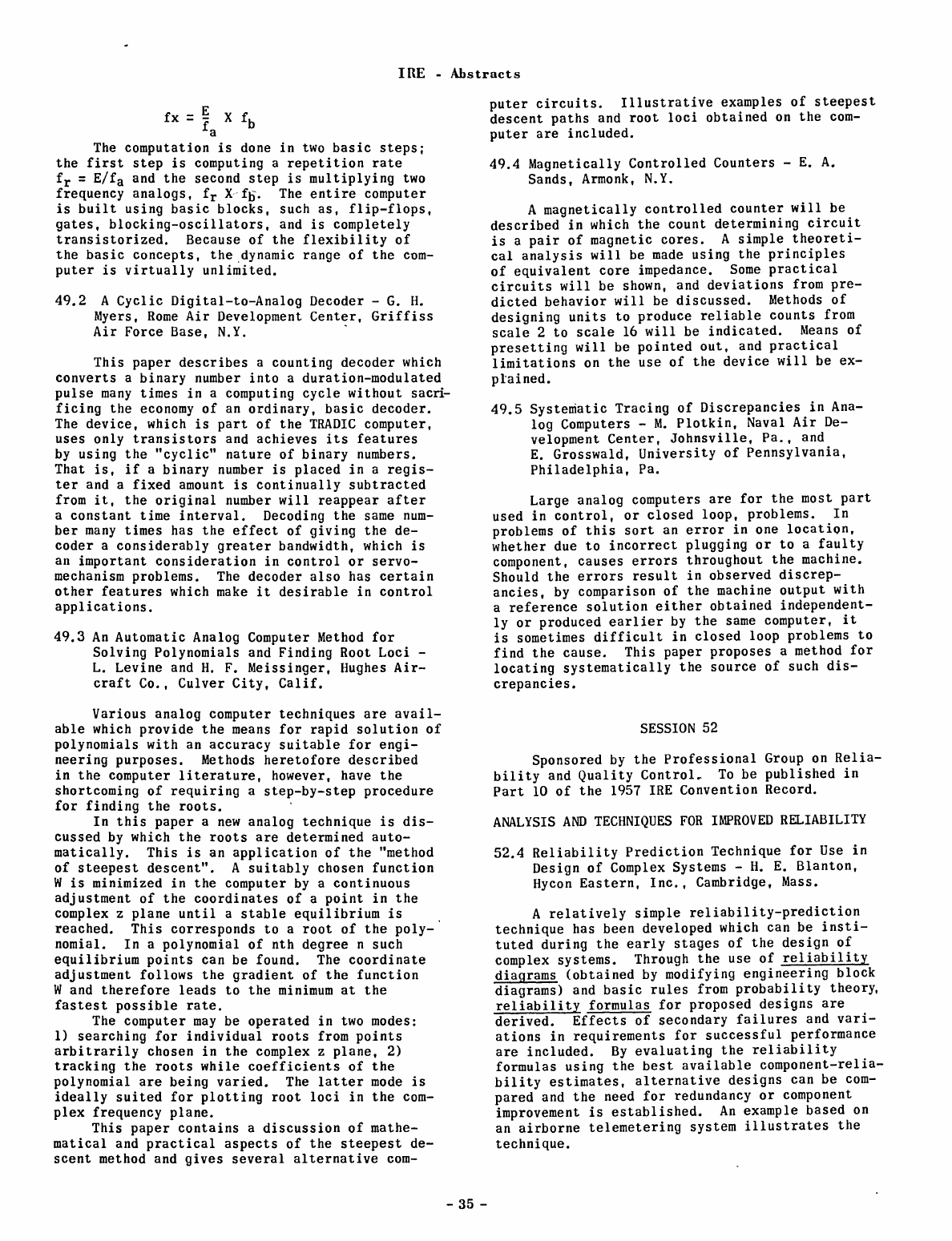
IRE
-
Abstracts
fx
=
~
X fb
fa
The
computation
is
done
in
two
basic
stepsj
the
first
step
is
computing a
repetition
rate
fr
= Elfa and
the
second
step
is
multiplying
two
frequency
analogs,
fr
X-fD'
The
entire
computer
is
built
using
basic
blocks,
such
as,
flip-flops,
gates,
blocking-oscillators,
and
is
completely
transistorized.
Because
of
the
flexibility
of
the
basic
concepts,
the
,dynamic range
of
the
com-
puter
is
virtually
unlimited.
49.2
A
Cyclic
Digital-to-Analog
Decoder -
G.
H.
Myers,
Rome
Air
Development
Center,
Griffiss
Air
Force Base,
N.Y.
This
paper
describes
a
counting
decoder which
converts
a
binary
number
into
a
duration-modulated
pulse
many
times
in
a computing
cycle
without
sacri-
ficing
the
economy
of
an
ordinary,
basic
decoder.
The
device,
which
is
part
of
the
TRADIC
computer,
uses only
transistors
and
achieves
its
features
by
using
the
"cyclic"
nature
of
binary
numbers.
That
is,
if
a
binary
number
is
placed
in
a
regis-
ter
and a
fixed
amount
is
continually
subtracted
from
it,
the
original
number
will
reappear
after
a
constant
time
interval.
Decoding
the
same
num-
ber
many
times
has
the
effect
of
giving
the
de-
coder
a
considerably
greater
bandwidth, which
is
an
important
consideration
in
control
or
servo-
mechanism problems.
The
decoder
also
has
certain
other
features
which
make
it
desirable
in
control
applications.
49.3
An
Automatic Analog Computer Method
for
Solving
Polynomials and
Finding
Root Loci -
L.
Levine and
H.
F.
Meissinger,
Hughes
Air-
craft
Co.,
Culver
City,
Calif.
Various
analog
computer
techniques
are
avail-
able
which
provide
the
means
for
rapid
solution
of
polynomials
with
an
accuracy
suitable
for
engi-
neering
purposes.
Methods
heretofore
described
in
the
computer
literature,
however, have
the
shortcoming
of
requiring
a
step-by-step
procedure
for
finding
the
roots.
In
this
paper
a
new
analog
technique
is
dis-
cussed
by
which
the
roots
are
determined
auto-
matically.
This
is
an
application
of
the
"method
of
steepest
descent".
A
suitably
chosen
function
W
is
minimized
in
the
computer
by
a
continuous
adjustment
of
the
coordinates
of
a
point
in
the
complex z
plane
until
a
stable
equilibrium
is
reached.
This
corresponds
to
a
root
of
the
poly-
nomial.
In
a polynomial
of
nth
degree
n such
equilibrium
points
can be found. The
coordinate
adjustment
follows
the
gradient
of
the
function
Wand
therefore
leads
to
the
minimum
at
the
fastest
possible
rate.
The
computer
may
be
operated
in
two
modes:
1)
searching
for
individual
roots
from
points
arbitrarily
chosen
in
the
complex z
plane,
2)
tracking
the
roots
while
coefficients
of
the
polynomial
are
being
varied.
The
latter
mode
is
ideally
suited
for
plotting
root
loci
in
the
com-
plex
frequency
plane.
This
paper
contains
a
discussion
of
mathe-
matical
and
practical
aspects
of
the
steepest
de-
scent
method and
gives
several
alternative
com-
-
35
-
puter
circuits.
Illustrative
examples
of
steepest
descent
paths
and
root
loci
obtained
on
the
com-
puter
are
included.
49.4
Magnetically
Controlled
Counters -
E.
A.
Sands,
Armonk,
N.Y.
A
magnetically
controlled
counter
will
be
described
in
which
the
count
determining
circuit
is
a
pair
of
magnetic
cores.
A simple
theoreti-
cal
analysis
will
be
made
using
the
principles
of
equivalent
core
impedance.
Some
practical
circuits
will
be shown, and
deviations
from
pre-
dicted
behavior
will
be
discussed.
Methods
of
designing
units
to
produce
reliable
counts
from
scale
2
to
scale
16
will
be
indicated.
Means
of
presetting
will
be
pointed
out,
and
practical
limitations
on
the
use
of
the
device
will
be
ex-
plained.
49.5
Systematic
Tracing
of
Discrepancies
in
Ana-
log Computers -
M.
Plotkin,
Naval
Air
De-
velopment
Center,
Johnsville,
Pa.,
and
E.
Grosswald,
University
of
Pennsylvania,
Philadelphia,
Pa.
Large
analog
computers
are
for
the
most
part
used
in
control,
or
closed
loop,
problems.
In
problems
of
this
sort
an
error
in
one
location,
whether due
to
incorrect
plugging
or
to
a
faulty
component,
causes
errors
throughout
the
machine.
Should
the
errors
result
in
observed
discrep-
ancies,
by
comparison
of
the
machine
output
with
a
reference
solution
either
obtained
independent-
ly
or
produced
earlier
by
the
same
computer,
it
is
sometimes
difficult
in
closed
loop problems
to
find
the
cause.
This
paper
proposes
a method
for
locating
systematically
the
source
of
such
dis-
crepancies.
SESSION
52
Sponsored
by
the
Professional
Group
on
Relia-
bility
and
Quality
Controlr
To
be
published
in
Part
10
of
the
1957
IRE
Convention Record.
ANALYSIS
AND
TECHNIQUES
FOR
IMPROVED
RELIABILITY
52.4
Reliability
Prediction
Technique
for
Use
in
Design
of
Complex Systems -
H.
E.
Blanton,
Hycon
Eastern,
Inc.,
Cambridge, Mass.
A
relatively
simple
reliability-prediction
technique
has been developed which can be
insti-
tuted
during
the
early
stages
of
the
design
of
complex systems. Through
the
use
of
reliability
diagrams
(obtained
by
modifying
engineering
block
diagrams) and
basic
rules
from
probability
theory,
reliability
formulas
for
proposed
designs
are
derived.
Effects
of
secondary
failures
and
vari-
ations
in
requirements
for
successful
performance
are
included.
By
evaluating
the
reliability
formulas
using
the
best
available
component-relia-
bility
estimates,
alternative
designs
can be
com-
pared
and
the
need
for
redundancy
or
component
improvement
is
established.
An
example
based
on
an
airborne
telemetering
system
illustrates
the
technique.
N'EW
PATENTS
RAY:\10ND
R.
SKOLNICK Reg.
Patent
Agent
Ford
Inst.
Co.
Div.
of
Sperry
nand
Corp.
Long
Island
City
1,
New
York
The
following
is
a
compilation
of
patents
pertain-
ing
to
computers
and
associated
equipment
from
the
Official
Gazette
of
the
United
States
Patent
Office,
dates
of
issue
as
indicated.
Each
entry
consists
of:
Patent
number
/
inventor(s)
/
assign-
ee
/
invention.
january
22, 1957 (contVd from
Mar.
issue):
2,778,624
/
Louis
D.
Statham,
Beverly
Hills,
Calif.
/
Statham
Laboratories,
Inc.,
Los
Angeles,
Calif.
/
An
angular
Accelerometer.
January
29, 1957:
2,779,538
/
William
M.
Shanhouse, Roslyn
Heights,
N.Y.
/ - / A
navigational
relative
motion computer.
2,779,539
/
Sidney
Darlington,
Passaic
Town-
ship,
Morris County,
N.J.
/
Bell
Telephone
Laboratories,
Inc.,
New
York,
N.Y.
/ A
multiple
code wheel
analogue
-
digital
translator.
2,779,655
/
Waldo
H.
Kliever,
Minneapolis,
Minn. / Minneapolis-Honeywell
Regulator
Co.,
Minneapolis,
Minn. / A
graphical
to
digital
indication
converter.
2,779,871
/
Omar
L.
Patterson,
Media, Pa. /
Sun
Oil
Co.,
Philadelphia,
Pa. / A
differ-
entiating
circuit.
2,779,872
/
Omar
L.
Patterson,
Media, Pa. /
Sun
Oil
Co.,
Philadelphia,
Pa. /
An
inte-
grating
circuit.
Feb.
5,
1957:
2,780,408
/
Loring
P. Crosman,
Wilton,
and
Francis
B.
Hannon,
Milford,
Conn. /
Sperry
Rand
Corp.,
Del. /
An
elec-
tronic
accumulator
for
adding and
subtract-
ing
received
digit
values.
2,780,409
/ George
A.
Haidenbergh,
St.
Paul,
Minn. / U.S.A. I A
binary
accumulator
cir-
cuit
of
the
parallel
type.
2,780,410
/
Rolland
N.
Bued,
Clifton,
N.J.,
Willard
B.
Groth,
Bronx, N.Y., Gordon
C.
Irwin,
Fair
Haven, and
Lindley
A.
Kille,
Morristown,
N.J.,
and George
Riggs,
Port
Washington,
N.Y.
/
Bell
Telephone
Labora-
tories,
Inc.,
New
York,
N.Y.
/ A
tape
-
to
-
card
convecter
circuit.
2,780,455
/
Howard
F. Devaney,
Albuquerque,
N.
Mex.
/ U.S.A. / A
combination
of
accel-
eration
sensing
and
integrating
means.
2,780,672
/ Johannes Anton
Greefker
and
Piet
van
Tilbuy,
Eindhoven,
Netherlands
/
Hart-
ford
National
Bank and
Trust
Co.,
Hartford,
Conn. / A
device
for
separating
synchronizing
pulses
and
signal
pulses
with
pulse-code
modulation.
.
-36 -
2,780,673
/ John
B.
Singel,
Catonsvflle,
Md.
/
Westinghouse
Electric
Corp.,
East
Pittsburgh,
Pa. / A
phasing
system.
2,780,725
/
Norman
L.
Johanson,
Seattle,
Wash.
/ Boeing
Airplane
Co.,
Seattle,
Wash.
/
A
modulator
-demodulator
limiter
transistor
circuit.
2,780,760
/ Warren
E.
Dion,
Bristol,
Conn. /
Bristol
Co.,
Waterbury, Conn. / A
servo
sys-
tem
with
quick
-
action
response.
Feb. 12, 1957:
2,781,168
/
Ivan
A.
Greenwood,
Jr.,
Stamford,
Conn. /
General
Precision
Laboratory
Inc.,
N.Y.
/ A
great
circle
com-
puter.
2,781,169
/ John F. Donan, Los
Angeles,
and
Lawrence
D.
Hindell,
Gardena,
Calif.
/
Northrop
Aircraft,
Inc.,
Hawthorne,
Calif.
/
Means
for
the
electronic
addition
of
vectors
at
substantially
any
angle.
2,781,170
/ Donald F. Walker, Hollinwood,
Eng.
/
- /
An
electrical
computing
instrument
for
deriving
the
value
of
an
unknown
quantity
of
a problem
to
be
solved
from
three
known
quantities,
where
the
latter
can be
repre-
sented
as
elements
of
a
triangle.
2,781,447
/
Burton
R.
Lester,
Camillus,
N.Y.
/
General
Electric
Co.,
N.Y.
/ A
binary
digital
computing and
counting
apparatus.
2,781,482
/ James
L.
Montgomery,
Indianapolis,
Ind.
/ U.S.A. / A
balanced
bridge
type
servo
system.
2,781,504
/ Michele Canepa, South Norwalk,
Conn. /
Olivetti
Corp.
of
America,
New
York,
N.Y.
/ A
binary
system
capable
of
providing
indications
of
the
presence
of
a
signal
or
of
its
binary
complement.
Feb. 19, 1957:
2,781,967
/
Rolf
E.
Spencer,
Ealing,
London, and
Richard
H.
Booth,
Beaconsfield,
Eng. /
Electric
and Musicol
Ind.
Lim., Hayes, Eng. /
An
apparatus
for
evaluating
the
instantaneous
value
of
cos
a x where a
is
a
constant
and x
is
an
inde-
pendent
variable.
2,781,968
/
Pierce
J.
C.
Chenus,
Paris,
Fr.
/
Compagnie
des Machines
Bull
(Socie't~
Anonyme),
Paris,
Fr.
/
An
addition
and
subtraction
operating
device
for
electric
calculating
machines
operating
in
the
binary
system.
2,781,969
/
Alexander
Somerville,
Birmingham,
Ala.
/ - /
An
apparatus
for
determining
the
product
of
a
pair
of
variable
quantities
expressed
in
input
voltages
proportional
to
the
quantities.
2,781,970
/
Sidney
Kaufman, Houston, Tex. /
Shell
Development
Co.,
Emeryville,
Calif.
/
An
electronic
analog
computer.
2,782,347
/ John
A.
Herbst,
Montville,
N.J.
/
Bogne
Electric
Manufacturing
Co.,
Patterson,
N.J.
/ A
fail
-
safe
servo
system.
2,782,408
/
Walter
W.
Fisher,
Pacoima, and
Carl
E.
Sohlgren,
San Fernando,
Calif.
/
Bendix
Aviation
Corp.,
North Hollywood,
Calif.
/
An
apparatus
for
translating
re-
flected
binary
code
multidigit
signals
into
corresponding
impedance
values
between
first
and second main
terminals.
(cont'd
on
page 37)
Forum
MAGAZINES
ON
"COMPUTOLOGY"
Samuel
J.
M.
England
Columbus, Ohio
I have
recently
joined
the
staff
of
the
Systems
Engineering
Division
at
-----,
where
I
am
engaged
in
making a
study
of
the
computer
field.
I have not
previously
acquainted
my-
self
with
your
publication,
but
now
I have
sat
myself
down
and
digested
each
(available)
issue
from
the
beginning
tp
the
present.
I
am
sufficiently
impressed
by
the
"tone"
of
"Computers & Automation"
to
be
moved
to
write
to
you.
You
will
be
the
best
judge
of
my
bias;
-my
feelings
are
as
follows:
I have
for
the
past
two
years
read
most
of
the
issues
of
"-----", "-----",
"-----,,
and
"-----".
I
subscribed
to
one
of
them,
"-----",
and
receive
free
copies
of
another,
"-----,,
My
feeling
about
these
journals
is
that
for
the
most
part
they
are
rather
poorly
disguised
efforts
to
get
advertizing
into
one's
hands. Though
this
statement
is
too
harsh
to
be
entirely
true,
the
fact
remains
that
they
serve
some
other
purpose
than
that
which meets
with
my
approval.
In
contrast,
your
publication
has improved
rather
than
deteriorat~d
since
Jan.
'54
(the
first
copy
that
I
have).
The
thing
that
I
commend
is
a
certain
evidence
of
courage
on
the
part
of
your
staff
for
such
articles
as
may
appear
to
some
to
be a
non
sequitur--for
example,
the
article
No.
2 under
Forum
in
the
Jan.
1954
issue,
page 14,
entitled
"Shakuntala
Devi, Mathematical
Prodigy".
In
fact,
when
I
ran
across
your
editorial
comment
in
April
1954, 'which I
will
quote,
I
was
by
then
assured
that
you
indeed
have
this
intention:
"In
the
pages
of
this
magazine
we
shall
do
our
best
to
promote
controversy,
honorable
controversy,
which
tries
to
make
sure
that
each
side
of
a
question
is
expressed
fairly~
without
calling
names,
attacking
reputations,
or
hugging
orthodoxy."
May
you
prosper
in
this
design,
though
the
path
is
fraught
with
difficulty.
Another
policy
which I
detect,
which
in
the
long
run
will
prove
invaluable,
is
that
of
talking
to
the
audience.
There
is
need
in
technology
and
science
for
the
Greek Dramatic
mechanism
of
the
chorus.
Do
not
suppress
the
part
of
the
chorus,
for
the
audience
need
to
feel
that
they
have a
representative
to
medi-
ate
for
them
in
the
drama.
I
detect
a
feature
which should be
ex-
ploited
in
order
to
further
the
influence
of
your
journal.
I
will
cite
two
examples:
In
your January 1957
issue
there
is
an
accept-
ably
quantitative
article
by
Walter
F. Bauer
entitled
"Modern Large
Scale
Computer System
Design".
This
article
and
its
kind
must be
made
available
to
budding
computologists
to
act
as a
bridle
to
their
untried
speculation
about computers.
In
comparison
to
this,
I
was
impressed
also
by
what might be
called
a more
literary
article
which
appears
in
the
October
1956
issue,
page
37,
entitled
"The
Pure
Word
of
St.
Euphorus",
by
J.
W.
Granholm.
In
this
same
vein
but
of
a more
sober
or
scholarly
nature
is
the
article
in
the
most
recent
(March and
April
i57)
issues
dealing
with
the
History
of
Robots and a
bibliography.
I
am
not
entirely
certain
that
you
are
directed
by
anything
but
expediency
because
of
the
lack
of
qualified
manuscripts;
but
I
do
not
believe
this
to
be so, and
therefore
would
congratulate
you
for
the
face
that
your
publication
chooses
to
display.
I hope
that
your
journal
will
be
able
to
continue
carrying
the
spirit
that
is
to
be
identified
with
such
people
as
Norbert
Wiener,
John
Von
Neumann,
Vannevar Bush,
M.
Turing,
and
others,
who
would
prefer
the
"human use
of
human
beings".
-
END-
*
---------
*
----------*
NEW
PATENTS
(cont'd
from page 36)
Feb.
26. 1957:
2,782,985
I Edward L. Vibbard,
La
Jolla,
Calif.
I
Bell
Telephone
Laborator-
ies,
Inc.,
New
York, N.Y. I A
tape
control
arrangement
for
a computer.
2,783,421 I Karl
W.
Hering,
Ridgefield,
Conn.1
The
Perkin-Elmer
Corp.,
Norwalk, Conn. / A
compensated
velocity
servo-loop
system.
2,783,422
/ Marcel
Fouassin,
Liege,
Belgium /
- / A
preset
servo
system.
-
END
-
-37 -
Forum
THE
UNITED
STATES
MAILS
FIELD
FOn
AUTOMATIC
PROCESSING
OF
INFORMATION
I.
From
The
Reader's
Digest,
Pleasantville,
N.Y.
A.
Release
of
April
8
The
Post
Office
system "needs mechaniz-
ing and
st:eamlining
all
the
way
through,"
a
Reader's
DIgest
article,
titled
"Our Horse and
Buggy
Mails",
will
say
in
the
May
issue
of
the
magazine.
This
will
not appear
until
April
23. But
the
publication
today
released
a
summary
of
the
5,000-word,
article
by
Wolfgang Langewiesche
when
the
magazine
learned
that
someone
in
Wash-
ington
without
authority
from
Reader's
Digest
had
made
the
article
available
to
certain
mem-
bers
of
Congress
prior
to
the
normal
publica-
tion
date.
"The
present
administration
has begun
some
mechanization
but
we
are
years
behind
Europe," says
the
article
which concludes with
the
appeal:
"Let's
create
a modern mail
sys-
tem."
According
to
the
article,
which
discusses
Post
Office
methods,
buildings
and
policies
~he
servi~e
"uses
the
same
methods
of
gathe~
lng,
sortIng
and
delivering
the
mail
that
it
did
100
years
ago" and mail
is
now
"slower
than
it
was
before
World
War
II."
The
Post
Office'is
one
of
the
country's
top
12
enterprises
in
volume
of
business
and
t~ird
in
number
of
employees. But
it
st~adily
vIolates
the
business
principle
of
"stay
ahead
of
the
times--or
die,"
the
article
states.
"The
Post
Office
needs
money
for
research
and development
•••
It's
asking
for
four
million
dol~ars
this
year.
That's
chicken feed!
Es-
pecIally
~hen,
for
lack
of
research,
it
spends
--beyon~
Its
income--half
that
much
a day!
ProportIonately,
the
Telephone
Company
spends
18
times as
much
on
research!"
W~ges
take
75
percent
of
postal
costs.
Mec~anlzation
would
cut
the
costs,
says
the
artIcle,
and
enable
the
Post
Office
to
stay
on
top
of
the
mail
flood.
But
instead
of
machines,
men
are
used
in
"primitive
proced-
~res"
that.
waste
ti~e,
effort
and
money.
'
In
other
Industries,
the
bigger
the
volume,
~h;
lower
the
cost,"
the
article
says.
"But
It
s a
technological
law:
'you're
supposed
to
work
with
machines--bigger,
faster,
more
effi-
cient
machines."
-
38
-
Most
mail
sorting
in
this
country
is
now
done
by
hand,
but
the
article
suggests
that
much
of
it
could be mechanized.
It
states
that
Holland began experimenting
with
letter
sorting
machines
in
1928, and
the
Dutch
Post
Office
now
has
11
such machines each
sorting
50
letters
per
minute
to
300
or
more
destina-
tions
as opposed
to
25
per
minute
to
50
des-
tinations
by
hand.
New
buildings
in
new
locations--on
the
outskirts,
near
airports--are
needed, with
midtown
buildings
concentrating
on
local
mail
moving only a
few
blocks
between
sender
and
addressee.
Helicopters
could
lift
whole
trailers
full
of
mail between
sorting
plants
and
downtown
locations.
Whether mechanized
or
not,
the
article
says,
a
post
office
building
should be
"a
sort
of
factory."
It
should be
tall,
so
the
mail can flow
down
from
floor
to
floor,
or
else,
it
should be
flat
with a
floor
plan
in
which conveyor
belts
can
fan
out
like
rail-
road
tracks
in
a
freight
yard.
Instead,
the
article
points
out,
we
have
~',a
Greek temple,
or
a
best
a
First
National
bank" and
many
post
offices
date
from
the
last
century.
Many
were
built
during
the
depression
"when
the
idea
was
to
make
more
work" and designed "mostly
to
express
the
majesty
of
the
federa,l government."
The
article
ends
by
stating
that
"in
the
20th
century
even
this
wealthy
country
can't
subsidize
19th-century
mail systems
indefinitely."
B.
The
first
part
of
the
Article:
"Our Horse and
Buggy
Mails"
By
annual
business
done--three
billion
dollars--the
U.S.
Post
Office
ranks
among
A~erica's
top
dozen
enterprises,
among
such
gIants
as Ford, General
Electric,
U.S.
Steel.
By
number
of
employes--half
a
million--it
ranks
third,
right
after
the
Telephone
Com-
pany and General Motors.
It
handles 60
per-
cent
of
the
world's
mail.
It
has 40,000
branch
offices.
Every day
it
carries
one
piece
of
mail
for
every
man,
woman
and
child
in
the
country.
This
makes
the
Post
Office
one
of
the
world's
biggest
industrial
operations.
But
between
real
business
and
Post
Office
busi-
ness
there
is
one
big
difference:
u.
s.
~ails
Every American
business
knows
that
it
must
stay
ahead
of
the
times--or
die.
This
is
the
principle
that
has
broug~t
us from
the
hand workshop
to
the
automatic
factory.
Today
we
are
in
the
age
of
the
jet,
of
lightning
communication,
but
the
Post
Office
is
not
with
us.
It
still
plods
along,
horse
and buggy
fashion.
It
uses
the
same
methods
of
gathering,
sorting
and
delivering
the
mail
that
it
did
100
years
ago.
The
result
is
something
close
to
chaos.
The
mail
is
slower
than
it
was
before
World
War
II.
A
letter
often
takes
48 hours
to
travel
100
miles.
One
letter,
mailed
Tues-
day morning,
was
not
received
seven
miles
away
till
Thursday
afternoon.
Circulars
in
New
York
City
go
undelivered
for
as long as
ten
days.
A
letter
mailed
in
New
York
Wednesday noon
took
until
Monday
afternoon
for
delivery
In
Chicago. A
letter
to
Chicago
mailed
from
Glencoe,
18
miles
distant,
took
three
days.
A
few
years
ago
residential
mail
deliveries
were
cut
to
one a day.
So
now,
if
a
letter
misses
connections
by
a minute,
it
misses
by
24
hours.
The
Post
Office
is
floundering
in
a
sea
of
mail
that
gets
deeper
every
year.
Postal
volume has
risen
steadily
in
the
last
20
years.
(It
has doubled
in
New
York
City.)
This
'is
a
flood
situation;
it
calls
for
swift
and
basic
action.
The
Post
Office
has
tried
to
keep
pace,
but
despite
its
efforts
it
keeps
falling
behind.
And
the
price
we
pay
is
staggering.
The
Post
Office
is
spending
two
million
dol-
lars
a day more
than
it
receives
in
revenue.
Even
old-fashioned,
slow-going Europe has
kept pace
better
than
we
have.
In
London,
to
speed
the
handling
of
the
mails,
the
Post
Office
has
its
own
subway, from one end
of
the
city
to
the
other.
A housewife can
mail
her
grocery
order
in
the
morning and
get
stuff
de-
livered
the
same
day. A week-end
guest's
bread-and-butter
letter
arrives
so promptly
that
an American
exclaimed:
"He
must have
mailed
it
before
he
came:" A
letter
mailed
in
Paris
before
6 p.m.
is
delivered
the
next
day
anywhere
in
France.
When
it
is
necessary
to
catch
the
early
local
trains
departing.from
provincial
centers
special
mail
planes
fly
it
at
no
extra
charge.
In
Munich
you
can
get
a
special-delivery
letter
to
anybody
within
an
hour.
Our
Post
Office
performance
also
contrasts
strangely
with
private
enterprise
here
at
home.
United
Parcel
Service--the
firm
that
delivers
packages
for
retail
stores--also
has a
service
for
wholesalers.
It
sometimes
charges
less
than
the
Post
Office
would
to
take
the
same
package
to
the
~ame
address.
Further,
it
picks
up
at
the
sender's.
It
promises a
delivery
date
(the
Post
Office
doesn't).
It
makes
-
39
-
three
attempts
at
delivery
(the
Post
Office
makes only
one).
It
throws
in
$100
insurance,
free.
And
it
makes a
profit,
and
it
pays
taxes!
~n
parcel
post
the
Po~Office
just
about
breaks
even.)
You
might
say--yes,
but
the
United
Parcel
picked
the
juiciest
part
of
the
parcel
business.
Not
so. They have
to
fight
urban
congestion.
Besides,
they
have
just
started
to
serve
two
entire
states,
Illinois
and
Massachusetts,
from
metropolis
to
the
quietest
back-country
farm.
It
re-
cently
started
a
coast-to-coast
air
parcel
service--at
half
the
rate
of
air
parcel
post!
Also,
at
rates
comparable
to
ground
parcel
post,
it
airlifts
parcels
coast-to-coast
on
a
space-available
basis
in
four
days,
beat-
ing
the
U.S. Mails
by
a week!
Why
is
the
Post
Office
so
far
behind
the
times?
The
reasons
are
many
••••
II.
From
Arthur
E. Summerfield,
The
Postmaster
General,
Washington, D.C.
A.
Form
letter
of
April
18
Dear
Postal
Patron:
The
President
has asked
me
to
reply
to
your
telegram
concerning
our
postal
problem.
The
attached
press
statement
announcing
the
resumption
of
service,
with
the
accom-
panying
fact
sheet,
will,
I
trust,
answ~r
some
of
your
questions.
Thank you
very
much
for
your
interest
in
this
all-important
subject.
B.
Excerpts
from
Release
of
April
16
I
am
happy
to
announce
the
resumption
of
normal
mail
service
and
gratified
to
have
the
overwhelming
affirmative
vote
of
the
Congress
giving
the
Department funds
for
this
purpose.
The
legislation
passed
yesterday
by
the
House and
this
noon
by
the
Senate
gives
the
Post
Office
Department $41
million
for
its
operations
through
June 30.
Within
24
hours
mail
service
will
be back
on
nearly
the
same
basis
it
was
prior
to
the
issuance
of
our Order
last
Friday.
The
need
for
supplemental
appropriations
is
common
and
often
unavoidable
in
the
Post
Office
Department. In
the
past
20
years
they
were needed
in
all
except
3
years
during
which
the
present
postal
administration
re-
turned
$235
million
of
unspent
money
to
the
(cont'd
on page 43)
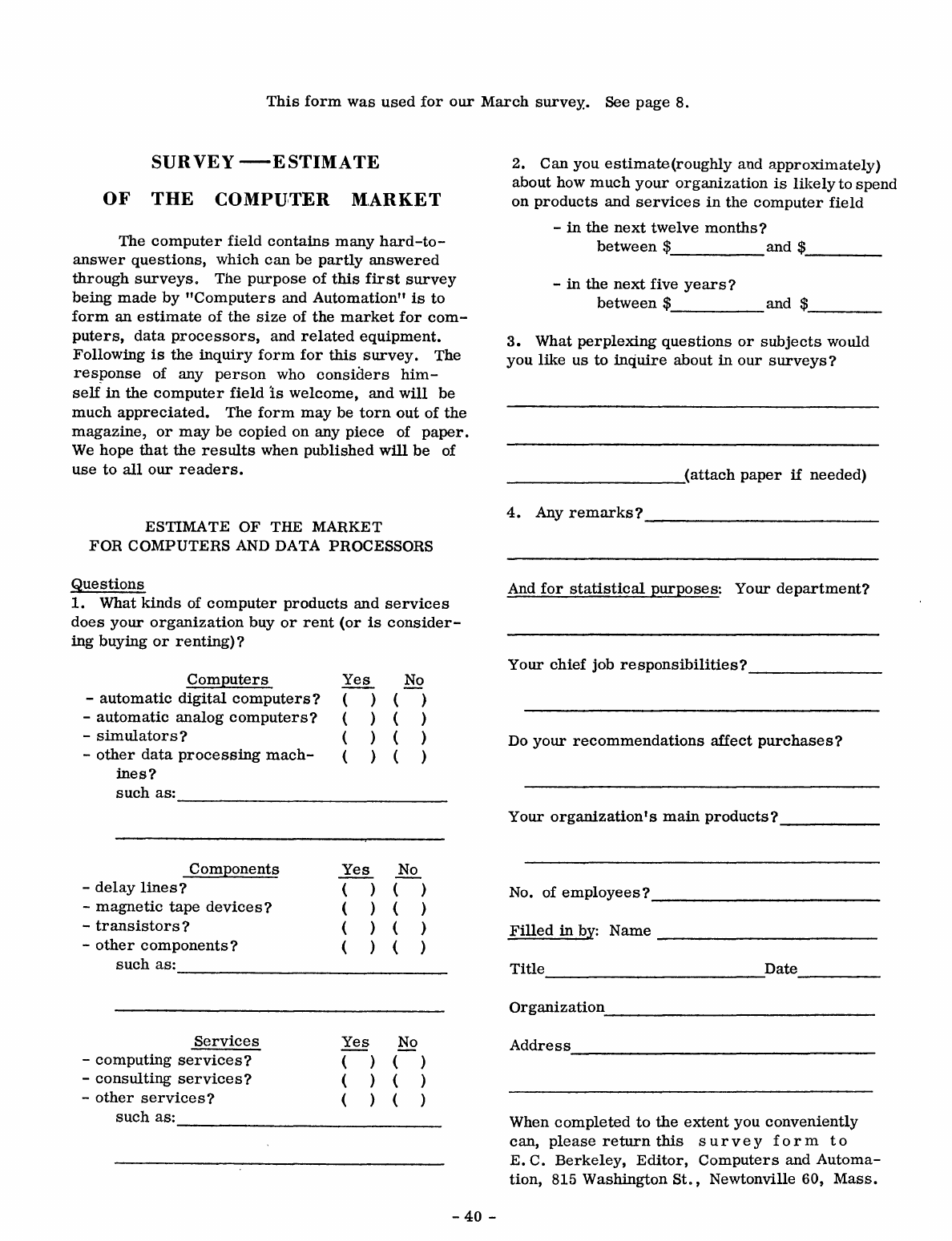
This
form
was
used
for
our
March
survey,.
See
page
8.
SURVEY-ESTIMATE
OF THE COMPU,TER
M,ARKET
The
computer
field
contains
many
hard-to-
answer
questions,
which
can
be
partly
answered
through
surveys.
The
purpose
of
this
first
survey
being
made
by
"Computers
and
Automation"
is
to
form
an
estimate
of
the
size
of
the
market
for
com-
puters,
data
processors,
and
related
equipment.
Following
is
the
inquiry
form
for
this
survey.
The
response
of any
person
who
considers
him-
self-
in
the
computer
field
IS
welcome,
and
will
be
much
appreciated.
The
form
may
be
torn
out
of
the
magazine,
or
may
be
copied
on any
piece
of
paper.
We
hope
that
the
results
when
published
will
be
of
use
to
all
our
readers.
ESTIMATE
OF
THE MARKET
FOR
COMPUTERS
AND DATA PROCESSORS
Questions
1.
What
kinds
of
computer
products
and
services
does
your
organization
buy
or
rent
(or
is
consider-
ing
buying
or
renting)?
Computers
-
automatic
digital
computers?
-
automatic
analog
computers?
-
simulators?
-
other
data
processing
mach-
ines?
Yes
No
( ) ( )
( ) ( )
( ) ( )
( ) ( )
such
as:
______________
_
Components
-
delay
lines?
-
magnetic
tape
devices?
-
transistors?
-
other
components?
Yes
( )
( )
( )
( )
No
( )
( )
( )
( )
such
as:
______________
_
Services
-
computing
services?
-
consulting
services?
-
other
services?
Yes
No
( ) ( )
( ) ( )
( ) ( )
such
as:
_____________
_
-
40
-
2.
Can
you
estimate(roughly
and
approximately)
about
how
much
your
organization
is
likely
to
spend
on
products
and
services
in
the
computer
field
-
in
the
next
twelve
months?
between
$
and
$
___
_
-
in
the
next
five
years?
between
$
_____
and $
___
_
3.
What
perplexing
questions
or
subjects
would
you
like
us
to
inquire
about
in
our
surveys?
_________
(attach
paper
if
needed)
4.
Any
remarks?
____________
_
And
for
statistical
purposes:
Your
department?
Your
chief
job
responsibilities?
______
_
Do
your
recommendations
affect
purchases?
Your
organization
I s
main
products
?
_____
_
No. of
employees?
___________
_
Filled
in
by:
Name
__________
_
Title
____________
Date
____
_
Organization,
______________
_
Address
_________________
_
When
completed
to
the
extent
you
conveniently
can,
please
return
this
sur
ve
y
for
m
to
E.
C.
Berkeley,
Editor,
Computers
and
Automa-
tion,
815
Washington
St.,
Newtonville 60,
Mass.
NEW
PRODUcrS
AND
IDEAS
(cont'd
from
page
19)
and has
become
known
as a
swift
source
of
el-
ectronic
computer components
(within
the
lines
that
it
covers).
Its
speed
derives
from
its
or-
iginal
idea,
the
structure
of
its·
organization,
the
system
of
inventory
(which does
not
use
automatic
data
processing
machinery), and
its
experience.
For
example, a
large
Chicago
company
called
one morning
for
some
special
connectors
needed
at
once
to
complete work
on
an
experimental
com-
puter
for
the
government's guided
missile
prog-
ram. Customarily each
day's
orders
are
proc-
essed
by
3:00
p.m.,
but
since
this
was
an
em-
ergency,
the
complete
order,
filled
out
of
stock
on
hand,
was
delivered
to
LaGuardia
Airport
in
time
for
the
11:00 a.m. plane
to
Chicago.
The
flight
number
was
telegraphed
via
Western Union
Desk Fax, and
the'purchaser
picked up
the
mat-
erial
at
the
Chicago
Air
Terminal about 2:00 -
p.m. Chicago
time.
Before
the
day
was
over,
the
connectors
were being
installed,
and
the
delay
was
eliminated.
Again, a
short
time ago, a
call
from
Bourns
Laboratories
in
California
came
in,
to
verify
the
supply
of
a
particular
item,
a
trimpot.
It
turned
out
that
General
Pre-
cision
Laboratories
of
Pleasantville,
N.Y.,
was
holding
another
long
distance
line
to
the
Bourns
factory,
while
Bourns phoned Schweber.
Schweber,
with
an
ample
stock
of
the
partic-
ular
trimpot
needed,
was
able
to
send
the
whole
order
to
Pleasantville
immediately.
Bourns
Laboratories
said,
'We
feel
that
Schweber
Electronics
is
an
outstanding
ex-
ample
of
a
new
type
of
distributor
in
the
el-
ectronics
field.
These
distributors
handle
relatively
few
lines
and
carry
very
complete
stocks.
This allows each person
in
their
or-
ganization
to
spend a
greater
amount of time
in
acquiring
and
disseminating
knowledge
of
each
particular
line.
We
feel
that
the
com-
pany has
established
a
national
reputation
for
always having any
particular
item
in
the
lines
that
they
handle."
The
company
in
fact
acts
as a warehouse
for
its
customers,
reducing
their
investment
in
inventory,
storage
space,
and maintenance,
a nd
their
risk
of
obsolescence
of
compon-
ents
due
to
rapid
change
in
design.
,
When
tantalum
qapacitors
were
first
de-
veloped,
only a few types had been manufac-
tured:
But
it
appeared
to
the
company
that
the
aIrcraft
and guided
missile
field
would
soon
require
a
new
high
temperature
capacitor.
So
they
placed
their
own
order
for
an
addi-
tional
100
types
in
the
high
temperature
range
to
meet
this
forecasted
need.
The
investment
was
made
in
a
new
line
with
no
known
demand
and no
real
assurance
that
demand
would
de-
velop.
,
Delivery
at
the
time
of
the
company's
order
was
five
months.
Tantalum
capacitors
are
now
an
integral
part
of
every
guided
missile.
For
a
time,
the
company
was
the
only
source
of
supply
that
could,
from
stock,
deliver
high
temperature
tantalum
capacitors
when
suddenly demanded
by
industry.
Accordingly,
many
prototypes
for
important
defense
projects
were completed
with-
out
five
months
of
delay.
Ninety-eight
percent
of
the
company's
business
is
conducted
by
telephone.
There
is
no
switchboard;
calls
go
directly
to
any
of
the
eleven
sales
specialists,
who
are
trained
to
handle
at
once any and
all
customer
require-
ments. This
sales
staff
know
their
ten
lines
(made
up
of
ten
thousand
different
items) ,
and
are
able
to
make
recommendations
to
en-
gineers
as
to
the
correct
component
for
their
need.
The
company
maintains
an
apparently
crude
but
effective
and
quick
inventory
control.
With
a
glance
at
the
card
record,
the
stock
on
hand
of
any
particular
item
is
revealed,
also
how
many
are
on
order,
when
material
is
due
in,
how
many
units
are
committed
by
previous
orders,
and which customers use
this
item.
Therefore,
a customer
placing
an
order,
can be
told
at
once
how
soon
he
can
expect
delivery
in
order
that
his
engineers
may
schedule
the
production
accordingly.
There
are
no
"runners"
or
"stock
men". Each salesman
posts
the
running
record
on
the
inventory
card.
Since
his
relationship
with
his
customers depends
on
his
accuracy,
this
record
stays
accurate
at
all
times.
Two
large
punch
card
manufacturers
were
·both
asked
to
improve
the
inventory
control,
and were
requested
to
investigate.
After
an-
.
alysis,
they
said
they
could
not.
The
reason
basically
is
the
up-to-date-ness
of
the
entries
made
by
the
actual
man
who
deals
directly
with
the
customers
--
with
no
intervening
key punch
operators,
supervisors
of
key punch
operators,
etc.
The
volume
of
business
at
the
company has
doubled each
year
for
the
past
three
years.
To
better
meet
the
growing need
of
the
computer
and
missile
industry,
the
company
plans
to
build
a
new
plant
and
also
establish
a
west
coast
branch.
-41 -
nr..LIAIHLll
r
(cont'd
from page 23)
have found
it
more economical
to
run
the
com-
puter
until
it
breaks
down
before
calling
for
the
engineers.
It
seems
obvious,
however,
that
this
practice
could not be
tolerated
in
our
system.
The mere
availability
of
"backup"
or
re-
serve
equipment does not
provide
insurance.
Since
the
computer
in
our
system
f~nctions
as
the
nerve
center
of
a complex communications
network,
it
will
generally
be
impossible
to
transfer
operations
to
another
machine
at
a
distant
location
without
severely
disrupting
the
information
flow. However, commercial
teletype
lines
and
neighboring
printer
units
can be
utilized
as temporary
replacements
for
certain
system components.
A fundamental
requirement
in
our
system
design
is
the
provision
of
means
for
human
intervention.
Intermittent
failures
in
sys-
tem
components
are
to
be
expected;
their
functions
must be performed
during
the
inter-
val
necessary
to
correct
and
replace
the
me-
chanical
faults.
At
present,
an
intelligent
human
being
is
the
surest
substitute
and
the
safest
means
of
providing
against
the
varying
and complex
difficulties
that
can
arise.
Ac-
cordingly,it
is
necessary
to
provide
the
me-
chanical
system
with
a
capable
and
trained
operating
staff.
This
staff
must be
thor-
oughly aware
of
precisely
what
the
system
is
accomplishing
so
that
it
can immediately
introduce
the
correct
remedial
steps
in
case
of
failure.
We
have found
it
wise
to
run
periodic
"alerts"
in
which a
variety
of
fail-
ures
are
simulated
and
the
proper
counter-
measures
are
promptly
initiated.
Application
of
the
principles
of
auto-
matic
control
to
the
operation
of
business
organizations
presents
an
exciting
opportun-
ity.
Commercial
data
processing
systems
de-
signed
to
utilize
these
techniques
will
as-
sume
responsibility
for
the
direction
and
control
of
all
routine
daily
functions.
The
use
of
comprehensive communications networks
will
enable
a
central
data
processing
unit
to
exercise
effective
supervision
over
operations
of
the
entire
organization.
The
incorporation
of
feedback loops
in
the
system
will
provide
a means
of
notifying
the
data
processing
cen-
ter
of
the
results
of
earlier
activities.
Management
reports
will
be
abstracted
from
the
flow
of
daily
information,
thus
providing
the
executive
with
an
accurate
analysis
of
the
current
situation.
As
such
real
time
business
systems
as-'
sume
more
overall
responsibility
and
control,
an even
greater
stress
must be
placed
on
the
reliability
of
their
operation.
For
failure
in
these
systems
implies
not
just
delay
and
annoyance
but
almost complete
paralysis
of
activity.
It
is
imperative
that
extreme.
care
be
exercised
in
the
design
and
operation
of
on-line
systems so
that
all
component
fail-
ures
are
provided
against.
Only
in
this
f?sh-
-
42
-
ion
will
we
be
adequately
assured
that
the
possibility
of
total
failure
has been
elimin-
ated
and
that
operations
can be
safely
en-
trusted
to
the
system.
-
END-
*---------
*
----------
*
Forum
ANALOGUE
COMPU'IERS
IN
EUROPE
P.
A.
R.
Wright
Short
Brothers
& Harland
Ltd.
London, England
We
were
interested
to
read
in
the
Febru-
ary
edition
of
"Computers and Automation",
the
article
by
Everett
S.
~alhoun
on
"New
Computer
Developments Around
!-he
World".
Whilst
his
article
was
extremely
well
in-
formed,
we
were
surprised
to
note
that
it
was
confined
almost
exclusively
to
digital
comput-
ing
equipment
with
little
reference
to
progress
in
the
analogue computing
field.
The use
of
Analogue Computers
in
Europe
is
increasing
remarkably, and
is
a
subject
which
we
think
you should mention
in
future
editions
of
your
Journal.
Such Analogue
Com-
puters
are
in
use
in
all
aircraft
companies
in
this
country
and
in
several
of
the
aircraft
firms
in
France.
We
ourselves
are
using
eight
computers
of
the
type
described
in
the
enclosed
brochure,
and
twenty-seven
computers
of
this
type
are
also
employed
by
other
aircraft
firms
in
this
country,
by
Fiat
Mirafiori
in
Turin,
Italy,
by
the
National
Luchtvaartlaboratorium,
Amsterdam, by
the
Technische Hochschule,
~raun
schweig, Germany, and
by
Stenhardt
Ingeniors-
firma
AB
in
Stockholm.
In
Mr.
Calhoun's
article
there
is
mention
of
Darmstadt Technische Hochschule which
is
regarded
as
the
computing
centre
in
Germany.
Although
this
University
has been engaged
primarily
on
digital
computing
techniques,
there
has been
some
considerable
research
there
by
Dipl.-Ing.
W.
Dehn
on
multiplying
devices
and
repeti
tively
drift-corrected
0 pe
ra
-
tional
amplifiers
for
Analogue Computers.
Most
Analogue Computer
work
in
Germany, however,
is
currently
undertaken
by
the
Technische Hoch-
schule
Braunschweig, under
the
direction
of
Dr.
Horst
Herrmann
of
the
Institut
fUr
Ange-
wandte Mathematik.
As
regards
computer
production
in
Germany,
it
is
no
longer
true
to
say
that
the
only
work
is
in
"a
barn
in
Neukirchen-Hiinfeld". Apart
from
our
computer which
is
now
in
use
in
Braun-
schweig,there
is
under development
by
Telefunken,
in
Ulm,
a
general
purpose Analogue Computer;
Analogue Computers have
also
been manufactured
by
the
German
firm
of
Schoppe
und
Faeser
and
by
the
American
subsidiary
Company
of
Beckman
Instruments,
G.m.b.H.
in
Munchen.
We
hope
the
above
brief
comments
will
be
of
some
interest
to
your
readers.
U.
S.
MAILS
(cont'd
from page 39)
Treasury (in 1953,
1954
and
1955)
out
of funds
appropriated
to
the Post
Office
Department
by
*
the
Congress.
Let
me
say
that
the
letters
the public has
sent
us during the
past
10
days
are
also
appre-
ciated.
By
an
overwhelming
majority,
they have
endorsed our
actions
and
many
of
them
have
in-
dicated
their
willingness
to
pay
more
postage
so
that
they might
get
better
mail
service
•
~:
How
much
does the Post
Office
Department
s
pend
in
a year?
A:
About
$3
billion,
250
million.
Of
this
amount, 78.4 percent goes
for
postal
em-
ployees'
salaries
and
fringe
benefits,
fixed
by
Congress; 15.5
percent
for
transportation
of
mail,
set
by
Government agencies;
1.8
per-
cent
for
rents,
utilities
and communication
set
by
F.C.C. Only
4.3
percent
is
left
for
controllable
expenses over which the Depart-
ment
really
excercises
any
control:
printing
stamps, buying
trucks,
etc.
Three reasons
why
it
is
costing
more
to
give
the
American people the mail
service
they
deserve,
expect,
and
pay
for,
are
these:
1.
More
mail than
estimated
by
about a
billion
pieces.
And
this
increased
vol-
ume
of mail
doesn't
provide funds
to
op-
erate
the
Post
Office
Department,
since
all
revenues
go
directly
to
the Treasury
De
par
tmen
t •
2.
Increased mail
service
to
1.3
million
new
homes
and
250,000
new
businesses.
3.
Higher
wages
to
employees as
required
by
law.
All
three
of
these
reasons
are
beyond con-
trol
of
the Department.
Q:
Are
you
cutting
costs
in
the Post
Office
Department?
A:
Yes.
The
Department
is
now
carrying
20
percent
more
mail with fewer employees than
six
years ago.
Q:
How
many
postal
employees
are
there?
1952
-------------
523,757
1955
-------------
511,613
1956
-------------
508,587
Q:
How
is
mail
volume
increasing?
1952
----------
49.9
billion
pieces
1956
----------
56.4
billion
pieces
1957 (Est)
----
58.8
billion
pieces
1958
(Es
t)
----
59.7
billion
pieces
(cont'd
on
page 44)
*
*
-
43
-
< '
["BURROUGHS
RESEARCH'
CENTER
NEED's
'Good
ENGINEERS
L,
'
,,-"
THAT
CERTAIN
MAN
1
'nq~,It1e$
ate
invited
i,
from
tItO$.
qualified
as:
t •
ELECTRICAL
ENGINEERS
'
:'
,'.
ELECTROMECHANICAL
ENGINEERS
"
.'
MECHANICAL
DESIGN
ENGINEERS
" •
MECHANICAL
ENGINEERS
, •
MATHEMATICIANS
•
PHYSICISTS
COMPUfER
MARKET
(cont'd
from page 17)
(1)
Code
4T3
4T4
4T5
4Ul
4Vl
4V2
4V3
4V4
4V5
4V6
4V7
*
(2) (3) (4)
Recom.,
T:iI~e
of
Organization
Size
Title
research
L yes, -
insurances
& annui
ties
L yes, pIng
off
crystal
diodes & L no, -
transistors
petroleum
products
vL
yes,
coordn
comptg
services
S yes,
supvsr
education
L
yes,
prof
of
math
data
on
water
resources
L
yes,
proj
engr
advanced educ
for
naval M yes,
prof
officers
aero
controls
vL
yes,
res
supvsr
oil
yes,
data
procg anal
communications
vL
yes, supvsr
sys &
proc
U.
S.
MAILS
(cont'd
from page 43)
.2,:
Is
the
Post
Office
Department
satisfied
with
mail
service
today?
A:
Of
course
not.
It
is
better
than
it
was
but
still
not
good enough.
.2,:
What
is
the
Post
OffIce
Department doing
to
improve
service?
A:
It
is
spending over $4
million
this
year
alone
on
research.
It
has
set
up
an
Office
of
Research and
Engineering.
It
is
working
with
9
engineering
firms
and
the
Bureau
of
Standards.
It
is
developing mech-
anical
and
electronic
devices
to
speed mail
through
post
offices.
Over
1500
obsolete
post
offices
have been
replaced
in
the
past
four
years
with
new
ones
built
by
private
cap-
ital.
Our
objective
is
next
day
delivery
of
mail anywhere
in
the
United
States
-
END-
(5) (6)
Products and
Services
Likely
Spending
(a)
Dig.
v
v
v
v
v
v
v
v
v
v
*
*
(b) (c) (d) (e)
Next
Five
Years
Anal. Other
Compo
Servo Between:
And:
v
SO
DMI'O
-
v
DM
$2,000,000 $3,000,000
v
v v
MI'
PS
2,000,000 4,000,000
v 0
PSO
200,000 250,000
v v 0
PS
500,000 1,000,000
v 0 500,000 700,000
v
v
SO
DTO
2,000,000 3,000,000
0 250,000 500,000
M 1,300,000 1,500,000
Forum
ASSOCIATION
FOR
COMPUTINi
MACHIN!:RY
MEETlNi
J.
F.
Summers
The
Texas
Company
P.
O.
Box
2332
Houston 1, Texas
The
Twelfth Annual Meeting
of
the
Associa-
tion
for
Computing Machinery
will
be
held
at
Houston, Texas,
on
June 19-21, 1957,
on
the
campus
of
the
University
of
Houston
at
Houston,
Texas.
The
program
will
be
printed
around
May
1, and
may
be
obtained
by
writing
Associa-
tion
for
Computing Machinery, 1957 ,Meeting
Headquarters,
University
of
Houston,
Cullen
Boulevard, Houston
4,
Texas.
-44-
*
*
-------------------
*
-------------------
*
RCA
oilers
opportunities
IN
MISSILE
TEST
Data
Reduction
for
~
MATHEMATICIANS
~
STATISTICIANS
~
~
PHYSICISTS
ASTRO-PHYSICISTS
Degree plus experience in reduction
of
test
data, applied mathematics,
sta·
tistical techniques, or observatory
practices. Positions now available on
Florida's central east coast.
Liberal company
benefits-
Relocation
assistance.
For information and arrangements for
personal
interview,
send
complete
resume
to:
Mr.
H.
N.
Ashby
Employment
Manager,
Dept. N-14E
Missile Test Proiect
e·
RADIO
CORPORATION
OF
AMERICA
RCA Service Co., Inc.
P.O. Box
1226
Melbourne,
Florida
-
45
-
ADVERTISING
INDEX
The
purpose
of COMPUTERS
AND
A UTOMA TION
is
to
be
factual,
useful, and
understandable.
For
this
pur-
pose,
the
kind
of
advertising
we
desire
to
publish
is
the
kind
that
answers
questions
such
as:
What
are
your
products?
What
are
your
services?
And
for
each
product: What
is
it
called?
What
does
it
do?
How
well
does
it
work?
What
are
its
main
specifications?
Following
is
the
index
and a
summary
of
advertisements.
Each
item
contains: Name and
address
of
the
advertiser
/
subject
of
the
advertisement
/
page
number
where
it
appears
/ CA
number
in
case
of
inquiry
(see
note below).
AMP,
Inc.,
2100
Paxton
St.,
Harrisburg,
Pa.
/ - /
Page
48 /
CA
No. 12
Burroughs
Research
Center,
Paoli,
Pa.
/
Employment
Opportunities
/
Page
43 /
CA
No. 13
General
Transistor
Corp.,
1030-11
90th
Ave.,
Rich-
mond
Hill,
N.
Y.
/
Transistors
/
Page
7 /
CA
No.
14
Lockheed
Missile
Systems
Division, Box 504, Sunnyvale,
Calif.
/
Employment
Opportunities
/
Page
47 / CA
No.
15
R. C. A.
Service
Co.,
Missile
Test
Project,
Patrick
Air
Force
Base,
Florida
/
Employment
Opportuni-
ties
/
Page
45, CA No. 16
Ramo-Wooldridge·
Corp.,
5730
Arbor
Vitae
St.,
Los
Angeles
45,
Ca.JJL
/
Employment
Opportunities
/
Pages
2,
45
/
CA
No. 17
Sylvania
Electric
Products,
Inc.,
1740
Broadway,
New
York
19,
N.
Y. / - /
Pages
4, 5 / CA No. 18
READER'S
INQUIRY
If
you
wish
more
information
about any
produc~s
or
services
mentioned
in
one
or
more
of
these
adver-
tisements,
you
may
circle
the
appropriate
CA
Nos.
on
the
Reader's
Inquiry
Form
below and
send
that
form
to
us
(we pay
postage;
see
the
instructions).
We
shall
then
forward
your
inquiries,
and you
will
hear
from
the
advertisers
direct.
If
you
do
not
wish
to
tear
the
magazine,
just
drop
us
a
line
on
a
post-
card.
*----------------------------------------------*------------------------------------------------.
REPLY
Paste
label
on
envelope:~
READER'S
INQUIRY
FORM
Enclose
form
in
envelope:·-.It
- - - - - - - - - - - - - - - - -
-1
,,-
- - - - - - -
--
...
- - - - - - - - - - - - - - - - - .... - - - - - - - - -
-.
i
I
I
I
I
I
CI:I
m
..,
:::II::
m
r-
m
-<
m
Z
-I
m
..,
."
..,
Vi
m
CIt
z
to
0
...
C
0
(,I)
~
-
G) Z
m
~
m
~
(,I)
z
(,I)
m
0
u:
:::c
~
m
'"
-<
."
:;;
~
r-
>
-<
~
0 r
~
~
E=(JJ
til
. m
?>r-
ZVl
mCD
~!'
w
-<~
0-
"'0
rrJ
::u
3:
:;
:!!
::a
VI
-t
I
I
I
I
I
I
I
I
I
I
I
1
READER'S
INQUIRY
FORM
Name
(please print) .......................................................................................................................... .
Your Address ? ..................................................................................................................................... .
Your
Organization
? ........................................................................................................................ .
Its
Address ? ........
'"
..................................... _ ......................................................................... .
Your Title?.......... ................. ...... ...... . ................ " ...................................... .
Please send me
additional
information
on the
following
subjects
for
which I have
circled th'e'
CA
number:
1 2 3 4 5
26
'0
28
29
30
51
52 53 54 55
76
77
78 79
80
101
102
103 104 105
126
1'0
128
129
130
6 7 8 9
10
31
32
33 34 35
56
57
58 59
60
81
82 83
s.4
85
106 107 108 109
110
131
132
133
134
135
11
12
13 14
15
J6
37
38
39
40
61
62
63
64 65
86
87 88 89
90
III
112
113114115
136
137
138 139
140
16
17
18
19
20
41
42
43 44
45
66
67
68 69
70
91
92 93 94
95
116
117
118119120
141
142143
144
145
21
22
23
24 25
46
47 48
49
~
71
72 73
74 75
96
97 98 99
100
121
122 123
124
125
146
147
148
149.
ISO
REMARKS:
111111111111111
I
1 _
________
~
_____
.....
_
..1_,
________________________________________
_
::a-v 0
1'.
Z
5:
r-
0
z·
VI
• lie -VI
:<
fO
O'l
CD
0
-
46
-
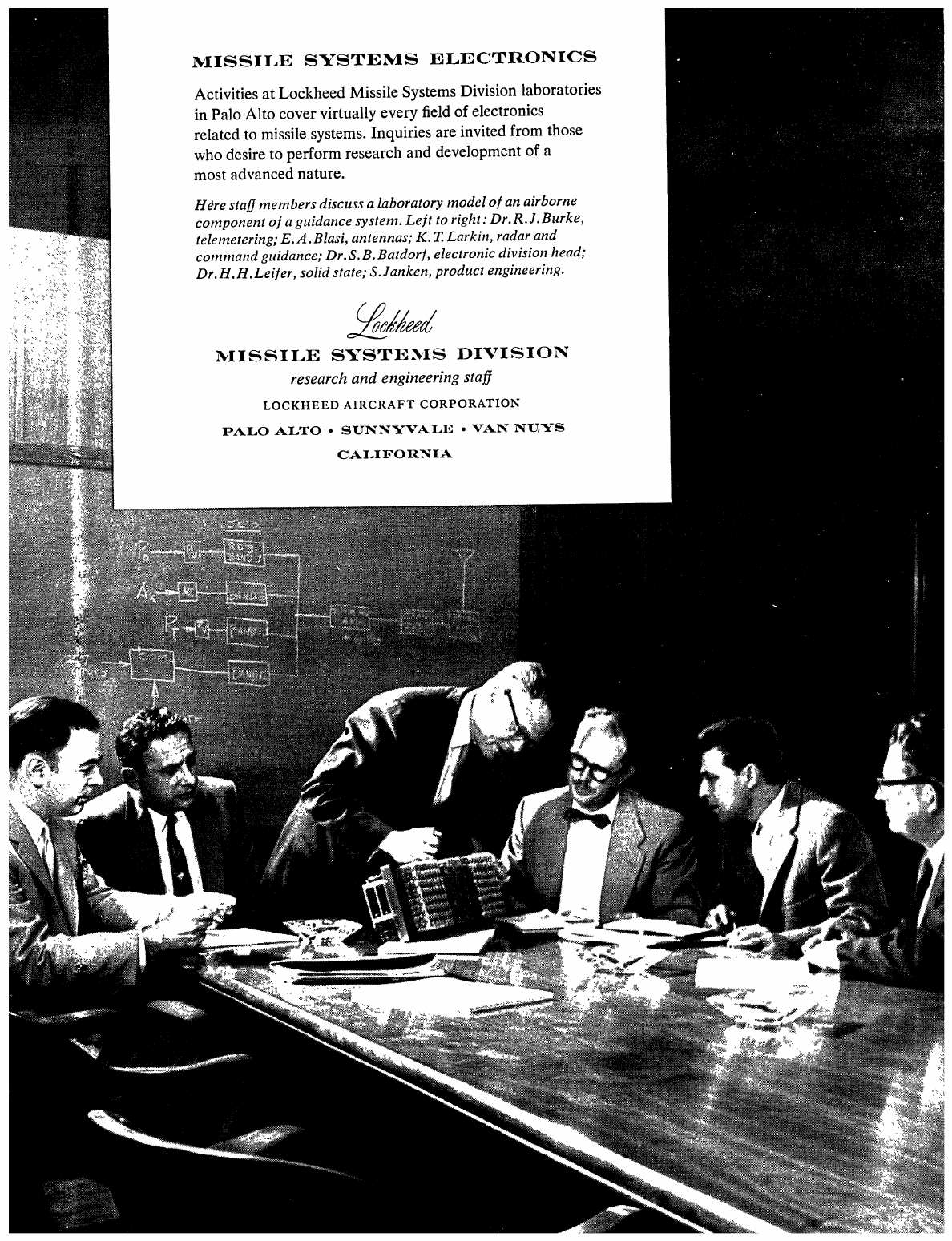
MISSILE
SYSTEMS
ELECTl~ONICS
Activities
at
Lockheed Missile Systems Division laboratories
in Palo Alto cover virtually every field of electronics
related to missile systems. Inquiries are invited from those
who desire to perform research and development of a
most advanced nature.
Here staff members discuss a laboratory model
of
an airborne
component
oj
a guidance system.
Left
to right:
Dr.R.J.Burke,
telemetering;
E.A.Blasi,
antennas; K.
T.
Larkin, radar and
command
guidance;
Dr.S.B.Batdorf,
electronic division head;
Dr.H.H.Leifer,
solid state; S.Janken, product engineering.
~IISSILE
SYSTE:\,IS
DIVISION
research
and
engineering staff
LOCKHEED
AIRCRAFT
CORPORATION
PALO
ALTO.
SUNNYVALE
•
VAN
NUYS
CAI
..
IFORNIA
Design-Engineered
with
Positive
Wiping
Contact
and
Frictional
Grippage
Another
of
the
many
unique
designs
made
available
by
the
AMP-Edge
technique
is
the
new,
low-cost, com-
pact
AMP-Edge
Connector
Block.
It
allows
freedom
of
arrangement,
with small
area
displacement
.
~
C-~
TO
BETTER
WIRINC
Its
open
construction
provides
aeration
to
prevent
moisture
en-
trapment
.
