1976_02_07 1976 02 07
User Manual: 1976_02_07
Open the PDF directly: View PDF  .
.
Page Count: 16
= "'"H*
—
";—/*;///:.
=
i==: ==-t-"'++ + +
f
= ';i'r'+"-i+-+ +-";
"/;Ua88S$se33aW0sS&§SS0+-i::. . :
... /:....:.... :
:-+0@e#N#NSN§##N3S-$$#%g3S*U*=:";/'/;/. ::
!*isiC'XI=++
xi=ii >*+tT+++"
: ' 'r:, ;!
—
!;-
'-<—
H==;I=:—=s=i+'3?+"'-++""-'"+""" .-"—-''-'< L—
..... ...
'*ixtII====?i-+'I++3+++-t" +""--"".-""
tJ*
-3-Xl'i.?
f'i iHt i-^
*--Mtt
l-XX-T-'JURUi
<:-:.'"ta-.i:si-.j'*t-3.^
x
-
+ X-+
...NRf-jOf
'J'^'JX
18'JX
-jWC'3'
^J'-HJ/
-aui
3§
;--34HH,!3K#.'
+K3*
..
SO*':-'—.;.;;.;/:.;:.
xX"—
ii.R-";///;;.//:./^
/
iU+=I%Xi—;/-;;/.;-;.;;
*X+ = =?+ ""' " """
7+-*UU+=X'-''&+"/ ssxTIi
^.tlniKfHR&T'Y"^.^'--""
"'ijOSa/'-
Tab!e of Contents
Bits and Pieces 2
Monitor in Lumber Production 4
CMPCTER-LOADER 6
HAM on the Side 9
Sma!! Computer Networking 10
Q&A Hardware C!itches 14
Fieid Testing the Aitair 8800 16
LETTER
TO THE EOtTOR
Dear Ed.,
While programming my Altair
computer, I detected
a
potential
problem with the 8800 SIO-B (ACR)
I/O card which may be of interest
to other users. Although there
is
a
solution, it's not entirely
satisfactory.
I
hope someone
else can supply
a
better one.
The problem is that an input
program written at one location will
work while at another it won't.
The program and the address at which
the program won't work is listed
as follows:
001
IN
002 Stat chan
003
RRC
004
JC
005
L
006
H
007
IN
010 Data chan
011
ETC
The problem occurs if the program
is written in
a
location such
that the low order address of the
instruction (RRC) following the
input instruction (2nd byte)
is
equivalent to the data channel
address which is 003 in this case.
The result is that if
a
string of
characters is being input, about
1
in 20 will be lost.
During machine cycle
1
(Ml)
of
the input instruction (see Figure 1),
the first byte (333) is read into
the processor and during M2 the ad-
dress of the device (002-status
channel) is read in. During M3 the
processor outputs the device number
(as an address) from which data
is
also to be read. The processor
reads in the data during T3 of M3.
During each of the machine
cycles of any instruction, the pro-
cessor outputs
a
status word which
is latched into the status register
(on the CPU card) by the coincidence
of 01 and sync. The status word is
used to control memory and I/O
cards. In this case the status
333
002
017
332
001
any page
333
003
Bits and Pieces
BY: SONDRA KOPPENHEFFER
FATAL ACCIDENT DAMPENS THE CHRISTMAS
SPIRIT
Sending Christmas packages
through the mail is
a
part of the
holiday spirit. However, packages
have been known to experience quite
a lot of trauma before reaching
their intended destination. Let me
contrive an example to convey the
message of this article.
Your disk, never having much
of
a
Christmas spirit, has decided
to take
a
vacation. No amount
of
intuition or technical ability will
convince that marvel of technology
to work. Giving up on the disk,
for more enjoyable holiday activities,
you finally decide to give MITS
a
try at repairing the disk.
.
.
. About
a
week later, you
receive
a
phone call from MITS,
explaining that your disk had been
involved in
a
fatal accident. Upon
arrival at MITS, the disk had been
severely damaged, and the $200.00
for which you had insured it, wasn't
nearly enough to cover the doctor's
bills. Your bereavement is turned
into shock when you are told that
you will have to pay
a
$350.00 bill
for repair of the disk.
The gentleman in this story
had to learn about our postal system
the hard way. But this type
of
misfortune should be
a
lesson to all
Altair owners who send their units
back to MITS for repair. Always
insure your system for at least the
amount that you originally paid for
it. Even if the case is the only
part of your system damaged in tran-
sit, you will still be billed $170.00
for repairing the case.
So remember to send us your
unit by registered mail and make
sure it's insured for the full
amount.
UPDATE SERVICE TAKES
A
SEAT
IN
HISTORY
The advertisement for Computer Notes
Review, Vol. 1, has generated many
inquiries concerning our update
service. However, this service was
discontinued six months ago. We feel
that any benefits you would have
received through the Update Service,
are now directly available
in
Computer Notes.
CUSTOMERS SUBMIT MISSING PAPER
REPORT
-
MASSIVE SEARCH BEGUN *
AT MITS
This paragraph is dedicated
to
all those customers who have recently
purchased an Altair computer through
one of our dealers. We've received
many calls and letters asking why
new customers have not started
receiving Computer Notes. We depend
upon our dealers to submit the names
of all those persons who purchase
an
Altair through their store. This
procedure generally takes three
weeks to one month. Once in
a
while
a dealer inadvertently misses
a
name and we are therefore unable
to place that customer's name
on
our mailing list. If you find your-
self in the situation which
I
just
described, please contact the dealer
from whom you purchased your Altair.
Following up on this procedure will
help limit any duplication in your
subscription.
COMPLETE RECORD OF PURCHASES NEEDED
If you have ordered systems
through both MITS and one of our
dealers, you might find it to your
best interest to send us copies
of
all of your dealer purchases
so
that we might update your file.
If
we have complete records for all
Altair products which you have
purchased, you can depend on much
more efficient and rapid service.
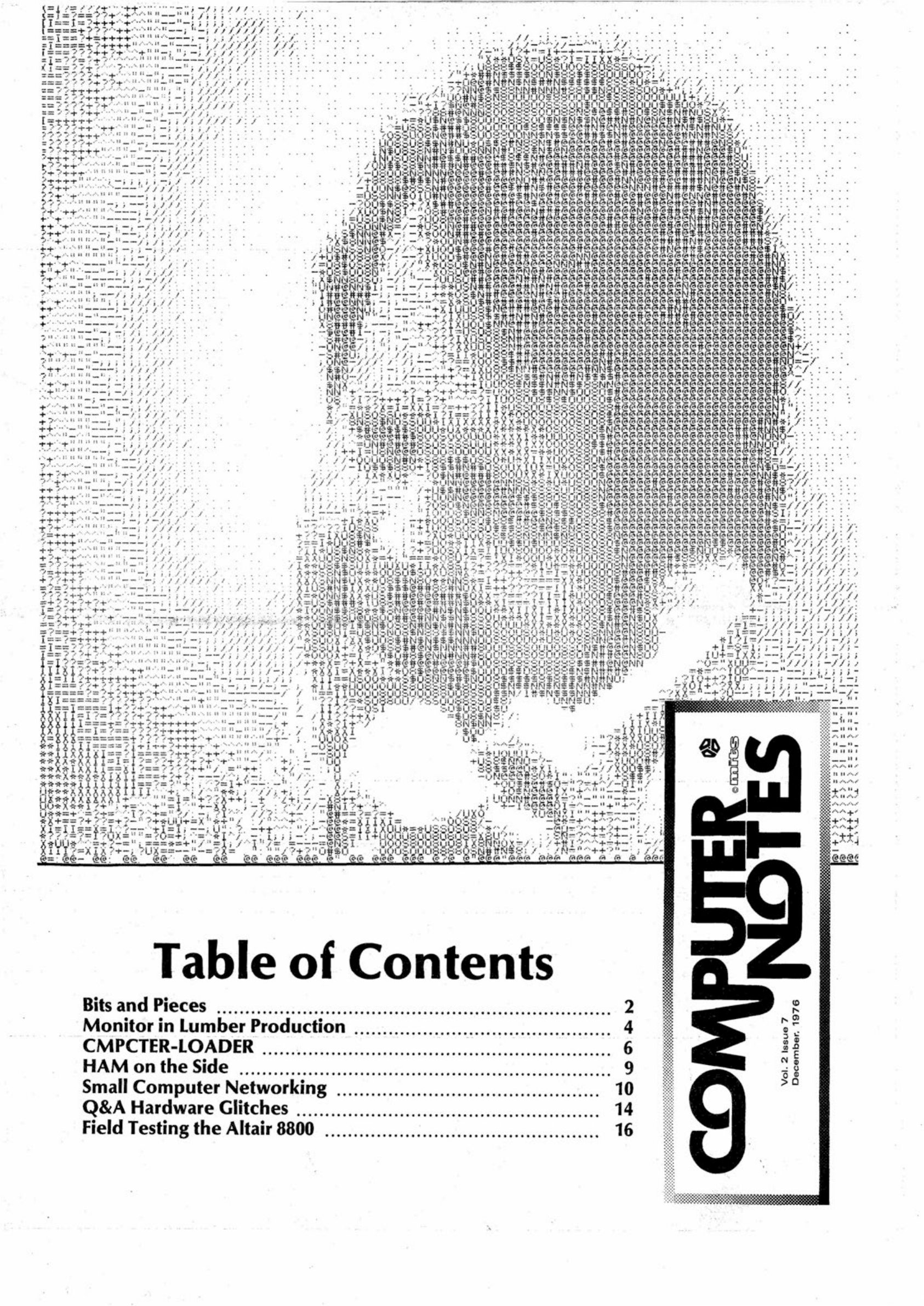
On
The
C over
This picture of Ron Roberts,
president of the Altair Software
Distribution Company, is just one
example of digital art produced
on an Altair 8800b computer.
This system was developed
by The Computer Systemcenter
in Atlanta and uses
a
Panasonic
video camera,
a
Centronics printer
and
a
commercially available
digitizer, in addition to
an
8800b with special interfaces and
custom'software.
The system works
by
assessing the relative amount
of
gray in
a
TV picture, setting
a
character on the printer that
approximately corresponds to that
perceived amount of gray and
finally, printing the picture.
COMPLETER
y "[iOTES
Editor Andrea Lewis
Asst. Editor Linda Biocki
Production Tom Antreasian
A) McCahon
Steve Wedeen
Grace Brown
Contributors Tommy Staten
GeneDiai
Charies Oisen
Dougtas L. Jones
Mike Hunter
Bob Matthews
Sondra Koppenheffer
Jim Wiggins
Rich Haber
Bruce Fowter
Page Two Continued on Page Seven CN/December 1976
VMACC-H
SLATED
FOR MAY
By Charles Olsen
The second annual World Altair
Computer Convention(WACC-II),
scheduled for May 18-21 at the
Albuquerque Convention Center,
promises to be even more
spectacular than last year's,
with the largest collection of
Altair equipment, dealers and
computer experts anywhere in the
country.
Attendance is estimated at
more than 1,000 computer
enthusiasts, which is well over
the unexpected 750 people who
gathered at last year's WACC.
The four-day convention will
be geared to both the hobbyist and
small businesses but will also
include displays of many other
special applications for large
businesses, industry, education
and the home.
All of our Altair dealers will
be at the convention to display
various systems and answer any ques-
tions.
A banquet will be held on May
20, and the last day of the conven-
tion will be reserved for various
special events, such as awarding
prizes and conducting tours of the
Albuquerque-Santa Fe areas.
Lodging will be available
at the Albuquerque Inn, which
is
connected by an underground
walk-way to the Convention
Center next door. Only those
people who confirm their
reservations early will get
their choice of rooms at the
Albuquerque Inn. Additional
accommodations will
be
available at the local
Sheraton and Hilton hotels,
only
a
10-minute drive
from downtown Albuquerque.
Details concerning the
WACC-II schedule, seminars,
dealer contacts, prizes and
tickets for the banquet will
appear in next month's issue
of Computer Notes as well
as
other computer magazines.
If you have any further
questions about WACC-11, please
feel free to contact me.
Charles Olsen
Director of PR
MITS, Inc.
Book Review
Practical Microcomputer Programming
The Intel 8080
By: Mike Hunter
Although most microcomputer
users usually prefer to use
a
high level language, such as BASIC,
when writing programs, they are
often either compelled by neces-
sity or motivated by interest
to
use machine code or assembler
instead. Learning how to manipulate
the ones and zeroes as well as the
various mnemonics can be confusing
for anyone. But it's particularly
devastating to the programmer who
has only one or two kilobytes
of
memory and thus has no other choice
but to use machine code.
The literature available from
the chip manufacturers sometimes
provides only brief explanations of
machine code functions. For the
novice microcomputer user, such
descriptions are often as cryptic
as the mnemonics. One excellent
solution to this problem is Weller,
Schatzel and Nice's brand new book,
Practical Microcomputer Programming
The Intel 8080.
The book provides the novice
with over 300 pages of all the
information necessary to begin
programming
a
microcomputer.
Although the book is aimed at be-
ginners, it's still
a
very helpful,
detailed source of reference material
for programming experts.
The 18 chapters of the book
cover
a
wide variety of topics, in-
cluding binary addition, how to
use the stack pointer and how to
interface the 8080 to complex
peripherals. Each chapter begins
with
a
discussion of
a
basic concept
followed by instructions on how to
implement the concept with the 8080
machine code.
The book is based on
a
con-
figuration consisting of
a
Teletype
and an Altair 8800, which was
assembled by one of the authors.
The authors wrote their own unique
assembly program to be used as the
main example program throughout
the book.
Many instructive texts are
often boring as well as difficult
to understand. However, Practical
Microcomputer Programming is not
only interesting but is written in
a style that even beginners can
follow. The authors help al-
leviate the drudgery and confusion
of working through examples
by
using such names as Tom, Dick and
Harry as variables rather than
the traditional
X
and
Y.
TM
The final chapters of the
book discuss such questions as,
"How do
I
interface my 8080 micro-
computer to an analog device,
or
terminal, and how can it be used in
a real time mode?"
The last chapter deals
appropriately enough with the final
step in the programming process—de-
bugging. This chapter describes
many procedures for discovering the
source of an error.
In general I'd recommend this
book as
a
valuable source of
programming information for any
8080 microcomputer user.
Practical Microcomputer Pro-
gramming—The Intel 8080
is
available for $21.95 from:
Northern Technical Books
Box 62
Evanston, 111. 60204
CN/December 1976
New C!ub
Formed
State University of New York at
Stony Brook recently formed the Home
Brew Computer Club to promote infor-
mal discussions of
a
variety of both
hardware and software topics. Most
members have their own systems (8080
and 6800) to discuss and demonstrate.
The club also has access to
a
number
of simulators and cross-assemblers
on the university computer.
For
further information, contact:
Ludwig Broun
Professor of Engineering
College of Engineering and
Applied Sciences
State University of New York
at Stony Brook
Stony Brook,
NY
11794
The Altair User Group Software
Library is in the process of being
transferred to the same facility
that houses the new Altair Software
Distribution Company. Because we
are in the middle of this transition
and because there were only
a
few
entries for December, no contest
winners were chosen this month.
All
entries received in December will
be included in the January contest.
Check the January issue of
CN for further new developments
in
the Altair Users Group Software
Library.
Page
Thirteen
Case Study:
Monitoring Lumber Production
with an Altair Computer
By Tommy Staten
Ms.. &tate.M. m^ZZ managgA
H.C. Hodges LumbgA Compact/
Panama C^tt/, Ffo^^a.
Since the H. C. Hodges Lumber
Company first opened, we've had
difficulty keeping track of our
production. The lumber was being
tallied daily as it was stacked,
but at the end of each month, there
was
a
considerable discrepancy be-
tween what was counted and what was
inventoried. Obviously, this caused
quite
a
few problems.
So I
devised
a method of using an Altair computer
to monitor production.
I chose the Altair 8800 micro-
computer because
I
am convinced that
no other manufacturer matches the
MITS Altair system in either hard-
ware or software support. Price was
also
a
factor. Although the Altair
is not the cheapest computer on the
market, it has proven it was certainly
worth the cost by being
a
very reli-
able and efficient system for our
lumber company.
The following description is
only one example of how an Altair
system can be used in an industrial
application. The possible uses
of
such
a
microcomputer system are
almost limitless, not only within
the lumber industry but in any
operation where production control
and cost effective monitoring
systems are required.
In the past three years more
and more manufacturers have begun
to incorporate solid state
electronic circuitry in their
system controls rather than using
the usual magnetic relays,
mechanical switches, limit swiches,
etc. These methods were fine for
the actual operation of
a
machine,
but they proved to be very clumsy
for automatic control of equipment.
The advent of solid state
electronics in system controls
has resulted in increased
production that's less expensive
and more efficient. With
automatic controls, "down time"
or lost production is also minimal.
The lumber industry is
a
prime
example of how solid state
electronics in system controls have
been effectively used to accurately
monitor daily production while
saving both time and labor costs.
Four years ago the average lumber
mill used 15 to 20 men to sort and
stack rough cut lumber as it came
out of the mill. The usual
procedure utilized
a
150-foot
lumber conveyor chain that moved
the lumber from the cutting saw
area. As the lumber came out,
men stationed on both sides
of
the conveyor would pull, sort and
Page Four
stack the lumber according to size.
Today, that long conveyor still
exists, but instead of 15 men,
only one--the control operator--is
needed to get the job done. This
change was made possible by using
a new dropsorter built by Harvey
Engineering, Little Rock, Arkansas.
The dropsorter is
a
low voltage,
solid state binary logic control
system that uses primarily CMOS ICs
and some TTL. Although the limit
switches were not entirely elimin-
ated, their use was limited strictly
to generating timing and measurement
signals. The following description
explains how the system works.
Dropsorter:
Sequence of Operation
The dropsorter control logic
system is composed primarily of
five printed circuit boards inter-
connected with 26 conductor ribbon
cables. Control system input signals
of 24 VDC are supplied to the I/O
board from limit switch contact
closures and/or operator control
push buttons.
When
a
piece of lumber
passes through the measuring
section of the sorter infeed,
certain limit switches are
actuated, and width, length
and thickness signals are coupled
from the I/O board to the measuring
board where they are connected
to 12 VDC binary logic.
The
signals are then coupled to the
display board, which displays the
actual board dimensions.
A
proper
dimensional display indicates that
the external switches,'I/O board
and measuring board are functioning
properly.
At the same time the input
signal is displayed, the binary
coded signal is also fed to the
program coding board. The function
of the coding board is to assign
a
two-bit binary bay address to each
major lumber dimension(represented
by the binary coded signal).
Any lumber dimension which does not
have
a
programmed lumber bay address
is automatically dropped in
a
designated drop-out bay.
The two-bit binary bay address
is coupled from the program board to
the memory or shift board, where
the binary bay address can be seen
from the time
a
piece of lumber
is
measured until the reset limit
switch resets the system for the
next measurement. The two-bit
binary address also enters
a
multi-
channel shift register, which shifts
one position for every revolution
of the dropsorter head shaft.
The
dumber of shifts required for
a
board to travel to
a
specific bay
must be predetermined, and the
memory or shift board should be pre-
programmed for the proper number of
shifts before sending an output
signal to
a
designated bay.
Custom Interface Required:
The display board uses TTL
logic exclusively and supplies the
necessary signals for our interface.
The interface was designed for us by
Warren Stardup, who is
a
partner-
technician with Microcomputer Systems,
Inc. of Tampa, Florida.
The interface converts the TTL
to serial, using
a
UART (Universal
Asynchronous Receiver Transmitter).
Data is then transmitted from the
mill site to the office computer via
a 20 mA current loop. Each board
size is represented by
a
standard
ASCII Character. The proper ASCII
code is signaled to the UART through
a diode matrix on the interface
board.
System Configuration:
The system includes an Altair
8800 computer with an upgraded power
supply and memory that consists
of
two Dutronics 8K Static RAM boards
and one MITS 4K Dynamic Memory board
for
a
total of 20K. However, only
about 10K bytes of this are used for
both the BASIC interpreter and the
lumber program. Both programs are
loaded into the Altair computer
through
a
MITS ACR board.
I hope to have our MITS PROM
board with the BASIC bootstrap
loader up and running soon, because
so far, I'm the only person who can
load the computer. On several occa-
sions I've been rousted from bed to
go down to the mill during the night
shift, because
a
thunder storm has
caused
a
momentary loss of power.
Somehow, these power failures always
seem to occur during my "off" shift,
usually when I'm at home in bed.
The lumber data comes from the
interface to one port of
a
MITS 2SI0
board. This port is wired for
a
20 mA current loop. The other port
on the 2SI0 board is wired RS232
and connects an ADM-3 Lear Seigler
Continued
CN/December 1976
Monitoring Lumber Production
With an Altair Computer
Continued
CRT to the processor. All data is
displayed and constantly updated on
the CRT. The information shown on
the CRT is copied down by hand at
the end of each shift. We also have
a spare SWTP video terminal and hope
to acquire some sort of hard copy
printer in the very near future.
Software:
The software was written by
Bill Turner, a software genius from
Microcomputer Systems, Inc. of Tampa.
Bill is also one of the well-known
authors of SWTP's BASIC.
Our program is written in 8K
BASIC. Data is displayed in a two
dimension matrix (7,6). The display
is constantly updated as each board
is measured. Boards actually come
through the sorter at a rate of one
every two seconds, so most of the
processor's time is spent simply
waiting for an input. To make use
of this wasted time, I plan to use
another interface which will scan
the logs as they are about to be cut
and compute the measurement with
what comes out of the sorter, to
give the actual recovery of all logs
that are processed.
The program also has the ability
to record all data accumulated on a
cassette tape, at a predetermined
board count, which is usually every
1,000 boards. In case of a momentary
loss of power, this will preserve
all of the data accumulated at that
particular time. The cassette ob-
viously won't be needed once we get
the printer.
Since we began using the Altair
system, our inventory discrepancies
have been eliminated, much to our
bookkeepers' appreciation. But the
real merit of the system is that
now office personnel can simply
glance at the CRT to see exactly
what is being produced in the mill.
If we have orders for long stock,
but the trend on the display is
for short stock, we simply get on
the intercom and ask our workers to
cut the long pieces into shorter
ones. This proves invaluable
when dealing with truckloads of
orders which vary in size from
day to day.
CN/December 1976
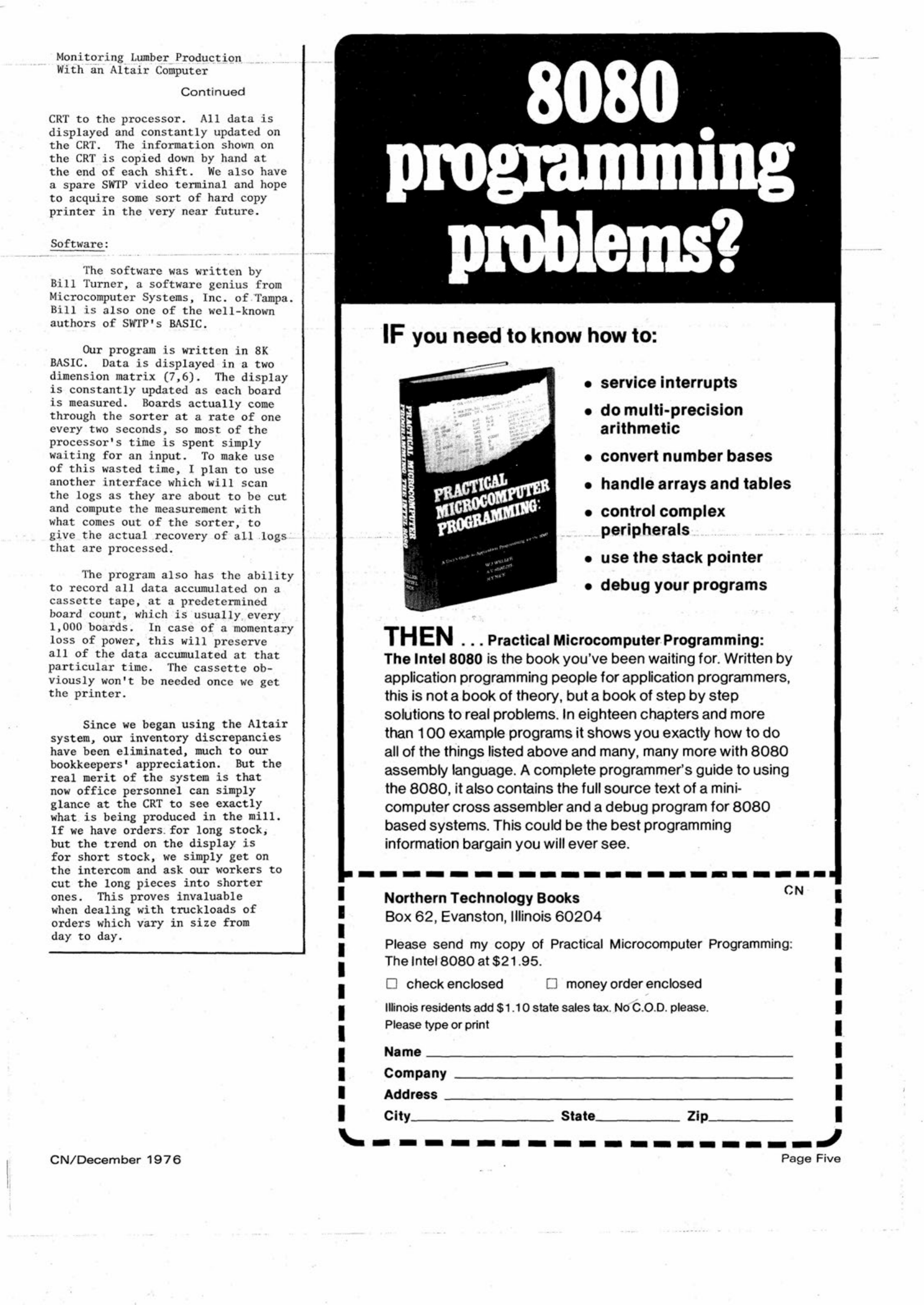
8080
programming
problems?
!F you need to know how to:
* service interrupts
* domutti-precision
arithmetic
+ convert number bases
* handie arrays and tabies
* controicompiex
peripherais
* use the stack pointer
* debug your programs
THEN ... Practica! Microcomputer Programming:
The !nte! 8080 is the book you've been waiting for. Written by
apptication programming peopie for apptication programmers,
this is not a book of theory, but a book of step by step
soiution s to rea! probtems. !n eighteen chapters and more
than 100 exampte programs it shows you exactty how to do
ait of the things tisted above and many, many more with 8080
assembty !anguage. A comp!ete programmer's guide to using
the 8080, it aiso contains the futt source text of a mini-
computer cross assembier and a debug program for 8080
based systems. This couid be the best programming
information bargain you wii! ever see.
<
)
K
<
H
H
!
H
!
H
!
Northern Technotogy Books
Box 62, Evanston, [itinois 60204
CN
Ptease send my copy of Practica! Microcomputer Programming:
The tnte) 8080 at $21.95.
ED check enctosed D money order enciosed
tMinois residents add $1.10 state saies tax. NcfC.O.D. piease.
Ptease type or print
Name
Company
Address
City State. Zip-
Page
Thirteen
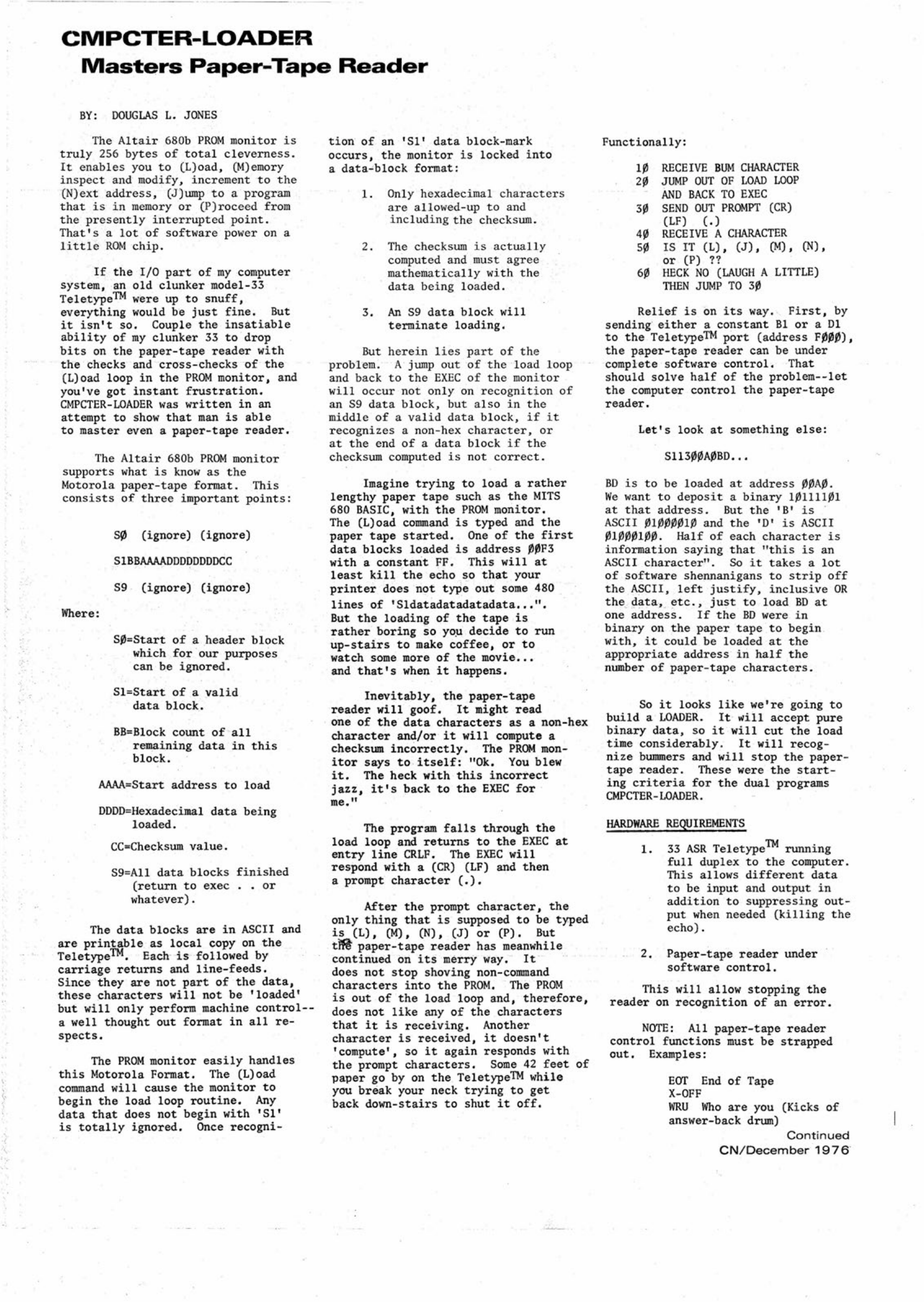
CMPCTER-LOADER
Masters Paper-Tape Reader
BY: DOUGLAS L. JONES
The Altair 680b PROM monitor
is
truly 256 bytes of total cleverness.
It enables you to (L)oad, (M)emory
inspect and modify, increment to the
(N)ext address, (J)ump to
a
program
that is in memory or (P)roceed from
the presently interrupted point.
That's
a
lot of software power on
a
little ROM chip.
If the I/O part of my computer
system, an old clunker model-33
Teletype^ were up to snuff,
everything would be just fine.
But
it isn't so. Couple the insatiable
ability of my clunker 33 to drop
bits on the paper-tape reader with
the checks and cross-checks of the
(L)oad loop in the PROM monitor, and
you've got instant frustration.
CMPCTER-LOADER was written in an
attempt to show that man is able
to master even
a
paper-tape reader.
The Altair 680b PROM monitor
supports what is know as the
Motorola paper-tape format. This
consists of three important points:
S0 (ignore) (ignore)
S1BBAAAADDDDDDDDCC
S9 (ignore) (ignore)
Where:
S0=Start of
a
header block
which for our purposes
can be ignored.
Sl=Start of
a
valid
data block.
BB=Block count of all
remaining data in this
block.
AAAA=Start address to load
DDDD=Hexadecimal data being
loaded.
CC=Checksum value.
S9=A11 data blocks finished
(return to exec
. . or
whatever).
The data blocks are in ASCII and
are printable as local copy on the
Teletype^. Each is followed by
carriage returns and line-feeds.
Since they are not part of the data,
these characters will not be 'loaded'
but will only perform machine control—
a well thought out format in all re-
spects.
The PROM monitor easily handles
this Motorola Format. The (L)oad
command will cause the monitor to
begin the load loop routine.
Any
data that does not begin with 'SI'
is totally ignored. Once recogni-
tion of an 'SI' data block-mark
occurs, the monitor is locked into
a data-block format:
1. Only hexadecimal characters
are allowed-up to and
including the checksum.
2. The checksum is actually
computed and must agree
mathematically with the
data being loaded.
3. An S9 data block will
terminate loading.
But herein lies part of the
problem. A jump out of the load loop
and back to the EXEC of the monitor
will occur not only on recognition of
an S9 data block, but also in the
middle of
a
valid data block, if
it
recognizes
a
non-hex character,
or
at the end of
a
data block if the
checksum computed is not correct.
Imagine trying to load
a
rather
lengthy paper tape such as the MITS
680 BASIC, with the PROM monitor.
The (L)oad command is typed and the
paper tape started. One of the first
data blocks loaded is address 00F3
with
a
constant FF. This will
at
least kill the echo so that your
printer does not type out some 480
lines of 'Sldatadatadatadata...".
But the loading of the tape
is
rather boring so you decide to run
up-stairs to make coffee, or to
watch some more of the movie...
and that's when it happens.
Inevitably, the paper-tape
reader will goof. It might read
one of the data characters as
a
non-hex
character and/or it will compute
a
checksum incorrectly. The PROM mon-
itor says to itself: "Ok. You blew
it. The heck with this incorrect
jazz, it's back to the EXEC for
me."
The program falls through the
load loop and returns to the EXEC
at
entry line CRLF. The EXEC will
respond with
a
(CR) (LF) and then
a prompt character (.).
After the prompt character, the
only thing that is supposed to be typed
is (L), (M), (N), (J)
or
(P).
But
t!?§
paper-tape reader has meanwhile
continued on its merry way.
It
does not stop shoving non-command
characters into the PROM. The PROM
is out of the load loop and, therefore,
does not like any of the characters
that it is receiving. Another
character is received, it doesn't
'compute', so it again responds with
the prompt characters. Some 42 feet
of
paper go by on the TeletypeTM while
you break your neck trying to get
back down-stairs to shut it off.
Functionally:
10 RECEIVE BUM CHARACTER
20 JUMP OUT OF LOAD LOOP
AND BACK TO EXEC
30 SEND OUT PROMPT (CR)
(LF)
(.)
40 RECEIVE
A
CHARACTER
50 IS IT (L), (J), (M), (N),
or (P)
??
60 HECK NO (LAUGH
A
LITTLE)
THEN JUMP TO
30
Relief is on its way. First,
by
sending either
a
constant B1 or
a D1
to the TeletypeTM port (address F000),
the paper-tape reader can be under
complete software control. That
should solve half of the problem--let
the computer control the paper-tape
reader.
Let's look at something else:
S11300A0BD...
BD is to be loaded at address 00A0.
We want to deposit
a
binary 10111101
at that address. But the 'B'
is
ASCII 01000010 and the 'D' is ASCII
01000100. Half of each character
is
information saying that "this is
an
ASCII character".
So
it takes
a
lot
of software shennanigans to strip off
the ASCII, left justify, inclusive OR
the data, etc., just to load BD at
one address. If the BD were
in
binary on the paper tape to begin
with, it could be loaded at the
appropriate address in half the
number of paper-tape characters.
So it looks like we're going to
build
a
LOADER. It will accept pure
binary data, so it will cut the load
time considerably. It will recog-
nize bummers and will stop the paper-
tape reader. These were the start-
ing criteria for the dual programs
CMPCTER-LOADER.
HARDWARE REQUIREMENTS
1. 33 ASR Teletype^ running
full duplex to the computer.
This allows different data
to be input and output
in
addition to suppressing out-
put when needed (killing the
echo).
2. Paper-tape reader under
software control.
This will allow stopping the
reader on recognition of an error.
NOTE: All paper-tape reader
control functions must be strapped
out. Examples:
EOT End of Tape
X-OFF
WRU Who are you (Kicks
of
answer-back drum)
Continued
CN/December 1976
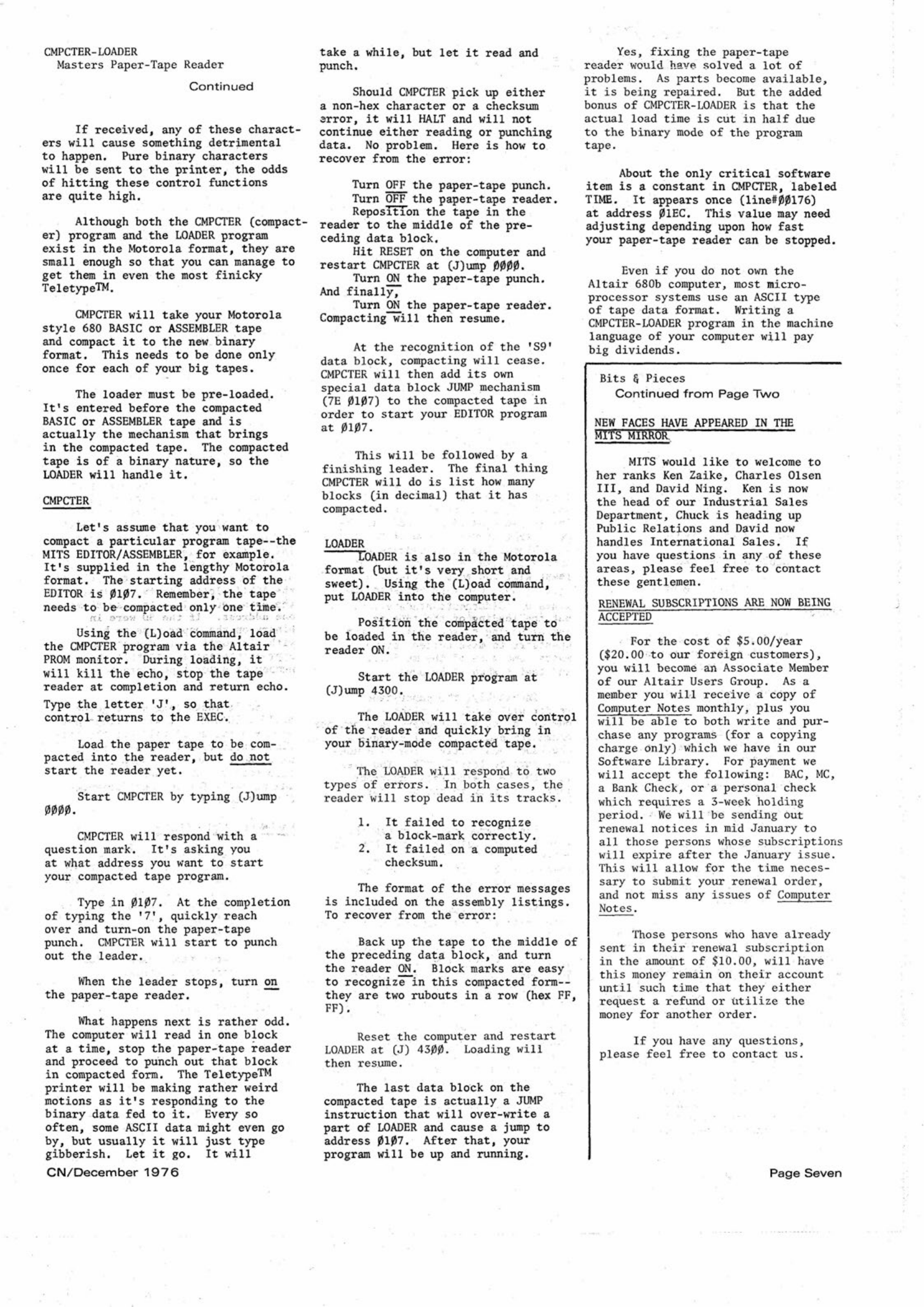
CMPCTER-LOADER
Masters Paper-Tape Reader
Continued
If received, any of these charact-
ers will cause something detrimental
to happen. Pure binary characters
will be sent to the printer, the odds
of hitting these control functions
ar e quite high.
Although both the CMPCTER (compact-
or) program and the LOADER program
exist in the Motorola format, they are
small enough so that you can manage to
get them in even the most finicky
TeletypeTM.
CMPCTER will take your Motorola
style 680 BASIC or ASSEMBLER tape
and compact it to the new binary
format. This needs to be done only
once for each of your big tapes.
The loader must be pre-loaded.
It's entered before the compacted
BASIC or ASSEMBLER tape and is
actually the mechanism that brings
in the compacted tape. The compacted
tape is of a binary nature, so the
LOADER will handle it.
CMPCTER
Let's assume that you want to
compact a particular program tape—the
MITS EDITOR/ASSEMBLER, for example.
It's supplied in the lengthy Motorola
format. The starting address of the
EDITOR is 0107. Remember^ the tape
needs to be^ compacted only One time.
Using the (L)oad command, load
the CMPCTER program via the Altair
PROM monitor. During loading, it
will kill th6 echo, stop the tape
reader at completion and return echo.
Type the letter 'J', so that
control returns to the EXEC.
Load the paper tape to be com-
pacted into the reader, but do not
start the reader yet.
Start CMPCTER by typing (J)ump
0000.
CMPCTER will respond with a
question mark. It's asking you
at what address you want to start
your compacted tape program.
Type in 0107. At the completion
of typing the '7', quickly reach
over and turn-on the paper-tape
punch. CMPCTER will start to punch
out the leader.
When the leader stops, turn on
the paper-tape reader.
What happens next is rather odd.
The computer will read in one block
at a time, stop the paper-tape reader
and proceed to punch out that block
in compacted form. The TeletypeTM
printer will be making rather weird
motions as it's responding to the
binary data fed to it. Every so
often, some ASCII data might even go
by, but usually it will just type
gibberish. Let it go. It will
CN/December 1976
take a while, but let it read and
punch.
Should CMPCTER pick up either
a non-hex character or a checksum
error, it will HALT and will not
continue either reading or punching
data. No problem. Here is how to
recover from the error:
Turn OFF the paper-tape punch.
Turn OFF the paper-tape reader.
Reposition the tape in the
reader to the middle of the pre-
ceding data block.
Hit RESET on the computer and
restart CMPCTER at (J)ump 0000.
Turn ON the paper-tape punch.
And finally,
Turn ON the paper-tape reader.
Compacting will then resume.
At the recognition of the 'S9'
data block, compacting will cease.
CMPCTER will then add its own
special data block JUMP mechanism
(7E 0107) to the compacted tape in
orde r to start your EDITOR program
at 0107.
This will be followed by a
finishing leader. The final thing
CMPCTER will do is list how many
blocks (in decimal) that it has
compacted.
LOADER
COADER is also in the Motorola
format (but it's very short and
sweet). Using the (L)oad command,
put LOADER into the computer.
Position the compacted tape to
be loaded in the reader, and turn the
reader ON.
Start the LOADER program at
(J)ump4300.
The LOADER will take over control
Of tRe reader and quickly bring in
your Binary-mode compacted tape.
The LOADER will respond to two
types of errors. In both cases, the
reader will stop dead in its tracks.
1. It failed to recognize
a block-mark correctly.
2. It failed on a computed
checksum.
The format of the error messages
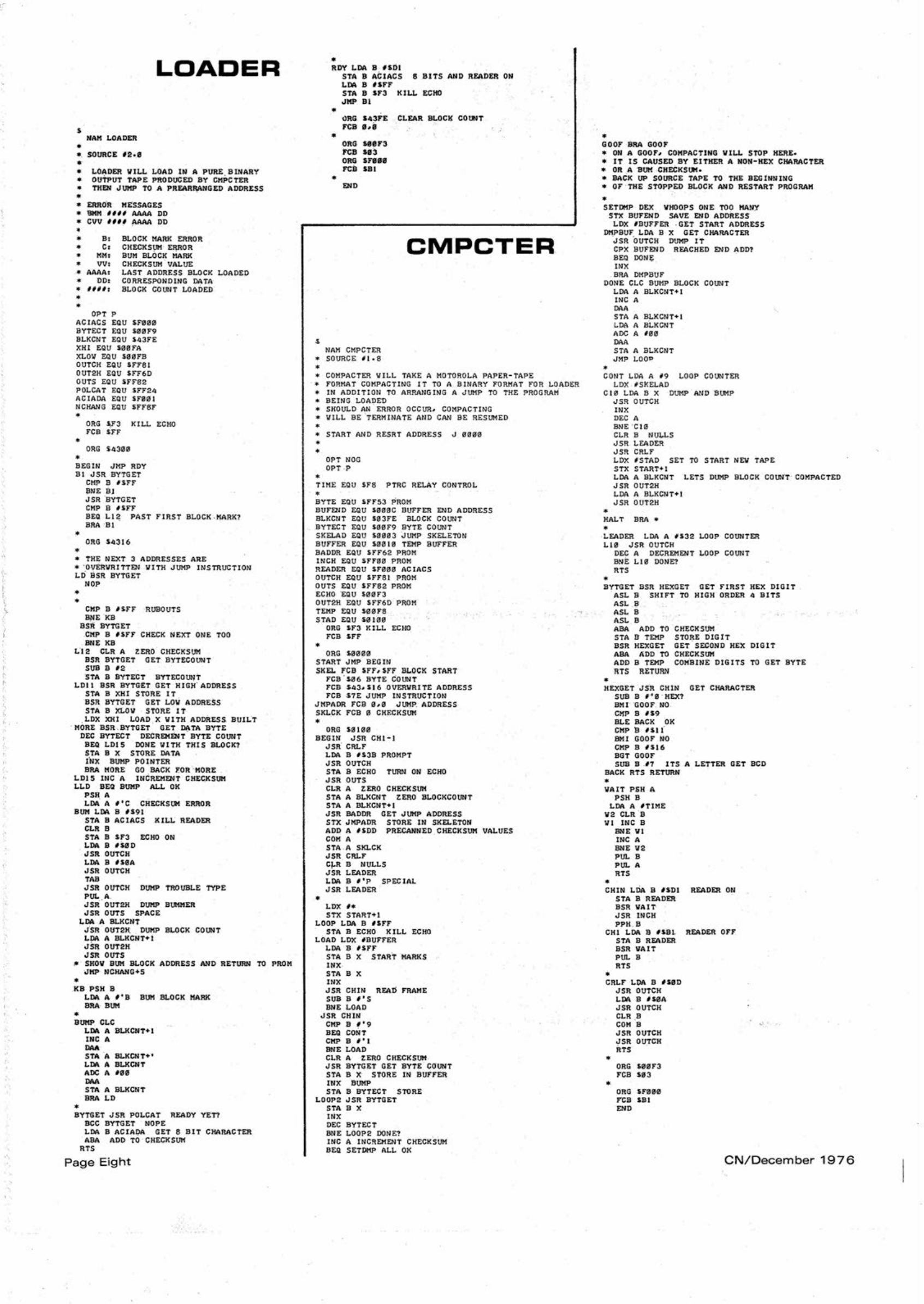
is included on the assembly listings.
To recover from the error:
Back up the tape to the middle of
the preceding data block, and turn
the reader ON. Block marks are easy
to recognize in this compacted form--
they are two rubouts in a row (hex FF,
FF).
Reset the computer and restart
LOADER at (J) 4300. Loading will
then resume.
The last data block on the
compacted tape is actually a JUMP
instruction that will over-write a
part of LOADER and cause a jump to
address 0107. After that, your
program will be up and running.
Yes, fixing the paper-tape
reader would have solved a lot of
problems. As parts become available,
it is being repaired. But the added
bonus of CMPCTER-LOADER is that the
actual load time is cut in half due
to the binary mode of the program
tape.
About the only critical software
item is a constant in CMPCTER, labeled
TIME. It appears once (line#00176)
at address 01EC. This value may need
adjusting depending upon how fast
your paper-tape reader can be stopped.
Even if you do not own the
Altair 680b computer, most micro-
processor systems use an ASCII type
of tape data format. Writing a
CMPCTER-LOADER program in the machine
language of your computer will pay
big dividends.
Bits
§
Pieces
Continued from Page Two
NEW FACES HAVE APPEARED IN THE
MIT5"MIRROR
MITS would like to welcome to
her ranks Ken Zaike, Charles Olsen
III, and David Ning. Ken is now
the head of our Industrial Sales
Department, Chuck is heading up
Public Relations and David now
handles International Sales. If
you have questions in any of these
areas, please feel free to contact
these gentlemen.
RENEWAL SUBSCRIPTIONS ARE NOW BEING
ACCEPTED
For the cost of $5.00/year
($20.00 to our foreign customers),
you will become an Associate Member
of our Altair Users Group. As a
member you will receive a copy of
Computer Notes monthly, plus you
will be able to both write and pur-
chas e any programs (for a copying
charge only) which we have in our
Software Library. For payment we
will accept the following: BAC, MC,
a Bank Check, or a personal check
which requires a 3-week holding
period. We will be sending out
renewal notices in mid January to
all those persons whose subscriptions
will expire after the January issue.
This will allow for the time neces-
sary to submit your renewal order,
and not miss any issues of Computer
Notes.
Those persons who have already
sent in their renewal subscription
in the amount of $10.00, will have
this money remain on their account
until such time that they either
request a refund or utilize the
money for another order.
If you have any questions,
please feel free to contact us.
Page
Thirteen
$
MAM LOADER
*
SOURCE #2.0
*
* LOADER VILL LOAD IN A PURE BINARY
* OUTPUT TAPE PRODUCED BY CMPCTER
* THEN JUMP TO A PREARRANSED ADDRESS
*
* ERROR MESSAGES
* BMM #### AAAA DD
* CVV #### AAAA DD
* B: BLOCK MARK ERROR
* C: CHECKSUM ERROR
* MM: BUM BLOCK MARK
* VV: CHECKSUM VALUE
* AAAA: LAST ADDRESS BLOCK LOADED
* DD: CORRESPONDING DATA
* ####: BLOCK COUNT LOADED
*
*
OPT P
ACIACS EQU $F0Z0
BYTECT EQU $00F9
BLKCNT EQU $43FE
XHI EQU $00FA
XLOW EQU $00FB
OUTCH EQU $FF8!
0UT3H EQU $FF6D
OUTS EQU $FF82
POLCAT EQU $FF24
ACIADA EQU $F00!
NCHANG EQU SFFSF
*
ORG $^3 KILL ECHO
FCBSFF
*
ORG $4300
*
BEGIN JMP RDY
BI JSR BYTGET
CMP B #$FF
BMEBI
JSR BYTGET
CMP B #$FF
BEQ LIS PAST FIRST BLOCK MARK?
BRAB!
*
ORG $43!6
*
* THE NEXT 3 ADDRESSES ARE
* OVERWRITTEN WITH JUMP INSTRUCTION
LD BSR BYTGET
NOP
*
*
CMP B #$FF RUBOUTS
ME KB
BSR BYTGET
CMP B #$FF CHECK NEXT ONE TOO
ME KB
H3 CLRA ZERO CHECKSUM
BSR BYTGET GET BYTECOUNT
SUB B #2
STA B BYTECT BYTECOUNT
LD!I BSR BYTGET GET HIGH ADDRESS
STA B XHI STORE IT
B$R BYTGET GET LOW ADDRESS
STA B XLOW STORE IT
LDX XHI LOAD X WITH ADDRESS BUILT
MORE BSR BYTGET GET DATA BYTE
DEC BYTECT DECREMENT BYTE COUNT
BEQ LDI5 DONE WITH THIS BLOCK?
STA B X STORE DATA
INX BUMP POINTER
BRA MORE GO BACK FOR MORE
LDI5 INC A INCREMENT CHECKSUM
LLD BEQ BUMP ALL OK
PSH A
LDA A #'C CHECKSUM ERROR
BUM LDA B #$91
STA B ACIACS KILL READER
CLR B
STA B $F3 ECHO
LDA B #$0D
JSR OUTCH
LDA B #$0A
JSR OUTCH
TAB
JSR OUTCH DUMP
PUL A
JSR OUT2H DUMP
JSR OUTS SPACE
LDA A BLKCNT
JSR OUT2H. DUMP
LDA A BLKCNT*!
JSR 0UT2H
JSR OUTS
* SHOW BUM BLOCK ADDRESS AND RETURN TO PROM
JMP NCHANG+5
*
KB PSH B
LDA A #'B BUM BLOCK MARK
BRA BUM
*
BUMP CLC
LDA A BLKCNT*I
MCA
DAA
STA A BLKCNT*'
LDA A BLKCNT
ADC A #00
DAA
STA A BLKCNT
BRALD
*
BYTGET JSR POLCAT READY YET?
BCC BYTGET NOPE
LD)A B ACIADA GET S BIT CHARACTER
ABA ADD TO CHECKSUM
RTS
Page Eight
ON
TROUBLE TYPE
BUMMER
BLOCK COUNT
RDY LDA B #$D!
STA B ACIACS 8 BITS AND READER ON
LDA B #$FF
STA B $F3 KILL ECHO
JMPBI
ORG $43FE
FCB 0*0
ORG $00F3
FCB $03
ORG $F00O
FCB$B!
END
CLEAR BLOCK COUNT
CMPCTER
NAM CMPCTER
* SOURCE #1.8
*
* COMPACTER WILL TAKE A MOTOROLA PAPER-TAPE
* FORMAT COMPACTING IT TO A BINARY FORMAT FOR LOADER
* IN ADDITION TO ARRANGING A JUMP TO THE PROGRAM
* BEING LOADED
* SHOULD AN ERROR OCCUR* COMPACTING
* WILL BE TERMINATE AND CAN BE RESUMED
*
* START AND RESRT ADDRESS J 0000
*
*
OPT NOG
OPT P
*
TIME EQU $FS PTRC RELAY CONTROL
*
BYTE EQU $FF53 PROM
BUFEND EQU $000C BUFFER END ADDRESS
BLKCNT EQU $03FE BLOCK COUNT
BYTECT EQU $00F9 BYTE COUNT
SKELAD EQU $0003 JUMP SKELETON
BUFFER EQU $0010 TEMP BUFFER
BADDR EQU $FF62 PROM
INCH EQU $FF00 PROM
READER EQU $F000 ACIACS
OUTCH EQU $FF8I PROM
OUTS EQU $FFS2 PROM
ECHO EQU $00F3
0UT2H EQU $FF6D PROM
TEMP EQU S00F8.
STAD EQU $0100
ORG $F3 KILL ECHO
FCB$FF
*
ORG $0000
START JMP BEGIN
SKEL FCB $FF*$FF BLOCK START
FCB $06 BYTE COUNT
FCB $43*$! 6 OVERWRITE ADDRESS
FCB $7E JUMP INSTRUCTION
JMPADR FCB 0*0 JUMP ADDRESS
SKLCK FCB 0 CHECKSUM
*
ORG $0100
BEGIN JSR CHI-1
JSR CRLF
LDA B #$3B PROMPT
JSR OUTCH
STA B ECHO TURN ON ECHO
JSR OUTS
CLR A ZERO CHECKSUM
STA A BLKCNT ZERO BLOCKCOUNT
STA A BLKCNT*)
JSR BADDR GET JUMP ADDRESS
STX JMPADR STORE IN SKELETON
ADD A #$DD PRECANNED CHECKSUM VALUES
COM A
STA A SKLCK
JSR CRLF
CLR B NULLS
JSR LEADER
LDA B #'P SPECIAL
JSR LEADER
*
LDX#*
STX START*!
LOOP LDA B #$FF
STA B ECHO KILL ECHO
LOAD LDX #BUFFER
LDA B #$FF
STA B X START MARKS
INX
STABX
INX
JSR CHIN READ FRAME
SUBB#'S
BNE LOAD
JSR CHIN
CMPB#'9
BEQ CONT
CMPB#'!
BNE LOAD
CLR A ZERO CHECKSUM
JSR BYTGET GET BYTE COUNT
STA B X STORE IN BUFFER
INX BUMP
STA B BYTECT STORE
L00P2 JSR BYTGET
STABX
INX
DEC BYTECT
BNE L00P2 DONE?
INC A INCREMENT CHECKSUM
BEQ SETDMP ALL OK
GOOF BRA GOOF
* ON A GOOF* COMPACTING WILL STOP HERE.
* IT IS CAUSED BY EITHER A NON-HEX CHARACTER
* OR A BUM CHECKSUM.
* BACK UP SOURCE TAPE TO THE BEGINNING
* OF THE STOPPED BLOCK AND RESTART PROGRAM
SETDMP DEX WHOOPS ONE TOO MANY
STX BUFEND SAVE END ADDRESS
LDX #BUFFER GET START ADDRESS
DMPBUF LDA B X GET CHARACTER
JSR OUTCH DUMP IT
CPX BUFEND REACHED END ADD?
BEQ DONE
INX
BRA DMPBUF
DONE CLC BUMP BLOCK COUNT
LDA A BLKCNT*!
MCA
DAA
STA A BLKCNT*!
LDA A BLKCNT
ADC A #00
DAA
STA A BLKCNT
JMP LOOP
*
CONT LDA A #9 LOOP COUNTER
LDX #SKELAD
C!0 LDA B X DUMP AND BUMP
JSR OUTCH
INX
DEC A
BNE C!0
CLR B NULLS
JSR LEADER
JSR CRLF
LDX #STAD SET TO START NEW TAPE
STX START*!
LDA A BLKCNT LETS DUMP BLOCK COUNT COMPACTED
JSR 0UT2H
LDA A BLKCNT*!
JSR 0UT2H
*
HALT BRA *
*
LEADER LDA A #$32 LOOP COUNTER
L!0 JSR OUTCH
DEC A DECREMENT LOOP COUNT
BNE L!0 DONE?
RTS
*
BYTGET BSR HEXGET GET FIRST HEX DIGIT
ASL B SHIFT TO HIGH ORDER 4 BITS
MLB
ASL B . - . .. ..
ASL B
ABA ADD TO CHECKSUM
STA B TEMP STORE DIGIT
BSR HEXGET GET SECOND HEX DIGIT
ABA ADD TO CHECKSUM
ADD B TEMP COMBINE DIGITS TO GET BYTE
RTS RETURN
*
HEXGET JSR CHIN GET CHARACTER
SUB B #'0 HEX?
BMI GOOF NO
CMP B #$9
BLE BACK OK
CMP B #$!!
BMI GOOF NO
CMPB#$!6
BGT GOOF
SUB B #7 ITS A LETTER GET BCD
BACK RTS RETURN
*
WAIT PSH A
PSH B
LDA A #TIME
W2 CLR B
W! INCB
MEW!
INC A
BNEW2
PUL B
PUL A
RTS
*
CHIN LDA B #$D! READER ON
STA B READER
BSR WAIT
JSR INCH
PPH B
CH! LDA B #$B!, READER OFF
STA B READER
BSR WAIT
PUL B
RTS
*
CRLF LOA B #$0D
JSR OUTCH
LDA B #$0A
JSR OUTCH
CLR B
COM B
JSR OUTCH
JSR OUTCH
RTS
*
ORG $00F3
FCB $03
*
ORG $F000
FCB$B!
END
CN/December 1976
Letters to the Editor,
Continued
input signal (SINP) is of impor-
tance—during M3 of the input in-
struction, SINP goes high enabling
circuitry that allows data from the
I/O card to be input during T3.
SINP goes low again at the next
coincidence reflecting a different
instruction. To further set the
stage, during each of the machine
cycles the processor outputs an
address (either for memory or I/O)
which is presented less than 300
nsec. after the start of that
machine cycle or about halfway
through Tl. The problem occurs
during Tl of the RRC instruction,
because the coincidence of SINP and
the address for that instruction
(which happens to be the data
channel address) resets the "data
available" FF in IC M—pin 19 on
the I/O card. As written, the
program will then cause a reset
pulse of 200 nsec. at pin 8 IC G
(SIO-B) during Tl of RRC every time
through the loop. If the "data
available" FF is set after the
status word is input from IC M
during T3 of M3 but before the
reset during Tl, then the indica-
tion of a character present is
lost as well as the character it-
self. Normally, the reset doesn't
occur until the input instruction
at location 007 is executed with
the data channel address. In that
case the character is input and the
"data available" FF is cleared to
indicate that fact.
This situation will occur
with the use of the SIO cards and
the ACR and possibly with other
I/O cards. While a hardware solu-
tion is not crucial to the opera-
tion of a system, it could be
unwieldy to use interrupts or write
programs in specific locations,
particularly if the number of I/O
cards were increased.
Sincerely yours,
Jim Wiggins
Attair
Users
Don Chamberlain
9457 Las Vegas Blvd. South #321
Las Vegas, Nevada 89119
Phone: (702) 361-4924
Alfred R. Howes
Box 342 Boyce Rd.
Glenford, NY 12433
Dick Fehriback
5779 Blaine SE
Grand Rapids, MI 49508
(616) 455-3138
CN/December 1976
HAM .
on the side
By Dave LeJeune
Paused LeJeana a Lcaate^a^t
CoZoHeZ t^e AAMt/ CoAjas.
Ha gAac^ou^t/ to -ta&e. oveA
MM CM THE 3IPE.
Ignoring a long-standing policy
that I picked up early in my Army
career to never volunteer for
anything, I now find myself with a
monthly column to write about the
marriage of amateur radio and
computers. My appeal goes out
early—HELP! From the great amount
of chatter I hear on the ham RTTY
nets, the C.W. bands and the voice
frequencies, I assume that there are
a lot of hams out there playing
around with microprocessors. This
column offers all you enthusiasts
the perfect opportunity for letting
everyone else know what you're doing.
The success of this column depends
upon reader acceptance, and that's
measured by the amount of feedback
(good or bad) you give me. So start
sending those cards and letters now!
I've been a ham for about 20
years, so I'm old enough to remember
the changes caused by the introduction
of single side band(SSB) to our
ranks. SSB completely revolutionized
HF voice operating. But, as often
happens with many new products,
people didn't fully accept SSB
at first and simply termed it a
new fangled device. Within 10 years,
however, it had become the dominant
mode for voice communication. In the
mid 60's the re-introduction of FM
(it had been used by many for a
short time immediately following
WWII) had the same effect on the VHF
bands.
The use of repeaters caused this
mode of operation to spread like
mad, and today, most cities where
more than two or three hams reside
have some sort of VHF repeater
available.
The introduction of the
microprocessor had the same effect
on amateur radio as the introduction
of SSB and FM repeater techniques.
The microprocessor can be used for
such applications as RTTY and C.W.
as well as station control, logging
and contest operating. However,
with a little help from the FCC,
the microprocessor may also find
its way into voice operating.
In the commercial communications
field the trend is towards a total
digital network. With such a
network it's easier to multiplex
many digital channels onto a single
transmission system than to analog
channels. Designing circuit
switches is also easier. But many
problems have yet to be solved.
For instance, if voice
recognition is to be maintained, a
digital voice channel must use twice
the channel bandwidth as a comparable
analog channel. The channels should
require about the same bandwidth
for a given power level and signal-to-
noise ratio. Other areas in the
development of optimum error
detecting and correcting codes are
still wide open to exploration and
experimentation. The only tools
needed to attack such problems are an
amateur radio station with some
means of generating the necessary
digital voice, RTTY or C.W. signals,
a microcomputer and some means of
interfacing these two systems.
As mentioned previously, the
FCC needs to help out by easing
current regulatory restrictions
imposed on amateur radio operators.
As a starter the restriction of
RTTY operation to the Baudot code
should be removed. This would bring
the RTTY ham out of the dark ages
and into the world of computer
communications. Secondly, in order
to attack the problems of digital
voice transmission and error
correcting codes, the restrictions
prohibiting the transmission of
codes and cyphers should be removed.
The FCC has recently released a new
proposal(the "bandwidth" proposal)
which will help lift these and other
restrictions that currently limit
our ability to experiment over the
air. However, the proposal seems to
be hung up somewhere within the
FCC. A note to your congressman
might just be the thing to spring
it loose.
I would like to discuss these
and other topics of interest to
the ham/computer freaks in future
issues of C.N. Interested readers
can once again communicate with me
via the MAILBOX system(channel
14.075000 mhz) described in last
month's C.N.(It went off the air
temporarily in November while the
system was being upgraded to an
Altair 8800b.) Or, you can just
as easily drop me a note in care
of C.N. to let me know what sort
of information you'd like to see
in this column.
Page
Thirteen
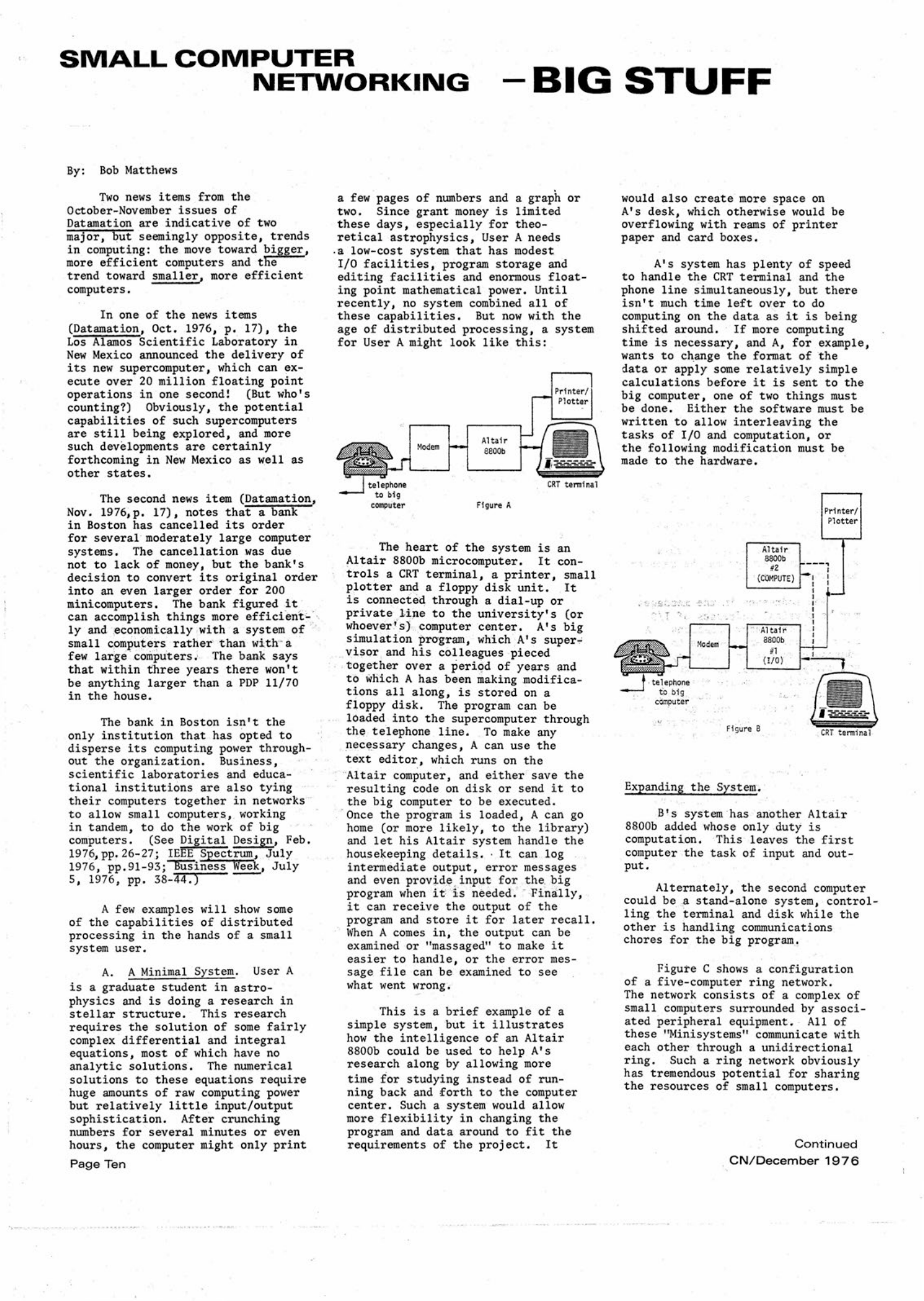
S!V!ALL COMPUTER
NETWORKING B)G STUFF
By: Bob Matthews
Two news items from the
October-November issues of
Datamation are indicative of two
major, but seemingly opposite, trends
in computing: the move toward bigger,
more efficient computers and tEe
trend toward smaller, more efficient
computers.
In one of the news items
(Datamation, Oct. 1976, p. 17), the
Los Alamos Scientific Laboratory in
New Mexico announced the delivery of
its new supercomputer, which can ex-
ecute over 20 million floating point
operations in one second! (But who's
counting?) Obviously, the potential
capabilities of such supercomputers
are still being explored, and more
such developments are certainly
forthcoming in New Mexico as well as
other states.
The second news item (Datamation,
Nov. 1976,p. 17), notes that a bank
in Boston has cancelled its order
for several moderately large computer
systems. The cancellation was due
not to lack of money, but the bank's
decision to convert its original order
into an even larger order for 200
minicomputers. The bank figured it
can accomplish things more efficient-
ly and economically with a system of
small computers rather than with a
few large computers. The bank says
that within three years there won't
be anything larger than a PDP 11/70
in the house.
The bank in Boston isn't the
only institution that has opted to
disperse its computing power through-
out the organization. Business,
scientific laboratories and educa-
tional institutions are also tying
their computers together in networks
to allow small computers, working
in tandem, to do the work of big
computers. (See Digital Design, Feb.
1976,pp.26-27; IEEE Spectrum, July
1976, pp.91-93; Business Week, July
5, 1976, pp. 38-447)
A few examples will show some
of the capabilities of distributed
processing in the hands of a small
system user.
A. A Minimal System. User A
is a graduate student in astro-
physics and is doing a research in
stellar structure. This research
requires the solution of some fairly
complex differential and integral
equations, most of which have no
analytic solutions. The numerical
solutions to these equations require
huge amounts of raw computing power
but relatively little input/output
sophistication. After crunching
numbers for several minutes or even
hours, the computer might only print
Page Ten
a few pages of numbers and a graph or
two. Since grant money is limited
these days, especially for theo-
retical astrophysics, User A needs
a low-cost system that has modest
I/O facilities, program storage and
editing facilities and enormous float-
ing point mathematical power. Until
recently, no system combined all of
these capabilities. But now with the
age of distributed processing, a system
for User A might look like this:
Modem Altair
Modem 8800b
telephone
to big
computer Figure A
The heart of the system is an
Altair 8800b microcomputer. It con-
trols a CRT terminal, a printer, small
plotter and a floppy disk unit. It
is connected through a dial-up or
private Une to the university's (or
whoever's) computer center. A's big
simulation program, which A's super-
visor and his colleagues pieced
together over a period of years and
to which A has been making modifica-
tions all along, is stored on a
floppy disk. The program can be
loaded into the supercomputer through
the telephone line. To make any
necessary changes, A can use the
text editor, which runs on the
Altair computer, and either save the
resulting code on disk or send it to
the big computer to be executed.
Once the program is loaded, A can go
home (or more likely, to the library)
and let his Altair system handle the
housekeeping details. ' It can log
intermediate output, error messages
and even provide input for the big
program when it is needed. Finally,
it can receive the output of the
program and store it for later recall.
When A comes in, the output can be
examined or "massaged" to make it
easier to handle, or the error mes-
sage file can be examined to see
what went wrong.
This is a brief example of a
simple system, but it illustrates
how the intelligence of an Altair
8800b could be used to help A's
research along by allowing more
time for studying instead of run-
ning back and forth to the computer
center. Such a system would allow
more flexibility in changing the
program and data around to fit the
requirements of the project. It
would also create more space on
A's desk, which otherwise would be
overflowing with reams of printer
paper and card boxes.
A's system has plenty of speed
to handle the CRT terminal and the
phone line simultaneously, but there
isn't much time left over to do
computing on the data as it is being
shifted around. If more computing
time is necessary, and A, for example,
wants to change the format of the
data or apply some relatively simple
calculations before it is sent to the
big computer, one of two things must
be done. Either the software must be
written to allow interleaving the
tasks of I/O and computation, or
the following modification must be
made to the hardware.
CRT terminal
Printer/
Plotter
Altair
8S00b
#2
(COMPUTE) i
}
<
t
i "
)
i—
Modem
Altair
8800b
t
<
)
(I/O)
i
(I/O) t
telephone
to big
computer
Figure B CRT terminal
Expanding the System.
B's system has another Altair
8800b added whose only duty is
computation. This leaves the first
computer the task of input and out-
put.
Alternately, the second computer
could be a stand-alone system, control-
ling the terminal and disk while the
other is handling communications
chores for the big program.
Figure C shows a configuration
of a five-computer ring network.
The network consists of a complex of
small computers surrounded by associ-
ated peripheral equipment. All of
these "Minisystems" communicate with
each other through a unidirectional
ring. Such a ring network obviously
has tremendous potential for sharing
the resources of small computers.
Continued
CN/December 1976
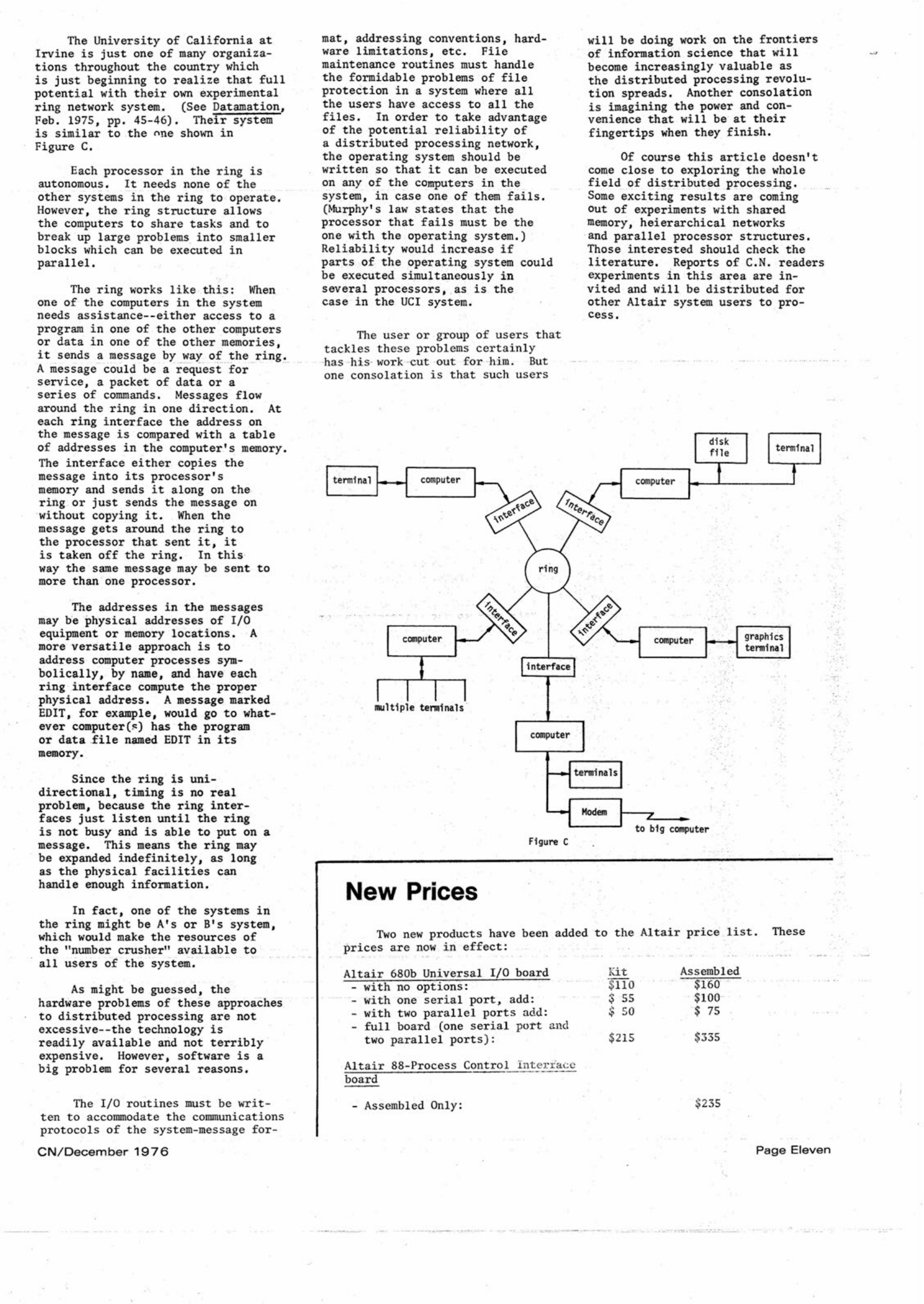
The University of California at
Irvine is just one of many organiza-
tions throughout the country which
is just beginning to realize that full
potential with their own experimental
ring network system. (See Datamation,
Feb. 1975, pp. 45-46). Their system
is similar to the <^ne shown in
Figure C.
Each processor in the ring is
autonomous. It needs none of the
other systems in the ring to operate.
However, the ring structure allows
the computers to share tasks and to
break up large problems into smaller
blocks which can be executed in
parallel.
The ring works like this: When
one of the computers in the system
needs assistance—either access to a
program in one of the other computers
or data in one of the other memories,
it sends a message by way of the ring.
A message could be a request for
service, a packet of data or a
series of commands. Messages flow
around the ring in one direction. At
each ring interface the address on
the message is compared with a table
of addresses in the computer's memory.
The interface either copies the
message into its processor's
memory and sends it along on the
ring or just sends the message on
without copying it. When the
message gets around the ring to
the processor that sent it, it
is taken off the ring. In this
way the same message may be sent to
more than one processor.
The addresses in the messages
may be physical addresses of I/O
equipment or memory locations. A
more versatile approach is to
address computer processes sym-
bolically, by name, and have each
ring interface compute the proper
physical address. A message marked
EDIT, for example, would go to what-
ever computerhas the program
or data file named EDIT in its
memory.
Since the ring is uni-
directional, timing is no real
problem, because the ring inter-
faces just listen until the ring
is not busy and is able to put on a
message. This means the ring may
be expanded indefinitely, as long
as the physical facilities can
handle enough information.
In fact, one of the systems in
the ring might be A's or B's system,
which would make the resources of
the "number crusher" available to
all users of the system.
As might be guessed, the
hardware problems of these approaches
to distributed processing are not
excessive—the technology is
readily available and not terribly
expensive. However, software is a
big problem for several reasons.
The I/O routines must be writ-
ten to accommodate the communications
protocols of the system-message for-
mat, addressing conventions, hard-
ware limitations, etc. File
maintenance routines must handle
the formidable problems of file
protection in a system where all
the users have access to all the
files. In order to take advantage
of the potential reliability of
a distributed processing network,
the operating system should be
written so that it can be executed
on any of the computers in the
system, in case one of them fails.
(Murphy's law states that the
processor that fails must be the
one with the operating system.)
Reliability would increase if
parts of the operating system could
be executed simultaneously in
several processors, as is the
case in the UCI system.
The user or group of users that
tackles these problems certainly
has his work cut out for him. But
one consolation is that such users
will be doing work on the frontiers
of information science that will
become increasingly valuable as
the distributed processing revolu-
tion spreads. Another consolation
is imagining the power and con-
venience that will be at their
fingertips when they finish.
Of course this article doesn't
come close to exploring the whole
field of distributed processing.
Some exciting results are coming
out of experiments with shared
memory, heierarchical networks
and parallel processor structures.
Those interested should check the
literature. Reports of C.N. readers
experiments in this area are in-
vited and will be distributed for
other Altair system users to pro-
cess .
terminal computer
terminal computer
dl
fi
sk
le terminal
to big computer
Figure C
New Prices
Two new products have been added to the Altair price list,
prices are now in effect:
These
Altair 680b Universal I/O board
- with no options:
- with one serial port, add:
- with two parallel ports add:
- full board (one serial port and
two parallel ports):
Altair 88-Process Control Interface
board
- Assembled Only:
Kit
$110
55
$215
Assembled
$160
$100
$ 75
$335
$235
CN/December 1976 Page
Thirteen
Have youwritten
for your
Attair
Computer ?
The Altair 8800 computer was the first micro
produce d for the genera) pubiic and remains number
one in sales, with more than 8,000 mainframes in
the field. The wide acceptance of the Altair computer
and its rapid adaptation to many diversified appli-
cations has truly turned the dream of the affordable
computer into a reality.
Yet the machine itself, remarkable as it is, repre-
sents only the beginning. The right Software,
tailored to meet a user's specific requirements, is
a vital part of any computer system. MITS wants
to insure that Altair users everywhere have the
best applications software available today and in
the future. For this reason, a new MITS subsidiary,
the ALTAIR SOFTWARE DISTRIBUTION COMPANY,
has been formed, its purpose: to acquire the highest
quality software possible and distribute it nationally
through Altair Computer Centers.
That's where you come in. The ASDC will pay
substantial royalties to the originators of all soft-
ware accepted into the ASDC library. If you have
written business, industrial or commercial use
software for the Altair 8800, ASDC wants to hear
from you. It is the aim of the ASDC to stimulate
and reward creativity in producing useful software
that makes those dreams of "computers for everyone"
come true. The ASDC will select only software that
measures up to its high standards for system
design, coding and documentation. The software
will then be further
uted through
ters around
For more
on how to
the ASDC,
AltairCom,
ASDC
documented and distrib-
Altair Computer Cen-
the country.
information
submit software to
askyour Local
puter Center for an
Software Submittal
or contact the ALTAI R
WARE DISTRIBUTION
COMPANY.
ALTA!R SOFTWARE D)STR!BUT!ON COMPANY
3330 Peachtree Road, Suite 343 Atlanta, Georgia 30326 404-231-2308
see nex+ oage for a listing of Altair Computer Centers
ALTAtR COMPUTER CENTERS
BEAVERTOM. OR 97005
8105 SW Nimbus Ave.
(503)644-2314
BERKELEY CA 94710
1044 University Ave.
(415)-845-5300
SANTA MONtCA, CA 90401
8 20 Broadway
(213)-451-0713
DENVER, CO 80211
2839 W. 44th Ave.
(303)-458-5444
ALBUQUERQUE, fs)M 87110
3120 San Mateo N.E.
(505 )-883-8 28 2,883-8 283
TUCSON, AZ 85711
4941 East 29th St.
(602)-748-7363
UNCOLN, NB68503
611 N. 27th St.
Suite 9
(402)-747-2800
UTTLEROCK. AR 72206
2412 Broadway
(501)-371-0449
TULSA, OK 74135
5 345 East Forty First St.
110 The Annex
(918)-664-4564
HOUSTON,TX77036
5750 Bint)iff Drive
(713)-780-8981
RtCHMOND. VA 23230
4503 West Broad St.
(804)335-5773
SPRtNGFtELD. VA 22150
6605A Backlick Rd
(703)-569-1110
CHARLESTON. W. VA 25301
Municipal Parking Building
Suite 5
(304)-345-1360
EAGAN, MN 55122
3938 Beau D'Rue Drive
(612)452-2567
ANN ARBOR, M) 48104
310 East Washington Street
!313)-995 7616 _
WtNDSOR LOCKS, CT06096
63 South Main Street
(203)-627-0188
PARKRtDGE, !L60068
517 Talcott Rd
(312)-823-2388
ST. LOUtS, MO 63130
8123-25 Page Blvd.
(314)-427-6116
NASHVtLLE, TN 37203
1600 Hayes St.
Suite 103
(615)-329-)979
BURHNGTON, MA01803
120 Cambridge St.
(617)-272-8770
ALBANY, NY 12211
269 Osborne Road
(518)-458-6140
NEW YORK, NY 10018
5 5 West 39th St.
(212)-221-1404
ATLANTA, GA 30305
3 330 Piedmont Road
(404)-231-1691
TAMPA. FL 33614
5405 B Southern Comfort Blvd.
(813)-886-9890
T.M.
w A
58
Number One in iow-cost computing.
Attair, from Mits, is the number one name in microcomputers for
home, business, persona) and industriat apptications.
Because the Attair was first, it has set the standard in the industry.
More Attair 8800 s are now operationa) than at) other
microcomputers combined.
Whether you buy a $395 comptete computer kit* or a mutti-disk
system for under $10,000; Mits wit) provide you with thorough and
tasting support. Satisfied Attair users inctude schoots, corporations,
smatt businesses, students, engineers, and hobbyists.
Attair hardware inctudes three microcomputers; the Attair 8800a,
8800b, and 680b. Mits has a comptete setection of Attair ptug-
compatibte memory and interface options, inc!uding the new Attair
16K Static board and Attair mutti-port seriat and parattet t/O boards.
Atso avaitabte is a comptete tine of Attair peripheral inctuding tine
printers, CRT s, and muitipte disk systems.
Attair software is by far the most comptete and best for any
microcomputer. Our Extended BAStCand Disk BAStC have
received industry wide acctaim for programming power and
efficiency. App)ication packages are avaitabte at many Attair
Computer Centers**
The Attair computer is a revoiution in tow cost computing. Shoutdn t
you write for more information inctuding our free, cotor catatogue.
*The Attair 680b turnkey mode).
**Retait Attair computer outtets now opened in many targe cities.
MtTS, !nc. 2450 A!amo S.E./Atbuquerque, New Mexico 87106
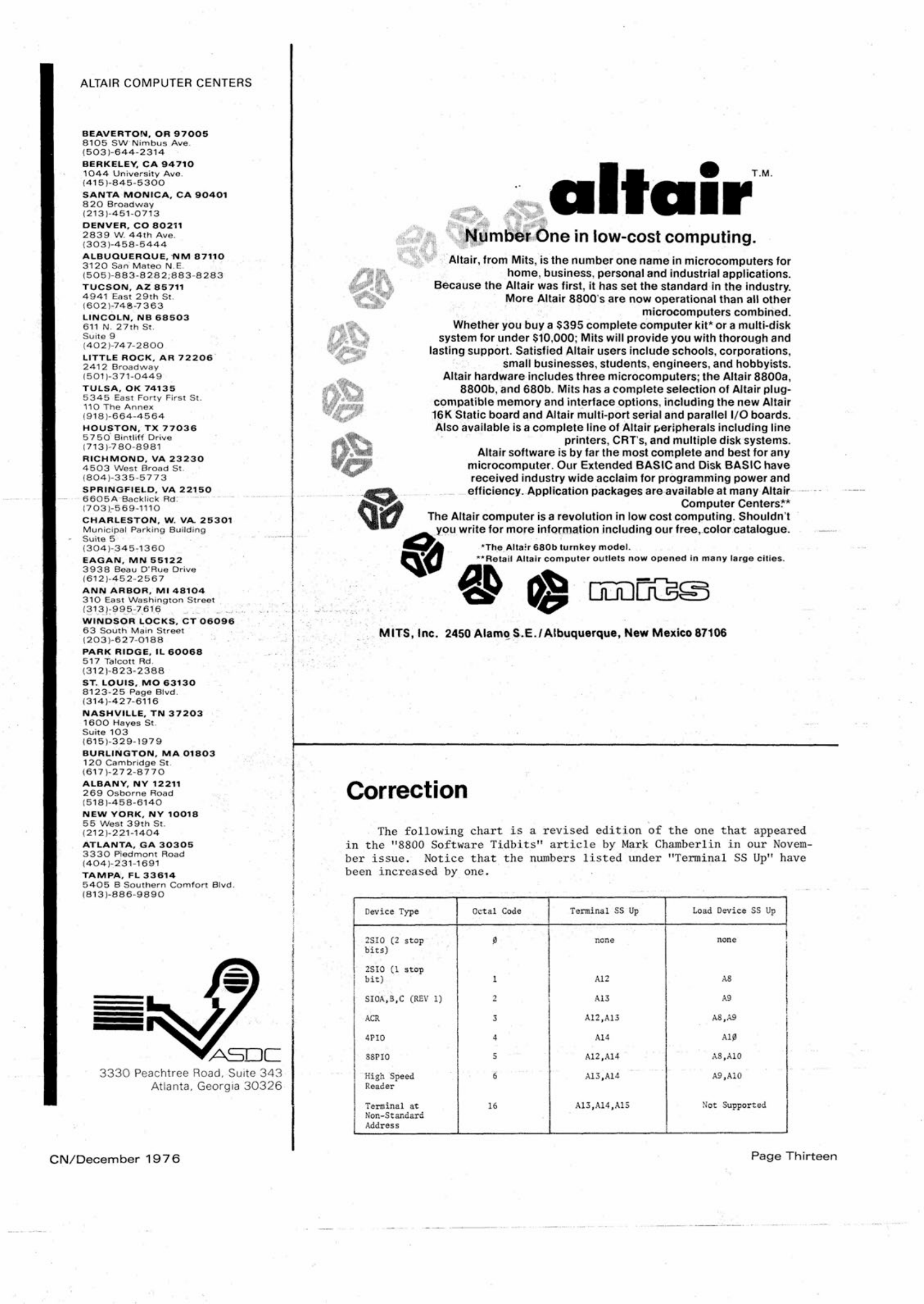
Correction
The following chart is a revised edition of the one that appeared
in the "8800 Software Tidbits" article by Mark Chamberlin in our Novem-
ber issue. Notice that the numbers listed under "Terminal SS Up" have
been increased by one.
3330 Peachtree Road, Suite 343
Atlanta, Georgia 30326
Device Type Octal Code Terminal SS Up Load Device SS Up
2SI0 (2 stop
bits)
none none
2SI0(istop
bit) 1 A12 A8
SI0A,B,C (REV 1) 2 A13 A9
ACR 3 A12.A13 A8.A9
4PI0 4 A14 A10
S8PI0 5 A12.A14 AS,A10
High Speed
Reader
6 A13,A14 A9,A10
Terminal at
Non-Standard
Address
16 A13,A14,A1S Not Supported
CN/December 1976 Page Thirteen
Q&A
Hardware
By Rich Haber and Bruce Fowler
Our new column, "Glitches,"
will appear regularly in C.N. and
will be devoted entirely to
answering hardware questions
submitted by our readers. Any
type of hardware question(s) is
welcome, and we'll try to answer
as many as space permits each
month. For this first column
we've chosen four topics frequently
asked about in the past.
1. Static/Dynamic Memory Boards
There still seems to be some
confusion, particularly among those
who are new to computers, about
the differences between our static
and Dynamic Memory Boards. Hope-
fully the following brief explana-
tion of the functions as well as
the advantages of each board will
clear up any confusion.
Our 4K Dynamic Memory Board
uses NMOS technology and has the
features of high speed and low
power consumption. Each memory
cell contains capacitive elements
which help to latch the data bits.
These cells must be recharged
about every 2 milliseconds, or
data will be lost. This recharge
or "refresh" cycle is accomplished
by counting up on address lines
A0-A5. The chipsare de-
signed so that reading one address
refreshes all the elements on
one row. There is one row for
each of the 64 combinations of
A0-A5. During this refresh cycle,
the board causes the CPU to
execute a "wait" state so that
the CPU doesn't attempt to read
data from memory while the
refresh process is in progress.
This refresh procedure and
the other housekeeping circuits
related to it require quite a
bit of extra circuitry on the
board. However, the dynamic
design of the board makes it
useful where low power consumption
is important.
The 4K Synchronous is our
new dynamic board which uses
existing timing pulses to
synchronize its operation. This
eliminates the single shots and
the need to "tune" the board.
It also eliminates the "wait"
state, because refresh occurs
when the CPU is taking care of
its own business.
Compared to Dynamic Boards,
the 4K Static Board has a
relatively simple design. The 4K
Static Board was designed with the
2102 lKxl chip, which was the best
chip available at the time. It's
still an excellent memory chip,
but it has only one-fourth the
storage capability of the 4060
dynamic chip. So, 32 ICs were
required to do the job of eight.
Page Fourteen
Even with the additional
circuitry required for address
decoding, the board still has a
very simple design. The in-
dividual cells behave as stable
switches and don't need to be
refreshed.
The disadvantages of the
board are that it's somewhat slower
and draws over twice as much
current as the Dynamic Board.
The advantages are low cost,
high reliability and no "wait"
states.
The 16K Static Boards are
extremely reliable storage
devices. They use the more
sophisticated 4200 4Kxl memory
chip. The board is designed so
that the chips are not selected,
except when they are read from or
written into. The result is that
the board requires the least
power and has the fastest access
time of any MITS board.
2. Sense Switches
We still get many questions
about sense switches and how to
use them. The sense switches
(Switches A8-A15 on the front
panel) represent a byte of data
that software can read and use to
select options.
These switches are hardwired
to input port 377 (Octal). There
is no control address associated
with sense switches, and output to
sense switches is not meaningful.
However, by doing an input
from address 377 (octal), the
current condition of switches A8-
A15 will be read as one byte of
data. A switch in the up position
represents a one. By software
manipulation, the condition of
any particular bit or switch
can be tested. A branch to a
different part of the program
can be made, depending on the
state of the switch.
For example, before Altair
BASIC responds with "MEMORY SIZE?"
on a terminal, it checks the sense
switches to see what input-output
board is being used. BASIC will
do an input on address 377 (octal).
Depending upon which sense switches
are up, BASIC will jump to a
specific address in memory. The
instructions at this address will
then tell it which I/O board to
respond on. Check page 97 of
the BASIC Manual to see which
sense switches correspond to
which boards.
A byte from sense switches
can be input by using machine
language (333 377) or by using
BASIC (INP (255)).
In terms of troubleshooting,
sense switches can be quite use-
ful. For example, the ASCII
equivalent of a letter can be put
on switches A8-A15. By inputting
sense switches and then output-
ting on a terminal input-output
data channel, the output function
of an input-output board can be
checked. For example, for a 2SI0
at channel 20 (octal) with A8 and
A14 up, the letter A should be
printed continuously when running
program 1, listed below:
Program 1:
076
003
323
020
076
021
323
020
333
020
017
322
010
000
333
377
323
021
303
010
000
Program outputs on data
address 021 (for 2SI0)
a character whose ASCII
code is on the sense switches.
The first 8 bytes initialize
the 2 SIO's ACIA.
Program 2 stores sense
switch pattern in location
000 040.
A similar program in BASIC that
prints out any cnanges m sense
switches is given on page 30 of
the Altair BASIC Manual.
The Repair department uses
program 2, listed below to test
IC U and T on the 8800A front
panel. Data input from the sense
switches is stored in location
000 040. If all ones are stored
in location 040, no matter which
sense switches are up, it usually
indicates a bad IC U and T.
Program 2:
333
377
062
040
000
303
000
000
Perhaps the most powerful
aspect of sense switches is the
ease at which they allow the pro-
grammer to input data to the comput-
er while it is running programs.
If software monitors the sense
switches, different programs can be
selected and executed depending
upon which sense switches are up.
3* Interchanging TTL Chips
Customer inquiries about the
possibility of interchanging TTL
chips are quite common in the repair
department. Most of the questions
come from customers who say that
they cannot purchase replacements
locally but still hope to get their
Altair computers up and running by
making substitutions. For
example, replacing a 74123 with
a 74L123 is an often asked about
substitution. However, this and
most other exchanges are un-
desirable and some can be destruc-r
tive.
Continued
CN/December 1976
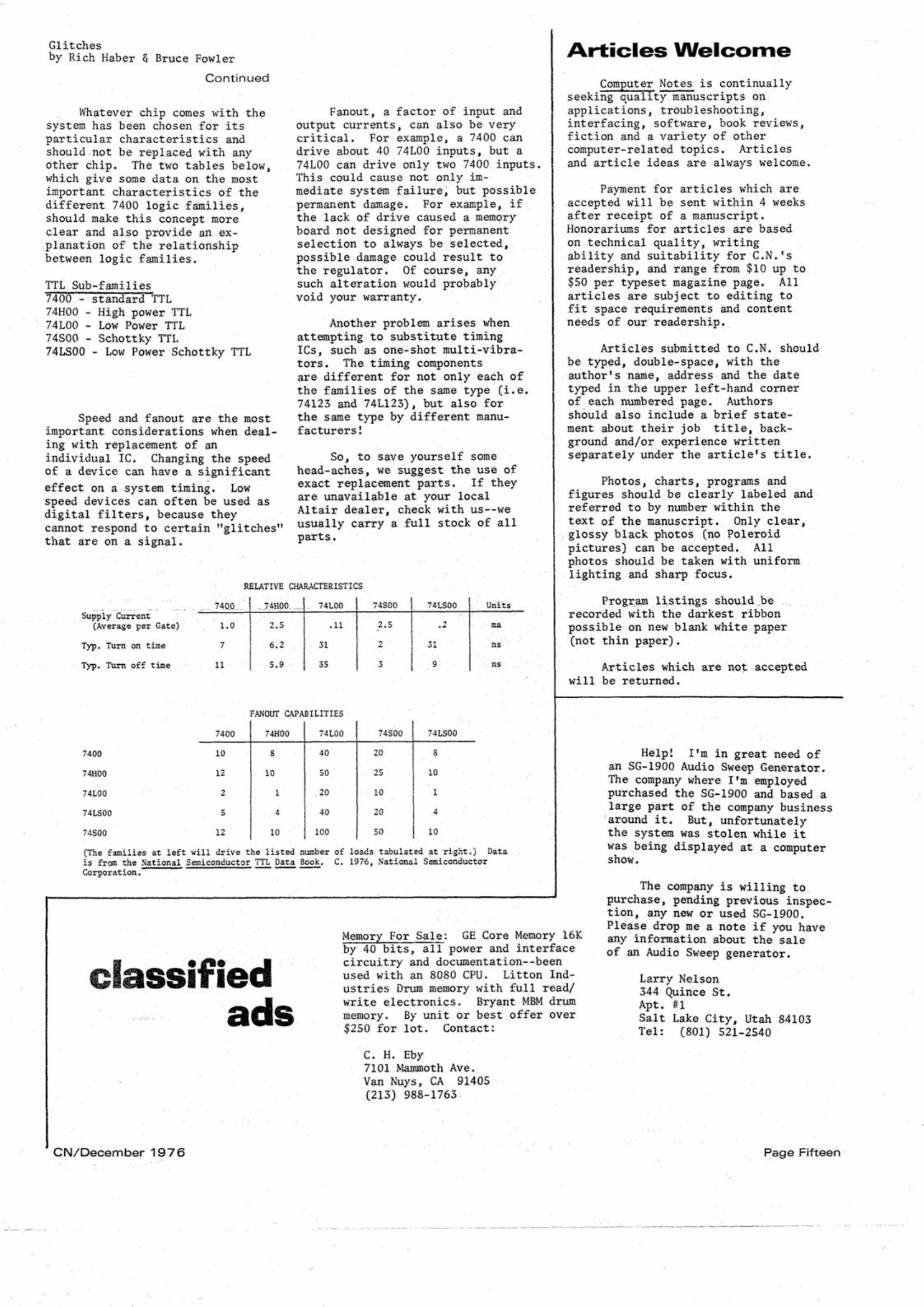
Glitches
by Rich Haber
§
Bruce Fowler
Continued
Whatever chip comes with the
system has been chosen for its
particular characteristics and
should not be replaced with any
other chip. The two tables below,
which give some data on the most
important characteristics of the
different 7400 logic families,
should make this concept more
clear and also provide an ex-
planation of the relationship
between logic families.
TTL Sub-families
7400 - standard TTL
74H00 - High power TTL
74LOO - Low Power TTL
74S00 - Schottky TTL
74LS00 - Low Power Schottky TTL
Speed and fanout are the most
important considerations when deal-
ing with replacement of an
individual IC. Changing the speed
of a device can have a significant
effect on a system timing. Low
speed devices can often be used as
digital filters, because they
cannot respond to certain "glitches"
that are on a signal.
Fanout, a factor of input and
output currents, can also be very
critical. For example, a 7400 can
drive about 40 74L00 inputs, but a
74L00 can drive only two 7400 inputs.
This could cause not only im-
mediat e system failure, but possible
permanent damage. For example, if
the lack of drive caused a memory
board not designed for permanent
selection to always be selected,
possible damage could result to
the regulator. Of course, any
such alteration would probably
void your warranty.
Another problem arises when
attempting to substitute timing
ICs, such as one-shot multi-vibra-
tors. The timing components
are different for not only each of
the families of the same type (i.e.
74123 and 74L123), but also for
the same type by different manu-
facturers
!
So, to save yourself some
head-aches, we suggest the use of
exact replacement parts. If they
are unavailable at your local
Altair dealer, check with us—we
usually carry a full stock of all
parts.
RELATIVE CHARACTERISTICS
7400 74H00 74L00 74S00 74LS00 Units
Supply Current .2
(Average per Gate) 1.0 2.5 .11 2.5 .2 ma
Typ. Turn on time 7 6.2 31 2 31 ns
Typ. Turn off time 11 S.9 35 3 9 ns
PANOUT CAPA BILITIES
7400 74H00 74L00 74S00 74LS00
7400 10 S 40 20 S
74H00 12 10 50 25 10
74M0 2 1
,
20 10 1
74LS00 5 4 40 20 4
74S00 12 10 100 50 10
(The families at left will drive the listed number of loads tabulated at right.) Data
is from the National Semiconductor TTL Data Sock. C. 1976, National Semiconductor
Corporation.
Arties WeBcome
Computer Notes is continually
seeking quality manuscripts on
applications, troubleshooting,
interfacing, software, book reviews,
fiction and a variety of other
computer-related topics. Articles
and article ideas are always welcome.
Payment for articles which are
accepted will be sent within 4 weeks
after receipt of a manuscript.
Honorariums for articles are based
on technical quality, writing
ability and suitability for C.N.'s
readership, and range from $10 up to
$50 per typeset magazine page. All
articles are subject to editing to
fit space requirements and content
need s of our readership.
Articles submitted to C.N. should
be typed, double-space, with the
author's name, address and the date
typed in the upper left-hand corner
of each numbered page. Authors
should also include a brief state-
ment about their job title, back-
ground and/or experience written
separately under the article's title.
Photos, charts, programs and
figures should be clearly labeled and
referred to by number within the
text of the manuscript. Only clear,
glossy black photos (no Poleroid
pictures) can be accepted. All
photos should be taken with uniform
lighting and sharp focus.
Program listings should be
recorded with the darkest ribbon
possible on new blank white paper
(not thin paper).
Articles which are not accepted
will be returned.
ada
Memory For Sale: GE Core Memory 16K
by 40 bits, all power and interface
circuitry and documentation--been
used with an 8080 CPU. Litton Ind-
ustries Drum memory with full read/
write electronics. Bryant MBM drum
memory. By unit or best offer over
$250 for lot. Contact:
C. H. Eby
7101 Mammoth Ave.
Van Nuys, CA 91405
(213) 988-1763
Help! I'm in great need of
an SG-1900 Audio Sweep Generator.
The company where I'm employed
purchased the SG-1900 and based a
large part of the company business
around it. But, unfortunately
the system was stolen while it
was being displayed at a computer
show.
The company is willing to
purchase, pending previous inspec-
tion, any new or used SG-1900.
Please drop me a note if you have
any information about the sale
of an Audio Sweep generator.
Larry Nelson
344 Quince St.
Apt. #1
Salt Lake City, Utah 84103
Tel: (801) 521-2540
CN/December 1976 Page
Thirteen
FtELD TESTING
THE
ALT/MR
SSOO
By Gene Dial
PA. P^Lf. ZA a. pAO^M^OA Za
^anbeA PACS MgMMfg^tgA.
A short time after completing
the assembly of my Altair 8800
computer and brushing up on BASIC,
I began to look for an opportunity
to field test it for reliability
and accuracy. This opportunity
presented itself with the Boulder
Country Club Frolics--an annual
golfing event in which members
teamed with guests from around the
country in achieving the golfing
and social highlight of the year.
Scoring presented
a
problem in
the manual mode. Points were to be
awarded on each hole by comparing
strokes required with the par value
of the hole, and then by adjusting
the gross count by
a
handicap-
derived "quota". After the first
day of play, the quota was adjusted,
plus or minus, by 50% of the points
earned the first day. Extending
128 players
by
18 holes, three days
of play, and two quota settings
indicated
a
need for almost 14,000
calculations based on about 7,000
data entries.
In the past this chore was
performed each evening by
a
commit-
tee of three with the help of an
adding machine. Accuracy required
agreement between three independent
evaluations of each score card,
or
some 41,000 calculations in the
manual mode, plus redundant check-
ing to resolve divergent evaluations
of the same card. Obviously, the
club welcomed relief from this
formidable task. But it was also
wary of being screwed by the "blue
box". Reliability was more
at
issue than time.
I devised
a
user-oriented
program in which the layman-operator
was led through each sequence by
simple questions presented on the
screen, e.g., "DO YOU WANT TO INPUT
DAY-1 SCORES?", to which the opera-
tor would respond with
a
"Y"
or
"N". Having made
a
choice, the
screen would then provide the in-
structions to implement that choice.
The program wound its way even-
tually to the "Display Module".
In this mode,
a
series of displays
was selected which depicted names
of players, the handicaps of each,
the initial quota of each team,
1st day scores and points, revised
quotas, 2nd day scores and points,
finals, and Bulletins. All displays
were framed with appropriate heads,
were indexed so as to achieve
a
page-to-page effect, and were pro-
vided with an appropriate pause to
permit casual reading of each page.
I had assembled
a
television
interface kit (PIXIE-VERTER #PXV-
2A, available at Gateway's for
about $10), and with antenna line
splitters, connected the computer
to the club antenna system. This
produced
a
commercial quality sig-
nal on channel three to each of the
club's TV sets in several locations.
The display module sequenced
through its parts then looped
to
the beginning for as many loops
as
the operator requested. The times
required for each kind of loop were
presented on the screen so that the
operator could correctly judge the
required number of loops before
scores were scheduled to be received.
Such calculations were important
since the computer was intended to
be in the RUN mode for the three-
day period.
By way of preparation, members
of the Frolic's Committee were
given an orientation in
a
trial run
of the program. And, more impor-
tantly, the operator, the staff
executive of the committee, received
some 10-hours of practice over
a
three-week period.
The equipment.was installed
and checked out
a
day ahead of
time. Since
a
quiet, secure loca-
tion was desired, it ended up
in
a remote exercise room serviced
by
an extension cord from another room.
I was quite sure that cord would be
pulled during the three-day period
and memory would be lost, thus
indicating
a
need for adjustment
to my plans.
The machine performed well
in
the first hour only to produce gar-
bage in the second. The reason
became evident by the fact that
I
was sweating. By opening an exter-
ior door and installing two large
fans, the Altair and
I
returned
to
normal operation.
Scores were scheduled to be
received by the morning players
at
1 p.m., and by the evening group
at
5:30, each group to arrive at one
time since
a
shot-gun start was
being employed. Scores were to
be
inputted on-line in the RUN mode.
The screen would ask the team num-
ber, then for player number one
to
announce the hole number and ask
for an input. After scores for
18
holes had been provided, the same
sequence would be repeated for
player number two of the same team.
The screen would then ask if there
were more scores, and so on through
the end of scoring.
Unfortunately, the operator
became so proficient that he soon
anticipated the sequence and out-
raced the computer. This resulted
in being kicked out of RUN mode and
very often an inability to return
to it without loss of data. After
repeated inputs of the same scores
and the same results,
I
decided to
make
a
major revision in the program.
Such circumstances—surrounded by
two anxious golf pro's--are not the
best for programming. However,
it
was soon accomplished.
In the new mode, scores were
to be entered as program data
statements. This permitted casual
editing. After each group of
scores was entered,
a
tape was made
of the program, thus providing
back-up for the memory loss contin-
gency.
At least, this is the way
I
planned it. Implementation, how-
ever, presented new problems.
I
had exceeded my 24K of available
memory. Thoughts of rushing to
Gateway to borrow
a
4K board were
sequenced by
a
plan to divide the
program into two programs:
a
Scores
Input and Preliminary Processing
Program; and
a
Displays Program.
Two anxious golf pro's were
now joined by members of the Frolics
Committee as
I
began to disect the
program and to ferret out the UNDE-
FINED GOTO's, NEXT WITHOUT FOR's,
and RETURN'S WITHOUT GOSUB's.
I
can't recall that my programming
ever got so much attention.
In an hour or so it was done
and the new procedures, including
provision for back-up recordings,
were implemented. Smiles all
around, sighs of relief, and the
room thinned out. It was going
well. Now,
I
could use some com-
pany.
During the remainder of the
three days, each golf pro checked
out on the system and became expert
at inputting and processing scores;
the turn-around from receipt
of
first score to reporting results
in Display Mode on video was re-
duced to 45 minutes; and,
I
was
plied with free booze (hour after
hour) and food by
a
much relieved
Frolics Committee.
The programs are now preserved
on tape and hard copy, notes have
been set down on procedures, and
all-in-all,
I
look forward to
a
free ride next year.
One final note, the computer
emerged without error in 19 score
challenges presented during the
three days. In each case, other
factors--the golfer's ability to
calculate, most prominently—were
at fault. The Altair reliability
and accuracy index rose signifi-
cantly in my mind as
a
result
of
this field trial.
Page Sixteen CN/December 1976
