2019 Planning Guide For Data And Analytics
User Manual:
Open the PDF directly: View PDF  .
.
Page Count: 46

11/9/2018 2019 Planning Guide for Data and Analytics
https://www.gartner.com/document/3891182?ref=solrAll&refval=211515390&qid=0f5411af5054316f61da2bcad2d7bcb2 1/46
Licensed for Distribution
This research note is restricted to the personal use of Saurabh Gupta (saurabh.gupta@ge.com).
2019 Planning Guide for Data and Analytics
Published 5 October 2018 - ID G00361501 - 66 min read
By Analysts Carlton Sapp, Daren Brabham, Joseph Antelmi, Henry Cook, Thornton Craig, Soyeb Barot,
Doreen Galli, Sumit Pal, Sanjeev Mohan, George Gilbert
Supporting Key Initiative is Data and Analytics Programs
New data and analytics strategies promise to accelerate digital transformation, but success will
depend on the variety of complementary architectures. Technical professionals must shift from
fixed, rigid architectures to flexible data and analytics portfolios to better adapt to future
demand.
More on This Topic
This is part of an in-depth collection of research. See the collection:
Overview
Key Findings
2019 Planning Guide Overview: Architecting Your Digital Ecosystem■
Data and analytics will drive business operations through a variety of design patterns that combine
multiple architectural styles. Technical professionals must use a “portfolio-based” approach to
delivering an end-to-end data and analytics architecture.
■
More advanced analytics will continue to spread to places where it never existed before — from
mobile devices to an onslaught of endpoints. Meeting the demand will require a combination of
integration styles that deliver at the optimal point of impact.
■
Artificial intelligence and machine learning will generate new synergies in information
management, and play greater roles in complementing sections of the data and analytics
architecture to optimize information management strategies.
■
Data-driven business trends continue to offer great opportunities to raise the profile of data
professionals. However, they also bring the need for new skills and architectures, and continue to
challenge traditional methods and processes.
■

11/9/2018 2019 Planning Guide for Data and Analytics
https://www.gartner.com/document/3891182?ref=solrAll&refval=211515390&qid=0f5411af5054316f61da2bcad2d7bcb2 2/46
Recommendations
To deliver an effective data and analytics program, technical professionals should:
Data and Analytics Trends
More organizations are realizing the impact of data and analytics on business strategy and
operations. However, fewer organizations are successful at exploring new ways to analyze, interpret
and take advantage of data to drive competitive business advantages. The reason for this failure is
simple: Organizations continue to drown in data without a plan to deal with the expected growth of
data. This fruitless trend will continue unless technical professionals act now in preparing for future
demand.
Data and analytics are showing no signs of slowing down. Data volume, variety and velocity continue
to increase as business needs intensify. To help organizations capitalize on the opportunities that
this information can reveal, data and analytics are taking on a more active and dynamic role in
powering the activities of the entire organization, not just reflecting where it’s been. More and more
organizations are becoming truly “data-driven.”
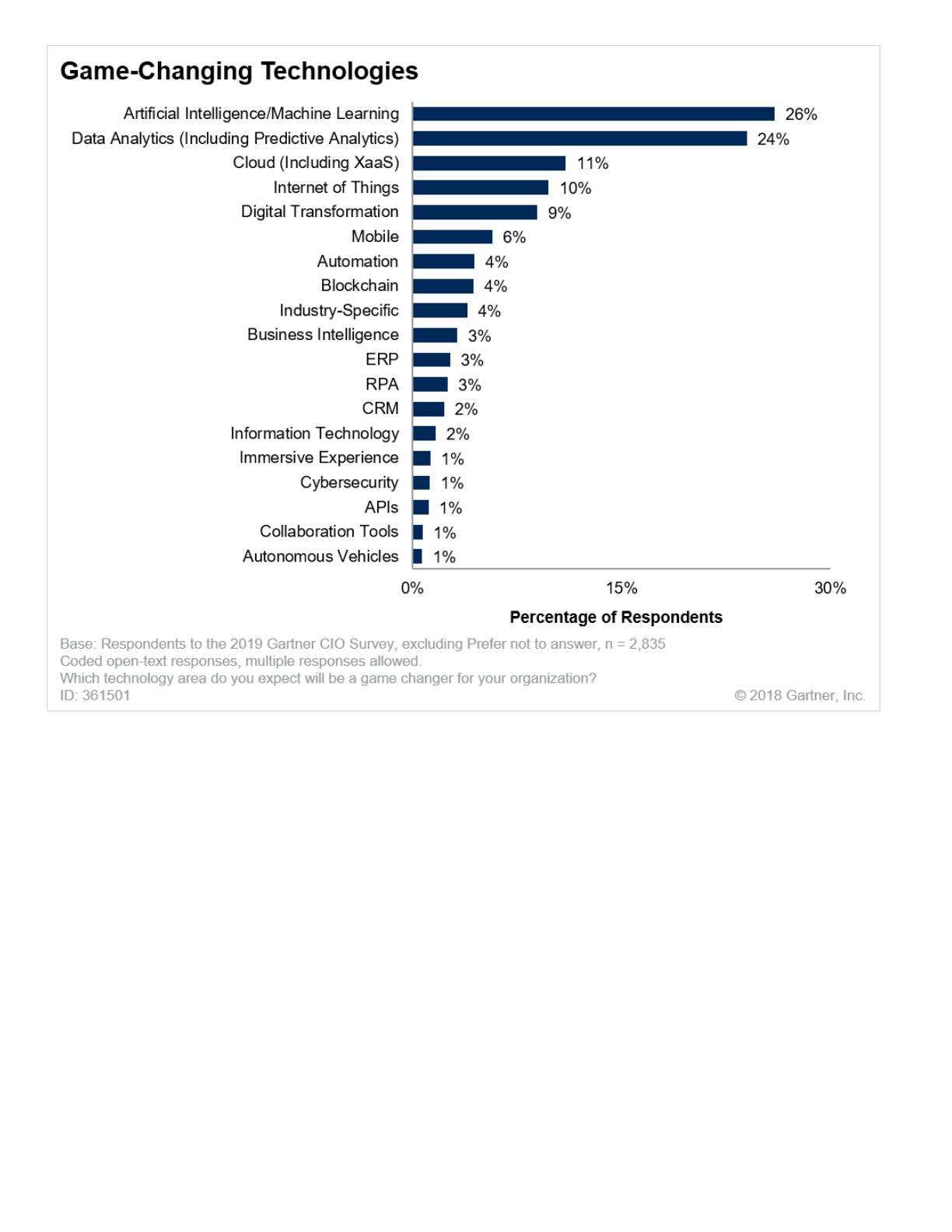
In a recent Gartner survey of CIOs, 1 artificial intelligence (AI) and machine learning (ML) together
were identified as the technology category having the most potential to change the organization over
the next five years (see Figure 1). Related categories, such as data analytics, also garnered
significant attention. Taken together, AI/ML and data analytics represent a trend that can’t be
ignored: Analytics will drive significant innovation and disrupt established business models in the
coming years.
Figure 1. Analytics’ Potential to Drive Organizational Change
Combine architectural styles into a portfolio-based approach to building end-to-end data and
analytics architectures. Use the architecture outlined in this document as a baseline.
■
Shift your focus from collecting data to embedding analytical functionality in existing applications
and integrating that functionality into custom product offerings.
■
Use ML as a tool to solve information management challenges. Start with invoking ML within the
logical data warehouse to augment data ingestion strategies.
■
Embrace new roles driven by rising business demand for analytics. Develop technical and
professional effectiveness skills to support the end-to-end architecture vision.
■
11/9/2018 2019 Planning Guide for Data and Analytics
https://www.gartner.com/document/3891182?ref=solrAll&refval=211515390&qid=0f5411af5054316f61da2bcad2d7bcb2 3/46
Source: Gartner (October 2018)
Many organizations claim that their business decisions are data-driven. But they often focus on
reporting key performance metrics based on historical data — and on using analysis of these metrics
to support and justify business decisions that will, hopefully, lead to desired business outcomes.
While this approach is a good start, it is no longer enough.
Data and analytics are at the center of every competitive business, and are
most effective when they are properly integrated into new or existing
business processes.

11/9/2018 2019 Planning Guide for Data and Analytics
https://www.gartner.com/document/3891182?ref=solrAll&refval=211515390&qid=0f5411af5054316f61da2bcad2d7bcb2 4/46
Data and analytics are no longer used just to support decision making; they are increasingly infused
in places they haven’t existed before. Today, data and analytics are:
Data and analytics continue to expand their role as the “brain” of the intelligent enterprise. They are
becoming proactive as well as reactive, and coordinating a host of decisions, interactions and
processes in support of business and IT outcomes.
To prepare for this trend, technical professionals must manage the end-to-end data and analytics
process holistically. For several years, Gartner has recommended that organizations deploy a logical
data warehouse (LDW) as a balance to dynamically integrating relevant data across heterogeneous
platforms, rather than collecting all data in a monolithic warehouse. Key business benefits can be
achieved by applying advanced analytics to these vast sources of data — and by providing business
users with more self-service data access and analysis capabilities.
In 2019, we expect these trends to progress to the next level:
In 2019, forward-thinking IT organizations will encourage “citizen” and specialist users by deploying
self-service integration and analytics capabilities. They will also focus IT efforts on operationalizing
and scaling analytics within the context of the organization’s broader technology infrastructure. To
enable their organizations’ algorithmic potential, technical professionals must work to ensure that an
arsenal of analytics is integrated into the fabric of autonomous processes, services and applications.
Pervasive Data and Analytics Will Continue to Demand a Comprehensive End-to-End
Architecture Using a Portfolio-Based Approach
Shaping and molding external and internal customer experiences, based on predicted preferences
for how each individual and group wants to interact with the organization
■
Driving business processes, not only by recommending the next best action, but also by triggering
those actions automatically
■
Fueling AI and ML to better scale businesses through intelligent systems
■
Pervasive data and analytics will continue to demand a comprehensive end-to-end architecture
using a portfolio-based approach.
■
Organizations will invest to make analytics ubiquitous.
■
AI and ML will generate new synergies in information management.
■
Analytics services in the cloud will continue to accelerate to deliver greater performance at scale.
■
Revolutionary changes in analytics will drive IT to adopt new technologies and roles.
■

11/9/2018 2019 Planning Guide for Data and Analytics
https://www.gartner.com/document/3891182?ref=solrAll&refval=211515390&qid=0f5411af5054316f61da2bcad2d7bcb2 5/46
The volume, variety and velocity of data in today’s business world continue to increase. Inexpensive
computing at the edge of the enterprise enables a huge amount of information to be captured and
processed. Be it video from closed-circuit cameras, temperature data from an Internet of Things (IoT)
solution or RFID packets indicating product locations in a retailer’s warehouse, the variety of data
presents major challenges.
In addition, diverse sources of external, often cloud-based data are now being used to enrich
customer, prospect and partner understanding. In some cases, a tipping point is reached where the
gravity of data skews toward external, rather than internal, data.
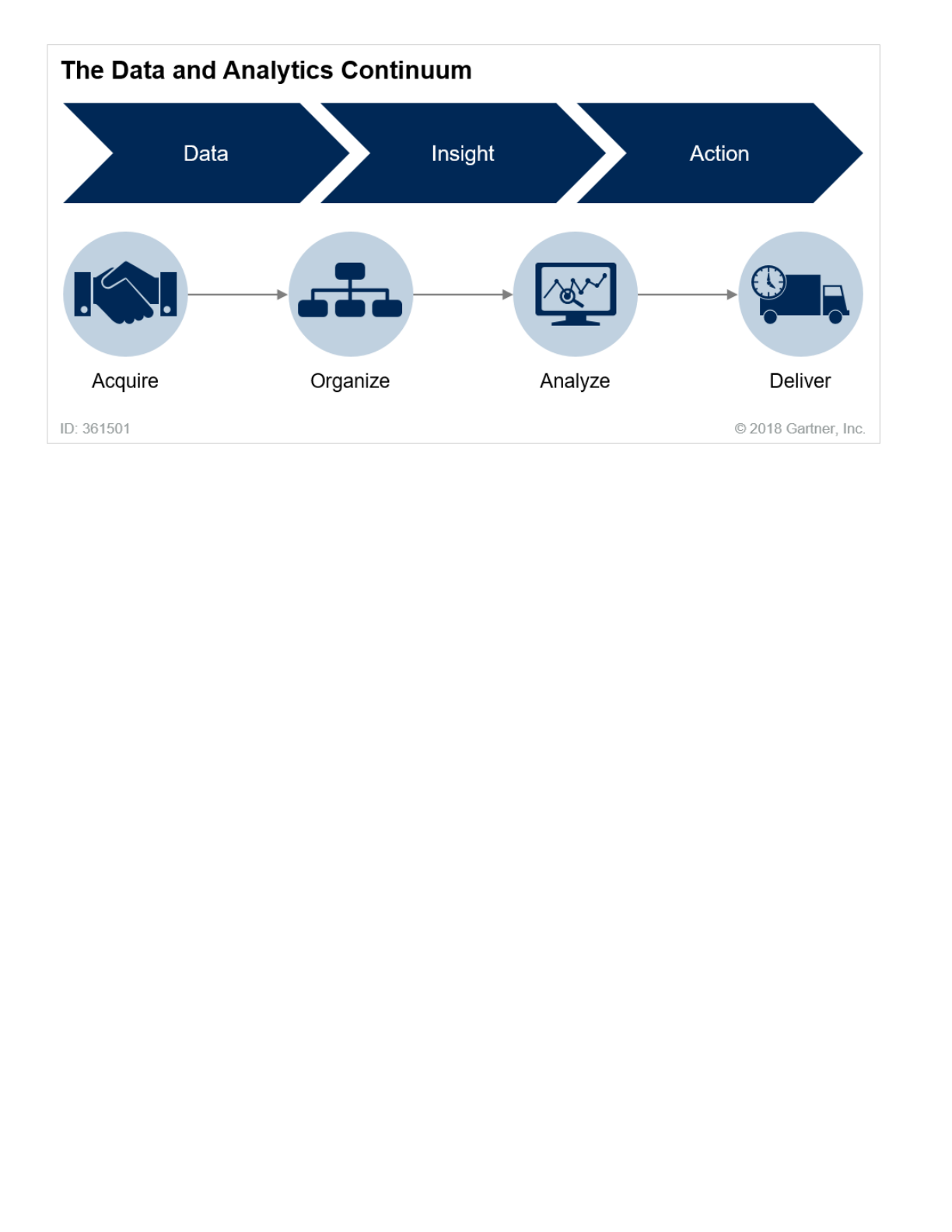
These changes will force IT to envision a revitalized data and analytics continuum that incorporates
diverse data and that can deliver “analytics everywhere” (see Figure 2). Some enterprises are
capturing all data in hopes of uncovering new insights and spurring possible actions. Others are
starting with the end goals in mind, after all the data has been generated for a specific purpose. This
allows them to streamline the process and manage an end-to-end architecture that supports specific
desired outcomes.
The complex and forever-changing requirements of analytics have created a
scenario in which no one architectural style is sufficient to execute all
required analytical use cases. To meet future demand, a more proactive and
coordinated data and analytics strategy founded on a repository of
architectural styles will be required.
Figure 2. The Data and Analytics Continuum
11/9/2018 2019 Planning Guide for Data and Analytics
https://www.gartner.com/document/3891182?ref=solrAll&refval=211515390&qid=0f5411af5054316f61da2bcad2d7bcb2 6/46
Source: Gartner (October 2018)
Data, insight and action no longer represent separate disciplines, regardless of the approach. Many
companies already combine them. The technical professional must fuse them into one architecture
that encompasses the following:
Data acquisition, from anywhere the information is generated. An important aspect of acquisition
is integration and combining the acquired data, regardless of type of data (structured versus
unstructured), its velocity, or its veracity (especially for macroanalysis — the result of multiple data
analytics results combined together).
■
Organization of that data — for example, by using the multiengine LDW analytical architecture. The
LDW can form the core to connect to data as needed, as well as collect it into efficient physical
data servers. This theme of “collect and connect” is a major trend.
■
Analysis of data when and where it makes most sense. This can include reporting, tactical and ad
hoc querying, data visualization, ML, and more.
■
Delivery of insights and data at the optimal point of impact to:
■
Support human activities with just-in-time insights.
■
Embed analysis into business processes that are capable of performing some action.
■
Analyze data as it streams into the enterprise and automatically take action based on the
results.
■
11/9/2018 2019 Planning Guide for Data and Analytics
https://www.gartner.com/document/3891182?ref=solrAll&refval=211515390&qid=0f5411af5054316f61da2bcad2d7bcb2 7/46
This change doesn’t mean that organizations should discard all of their traditional data and analytics
techniques and approaches and replace them with new ones. The shift will be gradual and
incremental — but also inevitable. Increasingly, analytics will drive business processes, not simply
analyze them after the fact.
Planning Considerations
In 2019, technical professionals must build a data management and analytics architecture that can
support changing and varied data and analysis needs. This architecture must accommodate both
traditional data analysis and newer analytics techniques. It should be modular by design to
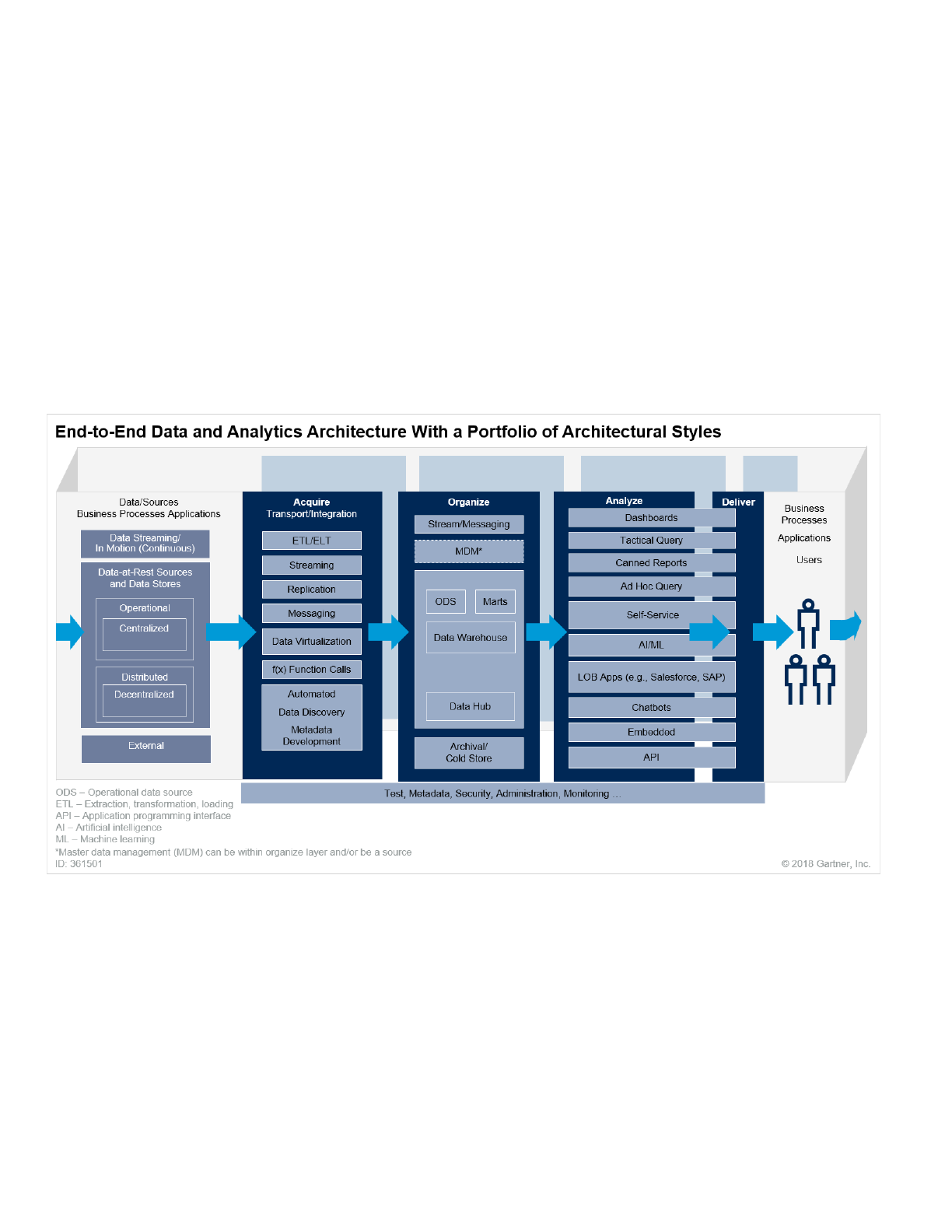
accommodate mix-and-match configuration options as they arise. Figure 3 shows a high-level
representation of such an architecture. This fits in with the major layers shown in Figure 2.
Figure 3. End-to-End Data and Analytics Architecture With a Portfolio of Architectural Styles
Source: Gartner (October 2018)
This is not intended to be prescriptive, as not every organization will have all the components.
Architecting the system in layers helps to address numerous issues. Not all of the layers may be
activated all of the time; however, to meet the demand of future requirements, technical
professionals should use this architecture to build a portfolio of solutions to support various use
cases.
Other, related planning considerations for technical professionals in 2019 include the need to:
Extend the data architecture to acquire streaming and cloud-born external data.
■

11/9/2018 2019 Planning Guide for Data and Analytics
https://www.gartner.com/document/3891182?ref=solrAll&refval=211515390&qid=0f5411af5054316f61da2bcad2d7bcb2 8/46
Extend the Data Architecture to Acquire Streaming and Cloud-Born External Data
The “acquire” stage in Figure 3 embraces all data, providing the raw materials needed to enable
downstream business processes and analytics activities. For example, IoT requires data and
analytics professionals to proactively manage, integrate and analyze real-time data. Internal log data
often must be inspected in real time to protect against unauthorized intrusion, or to ensure the health
of the technology backbone. Strategic IT involvement in sensor and log data management on the
technology edge of the organization will bring many benefits, including enhanced analytics and
improved operations. There should be a clear business purpose behind holding and processing this
data. Other streaming sources, like social media feeds, bring more real-time data processing
requirements while supporting additional business use cases. There should be a clear business
purpose behind holding and processing any stream of data.
Data is the raw material for any decision.
Organizations must shift their focus from getting data in and hoping someone uses it, to determining
how to best get information out to the people and processes that will gain value from it.
The sheer volume of data can clog data repositories if technical professionals subscribe to a “store
everything” philosophy. For example, ML algorithms can assess incoming streaming data at the edge
and decide whether to store, summarize or discard it.
In-stream processing is emerging as a method for performing data quality, analytics and
transformations as the data moves throughout the organizational pipeline. Certain use cases, like live
analytics or real-time data cleansing, can be done in-stream and offloaded from target systems,
allowing less persistence of data outside the stream.
The system architect should centralize most of the data quality. It is likely that data transformation
and quality is a large part of the processing. Also, it is likely that a lot of your data is structured data
that makes up a large amount of your reporting. In this case, it is simply more productive — and
Modernize your data integration layer by enabling greater data delivery styles.
■
Develop a virtualized data organization layer to connect to data as well as collect it.
■
Develop a comprehensive analytics environment that spans from traditional reporting to
prescriptive analytics.
■
Deliver data and analytics at the optimal point of impact.
■

11/9/2018 2019 Planning Guide for Data and Analytics
https://www.gartner.com/document/3891182?ref=solrAll&refval=211515390&qid=0f5411af5054316f61da2bcad2d7bcb2 9/46
better from a governance point of view — to do this once. Then you can let everyone share the
results. It makes no sense to force every analyst to do this for themselves.
A holistic understanding of how the data will be used is another key aspect of the end-to-end thinking
required to determine whether and when to store data.
Beyond streaming data, considerable value-added content is available from third parties. Syndicated
data comes in a variety of forms, from a variety of sources. Examples include:
Businesses have been leveraging this type of data for years, often getting a fee-based periodic feed
directly from the data provider. Today, however, increasing quantities of this data are available
through cloud services — to be accessed whenever and wherever needed. A data and analytics
architecture that can embrace these new forms of data in a dynamic manner is essential to providing
the contextual information needed to support a data-driven digital business. For more information on
the types of data available, see “Understand the Data Brokerage Market Before Choosing a Provider.”
(https://www.gartner.com/document/code/334439?ref=grbody&refval=3891182)
Modernize Your Data Integration Layer by Enabling Greater Data Delivery Styles
Data integration requirements are becoming increasingly diverse. They now demand real-time
streaming, replication and virtualized capabilities, in addition to the more traditional bulky/batch data
movement principles. To address the challenge of a disjointed data integration infrastructure,
technical professionals should build a more “portfolio-based” approach to data integration.
The data integration discipline comprises the practices, architectural techniques and tools that
ingest, transform, combine and provide data across the spectrum of information types (within
enterprises and beyond) to meet the data consumption requirements of applications and business
processes.
A mass proliferation of data associated with the rise of IoT, big data and digital business means that
data integration teams, tools and architectures are under constant pressure to deliver integrated
data:
Consumer data from marketing and credit agencies
■
Geolocation data for population and traffic information
■
Weather data to enhance predictive algorithms, for purposes such as improving public safety or
forecasting retail shopping patterns
■
Risk management data for insurance
■
At variable latencies (not simply fixed in batches or in real time)
■

11/9/2018 2019 Planning Guide for Data and Analytics
https://www.gartner.com/document/3891182?ref=solrAll&refval=211515390&qid=0f5411af5054316f61da2bcad2d7bcb2 10/46
For more information, see “The State and Future of Data Integration: Optimizing Your Portfolio of
Tools to Harness Market Shifts.” (https://www.gartner.com/document/code/297000?
ref=grbody&refval=3891182)
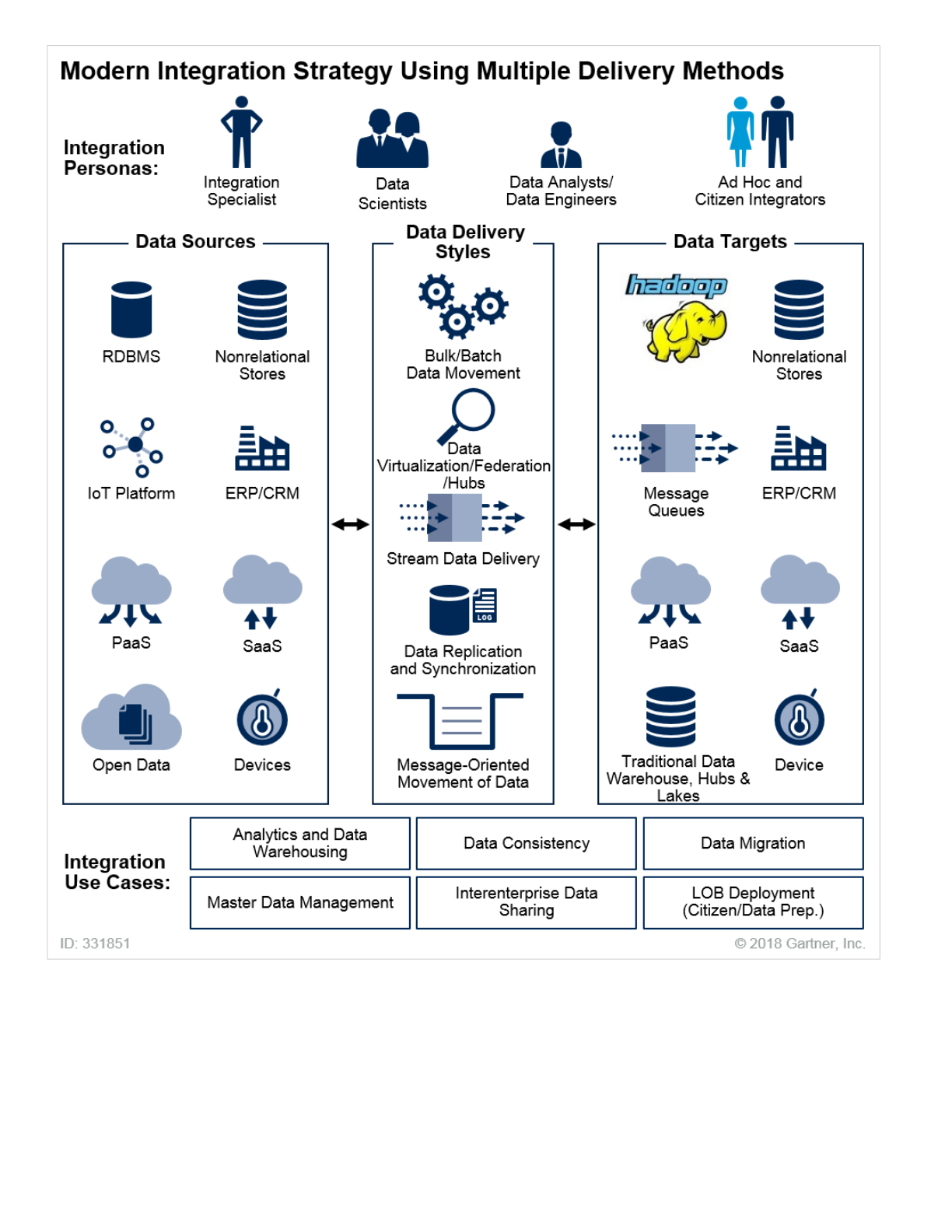
Figure 4 illustrates the point that a modern data integration strategy needs a combination of data
delivery styles.
Figure 4. Modern Data Integration Strategy Using Multiple Delivery Methods
Across all deployment scenarios (“edge,” IoT, on-premises, in the cloud or hybrids of all of these)
■
For all required data sources and types (not just structured, but also multistructured)
■
Across all use-case scenarios (not just for analytics, but also for operational requirements)
■
For all user personas (not just integration specialists, but also business users and citizen
integrators)
■
11/9/2018 2019 Planning Guide for Data and Analytics
https://www.gartner.com/document/3891182?ref=solrAll&refval=211515390&qid=0f5411af5054316f61da2bcad2d7bcb2 11/46
Source: Gartner (October 2018)
Data delivery styles for modern data integration challenges may include:
Bulk/batch
■
Message-oriented data movement
■

11/9/2018 2019 Planning Guide for Data and Analytics
https://www.gartner.com/document/3891182?ref=solrAll&refval=211515390&qid=0f5411af5054316f61da2bcad2d7bcb2 12/46
Develop a Virtualized Data Organization Layer to Connect to Data and Collect It
To deal with the many different uses, varieties, velocities and volumes of data today, IT must employ
multiple data stores across cloud and on-premises environments. However, IT cannot allow these
multiple data stores to prevent the business from obtaining actionable intelligence. By employing an
LDW approach, organizations can avoid creating a specialized infrastructure for unique use cases,
such as big data. The LDW provides the flexibility to accommodate any number of use cases using a
variety of data stores and processing frameworks. Big data is no longer a separate, siloed, tactical
use case; it is simply one of many use cases that the architecture can accommodate to enable the
digital enterprise.
The LDW integrates three analytics development styles: the classic data
warehouse, an agile approach with data virtualization and the data lake.
The core of the “organize” stage of the end-to-end architecture is the LDW (see “Solution Path for
Planning and Implementing the Logical Data Warehouse”
(https://www.gartner.com/document/code/320563?ref=grbody&refval=3891182) ). An LDW:
Data replication
■
Change data capture (CDC)
■
Data synchronization
■
Data virtualization
■
Data hubs
■
Streaming/event data delivery
■
Provides a modern, scalable data management architecture that can support the data and
analytics needs of the digital enterprise.
■
Supports an incremental development approach that leverages the existing enterprise data
warehouse architecture and techniques in the organization.
■
Establishes a shared data access layer that logically relates data, regardless of source.
■

11/9/2018 2019 Planning Guide for Data and Analytics
https://www.gartner.com/document/3891182?ref=solrAll&refval=211515390&qid=0f5411af5054316f61da2bcad2d7bcb2 13/46
Building the LDW and the end-to-end analytics architecture will require technical professionals to
combine technologies and components that provide a complete solution. This process requires
significant data integration and an understanding of data inputs and existing data stores. The many
technical choices available for building the LDW can be overwhelming. The key is to choose and
integrate the technology that is most appropriate for the organization’s needs. This work needs to be
done by technical professionals who specialize in data integration. Hence, 2019 will see the
continued rise of the data architect role.
Many clients still directly access many data sources using point-to-point integration. This means that
any changes in data sources can have a disruptive impact. Although it’s not always possible to stop
all direct access to data, shared data access can minimize the proliferation of one-off direct access
methods. This is especially true for use cases that require data from multiple data sources.
To increase the value of shared data access, organizations should:
Although technical professionals can custom code the shared data access layer, commercial data
virtualization tools provide many advantages over a custom approach. These advantages include
comprehensive connectors, advanced performance techniques and improved sustainability. Gartner
recommends that clients deploy these virtualization tools to create the data virtualization layer on
top of the LDW. Providers that offer stand-alone data virtualization middleware tools include Cisco,
Denodo, IBM, Informatica, Information Builders, Oracle and Red Hat.
Tools that can be leveraged for data virtualization may already exist in your organization. Business
analytics (BA) tools typically offer embedded functions for this purpose. However, these tools are
unsuitable as long-term, comprehensive, strategic solutions for providing a data access layer for
analytics. They tend to couple the data access layer with specific analytical tools in a way that
prevents the integration logic or assets from being leveraged by other tools in the organization.
To increase the value of shared data access, organizations should:
Define a business glossary, and enable traceability from data sources to the delivery/presentation
layer.
■
Use various levels of certification for data integration logic, thereby creating a healthy ecosystem
that enables self-service data integration and analytics.
■
Take an incremental approach to building this ecosystem to avoid the failures of past “big bang”
approaches.
■
Define a business glossary, and enable traceability from data sources to the delivery/presentation
layer.
■
11/9/2018 2019 Planning Guide for Data and Analytics
https://www.gartner.com/document/3891182?ref=solrAll&refval=211515390&qid=0f5411af5054316f61da2bcad2d7bcb2 14/46
Develop a More Comprehensive Analytics Environment
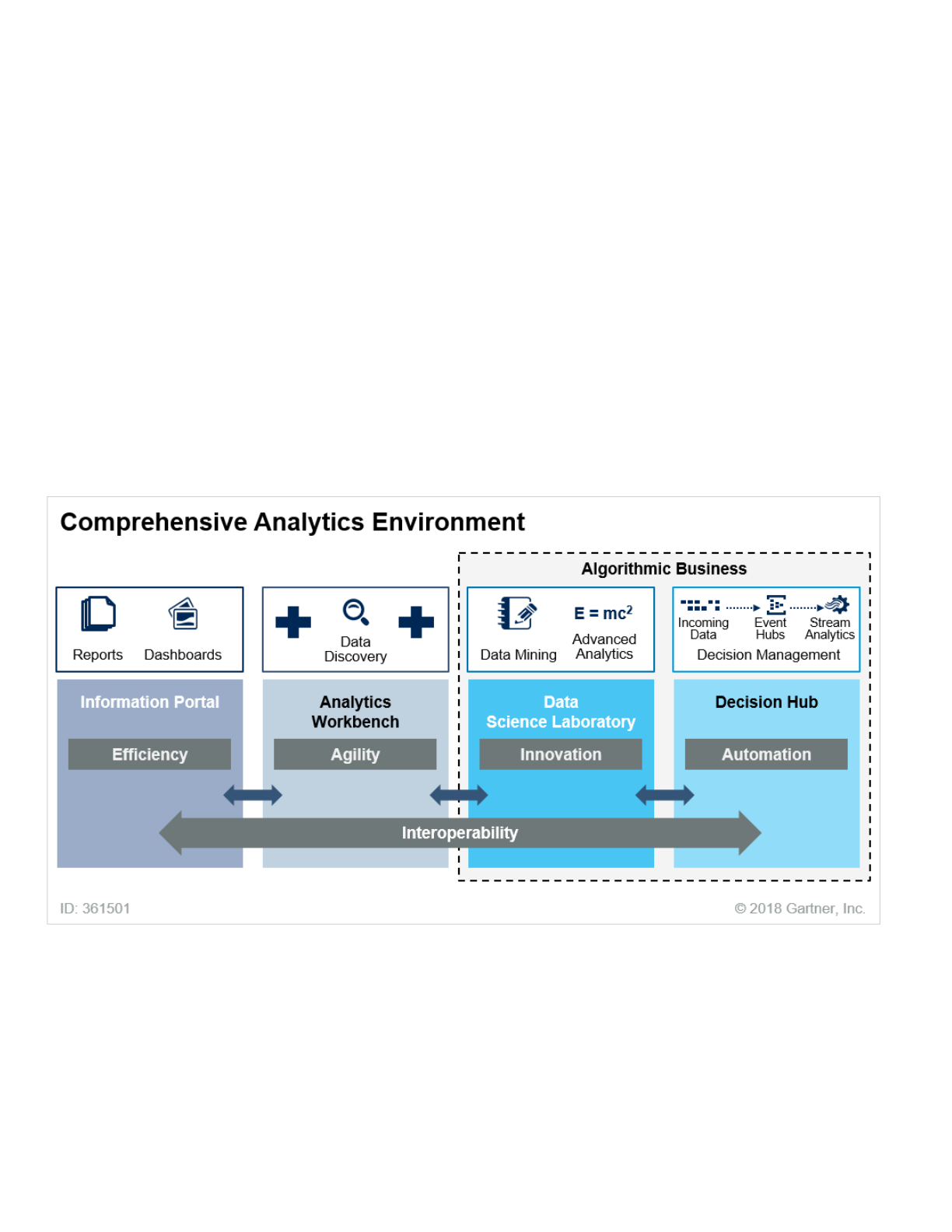
Comprehensive business analytics requires more than just providing tools that support analytics
capabilities (see Figure 5). There are likely to be several types of users, and therefore several tools —
possibly overlapping. However, this is preferable to trying to force-fit multiple user groups into using
the same tool.
Figure 5. It Is Normal to Require a Mix of Analytical Tools
Source: Gartner (October 2018)
Many components are needed to build out an end-to-end data architecture that encompasses:
Use various levels of certification for data integration logic, thereby creating a healthy ecosystem
that enables self-service data integration and analytics.
■
Take an incremental approach to building this ecosystem, to avoid the failures of past “big bang”
approaches.
■
Use automated data and metadata discovery tools to detect and manage copies of data across
the organization.
■
Delivery and presentation of analyses
■
Data ingestion and transformation
■
Data stores
■
11/9/2018 2019 Planning Guide for Data and Analytics
https://www.gartner.com/document/3891182?ref=solrAll&refval=211515390&qid=0f5411af5054316f61da2bcad2d7bcb2 15/46
The “analyze” phase of the end-to-end architecture can be simple for some. However, as demand for
predictions and real-time reactions grows, this phase can become increasingly multifaceted.
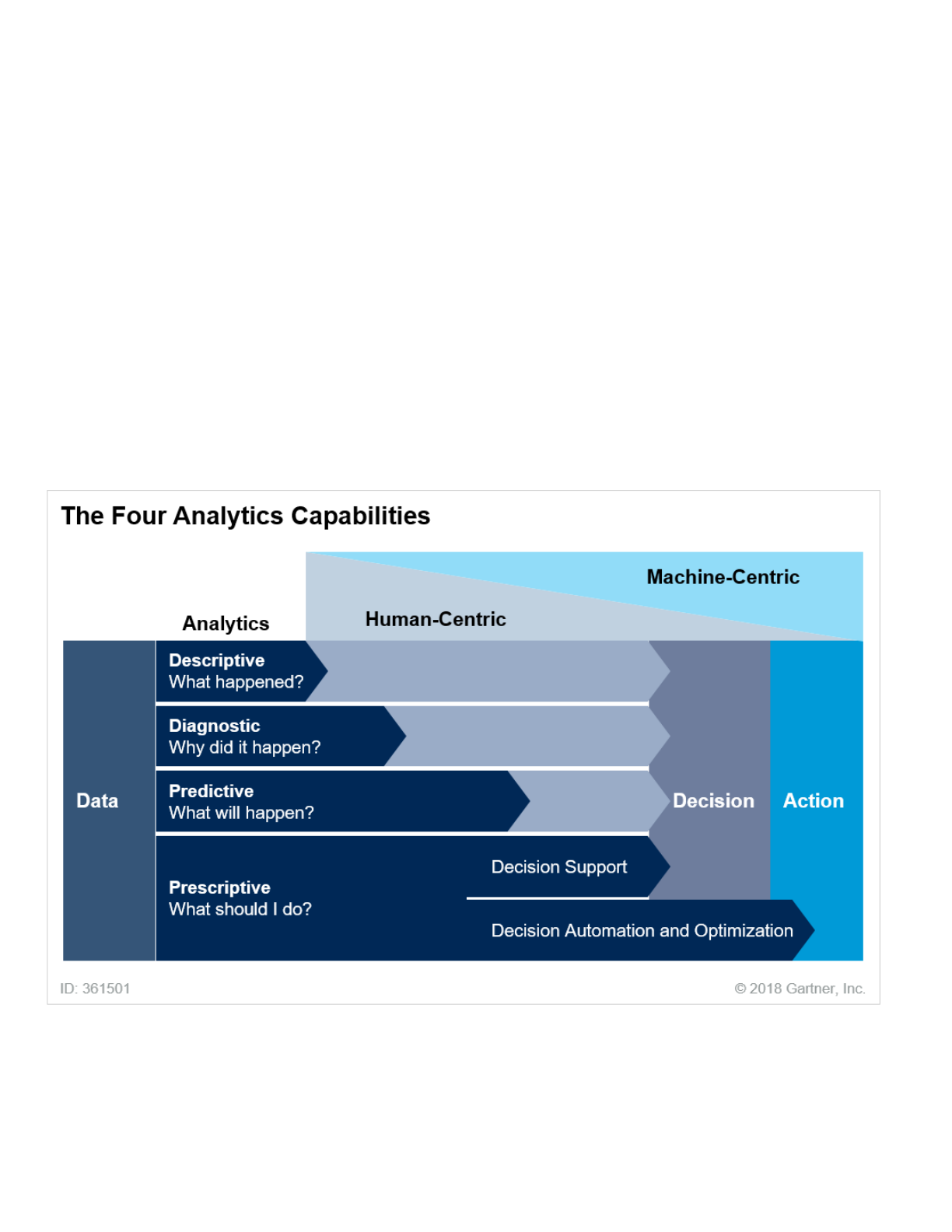
The range of analytics capabilities available goes beyond traditional data reporting and analysis (see
Figure 6). Although Gartner estimates that a vast majority of organizations’ analytics efforts (and
budgets) are spent on descriptive and diagnostic analytics, a significant part of that work is now
handled by business users doing their own analysis. This work often occurs outside the realm of the
sanctioned IT data and analytics architecture. Predictive and prescriptive capabilities, on the other
hand, are usually focused within individual business units and are not widely leveraged across the
organization. That mix must change.
Figure 6. The Four Analytics Capabilities
Source: Gartner (October 2018)
Organizations will need to provide more business and IT institutional support for advanced analytics
capabilities. In digital businesses, however, activities will be interactively guided by data, and
processes will be automatically driven by analytics and algorithms. IT organizations must invest in
ML, data science, AI and cognitive computing to automate their businesses. This automated decision
Collaboration on results
■
Integration with enterprise business applications
■

11/9/2018 2019 Planning Guide for Data and Analytics
https://www.gartner.com/document/3891182?ref=solrAll&refval=211515390&qid=0f5411af5054316f61da2bcad2d7bcb2 16/46
making and process automation will represent a growing percentage of future investment and
innovation.
Data and analytics professionals must embrace these advanced capabilities and be prepared to
enable and integrate them for maximum impact. Programmatic use of advanced analytics (as
opposed to a sandbox approach) is also on the rise, and must be managed as part of an end-to-end
architecture.
Deliver Data and Analytics at the Optimal Point of Impact
The “deliver” phase of the end-to-end data and analytics architecture is often overlooked. For years,
this activity has been traditionally equated with simply producing reports, interacting with
visualizations or exploring datasets. But those actions involve only human-to-data interfaces and are
managed by BA products and services. Analytics’ future will increasingly be partly human-interaction-
based and partly machine-driven.
An expanding mesh of rich connections between devices, things, services,
people and businesses demands a new approach to data delivery.
Key considerations in the delivery of analyzed information include:
Devices and gateways. Users can subscribe to content and have it delivered to the mobile device
of their choice, such as a tablet or a smartphone. Having access to the right information, in the
optimal form factor, increases adoption and value. For example, retail district managers may need
to access information about store performance and customer demographics while they are in the
field, without having to open a laptop, connect to a network and retrieve analysis.
■
Applications. Organizations can embed in-context analytics within applications to enrich users’
experiences with just-in-time information that supports their activities. For example, a service
technician could view a snapshot of a customer’s past service engagements and repairs while
diagnosing the cause of a problem. Applications can also be automated using predictions
generated by analytics processes running behind the scenes. One example is IoT-connected
equipment: Diagnostics can be assessed in near real time to determine whether a given machine
is at risk of failure and in need of maintenance.
■
Processes. The output of an analytics activity — be it in real time or in aggregate — can
recommend the next step to take. That result, coupled with rules as to what to do when specific
conditions are met, can automate an operational process. For example, if a sensor in a refrigerated
■

11/9/2018 2019 Planning Guide for Data and Analytics
https://www.gartner.com/document/3891182?ref=solrAll&refval=211515390&qid=0f5411af5054316f61da2bcad2d7bcb2 17/46
The range of analytics options must be integrated into the fabric of how you work. We address the
“how” aspect of this planning more fully in the next section.
Organizations Will Invest to Make Analytics Ubiquitous
The “data-driven” mantra is nothing new, but organizations still struggle to overcome established
practices and supplant them with new analytics processes. Decisions should no longer be left to gut
instinct. Instead, decisions and actions should be based on facts, with algorithms used to predict
optimal outcomes.
Use analytics to proactively make decisions that drive action and influence
the future course of the organization.
In general, analytics are becoming more pervasive in business. More people want to engage with
data, and more interactions and processes need analytics to automate and scale. Use cases are
exploding in the core of the business, on the edges of the enterprise and beyond. This trend goes
beyond traditional analytics, such as data visualization and reports. Analytics services and
algorithms will be activated whenever and wherever they are needed. Whether to justify the next big
strategic move or to optimize millions of transactions and interactions a bit at a time, analytics and
the data that powers them are showing up in places where they rarely existed before. This is adding a
whole new dimension to the concept of “analytics everywhere.”
storage area indicates that the temperature is rising, analytics can determine whether a problem
exists and, if so, dispatch a technician to the site.
Data stores. Data generated from one analytics activity can be used in other analytics activities.
That is, the output of one activity can be the input to another. This is often the case when the
organization seeks to monetize its data to external audiences. Insights generated by acquire,
organize or analyze activities are output to another data store for eventual access by third parties
that need the data to support their decisions and actions. The emergence of connected business
ecosystems will drive even more of these changes.
■
Interfaces. By embedding AI into applications and designing a fit-for-digital architecture, one can
create unprecedented system integration, developing digital twin models and deploying advanced
human interfaces. These advanced interfaces may use natural language, be embedded as
chatbots or even use human voice interaction.
■

11/9/2018 2019 Planning Guide for Data and Analytics
https://www.gartner.com/document/3891182?ref=solrAll&refval=211515390&qid=0f5411af5054316f61da2bcad2d7bcb2 18/46
Not long ago, IT systems’ main purpose was to automate processes. Data was stored and then
analyzed to assess what had already happened. That passive approach has given way to a more
proactive, engaged model, where systems are architected and built around analytics. Today, analytics
capabilities are:
Massive amounts of data at rest have fueled innovative use cases for analytics. With the addition of
data in motion — such as sensor data streaming within IoT solutions — new opportunities arise to
use ML and AI, in real time, to assess, scrub and collect the most useful and meaningful information
and insights.
These developments do not mean that traditional analytics activities will cease to be important.
Business demand for self-service data preparation and analytics continues to accelerate, and IT
should enable these capabilities. As data and analytics expand to incorporate ecosystem partners,
this demand will also increase from outside the organization.
Planning Considerations
In 2019, technical professionals can expect even more emphasis on analytics as it is embraced
throughout the enterprise. The expansion from human-centric interaction to machine-driven
automation will have a profound impact on how analytics will be deployed.
Related planning considerations for technical professionals in 2019 include the need to:
Incorporate EIM and Governance for Internal and External Use Cases
Enterprise information management is an integrative discipline for structuring, describing and
governing information assets — regardless of organizational and technological boundaries — to
Embedded within applications (IoT, mobile and web) to assess data dynamically and enrich the
application experience
■
Just-in-time, personalizing the user experience in the context of what’s occurring in the moment
■
Running silently behind the scenes and orchestrating processes for efficiency and profitability
■
Incorporate enterprise information management (EIM) and governance for internal and external
use cases.
■
Integrate fragmented analytics initiatives to improve operations and scalability.
■
Prepare for the onrush of machine learning.
■
Enhance application integration skills to embed analytics everywhere.
■
Adopt agile database development strategies.
■

11/9/2018 2019 Planning Guide for Data and Analytics
https://www.gartner.com/document/3891182?ref=solrAll&refval=211515390&qid=0f5411af5054316f61da2bcad2d7bcb2 19/46
improve operational efficiency, promote transparency and enable business insight. As the data
sources for analytics increasingly reside outside of the analytics group’s or the organization’s control,
it becomes more important to assert just enough governance over all sources of analytics data to
enable new and existing use cases. All types of data must be included in an EIM architecture —
including structured data in traditional relational databases, semistructured and unstructured data
found in data lakes, and streams of data that have not yet landed.
Effective EIM synchronizes decisions between strategic, operational and
technical stakeholders, coordinating efforts to improve the organization’s
analytics capabilities.
An EIM program based on sound information governance principles is an effective tool for managing
and controlling the ever-increasing volume, velocity and variety of enterprise data to improve
business outcomes. EIM is increasingly needed in today’s digital economy. It remains a struggle,
however, to design and implement enterprisewide EIM and information governance programs that
yield tangible results. In 2019, a key question for technical professionals and their business
counterparts will be, “How do we successfully set up EIM and information governance?”
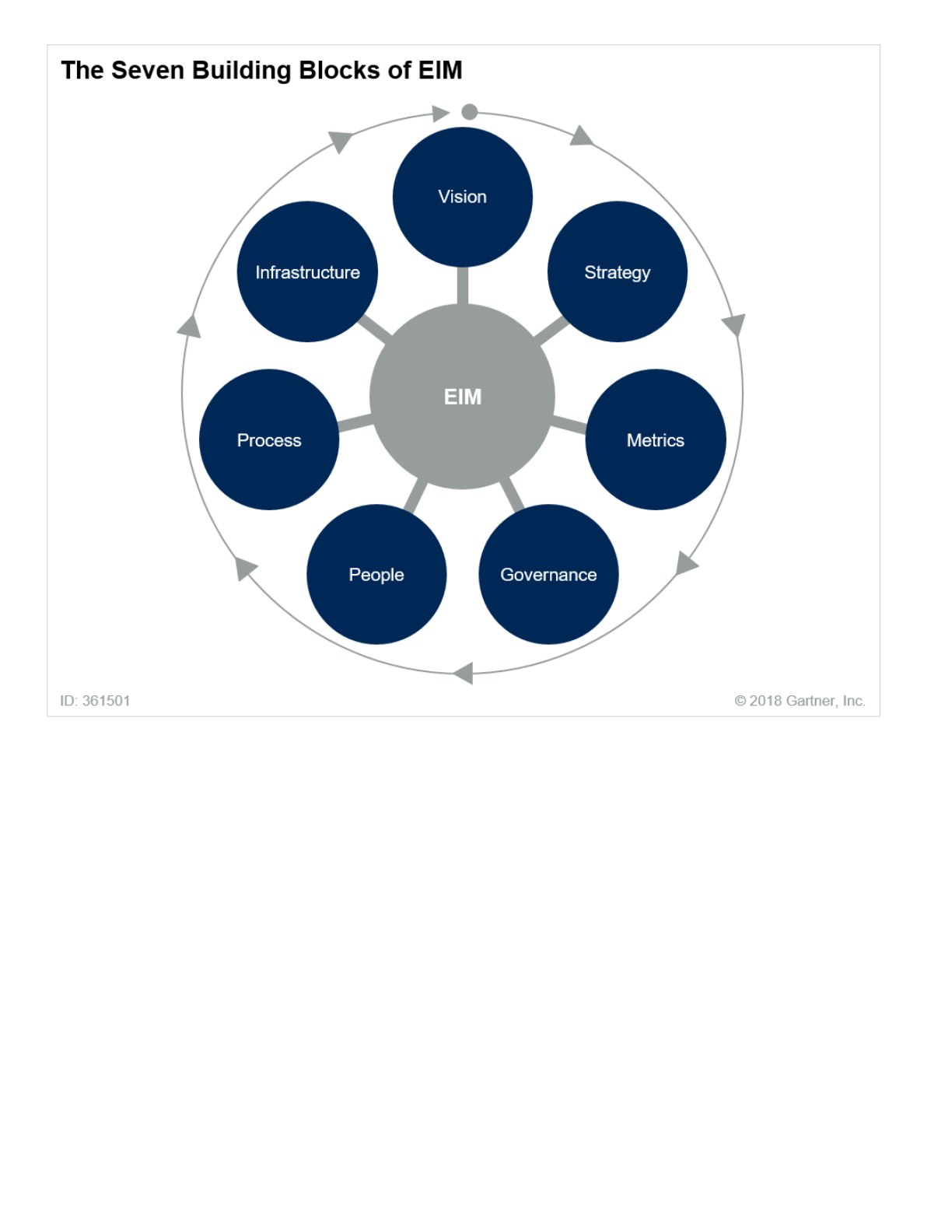
Most successful EIM programs start with one or more initial areas of focus, such as master data
management (MDM), data quality, data integration or metadata management initiatives. All EIM
efforts need to include the seven components of effective program management shown in Figure 7.
For more information on EIM, see “Solution Path for Planning and Implementing a Comprehensive
Architecture for Data and Analytics Strategies” (https://www.gartner.com/document/code/351281?
ref=grbody&refval=3891182) and “EIM 1.0: Setting Up Enterprise Information Management and
Governance.” (https://www.gartner.com/document/code/342309?ref=grbody&refval=3891182)
Figure 7. The Seven Building Blocks of EIM
11/9/2018 2019 Planning Guide for Data and Analytics
https://www.gartner.com/document/3891182?ref=solrAll&refval=211515390&qid=0f5411af5054316f61da2bcad2d7bcb2 20/46
Source: Gartner (October 2018)
Metadata should be added to support EIM. Metadata management is a supportive function that
helps to enable EIM and data governance programs. Organizations are leveraging toolsets to capture
technical and operational metadata to build the basis for data lineage and consumption. ML
algorithms deployed in these tools can crawl multiple types of data and build catalogs to support
both business processes and data governance functions.
For more details on metadata, see: “Deploying Effective Metadata Management Solutions.”
(https://www.gartner.com/document/code/347645?ref=grbody&refval=3891182)
Integrate Fragmented Analytics Initiatives to Improve Operations and Scalability
The growing range of new analytics use cases across organizational boundaries will drive the need
for fragmented analytics to improve operations and scalability.

11/9/2018 2019 Planning Guide for Data and Analytics
https://www.gartner.com/document/3891182?ref=solrAll&refval=211515390&qid=0f5411af5054316f61da2bcad2d7bcb2 21/46
Consider the following example: In a biotech firm, data scientists working in the genomics division
conduct their own small-scale analytics project that reveals some potentially transformative insights
for the company. However, they developed the algorithms used for their analysis on their laptops,
employing their own unique operating environment and programming languages. In this case, every
time an executive wants them to refresh that insight or analytics capability, the data scientists need
to run some data science routines on their own laptops, and pull data down from their own local
systems. This effort is labor-intensive and doesn’t scale well. If this implementation grows, it will
likely become increasingly unwieldy, and it will lack the organization’s standard controls in areas such
as data governance, privacy and security. If multiple efforts like this spring up throughout the
organization, problems and inefficiencies can multiply exponentially.
Many organizations have decided that they cannot wait for IT to deliver the data and intelligence they
need. They have instead forged ahead with their own initiatives — a situation that has led to “shadow
analytics” stacks and a certain degree of anarchy. Too many shadow analytics efforts can cause
issues such as data inconsistency, inefficiency and security breaches. To deal with this anarchy:
If IT does not act, then the IT organization will miss opportunities to identify — and eventually
operationalize — shadow analytics.
Technical professionals must shift and expand their role from being content
creators and data access controllers to user and data enablers.
IT professionals can empower business-led analytics with professional tooling and best practices,
helping to maximize ROI. Likewise, business analysts can team with IT to ensure business focus.
A key part of this effort is to facilitate a self-service data and analytics approach. For most
organizations, this will mean building an architecture to support different analytics and business
First, data-related technical professionals must discover where ad hoc analytics efforts have
sprung up in the enterprise. To do this, they need to reorient themselves to be more collaborative
and socially aware of these fragmented initiatives.
■
Technical professionals must then collaborate with business users to build the case for an
infrastructure and environment that will help business users effectively, safely and quickly perform
these analytics on their own. Additionally, by getting involved, technical professionals can not only
form relationships that will help track analytics activities, but also support those analytics
activities with data, resources, processes and frameworks.
■
11/9/2018 2019 Planning Guide for Data and Analytics
https://www.gartner.com/document/3891182?ref=solrAll&refval=211515390&qid=0f5411af5054316f61da2bcad2d7bcb2 22/46
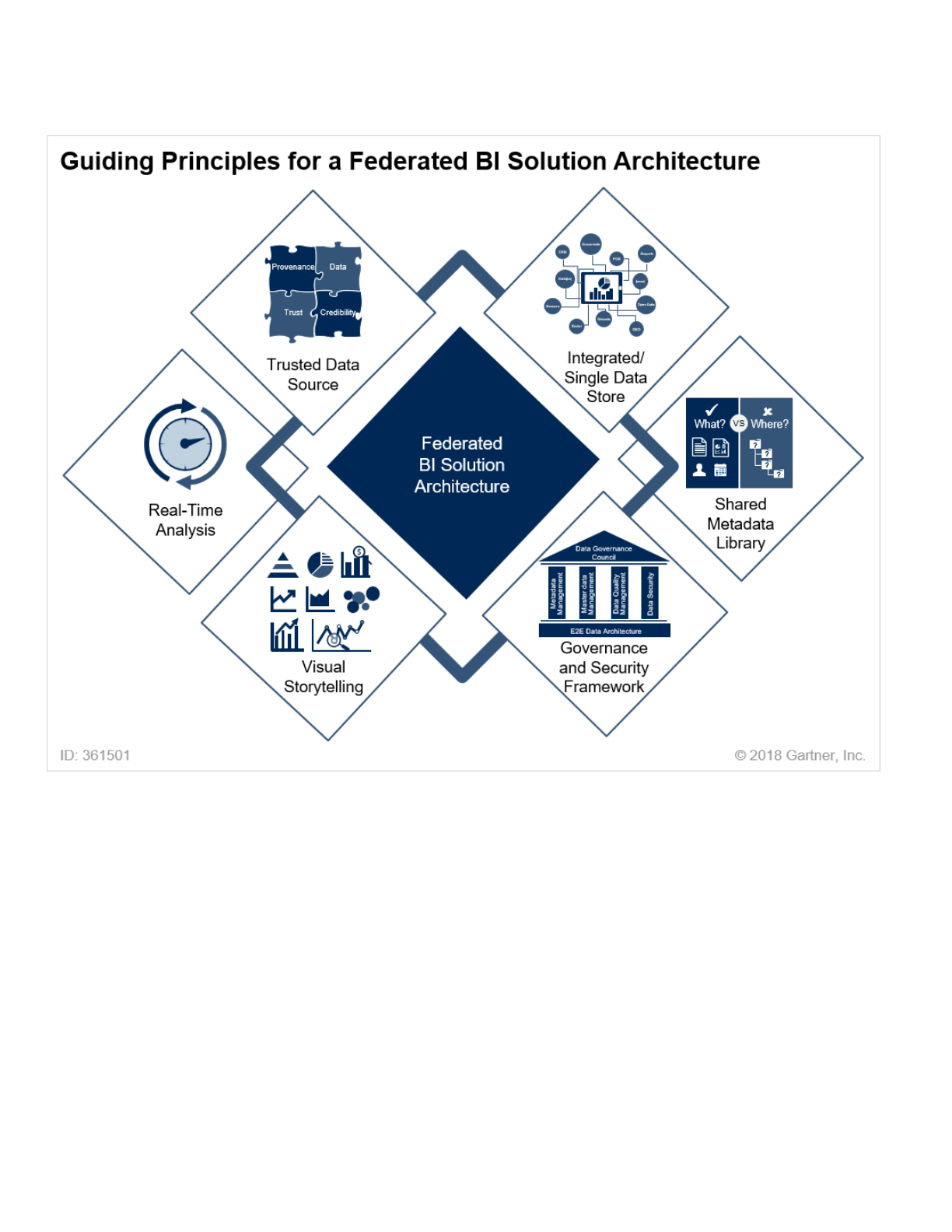
intelligence (BI) platforms for different users, as shown in Figure 8.
Figure 8. Guiding Principles for a Federated BI Solution Architecture
Source: Gartner (October 2018)
The architecture shown above should not be solely centralized or decentralized, but federated. The
guiding principles for a federated architecture are that it should have:
An integrated single data store: An LDW can provide a centralized data hub to store all the data,
help identify new relationships between data elements, and reduce data movement across
multiple data stores and analytical systems.
■
A shared metadata library: A centralized business glossary helps standardize data definitions.
Metadata, defined as the set of data that describes and provides context about the data elements,
can help support discovery and self-service analytics. Providing the ability to search and filter an
enriched metadata library helps users locate relevant information to use for further analysis. This
metadata library can be created via an automated process using profiling tools and ML-driven AI,
or it can be created manually with the help of data stewards.
■

11/9/2018 2019 Planning Guide for Data and Analytics
https://www.gartner.com/document/3891182?ref=solrAll&refval=211515390&qid=0f5411af5054316f61da2bcad2d7bcb2 23/46
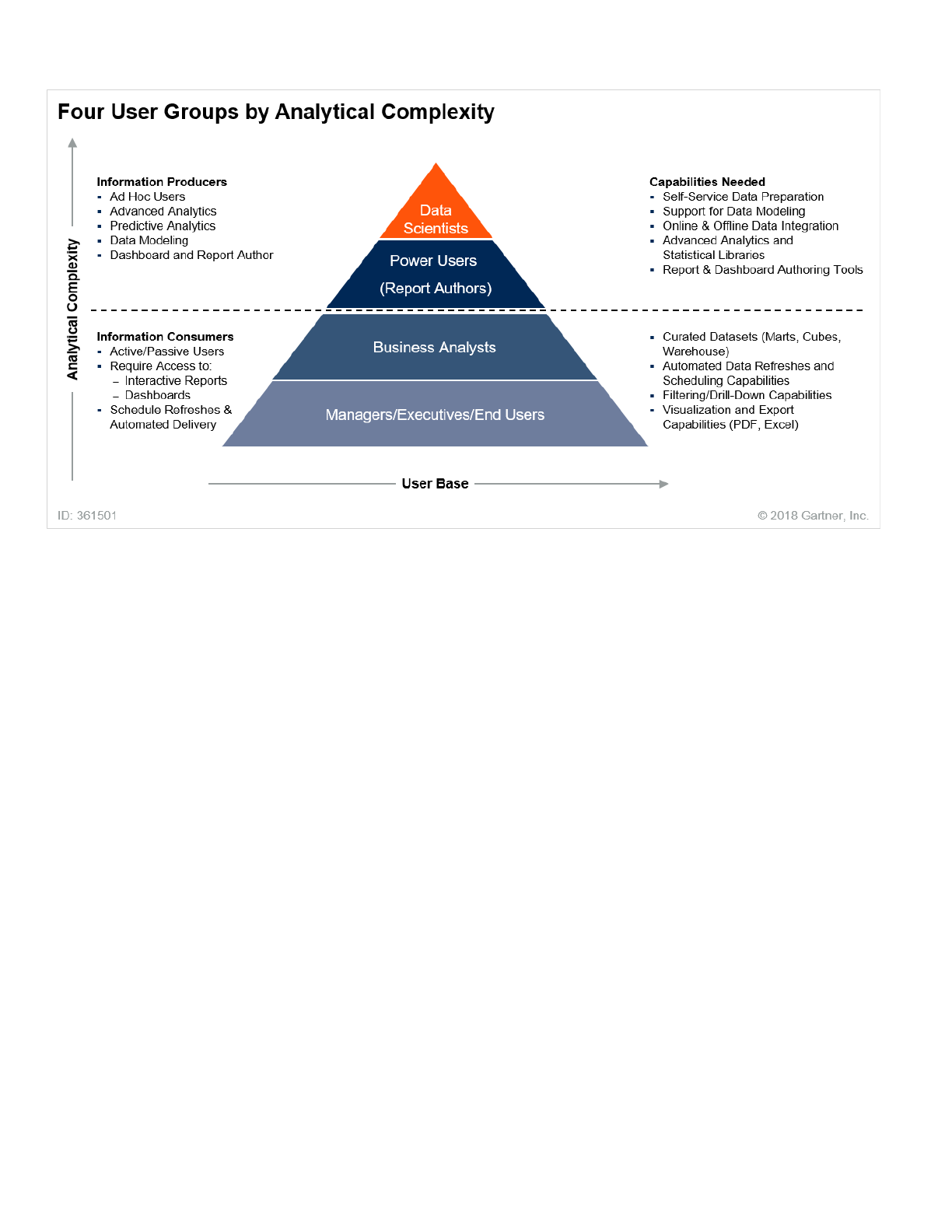
Each business user group has different analytical needs. See Figure 9 for details.
A governance and security framework: Data governance, as discussed in the previous section, will
provide a set of processes, implemented and used by stakeholders leveraging technology, to
ensure that critical data is protected and well-managed. This becomes significantly more
important when developing an LDW that is built upon a data lake. If the data is governed properly
at the physical layer, it reduces the complexity of managing access for the users from within the BI
tools.
■
A trusted data source: The combination of the LDW with a metadata library that is both governed
and secured presents a trusted data source for the users to do their analysis. This provides them
with a unique set of capabilities and promotes self-service analytics across the enterprise with
less reliance on IT. Users now have a single location to fetch pristine-quality data. This supports ad
hoc analysis and standardized operational reporting, and even advanced analytics and machine
learning in the future.
■
Real-time analysis: Information about consumers and sales received in real time is more relevant
than information from last month or even last week. It is more useful to your business users
because it gives them a true understanding of what is happening within their business operations
— as it is happening.
■
Visual storytelling: Once you have provided the capabilities to process the data and extract value,
it becomes extremely important for users to communicate insights back to the decision makers.
What better way to do that than by visually representing it in the form of graphs and charts? This is
where the tools and architecture come into play. The architecture should support discovery, self-
service data preparation and modeling, and provide an interactive way to visualize and deliver the
data to the end users. Having established the principles and the goal to turn shadow IT into
managed self-service, it is also important to consider the capabilities that users will need to have
in place. A typical organization contains the following four business user groups, which are further
classified into two major categories, depending on the functions they perform:
■
Information producers:
■
Data scientists
■
Power users (report authors)
■
Information consumers:
■
Business analysts
■
Managers, executives and end users
■
11/9/2018 2019 Planning Guide for Data and Analytics
https://www.gartner.com/document/3891182?ref=solrAll&refval=211515390&qid=0f5411af5054316f61da2bcad2d7bcb2 24/46
Figure 9. Four Business User Groups by Analytical Complexity
Source: Gartner (October 2018)
Finally, with the principles, and the understanding of users, in place, it is time to implement federated
BI.
A federated model is a pattern within the enterprise architecture
(https://en.wikipedia.org/wiki/Enterprise_architecture) that allows
interoperability and information sharing between semiautonomous,
noncentrally organized lines of business (LOBs), IT systems and
applications.
Within a federated implementation model, the corporate BI team would open up its data warehousing
environment to all of the divisions within the enterprise. Each division or LOB would have its own
dedicated partition in the EDW or data lake to develop its own data marts, reports and dashboards. IT
teams provide self-service data preparation tools and train business users on how to blend local data
with corporate data inside their EDW or data lake partitions. For groups that have limited or no BI
expertise, the corporate BI team would continue to build custom data marts, reports and dashboards
as before.

11/9/2018 2019 Planning Guide for Data and Analytics
https://www.gartner.com/document/3891182?ref=solrAll&refval=211515390&qid=0f5411af5054316f61da2bcad2d7bcb2 25/46
The federated model provides a perfect blend of both the top-down and bottom-up approaches:
This model comes with a unique set of challenges —principally, building consensus within the
organization to change user behavior, and gaining the support to fund and build the necessary
capabilities for an architecture that centralizes data but decentralizes analytics. For more information
about the federated BI architecture, see “Create a Data Reference Architecture to Enable Self-Service
BI.” (https://www.gartner.com/document/code/333398?ref=grbody&refval=3891182)
Key points to consider when addressing this priority include the following:
Prepare for the Onrush of Machine Learning
For many data and analytics technical professionals, advanced analytics and ML techniques are a
mystery. However, the immense volume, variety and velocity of data available today are fueling new
Standardized scalable architecture
■
Support for an extensible physical and logical data model
■
A centralized data repository, with dedicated partitions and zones for individual LOBs
■
Consistent data definitions
■
The agility to deliver multiple end-user analytics products and services
■
A stronger partnership between IT and business
■
True support for a self-service-governed analytics platform
■
Whenever analytics efforts are pulled under the umbrella of the IT organization, IT governance,
“ownership” and management of the operationalized data systems and frameworks will need to be
addressed. These issues will need to be resolved under the organization’s established IT
governance processes and frameworks.
■
On an ongoing basis, data professionals in the IT organization should implement reviews to
capture, automate and repurpose analytical insights from all sides of the organization. As part of
this effort, they should maintain an inventory of people, projects and capabilities associated with
ad hoc analytics initiatives underway in the enterprise.
■
The emerging position of data engineer can have an important role to play in this area. To support
analytics initiatives and use cases that occur outside of IT, this person works and collaborates
across business boundaries to facilitate the extraction of information from systems. This role can
also help facilitate the collaboration across business boundaries needed to identify and integrate
fragmented analytics initiatives.
■
11/9/2018 2019 Planning Guide for Data and Analytics
https://www.gartner.com/document/3891182?ref=solrAll&refval=211515390&qid=0f5411af5054316f61da2bcad2d7bcb2 26/46
demands from the business. Thus, ML and algorithms must soon become part of the knowledge
base of these professionals.
Machine learning is not just for data scientists; it is a tool of the trade for
digital architects.
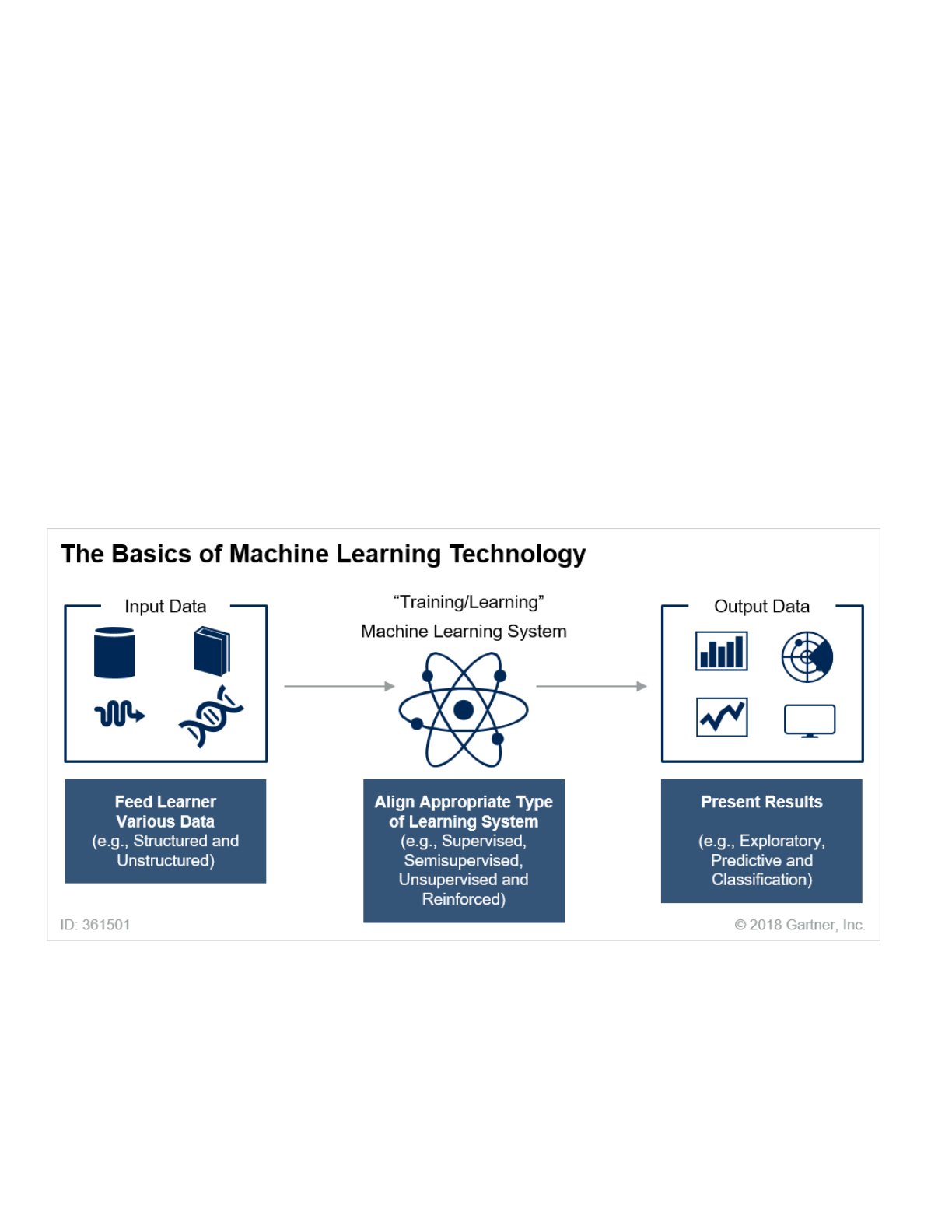
The ML concept is a simple, data-driven one: Algorithms can be trained and learn from data without
being explicitly programmed. ML techniques are based on statistics and mathematics, which are
rarely part of traditional data analysis. Any type of data is input, learning occurs and results are
output. In supervised learning, known sample outcomes are used for training to achieve desired
results. Unsupervised learning relies on ML algorithms to determine the answers (see Figure 10).
Figure 10. The Basics of Machine Learning Technology
Source: Gartner (October 2018)
To prepare for the increasingly important role of ML in their future, data and analytics technical
professionals should start with the basics, and learn by doing. Steps include:
Define a business challenge to solve: The challenge may be either of the following:
■
Exploratory (for example, determining what factors contribute to a consumer’s default on a bank
loan)
■

11/9/2018 2019 Planning Guide for Data and Analytics
https://www.gartner.com/document/3891182?ref=solrAll&refval=211515390&qid=0f5411af5054316f61da2bcad2d7bcb2 27/46
Start small, and build in stages.
Enhance Application Integration Skills to Embed Analytics Everywhere
Data and analytics systems are often architected and developed in parallel with systems that capture
and process data. While these systems are logically connected, they are usually physically separated.
For data and analytics to be delivered at the optimal point of impact, monolithic analytics systems
must be architected and decomposed into callable services that can be integrated wherever they are
needed.
In a mix-and-match world, components must be architected in a more modular way, using features
such as:
Predictive (for example, predicting when the next natural gas leak will occur and what factors
will drive the next failure)
■
Partner with the data science team: Work with this team to deliver a processing environment for
the data needed to address the defined business challenge. Enable a platform that will scale to
execute the required models and algorithms. This environment might be cloud-based. With the
growing demand to support analytics by leveraging ML, there is a need to think outside of endpoint
reporting solutions. Instead, an analytics development life cycle should be built, where the ML
models are monitored and constantly fine-tuned for optimal performance.
■
Get trained now: Before you act, you must learn. Several online courses offer good basic
knowledge on the mechanics of ML. Two examples worth reviewing are Coursera’s Machine
Learning (https://www.coursera.org/learn/machine-learning) and Udacity’s Intro to Machine
Learning. (https://www.udacity.com/course/intro-to-machine-learning--ud120) For a primer on the
benefits and pitfalls of ML, the requirements of its architecture, and the steps to get started, see
“Preparing and Architecting for Machine Learning: 2018 Update.”
(https://www.gartner.com/document/code/365935?ref=grbody&refval=3891182)
■
Form a team of experts: Think about putting together a team of experts to tackle data science and
ML challenges. The business domain expert can work with a data scientist or citizen data
scientist, who can leverage ML as a service (MLaaS) platforms to build and train ML models. The
DevOps platform engineer can help support the underlying infrastructure, and the analytics and
app developer can assist with integrating the models within an application or a BI platform to bring
the value of ML to business.
■
Standard data model and transport protocols to locate and retrieve the right data, be it on-
premises or in the cloud
■

11/9/2018 2019 Planning Guide for Data and Analytics
https://www.gartner.com/document/3891182?ref=solrAll&refval=211515390&qid=0f5411af5054316f61da2bcad2d7bcb2 28/46
Whether you integrate using a commercial BI and analytics platform or an open-source option, pay
particular attention to the provider’s API granularity. The finer-grained the services are, the more
flexibility you will have.
AI and ML Will Generate New Synergies in Information Management
AI and ML collectively is often thought of as a strategy for driving business decisions and rarely in
the context of solving information management challenges. Going into 2019, there are several
practical use cases where AI and ML can be applied to solve information management challenges.
These use cases demonstrate the value of applying AI and ML to different components of the data
and analytics architecture to improve overall operations. AI and ML should no longer be viewed as an
independent initiative, but as a complementary strategy to improve information management
strategies.
One useful example of this synergy is the use of AI/ML to complement the LDW. Technical
professionals who design and develop analytics systems often see these two types of system as
being entirely separate. Practitioners of one type of system may not be familiar with the other.
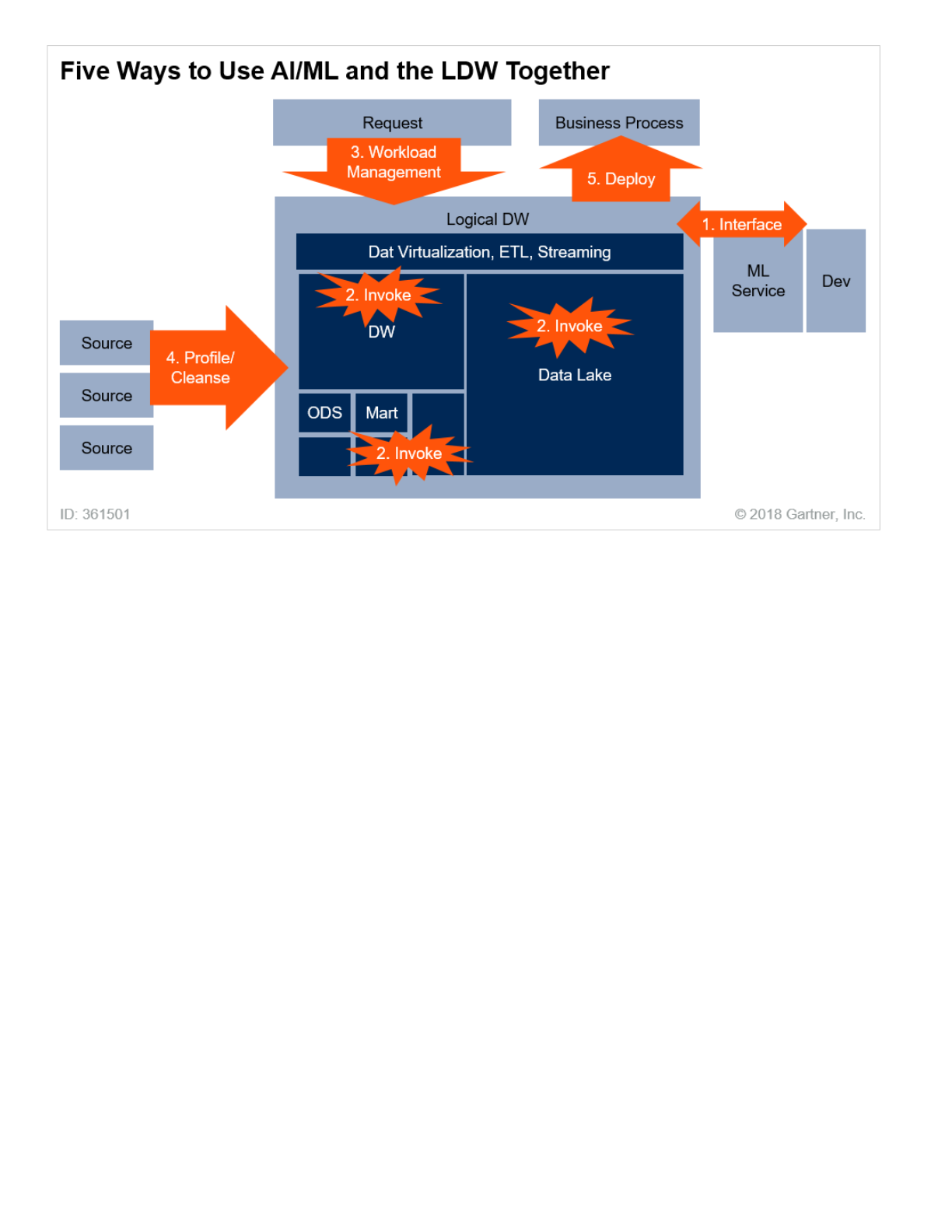
There are five ways in which the combination of the LDW and AI/ML continues to support modern
information management requirements — such as to make available necessary data to the
enterprise, as outlined in Figure 11.
Figure 11. The Five Ways in Which AI/ML and the LDW Can Help Each Other
ML algorithms that can be developed in the R environment, and then executed within a Python
program or another analytics tool
■
Visualization widgets (for example, components offered by D3.js) that deliver information in the
optimal format based on the calling device (web or mobile)
■
Data services to deliver raw data to analytics processes via RESTful APIs
■
Data virtualization to provide standard access to a wide variety of data
■
11/9/2018 2019 Planning Guide for Data and Analytics
https://www.gartner.com/document/3891182?ref=solrAll&refval=211515390&qid=0f5411af5054316f61da2bcad2d7bcb2 29/46
Source: Gartner (October 2018)
AI/ML and the LDW have a symbiotic relationship in these five ways:
1. The LDW can be interfaced to an AI/ML service, where users query the LDW using AI/ML
technologies.
2. AI/ML routines can be invoked directly from within the component engines of the LDW.
3. AI/ML can be used to help manage the complex workload of the LDW.
4. Understanding the structure and content of the data being input into the LDW is very important —
and AI/ML can assist. This is one of the most exciting areas of the market today.
5. AI/ML can leverage LDW infrastructure to deploy its models into production.
Planning Considerations
Look for Opportunities to Use AI/ML and the LDW in Combination
The LDW can provide reliable data to AI/ML, large computing and data storage resources, and a
reliable means of deploying models. Equally, AI/ML can inform the LDW in its data ingestion,
workload management, in addition to adding to its portfolio of analytical techniques.

11/9/2018 2019 Planning Guide for Data and Analytics
https://www.gartner.com/document/3891182?ref=solrAll&refval=211515390&qid=0f5411af5054316f61da2bcad2d7bcb2 30/46
Technical professionals should take stock of all the ML routines available in their incumbent
software. Most commercial database management system (DBMS) software has useful libraries of
the most popular ML algorithms. Where new analytical requirements can be met by common ML
algorithms, these incumbent libraries provide a simple and low-cost means of meeting analytics
requirements.
Look for Synergies in Data Quality Work Between DW Staging and ML
In many development environments, practitioners treat data quality processing for the data
warehouse, data lake or other components of the LDW separately from the AI/ML work. However,
practitioners can do much of this work in common with data warehouse processing, using the
industrial strength tools used for the major data platforms.
One of the main missions of the data warehouse is to provide quality-assured data to all its users. It
does this by gaining consensus from its users on what data quality means, and then applies
extraction, transformation and loading (ETL) and quality routines to check and enforce this. The
result is that users can take data from the warehouse and be assured that it is well-understood and
reliable.
AI/ML clearly needs good quality data as input. If the data cannot be relied on, either during training
or execution, then the results themselves will be unreliable.
Therefore, technical professionals should look for opportunities to use the industrial strength data
transformation and quality tools used for the LDW for machine learning. This is especially true where
modern data crawling tools can automatically discover data content and create metadata.
Consider How Components Can Support Each Other
The aim is to have a wide enough variety of servers to meet any and all requirements. But it’s also to
have the minimum number of servers to avoid unnecessary overhead. Technical professionals need
to integrate those servers so that all of their resources can be coordinated in meeting new business
requirements.
The aim is to have a small number of large servers that together can meet any and all requirements.
If the architect needs to supplement the data in the core LDW, then data virtualization is a good way
to do that.
Position LDW-Enabled AI/ML by Speed and Ease of Development, Scalability and Cost
Every requirement should have two estimates attached to it: cost and potential benefit. These should
determine which requirement is highest priority and also ensure development is tracking maximum
return on investment for the LDW.
This determines what data should be loaded and which new processing performed. This in turn
determines how the system expands what parts of the analytics landscape. If we have an LDW, then

11/9/2018 2019 Planning Guide for Data and Analytics
https://www.gartner.com/document/3891182?ref=solrAll&refval=211515390&qid=0f5411af5054316f61da2bcad2d7bcb2 31/46
this is simple; there is only a limited number of components, and their purpose is well-understood.
Assess Components for Ease of Integration
Different components may have different ML capabilities, and they also present different interfacing
capabilities. Therefore, it is useful to explore which ML libraries are available in each component.
Also, we can assess how easily the system interfaces one component with another.
If you can develop the model in a DBMS or data management solution for analytics (DMSA), and
invoke it in the same component, then this is the simplest case.
Alternatively, if one component can do analysis and emit Predictive Model Markup Language
(PMML), the technology-independent analytics description language, and another can consume it,
then that is ideal.
Alternatively, components may be sources and sinks of data for each other. This might not be the
deciding factor for choosing components, but it is a factor that may well influence which
components make up your analytical landscape.
Thinking in advance about how easily (or not) data sharing and ML capabilities can be distributed
over the different system components can make major differences to implementation effectiveness
and cost.
Analytics Services in the Cloud Will Continue to Accelerate to Deliver Greater
Performance at Scale
Over the past four years, Gartner has seen a steady increase in adoption of and inquiries about cloud
computing and data storage — both for operational and analytical data. Much of this interest can be
attributed to cloud-native applications (such as Salesforce and Workday), emerging IoT platforms, AI
and ML services, and externally generated data born in the cloud. However, an increasing number of
organizations are making a strategic push to incorporate the cloud into all aspects of their IT
compute and storage infrastructure.
The scale and capacity of the public cloud — coupled with increasing business demand to gather as
much data as possible, from as many different sources as possible — are forcing the cloud into the
middle of many data and analytics architectures. The data “center of gravity” is rapidly shifting
toward the cloud. As more data moves to the cloud, analytics has already followed. Reflecting this
trend, both cloud computing and analytics are front and center in the minds of architects and other
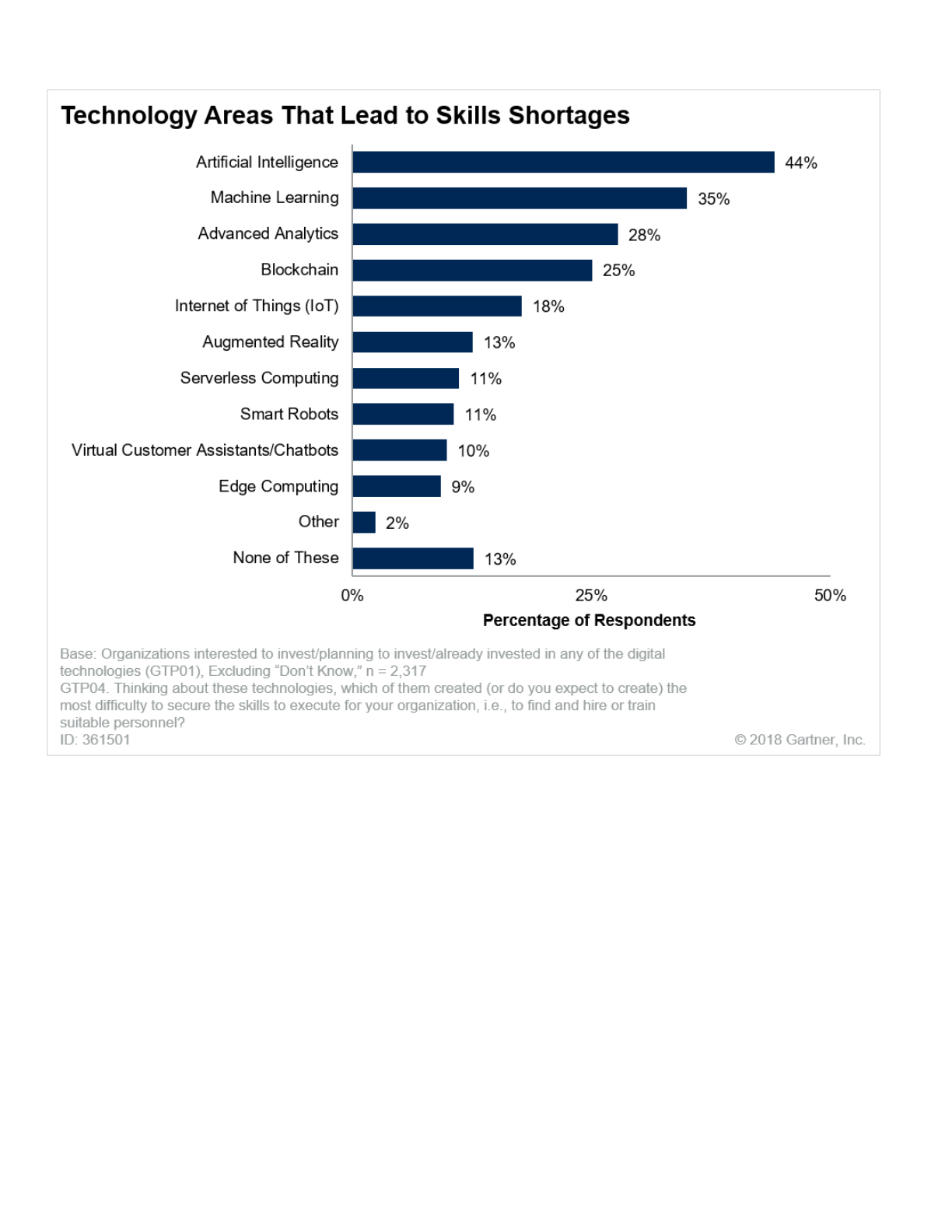
technical professionals. In a Gartner survey of IT professionals, 2 artificial intelligence and ML were
the top technology areas cited by respondents as talent gaps they needed to fill (see Figure 12).
Those skill gaps will also need to consider cloud principles, as more AI and ML services are being
offered in the cloud. Increasingly, this will result in the need for more core cloud skills, in addition to
AI and ML skills, to be adopted by technical professionals.
11/9/2018 2019 Planning Guide for Data and Analytics
https://www.gartner.com/document/3891182?ref=solrAll&refval=211515390&qid=0f5411af5054316f61da2bcad2d7bcb2 32/46
Figure 12. Top Technology Talent Gaps Identified by Technical Professionals
Maximum of three responses allowed.
Source: Gartner (October 2018)
Cloud is already fundamentally impacting the end-to-end architecture for data and analytics.
Technology related to each stage of the data and analytics continuum — acquire, organize, analyze
and deliver — can be deployed in the cloud or on-premises. Data and analytics can also be deployed
using “hybrid” combinations of both cloud and on-premises technologies and data stores.
Three foundational cloud competencies include:
Integration: Integration involves bringing multiple cloud services together with on-premises
infrastructure, and making them work together to deliver an integrated result. Such capabilities will
include integration of cloud endpoints, governance, community management and migration skills
to and from public and private clouds, colocation facilities, and on-premises, distributed
infrastructure.
■

11/9/2018 2019 Planning Guide for Data and Analytics
https://www.gartner.com/document/3891182?ref=solrAll&refval=211515390&qid=0f5411af5054316f61da2bcad2d7bcb2 33/46
Data and analytics technical professionals will increasingly need to develop these core cloud
technical competencies, as they also grapple with the technical challenges inherent in using the
building blocks supplied by cloud providers to build cloud data architectures. They will then need to
deliver a seamless experience to end users. At the same time, they may find themselves drawn into
the other aspects of cloud provider management, which include activities such as cost management,
vendor management, risk management and consensus building with stakeholders.
Gartner expects such hybrid IT approaches and deployments to be a reality of most IT environments
in 2019 and beyond. Even with rapid adoption of cloud databases, integration services and analytics
tools, enterprises will have to maintain traditional, on-premises databases. The key to success will be
to manage all of the integrations and interdependencies while adopting cloud databases to deliver
new capabilities for the business. This will make for a potentially complex architecture in the near
term, as data and analytics continue their inexorable march into the cloud.
Planning Considerations
As they incorporate the cloud into data and analytics, technical professionals need to focus on long-
term objectives, coupled with near-term actions, to flesh out the right approach for their organization.
Planning considerations for 2019 should include the following actions:
Start Developing a Cloud-First Strategy for Data, Followed by Analytics
Public cloud services, such as Amazon Web Services (AWS), Google Cloud Platform and Microsoft
Azure, are innovation juggernauts that offer highly operating-cost-competitive alternatives to
traditional, on-premises hosting environments. Cloud databases are now essential for emerging
digital business use cases, next-generation applications and initiatives such as IoT. Gartner
Customization: — Customization is altering or adding to the capabilities of a cloud or on-premises
service to perform its function and deliver a business-facing service. This may be incorporating
new data and process functions, visibility and analytics, or generating a new look and feel to the
service. Customization will be required as IT organizations change the people, processes and
technologies to make hybrid clouds work for IT customers.
■
Aggregation: Multiple services come together at a cloud scale. These may include provisioning,
single sign-on (SSO), simplified billing, unification of disparate management platforms, facilitating
access to cloud services, customer support and SLA management.
■
Start developing a cloud-first strategy for data, followed by analytics.
■
Determine the right database services for your needs.
■
Adopt a use-case-driven approach to cloud business analytics.
■
Model cloud data and analytics costs carefully based on anticipated workloads.
■

11/9/2018 2019 Planning Guide for Data and Analytics
https://www.gartner.com/document/3891182?ref=solrAll&refval=211515390&qid=0f5411af5054316f61da2bcad2d7bcb2 34/46
recommends that enterprises make cloud databases the preferred deployment model for new
business processes, workloads and applications. As such, architects and other technical
professionals should start building a cloud-first data strategy now, if they haven’t done so already.
This team should also develop a strategy for how the cloud will be used in analytics deployments.
Data gravity, latency and governance are the major determinants that will influence when to consider
deploying analytics to the cloud, and analytics-focused database services for the cloud are
numerous. For example, if streaming data is processed in the cloud, it makes sense to deploy
analytics capabilities there as well. If application data is resident in the cloud, you should strongly
consider deploying BI and analytics as close to the data as possible. Additionally, cloud-born data
sources from outside the enterprise will take on an increasingly important role in any data and
analytics architecture.
Determine the Right Database Services for Your Needs
Depending on which cloud service provider you choose, many database options may be available to
you. AWS and Microsoft Azure offer comprehensive suites of cloud-based analytics databases.
Determining which database services to use is a key priority. It is important to understand the ideal
usage patterns of each possible option. Matching the right technology to a specific use case is
critical to success when using these products. This may lead you to choose different database
services for unique workloads.
For example, AWS offers several standard services that are broadly characterized as operational or
analytical for structured or unstructured data. (For more information, see “Evaluating the Operational
Databases on Amazon Web Services” (https://www.gartner.com/document/code/346633?
ref=grbody&refval=3891182) ) You may use one service for transaction processing and another for
analytics. One service does not have to fit all use cases.
This same model holds true for other cloud providers. For example, Microsoft offers Azure SQL
Database for operational needs and Azure SQL Data Warehouse for analytics, among other offerings.
(For more information, see “Evaluating the Operational Databases on Microsoft Azure.”
(https://www.gartner.com/document/code/346634?ref=grbody&refval=3891182) ) In addition, a
database service from an independent vendor can be run in the cloud, either by licensing it through a
marketplace or by bringing your own license.
Adopt a Use-Case-Driven Approach to Cloud Business Analytics
As the data and analytics environment moves into the cloud, it is reasonable to expect the business
analytics environment to follow. Cloud analytics and BI applications and deployments are growing.
Cloud BI continues to grow in adoption. Data gravity, latency and governance, as well as the use
cases supported, are important factors in determining when and how to deploy BI and analytics in
the cloud. Another factor also weighs heavily, however — the reuse of existing functionality. In fact,
this is the No. 1 concern raised in Gartner client inquiries about business analytics. There continue to

11/9/2018 2019 Planning Guide for Data and Analytics
https://www.gartner.com/document/3891182?ref=solrAll&refval=211515390&qid=0f5411af5054316f61da2bcad2d7bcb2 35/46
be areas, such as enterprise reporting, where cloud analytics BI platforms are not building enterprise-
ready capabilities.
For this reason, be wary of initiatives that seek to “standardize” on as few business analytics tools as
possible. An optimal federated BI architecture should be able to support many different business
analytics tools by centralizing the datasets at the layer of the data warehouse as much as possible,
so that new visualization tools can be deployed easily.
Gartner has identified seven criteria that should be evaluated to help determine whether analytics use
cases should be deployed to the cloud (see Table 1).
Table 1: Seven Criteria for Determining a Cloud Analytics Architecture
Data Gravity Where is the current
center of gravity for data?
If the answer is “in the cloud,” a cloud BI product
is most likely going to be a good fit for the
organization.
Data
Latency
How fresh does the data
need to be?
In scenarios where extremely low latency is
desired, the speed of light dictates that closer is
better, which may drive investments in edge, IoT
and on-premises analytics, rather than a cloud-
only model.
Governance How much governance is
required based on
domains and use cases?
Cloud BI platforms lag in governance
capabilities in comparison to mature on-
premises analytics and BI platforms, although
there is improvement in this space.
Skills What skills, tools and
platforms are available in
your organization?
Cloud BI platforms encourage end-user
adoption by minimizing the barriers to entry and
enabling a large amount of flexibility, as well as,
in some cases, licensing flexibility. On the flip
side, cloud BI integration can be extremely
difficult due to the inflexibility of proprietary and
aging data warehouse and data analytics
architectures that most organizations continue
to have to maintain.
Criteria Essential Questions Decision Support

11/9/2018 2019 Planning Guide for Data and Analytics
https://www.gartner.com/document/3891182?ref=solrAll&refval=211515390&qid=0f5411af5054316f61da2bcad2d7bcb2 36/46
Source: Gartner (October 2018)
Model Cloud Data and Analytics Costs Carefully Based on Anticipated Workloads
The cost model for cloud data and analytics is completely different from on-premises chargeback
models. Pricing constructs vary considerably among analytics vendors, with several offering cloud
services both directly and through major marketplaces. Factors such as data volumes, transfer rates,
processing power and service uptime will impact monthly charges. Use-case evaluations should
include the goal of avoiding unexpected costs in the future.
Tools are available to help track and manage cloud costs. For more information, see “Comparing
Tools to Track Spend and Control Costs in the Public Cloud.”
(https://www.gartner.com/document/code/323083?ref=grbody&refval=3891182)
Revolutionary Changes in Analytics Will Drive IT to Adopt New Technologies and
Roles
The data and analytics domain is rapidly expanding, and new technologies are challenging
established practices. The convergence of several factors is driving a “perfect storm” for technical
professionals tasked with managing data and analytics. These factors include:
Agility How quickly must new
requirements/components
be added/updated?
Cloud BI adds agility, as new features, but
because the infrastructure is controlled by the
cloud provider, this agility is limited to the
capabilities they let you have, compared to on-
premises BI platforms, which often provide
more customizability (albeit with a hefty
development effort).
Functionality Are certain functions
available only in the cloud
or only on-premises?
It is extremely common for cloud BI products to
have the best features available only in the
cloud, with a pared-back set of features on-
premises, leading to difficult compromises for
hybrid deployments.
Reuse How much existing
investment do you want to
carry forward from your
on-premises analytics
platform?
Just as with on-premises BI products, there is
usually no easy way to migrate existing
dashboards and reports to any different BI
platform, cloud or on-premises. Starting anew is
usually the approach that is taken.
Criteria Essential Questions Decision Support
Higher volumes of data from an ever-expanding variety of data sources
■

11/9/2018 2019 Planning Guide for Data and Analytics
https://www.gartner.com/document/3891182?ref=solrAll&refval=211515390&qid=0f5411af5054316f61da2bcad2d7bcb2 37/46
The mandate to deploy AI and ML technologies often starts at the board level and filters down the
organization, often without identifying business objectives. Technical professionals can help make
these deployments more effective by developing the foundational components needed to support AI
and ML in the enterprise. For more information, see “Laying the Foundation for Artificial Intelligence
and Machine Learning: A Gartner Trend Insight Report.”
(https://www.gartner.com/document/code/373110?ref=grbody&refval=3891182)
Technical professionals should focus to centralize the scarcest skills — those of the data scientists
— into a center of excellence in order to have a critical mass. Data scientists should have dotted-line
reporting to lines of business. By being closer to the consumers of analytics, the data scientists can
understand requirements better. They would also be in a better position to ensure a smooth hand-off
of their models.
An alternate source of analytics platforms and models is emerging. Cloud vendors, starting with
Amazon, Microsoft, Google and IBM, are building pretrained models that developers can customize
without having any training in data science. Today, those models mostly focus on so-called
“cognitive” processing, such as image processing and natural language processing. These vendors
all have plans to add similarly customizable models for operational processes such as demand
forecasting, fraud detection and predictive maintenance, among others. Gartner sees this class of AI
Data ingestion and processing performed on-premises and in multiple cloud vendors
■
Access to cloud-based, hyperscale compute, processing and storage capabilities
■
Advances in computer vision, natural language processing and pattern recognition
■
Greater embrace of crowdsourcing techniques to leverage human intelligence in automation, such
as for data quality, ML and other use cases
■
Real-time streaming and analytics-processing frameworks
■
The evolution of hybrid analytical and transactional architectures
■
Expanding IoT use cases, such as ML at the edge, and integration with third-party data, historical
data and metadata
■
Managed services, serverless architectures and infrastructure as code
■
The emergence of the trust economy and supporting technologies such as blockchain
■
Advances in bots and robotic process automation, making it possible to embed analytics into, or
to supplant, human interactions and processes
■
Increased oversight from governance and compliance bodies
■

11/9/2018 2019 Planning Guide for Data and Analytics
https://www.gartner.com/document/3891182?ref=solrAll&refval=211515390&qid=0f5411af5054316f61da2bcad2d7bcb2 38/46
and ML technology growing rapidly as vendors and customers look to empower the tens of millions
of traditional developers.
The rapid advancements in data and analytics act as both a boon and a challenge to technical
professionals. These trends offer tremendous promise and raise awareness of the important work
that technical professionals do. However, they also necessitate new skills, architectures and
patterns, and challenge traditional methods and processes.
Consider AI and ML. While there’s no question that these technologies will play a significant role in
the future, the growing hype surrounding them is driving an insatiable appetite for analytics in the
enterprise and expanding notions about what’s possible today. Business leaders are besieged with
seductive catch phrases like “kinetic business” and “real-time decisioning.” The promise of AI and ML
is putting technical professionals in a difficult position. They must manage lofty expectations while
simultaneously expanding their technologies and skills to prepare for the future.
Enterprises are having a difficult time strategizing about how to approach new AI projects — partly
because of the complexity of the technology, talent gaps, and the lack of proven use cases and
standards.
Within the broad scope of AI, technical professionals should familiarize themselves with the most
common disciplines:
This will help identify tangible use cases within your domain. We also suggest that companies look
for quick wins with existing data and analytics capabilities. Start with the data you have, and begin to
build on that to create small differentiations. And remember to add domain-specific knowledge to
cement the win.
Similar to ML, we see a similar team structure evolving with AI initiatives where there is a dearth of AI
professionals and expertise. Leverage existing roles and skill sets of an application developer, a
platform engineer and perhaps a data scientist to explore business process automation processes
by building AI-based systems.
With the increasing use of crowdsourcing techniques for data management and analytics tasks, as
well, technical professionals are interfacing with crowds of human workers integrated into the data
workflow. Knowing how to design appropriate and clear microtasks, as well as knowing some
Language processing, including translation, speech recognition, sentiment analysis and
conversational platforms
■
Computer vision, including facial recognition, gesture recognition and optical pattern recognition
■
Machine learning, including IoT, sensors, deep learning and model algorithms
■

11/9/2018 2019 Planning Guide for Data and Analytics
https://www.gartner.com/document/3891182?ref=solrAll&refval=211515390&qid=0f5411af5054316f61da2bcad2d7bcb2 39/46
psychological and sociological basics for motivating crowds and managing community dynamics,
becomes new skills technical professionals must master.
Planning Considerations
IT organizations must adapt their methods, roles and skills to demonstrate agility and exert influence
over their organization’s analytics strategy. The role of the data management and analytics
professional has never been more crucial.
Planning considerations for 2019 include the need to:
Focus on New and Emerging Architectural, Technical and Product Management Roles
Opportunities will emerge for technical professionals to play new roles. These roles will help their
enterprises exploit data and analytics technologies to improve and transform their businesses. Some
roles, such as data architects and analytics architects, may already exist in the organization. These
roles will have significant input in designing and developing the end-to-end data and analytics
architecture discussed earlier, and will become more vital in 2019.
The data engineer — a role often linked with data science — designs, builds and integrates data
stores from diverse sources to smooth the path for ever-more-complex analysis. It is a natural
progression from the data integration specialist, and will become an essential part of any data
science effort that furthers predictive, prescriptive and ML analytics efforts. Data engineer
responsibilities include:
The IoT architect is another key role — one that will become critical for every IoT initiative. IoT
encompasses a broad set of technical and nontechnical topics that include embedded systems,
cloud computing, software development, security, data management and system engineering. The
IoT solution architect must collaborate with business leaders and partner with IT management to
Focus on new and emerging architectural, technical and product management roles.
■
Devote time to enhancing technical and professional effectiveness skills.
■
Preparing data for use in data science projects
■
Assisting with initial data exploration steps (binning, pivoting, summarizing and finding
correlations, for example)
■
Cataloging existing data sources and enabling access to resident and external data sources
■
Supporting data stewards to establish and enforce guidelines for data collection, integration and
processes
■

11/9/2018 2019 Planning Guide for Data and Analytics
https://www.gartner.com/document/3891182?ref=solrAll&refval=211515390&qid=0f5411af5054316f61da2bcad2d7bcb2 40/46
address each of these topics (see “Solution Path for Developing an Internet of Things Technical
Strategy” (https://www.gartner.com/document/code/354613?ref=grbody&refval=3891182) ).
The AI and ML architect and engineer are rapidly emerging as new roles within teams pursuing AI
and ML initiatives. These new roles focus on integrating and implementing AI and ML systems into
new or existing business systems. The ML engineer is a key role in operationalizing and optimizing
ML products and services — a responsibility that will continue to rise in demand as more AI/ML
projects move away from experimentation and into operations.
We also expect new teams to appear, most likely in the form of transformation teams or centers of
excellence. These teams will emphasize refinement, efficiency and ongoing improvement as data
and analytics activities work their way into the fabric of the organization’s processes and capabilities.
In addition, as more data and analytics services become outward-facing to connect ecosystems and
to monetize data to external constituents, architects or other technical professional functions may
also take on the role of “product manager.” This role sits at the intersection of business, technology
and user experience. Although this is a long-established role in the software vendor and OEM
marketplaces, product managers are starting to appear with greater frequency in many other
organizations. This position occupies a unique role in an organization, with responsibilities that
include:
Any data products created for external consumption should have a product manager. This role is
needed to ensure that the organization delivers the right products to the right markets at the right
time. This role is not limited to external data products, however. The product management discipline
is also a great addition for internally facing data and analytics products. See “Moving From Project to
Products Requires a Product Manager” (https://www.gartner.com/document/code/289817?
ref=grbody&refval=3891182) for more information.
Researching market needs and customer preferences
■
Setting the vision for the product, and selling that vision to the rest of the organization
■
Defining and prioritizing the business outcomes required to attain the vision
■
Obtaining the resources needed to build and sustain the product
■
Working with development teams to translate the targeted business outcomes into features
■
Working across the organization — with stakeholders, users, development teams and operations —
to ensure product success
■
Working with sales, marketing, ecosystem partners and customers on products aimed at external
customers
■

11/9/2018 2019 Planning Guide for Data and Analytics
https://www.gartner.com/document/3891182?ref=solrAll&refval=211515390&qid=0f5411af5054316f61da2bcad2d7bcb2 41/46
Existing roles, such as the project manager or the scrum product owner, are
neither appropriate nor sufficient for managing a significant product that
requires many teams to build. 3
Devote Time to Enhancing Technical and Professional Effectiveness Skills
To capitalize on emerging opportunities, it is important to develop a broad range of technical and
professional effectiveness skills. Although technical skills are a minimum requirement, professional
effectiveness skills can make or break your success in any project or program you work on. Gartner
has long advocated that technical professionals supplement their technical capabilities with
additional “soft skills,” such as the ability to:
With the emergence of new, increasingly business-related and customer-facing roles in IT,
communication skills and business acumen are more important than ever. When Gartner asked
nearly 950 technical professionals where they saw skills gaps, three of the top 10 responses were
related to professional effectiveness skills (critical thinking/problem solving, business
acumen/knowledge and communication skills). 4
Effectiveness skills without requisite technical prowess are only half of the story. New trends in data
and analytics will require technical professionals to enhance their technical expertise in:
Take the following steps to improve your technical and professional effectiveness skill sets:
Better understand business goals and scenarios to help build business cases
■
Critically think through problem resolution
■
Articulate points of view in the language of the business audience
■
Cloud technology
■
Advanced analytics and ML
■
Data virtualization and the LDW
■
Streaming ingestion
■
Real-time data movement and processing
■
Integration capabilities to incorporate data and analytics everywhere
■

11/9/2018 2019 Planning Guide for Data and Analytics
https://www.gartner.com/document/3891182?ref=solrAll&refval=211515390&qid=0f5411af5054316f61da2bcad2d7bcb2 42/46
Setting Priorities
Data and analytics technical professionals must focus on the following areas as they plan and
prioritize their activities in 2019:
Identify the skills you need to improve. Ask others you work with for their opinions.
■
Research whether employee development and technical training programs are in place in your
organization. HR often has relevant courses and programs available.
■
Look to external resources if programs aren’t available internally. For communication training, turn
to vendors such as Toastmasters International. Explore course work at local universities or online
(for example, Coursera). Depending on cost, determine whether your organization will assist you in
these efforts.
■
Spend time putting what you learn into practice. Make this new knowledge part of your standard
operating procedure.
■
Take personal responsibility for this improvement. It will not only benefit your company, but will
also serve you well in any future endeavor.
■
Design for “hybrid multicloud.” An increasing number of organizations are finding that they have to
support applications that are on-premises as well as in one or more cloud service providers. This
adds new sets of design challenges and also introduces a variety of integration options. Technical
professionals should carefully architect data management aspects to minimize data latency as
well as costs associated with unnecessary data ingress and egress.
■
Adhere to data governance and compliance requirements. A host of existing and new compliance
guidelines are forcing technical professionals to improve data hygiene as well as enhance data
security and protection. In 2018, the EU General Data Protection Regulation (GDPR) came into
enforcement. Also in 2018, the California government released the California Consumer Privacy
Act (CCPA). This may be the beginning of many state regulations for which technical professionals
need to plan. For instance, the EU GDPR’s Article 25 mandates that data protections must be
designed in the core architecture. New technologies such as data catalogs allow technical
professionals to detect sensitive information and apply corporate policies.
■
Enable greater self-service and automation. Technical professionals should prepare for deploying
solutions that will simplify design, management, operations and the use of the architecture and
applications. For example, technical professionals are increasingly deploying container
technologies, and serverless and microservices architectures. Their goal is to increase agility and
flexibility while enabling the business users to deploy self-service applications quickly across
multiple on-premises and cloud infrastructures.
■

11/9/2018 2019 Planning Guide for Data and Analytics
https://www.gartner.com/document/3891182?ref=solrAll&refval=211515390&qid=0f5411af5054316f61da2bcad2d7bcb2 43/46
Design and build a comprehensive end-to-end architecture. IT and the business should work
together to design an end-to-end architecture for data and analytics. Technical professionals
should start with the business goals in mind and holistically manage an architecture to support
those outcomes. The four phases — acquire, organize, analyze and deliver — must be planned
together, with each feeding off the others. Data, analysis and action can no longer represent
separate disciplines; they must be fused into a cohesive plan of attack. Organizations are starting
to add additional workloads and users to the systems. While in the past, the goal may have been to
support a small number of data scientists, now the goal is support an army of business and data
analysts.
■
Enable analytics to become pervasive within and outside the enterprise. With more people
wanting to engage with data, demand for analytics will continue to expand. It’s critical to be
prepared for more business user enablement by fostering a pragmatic approach to better self-
service, coupled with processes to prioritize, facilitate and manage the proliferation. ML is rising
quickly, and technical professionals need to understand the concepts, experiment with the
technologies and integrate analytics wherever they are needed for optimal impact.
■
Incorporate the cloud as a core element of the organization’s data and analytics architecture. The
cloud needs to become part — or most likely the centerpiece — of the organization’s data and
analytics architecture. Developing a cloud-first strategy for data, followed by analytics, is an
essential first step. Choosing the right cloud service providers and technologies should follow.
With many possible services available, technical professionals may select a mix-and-match
approach for data and analytics as they gradually migrate data storage and computing capabilities
to the cloud. In addition, technical professionals should exploit data marketplaces as much as
possible to procure their cloud data and analytics services.
■
Expand roles and skill sets to deliver data service products for internal and external business
ecosystems. With chief data officers striving to increase business value, data and analytics
products are being evaluated and designed for internal and external business ecosystem
consumption. As internal projects turn into external products, new roles for technical
professionals will emerge. Because solid technical and professional effectiveness skills are
important components of these architect, engineer and product manager roles, it’s important to
devote time and effort to improving these capabilities.
■
Adopt AI and ML to enable process improvement, operational efficiency and automated actions.
AI and ML technologies will play an increasingly significant role in the future, driven by an
insatiable appetite for analytics in the enterprise and by expanding notions about what’s possible
today. Technical professionals must manage lofty expectations regarding what’s possible with AI
and ML today, while simultaneously expanding their technologies and skills to prepare for the
future.
■

11/9/2018 2019 Planning Guide for Data and Analytics
https://www.gartner.com/document/3891182?ref=solrAll&refval=211515390&qid=0f5411af5054316f61da2bcad2d7bcb2 44/46
Data and analytics technical professionals should begin by taking an inventory of their existing
environments. All of the planning considerations discussed in this report should be approached as
part of an evolution to a strategic end state, not as a rip-and-replace strategy. Some actions will move
faster than others.
Technical professionals must ultimately keep the end goal in mind. It is easy to become enamored of
new technology choices, but business value must be front and center in every decision. Maintain
open channels of communication with constituents — both internal and external — and explain any
technical actions or concepts in terms they can understand, support and champion. In this exciting
time for data and analytics, technical professionals can play an increasingly critical role in helping
their organizations achieve business success.
Evidence
1 2019 Gartner CIO Survey. The 2019 Gartner CIO Survey was conducted online from 17 April through
22 June 2018 among Gartner Executive Programs members and other CIOs. Qualified respondents
are each the most senior IT leader (CIO) for their overall organization or a part of their organization
(for example, a business unit or region). The total sample is 3,102, with representation from all
geographies and industry sectors (public and private). The survey was developed collaboratively by a
team of Gartner analysts, and was reviewed, tested and administered by Gartner’s Research Data and
Analytics team.
2 The Gartner Technical Professionals Study was conducted online from 30 January 2018 to 2 March
2018 among 2,468 respondents in North America, EMEA, Asia/Pacific and Latin America. A subset of
Gartner for Technical Professionals seatholders were invited to participate. In addition, Gartner IT
Leaders seatholders with the job level of “associate” were invited to participate. Respondents were
required to be a member of their organization’s IT staff or department (or serve in an IT function).
Furthermore, they could not serve as a member of the board, president or in an executive-level or IT
leadership position. The survey was developed collaboratively by a team of Gartner analysts who
follow technical professionals and was reviewed, tested and administered by Gartner’s Research
Data Analytics team.
3 “Moving From Project to Products Requires a Product Manager”
(https://www.gartner.com/document/code/289817?ref=grbody&refval=3891182)
4“Top Skills for IT’s Future: Cloud, Analytics, Mobility and Security”
(https://www.gartner.com/document/code/297698?ref=grbody&refval=3891182)
Document Revision History
2018 Planning Guide for Data and Analytics - 29 September 2017
(https://www.gartner.com/document/code/331851?ref=ddrec)

11/9/2018 2019 Planning Guide for Data and Analytics
https://www.gartner.com/document/3891182?ref=solrAll&refval=211515390&qid=0f5411af5054316f61da2bcad2d7bcb2 45/46
2017 Planning Guide for Data and Analytics - 13 October 2016
(https://www.gartner.com/document/code/311517?ref=ddrec)
2016 Planning Guide for Data Management and Analytics - 2 October 2015
(https://www.gartner.com/document/code/290775?ref=ddrec)
Recommended by the Authors
Solution Path for Implementing a Comprehensive Architecture for Data and Analytics Strategies
(https://www.gartner.com/document/3880568?ref=ddrec&refval=3891182)
Solution Path for Planning and Implementing the Logical Data Warehouse
(https://www.gartner.com/document/3719217?ref=ddrec&refval=3891182)
Comparing Cloud Data Warehouses: Amazon Redshift and Microsoft Azure SQL Data Warehouse
(https://www.gartner.com/document/3507817?ref=ddrec&refval=3891182)
Migrating Enterprise Databases and Data to the Cloud
(https://www.gartner.com/document/3671418?ref=ddrec&refval=3891182)
A Comparison of Master Data Management Implementation Styles
(https://www.gartner.com/document/3824466?ref=ddrec&refval=3891182)
Implement Agile Database Development to Support Your Continuous Delivery Initiative
(https://www.gartner.com/document/3559517?ref=ddrec&refval=3891182)
Top Skills for IT's Future: Cloud, Analytics, Mobility and Security
(https://www.gartner.com/document/3353917?ref=ddrec&refval=3891182)
EIM 1.0: Setting Up Enterprise Information Management and Governance
(https://www.gartner.com/document/3831267?ref=ddrec&refval=3891182)
Use Design Patterns to Increase the Value of Your Data Lake
(https://www.gartner.com/document/3876783?ref=ddrec&refval=3891182)
Deploying Effective iPaaS Solutions for Data Integration
(https://www.gartner.com/document/3714226?ref=ddrec&refval=3891182)
Evaluating the Operational Databases on Microsoft Azure
(https://www.gartner.com/document/3878365?ref=ddrec&refval=3891182)
Evaluating the Operational Databases on Amazon Web Services
(https://www.gartner.com/document/3878322?ref=ddrec&refval=3891182)
Recommended For You
Solution Path for Implementing a Comprehensive Architecture for Data and Analytics Strategies
(https://www.gartner.com/document/3880568?ref=ddrec&refval=3891182)

11/9/2018 2019 Planning Guide for Data and Analytics
https://www.gartner.com/document/3891182?ref=solrAll&refval=211515390&qid=0f5411af5054316f61da2bcad2d7bcb2 46/46
Design Your IoT Data Architecture for Streaming Edge Analytics and Platform Advanced Analytics
(https://www.gartner.com/document/3885163?ref=ddrec&refval=3891182)
Optimize Digital Customer Experiences With Machine-Learning-Enhanced Analytics
(https://www.gartner.com/document/3880102?ref=ddrec&refval=3891182)
Assessing Microsoft Power BI for Three Critical Use Cases
(https://www.gartner.com/document/3890106?ref=ddrec&refval=3891182)
Evaluation Criteria for Analytics and Business Intelligence Platforms
(https://www.gartner.com/document/3890122?ref=ddrec&refval=3891182)
© 2018 Gartner, Inc. and/or its affiliates. All rights reserved. Gartner is a registered trademark of Gartner, Inc. and its
affiliates. This publication may not be reproduced or distributed in any form without Gartner's prior written
permission. It consists of the opinions of Gartner's research organization, which should not be construed as
statements of fact. While the information contained in this publication has been obtained from sources believed to
be reliable, Gartner disclaims all warranties as to the accuracy, completeness or adequacy of such information.
Although Gartner research may address legal and financial issues, Gartner does not provide legal or investment
advice and its research should not be construed or used as such. Your access and use of this publication are
governed by Gartner’s Usage Policy. Gartner prides itself on its reputation for independence and objectivity. Its
research is produced independently by its research organization without input or influence from any third party. For
further information, see "Guiding Principles on Independence and Objectivity."
