Eclipse TD 316SW 22note
User Manual: Eclipse TD 316SW
Open the PDF directly: View PDF  .
.
Page Count: 5
39
In April, 2001 we launched our Time Domain speaker System for home use under the "ECLIPSE TD" brand,
for the purpose of demonstrating our acoustic engineering ability, and to strengthen our brand image. In addition,
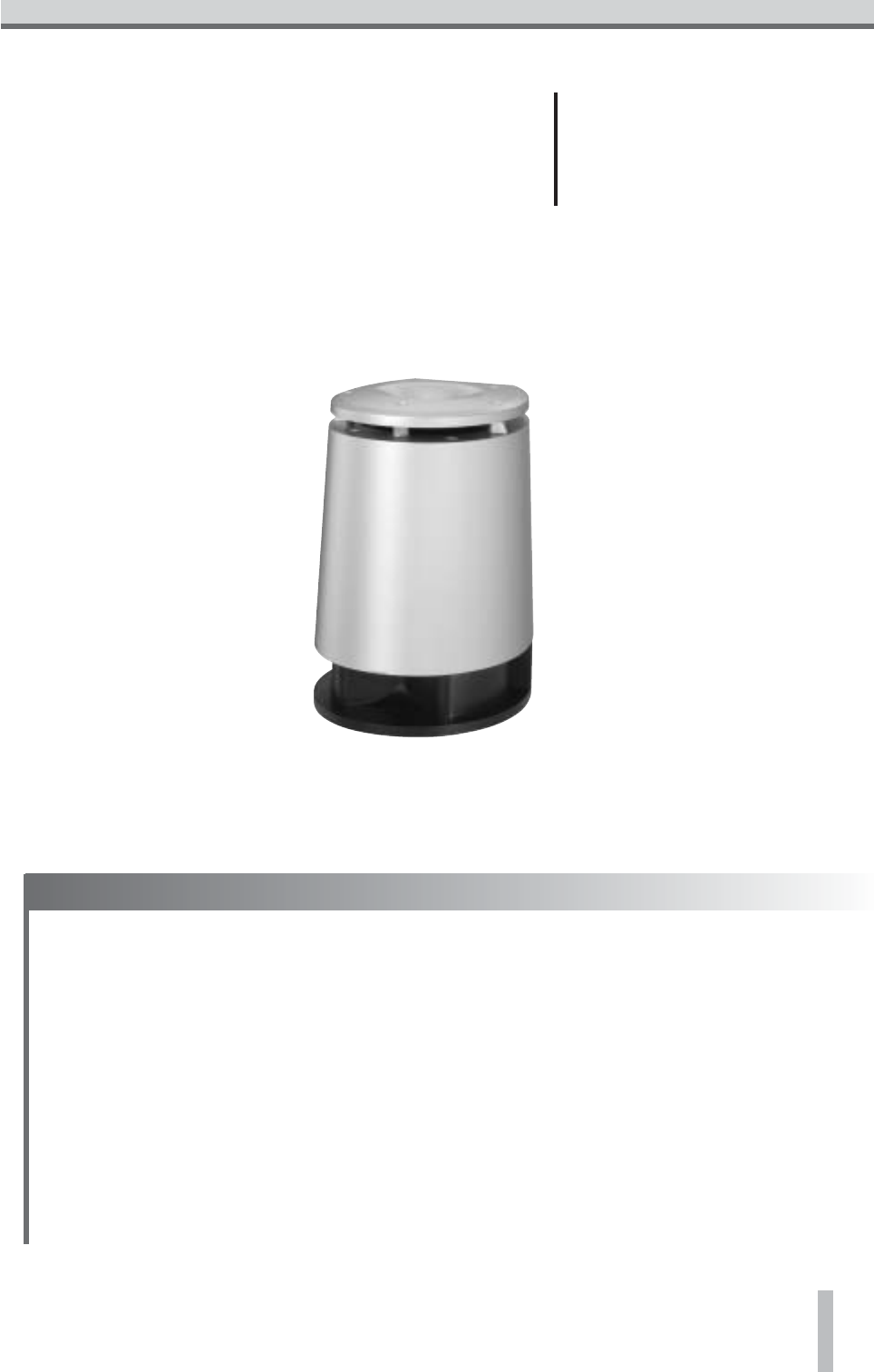
our ECLIPSE TD 316SW Subwoofer with a built-in amplifier was introduced in June 2003. By actualizing Time-
Domain theory, the high-speed 316SW Subwoofer holds the line against any conventional subwoofers that attach
importance to power and volume. In this technical notes, we introduce the market trends of the 316SW and speak-
ers for home use which are currently available in the market.
Abstract
NOTE
Mitsuhiro Hiramoto
Akira Fujimoto
Kazuhiko Hamada
Masahito Kawai
Development of Time Domain Subwoofer
40
FUJITSU TEN TECHNICHAL JOURNAL
FUJITSU TEN TECH. J. NO.22(2004)
In April, 2001 we began to market our Time Domain
speaker System for home use as the ECLIPSE TD, for
the purpose of demonstrating our acoustic engineering
ability, and strengthening our brand image. In addition,
our ECLIPSE TD "316SW" Subwoofer with a built-in
amplifier was introduced in June of this year (2003). By
actualizing Time Domain theory, the high-speed 316SW
supercedes any conventional subwoofers that attach
importance to power and volume. At the same time, our
new "307" Speaker was released to the market. The
"307" is a compact speaker that fits into the palm of your
hand; it is also enhanced by actualizing Time Domain
theory in its internal design, and is compatible for desk-
top multi-channel use. In addition, 2.1 and 5.1 Channel
sound can be enjoyed in combination with the 316SW. In
the technical notes, we introduce the market trends of
the "316SW" and speakers for home use that are cur-
rently available in the market.
2. Background of product creation
2.1 Market trends of home-use speakers
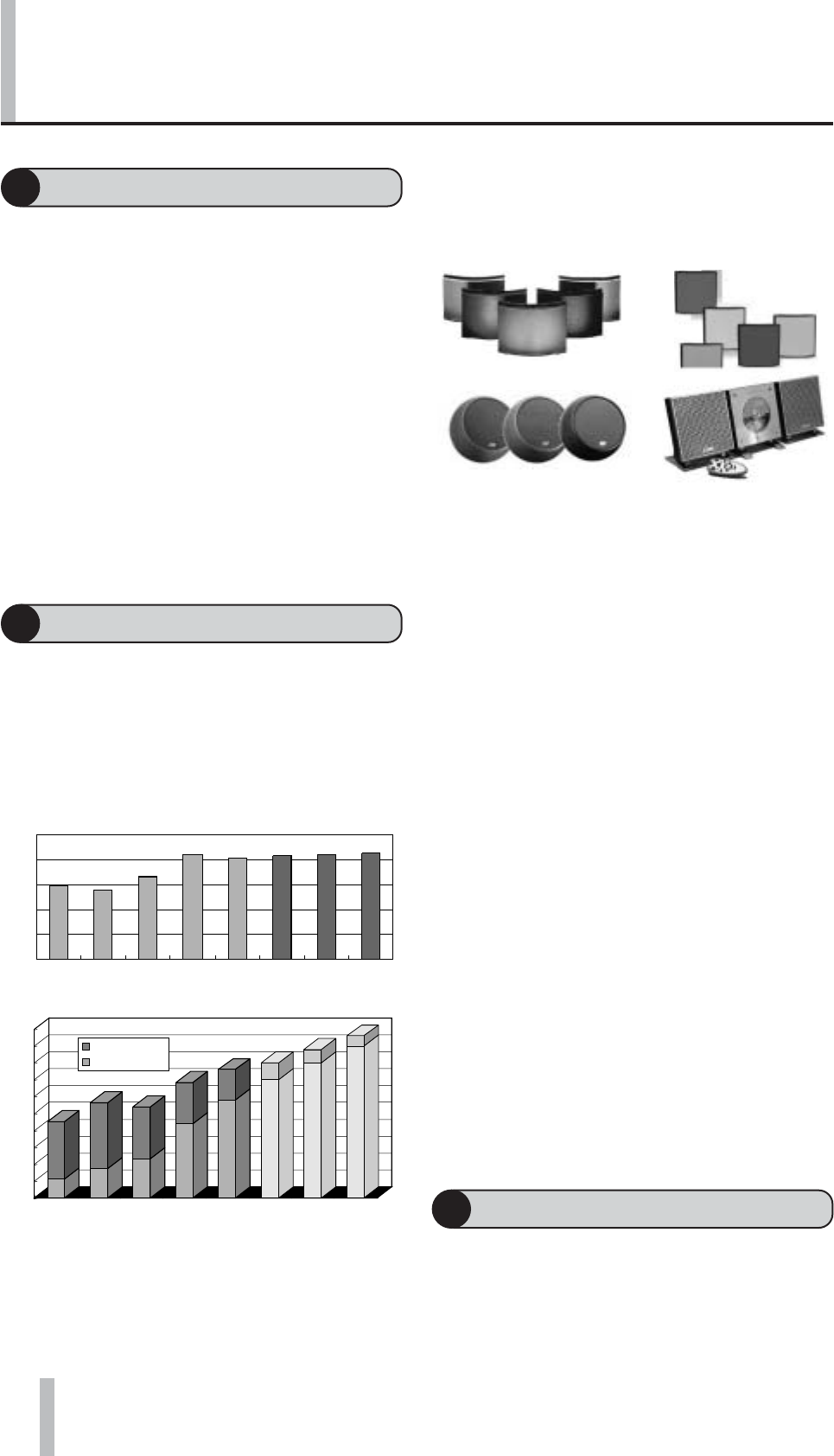
Although a declining trend continued until 1998, the
high-fidelity speaker market has tended to expand mod-
erately since 1999, due to home-theater demand. (As we
can see in Fig.2 from the market scale data of AV ampli-
fiers, the demand for home theater use is growing rapid-
ly.)
In recent years, every audio manufacturer has mar-
keted items that attach great importance to the nature
of their internal "audio design," and has released uncon-
ventional products focused not only on audio designs.
Manufacturers are also concerned with outlet channels
not limited by the definition of conventional audio stores,
aiming at opening up new distribution channels, such as
"interior shops" and "high-grade variety goods stores".
Although there are many products with specialized
designs, there are currently few systems with superla-
tive sound quality.
2.2 Market demand
With our company's questionnaire of existing home-
use audio (including a listening test evaluation), we
observed:
・Although sound quality was acceptable, prices were
high (especially in the general social class)
・Customers desire low-cost products with sound quali-
ty equivalent to that of current products.
・Customers want high-speed subwoofers.
2.3 Product concept
From these observations, we conceived of the "307
Series" as follows.
①Small sized products with a reasonable price range,
without losing the characteristic sound quality of
Time Domain speakers;
②To realize improvement in expanding the usefulness
of a wide-range speaker system with a subwoofer;
③To enter the interior market by improving design;
④A system compatible with both home theater systems
and commercial areas, etc.
Armed with the Time Domain theory, we sought to
increase sales by supplying this new market with a
product having "essence" and "freshness". The following
will introduce to you the ECLIPSE TD, a subwoofer we
first developed that was different from the shapes and
characteristics of conventional subwoofers.
3. Problems with conventional subwoofers and ideas for improvement
3.1 Problems with conventional subwoofers
The following three big points can be considered as
problems of conventional subwoofers for home use:
・The bass range is muddy (the sound is unclear).
・The response of the bass range sounds late (transient
0
100
200
300
400
500
'97 '98 '99 '00 '01 '02 '03 '04
(1,000)
Source: JEITA Consumer Electronics Data
* Speakers sold individually for ¥10,000
Fig.1 Domestic sales quantities of Hi-Fi speakers
0
50
100
150
200
250
300
350
400
450
500
'97 '98 '99 '00 '01 '02 '03 '04
HIFI amplifier
AV amplifier
Fig.2 AV amplifier market size
Fig.3 Audio designs of each company's products
Introduction
1
Background of product creation
2
Problems with conventional subwoofers and
ideas for improvement
3
41
Development of Time Domain Subwoofer
FUJITSU TEN TECH. J. NO.22(2004)
response is poor; lack of sense of speed).
・The balance of the total speaker system is not good.
The muddy (unclear) sound is caused by large aper-
ture speaker units attached directly to the speaker cabi-
net, and the mixing of sounds transmitted from the
speaker unit and the cabinet.
The late response of the bass range is caused by
large aperture speaker units (25cm or more) used to
place importance on mass and decibels. Furthermore, to
reduce F0, they are driven with a large output amplifier,
and to make matters worse, made even heavier due to
serious vibrations in the system. It is believed that the
combination of the above reasons is the cause of the last
problem in the balance of the total speaker system.
3.2 Ideas for improvement related to these prob-
lems
With regard for each problem mentioned in the pre-
ceding section, we can understand two key ideas for
improvement with the Time Domain subwoofer system:
・Improvement in preventing unnecessary vibrations
from being generated by the speaker;
・Improvement of the performance of large-aperture
units.
The specific plan for improvement these two ideas is
shown as follows:
Speaker
・A structure that does not transmit vibrations occur-
ring in the speaker units to the speaker cabinet.
Speaker system
・Clearly define which speakers to combine and careful-
ly conside balance in the selection of the aperture.
4. Basic structure
4.1 Structure examination
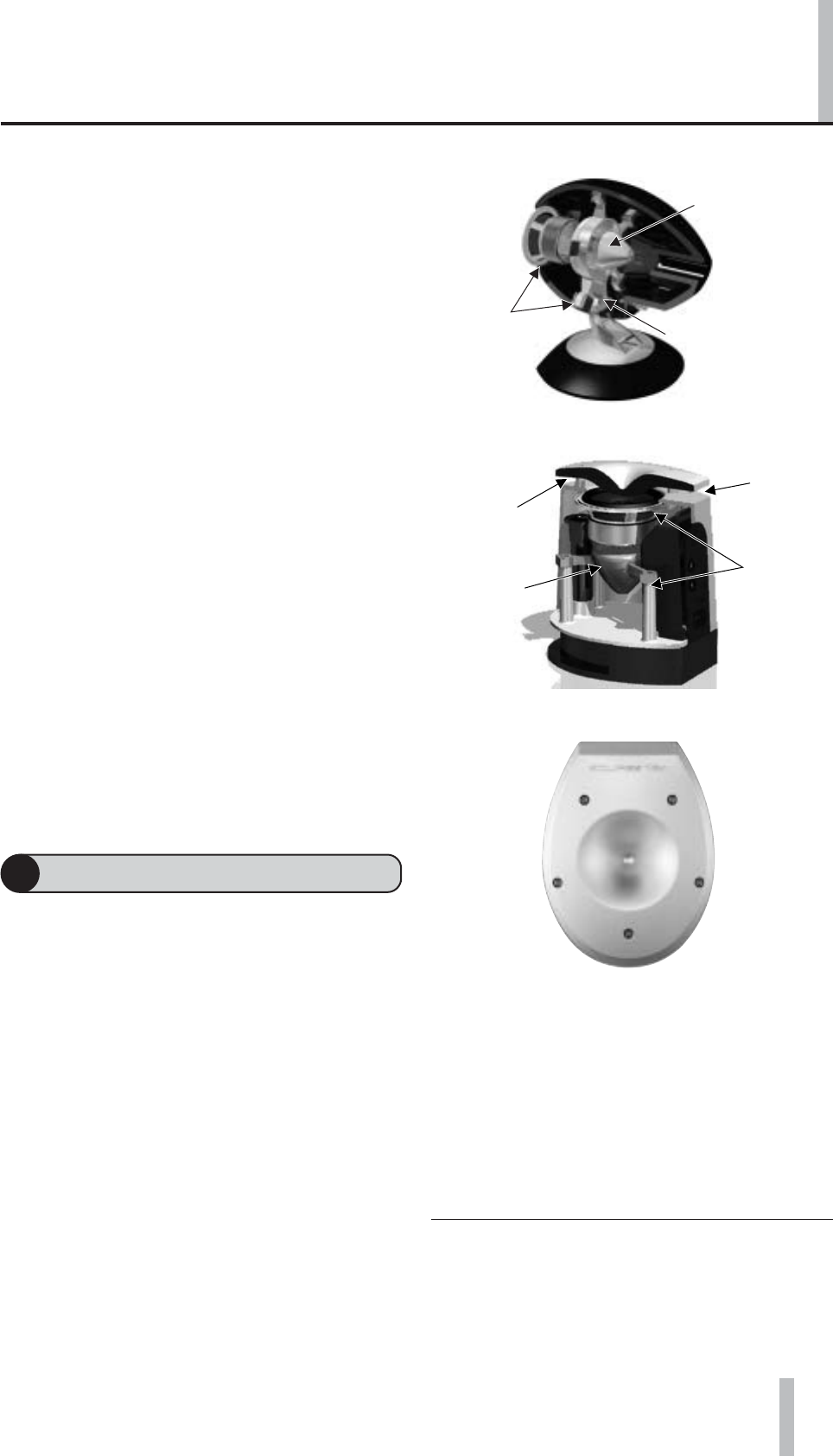
The internal structure of our Time Domain speaker
ECLIPSE TD512 for home use is shown in Fig.4, and the
internal structure of our recently developed subwoofer
is shown in Fig.5.
The fundamental idea is the same as the ECLIPSE
TD512, which is fitted with floating structure so that the
speaker unit does not make direct contact with the
speaker cabinet. The speaker unit has the structure
attached with diffusion stays, and ground anchors (Note 1)
that have enormous mass to cut off reactions (Note 2).
Furthermore, expensive aluminum die castings are
used for the speaker cabinet material adopting irregular
shape cylinders (Fig.6), which suppress resonance and
standing waves as much as possible.
Moreover, the front of the speaker unit is equipped
with a front load (Note 3), which has a structure with slits
through which the sound is emitted, striving for a char-
acteristic improvement in the range of bass sounds.
4.2 Front load effect
By providing a front load, we were able to reduce F0
from 103Hz to 98Hz. Consequently, the flat part of the
bass range was able to expand, so that the flat zone was
also able to expand. Moreover, the unnecessary reso-
nance from the front load itself was also prevented by
adopting aluminum die castings for the front load. As a
result of actual listening auditions, much better effects
have been gained than in the measurement data, and a
Ground anchor
Diffusion stay
Buffer material
Fig.4 ECLIPSE TD512 internal structure
Ground anchor
Front load
Buffer
material
Slit
Fig.5 ECLIPSE TD316SW internal structure
Fig.6 Variant shapes of cylinder forms
(Note 1) Original upholding structure for speaker unit
(Note 2) A structure in which the reaction of the vibration
board are firmly stopped and absorbed by the mass
and can acquire the ideal piston movement
(Note 3) Placed just in front of the speaker vibration board, this
increases the efficiency of sound emission.
Basic structure
4
42
FUJITSU TEN TECHNICHAL JOURNAL
FUJITSU TEN TECH. J. NO.22(2004)
greater sense of speed could be felt by setting up a
front load.
4.3 System configuration
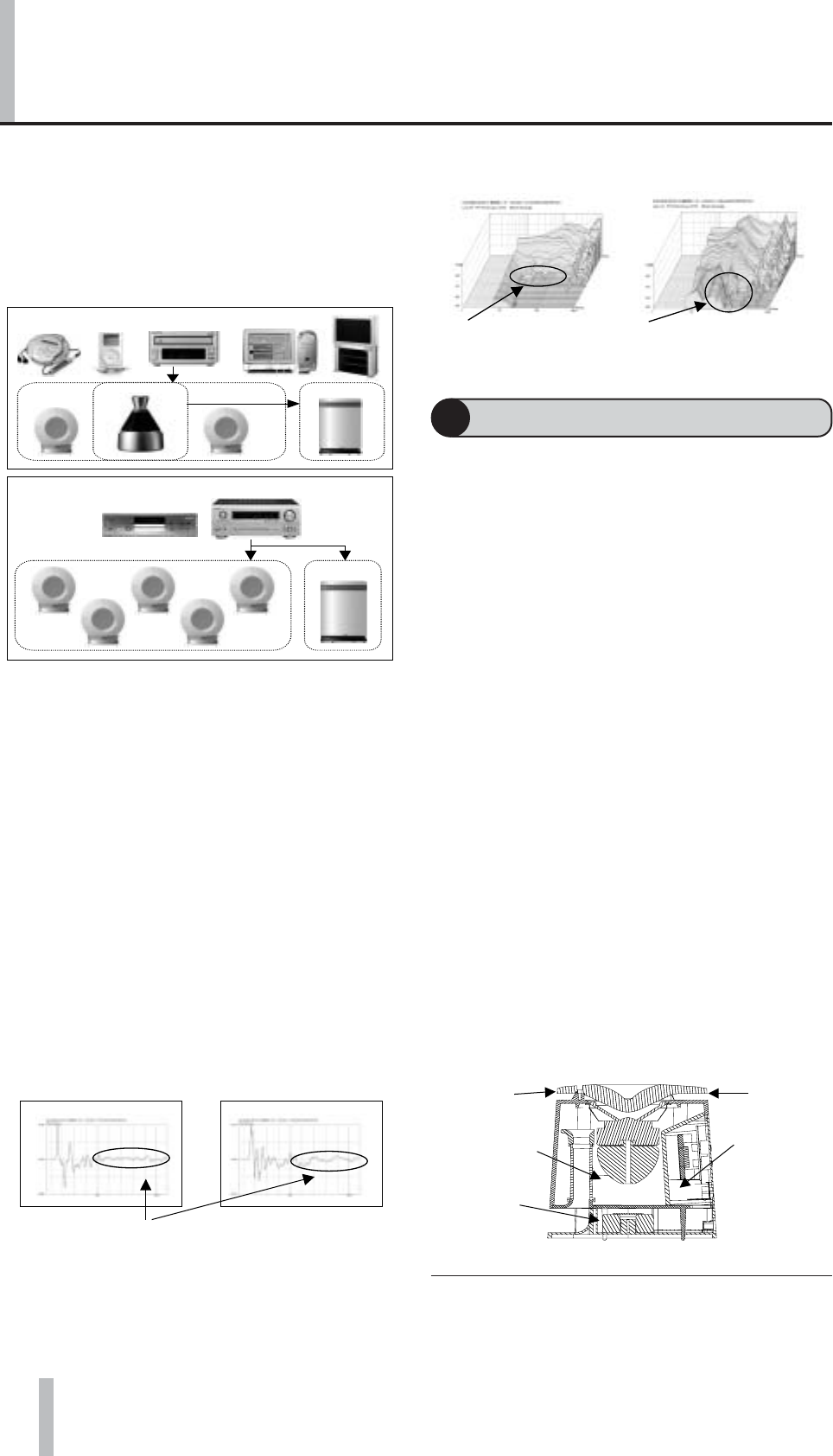
The system configuration of the newly developed
316SW is shown in Fig.7.
Concerning the unit aperture, we came to attach
great importance to the sense of speed and transient
response, so we adopted a 16cm aperture, unlike the
large aperture used by other manufacturers. Although
our bass loudness is inferior if compared with the sub-
woofers of other manufacturers when assuming home
theater use, ours won in speed and sound clarity. In
actual market testing, we received very high evaluations
of realistic presence from customers and reviewers who
listening-tested 5.1 Channel sound. Comparison
Comparative data of home-use subwoofers from other
companies currently available in the market is shown in
Fig.8 and Fig.9.
・Fig.8: Attenuation is faster than for that of other man-
ufacturers
・Fig.9: Superior to other manufacturers in the preven-
tion of unnecessary reflected waves
5. Built-in amplifier summary
In order to exhibit the capacities of this speaker to
the maximum extent, at the time of developing this sub-
woofer we elaborated on the built-in subwoofer amplifi-
er. The summary is shown below.
5.1 Separation of the power supply and amplifier
It is common for subwoofers with built-in amplifiers
in this class to include the power supply and amplifier in
a single unit. However, unnecessary oscillations generat-
ed by the transformer itself are easily transmitted to the
amplifier circuit. We did not want unnecessary oscilla-
tions riding on the audio signal to degrade the sound
quality, so we utilized a structure that separates them.
(Fig.10)
5.2 Separation of the amplifier and speaker cabinet
In the same vein as the above-mentioned item, back-
pressure distortion vibrations emitted from the speaker
unit that degrade audio quality are also transmitted to
the amplifier circuit, so we arranged the amplifier as a
separate component from the speaker cabinet. (Fig.10)
5.3 Simplification of the circuit
Based on time domain theory, we also simplified the
internal circuitry to reproduce the sound data currently
recorded as faithfully as possible, without affecting its
original flavor. Moreover, there is just one input line,
and functional controls were narrowed down to the min-
imum: volume, phase change, and cutoff only. With these
settings, we were able to reproduce a very gentle sound.
307
307
307
A301
2.1-CH
Various players
Player AV amplifier
316SW
316SW
5.1-CH
Fig.7 System structural diagram
Our subwoofer Other subwoofer
Clear difference in attenuation characteristics
Fig.8 Impulse response comparison with subwoofers of other manufacturers
Amplifier box
Power supply
box
Speaker cabinet
Front load Slit
Fig.10 ECLIPSE TD316SW separate internal structure
Our subwoofer Other subwoofer
Appearance of unnecessary oscillationLittle unnecessary oscillation
Fig.9 Comparison of cumulative spectra (Note 4)
(Note 4) The three dimensional graph displays the phase shift
of the frequency components led by each impulse
response that we searched for.
Built-in amplifier summary
5
43
Development of Time Domain Subwoofer
FUJITSU TEN TECH. J. NO.22(2004)
6. Product specification summary
・Speaker cabinet aperture: 16cm
・Rated output: 30W×2
・
Reproduction frequency bandwidth: 40Hz to 200Hz (-10dB)
・Crossover: 40Hz to 200Hz (continuously variable)
・Phase-change SW: 0/180° (slide type)
・AUTO POWER ON/OFF function
・Rate of higher harmonic wave distortion: 0.05%
(100Hz, 1/2 rated output)
・Line input: 1 stereo system (analog)
・Line output: 1 stereo system (analog/through)
・Power consumption: 46W
・External dimensions: W236×H354×D301 (mm)
・Weight: 19kg (approximate)
・Accessory: AC power cord (2m)
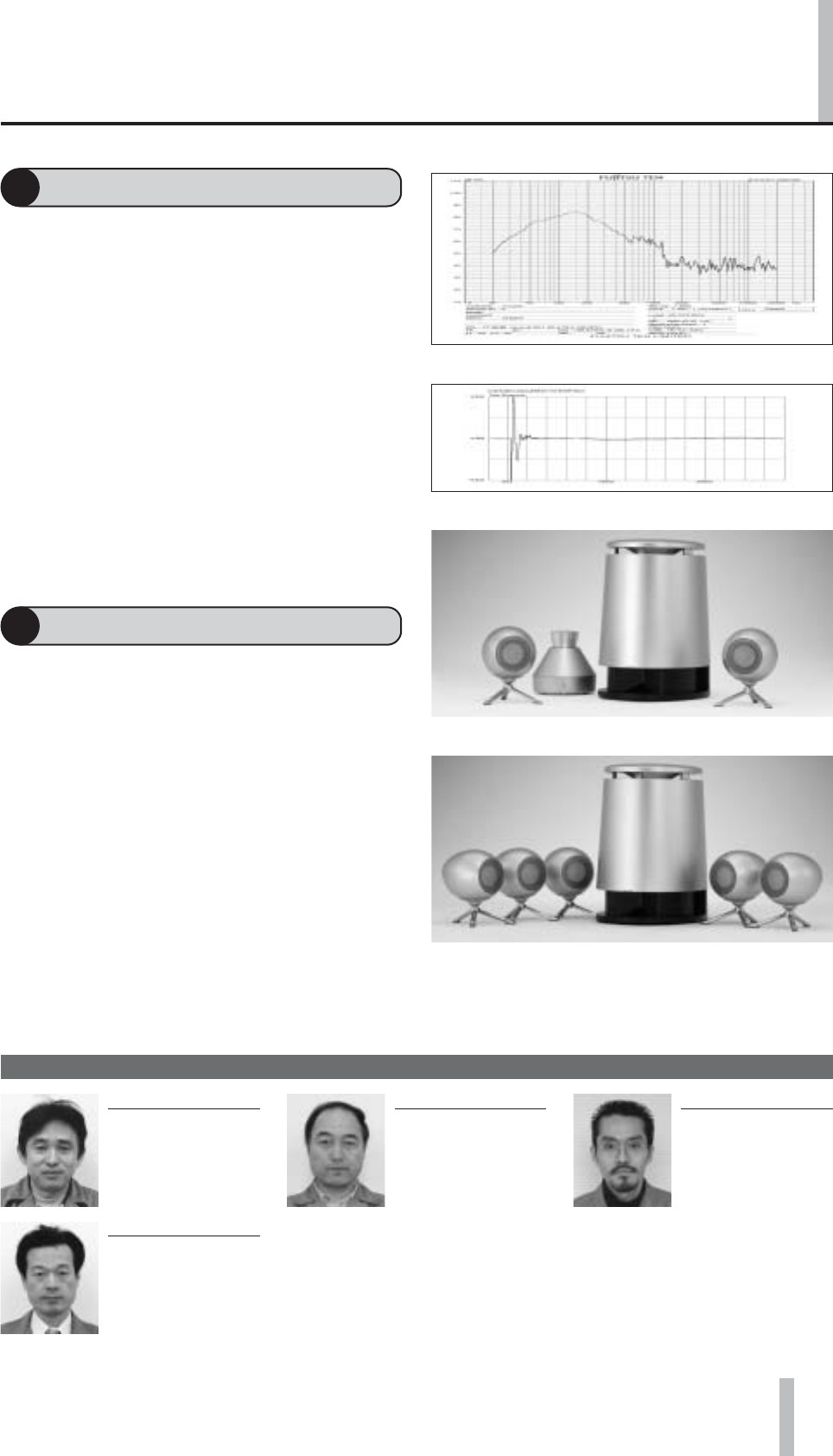
Frequency characteristics of the speaker are shown
in Fig.11, and impulse response in Fig.12. Structure is
shown in Fig.5. The newly developed system is shown
in Figs.13 and 14.
7. Conclusion
The sound of the commercial product marketed at
this time has a sense of speed, clarity, and even achieves
sound expression during playback. Especially when 5.1
Channel sound is played back, there is a sense of togeth-
erness between listeners and the speakers, and we
believe that with this total system, you will feel as if you
are on the performing stage. This sound quality must
impresses and move the hearts of many users, and we
firmly believe that it will lead us to something complete-
ly new in the audio world.
In the future, of course we aim to continue to
improve sound quality by improving the speakers and
their structure. Finally, we wish to express our deepest
gratitude to those people who cooperatedin the develop-
ment of this system, both within and outside our
Company.
Fig.11 Frequency response of subwoofer
Fig.12 Impulse response of subwoofer
Fig.13 2.1 Channel system
Fig.14 5.1 Channel system
Product specification summary
6
Conclusion
7
Kazuhiko Hamada
Entered the company in 1986. Since
then, has engaged in car audio and
music software development, and
from 2001 in home speaker develop-
ment.
Currently in the Acoustic Engineering
Department of Audio Business
Division, Business Division Group.
Akira Fujimoto
Entered the company in 1993. Since
then, has engaged in development of
in-car amps, and from 2002 in devel-
opment of home TD amps.
Currently in the Acoustic Engineering
Department of Audio Business
Division, Business Division Group.
Mitsuhiro Hiramoto
Entered the company in 1982. Since
then, has engaged in development of
in-car sound systems and from 2001
in home speaker development design.
Currently in the Acoustic Engineering
Department of Audio Business
Division, Business Division Group.
Masahito Kawai
Entered the company in 1984. Until
1988, engaged in structural design of
in-car stereos. Since then, has engaged
in design development of in-car speak-
ers, and this has continued to present.
Currently the Manager of the Acoustic
Engineering Department of Audio
Business Division, Business Division
Group.
Profiles of Writers
