CENTRAL MACHINERY 95288 27 VISHAL RATHORE
User Manual: CENTRAL MACHINERY 95288
Open the PDF directly: View PDF  .
.
Page Count: 8

et
International Journal on Emerging Technologies 4(1): 169-176(2013)ISSN No. (Print): 0975-8364
ISSN No. (Online): 2249-3255
Energy Audit on Earth Moving Industry
Vishal Rathore*, Amitesh Paul ** and Rajesh Singhadiya***
Department of Mechanical Engineering,
*Research Scholar, SSSIST, Sehore, (M.P.)
**Head of Department, SSSIST, Sehore, (M.P.)
***Energy Auditor, (M.P.)
(Received 05 May, 2013, Accepted 15 June, 2013)
ABSTRACT: Energy auditing has been conducted to the Liu Gong India Pvt. Ltd., Pithampur Dhar
(M.P.) to estimate the Energy consumed in a day, week and monthly. The Energy Auditing for a day is the
index of the consumption which normalizes the situation of Energy crisis by providing the conservation
schemes. Any organization so called bulk consumer of electrical energy propose to adopt suitable
technology or scheme of energy conservation to minimize. The unwanted power shutdown either
incidentally or by load shedding.
Energy auditing has been a part and parcel of every consumer of any form of which energy is exhaustible
and inexhaustible in nature. In olden days their practice used to exploitation of energy only when it is
available for example during crops harvesting wind blow in one direction was very essential for that they
used wait overnight whenever wind blows little heavily harvesting process used to be done. Also they used
select the season for harvesting exclusively for this purpose because ample labours were also available
there will not rain and sufficient sun is available people will not be having any work in the field. That is
how energy by nature was used by formers. Now we are being literate energy being used without
bothering its existence further. Energy auditing is one tool through which balancing of demand and
supply is determined and the positive mismatch cannot be compensated either by organic way or it might
be difficult task. Aim of performing this project is to conserve and utilize the energy which is in the form
Compressed Air & Electrical Energy, which would be used efficiently, effectively and regularly without
any shortage for the future requirement of the industry.
Keywords: Conservation, Feasibility, Recommendations, Payback Period
I. INTRODUCTION
Company: LiuGong India, an arm of the leading
China’s machinery company, Guangxi LiuGong
Machinery Co., Ltd. (LiuGong) having
manufacturing experience for more than 50 years, is
quite optimistic about its future in India.
Presently LiuGong India with its registered office in
Delhi and has its regional offices in metros, logistic
centre in Chennai and the manufacturing plant in
Pithampur in Madhya Pradesh. LiuGong India Plant is
a milestone for Chinese companies in India &
China, covers 44 acres fully equipped with the latest
machines, equipments with the latest technology and
having the fully operational capacity of R&D-
Manufacturing-Sales-Service-Parts, which will
produce 2,000 units wheel loaders and excavators
annually in first phase and other products of the
company will be launched in the coming
phases. LiuGong will have 3 phases in Pithampur
plant attaining FDI investment of around Rs 500 crore
in future.
Energy auditing in a integral part of energy
conservation and energy management is also part and
parallel of conservation. Damage and supply gap is
large energy to lead to similar natural defects. Energy
disaster such as Tsunami and earth quake. The next
generation generating yet to come will be completely
light blind. It is because power never be available
after this disaster and not ever rehabilitate the
reconstruction of buildings. To avoid the energy
calamity proposed auditing report use the innovative
energy utilization schemes through which the
ferocious of situation might blindness can be
eradicated.
The primary objective of the energy audit is to
determine ways to reduce energy consumption per
unit of product output or to lower operating costs. The
energy audit provides a benchmark, or reference
point, for managing and assessing energy use across
the organization and provides the basis for ensuring
more effective use of energy.

Rathore, Paul and Singhadiya 170
The energy audit would give a positive orientation to
the energy cost reduction, preventive maintenance,
and quality control programs which are vital for
production and utility activities. Such an audit
program will help to keep focus on variations that
occur in the energy costs, availability, and reliability
of supply of energy, help decide on the appropriate
energy mix, identify energy conservation
technologies, retrofit for energy conservation
equipment, etc
II. METHODOLOGY
The energy audit uses existing or easily obtained data.
• Determine energy consumption in the organization
• Estimate the scope for saving
• Identify the most likely (and easiest areas) for
attention
• Identify immediate (especially no-cost/low-cost)
improvements/savings
• Set a reference point
Identify areas for more detailed study/measurement
Methodology of this work is concentrated on two
important things that need to be developed in order to
investigate the performance of the Compressor &
Electricity Data which is the location of measurement
points and it devices, and experiment set-up.
III. DATA ANALYSIS
There are three Reciprocating compressors, in the
plant. All the compressors have the same capacity
with same technical specification. During the energy
audit of compressed air system, team was conducted
following test:
•Free Air Delivery (FAD) test.
•Loading & unloading
Compressor Specification :
S.No
Parameter
Compressor ID (RSD/SF1/Utility/PM/3800285)
1
Make
ELGI
2
Type
Compressor
3
Product Type
GA-11P
4
Serial No.
PNE-1102021
5
Free Air Delivery (M3/hr)
115.56
6
Maximum Final Presser (Bar)
7.5
5
Motor (KW)
11
6
Receiver Capacity (Liter)
500
7
Cooling
Air
Motor Detailed
1
Make
Semens
2
Type
Induction Motor
3
Power (kW)
11
4
Phase
3
5
RPM
2950
6
Frequency (Hz)
50
7
Voltage (V)
420
8
Current (A) Loading/Unloading
21.5/12.4
9
Cos Ø
0.84
10
Rated Specific power consumption( kW/M3/hr)
0.0952
*Note-: WLU = Wheel Loader Unit, MGU = Motor Grader Unit

Rathore, Paul and Singhadiya 171
Sr.
No
Air compressor reference
Units
Value for
Shot
Blasting
Unit
Value for
Paint Line &
Testing
Value for
WLU &
MGU
1
Receiver volume plus volume of pipeline
(total volume)
m³
0.5114
0.5
1.00855
2
Receiver temperature
°C
35
35
35
3
Initial receiver pressure (P1)
kg/cm2
0
0
0.1
4
Final receiver pressure (P2)
kg/cm2
7.3
6.5
7
5
Time taken to fill receiver from P1 to P2 (T)
min
2.22
2.09
3.52
6
Atmospheric pressure (Po)
kg/cm2
1.01
1.01
1.01
Free Air Delivery Test :
S.NO.
CALCULATION
FOR
FAD = (P2 - P1/ Po) × (V/T) × {(273+
t1) / (273 + t2)}
Result
(Nm3/
min)
VOLUMETRIC
EFFICIENCY (%)
=( Actual FAD
delivered / Rated
FAD) × 100
Result
(%)
1
Shot Blasting Unit
=(7.3 –0/ 1.01) × (0.5114/ 2.22) ×
{(273+ 27) / (273 + 35)}
1.62
(1.62/1.93) ×100
83
2
Paint Line & Testing
=(6.5 –0/ 1.01) × (0.5/ 2.09) × {(273+
27) / (273 + 35)}
1.5
(1.50/1.93) ×100
77.67
3
WLU & MGU
( Assembly Line)
=(7 –0.1/ 1.01) × (1.00855/ 4.0) ×
{(273+ 27) / (273 + 35)}
1.677
(1.677/1.93) ×100
86
Leakage Test :
Compressor
Value for Shot
Blasting Unit
Value for Paint Line & Testing
Value for Wheel loader &
Motor Grader Unit
Load time (t1)
Min 0.82
Min 0.76
Min 0.5
Unload time (t2)
Min 8.58
Min 2.26
Min 5.25
S.NO.
CALCULATION
FOR
% Leakage = {(t1/ (t1+ t2)} ×100
Result
(%)
% Leakage x
FAD (m³/day)
Leakage in
One Shift
(8x60)
(m³/day)
1
Shot Blasting Unit
{0.82/(0.82+8.58)} ×100
8.72
0.1413
68
2
Paint Line & Testing
{0.77/(0.77+2.26)} ×100
25
0.3812
182.976
3
WLU & MGU
( Assembly Line)
{0.5/(0.5+5.25)} ×100
8.7
0.1458
70.031

Rathore, Paul and Singhadiya 172
Reduce Leakage & Wastage By Awareness & Preventive Maintenance.
S.NO.
Location
% of
Leakage
Targeted % Reduction
Working
Hours/Day
Expected Energy
Saving (Kwh/Yr)
1
Shot Blasting Unit
25
20
17
14,698
2
Paint Line Unit
8.7
3
8
1045
3
Wheel Loader &
Motor Grader Unit
8.7
3
8
1037
4
Total
16,780
Expected Energy Saving= 16,780 kWh/Year.
Expected Saving @ Rs.7/- per kWh= 1, 17,460/-
Expected Investment = Nil
Simple Payback Period =Immediate
Suggestion for Energy Efficiency In Compressed
Air System
•Reduced Compressor delivery pressure,
wherever possible to save energy.
•Provide extra air receivers at point of high
cycle air demand which permits operation
without extra compressor capacity.
•Compressed air leakage of 40-50% is not
uncommon. Carry out periodic leak tests
to estimate the quantity of leakage.
•Compressed air piping layout should be
made preferably as ring main to provide
desired pressure to all users.
•A smaller dedicated compressor can be
installed at load point located far off from
the central compressor house, instead o
supplying air through lengthy pipelines.
•Pneumatic equipment should not be
operated above the recommended
operating pressure as this not only wastes
energy but can also lead to excessive wear
of equipment’s components which leads to
further energy wastage.
•Pneumatic tools such as drill and grinders
consume about 20 times more energy then
motor driven tools. Hence they have to be
used efficiently. Whenever possible, they
should be replaced with electrically
operated tools.
•If pressure requirement for process are
widely different (e.g. 3 bar to 7 bars), it is
advisable to have two separate compressed
air system.
IV. ELECTRICITY DATA
LiuGong India Pvt. Ltd. (Motor Grader Unit,
Canteen & Campus Lightening Area) has
presently taken the power supply from MPMKVV.
Co. Ltd with the help of 33 KV Industrial urban
feeders under tariff 2110 HV- 3.1 with Contracted
Maximum Demand (CMD) is 76 KVA.
Electrical Energy Consumption and Bills:
The analysis of the electricity bill was done by
using latest tariff schedule for HV-3.1 33 KV
Industrial (Urban) feeder. The tariff schedule is
given in appendix 3.1.
Electricity billing is following manner under tariff schedule HV- 3.1.
PARTICULARS
UNITS
VALUE
Demand charges
Rs./kVA
Rs. 335/-
Energy Charges
Rs./kWh
Rs. 4.70/-
Low PF Surcharges (+)
1% to 2% on Energy charges etc. for every
point
As per PF recorded below 0.90 and
applicable
PF Rebate (-)
1% to 5% on Energy charges rebate
As per Pf recorded above 0.95
TOD surcharges (+)
Rs/kWh
Rs. 5.405/-
TOD rebate (-)
Rs/kWh
Rs. 4.35/-
CESS (duty)@ 15 %
Rs/kWh
Rs. 0.405/-
Meter rent
Rs/month
Rs. 2000/-
Rate per unit
Rs/kWh
Rs. 7.0./-
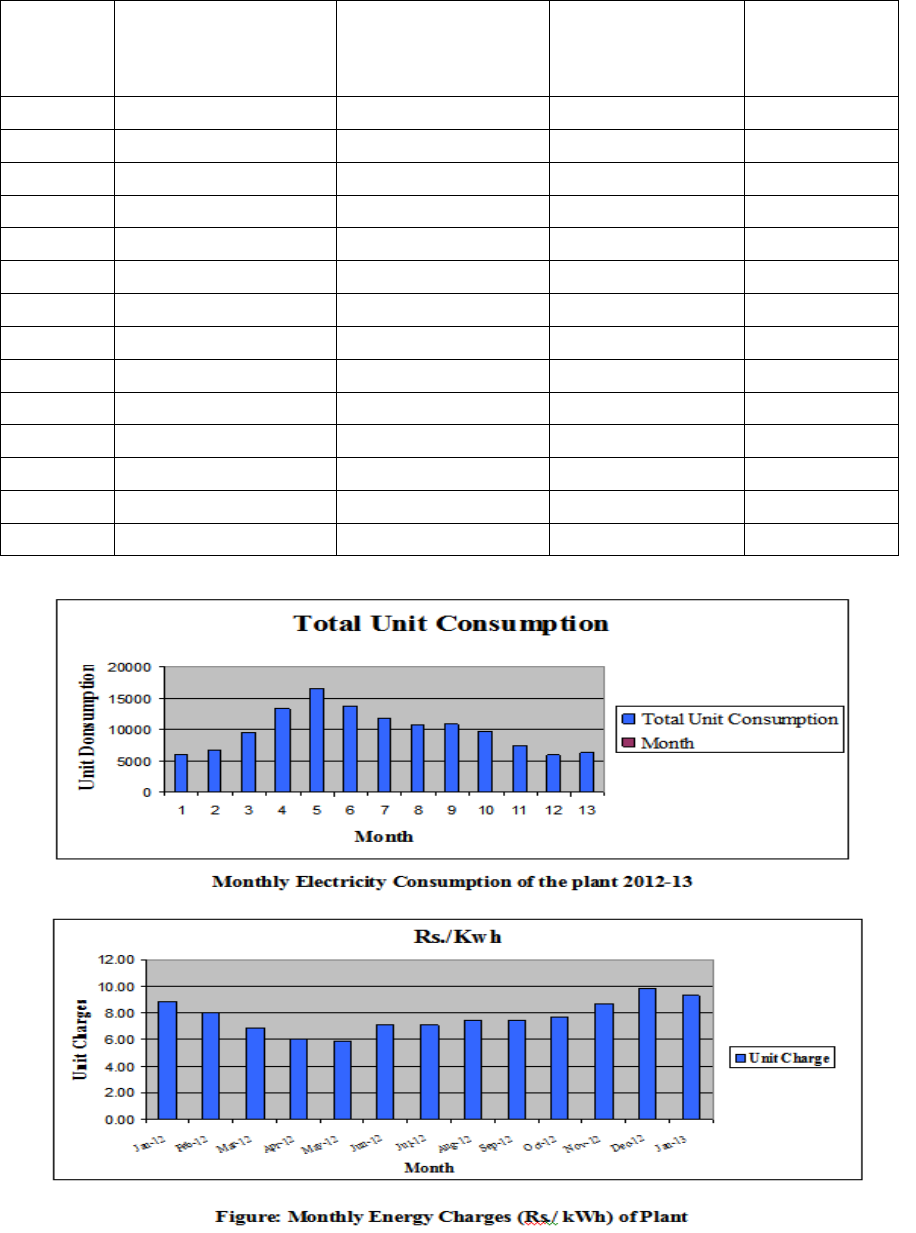
Rathore, Paul and Singhadiya 173
Monthly Electricity Consumption of the Plant 2012-2013.
Sr. No.
Month & Year
Total Unit
Consumption (kwh)
Total Amount
Rs./Kwh
1
1-Jan-2012
5890
52047.00
8.84
2
1-Feb-2012
6620
53062.00
8.02
3
1-Mar-2012
9430
64736.00
6.86
4
1-Apr-2012
13990
84920.00
6.07
5
1-May-2012
16600
97919.00
5.90
6
1-Jun-2012
13750
97607.00
7.10
7
1-Jul-2012
11690
83041.00
7.10
8
1-Aug-2012
10690
79661.00
7.45
9
1-Sep-2012
10780
80239.00
7.44
10
1-Oct-2012
9620
74327.00
7.73
11
1-Nov-2012
7300
63069.00
8.64
12
1-Dec-2012
5910
57740.00
9.77
13
1-Jan-2013
6290
58525.00
9.30
Total
1,28,560
9,46,893.00
7.71
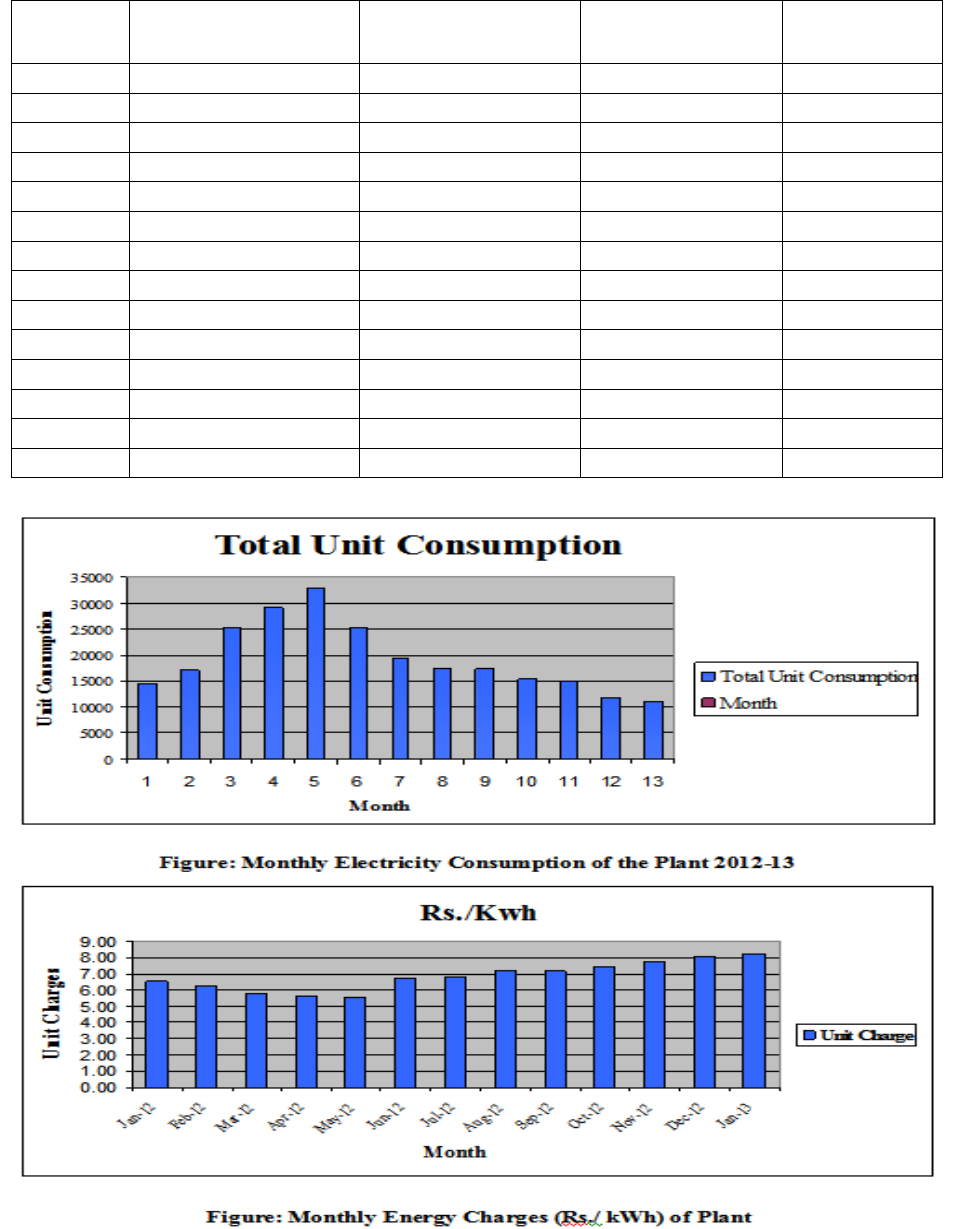
Rathore, Paul and Singhadiya 174
V. ELECTRICITY DATA
LiuGong India Pvt. Ltd. (Wheel Loader, office
Building, and Trading Unit & Testing Unit) has
presently taken the power supply from
MPMKVV.CO. Ltd. with the help of 33KV
Industrial urban feeder under tariff 2110 HV-3.1 with
Contracted Maximum Demand (CMD) is 105 KVA.
Monthly Electricity Consumption of the Plant 2012-2013.
Sr. No.
Month & Year
Total Unit
Consumption (kwh)
Total Amount
Rs./Kwh
1
1-Jan-2012
14515
95288.00
6.56
2
1-Feb-2012
17170
107566.00
6.26
3
1-Mar-2012
25435
145628.00
5.73
4
1-Apr-2012
29235
164468.00
5.63
5
1-May-2012
32995
182750.00
5.54
6
1-Jun-2012
25300
169238.00
6.69
7
1-Jul-2012
19400
132012.00
6.80
8
1-Aug-2012
17440
124688.00
7.15
9
1-Sep-2012
17220
122884.00
7.14
10
1-Oct-2012
15425
114265.00
7.41
11
1-Nov-2012
14940
111653.00
7.47
12
1-Dec-2012
11875
95604.00
8.05
13
1-Jan-2013
11100
90986.00
8.20
Total
252050
1657030.00
6.82

Rathore, Paul and Singhadiya 175
Energy Conservation Measure with Cost Economics
Demand Side Management
By Discarding 76KVA Feeder (Demand Side Management)
During the Energy Audit last 13 month electricity bill was analysis in the following table :
Sr.
No
.
Month &
Year
Actual KVA
Consumption
Total
Consumptio
n (KVA)
Billing KVA
(90% of CD)
Total
Billing
(KVA)
Difference
(KVA)
=
Billing - Actual
Additional
Fixed
Charge
(Rs./KVA)
paid on
90% CD
MPE57804
(105 KVA)
MPE56284
(76 KVA)
MPE57804
(105 KVA)
MPE56284
(76 KVA)
1
1-Jan-2012
21
24
45
95
68
163
118
39530/-
2
1-Feb-2012
23
28
51
95
68
163
112
37520/-
3
1-Mar-2012
25
38
63
95
68
163
100
28000/-
4
1-Apr-2012
34
51
85
95
68
163
78
33500/-
5
1-May-2012
28
55
83
95
68
163
80
26800/-
6
1-Jun-2012
35
52
87
95
68
163
76
25460/-
7
1-Jul-2012
27
44
71
95
68
163
92
30820/-
8
1-Aug-2012
28
36
64
95
68
163
99
33165/-
9
1-Sep-2012
28
39
67
95
68
163
96
32160/-
10
1-Oct-2012
32
42
74
95
68
163
89
29815/-
11
1-Nov-2012
33
28
61
95
68
163
102
34170/-
12
1-Dec-2012
26
21
47
95
68
163
116
38860/-
13
1-Jan-2013
26
22
48
95
68
163
115
38525/-
Total
1273
422305/-
VI. OBSERVATION
•As per the rule of minimum demand charges
90% of the CD, plant is paying fixed charges
(Rs. 335/KVA) on 95 KVA per month for
MPE57804 (105 KVA).
•Similarly pant is paying fixed charges (Rs.
335/KVA) on 68 KVA per month
MPE56248 (76 KVA)
•Total amount paid by plant Rs. 4,22,305/- in
last year on additional pay on 1273 KVA
VII. RECOMMENDATION
It is Recommended to management take the action
for permanent disconnect the 76KVA Contract
Demand feeder & shift all load on MPE57804 (105)
Feeder.
Saving Calculation
•Expected Demand Saving = 1018KVA Per
year
•Expected Money Saving = Rs. 3, 41, 030 /-
Per year
Suggestion for Energy Saving through Power
Consumption
•All Interior walls should be painted using
Enameled paint which would reflect light.
•All Air conditional rooms should be Air light
and doors should be Hydraulic closing
system. Outside air entry in to the air
conditioned room is not hygienic.
•Provision can be made for cooled water
storage facility wherever possible attached
AC room, so that multipurpose utilization of
AC to cool the water will reduce the power
consumption by 30% .
•Replacement of CRT monitor by LCD
monitor not only gives the cost benefit
interns of energy saving but also play a
significant role of radiations due high
potential .when CRT is used high voltage
level handling by CRT at HT electrodes
may emit harmful radiations beyond the
screen which affect the vision.
Rathore, Paul and Singhadiya 176
•Human being get in touch for trouble
shooting may receive great risk of
deadly shock if they touch the charged
body which is normally charged up to
10000volts (approximately). In LCD
monitor all such problems can be
minimized.
•Energy saving by replacing LCD desktop
with LAPTOP illustrate the benefit s in
terms of portability, space saving,
maintenance cost of desktop computers
and additional cost of peripherals. Also
cost of damage and other electrical
problems. Critical space management and
cost involved can be removed. Wiring for
LAN and labour cost can also be
prevented.
•Unnecessary power consumption by
negligence of user and system
administrator for not switching off
while leaving the office will have more
vulnerability for damage due to short
circuit and heavy voltage due to lightning
.
•It is recommended to replace fluorescent
lamps by CFL which are handy by
construction and possibility of breakage is
less. Installation is easy and the labour
charge required for replacement of burnt
tubes and defected choke lamps is a costly
affair. Disposal of burnt tubes will disturb
the habitat place of both human being and
animals. The release of krypton and argon
gases is more dangerous, it may lead to
ecological imbalance if it in mass
destruction.
•Switch off the photocopier machine at the
main outlet itself when not in use or in
other words machine should not be kept in
stand by and sleep mode which consumes
power.
VIII. CONCLUSION
The Proposed project gives strong warning to the
consumer not only in terms of the energy bills also
the energy crisis in the near future to all sectors of
people and in this project the recommendations
reduces the around 15-20% of the energy and 25-
30% of cost reduction excluding some issues takes
more payback period and some are economically
not fit will also be taken in to account in a long run.
There is a scope of improvement to include the
advanced lighting scheme to reduce further 10% of
the cost.
REFERENCES
[1]. Handbook of Bureau of Energy Audit,
Organization of Govt. of India
[2]. www.energymanagertraining.com
[3]. www.google.com
[4]. Website of Liu Gong India Pvt. Ltd.
[5]. Working manual on energy auditing by the
Asian productivity organization(apo) and national
productivity council (npc) in new Delhi, India,
[6]. Efficient Use of Electricity In Industries- Devki
Energy Consultancies Pvt. Ltd., Vadodara
[7]. Free guide to achieving financial success as an
energy auditor by Energy audit Institute- DAVV
(Indore).
