Estimated Cost Of On The Job Training To 3 Skill Level In Communications Center Operations Specialty 753 093 753093
User Manual: 753-093
Open the PDF directly: View PDF  .
.
Page Count: 36
AD-753
093
ESTIMATED
COST
OF
ON-THE-JOB
TRAINING
TO
THE
3-SKILL
LEVEL
IN
THE
COMMUNICA-
TIONS
CENTER
OPERATIONS
SPECIALTY
Alan
D.
Dunham
Air
Force
Human
Resources
Laboratory
Lackland
Air
Force
Base,
Texas
June
1972
!I
DISTRIBUTED
BY:
National
Technical
Information
Service
U. S.
DEPARTMENT
OF COMMERCE
5285
Port
Royal
Road,
Springfield
Va.
22151
[]A
AFHRL-TR-72-56
AIR
FORCE
0
ESTIMATED COST
0P
ON-THE-JOB
TRAINING
TO
THE
3-SKILL
LEVEL
IN
THE
COMMUNICATIONS
HCENTER
OPER.ATrIONS
SPECI.LrY
U
MI
By
A
Alan
D.
Dunham, Capt.
USAF
! N
N
PERSONNEL RESEARCH
DIVISION
Lackland
Air
Force
Base,
Texas
S
June
1972
0
U
R
Approved
for
public
release;
distribution
unlimited.
c
£ E
S L
ABORA
TO
R
Y
AIR FORCE
SYSTEMS
COMMAND
BROOKS
AIR
FORCE
BASE,
TEXAS
Iit
S i
NOTICE
When
US
Government
drawings,
specifications,
or
other
data
are
used
for
any
purpose
other
than
a
definitely
related Government
procurement
operation,
the
Government
thereby
incurs
no
responsibility
nor
any
obligation whatsoever,
and
the
fact
that
the
Government
may
have
formulated,
furnished,
or
in
any way
supplied
the
said drawings,
specifications, or
other
data
is
not
to
be
regarded
by
implication or
otherwise,
as
in
any
manner
licensing
the
holder
or
any
other
person
or
co,
poration.
or
conveying any
rights
or
permission
to
manufacture,
use.
or
sell
any
patented
invention
that
may
in
any way
ii
be
related
thereto.
(I
, I
CN&
402
I
-I
__402
Unclassified
Security
Class•fication
DOCUMENT
CONTROL
DATA
-R & D
(Security
cla••
i•ication
of
title.
body
of
Abstract
and
indexing
annotation
must
be
o*nrr
%'hen thet
o.verall
report
is
classifi.d)
A
I
ORIGINATING
ACTIVITY
(CIrpotsta
author)
a
.
REPORT
SECURITY
CLASSIFICATION
Pesonnel
Research
Division
Unclassfied
Air
Force
Human Resources
Laboratory
2. G
Lackland
Air
Force
Base,
Texas
78236
3
REPORT
TITLE
ESTIMATED COST
OF
ON-THE-JOB
TRAINING
TO
THE
3-SKILL
LEVEL
IN
THE
COMMUNICATIONS
CENTER
OPERATIONS
SPECIALTY
4
DESCFI4PTIVE
NOTES
(Type
of
report
and
Incluesve dates)
S
AUTNORIS)
(First
name,
middle
initial.
la*t
name)
Alan
D.
Dunhzn
a.
RUPORT DATE
7e. TOTAL
NO.
OF
PAGIS
7b,
NO
OF
REFS
June
1972
3-~~z-
44.
CONTRACT
OR
GRANT
NO
9a.
ORIGINATOR'S
REPORT
NUMBERIS)
b.
PROjECT
NO
6323
AFHRL-TR-72-56
c.
Task No.
632302
9b.
OTHER
REPORT
NO($)
(Any
other
numbers
that
may
be
assigned
this
report)
d.Work
Unit
No.
63230209
10
DISTRIBUTION
STATEMENT
Approved
for
public
release;
distribution
unlimited.
I
I
SUPPLEMENTARY
NOTES
It2.
SPONSORING
MILITARY
ACTIVITY
Personnel
Research
Division
Air
Force
Human Resources
Laboratory
Lackland Air
Force
Base,
Texas
78236
13
ABSTRACT
Decisions
concerned
with
the
use
of
alternative
Air
Force
training
methods
require
several
types
of
data.
Among
these
are
capacity
to
train, cost
of
the
training,
and
quality
of
the
trained
airm
n.
The
two methods
of
formal
training
In
the Air
Force
are
on-the-job training
(Oil)
and
technical
school
training. The
data
currently
being provided
to
decision
makers
for
selecting
the proper
mix
of
thete
two
training
methods
can
be
substantially improved.
,I
DD
'°'.1473
J"
Unssified
Security
Classification
Unclassified
-,1
security
Classifkcation
14
K
WRSLINK
A
LIN
a
L.INK
C
ROLE
WT
ROLE
WY
ROLE
I
Wr
trainin
education
cost
on-the.Job
Training
comnmunications
USAF
Undassifled
.Zii
'*
~
security
ciessificition
AFHRL.T
R--72-56
June
1972]
ESTIMATED
COST
OF
ON-THE-JOB
TRAINING
TO THE
3-SKILL
LEVEL
IN
THE
COMMUNICATIONS
CENTER
OPERATIONS SPECIALTY
By
Alan
D.
Dunham,
Capt,
USAF
Approved
fmo
public
re'lease:
dbathbution
unlimited.
II
PERSONNEL
RESEARCH
oIVISION
AIR
FORCE
HUMAN
RESOURCES
LABORATORY
AIR FORCE
SYSTEMS
COMMAND
Lackland
Air
Force
Base,
Texas
FOREWORD
This
research
was
completed
under
Project
6323,
Personnel
Management Research
and
Development;
Task
632302,
Research
and Development
on
Mathematical/
Econometric
Models
of
the
Air
Force
Personnel
Symem.
This
report
describes
the
preliminary results
of
an
effort
to
develop
a
methodology
for
estimating
costs
of
On-the.Job Training
which
can be
used in
decisions
concerning
optimal
mixes
of
OJT
and
Technical
School.
This
report
has
been
reviewed
and
is
approved.
George
K.
Patterson,
Colonel,
USAF
Commander
II
iil
ABSTRACT
Decisions
concerned
with
the
use
of
alternative
Air
Force training
methods
require
several
types
of
data.
Among
these
are
capacity
to
train,
cost
of
the
training, and
quality
of
the
trained
airmen.
The
two
methods
of
formal
training
in
the
Air
Force
are
on-the-job
training
(OJT)
and
technical school
training.
The
data
currently
being
provided
to
decision
makers
for
selecting
the
proper
mix
of
these
two
training
methods
can
be
substantially
improved.
A
model
to
obtain
cost data
for
technical
training
school already
exists.
This
study
applies
a
methodology
developed
to
estimate
the
cost
of
OJT
to
the
3-skflf
(semi-skilled)
level
for
Air
Force
Specialty
291
XO,
Communications Center
Operations,
and
compares
it
with
the
cost
of
the corresponding
technical
training
school
course,
3ABR29130.
4
!V
ill
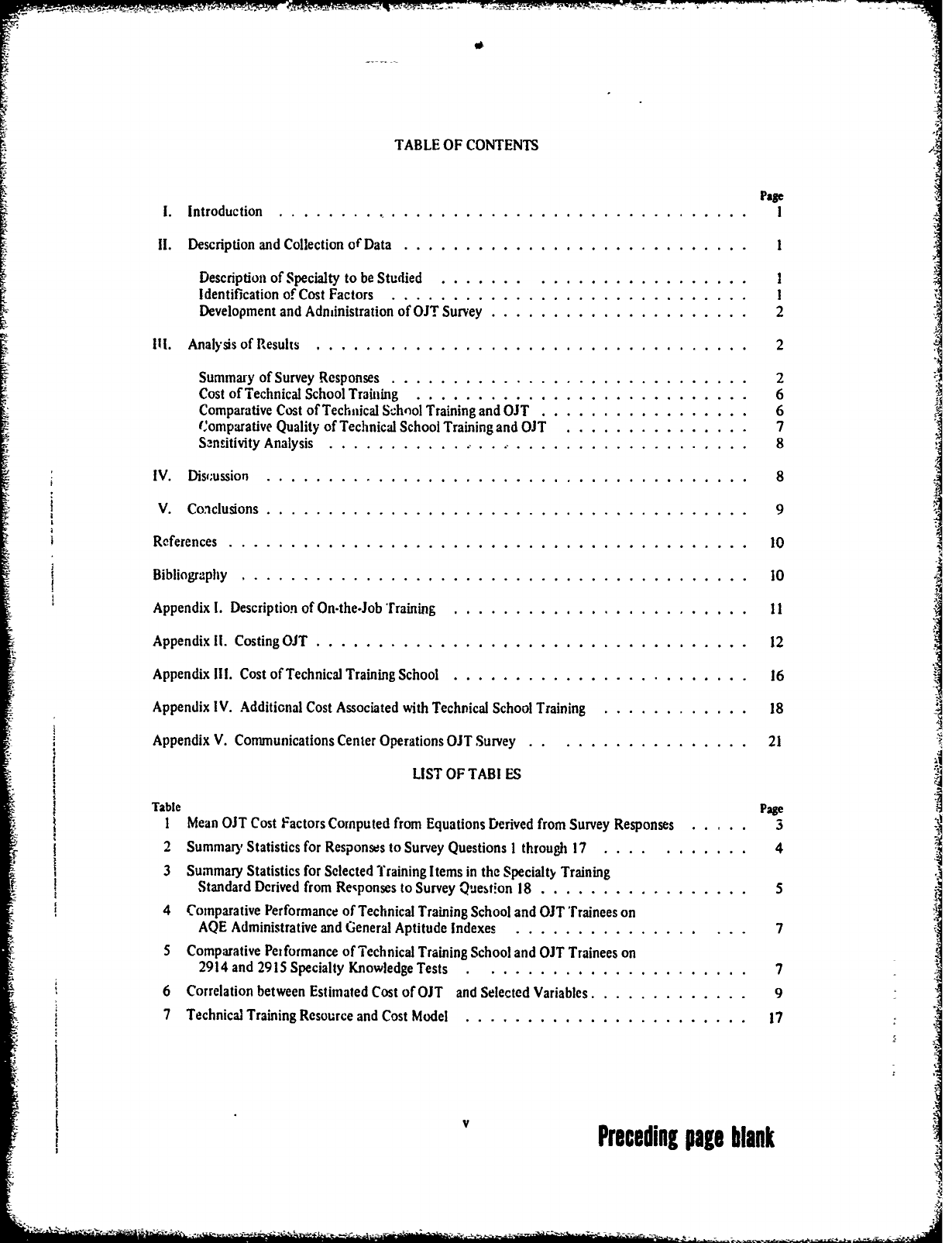
TABLE
OF
CONTENTS
/
Page
i.
Introduction
...................................... I
II.
Description
and
Collection
of
Data
........ ............................
Description
of
Specialty
to
be
Studied
....... ................. I
Identification
of
Cost
Factors
............................. I
Development
and Administration
of
OJT
Survey
...... ...................... 2
Ill.
Analysis
of
Results
.......... ................................... 2
Summary
of
Survey
Responses
......... ............................. 2
Cost
of
Technical School
Training
......... ........................... 6
Comparative Cost
of
Technical School
Training
and OJT
...... ................. 6
Comparative
Quality
of
Technical
School
Training
and
OJT
...... ............... 7
Sansitivity
Analysis
............ .................................. 8
IV.
Diss:ussion
............ ........................................ 8
V.
Conclusions.
. ...................................... 9
References
.............. .......................................... 10
Bibliography
............ .........................................
10
Appendix
I.
Description
of
On-the-Job Training
......... ........................ 11
Appendix
It.
Costing
OJT
.......... ................................... 12
Appendix
111.
Cost
of
Technical
Training
School
. .. .. .. .. .. .. .. .. .. .. . .. 16
Appendix
IV.
Additional
Cost
Associated
with Technical School Training
..... ............ 18
Appendix
V.
Communications
Center
Operations OJT
Survey
...... .................
21
LIST
OF
TABI
ES
Table
Page
I
Mean
OJT
Cost
Factors Computed
from
Equations
Derived
from
Survey Responses
..... 3
2
Summary
Statistics
for
Responses
to
Survey
Questions
I
through
17
..... ........... 4 4
3
Summary
Statistics
for
Selected
Training
Items
in
the
Specialty
Training
Standard
Derived
from
Responses
to
Survey
Queston
18
...... ................. 5
4
Comparative
Performance
of
Technical
Training
School
and
OJT
Trainees
on
AQE
Administrative
and
General
Aptitude
Indexes
........ .................. 7
5
Comparative
Peiformance
of
Technical Training
School
and
OJT Trainees
on
2914 and
2915
Specialty
Knowledge
Tests
......... ...................... 7
6
Correlation
between
Estimated
Cost
of
OJT
and
Selected
Variables
.................. 9 9
7
Technical
Training
Resource and
Cost
Model
....... ....................... !7
v
Preceding
page
blank
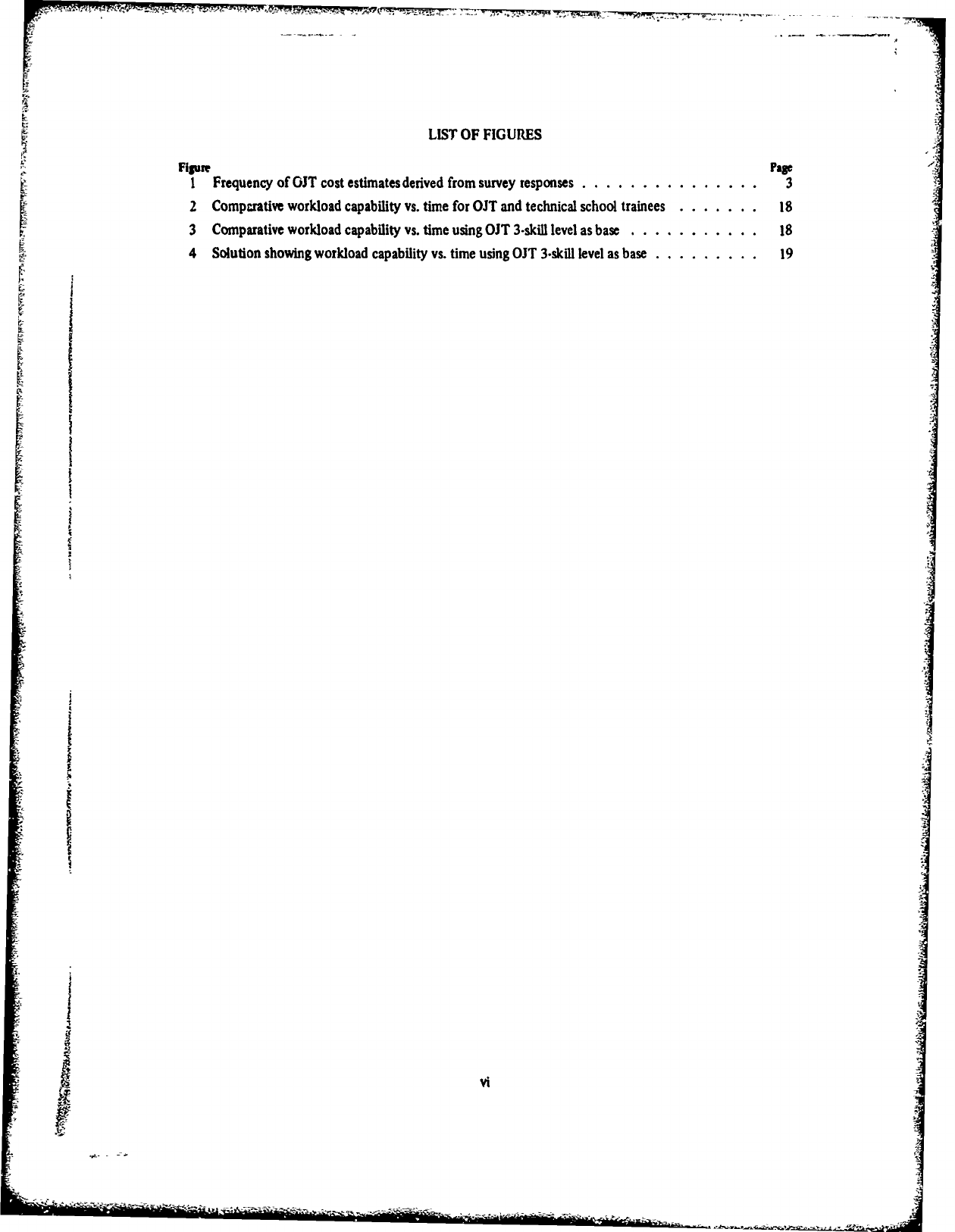
LIST
OF
FIGURES
RFipum
Pae
SI
Frequency
of
OJT
cost
estimates
derived
from
survey responses
................... 3
2
Compurative
workload
capability
vs.
time
for
OJT
and
technical
school
trainees
....... ... 18
3
Comparative
workload capability
vs.
time
using
OJT
3-skill
level
as
base
........... .... 18
4
Solution
showing
workload capability
vs.
time
using
OJT
3-skill
level
as
base
......... ... 19
.-i
2 1*
A
vi
4d
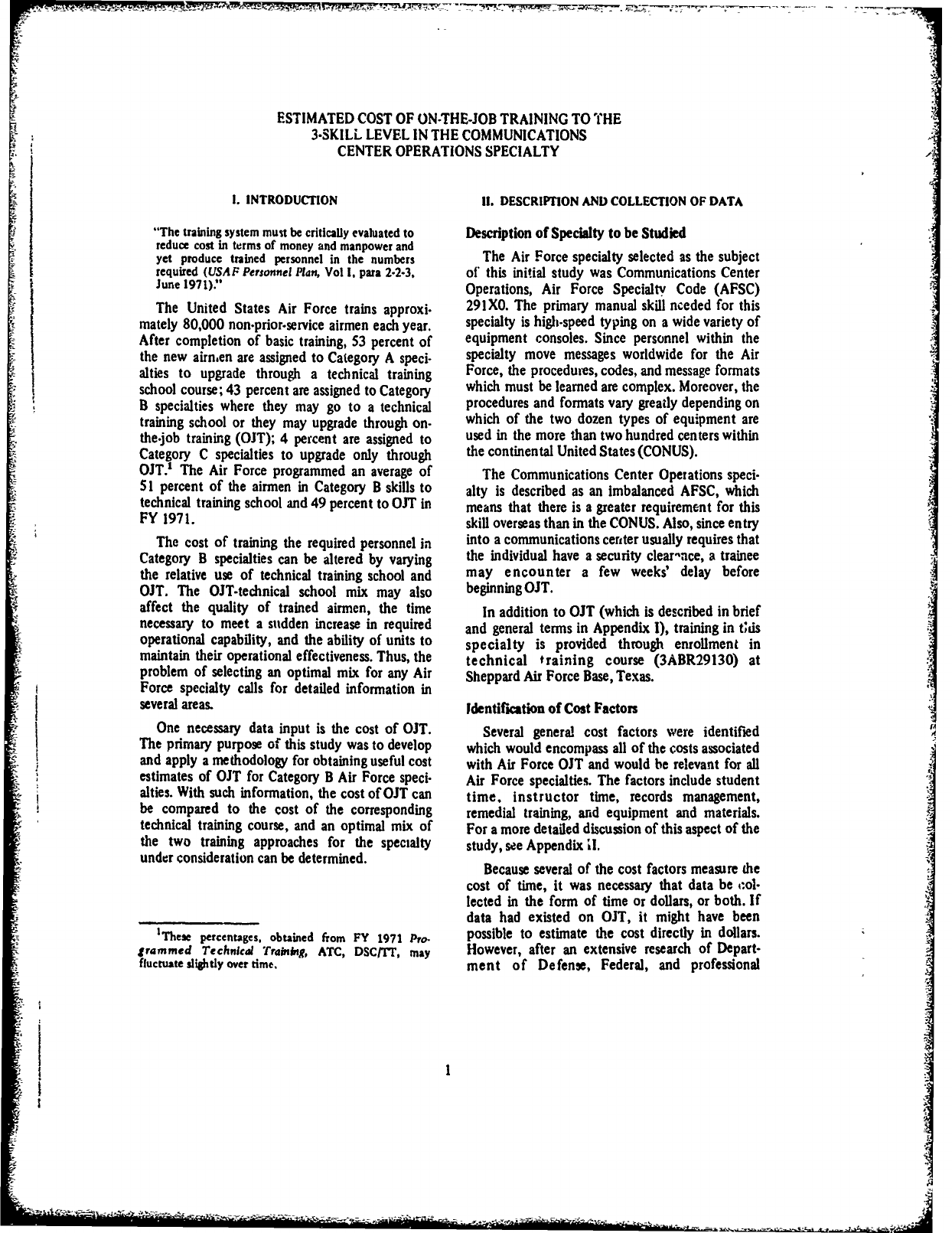
ESTIMATED
COST
OF
ON-THE-JOB
TRAINING
TO
THE
3-SKILL
LEVEL
IN
THE
COMMUNICATIONS
CENTER OPERATIONS SPECIALTY
I.
INTRODUCTION
I.
DESCRIrTION
AND
COLLECTION
OF DATA
"The
training
system
must
be
critically
evaluated
to
Description
of
Specialty
to
be Studied
reduce cost
in
terms
of
money and manpower
and
yet produce
trained personnel
in
the numbers
The
Air
Force
specialty selected
as
the
subject
required
(USAF
Personnel
Pan,
Vol
1,
para
2-2-3,
of' this
ini.ial
study
was
Communications
Center
June
1971):.
Operations,
Air
Force
Specialty
Code
(AFSC)
The
United
States
Air
Force
trains approxi.
291X0.
The primary
manual
skill
needed
for
this
mately
80,000
non-prior-service
airmen
each
year.
specialty
is
high-speed
typing
on
a
wide
variety
of
After completion
of
basic
training,
53
percent
of
equipment
consoles.
Since
personnel
within
the
the
new
airn.en
are assigned
to
Category
A
speci-
specialty
move
messages
worldwide for
the
Air
alties
to
upgrade
through
a
technical
training Force,
the
procedures,
codes,
and
message
formats
school
course;
43
percent
are
assigned
to
Category which
must
be
learned
are
complex.
Moreover,
the
B
specialties
where
they
may
go
to
a
technical procedures
and
formats
vary
greatly
depending
on
training school
or
they
may
upgrade
through
on-
which
of
the
two
dozen
types
of
equipment
are
the-job
training (OJT);
4
percent
are
assigned
to
used
in
the more
than
two
hundred
centers
within
Category
C
specialties
to
upgrade
only
through the
continental
United
States
(CONUS).
OJT.V
The
Air
Force
programmed
an
average
of
The
Communications Center Operations
speci-
51
percent
of
the
airmen
in
Category
B
skills
to
ally
is
described
as
an
imbalanced
AFSC,
which
technical training
school
and
49
percent
to
OJT
in
means
that
there
is a
greater
requirement
for
this
FY
1971.
skill
overseas
than
in
the
CONUS.
Also,
since
entry
The
cost
of
training the
required personnel
in
into
a
communications
center
usually requires
that
Category
B
specialties
can
be
altered
by
varying
the
individual
have
a
security
clear-nce,
a
trainee
the
relative
use
of
technical
training
school
and
may
encounter
a
few weeks' delay
before
OJT.
The OJT-technical school
mix
may
also
beginning
OJT.
affect
the quality
of
trained
airmen,
the
time
In
addition to
OJT
(which
is
described
in
brief
necessary
to
meet
a
sudden
increase
in
required
and
general
terms
in Appendix
1),
training
in
t;ds
operational capability, and
the
ability
of
units
to
specialty
is
provided
through
enrollment
in
maintain
their
operational
effectiveness.
Thus,
the
technical
training
course (3ABR29130)
at
problem
of
selecting
an
optimal
mix for
any Air
Sheppard
Air
Force
Base,
Texas.
Force specialty
calls
for detailed
information
in
several
areas.
Identification
of
Cost
Factors
One necessary
data
input
is
the
cost
of
OJT.
Several
general
cost
factors
were
identified
The
primary
purpose
of
this
study
was
to
develop
which
would encompass
all
of
the
costs
associated
and apply
a
methodology
for
obtaining
useful
cost
with
Air
Force OJT and
would
be
relevant
for
all
estimates
of
OJT for
Category
B
Air
Force
speci-
Air
Force
specialties.
The factors
include
student
alties.
With
such
information,
the
cost
of
OJT
can
time,
instructor
time,
records
management,
be
compared
to
the
cost
of
the
corresponding
remedial
training,
and
equipment
and
materials.
technical
training
course,
and an
optimal
mix
of
For
a
more
detailed
discussion
of
this
aspect
of
the
the
two
training
approaches
for
the
specialty
study,
see
Appendix
il.
under
consideration
can
be
determined.•:
Because
several
of
the cost
factors
measure
the
cost
of
time,
it
was
necessary
that data
be
-:ol-
lected
in
the
form
of
time or dollars, or
both.
If
data
had
existed on
OJT,
it
might
have
been
'These
percentages,
obtained
from
FY
1971
Pro.
possible
to
estimate
the
cost
directly
in
dollars.
grammed
Technkial
Training,
ATC,
DSCITT,
may
However,
after
an
extensive
research
of
Depart-
fluctuate
slightly
over
time,
ment
of
Defense,
Federal,
and
professional
!I
11
!I

material
to
determine
if
any
information
of
this
An
initial
survey
design was
completed
after
sort
existed
for OIT.
None
was
found.
2
Therefore, the
interviews, followed
by
final
design
of
the
cost
a
technique
had
to
be
developed
for
collecting
the
factor
equations.
The initial
survey
was
then
appropriate data
in
suitable measures.
administered
to the
communications
center
super-
visors
at
Kelly,
Randolph,
and
Brooks
Air
Force
Development
and Administration
of
OJT
Survey
Bases.
This
provided feedback
on
survey
design
Three
techniques
for
data
collection
were
and
information
to
use
in
the
equations
(see
considered:
establishment
of
a
recording system
Appendix
11)
as
a
test run.
for
OJT
data,
conduct
of
a
large
number
of
inter.
A
copy
of
the
Communications
Center
Opera-
views,
and
administration
of
a
survey.
The
tions
OJT
Survey
is
presented
as
Appendix
V. Of
recording system
would require
a
long
lead
time
all
the questions on
the
survey,
number
18
was
the
and
would be
burdensome to
operaticnal
units, most
difficult
to
design-and,
correspondingly,
the
but it
could
be
very
accurate. The interview
most
useful
as
an
input
into
the
equations.
It
was
method
would
also
require
a
lot
of
time and
it
designed
to
collect the
majority
of
information
would
cost
more
for
the
transportation that
would
about
time
spent
by
instructors
and trainees
in
be involved,
but
it,
too,
could
be
fairly
accurate- OJT. The
problem
was
choosing
the
appropriate
depending
on
the
interviewer.
A
survey
would
units
of
time
and
degree
of
detail. These choices
have
the
disadvantage
of
being
relatively
less
were
dependent upon
several
factors:
the actual
accurate than
the
other
two approaches,
but
it time
phasing
of
the
training,
the
ability
of
super-
would
have
the
advantages
of
being
less
costly
per
visors
to
give
accurate
information
under the
obsenation
and
less
time
consuming
for the
various
possibilities
for units
of
time,
and
the
researcher and
the
respondents.
The
survey
would
ability
of
supervisors
to
mentally
join
together
also
have
the
advantage
of
visibility-a
critic could
related
groups
of
skills
when
answering
the
look at
a
survey
instrument
and judge
it,
whereas
question.
The
decision
was
to
use
the
Specialty
it
would
be
difficult
to
critique
interviews
after
Training
Standard
(STS)
as
a
general
format
the fact.
Hence,
the
survey
technique
was
used.
because
each
respondent
would
be
familiar
with
its
Surveys
were
mailed
to
214
addresses
in
the
terminology
and
method
of
grouping
skills.
The
CONUS
only.
Although
approximately
12.5
per-
question
of
the
appropriate
unit
of
time
was
cent
of
OJT
to
the
3-skill
level
is
being
conducted
resolved
by
asking
for
estimates
of
the hours
per
overseas,
3
most
of
these
trainees
are
probably
week
spent
within
training
weeks.
The
rest
of
the
lateral
or
cross-trainees
from
another
specialty
survey
questions
were
fairly
straightforward.
and,
therefore,
are
generally
atypical
of
trainees Some
surveys
were
partially
filed
out,
while
learning
the
291X0 specialty
as
their
first
skill,
others
were
completely
filled
out
but
with
Initial interviews
were
conducted
with
four
inconsistent
data.
These
latter
surveys
were
Ssupervisors
at
communications
centeis
at
Lackland
identified
to
prevent their
use
in
computation
of
Air
Force
Base,
HQ
Security
Service.
and
Kelly
Air
the
cost factor
equations.
Force
Base,
Texas. Although
Security
Service
uses
Of
the
214
surveys
mailed,
113
were
returned
personnel
with the
291XO
AFSC,
the
operations
in
completely
filled
out,
and
104
of
these were
Security
Service
communications centers
are
sig.
judged
to
be
consistently completed.
These
104
nificantly
different
fro'n
those
of
the
usual
base
cases were
used
for
the
final
cost
estimate.
Some
communications center. Therefore,
Security
Setv-
of
the
partially
completed
surveys
were
used
to
ice
subjects
were
excluded from
the
sample
obtain
averages
for
t'._-
first
17
questions.
because
their
responses
would
have
tended
to
describe
atypical
training.
IlL.
ANALYSL:
OF
RESULTS
2The
time
to
3-skill
level
reflected
by
an
airman's
Summary
of
Survey
Responses
N
records
is
a
poor
estimate
of the
actual time
to
skill level
for
several
reasons:
minimum time
to
skill
level
require-
Equations
designed
to
represent
the
OJT
cost
ments
have
been
prescribed
administrative delays
in
factors
are
specified
in
detail
in
Appendix
1I.
The
records
processing
sometimes
exist, and
data
recording
value
of
each
of
these
equations
was
computed
for
errors
can
occur.
The
Air
Force keeps
very
little
OJT
data
each
vali
survey.
Table
1
shows
the
means
and
beyond
a
record
of
the
date
that
a
new
skill
level
is
attained.
standard
deviations
of
th,
cost
factor
estimates
3
Determined
from
rh.:
Uniform
Airman
Record,
computed
from
,uaticns
derived
from
the
December
1970.
104-c.,
e
sample.
2
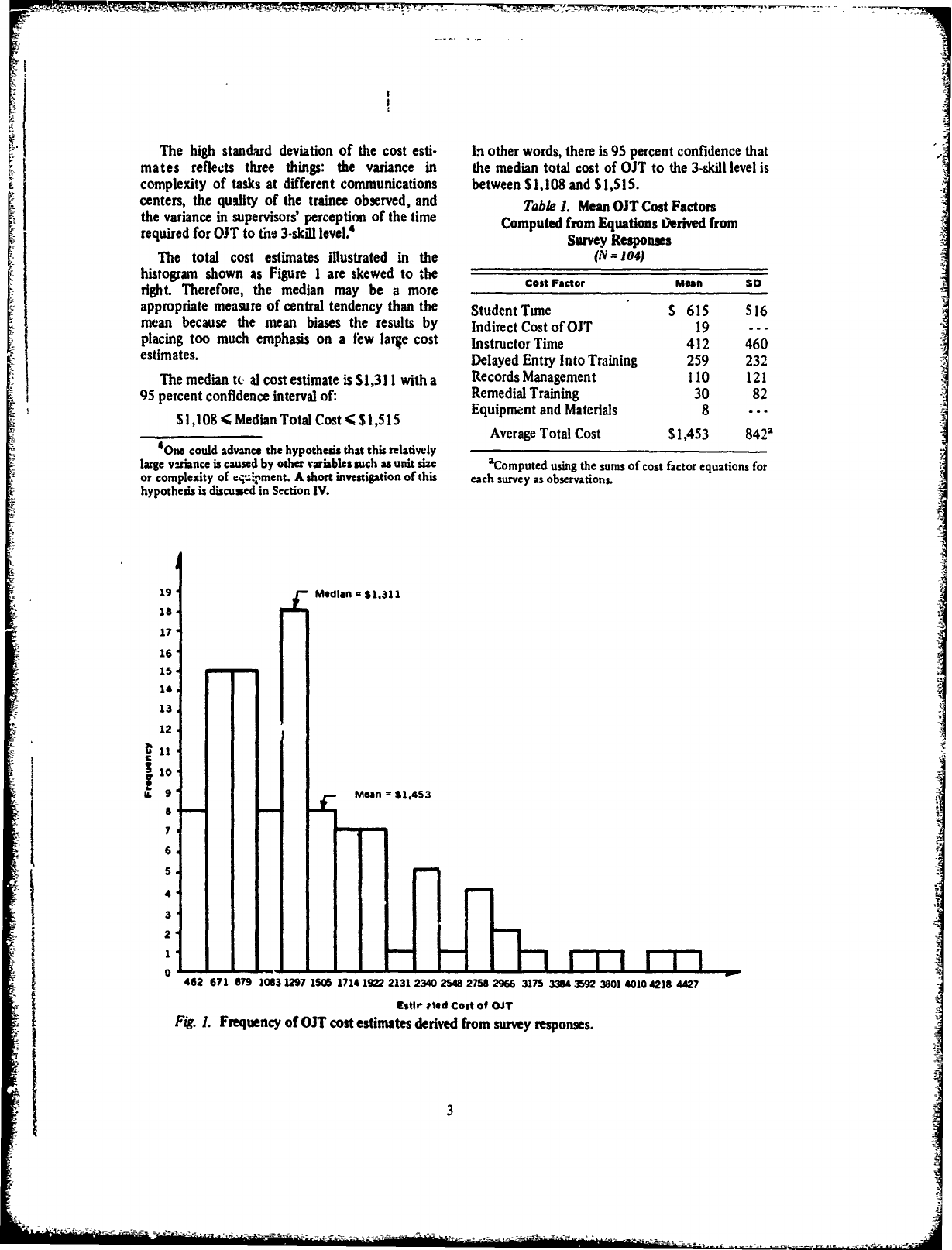
The
high
standard
deviation
of
the
cost
esti- In
other
words, there
is
95
percent
confidence
that
mates
reflects three
things:
the
variance in
the
median
total
cost
of
OJT
to
the
3.skill
level
is
complexity
of
tasks
at
different
communications
between
$1,108
and
$1,515.
centers,
the
quality
of
the
trainee observed,
and
Tabk
1.
Mean
OJT
Cost
Factors
the
variance
in
supervisors'
perception
of
the
time
required
for
OJT
to
the
3-skill
level.
4
C
urom
Reqaonse
d
Survey
Responses
The
total
cost estimates
illustrated
in
the
(N=
104)
histogram
shown
as
Figure
1
are
skewed
to the
right
Therefore,
the
median
may be
a
more
appropriate
measure
of
central
tendency
than the
Student
Tune
$
615
516
mean
because
the
mean
biases
the
results
by
Indirect
Cost
of
OJT
19
...
placing
too
much
emphasis
on
a
lew
large
cost
Instructor
Time
412
460
estimates.
Delayed
Entry
Into
Training
259
232
The median
tc.
al
cost estimate
is
$1,311
with
a
Records
Management
110
121
95
percent
confidence
interval of: Remedial
Training
30
82
Equipment
and
Materials
8
---
$1,108
•
Median
Total
Cost
• $1,515EqimnadMteal8 .
Average
Total
Cost
$1,453
842a
40ue
could
advance
the
hypothesis
that
this
relatively
large
vzriance
is
caused
by
other
variables
such
as
unit
size
aComputed
using
the
sums
of
cost
factor equations
for
or
complexity
of
c':ipment.
A
short
investigation
of
this
each
survey
as
observations.
hypothesis
is
discussed
in
Section IV.
19
Median
=
$1,311
18
17
16
is
14.
13
12
~11
'10,
L
9'
Mean
=
$1,453
67
5
*
41
24
462
671
879
10831297
1505
1714
1922
2131
234025482758
2966
3175
3384
3592
38014010
4218 4427
i EstWar
'ted
Cost
at
OJT
Fig.
.
Frequency
of
OJT cost
estimates
derived
from
survey
responses.
I3
--- - - - -Ij
Table
2.
Summary
Statistics
for
Responses
to
Survey
Questions
I
through
17
(Survey
AdmrLiatered
March
1971,
N
-
153)
SWV*V
Item
Number
Content
ot
Item
Mean
SO
Total Percent
1.
Number
of
months
since
OJT
to
3-
level
last
conducted
10.70
9.295
2.
Average
number
of
weeks
between
arrival
of
DDA
and
start
of
training
3.41
3.777
3.
Average
number
of
weeks
between
arrival
of
tech
school
3-level
and
start
of
5-level
training
2.09
1.132
4.
Average
number
of
weeks
to
3.
level
for
DDA
10.89
7.032
5.
Proportion
of
3-level
trainees
fading Advancement Knowledge
Test the
first
time
0.11
0.200
6.
Average
number
of
shifts
per
day
for
operation
of
communication
center
3.01
0A06
7a.
Number
of
trainees
currently
going
to
34evel
67
7b.
Number
of
trainees
currently
going
to
54evel
167
8.
Number
of
additional
trainees
to
3.
level
which
could
be
handled
if
unit
were allowed
to
go
over
manning
authorization
510
9.
Number
of
additional
trainees
to
3-
level
which
could
be
handled
if
unit
lost
a
5-level
for
each
new
trainee
267
lOa.
Number
of
instructors,
E-7
I5
3
10b.
Number
of
instructors,
E-6
85
15
lOc.
Number
of
instructors,
E-5
297
52
lOd.
Numter
of
instructors,
E-4
156
27
I1e.
Number
of
instructors,
E-3
i5
3
I
a.
Percent
OJT-trained
3-level
workload
that
can
be handled by
newly
arrived
tech
school
3-level
32.16
21.221
I
b.
Number
of
weeks
until
workload
capacity
of
tech
school
3-level
reaches
that
of
OJT-trained
3-level
4.25
2.664
1
Ic.
Consider
either
type
of
training
superior
to
the
other
85
56
I
id.
Consider
OJT-tralned
3-levels
superior
to
tech
school
34evels
25
16
!
2a.
Average
number
of
weeks remedial
training,
when
given
2.64 2.507
12b.
Average
trainee
hours
per
week, on
duty,
remedial
training
6.61
7.629
12c.
Average
instructor
hours per
week,
on
duty,
remedial
training
4.92 6.043
12d. Average
trainee
hours
per
week,
over.
time,
remedial
training
3.22 4.838
4
__
_ _
_____________
Table
2
(Continued)
Survey
Item
Number
Content
of item
Mean
SD
Total
Percent
12e.
Average
instructor
hours
per
week.
overtime,
remedial
training
1.36
2.937
12f.
Average
grade
of
remedial
training
instructor
3.11
2.535
13.
Percent
trainees
failing
to
upgrade
to
3-level
in
the
last
year 0.00
0.011
14.
Average
instructor
hours
per
week
spent
in
records
keeping
1.30
1.920
15a. Average
monitor
hours
per
week
spent
in
records
keeping
0.86
1.231
15b.
OJT
monitor's
grade
4.99
1.784
16.
Percent
Career
Development Course
relevant
to
operations
of
unit
45.57
25.396
17.
Total
number
of
personnel
in
unit
23.30
58.085
Table
3.
Summary
Statistics
for
Selected
Training
Items
In
the
Specialty
Trainirng
Standard
Derived
from
Responses
to
Survey
Question
18
Trainee
Hours
Instructor
Hours
instructor-
Training
Equation
tO4rainee
Item Notation
Mean
So
Mean
SD
Mean
Ratio
Mission
Yj
7.59
24.10
2.77
4.52
.71
Comm
Security
Y2-
24.84
32.48
9.82
12.88
.70
Safety
Y3
5.42
6.32 2A7
4.22
.71
Publications
Y4
30.09
49.59
10.52
17.81
.69
Typing
Y5
,j
55.01
61.01
13.75
16.71
.66
Comm
Instructions
Ys
j
.61.87
85.20
22.11
43.15
.69
Crypto
Ops
Y7j
19.86
41.49
9.97
29.:
7
.71
Routing
Ye
j
25.80
51.55
8.64
15.42
.72
Services
Y9
27.87 38.20
11.24
19.51
.71
Incoming
Narrative
Y0oj
18.56
28.98
6.45
11.29 .64
Incoming
Data
Y! I
14.10
22.69
5.36
11.10
.59
Outgoing
Narrative
Y
2
26.69
41.82
7.65
12.18
.61
Outgoing
Data
Y13j
16.36
30.84
6.02
12.52
.51
Inspection
Y14
21.58
119.92 3.85
8.90
.46
Processing
Ys~j
11.61
20.25
3.Q8
9.27 .45
Routing
Yi
j
11.06
22.75
4.24
10.11
.44
Transmission
Y
17j
8.96
17.53
3.46 8.95
.45
Autodin
SW
Center
Y
sj
26.76
74.16 9.55
34.18
.36
Tel
Switchboard
Ops
Y
j
51.77
62.12
22.31
42.65
.66
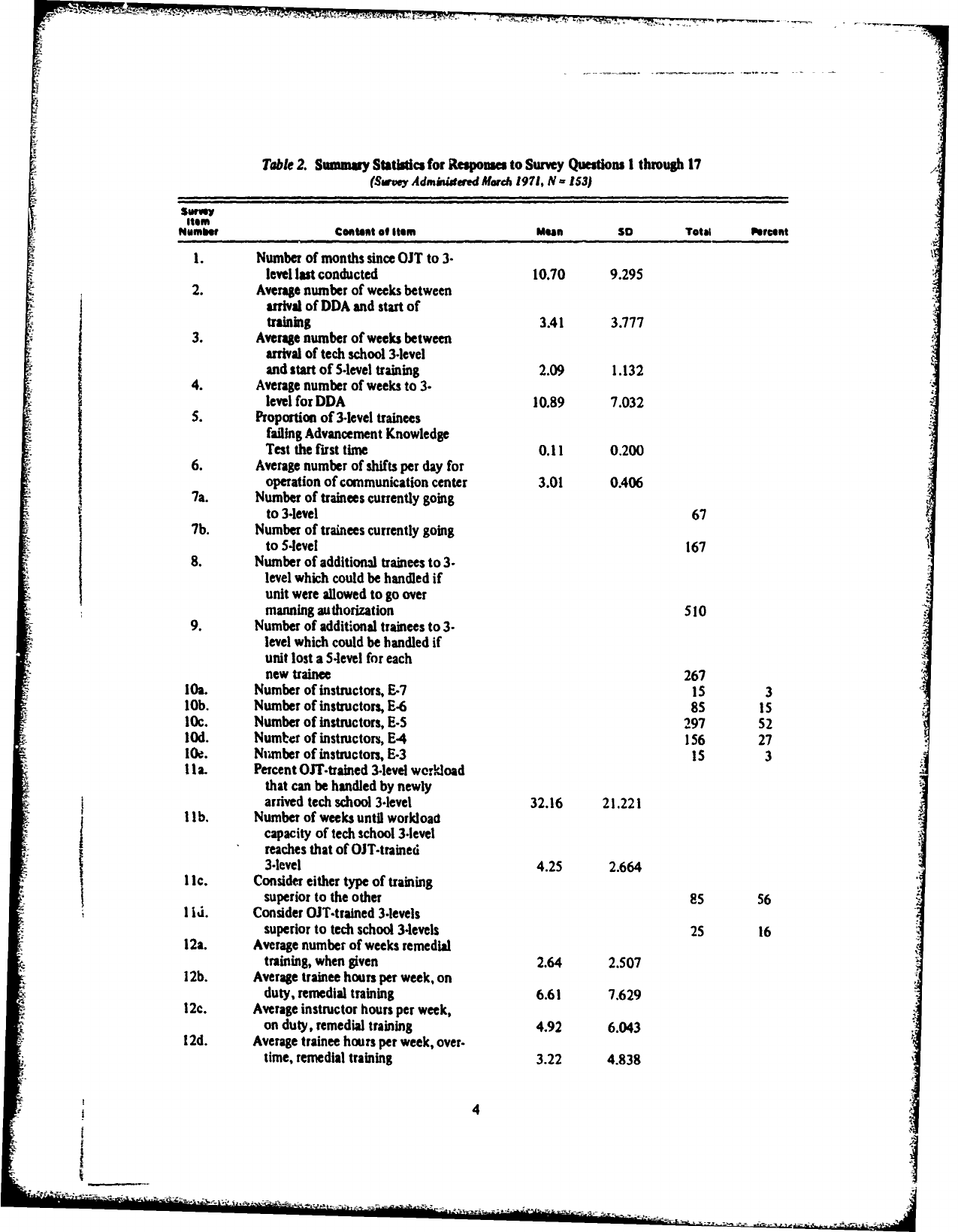
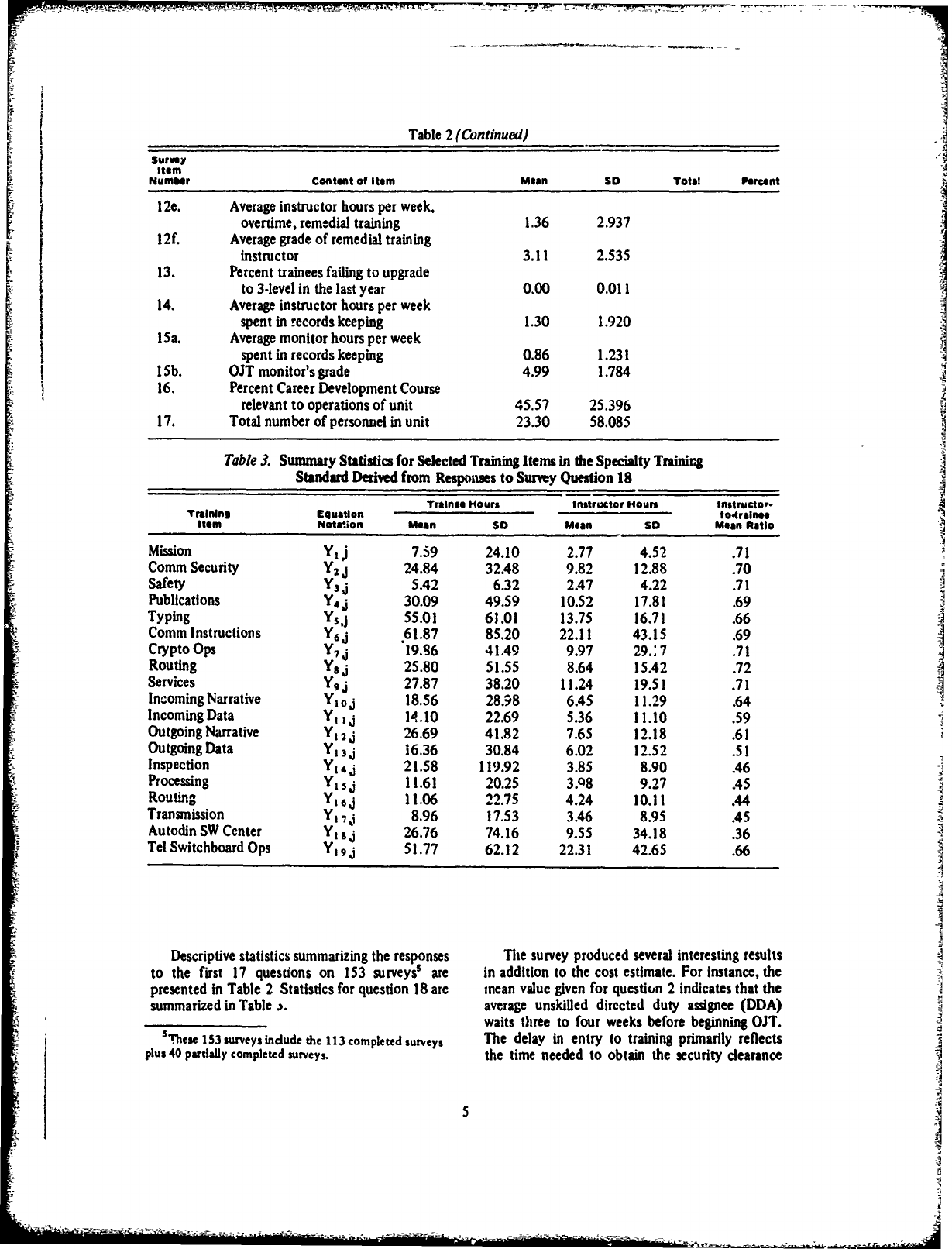
Descriptive
statistics
summarizing
the
responses
The
survey
produced
several
interesting
results
to
the
first
17
questions
on
153
surveyss
are
in
addition
to
the cost estimate.
For
instance,
the
presented
in
Table
2
Statistics
for
question
18
are
mean
value
given
for
question
2
indicates
that
the
summarized
in
Table
..
average
unskilled
directed
duty
assignee
(DDA)
waits
three
to
four
weeks
before
beginning
OJT.
i
These
153
surveys
include the
113
completed
surveys
The
delay
in
entry
to
training primarily
reflects
plus
40
partially
completed
surveys
the
time
needed
to
obtain the
security
clearance
5
-. S
.-.-.
-~--.. -•-- ---- -
which
Is
required
for
entry
to
most
communica-
Course
will
be
applicable
to
the
operations
of
a
tions
centers.
This
delay,
in
turn,
results
in
a
three-
partiL
,nit. This
is
not
necessarily
a
bad
point,
to
fov.r-week
los
in
productivity
after
completion
howtver,
because
the
trainees
will
be
assigned
of
OJT.
An
estimate
of
this
value
is
included
in
the
during
their
career
to
various
communications
cost estimate
for
OJT.
centers
with different kinds
of
equipment.
On
the
The
mean
value
for
question
4
implies
that
the
other hand, the
finding
could
provide
slight
average
time
in
OJT
for
proficiency qualification
support
to
a
hypothesis
that
training
received
in
at
the
3.skill
level
is
approximately
1I
weekcs,
technical
training
school
is
in
excess
of that
whereas
the
technical
training
course
is
12
weeks actually
needed
for
operations
in
the
field.
long.
Cost
of
Technical
School
Training
Ihe
answers
to
questions
8
and
9
suggest
that
supervisors
could
train
many more
personnel
on
Course
3ABR29130
at
Sheppard
Air
Force
the
job
if
they
were
sent
DDA
in
a
"pipeline"
Base
Technical
Training
Center
corresponds
to
status.
That
is,
if
supervisors
could
identify
OJT
to the
3-level
in
the 291X0
specialty.
Using
a
personnel
losses
a
few
months
ahead
of
time
and
computer
model,
RAND
Corporation
provided
a
procure
and train
new
DDAs
before the
qualified
cost estimate
for
this
course (Allison,
1970).
Costs
5-levels
were
lost,
the
capacity
for
]JT
in
this
skill
included
in
the
model
contain data
corresponding
could
be
substandially increased.
completely
with
the
OJT
cost
factors
listed
in
Table
I. A
detailed
breakout
of
th:
technical
The
difference
between
questions
7a
and
9
school
course
cost
elements
is
presented
in
reflects
excess
OJT
capacity
which
could be
Appendix
Ill. The resulting
estimated
cost
per
utilized
without
changing
the
present
assignment
graduate
of
$2,670
for
FY 1970
does
not take
system.
into
consideration
the
OJT
at
the
unit
of
assign-
The
mean
values
for
questions
I
la
and
1
lb
ment
that
is
necessary
to
bring
the
technical
highlight
the
fact
that
the
new
technical
school
school
graduate
up to
the
workload capability
of
graduate,
a
qualified
3-level,
does
not
have
the
an
OJT-trained
34evel.
productivity
of
an
OJT-trained
3-level
until
more
An
accurate
estimate
of
the cost
of
this addi-
than
four
weeks
after
his
arrival
at the
communica-
tional
training would
require
a
large-scale
effort
tions center.
This
information
is
incorporated
into
and
is
not
justified
considering
the
relative
size
of
the
cost
estimate for
technical
training
school.
the
cost.
However,
an
estimate
of
the
student
and
The
percentage
values
for
questions
I
Ic
pnd
instructor
cost
of
this
phase
of
OJT was
obtained
I
Id
indicate
that
44
percent
of
the
supervisors
using
a
method
of
ext~apolation
described
in
surveyed
(N
=
153)
feel
there
is
no
difference
in
ApP,-,;dix
IV.
Results
indicate
that
an
additional
the
performance
of
OJT-trained
3-levels
and
student
time
cost
e.
$33
and
an
additional
instruc-
technical school graduates,
while
16
percent
think
tor
time
cost
oif
$77
would
be
incurred in
order
to
that
OJT-trained
3.levels
have
better
performance,
increase
the proficiency
of
a
3-level
technical
and
40
percent
believe
that
technical
school
school
graduate
to
the
same
level
of
proficiency
as
graduates are
better
qualified. These
figures can be
that
of
an OJT-trained
34evel.
Therefore,
the
misleading
because
it
is
difficult
to
prove
that
adjusteC.,
cost
of
technical school training
is
supervisors' answers
were
guided
only
by
their
$2,780.
assessment
of
performance
quality.
In
other
words,
instructors
may
have
based
their
answers
Comparative
Cost
of
Technical
upon
a
preference
for
a
training
method rather
School Training
and OJT
than upon
a
preference
for
the
output
of
that
The
adjusted cost
of
technical
school
training
training
method-a
qualified
3-skill
level
airman,
reported
in
the
previous section
is
112
percent
Thus,
these
data
are inconclusive.
It
is
doubtful
higher
than
the
median
OJT
cost
estimate
of
that
a
question or
series
of
questions
can
be $1
,311.
If
the
upper
limit
of
the
OJT
95-percent
designed
to
provide
unbiased
information
concern- confidence
interval
(S
1,5
15)
is
compared
with the
ing supervisors'
opinions
regarding
the
comparative
cost
of
technical school
training
($2,780),
it
perftrmancw
of
OJT
3-levels
and technical training
becomes
apparent
that
the
cost
of
technical
school
school
3-levels,
is 83
percent
higher
than
OJT.
Most
of
this
differ-
The
mean
value
for
question
16
implies
that,
on
ence
is
largely
attributable
to
equipment,
the
average,
one
can
expect
that
less
than
50
maintenance,
training
aids,
and
administration
percent
of
the
material
in
the
Career Development
costs
which
do
not
measurably
exist
for
OJT.
6
---- --
-----.-----
This cost
difference
does
not
reflect
a
auter-
Table
4.
Comparative Performance
of
ence
in
the
quality
of
the
two
methods
of
training,
Technical Training
School
and
OJT
Trainees
nor
is
it
necesarily
indicative
of
expected
relative
on
AQE
Administrative
and
General
training costs
for
other
specialties.
(The
question
Aptitude
Indexes
of
comparative
quality
is
treated
separately.)
If
the
two methods
of
training
produce
equally
qualified
Training
Admin
At
Can
Ai
airmen, the
relative
costs
would
seem
to
indicate
Method
N
Mean
N
Mean
that
the
Air
Force should
send
as man)
personnel
as
possible
to
OJT
in
this
skill,
subject
to
manning
Tech School
707
74.08
710 40.90
constraints.
OJT
191
74.18
193
42.80
Comparative
Quality
of
Technical
School
Tralning
and
OJT
difference
in
the
quality
of
airmen
as
observed
by
This
section
considers
two questions
of
supervisors
during
OJT.
quality-input
and
output.
First,
input.
If
the two
The
next
question
is:
How
"good"
are
the
populations
of
airmen
who
entered the
separate
training
systems
were
of
different
quality
and
if
aiing
methods
with respect to their
outputs,
the
this affected
their
training
progress,
then
the
cost
trained
airnen?
The
proper
way
to
answer
this
comparison would
have
uncertain implications, question
is
to
measure
and compare
the
produc-
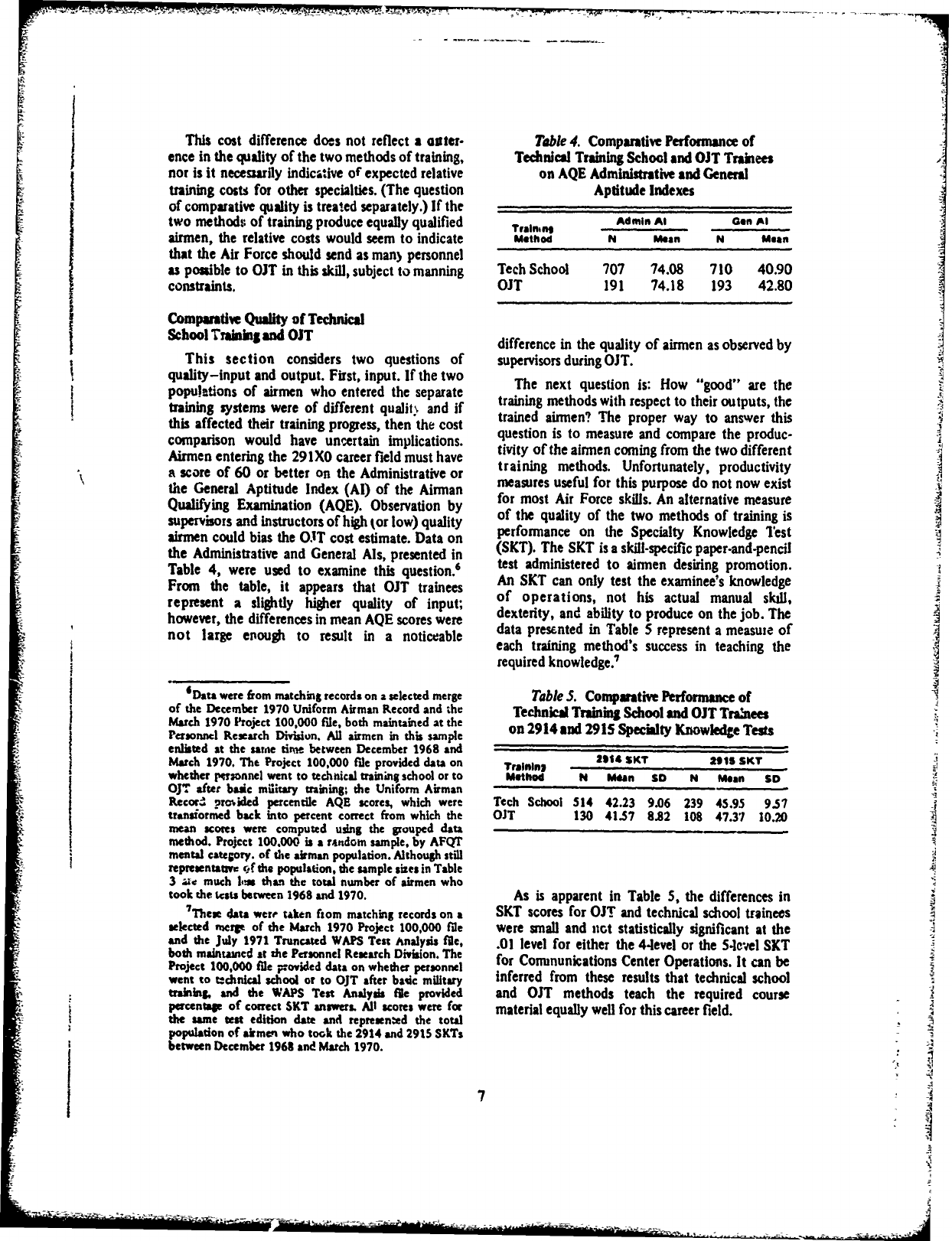
Airmen
entering
the
291X0
career field
must
have
tivity
of
the
airmen coming from
the two
different
a
score
of
60
or
better
on
the
Administrative
or
training
methods. Unfortunately, productivity
the
General
Aptitude
Index
(AI)
of
the
Airman
measures
useful
for
this purpose
do
not
now
exist
Qualifying
Examination
(AQE).
Observation
by
for
most
Air
Force
skills.
An
alternative measure
supervisors
and instructors
of
high
tor
low) quality
of
the
quality
of
the
two
methods
of
training
is
airmen
could
bias the
O.TT
cost
estimate.
Data
on
performance
on
the
Specialty
Knowledge
lest
the
Administrative
and
General
Als, presented
in (SKT).
The
SKT
is
a
skill-specific
paper-and-pencil
Table
4,
were
used
to
examine
this
question'
test
administered
to
airmen
desiring
promotion.
From
the
table,
it
appears
that
OJT
trainees
An
SKT
can
only
test
the
examinee's
knowledge
represent
a slightly
higher
quality
of
inpute
of
operations,
not
his
actual
manual
skill,
however,
the
differences
in
mean
AQE
scores
were
dexterity,
and ability
to
produce
on
the
job.
The
not
large
enough
to
result
in
a
noticeable
data
presnted
in
Table
5
represent
a
measue
of
each
training
method's
success in
teaching
the
required
knowledge.'
Data
were
from
matching
records
on a
selected
merge
Table
S.
Comparative Performance
of
of
the
December 1970
Uniform
Airman
Record
and
the
Techia
Training
School
and
OJT
Tranees
March
1970
Project
100,000
file,
both
maintained
at
the
Th
Personnel
Research
Division.
All
airmen
in
this
sample
on
2914
and
2915
Specialty
Knowledge
Tests
enlisted
at
the
same
time
between
December
1968
and
March
1970.
The Project 100.000
frae
provided
data
on
Trainilni
2*14
SKT
2915
SKT
whether
perronnel
went
to
technical
training
school
or
to
Method
N
Mean
SD
N
Mean
SD
OJT
after
basic
military training;
the
Uniform
Airman
Record
prmided
percentile
AQE scores, which were
Tech
School
514 42.23
9.06
239
45.95
9.57
transformed back
into
percent
correct
from
which
the OJT
130
41.57
8.82
108
47.37
10.20
mean scores
were
computed
using
the
grouped
data
method.
Project
100.000
is
a
random
sample,
by
AFQT
mental
category.
of
the
airman
population.
Although
still
representative
0f
the
population,
the sample
sizes
in
Table
3
.ew
much
It=
than
the
total
number
of
airmen
who
took
the
tests
between
1968
and
1970.
As
is
apparent
in Table
5,
the
differences
in
7
These
data
were
taken
from
matching
records on
a
SKT
scores
for
OJT
and
technical school
trainees
selected
merge
of
the
March
1970
Project 100,000
file
were
=all
and
nrt
statistically
significant
at
the
and the
July
1971
Truncated
WAPS
Test
Analysis
fie,
.01
level
for
either
the
44evel
or
the
5-level
SKT
both
maintained
at
the
Personnel
Research
Division.
The
for
Communications
Center
Operations.
It
can
be
Project 100,000
file
povided
data
on
whether
personnel
f"
went
to
t:chnical
school
or
to
OJT
after
bafic military
inferred
from
these
results
that
technical
school
training,
and
the
WAPS
Test
Analysis
fie
provided
and
OJT
methods
teach
the
required
course
percentage
of
correct
SKT
answers.
All
scores were for
material equally
well
for this
career field.
the
same
test edition
date
and
represented
the
total
population
of
akmen
who
took
the
2914
and 2915
SKTs
j
between
December
1968
and
March
1970. 1
7:i
M -SEEMS
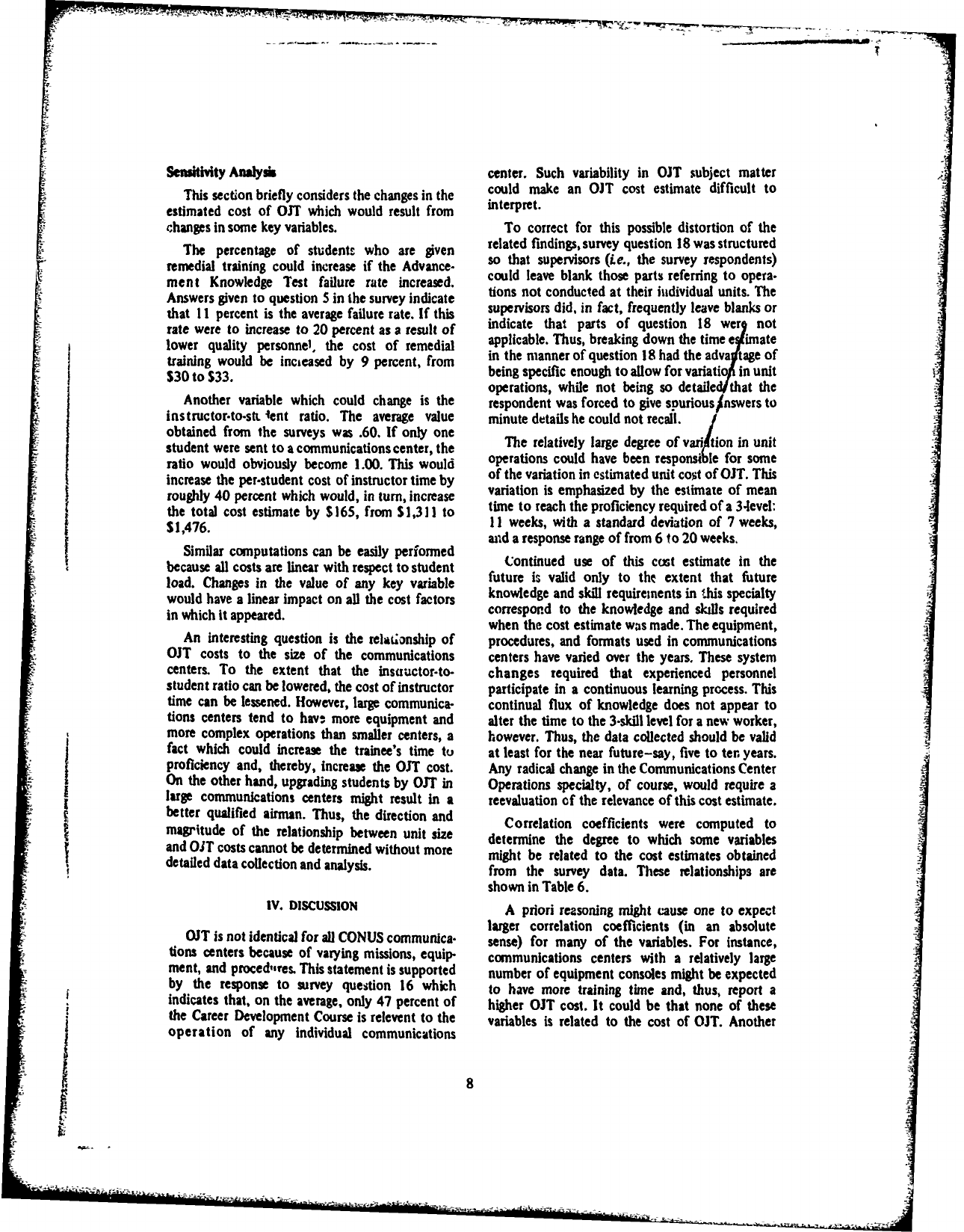
Sensitivity
Analysi
center.
Such
variability
in
OJT
subject
matter
This
section
briefly
considers
the
changes
in
the
could
make an
OJT
cost
estimate
difficult
to
estimated
cost
of
OJT
which
would result
from
changes
in
some key
variables.
To
correct
for
this
possible
distortion
of
the
The percentage
of
students•
who
are
given
related
findings,
survey
question
18
was
structured
remedial
training
could
increase
if
the
Advance-
so
that
supervisors
(Le.,
the
survey
respondents)
men
t
Knowledge
Test
failure
rate
increased,
could
leave
blank
those
parts
referring
to
opera-
Answers
given
to
question
S
in
the
survey
indicate
tions
not
conducted
at
their
individual
units.
The
that
11
percent
is
the
average
failure
rate.
If
this
supervisors
did,
in
fact,
frequently
leave
blanks
or
rate
were
to
increase
to
20
percent
as
a
result
of
indicate
that
parts
of
question
18
were
not
lower
quality
personnel,
the cost
of
remedial
applicable.
Thus,
breaking
down
the
time
eimate
tri
ualdty
bersone
incieaseby9prcent
,
o
frome
in
the
manner
of
question
18
had
the
adva
tage
of
training
would
be
incieased
by
9
percent,
from
$30 to
$33. being specific
enough
to
allow
for
variatic#
in
unit
operations,
while
not
being
so
detailed/that
the
Another
variable
which
could
change
is
the
respondent
was
forced
to
give
spuriousinswers
to
instructor-to-skit
ent
ratio.
The
average
value
minute details
he
could
not
recall.
/
obtained
from
the
surveys
was
.60.
If
only
one
student
were
sent
to
a
communications
center,
the
The
relatively large
degree
of
vari
tion
in
unit
ratio
would
obviously become
1.00.
This
would
operations
could
have
been
responsible
for
some
increase
the
per-student
cost
of
instructor
time
by
of
the
variation
in
estimated
unit
cost
of
OJT.
This
roughly
40
percent
which would,
in
turn,
increase
variation
is
emphasized
by
the
estimate
of
mean
the
total
cost estimate by
$165,
from
$1,311
to
time
to
reach
the
proficiency
required
of
a
3-level:
$1,476.
11
weeks,
with
a
standard
deviation
of
7
weeks,
and
a
response
range
of
from
6
to
20
weeks,
tSimilar
computations
can
be
easily
performed
because
all
costs
are
linear
with respect
to
student
fuontinued
use
of
this
cost
estimate
in
the
load.
Changes
in
the
value
of
any key
variable
future
is
valid
only
to
the
extent
that
fxture
would
have
a
linear
impact
on
all
the
cost
factors
knowledge
and
skill
requirements
in
this
specialty
in
which
it
appeared.
correspond
to the
knowledge
and
skills
required
when
the cost
estimate
was made.
The equipment,
An
interesting
question
is
the
relationship
of
procedures,
and
formats
used
in
communications
OJT costs
to
the
size
of
the
communications centers
have varied
over
the
years.
These
system
centers.
To
the
extent
that
the
insauctor-to.
changes
required
that
experienced personnel
student
ratio
can be
lowered,
the
cost
of
instructor
participate
in
a
continuous
learning
process.
This
time
can
be
lessened.
However,
large
communica.
continual
flux
of
knowledge does
not
appear
to
tions
centers
tend
to
havy
more
equipment
and
alter the
time
to
the
3-skill
level
for
a
new
worker,
more
complex
operations
than
smaller
centers,
a
however.
Thus,
the
data
collected
should
be
valid
fact
which
could
increase
the trainee's
time
to
at
least
for
the
near
future-say,
five
to
ten
years.
_proficiency
and,
thereby,
increase
the
OJT
cost.
Any
radical
change
in
the
Communications
Center
On
the
other
hand,
upgrading
students
by
OJT
in
Operations
specialty,
of
course,
would
requireproe
and tere nc rese
t
in
A
radala
change
inte
Com
ntionst
e
ater
Ilarge
communications
centers
might
result
in a
reevaluation
of
the
relevance
of
this
cost
estimate.
better
qualified
airman.
Thus,
the
direction
and
Correlation
coefficients
were
computed
to
magritude
of
the
relationship
between
unit
size
determine the
degree
to
which some
variables
and
OJT
costs
cannot
be
determined
without
more
might
be
related
to
the
cost estimates
obtained
detailed
data
collection
and
analysis.
from
the
survey
data.
These
relationships
are
shown
in
Table
6.
IV.
DISCUSSION
A
priori
reasoning
might
cause
one
to
expect
larger
correlation
coefficients
(in
an
absolute
OJT
is
not
identical
for
all
CONUS
communica.
sense)
for
many
of
the
variables.
For
instance,
tions
centers
because
of
varying
missions,
equip. communications centers with
a
relatively large
ment,
and
proced,,res. This
statement
is
supported
number
of
equipment
consoles
might
be
expected
by
the
response
to
survey
question
16
which
to
have
more training time
and,
thus,
report
a
indicates
that,
on the
avenge,
only
47
percent
of
higher
OJT
cost.
It
could
be
that
none
of
these
the
Career Development Course
is
relevent
to
the
variables
is
related
to
the
cost
of
OJT.
Another
operation
of
any
individual
communications
8
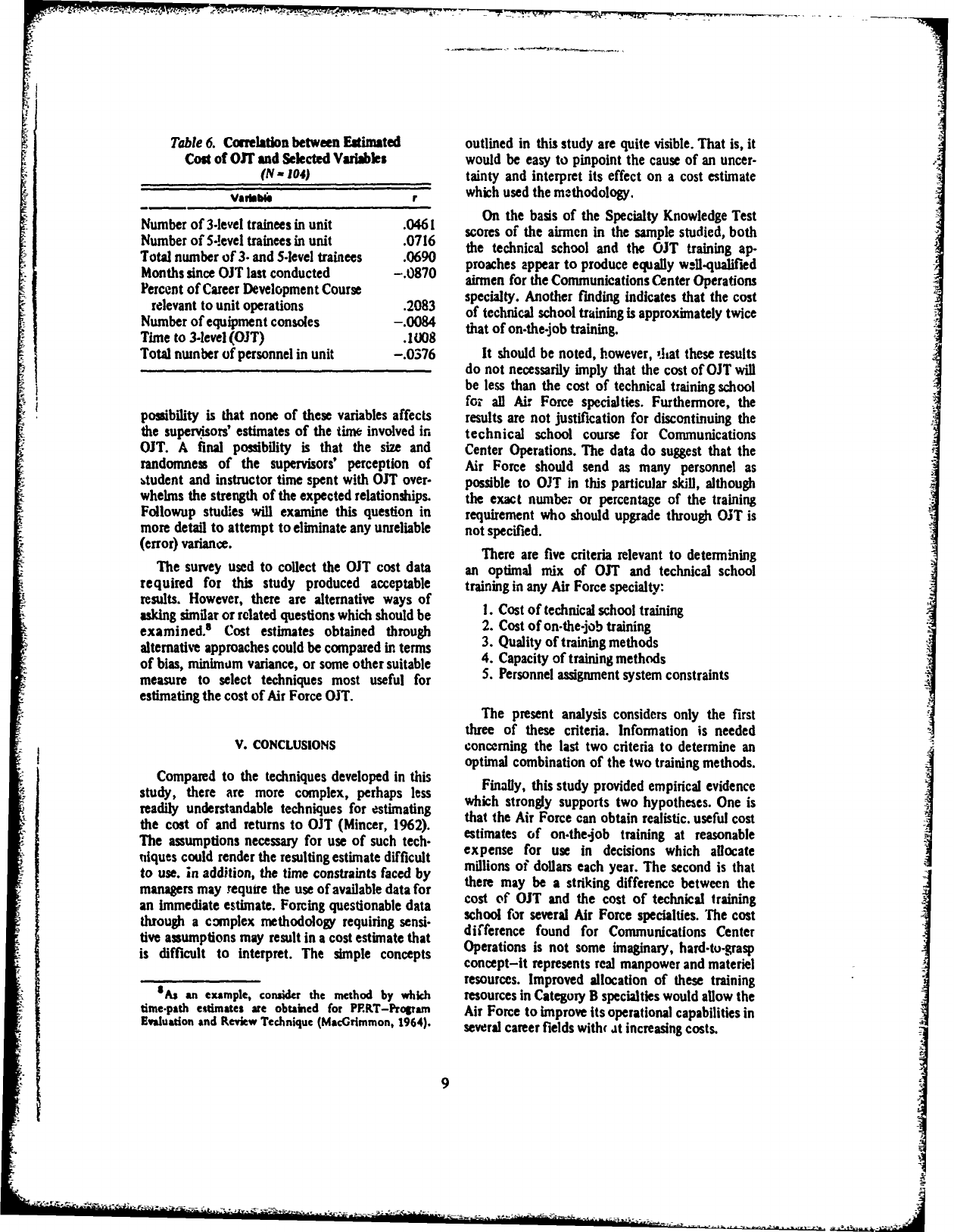
Table
6.
Correlation between Estimated
outlined
in
this
study
are
quite
visible.
That
is,
it
Cost
of
OJT
and
Selected
Variables
would
be
easy
to
pinpoint
the
cause
of
an
uncer-
(N
104)
tainty
and
interpret its
effect
on
a
cost
estimate
vm,
,r
which
used
the
methodology.
Number
of
3.level
trainees
in
unit
.0461
On
the
basis
of
the
Specialty
Knowledge
Test
Number
of
3level
trainees
in
unit
.0716
I
scores
of
the
airmen
in
the
sample
studied,
both
Number
of
5-level
trainees
in
unit
.0716 the
technical school
and
the
OJT
training
ap-
Total
number
of
3-
and
5-level
trainees
.0690
proaches appear
to
produce
equally
wall-qualified
Months
since
C
JT last
conducted
-.
0870
airmen
for
the
Communications Center
Operations
relevant
to
unit
operations
.2083
specialty.
Another
finding
indicates
that
the
cost
N re tof
equnitpmentonsoles
.084
of
technical
school
training
is
approximately
twice
Number
of
equipment
consoles
-.
0084
that
of
on-the-job
training.
Time
to
3-level
(OJT)
.1008
Total
nwnber
of
personnel in
unit
-.
0376
It
should
be
noted,
however,
:hat
these
results
do not
necessarily
imply
that
the
cost
of
OJT
will
be
less
than
the
cost
of
technical
training
school
pffor
all
Air
Force
specialties.
Furthermore,
the
Spossibility
is
that
none
of
these
variables
affects
results
are
not
justification
for
discontinuing
the
the
supervisors'
estimates
of
the
time
involved
in
technical
school course
for
Communications
OJT.
A
final
possibility
is
that
the
size
and Center
Operations. The
data
do
suggest
that
the
randomness
of
the
supervisors'
perception
of
Air
Force should
send
as
many
personnel
as
atudent
and
instructor
time
spent
with
O'
over-
possible
to
OJT
in
this
particular
skill,
although
whelms
the
strength
of
the
expected
relationships.
the
exact
number
or
percentage
of
the
training
Followup
studies
will
examine
this
question
in requirement
who
should
upgrade
through
OQT
is
more
detail
to
attempt
to
eliminate any
unreliable
not
specified.
(error)
variance.
There
are
five
criteria
relevant
to
determining
The
survey
used
to
collect
the
OJT
cost data
an
optimal mix
of
OJT
and
technical school
required
for
this
study
produced
acceptable
training
in
any
Air
Force specialty:
results.
However,
there
are
alternative
ways
of
asking
similar
or
related
questions
which
should be
1.
Cost
of
technical
school
training
examined."
Cost
estimates
obtained
through
2.
Cost
of
on-the-job
training
alternative
approaches could
be
compared
in
terms
3.
Quality
of
training
methods
of
bias,
minimtam
variance,
or
some
other
suitable
4.
Capacity
of
training
methods
measure
to
select
techniques most
useful
for
5.
Personnel
assignment
system
constraints
estimating
the
cost
of
Air
Force
OJT.
The present
analysis
considers only
the
first
three
of
these
criteria.
Information
is needed
V.
CONCLUSIONS
concerning
the last
two
criteria
to
determine
an
optimal
combination
of
the
two
training
methods.
Compared
to
the techniques
developed
in
this
Finally,
this study
provided
empirical
evidence
study,
there
are
more
complex,
perhaps
less
which
strongly
supports
two
hypotheses.
One
is
readily
understandable
techniques for
estimating
that
the
Air
Force
can
obtain
realistic,
useful cost
the cost
of
and
returns
to
OJT
(Mincer,
1962).
The assumptions
necessary
for
use
of
such
tech-
estimates
of
on-the-job
training
at
reasonable
Teasmtosncsayfrueosuhtc-
expense
for
use
in
decisions which allocate
I
niques could render the
resulting
estimate difficult
mipens
oor
e
ya
Tei
s
econdwish
at
to
use.
in
addition,
the
time
constraints
faced
by
millions
of
dollars each
year.
The
second
is
that
managers
may require
the
use
of
available
data
for
there may
be
a
striking
difference
between the
an
immediate
estimate. Forcing questionable
data
cost
of
OJT
and
the
cost
of
technical training
anrimmdate
eimae.
Fethoringy
requestionablendata
school
for
several
Air
Force
specialties.
The cost
through
a
complex
methodology
requiring
senlsi-
dfeec
on
o
omnctosCne
tive
assumptions
may
result
in
a
cost estimate
that
difference
found
for
Communications Center
tiv asumpion
ma
reultin
cot
etimte
hat
Operations
is
not
some
imaginary, hard-to-grasp
is
difficult
to
interpret. The
simple
concepts
c
on
rsent
re
manpr
andmteriel
concept-it
represents
real
manpower
and
materiel
resources.
Improved
allocation
of
these
training
$As
an
example,
consider
the method
by
which
resources
in
Category
B
specialties
would
allow
the
time-path
estimates
are
obtained for
PERT-Propam
Air
Force
to
improve
its
operational capabilities
in
Evaluation
and
Review
Technique
(MacGrimmon, 1964).
several
career
fields
with(
at
increasing
costs.
9
REFERENCES
Allison, S.L.
A
computer
model
for
estimating
Mincer,
J.
OJT:
Costs,
returns,
and
some
resources
and costs
of
an
Air
Force
resident implications.
Journal
of
Political
Economy,
technical
training
ccurse,
WN-7044-PR.
Santa
October
1962.
Monica, Calif.:
Rand
Corporation,
October
1970.
MacCrimmon,
K.R.
&
Ryavec,
C.A.
An
analytical
study
of
the
PERT
assumptions.
Operations
Research,
1964,
12,
16-37.
BIBLIOGRAPHY
Arziga•n,
S.
On-the-job
training
costs:
An
analysis.
Lieberman,
B.
Contemporary problems
in
statis-
I
WRM
67-52,
AD-656
581.
Naval
Personnel
tics.
New
York:
Oxford
University
Press,
1971.
Program
Support
Activity,
Naval
Personnel
Mincer,
J.
Investment
in
human
capital
and
Research
Laboratory,
1967.
personal
income.
Journal
of
Political
Economy,
Bateman,
CW.
Formal
and
On-the-Job
training
in
August
1958,281-302.
military occupation&
Unpublished
staff
report.
Morgan,
J.,
&
David,
M.
Education
mid
income.
Office
of
the
Secretary
of
Defense: Washington,
Quarterly
Journal
of
Economics,
1963,
77,
D.C.
423-437.
Becker,
GS. Human
capitaL
New
York:
Columbia
Shultz,
T.W.
Investment
in
human
capital,
1961,
University
Press,
1964. AER
Vol.
51, 1-16.
itiShultz,
D.G.,
&
Siegel,
A.I.
Post-training
Fisher,
G.H.
Cost
considerations
in
systems
anal-
performance-criterion development
and applica-
ysts.
R-490-ASD.
Santa
Monica, Calif.:
tion.
A
selective
review
of
methods
for
Rand
Corporation,
1970.
measuring
individual differences
in
on-the-job
Investment
in
Human
Beings,
Journal
of
Political performance.
Wayne,
Pennsylvania,
Applied
Economy,
No.
5,
Part
2 Vol.
LXX,
October
Psychological
Services,
July
1961.
1962.
0
I
I
Io
10''
•....°
•. ... ••.. . •' -• • , .... .•. .
:.
.. •
•
_
•
•
. :
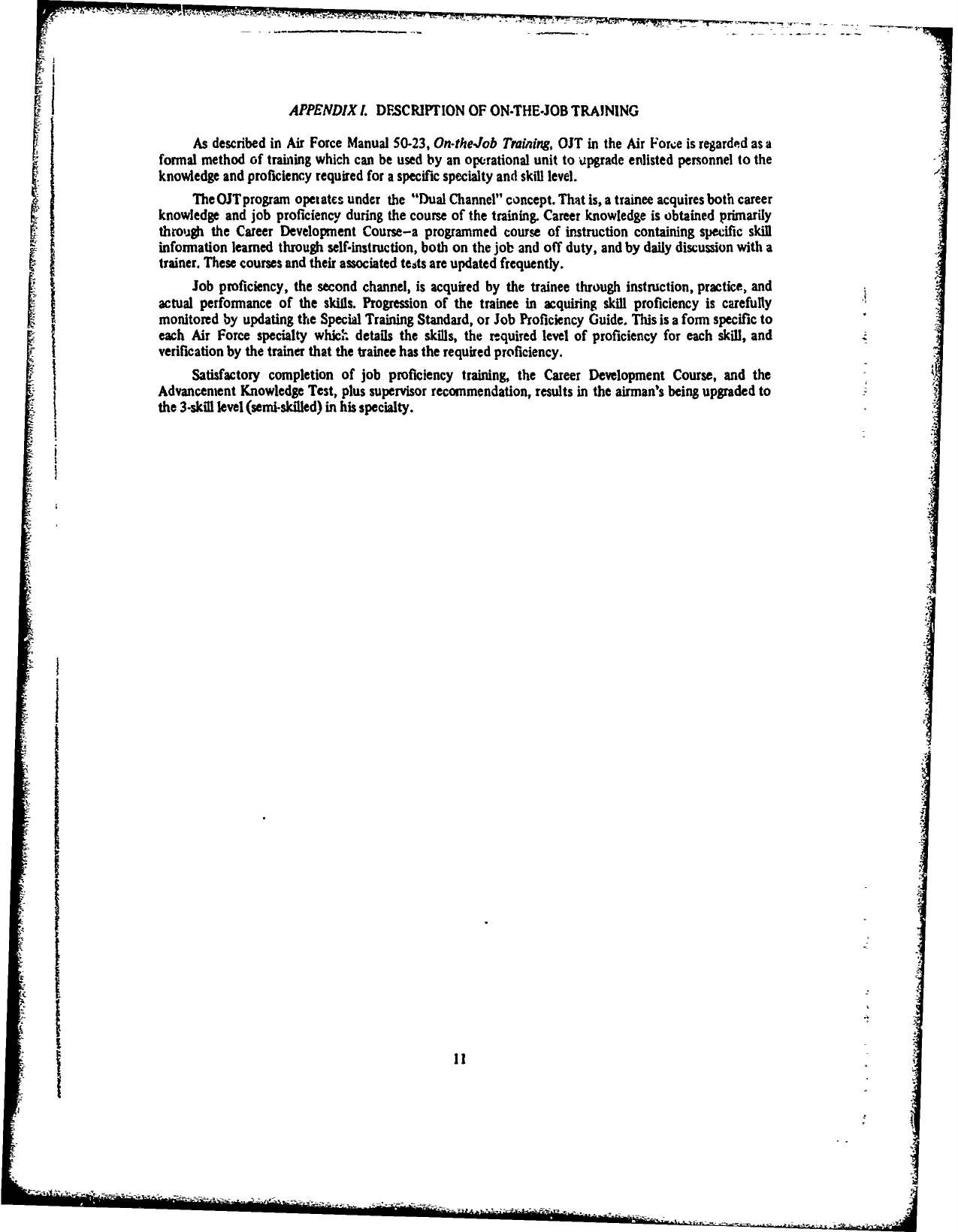
APPENDIX!L
DFSCRJPTION
OF
ON-THE-JOB
TRAINING
As
described
in
Air
Force
Manual
50-23,
On-theJob
Training,
OJT
in
the
Air
For,;e
is
regarded
as
a
formal
method
of
training
which
can be
used
by
an
operational
unit to
-apgrade
enlisted
personnel
to
the
knowledge
and
proficiency required
for
a
specific
specialty
and
skill level.
The
OJT
program
operates under
the
"Dual
Channel"
concept.
That
is,
a
trainee acquires
both
career
knowledge
and
job
proficiency
during
the
course
of
the
training.
Career
knowledge
is
obtained
primarily
through
the
Career
Development
Course-a
programmed
course
of
instruction
containing
specific
skill
information
learned
through
self-instruction,
both
on the
job
and
off
duty,
and
by
daily
discussion
with
a
trainer.
These
courses
and
their
associated
tests
are
updated
frequently.
Job
proficiency,
the
second
channel,
is
acquired
by
the
trainee
through
instruction,
practice,
and
actual performance
of
the
skills. Progression
of
the
trainee
in
acquiring
skill
proficiency
is
carefully
monitored
by
updating
the
Special
Training
Standard,
or Job
Proficiency Guide.
This
is a
form
specific
to
each
Air
Force specialty
whic'A
details
the
skills,
the
required
level
of
proficiency
for
each
skill,
and
verification by
the
trainer
that
the
trainee
has
the
required proficiency.
Satisfactory
completion
of
job
proficiency training,
the
Career
Development
Course,
and
the
Advancement
Knowledge
Test,
plus
supervisor
recommendation, results
in
the airman's
being
upgraded
to
the
3-skill
level
(semi-skilled)
in his
specialty.
-I
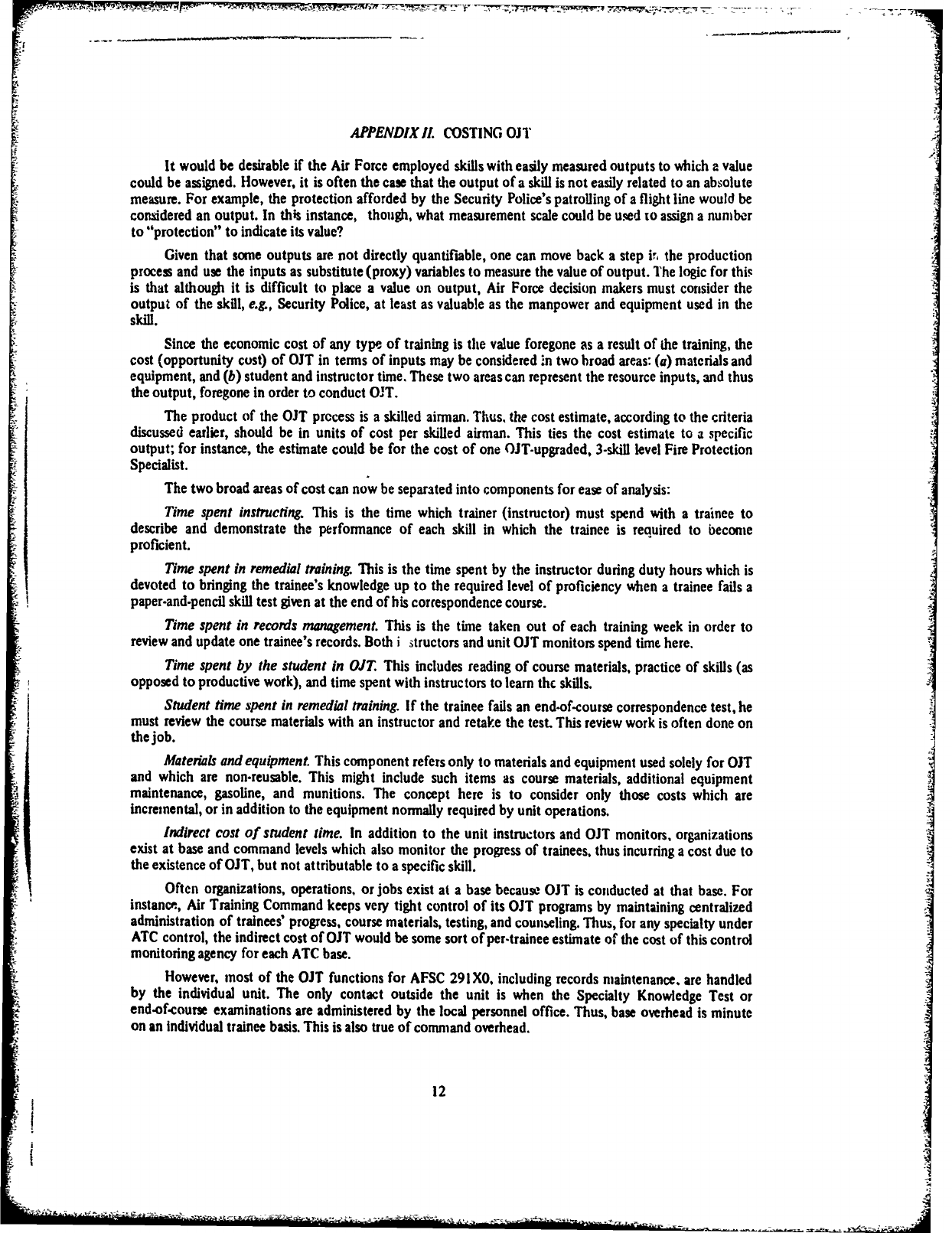
APPENDIX
11.
COSTING
OJT
It
would
be
desirable
if
the
Air
Force
employed
skills
with
easily
measured
outputs
to
which
a
value
could
be
assigned.
However,
it
is
often
the
case
that
the
output
of
a
skill
is
not
easily
related
to
an
absolute
measure.
For
example,
the
protection
afforded
by the Security
Police's
patrolling
of
a
flight
line would
be
considered
an
output.
In
this
instance,
though,
what
measurement
scale
could
be
used
to
assign a
number
to
"protection"
to
indicate
its
value?
Given
that
some
outputs
are
not
directly quantifiable,
one can
move
back
a
step
in
the
production
process
and
use
the
inputs
as
substitute
(proxy)
variables
to
measure
the
value
of
output.
The
logic
for
this
is
that
although
it
is
difficult
to
place
a
value
on
output,
Air
Force
decision makers
must consider
the
output
of
the
skill,
e.g.,
Security
Police,
at
least
as
valuable
as the
manpower
and
equipment
used in
the
skill.
Since the
economic
cost
of
any
type
of
training
is
the
value
foregone
as
a
result
of
the
training,
the
cost
(opportunity
cost)
of
OJT
in
terms
of
inputs
may
be
considered
In
two
broad
areas:
(a)
materials
and
equipment,
and (b)
student
and
instructor
time.
These
two
areas can
represent
the
resource
inputs,
and
thus
the
output,
foregone in
order
to
conduct
OJT.
The
product
of
the
OJT
process
is
a
skilled
airman.
Thus,
the
cost
estimate,
according
to
the
criteria
discussed
earlier,
should
be
in
units
of
cost per
skilled
airman. This
ties
the
cost
estimate
to
a
specific
output;
for
instance,
the estimate
could
be
for
the cost
of
one
OiT-upgraded,
3-skill
level
Fire
Protection
Specialist.
The
two broad
areas
of
cost
can
now
be
separated
into
components
for
ease
of
analysis:
Time
spent instructing.
This
is
the
time which
trainer
(instructor)
must
spend with
a
trainee
to
describe
and
demonstrate the
performance
of
each
skill
in which
the
trainee
is
required
to
become
proficient.
Time
spent
in
remedial
training
This
is
the
time
spent
by
the
instructor
during
duty
hours
which
is
devoted
to
bringing the
trainee's
knowledge
up
to
the
required
level
of
proficiency
when
a
trainee
fails
a
paper-and-pencil
skill
test
given
at
the
end
of
his correspondence
course.
Time
spent
in
records
management.
This
is
the
time
taken
out
of
each
training
week
in
order
to
review
and update one
trainee's
records. Both
i
structors
and
unit
OJT
monitors
spend
time
here.
Time
spent
by
the
student in
OJT.
This includes reading
of
course
materials, practice
of
skills
(as
opposed
to
productive
wotk),
and time
spent
with
instructors to
learn
the
skills.
Student
time
spent
in
remedial
training.
If
the
trainee
fails
an
end-of-course
correspondence
test,
he
must
review
the
course materials
with
an
instructor
and
retake
the
test.
This
review
work
is
often
done
on
the
job.
Materials
and
equipment.
This
component
refers
only
to
materials
and
equipment
used
solely
for
OJT
and which
are
non-reusable.
This might include
such
items
as
course
materials,
additional
equipment
ii
maintenance,
gasoline,
and
munitions.
The
concept
here
is
to
consider
only
those
costs
which are
incremental,
or
in
addition
to
the
equipment
normally
required
by
unit operations.
Indirect
cost
of
student
time.
In
addition
to
the unit
instructors
and
OJT
monitors,
organizations
exist
at
base
and
command
levels
which also
monitor
the progress
of
trainees,
thus
incurring
a
cost
due
to
the
existence
of
OJT,
but not
attributable
to
a
specific
skill.
Often
organizations,
operations,
or jobs
exist
at
a
base
because
OJT
is
conducted
at
that
base.
For
instance,
Air
Training Command
keeps
very
tight control
of
its
OJT
programs
by
maintaining centralized
administration
of
trainees'
progress, course
materials,
testing,
and
counseling.
Thus,
for
any
specialty
under
ATC
control,
the
indirect
cost
of
OJT
would
be
some
sort
of
per-trainee
estimate
of
the
cost
of
this
control
monitoring
agency
for
each
ATC
base.
However,
most
of
the
OJT
functions
for
AFSC
291
XO,
including
records
maintenance,
are
handled
by the
individual
unit.
The
only
contact
outside the
unit
is
when
the
Specialty
Knowledge
Test
or
end-of-course
examinations
are
administered
by
the
local
personnel office.
Thus,
base
overhead is
minute
on
an
individual
trainee
basis.
This
is also
true
of
command
overhead.
12
.4
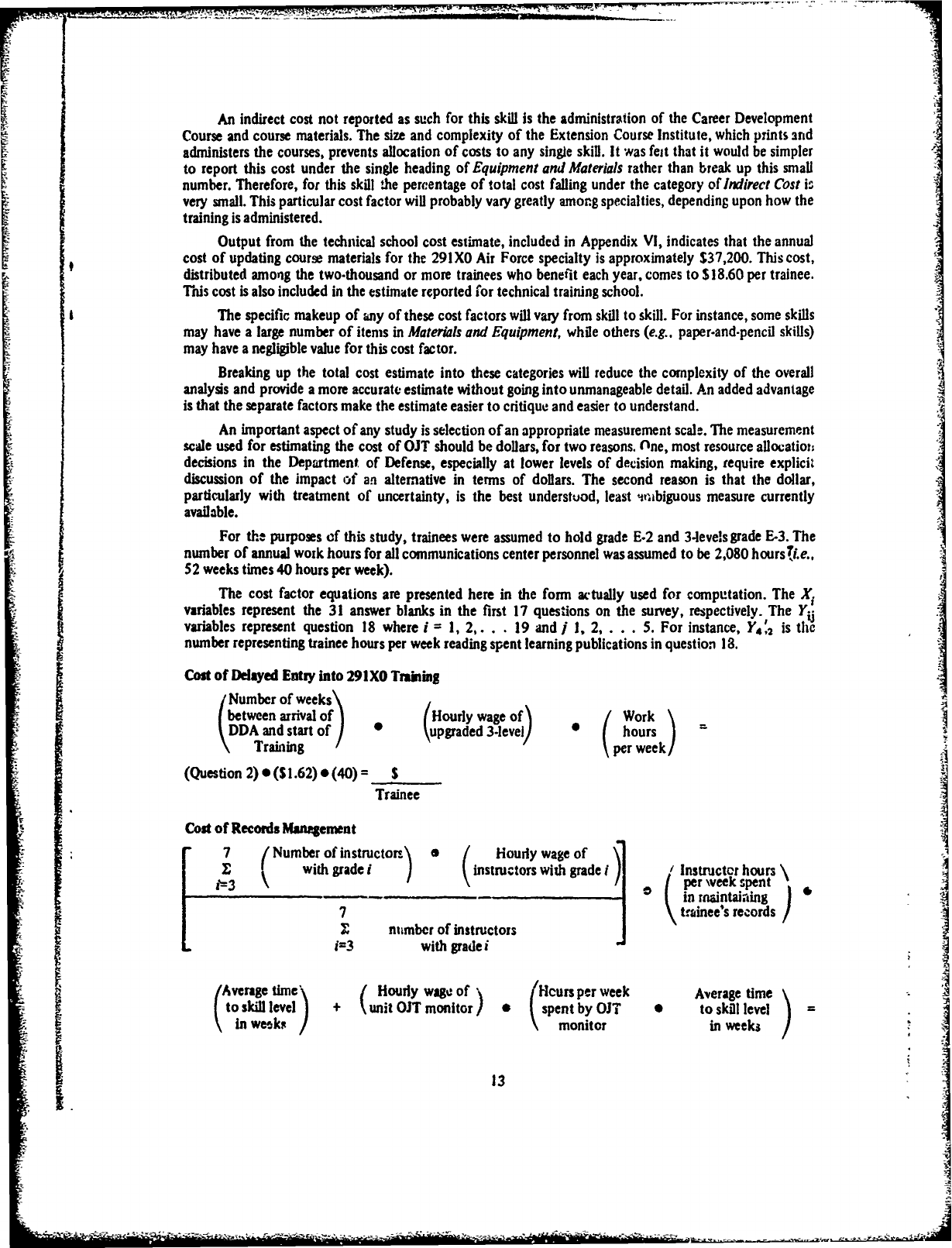
An
indirect
cost
not
reported
as
such
for this
skill
is
the
administration
of
the Career Development
Course
and
course materials.
The
size
and
complexity
of
the
Extension
Course
Institute,
which
prints
and
administers
the
courses,
prevents
allocation
of
costs
to
any
single
skill.
it
was
feit
that it
would be
simpler
to
report
this
cost
under
the
single
heading
of Equipment
and
Materials
rather
than
break
up this
small
number.
Therefore,
for this
skill
!he percentage
of
total
cost
falling
under
the
category
of
Indirect
Cost
is
very small.
This particular
cost
factor
will
probably
vary
greatly
amorg
specialties,
depending
upon
how
the
training
is
administered.
Output
from the technical school
cost
estimate, included
in
Appendix
VI,
indicates
that
the
annual
cost
of
updating
course
materials
for
the
291X0
Air
Force specialty
is
approximately
$37,200.
This cost,
distributed
among
the two-thousand
or
more
trainees who
benefit
each
year,
comes
to
$18.60 per
trainee.
This
cost
is
also included
in
the
estimate
reported for
technical
training
school.
The
specific
makeup
of
any
of
these
cost factors
will
vary
from
skill
to
skill.
For
instance,
some
skills
may
have
a
large
number
of
items
in
Materials
and
Equipment,
while
others
(e.g..
paper-and-pencil skills)
may
have
a
negligible
value
for
this
cost
factor.
Breaking
up
the
total
cost
estimate
into
these categories
will
reduce
the
complexity
of
the
overall
analysis
and
provide
a
more
accurate
estimate
without
going
into
unmanageable
detail.
An
added advantage
is
that
the
separate
factors
make
the
estimate
easier
to
critique
and
easier
to
understand.
An
important
aspect
of
any
study
is
selection
of
an
appropriate
measurement
scale.
The measurement
scale
used
for
estimating
the
cost
of
OJT
should
be
dollars,
for
two
reasons.
One,
most
resource
allocation
decisions
in
the Department
of
Defense, especially
at
lower
levels
of
decision making,
require expliciZ
discussion
of
the
impact
of
an
alternative
in
terms
of
dollars.
The
second
reason
is
that
the
dollar,
particularly
with
treatment
of
uncertainty,
is
the
best
understood,
least
nitbiguous
measure
currently
available.
For
t..-
purposes
of this
study,
trainees
were assumed
to
hold
grade
E.2
and
34evels
grade
E-3.
The
number
of
annual work
hours
for
all
communications
center
personnel
was
assumed
to
be
2,080
hoursTi.e.,
52
weeks
times
40
hours
per
week).
The
cost factor equations
are
presented here
in
the form
actually
used
for
computation.
The
variables
represent
the
31
answer
blanks
in
the
first
17
questions
on
the
survey,
respectively.
The
Y.-
variables
represent question
18
where
i
=
1,
2,.
..
19
and
I,
2, ...5.
For
instance,
Y4,2
is
the
number
representing trainee
hours
per
week
reading
spent
learning
publications
in
question
18.
I
Cost
of
Delayed
Entry
into
291X0
Training
Number
of
weeks\
betweenarrivalof
(Hourly
wage
of)
/
Work
DDA
and
start
of
J *
upgraded
3-1eveij
* j
hours
]
Training
/
per
week)
(Question
2)
0
($1.62)
(40)= $
Trainee
Cost
of
Records
Manaement
/
with
grade
i instructors
with
grade
I
[/Instruct
r
hours
of-
intuco3
pe
wee
Houlywagto
in
innaintaining
7
trainee's
records
I
Sntumber
of
instructors
L
i=3
with
grade
i
A
Average
time
\
Hourly
wage
of
Hours
per
week
Average
time
toskill
level)
+
unit
OJT
monitor
*
(spent
by
OJT
* to
skill
level
=
in
weks
monitor
in
weeks
13
-I -- I.|
• ! -I • ' - ..J• == ... • •, r -., -,. ..•.
. = ,•• -=, --: --• , = Y
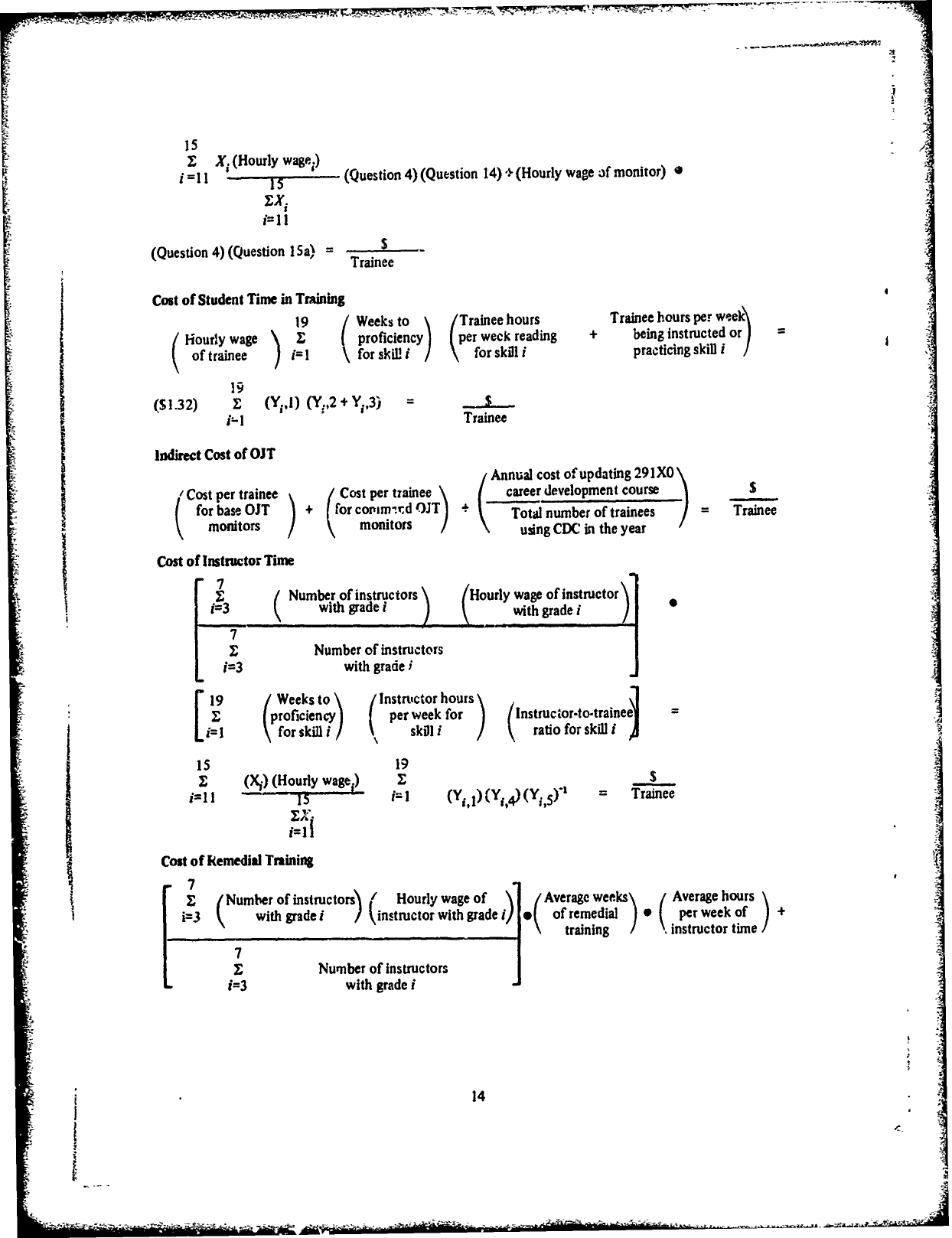
15
2:
X.
(Hourly
wagei)
11
H
l
we
•(Question
4)
(Question
14)
+
(Hourly
wage
of
monitor)
0
i=
11
xi
(Question
4)
(Question
15a)
$
Trainee
Trainee
Cost
of
Student
Time
in Training
19
(
Weeks
to
/Trainee
hours
Trainee
hours
per
week\
(Hourly
wage
E
proficiency)
(per week
reading
+
being
instructedorj
oftrainee
i=1
for
skil!i
/
for
skilli
practicingskilli
19
($1.32)
E
(Yj,I)
(Y.,2
+ Y
1
,3)
=
P'-I
Trainee
Indirect
Cost
of
OJT
Annual
cost
of
updating
291X0
'Cost
per
trainee
)
Cost
per
trainee career
development
course
$
ror
baseOT
+
fo
+
Total
number
of
trainees
Trainee
monitors
monitors
/ usng
CDC in
the
year
6
Cost
of
Instructor
Time
7E
Number
of
instructors
Hourly
wage
of
instructor
i
(N
with
grade
i
with
gra
SNumber
of
instructors
L
i=3
with
grade;•
r19
(Weeks
to Instructor
hours
proficiency
per
week
for
Instructor-to-trainee
iýl
\
forskiili/
skilli
ratio
for
skill
i
A
15
19
E
(X)
(Hourly
waget)
E
$
1i=1
(yi
)(Y,4)
(Y,5)'s
=
Trainee
Cost
of
Remedial
Training
=
;
(Number
of
instructors
/
Hourly
wage
of
(
Average
weeks\
Average
hours
i-3
with
grade
i
/
nstructor
with
grade
1/
of
remedial
).
per
week
of
)+
Nntraining
instructor
time
7
2:
Number
of
instructorsl
i=3
with
grade
i
14
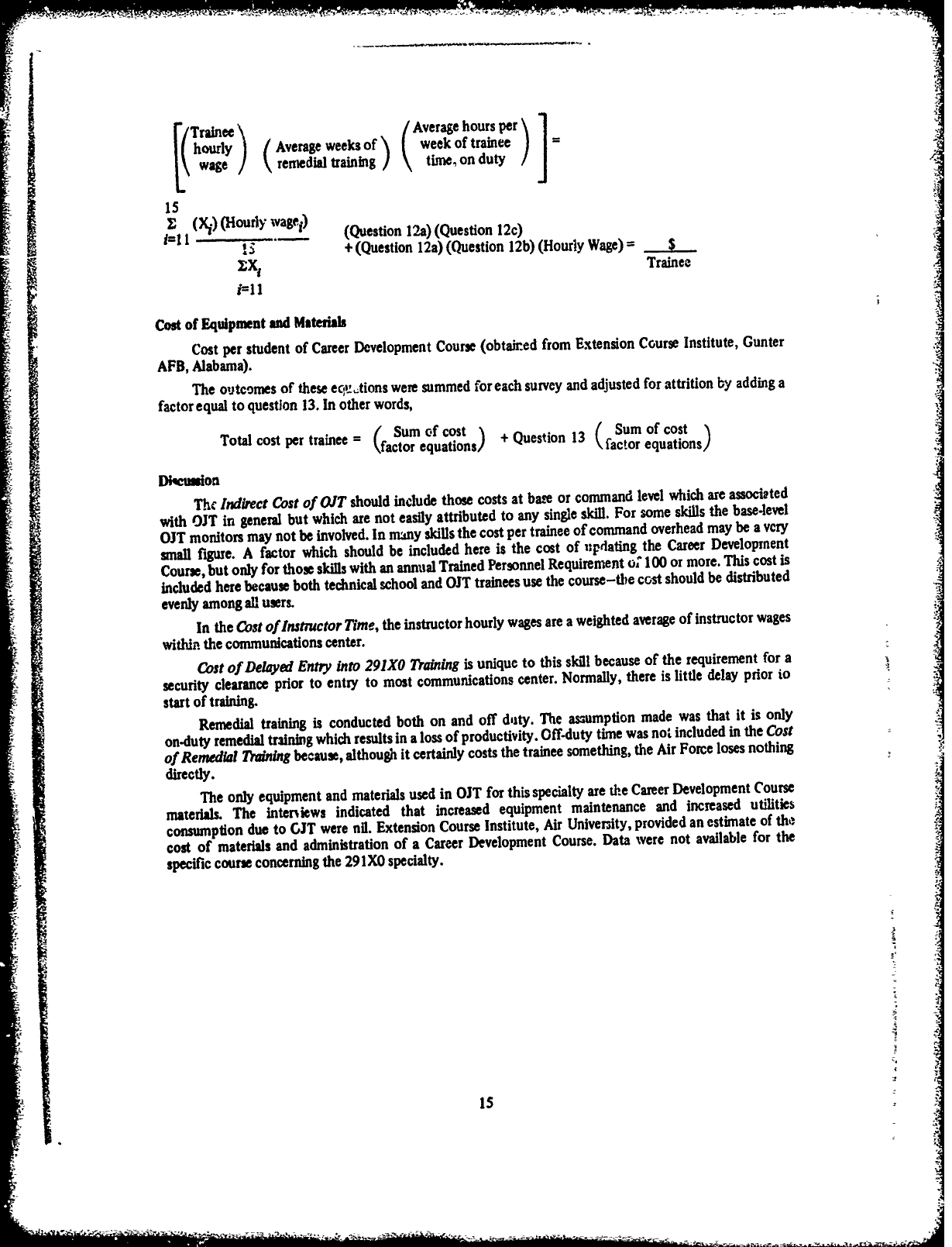
~ (Trainee\
Average
hours
per\
hourly
(Average
weeks
of
week
of
trainee
-
wage
/
\remedial
training
)\
time,
on
duty
15
1
(i
(Hourly
wage1
(Question
12a)
(Question
12c)
1ffi +
(Question
12a)
(Question
12b)
(Hourly
Wage)
=
I;xj
Trainee
Cost
of
Equipment
and
Materials
Cost
per
student
of
Career
Development
Course
(obtained
from Extension
Course
Institute,
Gunter
AFB, Alabama).
The
outcomes
of
these ecqx.tions
were
summed
for
each
survey
and
adjusted
for
attrition
by
adding
a
factor
equal
to
question
13.
In
other
words,
Total
cost
per trainee
Sum
of
cost
) (
Sum
of
cost
(factor
equations
uestion
13
factor equations
Dlq-uuion
Tc
Indirect
Cost
of
OJT
should
include
those
costs
at
bare
or
command
level
which
are
assocbted
with
OJT
in
general
but
which
are
not
easily
attributed
to
any
single
skill.
For
some skills
the
base-level
OJT
monitors
may
not
be
involved.
In
many
skills
the
cost per
trainee
of
command
overhead may
be
a
vcry
mall
figure.
A
factor
which
should
be
included
here
is
the
cost
of
updating
the
Career
Development
Course,
but
only
for
those
skills
with
an
annual
Trained
Personnel
Requirement
o,"
100
or more.
This cost
is
included here
because
both
technical
school
and
OJT
trainees
use
the
course-the
cost
should
be
distributed
evenly
among
all
users.
In the Cost
offInstructor
Time,
the instructor
hourly
wages
are
a
weighted
average
of
instructor
wages
within
the
communications center.
Cost
of
Delayed
Entry into
291X0
Training
is
unique
to
this
skill
because
of
the
requirement
for
a
security
clearance
prior
to
entry
to
most
communications center.
Normally, there
is
little
delay
prior
io
start
of
training.
Remedial
training
is
conducted
both
on and
off
duty.
The
assumption
made
was
that
it
is
only
on-duty
remedial
training
which
results
in
a
loss
of
productivity.
Off-duty
time was
no'
included
in
the
Cost
of
Remedial
Training
because,
although
it
certainly costs
the
trainee
something,
the
Air
Force
loses
nothing
directly.
The
only
equipment
and
materials used
in
OJT
for
this
specialty
are
t.e
Career
Development
Course
materials.
The
inteniews
indicated
that
increased
equipment maintenance
and
increased
utilities
consumption
due
to
CJT were
nil.
Extension
Course
Institute,
Air
Univerty,
provided
an estimate
of
the
cost
of
materials
and
administration
of
a
Career Development
Course.
Data
were
not
available
for
the
specific course
concerning
the
291X0
specialty.
15
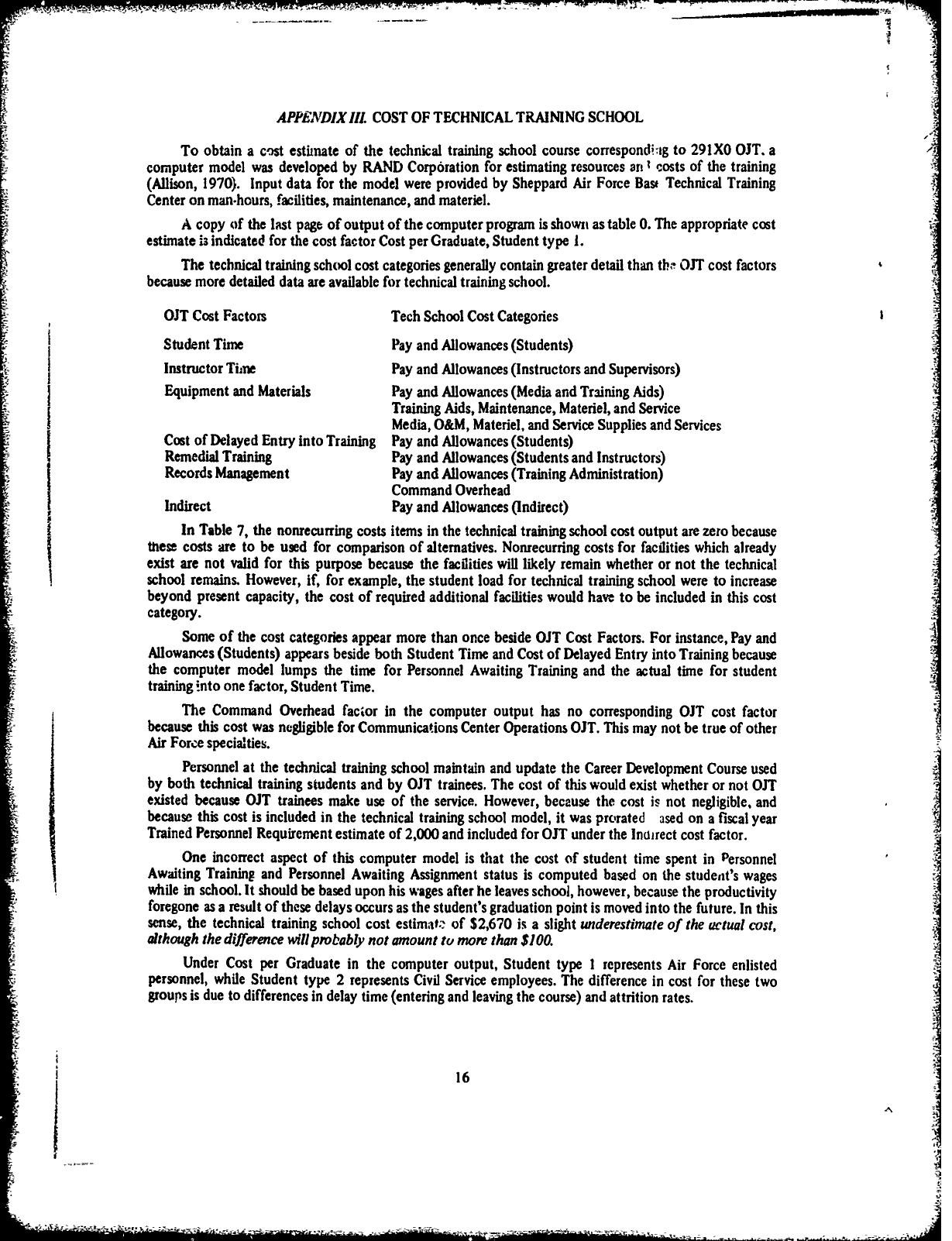
APPENDIXIII.
COST
OF
TECHNICAL TRAINING
SCHOOL
To
obtain
a
cost
estimate
of
the
technical training
school
course
correspond;ig
to
291X0 OJT.
a
computer
model
was
developed
by
RAND
Corporation
for
estimating
resources
an
costs
of
the
training
(Allison,
1970).
Input
data
for
the
model
were
provided
by
Sheppard
Air
Force
Bast
Technical
Training
Center
on
man-hours,
facilities,
maintenance,
and
materiel.
A
copy
of
the
last
page
of
output
of
the
computer
program
is
shown as table
0.
The
appropriate
cost
estimate
is
indicated
for
the
cost factor
Cost
per
Graduate,
Student
type
1.
The technical training
school
cost
categories
generally
contain
greater detail
than
tbze
OJT
cost factors
because
more
detailed
data
are
available
for
technical
training
school.
OJT Cost
Factors
Tech
School
Cost
Categories
Student
Time
Pay
and
Allowances
(Students)
Instructor
Time Pay
and
Allowances
(Instructors
and
Supervisors)
Equipment
and
Materials
Pay
and
Allowances
(Media
and
Training
Aids)
Training
Aids, Maintenance,
Materiel,
and
Service
Media,
O&M,
Materiel,
and
Service
Supplies
and
Services
Cost
of
Delayed
Entry
into
Training
Pay
and
Allowances
(Students)
Remedial
Training
Pay
and
Allowances
(Students
and
Instructors)
Records
Management
Pay
and
Allowances
(Training
Administration)
Command
Overhead
Indirect
Pay
and
Allowances
(Indirect)
In
Table
7,
the nonrecurring
costs
items
in
the
technical
training
school
cost
output
are
zero
because
these
costs
are
to
be
used
for
comparison
of
alternatives. Nonrecurring
costs
for
facilities which
already
exist
are
not
valid
for
this purpose
because
the
facilities
will
likely remain
whether
or
not
the
technical
school
remains.
However,
if,
for
example,
the
student
load
for
technical
training
school
were
to
increase
beyond
present
capacity,
the cost
of
required additional
facilities
would
have
to
be
included in
this
cost
category.
Some
of
the cost
categories
appear
more
than
once
beside
OJT
Cost
Factors.
For
instance,
Pay
and
Allowances
(Students)
appears
beside
both
Student
Time
and
Cost
of
Delayed
Entry
into
Training
because
the computer
model
lumps
the
time
for
Personnel Awaiting
Training
and the
actual
time
for
student
training
.nto
one
factor,
Student
Time.
The
Command
Overhead
factor
in
the
computer
output
has
no
corresponding
OJT
cost
factor
because
this
cost
was
negligible
for
Communications Center Operations
OJT.
This
may
not
be
true
of
other
Air
Force
specialties.
Personnel
at
the
technical training school
maintain
and
update the
Career
Development
Course
used
by
both
technical
training
students
and
by
OJT
trainees.
The cost
of
this
would
exist
whether
or
not
OJT
existed
because
OJT trainees
make
use
of
the
service. However,
because
the
cost
is
not
negligible,
and
because
this
cost
is
included in
the
technical
training
school
model,
it
was
prorated
ased
on
a
fiscal
year
Trained
Personnel
Requirement
estimate
of
2,000
and
included
for
OJT
under
the
lnwrect
cost
factor.
One
incorrect
aspect
of
this
computer
model
is
that
the
cost
of
student
time
spent
in Personnel
Awaiting
Training and Personnel
Awaiting
Assignment
status
is
computed
based
on
the
student's
wages
while
in
school.
It
should
be
based
upon
his
wages
after he
leaves
school,
however,
because
the
productivity
foregone
as
a
result
of
these
delays occurs
as
the
student's
graduation
point
is
moved
into
the
future.
In
this
sense,
the
technical
training
school
cost
estimatz-
of
$2,670
is
a
slight
underestimate
of
the
actual
cost,
although
the
difference
will
probably
not
amount
to
more
than
$100.
Under
Cost
per
Graduate
in
the computer
output,
Student
type
I
represents
Air
Force
enlisted
personnel,
while
Student
type
2
represents
Civil
Service
employees.
The difference
in cost
for
these
two
groups
is
due
to
differences
in delay
time
(entering
and
leaving
the
course)
and
attrition
rates.
16
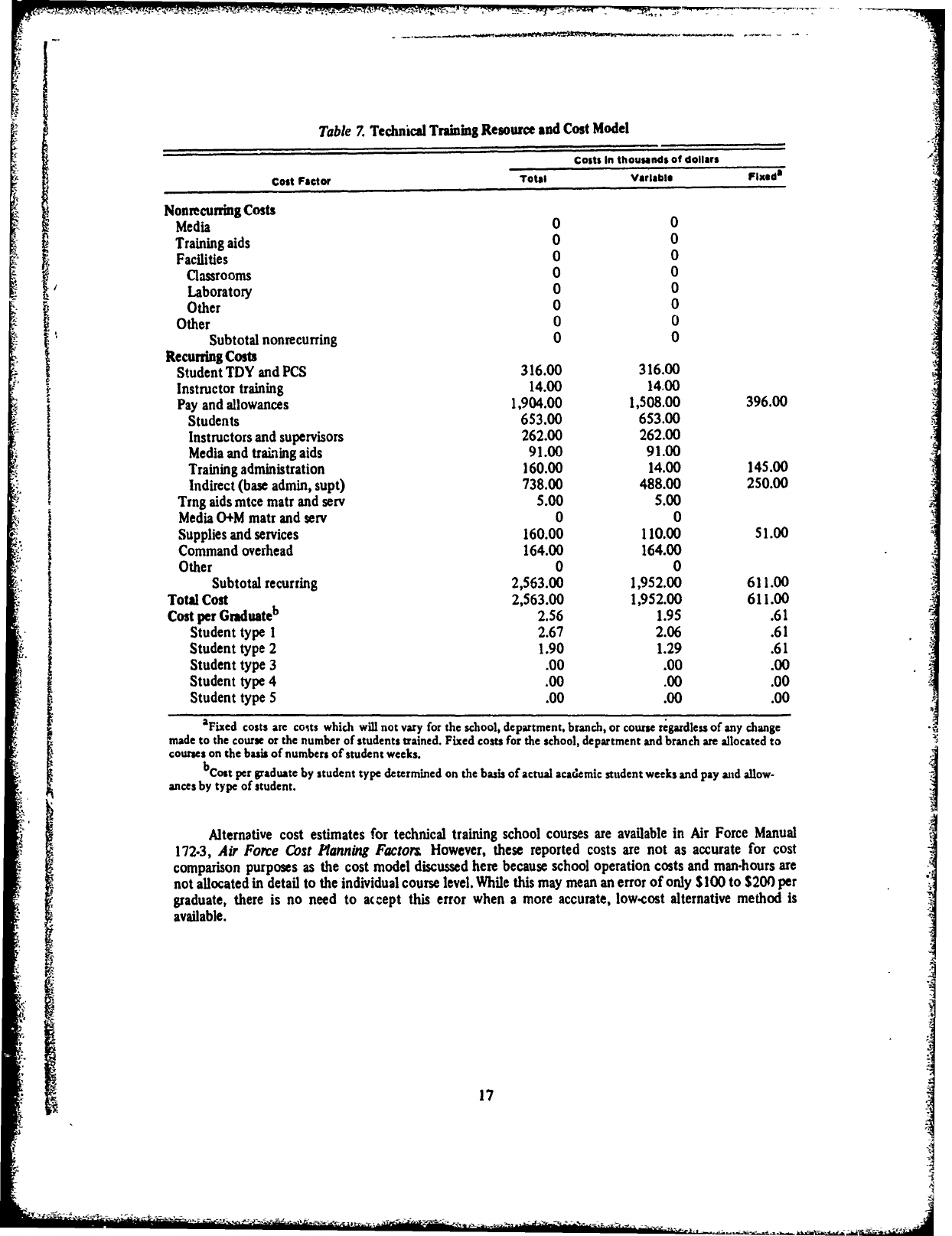
Table
7.
Technical
Training Resource
and
Cost
Model
Costs
in
thousands
of
dollars
-
Cost
Factor Total
Variable
Fixeca
Nonrecurring
Costs
Media
0
0
Training
aids
0
0
Facilities 0
0
Classrooms
0
0
Laboratory
0
0
Other
0
0
Other
0
0
Subtotal
nonrecurring
0
0
Recurring Costs
Student
TDY
and
PCS
316.00
316.00
Instructor
training
14.00
14.00
Pay
and
allowances
1,904.00 1,508.00
396.00
Students 653.00
653.00
Instructors
and
supervisors
262.00 262.00
Media
and
training
aids
91.00 91.00
Training
administration
160.00
14.00 145.00
Indirect
(base
admin,
supt)
738.00
488.00
250.00
Trng
aids
mtce
matr
and
serv
5.00
5.00
Media
O+M
matr
and
serv
0
0
Supplies
and
services
160.00
110.00
51.00
Command
overhead
164.00
164.00
Other
0
0
Subtotal
recurring
2,563.00
1,952.00
611.00
Total
Cost
2,563.00
1,952.00
611.00
Cost
per
Graduateb
2.56
1.95
.61
Student
type
1
2.67 2.06
.61
Student
type
2
1.90
1.29
.61
Student
type
3
.00 .00
.00
Student
type
4 .00
.00
.00
Student
type
5
.00 .00 .00
aFixed
costs
are
cotts
which
will
not
vary
for
the
school,
department,
branch,
or
course
regardless
of
any
change
made
to
the
course
or
the
number
of
students
trained.
Fixed
costs
for
the
school,
department
and
branch
are
allocated
to
courses on
the
basis
of
numbers
of
student
weeks.
bcost
per
graduate
by
student
type
determined
on
the
basis
of
actual
academic
student
weeks
and
pay
and
allow-
ances
by type
of
student.
Alternative
cost
estimates
for
technical
training
school
courses
are
available
in
Air
Force
Manual
172-3,
Air
Force
Cost Planning
Factorm However,
these
reported
costs
are
not
as
accurate for
cost
comparison purposes
as
the
cost
model
discussed
here
because
school
operation
costs
and man-hours
are
not
allocated
in
detail
to
the
individual
course
level.
While
this
may
mean
an
error
of
only
$100
to
$200
per
graduate,
there
is
no
need
to
accept
this
error
when
a
more accurate,
low.cost
alternative
method
is
available.
17
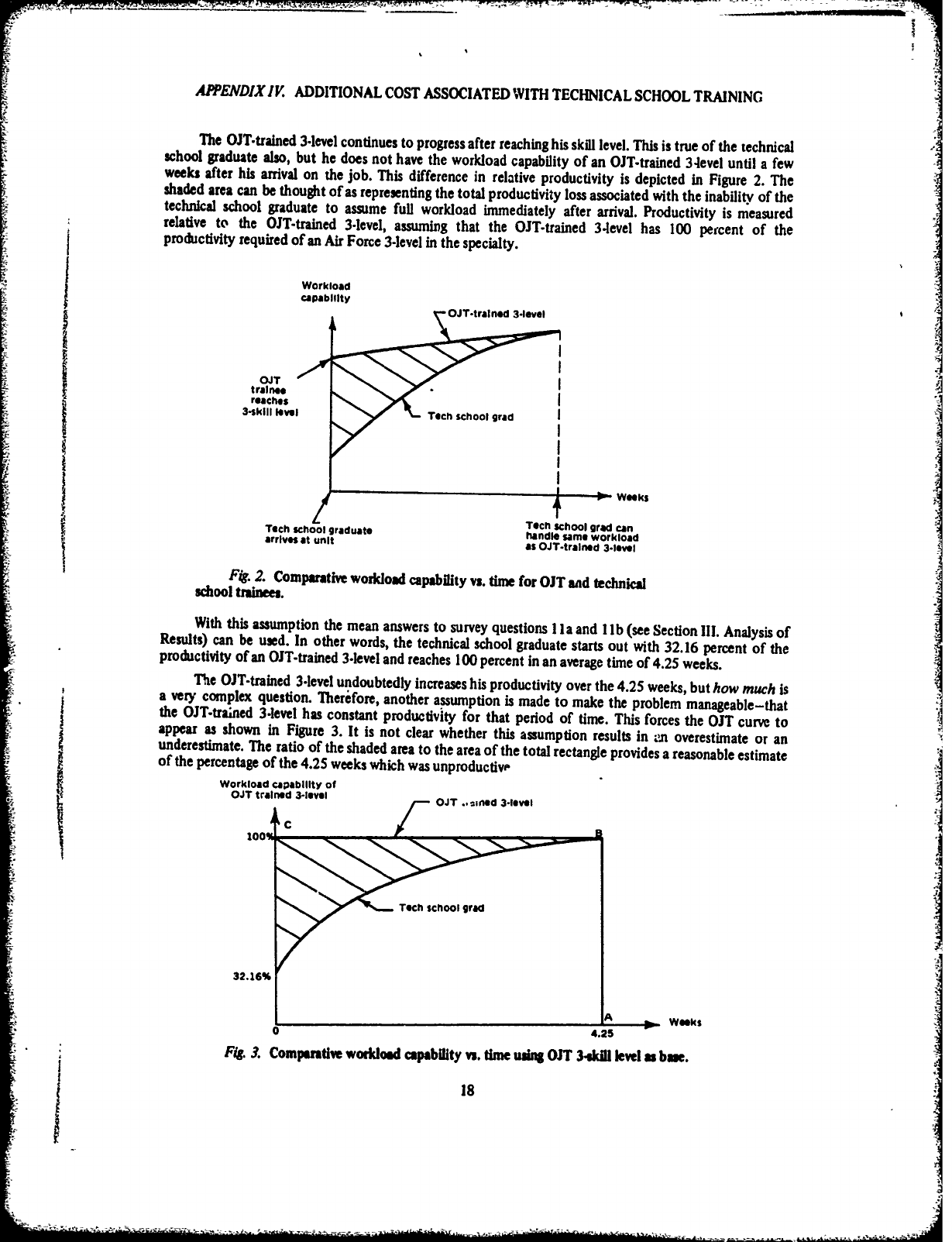
• ,• • -'•
SAPPENDIX IV.
ADDITIONAL
COST
ASSOCIATED
WITH
TECHNICAL
SCHOOL
TRAINING
k
The
OJT.trained
3-1evel
continues
to
progress
after
reaching
his
skill
level.
This
is
true
of
the
technical
Sschool
graduate
also,
but
he does
not
have
the
workload
capability
of
an
OJT-trained
34evel
until
a
few
weeks
after
his
arrival
on the
job.
This
difference
in
relative
productivity
is
depicted
in
Figure
2.
The
shaded
area can
be
thought
of
as
representing
the
total
productivity
loss
associated
with
the
inabili
.ty
of
the
<
technkal
school
graduate
to
assume full
workload
immectiately
after
arrival.
Productivity
is
measured
S•
relative
to
the
OJT-tralned
3-1evel,
a•uming
that
the OJT-trained
34evel
has
I00
percent
of
the
Si
productivity
required
of
an
Air
Fome
3-1evel
in
the
specialty.
SWorklold
capabHIty
i '
:-- I
Tech
School
grad
can
school
Tech
handle
same
worklosd
Sgraduate
Sarrives
at
unit
]•
as
OJT-tralned
3-level
!
F•.
2.
Comparative
workload capability
vs.
time
for
OJT
aad
technical
Sschool
trainees.
•
With
this
a.•umption the
mean
answers
to
survey
questions
1
la
and
1
lb
(see
Section IlL
Analysis
of
:
Results)
can
be
used. In
other
words,
the
technical
school
graduate
starts
out
with
32.16
percent
of
the
Sproductivity
of
an
OJT-trained
3-level
and
reaches
100
percent
in
an
average
time
of
4.25
weeks.
-•" ,
The
OJT-trained
3-level
undoubtedly
increases
his
productivity
over
the
4.25
weeks,
but
how
much
is
S"
i
a
very
complex
question.
Th erefore,
another
assumption
is
made
to
make
the problem
manageable-that
the
OJT.tralned
3-level
has
constant
productivity
for
that
period
of
time. This
forces
the
OJT
curve
to
< •
appear
as
shown
in
Figure
3.
It
is
not
clear
whether this
assumption
results in
•
overestimate
or
an
underestimate. The
ratio
of
the
shaded
area
to
the
area
of
the
total
rectangle
provides a
reasonable
estimate
of
the
percentage
of
the
4.25
weeks which
was
unpmductiw,
Workload
capability
of
OJT
trained.•, ..
•le•l
f
OJT
..
•,aed
3-level
100•
STech
1€h00|
gi'ad
32.16%
SWeeks
0
4.25
:
Fig 3.
Comlxtratlve
woddead
capability
v•.
lime
ud,•
oYr
•
level
,,,
base.
i
!
g
<
2-=_
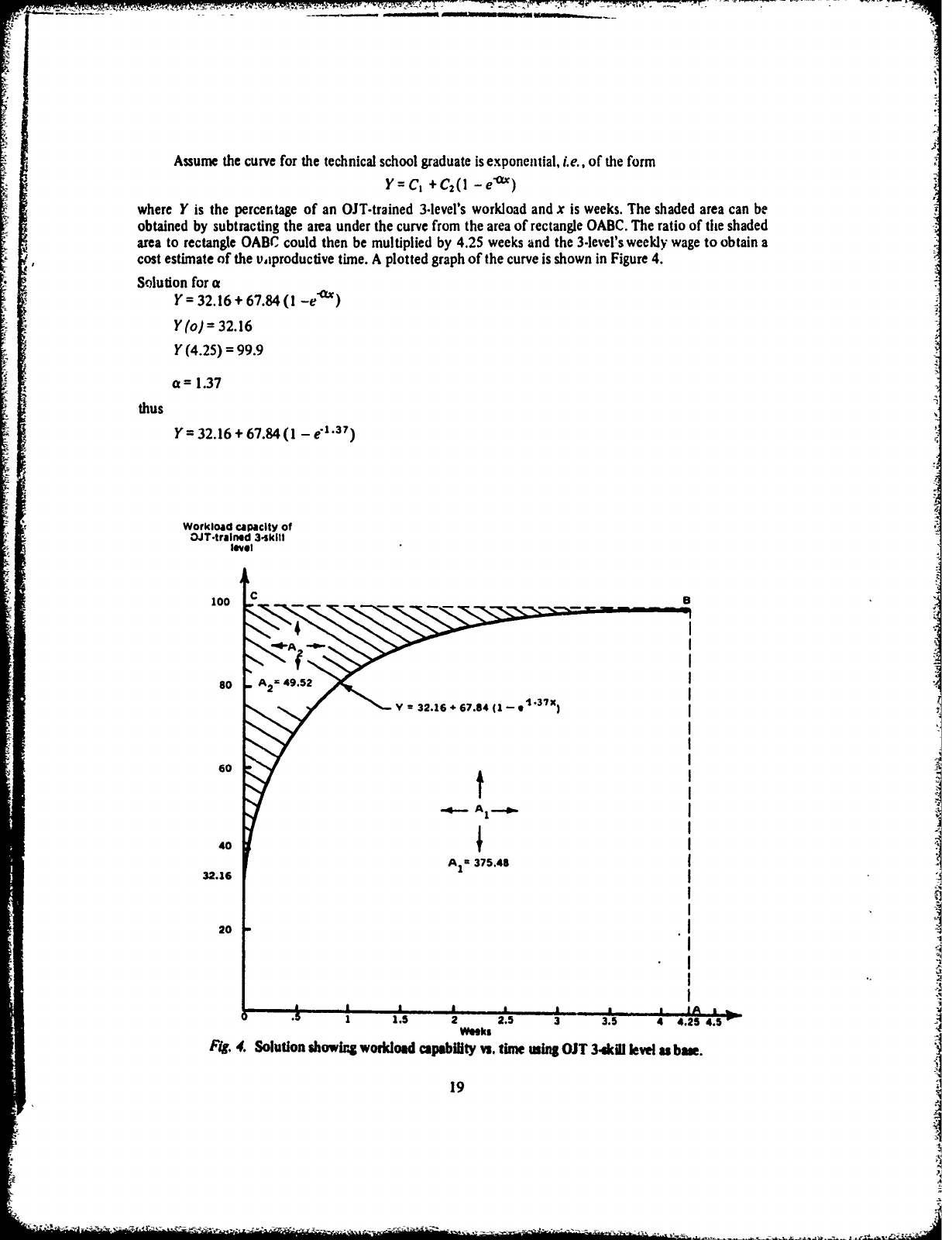
Assume
the
curve
for
the technical
school graduate
is
exponential,
i.e.,
of
the
form
where
Y is
the
percentage
of
an
OJT-trained
3-level's
workload and
x
is
weeks.
The
shaded
area
can
be
obtained
by
subtracting
the
area
under the
curve
from
the
area
of
rectangle
OABC.
The
ratio
of
the
shaded
area
to
rectangle
OABC
could
then
be
multiplied
by
4.25
weeks
and
the
3-level's
weekly
wage
to
obtain
a
cost
estimate
of
the
uaproductive
time.
A
plotted
graph
of
the
curve
is
shown
in
Figure
4.
Solution
for
ct
Y
=32.16
+67.84
(1
-e)
Y()=32.16
Y
(4.25)
=99.9
ct1.37
thus
Y 32.16
+67.84
(1
-e
137)
Workload
capacity
of
OJT-trained 3-skill
so
49.52
Y
32.16 +67.84
(1
-.3 x
60
40
I
32.16I
20
15
2
25
3
3.5
4
4.215
4.5
Wks
Fig.
4.
Solution
showing
woddoad
capaililty
vs.
thime
using
OJT
34kil
level
ats
bas.
19A
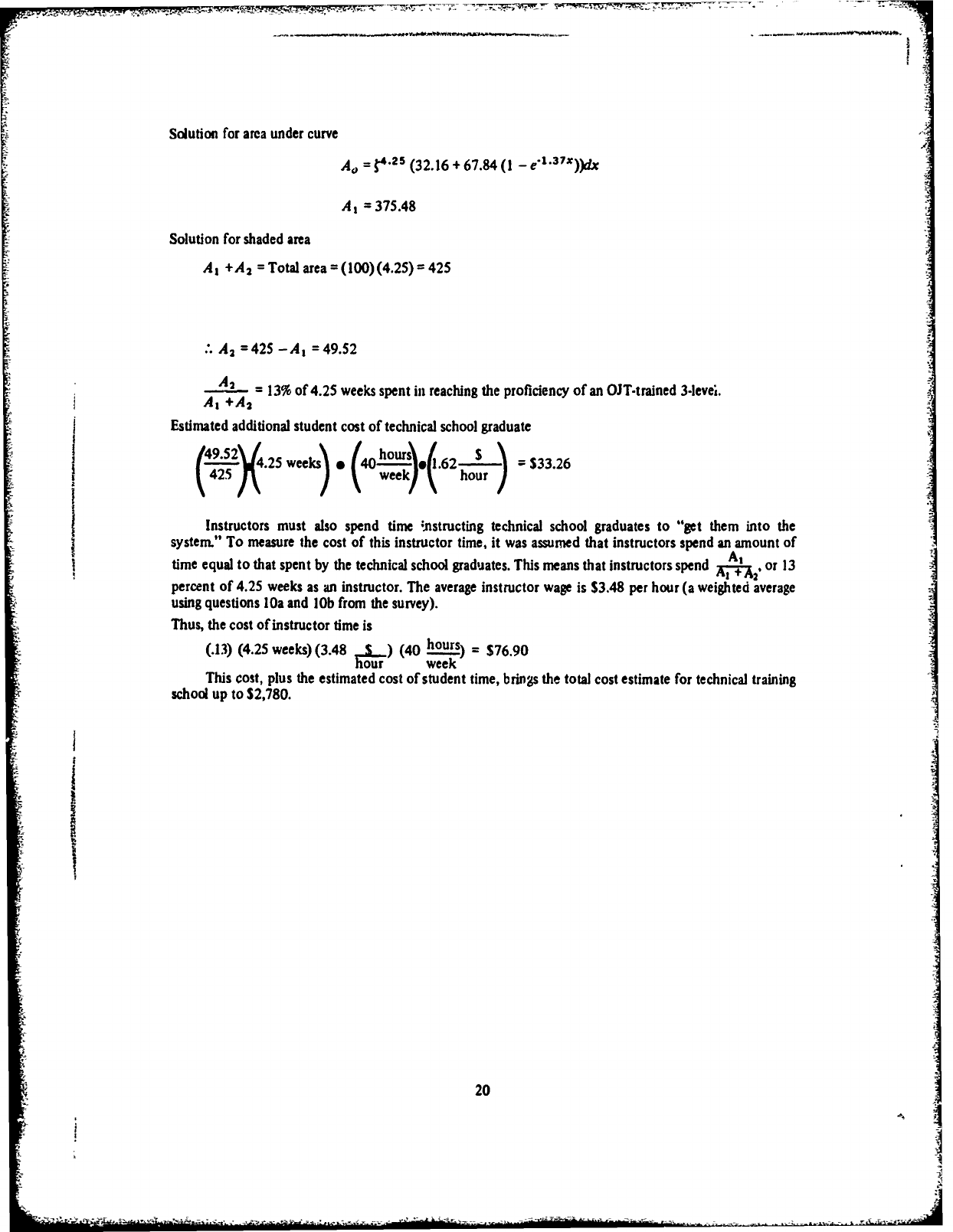
Solution
for
area
under
curve
A,
=
'4.2
5
(32.16
+
67.84
(1 -
e'1'37x))dx
AI
=
375.48
Solution for
shaded
area
AI
+ A2 =
Total
area
=
(100)(4.25)=
425
".A2
=425
-A
A
49.52
A2
=
13%
of
4.25
weeks
spent
in
reaching
the
proficiency
of
an
OJT-trained
3-levei.
Estimated additional
student
cost
of
technical
school
graduate
/49.52
42hours
76-$33.26
9
4
25
weeks)
.(40
.62
425
week)(
T
hor
/
Instructors must
also
spend
time
instructing
technical school
graduates
to
"get
them
into
the
system."
To
measure
the
cost
of
this
instructor
time,
it
was
assumed
that
instructors
spend
an
amount
of
time equal
to
that
spent
by
the technical
school
graduates.
This
means
that
instructors
spend
.2
or
13
percent
of
4.25
weeks
as an
instructor.
The
average
instructor
wage
is
$3.48
per
hour
(a
weighted
average
using
questions
10a
and
lOb
from the
survey).
Thus,
the
cost
of
instructor
time
is
(.13)
(4.25
weeks)
(3.48
& )
(40
hours)
=
$76.90
This
cost,
plus
the
estimated
cost
of
student
time, brings
the
total
cost estimate
for
technical training
school
up
to
$2,780.
2
a
20
APPENDIX
V
COMMUNICATIONS
CENI
ER
OPERATIONS
OJT
SURVEY
INSTRUCTIONS
1.
The
Communications Center
Supervisor/NCOIC
should complete this
survey.
If
this
person
is
unavailable,
it
shoukd
be filled
out
by
the
OJT
Monitor. Approximately
one
(1)
hour
will
be
required
to
complete
the
survey.
2.
When
answering
the
questions,
have
a
Job
Proficiency
Guide
(STS)
handy
to
refer
to.
3.
The
person
who
fil
out
this
survey
is
encouraged
to
ask
for
the
help
of
others,
such
as
the
OJT
Monitor
or
an
instructor
when uncertain
about
the
answer
to
a
question.
4.
This
survey
should be
completed
and
returned
in
the
attached
self-addressed
envelope
not
later
than
2
April
1971.
5.
If
there
is
difficulty
in
deciding
what
information
is
being asked
for
in
any
question,
contact
Lt
Dunham, Lackland
AFB,
at
473-4106
(AUTOVON).
BACKGROUND
INFORMATION
NAME
(Last,
first, middle
initial)
_________________
GRADE
E-4_,E-5
,E.6_,E.7_E.8..__.,E-9
Job
Title
Social
Security
Number
Organization
Base
or
Installation
Total
Months
in
Present
Job
Total
Months
at
Present
Base
Duty
Telephone Extension
21
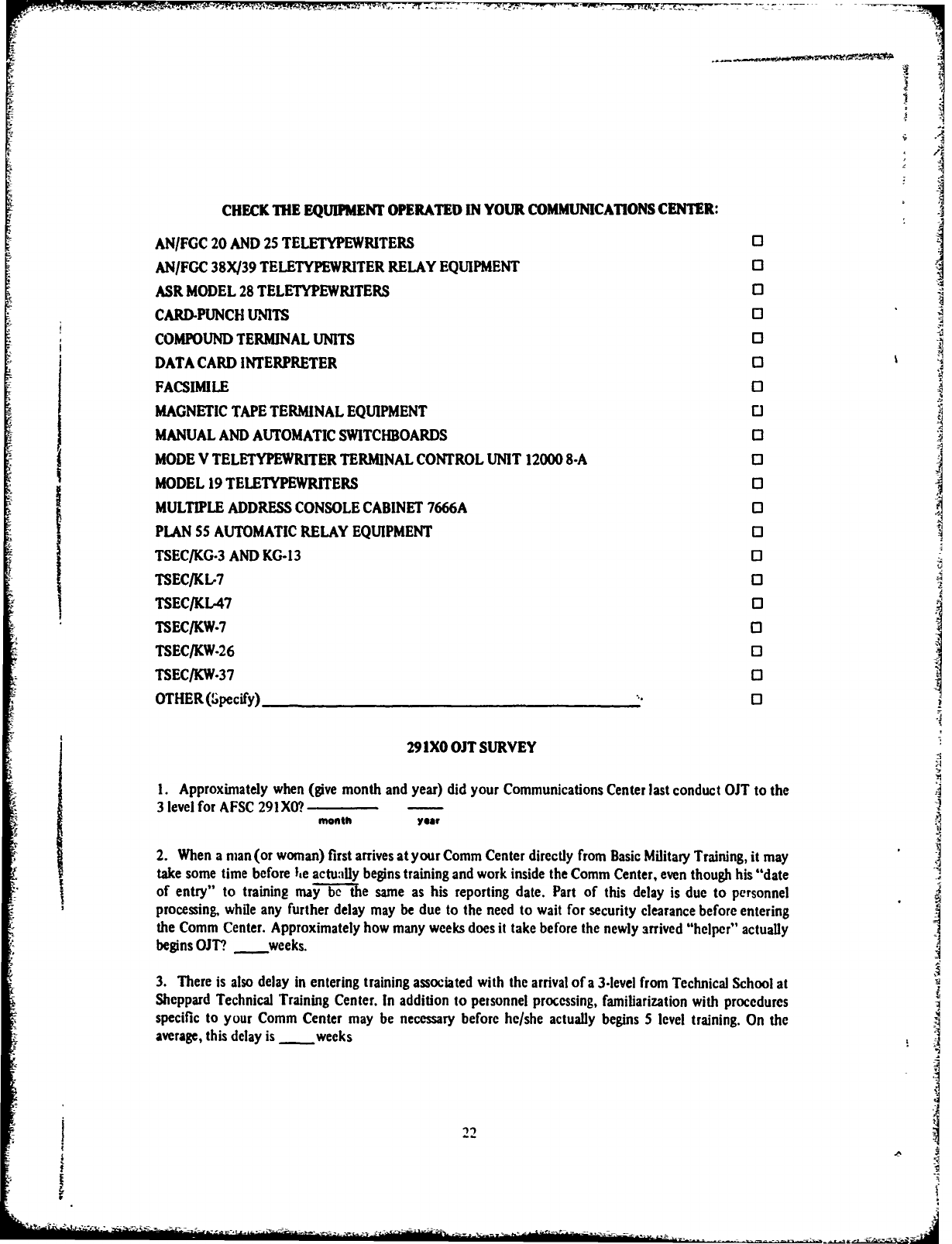
CHECK
THE
EQUIPMENT
OPERATED
IN
YOUR
COMMUNICATIONS
CENTER:
ANIFGC
20
AND
25
TELETYPEWRITERS
0
AN/FGC
38X/39
TELETYPEWRITER
RELAY
EQUIPMENT
0r-
ASR
MODEL
28 TELETYPEWRITERS
0
CARD-PUNCH
UNITS
0A
COMPOUND
TERMINAL
UNITS
0
DATA CARD
INTERPRETER
0
FACSIMILE
0
MAGNETIC
TAPE
TERMINAL
EQUIPMENT
0
MANUAL
AND
AUTOMATIC
SWITCHBOARDS
0
MODE
V
TELETYPEWRITER
TERMINAL
CONTROL
UNIT
12000
8-A
0
MODEL
19
TELETYPEWRITERS
0
MULTIPLE
ADDRESS CONSOLE
CABINET
7666A
0
PLAN 55
AUTOMATIC
RELAY
EQUIPMENT
0
TSEC/KG-3
AND
KG-13
0
TSEC/KL.7
0
TSEC/KL.47
0
TSECIKW.7
0
TSEC/KW.26
0
TSEC/KW.37
0 "
OTHER(Specify)_ 0
29
IXO
OJT
SURVEY
1.
Approximately
when
(give
month
and year)
did
your
Communications Center
last
conduct
OJT
to the
3
level
for
AFSC
291X09
month
year
2.
When
a
man
(or
woman)
first
arrives
at
your
Comm
Center
directly
from
Basic
Military
Training,
it
may
take
some
time
before
le
actually
begins
training
and
work
inside
the
Comm
Center,
even
though
his
"date
of
entry"
to
training
may
bc
the
same
as
his
reporting
date.
Part
of
this
delay
is
due
to
personnel
processing,
while
any
further
delay
may
be
due
to
the
need
to
wait
for
security
clearance
before
entering
the
Comm
Center.
Approximately how
many
weeks
does
it
take
before the
newly 3rrived
"helper"
actually
I
begins
OJT?
...
weeks.
_,
3.
There
is also
delay
in
entering
training
associated
with
the
arrival
of
a 3-level
from
Technical
School
at
Sheppard Technical
Training
Center.
In
addition
to
personnel
processing,
familiarization
with
procedures
specific
to
your
Comm
Center
may
be
necessary
before
he/she
actually
begins
5
level
training.
On
the
average,
this
delay
is
weeks
ýA
,I
I '
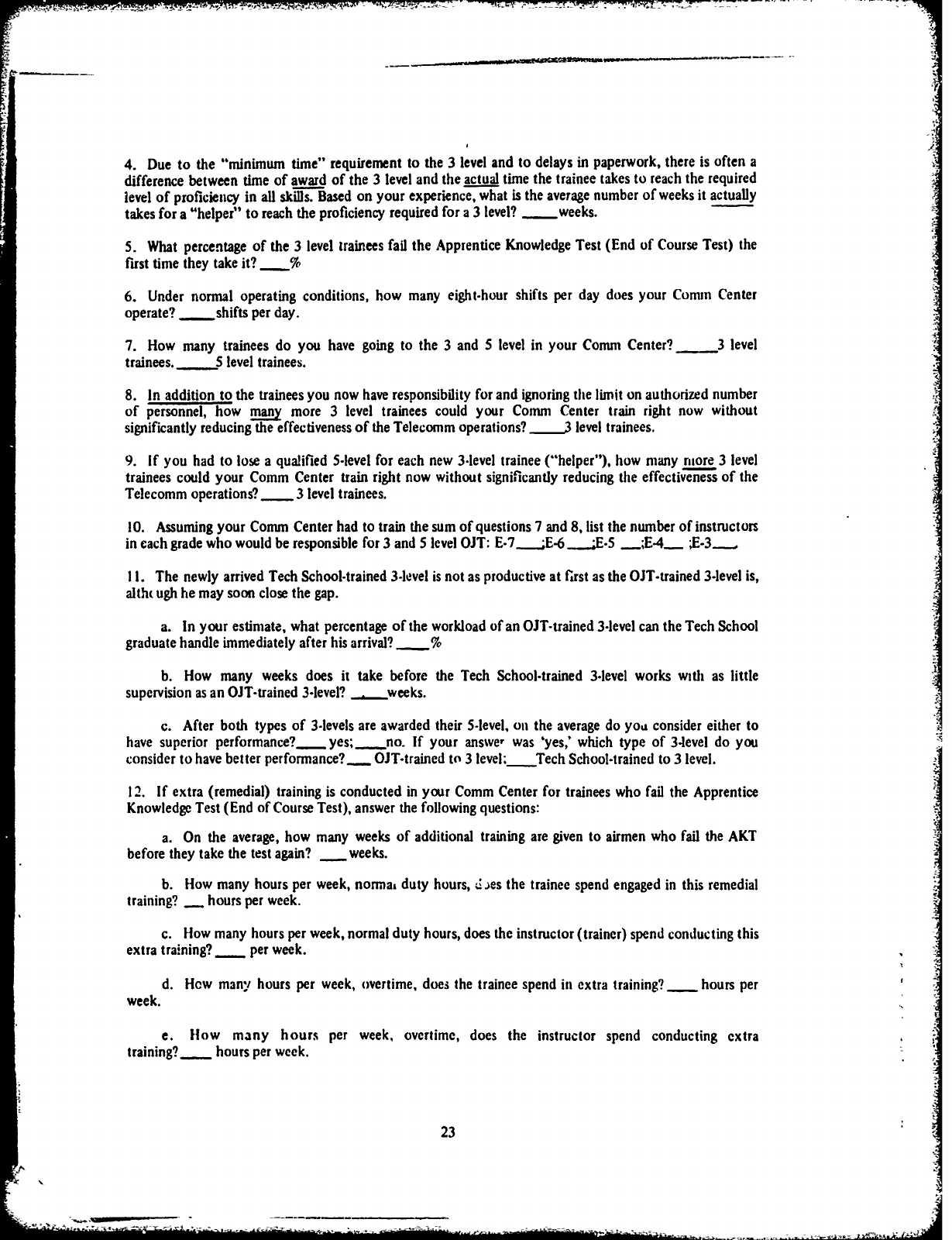
4.
Due
to
the "miniinwn
time"
requirement
to
the
3
level
and
to
delays
in
paperwork, there
is
often
a
difference
between
time
of
award
of
the
3
level
and the
actual time
the
trainee
takes
to
reach
the
required
level
of
proficiency
in
all
skills.
Based
on
your
experience, what
is
the
average
number
of
weeks
it
actually
takes
for
a
"helper"
to
reach
the
proficiency
required
for
a 3
level?
-weeks.
5.
What
percentage
of
the
3
level
trainees
fail
the
Apprentice
Knowledge
Test
(End
of
Course
Test)
the
first time
they
take
it?
_%
6.
Under
normal
operating conditions, how
many
eight-hour
shifts
per day
does
your
Comm
Center
operate?
_
shifts per
day.
7.
How
many
trainees
do
you
have
going
to
the
3
and
5
level
in
your
Comm
Center?
3
level
trainees.
5
level
trainees.
8.
In
addition
to
the
trainees
you
now
have
responsibility
for
and
ignoring
the
limit
on
authorized
number
of
personnel,
how
many more
3
level
trainees
could
your
Comm
Center
train
right now
without
significantly reducing the
effectiveness
of
the
Telecomm
operations?
-...3
level
trainees.
9.
If
you
had
to
lose
a
qualified
5-level
for
each
new
3-level
trainee
("helper"),
how
many
raore
3
level
trainees
could
your
Comm
Center train
right
now
without
significantly
reducing
the
effectiveness
of
the
Telecomm operations?
-
3
level
trainees.
10.
Assuming
your
Comm
Center
had
to
train
the
sum
of
questions
7
and
8,
list
the
number
of
instructors
in
each
grade
who
would
be responsible
for
3
and
5
level
OJT:
E-7
E-6.__._E.5
-;E-4-
;E-3-.
1i.
The
newly arrived
Tech
School-trained
3-level
is
not
as
productive
at
first
as
the OJT-trained
3-level
is,
althc
ugh
he
may
soon
close
the
gap.
a.
In
your
estimate, what
percentage
of
the
workload
of
an OJT-trained
3-level
can
the
Tech
School
graduate handle
immediately
after
his arrival?
_%
b.
How
many
weeks
does
it
take before
the Tech
School-trained
3-level
works with
as
little
supervision
as
an
OJT-trained
3-level?
__.._weeks.
c.
After
both
types
of
3-levels
are
awarded
their
5-level,
on
the
average
do
you
consider
either
to
have
superior
performance?_
yes;
_
no.
If
your
answe,
was
'yes,'
which
type
of
3-level
do
you
consider
to
have
better
performance?_
OJT-trained
to
3
level:
Tech School-trained
to
3
level.
12.
If
extra
(remedial)
training
is
conducted
in
your
Comm
Center
for
trainees
who
fail
the Apprentice
Knowledge
Test
(End
of
Course
Test),
answer the
following
questions:
a.
On
the
average,
how
many
weeks
of
additional
training
are
given
to
airmen
who
fail
the
AKT
before
they
take
the test
again?
_
weeks.
b.
How
many
hours
per
week,
norma,
duty
hours,
ý.ies
the
trainee
spend
engaged
in
this
remedial
training?
_
hours
per
week.
c.
How
many
hours
per
week,
normal
duty
hours,
does the
instructor
(trainer)
spend
conducting
this
extra
training?
-
per
week.
d.
Hew many
hours
per
week,
overtime,
does the trainee
spend
in
extra
training?
-
hours
per
week.
e.
flow
many
hours
per
week,
overtime,
does
the
instructor
spend
conducting
cxtra
training?_
hours
per
week.
23
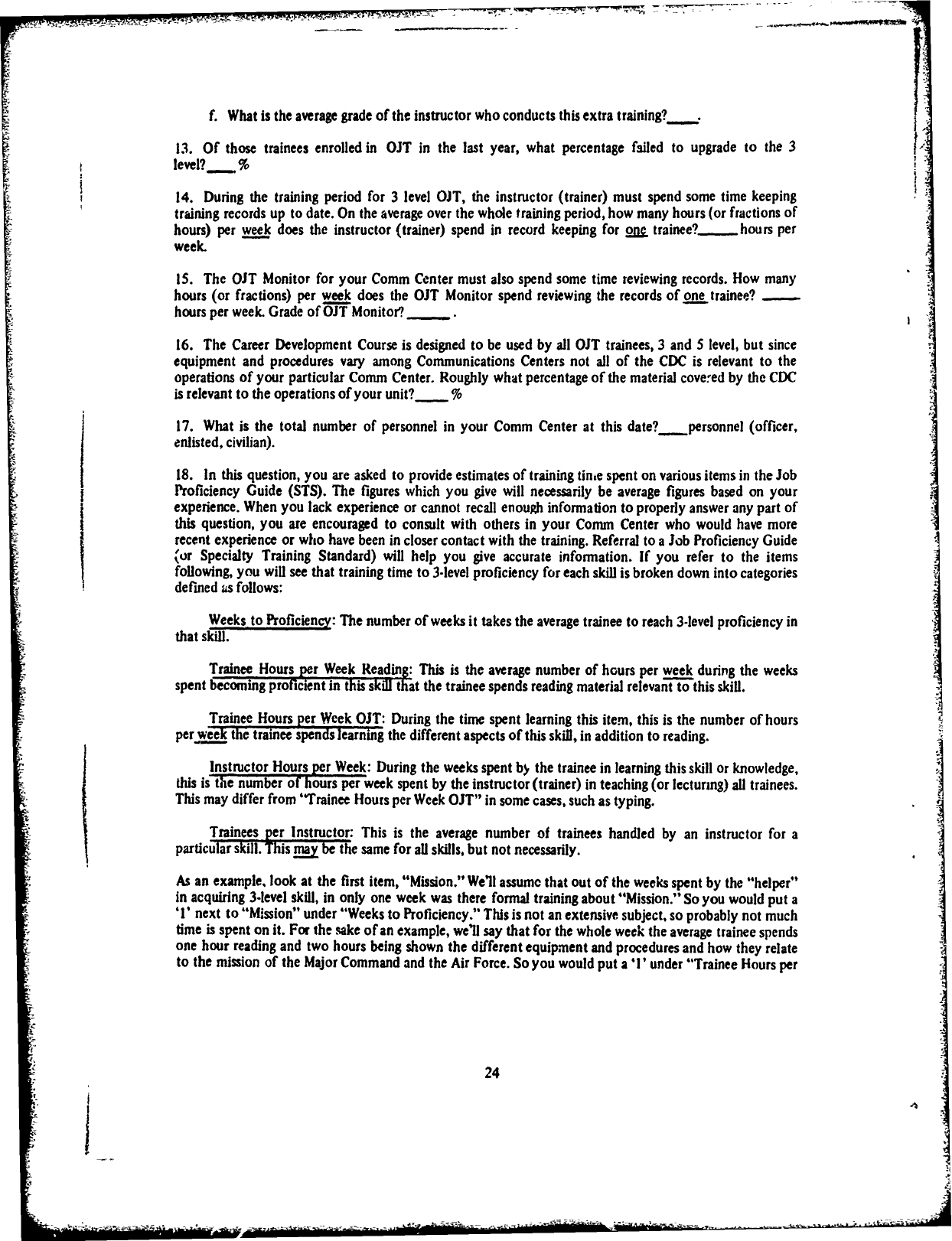
_ = -~ "~ -" '-. L ... • ., •. ,* ' ,= • ----.. ... -•: ',w
-"
'.
=,-
--
•=
'=•
"•"
---=• -. . .. - • ' • •
f.
What
is
the
average
grade
of
the
instructor
who
conducts
this
extra
training?,
1.
13.
Of
those
trainees
enrolled
in
OJT
in
the
last
year,
what
percentage
failed
to
upgrade
to
the
3
level?
%
14.
During
the training
period
for
3
level
OJT, the
instructor
(trainer)
must
spend
some
time
keeping
training
records up
to
date.
On
the
average
over
the
whole
training
period, how
many
hours (or
fractions
of
hours)
per
week
does the
instructor
(trainer)
spend
in
record
keeping for
one
trainee?.. hours
per
week.
15.
The
OJT Monitor
for
your
Comm
Center must
also
spend
some
time
reviewing
records.
How many
hours
(or
fractions)
per
week
does
the OJT
Monitor spend
reviewing
the
records
of
one trainee?
hours
per
week.
Grade
of
OJT
Monitor?
16.
The
Career
Development
Course
is
designed
to
be
used
by
all
OJT
trainees,
3
and
5
level,
but
since
equipment and
procedures
vary
among
Communications
Centers
not
all
of
the
CDC
is
relevant
to
the
operations
of
your
particular
Comm
Center.
Roughly
what
percentage
of
the
material
covefed
by
the
CDC
is
relevant
to
the
operations
of
your
unit?
%
17.
What is
the total
number
of
personnel
in
your
Comm
Center
at
this date?
personnel
(officer,
enlisted,
civilian).
18.
In this
question,
you
are asked
to
provide
estimates
of
training
time
spent
on
various
items
in
the Job
Proficiency
Guide
(STS).
The
figures
which
you
give
will
necessarily
be
average
figures
based on
your
experience.
When
you
lack
experience
or
cannot
recall
enough
information
to
properly
answer
any
part
of
this
question,
you
are
encouraged
to
consult
with
others
in
your
Comm
Center
who
would
have
more
recent experience
or
who
have
been
in
closer
contact
with
the
training. Referral
to
a
Job
Proficiency
Guide
,or
Specialty
Training
Standard)
will
help
you
give
accurate
information. If
you
refer
to
the
items
following,
you
will
see
that
training
time
to
3-level
proficiency
for
each
skill
is broken
down
into
categories
defined
as
follows:
Weeks
to
Proficiency:
The number
of
weeks
it
takes
the
average
trainee
to
reach
3-level
proficiency
in
that
skill.
Trainee Hours
p4r
Week
Readin
:
This
is
the
average
number
of
hours
per
week
during
the
weeks
spent
becoming
proficient
in
this
skill
that
the trainee spends
reading
material
relevant
to
this
skill.
Trainee Hours
per
Week
OJT:
During
the
time
spent
learning
this
item,
this
is
the number
of
hours
per
wee..
lie
trainee
spends
learning
the
different
aspects
of
this
skill, in
addition
to
reading.
Instructor
Hours
per
Week:
During
the
weeks
spent
b,
the
trainee
in
learning
this
skill
or
knowledge,
this
is
Me
number
of
hours
per
week
spent
by
the
instructor
(trainer)
in
teaching
(or
lecturing)
all
trainees.
This
may
differ
from
"Trainee Hours
per
Week
OJT"
in
some
cases,
such as
typing.
Trainees
per
Instructor:
This
is
the
average
number
of
trainees handled
by
an
instructor
for
a
particula-r
skil.This
may
be
the
same
for
all
skills,
but
not
necessarily.
As
an
example,
look at
the
first
item,
"Mission."
We'll
assumc
that
out
of
the
weeks
spent
by
the
"helper"
in
acquiring
3-level skill,
in
only
one
week
was
there
formal
training
about
"Mission."
So
you
would
put
a
'I'
next
to
"Mission"
under
"Weeks
to
Proficiency." This
is
not
an
extensive
subject,
so probably
not
much
time
is
spent
on
it.
For
the
sake
of
an
example,
we'll
say
that
for
the
whole
week
the
average
trainee
spends
one
hour
reading
and
two
hours
being
shown
the different equipment
and procedures
and
how
they
relate
to
the
mission
of
the
Major
Command
and
the
Air
Force.
So
you
would
put
a
'1'
under
"Trainee
Hours
per
24
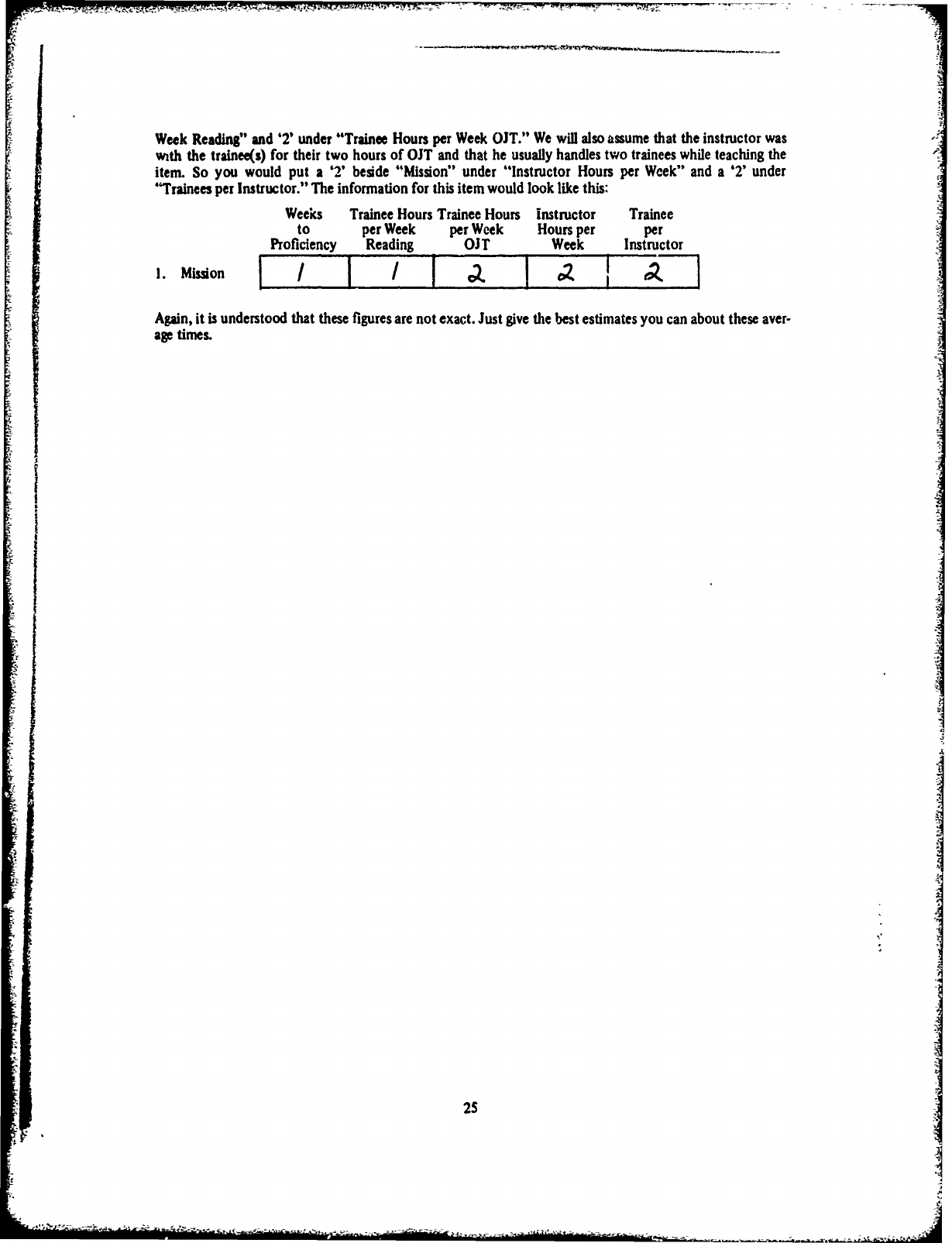
Week
Reading"
and
'2'
under
"Trainee
Hours per
Week
OJT."
We
will
also
assume
that
the
instructor
was
with
the
trainee(s)
for
their
two hours
of
OJT
and
that
he
usually
handles
two
trainees
while
teaching
the
item.
So
you
would
put
a
'2'
beside
"Mission"
under
"Instructor
Hours
per
Week"
and a
'2'
under
"Trainees
per
Instructor."
The
information
for
this
item
would
look
like
this:
Weeks
Trainee
Hours
Trainee Hours
Instructor
Trainee
to
per
Week
per
Week
Hours
per
per
Proficiency
Reading
OJT
Week
Instructor
1.
Mission
a 2
Again,
it
is
understood
that
these
figures
are
not
exact.
Just
give
the
best
estimates
you
can
about
these
aver-
age
times.
25
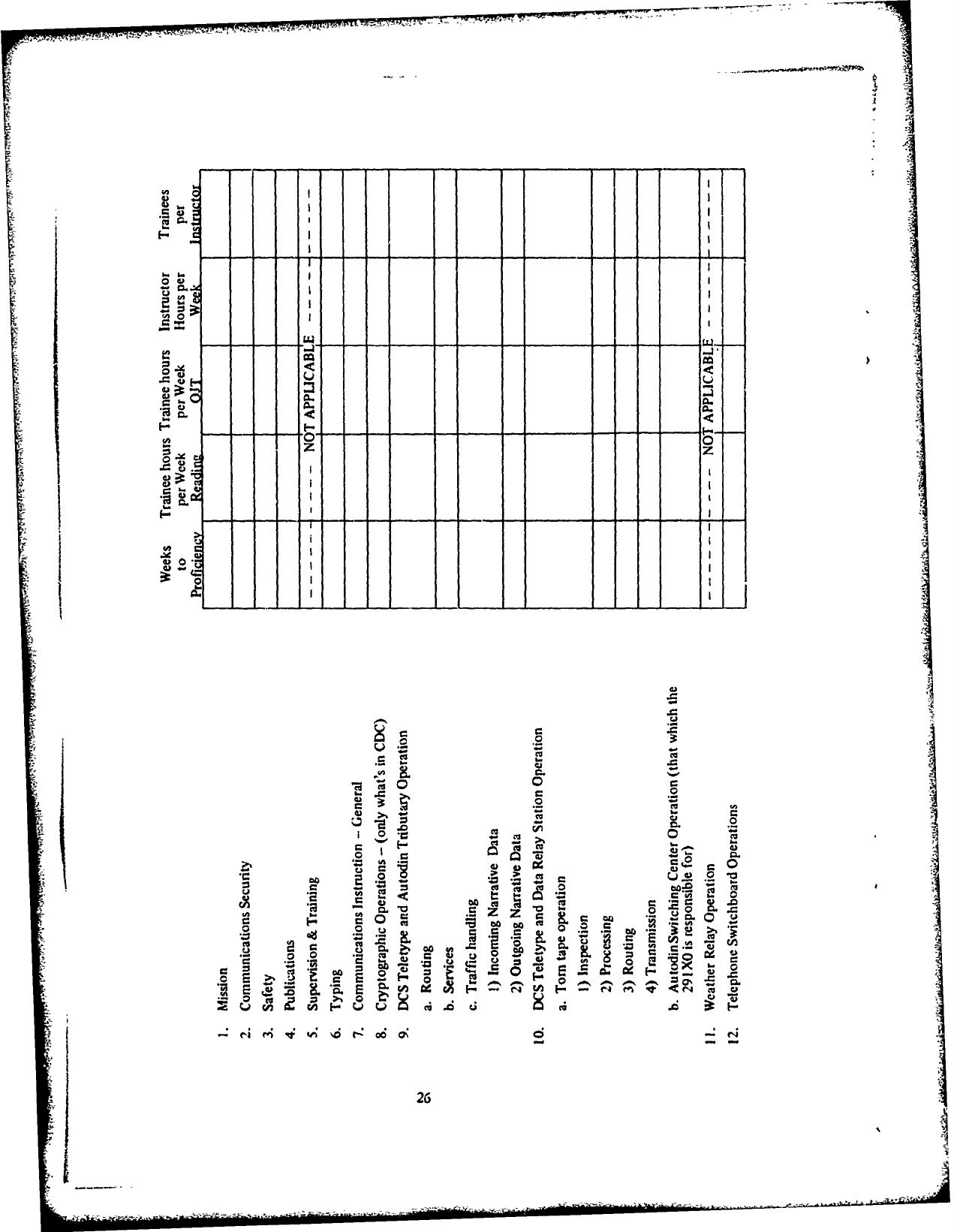
. • I• • ' •' '•-" . i
•_
•
"7
..........
i.•4
U,
I
I.. I
L ;
-
-Z
i2-
zV
c0
0
I I
Q
.
cc
C
u~O
MU ~
0 C. u a
,
u. U, U0
0
000
E
j
@
E
oz-
CuC;c
C.;
ý6
06C
26~~
u
0C O
