AN7286_BM6835_BM6635_BP6335_Manual AN7286 BM6835 BM6635 BP6335 Manual
User Manual: AN7286_BM6835_BM6635_BP6335_Manual
Open the PDF directly: View PDF  .
.
Page Count: 215 [warning: Documents this large are best viewed by clicking the View PDF Link!]
- Notices
- Chapter 1:Getting started
- Chapter 2:Using Windows® 7
- Chapter 3:Connecting devices to your computer
- Chapter 4:Using your computer
- Chapter 5:Connecting to the Internet
- Chapter 6:Using the utilities
- Chapter 7:Troubleshooting
- 注意事項
- 第一章:系統導覽
- 第二章:使用 Windows® 7(選配)
- 第三章:裝置連接
- 第四章:使用您的電腦
- 第五章:網路連線
- 第六章:使用應用程式(選配)
- 第七章:疑難解決
- 注意事项
- 第一章:系统导览
- 第二章:使用 Windows® 7(选配)
- 第三章:设备连接
- 第四章:使用您的电脑
- 第五章:网络连接
- 第六章:使用应用程序(选配)
- 第七章:疑难解决
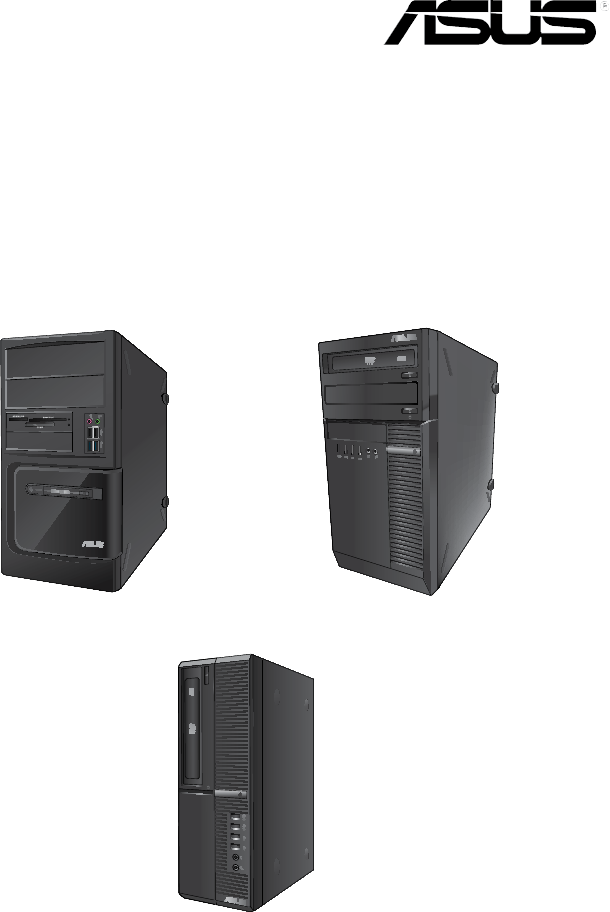
BM6835
BM6635(MD560)
BP6335(SD560)
ASUS Desktop PC
User Manual
BM6635(MD560)
BM6835
BP6335(SD560)

2
Copyright © 2012 ASUSTeK Computer Inc. All Rights Reserved.
No part of this manual, including the products and software described in it, may be reproduced,
transmitted, transcribed, stored in a retrieval system, or translated into any language in any form or by any
means, except documentation kept by the purchaser for backup purposes, without the express written
permission of ASUSTeK Computer Inc. (“ASUS”).
Product warranty or service will not be extended if: (1) the product is repaired, modied or altered, unless
such repair, modication of alteration is authorized in writing by ASUS; or (2) the serial number of the
product is defaced or missing.
ASUS PROVIDES THIS MANUAL “AS IS” WITHOUT WARRANTY OF ANY KIND, EITHER EXPRESS
OR IMPLIED, INCLUDING BUT NOT LIMITED TO THE IMPLIED WARRANTIES OR CONDITIONS OF
MERCHANTABILITY OR FITNESS FOR A PARTICULAR PURPOSE. IN NO EVENT SHALL ASUS, ITS
DIRECTORS, OFFICERS, EMPLOYEES OR AGENTS BE LIABLE FOR ANY INDIRECT, SPECIAL,
INCIDENTAL, OR CONSEQUENTIAL DAMAGES (INCLUDING DAMAGES FOR LOSS OF PROFITS,
LOSS OF BUSINESS, LOSS OF USE OR DATA, INTERRUPTION OF BUSINESS AND THE LIKE),
EVEN IF ASUS HAS BEEN ADVISED OF THE POSSIBILITY OF SUCH DAMAGES ARISING FROM ANY
DEFECT OR ERROR IN THIS MANUAL OR PRODUCT.
SPECIFICATIONS AND INFORMATION CONTAINED IN THIS MANUAL ARE FURNISHED FOR
INFORMATIONAL USE ONLY, AND ARE SUBJECT TO CHANGE AT ANY TIME WITHOUT NOTICE,
AND SHOULD NOT BE CONSTRUED AS A COMMITMENT BY ASUS. ASUS ASSUMES NO
RESPONSIBILITY OR LIABILITY FOR ANY ERRORS OR INACCURACIES THAT MAY APPEAR IN THIS
MANUAL, INCLUDING THE PRODUCTS AND SOFTWARE DESCRIBED IN IT.
Products and corporate names appearing in this manual may or may not be registered trademarks or
copyrights of their respective companies, and are used only for identication or explanation and to the
owners’ benet, without intent to infringe.
E7286
First Edition
March 2012

3
Contents
Notices .......................................................................................................... 5
Safety information .......................................................................................... 7
Conventions used in this guide ...................................................................... 8
Where to nd more information ..................................................................... 8
Package contents .......................................................................................... 9
Chapter 1:Getting started
Welcome! ..................................................................................................... 11
Getting to know your computer .................................................................... 11
Setting up your computer ............................................................................. 21
Turning your computer ON/OFF .................................................................. 26
Chapter 2:Using Windows® 7
Starting for the rst time ............................................................................... 27
Using Windows® 7 desktop .......................................................................... 28
Managing your les and folders ................................................................... 30
Restoring your system settings .................................................................... 32
Protecting your computer ............................................................................. 33
Getting Windows® Help and Support ........................................................... 34
Chapter 3:Connecting devices to your computer
Connecting a USB storage device ............................................................... 35
Connecting microphone and speakers ........................................................ 37
Chapter 4:Using your computer
Proper posture when using your Desktop PC.............................................. 41
Using the optical drive (on selected models only) ....................................... 42
Chapter 5:Connecting to the Internet
Wired connection ......................................................................................... 43
Chapter 6:Using the utilities
ASUS AI Suite II .......................................................................................... 47
ASUS AI Manager ....................................................................................... 54
ASUS WebStorage ...................................................................................... 57
ASUS Easy Update ..................................................................................... 59
Nero 9 ........................................................................................................ 60
Recovering your system .............................................................................. 61

5
Notices
ASUS Recycling/Takeback Services
ASUS recycling and takeback programs come from our commitment to the highest standards
for protecting our environment. We believe in providing solutions for you to be able to
responsibly recycle our products, batteries, other components, as well as the packaging
materials. Please go to http://csr.asus.com/english/Takeback.htm for the detailed recycling
information in different regions.
REACH
Complying with the REACH (Registration, Evaluation, Authorisation, and Restriction of
Chemicals) regulatory framework, we published the chemical substances in our products at
ASUS REACH website at http://csr.asus.com/english/REACH.htm
Federal Communications Commission Statement
This device complies with Part 15 of the FCC Rules. Operation is subject to the following two
conditions:
• This device may not cause harmful interference; and
• This device must accept any interference received including interference that may cause
undesired operation.
This equipment has been tested and found to comply with the limits for a Class B digital
device, pursuant to Part 15 of the FCC Rules. These limits are designed to provide
reasonable protection against harmful interference in a residential installation. This
equipment generates, uses and can radiate radio frequency energy and, if not installed
and used in accordance with manufacturer’s instructions, may cause harmful interference
to radio communications. However, there is no guarantee that interference will not occur
in a particular installation. If this equipment does cause harmful interference to radio or
television reception, which can be determined by turning the equipment off and on, the user
is encouraged to try to correct the interference by one or more of the following measures:
• Reorient or relocate the receiving antenna.
• Increase the separation between the equipment and receiver.
• Connect the equipment to an outlet on a circuit different from that to which the receiver is
connected.
• Consult the dealer or an experienced radio/TV technician for help.
The use of shielded cables for connection of the monitor to the graphics card is required
to assure compliance with FCC regulations. Changes or modications to this unit not
expressly approved by the party responsible for compliance could void the user’s authority
to operate this equipment.
6
RF exposure warning
This equipment must be installed and operated in accordance with provided instructions and
the antenna(s) used for this transmitter must be installed to provide a separation distance of
at least 20 cm from all persons and must not be co-located or operating in conjunction with
any other antenna or transmitter. End-users and installers must be provide with antenna
installation instructions and transmitter operating conditions for satisfying RF exposure
compliance.
Canadian Department of Communications Statement
This digital apparatus does not exceed the Class B limits for radio noise emissions from
digital apparatus set out in the Radio Interference Regulations of the Canadian Department of
Communications.
This class B digital apparatus complies with Canadian ICES-003.
Macrovision Corporation Product Notice
This product incorporates copyright protection technology that is protected by method
claims of certain U.S. patents and other intellectual property rights owned by Macrovision
Corporation and other rights owners. Use of this copyright protection technology must be
authorized by Macrovision Corporation, and is intended for home and other limited viewing
uses only unless otherwise authorized by Macrovision Corporation. Reverse engineering
or disassembly is prohibited.
Lithium-Ion Battery Warning
CAUTION: Danger of explosion if battery is incorrectly replaced. Replace only with the
same or equivalent type recommended by the manufacturer. Dispose of used batteries
according to the manufacturer’s instructions.

7
Safety information
Disconnect the AC power and peripherals before cleaning. Wipe the Desktop PC using a
clean cellulose sponge or chamois cloth dampened with solution of nonabrasive detergent
and a few drops of warm water then remove any extra moisture with a dry cloth.
• DO NOT place on uneven or unstable work surfaces. Seek servicing if the casing has
been damaged.
• DO NOT expose to dirty or dusty environments. DO NOT operate during a gas leak.
• DO NOT place or drop objects on top and do not shove any foreign objects into the
Desktop PC.
• DO NOT expose to strong magnetic or electrical elds.
• DO NOT expose to or use near liquids, rain, or moisture. DO NOT use the modem during
electrical storms.
• Battery safety warning: DO NOT throw the battery in re. DO NOT short circuit the
contacts. DO NOT disassemble the battery.
• Use this product in environments with ambient temperatures between 0˚C (32̊F)and
35˚C (95̊F).
• DO NOT cover the vents on the Desktop PC to prevent the system from getting
overheated.
• DO NOT use damaged power cords, accessories, or other peripherals.
•
To prevent electrical shock hazard, disconnect the power cable from the electrical outlet
before relocating the system.
•
Seek professional assistance before using an adapter or extension cord. These devices
could interrupt the grounding circuit.
•
Ensure that your power supply is set to the correct voltage in your area. If you are not
sure about the voltage of the electrical outlet you are using, contact your local power
company.
•
If the power supply is broken, do not try to x it by yourself. Contact a qualied service
technician or your retailer.
8
Conventions used in this guide
To ensure that you perform certain tasks properly, take note of the following symbols used
throughout this manual.
DANGER/WARNING: Information to prevent injury to yourself
when trying to complete a task.
CAUTION: Information to prevent damage to the components
when trying to complete a task.
NOTE: Tips and additional information to help you complete a
task.
IMPORTANT: Instructions that you MUST follow to complete a
task.
Where to nd more information
Refer to the following sources for additional information and for product and software
updates.
ASUS websites
The ASUS website provides updated information on ASUS hardware and software
products. Refer to the ASUS website www.asus.com.
ASUS Local Technical Support
Visit ASUS website at http://support.asus.com/contact for the contact information of
local Technical Support Engineer.
9
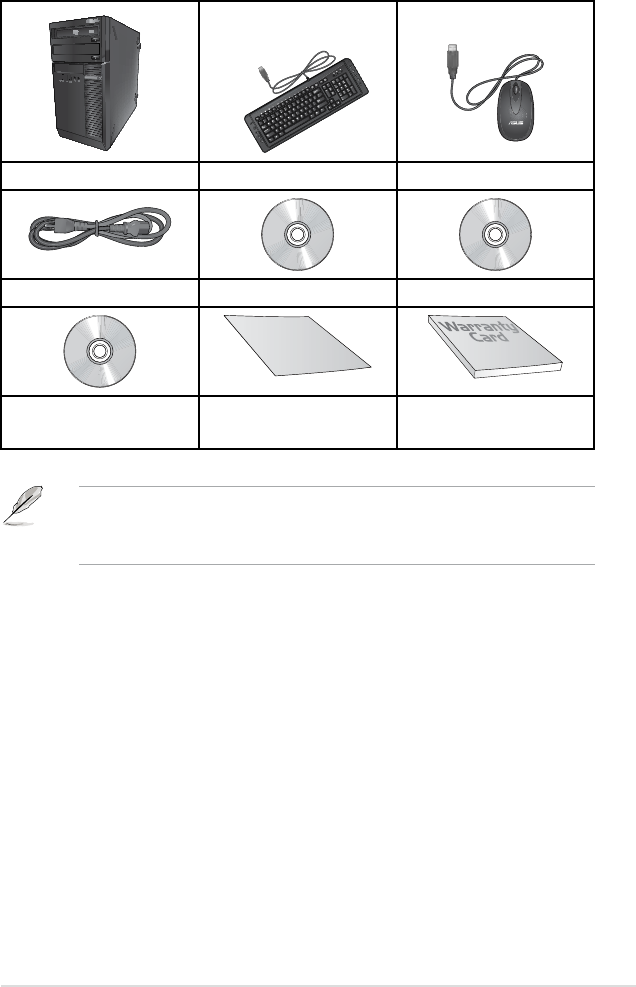
ASUS Desktop PC Keyboard x1 Mouse x1
Power cord x1 Support DVD x1 (Optional) Recovery DVD x1 (Optional)
Installation Guide
Nero 9 burning software
DVD x1 (Optional)
Installation Guide x1 Warranty card x1
Package contents
• If any of the above items is damaged or missing, contact your retailer.
• The illustrated items above are for reference only. Actual product specications may vary
with different models.

10
Getting to know your computer
Illustrations are for reference only. The ports and their locations, and the chassis color vary
with different models.
Welcome!
Thank you for purchasing the ASUS Desktop PC!
The ASUS Desktop PC provides cutting-edge performance, uncompromised reliability, and
user-centric utilities. All these values are encapsulated in a stunningly futuristic and stylish
system casing.
Read the ASUS Warranty Card before setting up your ASUS Desktop PC.
ASUS BM6635(MD560), BM6835, and BP6335(SD560) 11
Chapter 1
Getting started
Front panel
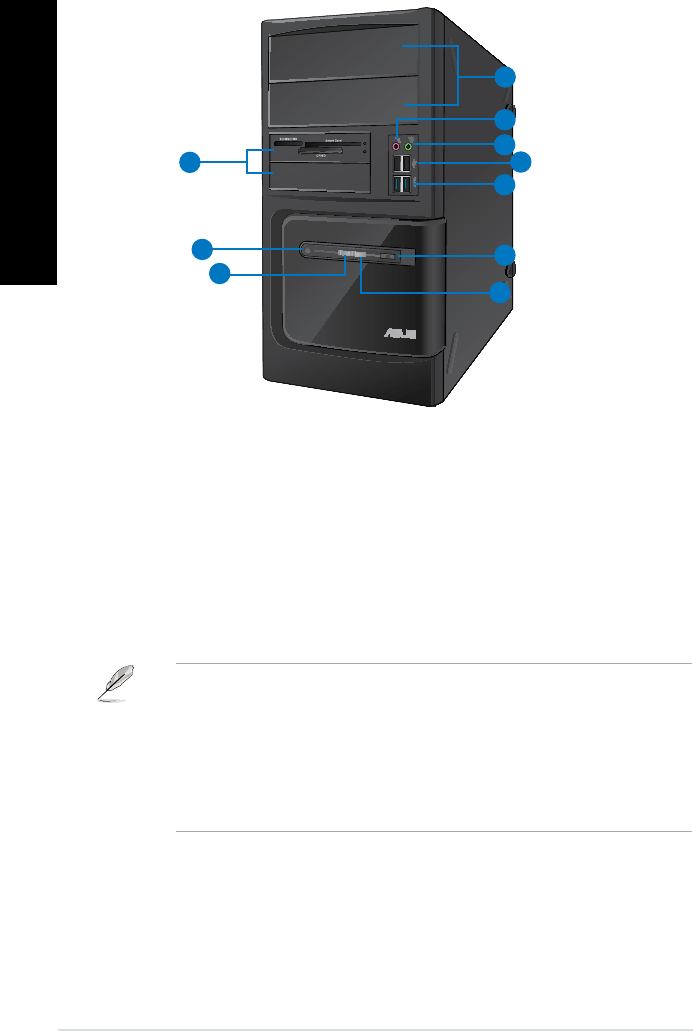
1. 2 x 5.25 inch optical disk drive bays. The 5.25 inch optical disk drive bays are for
5.25 inch DVD-ROM / CD-RW / DVD-RW devices.
2. Microphone port (pink). This port connects to a microphone.
3. Headphone port (lime). This port connects to a headphone or speaker.
4. USB 2.0 ports. These Universal Serial Bus 2.0 (USB 2.0) ports connect to USB 2.0
devices such as a mouse, printer, scanner, camera, PDA, and others.
5. USB 3.0 ports. These Universal Serial Bus 3.0 (USB 3.0) ports connect to USB 3.0
devices such as a mouse, printer, scanner, camera, PDA, and others.
• DO NOT connect a keyboard / mouse to any USB 3.0 port when installing Windows®
operating system.
• Due to USB 3.0 controller limitation, USB 3.0 devices can only be used under Windows®
OS environment and after the USB 3.0 driver installation.
• USB 3.0 devices can only be used as data storage only.
• We strongly recommend that you connect USB 3.0 devices to USB 3.0 ports for faster
and better performance for your USB 3.0 devices.
6. Reset button. Press this button to reboot your computer.
7. HDD LED. This LED lights up when the hard disk drive operates.
8. Power LED. This LED lights up when you turn on your computer.
9. Power button. Press this button to turn on your computer.
10. 2 x 3.5 inch drive bays. The 3.5 inch drive bays are for 3.5 inch hard disk drives /
memory card readers.
BM6635(MD560)
3
7
4
96
8
2
1
5
10
12 Chapter 1: Getting started
ENGLISH
ENGLISH
ENGLISH
ENGLISH
6
4
7
BM6835
1
2
3
2
5
8
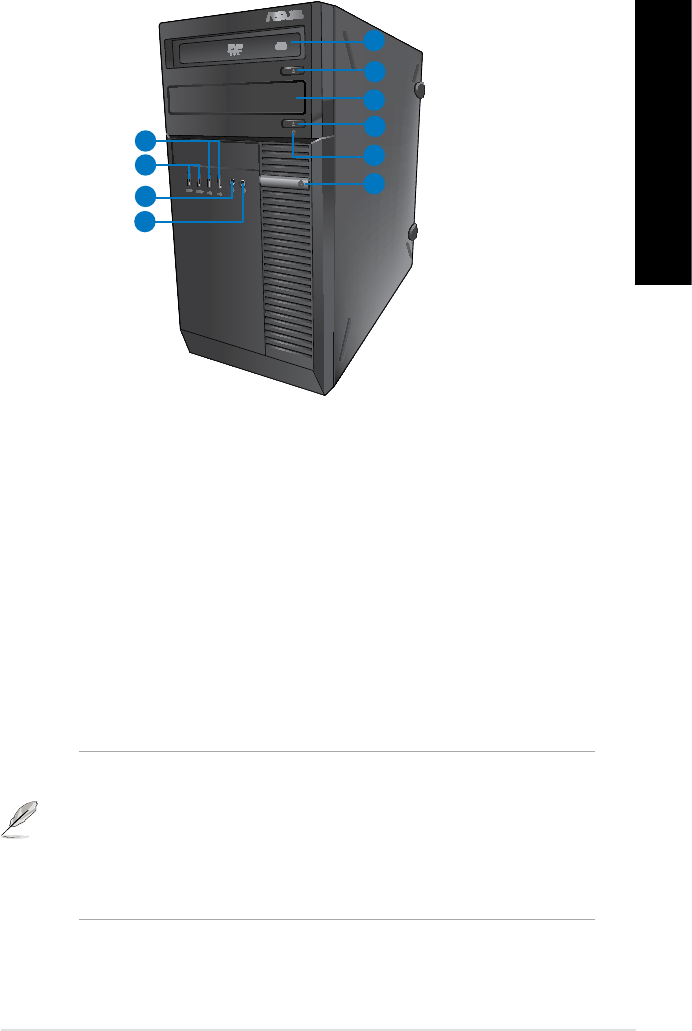
1. 5.25 inch optical disk drive bay. The 5.25 inch optical disk drive bay is for 5.25 inch
DVD-ROM / CD-RW / DVD-RW devices.
2. Optical disk drive eject button. Press this button to eject the optical disk drive tray.
3. Optical disk drive bay (empty). You may install an additional optical disk drive in this
bay.
4. HDD LED. This LED lights up when the hard disk drive operates.
5. Power button. Press this button to turn on your computer.
6. Microphone. This port connects to a microphone.
7. Headphone port. This port connects to a headphone or speaker.
8. USB 3.0 ports. These Universal Serial Bus 3.0 (USB 3.0) ports connect to USB 3.0
devices such as a mouse, printer, scanner, camera, PDA, and others.
• DO NOT connect a keyboard / mouse to any USB 3.0 port when installing Windows®
operating system.
• Due to USB 3.0 controller limitation, USB 3.0 devices can only be used under Windows®
OS environment and after the USB 3.0 driver installation.
• USB 3.0 devices can only be used as data storage only.
• We strongly recommend that you connect USB 3.0 devices to USB 3.0 ports for faster
and better performance for your USB 3.0 devices.
9. USB 2.0 ports. These Universal Serial Bus 2.0 (USB 2.0) ports connect to USB 2.0
devices such as a mouse, printer, scanner, camera, PDA, and others.
9
ENGLISH
ENGLISH
ASUS BM6635(MD560), BM6835, and BP6335(SD560) 13
ENGLISH
ENGLISH
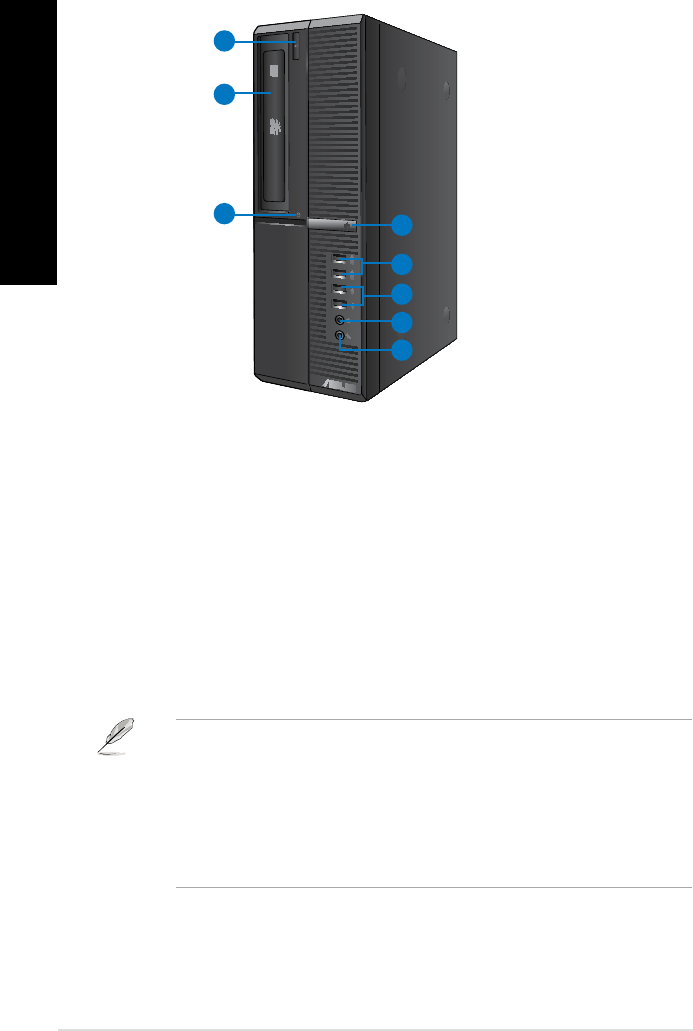
BP6335(SD560)
2
3
5
6
7
1. Optical disk drive eject button. Press this button to eject the optical disk drive tray.
2. 5.25 inch optical disk drive bay. The 5.25 inch optical disk drive bay is for 5.25 inch
DVD-ROM / CD-RW / DVD-RW devices.
3. HDD LED. This LED lights up when the hard disk drive operates.
4. Microphone. This port connects to a microphone.
5. Headphone port. This port connects to a headphone or speaker.
6. USB 2.0 ports. These Universal Serial Bus 2.0 (USB 2.0) ports connect to USB 2.0
devices such as a mouse, printer, scanner, camera, PDA, and others.
7. USB 3.0 ports. These Universal Serial Bus 3.0 (USB 3.0) ports connect to USB 3.0
devices such as a mouse, printer, scanner, camera, PDA, and others.
• DO NOT connect a keyboard / mouse to any USB 3.0 port when installing Windows®
operating system.
• Due to USB 3.0 controller limitation, USB 3.0 devices can only be used under Windows®
OS environment and after the USB 3.0 driver installation.
• USB 3.0 devices can only be used as data storage only.
• We strongly recommend that you connect USB 3.0 devices to USB 3.0 ports for faster
and better performance for your USB 3.0 devices.
8. Power button. Press this button to turn on your computer.
1
8
4
14 Chapter 1: Getting started
ENGLISH
ENGLISH
ENGLISH
ENGLISH
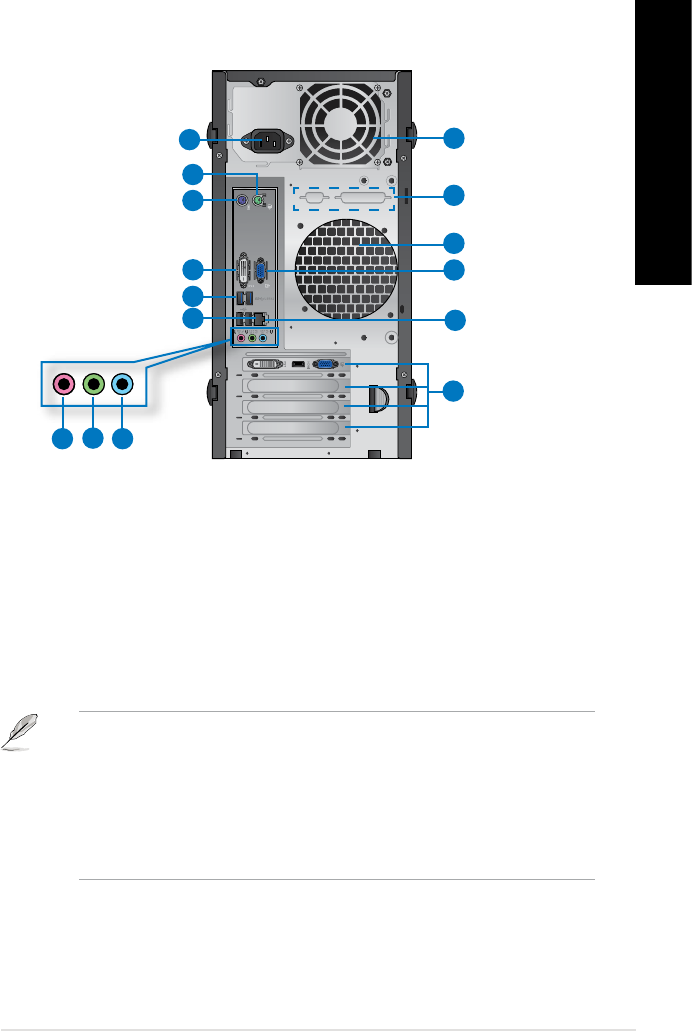
Rear panel
BM6635(MD560)
1
3
2
4
5
10
11
13
13
12
6
8
79
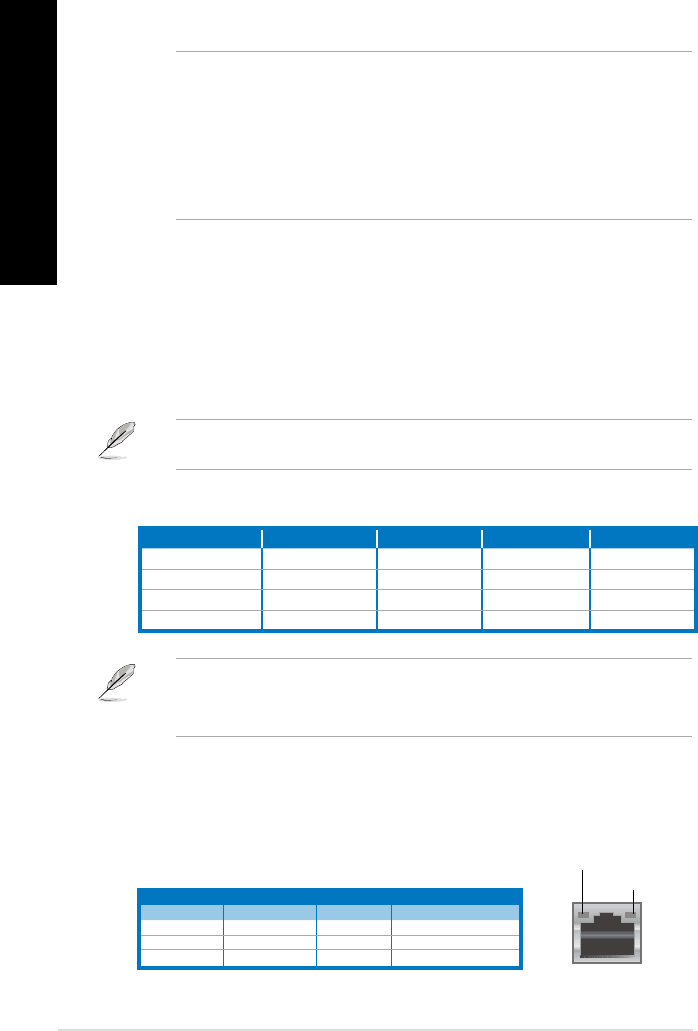
1. Power connector.Power connector. Plug the power cord to this connector.
2. PS/2 mouse port (green). This port is for a PS/2 mouse.
3. PS/2 keyboard port (purple). This port is for a PS/2 keyboard.
4. DVI-D port.DVI-D port. This port is for any DVI-D compatible device and is HDCP compliant
allowing playback of HD DVD, Blu-ray, and other protected content.
5. USB 3.0 ports. These Universal Serial Bus 3.0 (USB 3.0) ports connect to USB 3.0
devices such as a mouse, printer, scanner, camera, PDA, and others.
• DO NOT connect a keyboard / mouse to any USB 3.0 port when installing Windows®
operating system.
• Due to USB 3.0 controller limitation, USB 3.0 devices can only be used under Windows®
OS environment and after the USB 3.0 driver installation.
• USB 3.0 devices can only be used as data storage only.
• We strongly recommend that you connect USB 3.0 devices to USB 3.0 ports for faster
and better performance for your USB 3.0 devices.
6. USB 2.0 ports. These Universal Serial Bus 2.0 (USB 2.0) ports connect to USB 2.0
devices such as a mouse, printer, scanner, camera, PDA, and others.
14
ENGLISH
ENGLISH
ASUS BM6635(MD560), BM6835, and BP6335(SD560) 15
ENGLISH
ENGLISH
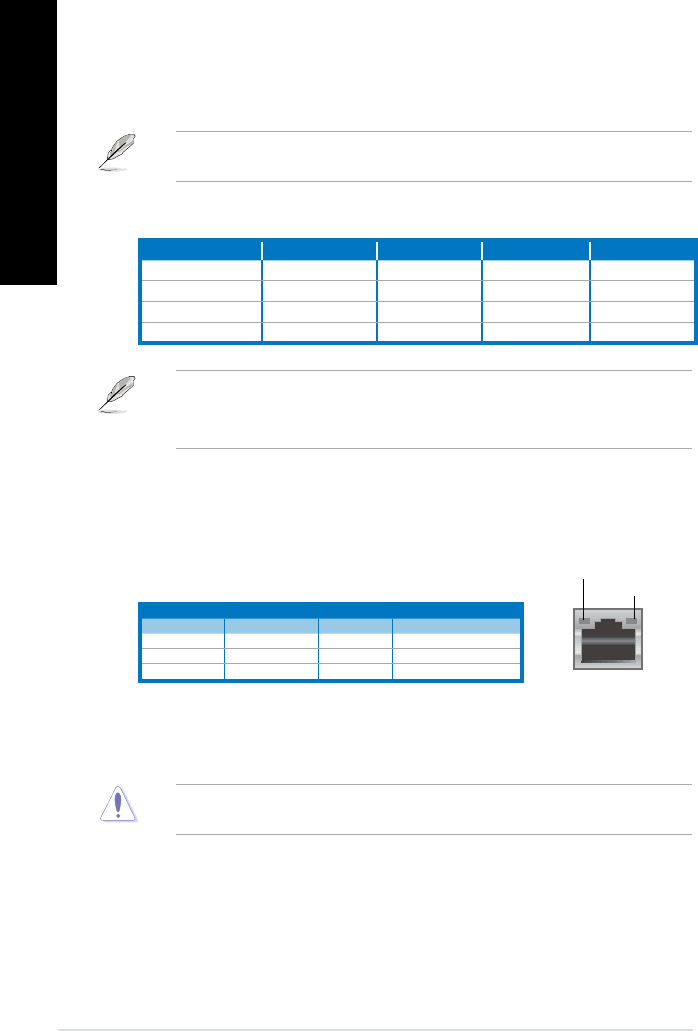
7. Microphone port (pink).Microphone port (pink). This port connects to a microphone.
8. Line Out port (lime).
Line Out port (lime). This port connects to a headphone or speaker. In a 4, 6, or
8-channel conguration, the function of this port becomes Front Speaker Out.
9. Line In port (light blue).
Line In port (light blue). This port connects to a tape, CD, DVD player, or other audio
sources.
Activity/Link LED Speed LED
Status Description Status Description
OFF No link OFF 10Mbps connection
ORANGE Linked ORANGE 100Mbps connection
BLINKING Data activity GREEN 1Gbps connection
LAN port
SPEED LED
ACT/LINK LED
10. Expansion slot brackets.Expansion slot brackets. Remove the expansion slot bracket when installing an
expansion card.
11. LAN (RJ-45) port.LAN (RJ-45) port. This port allows Gigabit connection to a Local Area Network (LAN)
through a network hub.
LAN port LED indications
DO NOT block the air vents on the chassis. Always provide proper ventilation for your
computer.
12. VGA port.VGA port. This port is for VGA-compatible devices such as a VGA monitor.
13. Air vents.
Air vents. These vents allow air ventilation.
Refer to the audio conguration table below for the function of the audio ports in the 2, 4, 6,
or 8-channel conguration.
Audio 2, 4, 6, or 8-channel conguration
Port Headset 2-channel 4-channel 6-channel 8-channel
Light Blue (Rear panel) Line In Rear Speaker Out Rear Speaker Out Rear Speaker Out
Lime (Rear panel) Line Out Front Speaker Out Front Speaker Out Front Speaker Out
Pink (Rear panel) Mic In Mic In Bass/Center Bass/Center
Lime (Front panel) - - - Side Speaker Out
To congure an 8-channel audio output:
Use a chassis with HD audio module in the front panel to support an 8-channel audio
output.
14. Serial / Parallel expansion slots.Serial / Parallel expansion slots. Remove the expansion slot brackets when installing
serial / parallel expansion cables. The serial / parallel expansion cables are purchased
separately.
16 Chapter 1: Getting started
ENGLISH
ENGLISH
ENGLISH
ENGLISH
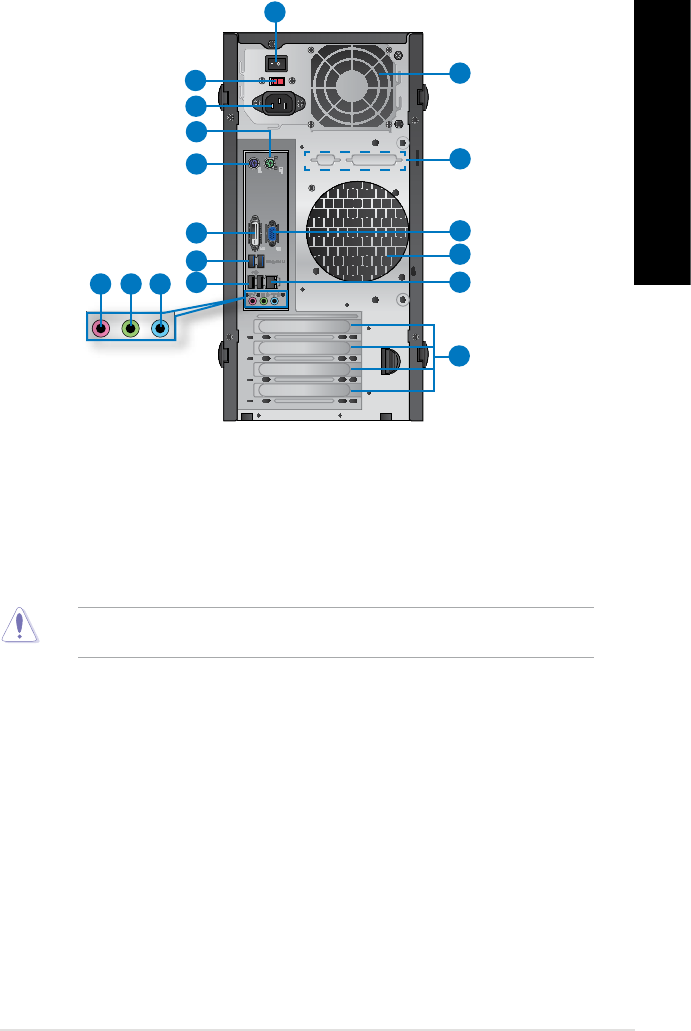
3. Power connector.Power connector. Plug the power cord to this connector.
4. PS/2 mouse port (green). This port is for a PS/2 mouse.
5. PS/2 keyboard port (purple). This port is for a PS/2 keyboard.
6. DVI-D port.DVI-D port. This port is for any DVI-D compatible device and is HDCP compliant
allowing playback of HD DVD, Blu-ray, and other protected content.
Setting the switch to 115V in a 230V environment or 230V in a 115V environment will
seriously damage the system!
BM6835
2
4
3
8
12
13
14
14
15
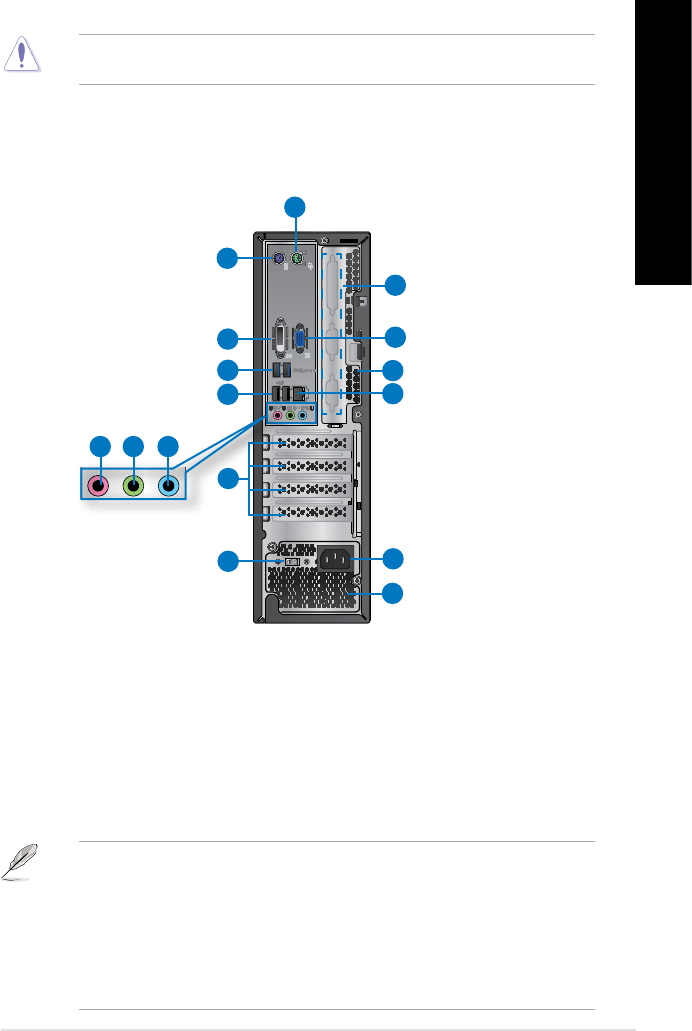
1. Power switch. Switch to turn ON/OFF the power supply to your computer.
2 . Voltage selector. Use this switch to select the appropriate system input voltage
according to the voltage supply in your area. If the voltage supply in your area is 100-
127V, set the switch to 115V. If the voltage supply in your area is 200-240V, set the
switch to 230V.
5
6
1
11109
7
16
ENGLISH
ENGLISH
ASUS BM6635(MD560), BM6835, and BP6335(SD560) 17
ENGLISH
ENGLISH
7. USB 3.0 ports. These Universal Serial Bus 3.0 (USB 3.0) ports connect to USB 3.0
devices such as a mouse, printer, scanner, camera, PDA, and others.
• DO NOT connect a keyboard / mouse to any USB 3.0 port when installing Windows®
operating system.
• Due to USB 3.0 controller limitation, USB 3.0 devices can only be used under Windows®
OS environment and after the USB 3.0 driver installation.
• USB 3.0 devices can only be used as data storage only.
• We strongly recommend that you connect USB 3.0 devices to USB 3.0 ports for faster
and better performance for your USB 3.0 devices.
8. USB 2.0 ports.USB 2.0 ports. These Universal Serial Bus 2.0 (USB 2.0) ports connect to USB 2.0
devices such as a mouse, printer, scanner, camera, PDA, and others.
9. Microphone port (pink).
Microphone port (pink). This port connects to a microphone.
10. Line Out port (lime).
Line Out port (lime). This port connects to a headphone or speaker. In a 4, 6, or
8-channel conguration, the function of this port becomes Front Speaker Out.
11. Line In port (light blue).
Line In port (light blue). This port connects to a tape, CD, DVD player, or other audio
sources.
Activity/Link LED Speed LED
Status Description Status Description
OFF No link OFF 10Mbps connection
ORANGE Linked ORANGE 100Mbps connection
BLINKING Data activity GREEN 1Gbps connection
LAN port
SPEED LED
ACT/LINK LED
12. Expansion slot brackets.Expansion slot brackets. Remove the expansion slot bracket when installing an
expansion card.
13. LAN (RJ-45) port.LAN (RJ-45) port. This port allows Gigabit connection to a Local Area Network (LAN)
through a network hub.
LAN port LED indications
Refer to the audio conguration table below for the function of the audio ports in the 2, 4, 6,
or 8-channel conguration.
Audio 2, 4, 6, or 8-channel conguration
Port Headset 2-channel 4-channel 6-channel 8-channel
Light Blue (Rear panel) Line In Rear Speaker Out Rear Speaker Out Rear Speaker Out
Lime (Rear panel) Line Out Front Speaker Out Front Speaker Out Front Speaker Out
Pink (Rear panel) Mic In Mic In Bass/Center Bass/Center
Lime (Front panel) - - - Side Speaker Out
To congure an 8-channel audio output:
Use a chassis with HD audio module in the front panel to support an 8-channel audio
output.
18 Chapter 1: Getting started
ENGLISH
ENGLISH
ENGLISH
ENGLISH
1. PS/2 mouse port (green). This port is for a PS/2 mouse.
2. PS/2 keyboard port (purple). This port is for a PS/2 keyboard.
3. DVI-D port.DVI-D port. This port is for any DVI-D compatible device and is HDCP compliant
allowing playback of HD DVD, Blu-ray, and other protected content.
4. USB 3.0 ports. These Universal Serial Bus 3.0 (USB 3.0) ports connect to USB 3.0
devices such as a mouse, printer, scanner, camera, PDA, and others.
• DO NOT connect a keyboard / mouse to any USB 3.0 port when installing Windows®
operating system.
• Due to USB 3.0 controller limitation, USB 3.0 devices can only be used under Windows®
OS environment and after the USB 3.0 driver installation.
• USB 3.0 devices can only be used as data storage only.
• We strongly recommend that you connect USB 3.0 devices to USB 3.0 ports for faster
and better performance for your USB 3.0 devices.
2
3
BP6335(SD560)
13
14
1
4
6 7 8
9
11
11
12
10
14. Air vents.Air vents. These vents allow air ventilation.
DO NOT block the air vents on the chassis. Always provide proper ventilation for your
computer.
15. VGA port.VGA port. This port is for VGA-compatible devices such as a VGA monitor.
16. Serial / Parallel expansion slots.
Serial / Parallel expansion slots. Remove the expansion slot brackets when installing
serial / parallel expansion cables. The serial / parallel expansion cables are purchased
separately.
5
15
ENGLISH
ENGLISH
ASUS BM6635(MD560), BM6835, and BP6335(SD560) 19
ENGLISH
ENGLISH
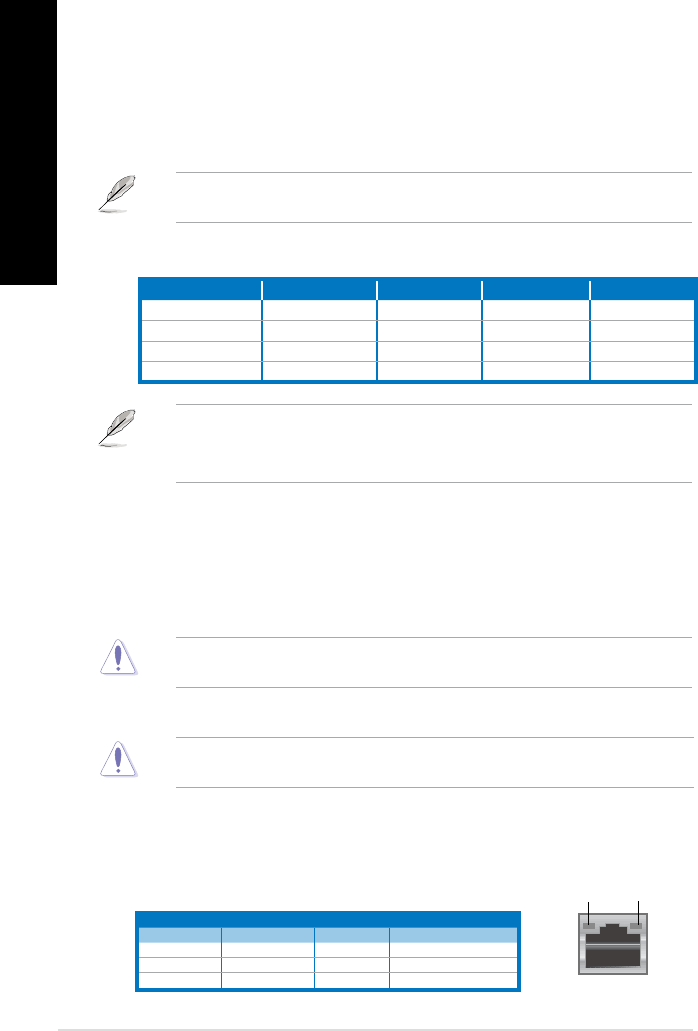
9. Expansion slot brackets.Expansion slot brackets. Remove the expansion slot bracket when installing an
expansion card.
10. Voltage selector. Use this switch to select the appropriate system input voltage
according to the voltage supply in your area. If the voltage supply in your area is 100-
127V, set the switch to 115V. If the voltage supply in your area is 200-240V, set the
switch to 230V.
5. USB 2.0 ports.
USB 2.0 ports. These Universal Serial Bus 2.0 (USB 2.0) ports connect to USB 2.0
devices such as a mouse, printer, scanner, camera, PDA, and others.
6. Microphone port (pink).
Microphone port (pink). This port connects to a microphone.
7. Line Out port (lime).
Line Out port (lime). This port connects to a headphone or speaker. In a 4, 6, or
8-channel conguration, the function of this port becomes Front Speaker Out.
8. Line In port (light blue).
Line In port (light blue). This port connects to a tape, CD, DVD player, or other audio
sources.
Setting the switch to 115V in a 230V environment or 230V in a 115V environment will
seriously damage the system!
11. Air vents. These vents allow air ventilation.
DO NOT block the air vents on the chassis. Always provide proper ventilation for your
computer.
12. Power connector.Power connector. Plug the power cord to this connector.
13. LAN (RJ-45) port.LAN (RJ-45) port. This port allows Gigabit connection to a Local Area Network (LAN)
through a network hub.
LAN port LED indications
Activity/Link LED Speed LED
Status Description Status Description
OFF No link OFF 10Mbps connection
ORANGE Linked ORANGE 100Mbps connection
BLINKING Data activity GREEN 1Gbps connection LAN port
SPEED
LED
ACT/LINK
LED
Refer to the audio conguration table below for the function of the audio ports in the 2, 4, 6,
or 8-channel conguration.
Audio 2, 4, 6, or 8-channel conguration
Port Headset 2-channel 4-channel 6-channel 8-channel
Light Blue (Rear panel) Line In Rear Speaker Out Rear Speaker Out Rear Speaker Out
Lime (Rear panel) Line Out Front Speaker Out Front Speaker Out Front Speaker Out
Pink (Rear panel) Mic In Mic In Bass/Center Bass/Center
Lime (Front panel) - - - Side Speaker Out
To congure an 8-channel audio output:
Use a chassis with HD audio module in the front panel to support an 8-channel audio
output.
20 Chapter 1: Getting started
ENGLISH
ENGLISH
ENGLISH
ENGLISH
14. VGA port.VGA port. This port is for VGA-compatible devices such as a VGA monitor.
15. Serial / Parallel expansion slots.
Serial / Parallel expansion slots. Remove the expansion slot brackets when installing
serial / parallel expansion cables. The serial / parallel expansion cables are purchased
separately.
Setting up your computer
This section guides you through connecting the main hardware devices, such as the external
monitor, keyboard, mouse, and power cord, to your computer.
Using the onboard display output ports
Connect your monitor to the onboard display output port.
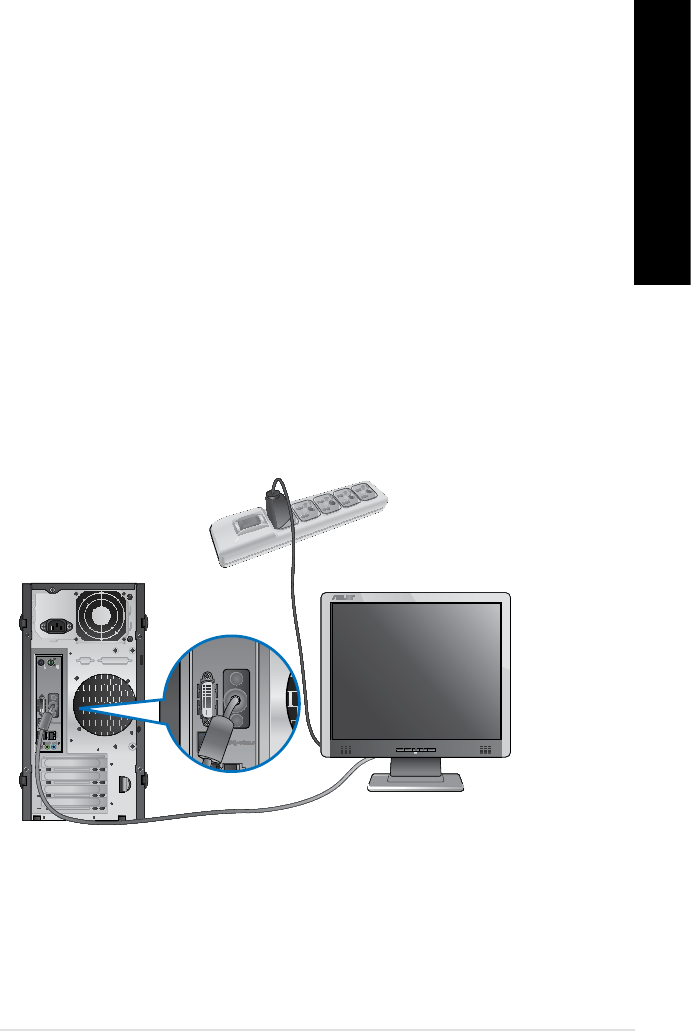
To connect an external monitor using the onboard display output ports:
1. Connect your monitor to the VGA port, DVI-D port, or display port of your computer.
2. Plug your monitor to a power source.
BM6635(MD560)
ENGLISH
ENGLISH
ASUS BM6635(MD560), BM6835, and BP6335(SD560) 21
ENGLISH
ENGLISH
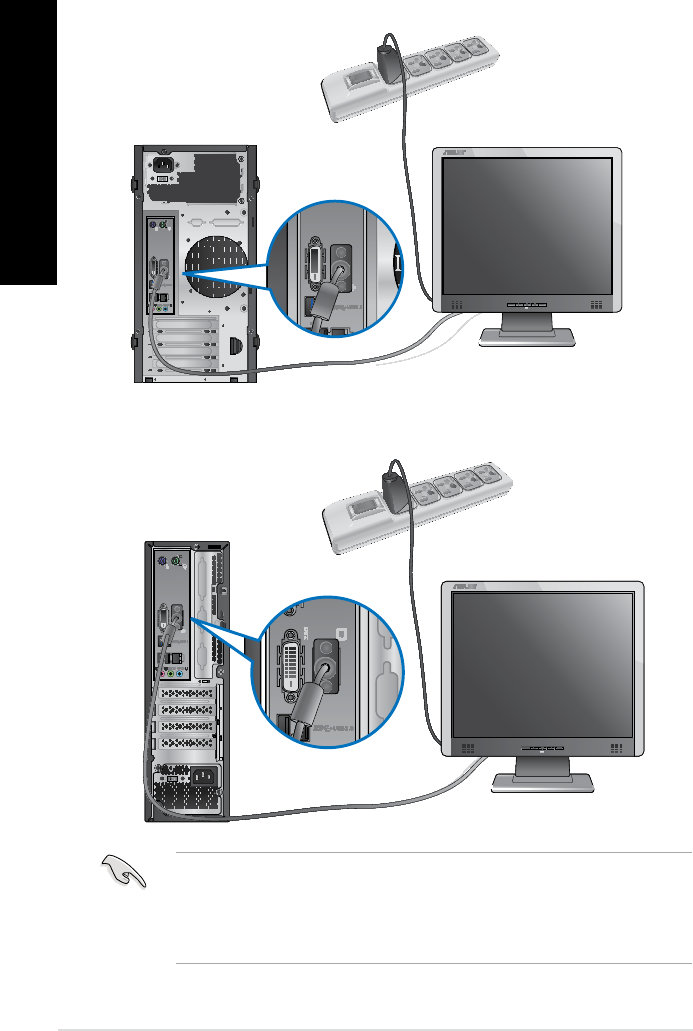
• If your computer comes with an ASUS Graphics Card, the graphics card is set as the
primary display device in the BIOS. Hence, connect your monitor to a display output port
on the graphics card.
• To connect multiple external monitors to your computer, refer to Connecting multiple
external monitors in Chapter 3 of this user manual for details.
BP6335(SD560)
BM6835
22 Chapter 1: Getting started
ENGLISH
ENGLISH
ENGLISH
ENGLISH
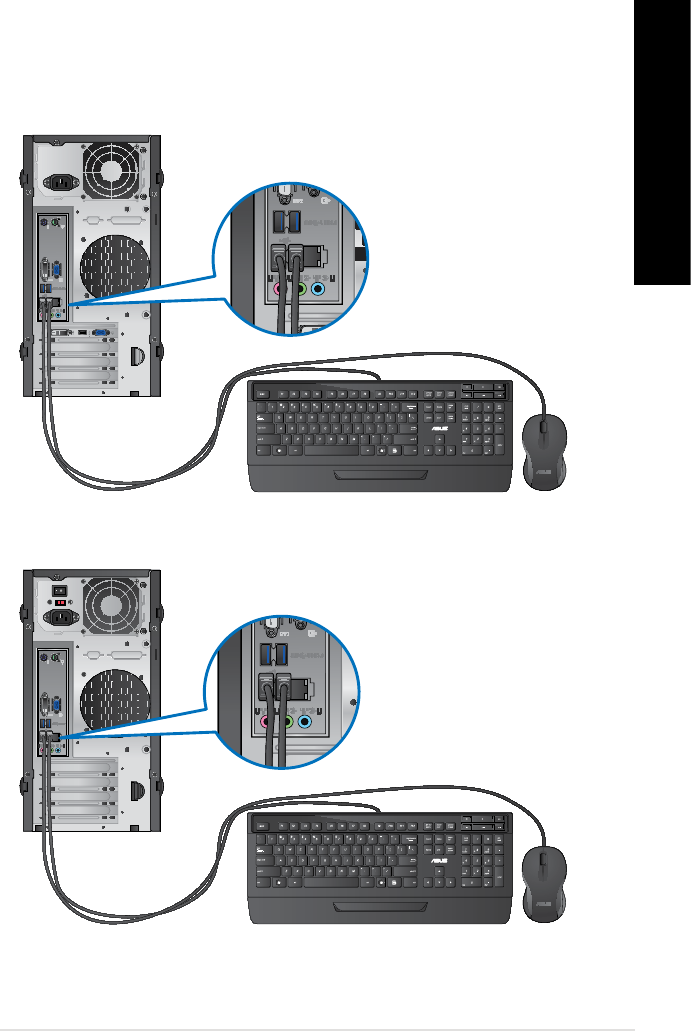
Connecting a USB keyboard and a USB mouse
Connect a USB keyboard and a USB mouse to the USB ports on the rear panel of your
computer.
BM6635(MD560)
BM6835
ENGLISH
ENGLISH
ASUS BM6635(MD560), BM6835, and BP6335(SD560) 23
ENGLISH
ENGLISH
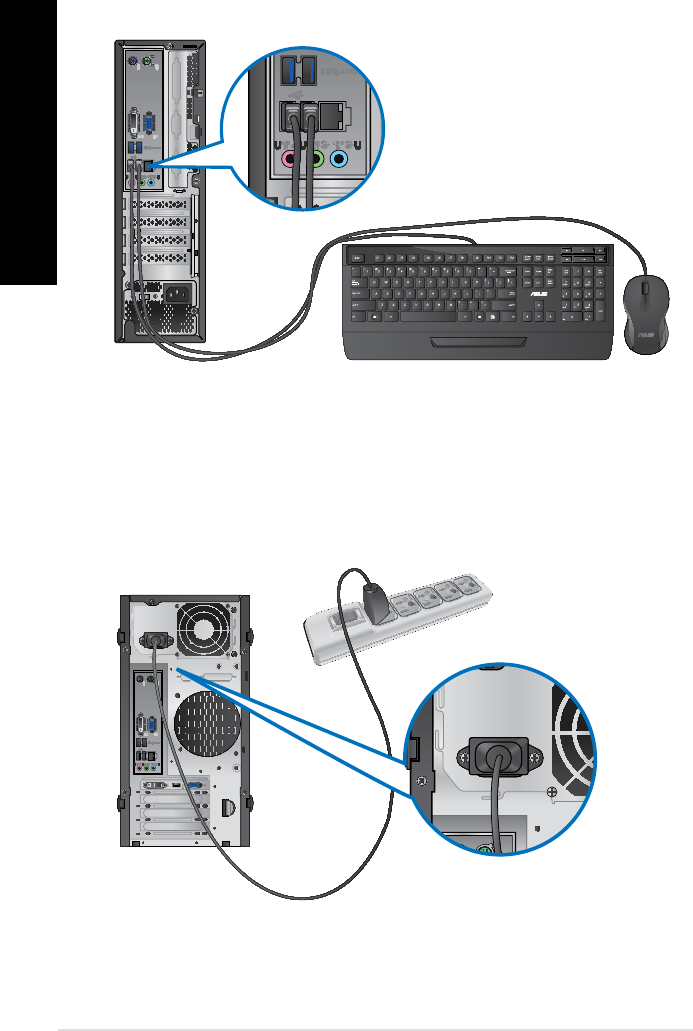
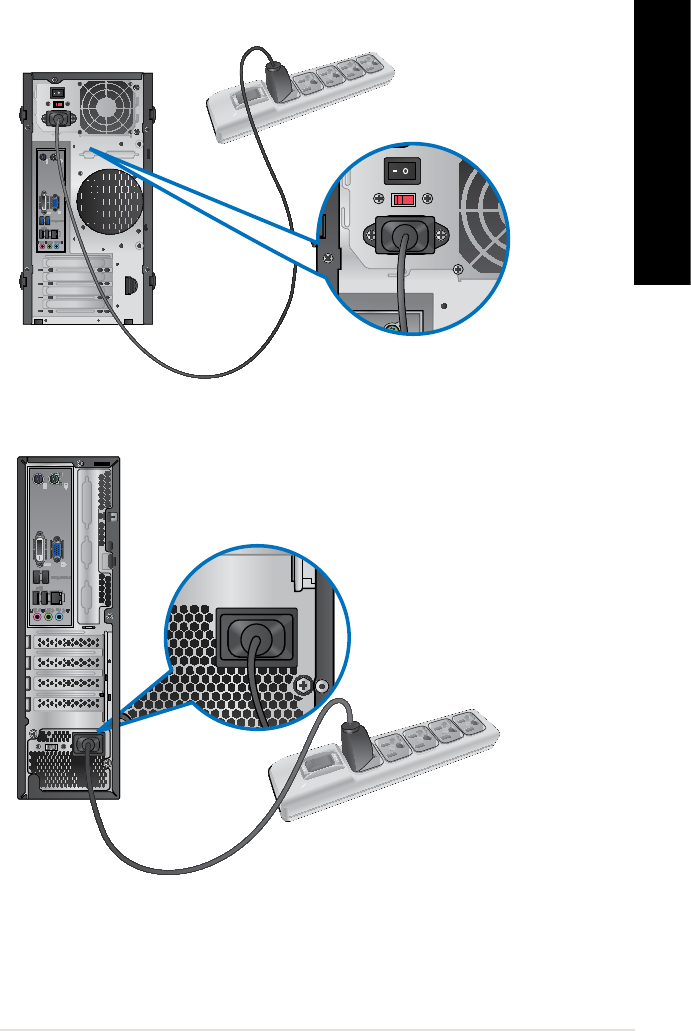
Connecting the power cord
Connect one end of the power cord to the power connector on the rear panel of your
computer and the other end to a power source.
BM6635(MD560)
BP6335(SD560)
24 Chapter 1: Getting started
ENGLISH
ENGLISH
ENGLISH
ENGLISH
BP6335(SD560)
BM6835
ENGLISH
ENGLISH
ASUS BM6635(MD560), BM6835, and BP6335(SD560) 25
ENGLISH
ENGLISH
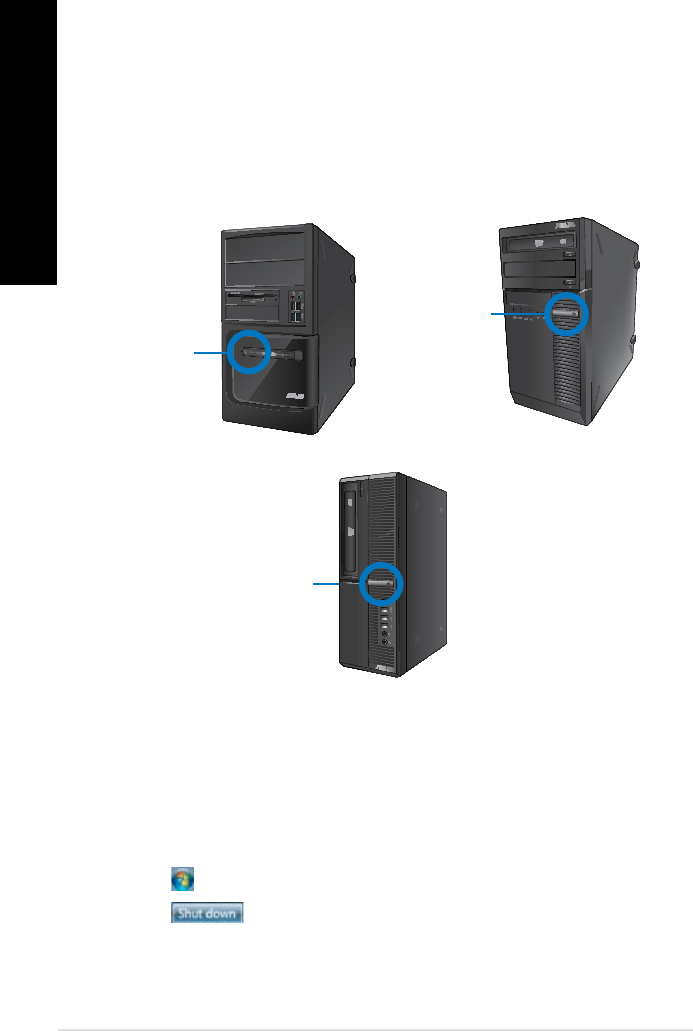
Turning your computer ON/OFF
This section describes how to turn on/off your computer after setting up your computer.
Turning your computer ON
To turn your computer ON:
1. Turn your monitor ON.
2. Turn the power switch ON (for BM6835 only).
3. Press the power button on your computer.
4. Wait until the operating system loads automatically.
Turning your computer OFF
To turn your computer OFF:
1. Close all running applications.
2. Click on the Windows® desktop.
3. Click to shut down the operating system.
Power button
BM6835
Power button
BM6635(MD560)
Power button
BP6335(SD560)
26 Chapter 1: Getting started
ENGLISH
ENGLISH
ENGLISH
ENGLISH
ASUS BM6635(MD560), BM6835, and BP6335(SD560) 27
Chapter 2
Using Windows® 7
Starting for the rst time
When you start your computer for the rst time, a series of screens appear to guide you in
conguring the basic settings of your Windows® 7 operating system.
To start for the rst time:
1. Turn your computer on. Wait for a few minutes until the Set Up Windows screen
appears.
2. From dropdown list, select your language, then click Next.
3. From the dropdown lists, select your Country or region, Time and currency, and
Keyboard layout, then click Next.
4. Key in uniques names for the user name and computer name, then click Next.
5. Key in the necessary information to set up your password, then click Next. You may
also click Next to skip this step without entering any information.
6. Carefully read the license terms. Tick I accept the license terms and click Next.
7. Select Use recommended settings or Install important updates only to set up the
security settings for your computer. To skip this step, select Ask me later.
8. Review your date and time settings. Click Next. The system loads the new settings and
restarts. You may now start using your computer.
If you want to set up a password for your account later, refer to the section Setting up a
user account and password in this chapter.
28 Chapter 2: Using Windows® 7
ENGLISH
ENGLISH
ENGLISH
ENGLISH
Using Windows® 7 desktop
Using the Start menu
The Start menu gives you access to programs, utilities, and other useful items on your
computer. It also provides you with more information about Windows 7 through its Help and
Support feature.
Launching items from the Start menu
To launch items from the Start menu:
1. From the Windows® taskbar, click the Start icon .
2. From the Start menu, select the item that you want to launch.
You may pin programs that you want constantly displayed on the Start menu. For more
details, refer to the section Pinning programs on the Start menu or taskbar on this
chapter.
Click the Start icon > Help and Support to obtain more information about Windows® 7.
Using the Getting Started item
The Getting Started item on the Start menu contains information about some basic tasks
such as personalizing Windows®, adding new users, and transferring les to help you to
familiarize yourself with using Windows® 7.
To use the Getting Started item:
1. From the Windows® taskbar, click the Start icon to launch the Start menu.
2. Select Getting Started. The list of available tasks appears.
3. Select the task that you want to do.
Using the taskbar
The taskbar allows you to launch and manage programs or items installed on your computer.
Launching a program from the taskbar
To launch a program from the taskbar:
• From the Windows® taskbar, click an icon to launch it. Click the icon again to hide the
program.
You may pin programs that you want constantly displayed on the taskbar. For more details,
refer to the section Pinning programs on the Start menu or taskbar on this chapter.
ENGLISH
ENGLISH
ASUS BM6635(MD560), BM6835, and BP6335(SD560) 29
ENGLISH
ENGLISH
Pinning items on the jumplists
When you right-click an icon on the taskbar, a jumplist launches to provide you with quick-
access to the program’s or item’s related links.You may pin items on the jumplist such as
favorite websites, often-visited folders or drives, or recently played media les.
To pin items to the jumplist:
1. From the taskbar, right-click an icon.
2. From the jumplist, right-click the item that you want to pin, then select Pin to this list.
Unpinning items from the jumplist
To unpin items from the jumplist:
1. From the taskbar, right-click an icon.
2. From the jumplist, right-click the item that you want to remove from the jumplist, then
select Unpin from this list.
Pinning programs on the Start menu or taskbar
To pin programs on the Start menu or taskbar:
1. From the Windows® taskbar, click the Start icon to launch the Start menu.
2. Right-click the item that you want to pin on the Start menu or taskbar.
3. Select Pin to Taskbar or Pin to Start menu.
You may also right-click on the icon of a running program on the taskbar, then select Pin
this program to taskbar.
Unpinning programs from the Start menu
To unpin programs from the Start menu:
1. From the Windows® taskbar, click the Start icon to launch the Start menu.
2. From the Start menu, right-click the program that you want to unpin, then select
Remove from this list.
Unpinning programs from the taskbar
To unpin programs from the taskbar:
1. From the taskbar, right-click the program that you want to remove from the taskbar,
then select Unpin this program from taskbar.
30 Chapter 2: Using Windows® 7
ENGLISH
ENGLISH
ENGLISH
ENGLISH
Using the notication area
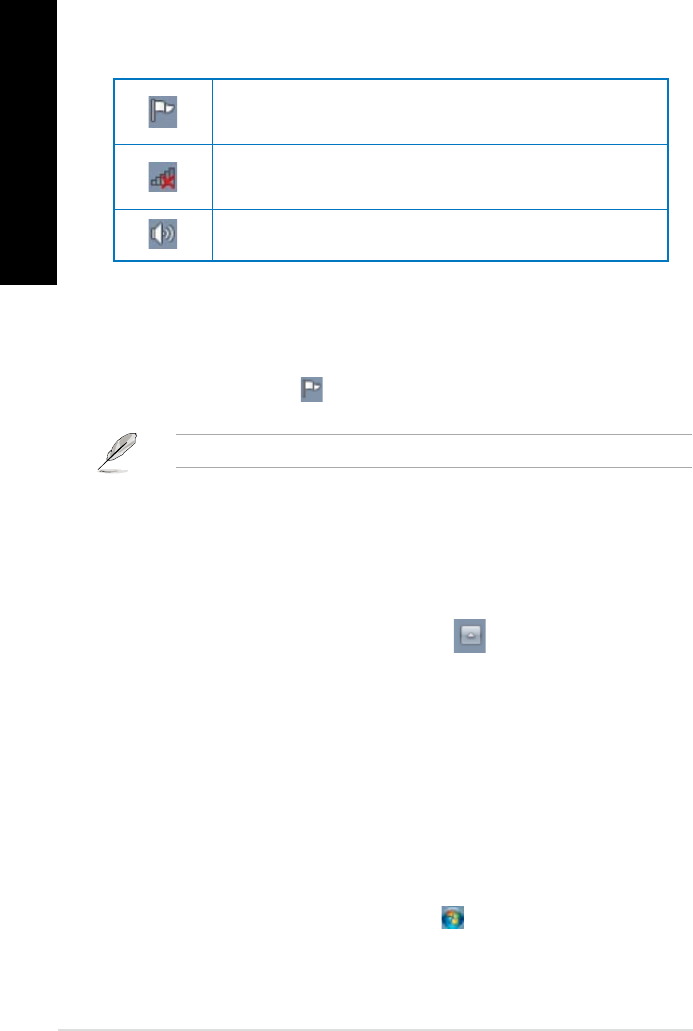
By default, the notication area shows these three icons:
Action Center notication
Click this icon to display all the alert messages/notications and launch the Windows®
Action Center.
Network connection
This icon displays the connection status and signal strength of the wired or wireless network
connection.
Volume
Click this icon to adjust the volume.
Displaying an alert notication
To display an alert notication:
• Click the Notication icon , then click the message to open it.
For more details, refer to the section Using Windows® Action Center in this chapter.
Customizing icons and notications
You may choose to display or hide the icons and notications on the taskbar or on the
notication area.
To customize icons and notications:
1. From the notication area, click on the arrow icon .
2. Click Customize.
3. From the dropdown list, select the behaviors for the icons or items that you want to
customize.
Managing your les and folders
Using Windows® Explorer
Windows® Explorer allows you to view, manage, and organize your les and folders.
Launching Windows® Explorer
To launch Windows Explorer:
1. From the Windows® taskbar, click the Start icon to launch the Start menu.
2. Click Computer to launch Windows Explorer.
ENGLISH
ENGLISH
ASUS BM6635(MD560), BM6835, and BP6335(SD560) 31
ENGLISH
ENGLISH
Exploring les and folders
To explore les and folders:
1. Launch Windows® Explorer.
2. From the navigation or view pane, browse for the location of your data.
3. From the breadcrumb bar, click the arrow to display the contents of the drive or folder.
Customizing the le/folder view
To customize the le/folder view:
1. Launch Windows Explorer.
2. From the navigation pane, select the location of your data.
3. From the toolbar, click the View icon .
4. From the View menu, move the slider to select how you want to view the le/folder.
You may also right-click anywhere on the View pane, click View, and select the view type
that you want.
Arranging your les
To arrange your les:
1. Launch Windows Explorer.
2. From the Arrange by eld, click to display the dropdown list.
3. Select your preferred arrangement type.
Sorting your les
To sort your les:
1. Launch Windows Explorer.
2. Right-click anywhere on the View pane.
3. From the menu that appears, select Sort by, then select your preferred sorting type.
Grouping your les
To group your les:
1. Launch Windows Explorer.
2. Right-click anywhere on the View pane.
3. From the menu that appears, select Group by, then select your preferred grouping
type.
32 Chapter 2: Using Windows® 7
ENGLISH
ENGLISH
ENGLISH
ENGLISH
Adding a new folder
To add a new folder:
1. Launch Windows Explorer.
2. From the toolbar, click New folder.
3. Key in a name for the new folder.
You may also right-click anywhere on the View pane, click New > Folder.
Backing up your les
Setting up a backup
To set up a backup:
1. Click > All Programs > Maintenance > Backup and Restore.
2. Click Set up backup. Click Next.
3. Select your backup destination. Click Next.
4. Select Let Windows choose (recommended) or Let me choose as your backup
mode.
Restoring your system settings
The Windows® System Restore feature creates a restore point where the computer’s system
settings are stored at certain time and date. It allows you to restore or undo changes to your
computer’s system settings without affecting your personal data.
To restore your system:
1. Close all running applications.
2. Click > All Programs > Accessories > System Tools > System Restore.
3. Follow the onscreen instructions to complete the process.
If you select Let Windows choose, Windows will not back up your programs, FAT-
formatted les, Recycle Bin les, or temporary les that are 1GB or more.
5. Follow the onscreen instructions to nish the process.
ENGLISH
ENGLISH
ASUS BM6635(MD560), BM6835, and BP6335(SD560) 33
ENGLISH
ENGLISH
Protecting your computer
Using Windows® 7 Action Center
Windows® 7 Action Center provides you with alert notications, security information, system
maintenance information, and the option to automatically troubleshoot and x some common
computer problems.
You may customize the notications. For more details, refer to the previous section
Customizing icons and notications in this chapter.
Launching Windows® 7 Action Center
To launch Windows® 7 Action Center:
1. To launch Windows 7 Action Center, click the Notication icon , then click Open
Action Center.
2. From Windows 7 Action Center, click the task that you want to do.
Using Windows® Update
Windows Update allows you to check and install the latest updates to enhance the security
and performance of your computer.
Launching Windows® Update
To launch Windows® Update:
1. From the Windows® taskbar, click the Start icon to launch the Start menu.
2. Select All Programs > Windows Update.
3. From the Windows Update screen, click the task that you want to do.
Setting up a user account and password
You may create user accounts and passwords for people who will use your computer.
Setting up a user account
To set up a user account:
1. From the Windows® taskbar, click > Getting Started > Add new users.
2. Select Manage another account.
3. Select Create a new account.
4. Key in the name of the new user.
5. Select either Standard user or Administrator as the user type.
6. When done, click Create Account.
34 Chapter 2: Using Windows® 7
ENGLISH
ENGLISH
Setting up a user’s password
To set up a user’s password:
1. Select the user that you would like to set a password.
2. Select Create a password.
3. Key in a password and conrm it. Key in your password’s hint.
4. When done, click Create password.
Activating the anti-virus software
Trend Micro Internet Security is pre-installed on your computer. It is a third-party anti-virus
software protecting your computer from virus. It is purchased separately. You have a 30-day
trial period after activating it.
To activate Trend Micro Internet Security:
1. Run the Trend Micro Internet Security application.
2. Carefully read the license terms. Click Agree & Activate.
3. Input your e-mail address and select your location. Click Next.
4. Click Finish to complete the activation.
Getting Windows® Help and Support
Windows® Help and Support provides you with guides and answers in using the applications
in Windows® 7 platform.
To launch Windows® Help and Support, click > Help and Support.
Ensure that you are connected to the Internet to obtain the latest Windows® online help.
Connecting a USB storage device
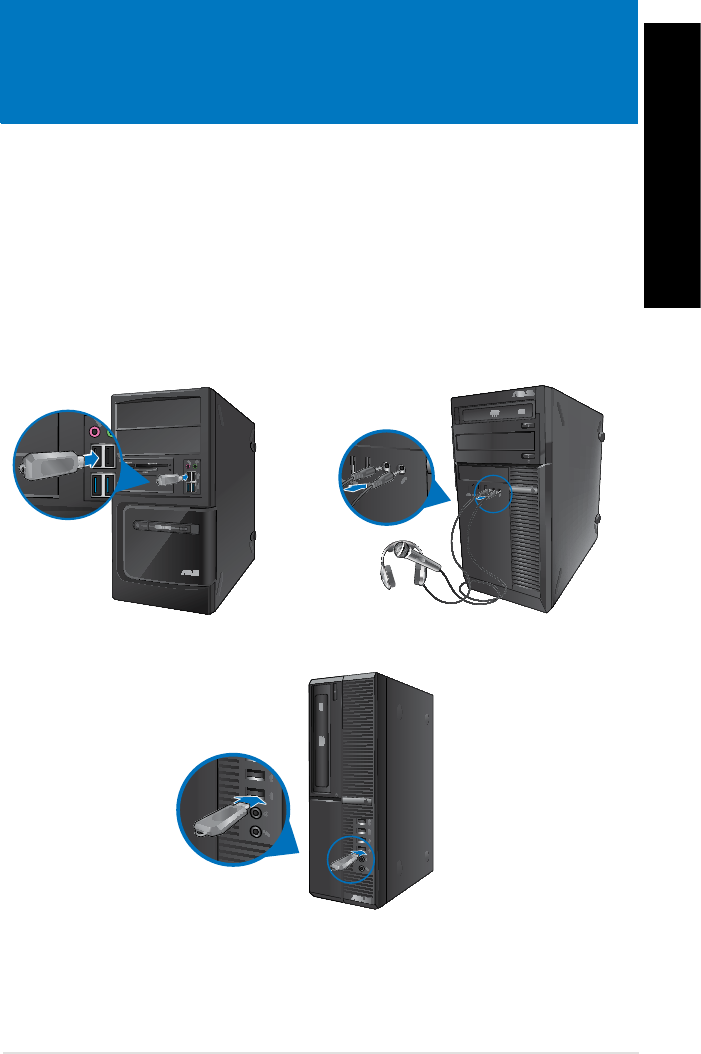
This desktop PC provides USB 2.0/1.1 ports on both the front and rear panels. The USB
ports allow you to connect USB devices such as storage devices.
To connect a USB storage device:
• Insert the USB storage device to your computer.
Front panel
BM6835BM6635(MD560)
BP6335(SD560)
ENGLISH
ENGLISH
ASUS BM6635(MD560), BM6835, and BP6335(SD560) 35
Chapter 3
Connecting devices to your computer
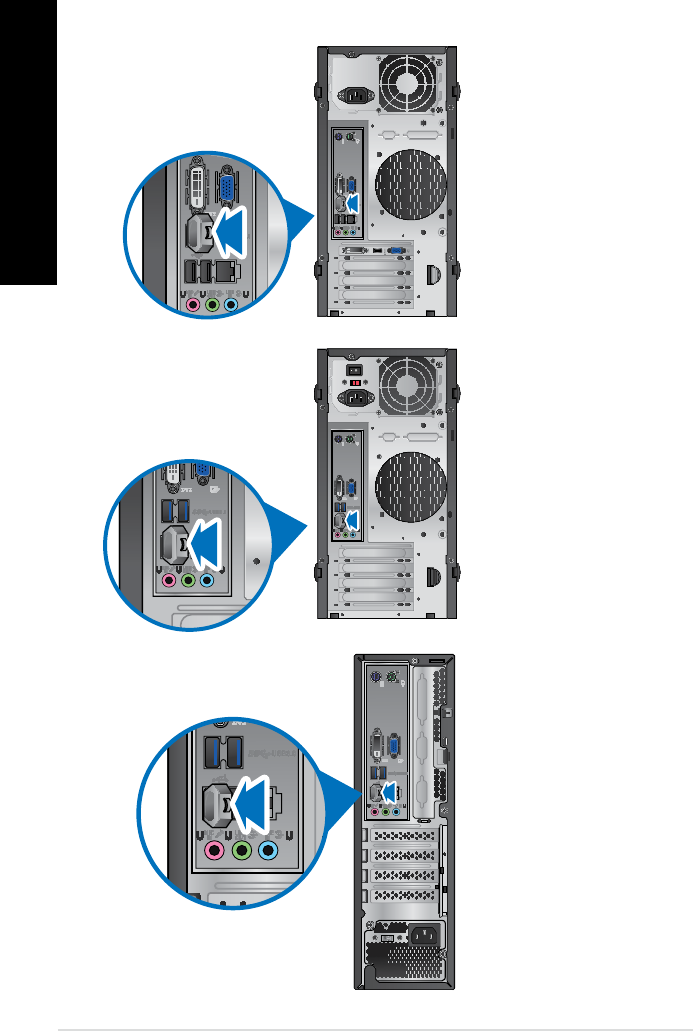
Rear panel
BM6635(MD560)
BM6835
BP6335(SD560)
36 Chapter 3: Connecting devices to your computer
ENGLISH
ENGLISH
ENGLISH
ENGLISH
Connecting microphone and speakers
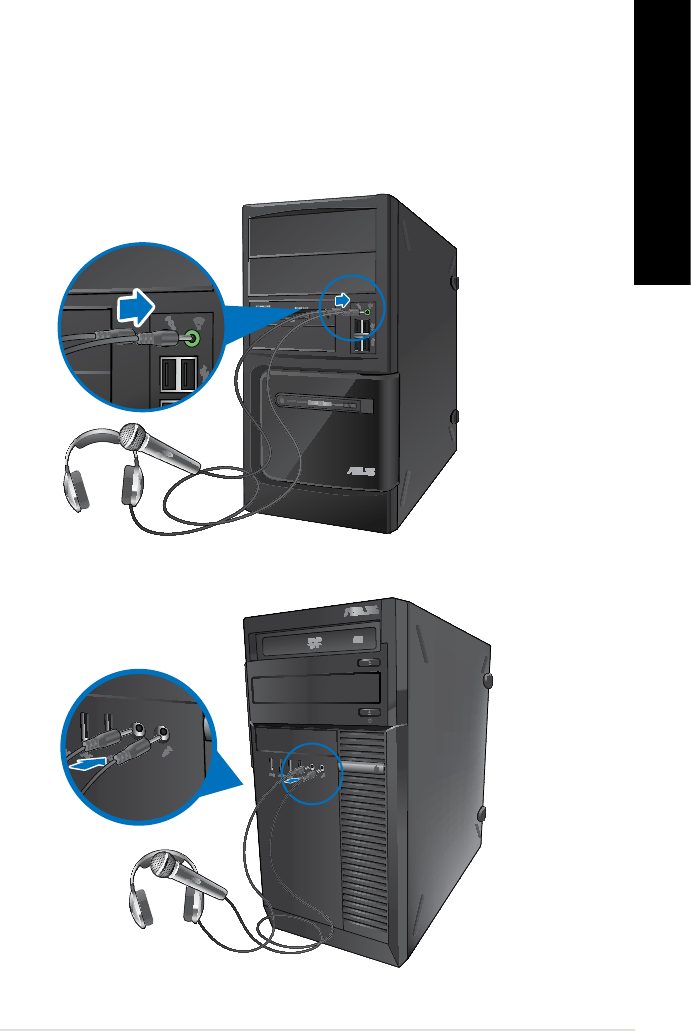
This desktop PC comes with microphone ports and speaker ports on both the front and
rear panels. The audio I/O ports located on the rear panel allow you to connect 2-channel,
4-channel, 6-channel, and 8-channel stereo speakers.
Connecting Headphone and Mic
BM6635(MD560)
BM6835
ENGLISH
ENGLISH
ASUS BM6635(MD560), BM6835, and BP6335(SD560) 37
ENGLISH
ENGLISH
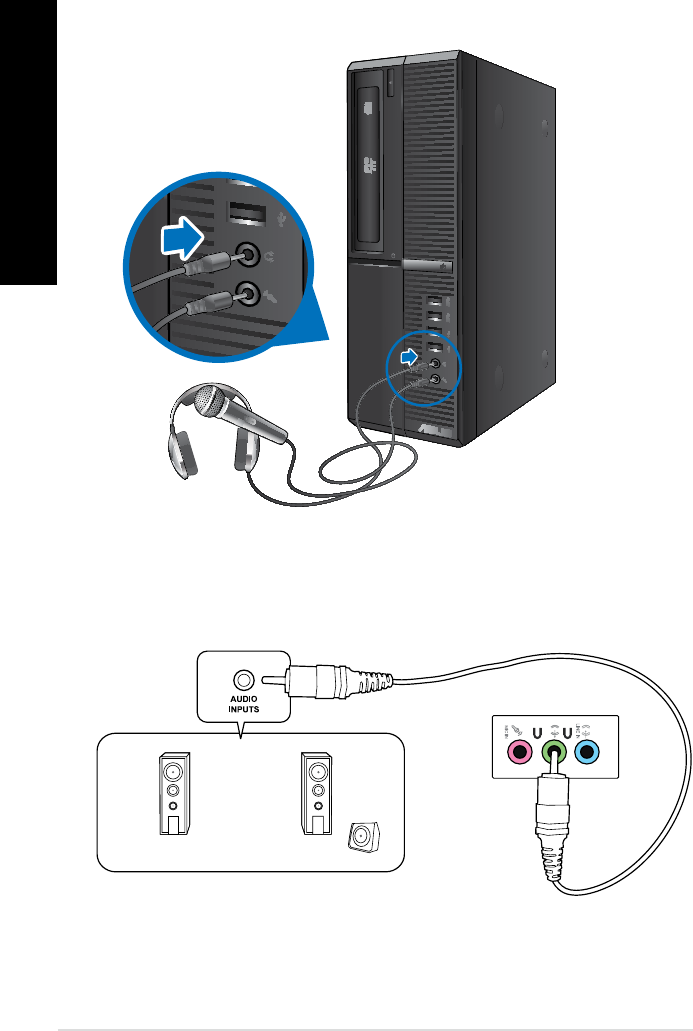
BP6335(SD560)
Connecting 2-channel Speakers
LINE OUT
38 Chapter 3: Connecting devices to your computer
ENGLISH
ENGLISH
ENGLISH
ENGLISH
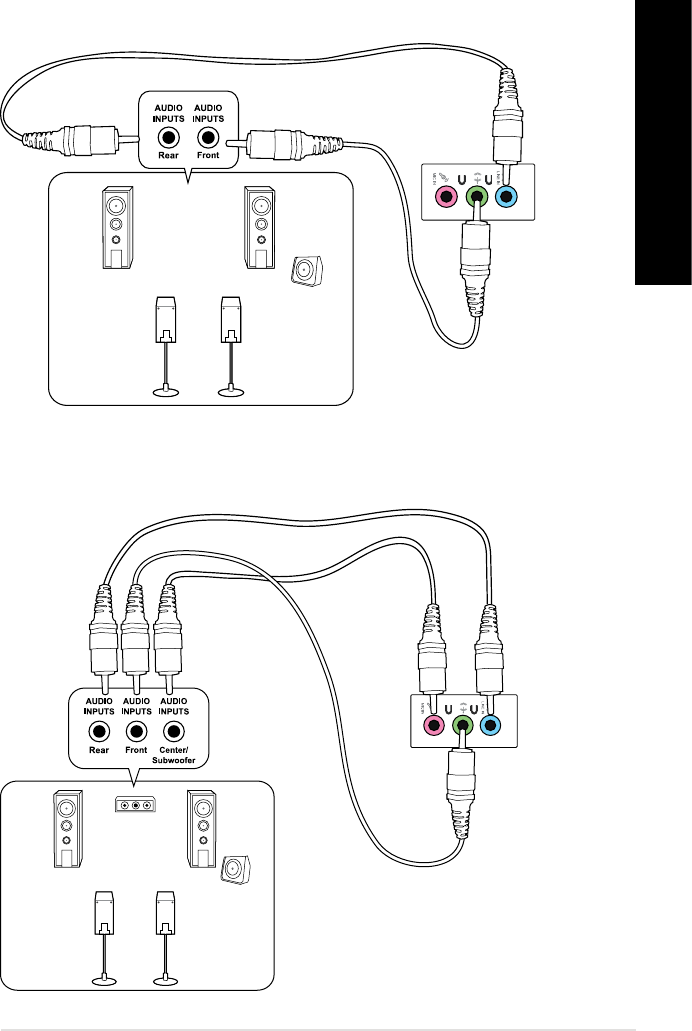
Connecting 4-channel Speakers
LINE OUT
Connecting 6-channel Speakers
LINE OUT
ENGLISH
ENGLISH
ASUS BM6635(MD560), BM6835, and BP6335(SD560) 39
ENGLISH
ENGLISH
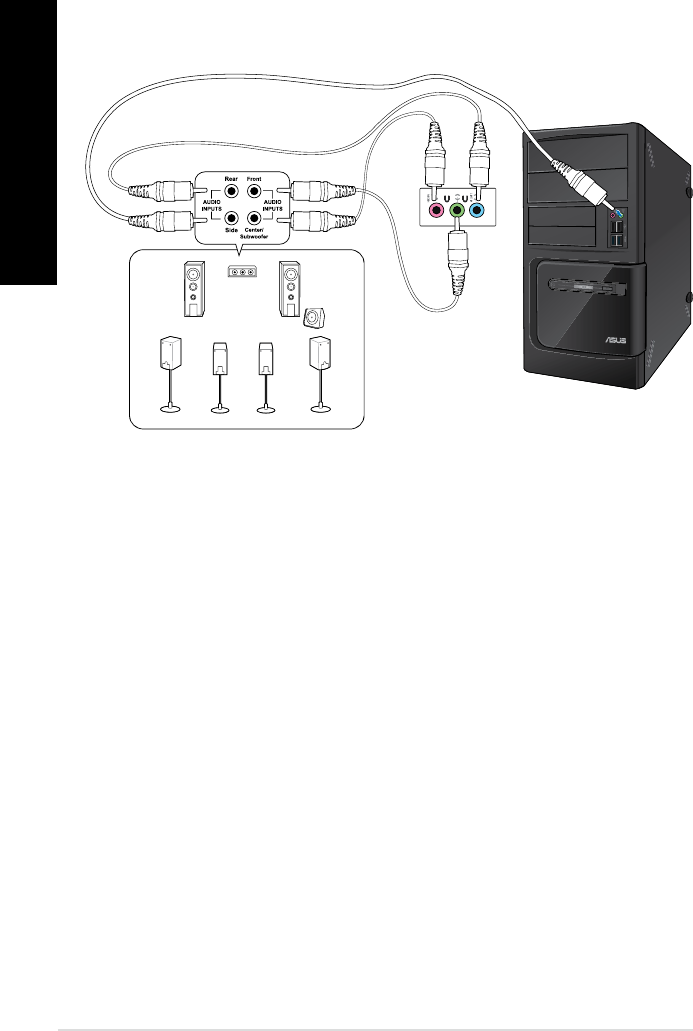
Connecting 8-channel Speakers
LINE OUT
40 Chapter 3: Connecting devices to your computer
ENGLISH
ENGLISH
ENGLISH
ENGLISH
ASUS BM6635(MD560), BM6835, and BP6335(SD560) 41
Chapter 4
Using your computer
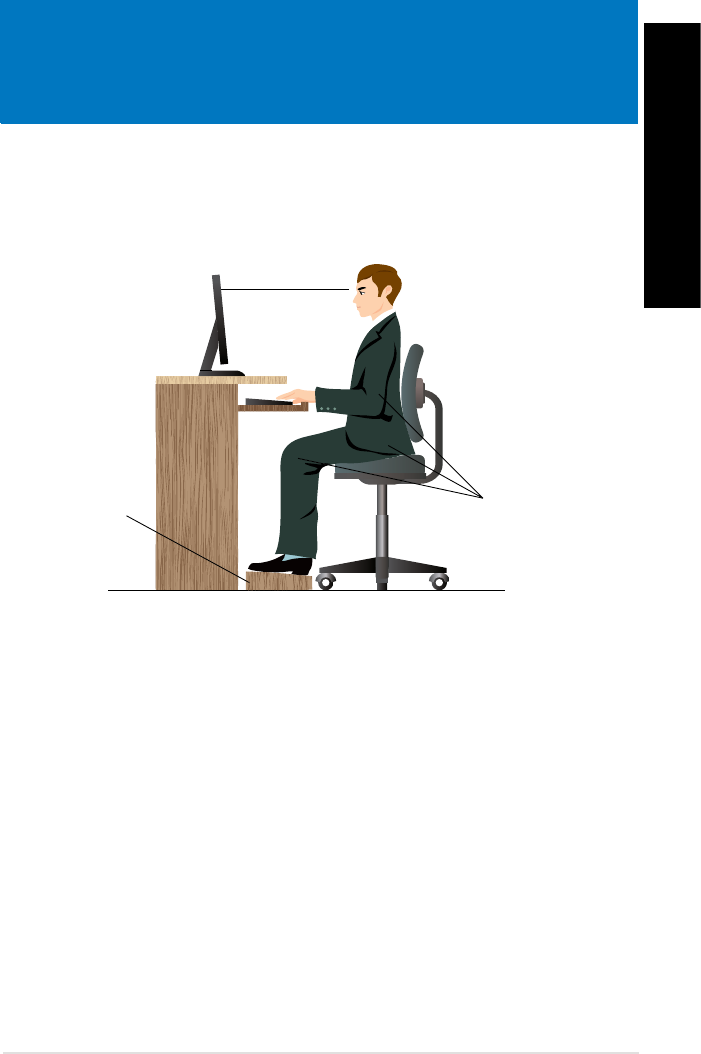
Proper posture when using your Desktop PC
When using your Desktop PC, maintaining the proper posture is necessary to prevent strain to
your wrists, hands, and other joints or muscles. This section provides you with tips on avoiding
physical discomfort and possible injury while using and fully enjoying your Desktop PC.
Eye level to the top of
the monitor screen
Foot rest 90˚ angles
To maintain the proper posture:
• Position your computer chair to make sure that your elbows are at or slightly above the
keyboard to get a comfortable typing position.
• Adjust the height of your chair to make sure that your knees are slightly higher than
your hips to relax the backs of your thighs. If necessary, use a footrest to raise the level
of your knees.
• Adjust the back of your chair so that the base of your spine is rmly supported and
angled slightly backward.
• Sit upright with your knees, elbows and hips at an approximately 90º angle when you
are at the PC.
• Place the monitor directly in front of you, and turn the top of the monitor screen even
with your eye level so that your eyes look slightly downward.
• Keep the mouse close to the keyboard, and if necessary, use a wrist rest for support to
reduce the pressure on your wrists while typing.
• Use your Desktop PC in a comfortably-lit area, and keep it away from sources of glare
such as windows and straight sunlight.
• Take regular mini-breaks from using your Desktop PC.
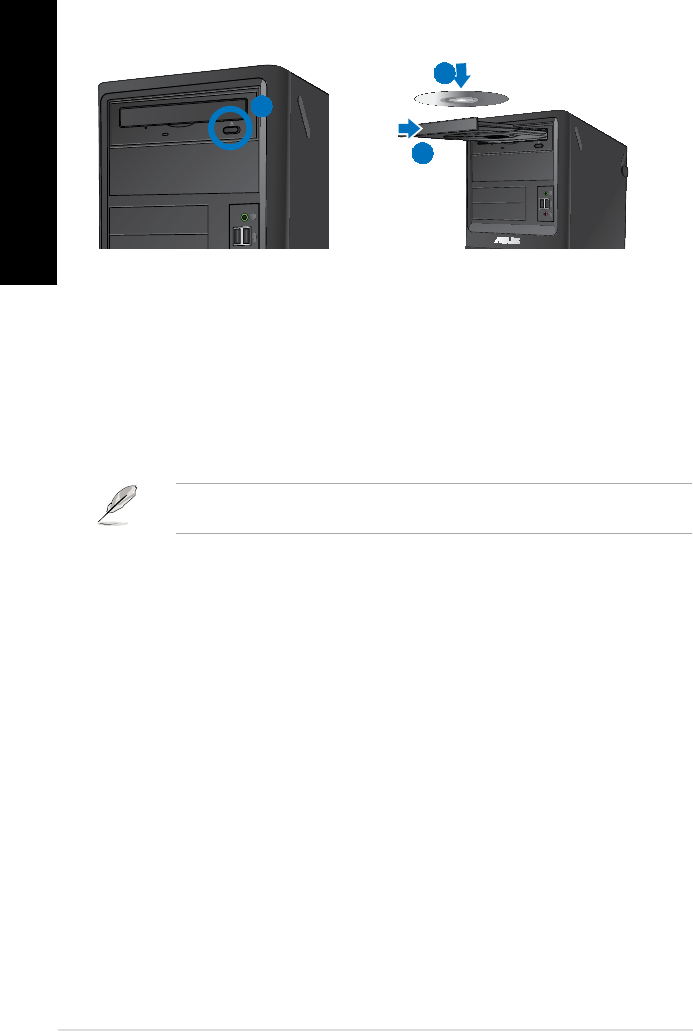
Using the optical drive (on selected models only)
Inserting an optical disc
To insert an optical disc:
1. While your system is on, press the eject button below the drive bay cover to open the
tray.
2. Place the disc to the optical drive with the label side facing up.
3. Push the tray to close it.
4. Select a program from the AutoPlay window to access your les.
Removing an optical disc
To remove an optical disc:
1. While the system is on, do either of the following to eject the tray:
• Press the eject button below the drive bay cover.
• Right-click the CD/DVD drive icon on the Computer screen, and then click Eject.
2. Remove the disc from the disc tray.
If AutoPlay is NOT enabled in your computer, click Windows® 7 Start button on the taskbar,
click Computer, and then double-click the CD/DVD drive icon to access the data on it.
1
2
3
42 Chapter 4: Using your computer
ENGLISH
ENGLISH
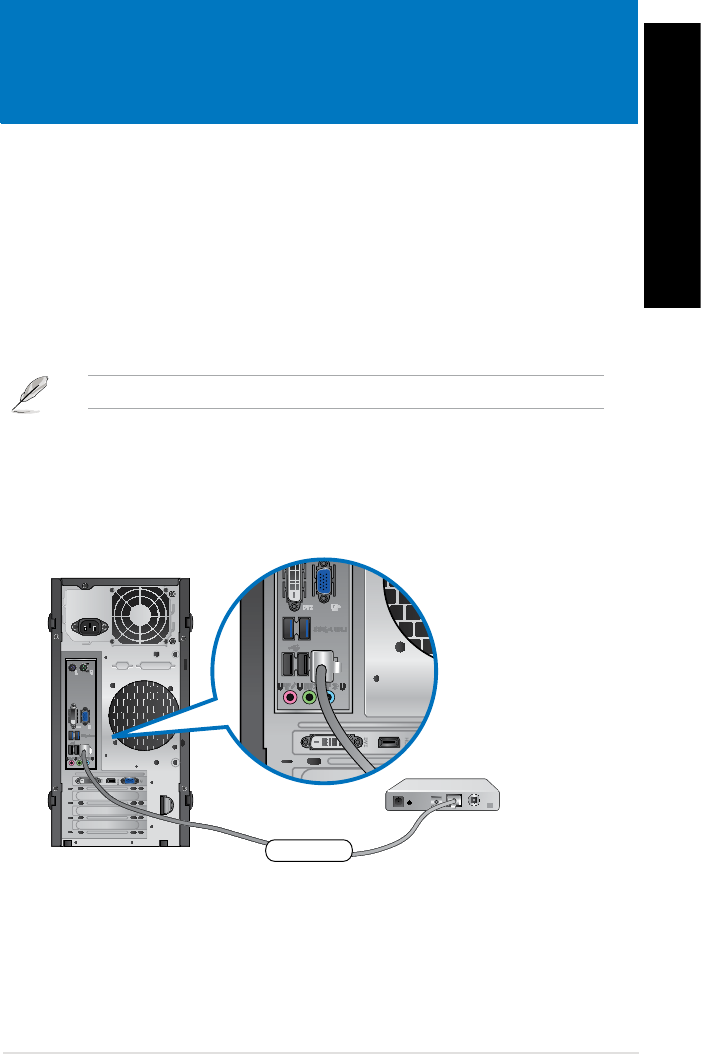
Connecting via a DSL/cable modem
To connect via a DSL/cable modem:
1. Set up your DSL/cable modem.
Wired connection
Use an RJ-45 cable to connect your computer to a DSL/cable modem or a local area network
(LAN).
Modem
RJ-45 cable
2. Connect one end of an RJ-45 cable to the LAN (RJ-45) port on the rear panel of your
computer and the other end to a DSL/cable modem.
Refer to the documentation that came with your DSL/cable modem.
BM6635(MD560)
ENGLISH
ENGLISH
ASUS BM6635(MD560), BM6835, and BP6335(SD560) 43
Chapter 5
Connecting to the Internet
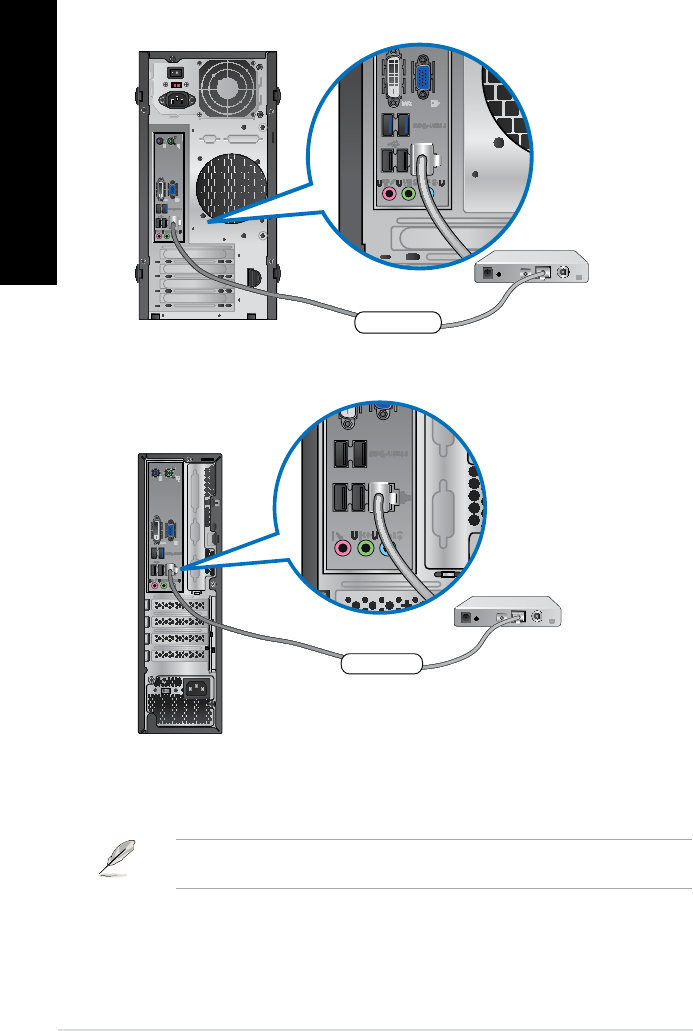
3. Turn on the DSL/cable modem and your computer.
4. Congure the necessary Internet connection settings.
Contact your Internet Service Provider (ISP) for details or assistance in setting up your
Internet connection.
Modem
RJ-45 cable
BP6335(SD560)
Modem
RJ-45 cable
BM6835
44 Chapter 5: Connecting to the Internet
ENGLISH
ENGLISH
ENGLISH
ENGLISH
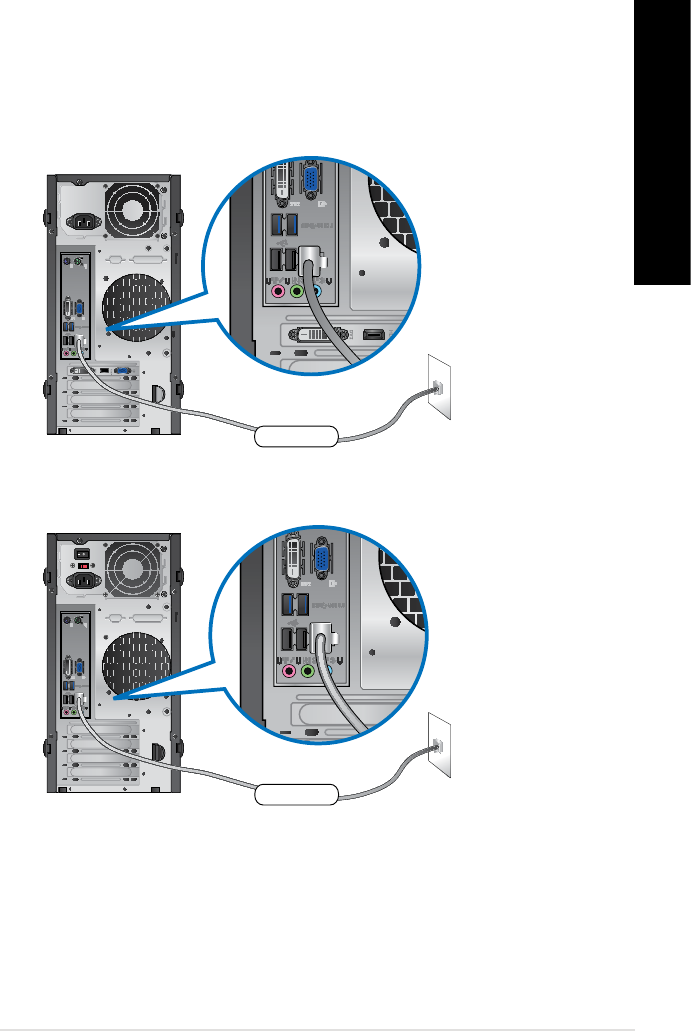
Connecting via a local area network (LAN)
To connect via a LAN:
1. Connect one end of an RJ-45 cable to the LAN (RJ-45) port on the rear panel of your
computer and the other end to your LAN.
RJ-45 cable LAN
BM6635(MD560)
RJ-45 cable LAN
BM6835
ENGLISH
ENGLISH
ASUS BM6635(MD560), BM6835, and BP6335(SD560) 45
ENGLISH
ENGLISH
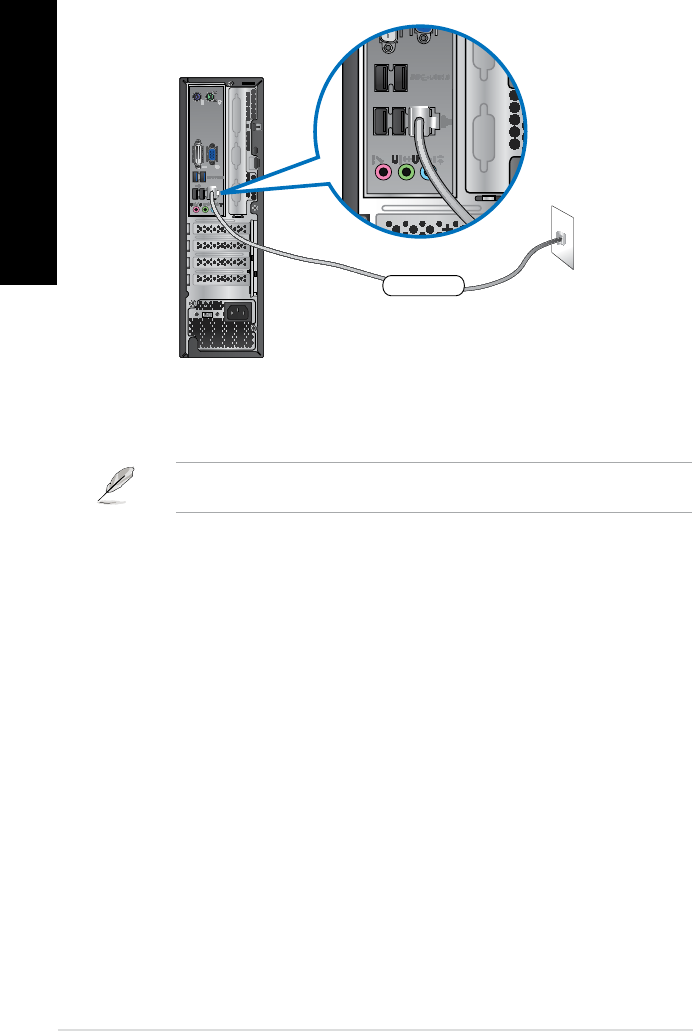
2. Turn on your computer.
3. Congure the necessary Internet connection settings.
Contact your network administrator for details or assistance in setting up your Internet
connection.
BP6335(SD560)
RJ-45 cable LAN
46 Chapter 5: Connecting to the Internet
ENGLISH
ENGLISH
ASUS AI Suite II
ASUS AI Suite II is an all-in-one interface that integrates several ASUS utilities and allows
users to launch and operate these utilities simultaneously.
This utility is pre-installed on some models. For models without an operating system, follow
the steps below to install this utility.
Installing AI Suite II
To install AI Suite II:
1. Place the support DVD in the optical drive. The Drivers installation tab appears if
Autorun is enabled.
2. Click the Utilities tab, then click ASUS AI Suite II.
3. Follow the onscreen instructions to complete the installation.
Using AI Suite II
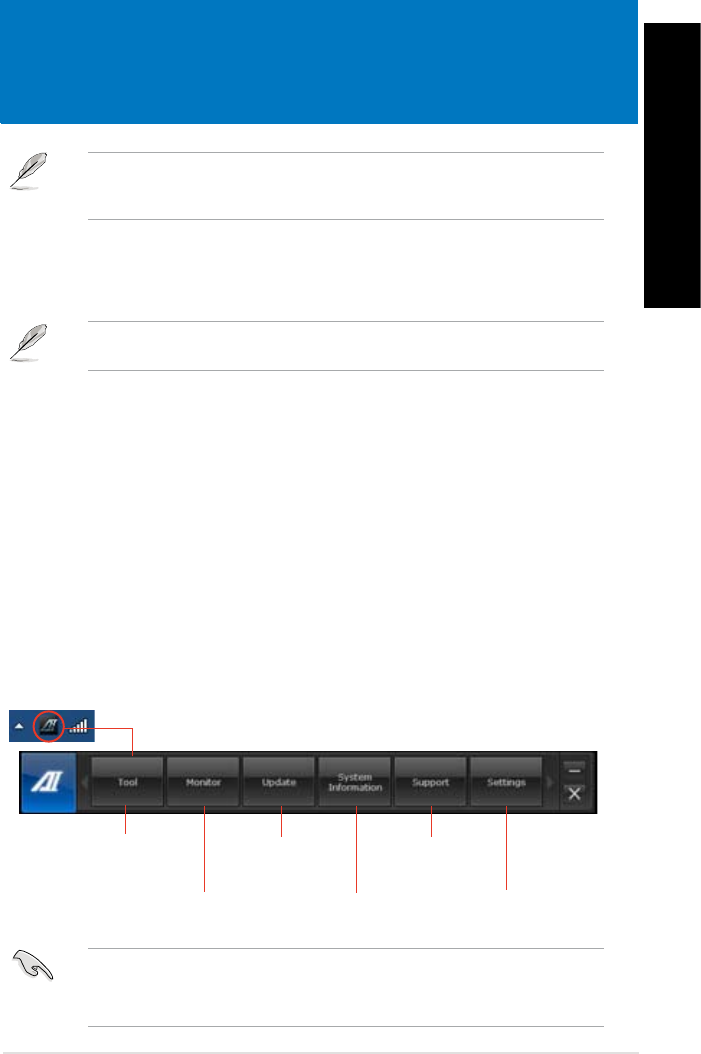
AI Suite II automatically starts when you enter the Windows® operating system. The AI Suite
II icon appears in the Windows® notication area. Click the icon to open the AI Suite II main
menu bar.
Click each button to select and launch a utility, to monitor the system, to update the
motherboard BIOS, to display the system information, and to customize the settings of AI
Suite II.
The Support DVD and Recovery DVD may not be included in the package. You may use
the Recovery Partition feature to create the Support DVD and Recovery DVD. For details,
refer to Recovering your system in this chapter.
• The applications in the Tool menu vary with models.
• The screenshots of AI Suite II in this user manual are for reference only. The actual
screenshots vary with models.
Click to select a utility
Click to monitor sensors
or CPU frequency
Click to update the
motherboard BIOS
Click to show the
system information
Click to customize
the interface settings
Click to show the ASUS
support information
ENGLISH
ENGLISH
ASUS BM6635(MD560), BM6835, and BP6335(SD560) 47
Chapter 6
Using the utilities
The Tool menu
The Tool menu includes the EPU, Probe II, and Sensor Recorder panels.
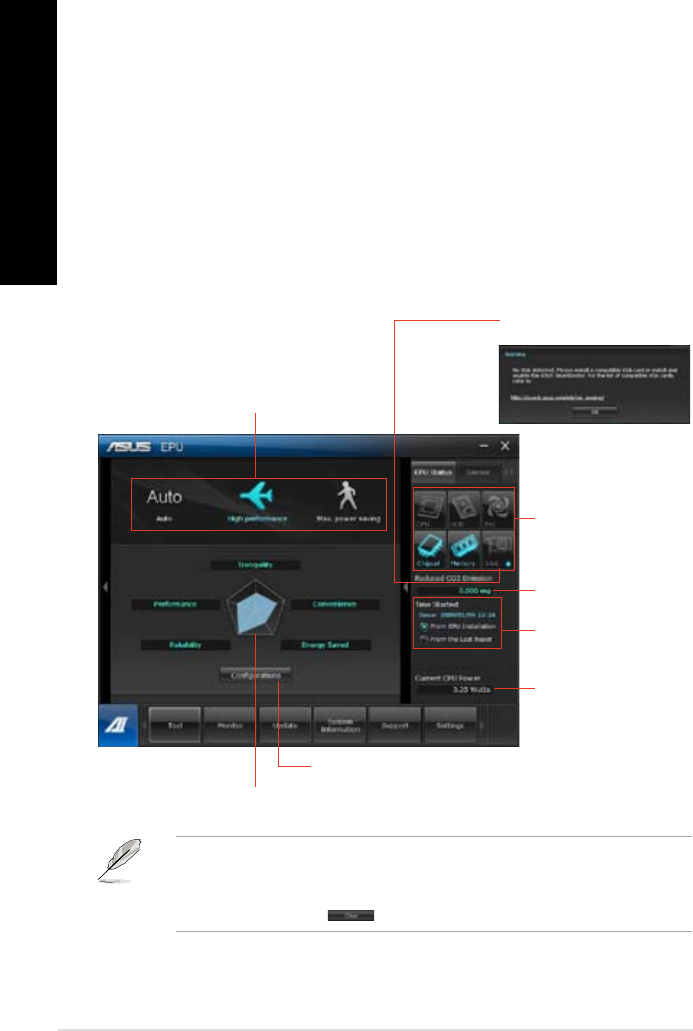
Launching and conguring EPU
EPU is an energy-efcient tool that provides you with a total power-saving solution. It detects
the current loading and intelligently adjusts the power usage in real-time. When you select
the Auto mode, the system changes modes automatically according to the current system
status. It allows you to customize each mode through conguring the settings such as CPU
frequency, vCore Voltage, and Fan Control.
To launch EPU:
• Click Tool > EPU on the AI Suite II main menu bar.
• * Select From EPU Installation to show the CO2 that has been reduced since you
installed EPU.
• *
Select From the Last Reset to show the total CO2 that has been reduced since you
click the Clear button .
*Shifts between the
display of Total and
Current CO2 reduced
Displays the system properties of each mode
Displays the following message
if no VGA power saving engine is
detected.
Advanced settings for each mode
Multiple system operating modes
The items lighting up
means power saving
engine is activated
Displays the amount
of CO2 reduced
Displays the current
CPU power
48 Chapter 6: Using the utilities
ENGLISH
ENGLISH
ENGLISH
ENGLISH
Launching and conguring Probe II
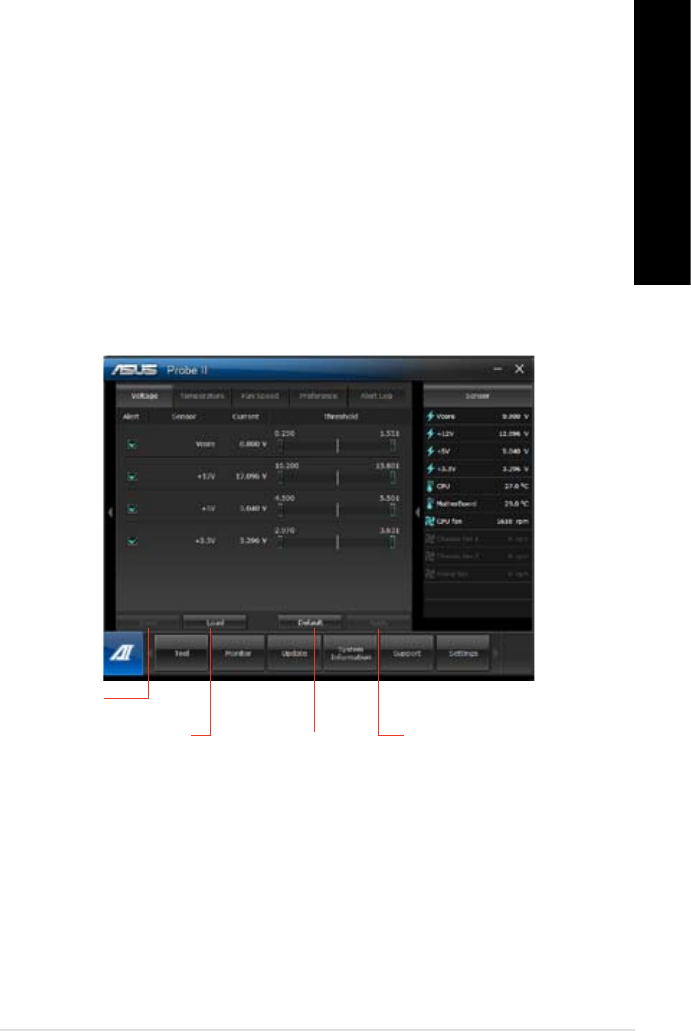
Probe II is a utility that monitors the computer’s vital components, and detects and alerts you
of any problem with these components. Probe II senses fan rotations, CPU temperature,
and system voltages, among others. With this utility, you are assured that your computer is
always at a healthy operating condition.
To launch Probe II:
• Click Tool > Probe II on the AI Suite II main menu bar.
To congure Probe II:
• Click the Voltage/Temperature/Fan Speed tabs to activate the sensors or to adjust the
sensor threshold values.
• The Preference tab allows you to customize the time interval of sensor alerts, or
change the temperature unit.
Loads the default
threshold values for
each sensor
Applies your changes
Loads your saved conguration
Saves your
conguration
ENGLISH
ENGLISH
ASUS BM6635(MD560), BM6835, and BP6335(SD560) 49
ENGLISH
ENGLISH
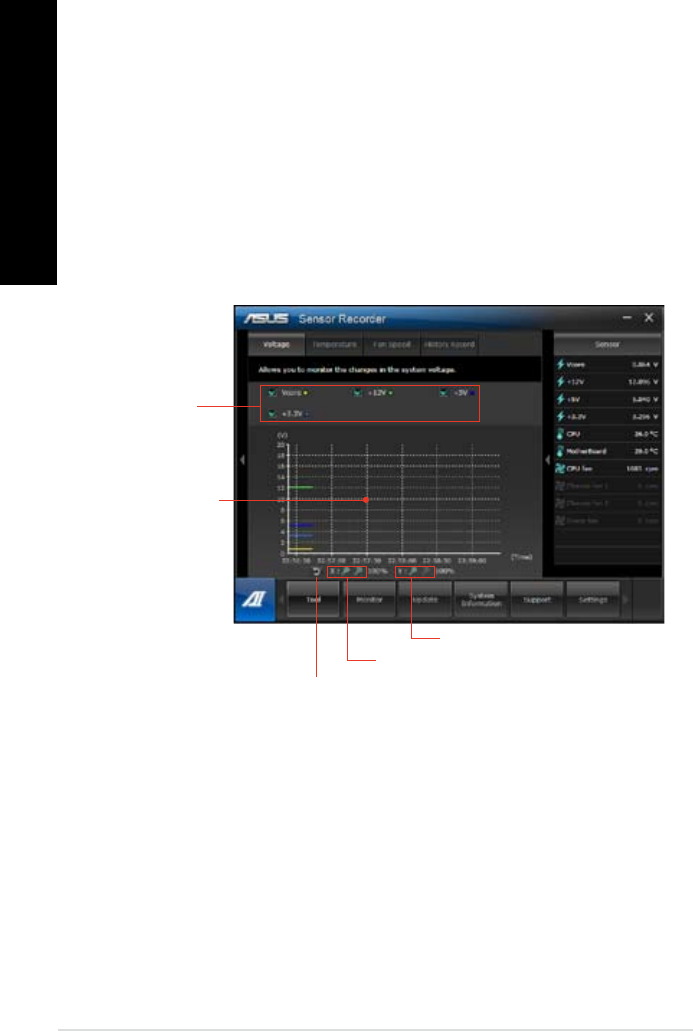
Launching and conguring Sensor Recorder
Sensor Recorder allows you to monitor the changes in the system voltage, temperature, and
fan speed, as well as recording the changes.
To launch Sensor Recorder:
• Click Tool > Sensor Recorder on the AI Suite II main menu bar.
To congure Sensor Recorder:
• Click the Voltage/Temperature/Fan Speed tabs and select the sensors that you want
to monitor.
• The History Record tab allows you to record the changes in the sensors that you
enable.
Select the
sensors that you
want to monitor
Click to zoom in/out the Y axis
Click to zoom in/out the X axis
Click to return to the default mode
Drag to view the
status during a
certain period
of time
50 Chapter 6: Using the utilities
ENGLISH
ENGLISH
ENGLISH
ENGLISH

Launching Sensor
The Sensor panel displays the current value of a system sensor such as fan rotation, CPU
temperature, and voltages.
To launch Sensor:
• Click Monitor > Sensor on the AI Suite II main menu bar.
Launching CPU Frequency
The CPU Frequency panel displays the current CPU frequency and CPU usage.
To launch CPU frequency:
• Click Monitor > CPU Frequency on the AI Suite II main menu bar.
The Monitor menu
The Monitor menu includes the Sensor and CPU Frequency panels.
The Update menu
The Update menu allows you to update the motherboard BIOS and the BIOS boot logo with
the ASUS designed update utilities.
ASUS Update
The ASUS Update is a utility that allows you to manage, save, and update the motherboard
BIOS in Windows® OS. The ASUS Update utility allows you to update the BIOS directly
from the Internet, download the latest BIOS le from the Internet, update the BIOS from an
updated BIOS le, save the current BIOS le or view the BIOS version information.
Updating the BIOS through the Internet
To update the BIOS through the Internet:
1. From the ASUS Update screen, select Update BIOS from Internet, then click Next.
2. Select the ASUS FTP site nearest you to avoid network trafc.
Tick the two items if you want to enable the BIOS downgradable and Auto-BIOS
backup functions.
3. Select the BIOS version that you want to download, then click Next.
When no updated version is detected, a message is displayed informing you that there
is no new BIOS le from the BIOS server.
4. Click Yes if you want to change the boot logo, which is the image appearing on screen
during the Power-On Self-Tests (POST). Otherwise, click No.
5. Follow the onscreen instructions to complete the update process.
ENGLISH
ENGLISH
ASUS BM6635(MD560), BM6835, and BP6335(SD560) 51
ENGLISH
ENGLISH
Updating the BIOS through a BIOS le
To update the BIOS through a BIOS le:
1. From the ASUS Update screen, select Update BIOS from le, then click Next.
2. Locate the BIOS le from the Open window, click Open, and click Next.
3. Click Yes if you want to change the boot logo, which is the image appearing on screen
during the Power-On Self-Tests (POST). Otherwise, click No.
4. Follow the onscreen instructions to complete the update process.
MyLogo
ASUS MyLogo allows you to customize the boot logo. The boot logo is the image that
appears on screen during the Power-On Self-Tests (POST). ASUS MyLogo allows you to:
• Change the current BIOS boot logo of your motherboard
• Change the boot logo of a downloaded BIOS le and update this BIOS to your
motherboard
• Change the boot logo of a downloaded BIOS le without updating this BIOS to your
motherboard
Ensure that the BIOS item Full Screen Logo is set to [Enabled] to display the boot logo.
See the section Boot Settings Conguration of the BIOS Setup chapter in the user manual.
Changing the BIOS boot logo
1. From the AI Suite II main menu bar, click Update > MyLogo.
2. Select any of these three options, then click Next:
• Change the BIOS boot logo of my motherboard
• Change the boot logo of a downloaded BIOS le and update this BIOS to my
motherboard
• Change the boot logo of a downloaded BIOS le (But do not update this BIOS to
my motherboard)
Before using the last two options, ensure that you download a BIOS le to your computer
using ASUS Update.
3. Locate the picture le that you want to use as the boot logo (and the downloaded BIOS
if required) and then click Next.
4. Move the Resolution slider or click Auto Tune for the system to automatically adjusts
the screen resolution.
5. Click the Booting Preview button to preview the way the picture is displayed during
the POST. Left-click the mouse to return to the setting screen.
6. Click Next when the adjustment is nished.
7. Click Flash and follow the onscreen instructions to complete the process.
52 Chapter 6: Using the utilities
ENGLISH
ENGLISH
ENGLISH
ENGLISH

The System Information screen
The System Information screen displays the information about the motherboard, CPU, and
memory slots.
• Click the MB tab to see the details on the motherboard manufacturer, product name,
version, and BIOS.
• Click the CPU tab to see the details on the processor and the Cache.
• Click the Memory tab and then select the memory slot to see the details on the
memory module installed on the corresponding slot.
• Click the Disk tab and then select each disk to see the details on it.
The Settings screen
The Settings screen allows you to customize the main menu bar settings and the interface’s
skin.
• Application allows you to select the application that you want to enable.
• Bar allows you to modify the bar setting,
• Skin allows you to customize the interface’s contrast, brightness, saturation, hue, and
gamma.
The Support screen
The Support screen displays the information about the ASUS website, technical support
website, download support website, or contact information.
ENGLISH
ENGLISH
ASUS BM6635(MD560), BM6835, and BP6335(SD560) 53
ENGLISH
ENGLISH
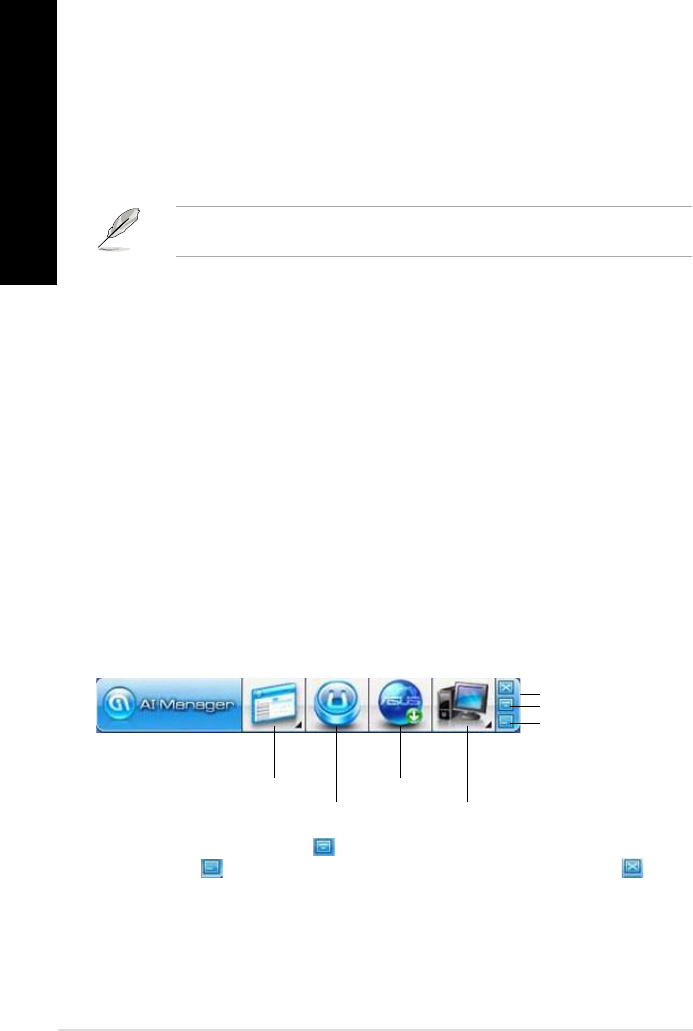
After launching the application, the AI Manager icon appears in the Windows® taskbar.
Right-click this icon to switch between the quick bar and the main window, and to launch the
AI Manager either from the quick bar or taskbar.
ASUS AI Manager
ASUS AI Manager is a utility which gives you quick and easy access to frequently-used
applications.
Installing AI Manager
To install AI Manager:
1. Place the support DVD in the optical drive. If Autorun is enabled, the Drivers installation
wizard appears.
If Autorun is disabled, double-click the setup.exe le from the ASUS AI Manager folder in
the support DVD.
2. Click the Utilities tab, then click ASUS AI Manager.
3. Follow the onscreen instructions to complete the installation.
Launching AI Manager
To launch the AI Manager from the Windows® desktop, click Start > All Programs > ASUS >
AI Manager > AI Manager 1.xx.xx. The AI Manager quick bar appears on the desktop.
AI Manager quick bar
The AI Manager quick bar saves the desktop space and allows you to launch the ASUS
utilities or display system information easily. Click any of the Main, My Favorites, Support or
Information tab to display the menu’s contents.
Click the Maximize/restore button to switch between full window and quick bar. Click the
Minimize button to keep the AI Manager on the taskbar. Click the Close button to quit
the AI Manager.
Main
The Main menu contains three utilities: AI Disk, AI Security, and AI Booting. Click the arrow
on the Main menu icon to browse through the utilities in the main menu.
Main
My Favorites
Support
Information
Exit button
Switch to main Window
Add to ToolBar
54 Chapter 6: Using the utilities
ENGLISH
ENGLISH
ENGLISH
ENGLISH

AI Disk
AI Disk allows you to easily clear temporary IE les, IE cookies, IE URLs, IE history,
or the Recycle Bin. Click the AI Disk icon on the quick bar to display the full AI Disk
window and select the items you want to clear. Click Apply when done.
AI Security
AI Security enables you to set a password to secure your devices, such as USB ash
disks and CD/DVD disks, from unauthorized access.
To lock a device:
1. When using AI Security for the rst time, you are asked to set a password. Key in
a password with at most 20 alphanumeric characters.
2. Conrm the password.
3. Key in the password hint (recommended).
4. When done, click Ok.
5. Select the device you want to lock, then click Apply.
6. Key in the password you have set previously, then click Ok.
To unlock the device:
1. Deselect the locked device, then click Apply.
2. Key in the password you have set previously, then click Ok.
To change the password:
• Click Change Password, then follow the onscreen instructions to change
password.
AI Booting
AI Booting allows you to specify the boot device priority sequence.
To specify the boot sequence:
1. Select a device, then click the left/right button to specify the boot sequence.
2. When done, press Apply.
My Favorites
My Favorites allows you to add applications that you frequently use, saving you from
searching for the applications throughout your computer.
ENGLISH
ENGLISH
ASUS BM6635(MD560), BM6835, and BP6335(SD560) 55
ENGLISH
ENGLISH

To add an application:
1. Click Add, then locate the application you want to add to My Favorites.
2. Click Open on the le location window. The application is added to My Favorites list.
Right click on the application icon to launch, delete, or rename the selected application. You
can also double click to launch the selected application.
Support
Click any links on the Support window to go to the ASUS website, technical support website,
download support website, or contact information.
Information
Click the tab on the Information window to see the detailed information about your system,
motherboard, CPU, BIOS, installed device(s), and memory.
56 Chapter 6: Using the utilities
ENGLISH
ENGLISH
ENGLISH
ENGLISH
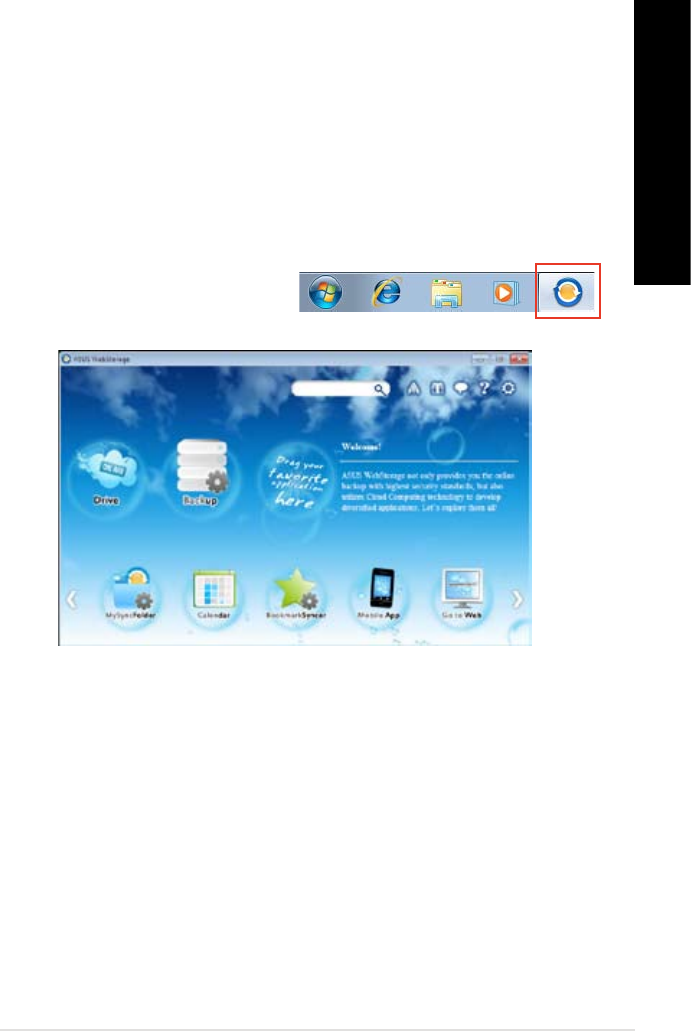
ASUS WebStorage
ASUS WebStorage is designed to help you retrieve your data to your notebooks,
smartphones or tablets wherever there is internet connection.
Installing WebStorage
To install WebStorage:
Place the support DVD in the optical drive. Double-click the setup.exe le from the ASUS
WebStorage folder in the Software folder in the support DVD.
Launching WebStorage
To launch the WebStorage from the Windows® desktop, click Start > All Programs > ASUS
> WebStorage. The WebStorage quick bar
appears in the Windows® taskbar. Right-
click this icon to switch between the quick
bar and the main window.
Drive
Allows your to retrieve all your backups, synced les, share groups and password protected
data from here. Right-click the mouse to preview les before downloading or generating a
sharing URL.
Backup
Allows you to quickly back up your important data, set your preferences for your backup
schedule, and select Auto-Backup to automatically backup your data.
MySyncFolder
Allows you to store your les to MySyncFolder for easy access and sharing without the
limitation of location or storage space.
ENGLISH
ENGLISH
ASUS BM6635(MD560), BM6835, and BP6335(SD560) 57
ENGLISH
ENGLISH
Calendar
ASUS WebStorage automatically synchronizes your calendar events to all your computers to
allow you to browse through your calendar from any of your computers.
BookmarkSyncer
BookmarkSyncer allows you to save your browser preference and favorite websites in the
cloud storage.
MobileApp
ASUS WebStorage’s mobile applications allow you to synchronize your les between your
mobile devices. It also allows you to preview or stream les on your mobile device.
Go to Web
ASUS WebStorage allows you to experience its value-added cloud service without the risk of
losing your data.
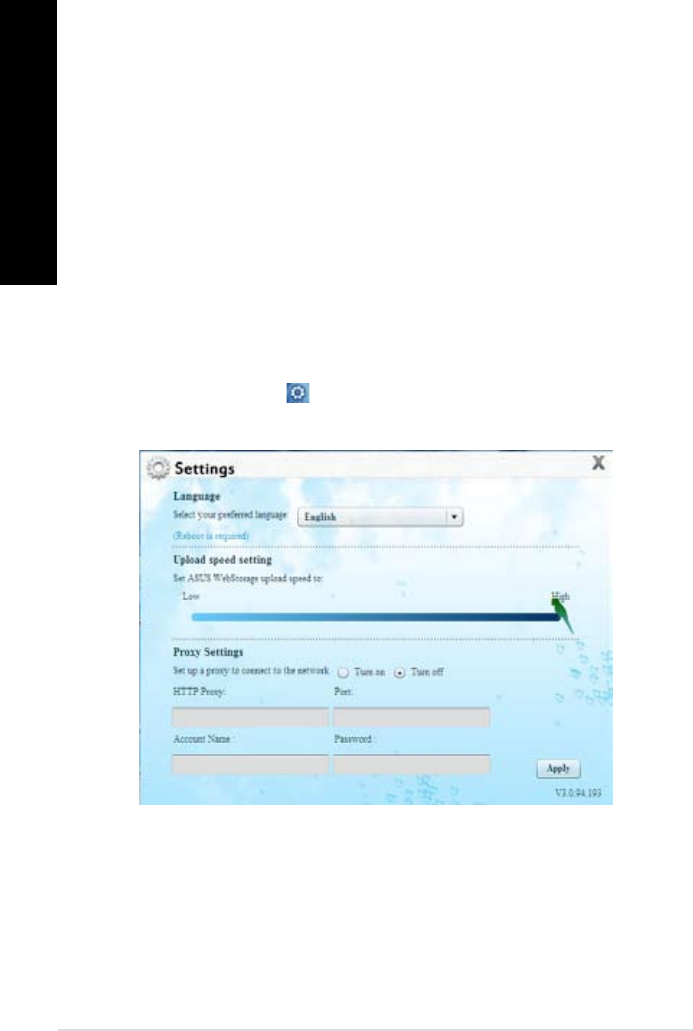
Settings
1. Click the Settings icon to launch the Settings screen.
2. Follow the onscreen instructions to complete the conguration.
58 Chapter 6: Using the utilities
ENGLISH
ENGLISH
ENGLISH
ENGLISH
ASUS Easy Update
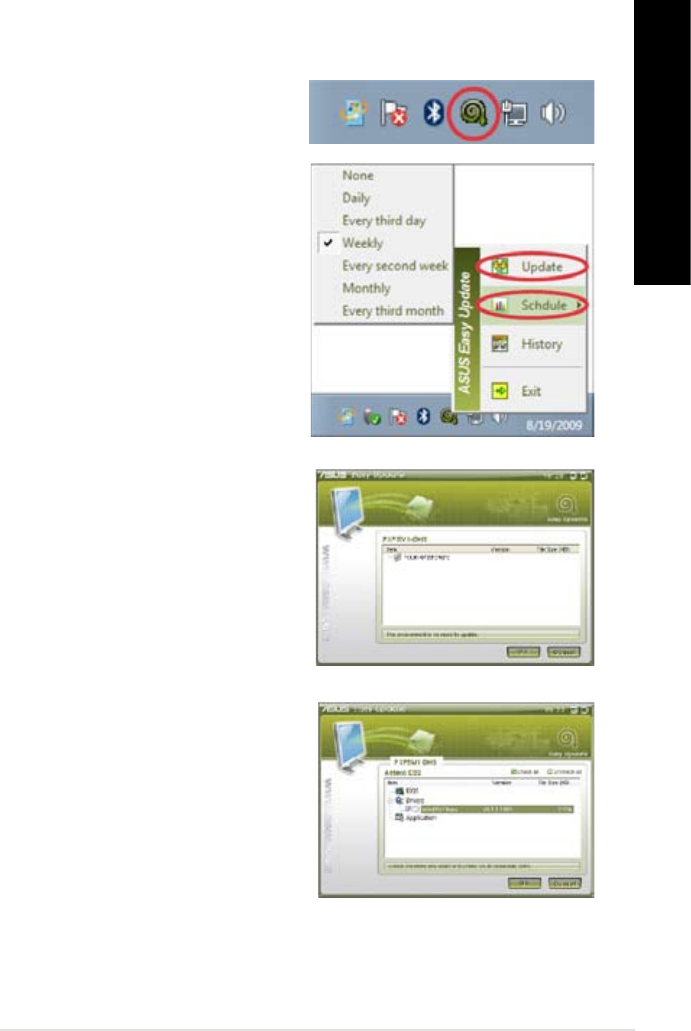
ASUS Easy Update is a software tool that automatically detects the latest drivers and
applications for your system.
1. From the Windows ® notication area,
right-click the ASUS Easy Update icon.
2. Select Schedule to set how often you
want to update your system.
3. Select Update to activate the update.
4. Click OK to display the items you can
download.
5. Check the item(s) you want to download,
and then click OK.
ENGLISH
ENGLISH
ASUS BM6635(MD560), BM6835, and BP6335(SD560) 59
ENGLISH
ENGLISH
Nero 9
Nero 9 allows you to create, copy, burn, edit, share, and update different kinds of data.
Installing Nero 9
To install Nero 9:
1. Insert the Nero 9 DVD into your optical drive.
2. If Autorun is enabled, the main menu appears automatically.
If Autorun is disabled, double-click the SeupX.exe le from the main directory of your Nero
9 DVD.
3. From the main menu, click Nero 9 Essentials.
4. Select the language you want to use for Installation Wizard. Click Next.
5. Click Next to continue.
6. Tick I accept the License Conditions. When done, click Next.
7. Select Typical then click Next.
8. Tick Yes, I want to help by sending anonymous application data to Nero then click
Next.
9. When done, click Exit.
Burning les
To burn les:
1. From the main menu, click Data Burning > Add.
2. Select the les that you want to burn. When done, click Add.
3. After selecting les that you want to burn, click Burn to burn the les to a disc.
For more details about using Nero 9, refer to the Nero website at www.nero.com
60 Chapter 6: Using the utilities
ENGLISH
ENGLISH
ENGLISH
ENGLISH
Recovering your system
Using the Recovery Partition
The Recovery Partition quickly restores your Desktop PC’s software to its original working
state. Before using the Recovery Partition, copy your data les (such as Outlook PST les)
to USB storage devices or to a network drive and make note of any customized conguration
settings (such as network settings).
About the Recovery Partition
The Recovery Partition is a reserved space on your hard disk drive used to restore the
operating system, drivers, and utilities installed on your Desktop PC at the factory.
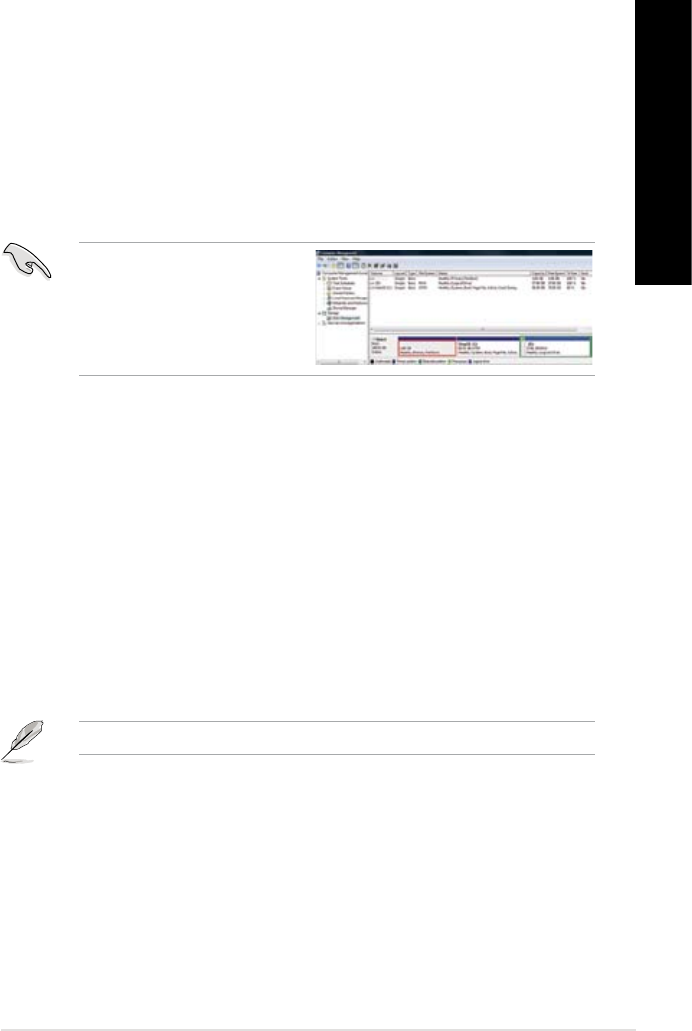
DO NOT delete the partition named
RECOVERY. The Recovery Partition
is created at the factory and cannot be
restored if deleted. Take your Desktop
PC to an authorized ASUS service
center if you have problems with the
recovery process.
Using the Recovery Partition:
1. Press <F9> during bootup.
2. Press <Enter> to select Windows Setup [EMS Enabled].
3. Select one of the following recovery options.
System Recovery:
This feature allows you to restore the system to the factory default settings.
System Image Backup:
This feature allows you to burn the system image backup in DVD discs, which you can use
later to restore the system to its default settings.
System DVD Backup:
This feature allows you to make a backup copy of the support DVD.
4. Follow the onscreen instructions to complete the recovery process.
Visit the ASUS website at www.asus.com for updated drivers and utilities.
ENGLISH
ENGLISH
ASUS BM6635(MD560), BM6835, and BP6335(SD560) 61
ENGLISH
ENGLISH
Using the Recovery DVD (on selected models)
Prepare 1~3 blank writable DVDs as instructed to create the Recovery DVD.
Remove the external hard disk drive before performing system recovery on your Desktop
PC. According to Microsoft, you may lose important data because of setting up Windows on
the wrong disk drive or formatting the incorrect drive partition.
To use the Recovery DVD:
1. Insert the Recovery DVD into the optical drive. Your Desktop PC needs to be powered
ON.
2. Restart the Desktop PC and press <F8> on bootup and select the optical drive (may be
labeled as “CD/DVD”) and press <Enter> to boot from the Recovery DVD.
3. Select OK to start to restore the image.
4. Select OK to conrm the system recovery.
Restoring will overwrite your hard drive. Ensure to back up all your important data before
the system recovery.
5. Follow the onscreen instructions to complete the recovery process.
DO NOT remove the Recovery disc, unless instructed to do so, during the recovery process
or else your partitions will be unusable.
Visit the ASUS website at www.asus.com for updated drivers and utilities.
62 Chapter 6: Using the utilities
ENGLISH
ENGLISH

ENGLISH
ENGLISH
ASUS BM6635(MD560), BM6835, and BP6335(SD560) 63
Chapter 7
Troubleshooting
Troubleshooting
This chapter presents some problems you might encounter and the possible solutions.
?
My computer cannot be powered on and the power LED on the front
panel does not light up
• Check if your computer is properly connected.
• Check if the wall outlet is functioning.
• Check if the Power Supply Unit is switched on. Refer to the section Turning
your computer ON/OFF in Chapter 1.
?
My computer hangs.
• Do the following to close the programs that are not responding:
1. Simultaneously press <Alt> + <Ctrl> + <Delete> keys on the keyboard,
then click Start Task Manager.
2. Click Applications tab.
3. Select the program that is not responding, then click End Task.
• If the keyboard is not responding. Press and hold the Power button on the top
of your chassis until the computer shuts down. Then press the Power button
to turn it on.
?
I cannot connect to a wireless nestwork using the ASUS WLAN Card
(on selected models only)?
• Ensure that you enter the correct network security key for the wireless network
you want to connect to.
• Connect the external antennas (optional) to the antenna connectors on the
ASUS WLAN Card and place the antennas on the top of your computer
chassis for the best wireless performance.
?
The arrow keys on the number key pad are not working.
Check if the Number Lock LED is off. When the Number Lock LED is on,
the keys on the number key pad are used to input numbers only. Press the
Number Lock key to turn the LED off if you want to use the arrow keys on the
number key pad.

64 Chapter 7: Troubleshooting
ENGLISH
ENGLISH
ENGLISH
ENGLISH
?
No display on the monitor.
• Check if the monitor is powered on.
• Ensure that your monitor is properly connected to the video output port on
your computer.
• If your computer comes with a discrete graphics card, ensure that you connect
your monitor to a video output port on the discrete graphics card.
• Check if any of the pins on the monitor video connector is bent. If you discover
bent pins, replace the monitor video connector cable.
• Check if your monitor is plugged to a power source properly.
• Refer to the documentation that came with your monitor for more
troubleshooting information.
?
When using multiple monitors, only one monitor has display.
• Ensure that the both monitors are powered on.
• During POST, only the monitor connected to the VGA port has display. The
dual display function works only under Windows.
• When a graphics card is installed on your computer, ensure that you connect
the monitors to the output port on the graphics card.
• Check if the multiple displays settings are correct. Refer to section
Connecting multiple external displays in Chapter 3 for details.
?
My computer cannot detect my USB storage device.
• The rst time you connect your USB storage device to your computer,
Windows automatically installs a driver for it. Wait for a while and go to My
Computer to check if the USB storage device is detected.
• Connect your USB storage device to another computer to test if the USB
storage device is broken or malfunctions.
?
I want to restore or undo changes to my computer’s system settings
without affecting my personal les or data.
The Windows® System Restore feature allows you to restore or undo changes
to your computer’s system settings without affecting your personal data such
as documents or photos. For more details, refer to the section Restoring your
system in Chapter 2.
ENGLISH
ENGLISH
ASUS BM6635(MD560), BM6835, and BP6335(SD560) 65
ENGLISH
ENGLISH
?
The picture on the HDTV is distorted.
• It is caused by the different resolutions of your monitor and your HDTV. Adjust
the screen resolution to t your HDTV. To change the screen resolution:
1. Do any of the following to open the Screen Resolution setting screen:
• Click > Control Panel > Appearance and Personalization >
Display > Change display settings.
• Right click anywhere on your Windows desktop. When the pop-up
menu appears, click Personalize > Display > Change display
settings.
2. Adjust the resolution. Refer to the documentation came with your HDTV
for the resolution.
3. Click Apply or OK. Then click Keep Changes on the conrmation
message.
?
My speakers produce no sound.
• Ensure that you connect your speakers to the Line out port (lime) on the front
panel or the rear panel.
• Check if your speak is connected to a electrical source and turned on.
• Adjust your speakers’ volume.
• Ensure that your computer’s system sounds are not Muted.
• If it is muted, the volume icon is displayed as . To enable the system
sounds, click from the Windows notication area, then click .
• If it is not muted, click and drag the slider to adjust the volume.
• Connect your speakers to another computer to test if the speakers arer
working properly.
?
The DVD drive cannot read a disc.
• Check if the disc is placed with the label side facing up.
• Check if the disc is centered in the tray, especially for the discs with
non-standard size or shape.
• Check if the disc is scratched or damaged.
?
The DVD drive eject button is not respond.
1. Click > Computer.
2. Right-click , then click Eject from the menu.
66 Chapter 7: Troubleshooting
ENGLISH
ENGLISH
ENGLISH
ENGLISH
Power
Problem Possible Cause Action
No power
(The power
indicator is off)
Incorrect power voltage
• Set your computer’s power voltage
switch to your area’s power
requirements.
• Adjust the voltage settings. Ensure
that the power cord is unplugged
from the power outlet.
Your computer is not
turned on.
Press the power key on the front panel
to ensure that your computer is turned
on.
Your computer’s power
cord is not properly
connected.
• Ensure that the power cord is
properly connected.
• Use other compatible power cord.
PSU (Power supply unit)
problems
Try installing another PSU on your
computer.
Display
Problem Possible Cause Action
No display
output after
turning the
computer on
(Black screen)
The signal cable is
not connected to the
correct VGA port on your
computer.
• Connect the signal cable to the
correct display port (onboard VGA or
discrete VGA port).
• If you are using a discrete VGA
card, connect the signal cable to the
discrete VGA port.
Signal cable problems Try connecting to another monitor.
ENGLISH
ENGLISH
ASUS BM6635(MD560), BM6835, and BP6335(SD560) 67
ENGLISH
ENGLISH
LAN
Problem Possible Cause Action
Cannot access
the Internet
The LAN cable is not
connected.
Connect the LAN cable to your
computer.
LAN cable problems
Ensure the LAN LED is on. If not,
try another LAN cable. If it still does
not work, contact the ASUS service
center.
Your computer is not
properly connected to a
router or hub.
Ensure that your computer is properly
connected to a router or hub.
Network settings Contact your Internet Service Provider
(ISP) for the correct LAN settings.
Problems caused by the
anti-virus software Close the anti-virus software.
Driver problems Reinstall the LAN driver
Audio
Problem Possible Cause Action
No Audio
Speaker or headphone is
connected to the wrong
port.
• Refer to your computer’s user
manual for the correct port.
• Disconnect and reconnect the
speaker to your computer.
Speaker or headphone
does not work.
Try using another speaker or
headphone.
The front and back audio
ports do not work.
Try both the front and back audio
ports. If one port failed, check if the
port is set to multi-channel.
Driver problems Reinstall the audio driver

68 Chapter 7: Troubleshooting
ENGLISH
ENGLISH
ENGLISH
ENGLISH
System
Problem Possible Cause Action
System speed is
too slow
Too many programs are
running. Close some of the programs.
Computer virus attack
• Use an anti-virus software to
scan for viruses and repair your
computer.
• Reinstall the operating system.
The system often
hangs or freezes.
Hard disk drive failure
• Send the damaged hard disk
drive to ASUS Service Center for
servicing.
• Replace with a new hard disk drive.
Memory module problems
• Replace with compatible memory
modules.
• Remove the extra memory
modules that you have installed,
then try again.
There is not enough
air ventilation for your
computer.
Move your computer to an area with
better air ow.
Incompatible softwares are
installed.
Reinstall the OS and reinstall
compatible softwares.
ENGLISH
ENGLISH
ASUS BM6635(MD560), BM6835, and BP6335(SD560) 69
ENGLISH
ENGLISH
CPU
Problem Possible Cause Action
Too noisy right
after turning on
the computer.
Your computer is booting
up.
It is normal. The fan runs on its
full speed when the computer is
powering on. The fan slows down
after entering the OS.
The BIOS settings have
been changed.
Restore the BIOS to its default
settings.
Old BIOS version
Update the BIOS to the latest
version. Visit the ASUS Support
site at http://support.asus.com to
download the latest BIOS versions.
Computer is too
noisy when in use.
The CPU fan has been
replaced.
Ensure that you are using a
compatible or ASUS-recommended
CPU fan.
There is not enough
air ventilation for the
computer.
Ensure that your computer is
working in an area with good air ow.
The system temperature is
too high.
• Update the BIOS.
• If you know how to reinstall the
motherboard, try to clean the inner
space of the chassis.
If the problem still persists, refer to your Desktop PC’s warranty card and contact the ASUS
Service Center. Visit the ASUS Support site at http://support.asus.com for the service
center information.

ASUS contact information
ASUSTeK COMPUTER INC.
Address 15 Li-Te Road, Peitou, Taipei, Taiwan 11259
Telephone +886-2-2894-3447
Fax +886-2-2890-7798
E-mail info@asus.com.tw
Web site www.asus.com.tw
Technical Support
Telephone +86-21-38429911
Online support support.asus.com
ASUS COMPUTER INTERNATIONAL (America)
Address 800 Corporate Way, Fremont, CA 94539, USA
Telephone +1-510-739-3777
Fax +1-510-608-4555
Web site usa.asus.com
Technical Support
Telephone +1-812-282-2787
Support fax +1-812-284-0883
Online support support.asus.com
ASUS COMPUTER GmbH (Germany and Austria)
Address Harkort Str. 21-23, D-40880 Ratingen, Germany
Fax +49-2102-959911
Web site www.asus.de
Online contact www.asus.de/sales
Technical Support
Telephone (Component) +49-1805-010923*
Telephone (System/Notebook/Eee/LCD) +49-1805-010920*
Support Fax +49-2102-9599-11
Online support support.asus.com
* EUR 0.14/minute from a German xed landline; EUR 0.42/minute from a mobile
phone.
Manufacturer: ASUSTeK Computer Inc.
Address: No.150, LI-TE RD., PEITOU, TAIPEI 112,
TAIWAN
Authorised representative in
Europe:
ASUS Computer GmbH
Address: HARKORT STR. 21-23, 40880 RATINGEN,
GERMANY
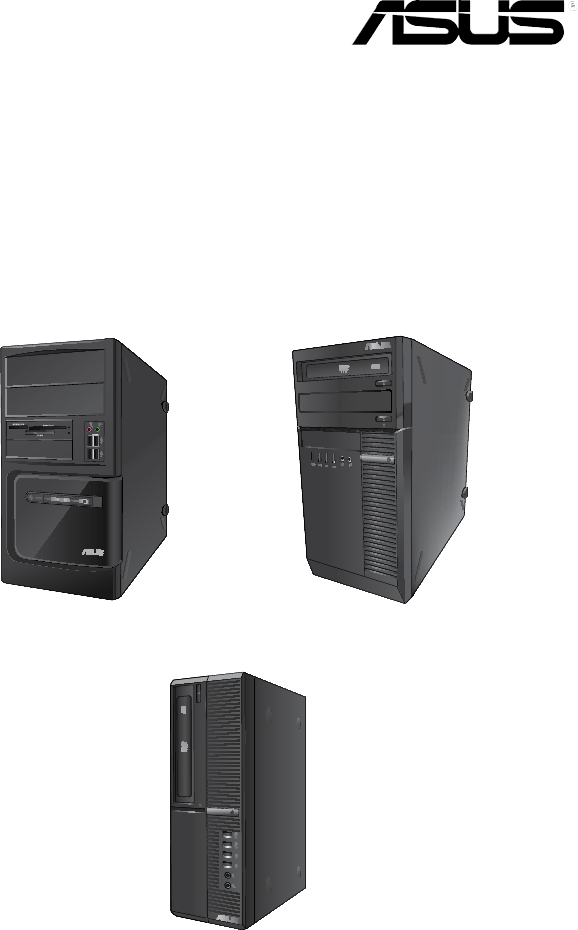
華碩個人電腦
BM6635(MD560)
BM6835
BP6335(SD560)
BM6835
BM6635(MD560)
BP6335(SD560)
使用手冊

72
T7286
第一版
2012 年 3 月
版權說明
©ASUSTeK Computer Inc. All rights reserved. 華碩電腦股份有限公司保留所
有權利
本使用手冊包括但不限於其所包含的所有資訊皆受到著作權法之保護,未
經華碩電腦股份有限公司(以下簡稱「華碩」)許可,不得任意地仿製、
拷貝、謄抄、轉譯或為其他利用。
免責聲明
本使用手冊是以「現況」及「以目前明示的條件下」的狀態提供給您。在
法律允許的範圍內,華碩就本使用手冊,不提供任何明示或默示的擔保及
保證,包括但不限於商業適銷性、特定目的之適用性、未侵害任何他人權
利及任何得使用本使用手冊或無法使用本使用手冊的保證,且華碩對因使
用本使用手冊而獲取的結果或透過本使用手冊所獲得任何資訊之準確性或
可靠性不提供擔保。
台端應自行承擔使用本使用手冊的所有風險。 台端明確了解並同意,華
碩、華碩之授權人及其各該主管、董事、員工、代理人或關係企業皆無須
為您因本使用手冊、或因使用本使用手冊、或因不可歸責於華碩的原因而
無法使用本使用手冊或其任何部分而可能產生的衍生、附隨、直接、間
接、特別、懲罰或任何其他損失(包括但不限於利益損失、業務中斷、資
料遺失或其他金錢損失)負責,不論華碩是否被告知發生上開損失之可能
性。
由於部分國家或地區可能不允許責任的全部免除或對前述損失的責任限
制,所以前述限制或排除條款可能對您不適用。
台端知悉華碩有權隨時修改本使用手冊。本產品規格或驅動程式一經改
變,本使用手冊將會隨之更新。本使用手冊更新的詳細說明請您造訪華碩
的客戶服務網 http://support.asus.com,或是直接與華碩資訊產品技術支援
專線 0800-093-456 聯絡。
於本使用手冊中提及之第三人產品名稱或內容,其所有權及智慧財產權皆
為各別產品或內容所有人所有且受現行智慧財產權相關法令及國際條約之
保護。
當下列兩種情況發生時,本產品將不再受到華碩之保固及服務:
(1)本產品曾經過非華碩授權之維修、規格更改、零件替換或其他未經
過華碩授權的行為。
(2)本產品序號模糊不清或喪失。

73
目錄內容
第一章:系統導覽
第二章:使用 Windows® 7(選配)
®
®
第三章:裝置連接
第四章:使用您的電腦
第五章:網路連線
第六章:使用應用程式(選配)

75
注意事項
REACH
Federal Communications Commission Statement

76
RF exposure warning
Canadian Department of Communications Statement
Macrovision 公司產品公告
鋰電池安全警告
RTC(Real-Time Clock 實時時鐘)電池如果更換不正確,會有爆炸的危險,請
依照製造商說明書使用相同或同款式電池,並請依照製造商指示處理用過的電
池。
77
安全性須知

78
提示符號
哪裡可以找到更多的產品資訊
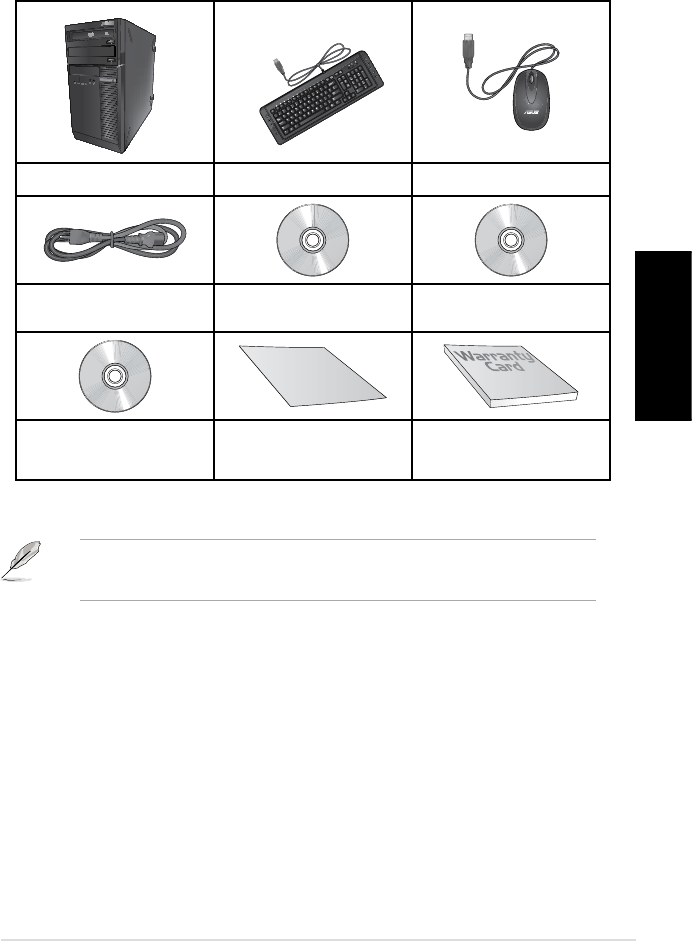
79
產品包裝內容
Installation Guide

80
81
繁體中文
第一章
系統導覽
了解您的個人電腦
歡迎
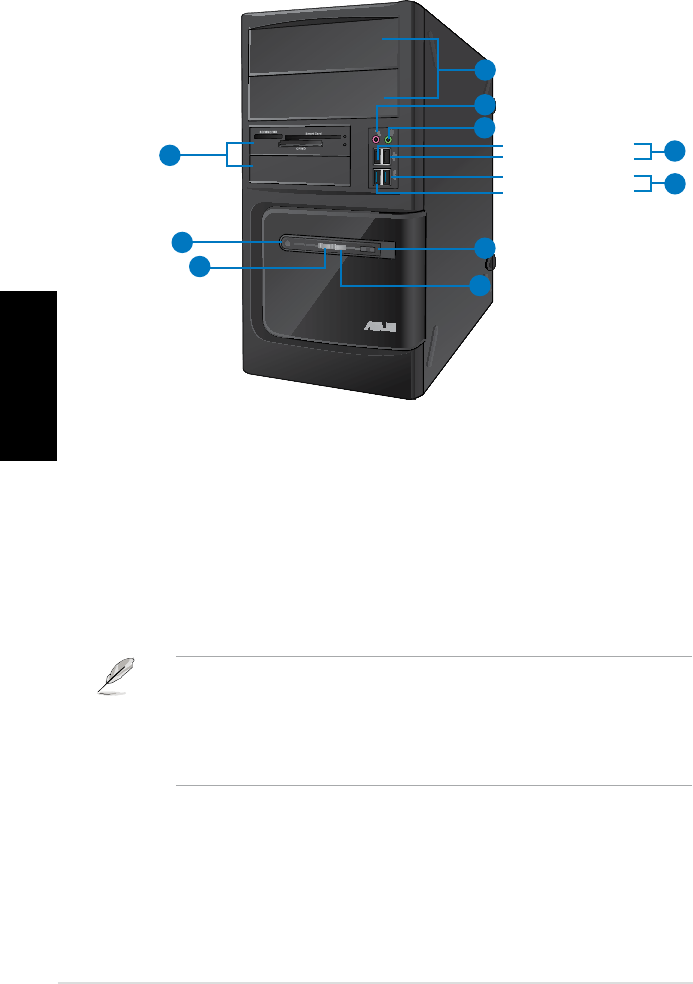
82
繁體中文
主機前面板
®
®
BM6635(MD560)
前 USB 2.0 連接埠 4
前 USB 3.0 連接埠 1
前 USB 3.0 連接埠 2
前 USB 2.0 連接埠 3
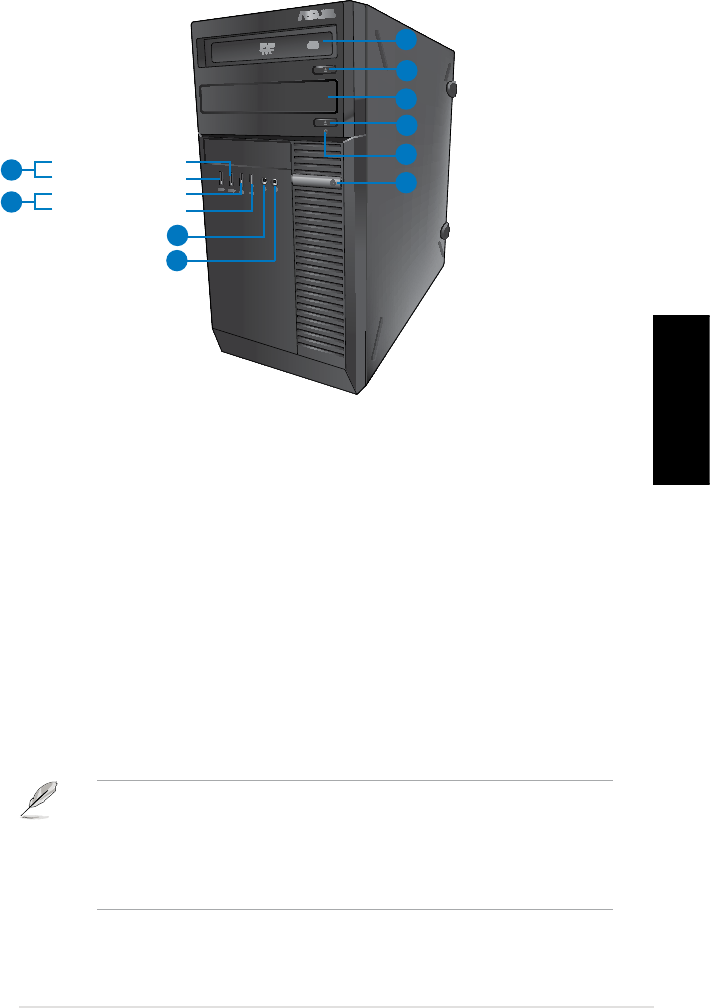
83
繁體中文
BM6835
®
®
前 USB 3.0 連接埠 2
前 USB 2.0 連接埠 3
前 USB 2.0 連接埠 4
前 USB 3.0 連接埠 1
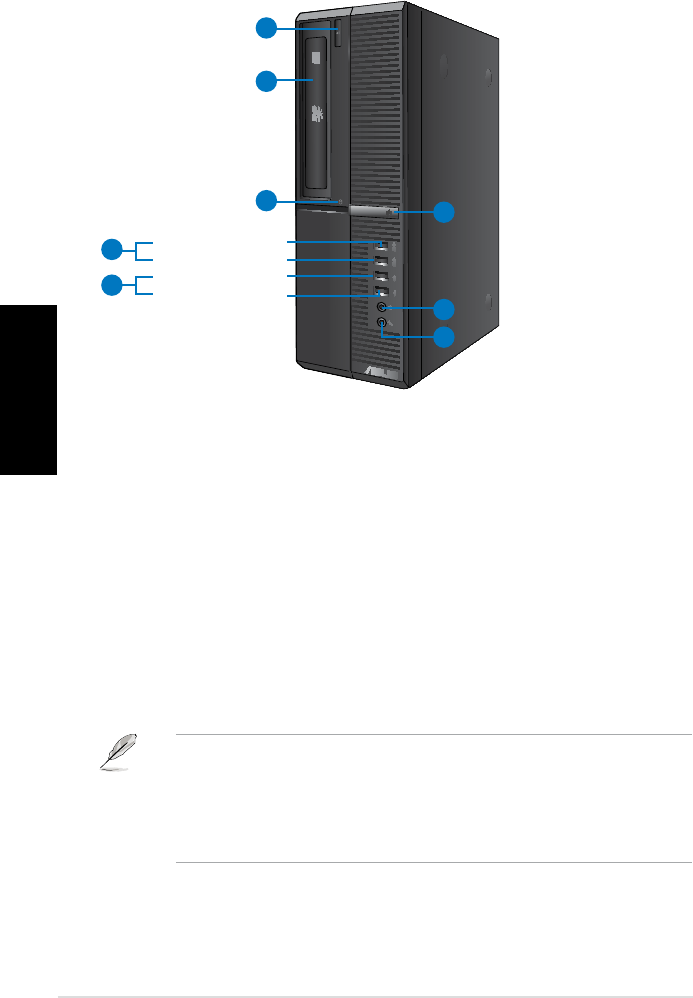
84
繁體中文
®
®
BP6335(SD560)
前 USB 3.0 連接埠 1
前 USB 2.0 連接埠 3
前 USB 2.0 連接埠 4
前 USB 3.0 連接埠 2
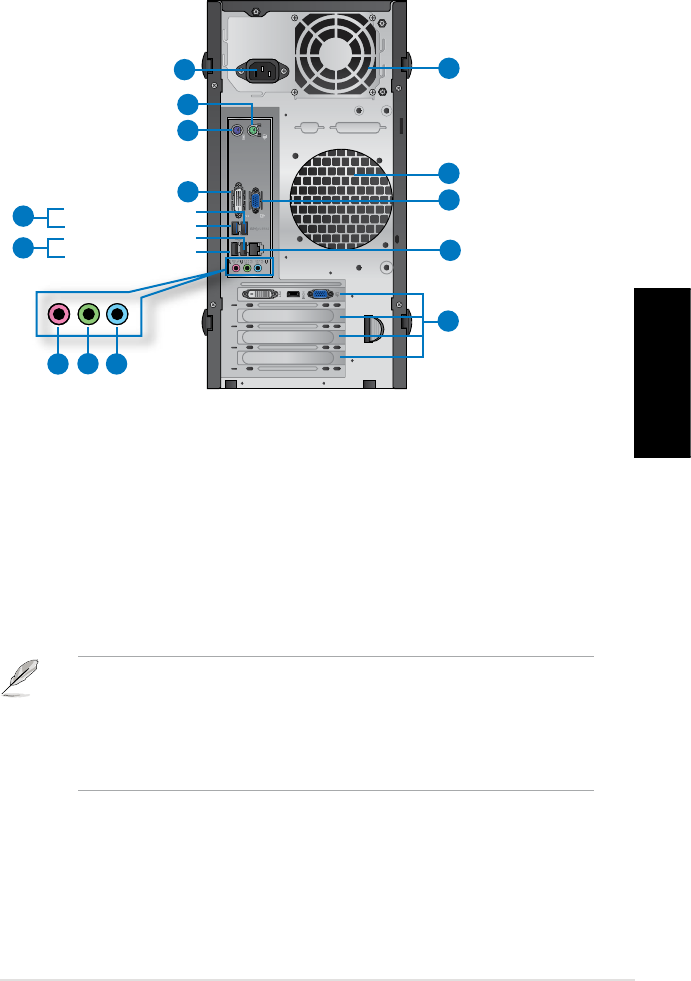
85
繁體中文
主機後面板
®
®
BM6635(MD560)
後 USB 3.0 連接埠 2
後 USB 3.0 連接埠 1
後 USB 2.0 連接埠 3
後 USB 2.0 連接埠 4
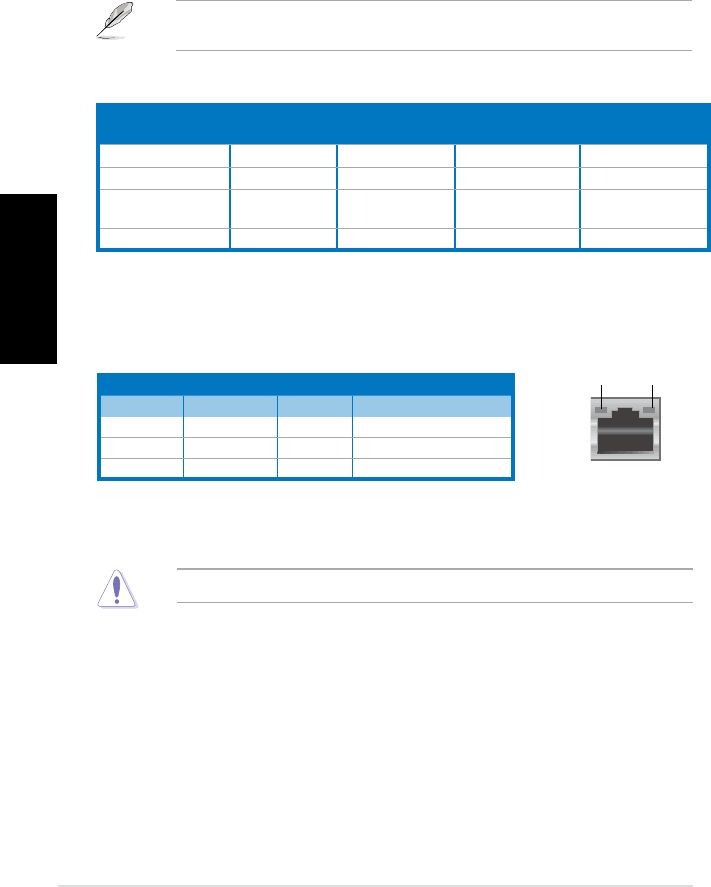
86
繁體中文
Activity/Link 指示燈 速度指示燈
狀態 描述 狀態 描述
網路連接埠
速度
指示燈
ACT/LINK
指示燈
網路指示燈說明
二、四、六、八聲道音效設定
接頭 耳機 / 二聲道
喇叭輸出
四聲道
喇叭輸出
六聲道
喇叭輸出
八聲道
喇叭輸出
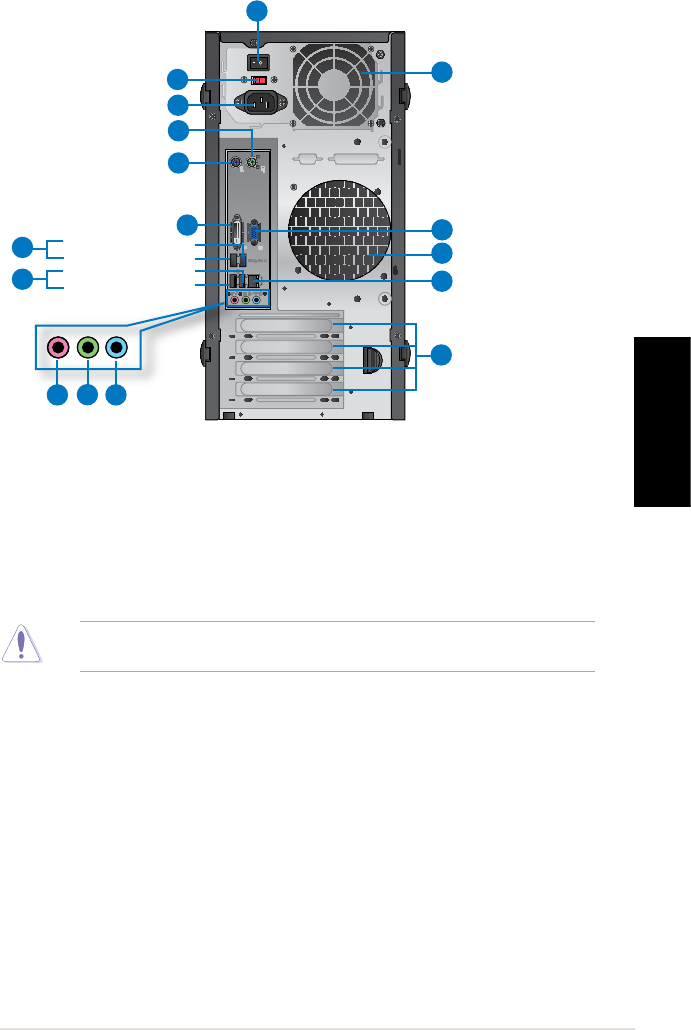
87
繁體中文
BM6835
後 USB 3.0 連接埠 2
後 USB 3.0 連接埠 1
後 USB 2.0 連接埠 3
後 USB 2.0 連接埠 4
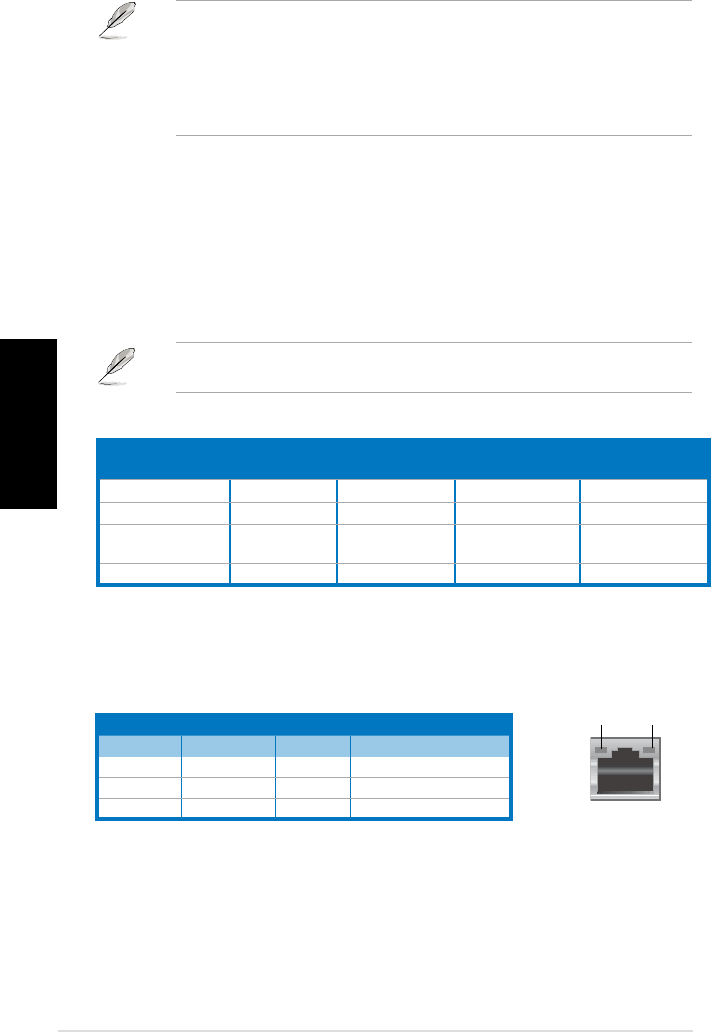
88
繁體中文
Activity/Link 指示燈 速度指示燈
狀態 描述 狀態 描述
網路連接埠
速度
指示燈
ACT/LINK
指示燈
網路指示燈說明
二、四、六、八聲道音效設定
®
®
接頭 耳機 / 二聲道
喇叭輸出
四聲道
喇叭輸出
六聲道
喇叭輸出
八聲道
喇叭輸出
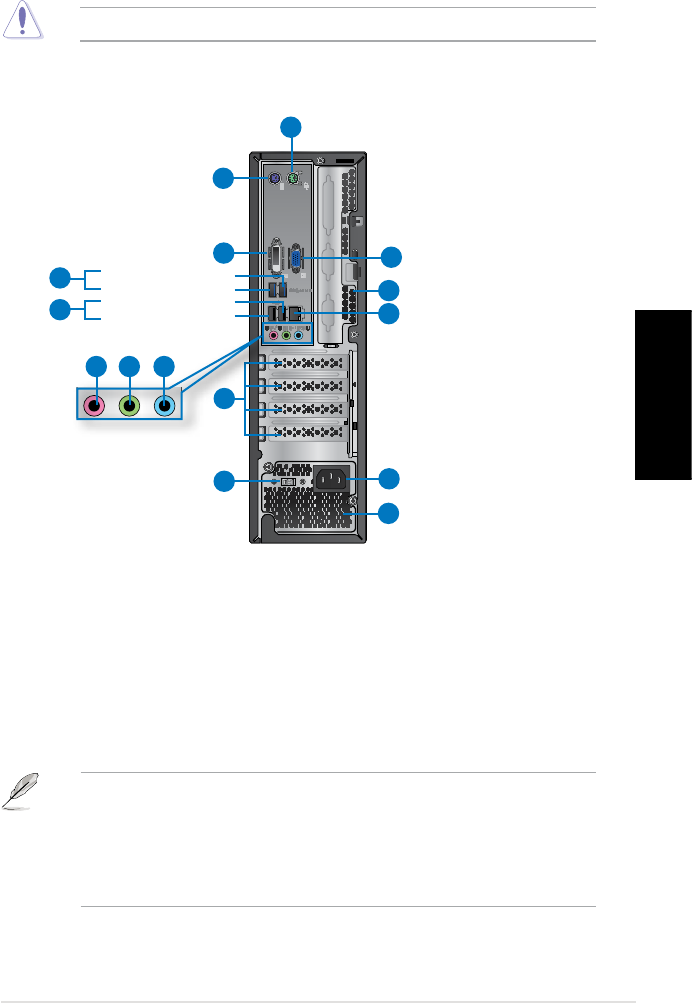
89
繁體中文
BP6335(SD560)
®
®
後 USB 3.0 連接埠 2
後 USB 3.0 連接埠 1
後 USB 2.0 連接埠 3
後 USB 2.0 連接埠 4
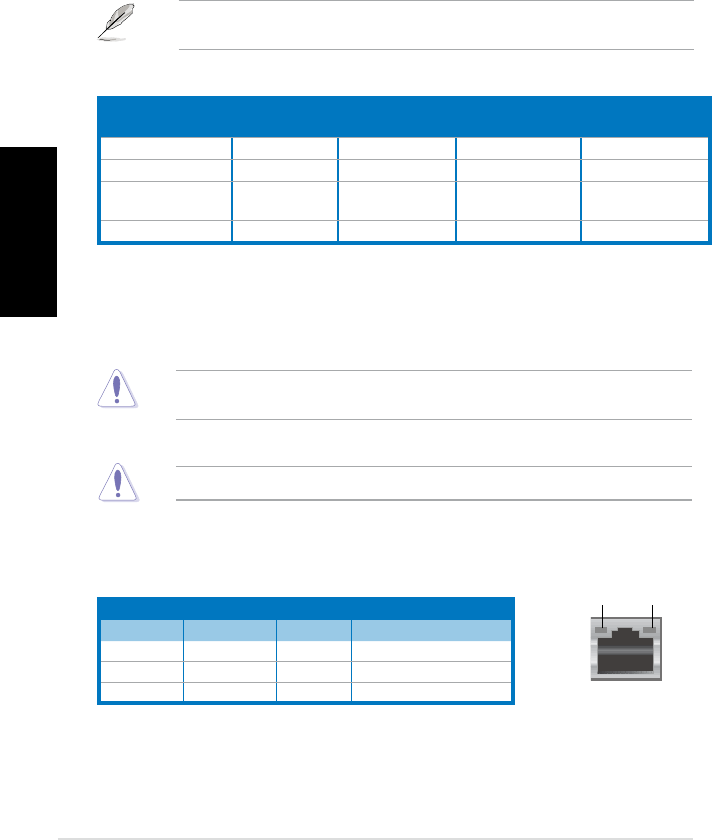
90
繁體中文
二、四、六、八聲道音效設定
Activity/Link 指示燈 速度指示燈
狀態 描述 狀態 描述
網路指示燈說明
網路連接埠
速度
指示燈
ACT/LINK
指示燈
接頭 耳機 / 二聲道
喇叭輸出
四聲道
喇叭輸出
六聲道
喇叭輸出
八聲道
喇叭輸出
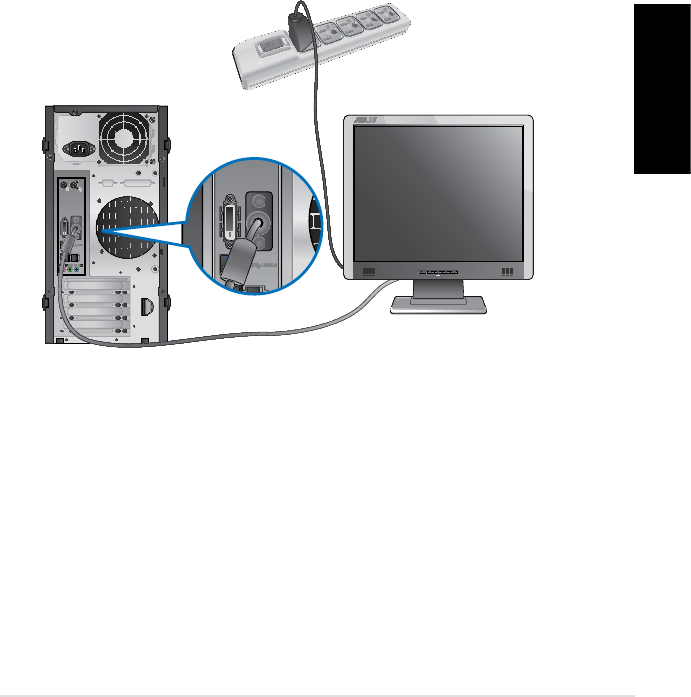
91
繁體中文
安裝您的個人電腦
使用內建顯示輸出連接埠
請按照以下步驟使用內建顯示輸出連接埠連接一個外接顯示器:
BM6635(MD560)
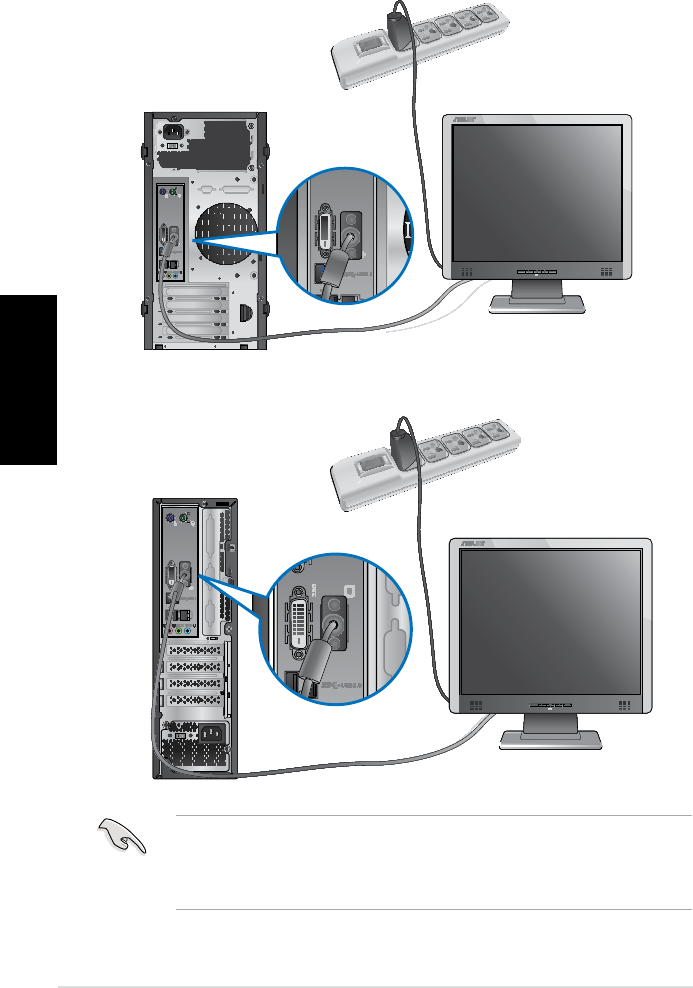
92
繁體中文
BM6835
BP6335(SD560)
「連接多個外接顯示器」
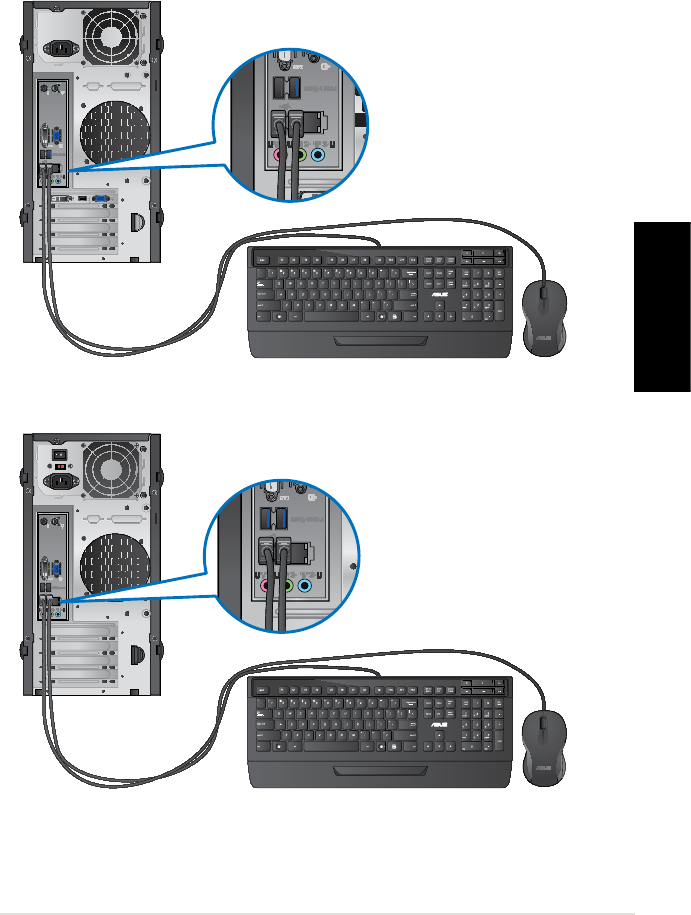
93
繁體中文
連接 USB 鍵盤與滑鼠
BM6635(MD560)
BM6835
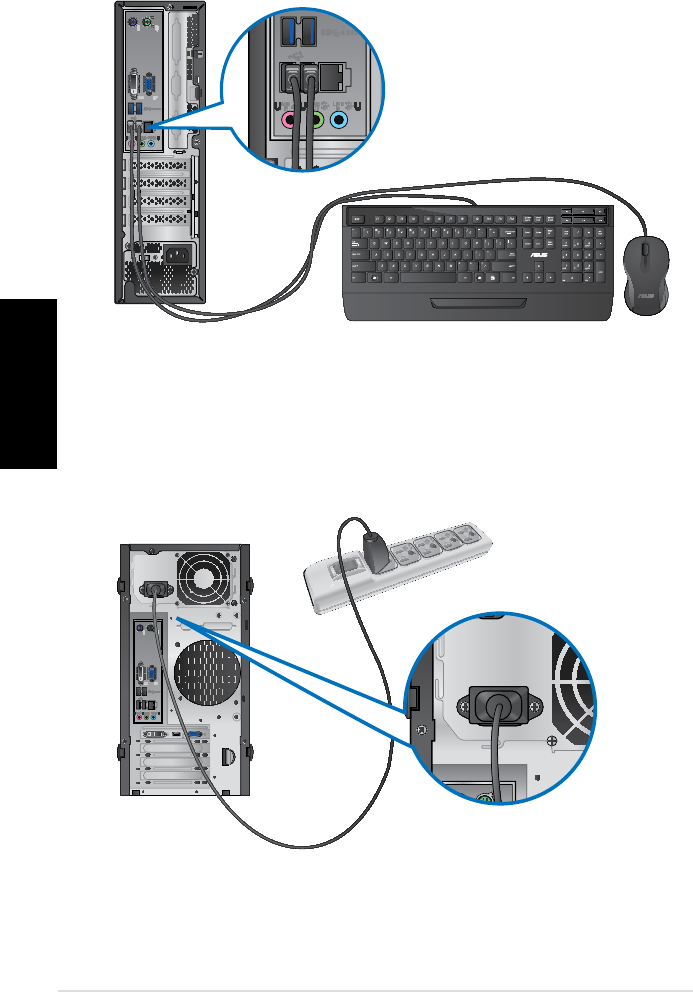
94
繁體中文
BP6335(SD560)
連接電源線
BM6635(MD560)
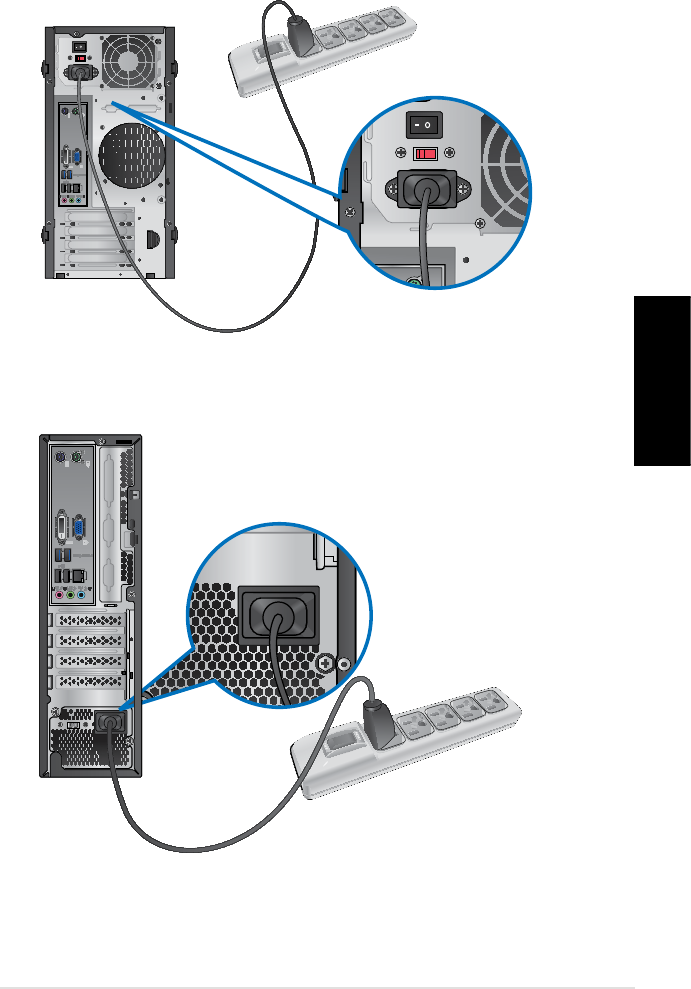
95
繁體中文
BP6335(SD560)
BM6835
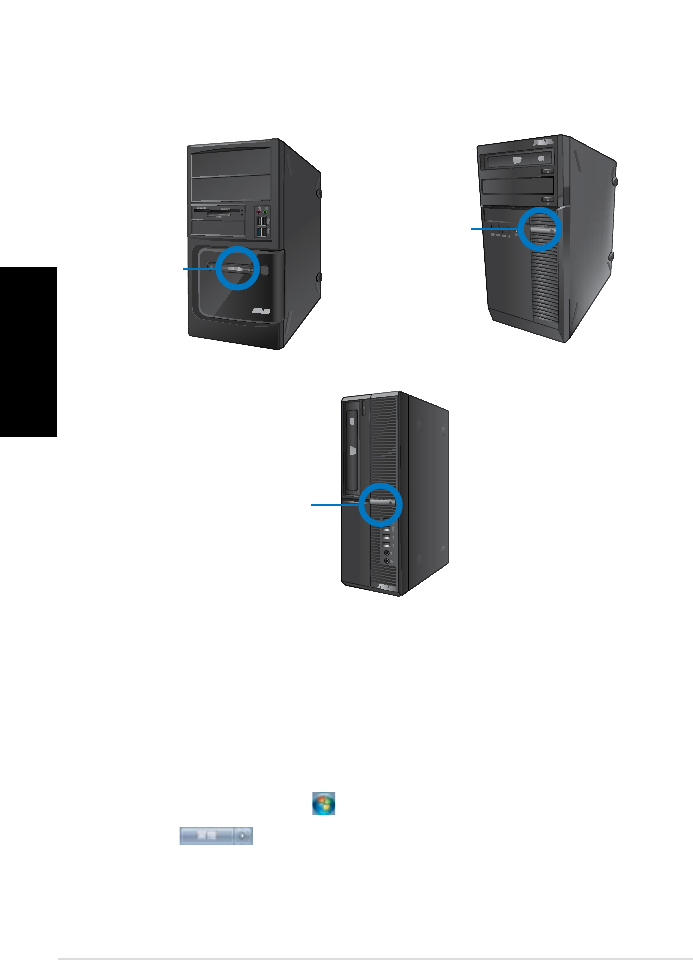
96
繁體中文
開啟或關閉您的電腦
開啟您的電腦
請按照以下步驟開啟您的電腦:
關閉您的電腦
請按照以下步驟關閉您的電腦:
®
電源開關
BM6835
BM6635(MD560)
BP6335(SD560)
電源開關
電源開關
華碩
97
第二章
使用 Windows® 7(選配)
第一次啟動
®
®
當電腦第一次啟動時,請按照以下步驟操作:
設定 Windows
下一步
下一
步
下一步
下一步
下一步
我願意接受許可條款下一步
使用推薦設定僅安裝重要更新
以後問我
下一步
「設定使用者帳號及密碼」
98
第二章:使用 Windows®7
使用 Windows® 7 桌面
使用開始功能表
說明及支援
®
從開始功能表進入選項
請按照以下步驟由開始功能表進入選項:
®
您可以將您常用的程式釘在開始功能表中成為一個小圖示。更多資訊請參閱本章節
「在開始功能表或工作列中新增程式」。
說明及支援®
使用 開始使用 選項
開始使用®
®
請按照以下步驟使用 開始使用 :
®
開始 > 控制台 > 開始使用
使用工作列
從工作列進入程式
請按照以下步驟從工作列進入程式:
您可以將您常用的程式釘在開始功能表中成為一個小圖示。更多資訊請參閱本章節
「在開始功能表或工作列中新增程式」。
華碩
99
在捷徑中新增選項
請按照以下步驟將選項釘在捷徑:
將此程式釘選到工作列
在捷徑中移除選項
請按照以下步驟在捷徑中移除選項:
將此程式從工作列取消
釘選
在開始功能表或工作列中新增程式
釘選到工作列釘選到 [開始] 選單
請按照以下步驟在開始功能表或工作列中新增程式:
在開始功能表中移除程式
請按照以下步驟在開始功能表中移除程式:
從開始功能表取
消釘選
在工作列中移除程式
請按照以下步驟在工作列中移除程式:
將此程式從工作列取消
釘選
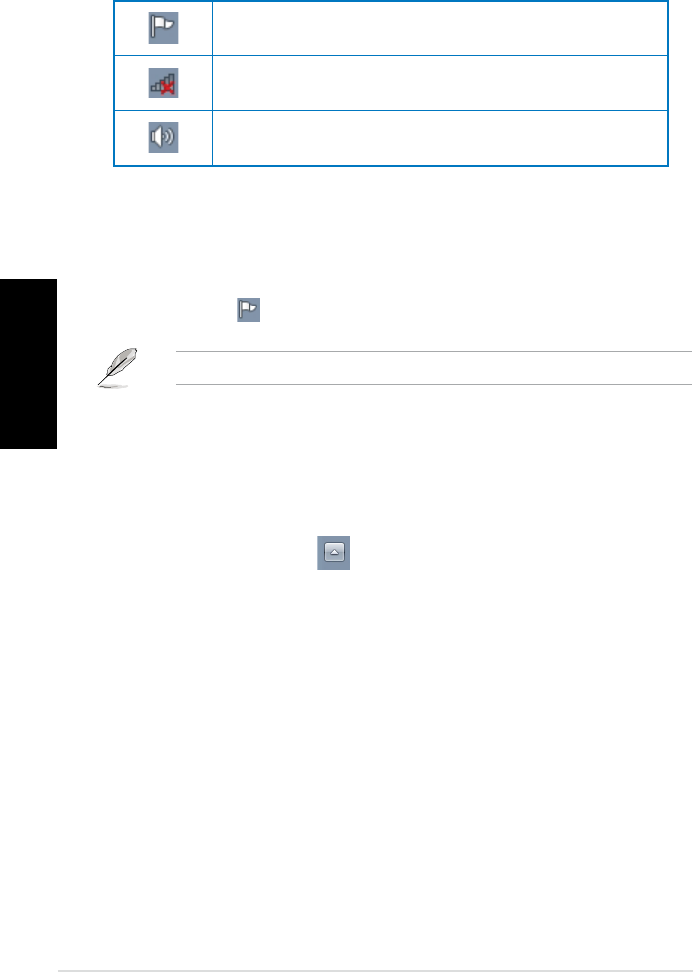
100
第二章:使用 Windows®7
使用通知區域
作業中心通知
®
網路連線
音量
顯示通知
請按照以下步驟顯示通知:
重要訊息
「Windows®作業中心」
個人化圖示與通知
請按照以下步驟個人化圖示或通知:
個人化
華碩
101
管理檔案與資料夾
使用 Windows® 瀏覽器
®
進入 Windows® 瀏覽器
請按照以下步驟進入 Windows® 瀏覽器:
電腦®
瀏覽檔案與資料夾
請按照以下步驟瀏覽檔案與資料夾:
®
個人化檔案或資料夾圖示
請按照以下步驟個人化資料夾預覽方式圖示:
®
檢視
排列您的檔案
請按照以下步驟排列您的檔案:
®
排列方式
102
第二章:使用 Windows®7
排序您的檔案
請按照以下步驟排列您的檔案:
®
排序方式
將檔案進行分組
請按照以下步驟將檔案進行分組:
®
分組方式
新增一個新資料夾
請按照以下步驟新增一個新資料夾:
®
新增
新增 > 資料夾
備份檔案
設定備份
請按照以下步驟設定備份:
>所有程式 > 維護 > 備份與還原
設定備份下一步
下一步
讓 Windows® 選擇(推薦) 讓我選擇
讓 Windows 選擇 ®
華碩
103
還原您的系統
®
請按照以下步驟還原您的系統:
> 所有程式 > 附件 > 系統工具 > 系統還原
保護您的電腦
使用 Windows® 7 作業中心
®
「個性化圖示與通知」
進入 Windows® 7 作業中心
請按照以下步驟進入Windows® 7 作業中心:
開啟行動作業中心
使用 Windows® Update
®
進入 Windows® Update
請按照以下步驟進入 Windows® Update:
®
所有程式 > Windows® Update
®

104
第二章:使用 Windows®7
設定使用者帳戶與密碼
設定使用者帳戶
請按照以下步驟設定使用者帳戶:
® 開始使用新增新使用者
管理其他帳戶
建立一個新帳戶
標準使用者系統管理員
建立帳戶
設定使用者密碼
請按照以下步驟設定使用者密碼:
變更您的使用者帳戶
變更密碼
華碩
105
啟動防毒軟體(視具體機型而定)
請按照以下步驟啟動趨勢科技網路安全(Trend Micro Internet Security):
同意並啟動
下一步
完成
進入 Windows® 說明及支援
®®
說明及支援®
®

106
第二章:使用 Windows®7
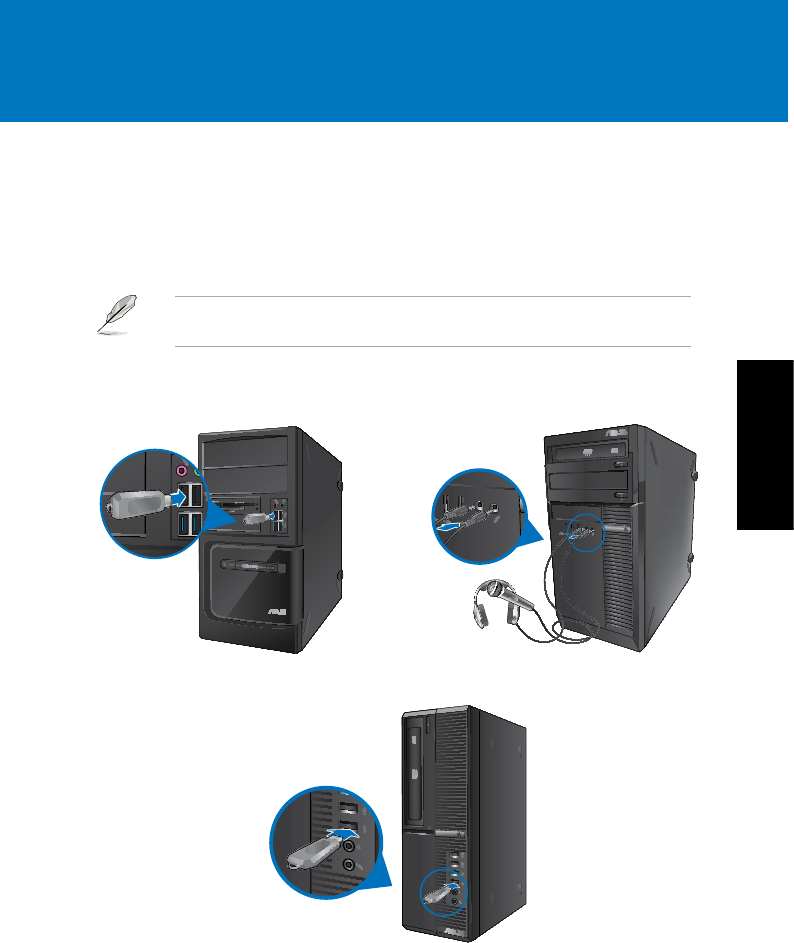
華碩 BM6635(MD560), BM6835, BP6335(SD560)
繁體中文
第三章
裝置連接
連接 USB 儲存裝置
前面板
BM6875
BM6675
BP6375
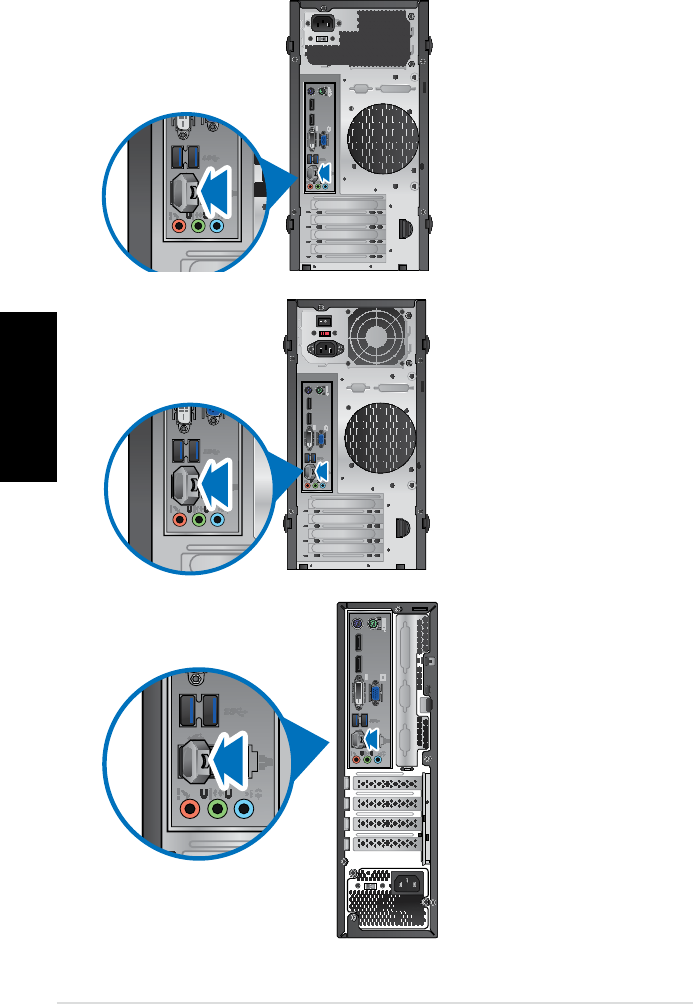
108
第三章:裝置連接
後面板
BM6635(MD560)
BM6835
BP6335(SD560)
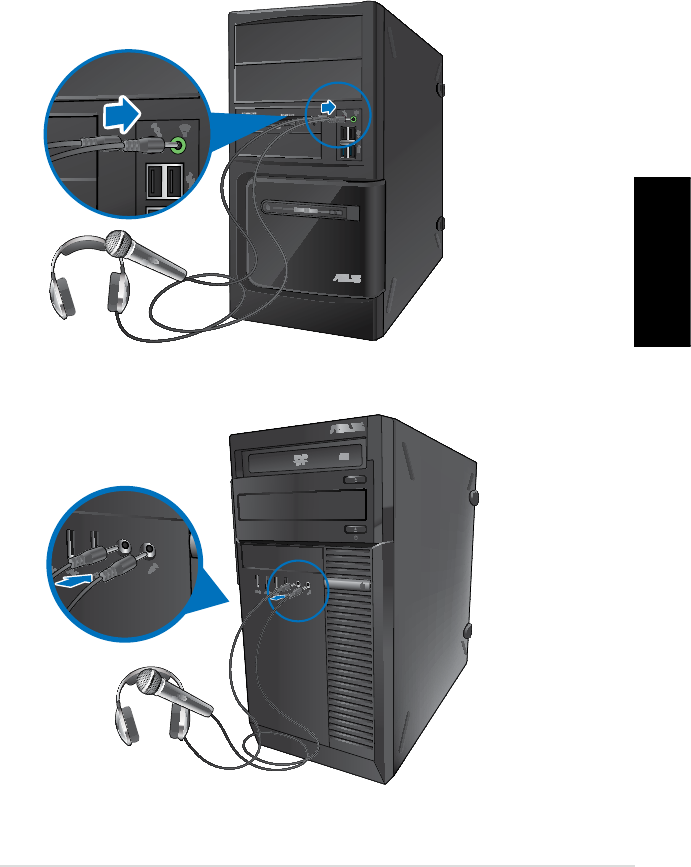
109
華碩 BM6635(MD560), BM6835, BP6335(SD560)
連接麥克風與喇叭
連接耳機與話筒
BM6835
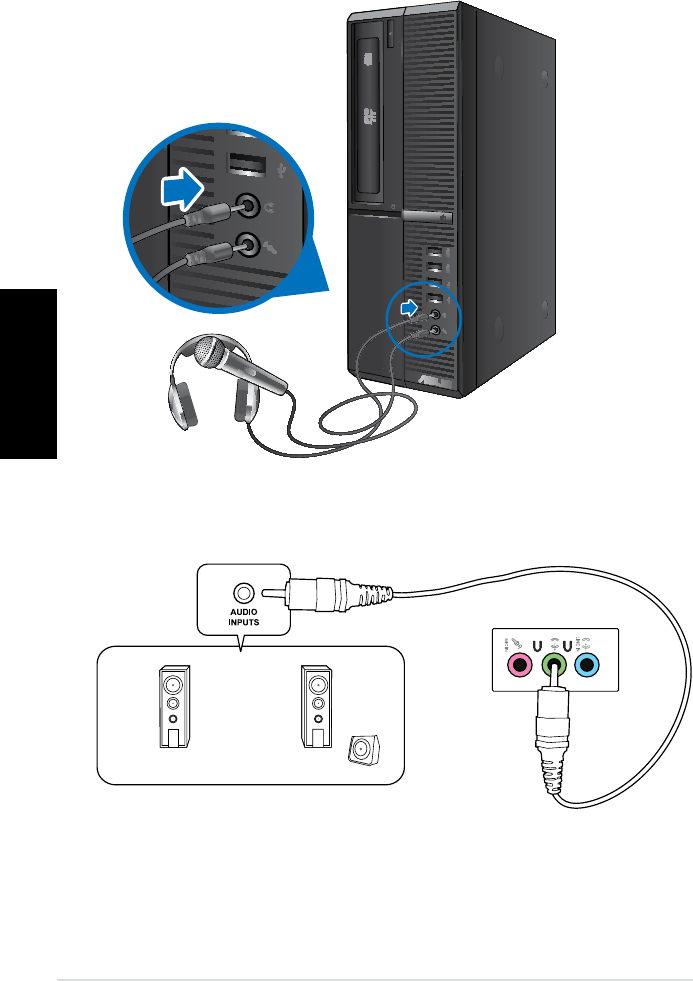
110
第三章:裝置連接
連接二聲道喇叭
BP6335(SD560)
LINE OUT
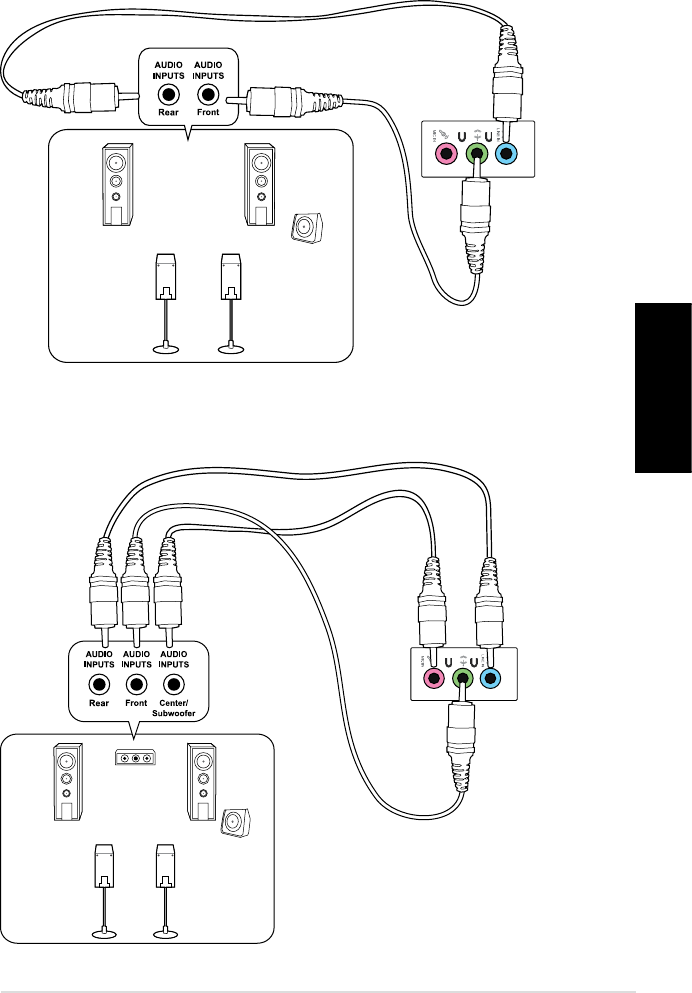
111
華碩 BM6635(MD560), BM6835, BP6335(SD560)
連接四聲道喇叭
連接六聲道喇叭
LINE OUT
LINE OUT
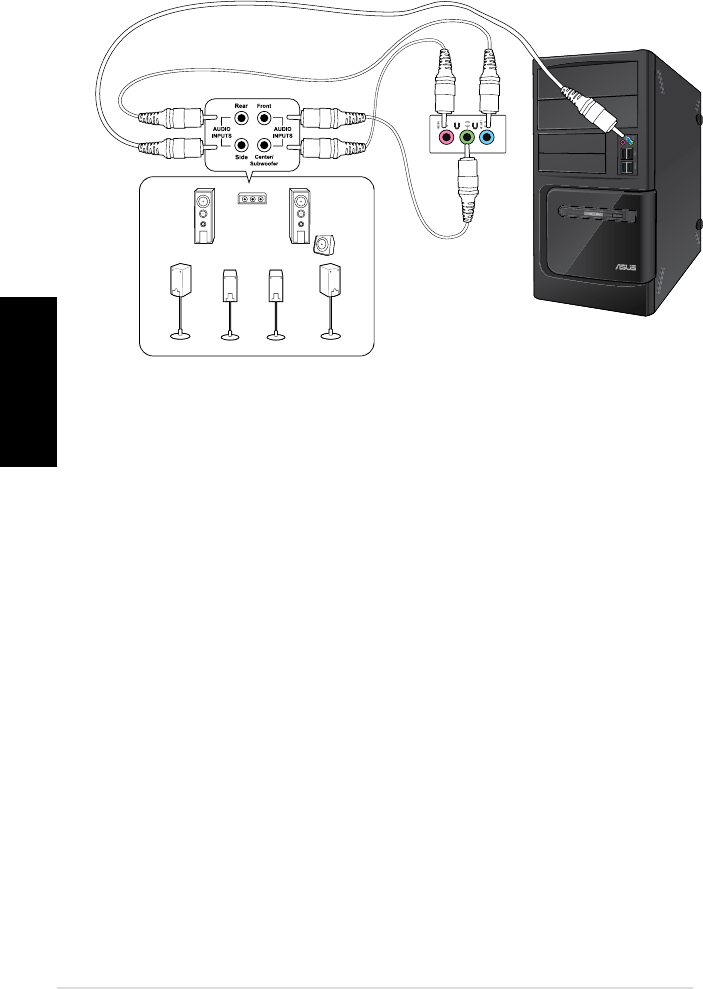
112
第三章:裝置連接
連接八聲道喇叭
LINE OUT
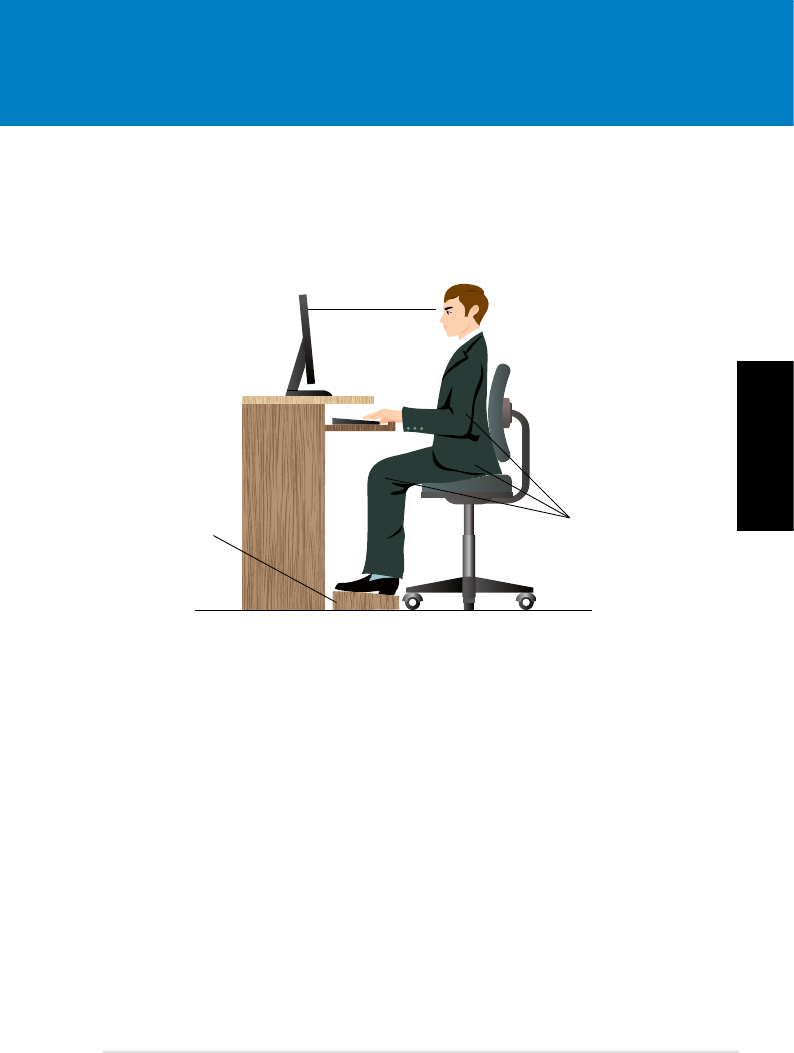
113
華碩
第四章
使用您的電腦
使用電腦時的適當姿勢
視線與顯示器螢幕頂部相持平
腳蹬 90˚ 度
請參考以下幾項保持適當姿勢:
繁體中文
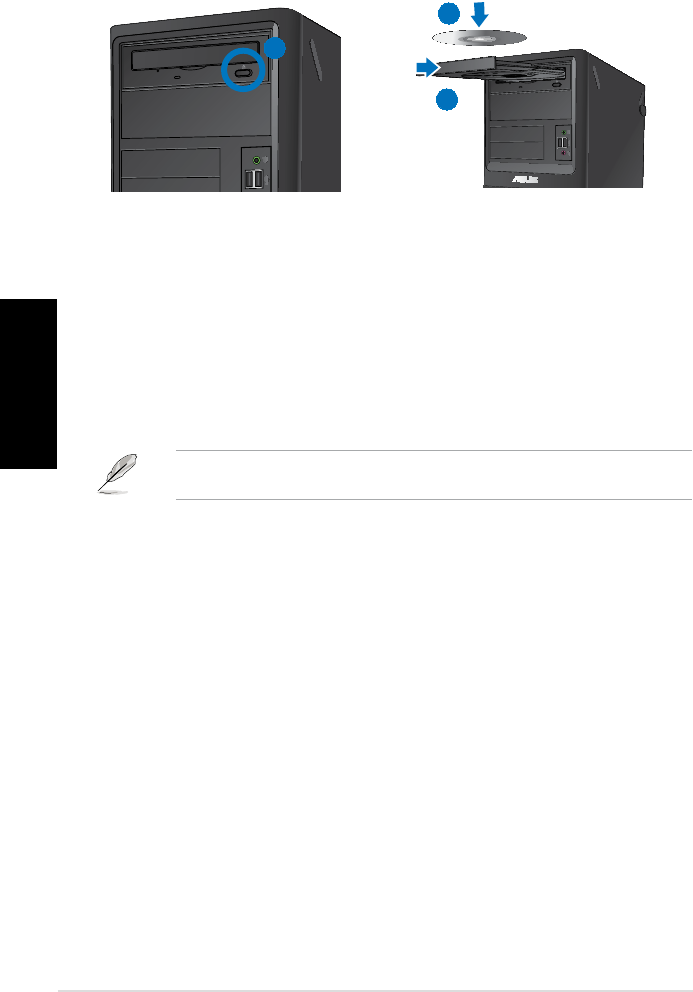
114
第四章:使用您的電腦
繁體中文
繁體中文
繁體中文
繁體中文
使用光碟機(僅限指定機型)
放入光碟
請按照以下步驟放入光碟:
自動播放檔案
退出光碟
請按照以下步驟退出光碟:
退出
電腦退出
電腦
1
2
3
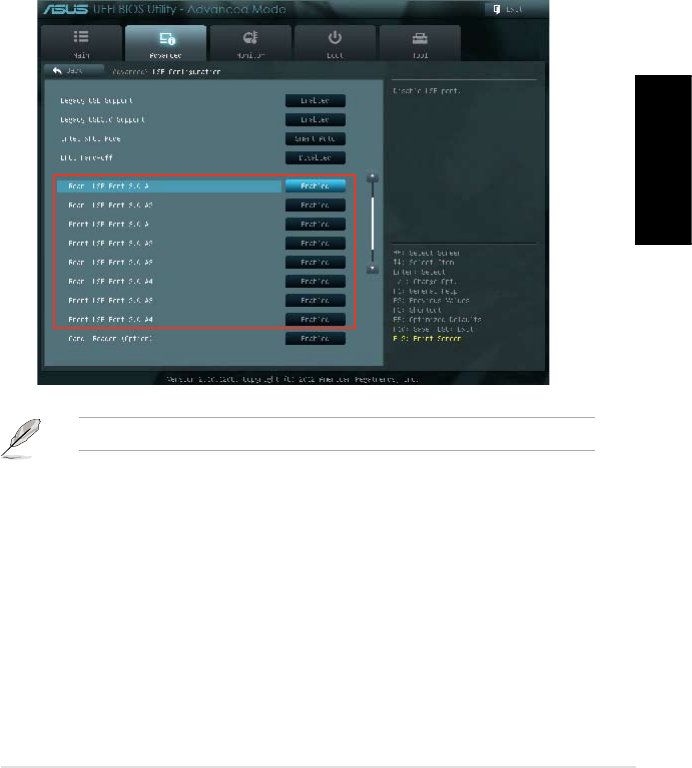
華碩
115
繁體中文
繁體中文
繁體中文
繁體中文
使用 BIOS 設定 USB 連接埠
請按照以下步驟開啟或關閉 USB 連接埠:

116
第四章:使用您的電腦
繁體中文
繁體中文
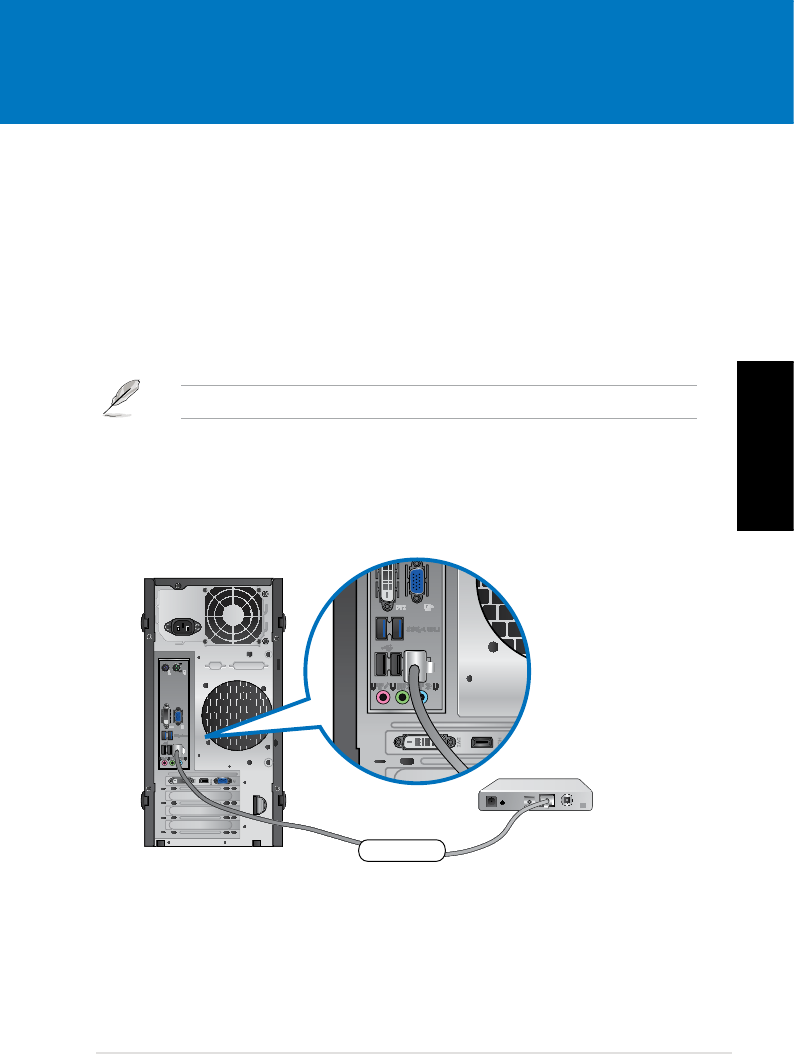
華碩
117
第五章
網路連線
透過 DSL/Cable modem 連接網路
請按照以下步驟透過 DSL/Cable modem 連接網路:
有線連接
BM6635(MD560)
繁體中文
Modem
RJ-45 cable
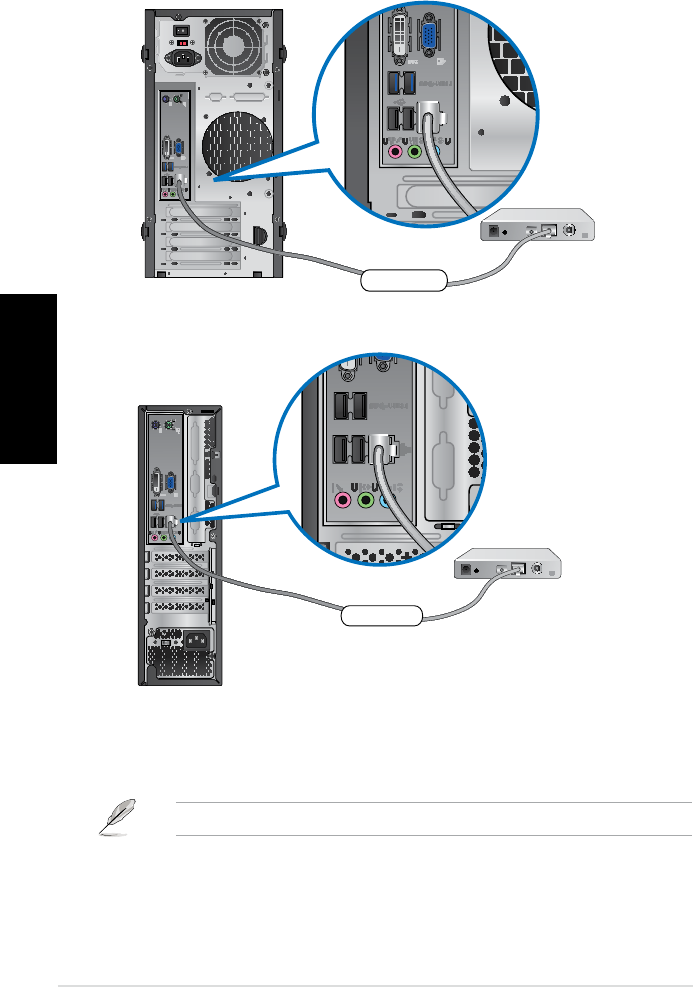
118
第五章:網路連線
繁體中文
BM6835
BP6335(SD560)
Modem
RJ-45 cable
Modem
RJ-45 cable
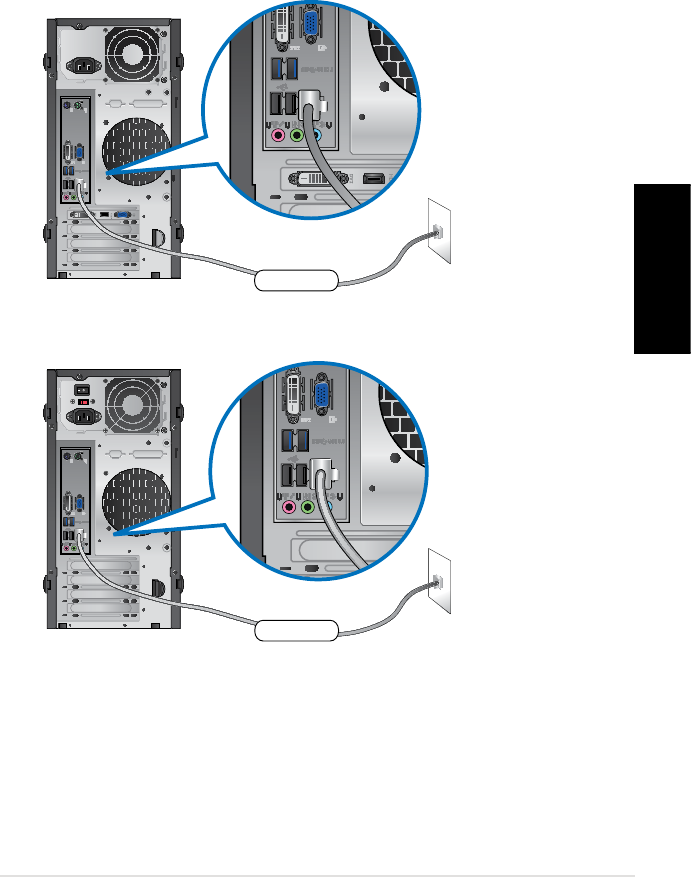
華碩
119
繁體中文
透過區域網路連接網路 (LAN)
請按照以下步驟透過區域網路連接網路:
BM6635(MD560)
BM6835
RJ-45 cable LAN
RJ-45 cable LAN
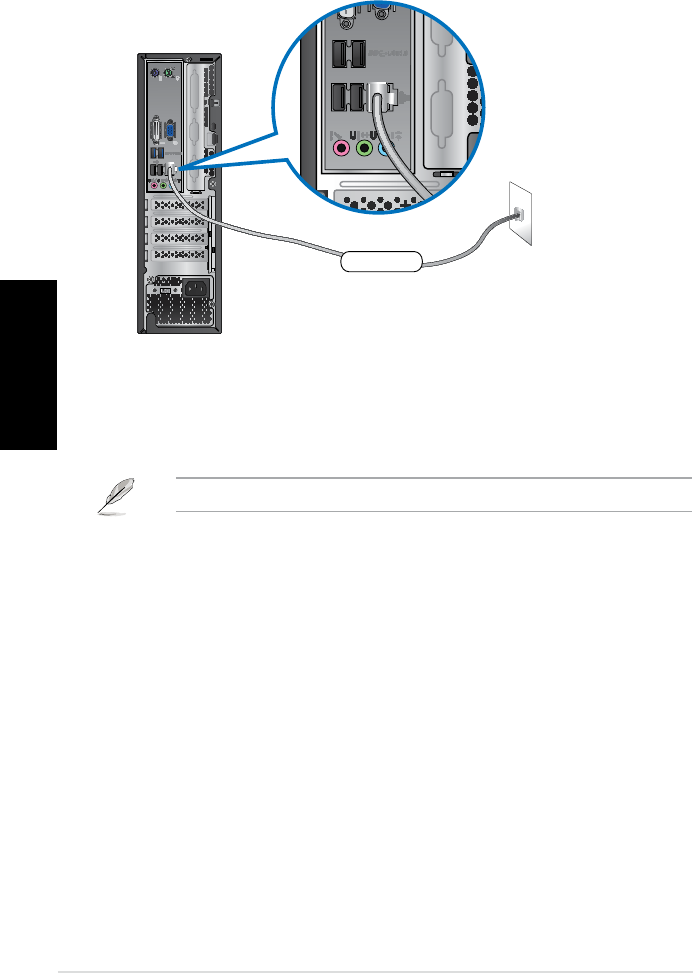
120
第五章:網路連線
繁體中文
BP6335(SD560)
RJ-45 cable LAN
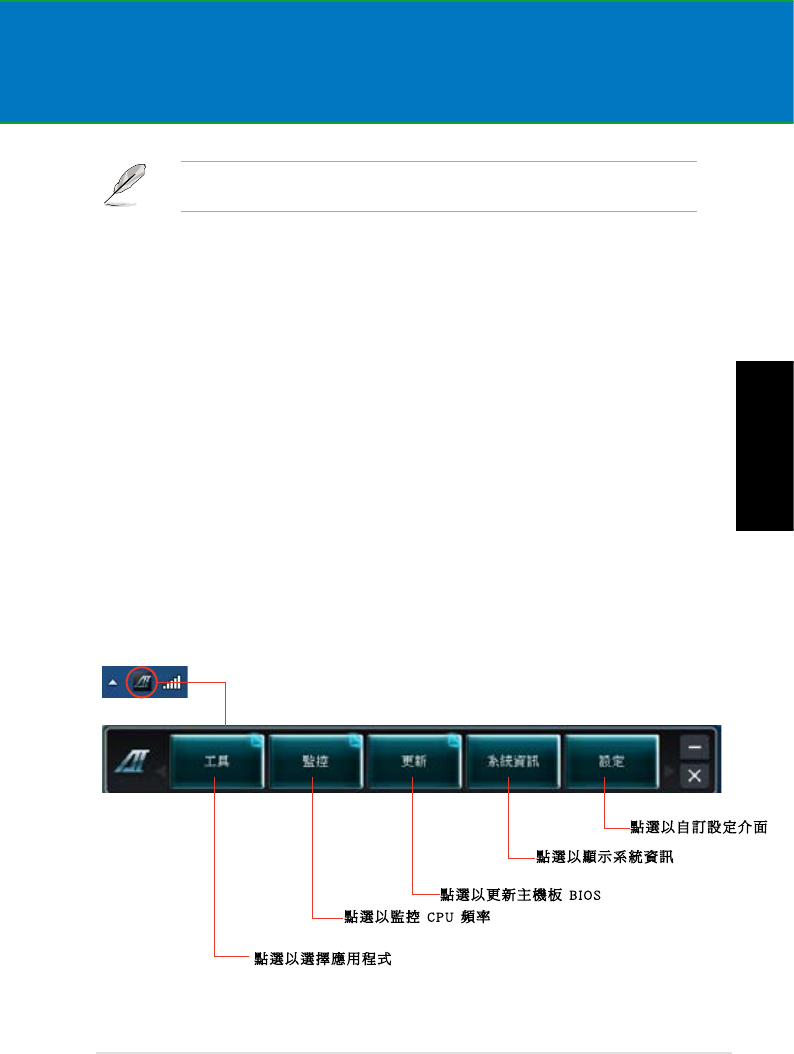
華碩
121
第六章
使用應用程式(選配)
繁體中文
繁體中文
華碩 AI Suite II
安裝 AI Suite II
請按照以下步驟安裝 AI Suite II:
驅動程式與
執行 AI Suite II
「回復您的系統」
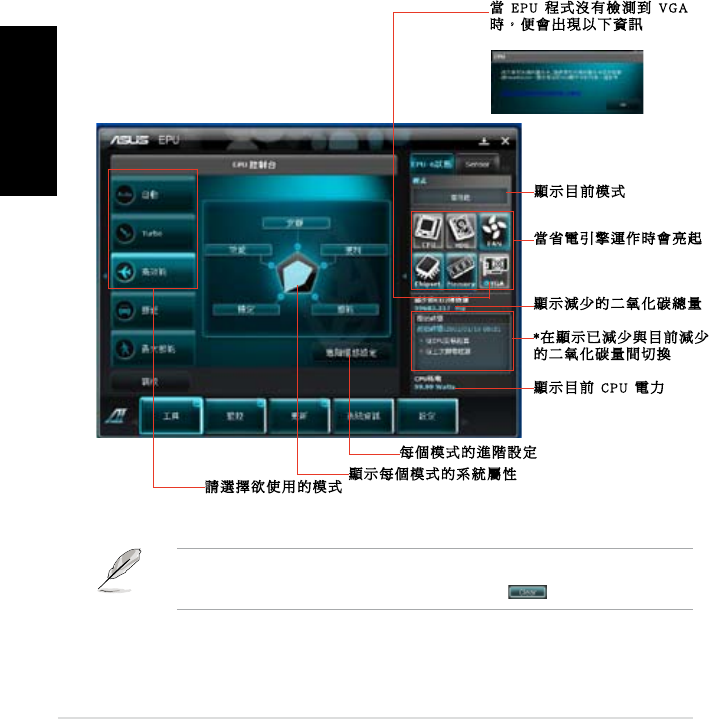
122
第六章:使用應用程式
繁體中文
繁體中文
繁體中文
繁體中文
華碩 EPU 程式
執行 EPU 程式:
Tool > EPU
工具選單
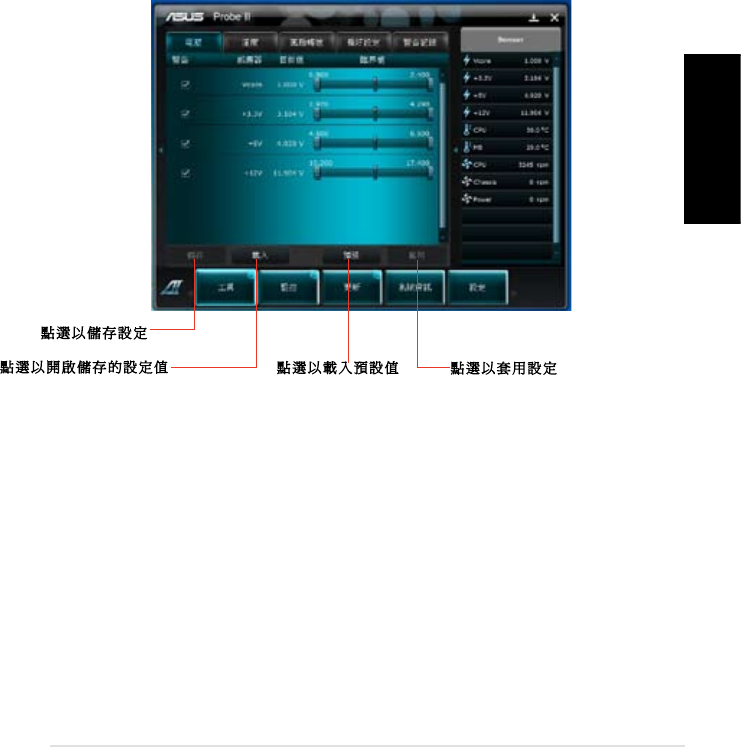
華碩
123
繁體中文
繁體中文
繁體中文
繁體中文
華碩 Probe II 程式
執行 Probe II 程式:
Tool > Probe
設定華碩 Probe II 程式:
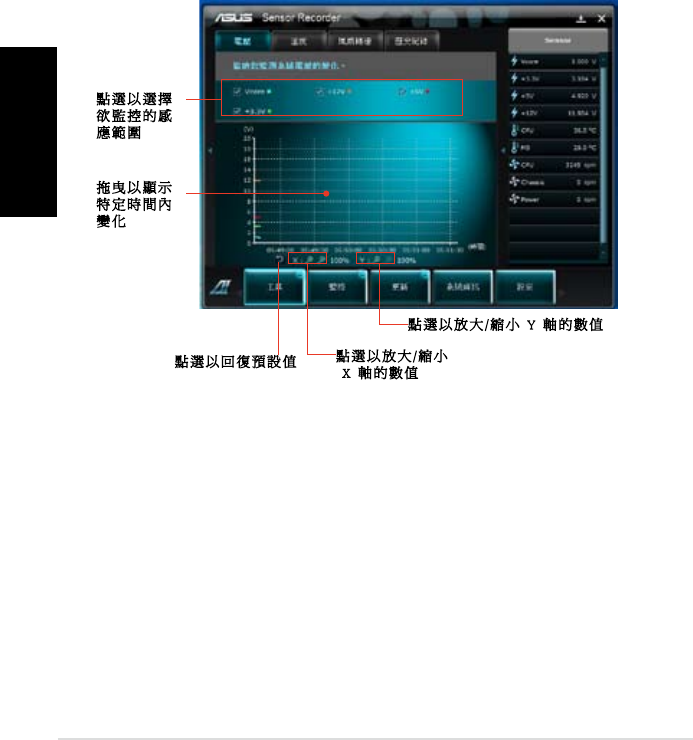
124
第六章:使用應用程式
繁體中文
繁體中文
繁體中文
繁體中文
華碩 Sensor Recorder 程式
執行華碩 Sensor Recorder 程式
Tool > Sensor Recorder
設定華碩 Sensor Recorder 程式

華碩
125
繁體中文
繁體中文
繁體中文
繁體中文
監控功能
Sensor
Monitor > Sensor
CPU Frequency
Monitor > CPU Frequency
使用網路更新 BIOS 程式
Update BIOS from the InternetNext
Next
Yes
No
華碩線上更新
更新功能
126
第六章:使用應用程式
繁體中文
繁體中文
繁體中文
繁體中文
使用 BIOS 檔案更新 BIOS 程式
請按照以下步驟使用 BIOS 檔案更新 BIOS 程式:
Update BIOS from a fileNext
Next
Yes No
MyLogo
载

華碩
127
繁體中文
繁體中文
繁體中文
繁體中文
系統資訊
自訂使用者介面
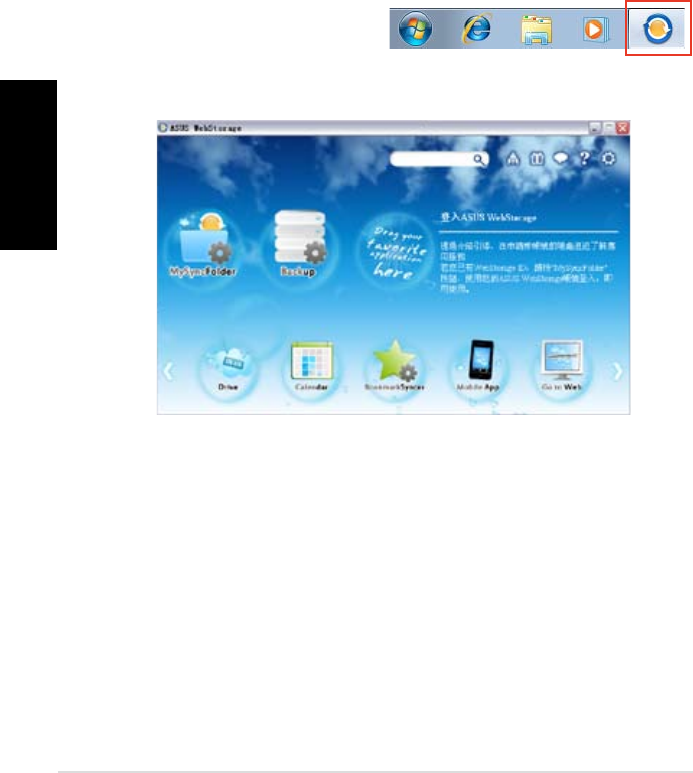
128
第六章:使用應用程式
繁體中文
繁體中文
繁體中文
繁體中文
華碩網路儲存器
安裝網路儲存器
請參考以下內容安裝網路儲存器:
驱
開啟網路儲存器
® 開始
所有程式 華碩應用程式 網路儲存
器
Drive
Backup
自動備份
MySyncFolder
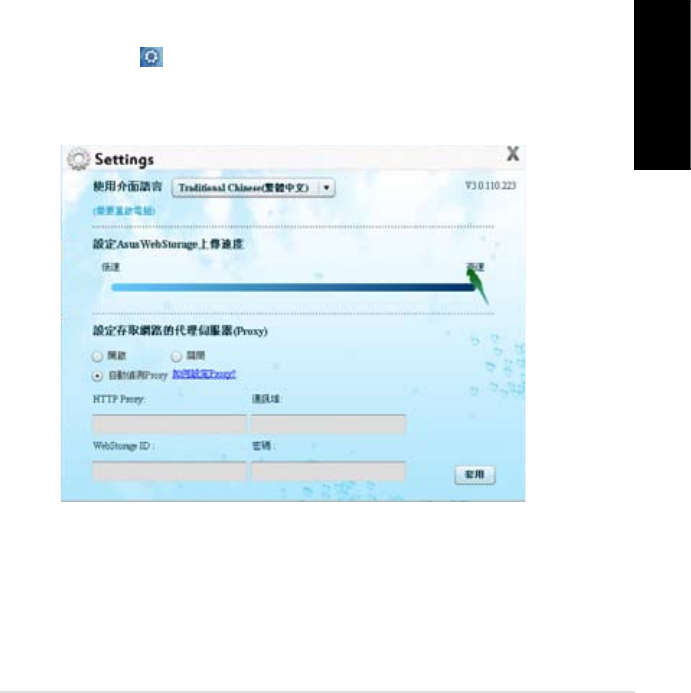
華碩
129
繁體中文
繁體中文
繁體中文
繁體中文
Calendar
BookmarkSyncer
MobileApp
Go to Web
設定
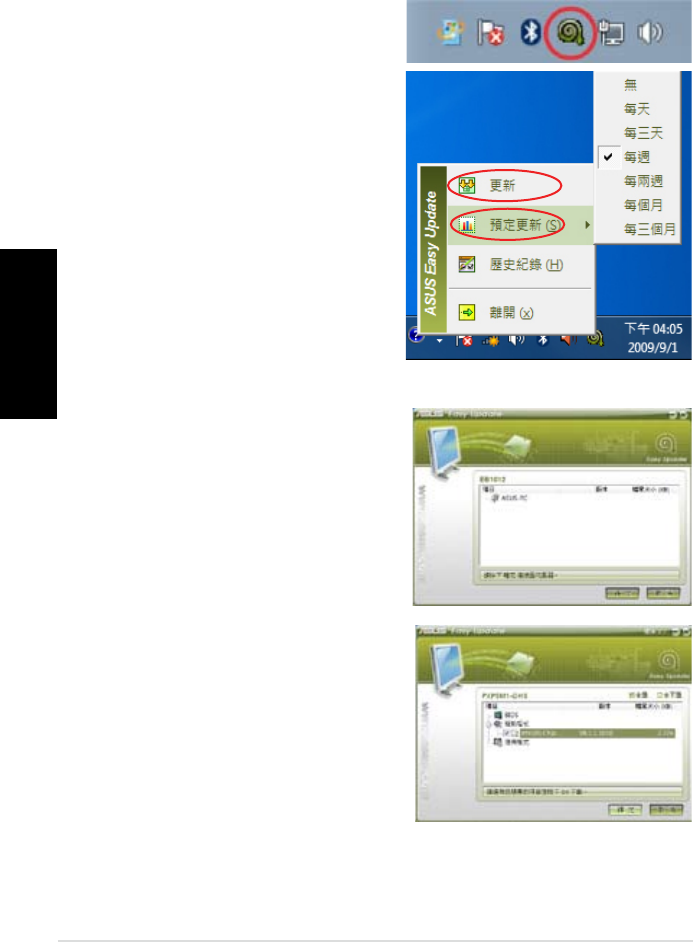
130
第六章:使用應用程式
繁體中文
繁體中文
繁體中文
繁體中文
華碩 Easy Update
®
預定更新
更新
確定
確定
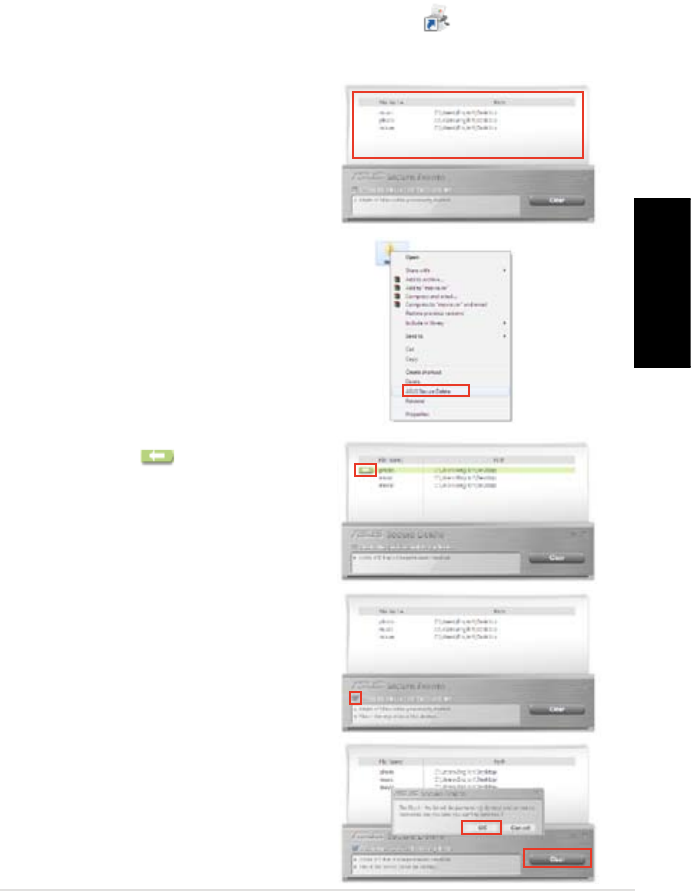
華碩
131
繁體中文
繁體中文
繁體中文
繁體中文
華碩 Secure Delete
請依據以下步驟使用華碩 Secure Delete:
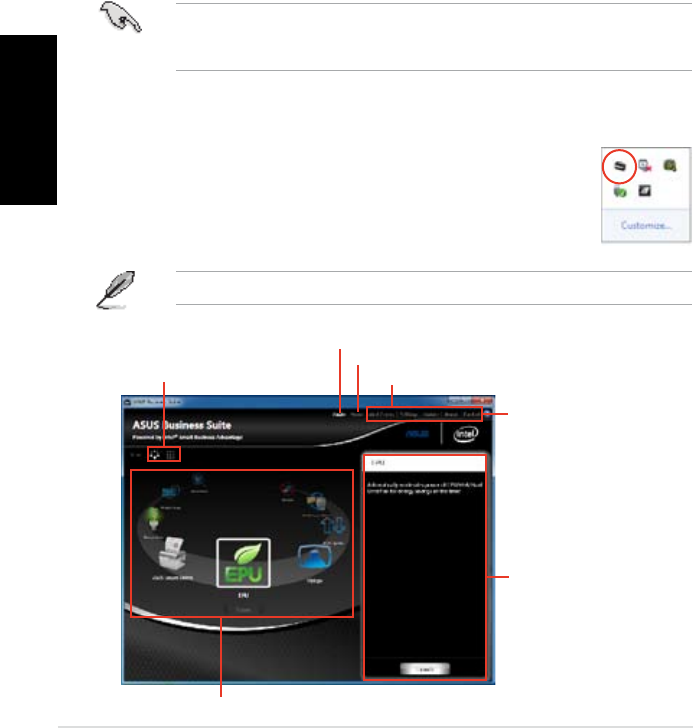
132
第六章:使用應用程式
繁體中文
繁體中文
繁體中文
繁體中文
華碩 Business Suite
®
®
®
安裝華碩 ASUS Business Suite
請依據以下步驟安裝華碩 Business Suite:
使用華碩 Business Suite
®
®
主選單
點選一個圖標進入相應程式
狀況欄
點選以改變圖標的顯示方式 點選顯示子選單
點選打開幫助檔案獲得關於使
用 Intel® SBA 功能的更多幫助
點選返回主頁面
點選顯示 登入/登出選單
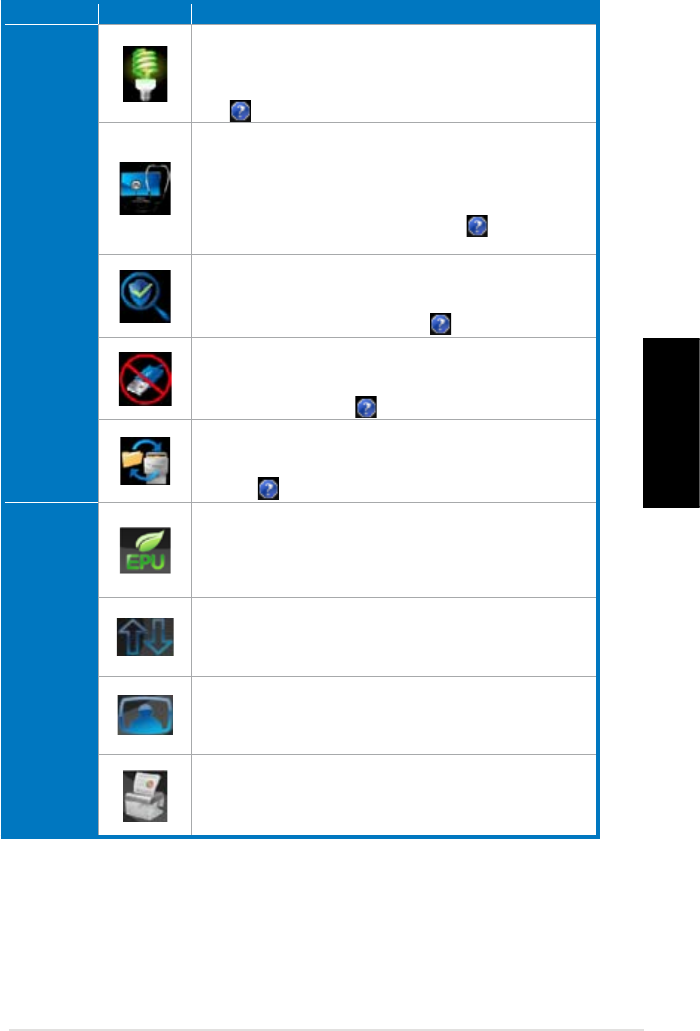
華碩
133
繁體中文
繁體中文
繁體中文
繁體中文
圖標 描述
Intel® S B A
程式工具集
Energy Saver
PC Health Center
Software Monitor
USB Blocker
Data Backup and Restore
華碩應用程式
工具集
華碩 EPU
華碩 Update
華碩 MyLogo 2
華碩 Secure Delete
134
第六章:使用應用程式
繁體中文
繁體中文
繁體中文
繁體中文
燒錄檔案
請參考以下步驟燒錄檔案:
安裝 Nero (以 Nero 9 為例)
請按照以下步驟安裝 Nero 9:
Nero 9 Essentials
華碩
135
繁體中文
繁體中文
繁體中文
繁體中文
復原您的系統
使用復原分割區
關於復原分割區
使用復原分割區
<Enter>
136
第六章:使用應用程式
繁體中文
繁體中文
使用復原光碟復原您的系統(僅限預裝 Windows 作業系統的機型)
使用系統復原 DVD 光碟:
OK
OK

137
華碩
繁體中文
第七章
疑難解決
1
我的電腦無法開機,並且前面板電源指示燈未亮起。
「開啟或關閉您的電腦」
2
我的電腦當機。
工作管理員
應用程式
工作結束
3
我無法使用華碩無線網路卡連接無線網路(僅限指定型號)。
4
數字鍵盤區域的方向鍵不起作用。

繁體中文
繁體中文
繁體中文
繁體中文
5
顯示器無法顯示。
6
使用多個顯示器時,僅一個顯示器能顯示。
「連接多個外
接顯示器」
7
我的電腦無法偵測 USB 儲存裝置。
電腦
8
我想要還原或撤銷對電腦系統的更改,同時不影響我的個人檔案或資
料。
®
「還原您的
電腦」
繁體中文
繁體中文
繁體中文
繁體中文
9
高畫質電視上的圖像變形。(由於機型不同,系統功能也會有差異)
> 控制台 > 個人化 > 顯示 > 改變顯示器設定
個人化 > 顯示 > 改變
顯示器設定個性化
顯示
套用確定保留變更
10
我的喇叭沒有聲音。
11
DVD 光碟機無法讀取光碟。
12
DVD 光碟機退出按鈕不起作用。
離開
繁體中文
繁體中文
繁體中文
繁體中文
華碩桌上型電腦常見問題疑難排除快速指南
電源問題
不良現象描述 可能的問題 請使用者確認
畫面無法顯示
不良現象描述 可能的問題 請使用者確認
網路相關問題
不良現象描述 可能的問題 請使用者確認
繁體中文
繁體中文
繁體中文
繁體中文
音效相關問題
不良現象描述 可能的問題 請使用者確認
執行速度變慢或當機相關問題
不良現象描述 可能的問題 請使用者確認
無法啟動微軟金鑰
不良現象描述 可能的問題 請使用者確認
繁體中文
繁體中文
繁體中文
繁體中文
CPU 風扇太吵
不良現象描述 可能的問題 請使用者確認

繁體中文
繁體中文
繁體中文
繁體中文
華碩的聯絡資訊
華碩電腦公司 ASUSTeK COMPUTER INC.(台灣)
15
華碩電腦公司 ASUSTeK COMPUTER INC.(亞太地區)
ASUS COMPUTER INTERNATIONAL(美國)
ASUS COMPUTER GmbH(德國/奧地利)
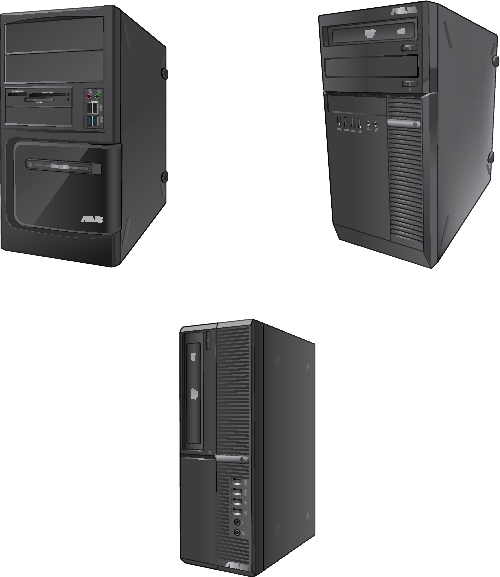
華碩台式電腦
BM6635
BM6835
BP6335
用戶手冊

145
版權說明
©ASUSTeK Computer Inc. All rights reserved. 華碩電腦股份有限公司保留
所有權利。
本用戶手冊包括但不限於其所包含的所有信息都受到著作權法的保
護,未經華碩電腦股份有限公司(以下簡稱“華碩”)許可,不得有任何
仿造、複製、摘抄、轉譯、發行等行為或為其它利用。
免責聲明
本用戶手冊是以“現狀”及“以目前明示的條件下”的狀態提供給
您。在法律允許的範圍內,華碩就本用戶手冊,不提供任何明示或默示的
擔保及保證,包括但不限於商業暢銷性、特定目的適用性、未侵害任何他
人權利及任何使用本用戶手冊或無法使用本用戶手冊的保證,且華碩對因
使用本用戶手冊而獲取的結果或通過本用戶手冊所獲得任何信息的準確性
或可靠性不提供擔保及保證。
用戶應自行承擔使用本用戶手冊的所有風險。用戶明確瞭解並同意華
碩、華碩的被授權人及董事、管理層、員工、代理商、關聯企業皆無須為
您因本用戶手冊、或因使用本用戶手冊、或因不可歸責于華碩的原因而無
法使用本用戶手冊或其任何部分而可能產生的衍生、附帶、直接、間接、
特別、懲罰或任何其它損失(包括但不限於利益損失、業務中斷、資料遺
失或其它金錢損失)負責,不論華碩是否被告知發生上述損失之可能性。
由於部分國家或地區可能不允許責任的全部免除或對上述損失的責任
限制,所以上述限制或排除條款可能對您不適用。
用戶知悉華碩有權隨時修改本用戶手冊。本產品規格或驅動程序一經
改變,本用戶手冊將會隨之更新。本用戶手冊更新的詳細說明請您訪問華
碩的客戶服務網http://support.asus.com,或是直接與華碩電腦客戶關懷
中心 400-600-6655 聯繫(400 服務熱線支持手機撥打。不能撥打 400
電話的用戶,請撥打技術支持電話 020-28047506)。
對於本用戶手冊中提及的第三方產品名稱或內容,其所有權及知識產
權都為各產品或內容所有人所有且受現行知識產權相關法律及國際條約的
保護。
當下列兩種情況發生時,本產品將不再受到華碩的保修及服務:
(1) 本產品曾經過非華碩授權的維修、規格更改、零件替換或其它未經
過華碩授權的行為。
(2)本產品序號模糊不清或丟失。

146
目錄內容
第一章:系統導覽
第二章:使用 Windows® 7(選配)
®
®
第三章:設備連接
第四章:使用您的電腦
第五章:網絡連接
第六章:使用應用程序(選配)

148
注意事項
REACH
谨
Federal Communications Commission Statement
RF exposure warning
149
電池警語
Canadian Department of Communications Statement
150
安全性須知
151
提示符號
哪裡可以找到更多的產品信息
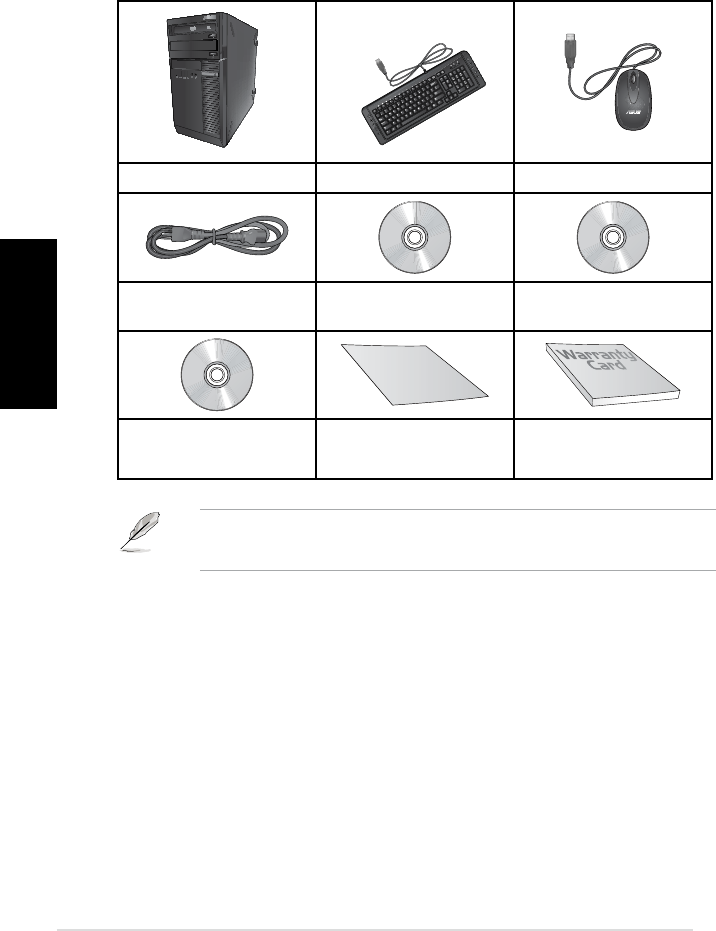
152
產品包裝內容
Installation Guide
153
154
第一章
系統導覽
了解您的台式電腦
歡迎
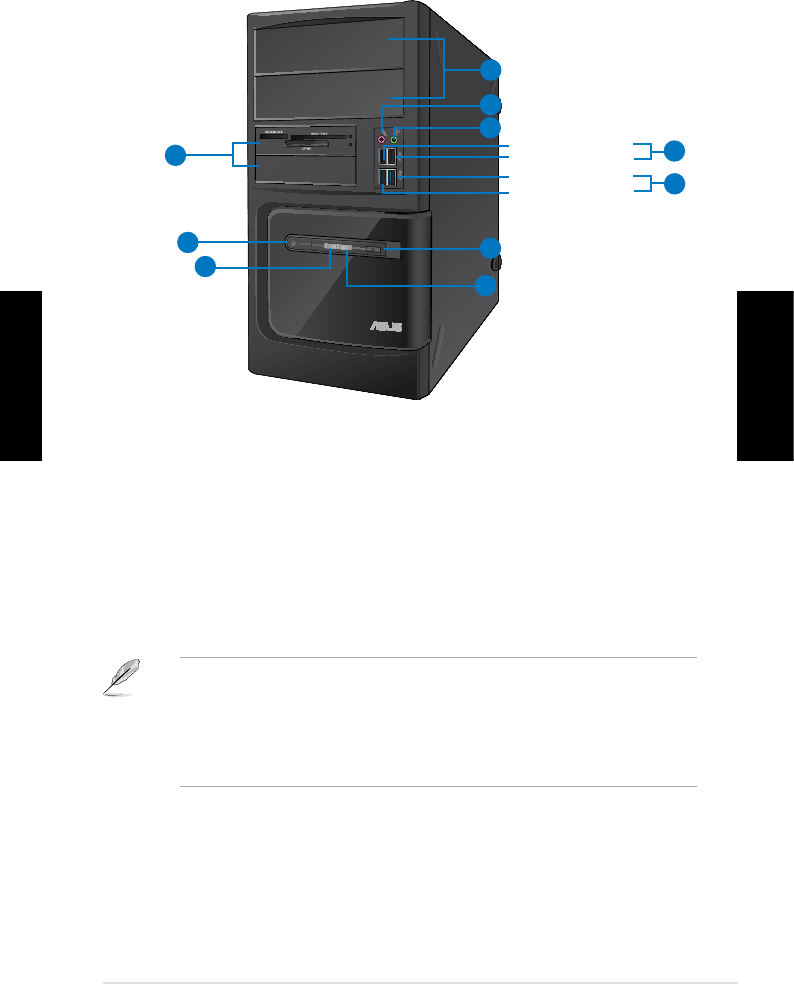
155
•®
®
•
•
主機前面板
BM6635
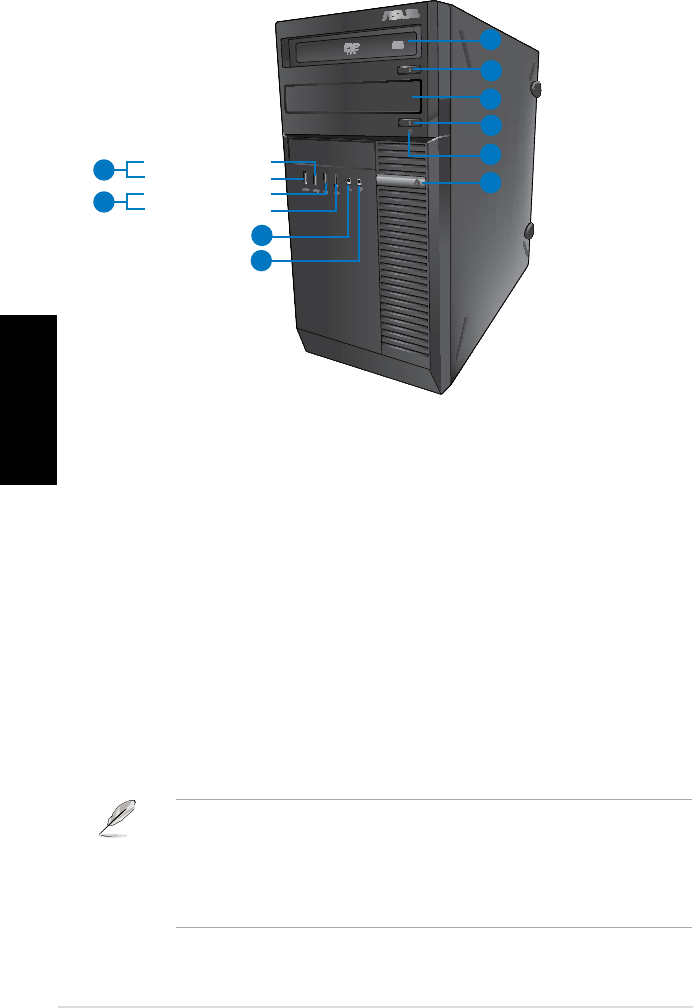
156
•®
®
•
•
BM6835
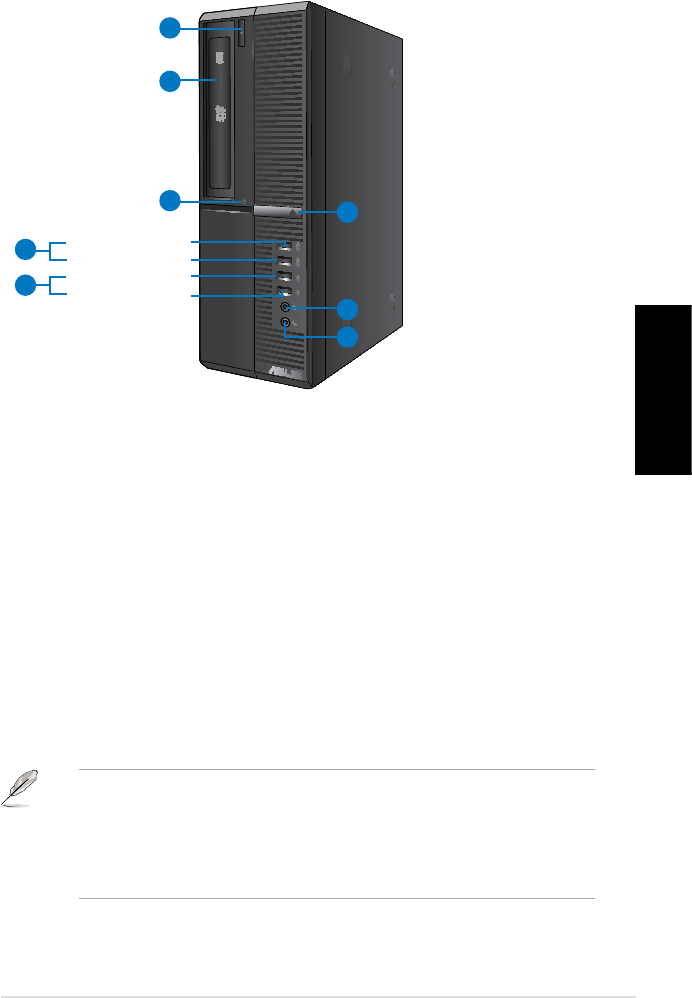
157
®
®
•
•
BP6335
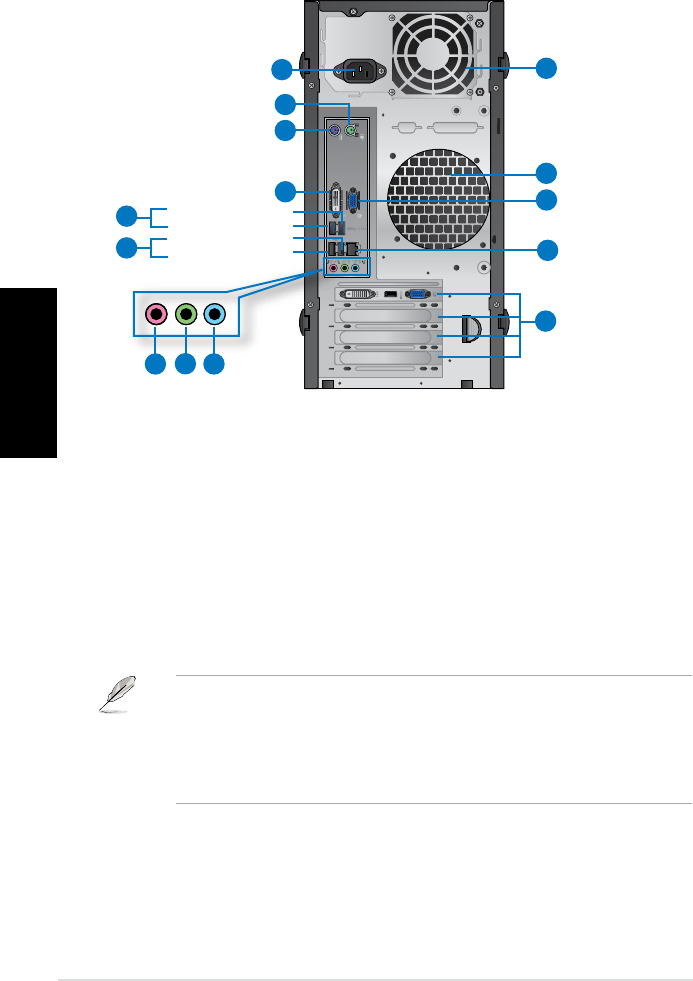
158
主機後面板
•®
®
•
•
BM6635
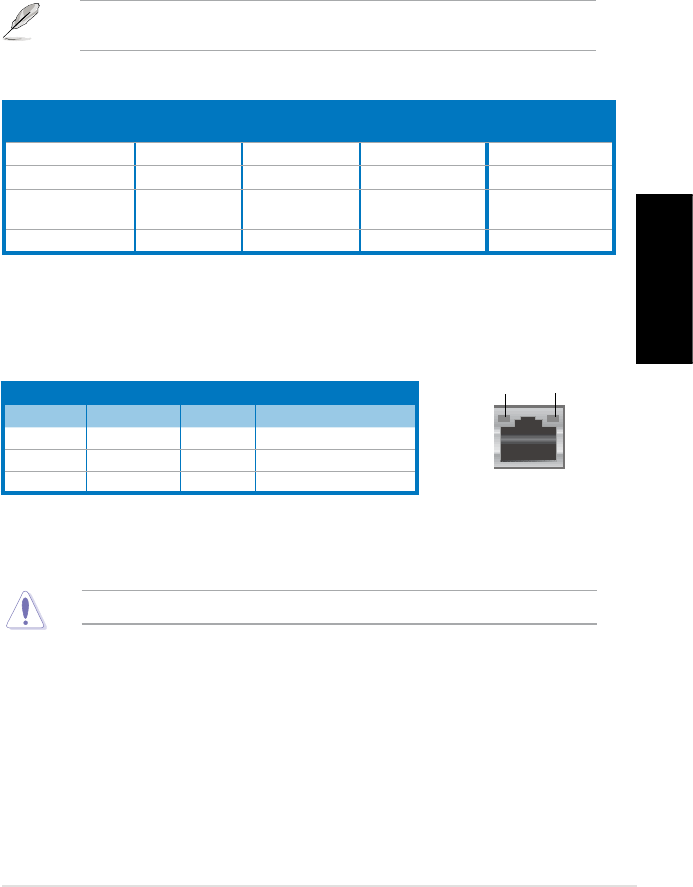
159
Activity/Link 指示燈 速度指示燈
狀態 描述 狀態 描述
網絡指示燈說明
二、四、六、八聲道音頻設置
接頭 耳機 / 二聲道
喇叭輸出
四聲道
喇叭輸出
六聲道
喇叭輸出 八聲道喇叭輸出
11.
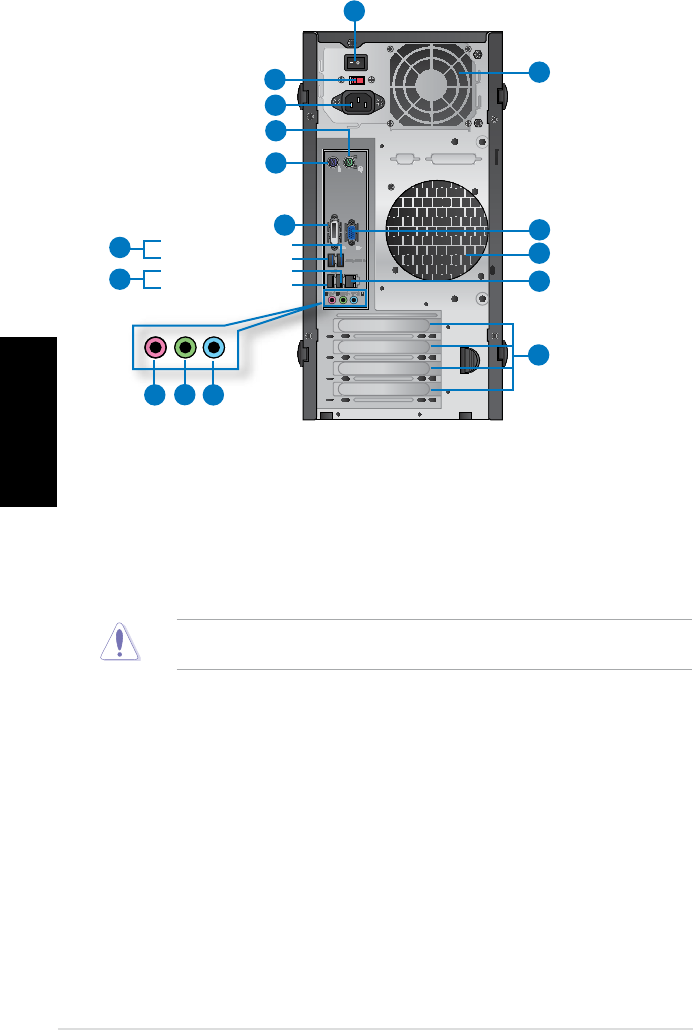
160
BM6835
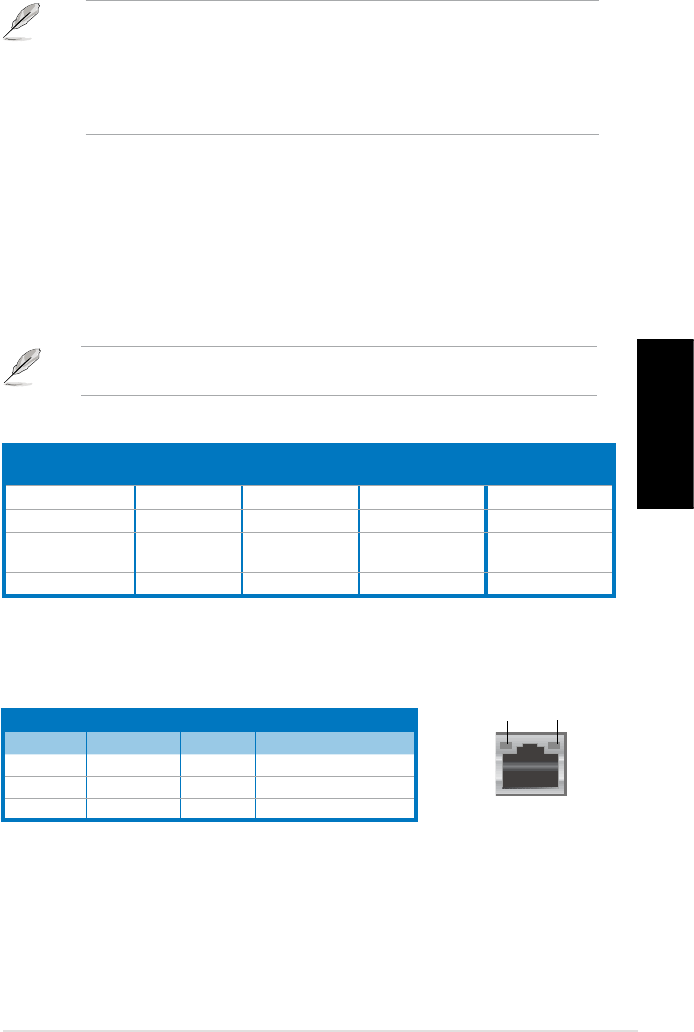
161
二、四、六、八聲道音頻設置
Activity/Link 指示燈 速度指示燈
狀態 描述 狀態 描述
網絡指示燈說明
13.
•®
®
•
•
接頭 耳機 / 二聲道
喇叭輸出
四聲道
喇叭輸出
六聲道
喇叭輸出 八聲道喇叭輸出
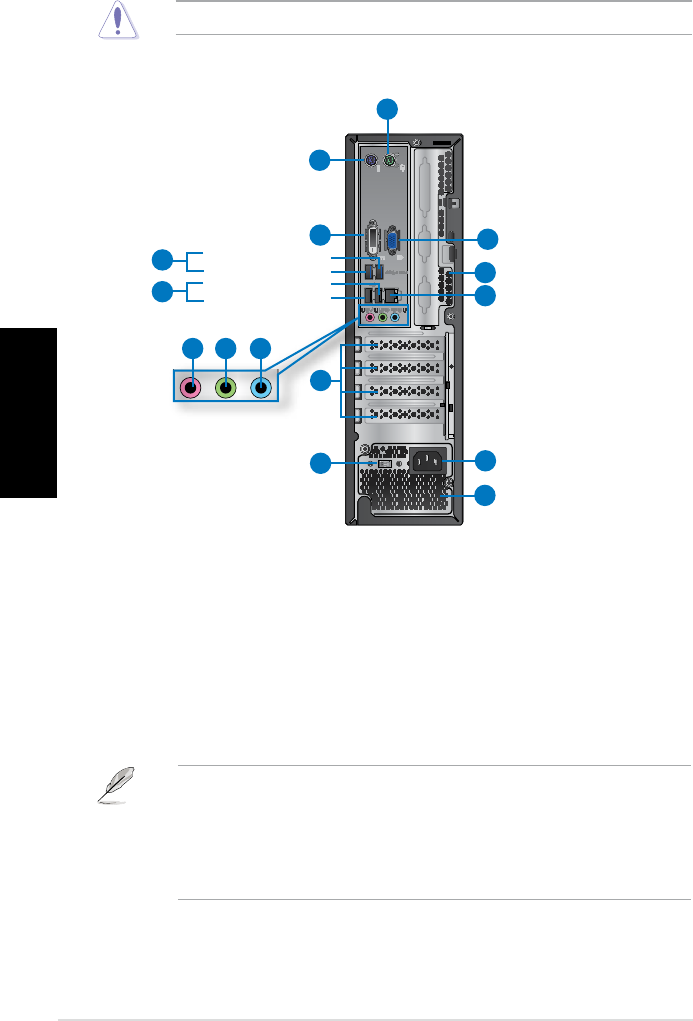
162
•®
®
•
•
BP6335
3.
4.
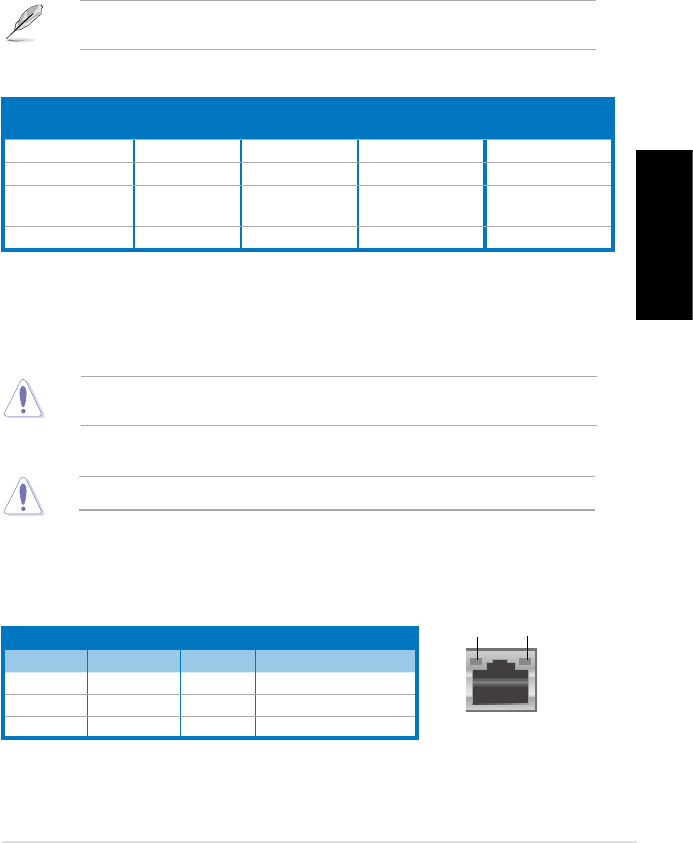
163
二、四、六、八聲道音頻設置
Activity/Link 指示燈 速度指示燈
狀態 描述 狀態 描述
網絡指示燈說明
接頭 耳機 / 二聲道
喇叭輸出
四聲道
喇叭輸出
六聲道
喇叭輸出 八聲道喇叭輸出
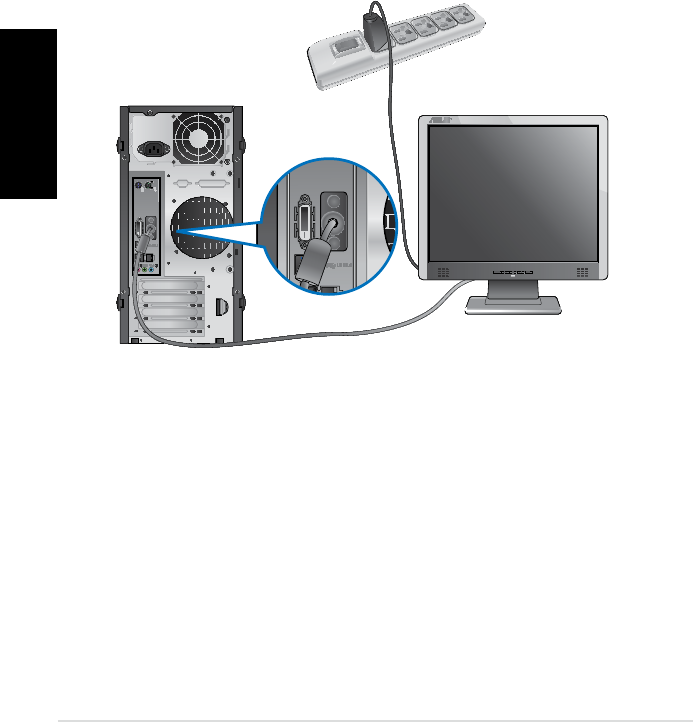
164
安裝您的台式機
使用內置顯示輸出接口
BM6635
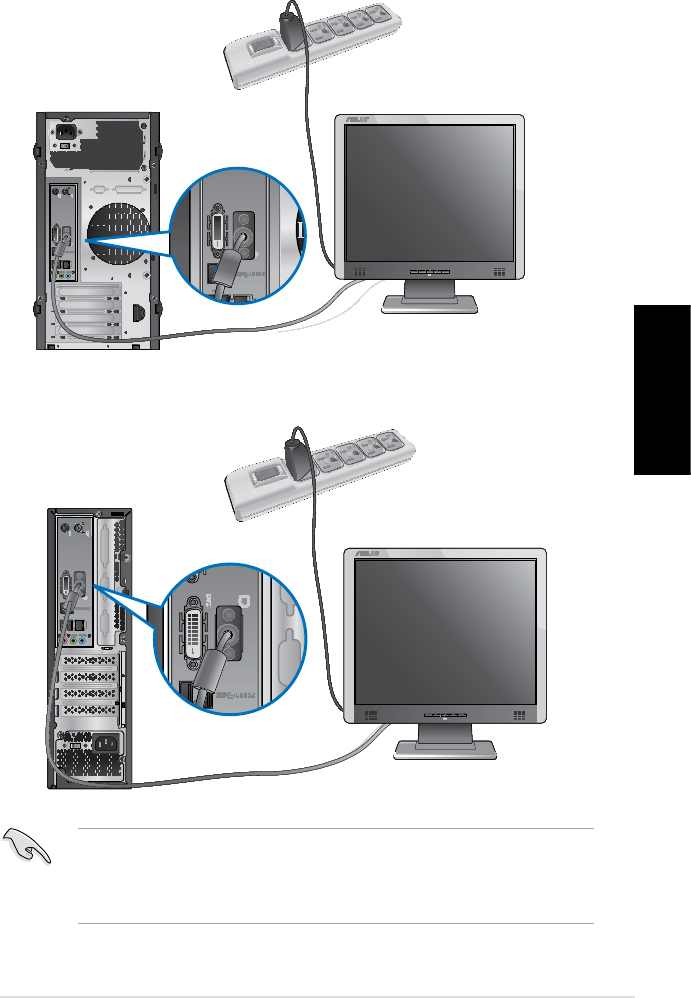
165
BM6835
BP6335
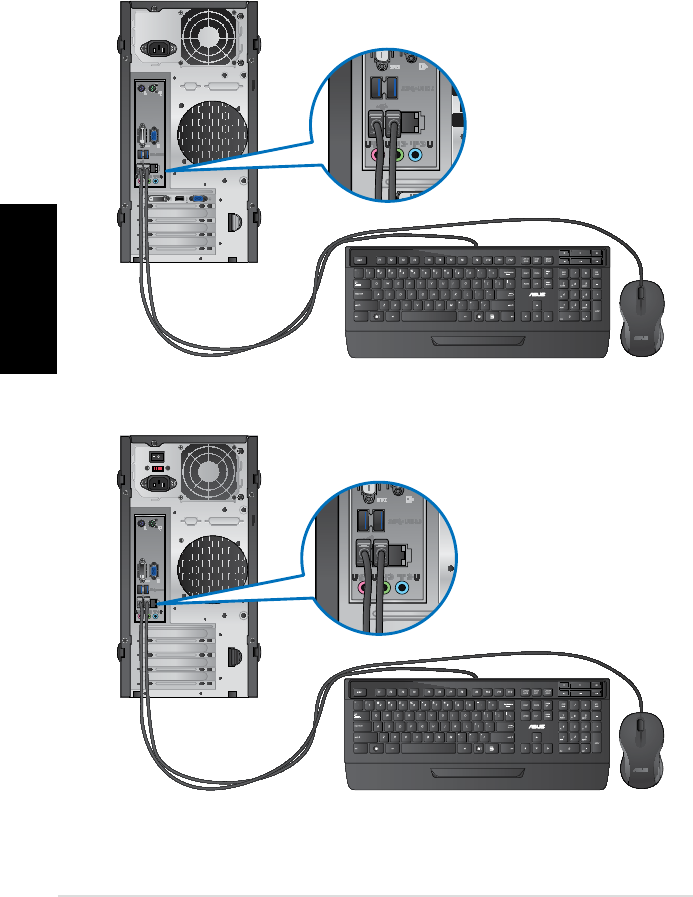
166
連接 USB 鍵盤與鼠標
BM6635
BM6835
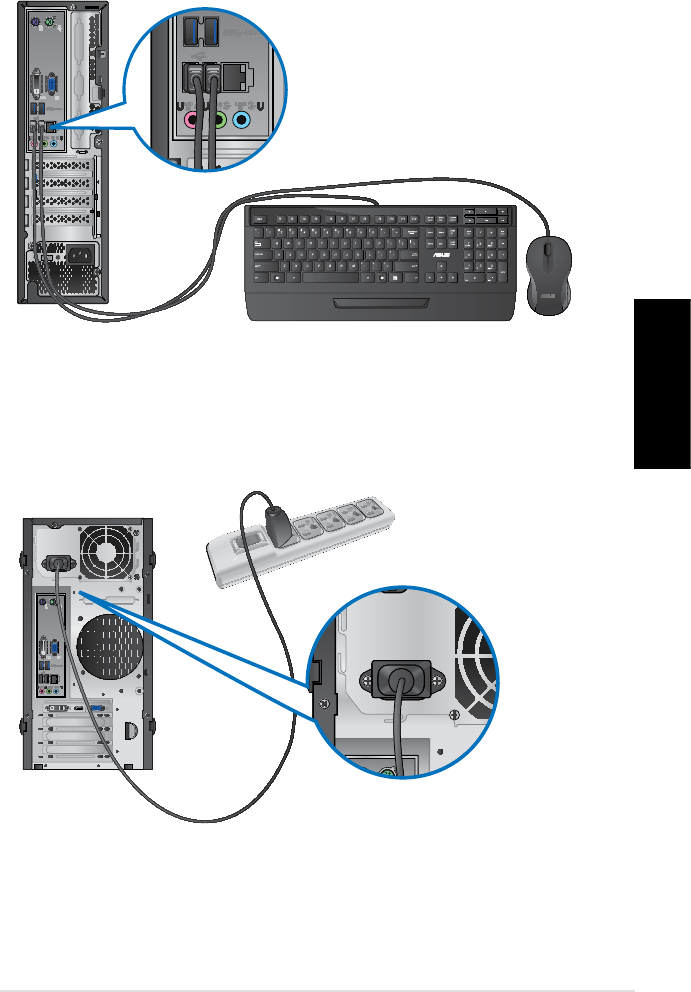
167
BP6335
連接電源線
BM6635
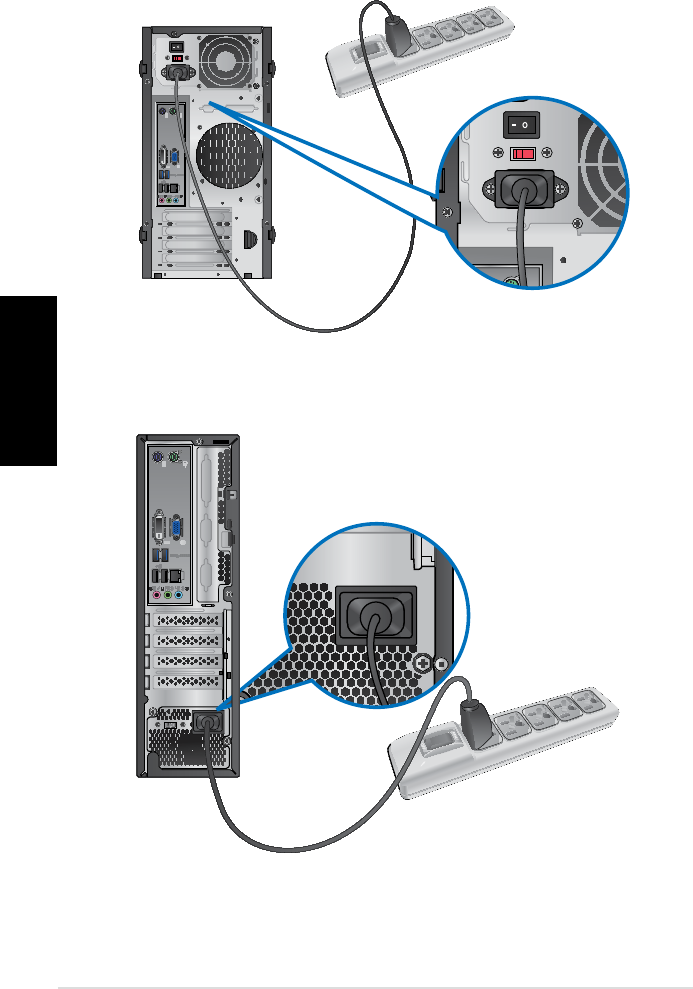
168
BM6835
BP6335
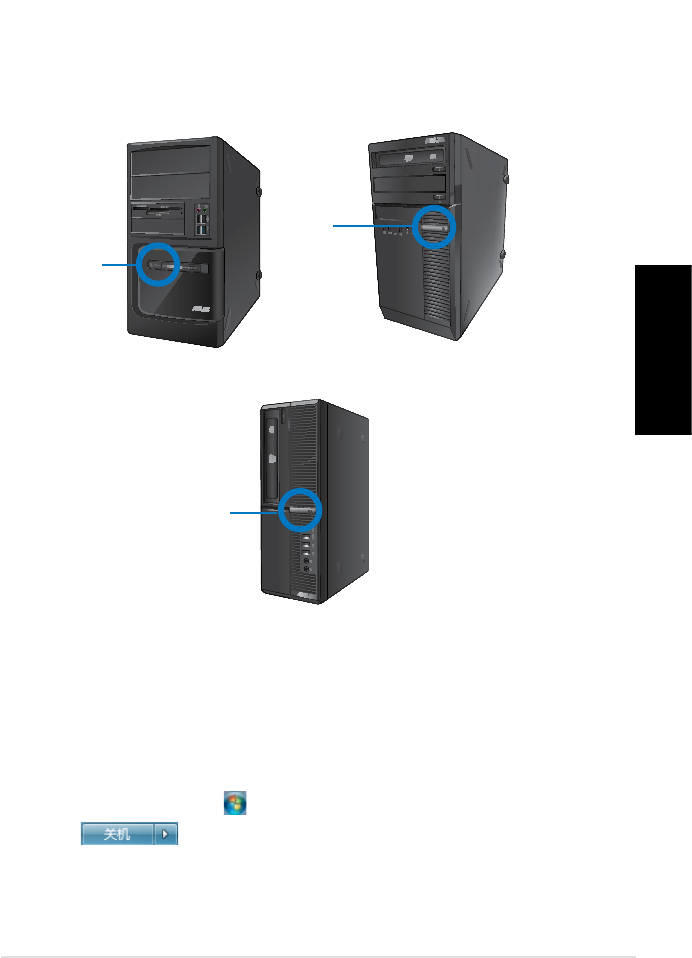
169
開啟您的電腦
開啟或關閉您的電腦
關閉您的電腦
®
170
第二章
使用 Windows® 7(選配)
第一次啟動
®
®
171
使用 Windows® 7 桌面
使用開始菜單
®
從開始菜單進入選項
請按照以下步驟由開始菜單進入選項:
®
击开图标 关®
®
使用任務欄
從任務欄進入程序
使用“入門”選項
®
®
172
®7
在快捷方式中添加選項
在快捷方式中刪除選項
在開始菜單或任務欄中添加程序
在開始菜單中刪除程序
在任務欄中刪除程序
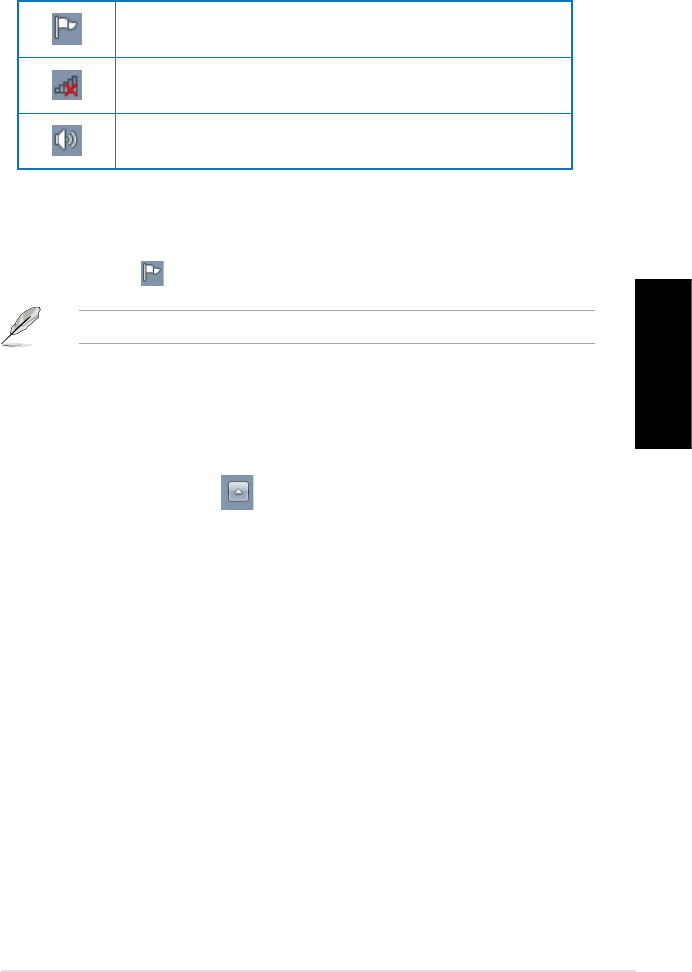
173
使用通知區域
®
顯示通知
®
自定義圖標與通知
174
®7
管理文件與文件夾
使用 Windows® 瀏覽器
®
進入 Windows®瀏覽器
®
®
瀏覽文件與文件夾
®
自定義文件或文件夾視圖
®
排列您的文件(在 Windows 庫文件夾下)
®
175
排序您的文件
®
分組您的文件
®
添加一個新文件夾
®
備份文件
設置備份
176
®7
保護您的電腦
使用 Windows® 7 操作中心
®
進入 Windows® 7 操作中心
®
還原您的系統
使用 Windows® Update
®
進入 Windows® Update
®
®
®
®
177
設置用戶帳戶與密碼
設置用戶帳戶
®
設置用戶密碼
178
®7
進入 Windows® 幫助和支持
®®
®
激活殺毒軟件(視具體機型而定)
179
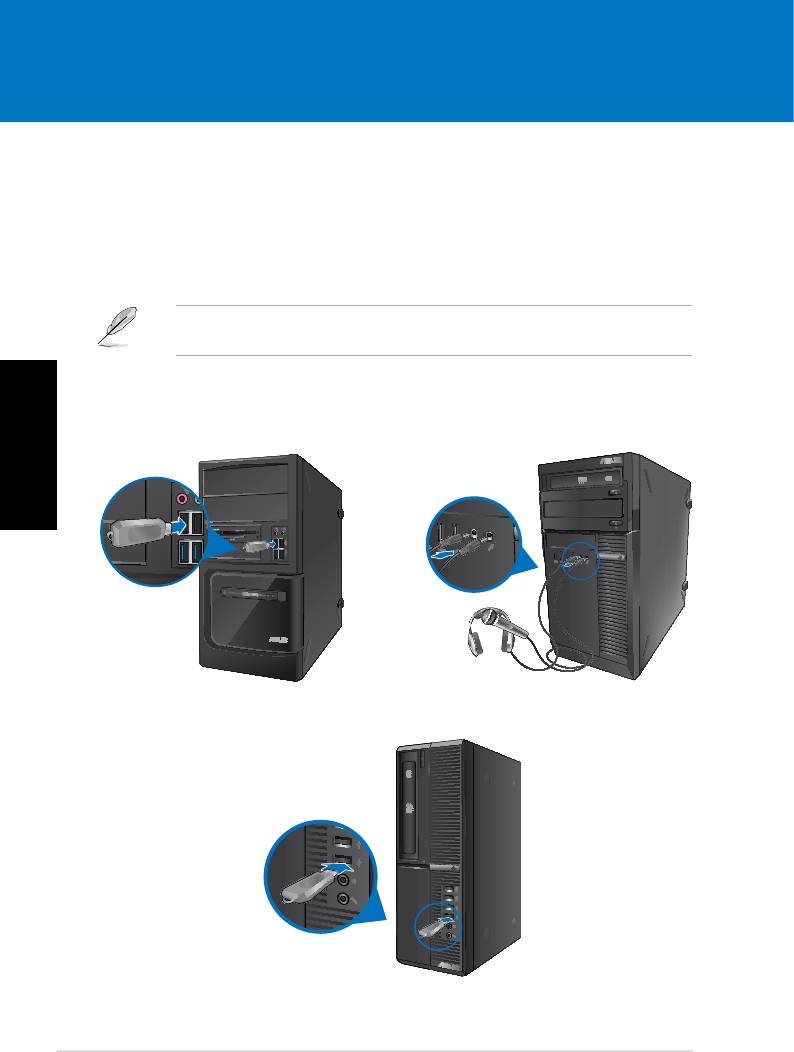
180
第三章
設備連接
連接 USB 存儲設備
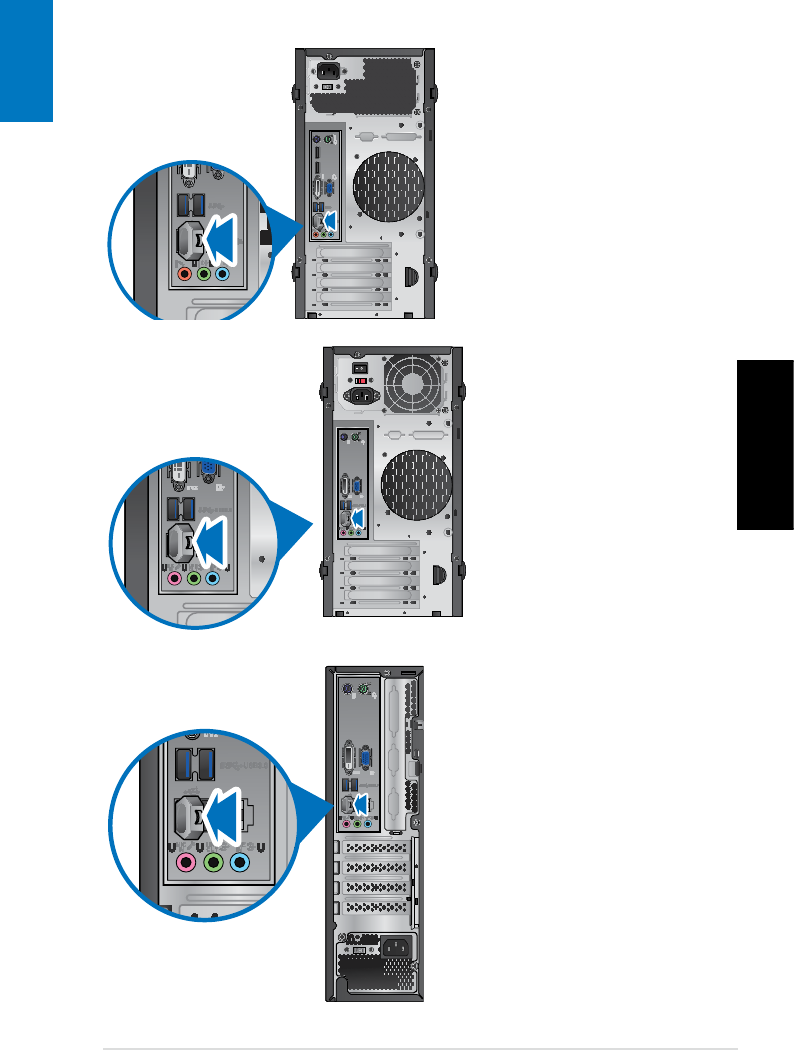
181
BM6635
BM6835
BP6335
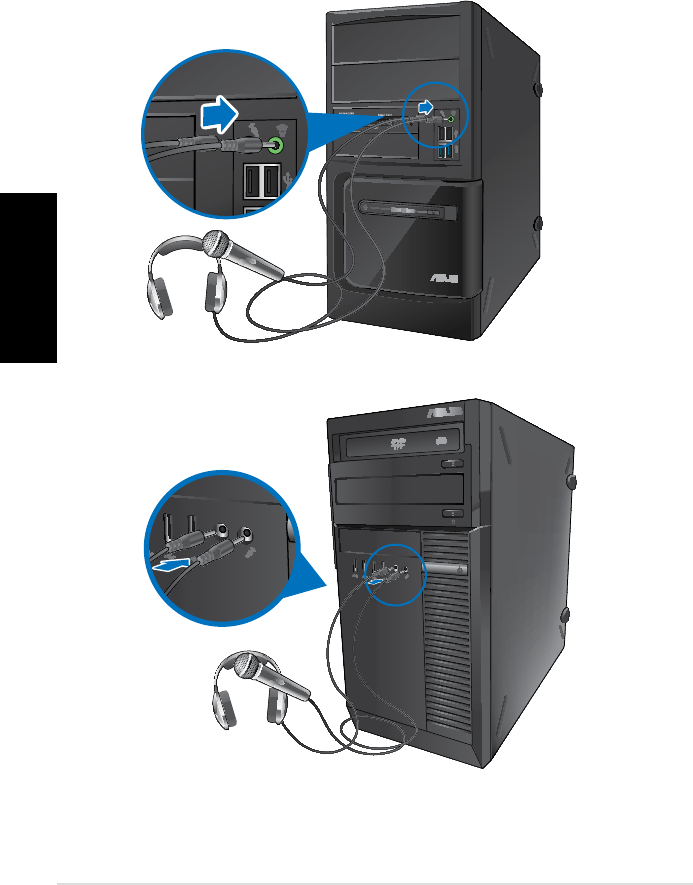
182
連接麥克風與喇叭
BM6635
BM6835
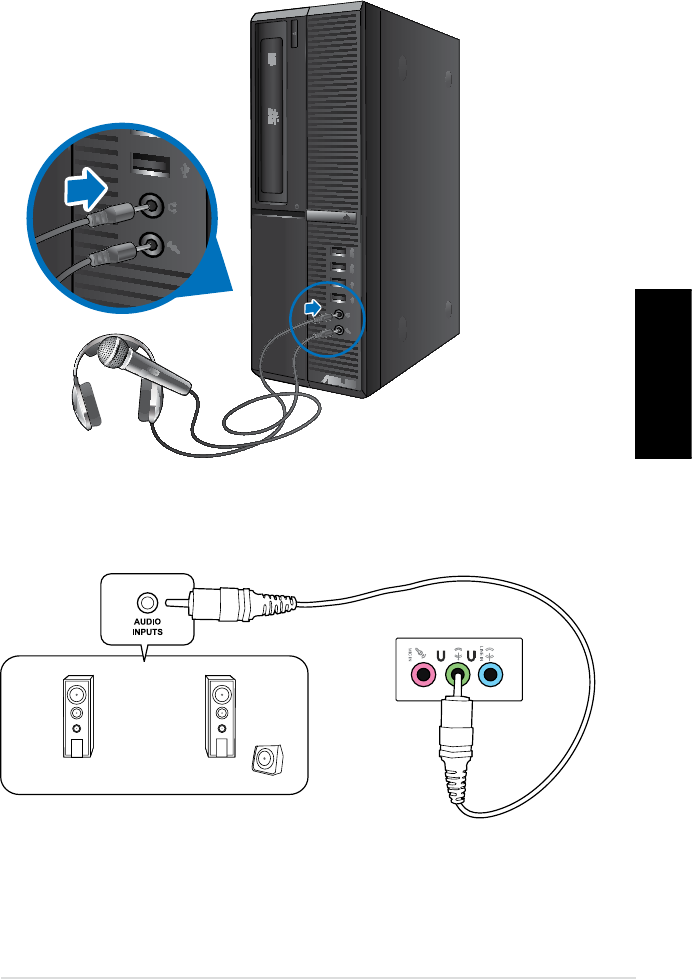
183
連接二聲道喇叭
BP6335
LINE OUT
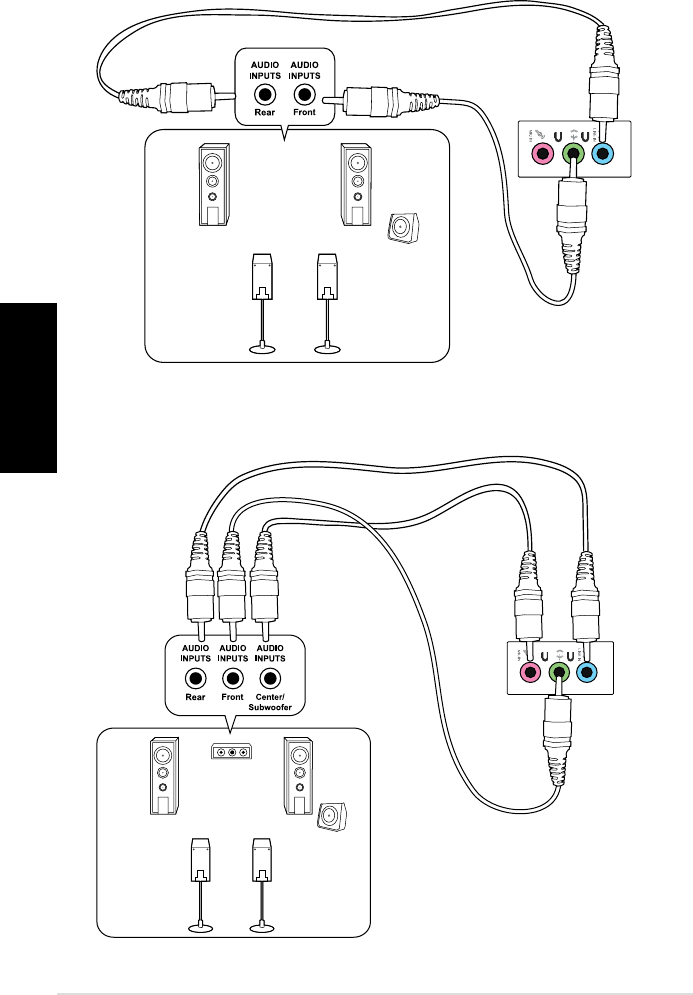
184
連接六聲道喇叭
連接四聲道喇叭
LINE OUT
LINE OUT
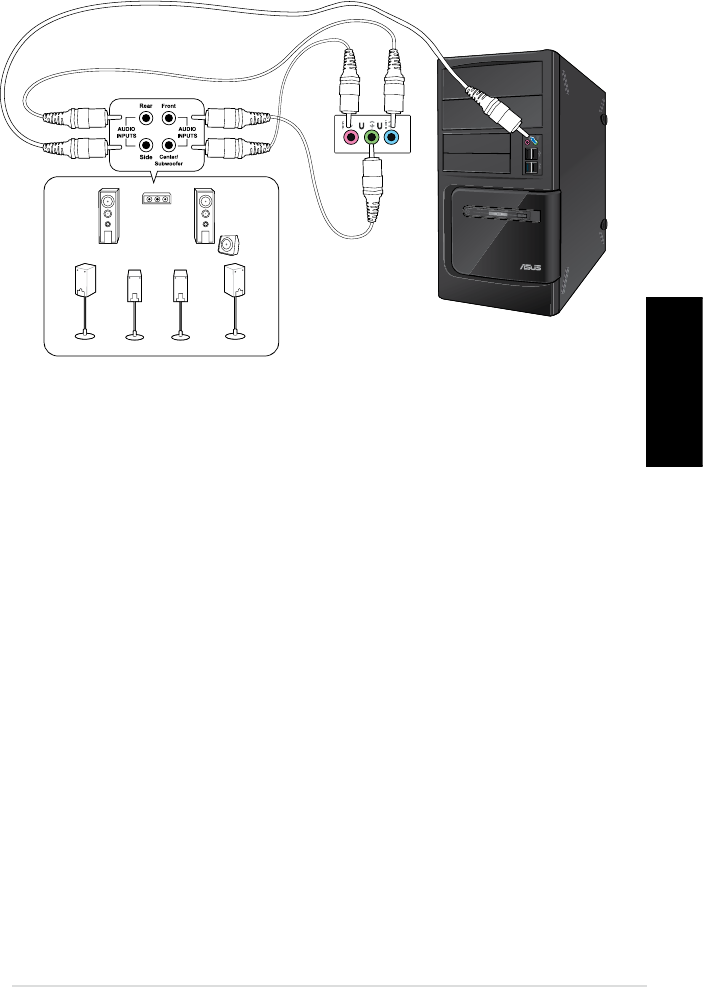
185
連接八聲道喇叭
LINE OUT
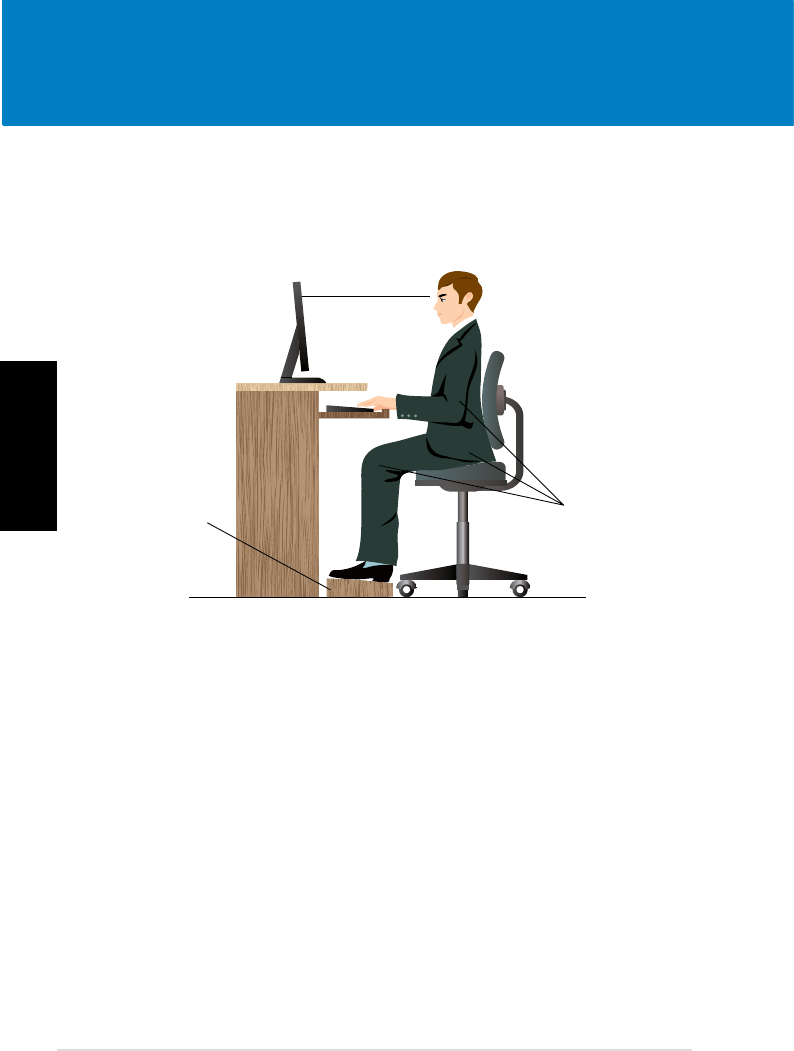
186
第四章
使用您的電腦
使用電腦時的適當姿勢
视线与显示器屏幕顶部相持平
脚凳 90˚ 度
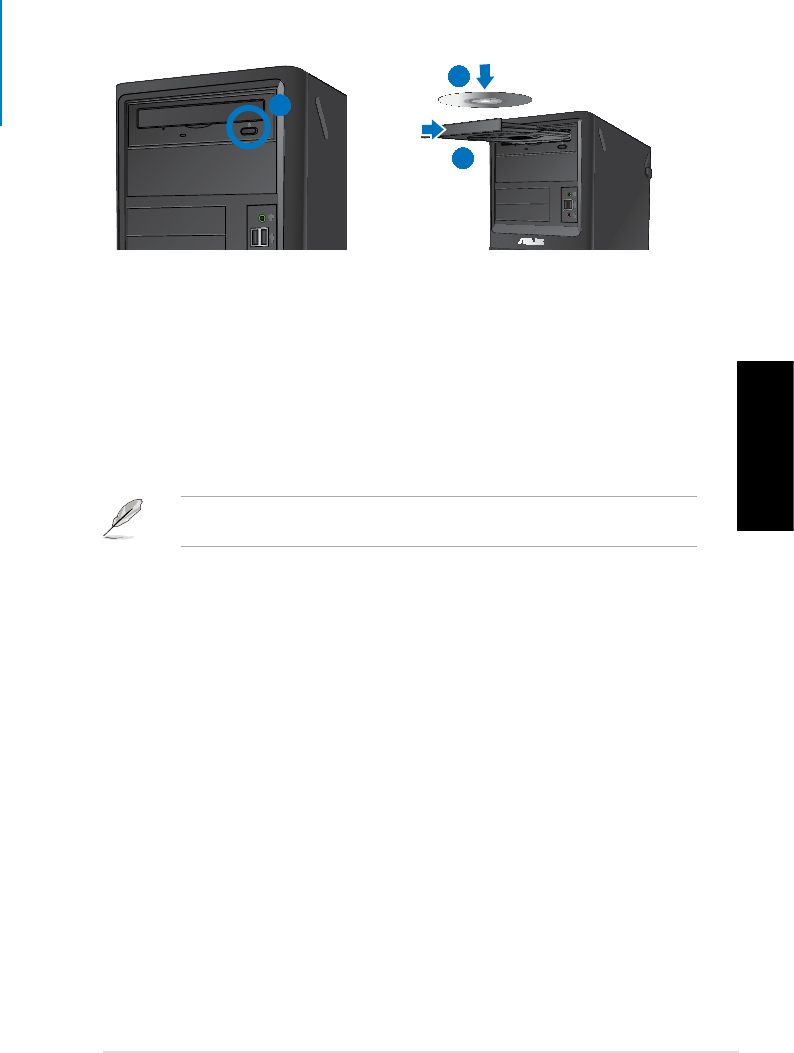
187
使用光驅
放入光盤
退出光盤
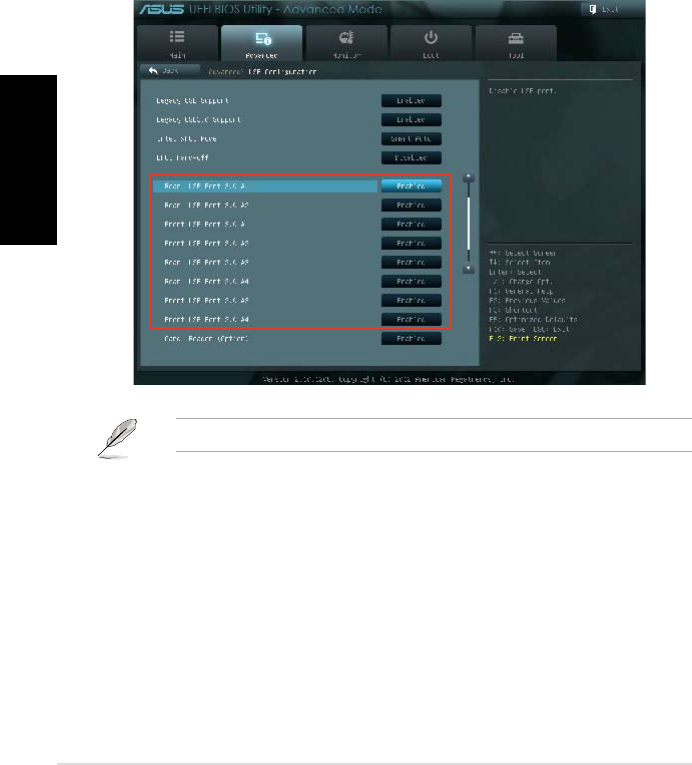
188
使用 BIOS 設置 USB 接口
189
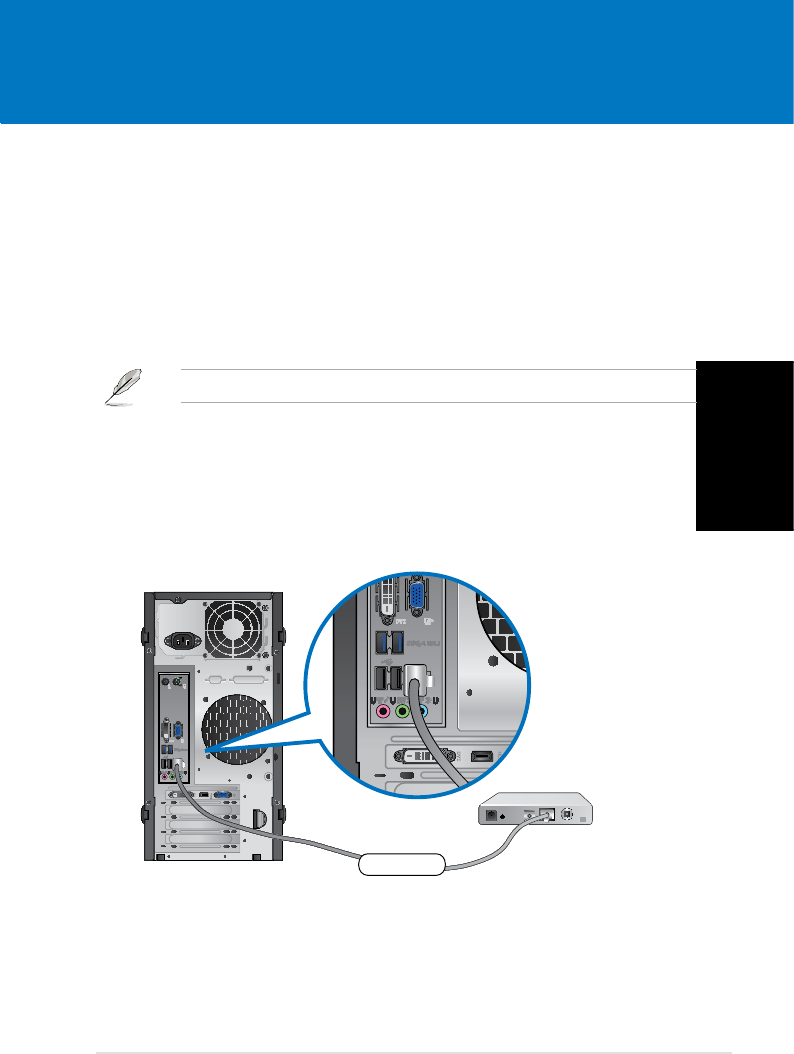
190
第五章
網絡連接
通過 DSL/Cable modem 連接網絡
有線連接
BM6635
Modem
RJ-45 cable
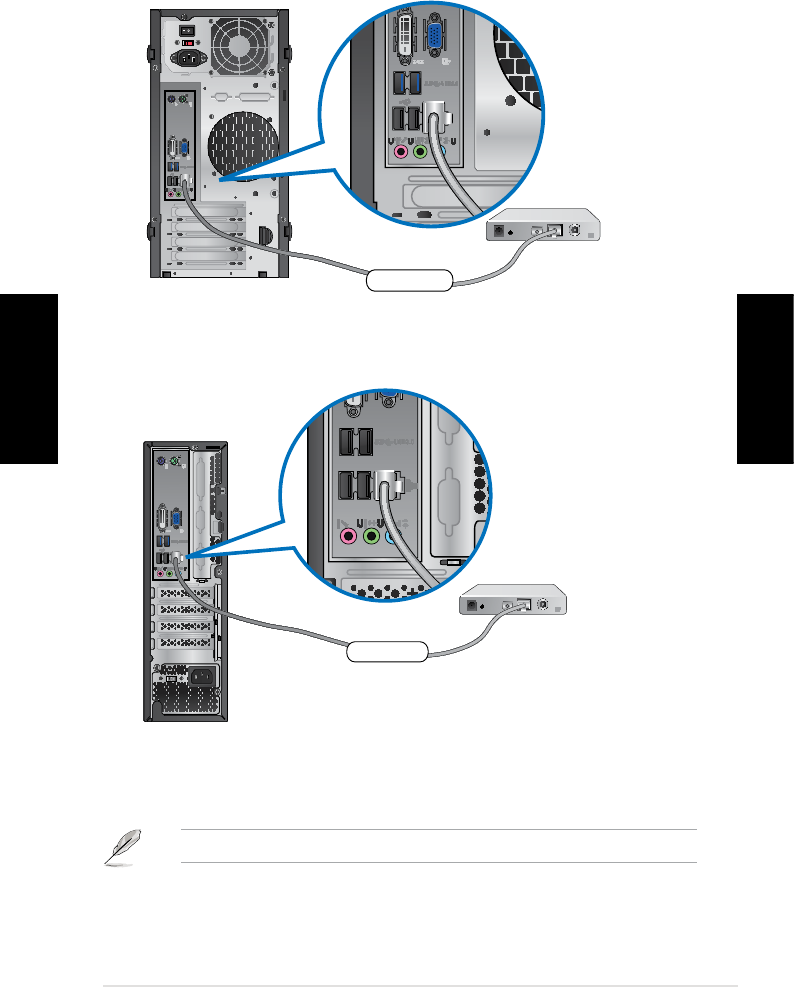
191
BM6835
BP6335
Modem
RJ-45 cable
Modem
RJ-45 cable
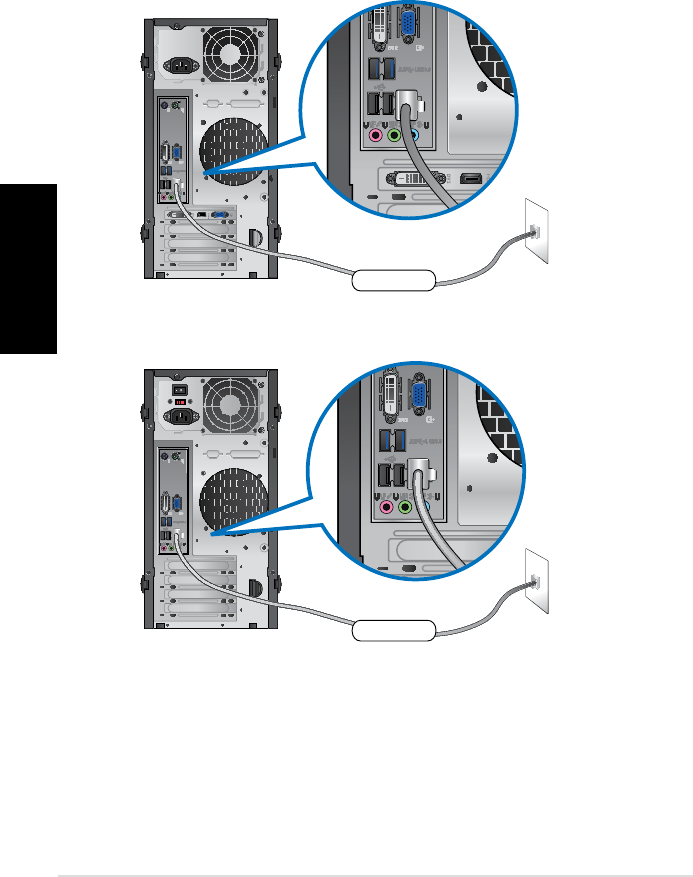
192
通過局域網連接網絡 (LAN)
BM6635
BM6835
RJ-45 cable LAN
RJ-45 cable LAN
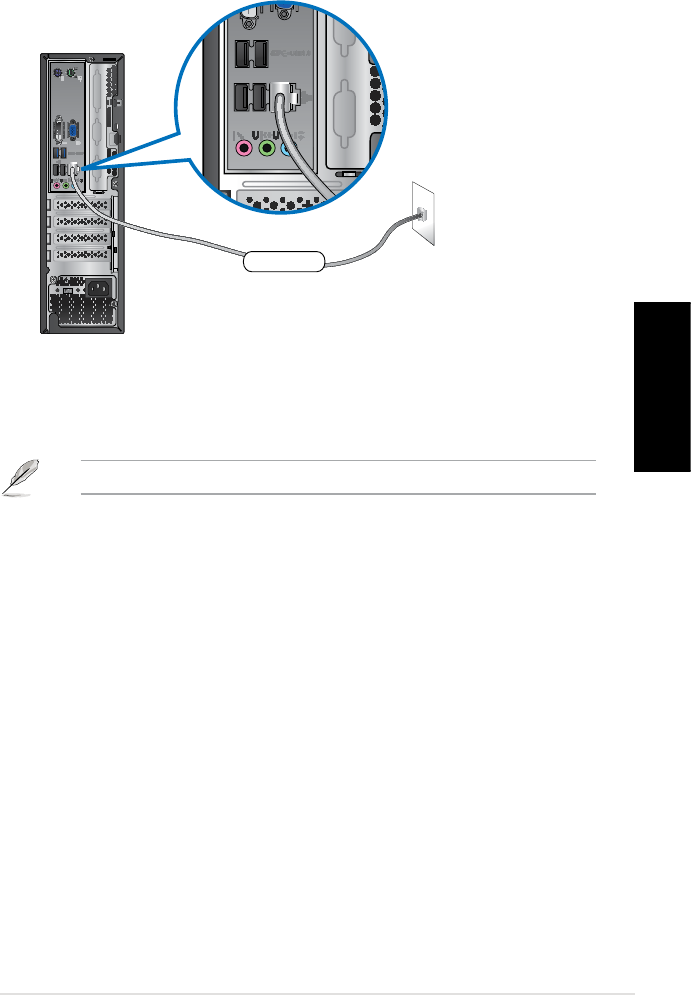
193
BP6335
RJ-45 cable LAN
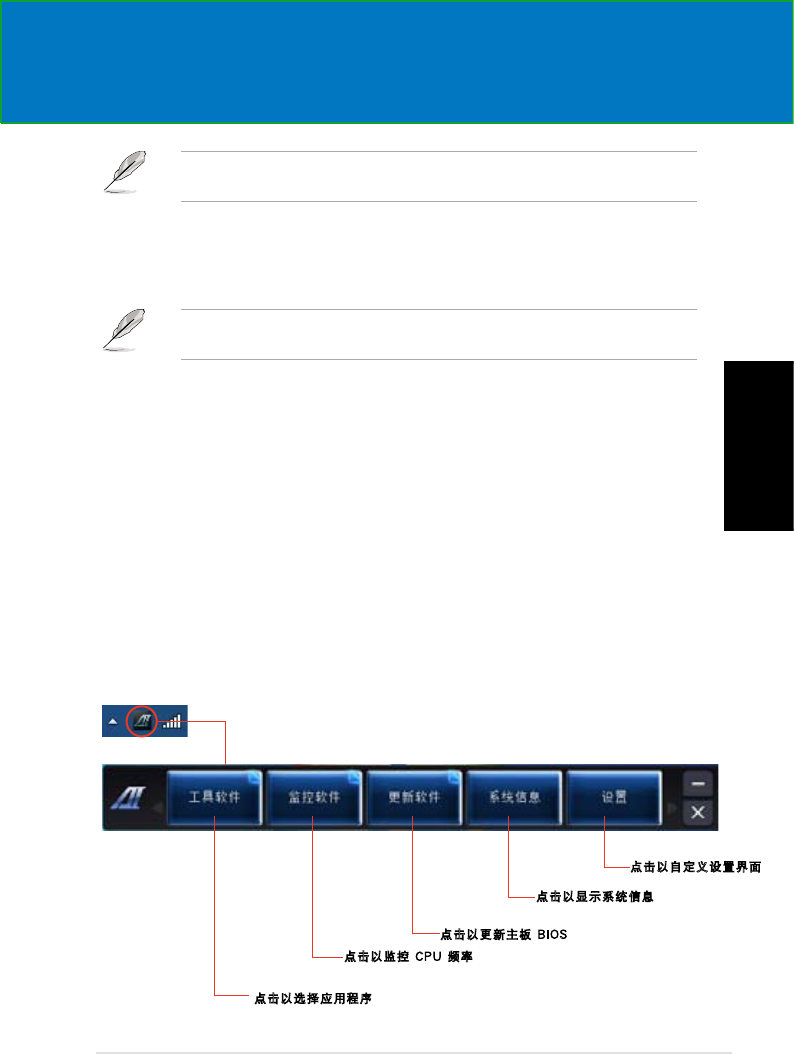
194
第六章
使用應用程序(選配)
華碩 AI Suite II
安裝 AI Suite II
點擊以選擇應用程序
點擊以監控 CPU 頻率
點擊以更新主板 BIOS
點擊以顯示系統信息
點擊以自定義設置界面
運行 AI Suite II
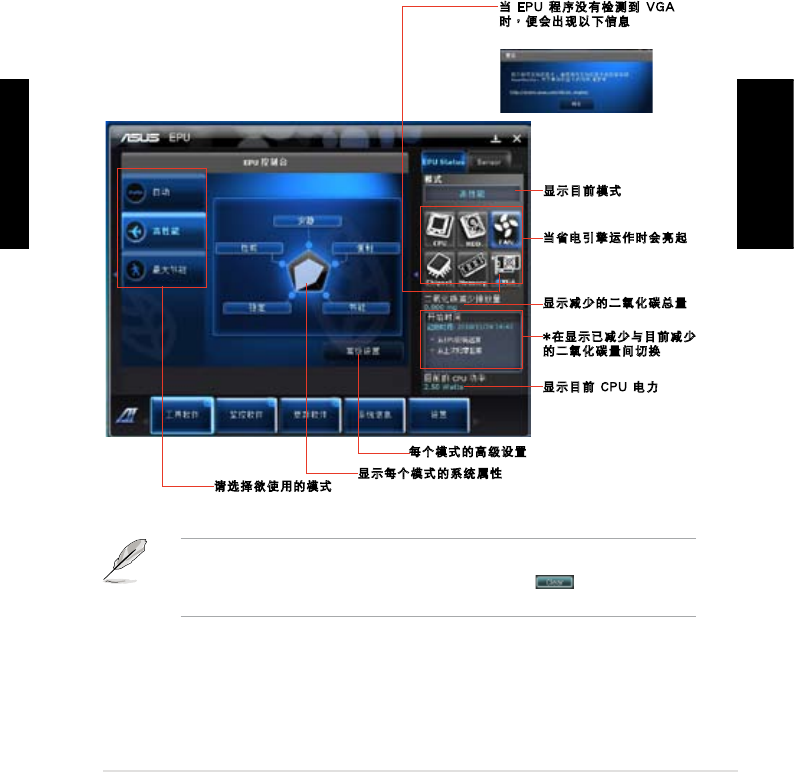
195
華碩 EPU 程序
*在顯示已減少與目前減少
的二氧化碳量間切換
顯示每個模式的系統屬性
當 EPU 程序沒有檢測到 VGA
時,便會出現以下信息
每個模式的高級設置
請選擇欲使用的模式
顯示目前模式
當省電引擎運作時會亮起
顯示減少的二氧化碳總量
顯示目前 CPU 電力
工具菜單
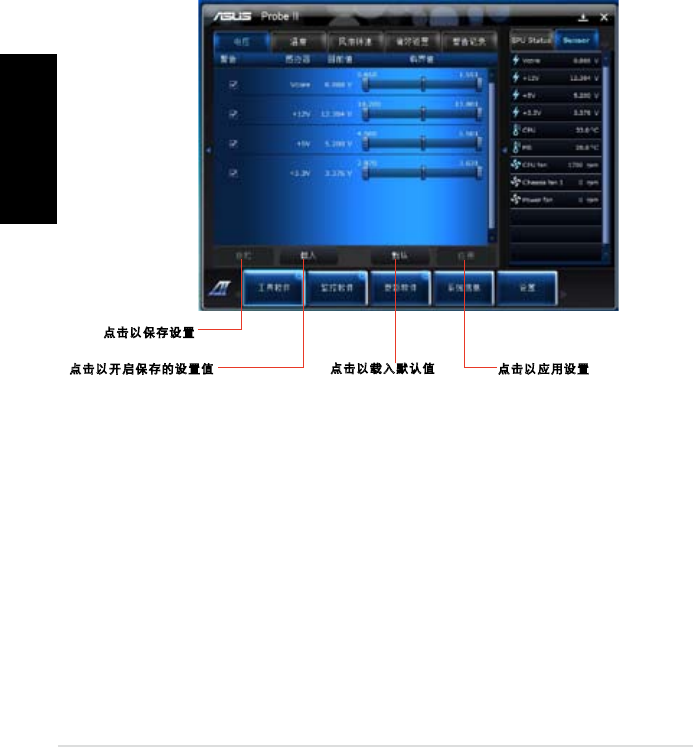
196
華碩 Probe II 程序
點擊以載入默認值 點擊以應用設置點擊以開啟保存的設置值
點擊以保存設置
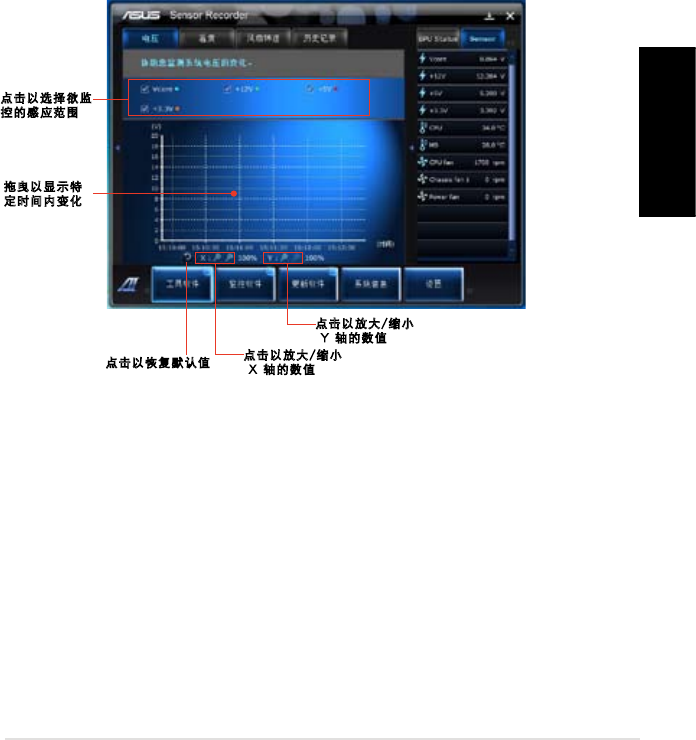
197
華碩 Sensor Recorder 程序
點擊以選擇欲監
控的感應範圍
點擊以放大/縮小
Y 軸的數值
點擊以放大/縮小
X 軸的數值
點擊以恢復默認值
拖曳以顯示特
定時間內變化

198
監控功能
Sensor
CPU Frequency
使用網絡更新 BIOS 程序
華碩在線更新
更新功能
199
使用 BIOS 文件更新 BIOS 程序
請按照以下步驟使用 BIOS 文件更新 BIOS 程序:
MyLogo
开
载开

200
系統信息
自定用戶界面
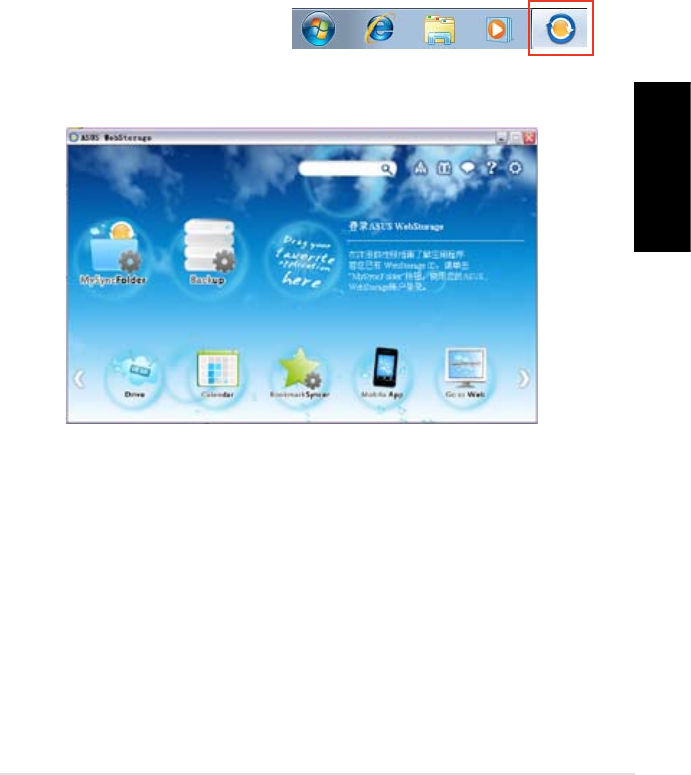
201
華碩網絡存儲器
安裝網絡存儲器
開啟網絡存儲器
®
Drive
Backup
MySyncFolder
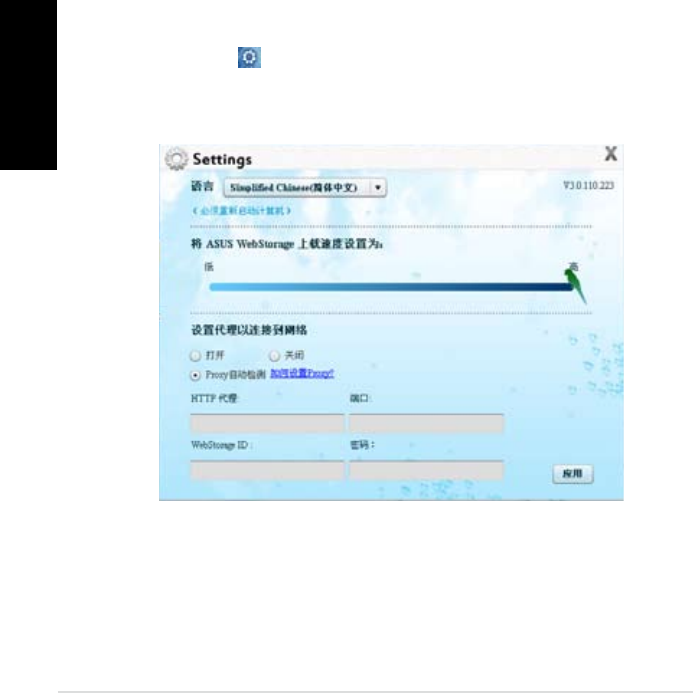
202
Calendar
BookmarkSyncer
MobileApp
Go to Web
設置
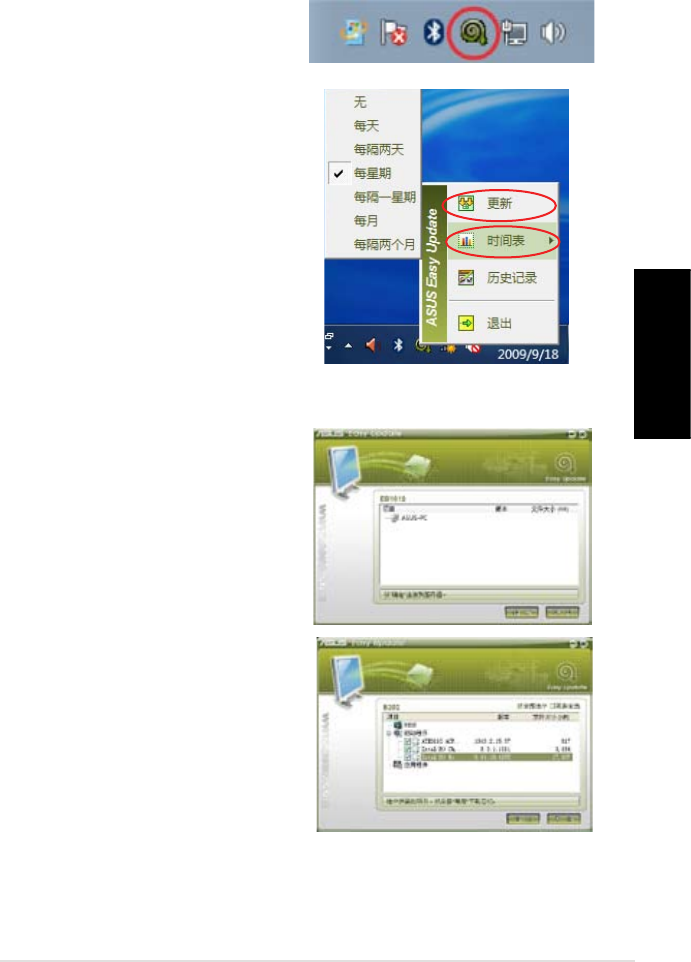
203
華碩 Easy Update
®
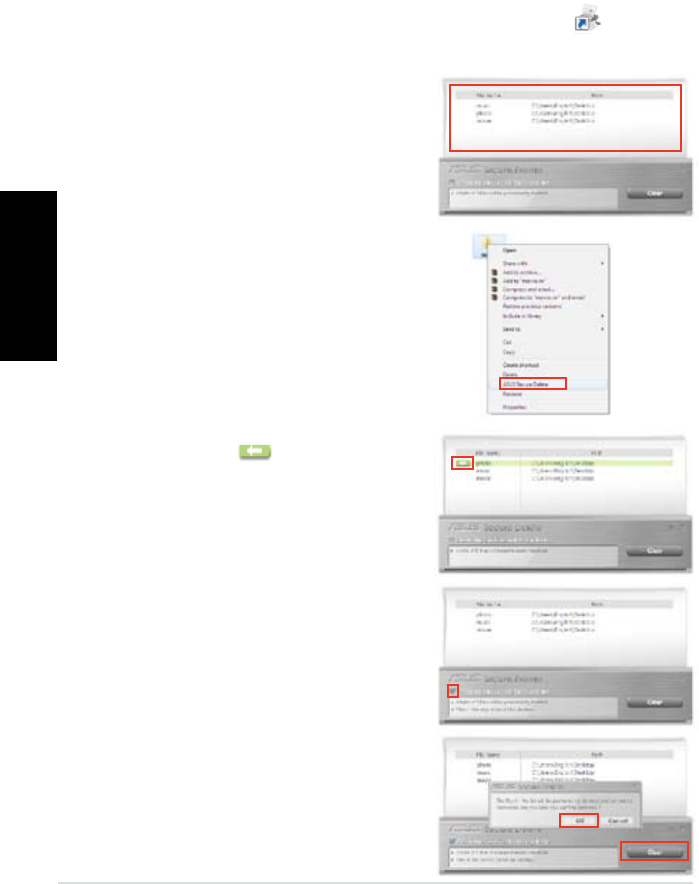
204
華碩 Secure Delete
請按以下步驟使用華碩 Secure Delete:
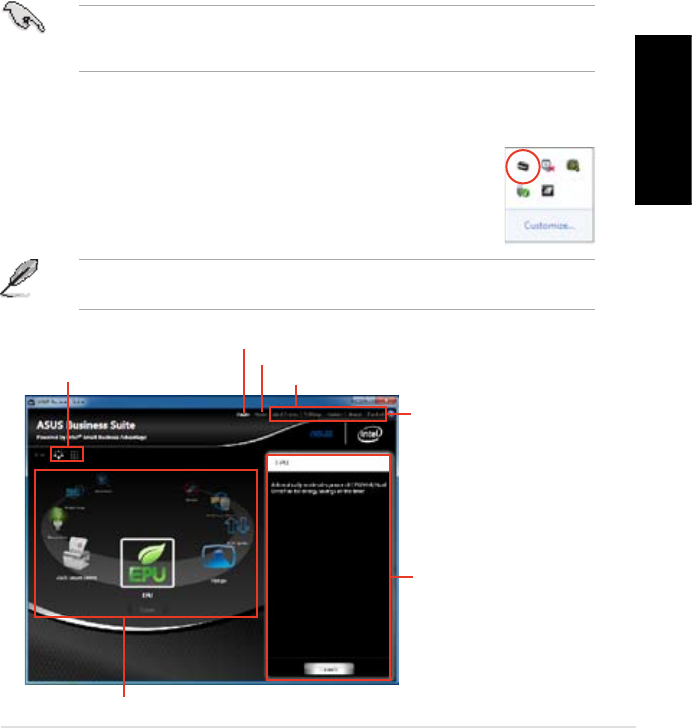
205
華碩 Business Suite
®
®
®
安裝華碩 ASUS Business Suite
使用華碩 Business Suite
®
®
主菜單
®
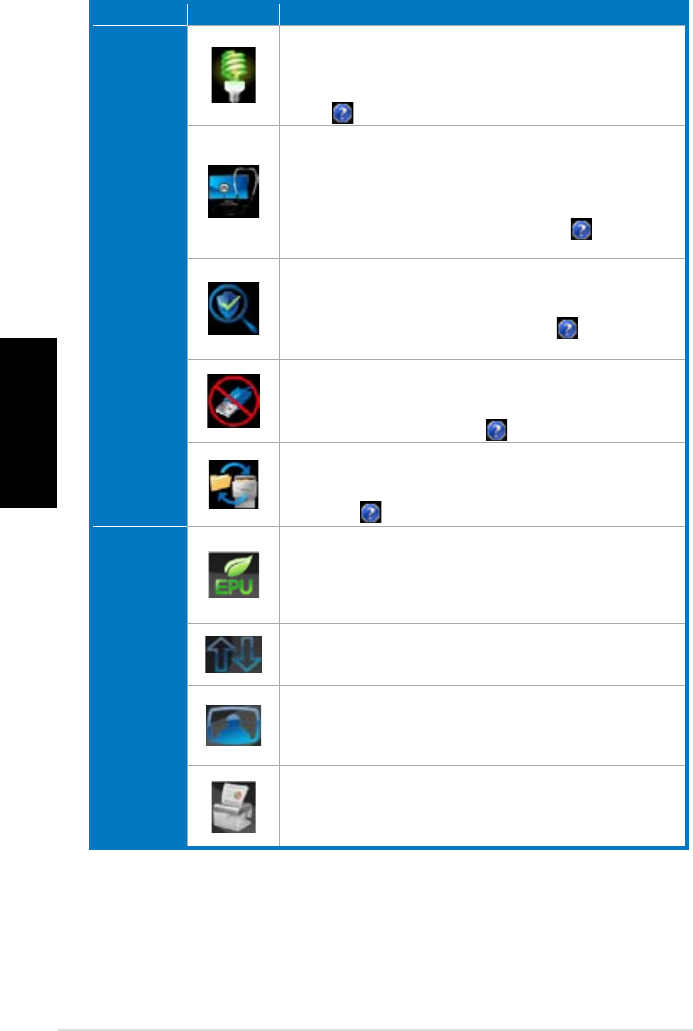
206
圖標 描述
Intel® S B A
程序工具集
華碩應用程序
工具集
207
刻錄文件
安裝 Nero (以 Nero 9 為例)
208
還原您的系統
使用隱藏分區
關於隱藏分區
209
使用恢復光盤還原您的系統(僅限預裝 Windows 操作系統的機型)

210
第七章
疑難解決
我的電腦無法開機,並且前面板電源指示燈未亮起。
我的電腦死機。
我無法使用華碩無線網卡連接無線網絡(僅限指定型號)。
數字鍵區域的方向鍵不起作用。

211
顯示器無法顯示。
使用多個顯示器時,僅一個顯示器能顯示。
我的電腦無法偵測 USB 存儲設備。
我想要恢復或撤銷對電腦系統設定的更改,同時不影響我的個人文件
或數據。
®
212
高清電視上的圖像變形。(由於機型不同,系統功能也會有差異)
我的喇叭沒有聲音。
DVD 光驅無法讀取光盤。
DVD 光驅退出按鈕不起作用。
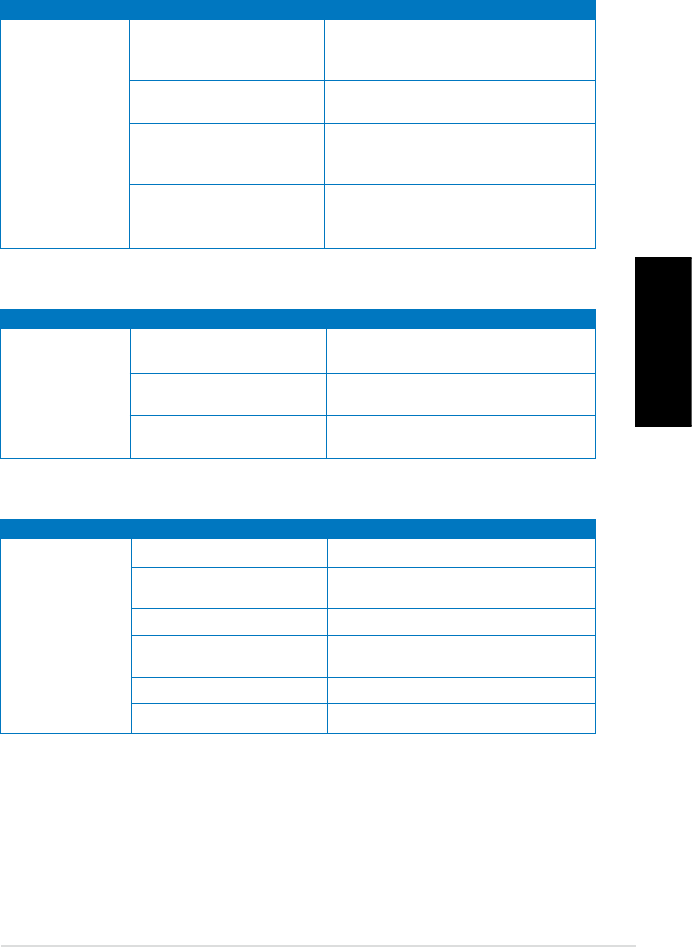
213
華碩台式電腦常見問題疑難排除快速指南
電源問題
不良現象描述 可能的問題 請用戶確認
畫面無法顯示
不良現象描述 可能的問題 請用戶確認
網絡相關問題
不良現象描述 可能的問題 請用戶確認
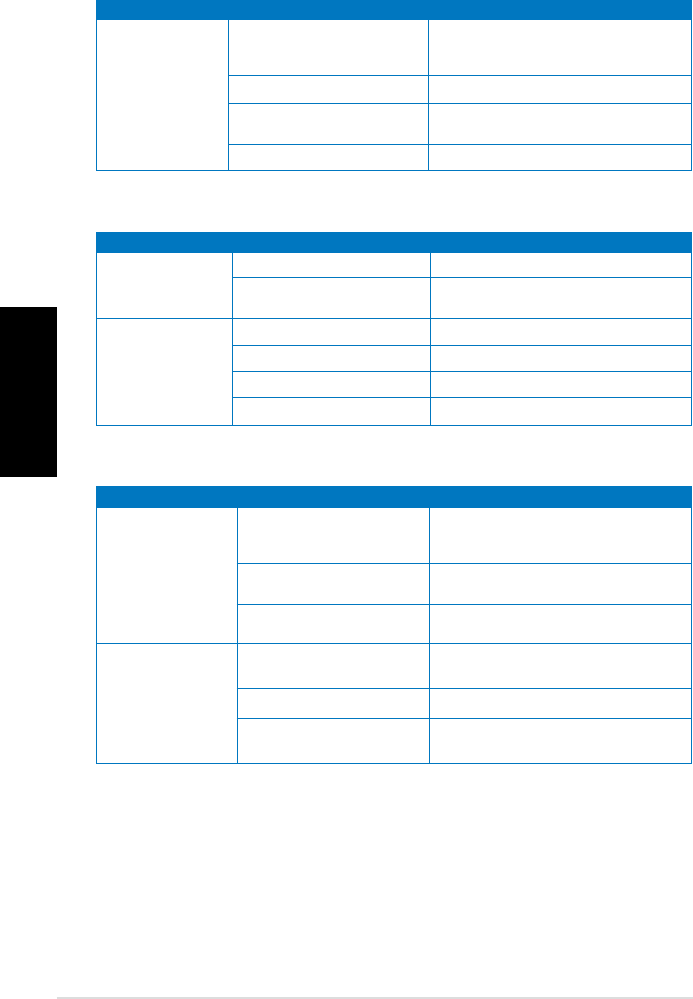
214
音效相關問題
不良現象描述 可能的問題 請用戶確認
運行速度變慢或死機相關問題
不良現象描述 可能的問題 請用戶確認
CPU 風扇太吵
不良現象描述 可能的問題 請用戶確認

215
華碩的聯絡信息
華碩電腦(上海)有限公司 ASUSTEK COMPUTER (SHANGHAI)
CO., LTD(中國)
市場信息
地址:上海市閔行莘庄工業區春東路508號
電話:+86-21-54421616
傳真:+86-21-54420099
互聯網:http://www.asus.com.cn/
技術支持
電話:
+86-21-34074610
(800-820-6655)
電子郵件:http://www.asus.com.cn/email
在線支持:h t t p: / / s u p p o r t .a s u s .c o m/
techserv/techserv.aspx
華碩電腦公司 ASUSTeK COMPUTER INC.(亞太地區)
市場信息
地址:台灣臺北市北投區立德路15號
電話:+886-2-2894-3447
傳真:+886-2-2890-7798
電子郵件:info@asus.com.tw
互聯網:http://www.asus.com.tw
技術支持
電話:+86-21-38429911
傳真:+86-21-58668722,ext.9101#
在線支持:h t t p: / / s u p p o r t .a s u s .c o m/
techserv/techserv.aspx
ASUS COMPUTER INTERNATIONAL(美國)
市場信息
地址:800CorporateWay,Fremont,California
94539,USA
電話:+1-510-739-3777
傳真:+1-510-608-4555
互聯網:http://usa.asus.com
技術支持
電話:+1-812-282-2787
傳真:+1-812-284-0883
在線支持:h t t p: / / s u p p o r t .a s u s .c o m/
techserv/techserv.aspx
ASUS COMPUTER GmbH(德國/奧地利)
市場信息
地址:H a r k o r t S t r. 2 1 -23, D - 40880
Ratingen,Deutschland
傳真:+49-2102-959911
互聯網:http://www.asus.de
在線聯絡:h t t p:// w w w .a s u s. d e /s a l e s
(僅回答市場相關事務的問題)
技術支持
電話:+49-1805-010923(配件)*
電話:+49-1805-010920(系統 / 筆記本
電腦/易家族/LCD)*
傳真:+49-2102-9599-11
在線支持:h t t p: / / s u p p o r t .a s u s .c o m/
techserv/techserv.aspx
* 使用德國固定電話撥打每分鐘話費為 0.14 歐元,使用手機撥打每分鐘話費為 0.42
歐元。
