BRIC Link II
User Manual: BRIC-Link II
Open the PDF directly: View PDF  .
.
Page Count: 2
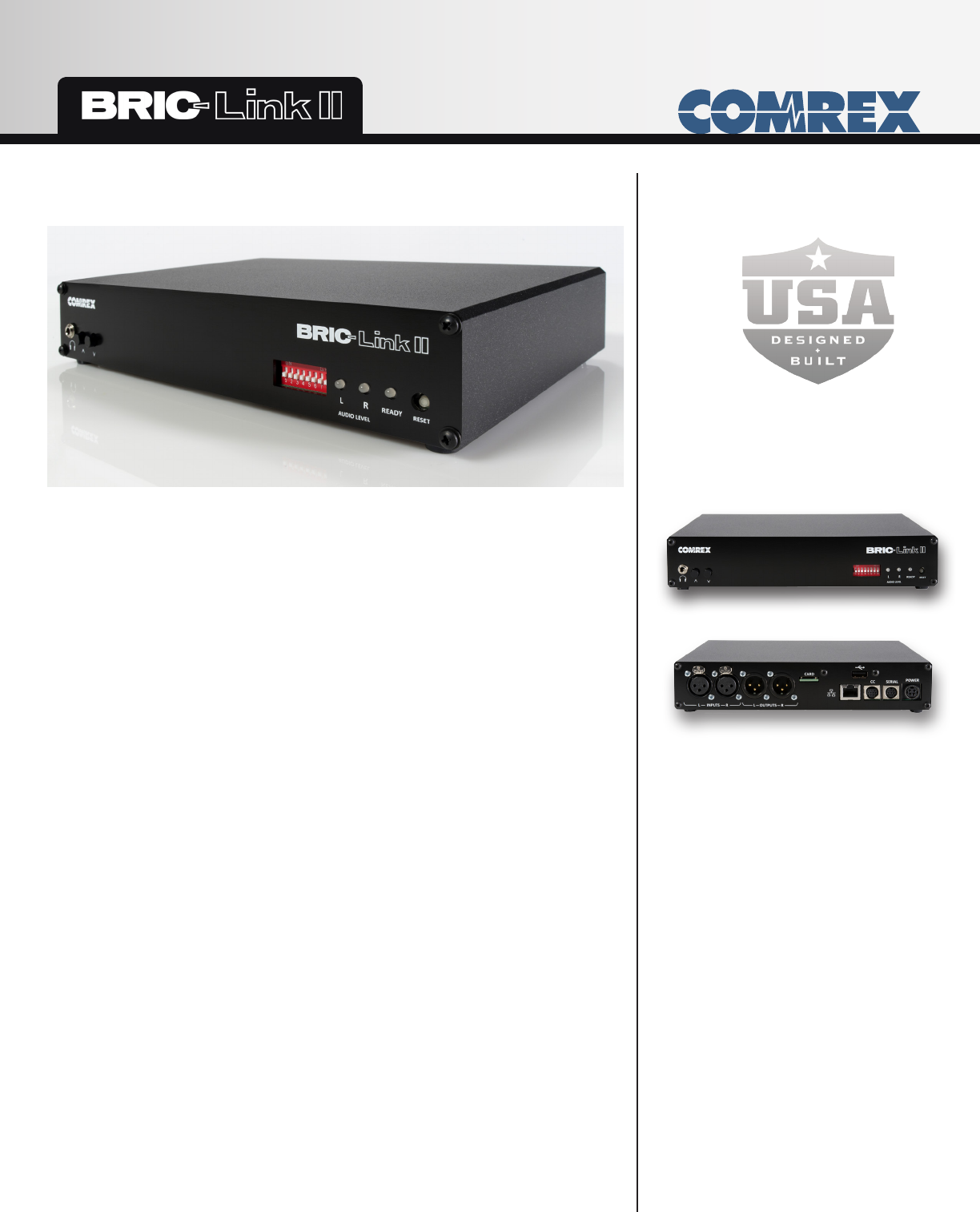
The Comrex BRIC-Link II, like the Comrex BRIC-Link, is a low-cost, high-performance
solution for audio-to-IP conversion. Leveraging many of the core technical aspects of
Comrex’s successful remote broadcast ACCESS product line, BRIC-Link II provides
for an elegant way of moving linear or compressed audio with very low delay.
BRIC-Link II is very simple to use, and can be deployed over a wide range of IP
links. While it carries an entry-level cost, BRIC-Link II maintains superb audio
specifications and hardware reliability, making the system suitable for STLs and
other mission-critical functions without the expense required of more full-featured
codecs. BRIC-Link II is contained in a small desktop package. Two BRIC-Link IIs may
be installed to occupy 1U of rack space.
Applications
Like its predecessor, BRIC-Link II is uniquely
suited to point-to-point “nailed up” high-
quality audio links over a variety of data
networks, like ISM band IP radios, T1/
E1s, satellite channels, WANs, and LANs.
The robustness of the BRIC technology
(Broadcast Reliable Internet Codec) used
in the box allows the system to perform
well on the public Internet as well (using
AAC compression modes).
BRIC-Link II is capable of “multi-
streaming” – BRIC-Link II has the ability
to run one encoder per box, but this single
encoder stream may be sent to up to three
destinations simultaneously. Additionally,
BRIC-Link II can act as a streaming server,
delivering AAC and HE-AAC to compatible
PC-based media players.
Audio Coding
For users concerned about delay and
coding artifacts, BRIC-Link II offers a
robust stereo or mono linear mode that
does not compress audio. In addition,
BRIC-Link II is the only real-time audio
codec to offer FLAC lossless compression,
which reduces network throughput by 30–
40% with absolutely transparent coding
and no tandem coding concerns.
For situations where more reduced
bandwidth is desired, BRIC-Link II offers
AAC/HE-AAC modes as standard, allowing
superb audio quality at dramatically reduced
data rates.
For compatibility with mobile phone and
web apps, BRIC-Link II also implements
Opus audio compression, along with VoIP
standards G.722 and G.711.
BRIC-Link II Point-to-Point
IP Audio Conversion
Connections and Indicators
BRIC-Link II offers balanced, professional
level analog I/O on standard XLR
connectors. Alternately, the Left I/O
connectors may be switched to AES3 digital
audio format.
BRIC-Link II can be connected to an IP
network through a Gigabit Ethernet jack.
Contact Closure and Ancillary data are
delivered on Mini-DIN style jacks.
Audio level is displayed on the front panel
via L & R tri-color LEDs. These LEDs may be
configured to display send or receive level.
A status LED on the front panel displays
connection status as well as Ethernet status.
BRIC-Link II is also equipped with a card
slot and a USB port for future use.
Additionally, the front panel of the BRIC-
Link II features a headphone jack for
monitoring purposes.
www.comrex.com • e-mail: info@comrex.com • 19 Pine Road, Devens, Massachusetts 01434 USA • Tel: 978-784-1776 • Fax: 978-784-1717
User Interface
BRIC-Link II acts as a web server, allowing the
user to access all controls through an intuitive
web interface. The page displays connection
status, extensive network diagnostics, and
audio level meters for remote monitoring.
From any location, users are able to
configure profiles for various connections
with point-and-click connection commands.
Initial IP configuration is easily managed
by the user with a Windows-based setup
utility to be run on a computer located on
the same local area network for low-fuss
installation. The setup utility also functions
as an upgrade utility, allowing flash upgrades
from the Comrex website to be applied to
the hardware in minutes.
Transmission Modes and Delay
BRIC-Link II is a true codec, offering a
full-duplex stereo encoder and decoder in
each box. Where two-way transmission is
not required, the reverse channel may be
disabled. The BRIC technology incorporated
includes a jitter buffer manager that
automatically balances delay and stability,
dynamically increasing and decreasing
delay based on network performance. For
networks where the QoS is known, these
parameters may be set so that a consistent
level of jitter buffer is maintained.
End-to-end coding delay in linear modes is
less than 25mS and FLAC modes are less
than 30mS. AAC modes incorporate around
100mS total end-to-end delay and HE-AAC
modes deliver around 220mS.
In addition to coding delay, network
propagation and jitter buffers will add delay
to any IP link and are network dependent.
Additional Features
BRIC-Link II provides for four end-to-end
contact closures to be delivered along
with the audio stream in each direction.
Alternately, the contact closure inputs may
be configured to initiate connections. An
ancillary data stream is available via RS232
along with the audio stream. In AAC modes,
the system is capable of sending up to 3 one-
way encode streams to separate decoders
(requiring additional bandwidth).
In addition, BRIC-Link II supports IP Multicast
on capable networks.
About the BRIC-Link II Coding
Algorithms:
Linear - BRIC-Link II’s linear mode digitizes
audio to 16 bit samples. It does not
compress the audio further, but packetizes a
frame of audio samples and transfers them
across the network uncorrupted. Analog
audio is sampled at 48 kHz, proving 22 kHz
frequency response. If AES3 Input/Output is
used, BRIC-Link II can utilize 44.1 kHz and
32 kHz sampled audio.
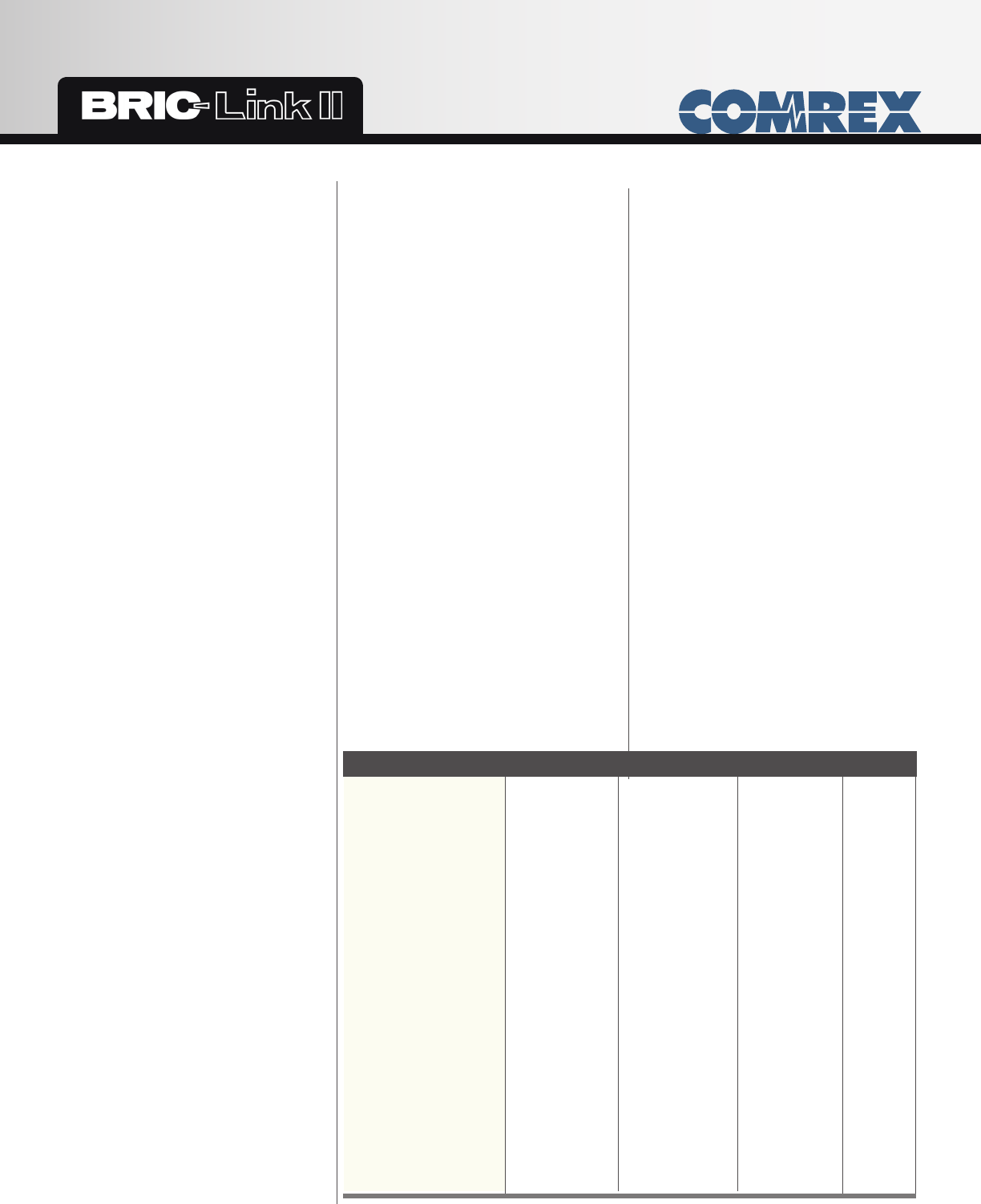
As shown in the table below, this can
conserve network bandwidth (and reduce
frequency response slightly).
FLAC - BRIC-Link II offers the FLAC (Free
Lossless Audio Compression) algorithm for
those who wish to conserve bandwidth
without sacrificing audio quality. Since
FLAC is lossless, there are no concerns
about artifacts or immunity to further
coding in the link.
On average audio, FLAC will typically
remove 30-35% of the network data when
compared to linear. FLAC encodes analog
audio at 48 kHz with 16-bit resolution.
If AES3 In/Out is used, FLAC can utilize
44.1 kHz or 32 kHz sampled audio, further
conserving bandwidth.
Frequency response and all other
specifications are identical to linear, with a
slightly longer (5ms) delay.
AAC - For applications that require reduced
bandwidth but excellent audio quality, BRIC-
Link II can utilize the highly regarded AAC
coding algorithm (licensed by Fraunhofer
IIS) to provide near transparent stereo audio
at a data rate of 128 kb/s or lower. Several
AAC modes are available that reduce
bandwidth and offer a choice of stereo or
mono operation.
HE-AAC - To further reduce network
bandwidth requirements (for example, for
operation on the public Internet) BRIC-Link
II includes HE-AAC, which combines the
coding power of AAC with Spectral Band
Replication to reduce the data requirements
for high frequencies. HE-AAC is typically
deemed to sound nearly as good as AAC
at lower network bandwidth. HE-AAC is the
standardized version of the algorithm known
as AAC-Plus. Several HE-AAC modes are
available that reduce bandwidth and offer
a choice of stereo or mono operation.
HE-AACv2 is also included, which utilizes
parametric stereo encoding resulting in
extremely low data rates.
Opus - Opus is a newer offering that combines
low delay and low network utilization. Opus
is included primarily for compatibility with
softphone apps and Internet connections
using WebRTC (see Technotes about
WebRTC on the Comrex website).
• *44.1 kHz and 32 kHz modes are only supported via AES3 digital audio I/O on both ends of link
• FLAC bandwidth is variable and based on audio input
ALGORITHM ENCODE RATE NETWORK RATE BANDWIDTH DELAY
Linear 48 kHz Mono 768Kb/s 818Kb/s 22 kHz 25mS
Linear 48 kHz Stereo 1.536Mb/s 1.586Mb/s 22 kHz 25mS
Linear 44.1 kHz Mono* 705.6Kb/s 751.6Kb/s 20 kHz 27mS
Linear 44.1 kHz Stereo* 1.4112Mb/s 1.4572MB/s 20 kHz 27mS
Linear 32 kHz Mono* 512Kb/s 546Kb/s 15 kHz 31mS
Linear 32 kHz Stereo* 1.024Mb/s 1.058Mb/s 15 kHz 31mS
FLAC 48 kHz Mono ~540Kb/s ~572Kb/s 22 kHz 30mS
FLAC 48 kHz Stereo ~1.08Mb/s ~1.112Mb/s 22 kHz 30mS
FLAC 44.1 kHz Mono* ~500Kb/s ~530Kb/s 20 kHz 32mS
FLAC 44.1 kHz Stereo* ~1Mb/s ~1.03Mb/s 20 kHz 32mS
FLAC 32 kHz Mono* ~360Kb/s ~382Kb/s 15 kHz 36mS
FLAC 32 kHz Stereo* ~720Kb/s ~752Kb/s 15 kHz 36mS
AAC Mono 56-64Kb/s 72-80Kb/s 20 kHz 100mS
AAC Stereo 96-256Kb/s 112-272Kb/s 20 kHz 100mS
HE-AAC Mono 18-48Kb/s 26-56Kb/s 15-20 kHz 210mS
HE-AAC Stereo 64-96Kb/s 72-104Kb/s 20 kHz 210mS
HE-AAC Stereo v2 24-48Kb/s 32-56Kb/s 15 kHz 250mS
OPUS Mono 48kbps 48Kb/s 64Kb/s 20 kHz 46ms
OPUS Mono 56kbps 56Kb/s 72Kb/s 20 kHz 46ms
OPUS Mono 64kbps 64Kb/s 80Kb/s 20 kHz 46ms
OPUS Stereo 64kbps 64Kb/s 80Kb/s 20 kHz 46ms
OPUS Stereo 96kbps 96Kb/s 112Kb/s 20 kHz 46ms
OPUS Stereo 128kbps 128Kb/s 144Kb/s 20 kHz 46ms
BRIC-Link II Point-to-Point
IP Audio Conversion
