OM, SC 550 A, 2006 01, LAWN CARE EQUIPMENT, 968999351, SOD CUTTER Bluebird SC550 User Manual
User Manual: Bluebird SC550 User Manual
Open the PDF directly: View PDF  .
.
Page Count: 48
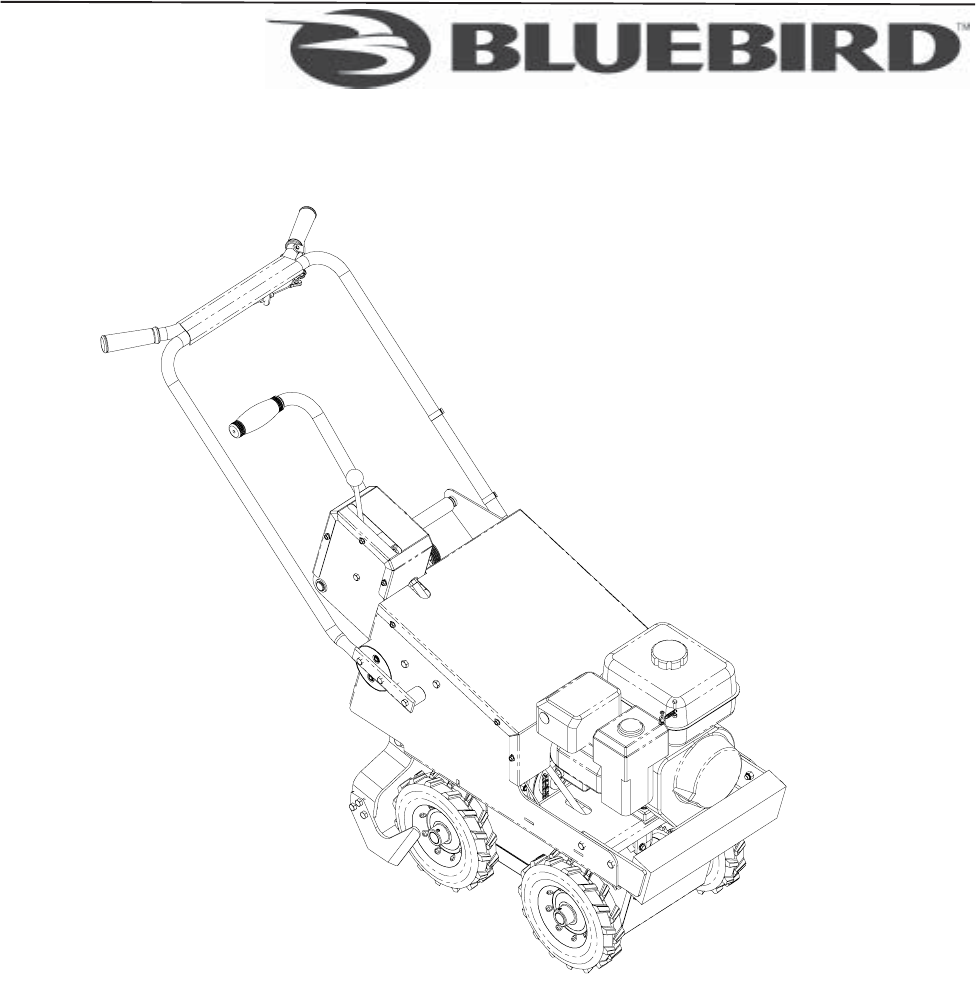
Operator’s Manual
MANUAL NO. 539113456 REV. IR (01/16/06)
Model:
SC550A/968999351
2
©2006 BlueBird International.
All Rights Reserved.
Printed Beatrice, Nebraska

3
TABLE OF CONTENTS
Sod Cutter 550A
Table of Contents ...................................... 3
Introduction ................................................ 5
Congratulations ..................................... 5
Use ........................................................ 5
Insure your machine .............................. 5
Good service ......................................... 5
Serial number ........................................ 5
Symbols and decals ................................... 6
Safety instructions..................................... 7
General use ........................................... 7
Preparation ............................................ 9
Operation ............................................... 11
Movement/Transport .............................. 13
Storage .................................................. 13
Children ................................................. 13
Fuel System .......................................... 14
Maintenance .......................................... 15
Customer Responsibility ....................... 16
Protective Equipment ............................... 17
Personal Equipment .............................. 17
Set-Up ......................................................... 18
Equipment set-up .................................. 18
Controls ...................................................... 20
Presentation .......................................... 20
Main Components and
Operating Instructions ........................... 20
Engine ................................................... 21
Cutting Unit ............................................ 21
Operation.................................................... 27
Starting the Engine................................. 27
Operating on Hills .................................. 29
Transport ............................................... 29
Maintenance............................................... 30
Maintenance Schedule ........................... 30
Replacing the Air Filter............................ 31
Cleaning the Sludge Reservoir ............... 32
Ignition System ....................................... 33
Adjusting the Drive Belt .......................... 34
Blade Wear ............................................ 34
Blade Replacement ................................ 35
Chain Tension Adjust .............................. 35
Chain Replacement................................ 35
Two Minute Rule ..................................... 35
Cleaning & Washing ............................... 35
Lubrication ................................................. 36
Lubrication Schedule .............................. 36
Lubricating the Chains............................ 38
Torque Chart .............................................. 38
Troubleshooting ........................................ 39
Storage ....................................................... 42
Winter Storage ....................................... 42
Service ................................................... 42
Technical Data............................................ 43
Service Journal.......................................... 44
Delivery Service ..................................... 44
After the First 20 Hours .......................... 44

4
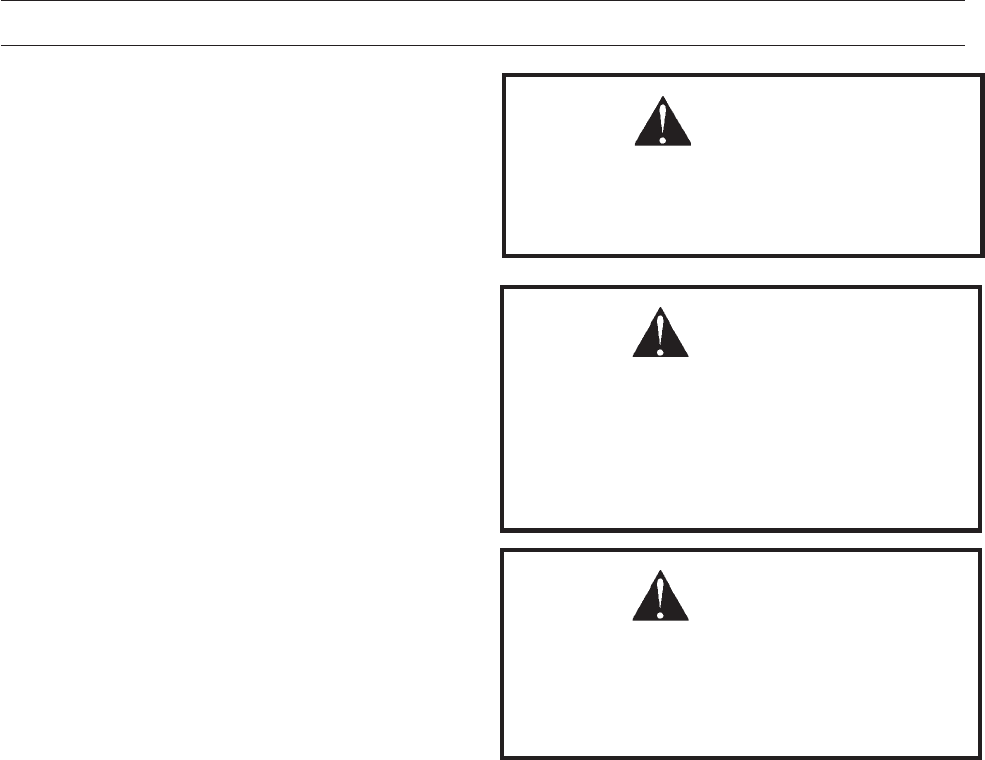
WARNING!
Failure to follow cautious operating practices can result in serious injury to the
operator or other persons. The owner must understand these instructions, and must
allow only trained persons who understand these instructions to operate the mower.
Each person operating the mower must be of sound mind and body and must not be
under the influence of any mind altering substance.
WARNING!
Engine exhaust, some of its constituents, and certain vehicle components contain
or emit chemicals known to the State of California to cause cancer and birth defects
or other reproductive harm.

5
INTRODUCTION
Congratulations
Thank you for purchasing a BlueBird sod cutter. Through your confidence in us, you have chosen an
exceptionally high quality product.
This manual is a valuable document. It describes your new BlueBird machine. Read the manual
carefully before attempting to use the machine. Following the instructions (use, service, mainte-
nance, etc.) can considerably increase the life-span of your machine and even increase its resale
value. Please contact your dealer for more information.
If you sell your BlueBird machine, make sure to give the operator’s manual to the new owner.
Use
The sod cutter is used to remove the top layer of sod in a 18” wide strip.
Insure your machine
Contact your insurance company to check on insurance coverage for your new machine. You
should have all-inclusive insurance for liability, fire, damage and theft.
Good service
BlueBird’s products are sold all over the world and only in specialized retail trade with complete
service. This ensures that you as a customer receive only the best support and service. Before the
machine was delivered it underwent inspection and was adjusted by your dealer. When you need
spare parts or support in service questions, guarantee issues, etc., please consult the following
professional:
This Operator’s Manual belongs to machine with
serial number: Engine number:
Serial number
The serial number can be found on the printed plate attached to the frame on the back panel under
shifter bracket. The plate includes the following information:
•The machine’s type designation (MODEL).
•The machine’s serial number (S/N).
Please state the type designation and serial number when ordering spare parts.
The engine’s serial number is punched in the crankcase under the oil level guard.
The engine type is specified on the crankcase to the right of the oil level guard but also appears on
the decal on the starter.
Please state these when ordering spare engine parts.
6
SYMBOLS AND DECALS
WARNING!
Xxxx xxx xxxx xx xxxx x xxxx.
Used in this publication to notify the reader of a risk
of personal injury, particularly if the reader DOES
NOT follow the instructions given in the manual.
IMPORTANT INFORMATION
Xxxx xxx xxxx xx xxxx x xxxx.
Used in this publication to notify the reader of a risk
of material damage.
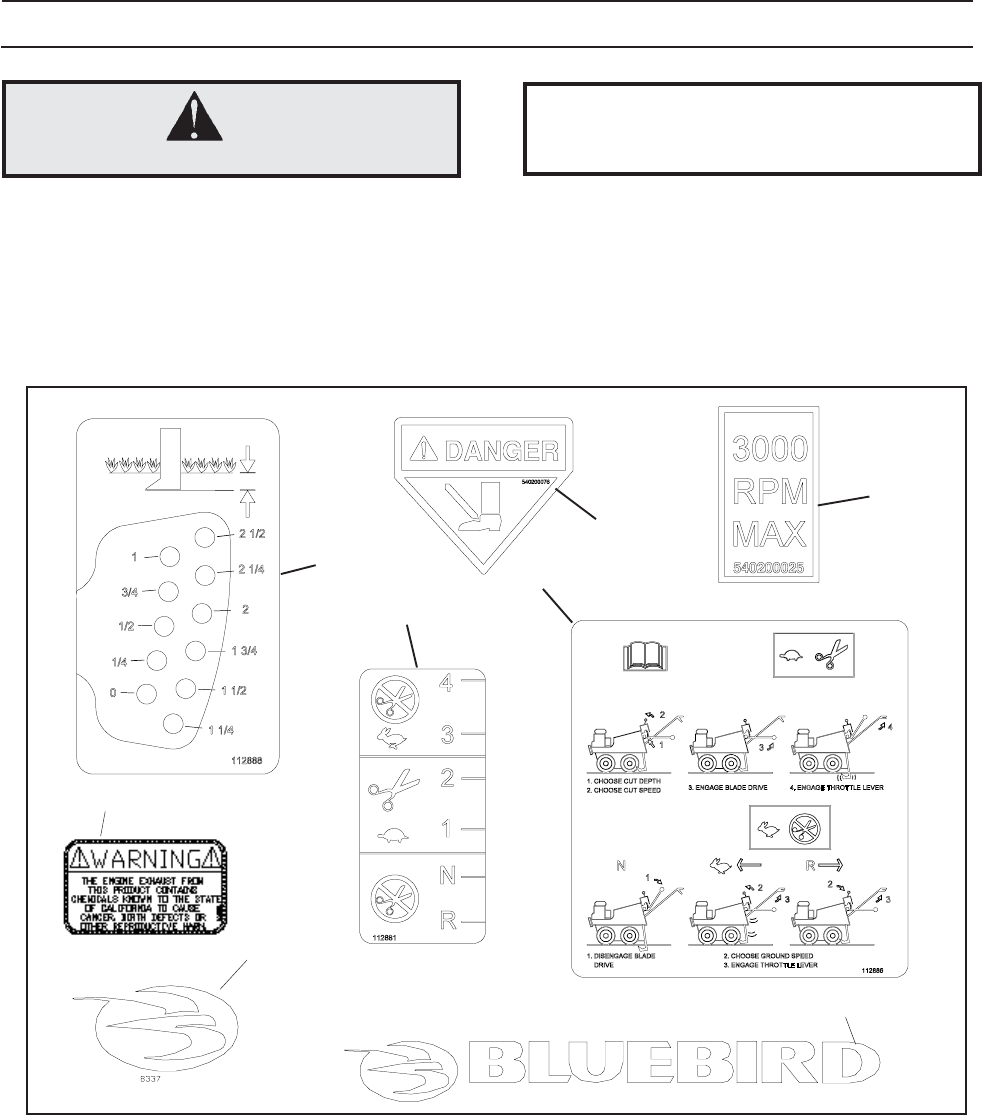
Decals and machine-bound instructions
1. BlueBird logo
2. BlueBird logo
3. Severing Foot Warning
4. Exhaust warnings
1
2
4
Decals that are missing or illegible should be replaced before using the machine.
5. Maxium RPM
6. Depth of cut
7. Shift decal
8. Operation
3
5
6
7
8

7
SAFETY INSTRUCTIONS
WARNING!
Under no circumstances may the original
design of the machine be modified
without written approval from the
manufacturer. Such modifications not
only affect the performance and
durability of the machine but may even
pose a safety risk for users and those in
the vicinity. Unauthorized modifications
to the design of the machine may
absolve the manufacturer from liability
for any resulting personal injury or
property damage. Modifying the machine
without written approval from the
manufacturer will void the warranty.
The object of this manual is to help you use your
BlueBird machine safely and to give you information
about how to maintain your machine. Please read
the manual carefully before attempting to use the
machine.
If after reading the operator’s manual you are still
unsure about the safety risks associated with use
of the machine, you should not use the machine.
Please contact your dealer for more information.
IMPORTANT INFORMATION
Do not use the machine until you have
read the operator’s manual carefully and
understand and follow the instructions
given. Failure to follow these safety
instructions could result in serious injury
or death. All maintenance work or
adjustments not described in this manual
must be performed by an authorized
BlueBird service workshop.
WARNING!
The sod cutter can be dangerous if used
improperly or with out due care and can
lead to serious accidents, in the worst
cases even fatal accidents. It is very
important that the operator read,
understand and follow this operator’s
manual and understand the instructions
before you attempt to use the machine. Read the operating and service instruction manual
carefully. Be throroughly familiar with the controls
and the proper use of the equipment. Know how
to stop the unit and disengage the controls quickly.
General use
WARNING!
This symbol means that important safety
instructions need to be emphasized. It
concerns your safety.
These safety instructions only address the basics
for safe use. It would be impossible in the safety
instructions to describe all possible risk situations
that could arise when using the machine. You can,
however, prevent accidents by always using
common sense.
To obtain extra copies of the operator’s manual,
please contact your dealer.

8
• BlueBird original spare parts are designed and
specified to maintain high quality and correct fit
for optimal durability and life-span. From a
safety point of view, you should only use
BlueBird original spare parts.
•Only use the machine for removing sod. It is
not intended for any other use.
• Check that the machine is in serviceable
condition prior to use; see the chapter
”Maintenance/Maintenance schedule”.
• Only use the machine in daylight or in other well-
lit conditions. Keep the machine a safe distance
from holes or other irregularities in the ground.
Pay attention to other possible risks.
• Read, follow and understand all safety
instructions before using the machine. Failure
to do so may result in injury to yourself or
others.
• Accident prevention regulations, other general
safety regulations, occupational safety rules
and traffic regulations must be followed without
fail.
• Only allow responsible adults, who are familiar
with the instructions, to operate the machine.
• Engage an authorized BlueBird dealer for all
service and repairs not described in this
manual.
• People and animals can distract you, causing
you to lose control of the machine. For this
reason, you should always concentrate and
focus on the task at hand.
• Never leave the machine unsupervised with the
engine running.
• The machine is tested and approved only with
the equipment originally provided or
recommended by the manufacturer.
Overexposure to vibration may lead to
circulatory or nerve damage, particularly
in people who have impaired circulation.
Contact your doctor if you experience
symptoms that could have been caused
by overexposure to vibration. Examples
of common symptoms include numbness,
pain, muscle weakness, change of skin
color or an uncomfortable feeling of
tingling. These symptoms appear most
frequently in the fingers, hands or wrists.
WARNING!
The engine can become very hot. To
avoid being burned, you must turn off the
engine and wait until all parts have
cooled before touching the engine.
WARNING!
IMPORTANT INFORMATION
Never use a sod cutter that is damaged
or incorrectly adjusted. Never use the sod
cutter if any component is missing or if it
is not properly assembled. If you find
yourself in a situation where you are not
sure what to do, always seek expert
assistance. DO NOT try to resolve any
problem you are not qualified to repair.
SAFETY INSTRUCTIONS
Engine exhaust and certain vehicle
components contain or emit chemicals
considered to cause cancer, birth
defects, or other reproductive system
damage. The engine exhaust contains
carbon monoxide, which is a odorless,
colorless, poisonous gas. Do not use
the machine in enclosed spaces.
WARNING!
9
SAFETY INSTRUCTIONS
• Make sure nobody else is in the vicinity of the
machine when you start the engine, engage the
drive or run the machine.
• Keep the area of operation clear of all persons,
particularly small children, and pets.
• Keep in mind that the operator or user is
responsible for accidents or hazards occurring
to other people, their property, and themselves.
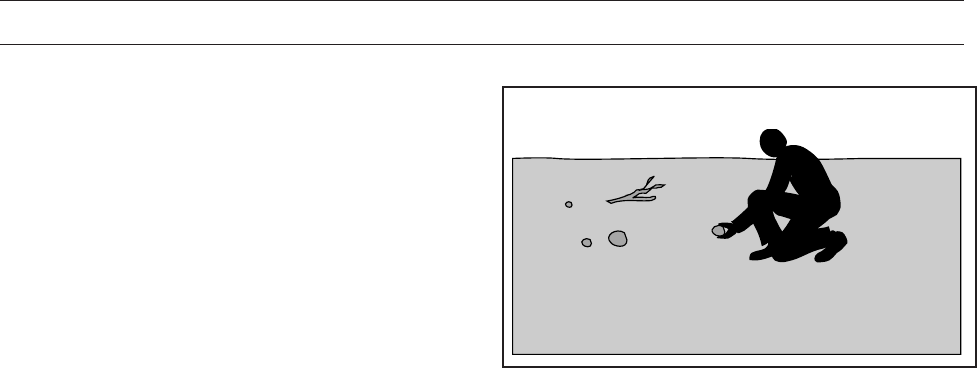
• Thoroughly inspect the area where the
equipment is to be used and remove all foreign
objects.
• Find and locate all fixed objects in the ground,
such as sprinkler systems, poles, water valves,
bases for washing lines, etc. Be certain to
check for hidden electrical cables or similar in
the surface of the lawn. Always run the machine
around these objects. Never intentionally run
the machine over foreign objects.
• Check that the throttle grip and all guards are
fitted and functioning. DO NOT use the machine
if it is not working properly.
• Makes sure no clothing, long hair or jewelry can
catch in moving machine parts.
•Check that all safety decals are in place.
• Do not operate the equipment without wearing
adequate outer garments. Wear protective
footwear that will improve footing on slippery
surfaces.
• Never attempt to make any adjustments while
the engine (motor) is running (except where
specifically recommended by the
manufacturer).
• Shift into neutral before starting the engine
(motor).
Preparations
• Make sure that you always have first aid
equipment at hand when using the machine.
8011-198
Clear the work area before beginning work.
10
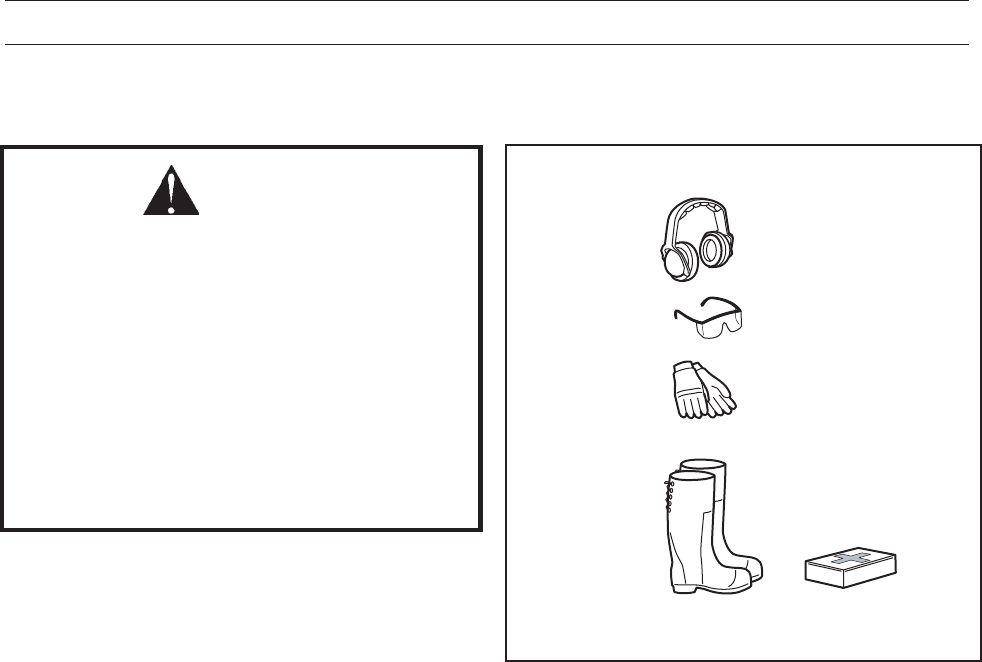
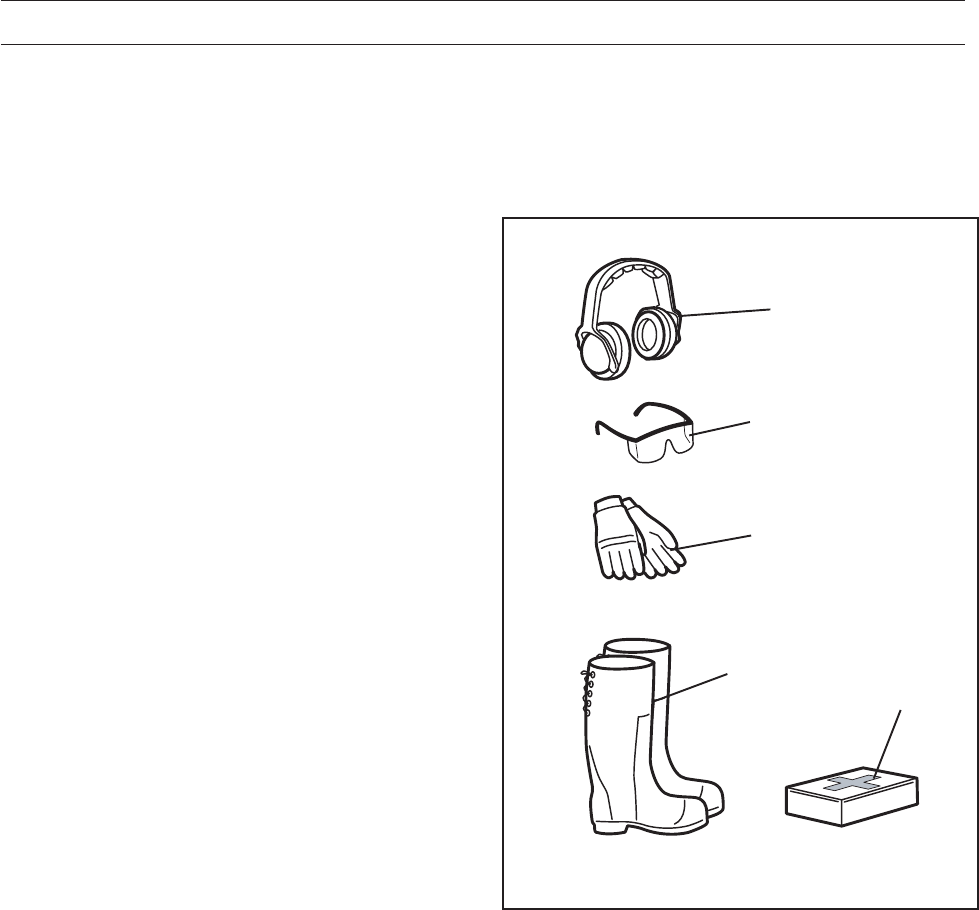
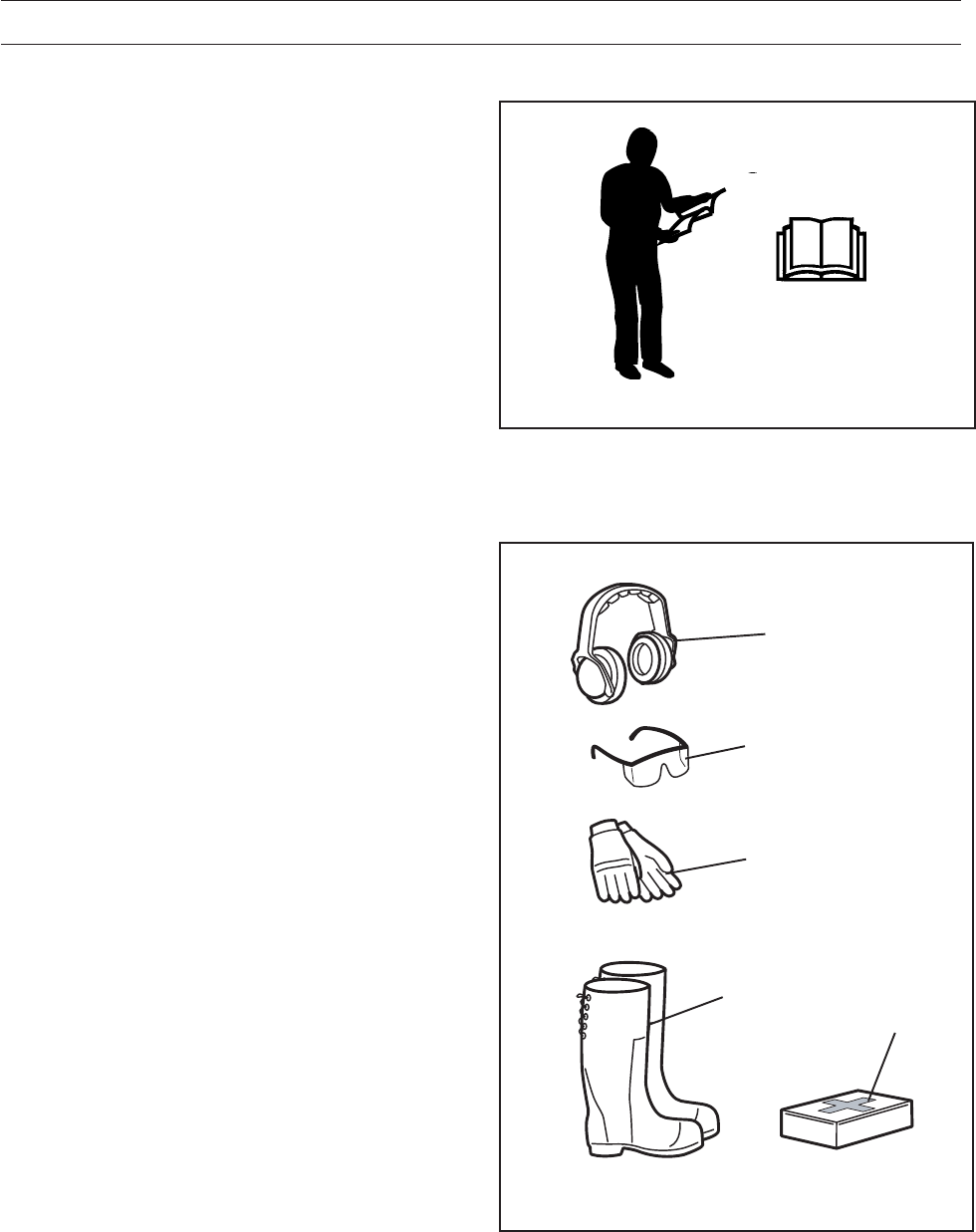
Always use approved personal protective
equipment (as shown in illustration) when
using the machine. Protective clothing and
protective equipment cannot eliminate
the risk of accidents, but wearing proper
clothing and the correct equipment will
reduce the degree of injury should an
accident occur. Ask your dealer about
approved protective clothing and
approved protective equipment
recommended by BlueBird.
8011-670
Use appropriate equipment.
WARNING!
• Make sure that you have first aid equipment
close at hand when using the machine.
SAFETY INSTRUCTIONS
• Never use the machine when barefoot. Always
wear protective shoes or boots, preferably with
steel toecaps.
• Always wear approved protective glasses or
full visor when assembling or cutting sod.
• Always wear gloves when handling the blades.
• Never wear loose clothing that can get caught
in moving parts.
• Use ear protectors to avoid damage to hearing.
1. Ear protection
2. Protective glasses
3. Protective gloves
4. First aid kit
5. Protective boots or steel-toed shoes

11
SAFETY INSTRUCTIONS
Operating
•DO NOT use the machine on grades of more
than 25%.
•DO NOT use the machine if you are tired, if
you have consumed alcohol, or if you are taking
other drugs or medication that can affect your
vision, judgment or coordination.
• Never use the machine indoors or in spaces
lacking proper ventilation.
• Make sure you have a proper foothold when
using the machine, particularly when backing.
Walk, don’t run. Never work on wet grass. Poor
traction may cause you to slip.
• Do not put hands or feet near or under moving
or rotating parts.
• Smoking, open flames or sparks in the vicinity
of the machine are strictly forbidden. Gasoline
is extremely flammable and carelessness in
handling can result in personal injury or fire.
• Never refuel the machine in a building or
enclosed trailer.
•Never use a machine with a defective muffler.
•This machine was designed for sod cutting only.
It is not intended for any other use.
• After striking a foreign object, stop the engine
(motor), remove the wire from the spark plug,
thoroughly inspect the machine for any damage,
and repair the damage before restarting and
operating the machine.
• Exercise extreme caution when operating on
or crossing gravel drives, walks, or roads. Stay
alert for hidden hazards or traffic. Do not carry
passengers.
• Exercise caution to avoid slipping or falling.
8011-091
Make sure you keep your hands and feet away from moving
parts.

12
SAFETY INSTRUCTIONS
• If the unit should start to vibrate abnormally,
stop the engine (motor) and check immediately
for the cause. Vibration is generally a warning
sign of trouble.
• Stop the engine (motor) when leaving the
operating position, and when making any
repairs, adjustments, and inspections.
• Take all possible precautions when leaving the
machine unattended. Disengage the power
take-off, raise the attachment, shift into neutral,
stop the engine.
• Before cleaning, repairing, or inspection, shut
off the engine and make certain all moving parts
have stopped. Disconnect the spark plug wire,
and keep the wire away from the plug to
prevent accidental starting.
• Do not operate the engine in a confined space
where dangerous carbon monoxide fumes
can collect.
• Never operate the machine without proper
guards, plates, or other safety protective
devices in place.
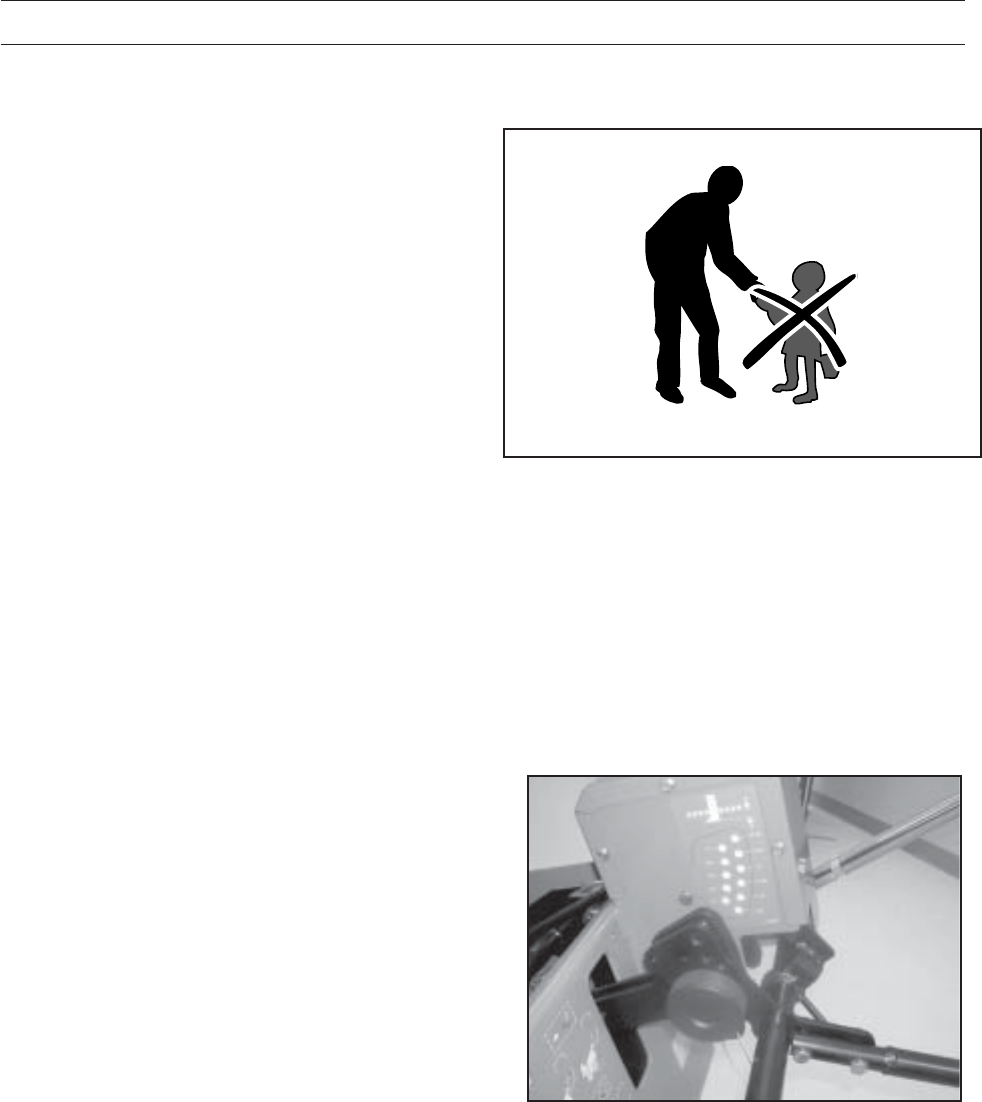
• Keep all bystanders (including children) and
pets out of the sod cutting area. Never assume
that children will remain where you last saw
them.
• Keep children in the watchful care of a
responsible adult other than the operator.
• Do not overload the machine capacity by
attempting to cut too deep at too fast a rate.
• Never operate the machine at high transport
speeds on hard or slippery surfaces.
• Use only attachments and accessories
approved by the manufacturer of the machine
(such as wheel weight, counterweights, and
the like).
• Never operate the sod cutter without good
visibility or light.
• Be careful when cutting in hard ground. If you
loose control, let go of the handles and do not
restrain the machine.
• Use extreme caution when reversing or pulling
the machine towards you.
• Do not change the engine governor settings
or overspeed the engine.
• Start the engine or switch on the motor carefully
according to instructions and with feet well
away from the cutting blade.
• Do not operate the sod cutter while under the
influence of alcohol or drugs.

13
SAFETY INSTRUCTIONS
Movement/Transport
• To turn and steer the machine, press down on
the handle and turn on the back wheels.
• Turn off the engine and allow it to cool at least 2
minutes before transport.
• We recommend only loading and unloading in
the transport mode on a well secured ramp, do
not lift, the unit is too heavy.
• Fasten the machine properly in place with
approved fasteners, such as tension belts,
chains or straps. Always check that you are in
compliance with applicable traffic regulations
before transporting the machine.
• Follow manufacturer’s recommendations for
safe loading, unloading, transport, and storage
of machine.
Storage
• Never store the machine with fuel in the fuel
tank inside a building where ignition sources
are present, such as hot water and space
heaters, clothes dryers, and the like. Allow the
engine to cool before storing in any enclosure.
• Store the machine with the fuel valve closed.
• Store the machine in a locked space away from
children and adults untrained in use of the
machine.
• Always refer to the operator’s manual for
important details if the sod cutter is to be stored
for an extended period.
Children
Serious accidents can occur if you fail to be on
guard for children in the vicinity of the machine.
Never assume that children will stay put where you
last saw them.
• Keep children away from the machine.
• Keep children away from the sod cutting area
and under close supervision by another adult.
• Keep an eye out and shut off the machine if
children enter the work area.
• Never allow children to operate the machine.
• Be particularly careful near corners, bushes,
trees or other objects that block your view.
14
Fuel system
WARNING!
Fuel is highly flammable, Take the
following precautions:
SAFETY INSTRUCTIONS
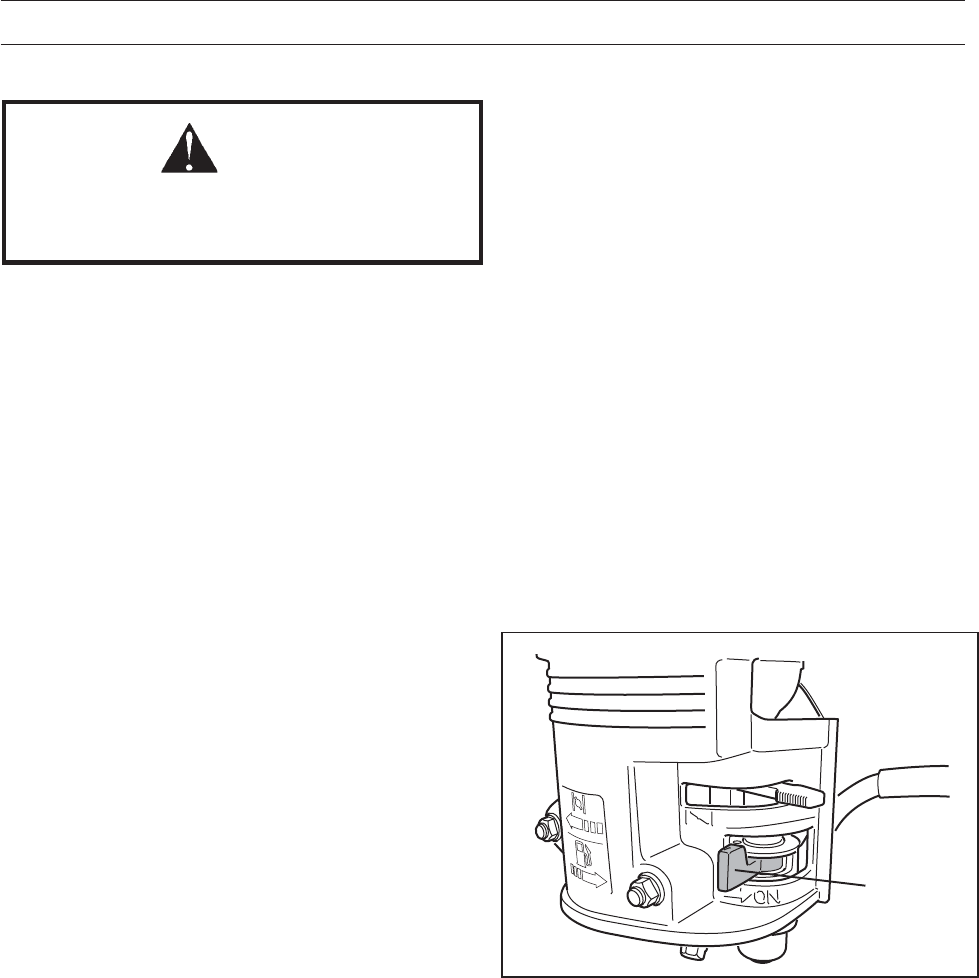
8011-186
Close the fuel valve.
1. Fuel Valve
1
Safe Handling of Gasoline
•To avoid personal injury or property
damage, use extreme care in handling
gasoline. Gasoline is extremely flammable
and the vapors are explosive.
•Extinguish all cigarettes, cigars, pipes, and
other sources of ignition.
•Use only approved gasoline container.
•Never remove gas cap or add fuel with the
engine running. Allow engine to cool at least
two (2) minutes before refueling.
•Never fuel the machine indoors.
•Never store the machine or fuel container
where there is an open flame, spark, or pilot
light such as on a water heater or other
appliances.
•Before you begin refueling, minimize the
risk of static electricity by touching a metal
surface.
•Never fill containers inside a vehicle or on a
truck or trailer bed with plastic liner. Always
place containers on the ground away from
your vehicle when filling.
•Remove gas-powered equipment from the
truck or tailer and refuel it on the ground. If
this is not possible, then refuel such
equipment with a portable container, rather
than from a gasoline dispenser nozzle.
•Keep the nozzle in contact with the rim
of the fuel tank or container opening at all
times until fueling is complete. Do not
use a nozzle lock-open device.
•If fuel is spilled on clothing, change
clothing immediately.
•Never overfill fuel tank. Replace gas cap
and tighten securely.
•Do not start the engine near spilled fuel.
•Never use gasoline as a cleaning agent.
•If leaks arise in the fuel system, the
engine must not be started until the
problem has been resolved.
15
SAFETY INSTRUCTIONS
Maintenance
• Never operate machine in a closed area.
• Never tamper with safety devices. Check their
proper opertion regularly.
• Never make any adjustments or repairs with
the engine running.
• If you strike a foreign object, stop and inspect
the machine, Repair, if necessary, before
restarting.
• Disengage the drive units, shut off the engine
and wait until all moving parts come to a
complete stop before making adjustments,
performing maintenance or cleaning the
machine.
• Disconnect the spark plug cable before
beginning repair work.
• Keep machine, attachments, and accessories
in safe working condition. Maintain or replace
safety and instruction labels, as necessary.
• Blades are sharp. Wrap the blade or wear
gloves, and use extra caution when servicing
them.
• Never allow persons not trained in the use of
the machine to perform service on it.
• Always park the machine on even ground before
performing maintenance or making
adjustments.
• Do not disassemble the engine. This can
invalidate your engine warranty. Contact your
dealer if you have any questions regarding
service or guarantee matters. Follow all
maintenance instructions.
• Do not change the setting of governors and
avoid running the engine over 3000 RPM. If you
run the engine faster than this, you risk
damaging the machine components.
• Do not modify safety equipment. Check
regularly to be sure it works properly. The
machine must not be run with defective or
unmounted protective plates, protective
cowlings, safety switches, or other portective
devices.
• The muffler is designed to maintain sound levels
at an approved level and keep direct exhaust
away from the user. Exhaust gases from the
engine are extremely hot and may contain
sparks that can cause fires or burn the user.
• Never use a machine with a defective muffler.
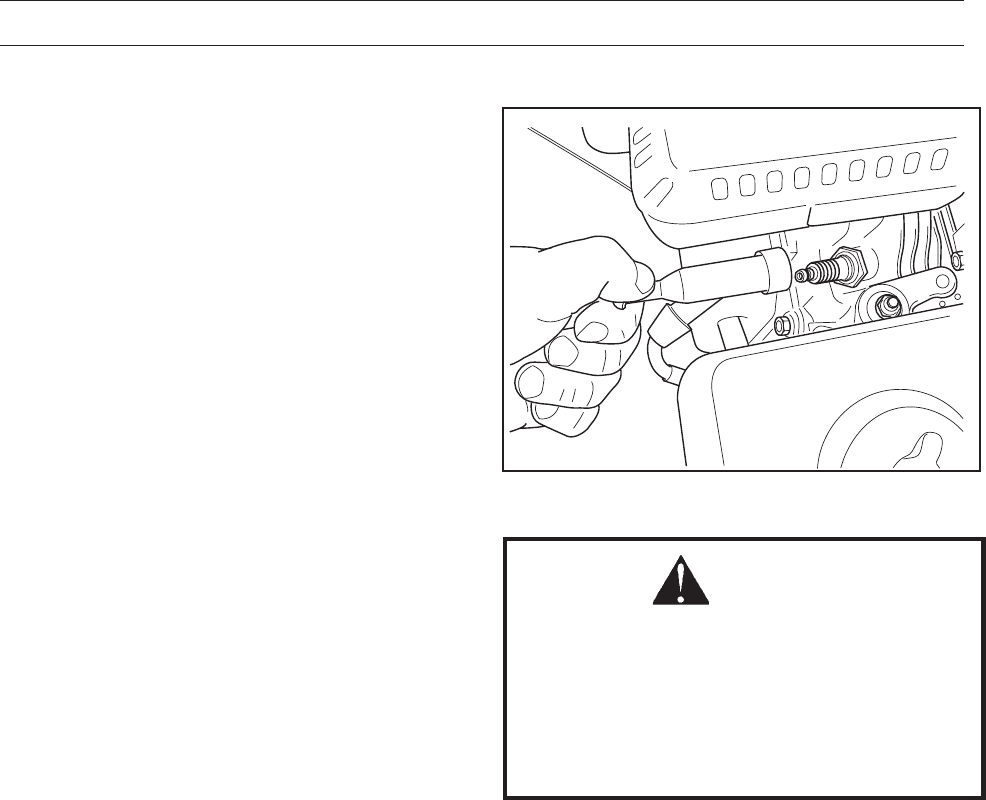
8011-027
Remove the spark plug cable.
• Keep machine free of grass, leaves, or other
debris build-up. Clean oil or fuel spillage and
remove any fuel-soaked debris. Allow machine
to cool before storing.
• Keep all nuts and bolts tight to be sure the
equipment is in safe working condition.
• If the fuel tank has to be drained, do this
outdoors.
• The machine is tested and approved only with
the equipment originally provided or
recommended by the manufacturer. Only use
approved repair parts for the machine.
• Regularly clean machine and underside, avoid
spraying engine and electrical components
with water.
Wait until all moving parts are
completely still before performing
maintenance on the machine.
Turn off the engine and remove the
spark plug cable.
WARNING!
16
SAFETY INSTRUCTIONS
Customer responsibilities
•Read and observe the safety rules.
•Follow a regular schedule in maintaining,
caring for and using your mower.
•Follow the instructions under
“Maintenance” and “Storage” sections of
this owner’s manual.
•This machine has no brain. Use yours!
A spark arrester for the muffler is available through your authorized BlueBird dealer.
This unit is equipped with an internal combustion engine and should not
be used on or near any unimproved forest-covered, bush-covered or
grass-covered land unless the engine’s exhaust system is equipped with
a spark arrester meeting applicable local or state laws (if any). If a spark
arrester is used, it should be maintained in effective working order by
the operator.
WARNING!
17
PROTECTIVE EQUIPMENT
Personal equipment
Consult your BlueBird dealer when selecting
protective equipment. Our dealers have a broad
assortment of equipment for professionals such
as forestry workers and knowledge about
occupational environment requirements and
protective levels.
We recommend the following personal protective
equipment:
1. Ear protection
2. Protective glasses
3. Protective gloves
4. First aid kit
5. Protective boots or steel-toed shoes
8011-027
1
2
3
45
18
SET-UP
Equipment set-up
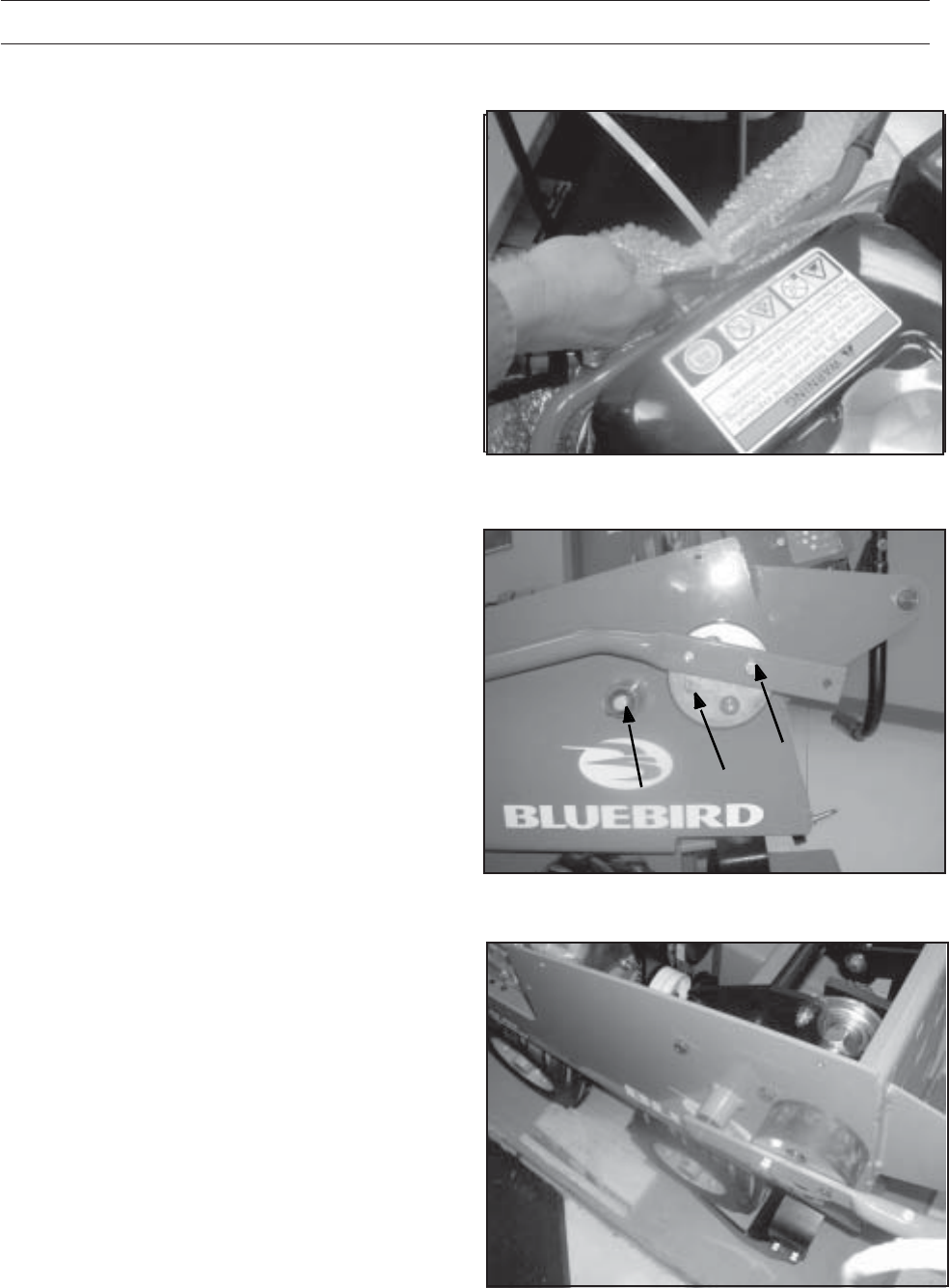
1. Remove crate top and sides.
2. Cut banding straps at front and rear of unit.
See Figure 1.
3. Remove bolts on handle using a 13 mm
socket wrench.
4. Remove tape from bolts by handle and
remove the bolts from the nylon bushings. See
Figure 2
5. Align handle to the three holes and replace
bolts. Tighten bolts. See Figure 3.
Cutting handle banding.
Remove handle bolts
Handle bolted to unit
FIGURE 1
FIGURE 2
FIGURE 3
19
SET-UP
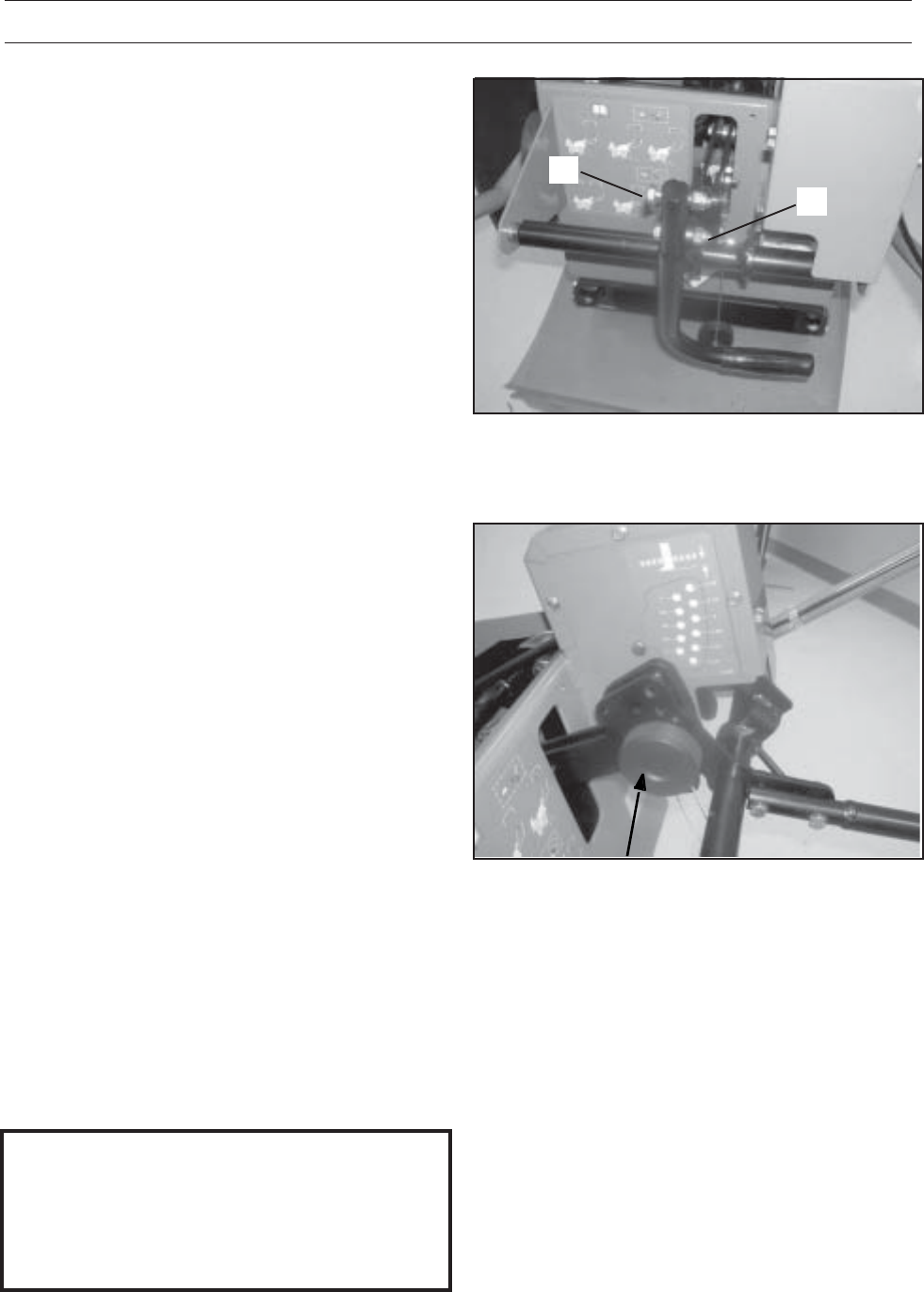
6. Using a 9/16” wrench and socket wrench,
remove top bolt and lock nut on the depth of
cut handle. Loosen lower bolt. Rotate handle
up and replace bolt in lower hole and tighten
hardware. See Figure 4.
7. Place knob into selected depth of cut hole and
secure tightly. See Figure 5.
8. Fill engine and centrifugal clutch case with oil.
See engine manual for quantity and viscosity
rating.
9. Fill engine with fuel. See engine manual for
fuel recommendation.
10. See section in this manual on starting engine
then drive the unit off of the pallet.
1
2
1. Remove Bolt
2. Loosen but do not remove
Depth Control Knob
FIGURE 4
FIGURE 5
IMPORTANT INFORMATION
Neither the engine nor the centrifugal
clutch cases are shipped with oil.
Fill engine and clutch case with oil before
starting the engine.
20
CONTROLS
Presentation
The machine is equipped with a 5.5 hp Honda four-
cycle engine. This unit is powered by 4-wheel drive.
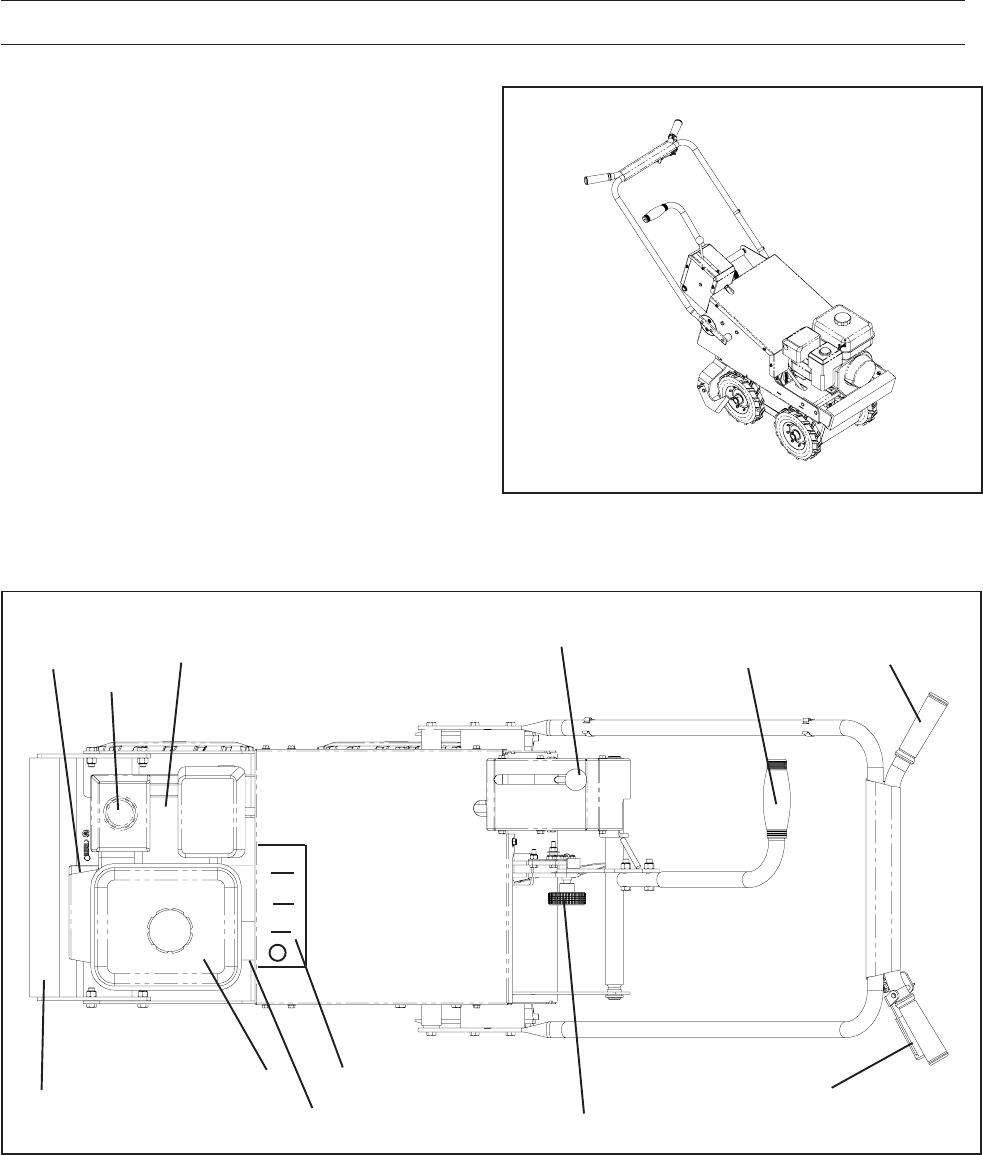
Main components and operating controls
1. Handle
2. Centrifugal Clutch
3. Shift Control Lever
4. Blade Engagement Lever
5. Throttle
6. Engine Start Cord
7. Engine
8. Fuel Tank
9. Air Filter
10. Weight
11. Engine switch
12. Knob to set depth of cut
13. Oil Reservoir
1
2
34
5
67
8
9
10 12
13
21
Engine
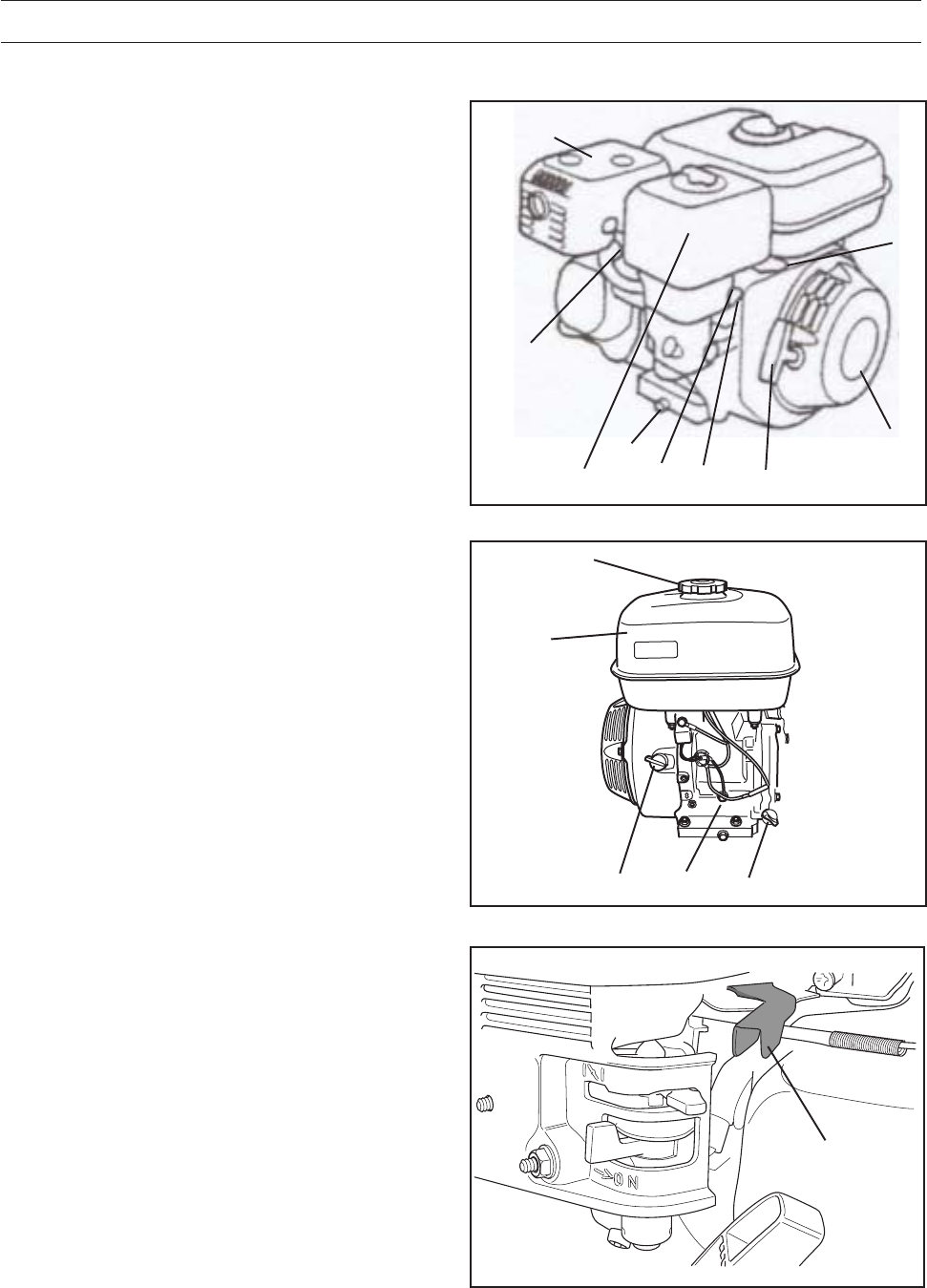
Exterior engine components and controls.
1. Throttle
2. Starter
3. Starter handle
4. Fuel valve
5. Choke control
6. Air filter
7. Spark plug
8. Muffler
9. Oil dipstick
10. Oil drainage
11. Oil level guard
12. Engine switch
13. Fuel tank
14. Fuel filler cap
CONTROLS
Throttle
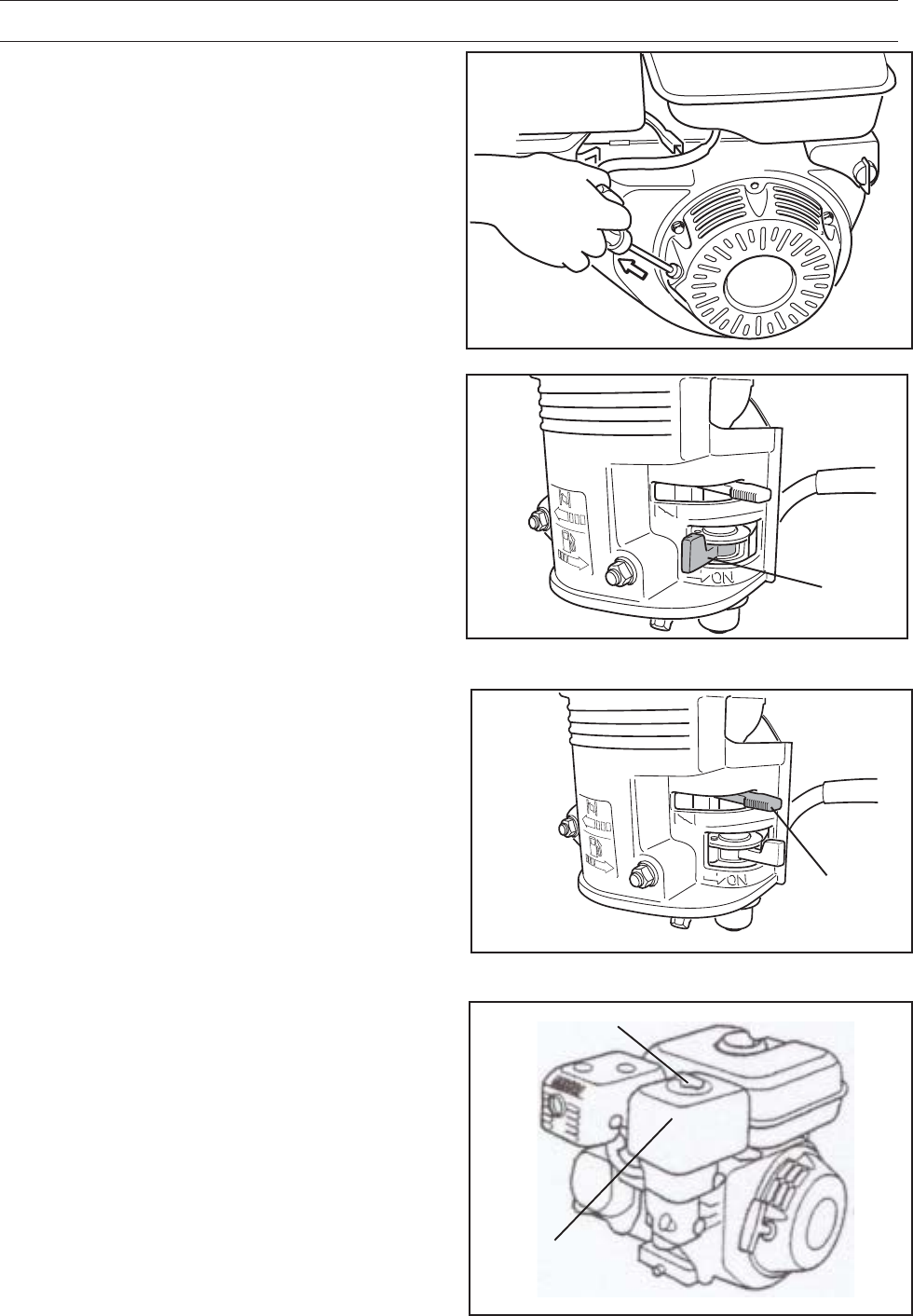
The lever on the engine is normally not used. It is
connected to the throttle on the handle. If the cable
should bind or break, you can reduce the throttle
with the lever on the engine as an emergency
measure to slow the engine speed.
8011-034
911
12
10
14
13
1
1. Throttle Control
1
2
3
4
5
6
7
8
22
CONTROLS
Starter
The starter is of the magnapull type with spring
return. To replace the return spring or starter cord,
contact an authorized service workshop.
Starter handle
Misuse of the starter handle can damage the starter.
Do not twist the starter cord around your hand.
Pull out the handle slowly until the gears mesh. Do
not pull out the starter cord completely and do not
let go of the starter handle when extended.
Fuel valve
The fuel valve opens and closes the connection
between the tank and the carburetor.
The illustration shows the tank valve closed; to
open, turn the lever completely to the right. There
is no middle position.
Turn off the valve when the machine is not in use
to avoid flooding the carburetor.
The fuel valve is combined with a sludge reservoir.
Choke control
The choke control opens and closes the choke
valve in the carburetor. This is only used to start a
cold engine.
The image shows the choke valve open; to close,
move the lever to the left. The midway positions
can be used. When the engine starts, the lever can
be moved gradually to the right as long as it
continues to run smoothly. Forgetting the choke is
evident as the engine runs roughly and produces
black smoke.
This also results in increased fuel consumption.
Air filter
The engine air filter consists of a foam filter and a
paper element.
The fine filter, which consists of a foam rubber pre-
filter and a paper filter cartridge, is located under
the cowling (2). The cowling can be removed by
removing the wing nut (1).
See the chapter “Maintenance/Cleaning the filter
and Replacing the air filter” for cleaning instructions.
Running the machine with a dirty air filter will cause
the engine to run similar to partial choke and show
the same symptoms as a forgotten choke
described above. It can also be difficult to start.
8011-127
8011-186
8011-183
1. Choke Control
1. Fuel Valve
1
1
2
1
23
CONTROLS
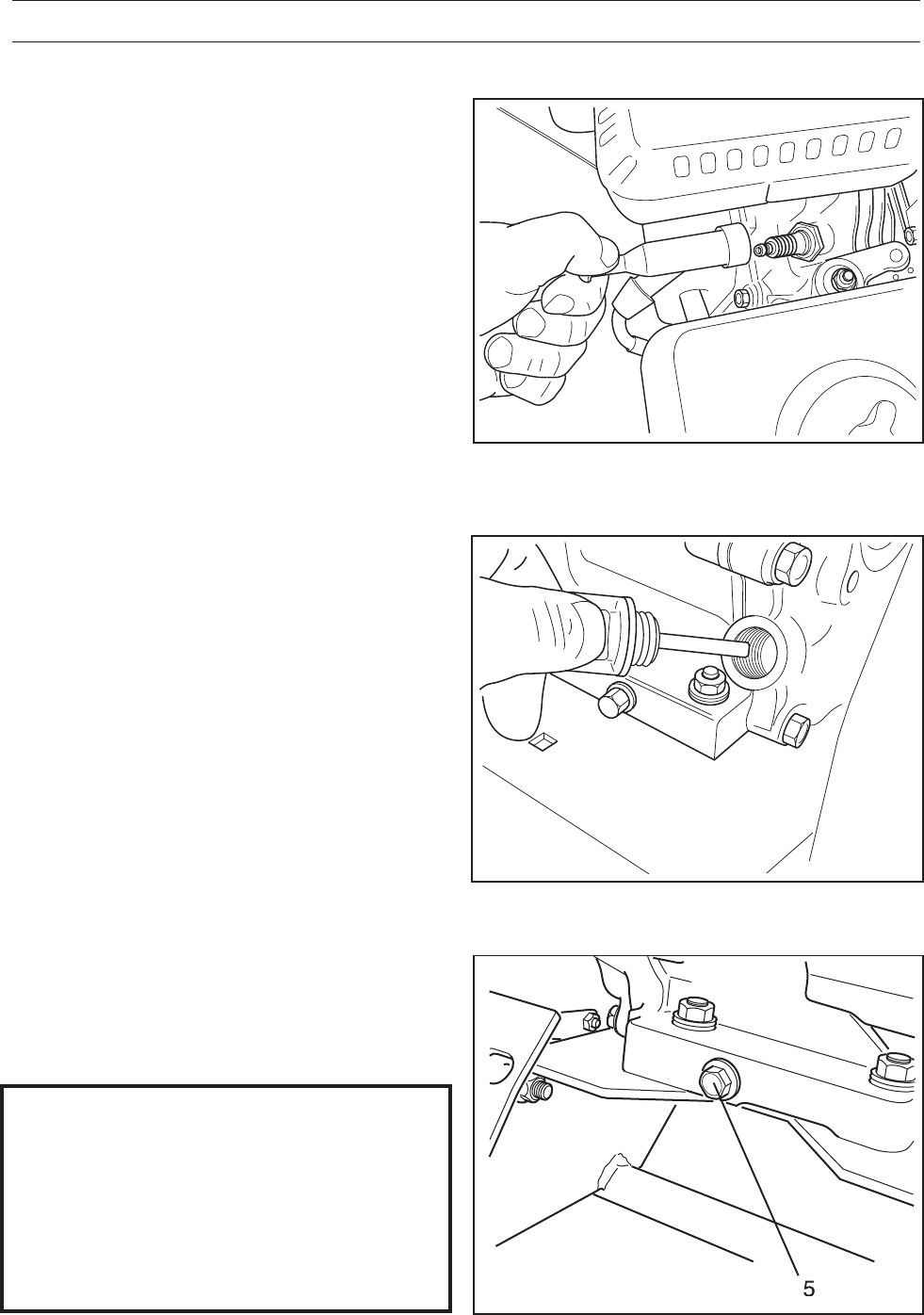
Spark plug
The engine spark plug is located under the ignition
cable boot. When performing service, it is
important that the engine cannot start accidentally.
For this reason, always remove the ignition cable
shoe from the spark plug. To avoid pulling the cable,
the cable boot is equipped with a special handle;
see the illustration.
Type of spark plug, see “Technical data”.
Service instructions, see “Maintenance/Electrical
system”.
Muffler
The engine muffler is equipped with a heat
protective cowling. Nonetheless, it still becomes
hot when the engine is running. Avoid touching the
muffler when it is warm. Risk for burns.
Oil dipstick
The dipstick for the crankcase oil reservoir is
located on the left side of the engine. Refill the
engine oil in the hole where the dipstick fits.
When checking the oil level, the dipstick should not
be screwed in. The machine should be parked on
level ground with the engine stopped. Never run
the engine without the dipstick in place. The engine
stops and cannot be started if the level becomes
too low.
For normal use, we recommend SAE 10W-30
weight engine oil service SF-SG; see also the
chapter “Lubrication/Engine oil”.
Oil drainage
The drainage screws for the oil reservoir are
located on either side of the engine.
IMPORTANT INFORMATION
Used engine oil is a health hazard and
legislation prohibits disposal on the
ground or in nature; it should always be
disposed of at a workshop or appropriate
disposal location. Avoid skin contact; wash
with soap and water in case of spills.
8011-027
8011-020
8011-187
24
CONTROLS
Fuel tank
Underneath the tank, there is a fuel filter combined
with the fuel valve. The tank volume is .95 Gal. (3.6
liters)
Fueling
Read the safety instructions before fueling.
Keep the fuel and fuel tank clean. Avoid filling the
machine with dirty fuel. Make sure the fuel cap is
properly tightened and the gasket is not damaged,
particularly before washing the machine.
Use unleaded gasoline with minimum 86 octane
rating. Never use gasoline mixed with two-cycle
oil. For ethanol and methanol fuel, the following
applies:
Maximum allowable ethanol 10% (volume).
Maximum allowable methanol 5% (volume).
Maximum allowable MTBE (Methyl Tertiary Butyl
Ether) 15% (volume).
If the engine “surges” at normal load it can be
damaged. Change the fuel. If this does not help,
contact an authorized service workshop.
Do not fill the tank completely; leave space for the
fuel to expand as it warms up.
Centrifugal clutch
The engine is equipped with a centrifugal clutch
that is connected to the crankshaft. When the
engine speed increases, the drive for the cutting
blade engages automatically. The centrifugal clutch
needs oil added upon delivery. (10-w30, .53 qt. or
.5 liter.) There are no user servicable parts except
oil level.
To drain oil from the centrifugal clutch the drain is
located on the right side of the crankcase.
WARNING!
Gasoline is highly flammable. Observe
caution and fill the tank outdoors. (See
the safety instructions.)
Throttle
The lever controls engine speed.
Pull throttle handle toward the handle bar to
increase engine speed.
WARNING!
The engine and the exhaust system,
become very hot during operation.
Risk for burns if touched.
Allow engine and exhaust system to cool
at least two (2) minutes before refueling.
WARNING!
Fill to bottom of filler neck. Do not
overfill, Wipe off any spilled oil or fuel.
Do not store, spill of use gasoline near
and open flame.
25
CONTROLS
Before you start
•Review all of the machine’s safety decals.
•Use personal safety equipment. (See
“Protective Equipment” section.)
•Make sure that you are familiar with safety
regulations and shutdown procedures
described previously in the operator’s manual.
•Make sure that all guards are in place and in
good condition.
•Make sure that the blades are in place and in
good condition.
8011-193
• To engage reverse gear you may need to
rock the machine back and forth while pulling
the shift lever.
• Stop before shifting gears.
• Cut going down hill slopes not across or up
slope.
• End cuts by pushing the blade engagement
lever down while still holding the throttle to
cut the end of the sod strip as the blade
rises.
• Soil conditions will effect cutting depth.
Readjusting the blade depth may be required
as you move from hard soil to soft or moist
soil conditions.
• Do not attempt sharp turns while cutting.
It is usually not necessary to water before cut-
ting. In extreme conditions, such as clay soil that
is very compacted, a simple test as follows will
determine if you need to water before cutting.
Use a garden hand spade, weed tool, or even a
large screwdriver to test the ground’s hardness.
You should be able to push the tool into the
ground 2 to 3 inches with little effort.
If you are unable to do so, then watering may be
advisable. Watering the day before should give
sufficient time for the soil to absorb the moisture.
Use your hand tool to gauge the effectiveness of
your watering. Allow the grass to dry before
cutting to provide adequate traction for sod
cutting.
Operator Tips
Read this entire manual and understand and
follow all instructions and warnings before oper-
ating the machine.
8011-027
1
2
3
45
1. Ear protection
2. Protective glasses
3. Protective gloves
4. First aid kit
5. Protective boots or steel-toed shoes
26
Using your sod cutter
8011-192chg
•Make sure that the work area and blades in
particular are free from metallic objects such
as wire, nails, etc. that could be thrown out and
injure persons in the vicinity and damage the
equipment.
•Make sure that everyone, including children and
animals, are not in the sod cutting area. Debris
can be thrown out and injure people and
animals.
• Be sure engine oil is at engine
manufacturer’s recommended level. (Refer
to engine manufacturer’s manual.)
• Make sure centrifugal clutch case has the
proper amount of oil.
• Put the sod cutter into neutral before starting.
• Place blade in transport position before
starting.
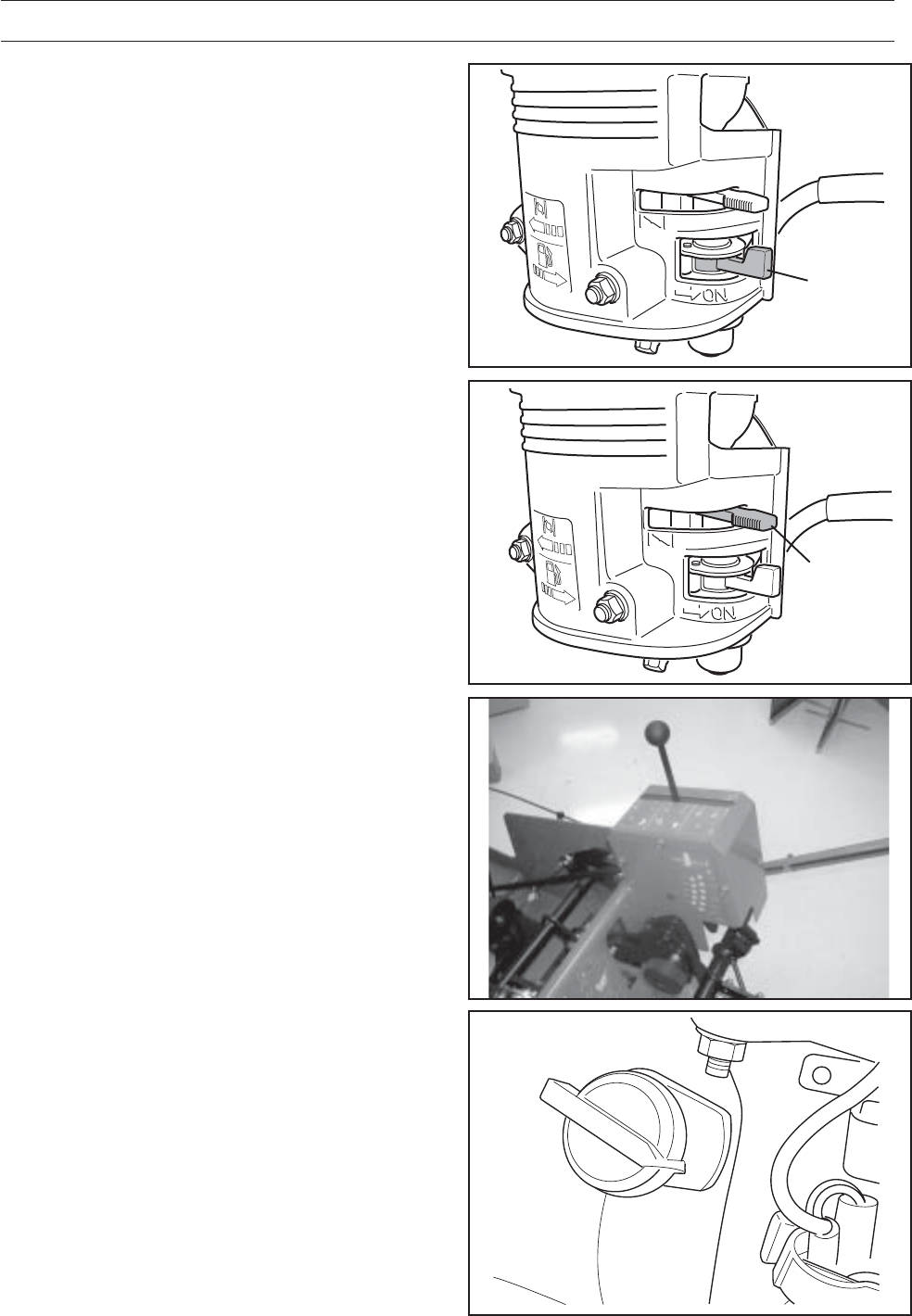
1. Position the sod cutter at your starting point
with the blade out of the ground.
2. Unscrew knob and thread into a desired hole
for the correct deph of cut. (See Figure)
3. Pull the blade engagement lever up.
4. Place the shift lever in slow gear (setting #1).
5. Pull the throttle while maintaining a slight
down pressure on the handlebar and cut a
short distance, then stop. Put shift lever in
neutral.
6. Lift the edge of the sod to check the cut
depth.
7. To change the depth, push the blade engage-
ment lever down, unlock the depth lock knob
and select the appropriate hole and repeat
steps 3 thru 6.
8. End cuts by pushing the blade engagement
lever down while holding the throttle to cut
the end of the sod strip as the blade exits the
ground.
CONTROLS
27
Starting the engine
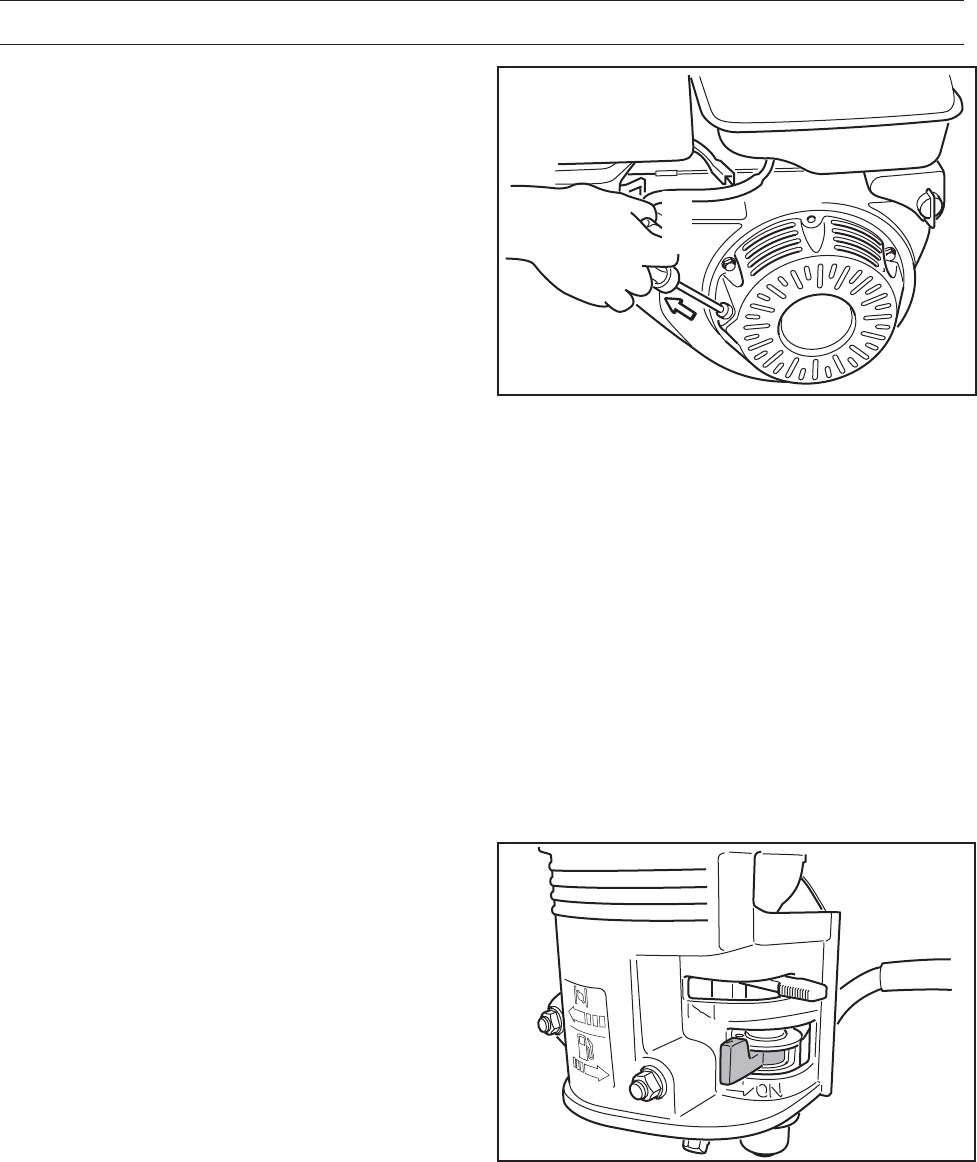
Check that all daily maintenance as described in
the maintenance schedule has been performed.
Check that there is sufficient fuel in the tank.
OPERATION
Fuel valve
Open the fuel valve. Place the lever all the way to
the right.
Choke control
When starting the engine warm, the lever should
be in the right position; see the illustration.
When starting the engine cold or partially warm,
place the lever completely or partly to the left.
Move the lever back to the right once the engine
starts. When the engine is cold, it may be best to
move the lever back in several stages. Find the
position where the engine runs smoothly.
Gear Shift Lever
Set the gear shift to the neutral position.
8011-182
FUEL VALVE
8011-183
CHOKE
CONTROL
Engine switch on the engine
Turn the engine switch to the ON position.
OFF
ON
8011-071
28
OPERATION
Starter handle
Misuse of the starter handle can damage the starter.
DO NOT twist the starter cord around your hand.
Pull out the handle slowly until the gears mesh.
Then give a sharp pull on the starter handle. DO
NOT pull out the starter cord completely and DO
NOT let go of the starter handle when extended.
Allow starter cord to return gently while holding the
starter handle.
8011-127
Throttle
Once the engine has started, increase the engine
speed with the throttle handle on the handle bars.
Normal shutdown
Throttle
If the engine has been running at full speed, let it
run easily for about 30 seconds to 1 minute at low
speed.
Fuel valve
Close the fuel valve. Turn the lever all the way to
the left (see illustration).
8011-186

29
OPERATION
Operating on hills
Transport
WARNING!
DO NOT operate on hills exceeding 25%
grade to prevent machine from rolling
over.
• Operate the machine cutting down rather
than across hills. You will achieve even
cutting depth, and enhance stability.
• Avoid hill side turns. Back up hills in reverse
gear, then cut, going down.
• Push the blade engagement lever down to
raise the blade.
• Select the desired gear (low gear or reverse).
• Pull the throttle while maintaining a firm grip
on the handlebar.
• Load into truck or trailer by driving up ramps
in low gear. DO NOT LIFT! This machine is
not intended to be lifted by hand.

30
Maintenance Daily /10 1/25 3/50 6/100 12/300
Maintenance schedule
The following is a list of maintenance procedures that MUST be performed on the machine. For those
points not described in this manual, visit an authorized service workshop.
MAINTENANCE
Check the engine oil level X
Change engine oil 1)
Check the air filter X
Clean the air filter 2) X
Replace air filter cartridge 2) X
Clean sludge reservoir for fuel system X
Check and clean the spark plug X
Replace the spark plug X
Check engine switch function 3) X
Check idle speed X
Check and adjust play in valves 4) X
Clean fuel tank 4) X
Check, replace fuel lines as necessary 4, 5) X
Check throttle and cable 3) X
Check blade X
Check decals and warning signs 3) X
Check wear and tension on the belts 3) X
Check the chassis, bolts and set screws X
Clean & oil pivot points X
Oil & adjust chains X
Check belt tension X
Check engine RPM (3000 RPM) X
Maintenance interval months/hours
1)First change after 20 hours. 2)In dusty conditions maintenance is required at shorter intervals.
3)Before each use. 4)Performed by authorized service workshop. 5)Performed every second year.
No service operations may be performed on the engine or unit unless:
•The engine is stopped.
•The ignition cable has been removed from the spark plug.
•The machine is securely parked where it will not tip or begin rolling.
WARNING!
Weekly
31
Replacing the air filter
If the engine seems weak, produces black smoke
or runs unevenly, the air filter may be clogged. For
this reason, it is important to clean and replace the
air filter regularly (see the maintenance schedule
for the proper service interval).
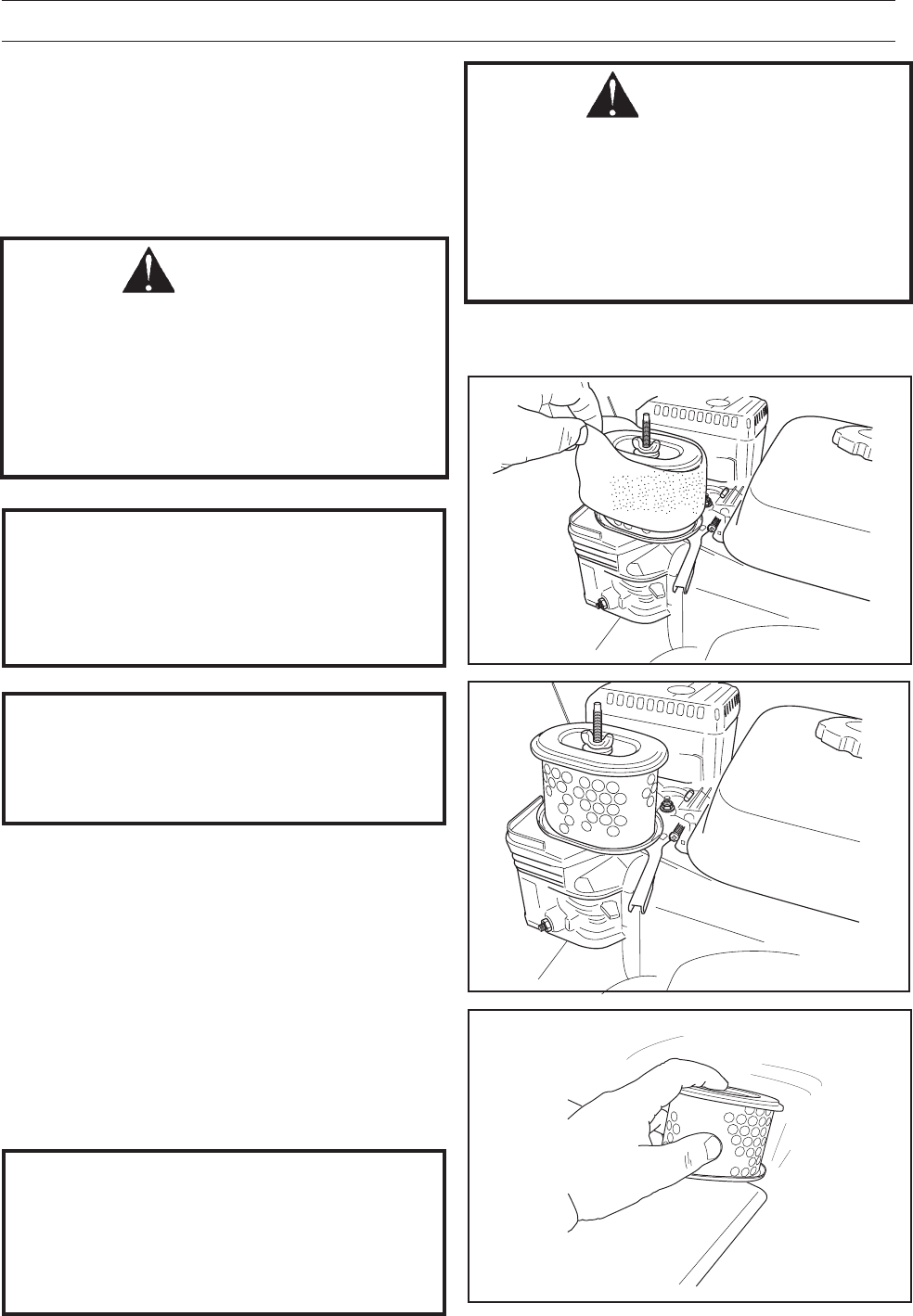
1. Undo the wing nut and lift off the air filter cowling.
2. Remove the foam rubber pre-filter and clean
using a mild detergent.
Squeeze it dry with a clean cloth.
3. Remove the wing nut in the air filter and remove
the paper filter. Tap the paper filter against a
fixed surface to remove dust. If the paper filter
is still dirty or damaged, it MUST be replaced.
IMPORTANT INFORMATION
DO NOT use compressed air over 2 bar/
30 PSI to clean the paper filter.
DO NOT wash the paper filter.
DO NOT oil the paper filter.
The engine and the exhaust system,
become very hot during operation.
Risk for burns if touched.
Allow engine and exhaust system to cool
at least two (2) minutes before replacing
the air filter.
WARNING!
MAINTENANCE
Cleaning/replacement of the air filter is carried out
as follows:
8011-030
8011-031
8011-032
IMPORTANT INFORMATION
Please see the manual of the engine
manufacturer for any additional
instructions, including safety instructions.
IMPORTANT INFORMATION
Operating the engine with loose damaged
air cleaner components could allow
unfiltered air into the engine, causing
premature wear and failure.
No adjustments, service or maintenance
to be carried out unless:
-the engine is stopped,
-the ignition cable is removed from the
spark plug
-the blades are disegaged.
WARNING!
32
MAINTENANCE
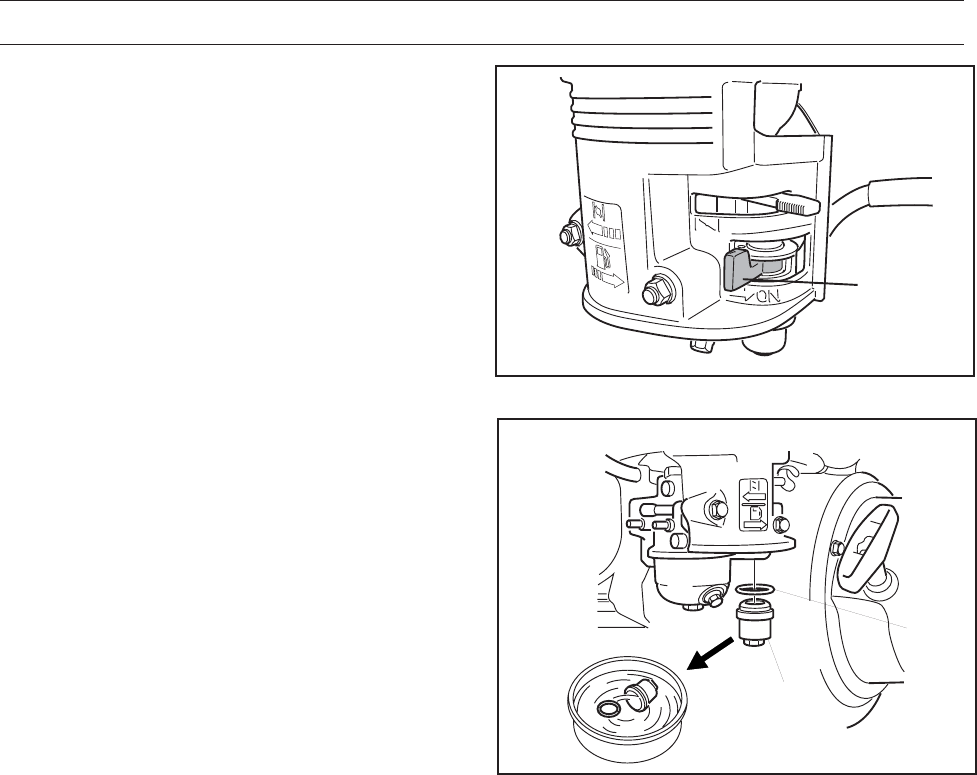
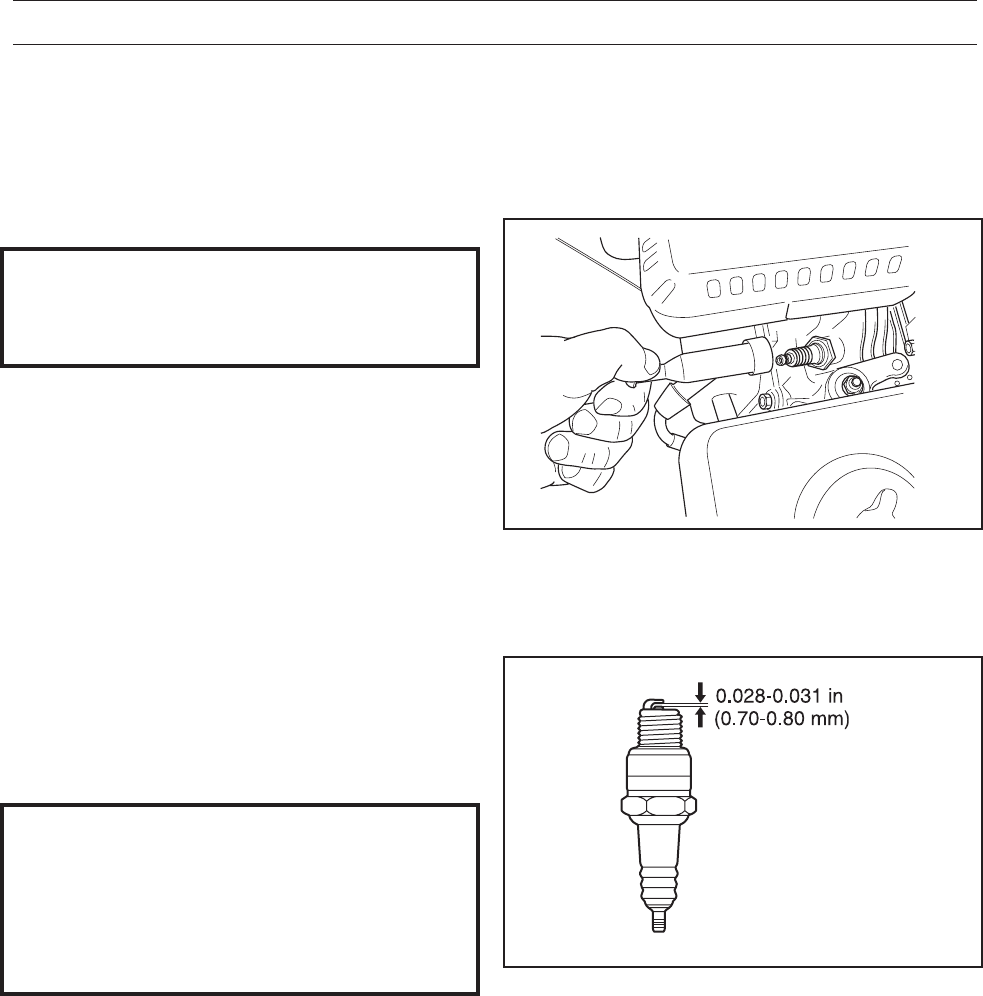
Cleaning the sludge reservoir
1. Close the fuel valve.
2. Unscrew the sludge reservoir (2). Make sure
not to misplace the o-ring (1).
3. Clean the reservoir and the o-ring using a
cleaning solvent and dry carefully.
4. Put the o-ring in place in its track and replace
the sludge reservoir. Tighten it moderately to
avoid damaging the threads.
5. Turn the fuel valve to ON and check for leaks. If
it leaks, replace the o-ring.
1
2
8011-186
8011-128
FUEL VALVE
33
IMPORTANT INFORMATION
Fitting the wrong spark plug type can
damage the engine.
8011-027
MAINTENANCE
Ignition system
The engine is equipped with an electronic ignition
system. Only the spark plug requires maintenance.
For recommended spark plug, see “Technical
data”.
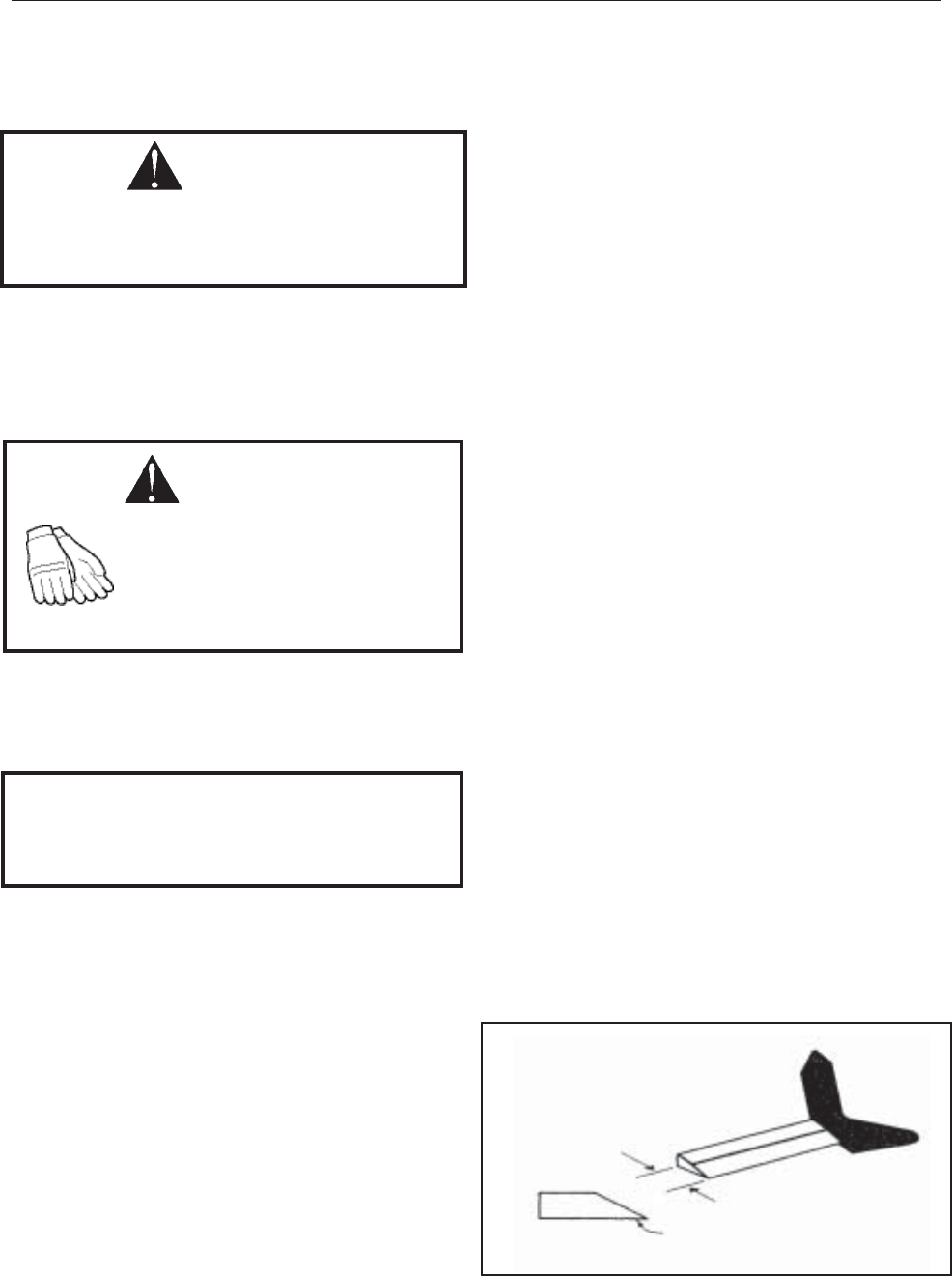
1. Remove the ignition cable boot and clean
around the spark plug.
2. Remove the spark plug with a 13/16” (21 mm)
spark plug socket wrench.
3. Check the spark plug. Replace the spark plug
if the electrodes are burned or if the insulation
is cracked or damaged. Clean the spark plug
with a steel brush if it is to be reused.
4. Measure the electrode gap with a gapping tool.
The gap should be 0.7-0.8 mm/0.028-0.031”.
Adjust as necessary by bending the side
electrode.
5. Reinsert the spark plug, turning by hand to avoid
damaging the threads.
IMPORTANT INFORMATION
Inadequately tightened spark plugs can
cause overheating and damage the
engine. Tightening the spark plug too
much can damage the threads in the
cylinder head.
6. After the spark plug is seated, tighten it using a
spark plug wrench so that the washer is
compressed. A used spark plug should be
turned 1/8-1/4 of a turn from the seated position.
A new spark plug should be turned 1/2 a turn
from the seated position.
7. Replace the ignition cable boot.
8011-054
34
MAINTENANCE
Adjusting the drive belt
Adjust weekly.
Prevent the engine from being started by
removing the ignition cable from the spark
plug.
WARNING!
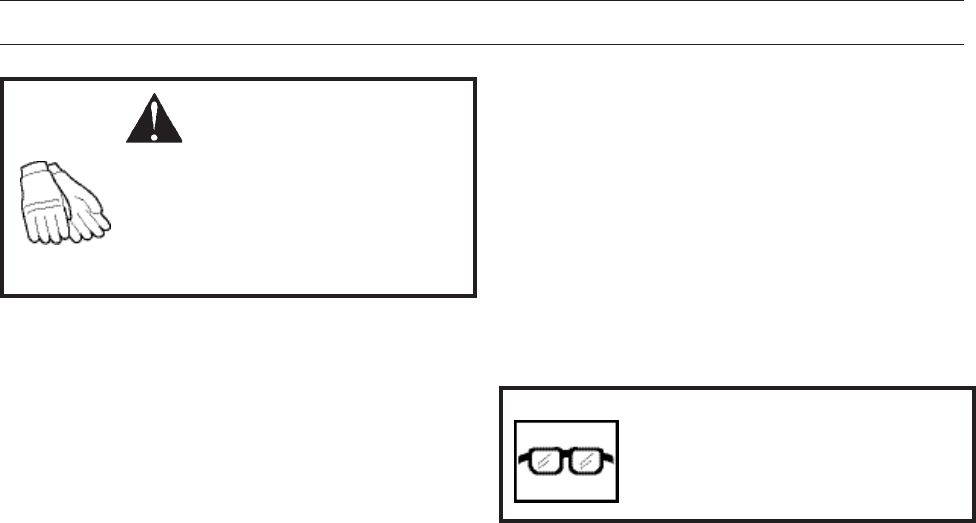
Blade Wear
Sod cutter blades may wear quickly depending
on soil condition. Replace blade when worn to
1 1/2” (3.8cm) or less. Maintain lower blade
surface.
Keep side blades sharp. 1 1/2” or Less
Maintain Lower Surface
Checking the Blades
In order to attain the best sod cutting, it is impor-
tant that the blades are well sharpened and not
damaged.
Bent or cracked blades or blades with large
nicks should be replaced.
Check the blade mounts.
IMPORTANT INFORMATION
The sharpening of blades hould be carried
out by an authorized service workshop.
Damaged blades should be replaced when
hitting obstacles that result in a breakdown. Let
the service workshop decide whether the blade
can be reapired/ground or must be replaced.
WARNING!
Blades are sharp. Protect your
hands with gloves and/or wrap
blades with a heavy cloth when
handling.
35
Two minute rule
The machine may be tipped backward or on its
side to facilitate access for cleaning or service, but
no longer than 2 minutes.
If the machine is held in this position for too long,
the engine can be damaged by gasoline draining
into the crankcase. Should this happen, perform
an extra oil change on the engine. Remove the
spark plug and turn the engine over a few
revolutions with the starter handle before starting
the engine again.
Cleaning and washing
Regular cleaning and washing will increase the
machine’s lifespan. Make it a habit to clean the
machine directly after use, before the dirt sticks.
Check before rinsing that the fuel filler cap is
properly in place to avoid getting water in the tank.
Do not spray water on the engine, avoid using a
high pressure washer or steam cleaner.
Lubricate the machine after cleaning. This is
particularly important if the machine is to be stored.
MAINTENANCE
• Remove top cover.
• Walk belt off top pulley.
• Remove and replace belt.
Chain replacement
Upper Chain
• Remove drive belt.
• Remove belt engagement spring and cable.
• Remove chain tension spring.
• Remove chain keeper (on engine).
• Remove chain.
Lower Chain
• Disconnect the master link on the old chain
and hook up the new chain to the old one.
• Pull the free end of the old chain until the
new chain is pulled through.
• Re-connect the chain with the new master
link.
Adjust Chain Tension
Adjust weekly.
Upper Chain
• No adjustment is required
Lower Chain
• Remove chain guard
• Tilt the sod cutter forward onto the front
weight.
• Tighten the 1/2” lock nut on the chain idler
until the #40 chain flexes approximately 1/4”
(6mm) at mid span.
• Install chain guard.
• Set sod cutter back to level.
WARNING!
Blades are sharp. Protect your
hands with gloves and/or wrap
blades with a heavy cloth when
handling.
Blade replacement:
Use protective glasses when
cleaning and washing.
Belt replacement:
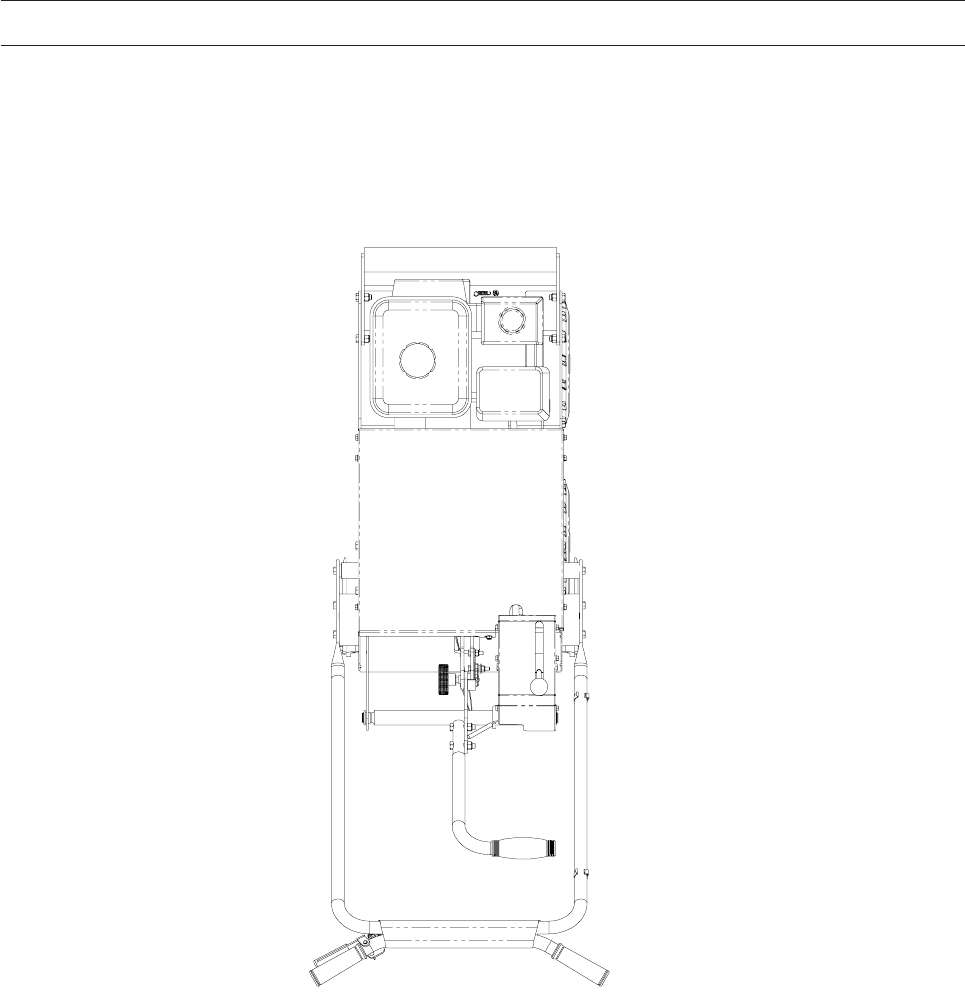
Remove six (6) bolts securing blade to side
arms.
Install new blade using new hardware provided.
Torque hardware to 31 ft/lbs (42 N.m).
Once cutting blade is clean apply light coating of
machine oil to prevent rust.
36
LUBRICATION
1. Oil and adjust chains - weekly
2. Check belt tension - weekly
3. Check blade, especially sides - weekly
4. Pivot points, clean and oil - monthly
5. Check engine RPM (should be 3000 RPM)
6. Check hardware - daily
37
IMPORTANT INFORMATION
Used engine oil is a health hazard and
legislation prohibits disposal on the
ground or in nature; it should always be
disposed of at a workshop or appropriate
disposal location. Avoid skin contact; wash
with soap and water in case of spills.
Engine oil can be very hot if it is drained
directly after stopping the machine. Allow
the engine to cool somewhat.
WARNING!
LUBRICATION
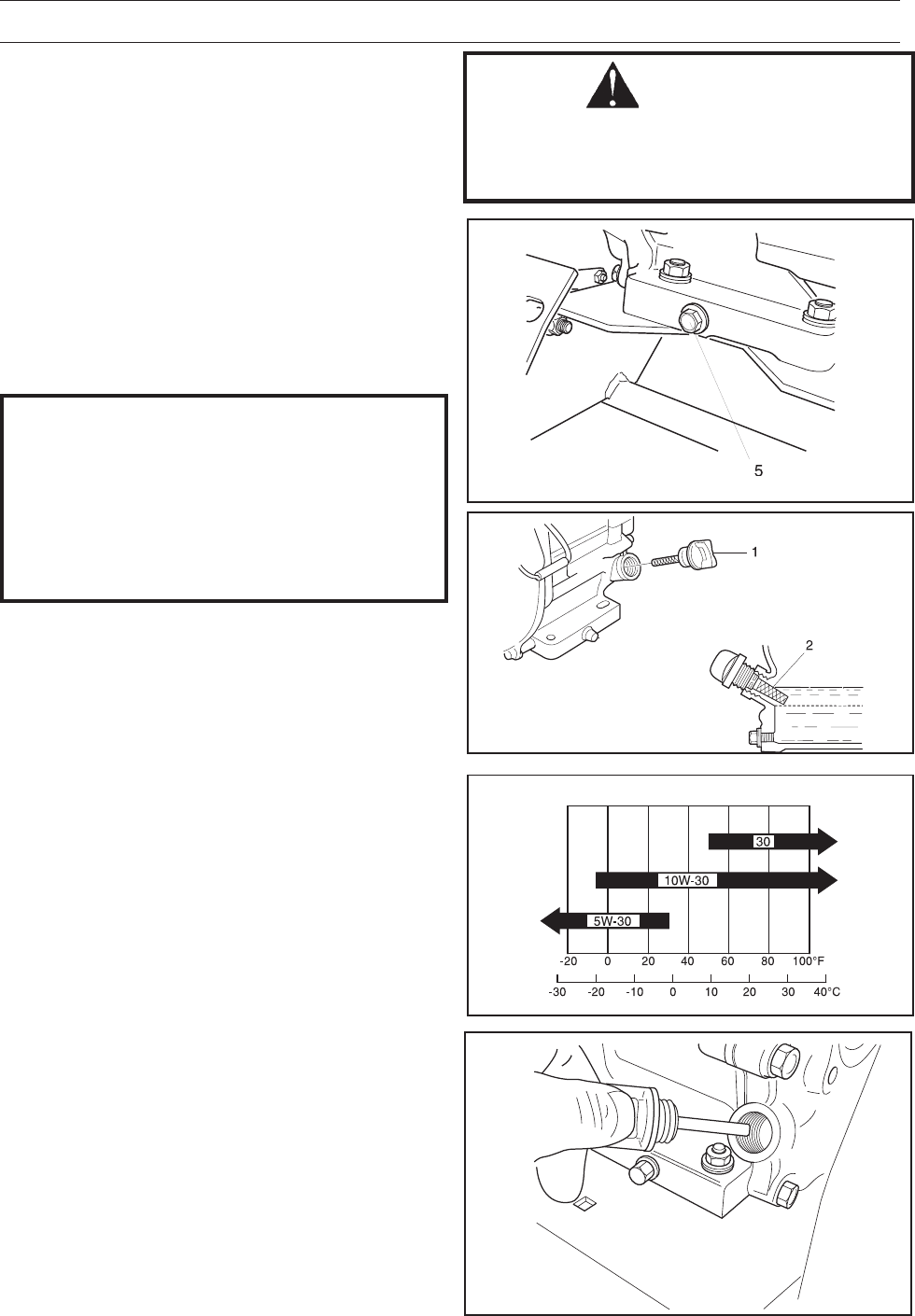
The engine should be warm (but not hot) when
changing the oil. Warm oil flows out faster and
leaves a smaller quantity of old oil inside the engine.
1. Place a suitable vessel underneath the oil
drainage screw. Remove the oil dipstick and
the oil drainage screw (5) on left side of the
engine.
Tip: Make a channel using a piece of cardboard to
lead the oil directly into the vessel and avoid soiling
the machine chassis.
2. Allow the engine oil to drain into the vessel; then
replace the drainage screw. Tighten it
moderately.
3. Make sure the machine is parked on flat ground.
Fill with new oil using the appropriate viscosity
according to the diagram, API Service SF-SG,
to the upper level mark on the dipstick = threads
on the oil dipstick (2). The engine takes .53 qts.
(.5 liter) of oil. When checking the oil level, the
dipstick should not be screwed in.
4. Check that the rubber gasket is in position and
screw the dipstick back into place. DO NOT
thighten it too hard or you may damage the
threads.
5. Wipe up any spilled oil.
1. Engine oil
Checking the engine’s oil level.
Make sure that the machine is parked on flat ground
with the engine stopped when checking the oil level.
1. Unscrew the dipstick and wipe it using paper
towel or a lint-free rag.
2. Replace the dipstick without screwing it in.
Remove and check the level on the dipstick.
3. Fill oil as necessary to the lip of the dipstick
hole. Oil type, see above.
4. Check that the rubber gasket is in position and
screw the dipstick back into place. DO NOT
tighten it too hard or you may damage the
threads.
8011-187
8011-020
8011-045chg
8011-046
2. Chains
Oil and adjust chains weekly

38
TORQUE CHART
ft./lbs Nm ft./lbs Nm ft./lbs Nm
1/4 9 12 13 18
5/16 18 24 28 38 24 33
3/8 31 42 46 62 40 54
7/16 50 68 75 108
1/2 75 102 115 156
9/16 110 150 165 224
5/8 150 203 225 305
3/4 250 339 370 502
7/8 378 513 591 801
1 583 790 893 1211
1 1/8 782 1060 1410 1912
Flangelock Screw
w/ Flangelock Nut
SAE grade 5 SAE grade 8
Shank Size (Diameter in inches, fine or coarse thread)
Grade
ft./lbs Nm ft./lbs Nm ft./lbs Nm
M4 1.5 2 2.2 3 2.7 3.6
M5 3 4 4.5 6 5.2 7
M6 5.2 7 7.5 10 8.2 11
M78.21112 16 1520
M8 13.5 18 18.8 25 21.8 29
M10 24 32 35.2 47 43.5 58
M1243.55862.2 83 75100
M14 70.5 94 100 133 119 159
M16 108 144 147 196 176 235
M18 142 190 202 269 242 323
M20 195 260 275 366 330 440
M22 276 368 390 520 471 628
M24 353 470 498 664 596 794
M27 530 707 474 996 904 1205
Shank Size (Diameter in millimeters, fine or coarse thread)
Grade 12.9 Grade 8.8 Grade 10.9Grade
8.8
10.9
12.9
HEX HEAD CAP SCREWS
The torque values shown should be used as a general guideline when specific torque values are not given.
** Grade 5 - Minimum commercial quality (Lower quality not recommended)
U.S. Standard Hardware
Metric Standard Hardware

39
TROUBLESHOOTING
Transmission shaft broke 1. Ensure debris is not caught in the Transmission Chain or
wrapped around the transmission output shaft.
2. Ensure the unit has a Skid Pan installed.
3. Contact your servicing dealer.
Drive wheels won’t engage 1. Ensure the Drive Chain is on all sprockets.
2. Ensure the Transmission Chain is on all sprockets.
3. Ensure the Chain Idler Spring is attached.
4. Verifiy the Shift Linkage is attached at the Shift Lever and at
the Bell Crank and Rod End is attached at Bell Crank and
Transmission Arm.
5. Check sprockets for proper alignment.
Unit jumps out of gear 1. Adjust Shift linkage. Tighten Shift Lever Pivot Bolt to hold
shift lever in place.
Bushings on depth control assembly 1. The bushings are wearable items.
are wearing quickly. 2. Be sure the maximum RPM is set correctly at 3000. See
Technical Bulletin Throttle Cable Adjustment.
Right Angle T-drive leaking 1. Contact your local Tecumseh dealer or servicing dealer.
What RPM should my 1. 3000 RPM maximum.
engine be set to?
Chain (Drive) is coming off, The Transmission Output Sprocket is a fixed (non adjustable)
drive sprocket wearing sprocket which is splined and snap-ringed in place.
1. Replace the Tensioner Sprocket if it has a bent or twisted
bracket or bent teeth.
2. Check chain tension between Axle Sprockets (1/4” - 3/8”
deflection at mid-span).
PROBLEM ANSWER/COMMENT
WARNING: Before servicing unit, engine MUST be off.
Pulleys not staying tight or coming 1. Inspect shaft, pulleys and keys for damage.
2. Replace any damaged parts.

40
TROUBLESHOOTING
PROBLEM ANSWER/COMMENT
Blade Replacement 1. Replace when worn to 1 1/2” from the cutting edge to the
back edge.
2. Sharpen blade from top only. Maintain a flat lower surface.
3. Sharpen sides of blades from outside only.
Blade doesn’t move or stops cutting 1. If the operator tries to cut deeper than 2 1/2”, pivoting the
machine back on its rear wheels while cutting can cause
machine to cut too deeply.
2. Make sure the blade is sharp.
3. Moisture, oil or grease on the belt will cause it to slip.
Replace with a BlueBird belt.
4. Tension can be increased by tightening the Cable Tension
Nut.
WARNING: Before servicing unit, engine MUST be off.
Blade not disengaging New Unit or New Belt:
1. Run the machine with the blade engaged until the belt
stretches.
Used Unit or Old Belt:
1. Be sure the correct BlueBird belt is being used. If not,
replace with a BlueBird belt. (Very Important!)
2. Belt Idler Pivot Bolt may be too tight or need lubrication.
3. Belt Idler Return Spring may be broken or came off
anchors. Reattach or replace as necessary.
Belt coming off 1. RPM may be too high. Set to 3000 RPM.
2. Replace the Belt Idler Pulley Arm if it is bent.

41
TROUBLESHOOTING
WARNING: Before servicing unit, engine MUST be off.
PROBLEM ANSWER/COMMENT
Belt glazed or slipping 1. Limit maximum depth of cut to 2 1/2”.
2. If the Blade Lift Springs are worn they will allow the blade to
cut too deeply, which causes the belt to slip. Replace if
necessary.
3. Be sure the maximum RPM is not over 3000.
4. Be sure the correct BlueBird belt is being used. If not,
replace with a BlueBird belt.
5. Check to see if the Tension Cable is out of the pulley. Install
cable in pulley and squeeze bracket sides to minimize
the gap to pulley.
6. If the Gear Box Pulley or the Engine Pulley is wet, oily, or
damaged, clean or replace.
7. Belt tension can be increased by tightening the Cable
Tension nut.
Unit is creeping The transmission contains a centrifugal clutch and may creep
if left in gear. Some creeping is normal because of the lubricant
resistance between the clutch plates. Also, too heavy a
lubricate in Gear Reducer can cause creeping. Use 10W - 30 oil.
1. Put in neutral - unit will not creep.
2. RPM at idle should be 1,400 (+200/-150). Clutch will en-
gage at 1,800 RPMs. A high idle RPM may cause creeping.
3. If unit continues to creep, contact your local BlueBird dealer
or servicing dealer.
Bolts breaking 1. The vibration of the machine may cause bolts to come
loose. Check and tighten all bolts periodically.
Tires wearing too quickly 1. Tire wear is normal and to be expected. Running the
machine on excessively hard or abrasive surfaces can
increase wear.
42
STORAGE
NEVER store an engine with fuel in the
tank indoors or in poorly ventilated
spaces where fuel vapor can come in
contact with open flame, sparks or a pilot
light such as in a boiler, hot water tank,
clothing drier, etc. Handle the fuel with
caution. It is very flammable and careless
use can cause serious damage to person
and property. Drain the fuel into an
approved container outdoors and far
away from open flame. NEVER use
gasoline for cleaning. Use a de-greaser
and warm water instead.
At the end of the season, the machine should be
readied for storage (or if it will not be in use for
longer than 30 days). Fuel allowed to stand for long
periods of time (30 days or more) can leave sticky
residues that can plug the carburetor and disrupt
engine function.
Fuel stabilizers are an acceptable option as regards
sticky residues during storage. If alkylate gasoline
(Aspen) is used, stabilizers are unnecessary
because this fuel is stable. However, you should
avoid switching between regular and alkylate
gasoline as sensitive rubber components can
harden. Add stabilizer to the fuel in the tank or in
the storage container. Always use the mixing ratios
specified by the manufacturer of the stabilizer. Run
the engine for at least 10 minutes after adding the
stabilizer so that it reaches the carburetor. DO NOT
empty the fuel tank and the carburetor if you have
added stabilizer.
1. Clean the machine carefully, particularly the
chassis and working equipment. Touch up
damage to the paint to prevent rust.
2. Inspect the machine for worn or damaged parts
and tighten any nuts or screws that may have
become loose.
3. Change the engine oil; dispose of properly.
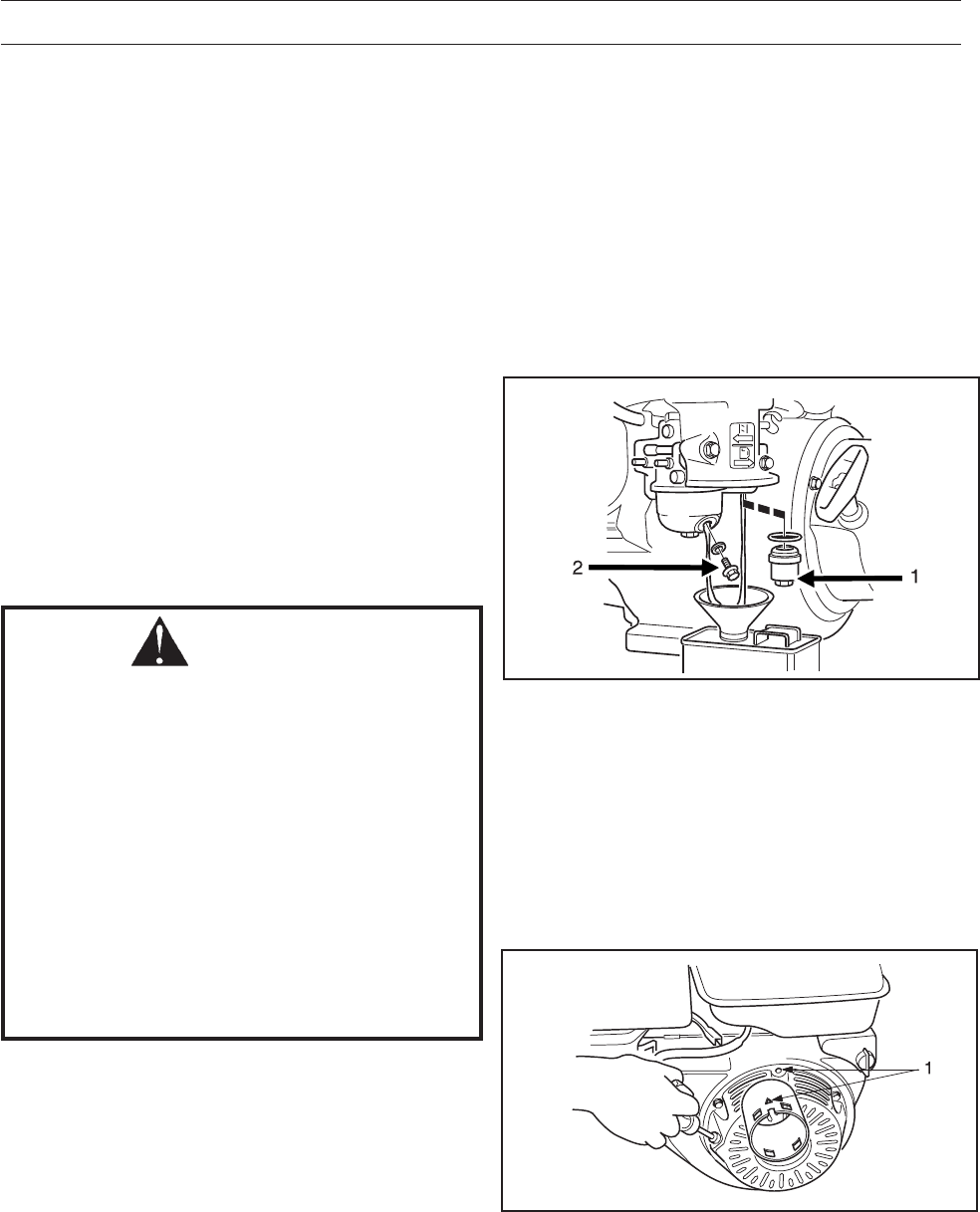
4. Open the fuel valve. Empty the fuel tank (1) and
the carburetor (2).
Winter storage
Service
When ordering spare parts, please specify the
puschase year, model, type, and serial number.
Always use genuine BlueBird parts.
An annual check-up at an authorized service
workshop is a good way to ensure that your
machine performs its best the following season.
To ready the machine for storage, follow these
steps:
5. Close the fuel valve.
6. Remove the spark plug and pour about a
tablespoon of engine oil in the cylinder. Turn
over the engine so that the oil is evenly
distributed and then refit the spark plug. Put the
engine in the compression phase where the
triangle mark on the sleeve of the starter is
aligned with the upper hole in the starter. Note:
Compression phase occurs every second
revolution.
7. Lubricate all grease nipples, joints and cables
as described in the chapter “Lubrication/
Lubrication schedule”.
8. Store the machine in a clean, dry place and
cover it for extra protection.
9. Cover the blade with a thin coat of oil to avoid
rust.
8011-130
8011-131

43
TECHNICAL DATA
Engine Honda, 4 stroke
Cylinder volume 163 cm3 (9.9 cu-in)
Power 5.5 hp (3.8 kW) at 2900 RPM
Torque (Max) 10.8 N.m at 2500 RPM
Idling speed 1250 - 1600 RPM
Spark plug BPR6ES (NGK)
W20EPR-U (DENSO)
Fuel tank volume 0.95 gal. (3.6 L)
Tires Semi-pneumatic, 2.75 x 10 x 1
Drive Direct
Belt BlueBird #3106 (539003106)
Clutch Centrifugal
Cutting depth (max) 2.5”
Cutting Width 18”
Length 60”
Width 24”
Height 36”
Weight 320 lbs.
SPECIFICATIONS:
Model SC550A

44
SERVICE JOURNAL
Action Date, stamp, signature
Delivery service
1. Break the packaging and make sure the machine has not been
damaged in transport.
2. Where applicable, assembly accompanying components.
3. Check that the machine design corresponds to the
customer order.
4. Check that the right amount of oil is in the engine and
transmission.
5. Check that the working equipment is properly set.
6. Check that the drive pulleys and sprockets are aligned.
7. Check that belts and chains are properly adjusted.
8. Lubricate the machine as described in the lubrication schedule.
9. Fill the fuel tank and start the engine.
10. Check that the machine and working equipment do not
move in neutral.
11. Check all operating instruments.
12. Check decals and information attached to the unit.
13. Check the engine speed (RPM), see Technical Data.
14. Check for leakage.
15. Inform the customer about:
The need and advantages of following the service schedule.
The need and advantages of leaving the machine for service
every 300 hours.
The effects of service and maintaining a service journal on the
machine’s resale value.
16. Fill in the sales papers, etc.
Delivery service has
been carried out.
No remaining notes.
Certified:
After the first 20 hours
1. Change engine oil.
2. Change oil in reduction gear, where applicable.
3. Check that belts and chains are properly adjusted.
4. Tighten screws and nuts.

45
SERVICE JOURNAL
Action Date, stamp, signature

46
SERVICE JOURNAL
Action Date, stamp, signature
47

P.O. Box 8
Beatrice, Nebraska 68310
