CAFE AFRICA Guide
User Manual:
Open the PDF directly: View PDF  .
.
Page Count: 76
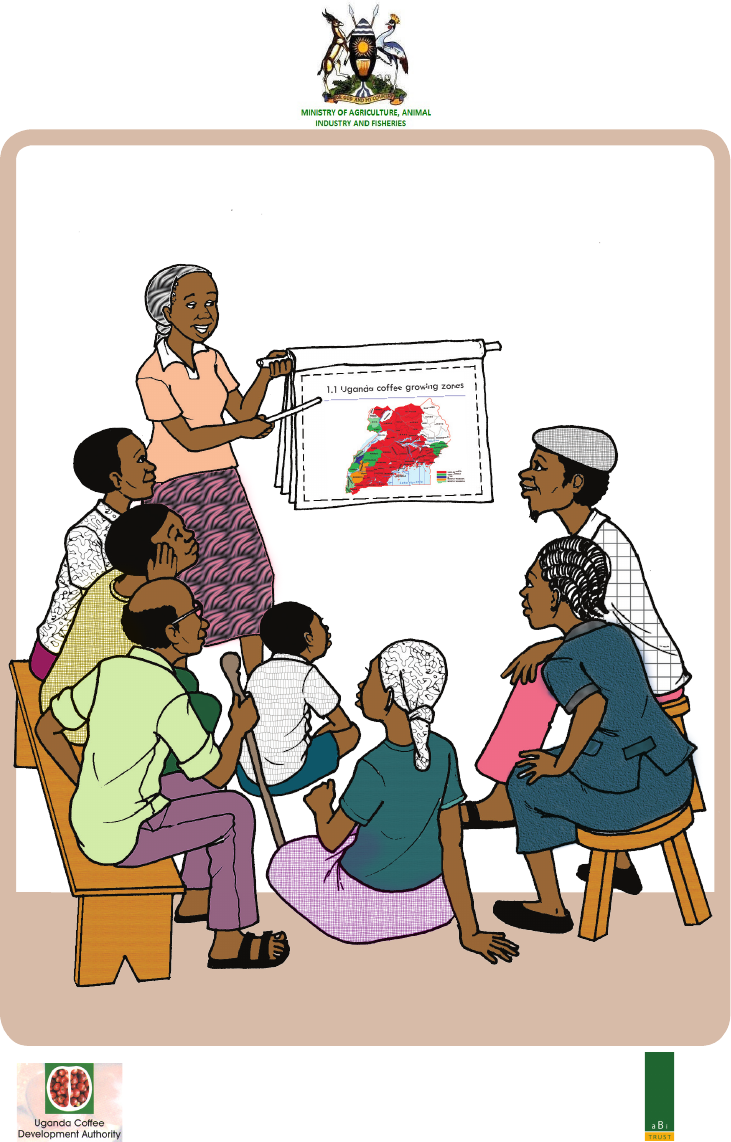
Uganda Training Materials for
Coffee Production
TRAINERS’ GUIDE
www.mangotreeuganda.org
supported by
First Edition 2014

3
These harmonised coee training materials, endorsed by MAAIF, have
been developed by the Ugandan coee sector to improve the productivity
and quality of the coee produced by Uganda’s smallholder farmers.
Thanks to those who have contributed time, resources and materials to
a team including UCDA, NaCORI, Café Africa Uganda and Mango Tree. A
working group of the National Steering Committee of the National Coee
Platform spent many hours reviewing drafts and eld testing the materials.
The photographs used in the posters were kindly provided by NaCORI and
Kyagalanyi.
The eight topics, featured in charts, posters and this trainers’ guide cover
the coee value chain and have been designed for smallholder coee
farmers in Uganda.
These materials, developed in a widely consultative eort, and funded by
the aBiTrust, will form a key tool in a new and improved extension system
for sustainable coee production.
Henry Ngabirano
Managing Director
Uganda Coee Development Authority
November 2014
PREFACE
4
Using Visual Aids and Participatory Learning
We know that people learn better if they are actively engaged in the
learning process. Studies have shown that we remember only 20% of
the information we hear and 40% of the information we see and hear.
However, when we see ideas represented visually and also actively
engage with the information through discussion, debates, role-plays,
practical hands-on activities or other participatory teaching methods,
we retain 80% or more of the information that is presented to us.
As trainers, it is worth the time and effort to create participatory, multi-
sensory presentations. The Uganda Training Materials for Coffee
Production Module Training Set is a tool designed to assist you in
this effort. There is no pre-set way to use it. We are always interested
in improving our products, so if you have suggestions, comments, or
questions, please contact us.
This trainer’s guide is written in English but depending on your
audience, you may need to make your presentation in the local
language. Read through the guide and consider how you would
translate concepts into the local language.
The posters will be available in different languages.
If you need any further information or guidance on any of the topics,
refer to UCDA, MAAIF Directorate of Crop Resources or NaCORI.
5
PART 1. TRAINING CHECKLIST
Make sure you can answer YES to each question before beginning
the session.
q Did you gather background information about the group you are
going to train?
q Did you review the trainer’s guide and charts/posters?
q Do you understand the key issues to cover for each chart/poster?
q Does the venue have enough seats and space?
q Do you have all the materials you need for the activities and
discussions?
q Do you have flip chart paper, markers, masking tape and a stand
(if necessary)?
q Did you communicate the day, time and duration of the training
to the group?
q Did you think about how best to involve women and youth in
your training?
Outline of the training session for each module:
1. Welcome and introductions (10 minutes)
2. Review the session objectives (5 minutes)
3. Ice breaker (10 minutes)
4. Large group presentation and discussion of the charts/posters in
the training module (approximately 5 minutes per chart/poster)
5. Break into small groups and answer the following questions: (20
minutes)
– What are 3 things I learnt today?
– What is 1 action I will take as a result of this training?
– What questions do I still have about the topic?
6. Share small group discussions in the large group (20 minutes)
7. Conclusion (15 minutes)
6
PART 2. HOW TO USE THE TRAINING SET
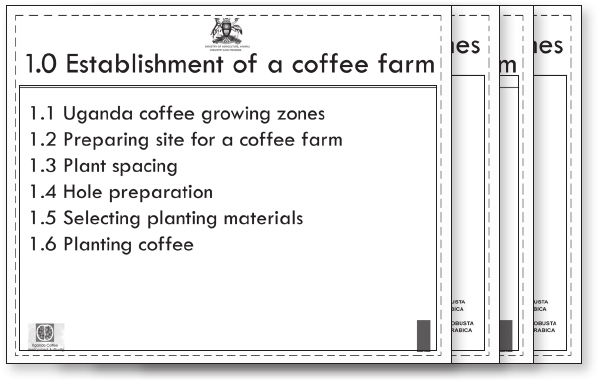
• Showthefirstchart/postertotheparticipants.
• Readthetitleofthechart/poster.
• Askparticipanttoexplainwhattheyknowaboutthetopicand
what they understand from the visual.
• Reinforcecorrectinformationgivenandcorrectwrong
information.
• Readthetaglineonthechart/posterifthereisone.
• Askparticipantsiftheyhaveanyquestionsaboutwhathas
been discussed.
• Gotothenextchart/poster.
7
PART 3. THE DISCUSSION SESSION
Training Module 1.0: Establishment of a Robusta and
Arabica Coffee Farm
Objectives for the training
By the end of the training, participants should have acquired the
knowledge and skills necessary to:
• Beabletoselectandprepareasiteforcoffeegrowing.
• Selectplantingmaterialsandplantthemcorrectly.
• Knowwheretogetinformationconcerningcoffeefarming.
www.mangotreeuganda.orgwww.mangotreeuganda.orgwww.mangotreeuganda.orgwww.mangotreeuganda.org
8
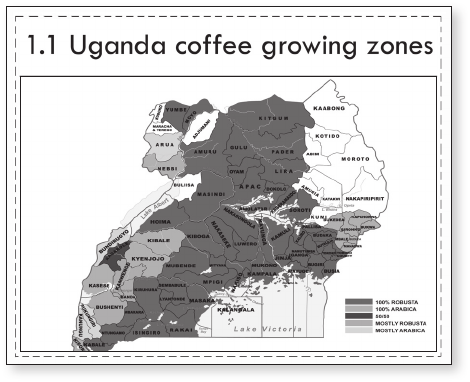
CHART 1.1: The coffee growing zones
In Uganda, Robusta coffee grows and yields better when grown at
altitudes less than 1,500m above sea level. A temperature range of
18 – 27⁰C is ideal for its production.
An average rainfall of 1,200 – 1,500mm/year which is well-
distributed for a period of about 9 months is desirable. It is better
when grown on a flat or gently sloping terrain.
Robusta grows and yields better when grown on deep, well-drained,
fertile loamy soils (rich in organic matter and exchangeable bases,
particularly potassium).
Arabica grows and yields better when grown at altitudes between
1,300 – 2,300m above sea level. A temperature range of 15 – 24⁰C
is ideal for production. An average rainfall of 1,200 – 1,500mm/
year which is well-distributed over a period of about 9 months is
desirable.
Flat or gently sloping terrain is preferable. It grows well on deep,
well-drained, fertile, slightly acidic loamy soils of pH range 4.5 to 5.
www.mangotreeuganda.org
9
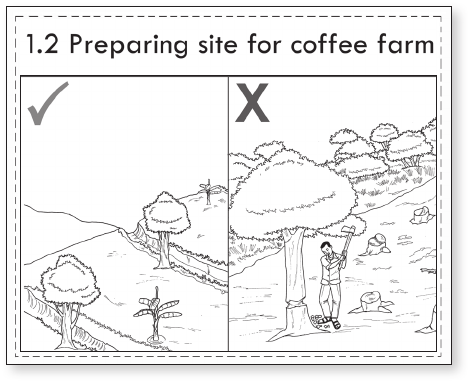
CHART 1.2: Preparing site for coffee farm
• Preparethelandduringthedryseasonandremoveanytreestumps
and roots to minimise fungal diseases.
• Killexcesstreesoneyearinadvancebyringbarking.Leavesome
mature trees for shade. Aim for a spacing of 20m x 20m. This gives
a good shade cover, while not creating competition for water and
nutrients.
• Removeperennialweedssuchascouchgrassbyusingherbicides,or
digging and handpicking them from the ground.
• Don’ttillthesoilunlessintercroppingcoffeewithotherannual
crops.
• Forslopedterrain,applysoilandwaterconservationmeasureslike
contour trenches, contour terraces, vegetative barriers, bands, grass
strips and cut-off drains to avoid soil and nutrient loss.
• Plantbananatreesforextrashadeifrequired.
10
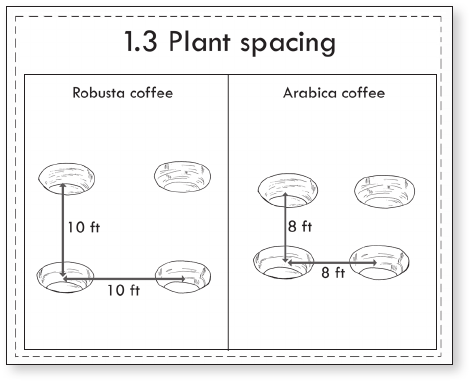
CHART 1.3: Plant spacing
• Robustacoffee
All Robusta coffee varieties are planted at a spacing of 3m x 3m
(10ft x 10ft). This should result in about 450 plants per acre.
• Arabicacoffee
Arabica coffee varieties SL28, SL14 and KP423 are planted at a
spacing of 2.5m x 2.5m (8ft x 8ft). This should result in about 680
trees per acre.

11
CHART 1.4: Hole preparation
• Markpositionswherethecoffeewillbeplantedwithpegs,
arranged in regular patterns to facilitate management.
• Digcircularholesof60cm(2ft)indiameterand60cm(2ft)in
depth at the marked points at least 3 months before planting.
This allows for better water and root penetration through the soil
because it has had time to loosen.
• Preparingholesbeforetheplantingseasonhelpsyoutobeready
for planting at the first rains.
• Whendiggingtheholes,keepthefertiletopsoilseparatefrom
the subsoil.
• Refilltheholeswithtopsoilaboutamonthbeforeplanting.
Where possible, mix the top soil with a 20-litre basin of well-
decomposed manure before refilling each planting hole.
• Ifavailable,alsomixinonehandfulofTSP,SSPorDAP.
Phosphorus stimulates root growth.
• Heapthesoilabovethegroundleveltoallowforsinkingwhen
the soil settles.
• Markpositionswherethecoffeeplantswillbeplantedwithpegs.
12
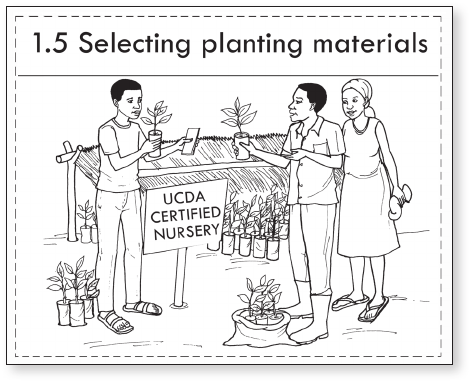
CHART 1.5: Selecting planting materials
• Getcoffeeplantswithbetween6-8leavesfromUCDA-certified
nurseries one month before the onset of the rainy season.
• SeekguidancefromUCDAoryourDAOifyouwanttogrowyour
own seedlings.
• Alwaysuseseedsorcuttingsfromacertifiedsource.
• Checkallseedlingsforsignsofpestsanddiseases;especially
root mealy bugs, aphids and other sucking insects. This prevents
introducing pests and diseases into your garden.
• Donotbuyseedlingsiftherootsprotrudefarbeyondthe
polythene pots because the taproot may be damaged.
13
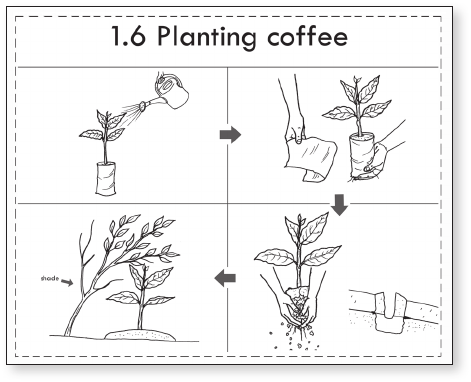
CHART 1.6: Planting coffee
• Plantcoffeeplants2to4weeksaftertheonsetoftherainy
season.
• Rootsprotrudingbeyondthepolythenepotsshouldbetrimmed
before planting.
• Openupthecentreofthefilledholessufficientlytofitthesizeof
the potted plant.
• Removepolythenepots.
• Carefullyloosencakedsoilaroundtherootstoeasewateruptake
and root development.
• Placetheplantintheholewiththecollaratlevelwiththe
surrounding soil or slightly higher to allow for some sinking when
soil settles.
• Watertheseedlingbeforeandimmediatelyafterplanting.
• Regularlyinspecttheplantedfieldtoidentifydeadplantsand
replace them as soon as possible.
• Protecteachseedlingfromsunshinebyprovidingshade(tree
branch).
14
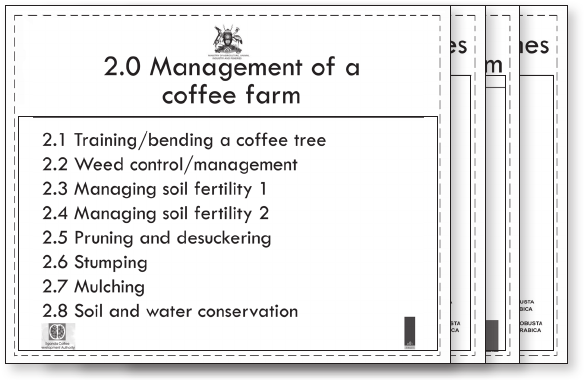
Training Module 2.0 Management of a Robusta and
Arabica Coffee Farm
Objectives for the training
By the end of the training, participants should have acquired the
knowledge and skills necessary to:
• Identifythedifferenttechniquesusedtomanagecoffeeplants
starting from planting and continuing through its entire growth
cycle.
• Knowhowtocontrolweedsandmanagesoilfertilityforacoffee
farm.
www.mangotreeuganda.orgwww.mangotreeuganda.orgwww.mangotreeuganda.org
15
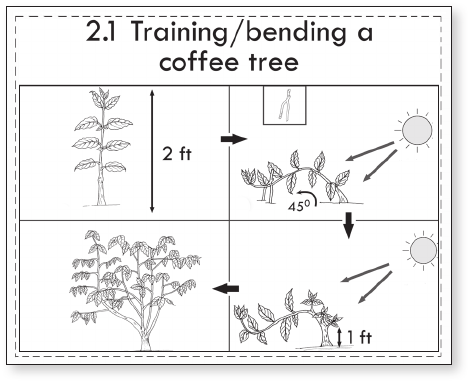
CHART 2.1: Training / bending a coffee tree
Coffee is trained in a multiple system by bending and pegging
down 6-month-old plants at about 45 degrees to stimulate sucker
production. To do this, the farmer should:
• Bendthecoffeeplantssothattheyallbendinthesamedirection
along the row.
• Select3suckerstoformthefuturebearingstemsfromthebase
of the trained plant. The first selected sucker should be at about
20cm (6 inches - 1 foot) from ground level and the others at the
next nodes.
• Removethepegwhentheselectedsuckersareabout30cm(1
foot) tall.
• Thisallowsthebentstemtodevelopupwards.
Alternatively , newly planted coffee plants of 4-6 months are capped
at a height of 15 – 40cm (6 – 16 inches) above the ground. This is
done by removing the stem tips to encourage development of
multiple stems which are then selected as described above.
Note: Capping is less effective than bending for inducing suckers.
www.mangotreeuganda.org
16
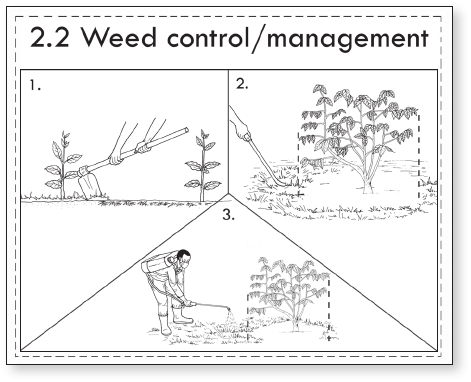
CHART 2.2: Weed control / management
Weeds compete with plants for water and nutrients and can lead
to reduced crop growth, low yields and poor quality coffee beans if
allowed to grow. Weeds in young coffee gardens (up to a year old)
should be controlled by mechanical methods such as digging with
a hand hoe and slashing with a machete or slasher, or by cultural
methods such as mulching.
Weeds in old coffee gardens are controlled by mulching or
alternating mechanical methods with chemical/herbicide spraying.
When using herbicides, follow the manufacturers’ instructions on the
label or get help from an extension officer or a more knowledgeable
farmer colleague.
Ring weed below the canopy to avoid damage to the plant during
slashing or spraying.
Avoid spraying the coffee leaves as this may kill or cause retarded
growth.
17
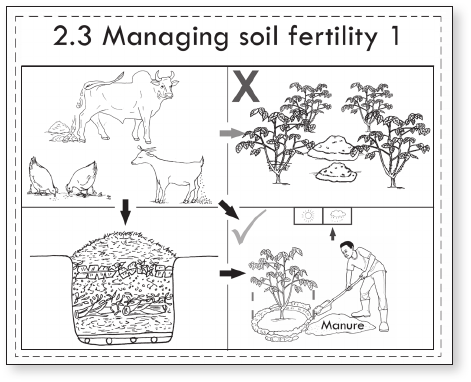
CHART 2.3: Managing soil fertility 1
Coffee requires fertile soils with high levels of nitrogen, phosphorus
andpotassium.Thefertilizerrequirementsaredependentonthe
inherent soil fertility status, soil pH, level of production and usage
of cultural farming practices like mulching, using manure and
irrigation.
One 20-litre basin of decomposed manure (cow dung, chicken
litter, household waste, compost) should be added to the soil when
planting to improve soil fertility.
For existing coffee trees, 3-5kg of manure should be added around
each tree once a year. Do not heap manure between the trees.
18
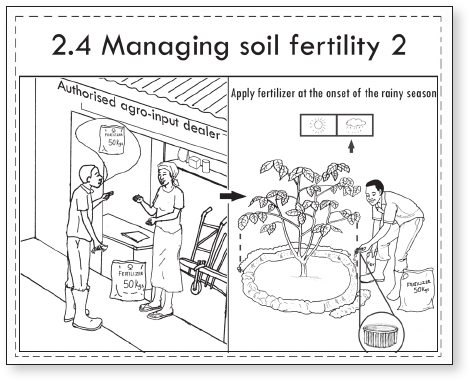
CHART 2.4: Managing soil fertility 2
Atthebeginningoftherainyseason,applyinorganicfertilizer
aroundthetreewithintherootingzonebutdonotallowittotouch
any part of the coffee plant, especially the leaves.
Fortreesthatareuptotwoyearsold,apply75goffertilizerpertree
per rainy season. Apply 250g per tree per rainy season for Robusta
coffee trees that are more than 2 years old and 200g per tree per
rainy season for mature Arabica coffee trees.
For Robusta, apply: NPK 25:5:5”
For Arabica, apply: CAN N=26% or CAN N=27%
19
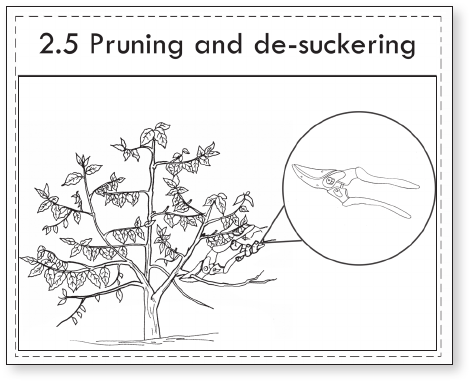
CHART 2.5: Pruning and de-suckering
Use secateurs (or a pruning saw) to remove dead, weak or
unproductive branches and small suckers.
Also remove tertiary branches, dead primary branches and the
skirt of lower primary branches that touch the soil surface to avoid
infestation from the soil.
Pruning encourages new growth and improves productivity.
20
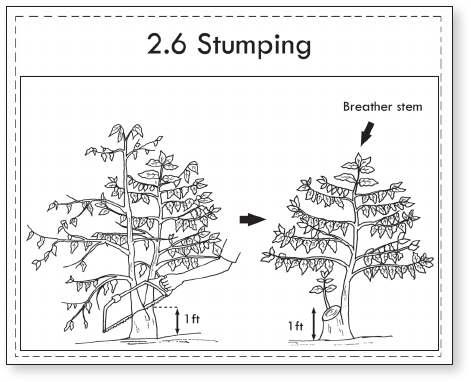
CHART 2.6: Stumping
Stump coffee to renew the stem cycle either by clean or staggered
stumping.
• Staggeredstumpinginvolvescuttingdownnon-productive
stems at the end of every season.
• Cleanstumpinginvolvescuttingdownallcoffeestemsafter7-9
years, starting by leaving one breather stem which should be
removed after about 6 months, soon after suckers have sprouted
from the stumped stems.
• Cleanstumpingcanbecarriedoutatonceinanentire
coffee garden if the farmer has alternative income. Stumped
coffee fields can be intercropped with cover crops like beans,
groundnuts, and peas to earn some income, to add nitrogen to
the soil and to improve productivity.
• Staggeredstumpinginvolvescuttingdownpartofthecoffee
garden. If a farmer needs to harvest a crop every year, part of
the coffee garden can be stumped every year. In this case, 1 in 3
coffee trees should be stumped.
• Stumpingshouldbeatleast45°andslopingawayfromthe
breather stem.
21
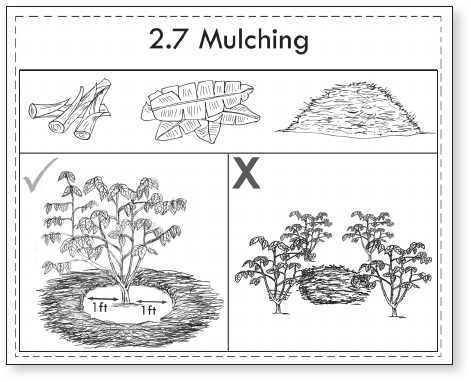
CHART 2.7: Mulching
Mulchacoffeegardenwithmaizestraw,beantrash,bananaleaves,
coffee pulp, grasses or any other dead plant material. Form a loose
layer of mulch on top of the soil that is no more than 6 inches deep.
Place the mulch 1 foot from the coffee stem to prevent infection
with collar rot or attack from ants and termites. Do not heap the
mulch between the trees.
The benefits of mulching are many. It conserves moisture, keeps
the weeds away, adds nutrients to the soil, controls soil erosion and
improves the soil structure and water retaining ability.
22
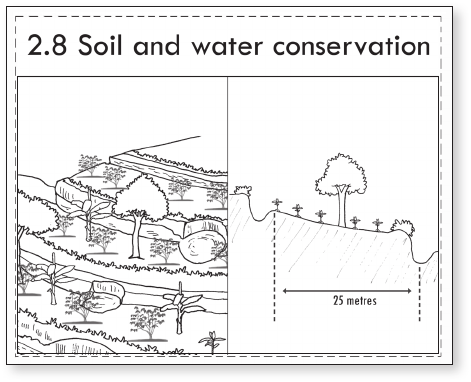
CHART 2.8: Soil and water conservation
Apply soil and water conservation practices to minimise loss of soil
fertility through erosion and retain moisture for the coffee, especially
in the dry periods. The following techniques can be very valuable to
the coffee farmer:
• Terracingalongcontoursreducessoilerosionbyminimising
rainwater runoff.
• Diggingpits/troughsatsomepointsoftheterracepreserves
rain water. The water drips through slowly to the neighbouring
coffee trees and can preserve trees during the dry period. Add a
small amount of oil to the trapped water to prevent breeding of
mosquitoes.
• Plantingcovercropssuchasmucuna,phaseolusbeans,lablab
and groundnuts, as well as mulching, prevents soil erosion and
retains soil moisture.
• Plantinggrasssuchastithoria diversitalia at the edges of the
gardens and ridges of terraces/contour bunds reduces soil
erosion.
• Shadefromshadetreesalsoreducessoilerosionandleakageof
minerals/soil nutrients to a deeper ground level beyond the reach
of coffee roots.
23
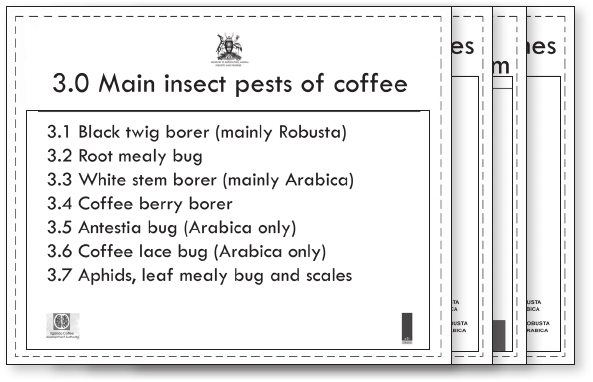
Training Module 3.0 Common Insect Pests of Robusta
and Arabica Coffee Plants
Objectives for the training
By the end of the training, participants should have acquired the
knowledge and skills necessary to:
• IdentifythecommoninsectpestsinRobustaandArabica.
• Knowthetreatmentmeasuresforthedifferentpests.
www.mangotreeuganda.orgwww.mangotreeuganda.orgwww.mangotreeuganda.org
24
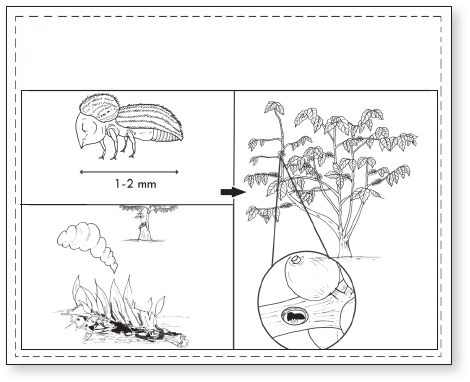
CHART 3.1: Black twig borer (mainly Robusta)
Xylosandrus compactus (Eichhoff)
The black coffee twig borer (BTB) is a small beetle belonging to
the same family as the coffee berry borer, but it bores mostly into
primary branches and sometimes into the main stems. It kills
affected branches and stems, leading to considerable yield losses.
BTB mainly devastates Robusta coffee varieties but it is also known
to attack over 240 tree species including Arabica coffee trees, some
shadetreesoncoffeefarmssuchasalbizia,fruittreessuchasmango
and avocado, and other crops such as eggplants.
Control measures:
• Regularlymonitorfieldsforinfestation.
• Trimoffandburninfectedbranches.
• Practisecleanweedingtoburyanyofthepestsharbouredin
ground surface litter.
www.mangotreeuganda.org
3.1 Black twig borer
(mainly Robusta)
25
• SprayinfestedfieldwithImax(Imidacropid)pesticideat4mlsper
litre of water in the sprayer tank.
• Forheavilyaffectedfieldsbeyond15%infestation,encourage
farmers to seek expert advice from extension staff or UCDA/
NaCORI.
• AdviseyourneighbourstoalsocontrolBTBtoprevent
reinfestation of your field.
• Stumpthecoffeetreesifinfestationisextreme.
• ReduceexcessiveshadeasitisconduciveforthesurvivalofBTB.
• Encouragefarmerstogethelpfromtheextensionstaff
or a knowledgeable farmer when the situation becomes
unmanageable.
26
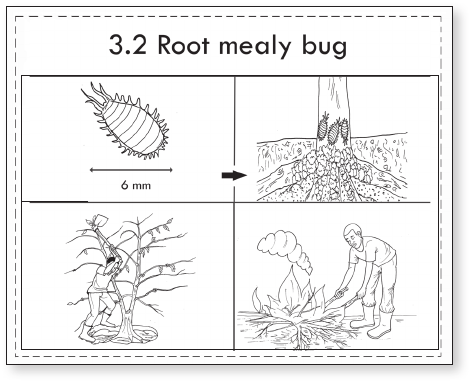
CHART 3.2: Root mealy bug
Planococcus
Root mealy bugs are sucking insects found on the roots of both
Robusta and Arabica trees.
Root mealy bugs attack the roots of coffee plants just below the soil
level. They siphon sap from the plant, causing it to suffocate from
lack of nutrients and water.
The open wounds caused by root mealy bugs allow fungal diseases
and pests to damage the plant. This causes yellowing and drooping
of leaves and, in severe cases, death of entire trees. A whitish fungus
that accompanies infestation aggravates the damage by affecting
normal root activities and cutting off absorption of water and
nutrients from the soil into the roots.
Root mealy bugs will often affect only part of a field. If the whole
field is yellowing, soil fertility may be low.
27
Control measures
• Uprootheavilyaffectedordeadtreesandburnthem.Theywill
not recover.
• Treattreesshowingearlysignsofattackandsurroundingones
with 10g of Dursban powder (Chloryrifas) mixed into soil around
thetreeorActara(Thiamethosin;16gsper20litresofwater)asa
soil drench.
28
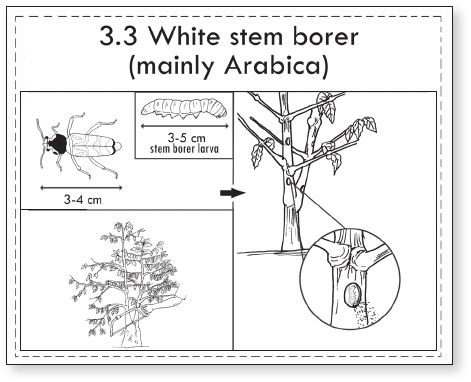
CHART 3.3: White stem borer (mainly Arabica)
Xylotrechus quadripes
White stem borers are the larvae of large brownish insects with
white patches and a long antenna. Adult females lay eggs inside
crevices on the bark of the stem. The larvae bore into the main stem
of the coffee tree, expelling wood shavings which are seen at the
base of the tree. The extensive damage to the main stem causes
yellowing of foliage, easy stem breakage and eventual death of
trees. It mainly attacks Arabica coffee plants.
Control measures
• BandtreestemswithDursban(Chloropyrifos)usingabrushfrom
collar level to a height of 0.5 metres.
• Pushabicyclespokeoranywireintothetunnelcreatedbythe
white stem borer to kill its larvae.
• Stufftheinsectholewithcottonwoolorpapersaturatedwith
Dursban (Chlorpyrifos) or Super Sumithion (Fenitrothion) to kill
the larvae.
• Smoothtreebarkupto0.5mwithmaizecoborclothtoprevent
egg laying.
29
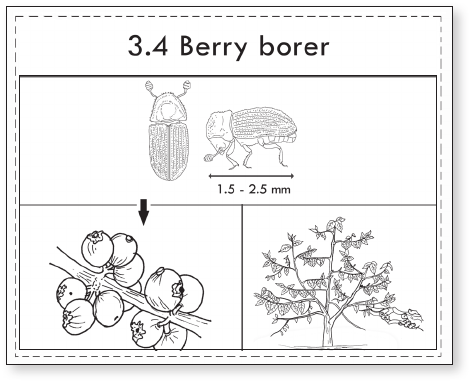
CHART 3.4: Coffee berry borer
Hypothenemus hampei
The coffee berry borer (CBB) is a small beetle that bores into coffee
berries and damages beans. Its infestation rates are normally low as
it has a lot of natural enemies in Uganda.
Control measures:
Good field hygiene is the best control strategy for CBB. This includes:
• Pruningcoffeeandshadetreestoopenupthecanopyand
promote control by natural enemies
• Pickingallripecherriesfrequentlyandregularly
• Removingandburninganycherriesthathavefallenonthe
ground.
• Attheendoftheseason,removingallremainingmaturecherries
from the tree and processing them separately to prevent cross-
over to the new harvest.
• MonitoringCBBinfestationratesweeklybetween3-4months
after flowering as this is the key period for infestation.
30
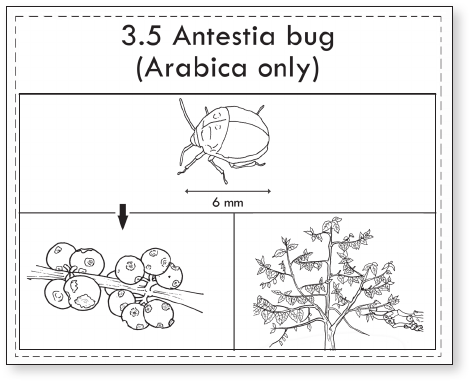
CHART 3.5: Antestia bug (Arabica only)
Antestiopsis
TheAntestiabugisabrownorbronzeinsectwithyellow-orange
patterns. They cause damage mainly in Arabica coffee through
sucking sap from flower buds, flowers, berries, leaves and soft
stems.Thisresultsinflowerandberryabortion,cracking(zebra
marks), rotting of beans, multiple branching (witches broom), and
shortening of internodes. Antestia bugs prefer shaded conditions.
Control measures
• PrunecoffeeandshadetreestoreducehidingplacesforAntestia
bugs and to promote natural predation by birds.
• Monitorandspraywhen2bugspertreeareobserved.UseSuper
Sumithion (Fenithrothion) or Cypermethrin (2ml per litre) or
Dimethoate-based products (1ml per litre).
31
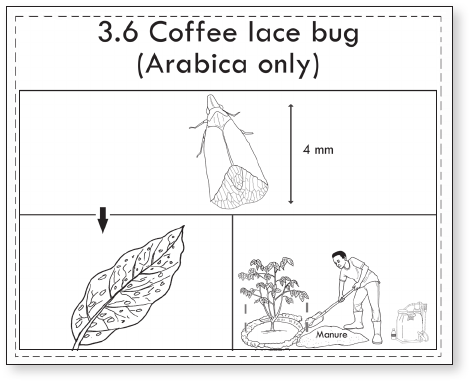
CHART 3.6: Coffee lace bug (Arabica only)
Habrochila
These are small fly-like insects with a light green colour and lace
wings. They are usually found sucking on the underside of the
leaves, leaving shiny black droppings and brown feeding marks.
Heavy infestation causes general yellowing of leaves and can result
in defoliation, berry abortion and die-back. Outbreaks may occur
during prolonged dry periods and when natural enemies have
been killed by pesticides. Insects disappear at the onset of the rains.
Strong healthy trees withstand infection much better.
Control measures:
Only if the infestation is heavy, spray with Super Sumithion at
1.25mlperlitreofwaterregularlyandfertilizecoffeetreeswith
manureand/orinorganicfertilizers.
32
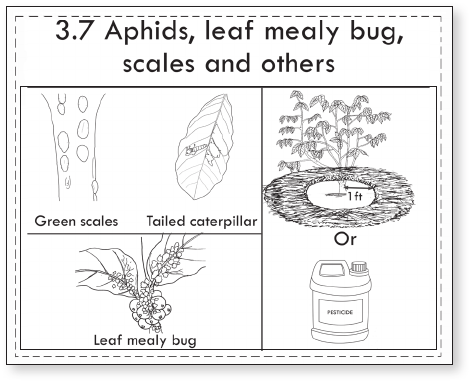
CHART 3.7: Aphids, leaf mealy bug, scales and others
Sucking insects:
There are ranges of sucking insects that affect coffee:
a) Green,brownorwhitewaxyscales(Coccoidea)
b) Aphids (Toxoptera aurantii)
c) Leaf mealy bug (Planococcus)
Sucking insects are normally found feeding on the lower side of the
leaves, on young branches or on cherries. As a result of their feeding,
leaves may yellow and cherries will not fill, causing a lot of floaters
and brown beans.
All sucking insects are accompanied by ants.
Chewing insects:
Include:
a) Leaf miners (Leucoptera coffeina)
b) Tailed caterpillar (Epicampoptera andersoni)
c) Leaf skeletoniser (Leucoplema dohertyi)
33
Control measures:
Monitor coffee fields regularly for infestation by sucking and
chewing insects.
Focus chemical control on affected trees:
• Paintabandofatleast15cmofDursbantoreduceattendantants
on affected trees.
• Spotapplycontactinsecticidessuchasdimethoate,fenitrothion
or cypermethrin-based products.
• SpotapplysystemicinsecticidessuchasActaraasasoildrench.
Healthy coffee trees withstand pest damage better so farmers
should be encouraged to use good agricultural practices such as
pruning and mulching.
34
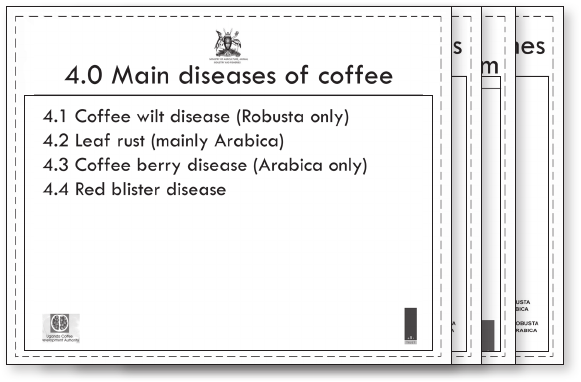
Training Module 4.0: Main Diseases of Robusta and
Arabica Coffee and Their Control
Objectives for the training
By the end of the training, participants should have acquired the
knowledge and skills necessary to:
• Identifythedifferentdiseasesthataffectcoffeeplants.
• Knowthetreatmentmeasuresforthedifferentcoffeeplant
diseases.
www.mangotreeuganda.orgwww.mangotreeuganda.orgwww.mangotreeuganda.org
35
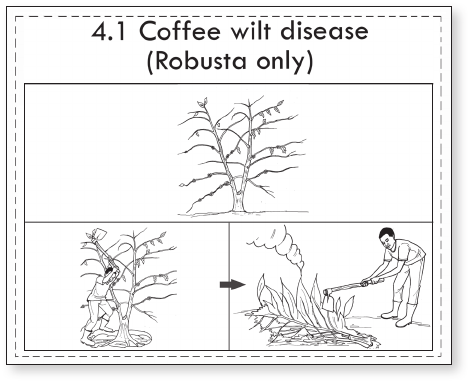
CHART 4.1: Coffee wilt disease (Robusta only)
Coffee wilt disease (CWD) is a fungal disease. It is a serious
production problem for Robusta coffee varieties. This disease
spreads quickly and widely and can normally threaten entire
Robustacoffeeproductionzones.Itspreadsthroughinfectedcoffee
plant debris, infected farm tools and soil. There is no cure. Once
infected, a tree will die.
Control measures:
• Uprootandburninfectedcoffeetreesonsiteassoonas
symptoms are seen.
• Disinfectfarmtoolsthathavebeenusedinaninfectedgarden
using flames or Jik solution (5%).
• Plantresistantvarieties.
• Encouragefarmerstogethelpfromextensionstaffora
knowledgeable farmer.
www.mangotreeuganda.org
36
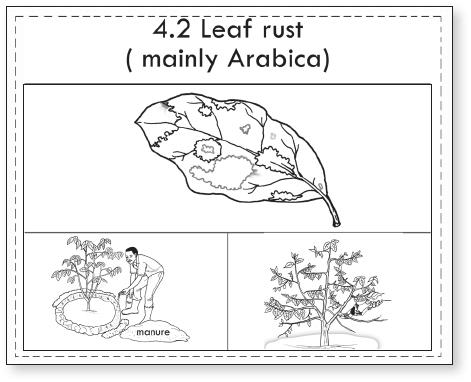
CHART 4.2: Leaf rust (mainly Arabica)
Coffee leaf rust is a fungus that likes humid conditions and
temperatures between 20-25⁰C. It therefore affects coffee grown at
low and medium altitudes. The disease affects all coffee trees but is
more severe on Arabica trees. It manifests as orange spots or areas
on the underside of leaves.
All commercial Arabica varieties, such as SL14 and KP423, are
susceptible to leaf rust. However, KP423 is more tolerant, so it is
better for medium to low altitudes, where leaf rust is more prevalent.
A severe attack by the disease results in premature leaf fall, unfilled
mature cherries and severe die-back. This causes loss in yield and
quality.
Control measures:
Cultural strategies include:
• Openpruningtoreducehumidconditions
• Regularstumping
37
• Goodweedingandsoilfertilitymanagementtoensurestrong
and healthy trees
• Tosupplementtheculturalpractices,applycopper-based
fungicides (2.5g per litre of water) every 3 weeks starting at the
onset of rains for a maximum of 5 sprays per season. Alternatively,
applycurativeorsystemicfungicides;spraytheundersideofthe
leaves as well.
• Ifunclearhowtocontrolthisdisease,pleaseconsultthe
extension staff for technical advice.
• Encouragefarmerstoconsultextensionstafffortechnicaladvice
if they are unclear how to control this disease.
38
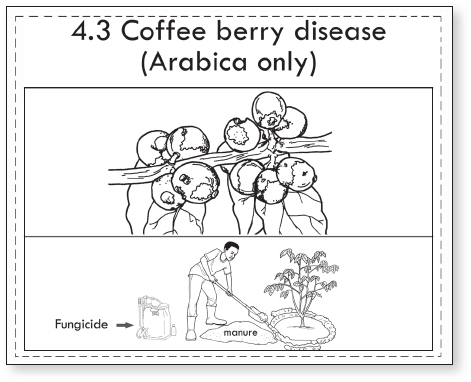
CHART 4.3: Coffee berry disease (Arabica only)
Coffee berry disease is caused by a fungus and appears on Arabica
coffee at altitudes of more than 1,600m above sea level where there
are low temperatures (17-22⁰C), and wet and humid conditions
prevail.
It devastates coffee flowers and fruits at all stages of growth, but
especially the green stage. The young green berries die on the plant
even though the plant remains healthy and green. Extensive black/
brown sunken lesions are observed on both green and red berries
which then drop prematurely.
The fungus survives on old cherries and the tree bark.
Control measures:
• Planttolerantvarieties(SL14).
• Practisegoodfieldhygieneby:
– Regularly harvesting all ripe cherries
39
– Removing all remaining dried or ripe cherries from the tree or
the ground at the end of the harvest
– Pruning coffee and shade trees to reduce humidity levels
– Improving soil fertility management
• Spraywithcopper-basedfungicidessuchasCopperNordox75%
(140g/CP20), to effectively control the disease.
– Spray at the onset of rain in well-pruned and weeded plots and
continue at 4 week intervals until the crop attains physiological
maturity.
– Encourage farmers to get help from extension staff or a
knowledgeable farmer when applying fungicides for the first
time.
40
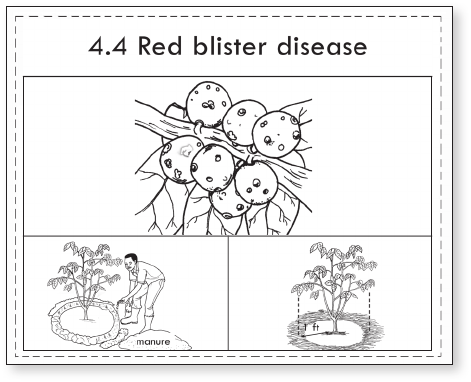
CHART 4.4: Red blister disease
Red blister disease is caused by the fungus Cercospora coffeicola and
mainly affects Robusta varieties but can also affect Arabica plants.
Red blister disease forms small red and slightly raised spots on both
green and ripening cherries. The spots enlarge and join, forming
unsightly red blisters. Centres of the lesions dry up and turn black.
Infected cherries do not ripen properly and don’t pulp properly
which leads to loss of yield and quality.
Control measures:
• Plantonlyresistantvarietiesobtainedfromrecommended
nurseries. The new CWD-resistant Robusta coffee varieties
KituuzaR1toR7arealsoresistanttoredblisterdisease.
• Addnitrogenandpotassiumfertilizerandmanagethefieldwell.
41
Training Module 5.0: Harvesting and Post- Harvest
Coffee Handling
Objectives for the training
By the end of the training, participants should have acquired the
knowledge and skills necessary to:
• Understandthebestpracticesforharvestingcoffee
• Knowthedifferentwaystoprocesscoffee
• Haveimprovedknowledgeaboutcoffeestorage
www.mangotreeuganda.orgwww.mangotreeuganda.orgwww.mangotreeuganda.org
42
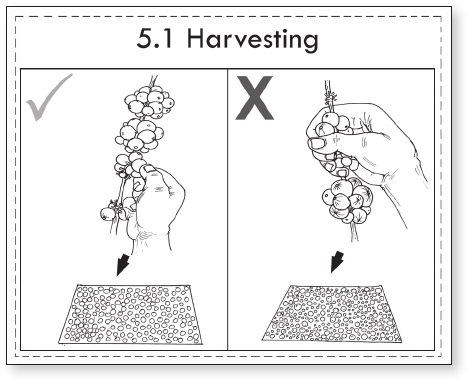
CHART 5.1: Harvesting
• Donotstripallcherriesoffthebranch.
• Harvestonlyfullyripe(brickred)cherries.Includingunripe
cherries results in black coffee beans. Overripe cherries can result
in discoloured coffee beans and fermented flavours when the
coffee is brewed. Ripe cherries give better quality coffee and
therefore more money.
• Attheendoftheseason,harvestallremainingmaturecherries
and process separately.
• Keepharvestedcoffeecherriesincontainerssuchasbaskets.
• Donotdrythecoffeeonbareearthbecausethiscauses
the coffee to acquire an earthy smell and soil microbial
contamination.
• Sortoutimmature,diseased,pestinfestedoroverripecherries
and process them separately. Remove all extraneous materials
such as twigs, leaves, stems and stones.
www.mangotreeuganda.org
43
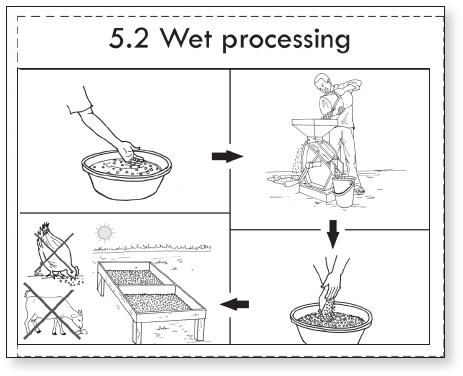
CHART 5.2: Wet processing
The ripe cherry is either wet processed or dry processed for both
Arabica and Robusta. Wet processing involves floating, washing and
pulping the cherry to separate the pulp from the parchment.
• Floatthefreshlyharvestedcherriesinwatertoremoveunfilled
fruits and extraneous materials. Remove floats and pulp clean
cherry only. This must be done within 12 hours after harvesting.
• Keepfreshlypulpedcoffeebeansinacontainerfor12-24hoursto
allow fermentation. Next, wash the fermented coffee thoroughly
to remove mucilage from the parchment and dry washed
parchment on wire trays or a tarpaulin.
• Ripecherriescanbepulpedusingsmallmanualorlargepower-
driven pulpers.
– Large scale pulpers are able to remove mucilage during
pulping and therefore the fermentation process may not be
necessary.
– Most of the Arabica coffee in Uganda is wet processed using
small manual pulpers.
– Robusta coffee is wet processed by a few large coffee
producers.
– Wet processed coffee is thought to have superior cup quality
compared to dry processed coffee.
44
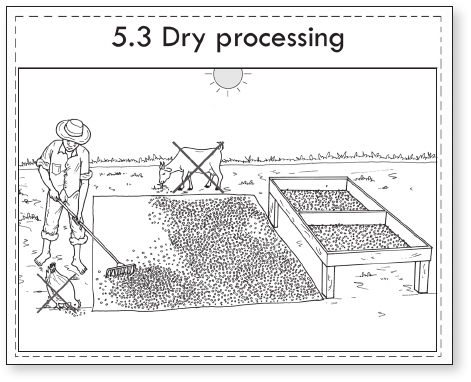
CHART 5.3: Dry processing
Dry processing involves drying the cherries without removing the
pulp. It can be used to process both Arabica and Robusta coffee. The
cherry should be dried immediately after harvesting. The bulk of
Ugandan Robusta coffee and small quantities of Arabica coffee are
dry processed.
• Drycherriesontarpaulinsorconcreteflooratathicknessof
7-8cm but not on bare ground. Turn the coffee regularly by
raking. At night, stack trays in a store or house. Do not leave wet
coffee heaped or it will develop mould.
• Coffeemustbedriedtoanacceptablemoisturecontentof11-
13%
45
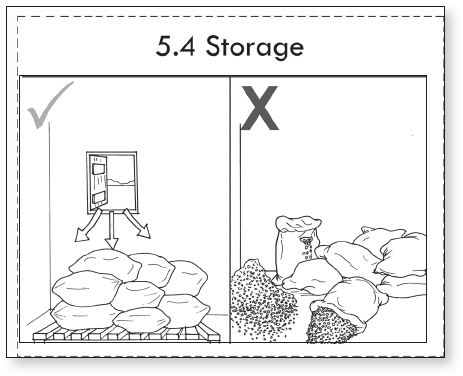
CHART 5.4: Storage
• Makesureyouonlystoredrycoffeeinbagswhicharefreefrom
anybadsmells.Donotusefertilizerorfishbagsforstorage.
• Placethecoffeebagsonpalletsraisedtoatleast15cmandat
least 30cm away from the walls and ceiling so as to avoid any
moisture entering the bags.
• Coffeeshouldpreferablynotbestoredinthesamestorewith
other farm produce.
• Parchmentandkibokocoffeeshouldbestoredseparately.
• Neverstorecoffeeinthesamestorewithagro-chemicalsandoil
products.
• Storageroomsshouldbewell-ventilatedandleak-proof.
46
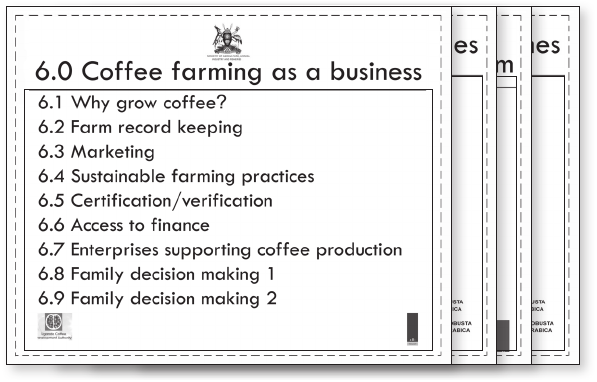
Training Module 6.0: Robusta and Arabica Coffee
Farming as a Business
Objectives for the training
By the end of the training, participants should have acquired the
knowledge and skills necessary to:
• Identifytheneedforgrowingcoffee.
• Assesshowprofitablecoffeefarmingcanbe.
• Knowthesustainablefarmingpractices.
www.mangotreeuganda.orgwww.mangotreeuganda.orgwww.mangotreeuganda.org
47
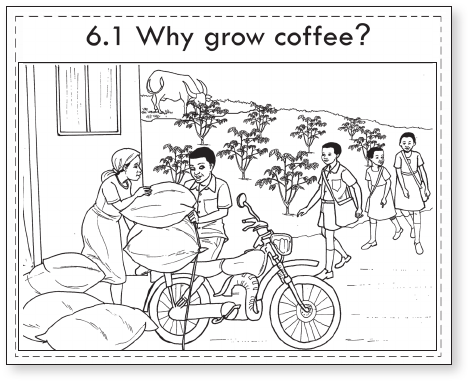
CHART 6.1: Why grow coffee?
• Coffeeisgrownbyalltypesoffarmers(men,women,andyouth)
who have land.
• Coffeeisprofitabledependingontheyieldperacre/hectare,
the quality, the cost of farm inputs including tools, labour and
transportation and the price at which farmers sell the coffee.
• Inordertoobtainhighyieldsandbetterquality,thecoffeefarmer
must know and follow the proper methods for growing coffee,
which are explained in this training package.
www.mangotreeuganda.org
48
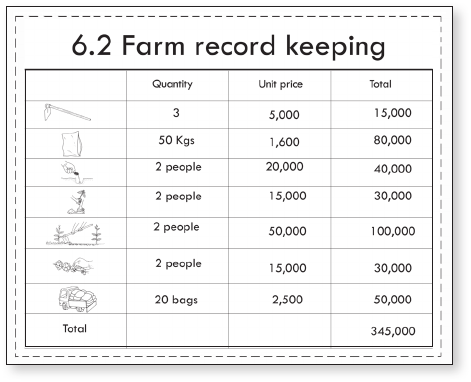
CHART 6.2: Farm record keeping
Every farmer should keep records of all field operations,
expenditures and income in order to assess the profitability of the
farm and help plan for the future. Field activity records should be
separated from farm sale records and both should have up-to-date
information.
Farm Activity Record
Record information about the field/plot, the field activity done
(landpreparation,planting,weeding,mulching,fertilizing,crop
protection, pruning, harvesting, etc.), the date of activity, the
method of implementation, the number of workers and cost of
labour, and the cost of materials.
Farm Sales/Income Record
Record information about the item sold (coffee, other crops, animals,
etc.), the date of sale, the service rendered, the quantity sold, the
unit price, the overall income from the transaction, the name and
number of the buyer, and any other comments.
49
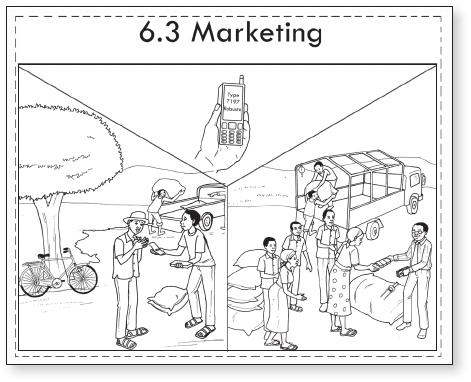
CHART 6.3: Marketing
Coffee is an important commodity in international trade. It plays an
important role in the livelihoods and economies of many people
and countries. Competition in the coffee market is between business
men and women of all kinds, from small-scale dealers/brokers with
small capital to those like exporters with large capital. Each of them
has a different specialty and plays a different role in the coffee
business.
• Brokersbuycropsinthegardenatfloweringorfruitingstage.
They may also buy freshly harvested cherry or parchment. They
buy coffee at a very low price compared to the prevailing market.
• Brokerssellthecoffeetotraderswhodry,bulkandsellitonto
processors or exporters.
• Non-exportingprocessorssellthecoffeetogradersorexporters
who take it to the external markets such as Europe and Sudan.
Because they are at the lowest level of the value chain, farmers
lose out on the potential profitability of coffee growing. Small-
50
scale farmers can overcome this challenge by forming groups and
bulking their coffee to process and market it in larger quantities and
therefore get a better price.
Farmers should separate different qualities of coffee before bulking.
Groupscanalsogetbetterpricesbybuyinginputstogetherinbulk.
Farmers can get market information from UCDA by sending a text
message saying Robusta or Arabica to 7197 and they will get the
market price in a return message.
51
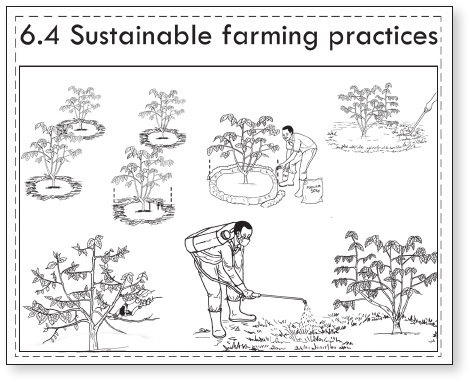
CHART 6.4: Sustainable farming practices
Sustainability has 3 main pillars:
• Economic- This aims to ensure economically viable farming for
the farmer, proper access to markets for producers and market
information. Farmers need to sustain productivity and quality
at farm level as well as keep good records. This helps them to
evaluate the impact of different good agricultural and post-
harvest handling practices.
• Social- This includes giving appropriate respect and care to
workers and families involved in coffee production and the
supply chain.
• Environmental- This ensures adequate consideration for and
protection of the natural environment. A farmer should think
about the environment around his/her land and the long-term
impact of his/her farming methods.

5252
CHART 6.5: Certification/verification
Some markets require the coffee to be certified as sustainable.
Access to these markets is an important reason to have a sustainable
coffee farm.
Coffee certifying bodies have a set of standards, code of conduct
and sustainability criteria designed to differentiate sources of
consistent quality.
Coffee sustainability standards have verification and audit
requirements so as to ensure all stakeholders conform to them. This
includes a certain level of organisation and record keeping as well as
an internal management system.
Certification is given only after passing an audit which verifies
that the farm conforms to the required standards. This process is
costly for smallholder farmers in many aspects, but they can be
encouraged to associate and work collaboratively with other farmers
to improve their yield and sustainable quality as they work towards
attaining certification standards.
• Certification bodies include: Organic (IFOAM), FairTrade
International, Rainforest Alliance, UTZ Certified and 4C (The
Common Code for the Coffee Community)
53
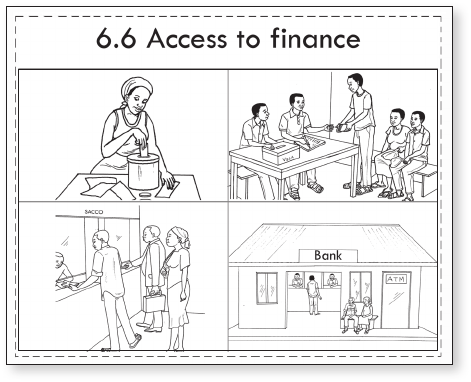
CHART 6.6: Access to finance
Farmers need money to meet daily demands. This may force them to
sell their coffee prematurely at very low prices.
Farmers need to be able to borrow money on fair terms (low interest
rates, and long gestation and loan recovery periods linked to the
agricultural season).
Farmers can overcome these challenges by forming village
saving and loan associations (VSLAs) or joining savings and credit
cooperatives (SACCOs). These can serve as savings and loan schemes
or can link farmers together to apply for farm loans from the larger
banks.
54
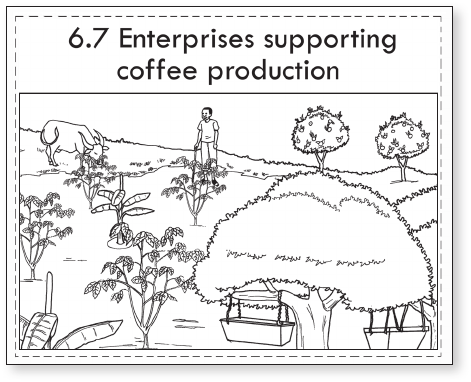
CHART 6.7: Enterprises supporting coffee production
Farmers should not rely solely on coffee for their income.
Uncertainties like low yield and low prices can affect their income
unexpectedly.
Farmers should keep cattle, goats, poultry and apiary as well as grow
other food and cash crops to protect them from food insecurity.
Animals also provide manure for the coffee farm.
Intercrop coffee with vanilla, bananas, beans, groundnuts and fruit
trees such as mangos, jackfruit, passion fruit and avocado to provide
food and additional income. Check with an extension worker before
intercropping with other crops.
Plantcropslikemaize,soyabeans,cassavaandsweetpotatoona
separate piece of land (not intercropped with coffee) for food and
cash.
Farmers may also be engaged in non-farm alternative enterprises
such as owning retail or wholesale shops, making crafts and/or
having formal employment, etc.
55
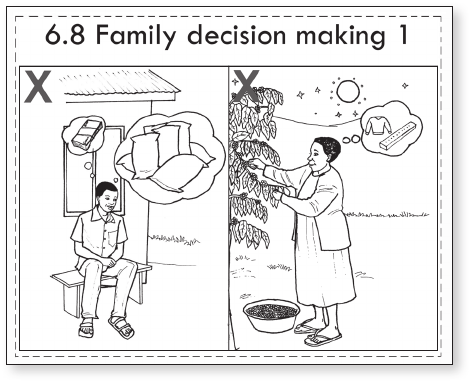
CHART 6.8: Family decision making 1
If the man in the household takes all the decisions on the use of
coffee earnings, the woman may need to sell coffee secretly to cater
for the family needs.

56
CHART 6.9: Family decision making 2
Successful coffee farming has many stages such as planning,
production, processing, marketing and utilisation of profits to cater
for family needs and to expand the business.
At all these stages, key decisions must be made. All decisions
should be equitable, encourage participation of all family members
(women, men, girls, and boys) and ensure that the farm benefits
everyone involved. Coffee earnings may be used for school fees,
health care, investment in the farm, home care (including soap and
clothes), food security and savings.
A farm enterprise should clearly communicate roles and
responsibilities, expectations, capabilities and entitlement for
everyone involved. For example, children of school-going age
should not work in coffee farms during school time, and all wages
and working hours must comply with national employment policies.
57
Training Module 7.0: Environment and Climate Change
Objectives for the training
By the end of the training, participants should have acquired the
knowledge and skills necessary to:
• Understandtheimportanceofprotectingtheenvironmentand
know some protection measures
• Understandimportantfactsaboutclimatechange
• Knowhowtoadaptacoffeefarmtodealwithclimatechange
www.mangotreeuganda.org
58
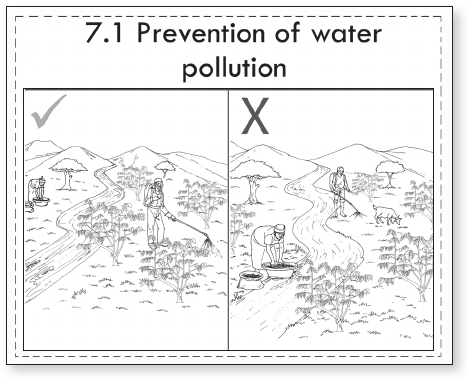
CHART 7.1: Prevention of water pollution
Our water sources belong to everyone and need to be protected to
avoid pollution. If you wash your coffee in the river, you are spoiling
the water for you and your neighbours downstream.
Wash your coffee in a container away from the water source. Dispose
of the waste water carefully so it doesn’t run back into the water
source.
Use chemical sprays away from water sources, and do not wash
sprayers or chemical containers in the river.
59
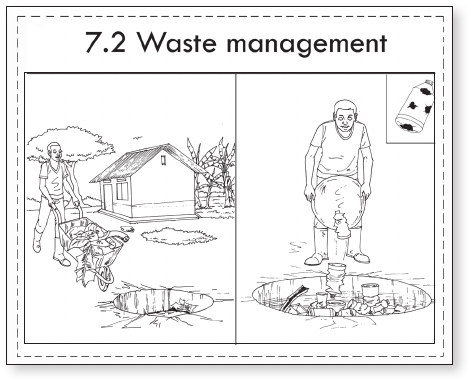
CHART 7.2: Waste management
It is important to separate organic and inorganic waste so that you
can make compost from the organic waste to improve your soil.
Puncture all chemical containers to prevent re-use. Sell whatever
plastic and metal you can. Keep the rest in a pit away from your
house.
60
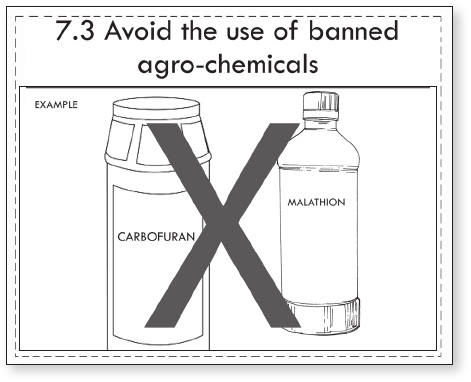
CHART 7.3: Banned chemicals
Do not use banned chemicals, which have been proven to be
dangerous for humans, animals, birds and the environment in
general.
Here is a table of chemicals which are banned. You should not use
any of these. The table also contains alternatives that you should use

61
No. Product
name
Active
ingredient
Used to
control
Alternative control
1 Furadan Carbufuran • Banana
weevils white
grubs, root
mealy bugs
• Dursban(powder)
• Nematodes • Croprotation;soilsterilisation-
solar heating of nursery beds
• Neem-basedproducts
• Animals
& birds
(poisoning)
• Donotpoisonanimals
2 Endosulfan Endosulfan Coffee berry
borer
• Crophygiene:Harvestandbury
all remaining cherries after final
harvest
Acaricide • Bioticspot-on;Milbitraz;pye-
grease
3 Paraquat Paraquat Herbicide • Slashingoruprooting
• Glyphosate-basedproducts
4 Actellic Super Permethrin Grainstorage
insects
• AshorNeemextracts
• Cleanstores+properdrying
Ambush Field insects • Cypermethrin(orchlorpyrifos)
based products
NB: FOR THOSE IN CERTIFICATION SCHEMES, YOU SHOULD CONTACT
THESTANDARDSBODY,E.G.UTZCERTIFIED,FORAFULLLISTOF
BANNED CHEMICALS
62
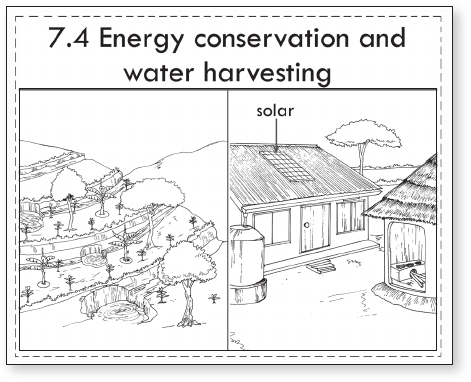
CHART 7.4: Energy conservation and water harvesting
Energy and water are precious resources and need to be used with
care.
• Plantmulti-purposetreesforshadeandfuelsupply.Collectrun-
off water in trenches or ponds for soil moisture retention.
• Useenergysavingstoves.Usesolarenergywherepossible.
Explore the possibility of biogas production from livestock
manure and other sources.
63
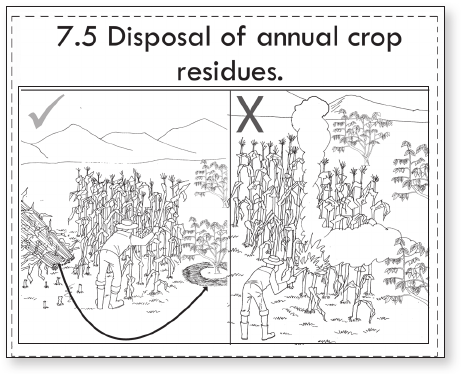
CHART 7.5: Disposal of annual crops residues
Annual food crops are often grown alongside your coffee. After
harvest of the food crops, clearing the land may be a challenge.
• Avoidburningthecropresiduesinthefieldasthefiremay
spread to your coffee and also cause a loss of nutrients and living
organisms.
• Cropresiduesshouldbeusedformulching,compostingorfor
livestock feed.
64
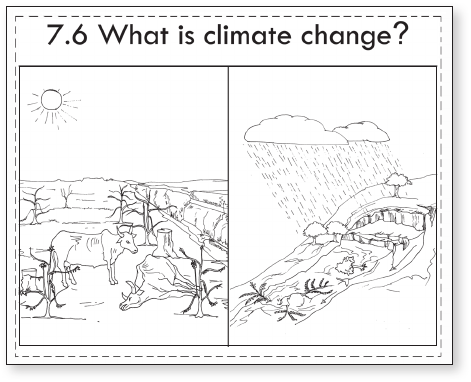
CHART 7.6: What is climate change?
Climate change is the change of the Earth’s ecosystems due to an
increase in the global temperature.
Greaterlevelsofatmosphericcarbondioxide(CO²)andother
greenhouse gases near the Earth’s surface are part of the reason for
this increase in temperature.
As a result of climate change, Uganda is witnessing ecosystem
instability in the form of frequent and prolonged droughts, frequent
floods, hailstorms, landslides, thunderstorms and erratic and
unreliable rainfall. Such changes and instability in the ecosystem can
disrupt agricultural productivity.
65
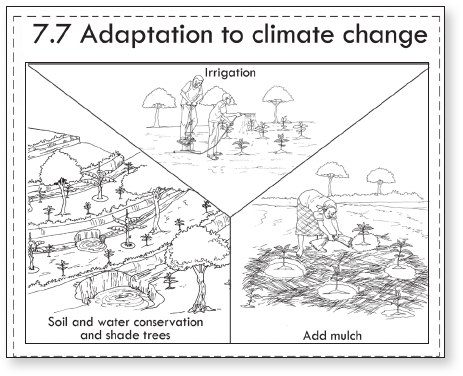
CHART 7.7: Adaptation to climate change
There are several agronomic practices the coffee farmer should be
aware of that help to minimise the effect of climate change. These
include:
• Plantingshadetreesincoffeegardens
• Mulching
• Irrigatingtoensureacontinuouswatersupplytoplants
• Usingmanureandinorganicfertilizers
• Managing(biological,chemical,culturalcontrol)pestanddisease
infestation
• Usingsoilerosioncontrolmeasures:(trenches,terraces,bands,
gulley traps) to prevent soil erosion
• Plantingcovercropsandtrees

66
Here is a table of recommended shade trees:
English
name:
Scientific
name:
Common
names:
What does the
tree bring besides
shade:
Silk oak Grevillea Grevillea Firewood, timber, mulch,
apiculture
Markhamia* Markhamia lutea Nsambya, Lusola,
Omusambya
Firewood, timber, mulch,
apiculture, medicines
Umbrella
tree*
Maesopsis emnii Musizi Firewood, timber
Bark cloth
fig, Natal fig
Ficus spp. Mutuba, Mukokowe,
Mukunyu, Omutooma
Timber, fodder, bark cloth,
medicines
Cordia Cordia africana Mukebu, Chikichikiri,
Mujugangoma
Firewood, timber, mulch,
apiculture
Silk tree* Albizia
chinensis
Lusubyu Timber, fodder, rich mulch,
soil fertility
* These 3 trees are known to be hosts to Black Twig Borer so their
use should be carefully managed. Encourage farmers to consult
their extension workers for further advice.
67
Training Module 8.0 Social Responsibility
Objectives for the training
By the end of the training, participants should have acquired the
knowledge and skills necessary to:
• Includechildrenincoffeefarminginasafeandresponsibleway
• Useandstoreagro-chemicalsinasafeandresponsibleway
• Treatfarmworkersinafairandethicalway
• Maintaingoodhealthandhygiene
www.mangotreeuganda.org
68
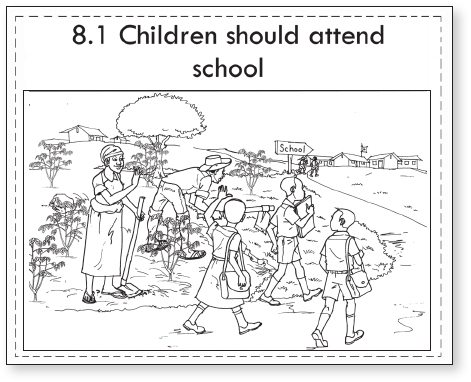
CHART 8.1: Children on the farm
All children should go to school.
Outside school hours, they may do light work on the farm under
adult supervision. This helps the children learn about the farm and
they can help with record keeping.
They must not spray chemicals or carry heavy loads.
69
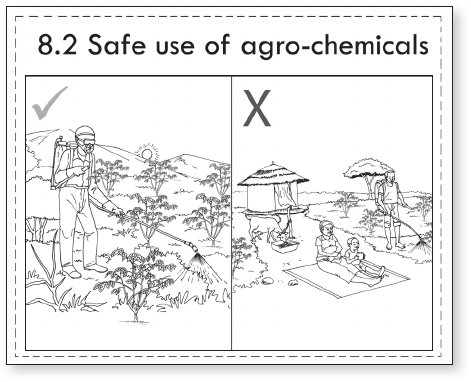
CHART 8.2: Safe use of agro-chemicals
Remember that agro-chemicals may be dangerous if not properly
stored and used.
• Alwayswearfullprotectivegear(cap,masks,overallsoutside
gumboots, goggles, gloves, boots) when handling or spraying
agro-chemicals.
• Donotspraynearotherpeople,livestockorwatersources.
• Donotspraywhenitisverywindy.Neversprayagainstthe
direction of the wind.
• Makesureyouwarnotherpeoplebeforeandafterspraying
70
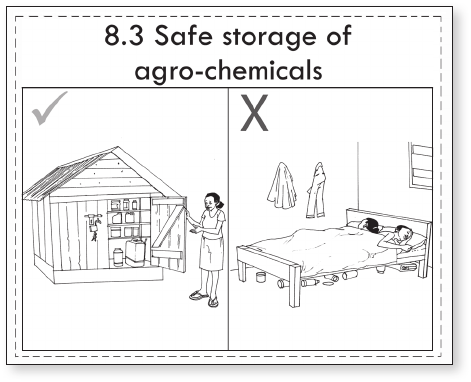
CHART 8.3: Safe storage of agro-chemicals
Chemicals should be kept in a locked place, out of reach of children
and away from food and stored crops. Where possible, keep them in
a separate store.
Do not store chemicals under the bed. Alternative safe storage is a
locked tin trunk or locked wooden box.
71
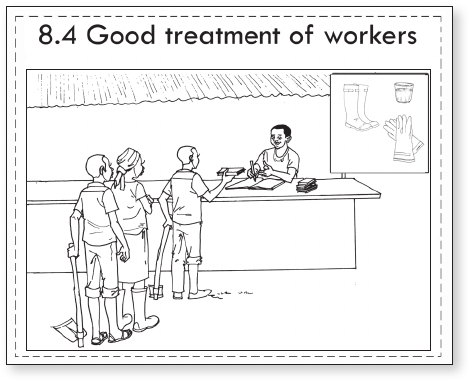
CHART 8.4: Good treatment of workers
All workers are important for your coffee farm and should be treated
with respect.
• Afairrateforthejobshouldbeagreed,andpaidwhenthework
is completed or as agreed.
• Allpaymentsshouldberecorded.
• Reasonableworkingconditions,suchasaccesstocleandrinking
water, toilets and protective gear should be provided.
72
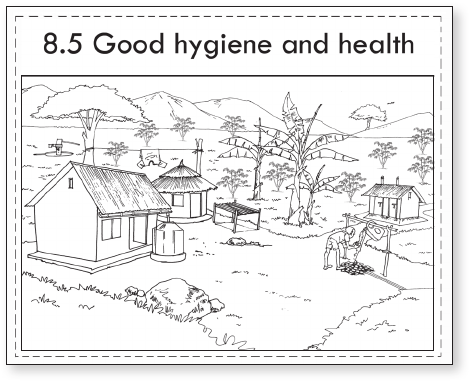
CHART 8.5: Good hygiene and health (personal)
Goodhygieneisimportantforthehealthofyouandyourfamily.
• Keepyourcompoundclean.
• Haveacleanandfunctionalpitlatrine/toilet.
• Sleepunderatreatedmosquitonet.
• Haveasafewatersource.
• Washyourhandsregularly.

Trainers’ Notes
Thanks to the following organisations for support, and whose
staff reviewed the materials as members of the Sustainability and
ExtensionMaterialsWorkingGroupsoftheNSC:
MAAIF, UCDA, NaCORI, NAADS, UCFA, NUCAFE, UCF,Café Africa
Uganda,UNADA,Solidaridad,4CAssociation,UtzCertified,
Kyagalanyi, Kawacom, Armajaro, Ugocert, ACA, IWCA, USAID,
aBiTrust and IDH Sustainable Coffee Programme.

1479 Naalya Road, Kiwatule, P.O. Box 25312, Kampala, Uganda
Tel: 256-312-263-263, Email: mangotree@mangotreeuganda.org
www.mangotreeuganda.org
Mango Tree
Sh s
N
A
T
I
O
N
A
L
A
G
R
I
C
U
L
T
U
R
A
L
A
D
V
I
S
O
R
Y
S
E
R
V
I
C
E
S
NATIONAL STEERING COMMITTEE OF THE NATIONAL COFFEE PLATFORM
DEVELOPMENT OF THE COFFEE TRAINING MATERIALS SUPPORTED BY
